Monthly Archives: July 2023

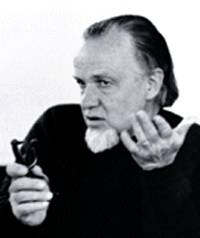
FRANCIS SCHAEFFER ANALYZES ART AND CULTURE Part 483 LETTER TO HUGH HEFNER about Burt Reynolds and Adrian Rogers Featured Artist is Mika Rottenberg

Francis Schaeffer has rightly noted concerning Hugh Hefner that Hefner’s goal  with the “playboy mentality is just to smash the puritanical ethnic.” I have made the comparison throughout this series of blog posts between Hefner and King Solomon (the author of the BOOK of ECCLESIASTES).  I have noticed that many preachers who have delivered sermons on Ecclesiastes have also mentioned Hefner as a modern day example of King Solomon especially because they both tried to find sexual satisfaction through the volume of women you could slept with in a lifetime.

Ecclesiastes 2:8-10 The Message (MSG)

I piled up silver and gold,
        loot from kings and kingdoms.
I gathered a chorus of singers to entertain me with song,
    and—most exquisite of all pleasures—
    voluptuous maidens for my bed.

9-10 Oh, how I prospered! I left all my predecessors in Jerusalem far behind, left them behind in the dust. What’s more, I kept a clear head through it all. Everything I wanted I took—I never said no to myself. I gave in to every impulse, held back nothing. I sucked the marrow of pleasure out of every task—my reward to myself for a hard day’s work!

1 Kings 11:1-3 English Standard Version (ESV)

11 Now King Solomon loved many foreign women, along with the daughter of Pharaoh: Moabite, Ammonite, Edomite, Sidonian, and Hittite women, from the nations concerning which the Lord had said to the people of Israel, “You shall not enter into marriage with them, neither shall they with you, for surely they will turn away your heart after their gods.” Solomon clung to these in love.He had 700 wives, who were princesses, and 300 concubines. And his wives turned away his heart.

Francis Schaeffer observed concerning Solomon, “You can not know woman by knowing 1000 women.”


Adrian Rogers pictured below with legendary coach Bear Bryant:

Image result for adrian rogers bear bryant

_______

Image result for burt reynolds frank sinatra

(L-R) Burt Reynolds, Dean Martin, Shirley MacLaine, Sammy Davis, Jr., and Frank Sinatra in “Cannonball Run II.”20th Century Fox

https://i0.wp.com/www.reagan.utexas.edu/archives/photographs/large/c32275-30.jpg

President Reagan and Nancy Reagan attending “All Star Tribute to Dutch Reagan” at NBC Studios(from left to right sitting) Colleen Reagan, Neil Reagan, Maureen Reagan, President, Nancy Reagan, Dennis Revell. (From left to right standing) Emmanuel Lewis, Charlton Heston, Ben Vereen, Monty Hall, Frank Sinatra, Burt Reynolds, Dean Martin, Eydie Gorme, Vin Scully, Steve Lawrence, last 2 unidentified. Burbank, California 12/1/85.

https://i0.wp.com/www.reagan.utexas.edu/archives/photographs/large/C19401-20.jpg

Nancy Reagan with Dinah Shore and Burt Reynolds in the Blue Room during a state dinner for Premier Zhao Ziyang of the Peoples Republic of China. 1/10/84.

Image result for burt reynolds frank sinatra

_____________ 

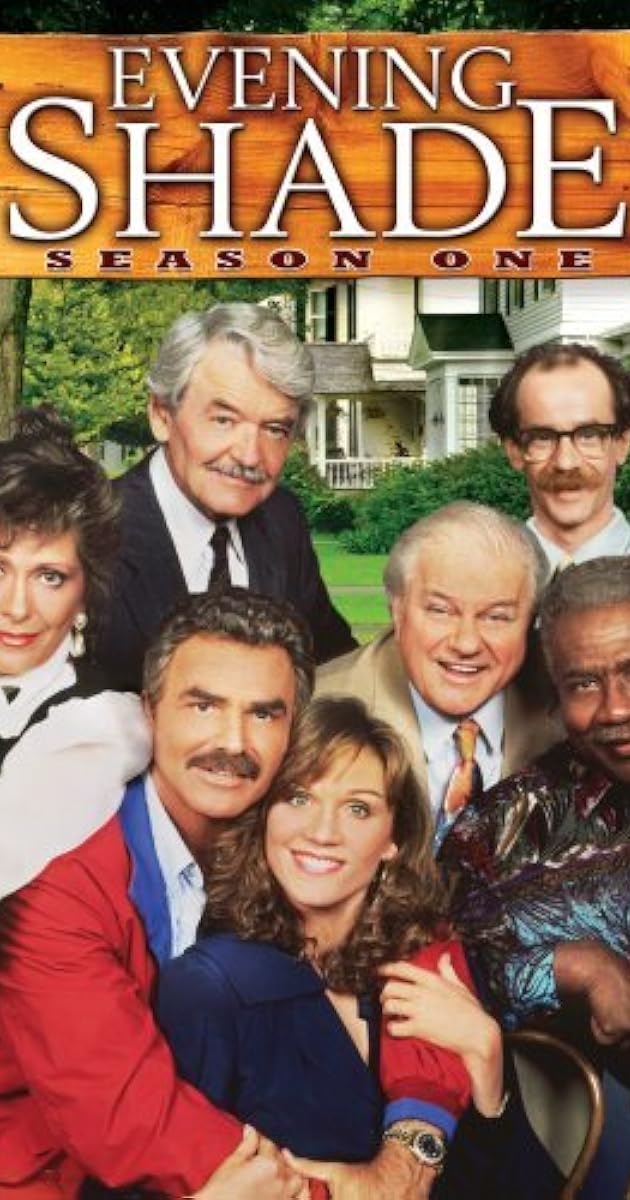
Image result for burt reynolds evening shade

_____________________

December 31, 2016

Hugh Hefner
Playboy Mansion
10236 Charing Cross Road
Los Angeles, CA 90024-1815

Dear Mr. Hefner,

Today is New Years Eve and as you know a lot of wild and crazy things have happened on that night. Living a life dedicated to satisfying sexual desires has been your goal, but has it satisfied you? I know from you looking on your Twitter that you are fond of Scrapbook Saturdays. I want to take you down memory lane today. Do you remember who was on the cover of the PLAYBOY  MAGAZINE on  October 1979? It was Burt Reynolds with Gig Gangel.  This issue  included an extensive interview with Reynolds. Plus there was an  article on Alabama coach Bear Bryant by Richard Price; (I have included picture of Adrian Rogers with Bear Bryant at a 1982 LIBERTY BOWL Event. Bryant coached his last game in that LIBERTY BOWL on 12-29-82 and he died less than a month later at age 69.)

I just starting reading the book BUT ENOUGH ABOUT ME by Burt Reynolds. Since you probably know Burt I thought you like some of the details I found out about him over the years.I remember going down to the Robinson Center in Little Rock back around 1993 to see “An evening with Burt Reynolds.” It was very enjoyable as Reynolds told stories about his life. One story I found very funny was the night that Frank Sinatra took Reynolds out to a restaurant.  Dinah Shore was a longtime friend of Sinatra and he always wanted to protect her. He had a talk with Reynolds and he wanted to know Reynolds intentions.Before the evening started, Reynolds told Dinah that he was not going to stay out late with Sinatra and he was going to leave after he got his “Sinatra story.” Well, Sinatra was served in a private room in the back of his favorite restaurant and there was a server who was nervous and he spilled some soup at Sinatra’s table. The owner came out and fired the server on the spot. Sinatra responded, “Every time I come back here in the future, I better see this particular server working here or I will never come back again.”Reynolds got up from the table and started to leave. Sinatra said, “Where are you going?” Reynolds said he was leaving because he told Dinah he would be back as soon as he got a “Sinatra story” and now he had one.Before he appeared that evening in Little Rock he had an afternoon free and Harry Thomason arranged for a friend of mine to show Burt around town. My friend  told me that Reynolds was very impressed with the neighborhood in the Heights on Edge Hill Road. He was told the prices of several of the homes back in 1993 and he was amazed the prices were all under 10 million. He said the homes in Beverly Hills were 5 times as much.During that afternoon my friend asked Reynolds if he knew the name Adrian Rogers? Reynolds almost fell out of his seat, and replied that Adrian Rogers was his hero when Reynolds was in the 7th grade because that year Adrian Rogers was the starting quarterback at  Palm Beach High School and Rogers led the team to a State Title in Football.I later told Dr. Rogers that story myself and he told me that had heard later that Reynolds was in the student body back then. I don’t know what exact year that was, but I do remember when I was in high school one time Dr. Rogers asked what event I ran for the track team. When I told him he replied, “I ran the 440 yard dash in 49!!!” I was very impressed by that until he said, “Yes , that is right, 1949!” Burt Reynolds once said that he knew it was right to serve God but he wanted to live his life for himself while he was young but he would serve God when he got old. I have yet to see that transformation. I remember watching an interview  of Burt Reynolds in 1980 and I believe it was one “Good Morning America” Season 5 Episode 106 on January 28, 1980. Reynolds said that real success was making a marriage work and making a difference in the lives of people. Burt Reynolds said that he was right to serve God but yet he hasn’t done it even when he is old. HUGH, you and I are a lot older than we were in 1980 when that interview of Reynolds appeared on TV. We are pass the prime of our lives and we need to be thinking of what lies ahead in eternity. I am going to quote from a sermon that Adrian Rogers used to preach. I hope you take the time to read it below: 

This Place Called Hell

Adrian Rogers

Revelation 21:6-8

I want you to take God’s word and turn with me, please, today to revelation, chapter 21 and we’re going to read verses 7 and 8. Revelation, chapter 21 verses 7 and 8.

Now listen to this scripture, revelation 21, verse seven, ”he that overcometh shall inherit all things and I will be his God, and he shall be my son.” what a wonderful promise that is!! But now listen to verse 8, ”but the fearful, and unbelieving, and the abominable, and murderers, fornicators, and sorcerers, and idolaters, and all liars shall have their part in the lake which burneth with fire and brimstone, which is the second death.

Now I want you to listen to what God’s word has to say about this subject of hell. FIRST, of all, I want to tell you that hell is going to be a place of vile associations. Revelation 21, verse 8 again, ”but the fearful and the unbelieving and the abominable, and murderers, and fornicators, and sorcerers, and idolaters, and all liars shall have their part in the lake which burneth with fire and brimstone which is the second death.” have you ever heard anybody say, ”If I go to hell, I’ll have plenty of company”? He’s right and that’s your company. Right there. That’s the company you’ll be with. Mark twain is reported to have said, ”I’ll take heaven for climate and hell for company.” now he was a smart aleck and if he’s there today in hell, that’s the company that he’ll have. The devil himself will be part of that company in hell.

Look in revelation, chapter 20 and verse 10, ”and the devil that deceived them was cast into the lake of fire and brimstone.” the devil that deceived them was cast into the lake of fire and brimstone! Jesus told us that hell was prepared for the devil and his angels. Now Satan is not in hell now, so many times we speak of the devil in hell. The devil is not in hell. He is the prince of the power of the air. He’s called the God of this age or the God of this world. He is the spirit that now worketh in the children of disobedience, he is not yet in hell; he will be cast into hell. And when he goes to hell, he’s not some comical character wearing a red suit with horns and hooves with a pitchfork and making people shovel coal. The devil loves to get that kind of an idea out because we ridicule that idea. When the devil goes to hell he will be cast into a lake burning with fire and brimstone and he will suffer there in hell like everyone else. He is not going to be the Lord of hell, he’s going to be incarcerated in a place called ”hell.” when he’s sent there, it’ll be on a one-way ticket. And not only will Satan be there, but every foul demon will be there. The bible speaks of the devil and his angels, these were once bright shining angels who fell from the glories of heaven and one day will be incarcerated in hell.

But not only will Satan be there, unGodly persons will be there. Perhaps when I read revelations 21:8 and you looked and you saw people like murderers and fornicators, and sorcerers, and idolaters, and liars, you said, ”well, I’m too good to go to hell, I’m not going to be in that category.” my dear friend, did you read those that lead the list? The fearful and the unbelieving! Do you know what the greatest sin is? What do you think the greatest sin is? Do you think that the greatest sin is some sort of sexual perversion? Or do you think perhaps the greatest sin is rape? Or do you think the greatest sin is murder? What is the greatest sin? My friend the greatest sin is the sin that heads this list: the fearful and unbelieving. Those who have refused to give their heart to Jesus Christ. I’m going to prove that to you.

Take your bibles and turn with me to mark, chapter 12 for here just a moment, mark, chapter 12 and this is worth turning to. And I want every unbeliever who’s listening to me, those of you who’ve not yet received the Lord Jesus Christ, who think that you’re too good to be damned. By the way, most of the people in America are egomaniacs, strutting their way to hell, thinking they’re too good to be damned.

Look with me please in mark, chapter 12 and let’s begin reading in verse 28. ”and one of the scribes came, and having heard them reasoning together, and perceiving that he’d answered them well, asked him,’ (that is a scribe who was a student of the scripture asked him this question) ‘which is the first commandment of all?’ ”and Jesus answered him, ‘the first of all the commandments is, hear, 0 Israel; the Lord our God is one Lord: and thou shalt love the Lord thy God with all thy heart, with all thy soul, with all thy mind, and with all thy strength: this is the first commandment.”’

My friend, the greatest sin is to break the greatest commandment. Do you understand that? The greatest sin is not murder or rape. The greatest sin is not arson or thievery, the greatest sin is to fail to love God with all of your heart! Do you believe that? I hope you believe that, because you see there are a lot of people who are not Christians, who don’t love God, who have never surrendered to the Lord Jesus Christ, who have never received him as Lord and savior, who think that hell is for the drunkard and for the thief and for the murderer, but not for them. They’re selfrighteous people. But if you’ve never bowed before the cross of the Lord Jesus Christ and said, ”oh, God, I’m a sinner, I repent of my sin, and with all of my heart, dear Lord, I believe in you,” you head the list of those who one day are going to end up in the place called hell.

Have you ever heard anybody say, ”well, I’m not going to go down there to that church because there’re hyprocrites in that church”? There are hypocrites in this church, and in your church, any church you’ve ever been in, any church you’ll ever be in. If it has any size to it at all, there will be some hypocrites. One of the twelve disciples, judas, was a hypocrite. I’m going to tell you something, friend, I had rather spend some of the time here on earth with some of the hypocrites than to spend eternity in hell with all of them.

Now, if you don’t know the Lord Jesus Christ, I’m telling you, friend, the fearful, the unbelieving, the abominable, murderers, whoremongers, whatever they may be, they’re going to spend their time in the lake which burns with fire and brimstone. Hell is a place of vile company, vile associations.

I tell you what else hell is, not only is it company with those who are unGodly, but it is separation from those who are Godly. Hell is a place of separation from the saints. Look again, if you will, at our scripture in revelation, chapter 21 and skip on down to revelation, chapter 21 and verse 27, revelation 21,verse 27. Now here the Lord is speaking of the place called heaven. It’s a beautiful place and then God describes heaven this way, and he says, ”and there shall in no way enter into it anything that defileth, neither he that worketh abomination, or maketh a lie: but they that are written in the Lamb’s Book of Life.” the lamb is the Lord Jesus. When you receive Christ as your personal savior, your name is written in the lamb’s book of life.

Now, you’re not going to heaven if your name is not in the lamb’s book of life. You’re going to be SEPARATED FROM THE SAINTS. The saints will be there, but you’ll not be there. Let me give you a passage of scripture from the words of Jesus. In luke, chapter 13 and verse 28, Jesus speaks of the time when you’ll be separated from the saints this way, ”there shall be weeping and nashing of teeth, when ye shall see abraham, and isaac, and jacob, and all the prophets, in the kingdom of God, and you yourselves thrust out.” when you see your mother in heaven, you’ll be in hell. You see your children in heaven and you’ll be in hell. What weeping and nashing of teeth there will be.

You say,”preacher, if I go to hell and my mama who rocked me, and loved me, and prayed for me, and wept over me, if she’s in heaven, she couldn’t enjoy heaven if I were in hell! That’s where you’re wrong. Your mother will pronounce a solemn curse on your head as you drop into hell. Your little children who prayed for you, when they are transformed into the perfect likeness of the Lord Jesus Christ, when they are filled with the righteousness and the holiness of God will say that it is right and just that you should go to hell. If you have received, if you have refused, the Lord Jesus Christ as your personal savior and Lord, you’re going to be separated for all eternity from the righteous and the Godly. You’re not going to heaven.

Not only will you be there with VILE ASSOCIATES but you’re going to be separated from the Godly and the righteous for all eternity. A young man going out for a night of sin, as he went past the door to pick up his things, his mother had laid a tract there on the little table there by the door. It really infuriated him, he picked it up, crumpled it up. He wasn’t saved. His mother had been praying for him and witnessing to him.

He said, ”mother, why do you give me this stuff?” he said, ”today, when I got on the bus, somebody handed me one of these tracts.” said, ”where could I go where no one’s going to give me this kind of stuff?” mother, with a quivering chin and a tear in the corner of her eye said, ”my son, in hell nobody’s going to witness to you.” in hell, and nobody will. Friend, if you’re going to be witnessed to, you’re going to be witnessed to here. If you’re going to be saved, you’re going to be saved here. But if you die and go to hell, you’re going to hell with the devil, the beast, the false prophet, all of the demons, all of the unGodly, all of the unbelievers, of all of the ages. Hell is a place of separation from the saints.

I want to help you to receive Christ today. Right where you are, you can trust him, you can pray a prayer right where you are and say, ”oh, God, I’m a sinner and I’m lost and I need to be saved. Jesus, you died to save me, and you promised to save me, if I would trust you. I trust you today with all of my heart. Come into my heart, forgive my sin, save me, Lord Jesus.” the bible says, ”believe on the Lord Jesus Christ and thou shalt be saved.” father, I pray that many today will say an everlasting ‘yes’ to Jesus Christ, in his name I pray, amen.

(End of Sermon)

___

Sincerely,

Everette Hatcher, everettehatcher@gmail.com, http://www.thedailyhatch.org, cell ph 501-920-5733, Box 23416, LittleRock, AR 72221

—-

https://www.youtube.com/watch?v=oBhihQnt3P0
Mika rottenberg

Mika Rottenberg

Mika Rottenberg was born in 1976 in Buenos Aires, Argentina, was raised in Tel Aviv, Israel, and now lives and works in upstate New York. Working in video, installation, and sculpture, Rottenberg is interested in making reality blend with her personal fiction; she features women with unconventional bodies in performances about labor, production, and the psychological implications of physical existence.

For instance, in Rottenberg’s 2004 video Mary’s Cherries, the amply endowed fetish wrestler Rock Rose rides a stationary bike that is part of a factory where women’s nails are harvested and turned into maraschino cherries. The artist describes her art as trying to capture the abstract experience of being alive and to transform it into a tangible object.

_______________

Related posts:

Ecclesiastes 2 — The Quest For Meaning and the failed examples of Howard Hughes and Hugh Hefner

June 27, 2013 – 12:49 am

Ecclesiastes 2-3 Published on Sep 19, 2012 Calvary Chapel Spring Valley | Sunday Evening | September 16, 2012 | Derek Neider _____________________________ I have written on the Book of Ecclesiastes and the subject of the meaning of our lives on several occasions on this blog. In this series on Ecclesiastes I hope to show how secular […] By Everette Hatcher III | Posted in Current Events | Edit | Comments (0)

May 4, 2017 – 1:40 am

 Is Love All You Need? Jesus v. Lennon Posted on January 19, 2011 by Jovan Payes 0 On June 25, 1967, the Beatles participated in the first worldwide TV special called “Our World”. During this special, the Beatles introduced “All You Need is Love”; one of their most famous and recognizable songs. In it, John Lennon […] By Everette Hatcher III | Posted in Francis Schaeffer | Edit | Comments (0)

April 6, 2017 – 12:25 am

___________________ Something happened to the Beatles in their journey through the 1960’s and although they started off wanting only to hold their girlfriend’s hand it later evolved into wanting to smash all previous sexual standards. The Beatles: Why Don’t We Do It in the Road? _______ Beatle Ringo Starr, and his girlfriend, later his wife, […] By Everette Hatcher III | Posted in Current Events | Edit | Comments (0)

December 15, 2016 – 7:18 am

__________ Marvin Minsky __ I was sorry recently  to learn of the passing of one of the great scholars of our generation. I have written about Marvin Minsky several times before in this series and today I again look at a letter I wrote to him in the last couple of years. It is my […] By Everette Hatcher III | Posted in Adrian RogersFrancis Schaeffer | Edit | Comments (0)

FRANCIS SCHAEFFER ANALYZES ART AND CULTURE Part 118 THE BEATLES (Why was Tony Curtis on cover of SGT PEP?) (Feature on artist Jeffrey Gibson )

June 30, 2016 – 5:35 am

Why was Tony Curtis on the cover of SGT PEPPERS? I have no idea but if I had to hazard a guess I would say that probably it was because he was in the smash hit SOME LIKE IT HOT.  Above from the  movie SOME LIKE IT HOT __ __ Jojo was a man who […] By Everette Hatcher III | Posted in Current Events | Edit | Comments (0)

March 3, 2016 – 12:21 am

RESPONDING TO HARRY KROTO’S BRILLIANT RENOWNED ACADEMICS!! Carl Sagan Part 26 My January 10, 1996 response letter to Carl Sagan  (1st part of 3) Are we so different from Animals? Or are we?

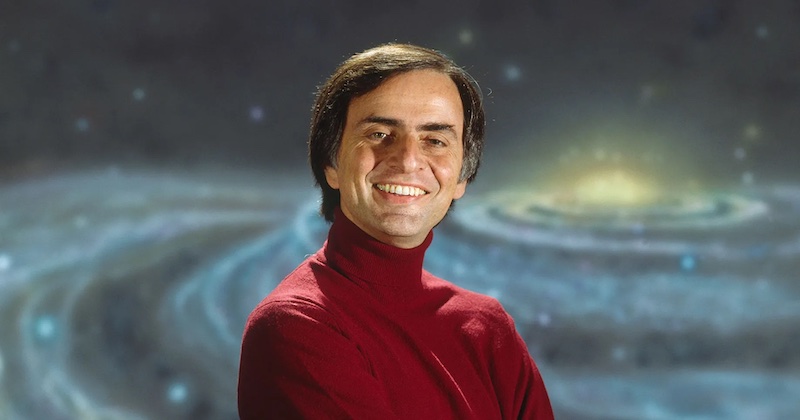
Carl Sagan Planetary Society cropped.png

Sagan in 1980

Recently I have been revisiting my correspondence in 1995 with the famous astronomer Carl Sagan who I had the privilege to correspond with in 1994, 1995 and 1996. In 1996 I had a chance to respond to his December 5, 1995letter on January 10, 1996 and I never heard back from him again since his cancer returned and he passed away later in 1996. Below is what Carl Sagan wrote to me in his December 5, 1995 letter:

Thanks for your recent letter about evolution and abortion. The correlation is hardly one to one; there are evolutionists who are anti-abortion and anti-evolutionists who are pro-abortion.You argue that God exists because otherwise we could not understand the world in our consciousness. But if you think God is necessary to understand the world, then why do you not ask the next question of where God came from? And if you say “God was always here,” why not say that the universe was always here? On abortion, my views are contained in the enclosed article (Sagan, Carl and Ann Druyan {1990}, “The Question of Abortion,” Parade Magazine, April 22.)

I was introduced to when reading a book by Francis Schaeffer called HE IS THERE AND HE IS NOT SILENT written in 1968.

Here is the letter I wrote to Dr. Sagan in response to the letter he wrote to me:

Dr. Carl Sagan, Cornell University, Center for Radiophysics and Space Research, Space Sciences Building, Ithaca, New York, 14853-6801

January 10, 1996

Dear Mr. Sagan,

Thank you for taking time out of your busy schedule to write me back on 12-5-95. My response comes in five parts. I imagine you will find part four the most intriguing.

Are we so different from Animals? Or are we?

In my 8-30-95 letter I used Douglas Futuyma’s quote: “Whether people are explicitly religious or not they tend to imagine that humans are in some sense the center of the universe. And what evolution does is to remove humans from the center of the universe. We are just one product of a very long historical process that has given rise to an enormous amount of organisms, and we are just one of them. So in some sense there is nothing special about us.” This seems to dovetail nicely with your quote from SHADOWS OF FORGOTTEN ANCESTORS : “Why are we so different from animals? Or are we? Most of the philosophers conventionally judged great thought that humans are fundamentally different from other animals because of an immaterial ‘something’ for which no scientific evidence has been produced, that resides somewhere in the body of humans and in no one else on earth. Only a few argue, as Charles Darwin did, that the differences between our species and others are only differences of degree.”

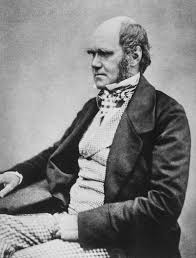
(Charles Darwin)

Earlier in Darwin’s life he did not argue against the existence of an immortal soul. In fact, he held the Biblical view, but later he became an agnostic because he rejected 2 pieces of evidence I will talk about later. What is the Biblical view? Moreover, if science never comes up with evidence to back up the existence of the soul we can not rule out the possibility it exists. ††

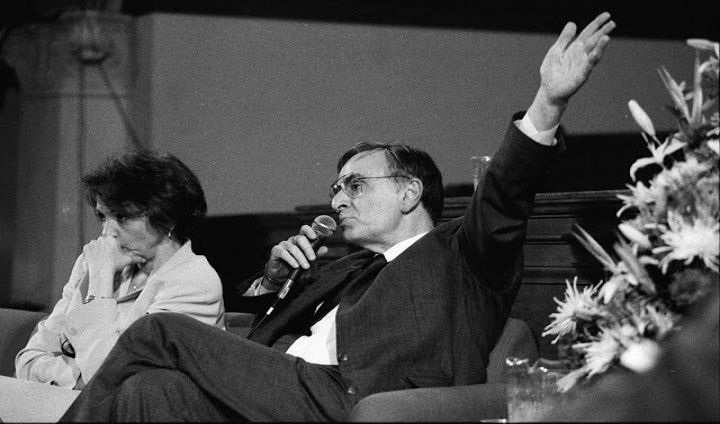
(Carl Sagan and Anne Druyan pictured)

Image result for carl sagan ann druyan
Image result for carl sagan humanist of the year

Are you proclaiming too much prematurely?

On April 18, 1981 in your speech to the AHA you made it clear that you rejected the atheistic position. You thought it was unwise to proclaim too much before enough data are in. You mentioned as cases in point “those committed atheists who believe there is compelling evidence that no god exists” (July/August 1981 issue of The Humanist, page 6).

That same point could be made concerning the existence of the soul. Do you have compelling evidence that the soul does not exist?

Will Scientism work with metaphysical questions?

I reject the view that only that which can be proved by science is true. God can not be proven by science. Is that why you are an agnostic? In your 12-5-95 letter you commented, “if you say ‘God was always here,’ why not say that the universe was always here?”

I am under the impression that the second Law of Thermodynamics pushes us to the conclusion that our universe had a beginning. But I did not want to spend time on that point. Instead, it should be emphasized that “God is a Spirit (a spiritual Being) and those who worship Him must worship Him in spirit and in truth (reality)” (John 4:24, Amplified Bible). In other words, scientism will not work when it comes to metaphysical questions.

What two pieces of evidence did Darwin wrestle with?

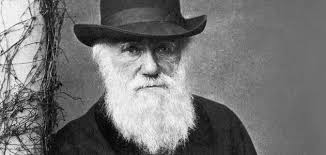
(Charles Darwin)

If you want evidence then you will only be given the same evidence that Charles Darwin had. I am going to quote 2 passages, and they both have a common message. That message has 3 points: 1) The conscience tells us of God’s existence. 2) Creatioon tells us the same. 3) If we reject both of those then God will eventually remove conviction from our hearts.

Don’t hold this against me, but I got this first passage out of the current issue of CREATION MAGAZINE:

At the present day the most usual argument for the existence of an intelligent God is drawn from the deep [#1] inward conviction and feelings which are experienced by most persons...Formerly I was led by feelings such as those…to the firm conviction of the existence of God, and of the immortality of the soul. In my Journal I wrote that [#2] whilst standing in the midst of the grandeur of a Brazilian forest, ‘it is not possible to give an adequate idea of the higher feelings of wonder, admiration, and devotion which fill and elevate the mind.’ I well remember my conviction that there is more in man than the mere breath of his body. [#3] But now the grandest scenes would not cause any such convictions and feelings to rise in my mind. It may be truly said that I am like a man who has become colour-blind…(Life and Letters of Charles Darwin, D. Appleton and Co., New York, 1911, Vol. a, page 29).

Romans 1:18-21 Amplified Bible:

18 For [God does not overlook sin and] the wrath of God is revealed from heaven against all ungodliness and unrighteousness of men who in their wickedness suppress and stifle the truth, 19 because that which is known about God is [#1] evident within them [in their inner consciousness], for God made it evident to them. 20 For ever since the creation of the world His invisible attributes, His eternal power and divine nature, have been clearly seen, [#2] being understood through His workmanship [all His creation, the wonderful things that He has made], so that they [who fail to believe and trust in Him] are without excuse and without defense. 21 For even though [a]they knew God [as the Creator], they did not [b]honor Him as God or give thanks [for His wondrous creation]. On the contrary, they became worthless in their thinking [godless, with pointless reasonings, and silly speculations], and their [#3] foolish heart was darkened.

Charles Darwin became an agnostic because he chose to reject the two pieces of evidence God gave him. Take a minute and read the enclosed letter to the editor of THE HUMANIST MAGAZINE. Where did our conscience come from if not from God? In your book SHADOWS OF FORGOTTEN ANCESTORS you quote Darwin’s wife warning him of the dangers of scientism on page 47. Wouldn’t it be wise to heed her advice????

Since Scientism will not work with metaphysics then what alternative does the skeptic have?

You have chosen to be known as a skeptic. Did you know that the word “skepticism” is derived from the Latin “scepticus (inquiring, reflective, doubting). A skeptic has an inquiring mind. It intrigues me that Christ spoke of those who were honest inquirers. Some can’t find God for the same reason a thief can’t find a policeman. They are unwilling to surrender their will to God. In fact, I read some amazing comments by some unbelievers to the effect that they would not be willing to serve God because they would not want to give up their independence. They would rather reign in hell. In John 7:16-17 Christ spoke to the doubters of His day: “My teaching is not My own, but His Who sent Me. If any man desires to do His will (God’s pleasure), he will know–have the needed illumination to recognize, can tell for himself–whether the teaching is from God, or whether I am speaking from Myself and of My own accord and on My own authority,” ((Amplified Bible). Adrian Rogers comments on this verse: “In plain English, this says that if a mansurrenders his will completely, God will reveal Himself to that man.” This is a recipe to get a revelation: #1 ingredient — an open Bible (best to read a chapter a day in the Gospel of John). #2 ingredient — an open heart (take 2 minutes before reading every day and pray “God, I don’t know whether You exist or not, but I want to know. And because I want to know, I will make an honest investigation, I will follow the results of that investigation wherever they lead me, regardless of the cost.”

Professor Peter Kreeft of the philosophy Department at Boston College wrote on page 291 in the book DOES GOD EXIST? published by Prometheus Books the following comments concerning the “prayer of the skeptic”: “Who could quarrel with that experiment? It’s like fairly testing the hypothesis that someone is in the closet, tied up, by knocking on the door. If the hypothesis is true, you may hear a reply. Why hesitate to knock?

The analogy is not perfect because I’m the case of the closet you can open the door and look with your eyes, while in the case of the invisible God you cannot. But you can still speak and listen with your mind and heart, and this constitutes a fair test, because the hypothesis maintains not only that God wants to reveal Himself to you, to set up a relationship of love and faith for a lifetime and beyond.

The hypothesis claims that ‘all who seek, find.’ So test it. Seek. I can only think of two reasons for hesitating: the fear that you will find nothing, and the fear that you will find something. Honestly, like love, casts out fear.”

Maybe you are at the point in your life where you are willing to try this. What do you have to lose? In 100 years everything we have now will be gone anyway.

It has been an honor to correspond with you. I know somewhat about the physical and spiritual challenges you face, and I will continue to pray for you. Best wishes.

Everette Hatcher III

13900 Cottontail Lane, Alexander, AR 72002

On November 21, 2014 I received a letter from Nobel Laureate Harry Kroto and it said:

…Please click on this URL http://vimeo.com/26991975

and you will hear what far smarter people than I have to say on this matter. I agree with them.

Harry Kroto

I have attempted to respond to all of Dr. Kroto’s friends arguments and I have posted my responses one per week for over a year now. Here are some of my earlier posts:

Arif AhmedHaroon Ahmed,  Jim Al-Khalili, Sir David AttenboroughMark Balaguer, Horace Barlow, Michael BateSir Patrick BatesonSimon Blackburn, Colin Blakemore, Ned BlockPascal BoyerPatricia ChurchlandAaron CiechanoverNoam Chomsky, Brian CoxPartha Dasgupta,  Alan Dershowitz, Frank DrakeHubert Dreyfus, John DunnBart Ehrman, Mark ElvinRichard Ernst, Stephan Feuchtwang, Robert FoleyDavid Friend,  Riccardo GiacconiIvar Giaever , Roy GlauberRebecca GoldsteinDavid J. Gross,  Brian Greene, Susan GreenfieldStephen F Gudeman,  Alan Guth, Jonathan HaidtTheodor W. Hänsch, Brian Harrison,  Stephen HawkingHermann Hauser, Robert HindeRoald Hoffmann,  Bruce HoodGerard ‘t HooftCaroline HumphreyNicholas Humphrey,  Herbert Huppert,  Gareth Stedman Jones, Steve JonesShelly KaganMichio Kaku,  Stuart KauffmanMasatoshi Koshiba,  Lawrence KraussHarry Kroto, George Lakoff,  Rodolfo LlinasElizabeth Loftus,  Alan MacfarlaneDan McKenzie,  Mahzarin BanajiPeter MillicanMarvin MinskyLeonard Mlodinow,  P.Z.Myers,   Yujin NagasawaAlva NoeDouglas Osheroff, David Parkin,  Jonathan Parry, Roger Penrose,  Saul PerlmutterHerman Philipse,  Carolyn PorcoRobert M. PriceVS RamachandranLisa RandallLord Martin ReesColin RenfrewAlison Richard,  C.J. van Rijsbergen,  Oliver Sacks, John SearleMarcus du SautoySimon SchafferJ. L. Schellenberg,   Lee Silver Peter Singer,  Walter Sinnott-ArmstrongRonald de Sousa, Victor StengerJohn SulstonBarry Supple,   Leonard Susskind, Raymond TallisMax TegmarkNeil deGrasse Tyson,  Martinus J. G. Veltman, Craig Venter.Alexander Vilenkin, Sir John Walker, James D. WatsonFrank WilczekSteven Weinberg, and  Lewis Wolpert,

<a style=”font-style:normal;font-variant-caps:normal;font-weight:normal;letter-spacing:normal;orphans:auto;text-indent:0;text-transform:none;white-space:normal;widows:auto;word-spacing:0;box-sizing:border-box;background-color:transparent;color:#c01823;text-decoration:none;margin:0;padding:0;border:0;font-size:13px;font-family:Lato, ‘Helvetica Neue’, Arial, Verdana, sans-serif;vertical-align:baseline;transition:color 0.2s linear, background 0.1s linear, border-color 0.1s linear;text-align:left;-webkit-text-size-adjust:100%;” title=”Remember when Carl Sagan trashed Star Wars on late-night TV?” href=”https://lithub.com/remember-when-carl-sagan-trashed-star-wars-on-late-night-tv/”&gt;

Carl Sagan

nitially an associate professor at Harvard, Sagan later moved to Cornell where he would spend the majority of his career as the David Duncan Professor of Astronomy and Space Sciences. Sagan published more than 600 scientific papers and articles and was author, co-author or editor of more than 20 books.[5] He wrote many popular science books, such as The Dragons of Eden, Broca’s Brain, Pale Blue Dot and narrated and co-wrote the award-winning 1980 television series Cosmos: A Personal Voyage. The most widely watched series in the history of American public television, Cosmos, has been seen by at least 500 million people in 60 countries.[6] The book Cosmos was published to accompany the series. He also wrote the 1985 science fiction novel Contact, the basis for a 1997 film of the same name. His papers, containing 595,000 items,[7] are archived at The Library of Congress.[8]

Sagan advocated scientific skeptical inquiry and the scientific method, pioneered exobiology and promoted the Search for Extra-Terrestrial Intelligence (SETI). He spent most of his career as a professor of astronomy at Cornell University, where he directed the Laboratory for Planetary Studies. Sagan and his works received numerous awards and honors, including the NASA Distinguished Public Service Medal, the National Academy of SciencesPublic Welfare Medal, the Pulitzer Prize for General Non-Fiction for his book The Dragons of Eden, and, regarding Cosmos: A Personal Voyage, two Emmy Awards, the Peabody Award, and the Hugo Award. He married three times and had five children. After suffering from myelodysplasia, Sagan died of pneumonia at the age of 62, on December 20, 1996.

In  the 1st video below in the 45th clip in this series are his words and  my response is below them. 

50 Renowned Academics Speaking About God (Part 1)

Another 50 Renowned Academics Speaking About God (Part 2

A Further 50 Renowned Academics Speaking About God (Part 3)

CARL SAGAN interview with Charlie Rose:

“…faith is belief in the absence of evidence. To believe in the absence of evidence, in my opinion, is a mistake. The idea is to hold belief until there is compelling evidence. If the Universe does not comply with our previous propositions, then we have to change…Religion deals with history poetry, great literature, ethics, morals, compassion…where religion gets into trouble is when it pretends to know something about science,”

I would respond that there is evidence that Christianity is true. The accuracy of the Bible has been confirmed by archaeology over and over in the past and one of the amazing finds was in 1948 when the Dead Sea Scrolls had copies from every Old Testament Book except Esther! One of the most powerful recent discoveries involved the bones of the high priest Caiaphas who questioned Christ in 30 AD.

Related posts:

FRANCIS SCHAEFFER ANALYZES ART AND CULTURE Part 52 THE BEATLES (Part D, There is evidence that the Beatles may have been exposed to Francis Schaeffer!!!) (Feature on artist Anna Margaret Rose Freeman )

______________   George Harrison Swears & Insults Paul and Yoko Lucy in the Sky with Diamonds- The Beatles The Beatles:   I have dedicated several posts to this series on the Beatles and I don’t know when this series will end because Francis Schaeffer spent a lot of time listening to the Beatles and talking […]

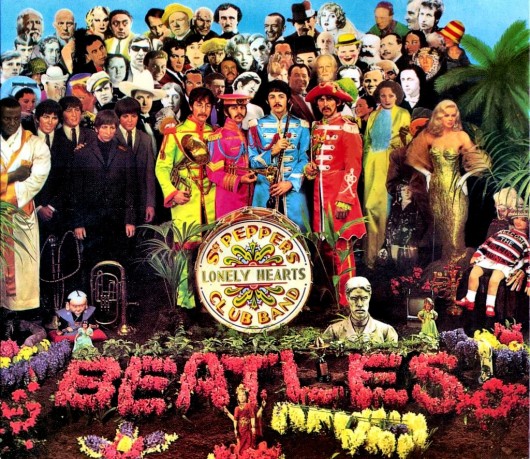
FRANCIS SCHAEFFER ANALYZES ART AND CULTURE Part 51 THE BEATLES (Part C, List of those on cover of Stg.Pepper’s ) (Feature on artist Raqib Shaw )

  The Beatles in a press conference after their Return from the USA Uploaded on Nov 29, 2010 The Beatles in a press conference after their Return from the USA. The Beatles:   I have dedicated several posts to this series on the Beatles and I don’t know when this series will end because Francis […]

FRANCIS SCHAEFFER ANALYZES ART AND CULTURE Part 50 THE BEATLES (Part B, The Psychedelic Music of the Beatles) (Feature on artist Peter Blake )

__________________   Beatles 1966 Last interview I have dedicated several posts to this series on the Beatles and I don’t know when this series will end because Francis Schaeffer spent a lot of time listening to the Beatles and talking and writing about them and their impact on the culture of the 1960’s. In this […]

FRANCIS SCHAEFFER ANALYZES ART AND CULTURE Part 49 THE BEATLES (Part A, The Meaning of Stg. Pepper’s Cover) (Feature on artist Mika Tajima)

_______________ The Beatles documentary || A Long and Winding Road || Episode 5 (This video discusses Stg. Pepper’s creation I have dedicated several posts to this series on the Beatles and I don’t know when this series will end because Francis Schaeffer spent a lot of time listening to the Beatles and talking and writing about […]

FRANCIS SCHAEFFER ANALYZES ART AND CULTURE PART 48 “BLOW UP” by Michelangelo Antonioni makes Philosophic Statement (Feature on artist Nancy Holt)

_______________ Francis Schaeffer pictured below: _____________________ I have included the 27 minute  episode THE AGE OF NONREASON by Francis Schaeffer. In that video Schaeffer noted,  ” Sergeant Pepper’s Lonely Hearts Club Band…for a time it became the rallying cry for young people throughout the world. It expressed the essence of their lives, thoughts and their feelings.” How Should […]

FRANCIS SCHAEFFER ANALYZES ART AND CULTURE Part 47 Woody Allen and Professor Levy and the death of “Optimistic Humanism” from the movie CRIMES AND MISDEMEANORS Plus Charles Darwin’s comments too!!! (Feature on artist Rodney Graham)

Crimes and Misdemeanors: A Discussion: Part 1 ___________________________________ Today I will answer the simple question: IS IT POSSIBLE TO BE AN OPTIMISTIC SECULAR HUMANIST THAT DOES NOT BELIEVE IN GOD OR AN AFTERLIFE? This question has been around for a long time and you can go back to the 19th century and read this same […]

FRANCIS SCHAEFFER ANALYZES ART AND CULTURE PART 46 Friedrich Nietzsche (Featured artist is Thomas Schütte)

____________________________________ Francis Schaeffer pictured below: __________ Francis Schaeffer has written extensively on art and culture spanning the last 2000years and here are some posts I have done on this subject before : Francis Schaeffer’s “How should we then live?” Video and outline of episode 10 “Final Choices” , episode 9 “The Age of Personal Peace and Affluence”, episode 8 […]

FRANCIS SCHAEFFER ANALYZES ART AND CULTURE Part 45 Woody Allen “Reason is Dead” (Feature on artists Allora & Calzadilla )

Love and Death [Woody Allen] – What if there is no God? [PL] ___________ _______________ How Should We then Live Episode 7 small (Age of Nonreason) #02 How Should We Then Live? (Promo Clip) Dr. Francis Schaeffer 10 Worldview and Truth Two Minute Warning: How Then Should We Live?: Francis Schaeffer at 100 Francis Schaeffer […]

FRANCIS SCHAEFFER ANALYZES ART AND CULTURE Part 44 The Book of Genesis (Featured artist is Trey McCarley )

___________________________________ Francis Schaeffer pictured below: ____________________________ Francis Schaeffer “BASIS FOR HUMAN DIGNITY” Whatever…HTTHR Dr. Francis schaeffer – The flow of Materialism(from Part 4 of Whatever happened to human race?) Dr. Francis Schaeffer – The Biblical flow of Truth & History (intro) Francis Schaeffer – The Biblical Flow of History & Truth (1) Dr. Francis Schaeffer […]

__

__

The Best of Henry Mancini – Henry Mancini Greatest Hits Full Album

The Best of Henry Mancini – Henry Mancini Greatest Hits Full Album


Composer Henry Mancini was born in Cleveland, Ohio on April 16, 1924.

He studied at Carnegie Technical Music School with instructors Mario Castelnuovo-Tedesco, Ernst Krenek and Alfred Sendry. After graduating, he began his career as a pianist in dance orchestras in Pittsburgh, Pennsylvania before entering World War II. Returning to the States in 1945, Mancini worked as the pianist and arranger for the Tex Beneke orchestra and then as the staff composer for Universal film studios from 1951 through 1957.

The Mancini filmography is one of the most extensive and honored in history including scores for films like The Glenn Miller StoryThe Benny Goodman StoryTouch of EvilBreakfast at Tiffany’s (1961 Academy Award for Best Score), High TimeBachelor in ParadiseCharadeMan’s Favorite SportDays of Wine and RosesThe Pink PantherA Shot in the DarkThe Great ImposterMr. Hobbs Takes a VacationHatariExperiment In TerrorSoldier in the RainDear HeartThe Great RaceArabesque and Moment to Moment.

Mancini also wrote the background scores for the television shows Peter Gunn (winning the Grammy award for best score in 1958) and Mr. Lucky.

Collaborating with lyricists Johnny MercerMack DavidRay Evans and Jay Livingston, Mancini produced such hits as “Moon River” (1951 Academy and Grammy awards for best song in a film), “Mr. Lucky” (Grammy Award for best song 1950), “Peter Gunn”, “Bachelor in Paradise”, “Baby Elephant Walk”, “Days of Wine and Roses” (1962 Academy and Grammy awards for best song in a film), “Dreamsville”, “Soft Touch”, “Blue Satin”, “March of the Cue Balls”, “I Love You and Don’t You Forget It”, “Charade”, “A Shot in the Dark”, “The Shadows of Paris”, “How Soon?”, “It Had Better Be Tonight”, “Song About Love”, “Dear Heart”, “Angel in DisguiseÔø?¸ “Make Love to Me”, “I Simply Adore You” and “When You Look in Your Looking Glass.”

Won first Grammy for Album of the Year for “Peter Gunn”; co-wrote 2009 SHOF Towering Song “Moon River”

Henry Mancini Collection of Great Music | The Classic Soundtrack Collection


BIOGRAPHY

Image of Henry drawing

HENRY MANCINI WAS ONE OF THE MOST VERSATILE TALENTS IN CONTEMPORARY MUSIC.

THE MANCINI NAME IS SYNONYMOUS WITH GREAT MOTION PICTURE AND TELEVISION MUSIC, FINE RECORDINGS AND INTERNATIONAL CONCERT PERFORMANCES.

During his lifetime, Mancini was nominated for 72 GRAMMY® Awards, winning 20. He was nominated for 18 Academy Awards® winning four, honored with a Golden Globe® Award and nominated for two Emmy ®Awards.

Mancini created many memorable film scores including ‘Breakfast at Tiffany’s’, ‘The Pink Panther’, ‘Days of Wine and Roses’, ‘Hatari!’, ‘Charade’, ‘Victor/Victoria’, “10,” ‘Darling Lili’, ‘Arabesque’, and ‘The Glass Menagerie’. He also wrote for a number of television films including “The Thorn Birds” and “The Shadow Box,” as well as television themes including “Peter Gunn,” “Mr. Lucky,” “NBC Election Night Theme,” “Newhart,” “Remington Steele” and “Hotel.” Mancini recorded over 90 albums with styles varying from big band to jazz to classical to pop, eight of which were certified gold by The Recording Industry Association of America®.

Born in Cleveland, Ohio on April 16, 1924, Mancini was introduced to music and the flute at the age of eight by his father, Quinto, an avid flutist. The family moved to Aliquippa, Pennsylvania where at age 12 he took up piano, and within a few years became interested in arranging. ;After graduating from high school in 1942 Mancini enrolled in New York’s Juilliard School of Music but his studies were interrupted the next year when he was drafted, leading to overseas service in the Air Force and later in the infantry.

In 1946 Mancini joined The Glenn Miller-Tex Beneke Orchestra as a pianist/arranger. It was there that he met the future Mrs. Henry Mancini, Ginny O’Connor, who was one of the original members of Mel Torme’s Mel-Tones. Ginny and Henry were married in Hollywood the following year.

In 1952 Mancini joined the Universal-International Studios music department. During the next six years he contributed to over 100 films, most notably The Glenn Miller Story (for which he received his first Academy Award® nomination), The Benny Goodman Story and Orson Welles’ Touch of Evil. Mancini left Universal-International in 1958 to work as an independent composer/arranger. Soon after he scored the television series “Peter Gunn” for writer/producer Blake Edwards, the genesis of a close relationship that lasted over 30 years and produced 26 films.

Mancini was an in-demand concert performer conducting over 50 engagements a year, resulting in over 600 symphony performances. Among the symphony orchestras he conducted were the London Symphony Orchestra, the Israel Philharmonic, the Boston Pops, the Los Angeles Philharmonic and the Royal Philharmonic Orchestra.

He appeared in 1966, 1980 and 1984 in command performances for the Royal Family. Mancini collaborated with a number of noted artists such as Sir James Galway, Johnny Mathis, Luciano Pavarotti, Doc Severinsen and Andy Williams.

Henry Mancini wrote two books: ‘Sounds and Scores – A Practical Guide to Professional Orchestration’, which can be found on the shelf of virtually every serious student of music, and his autobiography ‘Did They Mention The Music?’

In 1994 Mancini received UCLA’s most prestigious award, The Distinguished Artist Circle Award. Mancini was also bestowed with four honorary doctorate degrees: Duquesne University of Pennsylvania, Mount Saint Mary’s College in Maryland, Washington and Jefferson College in Pennsylvania, and the California Institute of the Arts in Valencia.

Mancini’s deep love of music and support of young musicians is evident in the scholarships and fellowships he established at top music schools. Many up and coming composers, conductors and arrangers have benefited from Mancini programs at Juilliard School of Music, UCLA, USC and at The American Federation of Music’s “Congress of Strings.”

Henry Mancini died in 1994. His wife, Ginny, and their three children – Chris, Monica and Felice; and two grandchildren -Christopher and Luca, continue the Mancini legacy.

In April 2004, Mancini was honored by the United States Postal Service with a stamp commemorating his lifetime achievements in film music, and to celebrate the 40th anniversary of the film The Pink Panther.

Related posts:

FRANCIS SCHAEFFER ANALYZES ART AND CULTURE Part 63 THE BEATLES (Part O , BECAUSE THE BEATLES LOVED HUMOR IT IS FITTING THAT 6 COMEDIANS MADE IT ON THE COVER OF “SGT. PEPPER’S”!) (Feature on artist H.C. Westermann )

June 10, 2015 – 2:33 pm

__________________ A Funny Press Interview of The Beatles in The US (1964) Funny Pictures of The Beatles Published on Oct 23, 2012 funny moments i took from the beatles movie; A Hard Days Night ___________________ Scene from Help! The Beatles Funny Clips and Outtakes (Part 1) The Beatles * Wildcat* (funny) Uploaded on Mar 20, […]

By Everette Hatcher III | Posted in Francis Schaeffer |Edit|Comments (0)

FRANCIS SCHAEFFER ANALYZES ART AND CULTURE Part 62 THE BEATLES (Part N The last 4 people alive from cover of Stg. Pepper’s and the reason Bob Dylan was put on the cover!) (Feature on artist Larry Bell)

June 4, 2015 – 5:31 am

_____________________ Great article on Dylan and Sergeant Pepper’s Lonely Hearts Club Band Cover: A famous album by the fab four – The Beatles – is “Sergeant peppers lonely hearts club band“. The album itself is one of the must influential albums of all time. New recording techniques and experiments with different styles of music made this […]

By Everette Hatcher III | Posted in Francis Schaeffer | Tagged Bob DylanBobby BreenDionLarry Bell | Edit|Comments (0)

FRANCIS SCHAEFFER ANALYZES ART AND CULTURE Part 61 THE BEATLES (Part M, Why was Karl Marx on the cover of Stg. Pepper’s?) (Feature on artist George Petty)

May 28, 2015 – 4:56 am

__________________________ Beatles 1966 Last interview 69 THE BEATLES TWO OF US As a university student, Karl Marx (1818-1883) joined a movement known as the Young Hegelians, who strongly criticized the political and cultural establishments of the day. He became a journalist, and the radical nature of his writings would eventually get him expelled by the […]

By Everette Hatcher III | Posted in Francis Schaeffer |Edit|Comments (0)

FRANCIS SCHAEFFER ANALYZES ART AND CULTURE Part 60 THE BEATLES (Part L, Why was Aleister Crowley on the cover of Stg. Pepper’s?) (Feature on artist Jann Haworth )

May 21, 2015 – 3:33 am

____________ Aleister Crowley on cover of Stg. Pepper’s: _______________ I have dedicated several posts to this series on the Beatles and I don’t know when this series will end because Francis Schaeffer spent a lot of time listening to the Beatles and talking and writing about them and their impact on the culture of the 1960’s. […]

—-

MUSIC MONDAY The Beatles albums ranked Part 7 “Help!” (1965)

______

_—

The Beatles albums ranked

December 23, 2022

The Beatles discography ranked

It’s difficult to have the albums created by the most important band in the history of music ranked from worst to best. After all, it’s unlikely that you’ll find any band or musical artist unwilling to share their admiration for the Fab Four. Their fingerprints are over everything created in popular music.

The Liverpool quartet recorded albums at a significant pace between 1963 and 1970. Many of these are classics that redefined what pop-rock could be. Most of these are tremendously experimental, adventurous affairs.

Still, which one’s the best? Is there any one album worth avoiding?

I’ve looked at the evidence and listened to the whole discography once more, and I think that I have an answer or two.

For simplicity’s sake, I have only included official UK releases. That means that the early US-released records aren’t on here. Neither are compilations such as “Anthology,” “Rarities,” or “Hey Jude.” “Yellow Submarine” is included as it included mostly unreleased material and was crafted as a studio album.

With this in mind, here’s a quick initiation into the musical world created by John, Paul, George, and Ringo, The Beatles albums ranked.

7. “Help!” (1965)

The fifth album from The Beatles, “Help!” marks a transitional period for the band. It features some great tracks, such as the title track and “You’ve Got to Hide Your Love Away.”

The band was still honing their songwriting skills at this point, and it is reflected in the somewhat inconsistent nature of the album. However, it’s for the first time that The Beatles include deeply personal details in their lyrics.

By most accounts, the title track is something of a distress signal from Lennon. Meanwhile, “You’ve Got To Hide Your Love Away” likely references manager and close friend Brian Epstein.

The inconsistency is also due to what had become a manic schedule for the band. This included touring, working on movies, and of course, having to release music at a steady pace.

The record is really a soundtrack to the film of the same name. “Help!” is a classic comedy-adventure film. It was directed by Richard Lester and released in the same year as the album. This was the second film made by the Beatles and features the band in their roles as themselves.

The film’s plot centers around Ringo Starr, who is pursued by a cult that wants to sacrifice him because he wears a sacrificial ring that he can’t remove from his finger. The other Beatles, as well as a number of other characters, try to help Ringo and protect him from the cult.

Fans of the Marx Brothers films and John Lennon could be counted as one and will find similarities between the comedy of the two groups.

“Help!” was a commercial and critical success upon its release and is now considered a classic of British cinema.

John Lennon contributed many of the most important songs to the album. These include the title track, “Ticket to Ride,” and the aforementioned, “You’ve Got to Hide Your Love Away.” There was a growing air of dissent about Lennon’s writing at this stage.

Paul McCartney provides one of the most famous pop-rock songs of all time, “Yesterday.” It is arguably one of the most famous pop songs of all time. It’s an enduring classic, but not everyone in the band was impressed with it.

In a 1980 interview with David Sheff for Playboy, Lennon said that “Yesterday” was “one of the few songs that I can’t stand to listen to” and that he felt it was “a lousy song, but it was successful.”

George Harrison contributed, “I need you.” He even exceeds the usual quota of one song per album with a second number, “You Like Me Too Much.”

Ringo Starr sang the easygoing “Act Naturally,” something of a prescient song considering Starr’s future work as an actor.

“Help!” is a record that has rightfully earned respect with time. However, considering the quasi-revolutionary releases that came before and after it, “Help!” is not one of The Beatles’ best albums.

Come Together – John Lennon (Live In New York City)

The Beatles – Real Love

_______

Real Love (Beatles song)

From Wikipedia, the free encyclopedia
“Real Love”
Song by John Lennon from the album Imagine: John Lennon
Released 10 October 1988
Recorded New York City
Length 2:48
Label
Writer(s) John Lennon
Producer(s)
“Real Love”
Real-love1.jpg
Single by The Beatles
from the album Anthology 2
B-side Baby’s in Black(Live)
Released 4 March 1996
Format
Recorded
Genre Rock
Length 3:54
Label Apple 58544
Writer(s) John Lennon
Producer(s) Jeff Lynne
The Beatles singles chronology
Free as a Bird
(1995)
Real Love
(1996)
Music sample
MENU
0:00
Music video
“Real Love” on YouTube

Real Love” is a song written by John Lennon, and recorded with overdubs by the three surviving Beatles in 1995 for release as part of The Beatles Anthology project. To date, it is the last released record of new material credited to the Beatles.

Lennon made six takes of the song in 1979 and 1980 with “Real Life”, a different song that merged with “Real Love”. The song was ignored until 1988 when the sixth take was used on the documentary soundtrack Imagine: John Lennon.

“Real Love” was subsequently reworked by the three surviving former members of the Beatles (Paul McCartney, George Harrison and Ringo Starr) in early 1995, an approach also used for another incomplete Lennon track, “Free as a Bird“. “Real Love” was released as a Beatles single in 1996 in the United Kingdom, United States and many other countries; it was the opening track on the Beatles’ Anthology 2 album. It is the last “new” credited Beatles song to originate and be included on an album. To date, it is the last single by the group to become a top 40 hit in the US.

The song reached number 4 and number 11, respectively, in the UK and US singles charts, and earned a gold record more quickly than a number of the group’s other singles. The song was not included on the BBC Radio 1 playlist, prompting criticism from fans and British members of parliament. After the release of “Free as a Bird” and “Real Love”, Starr commented: “Recording the new songs didn’t feel contrived at all, it felt very natural and it was a lot of fun, but emotional too at times. But it’s the end of the line, really. There’s nothing more we can do as the Beatles.”[1]

Early origins[edit]

According to Beatles biographer John T. Marck, “Real Love” originated as part of an unfinished stage play that Lennon was working on at the time titled “The Ballad of John and Yoko”. The song was first recorded in 1977 with a hand-held tape recorder on his piano at home. Eventually the work evolved under the title “Real Life”, a song Lennon would record at least six takes of in 1979 and 1980, and then abandoned. The song was eventually combined with elements of another Lennon demo, “Baby Make Love to You”.[2] In June 1978, Lennon and his wife Yoko Ono told the press that they were working on a musical, “The Ballad of John and Yoko”, which had been planned during the previous year.[3] Songs proposed to be included up to this point were “Real Love” and “Every Man Has a Woman Who Loves Him“.[3]

In later versions, Lennon altered portions of the song; for example, “no need to be alone / it’s real love / yes, it’s real love” became “why must it be alone / it’s real / well it’s real life.” Some takes included an acoustic guitar, while the eventual Beatles release features Lennon on piano, with rudimentary double-tracked vocals, and a tambourine. The version released in 1996 most closely reflected the lyrical structure of the early demo takes of the song.[4]

Lennon appears to have considered recording “Real Love” for his and Ono’s 1980 album Double Fantasy. A handwritten draft of the album’s running order places it as the possible opening track on side two.[5] The song remained largely forgotten until 1988, when the take 6 of “Real Love” appeared on the Imagine: John Lennon soundtrack album. The song was also released on the Acoustic album in 2004. The demo with just Lennon on piano was issued in 1998 on John Lennon Anthology and then later on Working Class Hero: The Definitive Lennon.

Reuniting the Beatles[edit]

Before the Anthology project, the closest the Beatles had come to reuniting on record (while all four members were still alive) was for Starr’s Ringo album in 1973, when Lennon, Harrison and Starr collaborated on “I’m the Greatest“. By the early 1990s, the idea of redoing some of Lennon’s old songs was inspired by former Beatles road manager Neil Aspinall and Harrison, who first requested some demos from Ono. In January 1994, McCartney went to New York City for Lennon’s induction into the Rock and Roll Hall of Fame. While there, he received at least four songs from Ono. According to Aspinall, it was “two cassettes” which “might have been five or six tracks”. Ono said of the occasion: “It was all settled before then, I just used that occasion to hand over the tapes personally to Paul. I did not break up the Beatles, but I was there at the time, you know? Now I’m in a position where I could bring them back together and I would not want to hinder that.”[6]

In an interview, McCartney remarked:

Yoko said “I’ve got a couple of tracks I’ll play you, you might be interested”. I’d never heard them before but she explained that they’re quite well known to Lennon fans as bootlegs. I said to Yoko, “Don’t impose too many conditions on us, it’s really difficult to do this, spiritually. We don’t know, we may hate each other after two hours in the studio and just walk out. So don’t put any conditions, it’s tough enough. If it doesn’t work out, you can veto it.” When I told George and Ringo I’d agreed to that, they were going, “What? What if we love it?” It didn’t come to that, luckily.[6]

McCartney, Harrison and Starr then focused their attention on four songs: “Free as a Bird“, “Real Love”, “Grow Old with Me” and “Now and Then“. Of these, they liked “Free as a Bird” the most, and worked hard on it. Eventually the song was released as the first new Beatles single since 1970. The remaining Beatles then turned their attention to “Real Love”, which, co-producer Jeff Lynne later remarked, at least “had a complete set of words”.[7]

Working in the studio[edit]

With George Martin declining to produce the new recording, the Beatles brought in Electric Light Orchestra‘s Jeff Lynne, who had worked extensively with Harrison, including as part of the Traveling Wilburys, and had already co-produced “Free as a Bird”.[1] The first problem that the team had to confront was the low quality of the demo, as Lennon had recorded it on a hand-held tape recorder. Lynne recalled:

We tried out a new noise reduction system, and it really worked. The problem I had with “Real Love” was that not only was there a 60 cycles mains hum going on, there was also a terrible amount of hiss, because it had been recorded at a low level. I don’t know how many generations down this copy was, but it sounded like at least a couple. So I had to get rid of the hiss and the mains hum, and then there were clicks all the way through it … We’d spend a day on it, then listen back and still find loads more things wrong … It didn’t have any effect on John’s voice, because we were just dealing with the air surrounding him, in between phrases. That took about a week to clean up before it was even usable and transferable to a DAT master. Putting fresh music to it was the easy part![1]

Although “Real Love” was more complete than “Free as a Bird”, which had required the addition of some lyrics by McCartney,[6] the song also suffered from problems with Lennon’s timing. Lynne recalled that “it took a lot of work to get it all in time so that the others could play to it.”[7] Lynne emphasised that the three remaining Beatles were keen to ensure the song sounded very “Beatles-y”: “What we were trying to do was create a record that was timeless, so we steered away from using state-of the-art gear. We didn’t want to make it fashionable.”[7]

As with “Free as a Bird”, the Beatles worked at McCartney’s studio in Sussex, with the intention of producing another single. Added to the demo were the sounds of a double bass (originally owned by Elvis Presley’s bassist, Bill Black), Fender Jazz bass guitar, a couple of Fender Stratocaster guitars, one of which was Harrison’s psychedelically-painted “Rocky” Strat (as seen in the “I Am the Walrus” video), as well as a Ludwig drum kit.[7] Other than their regular instruments, a Baldwin Combo Harpsichord (as played by Lennon on the Beatles song “Because“) and a harmonium (which appeared on the band’s 1965 hit single “We Can Work It Out“) were also used. During the recording process, it was decided to speed up the tape, thereby raising the key from D minor to E flat minor.[8]

As their sound engineer, the Beatles opted for Geoff Emerick, who had not only worked with them to a great extent in the 1960s, but is often credited with many of the Beatles’ audio inventions. The assistant engineer was Jon Jacobs, who had worked with McCartney and Emerick since the late 1970s. The attitude in the studio was very relaxed, according to Lynne: “Paul and George would strike up the backing vocals – and all of a sudden it’s the Beatles again! … I’d be waiting to record and normally I’d say, ‘OK, Let’s do a take’, but I was too busy laughing and smiling at everything they were talking about.” Starr said that the lightheartedness was key to ensuring he, Harrison and McCartney could focus on the task: “We just pretended that John had gone on holiday or out for tea and had left us the tape to play with. That was the only way we could deal with it, and get over the hurdle, because [it] was really very emotional.”[7]

Music video[edit]

The single’s video features shots of the three remaining Beatles recording in Sussex, mixed with shots of the Beatles taken during their career. Geoff Wonfor, who directed the Anthology documentary, filmed the Beatles recording in the studio with a handheld camcorder, as they did not want to be aware of the camera recording. Kevin Godley, who co-directed the music video, said that it was meant to be a “fly on the wall thing”.[1]

Two different versions of the video were made. The first version aired during the second installment of The Beatles Anthology television mini-series on ABC, at the end of the episode. The second version is the more common of the two, and appears on the Anthology DVD set. The most notable difference between the two is in the way the videos begin: the first is presented by a strawberry – possibly a reference to “Strawberry Fields Forever“, although also quite likely a nod to Godley’s “Strawberry Studios” – while the second opens with a piano (the piano chord at the beginning).

Release[edit]

Although “Real Love” was released as single in both the UK and US on 4 March 1996, the first time the song was publicly aired was on 22 November 1995, when the American television network, the American Broadcasting Company (ABC) aired the second episode of The Beatles Anthology. The single debuted on the British charts on 16 March 1996 at number 4, selling 50,000 copies in its first week.[9] The single’s chart performance was subsequently hindered by BBC Radio 1‘s exclusion of “Real Love” from its playlist. Reuters, which described Radio 1 as “the biggest pop music station in Britain”, reported that the station had declared: “It’s not what our listeners want to hear … We are a contemporary music station.”[10]

Beatles spokesman Geoff Baker responded by saying that the band’s response was “Indignation. Shock and surprise. We carried out research after the Anthology was launched and this revealed that 41% of the buyers were teenagers.”[11] The station’s actions contrasted strongly with what had occurred at the launch of “Free as a Bird” the year before, when Radio 1 became the first station to play the song on British airwaves. The exclusion of “Real Love” provoked a fierce reaction from fans also, and elicited comment from two members of parliament (MPs). Conservative MP Harry Greenway called the action censorship, and urged the station to reverse what he called a ban.[10]

An angry McCartney wrote an 800-word article for British newspaper The Daily Mirror about the alleged ban, in which he stated: “the Beatles don’t need our new single, ‘Real Love’, to be a hit. It’s not as if our careers depend on it … It’s very heartening to know that, while the kindergarten kings of Radio 1 may think the Beatles are too old to come out to play, a lot of younger British bands don’t seem to share that view. I’m forever reading how bands like Oasis are openly crediting the Beatles as inspiration, and I’m pleased that I can hear the Beatles in a lot of the music around today.” The letter was published on 9 March, the day after Radio 1 announced the “ban”.[11][dead link]

The station’s controller, Matthew Bannister, denied that the failure to include “Real Love” was a ban, saying that it merely meant that the song had not been included on the playlist of each week’s 60 most regularly featured songs.[citation needed] The station also hit back by devoting a “Golden Hour” to the group’s music as well as music by bands influenced by the Beatles. This “Golden Hour” concluded with a playing of “Real Love”.[12]

“Real Love” fell out of the British charts in seven weeks, never topping its initial position of number 4. In the US, the single entered the charts on 30 March, and peaked at number 11.[13] After four months, 500,000 copies had been sold in the US.[9][14] The Beatles’ compilation album Anthology 2, which included the song, eventually topped the British and American albums charts.[15][16]

John Lennon’s solo versions appear on several Lennon compilations, the film Imagine: John Lennon, and also in a 2007 ad campaign for J. C. Penney.[17] On 6 November 2015, Apple Records released a new deluxe version of the 1 album in different editions and variations (known as 1+). Most of the tracks on 1 have been remixed from the original multi-track masters by Giles Martin. Martin and Jeff Lynne also remixed “Real Love” for the DVD and Blu-ray releases. The remix of “Real Love” cleans up Lennon’s vocal further, and reinstates a several deleted elements originally recorded in 1995, such as lead guitar phrases and drum fills, as well as making the harpsichord and harmonium more prominent in the mix.

Lyrics and melody[edit]

The song’s lyrics have been interpreted by one reviewer to be conveying the message that “love is the answer to loneliness” and “that connection is the antidote to unreality.”[18]

The song has been sped up 12% from the demo, apparently to “effect the … snappy tempo” as Alan W. Pollack has speculated. The tune is nearly completely pentatonic, comprising primarily the notes E, F, G, B and C. The refrain is higher than the verse; while the verse covers a full octave, the refrain, at its peak, is a fifth higher.[19]

The instrumental intro is four measures long, and the verse and refrain are eight measures. The introduction occurs in parallel E minor,[20] with the main thrust of the song being in E major. There are several other occasions where Lennon moves to a chord from the parallel minor, e.g. in the chorus where the progression moves from a major tonic (I) chord to a minor subdominant (iv) chord. The move to minor harmony happens on the words ‘alone’ and ‘afraid’. This combination of lyrics and harmony turning at the same point is a common Beatles device, and helps give the song a wistful feeling. The outro largely comprises the last half of the refrain repeated seven times, slowly fading out.[19]

Personnel[edit]

Sixth take
Beatles version

According to Ian MacDonald[21] and Mark Lewisohn:[22]

Track listings[edit]

All tracks written by Lennon–McCartney, except where noted.

7″ (R6425)
  1. “Real Love” (Lennon) – 3:54
    • Recorded at The Dakota, New York City, circa 1979 (original demo) and at The Mill Studio, Sussex, in February 1995.
  2. Baby’s in Black” – 3:03
    • Recorded live at the Hollywood Bowl on 29 August 1965 (spoken introduction by Lennon) and 30 August 1965 (song performance).
CD (CDR6425)
  1. “Real Love” (Lennon) – 3:54
  2. “Baby’s in Black” – 3:03
  3. Yellow Submarine” – 2:48
    • Recorded at EMI Studios, London, on 26 May and 1 June 1966. A new remix with a previously unreleased “marching” introduction with the sound effects mixed higher in volume throughout.
  4. Here, There and Everywhere” – 2:23
    • Recorded at EMI Studios, London, on 16 June 1966. This is a combination of take 7 (a mono mix of the basic track with McCartney’s guide vocal) with a 1995 stereo remix of the harmony vocals as overdubbed onto take 13 superimposed at the end.

Charts and certifications[edit]

Charts[edit]

Chart (1996) Peak
position
Australia (ARIA)[24] 6
Belgium (Ultratop 50 Flanders)[25] 50
Germany (Official German Charts)[26] 45
Finland (Suomen virallinen lista)[27] 4
France (SNEP)[28] 36
Ireland (IRMA)[29] 8
Netherlands (Single Top 100)[30] 21
Sweden (Sverigetopplistan)[31] 2
Switzerland (Schweizer Hitparade)[32] 26
UK Singles (Official Charts Company)[33] 4
US Billboard Hot 100[34] 11
US Cash Box Top 100[35] 10

Certifications[edit]

Region Certification Certified units/Sales
United States (RIAA)[36] Gold 500,000^
*sales figures based on certification alone
^shipments figures based on certification alone

Tom Odell version[edit]

“Real Love”
Real-Love-by-Tom-Odell.jpg
Single by Tom Odell
Released 6 November 2014
Format Digital download
Genre Pop
Length 2:21
Label Sony
Writer(s) John Lennon
Tom Odell singles chronology
I Know
(2013)
Real Love
(2014)
Wrong Crowd
(2016)

In 2014, English singer-songwriter Tom Odell released a cover version of the song. It was released on 6 November 2014 in the United Kingdom as a digital download through Sony. The song was selected as the soundtrack to the John Lewis 2014 Christmas advertisement and was later included on the “Spending All My Christmas With You” EP released in 2016.

Chart performance

On 9 November 2014 (week ending 15 November 2014), “Real Love” debuted at number 21 in the UK Singles Chart with only 3 days of sales, and then reached a new peak of number 7 the following week.

Track listing
Digital download
No. Title Length
1. “Real Love” 2:21

Chart performance[edit]

Weekly charts
Chart (2014) Peak
position
Ireland (IRMA)[37] 16
Netherlands (Single Top 100)[38] 89
Scotland (Official Charts Company)[39] 9
UK Singles (Official Charts Company)[33] 7
Release history
Region Date Format Label
United Kingdom 6 November 2014 Digital download Sony

Other versions[edit]

Regina Spektor recorded a cover version of “Real Love” for Instant Karma: The Amnesty International Campaign to Save Darfur, released in June 2007. She performed that cover at Bonnaroo the same month.[40]

Adam Sandler performed the song in the 2009 film Funny People. This version is also found on the film’s soundtrack.

The Last Royals released a cover version of “Real Love” on September 1, 2015 [41][42]

 External links[edit]

____

Real Love
All my little plans and schemes
Lost like some forgotten dreams
Seems that all I really was doing
Was waiting for you
Just like little girls and boys
Playing with their little toys
Seems like all they really were doing
Was waiting for love
Don’t need to be alone
No need to be alone
It’s real love, it’s real
Yes, it’s real love, it’s real
From this moment on I know
Exactly where my life will go
Seems that all I really was doing
Was waiting for love
Don’t need to be afraid
No need to be afraid
It’s real love, it’s real
Yes, it’s real love, it’s real
Thought I’d been in love before
But in my heart, I wanted more
Seems like all I really was doing
Was waiting for you
Don’t need to be alone
It’s real love, it’s real
Yes, it’s real love, it’s real
It’s real love, it’s real
Yes, it’s real love, it’s real
It’s real love, it’s real
Yes, it’s real love, it’s real
It’s real love, it’s real

Related posts:

FRANCIS SCHAEFFER ANALYZES ART AND CULTURE Part 63 THE BEATLES (Part O , BECAUSE THE BEATLES LOVED HUMOR IT IS FITTING THAT 6 COMEDIANS MADE IT ON THE COVER OF “SGT. PEPPER’S”!) (Feature on artist H.C. Westermann )

__________________ A Funny Press Interview of The Beatles in The US (1964) Funny Pictures of The Beatles Published on Oct 23, 2012 funny moments i took from the beatles movie; A Hard Days Night ___________________ Scene from Help! The Beatles Funny Clips and Outtakes (Part 1) The Beatles * Wildcat* (funny) Uploaded on Mar 20, […]

FRANCIS SCHAEFFER ANALYZES ART AND CULTURE Part 62 THE BEATLES (Part N The last 4 people alive from cover of Stg. Pepper’s and the reason Bob Dylan was put on the cover!) (Feature on artist Larry Bell)

_____________________ Great article on Dylan and Sergeant Pepper’s Lonely Hearts Club Band Cover: A famous album by the fab four – The Beatles – is “Sergeant peppers lonely hearts club band“. The album itself is one of the must influential albums of all time. New recording techniques and experiments with different styles of music made this […]

FRANCIS SCHAEFFER ANALYZES ART AND CULTURE Part 61 THE BEATLES (Part M, Why was Karl Marx on the cover of Stg. Pepper’s?) (Feature on artist George Petty)

__________________________ Beatles 1966 Last interview 69 THE BEATLES TWO OF US As a university student, Karl Marx (1818-1883) joined a movement known as the Young Hegelians, who strongly criticized the political and cultural establishments of the day. He became a journalist, and the radical nature of his writings would eventually get him expelled by the […]

FRANCIS SCHAEFFER ANALYZES ART AND CULTURE Part 60 THE BEATLES (Part L, Why was Aleister Crowley on the cover of Stg. Pepper’s?) (Feature on artist Jann Haworth )

____________ Aleister Crowley on cover of Stg. Pepper’s: _______________ I have dedicated several posts to this series on the Beatles and I don’t know when this series will end because Francis Schaeffer spent a lot of time listening to the Beatles and talking and writing about them and their impact on the culture of the 1960’s. […]

Henry Mancini Collection of Great Music | The Classic Soundtrack Collection

Henry Mancini Collection of Great Music | The Classic Soundtrack Collection


BIOGRAPHY

Image of Henry drawing

HENRY MANCINI WAS ONE OF THE MOST VERSATILE TALENTS IN CONTEMPORARY MUSIC.

THE MANCINI NAME IS SYNONYMOUS WITH GREAT MOTION PICTURE AND TELEVISION MUSIC, FINE RECORDINGS AND INTERNATIONAL CONCERT PERFORMANCES.

During his lifetime, Mancini was nominated for 72 GRAMMY® Awards, winning 20. He was nominated for 18 Academy Awards® winning four, honored with a Golden Globe® Award and nominated for two Emmy ®Awards.

Mancini created many memorable film scores including ‘Breakfast at Tiffany’s’, ‘The Pink Panther’, ‘Days of Wine and Roses’, ‘Hatari!’, ‘Charade’, ‘Victor/Victoria’, “10,” ‘Darling Lili’, ‘Arabesque’, and ‘The Glass Menagerie’. He also wrote for a number of television films including “The Thorn Birds” and “The Shadow Box,” as well as television themes including “Peter Gunn,” “Mr. Lucky,” “NBC Election Night Theme,” “Newhart,” “Remington Steele” and “Hotel.” Mancini recorded over 90 albums with styles varying from big band to jazz to classical to pop, eight of which were certified gold by The Recording Industry Association of America®.

Born in Cleveland, Ohio on April 16, 1924, Mancini was introduced to music and the flute at the age of eight by his father, Quinto, an avid flutist. The family moved to Aliquippa, Pennsylvania where at age 12 he took up piano, and within a few years became interested in arranging. ;After graduating from high school in 1942 Mancini enrolled in New York’s Juilliard School of Music but his studies were interrupted the next year when he was drafted, leading to overseas service in the Air Force and later in the infantry.

In 1946 Mancini joined The Glenn Miller-Tex Beneke Orchestra as a pianist/arranger. It was there that he met the future Mrs. Henry Mancini, Ginny O’Connor, who was one of the original members of Mel Torme’s Mel-Tones. Ginny and Henry were married in Hollywood the following year.

In 1952 Mancini joined the Universal-International Studios music department. During the next six years he contributed to over 100 films, most notably The Glenn Miller Story (for which he received his first Academy Award® nomination), The Benny Goodman Story and Orson Welles’ Touch of Evil. Mancini left Universal-International in 1958 to work as an independent composer/arranger. Soon after he scored the television series “Peter Gunn” for writer/producer Blake Edwards, the genesis of a close relationship that lasted over 30 years and produced 26 films.

Mancini was an in-demand concert performer conducting over 50 engagements a year, resulting in over 600 symphony performances. Among the symphony orchestras he conducted were the London Symphony Orchestra, the Israel Philharmonic, the Boston Pops, the Los Angeles Philharmonic and the Royal Philharmonic Orchestra.

He appeared in 1966, 1980 and 1984 in command performances for the Royal Family. Mancini collaborated with a number of noted artists such as Sir James Galway, Johnny Mathis, Luciano Pavarotti, Doc Severinsen and Andy Williams.

Henry Mancini wrote two books: ‘Sounds and Scores – A Practical Guide to Professional Orchestration’, which can be found on the shelf of virtually every serious student of music, and his autobiography ‘Did They Mention The Music?’

In 1994 Mancini received UCLA’s most prestigious award, The Distinguished Artist Circle Award. Mancini was also bestowed with four honorary doctorate degrees: Duquesne University of Pennsylvania, Mount Saint Mary’s College in Maryland, Washington and Jefferson College in Pennsylvania, and the California Institute of the Arts in Valencia.

Mancini’s deep love of music and support of young musicians is evident in the scholarships and fellowships he established at top music schools. Many up and coming composers, conductors and arrangers have benefited from Mancini programs at Juilliard School of Music, UCLA, USC and at The American Federation of Music’s “Congress of Strings.”

Henry Mancini died in 1994. His wife, Ginny, and their three children – Chris, Monica and Felice; and two grandchildren -Christopher and Luca, continue the Mancini legacy.

In April 2004, Mancini was honored by the United States Postal Service with a stamp commemorating his lifetime achievements in film music, and to celebrate the 40th anniversary of the film The Pink Panther.

Related posts:

FRANCIS SCHAEFFER ANALYZES ART AND CULTURE Part 63 THE BEATLES (Part O , BECAUSE THE BEATLES LOVED HUMOR IT IS FITTING THAT 6 COMEDIANS MADE IT ON THE COVER OF “SGT. PEPPER’S”!) (Feature on artist H.C. Westermann )

June 10, 2015 – 2:33 pm

__________________ A Funny Press Interview of The Beatles in The US (1964) Funny Pictures of The Beatles Published on Oct 23, 2012 funny moments i took from the beatles movie; A Hard Days Night ___________________ Scene from Help! The Beatles Funny Clips and Outtakes (Part 1) The Beatles * Wildcat* (funny) Uploaded on Mar 20, […]

By Everette Hatcher III | Posted in Francis Schaeffer |Edit|Comments (0)

FRANCIS SCHAEFFER ANALYZES ART AND CULTURE Part 62 THE BEATLES (Part N The last 4 people alive from cover of Stg. Pepper’s and the reason Bob Dylan was put on the cover!) (Feature on artist Larry Bell)

June 4, 2015 – 5:31 am

_____________________ Great article on Dylan and Sergeant Pepper’s Lonely Hearts Club Band Cover: A famous album by the fab four – The Beatles – is “Sergeant peppers lonely hearts club band“. The album itself is one of the must influential albums of all time. New recording techniques and experiments with different styles of music made this […]

By Everette Hatcher III | Posted in Francis Schaeffer | Tagged Bob DylanBobby BreenDionLarry Bell | Edit|Comments (0)

FRANCIS SCHAEFFER ANALYZES ART AND CULTURE Part 61 THE BEATLES (Part M, Why was Karl Marx on the cover of Stg. Pepper’s?) (Feature on artist George Petty)

May 28, 2015 – 4:56 am

__________________________ Beatles 1966 Last interview 69 THE BEATLES TWO OF US As a university student, Karl Marx (1818-1883) joined a movement known as the Young Hegelians, who strongly criticized the political and cultural establishments of the day. He became a journalist, and the radical nature of his writings would eventually get him expelled by the […]

By Everette Hatcher III | Posted in Francis Schaeffer |Edit|Comments (0)

FRANCIS SCHAEFFER ANALYZES ART AND CULTURE Part 60 THE BEATLES (Part L, Why was Aleister Crowley on the cover of Stg. Pepper’s?) (Feature on artist Jann Haworth )

May 21, 2015 – 3:33 am

____________ Aleister Crowley on cover of Stg. Pepper’s: _______________ I have dedicated several posts to this series on the Beatles and I don’t know when this series will end because Francis Schaeffer spent a lot of time listening to the Beatles and talking and writing about them and their impact on the culture of the 1960’s. […]

—-

Paul McCartney announced the Beatles were releasing one final song later this year, with vocals extracted from a John Lennon demo…Ringo also confirms that George Harrison recorded parts for the song before his death in 2001…Starr wouldn’t confirm the name of the song, but the fact of Harrison’s participation almost certainly means the track is “Now and Then,” a Lennon demo that McCartney, Harrison, and Starr did some work on during the same sessions that produced “Free As A Bird” and “Real Love,” which also used vocals harvested from Lennon demos.

_——

https://youtu.be/sl7c8opElkc

—-

·3 min read
Ringo Starr AI Beatles Ringo Starr AI Beatles.jpg - Credit: VALERIE MACON/AFP/Getty Images
Ringo Starr AI Beatles Ringo Starr AI Beatles.jpg – Credit: VALERIE MACON/AFP/Getty Images

When Paul McCartney announced the Beatles were releasing one final song later this year, with vocals extracted from a John Lennon demo via a machine-learning tool, the press jumped on a narrative of an “AI Beatles song.” Confused fans feared they were about to hear an AI-generated Lennon. But the Beatles would “never” fake Lennon’s vocals, Ringo Starr says in a new interview for an upcoming episode of our Rolling Stone Music Now podcast.

Starr also confirms that George Harrison recorded parts for the song before his death in 2001. “This was beautiful,” says Starr, “and it’s the final track you’ll ever hear with the four lads. And that’s a fact.” Starr wouldn’t confirm the name of the song, but the fact of Harrison’s participation almost certainly means the track is “Now and Then,” a Lennon demo that McCartney, Harrison, and Starr did some work on during the same sessions that produced “Free As A Bird” and “Real Love,” which also used vocals harvested from Lennon demos. Those tracks were included on the Beatles Anthology albums and documentary in the mid-Nineties — so it would be logical that the new song might come out in conjunction with a long-overdue re-release of the doc, though the Beatles camp hasn’t announced anything of the sort yet.

More from Rolling Stone

Meanwhile, Starr will celebrate his 83rd birthday on July 7, and is continuing his tradition of asking fans to “say, post, or think ‘peace and love,’” at precisely noon in their time zones. Starr will be on hand for a celebration in Beverly Hills on that day, alongside musicians including Joe Walsh and Mike Campbell. “In 2008, I was being interviewed,” Starr recalls, “and the interviewer said, ‘Well, Ringo, what would you like your fans to give you for your birthday? And I don’t know where it came from but I thought, it would be great, if at noon they could go ‘peace and love’ and that’s how it started. We started with 80 people… and now it’s 28 countries.”

Starr, who just finished a spring tour with the latest incarnation of his All-Starr band, says he’s feeling great. “You never know when you’re gonna drop, that’s the thing,” he says. “And I’m not dropping yet.”

Starr’s full interview — with new thoughts on Peter Jackson’s Get Back documentary and more — will appear on next weekend’s episode of Rolling Stone Music Now. Video from the interview will also be shown at a special live taping of the rest of the episode at the Rock and Roll of Fame in Cleveland at 2 p.m. on July 7; the episode will also include a new interview with producer Glyn Johns, who worked on the Let It Be sessions. The museum will also celebrate Starr’s birthday that day with a “peace and love” gathering at noon, and an all-Beatles performance by the Hall’s house band.

Best of Rolling Stone

———

(Francis Schaeffer pictured below spent a lot of time in the 1960’s analyzing the Beatles’ words and music and below he sums up the Beatles search for meaning and values in a letter that I mailed to Paul McCartney on March 20, 2016.)

March 20, 2016

Paul McCartney

Dear Paul,

I love the song THE LONG AND WINDING ROAD for several reasons. I hope you put it in your set list for Little Rock on April 30, 2016. Wikipedia noted: 

The Long and Winding Road” is a ballad written by Paul McCartney (credited to Lennon–McCartney) from the Beatles‘ album Let It Be. It became the group’s 20th and last number-one song in the United States in June 1970,[1] and was the last single released by the quartet.

While the released version of the song was very successful, the post-production modifications by producer Phil Spector angered McCartney to the point that when he made his case in court for breaking up the Beatles as a legal entity, he cited the treatment of “The Long and Winding Road” as one of six reasons for doing so. New versions of the song with simpler instrumentation were subsequently released by both the Beatles and McCartney.

In 2011, Rolling Stone ranked “The Long and Winding Road” number 90 on their list of 100 greatest Beatles songs of all time.[2]

During your time in the Beatles you obviously were searching for satisfaction in several different places and it seemed you returned to the romantic vision of love providing the big answers to life. 
The long and winding road that leads to your door
Will never disappear
I’ve seen that road before it always leads me here
Leads me to your door
The wild and windy night that the rain washed away
Has left a pool of tears crying for the day
Why leave me standing here, let me know the way
Many times I’ve been alone and many times I’ve cried
Anyway you’ll never know the many ways I’ve tried
And still they lead me back to the long and winding road
Francis Schaeffer (1912-1984) was a Christian and a philosopher who also took a deep interest in the trends in culture in the 1960’s and he spent a lot of time analyzing the Beatles search for meaning and values in life. Here is a summary statement he had on the Beatles:
The Beatles have showed us what has occurred [in the last years of the 1960’s in the culture.] The Beatles with Sergeant Pepper’s Lonely Hearts Club Band which incidentally was a very good piece of total art in the sense that it was an unit, they had many songs on this album but the songs all made one message and the whole album was an unit, and the way the songs were arranged. It all formed an unit of infiltration  of the message of modern man and of the drug culture. In fact, it could be said the  drug culture and the mentality that went with it had it’s own vehicle that crossed the frontiers of the world which were otherwise almost impassible by other means of communication. This record,  Sergeant Pepper’s Lonely Hearts Club Band, became the rallying cry for young people throughout the world. It expressed the essence of their lives, thoughts and their feelings. 

(Below Francis Schaeffer holding up  Sergeant Pepper’s Lonely Hearts Club Band Album in his film HOW SHOULD WE THEN LIVE? Episode 7 which can be seen on Vimeo:

Francis Schaeffer – How Should We then Live – 07.The Age of Non Reason

from CaptanFunkyFresh6 years ago

__

Image result for francis schaeffer beatles sergeant pepper's lonely hearts album

Later came psychedelic rock, an attempt to find this experience without drugs. The younger people and the older ones tried drug taking but then turned to the eastern religions. Both drugs and the eastern religions seek truth inside one’s own head, a negation of reason. The central reason of the popularity of eastern religions in the west is a hope for a nonrational meaning to life and values….

Beatles in India

Image result for beatles in india

Then the Beatles gradually came home. The last thing we find them doing is the YELLOW SUBMARINE. I am sure a lot of parents thought this is much better than the old hard rock, but I thought it was a very sad thing because it really wasn’t a children’s story at all, but what it was in fact was a romantic statement and the fact is that is all there is. Just the same as [Ingmar] Bergman after he makes the movie SILENCE [1963] then he makes a comedy [ALL THESE WOMEN in 1964]. It is the same as Picasso when he pictures his child as a clown [Paul in a Clown Suit, 1924]. So we find the Beatles making the YELLOW SUBMARINE, but there is something more to it than this because Erich Segal made his reputation by writing the script for the movie version of YELLOW SUBMARINE and then he went on and wrote LOVE STORY. So what we have done is we have come around in a big circle. There was the destruction of the romantic. Students in the 1960’s said we are tired of the romantic of giving us optimistic statements with no sufficient base.

[Paul in a Clown Suit, 1924 by Picasso].

Paul in a Clown Suit, 1924, 1903 by Pablo Picasso

LOVE STORY

So the Beatles destroyed that and then they went through these various trips into non-reason but when they came out they had nothing left but the romantic. This is the tragedy of the young people starting with Berkeley in 1964. How right they were in saying we have largely a plastic culture.    This is something the church should have been saying. These students said give us reality. Then the students tried those trips and they weren’t trips based on reality but they were separated from reason. It was trying to find answers in one’s own head whether it was the drug  trip or the Eastern Religion trip. Then they came around in a big circle and what do we find–we end up with Segal’s LOVE STORY, just the romantic thing as one can imagine but with no adequate base at all, yet giving us a lovely romantic answer, which just like the YELLOW SUBMARINE is very, very sad because the Beatles and young people were giving up the search and just accepting something like this. 

(Joan Baez sings at Free Speech Movement rally in Berkeley. November 20, 1964)

YELLOW SUBMARINE

Image result for beatles yellow submarine

If we are going to understand the line of despair we must understand that it is an unit saying that reason is not going to take us anywhere. After Jean-Jacques Rousseau, Søren Kierkegaard and the German philosophers Georg Wilhelm Friedrich Hegel, and Immanuel Kant there was an unity that bound all these fields of expressions together. First, it was the philosopher expressing this. Second, it was the artist. Third, it was the musician and lastly it was expressed in general culture. The giving up of hope that on the basis of reason one is going to have optimistic answers is the mark of our age. Any kind of answers to the purpose in life, love morals have nothing to do with reason for modern man. It can be expressed in John Cage’s music or in certain forms of rock music.

Chance is the king of our age and John Cage’s music best demonstrates where chance has brought us

You scientists out there who say man is only the atom but a big more complex then you come home to your wife and you say, “I love you.” You want something more than merely sex. Those of you who look to your children with some tenderness and those of you who believe in some morals but you have never settled your score with Marquis de Sade  who said it so well WHAT IS IS RIGHT.

Modern man lives in a dichotomy. Downstairs there is reason which leads to man only being a machine and upstairs there is a some kind of hope against all reason. That great high boast coming out of the Enlightenment that man beginning from himself would gather enough particulars to make his own universal to give adequate answers for life, but it has failed.

de Sade portrayed in recent movie

Karl Popper seen below

Alfred Kinsey seen below

Image result for alfred kinsey

Rationalism fails because man is finite and limited. Karl Popper in England can falsify a few things but he can’t verify anything. Alfred Kinsey tells us that all sexual behavior just comes down to sociological statistics. There is not going to be an answer for modern man unless there is something more than modern man beginning from himself, namely that there is a God there and He is not silent.

In another place Francis Schaeffer has correctly argued:

The universe was created by an infinite personal God and He brought it into existence by spoken word and made man in His own image. When man tries to reduce [philosophically in a materialistic point of view] himself to less than this [less than being made in the image of God] he will always fail and he will always be willing to make these impossible leaps into the area of nonreason even though they don’t give an answer simply because that isn’t what he is. He himself testifies that this infinite personal God, the God of the Old and New Testament is there. 

Instead of making a leap into the area of nonreason the better choice would be to investigate the claims that the Bible is a historically accurate book and that God created the universe and reached out to humankind with the Bible. Below is a piece of that evidence given by Francis Schaeffer concerning the accuracy of the Bible.

TRUTH AND HISTORY (chapter 5 of WHATEVER HAPPENED TO THE HUMAN RACE?, under footnote #94)

Consider, too, the threat in the entire Middle East from the power of Assyria. In 853 B.C. King Shalmaneser III of Assyria came west from the region of the Euphrates River, only to be successfully repulsed by a determined alliance of all the states in that area of the Battle of Qarqar. Shalmaneser’s record gives details of the alliance. In these he includes Ahab, who he tells us put 2000 chariots and 10,000 infantry into the battle. However, after Ahab’s death, Samaria was no longer strong enough to retain control, and Moab under King Mesha declared its independence, as II Kings 3:4,5 makes clear:

Now Mesha king of Moab was a sheep breeder, and he had to deliver to the king of Israel 100,000 lambs and the wool of 100,000 rams. But when Ahab died, the king of Moab rebelled against the king of Israel.

The famous Moabite (Mesha) Stone, now in the Louvre, bears an inscription which testifies to Mesha’s reality and of his success in throwing off the yoke of Israel. This is an inscribed black basalt stela, about four feet high, two feet wide, and several inches thick.

Moabite (Mesha) Stone seen below

___

Actually the answer to find meaning in life is found in putting your faith and trust in Jesus Christ. The Bible is true from cover to cover and can be trusted. Here are some of the posts I have done in the past on the subject and if you like you could just google these subjects: 1. The Babylonian Chronicleof Nebuchadnezzars Siege of Jerusalem, 2. Hezekiah’s Siloam Tunnel Inscription.13. The Pilate Inscription14. Caiaphas Ossuary14 B Pontius Pilate Part 214c. Three greatest American Archaeologists moved to accept Bible’s accuracy through archaeology.

Thanks for your time.

Sincerely,

Everette Hatcher, everettehatcher@gmail.com, http://www.thedailyhatch.org, cell ph 501-920-5733, Box 23416, LittleRock, AR 72221

___

Featured artist is Charles Lutyens

Contemporary Christian Art – The Rt Revd Lord Harries of Pentregarth

Image result for charles lutyens artist

__

Published on Apr 10, 2012

Contrary to much opinion, the current scene of faith-related art is very much alive. There are new commissions for churches and cathedrals, a number of artists pursue their work on the basis of a deeply convinced faith, and other artists often resonate with traditional Christian themes, albeit in a highly untraditional way. The challenge for the artist, stated in the introduction to the course of lectures above, is still very much there: how to retain artistic integrity whilst doing justice to received themes.

This lecture is part of Lord Harries’ series on ‘Christian Faith and Modern Art’. The last century has seen changes in artistic style that have been both rapid and radical. This has presented a particular problem to artists who have wished to express Christian themes.

The transcript and downloadable versions of the lecture are available from the Gresham College website:
http://www.gresham.ac.uk/lectures-and…

Gresham College has been giving free public lectures since 1597. This tradition continues today with all of our five or so public lectures a week being made available for free download from our website.
http://www.gresham.ac.uk

_________________________

Charles Lutyens, 1933

Fire Angel Mosaic, 1968

Image result for charles lutyens artist Fire Angel Mosaic

Charles Lutyens studied at the Chelsea, Slade, St Martin’s and CentralSchools of Art in London and later in Paris. Though mainly a painter he has worked in a range of media and has exhibited widely. From 1963 to 1968 he worked on a commission to produce a mosaic mural of “Angels of the Heavenly Host” on the four long panels high above and surrounding the congregation and altar of St Paul’s Bow, with light flooding down from the large lantern on top. At 800 square feet it is almost certainly the largest contemporary mural in the British Isles. Lutyens was commissioned by the architects of the church because they thought his work consistently revealed “a feeling for states of mind or spirit.” They thought that as we do not know what angels look like it was important that the work be not to too representational and as they put it, they thought the work had achieved just the right balance “between the figurative and the abstract, between severity and empathy, between assertiveness and recession.”[1] Mainly a portrait and landscape painter, Lutyens has turned to Christian themes from time to time as in this recently exhibited The Mocking, 1968. What is interesting about this is the way the tormentors hide behind a great sheet as though they do not want to see what they are doing.


Outraged Christ

Image result for charles lutyens artist Outraged Christ

The highlight of a recent exhibition, however, was a work which has also just been completed and was on view for the first time. This is the much larger than life, in fact 15’ Outraged Christ, made of carved and recycled timber shaped in the form of slats. The first Christians liked to show Christ victorious on the cross. The Mediaeval period focussed on his suffering for the sins of the world. The 20th century too focussed almost exclusively on the suffering of Christ but more often than not as a paradigm of the suffering of a terrible century with its innumerable victims.


The Outraged Christ.

The depiction of an outraged Christ is, so far as I know, a fresh addition to Christian iconography. It is a moving, impressive work. Instead of Christ being shown battered or anguished, it depicts him with mouth open, slightly to one side, with his knees pushing forward from the cross, in rage. But here is rage, indeed fury, not just at what is being inflicted on him but at what we humans do to one another.

[1] Charles Lutyens: Being in the World, paintings, drawings, sculptures, mosaic info@charleslutyens.co.uk, 2011,p.64

_____________

From his website:

Profile

Born in 1933, Charles Lutyens has been an artist all his life. He grew up during the war living in Berkshire and discovered his enjoyment to paint when he was seven years old whilst at school in Shropshire. During his time at Bryanston School in Dorset he realised his commitment to being an artist and would use his academic assignment periods to work in the art room. Through later training at the Slade, St. Martin’s and Central Schools of Art, he developed his skills in oil painting and sculpture.

Lutyens’ work is diverse and has always taken an individual direction using a variety of materials including clay, wood, stone, mosaic, as well as drawn and painted images on paper, board and canvas. His images emerge out of his own experience of life, looking inwardly, with a focus on the condition of “Man’s being in the World”.

Between 1958 and 1964, Lutyens lived in London working in his Fulham studio developing his own personal approach to painting. A body of images then painted were exhibited at the Wildenstein Gallery in New York, where critics compared his work to expressionists, Munch and Ensor.

From 1963 to 1968, Lutyens worked on a commission to produce a tesserae mosaic mural of “Angels of the Heavenly Host” at the newly consecrated church of St. Paul’s, Bow Common, E3.

Charles moved to Oxford with his family in 1978, where together with other commitments, teaching and running related workshops he continued to explore his studio painting and sculpting as well as his landscape work.

Throughout his artistic life he has exhibited in his studio, partaken in mixed exhibitions and has held one-man shows at St. Martin’s Gallery in London and Hollerhaus Gallery, near Munich.

His work is in private collections in England, Germany, Austria, France, Ireland, Spain and USA.

He has recently moved with his wife to Hampshire and is currently working on a 15ft wooden sculpture, a Crucifixion of an “Outraged Christ”.

Related posts:

Image result for sergent peppers album cover

Francis Schaeffer’s favorite album was SGT. PEPPER”S and he said of the album “Sergeant Pepper’s Lonely Hearts Club Band…for a time it became the rallying cry for young people throughout the world. It expressed the essence of their lives, thoughts and their feelings.”  (at the 14 minute point in episode 7 of HOW SHOULD WE THEN LIVE? ) 

Image result for francis schaeffer how should we then live

How Should We Then Live – Episode Seven – 07 – Portuguese Subtitles

Francis Schaeffer

Image result for francis schaeffer

______

FRANCIS SCHAEFFER ANALYZES ART AND CULTURE PART 202 the BEATLES’ last song FREE AS A BIRD (Featured artist is Susan Weil )

February 15, 2018 – 1:45 am

FRANCIS SCHAEFFER ANALYZES ART AND CULTURE Part 200 George Harrison song HERE ME LORD (Featured artist is Karl Schmidt-Rottluff )

FRANCIS SCHAEFFER ANALYZES ART AND CULTURE PART 184 the BEATLES’ song REAL LOVE (Featured artist is David Hammonds )

FRANCIS SCHAEFFER ANALYZES ART AND CULTURE Part 170 George Harrison and his song MY SWEET LORD (Featured artist is Bruce Herman )

FRANCIS SCHAEFFER ANALYZES ART AND CULTURE Part 168 George Harrison’s song AWAITING ON YOU ALL Part B (Featured artist is Michelle Mackey )

FRANCIS SCHAEFFER ANALYZES ART AND CULTURE Part 167 George Harrison’s song AWAITING ON YOU Part A (Artist featured is Paul Martin)

RESPONDING TO HARRY KROTO’S BRILLIANT RENOWNED ACADEMICS!! Part 133 Louise Antony is UMass, Phil Dept, “Atheists if they commit themselves to justice, peace and the relief of suffering can only be doing so out of love for the good. Atheist have the opportunity to practice perfect piety”

FRANCIS SCHAEFFER ANALYZES ART AND CULTURE Part 166 George Harrison’s song ART OF DYING (Featured artist is Joel Sheesley )

FRANCIS SCHAEFFER ANALYZES ART AND CULTURE Part 165 George Harrison’s view that many roads lead to Heaven (Featured artist is Tim Lowly)

FRANCIS SCHAEFFER ANALYZES ART AND CULTURE Part 164 THE BEATLES Edgar Allan Poe (Featured artist is Christopher Wool)

PART 163 BEATLES Breaking down the song LONG AND WINDING ROAD (Featured artist is Charles Lutyens )

FRANCIS SCHAEFFER ANALYZES ART AND CULTURE PART 162 A look at the BEATLES Breaking down the song ALL WE NEED IS LOVE Part C (Featured artist is Grace Slick)

PART 161 A look at the BEATLES Breaking down the song ALL WE NEED IS LOVE Part B (Featured artist is Francis Hoyland )

FRANCIS SCHAEFFER ANALYZES ART AND CULTURE PART 160 A look at the BEATLES Breaking down the song ALL WE NEED IS LOVE Part A (Featured artist is Shirazeh Houshiary)

FRANCIS SCHAEFFER ANALYZES ART AND CULTURE Part 159 BEATLES, Soccer player Albert Stubbins made it on SGT. PEP’S because he was sport hero (Artist featured is Richard Land)

FRANCIS SCHAEFFER ANALYZES ART AND CULTURE Part 158 THE BEATLES (breaking down the song WHY DON’T WE DO IT IN THE ROAD?) Photographer Bob Gomel featured today!

FRANCIS SCHAEFFER ANALYZES ART AND CULTURE Part 118 THE BEATLES (Why was Tony Curtis on cover of SGT PEP?) (Feature on artist Jeffrey Gibson )

FRANCIS SCHAEFFER ANALYZES ART AND CULTURE Part 117 THE BEATLES, Breaking down the song WITHIN YOU WITHOUT YOU Part B (Featured artist is Emma Amos )

FRANCIS SCHAEFFER ANALYZES ART AND CULTURE Part 97 THE BEATLES (The Beatles and Paramhansa Yogananda ) (Feature on artist Ronnie Wood)

Today I am going to look at Paramhansa Yogananda who appeared on the cover of SGT. PEPPERS because the Beatles were at the time interested in what Eastern Religions had to offer. One of the problems with Hinduism is that has no way to explain the existence of evil in the world today. However, Christianity explains […]

FRANCIS SCHAEFFER ANALYZES ART AND CULTURE PART 96 THE BEATLES (Breaking down the song “Eleanor Rigby” Part B and the issue of LONELINESS) Featured artist is Robert Morris

  _ The song ELEANOR RIGBY was a huge hit because it connected so well with “all the lonely people.” The line that probably best summed up how many people felt was: “All the lonely people, Where do they all come from? All the lonely people, Where do they all belong?” Francis Schaeffer believed in engaging the secular […]

FRANCIS SCHAEFFER ANALYZES ART AND CULTURE PART 95 THE BEATLES (Breaking down the song “Eleanor Rigby” Part A and the issue of DEATH ) Featured artist is Joe Tilson

No one remembered Eleanor Rigby enough to come to her funeral. It is sad but Francis Schaeffer points out King Solomon’s words on death from 3000 years ago and they seem similar to the song’s conclusion. Eleanor Rigby – PAUL McCARTNEY The Beatles Cartoon – Eleanor Rigby. Uploaded on Feb 21, 2012 Ah, look at […]

FRANCIS SCHAEFFER ANALYZES ART AND CULTURE Part 94 THE BEATLES (The Beatles and the Gurus on SGT. PEP. ) (Feature on PHOTOGRAPHER BILL WYMAN )

The Beatles went through their Eastern Religion phase and it happened to be when the album SERGEANT PEPPER’S LONELY HEARTS CLUB BAND album came out. Today we will take a look at the article “The Gurus of Sergeant Pepper,” by Richard Salva and then look at some of the thoughts of Francis Schaeffer on this topic. I […]

FRANCIS SCHAEFFER ANALYZES ART AND CULTURE Part 93 THE BEATLES (Breaking down “REVOLUTION 9” Part B) Astrid Kirchherr is featured Photographer

In 1967 the Beatles had honored Stockhausen by putting his photo on the cover of their Sergeant Pepper [sic] album. When John Lennon was murdered in December 1980, Stockhausen said in a telephone interview: “Lennon often used to phone me. He was particularly fond of my Hymnen and Gesang der Jünglinge, and got many things […]

FRANCIS SCHAEFFER ANALYZES ART AND CULTURE Part 92 THE BEATLES (Breaking down “REVOLUTION 9” Part A) Featured photographer is John Loengard

Have you ever had the chance to contrast the music of Bach with that of the song Revolution 9 by the Beatles? Francis Schaeffer pointed out, “Bach as a Christian believed that there was resolution for the individual and for history. As the music that came out of the Biblical teaching of the Reformation was […]

FRANCIS SCHAEFFER ANALYZES ART AND CULTURE PART 91 (WHY WAS H.G.WELLS ON THE COVER OF SGT. PEPPERS? Part B) Featured Artist is Claes Oldenburg

Last time we looked at the hedonistic lifestyle of H.G.Wells who appeared on the cover of SGT PEPPERS but today we will look at some of his philosophic views that shaped the atmosphere of the 1960’s.   Wells had been born 100 years before the release of SGT PEPPERS but many of his ideas influenced […]

FRANCIS SCHAEFFER ANALYZES ART AND CULTURE PART 90 (WHY WAS H.G.WELLS ON THE COVER OF SGT. PEPPERS? Part A) Featured Artist is Ellsworth Kelly

Why was H.G.Wells chosen to be on the cover of SGT PEPPERS? Like many of the Beatles he had been raised in Christianity but had later rejected it in favor of an atheistic, hedonistic lifestyle that many people in the 1960’s moved towards.  Wells had been born 100 years before the release of SGT PEPPERS […]

FRANCIS SCHAEFFER ANALYZES ART AND CULTURE Part 89 THE BEATLES, Breaking down the song “BLACKBIRD” Part B (Featured Photographer is Jürgen Vollmer)

Since racial tensions were extremely high in the 1960’s I am adding a part two to my last post. I grew up in Memphis and was a resident when MLK Jr. was unfortunately assassinated. Just two months later Paul McCartney wrote the song BLACKBIRD because of this assassination. Francis Schaeffer also spoke out strongly against […]

FRANCIS SCHAEFFER ANALYZES ART AND CULTURE Part 88 THE BEATLES, Breaking down the song “BLACKBIRD” Part A (Featured Photographer is Richard Avedon)

__________