Monthly Archives: May 2017

MUSIC MONDAY The song IF NOT FOR YOU written by Bob Dylan

__


Bob Dylan – If Not For You

Uploaded on Oct 8, 2008

Subscribe and checkout my other dylan’s videos!
JUST LIKE A WOMAN https://youtu.be/ymmRnKaTEr8

George Harrison – If Not For You – Lyrics

If Not for You

From Wikipedia, the free encyclopedia
For other uses, see If Not for You (disambiguation).
“If Not For You”
If Not For You single cover.jpg

Artwork for some continental European countries (Dutch vinyl single pictured)
Single by Bob Dylan
from the album New Morning
B-side “New Morning”
Released October 19, 1970
Recorded August 12, 1970
Genre Country rock
Length 2:39
Label Columbia
Writer(s) Bob Dylan
Producer(s) Bob Johnston
Bob Dylan singles chronology
Wigwam
(1970)
If Not For You
(1971)
Watching the River Flow
(1971)

If Not for You” is a song by Bob Dylan, recorded for his 1970 album New Morning. Dylan recorded the album version in August 1970, having first recorded the song in a session with George Harrison on May 1 of that year. In addition to appearing on the album in October 1970, the August recording was released as a single in Europe; the May recording remained unreleased until its inclusion on The Bootleg Series Volumes 1–3 (Rare & Unreleased) in 1991.

In November 1970, a month after Dylan’s original had appeared, George Harrison released a version of the song on his triple album All Things Must Pass. Another well-known cover of the song was recorded by Olivia Newton-John, who had the only U.S. charting version of the song in 1971.

Bob Dylan’s version[edit]

Release[edit]

Bob Dylan recorded “If Not for You” for his album New Morning, on August 12, 1970. The song was released as a single in Europe. It was later included on the Dylan compilations Bob Dylan’s Greatest Hits Vol. II (1971),[1]Masterpieces (1978),[2] Biograph (1985),[3] The Essential Bob Dylan (2000),[4] The Very Best of Bob Dylan (2000),[5] Best of Bob Dylan Vols 1 & 2 (2001),[6] Greatest Hits Vol 1–3 (2003),[7] The Best of Bob Dylan (2005),[8] Dylan (2007),[9] Playlist: The Very Best of Bob Dylan ’70s (2009),[10] and The Real… (2012),[11] as well as on the various artist compilation The Best Year of My Life: 1970 (2011).[12]

A June 2, 1970 outtake of “If Not for You,” featuring only vocal, piano, and violin, is included on The Bootleg Series Vol. 10 – Another Self Portrait (1969–1971).

A previously unreleased version was included on the 2015 album Dylan, Cash, and The Nashville Cats: A New Music City.

Live performances[edit]

Dylan performed “If Not for You” with George Harrison during rehearsals for the Concert for Bangladesh in New York in 1971, but did not perform the song at the concert itself. Since then, however, Dylan has performed the song over 80 times.[13]

Charts[edit]

Chart Peak
position
Dutch Single Top 100 30[14]

George Harrison’s version[edit]

“If Not for You”
Song by George Harrison from the album All Things Must Pass
Released 27 November 1970
Genre Folk rock
Length 3:29
Label Apple
Writer(s) Bob Dylan
Producer(s) George Harrison, Phil Spector
All Things Must Pass track listing

George Harrison had sat in on a session for Dylan’s New Morning album, on May 1, 1970, at Columbia’s Studio B in New York, where he had played on an early take of “If Not for You” (later included on the Bob Dylan box set The Bootleg Series Volumes 1–3 (Rare & Unreleased)).[15] News of the collaboration between Dylan and the recently ex-Beatle caused great excitement in the music press, even though Columbia Records had made a point of announcing that neither artist deemed the results worthy of release.[16]

Over the following months, and despite having a wealth of extra material of his own, Harrison thought enough of the song to record it in London for his All Things Must Pass set. His was a characteristically melody-centric version of the track, which more clearly defined the song’s verse and bridge sections and eschewed the Dylan preference for spontaneity.[17] Harrison’s “If Not for You” immediately met with favour from critics and album reviewers: Mikal Gilmore describes it as “surprisingly beautiful”,[18] while to musical biographer Simon Leng, it’s a “gleaming pop creation”.[17]

Live performances[edit]

The following year, Dylan and Harrison duetted on “If Not for You” during a soundcheck for the historic Concert for Bangladesh in New York.[19] Judging by this, and from Harrison’s early notes for a possible setlist,[20] the pair had considered performing it at the UNICEF benefit later that day. (This soundcheck performance was later released on the 2005 remastered DVD of The Concert for Bangladesh.)

Harrison finally got a chance to perform “If Not for You” live, again at Madison Square Garden, on 16 October 1992 during the all-star concert celebrating Dylan’s first three decades in the music industry.[21] Backed by the house band for the night, Harrison performed “startling versions” of “If Not for You” and “Absolutely Sweet Marie“,[22] but only the latter found its way onto the officially released album the following August.

Personnel[edit]

The musicians who performed on Harrison’s studio version of the song are believed to be as follows:[17]

Olivia Newton-John version[edit]

“If Not For You”
Single by Olivia Newton-John
from the album If Not For You
B-side “The Biggest Clown”
Released May 1971
Format 7″
Genre Country, pop
Length 2:50
Label Uni 55281
Writer(s) Bob Dylan
Producer(s) Bruce Welch, John Farrar
Olivia Newton-John singles chronology
“Till You Say You’ll Be Mine”
(1966)
If Not For You
(1971)
“Banks of the Ohio”
(1971)

Basing her version on the Harrison arrangement rather than Dylan’s,[23] Australian singer Olivia Newton-John enjoyed considerable international success with “If Not for You”. It was the title track of her debut album, and became her first hit single, reaching the Top 10 in several countries. In addition, the single spent three weeks at No. 1 on the United States Easy Listening charts.[24][25]

Chart performance[edit]

Weekly charts[edit]

Chart (1971) Peak
position
Australia[26] 7
Belgium[27] 29
Canadian RPM Top Singles[28] 18
Netherlands[29] 11
New Zealand Listener[30] 8
Norway[31] 6
UK[32] 7
U.S. Billboard Hot 100[33] 25
U.S. Billboard Easy Listening[25] 1
U.S. Cash Box Top 100[34] 23

Year-end charts[edit]

Chart (1971) Rank
Australia[35] 71
UK 84
U.S.[36] 76

Other cover versions[edit]

Numerous other artists have covered “If Not For You”. These include Rod Stewart,[37] Bryan Ferry,[38] Richie Havens,[39] Sarah Vaughan,[40] Glen Campbell,[41] Barb Jungr,[42] Katie Buckhaven,[43] Susan McKeown and Lindsey Horner,[44] Phil Keaggy,[45] Lee Everton, Karl Blau, Ed Kuepper,[46] and the Flatmates.[47]Melinda Schneider and Beccy Cole covered the song on their album Great Women of Country (2014).

See also[edit]

Notes[edit]

  1. Jump up^ Erlewine (Bob Dylan’s Greatest Hits, Vol. 2 Review)
  2. Jump up^ Ruhlmann
  3. Jump up^ Erlewine (Biograph Review)
  4. Jump up^ Erlewine (The Essential Bob Dylan Review)
  5. Jump up^ Leggett (The Very Best of Bob Dylan Review)
  6. Jump up^ Best of Bob Dylan Vols. 1 & 2 Overview
  7. Jump up^ Jurek
  8. Jump up^ Erlewine (Best of Bob Dylan Review)
  9. Jump up^ Erlewine (Dylan (2007) Review)
  10. Jump up^ Leggett (Playlist: The Very Best of Bob Dylan ’70s Review)
  11. Jump up^ The Real… Overview
  12. Jump up^ The Best Year of My Life: 1970 Overview
  13. Jump up^ If Not For You: Discover
  14. Jump up^ Bob Dylan – If Not for You
  15. Jump up^ Badman 2001, p. 7
  16. Jump up^ Harrison (Rolling Stone Press/Simon & Schuster), pp. 179–180
  17. ^ Jump up to:a b c Leng 2006, p. 88
  18. Jump up^ Harrison (Rolling Stone Press/Simon & Schuster), p. 40
  19. Jump up^ Leng 2006, p. 120
  20. Jump up^ Harrison 2011, p. 288
  21. Jump up^ Leng 2006, p. 273
  22. Jump up^ Harrison (Rolling Stone Press/Simon & Schuster), p. 48
  23. Jump up^ Clayson 2003, p. 296
  24. Jump up^ Whitburn 2002, p. 181
  25. ^ Jump up to:a b Top 40 Easy Listening
  26. Jump up^ Steffen Hung. “Forum – 1970 (ARIA Charts: Special Occasion Charts)”. Australian-charts.com. Archived from the originalon 2016-06-02. Retrieved 2016-10-03.
  27. Jump up^ Olivia Newton-John – If Not For You (Ultratop)
  28. Jump up^ Top Singles – Volume 16, No. 4, September 11, 1971
  29. Jump up^ Top 40 (1971-04-03)
  30. Jump up^ “flavour of new zealand – search listener”. Flavourofnz.co.nz. Retrieved 2016-10-03.
  31. Jump up^ Olivia Newton-John – If Not For You (Norwegiancharts.com)
  32. Jump up^ Olivia Newton-John: Singles
  33. Jump up^ Olivia Newton-John Billboard Singles
  34. Jump up^ “Archived copy”. Archived from the original on 2016-03-04. Retrieved 2016-06-03.
  35. Jump up^ David Kent’s “Australian Chart Book 1970-1992” ArchivedMarch 5, 2016, at the Wayback Machine.
  36. Jump up^ Whitburn, Joel (1999). Pop Annual. Menomonee Falls, Wisconsin: Record Research Inc. ISBN 0-89820-142-X.
  37. Jump up^ Erlewine (Still the Same: Great Rock Classics of Our Time Overview)
  38. Jump up^ Erlewine (Dylanesque Review)
  39. Jump up^ Eder (Sings Beatles & Dylan Review)
  40. Jump up^ Eder (Time in My Life Review)
  41. Jump up^ Worbois
  42. Jump up^ Swihart
  43. Jump up^ Katie Buckhaven Overview
  44. Jump up^ Mighty Rain Overview
  45. Jump up^ Acoustic Cafe Overview
  46. Jump up^ Out-Takes, Castaways, Pirate Women and Takeaways Overview
  47. Jump up^ Sendra

References[edit]

External links[edit]

Related posts:

MUSIC MONDAY Rolling Stones New Album Part 8 Blue & Lonesome is the album any Rolling Stones fan would have wished for – review Neil McCormick, music critic

MUSIC MONDAY Rolling Stones New Album Part 8 Rolling Stones – Hoo Doo Blues Blue & Lonesome is the album any Rolling Stones fan would have wished for – review 9 Comments Evergreen: The Rolling Stones perform in Cuba earlier this year CREDIT: REX FEATURES Neil McCormick, music critic 22 NOVEMBER 2016 • 12:19PM The Rolling […]

MUSIC MONDAY Rolling Stones New Album Part 7 The Rolling Stones Alexis Petridis’s album of the week The Rolling Stones: Blue & Lonesome review – more alive than they’ve sounded for years

MUSIC MONDAY Rolling Stones New Album Part 7 Rolling Stones – Everybody Knows About My Good Thing The Rolling Stones Alexis Petridis’s album of the week The Rolling Stones: Blue & Lonesome review – more alive than they’ve sounded for years 4/5stars Mick Jagger’s voice and harmonica drive an album of blues covers that returns […]

MUSIC MONDAY Rolling Stones New Album Part 6 Music Review: ‘Blue & Lonesome’ by the Rolling Stones By Gregory Katz | AP November 29

MUSIC MONDAY Rolling Stones New Album Part 6 Rolling Stones – Just Like I Treat You   Music Review: ‘Blue & Lonesome’ by the Rolling Stones By Gregory Katz | AP November 29 The Rolling Stones, “Blue & Lonesome” (Interscope) It shouldn’t be a surprise, really, but still it’s a bit startling to hear just how well […]

MUSIC MONDAY Rolling Stones New Album Part 5 Review: The Rolling Stones make blues magic on ‘Blue & Lonesome’ Maeve McDermott , USATODAY6:07 p.m. EST November 30, 2016

MUSIC MONDAY Rolling Stones New Album Part 5 Rolling Stones – Everybody Knows About My Good Thing Review: The Rolling Stones make blues magic on ‘Blue & Lonesome’ Maeve McDermott , USATODAY6:07 p.m. EST November 30, 2016 (Photo: Frazer Harrison, Getty Images) Before the Rolling Stones were rock icons, before its members turned into sex […]

MUSIC MONDAY Rolling Stones New Album Part 4 Rolling Stones, ‘Blue & Lonesome’: Album Review By Michael Gallucci November 30, 2016 1:34 PM

MUSIC MONDAY Rolling Stones New Album Part 4 Rolling Stones – Little Rain       Rolling Stones, ‘Blue & Lonesome’: Album Review By Michael Gallucci November 30, 2016 1:34 PM Read More: Rolling Stones, ‘Blue & Lonesome’: Album Review | http://ultimateclassicrock.com/rolling-stones-blue-lonesome-review/?trackback=tsmclip The Rolling Stones were never really a thinking band. A shrewd one, for sure, […]

MUSIC MONDAY Rolling Stones New Album Part 3 Rolling Stones – ‘Blue & Lonesome’ Review Barry Nicolson 12:52 pm – Dec 2, 2016

MUSIC MONDAY Rolling Stones New Album Part 3 The Rolling Stones Mick Jagger chats about new album “Blue & Lonesome” on BBC Breakfast 02 Dec 2016 Rolling Stones – I Gotta Go     Rolling Stones – ‘Blue & Lonesome’ Review Barry Nicolson 12:52 pm – Dec 2, 2016 57shares The Stones sound their youngest […]

MUSIC MONDAY Rolling Stones New Album Part 2 Review The Rolling Stones’ new blues album is an amplified death wheeze. And it rules

MUSIC MONDAY Rolling Stones New Album Part 1 Review: The Rolling Stones Reinvigorate the Blues on ‘Blue and Lonesome’ Our take on rock legends’ first LP since 2005

MUSIC MONDAY Rolling Stones New Album Part 1 The Rolling Stones – Ride ‘Em On Down Published on Dec 1, 2016 Taken from Blue & Lonesome, the brand new album out now. Buy it at http://www.rollingstones.com/blueandl…. Directed by François Rousselet http://www.riffrafffilms.tv/video/dir… Produced by Natalie Arnett Riff Raff Films http://www.riffrafffilms.tv http://www.rollingstones.com/http://www.facebook.com/therollingstones http://twitter.com/RollingStoneshttp://www.rollingstones.com/newsletter Rolling Stones […]

MUSIC MONDAY Karen Carpenter’s tragic story

_____________ Carpenters Close To You Karen Carpenter’s tragic story Karen Carpenter’s velvet voice charmed millions in the 70s… but behind the wholesome image she was in turmoil. Desperate to look slim on stage – and above all desperate to please the domineering mother who preferred her brother – she became the first celebrity victim of […]

MUSIC MONDAY The Carpenters!!!

carpenters -We’ve Only Just Begun The Carpenters – Yesterday Once More (INCLUDES LYRICS) The Carpenters – There’s a kind of hush The Carpenters – Greatest Hits Related posts: MUSIC MONDAY Paul McCartney Mull Of Kintyre November 13, 2016 – 10:29 am Paul McCartney Mull Of Kintyre-Original Video-HQ Uploaded on Nov 25, 2011 Paul McCartney Mull Of […]

FRIEDMAN FRIDAY Milton Friedman: There’s No Such Thing as a Free Lunch

Milton Friedman: There’s No Such Thing as a Free Lunch

Free to Choose by Milton Friedman: Episode “Created Equal” (Part 7 of transcript and video)

Liberals like President Obama want to shoot for an equality of outcome. That system does not work. In fact, our free society allows for the closest gap between the wealthy and the poor. Unlike other countries where free enterprise and other freedoms are not present.  This is a seven part series. Created Equal [7/7]. Milton Friedman’s Free to Choose […]

Free to Choose by Milton Friedman: Episode “Created Equal” (Part 6 of transcript and video)

Liberals like President Obama want to shoot for an equality of outcome. That system does not work. In fact, our free society allows for the closest gap between the wealthy and the poor. Unlike other countries where free enterprise and other freedoms are not present.  This is a seven part series. Created Equal [6/7]. Milton Friedman’s Free to Choose […]

“Friedman Friday” Free to Choose by Milton Friedman: Episode “Created Equal” (Part 5 of transcript and video)

Liberals like President Obama want to shoot for an equality of outcome. That system does not work. In fact, our free society allows for the closest gap between the wealthy and the poor. Unlike other countries where free enterprise and other freedoms are not present.  This is a seven part series. Created Equal [5/7]. Milton Friedman’s Free to Choose […]

Free to Choose by Milton Friedman: Episode “Created Equal” (Part 4 of transcript and video)

Liberals like President Obama want to shoot for an equality of outcome. That system does not work. In fact, our free society allows for the closest gap between the wealthy and the poor. Unlike other countries where free enterprise and other freedoms are not present.  This is a seven part series. Created Equal [4/7]. Milton Friedman’s Free to Choose […]

Friedman Friday” Free to Choose by Milton Friedman: Episode “Created Equal” (Part 3 of transcript and video)

Friedman Friday” Free to Choose by Milton Friedman: Episode “Created Equal” (Part 3 of transcript and video) Liberals like President Obama want to shoot for an equality of outcome. That system does not work. In fact, our free society allows for the closest gap between the wealthy and the poor. Unlike other countries where free enterprise and other […]

Free to Choose by Milton Friedman: Episode “Created Equal” (Part 2 of transcript and video)

Free to Choose by Milton Friedman: Episode “Created Equal” (Part 2 of transcript and video) Liberals like President Obama want to shoot for an equality of outcome. That system does not work. In fact, our free society allows for the closest gap between the wealthy and the poor. Unlike other countries where free enterprise and other freedoms are […]

Free to Choose by Milton Friedman: Episode “Created Equal” (Part 1 of transcript and video)

 Milton Friedman and Ronald Reagan Liberals like President Obama (and John Brummett) want to shoot for an equality of outcome. That system does not work. In fact, our free society allows for the closest gap between the wealthy and the poor. Unlike other countries where free enterprise and other freedoms are not present.  This is a seven part series. […]

FRANCIS SCHAEFFER ANALYZES ART AND CULTURE PART 162 A look at the BEATLES Breaking down the song ALL WE NEED IS LOVE Part C (Featured artist is Grace Slick)

 Is Love All You Need? Jesus v. Lennon

Posted on January 19, 2011 by

0

all-you-need-is-love_the-beatles

On June 25, 1967, the Beatles participated in the first worldwide TV special called “Our World”. During this special, the Beatles introduced “All You Need is Love”; one of their most famous and recognizable songs. In it, John Lennon with Paul McCartney spelled out the mantra of the anti-war-pro-peace-youth of their day with the slogan: “Love is all you need”.

The “love” of the sixties generation has become the philosophical foundation of our moral scene which affirms, “if it feels good, then do it”; accordingly, love is suppose to be of the non-judgmental variety. For example, as long as two lovers are cohabitating out of “love”, then it is intolerant and unloving to openly speak against it.

Love of this kind is a license to practice, or behave any way we want never mind the moral implications; specifically, because there is only one moral guide – love that feels good and is non-judgmental. According to this line of reasoning, neighbor has no ability to judge another person.

Is Lennon and those like him right? Who would have the audacity to disagree with the countless masses who believe “love is all you need”? Enter Jesus of Nazareth, Son of God. The Gospel Accounts reveal that He taught that love is not extended in a vacuum, there are at the very least two relationships involved which are necessary components to living out love.

When asked about the “greatest commandment” that God had given to mankind in the Scriptures, Jesus said the following words:

You shall love the Lord you God with all you heart and with all your soul and with all your mind. This is the great and first commandment. And a second is like it: You shall love you neighbor as yourself. (Matt. 22.36-39, Mark 12.29-31; Deut. 6.4-5, Lev. 19.18)

Jesus said that living out love is built upon two relationships: (1) our relationship with God, (2) our relationship with our neighbor. In this way, Jesus summarizes the commandments and themes of the Old Testament regarding God, his Word, and our life in balance to them.[1]

According to Jesus, the Scriptures teach that “feeling” is not enough; but instead, a relationship with God and neighbor is based upon a love (agape) that (1) does what is right as the Lord’s Scriptures teach it, and (2) does what is in the best interest of another, independent of a desire to receive anything in return.

Despite its popularity, Lennon’s song needs revision. Love is not all we need; we need love that is lived out in the framework of God’s Word, our relationship with Him, and our relationship with our neighbor:

By this we know we have come to know him, if we keep his commandments… whoever keeps his word, in him truly the love of God is perfected… if God so loved us, we also ought to love one another. (1 John 2.3, 5, see vv. 3-7; 4.11)

Contrary to the belief of some well intended souls, love and commands are not mutually exclusive. Commands are issued from God’s love, and we obey these commandments out our love to Him, and consequently, we love others because we have experienced God’s love and want others to be enraptured in this love. For those seeking a biblical Christian experience, this is the love we need.

SOURCES

  1. D. Turner and D.L. Bock, Matthew and Mark (Carol Stream, Ill.: Tyndale, 2005) 287. “After citing these two texts, Jesus stated that all of the law and prophets depend (lit. “hang”) on them. In other words, the entire OT may be viewed as an exposition of the ideals expressed in these two verses.”

_

The Beatles were searching for a lasting meaning for their lives and they wanted to see if the Sexual Revolution of the 1960’s was a piece of the puzzle that was missing for them. It reminds me of Solomon’s search in this area in the Book of Ecclesiastes.

‘King Solomon and the Iron Worker’ by Christian Schussele, 1863

File:'King Solomon and the Iron Worker' by Christian Schussele, 1863.JPG

I have written on the Book of Ecclesiastes and the subject of the meaning of our lives on several occasions on this blog. In this series on Ecclesiastes I hope to show how secular humanist man can not hope to find a lasting meaning to his life in a closed system without bringing God back into the picture. This is the same exact case with Solomon in the Book of Ecclesiastes. Three thousand years ago, Solomon took a look at life “under the sun” in his book of Ecclesiastes. Christian scholar Ravi Zacharias has noted, “The key to understanding the Book of Ecclesiastes is the term ‘under the sun.’ What that literally means is you lock God out of a closed system, and you are left with only this world of time plus chance plus matter.” 

HERE BELOW IS SOLOMON’S SEARCH IN THE AREA OF THE 6 “L” WORDS. He looked into  learning (1:16-18), laughter, ladies, luxuries,  and liquor (2:1-3, 8, 10, 11), and labor (2:4-6, 18-20). TODAY WE WANT TO LOOK AT SOLOMON’S SEARCH INTO THE WORD “LADIES.” 

Ecclesiastes 2:8-10The Message (MSG)

I piled up silver and gold,
        loot from kings and kingdoms.
I gathered a chorus of singers to entertain me with song,
    and—most exquisite of all pleasures—
    voluptuous maidens for my bed.

9-10 Oh, how I prospered! I left all my predecessors in Jerusalem far behind, left them behind in the dust. What’s more, I kept a clear head through it all. Everything I wanted I took—I never said no to myself. I gave in to every impulse, held back nothing. I sucked the marrow of pleasure out of every task—my reward to myself for a hard day’s work!

1 Kings 11:1-3 English Standard Version (ESV)

11 Now King Solomon loved many foreign women, along with the daughter of Pharaoh: Moabite, Ammonite, Edomite, Sidonian, and Hittite women, from the nations concerning which the Lord had said to the people of Israel, “You shall not enter into marriage with them, neither shall they with you, for surely they will turn away your heart after their gods.” Solomon clung to these in love. He had 700 wives, who were princesses, and 300 concubines. And his wives turned away his heart.

Francis Schaeffer observed concerning Solomon, “You can not know woman but knowing 1000 women.”

King Solomon in Ecclesiastes 2:11 sums up his search for meaning in the area of the Sexual Revolution with these words, “…behold, all was vanity and a striving after wind, and there was nothing to be gained under the sun.”

How about today’s most well known playboy Hugh Hefner? Schaeffer said that Hefner’s goal with the “playboy mentality is just to smash the puritanical ethnic.” My pastor, Adrian Rogers of Bellevue Baptist Church in Memphis, Tennessee noticed an article where Hugh Hefner said he would be willing to trade all of his riches for the experience of just falling in love with one girl of his dreams and getting married. Rogers went on to say that the playboy lifestyle was bankrupt of lasting satisfaction and that God’s plan of marriage was best. In fact, the Book of Ecclesiastes shows that Solomon came to the conclusion that nothing in life gives true satisfaction without God including knowledge (1:16-18), ladies and liquor (2:1-3, 8, 10, 11), and great building projects (2:4-6, 18-20). You can only find a lasting meaning to your life by looking above the sun and bring God back into the picture.

Solomon’s experiment was a search for meaning to life “under the sun.” Then in last few words in the Book of Ecclesiastes he looks above the sun and brings God back into the picture: “The conclusion, when all has been heard, is: Fear God and keep His commandments, because this applies to every person. For God will bring every act to judgment, everything which is hidden, whether it is good or evil.”

The answer to find meaning in life is found in putting your faith and trust in Jesus Christ. The Bible is true from cover to cover and can be trusted.

Off the internet I found these words from a sermon,Ecclesiastes 2 — The Quest For Meaning,” dated January 20, 2013:

Of course we have seen this pursuit of finding meaning in pleasure continue full steam in the latter half of the 20th century. Hugh Hefner built his Playboy Empire. Drugs and Alcohol have proliferated in pursuit of a pleasure that allows one to drop out from this reality. Multiple Marriages combined with Multiple divorces have characterized our culture’s mad pursuit of pleasure. The gaming industry which is a multi-billion dollar industry is pursued in the name of pleasure. Our obsession with sports and entertainment outlets to the neglect of all other considerations reveals that 21st century man is still characterized as one who seeks to find his or her meaning of life in the pursuit of pleasure.

Now, pleasure, in and of itself, is not evil, as it is practiced consistent with God’s Law-Word, but pleasure will not give meaning if it is pursued as an end in itself as the Teacher tells us.

And yet we continue to embrace pleasure as a way to find meaning.

Ravi Zacharias says something that we here in this wealthy nation should take special note of:

“I am absolutely convinced that meaninglessness does not come from being weary of pain; meaninglessness comes from being weary of pleasure.”

 Paul McCartney (1/9) – Wingspan

At 5:18 mark Paul says At a  a certain age you start to think “Wow, I have to get serious. I can’t just be a playboy all of my life.” HERE PAUL IS SHOWING HOW EMPTY HE FOUND THE PLAYBOY EXPERIENCE AND HOW HE WANTED SOMETHING MORE MEANINGFUL!!!!!!!!!

______________

JOHN LENNON – All You Need Is Love

BEATLES: JOHN LENNON, ALL YOU NEED IS LOVE Trailer

Published on Dec 10, 2013

John Lennon was a creative talent who inspired a legacy of songs that would define the 1960s. ALL YOU NEED IS LOVE follows John through his life as he performs with the Beatles, falls in love, and ultimately meets his tragic and untimely death. With never before seen footage, sit down with John and Yoko for a rare fifteen-minute interview, from 1968, as they discuss their first meeting and the artistic respect they have for each other.

___________________

Across the universe- all we need is love

Actually all you need is Christ and Christ demonstrated perfect love for you when he died on the cross to pay for your sins.

Tuesday, February 5, 2013

All You Need is Love (A sermon based on 1 Corinthians 12:27-13:13)

What do you need in life? Food? clothes? Shelter? What about friendship? Purpose and meaning? You need air and water and sleep. Or maybe you don’t need all that. Maybe John Lennon was right when he said, “All you need is love.” Wait…Really? Love is all you need?! What about money and security? And surely you need food and water! Well, if we’re talking about human love, it is insufficient. But if we’re talking about God’s love to us in Christ, that really is all we need. Read or listen to (download or stream) this sermon based on 1 Corinthians 12:27 — 13:13 and rejoice that you have all that you need: God’s love in Christ….

All You Need is Love
A sermon based on 1 Corinthians 12:27-13:13
Sunday, February 3, 2013 – Epiphany 4C

All I need is little more sleep. All I need is a little more cash. All I need is a better job. Or better behaved kids. All I need is food and shelter and clothes. With that I’ll be just fine. But what do you really need in life?

In 1967 the Beatles released the single to their already popular hit, “All You Need Is Love.” Written for a live television show which was broadcast in 26 countries and viewed by 350 million people, John Lennon wanted to tell the world that “Love is all anyone needs.”

But what do you think? Were the Beatles right? “I don’t need money or sleep or cash. All I need is love!” Is that true? Well, in a sense, it is. But it depends on what you mean by love. “I love summer sausage.” “I love my wife.” I love all four of my sons.” “I love the color blue.” “I love God.” But hopefully I mean something entirely different in each of ways I just used the word “love.”

If by “love” John Lennon meant “a fuzzy feeling you get around someone else,” that love just won’t cut it. If he meant a self-sacrificing love that we have for each other and that we demonstrate in our words and actions and the attitudes of our heart, well, he’d be closer but still wrong, since our love for each other is far from perfect.

But, if John Lennon meant the love of Christ for us sinners—a love so great that it took him to the cross to pay for our loveless actions—(and I don’t really think that’s what John Lennon was getting at, but if he did) then he was spot on. All any of us need is that love.

This morning we’ll take a look at this Biblical concept of love—a love in action. We’ll see how Jesus is revealed as love. He’s revealed as love to us unloving sinners. He’s revealed as love through us forgiven believers.

I.              Christ’s Love for Us


II.            Christ’s Love Through Us

Paul wrote to the Corinthians, “13:1 If I speak in the tongues of men and of angels, but have not love, I am only a resounding gong or a clanging cymbal. 2 If I have the gift of prophecy and can fathom all mysteries and all knowledge, and if I have a faith that can move mountains, but have not love, I am nothing.3 If I give all I possess to the poor and surrender my body to the flames, but have not love, I gain nothing.

…where there are prophecies, they will cease; where there are tongues, they will be stilled; where there is knowledge, it will pass away. 9 For we know in part and we prophesy in part, 10 but when perfection comes, the imperfect disappears. 11 When I was a child, I talked like a child, I thought like a child, I reasoned like a child. When I became a man, I put childish ways behind me. 12 Now we see but a poor reflection as in a mirror; then we shall see face to face. Now I know in part; then I shall know fully, even as I am fully known.13 And now these three remain: faith, hope and love. But the greatest of these is love.

Some of Corinthians boasted in what they thought were the better gifts—in having the ability to prophesy about the future, in the ability to speak in tongues, in languages they never learned, in having the most wisdom and knowledge. Others were envious of those who had these gifts when they didn’t. But all of those gifts were incomplete without love.

There were no better gifts, no worse gifts, just different gifts. But none of them amounted to anything unless they were coupled with love. They were incomplete. And they would eventually become obsolete in heaven. But not love. Love would never be obsolete. And love completed the rest of the gifts. They could put away such childish, selfish use of their gifts and use them with maturity, in serving others.

You see, it didn’t matter if they were a foot or an eye or a hand. Whatever gifts they had been given they could use to serve God out of love for him. They could use those gifts, no longer for personal gain, but out of thanks to Jesus for the perfect love he had shown to them, they could use their gifts to love each other. As the apostle John put it, “This is how we know what love is: Jesus Christ laid down his life for us. And we ought to lay down our lives for our brothers. let us not love with words or tongue but with actions and in truth.” (1 John 3:16,18)

In thanks to Jesus, for his perfect love, they could be patient, kind, content, humble, and polite. They could be selfless, calm, forgiving and honest. They could be trusting and hopeful. They could persevere unfailing to the end.

And the same is true of us. Recognizing how great is the love the Father has lavished on us! (1 John 3:1) and how perfect the love that Jesus has shown to us, laying down his very life for us, we can’t help but reflect that love toward others.

And it doesn’t matter what gifts you have—whether you can work miracles or you’re a natural teacher or leader. It doesn’t matter if you have gifts of administration or the ability to speak in other languages. It doesn’t matter if your gifts are none of these. No matter what your ability or position, you have been appointed by God to be in this place at this time. And you’ve been given the gifts you have to serve others in love.

Recognizing Jesus’ perfect love for us, we can’t help but love others, not with some shallow emotion, but with loving actions and in truth. We will be patient, kind, content, humble, and polite. We will be selfless, calm, forgiving and honest. We will be trusting and hopeful. We will persevere unfailing to the end. “We love because he first loved us.” (1 John 4:19) And through us, forgiven believers, Jesus will be revealed as perfect love to others.

Maybe John Lennon was on to something. Because all we need is love—Jesus’ love shown to us unloving sinners, which leads to Jesus love being shown through us forgiven believers. “This is love: not that we loved God, but that he loved us and sent his Son as an atoning sacrifice for our sins. Dear friends, since God so loved us, we also ought to love one another. if we love one another, God lives in us and his love is made complete.” (1 John 4:10-12) All you need is love. Amen.

In Him,
Pastor Rob Guenther
 
Grace Evangelical Lutheran Church
47585 Ciechanski Road, Kenai, AK 99611

1 Corinthians 13 English Standard Version (ESV)

The Way of Love

13 If I speak in the tongues of men and of angels, but have not love, I am a noisy gong or a clanging cymbal. And if I have prophetic powers, and understand all mysteries and all knowledge, and if I have all faith,so as to remove mountains, but have not love, I am nothing. If I give away all I have, and if I deliver up my body to be burned,[a] but have not love, I gain nothing.

Love is patient and kind; love does not envy or boast; it is not arrogantor rude. It does not insist on its own way; it is not irritable or resentful;[b] it does not rejoice at wrongdoing, but rejoices with the truth. Love bears all things, believes all things, hopes all things, endures all things.

Love never ends. As for prophecies, they will pass away; as for tongues, they will cease; as for knowledge, it will pass away. For we know in part and we prophesy in part, 10 but when the perfect comes, the partial will pass away. 11 When I was a child, I spoke like a child, I thought like a child, I reasoned like a child. When I became a man, I gave up childish ways. 12 For now we see in a mirror dimly, but then face to face. Now I know in part; then I shall know fully, even as I have been fully known.

13 So now faith, hope, and love abide, these three; but the greatest of these is love.

The Beatles All You Need is Love (HQ).mp4


____________________

I have featured many artists on my blog and here are links to them.

Marina AbramovicIda Applebroog,  Matthew Barney, Aubrey Beardsley, Larry BellWallace BermanPeter BlakeDerek BoshierPauline BotyBrenda Bury,  Allora & Calzadilla,   Christo and Jeanne-Claude, Heinz Edelmann Olafur EliassonTracey EminJan Fabre, Makoto Fujimura, Hamish Fulton, Ellen GallaugherRyan GanderFrancoise GilotJohn Giorno, Rodney Graham,  Cai Guo-QiangBrion GysinJann HaworthArturo HerreraOliver HerringDavid Hockney, David Hooker,  Nancy HoltRoni HornPeter HowsonRobert Indiana, Jasper Johns, Martin KarplusMargaret KeaneMike Kelley, Peter KienJeff Koons Annie Leibovitz, John LennonRichard LinderSally MannKerry James MarshallTrey McCarley, Linda McCartney, Paul McCartneyPaul McCarthyJosiah McElhenyBarry McGee, Richard MerkinNicholas MonroYoko OnoTony Oursler, John OutterbridgeNam June PaikEduardo PaolozziGeorge PettyWilliam Pope L.Gerhard Richter, Anna Margaret Rose,  James RosenquistSusan RothenbergGeorges Rouault, Richard SerraShahzia Sikander, Raqub ShawThomas Shutte, Grace Slick,  Saul SteinbergHiroshi SugimotoStuart SutcliffeMika Tajima,Richard TuttleLuc Tuymans, Alberto Vargas,  Banks Violett, H.C. Westermann,  Fred WilsonKrzysztof Wodiczko, Ronnie WoodAndrew WyethJamie Wyeth, Bill WymanDavid WynneAndrea Zittel,

Today’s featured artist is Grace Slick

Grace Slick Profile – CBS 08/03/09

Jefferson Airplane – Somebody To Love (Live at Woodstock Music & Art Fair, 1969)

Grace Slick shows her artwork on CNN during the 40th anniversery of Woodstock

Jefferson Airplane – White Rabbit (HQ) ~ (ReEdit)

Starship – “Nothing’s Gonna Stop Us Now” – ORIGINAL VIDEO – HQ

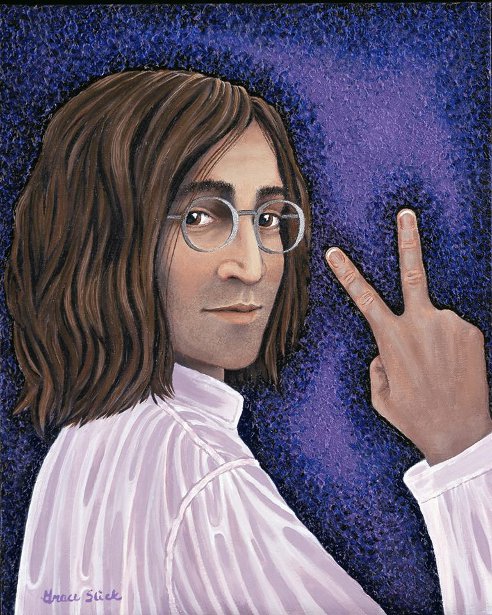
John Lennon by Grace Slick

___

Grace Slick at Wentworth Gallery focuses on art in a post-rock ‘n’ roll career
1965 by Grace Slick Bookmark and Share
by By Skip SheffieldFormer Jefferson Airplane lead singer Grace Slick will greet her public and talk about her flourishing career in art from 6 to 9 p.m. Saturday at Wentworth Gallery at Town Center at Boca Raton. Slick will also appear from 6 to 9 tonight at Wentworth Gallery in the Gardens Mall in Palm Beach Gardens.Grace Slick was always feisty and outspoken as front woman of Jefferson Airplane and Starship, and she is no shrinking violet at age 65.She gave up performing in 1998 because she felt it was silly for a woman her age to sing rock music and try and act like a teenager. She had her first public art show in Fort Lauderdale in 1989, and art is where she channels her creative energy now.“There a lot of us former rock people who are doing art now,” he offers by telephone from Malibu, California. “My old bandmate Marty Balin is doing quite well. So is Ronnie Wood of the Rolling Stones, and so was Jerry Garcia before he died.”
Slick first painted furry animals (the white rabbit is still a favorite) and beautiful nudes. Her agent suggested she begin doing portraits of musicians she knew, and she has obliged with portraits of Jim Morrison, Jerry Garcia, Janis Joplin and Sting.

“I let my agent deal with the so-called art world,” she says. “He makes suggestions and sets up my appearances. I just paint every day as the spirit strikes.”

Slick was born Grace Wing Oct. 30, 1939 in Evanston, Illinois, but she was raised in San Francisco. She attended the University of Miami in 1958-1959, but admits she was more a partier than a scholar. After graduating from Finch College she returned to San Francisco and married Gerald “Jerry” Slick, a cinematographer. She joined Jefferson Airplane in 1966, replacing original singer Signe Anderson, and sang two of the group’s signature songs, “White Rabbit” and “Somebody to Love.”

Slick divorced and remarried and divorced and became an outspoken anti-war activist as well as a self-admitted rowdy drunk. In 1971 she and Jefferson Airplane guitarist Paul Kantner had a daughter, China Wing Kantner, with whom Slick remains close.

“China is now working on a Ph.D,” Slick reveals proudly. “Her special study is spirituality.”

Although she performed with former bandmates Marty Balin and Paul Kantner for a post-9/11 concert, Slick says she is officially retired from public performance.

“I don’t walk to be one of those old relics doing the oldies circuit,” she protests. “There are a few signature groups that can get away with it. The Rolling Stones need it, evidently, and they are still one of the best rock ‘n’ roll groups in the world. I’m going to be 66 next month, for God sakes. Art is my focus now. I do it all the time. I’m just grateful some people like it well enough to buy it.

Andy Warhol &; Grace Slick

___

__

Janis Joplin, Grace Slick,

Based on her tempestuous rock-star career as lead singer for Jefferson Airplane in the 1960s, no one would expect Grace Slick to be shy or demure, even at age 73.

And sure enough, she isn’t.

“I’ve lived a good life,” she said by phone from her Malibu home. “Now I’m an old broad.”

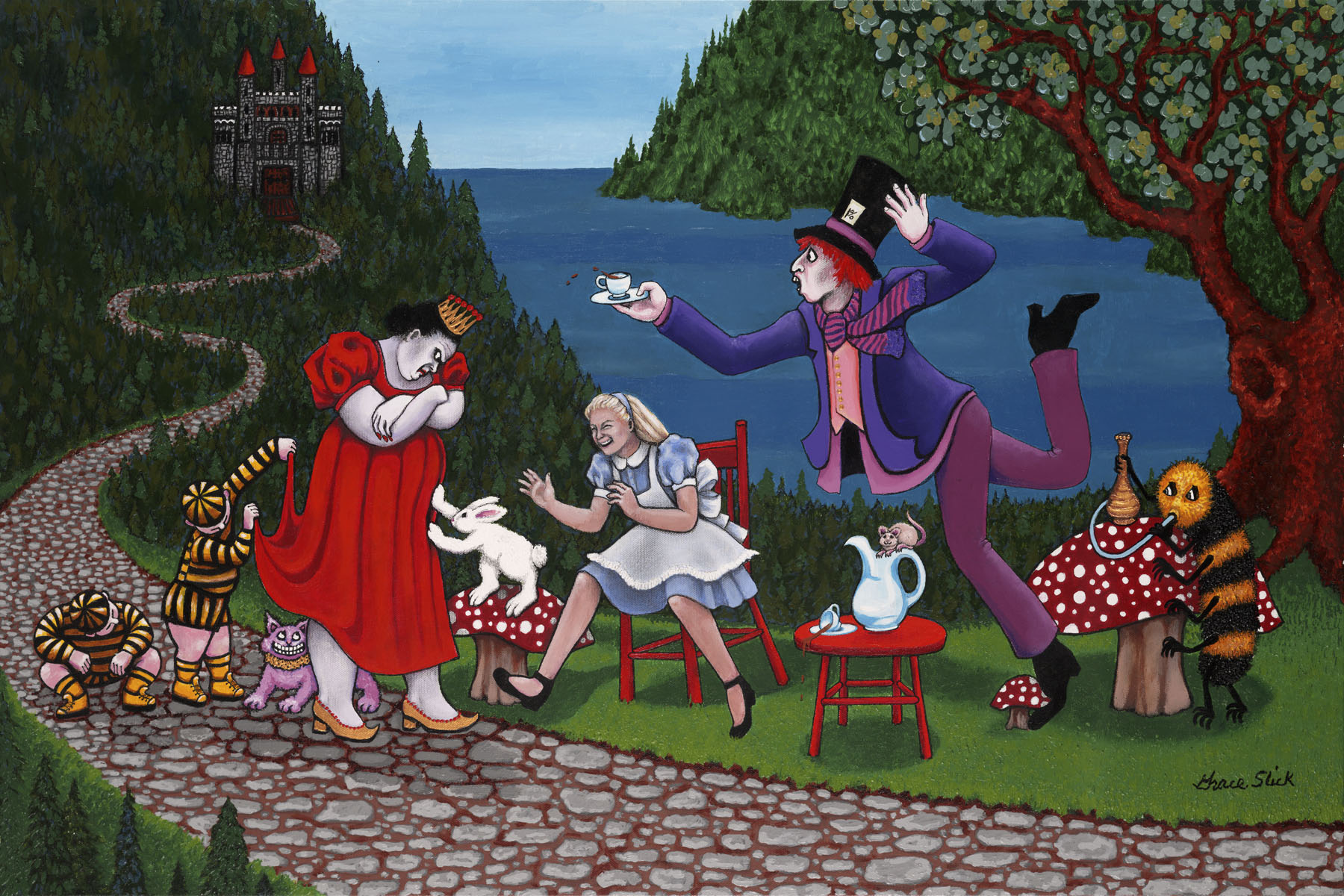
In her second career as an artist, Slick produces paintings just as colorful and provocative as her songs. She’ll appear Saturday, May 18, at the Norcal Modern Gallery in Healdsburg, which is hosting her “Once Upon a Time” exhibit.

Her work is filled with “Alice in Wonderland” images reminiscent of Slick’s 1967 hit, “White Rabbit,” but her interest in art, and Alice, predates her rock and roll career, she said.

“I knew I could draw when I was very little. I used to draw angels when I was about 5,” she said.

“The story of ‘Alice in Wonderland’ was the only one that was read to me where some Prince Charming doesn’t come along and save her,” Slick said. “She has a lot of guts. She does it all herself. She doesn’t stop.”

While Slick’s income comes from her music royalties, she doesn’t deny the commercial appeal of her iconic White Rabbit paintings.

“People will, for obvious reasons, buy pictures of white rabbits from me. Now I’m getting real good at drawing rabbits,” Slick said.

“I have an agent, and his job is to sell stuff,” she added. “He finds that my portraits of other rock musicians also sell, and I enjoy doing that, too.”

Slick wrote “White Rabbit” while in a Bay Area Band called The Great Society, formed in 1965. After joining Jefferson Airplane the following year, she recorded the song for the “Surrealistic Pillow” album.

She also performed in the band’s later incarnations — Jefferson Starship, from 1981 to 1984, and Starship, until 1988. She retired from rock and roll in 1989, and began painting in the mid-1990s.

Her first art show was in Florida in 2000, and she has had more than 100 exhibits since then, creating fanciful images with bright acrylic paints.

“I like really heavy, knock-your-brains-out color,” Slick said. “I paint in acrylic, because it’s fast, and I don’t have a lot of time left to sit around and let oil paint dry.”

__

1965 by Grace Slick

Jimi Hendrix by Grace slick artist

___________

Related posts:

Image result for sergent peppers album cover

Francis Schaeffer’s favorite album was SGT. PEPPER”S and he said of the album “Sergeant Pepper’s Lonely Hearts Club Band…for a time it became the rallying cry for young people throughout the world. It expressed the essence of their lives, thoughts and their feelings.”  (at the 14 minute point in episode 7 of HOW SHOULD WE THEN LIVE? ) 

Image result for francis schaeffer how should we then live

How Should We Then Live – Episode Seven – 07 – Portuguese Subtitles

Francis Schaeffer

Image result for francis schaeffer

______

FRANCIS SCHAEFFER ANALYZES ART AND CULTURE PART 202 the BEATLES’ last song FREE AS A BIRD (Featured artist is Susan Weil )

February 15, 2018 – 1:45 am

FRANCIS SCHAEFFER ANALYZES ART AND CULTURE Part 200 George Harrison song HERE ME LORD (Featured artist is Karl Schmidt-Rottluff )

FRANCIS SCHAEFFER ANALYZES ART AND CULTURE PART 184 the BEATLES’ song REAL LOVE (Featured artist is David Hammonds )

FRANCIS SCHAEFFER ANALYZES ART AND CULTURE Part 170 George Harrison and his song MY SWEET LORD (Featured artist is Bruce Herman )

FRANCIS SCHAEFFER ANALYZES ART AND CULTURE Part 168 George Harrison’s song AWAITING ON YOU ALL Part B (Featured artist is Michelle Mackey )

FRANCIS SCHAEFFER ANALYZES ART AND CULTURE Part 167 George Harrison’s song AWAITING ON YOU Part A (Artist featured is Paul Martin)

RESPONDING TO HARRY KROTO’S BRILLIANT RENOWNED ACADEMICS!! Part 133 Louise Antony is UMass, Phil Dept, “Atheists if they commit themselves to justice, peace and the relief of suffering can only be doing so out of love for the good. Atheist have the opportunity to practice perfect piety”

FRANCIS SCHAEFFER ANALYZES ART AND CULTURE Part 166 George Harrison’s song ART OF DYING (Featured artist is Joel Sheesley )

FRANCIS SCHAEFFER ANALYZES ART AND CULTURE Part 165 George Harrison’s view that many roads lead to Heaven (Featured artist is Tim Lowly)

FRANCIS SCHAEFFER ANALYZES ART AND CULTURE Part 164 THE BEATLES Edgar Allan Poe (Featured artist is Christopher Wool)

PART 163 BEATLES Breaking down the song LONG AND WINDING ROAD (Featured artist is Charles Lutyens )

FRANCIS SCHAEFFER ANALYZES ART AND CULTURE PART 162 A look at the BEATLES Breaking down the song ALL WE NEED IS LOVE Part C (Featured artist is Grace Slick)

PART 161 A look at the BEATLES Breaking down the song ALL WE NEED IS LOVE Part B (Featured artist is Francis Hoyland )


FRANCIS SCHAEFFER ANALYZES ART AND CULTURE PART 160 A look at the BEATLES Breaking down the song ALL WE NEED IS LOVE Part A (Featured artist is Shirazeh Houshiary)

FRANCIS SCHAEFFER ANALYZES ART AND CULTURE Part 159 BEATLES, Soccer player Albert Stubbins made it on SGT. PEP’S because he was sport hero (Artist featured is Richard Land)

FRANCIS SCHAEFFER ANALYZES ART AND CULTURE Part 158 THE BEATLES (breaking down the song WHY DON’T WE DO IT IN THE ROAD?) Photographer Bob Gomel featured today!

FRANCIS SCHAEFFER ANALYZES ART AND CULTURE Part 118 THE BEATLES (Why was Tony Curtis on cover of SGT PEP?) (Feature on artist Jeffrey Gibson )

FRANCIS SCHAEFFER ANALYZES ART AND CULTURE Part 117 THE BEATLES, Breaking down the song WITHIN YOU WITHOUT YOU Part B (Featured artist is Emma Amos )

FRANCIS SCHAEFFER ANALYZES ART AND CULTURE Part 97 THE BEATLES (The Beatles and Paramhansa Yogananda ) (Feature on artist Ronnie Wood)

Today I am going to look at Paramhansa Yogananda who appeared on the cover of SGT. PEPPERS because the Beatles were at the time interested in what Eastern Religions had to offer. One of the problems with Hinduism is that has no way to explain the existence of evil in the world today. However, Christianity explains […]

FRANCIS SCHAEFFER ANALYZES ART AND CULTURE PART 96 THE BEATLES (Breaking down the song “Eleanor Rigby” Part B and the issue of LONELINESS) Featured artist is Robert Morris

  _ The song ELEANOR RIGBY was a huge hit because it connected so well with “all the lonely people.” The line that probably best summed up how many people felt was: “All the lonely people, Where do they all come from? All the lonely people, Where do they all belong?” Francis Schaeffer believed in engaging the secular […]

FRANCIS SCHAEFFER ANALYZES ART AND CULTURE PART 95 THE BEATLES (Breaking down the song “Eleanor Rigby” Part A and the issue of DEATH ) Featured artist is Joe Tilson

No one remembered Eleanor Rigby enough to come to her funeral. It is sad but Francis Schaeffer points out King Solomon’s words on death from 3000 years ago and they seem similar to the song’s conclusion. Eleanor Rigby – PAUL McCARTNEY The Beatles Cartoon – Eleanor Rigby. Uploaded on Feb 21, 2012 Ah, look at […]

FRANCIS SCHAEFFER ANALYZES ART AND CULTURE Part 94 THE BEATLES (The Beatles and the Gurus on SGT. PEP. ) (Feature on PHOTOGRAPHER BILL WYMAN )

The Beatles went through their Eastern Religion phase and it happened to be when the album SERGEANT PEPPER’S LONELY HEARTS CLUB BAND album came out. Today we will take a look at the article “The Gurus of Sergeant Pepper,” by Richard Salva and then look at some of the thoughts of Francis Schaeffer on this topic. I […]

FRANCIS SCHAEFFER ANALYZES ART AND CULTURE Part 93 THE BEATLES (Breaking down “REVOLUTION 9” Part B) Astrid Kirchherr is featured Photographer

In 1967 the Beatles had honored Stockhausen by putting his photo on the cover of their Sergeant Pepper [sic] album. When John Lennon was murdered in December 1980, Stockhausen said in a telephone interview: “Lennon often used to phone me. He was particularly fond of my Hymnen and Gesang der Jünglinge, and got many things […]

FRANCIS SCHAEFFER ANALYZES ART AND CULTURE Part 92 THE BEATLES (Breaking down “REVOLUTION 9” Part A) Featured photographer is John Loengard

Have you ever had the chance to contrast the music of Bach with that of the song Revolution 9 by the Beatles? Francis Schaeffer pointed out, “Bach as a Christian believed that there was resolution for the individual and for history. As the music that came out of the Biblical teaching of the Reformation was […]

FRANCIS SCHAEFFER ANALYZES ART AND CULTURE PART 91 (WHY WAS H.G.WELLS ON THE COVER OF SGT. PEPPERS? Part B) Featured Artist is Claes Oldenburg

Last time we looked at the hedonistic lifestyle of H.G.Wells who appeared on the cover of SGT PEPPERS but today we will look at some of his philosophic views that shaped the atmosphere of the 1960’s.   Wells had been born 100 years before the release of SGT PEPPERS but many of his ideas influenced […]

FRANCIS SCHAEFFER ANALYZES ART AND CULTURE PART 90 (WHY WAS H.G.WELLS ON THE COVER OF SGT. PEPPERS? Part A) Featured Artist is Ellsworth Kelly

Why was H.G.Wells chosen to be on the cover of SGT PEPPERS? Like many of the Beatles he had been raised in Christianity but had later rejected it in favor of an atheistic, hedonistic lifestyle that many people in the 1960’s moved towards.  Wells had been born 100 years before the release of SGT PEPPERS […]

FRANCIS SCHAEFFER ANALYZES ART AND CULTURE Part 89 THE BEATLES, Breaking down the song “BLACKBIRD” Part B (Featured Photographer is Jürgen Vollmer)

Since racial tensions were extremely high in the 1960’s I am adding a part two to my last post. I grew up in Memphis and was a resident when MLK Jr. was unfortunately assassinated. Just two months later Paul McCartney wrote the song BLACKBIRD because of this assassination. Francis Schaeffer also spoke out strongly against […]

FRANCIS SCHAEFFER ANALYZES ART AND CULTURE Part 88 THE BEATLES, Breaking down the song “BLACKBIRD” Part A (Featured Photographer is Richard Avedon)

WOODY WEDNESDAY Woody Allen On ‘Irrational Man’, His Movies & Hollywood’s Perilous Path – Cannes Q&A by Mike Fleming Jr May 14, 2015 2:46pm

_____________

New Year’s Eve 1963

Published on Dec 30, 2013

Audio recording from live broadcast of “The Tonight Show” with Johnny Carson made 50 years ago. Guests include Rudy Vallee and Woody Allen. Also included is the count down from Times Square with Ben Grauer.

Woody Allen Bob Hope Tonight Show 1971

TIME Interviews Woody Allen

Liked the book MOBY DICK during the filming of LOVE AND DEATH.

Woody Allen talks ‘Midnight in Paris’

AT THE 27 MIN MARK Woody Allen says:

I have never gotten to the point where I can give an optimistic view of anything. I have these ideas for stories that I hope are entertaining and I am always criticized for being pessimistic or nihilistic. To me this is just a realistic appraisal of life. There are these little Oasis’s these little distractions you get. Last night I was caught up in the Bulls and Heat basketball game on television and for the time being I was thinking about who was going to win. I wasn’t thinking about my mortality or the fact that I am finite and aging. That was not on my mind. Labron James was on my mind and the game. That is the best you can do is get a little  detraction. What I have learned over the years is that there is no other solution to it. There is no satisfying answer. There is no optimistic answer I can give anybody.

The outcome of that basketball game is no less meaningful or no more meaningful than human life if you take the long view of it. You could look at the earth and say who cares about those creatures running around there and just brush it. Ernest Hemingway in one of his stories ( A FAREWELL TO ARMS) is looking at a burning log with ants running on it. This is the kind of thinking that has over powered me over the years and slips into my stories.

I have always been an odd mixture, completely accidentally, I was a nightclub comic joke writer whose two biggest influences were Groucho Marx, who I have always adored and he still makes me laugh  and Igmar Bergman. I have always had a morbid streak in my work and I when I do something that works , it works to my advantage because it gives some substance and depth to the story, but I when I fail the thing could be too grim or too moralizing or not interesting enough. Then someone will say we only like you when you are funny.


Axel Kuschevatzky interviews Woody Allen – part 1

Axel Kuschevatzky interviews Woody Allen – part 2

Axel Kuschevatzky interviews Woody Allen – part 3

Axel Kuschevatzky interviews Woody Allen – part 4

(at the beginning of part 4 is about the Darwinian struggle)

BBC Radio – Woody Allen Interview 2013

Woody Allen Interview on NPR

 _______________

1994 Woody Allen NBC interview

Woody Allen Blue Jasmine Interview BBC Newsnight 2013

Martin Landau on Woody Allen’s ‘Crimes & Misdemeanors’ in 1990 interview

Brian Linehan’s City Lights- Woody Allen 1982

WOODY ALLEN – The Dick Cavett Show (1971) | SUB ITA

Woody Allen Interview


Woody Allen On ‘Irrational Man’, His Movies & Hollywood’s Perilous Path – Cannes Q&A

CANNES, FRANCE - MAY 15: Director Woody Allen attends the "You Will Meet A Tall Dark Stranger" press conference at the Palais des Festivals during the 63rd Annual Cannes Film Festival on May 15, 2010 in Cannes, France. (Photo by Pascal Le Segretain/Getty Images)

EXCLUSIVE: The 79-year-old director Woody Allen comes to the Cannes Film Festival’s Palais tomorrow to premiere Irrational Man, a comedy about an existentially challenged professor that stars Joaquin Phoenix, Emma Stone and Parker Posey. It’s Allen’s 46th film as a director, a total he reached by making one a year like clockwork, for as long as anyone can remember.

For Deadline’s Cannes Q&A, Allen invited us to his Manhattan screening room. There, he explained how he has managed a storied career without ever showing a script or cast list to a financier, or getting a script note. And how, despite a groundbreaking TV series deal with Amazon, he doesn’t own a computer or understand what a streaming service is; all he knows is, he regrets a deal that has taken him out of his comfort zone. And despite his four Oscars, and the seven won by actors in his films, Allen believes he has never done anything of real consequence in all the years of generating stand-up comedy, books, plays and movies. The room is a warm, cozy dimly lit place with dated drapes and upholstered chairs and couches. It has the vibe of a place where people might play bridge, which is exactly what they did until he got hold of it.

DEADLINE: What is this place?
ALLEN: A bridge club years ago that we took over and made into a screening room with a projector, to screen films recreationally. I found it a great place to work. So we edit in the other room, and come in here and look at it. Then we become depressed, go back in that room and try to fix it.

DEADLINE: How long is it from depression to finished film?
ALLEN: It used to take a long time, when we worked with celluloid. Now with the Avid I can edit a film in seven to eight days and it is no big deal.

DEADLINE: Purists like Scorsese and Tarantino are dedicated to preserving film. You?
ALLEN: I have no strong feeling on it. I’m happy to go whichever way everyone is. Digital looks very good to me if it’s done well. Film always looks great if it’s done well. I’ve never shot anything in digital, but I think I will shoot my next film digitally to see what that’s like. It is more than the wave of the future; it’s the wave of the present, really.

DEADLINE: What are the advantages compelling you to try it for the first time?
ALLEN: They seem minimal. It’s all the after-stuff of not having to cut celluloid, but digital is really not cheaper and it’s not faster. It’s just that that’s the way everything has moved and it looks pretty. I see digital shot by good cameramen that is beautiful and I wouldn’t be able to tell the difference, so I don’t mind it. I like that I can edit fast. You just punch electronics where it used to be you’d cut and then have to splice it and tape it and then look at it and un-tape it. Now, it’s bang, bang, bang, bang, bang and it’s done. I never start editing a film until it’s completely shot; I don’t edit along the way, ever. When it’s finished I come in here and we start with reel one, scene one and start editing shot by shot by shot until we’re finished. Once we get in here, going from nothing to the first draft is the longest part and that’s only about eight days for me. Then you look at it and the big problems become apparent, the ones you can’t get rid of by cutting or speeding it up.

DEADLINE: Like?
ALLEN: You need to make a character less likable or more likable or a relationship more believable. Maybe you add a music track or narration. Or certain things aren’t coherent in that version that’s two hours and ten minutes long. By the time you’re done running back and forth, it’s an hour and forty minutes. And you’ve removed all the junk, the stuff you were so gung-ho about, that you thought was so great. Reality sets in, and it’s gone.

DEADLINE: Are you a ruthless executioner of lines you loved when you wrote them on the page?
ALLEN: Ruthless. I think probably over the years I’ve been too ruthless, mainly because I’m anxiety-ridden. I’ve cut jokes and bits out of movies that would have played just great, if only I had had the nerve to leave them in. I regret having cut different jokes and different bits out of pictures and in retrospect I think they would have worked fine. I just didn’t have the nerve at the time. I worried they wouldn’t work.

DEADLINE: Afraid of overstaying your welcome with audiences with an overly long film?
ALLEN: Sometimes it didn’t even get to that. Once you’ve tested it, if they laugh they laugh; if they didn’t then you could always throw it away. There is a number of funny things that I never even tested with audience because I didn’t have the nerve to even show them, I was so anxiety-ridden they might be embarrassing or terrible or unfunny. They never saw the light of day. A number of them I regret because they were funny…probably.

DEADLINE: Can you recall specific jokes you killed that you regret?
ALLEN: I can recall many bits. InBananas, there was a very funny bit when the dictator came to the United States and was on the Cousin Brucie show. We cut that because I just didn’t have the nerve. There was a wonderful bit in Bananas too where the guys were in the jungle and all of a sudden a plane lands and the troops come out and it’s allegedly Bob Hope entertaining them. But then my character realizes, the guy’s not Bob Hope, he’s one of the police underground acting like Bob Hope; he’s a Latin American version, doing Hope jokes with the golf club, and all of a sudden when I realized that, the shooting starts and everybody scatters. I remember walking out of my house in Love And Death in the cold of winter, and the snow is covering the front door, and my having to dig a tunnel straight through. It looked very funny at the time. I cut it. There were a couple of great jokes in Manhattan that were too out of character, too broad for the tone of the picture. They would have been good in Take The Money And Run or Bananas. They were funny. In one, I was bicycling in a park with Mariel Hemingway and Michael Murphy and Anne Byrne Hoffman and Diane Keaton, and I got somehow sidetracked into a team of very fast cyclists. I was just riding this bike and made a turn and suddenly I was in with six guys who were going a mile a minute. It looked fun as I tried to escape that, but I worried it stood out like a sore thumb in the movie.

DEADLINE: Some would call that discipline. What you call it?
ALLEN: Anxiety. It’s easy for me to cut length, I never care about that. I notice a lot of people don’t like to cut, they’re reluctant to part with lines in stage plays and bits in movies. But I was brought up to cut stuff. When I learned how to write, the person I was most influenced by was always telling me, any doubt, cut it.

DEADLINE: Who was that?
ALLEN: Danny Simon. Neil Simon’s brother, who was really very helpful to me when I was 20 years old. He was a merciless editor and that rubbed off on me. This was when I was writing television. Danny and I would work on a skit. It would be coming along fine and then either he or I might come up with a great joke. And he would say, “Yes, it’s a great joke but it’s an expensive laugh.” He meant you’re stopping the action for the joke. I didn’t want to part with it because the joke was great, but then you thought, maybe the joke is too inside and only 100 people would get it. And nobody knows who Thelonious Monk is. Danny was a merciless cutter.

DEADLINE: Irrational Man marks the 11th time you’ve brought a film to Cannes, 12 if you count your contribution to the anthology New York Stories. You didn’t want to premiere in competition. Why?
ALLEN: I’ve never had a film in competition in my life. I just don’t feel you can say one film is better than another. Who’s to say some arbitrarily appointed group of judges can decide one is better? Is The Godfather better than Goodfellas, or whatever came out the same calendar year? You don’t make these films to compete. People make films for different reasons. For money. Or, they make them because something in them demands artistic expression. I do it because I enjoy the work. Once a film is over and I see it in this room and we’ve taken it as far as we can go, with no room for improvement… that’s it. It leaves this room and I never see it again ever, for the rest of my life.

DEADLINE: Ever?
ALLEN: Ever. I’ve never seen Take The Money And Run since I made it. I never sawAnnie Hall again, or Bananas or Manhattan or any of them. Because, you can only have regrets. If I was to screen any of my films now I would only see what I could have done, what I did badly, where I screwed up, how much worse it is than the way I remembered it. You’re never going to think “Oh, God, this thing is great.” Many years ago I was in Europe making What’s New Pussycat. I was having lunch in a cafeteria in France on this film set. Richard Burton and Elizabeth Taylor were making a film there, I think it was The Sandpiper. I was chatting with him for a moment, I hardly knew him, and he said, “I never see my films after I make them, ever.” This was a great actor, but I thought, gee, that’s so strange. I was just a writer on my first film and I didn’t know anything. When I got into directing films myself, I understood completely what he meant.

DEADLINE: Daniel Day-Lewis once told me he rigorously prepares for roles and lives in the character’s skin through the shoot, and can’t watch the results because he sees only flaws. What’s it like when you have to watch yourself over and over in editing? Are you self-conscious or does that only kick in after you’re done?
ALLEN: Well, a little of both. If I’m in it it’s tougher. It’s like if you’ve ever heard your own voice on a tape recorder? It’s worse when you see and hear yourself. If I’m not in the film and it has delightful people like Diane Keaton or Emma Stone, I have no problem editing it. But then it’s finished, I have to let go because I get that feeling. Oh, God, I had such great people here and I let them down, whether it’s Dianne Wiest, Naomi Watts one all these wonderful actresses who I’ve worked with, and I’ve worked with so many over the years. They trusted me completely and they do my films for very little money and I always feel, ‘Oh, God, I let them down.’ So… the less I have to do with the movie when it’s done, the better.

Emma Stone Woody Allen Magic in the Moonlight

DEADLINE: Directors say, don’t ask me to choose my favorite film; they are all my children.
ALLEN: Yeah, well I hate them all. None are different, and all are…unsatisfying, when you’re finished. Once, I had a generally positive feeling when I finished Match Point. I thought I was very lucky with this film. I was going to use an actress and she fell out a week before we shot and by sheer luck I stumbled onto Scarlett Johansson, who was luckily available. I was shooting in London. I needed a cloudy day, and that day it was cloudy. I needed it to be rainy for two hours — it would rain. I wanted a week of sun, we got it. I could do nothing wrong; I couldn’t screw up no matter how hard I tried. Everything fell into place. When the picture was over, I had a nice feeling about it. I felt that every actor, even those who had one line or two made a contribution to the picture. They didn’t just say the line in a neutral tone. If some guy was repairing our clock or delivering a sandwich, whatever they did they did beautifully and made a contribution. Everybody brought their own thing to this movie and I felt by wonderful good luck, that picture came out very, very close if not right on to what I had conceived to begin with.

DEADLINE: If you watched it now?
ALLEN: I would never watch it because I remembered it so fondly and it would be like, my God what was I thinking?

Irrational ManDEADLINE: What of Joaquin Phoenix’s work made him right forIrrational Man, playing this tormented philosophy professor who seems reinvigorated by a death wish?
ALLEN: Often, I write a part with an actor in mind; I didn’t in this case. I finished the story because I thought I had a good idea. Then, who would be good for this? The first thought I had was certainly Emma Stone because she’s great for practically anything. She’s young and beautiful and gifted and she plays comedy, romance, drama. I saw her singing and dancing on Broadway…she was an easy choice. And then Juliet Taylor, the casting director, mentioned Joaquin. All of us thought he was a great actor. I wondered to myself, would he be a crazy or hard guy to work with? But he wasn’t. He was a very sweet nice person and very, very self-deprecating and insecure. He doesn’t appreciate how good he is and my job was not to direct him as much as to explain to him that his last take was not bad, it was great. He has such a high bar for himself and you explain to him that he is reaching the high bar that he set for himself. We knew as soon as Juliet mentioned his name, oh, he’s perfect.

DEADLINE: I’ve covered the casting of your films for years and young actors consider your invitation to be real validation of their talent. How does a young actor get on your radar and how voracious are you in watching movies to keep current?
ALLEN: I see movies, but not to keep current. I watch strictly for enjoyment. But you do get exposed to the ones that come along. I saw Winter’s Bone and became aware of Jennifer Lawrence. And Juliet Taylor has an encyclopedic knowledge and will so often say, I want you to meet so-and-so. Like Chazz Palminteri. He had not appeared in anything and I was doing Bullets Over Broadway and the second he stepped into this room…I didn’t even have to hear him say anything. I just cast him right away.

DEADLINE: How does your audition process work?
ALLEN: Sometimes I read them but very briefly. I don’t like that as much as just hearing them say something. They don’t have to read from my movie; I just like to hear them and so they come in, sit down here and read for one minute. Half a page maximum and you can tell. Juliet also shows me videos, says here’s three things this actress has done. I see her and she looks interesting and we ask her to come in here and if she’s normal, not incoherent or crazy…I hate casting and keep it short. The person walks in and I do a quick look, just to see them live. I get them out in less than a minute. I say I’m doing a film next April, and Juliet thought you’d be right for something in it. I just wanted to say hello so I don’t have to cast strictly from video. And they say hello and I say OK. I’ve got nothing more to say than thanks for coming in. That’s the way we cast. Once in a while, we’ll read somebody if we’re not sure they sound correct for the character.

DEADLINE: If I was a young actor, auditioning for Woody Allen, I’d be crushed if I was out of there in one minute. Does your assistant routinely say, it’s OK, that’s how he works?
ALLEN: They warn them beforehand that I cast quickly. Actors of course are so insecure. We never turn anybody down because they’re bad; we don’t hire them because we found somebody that suits the part better. But naturally every actor that comes in and doesn’t get the role thinks it’s because they’re no good or they screwed up. It’s never that. Once in a great while if a big actor comes in…say like Joaquin, who actually didn’t come in. Juliet says, he flew in from California; you’ve got to let him sit down for a minute. Please. And I’ve got nothing to say to him. So I make up meaningless stuff. I say, ‘Well, what are you in town for? What was your last picture? Oh, great.’ And, was it boring in Mexico? And then I turn to Juliet and say, you know, I’m out of stuff to say…and I think they don’t want to stay there either. They have a life to lead and they’re not interested in sitting in here getting interrogated. Worse is that very annoying thing of having to read in a room with three people looking at you. I’ve seen the people on tape and it’s painful for me to put actors through that. I know what I would feel like if I had to come in to a room and say hello and you hand me a sheet of paper and I start to act.

DEADLINE: I recall the time when Hollywood studios backed your films, you gave them a bare-bones idea of what you wanted to do, a budget and they said yes without seeing a script. Do you still do it that way?
ALLEN: It’s even freer, now that I’m backed independently. I’ve never had a script note in my life. I write the script; nobody sees it, not the people that put the money in the picture. I cast who I want, and make the film. That’s why I’ve always felt the only thing standing between me and greatness, is me. There’s no excuse for me not to be great except that I’m not. What can I say? Nobody tells me who to cast, how long to shoot, what to shoot, what themes to do, what stories, what line to take out. The backing arrives, and I show up at some point with the film. It could be horror, a comedy; it could be a black-and-white tragedy in medieval Prussia. Nobody knows. What they’re buying is me and the assumption that over many years, he hasn’t done anything that outlandish. The budgets are small compared to most film budgets. If you were backing me my whole film career you would have made money. But also, a film opens like The Avengers and in one weekend, one weekend, it makes more money than six of my films make in ten years.

DEADLINE: It must take discipline not to waver from that formula. Did somebody say something early on that made you realize you’re better not having your confidence rocked by some silly suggestion?
ALLEN: No, I never had that problem. Now, once in a while I will sit down with my wife or with Juliet Taylor and say, who do you think would be better here, Joaquin Phoenix or Alec Baldwin? Every once in a while I bounce something off somebody to get feedback. But I was very lucky from day one, when I made my first film, Take The Money And Run. It was a new film company, Palomar, and the film only cost a million dollars and we brought it in for less. At that time they felt there were certain people like me or Mel Brooks, who had some inexplicable magic comic thing, and that we knew what we were doing and didn’t want to mess with it. They were wrong; I floundered and stumbled all the way through, but they let me alone completely. My second film I did for United Artists, whose policy was to leave the artist alone. Again, I did the whole film for a million dollars. By the time I was up to my third or fourth film, we were saying he gets final cut. I’ve never made a film in my life, outside of the first two when it didn’t matter, where I didn’t have final cut, where I had to show scripts to people, where I had to check with anybody on casting. I’ve never had that problem in my life.

match-pointDEADLINE: Did your transition from studios to overseas funding come because of a slump, or because the game was changing?
ALLEN: The studio game was changing. It started on Match Point. I wrote Match Point for New York. When we began raising the money, people from London called and said if you do a film here we’ll back it. I thought, gee, this film wouldn’t work in Africa, but it would work in London. So I did it over there and I had a wonderful time. The weather was cool in the summer, the skies were gray, the people were lovely that I worked with, the British crews were great. So I made four films in London. And then other countries started calling me. Would you make one in Spain, would you make one in Rome, would you make one in Sweden? If they’d said, make a film in Egypt, well I don’t have an idea for Egypt. But I knew Rome well enough. So I started doing that and it worked out very nicely. My family liked going away in the summers, and they were backing the film there and then the films were successful.

When private backers contacted me, we would tell them what it amounted to in a certain sense is, you put the money in a brown paper bag and you get the film when it’s done. There’s nothing else to do. And some would say OK, but when it came down to contract discussions they would say, well I would like to at least know that it’s going to have somebody in it whose name I recognize. And we would get rid of them. We would say no, this is not going to work out, because we can’t guarantee anything. But there were a few who said look, we have faith in you as an artist, and if that’s the way you want to work, we’ll back your films. I don’t try and be difficult. If someone said, can I come on the set? Sure, I don’t care. If I didn’t want them I’d say well don’t come Tuesday because that’s a very dramatic scene. But come after that. I’m not looking to make people’s life miserable. If somebody putting money in my film asks, who’ll be in your film and I know I’m using Emma Stone or Joaquin, I don’t say you can’t know. I just like to feel I have the final say. Same with the distribution company; I have final say on ads. But I’ve never had to use it, at all. They send me posters. I pick a poster I like and I send it back and if they say to me we don’t really love this one, could you consider some of these others, I do; I’m very easy to work with, and flexible.

DEADLINE: So what are you looking for?
ALLEN: I just want to know in the end that nobody can say to me, ‘well, that’s the one we’re using,’ even if I feel it doesn’t represent the picture at all or if it was cheap and burlesque-y and they could say, ‘too bad, we’re using it.’ David Picker tells the story in his book when I first went to United Artists and they made a deal where I could do anything I wanted. I brought in the script that 25 or 30 years later becameSweet And Lowdown with Sean Penn. David Picker read it and they didn’t want to do it. I said hey, no problem. I could have forced them; the contract was they do what I want. I said, don’t be silly; I don’t want to do a project you’re not enthused over. Give it back to me, I’ll give you another script. My manager, Jack Rollins, who just celebrated his 100th birthday, taught me years ago that no deal is worth the paper it’s printed on. I’ve been with Jack for 50 years, on a handshake. And that’s really how I work. If the guys who put money in my films are not satisfied then I don’t want to be with them.

DEADLINE: You might have started shooting these cities for financial reasons, but I’ve watched the way you shot them in Vicky Cristina Barcelona, Midnight In Paris orTo Rome With Love, and wanted to go there. There is such romanticism…
ALLEN: That’s because I’m a city freak. I love cities, cosmopolitan areas. Not all of them but almost all of them. Paris, Barcelona, London; these are fantastic places. I don’t think I could do that if I made a movie in Albuquerque. But just like with Manhattan, if you’re going to be in Paris or London or Rome or Spain, these cities became part of the story.

DEADLINE: When did it go from hardship of leaving home to reinvigorating your storytelling?
ALLEN: Right away it was artistically provocative to shoot in those cities. I’d like to go back to Paris and make a film. I did four in London and I always wanted to make another in Spain. Maybe where the festival is in San Sebastian. Just a great visual place. I knew those cities, and over the years I’d been to Barcelona, and Paris a million times. London a lot and Rome. But it wouldn’t feel that way in all cities. I contemplated making a film in Sweden; I’ve been there several times and have some sense of it. But if I had to make a film in Japan, I’d have to be shown around. I don’t have any feel for it at all.

DEADLINE: Everybody is courting China. How about there?
ALLEN: That is one of the countries that asked me to come and make a film. I don’t think I can. I’d have to make a film in a place I could live in for four months for the pre-production and shooting. I can live in Paris for four months or London or, you know, Barcelona. These are places that are like New York. But I don’t think I could live in many places. When I had to make a film in the United States I picked San Francisco because to me it’s one of the great cities of America.

DEADLINE: What’s your favorite Cannes memory? And did global media react differently when you started making movies outside New York?
ALLEN: I’ve always been very lucky abroad. Europe, South America, the Far East, they’ve always supported my films enthusiastically. Right from the start with Take The Money And Run.Bananas was a big hit in Europe and I remember being surprised that it was seen as a movie about politics. To me, it was just a bunch of jokes. They have supported me devotedly. If I show a film at Cannes, the audience there comes to enjoy movies. They’re not going there with a chip on their shoulder, or to be nasty. They see a lot of new movies, mine among them, and the publicity I do permeates the whole of Europe and beyond into Israel, Argentina, Japan, Tokyo. The film gets off to a tremendous commercial start there. America is a totally different. You open in America, and you either get good press or bad press. If you get bad press usually nobody comes. These blockbusters, you can get the worst press in the world and make a hundred million dollars. If I get bad press, people won’t come. If I get great press? Maybe they’ll come and maybe they won’t.

DEADLINE: Culture, from books to movies, is increasingly consumed on smart phones and iPads. I imagine a room in your house with a floor-to-ceiling wall of cherished hardcover books that kids probably consider to be dusty relics. How does the reverence for literature and films shown on big screens compare to when you were imprinting authors and filmmakers who influenced your growth as an artist?
ALLEN: Big difference from when I grew up, and I’m talking about not just my childhood in the ’40s but when I was a young adult, living in Manhattan at twenty-five with my peer group. We were not intellectuals, by any means. I was thrown out of school and none of us were intellectuals. We were sports fans. It was a big talk when the next film by Truffaut, Fellini or De Sica was coming out. This is what we waited to see. We were thrilled to see those pictures and we talked about them. Now, if I talk to young, bright kids, they don’t know from Citizen Kane, La Grande Illusion; they don’t know who Ingmar Bergman or Bunuel is, or the first thing about their films. There are people who’ve seen Citizen Kane on a screen this size [he holds his fingers two inches apart]. So there is no reverence; it’s a different time. I think it’s a big loss. They don’t and I can understand that because they are the future and I’m not. But I think that’s a huge loss for them to go and see Treasure Of The Sierra Madre on a three-inch screen, but they don’t. As far as books go, it’s exactly as you said and what Marshall McLuhan said years ago, that as time passes, books will become art objects.

DEADLINE: How invested are you in the digital age?
ALLEN: I don’t own a computer. I’ve never seen anything online at all — nothing. I don’t own a word processor. I have none of that stuff. It’s not an act of rebellion. I’m just not a gadget person.

DEADLINE: But you’ll shoot your next film digital. Aren’t you curious about what else technology offers?
ALLEN: Yeah, but to me it doesn’t make any difference. I don’t work in it. I set the shot up, I compose, I do all that. But it’s irrelevant to me whether they push the button on the camera; it doesn’t matter.

DEADLINE: How do you reconcile your avoidance of computers and iPads, when you signed on to create a TV series forAmazon’s streaming service?
ALLEN: I don’t even know what a streaming service is; that’s the interesting thing. When you said streaming service, it was the first time I’ve heard that term connected with the Amazon thing. I never knew what Amazon was. I’ve never seen any of those series, even on cable. I’ve never seen The Sopranos, or Mad Men. I’m out every night and when I come home, I watch the end of the baseball or basketball game, and there’s Charlie Rose and I go to sleep. Amazon kept coming to me and saying, please do this, whatever you want. I kept saying I have no ideas for it, that I never watch television. I don’t know the first thing about it. Well, this went on for a year and a half, and they kept making a better deal and a better deal. Finally they said look, we’ll do anything that you want, just give us six half hours. They can be black and white, they can take place in Paris, in New York and California, they can be about a family, they can be comedy, you can be in them, they can be tragic. We don’t have to know anything, just come in with six half hours. And they offered a lot of money and everybody around me was pressuring me, go ahead and do it, what do you have to lose?

DEADLINE: So you said yes…
ALLEN: And I have regretted every second since I said OK. It’s been so hard for me. I had the cocky confidence, well, I’ll do it like I do a movie…it’ll be a movie in six parts. Turns out, it’s not. For me, it has been very, very difficult. I’ve been struggling and struggling and struggling. I only hope that when I finally do it — I have until the end of 2016 — they’re not crushed with disappointment because they’re nice people and I don’t want to disappoint them. I am doing my best. I fit it in between films, so it’s not like, no film this year, I’m doing Amazon. It’s a job within my usual schedule. But I am not as good at it as I fantasized I might be. It’s not a piece of cake; it’s a tough thing and I’m earning every penny that they’re giving me and I just hope that they don’t feel, ‘My God, we gave him a very substantial amount of money and freedom and this is what he gives us?’

DEADLINE: But haven’t you just voiced the anxiety and insecurity that fueled your entire creative career?
ALLEN: I hope it’s just the anxiety again, but this is hard. I’m like a fish out of water. Movies I’ve been doing for decades, and even the stage stuff, I know the stage and have seen a million plays. But this…how to begin something and end it after a half an hour and then come back the next time. It’s not me.

DEADLINE: You really regret that deal?
ALLEN: Oh, it’s amazing how you can regret. I haven’t had a pleasurable moment since I undertook it.

DEADLINE: You mentioned review-proof blockbusters. There is an obsession with global box office, sequels, cross pollination of branded content. You’ve never made a sequel. How do you feel about the way the movie business is going?
ALLEN: Well, I think it’s terrible. To me, movies are valuable as an art form and as a wonderful means of popular entertainment. But I think movies have gone terribly wrong. It was much healthier when the studios made a hundred films a year instead of a couple, and the big blockbusters for the most part are big time wasters. I don’t see them. I can see what they are: eardrum-busting time wasters. I think Hollywood has gone in a disastrous path. It’s terrible. The years of cinema that were great were the ’30s, ’40s, not so much the ’50s…but then the foreign films took over and it was a great age of cinema as American directors were influenced by them and that fueled the ’50s and ’60s and ’70s. Then it started to turn. Now it’s just a factory product. They can make a billion dollars on a film and spend hundreds of millions making it. They spend more money on the advertising budget of some of those films than all the profits of everything Bergman, Fellini and Bunuel made on all their films put together in their lifetimes. If you took everything that Bergman made in profit, everything Bunuel made and everything that Fellini made in their lifetimes and added it all together, you wouldn’t equal one weekend with the The Avengers and its $185 million to $200 million.

DEADLINE: Hasn’t the movie business always been art meeting commerce? Isn’t it just that the pendulum shifting toward the latter?
ALLEN: Hollywood is just commerce, and it’s a shame. There are all these wonderfully gifted actors out there that, as you said before, will be in a film of mine for virtually nothing, union minimum, for what you called validation. Really, it’s because they want to work on something that doesn’t insult their intelligence; they don’t want to have to get in to a suit and practice stunts for two months and then do stunts and then… they want to be in something that doesn’t demean their artistic impulses.

DEADLINE: Some of your peers, Martin Scorsese and Ridley Scott for example, are making big-budget broad canvas movies. Was there ever a big story you wanted to tell so badly that you have been tempted to compromise your creative control so you could get the financing?
ALLEN: No. I don’t have any interest in that. I’ve got to say though, the guys you just mentioned, I have nothing but amazed admiration for them. How a guy like Scorsese or Ridley Scott can make a big film, and still put their artistic vision into it and deal with the studios and stars and triumph over that to make the fabulous films that they make is something that is beyond me. I don’t have the personal resources, the character, the intelligence; I don’t know how they do it but they do it. They make wonderful films that work. Those directors compromise but the results are not artistically demeaning. They manipulate and navigate the waters and come up with great movies, fighting the battle against the Philistine studios, the money people, and triumph artistically. I have nothing but awe and admiration for them. I can’t imagine how they do it. Me, I don’t want to be bothered or have to talk to anybody. I don’t want to have to talk to anyone. I just don’t have the temperament for it. I couldn’t survive it so I’d rather get my little 18 million dollar budget and make my film. And if I go over, I give away a portion of my salary and that’s fine with me. Over the years I’ve given away a lot of monies, starting right from the beginning. I get the film I want, I never have to think about it but I still admire that those guys can make big-canvas, high-budget movies, these beautiful, wonderful films and they can finesse the terrible burden of having to deal with the suits.

DEADLINE: Quentin Tarantino has told me he will retire a couple of movies from now, on the grounds that he wants to stop before feeling that his next film can’t be his greatest, at which point he begins repeating himself. What is your feeling about a filmmaker’s longevity? Is there a time to stop?
ALLEN: Only when you want to. It depends. Some guys only make a few films, and then a guy like Bunuel made them his whole life. I enjoy the making of the film and it’s something for me to do. If nobody ever comes to my films, if people don’t want to give me money to make films, that will stop me. But as long as people come all over the world and I have an audience and I have ideas for films, I will do them for as long as I enjoy the process. And I like the whole process of making a film.

DEADLINE: So until you get that tap on the shoulder…
ALLEN: I’ll keep going. Now, sometimes I come out with a film and nobody wants to see it. But it doesn’t matter to me. I’m already working on another film and having the enjoyment of that and maybe that film a lot of people will come and see, but then I’m on the next one anyway. I never look back. When I was a little boy, I thought the fun in the movies would be the fame and the adulation and the money. Then when I started making films, I realized the fun in the film is not that it’s well-reviewed or that people line up and see it or it’s heartbreaking if they don’t or you’re a great hero if you win an award. All that stuff is nonsense. If it’s not fun when you’re spending the three months writing the film, and then three months shooting the film and the three months editing… if that comprises most of your year and it’s not fun, then why do it? It’s fun for me. I’m in contact with beautiful women and charming guys and art directors and costumes and Cole Porter’s music…it’s a wonderful way to earn a living.

DEADLINE: In that PBS Masters special on your early years, you were a prolific comedy writer, and did great stand-up comedy and you make a movie each year like clockwork. What’s the biggest thing that you struggle with as a creator?
ALLEN: The constant desire to do something great and the knowledge that it’s not really in me. I’ve had more than my share of opportunity over the decades to do something great, to break new ground, to find a new form, to electrify, to really stun people. After a while I had to realize, well, wait a minute, nobody’s stopping me. I mean, go ahead and do it. You can do anything you want to. You can have a blank screen for an hour and a half in the movie house if you wanted; you’re the boss. And then I start to think the reason it is not coming is that you can’t do it. You don’t have it in you. You do not have greatness in you; you’re not Kurosawa, or Fellini. You’re a comic turned film director with a modest talent to amuse, to entertain. But true greatness is not in you. You’re not William Faulkner or Cole Porter. You’re one of the entertainers of your lifetime and that’s it. So I’m constantly struggling to say no, this isn’t so, wait until you see what I do next. Then I see what I do next and it’s truly fine and nice but it’s not…I can’t live up to my own egotistical image of myself, I guess.

DEADLINE: Well, if it’s any consolation, this interview takes one item off my bucket list.
ALLEN: I’m 79. You got it in, just under the wire.

Subscribe to Deadline Breaking News Alerts and keep your inbox happy


Related posts:

WOODY WEDNESDAY Settling into a hotel bar in Soho after a long day shooting a film for Woody Allen in the Bronx, Justin Timberlake wastes no time ordering the first of several Vesper martinis. “I was terrified all day today, dude,”

___________ Justin Timberlake Talks ‘Trolls,’ Family Life and His New Album With Pharrell Williams Andrew Barker Senior Features Writer@barkerrant TOM MUNRO FOR VARIETY NOVEMBER 1, 2016 | 10:00AM PT Settling into a hotel bar in Soho after a long day shooting a film for Woody Allen in the Bronx, Justin Timberlake wastes no time ordering […]

WOODY WEDNESDAY Woody Allen’s 81st Birthday

_ Woody Allen – standup – ’65 – RARE! Happy 81st Birthday, Woody Allen December 2, 2016 1 Comment Woody Allen turns 81 today. And he shows no signs of slowing down. Allen spent his 80th year being remarkably prolific, even by his own standards. The end of 2015 saw that year’s film, Irrational Man, […]

WOODY WEDNESDAY Everything We Know About Woody Allen’s 2017 Film With Kate Winslet And Justin Timberlake October 16, 2016

  _ Everything We Know About Woody Allen’s 2017 Film With Kate Winslet And Justin Timberlake October 16, 2016 3 Comments Woody Allen has, it seems, wrapped production on his 2017 Film. The new film stars Kate Winlset and Justin Timberlake. And despite some very public days of shooting, We still don’t know that much […]

WOODY WEDNESDAY At 79, Woody Allen Says There’s Still Time To Do His Best Work JULY 29, 2015 5:03 PM ET

_____________ Woody Allen – The Atheist At 79, Woody Allen Says There’s Still Time To Do His Best Work JULY 29, 2015 5:03 PM ET When asked about his major shortcomings, filmmaker Woody Allen says, “I’m lazy and an imperfectionist.” Thibault Camus/AP Woody Allen is a prolific filmmaker — he’s been releasing films pretty much […]

WOODY WEDNESDAY Midnight in Paris: TAP’s Movie of the Month for June 2015 JUNE 1, 2015 by TAP Adventures

Midnight in Paris: TAP’s Movie of the Month for June 2015 JUNE 1, 2015 by TAP Adventures Each month in TAP, we select a Movie of the Month to help prepare our students for their overseas trip. This month we’re starting to prepare for our 2016 adventure in France and the Benelux countries, so we’ve selected […]

“Woody Wednesday” An Interview with Woody Allen Woody Allen’s World: Whatever Works Robert E. Lauder April 15, 2010 – 2:31pm

This interview   below reveals Woody Allen’s nihilistic views and reminds me of his best movie which is  CRIMES AND MISDEMEANORS!!!! Crimes and Misdemeanors 1989 Woody Allen Woody Allen Crimes and Misdemeanors Nihilism Nietzsche’s Death of God An Interview with Woody Allen Woody Allen’s World: Whatever Works Robert E. Lauder April 15, 2010 – 2:31pm Woody […]

WOODY WEDNESDAY Woody’s Cold Comforts Robert E. Lauder April 19, 2010

Top 10 Woody Allen Movies   Woody’s Cold Comforts Robert E. LauderApril 19, 2010 – 1:36pm Friends have often asked me about my interest in the films of Woody Allen: Why is a Catholic priest such an ardent admirer of the work of an avowed atheist, an artist who time and again has insisted on […]

WOODY WEDNESDAY New bio reassesses Woody Allen at 80 James Endrst , Special for USA TODAY2:03 p.m. EST November 7, 2015

Woody Allen & Parker Posey Red-Carpet Interviews for ‘Irrational Man’ New bio reassesses Woody Allen at 80 James Endrst , Special for USA TODAY2:03 p.m. EST November 7, 2015 Woody: The Biography by  David Evanier  (St. Martin’s Press) in Biography Buy Now USA TODAY Rating Woody Allen turns 80 on Dec. 1 and David Evanier has […]

WOODY WEDNESDAY A Handy Guide to All the Philosophers Referenced in Irrational Man by Eliza Berman July 17, 2015

___ Existentialism and the Meaningful Life [The Common Room] Francis Schaeffer “BASIS FOR HUMAN DIGNITY” Whatever…HTTHR A Handy Guide to All the Philosophers Referenced in Irrational Man Eliza Berman @lizabeaner July 17, 2015 David Livingston–Getty ImagesJoaquin Phoenix and Emma Stone attend the premiere of “Irrational Man” in Los Angeles on July 9, 2015. Leave it […]

Woody Wednesday All 47 Woody Allen movies – ranked from worst to best Part H

Woody Wednesday All 47 Woody Allen movies – ranked from worst to best (L-R): Annie Hall, Sleeper and To Rome With Love Robbie Collin, Film Critic Tim Robey, Film Critic 12 October 2016 • 2:55pm Annie Hall or Bananas? Blue Jasmine or Sleeper? Our critics Robbie Collin and Tim Robey rank all 47 Woody Allen movies […]

___________

__________

RESPONDING TO HARRY KROTO’S BRILLIANT RENOWNED ACADEMICS!! Part 128 Quentin Skinner, Professor of the Humanities at Queen Mary University of London and a historian, “I am an atheist; think that if we know anything it is that none of that could be true; of course we may not know anything, so atheist is a bold word”

On November 21, 2014 I received a letter from Nobel Laureate Harry Kroto and it said:

…Please click on this URL http://vimeo.com/26991975

and you will hear what far smarter people than I have to say on this matter. I agree with them.

Harry Kroto

I have attempted to respond to all of Dr. Kroto’s friends arguments and I have posted my responses one per week for over a year now. Here are some of my earlier posts:

Arif AhmedHaroon Ahmed,  Jim Al-Khalili, Sir David AttenboroughMark Balaguer, Horace Barlow, Michael BateSir Patrick BatesonSimon Blackburn, Colin Blakemore, Ned BlockPascal BoyerPatricia ChurchlandAaron CiechanoverNoam Chomsky, Brian CoxPartha Dasgupta,  Alan Dershowitz, Frank DrakeHubert Dreyfus, John DunnBart Ehrman, Mark ElvinRichard Ernst, Stephan Feuchtwang, Robert FoleyDavid Friend,  Riccardo GiacconiIvar Giaever , Roy GlauberRebecca GoldsteinDavid J. Gross,  Brian Greene, Susan GreenfieldStephen F Gudeman,  Alan Guth, Jonathan HaidtTheodor W. Hänsch, Brian Harrison,  Stephen HawkingHermann Hauser, Robert HindeRoald Hoffmann,  Bruce HoodGerard ‘t HooftCaroline HumphreyNicholas Humphrey,  Herbert Huppert,  Gareth Stedman Jones, Steve JonesShelly KaganMichio Kaku,  Stuart KauffmanMasatoshi Koshiba,  Lawrence KraussHarry Kroto, George Lakoff,  Rodolfo LlinasElizabeth Loftus,  Alan MacfarlaneDan McKenzie,  Mahzarin BanajiPeter MillicanMarvin MinskyLeonard Mlodinow,  P.Z.Myers,   Yujin NagasawaAlva NoeDouglas Osheroff, David Parkin,  Jonathan Parry, Roger Penrose,  Saul PerlmutterHerman Philipse,  Carolyn PorcoRobert M. PriceVS RamachandranLisa RandallLord Martin ReesColin RenfrewAlison Richard,  C.J. van Rijsbergen,  Oliver Sacks, John SearleMarcus du SautoySimon SchafferJ. L. Schellenberg,   Lee Silver Peter Singer,  Walter Sinnott-ArmstrongRonald de Sousa, Victor StengerJohn SulstonBarry Supple,   Leonard Susskind, Raymond TallisMax TegmarkNeil deGrasse Tyson,  Martinus J. G. Veltman, Craig Venter.Alexander Vilenkin, Sir John Walker, James D. WatsonFrank WilczekSteven Weinberg, and  Lewis Wolpert,

Quentin Skinner

From Wikipedia, the free encyclopedia

Quentin Robert Duthie Skinner (born 26 November 1940, Oldham, Lancashire)[1] is the Barber Beaumont Professor of the Humanities at Queen Mary University of London and an intellectual historian.


Quentin Skinner was born the second son of Alexander Skinner, CBE (died 1979), and Winifred Rose Margaret, née Duthie (died 1982). Educated at Bedford School and Gonville and Caius College, Cambridge, he was elected into a Fellowship there in 1962 upon obtaining a double-starred First in History, but immediately gained a teaching Fellowship at Christ’s College, Cambridge, where he remained until moving to the University of London in 2008. He is now an Honorary Fellow of both Christ’s College and Gonville and Caius College.Biography
[edit]

In the middle 1970s he spent four formative years at the Institute for Advanced Study in Princeton. It was there that he met Raymond Geuss, later a colleague at Cambridge. Together with John Dunn and J. G. A. Pocock, Skinner has been said to have founded the “Cambridge School” of the history of political thought. In 1978 he was appointed to the chair of Political Science at the University of Cambridge, and in 1996 he was appointed Regius Professor of History. He was pro-vice-chancellor of Cambridge in 1999. In 1979 he married Susan James, Professor of Philosophy at Birkbeck College London; they have a daughter and a son. He was previously married to Patricia Law Skinner, who was later married to Bernard Williams.

Skinner has delivered lectures at the Christian Gauss Seminars in Criticism at Princeton (1980), the Carlyle Lectures at Oxford (1980), the Messenger Lectures at Cornell (1983), the Tanner Lectures on Human Values at Harvard(1984), the T. S. Eliot Memorial Lectures at Kent (1995), the Ford Lectures at Oxford (2003), the Clarendon Lectures at Oxford (2011), the Clark Lectures at Cambridge (2012), the Academia Sinica Lectures in Taiwan (2013) and the Spinoza Lectures at University of Amsterdam (2014).

Skinner was Distinguished Visiting Professor at Queen Mary, University of London for the 2007–2008 academic year, and has been Barber Beaumont Professor of the Humanities at Queen Mary since October 2008.[2] In 2014 he held the Spinoza Chair of Philosophy at the University of Amsterdam[3]

Skinner is a fellow at the British Academy, the American Academy of Arts and Sciences, the Academia Europaea, the American Philosophical Society and the Accademia Nazionale dei Lincei. He has won the Wolfson History Prize(1979); the Sir Isaiah Berlin Prize of the British Political Studies Association (2006); the Benjamin Lippincott Award (2001) and the David Easton Award (2007) of the American Political Science Association; the Bielefelder Wissenschaftspreis (2008); and a Balzan Prize (2006). He holds honorary degrees from Aberdeen, Athens, Copenhagen, East Anglia, Chicago, Harvard, Helsinki, Leuven, Oslo, Oxford, Santiago and St Andrews. Since 2009 he has been a member of the Balzan Prize Committee.

In  the first video below in the 36th clip in this series are his words and  my response is below them. 

50 Renowned Academics Speaking About God (Part 1)

Another 50 Renowned Academics Speaking About God (Part 2

A Further 50 Renowned Academics Speaking About God (Part 3)

___

Interview of Professor Quentin Skinner – part 1

Uploaded on Jun 2, 2008

Interview with the Regius Professor of History at Cambridge University on his life and work in 2008. For a downloadable version and textual summary, please see http://www.alanmacfarlane.com

All revenues donated to World Oral Literature Project

Interview of Professor Quentin Skinner – part 2

__________

Below is a letter I sent to Dr. Skinner and in the letter I respond to his quote:

Bertrand Russell pictured below:

____

Francis Schaeffer (30 January 1912 – 15 May 1984[1])  and his wife Edith  (November 3, 1914 – March 30, 2013)

James Watson (1928-) and Francis Crick  (8 June 1916 – 28 July 2004)

Michael Polanyi, FRS[1] (11 March 1891 – 22 February 1976)

John Charles Polanyi,  (born 23 January 1929)

___

John Scott Haldane (2 May 1860 – 14/15 March 1936)

J. B. S. Haldane
J. B. S. Haldane.jpg

Haldane in 1914

(5 November 1892 – 1 December 1964)

Maurice Wilkins (15 December 1916 – 5 October 2004)

Erwin Schrödinger (12 August 1887 – 4 January 1961)

Sir Peter Medawar ( 28 February 1915 – 2 October 1987)

Barry Commoner (May 28, 1917 – September 30, 2012)

Enjoy the pictures of an amazing life

dadnmeinboat jpg

Harry Kroto with his father above

Marg and Steve and David

Margaret with David and Stephen

Image21 (2)
leaving Liverpool for Canada 1964

Kroto and his wife, Margaret.

Kroto and his wife, Margaret.

______________

July 16, 2016

Dr. Quentin Skinner, Professor of the Humanities, Queen Mary University of London,

Dear. Dr. Skinner,

I was very sad to learn of the passing of the great scientist Harry Kroto. Judging from comments of his close friends, Kroto was not only a great scientist but an even better man personally.

Tim Logan, chair of Chemistry and Biochemistry at Florida State“What always brought out the best in Harry was his wife, Margaret. Margaret and Harry were always together, until the end of Harry’s life. She served as his business manager, scheduling his many speaking engagements around the world, organizing the travel, and supporting him in many, many ways. What I found so remarkable is that even after 57 years together, they were so obviously in love. Harry would include photos and sketches he made of her in his lectures, and he always acknowledged her as his moral compass.” 

HAVE YOU EVER WONDERED WHY I WAS PROMPTED ORIGINALLY TO WRITE YOU? It was because Harry Kroto took the time in 2014 to correspond with me. After I wrote him in  the spring and summer of 2014 he emailed me twice and then sent me a letter in November of 2014. In that letter he referred me to a film series  Renowned Academics talk about God that featured your comments. 

I have always been fascinated by brilliant individuals and recently I had the opportunity to come across a very interesting article by Michael Polanyi, LIFE TRANSCENDING PHYSICS AND CHEMISTRY, in the magazine CHEMICAL AND ENGINEERING NEWS, August 21, 1967, and I also got hold of a 1968 talk by Francis Schaeffer based on this article. ISN’T IT AMAZING THAT JUST LIKE KROTO’S FAMILY POLANYI HAD TO FLEE EUROPE BECAUSE OF HITLER’S INSANE GRUDGE AGAINST THE JEWS!!!!I know you don’t believe in God or the Devil but if anyone was demon-possessed it had to be Hitler.

Polanyi’s son John actually won the 1986 Nobel Prize for Chemistry. This article by Michael Polanyi concerns Francis Crick and James Watson and their discovery of DNA in 1953. Polanyi noted:

Mechanisms, whether man-made or morphological, are boundary conditions harnessing the laws of in
animate nature, being themselves irreducible to those laws. The pattern of organic bases in DNA which functions as a genetic code is a boundary condition irreducible to physics and chemistry. Further controlling principles of life may be represented as a hierarchy of boundary conditions extending, in the case of man, to consciousness and responsibility.

I am sending you this two CD’s of this talk because I thought you may find it very interesting. It includes references to not only James D. Watson, and Francis Crick but also  Maurice Wilkins, Erwin Schrodinger, J.S. Haldane (his son was the famous J.B.S. Haldane), Peter Medawar, and Barry Commoner.

Adrian Rogers noted that Evolution has no answer for these three points:

1. The fossil record. Not only is the so-called missing link still missing, all of the transitional life forms so crucial to evolutionary theory are missing from the fossil record. There are thousands of missing links, not one!

2. The second law of thermodynamics. This law states that energy is winding down and that matter left to itself tends toward chaos and randomness, not greater organization and complexity. Evolution demands exactly the opposite process, which is observed nowhere in nature.

3. The origin of life. Evolution offers no answers to the origin of life. It simply pushes the question farther back in time, back to some primordial event in space or an act of spontaneous generation in which life simply sprang from nothing. 

Let me start off by saying that this is not the first time that I have written you. Earlier I shared several letters of correspondence I had with Carl Sagan, and Antony Flew. Both men were strong believers in evolution as you are today. Instead of talking to you about their views today I wanted to discuss the views of Bertrand Russell since you are a big fan of his writings.

Your QUOTE from your interview with Alan Macfarlane: 

Quote:

I am an atheist; think that if we know anything it is that none of that could be true; 
of course we may not know anything, so atheist is a bold word; 
I'm a Richard Dawkins kind of atheist; there are two kinds, 
the Marxists who think that though they are materialists
 what is interesting about religion in all forms is that it deformed very deep human yearnings
 and aspirations and that it is a very powerful route into trying to understand human psychology;
 another kind of atheist - David Hume or Bertrand Russell - 
who mostly can't understand what these people are claiming, but in so far that I do it is obviously false, 
and I am that kind of atheist, it just doesn't interest me at all;

On You Tube in the clip “Sir Harold Kroto – Beyond Belief 2008,” at the 14:35 mark  Harry Kroto said, “As Bertrand Russell and really of course anytime I read anything [of his] I think it is fantastic and he said this about INTELLECTUAL INTEGRITY:

I mean by intellectual integrity the habit of deciding vexed questions in accordance with the evidence, or of leaving them undecided where the evidence is inconclusive.
Bertrand Russell, “Can Religion Cure Our Troubles?” (1954)

While corresponding back and forth with Harry Kroto I did send this letter below that talked about Bertrand Russell and I wanted to share it with you:

To Harry Kroto, Dept of Chemistry and Biochemistry, c/o Florida State Univ,

6-26-14

Just the other day I sent you the CD called “Dust in the Wind, Darwin and Disbelief.” I know you may not have time to listen to the CD but on the first 2 1/2 minutes of that CD is the hit song “Dust in the Wind” by the rock group KANSAS and was written by Kerry Livgren in 1978. Would you be kind enough to read these words of that song given below and refute the idea that accepting naturalistic evolution with the exclusion of God must lead to the nihilistic message of the song! Or maybe you agree with Richard Dawkins and other scholars below?

DUST IN THE WIND:

I close my eyes only for a moment, and the moment’s gone

All my dreams pass before my eyes, a curiosity

Dust in the wind, all they are is dust in the wind

Same old song, just a drop of water in an endless sea

All we do crumbles to the ground, though we refuse to see

Dust in the wind, all we are is dust in the wind

Now, don’t hang on, nothing lasts forever but the earth and sky

It slips away, and all your money won’t another minute buy

_________________________________

Humans have always wondered about the meaning of life…life has no higher purpose than to perpetuate the survival of DNA…life has no design, no purpose, no evil and no good, nothing but blind pitiless indifference. —Richard Dawkins

______________

The vast majority of people believe there is a design or force in the universe; that it works outside the ordinary mechanics of cause and effect; that it is somehow responsible for both the visible and the moral order of the world. Modern biology has undermined this assumption…But beginning with Darwin, biology has undermined that tradition. Darwin in effect asserted that all living organisms had been created by a combination of chance and necessity–natural selection… First, God has no role in the physical world…Second, except for the laws of probability and cause and effect, there is no organizing principle in the world, and no purpose.  (William B. Provine, “The End of Ethics?” in HARD CHOICES ( a magazine companion to the television series HARD CHOICES, Seattle: KCTS-TV, channel 9, University of Washington, 1980, pp. 2-3).

That Man is the product of causes which had no prevision of the end they were achieving; that his origin, his growth, his hopes and fears, his loves and his beliefs, are but the outcome of accidental collocations of atoms; …that all the labors of the ages, all the devotion, all the inspiration, all the noonday brightness of human genius, are destined to extinction in the vast death of the solar system, and that the whole temple of Man’s achievement must inevitably be buried beneath the debris of a universe in ruins—all these things, if not quite beyond dispute, are yet so nearly certain, that no philosophy which rejects them can hope to stand. Bertrand Russell

The British humanist H. J. Blackham (1903-2009) put it very plainly: On humanist assumptions, life leads to nothing, and every pretense that it does not is a deceit. If there is a bridge over a gorge which spans only half the distance and ends in mid-air, and if the bridge is crowded with human beings pressing on, one after the other they fall into the abyss. The bridge leads nowhere, and those who are pressing forward to cross it are going nowhere….It does not matter where they think they are going, what preparations for the journey they may have made, how much they may be enjoying it all. The objection merely points out objectively that such a situation is a model of futility“( H. J. Blackham, et al., Objections to Humanism (Riverside, Connecticut: Greenwood Press, 1967).

In the 1986 debate on the John Ankerberg show between Paul Kurtz (1925-2012) and Norman Geisler, Kurtz reacted to the point Blackham was making by asserting:

I think you may be quoting Blackham out of context because I’ve heard Blackham speak, and read much of what he said, but Blackham has argued continuously that life is full of meaning; that there are points. The fact that one doesn’t believe in God does not deaden the appetite or the lust for living. On the contrary; great artists and scientists and poets and writers have affirmed the opposite.

I read the book FORBIDDEN FRUIT by Paul Kurtz and I had the opportunity to correspond with him but I still reject his view that optimistic humanism withstand the view of nihilism if one accepts there is no God. Christian philosopher R.C. Sproul put it best:

Nihilism has two traditional enemies–Theism and Naive Humanism. The theist contradicts the nihilist because the existence of God guarantees that ultimate meaning and significance of personal life and history. Naive Humanism is considered naive by the nihilist because it rhapsodizes–with no rational foundation–the dignity and significance of human life. The humanist declares that man is a cosmic accident whose origin was fortuitous and entrenched in meaningless insignificance. Yet in between the humanist mindlessly crusades for, defends, and celebrates the chimera of human dignity…Herein is the dilemma: Nihilism declares that nothing really matters ultimately…In my judgment, no philosophical treatise has ever surpassed or equaled the penetrating analysis of the ultimate question of meaning versus vanity that is found in the Book of Ecclesiastes. 

________________

Kerry Livgren is the writer of the song “Dust in the Wind” and he said concerning that song in 1981 and then in 2006:

 1981: “When I wrote “Dust in the Wind” I was  writing about a yearning emptiness that I felt which millions of people identified with because the song was very popular.” 2006:“Dust In the Wind” was certainly the most well-known song, and the message was out of Ecclesiastes. I never ceased to be amazed at how the message resonates with people, from the time it came out through now. The message is true and we have to deal with it, plus the melody is memorable and very powerful. It disturbs me that there’s only part of the [Christian] story told in that song. It’s about someone yearning for some solution, but if you look at the entire body of my work, there’s a solution to the dilemma.”

Ecclesiastes reasons that chance and time have determined the past and will determine the future (9:11-13), and power reigns in this life and the scales are not balanced(4:1). Is that how you see the world? Solomon’s experiment was a search for meaning to life “under the sun.” Then in last few words in Ecclesiastes he looks above the sun and brings God back into the picture: “The conclusion, when all has been heard, is: Fear God and keep His commandments, because this applies to every person. For God will bring every act to judgment.”

In 2006 in the publication CROSSWALK Livgren noted:

Dust In the Wind” was certainly the most well-known song, and the message was out of Ecclesiastes. I never ceased to be amazed at how the message resonates with people, from the time it came out through now. The message is true and we have to deal with it, plus the melody is memorable and very powerful. It disturbs me that there’s only part of the [Christian] story told in that song. It’s about someone yearning for some solution, but if you look at the entire body of my work, there’s a solution to the dilemma.

__________

On 9-18-16 Dr. Kroto emailed twice:

Dear Everette
Thank you for your letter
re your question
“How does our life have any ultimate meaning”
I have no idea how others deal with this question
and do not even know whether it “means” anything
to ask such a question…I do not ask it of myself

re “ultimate meaning”
I give my own life “personal meaning” by doing “what I do”
that is all that matters to me

David Hume whom I consider to be a great philosopher said
“The life of man is of no greater importance to the universe than that of an oyster.”
….other good quotes for you here:
http://www.goodreads.com/author/quotes/45726.David_Hume

The simple words of Dust in the wind…seems to makes sense to me
I do not need to analyse the words any more deeply

as I have said above…yes I agree with Myers re “my significance”

harry
PS  NB
Thank you for writing to me but note that
I really am sorry that I have nothing more to say on any of the matters
which seem to interest you…

____

SECOND EMAIL from Dr. Kroto

Thank you
great story

I think we may see the good things the same way
but I do not gloss over the bad aspects of religiosity
but …some of the bad…cf ISIS

“With or without religion, you would have good people doing good things and evil people doing evil things. But for good people to do evil things, that takes religion.”
― Steven Weinberg
“Religion is an insult to human dignity. Without it you would have good people doing good things and evil people doing evil things.
But for good people to do evil things, that takes religion.”
― Steven Weinberg

https://www.goodreads.com/author/quotes/86758.Steven_Weinberg

__________

DR. SKINNER:

The answer to find meaning in life is found in putting your faith and trust in Jesus Christ. The Bible is true from cover to cover and can be trusted.

Thank you again for your time and I know how busy you are.

Everette Hatcher, everettehatcher@gmail.com, http://www.thedailyhatch.org, cell ph 501-920-5733, Box 23416, LittleRock, AR 72221, United States

_______________________________________

Is the Bible historically accurate? Here are some of the posts I have done in the past on the subject: 1. The Babylonian Chronicleof Nebuchadnezzars Siege of Jerusalem2. Hezekiah’s Siloam Tunnel Inscription. 3. Taylor Prism (Sennacherib Hexagonal Prism)4. Biblical Cities Attested Archaeologically. 5. The Discovery of the Hittites6.Shishak Smiting His Captives7. Moabite Stone8Black Obelisk of Shalmaneser III9A Verification of places in Gospel of John and Book of Acts., 9B Discovery of Ebla Tablets10. Cyrus Cylinder11. Puru “The lot of Yahali” 9th Century B.C.E.12. The Uzziah Tablet Inscription13. The Pilate Inscription14. Caiaphas Ossuary14 B Pontius Pilate Part 214c. Three greatest American Archaeologists moved to accept Bible’s accuracy through archaeology.

Related posts:

FRANCIS SCHAEFFER ANALYZES ART AND CULTURE Part 52 THE BEATLES (Part D, There is evidence that the Beatles may have been exposed to Francis Schaeffer!!!) (Feature on artist Anna Margaret Rose Freeman )

______________   George Harrison Swears & Insults Paul and Yoko Lucy in the Sky with Diamonds- The Beatles The Beatles:   I have dedicated several posts to this series on the Beatles and I don’t know when this series will end because Francis Schaeffer spent a lot of time listening to the Beatles and talking […]

FRANCIS SCHAEFFER ANALYZES ART AND CULTURE Part 51 THE BEATLES (Part C, List of those on cover of Stg.Pepper’s ) (Feature on artist Raqib Shaw )

  The Beatles in a press conference after their Return from the USA Uploaded on Nov 29, 2010 The Beatles in a press conference after their Return from the USA. The Beatles:   I have dedicated several posts to this series on the Beatles and I don’t know when this series will end because Francis […]

FRANCIS SCHAEFFER ANALYZES ART AND CULTURE Part 50 THE BEATLES (Part B, The Psychedelic Music of the Beatles) (Feature on artist Peter Blake )

__________________   Beatles 1966 Last interview I have dedicated several posts to this series on the Beatles and I don’t know when this series will end because Francis Schaeffer spent a lot of time listening to the Beatles and talking and writing about them and their impact on the culture of the 1960’s. In this […]

FRANCIS SCHAEFFER ANALYZES ART AND CULTURE Part 49 THE BEATLES (Part A, The Meaning of Stg. Pepper’s Cover) (Feature on artist Mika Tajima)

_______________ The Beatles documentary || A Long and Winding Road || Episode 5 (This video discusses Stg. Pepper’s creation I have dedicated several posts to this series on the Beatles and I don’t know when this series will end because Francis Schaeffer spent a lot of time listening to the Beatles and talking and writing about […]

FRANCIS SCHAEFFER ANALYZES ART AND CULTURE PART 48 “BLOW UP” by Michelangelo Antonioni makes Philosophic Statement (Feature on artist Nancy Holt)

_______________ Francis Schaeffer pictured below: _____________________ I have included the 27 minute  episode THE AGE OF NONREASON by Francis Schaeffer. In that video Schaeffer noted,  ” Sergeant Pepper’s Lonely Hearts Club Band…for a time it became the rallying cry for young people throughout the world. It expressed the essence of their lives, thoughts and their feelings.” How Should […]

FRANCIS SCHAEFFER ANALYZES ART AND CULTURE Part 47 Woody Allen and Professor Levy and the death of “Optimistic Humanism” from the movie CRIMES AND MISDEMEANORS Plus Charles Darwin’s comments too!!! (Feature on artist Rodney Graham)

Crimes and Misdemeanors: A Discussion: Part 1 ___________________________________ Today I will answer the simple question: IS IT POSSIBLE TO BE AN OPTIMISTIC SECULAR HUMANIST THAT DOES NOT BELIEVE IN GOD OR AN AFTERLIFE? This question has been around for a long time and you can go back to the 19th century and read this same […]

FRANCIS SCHAEFFER ANALYZES ART AND CULTURE PART 46 Friedrich Nietzsche (Featured artist is Thomas Schütte)

____________________________________ Francis Schaeffer pictured below: __________ Francis Schaeffer has written extensively on art and culture spanning the last 2000years and here are some posts I have done on this subject before : Francis Schaeffer’s “How should we then live?” Video and outline of episode 10 “Final Choices” , episode 9 “The Age of Personal Peace and Affluence”, episode 8 […]

FRANCIS SCHAEFFER ANALYZES ART AND CULTURE Part 45 Woody Allen “Reason is Dead” (Feature on artists Allora & Calzadilla )

Love and Death [Woody Allen] – What if there is no God? [PL] ___________ _______________ How Should We then Live Episode 7 small (Age of Nonreason) #02 How Should We Then Live? (Promo Clip) Dr. Francis Schaeffer 10 Worldview and Truth Two Minute Warning: How Then Should We Live?: Francis Schaeffer at 100 Francis Schaeffer […]

FRANCIS SCHAEFFER ANALYZES ART AND CULTURE Part 44 The Book of Genesis (Featured artist is Trey McCarley )

___________________________________ Francis Schaeffer pictured below: ____________________________ Francis Schaeffer “BASIS FOR HUMAN DIGNITY” Whatever…HTTHR Dr. Francis schaeffer – The flow of Materialism(from Part 4 of Whatever happened to human race?) Dr. Francis Schaeffer – The Biblical flow of Truth & History (intro) Francis Schaeffer – The Biblical Flow of History & Truth (1) Dr. Francis Schaeffer […]

__

MUSIC MONDAY George Harrison’s best album is possibly ALL THINGS MUST PASS


George Harrison – ”All Things Must Pass” [Full Album]

All Things Must Pass

From Wikipedia, the free encyclopedia
This article is about the album. For other uses, see All Things Must Pass (disambiguation).
“Apple Jam” redirects here. For jam made from apples, see apple jam and apple sauce.
All Things Must Pass
All Things Must Pass 1970 cover.jpg
Studio album by George Harrison
Released 27 November 1970
Recorded 26 May–late October 1970
Studio Abbey Road Studios, London; Trident Studios, London; Apple Studio, London
Genre
Length 105:59
Label Apple
Producer George Harrison, Phil Spector
George Harrison chronology
Electronic Sound
(1969)
All Things Must Pass
(1970)
The Concert for Bangladesh
(1971)
Singles from All Things Must Pass
  1. My Sweet Lord
    Released: 23 November 1970 (US); 15 January 1971 (UK)
  2. What Is Life
    Released: 15 February 1971 (US)
Alternative cover

Album artwork of the 2001 re-release of All Things Must Pass

All Things Must Pass is a triple album by English musician George Harrison. Recorded and released in 1970, the album was Harrison’s first solo work since the break-up of the Beatles in April that year, and his third solo album overall. It includes the hit singles “My Sweet Lord” and “What Is Life“, as well as songs such as “Isn’t It a Pity” and the title track that had been turned down for inclusion on releases by the Beatles. The album reflects the influence of Harrison’s musical activities with artists such as Bob Dylan, the Band, Delaney & Bonnie and Billy Preston during 1968–70, and his growth as an artist beyond his supporting role to former bandmates John Lennon and Paul McCartney. All Things Must Pass introduced Harrison’s signature sound, the slide guitar, and the spiritual themes that would be present throughout his subsequent solo work. The original vinyl release consisted of two LPs of songs and a third disc of informal jams, titled Apple Jam. Several commentators interpret Barry Feinstein‘s album cover photo, showing Harrison surrounded by four garden gnomes, as a statement on his independence from the Beatles.

Production began at London’s Abbey Road Studios in May 1970, with extensive overdubbing and mixing continuing through October. Among the large cast of backing musicians were Eric Clapton and Delaney & Bonnie’s Friends band – three of whom formed Derek and the Dominos with Clapton during the recording – as well as Ringo Starr, Gary Wright, Preston, Klaus Voormann, John Barham, Badfinger and Pete Drake. The sessions produced a double album’s worth of extra material, most of which remains unissued.

All Things Must Pass was critically and commercially successful on release, with long stays at number 1 on charts around the world. The album was co-produced by Phil Spector and employs his Wall of Sound production technique to notable effect; Ben Gerson of Rolling Stone described the sound as “Wagnerian, Brucknerian, the music of mountain tops and vast horizons”.[1] Reflecting the widespread surprise at the assuredness of Harrison’s post-Beatles debut, Melody Makers Richard Williams likened the album to Greta Garbo‘s first role in a talking picture and declared: “Garbo talks! – Harrison is free!”[2] According to Colin Larkin, writing in the 2011 edition of his Encyclopedia of Popular Music, All Things Must Pass is “generally rated” as the best of all the former Beatles’ solo albums.[3]

During the final year of his life, Harrison oversaw a successful reissue campaign to mark the 30th anniversary of the album’s release. Following this reissue, in March 2001, the set was certified six-times platinum by the Recording Industry Association of America. Among its appearances in critics’ best-album lists, All Things Must Pass was ranked 79th on The Times “The 100 Best Albums of All Time” in 1993, while Rolling Stone currently places it 433rd on the magazine’s “500 Greatest Albums of All Time“. In January 2014, All Things Must Pass was inducted into the Grammy Hall of Fame.

Background[edit]

Music journalist John Harris has identified the start of George Harrison‘s “journey” to making All Things Must Pass as his visit to America in late 1968, following the acrimonious sessions for the BeatlesWhite Album.[4] While in Woodstock in November,[5] Harrison established a long-lasting friendship with Bob Dylan[4] and experienced a creative equality among the Band that contrasted sharply with John Lennon and Paul McCartney‘s domination in the Beatles.[6][7] Coinciding with this visit was a surge in Harrison’s songwriting output,[8] following his renewed interest in the guitar, after three years spent studying the Indian sitar.[9][10] As well as being one of the few musicians to co-write songs with Dylan,[4] Harrison had recently collaborated with Eric Clapton on “Badge“,[11] which became a hit single for Cream in the spring of 1969.[12]

Billboard ad for Harrison’s Wonderwall Music soundtrack (1968)

Once back in London, and with his compositions continually overlooked for inclusion on releases by the Beatles,[13][14] Harrison found creative fulfilment in extracurricular projects that, in the words of his musical biographer, Simon Leng, served as an “emancipating force” from the restrictions imposed on him in the band.[15] His activities during 1969 included producing Apple signings Billy Preston and Doris Troy, two American singer-songwriters whose soul and gospel roots proved as influential on All Things Must Pass as the music of the Band.[16] He also recorded with artists such as Leon Russell[17] and Jack Bruce,[18] and accompanied Clapton on a short tour with Delaney Bramlett‘s soul revue, Delaney & Bonnie and Friends.[19] In addition, Harrison identified his involvement with the Hare Krishna movement as providing “another piece of a jigsaw puzzle” that represented the spiritual journey he had begun in 1966.[20] As well as embracing the Vaishnavist branch of Hinduism, Harrison produced two hit singles during 1969–70 by the UK-based devotees, credited as Radha Krishna Temple (London).[21] In January 1970,[22] Harrison invited American producer Phil Spector to participate in the recording of Lennon’s Plastic Ono Band single “Instant Karma![23][24] This association led to Spector being given the task of salvaging the Beatles’ Get Back rehearsal tapes, released officially as the Let It Be album (1970),[25][26] and later co-producing All Things Must Pass.[27]

Harrison first discussed the possibility of making a solo album of his unused songs during the ill-tempered Get Back sessions, held at Twickenham Film Studios in January 1969.[28][29][nb 1] At Abbey Road Studios on 25 February, his 26th birthday,[32] Harrison recorded demos of “All Things Must Pass” and two other compositions that had received little interest from Lennon and McCartney at Twickenham.[33][34] With the inclusion of one of these songs – “Something” – and “Here Comes the Sun” on the Beatles’ Abbey Road album in September 1969, music critics acknowledged that Harrison had bloomed into a songwriter to match Lennon and McCartney.[35][36] Although he began talking publicly about recording his own album from the autumn of 1969,[37][38] it was only after McCartney announced that he was leaving the Beatles, in April 1970, signalling the band’s break-up,[39] that Harrison committed to the idea.[40] Despite having already made Wonderwall Music (1968), a mostly instrumental soundtrack album, and the experimental Electronic Sound (1969),[41] Harrison considered All Things Must Pass to be his first solo album.[42][nb 2]

Content[edit]

Main body[edit]

I went to George’s Friar Park … and he said, “I have a few ditties for you to hear.” It was endless! He had literally hundreds of songs and each one was better than the rest. He had all this emotion built up when it was released to me.[47]

– Phil Spector, on first hearing Harrison’s backlog of songs in early 1970

Spector first heard Harrison’s stockpile of unreleased compositions early in 1970, when visiting his recently purchased home, Friar Park.[47] “It was endless!” Spector later recalled of the recital, noting the quantity and quality of Harrison’s material.[47] Harrison had accumulated songs from as far back as 1966; both “Isn’t It a Pity” and “Art of Dying” date from that year.[48] He co-wrote at least two songs with Dylan while in Woodstock,[49] one of which, “I’d Have You Anytime“, appeared on All Things Must Pass.[50] Harrison wrote “Let It Down” in late 1968 also.[51]

He introduced the Band-inspired[52] “All Things Must Pass”, along with “Hear Me Lord” and “Let It Down”, at the Beatles’ Get Back rehearsals, only to have them rejected by Lennon and McCartney.[53][54][nb 3] The tense atmosphere at Twickenham fuelled another All Things Must Pass song, “Wah-Wah“,[58] which Harrison wrote in the wake of his temporary departure from the band on 10 January 1969.[59]Run of the Mill” followed soon afterwards, its lyrics focusing on the failure of friendships within the Beatles[60] amid the business problems surrounding their Apple organisation.[61] Harrison’s musical activities outside the band during 1969 inspired other compositions on the album: “What Is Life” came to him while driving to a London session that spring for Preston’s That’s the Way God Planned It album;[62]Behind That Locked Door” was Harrison’s message of encouragement to Dylan,[63] written the night before the latter’s comeback performance at the Isle of Wight Festival;[64] and Harrison began “My Sweet Lord” as an exercise in writing a gospel song[65] during Delaney & Bonnie’s stopover in Copenhagen in December 1969.[66][nb 4]

I Dig Love” resulted from Harrison’s early experiments with slide guitar, a technique that Bramlett had introduced him to,[65] in order to cover for guitarist Dave Mason‘s departure from the Friends line-up.[69] Other songs on All Things Must Pass, all written during the first half of 1970, include “Awaiting on You All“, which reflected Harrison’s adoption of chanting through his involvement with the Hare Krishna movement;[70][71]Ballad of Sir Frankie Crisp (Let It Roll)“, a tribute to the original owner of Friar Park;[72] and “Beware of Darkness“.[73] The latter was another composition influenced by Harrison’s association with the Radha Krishna Temple,[74] and was written while some of the devotees were staying with him at Friar Park.[75]

Shortly before beginning work on All Things Must Pass, Harrison attended a Dylan session in New York on 1 May 1970,[76] during which he acquired a new song of Dylan’s, “If Not for You“.[58] Harrison wrote “Apple Scruffs“, which was one of a number of Dylan-influenced compositions on the album,[77] towards the end of production on All Things Must Pass, as a tribute to the diehard fans who had kept a vigil outside the studios where he was working.[71][78]

According to Leng, All Things Must Pass represents the completion of Harrison’s “musical-philosophical circle”, in which his 1966–68 immersion in Indian music found a Western equivalent in gospel music.[79] While identifying hard rock, country and western, and Motown among the other genres on the album, Leng writes of the “plethora of new sounds and influences” that Harrison had absorbed through 1969 and now incorporated, including “Krishna chants, gospel ecstasy, Southern blues-rock [and] slide guitar”.[80] The melodies of “Isn’t It a Pity” and “Beware of Darkness” have aspects of Indian classical music, and on “My Sweet Lord”, Harrison combined the Hindu bhajan tradition with gospel.[81] The recurrent lyrical themes on the album are Harrison’s spiritual quest, as it would be throughout his solo career,[82] and friendship, particularly the failure of relationships among the Beatles.[83][84] Rob Mitchum of Pitchfork Media describes the album as “dark-tinged Krishna folk-rock”.[85]

Apple Jam[edit]

On the original LP‘s third disc, entitled Apple Jam, four of the five tracks – “Out of the Blue”, “Plug Me In”, “I Remember Jeep” and “Thanks for the Pepperoni” – are improvised instrumentals built around minimal chord changes,[86] or in the case of “Out of the Blue”, a single-chord riff.[87] The title for “I Remember Jeep” originated from the name of Clapton’s dog, Jeep,[88] and “Thanks for the Pepperoni” came from a line on a Lenny Bruce comedy album.[89] In a December 2000 interview with Billboard magazine, Harrison explained: “For the jams, I didn’t want to just throw [them] in the cupboard, and yet at the same time it wasn’t part of the record; that’s why I put it on a separate label to go in the package as a kind of bonus.”[90][nb 5]

The only vocal selection on Apple Jam is “It’s Johnny’s Birthday”, sung to the tune of Cliff Richard‘s 1968 hit “Congratulations“, and recorded as a gift from Harrison to Lennon to mark the latter’s 30th birthday.[92] Like all the “free” tracks on the bonus disc,[93] “It’s Johnny’s Birthday” carried a Harrison songwriting credit on the original UK release of All Things Must Pass,[94] while on the first US copies, the only songwriting information on the record’s face labels was the standard inclusion of a performing rights organisation, BMI.[95] In December 1970, “Congratulations” songwriters Bill Martin and Phil Coulter claimed for royalties,[92] with the result that the composer’s credit for Harrison’s track was swiftly changed to acknowledge Martin and Coulter.[88]

Demo tracks and outtakes[edit]

Aside from the seventeen compositions issued on discs one and two of the original album,[96] Harrison recorded at least twenty other songs – either in demo form for Spector’s benefit, just before recording got officially under way in late May, or as outtakes from the sessions.[97][98] In a 1992 interview, Harrison commented on the volume of material: “I didn’t have many tunes on Beatles records, so doing an album like All Things Must Pass was like going to the bathroom and letting it out.”[99][nb 6] As well as “Wah-Wah”, “Art of Dying” and others that would soon be developed in a band setting, Harrison’s solo performance for Spector included the following songs,[100] all of which remain unreleased:[29][nb 7]

  • “Window, Window” – another composition turned down by the Beatles in January 1969[102]
  • “Everybody, Nobody” – the melody of which Harrison adapted for “Ballad of Sir Frankie Crisp”[100]
  • “Nowhere to Go” – a second Harrison–Dylan collaboration from November 1968, originally known as “When Everybody Comes to Town”[103]
  • “Cosmic Empire”, “Mother Divine” and “Tell Me What Has Happened to You”.[29][104]

Also from this performance were two tracks that Harrison returned to in later years.[97]Beautiful Girl” appeared on his 1976 album Thirty Three & 1/3,[29] and the Dylan-written “I Don’t Want to Do It” was Harrison’s contribution to the soundtrack for Porky’s Revenge! (1985).[58]

During the main sessions for All Things Must Pass, Harrison taped or routined early versions of “You“, “Try Some, Buy Some” and “When Every Song Is Sung“.[105][106] Harrison offered these three songs to Ronnie Spector in February 1971 for her proposed (and soon abandoned) solo album on Apple Records.[107] After releasing his own versions of “Try Some, Buy Some” and “You” between 1973 and 1975,[108] he offered “When Every Song Is Sung” (since retitled “I’ll Still Love You”) to former bandmate Ringo Starr for his 1976 album Ringo’s Rotogravure.[109]Woman Don’t You Cry for Me“, written in December 1969 as his first slide-guitar composition,[110] was another song that Harrison revisited on Thirty Three & 1/3.[69] Harrison included “I Live for You” as the only all-new bonus track on the 2001 reissue of All Things Must Pass.[111] “Down to the River” remained unused until he reworked it as “Rocking Chair in Hawaii[112] for his final studio album, the posthumously released Brainwashed (2002).[113]

Harrison recorded the following compositions during the All Things Must Pass sessions but they have never received an official release:[106]

Contributing musicians[edit]

That was the great thing about [the Beatles] splitting up: to be able to go off and make my own record … And also to be able to record with all these new people, which was like a breath of fresh air.[29]

– George Harrison, December 2000

The precise line-up of contributing musicians is open to conjecture.[116][117] Due to the album’s big sound and the many participants on the sessions, commentators have traditionally referred to the grand, orchestral nature of this line-up.[118][119][120] In 2002, music critic Greg Kot described it as “a who’s who of the decade’s rock royalty”,[53] while Harris writes of the cast taking on “a Cecil B. De Mille aspect”.[58]

Jim Gordon, Carl Radle, Bobby Whitlock and Eric Clapton formed Derek and the Dominos while participating in the sessions for All Things Must Pass.

The musicians included Bobby Whitlock, Jim Gordon, Carl Radle, Bobby Keys, Jim Price and Dave Mason,[121] all of whom had recently toured with Delaney & Bonnie.[122] Along with Eric Clapton, there were also musicians whose link with Harrison went back some years, such as Ringo Starr and Billy Preston, and German bassist Klaus Voormann,[123] formerly of Manfred Mann and a friend since the Beatles’ years in Hamburg.[124] Handling much of the keyboard work with Whitlock was Gary Wright,[116] who went on to collaborate regularly with Harrison throughout the 1970s.[125]

From within Apple’s stable of musicians, Harrison recruited the band Badfinger, future Yes drummer Alan White, and Beatles assistant Mal Evans on percussion.[126][127] Badfinger drummer Mike Gibbins‘ powerful tambourine work led to Spector giving him the nickname “Mr Tambourine Man”, after the Dylan song,[58] while bandmates Pete Ham, Tom Evans and Joey Molland provided rhythm acoustic-guitar parts that, in keeping with Spector’s Wall of Sound principles, were to be “felt but not heard”.[71] Orchestral arranger John Barham also sat in on the sessions, occasionally contributing on harmonium and vibraphone.[128] Other guests included Nashville pedal steel player Pete Drake, Procol Harum‘s Gary Brooker and a pre-Genesis Phil Collins.[129] An uncredited Peter Frampton played acoustic guitar on the country tracks featuring Drake.[130]

For contractual reasons, on UK pressings of All Things Must Pass, Clapton’s participation on the first two discs of the album remained unacknowledged for many years,[119][131] although he was listed among the musicians appearing on the Apple Jam disc in Britain.[132][133][nb 8] Harrison was unaware of Collins’s contribution until putting together the 30th anniversary reissue of the album in 2000,[139] at which point he offered Collins his belated thanks.[140] Clapton’s former bandmate in Cream and Blind Faith, Ginger Baker, participated in the session for “I Remember Jeep” only, according to the album’s sleeve notes.[106]

Simon Leng consulted Voormann, Barham, Molland and Delaney Bramlett for his chapter covering the making of All Things Must Pass and credits Tony Ashton as one of the keyboard players on both versions of “Isn’t It a Pity”.[141][nb 9] Unsubstantiated claims exist regarding possible guest appearances from John Lennon,[144] Maurice Gibb[145] and Pink Floyd‘s Richard Wright.[146][147] In addition, for some years after the album’s release, rumours claimed that the Band backed Harrison on the country-influenced “Behind That Locked Door”.[148]

Production[edit]

Initial recording[edit]

You could feel after the first few sessions that it was going to be a great album.[149]

– Klaus Voormann, 2003

The date for Harrison’s run-through of songs for Spector, at Abbey Road Studios, is generally thought to have been 20 May 1970, the same day as the Let It Be film’s world premiere,[150] with recording sessions beginning on 26 May.[29][98][151][nb 10] With assistance from former Beatles engineers Ken Scott and Phil McDonald,[126] Spector recorded most of the album’s backing tracks live,[153] in some cases featuring multiple drummers and keyboard players, and as many as five rhythm guitarists.[58][139]

Abbey Road Studios, where Harrison recorded much of All Things Must Pass

According to authors Chip Madinger and Mark Easter, the majority of these backing tracks were taped on 8-track at Abbey Road, with the first batch of sessions taking place from late May through to the second week of June.[154] The first song recorded was “Wah-Wah”;[155] “What Is Life”, versions one and two of “Isn’t It a Pity”, and the songs on which Drake participated, such as “All Things Must Pass” and “Ballad of Sir Frankie Crisp”, were among the other tracks taped then.[156][nb 11] The Apple Jam instrumentals “Thanks for the Pepperoni” and “Plug Me In”, featuring Harrison, Clapton and Mason each taking extended guitar solos,[160] were recorded later in June, at the Beatles’ Apple Studio, and marked the formation of Clapton, Whitlock, Radle and Gordon’s short-lived band Derek and the Dominos.[161] Harrison also contributed on guitar to both sides of the band’s debut single, “Tell the Truth[162] and “Roll It Over”,[163] which were produced by Spector and recorded at Apple on 18 June.[161][164] The eleven-minute “Out of the Blue” featured contributions from Keys and Price,[165] both of whom began working with the Rolling Stones around this time.[166]

Although Harrison had estimated in a New York radio interview that the solo album would take no more than eight weeks to complete,[167][168] recording, overdubbing and mixing on All Things Must Pass lasted for five months, until late October.[161][169] Part of the reason for this was Harrison’s need to make regular visits to Liverpool to tend to his mother, who had been diagnosed with cancer.[170][171] Participants at the recording sessions identify Spector’s erratic behaviour as another factor affecting progress on the album.[58][161][172] Harrison later referred to Spector needing “eighteen cherry brandies” before he could start work, a situation that forced much of the production duties onto Harrison alone.[58][171] In July 1970, by which time sessions had resumed at Trident Studios,[97] Spector fell over in the studio and broke his arm.[149] Early that month, work on All Things Must Pass was temporarily brought to a halt as Harrison headed north to see his dying mother for the last time.[173][nb 12] EMI‘s growing concerns regarding studio costs added to the pressure on Harrison,[149] and a further complication, John Harris notes, was that Clapton had become infatuated with Harrison’s wife, Pattie Boyd, and adopted a heroin habit as a means of coping with his guilt.[58][nb 13]

Overdubbing[edit]

In Spector’s absence, Harrison had completed the album’s backing tracks and preliminary overdubs by 12 August.[161] He then sent early mixes of many of the songs to his co-producer, who was convalescing in Los Angeles,[126] and Spector replied by letter dated 19 August with suggestions for further overdubs and final mixing.[161] Among Spector’s comments were detailed suggestions regarding “Let It Down”,[60] the released recording of which Madinger and Easter describe as “the best example of Spector running rampant with the ‘Wall of Sound'”, and an urging that he and Harrison carry out further work on the songs at the superior, 16-track Trident Studios facility.[178] Spector then returned to oversee conversion of the 8-track recordings to 16-track masters,[171] a process that allowed for more freedom when overdubbing new instruments.[126]

John Barham’s orchestrations were recorded during the next phase of the album’s production,[155] starting in early September, along with many further contributions from Harrison, such as his lead vocals, slide guitar parts and multi-tracked backing vocals (the latter credited to “the George O’Hara-Smith Singers”).[179] Leng recognises Barham’s arrangements on “pivotal” songs such as “Isn’t It a Pity”, “My Sweet Lord”, “Beware of Darkness” and “All Things Must Pass” as important elements of the album’s sound,[115] while Spector has praised Harrison’s guitar and vocal work on the overdubs, saying: “Perfectionist is not the right word. Anyone can be a perfectionist. He was beyond that …”[47] Harrison’s style of slide guitar playing incorporated aspects of both Indian music and the blues tradition;[52] from its introduction on All Things Must Pass, Leng writes, Harrison’s slide guitar became his musical signature – “as instantly recognisable as Dylan’s harmonica or Stevie Wonder‘s”.[180]

Mixing and mastering[edit]

If I were doing [All Things Must Pass] now, it would not be so produced. But it was the first record … And anybody who’s familiar with Phil [Spector]’s work – it was like Cinemascope sound.[42]

– George Harrison, January 2001

On 9 October, while carrying out final mixing at Abbey Road, Harrison presented Lennon with the recently recorded “It’s Johnny’s Birthday”.[181][nb 14] The track featured Harrison on vocals, harmonium and all other instruments, and vocal contributions from Mal Evans and assistant engineer Eddie Klein.[92] That same month, Harrison finished his production work on Starr’s 1971 single “It Don’t Come Easy“, the basic track for which they had recorded with Voormann in March at Trident.[183] Aside from his contributions to projects by Starr, Clapton, Preston and Ashton during 1970, over the following year Harrison would reciprocate the help that his fellow musicians on All Things Must Pass had given him by contributing to albums by Whitlock, Wright, Badfinger and Keys.[184][nb 15]

On 28 October, Harrison and Boyd arrived in New York, where he and Spector carried out final preparation for the album’s release, such as sequencing.[126] Harrison harboured doubts about whether all the songs they had finished were worthy of inclusion; Allan Steckler, Apple Records’ US manager, was “stunned” by the quality of the material and assured Harrison that he should issue all the songs.[29] Spector’s signature production style gave All Things Must Pass a heavy, reverb-oriented sound, which Harrison came to regret with the passage of time.[186][187][188] Outtakes from the recording sessions became available on bootlegs in the 1990s.[189] One such unofficial release, the three-disc The Making of All Things Must Pass,[190] contains multiple takes of some of the songs on the album, providing a work-in-progress on the sequence of overdubs onto the backing tracks.[155]

Artwork[edit]

Harrison commissioned Tom Wilkes to design a hinged box in which to house the three vinyl discs, rather than have them packaged in a triple gatefold cover.[88] Apple insider Tony Bramwell later recalled: “It was a bloody big thing … You needed arms like an orang-utan to carry half a dozen.”[134] The packaging caused some confusion among retailers, who, at that time, associated boxed albums with opera or classical works.[134]

The stark black-and-white cover photo was taken on the main lawn at Friar Park[71] by Wilkes’ Camouflage Productions partner, Barry Feinstein.[88] Commentators interpret the photograph – showing Harrison seated in the centre of, and towering over, four comical-looking garden gnomes – as representing his removal from the Beatles’ collective identity.[191][192] The gnomes had recently been delivered to Friar Park and placed on the lawn;[193] seeing the four figures there, and mindful of the message in the album’s title, Feinstein immediately drew parallels with Harrison’s former band.[134] Author and music journalist Mikal Gilmore has written that Lennon’s initial negativity regarding All Things Must Pass was possibly because he was “irritated” by this cover photo;[170] Harrison biographer Elliot Huntley attributes this reaction to envy on Lennon’s part during a time when “everything [Harrison] touched turned to gold”.[194][nb 16]

Apple included a poster with the album, showing Harrison in a darkened corridor of his home, standing in front of an iron-framed window.[198] Wilkes had designed a more adventurous poster, but according to Beatles author Bruce Spizer, Harrison was uncomfortable with the imagery.[199][nb 17] Some of the Feinstein photographs that Wilkes had incorporated into this original poster design appeared instead on the picture sleeves for the “My Sweet Lord” single and its follow-up, “What Is Life”.[88]

Release[edit]

Music should be used for the perception of God, not jitterbugging.[170]

– George Harrison, January 1971

EMI and its US counterpart, Capitol Records, had originally scheduled the album for release in October 1970, and advance promotion began in September.[161] An “intangible buzz” had been “in the air for months” regarding Harrison’s solo album, according to Alan Clayson, and “for reasons other than still-potent loyalty to the Fab Four”.[200] Harrison’s stature as an artist had grown over the past year through the acclaim afforded his songs on Abbey Road,[201][202] as well as the speculation caused by his and Dylan’s joint recording session in New York.[203] Noting also Harrison’s role in popularising new acts such as the Band and Delaney & Bonnie, and his association with Clapton and Cream, NME critic Bob Woffinden concluded in 1981: “All in all, Harrison’s credibility was building to a peak.”[201]

Trade ad for the “What Is Life” single, February 1971

All Things Must Pass was released on 27 November 1970 in the United States, and on 30 November in Britain,[197] with the rare distinction of having the same Apple catalogue number (STCH 639) in both countries.[93] Often credited as rock‘s first triple album,[170] it was the first triple set of previously unissued music by a single act, the multi-artist Woodstock live album having preceded it by six months.[171] Adding to the commercial appeal of Harrison’s songs, Clayson writes, All Things Must Pass appeared at a time when religion and spirituality had become “a turn-of-the-decade craze” among Western youth, just as the Twist had been in 1960.[204] Another factor behind the album’s first weeks of release was Harrison’s meeting with McCartney in New York,[197] the failure of which led to McCartney filing suit in London’s High Court to dissolve the Beatles’ legal partnership.[205]

Apple issued “My Sweet Lord” as the album’s first single, as a double A-side with “Isn’t It a Pity” in the majority of countries.[206] It was highly successful,[202] topping singles charts around the world during the first few months of 1971,[71]on its way to becoming the most performed song of that year.[207][nb 18] Discussing the song’s cultural impact, Gilmore credits “My Sweet Lord” with being “as pervasive on radio and in youth consciousness as anything the Beatles had produced”.[170] Issued in February 1971, the second single, “What Is Life” backed with “Apple Scruffs”,[209] was also successful.[210]

All Things Must Pass was number 1 on the UK’s official albums chart for eight weeks, although until 2006, chart records incorrectly stated that it had peaked at number 4.[211][nb 19] On Melody Makers national chart, the album was also number 1 for eight weeks, from 6 February to 27 March, six of which coincided with “My Sweet Lord” topping the magazine’s singles chart.[212] In America, All Things Must Pass spent seven weeks at number 1 on the Billboard Top LP’s chart, from 2 January until 20 February, and a similarly long period atop the listings compiled by Cash Box and Record World;[213] for three of those weeks, “My Sweet Lord” held the top spot on the Billboard Hot 100.[214] Writing in the April 2001 issue of Record Collector, managing editor Peter Doggett described Harrison as “arguably the most successful rock star on the planet” at the start of 1971, with All Things Must Pass “easily outstripping other solo Beatles projects later in the year, such as [McCartney’s] Ram and [Lennon’s] Imagine“.[215] Harrison’s so-called “Billboard double” – whereby one artist simultaneously holds the top positions on the magazine’s albums and singles listings – was a feat that none of his former bandmates equalled until Paul McCartney and Wings repeated the achievement in June 1973.[216][nb 20] At the 1972 Grammy Awards, All Things Must Pass was nominated for Album of the Year and “My Sweet Lord” for Record of the Year, but Harrison lost out in both categories to Carole King.[218][219]

All Things Must Pass was awarded a gold disc by the Recording Industry Association of America on 17 December 1970[220] and it has since been certified six times platinum.[213][221] According to John Bergstrom of PopMatters, as of January 2011, All Things Must Pass had sold more than Imagine and McCartney and Wings’ Band on the Run (1973) combined.[222] Also writing in 2011, Lennon and Harrison biographer Gary Tillery describes it as “the most successful album ever released by an ex-Beatle”.[223] In his 2004 book The 100 Best-Selling Albums of the 70s, Hamish Champ ranks it as the 36th best-selling album of that decade.[224]

Critical reception[edit]

Contemporary reviews[edit]

All Things Must Pass received almost universal critical acclaim on release – as much for the music and lyrical content as for the fact that, of all the former Beatles, it was the work of supposed junior partner George Harrison.[2][187][225] Beatles author Robert Rodriguez has written of critics’ attention being centred on “a major talent unleashed, one who’d been hidden in plain sight all those years” behind Lennon and McCartney.[226] “That the Quiet Beatle was capable of such range,” Rodriguez continues, “from the joyful ‘What Is Life’ to the meditative ‘Isn’t It a Pity’ to the steamrolling ‘Art of Dying’ to the playful ‘I Dig Love’ – was revelatory.”[226] Most reviewers tended to discount the third disc of studio jams, accepting that it was a “free” addition to justify the set’s high retail price,[86][132]although Anthony DeCurtis recognises Apple Jam as further evidence of the album’s “bracing air of creative liberation”.[227]

Ben Gerson of Rolling Stone deemed All Things Must Pass “both an intensely personal statement and a grandiose gesture, a triumph over artistic modesty” and referenced the three-record set as an “extravaganza of piety and sacrifice and joy, whose sheer magnitude and ambition may dub it the War and Peace of rock and roll”.[1] Gerson also lauded the album’s production as being “of classic Spectorian proportions, Wagnerian, Brucknerian, the music of mountain tops and vast horizons”.[1] In the NME, Alan Smith referred to Harrison’s songs as “music of the mind”, adding: “they search and they wander, as if in the soft rhythms of a dream, and in the end he has set them to words which are often both profound and profoundly beautiful.”[94] Billboard magazine hailed All Things Must Pass as “a masterful blend of rock and piety, technical brilliance and mystic mood, and relief from the tedium of everyday rock”.[228]

Melody Makers Richard Williams summed up the surprise many felt at Harrison’s apparent transformation: All Things Must Pass, he said, provided “the rock equivalent of the shock felt by pre-war moviegoers when Garbo first opened her mouth in a talkie: Garbo talks! – Harrison is free!”[2] In another review, for The Times, Williams opined that, of all the Beatles’ solo releases thus far, Harrison’s album “makes far and away the best listening, perhaps because it is the one which most nearly continues the tradition they began eight years ago”.[225][nb 21] William Bender of Time magazine described it as an “expressive, classically executed personal statement … one of the outstanding rock albums in years”, while Don Heckman wrote in The New York Times: “If anyone had any doubts that George Harrison was a major talent, they can relax … This is a release that shouldn’t be missed.”[231]

That the album sounded so contemporary in 1970 contributed to All Things Must Pass seeming dated and faddish later in the decade.[131] Village Voice critic Robert Christgau, having bemoaned in 1971 that the album was characterised by “overblown fatuity” and uninteresting music,[232] wrote in a 1981 review of its “featurelessness”, “right down to the anonymity of the multitracked vocals”.[233] In their book The Beatles: An Illustrated Record, Roy Carr and Tony Tyler were likewise lukewarm in their assessment, criticising the “homogeneity” of the production and “the lugubrious nature of Harrison’s composing”.[132] Writing in The Beatles Forever in 1977, however, Nicholas Schaffner praised the album as the “crowning glory” of Harrison and Spector’s careers, and highlighted “All Things Must Pass” and “Beware of Darkness” as the “two most eloquent songs … musically as well as lyrically”.[234]

Retrospective reviews and legacy[edit]

Professional ratings
Review scores
Source Rating
AllMusic 5/5 stars[45]
Blender 5/5 stars[235]
Christgau’s Record Guide C[233]
Encyclopedia of Popular Music 4/5 stars[236]
Mojo 5/5 stars[188]
MusicHound 5/5[237]
Pitchfork Media 9.0/10[238]
Q 5/5 stars[239]
Rolling Stone 4.5/5 stars[227]
Uncut 5/5 stars[240]

AllMusic‘s Richie Unterberger views All Things Must Pass as “[Harrison’s] best … a very moving work”,[45] while Roger Catlin of MusicHound describes the set as “epic and audacious”, its “dense production and rich songs topped off by the extra album of jamming”.[237] Q magazine considers it to be an exemplary fusion of “rock and religion”, as well as “the single most satisfying collection of any solo Beatle”.[239] Filmmaker Martin Scorsese has written of the “powerful sense of the ritualistic on the album”, adding: “I remember feeling that it had the grandeur of liturgical music, of the bells used in Tibetan Buddhist ceremonies.”[241] Writing for Rolling Stone in 2002, Greg Kot described this grandeur as an “echo-laden cathedral of rock in excelsis” where the “real stars” are Harrison’s songs;[53] in the same publication, Mikal Gilmore labelled the album “the finest solo work any ex-Beatle ever produced”.[242] In his July 2001 feature for Mojo, John Harris called it “the inaugural solo album that still stands as the best Beatles solo record”,[4] while earlier that year the magazine’s album review read in part: “This remains the best Beatles solo album … oozing both the goggle-eyed joy of creative emancipation and the sense of someone pushing himself to the limit …”[243]

George Harrison confronted the breakup head-on, with the graceful, philosophical All Things Must Pass. A series of elegies, dream sequences, and thoughts on the limits of idealism, it is arguably the most fully realized solo statement from any of the Beatles.[244]

– Author Tom Moon, in 1,000 Recordings to Hear Before You Die (2008)

In his PopMatters review, John Bergstrom likens All Things Must Pass to “the sound of Harrison exhaling”, noting: “He was quite possibly the only Beatle who was completely satisfied with the Beatles being gone.”[222] Bergstrom credits the album with heavily influencing bands such as ELO, My Morning Jacket, Fleet Foxes and Grizzly Bear, as well as helping bring about the dream pop phenomenon.[222] Another Rolling Stone critic, James Hunter, commented in 2001 on how All Things Must Pass “helped define the decade it ushered in”, in that “the cast, the length, the long hair falling on suede-covered shoulders … foretold the sprawl and sleepy ambition of the Seventies.”[245] In The Rolling Stone Album Guide (2004), Mac Randall writes that the album is exceptional, but “a tad overrated” by those critics who tend to overlook how its last 30 minutes comprise “a bunch of instrumental blues jams that nobody listens to more than once”.[246] Unterberger similarly cites the inclusion of Apple Jam as “a very significant flaw”, while recognising that its content “proved to be of immense musical importance”, with the formation of Derek and the Dominos.[45] Writing for Pitchfork Media in 2016, Jayson Green said that Harrison was the only former Beatle who “changed the terms of what an album could be” since, although All Things Must Pass was not the first rock triple LP, “in the cultural imagination, it is the first triple album, the first one released as a pointed statement.”[247]

Among Harrison’s biographers, Simon Leng views All Things Must Pass as a “paradox of an album”: as eager as Harrison was to break free from his identity as a Beatle, Leng suggests, many of the songs document the “Kafkaesque chain of events” of life within the band and so added to the “mythologized history” he was looking to escape.[248] Ian Inglis notes 1970’s place in an era marking “the new supremacy of the singer-songwriter”, through such memorable albums as Simon & Garfunkel‘s Bridge Over Troubled Water, Neil Young‘s After the Gold Rush, Van Morrison‘s Moondance and Joni Mitchell‘s Ladies of the Canyon, but that none of these “possessed the startling impact” of All Things Must Pass.[249] Harrison’s triple album, Inglis writes, “[would] elevate ‘the third Beatle’ into a position that, for a time at least, comfortably eclipsed that of his former bandmates”.[249]

All Things Must Pass features in music reference books such as The Mojo Collection: The Greatest Albums of All Time,[250] Robert Dimery’s 1001 Albums You Must Hear Before You Die[251] and Tom Moon’s 1,000 Recordings to Hear Before You Die.[252] In 1999, All Things Must Pass appeared at number 9 on The Guardians “Alternative Top 100 Albums” list, where the editor described it as the “best, mellowest and most sophisticated” of all the Beatles’ solo efforts.[253] In 2006, Pitchfork Media placed it at number 82 on the site’s “Top 100 Albums of the 1970s”.[85] Six year later, it was voted 433rd on Rolling Stone magazine’s list of the “500 Greatest Albums of All Time“.[254] According to the website Acclaimed Music, All Things Must Pass has also appeared in the following critics’ best-album books and lists, among others: Paul Gambaccini‘s The World Critics Best Albums of All Time (1977; ranked number 79), The Times “100 Best Albums of All Time” (1993; number 79), Allan Kozinn‘s The 100 Greatest Pop Albums of the Century (published in 2000), Qs “The 50 (+50) Best British Albums Ever” (2004), Mojos “70 of the Greatest Albums of the 70s” (2006), the NMEs “100 Greatest British Albums Ever” (2006; number 86), Paste magazine’s “The 70 Best Albums of the 1970s” (2012; number 27), and Craig Mathieson and Toby Creswell‘s The 100 Best Albums of All Time (2013).[251] In January 2014, All Things Must Pass was inducted into the Grammy Hall of Fame,[255] an award bestowed by the Recording Academy “to honor recordings of lasting qualitative or historical significance that are at least 25 years old”.[256]

Subsequent releases[edit]

2001[edit]

Front cover of the 2001 album booklet, reflecting Harrison’s environmental concerns at the start of the 21st century; copyright Gnome Records

To mark the 30th anniversary of the album’s release, Harrison supervised a remastered edition of All Things Must Pass, which was issued in January 2001, less than a year before his death from cancer at the age of 58.[257][nb 22] The reissue appeared on Gnome Records, a label specifically set up by him for the project.[259] Harrison oversaw revisions to Wilkes and Feinstein’s album artwork,[140] which included a colorised “George & the Gnomes” front cover[140]and, on the two CD sleeves and the album booklet, further examples of this cover image showing an imaginary, gradual encroachment of urbanisation on the Friar Park landscape.[91][nb 23] The latter series served to illustrate Harrison’s dismay at “the direction the world seemed headed at the start of the millennium”, Gary Tillery observes, a direction that was “so far afield from the Age of Aquarius that had been the dream of the sixties”.[260][nb 24] Harrison launched a website dedicated to the reissue, which offered, in the description of Chuck Miller of Goldmine magazine, “graphics and sounds and little Macromedia-created gnomes dancing and giggling and playing guitars in a Terry Gilliam-esque world”.[262] As a further example of his willingness to embrace modern media,[263] Harrison prepared an electronic press kit, which he described as “not exactly an EPK but it is a threat to world order as we know it”.[264]

Titled All Things Must Pass: 30th Anniversary Edition, the new album contained five bonus tracks, including “I Live For You”,[265] two of the songs performed for Spector at Abbey Road in May 1970 (“Beware of Darkness” and “Let It Down“) and “My Sweet Lord (2000)“, a partial re-recording of Harrison’s biggest solo hit.[266] In addition, Harrison resequenced the content of Apple Jam so that the album closed with “Out of the Blue”, as he had originally intended.[90][140] Assisting Harrison with overdubs on the bonus tracks were his son, Dhani Harrison, singer Sam Brown and percussionist Ray Cooper,[90] all of whom contributed to the recording of Brainwashed around this time.[267]

With Harrison undertaking extensive promotional work, the 2001 reissue was a critical and commercial success.[268] Having underestimated the album’s popularity, Capitol faced a back order of 20,000 copies in America.[269] There, the reissue debuted at number 4 on Billboards Top Pop Catalog Albums chart[270] and topped the magazine’s Internet Album Sales listings.[271] In the UK, it peaked at number 68 on the national albums chart.[272] Writing in Record Collector, Doggett described this success as “a previously unheard-of achievement for a reissue”.[273]

Following Harrison’s death on 29 November 2001, All Things Must Pass returned to the US charts, climbing to number 6 and number 7, respectively, on the Top Pop Catalog and Internet Album Sales charts.[274] With the release on iTunes of much of the Harrison catalogue, in October 2007,[275] the album re-entered the US Top Pop Catalog chart, peaking at number 3.[276]

2010[edit]

For the 40th anniversary of All Things Must Pass, EMI reissued the album in its original configuration, in a limited-edition box set of three vinyl LPs.[277][278] Available via participating Record Store Day retailers, with each copy individually numbered,[279] the release took place on 26 November 2010.[280] In what Bergstrom notes as a contrast to the more aggressive marketing campaign run simultaneously by John Lennon’s estate, to commemorate Lennon’s 70th birthday,[222] a digitally remastered 24-bit version of the album was made available for download from Harrison’s official website.[277][278] The reissue coincided with the Harrison estate’s similarly low-key[281] release of the Ravi Shankar–George Harrison box set Collaborations[282] and East Meets West Music‘s reissue of Raga, the long-unavailable documentary on Shankar that Harrison had helped release through Apple Films in 1971.[283][284]

2014[edit]

All Things Must Pass was remastered again for inclusion in the eight-disc Harrison box set The Apple Years 1968–75,[285] issued in September 2014.[286] Also available as a separate, double CD release, the reissue reproduces Harrison’s 2001 liner notes[287] and includes the same five bonus tracks that appeared on the 30th anniversary edition.[285] In addition, the box set’s DVD contains the promotional film created for the 2001 reissue.[288]

Track listing[edit]

All tracks written by George Harrison, except where noted.

Original release[edit]

Side one

  1. I’d Have You Anytime” (Harrison, Bob Dylan) – 2:56
  2. My Sweet Lord” – 4:38
  3. Wah-Wah” – 5:35
  4. Isn’t It a Pity (Version One)” – 7:10

Side two

  1. What Is Life” – 4:22
  2. If Not for You” (Dylan) – 3:29
  3. Behind That Locked Door” – 3:05
  4. Let It Down” – 4:57
  5. Run of the Mill” – 2:49

Side three

  1. Beware of Darkness” – 3:48
  2. Apple Scruffs” – 3:04
  3. Ballad of Sir Frankie Crisp (Let It Roll)” – 3:48
  4. Awaiting on You All” – 2:45
  5. All Things Must Pass” – 3:44

Side four

  1. I Dig Love” – 4:55
  2. Art of Dying” – 3:37
  3. Isn’t It a Pity (Version Two)” – 4:45
  4. Hear Me Lord” – 5:46

Side five (Apple Jam)

  1. “Out of the Blue” – 11:14
  2. “It’s Johnny’s Birthday” (Bill Martin, Phil Coulter, Harrison) – 0:49
  3. “Plug Me In” – 3:18

Side six (Apple Jam)

  1. “I Remember Jeep” – 8:07
  2. “Thanks for the Pepperoni” – 5:31

2001 remaster[edit]

Disc one

Tracks 1–9 as per sides one and two of original issue, with the following additional tracks:

  1. I Live for You” – 3:35
  2. Beware of Darkness” (acoustic demo) – 3:19
  3. Let It Down” (alternate version) – 3:54
  4. What Is Life” (backing track/alternate mix) – 4:27
  5. My Sweet Lord (2000)” – 4:57

Disc two

Tracks 1–9 as per sides three and four of original issue, followed by the reordered Apple Jam tracks, for which all participants are believed to now be credited as composers also.[nb 25]

  1. “It’s Johnny’s Birthday” (Martin, Coulter; new lyrics by Mal Evans, Harrison, Eddie Klein) – 0:49
  2. “Plug Me In” (Eric Clapton, Jim Gordon, Harrison, Dave Mason, Carl Radle, Bobby Whitlock) – 3:18
  3. “I Remember Jeep” (Ginger Baker, Clapton, Harrison, Billy Preston, Klaus Voormann) – 8:07
  4. “Thanks for the Pepperoni” (Clapton, Gordon, Harrison, Mason, Radle, Whitlock) – 5:31
  5. “Out of the Blue” (Al Aronowitz, Clapton, Gordon, Harrison, Bobby Keys, Jim Price, Radle, Whitlock, Gary Wright) – 11:16

Personnel[edit]

The following musicians are either credited on the 2001 reissue of All Things Must Pass[289] or are acknowledged as having contributed after subsequent research:[292]

Accolades[edit]

Grammy Awards[edit]

Year Nominee/work Award Result
1972 All Things Must Pass Album of the Year[218] Nominated
“My Sweet Lord” Record of the Year[218] Nominated
2014 All Things Must Pass Hall of Fame Award[256] Won

Charts[edit]

Weekly charts[edit]

Original release
Chart (1970–71) Position
Australian Kent Music Report[295] 1
Canadian RPM 100 Albums[296] 1
Dutch MegaCharts Albums[297] 1
Italian Albums Chart[298] 2
Japanese Oricon LP Chart[299] 4
Norwegian VG-lista Albums[300] 1
Spanish Albums Chart[301] 1
Swedish Kvällstoppen Chart[302] 1
UK Albums Chart[272] 1
US Billboard Top LP’s[271] 1
West German Media Control Albums Chart[303] 10
Reissue
Chart (2001) Position
French SNEP Albums Chart[304] 68
Japanese Oricon Albums Chart[299] 46
UK Albums Chart[272] 68
US Billboard Top Pop Catalog Albums[276] 3

Year-end charts[edit]

Chart (1971) Position
Australian Kent Music Report[295] 5
Dutch Albums Chart[305] 11
Italian Albums Chart[298] 18
US Billboard Year-End[306] 18

Certifications[edit]

Region Certification Certified units/Sales
Canada (Music Canada)[307] Gold 50,000^
United Kingdom (BPI)[308] Gold 100,000^
United States (RIAA)[309] 6× Platinum 6,000,000^
*sales figures based on certification alone
^shipments figures based on certification alone

Related posts:

MUSIC MONDAY Rolling Stones New Album Part 8 Blue & Lonesome is the album any Rolling Stones fan would have wished for – review Neil McCormick, music critic

MUSIC MONDAY Rolling Stones New Album Part 8 Rolling Stones – Hoo Doo Blues Blue & Lonesome is the album any Rolling Stones fan would have wished for – review 9 Comments Evergreen: The Rolling Stones perform in Cuba earlier this year CREDIT: REX FEATURES Neil McCormick, music critic 22 NOVEMBER 2016 • 12:19PM The Rolling […]

MUSIC MONDAY Rolling Stones New Album Part 7 The Rolling Stones Alexis Petridis’s album of the week The Rolling Stones: Blue & Lonesome review – more alive than they’ve sounded for years

MUSIC MONDAY Rolling Stones New Album Part 7 Rolling Stones – Everybody Knows About My Good Thing The Rolling Stones Alexis Petridis’s album of the week The Rolling Stones: Blue & Lonesome review – more alive than they’ve sounded for years 4/5stars Mick Jagger’s voice and harmonica drive an album of blues covers that returns […]

MUSIC MONDAY Rolling Stones New Album Part 6 Music Review: ‘Blue & Lonesome’ by the Rolling Stones By Gregory Katz | AP November 29

MUSIC MONDAY Rolling Stones New Album Part 6 Rolling Stones – Just Like I Treat You   Music Review: ‘Blue & Lonesome’ by the Rolling Stones By Gregory Katz | AP November 29 The Rolling Stones, “Blue & Lonesome” (Interscope) It shouldn’t be a surprise, really, but still it’s a bit startling to hear just how well […]

MUSIC MONDAY Rolling Stones New Album Part 5 Review: The Rolling Stones make blues magic on ‘Blue & Lonesome’ Maeve McDermott , USATODAY6:07 p.m. EST November 30, 2016

MUSIC MONDAY Rolling Stones New Album Part 5 Rolling Stones – Everybody Knows About My Good Thing Review: The Rolling Stones make blues magic on ‘Blue & Lonesome’ Maeve McDermott , USATODAY6:07 p.m. EST November 30, 2016 (Photo: Frazer Harrison, Getty Images) Before the Rolling Stones were rock icons, before its members turned into sex […]

MUSIC MONDAY Rolling Stones New Album Part 4 Rolling Stones, ‘Blue & Lonesome’: Album Review By Michael Gallucci November 30, 2016 1:34 PM

MUSIC MONDAY Rolling Stones New Album Part 4 Rolling Stones – Little Rain       Rolling Stones, ‘Blue & Lonesome’: Album Review By Michael Gallucci November 30, 2016 1:34 PM Read More: Rolling Stones, ‘Blue & Lonesome’: Album Review | http://ultimateclassicrock.com/rolling-stones-blue-lonesome-review/?trackback=tsmclip The Rolling Stones were never really a thinking band. A shrewd one, for sure, […]

MUSIC MONDAY Rolling Stones New Album Part 3 Rolling Stones – ‘Blue & Lonesome’ Review Barry Nicolson 12:52 pm – Dec 2, 2016

MUSIC MONDAY Rolling Stones New Album Part 3 The Rolling Stones Mick Jagger chats about new album “Blue & Lonesome” on BBC Breakfast 02 Dec 2016 Rolling Stones – I Gotta Go     Rolling Stones – ‘Blue & Lonesome’ Review Barry Nicolson 12:52 pm – Dec 2, 2016 57shares The Stones sound their youngest […]

MUSIC MONDAY Rolling Stones New Album Part 2 Review The Rolling Stones’ new blues album is an amplified death wheeze. And it rules

MUSIC MONDAY Rolling Stones New Album Part 1 Review: The Rolling Stones Reinvigorate the Blues on ‘Blue and Lonesome’ Our take on rock legends’ first LP since 2005

MUSIC MONDAY Rolling Stones New Album Part 1 The Rolling Stones – Ride ‘Em On Down Published on Dec 1, 2016 Taken from Blue & Lonesome, the brand new album out now. Buy it at http://www.rollingstones.com/blueandl…. Directed by François Rousselet http://www.riffrafffilms.tv/video/dir… Produced by Natalie Arnett Riff Raff Films http://www.riffrafffilms.tv http://www.rollingstones.com/http://www.facebook.com/therollingstones http://twitter.com/RollingStoneshttp://www.rollingstones.com/newsletter Rolling Stones […]

MUSIC MONDAY Karen Carpenter’s tragic story

_____________ Carpenters Close To You Karen Carpenter’s tragic story Karen Carpenter’s velvet voice charmed millions in the 70s… but behind the wholesome image she was in turmoil. Desperate to look slim on stage – and above all desperate to please the domineering mother who preferred her brother – she became the first celebrity victim of […]

MUSIC MONDAY The Carpenters!!!

carpenters -We’ve Only Just Begun The Carpenters – Yesterday Once More (INCLUDES LYRICS) The Carpenters – There’s a kind of hush The Carpenters – Greatest Hits Related posts: MUSIC MONDAY Paul McCartney Mull Of Kintyre November 13, 2016 – 10:29 am Paul McCartney Mull Of Kintyre-Original Video-HQ Uploaded on Nov 25, 2011 Paul McCartney Mull Of […]