“Music Monday” THE BEATLES, Breaking down the song “BLACKBIRD” Part A (Featured Photographer is Richard Avedon)

The Beatles in their song BLACKBIRD were taking  notice of the plight of the Blacks and their civil rights struggles in the USA in the 1960’s. The song reminds me  of U2’s song PRIDE and Dion’s song ABRAHAM, MARTIN AND JOHN. Obviously Martin Luther King was the central leader of the Civil Rights Movement at this time and he was murdered  in Memphis just 2  months before the song was recorded by the Beatles. Paul McCartney wrote this song because it was a subject that had to be addressed!!! No wonder in the video THE AGE OF NON-REASON Francis Schaeffer noted that the Beatles did a great job of expressing exactly what people at the time were thinking and feeling in their songs.

How Should We then Live Episode 7 small (Age of Nonreason)

HowShouldweThenLive Episode 6

The Beatles – Blackbird (official video)

U2 – Pride (In The Name Of Love)

Dion — Abraham, Martin and John — Smothers Brothers Comedy Hour.


The Beatles – Blackbird Meaning

Martin Luther King noted in 1963 in his I HAVE A DREAM SPEECH: 

In a sense we’ve come to our nation’s capital to cash a check. When the architects of our republic wrote the magnificent words of the Constitution and the Declaration of Independence, they were signing a promissory note to which every American was to fall heir. This note was a promise that all men, yes, black men as well as white men, would be guaranteed the “unalienable Rights” of “Life, Liberty and the pursuit of Happiness.” It is obvious today that America has defaulted on this promissory note, insofar as her citizens of color are concerned. Instead of honoring this sacred obligation, America has given the Negro people a bad check, a check which has come back marked “insufficient funds.”

But we refuse to believe that the bank of justice is bankrupt. We refuse to believe that there are insufficient funds in the great vaults of opportunity of this nation. And so, we’ve come to cash this check, a check that will give us upon demand the riches of freedom and the security of justice.

Francis Schaeffer asserted shortly before his death: 

The world view that the final reality is only material or energy shaped by pure chance, inevitably, (that’s the next word I would bring to you ) mathematically — with mathematical certainty — brings forth all these other results which are in our country and in our society which have led to the breakdown in the country — in society — and which are its present sorrows. So, if you hold this other world view, you must realize that it is inevitable that we will come to the very sorrows of relativity and all these other things that are so represented in our country at this moment of history.

It should be noticed that this new dominant world view is a view which is exactly opposite from that of the founding fathers of this country. Now, not all the founding fathers were individually, personally, Christians. That certainly is true. But, nevertheless, they founded the country on the base that there is a God who is the Creator (now I come to the next central phrase) who gave the inalienable rights.

We must understand something very thoroughly. If society — if the state gives the rights, it can take them away — they’re not inalienable. If the states give the rights, they can change them and manipulate them. But this was not the view of the founding fathers of this country. They believed, although not all of them were individual Christians, that there was a Creator and that this Creator gave the inalienable rights — this upon which our country was founded and which has given us the freedoms which we still have — even the freedoms which are being used now to destroy the freedoms.

The reason that these freedoms were there is because they believed there was somebody who gave the inalienable rights. But if we have the view that the final reality is material or energy which has existed forever in some form, we must understand that this view never, never, never would have given the rights which we now know and which, unhappily, I say to you (those of you who are Christians) that too often you take all too much for granted. You forget that the freedoms which we have in northern Europe after the Reformation (and the United States is an extension of that, as would be Australia or Canada, New Zealand, etc.) are absolutely unique in the world.

______________

According to SONGFACTS.COM:

  • Paul McCartney wrote this about the civil rights struggle for blacks after reading about race riots in the US. He penned it in his kitchen in Scotland not long after Little Rock, when the federal courts forced the racial desegregation of the Arkansas capital’s school system. McCartney told Mojo magazine October 2008: “We were totally immersed in the whole saga which was unfolding. So I got the idea of using a blackbird as a symbol for a black person. It wasn’t necessarily a black ‘bird’, but it works that way, as much as then you called girls ‘birds’; the Everlys had had Bird Dog, so the word ‘bird’ was around. ‘Take these broken wings’ was very much in my mind, but it wasn’t exactly an ornithological ditty; it was purposely symbolic.”

Paul McCartney ‘Early Days’

Published on Jul 7, 2014

http://www.PaulMcCartney.com
‘Early Days’ is taken from Paul McCartney’s ‘NEW’ album.

Get ‘NEW’:
From Amazon: http://smarturl.it/PMc_New_Album_Amzn
From iTunes: http://smarturl.it/PMnewiTunes
From Google Play: http://g.co/PlayPaulMcCartney

Early Days:

They can’t take it from me if they try
I lived through those early days
So many times I had to change the pain to laughter
Just to keep from getting crazed

Dressed in black from head to toe
Two guitars across our backs
We would walk the city roads
Seeking someone who would listen to the music
That we were writing down at home

But they can’t take it from me if they try
I lived through those early days
So many times I had to change the pain to laughter
Just to keep from getting crazy

Hair slicked back with Vaseline
Like the pictures on the wall
Of the local record shop
Hearing noises we were destined to remember
We willed the thrill to never stop

May sweet memories of friends from the past
Always come to you, when you look for them
And your inspiration, long may it last
May it come to you, time and time again

Now everybody seems to have their own opinion
Who did this and who did that
But as for me I don’t see how they can remember
When they weren’t where it was at

And they can’t take it from me if they try
I lived through those early days
So many times I had to change the pain to laughter
Just to keep from getting crazed
I lived through those early days

Paul McCartney – Blackbird (Live)

Blackbird (Beatles song)

From Wikipedia, the free encyclopedia
This article is about the Beatles song. For other songs with similar titles, see Blackbird (disambiguation).
“Blackbird”
Beatles-blackbird.jpg

Sheet music
Song by The Beatles from the album The Beatles
Released 22 November 1968
Recorded 11 June 1968, EMI Studios,London
Genre Folk
Length 2:19
Label Apple Records
Writer Lennon–McCartney
Producer George Martin

Blackbird” is a Beatles song from the double-disc album The Beatles (known as the White Album). The song was written by Paul McCartney, though credited to Lennon–McCartney.

Origins[edit]

McCartney explained on Chaos and Creation at Abbey Road, aired in 2005, that the guitar accompaniment for “Blackbird” was inspired by J.S. Bach‘s Bourrée in E minor, a well known lute piece, often played on the classical guitar.
The first night his future wife Linda Eastman stayed at his home, McCartney played “Blackbird” for the fans camped outside his house.[1]As teenagers, he and George Harrison tried to learn Bourrée as a “show off” piece. The Bourrée is distinguished by melody and bass notes played simultaneously on the upper and lower strings. McCartney adapted a segment of the Bourrée (reharmonised into the original’s relative major key of G) as the opening of “Blackbird”, and carried the musical idea throughout the song.

Meaning[edit]

McCartney was inspired to write it while in Scotland as a reaction to racial tensions escalating in the United States in the spring of 1968.[2]

In May 2002, during a show at the Reunion Arena in Dallas, Texas as part of the Driving USA Tour supporting the Driving Rain album, McCartney spoke on stage about the meaning of the song. KCRW DJ Chris Douridas interviewed McCartney backstage afterwards for his radio show New Ground, and the meaning of the song was discussed.[3] This interview aired on KCRW on 25 May 2002.

I had been doing poetry readings. I had been doing some in the last year or so because I’ve got a poetry book out called Blackbird Singing, and when I would read “Blackbird”, I would always try and think of some explanation to tell the people, ’cause there’s not a lot you can do except just read the poem, you know, you read 10 poems that takes about 10 minutes, almost. It’s like, you’ve got to, just, do a bit more than that. So, I was doing explanations, and I actually just remembered why I’d written “Blackbird”, you know, that I’d been, I was in Scotland playing on my guitar, and I remembered this whole idea of “you were only waiting for this moment to arise” was about, you know, the black people’s struggle in the southern states, and I was using the symbolism of a blackbird. It’s not really about a blackbird whose wings are broken, you know, it’s a bit more symbolic.— Paul McCartney, Interview with KCRW’s Chris Douridas, 25 May 2002 episode of New Ground (17:50–19:00)

Also, before his solo acoustic guitar set during the Driving USA Tour, McCartney explained that “bird” is British slang for girl, making “blackbird” a synonym for ‘black girl’. Near the end of the song’s performance, a young black woman sang the lyrics, “You were only waiting for this moment to arrive, blackbird fly…”, after which the program faded to a commercial.

In 2009, McCartney performed this song at the Coachella Valley Music and Arts Festival, commenting prior to singing it on how it had been written in response to the 1960s Civil Rights movement, and added, “It’s so great to realise so many civil rights issues have been overcome.”[4]

The Beatles – Blackbird (Subtitulada en español)

Composition and recording[edit]

The song was recorded on 11 June 1968 in EMI Studios, with George Martin as the producer and Geoff Emerick as the audio engineer.[5] It is a solo performance with McCartney playing a Martin D 28 acoustic guitar. The track includes recordings of a male blackbird singing in the background.[5][6]

The accompaniment consists of guitar, tapping, and birdsong overdub. The tapping “has been incorrectly identified as a metronome in the past”, according to engineer Geoff Emerick, who says it is actually the sound of Paul tapping his foot, which Emerick recalls as being mic’d up separately.[7] Footage included in the bonus content on disc two of the 2009 remaster of the album shows McCartney tapping both his feet alternately while performing the song.

The mono version contains bird sounds different from the stereo recording, and was originally issued on a mono incarnation of The Beatles (it has since been issued worldwide as part of The Beatles in Mono CD box set). The song appears on Love with “Yesterday“, billed as “Blackbird/Yesterday”. “Blackbird” provides an introduction to “Yesterday”.

George Harrison Interview 2000 (rare!)

Personnel[edit]

Cover versions[edit]

“Blackbird” is, by one count, one of the top ten most recorded covers of all time.[8] The following artists have recorded “Blackbird” in a variety of styles (in alphabetical order):

_____________

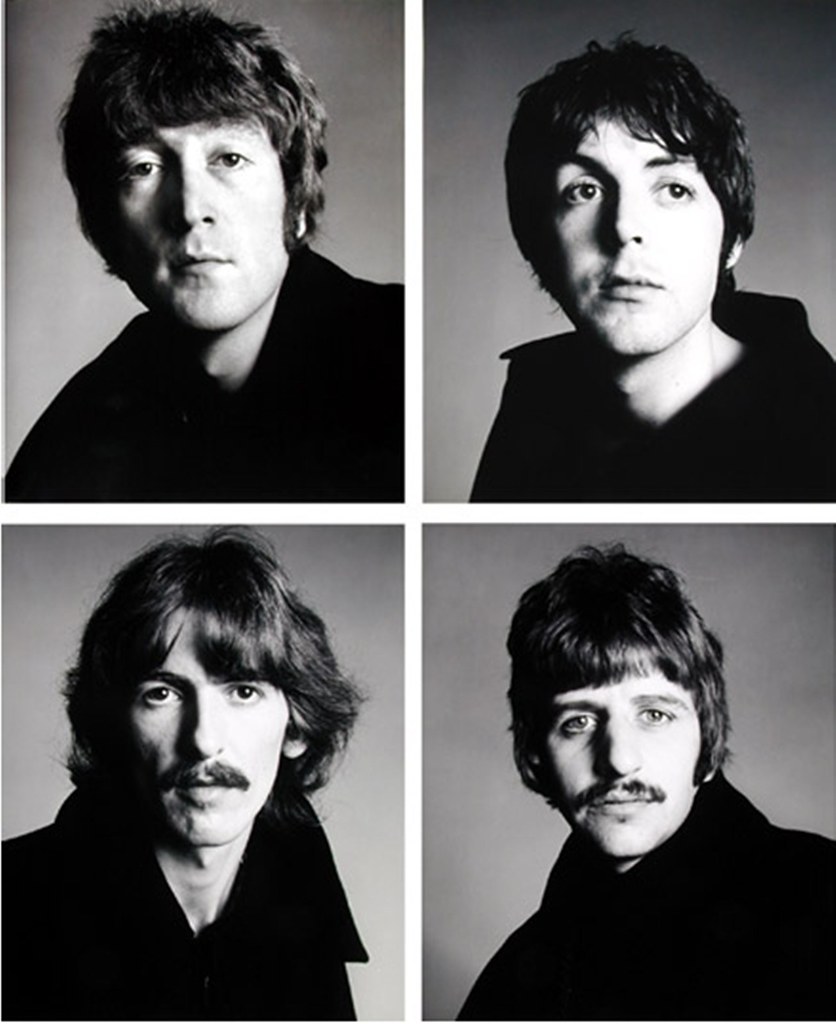
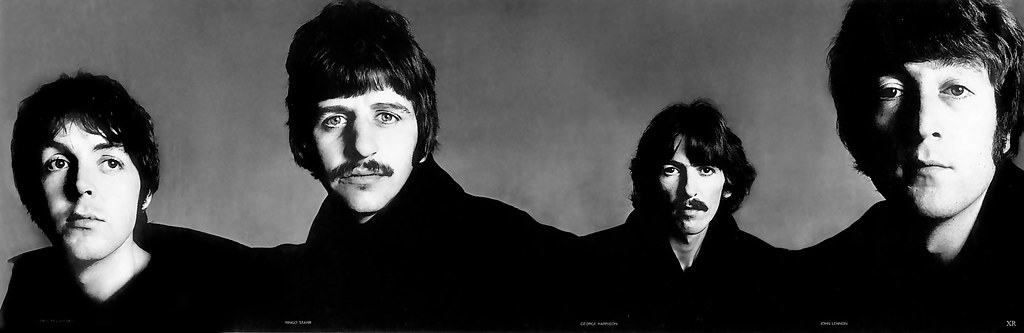
Featured Photographer is Richard Avedon

Charlie Rose – Richard Avedon

Published on Feb 26, 2014

1999 Interview of photographer Richard Avedon by Charlie Rose. The first half of this episode of The Charlie Rose Show is an interview with photographer Annie Leibovitz here: http://bit.ly/1llyFo4

_________________

These first few people were on the cover of Sgt. Pepper’s:

Marlene Dietrich, Actor, The Ritz, Paris, August 1955 © Richard Avedon

______________


Bob Dylan

__________________


Aldous Huxley

___________

Marilyn Monroe and Arthur Miller by Richard Avedon, New York, May 8, 1957

________________


William S. Burroughs

___________________

Below Paul by Richard Avedon

____________

Richard Avedon is mentioned at the 4:40 mark in the clip below:

Beatles Revolution #7-A

Richard Avedon below:

___________

___________
_____________________

_______________
_____________________________

GEORGE BY AVEDON:

______________

This shot of Ringo as Nero was taken by Richard Avedon on 29 January and used as illustration for a Daily Mail article titlled ‘Hail, Ringo’. The pic was taken at Thomson House where Avedon later took his iconic image of the four Beatles on 11 August 1967 (used for the psychedelic Daily Express posters in 1968 and, of course, on the Love Songs album. The Beatles also came to thomson House to start the Mad Day out photo shoot on 28 July 1968. BTW, Thomson House is now the headquarters of the ITV media empire.

Tags: ,

___________

Richard Avedon- Darkness and Light

Published on Sep 6, 2012

From the 1995 American Masters Series.

Good article below:

<a class=”entry-title” style=”margin:0;padding:0;border:none;outline:0;font-size:27px;text-decoration:none;color:#330000;font-family:Times;line-height:28.35000038147px;” title=”Once and For All: What’s The Beatles’ Coolest Collective Look?” href=”http://www.rocktownhall.com/blogs/once-and-for-all-coolest-collective-beatles-look/&#8221; rel=”bookmark”>Once and For All: What’s The Beatles’ Coolest Collective Look?

Posted by

Let’s kick off Once and For All February with a subject that hits on a large segment of the Hall’s demographic, involving a favorite band, Rock Superpowers, and the all-important issues of Look. Let’s determine—once and for allThe Beatles’ Coolest Collective Look.

The nominees and the RTH People’s Poll follow…after the jump!

Collarless Suits. What’s more classic, more Beatle-esque than the original collarless suits? Next to the moptop hairdos (and the music, of course), those suits are most responsible for putting the band on the map.

collarless

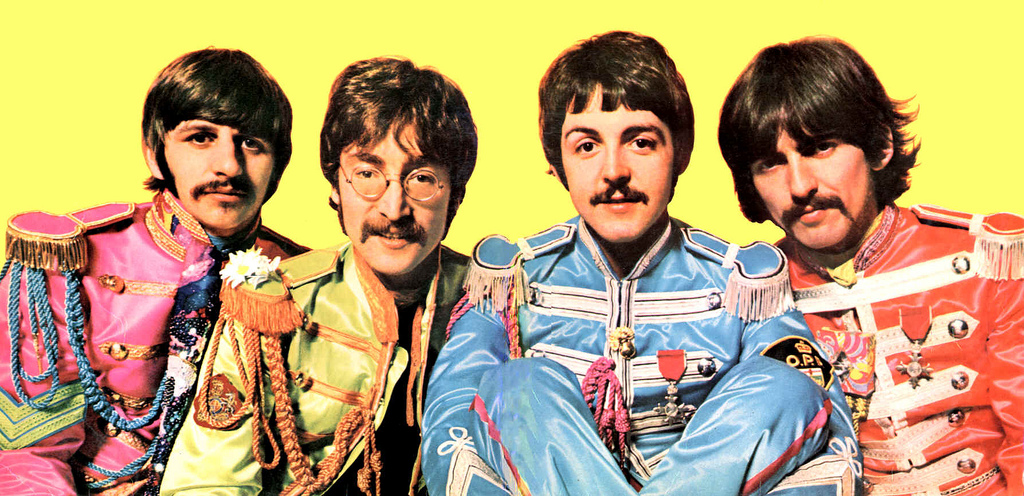
Sgt. Pepper’s. What’s more classic, more Beatle-esque than the moustachioed Sgt. Pepper’s Look? Any Beatles tribute band performance builds to a crescendo once the vaguely Beatles-looking members come back from a brief intermission in their colorful silk military suits and glue-on moustaches.
sgtpeppers

Rooftop Concert. The rooftop performance Look is heavy, man. Hair is blowing in the wind. Facial hair is in need of that snazzy electric razor favored by Adrien Brody, André 3000, and the Spanish guy from that overlooked gem of a movie The Science of Sleep. To top it off, they’re wearing a mish-mash of women’s fur coats, raincoats, green jeans, and proto-hipster sneaks!

rooftop

Stoned Soul Picnic. The Rubber Soul album cover photo shoot caught the band on a day when they probably needed a haircut, but someone must have watched the weather report and realized that low humidity would allow for one more day of stoned shagginess.
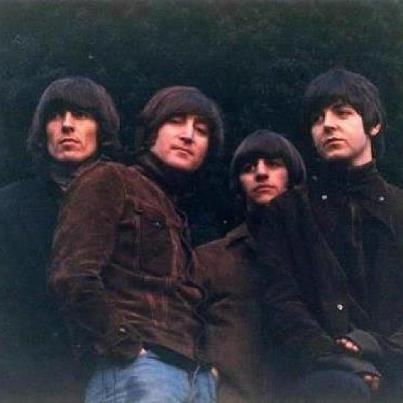
rubbersoulphoto

Richard Avedon glossies. Fashion photographer Richard Avedon’s White Album glossies capture a unique perspective on the boys: they are both immersed in their hippie-dom yet cleaned up and glammed up just enough to show their original guise as the fresh-faced lads they had been just a few years earlier.
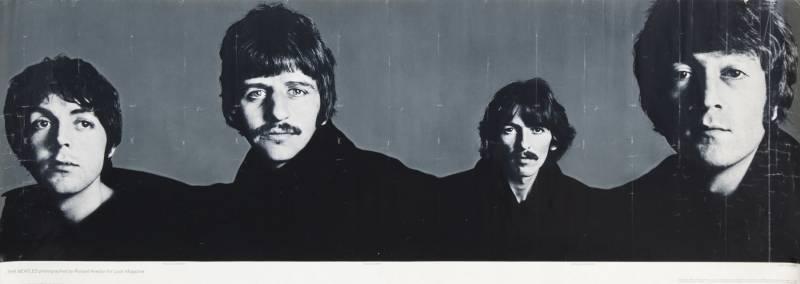
avedon

Runners up (not eligible): Leonine (ie, when all 4 Beatles were bearded, which I don’t believe was ever captured on camera simultaneously); Walrus/Eggman costumes; Beatles Dress Up Like The Band (ie, Beatles Again album cover)…

_____________

Richard Avedon Biography

Photographer (1923–2004)
American photographer Richard Avedon was best known for his work in the fashion world and for his minimalist, large-scale character-revealing portraits.
American photographer Richard Avedon was best known for his work in the fashion world and for his minimalist portraits. He worked first as a photographer for the Merchant Marines, taking identification photos. He then moved to fashion, shooting for Harper’s Bazaar and Vogue, demanding that his models convey emotion and movement, a departure from the norm of motionless fashion photography.

Profile

Richard Avedon was born on May 15, 1923 in New York City. His mother, Anna Avedon, came from a family of dress manufacturers, and his father, Jacob Israel Avedon, owned a clothing store called Avedon’s Fifth Avenue. Inspired by his parents’ clothing businesses, as a boy Avedon took a great interest in fashion, especially enjoying photographing the clothes in his father’s store. At the age of 12, he joined the YMHA (Young Men’s Hebrew Association) Camera Club.

Avedon later described one childhood moment in particular as helping to kindle his interest in fashion photography: “One evening my father and I were walking down Fifth Avenue looking at the store windows,” he remembered. “In front of the Plaza Hotel, I saw a bald man with a camera posing a very beautiful woman against a tree. He lifted his head, adjusted her dress a little bit and took some photographs. Later, I saw the picture in Harper’s Bazaar. I didn’t understand why he’d taken her against that tree until I got to Paris a few years later: the tree in front of the Plaza had that same peeling bark you see all over the Champs-Elysees.”

Avedon attended DeWitt Clinton High School in New York City, where one of his classmates and closest friends was the great writer James Baldwin. In addition to his continued interest in fashion and photography, in high school Avedon also developed an affinity for poetry. He and Baldwin served as co-editors of the school’s prestigious literary magazine, The Magpie, and during his senior year, in 1941, Avedon was named “Poet Laureate of New York City High Schools.” After high school, Avedon enrolled at Columbia University to study philosophy and poetry. However, he dropped out after only one year to serve in the United States Merchant Marine during World War II. As a Photographer’s Mate Second Class, his main duty was taking identification portraits of sailors. Avedon served in the Merchant Marine for two years, from 1942 to 1944.

Upon leaving the Merchant Marine in 1944, Avedon attended the New School for Social Research in New York City to study photography under Alexey Brodovitch, the acclaimed art director of Harper’s Bazaar. Avedon and Brodovitch formed a close bond, and within one year Avedon was hired as a staff photographer for the magazine. After several years photographing daily life in New York City, Avedon was assigned to cover the spring and fall fashion collections in Paris. While legendary editor Carmel Snow covered the runway shows, Avedon’s task was to stage photographs of models wearing the new fashions out in the city itself. Throughout the late 1940s and early 1950s he created elegant black-and-white photographs showcasing the latest fashions in real-life settings such as Paris’s picturesque cafes, cabarets and streetcars.

Already established as one of the most talented young fashion photographers in the business, in 1955 Avedon made fashion and photography history when he staged a photo shoot at a circus. The iconic photograph of that shoot, “Dovima with Elephants,” features the most famous model of the time in a black Dior evening gown with a long white silk sash. She is posed between two elephants, her back serenely arched as she holds on to the trunk of one elephant while reaching out fondly toward the other. The image remains one of the most strikingly original and iconic fashion photographs of all time. “He asked me to do extraordinary things,” Dovima said of Avedon. “But I always knew I was going to be part of a great picture.”

Avedon served as a staff photographer for Harper’s Bazaar for 20 years, from 1945 to 1965. In addition to his fashion photography, he was also well known for his portraiture. His black-and-white portraits were remarkable for capturing the essential humanity and vulnerability lurking in such larger-than-life figures as President Dwight D. Eisenhower, Marilyn Monroe, Bob Dylan and The Beatles. During the 1960s, Avedon also expanded into more explicitly political photography. He did portraits of civil rights leaders such as Dr. Martin Luther King Jr., Malcolm X and Julian Bond, as well as segregationists such as Alabama Governor George Wallace, and ordinary people involved in demonstrations. In 1969, he shot a series of Vietnam War portraits that included the Chicago Seven, American soldiers and Vietnamese napalm victims.

Avedon left Harper’s Bazaar in 1965, and from 1966 to 1990 he worked as a photographer for Vogue, its chief rival among American fashion magazines. He continued to push the boundaries of fashion photography with surreal, provocative and often controversial pictures in which nudity, violence and death featured prominently. He also continued to take illuminating portraits of leading cultural and political figures, ranging from Stephen Sondheim and Toni Morrison to Hillary Clinton. In addition to his work for Vogue, Avedon was also a driving force behind photography’s emergence as a legitimate art form during the 1960s, ’70s and ’80s. In 1959 he published a book of photographs, Observations, featuring commentary by Truman Capote, and in 1964 he published Nothing Personal, another collection of photographs, with an essay by his old friend James Baldwin.

In 1974 Avedon’s photographs of his terminally ill father were featured at the Museum of Modern Art, and the next year a selection of his portraits was displayed at the Marlborough Gallery. In 1977, a retrospective collection of his photographs, “Richard Avedon: Photographs 1947-1977,” was exhibited at the Metropolitan Museum of Art before beginning an international tour of many of the world’s most famous museums. As one of the first self-consciously artistic commercial photographers, Avedon played a large role in defining the artistic purpose and possibilities of the genre. “The moment an emotion or fact is transformed into a photograph it is no longer a fact but an opinion,” he once said. “There is no such thing as inaccuracy in a photograph. All photographs are accurate. None of them is the truth.”

Richard Avedon married a model named Dorcas Nowell in 1944, and they remained married for six years before parting ways in 1950. In 1951, he married a woman named Evelyn Franklin; they had one son, John, before they also divorced.

In 1992, Avedon became the first staff photographer in the history of The New Yorker. “I’ve photographed just about everyone in the world,” he said at the time. “But what I hope to do is photograph people of accomplishment, not celebrity, and help define the difference once again.” His last project for The New Yorker, which remained unfinished, was a portfolio entitled “Democracy” that included portraits of political leaders such as Karl Rove and John Kerry as well as ordinary citizens engaged in political and social activism.

Richard Avedon passed away on October 1, 2004, while on assignment forThe New Yorker in San Antonio, Texas. He was 81 years old.

One of the greatest photographers of the 20th century, Richard Avedon expanded the genre of photography with his surreal and provocative fashion photography as well as portraits that bared the souls of some of the most important and opaque figures in the world. Avedon was such a predominant cultural force that he inspired the classic 1957 film Funny Face, in which Fred Astaire’s character is based on Avedon’s life. While much has been and continues to be written about Avedon, he always believed that the story of his life was best told through his photographs. Avedon said, “Sometimes I think all my pictures are just pictures of me. My concern is… the human predicament; only what I consider the human predicament may simply be my own.”

______________

___________

Groucho Marx by Richard Avedon

_______________

__________

Buster Keaton, comedian, New York, September 1952. Photo Richard Avedon

______________

Dwight-EistenhowerRichard Avedon Foundation. Eli Reed. ‘Tupac Shakur’ 1992 (printed 2013)Richard Avedon. Charlie Chaplin Leaving America. NYC, September 13 1952___________
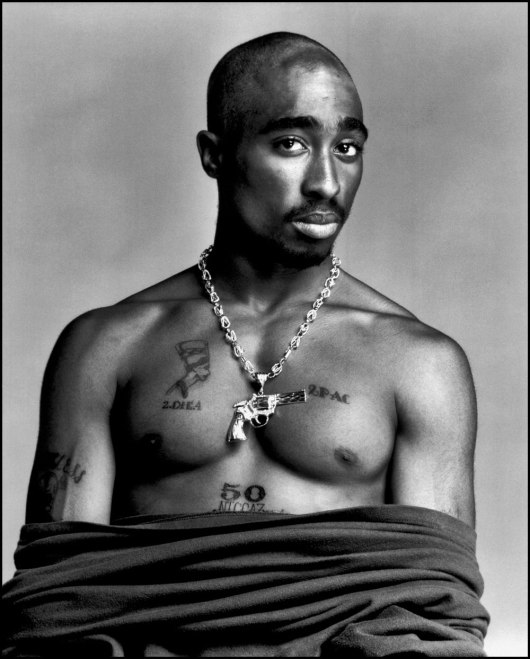
SIMPLY STUNNING: RICHARD AVEDON’S PORTRAITS

August 31, 2012

Good luck keeping your $#!% together when you walk into a room and see Jackie O., Malcolm X, Elizabeth Taylor, Tina Turner, Truman Capote, Janis Joplin, Katharine Hepburn, and Andy Warhol all in the same place.  Perhaps one of the most striking photography exhibitions in modern history, the SF MoMA’s Richard Avedon retrospective in 2009 was the first comprehensive retrospective of the American photographer since his death in 2004.  Titled “Richard Avedon: Photographs 1946-2004,” the exhibit focused purely on Avedon’s black and white photographs spanning his fifty+ year career, from pieces that graced the pages of Vogue to a portrait series of rural, Midwestern farm hands, carneys and beekeepers.

Born to a Russian Jewish family in New York City in 1923, Avedon began his career in his 20s in commercial and fashion photography, producing shots for Harper’s Bazaar, and soon after for Vogue and Life Magazine.

Funny Face – trailer (1956) AUDREY HEPBURN

Though he began his career in fashion photography, as he became a more established artist his interests  meandered to the movers and shakers of the American political and social scene.  Many of Avedon’s iconic photos depict some of the most famous models, actresses and actors, politicians, writers and artists in modern history.  In most cases, however, Avedon tried to capture a version of each person that is stripped of the Hollywood or political branding and bravado, instead aiming to represent basic human emotions and relatable expressions.

Keep in mind that the vast majority of the work reproduced below was originally produced on a larger-than-life scale, some reaching 8 by 10 feet or larger.

Even if you had no idea who these people were or what they did for a living, each portrait could give you a pretty good idea based on how Avedon chose to represent them.  The combination of the simple background with the close-up details and epic proportions of each photograph force your eyes to focus sharply on each facial expression and body movement; You notice the wrinkles around the lips of the trumpeter, the musician’s easy posture, a wife’s admirative stare, the grin and outstretched hand of a budding politician.

“He was trying to cut to the heart of the matter…to understand what people’s lives were really like under force of pressure.  His work, in a way, strips away the masks that we all wear, and in doing so reveals a kind of deeper humanity.  I think that when photographers today, or artists or writers or the public at large, look at his photographs, that this is what they’ll really be able to take away from the work: this penetrating of the masks that we all wear in order to hide ourselves.”  -Paul Roth, curator of Photography at Corcoran Gallery in Washington D.C.

Famous for saying, “All photographs are accurate.  None of them is the truth.”, Avedon understood that photography is an art of collaboration between a photographer and his subject, with push and pull, give and take from each.  He enjoyed using stories to evoke specific reactions from his subjects and to play with their emotions, allowing him to capture the expressions he wanted to show.

Take, for example, his photo shoot with the Duke and Duchess of Windsor.  Here is a photo of the duo taken in the Bahamas by the The Vancouver Sun in 1940 (not by Avedon):
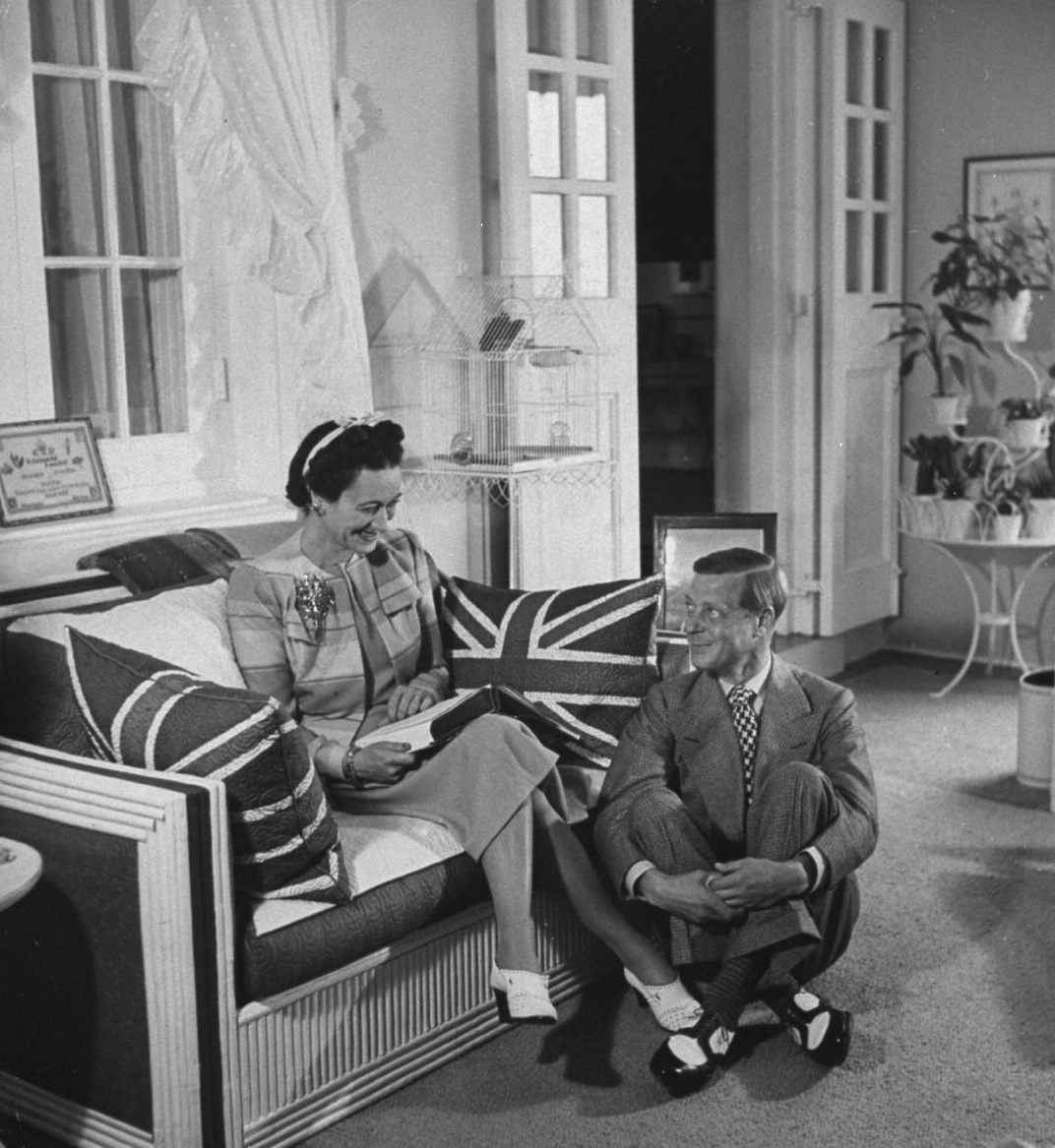
Infamous for abdicating the throne to marry the woman he loved, Edward VIII was given the title Duke of Windsor, and his new wife Wallis Simpson became the Duchess of Windsor upon their marriage in the 1930s.  Wallis was an American socialite with two living ex-husbands (the second divorce was not finalized when she met Edward VIII)–hardly a suitable companion for a British monarch.  In addition to the initial political uproar that their romance caused in Britain,  during the Second World War the Duke and Duchess of Windsor were also suspected by many to be Nazi sympathizers.

Avedon knew that these political and socialite subjects were no strangers to being photographed, and that they were likely expecting a classic “stock photo shoot.”  As they sat down in front of the camera, and with the knowledge that they were avid Pug lovers, Avedon told them that on his way to meet them that day, his taxi had run over and killed a dog.

The following expression ensued:

The Duke and Duchess of Windsor, Waldorf Astoria, Suite 28A, New York, April 16, 1957

In the late 1970s and early 1980s, Avedon’s focus shifted from celebrity portraits to documenting “working class” Americans.  He created a series, eventually published into an exhibition catalogue, called “In the American West: 1979-1984.”

Avedon himself said, during his transition from celebrity and fashion photographer  to “staff photographer” (ha!) at U.S.A. Today:

“I’ve photographed just about everyone in the world…but what I hope to do is photograph people of accomplishment, not celebrity, and help define the difference once again.”

In lieu of me posting a million (or two) additional mesmerizing Avedon portraits, check out The Richard Avedon Foundation’s website, which keeps his artwork and legacy alive in truly stunning photo displays, as well as in arts institutions worldwide.

Avedon Self Portrait

Richard Avedon, Self-portrait, Provo, Utah, August 20, 1980; © 2009 The Richard Avedon Foundation

________________

Salvador Dalí and Dovima, New York, January 1963Photographer: Richard Avedon

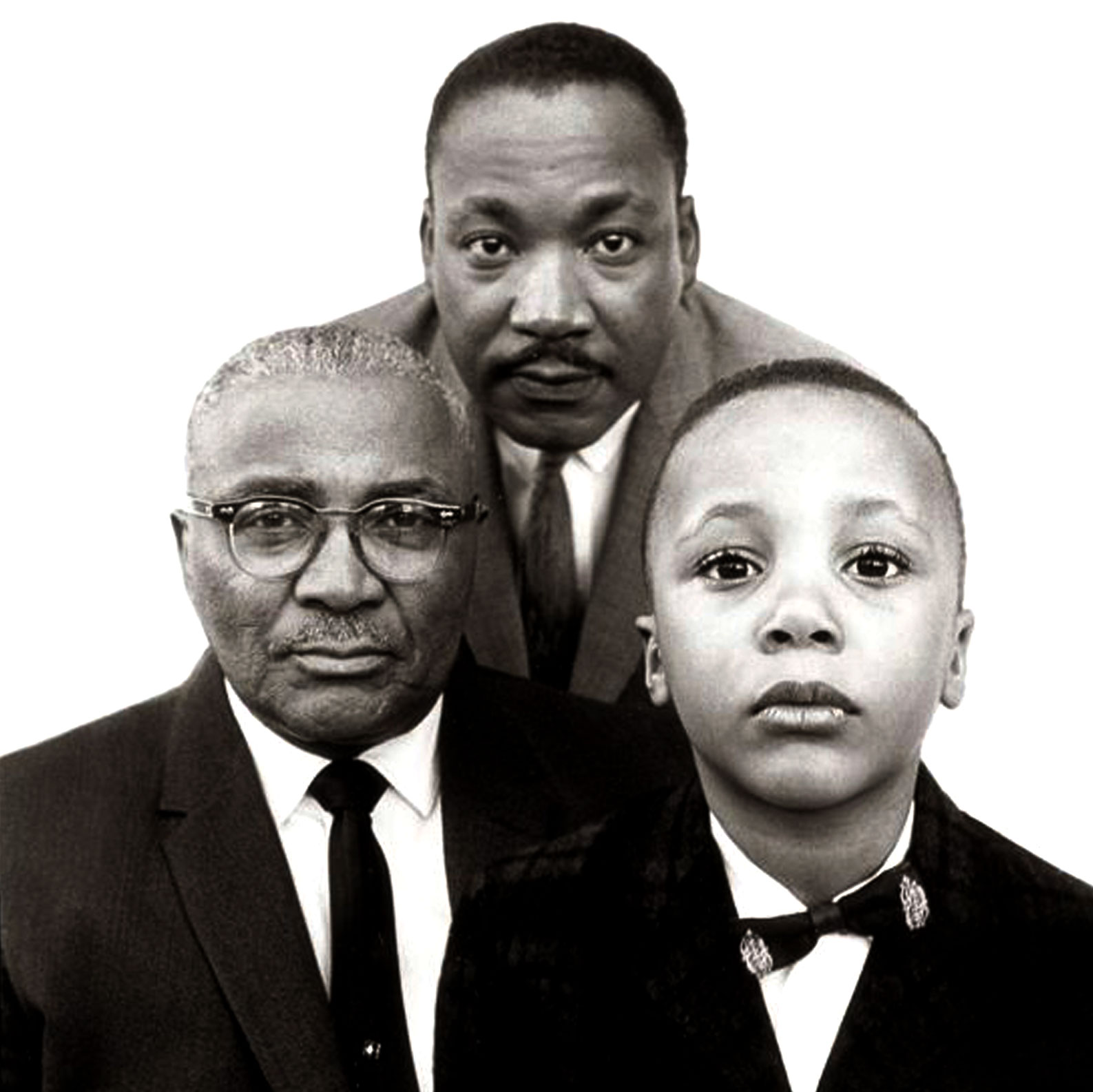
Avedon’s son and father, 1969

Avedon’s 8 x 10 portrait of his son, his father, and himself during a visit to Jacob Avedon’s home in Sarasota, Florida, August 9, 1969

Evidence 1944-1994 by Richard Avedon, Random House, 1994, p. 151: “Avedon’s 8″ x 10″ portrait of his son, his father, and himself during a visit to Jacob Avedon’s home in Sarasota, Florida, August 9, 1969”. © Richard Avedon Foundation.

This is the portrait of three different generations of men from the same family, each of them moving through life at different speed and in different direction, immobilized for a fraction of a second within the same frame.

From left to right: John Avedon, Jacob Israel Avedon (died in 1973) and Richard Avedon (died in 2004). The complete series of photos Richard Avedon took of his father can be found online at The Richard Avedon Foundation website.

palonka: photo of Coco Chanel by Richard Avedon via Accro de la Mode

____________

PATTI HANSEN aka Ms KEITH RICHARDS – Richard Avedon (1977) (Via superseventies)George Bush below:Henri Cartier-Bresson – Photographer Richard Avedon, Carmel Snow and Marie-Louise Bousquet, Paris 1951

Boston Museum of Fine Arts Hosts Richard Avedon Exhibit

Legendary American fashion photographer Richard Avedon who revolutionized the industry during his 60-year-long career (until his death in 2004) has taken tens upon thousands of the most well-done and well-known photographs. He is also famous for saying, “Think about the dream of Paris that everyone has. I helped invent that dream.” To honor this icon, theBoston Museum of Fine Arts is hosting a traveling exhibition of Avedon’s works entitled Avedon Fashion 1944-2000 which runs through January 17 2011.

Whether it be his photos of 15-year-old Brooke Shields in the controversial Calvin Klein Jeans campaign, his portraits of Andy Warhol, The Beatles, Audrey Hepburn, Elizabeth Taylor, Bob Dylan, his tenure at Harper’s Bazaar, US Vogue and Life, or his photos for Gianni Versace, Richard Avedon’s name has been synonymous with fashion since the 1940s.

Brooke Shields, Calvin Klein Jeans, 1981

Andy Warhol, Jay Johnson and Candy Darling, New York, August 20, 1969

Audrey Hepburn, evening wear by Balmain, Dior, Patou, at Maxim’s, Paris, 1957

Born in New York City in the 1920s, Richard Avedon was fascinated since childhood by the art of photography, and the power that it has to portray clothes and women. He realized this as he grew up watching his father’s business (a women’s clothing store). Dropping out of Columbia University, Avedon began his career as a photographer for the Merchant Marines in 1942, followed by shooting advertisements for a department store. He soon caught the eye of Harper’s Bazaar’s creative director, eventually leading him to occupy the role of chief photographer for the magazine. During this time, Avedon opened up his own studio and began working on assignments for US Vogue and Life magazine.

Dorian Leigh, evening dress by Piguet, Paris, August 1949

Marilyn Monroe, New York City, May 6, 1957

Dovima with elephants, evening dress by Dior, Cirque d’Hiver, 1955

In 1966, Avedon followed famous editor Diana Vreeland when she left Harper’s Bazaar for Vogue; he subsequently became the staff photographer at Vogue until Anna Wintour‘s entry in 1988. He was also the star photographer year after year for the Gianni Versace label circa the 1980s. Numerous 1990s supermodels such as Linda Evangelista, Naomi Campbell, Christy Turlington, Stephanie Seymour and Cindy Crawford were featured in his photos. These images are now considered precious collectibles.

Christy Turlington, Linda Evangelista & Paulina Porizkova for Gianni Versace, 1988

Christy Turlington & Linda Evangelista for Gianni Versace, 1987

Karen Elson for Versace Couture, 1997

At a time, when fashion photographers followed de rigeur of asking models to remain still and emotionless in order to emphasize the clothes, Avedon went against the grain, asking models to jump, laugh, run down the street and wear rollerblades. He is said to have been able to animate the clothes via the model unlike any other photographer.

Model Carmen, coat by Cardin, Paris, August 1957

Richard Avedon with Twiggy in the 1960s

Stephanie Seymour, dress by Chanel, Paris, 1995

Richard Avedon was not only responsible for animating designers’ creations, but his photos of Paris can be said to hold testament to his self-proclaimed statement regarding the invention of the dreamy vision of Paris that exists today. As he frequented Paris in the latter half of the 1940s on Harper’s Bazaar assignments, Avedon began taking multiple series of photos of bleak Post-World War II Paris. However instead of showing a disheartened, gray city, he showed models skipping on the sidewalks, showing a real sense of joie de vivre.

Models Elise & Monique, hats by Schiaparelli, Cafe de Flore, Paris, August 1948

Suzy Parker & Robin Tattersall, evening dress by Grès, Moulin Rouge, Paris, 1957

Christian Bérard & Renée, suit by Dior, Le Marais, Paris, 1947

He found a way to take designers’ creations, be it Dior or Balenciaga, depict a woman wearing these clothes with sophistication, and then involve her with an element of the city, be it at the Moulin Rouge, or watching street performers in the Marais or outside the many cafes that line the Parisian sidewalks.

Kate Moss, May 1998

John Galliano, December 1999

Although Avedon did take non-fashion photographs as well, the Avedon Fashion exhibition explores only one aspect of his multi-faceted talent. The exhibition runs at the Boston Museum of Fine Arts until January 17, 2011.

Images from TFS & The Richard Avedon Foundation.

Richard Avedon

From Wikipedia, the free encyclopedia
“Avedon” redirects here. For other uses, see Avedon (disambiguation).
Richard Avedon
Richard Avedon.jpg

Richard Avedon, 2004
Born May 15, 1923
New York City, New York, U.S.
Died October 1, 2004 (aged 81)
San Antonio, Texas, U.S.
Alma mater The New School for Social Research
Known for Photography
Spouse(s) Dorcas Marie “Doe” (Nowell) Avedon (m. 1944; div. 1949)
Evelyn Franklin (m. 1951)

Richard Avedon (May 15, 1923 – October 1, 2004) was an American fashion and portrait photographer. An obituary published in The New York Times said that “his fashion and portrait photographs helped define America’s image of style, beauty and culture for the last half-century”.[1]

Personal life and death[edit]

In 1944, Avedon married 19-year-old bank teller Dorcas Marie Nowell who later became the model and actress Doe Avedon; they did not have children and divorced in 1949.[27] In 1951, he married Evelyn Franklin; she died on March 13, 2004.[28] Their marriage produced one son, John Avedon, who has written extensively about Tibet.[29][30][31] [32]

In 1970, Avedon purchased a former carriage house on the Upper East Side that would serve as both his studio and his apartment.[33] In the late 1970s, he purchased a four-bedroom house on a 7.5-acre (3.0 ha) estate in Montauk, nestled between the Atlantic Ocean and a nature preserve; in 1998, he put the place on the market for $10 million and sold it for almost $9 million in 2000.[32][34]

On October 1, 2004, Avedon died in a San Antonio, Texas hospital of complications from a cerebral hemorrhage. He was in San Antonio shooting an assignment for The New Yorker. At the time of his death, he was also working on a new project titled Democracy to focus on the run-up to the 2004 U.S. presidential election.[1]

Legacy[edit]

The Richard Avedon Foundation is a private operating foundation, structured by Avedon during his lifetime. It began its work shortly after his death in 2004. Based in New York, the foundation is the repository for Avedon’s photographs, negatives, publications, papers, and archival materials.[35] In 2006, Avedon’s personal collection was shown at the Pace/MacGill Gallery, New York, and at the Fraenkel Gallery, San Francisco, and later sold to benefit the Avedon Foundation. The collection included photographs by Martin Munkacsi, Edward Steichen and Man Ray, among others. A slender volume, Eye of the Beholder: Photographs From the Collection of Richard Avedon (Fraenkel Gallery), assembles the majority of the collection in a boxed set of five booklets: “Diane Arbus,” “Peter Hujar”, “Irving Penn”, “The Countess de Castiglione” and “Etcetera,” which includes 19th- and 20th-century photographers.[36]

In popular culture[edit]

Hollywood presented a fictional account of his early career in the 1957 musical Funny Face, starring Fred Astaire as the fashion photographer “Dick Avery.” Avedon supplied some of the still photographs used in the production, including its most famous single image: an intentionally overexposed close-up of Audrey Hepburn‘s face in which only her famous features – her eyes, her eyebrows, and her mouth – are visible.

Hepburn was Avedon’s muse in the 1950s and 1960s, and he went so far as to say: “I am, and forever will be, devastated by the gift of Audrey Hepburn before my camera. I cannot lift her to greater heights. She is already there. I can only record. I cannot interpret her. There is no going further than who she is. She has achieved in herself her ultimate portrait.”[37]

Famous photographs[edit]

_______________


Alberto Giacometti

________________


J. Robert Oppenheimer

____________

Ronald Reagan by Richard Avedon

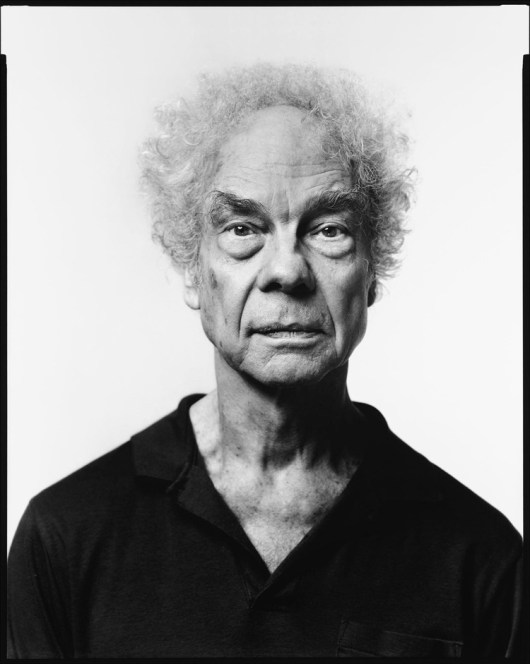
Merce Cunningham, choreographer, New York, February 17, 1993
_______________

__________

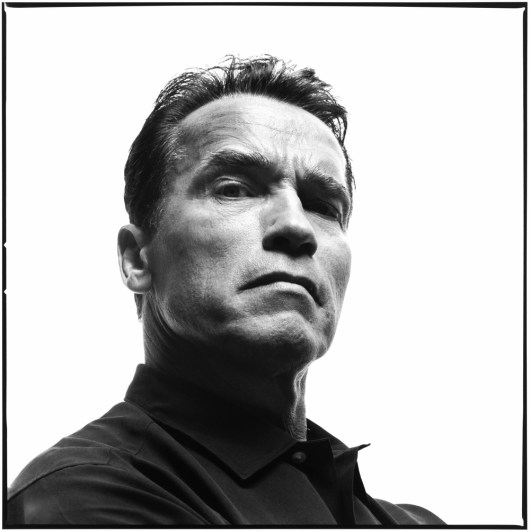
Arnold Schwarzenegger, actor, Republican candidate for Governor of California, New York, June
_____________


Truman Capote

_________________

Richard Avedon with Francis Bacon

____________


Willem de Kooning

___________


Ronald Reagan

___________________


Patti Smith

____________


Janis Joplin

____________


John and Jackie Kennedy

__________


Andy Warhol and Group

_____________

Image result for sergent peppers album cover

Francis Schaeffer’s favorite album was SGT. PEPPER”S and he said of the album “Sergeant Pepper’s Lonely Hearts Club Band…for a time it became the rallying cry for young people throughout the world. It expressed the essence of their lives, thoughts and their feelings.”  (at the 14 minute point in episode 7 of HOW SHOULD WE THEN LIVE? ) 

Image result for francis schaeffer how should we then live

How Should We Then Live – Episode Seven – 07 – Portuguese Subtitles

Francis Schaeffer
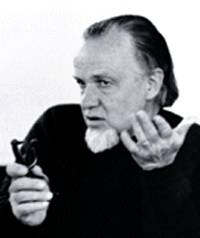
Image result for francis schaeffer

______

FRANCIS SCHAEFFER ANALYZES ART AND CULTURE PART 202 the BEATLES’ last song FREE AS A BIRD (Featured artist is Susan Weil )

February 15, 2018 – 1:45 am

FRANCIS SCHAEFFER ANALYZES ART AND CULTURE Part 200 George Harrison song HERE ME LORD (Featured artist is Karl Schmidt-Rottluff )

FRANCIS SCHAEFFER ANALYZES ART AND CULTURE PART 184 the BEATLES’ song REAL LOVE (Featured artist is David Hammonds )

FRANCIS SCHAEFFER ANALYZES ART AND CULTURE Part 170 George Harrison and his song MY SWEET LORD (Featured artist is Bruce Herman )

FRANCIS SCHAEFFER ANALYZES ART AND CULTURE Part 168 George Harrison’s song AWAITING ON YOU ALL Part B (Featured artist is Michelle Mackey )

FRANCIS SCHAEFFER ANALYZES ART AND CULTURE Part 167 George Harrison’s song AWAITING ON YOU Part A (Artist featured is Paul Martin)

RESPONDING TO HARRY KROTO’S BRILLIANT RENOWNED ACADEMICS!! Part 133 Louise Antony is UMass, Phil Dept, “Atheists if they commit themselves to justice, peace and the relief of suffering can only be doing so out of love for the good. Atheist have the opportunity to practice perfect piety”

FRANCIS SCHAEFFER ANALYZES ART AND CULTURE Part 166 George Harrison’s song ART OF DYING (Featured artist is Joel Sheesley )

FRANCIS SCHAEFFER ANALYZES ART AND CULTURE Part 165 George Harrison’s view that many roads lead to Heaven (Featured artist is Tim Lowly)

FRANCIS SCHAEFFER ANALYZES ART AND CULTURE Part 164 THE BEATLES Edgar Allan Poe (Featured artist is Christopher Wool)

PART 163 BEATLES Breaking down the song LONG AND WINDING ROAD (Featured artist is Charles Lutyens )

FRANCIS SCHAEFFER ANALYZES ART AND CULTURE PART 162 A look at the BEATLES Breaking down the song ALL WE NEED IS LOVE Part C (Featured artist is Grace Slick)

PART 161 A look at the BEATLES Breaking down the song ALL WE NEED IS LOVE Part B (Featured artist is Francis Hoyland )


FRANCIS SCHAEFFER ANALYZES ART AND CULTURE PART 160 A look at the BEATLES Breaking down the song ALL WE NEED IS LOVE Part A (Featured artist is Shirazeh Houshiary)

FRANCIS SCHAEFFER ANALYZES ART AND CULTURE Part 159 BEATLES, Soccer player Albert Stubbins made it on SGT. PEP’S because he was sport hero (Artist featured is Richard Land)

FRANCIS SCHAEFFER ANALYZES ART AND CULTURE Part 158 THE BEATLES (breaking down the song WHY DON’T WE DO IT IN THE ROAD?) Photographer Bob Gomel featured today!

FRANCIS SCHAEFFER ANALYZES ART AND CULTURE Part 118 THE BEATLES (Why was Tony Curtis on cover of SGT PEP?) (Feature on artist Jeffrey Gibson )

FRANCIS SCHAEFFER ANALYZES ART AND CULTURE Part 117 THE BEATLES, Breaking down the song WITHIN YOU WITHOUT YOU Part B (Featured artist is Emma Amos )

Related posts:

Conservative looks at Martin Luther King Jr’s “I have a dream speech”

I really got a lot out of this article from the Cato Institute concerning Martin Luther King’s “I have a dream speech.” The Constitutional Foundations of Martin Luther King’s Dream By David Azerrad January 14, 2011   Nearly 50 years ago, Martin Luther King Jr. delivered one of the greatest speeches in American history. Standing […]

Three conservative principles Martin Luther King believed in

Why do liberals ignore these core principles that Martin Luther King Jr believed in? Martin Luther King’s Conservative Principles Matt Spalding January 15, 2012 at 9:00 am Martin Luther King Day has arrived once again, and like clockwork, liberals are invoking King’s name to support their causes. In an e-mail to activists, Obama’s former “green […]

Libertarian Jonathan Martin on Francis Schaeffer

Libertarian Jonathan Martin on Francis Schaeffer Episode 8: The Age Of Fragmentation Published on Jul 24, 2012 Dr. Schaeffer’s sweeping epic on the rise and decline of Western thought and Culture How Should We Then Live Episode 9: The Age Of Personal Peace & Affluence _______________________ I love the works of Francis Schaeffer and I […]

The most popular posts in the last 30 days about the spiritual quest of Chris Martin of Coldplay that can be found on www.thedailyhatch.org

These are some of the most popular posts in the last 30 days about the spiritual quest of Chris Martin of Coldplay that can be found on http://www.thedailyhatch.org: Chris Martin of Coldplay unknowingly lives out his childhood Christian beliefs (Part 3 of notes from June 23, 2012 Dallas Coldplay Concert, Martin left Christianity because of […]

Jesse Jackson in 1979: “There are those who argue that the right to privacy is of a higher order than the right to life…That was the premise to slavery!”

Nat Hentoff is an atheist, but he became a pro-life activist because of the scientific evidence that shows that the unborn child is a distinct and separate human being and even has a separate DNA. His perspective is a very intriguing one that I thought you would be interested in. I have shared before many   […]

Liberals at Ark Times can not stand up to Scott Klusendorf’s pro-life arguments (Part 1) Prochoice blogger stated, “You people will kill and murder doctors and anyone who is pro choice…”

Anti Abortion Pro-Life Training Video by Scott Klusendorf Part 1 of 4 Francis Schaeffer: “Whatever Happened to the Human Race” (Episode 1) ABORTION OF THE HUMAN RACE Published on Oct 6, 2012 by AdamMetropolis This crucial series is narrated by the late Dr. Francis Schaeffer and former Surgeon General Dr. C. Everett Koop. Today, choices […]

“Sanctity of Life Saturday” Jesse Jackson in 1979: “There are those who argue that the right to privacy is of a higher order than the right to life…That was the premise to slavery!”

Nat Hentoff is an atheist, but he became a pro-life activist because of the scientific evidence that shows that the unborn child is a distinct and separate human being and even has a separate DNA. His perspective is a very intriguing one that I thought you would be interested in. I have shared before many   […]

Pro-life Atheist Nat Hentoff’s conversation with Ken Burns about the censoring of pro-life history!!!!!

Nat Hentoff is an atheist, but he became a pro-life activist because of the scientific evidence that shows that the unborn child is a distinct and separate human being and even has a separate DNA. His perspective is a very intriguing one that I thought you would be interested in. I have shared before many   […]

The Selfishness of Chris Evert Part 3 (Includes videos and Pictures) What if she had an ultrasound done first?

The Selfishness of Chris Evert Part 3 (Includes videos and Pictures) ___________________ SportsCentury Chris Evert Part 1 SportsCentury Chris Evert Part 2 Chicago 1982 Michelob – Connors vs McEnroe flare-up In 1984 I  traveled to Memphis and watched Jimmy Connors win the United States National Indoor tennis championships. I had been a big tennis fan […]

Hope for Kermit Gosnell’s repentance?

Francis Schaeffer: “Whatever Happened to the Human Race” (Episode 1) ABORTION OF THE HUMAN RACE Published on Oct 6, 2012 by AdamMetropolis ________________ The truth of abortion … the hope for Gosnell’s repentance A conviction in the murder trial of Philadelphia abortionist Kermit Gosnell has boosted the efforts of pro-lifers to demonstrate what abortion really […]

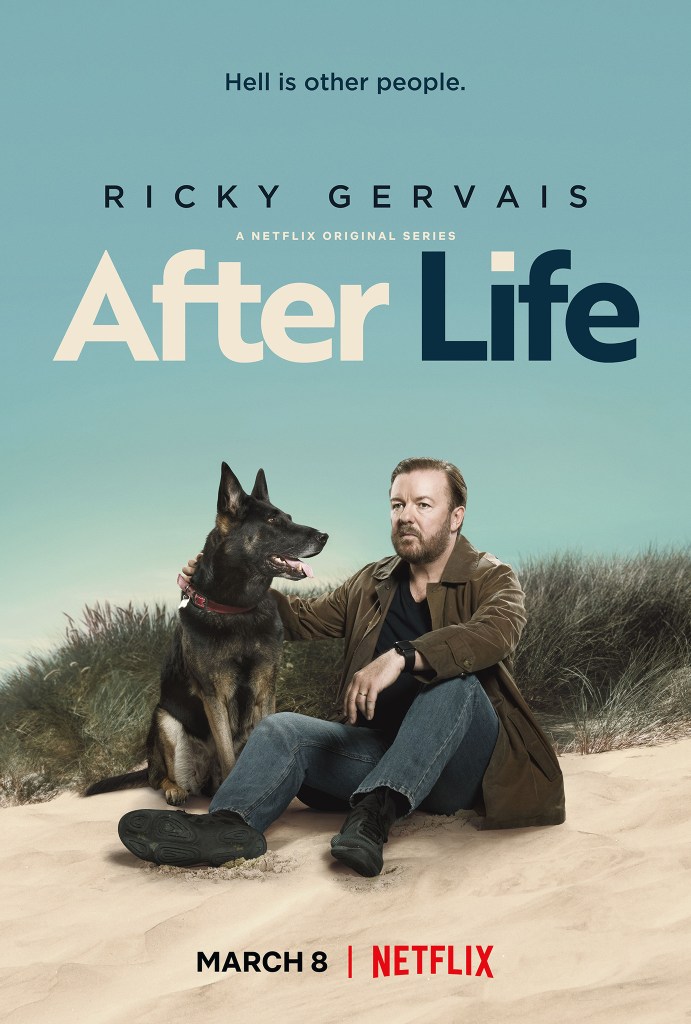
Ricky Gervais Show AFTERLIFE in light of the Book of Ecclesiastes Part 1 “Why have integrity in Godless Darwinian Universe where Might makes Right?”

If a person lives life UNDER THE SUN (phrase used 29 times in Book of Ecclesiastes) as if there is no God then it makes sense that the Darwinian principle of survival of the fittest is the rule of the day and there is no afterlife where people will be judged by God. Therefore, lying is not looked down upon by Tony in episode 5 when he lies in order to not be punished by his boss Matt.

No wonder in episode 1 we hear these words from Tony: “There’s no advantage to being nice and thoughtful and caring and having integrity. It’s a disadvantage, if anything.”

Netflix

After Life on Netflix

After Life on Netflix stars Ricky Gervais as a bereaved husband (Image: Netflix)

Francis Schaeffer looks at Nihilism of Solomon in Book of Ecclesiastes and the causes of it!!!

Notes on Ecclesiastes by Francis Schaeffer

Leonardo da Vinci compares well to Solomon and they  both were universal men searching for the meaning in life. Solomon was searching for a meaning in the midst of the details of life. His struggle was to find the meaning of life. Not just plans in life. Anybody can find plans in life. A child can fill up his time with plans of building tomorrow’s sand castle when today’s has been washed away. There is  a difference between finding plans in life and purpose in life. Humanism since the Renaissance and onward has never found it and it has never found it since. Modern man has not found it and it has always got worse and darker in a very real way.

We have here the declaration of Solomon’s universality:

1 Kings 4:30-34

English Standard Version (ESV)

30 so that Solomon’s wisdom surpassed the wisdom of all the people of the east and all the wisdom of Egypt. 31 For he was wiser than all other men, wiser than Ethan the Ezrahite, and Heman, Calcol, and Darda, the sons of Mahol, and his fame was in all the surrounding nations. 32 He also spoke 3,000 proverbs, and his songs were 1,005. 33 He spoke of trees, from the cedar that is in Lebanon to the hyssop that grows out of the wall. He spoke also of beasts, and of birds, and of reptiles, and of fish.34 And people of all nations came to hear the wisdom of Solomon, and from all the kings of the earth, who had heard of his wisdom.

_________________________

Here is the universal man and his genius. Solomon is the universal man with a empire at his disposal. Solomon had it all.

Ecclesiastes 1:3

English Standard Version (ESV)

What does man gain by all the toil
    at which he toils under the sun?

Schaeffer noted that Solomon took a look at the meaning of life on the basis of human life standing alone between birth and death “under the sun.” This phrase UNDER THE SUN appears over and over in Ecclesiastes.

(Added by me:The Christian Scholar Ravi Zacharias noted, “The key to understanding the Book of Ecclesiastes is the term UNDER THE SUN — What that literally means is you lock God out of a closed system and you are left with only this world of Time plus Chance plus matter.” )

Oppressed have no comforter

Ecclesiastes 4:1

 Then I looked again at all the acts of oppression which were being done under the sun. And behold I saw the tears of the oppressed and that they had no one to comfort them; and on the side of their oppressors was power, but they had no one to comfort them.

Francis Schaeffer: Between birth and death power rules. Solomon looked over his kingdom and also around the world and proclaimed that right does not rule but power rules.

Ecclesiastes 7:14-15

14 In the day of prosperity be happy, but in the day of adversity consider—God has made the one as well as the other so that man will not discover anything that will be after him.

15 I have seen everything during my lifetime of futility; there is a righteous man who perishes in his righteousness and there is a wicked man who prolongs his life in his wickedness.

Ecclesiastes 8:14

14 There is futility which is done on the earth, that is, there are righteous men to whom it happens according to the deeds of the wicked. On the other hand, there are evil men to whom it happens according to the deeds of the righteous. I say that this too is futility.

Francis Schaeffer: We could say it in 20th century language, “The books are not balanced in this life.”

Episode #1 of Afterlife:

  • Tony There’s no advantage to being nice and thoughtful and caring and having integrity. It’s a disadvantage, if anything.
  • Tony Here’s what’s what humanity is a plague. We’re a disgusting, narcissistic, selfish parasite, and the world would be a better place without us. It should be everyone’s moral duty to kill themselves. I could do it now. Quite happily just go upstairs, jump off the roof, and make sure I landed on some cunt from accounts.

Episode #4 Tony meets up with his acquaintance from work Julian who is a heroine addict and while doing drugs together this conversation happens:

Tony: This must be a habit. You know I know how you feel.

Julian: Every minute of every day that I have my wits all I can think about is getting some [drugs] before I become too conscious…I am already dead inside. I am still in the worst kind of pain.

Tony: I still can not believe we have so much in common.

Julian: We don’t have anything in common!

Tony: Why do you say that?

Julian: The big difference is you haven’t given up yet, have you? Me I would quite happily die right now. If I had enough money I would take as much drugs as I possibly could.

Tony gives Julian lots of money and says “Don’t waste it on food.”

The last scene of episode 5 is Julian injecting an overdose of heroine into his arm and then dying as the song “Youth” by the musical group DAUGHTER sings the words:

Shadows settle on the place, that you left
Our minds are troubled by the emptiness
Destroy the middle, it’s a waste of time
From the perfect start to the finish lineAnd if you’re still breathing, you’re the lucky ones
‘Cause most of us are heaving through corrupted lungs
Setting fire to our insides for fun

Then in episode 5 there is discussion between Tony and brother-in-law Matt when Tony admits at first that he helped Julian get the overdose on purpose but then he backtracks when Matt threatens to keep Tony’s ten year old nephew from seeing him again:

Tony: Julian was a heroine addict. That is what he did and it was what he wanted.

Matt: Tell me that you didn’t know that he was gonna kill himself or I am not gonna let you see George again.

Tony: I didn’t know. Obviously not.

Matt: Okay you didn’t know.

Ricky Gervais act outs atheist bewilderment and frustration in the face of nice Christian nonsense

Carl Sagan – Parents

Carl Sagan said that he missed his parents terribly and he wished he could believe in the afterlife but he was not convinced because of the lack of proof. I had the opportunity to correspond back and forth with Carl Sagan.  I presented him evidence that the Bible was true and there was an afterlife,  but he would not accept the evidence.

Today I want to take another approach to the issue of the afterlife and that is the pure and simple fact that without an enforcement factor people can do what they want in this life and get away with it. This is a big glaring weakness in the Humanist Manifestos that have been published so far. All three of them do not recognize the existence of God who is our final judge. (I am not claiming that this is evidence that points to an afterlife, but this post will demonstrate that atheists many times have not thought through the full ramifications of their philosophy of life.)

I had the unique opportunity to discuss this very issue with Robert Lester Mondale and his wife Rosemary  on April 14, 1996 at his cabin in Fredricktown, Missouri , and my visit was very enjoyable and informative. Mr. Mondale had the distinction of being the only person to sign all three of the Humanist Manifestos in 1933, 1973 and 2003. I asked him which signers of Humanist Manifesto Number One did he know well and he said that Raymond B. Bragg, and Edwin H. Wilson  and him were known as “the three young radicals of the group.”  Harold P. Marley used to have a cabin near his and they used to take long walks together, but Marley’s wife got a job in Hot Springs, Arkansas and they moved down there.

Roy Wood Sellars was a popular professor of philosophy that he knew. I asked if he knew John Dewey and he said he did not, but Dewey did contact him one time to ask him some questions about an article he had written, but Mondale could not recall anything else about that. 

Mondale told me some stories about his neighbors and we got to talking about some of his church members when he was an Unitarian pastor. Once during the 1930’s he was told by one of his wealthier Jewish members that he shouldn’t continue to be critical of the Nazis. This member had just come back from Germany and according to him Hitler had done a great job of getting the economy moving and things were good.

Of course, just a few years later after World War II was over Mondale discovered on a second hand basis what exactly had happened over there when he visited with a Lutheran pastor friend who had just returned from Germany. This Lutheran preacher was one of the first to be allowed in after the liberation of the concentration camps in 1945, and he told Mondale what level of devastation and destruction of  innocent lives went on inside these camps. As Mondale listened to his friend he could feel his own face turning pale.

I asked, “If those Nazis escaped to Brazil or Argentina and lived out their lives in peace would they face judgment after they died?”

Mondale responded, “I don’t think there is anything after death.”

I told Mr. Mondale that there is sense in me that says  justice will be given eventually and God will judge those Nazis even if they evade punishment here on earth. I did point out that in Ecclesiastes 4:1 Solomon did note that without God in the picture  the scales may not be balanced in this life and power could reign, but at the same time the Bible teaches that all  must face the ultimate Judge.

Then I asked him if he got to watch the O.J. Simpson trial and he said that he did and he thought that the prosecution had plenty of evidence too. Again I asked Mr. Mondale the same question concerning O.J. and he responded, “I don’t think there is a God that will intervene and I don’t believe in the afterlife.”

Dan Guinn posted on his blog at http://www.francisschaefferstudies.org concerning the Nazis and evolution: As Schaeffer points out, “…these ideas helped produce an even more far-reaching yet logical conclusion: the Nazi movement in Germany. Heinrich Himmler (1900-1945), leader of the Gestapo, stated that the law of nature must take its course in the survival of the fittest. The result was the gas chambers. Hitler stated numerous times that Christianity and its notion of charity should be “replaced by the ethic of strength over weakness.” Surely many factors were involved in the rise of National Socialism in Germany. For example, the Christian consensus had largely been lost by the undermining from a rationalistic philosophy and a romantic pantheism on the secular side, and a liberal theology (which was an adoption of rationalism in theological terminology) in the universities and many of the churches. Thus biblical Christianity was no longer giving the consensus for German society. After World War I came political and economic chaos and a flood of moral permissiveness in Germany. Thus, many factors created the situation. But in that setting the theory of the survival of the fittest sanctioned what occurred. ” 

Francis Schaeffer notes that this idea ties into today when we are actually talking about making infanticide legal in some academic settings. Look at what these three humanist scholars have written:

  • Peter Singer, who recently was seated in an endowed chair at Princeton’s Center for Human Values, said, “Killing a disabled infant is not morally equivalent to killing a person. Very often it is not wrong at all.”
  • In May 1973, James D. Watson, the Nobel Prize laureate who discovered the double helix of DNA, granted an interview to Prism magazine, then a publication of the American Medical Association. Time later reported the interview to the general public, quoting Watson as having said, “If a child were not declared alive until three days after birth, then all parents could be allowed the choice only a few are given under the present system. The doctor could allow the child to die if the parents so choose and save a lot of misery and suffering. I believe this view is the only rational, compassionate attitude to have.”
  • In January 1978, Francis Crick, also a Nobel laureate, was quoted in the Pacific News Service as saying “… no newborn infant should be declared human until it has passed certain tests regarding its genetic endowment and that if it fails these tests it forfeits the right to live.”

Woody Allen’s 1989 movie, CRIMES AND MISDEMEANORS , was on this very subject of the Nazis that Lester Mondale and I discussed on that day in 1996 at Mondale’s cabin in Missouri.  In this film, Allen attacks his own atheistic view of morality. Martin Landau plays a Jewish eye doctor named Judah Rosenthal raised by a religious father who always told him, “The eyes of God are always upon you.” However, Judah later concludes that God doesn’t exist. He has his mistress (played in the film by Anjelica Huston) murdered because she continually threatened to blow the whistle on his past questionable, probably illegal, business activities. She also attempted to break up Judah’s respectable marriage by going public with their two-year affair. Judah struggles with his conscience throughout the remainder of the movie and continues to be haunted by his father’s words: “The eyes of God are always upon you.” This is a very scary phrase to a young boy, Judah observes. He often wondered how penetrating God’s eyes are.

Later in the film, Judah reflects on the conversation his religious father had with Judah ‘s unbelieving Aunt May at the dinner table many years ago:

“Come on Sol, open your eyes. Six million Jews burned to death by the Nazis, and they got away with it because might makes right,” says aunt May

Sol replies, “May, how did they get away with it?”

Judah asks, “If a man kills, then what?”

Sol responds to his son, “Then in one way or another he will be punished.”

Aunt May comments, “I say if he can do it and get away with it and he chooses not to be bothered by the ethics, then he is home free.”

Judah ‘s final conclusion was that might did make right. He observed that one day, because of this conclusion, he woke up and the cloud of guilt was gone. He was, as his aunt said, “home free.”

Woody Allen has exposed a weakness in his own humanistic view that God is not necessary as a basis for good ethics. There must be an enforcement factor in order to convince Judah not to resort to murder. Otherwise, it is fully to Judah ‘s advantage to remove this troublesome woman from his life. CAN A MATERIALIST OR A HUMANIST THAT DOES NOT BELIEVE IN AN AFTERLIFE GIVE JUDAH ONE REASON WHY HE SHOULDN’T HAVE HIS MISTRESS KILLED?

The Bible tells us, “{God} has also set eternity in the hearts of men…” (Ecclesiastes 3:11 NIV). The secularist calls this an illusion, but the Bible tells us that the idea that we will survive the grave was planted in everyone’s heart by God Himself. Romans 1:19-21 tells us that God has instilled a conscience in everyone that points each of them to Him and tells them what is right and wrong (also Romans 2:14 -15).

It’s no wonder, then, that one of Allen’s fellow humanists would comment, “Certain moral truths — such as do not kill, do not steal, and do not lie — do have a special status of being not just ‘mere opinion’ but bulwarks of humanitarian action. I have no intention of saying, ‘I think Hitler was wrong.’ Hitler WAS wrong.” (Gloria Leitner, “A Perspective on Belief,” THE HUMANIST, May/June 1997, pp. 38-39)

Here Leitner is reasoning from her God-given conscience and not from humanist philosophy. It wasn’t long before she received criticism. Humanist Abigail Ann Martin responded, “Neither am I an advocate of Hitler; however, by whose criteria is he evil?” (THE HUMANIST, September/October 1997, p. 2)

On the April 13, 2014 episode of THE GOOD WIFE called “The Materialist,” Alicia in a custody case asks the father Professor Mercer some questions about his own academic publications. She reads from his book that he is a “materialist and he believes that “free-will is just an illusion,” and we are all just products of the physical world and that includes our thoughts and emotions and there is no basis for calling anything right or wrong. Sounds like to me the good professor would agree wholeheartedly with the humanist Abigail Ann Martin’s assertion concerning Hitler’s morality too! Jean-Paul Sartre noted, “No finite point has meaning without an infinite reference point.”

Christians agree with Judah ‘s father that “The eyes of God are always upon us.” Proverbs 5:21 asserts, “For the ways of man are before the eyes of the Lord, and He ponders all his paths.” Revelation 20:12 states, “…And the dead were judged (sentenced) by what they had done (their whole way of feeling and acting, their aims and endeavors) in accordance with what was recorded in the books” (Amplified Version). The Bible is revealed truth from God. It is the basis for our morality. Judah inherited the Jewish ethical values of the Ten Commandments from his father, but, through years of life as a skeptic, his standards had been lowered. Finally, we discover that Judah ‘s secular version of morality does not resemble his father’s biblically-based morality.

Woody Allen’s CRIMES AND MISDEMEANORS forces unbelievers to grapple with the logical conclusions of a purely secular morality, and  the secularist has no basis for asserting that Judah is wrong.

Larry King actually mentioned on his show, LARRY KING LIVE, that Chuck Colson had discussed the movie CRIMES AND MISDEMEANORS with him. Colson asked King if life was just a Darwinian struggle where the ruthless come out on top. Colson continued, “When we do wrong, is that our only choice? Either live tormented by guilt, or else kill our conscience and live like beasts?” (BREAKPOINT COMMENTARY, “Finding Common Ground,” September 14, 1993)

Josef Mengele tortured and murdered many Jews and then lived the rest of his long life out in South America in peace. Will he ever face judgment for his actions?

The ironic thing is that at the end of our visit I that pointed out to Mr. Mondale that Paul Kurtz had said  in light of the horrible events in World War II that Kurtz witnessed himself in the death camps (Kurtz entered a death camp as an U.S. Soldier to liberate it) that it was obvious that Humanist Manifesto I was way too optimistic and it was necessary to come up with another one.  I thought that might encourage  Mr. Mondale to comment further on our earlier conversion concerning evil deeds, but he just said, “That doesn’t surprise me that Kurtz would say something like that.”

I noticed in Wikipedia:

The second Humanist Manifesto was written in 1973 by Paul Kurtz and Edwin H. Wilson, and was intended to update the previous one. It begins with a statement that the excesses of Nazism and world war had made the first seem “far too optimistic”, and indicated a more hardheaded and realistic approach in its seventeen-point statement, which was much longer and more elaborate than the previous version. Nevertheless, much of the unbridled optimism of the first remained, with hopes stated that war would become obsolete and poverty would be eliminated.

_________________

This is Lester Mondale’s obituary from the American Humanist Association:

R. Lester Mondale of Fredricktown, Missouri died on August 19, 2003, he was ninety-nine years old. Mondale was the last living signer of Humanist Manifesto I (he was the youngest to sign in 1933). He was also the only person to sign all three manifestos.

An AHA member perhaps since the organization’s founding, he received the AHA’s Humanist Pioneer award in 1973 and the Humanist Founder award in 2001. Mondale became a Unitarian minister after being raised a Methodist.

He was very active with the American Humanist Association, the American Ethical Union and served as president of the Fellowship of Religious Humanists in the 60’s and 70’s. Humanists Vice President Sarah Oelberg says that Mondale’s death marks “truly the end of an era” and AHA Director of Planned Giving Bette Chambers calls him “a great man, a great Humanist.”

Lester is survived by his wife, Rosemary, and four daughters: Karen Mondale of St. Louis, Missouri; Julia Jensen of St. Cloud, Minnesota; Tarrie Swenstad of Odin, Minnesota; and Ellen Mondale of Bethesda, Maryland. Also surviving him are his three brothers: Walter Mondale, former vice president of the United States, Pete Mondale, and Morton Mondale. Lester Mondale was also a proud grandparent of seven and a great-grandparent.


The Mondale siblings: Lester, Walter, Mort, Pete, and Clifford and Eleanor Archer (adopted sister); credit: University of Minnesota Law Library Archives

______________

Crimes and Misdemeanors: A Discussion: Part 1

Uploaded by  on Sep 23, 2007

Part 1 of 3: ‘What Does Judah Believe?’
A discussion of Woody Allen’s 1989 movie, perhaps his finest.
By Anton Scamvougeras.

http://camdiscussion.blogspot.com/
antons@mail.ubc.ca

________________________

Crimes and Misdemeanors: A Discussion: Part 2

Crimes and Misdemeanors: A Discussion: Part 3

Is the Bible historically accurate? Here are some of the posts I have done in the past on the subject: 1. The Babylonian Chronicleof Nebuchadnezzars Siege of Jerusalem2. Hezekiah’s Siloam Tunnel Inscription. 3. Taylor Prism (Sennacherib Hexagonal Prism)4. Biblical Cities Attested Archaeologically. 5. The Discovery of the Hittites6.Shishak Smiting His Captives7. Moabite Stone8Black Obelisk of Shalmaneser III9A Verification of places in Gospel of John and Book of Acts., 9B Discovery of Ebla Tablets10. Cyrus Cylinder11. Puru “The lot of Yahali” 9th Century B.C.E.12. The Uzziah Tablet Inscription13. The Pilate Inscription14. Caiaphas Ossuary14 B Pontius Pilate Part 214c. Three greatest American Archaeologists moved to accept Bible’s accuracy through archaeology.

The Bible and Archaeology (2/5)

___________________

Related posts:

Former atheist Antony Flew pointed out that natural selection can’t explain the origin of first life and in every other case, information necessarily points to an intelligent source!

______________ Does God Exist? Thomas Warren vs. Antony Flew Published on Jan 2, 2014 Date: September 20-23, 1976 Location: North Texas State University Christian debater: Thomas B. Warren Atheist debater: Antony G.N. Flew For Thomas Warren: http://www.warrenapologeticscenter.org/ ______________________ Antony Flew and his conversion to theism Uploaded on Aug 12, 2011 Antony Flew, a well known spokesperson […]

DARWINISM RECONSIDERED article from 2005 quotes Antony Flew, Richard Dawkins, Jonathan Miller, and Phillip Johnson

______________ William Lane Craig versus Eddie Tabash Debate Uploaded on Feb 6, 2012 Secular Humanism versus Christianity, Lawyer versus Theologian. Evangelical Christian apologist William Lane Craig debates humanist atheist lawyer Eddie Tabash at Pepperdine University, February 8, 1999. Visithttp://www.Infidels.org and http://www.WilliamLaneCraig.com ________________ Antony Flew on God and Atheism Published on Feb 11, 2013 Lee Strobel […]

Antony Flew interviewed by Benjamin Wiker and the two reasons Flew left atheism!!!

_______________________ Discussion (1 of 3): Antony Flew, N.T. Wright, and Gary Habermas Uploaded on Sep 22, 2010 A discussion with Antony Flew, N.T. Wright, and Gary Habermas. This was held at Westminster Chapel March, 2008 Debate – William Lane Craig vs Christopher Hitchens – Does God Exist? Uploaded on Jan 27, 2011 April 4, 2009 – Craig […]

Kyle Butt notes that Antony Flew left Atheism but fell short of making a profession of faith during his lifetime

_________________ Antony Flew – World’s Most Famous Atheist Accepts Existence of God Uploaded on Nov 28, 2008 Has Science Discovered God? A half-century ago, in 1955, Professor Antony Flew set the agenda for modern atheism with his Theology and Falsification, a paper presented in a debate with C.S. Lewis. This work became the most widely […]

Gary Habermas explains the reasons for Antony Flew’s change of mind

_____________   Antony Flew on God and Atheism Published on Feb 11, 2013 Lee Strobel interviews philosopher and scholar Antony Flew on his conversion from atheism to deism. Much of it has to do with intelligent design. Flew was considered one of the most influential and important thinker for atheism during his time before his […]

The finest article on Antony Flew’s long path from Atheism to Theism!!

___________________    This is the finest article yet I have read that traces Antony Flew’s long path from atheism to theism. How Anthony Flew – Flew to God Among the world’s atheists there was hardly any with the intellectual stature of Anthony Flew.  He was a contemporary with C.S. Lewis and has been a thorn in […]

Antony Flew incorrectly wrote that George Wald later abandoned atheism!!!

  Making Sense of Faith and Science Uploaded on May 16, 2008 Dr. H. Fritz Schaefer confronts the assertion that one cannot believe in God and be a credible scientist. He explains that the theistic world view of Bacon, Kepler, Pascal, Boyle, Newton, Faraday and Maxwell was instrumental in the rise of modern science itself. Presented […]

Antony Flew opened himself up to the possibility of accepting Christian teachings although never making a public profession of faith

Discussion (2 of 3): Antony Flew, N.T. Wright, and Gary Habermas ______________ Atheist Lawrence Krauss loses debate to wiser Christian Published on Sep 13, 2013 http://www.reasonablefaith.org More of this here The Bible and Science (Part 02) The Kalam Cosmological Argument (Scientific Evidence) (Henry Schaefer, PhD) Published on Jun 11, 2012 Scientist Dr. Henry “Fritz” Schaefer gives a lecture […]

Part of the reason Antony Flew left atheism can be found in this Paul Davies’ quote “Science can proceed only if the scientist adopts an essentially theological worldview!”

  Conversation with John Barrow Published on Jun 16, 2012 Templeton Prize 2006, Gifford Lectures 1988 British Academy, 1 June 2012 _______ Many Christians are involved in science and John D. Barrow is one of the leaders of science today. Here is his bio: John D Barrow John D. Barrow was born in London in […]

Antony Flew, “I was particularly impressed with Gerry Schroeder’s point-by-point refutation of what I call the MONKEY THEOREM” or the “the possibility of life arising by chance using the analogy of a multitude of monkeys banging away on computer keyboards and eventually ending up writing a Shakespearean sonnet!”

____________   Discussion (1 of 3): Antony Flew, N.T. Wright, and Gary Habermas Uploaded on Sep 22, 2010 A discussion with Antony Flew, N.T. Wright, and Gary Habermas. This was held at Westminster Chapel March, 2008 ___________   __________ Antony Flew, “I was particularly impressed with Gerry Schroeder’s point-by-point refutation of what I call the MONKEY […]

FRANCIS SCHAEFFER ANALYZES ART AND CULTURE Part 314 (Letter to Richard Dawkins about Dewayne Bryant quote “Archaeology demonstrates solid connections between the biblical record and ancient history, in contrast to Christopher Hitchens’ assertion that it is an implausible record”) Featured artist is René Magritte

_

Image result for richard dawkins outgrowing god

_

Image result for richard dawkins outgrowing god

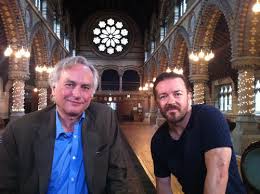
Richard Dawkins and Ricky Gervais

Image result for richard dawkins ricky gervais london

_

Francis Schaeffer below:

Image result for richard dawkins francis schaeffer

Richard Dawkins vs John Lennox | The God Delusion Debate
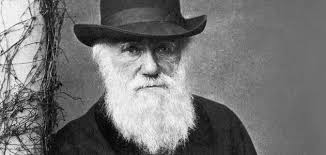
Ben Stein vs. Richard Dawkins Interview


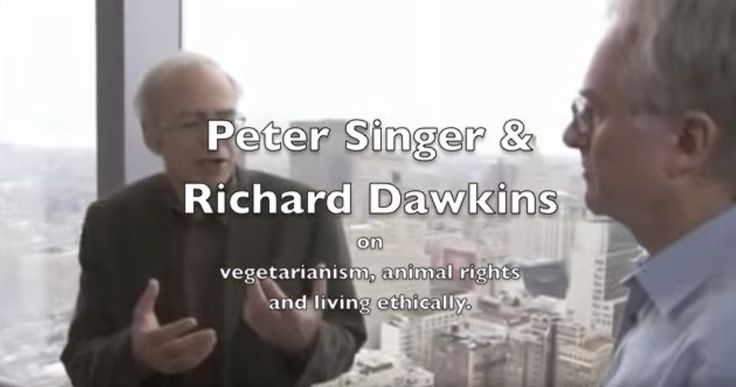
XXXX Peter Singer – The Genius of Darwin: The Uncut Interviews – Richard Dawkins

XXXXXXX

__

Image result for richard dawkins peter singer

__

Science Confirms the Bible with Ken Ham

__

Image result for richard dawkins young

Schaeffer with his wife Edith in Switzerland.


Image result for john lennox and richard dawkins

Richard Dawkins and John Lennox

_

DawkinsWard

_

Francis and Edith Schaeffer seen below:

Image result for francis schaeffer

__

Image result for francis schaeffer c. everett koop whatever happened to human race?

_

Dawkins, Hitchens, Dennett, Harris 

Image result for four horsemen richard dawkins

Canary Islands 2014: Harold Kroto and Richard Dawkins

Image result for harry kroto richard dawkins

__

Francis Schaeffer pictured below:

Image result for francis schaeffer

The Basis of Human Dignity by Francis Schaeffer

Richard Dawkins, founder of the Richard Dawkins Foundation for Reason and Science. Credit: Don Arnold Getty Images

XXXX

September 30, 2019

Richard Dawkins c/o Richard Dawkins Foundation, 
Washington, DC 20005

Dear Mr. Dawkins,

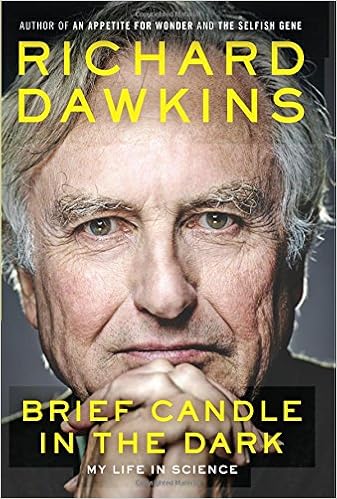
i have enjoyed reading about a dozen of your books and some of the most intriguing were The God DelusionAn Appetite for Wonder: The Making of a Scientist, and Brief Candle in the Dark: My Life in Science.

I am looking forward to reading Outgrowing God which is your latest book, and I have been reading several reviews of it. The best interviewer is Krishnan Guru-Murthy in my opinion. He did a great job of asking you some very insightful questions, and I thought your answers gave the audience a good feel for what is in the book.

I tweeted this out in response to what Dawkins said in the above interview with Krishnan:

Dawkins says Religion was invented to explain why crops failed, but there is evidence that the Bible is true thedailyhatch.org/2019/09/11/how…

Archaeology and the new Atheism:The Plausibility of the Biblical Record,” Apologetic Press. Dewayne Bryant is the author and in the first portion he notes: 

Archaeology demonstrates solid connections between the biblical record and ancient history, in contrast to Christopher Hitchens’ assertion that it is an implausible record. Consider the following:

The Life of Joseph

In the very section of the Bible that Hitchens questions is found some of the most compelling evidence for the historicity of Scripture. As Egyptologist James K. Hoffmeier demonstrates, the story for Joseph rings true with numerous details (Hoffmeier, 1996, pp. 77-98). The 20-shekel price paid for Joseph (Genesis 37:28) is consistent with the price of a slave c. 1700 B.C. Egyptian mummification took about 70 days once the period for mourning was included, which matches the time given for the mummification of Jacob (Genesis 50:3). Examples of non-Egyptians becoming viziers is known from Egyptian sources. Further, it appears that the story of Joseph was put down in writing during the 18th-19th Dynasties in Egypt, the very period during which Moses lived. This idea is borne out by the fact that the Pentateuch uses the name “Pharaoh” (Hebrew phar’oh, Egyptian per-`3) when referring to the king of Egypt. During this time, the term was a generic one referring to the king, similar to referring to the U.S. President as “the White House,” or to the British monarch as “the Crown.” Prior to this time, the name of the king was used, and afterward sources mention the monarch as “Pharaoh X” or “X, king of Egypt”—as in the case of pharaohs Shishak (1 Kings 11:40; 2 Chronicles 12:2) and Neco (2 Kings 23:29).

The United Monarchy

David’s existence has been questioned frequently. Examples of petty monarchs ruling miniscule kingdoms in the Near East find rare mention in ancient sources, yet generally their historicity is taken at face value with minimal skepticism. Even Gilgamesh, the hero of the Epic of Gilgamesh, is thought to have been a historical figure ruling in Mesopotamia between 2600-2700 B.C. based on a reference in the famous Sumerian king list. Yet, David’s historicity is viewed with extreme suspicion, even though there are references to David found in the Tel Dan Inscription and the Moabite Stone, as well as numerous references in the Hebrew Bible. Indeed, Gilgamesh is thought to have been a real person despite being the semi-divine hero in a mythical composition, which also includes such fantastic details as a beast-man named Enkidu, a divinely sent creature of destruction called the Bull of Heaven, and a plant that can grant the person who eats it eternal life. David is frequently labeled a myth despite the solid evidence in favor of his existence.

The Divided Monarchy

Archaeology has vindicated the Bible’s mention of several figures that were once thought to have been fictional. The existence of Sargon (Isaiah 20:1) was questioned until a relief bearing his image was found in the throne room of his capital city of Dur-Sharrukin (“Fort Sargon”). Belshazzar (Daniel 5:1) was likewise questioned because Babylonian documents listed Nabonidus as the last king of the Babylonian empire. Scholars uncovered ancient evidence showing that Belshazzar co-ruled with his father Nabonidus, ruling from the city while Nabonidus sat for 10 years in self-imposed exile. Additional figures such as Sanballat (the governor of Samaria), Tobiah, Geshem (Nehemiah 2:10), and perhaps even Balaam (Numbers 22-24) have all been located in an extrabiblical source called the Deir ‘Alla Inscription written during this period (Mazar, 1990, p. 330).

The Life of Christ

Archaeology does not always mention any one individual, and in the case of Christ, more substantial evidence comes from history rather than archaeology. One significant find is the 1990 discovery of the ossuary (bone box) of Joseph Caiaphas, high priest at the time of Jesus’ trial and crucifixion (John 11:49-53). Jesus is mentioned by the Roman writers Suetonius and Tacitus, the Roman governor Pliny the Younger, and is indirectly referenced by the Greek satirist Lucian of Samosata. He is also noted in a Jewish composition from the fifth century called the Toledoth Jesu, which gives an alternate explanation for the empty tomb from a hostile source. Jesus is far from the “myth” critics claim Him to be.

The Early Church

Inscriptions have revealed the names of numerous individuals mentioned in the New Testament. Gallio, proconsul of Achaia (Acts 18:12-17), is mentioned in an inscription found at the city of Delphi. Paul’s friend Erastus (Acts 19:22) is likely mentioned in an inscription found at Corinth. Sergius Paulus, mentioned as the first convert on the island of Cyprus, was proconsul (a Roman governor) when the apostle Paul visited the island (Acts 13:7). He is mentioned in an inscription found near Paphos (Reed, 2007, p. 13).

After the evidence is surveyed, it is apparent that much of the criticism of the Bible arises—not from intense scrutiny of the evidence—but from ignorance of it. The overwhelming weight of the archaeological and historical evidence firmly places the Bible in the sphere of reality rather than myth.

REFERENCES

Butt, Kyle and Eric Lyons (2006), Behold! The Lamb of God (Montgomery, AL: Apologetics Press).

Dawkins, Richard (2006), The God Delusion(Boston, MA: Houghton Mifflin).

Dever, William (2001), “Excavating the Hebrew Bible or Burying It Again?” Bulletin of the American Schools of Oriental Research, 322: 67-77, May.

Dever, William (2005), Did God Have a Wife? (Grand Rapids, MI: Eerdmans).

Ehrman, Bart (2005), Misquoting Jesus: The Story Behind Who Changed the Bible and Why (New York: HarperSanFrancisco).

Ehrman, Bart (2008), God’s Problem: How the Bible Fails to Answer Our Most Important Question—Why We Suffer (New York: HarperOne).

Ehrman, Bart (2009), Jesus Interrupted: Revealing the Hidden Contradictions in the Bible (and Why We Don’t Know About Them) (New York: HarperOne).

Finkelstein, Israel and Neil Asher Silberman (2001), The Bible Unearthed: Archaeology’s New Vision of Ancient Israel and the Origin of Its Sacred Texts (New York: Free Press).

Garrett, Duane (2000), Rethinking Genesis: The Sources and Authorship of the First Book of the Pentateuch (Geanies House, Fern: Christian Focus Publications).

Haught, John F. (2008), God and the New Atheism: A Critical Response to Dawkins, Harris, and Hitchens (Louisville, KY: Westminster John Knox).

Hitchens, Christopher (2007), God is Not Great: How Religion Poisons Everything(New York: Hachette).

Hoffmeier, James K. (1996), Israel in Egypt: The Evidence for the Authenticity of the Exodus Tradition (Oxford: Oxford University Press).

Jackson, Wayne (1991), “Are There Two Creation Accounts in Genesis?” http://www.apologeticspress.org/articles/2194.

Kaiser, Walt C. Jr. (2001), The Old Testament Documents: Are They Reliable and Relevant? (Downers Grove, IL: IVP).

Kitchen, Kenneth A., trans. (2000) “The Battle of Kadesh—The Poem, or Literary Record,” The Context of Scripture, Volume Two: Monumental Inscriptions Form the Biblical World (Leiden: Brill).

Kitchen, Kenneth A. (2003), On the Reliability of the Old Testament (Grand Rapids: Eerdmans).

Klinghoffer, David (2007), “Prophets of the New Atheism,” http://seattletimes.nwsource.com/html/opinion/2003653502_klinghoffer06.html.

Lazare, Daniel (2002), “False Testament: Archaeology Refutes the Bible’s Claim to History,” Harper’s Magazine, 304/1822:39-47, March.

Levin, Yigal (2002), “Let There Be Light,” Harper’s Magazine, 304[1825]:4, June.

Lucian of Samosata (no date), “The Death of Peregrine,” in H.W. Fowler and F.G. Fowler (1905), The Works of Lucian of Samosata (Oxford: Clarendon Press).

Mazar, Amihai (1990), Archaeology of the Land of the Bible, 10,000-586 B.C.E.(New York: Doubleday).

Meyers, P.Z. (2006), “The Courtier’s Reply,” http://scienceblogs.com/pharyngula/2006/12/the_courtiers_reply.php.

Miller, Dave (2003), “The Genealogies of Matthew and Luke,” http://www.apologeticspress.org/articles/1834.

Mills, David (2006), Atheist Universe: The Thinking Person’s Answer to Christian Fundamentalism (Berkley, CA: Ulysses Press).

Prophet, Sean (2008), “Pastor Acknowledges Arguments of New Atheism,” http://www.blacksunjournal.com/atheism/1397_pastor-acknowledges-arguments-of-new-atheism_2008.html.

Reed, Jonathan (2007), The HarperCollins Visual Guide to the New Testament: What Archaeology Reveals about the First Christians (New York: HarperOne).

Sherwin-White, Adrian Nicholas (1963), Roman Society and Roman Law in the New Testament(Oxford: Clarendon).

Wolf, Gary (2006), “Church of the Non-Believers,” http://www.wired.com/wired/archive/14.11/atheism.html

EDITOR’S NOTES: The original article can be found at: http://www.apologeticspress.org/apPubPage.aspx?pub=1&issue=968

As of April 8, 2011, Dewayne Bryant holds two Masters degrees, and is completing Masters study in Ancient Near Eastern Archaeology and Languages at Trinity Evangelical Divinity School, while pursuing doctoral studies at Amridge University. He has participated in an archaeological dig at Tell El-Borg in Egypt and holds professional membership in the American Schools of Oriental Research, the Society of Biblical Literature, and the Archaeological Institute of America.

<!–

Francis Schaeffer has correctly argued:

The universe was created by an infinite personal God and He brought it into existence by spoken word and made man in His own image. When man tries to reduce [philosophically in a materialistic point of view] himself to less than this [less than being made in the image of God] he will always fail and he will always be willing to make these impossible leaps into the area of nonreason even though they don’t give an answer simply because that isn’t what he is. He himself testifies that this infinite personal God, the God of the Old and New Testament is there. 

Instead of making a leap into the area of nonreason the better choice would be to investigate the claims that the Bible is a historically accurate book and that God created the universe and reached out to humankind with the Bible. Below is a piece of that evidence given by Francis Schaeffer concerning the accuracy of the Bible.

TRUTH AND HISTORY (chapter 5 of WHATEVER HAPPENED TO THE HUMAN RACE?, under footnote #94)

Consider, too, the threat in the entire Middle East from the power of Assyria. In 853 B.C. King Shalmaneser III of Assyria came west from the region of the Euphrates River, only to be successfully repulsed by a determined alliance of all the states in that area of the Battle of Qarqar. Shalmaneser’s record gives details of the alliance. In these he includes Ahab, who he tells us put 2000 chariots and 10,000 infantry into the battle. However, after Ahab’s death, Samaria was no longer strong enough to retain control, and Moab under King Mesha declared its independence, as II Kings 3:4,5 makes clear:

Now Mesha king of Moab was a sheep breeder, and he had to deliver to the king of Israel 100,000 lambs and the wool of 100,000 rams. But when Ahab died, the king of Moab rebelled against the king of Israel.

The famous Moabite (Mesha) Stone, now in the Louvre, bears an inscription which testifies to Mesha’s reality and of his success in throwing off the yoke of Israel. This is an inscribed black basalt stela, about four feet high, two feet wide, and several inches thick.

Ahab’s line did not last long and was brutally overthrown by a man called Jehu. As one walks toward the Assyrian section in the British Museum, one of the first exhibits to be seen is the famous Black Obelisk. This stands about six feet high and was discovered at Nimrud (Calah) near the Assyrian capital at Nineveh. It describes how King Shalmeneser III compelled Jehu to submit to his authority and to pay him tribute. Here one can see a representation of the kneeling figure of either Jehu or his envoy before the Assyrian king. The inscription tells of Jehu’s submission: “The tribute of Jehu, son of Omri: I received from him silver, gold, a golden bowl, a golden vase with pointed bottom, golden tumblers, golden buckets, tin, a staff for a king and purukhti fruits.”

Jehu is referred to by the Assyrian records as a son of Omri, not because he was literally his son, but because he was on the throne which had been occupied previously by the house of Omri. This event took place about 841 B.C.

Putting them all together, these archaeological records show not only the existence historically of the people and events recorded in the Bible but the great accuracy of the details involved.

The answer to find meaning in life is found in putting your faith and trust in Jesus Christ. The Bible is true from cover to cover and can be trusted.

Thank you again for your time and I know how busy you are.

Everette Hatcher, everettehatcher@gmail.comhttp://www.thedailyhatch.org, cell ph 501-920-5733, Box 23416, LittleRock, AR 72221, United States

XXXXXXX

Francis Schaeffer in 1984

Christian Manifesto by Francis Schaeffer

Francis Schaeffer in 1982

—-

Whatever Happened to the Human Race? Episode 1

Image result for richard dawkins brief candle in the dark

Garik Israelian, Stephen Hawking, Alexey Leonov, Brian May, Richard Dawkins and Harry Kroto

—-

—-

—-

Dark History of Evolution-Henry Morris, Ph.D.

—-

_

Featured artist is René Magritte

From Wikipedia, the free encyclopediaJump to navigationJump to search“Magritte” redirects here. For the asteroid named after the artist, see 7933 Magritte.

René Magritte
Portrait of Magritte in front of his painting The Pilgrim, taken by Lothar Wolleh in 1967
BornRené François Ghislain Magritte
21 November 1898
Lessines, Belgium
Died15 August 1967 (aged 68)
Brussels, Belgium
NationalityBelgian
Known forPainter
Notable workThe Treachery of Images
The Son of Man
The Human Condition
Golconda
The Menaced Assassin
MovementSurrealism

We ask you, humbly, to help. Hi, reader in the U.S., it seems you use Wikipedia a lot; that’s great! It’s a little awkward to ask, but this Thursday we need your help. Time is running out in 2019 to help us. We’re a non-profit and we don’t have salespeople. We depend on donations averaging $16.36, and fewer than 2% of readers give. If you donate just $2.75, the price of your Thursday coffee, Wikipedia could keep thriving. Thank you.Please select a payment method

  •    

MAYBE LATER  CLOSE 

René François Ghislain Magritte (French: [ʁəne fʁɑ̃swa ɡilɛ̃ maɡʁit]; 21 November 1898 – 15 August 1967) was a Belgian Surrealist artist. He became well known for creating a number of witty and thought-provoking images. Often depicting ordinary objects in an unusual context, his work is known for challenging observers’ preconditioned perceptions of reality. His imagery has influenced pop artminimalist art and conceptual art.

Contents

Early life[edit]

René Magritte was born in Lessines, in the province of Hainaut, Belgium, in 1898. He was the oldest son of Léopold Magritte, a tailor and textile merchant,[1] and Régina (née Bertinchamps), who was a milliner before she got married. Little is known about Magritte’s early life. He began lessons in drawing in 1910.

On 12 March 1912, his mother committed suicide by drowning herself in the River Sambre. This was not her first attempt at taking her own life; she had made many over a number of years, driving her husband Léopold to lock her into her bedroom. One day she escaped, and was missing for days. Her body was later discovered a mile or so down the nearby river.

According to a legend, 13-year-old Magritte was present when her body was retrieved from the water, but recent research has discredited this story, which may have originated with the family nurse.[2] Supposedly, when his mother was found, her dress was covering her face, an image that has been suggested as the source of several of Magritte’s paintings in 1927–1928 of people with cloth obscuring their faces, including Les Amants.[3]

Career[edit]

Magritte’s earliest paintings, which date from about 1915, were Impressionistic in style.[2] During 1916–1918, he studied at the Académie Royale des Beaux-Arts in Brussels,[4] under Constant Montald, but found the instruction uninspiring.[2] He also took classes at the Académie Royale from the painter and poster designer Gisbert Combaz.[5] The paintings he produced during 1918–1924 were influenced by Futurism and by the figurative Cubism of Metzinger.[2]

From December 1920 until September 1921, Magritte served in the Belgian infantry in the Flemish town of Beverlo near Leopoldsburg. In 1922, Magritte married Georgette Berger, whom he had met as a child in 1913.[1] Also during 1922, the poet Marcel Lecomte showed Magritte a reproduction of Giorgio de Chirico‘s “The Song of Love” (painted in 1914). The work brought Magritte to tears; he described this as “one of the most moving moments of my life: my eyes saw thought for the first time.”[6]

In 1922–1923, Magritte worked as a draughtsman in a wallpaper factory, and was a poster and advertisement designer until 1926, when a contract with Galerie Le Centaure in Brussels made it possible for him to paint full-time. In 1926, Magritte produced his first surreal painting, The Lost Jockey (Le jockey perdu), and held his first solo exhibition in Brussels in 1927.[4] Critics heaped abuse on the exhibition.

Depressed by the failure, he moved to Paris where he became friends with André Breton and became involved in the Surrealist group. An illusionistic, dream-like quality is characteristic of Magritte’s version of Surrealism. He became a leading member of the movement, and remained in Paris for three years.[7] In 1929 he exhibited at Goemans Gallery in Paris with Salvador DalíJean Arp, de Chirico, Max ErnstJoan MiróPicabiaPicasso and Yves Tanguy.

On 15 December 1929 he participated in the last publication of La Revolution Surrealiste No. 12, where he published his essay “Les mots et les images”, where words play with images in sync with his work The Treachery of images.[8]

Galerie Le Centaure closed at the end of 1929, ending Magritte’s contract income. Having made little impact in Paris, Magritte returned to Brussels in 1930 and resumed working in advertising.[9] He and his brother, Paul, formed an agency which earned him a living wage. In 1932, Magritte joined the Communist Party, which he would periodically leave and rejoin for several years.[9] In 1936 he had his first solo exhibition in the United States at the Julien Levy Gallery in New York, followed by an exposition at the London Gallery in 1938.

During the early stages of his career, the British surrealist patron Edward James allowed Magritte to stay rent-free in his London home, where Magritte studied architecture and painted. James is featured in two of Magritte’s works painted in 1937, Le Principe du Plaisir (The Pleasure Principle) and La Reproduction Interdite, a painting also known as Not to Be Reproduced.[10]

During the German occupation of Belgium in World War II he remained in Brussels, which led to a break with Breton. He briefly adopted a colorful, painterly style in 1943–44, an interlude known as his “Renoir period”, as a reaction to his feelings of alienation and abandonment that came with living in German-occupied Belgium.

In 1946, renouncing the violence and pessimism of his earlier work, he joined several other Belgian artists in signing the manifesto Surrealism in Full Sunlight.[11] During 1947–48, Magritte’s “Vache period,” he painted in a provocative and crude Fauve style. During this time, Magritte supported himself through the production of fake Picassos, Braques, and de Chiricos—a fraudulent repertoire he was later to expand into the printing of forged banknotes during the lean postwar period. This venture was undertaken alongside his brother Paul and fellow Surrealist and “surrogate son” Marcel Mariën, to whom had fallen the task of selling the forgeries.[12] At the end of 1948, Magritte returned to the style and themes of his pre-war surrealistic art.

In France, Magritte’s work has been showcased in a number of retrospective exhibitions, most recently at the Centre Georges Pompidou (2016–2017). In the United States his work has been featured in three retrospective exhibitions: at the Museum of Modern Art in 1965, at the Metropolitan Museum of Art in 1992, and again at the Metropolitan Museum of Art in 2013. An exhibition entitled “The Fifth Season” at the San Francisco Museum of Modern Art in 2018 focused on the work of his later years.

Politically, Magritte stood to the left, and retained close ties to the Communist Party, even in the post-war years. However, he was critical of the functionalist cultural policy of the Communist left, stating that “Class consciousness is as necessary as bread; but that does not mean that workers must be condemned to bread and water and that wanting chicken and champagne would be harmful. (…) For the Communist painter, the justification of artistic activity is to create pictures that can represent mental luxury.” While remaining committed to the political left, he thus advocated a certain autonomy of art.[13][14] Spiritually, Magritte was an agnostic.[15]

Popular interest in Magritte’s work rose considerably in the 1960s, and his imagery has influenced popminimalist, and conceptual art.[16] In 2005 he was 9th in the Walloon version of De Grootste Belg (The Greatest Belgian); in the Flemish version he was 18th.

Personal life[edit]

Magritte married Georgette Berger in June 1922. Georgette was the daughter of a butcher in Charleroi, and first met Magritte when she was 13 and he was 15. They met again 7 years later in Brussels in 1920[17] and Georgette, who had also studied art, became Magritte’s model, muse, and wife.

In 1936 Magritte’s marriage became troubled when he met a young performance artist, Sheila Legge, and began an affair with her. Magritte arranged for his friend, Paul Colinet, to entertain and distract Georgette, but this led to an affair between Georgette and Colinet. Magritte and his wife did not reconcile until 1940.[18]

Magritte died of pancreatic cancer on 15 August 1967, aged 68, and was interred in Schaerbeek CemeteryEvere, Brussels.

Philosophical and artistic gestures[edit]

The Empire of Light, c. 1950–1954, Museum of Modern ArtIt is a union that suggests the essential mystery of the world. Art for me is not an end in itself, but a means of evoking that mystery.

René Magritte on putting seemingly unrelated objects together in juxtaposition[19]

Magritte’s work frequently displays a collection of ordinary objects in an unusual context, giving new meanings to familiar things. The use of objects as other than what they seem is typified in his painting,[20] The Treachery of Images (La trahison des images), which shows a pipe that looks as though it is a model for a tobacco store advertisement. Magritte painted below the pipe “Ceci n’est pas une pipe” (“This is not a pipe”),[21] which seems a contradiction, but is actually true: the painting is not a pipe, it is an image of a pipe. It does not “satisfy emotionally”—when Magritte was once asked about this image, he replied that of course it was not a pipe, just try to fill it with tobacco.[22]

Ceci n’est pas une pipeMENU0:00A man saying the phrase Ceci n’est pas une pipe
Problems playing this file? See media help.

Magritte used the same approach in a painting of an apple: he painted the fruit and then used an internal caption or framing device to deny that the item was an apple. In these “Ceci n’est pas” works, Magritte points out that no matter how naturalistically we depict an object, we never do catch the item itself.

Among Magritte’s works are a number of surrealist versions of other famous paintings. Elsewhere, Magritte challenges the difficulty of artwork to convey meaning with a recurring motif of an easel, as in his The Human Condition series (1933, 1935) or The Promenades of Euclid (1955), wherein the spires of a castle are “painted” upon the ordinary streets which the canvas overlooks. In a letter to André Breton, he wrote of The Human Condition that it was irrelevant if the scene behind the easel differed from what was depicted upon it, “but the main thing was to eliminate the difference between a view seen from outside and from inside a room.”[23] The windows in some of these pictures are framed with heavy drapes, suggesting a theatrical motif.[24]

Magritte’s style of surrealism is more representational than the “automatic” style of artists such as Joan Miró. Magritte’s use of ordinary objects in unfamiliar spaces is joined to his desire to create poetic imagery. He described the act of painting as “the art of putting colors side by side in such a way that their real aspect is effaced, so that familiar objects—the sky, people, trees, mountains, furniture, the stars, solid structures, graffiti—become united in a single poetically disciplined image. The poetry of this image dispenses with any symbolic significance, old or new.”[25]

René Magritte described his paintings as “visible images which conceal nothing; they evoke mystery and, indeed, when one sees one of my pictures, one asks oneself this simple question, ‘What does that mean?’. It does not mean anything, because mystery means nothing either, it is unknowable.”[26]

Magritte’s constant play with reality and illusion has been attributed to the early death of his mother. Psychoanalysts who have examined bereaved children have hypothesized that Magritte’s back and forth play with reality and illusion reflects his “constant shifting back and forth from what he wishes—’mother is alive’—to what he knows—’mother is dead’.”[27]

Artists influenced by Magritte[edit]

Contemporary artists have been greatly influenced by René Magritte’s stimulating examination of the fickleness of images. Some artists who have been influenced by Magritte’s works include John BaldessariEd RuschaAndy WarholJasper JohnsJan VerdoodtMartin KippenbergerDuane MichalsStorm Thorgerson, and Luis Rey. Some of the artists’ works integrate direct references and others offer contemporary viewpoints on his abstract fixations.[28]

Magritte’s use of simple graphic and everyday imagery has been compared to that of the pop artists. His influence in the development of pop art has been widely recognized,[29] although Magritte himself discounted the connection. He considered the pop artists’ representation of “the world as it is” as “their error,” and contrasted their attention to the transitory with his concern for “the feeling for the real, insofar as it is permanent.”[29] The 2006–2007 LACMA exhibition “Magritte and Contemporary Art: The Treachery of Images” examined the relationship between Magritte and contemporary art.[30]

In popular culture[edit]

500 francs showing portrait of Magritte

The 1960s brought a great increase in public awareness of Magritte’s work.[16] Thanks to his “sound knowledge of how to present objects in a manner both suggestive and questioning”, his works have been frequently adapted or plagiarized in advertisements, posters, book covers and the like.[31] Examples include album covers such as Beck-Ola by The Jeff Beck Group (reproducing Magritte’s The Listening Room), Alan Hull‘s 1973 album Pipedream which used The Philosopher’s LampJackson Browne‘s 1974 album Late for the Sky, with artwork inspired by The Empire of LightOregon‘s album Oregon referring to Carte Blanche, the Firesign Theatre‘s album Just Folks… A Firesign Chat based on The Mysteries of the Horizon, and Styx‘s album The Grand Illusion incorporating an adaptation of the painting The Blank Check. The Nigerian rapper Jesse Jagz’s 2014 album Jagz Nation Vol. 2: Royal Niger Company has cover art inspired by Magritte’s works.[32] In 2015 the band Punch Brothers used The Lovers as the cover of their album The Phosphorescent Blues.

The logo of Apple CorpsThe Beatles‘ company, is inspired by Magritte’s Le Jeu de Mourre, a 1966 painting.

Paul Simon‘s song “Rene and Georgette Magritte with Their Dog after the War,” inspired by a photograph of Magritte by Lothar Wolleh, appears on the 1983 album Hearts and Bones.

John Cale wrote a song titled “Magritte”. The song appears on the 2003 album HoboSapiens.

Tom Stoppard wrote a Surrealist play called After Magritte.

John Berger scripted the book Ways of Seeing using images and ideologies regarding Magritte. Douglas Hofstadter‘s book Gödel, Escher, Bach uses Magritte works for many of its illustrations. The Treachery of Images was used in a major plot in L. J. Smith‘s The Forbidden Game.

Magritte’s imagery has inspired filmmakers ranging from the surrealist Marcel Mariën to mainstream directors such as Jean-Luc GodardAlain Robbe-GrilletBernardo BertolucciNicolas RoegJohn Boorman and Terry Gilliam.[33][34][35]

According to Ellen Burstyn, in the 1998 documentary The Fear of God: 25 Years of “The Exorcist”, the iconic poster shot for the film The Exorcist was inspired by Magritte’s L’Empire des Lumières.

In the 1992 movie Toys, Magritte’s work was influential in the entire movie but specifically in a break-in scene, featuring Robin Williams and Joan Cusack in a music video hoax. Many of Magritte’s works were used directly in that scene.

In the 1999 movie The Thomas Crown Affair starring Pierce BrosnanRene Russo and Denis Leary, the Magritte painting The Son of Man was prominently featured as part of the plot line.

Gary Numan‘s 1979 album The Pleasure Principle was a reference to Magritte’s painting of the same name.

In John Green’s fictional novel (2012) and movie (2014), The Fault In Our Stars, the main character Hazel Grace Lancaster wears a tee shirt with Magritte’s, The Treachery of Images, (This is not a pipe.) Just prior to leaving her mother to visit her favorite author, Hazel explains the drawing to her confused mother and states that the author’s novel has “several Magritte references”, clearly hoping the author will be pleased with the reference.

The official music video of Markus Schulz‘s “Koolhaus” under his Dakota guise was inspired from Magritte’s works.[36]

A street in Brussels has been named Ceci n’est pas une rue (This is not a street).[37]

Magritte Museum[edit]

Main article: Magritte Museum

The Magritte Museum opened to the public on 30 May 2009 in Brussels.[38] Housed in the five-level neo-classical Hotel Altenloh, on the Place Royale, it displays some 200 original Magritte paintings, drawings and sculptures[39] including The ReturnScheherazade and The Empire of Lights.[40] This multidisciplinary permanent installation is the biggest Magritte archive anywhere and most of the work is directly from the collection of the artist’s widow, Georgette Magritte, and from Irene Hamoir Scutenaire, who was his primary collector.[41] Additionally, the museum includes Magritte’s experiments with photography from 1920 on and the short Surrealist films he made from 1956 on.[41]

Another museum is located at 135 Rue Esseghem in Brussels in Magritte’s former home, where he lived with his wife from 1930 to 1954. A painting, Olympia (1948), a nude portrait of Magritte’s wife by Magritte, was stolen from this museum on the morning of 24 September 2009 by two armed men. The stolen work is said to be worth about US$1.1 million.[42][43][44] Olympia was returned to the museum early January 2012. The thieves returned the painting because they were unable to sell it on the black market due to its fame.[45]

Selected list of works[edit]

  • 1920 Landscape
  • 1922 The Station and L’Écuyère
  • 1923 Self-portraitSixth NocturneGeorgette at the Piano and Donna
  • 1925 The Bather and The Window
  • 1926 The Lost JockeyThe Mind of the TravelerSensational NewsThe Difficult CrossingThe Vestal’s AgonyThe Midnight MarriageThe Musings of a Solitary WalkerAfter the Water my ButtsPopular PanoramaLandscape and The Encounter
  • 1927 The Enchanted Pose
  • 1927 Young Girl Eating a BirdThe Oasis (started in 1925), Le Double SecretThe Meaning of NightLet Out of SchoolThe Man from the SeaThe Tiredness of LifeThe Light-breakerA Passion for LightThe Menaced AssassinReckless SleeperLa VoleuseThe Fast HopeL’Atlantide and The Muscles of the Sky
  • 1928 The Lining of Sleep (started in 1927), Intermission (started in 1927), The Adulation of Space (started in 1927), The Flowers of the AbyssDiscoveryThe Lovers I & II,[3] The Voice of SpaceThe False MirrorThe Daring SleeperThe Acrobat’s IdeasThe AutomatonThe Empty MaskReckless SleeperThe Secret Life and Attempting the Impossible
  • 1929 The Treachery of Images (started in 1928), Threatening Weather and On the Threshold of Liberty
  • 1930 Pink Belles, Tattered SkiesThe Eternally ObviousThe LifelineThe Annunciation and Celestial Perfections
  • 1931 The Voice of the AirSummer and The Giantess
  • 1932 The Universe Unmasked
  • 1933 Elective AffinitiesThe Human Condition and The Unexpected Answer
  • 1934 The Rape
  • 1935 The Discovery of FireThe Human ConditionRevolutionPerpetual MotionCollective Invention and The Portrait
  • 1936 Surprise AnswerClairvoyanceThe HealerThe Philosopher’s LampSpiritual ExercisesPortrait of Irène HamoirLa Méditation and Forbidden Literature
  • 1937 The Future of StatuesThe Black FlagNot to be ReproducedPortrait of Edward James and Portrait of Rena SchitzOn the Threshold of Liberty
  • 1938 Time TransfixedThe Domain of Arnheim and Steps of Summer
  • 1939 VictoryThe Palace of Memories
  • 1940 The ReturnThe Wedding Breakfast and Les Grandes Espérances
  • 1941 The Break in the Clouds
  • 1942 Misses de L’Isle AdamL’Ile au TrésonMemoryBlack MagicLes compagnons de la peur and The Misanthropes
  • 1943 The Return of the FlameUniversal Gravitation and Monsieur Ingres’s Good Days
  • 1944 The Good Omens
  • 1945 Treasure IslandLes Rencontres Naturelles and Black Magic
  • 1946 L’Intelligence and Les Mille et une Nuits
  • 1947 La Philosophie dans le boudoirThe CiceroneThe LiberatorThe Fair CaptiveLa Part du Feu and The Red Model
  • 1948 Blood Will TellMemoryThe Mountain DwellerThe Art of LifeThe Pebble,The Lost JockeyGod’s SolonShéhérazadeL’Ellipse and Famine and The Taste of Sorrow
  • 1949 MegalomaniaElementary Cosmogany, and Perspective, the Balcony
  • 1950 Making an EntranceThe Legend of the CenturiesTowards PleasureThe Labors of AlexanderThe Empire of Light IIThe Fair Captive and The Art of ConversationThe Survivor
  • 1951 David’s Madame Récamier (parodying the Portrait of Madame Récamier), Pandora’s BoxThe Song of the VioletThe Spring Tide and The Smile
  • 1952 Personal V

—-

Related posts:

RESPONDING TO HARRY KROTO’S BRILLIANT RENOWNED ACADEMICS!! Part 48 Nobel Prize Winner and Global Warming Denier Ivar Giaever “I think religion is to blame for a lot of the ills in this world!”

October 20, 2015 – 5:20 am

  On November 21, 2014 I received a letter from Nobel Laureate Harry Kroto and it said: …Please click on this URL http://vimeo.com/26991975 and you will hear what far smarter people than I have to say on this matter. I agree with them. Harry Kroto _________________ Below you have picture of 1996 Chemistry Nobel Prize Winner […]

FRANCIS SCHAEFFER ANALYZES ART AND CULTURE PART 78 THE BEATLES (Breaking down the song TOMORROW NEVER KNOWS) Featured musical artist is Stuart Gerber

September 24, 2015 – 5:42 am

The Beatles were “inspired by the musique concrète of German composer and early electronic music pioneer Karlheinz Stockhausen…”  as SCOTT THILL has asserted. Francis Schaeffer noted that ideas of  “Non-resolution” and “Fragmentation” came down German and French streams with the influence of Beethoven’s last Quartets and then the influence of Debussy and later Schoenberg’s non-resolution which is in total contrast […]

RESPONDING TO HARRY KROTO’S BRILLIANT RENOWNED ACADEMICS!! Part 42 Peter Singer, Professor of Bioethics at Princeton University, THE PROBLEM OF EVIL

September 8, 2015 – 5:10 am

  _______ On November 21, 2014 I received a letter from Nobel Laureate Harry Kroto and it said: …Please click on this URL http://vimeo.com/26991975 and you will hear what far smarter people than I have to say on this matter. I agree with them. Harry Kroto _________________ Below you have picture of 1996 Chemistry Nobel Prize […]

RESPONDING TO HARRY KROTO’S BRILLIANT RENOWNED ACADEMICS!! Bart Ehrman “Why should one think that God performed the miracle of inspiring the words in the first place if He didn’t perform the miracle of preserving the words?”

September 2, 2015 – 8:42 am

On November 21, 2014 I received a letter from Nobel Laureate Harry Kroto and it said: …Please click on this URL http://vimeo.com/26991975 and you will hear what far smarter people than I have to say on this matter. I agree with them. Harry Kroto ____________________ Below you have picture of 1996 Chemistry Nobel Prize Winner Dr. […]

RESPONDING TO HARRY KROTO’S BRILLIANT RENOWNED ACADEMICS!! Part 159 P “Open letter to Harry Kroto’s friend Richard Dawkins” Page 285 of THE GOD DELUSION: Steven Weinberg said, “Religion is an insult to human dignity.”

Canary Islands 2014: Harold Kroto and Richard Dawkins

Image result for harry kroto richard dawkins

_

On November 21, 2014 I received a letter from Nobel Laureate Harry Kroto and it said:

…Please click on this URL http://vimeo.com/26991975

and you will hear what far smarter people than I have to say on this matter. I agree with them.

Harry Kroto

Nick Gathergood, David-Birkett, Harry-Kroto

Image result for harry kroto richard dawkins

I have attempted to respond to all of Dr. Kroto’s friends arguments and I have posted my responses one per week for over a year now. Here are some of my earlier posts:

Arif Ahmed, Sir David AttenboroughMark Balaguer, Horace Barlow, Michael BatePatricia ChurchlandAaron CiechanoverNoam Chomsky,Alan DershowitzHubert DreyfusBart Ehrman, Stephan FeuchtwangDavid Friend,  Riccardo GiacconiIvar Giaever , Roy GlauberRebecca GoldsteinDavid J. Gross Brian Greene, Susan GreenfieldStephen F Gudeman,  Alan Guth, Jonathan HaidtTheodor W. HänschBrian Harrison,  Hermann HauserRoald Hoffmann,  Bruce HoodHerbert Huppert,  Gareth Stedman JonesSteve JonesShelly KaganMichio Kaku,  Stuart Kauffman,  Lawrence KraussHarry KrotoGeorge LakoffElizabeth Loftus,  Alan MacfarlanePeter MillicanMarvin MinskyLeonard Mlodinow Yujin NagasawaAlva NoeDouglas Osheroff,  Jonathan Parry,  Saul PerlmutterHerman PhilipseCarolyn PorcoRobert M. PriceLisa RandallLord Martin Rees,  Oliver SacksJohn SearleMarcus du SautoySimon SchafferJ. L. Schellenberg,   Lee Silver Peter Singer,  Walter Sinnott-ArmstrongRonald de SousaVictor StengerBarry Supple,   Leonard SusskindRaymond TallisNeil deGrasse Tyson,  .Alexander VilenkinSir John WalkerFrank WilczekSteven Weinberg, and  Lewis Wolpert,

In  the second video below in the 67th clip in this series are Richard Dawkins’ words that Harry Kroto wanted me to see. Since then I have read several of Richard Dawkins books and have attempted to respond to the contents of these books directly to Richard Dawkins by mail. In fact, I have been writing Richard Dawkins letters since May 15, 1994 which was the 10th anniversary of the passing of one of my heroes, Francis Schaeffer. Francis Schaeffer spent a lot of time responding to many of Richard Dawkins’ heroes such as Carl Sagan, Jacques Monod, H.J. Blackham, Isaac Newton, Ludwig Wittgenstein, Max Planck, Johann Sebastian Bach, Francis Bacon, Samuel Beckett, Leonardo Da Vinci, Albert Einstein, Michael Faraday, Gerald Horton, Edmund Leach, Louis Pasteur, George Wald, Jacob Bronowski, Steven Weinberg, Charles Darwin, Paul Kurtz, Peter Singer, Jonathan Miller, William B. Provine, Woody Allen, Noam Chomsky, James D. Watson, Francis Crick, Michael Polanyi, The Huxley family, Antony Flew, and Edward O. Wilson (Dawkins has since revised his opinion of Flew and Wilson, but he earlier regarded them very highly). 

Image result for francis schaeffer
Francis Schaeffer 1911-1984

_

Image result for antony flew

_

Both Francis Schaeffer and Richard Dawkins have talked extensively about the life of Charles Darwin.

Image result for charles darwin

_

Sir Harry Kroto with his high school friend Sir Ian McKellan at the FSU National High Field Magnetic Lab on Tuesday, October 27, 2009.

Image result for harry kroto richard dawkins

50 Renowned Academics Speaking About God (Part 1)

_

Another 50 Renowned Academics Speaking About God (Part 2)

_

_

Edit Post ‹ The Daily Hatch — WordPress

A Further 50 Renowned Academics Speaking About God (Part 3)

_

Richard Dawkins Photos Photos – Professor Stephen Hawking Unveils Medal For Science Communication – Zimbio

Professor Stephen Hawking Unveils Medal For Science Communication

Professor Stephen Hawking Unveils Medal For Science Communication In This Photo: Richard Dawkins, Stephen Hawking, Brian May, Harold Kroto, Alexi Leonov, Garik Israelian

__

Richard Dawkins, founder of the Richard Dawkins Foundation for Reason and Science. Credit: Don Arnold Getty Images

July 30, 2019

Richard Dawkins c/o Richard Dawkins Foundation, 
Washington, DC 20005

Dear Mr. Dawkins,

Page 285 of THE GOD DELUSION: Steven Weinberg said, “Religion is an insult to human dignity.”

Weinberg also said:  “The more the universe seems comprehensible, the more it also seems pointless.”

I have a challenge for you, Dr. Dawkins. I bet I have read more of your friend Steven Weinberg’s books than you have!!!

I used to tell people that DREAMS OF A FINAL THEORY was his best book but then I read TO EXPLAIN THE WORLD which was even better. The ironic thing is I am halfway through THIRD THOUGHTS so I must suspend judgement until I finish it.

I first found out in 1979 about Steven Weinberg’s book THE THREE MINUTES when I read this passage from the book WHATEVER HAPPENED TO THE HUMAN RACE? By Francis Schaeffer and Dr. C. Everett Koop:

The Meaningless of All Things

An  overwhelming number of modern thinkers agree that seeing the universe and man from a humanist base leads to meaninglessness, both for the universe and for man – not just mankind in general but for each of us as individuals. Professor Steven Weinberg of Harvard University and the Smithsonian Astrophysical Observatory has written a book entitled The First Three Minutes: A Modern View of the Origin of the Universe (1976). Here he explains, as clearly as probably anyone has ever done, the modern materialistic view of the universe and its origin.
But when his explanation is finished and he is looking down at the earth from an airplane, as Weinberg writes, “It is very hard to realize that this all is just a tiny part of an overwhelmingly hostile universe … [which] has evolved from an unspeakably unfamiliar early condition, and faces a future extinction of endless cold or intolerable heat. The more the universe seems comprehensible, the more it also seems pointless.”86
When Weinberg says that the universe seems more “comprehensible,” he is, of course, referring to our greater understanding of the physical universe through the advance of science. But it is an understanding, notice, within, a materialistic framework, which considers the universe solely in terms of physics and chemistry – simply machinery. Here lies the irony. It is comprehension of a sort, but it is like giving a blind person sight, only to remove anything seeable. As we heard Woody Allensaying earlier, such a view of reality is “absolutely stupefying in its terror, and it renders anyone’s accomplishments meaningless.”
So, to the person who wants to be left alone without explanations for the big questions, we must say very gently, “Look at what you are left alone with.” This is not merely rhetoric. As the decades of this century have slipped by, more and more have said the same thing as Steven Weinberg and Woody Allen. It has become an obvious thing to say. The tremendous optimism of the nineteenth century, which stemmed from the Enlightenment of the eighteenth century, has gradually ebbed away.
If everything “faces a future extinction of endless cold or intolerable heat,” all things are meaningless. This is the first problem, the first form of pollution. The second is just as bad.

One trend I have noticed among modern scholars and that have become more and more pessimistic. (No where is this demonstrated better than in the beginning of the episode THE AGE OF NONREASON which can be seen on YouTube under the title How Should We then Live Episode 7 small (Age of Nonreason).  Also Francis Schaeffer in his book WHATEVER HAPPENED TO THE HUMAN RACE? points out that Steven Weinberg has discussed the issue of the meaningless and pointlessnessof life.

Many modern artists are left in this point of desperation that Schaeffer points out and it reminds me of the despair that Solomon speaks of in Ecclesiastes.  Christian scholar Ravi Zacharias has noted, “The key to understanding the Book of Ecclesiastes is the term ‘under the sun.’ What that literally means is you lock God out of a closed system, and you are left with only this world of time plus chance plus matter.” THIS IS EXACT POINTSCHAEFFERSAYS SECULAR ARTISTS ARE PAINTING FROMTODAY BECAUSE THEY BELIEVED ARE A RESULT OF MINDLESS CHANCE.

In 1978 I heard the song “Dust in the Wind” by Kansas when it rose to #6 on the charts. That song told me thatKerry Livgren the writer of that song and a member of Kansas had come to the same conclusion that Solomon had. I remember mentioning to my friends at church that we may soon see some members of Kansas become Christians because their search for the meaning of life had obviously come up empty even though they had risen from being an unknown band to the top of the music business and had all the wealth and fame that came with that. Furthermore, like Solomon and Coldplay, they realized death comes to everyone and “there must be something more.”

Livgren wrote:

“All we do, crumbles to the ground though we refuse to see, Dust in the Wind, All we are is dust in the wind, Don’t hang on, Nothing lasts forever but the Earth and Sky, It slips away, And all your money won’t another minute buy.”

Both Kerry Livgren and Dave Hope of Kansas became Christians eventually. Kerry Livgren first tried Eastern Religions and Dave Hope had to come out of a heavy drug addiction. I was shocked and elated to see their personal testimony on The 700 Club in 1981 and that same  interview can be seen on youtube today. Livgren lives in Topeka, Kansas today where he teaches “Diggers,” a Sunday school class at Topeka Bible Church. Hope is the head of Worship, Evangelism and Outreach at Immanuel Anglican Church in Destin, Florida.

The movie maker Woody Allen has embraced the nihilistic message of the song “Dust in the Wind” by Kansas. David Segal in his article, “Things are Looking Up for the Director Woody Allen. No?” (Washington Post, July 26, 2006), wrote, “Allen is evangelically passionate about a few subjects. None more so than the chilling emptiness of life…The 70-year-old writer and director has been musing about life, sex, work, death and his generally futile search for hope…the world according to Woody is so bereft of meaning, so godless and absurd, that the only proper response is to curl up on a sofa and howl for your mommy.”

The song “Dust in the Wind” recommends, “Don’t hang on.” Allen himself says, “It’s just an awful thing and in that context you’ve got to find an answer to the question: ‘Why go on?’ ”  It is ironic that Chris Martin the leader of Coldplay regards Woody Allen as his favorite director.

Lets sum up the final conclusions of these gentlemen:  Coldplay is still searching for that “something more.” Woody Allen has concluded the search is futile. Livgren and Hope of Kansas have become Christians and are involved in fulltime ministry. Solomon’s experiment was a search for meaning to life “under the sun.” Then in last few words in the Book of Ecclesiastes he looks above the sun and brings God back into the picture: “The conclusion, when all has been heard, is: Fear God and keep His commandments, because this applies to every person. For God will bring every act to judgment, everything which is hidden, whether it is good or evil.”

The answer to find meaning in life is found in putting your faith and trust in Jesus Christ. The Bible is true from cover to cover and can be trusted.

Thank you again for your time and I know how busy you are.

Everette Hatcher, everettehatcher@gmail.comhttp://www.thedailyhatch.org, cell ph 501-920-5733, Box 23416, LittleRock, AR 72221, United States

Image result for richard dawkins brief candle in the dark

Garik Israelian, Stephen Hawking, Alexey Leonov, Brian May, Richard Dawkins and Harry Kroto

—-

—-

—-

—-

—-

Related posts:

RESPONDING TO HARRY KROTO’S BRILLIANT RENOWNED ACADEMICS!! Part 48 Nobel Prize Winner and Global Warming Denier Ivar Giaever “I think religion is to blame for a lot of the ills in this world!”

October 20, 2015 – 5:20 am

  On November 21, 2014 I received a letter from Nobel Laureate Harry Kroto and it said: …Please click on this URL http://vimeo.com/26991975 and you will hear what far smarter people than I have to say on this matter. I agree with them. Harry Kroto _________________ Below you have picture of 1996 Chemistry Nobel Prize Winner […]

FRANCIS SCHAEFFER ANALYZES ART AND CULTURE PART 78 THE BEATLES (Breaking down the song TOMORROW NEVER KNOWS) Featured musical artist is Stuart Gerber

September 24, 2015 – 5:42 am

The Beatles were “inspired by the musique concrète of German composer and early electronic music pioneer Karlheinz Stockhausen…”  as SCOTT THILL has asserted. Francis Schaeffer noted that ideas of  “Non-resolution” and “Fragmentation” came down German and French streams with the influence of Beethoven’s last Quartets and then the influence of Debussy and later Schoenberg’s non-resolution which is in total contrast […]

RESPONDING TO HARRY KROTO’S BRILLIANT RENOWNED ACADEMICS!! Part 42 Peter Singer, Professor of Bioethics at Princeton University, THE PROBLEM OF EVIL

September 8, 2015 – 5:10 am

  _______ On November 21, 2014 I received a letter from Nobel Laureate Harry Kroto and it said: …Please click on this URL http://vimeo.com/26991975 and you will hear what far smarter people than I have to say on this matter. I agree with them. Harry Kroto _________________ Below you have picture of 1996 Chemistry Nobel Prize […]

RESPONDING TO HARRY KROTO’S BRILLIANT RENOWNED ACADEMICS!! Bart Ehrman “Why should one think that God performed the miracle of inspiring the words in the first place if He didn’t perform the miracle of preserving the words?”

September 2, 2015 – 8:42 am

On November 21, 2014 I received a letter from Nobel Laureate Harry Kroto and it said: …Please click on this URL http://vimeo.com/26991975 and you will hear what far smarter people than I have to say on this matter. I agree with them. Harry Kroto ____________________ Below you have picture of 1996 Chemistry Nobel Prize Winner Dr. […]

“Music Monday” (Richard Hell and the Voidoids) I have lots of young people come to us and [they] can’t find any meaning to life. It’s the meaning of the words “punk rock.” SCHAEFFER TAKES LOOK AT NIHILISM OF ECCLESIASTES AND WHY Evolutionary Optimistic Humanism will NOT work!!

__

Notice how nihilistic this song is called Time:

Time and time again I knew what I was doing and
Time and time again I just made things worse
It seems you see the most of what is really true when
You’re stepping into your hearse
Only time can write a song that’s really really real
The most a man can do is say the way its playing feels
And know he only knows as much as time to him reveals
And when I want to write a song that says it all at once
Like time sublimely silences the whys
I know that if I try I’m going to take a fall at once
And splatter there between my lies
Only time can write a song that’s really really real
The most a man can do is say the way its playing feels
And know he only knows as much as time to him reveals
We are made of it and if we give submission
Among our chances there’s a chance we can choose
And if we take it, by uncertainty’s permission
Then it’s impossible to lose
Only time can write a song that’s really really real
The most a man can do is say the way its playing feels
And know he only knows as much as time to him reveals
Source: LyricFind
Songwriters: Richard Hell

—-

—-

—-

I was sayin’ let me out of here before I was
Even born, it’s such a gamble when you get a face
It’s fascinatin’ to observe what the mirror does
But when I dine it’s for the wall that I set a place
I belong to the blank generation and
I can take it or leave it each time
I belong to the generation but
I can take it or leave it each time
Triangles were fallin’ at the window as the doctor cursed
He was a cartoon long forsaken by the public eye
The nurse adjusted her garters as I breathed my first
The doctor grabbed my throat and yelled, “God’s consolation prize!”
I belong to the blank generation and
I can take it or leave it each time
I belong to the generation but
I can take it or leave it each time
To hold the T.V. to my lips, the air so packed with cash
Then carry it up flights of stairs and drop it in the vacant lot
To lose my train of thought and fall into your arms’ tracks
And watch beneath the eyelids every passing dot
I belong to the blank generation and
I can take it or leave it each time
I belong to the generation but
I can take it or leave it each time
I belong to the blank generation and
I can take it or leave it each time
I belong to the generation but
I can take it or leave it each time
Source: LyricFind
Songwriters: Richard Hell
Blank Generation (1990 Remaster) lyrics © Warner Chappell Music, Inc

Blank Generation” is the title track of Richard Hell and the Voidoids‘ 1977 debut album Blank Generation. A rewrite of Bob McFadden and Rod McKuen‘s 1959 record “The Beat Generation”,[1]Richard Hell wrote the new lyrics during his time with the band Television, and performed it live with another band, The Heartbreakers.[2] The Sex Pistols‘ song “Pretty Vacant” was directly inspired by “Blank Generation”.[3]

“Blank Generation” was previously released on the Another World EP in 1976.[4] Other versions of the punk classic were available as demos and on one 1975 limited-edition pressing as well.

An earlier live recording by the Heartbreakers, recorded at CBGB on July 7, 1975, appeared on the What Goes Around… album.[5] Demo recordings of the song also have survived.

A live March 1974 recording at CBGB with Television can be found on Spurts: The Richard Hell Story.[6]

“Blank Generation” was heavily sampled on rapper Amil‘s track “Get Down”, from her 2000 album All Money Is Legal.

The song was featured at the end of the sixth episode of the Syfy television show Happy!.

References

“Blank Generation”
Blank generation.jpg

EP cover
Song by Richard Hell and the Voidoids
from the EP Another World
Released 1976
Format EP
Recorded 1975, 1976
Genre Punk rock, rock and roll
Length 2:45
Label Sire
Songwriter(s) Richard Hell
Audio sample

jeff diamond made the following comment:

  • General Comment:

    This song really just paints a picture of Hell’s life in the 70s. He was a junkie poet who felt cut off from the rest of the world.

    There are two offered explanations for the term “blank generation.” One, being nihilism. The other, which has becomes Hell’s stand point in recent years, being a stance of “insert-your-generation” here

—-

Nihilism is the only conclusion when you have no hope of an afterlife. (Don’t stop reading until you get to the end of the post and read the uplifting story of Kerry Livgren!!!)

Solomon was searching for meaning in life in what I call the 6 big L words in the Book of Ecclesiastes. He looked into  learning (1:16-18), laughter, ladies, luxuries,  and liquor (2:1-3, 8, 10, 11), and labor (2:4-6, 18-20). After searching  in area of luxuries Solomon found  them to be  “vanity and a striving after the wind.”

Ecclesiastes 2:7-11 English Standard Version (ESV)

7I had also great possessions of herds and flocks, more than any who had been before me in Jerusalem. 8I also gathered for myself silver and gold and the treasure of kings and provinces. So I became great and surpassed all who were before me in Jerusalem…10 And whatever my eyes desired I did not keep from them. 11 Then I considered all that my hands had done and the toil I had expended in doing it, and behold, all was vanity and a striving after wind, and there was nothing to be gained UNDER THE SUN.

“For what does it profit a man to gain the whole world and forfeit his soul?” Mark 8:36 (Christ’s words)

God put Solomon’s story in Ecclesiastes in the Bible with the sole purpose of telling people like you that without God in the picture you  will find out the emptiness one feels when possessions are trying to fill the void that God can only fill.

Then in the last chapter of Ecclesiastes Solomon returns to looking above the sun and he says that obeying the Lord is the proper way to live your life. The  answer to find meaning in life is found in putting your faith and trust in Jesus Christ. The Bible is true from cover to cover and can be trusted. If you need more evidence then go to You Tube and watch the short videos  “Francis Schaeffer – The Biblical Flow of History & Truth (1),“(3 min, 5 sec) and “Dr. Francis Schaeffer – The Biblical Flow of Truth & History (part 2),” (10 min, 46 sec).

Francis Schaeffer noted:

I have lots of young people and older ones come to us from the ends of the earth. And as they come to us, they have gone to the end of this logically and they are not living in a romantic setting. They realize what the situation is. They can’t find any meaning to life. It’s the meaning to the black poetry. It’s the meaning of the black plays. It’s the meaning of all this. It’s the meaning of the words “punk rock.”

It is true that once someone reaches the conclusion that their is no meaning to our that they may turn to a form of escapism through drugs or alcohol but that is not always the case.

—-

Many in the Punk Rock movement embraced Evolutionary Humanistic Nihilism, and have turned in their rebellion to sex, drugs, alcohol and other excesses to try to cope with tough realities of life UNDER THE SUN (without God in the picture). However, some have embraced a form of Evolutionary Optimistic Humanism. Even Charles Darwin held unto the ideal of Evolutionary Optimistic  Humanism.

In Darwin’s 1876 Autobiography he noted:

“With respect to immortality, nothing shows me [so clearly] how strong and almost instinctive a belief it is as the consideration of the view now held by most physicists, namely, that the sun with all the planets will in time grow too cold for life, unless indeed some great body dashes into the sun and thus gives it fresh life. Believing as I do that man in the distant future will be a far more perfect creature than he now is,”

Francis Schaeffer commented in 1968:

Now you have now the birth of Julian Huxley’s evolutionary optimistic humanism already stated by Darwin. Darwin now has a theory that man is going to be better. If you had lived at 1860 or 1890 and you said to Darwin, “By 1970 will man be better?” He certainly would have the hope that man would be better as Julian Huxley does today. Of course, I wonder what he would say if he lived in our day and saw what has been made of his own views in the direction of (the mass murder) Richard Speck (and deterministic thinking of today’s philosophers). I wonder what he would say. So you have the factor, already the dilemma in Darwin that I pointed out in Julian Huxley and that is evolutionary optimistic humanism rests always on tomorrow. You never have an argument from the present or the past for evolutionary optimistic humanism.

You can have evolutionary nihilism on the basis of the present and the past. Every time you have someone bringing in evolutionary optimistic humanism it is always based on what is going to be produced tomorrow. When is it coming? The years pass and is it coming? Arthur Koestler doesn’t think it is coming. He sees lots of problems here and puts forth for another solution.

—-

Why is Evolutionary Optimistic Humanism hard to maintain? This article demonstrates why it is difficult to pull off:

Atheism and Death: Why the atheist must face death with despair


By Dustin Shramek


The title of this paper may catch some off guard. You or someone you know might be an atheist and you feel as though you have no despair when contemplating your death. I don’t doubt that there are many atheist that, in fact, have no despair over death. But, for the atheist to live without despair, they must do so inconsistently. In my paper, I will show why it is logically inconsistent for an atheist to live and face death with happiness.

To do this I want to present two major arguments. The first is from the theist point of view that life is meaningless without God and thus death is hopeless. This is derived from two of the world’s top philosophers, William Lane Craig and Ravi Zacharias (both are theists). It should be noted that this argument will be supplemented with the thoughts of several respected atheistic philosophers so one does not think they are being biased.

The second part of the paper will show why death is a necessary evil within the atheistic world view. To demonstrate this I will be drawing from the works of a major contemporary, atheist philosopher, Thomas Nagel. Both arguments are convincing by themselves, but I hope to show that with the two of them together, it is even more compelling to believe that the atheist must face death with despair. I don’t doubt that many atheist have been able to boldly face death without fear, but I do believe that they were being inconsistent in their world view.

Albert Camus said that death is philosophy’s only problem. That is quite the statement. Not only is death a problem, but a it is a large one. Why is death such a problem for someone like Camus? He was an atheist and I will attempt to show that death is a problem for all atheists.

Atheism cannot offer any comfort in the face of death. You see, everything we do includes some kind of hope. However, what kind of hope can the atheist give in the face of death? One may say that death is the final freeing of all desires and thus is good. Or that one can have hope in death if they are suffering. These really are just false hopes that I hopefully will clearly show.

After the death of his friend, Arthur Hallam, Alfred, Lord Tennyson composed his poem, “In Memorium”. This poem show the struggle he had as he wrestled with grief and the question of what ultimate power manages the fate of man. It shows the struggle he had between his realization of the consequences of his choice between atheism and God. I will quote a lengthy excerpt to feel the full impact.

Thine are these orbs of light and shade
Thou madest Life in man and brute;
Thou madest death; and Lo, thy foot
Is on the skull which thou hast made.

Are God and Nature then at strife
That Nature lends such evil dreams?
So careful of the type she seems
So careless of the single life,…

“So careful of the type?” but no.
From scarped cliff and quarried stone
She cries a thousand types are gone;
I care for nothing, all shall go.

“Thou makest thine appeal to me
I bring to life, I bring to death;
The spirit does but mean the breath:
I know no more.” And he, shall he,

Man her last work who seem’d so fair
Such splendid purpose in his eyes,
Who rolI’d the psalm to wintry skies,
Who built him fanes of fruitless prayers,

Who trusted God was love indeed
And love creation’s final law–
Tho’ Nature, red in tooth and claw
With ravine, shrieked against his creed-

Who loved, who suffer’d countless ills
Who battled for the True, the Just,
Be blown about the desert dust,
Or seal’d within the iron hills?

No more? A monster then, a dream.
A discord. Dragons of the prime
That tear each other in their slime,
Were mellow music match’d with him.

O life as futile, then, as frail!
O for thy voice to soothe and bless
What hope of answer, or redress?
Behind the veil, behind the veil.[1]

Atheism has parented this offspring, and it is her legitimate child–with no mind to look back to for his origin, no law to turn to for guidance, no meaning to cling to for life, and no hope for the future. This is the shattered visage of atheism. It has the stare of death, looking into the barren desert of emptiness and hopelessness. Thus, the Nietzschean dogma, which dawned with the lantern being smashed to the ground, now ends in the darkness of the grave.[2]

Is this true? Is there no hope in atheism? Is there no meaning in a world without God? William Lane Craig offers a resounding yes.

Craig argues that if God doesn’t exist, then man and the universe are doomed to die. There is no hope of immortality. Our lives are but an infinitesimally small point that appears and then vanishes forever.

Jean-Paul Sartre affirmed that death is not-threatening provided we view it in the third person. It isn’t until we face the first person, “I am going to die,my death,” that death becomes threatening. Most, though, never assume first person attitudes during their life. So the question arises, “Why is my death so threatening?”

This is because within an atheistic world view there can be no meaning or purpose. I’m sure that many will be quick to disagree with me because they are an atheist or know an atheist who does ascribe meaning and purpose to their lives. But is this consistent within the atheistic world view? I don’t think so.

If everything is doomed to go out of existence, can there be any ultimate significance? If we are inevitably faced with nonexistence can our lives have any ultimate significance?

Influencing others or influencing history doesn’t give your life ultimate significance. It only gives it relative significance. Your life is important relative to certain events, but there is no ultimate significance to those events if all will die. Ultimately, your life makes no difference.

Even the universe is doomed to die (due to the Second Law of Thermodynamics). So what ultimate difference would it make if the universe never came to exist at all if it is doomed to become dead?

Mankind is thus no more significant than a swarm of mosquitoes or a barnyard of pigs, for their end is all the same. The same blind cosmic process that coughed them up in the first place will eventually swallow them all again.[3]

If one’s destiny is the grave, what ultimate purpose is their for life? The same is true of the universe. If it is doomed to become a forever expanding pile of useless debris, what purpose is there for the universe? To what end is the world or man in existence? There can be no hope, no purpose.

What is true of mankind is true of individuals as well. So there can be no purpose in any individual’s life. My life wouldn’t be qualitatively different than the life of a dog. This thought is expressed by the writer of Ecclesiastes, “The fate of the sons of men and the fate of beasts is the same. As one dies so dies the other; indeed, they all have the same breath and there is no advantage for man over beast, for all is vanity. All go to the same place. All come from the dust and all return to the dust” (Ecc 3:19-20).

The universe and man are cosmic accidents. There is no reason for our existence. Man is a cosmic orphan.

Without God the universe is the result of a cosmic accident, a chance explosion. There is no reason for which it exist. As for man, he is a freak of nature–a blind product of matter plus time plus chance. Man is just a lump of slime that evolved into rationality. There is no more purpose in life for the human race than for a species of insect; for both are the result of the blind interaction of chance and necessity.[4]

If we are only cosmic accidents, how can there be any meaning in our lives? If this is true, which it is in an atheistic world view, our lives are for nothing. It would not matter in the slightest bit if I ever existed. This is why the atheist, if honest and consistent, must face death with despair. Their life is for nothing. Once they are gone, they are gone forever.

Friedrich Nietzsche admitted that with the end of Christianity comes nihilism, which is the “denial of the existence of any basis for knowledge or truth; the general rejection of customary beliefs in morality, religion, etc.; the belief that there is no meaning or purpose in existence.” In “The Will to Power”, Nietzsche says this,

What I relate is the history of the next two centuries. I describe what is coming, what can no longer come differently: the advent of nihilism.. ..Our whole European culture is moving for some time now, with a tortured tension that is growing form decade to decade, as toward a catastrophe: restlessly, violently, headlong, like a river that wants to reach the end, that no longer reflects, that is afraid to reflect.[5]

Bertrand Russell, a famous atheistic philosopher, even admits that life is purposeless. I quote him at length,

That Man is the product of causes which had no prevision of the end they were achieving; that his origin, his growth, his hopes and fears, his loves and his beliefs, are but the outcome of accidental collocations of atoms; that no fire, no heroism, no intensity of thought and feeling, can preserve an individual life beyond the grave; that all the labours of the ages, all the devotion, all the inspiration, all the noonday brightness of human genius, are destined to extinction in the vast death of the solar system, and that the whole temple of Man’s achievement must inevitably be buried beneath the debris of a universe in ruins–all these things, if not quite beyound dispute, are yet so nearly certain, that no philosophy which rejects them can hope to stand. Only within the scaffolding of these truths, only on the firm foundation of unyielding despair, can the soul’s habitation henceforth be safely built.[6]

“Only on the firm foundation of unyielding despair,”? What can be placed on such a foundation?

Even Jean-Paul Sartre affirms the absurdity of life when he says, “Being is without reason, without cause, and without necessity. The very definition of being release its original contingency to us.”[7]

Three of the most important atheistic philosophers, Nietzsche, Russell, and Sartre, all admitted that apart from God life is meaningless and absurd. So how do people live happily with this world view? They live inconsistently. For if one lives consistently, he is unable to live happily

Francis Schaeffer illustrates this problem well. He says that we live in a two story universe. On the first story the world is finite without God. This is what Sartre, Russell, and Nietzsche describe. Life here is absurd, with no meaning or purpose. On the second story life has meaning, value, and purpose. This is the story with God. Modern man resides on the first floor because he believes there is no God. But as we have shown, he cannot live there happily, so he makes a leap of faith to the second story where there is meaning and purpose. The problem is that this leap is unjustified because of his disbelief in God. Man cannot live consistently and happily knowing life is meaningless.

Of course, atheists don’t want to live in this kind of a predicament so they attempt to ascribe meaning to life and value to death. Walter Kaufmann does this in his book, Existentialism. Religion. and Death. The last chapter is entitled, “Death Without Dread”. He quotes several poems from a span of 150 years by poets from many different countries. He shows that death is commonly viewed without fear and he hypothesizes that death is only feared as a result of the impact of Christianity on culture. One of the poems quoted is by Matthias Claudius (1740-1815), it is entitled “Death and the Maiden,” and was eventually set to music by Franz Schubert.

Death and the Maiden

The maiden:
Oh, go away, please go,
Wild monster, made of bone!
I am still young; Oh, no!
Oh, please leave me alone!

Death:
Give me your hand, my fair and lovely child!
A friend I am and bring no harm.
Be of good cheer, I am not wild,
You shalt sleep gently in my arm.[8]

He goes on to quote Nietzsche from Twilight of the Idols, “To die proudly when it is no longer possible to live proudly. Death freely chosen, death at the right time, brightly and cheerfully accomplished amid children and witnesses.”[9]

Nietzsche saw death as the ultimate liberation. He even emphasises the desire he has to freely choose when he dies. Kaufmann affirms this when he says, “We should also give up the unseemly Christian teachings about suicide and accept it as a dignified and decent way of ending our lives.”[10]

When Sartre, who agreed with Nietzsche, was asked why he didn’t commit suicide, he replied by saying that he didn’t want to use his freedom to take away his freedom. This is an absurd solution though, because they say that freedom is the problem with its aimlessness, pain, and despair.

Kaufmann argues that if we live life richly and not expect to live long lives then when we die we can combat the hopelessness of death because we won’t feel cheated or won’t feel as though we need more time. The problem lies in the fact thay kaufmann makes the jump to the second story. He wants to ascribe meaning to a richly lived life, which I’ve shown can’t be done in a God-less universe. When he says that one won’t feel as though they’ve been deprived of time when they die is wishful thinking. One of his contemporaries, Thomas Nagel (an atheist) shows the falsity in this thinking.

Nagel begins his discussion of death with this statement, “If death is the unequivocal and permanent end of our existence, the question arises whether it is a bad thing to die.”[11]

He argues that if life is all we have, then its loss is the greatest loss we can encounter. Nagel’s goal is to see whether death is in itself an evil, how great of an evil it is, and what kind of evil it is.

If death is an evil, it is because of the loss of life and not the state of being dead, or nonexistant. Some say that dying is the the real evil. But Nagel points out that he wouldn’t really object to dying if it wasn’t followed by death. He says,

If we are to make sense of the view that to die is bad, it must be on the ground that life is a good and death is the corresponding deprivation or loss, bad not because of any positive features but because of the desirability of what it removes.[12]

There are three objections that many have raised about the proposition that death is an evil. 1) One may doubt that there are any evils which solely consist in the deprivation or absence of possible good, particularly when one doesn’t mind the deprivation (because they don’t exist). What you don’t know, can’t hurt you. 2) How is the supposed misfortune assigned to the subject? So long as one exists, he isn’t dead, and once he dies he no longer exist. So there can be no time when death, if it is a misfortune, can be ascribed to the subject. 3) Finally, the asymmetry of our attitudes towards our posthumous and prenatel nonexistence. Why can we view the eternity after our death as bad, but not the eternity before our birth?

He illustrates the errors of the first two objections with a simple illustration that is analogous to death. Imagine an intelligent man being reduced to the mental condition of a content infant. Even though he is content, we pity him. Yet, he doesn’t realize this tragedy, for he is a content infant. Does the phrase, “What we don’t know doesn’t hurt us,” apply to him? If so why do we pity him? Second, it isn’t the content infant who is unfortunate, rather, it is the intelligent adult who has been reduced to this condition.

We shouldn’t and don’t focus on the content infant, instead we consider the person he was and the person he could be now. So his reduction to this state and the premature ending of his adult development is a catastrophe. Just as death is a catastrophe.

What about the problem of our asymmetrical attitudes towards our posthumous and prenatel nonexisetence?

Lucretius was the one who first pointed this out. He recognized that no one finds it disturbing to contemplate the eternity before their birth, which really is the same as the eternity after their death. Thus, it is irrational to fear death.

Nagel disagrees, he argues that the time after death is the time in which nonexistence deprives a person. “Any death entails the loss of some life.”[14] So the eternity after death isn’t the same as the eternity before birth, because one is deprived of life. Some may argue then, that one is deprived of life before birth as well because they could have been born earlier. But Nagel shows the fallacy of this thinking by pointing out that if one is born any earlier (except a few weeks premature), they would not be the same person. So it doesn’t entail the loss of any life. Lucretius, and any one who agrees with him, is wrong in thinking that it is irrational to fear death on the basis that we aren’t bothered by our prenatel eternity.

Life makes known to us the goods of which death deprives us. Death, no matter when it happens deprives us of some continuation of life. While it is tragic for a 17 year old to die, it is just as tragic for a 90 year old to die because both are deprived of life and the good that comes with it.

Viewed in this way, death, no matter how inevitable, is an abrupt cancellation of indefinitely extensive possible goods. Normality seems to have nothing to do with it, for the fact that we will all inevitably die in a few score years cannot by itself imply that it would not be good to live longer. Suppose that we were all inevitably going to die in agony — physical agony lasting six months. Would inevitability make that prospect any less unpleasant? And why should it be different for a deprivation?[14]

Not many atheists are as consistent as Thomas Nagal when they speak on death. Kaufmann says he can face death without hopelessness because he lives richly and that gives meaning to his life. But what kind of meaning is it? If Kaufmann never existed, what ultimate difference would it make? None. If the atheists faces this honestly, how can he view death with anything but despair?

As shown in these two extended arguments, death apart from God cannot be faced with anything but fear and despair if one is to live consistently within their atheistic world view. The only way an atheist can face death without despair is by ascribing ultimate meaning to their life, which is a jump to the second story and is completely inconsistent with atheism.

Certainly it doesn’t follow, then, that theism is true simply because the atheist must face death with despair. If the atheist is right we must follow the instructions of Bertrand Russell and build our lives on the “firm foundation of unyielding despair.” We must look for the truth and then logically structure our lives accordingly. Obtaining hope from religion for the sake of hope, when that religion is not true, is simply obtaining false hope. False hope is no hope at all.

That is why it is crucial to examine our world views to see if they are logically consistent and correspond to reality. It does one no good to put faith and hope into a god who doesn’t exist. However, if a god does exist, we must put our faith and hope into the right one.

We’ve seen that within the atheistic world view there can be no meaning or purpose and this leads to hopelessness. The atheist must choose whether he wants to live consistently or happily. For as long as he is an atheist, he can’t do both.

Notes1. Alfred, Lord Tennyson, In Memorium, (The Macmillan Company: New York, NY, 1906), pp.83-85, 55: 4-5; 56: 1-7.
2. Ravi Zacharias, A Shattered Visage: The Real Face of Atheism. (Baker Books: Grand Rapids, Ml, 1990), p. 105.
3. William Lane Craig, Reasonable Faith: Christian Truth and Apologetics, (Crossway Books: Wheaton, IL, 1984), p. 59.
4. Craig, p.63.
5. Friedrich Nietzsche, “The Will to Power,” trans. W. kaufmann, in <i?existentialism from=”” dostoyevsky=”” to=”” sartre<=”” i=””>, (The World Publishing Company: Cleveland, OH, 1956), pp. 109-110.
6. Bertrand Russell, Mysticism and Logic. (W.W. Norton and Company, Inc.: New York, NY, 1929), pp. 47-49.
7. Jean-Paul Sartre, Being and Nothingness, (Philosophical Library: New York, NY, 1956), p.537.
8. Matthias Claudius, Death and the Maiden. Quoted in Walter kaufmann, Existentialism, Religion and Death (New American Library: New York, NY, 1976), p.228.
9. Friedrich Nietzsche, Twilight of the Idols. Quoted in Walter Kaufmann, Existentialism, Religion, and Death. (New American Library: New York, NY, 1976), p.237.
10. Walter kaufmann, Existentialism, Religion, and Death. (New American Library: New York, NY, 1976), p. 248.
11. Thomas Nagel, Mortal Questions. (Cambridge University Press: Cambridge, 1979), p.1.
12. Nagel, p.4.
13. Nagel, p.7.
14. Nagel, p.10.

__

Francis Schaeffer noted:

I have lots of young people and older ones come to us from the ends of the earth. And as they come to us, they have gone to the end of this logically and they are not living in a romantic setting. They realize what the situation is. They can’t find any meaning to life. It’s the meaning to the black poetry. It’s the meaning of the black plays. It’s the meaning of all this. It’s the meaning of the words “punk rock.”

“They are the natural outcome of a change from a Christian World View to a Humanistic one…
The result is a relativistic value system. A lack of a final meaning to life — that’s first. Why does human life have any value at all, if that is all that reality is? Not only are you going to die individually, but the whole human race is going to die, someday. It may not take the falling of the atom bombs, but someday the world will grow too hot, too cold. That’s what we are told on this other final reality, and someday all you people not only will be individually dead, but the whole conscious life on this world will be dead, and nobody will see the birds fly. And there’s no meaning to life.

As you know, I don’t speak academically, shut off in some scholastic cubicle, as it were. I have lots of young people and older ones come to us from the ends of the earth. And as they come to us, they have gone to the end of this logically and they are not living in a romantic setting. They realize what the situation is. They can’t find any meaning to life. It’s the meaning to the black poetry. It’s the meaning of the black plays. It’s the meaning of all this. It’s the meaning of the words “punk rock.” And I must say, that on the basis of what they are being taught in school, that the final reality is only this material thing, they are not wrong. They’re right! On this other basis there is no meaning to life and not only is there no meaning to life, but there is no value system that is fixed, and we find that the law is based then only on a relativistic basis and that law becomes purely arbitrary.

OUTLINE OF ECCLESIATES BY SCHAEFFER

_______

William Lane Craig on Man’s predicament if God doesn’t exist

Read Waiting for Godot by Samuel Beckett. During this entire play two men carry on trivial conversation while waiting for a third man to arrive, who never does. Our lives are like that, Beckett is saying; we just kill time waiting—for what, we don’t know. In a tragic portrayal of man, Beckett wrote another play in which the curtain opens revealing a stage littered with junk. For thirty long seconds, the audience sits and stares in silence at that junk. Then the curtain closes. That’s all.

Thus, if there is no God, then life itself becomes meaningless. Man and the universe are without ultimate significance.

Francis Schaeffer looks at Nihilism of Solomon and the causes of it!!!

Notes on Ecclesiastes by Francis Schaeffer

Solomon is the author of Ecclesiastes and he is truly an universal man like Leonardo da Vinci.

Two men of the Renaissance stand above all others – Michelangelo and Leonardo da Vinci and it is in them that one can perhaps grasp a view of the ultimate conclusion of humanism for man. Michelangelo was unequaled as a sculptor in the Renaissance and arguably no one has ever matched his talents.

The other giant of the Renaissance period was Leonardo da Vinci – the perfect Renaissance Man, the man who could do almost anything and does it better than most anyone else. As an inventor, an engineer, an anatomist, an architect, an artist, a chemist, a mathematician, he was almost without equal. It was perhaps his mathematics that lead da Vinci to come to his understanding of the ultimate meaning of Humanism. Leonardo is generally accepted as the first modern mathematician. He not only knew mathematics abstractly but applied it in his Notebooks to all manner of engineering problems. He was one of the unique geniuses of history, and in his brilliance he perceived that beginning humanistically with mathematics one only had particulars. He understood that man beginning from himself would never be able to come to meaning on the basis of mathematics. And he knew that having only individual things, particulars, one never could come to universals or meaning and thus one only ends with mechanics. In this he saw ahead to where our generation has come: everything, including man, is the machine.

Leonardo da Vinci compares well to Solomon and they  both were universal men searching for the meaning in life. Solomon was searching for a meaning in the midst of the details of life. His struggle was to find the meaning of life. Not just plans in life. Anybody can find plans in life. A child can fill up his time with plans of building tomorrow’s sand castle when today’s has been washed away. There is  a difference between finding plans in life and purpose in life. Humanism since the Renaissance and onward has never found it and it has never found it since. Modern man has not found it and it has always got worse and darker in a very real way.

We have here the declaration of Solomon’s universality:

1 Kings 4:30-34

English Standard Version (ESV)

30 so that Solomon’s wisdom surpassed the wisdom of all the people of the east and all the wisdom of Egypt. 31 For he was wiser than all other men, wiser than Ethan the Ezrahite, and Heman, Calcol, and Darda, the sons of Mahol, and his fame was in all the surrounding nations. 32 He also spoke 3,000 proverbs, and his songs were 1,005. 33 He spoke of trees, from the cedar that is in Lebanon to the hyssop that grows out of the wall. He spoke also of beasts, and of birds, and of reptiles, and of fish. 34 And people of all nations came to hear the wisdom of Solomon, and from all the kings of the earth, who had heard of his wisdom.

_________________________

Here is the universal man and his genius. Solomon is the universal man with a empire at his disposal. Solomon had it all.

Ecclesiastes 1:3

English Standard Version (ESV)

What does man gain by all the toil
    at which he toils under the sun?

Schaeffer noted that Solomon took a look at the meaning of life on the basis of human life standing alone between birth and death “under the sun.” This phrase UNDER THE SUN appears over and over in Ecclesiastes.

(Added by me:The Christian Scholar Ravi Zacharias noted, “The key to understanding the Book of Ecclesiastes is the term UNDER THE SUN — What that literally means is you lock God out of a closed system and you are left with only this world of Time plus Chance plus matter.” )

Man is caught in the cycle

Ecclesiastes 1:1-7

English Standard Version (ESV)

All Is Vanity

The words of the Preacher, the son of David, king in Jerusalem.

Vanity of vanities, says the Preacher,
    vanity of vanities! All is vanity.
What does man gain by all the toil
    at which he toils under the sun?
A generation goes, and a generation comes,
    but the earth remains forever.
The sun rises, and the sun goes down,
    and hastens to the place where it rises.
The wind blows to the south
    and goes around to the north;
around and around goes the wind,
    and on its circuits the wind returns.
All streams run to the sea,
    but the sea is not full;
to the place where the streams flow,
    there they flow again.

All things are full of weariness;
    a man cannot utter it;
the eye is not satisfied with seeing,
    nor the ear filled with hearing.
What has been is what will be,
    and what has been done is what will be done,
    and there is nothing new under the sun.
10 Is there a thing of which it is said,
    “See, this is new”?
It has been already
    in the ages before us.

_____________

Solomon is showing a high degree of comprehension of evaporation and the results of it. Seeing also in reality nothing changes. There is change but always in a set framework and that is cycle. You can relate this to the concepts of modern man. Ecclesiastes is the only pessimistic book in the Bible and that is because of the place where Solomon limits himself. He limits himself to the question of human life, life under the sun between birth and death and the answers this would give.

Ecclesiastes 1:4

English Standard Version (ESV)

A generation goes, and a generation comes,
    but the earth remains forever.

___________________

Ecclesiastes 4:16

English Standard Version (ESV)

16 There was no end of all the people, all of whom he led. Yet those who come later will not rejoice in him. Surely this also is vanity and a striving after wind.

__________________________

In verses 1:4 and 4:16 Solomon places man in the cycle. He doesn’t place man outside of the cycle. Man doesn’t escape the cycle. Man is only cycle. Birth and death and youth and old age. With this in mind Solomon makes this statement.

Ecclesiastes 6:12

12 For who knows what is good for a man during his lifetime, during the few years of his futile life? He will spend them like a shadow. For who can tell a man what will be after him under the sun?

____________________

There is no doubt in my mind that Solomon had the same experience in his life that I had as a younger man. I remember standing by the sea and the moon arose and it was copper and beauty. Then the moon did not look like a flat dish but a globe or a sphere since it was close to the horizon. One could feel the global shape of the earth too. Then it occurred to me that I could contemplate the interplay of the spheres and I was exalted because I thought I can look upon them with all their power, might, and size, but they could contempt nothing and I felt as man as God. Then came upon me a horror of great darkness because it suddenly occurred to me that although I could contemplate them and they could contemplate nothing yet they would continue to turn in ongoing cycles when I saw no more forever and I was crushed.

THIS IS SOLOMON’S FEELING TOO. The universal man, Solomon, beyond our intelligence with an empire at his disposal with the opportunity of observation so he could recite these words here in Ecclesiastes 6:12, “For who knows what is good for a man during his lifetime, during the few years of his futile life? He will spend them like a shadow. For who can tell a man what will be after him under the sun?”

Lack of Satisfaction in life

In Ecclesiastes 1:8 he drives this home when he states, “All things are wearisome; Man is not able to tell itThe eye is not satisfied with seeing, Nor is the ear filled with hearing.” Solomon is stating here the fact that there is no final satisfaction because you don’t get to the end of the thing. THERE IS NO FINAL SATISFACTION. This is related to Leonardo da Vinci’s similar search for universals and then meaning in life. 

In Ecclesiastes 5:11 Solomon again pursues this theme, When good things increase, those who consume them increase. So what is the advantage to their owners except to look on?”  Doesn’t that sound modern? It is as modern as this evening. Solomon here is stating the fact there is no reaching completion in anything and this is the reason there is no final satisfaction. There is simply no place to stop. It is impossible when laying up wealth for oneself when to stop. It is impossible to have the satisfaction of completion. 

Pursuing Learning

Now let us look down the details of his searching.

In Ecclesiastes 1: 13a we have the details of the universal man’s procedure. “And I set my mind to seek and explore by wisdom concerning all that has been done under heaven.”

So like any sensible man the instrument that is used is INTELLECT, and RAITIONALITY, and LOGIC. It is to be noted that even men who despise these in their theories begin and use them or they could not speak. There is no other way to begin except in the way they which man is and that is rational and intellectual with movements of that is logical within him. As a Christian I must say gently in passing that is the way God made him.

So we find first of all Solomon turned to WISDOM and logic. Wisdom is not to be confused with knowledge. A man may have great knowledge and no wisdom. Wisdom is the use of rationality and logic. A man can be very wise and have limited knowledge. Here he turns to wisdom in all that implies and the total rationality of man.

Works of Men done Under the Sun

After wisdom Solomon comes to the great WORKS of men. Ecclesiastes 1:14,  “I have seen all the works which have been done under the sun, and behold, all is [p]vanity and striving after wind.” Solomon is the man with an empire at this disposal that speaks. This is the man who has the copper refineries in Ezion-geber. This is the man who made the stables across his empire. This is the man who built the temple in Jerusalem. This is the man who stands on the world trade routes. He is not a provincial. He knew what was happening on the Phonetician coast and he knew what was happening in Egypt. There is no doubt he already knew something of building. This is Solomon and he pursues the greatness of his own construction and his conclusion is VANITY AND VEXATION OF SPIRIT.

Ecclesiastes 2:18-20

18 Thus I hated all the fruit of my labor for which I had labored under the sun, for I must leave it to the man who will come after me. 19 And who knows whether he will be a wise man or a fool? Yet he will have control over all the fruit of my labor for which I have labored by acting wisely under the sun. This too is vanity. 20 Therefore I completely despaired of all the fruit of my labor for which I had labored under the sun.

He looked at the works of his hands, great and multiplied by his wealth and his position and he shrugged his shoulders.

Ecclesiastes 2:22-23

22 For what does a man get in all his labor and in his striving with which he labors under the sun? 23 Because all his days his task is painful and grievous; even at night his mind does not rest. This too is vanity.

Man can not rest and yet he is never done and yet the things which he builds will out live him. If one wants an ironical three phrases these are they. There is a Dutch saying, “The tailor makes many suits but one day he will make a suit that will outlast the tailor.”

God has put eternity in our hearts but we can not know the beginning or the end of the thing from a vantage point of UNDER THE SUN

Ecclesiastes 1:16-18

16 I said to myself, “Behold, I have magnified and increased wisdom more than all who were over Jerusalem before me; and my mind has observed a wealth of wisdom and knowledge.” 17 And I set my mind to know wisdom and to know madness and folly; I realized that this also is striving after wind.18 Because in much wisdom there is much grief, and increasing knowledge results in increasing pain.

Solomon points out that you can not know the beginnings or what follows:

Ecclesiastes 3:11

11 He has made everything  appropriate in its time. He has also set eternity in their heart, yet so that man will not find out the work which God has done from the beginning even to the end.

Ecclesiastes 1:11

11 There is no remembrance of earlier things; And also of the later things which will occur, There will be for them no remembrance among those who will come later still.

Ecclesiastes 2:16

16 For there is no lasting remembrance of the wise man as with the fool, inasmuch as in the coming days all will be forgotten. And how the wise man and the fool alike die!

You bring together here the factor of the beginning and you can’t know what immediately follows after your death and of course you can’t know the final ends. What do you do and the answer is to get drunk and this was not thought of in the RUBAIYAT OF OMAR KAHAYYAM:

Ecclesiastes 2:1-3

I said to myself, “Come now, I will test you with pleasure. So enjoy yourself.” And behold, it too was futility. I said of laughter, “It is madness,” and of pleasure, “What does it accomplish?” I explored with my mind how to stimulate my body with wine while my mind was guiding me wisely, and how to take hold of folly, until I could see what good there is for the sons of men to do under heaven the few years of their lives.

The Daughter of the Vine:

You know, my Friends, with what a brave Carouse
I made a Second Marriage in my house;
Divorced old barren Reason from my Bed,
And took the Daughter of the Vine to Spouse.

from the Rubaiyat of Omar Khayyam (Translation by Edward Fitzgerald)

A perfectly good philosophy coming out of Islam, but Solomon is not the first man that thought of it nor the last. In light of what has been presented by Solomon is the solution just to get intoxicated and black the think out? So many people have taken to alcohol and the dope which so often follows in our day. This approach is incomplete, temporary and immature. Papa Hemingway can find the champagne of Paris sufficient for a time, but one he left his youth he never found it sufficient again. He had a lifetime spent looking back to Paris and that champagne and never finding it enough. It is no solution and Solomon says so too.

Ecclesiastes 2:4-11

I enlarged my works: I built houses for myself, I planted vineyards for myself; I made gardens and parks for myself and I planted in them all kinds of fruit trees; I made ponds of water for myself from which to irrigate a forest of growing trees. I bought male and female slaves and I had homeborn slaves. Also I possessed flocks and herds larger than all who preceded me in Jerusalem. Also, I collected for myself silver and gold and the treasure of kings and provinces. I provided for myself MALE AND  FEMALE SINGERS AND THE PLEASURES OF MEN–MANY CONCUBINES.

Then I became great and increased more than all who preceded me in Jerusalem. My wisdom also stood by me. 10 All that my eyes desired I did not refuse them. I did not withhold my heart from any pleasure, for my heart was pleased because of all my labor and this was my reward for all my labor.11 Thus I considered all my activities which my hands had done and the labor which I had exerted, and behold all was vanity and striving after wind and there was no profit under the sun.

He doesn’t mean there is no temporary profit but there is no real profit. Nothing that lasts. The walls crumble if they are as old as the Pyramids. You only see a shell of the Pyramids and not the glory that they were. This is what Solomon is saying. Look upon Solomon’s wonder and consider the Cedars of Lebanon which were not in his domain but at his disposal.

Ecclesiastes 6:2

a man to whom God has given riches and wealth and honor so that his soul lacks nothing of all that he desires; yet God has not empowered him to eat from them, for a foreigner enjoys them. This is vanity and a severe affliction.

Can someone stuff himself with food he can’t digest? Solomon came to this place of strife and confusion when he went on in his search for meaning.

 Oppressed have no comforter

Ecclesiastes 4:1

 Then I looked again at all the acts of oppression which were being done under the sun. And behold I saw the tears of the oppressed and that they had no one to comfort them; and on the side of their oppressors was power, but they had no one to comfort them.

Between birth and death power rules. Solomon looked over his kingdom and also around the world and proclaimed that right does not rule but power rules.

Ecclesiastes 7:14-15

14 In the day of prosperity be happy, but in the day of adversity consider—God has made the one as well as the other so that man will not discover anything that will be after him.

15 I have seen everything during my lifetime of futility; there is a righteous man who perishes in his righteousness and there is a wicked man who prolongs his life in his wickedness.

Ecclesiastes 8:14

14 There is futility which is done on the earth, that is, there are righteous men to whom it happens according to the deeds of the wicked. On the other hand, there are evil men to whom it happens according to the deeds of the righteous. I say that this too is futility.

We could say it in 20th century language, “The books are not balanced in this life.”

Pursuing Ladies

If one would flee to alcohol, then surely one may choose sexual pursuits to flee to. Solomon looks in this area too.

Ecclesiastes 7:25-28

25 I directed my mind to know, to investigate and to seek wisdom and an explanation, and to know the evil of folly and the foolishness of madness. 26 And I discovered more bitter than death the woman whose heart is snares and nets, whose hands are chains. One who is pleasing to God will escape from her, but the sinner will be captured by her.

27 “Behold, I have discovered this,” says the Preacher, “adding one thing to another to find an explanation, 28 I have looked for other answers but have found none. I found one man in a thousand that I could respect, but not one woman. (Good News Translation on verse 28)

One can understand both Solomon’s expertness in this field and his bitterness.

I Kings 11:1-3 (New American Standard Bible) 

11 Now King Solomon loved many foreign women along with the daughter of Pharaoh: Moabite, Ammonite, Edomite, Sidonian, and Hittite women, from the nations concerning which the Lord had said to the sons of Israel, “You shall not associate with them, nor shall they associate with you, for they will surely turn your heart away after their gods.” Solomon held fast to these in love. He had seven hundred wives, princesses, and three hundred concubines, and his wives turned his heart away.

An expert but also the reason for his bitterness. Certainly there have been many men over the centuries who have daydreamed of Solomon’s wealth in this area [of women], but at the end it was sorry, not only sorry but nothing and less than nothing. The simple fact is that one can not know woman in the real sense by pursuing 1000 women. It is not possible. Woman is not found this way. All that is left in this setting if one were to pursue the meaning of life in this direction is this most bitter word found in Ecclesiastes 7:28, “I have looked for other answers but have found none. I found one man in a thousand that I could respect, but not one woman.” (Good News Translation on verse 28) He was searching in the wrong way. He was searching for the answer to life in the limited circle of that which is beautiful in itself but not an answer finally in sexual life. More than that he finally tried to find it in variety and he didn’t even touch one woman at the end.

Relative truth/ Chance and time/ death comes to fool and wiseman/ tried pagan religions

He plunged in such a scientific procedure finally into the thought of final relative truth.

Ecclesiastes 8:6-7

For there is a time and a way for everything, although man’s trouble lies heavy on him. For he does not know what is to be, for who can tell him how it will be?

In such a setting he is led into misery. Relative truth is also expressed in Ecclesiastes 3:1, “For everything there is a season, and a time for every matter under heaven…” He is not saying this in a positive sense, but it is in a negative sense here. Relative truth in light of Ecclesiastes 8:6-7. When you come to the concept of relative truth only one more step remains and that is that chance rules. Chance is king.

__

Ecclesiastes 9:11

11 Again I saw that under the sun the race is not to the swift, nor the battle to the strong, nor bread to the wise, nor riches to the intelligent, nor favor to those with knowledge, but time and chance happen to them all.

Chance rules. If a man starts out only from himself and works outward it must eventually if he is consistent seem so that only chance rules and naturally in such a setting you can not expect him to have anything else but finally a hate of life.

Ecclesiastes 2:17-18a

17 So I hated life, because what is done under the sun was grievous to me, for all is vanity and a striving after wind. 18 I hated all my toil in which I toil under the sun…

That first great cry “So I hated life.” Naturally if you hate life you long for death and you find him saying this in Ecclesiastes 4:2-3:

And I thought the dead who are already dead more fortunate than the living who are still alive. But better than both is he who has not yet been and has not seen the evil deeds that are done under the sun.

He lays down an order. It is best never have to been. It is better to be dead, and worse to be alive. But like all men and one could think of the face of Vincent Van Gogh in his final paintings as he came to hate life and you watch something die in his self portraits, the dilemma is double because as one is consistent and one sees life as a game of chance, one must come in a way to hate life. Yet at the same time men never get beyond the fear to die. Solomon didn’t either. So you find him in saying this.

Ecclesiastes 2:14-15

14 The wise person has his eyes in his head, but the fool walks in darkness. And yet I perceived that the same event happens to all of them. 15 Then I said in my heart, “What happens to the fool will happen to me also. Why then have I been so very wise?” And I said in my heart that this also is vanity.

The Hebrew is stronger than this and it says “it happens EVEN TO ME,” Solomon on the throne, Solomon the universal man. EVEN TO ME, even to Solomon.

Ecclesiastes 3:18-21

18 I said in my heart with regard to the children of man that God is testing them that they may see that they themselves are but beasts. 19 For what happens to the children of man and what happens to the beasts is the same; as one dies, so dies the other. They all have the same breath, and man has no advantage over the beasts, for all is vanity.[n] 20 All go to one place. All are from the dust, and to dust all return.21 Who knows whether the spirit of man goes upward and the spirit of the beast goes down into the earth?

What he is saying is as far as the eyes are concerned everything grinds to a stop at death.

Ecclesiastes 4:16

16 There was no end of all the people, all of whom he led. Yet those who come later will not rejoice in him. Surely this also is vanity and a striving after wind.

That is true. There is no place better to feel this than here in Switzerland. You can walk over these hills and men have walked over these hills for at least 4000 years and when do you know when you have passed their graves or who cares? It doesn’t have to be 4000 years ago. Visit a cemetery and look at the tombstones from 40 years ago. Just feel it. IS THIS ALL THERE IS? You can almost see Solomon shrugging his shoulders.

Ecclesiastes 8:8

There is no man that hath power over the spirit to retain the spirit; neither hath he power in the day of death: and there is no discharge in that war; neither shall wickedness deliver those that are given to it. (King James Version)

A remarkable two phrase. THERE IS NO DISCHARGE IN THAT WAR or you can translate it “no casting of weapons in that war.” Some wars they come to the end. Even the THIRTY YEARS WAR (1618-1648) finally finished, but this is a war where there is no casting of weapons and putting down the shield because all men fight this battle and one day lose. But more than this he adds, WICKEDNESS WON’T DELIVER YOU FROM THAT FIGHT. Wickedness delivers men from many things, from tedium in a strange city for example. But wickedness won’t deliver you from this war. It isn’t that kind of war. More than this he finally casts death in the world of chance.

Ecclesiastes 9:12

12 For man does not know his time. Like fish that are taken in an evil net, and like birds that are caught in a snare, so the children of man are snared at an evil time, when it suddenly falls upon them.

Death can come at anytime. Death seen merely by the eye of man between birth and death and UNDER THE SUN. Death too is a thing of chance. Albert Camus speeding in a car with a pretty girl at his side and then Camus dead. Lawrence of Arabia coming up over a crest of a hill 100 miles per hour on his motorcycle and some boys are standing in the road and Lawrence turns aside and dies.

 Surely between birth and death these things are chance. Modern man adds something on top of this and that is the understanding that as the individual man will dies by chance so one day the human race will die by chance!!! It is the death of the human race that lands in the hand of chance and that is why men grew sad when they read Nevil Shute’s book ON THE BEACH. He turns to the religious observation of such in Ecclesiastes 9:2:

It is the same for all, since the same event happens to the righteous and the wicked, to the good and the evil, to the clean and the unclean, to him who sacrifices and him who does not sacrifice. As the good one is, so is the sinner, and he who swears is as he who shuns an oath.

Unhappily Solomon was an expert in this field because he built endless [pagan] temples around Israel before he was finished. He was a taster of general religious thought. He was an experimenter with liturgical considerations.  He did what God told men not to do which is bring in other wives and follow their [pagan] religions. Solomon was an expert on his wives and their religions. In this verse he was saying that this effort on his part didn’t change anything either.

Conclusions of Solomon, EAT, DRINK AND BE MERRY FOR TOMORROW WE DIE/ We must be sorrowful and repent

Now we are to his conclusions UNDER THE SUN.

Ecclesiastes 9:10

10 Whatsoever thy hand findeth to do, do it with thy might; for there is no work, nor device, nor knowledge, nor wisdom, in the grave, whither thou goest. (King James Version)

What is this? It is as modern today as the left bank of Paris and the Soho of London. It is as modern as the businessman who tries to lose himself in executive detail. It is as modern as the thinking can be. It is as eternal thinking can be if it is framed as only UNDER THE SUN. It is a life, a philosophy of desperation. This is not something grand and glorious. It is accepted as desperation because other things have failed. 

Ecclesiastes 7:16-17

16 Be not overly righteous, and do not make yourself too wise. Why should you destroy yourself? 17 Be not overly wicked, neither be a fool.Why should you die before your time?

This is a philosophy of desperation. Leonardo never arrived here because he never really accepted the dilemma because he hadn’t been forced to it yet because time hadn’t brought him there, but modern man has came here, the extension of Leonardo. This is existentialism in a very real sense. A philosophy or theology of desperation because nothing else stands. 

It is the commitment to absurdity. It is living at this split moment in a vacuum PERIOD FULL STOP!! But it is not new!!! It is the conclusion to which Solomon  came: IF THIS IS ALL THERE IS THEN THIS MUST BE ALL THERE IS!

Ecclesiastes 2:24-25

24 There is nothing better for a person than that he should eat and drink and find enjoyment in his toil. This also, I saw, is from the hand of God, 25 for apart from him who can eat or who can have enjoyment?

The best translation is “should eat and drink and delight his senses.” Also with the phrase “from the hand of God” Solomon doesn’t really mean this is from God but this is just an expression. This is statement of desperation when he says that one “should eat and drink and delight his senses.”

Ecclesiastes 8:15

15 And I commend joy, for man has nothing better UNDER THE SUN but to eat and drink and be joyful, for this will go with him in his toil through the days of his life that God has given him under the sun.

Ecclesiastes 9:7-12

Go, eat your bread with joy, and drink your wine with a merry heart, for God has already approved what you do.

Let your garments be always white. Let not oil be lacking on your head.

Enjoy life with the wife whom you love, (DOES IT SOUND OPTIMISTIC? NOW COMES THE BACKLASH) all the days of your vain life that he has given you under the sun, because that is your portion in life and in your toil at which you toil under the sun. 10 Whatever your hand finds to do, do it with your might, for there is no work or thought or knowledge or wisdom in Sheol, to which you are going.

11 Again I saw that under the sun the race is not to the swift, nor the battle to the strong, nor bread to the wise, nor riches to the intelligent, nor favor to those with knowledge, but time and chance happen to them all. 12 For man does not know his time. Like fish that are taken in an evil net, and like birds that are caught in a snare, so the children of man are snared at an evil time, when it suddenly falls upon them.

Solomon when at work takes off his hat and he stands by the grave of man and he says, “ALAS. ALAS. ALAS.”

But interestingly enough the story of Ecclesiastes does not end its message here because in two places in the New Testament it is picked up and carried along and put in its proper perspective.

Luke 12:16-21

16 And he told them a parable, saying, “The land of a rich man produced plentifully, 17 and he thought to himself, ‘What shall I do, for I have nowhere to store my crops?’ 18 And he said, ‘I will do this: I will tear down my barns and build larger ones, and there I will store all my grain and my goods. 19 And I will say to my soul, “Soul, you have ample goods laid up for many years; relax,eat, drink, be merry.”’ [ALMOST EVERYONE WHO HAS PROCEEDED HERE HAS FELT CERTAINLY THAT JESUS IS DELIBERATELY REFERRING TO SOLOMON’S SOLUTION.]20 But God said to him, ‘Fool! This night your soul is required of you, and the things you have prepared, whose will they be?’ 21 So is the one who lays up treasure for himself and is not rich toward God.”

Christ here points out the reason for the failure of the logic that is involved. He points out why it fails in logic and then why it fails in reality. This view of Solomon must end in failure philosophically and also in emotional desperation.

We are not made to live in the shortened environment of UNDER THE SUN in this life only!!! Neither are we made to live only in the environment of a bare concept of afterlife [ignoring trying to make this life better]. We are made to live in the environment of a God who exists and who is the judge. This is the difference and that is what Jesus is setting forth here.

I Corinthians 15:32

32 What do I gain if, humanly speaking, I fought with beasts at Ephesus? If the dead are not raised, “Let us eat and drink, for tomorrow we die.

There is no doubt here he is reaching back to Solomon again and he is just saying if there isn’t a resurrection of the dead then let’s just follow Solomon and let’s just eat and drink for tomorrow we die!!!! If there isn’t this full structure [including the resurrection of the dead] then just have the courage to follow Solomon and we can eat and drink because tomorrow we die and that is all we have. If the full structure isn’t there then pick up the cup and drink it dry! You can say it a different way in the 20th century: If the full structure is not there then go ahead and be an EXISTENTIALIST, but don’t cheat. Drink the cup to the end. Drink it dry! That is what Paul says. Paul  the educated man. Paul the man who knew his Greek philosophy. Paul the man who understood Solomon and the dilemma. Paul said it one way or the other. There is no room for a middle ground. IF CHRISTIANS AREN’T RAISED FROM THE DEAD THEN SOLOMON IS RIGHT IN ECCLESIASTES, BUT ONLY THEN. But if he is right then you should accept all of Solomon’s despair and his conclusions. if they are consistent.

——

ow we die).

I Corinthians 15:21-22

21 For as by a man came death, by a man has come also the resurrection of the dead. 22 For as in Adam all die, so also in Christ shall all be made alive.

————-

In 1978 I heard the song “Dust in the Wind” by Kansas when it rose to #6 on the charts. That song told me thatKerry Livgren the writer of that song and a member of Kansas had come to the same conclusion that Solomon had. I remember mentioning to my friends at church that we may soon see some members of Kansas become Christians because their search for the meaning of life had obviously come up empty even though they had risen from being an unknown band to the top of the music business and had all the wealth and fame that came with that. Furthermore, like Solomon and Coldplay, they realized death comes to everyone and “there must be something more.”

Livgren wrote:

“All we do, crumbles to the ground though we refuse to see, Dust in the Wind, All we are is dust in the wind, Don’t hang on, Nothing lasts forever but the Earth and Sky, It slips away, And all your money won’t another minute buy.”

Both Kerry Livgren and Dave Hope of Kansas became Christians eventually. Kerry Livgren first tried Eastern Religions and Dave Hope had to come out of a heavy drug addiction. I was shocked and elated to see their personal testimony on The 700 Club in 1981 and that same  interview can be seen on youtube today. Livgren lives in Topeka, Kansas today where he teaches “Diggers,” a Sunday school class at Topeka Bible Church. Hope is the head of Worship, Evangelism and Outreach at Immanuel Anglican Church in Destin, Florida.

The movie maker Woody Allen has embraced the nihilistic message of the song “Dust in the Wind” by Kansas. David Segal in his article, “Things are Looking Up for the Director Woody Allen. No?” (Washington Post, July 26, 2006), wrote, “Allen is evangelically passionate about a few subjects. None more so than the chilling emptiness of life…The 70-year-old writer and director has been musing about life, sex, work, death and his generally futile search for hope…the world according to Woody is so bereft of meaning, so godless and absurd, that the only proper response is to curl up on a sofa and howl for your mommy.”

The song “Dust in the Wind” recommends, “Don’t hang on.” Allen himself says, “It’s just an awful thing and in that context you’ve got to find an answer to the question: ‘Why go on?’ ”  It is ironic that Chris Martin the leader of Coldplay regards Woody Allen as his favorite director.

Lets sum up the final conclusions of these gentlemen:  Coldplay is still searching for that “something more.” Woody Allen has concluded the search is futile. Livgren and Hope of Kansas have become Christians and are involved in fulltime ministry. Solomon’s experiment was a search for meaning to life “under the sun.” Then in last few words in the Book of Ecclesiastes he looks above the sun and brings God back into the picture: “The conclusion, when all has been heard, is: Fear God and keep His commandments, because this applies to every person. For God will bring every act to judgment, everything which is hidden, whether it is good or evil.”

You can hear Kerry Livgren’s story from this youtube link:

(part 1 ten minutes)

(part 2 ten minutes)

Kansas – Dust In The Wind

Ecclesiastes 1

Published on Sep 4, 2012

Calvary Chapel Spring Valley | Sunday Evening | September 2, 2012 | Pastor Derek Neider

_____________________

Related posts

_________

__

Why don’t we get Coronavirus Vaccine Now? Milton Friedman: “FDA has done more harm by retarding progress in the production and distribution of valuable drugs than it has done good by preventing the distribution of harmful or ineffective drugs.”

_-

—-

Quotations: Economists’ Judgments about the FDA

Permitting 1: Significant Liberalization Supported, Definite Judgment

Gary Becker argues for eliminating the efficacy requirements, to improve health and to encourage lower-priced pharmaceuticals:

“[T]he prices faced by Americans can be lowered without price controls while drug development is encouraged, rather than stifled. A major step would be to eliminate FDA regulations introduced in 1962 that raise the cost of bringing drugs to market and artificially slow the process . . . Eliminating all requirements except a reasonable safety standard would vastly reduce drug prices in the U.S., as companies would be encouraged to develop additional compounds to compete for customers.” (Becker 2002)

“[To] return to a safety standard alone would lower costs and raise the number of therapeutic compounds available. In particular, this would include more drugs from small biotech firms that do not have the deep pockets to invest in extended efficacy trials. And the resulting increase in competition would mean lower prices—without the bureaucratic burden of price controls. In turn, cheaper and more diverse drugs would induce insurance companies and public providers to cover many more new drugs, even when their efficacy was uncertain . . .” (Becker 2004, 94)

“To be sure, some sick individuals would try ineffective treatments that would otherwise have been prevented from reaching market under present FDA regulations. But the quantity of reliable health information now available with only a little initiative is many times greater than when the efficacy standard was introduced four decades ago . . .” (Becker 2004, 94)

“As part of any relaxation of the efficacy standard, the FDA could further facilitate public access to relevant information. For example, it could allow drug labels to list separately claims that are supported by clinical evidence and those that are not. And it could be proactive in reporting what is known about the value of drugs in treating diseases, making data available through the Internet and other consumer-friendly media.” (Becker 2004, 94)

Noel D. Campbell: “There is an alternative to reform: abandon the current regulatory process and embrace the free market that has worked so well for so long in other fields. Free-market third-party certification promises safe and effective devices—quickly and efficiently—and gives consumers the freedom to choose the amount of risk that best suits them. The market provides consumers with the full remedies and protections of our legal system, and it frees businesses from the crippling costs of undue regulation.” (Campbell 2000, 342)

Milton Friedman: “By now, considerable evidence has accumulated that indicates that FDA regulation is counterproductive, that it has done more harm by retarding progress in the production and distribution of valuable drugs than it has done good by preventing the distribution of harmful or ineffective drugs.” (Friedman and Friedman 1990, 205–6)

“The way the FDA now behaves, and the adverse consequences, are not an accident, not a result of some easily corrected human mistake, but a consequence of its constitution in precisely the same way that a meow is related to the constitution of a cat.” (Friedman and Friedman 1990, 209)

“The FDA did far less harm than it does now before the Kefauver amendments altered the pressures and incentives of the civil servants.” (Friedman and Friedman 1990, 210)

“‘The FDA has already done enormous harm to the health of the American public by greatly increasing the costs of pharmaceutical research, thereby reducing the supply of new and effective drugs, and by delaying the approval of such drugs as survive the tortuous FDA process.’ When asked, if you could do anything to improve health in America, what would you do? Friedman replied: ‘No more licensing of doctors. No more regulation of drugs. Not of any kind. Period.’” (Pearson and Shaw 1993, 39, quoting their correspondence with Milton Friedman)

Dale H. Gieringer: “[T]he benefits of FDA regulation relative to that in foreign countries could reasonably be put at some 5,000 casualties [not lives] per decade or 10,000 per decade for worst-case scenarios. In comparison, it has been argued above that the cost of FDA delay can be estimated at anywhere from 21,000 to 120,000 lives per decade. . . . Given the uncertainties of the data, these results must be interpreted with caution, although it seems clear that the costs of regulation are substantial when compared to benefits. However, one conclusion that can be drawn with certainty is that the FDA fails its own criterion for public health: the FDA’s new drug approval system is in no way proven ‘safe and effective.’ ” (Gieringer 1985, 196)

David Henderson: “The tragedy is that these regulations are not necessary. The FDA may have some expertise when it comes to drug safety and efficacy, but on the only issue that matters—your trade-offs between various risks—you are the expert, and the FDA’s scientists are rank amateurs.” (Henderson 2002, 277)

Robert Higgs: “It [the FDA] could issue to products that meet its standards a seal of approval. Consumers would then know that a certified product had passed whatever tests the FDA considered appropriate to demonstrate its safety and efficacy. Consumers would be free, however, to disregard this information if they did not value it. They would be free to purchase products lacking FDA certification, and sellers would be free to sell uncertified products without government obstruction or penalty. Note that no one would be forced to use products lacking FDA certification. Sellers also seek product certification from private testing organizations, whose seals of approval might become more sought after than those of the FDA.” (Higgs 1995c, 99–100)

“The lack of demonstrable benefits from FDA device regulation is hardly surprising. Even if the FDA did not exist, normal market incentives combined with the terrors of product liability litigation are more than sufficient to encourage manufacturers to produce reasonably safe and effective products . . . The emergency care providers, hospital administrators, and medical practitioners who purchase the bulk of the devices have experience and knowledge and access to ample expert information about products from reliable sources such as ECRI, TUV Product Service, and a variety of trade and professional publications. They fervently desire to help, not hurt, the patients they serve, and their reputations depend on their success in doing so. In short, neither device purchasers nor patients need the FDA’s ‘help.’ The agency’s intrusion has clearly created far more cost than benefit . . .” (Higgs 1995b, 81)

Walter E. Williams: “Here’s the modus operandi: If FDA officials mistakenly approve a device that has unanticipated harmful effects, their necks are on the chopping block because the victims are highly visible. Career-minded FDA officials don’t like that kind of exposure. They prefer the hidden mistake, erring on the side of overcaution by needlessly delaying approval. When FDA officials err on the side of overcaution, their victims are invisible. After all, you didn’t know there was a device available that could have saved a loved one’s life, as would have been the case had the angioplasty procedure occurred in Belgium or some other European country. . . . The FDA is long overdue for overhauling. In the process, Congress should allow for private medical-device certification.” (Williams 1996)

—-

I found this article below from “Reason Magazine” very thought provoking

Deliberately Infect Healthy Young People To Test Coronavirus Vaccines, Propose Bioethicists

An idea that could really speed up vaccine development

|

U.S. military physician Walter Reed and his medical colleagues famously had mosquitoes bite volunteers in order to establish that the disease was in fact borne by the flying pests. This finding was the basis of successful mosquito control efforts to reduce the incidence of the disease in tropical areas. The volunteers in these experiments were paid $200 to participate and $500 if they contracted yellow fever. These substantial payments, made in gold, would amount to approximately $8,000 and $20,000 respectively in today’s dollars.

Now Rutgers University bioethicist Nir Eyal and his colleagues are proposing something like Reed’s “human challenge” study as a way to speed up the development of a vaccine against the novel coronavirus that is responsible for the ongoing COVID-19 pandemic. The idea is that vaccine developers can cut more directly to what is essentially a phase three clinical trial. In phase three, vaccines already tested for safety are generally given to a large group of folks who are at risk of the targeted infection and monitored for a considerable period of time to see how many of the vaccinated people actually come down with the disease versus a group of unvaccinated people.

As Eyal explains in Nature, the proposed idea would “gather a group of people at low risk from any exposure—young and relatively healthy individuals—and ensure that they are not already infected. You give them either the vaccine candidate or a placebo and wait for enough time for an immune response. And then you expose them to the virus.” So instead of waiting around for the virus to find (vaccinated and unvaccinated) folks in the wild as researchers do in regular phase three trials, you speed things up by bringing the virus to them.

Setting aside the misery of illness, the risk of death rate for folks under age 50 is about 1 in 200. Eyal argues that such a trial would be ethical on the grounds that we allow people to engage in risky activities all of the time such as volunteering for emergency medical services that increase their risks of exposure. In addition, volunteers in the trial who are being carefully monitored for the disease would likely be safer than folks relying on the general health care system to treat them.

The authors argue that such human challenge studies, by accelerating vaccine evaluation, could reduce the global burden of coronavirus-related mortality and morbidity. If both test subjects and researchers volunteer to take this on, let’s do it.

Milton Friedman on Donahue – 1980 (First Appearance)

__

Related posts:

“Friedman Friday” Milton Friedman believed in liberty (Interview by Charlie Rose of Milton Friedman part 1)

Charlie Rose interview of Milton Friedman My favorite economist: Milton Friedman : A Great Champion of Liberty  by V. Sundaram   Milton Friedman, the Nobel Prize-winning economist who advocated an unfettered free market and had the ear of three US Presidents – Nixon, Ford and Reagan – died last Thursday (16 November, 2006 ) in San Francisco […]

What were the main proposals of Milton Friedman?

Stearns Speaks on House Floor in Support of Balanced Budget Amendment Uploaded by RepCliffStearns on Nov 18, 2011 Speaking on House floor in support of Balanced Budget Resolution, 11/18/2011 ___________ Below are some of the main proposals of Milton Friedman. I highly respected his work. David J. Theroux said this about Milton Friedman’s view concerning […]

“Friedman Friday,” EPISODE “The Failure of Socialism” of Free to Choose in 1990 by Milton Friedman (Part 1)

Milton Friedman: Free To Choose – The Failure Of Socialism With Ronald Reagan (Full) Published on Mar 19, 2012 by NoNationalityNeeded Milton Friedman’s writings affected me greatly when I first discovered them and I wanted to share with you. We must not head down the path of socialism like Greece has done. Abstract: Ronald Reagan […]

Defending Milton Friedman

What a great defense of Milton Friedman!!!!   Defaming Milton Friedman by Johan Norberg This article appeared in Reason Online on September 26, 2008  PRINT PAGE  CITE THIS      Sans Serif      Serif Share with your friends: ShareThis In the future, if you tell a student or a journalist that you favor free markets and limited government, there is […]

Milton and Rose Friedman “Two Lucky People”

Milton Friedman on Hayek’s “Road to Serfdom” 1994 Interview 2 of 2 Uploaded by PenguinProseMedia on Oct 26, 2011 2nd half of 1994 interview. ________________ I have a lot of respect for the Friedmans.Two Lucky People by Milton and Rose Friedman reviewed by David Frum — October 1998. However, I liked this review below better. It […]

Video clip:Milton Friedman discusses his view of numerous political figures and policy issues in (Part 2)

Milton Friedman on Hayek’s “Road to Serfdom” 1994 Interview 1 of 2 Uploaded by PenguinProseMedia on Oct 25, 2011 Says Federal Reserve should be abolished, criticizes Keynes. One of Friedman’s best interviews, discussion spans Friedman’s career and his view of numerous political figures and public policy issues. ___________________ Here is a review of “Two Lucky People.” […]

Milton Friedman believed in liberty (Interview by Charlie Rose of Milton Friedman part 1)

Charlie Rose interview of Milton Friedman My favorite economist: Milton Friedman : A Great Champion of Liberty  by V. Sundaram   Milton Friedman, the Nobel Prize-winning economist who advocated an unfettered free market and had the ear of three US Presidents – Nixon, Ford and Reagan – died last Thursday (16 November, 2006 ) in San Francisco […]

“The Failure of Socialism” episode of Free to Choose in 1990 by Milton Friedman (Part 1)

Milton Friedman: Free To Choose – The Failure Of Socialism With Ronald Reagan (Full) Published on Mar 19, 2012 by NoNationalityNeeded Milton Friedman’s writings affected me greatly when I first discovered them and I wanted to share with you. We must not head down the path of socialism like Greece has done. Abstract: Ronald Reagan […]

Libertarian Solution to get Coronavirus Vaccine Faster?

_-

I found this article below from “Reason Magazine” very thought provoking

Deliberately Infect Healthy Young People To Test Coronavirus Vaccines, Propose Bioethicists

An idea that could really speed up vaccine development

|

U.S. military physician Walter Reed and his medical colleagues famously had mosquitoes bite volunteers in order to establish that the disease was in fact borne by the flying pests. This finding was the basis of successful mosquito control efforts to reduce the incidence of the disease in tropical areas. The volunteers in these experiments were paid $200 to participate and $500 if they contracted yellow fever. These substantial payments, made in gold, would amount to approximately $8,000 and $20,000 respectively in today’s dollars.

Now Rutgers University bioethicist Nir Eyal and his colleagues are proposing something like Reed’s “human challenge” study as a way to speed up the development of a vaccine against the novel coronavirus that is responsible for the ongoing COVID-19 pandemic. The idea is that vaccine developers can cut more directly to what is essentially a phase three clinical trial. In phase three, vaccines already tested for safety are generally given to a large group of folks who are at risk of the targeted infection and monitored for a considerable period of time to see how many of the vaccinated people actually come down with the disease versus a group of unvaccinated people.

As Eyal explains in Nature, the proposed idea would “gather a group of people at low risk from any exposure—young and relatively healthy individuals—and ensure that they are not already infected. You give them either the vaccine candidate or a placebo and wait for enough time for an immune response. And then you expose them to the virus.” So instead of waiting around for the virus to find (vaccinated and unvaccinated) folks in the wild as researchers do in regular phase three trials, you speed things up by bringing the virus to them.

Setting aside the misery of illness, the risk of death rate for folks under age 50 is about 1 in 200. Eyal argues that such a trial would be ethical on the grounds that we allow people to engage in risky activities all of the time such as volunteering for emergency medical services that increase their risks of exposure. In addition, volunteers in the trial who are being carefully monitored for the disease would likely be safer than folks relying on the general health care system to treat them.

The authors argue that such human challenge studies, by accelerating vaccine evaluation, could reduce the global burden of coronavirus-related mortality and morbidity. If both test subjects and researchers volunteer to take this on, let’s do it.

Milton Friedman on Donahue – 1980 (First Appearance)

__

Related posts:

“Friedman Friday” Milton Friedman believed in liberty (Interview by Charlie Rose of Milton Friedman part 1)

Charlie Rose interview of Milton Friedman My favorite economist: Milton Friedman : A Great Champion of Liberty  by V. Sundaram   Milton Friedman, the Nobel Prize-winning economist who advocated an unfettered free market and had the ear of three US Presidents – Nixon, Ford and Reagan – died last Thursday (16 November, 2006 ) in San Francisco […]

What were the main proposals of Milton Friedman?

Stearns Speaks on House Floor in Support of Balanced Budget Amendment Uploaded by RepCliffStearns on Nov 18, 2011 Speaking on House floor in support of Balanced Budget Resolution, 11/18/2011 ___________ Below are some of the main proposals of Milton Friedman. I highly respected his work. David J. Theroux said this about Milton Friedman’s view concerning […]

“Friedman Friday,” EPISODE “The Failure of Socialism” of Free to Choose in 1990 by Milton Friedman (Part 1)

Milton Friedman: Free To Choose – The Failure Of Socialism With Ronald Reagan (Full) Published on Mar 19, 2012 by NoNationalityNeeded Milton Friedman’s writings affected me greatly when I first discovered them and I wanted to share with you. We must not head down the path of socialism like Greece has done. Abstract: Ronald Reagan […]

Defending Milton Friedman

What a great defense of Milton Friedman!!!!   Defaming Milton Friedman by Johan Norberg This article appeared in Reason Online on September 26, 2008  PRINT PAGE  CITE THIS      Sans Serif      Serif Share with your friends: ShareThis In the future, if you tell a student or a journalist that you favor free markets and limited government, there is […]

Milton and Rose Friedman “Two Lucky People”

Milton Friedman on Hayek’s “Road to Serfdom” 1994 Interview 2 of 2 Uploaded by PenguinProseMedia on Oct 26, 2011 2nd half of 1994 interview. ________________ I have a lot of respect for the Friedmans.Two Lucky People by Milton and Rose Friedman reviewed by David Frum — October 1998. However, I liked this review below better. It […]

Video clip:Milton Friedman discusses his view of numerous political figures and policy issues in (Part 2)

Milton Friedman on Hayek’s “Road to Serfdom” 1994 Interview 1 of 2 Uploaded by PenguinProseMedia on Oct 25, 2011 Says Federal Reserve should be abolished, criticizes Keynes. One of Friedman’s best interviews, discussion spans Friedman’s career and his view of numerous political figures and public policy issues. ___________________ Here is a review of “Two Lucky People.” […]

Milton Friedman believed in liberty (Interview by Charlie Rose of Milton Friedman part 1)

Charlie Rose interview of Milton Friedman My favorite economist: Milton Friedman : A Great Champion of Liberty  by V. Sundaram   Milton Friedman, the Nobel Prize-winning economist who advocated an unfettered free market and had the ear of three US Presidents – Nixon, Ford and Reagan – died last Thursday (16 November, 2006 ) in San Francisco […]

“The Failure of Socialism” episode of Free to Choose in 1990 by Milton Friedman (Part 1)

Milton Friedman: Free To Choose – The Failure Of Socialism With Ronald Reagan (Full) Published on Mar 19, 2012 by NoNationalityNeeded Milton Friedman’s writings affected me greatly when I first discovered them and I wanted to share with you. We must not head down the path of socialism like Greece has done. Abstract: Ronald Reagan […]

FRIEDMAN FRIDAY What it shows is “you cannot simultaneously have free immigration and a welfare state,” as Friedman said in 1999. The University of Chicago Nobel Laureate understood precisely why, pointing out that in its own paradoxical way, illegal immigration is actually a good thing but — “only good so long as it’s illegal.

—-

Milton Friedman quote

What it shows is “you cannot simultaneously have free immigrationand a welfare state,” as Friedman said in 1999. The University of Chicago Nobel Laureate understood precisely why, pointing out that in its own paradoxical way, illegal immigration is actually a good thing but — “only good so long as it’s illegal.


How the Welfare State Undermines Support for Immigration

When non-libertarian audiences ask my opinion about immigration, I generally point out that it is a very good sign that so many people want to come to the United States.

Almost everyone agrees with that statement, but that doesn’t put them in the pro-immigration camp. Instead, I find that many people have a “what’s in it for us” attitude.

  1. They like the underlying concept of programs such as the EB-5 visa that attract immigrants with money, and they are broadly sympathetic to immigrants with skills and education. At the risk of over-simplifying, they want immigrants who won’t rely on handouts and they like immigrants who presumably will increase the nation’s per-capita GDP (and there certainly is strong evidence that this happens).
  2. They’re skeptical of mass immigration by people with low incomes. This is mostly because they fear such migrants will impose higher costs on taxpayers, though Republican types also seem motivated by concerns about future voting patterns. The notable exception to this pattern is that business audiences are somewhat sympathetic to mass migration because they believe labor costs will fall.

When I deal with people in category #2, I sometimes ask them about Tyler Cowen’s idea of allowing limitless migration from nations with bigger welfare states. After all, I doubt people such as “Lazy Robert” will move from Denmark to the United States.

But what about poor people from poor nations? Would they like to migrate to rich nations to get handouts, rather than for economic opportunity?

Taxpayers in many nations are worried about that possibility and are not very welcoming to immigrants who will collect benefits.

Indeed, that’s motivated the Trump Administration to consider tightening rules for who gets in the country.

The Trump administration announced long-awaited “public charge” immigration regulations this week, and the furor immediately kicked up to derangement level. …But immigration regulation of this sort has been a part of our laws for more than a century…the 1882 act declared that “any convict, lunatic, idiot, or any person unable to take care of himself or herself without becoming a public charge…shall not be permitted to land.” …The 1952 revisions to immigration law maintained the idea that the government may exclude “paupers, professional beggars, or vagrants” and those who are “are likely at any time to become public charges.” …In 1996, Congress strengthened the public charge provisions…why would anyone call the Trump administration’s interpretation “un-American?” …the regulations—which do not apply to refugees, asylum-seekers, and various other groups—propose guidance to determine if an immigrant would be likely to use the welfare system for more than 12 months during a three-year period.

But it’s not just a controversy in the United States.

Taxpayers in the Netherlands, for instance, are becomingless tolerant of immigrants who want handouts rather than work.

Non-Western immigrants and their descendants also depend on welfare to a much greater extent than the native Dutch. They are half of all welfare recipients but only 11% of the total population. Among recent Somali refugees granted asylum, 80% are on welfare. Holland is truly a welfare state, and the Dutch are proud of it. …This type of open and yet highly regulated society can function only if it is carried by a disciplined and well-educated citizenry… That is what the fuss is about. To put it in abstract terms: Can a welfare state become an immigration state? You know the answer: A welfare state with open borders will one day run out of money.

I can’t imagine that stories like this make German taxpayers happy.

As early as 2016, German newspapers have been reporting on migrants with recognized refugee status having holidays in countries that they “fled,” such as Afghanistan, Lebanon, and Syria. Because Hartz IV,the welfare system that certain migrants granted refugee status receive, permits 21 days per year of “local absence,” those who have recognized refugee status and have no income or assets simply leave Germany for vacation and continue to receive money from German taxpayers.

There are also concerns that welfare spending hinderseconomic integration and independence in Sweden.

…only 20 percent of the Somali immigrants in Sweden have jobs, according to a report released on Monday by the government’s Commission… In an opinion article published in the Expressen newspaper, the author of the report, Benny Carlsson of Lund University, explained that Sweden would be well served to let community-based organizations do more…rather than relying on public agencies… Carlsson explained that…Sweden’s rigid labour market and labour protection laws also create “higher risks” for employees which amount to “higher thresholds” for Somali jobseekers. …Carlsson also cited Sweden’s social safety net which “lets people live at a decent level even if they don’t work, while the same can’t be said of the United States”.

Speaking of Sweden, stories of welfare dependency help to explain this report in the New York Times.

…four years after the influx, growing numbers of native-born Swedes have come to see the refugees as a drain on public finances. …Antipathy for immigrants now threatens to erode support for Sweden’s social welfare state. “People don’t want to pay taxes to support people who don’t work,” says Urban Pettersson, 62, a member of the local council here in Filipstad, a town set in lake country west of Stockholm. “Ninety percent of the refugees don’t contribute to society. These people are going to have a lifelong dependence on social welfare.This is a huge problem.” …Under the Nordic model, governments typically furnish health care, education and pensions to everyone. The state delivers subsidized housing and child care. When people lose jobs, they gain unemployment benefits… But the endurance of the Nordic model has long depended on two crucial elements — the public’s willingness to pay some of the highest taxes on earth, and the understanding that everyone is supposed to work. …Sweden’s sharp influx of immigrants — the largest of any European nation, as a share of the overall population — directly tests this proposition. …The unemployment rate was only 3.8 percent among the Swedish-born populace last year, but 15 percent among foreign-born… Roughly half of all jobless people in Sweden were foreign-born. …these sorts of numbers are cited as evidence that refugees have flocked here to enjoy lives of state-financed sloth. …The average refugee in Sweden receives about 74,000 Swedish kronor (about $7,800) more in government services than they pay into the system, Joakim Ruist, an economist at the University of Gothenburg, concluded in a report released last year and commissioned by the Ministry of Finance. Over all, the cost of social programs for refugees runs about 1 percent of Sweden’s annual national economic output

But is it true that migrants are looking for handouts? Are the afore-cited stories just random anecdotes, or do they suggest some countries are “welfare magnets”?

I’ve already shared some evidence that welfare recipients inside the United States gravitate to places that provide bigger benefits.

And this seems to be the case for migrants that cross national borders. Here are some findings from some new academic research showing that the generosity of Denmark’s welfare state has a significant impact on migration choices.

We study the effects of welfare generosity on international migration using a series of large changes in welfare benefits for immigrants in Denmark. The first change, implemented in 2002,lowered benefits for immigrants from outside the EU by about 50%, with no changes for natives or immigrants from inside the EU. The policy was later repealed and re-introduced. The differential treatment of immigrants from inside and outside the EU, and of different types of non-EU immigrants, allows for a quasi-experimental research design. We find sizeable effects:the benefit reduction reduced the net flow of immigrants by about 5,000 people per year, or 3.7percent of the stock of treated immigrants, and the subsequent repeal of the policy reversed the effect almost exactly. Our study provides some of the first causal evidence on the widely debated “welfare magnet” hypothesis. …our evidence implies that, conditional on moving, the generosity of the welfare system is important for destination choices.

Here’s the relevant graph from the study, based on two different ways of slicing the data.

As you can see from the red lines, migration fell when benefits were reduced, then immediately jumped when benefits were increased, and then immediately fell again when they were again lowered.

For what it’s worth, scholars believe that support for the welfare state in Europe is declining for these reasons. Taxpayers are tolerant of subsidizing their long-time neighbors, but are much less sympathetic when giving away money to newcomers.

From my perspective, the solution is obvious. I generally like immigration and generally don’t like redistribution.

So why not reduce benefits, ideally for everyone, but just to migrants if that’s the only possible outcome. That way nations are more likely to attract people (especially from low-income societies) who are seeking economic opportunity.

P.S. If you want to enjoy some immigration-related humor, we have a video about Americans migrating to Peru and a story about American leftists escaping to Canada.

Thanks Rate this:

Milton Friedman

Related posts:


“Friedman Friday” (“Free to Choose” episode 1 – Power of the Market. part 7 of 7)

March 16, 2012 – 12:25 am

  Michael Harrington:  If you don’t have the expertise, the knowledge technology today, you’re out of the debate. And I think that we have to democratize information and government as well as the economy and society. FRIEDMAN: I am sorry to say Michael Harrington’s solution is not a solution to it. He wants minority rule, I […] By Everette Hatcher III | Posted in Current Events, Milton Friedman | Edit | Comments (0)

“Friedman Friday” (“Free to Choose” episode 1 – Power of the Market. part 6 of 7)

March 9, 2012 – 12:29 am

PETERSON: Well, let me ask you how you would cope with this problem, Dr. Friedman. The people decided that they wanted cool air, and there was tremendous need, and so we built a huge industry, the air conditioning industry, hundreds of thousands of jobs, tremendous earnings opportunities and nearly all of us now have air […] By Everette Hatcher III | Posted in Current Events, Milton Friedman | Edit | Comments (0)

“Friedman Friday” (“Free to Choose” episode 1 – Power of the Market. part 5 of 7)

March 2, 2012 – 12:26 am

Part 5 Milton Friedman: I do not believe it’s proper to put the situation in terms of industrialist versus government. On the contrary, one of the reasons why I am in favor of less government is because when you have more government industrialists take it over, and the two together form a coalition against the ordinary […] By Everette Hatcher III | Posted in Current Events, Milton Friedman | Edit | Comments (0)

“Friedman Friday” (“Free to Choose” episode 1 – Power of the Market. part 4 of 7)

February 24, 2012 – 12:21 am

The fundamental principal of the free society is voluntary cooperation. The economic market, buying and selling, is one example. But it’s only one example. Voluntary cooperation is far broader than that. To take an example that at first sight seems about as far away as you can get __ the language we speak; the words […] By Everette Hatcher III | Posted in Current Events, Milton Friedman | Edit | Comments (0)

“Friedman Friday” (“Free to Choose” episode 1 – Power of the Market. part 3 of 7)

February 17, 2012 – 12:12 am

  _________________________   Pt3  Nowadays there’s a considerable amount of traffic at this border. People cross a little more freely than they use to. Many people from Hong Kong trade in China and the market has helped bring the two countries closer together, but the barriers between them are still very real. On this side […] By Everette Hatcher III | Posted in Current Events, Milton Friedman | Edit | Comments (0)

“Friedman Friday” (“Free to Choose” episode 1 – Power of the Market. part 2 of 7)

February 10, 2012 – 12:09 am

  Aside from its harbor, the only other important resource of Hong Kong is people __ over 4_ million of them. Like America a century ago, Hong Kong in the past few decades has been a haven for people who sought the freedom to make the most of their own abilities. Many of them are […] By Everette Hatcher III | Posted in Current Events, Milton Friedman | Edit | Comments (0)

“Friedman Friday” (“Free to Choose” episode 1 – Power of the Market. part 1of 7)

February 3, 2012 – 12:07 am

“FREE TO CHOOSE” 1: The Power of the Market (Milton Friedman) Free to Choose ^ | 1980 | Milton Friedman Posted on Monday, July 17, 2006 4:20:46 PM by Choose Ye This Day FREE TO CHOOSE: The Power of the Market Friedman: Once all of this was a swamp, covered with forest. The Canarce Indians […]

Milton Friedman The Power of the Market 1-5

Debate on Milton Friedman’s cure for inflation

September 29, 2011 – 7:24 am

If you would like to see the first three episodes on inflation in Milton Friedman’s film series “Free to Choose” then go to a previous post I did. Ep. 9 – How to Cure Inflation [4/7]. Milton Friedman’s Free to Choose (1980) Uploaded by investbligurucom on Jun 16, 2010 While many people have a fairly […]

By Everette Hatcher III | Also posted in Current Events | Tagged dr friedman, expansion history, income tax brackets, political courage, www youtube | Edit | Comments (0)

“Friedman Friday” Milton Friedman believed in liberty (Interview by Charlie Rose of Milton Friedman part 1)

April 19, 2013 – 1:14 am

Charlie Rose interview of Milton Friedman My favorite economist: Milton Friedman : A Great Champion of Liberty  by V. Sundaram   Milton Friedman, the Nobel Prize-winning economist who advocated an unfettered free market and had the ear of three US Presidents – Nixon, Ford and Reagan – died last Thursday (16 November, 2006 ) in San Francisco […] By Everette Hatcher III | Posted in Milton Friedman | Edit | Comments (0)

What were the main proposals of Milton Friedman?

February 21, 2013 – 1:01 am

Stearns Speaks on House Floor in Support of Balanced Budget Amendment Uploaded by RepCliffStearns on Nov 18, 2011 Speaking on House floor in support of Balanced Budget Resolution, 11/18/2011 ___________ Below are some of the main proposals of Milton Friedman. I highly respected his work. David J. Theroux said this about Milton Friedman’s view concerning […] By Everette Hatcher III | Posted in Milton Friedman | Edit | Comments (0)

“Friedman Friday,” EPISODE “The Failure of Socialism” of Free to Choose in 1990 by Milton Friedman (Part 1)

December 7, 2012 – 5:55 am

Milton Friedman: Free To Choose – The Failure Of Socialism With Ronald Reagan (Full) Published on Mar 19, 2012 by NoNationalityNeeded Milton Friedman’s writings affected me greatly when I first discovered them and I wanted to share with you. We must not head down the path of socialism like Greece has done. Abstract: Ronald Reagan […] By Everette Hatcher III | Posted in Milton FriedmanPresident Obama | Edit | Comments (1)

Defending Milton Friedman

July 31, 2012 – 6:45 am

What a great defense of Milton Friedman!!!!   Defaming Milton Friedman by Johan Norberg This article appeared in Reason Online on September 26, 2008  PRINT PAGE  CITE THIS      Sans Serif      Serif Share with your friends: ShareThis In the future, if you tell a student or a journalist that you favor free markets and limited government, there is […]

FRANCIS SCHAEFFER ANALYZES ART AND CULTURE Part 313 Letter to Richard Dawkins concerning the two pieces of evidence did Darwin wrestle with! Featured Artist is Gillian Wearing

_

Image result for richard dawkins outgrowing god

_

Image result for richard dawkins outgrowing god

Richard Dawkins and Ricky Gervais

Image result for richard dawkins ricky gervais london

_

Francis Schaeffer below:

Image result for richard dawkins francis schaeffer

Richard Dawkins vs John Lennox | The God Delusion Debate

Ben Stein vs. Richard Dawkins Interview


XXXX Peter Singer – The Genius of Darwin: The Uncut Interviews – Richard Dawkins

XXXXXXX

__

Image result for richard dawkins peter singer

__

Science Confirms the Bible with Ken Ham

__

August 31, 2019

Richard Dawkins c/o Richard Dawkins Foundation, 
Washington, DC 20005

Dear Mr. Dawkins,

i have enjoyed reading about a dozen of your books and some of the most intriguing were The God DelusionAn Appetite for Wonder: The Making of a Scientist, and Brief Candle in the Dark: My Life in Science.

On August 28, 2019 you tweeted:

Beethoven’s heiliger Dankgesang: lunchtime listening inspired by Aldous Huxley’s Spandrell who tries to persuade Rampion (the DH Lawrence character) that the music proves God. Rampion demurs, but on spurious aesthetic grounds rather than because art can’t deliver such a proof

I tweeted back:

Darwin’s life played out like Romans 1: that which is known about God is evident within them [in their inner consciousness] For ever since the creation of the world His invisible attributes, have been clearly seen, being understood through His workmanship 

Now let us look at Charles Darwin, and let me start by quoting Francis Schaeffer from his talk In the spring of 1968 which centered on Charles Darwin’s autobiography:

Darwin in his autobiography  Darwin, Francis ed. 1892. Charles Darwin: his life told in an autobiographical chapter, and in a selected series of his published letters[abridged edition]. London: John Murray, and in his letters showed that all through his life he NEVER really came to a QUIETNESS concerning the possibility that chance really explained the situation of the biological world. You will find there is much material on this [from Darwin] extended over many many years that constantly he was wrestling with this problem. Darwin never came to a place of satisfaction. You have philosophically ONLY TWO possible beginnings. The first would be a PERSONAL beginning and the other would be an IMPERSONEL beginning plus time plus CHANCE. There is no other possible alternative except the alternative that everything comes out of nothing and that has to be a total nothing and that has to be a total nothing without mass, energy or motion existing. No one holds this last view because it is unthinkable. Darwin understood this and therefore until his death he was uncomfortable with the idea of CHANCE producing the biological variation. 

Darwin, C. R. to Graham, William 3 July 1881 (letter written less than a year before Darwin’s death and less than 40 years before your birth, Dr Barlow):

Nevertheless you have EXPRESSED MY INWARD CONVICTION, though far more vividly and clearly than I could have done, that the Universe is NOT THE RESULT OF CHANCE.* But THEN with me the HORRID DOUBT ALWAYS ARISES whether the convictions of man’s mind, which has been developed from the mind of the lower animals, are of any value or at all trustworthy. Would any one trust in the convictions of a monkey’s mind, if there are any convictions in such a mind?

Francis Schaeffer comments:

Can you feel this man? He is in real agony. You can feel the whole of modern man in this tension with Darwin. My mind can’t accept that ultimate of chance, that the universe is a result of chance. He has said 3 or 4 times now that he can’t accept that it all happened by chance and then he will write someone else and say something different. How does he say this (about the mind of a monkey) and then put forth this grand theory? Wrong theory I feel but great just the same. Grand in the same way as when I look at many of the paintings today and I differ with their message but you must say the mark of the mannishness of man are one those paintings titanic-ally even though the message is wrong and this is the same with Darwin.  But how can he say you can’t think, you come from a monkey’s mind, and you can’t trust a monkey’s mind, and you can’t trust a monkey’s conviction, so how can you trust me? Trust me here, but not there is what Darwin is saying. In other words it is very selective. 

Evidently Darwin was telling his friends that he was an agnostic and that he did not think that God had anything to do with it but it was all left to the hands of chance. Is that the way you are reading this?

What two pieces of evidence did Darwin wrestle with?

(Charles Darwin)

If you want evidence then you will only be given the same evidence that Charles Darwin had. I am going to quote 2 passages, and they both have a common message. That message has 3 points: 1) The conscience tells us of God’s existence. 2) Creatioon tells us the same. 3) If we reject both of those then God will eventually remove conviction from our hearts. 

Don’t hold this against me, but I got this first passage out of the current issue of CREATION MAGAZINE:

At the present day the most usual argument for the existence of an intelligent God is drawn from the deep [#1] inward conviction and feelings which are experienced by most persons...Formerly I was led by feelings such as those…to the firm conviction of the existence of God, and of the immortality of the soul. In my Journal I wrote that [#2] whilst standing in the midst of the grandeur of a Brazilian forest, ‘it is not possible to give an adequate idea of the higher feelings of wonder, admiration, and devotion which fill and elevate the mind.’ I well remember my conviction that there is more in man than the mere breath of his body. [#3] But now the grandest scenes would not cause any such convictions and feelings to rise in my mind. It may be truly said that I am like a man who has become colour-blind…(Life and Letters of Charles Darwin, D. Appleton and Co., New York, 1911, Vol. a, page 29).

Romans 1:18-21 Amplified Bible:

18 For [God does not overlook sin and] the wrath of God is revealed from heaven against all ungodliness and unrighteousness of men who in their wickedness suppress and stifle the truth, 19 because that which is known about God is [#1] evident within them [in their inner consciousness], for God made it evident to them. 20 For ever since the creation of the world His invisible attributes, His eternal power and divine nature, have been clearly seen, [#2] being understood through His workmanship [all His creation, the wonderful things that He has made], so that they [who fail to believe and trust in Him] are without excuse and without defense. 21 For even though [a]they knew God [as the Creator], they did not [b]honor Him as God or give thanks [for His wondrous creation]. On the contrary, they became worthless in their thinking [godless, with pointless reasonings, and silly speculations], and their [#3] foolish heart was darkened.

Charles Darwin became an agnostic because he chose to reject the two pieces of evidence God gave him. 

The answer to find meaning in life is found in putting your faith and trust in Jesus Christ. The Bible is true from cover to cover and can be trusted.

Thank you again for your time and I know how busy you are.

Everette Hatcher, everettehatcher@gmail.comhttp://www.thedailyhatch.org, cell ph 501-920-5733, Box 23416, LittleRock, AR 72221, United States

Image result for richard dawkins young

Schaeffer with his wife Edith in Switzerland.


Image result for john lennox and richard dawkins

Richard Dawkins and John Lennox

_

DawkinsWard

_

Francis and Edith Schaeffer seen below:

Image result for francis schaeffer

__

Image result for francis schaeffer c. everett koop whatever happened to human race?

_

Dawkins, Hitchens, Dennett, Harris 

Image result for four horsemen richard dawkins

Canary Islands 2014: Harold Kroto and Richard Dawkins

Image result for harry kroto richard dawkins

__

Francis Schaeffer pictured below:

Image result for francis schaeffer

The Basis of Human Dignity by Francis Schaeffer

Richard Dawkins, founder of the Richard Dawkins Foundation for Reason and Science. Credit: Don Arnold Getty Images

Francis Schaeffer in 1984

Christian Manifesto by Francis Schaeffer

Francis Schaeffer in 1982

—-

Whatever Happened to the Human Race? Episode 1

Image result for richard dawkins brief candle in the dark

Garik Israelian, Stephen Hawking, Alexey Leonov, Brian May, Richard Dawkins and Harry Kroto

—-

—-

—-

Dark History of Evolution-Henry Morris, Ph.D.

—-

Featured artist is Gillian Wearing 

[ARTS 315] Contemporary Laments: An Update on the Human Condition – Jon Anderson

Published on Apr 5, 2012

Contemporary Art Trends [ARTS 315], Jon Anderson

Contemporary Laments: An Update on the Human Condition

November 11, 2011

_________________

Gillian Wearing from 6:27 onward in video above.

Photo by Courtesy the artist and Tanya Bonakdar Gallery, New York  
Blake Gopnik

Blake Gopnik

06.05.11

Gillian Wearing: One of Today’s 10 Most Important Artists

Wearing has redefined portraiture by photographing herself in rubber masks she’s cast from other people’s faces. In this piece created for Newsweek, she dons a mask of her own face. She may be better known than any other artist today. Or rather, the look of Gillian Wearing’s art must be known by more people. It’s at the root of all those ads in which “average people” are photographed holding hand-scrawled signs revealing what they really want from a bank or a car.

But in Wearing’s artworks, which launched her to stardom in 1993, the words have truly been scrawled by the subjects, and are often poignant. A cheery young banker type in suit and tie has made a sign reading “I’m desperate.” An attractive young woman who looks like a boy scribbled “I don’t want to look like a boy.”

“I think it’s important to listen to people,” says Wearing, who is 47 and slim, with fine Nordic features, straight black hair and the hunched shoulders of classic British reticence, as though by stooping she might take up less space in the world. She is sitting in a back room at Tanya Bonakdar Gallery in New York, the day of her May opening there. She was born into the humblest of Birmingham neighborhoods, to a mother who had been a butcher and a TV-salesman dad. She fell into art, and art school, almost by accident, and she’s still not used to center stage. She speaks quickly and nervously, often looking down.

“In Britain, we’re a bit scared of showing our emotions in public,” says Wearing, who believes her art is about “people opening up, and saying things they’ve never said before.” Instead of buying the old cliché that her portraits peer into souls, Wearing lets her sitters decide what to reveal.

Often that’s only part of the story. For one of her best pieces, titled “2 into 1,” Wearing asked a middle-class mother to talk about the virtues and vices of her two 11-year-old sons and also got the boys to dish about Mum. Then she videotaped the boys lip-syncing to their mother’s taped words, and the mother doing the same to her sons’. All three protagonists are thus conveying someone else’s opinions of them–often cruel ones. It’s confusing, compelling and unnerving. Gallery: Gillian Wearing

In another excellent video, called simply Drunk, there’s not much talking by anyone, since the subjects Wearing taped are too smashed for words. She simply brings a number of alcoholics in off the street, puts them in front of a tidy white background, Avedon-style, and lets us watch as they rant and collapse.

“I hope that some of it is cathartic—for both the viewer and the people in the work,” Wearing says. But often her work is more about withholding and concealing than letting loose. It’s about identities we assume rather than hearts we expose.

One of her most striking, most disturbing projects is a series of photos in which she has cast masks of other people’s faces, then photographed herself wearing them, leaving a seam where her eyes peer through the rubber. She’s donned the face of her adult brother, and of herself at 17. In her latest suite of photos, on show at Bonakdar, we see her assuming the personas of Andy Warhol, Robert Mapplethorpe, and Diane Arbus. Or rather, not assuming their personas, but only peeking out through their skin, revealing her own wary eyes.

And, in a new image made specially for NEWSWEEK, she’s created a mask of what she looks like today, then put that on as an assumed persona. “At the heart of my work is portraiture,” Wearing says. But her art is as much about resisting that genre as embracing it.

—-

Related posts:

RESPONDING TO HARRY KROTO’S BRILLIANT RENOWNED ACADEMICS!! Part 48 Nobel Prize Winner and Global Warming Denier Ivar Giaever “I think religion is to blame for a lot of the ills in this world!”

October 20, 2015 – 5:20 am

  On November 21, 2014 I received a letter from Nobel Laureate Harry Kroto and it said: …Please click on this URL http://vimeo.com/26991975 and you will hear what far smarter people than I have to say on this matter. I agree with them. Harry Kroto _________________ Below you have picture of 1996 Chemistry Nobel Prize Winner […]

FRANCIS SCHAEFFER ANALYZES ART AND CULTURE PART 78 THE BEATLES (Breaking down the song TOMORROW NEVER KNOWS) Featured musical artist is Stuart Gerber

September 24, 2015 – 5:42 am

The Beatles were “inspired by the musique concrète of German composer and early electronic music pioneer Karlheinz Stockhausen…”  as SCOTT THILL has asserted. Francis Schaeffer noted that ideas of  “Non-resolution” and “Fragmentation” came down German and French streams with the influence of Beethoven’s last Quartets and then the influence of Debussy and later Schoenberg’s non-resolution which is in total contrast […]

RESPONDING TO HARRY KROTO’S BRILLIANT RENOWNED ACADEMICS!! Part 42 Peter Singer, Professor of Bioethics at Princeton University, THE PROBLEM OF EVIL

September 8, 2015 – 5:10 am

  _______ On November 21, 2014 I received a letter from Nobel Laureate Harry Kroto and it said: …Please click on this URL http://vimeo.com/26991975 and you will hear what far smarter people than I have to say on this matter. I agree with them. Harry Kroto _________________ Below you have picture of 1996 Chemistry Nobel Prize […]

RESPONDING TO HARRY KROTO’S BRILLIANT RENOWNED ACADEMICS!! Bart Ehrman “Why should one think that God performed the miracle of inspiring the words in the first place if He didn’t perform the miracle of preserving the words?”

September 2, 2015 – 8:42 am

On November 21, 2014 I received a letter from Nobel Laureate Harry Kroto and it said: …Please click on this URL http://vimeo.com/26991975 and you will hear what far smarter people than I have to say on this matter. I agree with them. Harry Kroto ____________________ Below you have picture of 1996 Chemistry Nobel Prize Winner Dr. […]

WOODY WEDNESDAY Open Letter to Woody Allen Part 15 Reacting to Woody’s statement “It’s just an accident that we happen to be on earth, enjoying our silly little moments, distracting ourselves”

Woody Allen On Bergman

Woody Allen On Bergman

Woody Allen Show

Essay on Woody Allen films

November 3, 2019

Woody Allen c/o Randon House, 1745 Broadway, New York,NY 10019

Dear Woody,

Many of your movies paint the picture of the hopelessness that life is filled with and “Blue Jasmine” is a perfect example. Below is an article that challenges your nihilistic worldview:

Dr. Jack Graham Challenges Agnostic Woody Allen’s ‘Hopeless State of Mind’

By Nicola Menzie , Christian Post Reporter | Aug 23, 2013 4:51 PM

Prolific Hollywood filmmaker and religious skeptic Woody Allen maintains in a recent interview that human life on earth is “just an accident” filled with “silly little moments,” and the “best you can do to get through life is distraction.”

Dr. Jack Graham, pastor of Prestonwood Baptist Church in Plano, Texas, and PowerPoint Ministries broadcaster, called Allen’s suggestions “sad” and “tragic” and “a hopeless state of mind.”

Allen, whose latest film “Blue Jasmine” is currently in theaters, is agnostic and grew up in a Jewish household. His worldview comes across strongly, and in some cases purposefully, in his four dozen films — which “often drip with pessimism (some would say nihilism),” one observer noted.

Allen also has talked openly on more than one occasion about what he believes is the futility of life — described in a 2006 Washington Post article as one of the few subjects about which the filmmaker is “evangelically passionate.” He doesn’t think the existence of God as plausible, and considers people who put their “faith in religion” as delusional.

The award-winning filmmaker reemphasizes those views in Esquire’s September 2013 issue.

“It’s just an accident that we happen to be on earth, enjoying our silly little moments, distracting ourselves as often as possible so we don’t have to really face up to the fact that, you know, we’re just temporary people with a very short time in a universe that will eventually be completely gone,” Allen, 77, says in the interview.

“And everything that you value, whether it’s Shakespeare, Beethoven, da Vinci, or whatever, will be gone. The earth will be gone. The sun will be gone. There’ll be nothing. The best you can do to get through life is distraction. Love works as a distraction. And work works as a distraction. You can distract yourself a billion different ways. But the key is to distract yourself.”

Graham was asked for a response to Allen’s comments during his Aug. 20 appearance on “The Janet Mefferd Show,” and the minister immediately brought up Jesus.

“What does it profit a man if he gains the whole world and loses his own soul?” Graham quoted Jesus from the Gospels. “The soul exists and we are not just an accident of time or matter or space. We are created by God for an eternal purpose, therefore we do matter.”

“You matter to God, we matter to God,” the former Southern Baptist Convention president went on. “Because not only were we created by God but in Christ we are recreated to have an eternal life with him.

“So how sad, how tragic that so many people like Woody Allen, whether they can express it like that or not, are just living for self, and living for pleasure and living for things.”

The megachurch pastor referenced Philippians 1:21: “For to me, to live is Christ and to die is gain.”

“To live is Christ means that Christ is the focus and the hero, the joy, the reason for living. Therefore, to die is gain,” Graham added. “But if you can’t say to live is Christ, then you have to say to die is loss. There’s no fun and games in a grave without Christ and a future without Christ.”

“That’s the sadness of the lostness of people all around us,” he concluded.

Graham suggested that Christians need to get more “aggressive” in building relationships with people who seem hopeless.

—-

How do people deal with the big issues in life if they see life as hopeless? Let us take a look at two historical characters from your film “Midnight in Paris.”

Woody Allen talking with Salvador Dali and Man Rayand Luis Bunuel. 

This is the transcript of

DALI: We met, earlier tonight…At the party! Dali.

GIL: I remember!-

DALI: A bottle of red wine!

GIL: It can’t be… Yeah….So?

DALI: Another glass for this man, please. I love the language!The French! The waiters? No.You like the shape of the rhinoceros?

GIL: The rhinoceros? Uh…Haven’t really thought about it.I paint the rhinoceros.

DALI: I paint you. Your sad eyes.Your big lips, meltingover the hot sand,with one tear.Yes! And in your tear, another face.The Christ’s face!Yes, in the rhinoceros.

GIL: Yeah. I mean, I probably do look sad. I’m in…a very perplexing situation.

DALI: Diablo…Luis! Oye, Luis!(Damn. Luis! Hey, Luis!)My friends.This… is Luis Bunuel…and…Mr. Man Ray.-

GIL: Man Ray? My Gosh!- How ’bout that?

DALI: This is Pen-der. Pen-der. Pender!- Yes. And I am Dalí!- Dalí. Yes.You have to remember. Pender is in a perplexing situation.

GIL: It sounds so crazy to say.You guys are going tothink I’m drunk, but I have to tell someone. I’m…from a…a different time. Another era.The future. OK? I come…from the 2000th millenium to here.I get in a car, and I slide through time.

MAN RAY: Exactly correct.You inhabit two worlds.- So far, I see nothing strange.- Why?

GIL: Yeah, you’re surrealists!But I’m a normal guy. See, in one life,I‘m engaged to marry a woman I love.At least, I think I love her.Christ! I better love her! I’m marrying her!

DALI: The rhinoceros makes love by mounting the female.But…is there a difference in the beauty between two rhinoceroses?

MAN RAY: There is another woman?Adriana. Yes, and I’m…very drawn to her.I find her extremely alluring.The problem is that other men,great artists – geniuses- also find her alluring,and she finds them. So, there’s that…

MAN RAY: A man in love with a woman from a different era.I see a photograph. 

LUIS BUNUEL: I see a film.I see an insurmountable problem.I see……a rhinoceros.

Let me make a few points here.

1. Surrealists like Salvador Dali, Man Ray and Luis Bunuel had accepted that life without God in the picture is absurd with no meaning or purpose.

2. In the movie MIDNIGHT IN PARIS Gil Pender is from the year 2010 but he is struck with love for Adriana who lives in 1925 and he asks the surrealists about this PERPLEXING PROBLEM. There are two elements to this perplexing problem.

A. God created us so we can’t deny that we are created for a purpose and when a person falls truly in love with another person then they have a hard time maintaining  this is only just a product of evolution and has no lasting significance. Solomon wisely noted in Ecclesiastes 3:11 “God has planted eternity in the heart of men…” (Living Bible). No wonder Bertrand Russell wrote in his autobiography, “It is odd, isn’t it? I feel passionately for this world and many things and people in it, and yet…what is it all? There must be something more important, one feels, though I don’t believe there is. I am haunted. Some ghosts, for some extra mundane regions, seem always trying to tell me something that I am to repeat to the world, but I cannot understand that message.”

B. Gil Pender explains that he has traveled through time and the Surrealists accept this because they are used to leaping into the area of nonreason in order to find a meaning for their lives. The Atheist can only come to the conclusion of despair according to Ecclesiastes,but humans many times try to go to the area of non-reason for meaning in their lives instead of turning to God!

Dustin Shramek in his article, Atheism and Death: Why the atheist must face death with despair, notes:

Francis Schaeffer illustrates this problem well. He says that we live in a two story universe. On the first story the world is finite without God. This is what Sartre, Russell, and Nietzsche describe. Life here is absurd, with no meaning or purpose. On the second story life has meaning, value, and purpose. This is the story with God. Modern man resides on the first floor because he believes there is no God. But as we have shown, he cannot live there happily, so he makes a leap of faith to the second story where there is meaning and purpose. The problem is that this leap is unjustified because of his disbelief in God. Man cannot live consistently and happily knowing life is meaningless.

Francis Schaeffer pictured below:

We can see that later in both the lives of Luis Bunuel and Salvador Dali that they struggled to find a rational source of values and purpose. Schaeffer noted that in Bunuel’s film BELLE DE JOUR  (1967), Bunuel showed pictorially (and with great force) what it is like if man is a machine and also what it is like if man tries to live in the area of non-reason. In the area of non-reason man is left without categories. He has no way to distinguish between right and wrong, or even between what is objectively true as opposed to illusion or fantasy….One could view these films a hundred times and there still would be no way to be sure what was portrayed as objectively true and what was part of a character’s imagination. If people begin only from themselves and really live in a universe in which there is no personal God to speak, they have no final way to be sure of the difference between reality and fantasy or illusion (pp. 201-203).

PORTRAIT DE LUIS BUNUEL By Man Ray 1937

Belle de Jour Presentation

Adrien de Van and filmmaker Luis Buñuel.

(You will notice in the last part of the 14 minute clip above, it shows how the movie “Belle de Jour” ends. Even though her husband has been shot three times which was the result of the horrible friends she had associated with, he is pictured in her dreams as recovering from his wheel chair and blindness and he gladly kisses her. Francis Schaeffer below in his film series shows how this film was appealing to “nonreason” to answer our problems.)

_______

On November 20th, 1972, George Cukor hosted a lunch in honor of Luis Buñuel. Attendees included Robert Mulligan, William Wyler, Robert Wise, Jean-Claude Carriere, Serge Silberman, Billy Wilder, George Stevens, Alfred Hitchcock,


Francis Schaeffer has correctly argued:

The universe was created by an infinite personal God and He brought it into existence by spoken word and made man in His own image. When man tries to reduce [philosophically in a materialistic point of view] himself to less than this [less than being made in the image of God] he will always fail and he will always be willing to make these impossible leaps into the area of nonreason even though they don’t give an answer simply because that isn’t what he is. He himself testifies that this infinite personal God, the God of the Old and New Testament is there. 

Instead of making a leap into the area of nonreason the better choice would be to investigate the claims that the Bible is a historically accurate book and that God created the universe and reached out to humankind with the Bible. Below is a piece of that evidence given by Francis Schaeffer concerning the accuracy of the Bible.

TRUTH AND HISTORY (chapter 5 of WHATEVER HAPPENED TO THE HUMAN RACE?, under footnote #94)

If we take another hundred-year step backwards in time, we come to King Solomon, son of David. On his death the Jewish Kingdom was divided into two sections as a result of a civil revolt. Israel to the north with Jeroboam as king and Judah (as it was called subsequently) to the south under Rehoboam, Solomon’s son. In both the Book of Kings and Chronicles in the Bible we read how during Rehoboam’s reign: 25 In the fifth year of King Rehoboam, Shishak king of Egypt came up against Jerusalem. (I Kings 14:25; II Chronicles 12:2), and how Shishak stripped Rehoboam of the wealth accumulated by his able father, Solomon. The reality of this event is confirmed by archaeology to a remarkable degree.

Shishak subdued not only Rehoboam but Jeroboam as well. The proof of this comes first from a fragment in a victory monument erected by Shishak and discovered at Megiddo, a city in the land of Israel. So the Egyptian king’s force swept northwards, subdued the two Jewish kings, and then erected a victory monument to that effect. Traces of the destruction have also been discovered in such cities as Hazor, Gezer, and Megiddo. These confirm what was written in Second Chronicles:

And he took the fortified cities of Judah and came as far as Jerusalem. Then Shemaiah the prophet came to Rehoboam and to the princes of Judah, who had gathered at Jerusalem because of Shishak, and said to them, “Thus says theLord, ‘You abandoned me, so I have abandoned you to the hand of Shishak.’”Then the princes of Israel and the king humbled themselves and said, “TheLord is righteous.” When the Lord saw that they humbled themselves, the word of the Lordcame to Shemaiah: “They have humbled themselves. I will not destroy them, but I will grant them some deliverance, and my wrath shall not be poured out on Jerusalem by the hand of Shishak. Nevertheless, they shall be servants to him, that they may know my service and the service of the kingdoms of the countries.”

So Shishak king of Egypt came up against Jerusalem. He took away the treasures of the house of the Lord and the treasures of the king’s house. He took away everything. He also took away the shields of gold that Solomon had made…( II Chronicles 12:4-9)

Further confirmation comes from the huge victory scene engraved on Shishak’s order at the Temple of Karnak in Egypt. The figure of the king is somewhat obscured, but he is clearly named and he is seen smiting Hebrew captives before the god Amon, and there are symbolic rows of names of conquered towns of Israel and Judah.

Solomon’s is remembered also for his great wealth. The Bible tells us:

14 Now the weight of gold that came to Solomon in one year was 666 talents of gold, 15 besides that which came from the explorers and from the business of the merchants, and from all the kings of the west and from the governors of the land. 16 King Solomon made 200 large shields of beaten gold; 600 shekels[a]of gold went into each shield. 17 And he made 300 shields of beaten gold; three minas[b] of gold went into each shield. And the king put them in the House of the Forest of Lebanon. (I Kings 10:14-17)

This wealth that the Bible speaks of has been challenged. Surely, some have said, these figures are an exaggeration. Excavations, however, have confirmed enormous quantities of precious metals, owned and distributed by kings during this period. For example, Shishak’s son Osorkon I (statuette of Osorkon I, Brooklyn Museum, New York), the one who stood to gain from the booty carried off from Rehoboam’s capital, is reported to have made donations to his god Amon totaling 470 tons of precious metal, gold, and silver, during only the first four years of his reign. This, of course, is much more than Solomon’s 66 talents which equals approximately twenty tons of gold per annum. We also have confirmation of the Bible’s reference to Solomon’s gold as coming from Ophir. The location of Ophir is still unknown, but an ostracon dated a little later than Solomon’s time actually mentions that thirty shekels of gold had come from Ophir for Beth-horon.

Sincerely,

Everette Hatcher, everettehatcher@gmail.comhttp://www.thedailyhatch.org, cell ph 501-920-5733, Box 23416, LittleRock, AR 72221


Match point Trailer

Match point

Crimes and misdemeanors

Part 2

Part 3

Woody commenting on Midnight in Paris

Midnight in Paris trailer

The movie MIDNIGHT IN PARIS offers many of the same themes we see in Ecclesiastes. The second post looked at the question: WAS THERE EVER A GOLDEN AGE AND DID THE MOST TALENTED UNIVERSAL MEN OF THAT TIME FIND TRUE SATISFACTION DURING IT?

In the third post in this series we discover in Ecclesiastes that man UNDER THE SUN finds himself caught in the never ending cycle of birth and death. The SURREALISTS make a leap into the area of nonreason in order to get out of this cycle and that is why the scene in MIDNIGHT IN PARIS with Salvador Dali, Man Ray, and Luis Bunuel works so well!!!! These surrealists look to the area of their dreams to find a meaning for their lives and their break with reality is  only because they know that they can’t find a rational meaning in life without God in the picture.

The fourth post looks at the solution of WINE, WOMEN AND SONG and the fifth and sixth posts look at the solution T.S.Eliotfound in the Christian Faith and how he left his fragmented message of pessimism behind. In the seventh post the SURREALISTS say that time and chance is all we have but how can that explain love or art and the hunger for God? The eighth  post looks at the subject of DEATH both in Ecclesiastes and MIDNIGHT IN PARIS. In the ninth post we look at the nihilistic worldview of Woody Allen and why he keeps putting suicides into his films.

In the tenth post I show how Woody Allen pokes fun at the brilliant thinkers of this world and how King Solomon did the same thing 3000 years ago. In the eleventh post I point out how many of Woody Allen’s liberal political views come a lack of understanding of the sinful nature of man and where it originated. In the twelfth post I look at the mannishness of man and vacuum in his heart that can only be satisfied by a relationship with God.

In the thirteenth post we look at the life of Ernest Hemingway as pictured in MIDNIGHT AND PARIS and relate it to the change of outlook he had on life as the years passed. In the fourteenth post we look at Hemingway’s idea of Paris being a movable  feast. The fifteenth and sixteenth posts both compare Hemingway’s statement, “Happiness in intelligent people is the rarest thing I know…”  with Ecclesiastes 2:18 “For in much wisdom is much vexation, and he who increases knowledge increases sorrow.” The seventeenth post looks at these words Woody Allen put into Hemingway’s mouth,  “We fear death because we feel that we haven’t loved well enough or loved at all.”

In MIDNIGHT IN PARIS Hemingway and Gil Pender talk about their literary idol Mark Twain and the eighteenth post is summed up nicely by Kris Hemphill‘swords, “Both Twain and [King Solomon in the Book of Ecclesiastes] voice questions our souls long to have answered: Where does one find enduring meaning, life purpose, and sustainable joy, and why do so few seem to find it? The nineteenth post looks at the tension felt both in the life of Gil Pender (written by Woody Allen) in the movie MIDNIGHT IN PARIS and in Mark Twain’s life and that is when an atheist says he wants to scoff at the idea THAT WE WERE PUT HERE FOR A PURPOSE but he must stay face the reality of  Ecclesiastes 3:11 that says “God has planted eternity in the heart of men…” and  THAT CHANGES EVERYTHING! Therefore, the secular view that there is no such thing as love or purpose looks implausible. The twentieth post examines how Mark Twain discovered just like King Solomon in the Book of Ecclesiastes that there is no explanation  for the suffering and injustice that occurs in life UNDER THE SUN. Solomon actually brought God back into the picture in the last chapter and he looked  ABOVE THE SUN for the books to be balanced and for the tears to be wiped away.

The twenty-first post looks at the words of King Solomon, Woody Allen and Mark Twain that without God in the picture our lives UNDER THE SUN will accomplish nothing that lasts. Thetwenty-second post looks at King Solomon’s experiment 3000 years that proved that luxuries can’t bring satisfaction to one’s life but we have seen this proven over and over through the ages. Mark Twain lampooned the rich in his book “The Gilded Age” and he discussed  get rich quick fever, but Sam Clemens loved money and the comfort and luxuries it could buy. Likewise Scott Fitzgerald  was very successful in the 1920’s after his publication of THE GREAT GATSBY and lived a lavish lifestyle until his death in 1940 as a result of alcoholism.

In the twenty-third post we look at Mark Twain’s statement that people should either commit suicide or stay drunk if they are “demonstrably wise” and want to “keep their reasoning faculties.” We actually see this play out in the film MIDNIGHT IN PARIS with the character Zelda Fitzgerald. In the twenty-fourthtwenty-fifth and twenty-sixth posts I look at Mark Twain and the issue of racism. In MIDNIGHT IN PARIS we see the difference between the attitudes concerning race in 1925 Paris and the rest of the world.

The twenty-seventh and twenty-eighth posts are summing up Mark Twain. In the 29th post we ask did MIDNIGHT IN PARIS accurately portray Hemingway’s personality and outlook on life? and in the 30th post the life and views of Hemingway are summed up.

In the 31st post we will observe that just like Solomon Picasso slept with many women. Solomon actually slept with  over 1000 women ( Eccl 2:8, I Kings 11:3), and both men ended their lives bitter against all women and in the 32nd post we look at what happened to these former lovers of Picasso. In the 33rd post we see that Picasso  deliberately painted his secular  worldview of fragmentation on his canvas but he could not live with the loss of humanness and he reverted back at crucial points and painted those he loved with all his genius and with all their humanness!!! In the 34th post  we notice that both Solomon in Ecclesiastes and Picasso in his painting had an obsession with the issue of their impending death!!!

___________

Related posts:

“Woody Wednesday” ECCLESIASTES AND WOODY ALLEN’S FILMS: SOLOMON “WOULD GOT ALONG WELL WITH WOODY!” (Part 7 MIDNIGHT IN PARIS Part F, SURREALISTS AND THE IDEA OF ABSURDITY AND CHANCE)

December 23, 2015 – 4:15 am

Woody Allen believes that we live in a cold, violent and meaningless universe and it seems that his main character (Gil Pender, played by Owen Wilson) in the movie MIDNIGHT IN PARIS shares that view. Pender’s meeting with the Surrealists is by far the best scene in the movie because they are ones who can […]

“Woody Wednesday” ECCLESIASTES AND WOODY ALLEN’S FILMS: SOLOMON “WOULD GOT ALONG WELL WITH WOODY!” (Part 6 MIDNIGHT IN PARIS Part E, A FURTHER LOOK AT T.S. Eliot’s DESPAIR AND THEN HIS SOLUTION)

December 16, 2015 – 4:56 am

In the last post I pointed out how King Solomon in Ecclesiastes painted a dismal situation for modern man in life UNDER THE SUN  and that Bertrand Russell, and T.S. Eliot and  other modern writers had agreed with Solomon’s view. However, T.S. Eliot had found a solution to this problem and put his faith in […]

“Woody Wednesday” ECCLESIASTES AND WOODY ALLEN’S FILMS: SOLOMON “WOULD GOT ALONG WELL WITH WOODY!” (Part 5 MIDNIGHT IN PARIS Part D, A LOOK AT T.S. Eliot’s DESPAIR AND THEN HIS SOLUTION)

December 9, 2015 – 4:41 am

In MIDNIGHT IN PARIS Gil Pender ponders the advice he gets from his literary heroes from the 1920’s. King Solomon in Ecclesiastes painted a dismal situation for modern man in life UNDER THE SUN  and many modern artists, poets, and philosophers have agreed. In the 1920’s T.S.Eliot and his  house guest Bertrand Russell were two of […]

“Woody Wednesda