


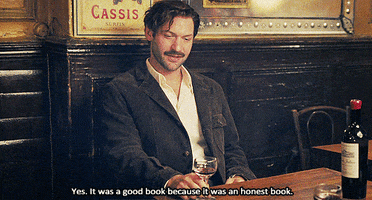


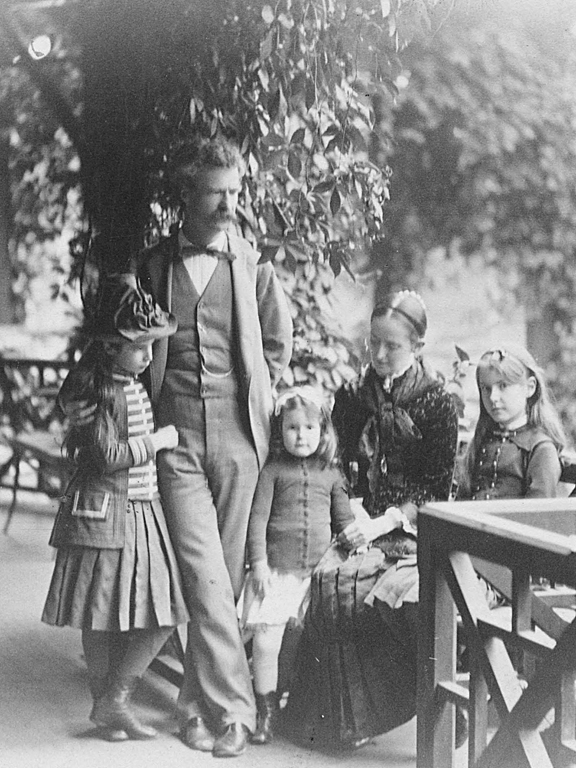


From what I can tell, Mark Twain was not a Christian, nor did he claim to be when he began courting Olivia Langdon. Back in Twain’s day, a man typically had to get permission from a woman’s parents before marrying her. Mark Twain had a problem, however. Olivia Langdon came from a professing Christian family that would not allow their daughter to marry an unbeliever. To overcome this obstacle, Twain took on the guise of a spiritual seeker who needed the support and prayers of Olivia’s family in order to clean up his life.
Twain, influenced by Olivia’s prodding, presumably converted. Twain wrote to his mother after his engagement to Olivia: “My prophecy was correct…[Livy] said she never could or would love me — but she set herself the task of making a Christian of me. I said she would succeed, but that in the meantime she would unwittingly dig a matrimonial pit and end by tumbling in — and lo! the prophecy is fulfilled.”
Olivia’s family was convinced Twain was a Christian and permitted the marriage. But was Twain’s conversion an illusion? One scholar insists that Twain “was a man in love, wooing a woman he hoped to marry. His ‘religious’ feelings at that time, expressed in love letters to Olivia, disappeared as soon as the nuptials were over” (www.yorku.ca/twainweb/filelist/skeptic.html).
After their wedding, Twain ridiculed Olivia’s beliefs and devotion. Soon Olivia’s optimism began to wane, and her fervent faith cooled. Eventually she forsook her religion altogether, and a deep sorrow deluged Olivia’s life. Mark Twain loved her and never meant to hurt her, but he had broken her spirit. He said, “Livy, if it comforts you to lean on your faith, do so.”
She replied sadly, “I cannot. I do not have any faith left.”
Twain often wished he could restore Olivia’s faith, hope, and optimism, but it was too late.
Susan K. Harris, “The Courtship of Olivia Langdon and Mark Twain,” Cambridge Studies in American Literature and Culture (Cambridge University Press, 1996), pp. xiii; submitted by Aaron Goerner
For 17 years Mark Twain lived in this house in Hartford, CT with his wife and children.
Mark Twain and the Problem of Evil
Over the last couple of nights, Mary and I watched a documentary on Mark Twain, directed by Ken Burns (who also brought us documentaries calledBaseball, The Civil War, and Jazz). Mark Twain has been one of my favorite authors for a while – ever since I was a teenager and read The Adventures of Tom Sawyer and Huckleberry Finn. When I lived in Prague in 2002, I was looking around my school’s English library one fall day and found a biography of him (Mr. Clemens and Mark Twain by Justin Kaplan) and all of his essays in one volume. I read both of them that year.
What fascinates me about Mark Twain is not just that he was a fantastic writer, but he led an intriguing and eventful life. He was born in a small town in Missouri, as everyone knows, and variously worked as a printer’s assistant, a riverboat captain, a prospector, and a journalist (among other things) before he began to earn money from his books. His was also a tragic life: even though he was a brilliant writer and made a comfortable living from his books, he was obsessed with investment schemes that would make him still richer. These invariably failed, and made it necessary for him to write and lecture constantly to get out of debt.
His religious views also stand out. Whenever he was struck by tragedy (like when his younger brother died, or his son or his wife), he would blame himself, and then blame God. By the time he was nearing the end of his life, he was incredibly bitter, and wrote such caustic things that his wife insisted that he not publish them until after he died.
What makes him so tragic from my point of view is that he had such a strong sense of injustice, and of right and wrong, and he was constantly aware of the failure of societies largely made up of Christians to do the right thing. But instead of condemning, for example, slavery from a Christian point of view (as many abolitionists did), he was painfully aware that slavery was also defended by Christians and chalked it up to hypocrisy. He sniffed out hypocrisy wherever it could be found – in the antebellum South, in Gilded Age New England, in the boardrooms of corporations and in the halls of political power. All too often that hypocrisy was perpetrated by people who called themselves Christians. Instead of dividing Christian ideals from Christian practice, he made sweeping judgments about God and his fellow men and women, and ended life as a bitter, angry man.
But I don’t think that Twain ever came to an honest assessment of himself. People close to him recognized that he had a constant need to be the center of attention, and that this need could make him tiresome to be around. He went to his daughter’s wedding dressed in doctor’s robes given to him by Oxford University. He paraded up and down Manhattan streets in white suits, timing his jaunts so they would take place on Sunday just after church let out so everyone could see him. By the end of his life, I think, Twain had become so self-centered and so self-righteous that not even God measured up to his standards. He sat in judgment over everyone and everything. Little surprise, then, that Twain fully expected things to go his way at all times, and became very upset when this was not the case.
I do hope, though, that he was able to make his peace with God before he died.
(Below Mark Twain and his family aboard the SS Warrimoo sailing to Australia in 1895)

(Newly weds Adrian and Joyce Rogers in the early 1950’s pictured below)

I grew up in Memphis and my home church was Bellevue Baptist and our pastor Adrian Rogers once told this story:
Joyce and I, some years ago, had a little baby boy that died. One of those unexplained crib deaths. And our hearts ached, we went through sorrow and pain but the Lord Jesus was there, so near and so real. Joyce and I learned to depend on Him so much and grew so much in that experience. Heartache and pain indeed it was. We had never known such deep sorrow. But the Lord was so real to us. And that was in J. W., Fort Pierce where you and I know so much about, where we’ve been so much. And I was back in the hospital in the Fort Pierce Hospital a few days after we had buried our little son Phillip. And I had been visiting a man who was not a Christian. And I had been witnessing to him, trying to lead him to Jesus Christ. And he somehow had learned that our son had died. And when he saw me walk in that room, he said, “What are you doing here?” I said well, I came to see you, to visit you. He said, “What? Are you still serving God after what he did to you?” Now, you think about that. Are you still after what He did to you? I said, “Oh my friend, I want you to listen to me, and I want you to get it down big and plain and straight that the author of all suffering and sorrow and pain and death is Satan, not God. God is good. God is good. And the suffering we have in this world is because we live in a world that has been cursed with sin, and if you think that I’m going to line up against God in favor of the devil, and line up with the one who has ultimately wounded me, your so wrong.”

On February 15, 2015 at our church service at FELLOWSHIP BIBLE CHURCH in Little Rock, Arkansas, our teaching pastor Brandon Barnard told the story of my good friends Roger and Terrie Cheuvront and the tragic death of their 19 year daughter Danaea on April 15, 2007 in a traffic accident. I was at the Funeral Home when the minister came in that very day, and I found the words of the pastor as a great comfort because we knew Danaea was in heaven. The sermon on 2-15-15 was about the time that Jesus wept at sight of his friend Lazarus’ tomb, and this 11th chapter of John had comforted Terrie Cheuvront because she knew that Jesus had felt the same pain that we have and he will eventually raise us too from the dead and her daughter Danaea is even now in heaven with Christ.
Rev Barnard actually read these words from Terri at our service: “God never intended us to experience sin and death, but sin brought about this consequence. I could be mad at death and all that it meant but the amazing thing was when I realized God’s plan then God took the anger and replaced it with His grace. It made me realize at a deeper level what God had truly done for me on the cross. He conquered sin and death for me. What amazing glorious hope he gives us. We live because He lives. Yes I am separated from my daughter now but there will be a glorious reunion.”
Let me make three points concerning the problem of evil and suffering. First, the problem of evil and suffering hit this world in a big way because of Adam and what happened in Genesis Chapter 3. Second, if there is no God then there is no way to distinguish good from evil and there will be no ultimate punishment for Hitler and Josef Mengele. (By the way Mengele never faced punishment and lived his long life out in peace.) Third. Christ came and suffered and will destroy all evil from this world eventually forever.
(Pictured below Josef Mengele )

CHARLES DARWIN ALSO SPENT A LOT OF TIME TALKING ABOUT THIS ISSUE OF EVIL AND SUFFERING. When I read the book Charles Darwin: his life told in an autobiographical chapter, and in a selected series of his published letters, I also read a commentary on it by Francis Schaeffer and I wanted to both quote some of Charles Darwin’s own words to you and then include the comments of Francis Schaeffer on those words. You might want to also check out a message by Adrian Rogers on You Tube concerning Darwinism.
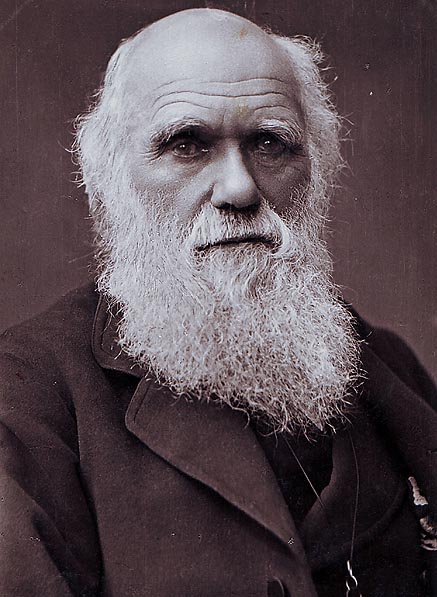
Darwin, C. R. to Doedes, N. D., 2 Apr 1873
“I am sure you will excuse my writing at length, when I tell you that I have long been much out of health, and am now staying away from my home for rest. It is impossible to answer your question briefly; and I am not sure that I could do so, even if I wrote at some length. But I may say that the impossibility of conceiving that this grand and wondrous universe, with our conscious selves, arose through chance, seems to me the chief argument for the existence of God; but whether this is an argument of real value, I have never been able to decide…....Nor can I overlook the difficulty from the immense amount of suffering through the world.”

Francis Schaeffer observed:
This of course is a valid problem. The only answer to the problem of evil is the biblical answer of the fall. Darwin has a problem because he never had a high view of revelation, so he doesn’t have the answer any more than the liberal theologian has the answer. If you don’t have a space-time fall then you don’t have an answer to suffering. If you have a very, very significant man at the beginning, Darwin did not have that, but if you had a very significant, wonderful man at the beginning and can change history then the fall is the possible answer that can be given to Darwin’s 2nd argument.
WITHOUT THE VIEW THAT THE GARDEN OF EDEN EXISTED OR IN THE EXISTENCE OF HEAVEN THEN there is no hope UNDER THE SUN. FURTHERMORE, IF WE WERE NOT CREATED BY GOD THEN WE HAVE NO HOPE FOR OUR ETERNAL FUTURES. Remember the song DUST IN THE WIND? It was written by Kerry Livgren of the group KANSAS which was a hit song in 1978 when it rose to #6 on the charts because so many people connected with the message of the song. It included these words, “All we do, crumbles to the ground though we refuse to see, Dust in the Wind, All we are is dust in the wind, Don’t hang on, Nothing lasts forever but the Earth and Sky, It slips away, And all your money won’t another minute buy.”
Kerry Livgren himself said that he wrote the song because he saw where man was without a personal God in the picture. Happily both Kerry Livgren and the bass player Dave Hope of Kansas became Christians eventually. Kerry Livgren first tried Eastern Religions and Dave Hope had to come out of a heavy drug addiction. I was shocked and elated to see their personal testimony on The 700 Club in 1981 and that same interview can be seen on You Tube today. Livgren lives in Topeka, Kansas today where he teaches “Diggers,” a Sunday school class at Topeka Bible Church. DAVE HOPE is the head of Worship, Evangelism and Outreach at Immanuel Anglican Church in Destin, Florida.
The answer to find meaning in life is found in putting your faith and trust in Jesus Christ. The Bible is true from cover to cover and can be trusted.
Is the Bible historically accurate? Here are some of the posts I have done in the past on the subject: 1. The Babylonian Chronicle, of Nebuchadnezzars Siege of Jerusalem, 2. Hezekiah’s Siloam Tunnel Inscription. 3. Taylor Prism (Sennacherib Hexagonal Prism), 4. Biblical Cities Attested Archaeologically. 5. The Discovery of the Hittites, 6.Shishak Smiting His Captives, 7. Moabite Stone, 8. Black Obelisk of Shalmaneser III, 9A Verification of places in Gospel of John and Book of Acts., 9B Discovery of Ebla Tablets. 10. Cyrus Cylinder, 11. Puru “The lot of Yahali” 9th Century B.C.E., 12. The Uzziah Tablet Inscription, 13. The Pilate Inscription, 14. Caiaphas Ossuary, 14 B Pontius Pilate Part 2, 14c. Three greatest American Archaeologists moved to accept Bible’s accuracy through archaeology.,
You can hear DAVE HOPE and Kerry Livgren’s stories from this youtube link:
(part 1 ten minutes)
(part 2 ten minutes)
Kansas – Dust in the Wind (Official Video)
Pre-Order Miracles Out of Nowhere now at http://www.miraclesoutofnowhere.com
About the film:
In 1973, six guys in a local band from America’s heartland began a journey that surpassed even their own wildest expectations, by achieving worldwide superstardom… watch the story unfold as the incredible story of the band KANSAS is told for the first time in the DVD Miracles Out of Nowhere.
_____________________________
