
 –
–——
After Life 2 – Man identifies as an 8 year old girl
—
Spelling Bee Contestant Asks The Definition of “Woman”
——
ORWELLIAN: Associated Press Forbids Even Discussing Transgenderism as an Ideology


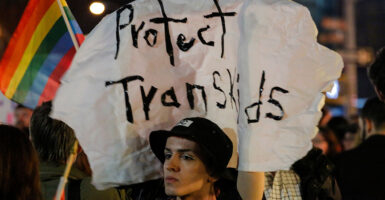
The Associated Press directs journalists to abide by transgender ideology while denying that such an ideology exists. Pictured: A protester at the Stonewall Inn on Feb. 23, 2017, in the Greenwich Village area of New York City. (Photo: Kena Betancur/AFP/Getty Images)
Forget debates over bathrooms or pronouns. The Associated Press recently released new guidelines suppressing the very concept of transgenderism as an ideology that can be debated, while forcing that ideology on reporters in the name of promoting good journalism.
The AP is the most common stylebook among journalists and news outlets on the Left and Right, including The Daily Signal. The Daily Signal does depart from AP style when the style guide adopts ideological messaging on abortion, transgender identity, and other issues, however.
In a classic example of “1984”-style doublethink, good journalists are required to abide by transgender ideology, while denying that such an ideology exists. AP’s most recent style guide update—published Thursday—instructs them to use a person’s “preferred” pronouns, deny that sex is a biological fact recognized at or before birth, and use the euphemism “gender-affirming care” when describing experimental medical interventions that leave patients stunted, scarred, and infertile.
Reporters are to adopt wholesale the claim that a person’s internal sense of gender overrides his or her biological sex and to discount opposition to these claims.
Yet they are apparently barred from discussing the ideas behind this ideology, or the ideology itself.
The most recent update to the AP style guide is quite clear: “Do not use the term transgenderism, which frames transgender identity as an ideology.”
Yet the entire document is dripping with this ideology.
“Avoid references to a transgender person being born a boy or girl, or phrasing like birth gender,” the guide urges. “Sex assigned at birth is the accurate terminology.” The document goes on to claim that “sex is usually assigned at birth by parents or attendants, sometimes inaccurately.”
While the document acknowledges that gender—not sex—is a “social construct,” the use of the phrase “sex assigned at birth” implies that biological sex is also socially constructed, rather than a central reality of humanity that enables people to reproduce. Transgender ideology relieson muddying the waters in this way, suggesting that transgender identity is the real fact, so changing a person’s body to match a gender identity opposite his or her biological sex is “affirming,” rather than destructive.
This is an extremely controversial claim, but the AP guidelines actively suppress dissent.
The update parrots pro-transgender claims that are hotly debated in the medical community. The document states that children can take “puberty blockers,” which it describes as “fully reversible prescription medication that pauses sexual maturation.” It does not note that the Food and Drug Administration has not approved drugs such as Lupron for that purpose, nor that authorities use Lupron to chemically castrate sex offenders.
It also fails to mention that many doctors have raised alarms about “gender-affirming care,” or that European countries are moving to restrict it for children.
The AP guide accuses “opponents of youth transgender medical treatment” of citing “widely discredited research,” failing to note that many of the studies pro-transgender activists use to endorse experimental interventions have themselves been discredited. For example, doctors have condemned as “fatally flawed” a recent study claiming to show improvements from cross-sex hormones.
Perhaps most horrifically, the much-touted Dutch study that first gave credence to the idea of transgender medical interventions ultimately involved a male subject who died from an infection after surgeons tried to use some of his digestive tract to construct a false vagina.
While the AP guide acknowledges that “all these treatments have potential side effects,” it nonetheless endorses them. It urges reporters to “avoid the word mutilation, a politicized and subjective term often used to mischaracterize surgery.”
The document urges journalists to “avoid terms like biological sex, along with biological male and biological female, which opponents of transgender rights sometimes use to refer to transgender women and transgender men, respectively.” AP argues that such terms are “redundant because sex is inherently biological.” Yet opponents of transgenderism use “biological” to emphasize the truth of biology against the very ideology AP insists journalists never mention.
In a few instances, the AP guide rightly discourages obnoxious or outdated terms like “tranny” and “transgendered.” It also urges journalists to avoid the terms “trans-exclusionary radical feminist” or the acronym “TERF,” to refer to critics of transgenderism.
However, the guidelines also discourage reporters from using “gender-critical” to describe those who oppose transgenderism, even though many advocates have consciously embraced that term.
The guidelines also encourage reporters to avoid using the term “groomer,” without acknowledging critics’ concerns that events such as Drag Queen Story Hour and LGBT lessons at young ages make children vulnerable to abuse.
The Associated Press style guide has long urged journalists to adopt a person’s preferred pronouns, regardless of biological sex, but the guide also forbids journalists from referring to “preferred or chosen pronouns,” instead using phrases such as “the pronouns they use, whose pronouns are, who uses the pronouns.”
When it comes to sports, the new AP entry urges journalists to avoid “phrasing that misgenders people or implies doubt, such as former men’s swimmer or currently competes as a woman.”
Journalists should not even imply doubt, much less actually express it.
God forbid they actually use a specific term to discuss this ideology, rather than merely adopting it wholesale.
Have an opinion about this article? To sound off, please email letters@DailySignal.com and we’ll consider publishing your edited remarks in our regular “We Hear You” feature. Remember to include the url or headline of the article plus your name and town and/or state.
———
—
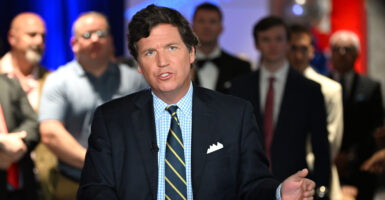
Then-Fox News host Tucker Carlson—seen here speaking at the 2022 Fox Nation Patriot Awards Nov. 17 in Hollywood, Florida—remains a much-needed voice for civilizational sanity, columnist Josh Hammer says. (Photo: Jason Koerner/ Getty Images)
I attended The Heritage Foundation’s 50th Anniversary Gala on April 21, a sprawling and swanky affair featuring many fine presentations, a surprise Dierks Bentley mini-concert for the country music enthusiasts (yours truly among them) and an extravagant post-dinner fireworks show over the Potomac River.
But the highlight of the evening, bar none, was former Fox News star Tucker Carlson‘s electric keynote address and his (all-too-brief) colloquy on stage afterward with Heritage’s exceptional new president, Kevin Roberts. (The Daily Signal is the news outlet of The Heritage Foundation.)
Carlson’s speech was both wildly entertaining and poignant, at times slapstick funny and at other times humorously self-deprecating about his Episcopalian faith. But as Carlson began to reach his peroration, the key substantive takeaway he wished to impart unto his audience became clear.
The relevant political and cultural battle lines in the year 2023 are not those befitting a civil and polite discussion, where both sides are reasonable, both sides pursue their own version of the common good, and the best think tank white paper wins out in the end, Carlson cautioned. No, our current civilizational struggle is not reflective of a refined policy debate between amicable partisans; rather, it is one that implicates fundamentally distinct theological and anthropological visions of mankind—of man’s very biology and his relation with his fellow man, the state, and God Himself.
I immediately hearkened back to an interview Claremont Institute President Ryan Williams did with The Atlantic in October 2021, in which Williams had this provocative (but accurate) line about America’s contemporary fault lines: “Even during the Civil War—I think we’re more divided now than we were then. As Lincoln said, we all prayed to the same God. We all believed in the same Constitution. We just differed over the question of slavery.”
This is the precise sentiment that Carlson was getting at in his keynote speech at the Heritage gala.
We in the audience did not know it yet, at the time of Carlson’s speech—nor did Carlson, for that matter—but the broadcasting star had already given his last searing monologue for Fox News. In a stunning development, Fox News broke the news to their highest-rated host on Monday morning that he was fired.
Hopefully, Carlson will retain something approximating his exceptional level of cultural and political influence in whatever role he next serves, because his witness to truth and civilizational sanity have never been more necessary.
This is perhaps most clearly true when it comes to gender ideology and transgenderism, which is the issue most directly implicated by Carlson’s framing of America’s fundamental divide as a struggle between differing theological and anthropological conceptions of man.
Is sexual dimorphism an obvious empirical reality, rooted in Genesis 1:27, and mandating legal codification for any regime that claims a basis in truth and justice? Or is gender instead “fluid,” wherein man can replace God and change his gender on a lark, and wherein it is contemptible bigotry to deny anyone’s subjective sense of biological or sexual reality?
Tucker Carlson certainly knew his answer: He opened a memorable 2021 interview of Republican Asa Hutchinson by asking the then-governor of Arkansas, who had shamefully vetoed a bill to protect vulnerable children from the predatory scalpels of the woke-besotted medical establishment, why he had “come out publicly as ‘pro-choice’ on the question of chemical castration of children.”
Oof.
That is not a debate where the “best white paper wins.” It is a zero-sum contestation of clashing visions of the human person, rooted in diametrically opposed substantive underpinnings. And, more to the point, the forces of godlessness, paganism, and civilizational arson certainly already treat the debate over gender ideology as a vicious winner-take-all battle.
The recent mini-insurrection in Nashville, Tennessee, which followed the tragic shooting at a Christian school and the temporary expulsions of two insurrection-complicit state lawmakers, can best be understood as one elaborate attempt to distract the public from the real issue: That a transgender lunatic shot up a Christian school, and that law enforcement has thus far been unwilling to defy the transgender lobby’s not-so-thinly-veiled blackmail, opting instead to deep-six the deceased shooter’s presumptively anti-Christian manifesto.
More recently, a similar situation unfolded in Montana, where Republicans who control the state House banned a transgender lawmaker from attending or speaking during floor sessions following the lawmaker’s comment—during the debate over an anti-chemical castration bill similar to the one Hutchinson vetoed in Arkansas—that the lawmaker hoped colleagues would see “blood on [their] hands” when they bowed their heads in prayer.
Numerous protesters were arrested and forcibly removed from the legislature last week, as they agitated in favor of the uncouth transgender lawmaker.
Large swaths of the modern Left have made the fight for gender ideology and transgenderism their foremost hill to die on precisely because they are so infatuated with their own vogue anthropology and “theology” that they view the other side—the side of sanity—as wholly undeserving of the civility and respect that a normal exchange over public policy might entail.
I know this all too well, myself: My writing that invariably elicits the most protests when I speak on university campuses is a short piece I wrote a few years ago praising U.S. 5th Circuit Court of Appeals Judge Kyle Duncan’s admirable use of biologically correct pronouns in a judicial opinion.
I’d write the same thing again today.
But those protesters, whether in Nashville; Helena, Montana; Stanford Law School or another academic corridor, are not open to rational debate. They are not willing to be reasoned with. Rather, they know their conclusions, because they have fully imbibed a highly fashionable—if false—anthropological and “theological” conception of man.
Those of us on the side of civilizational sanity need all the help we can get in pushing back against the onslaught. Tucker Carlson, please come back soon.
NBC’s Chuck Todd ridiculed for saying ‘gender is a spectrum’
Todd made the comment during a spirited interview on Sunday with GOP presidential candidate Vivek Ramaswamy, who has argued for limitations on gender affirming treatments for those under the age of 18.
“Below the age of 18, I think it’s perfectly legitimate to say that we won’t allow genital mutilation or chemical castration through puberty blockers,” Ramaswamy, the biopharmaceutical mogul and author, told Todd during the interview on Sunday.
“You’re calling it that, but how do you know it’s that?” Todd pressed Ramaswamy.
“Again, how do you know? Are you confident that you know that gender is as binary as you’re describing it? Are you confident?”
“I am,” Ramaswamy replied.
“That there isn’t a spectrum?” Todd asked.

Ramaswamy answered: “I am.”
“Do you know this as a scientist?” Todd asked.
“Well, there’s two X chromosomes if you’re a woman, and an X and a Y that means you’re a man…,” Ramaswamy said.
The two men talk over each other before Todd says: “There is a lot of scientific research that says gender is a spectrum.”
“Chuck, I respectfully disagree,” Ramaswamy said.
The GOP candidate said gender dysphoria — which is characterized by the American Psychiatric Association as “clinically significant distress or impairment related to gender incongruence” — “has been characterized as a mental health disorder and I don’t think it’s compassionate to affirm that.”

“I think that’s cruelty,” Ramaswamy said.
“When a kid is crying out for help … you’ve got to ask the question of what else is going wrong at home,” the GOP hopeful said.
“What else is going wrong at school, let’s be compassionate and get to the heart of that rather than playing this game as though we’re actually changing our medical understanding for the last hundred years.”
Todd conceded that “the last thing [parents] want to do is consider something like [gender affirming treatments]” for their children.

“But if that is what they think could help their child pursue happiness or not to kill themselves … why take away that option?” Todd asked.
“Again, why shouldn’t it be up to the parent?”
Ramaswamy replied that “we’ve created a culture that teaches parents that they’re being bigoted or that they’re bad people if they don’t actually take those steps.”
“Gender dysphoria for the rare few people who’ve suffered it, is a condition of suffering,” he added.
“My question is why on Earth are we going out of our way to create even more of it?”

Todd’s comments sparked reaction on Twitter.
Bud Light, the iconic beer brand which is the property of Anheuser-Busch, came under fire for its decision to hire Dylan Mulvaney, a social media influencer who garnered a following of millions who watched as she transitioned from a male to a female during the COVID-19 pandemic, as a pitchwoman.
The Post has sought comment from NBC News.
These 3 Women Tried Transgenderism, and Then Stopped

Jennifer Lahl’s documentary “The Detransition Diaries,” released Monday, tracks the stories of three female detransitioners, including Helena Kerschner. (Photo: The Center for Bioethics and Culture Network)
A documentary, released Monday, unveils the stories of three women who previously identified as transgender in a futile attempt to escape depression and suicidal thoughts.
Jennifer Lahl, a former pediatric nurse and current president of The Center for Bioethics and Culture Network, produced her most recent documentary, “The Detransition Diaries,” after a series of films highlighting bioethical issues.
Her film tracks the stories of Helena Kerschner, Grace Lidinsky-Smith, and Cat Cattinson, three women who believed their mental and emotional trauma would be solved by transitioning to the opposite sex. Each woman underwent hormone treatment and one had her breasts removed as well.
“We are following the news and the studies, and the evidence that shows this uptick in rapid-onset gender dysphoria [is something] young girls are particularly prone to,” Lahl told The Daily Signal in a phone call. Gender dysphoria refers to the condition of persistently and painfully identifying as the gender opposite one’s biological sex. “Young girls are getting sucked into this.”
Rapid-onset gender dysphoria is a recent phenomenon in which children and adolescents are suddenly, and without prior indication, identifying as the opposite sex.
Lahl found that her previous documentary “Trans Mission: What’s the Rush to Reassign Gender?” struck a chord with a broad audience. Firsthand accounts of men and women who “believed they were born in the wrong body” and thought gender transition “was the solution to all their problems” resonated with thousands of people, Lahl explained.
“As documentary filmmakers, we made the editorial decision that we are going to focus on women, realizing that this applies to men too,” she remarked on her most recent film.

Helena Kerschner, one of the detransitioners featured in Lahl’s film, says she struggled with depression, isolation, self-harm, an eating disorder, and suicidal thoughts as an early teen. She was introduced to the transgender belief system through Tumblr culture at 13.
Tumblr’s message was: “If you don’t like your body, that’s a sign you’re trans,” she notes.
After she came out as transgender, teachers and adults who never noticed her struggles before suddenly “bent over backward” to accommodate her new-found identity.
She did everything to make herself appear masculine. Eventually, Kerschner was prescribed testosterone at 18 after a single consultation at Planned Parenthood.
After a few weeks, she noticed how irritable she had become. “I couldn’t control myself,” Kerschner recalls in the documentary. When she got angry, she felt she needed to hurt someone—so she hurt herself. She eventually resorted to the emergency room, where staff directed her to the psych unit. Doctors diagnosed her with borderline personality disorder and psychosis, and sent her home with prescriptions for four different medications. She wound up in the hospital a few weeks later.
“My life became a total disaster,” she says. “I wasn’t functioning, I couldn’t hold a job, I wasn’t going to school—I felt like a monster.”
Seventeen months later, she stopped taking testosterone. Her negative symptoms vanished. During this time, not a single medical professional suggested that her hormone treatment was causing these symptoms, she remarks in the film.
Grace Lidinsky-Smith, another detransitioner featured in the film, noted that she felt a rush of energy when she first started testosterone treatment. Though she had some underlying anxiety, she told herself this was “internalized transphobia,” she says to the filmmakers.

Cat Cattinson describes a similar euphoric feeling when she first went on testosterone. It was “one of the better antidepressants I had taken,” she recalls.

Lidinsky-Smith, unlike the other two women, went forward with a double mastectomy. Looking back, she believed she would feel better “because she’d be in a body that fit her better.” After her breasts were removed, she recalls, she looked down at the gashes on her chest. “I had the most awful feeling.”
She found others online also had an “intense, suicidal despair after surgery … and then got over it and felt better.” But the experience planted a seed of doubt, she explains. She found a testimony of another person who had transitioned from female to male. As the person described, a desire for “a small amount of masculinization” led to full-out body dysphoria.
At that point, Lidinsky-Smith stopped testosterone and slowly reversed course, eventually growing comfortable enough to use her birth name. “It became important to just accept myself as myself,” she explains.
Kershner and Cattinson described similar breaking points. Kershner realized: “This is not what I thought it would be,” adding that she believed “once I’m a boy, my confidence is gonna come out.” Instead, as she describes, she became dysfunctional.
As Cattinson explains, three months into her testosterone treatment, she found a dramatic drop in her voice. “Nothing was coming out except air and squeaks,” she describes. She stopped going to social events and performing live.
Like the other women, she found an online community of detransitioners and doctors who revealed the hidden underbelly of the trans movement.
She began questioning the basis of transgender ideology: the “idea that we should define a woman based on what’s in a person’s head,” as she describes it. Does “what you believe in your head … really trump the biological reality of being an adult female?” she wondered.
As the documentary concludes, Lidinsky-Smith notes that she is worried about those who continue to get sucked into gender transition treatment, when they can find the answer to their problems elsewhere.
All three women interviewed suffered from suicidal ideation and depression. Each believed that changing her name, pronouns, appearance, and hormones would solve her problems, yet each found her emotional state dramatically worsened as a result.
“I think the fallout will be severe,” Lidinsky-Smith notes. Remarking on the growing community of detransitioners, she adds, “Our voices can no longer be denied.”
Have an opinion about this article? To sound off, please email letters@DailySignal.com and we’ll consider publishing your edited remarks in our regular “We Hear You” feature. Remember to include the url or headline of the article plus your name and town and/or state.
The Woke Zone Trilogy
John Stossel takes up for Babylon Bee and notes “Even a few left-leaning comedians like Ricky Gervais and Dave Chappelle are mocking the intolerant left!”
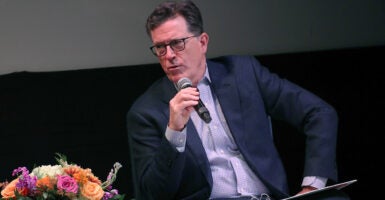
Late night hosts like Stephen Colbert, seen speaking during the Montclair Film Festival on Oct. 23, passionately defend leftists to the point of lecturing, rather than providing comedic relief. (Photo: Manny Carabel/Getty Images)
A woman tells the cop who stopped her in a carpool lane she’s allowed to drive there because her pronouns are “they” and “them.”
That’s from a video by a conservative Christian satire site called the Babylon Bee. Their humor gets millions of views.
“Christian conservatives used to … be very dour and self-serious,” says Bee editor-in-chief Kyle Mann in my new video.
Today, he says, it’s the left who are self-serious. “They’re the ones that have trouble laughing at themselves.”
For example, late night hosts like Jimmy Kimmel and Stephen Colbert passionately defend COVID-19 vaccines.
“It is a lecture,” complains Mann.
“The left used to be anti-establishment,” adds Bee actress Chandler Juliet. Now, she says, ‘They’ve become the blob. … We’re super happy to be leading the comedic conversation on the right.”
One Babylon Bee video, “The Woke Zone,” makes fun of the way the media ignored violence and arson during the George Floyd protests.
“Do you ever feel gratitude to the left that they give you so much material?” I ask.
“We have to write things that are funnier than things they’re actually doing,” Mann responds. “That makes our job very difficult.”
One Bee sketch portrays its writers struggling to find new material.
“John Kerry warns that the war in Ukraine might distract from climate change!” suggests one.
Can’t do it, explains another. “It actually happened.” Yes, Kerry really did say that.
“Cosmo magazine features a morbidly obese woman on the cover as the picture of health” and, “Math professor says ‘two plus two equals four’ is racist!” are among other ideas that can’t be used as jokes.
“A math professor really said two plus two equals four is racist?” I ask.
It’s “a colonialist, white supremacist idea,” explains Mann.
Today the Bee reaches more people than The Onion. The establishment doesn’t like that, so some people actually sic so-called fact checkers on the Bee.
One article fact-checked by Snopes was titled, “Bernie Sanders Vows To Round Up Remaining ISIS Members, Allow Them To Vote.”
“Does Snopes not understand that you’re making jokes?” I ask.
“I think that they know what our intention is,” answers Juliet. “They just don’t like us.”
Recently, Twitter banned the Bee. Their offense was tweeting an article that named Assistant Secretary of Health Rachel Levine “Babylon Bee’s Man of the Year.”
Levine is a transgender woman. Calling her the man of the year is a joke I wouldn’t make. But it doesn’t need to be censored.
Twitter says they’ll allow the Bee back on the platform only if they delete the tweet. Mann says he won’t.
“Twitter has the capability to just delete the tweet themselves. They want us to bend the knee and be the ones to click, ‘Yes, we acknowledge hateful conduct.’ We’re not going to do that.”
Today, a lot of comedians attract sizable audiences by mocking the left. Some I found funny are JP Sears, Ryan Long and FreedomToons.
The culture is changing.
The highest rating late-night comic these days is often not Colbert, Kimmel or Fallon, but Greg Gutfeld of Fox.
Even a few left-leaning comedians like Ricky Gervais and Dave Chappelle are mocking the intolerant left.
“I talk about AIDS, famine, cancer, the Holocaust, rape, pedophilia … the one thing you mustn’t joke about is identity politics,” says Gervais in his recent Netflix special.
Professional media critics trashed him for that. But the special was hugely popular with the public.
The Rotten Tomatoes ratings are revealing. Critics gave Gervais’ special a 29% rating, calling it “terribly unfunny” and “a detestable combination of smug and obtuse.”
Viewers gave it a 92% rating.
The same is true of Chapelle’s latest special, “The Closer.” Critics give it just 40%. The audience gives it 95%.
Clearly, many people are tired of smug, condescending humor.
I’m glad the Babylon Bee, and others, give us an alternative.
COPYRIGHT 2022 BY JFS PRODUCTIONS INC.
The Daily Signal publishes a variety of perspectives. Nothing written here is to be construed as representing the views of The Heritage Foundation.
Have an opinion about this article? To sound off, please email letters@DailySignal.com and we’ll consider publishing your edited remarks in our regular “We Hear You” feature. Remember to include the url or headline of the article plus your name and town and/or state.
After Life 2 – Man identifies as an 8 year old girl
—-

——
Before I get into the fine article by Brendan O’Neill which I present in its entirety, I wanted to quote Francis Schaeffer who spent his life examining the humanism that now Ricky Gervais embraces!

All humans have moral motions and that is why Ricky Gervais knows it is wrong to let biological men use ladies’ bathrooms!!!!!!
Francis Schaffer in his book THE GOD WHO IS THERE addresses these same issues:
“[in Christianity] there is a sufficient basis for morals. Nobody has ever discovered a way of having real “morals” without a moral absolute. If there is no moral absolute, we are left with hedonism (doing what I like) or some form of the social contract theory (what is best for society as a a hole is right). However, neither of these alternative corresponds to the moral motions that men have. Talk to people long enough and deeply enough, and you will find that they consider some things are really right and something are really wrong. Without absolutes, morals as morals cease to exist, and humanistic mean starting from himself is unable to find the absolute he needs. But because the God of the Bible is there, real morals exist. Within this framework I can say one action is right and another wrong, without talking nonsense.” 117
Francis Schaeffer in the film WHATEVER HAPPENED TO THE HUMAN RACE?

Francis and Edith Schaeffer

—

–
Brendan O’Neill
Ricky Gervais is guilty of blasphemy
He has mocked identity politics – the god of our times
I have long thought that if Life of Brian came out today, it wouldn’t be Christians kicking up a fuss about it — it would be trans activists.
When Monty Python’s classic tale of a man mistaken for a Messiah came to cinemas in 1979, people of faith weren’t happy. They saw it as taking the mick out of Christ and they aired their displeasure noisily. Nuns in New York picketed cinemas. In Ireland the film was banned for eight years.
In 2022 I reckon it would be a very different story. It wouldn’t be Monty Python’s ribbing of the gospels that would outrage the chattering classes — it would be their mockery of trans people.
Life of Brian was way ahead of time. It was Terf before Terf was even a thing. There is a brilliantly observed scene in which Stan of the People’s Front of Judea — or is it the Judean People’s Front? — says he wants to become Loretta.
‘I want to be a woman. From now on, I want you all to call me Loretta’, says Stan, played by Eric Idle. When the others push back and say he can’t just become a woman, he says: ‘It’s my right as a man.’ Which was remarkably perspicacious.
‘I want to have babies’, says Stan / Loretta. ‘You can’t have babies! You haven’t got a womb!’, barks John Cleese’s Reg. Transphobic or what? To calm things down, Francis (Michael Palin) says they should accept Stan’s desire to be Loretta as being ‘symbolic of our struggle against oppression’. ‘Symbolic of his struggle against reality…’ Reg mutters.
——
Imagine if a film or TV show did something like that today. Showed an aspiring ‘trans woman’ being mocked for not having the right body parts to be a woman. Showed a man who wants to be a woman being told — for laughs, remember — that the only thing he’s struggling against is reality.
The cancel-culture mob would kick into action. There’d be a Change.org petition, maybe even a physical protest outside the offices of the production company or streaming service that was foolish enough to broadcast such trans-poking humour. ‘Jokes kill!’, we would be told, day and night.
Hell, JK Rowling can’t even very politely say ‘men aren’t women’ without being subjected to weeks of hatred and violent threats — so heaven help the film company that tried to air a Stan / Loretta skit in these febrile times.
This week, my theory about Life of Brianin 2022 was kind of proven right. For we had the pretty extraordinary sight of Ricky Gervais getting a very free ride for his God-mocking while being dragged into the Twitter stocks for his gags about trans issues.
In his new Netflix special SuperNature, Gervais vents his atheistic spleen. The Christian God is cruel and perverted, he says. Those Christian fundamentalists who believe Aids is the Almighty’s way of punishing gay sex clearly believe in a God who’s up in heaven thinking, ‘I’m sick of all this bumming’. And so just as God once said ‘Let there be light’, according to Gervais in the 1980s He said, ‘Let there be Aids’. What a rotter.
This isn’t the first time Gervais has made fun of God and those who believe in him. He’s famously an atheist. He talks about it all the time. (Rather too much, in my view.) But God-bashing is fine these days. Cool, even. Christians tend to take it in their stride. Believers have mostly kept their counsel following Gervais’s latest mockery of their wicked, ridiculous God.
The same cannot be said of trans activists and their allies. Not even remotely. They have responded with fury to Gervais’s blasphemy against the new god of genderfluidity.
He’s been called all the usual names. Transphobe, Terf, bigot. His crime? Choosing not to adhere to the ideology of transgenderism, daring to dissent from that pseudo-religious mantra we are all now pressured into saying: ‘Trans women are women.’
What’s funny about this spittle-flecked response to Gervais’s trans jokes is that he was really only saying what trans activists themselves have said. He had a bit on ‘old-fashioned women’ — ‘you know, the ones with wombs’ — complaining about born males using their bathrooms. ‘What if he rapes me?’, these women say. To which Gervais, playing the trans activist, responds: ‘What if she rapes you, you… Terf whore.’
Cutting, yes. But also incredibly accurate. Some police forces and courts do indeed refer to rapists as ‘she’ and ‘her’, if that’s how they identify. And, as feminists have pointed out, this results in rape victims being pressured to refer to their rapist with female pronouns. As for the language, anyone who has spent more than five minutes online in recent years will know that that kind of thing is said to gender-critical women all the time.
Like all great blasphemous comics, Gervais is merely shining a light on things that really are said, and things which really do happen, and inviting us, his audience, to laugh and say: ‘Yeah, that is kind of ridiculous.’ Much as Monty Python did with the Bible, in fact.
But, say Gervais’s humourless critics, while the likes of Monty Python were punching up — against God, no less — Gervais is punching down, against vulnerable, marginalised trans people. I don’t buy this at all. Gervais has made it clear that he fully supports rights for trans people. His issue is with the excesses of trans activism and the authoritarianism of identity politics more broadly.
‘I talk about Aids, famine, cancer, the Holocaust, rape, paedophilia’, he says in SuperNature. ‘But no, the one thing you mustn’t joke about is identity politics.’
Absolutely. And that’s because identitarianism is the god of our times. It’s the new religion of the elites, their means of controlling and reprimanding the masses. Ridiculing identity politics is to the 21st century what questioning the authority of God was to the 15th. The woke rage against Gervais really does echo earlier outbursts of intolerant religious fury against anyone who dared to dissent from the Word of God.
—

–
—-

I was referred this subject by a tweet by Daniel Dennett which referenced a fine article by Robyn E. Blumner in defense of her boss at the RICHARD DAWKINS FOUNDATION and you can read my response at this link.

Ricky Gervais is a secular humanist just like his good friend Richard Dawkins and it is the humanists who have bought into this trans-identity politics and as a result the AMERICAN HUMANIST ASSOCIATION has stripped Dawkins of his 1996 HUMANIST OF THE YEAR award.
As an evangelical I have had the opportunity to correspond with more more secular humanists that have signed the Humanist Manifestos than any other evangelical alive (at least that has been one of my goals since reading Francis Schaeffer’s books and watching his films since 1979).
Not everyone I have corresponded with is a secular humanist but many are the top scientists and atheist thinkers of today and hold this same secular views. Many of these scholars have taken the time to respond back to me in the last 20 years and some of the names included are Ernest Mayr (1904-2005), George Wald (1906-1997), Carl Sagan (1934-1996), Robert Shapiro (1935-2011), Nicolaas Bloembergen (1920-), Brian Charlesworth (1945-), Francisco J. Ayala (1934-) Elliott Sober (1948-), Kevin Padian (1951-), Matt Cartmill (1943-) , Milton Fingerman (1928-), John J. Shea (1969-), , Michael A. Crawford (1938-), (Paul Kurtz (1925-2012), Sol Gordon (1923-2008), Albert Ellis (1913-2007), Barbara Marie Tabler (1915-1996), Renate Vambery (1916-2005), Archie J. Bahm (1907-1996), Aron S “Gil” Martin ( 1910-1997), Matthew I. Spetter (1921-2012), H. J. Eysenck (1916-1997), Robert L. Erdmann (1929-2006), Mary Morain (1911-1999), Lloyd Morain (1917-2010), Warren Allen Smith (1921-), Bette Chambers (1930-), Gordon Stein (1941-1996) , Milton Friedman (1912-2006), John Hospers (1918-2011), and Michael Martin (1932-), Harry Kroto (1939-), Marty E. Martin (1928-), Richard Rubenstein (1924-), James Terry McCollum (1936-), Edward O. WIlson (1929-), Lewis Wolpert (1929), Gerald Holton(1922-), Martin Rees (1942-), Alan Macfarlane (1941-), Roald Hoffmann (1937-), Herbert Kroemer (1928-), Thomas H. Jukes(1906-1999) and Ray T. Cragun (1976-).
Let me make a few points about Ricky personally and then a few about this comedy routine by the secular humanist Ricky Gervais.
Notice below in AFTER LIFE how he suspects Anne of being a Christian when she tells him “We are not just here for us. We are here for others,“

 Ricky Gervais and Penelope Wilton in ‘After Life’ (CREDIT: Netflix)
(Above) Tony (played by Ricky) and Anne on the bench at the graveyard where their spouses are buried.
In the fourth episode of season 1 of AFTER LIFE is the following discussion between Anne and Tony:
Tony: My brother-in-law wants me to try dating again.
Anne: Oh excellent! You need some tips.
Tony: why would I need some tips?
Anne: I imagine you are awful with women…Well all men are awful with women but grumpy selfish ones are the worst.
Tony: Let me take notes. This is dynamite.
Tony: I would just be honest. Tell them my situation and tell them what I am going through. Be honest up front.
Anne: So it is all about you then?
Tony: I can’t win can I? I don’t want to date again. I don’t want to live without Lisa.
Anne: But is not just about you is it? That is what I am saying. What if a nice date made her feel good? That might feel nice right? We are just here for us. We are here for others.
Tony: I don’t do the whole God thing I am afraid.
Anne: Neither do I. It is a load of rubbish. All we got is each other. We have to help each other struggle until we die then we are done. No point in felling sorry for ourselves and making everyone else unhappy too. Might as [kill] yourself if you feel that bad.
Tony: Are you sure you want to work for the Samaritans?
—
Christ came to this world and his followers have changed this world for the better more than any other group that ever existed. When Anne makes the assertions, “But is not just about you is it? That is what I am saying. What if a nice date made her feel good? That might feel nice right? We are not just here for us. We are here for others,” Tony assumes she is a Christian.
If you found yourself in a dark alley late at night, with a group of rough-looking, burly young men walking swiftly toward you, would you feel better knowing they were coming from a Bible study?
If we are only cosmic accidents, how can there be any meaning in our lives? If this is true, which it is in an atheistic world view, our lives are for nothing. It would not matter in the slightest bit if I ever existed. This is why the atheist, if honest and consistent, must face death with despair. Their life is for nothing. Once they are gone, they are gone forever.
I highly recommend Ricky Gervais series AFTER LIFE which is running on NETFLIX because it reminds me of King Solomon trying to find meaning in life UNDER THE SUN without God in the picture!!!
God put Solomon’s story in Ecclesiastes in the Bible with the sole purpose of telling people like Ricky that without God in the picture you will find out the emptiness one feels when possessions are trying to fill the void that God can only fill.
Then in the last chapter of Ecclesiastes Solomon returns to looking above the sun and he says that obeying the Lord is the proper way to live your life. The answer to find meaning in life is found in putting your faith and trust in Jesus Christ. The Bible is true from cover to cover and can be trusted. If you need more evidence then go to You Tube and watch the short video:
NOW TO RICKY’S COMEDY:
Brendan O’Neill noted above:
‘I want to have babies’, says Stan / Loretta. ‘You can’t have babies! You haven’t got a womb!’, barks John Cleese’s Reg. Transphobic or what? To calm things down, Francis (Michael Palin) says they should accept Stan’s desire to be Loretta as being ‘symbolic of our struggle against oppression’. ‘Symbolic of his struggle against reality…’ Reg mutters….
He’s been called all the usual names. Transphobe, Terf, bigot. His crime? Choosing not to adhere to the ideology of transgenderism, daring to dissent from that pseudo-religious mantra we are all now pressured into saying: ‘Trans women are women.’
What’s funny about this spittle-flecked response to Gervais’s trans jokes is that he was really only saying what trans activists themselves have said. He had a bit on ‘old-fashioned women’ — ‘you know, the ones with wombs’ — complaining about born males using their bathrooms. ‘What if he rapes me?’, these women say. To which Gervais, playing the trans activist, responds: ‘What if she rapes you, you… Terf whore.’
Ricky is trying to use common sense (through sarcasm) on people that “GOD GAVE…OVER to depraved [minds]. Romans 1 states:
26 For this reason (M)GOD GAVE THEM OVER to degrading passions; for their women exchanged the natural function for that which is unnatural…
28 And just as they did not see fit to acknowledge God any longer, GOD GAVE THEM OVER to a depraved mind, to do those things which are not proper, 29 being filled with all unrighteousness, wickedness, greed, evil; full of envy, murder, strife, deceit, malice; they are…inventors of evil,
—
—-

Francis Schaeffer later in this blog post discusses what the unbelievers in Romans 1 were rejecting, but first John MacArthur discusses what the unbelievers in the Democratic Party today are affirming and how these same activities were condemned 2000 years ago in Romans 1.
Christians Cannot And MUST Not Vote Democrat – John MacArthur
–
A Democrat witness testifying before the HouseJudiciary Committee on abortion rights Thursday declared that men can get pregnant and have abortions. This reminds of Romans chapter 1 and also John MacArthur’s commentary on the 2022 Agenda of the Democratic Party:
25 For they exchanged the truth of God for a lie and worshiped and served the creature rather than the Creator…26 For this reason (M)GOD GAVE THEM OVER to degrading passions; for their women exchanged the natural function for that which is unnatural, 27 and in the same way also the men abandoned the natural function of the woman and burned in their desire toward one another, men with men committing indecent acts and receiving in their own persons the due penalty of their error.28 And just as they did not see fit to acknowledge God any longer, GOD GAVE THEM OVER to a depraved mind, to do those things which are not proper, 29 being filled with all unrighteousness, wickedness, greed, evil; full of envy, murder, strife, deceit, malice; they are…inventors of evil, disobedient to parents, 31 without understanding, untrustworthy, unloving, unmerciful; 32 but also give hearty approval to those who practice them.
Here is what John MacArthur had to say:
Now, all of a sudden, not only is this characteristic of our nation, but we now promote it. One of the parties, the Democratic Party, has now made Romans 1, the sins of Romans 1, their agenda. What God condemns, they affirm.
I know from last week’s message that there was some response from people who said, “Why are you getting political?”
Romans 1 is not politics. This has to do with speaking the Word of God through the culture in which we live….it’s about iniquity and judgment. And why do we say this? Because this must be recognized for what it is–sin, serious sin, damning sin, destructive sin.
Dem witness tells House committee men can get pregnant, have abortions
‘I believe that everyone can identify for themselves,’ Aimee Arrambide tells House Judiciary Committee
“Yes,” Arrambide replied.
The remarks from Arrambide followed a tense exchange between Bishop and Dr. Yashica Robinson, another Democrat witness, after he similarly asked her to define “woman.”

Aimee Arrambide testifies before the House Judiciary Committee on May 11, 2020. (YouTube screenshot) (Screenshot/ House Committee on the Judiciary)
“Dr. Robinson, I noticed in your written testimony you said that you use she/her pronouns. You’re a medical doctor – what is a woman?” Bishop asked Robinson, an OBGYN and board member with Physicians for Reproductive Health.
“I think it’s important that we educate people like you about why we’re doing the things that we do,” Robinson responded. “And so the reason that I use she and her pronouns is because I understand that there are people who become pregnant that may not identify that way. And I think it is discriminatory to speak to people or to call them in such a way as they desire not to be called.”
“Are you going to answer my question? Can you answer the question, what’s a woman?” Bishop asked.

Donna Howard and Aimee Arrambide speaks at Making Virtual Storytelling and Activism Personal during the 2022 SXSW Conference and Festivals at Austin Convention Center on March 14, 2022 in Austin, Texas. (Photo by Hubert Vestil/Getty Images for SXSW)
“I’m a woman, and I will ask you which pronouns do you use?” Robinson replied. “If you tell me that you use she and her pronouns … I’m going to respect you for how you want me to address you.”
“So you gave me an example of a woman, you say that you are a woman, can you tell me otherwise what a woman is?” Bishop asked.
“Yes, I’m telling you, I’m a woman,” Robinson responded.
“Is that as comprehensive a definition as you can give me?” Bishop asked.
“That’s as comprehensive a definition as I will give you today,” Robinson said. “Because I think that it’s important that we focus on what we’re here for, and it’s to talk about access to abortion.”
CLICK HERE TO GET THE FOX NEWS APP
“So you’re not interested in answering the question that I asked unless it’s part of a message you want to deliver…” Bishop fired back.
Wednesday’s hearing, titled, “Revoking your Rights,” addressed the threat to abortion rights after the leaked Supreme Court draft opinion signaled the high court is poised to soon strike down Roe v. Wade.
John MacArthur explains God’s Wrath on unrighteousness from Romans Chapt…
First is what Romans says:
Romans 1:18-32
New American Standard Bible (NASB)
Unbelief and Its Consequences
18 For (A)the wrath of God is revealed from heaven against all ungodliness and unrighteousness of men who (B)suppress the truth [a]in unrighteousness, 19 because (C)that which is known about God is evident [b]within them; for God made it evident to them. 20 For (D)since the creation of the world His invisible attributes, His eternal power and divine nature, have been clearly seen, (E)being understood through what has been made, so that they are without excuse. 21 For even though they knew God, they did not [c]honor Him as God or give thanks, but they became (F)futile in their speculations, and their foolish heart was darkened. 22 (G)Professing to be wise, they became fools, 23 and (H)exchanged the glory of the incorruptible God for an image in the form of corruptible man and of birds and four-footed animals and [d]crawling creatures.
24 Therefore (I)God gave them over in the lusts of their hearts to impurity, so that their bodies would be (J)dishonored among them. 25 For they exchanged the truth of God for [e]a (K)lie, and worshiped and served the creature rather than the Creator, (L)who is blessed [f]forever. Amen.
26 For this reason (M)God gave them over to (N)degrading passions; for their women exchanged the natural function for that which is [g]unnatural, 27 and in the same way also the men abandoned the natural function of the woman and burned in their desire toward one another, (O)men with men committing [h]indecent acts and receiving in [i]their own persons the due penalty of their error.
28 And just as they did not see fit [j]to acknowledge God any longer, (P)God gave them over to a depraved mind, to do those things which are not proper, 29 being filled with all unrighteousness, wickedness, greed, evil; full of envy, murder, strife, deceit, malice; they are (Q)gossips, 30 slanderers, [k](R)haters of God, insolent, arrogant, boastful, inventors of evil, (S)disobedient to parents, 31 without understanding, untrustworthy, (T)unloving, unmerciful; 32 and although they know the ordinance of God, that those who practice such things are worthy of (U)death, they not only do the same, but also (V)give hearty approval to those who practice them.
Here is what John MacArthur had to say:
Now, all of a sudden, not only is this characteristic of our nation, but we now promote it. One of the parties, the Democratic Party, has now made Romans 1, the sins of Romans 1, their agenda. What God condemns, they affirm. What God punishes, they exalt. Shocking, really. The Democratic Party has become the anti-God party, the sin-promoting party. By the way, there are seventy-two million registered Democrats in this country who have identified themselves with that party and maybe they need to rethink that identification.
I know from last week’s message that there was some response from people who said, “Why are you getting political?”
Romans 1 is not politics. The Bible is not politics. This has nothing to do with politics. This has to do with speaking the Word of God through the culture in which we live. It has nothing to do with politics. It’s not about personalities; it’s about iniquity and judgment. And why do we say this? Because this must be recognized for what it is–sin, serious sin, damning sin, destructive sin.
WHAT HAS THE DEMOCRATIC PARTY REJECTED? THE ANSWER IS THE GOD WHO HAS REVEALED HIM SELF THROUGH THE BOOK OF NATURE AND THE BOOK OF SCRIPTURE!
God Is There And He Is Not Silent
Psalm 19
Intro. 1) Francis Schaeffer lived from 1912-1984. He was one of the Christian
intellectual giants of the 20th century. He taught us that you could be a Christian and not abandon the mind. One of the books he wrote was entitled He Is There And He Is Not Silent. In that work he makes a crucial and thought provoking statement, “The infinite- personal God is there, but also he is not silent; that changes the whole world…He is there and is not a silent, nor far-off God.” (Works of F.S., Vol 1, 276).
2) God is there and He is not silent. In fact He has revealed Himself to us in 2 books: the book of nature and the book of Scripture. Francis Bacon, a 15th century scientist who is credited by many with developing the scientific method said it this way: “There are 2 books laid before us to study, to prevent us from falling into error: first the volume to the Scriptures, which reveal the will of God; then the volume of the creation, which expresses His power.”
3) Psalm 19 addresses both of God’s books, the book of nature in vs 1-6 and the book of Scripture in vs. 7-14. Described as a wisdom Psalm, its beauty, poetry and splendor led C.S. Lewis to say, “I take this to be the greatest poem in the Psalter and one of the greatest lyrics in the world” (Reflections on the Psalms, 63).
Trans. God is there and He is not silent. How should we hear and listen to the God who talks?
I. Listen To God Speak Through Nature 19:1-6
God has revealed himself to ever rational human on the earth in two ways: 1) nature and 2) conscience. We call this natural or general revelation. In vs. 1-6 David addresses the wonder of nature and creation.
Whatever Happened To The Human Race? | Episode 5 | Truth and History
Related posts:
John MacArthur on Romans 1 and the Democratic Party
First is what Romans says: Romans 1:18-32 New American Standard Bible (NASB) Unbelief and Its Consequences 18 For (A)the wrath of God is revealed from heaven against all ungodliness and unrighteousness of men who (B)suppress the truth [a]in unrighteousness, 19 because (C)that which is known about God is evident [b]within them; for God made it evident to […]
Abortion and the Campaign for Immorality (Selected Scriptures) John MacArthur
Abortion and the Campaign for Immorality (Selected Scriptures) John MacArthur Published on Sep 30, 2012 by JohnMacArthurGTY http://www.gty.org/resources/sermons/90-448 What a privilege and joy it is to worship the Lord here at Grace Church. Patricia and I miss it when we’re not here. There’s no place like this. Our hearts are full to overflowing to be […]
John MacArthur: Fulfilled prophecy in the Bible? (Ezekiel 26-28 and the story of Tyre, video clips)
Prophecy–The Biblical Prophesy About Tyre.mp4 Uploaded by TruthIsLife7 on Dec 5, 2010 A short summary of the prophecy about Tyre and it’s precise fulfillment. Go to this link and watch the whole series for the amazing fulfillment from secular sources. http://www.youtube.com/watch?v=qvt4mDZUefo ________________ John MacArthur on the amazing fulfilled prophecy on Tyre and how it was fulfilled […]
Did God kill someone that I knew? What does I John 5:14-17 mean?
1 John 5:14-17 New American Standard Bible (NASB) 14 This is (A)the confidence which we have [a]before Him, that, (B)if we ask anything according to His will, He hears us. 15 And if we know that He hears us in whatever we ask, (C)we know that we have the requests which we have asked from […]
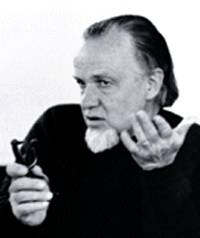





















 Roger Kimball is editor and publisher of The New Criterionand publisher of Encounter Books. He earned his B.A. from Bennington College and his M.A. and M.Phil. in philosophy from Yale University. He has written for numerous publications, including The Wall Street Journal and The New York Times Book Review, and is a columnist for The Spectator World, American Greatness, and The Epoch Times. He is editor or author of several books, including The Long March: How the Cultural Revolution of the 1960s Changed America, The Rape of the Masters: How Political Correctness Sabotages Art, Tenured Radicals: How Politics Has Corrupted Our Higher Education, and Vox Populi: The Perils and Promises of Populism.



 True discernment has suffered a horrible setback in the past few decades because reason itself has been under attack within the church. As Francis Schaeffer warned nearly thirty years ago in The God Who Is There, the church is following the irrationality of secular philosophy. Consequently, reckless faith has overrun the evangelical community. Many are discarding doctrine in favor of personal experience. Others say they are willing to disregard crucial biblical distinctives in order to achieve external unity among all professing Christians. True Christianity marked by intelligent, biblical faith seems to be declining even among the most conservative evangelicals.THE ABANDONMENT OF OBJECTIVE TRUTHThe visible church in our generation has become astonishingly tolerant of aberrant teaching and outlandish ideas—and frighteningly intolerant of sound teaching. The popular evangelical conception of “truth” has become almost completely subjective. Truth is viewed as fluid, always relative, never absolute. To suggest that any objective criterion might be used to distinguish truth from error is to be egregiously out of step with the spirit of the age. In some circles, Scripture itself has been ruled out as a reliable test of truth. After all, the Bible can be interpreted in so many different ways—who can say which interpretation is right? And many believe there is truth beyond the Bible.All this relativity has had disastrous effects on the typical Christian’s ability to discern truth from error, right from wrong, good from evil. The plainest teachings of the Bible are being questioned among people who declare themselves believers in the Bible. For example, some Christians are no longer certain whether homosexuality should be classed as a sin. Others argue that the feminist agenda is compatible with biblical Christianity. “Christian” television, radio, books, and magazines serve up a preposterous smorgasbord of ideas from the merely capricious to the downright dangerous—and the average Christian is woefully ill-equipped to sort out the lies from the truth.Even to suggest that a sorting between lies and truth is necessary is viewed by many as perilously intolerant. There is a notion abroad that any dispute over doctrine is inherently evil. Concern for orthodoxy is regarded as incompatible with Christian unity. Doctrine itself is labeled divisive and those who make doctrine an issue are branded uncharitable. No one is permitted to criticize anyone else’s beliefs, no matter how unbiblical those beliefs seem to be. A recent article in Christianity Today exemplifies the trend. The article, titled “Hunting for Heresy,” profiled two well-known Christian leaders who had “come under withering attack for controversial writings.”1One is a popular speaker on the college lecture circuit and a bestselling author. He wrote a book in which he encouraged homosexuals to establish permanent live-together relationships (albeit celibate ones). He suggests the evangelical community suffers from “homophobia.” He is convinced that permanent living arrangements between homosexuals are the only alternative to loneliness for people he believes are “born with a homosexual orientation.” This man’s wife has published an article in a homosexual magazine in which she enthusiastically affirms” monogamous sexual relationships between homosexuals. The speaker-author says he has a “very, very strong” disagreement with his wife’s approval of homosexual sex, but his own view seems to allow homosexuals to engage in other kinds of physical intimacy short of actual intercourse.The other Christian leader profiled in the Christianity Today article is a woman who, with her husband, is a featured speaker for a popular, nationally-syndicated radio and television ministry. Their ministry is not a weird offshoot from some fringe cult, but an established, well-respected mainstay from the evangelical heartland. She also serves as chairperson of one of the largest evangelical student organizations in the world. This woman has written a book in which she chronicles some rather peculiar spiritual experiences. She dedicates the book to her male alter ego, an imaginary person named “Eddie Bishop” who romances her in her dreams. This woman says she also has visions of “the Christ child that is within” her. He appears to her as a drooling, emaciated, barefoot “idiot child” in a torn undershirt—”its head totally bald and lolled to one side.” The woman has engaged the services of a Catholic nun who serves as her “spiritual director,” helping to interpret her dreams and fantasies. The book mingles mysticism, Jungian psychology, out-of-body experiences, feminist ideas, subjective religious experience, and this woman’s romantic fantasies into an extraordinary amalgam. The book is frankly so bizarre that it is disturbing to read.The remarkable thing about the Christianity Today article is that the story was not written to expose the aberrant ideas being taught by these two leading evangelicals. Instead, what the magazine’s editors deemed newsworthy was the fact that these people were under attack for their views.In the world of modern evangelicalism, it is allowable to advocate the most unconventional, unbiblical doctrines—as long as you afford everyone else the same privilege. About the only thing that is taboo nowadays is the intolerance of those who dare to point out others’ errors. Anyone today who is bold enough to suggest that someone else’s ideas or doctrines are unsound or unbiblical is dismissed at once as contentious, divisive, unloving, or unchristian. It is all right toespouse any view you wish, but it is not all right to criticize another person’s views—no matter how patently unbiblical those views may be.When tolerance is valued over truth, the cause of truth always suffers. Church history shows this to be so. Only when the people of God have mounted a hardy defense of truth and sound doctrine has the church flourished and grown strong. The Reformation, the Puritan era, and the Great Awakenings are all examples of this. The times of decline in the history of the church have always been marked by an undue emphasis on tolerance—which leads inevitably to carelessness, worldliness, doctrinal compromise, and great confusion in the church.ADRIFT ON A SEA OF SUBJECTIVITYThat the church would lose her moorings in this particular age, however, poses greater dangers than ever. For in the past hundred years or so, the world has changed in a dramatic and very frightening way. People no longer look at truth the way they used to. In fact, we live under a prevailing philosophy that has become hostile to the very idea of absolute truth.From the beginning of recorded history until late last century, virtually all human philosophy assumed the necessity of absolute truth. Truth was universally understood as that which is true, not false; factual, not erroneous; correct, not incorrect; moral, not immoral; just, not unjust; right, not wrong. Practically all philosophers since the time of Plato assumed the objectivity of truth. Philosophy itself was a quest for the highest understanding of truth. Such a pursuit was presumed to be possible, even necessary, because truth was understood to be the same for every person. This did not mean that everyone agreed what truth was, of course. But virtually all agreed that whatever was true was true for everyone.That all changed in the nineteenth century with the birth of existentialism. Existentialism defies precise definition, but it includes the concept that the highest truth is subjective (having its source in the individual’s mind) rather than objective (something that actually exists outside the individual). Existentialism elevates individual experience and personal choice, minimizing or ruling out absolute standards of truth, goodness, morality, and such things. We might accurately characterize existentialism as the abandonment of objectivity. Existentialism is inherently anti-intellectual, against reason, irrational.Danish philosopher Søren Kierkegaard first used the term “existential.” Kierkegaard’s life and philosophy revolved around his experiences with Christianity. Christian ideas and biblical terminology reverberate in many of his writings. He wrote much about faith and certainly regarded himself as a Christian. Many of his ideas began as a legitimate reaction against the stale formalism of the Danish Lutheran state church. He was rightly offended at the barren ritualism of the church, properly outraged that people who had no love for God called themselves Christians just because they happened to be born in a “Christian” nation.But in his reaction against the lifeless state church, Kierkegaard set up a false antithesis. He decided that objectivity and truth were incompatible. To counter the passionless ritualism and lifeless doctrinal formulas he saw in Danish Lutheranism, Kierkegaard devised an approach to religion that was pure passion, altogether subjective. Faith, he suggested, means the rejection of reason and the exaltation of feeling and personal experience. It was Kierkegaard who coined the expression “leap of faith.” Faith to him was an irrational experience, above all a personal choice. He recorded these words in his journal on August 1, 1835: “The thing is to find a truth which is true for me, to find the idea for which I can live and die.”2Clearly, Kierkegaard had already rejected as inherently worthless the belief that truth is objective. His journal continues with these words:What would be the use of discovering so-called objective truth …. What good would it do me if truth stood before me, cold and naked, not caring whether I recognized her or not, and producing in me a shudder of fear rather than a trusting devotion? … I am left standing like a man who has rented a house and gathered all the furniture and household things together, but has not yet found the beloved with whom to share the joys and sorrows of his life…. It is this divine side of man, his inward action, which means everything—not a mass of [objective] information.3Having repudiated the objectivity of truth, Kierkegaard was left longing for an existential experience, which he believed would bring him a sense of personal fulfillment. He stood on the precipice, preparing to make his leap of faith. Ultimately, the idea he chose to live and die for was Christianity, but it was a characteristically subjective brand of Christianity that he embraced.Though Kierkegaard was virtually unknown during his lifetime, his writings have endured and have deeply influenced all subsequent philosophy. His idea of “truth that is true for me” infiltrated popular thought and set the tone for our generations radical rejection of all objective standards.Kierkegaard knew how to make irrationalism sound profound. “God does not exist; He is eternal,” he wrote. He believed Christianity was full of “existential paradoxes,” which he regarded as actual contradictions, proof that truth is irrational.Using the example of Abraham’s willingness to sacrifice Isaac (Gen. 22:1-19), Kierkegaard suggested that God called Abraham to violate moral law in slaying his son. For Kierkegaard, Abraham’s willingness to “suspend” his ethical convictions epitomized the leap of faith that is demanded of everyone. Kierkegaard believed the incident proved that “the single individual [Abraham] is higher than the universal [moral law].”4 Building on that conclusion, the Danish philosopher offered this observation: “Abraham represents faith…. He acts by virtue of the absurd, for it is precisely [by virtue of] the absurd that he as the single individual is higher than the universal.”5 “[I] cannot understand Abraham,” Kierkegaard declared, “even though in a certain demented sense I admire him more than all others.”6It is not difficult to see how such thinking thrusts all truth into the realm of pure subjectivity—even to the point of absurdity or dementia. Everything becomes relative. Absolutes dematerialize. The difference between truth and nonsense becomes meaningless. All that matters is personal experience.And one person’s experience is as valid as another’s—even if everyone’s experiences lead to contradictory conceptions of truth. “Truth that is true for me” might be different from someone else’s truth. In fact, our beliefs might be obviously contradictory, yet another person’s “truth” in no way invalidates mine. Because “truth”is authenticated by personal experience, its only relevance is for the individual who makes the leap of faith. That is existentialism.Existentialism caught on in a big way in secular philosophy. Friedrich Nietzsche, for example, also rejected reason and emphasized the will of the individual. Nietzsche probably knew nothing of Kierkegaard’s works, but their ideas paralleled at the key points. Unlike Kierkegaard, however, Nietzsche never made the leap of faith to Christianity. Instead, he leapt to the conclusion that God is dead. The truth that was “true for him,” it seems, turned out to be the opposite of the truth Kierkegaard chose. But their epistemology (the way they arrived at their ideas) was exactly the same.Later existentialists, such as Martin Heidegger and Jean-Paul Sartre, refined Kierkegaard’s ideas while following the atheism of Nietzsche. Heidegger and Sartre both believed that reason is futile and life basically meaningless. Those ideas have been a powerful force in twentieth-century thought. As the world continues to grow more atheistic, more secular, and more irrational, it helps to understand that it is being propelled in that direction by strong existentialist influences.EXISTENTIALISM INVADES THE CHURCH But don’t get the idea that existentialism’s influence is limited to the secular world. From the moment Kierkegaard wedded existentialist ideas with Christianity, neo-orthodox theology was the inevitable outcome.Neo-orthodoxy is the term used to identify an existentialist variety of Christianity. Because it denies the essential objective basis of truth—the absolute truth and authority of Scripture—neo-orthodoxy must be understood as pseudo-Christianity. Its heyday came in the middle of the twentieth century with the writings of Karl Barth, Emil Brunner, Paul Tillich, and Reinhold Niebuhr. Those men echoed the language and the thinking of Kierkegaard, speaking of the primacy of “personal authenticity,” while downplaying or denying the significance of objective truth. Barth, the father of neo-orthodoxy, explicitly acknowledged his debt to Kierkegaard.7Neo-orthodoxy’s attitude toward Scripture is a microcosm of the entire existentialist philosophy: the Bible itself is not objectively the Word of God, but it becomes the Word of God when it speaks to me individually. In neo-orthodoxy, that same subjectivism is imposed on all the doctrines of historic Christianity. Familiar terms are used, but are redefined or employed in a way that is purposely vague—not to convey objective meaning, but to communicate a subjective symbolism. After all, any “truth” theological terms convey is unique to the person who exercises faith. What the Bible means becomes unimportant. What it means to me is the relevant issue. All of this resoundingly echoes Kierkegaard’s concept of “truth that is true for me.”Thus while neo-orthodox theologians often sound as if they are affirming traditional beliefs, their actual system differs radically from the historic understanding of the Christian faith. By denying the objectivity of truth, they relegate all theology to the realm of subjective relativism. It is a theology perfectly suited for the age in which we live.And that is precisely why it is so deadly.Francis Schaeffer’s 1968 work The God Who Is There included a perceptive analysis of Kierkegaard’s influence on modern thought and modern theology.8 Schaeffer named the boundary between rationality and irrationality “the line of despair.” He noted that existentialism pushed secular thought below the line of despair sometime in the nineteenth century. Religious neo-orthodoxy was simply a johnny-come-lately response of theologians who were jumping on the existentialist bandwagon, following secular art, music, and general culture: “Neo-orthodoxy gave no new answer. What existential philosophy had already said in secular language, it now said in theological language…. [With the advent of neo-orthodoxy,] theology too has gone below the line of despair.”9Schaeffer went on to analyze how neo-orthodoxy ultimately gives way to radical mysticism:Karl Barth opened the door to the existentialistic leap in theology… He has been followed by many more, men like Reinhold Niebuhr, Paul Tillich, Bishop John Robinson, Alan Richardson and all the new theologians. They may differ in details, but their struggle is still the same—it is the struggle of modern man who has given up [rationality]. As far as the theologians are concerned … their new system is not open to verification, it must simply be believed.10Such a system, Schaeffer points out, has no integrity. Those who espouse it cannot live with the repercussions of their own illogic. “In practice a man cannot totally reject [rationality], however much his system leads him to it, unless he experiences … some form of mental breakdown.” Thus people have been forced to an even deeper level of despair: “a level of mysticism with nothing there.”11MYSTICISM: IRRATIONALITY GONE TO SEEDMysticism is the idea that spiritual reality is found by looking inward. Mysticism is perfectly suited for religious existentialism; indeed, it is its inevitable consequence. The mystic disdains rational understanding and seeks truth instead through the feelings, the imagination, personal visions, inner voices, private illumination, or other purely subjective means. Objective truth becomes practically superfluous. Mystical experiences are therefore self-authenticating; that is, they are not subject to any form of objective verification. They are unique to the person who experiences them. Since they do not arise from or depend upon any rational process, they are invulnerable to any refutation by rational means.Arthur L. Johnson writes,The experience convinces the mystic in such a way, and to such a degree, that lie simply cannot doubt its value and the correctness of what he believes it “says.”…In its crudest form this position says that believing something to be so makes it so. The idea is that ultimate reality is purely mental; therefore one is able to create whatever reality one wishes. Thus the mystic “creates” truth through his experience. In a less extreme form, the view seems to be that there are “alternate realities,” one as real as another, and that these “break in upon” the mystic in his experiences. Whatever form is taken, the criterion of truth is again a purely private and subjective experience that provides no means of verification and no safeguard against error. Nevertheless, it is seen by the mystic as being above question by others.The practical result of all this is that it is nearly impossible to reason with any convinced mystic. Such people are generally beyond the reach of reason.12Mysticism is therefore antithetical to discernment. It is an extreme form of reckless faith.Mysticism is the great melting pot into which neo-orthodoxy, the charismatic movement, anti-intellectual evangelicals, and even some segments of Roman Catholicism have been synthesized. It has produced movements like the Third Wave (a neo-charismatic movement with excessive emphasis on signs, wonders, and personal prophecies); Renovaré (an organization that blends teachings from monasticism, ancient Catholic mysticism, Eastern religion, and other mystical traditions); the spiritual warfare movement (which seeks to engage demonic powers in direct confrontation); and the modern prophecy movement (which encourages believers to seek private, extrabiblical revelation directly ftom God). The influx of mysticism has also opened evangelicalism to New-Age concepts like subliminal thought- control, inner healing, communication with angels, channeling, dream analysis, positive confession, and a host of other therapies andpractices coming directly from occult and Eastern religions. The face of evangelicalism has changed so dramatically in the past twenty years that what is called evangelicalism today is beginning to resemble what used to be called neo-orthodoxy. If anything, some segments of contemporary evangelicalism are even more subjective in their approach to truth than neo-orthodoxy ever was.It could be argued that evangelicalism never successfully resisted neo-orthodoxy. Twenty years ago evangelicals took a heroic stand against neo-orthodox influences on the issue of biblical inerrancy. But whatever victory was gained in that battle is now being sacrificed on the altar of mysticism. Mysticism renders biblical inerrancy irrelevant. After all, if the highest truth is subjective and comes from within us, then it doesn’t ultimately matter if the specifics of Scripture are true or not. If the content of faith is not the real issue, what does it really matter if the Bible has errors or not?In other words, neo-orthodoxy attacked the objective inspiration of Scripture. Evangelical mysticism attacks the objective interpretation of Scripture. The practical effect is the same. By embracing existential relativism, evangelicals are forfeiting the very riches they fought so hard to protect. If we can gain meaningful guidance from characters who appear in our fantasies, why should we bother ourselves with what the Bible says? If we are going to disregard or even reject the biblical verdict against homosexuality, what difference does it make if the historical and factual matter revealed in Scripture is accurate or inaccurate? If personal prophecies, visions, dreams, and angelic beings are available to give us up-to-the-minute spiritual direction—”fresh revelation” as it is often called—who cares if Scripture is without error in the whole or in the parts?Mysticism further nullifies Scripture by pointing people away from the sure Word of God as the only reliable object of faith. Warning of the dangers of mysticism, Schaeffer wrote,Probably the best way to describe this concept of modern theology is to say that it is faith in faith, rather than faith directed to an object which is actually there…. A modern man cannot talk about the object of his faith, only about the faith itself. So he can discuss the existence of his faith and its “size” as it exists against all reason, but that is all. Modern man’s faith turns inward…. Faith is introverted, because it has no certain object … it is rationally not open to discussion. This position, I would suggest, is actually a greater despair and darkness than the position of those modern men who commit suicide.“13The faith of mysticism is an illusion. “Truth that is true for me” is irrelevant to anyone else, because it lacks any objective basis. Ultimately, therefore, existential faith is impotent to lift anyone above the level of despair. All it can do is seek more experiences and more feelings. Multitudes are trapped in the desperate cycle of feeding off one experience while zealously seeking the next. Such people have no real concept of truth; they just believe. Theirs is a reckless faith.MEANWHILE, AT THE OTHER END OF THE SPECTRUM…Mysticism, however, is not the only form of reckless faith that threatens the contemporary church. A new movement has been gaining strength lately. Evangelicals are leaving the fold and moving into Eastern Orthodoxy, Roman Catholicism, and liturgical high-church Protestantism. Rejecting the ever-changing subjectivism of a free- wheeling existential Protestantism, they seek a religion with historical roots. Turned off by the shallow silliness that has overrun the evangelical movement, they desire a more magisterial approach. Perhaps sensing the dangers of a religion that points people inward, they choose instead a religion that emphasizes external ceremonies and dogmatic hierarchical authority.I listened to the taped testimony of one of these converts to Roman Catholicism, a former Protestant minister. He said he had graduated with highest honors from a leading Protestant seminary. He told his audience that as a student he was rabidly anti-Catholic and fully committed to Protestant Reformed doctrine (although he refuted this himself by admitting he had already rejected the crucial doctrine of justification by faith). After college he began to read Roman Catholic writings and found himself drawn to Catholic theology and liturgy. He described his initial resistance to the doctrines of purgatory, the perpetual virginity of Mary, transubstantiation, and prayers to Mary and the saints. All of those doctrines are easily disproved by the Bible.14 But this man—acknowledging that he could find no warrant anywhere in Scripture for praying to Mary—nevertheless completely changed his outlook on such matters after he tried praying the rosary and received an answer to a very specific prayer. He concluded that it must have been Mary who answered his prayer and immediately began praying regularly to her. Ultimately, he decided the Bible alone was not a sufficient rule of faith for believers, and he put his faith in papal authority and church tradition.That man’s leap of faith may not have been of the existential variety, but it was a blind leap nonetheless. He chose the other extreme of reckless faith, the kind that makes extrabiblical religious tradition the object of one’s faith.This kind of faith is reckless because it subjugates the written Word of God to oral tradition, church authority, or some other human criterion. It is an uncritical trust in an earthly religious authority—the pope, tradition, a self-styled prophet like David Koresh, or whatever. Such faith rarely jettisons Scripture altogether—but by forcing God’s Word into the mold of religious tradition, it invalidates the Word of God and renders it of no effect (cf. Matt. 15:6).The man whose taped testimony I heard is now an apologist for the Roman Catholic Church. He speaks to Catholic congregations and tells them how to counter biblical arguments against Catholicism. At the end of his testimony tape, he deals briefly with the official Catholic attitude toward Scripture. He is eager to assure his listeners that the modern Roman Catholic Church has no objection if Catholic people want to read Scripture for themselves. Even personal Bible study is all right, he says—but then hastens to add that it is not necessary to go overboard. “A verse or two a day is enough.” This man, a seminary graduate, surely should be aware that a comment like that seriously understates the importance of the written Word of God. We are commanded to meditate on Scripture day and night (Josh. 1:8; Ps. 1:2). We are to let it fill our hearts at all times (Deut. 6:6-9). We must study it diligently and handle it rightly (2 Tim. 2:15). The Bible alone is able to give us the wisdom that leads to salvation, then adequately equip us for every good work (2 Tim. 3:15-17).Discernment depends on a knowledge of Scripture. Those who are content to listen gullibly to some voice of human authority rather than hearing God’s Word and letting it speak for itself cannot be discerning. Theirs is a reckless, irrational faith.We identified the inward-looking extreme of reckless faith as mysticism. We could call this other variety rote tradition. In Isaiah 29:13, that is precisely how God Himself characterized it: “This people their lip service, but draw near with their words and honor Me with their lip service, but they remove their hearts far from Me, and their reverence for Me consists of tradition learned by rote” (emphasis added).Scripture has nothing but condemnation for rote tradition. Barren religious ritual, sacerdotal formalism, or liturgy out of a book are not the same as worship. Real worship, like faith, must engage the mind. Jesus said, “The true worshipers … worship the Father in spirit and truth; for such people the Father seeks to be His worshipers” (John 4:23).Did you realize that rote tradition was the very error for which Jesus condemned the Pharisees? He told them,“Rightly did Isaiah prophesy of you hypocrites, as it is written, ‘This people honors Me with their lips, but their heart is far away from Me. But in vain do they worship Me. teaching as doctrines the precepts of men.’ Neglecting the commandment of God, you hold to the tradition of men.”He was also saying to them, “You nicely set aside the commandment of God in order to keep your tradition” (Mark 7:6-9).Rote tradition is not unlike mysticism in that it also bypasses the mind. Paul said this of the Jews who were so absorbed in their empty religious traditions:I bear them witness that they have a zeal for God, but not in accordance with knowledge. For not knowing about God’s righteousness, and seeking to establish their own, they did not subject themselves to the righteousness of God. For Christ is the end of the law for righteousness to everyone who believes (Rom. 10:2-4).Their problem was not a lack of zeal. It was not that they were short on enthusiasm, emotionally flat, or slothful about religious observances. The issue was that the zeal they displayed was rote tradition, “not in accordance with knowledge.” They were not sufficiently discerning, and therefore their faith itself was deficient.Paul is specific in stating that their ignorance lay in trying to establish their own righteousness rather than submitting to the righteousness of God. This passage comes at the culmination of Paul’s doctrinal discussion in Romans. In context it is very clear that he was talking about the doctrine ofjustification by faith. He had thoroughly expounded this subject beginning in chapter 3. He said we are “justified as a gift by His grace through the redemption which is in Christ Jesus” (3:24). Justification is “by faith apart from works of the Law” (v.28). “God reckons righteousness apart from works” (Rom. 4:6).But instead of seeking the perfect righteousness of Christ, which God reckons to those who believe, the unbelieving Jews had set out to try to establish a righteousness of their own through works. That is where rote tradition always leads. It is a religion of works. Thus the ritualistic, unbelieving Pharisees are an exact parallel to Roman Catholicism, Eastern Orthodoxy, and most forms of ritual-laden Protestantism. All of them deny justification by faith.If the Pharisees or their followers had used the Scriptures as their standard of truth rather than rabbinical tradition, they would have known that God justifies sinners by faith. Repeatedly, Jesus said things to them like “Did you never read in the Scriptures . . . ?” (Matt. 21:42); “You are mistaken, not understanding the Scriptures, or the power of God” (22:29); and, “Are you the teacher of Israel, and do not understand these things?” (John 3:10). What He continually chided them for was their ignorance of the Scriptures. They had set rote tradition in place of the written Word of God (Matt. 15:6), and they were condemned for it.Contrast the way Luke commended the Bereans for their noblemindedness: “For they received the word [the New Testament gospel from the apostles] with great eagerness, examining the Scriptures [the Old Testament books] daily, to see whether these things were so” (Acts 17:1 1). What made the Bereans worthy of commendation? Their eagerness to be discerning. They rightly refused to blindly accept anyone’s teaching (even that of the apostles) without clear warrant from God’s Word.Spiritual discernment is, I believe, the only antidote to the existentialism of our age. Until’Christians regain the will to test everything by the rule of Scripture, reject what is false, and hold fast to what is true, the church will struggle and falter, and our testimony to a world in sin will be impaired.But if the church will rise up and stand for the truth of God’s Word against all the lies of this evil world, then we will begin to see the power of truth that sets people free (John 8:32).Endnotes1. John W. Kennedy, “Hunting for Heresy,” Christianity Today (16 May 1994).2. Robert Bretall, cd., A Kierkegaard Anthology (Princeton, N. J.: Princeton University Press, 1946), 5 (emphasis in original).3. Ibid.4. Søren Kierkegaard, Fear and Trembling, Howard V. Hong and Edna H. Hong, trans. (Princeton, N. J.: Princeton University Press, 1983), 55.5. Ibid.6. Ibid., 57.7. Karl Barth, The Epistle to the Romans, Edwyn C. Hoskyns, trans. (London: Oxford University Press, 1933). Barth cites Kierkegaard repeatedly in this, one of his earliest works.8. Francis Schaeffer, The God Who Is There, in The Complete Works of Francis A. Schaeffer, Volume I (Wheaton, Ill.: Crossway Books, 1982).9. Ibid., 53.10. Ibid., 55.11. Ibid., 58.12. Arthur L. Johnson, Faith Misguided: Exposing the Dangers of Mysticism (Chicago: Moody Press, 1988), 31-32.13. Schaeffer, 64-65, emphasis added.14. Purgatory: Luke 23:42-43 and 2 Cor. 5:8 indicate that believers go immediately to be with Christ at death. Perpetual Virginity of Mary: Matt. 1:25 states that Joseph kept Mary a virgin only until Jesus’ birth, and John 2:12 and Acts 1:14 reveal that Jesus had brothers. Transubstantiation: Heb. 7:27 and 10:12 teach that Christ made one sacrifice for sins forever; there is no need for the daily sacrifice of the Mass. Prayers to Mary and the saints: prayers, adoration, and spiritual veneration offered to anyone but God is expressly forbidden by the first commandment and elsewhere throughout Scripture (Ex. 20:3; Matt. 4:10; Acts 10:25-26; Rev. 19:10; Rev. 22:8-9).Excerpt from Reckless Faith: When the Church Loses Its Will to Discern, © 1994 by John MacArthur.We do pray this article has blessed you in some way. Our prayer is that you will use this message to better understand what is happening in our churches today.Blessings,


























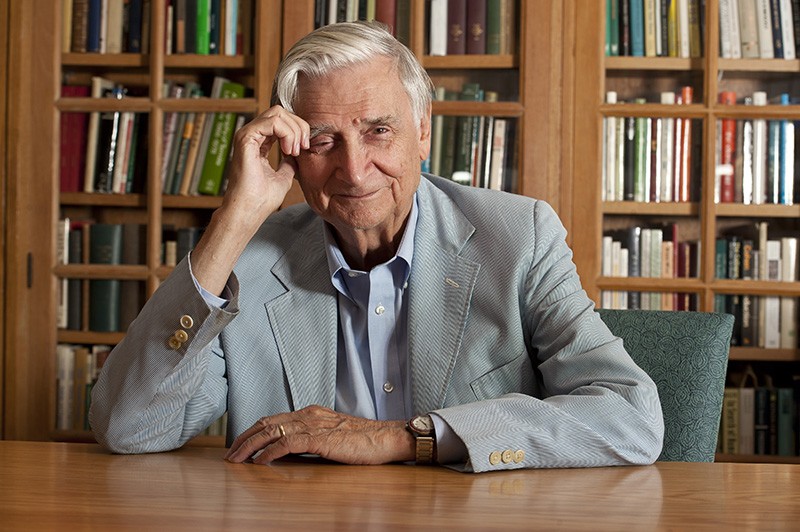





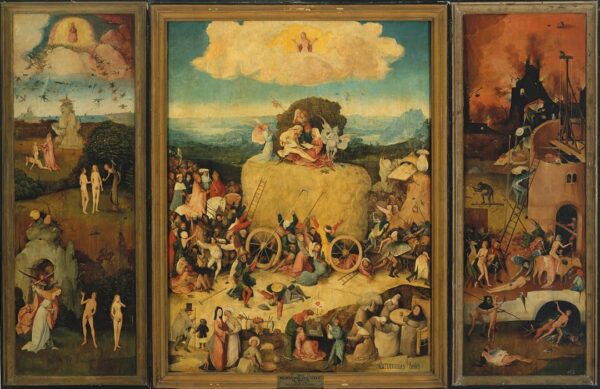



 The Daily Hatch
