Remarkably, his frugality even extended to opposing the use of taxpayer money to celebrate the Declaration of Independence.
In a column for the Foundation for Economic Education, Larry Reed explains that this happened a few years before he reached the White House.
When the city council of Buffalo, New York, sent the mayor a measure to fund Fourth of July celebrations in 1882, conventional wisdom suggested that approving it was the politically wise and patriotic thing to do. …The conventional wisdom underestimated the mayor. He vetoed the appropriation, and proudly took the heat for it.After a year in the job in which he earned the title, “the veto mayor,” he moved on to become “the veto governor” of the State of New York and finally, “the veto president” of the United States. His name was Grover Cleveland. On the matter of minding the till and pinching pennies on behalf of the taxpayer, he puts to shame the great majority of public officials here and everywhere. …This was a man unafraid to draw the line on public spending for two principal reasons: 1) Government should not be a grab bag of goodies for whatever cause somebody thinks is “good” and 2) Failure to keep government spending in check encourages politicians to buy votes and corrupt the political process. …He once expressed the wish that he would be remembered more for the laws he killed than the ones he signed. He still holds the record for the most vetoes of any American president in two terms (584 in all).
Wow. What a contrast with America’s recent presidents, all of whom (including the current resident of the White House) have enthusiastically spent other people’s money.
No wonder the late, great Walter Williams admiredPresident Cleveland.
Will Rogers has a great quote that I love. He noted, “Lord, the money we do spend on Government and it’s not one bit better than the government we got for one-third the money twenty years ago”(Paula McSpadden Love, The Will Rogers Book, (1972) p. 20.)
We need to slash defense spending and make other wealthy allies pay for their own defense!!!!
It’s Tax Day, and for millions of Americans that means ponying up to the IRS. The federal government does many things these days—most of which would be more efficiently carried out at the local level, or in the private sector. But Uncle Sam also engages in a particular form of charity that many Americans overlook: spending many tens of billions of dollars to defend wealthy, developed nations.
A new Cato infographic puts it all in perspective. It shows how much American taxpayers spend to subsidize the security, and to defend the interests, of other nations that are more than capable of defending themselves.
The average American spends $2,300 on the military, based on the latest data available. That is roughly four and a half times more than what the average person in other NATO countries spends. These countries boast a collective GDP of approximately $19 trillion, 25 percent higher than the U.S. They obviously can afford to spend more. So why don’t they? Because Uncle Sucker picks up nearly the entire tab.
Looked at another way, U.S. alliances constitute a massive wealth transfer from U.S. taxpayers (and their Chinese creditors) to bloated European welfare states and technologically-advanced Asian nations.
Despite the size and wealth of our allies, they are military dwarfs compared to the United States. The particularly galling comparison is the disparity between what the United States spends on the military as a percentage of the federal budget and what other countries spend on their military relative to total government spending.
While the United States spends 20 percent of the budget on the military, Japan spends a paltry 2.3 percent. Our NATO allies? The average is 3.6 percent. Even South Korea’s share of military spending is roughly half of our total, and they have much bigger threats to worry about. By providing for their security, we have encouraged allies to divert resources elsewhere.
The Constitution stipulates that the federal government should provide for the “common defence.” But the document never talks about providing for the defense of other nations. Their citizens are not party to our unique social contract. On this tax day, you might rest assured that wealthy citizens around the world are grateful that you are defending them, but don’t hold your breath waiting for a word of thanks.
It is time to rethink our alliances and the culture of dependency we have created among our allies. They have become wards to Uncle Sam’s dole. Only by ceasing to foot the security bill for them will we create an incentive for them to spend more.
_____________
Thank you so much for your time. I know how valuable it is. I also appreciate the fine family that you have and your commitment as a father and a husband.
Sincerely,
Everette Hatcher III, 13900 Cottontail Lane, Alexander, AR 72002, ph 501-920-5733,
Related posts:
Milton Friedman’s Free to Choose (1980), episode 3 – Anatomy of a Crisis. part 1
Milton Friedman The Power of the Market 5-5 How can we have personal freedom without economic freedom? That is why I don’t understand why socialists who value individual freedoms want to take away our economic freedoms. I wanted to share this info below with you from Milton Friedman who has influenced me greatly over the […]
Milton Friedman The Power of the Market 4-5 How can we have personal freedom without economic freedom? That is why I don’t understand why socialists who value individual freedoms want to take away our economic freedoms. I wanted to share this info below with you from Milton Friedman who has influenced me greatly over the […]
Milton Friedman The Power of the Market 3-5 How can we have personal freedom without economic freedom? That is why I don’t understand why socialists who value individual freedoms want to take away our economic freedoms. I wanted to share this info below with you from Milton Friedman who has influenced me greatly over the […]
Milton Friedman The Power of the Market 2-5 How can we have personal freedom without economic freedom? That is why I don’t understand why socialists who value individual freedoms want to take away our economic freedoms. I wanted to share this info below with you from Milton Friedman who has influenced me greatly over the […]
Milton Friedman The Power of the Market 1-5 How can we have personal freedom without economic freedom? That is why I don’t understand why socialists who value individual freedoms want to take away our economic freedoms. I wanted to share this info below with you from Milton Friedman who has influenced me greatly over the […]
I have said for years that the USA should not pay for the defense Germany and Japan. Yes, there were many reasons that was true in the past, but now they are two of our biggest friends and trading partners and they are on our side. Why should we limit their military now? I read […]
We got lots of problems at home with our country’s finances. Then why are we paying for Germany and Japan’s defense? Romney’s Other 47% Problem by Harvey Sapolsky and Benjamin H. Friedman Harvey Sapolsky is professor emeritus of public policy and organization at MIT. His co-author, Benjamin Friedman, is a research fellow at the Cato […]
I used to think that we must double the defense budget when we were in the cold war, but I did wonder why we were not letting Germany and Japan (who are two of our biggest trade partners) build up their defenses. I was given the old tired answer that we could not trust them […]
The film, with a budget of $100m, stars Cillian Murphy as J Robert Oppenheimer, seen as the “father of the atomic bomb”. The cast also includes Emily Blunt, Matt Damon, Florence Pugh, Rami Malek, Kenneth Branagh and Robert Downey Jr.
Vulture critic Bilge Ebiri has called the film “incredible”, tweeting that it’s a “relentlessly paced, insanely detailed, intricate historical drama that builds and builds and builds until Nolan brings the hammer down in the most astonishing, shattering way”.
Associated Press writer Lindsey Bahr tweetedthat the three-hour film is “a spectacular achievement, in its truthful, concise adaptation, inventive storytelling and nuanced performances”. She also called it “a serious, philosophical, adult drama that’s as tense and exciting as Dunkirk”.
The Los Angeles Times film editor, Joshua Rothkopf, has also called it “incredible” while critic Kenneth Turan described it as Nolan’s “most impressive film to date”. MTV’s Joshua Horowitz tweeted: “Impeccable immersive filmmaking of the highest order. Cillian Murphy gets the role he deserves. In love with Downey’s work. This one demands your attention.”
Oppenheimer is currently tracking to open to $40-50m in its US debut on 21 July but faces stiff competition from Greta Gerwig’s Barbie, which opens on the same day.
It marks Nolan’s first film for Universal Pictures after parting ways with Warner Bros. The new deal reportedly comes with a number of specific demands such as a theatrical window of at least 100 days before any form of digital release and a three-week period before the studio releases another film.
“It feels sometimes like a biopic, sometimes like a thriller, sometimes like a horror,” Murphy saidto the Guardian. “It’s going to knock people out.”
In an interview with Wired, Nolan said: “Some people leave the movie absolutely devastated. They can’t speak. I mean, there’s an element of fear that’s there in the history and there in the underpinnings. But the love of the characters, the love of the relationships, is as strong as I’ve ever done.”
—
OPPENHEIMER and EINSTEIN
On Science and Culture by J. Robert Oppenheimer, Encounter (Magazine) October 1962 issue, was the best article that he ever wrote and it touched on a lot of critical issues including the one that Francis Schaeffer discusses in this blog post!
Whitehead and Oppenheimer said modern science could not have been born except in the milieu of Christianity. Why? In the area of biblical Christianity, Galileo, Copernicus, Kepler, Francis Bacon — all these men, up to Newton, Faraday, and Maxwell — understood that there was a universe because God had made it. And they believed, as Whitehead has so beautifully said, that because God was a reasonable God one could discover the truth of the universe by reason. So modern science was born. The Greeks had almost all the facts that the early scientists had, but it never turned into a science like modern science. This came, as Whitehead said, out of the fact that these men really were sure that the truth of the universe could be pursued with reason because it had been made by a reasonable God.
I do not believe for a moment that if the men back at that point of history had had the philosophy, the epistemology of modern man, there would ever have been modern science. I also think science as we have known it is going to die. I think it is going to be reduced to two things: mere technology, and another form of sociological manipulation. I do not believe for a moment that science is going to be able to continue with its objectivity once the base that brought forth science has been totally destroyed. But one thing I am sure of, and that is that science never would have begun if men had had the uncertainty that modern man has in the area of epistemology.
He is There and He is Not Silent in The Complete Works of Francis A. Schaeffer. vol 1. A Christian View of Philosophy and Culture. Crossway: Wheaton, IL. 1985. p. 328
—
Atomic Bombings of Hiroshima and Nagasaki – August 6 and 9, 1945
From left to right: Robertson, Wigner, Weyl, Gödel, Rabi, Einstein, Ladenburg, Oppenheimer, and Clemence
In today’s news you will read about Kirk Cameron taking on the atheist Stephen Hawking over some recent assertions he made concerning the existence of heaven. Back in December of 1995 I had the opportunity to correspond with Carl Sagan about a year before his untimely death. Sarah Anne Hughes in her article,”Kirk Cameron criticizes […]
With the movie OPPENHEIMER coming out soon I thought was a good time to take a look again at the best article he ever wrote!!!
———
From left to right: Robertson, Wigner, Weyl, Gödel, Rabi, Einstein, Ladenburg, Oppenheimer, and Clemence
On Science and Culture by J. Robert Oppenheimer, Encounter (Magazine) October 1962 issue
We live in an unusual world, marked by very great and irreversible changes
that occur within the span of a man’s life. We live in a time where our knowledge and understanding of the world of nature grows wider and deeper at an unparalleled rate; and where the problems of applying this knowledge to man’s needs and hopes are new, and only a little illuminated by our past history.
Indeed it has always, in traditional societies, been the great function of culture to keep things rather stable, quiet, and unchanging. It has been the function of tradition to assimilate one epoch to another, one episode to another, even one year to another. It has been the function of culture to bring out meaning, by pointing to the constant or recurrent traits of human life, which in easier days one talked about as the eternal verities.
In the most primitive societies, if one believes the anthropologists, the principal function of ritual, religion, of culture is, in fact, almost to stop change. It is to provide for the social organism what life provides in such a magic way for living organisms, a kind of homeostasis, an ability to remain intact, to respond only very little to the obvious convulsions and alterations in the world around.
To-day, culture and tradition have assumed a very different intellectual and social purpose. The principal function of the most vital and living traditions to-day is precisely to provide the instruments of rapid change. There are many things which go together to bring about this alteration in man’s life; but probably the decisive one is science itself. I will use that word as broadly as I know, meaning the natural sciences, meaning the historical sciences, meaning all those matters on which men can converse objectively with each other. I shall not continually repeat the distinction between science as an effort to find out about the world and understand it, on the one hand, and science, in its applications in technology, as an effort to do something useful with the knowledge so acquired. But certain care is called for, because, if we call this the scientific age, we make more than one kind of oversimplification. When we talk about science to-day, we are likely to think of the biologist with his microscope or the physicist with his cyclotron; but almost certainly a great deal that is not now the subject of successful study will later come to be. I think we probably to-day have under cultivation only a small part of the terrain which will be natural for the sciences a century from now. I think of the enormously rapid growth in many parts of biology, and of the fact, ominous but not without hope, that man is a part of nature and very open to study.
The reason for this great change from a slowly moving, almost static world, to the world we live in, is the cumulative character, the firmness, the givenness of what has been learned about nature. It is true that it is transcended when one goes into other parts of experience. What is true on the scale of the inch and the centimeter may not be true on the scale of a billion light-years; it may not be true either of the scale of a one hundred billionth of a centimetre; but it stays true where it was proven. It is fixed. Thus everything that is found out is added to what was known before, enriches it, and does not have to be done over again. This essentially cumulative irreversible character of learning things is the hallmark of science. 3 T H I S M E A N S that in man’s history the sciences make changes which cannot be wished away and cannot be undone. Let me give two quite different examples. There is
much talk about getting rid of atomic bombs. I like that talk; but we must not fool ourselves. The world will not be the same, no matter what we do with atomic bombs, because the knoxvledge of how to make them cannot be exorcised. It is there; and all our arrangements for living in a new age must bear in mind its omnipresent virtual presence, and the fact that one cannot change that. A different example: we can never have again the delusions about the centrality and importance of our physical habitat, now that we know something of where the earth is in the solar system, and know that there are hundreds of billions of suns in our galaxy, and hundreds of billions of galaxies within reach of the great telescopes of the world. We can never again base the dignity of man’s life on the special character in space and time of the place where he happens to live.
These are irreversible changes; so it is that the cumulative character gives a paradigm of something which is, in other respects, very much more subject to question: the idea of human progress. One cannot doubt that in the sciences the direction of growth is progress. This is true both of the knowledge of fact, the understanding of nature, and the knowledge of skill, of technology, of learning how to do things. When one applies this to the human situation, and complains that we make great progress in automation and computing and space research but no comparable moral progress, this involves a total misunderstanding of the difference between the two kinds of progress. I do not mean that moral progress is impossible; but it is not, in any sense, automatic. Moral regress, as we have seen in our day, is just as possible. Scientific regress is not compatible with the continued practice of science.
It is, of course, true, and we pride ourselves on it that it is true, that science is quite international, and is the same (with minor differences of emphasis) in Japan, France, the United States, Russia. But culture is not international; indeed I am one of those who hope that, in a certain sense, it never quite will be, that the influence of our past, of our history, which is for different reasons and different peoples quite different, will make itself felt and not be lost in total homogeneity. I cannot subscribe to the view that science and culture are co-extensive, that they are the same thing with different names; and I cannot subscribe to the view that science is something useJ. Robert Oppenheimer ful, but essentially unrelated to culture. I think that we live in a time which has few historical parallels, that there are practical problems of human institutions, their obsolescence and their inadequacy, problems of the mind and spirit which, if not more difficult than ever before, are different, and difficult. I shall be dealing with some traits of the sciences which contribute to the difficulty, and may here give a synopsis of what they are. They have to do with the question of why the scientific revolution happened when it did; with the characteristic growth of the sciences: with their characteristic internal structure: with the relation of discovery in the sciences to the general ideas of man in matters which are not precisely related to the sciences: with freedom and necessity in the sciences, and the question of the creative and the open character of science, its infinity: and with what direction we .might try to follow in bringing coherence and order to our cultural life, in doing what it is proper for a group of intellectuals, of artists, of philosophers, teachers, scientists, statesmen to do to help refashion the sensibility and the institutions of this world, which need re-fashioning if we are at all to survive.
]t is not a simple question to answer why the scientific revolution occurred when it did. It started, as all serious historians would agree, in the late Middle Ages and early Renaissance, and was very slow at first. No great culture has been free of curiosity and reflection, of contemplation and thought. “To know the causes of things” is something that serious mtn have always wanted, a quest that serious societies have sustained. No great culture has been free of inventive genius. If we think of the culture of Greece, and the following Hellenistic and Roman period, it is particularly puzzling that the scientific revolution did not occur then. The Greeks discovered something without which our contemporary world would not be what it is: standards of rigour, the idea of proof, the idea of logical necessity, the idea that one thing implies another. Without that, science is very nearly impossible, for unless there is a quasirigid structure of implication and necessity, then if something turns out not to be what one expected, one will have no way of finding out where the wrong point is: one has no way of correcting himself, of finding the error. But this is something that the Greeks had very early in their history. They were curious and inventive; they did not experiment in the scale of moder
days, but they did many experiments; they had as we have only recendy learned to appreciate a very high degree of technical and technological sophistication. They could make very subtle and complicated instruments; and they did, though they did not write much about it. Possibly the Greeks did not make the scientific revolution because of some flaw in communication. They were a small society, and it may be that there were not quite enough people involved.
In a matter of history, we cannot assign a unique cause, precisely because the event itself is unique; you cannot test, to see if you have it right. I think that the best guess is that it took something that was not present in Chinese civilisation, that was wholly absent in Indian clvilisation, and absent also from Greco-Roman civilisation. It needed an idea of progress, not limited to better understanding for this idea the Greeks had. It took an idea of progress which has more to do with the human condition, which is well expressed by the second half of the famous Christian dichotomy–faith and works; the notion that the betterment of man’s condition, his civility, had meaning; that we all had a responsibility to it, a duty to it, and to man. I think that it was when this basic idea of man’s condition, which supplements the other worldly aspects of religion, was fortified and fructified between the 13th and i5th centuries by the re-discovery of the ancient world’s scientists, philosophers, and mathematicians, that there was the beginning of the scientific age. By the I7th century there were a handful of men involved in improving human knowledge, or “useful knowledge” as the phrases went, so that new societies like the Royal Society and the Academy were formed, where people could talk to each other and bring to the prosecution of science that indispensable element of working together, of communication, of correcting the other fellow’s errors and admiring the other fellow’s skills, thus creating the first truly scientific communities.
Just before Newton, Hobbes wrote: The Sciences are small power; because not eminent; and therefore, not acknowledged inany man, nor one at all, but in a few; and in them, but of a few things. For Science is of that nature, as none can understand it to be, but such as is good measure have attayned it. Arts of publique use, as Fortification, making of Engines, and other Instruments of War; because they conferre to Defence, and Victory, are Power.
5
It was the next century that put science in a context of fraternity, even of universal brotherhood. It encouraged a political view which was egalitarian, permissive, pluralistic, liberal– everything for which the word “democratic” is to-day justly and rightly used. The result is that the scientific world of to-day is also a very large one: an open world in which, of course, not everybody does everything, in which not everybody is a scientist or a prime minister, but in which we fight very hard against arbitrary exclusion of people from any works, any deliberation, any discourse, any responsibility for which their talents and their interests suit them. The result is that we face our new problems, created by the practical consequences of technology, and the great intellectual consequences of science itself, in the context of a world of two or three billion people, an enormous society for which human institutions were not really ever designed. We are facing a world in which growth is characteristic, not just of the sciences themselves, but of the economy, of technology, of all human institutions; no one can open a daily paper without seeing the consequences.
ONE CAN MEASURE scientific growth in a numberof ways, but it is important not to mistake things. The excellence of the individual scientist does not change much with time. His knowledge and his power does, but not the high quality that makes him great. We do not look to anyone to be better than Kepler or Newton, any more than we look to anyone to be better than Sophocles, or to any doctrine to be better than the gospel according to St. Matthew. Yet one can measure things, and it has been done. One can measure how many people work on scientific questions: one can count them. One can notice how much is published.
These two criteria show a doubling of scientific knowledge in every ten years. Casimir calculated that if the Physical Review continued to grow as rapidly as it has between i945 and ~96o, it would weigh more than the earth during the next century. In fifteen years, the volume of chemical abstracts has quadrupled; in biology the changes are faster still. To-day, if you talk about scientists and mean by that people who have devoted their lives to the acquisition and application of new knowledge, then 93 per cent of us are still alive. This enormously rapid growth, sustained over two centuries, means, of course, that no man learned as a boy more than a small fraction in his own field of what he ought to know as a grown man.
THERE ARE SEVERAL points to keep in mind. One would naturally think that if we are publishing so much, it must be trivial. I think that this is not true: any scientific community with sane people would protect itself against that: because we have to read what is published. The argument not to permit the accumulation of trivial, unimportant things which are not really new, which do not add to what was known before, is overwhelming.
The second point is that one may say that every new thing renders what was known before uninteresting, that one can forget as rapidly as one learns. That is in part true: whenever there is a great new understanding, a great new element of order, a new theory, or a new law of nature, then much that before had to be remembered in isolation becomes connected and becomes, to some extent, implied and simplified. Yet one cannot forget what went before, because usually the meaning of what is discovered in r962 is to be found in terms of things that were discovered in ~955 or ~95o or earlier. These are the things in terms of which the new discoveries are made, the origins of the instruments that give us the new discoveries, the origins of the concepts in terms of which they are discovered, the origins of the language and the tradition.
A third point: if one looks to the future of something that doubles every ten years, there must come a time when it stops, just as The Physical Reuietu cannot weigh more than the earth. We know that this will saturate, and probably at a level very much higher than today; there will come a time when the rate of growth of science is not such that in every ten years the amount that is known is doubled; but the amount that is added to knowledge then will be far greater than it is to-day. For this rate of growth suggests that, just as the professional must, if he is to remain professional, live a life of continuous study, so we may find a clue here also to the more general behaviour of the intellectual with regard to his own affairs, and those of his colleagues in somewhat different fields. In the most practical way a man will have some choice: he may choose to continue to learn about his own field in an intimate, detailed, knowledgeable way, so that he knows what there is to know about it. But then the field will not be very wide. His knowledge will be highly partial of science as a whole, but very intimate and very complete of his own field. He may, on the other hand, choose to know generally, superficially a good deal about what goes on in science, but without competence, without mastery, without intimacy, without depth. The reason for emphasising this is that the cultural values of the life of science almost all lie in the intimate view: here are the new techniques, the hard lessons, the real choices, the great dis- ;appointments, the great discoveries.
ALL S C I E N C E S grow out of common sense, out of curiosity, observation, reflection. One starts by refining one’s observation and one’s words, and by exploring and pushing things a little further than they occur in ordinary life. In this novelty there are surprises; one revises the way one thinks about things to accommodate the surprises; then the old way of thinking gets to be so cumbersome and inappropriate that one realises that there is a big change called for, and one re-creates one’s way cf thinking about this part of nature.
Through all this one learns to say what one has done, what one has found, and to be patient and wait for others to see if they find the same rlaings, and to reduce, to the point where it really makes no further difference, the normally overpoweringly vital element of ambiguity in human speech. We live by being ambiguous, by not settling things because they do not have to be settled, by suggesting more than one thing because their co-presence in the mind may be a source of beauty. But in talking about science one may be as ambiguous as ever until we come to the heart of it. Then we tell a fellow just what we did in terms that are intelligible to him, because he has been schooled to understand them, and we tell him just what we found and just how we did it. If he does not understand us, we go to visit him and help him; and if he still does not understand us, we go back home and do it over again. This is the way in which the firmness and solidity of science is established.
How THEN DOES IT GO? In studying the different parts of nature, one explores with different instruments, explores different objects, and one gets a branching of what at one time had been common talk, common sense. Each branch develops new instruments, ideas, words suitable
for describing that part of the world of nature. This tree-like structure, all growing from the common trunk of man’s common primordial experience, has branches no longer associated with the same question, nor the same words and techniques. The unity of science, apart from the fact that it all has a common origin in man’s ordinary life, is not a unity of deriving one part from another, nor of finding an identity between one part and another, between let us say, genetics and topology, to take two impossible examples, where there is indeed some connection.
The unity consists of two things: first and ever more strikingly, an absence of inconsistency. Thus we may talk of life in terms of purpose and adaptation and function, but we have found in living things no tricks played upon the laws of physics and chemistry. We have found and I expect will find a total consistency, and between the different subjects, even as remote as genetics and topology, an occasional sharp mutual relevance. They throw light on each other; they have something to do with each other; often the greatest things in the sciences occur when two different discoveries made in different worlds turn out to have so much in common that they are examples of a still greater discovery.
THE IMAGE is not that of an ordered array of facts in which every one follows somehow from a more fundamental one. It is rather that of a living thing: a tree doing something that trees do not normally do, occasionally having the branches grow together and part again in a great network.
The knowledge that is being increased in this extraordinary way is inherently and inevitably very specialised. It is different for the physicist, the astronomer, the micro-biologist, the mathematician. There are connections: there is this often important mutual relevance. Even in physics, where we fight very hard to keep the different parts of our subject from flying apart (so that one fellow will know one thing and another fellow will know another, and they do not talk to each other), we do not entirely succeed, in spite of a passion for unity which is very strong. The traditions of science are specialised traditions; this is their strength. Their strength is that they use the words, the machinery, the concepts, the theories, that fit their subjects; they are not encumbered by having to try to fit other sorts of things. It is the and Culture
(Page 7)
specialised traditions which give the enormous thrust and power to the scientific experience. This also makes for the problem of teaching and explaining the sciences. When we get to some very powerful general result which illuminates a large part of the world of nature, it is by virtue of its being general in the logical sense, of encompassing an enormous amount of experience in its concepts; and in its terminology it is most highly specialised, almost unintelligible except to the men who have worked in the field. The great laws of physics to-day, which do not describe everything (or we would be out of business) but which underlie almost everything that is ever noticed in ordinary human experience about the physical world, cannot be formulated in terms that can reasonably be defined without a long period of careful schooling. This is comparably true in other subjects.
ONE HAS THEN in these specialisations the professional communities in the various sciences. They are very intimate, work closely together, know each other throughout the world. They are always excited–sometimes jealous but usually pleased–when one member of the community makes a discovery. I think, for instance, that what we now call psychology will one day perhaps be many sciences, that there will be many different specialised communities practising them, who will talk with one another, each in their own profession and in their own way.
These specialised communities, or guilds, are a very moving experience for those who participate. There have been many temptations to see analogues in them for other human activities. One that we hear much discussed is this: “If physicists can work together in countries with different cultures, in countries with different politics, in countries of different religions, even in countries which are politically obviously hostile, is not this a way to bring the world together?”
The specialising habits of the sciences have, to some extent, because of the tricks of universities, been carried over to other work, to philosophy and to the arts. There is technical philosophy which is philosophy as a craft, philosophy for other philosophers, and there is art for the artists and the critics. To my mind, whatever virtues the works have for sharpening professional tools, they are profound misreadings, even profound subversions of the true functions of philosophy and art, which are to address themselves to the general common human problem. Not to everybody, but to anybody: not to specialists.
It is clear that one is faced here with formidable problems of communication, of telling People about things. It is an immense job of teaching on all levels, in every sense of the word, never ending.
IT HAS OFTEN BEEN held that the great discoveries in science, coming into the lives of men, affect their attitudes toward their place in life, their views, their philosophy. There is surely some truth in this.*
If discoveries in science are to have an honest effect on human thought and on culture, they have to be understandable. That is likely to be true only in the early period of a science, when it is talking about things which are not too remote from ordinary experience. Some of the great discoveries of this century go under the name of Relativity and Uncertainty, and when we hear these words we may think, “This is the way I felt this morning: I was relatively confused and quite uncertain”: this is not at all a notion of what technical points are involved in these great discoveries, or what lessons.
I think that the reason why Darwin’s hypothesis had such an impact was, in part, because it was a very simple thing in terms of ordinary life. We cannot talk about the contemporary discovery in biology in such language, or by referring only to things that we have all experienced.
Thus I think that the great effects of the sciences in stimulating and in enriching philosophical life and cultural interests have been necessarily confined to the rather early times in the development of a science. There is another qualification. Discoveries will really only resonate and change the thinking of men when they feed some hope, some need that pre-exists in the society. I thir~k that the real sources of the Enlightenment, fed a little by the scientific events of the time, came in the re-discovery of
(FOOTNOTE: Examples that are usually given include Newton and Darwin. Newton is not a very good example, for ~vhen we look at it closely ~ve are struck by the fact that in the sense of the Enlightenment, the sense of a coupling of faith in scientific progress and man’s reason with a belief in political progress and the secularisation of human life, Newton himself was in no way a Newtonian. His successors were.)
the classics, of classic political theory, perhaps most of all of the Stoics. The hunger of the Eighteenth Century to believe in the power of reason, to wish to throw off authority, to wish to secularise, to take an optimistic view of man’s condition, seized on Newton and his discoveries as an illustration of something which was already deeply believed in quite apart from the law of gravity and the laws of motion. The hunger with which the Nineteenth Century seized on Darwin had very much to do with the increasing awareness of history and change, with the great desire to naturalise man, to put him into the world of nature, which pre-existed long before Darwin and which made him welcome. I have seen an example in this century where the great Danish physicist Niels Bohr found in the quantum theory when it was developed thirty years ago this remarkable trait: it is consistent with describing an atomic system, only much less completely than we can describe large-scale objects. We have a certain choice as to which traits of the atomic system we wish to study and measure and which to let go; but we have not the option of doing them all. This situation, which we all recognise, sustained in Bohr his long-held view of the human condition: that there are mutually exclusive ways of using our words, our minds, our souls, any one of which ig open to us, but which cannot be combined: ways as different, for instance, as preparing to act and entering into an introspective search for the reasons for action. This discovery has not, I think, penetrated into general cultural life. I wish it had; it is a good example of something that would be relevant, if only it could be understood.
EINSTEIN ONCE SAID that a physical theory was not determined by the facts of nature, but was a free invention of the human mind. This raises the question of how necessary is the content of science–how much is it something that we are free not to find–how much is it something that could be otherwise? This is, of course, relevant to the question of how we may use the words “objectivity” and “truth.” Do we, when we find something, “invent” it or “discover” it?
The fact is, of course, just what one would guess. We are, of course, free in our tradition. and in our practice, and to a much more limited extent individually to decide where to look at nature, and how to look at nature, what questions to put, with what instruments and with what purpose. But we are not the least bit free to
settle what we find. Man must certainly be free to invent the idea of mass, as Newton did and as it has been refined and re-defined; but having done so, we have not been free to find that the mass of the light quantum or the neutrino is anything but zero. We are free in the start of things. We are free as to how to go about it; but then the rock of what the world is, shapes this freedom with a necessary answer. That is why ontological interpretations of the word “objective” have seemed useless, and why we use the word to describe the clarity, the lack of ambiguity, the effectiveness of the way we can tell each other about what we have found.
THUS in the sciences, total statements like those that involve the word “all,” with no qualifications, are hardly ever likely to occur. In every investigation and extension of knowledge we are involved in an action; in every action we are involved in a choice; and in every choice we are involved in a loss, the loss of that we did not do. We find this in the simplest situations. We find this in perception, where the possibility of perceiving is coextensive with our ignoring many things that are going on. We find it in speech where the possibility of understandable speech lies in paying no attention to a great deal that is in the air, among the sound waves, in the general scene. Meaning is always attained at the cost of leaving things out. We find it in the idea of complementarity here in a sharp form as a recognition that the attempt to make one sort of observation on an atomic system forecloses others. We have freedom of choice, but we have no escape from the fact that doing some things must leave out others. In practical terms, this means, of course, that our knowledge is finite and never all-encompassing. There is always much that we miss, much that we cannot be aware of because the very act of learning, of ordering, of finding unity and meaning, the very power to talk about things means that we leave out a great deal.
Ask the question: Would another civilisation bated on life on another planet very similar to ours in its ability to sustain life have the same physics? One has no idea whether they would have the same physics or not. We might be talking about quite different questions. This makes ours an open world without end. I had a Sanskritist friend in California who used to say mockingly that, if science were any good, it should be much easier to be an educated man and Culture
(Page 9) now than it was a generation ago. That is because he thought the world was closed.
THE THINGS THAT MAKE US choose one set of questions, one branch of enquiry rather than another are embodied in scientific traditions. In developed sciences each man has only a limited sense of freedom to shape or alter them; but they are not themselves wholly determined by the findings of science. They are largely of an ~esthetic character. The words that we use: simplicity, elegance, beauty: indicate that what we grope for is not only more knowledge, but knowledge that has order and harmony in it, and continuity with the past. Like all poor fellows, we want to find something new, but not something too new. It is when we fail in that, that the great discoveries follow.
AL T H E S E themes–the origin of science, its pattern of growth, its branching reticular structure, its increasing alienation from the common understanding of man, its freedom, the character of its objectivity and its openness– are relevant to the relations of science and culture. I believe that they can be and should be far more robust, intimate, and fruitful than they are to-day.
I am not here thinking of the popular subject of “mass culture.” In broaching that, it seems to me one must be critical but one must, above all, be human; one must not be a snob; one must be rather tolerant and almost loving. It is a new problem; one must not expect it to be solved with the methods of Periclean Athens. In the problems of mass culture and, above all, of the mass media, it is not primarily a question of the absence of excellence. The modest worker, in Europe or in America, has within reach probably better music and more good music, more good art, more good writing than his predecessors have ever had. It seems rather that the good things are lost in such a stream of poor things, that the noise level is so high, that some of the conditions for appreciating excellence are not present. One does not eat well unless one is hungry; there is a certain frugality to the best cooking; and something of this sort is wrong with the mass media. But that is not now my problem.
Rather, I think loosely of what we may call the intellectual community: artists, philosophers, statesmen, teachers, men of most professions, prophets, scientists. This is an open group, with no sharp lines separating those that think themselves of it. It is a growing faction of all peoples. In it is vested the great duty for enlarging, preserving, and transmitting our knowledge and skills, and indeed our understanding of the interrelations, priorities, commitments, injunctions, that help men deal with their joys, temptations and sorrows, their finiteness, their beauty. Some of this has to do, as the sciences so largely do, with propositional truth, with propositions which say “If you do thus and so you will see this and that”; these are objective and can be checked and cross-checked; though it is always wise from time to time to doubt, there are ways to put an end to the doubt. This is how it is with the sciences.
In this community there are other statements which “emphasise a theme” rather than declare a fact. They may be statements of connectedness or relatedness or importance, or they may be in one way or another statements of commitment. For them the word “certitude,” which is a natural norm to apply in the sciences, is not very sensible–depth, firmness, universality, perhaps more–but certitude, which applies really to verification, is not the great criterion in most of the work of a philosopher, a painter, a poet, or a playwright. For these are not, in the sense I have outlined, objective. Yet for any true community, for any society worthy of the name, they must have an element of community of being common, of being public, of being relevant and meaningful to man, not necessarily to everybody, but surely not just to specialists.
I HAVE SEEN much concerned that, in this world of change and scientific growth, we have so largely lost the ability to talk with one another, to increase and enrich our common culture and understanding. And so it is that the public sector of our lives, what we hold and have in common, has suffered, as have the illumination of the arts, the deepening of justice and virtue, and the ennobling power of our common discourse. We are less inert for this. Never in man’s history have the specialised ta’aditions more flourished than to-day. We have our private beauties. But in those high undert;tkings when man derives strength and insight from public excellence, we have been impoverished. We hunger for nobility, the rare words and acts that harmonise simplicity with truth. In this default I see some connection with the great unresolved public problems–survival, liberty, fraternity.
In this default I see the responsibility that the irttellectual community has to history and to our fellows: a responsibility which is a necessary condition for re-making human institutions as they need to be re-made to-day that there may be peace, that they may embody more fully those ethical commitments without which we cannot properly live as men.
This may mean for the intellectual community a very much greater effort than in the past. The community will grow; but I think that also the quality and the excellence of what we do must grow. I think, in fact, that with the growing wealth of the world, and the possibility that it will not all be used to make new committees, ft..ere may indeed be genuine leisure, and that a high commitment on this leisure is that we reknit the discourse and the understanding between the members of our community.
In this I think we have, all of us, to preserve our competence in our own professions, to preserve what we know intimately, to preserve our mastery. This is, in fact, our only anchor in honesty. We need also to be open to other and cc.mplementary lives, not intimidated by them and not contemptuous of them (as so many are to-day of the natural and mathematical sciences). As a start, we must learn again, without contempt and with great patience, to talk to one another; and we must hear.
In today’s news you will read about Kirk Cameron taking on the atheist Stephen Hawking over some recent assertions he made concerning the existence of heaven. Back in December of 1995 I had the opportunity to correspond with Carl Sagan about a year before his untimely death. Sarah Anne Hughes in her article,”Kirk Cameron criticizes […]
Francis Schaeffer mentioned Edward O. Wilson in his book WHATEVER HAPPENED TO THE HUMAN RACE? co-authored by C.Everett Koop on pages 289-291 (ft note 6 0n page 504). That was when I was first introduced to Dr. Wilson’s work. Wikipedia notes, Edward Osborne Wilson (June 10, 1929 – December 26, 2021) was an American biologist, naturalist, and writer. His specialty was myrmecology, the study of ants, on which he was called the world’s leading expert,[3][4] and he was nicknamed Ant Man.[5][6][7][8]
I was honored to correspond with Dr. Wilson from 1994 to 2021!!
November 1, 2018
Dr. Edward O. Wilson, Museum of Comparative Zoology Faculty Emeritus Pellegrino University Professor, Emeritus c/o Museum of Comparative Zoology Harvard University 26 Oxford Street Cambridge, MA 02138
Dear Dr. Wilson
On 12-14-05 you and James D. Watson appeared on the THE CHARLIE ROSE SHOW and you both praised Charles Darwin the whole time. You noted, “The man was always right. It`s exasperating to be an evolutionary biologist and try to develop something really new and find out that Darwin had either said it or he had created …. had foresight to, you know, indicate it.” James D.Watson asserted, “In my mind, Darwin was the most important person who ever lived on Earth…So Darwin had it so right.”
Did you know that Charles Darwin lost his taste for music, art and the beauty of nature in his old age?
“I am glad you were at the Messiah, it is the one thing that I should like to hear again, but I dare say I should find my soul too dried up to appreciate it as in old days; and then I should feel very flat, for it is a horrid bore to feel as I constantly do, that I am a withered leaf for every subject except Science. It sometimes makes me hate Science, though God knows I ought to be thankful for such a perennial interest, which makes me forget for some hours every day my accursed stomach.’
Francis Schaeffer summarized Darwin’s statement:
So he is glad for science because his stomach bothers him, but on the other hand when I think of what it costs me I almost hate science. You can almost hear young Jean-Jacques Rousseau speaking here, he sees what the machine is going to do and he hates the machine and Darwin is constructing the machine and it leads as we have seen to his own loss of human values in the area of aesthetics, the area of art and also in the area of nature. This is what it has cost him. His theory has led him to this place. When you come to this then it seems to me that you understand man’s dilemma very, very well, to think of the origin of the theory of mechanical evolution bringing Darwin himself to the place of this titanic tension.
Let me challenge you to attend the Messiah performance or at least listen to the words on You Tube of a performance.
Handel came across a libretto composed by Charles Jennens. Composed entirely of Scripture portions, mainly from the OT, Handel was deeply affected when he read this libretto. It was divided into three parts: 1) prophecies about the coming messiah (largely drawing on Isaiah); 2) the birth, life, ministry, death, resurrection of Christ; 3) the End times with Christ’s final victory over sin and death, largely based in the book of Revelation. Inspired, Handel decided he must compose an oratorio based on this libretto.
The Old Testament prophecies that the Messiah refers to were fulfilled in the life, death and resurrection of Christ. If you just look at the verses in Psalm 22 that refer to the piercing of Christ hands and feet then you must admit that when these prophecies were made hundreds of years before the events that they describe that Psalm 22 must have been divinely inspired. In 1000 B. C. the common Jewish way of killing people was stoning and it was the Romans who brought in crucifixion.
Here is Psalm 22:1,7,8,16,17,18:
1 My God, my God, why have you forsaken me? Why are you so far from saving me, so far from the words of my groaning?
7 All who see me mock me; they hurl insults, shaking their heads:
8 “He trusts in the LORD ; let the LORD rescue him. Let him deliver him, since he delights in him.”
16 Dogs have surrounded me; a band of evil men has encircled me, they have pierced my hands and my feet.
17 I can count all my bones; people stare and gloat over me.
18 They divide my garments among them and cast lots for my clothing.
I have gone back and forth and back and forth with many liberals on the Arkansas Times Blog on many issues such as abortion, human rights, welfare, poverty, gun control and issues dealing with popular culture. Here is another exchange I had with them a while back. My username at the Ark Times Blog is Saline […]
On March 17, 2013 at our worship service at Fellowship Bible Church, Ben Parkinson who is one of our teaching pastors spoke on Genesis 1. He spoke about an issue that I was very interested in. Ben started the sermon by reading the following scripture: Genesis 1-2:3 English Standard Version (ESV) The Creation of the […]
At the end of this post is a message by RC Sproul in which he discusses Sagan. Over the years I have confronted many atheists. Here is one story below: I really believe Hebrews 4:12 when it asserts: For the word of God is living and active and sharper than any two-edged sword, and piercing as far as the […]
In today’s news you will read about Kirk Cameron taking on the atheist Stephen Hawking over some recent assertions he made concerning the existence of heaven. Back in December of 1995 I had the opportunity to correspond with Carl Sagan about a year before his untimely death. Sarah Anne Hughes in her article,”Kirk Cameron criticizes […]
Thanks for your recent letter about evolution and abortion. The correlation is hardly one to one; there are evolutionists who are anti-abortion and anti-evolutionists who are pro-abortion.You argue that God exists because otherwise we could not understand the world in our consciousness. But if you think God is necessary to understand the world, then why do you not ask the next question of where God came from? And if you say “God was always here,” why not say that the universe was always here? On abortion, my views are contained in the enclosed article (Sagan, Carl and Ann Druyan {1990}, “The Question of Abortion,” Parade Magazine, April 22.)
In my January 10, 1996 Response letter to Carl Sagan (which I posted earlier) I also included the following insert based on the words of Francis Schaeffer in 1978:
Is man special or not?
Douglas Futuyma has said “Whether people are explicitly religious or not they tend to imagine that humans are in some sense the center of the universe. We are just one product of a very long historical process that has given to an enormous amount of organisms, and we are just one of them. So in some sense there is nothing special about us.”
The following comments were taken from the chapter called “”The Basis for Human Dignity which is in the book and film series co-aurthored by Francis Schaeffer and C. Everett Koop called “Whatever Happened to the Human Race?”
Section 1 Materialistic Humanism: The Worldview of our Age
The West has adopted a worldview which says that all reality is made up only of matter. In this view the universe did not get here because it was created by a “supernatural “ God.
Rather, the universe has existed forever in some form, and it’s present form just happened as a result of chance events way back in time.
Section 2 The search for an adequate worldview
Any worldview must answer 2 basic questions satisfactorily if it is to provide a real base for life and morals. The first is what we will call “the universe and it’s form,” and the second is the “mannishness of man.” The first draws attention to the fact that the universe around us is like an amazing jigsaw puzzle. We see many details, and we want to know how they fit together. That is what science is all about. Scientists look at the details and try to find out how they all cohere. So the first question that has to be answered is: Hiw did the universe get this way? How did it get this form, this pattern, this jigsawlike quality it now has?
Second, “The mannishness of man” draws attention to the fact that human beings are different from all other things in the world. Think, for example, of creativity. People in all cultures of all ages have created many kinds of all things, from “high art” to flower arrangements, from silver ornaments to high-technology supersonic aircraft. This is in contrast to the animals about us. People also fear death, and they remember the past and make projections into the future. One could name other factors, but these are enough to differentiate people from the other things in the world.
What worldview adequately explains the remarkable phenomenon of the distinctiveness of human beings? There is one worldview which explains the existence of the universe, it’s form, and the uniqueness of people— the worldview given to us in the Bible.
Section 3 The humanist base leads to meaningless
An overwhelming number of modern thinkers agree that seeing the universe and man from a humanist base leads to meaningless, both for the universe and for man—not just mankind in general but for each of us as individuals. Professor Steven Weinberg wrote these words in his book THE FIRST 3 MINUTES: A MODERN VIEW OF THE ORIGIN OF THE UNIVERSE while he was looking down from an airplane:
It is almost irresistible for humans to believe that we have some special relation to the universe, that human life is not just a more-or-less farcical outcome of a chain of accidents reaching back to the first three minutes, but that we were somehow built in from the beginning. … It is very hard to realize that this is all just a tiny part of an overwhelmingly hostile universe. It is even harder to realise that this present universe has evolved from an unspeakably unfamiliar early condition, and faces a future extinction of endless cold or intolerable heat. The more the universe seems comprehensible, the more it also seems pointless.
(1993), Epilogue, p. 154
When Weinberg says that the universe seems more “comprehensible,” he is, of course, referring to our greater understanding of the physical universe through the advance of science. But it is an understanding, notice, within a materialistic framework, which considers the universe solely in terms of physics and chemistry—-simply machinery.
If everything “faces a future extinction of endless cold or intolerable heat,” all things are meaningless.
Section 4 Tension results when you have an inadequate worldview
The greatest dilemma for those who hold an inadequate worldview is that it is impossible to live consistently within it. The playwright Samuel Beckett can “say” that words do not communicate anything—and that everything, including language, is absurd—yet he must use words to write his plays, even plays about meaninglessness. The list of contradictions can be extended endlessly. The truth is that everyone who rejects the Biblical worldview must live in a state of tension between ideas about reality and reality itself. If a person believes that everything is only matter or energy and carries this through consistently, meaning dies, morality dies, love dies, hope dies. Yet! The individual does love, does hope, does act on the basis of right and wrong. This is what we mean when we say that everyone is caught , regardless of his worldview, simply by the way things are.
Section 5 The Bible is God’s revealed truth and it tells us about our origin.
The scriptures tell us that the universe exists and has form and meaning because it was created purposefully by a personal creator. This being the case, we see that, as we are personal, we are not something strange and out of line with an otherwise impersonal universe. Since we are made in the image of God, we are in line with God. There is a continuity, in other words, between ourselves, though finite, and the infinite creator who stands behind the universe as its final source of meaning. Unlike the evolutionary concept of an impersonal beginning plus time plus chance, the Bible shows how man has personality and dignity and value. Our uniqueness is guaranteed, something which is impossible in the materialistic system!!!!!!
LETTER TO HUMANIST MAGAZINE IN 1994:
Francis Schaeffer once said, “If a man takes a certain non-christian set of presuppositions he will be forced eventually to be in a place of tension. The more consistent he is to his non-christian presuppositions the further he is away from the real world.” In “Ape and Essence,” (July/ August 1994) Edd Doerr is consistent with his humanistic presuppositions when he says “The bottom line is that the great apes are so much like us that there is no logical reason not to treat them as ‘persons’.”
Because Mr. Doerr has embraced evolution, he has been forced to ask himself this logical question: “When in the course of evolution did our ancestors qualify as persons?” But does this type of logic square with what we know to be true in the real world?
Genesis chapter one tells us that man is to rule over all animals because man is made in the image of God. Can animals make moral choices, enjoy poetry, appreciate music, worship God or recognize the beauty of the world around them? Humanism reduces man to a machine, but man’s conscience causes him to fell a tension.
As a young man Charles Darwin believed that the world was created by God, and at that time he was an enthusiastic admirer of fine paintings, classic music and Shakespeare. Furthermore, during a trip to Brazil he was do captivated by the beauty of nature that he later recalled how sure he was at the time that God had to be the designer of this grand and wondrous universe. However, later his presuppositions changed and he said, “My mind seems to have become a kind of machine for grinding general laws out of large collections of facts, but why this should have caused the atrophy of that part of the brain alone, on which the higher tastes depend, I cannot conceive… The loss of these tastes is a loss of happiness, and may possibly be injurious to the intellect, and more probably to the moral character, by enfeebling the emotional part of our nature.”
We are not cousins of apes, and anyone who embraces evolution will be forced eventually to be in a place of tension with the real world if they are consistent.
and you will hear what far smarter people than I have to say on this matter. I agree with them.
Harry Kroto
I have attempted to respond to all of Dr. Kroto’s friends arguments and I have posted my responses one per week for over a year now. Here are some of my earlier posts:
In the 1st video below in the 45th clip in this series are his words and my response is below them.
50 Renowned Academics Speaking About God (Part 1)
Another 50 Renowned Academics Speaking About God (Part 2
A Further 50 Renowned Academics Speaking About God (Part 3)
–
CARL SAGAN interview with Charlie Rose:
“…faith is belief in the absence of evidence. To believe in the absence of evidence, in my opinion, is a mistake. The idea is to hold belief until there is compelling evidence. If the Universe does not comply with our previous propositions, then we have to change…Religion deals with history poetry, great literature, ethics, morals, compassion…where religion gets into trouble is when it pretends to know something about science,”
______________ George Harrison Swears & Insults Paul and Yoko Lucy in the Sky with Diamonds- The Beatles The Beatles: I have dedicated several posts to this series on the Beatles and I don’t know when this series will end because Francis Schaeffer spent a lot of time listening to the Beatles and talking […]
The Beatles in a press conference after their Return from the USA Uploaded on Nov 29, 2010 The Beatles in a press conference after their Return from the USA. The Beatles: I have dedicated several posts to this series on the Beatles and I don’t know when this series will end because Francis […]
__________________ Beatles 1966 Last interview I have dedicated several posts to this series on the Beatles and I don’t know when this series will end because Francis Schaeffer spent a lot of time listening to the Beatles and talking and writing about them and their impact on the culture of the 1960’s. In this […]
_______________ The Beatles documentary || A Long and Winding Road || Episode 5 (This video discusses Stg. Pepper’s creation I have dedicated several posts to this series on the Beatles and I don’t know when this series will end because Francis Schaeffer spent a lot of time listening to the Beatles and talking and writing about […]
_______________ Francis Schaeffer pictured below: _____________________ I have included the 27 minute episode THE AGE OF NONREASON by Francis Schaeffer. In that video Schaeffer noted, ” Sergeant Pepper’s Lonely Hearts Club Band…for a time it became the rallying cry for young people throughout the world. It expressed the essence of their lives, thoughts and their feelings.” How Should […]
Crimes and Misdemeanors: A Discussion: Part 1 ___________________________________ Today I will answer the simple question: IS IT POSSIBLE TO BE AN OPTIMISTIC SECULAR HUMANIST THAT DOES NOT BELIEVE IN GOD OR AN AFTERLIFE? This question has been around for a long time and you can go back to the 19th century and read this same […]
____________________________________ Francis Schaeffer pictured below: __________ Francis Schaeffer has written extensively on art and culture spanning the last 2000years and here are some posts I have done on this subject before : Francis Schaeffer’s “How should we then live?” Video and outline of episode 10 “Final Choices” , episode 9 “The Age of Personal Peace and Affluence”, episode 8 […]
Love and Death [Woody Allen] – What if there is no God? [PL] ___________ _______________ How Should We then Live Episode 7 small (Age of Nonreason) #02 How Should We Then Live? (Promo Clip) Dr. Francis Schaeffer 10 Worldview and Truth Two Minute Warning: How Then Should We Live?: Francis Schaeffer at 100 Francis Schaeffer […]
___________________________________ Francis Schaeffer pictured below: ____________________________ Francis Schaeffer “BASIS FOR HUMAN DIGNITY” Whatever…HTTHR Dr. Francis schaeffer – The flow of Materialism(from Part 4 of Whatever happened to human race?) Dr. Francis Schaeffer – The Biblical flow of Truth & History (intro) Francis Schaeffer – The Biblical Flow of History & Truth (1) Dr. Francis Schaeffer […]
It’s difficult to have the albums created by the most important band in the history of music ranked from worst to best. After all, it’s unlikely that you’ll find any band or musical artist unwilling to share their admiration for the Fab Four. Their fingerprints are over everything created in popular music.
The Liverpool quartet recorded albums at a significant pace between 1963 and 1970. Many of these are classics that redefined what pop-rock could be. Most of these are tremendously experimental, adventurous affairs.
Still, which one’s the best? Is there any one album worth avoiding?
I’ve looked at the evidence and listened to the whole discography once more, and I think that I have an answer or two.
For simplicity’s sake, I have only included official UK releases. That means that the early US-released records aren’t on here. Neither are compilations such as “Anthology,” “Rarities,” or “Hey Jude.” “Yellow Submarine” is included as it included mostly unreleased material and was crafted as a studio album.
With this in mind, here’s a quick initiation into the musical world created by John, Paul, George, and Ringo, The Beatles albums ranked.
8. “With the Beatles” (1963)
The second album from The Beatles, “With the Beatles,” showcases the band’s growing songwriting abilities with tracks like “It Won’t Be Long” and “All My Loving.”
While it is a solid effort, it does not quite reach the level of innovation or originality of their later releases. The soon-to-be-christened Fab Four were still finding their footing at this point, and it is reflected in the somewhat formulaic nature of the album.
Standout tracks include “All I’ve Got To Do” and “Hold Me Tight.” The former features a particularly impressive vocal performance from Lennon.
George Harrison contributed and sang on the underrated “Don’t Bother Me,” already showing signs of possessing great songwriting abilities. It would, however, take several years before Harrison’s tunes would be considered potential singles by the rest of the band.
“With the Beatles” is a charming record that retains some of the essence of their Hamburg live shows.
At the same time, the band members are being molded into stars. Most importantly, though, they prove that they have something most of their pop-rock rivals do not possess, great original songs.
Come Together – John Lennon (Live In New York City)
——-___
Beatles members Paul McCartney, left, John Lennon, George Harrison and Ringo Starr photographed together in April 1969.
My personal favorite is “Here Comes The Sun”
The Bearles most revolutionary song in my view is “A Day In The Life”
I was born in 1961 and only remember hearing two Beatles songs playing on the radio and one of them was “The Long And Winding Road”
The other song I remember hearing on the radio was “Let It Be”
Join us with the Fool on the Hill as we wade through Strawberry Fields (forever), looking through a Glass Onion, in search of the Fabs’ best-ever tune By Mark Beaumont– 21st December 2021
If you ever doubt that The Beatles were the greatest band that ever existed, try ranking their songs. Out of 185 self-penned tunes they released commercially during their initial seven-year run – so not including covers, fan club releases, alternative versions or their 1995 reunion songs – you’ll list well over a hundred tracks before you get to anything you wouldn’t call sublime, and hit 150 or so before anything verging on average appears. Of their entire catalogue, only six or seven songs could be classed as ‘shonky’, and most of those have still got something historic going for them.
Among them you’ll find songs which caused seismic shifts in pop, psychedelia and rock and the formative roots of punk, metal and electronica, amongst a panoply of other styles they pioneered and popularised in such a short time. It’s a feat unmatched by any act before or since, and with Peter Jackson’sGet Backreviving interest in their achievements, let’s pile back in to the most magical mystery tour pop music has ever known, with each track ranked in order of greatness.
‘Wild Honey Pie’ (‘The Beatles’, 1968)
An experimental ‘White Album’ interlude recorded entirely by Paul, ‘Wild Honey Pie’ had a mild element of redneck Grieg menace, but little else to it.
‘Dig It’ (‘Let It Be’, 1970)
50 seconds of a far longer studio jam, during which Lennon makes random references to the FBI, the CIA, the BBC, BB King, Doris Day and Matt Busby over a pretty dreary rock’n’roll dirge, ‘Dig It’ only really existed to exemplify the fact that The Beatles cut loose a lot during the ‘Let It Be’ sessions. Now we’ve got seven-plus hours of Get Back, it’s rendered superfluous.
‘You Know My Name (Look Up The Number)’ (B-side of ‘Let It Be’, 1970)
“Good evening and welcome to Slaggers…”The Beatles spend an inordinate amount of studio time trying to perfect this frankly silly combo of blues rock, lounge samba, music hall clowning and a bit sung by Crazy Frog’s jazz Granddad. Don’t do drugs, kids.
‘Why Don’t We Do It In The Road?’ (‘The Beatles’, 1968)
Even before Google Street View, Paul’s uber-horny blues squeal about dogging like a champion was at best inadvisable and at worst just plain creepy. Everyone will definitely be watching you, so stop. Think. Don’t do it in the road.
‘Revolution 9’ (‘The Beatles’, 1968)
Of interest as an avant-garde curio exemplifying the fact that The Beatles had entirely dismissed all sonic boundaries by the ‘White Album’, John and Yoko’s epic sound collage of radio interference, studio chatter and orchestral samples is more notable and influential than it’s often given credit for. But you wouldn’t bung it on repeat.
‘Flying’ (‘Magical Mystery Tour’, 1967)
An incidental instrumental to accompany a psychedelic segment of Magical Mystery Tour, ‘Flying’ was little more than 12-bar rock’n’roll played, very stoned, on an organ for two minutes. Some distance from a Welsh male voice choir.
‘Only A Northern Song’ (‘Yellow Submarine’, 1969)
Designed as a piss-taking dig at Northern Songs, the Beatles’ publishing company, which George felt rewarded him pitifully for his songwriting efforts, ‘Only A Northern Song’ is intended to sound weird, wonky and half-baked, even as Harrison came into his own as a songsmith.
‘Ask Me Why’ (‘Please Please Me’, 1963)
A formulaic shake shack ballad of little note other than the sneaking suspicion that Morrissey took his entire vocal style from Lennon’s end-of-chorus flicks.
‘Little Child’ (‘With The Beatles’, 1963)
By-numbers Merseybeat that was one of the few unmemorable originals Lennon and McCartney ever penned.
‘Blue Jay Way’ (‘Magical Mystery Tour’, 1967)
Written by George while waiting for houseguests to arrive at the place he was staying on the titular Hollywood Hills street in 1967. They presumably arrived just after he’d perfected the ominous psychedelic organ mood but before he’d really gotten his teeth into the chorus.
‘Not A Second Time’ (‘With The Beatles’, 1963)
A song desperately in search of a hookline, ‘Not A Second Time’ finds John’s voice flapping wildly around the verses as if desperate to find somewhere solid to land.
‘Her Majesty’ (‘Abbey Road’, 1969)
A lightweight folk frippery that sounds particularly throwaway when tacked on the end of ‘Abbey Road’’s monumental side two medley as a secret final track.
‘Run For Your Life’ (‘Rubber Soul’, 1965)
As The Beatles shifted away from love songs, John contributed this out-and-out hate song to ‘Rubber Soul’ – a nifty country rocker and arguably the proto-‘Last Train To Clarkesville’, but notorious as The Beatles’ most problematic track. John would claim to regret having written it, calling it his least favourite Beatles song.
‘Don’t Bother Me’ (‘With The Beatles’, 1963)
“I don’t think it’s a particularly good song,” George said of his debut Beatles writing credit, “it mightn’t even be a song at all.” Actually, it’s a pretty nifty homage to the surf rock craze of the time. And definitely a song.
‘For You Blue’ (‘Let It Be’, 1970)
Standard, formulaic slide guitar blues given a sweetness and light by George’s weightless vocals and exclamation, “Elmore James got nothing on this!”
‘What Goes On’ (‘Rubber Soul’, 1965)
Honky-tonk pastiche written by John in 1959 and passed over for several albums before landing half-heartedly on ‘Rubber Soul’. You can actually hear the band lose interest midway through.
‘Thank You Girl’ (B-side to ‘From Me To You’, 1964)
Recorded by John with a heavy cold, it’s perhaps understandable that this thank you letter to their fans – a “hack song”, according to McCartney – sounds muddy and under-developed. On this evidence you’d assume EMI Studios doubled as a bomb shelter.
‘One After 909’ (‘Let It Be’, 1970)
Plucked from the catalogue of early Lennon/McCartney compositions when the band were short on material for ‘Let It Be’, Paul’s locomotive skiffle knockabout had a retro charm but never really escaped the formula.
‘I Me Mine’ (‘Let It Be’, 1970)
A lovely choral waltz ballad from George, totally ruined by nobody bothering to write a proper chorus and just bawling the title over some 12-bar sleaze rock riffing instead.
‘I’ll Cry Instead’ (‘A Hard Day’s Night’, 1964)
Bitterness, heartbreak and romantic revenge; Lennon’s dark side was on show even on the skiffly, tucked-away tracks of the Beatlemania era.
‘Yer Blues’ (‘The Beatles’, 1968)
Passionate, characterful and a raw exorcism of John’s harrowed late-‘60s mindset, certainly. But The Beatles were way past by-numbers blues rock by ‘68 and ‘Yer Blues’ stood out as an unimaginative throwback on the ‘White Album’.
‘When I Get Home’ (‘A Hard Day’s Night’, 1964)
Formulaic Beatlemania fare in which John gets excited at the prospect of telling his wife about all the screaming girls, drugs and parties on tour. Bet she was thrilled.
‘Being For The Benefit Of Mr Kite!’ (‘Sgt. Pepper’s Lonely Hearts Club Band’, 1967)
For some, John’s cabaret pastiche is the very essence of ‘Sgt. Pepper…’, capturing the sepia carnival vibe in its circus poster lyrics and carousel interlude. To these ears, though, it’s club-footed, corny and unnecessary.
‘I’ll Get You’ (B-side to ‘She Loves You’, 1963)
John’s songwriting sparkles on the B-side of their first single, yet lacks the confidence of more head-waggling numbers of the era.
‘This Boy’ (B-side to ‘All My Loving’)
Faithful homage to the harmony groups of the ‘50s and early ‘60s, and a rare example of a Beatles song that could be mistaken for that of any other band.
‘I’m Down’ (B-side to ‘Help!’)
Nifty Little Richard-style rock’n’roller that doesn’t sound all that “down” at all.
‘Love Me Do’ (single, 1962)
Legendary and all that, being the debut single, but let’s face it: a bit of a plodder.
‘Hold Me Tight’ (‘With The Beatles’, 1963)
Even when rehashing some pretty standard rock’n’roll chord progressions and melodic structures on a song that McCartney himself would call “filler”, The Beatles exuded a fundamental magic that set them apart from the Merseybeat horde.
‘There’s a Place’ (‘Please Please Me’, 1963)
Early signs of spiritual and philosophical musings from John as he tries his hand at Motown.
‘She’s A Woman’ (B-side to ‘I Feel Fine’)
Basic, bluesy rock’n’roller notable for some pretty savage guitar work and McCartney clearly working his way up to the sort of full-throated blues bawls he’d let loose once the ‘60s were ready for them.
‘Misery’ (‘Please Please Me’, 1963)
The exuberance of being in a studio recording ‘Please Please Me’ made this shameless homage to the ‘50s crooners sound like the cheeriest song about existential despair ever recorded. No bad thing.
‘I Call Your Name’ (‘Long Tall Sally EP’, 1964)
A pre-Beatles Lennon tune originally given to British popper Billy J. Kramer. The Beatles’ version swung harder.
‘What You’re Doing’ (‘Beatles For Sale’, 1964)
George’s proto-indie-pop guitar line lifted one of Paul’s less eventful tunes, but not an un-influential one – somewhere in here is the root of The La’s’ ‘There She Goes’.
‘Octopus’s Garden’ (‘Abbey Road’, 1969)
Seemingly envisioning a future in children’s entertainment as The Beatles fell apart, Ringo’s second-ever writing credit involved oompah larks and underwater adventure (sound familiar?), adorned with George making bubble noises by blowing into a glass of milk through a straw.
‘Polythene Pam’ (‘Abbey Road’, 1969)
‘Pinball Wizard’ power chords, nifty solo, broad Scouse accent, low-rent S&M; there was so much going on in John’s throwaway 70-second rocker about a bizarre sexual encounter in Jersey in 1960 (involving beat poet Royston Ellis) that you wish he’d written a chorus for it.
‘You Like Me Too Much’ (‘Help!’, 1965)
It’s baffling that The Beatles only really began recognising and appreciating George’s songwriting come ‘The White Album’, since he was displaying solid melodic chops way back on ‘Help!’.
‘Maxwell’s Silver Hammer’ (‘Abbey Road’, 1969)
You’ve written some of the finest children’s songs of the century, why the hell shouldn’t you try to make a vaudevillian family singalong from the story of an insane, hammer wielding psychopath? Basically Wes Craven’s ‘When I’m Sixty-Four’.
‘Tell Me What You See’ (‘Help!’, 1965)
Sometimes The Beatles’ harmonising could carry an entire song alone, as on this shift towards a more contemplative folk maturity. Includes an entire verse nicked from a religious passage that hung in John’s childhood home.
‘The Ballad Of John And Yoko’ (single, 1969)
The sorry tale of John and Yoko’s troubled and press-hounded attempts to wed at short notice in various European locales, delivered as impassioned country lament.
‘Sun King’ (‘Abbey Road’, 1969)
The Beatles’ impression of The Beach Boysdoing Fleetwood Mac’s ‘Albatross’ (in cod-Spanish) fell between two stools on ‘Abbey Road’; not as plush as ‘Because’ nor as melodically bright as ‘Here Comes The Sun’. Lovely, then, but slight.
‘I Need You’ (‘Help!’, 1965)
Gorgeous flamenco strumble from George, finding his songwriting feet on ‘Help!’.
‘Ob-La-Di, Ob-La-Da’ (‘The Beatles’, 1968)
Macca Marmite: one either adores the cheery Jamaican lilt of Desmond and Molly’s story and considers it pivotal in attuning British pop culture to ska music or, like Lennon, deems it “more of Paul’s granny music shit”.
‘I’m Happy Just To Dance With You’ (‘A Hard Day’s Night’, 1964)
A Lennon/McCartney composition given to George to sing. You likely owe your very existence to this dance hall romance, since it probably gave your Granddad the nerve to chat up your Nanna down the Mecca.
‘I’ll Be Back’ (‘A Hard Day’s Night’, 1964)
Flamenco-flecked and downbeat, the closer of ‘A Hard Day’s Night’ – rewritten from Del Shannon’s ‘Runaway’ – was an early sign of The Beatles’ sophisticated tonal ambitions within what were, at the time, strictly regimented ‘60s pop structures.
‘The Continuing Story Of Bungalow Bill’ (‘The Beatles’, 1968)
The crackle of boy scout campfire virtually enshrouds this charming tale of bravery and derring-do out on the hunt in the days of empire. Twitter would rip it a new arsehole, mind.
‘Lovely Rita’ (‘Sgt. Pepper’s Lonely Hearts Club Band’, 1967)
Of all of Paul’s outlandish character songs, ‘Lovely Rita’, in which our narrator develops affection for a traffic warden, is by far the least believable, but remains charming thanks to some gorgeous band harmonies and nifty work on the paper and comb.
‘I Wanna Be Your Man’ (‘With The Beatles’, 1963)
An energised if one-trick jitterbugger written by Paul on a night out with The Rolling Stones in Richmond. It became The Stones’ second single before The Beatles gave it to Ringo to holler on ‘With The Beatles’.
‘The Word’ (‘Rubber Soul’, 1965)
The link between ‘Drive My Car’ and ‘Taxman’, ‘The Word’ added a touch of harmonic funk to ‘Rubber Soul’ as Lennon took a stab at a one-note song in homage to ‘Long Tall Sally’.
‘Old Brown Shoe’ (B-side of ‘The Ballad Of John And Yoko’, 1969)
George in righteous, piano-thumping boogie-woogie mode. Upstaged its own A-side.
‘Piggies’ (‘The Beatles’, 1968)
Tainted in retrospect by Charles Manson’s murderous interpretations, George’s harpsichord satire of the selfish and gluttonous rich, smothered in porcine snorts and grunts, is a stirring but unsettling listen.
‘Fixing A Hole’ (‘Sgt. Pepper’s Lonely Hearts Club Band’, 1967)
The pot-fixated ‘Fixing A Hole’ makes great use of harpsichord (played by both Paul and George Martin) to give a psychedelic lilt to a music hall pastiche on which Paul makes the utmost of a one-note chorus.
‘If I Needed Someone’ (‘Rubber Soul’, 1965)
This fine Merseybeat evolution offers early indications of George’s Indian influence and of the psychedelic storm the band would later kick up on ‘Tomorrow Never Knows’.
‘I’ve Got A Feeling’ (‘Let It Be’, 1970)
Suitably blustery for a song recorded on a rooftop in January, Paul’s dive into The Band-style bluesy Americana rock is long on feel and passion, short on melodic impact.
‘Think For Yourself’ (‘Rubber Soul’, 1965)
Incorporating Motown beats and an open-mindedness gleaned from encounters with Dylan, George’s first major foray out of romantic odes was targeting at society’s regressive and narrow-minded elements, quite possibly in government.
‘You Can’t Do That’ (‘A Hard Day’s Night’, 1964)
A tuneful precursor to ‘Run For Your Life’, which also finds John’s jealousy getting the better of him.
‘Sgt. Pepper’s Lonely Hearts Club Band (Reprise)’ (‘Sgt. Pepper’s Lonely Hearts Club Band’, 1967)
Rocking up the title track, the reprise rips off the neon military blazers to expose the Hamburg leathers beneath.
‘Every Little Thing’ (‘Beatles For Sale’, 1964)
A marriage of the melancholy and upbeat, this was a rare example of John singing a Paul song.
‘Wait’ (‘Rubber Soul’, 1965)
The Beatles as pop toreadors. A certain Mediterranean fire creeps into Macca’s plea to Jane Asher to give him at least until the end of tour.
‘I Don’t Want To Spoil The Party’ (‘Beatles For Sale’, 1964)
John plays the party-pooping wallflower on this beautifully forlorn skiffle lament and a thematic precursor to ‘How Soon Is Now?’.
‘Tell Me Why’ (‘A Hard Day’s Night’, 1964)
An all-barrels harmonic doo-wop assault which Paul, in retrospect, thought might have been a window onto John’s troubled marriage to Cynthia.
‘Doctor Robert’ (‘Revolver’, 1966)
Perhaps spurred on by The Rolling Stones’ ‘Mother’s Little Helper’ and Donovan’s ‘Candy Man’, Lennon penned his own tribute to a drug-supplying medic, rumoured to be Dr Robert Freymann, known for supplying B-12 injections liberally laced with amphetamine. They kick in on the blissed-out middle-eight, clearly.
‘It’s Only Love’ (‘Help!’, 1965)
One of Lennon’s prettiest early-period tunes (he hated it, natch), built around sumptuous 12-string rhythms and a twee but fan-friendly lyric. Working title: ‘That’s A Nice Hat’.
‘The Inner Light’ (B-side of ‘Lady Madonna’, 1968)
Based on a Taoist poem and recorded with Indian musicians in Bombay, The ‘Lady Madonna’ flipside was one of only four Beatles songs with no Beatles playing on it (quiz compilers: the others are ‘Good Night’, ‘She’s Leaving Home’ and ‘Eleanor Rigby’), but magnificently emulated the serenity of the Transcendental Meditation techniques the band were learning from the Maharishi.
‘Rocky Raccoon’ (‘The Beatles’, 1968)
Cartoonish Wild West soap opera larks and one of Paul’s better novelty tunes, thanks to a popcorn guzzling plot and George Martin’s honky tonk piano solo tumbling past like a saloon fight.
‘Good Night’ (‘The Beatles’, 1968)
As reward for getting all the way through ‘Revolution 9’, Ringo turned up with a full Busby Berkeley orchestra to tuck you in with this sleepyhead lullaby. Night night, Ringo.
Central, stylistically, to the pre-war cabaret conceit of ‘Sgt. Pepper’s…’, Paul’s cheery/corny bandstand ode to somehow reaching your 60s without murdering your spouse was among the first he ever wrote, aged 16. Now go on, give Nanna a kiss.
‘Oh! Darling’ (‘Abbey Road’, 1969)
Updating 1950s US swing for the psychedelic era, McCartney put his all into ‘Oh! Darling’, even coming into the studio early to have one crack at it every day before his voice lost its edge. The song’s part in getting glam underway has gone woefully unrecognised.
‘Yellow Submarine’ (‘Revolver’, 1966)
Ringo’s most legendary moment, the quintessential psychedelia ditty and arguably the most overplayed Beatles song of all. You came for the chant-along chorus aged four and stayed until adulthood for the ‘shroom-friendliness and Lennon shouting, “Full speed ahead, Mr Boatswain / Full speed ahead, bop-dibbetty-bip-bop!” Features The Stones’ Brian Jones on ocarina. No shit.
‘Don’t Let Me Down’ (‘Let It Be’, 1970)
Louche and languid (read: almost certainly on heroin by now), Lennon’s plea to Yoko flits between the vulnerable, optimistic, lovestruck and desperate. Find yourself someone who “does” you like Yoko “done” John.
‘Girl’ (‘Rubber Soul’, 1965)
Melding Greek and German music into a mournful mood piece, Lennon pointed the way to The Beatles’ more sophisticated latter period with ‘Girl’, probably the best song ever to have a chorus that’s mostly just inhaling.
‘Dig A Pony’ (‘Let It Be’, 1970)
One of the more inventive and engaging blues numbers the band worked up for ‘Let It Be’, not least because of Lennon’s acid-fried lyrics. Just exactly how one does “a roadhog” or “syndicate[s] any boat you row” remains unspecified.
‘Things We Said Today’ (‘A Hard Day’s Night’, 1964)
Idyllic strumbler penned by Paul on a yacht called Happy Days in the Virgin Islands with glamorous new girlfriend Jane Asher. And sounds like it.
‘Do You Want To Know A Secret’ (‘Please Please Me’, 1963)
Inspired by a song from Snow White And The Seven Dwarves, which John’s mother used to sing to him as a child, the strength of ‘Do You Want To Know A Secret’ was in its childlike simplicity and coy teen naivety.
‘Baby’s In Black’ (‘Beatles For Sale’, 1964)
Hoedown homage so gorgeous it’ll give you an ounce of sympathy for a man trying to pull a hot widow while her husband isn’t yet cold in the ground.
‘The Fool On The Hill’ (‘Magical Mystery Tour’, 1967)
Flutes! Recorder solos! Meditation! The budget for the Magical Mystery Tour TV special was severely stretched when Paul allegedly decided the sequence for his wistful portrait of the Maharishi should be filmed in a beach near Nice.
‘And I Love Her’ (‘A Hard Day’s Night’, 1964)
Doe-eyed flamenco vibes abound on one of Paul’s early run-ups to ‘Yesterday’.
‘Mean Mr. Mustard’ (‘Abbey Road’, 1969)
Blur basically got their entire ‘90s out of John’s engrossing one-minute oompah tune inspired by a newspaper story of a “dirty old” miser – in real life, one John Mustard of Enfield, Middlesex – who hid his money so he wouldn’t be forced to spend it. His level of personal hygiene was unrecorded.
‘Altogether Now’ (‘Yellow Submarine’, 1969)
While ‘Yellow Submarine’ and ‘Octopus’s Garden’ were story time classics, ‘Altogether Now’’s nursery-level track easily stands up as The Beatles’ best children’s song.
‘Hello, Goodbye’ (single, 1967)
Brisk, bright-eyed and boasting one of the best pre-choruses in pop, ‘Hello, Goodbye’ would be the best single in most bands’ careers. It’s the 107th best song The Beatles wrote. That’s how great they were. Strap in: everything from here gets fucking brilliant.
‘Good Morning Good Morning’ (‘Sgt. Pepper’s Lonely Hearts Club Band’, 1967)
The Beatles did a fine line in rise-and-shine tunes, although John’s compulsive dawn chorus on ‘Sgt. Pepper…’ came with a hearty dollop of cynicism, everyday mundanity and casual adultery.
‘Another Girl’ (‘Help!’, 1965)
The Help! scene set the blueprint for The Monkees‘ entire career, as the band played this Beatlemania cracker on a beach in the Bahamas, with Paul using a bikini-clad girl as a guitar.
‘I Want You (She’s So Heavy)’ (‘Abbey Road’, 1969)
The last song all four Beatles recorded together; you can hear the sheer weight of the occasion. At almost eight minutes and smothered in doomy textures and white noise, it would have seen John invent heavy metal if Paul hadn’t beaten him to it with ‘Helter Skelter’. Instead it invents Pink Floyd’s ‘Meddle’ and provides proof, if any were needed, that stoner rock is basically the blues on military grade tranquilisers.
‘Within You Without You’ (‘Sgt. Pepper’s Lonely Hearts Club Band’, 1967)
Probably the ultimate expression of George’s Indian immersion, ‘Within You Without You’ opened many a Western third eye to the wonders of ‘world music’ and Eastern philosophies.
‘I’m So Tired’ (‘The Beatles’, 1968)
When you shout for ‘Help!’ and nobody listens, this is where you end up. Tortured, wasted, exhausted and desperate. Even three weeks of solid insomnia at the Maharishi’s retreat can’t dampen Lennon’s melodic prowess, as he knocks out the perfect song for day three of the prom night that forgot to finish.
‘The End’ (‘Abbey Road’, 1969)
Masterful and historic as the climax of the ‘Abbey Road’ medley, even taken in isolation ‘The End’ is exultant mood-making, from Ringo’s drum solo to the gathering gospel storm and Paul’s thought-provoking orchestral coda.
‘Birthday’ (‘The Beatles’, 1968)
Along with Stevie Wonder’s ‘Happy Birthday’, The Beatles’ impassioned 12-bar well-wishing – written and recorded in one night – is usually the best thing about scratching off another year on this godforsaken hellhole of a planet.
‘All I’ve Got To Do’ (‘A Hard Day’s Night’, 1964)
A Smokey Robinson homage aimed at the US market – British teens of the ‘60s would never dream of calling a girl up “on the phone”, Lennon later claimed.
‘It’s All Too Much’ (‘Yellow Submarine’, 1969)
The sheer euphoria of George’s peak acid song, floating through a blissed-out clamour of noise rock, trumpet and disintegrating beats, makes us all yearn for the days before you’d pay 50 quid for a bag of blotting paper soaked in balsamic vinegar off the dark web.
‘Baby, You’re A Rich Man’ (B-side of ‘All You Need Is Love’, 1967; ‘Magical Mystery Tour’, 1967)
Because we’re all as loaded as Bezos inside, you dig? Sublimely funky ode to our spiritual wealth that’s still begging the decades-old question: just where in a zoo, exactly, might you stash a bag full of cash?
‘Don’t Pass Me By’ (‘The Beatles’, 1968)
Ringo’s long underrated songwriting debut doesn’t get the credit it deserves for holding its own on ‘The White Album’. The sheer clod-hopping junk shop exuberance (unsurprising, since Ringo had been trying to get it recorded since 1962) makes it an album highlight, along with the fiddle player so drunk he doesn’t realise the song’s finished. A Number One single in Denmark – and don’t think we didn’t consider making it number one in this list too, just for the traffic.
‘She Came In Through The Bathroom Window’ (‘Abbey Road’, 1969)
Plush, proto-Wings country rocker inspired by a fan breaking into Paul’s house to steal photographs. Key to the ‘Abbey Road’ medley’s impression that the band had melodic wonders aplenty to toss into the pile.
‘Glass Onion’ (‘The Beatles’, 1968)
Woooah! Meta… A Beatles song about The Beatles. Walruses, Strawberry Fields, Lady Madonna and the Fool on the Hill all reprise their roles in Beatles history as Lennon mocks people reading too much into the band’s lyrics to a chamber rock backing that ELO got at least three early albums out of.
‘Carry That Weight’ (‘Abbey Road’, 1969)
It takes a certain classical majesty to slip a grand orchestral reprise of ‘You Never Give Me Your Money’ into a stonking great lad rock anthem chorus in search of a song.
‘Yes It Is’ (B-side of ‘Ticket To Ride’)
Effortlessly reinvented the blue-eyed crooner genre on a frickin’ B-side. Just try not playing it twice.
‘P.S. I Love You’ (B-side of ‘Love Me Do’, 1962; ‘Please Please Me’, 1963)
The song The Shadows would have written, had they been the world’s greatest band in the making.
‘Get Back’ (‘Let It Be’, 1970)
We’ve all seen it chug into life in the documentary of the same name, its simple blues strut brought to life by Billy Preston’s wild-at-heart organ. Still slaps.
‘Sgt. Pepper’s Lonely Hearts Club Band’ (‘Sgt. Pepper’s Lonely Hearts Club Band’, 1967)
Pre-war nostalgia meets counterculture psychedelia explosion to landscape obliterating effect. And all, the story goes, because Paul didn’t know that the ‘S’ and ‘P’ on his in-flight meal pots stood for ‘Salt’ and ‘Pepper’.
‘Michelle’ (‘Rubber Soul’, 1965)
In Parisian mood, Paul tries out some schoolboy French to woo a continental bohemian lass. Originally written as a pastiche of a bloke singing a song in French at an art party.
‘Hey Bulldog’ (‘Yellow Submarine’, 1969)
A masterclass in rock dynamism and melodic tension, and testament to the fact that The Beatles buried genius in all corners of their catalogue, smothered in barking noises, ripe for re-evaluation.
‘Any Time At All’ (‘A Hard Day’s Night’, 1964)
Trying to write another ‘It Won’t Be Long’, Lennon came up with something a touch more mature – an early sign that The Beatles were on a fast-track out of Merseybeat, bound for somewhere rather more Dylanish.
‘Lady Madonna’ (single, 1968)
Marrying his revived interest in 1920s radio jazz (see also: ‘Martha My Dear’, ‘Honey Pie’) to a dirty ‘50s swamp blues rock’n’roll riot, McCartney imagined a gender-swapped version of Fats Domino’s working man blues rocker ‘Blue Monday’ and came up with a song that rocks until the wheels damn near come off.
‘I’m Looking Through You’ (‘Rubber Soul’, 1965)
A fine, fond farewell to the ‘old Beatles’ as they approached their giant leap. And yes, that is the riff from The Travelling Wilburys’ ‘End Of The Line’ at the start – nice recycle, George.
‘I’m A Loser’ (‘Beatles For Sale’, 1964)
Considered the first sign of Dylan’s influence on The Beatles, and one of John’s early cries for help hidden beneath a storming country-pop melody.
‘I Feel Fine’ (single, 1964)
“I’ve written this song, but it’s lousy,” Lennon said to Ringo one day in the studio. We call bullshit. One of the first deliberate uses of feedback on record.
‘The Night Before’ (‘Help!’, 1965)
“Love was in your eyes, ah, the night before / Now today I find you have changed your mind.”She was pissed Paul, but at least you got a definitive slice of ‘60s pop out of it. Perfect for playing at, um, Stonehenge (if Help! is anything to go by).
‘Eight Days A Week’ (‘Beatles For Sale’, 1964)
A flippant remark Paul’s chauffeur made en route to John’s house in Weybridge inspired, that very afternoon, a timeless pop demand for more weekly loving than is reasonable or realistic. But then, ‘Twice A Week Unless It’s My Birthday’ wouldn’t have been so catchy.
‘No Reply’ (‘Beatles For Sale’, 1964)
While Paul was in the Virgin Islands with Ringo writing ‘Things We Said Today’, John was in Tahiti with George, knocking together this tropical tale of an unfaithful and unresponsive partner. “You’re getting better now – that was a complete story,” publisher and Beatles pantomime villain Dick James (sssss!) told John on hearing it.
‘I Should Have Known Better’ (‘A Hard Day’s Night’, 1965)
Much harmonica jollity as, with Beatlemania in full swing, John bags himself a good ‘un. Nanna probably thought it was written specifically for her.
‘With A Little Help From My Friends’ (‘Sgt. Pepper’s Lonely Hearts Club Band’, 1967)
Ringo’s finest hour. For once nobody stood up and walked out on him when he sang out this aural hug of a tune, acknowledging his eternal debt to the bandmates without whom he might be slogging the clubs with Merseybeat nostalgia acts to this day.
‘Getting Better’ (‘Sgt. Pepper’s Lonely Hearts Club Band’, 1967)
With George adding Indian tambura drones and John lumping on world-weary falsetto cynicism (“it can’t get no worse”), another of Paul’s optimistic pop bangers gained deliciously dark edges. Much of the magical frisson of The Beatles can be heard in how clearly John doesn’t want to be singing this one.
‘Honey Pie’ (‘The Beatles’, 1968)
We can blame the widespread malaise of ‘White Album’ fatigue for the back end of the album being under-appreciated for decades. Case in point: Macca’s utterly charming tribute to the jazz age, complete with authentically crackled gramophone clarinets.
‘I Want To Tell You’ (‘Revolver’, 1966)
LSD musings and dissonant rock as George comes into his own as a rounded songwriter circa ’66.
‘It Won’t Be Long’ (‘With The Beatles’, 1963)
Effervescent call-and-response “yeah”s. Chord sequences Dylan would call “outrageous”. The promises of imminent romantic reunion. The opener of ‘With The Beatles’ is almost Fabs-by-numbers – but boy, what numbers.
‘You Never Give Me Your Money’ (‘Abbey Road’, 1969)
If only all fractious business disputes could be argued out like this. With Paul and John looking to lose control of their stakes in their own songs, Paul penned this sublime multi-style paean to manager Allen Klein that basically boiled down to “show me the mon-aaay!”
‘For No One’ (‘Revolver’, 1966)
Cracks appear in Paul’s relationship with Jane Asher; hiding in a toilet in a Swiss Alps chalet he writes a lament for “a love that should have lasted years”, his second chamber ballad for ‘Revolver’.
Roll up (hur-hur!) for the trip of a lifetime (pfffft!). This spaced-out rock freewheeler introduced the weirdest Christmas TV special outside of the Grumpy Cat movie. It’s essentially The Who’s ‘Tommy’ inside of three minutes.
‘You’re Going To Lose That Girl’ (‘Help!’, 1965)
Worst. Wingman. Ever. Lennon lurks at the edges of a shaky relationship waiting to pounce, with an irresistible two-minute doo-wopper between his teeth.
‘Your Mother Should Know’ (‘Magical Mystery Tour’, 1967)
Corny, sure, but McCartney’s vaudevillian Broadway high-kicker was so perfectly crafted it could make the harshest critic want to swing on a sparkly trapeze dressed as a Rockette.
‘Long, Long, Long’ (‘The Beatles’, 1968)
Another undervalued back-end-of-‘The Beatles’ classic, in which George explores the space between drowsy serenity and stark passion and Ringo delivers a dynamic tour de force.
‘Back In The USSR’ (‘The Beatles’, 1968)
No political comedy Beach Boys pastiche has ever rocked so hard before or since.
‘Savoy Truffle’ (‘The Beatles’, 1968)
In honour of Eric Clapton’s sweet tooth, George – quite spectacularly – goes full Stax. Mmmm, crème tangerine…
‘Drive My Car’ (‘Rubber Soul’, 1965)
Named after an old blues euphemism for shagging – beep beep, and indeed, yeah – ‘Drive My Car’ finds Paul blues-rocking his way to a pretty sweet deal – lifelong partner anddesignated driver.
‘Good Day Sunshine’ (‘Revolver’, 1966)
A wonderfully lightweight greet-the-dawn ditty inspired by The Kinks‘ ‘Sunny Afternoon’ and, in turn, inventing ELO‘s ‘Mr Blue Sky’.
‘Love You To’ (‘Revolver’, 1966)
George’s first and finest Indian-influenced song, galloping along on compulsive tabla rhythms. Alongside ‘Strawberry Fields…’ and ‘Lucy In The Sky…’, this was the absolute epitome of the psychedelic era. Don’t, however, try to making love while singing songs. Doesn’t go down well.
‘Julia’ (‘The Beatles’, 1968)
The separations of the ‘White Album’ sessions allowed John to finally broach the subject of his mother in song, utilising the finger-picking style Donovan had taught him in India. “Half of what I say is meaningless, but I say it just to reach you, Julia,” he sings in stunningly intimate manner, imagining her as a siren lost to the sea.
‘Ticket To Ride’ (‘Help!’, 1965)
Said to be about the clean-health certificates received by Hamburg sex workers, ‘Ticket To Ride’ is acclaimed more for its significance than anything – here was where The Beatles left plain old Merseybeat behind to embrace Indian textures, proto-Byrdsian plushness and future-facing drumwork.
‘Day Tripper’ (single, 1965)
Increasingly dabbling with ‘secret’ drug and sex references, ‘Day Tripper’ had a pop at weekend hippies in the shape of a squeaky-clean slice of go-go ‘60s pop. I mean, look how high Ringo is in the video.
‘I’ll Follow The Sun’ (‘Beatles For Sale’, 1964)
Written by Paul at the age of 16. The 1950s clearly missed a trick in not realising there was a school kid in Liverpool surpassing all of its wistful guitar balladry.
‘Revolution’ (B-side of ‘Hey Jude’, 1968)
Delivered as an opiated, horn-blasted shoo-wop shuffle called ‘Revolution 1’ on ‘The Beatles’, the definitive version of Lennon’s most politically direct Beatles number was the ballsy strut on the flip of ‘Hey Jude’. Not saying this is whereMarc Bolan got the idea for glam rock, but, y’know…
‘Because’ (‘Abbey Road’, 1969)
Originating from John asking Yoko to play Beethoven’s ‘Moonlight Sonata’ backwards, The Beatles’ merging of Moog synthesiser, harpsichord and triple-tracked harmonies makes for one of the most magical moments of the ‘60s.
‘Please Please Me’ (‘Please Please Me’, 1963)
Second single and the first real sign of The Beatles’ devastating pop brilliance. Lennon originally conceived it as a slow-tempo ballad a laRoy Orbison’s ‘Only The Lonely’, but a more dynamic version made them superstars.
‘If I Fell’ (‘A Hard Day’s Night’, 1964)
Lennon’s first ballad attempt turned out to be a crooner masterclass.
‘Everybody’s Got Something To Hide Except Me And My Monkey’ (‘The Beatles’, 1968)
Lennon sheds his psychedelic satins and rocks out – fire bells and all – around phrases learned during the Transcendental Meditation retreat – only the monkey bit wasn’t taken verbatim from the lips of the Maharishi. The monkey in question, John would later claim, was Yoko.
‘Cry Baby Cry’ (‘The Beatles’, 1968)
Another under-appreciated side-four-of-‘The White Album’ treasure, wherein John twists the nursery rhyme ‘Sing A Song Of Sixpence’ into an eerie vaudevillian rock piece akin to Lewis Carroll going goth.
‘You’ve Got To Hide Your Love Away’ (‘Help!’, 1965)
Arguably the Beatles song showing the greatest Dylan influence – Lennon even lands one of Bob’s trademark backflipping “hey”s in the chorus – ‘You’ve Got To Hide Your Love Away’ has been read as either a song about Brian Epstein’s homosexuality or Lennon’s frustration at having to keep his marriage secret.
‘You Won’t See Me’ (‘Rubber Soul’, 1965)
More Jane Asher woes from Paul, delivered like a honeymoon serenade.
‘Mother Nature’s Son’ (‘The Beatles’, 1968)
Paul’s balladry could verge on the schmaltzy and sentimental, but the gentle, pastoral tone of this ‘White Album’ favourite about the Maharishi struck a more idyllic note.
‘Sexy Sadie’ (‘The Beatles’, 1968)
John’s Maharishi tribute, however, wasn’t quite so rosy. The last song he wrote at the retreat in Rishikesh, in the wake of hearing about the spiritual leader’s alleged advances on Mia Farrow, ‘Sexy Sadie’ became a sultry piano-led groover once Lennon had rewritten some of the more expletive-laden original lyrics.
‘I’ve Just Seen A Face’ (‘Help!’, 1965)
Capturing the breathlessness of love at first sight, Paul presumably sang this fantastic bluegrass frenzy while breathing through his ears.
‘I Will’ (‘The Beatles’, 1968)
“A complete tune,” McCartney said of one of his favourite acoustic ballads, written with Donovan’s help in Rishikesh, throwing back to the rhumba numbers they played in Hamburg and featuring John on maracas.
‘I’m Only Sleeping’ (‘Revolver’, 1966)
John Lennon – “the laziest person in England”, according to friend Maureen Cleave – could even turn his lie-ins into melodic gold. Features the first backwards guitar solo in popular song.
‘Happiness Is A Warm Gun’ (‘The Beatles’, 1968)
Instigating a new form of mainstream songwriting in the shape of the multi-sectional song (see also: ‘Bohemian Rhapsody’, ‘Paranoid Android’, all prog music ever, etc.), Lennon himself separated the three parts of ‘Happiness…’ into ‘The Dirty Old Man’, ‘The Junkie’ and ‘The Gun Slinger’. All about shagging Yoko, apparently.
‘Norwegian Wood (This Bird Has Flown)’ (‘Rubber Soul’, 1965)
John relates a luxuriantly appointed – if rather short on furniture – one-night stand gone awry to the point of casual arson, while George introduces the sitar to Western audiences.
‘She Loves You’ (single, 1963)
Cue Beatlemania! The band’s best-selling UK single and the song that launched a billion wobble-headed “woooo!”s (though Little Richard got there first).
‘Dear Prudence’ (‘The Beatles’, 1968)
The Beatles’ time on the ashram was one of their most productive songwriting periods, producing plenty of ‘White Album’ greats, not least John’s superlative pastoral rock plea to Mia Farrow’s sister Prudence to stop meditating for days on end.
‘From Me To You’ (‘With The Beatles’, 1963)
The sheer simplicity and familiarity of The Beatles’ early hits often makes us forget how impactful they were – ‘From Me To You’ is so embedded in the bedrock of popular culture precisely because it hit like a pop revolution, set apart from the skiffle, blues, country and croon, and behind formative rock’n’roll. Almost 60 years on, it’s still breath-taking.
‘Lucy In The Sky With Diamonds’ (‘Sgt. Pepper’s Lonely Hearts Club Band’, 1967)
Not a drug song – I mean, what could possibly give you that idea? – Lennon’s psychedelic calling card was apparently actually inspired by a crazy painting his son Julian brought home from school. Still great on drugs, though.
‘She Said She Said’ (‘Revolver’, 1966)
Definitely a drug song, John’s garbled LSD conversation with Peter Fonda, set to three different tunes and two time signatures, lay the blueprint for acid rock which the noble heads of Haight Ashbury would soon follow.
‘Taxman’ (‘Revolver’, 1966)
With George, in surprise breadhead mode, slashing out acerbic chords and biting political lyrics, his song-bomb dropped on HMRC has been considered the first punk track. Certainly inspired The Jam’s ‘Start’.
‘Nowhere Man’ (‘Rubber Soul’, 1965)
Here’s another truth for you all: the Nowhere Man was John. ‘Rubber Soul’’s harmonic wonder came to him wholesale during a particularly lost and directionless morning. “I was starting to worry about him,” said Paul.
‘She’s Leaving Home’ (‘Sgt. Pepper’s Lonely Hearts Club Band’, 1967)
The true story of Melanie Coe running away from home, as read by McCartney in the Daily Mirror, and among the most touching and sophisticated ballads of all time.
‘Here, There And Everywhere’ (‘Revolver’, 1966)
‘Soppy Paul’ was never more adorable than on this feather bath of a love song. If Radox made records…
‘A Hard Day’s Night’ (‘A Hard Day’s Night’, 1964)
Its opening chord stopped the world and the rest of the title track from their debut film sent it into a breakneck spin. Not bad for a song written and recorded inside a day.
‘Can’t Buy Me Love’ (single, 1964)
Getting his priorities straight early on, Paul defined The Beatles as categorically not in it for the money on their jubilant sixth single, a fact that publisher Dick James had already taken advantage of by screwing them on their contract.
‘Rain’ (B-side of ‘Paperback Writer’, 1966)
“Ja, the god of marijuana,” reportedly gifted John this immaculate piece of drone pop that came to him in a spliff stupor – the-first ever reversed section on a pop record was the result of Lennon accidentally playing his tape backwards. You pull a whitey; Lennon invents psych rock.
‘The Long And Winding Road’ (‘Let It Be’, 1970)
Even with Phil Spector’s syrupy Golden Age orchestra drowning the track, Paul’s grand rambling anthem remains spectacularly powerful.
‘Come Together’ (‘Abbey Road’, 1969)
Even slowing his (ahem) homage to Chuck Berry’s ‘You Can’t Catch Me’ down to a sleazy crawl couldn’t stop ‘Come Together’ garnering Lennon a lawsuit. As part of an agreement with the plaintiff, Morris Levy, he’d have to record an entire album of covers (‘Rock ‘N’ Roll’) in 1975 to shake it off. In the realm of dank blues, though, The Beatles were never better. I’d get that joo-joo eyeball looked at though, mate.
‘I Saw Her Standing There’ (‘Please Please Me’, 1963)
At the very start of their very first album, The Beatles essentially summed up all of rock’n’roll to that point, perfected it – and then swiftly moved on.
‘I Want To Hold Your Hand’ (single, 1963)
Their best-selling single worldwide and the tune that made them the One Direction of their day. Still sounds like a pop revolution in the making.
‘Helter Skelter’ (‘The Beatles’, 1968)
Macca’s depiction of a simple fairground frolic summoned forth heavy metal; the slide must have been built over an ancient burial ground. Written to be as feral as possible in riposte to critics describing him as “the soppy one”.
‘I Am The Walrus’ (‘Magical Mystery Tour’, 1967)
Written to confuse those studying Beatles lyrics, ‘I Am The Walrus’ incorporated three Lennon songs stuck together, lines that came to him during acid trips, an old school song, George’s personal mantra from the Maharishi, references to Lewis Carroll, Hare Krishnas, Allen Ginsberg, Sergeant Pilcher of the British Police’s Drug Squad and a 16-person choir babbling nonsense. Eric Burdon of The Animals has claimed to be the Eggman.
‘Help!’ (‘Help!’, 1965)
John sang it through a smile that was more like a wince – he really was crying for help from the eye of the Beatlemania tornado – but the title track from The Fabs’ second film rattled by with such jubilance that nobody noticed. Also helped instil the belief that John and Paul were so close they could finish each other’s sentences.
‘Two Of Us’ (‘Let It Be’, 1970)
As The Beatles fractured and frayed during the ‘Let It Be’ sessions, it was heartening to hear Paul and John clearly at the same microphone again, homeward bound, harmonising what sounded like a Simon & Garfunkel style ode to their own friendship: “You and I have memories longer than the road that stretches out ahead…” (Spoiler: actually about Linda).
‘Let It Be’ (‘Let It Be’, 1970)
If ‘Julia’, Lennon’s tribute to his mother, was subdued, McCartney spared no bombast in honouring his own. He wrote her one of the greatest gospel ballads ever put to tape, following a dream in which she told him: “It will be alright. Just let it be.”
‘Penny Lane’ (single, 1967)
Describing the scenes that the young John, Paul and George would witness while waiting for buses en route to each other’s houses ‘Penny Lane’, married to its double A-side ‘Strawberry Fields Forever’, injected a childlike magic into the psychedelic era.
‘All You Need Is Love’ (single, 1967)
Simplistic by design, in order to speak most directly to the global audience of the first international TV satellite broadcast Our World, John’s definitive flower power anthem proved a striking political statement in the age of Vietnam and Cold War hostility.
‘Got To Get You Into My Life’ (‘Revolver’, 1966)
An “ode to pot”, as Macca once put it, Motown rocker ‘Get To Get You Into My Life’ was another late-‘Revolver’ statement that, as a studio band, The Beatles of 1966 had discarded any concept of boundary or limitation on their music. Still two-and-a-half of their most thrilling minutes.
‘Across The Universe’ (‘Let It Be’, 1970)
John on a transcendental cosmic trip to the heart of the ‘60s. In 2008 it became the first song ever beamed into deep space when NASA played it at Polaris. Imagine the disappointment of the aliens showing up at the source only to find that LadBaby is Number One.
‘Martha My Dear’ (‘The Beatles’, 1968)
The best of McCartney’s tributes to the ‘20s on ‘The White Album’, thanks to a string section, marching band and a bit where it forgets itself and almost turns into a sequel to ‘Taxman’. The Martha in question, trivia fans, was Paul’s sheepdog.
‘In My Life’ (‘Rubber Soul’, 1965)
John would call ‘In My Life’ his first major work (although Paul would claim to have written the music) thanks to its reflective and philosophical tone. Inspired a spate of albums featuring harpsichords, despite the solo actually being played on piano, then sped up.
‘Golden Slumbers’ (‘Abbey Road’, 1969)
Thomas Dekker’s Elizabethan poem ‘Cradle Song’ had been set to music by four previous composers before McCartney spotted it on some of his father’s sheet music and made up his own epic lullaby to it. Not that it’s too easy to drop off to a 30-piece orchestra going full balls, mind.
‘Yesterday’ (‘Help!’, 1965)
Famously working-titled ‘Scrambled Eggs’, Paul’s most successful Beatles song ($60 million in royalties and counting) came to him in a dream; he spent two weeks playing it to music industry people to try to work out who he’d stolen it from.
‘And Your Bird Can Sing’ (‘Revolver’, 1966)
Lennon dismissed the song as “throwaway”, but it’s George’s molten mercury riffs that elevate ‘And Your Bird Can Sing’ into the upper echelon of the Beatles canon. Marianne Faithfullclaimed the song was directed at Mick Jagger,whom she dated in 1966; sadly, the dates don’t match up.
‘Eleanor Rigby’ (‘Revolver’, 1966)
Taking loneliness, solemnity and death to the top of the charts, ‘Eleanor Rigby’’s tender, intimate chamber balladry shifted the goalposts in terms of what a pop band could do in 1966.
‘Here Comes The Sun’ (‘Abbey Road’, 1969)
Spotify’s most-streamed Beatles song, written by George in Eric Clapton’s garden during what was, at the time, the sunniest April on record.
‘We Can Work It Out’ (single, 1966)
Paul in optimistic mood amid his increasingly turbulent relationship with Asher, playing off against John’s more pessimistic “life is very short” middle-eight waltz. Damn near to pop perfection.
‘All My Loving’ (‘With The Beatles’, 1964)
Pop perfection, eh? The harmonies coming in on the third verse of ’All My Loving’ did for ‘60s pop what The Wizard Of Oz did for colour cinema.
‘Paperback Writer’ (single, 1966)
Feeling the pain of the world’s wannabe Barbara Cartlands, McCartney penned this fictitious open letter to a publisher, spun into harmonic gold by the staggered – and staggering – vocal intro.
‘Blackbird’ (‘The Beatles’, 1968)
Paul’s civil rights plea is a ‘White Album’ high-point that remains The Beatles’ most poignant and accomplished folk moment.
‘While My Guitar Gently Weeps’ (‘The Beatles’, 1968)
The ascendance of George. Every bit the songwriting equal of his bandmates by ‘The White Album’, his tour-de-force was a captivating treatise on humanity’s unrealised capacity for love, topped off with Eric Clapton’s sensational, uncredited solo.
‘Something’ (‘Abbey Road’, 1969)
The Beatles’ greatest love song and second-most covered track (after ‘Yesterday’), written for Pattie Boyd and very nearly given to Joe Cocker. Elton John would call it “the song I’ve been chasing for 35 years.”
‘Strawberry Fields Forever’ (single, 1967)
Even at a time when The Beatles were crushing musical barriers at every session, ‘Strawberry Fields Forever’ was among their most ground-breaking moments. Strapping two different versions of the song together, smothered in Mellotron, tape loops, Indian swarmandal and backwards tomfoolery, they forged a psychedelic masterwork that set the tone and raised the bar for the era.
‘Hey Jude’ (single, 1968)
Won’t somebody think of the children? Well, Paul did, composing The Beatles’ most rousing sing-along to comfort Julian Lennon over the break-up of his parents. Rumour has it that if you put your ear to the ground at Glastonbury’s stone circle, you can hear the “na-na-na” bit from Macca’s set in 2004 still reverberating through the leyline.
‘A Day In The Life’ (‘Sgt. Pepper’s Lonely Hearts Club Band’, 1967)
The internal universe exploded; the everyday made epic. Lennon’s ‘Sgt. Pepper…’ closer viewed a series of newspaper articles – about the death of Guinness heir Tara Browne and road repairs in Lancashire – through LSD specs and came out with a world-beating vision. Includes arguably the most famous crescendo in rock
Tomorrow Never Knows’ (‘Revolver’, 1966)
It’s possible to trace the origins of most modern music, bar rap, back to The Beatles catalogue. But ‘Tomorrow Never Knows’ was perhaps their most influential track of all. In trying to recreate the sound in Lennon’s head of monks chanting in some cosmic mountain retreat, to accompany lines cribbed from the Tibetan Book Of The Dead intended to emulate a transcendental acid high, the band experimented with loops, sampling, drone and tape manipulation, creating not just the epitome of psychedelia and exposing pop audiences to anti-materialist Eastern ideas, but effectively inventing dance music.
Turn off your mind, relax, and you can hear The Chemical Brothers before The Chemical Brothers were even born…
The Supreme Court ruling striking down race as a factor in college admissions captures the spirit of Martin Luther King Jr.’s words in 1963: Pictured: MLK, third from left, participates in the March on Washington for Jobs and Freedom on Aug. 28, 1963, where he would deliver his famous “I Have a Dream” speech on the steps of the Lincoln Memorial in Washington. (Photo: Rowland Scherman/Getty Images)
Star Parker is a columnist for The Daily Signal and president of the Center for Urban Renewal and Education.
The series of decisions handed down by the Supreme Court in its latest session are so consequential that I would call it “a new birth of freedom.”
These are, of course, the words of Abraham Lincoln at the bloody battlefield at Gettysburg. There is a deep and meaningful connection between Lincoln’s words then, in 1863, and the words of our Supreme Court now, in 2023.
The 14th Amendment was added to the Bill of Rights after the Civil War to assure that all citizens receive equal protection under the law. This after the horrible history of slavery and an earlier Supreme Court decision, Dred Scott, which denied exactly that equal protection to African Americans.
The 14th Amendment was ratified to fix the blemish on this nation regarding its treatment of one large segment of humanity. And it is the 14th Amendment to which Chief Justice John Roberts turned in writing the high court’s decision—in Students for Fair Admissions v. University of North Carolina and Students for Fair Admissions v. President and Fellows of Harvard College—to negate the use of race in college admissions.
The use of race in college admissions “cannot be reconciled with the guarantees of the equal protection clause” of the 14th Amendment, wrote Roberts.
The decision also captures the spirit of Martin Luther King Jr.’s famous words in 1963: “I have a dream that my four little children will one day live in a nation where they will be judged not by the color of their skin but by the content of their character.”
Those words, and King’s “I Have a Dream” speechin general, captured the spirit of what the civil rights movement was supposedly about.
King’s complaint was not about American ideals, but the failure to live up to the American ideal of a free nation under God.
King famously concluded that great speech by dreaming of the day “when all of God’s children, black men and white men, Jews and Gentiles, Protestants and Catholics, will be able to join hands and sing in the words of the old Negro spiritual, free at last, free at last, thank God almighty, we are free at last.”
But soon, the inspiration of God Almighty and freedom floated to the sky, to be displaced on the ground with the cynicism and ambition of politics and political power. The ideals of individual freedom and equal treatment under the law were displaced by the idea that justice is achieved through government power and social engineering.
A federal bureaucracy grew out of the 1964 Civil Rights Act—the Civil Rights Commission, the Equal Employment Opportunity Commission, the Office of Federal Contract Compliance Programs, the Office of Minority Business Enterprise, etc.—a bureaucracy empowered with understanding that discrimination in favor of certain racial groupswas lawful and constitutional.
Then, in the early 1970s, it went beyond correcting the historic evil of slavery and the legacy of racism against African Americans to become in general about race and ethnicity.
In 1973, the Federal Interagency Committee on Education was directed to produce rules classifying Americans by race and ethnicity, and it responded with five racial/ethnic categories: American Indian or Alaskan Native, Asian or Pacific Islander, Black, White, and Hispanic.
In polling done by Pew several months ago, 50% said they disapprove of colleges’ using race and ethnicity in their admission policy and 33% said they approve of it. However, among blacks, 29% said they disapprove and 47% said they approve.
Unfortunately, King’s great dream of freedom, which inspired the civil rights movement, has been lost in the hearts and minds of many black Americans and eclipsed by social engineering.
What the Supreme Court has done is show that our Constitution embodies and codifies that dream.
We’ll all be better off for the court’s courageous decision against social engineering and for a nation of free citizens, treated equally under the law.
COPYRIGHT 2023 CREATORS.COM
The Daily Signal publishes a variety of perspectives. Nothing written here is to be construed as representing the views of The Heritage Foundation.
Have an opinion about this article? To sound off, please email letters@DailySignal.com and we’ll consider publishing your edited remarks in our regular “We Hear You” feature. Remember to include the url or headline of the article plus your name and town and/or state.
Trump: Let me be clear, I condemn the KKK, white supremacists and the President Trump
Gutfeld on Trump getting rid of critical race theory
Ben Carson: I’ve never seen evidence of Trump being racist
January 10, 2021
Office of Barack and Michelle Obama P.O. Box 91000 Washington, DC 20066
Dear President Obama,
I wrote you over 700 letters while you were President and I mailed them to the White House and also published them on my blog http://www.thedailyhatch.org .I received several letters back from your staff and I wanted to thank you for those letters.
There are several issues raised in your book that I would like to discuss with you such as the minimum wage law, the liberal press, the cause of 2007 financial meltdown, and especially your pro-choice (what I call pro-abortion) view which I strongly object to on both religious and scientific grounds, Two of the most impressive things in your book were your dedication to both the National Prayer Breakfast (which spoke at 8 times and your many visits to the sides of wounded warriors!!
I have been reading your autobiography A PROMISED LAND and I have been enjoying it.
Let me make a few comments on it, and here is the first quote of yours I want to comment on:
Over the years, that trust proved difficult to sustain. In particular, the fault line of race strained it mightily. Accepting that African Americans and other minority groups might need extra help from the government—that their specific hardships could be traced to a brutal history of discrimination rather than immutable characteristics or individual choices—required a level of empathy, of fellow feeling, that many white voters found difficult to muster. Historically, programs designed to help racial minorities, from “forty acres and a mule” to affirmative action, were met with open hostility. Even universal programs that enjoyed broad support—like public education or public sector employment—had a funny way of becoming controversial once Black and brown people were included as beneficiaries. And harder economic times strained civic trust. As the U.S. growth rate started to slow in the 1970s—as incomes then stagnated and good jobs declined for those without a college degree, as parents started worrying about their kids doing at least as well as they had done—the scope of people’s concerns narrowed. We became more sensitive to the possibility that someone else was getting something we weren’t and more receptive to the notion that the government couldn’t be trusted to be fair. Promoting that story—a story that fed not trust but resentment—had come to define the modern Republican Party. With varying degrees of subtlety and varying degrees of success, GOP candidates adopted it as their central theme, whether they were running for president or trying to get elected to the local school board. It became the template for Fox News and conservative radio, the foundational text for every think tank and PAC the Koch Brothers financed: The government was taking money, jobs, college slots, and status away from hardworking, deserving people like us and handing it all to people like them—those who didn’t share our values, who didn’t work as hard as we did, the kind of people whose problems were of their own making.
What’s happening with the Women’s March right now is similar to what the left claimed about the Tea Party. The only difference is the reports this time appear to be true.By Emery McClendon
Plans for the 2019 Women’s Marches in Washington, D.C. and elsewhere are falling apart. The radicalism of the movement and controversial views of its leadership are bringing it down.
Surprisingly, what’s happening with the Women’s March right now is similar to what the left claimed about the Tea Party ten years ago. The only difference is the reports this time appear to be true.
New Orleans will not have a Women’s March this year due to “drastically declined” interest and fundraising. Chicago won’t have one despite boasting more than 250,000 people in 2017. The march in Eureka, California was cancelled because organizers were concerned it would be “overwhelmingly white.”
What’s wrong? The Women’s March is clearly out of the mainstream. At the 2017 D.C. rally, Madonna told the crowd she thought about “blowing up the White House.” After the Justice Department shut down the infamous Backpage.com website used by prostitutes and possible human traffickers in 2018, the Women’s March tweeted that “[s]ex workers [sic] rights are women’s rights.” Those aren’t mainstream values. Past supporters are now disaffected.
Most prominently, the Women’s March has been hurt by the radicalism of its leaders. Co-founder Tamika Mallory touts her ties to Louis Farrakhan, who last year likened Jews to termites and suggested Jews control the FBI, which he called “the worst enemy of black advancement.” March leader Linda Sarsour also praised Farrakhan, and tweeted that Sen. Susan Collins was a “disgrace” and supported “white supremacy” by voting to confirm U.S. Supreme Court Justice Brett Kavanaugh. Yet polling showed at least half of American women supported Kavanaugh. This isn’t leadership that represents all American women, to say the least.
Vanessa Wruble, who helped organize the first march, claims that Mallory, Sarsour and Carmen Perez purged her from the leadership because she is Jewish. Actress Alyssa Milano says she will not participate in the Women’s March if Mallory and Sarsour remain in charge. Others are endorsing her position.
Yet the NAACP, which was alarmed in 2010 that Tea Party organizations “have given platform to anti-Semites, racists and bigots,” remains a partner of the Women’s March despite all the reported antisemitism, racism, and bigotry associated with it. This is all in stark contrast to how the Tea Party movement was portrayed by the left. The Tea Party was held to a totally different standard regarding its events. Was it simply based on the Tea Party having conservative leanings while the Women’s March has progressive leanings? It appears to be so.
The Tea Party was tagged as racist from its inception. Anytime a controversial person attended or a questionable sign was held up at a Tea Party event, there was an immediate call for accountability. If one person in thousands brought a Confederate flag, the NAACP wanted Tea Party leaders to repudiate those individuals as if they were invited to the podium. Critics even tried to label the Gadsden Flag, the Revolutionary War flag adopted by the Tea Party, as racist.
Yet, in contrast, it took two years and multiple investigative articles and public pressure from celebrities to get the Women’s March to address public racism by its leaders. Why the double standard allowing leaders on the left to get away with publicly condoning overt racists like Farrakhan while those on the right are tarred as racist despite their ready and open condemnation of it every time some unknown shows up at their events with a questionable sign?
The notion of Tea Party racism continues to be pursued even though black conservatives like myself not only attend these rallies, but are also speakers and organizers. As a leader of Tea Party rallies in the Midwest, I’ve always made it known that it is an open movement. I invite every American to join us out of love for God, country, and a common desire to preserve our Constitution and founding principles.
Over the past ten years, I have traveled to and spoken at countless Tea Party events. During this time, I’ve never witnessed a single incident of racism. To the contrary, I have been given several prestigious awards and been the keynote speaker at many movement events. I speak at conferences, write articles and make television and radio appearances to discuss the issues and motivations of the Tea Party movement.
Compare that to the Women’s March, which is concerned with events being too white and promoting radical rhetoric that only divides Americans. After all of the criticism of the Tea Party, it’s time for the left to come to grips with itself and police the extremism of the Women’s March. They can’t have it both ways.Emery McClendon is a member of the Project 21 black leadership network and a tea party activist in the state of Indiana.
Sincerely,
Everette Hatcher III, 13900 Cottontail Lane, Alexander, AR 72002, ph 501-920-5733 everettehatcher@gmail.com
President Obama c/o The White House 1600 Pennsylvania Avenue NW Washington, DC 20500 Dear Mr. President, I know that you receive 20,000 letters a day and that you actually read 10 of them every day. I really do respect you for trying to get a pulse on what is going on out here. There have […]By Everette Hatcher III | Posted in David Barton, Founding Fathers, President Obama | Edit |Comments (0)
There have been many articles written by evangelicals like me who fear that our founding fathers would not recognize our country today because secular humanism has rid our nation of spiritual roots. I am deeply troubled by the secular agenda of those who are at war with religion in our public life. Lillian Kwon quoted somebody […]By Everette Hatcher III | Posted in David Barton, Founding Fathers | Edit | Comments (0)
There have been many articles written by evangelicals like me who fear that our founding fathers would not recognize our country today because secular humanism has rid our nation of spiritual roots. I am deeply troubled by the secular agenda of those who are at war with religion in our public life. Lillian Kwon quoted somebody […]By Everette Hatcher III | Posted in David Barton, Founding Fathers | Edit | Comments (0)
There have been many articles written by evangelicals like me who fear that our founding fathers would not recognize our country today because secular humanism has rid our nation of spiritual roots. I am deeply troubled by the secular agenda of those who are at war with religion in our public life. Lillian Kwon quoted somebody […]By Everette Hatcher III | Posted in David Barton, Founding Fathers | Edit | Comments (0)
There have been many articles written by evangelicals like me who fear that our founding fathers would not recognize our country today because secular humanism has rid our nation of spiritual roots. I am deeply troubled by the secular agenda of those who are at war with religion in our public life. Lillian Kwon quoted somebody […]By Everette Hatcher III | Posted in David Barton, Founding Fathers | Edit | Comments (0)
There have been many articles written by evangelicals like me who fear that our founding fathers would not recognize our country today because secular humanism has rid our nation of spiritual roots. I am deeply troubled by the secular agenda of those who are at war with religion in our public life. Lillian Kwon quoted somebody […]By Everette Hatcher III | Posted in Founding Fathers | Edit | Comments (0)
President Obama Speaks at The Ohio State University Commencement Ceremony Published on May 5, 2013 President Obama delivers the commencement address at The Ohio State University. May 5, 2013. You can learn a lot about what President Obama thinks the founding fathers were all about from his recent speech at Ohio State. May 7, 2013, […]By Everette Hatcher III | Posted in Founding Fathers, President Obama | Edit | Comments (0)
Dr. C. Everett Koop with Bill Graham. Francis Schaeffer: “Whatever Happened to the Human Race” (Episode 4) THE BASIS FOR HUMAN DIGNITY Published on Oct 7, 2012 by AdamMetropolis The 45 minute video above is from the film series created from Francis Schaeffer’s book “Whatever Happened to the Human Race?” with Dr. C. Everett Koop. This […]By Everette Hatcher III | Posted in Founding Fathers, Francis Schaeffer, Prolife | Edit |Comments (1)
America’s Founding Fathers Deist or Christian? – David Barton 4/6 There have been many articles written by evangelicals like me who fear that our founding fathers would not recognize our country today because secular humanism has rid our nation of spiritual roots. I am deeply troubled by the secular agenda of those who are at […]By Everette Hatcher III | Posted in David Barton, Founding Fathers | Tagged governor of connecticut, john witherspoon, jonathan trumbull | Edit | Comments (1)
3 Of 5 / The Bible’s Influence In America / American Heritage Series / David Barton There were 55 gentlemen who put together the constitution and their church affliation is of public record. Greg Koukl notes: Members of the Constitutional Convention, the most influential group of men shaping the political foundations of our nation, were […]By Everette Hatcher III | Posted in Founding Fathers | Edit | Comments (0)
I do not think that John Quincy Adams was a founding father in the same sense that his father was. However, I do think he was involved in the early days of our government working with many of the founding fathers. Michele Bachmann got into another history-related tussle on ABC’s “Good Morning America” today, standing […]By Everette Hatcher III | Posted in David Barton, Founding Fathers | Edit | Comments (0)
I have gone back and forth and back and forth with many liberals on the Arkansas Times Blog on many issues such as abortion, human rights, welfare, poverty, gun control and issues dealing with popular culture. Here is another exchange I had with them a while back. My username at the Ark Times Blog is Saline […]By Everette Hatcher III | Posted in Arkansas Times, Francis Schaeffer, Prolife | Edit |Comments (0)
I truly believe that many of the problems we have today in the USA are due to the advancement of humanism in the last few decades in our society. Ronald Reagan appointed the evangelical Dr. C. Everett Koop to the position of Surgeon General in his administration. He partnered with Dr. Francis Schaeffer in making the […]By Everette Hatcher III | Posted in Adrian Rogers, Francis Schaeffer | Edit | Comments (0)
Francis Schaeffer: “Whatever Happened to the Human Race” (Episode 4) THE BASIS FOR HUMAN DIGNITY Published on Oct 7, 2012 by AdamMetropolis ____________ The 45 minute video above is from the film series created from Francis Schaeffer’s book “Whatever Happened to the Human Race?” with Dr. C. Everett Koop. This book really helped develop my political […]By Everette Hatcher III | Posted in Francis Schaeffer | Edit | Comments (0)
With super majorities in both House and Senate, a mandate from voters, and the infrastructure already in place for ESAs, Republican lawmakers should seize the moment and bring educational freedom to all Hoosier families. (Getty Images)
The Indiana General Assembly has an unprecedented opportunity to implement the most promising educational reform they’ve yet to try: universal school choice.
It’s time for Indiana to move beyond the limited choice program we have now and create a genuine free market in which schools compete for students, and parents choose what is best for their families, with options ranging from home schools to special needs and vocational programs to traditional college prep academies.
This is what Nobel Prize winning economist Milton Friedman pushed for in 1955 when he wrote, “The Role of Government in Education.” He observed, “Government has appropriately financed general education for citizenship, but in the process it has been led also to administer most of the schools that provide such education. Yet, as we have seen, the administration of schools is neither required by the financing of education nor justifiable in its own right in a predominantly free enterprise society.”
Come back tomorrow for a counterpoint on vouchers.
Friedman, writing prior to the modern educational reform movement, blamed lack of consumer choice for low achievement and declining test scores.
Much has happened in the years since, including the release in 1983 of A Nation at Risk, which bemoaned the state of America’s public schools. In response, federal and state legislators lurched from one reform idea to another in an effort to make the system work, and they have met with nothing but failure. The trends were exacerbated by the COVID pandemic’s closing of schools and shift to remote instruction:
Math and language arts scores on the ISTEP and ILEARN assessments have fallen precipitously since 2011, with only 28% of Hoosier students achieving proficiency in both.
At fourth grade and eighth grade levels, Indiana math and reading scores on the NAEP test — the nation’s so-called report card — not only dropped last year but have fallen from their highs. This is especially notable considering that math and reading have been a singular focus of elementary schools since Congress passed the No Child Left Behind Act in 2001, pushing performance-based evaluations of schools and teachers.
Only half of Indiana high school juniors tested as “college-ready” in reading and writing on the 2022 SAT test, and only one-third met readiness standards for math.
Model legislation for educational freedom can be found in Arizona, where parents choose between a public-sector school or an Educational Savings Account, worth about $7,000. Families can use that money for private school tuition, home school curriculum, online academies, and micro-schools. These are smaller learning communities, often created by parents and tailored to the specific needs of a student or group of students.
Indiana lawmakers could fund ESAs in the upcoming session using state dollars but eventually will need to address the fact that 30% of school funding continues to come from local property taxes ($3.7 billion in 2021). A reworking of the funding formula to ensure statewide equity is in order. Unlike our current voucher system, educational accounts should have few strings attached. A reasonable requirement for a school to qualify for ESA dollars would be proof of core curriculum, a condition similar to what Friedman recommended in his 1955 essay.
Indiana’s path
Indiana was a pioneer in school choice in the early 1990s when J. Patrick Rooney of Golden Rule Insurance funded scholarships for low-income Indianapolis children to attend private schools. Rooney died in 2008, but the success of his program led the legislature to adopt a variety of choice initiatives.
Today, 21% of Hoosier students take advantage of some form of choice: public charter or magnet schools, home schools, inter-district transfer, and vouchers to help pay private school tuition of students whose households meet certain income criteria. As of this year, Indiana also offers an Education Savings Account program, limited to students with special needs to be used to pay for private school tuition or individualized services. Unlike vouchers, which function as scholarships, ESAs allow parents to apply allocated state dollars to a variety of education expenses.
There has never been a better moment for educational freedom, said Robert C. Enlow, president and CEO of EdChoice. Under our current choice options, he noted, “Twenty percent are taking charge. Society is failing the other 80%.”
Indeed, parents’ satisfaction with their children’s education has dropped from 51% in 2019 to 42% today, according to Gallup.
With super majorities in both the Indiana House and Senate, a mandate from voters, and the infrastructure already in place for ESAs, Republican lawmakers should seize the moment and bring educational freedom to all Hoosier families.
Man protesting in front of the Minnesota Department of Education to stop the masking and vaccines for the children going to school, St. Paul, Minnesota. November 3, 2021. (Photo: Michael Siluk/Universal Images Group/Getty Images)
Jason Bedrick is a research fellow with The Heritage Foundation’s Center for Education Policy.
Education choice is on the march.
So far this year, four states have enacted education choice policies that will be available to all K-12 students. Arkansas, Florida, Iowa, and Utah have now joined Arizona and West Virginia in making every child eligible for education savings accounts (ESAs) or ESA-like policies that allow families to choose the learning environments that align with their values and work best for their children.
The education choice movement has already made more progress this year than ever before—and the year is far from over. Late last week, three state legislatures gave final approval to bills that would create new education choice policies or significantly expand existing ones.
States With Newly Passed Bills
Indiana
The final budget deal struck by the Republican majorities in both chambers of the Indiana state legislature will expand eligibility for the state’s school voucher program to nearly every K-12 student.
The bill increases the income eligibility threshold from 300% of the free-and-reduced-price lunch program’s income limit to 400%, which means that more than 95% of K-12 students in Indiana will now be eligible.
The budget will also expand eligibility for Indiana’s two other education choice programs, a tax-credit scholarship and an education savings account policy. Gov. Eric Holcomb, a Republican, said that he would “gladly sign” the budget, which passed along party lines.
Montana
The Montana legislature sent the Students with Special Needs Equal Opportunity Act to Republican Gov. Greg Gianforte’s desk. The bill would create an ESA for students with special needs worth between $5,000 and $8,000.
“Every parent knows each child is unique,” said Gianforte during his State of the State address in February, “Let’s ensure each child’s education best meets his or her individual needs.”
Gianforte is expected to sign the bill.
South Carolina
The South Carolina legislature sent Republican Gov. Henry McMaster a bill to create the Education Scholarship Trust Fund, which will make ESAs available to low- and middle-income families.
By year three, families earning up to 400% of the federal poverty line (currently $120,000 for a family of four) will be eligible for ESAs worth up to $6,000 that they can use for a wide variety of education expenses, including private school tuition, tutoring, textbooks, homeschool curriculum, online learning, and more. McMaster is expected to sign the legislation.
“It gives the parent an option,” said the bill’s sponsor, Republican Sen. Larry Grooms, “It lets the parent decide what is best for their child instead of the government deciding what is best for a child based on the zip code in which you happen to live.”
States Where Progress Is Being Made
Several other states are also making progress toward enacting new education choice policies or significantly expanding existing ones, including:
The bill will need to clear one additional legislative hurdle before heading to the desk of Gov. Jim Pillen, a Republican, who said that the Opportunity Scholarships Act would “give parents, who have kids with the greatest needs, the means to choose a school that serves them best and allows them to thrive.”
New Hampshire
The New Hampshire House of Representatives passed a bill raising the income eligibility threshold for the state’s Education Freedom Accounts from 300% of the federal poverty line to 350%.
The bill is expected to pass the state senate and has the support of Republican Gov. Chris Sununu, who declared in his state of the state address in February that the accounts are “finally ensuring that the system works for families and that the system meets the needs of the child — not the other way around.”
North Carolina
On Wednesday, the North Carolina Senate Education Committee passed a bill that would expand the state’s ESA policy to all K-12 students.
“This legislation is about kids first, about families being able to make the best decisions for their child,” declared the bill’s primary sponsor, Rep. Tricia Cotham, who recently switched her party registration from Democrat to Republican.
Democratic Gov. Roy Cooper has threated to veto the ESA bill, but all of the North Carolina General Assembly’s Republicans have signed onto the bill—enough to override a veto.
If enacted, North Carolina would become the seventh state to make education choice available to the families of all K-12 students.
Oklahoma
After months of negotiations, amendments, and not infrequent recriminations, on Wednesday the Oklahoma House of Representatives passedRepublican Gov. Kevin Stitt’s compromise education plan.
The plan includes a refundable personal-use tax credit worth $5,000 per student in the first year, with priority going to families earning less than $250,000 per year.
A total of up to $200 million in tax credits would be available. By year thee, the tax credits would be worth $6,500 per pupil and the caps on income and total tax credits available would be eliminated. As a part of the deal, the state would spend about $600 million more on public schools, including funds earmarked for teacher pay raises.
Once again, the Oklahoma Senate responded with their own plan. On Thursday, the senate passed a similar proposal that would give larger tax credits (up to $7,500) to lower-income families, which are reduced as income rises to $5,000 per pupil, with a household income cap of $250,000.
In an effort to pressure the legislature to reach a compromise, Stitt has vetoed 20 unrelated bills. In a veto message, Stitt explained his reasoning:
[U]ntil the people of Oklahoma have a tax cut, until every teacher in the state gets the pay raise they deserve, until parents get a tax credit to send their child to the school of their choice, I am vetoing this unrelated policy and will continue to veto any and all legislation authored by Senators who have not stood with the people of Oklahoma and supported this plan.
Previously, the school choice movement almost exclusively made its case in terms that appealed to libertarians (freedom, markets, competition, etc.) or liberals (equity, expanding opportunity for the most disadvantaged, etc.), but avoided making values-based arguments that appealed to conservatives out of a fear of alienating potential allies on the left.
However, the teachers’ unions’ lock on the Democratic party prevented the school choice movement from garnering meaningful support from Democratic legislators. In years past, Democratic support for choice legislation has rarely been decisive. Moreover, attempting to appeal to the Democrats came at a significant policy cost as it often entailed proposing relatively small school choice programs targeted toward low-income families or other disadvantaged groups.
Meanwhile, the school choice movement was not doing enough to appeal to conservative rural Republicans who were skeptical of school choice. As my colleague Jay P. Greene and I observed recently in National Review, “the best prospects for additional universal programs this year are all in states with Republican governors and legislatures.”
As we explained, the school choice movement could not afford to continue ignoring conservatives:
The main opposition to these programs in Republican-dominated states has come from rural superintendents, who remind their representatives that the local public school is often the largest employer in small towns. They threaten that anything that undermines the biggest industry in their district is politically dangerous for rural legislators.
The solution to this political challenge is to help inform and organize families in suburban and rural areas who are concerned about the kinds of values their children are being taught in public schools. Radical academic content and school practices are not confined to large urban school districts on the coasts. Even in small towns across America’s heartland, public-school staffs have become emboldened to impose values on students that are strongly at odds with those preferred by parents.
Highlighting the ways in which public schools are pushing values and ideas that are anathema to the median red-state parent has increased public support for policies that allow all families to choose the learning environments that align with their values and have public education funding follow their child.
The greater GOP voter intensity in support of education choice has translated into the most massive wave of choice victories ever.
As in years past, nearly all the bills passed in any legislative chamber this year have been with strong Republican support and few if any Democrats. The difference is that there is now sufficient Republican support to pass robust education choice legislation.
Have an opinion about this article? To sound off, please email letters@DailySignal.com and we’ll consider publishing your edited remarks in our regular “We Hear You” feature. Remember to include the url or headline of the article plus your name and town and/or state.
Back in 2013, I shared some research showing how school choice produced good results. Not just in terms of student achievement, but also benefits for taxpayers as well.
It seems that some lawmakers have learned the right lessons from these studies. Over the past three years, statewide school choice has been enacted in West Virginia, Arizona, Iowa, Utah, Arkansas, and Florida.
In his Wall Street Journal column, Bill McGurn celebrates this wave of victories.
It’s been a good year for Milton Friedman. The Nobel Prize-winning economist has been dead for nearly two decades. But the moment has come for the idea that may prove his greatest legacy: Parents should decide where the public funds for educating their children go. Already this year, four states have adopted school choice for everyone—and it’s only April.…Florida is the most populous state to embrace full school choice. It follows Iowa, Utah and Arkansas, which passed their own legislation this year. These were preceded by West Virginia in 2021 and Arizona in 2022. More may be coming. Four other states—Oklahoma, Ohio, Wyoming and Texas—have legislation pending. …Corey DeAngelis, a senior fellow with the American Federation for Children, says the mood has shifted. …“I wish Milton Friedman were alive today to see his ideas finally come to fruition,” Mr. DeAngelis says. “The dominos are falling and there’s nothing Randi Weingarten and the teachers unions can do about it.”
My fingers are crossed that Texas approves school choice in the few days, but rest assured I’ll celebrate if Oklahoma, Ohio, or Wyoming is the next domino.
P.S. I’m writing today about school choice in part because I’m in Europe as part of the Free Market Road Show and one of the other speakers is Admir Čavalić, who is both an academic and a member of parliament from Bosnia and Herzegovina. Along with two other scholars, Damir Bećirović, and Amela Bešlagić, he did research on support for school choice in the Balkans. Here are some of the responses from parents.
It’s very encouraging to find Serbs, Croats, and Bosnians agreeing on an issue. Maybe their governments eventually will adopt school choice, thus joining Sweden, Chile, Canada, and the Netherlands.
A massive expansion of Florida’s school-choice programs that would make all students eligible for taxpayer-backed vouchers is headed to Gov. Ron DeSantis… DeSantis already has pledged to sign the proposal, which includes removing income-eligibility requirements that are part of current voucher programs. …Under the bill, students would be eligible to receive vouchers if they are “a resident of this state” and “eligible to enroll in kindergarten through grade 12” in a public school.
The Florida Senate gave final approval Thursday to a bill creating universal school vouchers… Republican state lawmakers, who hold a supermajority in the Legislature, want to open state voucher programsthat currently provide scholarships to more than 252,000 children with disabilities or from low-income families to all of the 2.9 million school-age children in Florida… The bill would give any parent the choice to receive a voucher for their child to be used for private school tuition or homeschooling services and supplies — as long as that student was not enrolled in public school. DeSantis has been a supporter of the programs.
Let’s conclude with some excerpts from a Wall Street Journaleditorial.
Florida has long been a leader on K-12 choice, vying with Arizona to offer the most expansive options in the nation. On Thursday Florida caught up with Arizona’s universal education savings account program by making its existing school choice offerings available to any student in the state.…The legislation…would remove income eligibility limits on the state’s current school voucher programs. It would also expand the eligible uses for the roughly $7,500 accounts to include tutoring, instructional materials and other education expenses, making these true ESAs rather than simply tuition vouchers. The bill prioritizes lower-income families and provides for home-schooled students to receive funds. Gov. Ron DeSantis, who has greatly advanced school choice in his state, is expected to sign.
By the way, the WSJ notes that Georgia may fall short in the battle to give families better educational options. As a rabid Georgia Bulldog who likes nothing better than stomping on the Florida Gators, it galls me that a handful of bad Republican legislators in the Peach State are standing in the proverbial schoolhouse door.
I’ll close by noting that there already are many reasons for Americans to migrate to Florida, such as no state income tax.
Assuming courts are doing their job, it doesn’t matterif 90 percent of voters support restrictions on free speech.
Assuming courts are doing their job, it doesn’t matter if 90 percent of voters support gun confiscation.
Assuming courts are doing their job, it doesn’t matter if 90 percent of voters support warrantless searches.
That being said, a constitutional republic is a democratic form of government. And if government is staying within proper boundaries, political decisions should be based on majority rule, as expressed through elections.
In some cases, that will lead to decisions I don’t like. For instance, the (tragic) 16th Amendment gives the federal government the authority to impose an income tax and voters repeatedly have elected politicians who have opted to exercise that authority.
Needless to say, I will continue my efforts to educate voters and lawmakers in hopes that eventually there will be majorities that choose a different approach. That’s how things should work in a properly functioning democracy.
But not everyone agrees.
A report in the New York Times, authored by Elizabeth Harris and Alexandra Alter, discusses the controversy over which books should be in the libraries of government schools.
The Keller Independent School District, just outside of Dallas, passed a new rule in November: It banned books from its libraries that include the concept of gender fluidity. …recently, the issue has been supercharged by a rapidly growing and increasingly influential constellation of conservative groups.The organizations frequently describe themselves as defending parental rights. …“This is not about banning books, it’s about protecting the innocence of our children,” said Keith Flaugh, one of the founders of Florida Citizens Alliance, a conservative group focused on education… The restrictions, said Emerson Sykes, a First Amendment litigator for the American Civil Liberties Union, infringe on students’ “right to access a broad range of material without political censorship.” …In Florida, parents who oppose book banning formed the Freedom to Read Project.
As indicated by the excerpt, some people are very sloppy with language.
If a school decides not to buy a certain book for its library, that is not a “book ban.” Censorship only exists when the government uses coercion to prevent people from buying books with their own money.
As I wrote earlier this year, “The fight is not over which books to ban. It’s about which books to buy.”
And this brings us back to the issue of democracy.
School libraries obviously don’t have the space or funds to stock every book ever published, so somebody has to make choices. And voters have the ultimate power to make those choices since they elect school boards.
I’ll close by noting that democracy does not please everyone. Left-leaning parents in Alabama probably don’t always like the decisions of their school boards,just like right-leaning parents in Vermont presumably don’t always like the decisions of their school boards.
And the same thing happens with other contentious issues, such as teaching critical race theory.
Which is why school choice is the best outcome. Then, regardless of ideology, parents can choose schools that have the curriculum (and books) that they think will be best for their children.
P.S. If you want to peruse a genuine example of censorship, click here.
In a study published by the National Bureau of Economic Research, Professors David N. Figlio, Cassandra M.D. Hart & Krzysztof Karbownikfound that school choice led to benefits even for kids who remained stuck in government schools.
They enjoyed better academic outcomes, which is somewhat surprising, but even I was pleasantly shocked to see improved behavioral outcomes as well.
School choice programs have been growing in the United States and worldwide over the past two decades, and thus there is considerable interest in how these policies affect students remaining in public schools. …the evidence on the effects of these programs as they scale up is virtually non-existent. Here, we investigate this question using data from the state of Florida where, over the course of our sample period, the voucher program participation increased nearly seven-fold.We find consistent evidence that as the program grows in size, students in public schools that faced higher competitive pressure levels see greater gains from the program expansion than do those in locations with less competitive pressure. Importantly, we find that these positive externalities extend to behavioral outcomes— absenteeism and suspensions—that have not been well-explored in prior literature on school choice from either voucher or charter programs. Our preferred competition measure, the Competitive Pressure Index, produces estimates implying that a 10 percent increase in the number of students participating in the voucher program increases test scores by 0.3 to 0.7 percent of a standard deviation and reduces behavioral problems by 0.6 to 0.9 percent. …Finally, we find that public school students who are most positively affected come from comparatively lower socioeconomic background, which is the set of students that schools should be most concerned about losing under the Florida Tax Credit Scholarship program.
It’s good news that competition from the private sector produces better results in government schools.
But it’s great news that those from disadvantaged backgrounds disproportionately benefit when there is more school choice.
Wonkier readers will enjoy Figure A2, which shows the benefits to regular kids on the right and disadvantaged kids on the left.
Since the study looked at results in Florida, I’ll close by observing that Florida is ranked #1 for education freedom and ranked #3 for school choice.
P.S. Here’s a video explaining the benefits of school choice.
P.P.S. There’s international evidence from Sweden, Chile, Canada, and the Netherlands, all of which shows superior results when competition replaces government education monopolies.
———-
Milton Friedman chose the emphasis on school choice and school vouchers as his greatest legacy and hopefully the Supreme Court will help that dream see a chance!
Monopoly government school systems cost a lot of moneyand do a bad job.The interests of the education bureaucracy rank higherthan the educational needs of kids. Poor families are especially disadvantaged.
But 2022 may be a good year as well. That’s because the Supreme Court is considering whether to strike down state laws that restrict choice by discriminating against religious schools.
Michael Bindas of the Institute for Justice and Walter Womack of the Southern Christian Leadership Conference make the case for a level playing field in a column for the New York Times.
In 2002, the Supreme Court held that the Constitution allows school choice programs to include schools that provide religious instruction, so long as the voucher program also offers secular options. The question now before the court is whether a state may nevertheless exclude schools that provide religious instruction. The case, Carson v. Makin, …concerns Maine’s tuition assistance program. In that large and sparsely populated state, over half of the school districts have no public high schools. If a student lives in such a district, and it does not contract with another high school to educate its students, then the district must pay tuition for the student to attend the school of her or his parents’ choice. …But one type of school is off limits: a school that provides religious instruction. That may seem unconstitutional, and we argue that it is. Only last year, the Supreme Court, citing the free exercise clause of the Constitution, held that states cannot bar students in a school choice program from selecting religious schools when it allows them to choose other private schools. …The outcome will be enormously consequential for families in public schools that are failing them and will go a long way toward determining whether the most disadvantaged families can exercise the same control over the education of their children as wealthier citizens.
The Wall Street Journaleditorialized on this issue earlier this week.
Maine has one of the country’s oldest educational choice systems, a tuition program for students who live in areas that don’t run schools of their own. Instead these families get to pick a school, and public funds go toward enrollment. Religious schools are excluded, however, and on Wednesday the Supreme Court will hear from parents who have closely read the First Amendment.…Maine argues it isn’t denying funds based on the religious “status” of any school… The state claims, rather, that it is merely refusing to allocate money for a “religious use,” specifically, “an education designed to proselytize and inculcate children with a particular faith.” In practice, this distinction between “status” and “use” falls apart. Think about it: Maine is happy to fund tuition at an evangelical school, as long as nothing evangelical is taught. Hmmm. …A state can’t subsidize tuition only for private schools with government-approved values, and trying to define the product as “secular education” gives away the game. …America’s Founders knew what they were doing when they wrote the First Amendment to protect religious “free exercise.”
What does the other side say?
Rachel Laser, head of Americans United for Separation of Church and State, doesn’t want religious schools to be treated equally under school choice programs.
…two sets of parents in Maine claim that the Constitution’s promise of religious freedom actually requires the state to fund religious education at private schools with taxpayer dollars — as a substitute for public education. This interpretation flips the meaning of religious freedom on its head and threatens both true religious freedom and public education.…The problem here is even bigger than public funds paying for praying, as wrong as that is. Unlike public schools, private religious schools often do not honor civil rights protections, especially for LGBTQ people, women, students with disabilities, religious minorities and the nonreligious. …If the court were to agree with the parents, it would also be rejecting the will of three-quarters of the states, which long ago enacted clauses in their state constitutions and passed statutes specifically prohibiting public funding of religious education. …It is up to parents and religious communities to educate their children in their faith. Publicly funded schools should never serve that purpose.
These arguments are not persuasive.
The fact that many state constitutions include so-called Blaine amendments actually undermines her argument since those provisions were motivated by a desire to discriminate against parochial schools that provided education to Catholic immigrants.
And it’s definitely not clear why school choice shouldn’t include religious schools that follow religious teachings, unless she also wants to argue that student grants and loans shouldn’t go to students at Notre Dame, Brigham Young, Liberty, and other religiously affiliated colleges.
The good news is that Ms. Laser’s arguments don’t seem to be winning. Based on this report from yesterday’s Washington Post, authored by Robert Barnes, there are reasons to believe the Justices will make the right decision.
Conservatives on the Supreme Court seemed…critical of a Maine tuition program that does not allow public funds to go to schools that promote religious instruction. The case involves an unusual program in a small state that affects only a few thousand students. But it could have greater implications… The oral argument went on for nearly two hours and featured an array of hypotheticals. …But the session ended as most suspected it would, with the three liberal justices expressing support for Maine and the six conservatives skeptical that it protected religious parents from unconstitutional discrimination.
I can’t resist sharing this additional excerpt about President Biden deciding to side with teacher unions instead of students.
The Justice Department switched its position in the case after President Biden was inaugurated and now supports Maine.
Instead, let’s close with some uplifting thoughts about what might happen if we get a good decision from the Supreme Court when decisions are announced next year.
Maybe I’m overly optimistic, but I think we’re getting close to a tipping point. As more and more states and communities shift to choice, we will have more and more evidence that it’s a win-win for both families and taxpayers.
Which will lead to more choice programs, which will produce more helpful data.
Libertarians and others are often torn about school choice. They may wish to see the government schooling monopoly weakened, but they may resist supporting choice mechanisms, like vouchers and education savings accounts, because they don’t go far enough. Indeed, most current choice programs continue to rely on taxpayer funding of education and don’t address the underlying compulsory nature of elementary and secondary schooling.
Skeptics may also have legitimate fears that taxpayer-funded education choice programs will lead to over-regulation of previously independent and parochial schooling options, making all schooling mirror compulsory mass schooling, with no substantive variation.
Friedman Challenged Compulsory Schooling Laws
Milton Friedman had these same concerns. The Nobel prize-winning economist is widely considered to be the one to popularize the idea of vouchers and school choice beginning with his 1955 paper, “The Role of Government in Education.” His vision continues to be realized through the important work of EdChoice, formerly the Friedman Foundation for Education Choice, that Friedman and his economist wife, Rose, founded in 1996.
July 31 is Milton Friedman’s birthday. He died in 2006 at the age of 94, but his ideas continue to have an impact, particularly in education policy.
Friedman saw vouchers and other choice programs as half-measures. He recognized the larger problems of taxpayer funding and compulsion, but saw vouchers as an important starting point in allowing parents to regain control of their children’s education. In their popular book, Free To Choose, first published in 1980, the Friedmans wrote:
We regard the voucher plan as a partial solution because it affects neither the financing of schooling nor the compulsory attendance laws. We favor going much farther. (p.161)
They continued:
The compulsory attendance laws are the justification for government control over the standards of private schools. But it is far from clear that there is any justification for the compulsory attendance laws themselves. (p. 162)
The Friedmans admitted that their “own views on this have changed over time,” as they realized that “compulsory attendance at schools is not necessary to achieve that minimum standard of literacy and knowledge,” and that “schooling was well-nigh universal in the United States before either compulsory attendance or government financing of schooling existed. Like most laws, compulsory attendance laws have costs as well as benefits. We no longer believe the benefits justify the costs.” (pp. 162-3)
Still, they felt that vouchers would be the essential starting point toward chipping away at monopoly mass schooling by putting parents back in charge. School choice, in other words, would be a necessary but not sufficient policy approach toward addressing the underlying issue of government control of education.
Vouchers as a First Step
In their book, the Friedmans presented the potential outcomes of their proposed voucher plan, which would give parents access to some or all of the average per-pupil expenditures of a child enrolled in public school. They believed that vouchers would help create a more competitive education market, encouraging education entrepreneurship. They felt that parents would be more empowered with greater control over their children’s education and have a stronger desire to contribute some of their own money toward education. They asserted that in many places “the public school has fostered residential stratification, by tying the kind and cost of schooling to residential location” and suggested that voucher programs would lead to increased integration and heterogeneity. (pp. 166-7)
To the critics who said, and still say, that school choice programs would destroy the public schools, the Friedmans replied that these critics fail to
explain why, if the public school system is doing such a splendid job, it needs to fear competition from nongovernmental, competitive schools or, if it isn’t, why anyone should object to its “destruction.” (p. 170)
What I appreciate most about the Friedmans discussion of vouchers and the promise of school choice is their unrelenting support of parents. They believed that parents, not government bureaucrats and intellectuals, know what is best for their children’s education and well-being and are fully capable of choosing wisely for their children—when they have the opportunity to do so.
They wrote:
Parents generally have both greater interest in their children’s schooling and more intimate knowledge of their capacities and needs than anyone else. Social reformers, and educational reformers in particular, often self-righteously take for granted that parents, especially those who are poor and have little education themselves, have little interest in their children’s education and no competence to choose for them. That is a gratuitous insult. Such parents have frequently had limited opportunity to choose. However, U.S. history has demonstrated that, given the opportunity, they have often been willing to sacrifice a great deal, and have done so wisely, for their children’s welfare. (p. 160).
Today, school voucher programs exist in 15 states plus the District of Columbia. These programs have consistently shown that when parents are given the choice to opt-out of an assigned district school, many will take advantage of the opportunity. In Washington, D.C., low-income parents who win a voucher lottery send their children to private schools.
The most recent three-year federal evaluationof voucher program participants found that while student academic achievement was comparable to achievement for non-voucher students remaining in public schools, there were statistically significant improvements in other important areas. For instance, voucher participants had lower rates of chronic absenteeism than the control groups, as well as higher student satisfaction scores. There were also tremendous cost-savings.
In Wisconsin, the Milwaukee Parental Choice Program has served over 28,000 low-income students attending 129 participating private schools.
According to Corey DeAngelis, Director of School Choice at the Reason Foundation and a prolific researcher on the topic, the recent analysis of the D.C. voucher program “reveals that private schools produce the same academic outcomes for only a third of the cost of the public schools. In other words, school choice is a great investment.”
In Wisconsin, the Milwaukee Parental Choice Program was created in 1990 and is the nation’s oldest voucher program. It currently serves over 28,000 low-income students attending 129 participating private schools. Like the D.C. voucher program, data on test scores of Milwaukee voucher students show similar results to public school students, but non-academic results are promising.
Increased Access and Decreased Crime
Recent research found voucher recipients had lower crime rates and lower incidences of unplanned pregnancies in young adulthood. On his birthday, let’s celebrate Milton Friedman’s vision of enabling parents, not government, to be in control of a child’s education.
According to Howard Fuller, an education professor at Marquette University, founder of the Black Alliance for Educational Options, and one of the developers of the Milwaukee voucher program, the key is parent empowerment—particularly for low-income minority families.
In an interview with NPR, Fuller said: “What I’m saying to you is that there are thousands of black children whose lives are much better today because of the Milwaukee parental choice program,” he says. “They were able to access better schools than they would have without a voucher.”
Putting parents back in charge of their child’s education through school choice measures was Milton Friedman’s goal. It was not his ultimate goal, as it would not fully address the funding and compulsion components of government schooling; but it was, and remains, an important first step. As the Friedmans wrote in Free To Choose:
The strong American tradition of voluntary action has provided many excellent examples that demonstrate what can be done when parents have greater choice. (p. 159).
On his birthday, let’s celebrate Milton Friedman’s vision of enabling parents, not government, to be in control of a child’s education.
Michael Harrington: If you don’t have the expertise, the knowledge technology today, you’re out of the debate. And I think that we have to democratize information and government as well as the economy and society. FRIEDMAN: I am sorry to say Michael Harrington’s solution is not a solution to it. He wants minority rule, I […]
By Everette Hatcher III | Posted in Current Events, Milton Friedman | Edit | Comments (0)
PETERSON: Well, let me ask you how you would cope with this problem, Dr. Friedman. The people decided that they wanted cool air, and there was tremendous need, and so we built a huge industry, the air conditioning industry, hundreds of thousands of jobs, tremendous earnings opportunities and nearly all of us now have air […]
By Everette Hatcher III | Posted in Current Events, Milton Friedman | Edit | Comments (0)
Part 5 Milton Friedman: I do not believe it’s proper to put the situation in terms of industrialist versus government. On the contrary, one of the reasons why I am in favor of less government is because when you have more government industrialists take it over, and the two together form a coalition against the ordinary […]
By Everette Hatcher III | Posted in Current Events, Milton Friedman | Edit | Comments (0)
The fundamental principal of the free society is voluntary cooperation. The economic market, buying and selling, is one example. But it’s only one example. Voluntary cooperation is far broader than that. To take an example that at first sight seems about as far away as you can get __ the language we speak; the words […]
By Everette Hatcher III | Posted in Current Events, Milton Friedman | Edit | Comments (0)
_________________________ Pt3 Nowadays there’s a considerable amount of traffic at this border. People cross a little more freely than they use to. Many people from Hong Kong trade in China and the market has helped bring the two countries closer together, but the barriers between them are still very real. On this side […]
By Everette Hatcher III | Posted in Current Events, Milton Friedman | Edit | Comments (0)
Aside from its harbor, the only other important resource of Hong Kong is people __ over 4_ million of them. Like America a century ago, Hong Kong in the past few decades has been a haven for people who sought the freedom to make the most of their own abilities. Many of them are […]
By Everette Hatcher III | Posted in Current Events, Milton Friedman | Edit | Comments (0)
“FREE TO CHOOSE” 1: The Power of the Market (Milton Friedman) Free to Choose ^ | 1980 | Milton Friedman Posted on Monday, July 17, 2006 4:20:46 PM by Choose Ye This Day FREE TO CHOOSE: The Power of the Market Friedman: Once all of this was a swamp, covered with forest. The Canarce Indians […]
If you would like to see the first three episodes on inflation in Milton Friedman’s film series “Free to Choose” then go to a previous post I did. Ep. 9 – How to Cure Inflation [4/7]. Milton Friedman’s Free to Choose (1980) Uploaded by investbligurucom on Jun 16, 2010 While many people have a fairly […]
Charlie Rose interview of Milton Friedman My favorite economist: Milton Friedman : A Great Champion of Liberty by V. Sundaram Milton Friedman, the Nobel Prize-winning economist who advocated an unfettered free market and had the ear of three US Presidents – Nixon, Ford and Reagan – died last Thursday (16 November, 2006 ) in San Francisco […]
By Everette Hatcher III | Posted in Milton Friedman | Edit | Comments (0)
Stearns Speaks on House Floor in Support of Balanced Budget Amendment Uploaded by RepCliffStearns on Nov 18, 2011 Speaking on House floor in support of Balanced Budget Resolution, 11/18/2011 ___________ Below are some of the main proposals of Milton Friedman. I highly respected his work. David J. Theroux said this about Milton Friedman’s view concerning […]
By Everette Hatcher III | Posted in Milton Friedman | Edit | Comments (0)
Milton Friedman: Free To Choose – The Failure Of Socialism With Ronald Reagan (Full) Published on Mar 19, 2012 by NoNationalityNeeded Milton Friedman’s writings affected me greatly when I first discovered them and I wanted to share with you. We must not head down the path of socialism like Greece has done. Abstract: Ronald Reagan […]
By Everette Hatcher III | Posted in Milton Friedman, President Obama | Edit | Comments (1)
What a great defense of Milton Friedman!!!! Defaming Milton Friedman by Johan Norberg This article appeared in Reason Online on September 26, 2008 PRINT PAGE CITE THIS Sans Serif Serif Share with your friends: ShareThis In the future, if you tell a student or a journalist that you favor free markets and limited government, there is […]
We’ll admit it up front. We can’t get off this Martha’s Vineyard story because there’s just so much there. So last week, you’ll recall, our Venezuelan visitors to this country, our brothers and sisters as they’re now known on CNN, took what amounted to the shortest vacation ever recorded to Martha’s Vineyard. They were on that island for just hours, less than two full days. It was hardly enough time to pick up a Fair Trade coffee at Mocha Mott’s in Vineyard Haven or go kiteboarding on South Beach.
In fact, we have literally been talking about their trip longer than it lasted. It was that brief. On the other hand, so was the moon landing, so was the Wright Brothers first flight at Kitty Hawk. Duration is no measure of effect. Those brief hours our Venezuelan brothers and sisters spent on Martha’s Vineyard changed history and left what they’re calling an “indelible mark” on the people who live there. “They enriched us,” said one resident. “We were happy to help them on their journey.”
Unfortunately, as it turned out, that journey ended abruptly at a military base on Cape Cod, where our Venezuelan brothers and sisters are now being held against their will, prisoners in a country they thought was their own. There are no Mocha Motts where they are now. Kiteboarding is completely out of the question. It’s just a bitter dream at this point. Now, the people of Martha’s Vineyard knew this was going to happen and yet none of them thought to tell their Venezuelan brothers and sisters before it happened.
“I kept telling them it was like a dormitory,” said Jackie Stallings, who lives on the island as soldiers arrived to deport her Venezuelan siblings. “I didn’t want to say, ‘You’re going to a military base.'”
Well, of course not. It’s a dormitory, just like your dad sent your elderly dog to a farm because he’ll be happier there. But the Venezuelans are not happier in military lockup. They loved Martha’s Vineyard. As they told MSNBC, they considered it a paradise.
TELEMUNDO REPORTER ON MSNBC: They left here a few minutes ago. They’re moved to Cape Cod, to the joint base in Cape Cod with new clothes, new cell phones, having talked to lawyers for the first time and saying that they were actually brought to paradise. They don’t resent it for now and they know they’re the lucky ones.
So finally, one reporter over at NBC News tells the truth about what is actually a pretty sad story. Our Venezuelan brothers and sisters came to this country for a better life and unlike so many, they actually found it. They arrived in one of the prettiest and most affluent destinations on the planet, an idyllic island with unlimited resources, many thousands of empty beds and, best of all, a population that claimed to love them. “No person is illegal,” read the lawn signs. But it was all a lie. 50 Brown people was too many for the people of Martha’s Vineyard. They called in the army to have them removed like trash, as one island resident said.
So, actually, judging by the behavior and not simply by their lawn signs, which is the best way to judge people, the people of Martha’s Vineyard are not especially compassionate. In fact, they’re small-minded and cheap and pretty nasty as any waiter or babysitter who works on the island can tell you. So, once again, the ones you claim to be the best people are actually the worst people. Remember when Jimmy Swaggart got busted with hookers and porn? It’s very much like that. The truth turns out to be the opposite of what they told you it was. It’s highly embarrassing, but here’s the weird thing, on Martha’s Vineyard they’re not embarrassed at all.
Jimmy Swaggart famously apologized for his sins because he had shame, but the people of Martha’s Vineyard have no shame and so they’re not apologizing. In fact, against all evidence, they’re now bragging about how wonderful they are. Yesterday, Kerry Picket of The Washington Times caught up with Martha’s Vineyard’s senior senator. That would be Mrs. Elizabeth Warren of Massachusetts. Listen to Elizabeth Warren’s version of the Martha’s Vineyard story.
KERRY PICKET: Do you think Martha’s Vineyard is getting a bad rep right now?
SEN. ELIZABETH WARREN: Martha’s Vineyard? No. Well, I think…the people of Martha’s Vineyard opened their hearts and were helpful to the migrants who were deceived and dropped there in a privately chartered jet and treated like a prop for a governor who’s just trying to make news.
Sen. Elizabeth Warren, D-Mass., speaks during a protest outside of the U.S. Supreme Court Tuesday, May 3, 2022 in Washington. (AP Photo/Alex Brandon) (AP Photo/Alex Brandon)
Well, if nothing else, it’s interesting to see history, history that we’ve watched unfold, a story in which the facts are not at all in dispute, get rewritten in real time and you wonder how many other stories have been rewritten, but we can see this one being rewritten. In Elizabeth Warren’s telling, actually the people of Martha’s Vineyard are the heroes and Ron DeSantis is the villain because he deceived them.
Now, we just heard — and it’s again factually not at dispute — that island residents deceived their Venezuelan siblings by telling them they were just going to a dorm. They’re not being locked up on a military base like terrorists. So actually, the people of Martha’s Vineyard, the residents there, are the ones who did the tricking. They tricked the Venezuelans into going to a military base, but that wasn’t deception.
No, according to Elizabeth Warren, it was an act of love, but at some point, whatever, the people of Martha’s Vineyard got what they wanted. Everything is back to normal there. The people who live there are relieved. They’re not going to be 50 needing minorities in their midst to spoil the usual festivities and that would include the Food and Wine Festival.
NARRATOR: Each year for the past decade, more than 2,500 food and wine enthusiasts converge on the island of Martha’s Vineyard for a culinary and wine extravaganza.
WINE EXPERT TO ATTENDEES: So, have an oyster. Then, taste the wine. Then, have your other oyster and taste the wine again. That’s the routine for each one. So, two oysters per wine. See how the oyster tastes on its own. See how you like the flavors of the wine with the oyster.
NARRATOR: The Martha’s Vineyard Food and Wine Festival. Four days and three nights of celebration.
So, just so you know, you taste the wine and then eat the oyster and then you taste the wine again in the way they mesh in your mouth. Those flavors, the complexity of them, it’s like an explosion on your palate and that’s why thousands of people come to Martha’s Vineyard every year for that festival. But guess who doesn’t come? Venezuelans, unless they’re serving the oysters and pouring the wine. So really, we could go on at great length about this because it’s just such a great story and reveal so much, but it’s much bigger than the now established fact that Martha’s Vineyard is populated by nasty liberals who don’t tip and don’t actually want colored people in their midst. That’s true. We know that now.
But the bigger story and the one that affects the rest of us, the other 340 million people who live here, is that what we saw in Martha’s Vineyard is, in fact, just a taste of what is absolutely the official policy of the Democratic Party and it is this: If your town votes the right way, then you get military protection. The military shows up immediately. 50 people not hurting anybody and the army comes to remove them. Can you imagine? Talk about a 911 call. That’s pretty great. All you need to do is vote 80% for Joe Biden and you can do that and throw some donations this way too. But what about everybody else? Well, everyone else is SOL, and that would include all of us.
Over the past 11 months, American authorities have encountered more than 2 million illegals along the southern border, the highest number ever recorded by the U.S. government. At least another 1 million were allowed into this country as so-called economic migrants, meaning they want better jobs because who doesn’t want a better job? Hundreds of thousands more. We don’t know the number, but clearly hundreds of thousands just sneaked in.
That’s according to the official data. Now, how many of those are headed to military bases for deportation and how many cases to the U.S. military arrive to solve what is so clearly a disaster? Zero, because it wasn’t Martha’s Vineyard. Now, we’ve been making a documentary on this, a documentary on the borderscalled “Battle for the Borders” coming out later this year and in the course of reporting it out, we obtained this footage showing how some of these illegal aliens entered this country. These pictures were shot on July 23 this year.
COP: How are you doing? State police. Where are you from? Pakistan? What are ya’ll doing here? Keep your hands out of your pockets. Do you have any weapons on you? You got an I.D.? No I.D.s?
So, when people on Martha’s Vineyard think of illegal immigration, they really think groundskeepers and waiters and people who work at the back end of the kitchen, people who clean up or prepare the food. That’s what illegal immigration is to them. They’re not really thinking, none of us are really thinking, that people might be showing up from Pakistan. Really? Pakistan? They didn’t walk.
By the way, isn’t Pakistan the place where ISIS has just called for jihadis to enter the United States and kill Americans? Why are these guys walking on a road in Texas? Now, during their interview with the police, both of the men you just saw admitted they were here illegally. They said they each paid thousands of dollars to be smuggled into the United States. This is very common now. It’s not the immigration you remember. Who are these people? Do they mean us harm? It’s not simply a matter of competing for jobs with American citizens. It’s potentially a grave threat, and a lot of people like this are coming across the border right now. Here’s Fox’s Bill Melugin:
BILL MELUGIN: For the very first time, a brand-new Fox News drone, equipped with thermal imaging, captures images of mass illegal crossings in the middle of the night in Eagle Pass, Texas, this morning. Migrants could be seen crossing the river and walking onto private property where over 100 gathered and waited for Border Patrol processing. Sometimes the Del Rio sector here gets upwards of 2,000 illegal crossings in a single day and this was only one of three huge groups we have already seen so far this morning and it’s not even noon yet out here. Take a look at this second group we saw. This was another group of about 200 who crossed illegally and started walking along a local highway out here. This is how it is in Eagle Pass. You can just be driving down the road and you’ll see large groups of several hundred migrants just walking down the highway, waiting to be picked up and apprehended by Border Patrol.
So, we’re just getting word right now that the White House, many White House officials are telling “journalists” that they are very annoyed by Bill Milligan’s reporting. It’s “alarmist.” In other words, unlike reporters of The Washington Post and The New York Times, Bill Melugin doesn’t think that he works for Joe Biden. He’s taking pictures of what’s actually happening and that’s wrong.
What’s interesting, given what is happening, which is that we are being invaded by people who have no right to be here for reasons that we don’t really understand, is that none of the people who are complaining about Ron DeSantis sending 50 Venezuelans to Martha’s Vineyard have said a word about what else is happening on the border and a lot is happening. It’s an ongoing humanitarian disaster, a tragedy for the people being trafficked and they are being trafficked, but it’s also an ongoing disaster for us who live here. It’s our country. As Melugin reported, human traffickers are loading more than a dozen people into the backs of cars right now, which is a disaster. Watch this.
MELUGIN: In Uvalde, Fox News was with Texas DPS troopers as they pulled over a human smuggler from Michigan. Hidden inside his trunk, two illegal immigrants from Honduras, all of them arrested and in Kinney County, Texas, DPS troopers pulled over this van and were shocked when they found 16 illegal immigrants being smuggled in the back.
So, it’s a human wave and that’s not an attack on the people coming over here. They are being rewarded by the Biden administration in exchange for breaking our laws, for mocking our Constitution. They’re being rewarded with public benefits. So, why wouldn’t they come? But the volume of this is without precedent in American history, and you have to ask yourself, what does this mean for the country? It’s obviously destabilizing, but what does it mean long-term for the country?
Well, just to give you some perspective on the numbers here. As Neil Monroe at Breitbart has reported, in a given year, roughly three migrants arriving for every four Americans who were born in this country. Three migrants for every four Americans born. Oh. Remember, the great replacement theory was a conspiracy theory? It sounds more like a statistical fact. Actually, was there a vote on this? Did we get to vote on this? Do people want this? Democracy, remember that? That’s where people vote and get to decide what kind of government they get and what sort of policies the government enacts. No, no. No one voted on this. Nobody wants this. It’s happening anyway against the will of the entire country. So, what did Biden say about this? Well, here’s what he said today:
REPORTER: On the border, why is the border more overwhelmed under your watch, Mr. President?
PRESIDENT BIDEN: Because there are three countries that are never having…there are fewer immigrants coming from Central America and from Mexico. This is a totally different circumstance. What’s on my watch now is Venezuela, Cuba and Nicaragua and the ability to send them back to those states is not rational. You could send them back and have them when we’re working with Mexico and other countries to see if we can stop the flow, but that’s the difference.
U.S. President Joe Biden speaks before signing the agreement for Finland and Sweden to be included in the North Atlantic Treaty Organization (NATO) in the East Room of the White House on August 9, 2022 in Washington, DC. (Photo by Chip Somodevilla/Getty Images)(Chip Somodevilla/Getty Images)
Well, that’s just completely insane, of course. They’re coming through Mexico and we control the Mexican economy. We could turn off the Mexican economy in one minute if we wanted to. Of course, we’re by far their biggest trading partner, and so we have an enormous amount of leverage over the Mexican government and if we said to the Mexican government, “not one more crosses through your country into ours,” that’d be the end of it, because no one wants to tango with the Federales.
No one takes American law enforcement seriously because they know they’re just going to direct you to the local welfare office. Nobody messes with the Mexican Federales, period, and everyone knows that. But we’re not doing that. What Biden said that is true is that as of this fiscal year, migrants from places other than the Northern Triangle countries in Mexico, specifically Cuba, Nicaragua, Venezuela do make up nearly 40% of the total apprehensions at the border as of last month. That’s a 175% jump from last year.
What Biden didn’t say, of course, is that it’s all his fault. He’s solely responsible for this. He stopped deporting asylum seekers. He’s allowing asylum seekers with fraudulent claims to remain in this country and of course, the message has gone out to the world. Just show up and you’ll be fine.
So, let’s say you wanted to harm the United States. What would you do? Well, what did Fidel Castro do in 1980 with the Muriel boat lift? He opened his prisons and mental hospitals and sent them to Miami, thereby changing Miami forever.
Venezuela is doing something very similar. Venezuela’s opening its prisons and sending them here. Breitbart reports tonight that DHS is warning border officials to be on the lookout for Venezuelan convicts entering the country. DHS indicates that “the Venezuelan government is purposely freeing inmates, including some convicted of murder, rape and extortion.” It’s unbelievable.
Again, we’ve seen this before, and it’s a catastrophe again. During the Carter administration, Fidel Castro’s government, the Cuban government, did the very same thing. 125,000 people came to Florida. A Sun-Sentinel article from 1985 estimated that out of the 125,000 migrants who came at the time, 16,000 to 20,000 were criminals. The Miami district director for immigration called it an invasion.
“The boatlift should never been allowed to happen. At any other time it would have been an act of war” and Bill Clinton, who was governor of Arkansas at the time, said exactly the same thing, but a lot has changed since 1985. No one in the federal government will admit what this is, which is an invasion and of course, the media are totally for it because, Hey, cheap housekeepers. So, law enforcement authorities, rather than doing anything with the people invading our country, are talking about prosecuting Ron DeSantis.
JAVIER SALAZAR, THE BEXAR COUNTY SHERIFF: As we understand it, 48 migrants were lured and I will use the word lured under false pretenses into staying at a hotel for a couple of days. They were taken by airplane. At a certain point, they were shuttled to an airplane where they were flown to Florida and then eventually flown to Martha’s Vineyard. Again, under false pretenses is the information that we have that they were promised work, they were promised the solution to several other problems. We do have the names of some suspects involved that we believe are persons of interest in this case at this point, but I won’t be parting with those names I think to be to be fair, I think everybody on this call knows who those names are already. So, I won’t be naming any of them.
That’s appalling and shocking. For any law enforcement official, a guy who carries a gun and has a right to shoot you, to be parroting Biden administration political talking points in front of a camera – that man should be ashamed. That is completely over-the-top that he would say something like this. This is all crazy. We’re being invaded and now they’re talking about prosecuting Ron DeSantis because he sent 50 people to Martha’s Vineyard who were immediately deported so they wouldn’t get in the way of the Food and Wine Festival. True craziness!
Tucker Carlson currently serves as the host of FOX News Channel’s (FNC) Tucker Carlson Tonight (weekdays 8PM/ET). He joined the network in 2009 as a contributor.
Office of Barack and Michelle Obama P.O. Box 91000 Washington, DC 20066
Dear President Obama,
I wrote you over 700 letters while you were President and I mailed them to the White House and also published them on my blog http://www.thedailyhatch.org .I received several letters back from your staff and I wanted to thank you for those letters.
There are several issues raised in your book that I would like to discuss with you such as the minimum wage law, the liberal press, the cause of 2007 financial meltdown, and especially your pro-choice (what I call pro-abortion) view which I strongly object to on both religious and scientific grounds, Two of the most impressive things in your book were your dedication to both the National Prayer Breakfast (which spoke at 8 times and your many visits to the sides of wounded warriors!!
I have been reading your autobiography A PROMISED LAND and I have been enjoying it.
Let me make a few comments on it, and here is the first quote of yours I want to comment on:
WHEN IT CAME to immigration, everyone agreed that the system was broken. The process of immigrating legally to the United States could take a decade or longer, often depending on what country you were coming from and how much money you had.Meanwhile, the economic gulf between us and our southern neighbors drove hundreds of thousands of people to illegally cross the 1,933-mile U.S.-Mexico border each year, searching for work and a better life. Congress had spent billions to harden the border, with fencing, cameras, drones, and an expanded and increasingly militarized border patrol. But rather than stop the flow of immigrants, these steps had spurred an industry of smugglers—coyotes—who made big money transporting human cargo in barbaric and sometimes deadly fashion. And although border crossings by poor Mexican and Central American migrants received most of the attention from politicians and the press, about 40 percent of America’s unauthorized immigrants arrived through airports or other legal ports of entry and then overstayed their visas. By 2010, an estimated eleven million undocumented persons were living in the United States, in large part thoroughly woven into the fabric of American life.Many were longtime residents, with children who either were U.S. citizens by virtue of having been born on American soil or had been brought to the United States at such an early age that they were American in every respect except for a piece of paper. Entire sectors of the U.S. economy relied on their labor, as undocumented immigrants were often willing to do the toughest, dirtiest work for meager pay—picking the fruits and vegetables that stocked our grocery stores, mopping the floors of offices, washing dishes at restaurants, and providing care to the elderly. But although American consumers benefited from this invisible workforce, many feared that immigrants were taking jobs from citizens, burdening social services programs, and changing the nation’s racial and cultural makeup, which led to demands for the government to crack down on illegal immigration. This sentiment was strongest among Republican constituencies, egged on by an increasingly nativist right-wing press. However, the politics didn’t fall neatly along partisan lines: The traditionally Democratic trade union rank and file, for example, saw the growing presence of undocumented workers on co nstruction sites as threatening their livelihoods, while Republican-leaning business groups interested in maintaining a steady supply of cheap labor (or, in the case of Silicon Valley, foreign-born computer programmers and engineers) often took pro-immigration positions. Back in 2007, the maverick version of John McCain, along with his sidekick Lindsey Graham, had actually joined Ted Kennedy to put together a comprehensive reform bill that offered citizenship to millions of undocumented immigrants while more tightly securing our borders. Despite strong support from President Bush, it had failed to clear the Senate. The bill did, however, receive twelve Republican votes, indicating the real possibility of a future bipartisan accord. I’d pledged during the campaign to resurrect similar legislation once elected, and I’d appointed former Arizona governor Janet Napolitano as head of the Department of Homeland Security—the agency that oversaw U.S. Immigration and Customs Enforcement (ICE) and U.S. Customs and Border Protection—partly because of her knowledge of border issues and her reputation for having previously managed immigration in a way that was both compassionate and tough. My hopes for a bill had thus far been dashed. With the economy in crisis and Americans losing jobs,few in Congress had any appetite to take on a hot-button issue like immigration. Kennedy was gone. McCain, having been criticized by the right flank for his relatively moderate immigration stance, showed little interest in taking up the banner again. Worse yet, my administration was deporting undocumented workers at an accelerating rate. This wasn’t a result of any directive from me, but rather it stemmed from a 2008 congressional mandate that both expanded ICE’s budget and increased collaboration between ICE and local law enforcement departments in an effort to deport more undocumented immigrants with criminal records. My team and I had made a strategic choice not to immediately try to reverse the policies we’d inherited in large part because we didn’t want to provide ammunition to critics who claimed that Democrats weren’t willing to enforce existing immigration laws—a perception that we thought could torpedo our chances of passing a future reform bill. But by 2010, immigrant-rights and Latino advocacy groups were criticizing our lack of progress..And although I continued to urge Congress to pass immigration reform, I had no realistic path for delivering a new comprehensive law before the midterms.
Milton Friedmanwisely noted, “It’s just obvious you can’t have free immigration and a welfare state,” Is it prudent to allow illegal immigrants (60 percent of whom are high-school dropouts) access to Social Security, Medicare, and, over time, to 60 federal means-tested welfare programs? I don’t think so either!
FREE TO CHOOSE “Who protects the worker?” Video and Transcript Part
The essence of what Milton Friedman is saying in this episode is found in this statement:
“The situation of immigration restrictions really has to do with the question of a welfare state. As I say in the film, I would favor completely free immigration in a society which does not have a welfare system. With a welfare system of the kind we have, you have the problem that people immigrate in order to get welfare, not in order to get employment. You know, it’s a very interesting thing, if you would ask anybody before 1914 the U.S. had no immigration restrictions whatsoever, I’m exaggerating a little bit, there were some immigration restrictions on orientals, but it was essentially, mainly free. If you ask anybody, any American economic historian was that a good thing for America, everybody will say yes it was a wonderful thing for America that we had free immigration. If you ask anybody today, should we have free immigration today, everybody will __ almost everybody will say no. What’s the difference? I think there’s only one difference and that is that when we had free immigration it was immigration of jobs in which everybody benefited. The people who were already here benefited because they got complementary workers, workers who could work with them, make their productivity better, enable them to develop and use the resources of the country better, but today, if you have a system under which you have essentially a governmental guarantee of relief in case of distress, you have a very, very real problem.”
L. WILLIAMS: Dr. Friedman and Walter Williams go back in history and they take a look at a situation where America was empty, where we didn’t have anything like the sophisticated industrial economy we have today, but had a much more agricultural and rural kind of economy and of course when the __ when the impoverished peasants of Europe, my ancestors and most of our ancestors, except for the slaves, which is another situation, but when these people came from Europe and came to a wide open continent with the most fertile soil then available to anyone in the world, naturally there was progress; and I or any of us would be mad to deny progress. But as that developed and as population increased and as we moved into a much more sophisticated industrial economy, we moved then into the situation in the 1930s, or earlier than that , at the end of the century. As some of the more skilled jobs came along, the labor movement didn’t happen by accident. Didn’t happen because there wasn’t a need there. The results of this development, even with all the wealth available in America, the results of this development was that many working people were not having anything like, by standards of civilization or whatever, anything like their fair share in this progress.
MCKENZIE: Now you’re arguing that in a free market, for labor, everyone benefits. Does that mean that you would favor abolition of all immigration restrictions?
FRIEDMAN: The situation of immigration restrictions really has to do with the question of a welfare state. As I say in the film, I would favor completely free immigration in a society which does not have a welfare system. With a welfare system of the kind we have, you have the problem that people immigrate in order to get welfare, not in order to get employment. You know, it’s a very interesting thing, if you would ask anybody before 1914 the U.S. had no immigration restrictions whatsoever, I’m exaggerating a little bit, there were some immigration restrictions on orientals, but it was essentially, mainly free. If you ask anybody, any American economic historian was that a good thing for America, everybody will say yes it was a wonderful thing for America that we had free immigration. If you ask anybody today, should we have free immigration today, everybody will __ almost everybody will say no. What’s the difference? I think there’s only one difference and that is that when we had free immigration it was immigration of jobs in which everybody benefited. The people who were already here benefited because they got complementary workers, workers who could work with them, make their productivity better, enable them to develop and use the resources of the country better, but today, if you have a system under which you have essentially a governmental guarantee of relief in case of distress, you have a very, very real problem.
MCKENZIE: But this is true of every western industrialized country.
FRIEDMAN: That’s right and that’s why today __
MCKENZIE: Yeah.
FRIEDMAN: __ under current circumstances you cannot, unfortunately have free immigration. Not because there’s anything wrong with free immigration, but because we have other policies which make it impossible to adopt free immigration.
MCKENZIE: Well I’d like other reactions. Is it at all feasible to open the door of the labor market internationally now? Bill Brady?
BRADY: I would __ I would say yes providing they open the door to us. I think that the door to not only the labor market, the door to all markets should be __ should be open. That is the product markets.
W. WILLIAMS: My feelings about the undocumented workers of Mexican-Americans are inscribed at the foot of the Statue of Liberty. I think that the people should have the right to come to this country. Now, those who would say, you know, I hear a number of people saying that, well the immigrants are contributing to our unemployment problem. And I point this out to some people, I said, “look, you know, this is the same rhetoric that the Irish used when the blacks were coming up from the north, ” you know, they’re using blacks as scapegoats. They’re saying, “get those people back where they came from so that our members can get jobs, ” you know. Unions were as well doing this, you know, they called them scabs, strikebreakers, etcetera, etcetera. So I do not wish for Mexican-Americans to become the new scapegoats of our particular national problems. They are not the problem, and our nation benefits to the extent that these people come here and work. And to that extent __ to that extent__ so it’s kind of good for them to remain illegal aliens as opposed to being legal aliens where they’re subject to our welfare programs, so that we don’t want them to come here to __
(Several people talking at once.)
GREEN: I think that this country cannot have a group of workers to remain outside the framework of our laws and our protection. And as long as we have workers who are attracted to the United States because of the standards of living; and I think minimum wages play a part in that as part of that attraction. But it seems to me to have undocumented workers without providing either a means of protection for them and it seems to me that we’ve got to go to the question of providing the amnesty for those generations of workers who have come here over a period of time, now two, three, maybe four generations. We have to see that they have the same rights and protection of all other workers. And as it stands now, large numbers of them live outside the framework of the laws and statutes that we have on the __ on our books.
MCKENZIE: Comment Milton.
FRIEDMAN: They do and the tragedy of the situation, as what Walter Williams point out, that as long as they are undocumented and illegal they are a clear net gain, the nation benefits and they benefit. They wouldn’t be here if they didn’t. The tragedy is that we’ve adopted all these other policies so that if we convert them into legal residents it’s no longer clear that we benefit. They may benefit, but it’s no longer clear that we do. What Lynn Williams said before is again a travesty on what was actually going on. The real boost to the trade union movement came after the Great Depression of the 1930s; that Great Depression was not a failure of capitalism; it was not a failure of the private market system as we pointed out in another one of the programs in this series; it was a failure of government. It was not the case that somehow or other there was a decline in the conditions of the working class that produced a great surge of unionism. On the contrary __ unions have never accounted for more than one out of four or one out of five of American workers. The American worker benefited not out of unions, he benefited in spite of unions. He benefited because there was greater opportunity because there were people who were willing to invest their money because there was an opportunity for people to work, to save, to invest. That’s still the case today. You say, we have to provide them with something or other Ernest. Who are the “we”?
Sincerely,
Everette Hatcher III, 13900 Cottontail Lane, Alexander, AR 72002, ph 501-920-5733 everettehatcher@gmail.com
President Obama c/o The White House 1600 Pennsylvania Avenue NW Washington, DC 20500 Dear Mr. President, I know that you receive 20,000 letters a day and that you actually read 10 of them every day. I really do respect you for trying to get a pulse on what is going on out here. There have […]By Everette Hatcher III | Posted in David Barton, Founding Fathers, President Obama | Edit |Comments (0)
There have been many articles written by evangelicals like me who fear that our founding fathers would not recognize our country today because secular humanism has rid our nation of spiritual roots. I am deeply troubled by the secular agenda of those who are at war with religion in our public life. Lillian Kwon quoted somebody […]By Everette Hatcher III | Posted in David Barton, Founding Fathers | Edit | Comments (0)
There have been many articles written by evangelicals like me who fear that our founding fathers would not recognize our country today because secular humanism has rid our nation of spiritual roots. I am deeply troubled by the secular agenda of those who are at war with religion in our public life. Lillian Kwon quoted somebody […]By Everette Hatcher III | Posted in David Barton, Founding Fathers | Edit | Comments (0)
There have been many articles written by evangelicals like me who fear that our founding fathers would not recognize our country today because secular humanism has rid our nation of spiritual roots. I am deeply troubled by the secular agenda of those who are at war with religion in our public life. Lillian Kwon quoted somebody […]By Everette Hatcher III | Posted in David Barton, Founding Fathers | Edit | Comments (0)
There have been many articles written by evangelicals like me who fear that our founding fathers would not recognize our country today because secular humanism has rid our nation of spiritual roots. I am deeply troubled by the secular agenda of those who are at war with religion in our public life. Lillian Kwon quoted somebody […]By Everette Hatcher III | Posted in David Barton, Founding Fathers | Edit | Comments (0)
There have been many articles written by evangelicals like me who fear that our founding fathers would not recognize our country today because secular humanism has rid our nation of spiritual roots. I am deeply troubled by the secular agenda of those who are at war with religion in our public life. Lillian Kwon quoted somebody […]By Everette Hatcher III | Posted in Founding Fathers | Edit | Comments (0)
President Obama Speaks at The Ohio State University Commencement Ceremony Published on May 5, 2013 President Obama delivers the commencement address at The Ohio State University. May 5, 2013. You can learn a lot about what President Obama thinks the founding fathers were all about from his recent speech at Ohio State. May 7, 2013, […]By Everette Hatcher III | Posted in Founding Fathers, President Obama | Edit | Comments (0)
Dr. C. Everett Koop with Bill Graham. Francis Schaeffer: “Whatever Happened to the Human Race” (Episode 4) THE BASIS FOR HUMAN DIGNITY Published on Oct 7, 2012 by AdamMetropolis The 45 minute video above is from the film series created from Francis Schaeffer’s book “Whatever Happened to the Human Race?” with Dr. C. Everett Koop. This […]By Everette Hatcher III | Posted in Founding Fathers, Francis Schaeffer, Prolife | Edit |Comments (1)
America’s Founding Fathers Deist or Christian? – David Barton 4/6 There have been many articles written by evangelicals like me who fear that our founding fathers would not recognize our country today because secular humanism has rid our nation of spiritual roots. I am deeply troubled by the secular agenda of those who are at […]By Everette Hatcher III | Posted in David Barton, Founding Fathers | Tagged governor of connecticut, john witherspoon, jonathan trumbull | Edit | Comments (1)
3 Of 5 / The Bible’s Influence In America / American Heritage Series / David Barton There were 55 gentlemen who put together the constitution and their church affliation is of public record. Greg Koukl notes: Members of the Constitutional Convention, the most influential group of men shaping the political foundations of our nation, were […]By Everette Hatcher III | Posted in Founding Fathers | Edit | Comments (0)
I do not think that John Quincy Adams was a founding father in the same sense that his father was. However, I do think he was involved in the early days of our government working with many of the founding fathers. Michele Bachmann got into another history-related tussle on ABC’s “Good Morning America” today, standing […]By Everette Hatcher III | Posted in David Barton, Founding Fathers | Edit | Comments (0)
I have gone back and forth and back and forth with many liberals on the Arkansas Times Blog on many issues such as abortion, human rights, welfare, poverty, gun control and issues dealing with popular culture. Here is another exchange I had with them a while back. My username at the Ark Times Blog is Saline […]By Everette Hatcher III | Posted in Arkansas Times, Francis Schaeffer, Prolife | Edit |Comments (0)
I truly believe that many of the problems we have today in the USA are due to the advancement of humanism in the last few decades in our society. Ronald Reagan appointed the evangelical Dr. C. Everett Koop to the position of Surgeon General in his administration. He partnered with Dr. Francis Schaeffer in making the […]By Everette Hatcher III | Posted in Adrian Rogers, Francis Schaeffer | Edit | Comments (0)
Francis Schaeffer: “Whatever Happened to the Human Race” (Episode 4) THE BASIS FOR HUMAN DIGNITY Published on Oct 7, 2012 by AdamMetropolis ____________ The 45 minute video above is from the film series created from Francis Schaeffer’s book “Whatever Happened to the Human Race?” with Dr. C. Everett Koop. This book really helped develop my political […]By Everette Hatcher III | Posted in Francis Schaeffer | Edit | Comments (0)
“Our goal is to have a system in which every family in the U.S. will be able to choose for itself the school to which its children go,” the Nobel Prize-winning economist Milton Friedman stated in 2003. “We are far from that ultimate result. If we had that, a system of free choice, we would also have a system of competition, innovation, which would change the character of education.”
Last week, Arizona lawmakers moved us much closer to that ultimate result. Legislators in that state, which already had some of the most robust school choice policies in the US, passed the country’s first universal education savings account bill, extending education choice to all K-12 students.
The education savings accounts, or Empowerment Scholarship Accounts as they are known in Arizona, had previously been available to certain Arizona students who met specific criteria, including special needs students and children in active-duty military families. This new bill, which the Governor Doug Ducey is expected to sign, extends education choice to all school-age children throughout Arizona.
Every family will now have access to 90 percent of the state-allocated per pupil education dollars, or about $7,000 per student, to use toward approved education-related resources, including private school tuition, tutors, curriculum materials, online learning programs, and more.
“Arizona is now the gold standard for school choice,” Corey DeAngelis, senior fellow at the American Federation for Children, told me this week. “Every other state should follow Arizona’s lead and fund students instead of systems. Education funding is meant for educating children, not for protecting a particular institution. School choice is the only way to truly secure parental rights in education.”
Several states have introduced or expanded school choice policies over the past couple of years, enabling taxpayer funding of education to go directly to students rather than bureaucratic school systems. In this week’s LiberatED podcast episode, I spoke with one education entrepreneur, Michelle McCartney, whose homeschool resource center is an approved vendor for New Hampshire’s Education Freedom Accounts, an education savings account program for income-eligible students that was implemented last year.
While McCartney sees a fully private, free market in education as the ideal circumstance, she recognizes that education choice policies are an important first step toward expanding education options for more families, and reducing government involvement in the education sector.
“If it was up to me we wouldn’t pay any money to the government and school would be entirely privatized,” said McCartney. “That’s how I believe it should be, but it’s not. So I think we can all sit here and have discussions about what would be the ideal circumstance, but I think sometimes we’ve got to roll with what we have, and if we can get any of that money back to the families I think that’s an important first step.”
Indeed, Milton Friedman also saw school choice policies such as vouchers as a first step in education reform, not a final one. Friedman popularized the idea of school choice policies, specifically universal school vouchers, in his 1955 paper, “The Role of Government in Education,” and elaborated on his views over the following decades up until his death in 2006 at the age of 94.
Friedman and his economist wife Rose wrote in their influential book, Free To Choose: “We regard the voucher plan as a partial solution because it affects neither the financing of schooling nor the compulsory attendance laws. We favor going much farther.”
While Arizona’s new legislation now makes it the forerunner in education choice policies across the country, West Virginia is close behind and begins to address compulsory attendance. Lawmakers there recently passed legislation that loosens state compulsory school attendance laws for participants in learning pods and microschools, two emerging, decentralized K-12 learning models that are gaining popularity across the country. West Virginia also passed an education savings account program last year, known as the Hope Scholarship, that extends education choice to nearly all K-12 students.
The education disruption over the past two years has re-energized parents and taxpayers alike. They are demanding more options beyond an assigned district school, embracing innovative learning models, and loosening the government grip on education. As Friedman envisioned, a choice-based system of education weakens the government monopoly on schooling and sparks innovation and competition to ultimately “change the character of education.”
We are seeing that change occur right before our eyes.
Listen to the weekly LiberatED Podcast on Apple, Spotify, Google, and Stitcher, and sign up for Kerry’s weekly LiberatED email newsletter to stay up-to-date on educational news and trends from a free-market perspective.
As our new School Choice Timeline shows, calls for public funding to follow students to a variety of educational options date back centuries. However, Nobel Prize‐winning economist Milton Friedman is often considered the father of the modern school choice movement.
In a 1955 essay, The Role of Government in Education, Friedman acknowledged some justifications for government mandates and funding when it comes to education. However, he said it’s difficult to justify government administration of education. He suggested governments could provide parents with vouchers worth a specified maximum sum per child per year to be spent on “approved” educational services.
Friedman would return to this idea repeatedly over the years in his writings and his popular Free to Choose television series. But he did more than just write and talk about his idea. In 1996, he and his wife Rose, who was also a noted economist, started the Milton and Rose D. Friedman Foundation for Educational Choice. Their original plan included the eventual removal of their name from the foundation, which happened in 2016; the organization is now known as EdChoice and is the go‐to source for up‐to‐date information on school choice in America.
Milton Friedman had a remarkable life. He was born in Brooklyn in 1912 to parents who emigrated to the U.S. from eastern Europe. His father died during his senior year in high school, leaving his mother and older sisters to support the family. He managed to attend Rutgers University through a combination of scholarships and various jobs. After earning a degree in economics, he was awarded a scholarship to pursue a graduate degree at the University of Chicago, where he met his future wife, Rose. The Friedmans had two children, a son and a daughter.
Friedman’s list of accomplishments is astonishingly long. In addition to his 1976 Nobel Prize for Economic Science, he was awarded the Presidential Medal of Freedom and the National Medal of Science in 1988. He was a Senior Research Fellow at Stanford University’s Hoover Institution from 1977 to 2006, a distinguished economics professor at the University of Chicago from 1946 to 1976, and a researcher at the National Bureau of Economic Research from 1937 to 1981. He was a prolific writer of newspaper and magazine columns, essays, and books.
Milton Friedman’s focus on education choice made perfect sense in light of his other work. He had a consistent focus on preserving and expanding individual freedom. He saw parental control and the ability to choose the environment that worked best for individual children as essential to a quality education. His 1962 book Capitalism and Freedom included chapters on economic and political freedom, trade, fiscal policy, occupational licenses, and poverty, along with his earlier essay on the role of government in education.
In 1980, Milton and Rose released Free to Choose, a discussion of economics and freedom, as a book and a television series. One segment/chapter asked, “What’s Wrong with Our Schools?” and then explained the importance of parents being able to choose what works for their individual children.
When the Friedman Foundation was launched, there were five education choice programs in the U.S. with fewer than 10,000 students participating. Today, according to EdChoice, there are 74 programs in 32 states, Washington, D.C., and Puerto Rico, with 670,000 students participating.
While there is a long and deep history of individuals and organizations calling for various forms of school choice, it is clear that Milton Friedman played an enormous role in its advance in the U.S. He helped lay the intellectual groundwork for the programs in place today, and his relatable writings and videos helped explain his ideas to parents, policymakers, and thought leaders. As we celebrate National School Choice Week—and Cato’s new School Choice Timeline—it’s a great time to commemorate Milton Friedman’s important contributions to the movement.
Now Utah has joined the club, with Governor Spencer Cox approving a new law that will give families greater freedom to choose the best educational options for their children.
Here are some details from Marjorie Cortez, reporting for the Deseret News.
The Utah Senate gave final passage to legislation that will provide $8,000 scholarships to qualifying families for private schools and other private education options…The bill passed by a two-thirds margin in each legislative house, which means it cannot be challenged by referendum. …The bill creates the Utah Fits All Scholarship, which can then be used for education expenses like curriculum, textbooks, education, software, tutoring services, micro-school teacher salaries and private school tuition.
…the Utah Education Association…opposed HB215… The bill was also opposed by the Utah State Board of Education, Utah PTA, school superintendents, business administrators and school boards. The Alliance for a Better Utah was pointed in its reaction… “Conservative lawmakers just robbed our neighborhood schools of $42 million. Private school vouchers have been and continue to be opposed by Utahns but these lawmakers are instead pursuing a national agenda to ‘destroy public education.’
The Wall Street Journalopined on this great development.
School choice is gaining momentum across the country, and this week Utah joined Iowa in advancing the education reform cause. …Utah’s bill, which the Senate passed Thursday, 20-8, makes ESAs of $8,000 available to every student. There’s no income cap on families who can apply, though lower-income families receive preference and the program is capped at $42 million. The funds can be used for private school tuition, home-schooling expenses, tutoring, and more.
But the best part of the editorial is the look at other states that may be poised to expand educational freedom.
About a dozen other state legislatures have introduced bills to create new ESA programs, and several want to expand the ones they have. In Florida a Republican proposal would extend the state’s already robust scholarship programs to any student in the state. The bill would remove income limits that are currently in place for families who want to apply, though lower-income applicants would receive priority. …South Carolina legislators are mulling a new ESA program for lower-income students. In Indiana, a Senate bill would make state ESAs available to more students. An Ohio bill would remove an income cap and other eligibility rules for the state’s school vouchers. Two Oklahoma Senate bills propose new ESA programs… ESA bills are in some stage of moving in Nebraska, New Hampshire, Texas and Virginia.
Let’s hope there is more progress.
School choice is a win-win for both students and taxpayers.
P.S. Here’s a must-see chart showing how more and more money for the government school monopoly has produced zero benefit.
P.P.P.S. Getting rid of the Department of Education would be a good idea, but the battle for school choice is largely going to be won and lost on the state and local level.
America’s public education system is failing. We’re spending more money on education but not getting better results for our children.
That’s because the machine that runs the K-12 education system isn’t designed to produce better schools. It’s designed to produce more money for unions and more donations for politicians.
For decades, teachers’ unions have been among our nation’s largest political donors. As Reason Foundation’s Lisa Snell has noted, the National Education Association (NEA) alone spent $40 million on the 2010 election cycle (source: http://reason.org/news/printer/big-education-and-big-labor-electio). As the country’s largest teachers union, the NEA is only one cog in the infernal machine that robs parents of their tax dollars and students of their futures.
Students, teachers, parents, and hardworking Americans are all victims of this political machine–a system that takes money out of taxpayers’ wallets and gives it to union bosses, who put it in the pockets of politicians.
No one did more to advance the cause of school vouchers than Milton and Rose Friedman. Friedman made it clear in his film series “Free to Choose” how sad he was that young people who live in the inner cities did not have good education opportunities available to them.
I have posted often about the voucher system and how it would solve our education problems. What we are doing now is not working. Milton Friedman’s idea of implementing school vouchers was hatched about 50 years ago.
Poor families are most affected by this lack of choice. As Friedman noted, “There is no respect in which inhabitants of a low-income neighborhood are so disadvantaged as in the kind of schooling they can get for their children.” It is a sad statement quantified by data on low levels of academic achievement and attainment. Take a look at this article below.
Reading scores on the SAT for the high school class of 2012 reached a four-decade low, putting a punctuation mark on a gradual decline in the ability of college-bound teens to read passages and answer questions about sentence structure, vocabulary and meaning on the college entrance exam.
The decline over the decades has been significant. The average reading (verbal) score is down 34 points since 1972. Sadly, the historically low SAT scores are only the latest marker of decline. Graduation rates have been stagnant since the 1970s, reading and math achievement has been virtually flat over the same time period, and American students still rank in the middle of the pack compared to their international peers.
On the heels of the news about the SAT score decline, President Obama filmed a segment with NBC’s Education Nation earlier today. The President notably praised the concept of charter schools and pay for performance for teachers.
But those grains of reform were dwarfed by his support of the status quo. During the course of the interview, President Obama suggested hiring 100,000 new math and science teachers and spending more money on preschool. He also stated that No Child Left Behind had good intentions but was “under-resourced.”
Efforts by the federal government to intervene in preschool, most notably through Head Start, have failed—despite a $160 billion in spending on the program since 1965. And No Child Left Behind is far from “under-resourced.” The $25 billion, 600-page law has been on the receiving end of significant new spending every decade since the original law was first passed nearly half a century ago.
President Obama was also pressed on the issue of education unions by host Savannah Guthrie:
Some people think, President Obama gets so much support from the teachers’ unions, he can’t possibly have an honest conversation about what they’re doing right or wrong. Can you really say that teachers’ unions aren’t slowing the pace of reform?
President Obama responded: “You know, I just really get frustrated when I hear teacher-bashing as evidence of reform.”
Criticizing education unions for standing in the way of reform should not be conflated with criticizing teachers, as the President does in the interview. The unions have blocked reforms such as performance pay and charter schools (which the President supports), have opposed alternative teacher certification that would help mid-career professionals enter the classroom, and have consistently fought the implementation of school choice options for children.
If we ever hope to move the needle on student achievement—or see SAT scores turn in the right direction again—we’ll need to implement many of those exact reforms, particularly school choice.
And as he has in the past, President Obama stated that his Administration wants to “use evidenced-based approaches and find out what works.” We know what works: giving families choices when it comes to finding schools that best meet their children’s needs. Instead of continuing to call for more spending and more Washington intervention in education, let’s try something new: choice and freedom.
I ran across this very interesting article about Milton Friedman from 2002: Friedman: Market offers poor better learningBy Tamara Henry, USA TODAY By Doug Mills, AP President Bush honors influential economist Milton Friedman for his 90th birthday earlier this month. About an economist Name:Milton FriedmanAge: 90Background: Winner of the 1976 Nobel Prize for economic science; […]
Milton Friedman videos and transcripts Part 11 On my blog http://www.thedailyhatch.org I have an extensive list of posts that have both videos and transcripts of MiltonFriedman’s interviews and speeches. Here below is just small list of those and more can be accessed by clicking on “Milton Friedman” on the side of this page or searching […]
Milton Friedman videos and transcripts Part 10 On my blog http://www.thedailyhatch.org I have an extensive list of posts that have both videos and transcripts of MiltonFriedman’s interviews and speeches. Here below is just small list of those and more can be accessed by clicking on “Milton Friedman” on the side of this page or searching […]
Milton Friedman videos and transcripts Part 9 On my blog http://www.thedailyhatch.org I have an extensive list of posts that have both videos and transcripts of MiltonFriedman’s interviews and speeches. Here below is just small list of those and more can be accessed by clicking on “Milton Friedman” on the side of this page or searching […]
Biography Part 2 In 1977, when I reached the age of 65, I retired from teaching at the University of Chicago. At the invitation of Glenn Campbell, Director of the Hoover Institution at Stanford University, I shifted my scholarly work to Hoover where I remain a Senior Research Fellow. We moved to San Francisco, purchasing […]
Milton Friedman at Hillsdale College 2006 July 2006 Free to Choose: A Conversation with Milton Friedman Milton Friedman Economist Milton Friedman is a senior research fellow at the Hoover Institution at Stanford University and a professor emeritus of economics at the University of Chicago, where he taught from 1946-1976. Dr. Friedman received the Nobel Memorial […]
Milton Friedman videos and transcripts Part 8 On my blog http://www.thedailyhatch.org I have an extensive list of posts that have both videos and transcripts of MiltonFriedman’s interviews and speeches. Here below is just small list of those and more can be accessed by clicking on “Milton Friedman” on the side of this page or searching […]
Testing Milton Friedman – Preview Uploaded by FreeToChooseNetwork on Feb 21, 2012 2012 is the 100th anniversary of Milton Friedman’s birth. His work and ideas continue to make the world a better place. As part of Milton Friedman’s Century, a revival of the ideas featured in the landmark television series Free To Choose are being […]
Charlie Rose interview of Milton Friedman My favorite economist: Milton Friedman : A Great Champion of Liberty by V. Sundaram Milton Friedman, the Nobel Prize-winning economist who advocated an unfettered free market and had the ear of three US Presidents – Nixon, Ford and Reagan – died last Thursday (16 November, 2006 ) in San Francisco […]
Free or Equal?: Johan Norberg Updates Milton & Rose Friedman’s Free to Choose I got this below from Reason Magazine: Swedish economist Johan Norberg is the host of the new documentary Free or Equal, which retraces and updates the 1980 classic Free to Choose, featuring Milton and Rose Friedman. Like the Friedmans, Norberg travels the globe […]
I must say that I have lots of respect for Reason Magazine and for their admiration of Milton Friedman. However, I do disagree with one phrase below. At the end of this post I will tell you what sentence it is. Uploaded by ReasonTV on Jul 28, 2011 There’s no way to appreciate fully the […]
Milton Friedman on Hayek’s “Road to Serfdom” 1994 Interview 1 of 2 Uploaded by PenguinProseMedia on Oct 25, 2011 Says Federal Reserve should be abolished, criticizes Keynes. One of Friedman’s best interviews, discussion spans Friedman’s career and his view of numerous political figures and public policy issues. ___________________ Two Lucky People by Milton and Rose Friedman […]
What a great man Milton Friedman was. The Legacy of Milton Friedman November 18, 2006 Alexander Tabarrok Great economist by day and crusading public intellectual by night, Milton Friedman was my hero. Friedman’s contributions to economics are profound, the permanent income hypothesis, the resurrection of the quantity theory of money, and his magnum opus with […]
Milton Friedman videos and transcripts Part 7 On my blog http://www.thedailyhatch.org I have an extensive list of posts that have both videos and transcripts of MiltonFriedman’s interviews and speeches. Here below is just small list of those and more can be accessed by clicking on “Milton Friedman” on the side of this page or searching […]
Below is a discussion from Milton Friedman on Bill Clinton and Ronald Reagan. February 10, 1999 | Recorded on February 10, 1999 audio, video, and blogs » uncommon knowledge PRESIDENTIAL REPORT CARD: Milton Friedman on the State of the Union with guest Milton Friedman Milton Friedman, Senior Research Fellow, Hoover Institution and Nobel Laureate in […]
Milton Friedman and Chile – The Power of Choice Uploaded by FreeToChooseNetwork on May 13, 2011 In this excerpt from Free To Choose Network’s “The Power of Choice (2006)”, we set the record straight on Milton Friedman’s dealings with Chile — including training the Chicago Boys and his meeting with Augusto Pinochet. Was the tremendous […]

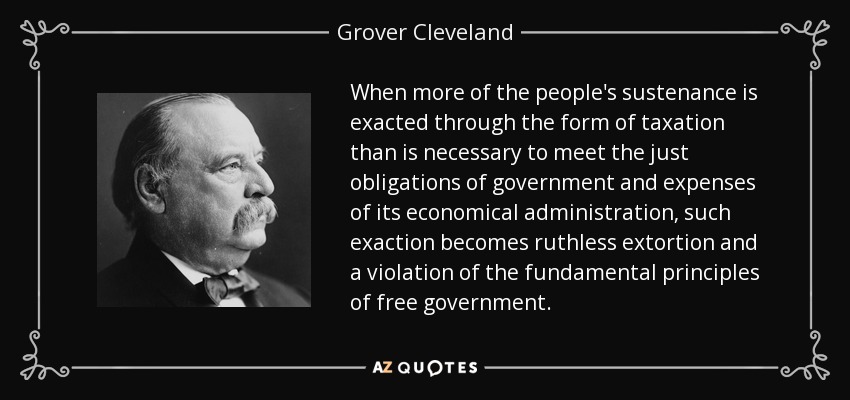
After a year in the job in which he earned the title, “the veto mayor,” he moved on to become “the veto governor” of the State of New York and finally, “the veto president” of the United States. His name was Grover Cleveland. On the matter of minding the till and pinching pennies on behalf of the taxpayer, he puts to shame the great majority of public officials here and everywhere. …This was a man unafraid to draw the line on public spending for two principal reasons: 1) Government should not be a grab bag of goodies for whatever cause somebody thinks is “good” and 2) Failure to keep government spending in check encourages politicians to buy votes and corrupt the political process. …He once expressed the wish that he would be remembered more for the laws he killed than the ones he signed. He still holds the record for the most vetoes of any American president in two terms (584 in all).



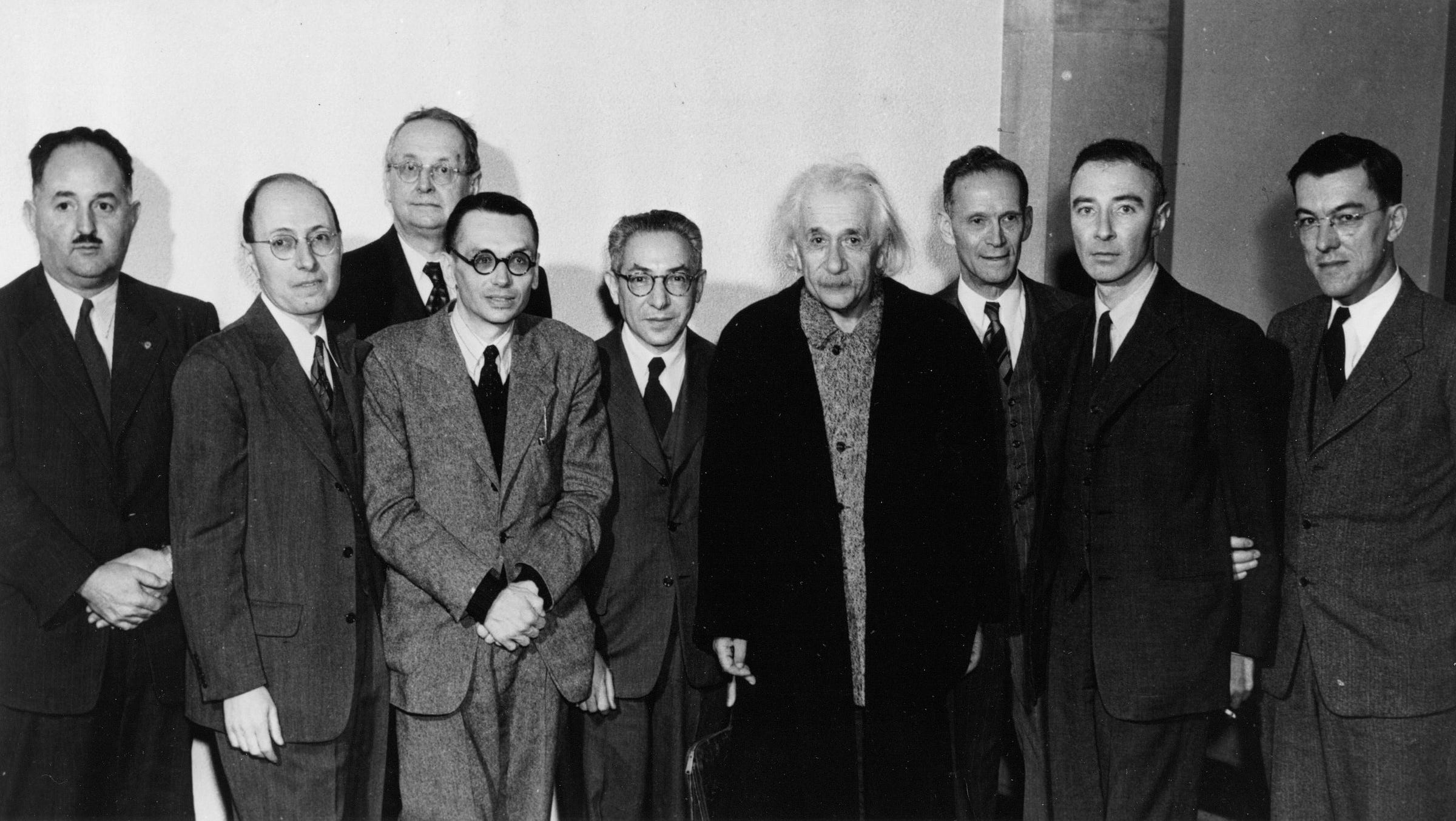
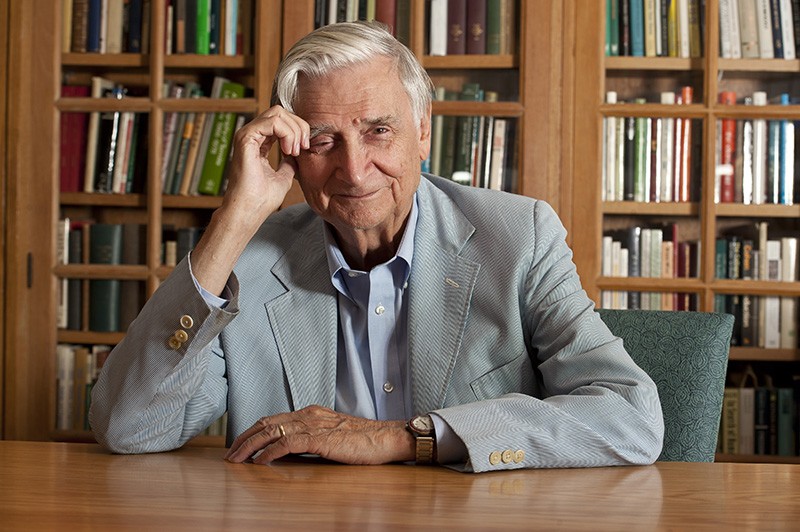




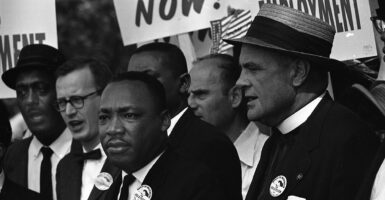









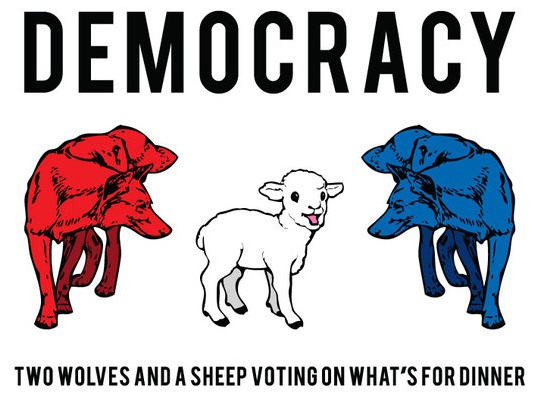


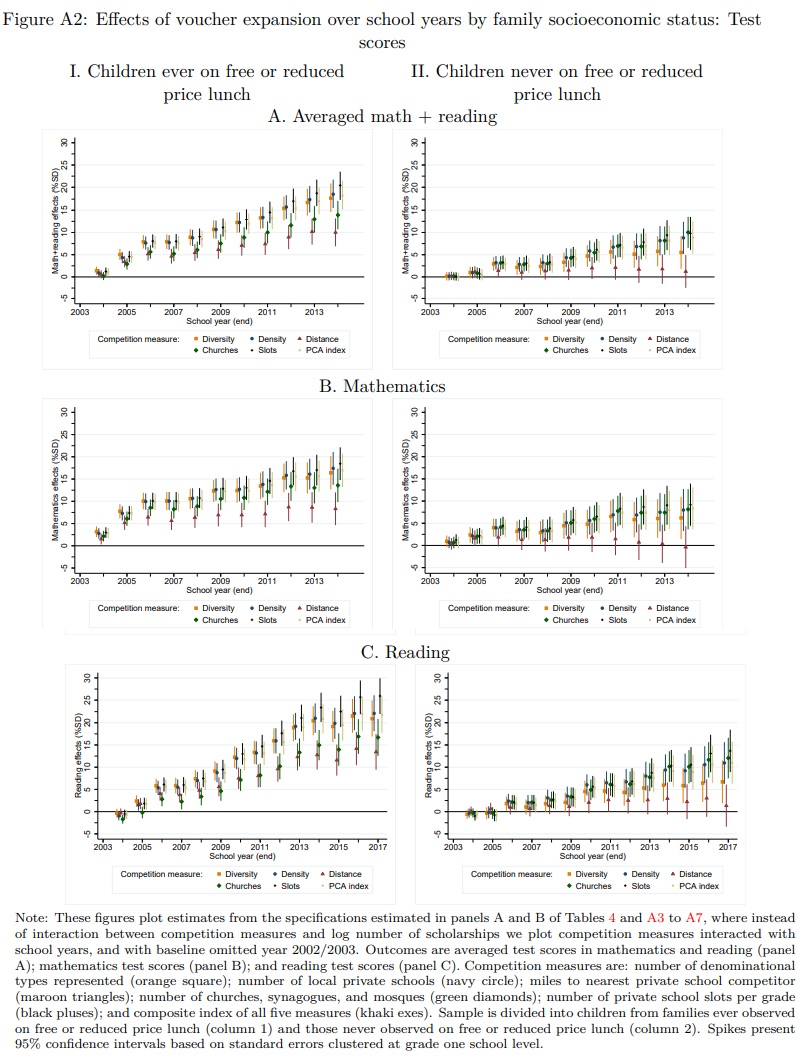





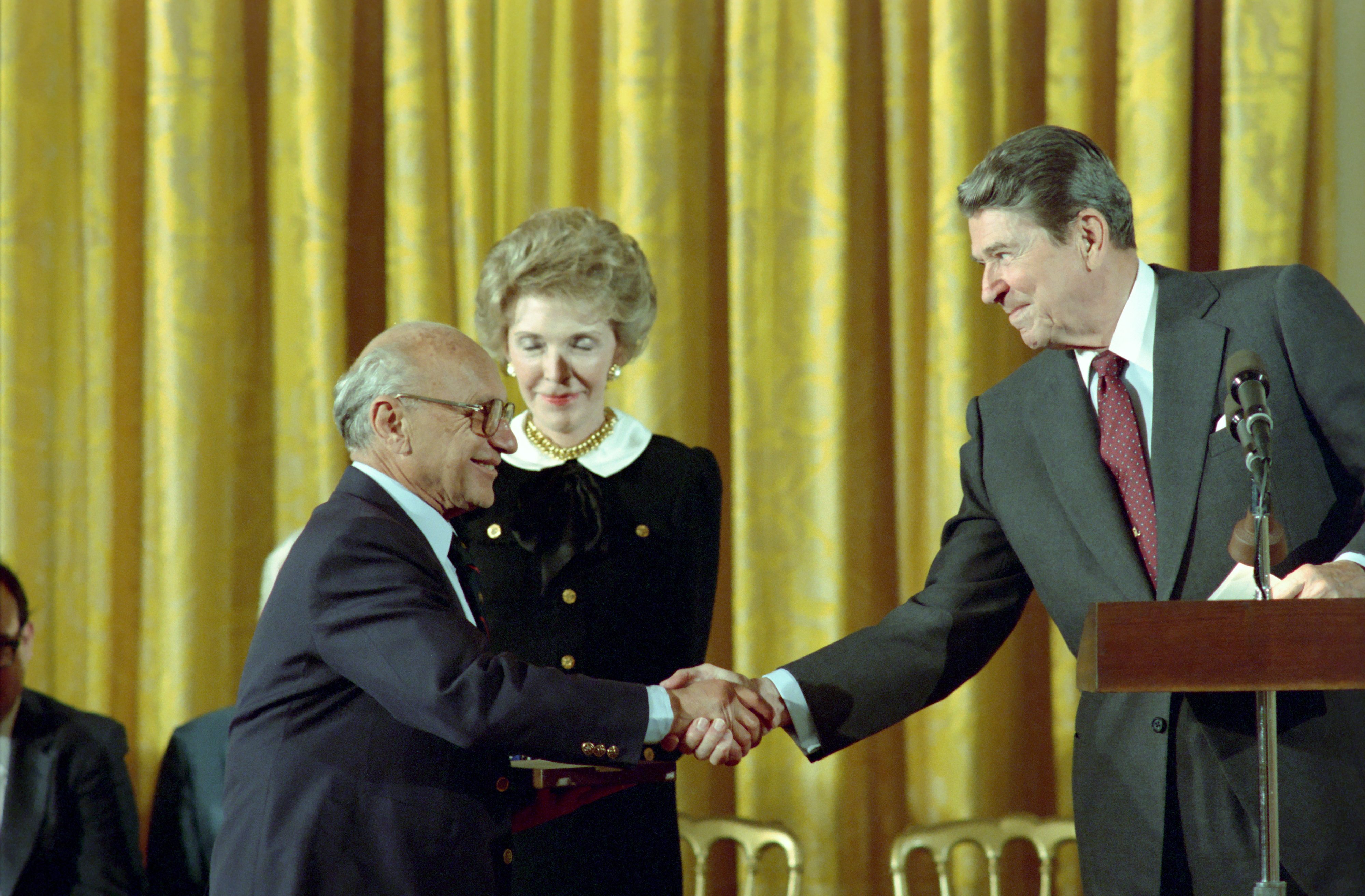




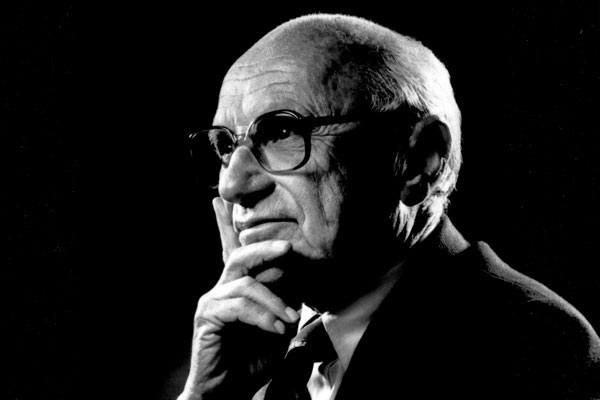



 The Daily Hatch


.jpg)