Monthly Archives: April 2023

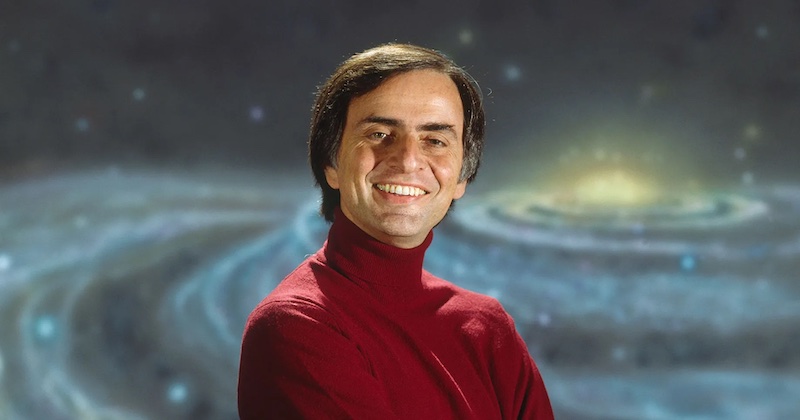
RESPONDING TO HARRY KROTO’S BRILLIANT RENOWNED ACADEMICS!! Carl Sagan Part 15 Carl Sagan  “Despite many claims to the contrary, life does not begin at conception: It is an unbroken chain that stretches back nearly to the origin of the Earth, 4.6 billion years ago. Nor does human life begin at conception: It is an unbroken chain dating back to the origin of our species, hundreds of thousands of years ago” (My 1995 correspondence with Sagan)

Carl Sagan Planetary Society cropped.png

Sagan in 1980
Born
Carl Edward Sagan

November 9, 1934

Brooklyn, New York, U.S.
Died December 20, 1996(aged 62)

Seattle, Washington, U.S.
Resting place Lake View Cemetery (Ithaca, New York)
Alma mater University of Chicago
(BA, BS, MS, PhD)
Known for
Spouse(s)

(m. 1957; div. 1965)​

(m. 1968; div. 1981)​

(m. 1981)​

Children 5, including Sasha, Dorion and Nick
Awards Klumpke-Roberts Award(1974)
NASA Distinguished Public Service Medal(1977)
Pulitzer Prize for General Non-Fiction (1978)
Oersted Medal (1990)
Carl Sagan Award for Public Understanding of Science (1993)
National Academy of Sciences Public Welfare Medal (1994)

On November 21, 2014 I received a letter from Nobel Laureate Harry Kroto and it said:

…Please click on this URL http://vimeo.com/26991975

and you will hear what far smarter people than I have to say on this matter. I agree with them.

Harry Kroto

I have attempted to respond to all of Dr. Kroto’s friends arguments and I have posted my responses one per week for over a year now. Here are some of my earlier posts:

Arif AhmedHaroon Ahmed,  Jim Al-Khalili, Sir David AttenboroughMark Balaguer, Horace Barlow, Michael BateSir Patrick BatesonSimon Blackburn, Colin Blakemore, Ned BlockPascal BoyerPatricia ChurchlandAaron CiechanoverNoam Chomsky, Brian CoxPartha Dasgupta,  Alan Dershowitz, Frank DrakeHubert Dreyfus, John DunnBart Ehrman, Mark ElvinRichard Ernst, Stephan Feuchtwang, Robert FoleyDavid Friend,  Riccardo GiacconiIvar Giaever , Roy GlauberRebecca GoldsteinDavid J. Gross,  Brian Greene, Susan GreenfieldStephen F Gudeman,  Alan Guth, Jonathan HaidtTheodor W. Hänsch, Brian Harrison,  Stephen HawkingHermann Hauser, Robert HindeRoald Hoffmann,  Bruce HoodGerard ‘t HooftCaroline HumphreyNicholas Humphrey,  Herbert Huppert,  Gareth Stedman Jones, Steve JonesShelly KaganMichio Kaku,  Stuart KauffmanMasatoshi Koshiba,  Lawrence KraussHarry Kroto, George Lakoff,  Rodolfo LlinasElizabeth Loftus,  Alan MacfarlaneDan McKenzie,  Mahzarin BanajiPeter MillicanMarvin MinskyLeonard Mlodinow,  P.Z.Myers,   Yujin NagasawaAlva NoeDouglas Osheroff, David Parkin,  Jonathan Parry, Roger Penrose,  Saul PerlmutterHerman Philipse,  Carolyn PorcoRobert M. PriceVS RamachandranLisa RandallLord Martin ReesColin RenfrewAlison Richard,  C.J. van Rijsbergen,  Oliver Sacks, John SearleMarcus du SautoySimon SchafferJ. L. Schellenberg,   Lee Silver Peter Singer,  Walter Sinnott-ArmstrongRonald de Sousa, Victor StengerJohn SulstonBarry Supple,   Leonard Susskind, Raymond TallisMax TegmarkNeil deGrasse Tyson,  Martinus J. G. Veltman, Craig Venter.Alexander Vilenkin, Sir John Walker, James D. WatsonFrank WilczekSteven Weinberg, and  Lewis Wolpert,

In  the 1st video below in the 45th clip in this series are his words and  my response is below them. 

50 Renowned Academics Speaking About God (Part 1)

Another 50 Renowned Academics Speaking About God (Part 2

A Further 50 Renowned Academics Speaking About God (Part 3)

CARL SAGAN interview with Charlie Rose:

“…faith is belief in the absence of evidence. To believe in the absence of evidence, in my opinion, is a mistake. The idea is to hold belief until there is compelling evidence. If the Universe does not comply with our previous propositions, then we have to change…Religion deals with history poetry, great literature, ethics, morals, compassion…where religion gets into trouble is when it pretends to know something about science,”

I would respond that there is evidence that Christianity is true.In 1838 American biblical scholar Edward Robinson shook up the archaeological world by discovering Hezekiah’s Tunnel mentioned in the Bible. There is meaning in life available to anyone who will put their faith in Christ, and peace can’t be found in a Guru. Why not take a few minutes and just read the short chapter of Psalms 22 that was written hundreds of years before the Romans even invented the practice of Crucifixion. 1000 years BC the Jews had the practice of stoning people but we read in this chapter a graphic description of Christ dying on the cross.

Image result for carl sagan

223 × 373Images may be subject to copyright. Learn More

Recently I have been revisiting my correspondence in 1995 with the famous astronomer Carl Sagan who I had the privilege to correspond with in 1994, 1995 and 1996. In 1996 I had a chance to respond to his December 5, 1995letter on January 10, 1996 and I never heard back from him again since his cancer returned and he passed away later in 1996. Below is what Carl Sagan wrote to me in his December 5, 1995 letter:

Thanks for your recent letter about evolution and abortion. The correlation is hardly one to one; there are evolutionists who are anti-abortion and anti-evolutionists who are pro-abortion.You argue that God exists because otherwise we could not understand the world in our consciousness. But if you think God is necessary to understand the world, then why do you not ask the next question of where God came from? And if you say “God was always here,” why not say that the universe was always here? On abortion, my views are contained in the enclosed article (Sagan, Carl and Ann Druyan {1990}, “The Question of Abortion,” Parade Magazine, April 22.)

I was introduced to when reading a book by Francis Schaeffer called HE IS THERE AND HE IS NOT SILENT written in 1968.

Image result for francis schaeffer

Francis Schaeffer when he was a young pastor in St. Louis pictured above.
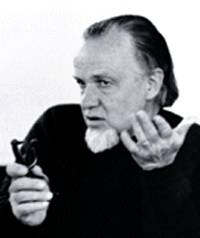
Image result for francis schaeffer

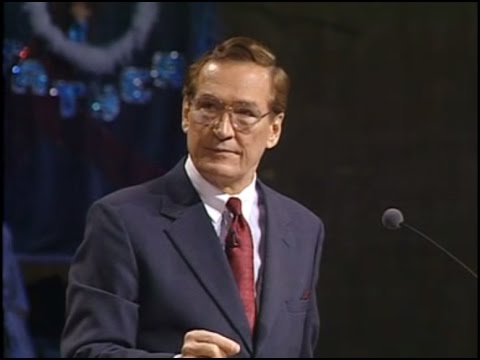
Francis Schaeffer and Adrian Rogers

Image result for adrian rogers

(both Adrian Rogers and Francis Schaeffer mentioned Carl Sagan in their books and that prompted me to write Sagan and expose him to their views.

Carl Sagan asserted, “Despite many claims to the contrary, life does not begin at conception: It is an unbroken chain that stretches back nearly to the origin of the Earth, 4.6 billion years ago. Nor does human life begin at conception: It is an unbroken chain dating back to the origin of our species, hundreds of thousands of years ago”
Great article on Sagan article

_

#thecaseagainstabortion @abort73

Are Sperm and Egg Cells Alive?

A fundamental change occurs to the sperm and egg during fertilization.

PAGE SUMMARY:

Some ethicists try to defend abortion on the assertion that sperm and egg cells are just as “alive” as an embryo or fetus. Biologically speaking, this is an absurd and unfounded claim.

In 1990, the late American astronomer, Carl Sagan, made a philosophical defense of abortion in an article he wrote with his third wife, Ann Druyan, for Parade magazine. One of their key arguments hinges on the belief that there is no moral difference between killing an embryo and killing a sperm or egg cell. In their own words:

Despite many claims to the contrary, life does not begin at conception: It is an unbroken chain that stretches back nearly to the origin of the Earth, 4.6 billion years ago. Nor does human life begin at conception: It is an unbroken chain dating back to the origin of our species, tens or hundreds of thousands of years ago. Every human sperm and egg is, beyond the shadow of a doubt, alive. They are not human beings, of course. However, it could be argued that neither is a fertilized egg.

In some animals, an egg develops into a healthy adult without benefit of a sperm cell. But not, so far as we know, among humans. A sperm and an unfertilized egg jointly comprise the full genetic blueprint for a human being. Under certain circumstances, after fertilization, they can develop into a baby. But most fertilized eggs are spontaneously miscarried. Development into a baby is by no means guaranteed. Neither a sperm and egg separately, nor a fertilized egg, is more than a potential baby or a potential adult. So if a sperm and egg are as human as the fertilized egg produced by their union, and if it is murder to destroy a fertilized egg—despite the fact that it’s only potentially a baby—why isn’t it murder to destroy a sperm or an egg?1

The main problem with this conclusion is that it ignores the fundamental difference between a sperm and an egg prior to fertilization, and the zygote which results through fertilization. The difference is genetic. Former United States Surgeon General and pediatric surgeon, C. Everett Koop, wrote:

A sperm has twenty-three chromosomes; even though it is alive and can fertilize an egg, it can never make another sperm. An egg also has twenty-three chromosomes, and it can never make another egg. Thus, we have sperm that cannot reproduce and eggs that cannot reproduce unless they get together.2

Sperm and egg cells in themselves are not complete. If left alone they will die after a few days, never developing into anything other than what they are. The sperm shares the genetic code of the man, the egg shares the genetic code of the woman. It is only in combination, when the 23 chromosomes from the father join the 23 chromosomes from the mother, through fertilization, that a new, biologically distinct human beings comes into existence. This one fertilized cell, in fact, contains all the information necessary for a lifetime of human growth. Quoting C. Everett Koop again, “All that makes up the adult is present as the ovum and the sperm are united—the whole genetic code!”3

Individual sperm and egg cells are only alive in the same sense that any other human cell is “alive.” Sagan knows this and plainly admits that sperm and egg cells are “not human beings.” In the very next sentence, however, he makes an unfounded leap of faith, asserting that it is reasonable to argue that a fertilized egg is not a human being either. Interestingly, this is an argument he never bothers making. Instead he substitutes a biologically concrete term (human being) for a biologically fuzzy one (baby), and states that a fertilized egg is only a “potential baby or potential adult.” This may be a true statement (depending on how you define “baby”), but its inconsequential. The fact that a fertilized egg is a potential adult, does not thereby make it a potential human.

Later in the article, Sagan again resorts to a philosophic sleight of hand when he writes:

To date, murder uniquely applies to killing human beings. Therefore, the question of when personhood (or, if we like, ensoulment) arises is key to the abortion debate. When does the fetus become human? When do distinct and characteristic human qualities emerge?4

Notice what these questions assume. They assume that the fetus doesn’t “become human” until it exhibits human qualities and characteristics. In other words, Sagan has substituted something that is measurable (the specific species of a living being), with something that isn’t (relative characteristics of a species). He goes on to assert that “characteristically human thought” is the only unique characteristic that humans possess and concludes that human beings who can’t think like a human being, shouldn’t be recognized as human beings. The manifold dangers of this conclusion nothwithstanding, this is not the point he set out to prove at the beginning—that embryos and fetuses are qualitatively the same as sperm or eggs.

Though Sagan’s article does contain some accurate observations regarding the morality of abortion, his conclusions are not well-reasoned. In the broadest sense, his assertion that legal protection should be connected to “human thought” has dangerous ramifications that go well beyond the abortion debate. No matter what someone believes about the ethics of abortion, the fundamental differences between a sperm, an egg and an embryo are biologically obvious and undisputed.

This page was last updated on June 16, 2014. To cite this page in a research paper, visit: “Citing Abort73 as a Source.”

  1. Carl Sagan and Ann Druyan, “Is It Possible To Be Pro-Life and Pro-Choice?” Parade Magazine. April 22, 1990, 5.
  2. C. Everett Koop, M.D., and Francis A. Schaeffer, Whatever Happened to the Human Race? (Fleming H. Revell Company, 1979), 37.
  3. Ibid, 41.
  4. Carl Sagan and Ann Druyan, “Is It Possible To Be Pro-Life and Pro-Choice?” Parade Magazine. April 22, 1990, 6.

Continue to the next page: Rights of Personhood

PARENT PAGE:

  • Prenatal DevelopmentGrowth in the womb is a rapid process; all systems are in place by week eight.

Carl Sagan pictured below:

Image result for carl sagan

_________

Image result for francis schaeffer

Francis Schaeffer

I mentioned earlier that I was blessed with the opportunity to correspond with Dr. Sagan. In his December 5, 1995 letter Dr. Sagan went on to tell me that he was enclosing his article “The Question of Abortion: A Search for Answers”by Carl Sagan and Ann Druyan. I am going to respond to several points made in that article. Here is a portion of Sagan’s article (here is a link to the whole article):

Image result for carl sagan and ann druyan

Carl Sagan and Ann Druyan pictured above

 “The Question of Abortion: A Search for Answers”

by Carl Sagan and Ann Druyan

For the complete text, including illustrations, introductory quote, footnotes, and commentary on the reaction to the originally published article see Billions and Billions.

The issue had been decided years ago. The court had chosen the middle ground. You’d think the fight was over. Instead, there are mass rallies, bombings and intimidation, murders of workers at abortion clinics, arrests, intense lobbying, legislative drama, Congressional hearings, Supreme Court decisions, major political parties almost defining themselves on the issue, and clerics threatening politicians with perdition. Partisans fling accusations of hypocrisy and murder. The intent of the Constitution and the will of God are equally invoked. Doubtful arguments are trotted out as certitudes. The contending factions call on science to bolster their positions. Families are divided, husbands and wives agree not to discuss it, old friends are no longer speaking. Politicians check the latest polls to discover the dictates of their consciences. Amid all the shouting, it is hard for the adversaries to hear one another. Opinions are polarized. Minds are closed.

Is it wrong to abort a pregnancy? Always? Sometimes? Never? How do we decide? We wrote this article to understand better what the contending views are and to see if we ourselves could find a position that would satisfy us both. Is there no middle ground? We had to weigh the arguments of both sides for consistency and to pose test cases, some of which are purely hypothetical. If in some of these tests we seem to go too far, we ask the reader to be patient with us–we’re trying to stress the various positions to the breaking point to see their weaknesses and where they fail.

In contemplative moments, nearly everyone recognizes that the issue is not wholly one-sided. Many partisans of differing views, we find, feel some disquiet, some unease when confronting what’s behind the opposing arguments. (This is partly why such confrontations are avoided.) And the issue surely touches on deep questions: What are our responses to one another? Should we permit the state to intrude into the most intimate and personal aspects of our lives? Where are the boundaries of freedom? What does it mean to be human?

Of the many actual points of view, it is widely held–especially in the media, which rarely have the time or the inclination to make fine distinctions–that there are only two: “pro-choice” and “pro-life.” This is what the two principal warring camps like to call themselves, and that’s what we’ll call them here. In the simplest characterization, a pro-choicer would hold that the decision to abort a pregnancy is to be made only by the woman; the state has no right to interfere. And a pro-lifer would hold that, from the moment of conception, the embryo or fetus is alive; that this life imposes on us a moral obligation to preserve it; and that abortion is tantamount to murder. Both names–pro-choice and pro-life–were picked with an eye toward influencing those whose minds are not yet made up: Few people wish to be counted either as being against freedom of choice or as opposed to life. Indeed, freedom and life are two of our most cherished values, and here they seem to be in fundamental conflict.

Let’s consider these two absolutist positions in turn. A newborn baby is surely the same being it was just before birth. There ‘s good evidence that a late-term fetus responds to sound–including music, but especially its mother’s voice. It can suck its thumb or do a somersault. Occasionally, it generates adult brain-wave patterns. Some people claim to remember being born, or even the uterine environment. Perhaps there is thought in the womb. It’s hard to maintain that a transformation to full personhood happens abruptly at the moment of birth. Why, then, should it be murder to kill an infant the day after it was born but not the day before?

As a practical matter, this isn’t very important: Less than 1 percent of all tabulated abortions in the United States are listed in the last three months of pregnancy (and, on closer investigation, most such reports turn out to be due to miscarriage or miscalculation). But third-trimester abortions provide a test of the limits of the pro-choice point of view. Does a woman’s “innate right to control her own body” encompass the right to kill a near-term fetus who is, for all intents and purposes, identical to a newborn child?

We believe that many supporters of reproductive freedom are troubled at least occasionally by this question. But they are reluctant to raise it because it is the beginning of a slippery slope. If it is impermissible to abort a pregnancy in the ninth month, what about the eighth, seventh, sixth … ? Once we acknowledge that the state can interfere at any time in the pregnancy, doesn’t it follow that the state can interfere at all times?

Abortion and the slippery slope argument above

This conjures up the specter of predominantly male, predominantly affluent legislators telling poor women they must bear and raise alone children they cannot afford to bring up; forcing teenagers to bear children they are not emotionally prepared to deal with; saying to women who wish for a career that they must give up their dreams, stay home, and bring up babies; and, worst of all, condemning victims of rape and incest to carry and nurture the offspring of their assailants. Legislative prohibitions on abortion arouse the suspicion that their real intent is to control the independence and sexuality of women…

And yet, by consensus, all of us think it proper that there be prohibitions against, and penalties exacted for, murder. It would be a flimsy defense if the murderer pleads that this is just between him and his victim and none of the government’s business. If killing a fetus is truly killing a human being, is it not the duty of the state to prevent it? Indeed, one of the chief functions of government is to protect the weak from the strong.

If we do not oppose abortion at some stage of pregnancy, is there not a danger of dismissing an entire category of human beings as unworthy of our protection and respect? And isn’t that dismissal the hallmark of sexism, racism, nationalism, and religious fanaticism? Shouldn’t those dedicated to fighting such injustices be scrupulously careful not to embrace another?

Adrian Rogers’ sermon on animal rights refutes Sagan here

There is no right to life in any society on Earth today, nor has there been at any former time… : We raise farm animals for slaughter; destroy forests; pollute rivers and lakes until no fish can live there; kill deer and elk for sport, leopards for the pelts, and whales for fertilizer; entrap dolphins, gasping and writhing, in great tuna nets; club seal pups to death; and render a species extinct every day. All these beasts and vegetables are as alive as we. What is (allegedly) protected is not life, but human life.

Genesis 3 defines being human

And even with that protection, casual murder is an urban commonplace, and we wage “conventional” wars with tolls so terrible that we are, most of us, afraid to consider them very deeply… That protection, that right to life, eludes the 40,000 children under five who die on our planet each day from preventable starvation, dehydration, disease, and neglect.

Those who assert a “right to life” are for (at most) not just any kind of life, but for–particularly and uniquely—human life. So they too, like pro-choicers, must decide what distinguishes a human being from other animals and when, during gestation, the uniquely human qualities–whatever they are–emerge.

The Bible talks about the differences between humans and animals

Despite many claims to the contrary, life does not begin at conception: It is an unbroken chain that stretches back nearly to the origin of the Earth, 4.6 billion years ago. Nor does human life begin at conception: It is an unbroken chain dating back to the origin of our species, hundreds of thousands of years ago. Every human sperm and egg is, beyond the shadow of a doubt, alive. They are not human beings, of course. However, it could be argued that neither is a fertilized egg.

In some animals, an egg develops into a healthy adult without benefit of a sperm cell. But not, so far as we know, among humans. A sperm and an unfertilized egg jointly comprise the full genetic blueprint for a human being. Under certain circumstances, after fertilization, they can develop into a baby. But most fertilized eggs are spontaneously miscarried. Development into a baby is by no means guaranteed. Neither a sperm and egg separately, nor a fertilized egg, is more than a potential baby or a potential adult. So if a sperm and egg are as human as the fertilized egg produced by their union, and if it is murder to destroy a fertilized egg–despite the fact that it’s only potentially a baby–why isn’t it murder to destroy a sperm or an egg?

Hundreds of millions of sperm cells (top speed with tails lashing: five inches per hour) are produced in an average human ejaculation. A healthy young man can produce in a week or two enough spermatozoa to double the human population of the Earth. So is masturbation mass murder? How about nocturnal emissions or just plain sex? When the unfertilized egg is expelled each month, has someone died? Should we mourn all those spontaneous miscarriages? Many lower animals can be grown in a laboratory from a single body cell. Human cells can be cloned… In light of such cloning technology, would we be committing mass murder by destroying any potentially clonable cells? By shedding a drop of blood?

All human sperm and eggs are genetic halves of “potential” human beings. Should heroic efforts be made to save and preserve all of them, everywhere, because of this “potential”? Is failure to do so immoral or criminal? Of course, there’s a difference between taking a life and failing to save it. And there’s a big difference between the probability of survival of a sperm cell and that of a fertilized egg. But the absurdity of a corps of high-minded semen-preservers moves us to wonder whether a fertilized egg’s mere “potential” to become a baby really does make destroying it murder.

Opponents of abortion worry that, once abortion is permissible immediately after conception, no argument will restrict it at any later time in the pregnancy. Then, they fear, one day it will be permissible to murder a fetus that is unambiguously a human being. Both pro-choicers and pro-lifers (at least some of them) are pushed toward absolutist positions by parallel fears of the slippery slope.

Another slippery slope is reached by those pro-lifers who are willing to make an exception in the agonizing case of a pregnancy resulting from rape or incest. But why should the right to live depend on the circumstances of conception? If the same child were to result, can the state ordain life for the offspring of a lawful union but death for one conceived by force or coercion? How can this be just? And if exceptions are extended to such a fetus, why should they be withheld from any other fetus? This is part of the reason some pro-lifers adopt what many others consider the outrageous posture of opposing abortions under any and all circumstances–only excepting, perhaps, when the life of the mother is in danger.

By far the most common reason for abortion worldwide is birth control. So shouldn’t opponents of abortion be handing out contraceptives and teaching school children how to use them? That would be an effective way to reduce the number of abortions. Instead, the United States is far behind other nations in the development of safe and effective methods of birth control–and, in many cases, opposition to such research (and to sex education) has come from the same people who oppose abortions.continue on to Part 3

For the complete text, including illustrations, introductory quote, footnotes, and commentary on the reaction to the originally published article see Billions and Billions.

The attempt to find an ethically sound and unambiguous judgment on when, if ever, abortion is permissible has deep historical roots. Often, especially in Christian tradition, such attempts were connected with the question of when the soul enters the body–a matter not readily amenable to scientific investigation and an issue of controversy even among learned theologians. Ensoulment has been asserted to occur in the sperm before conception, at conception, at the time of “quickening” (when the mother is first able to feel the fetus stirring within her), and at birth. Or even later.

Different religions have different teachings. Among hunter-gatherers, there are usually no prohibitions against abortion, and it was common in ancient Greece and Rome. In contrast, the more severe Assyrians impaled women on stakes for attempting abortion. The Jewish Talmud teaches that the fetus is not a person and has no rights. The Old and New Testaments–rich in astonishingly detailed prohibitions on dress, diet, and permissible words–contain not a word specifically prohibiting abortion. The only passage that’s remotely relevant (Exodus 21:22) decrees that if there’s a fight and a woman bystander should accidentally be injured and made to miscarry, the assailant must pay a fine.

Neither St. Augustine nor St. Thomas Aquinas considered early-term abortion to be homicide (the latter on the grounds that the embryo doesn’t look human). This view was embraced by the Church in the Council of Vienne in 1312, and has never been repudiated. The Catholic Church’s first and long-standing collection of canon law (according to the leading historian of the Church’s teaching on abortion, John Connery, S.J.) held that abortion was homicide only after the fetus was already “formed”–roughly, the end of the first trimester.

But when sperm cells were examined in the seventeenth century by the first microscopes, they were thought to show a fully formed human being. An old idea of the homunculus was resuscitated–in which within each sperm cell was a fully formed tiny human, within whose testes were innumerable other homunculi, etc., ad infinitum. In part through this misinterpretation of scientific data, in 1869 abortion at any time for any reason became grounds for excommunication. It is surprising to most Catholics and others to discover that the date was not much earlier.

From colonial times to the nineteenth century, the choice in the United States was the woman’s until “quickening.” An abortion in the first or even second trimester was at worst a misdemeanor. Convictions were rarely sought and almost impossible to obtain, because they depended entirely on the woman’s own testimony of whether she had felt quickening, and because of the jury’s distaste for prosecuting a woman for exercising her right to choose. In 1800 there was not, so far as is known, a single statute in the United States concerning abortion. Advertisements for drugs to induce abortion could be found in virtually every newspaper and even in many church publications–although the language used was suitably euphemistic, if widely understood.

But by 1900, abortion had been banned at any time in pregnancy by every state in the Union, except when necessary to save the woman’s life. What happened to bring about so striking a reversal? Religion had little to do with it.Drastic economic and social conversions were turning this country from an agrarian to an urban-industrial society. America was in the process of changing from having one of the highest birthrates in the world to one of the lowest. Abortion certainly played a role and stimulated forces to suppress it.

One of the most significant of these forces was the medical profession. Up to the mid-nineteenth century, medicine was an uncertified, unsupervised business. Anyone could hang up a shingle and call himself (or herself) a doctor. With the rise of a new, university-educated medical elite, anxious to enhance the status and influence of physicians, the American Medical Association was formed. In its first decade, the AMA began lobbying against abortions performed by anyone except licensed physicians. New knowledge of embryology, the physicians said, had shown the fetus to be human even before quickening.

Their assault on abortion was motivated not by concern for the health of the woman but, they claimed, for the welfare of the fetus. You had to be a physician to know when abortion was morally justified, because the question depended on scientific and medical facts understood only by physicians. At the same time, women were effectively excluded from the medical schools, where such arcane knowledge could be acquired. So, as things worked out, women had almost nothing to say about terminating their own pregnancies. It was also up to the physician to decide if the pregnancy posed a threat to the woman, and it was entirely at his discretion to determine what was and was not a threat. For the rich woman, the threat might be a threat to her emotional tranquillity or even to her lifestyle. The poor woman was often forced to resort to the back alley or the coat hanger.

This was the law until the 1960s, when a coalition of individuals and organizations, the AMA now among them, sought to overturn it and to reinstate the more traditional values that were to be embodied in Roe v. Wade.continue on to Part 4

If you deliberately kill a human being, it’s called murder. If you deliberately kill a chimpanzee–biologically, our closest relative, sharing 99.6 percent of our active genes–whatever else it is, it’s not murder. To date, murder uniquely applies to killing human beings. Therefore, the question of when personhood (or, if we like, ensoulment) arises is key to the abortion debate. When does the fetus become human? When do distinct and characteristic human qualities emerge?

Section 8 Sperm journey to becoming Human

We recognize that specifying a precise moment will overlook individual differences. Therefore, if we must draw a line, it ought to be drawn conservatively–that is, on the early side. There are people who object to having to set some numerical limit, and we share their disquiet; but if there is to be a law on this matter, and it is to effect some useful compromise between the two absolutist positions, it must specify, at least roughly, a time of transition to personhood.

Every one of us began from a dot. A fertilized egg is roughly the size of the period at the end of this sentence. The momentous meeting of sperm and egg generally occurs in one of the two fallopian tubes. One cell becomes two, two become four, and so on—an exponentiation of base-2 arithmetic. By the tenth day the fertilized egg has become a kind of hollow sphere wandering off to another realm: the womb. It destroys tissue in its path. It sucks blood from capillaries. It bathes itself in maternal blood, from which it extracts oxygen and nutrients. It establishes itself as a kind of parasite on the walls of the uterus.By the third week, around the time of the first missed menstrual period, the forming embryo is about 2 millimeters long and is developing various body parts. Only at this stage does it begin to be dependent on a rudimentary placenta. It looks a little like a segmented worm.By the end of the fourth week, it’s about 5 millimeters (about 1/5 inch) long. It’s recognizable now as a vertebrate, its tube-shaped heart is beginning to beat, something like the gill arches of a fish or an amphibian become conspicuous, and there is a pronounced tail. It looks rather like a newt or a tadpole. This is the end of the first month after conception.By the fifth week, the gross divisions of the brain can be distinguished. What will later develop into eyes are apparent, and little buds appear—on their way to becoming arms and legs.By the sixth week, the embryo is 13 millimeteres (about ½ inch) long. The eyes are still on the side of the head, as in most animals, and the reptilian face has connected slits where the mouth and nose eventually will be.By the end of the seventh week, the tail is almost gone, and sexual characteristics can be discerned (although both sexes look female). The face is mammalian but somewhat piglike.By the end of the eighth week, the face resembles that of a primate but is still not quite human. Most of the human body parts are present in their essentials. Some lower brain anatomy is well-developed. The fetus shows some reflex response to delicate stimulation.By the tenth week, the face has an unmistakably human cast. It is beginning to be possible to distinguish males from females. Nails and major bone structures are not apparent until the third month.By the fourth month, you can tell the face of one fetus from that of another. Quickening is most commonly felt in the fifth month. The bronchioles of the lungs do not begin developing until approximately the sixth month, the alveoli still later.

So, if only a person can be murdered, when does the fetus attain personhood? When its face becomes distinctly human, near the end of the first trimester? When the fetus becomes responsive to stimuli–again, at the end of the first trimester? When it becomes active enough to be felt as quickening, typically in the middle of the second trimester? When the lungs have reached a stage of development sufficient that the fetus might, just conceivably, be able to breathe on its own in the outside air?

The trouble with these particular developmental milestones is not just that they’re arbitrary. More troubling is the fact that none of them involves uniquely humancharacteristics–apart from the superficial matter of facial appearance. All animals respond to stimuli and move of their own volition. Large numbers are able to breathe. But that doesn’t stop us from slaughtering them by the billions. Reflexes and motion are not what make us human.

Sagan’s conclusion based on arbitrary choice of the presence of thought by unborn baby

Other animals have advantages over us–in speed, strength, endurance, climbing or burrowing skills, camouflage, sight or smell or hearing, mastery of the air or water. Our one great advantage, the secret of our success, is thought–characteristically human thought. We are able to think things through, imagine events yet to occur, figure things out. That’s how we invented agriculture and civilization. Thought is our blessing and our curse, and it makes us who we are.

Thinking occurs, of course, in the brain–principally in the top layers of the convoluted “gray matter” called the cerebral cortex. The roughly 100 billion neurons in the brain constitute the material basis of thought. The neurons are connected to each other, and their linkups play a major role in what we experience as thinking. But large-scale linking up of neurons doesn’t begin until the 24th to 27th week of pregnancy–the sixth month.

By placing harmless electrodes on a subject’s head, scientists can measure the electrical activity produced by the network of neurons inside the skull. Different kinds of mental activity show different kinds of brain waves. But brain waves with regular patterns typical of adult human brains do not appear in the fetus until about the 30th week of pregnancy–near the beginning of the third trimester. Fetuses younger than this–however alive and active they may be–lack the necessary brain architecture. They cannot yet think.

Acquiescing in the killing of any living creature, especially one that might later become a baby, is troublesome and painful. But we’ve rejected the extremes of “always” and “never,” and this puts us–like it or not–on the slippery slope. If we are forced to choose a developmental criterion, then this is where we draw the line: when the beginning of characteristically human thinking becomes barely possible.

It is, in fact, a very conservative definition: Regular brain waves are rarely found in fetuses. More research would help… If we wanted to make the criterion still more stringent, to allow for occasional precocious fetal brain development, we might draw the line at six months. This, it so happens, is where the Supreme Court drew it in 1973–although for completely different reasons.

Its decision in the case of Roe v. Wade changed American law on abortion. It permits abortion at the request of the woman without restriction in the first trimester and, with some restrictions intended to protect her health, in the second trimester. It allows states to forbid abortion in the third trimester, except when there’s a serious threat to the life or health of the woman. In the 1989 Webster decision, the Supreme Court declined explicitly to overturn Roe v. Wade but in effect invited the 50 state legislatures to decide for themselves.

What was the reasoning in Roe v. Wade? There was no legal weight given to what happens to the children once they are born, or to the family. Instead, a woman’s right to reproductive freedom is protected, the court ruled, by constitutional guarantees of privacy. But that right is not unqualified. The woman’s guarantee of privacy and the fetus’s right to life must be weighed–and when the court did the weighing’ priority was given to privacy in the first trimester and to life in the third. The transition was decided not from any of the considerations we have been dealing with so far…–not when “ensoulment” occurs, not when the fetus takes on sufficient human characteristics to be protected by laws against murder. Instead, the criterion adopted was whether the fetus could live outside the mother. This is called “viability” and depends in part on the ability to breathe. The lungs are simply not developed, and the fetus cannot breathe–no matter how advanced an artificial lung it might be placed in—until about the 24th week, near the start of the sixth month. This is why Roe v. Wade permits the states to prohibit abortions in the last trimester. It’s a very pragmatic criterion.

If the fetus at a certain stage of gestation would be viable outside the womb, the argument goes, then the right of the fetus to life overrides the right of the woman to privacy. But just what does “viable” mean? Even a full-term newborn is not viable without a great deal of care and love. There was a time before incubators, only a few decades ago, when babies in their seventh month were unlikely to be viable. Would aborting in the seventh month have been permissible then? After the invention of incubators, did aborting pregnancies in the seventh month suddenly become immoral? What happens if, in the future, a new technology develops so that an artificial womb can sustain a fetus even before the sixth month by delivering oxygen and nutrients through the blood–as the mother does through the placenta and into the fetal blood system? We grant that this technology is unlikely to be developed soon or become available to many. But if it were available, does it then become immoral to abort earlier than the sixth month, when previously it was moral? A morality that depends on, and changes with, technology is a fragile morality; for some, it is also an unacceptable morality.

And why, exactly, should breathing (or kidney function, or the ability to resist disease) justify legal protection? If a fetus can be shown to think and feel but not be able to breathe, would it be all right to kill it? Do we value breathing more than thinking and feeling? Viability arguments cannot, it seems to us, coherently determine when abortions are permissible. Some other criterion is needed. Again, we offer for consideration the earliest onset of human thinking as that criterion.

Since, on average, fetal thinking occurs even later than fetal lung development, we find Roe v. Wade to be a good and prudent decision addressing a complex and difficult issue. With prohibitions on abortion in the last trimester–except in cases of grave medical necessity–it strikes a fair balance between the conflicting claims of freedom and life.What do you think? What have others said about Carl Sagan’s thoughts on 

END OF SAGAN’S ARTICLE
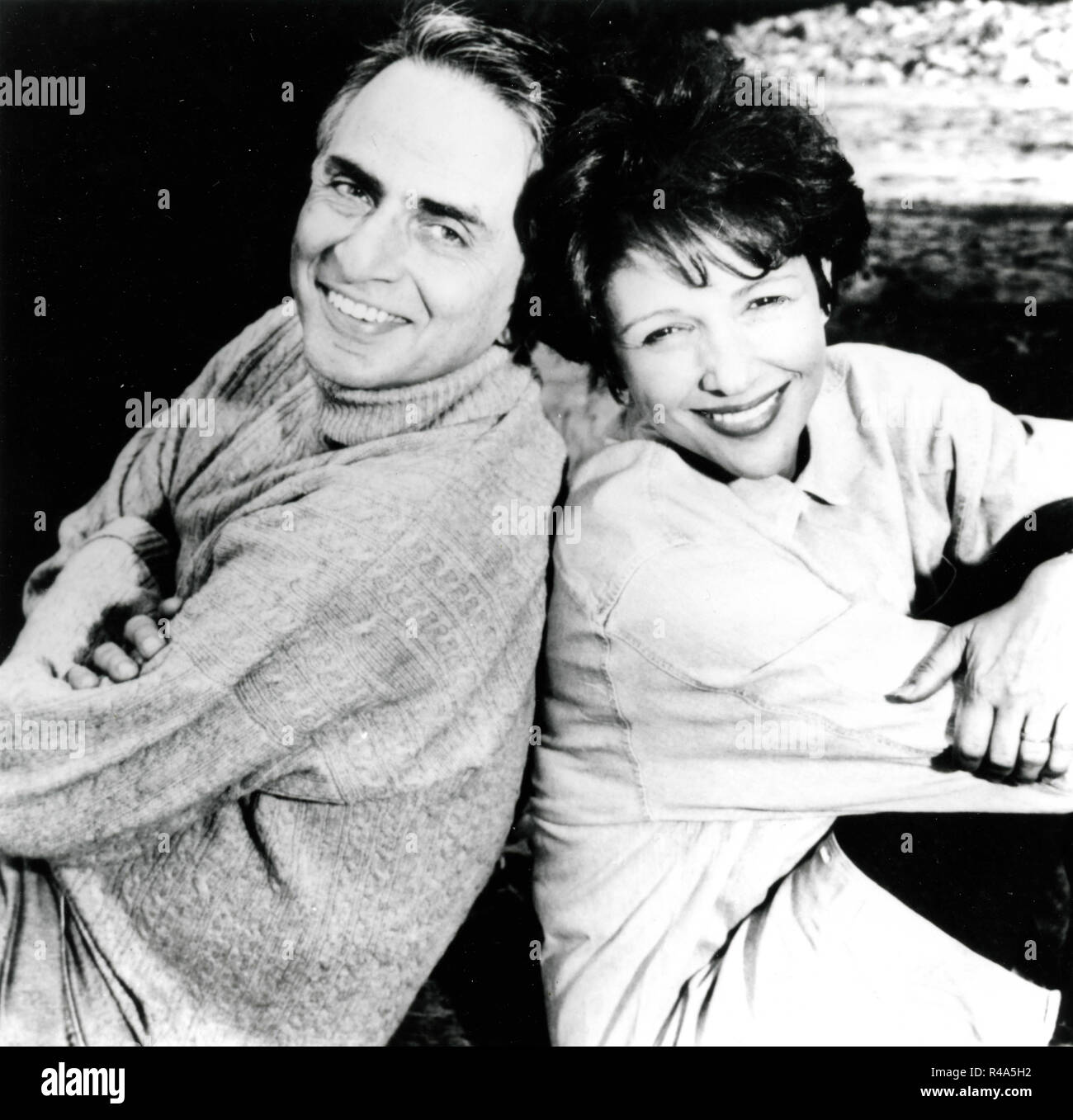
Image result for carl sagan and ann druyan
Carl Sagan with his wife Ann in the 1990’s
Image result for adrian rogers francis schaeffer
I grew up in Memphis as a member of Bellevue Baptist Church under our pastor Adrian Rogers and attended ECS High School where the books and films of Francis Schaeffer were taught. Both men dealt with current issues in the culture such as the film series COSMOS by Carl Sagan. I personally read several of Sagan’s books.  (Francis and Edith Schaeffer pictured below in their home at L’ Abri in Switzerland where Francis  taught students for 3 decades.
Image result for francis schaeffer
630 × 414Images may be subject to copyright.

Xxxxxxxxxxxxx

Related posts:

FRANCIS SCHAEFFER ANALYZES ART AND CULTURE Part 52 THE BEATLES (Part D, There is evidence that the Beatles may have been exposed to Francis Schaeffer!!!) (Feature on artist Anna Margaret Rose Freeman )

______________   George Harrison Swears & Insults Paul and Yoko Lucy in the Sky with Diamonds- The Beatles The Beatles:   I have dedicated several posts to this series on the Beatles and I don’t know when this series will end because Francis Schaeffer spent a lot of time listening to the Beatles and talking […]

FRANCIS SCHAEFFER ANALYZES ART AND CULTURE Part 51 THE BEATLES (Part C, List of those on cover of Stg.Pepper’s ) (Feature on artist Raqib Shaw )

  The Beatles in a press conference after their Return from the USA Uploaded on Nov 29, 2010 The Beatles in a press conference after their Return from the USA. The Beatles:   I have dedicated several posts to this series on the Beatles and I don’t know when this series will end because Francis […]

FRANCIS SCHAEFFER ANALYZES ART AND CULTURE Part 50 THE BEATLES (Part B, The Psychedelic Music of the Beatles) (Feature on artist Peter Blake )

__________________   Beatles 1966 Last interview I have dedicated several posts to this series on the Beatles and I don’t know when this series will end because Francis Schaeffer spent a lot of time listening to the Beatles and talking and writing about them and their impact on the culture of the 1960’s. In this […]

FRANCIS SCHAEFFER ANALYZES ART AND CULTURE Part 49 THE BEATLES (Part A, The Meaning of Stg. Pepper’s Cover) (Feature on artist Mika Tajima)

_______________ The Beatles documentary || A Long and Winding Road || Episode 5 (This video discusses Stg. Pepper’s creation I have dedicated several posts to this series on the Beatles and I don’t know when this series will end because Francis Schaeffer spent a lot of time listening to the Beatles and talking and writing about […]

FRANCIS SCHAEFFER ANALYZES ART AND CULTURE PART 48 “BLOW UP” by Michelangelo Antonioni makes Philosophic Statement (Feature on artist Nancy Holt)

_______________ Francis Schaeffer pictured below: _____________________ I have included the 27 minute  episode THE AGE OF NONREASON by Francis Schaeffer. In that video Schaeffer noted,  ” Sergeant Pepper’s Lonely Hearts Club Band…for a time it became the rallying cry for young people throughout the world. It expressed the essence of their lives, thoughts and their feelings.” How Should […]

FRANCIS SCHAEFFER ANALYZES ART AND CULTURE Part 47 Woody Allen and Professor Levy and the death of “Optimistic Humanism” from the movie CRIMES AND MISDEMEANORS Plus Charles Darwin’s comments too!!! (Feature on artist Rodney Graham)

Crimes and Misdemeanors: A Discussion: Part 1 ___________________________________ Today I will answer the simple question: IS IT POSSIBLE TO BE AN OPTIMISTIC SECULAR HUMANIST THAT DOES NOT BELIEVE IN GOD OR AN AFTERLIFE? This question has been around for a long time and you can go back to the 19th century and read this same […]

FRANCIS SCHAEFFER ANALYZES ART AND CULTURE PART 46 Friedrich Nietzsche (Featured artist is Thomas Schütte)

____________________________________ Francis Schaeffer pictured below: __________ Francis Schaeffer has written extensively on art and culture spanning the last 2000years and here are some posts I have done on this subject before : Francis Schaeffer’s “How should we then live?” Video and outline of episode 10 “Final Choices” , episode 9 “The Age of Personal Peace and Affluence”, episode 8 […]

FRANCIS SCHAEFFER ANALYZES ART AND CULTURE Part 45 Woody Allen “Reason is Dead” (Feature on artists Allora & Calzadilla )

Love and Death [Woody Allen] – What if there is no God? [PL] ___________ _______________ How Should We then Live Episode 7 small (Age of Nonreason) #02 How Should We Then Live? (Promo Clip) Dr. Francis Schaeffer 10 Worldview and Truth Two Minute Warning: How Then Should We Live?: Francis Schaeffer at 100 Francis Schaeffer […]

FRANCIS SCHAEFFER ANALYZES ART AND CULTURE Part 44 The Book of Genesis (Featured artist is Trey McCarley )

___________________________________ Francis Schaeffer pictured below: ____________________________ Francis Schaeffer “BASIS FOR HUMAN DIGNITY” Whatever…HTTHR Dr. Francis schaeffer – The flow of Materialism(from Part 4 of Whatever happened to human race?) Dr. Francis Schaeffer – The Biblical flow of Truth & History (intro) Francis Schaeffer – The Biblical Flow of History & Truth (1) Dr. Francis Schaeffer […]

__

__
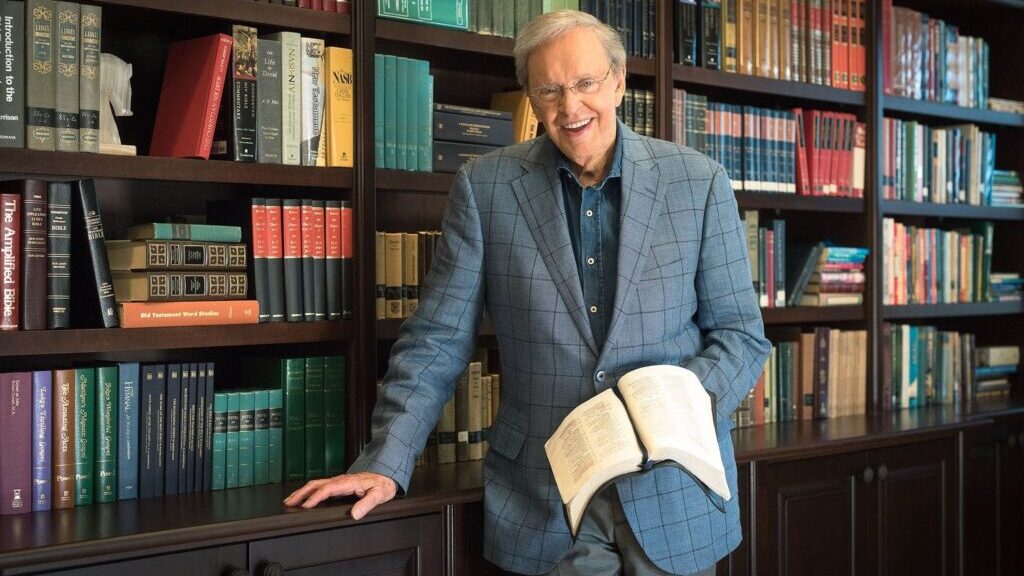
Charles Stanley remembered for ‘practical, Christ-centered’ preaching during 65 years of ministry

BP photo

Charles Stanley, influential pastor, author, president of In Touch Ministries and former Southern Baptist Convention president, died Tuesday morning (April 18). He was 90.

“Known to audiences around the world through his wide-reaching TV and radio broadcasts, Stanley modeled his 65 years of ministry after the apostle Paul’s message in Acts 20:24: ‘Life is worth nothing unless I use it for doing the work assigned me by the Lord Jesus — the work of telling others the good news about God’s mighty kindness and love,’” In Touch Ministries said in a statement.

Born Sept. 25, 1932, at the height of the Great Depression, in Dry Fork, Virginia, Stanley was raised by a single mother after his father died when Stanley was only 9 months old.

After receiving a call to ministry at the age of 14, Stanley earned a bachelor of arts degree from the University of Richmond in Richmond, Virginia, and a bachelor of divinity at Southwestern Theological Seminary in Fort Worth, Texas. He later went on to earn a master and doctor of theology from Luther Rice Seminary in Atlanta.

Before joining the staff of First Baptist Atlanta, Stanley served as pastor of Fruitland Baptist near Hendersonville, North Carolina (1957–1959); First Baptist of Fairborn, Ohio (1959–1962); First Baptist of Miami, Florida (1962–1968); and First Baptist of Bartow, Florida (1968). Stanley would become associate pastor of First Baptist Church of Atlanta on Oct. 1, 1969.

It was two years later, on Oct. 1, 1971, when Stanley assumed his longtime role as senior pastor of First Baptist Atlanta. The following year, he launched into broadcast ministry with a 30-minute program, The Chapel Hour, on Atlanta-area TV stations WXIA and WANX (now WGCL).

The Chapel Hour — renamed In Touch with Dr. Charles Stanley — went nationwide in 1978 after the Christian Broadcasting Network contacted Stanley, looking for a practical, Bible-teaching program for its new satellite distribution network.

The broadcast grew from 16,000 local viewers to a nationwide audience in just one week. This led to the expansion and incorporation of Stanley’s ministry as a separate non-profit entity called In Touch Ministries in 1982 and the In Touch radio broadcast entered syndication.

During the 1980s, the In Touch program penetrated nearly every major market in the United States, reaching more than 1 million households.

Global impact

At the time of his death, Stanley’s messages were heard in more than 127 languages around the world via radio, shortwave, the Messenger Lab project, or TV broadcasts. Stanley was the country’s longest-serving pastor with a continuous weekly broadcast program.

“Believing, as he often said, that people are to ‘obey God and leave all the consequences to Him,’ Stanley focused his preaching on practical, Christ-centered, biblically based principles for everyday life,” In Touch Ministries said.

“Many of his messages incorporated the 30 Life Principles that guided his life and helped him grow in his knowledge, service and love of God,” they noted. “Other messages tackled such topics as parenting, finances, personal crises, emotions and relationships, prayer, and the character of God. Not having sought out the public spotlight, Stanley was a pastor who happened to be on TV, focused on teaching others how to seek and obey God through adversity and personal hardships.”

Honors and leadership

Notable organizations and publishers honored Stanley throughout his long ministry. Stanley served two terms as president of the Southern Baptist Convention in 1985 and 1986.

In 1988, he was inducted into the National Religious Broadcasters Hall of Fame for the consistent excellence of his broadcast, and leadership in the realm of Christian TV and radio.

Religious Heritage of America named him Clergyman of the Year in 1989, an award that recognizes pastors who strive to make Judeo-Christian principles part of America’s daily life. In 1993, the NRB honored In Touch with the Television Producer of the Year award, and in 1999, with the Radio Program of the Year award. Most recently, Stanley was recognized for selling more than 10 million copies of his more than 70 books, the latest of which was published in 2023.

Stanley was also known for his love of photography. Stanley’s images from his personal travels fill the walls of In Touch Ministries’ Atlanta headquarters. In September 2020, Stanley transitioned to the role of pastor emeritus of First Baptist Atlanta after serving 50 years as senior pastor.

Stanley is survived by his son Andy Stanley, founding and senior pastor of North Point Ministries; daughter Becky Stanley Broderson; six grandchildren; three great-grandchildren; and half-sister Susie Cox. His former wife, Anna Johnson Stanley, preceded him in death.

A memorial site can be found at charlesstanley.com.

4 Of 5 / The Bible’s Influence In America / American Heritage Series / David Barton

A relative sent me this email that has been going around the internet about what Charles Stanley and David Barton had to say about President Obama:

Should Christians Support President Obama?
This man was on Dr. Charles Stanley’s program “In Touch” as a guest speaker.
I almost shouted “HALLELUJAH” when I finished reading. Forward or discard….it’s your choice…but PLEASE read before you do!
[]
Dr. David Barton is more of a historian than a Biblical speaker, but very famous for his knowledge of historical facts as well as Biblical truths.
Dr. David Barton – on Obama
Respect the Office? Yes.
Respect the Man in the Office? No, I am sorry to say.
I have noted that many elected officials, both Democrats and Republicans, called upon America to unite behind Obama.
Well, I want to make it clear to all who will listen that I AM NOT uniting behind Obama!
I will respect the Office which he holds, and I will acknowledge his abilities as an orator and wordsmith and pray for him, BUT that is it.
I have begun today to  see what I can do to make sure that he is a one-term President!
Why am I doing this ?
It is because: – I do not share Obama’s vision or value system for America ;
– I do not share his Abortion beliefs;
– I do not share his radical Marxist’s concept of re-distributing wealth;
– I do not share his stated views on raising taxes on those who make$150,000+ (the ceiling has been changed three times since August);
– I do not share his view that America is Arrogant;
– I do not share his view that America is not a Christian Nation;
– I do not share his view that the military should be reduced by 25%;
– I do not share his view of amnesty and giving more to illegals than our American Citizens who need help;
– I do not share his views on homosexuality and his definition of marriage;
– I do not share his views that Radical Islam is our friend and Israel is our enemy who should give up any land;
– I do not share his spiritual beliefs (at least the ones he has made public);
– I do not share his beliefs on how to re-work the healthcare system in America ;
– I do not share his Strategic views of the Middle East ; and
– I certainly do not share his plan to sit down with terrorist regimes such as Iran .
Bottom line: my America is vastly different from Obama’s, and I have a higher obligation to my Country and my GOD to do what is Right!
For eight (8) years, the Liberals in our Society, led by numerous entertainers who would have no platform and no real credibility but for their celebrity status, have attacked President Bush, his family, and his spiritual beliefs!
They have not moved toward the center in their beliefs and their philosophies, and they never came together nor compromised their personal beliefs for the betterment of our Country!
They have portrayed my America as a land where everything is tolerated except being intolerant!
They have been a vocal and irreverent minority for years!
They have mocked and attacked the very core values so important to the founding and growth of our Country!
They have made every effort to remove the name of GOD or Jesus Christ from our Society!
They have challenged capital punishment, the right to bear firearms, and the most basic principles of our criminal code!
They have attacked one of the most fundamental of all Freedoms, the right of free speech!
Unite behind Obama? Never!
I am sure many of you who read this think that I am going overboard, but I refuse to retreat one more inch in favor of those whom I believe are the embodiment of Evil!
PRESIDENT BUSH made many mistakes during his Presidency, and I am not sure how history will judge him. However, I believe that he weighed his decisions in light of the long established Judeo-Christian principles of our Founding Fathers!!!
Majority rules in America , and I will honor the concept; however, I will fight with all of my power to be a voice in opposition to Obama and his “goals for America …”
I am going to be a thorn in the side of those who, if left unchecked, will destroy our Country! Any more compromise is more defeat!
I pray that the results of this election will wake up many who have sat on the sidelines and allowed the Socialist-Marxist anti-GOD crowd to slowly change so much of what has been good in America!
GOD bless you and GOD bless our Country!
(Please, please, please, pass this on if you agree. If you don’t agree, just delete it.)
Thanks for your time, may you and yours be safe.
“In GOD We Trust”
 
   “There is no right way to do the wrong thing.”
____________________________

5 Of 5 / The Bible’s Influence In America / American Heritage Series / David Barton

__________________________________________

Al Geiberger’s 59 At The Memphis Classic

____

Al Geiberger’s 59 At The Memphis Classic

Al Geiberger's 59 At The Memphis Classic
Al Geiberger’s 59 At The Memphis Classic

Al Geiberger’s 59 At The Memphis Classic

On June 10, 1977 at the Danny Thomas Memphis Classic (now the Fedex St. Jude), Al Geiberger became the first player to shoot at 59 in a PGA TOUR event. The feat has since been bested, but Geiberger is foreverafter known as Mr. 59.

In 1977, the Danny Thomas Memphis Classic was held at Memphis’ Colonial Country Club. The 39-year-old Geiberger already held the course tournament record of 64 there. The Colonial Country Club played to a par 72 at 7, 193 yards.

June 10 was a hot day in Memphis. Temperatures reached 98 degrees.

Beginning his round on the back nine, Geiberger opened with a birdie (on 10).

“I just sank a routine 40-foot putt to get started,” Geiberger said.

He got a par on eleven.

Geiberger made a 14-foot putt for birdie on the par three twelfth. He then parred 13 and 14.

Starting on the fifteenth, Geiberger played seven straight holes under par. Hitting fairways and greens, Geiberger made short putts for birdie on 15, 16, 17 and 18.

Making the turn to the 576 yard first hole, Geiberger wound up with an eagle. Newspaper accounts vary as to the circumstances. One says that he “routinely holed a wedge shot for eagle,” while others say he reached the green in two and sank a 30 foot putt.

The eagle was followed by a pair of 20 foot putts for birdie on holes two and three.

A short putt on the fourth was deflected by a bump. Players said that the course’s greens were far from smooth on that day, which makes the score even more remarkable.

Pars on the fifth and sixth were followed by another birdie on the seventh. The record was set on the final hole (the 9th), with a six foot birdie putt (or perhaps 8 feet … accounts vary).

On the round, Geiberger hit 18 fairways and 18 greens in regulation and had 23 putts.

After the round, Geiberger said that he knew where he stood on the final hole, but felt no real pressure:

“It is not as frightening as you might think, because I kinda worked up to it. Everything was going so well, it just seemed natural.”

“Everything was going well for me. The adrenaline was really flowing. I was playing so well and putting so well. I was nervous, but not scared.”

Dave Stockton, who was playing with Geiberger, remembered the round:

“I’ve never seen anything like it. When we came down to that last hole, people were yelling for him to do it. Players were coming out of the clubhouse to gallery and you never see that. I kept trying to hit a good shot so as not to break his concentration, and sure enough, I would hit it sideways somewhere.”

Stockton also noted that Geiberger had been struggling heading into Memphis. He missed the two prior cuts. A strained back and the death of his father earlier in the year had taken its toll.

“When we were in Atlanta (two weeks prior), I was giving him a putting lesson. He just wasn’t putting.”

Putting lesson aside, Geiberger credited Stockton for spraying a mysterious substance on his shoulder before the round to help with stiffness and pain.

“I don’t know what it was, but Dave already wants to know what I’ll pay to have him spray me again tomorrow.”

Geiberger also thought a fan may have helped. On the fourteenth, a man came out of his house and gave Stockton a diet cola, cheese and crackers.

“I didn’t make anything but birds after that.”

One asterisk for that remarkable round was that — due to rain — the players were using improved lies. Geiberger says, however that he did not improve a lie during that round.

Geiberger was convinced that in the future, shooting 59 would be a routine event.

“It (60) was a mental barrier, just like the four-minute mile. Once that was broken, several people did it, I’m sure this will be the same way. Now everybody will shoot 59. if I can shoot it, anyone can.”

He was, of course, wrong. It took 26 years for another player to shoot a 59. The next to break 60 was Chip Beck at the 1991 Las Vegas Invitational. David Duval shot a 59 at the 1999 Bob Hope Classic. Paul Goydos repeated the feat in 2010 at the John Deere Classic. In 2010, Stuart Appleby shot 59 in the final round of the Greenbrier Classic. Justin Thomas shot 9 at the 2017 Sony Open. Adam Hadwin made his mark at 59 at the 2017 CareerBuilder Challenge. However, the record for low round currently is held by Jim Furyk at the 2013 BMW Championship.

On his round, Geiberger was in reach of breaking another record for consecutive birdies. At the time, the record was eight, set by Bob Goalby in 1961 and tied by Fuzzy Zoeller in 1976. The current record is nine, set by Mark Calcavecchia at the 2009 RBC Canadian Open. Calcavecchia shot a 65 on that day.

“The first thing I thought about the day was the record for eight birdies in a row, then I blew that” Geiberger said. “Then I set 59 as my goal. It sounds ridiculous to talk in those numbers.”

Lee Trevino said of the round:

“Al Geiberger should have to take a test to prove he’s a member of the human race.”

Curtis Strange noted:

“That course was one of the 3, 4, 5 courses I would have bet you would have never seen a 59 on. I think it’s one of the greatest feats in the history of the game. I really do.”

Geiberger’s Scorecard:

OUT

Hole  10   11   12   13   14   15   16   17   18 
Par 4 4 3 4 4 3 5 4 5
Score 3 4 2 4 4 2 4 3 4
To par −1 −1 −2 −2 −2 −3 −4 −5 −6

IN

Hole   1     2    3   4   5   6   7   8   9 
Par 5 4 3 4 3 4 5 4 4
Score 3 3 2 4 3 3 4 4 3
To par −8 −9 −10 −10 −10 −11 −12 −12 −13

At the end of that round, the leaderboard was:

  • Al Geiberger 72 – 59 = 131
  • Keith Fergus 70-67 = 137
  • Gary Player 67-71 = 138
  • Ray Floyd 73-65 = 138
  • Mike Morley 69 – 70 – 139
  • Mike Hill 68 – 71 = 139
  • Tom Weiskopf 71 – 68 = 139

I got to see Jack play at DANNY THOMAS MEMPHIS CLASSIC in 1975. Followed him every day and he just looked at the pretty girls and was totally relaxed and came in 3rd with not much effort and he had a different intense look at the majors!!!

Al Geiberger's 59 At The Memphis ClassicAl Geiberger’s 59 At The Memphis Classic

I got an autographed picture of him too!!!

I got a lot of stories to tell about my many trips to the tournament from 1975 to 1987 and here is another one.

I also saw Al Geiberger shoot a 59 in 1977 on the 2nd of the tournament. Also I heard a roar from the crowd 2 days earlier when President Gerald Ford got a hole in one at the pro-am and later that round Danny Thomas came up to me when I was sitting next to the Green and he almost fell on me while holding up a golf ball and saying in slurred speech “This is the ball!! This is the ball!!!”

On this day in history, April 7, 1963, Jack Nicklaus wins first of record six Masters Tournaments

Golf phenom traded green jacket with Arnold Palmer for five straight years at Augusta National

Jack Nicklaus, just two years removed from dominating amateur golf as a student at The Ohio State University, bested a star-studded field of the game’s greatest professionals to capture his first Masters Tournament title on this day in history, April 7, 1963.

The victory sparked an enduring love affair between the gallery at Augusta National in Georgia, America’s most celebrated golf course, and the sport’s most celebrated player.

The 23-year-old phenom was handed the green jacket for the first time at the 1963 Masters by defending champion Arnold Palmer after Nicklaus’ two-under performance and one-stroke win over Tony Lema.

ON THIS DAY IN HISTORY, APRIL 6, 1917, US ENTERS WORLD WAR I AS CONGRESS VOTES TO DECLARE WAR ON GERMANY

The field that day also included all-time sport luminaries Sam Snead and Gary Player.

The exchange of the trophy blazer between golf legends was part of a five-year streak in which only Nicklaus or Palmer donned the green jacket (1962-1966) at Augusta.

Arnold Palmer, left, helping victorious Jack Nicklaus with green blazer at Augusta National Golf Course, Augusta, Georgia, April 7, 1963. 

Arnold Palmer, left, helping victorious Jack Nicklaus with green blazer at Augusta National Golf Course, Augusta, Georgia, April 7, 1963. (James Drake /Sports Illustrated via Getty Images)

“In his prime, the Golden Bear was the one everyone chased,” Golf Digest declared in 2020, in a celebration of Nicklaus’s 80th birthday.

“The Golden Bear was the one everyone chased. Drop that golfer into today’s game, and it would be the case still.”

Nicklaus is widely regarded today as the greatest golfer of all time, routinely topping lists of the best players in history.

He dominated amateur golf by winning the U.S. Amateur Championship twice (1959, 1961) and the NCAA title once (1961) before turning pro in 1962.

Jack Nicklaus, left, of Columbus, Ohio, won the U.S. National Amateur Championship at Pebble Beach, California, in 1961; he's congratulated by rurnner-up H. Dudley Wysong, McKinney, Texas. Nicklaus defeated Wysong, 8 up and 6 to go. Nicklaus also won the amateur title in 1959. 

Jack Nicklaus, left, of Columbus, Ohio, won the U.S. National Amateur Championship at Pebble Beach, California, in 1961; he’s congratulated by rurnner-up H. Dudley Wysong, McKinney, Texas. Nicklaus defeated Wysong, 8 up and 6 to go. Nicklaus also won the amateur title in 1959. (Getty Images)

He immediately proved himself among the sport’s elite, overcoming a two-shot deficit when entering the final round before edging Palmer by one shot in a playoff to capture the 1962 U.S. Open.

It was the first of his record 18 major titles. Nicklaus also holds records with 73 PGA Tour wins and an incredible 56 top-five finishes in majors, among many other best-ever achievements.

The Masters at Augusta National proved the tournament at which the Golden Bear’s fearsome brilliance shined brightest.

TIGER WOODS’ BEST INSPIRATIONAL QUOTES AND LIFE LESSONS

Nicklaus became the first players to win consecutive Masters titles in 1965 and 1966. He also won at Augusta in 1972 and 1975, before donning a final green jacket at the grand old age of 46.

“Never in the history of the Masters did the ground shake, cheers reverberate and emotions explode as they did for Jack Nicklaus in 1986.”

Several sources cite that Nicklaus victory at Augusta in 1986, his record sixth Masters title, as the greatest moment in the history of the storied tournament.

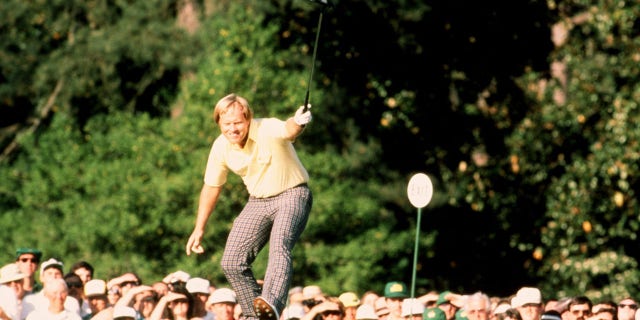
Nicklaus sunk a spectacular 18-foot putt on the 17th hole of the final round, amid a delirious reaction from the gallery, then held on at 18 to win by one stroke.

Jack Nicklaus watches his putt during the 1986 Masters Tournament at Augusta National Golf Club in April 1986 in Augusta, Georgia. 

Jack Nicklaus watches his putt during the 1986 Masters Tournament at Augusta National Golf Club in April 1986 in Augusta, Georgia. (Augusta National/Getty Images)

The sight of Nicklaus leaning forward intently, following his putt across the green with focused eyes, then raising his club triumphantly over his head as the ball dropped in the hole is one of the most famous images in the annals of golf.

“Never in the history of the Masters did the ground shake, cheers reverberate and emotions explode as they did for Jack Nicklaus in 1986,” enthused U.K. golf outlet Links Magazine.

ON THIS DAY IN HISTORY, MARCH 22, 1934, MASTERS TOURNAMENT TEES OFF FOR FIRST TIME IN AUGUSTA, GEORGIA

In addition to his dominance atop the leader board in golf’s biggest events, the Golden Bear finished second in major tournaments an incredible 19 times.

“It has been and will continue to be the utmost honor to have won your great tournament and to be forever called a Masters champion.” — Jack Nicklaus

Nicklaus, now 83, is still revered at Augusta National

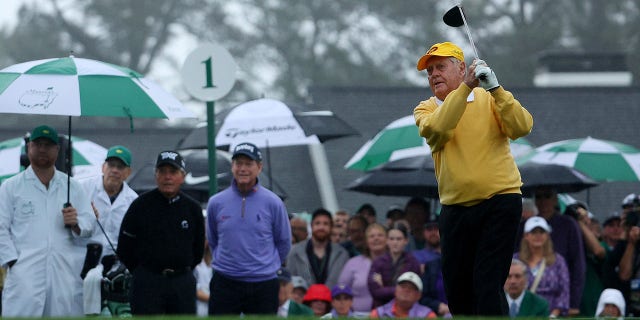
He’s been an honorary starter at The Masters each year since 2010, teeing off yesterday with fellow golf legends Gary Player and Tom Watson.

CLICK HERE TO SIGN UP FOR OUR LIFESTYLE NEWSLETTER

He returned the affection with a so-called “love letter to the Masters” in 2019 — 60 years after he first competed at Augusta as an amateur in 1959.

Honorary starter and six-time Masters champion Jack Nicklaus plays his opening tee shot from the first tee during the opening ceremony prior to the start of the first round of the Masters at Augusta National Golf Club on April 7, 2022 in Augusta, Georgia. Nicklaus has been a ceremonial starter at The Masters each year since 2010.

Honorary starter and six-time Masters champion Jack Nicklaus plays his opening tee shot from the first tee during the opening ceremony prior to the start of the first round of the Masters at Augusta National Golf Club on April 7, 2022 in Augusta, Georgia. Nicklaus has been a ceremonial starter at The Masters each year since 2010. (Andrew Redington/Getty Images)

“Thank you for a lifetime of memories. Thank you providing the perfect background for 60 years and six opportunities to feel the overwhelming satisfaction of slipping on the green jacket,” Nicklaus wrote.

“The Masters at Augusta National proved the tournament at which the Golden Bear’s fearsome brilliance shined brightest.”

“It has been and will continue to be the utmost honor to have won your great tournament and to be forever called a Masters champion.”

CLICK

“Nicklaus’ presence at Augusta National is much more than ceremonial,” Golfweek wrote in 2019.

“He is the game’s ranking living legend — with those 18 majors — and continues to be an influential and respected golf presence.”

______

Photo detail

Don January hitting a tee shot at the par-3 16th hole at the Houston Greats of Golf Challenge.

___________

I have written about golf several times before in the past and I do have some very interesting stories to tell. When I was growing up I used to attend the Danny Thomas St. Jude Memphis Golf Classic every year at Colonial Country Club and I got a kick out of seeing some of the top pros such as Jack Nicklaus, Dave Hill, Lee Trevino, Gary Player, Johnny Miller, Don January, Gene Littler and Tom Watson play.

My good friend Robert Fargarson told me that his father, Robert Sr, actually went to high school with Don January, and before Mr. Fargarson became a Christian in 1970, January would come in town every year and booze it up with Mr. Fargarson. However, after that Mr. Fargarson would reach out to Don with the gospel.

I told Mr.Fargarson that Don January was one of my favorite golfers to follow and he told me what to say to him the next time I had a chance to speak to him. So in 1977 I stood at the 2nd Tee and waited for Mr. January to walk up and I said, “Fargy wants to know when you are gonna get saved.” January laughed and said, “Same ole Fargy!!!!”

Today I am mailing this post to Mr. January who lives in Texas. It will be the simple gospel message  that Mr. Fargarson had presented to Mr. January in the past. Earlier this morning Mr. Fargarson went to be with the Lord in Heaven.

Our views below (this material is from Campus Crusade for Christ) concerning how to go to heaven.

Just as there are physical laws that govern

the physical universe, so are there spiritual laws
that govern your relationship with God.

Law 1

God loves you and offers a wonderful plan for your life.

God’s Love
“God so loved the world that He gave His one and only Son, that whoever
believes in Him shall not perish but have eternal life” (John 3:16, NIV).

God’s Plan
[Christ speaking] “I came that they might have life, and might have it abundantly”
[that it might be full and meaningful] (John 10:10).

Why is it that most people are not experiencing that abundant life?

Because…

Law 2

Man is sinful and separated from God.
Therefore, he cannot know and experience
God’s love and plan for his life.

Man is Sinful
“All have sinned and fall short of the glory of God” (Romans 3:23).

Man was created to have fellowship with God; but, because of his own stubborn
self-will, he chose to go his own independent way and fellowship with God was broken.
This self-will, characterized by an attitude of active rebellion or passive indifference,
is an evidence of what the Bible calls sin.

Man Is Separated
“The wages of sin is death” [spiritual separation from God] (Romans 6:23).

Separation This diagram illustrates that God isholy and man is sinful. A great gulf separates the two. The arrows illustrate that man is continually trying to reach God and the abundant life through his own efforts, such as a good life, philosophy, or religion
-but he inevitably fails.The third law explains the only way to bridge this gulf…

Law 3

Jesus Christ is God’s only provision for man’s sin.
Through Him you can know and experience
God’s love and plan for your life.

He Died In Our Place
“God demonstrates His own love toward us, in that while we were yet sinners,
Christ died for us” (Romans 5:8).

He Rose from the Dead
“Christ died for our sins… He was buried… He was raised on the third day,
according to the Scriptures… He appeared to Peter, then to the twelve.
After that He appeared to more than five hundred…” (1 Corinthians 15:3-6).

He Is the Only Way to God
“Jesus said to him, ‘I am the way, and the truth, and the life, no one comes to
the Father but through Me’” (John 14:6).

Bridge The Gulf This diagram illustrates that God has bridged the gulf that separates us from Him by sending His Son, Jesus Christ, to die on the cross in our place to pay the penalty for our sins.It is not enough just to know these three laws…

Law 4

We must individually receive Jesus Christ as Savior and Lord;
then we can know and experience God’s love and plan for our lives.

We Must Receive Christ
“As many as received Him, to them He gave the right to become children
of God, even to those who believe in His name” (John 1:12).

We Receive Christ Through Faith
“By grace you have been saved through faith; and that not of yourselves,
it is the gift of God; not as result of works that no one should boast” (Ephesians 2:8,9).

When We Receive Christ, We Experience a New Birth
(Read John 3:1-8.)

We Receive Christ Through Personal Invitation
[Christ speaking] “Behold, I stand at the door and knock;
if any one hears My voice and opens the door, I will come in to him” (Revelation 3:20).

Receiving Christ involves turning to God from self (repentance) and trusting
Christ to come into our lives to forgive our sins and to make us what He wants us to be.
Just to agree intellectually that Jesus Christ is the Son of God and that He died on the cross
for our sins is not enough. Nor is it enough to have an emotional experience.
We receive Jesus Christ by faith, as an act of the will.

These two circles represent two kinds of lives:

Circles

Self-Directed Life
S-Self is on the throne
wpe463.jpg (790 bytes)-Christ is outside the life
wpe464.jpg (719 bytes)-Interests are directed by self, often
resulting in discord and frustration
Christ-Directed Life
wpe463.jpg (790 bytes)-Christ is in the life and on the throne
S-Self is yielding to Christ,
resulting in harmony with God’s plan
wpe464.jpg (719 bytes)-Interests are directed by Christ,
resulting in harmony with God’s plan

Which circle best represents your life?
Which circle would you like to have represent your life?


The following explains how you can receive Christ:

You Can Receive Christ Right Now by Faith Through Prayer
(Prayer is talking with God)

God knows your heart and is not so concerned with your words as He is with the attitude
of your heart. The following is a suggested prayer:

Lord Jesus, I need You. Thank You for dying on the cross for my sins. I open the door of my life and receive You as my Savior and Lord. Thank You for forgiving my sins and giving me eternal life.
Take control of the throne of my life. Make me the kind of person You want me to be.

Does this prayer express the desire of your heart? If it does, I invite you to pray this
prayer right now, and Christ will come into your life, as He promised.

Now that you have received Christ

Here are some more memories of past golf tournaments I have attended:

Memories of the 59

Uploaded on Aug 1, 2008

Al Geiberger (“Mr. 59”) talks about what helped him shoot his record breaking 59 in 1977.

__________________

mr 59

Uploaded on Jul 27, 2011

go to view the website http://www.kxxu.com
signed autograph golf balls for sale 
by Al Geiberger Mr. 59

______________________

In 1977, two huge events made national news at the now titled “Danny Thomas Memphis Classic.” First, President Gerald Ford made a hole-in-one during Wednesday’s Celebrity Pro-Am. That event is now referred to as the “Shot Heard ‘Round the World.” Two days later, Al Geiberger shocked the golf world with his record low round of 59 on Friday of the tournament. The 13-under-par round still stands as a PGA TOUR record. (Chip Beck and David Duval have since tied the mark.)

I had the chance to hear the roar that came from the crowd that day that President Ford hit the hole in one (on hole #5 at Colonial Country Club in Cordova, TN). Just a few holes later I saw Danny Thomas walking around saying with slurred speech, :”This is the ball, this is the ball” while he held up a golf ball. I thought he was going to fall on me as he passed by.

Then just two days later I saw the last 5 holes of Al Geiberger’s 59. He was walking around with this silly grin on his face because almost every putt was going in.

___________________

This picture above is right after the round of 59 and the picture below after he hit the last putt. I was in the crowd watching him and I was standing right behind the green towards the clubhouse.

_________________
____________
_____________
Fast forward to Sept 13, 2013 where another 59 happened:

Valley’s Al Geiberger says sixth member of 59 Club adds ‘credibility’

Sep. 14, 2013   |
0 Comments

Jim Furyk almost made Al Geiberger’s prophecy come true.

Geiberger, the Palm Desert resident and the first player to shoot a 59 on the PGA Tour, has always said some player will be coming down to the last hole needing to birdie the hole to shoot 59, and instead will hole out for an eagle and a 58.

“And he almost did it,” Geiberger said moments after watching Furyk hit an approach shot to just two feet on the last hole, then make the birdie putt to shoot 59 in the second round of the BMW Championship near Chicago on Friday.

Geiberger said he had been getting text messages throughout the afternoon as Furyk made his run at the fabled 59. And the messages were coming in after the round ended, too.

“Here’s one I just got. ‘You’re still the president of the club,’ ” Geiberger laughed.

Furyk birdied two of his last three holes Friday in the BMW Championship to become the sixth player in PGA Tour history to shoot a 59. Needing a birdie on the par-4 ninth hole at Conway Farms, he stuffed a gap wedge into just over 3 feet and calmly knocked it in.

“A very cool card,” Furyk said as he gazed at the scores, which included an eagle when he holed out with a 9-iron.

It was a day he won’t forget, in the same town — the Chicago suburbs, anyway — where he won his lone major at the U.S. Open in 2003.

Standing in the ninth fairway at Conway Farms, 103 yards from a front pin, Furyk didn’t want to let his chance get away from him.

“I said, ‘How many opportunities are you going to have in life to do this again?’ ” he said. “Got to take advantage of it. Tried to knock it in there tight and make it as easy on yourself as you can.”

He made the putt and repeatedly pumped his fist, turning for the gallery in the grandstands to see, and then he hugged caddie Mike “Fluff” Cowan and tapped him on the head.

“I guess the moment kind of struck me the most at No. 9 when I hit it the wedge shot in there close, and the crowd erupted and I started looking around and it just hit me how many people had come over to that side to see the finish,” Furyk said.

There’s work left for the trophy. Furyk was tied on top with Brandt Snedeker, who was nine shots clear of Furyk at the start of the second round.

The six 59s started with Geiberger’s round in the second round of the tour’s Memphis tournament at Colonial Country Club in 1977. Six 59s have also been shot on the Web.com Tour, and Annika Sorenstam is the only golfer to have shot a 59 on the LPGA.

“I always told people there was no room for a bogey in the 59,” Geiberger said of Furyk’s round of 11 birdies, one eagle and one bogey. “This shows that was wrong.”

Throughout the year, Geiberger has watched as a variety of players have made runs at 59, and he admits that the other 59s have brought more attention to his round.

“It’s good. It gives it credibility,” Geiberger said. “I was pulling for Phil (Mickelson) to shoot 59, not necessarily 58, at Phoenix. And Furyk is a good player, so there is credibility.”

Geiberger says he never roots against anyone on the verge of a 59.

“You don’t have any control to start with,” he said. “I didn’t realize it, but once it got past a couple of people, it’s almost been a little better. More and more people have one now. Now they are comparing the rounds, and I know I will win the comparison. Not to be talking, but I know my round stands up.”

Geiberger’s round came on a demanding par-72 course, while other rounds have come on par-72 layouts considered not as tough as Colonial or on par-71 or par-70 courses.

“The first thing my wife said after Furyk’s round was it’s not 13-under and it’s not par-72,” Geiberger joked.

Related posts:

Golf Legend Seve Ballesteros dies

Getty Images Seve Ballesteros wasn’t in trouble even when he was in trouble, said Ben Crenshaw, because trouble was normal for him. Seve Ballesteros Dies At 54 On 6 May 2011, his family released a press release announcing that Ballesteros’s neurological condition had “suffered a severe deterioration”.He died within hours of the announcement in the […]

Al Geiberger’s record almost broken!!! (I was there in 1977 following Al)

Memories of the 59 Uploaded on Aug 1, 2008 Al Geiberger (“Mr. 59″) talks about what helped him shoot his record breaking 59 in 1977. __________________ mr 59 Uploaded on Jul 27, 2011 go to view the website http://www.kxxu.com signed autograph golf balls for sale  by Al Geiberger Mr. 59 ______________________ In 1977, two huge events made […]

MUSIC MONDAY Aldous Huxley and the rock band The Velvet Underground and the song “Heroin”

———

Velvet Underground – Heroin (live in Paris)

———

The Velvet Underground – Heroin (Lyrics!)

————

Image result for francis schaeffer

630 × 400Images may be subject to copyright. Learn More

Johnny Cash had a long struggle with drugs and his story was told in an earlier post.

In his book HOW SHOULD WE THEN LIVE? Francis Schaeffer noted:

The man who followed on from that point was English–Aldous Huxley (1894-1963). He proposed drugs as a solution. We should, he said, give healthy people drugs and they can then find truth inside their own heads. All that was left for Aldous Huxley and those who followed him was truth inside a person’s own head. With Huxley’s idea, what began with the existential philosophers – man’s individual subjectivity attempting to give order as well as meaning, in contrast to order being shaped by what is objective or external to oneself – came to its logical conclusion. Truth is in one’s own head. The ideal of objective truth was gone.

Image result for aldous huxley

This emphasis on hallucinogenic drugs brought with it many rock groups–for example, Cream, Jefferson Airplane, Grateful Dead, Incredible String Band, Pink Floyd, and Jimi Hendrix. Most of their work was from 1965-1958. The Beatles’Sergeant Pepper’s Lonely Hearts Club Band (1967) also fits here. This disc is a total unity, not just an isolated series of individual songs, and for a time it became the rallying cry for young people throughout the world. As a whole, this music was the vehicle to carry the drug culture and the mentality which went with it across frontiers which were almost impassible by other means of communication.

Here is a good review of the episode 016 HSWTL The Age of Non-Reason of HOW SHOULD WE THEN LIVE?, December 23, 2007:

Together with the advent of the “drug Age” was the increased interest in the West in  the religious experience of Hinduism and Buddhism. Schaeffer tells us that: “This grasping for a nonrational meaning to life and values is the central reason that these Eastern religions are so popular in the West today.”  Drugs and Eastern religions came like a flood into the Western world.  They became the way that people chose to find meaning and values in life.  By themselves or together, drugs and Eastern religion became the way that people searched inside themselves for ultimate truth.

Along with drugs and Eastern religions there has been a remarkable increase “of the occult appearing as an upper-story hope.”  As modern man searches for answers it “many moderns would rather have demons than be left with the idea that everything in the universe is only one big machine.”  For many people having the “occult in the upper story of nonreason in the hope of having meaning” is better than leaving the upper story of nonreason empty. For them horror or the macabre are more acceptable than the idea that they are just a machine.

Francis Schaeffer has correctly argued:

The universe was created by an infinite personal God and He brought it into existence by spoken word and made man in His own image. When man tries to reduce [philosophically in a materialistic point of view] himself to less than this [less than being made in the image of God] he will always fail and he will always be willing to make these impossible leaps into the area of nonreason even though they don’t give an answer simply because that isn’t what he is. He himself testifies that this infinite personal God, the God of the Old and New Testament is there. 
The Velvet Underground – Heroin (Lyrics!)


Velvet Underground – Heroin (live in Paris)

Heroin (The Velvet Underground song)

Article Talk

Heroin” is a song by the Velvet Underground, released on their 1967 debut album The Velvet Underground & Nico. Written by Lou Reed in 1964, the song, which overtly depicts heroin use and abuse, is one of the band’s most celebrated compositions. Critic Mark Deming of Allmusic writes, “While ‘Heroin’ hardly endorses drug use, it doesn’t clearly condemn it, either, which made it all the more troubling in the eyes of many listeners.”[2] In 2004, it was ranked at number 448 on Rolling Stone‘s list of The 500 Greatest Songs of All Time,[3] and was re-ranked at number 455 in 2010.[4]

Writing and recordingEdit

In an interview with WLIR in 1972, Reed said he wrote the lyrics while working for a record company.

I was working for a record company as a songwriter, where they’d lock me in a room and they’d say write ten surfing songs, ya know, and I wrote “Heroin” and I said “Hey I got something for ya.” They said, “Never gonna happen, never gonna happen.”[5]

“Heroin” was among a three-song set to be re-recorded, in May 1966 at TTG Studios in Hollywood, before being included on the final release of The Velvet Underground & Nico (along with “I’m Waiting for the Man” and “Venus in Furs“). This recording of the song is the album’s second longest track on the album at 7 minutes and 12 seconds; “European Son” is 30 seconds longer.

“Heroin” begins slowly with Reed’s quiet, melodic guitarSterling Morrison‘s rhythm guitar and drumpatterns by Maureen Tucker, soon joined by John Cale‘s droning electric viola. The tempo increases gradually, until a crescendo, punctuated by Cale’s viola and the more punctuated guitar strumming of Reed and Morrison. Tucker’s drumming becomes faster and louder. The song then slows to the original tempo, and repeats the same pattern before ending.

The song is based on D♭ and G♭ major chords. Like “Sister Ray“, it features no bass guitar; Reed and Morrison use chords and arpeggios to create the song’s trademark sound. Rolling Stone said “It doesn’t take much to make a great song,” alluding to the song’s use of merely two chords.

Tucker stopped drumming for several seconds at the 5:17 mark, before picking up the beat again. She explains:

As soon as it got loud and fast, I couldn’t hear anything. I couldn’t hear anybody, so I stopped, assuming, well, they’ll stop too and say “what’s the matter, Moe?” [laughs] But nobody stopped. And then, you know, so I came back in.[6]

PersonnelEdit

Alternative versions

The Velvet Underground and drugsEdit

“Heroin” (along with songs like “I’m Waiting for the Man” which dealt with similar subject matter) tied the Velvet Underground with drug use in the media. Some critics declared the band were glorifying the use of drugs such as heroin.[9] However, members of the band (Reed, in particular) frequently denied any claims that the song was advocating use of the drug. Reed’s lyrics, such as they are on the majority of The Velvet Underground & Nico, were more meant to focus on providing an objective description of the topic without taking a moral stance.[2][10]Critics were not the only ones who misunderstood the song’s neutral tone; fans would sometimes approach the band members after a live performance and tell them they “shot up to ‘Heroin'”,[11] a phenomenon that deeply disturbed Reed. As a result, Reed was somewhat hesitant to play the song with the band through much of the band’s later career.[9]

Billy Idol version

Other cover versions

References in popular culture

References

External links

“Heroin”
Song by the Velvet Underground
from the album The Velvet Underground & Nico
ReleasedMarch 12, 1967
RecordedMay 1966
StudioTTG Studios, Hollywood, California
GenreExperimental rock[1]
Length7:12
LabelVerve
Songwriter(s)Lou Reed
Producer(s)Andy Warhol
Audio sample
0:30“Heroin”filehelp

Related posts:

FRANCIS SCHAEFFER ANALYZES ART AND CULTURE Part 53 THE BEATLES (Part E, Stg. Pepper’s and John Lennon’s search in 1967 for truth was through drugs, money, laughter, etc & similar to King Solomon’s, LOTS OF PICTURES OF JOHN AND CYNTHIA) (Feature on artist Yoko Ono)

April 2, 2015 – 7:05 am

The John Lennon and the Beatles really were on a long search for meaning and fulfillment in their lives  just like King Solomon did in the Book of Ecclesiastes. Solomon looked into learning (1:12-18, 2:12-17), laughter, ladies, luxuries, and liquor (2:1-2, 8, 10, 11), and labor (2:4-6, 18-20). He fount that without God in the picture all […]

By Everette Hatcher III|Posted in Current EventsFrancis Schaeffer|Edit|Comments (0)

FRANCIS SCHAEFFER ANALYZES ART AND CULTURE Part 52 THE BEATLES (Part D, There is evidence that the Beatles may have been exposed to Francis Schaeffer!!!) (Feature on artist Anna Margaret Rose Freeman )

March 22, 2015 – 12:30 am

______________   George Harrison Swears & Insults Paul and Yoko Lucy in the Sky with Diamonds- The Beatles The Beatles:   I have dedicated several posts to this series on the Beatles and I don’t know when this series will end because Francis Schaeffer spent a lot of time listening to the Beatles and talking […]

By Everette Hatcher III|Posted in Francis Schaeffer|Tagged Anna Margaret Rose FreemanGeorge HarrisonJohn LennonPaul MacCartneyRingo StarrStg. Pepper’s Lonely Hearts Club Band|Edit|Comments (0)

FRANCIS SCHAEFFER ANALYZES ART AND CULTURE Part 51 THE BEATLES (Part C, List of those on cover of Stg.Pepper’s ) (Feature on artist Raqib Shaw )

March 19, 2015 – 12:21 am

  The Beatles in a press conference after their Return from the USA Uploaded on Nov 29, 2010 The Beatles in a press conference after their Return from the USA. The Beatles:   I have dedicated several posts to this series on the Beatles and I don’t know when this series will end because Francis […]

By Everette Hatcher III|Posted in Francis Schaeffer|Tagged George HarrisonJohn LennonPaul MacCartneyRaqib ShawRingo Starr|Edit|Comments (0)

FRANCIS SCHAEFFER ANALYZES ART AND CULTURE Part 50 THE BEATLES (Part B, The Psychedelic Music of the Beatles) (Feature on artist Peter Blake )

March 12, 2015 – 12:16 am

__________________   Beatles 1966 Last interview I have dedicated several posts to this series on the Beatles and I don’t know when this series will end because Francis Schaeffer spent a lot of time listening to the Beatles and talking and writing about them and their impact on the culture of the 1960’s. In this […]

By Everette Hatcher III|Posted in Francis Schaeffer|Tagged George HarrisonJohn LennonPaul MacCartneyPeter BlakeRingo Starr|Edit|Comments (1)

FRANCIS SCHAEFFER ANALYZES ART AND CULTURE Part 49 THE BEATLES (Part A, The Meaning of Stg. Pepper’s Cover) (Feature on artist Mika Tajima)

March 5, 2015 – 4:47 am

_______________ The Beatles documentary || A Long and Winding Road || Episode 5 (This video discusses Stg. Pepper’s creation I have dedicated several posts to this series on the Beatles and I don’t know when this series will end because Francis Schaeffer spent a lot of time listening to the Beatles and talking and writing about […]

By Everette Hatcher III|Posted in Francis Schaeffer|Tagged BeatlesMika Tajima|Edit|Comments (0)

FRANCIS SCHAEFFER ANALYZES ART AND CULTURE PART 48 “BLOW UP” by Michelangelo Antonioni makes Philosophic Statement (Feature on artist Nancy Holt)

February 26, 2015 – 4:57 am

_______________ Francis Schaeffer pictured below: _____________________ I have included the 27 minute  episode THE AGE OF NONREASON by Francis Schaeffer. In that video Schaeffer noted,  ” Sergeant Pepper’s Lonely Hearts Club Band…for a time it became the rallying cry for young people throughout the world. It expressed the essence of their lives, thoughts and their feelings.” How Should […]

By Everette Hatcher III|Posted in Francis Schaeffer|Tagged Blow UpDavid Hemmings,Michelangelo AntonioniNancy HoltSarah Miles.Vanessa Redgrave|Edit|Comments (0)

FRANCIS SCHAEFFER ANALYZES ART AND CULTURE Part 47 Woody Allen and Professor Levy and the death of “Optimistic Humanism” from the movie CRIMES AND MISDEMEANORS Plus Charles Darwin’s comments too!!! (Feature on artist Rodney Graham)

February 19, 2015 – 5:33 am

Crimes and Misdemeanors: A Discussion: Part 1 ___________________________________ Today I will answer the simple question: IS IT POSSIBLE TO BE AN OPTIMISTIC SECULAR HUMANIST THAT DOES NOT BELIEVE IN GOD OR AN AFTERLIFE? This question has been around for a long time and you can go back to the 19th century and read this same […]

By Everette Hatcher III|Posted in Francis SchaefferWoody Allen|Tagged alan aldaAnjelica Hustonmia farrowSam Waterston|Edit|Comments (0)

FRANCIS SCHAEFFER ANALYZES ART AND CULTURE PART 46 Friedrich Nietzsche (Featured artist is Thomas Schütte)

February 12, 2015 – 5:00 am

____________________________________ Francis Schaeffer pictured below: __________ Francis Schaeffer has written extensively on art and culture spanning the last 2000years and here are some posts I have done on this subject before : Francis Schaeffer’s “How should we then live?” Video and outline of episode 10 “Final Choices” , episode 9 “The Age of Personal Peace and Affluence”, episode 8 […]

By Everette Hatcher III|Posted in Francis Schaeffer|Tagged Bertrand RussellFriedrich Nietzsche,H.G. Wellsjean paul sartreKai NielsenRichard TaylorRichard WurmbrandThomas Schütte|Edit|Comments (0)

FRANCIS SCHAEFFER ANALYZES ART AND CULTURE Part 45 Woody Allen “Reason is Dead” (Feature on artists Allora & Calzadilla )

February 5, 2015 – 4:31 am

Love and Death [Woody Allen] – What if there is no God? [PL] ___________ _______________ How Should We then Live Episode 7 small (Age of Nonreason) #02 How Should We Then Live? (Promo Clip) Dr. Francis Schaeffer 10 Worldview and Truth Two Minute Warning: How Then Should We Live?: Francis Schaeffer at 100 Francis Schaeffer […]

By Everette Hatcher III|Posted in Francis SchaefferWoody Allen|Tagged Allora & Calzadilla|Edit|Comments (0)

FRANCIS SCHAEFFER ANALYZES ART AND CULTURE Part 44 The Book of Genesis (Featured artist is Trey McCarley )

January 29, 2015 – 5:01 am

___________________________________ Francis Schaeffer pictured below: ____________________________ Francis Schaeffer “BASIS FOR HUMAN DIGNITY” Whatever…HTTHR Dr. Francis schaeffer – The flow of Materialism(from Part 4 of Whatever happened to human race?) Dr. Francis Schaeffer – The Biblical flow of Truth & History (intro) Francis Schaeffer – The Biblical Flow of History & Truth (1) Dr. Francis Schaeffer […]

By Everette Hatcher III|Posted in Francis 


Dan Mitchell article: Another European Fiscal Crisis?

Another European Fiscal Crisis?

Why did many European nations, most notablyGreece, suffer fiscal crises about a dozen years ago?

Because the burden of government spending, which already was excessive, increased even further.

And with taxes already very onerous in those countries, much of that new spending was financed with borrowing.

Investors then realized it was very risky to finance the various spending sprees. And when they stopped buying bonds from these governments (or started demanding higher interest rates to compensate for risk), that triggered the crises.

One would think that the nations most affected – Portugal, Italy, Greece, and Spain (the PIGS) – would have learned a lesson.

Nope.

As you can see from this IMF data, those governments did not use the post-crisis recovery as an opportunity to get debt under control. Instead, every nation has more debt today than it did when the crisis occurred.

And why do these nations have higher debt levels?

For the simple (and predictable) reason that they have not reduced the burden of government spending.

Instead, as you can see from this next chart, governments are now consuming even greater shares of national economic output. Which means a greater chance of more crises.

To make a bad situation even worse, the European Central Bank cranked up the figurative printing press starting in 2020 by massively expanding its balance sheet.

Dumping all that money into the system quite predictably caused prices to soar. And now that the ECB is belatedly trying to undo its mistake.

That puts the PIGS under more pressure, as Desmond Lachman explained for National Review.

Christine Lagarde, the president of the European Central Bank (ECB)…has to raise interest rates at a time when governments in the euro zone’s economic periphery are more indebted today than they were at the time of the 2010 euro zone sovereign-debt crisis. This more hawkish interest-rate policy, coupled with a shift to quantitative tightening, now risks triggering another round of the euro zone debt crisis.…One of the ECB’s problems in having to raise interest rates aggressively to contain inflation is that such a course risks exacerbating the cracks that are now emerging in the European banking system. …if current trends continue, then another round of euro zone sovereign-debt crisis, where investors lose faith in the government’s ability to repay its debt, could be just around the corner. …This is especially true for Italy, where until recently the ECB had been buying Italian government bonds equivalent to that government’s net borrowing needs.

By the way, Lachman seems to think the Fed should allow continued inflation in order to help bail out Italy and the other PIGS.

That would be a big mistake. The long-run damage of that approach would be much greater than the long-run damage (actually, long-run benefits) of letting Italy and the others go bankrupt.

P.S. The problem in Europe is too much government spendingnot the euro currency.

P.P.S. Eurobonds will make things worse in the long run.

P.P.P.S. It is possible to reduce large debt burdens, so long as governments simply restrain spending.

P.P.P.P.S. From the archives, here’s some comedy (and more comedy) about Europe’s fiscal mess.

Maybe Romney will focus on cutting spending now that Ryan is on board.

Is the American Electorate that Dumb?

Posted by Roger Pilon

Today POLITICO Arena asks:

Can Ryan boost Romney’s poll numbers?

My response:

Ryan is the shot in the arm that Romney needed. If last night’s “60 Minutes” interview of the two is any indication, Romney is finally focused on the big issues. It’s rare that a vice-presidential pick adds much to a ticket, but this case may be the exception. So, yes, Ryan can boost Romney’s poll numbers. Just look at the weekend crowds.

Ryan put it simply: The country’s going broke. You’d never know that from listening to the Democratic response to the pick. For that side, it’s all about what the Romney-Ryan team will take away from seniors, women, students, and the middle class — as if all of that ”stuff” were free from government. They’re counting on seniors being too senile, women being too emotional, young people being too uneducated, and the middle-class being too focused on their mortgages to understand the situation we’re in, where we borrow 40 percent of what we spend and add trillions to the national debt every year. The Ryan budget won’t push Granny over the cliff. The Obama team’s head-in-the-sand will.

And it isn’t as if the Obama team doesn’t know exactly what they’re doing. In Obama’s latest ad, run last night during the Olympics closing ceremonies, he himself states plainly that the nation faces two fundamentally different visions of where we’re going. But he talks only about government benefits, not about costs — the “Life of Julia” nonsense. It’s a cynical view of the American public — a view that this election, more than any in recent memory, will put to the test.

Dan Mitchell article: A Good Year for Milton Friedman = a Bad Year for Teacher Unions

Milton Friedman – Public Schools / Voucher System – Failures in Educatio…

—-

A Good Year for Milton Friedman = a Bad Year for Teacher Unions

Back in 2013, I shared some research showing how school choice produced good results. Not just in terms of student achievement, but also benefits for taxpayers as well.

Since then, I’ve shared additional research showing how school choice generates good outcomes.

It seems that some lawmakers have learned the right lessons from these studies. Over the past three years, statewide school choice has been enacted in West VirginiaArizonaIowaUtahArkansas, and Florida.

In his Wall Street Journal column, Bill McGurn celebrates this wave of victories.

It’s been a good year for Milton Friedman. The Nobel Prize-winning economist has been dead for nearly two decades. But the moment has come for the idea that may prove his greatest legacy: Parents should decide where the public funds for educating their children go. Already this year, four states have adopted school choice for everyone—and it’s only April.…Florida is the most populous state to embrace full school choice. It follows Iowa, Utah and Arkansas, which passed their own legislation this year. These were preceded by West Virginia in 2021 and Arizona in 2022. More may be coming. Four other states—Oklahoma, Ohio, Wyoming and Texas—have legislation pending. …Corey DeAngelis, a senior fellow with the American Federation for Children, says the mood has shifted. …“I wish Milton Friedman were alive today to see his ideas finally come to fruition,” Mr. DeAngelis says. “The dominos are falling and there’s nothing Randi Weingarten and the teachers unions can do about it.”

My fingers are crossed that Texas approves school choice in the few days, but rest assured I’ll celebrate if Oklahoma, Ohio, or Wyoming is the next domino.

P.S. I’m writing today about school choice in part because I’m in Europe as part of the Free Market Road Show and one of the other speakers is Admir Čavalić, who is both an academic and a member of parliament from Bosnia and Herzegovina. Along with two other scholars, Damir Bećirović, and Amela Bešlagić, he did research on support for school choice in the Balkans. Here are some of the responses from parents.

It’s very encouraging to find Serbs, Croats, and Bosnians agreeing on an issue. Maybe their governments eventually will adopt school choice, thus joining  SwedenChileCanada, and the Netherlands.

A Major Victory for Students in Florida

I almost feel sorry for the union bosses at the National Education Association and the American Federation of Teachers.

They were upset when West Virginia adopted statewide school choice in 2021 and they got even angrier when Arizona did the same thing in 2022.

So you can only imagine how bitter they are about what’s happened so far in 2023.

But notice I started this column by stating that “I almost felt sorry” for union bosses.

In reality, I’m actually overjoyed that they are having a very bad year. Teacher unions are the leading political force in trying to keep kids trapped in bad schools, an approach that is especially harmful to minorities.

Their bad year just got much worse.

That’s because Florida just expanded its school choice program so that all children will be eligible.

Here’s some of the coverage from Tampa.

A massive expansion of Florida’s school-choice programs that would make all students eligible for taxpayer-backed vouchers is headed to Gov. Ron DeSantis… DeSantis already has pledged to sign the proposal, which includes removing income-eligibility requirements that are part of current voucher programs. …Under the bill, students would be eligible to receive vouchers if they are “a resident of this state” and “eligible to enroll in kindergarten through grade 12” in a public school.

And here’s a report from Orlando.

The Florida Senate gave final approval Thursday to a bill creating universal school vouchers… Republican state lawmakers, who hold a supermajority in the Legislature, want to open state voucher programsthat currently provide scholarships to more than 252,000 children with disabilities or from low-income families to all of the 2.9 million school-age children in Florida… The bill would give any parent the choice to receive a voucher for their child to be used for private school tuition or homeschooling services and supplies — as long as that student was not enrolled in public school. DeSantis has been a supporter of the programs.

Let’s conclude with some excerpts from a Wall Street Journal editorial.

Florida has long been a leader on K-12 choice, vying with Arizona to offer the most expansive options in the nation. On Thursday Florida caught up with Arizona’s universal education savings account program by making its existing school choice offerings available to any student in the state.…The legislation…would remove income eligibility limits on the state’s current school voucher programs. It would also expand the eligible uses for the roughly $7,500 accounts to include tutoring, instructional materials and other education expenses, making these true ESAs rather than simply tuition vouchers. The bill prioritizes lower-income families and provides for home-schooled students to receive funds. Gov. Ron DeSantis, who has greatly advanced school choice in his state, is expected to sign.

By the way, the WSJ notes that Georgia may fall short in the battle to give families better educational options. As a rabid Georgia Bulldog who likes nothing better than stomping on the Florida Gators, it galls me that a handful of bad Republican legislators in the Peach State are standing in the proverbial schoolhouse door.

I’ll close by noting that there already are many reasons for Americans to migrate to Florida, such as no state income tax.

School choice means that there will be another big reason to move to the libertarian-friendly Sunshine State.

P.S. I can’t wait to see what this map looks like next year.

Milton Friedman – Educational Vouchers

Censorship, School Libraries, Democracy, and Choice

A big advantage of living in a constitutional republicis that individual rights are protected from “tyranny of the majority.”

  • Assuming courts are doing their job, it doesn’t matterif 90 percent of voters support restrictions on free speech.
  • Assuming courts are doing their job, it doesn’t matter if 90 percent of voters support gun confiscation.
  • Assuming courts are doing their job, it doesn’t matter if 90 percent of voters support warrantless searches.

That being said, a constitutional republic is a democratic form of government. And if government is staying within proper boundaries, political decisions should be based on majority rule, as expressed through elections.

In some cases, that will lead to decisions I don’t like. For instance, the (tragic) 16th Amendment gives the federal government the authority to impose an income tax and voters repeatedly have elected politicians who have opted to exercise that authority.

Needless to say, I will continue my efforts to educate voters and lawmakers in hopes that eventually there will be majorities that choose a different approach. That’s how things should work in a properly functioning democracy.

But not everyone agrees.

report in the New York Times, authored by Elizabeth Harris and Alexandra Alter, discusses the controversy over which books should be in the libraries of government schools.

The Keller Independent School District, just outside of Dallas, passed a new rule in November: It banned books from its libraries that include the concept of gender fluidity. …recently, the issue has been supercharged by a rapidly growing and increasingly influential constellation of conservative groups.The organizations frequently describe themselves as defending parental rights. …“This is not about banning books, it’s about protecting the innocence of our children,” said Keith Flaugh, one of the founders of Florida Citizens Alliance, a conservative group focused on education… The restrictions, said Emerson Sykes, a First Amendment litigator for the American Civil Liberties Union, infringe on students’ “right to access a broad range of material without political censorship.” …In Florida, parents who oppose book banning formed the Freedom to Read Project.

As indicated by the excerpt, some people are very sloppy with language.

If a school decides not to buy a certain book for its library, that is not a “book ban.” Censorship only exists when the government uses coercion to prevent people from buying books with their own money.

As I wrote earlier this year, “The fight is not over which books to ban. It’s about which books to buy.”

And this brings us back to the issue of democracy.

School libraries obviously don’t have the space or funds to stock every book ever published, so somebody has to make choices. And voters have the ultimate power to make those choices since they elect school boards.

I’ll close by noting that democracy does not please everyone. Left-leaning parents in Alabama probably don’t always like the decisions of their school boards,just like right-leaning parents in Vermont presumably don’t always like the decisions of their school boards.

And the same thing happens with other contentious issues, such as teaching critical race theory.

Which is why school choice is the best outcome. Then, regardless of ideology, parents can choose schools that have the curriculum (and books) that they think will be best for their children.

P.S. If you want to peruse a genuine example of censorship, click here.


More Academic Evidence for School Choice

Since teacher unions care more about lining their pockets and protecting their privileges rather than improving education, I’ll never feel any empathy for bosses like Randi Weingarten.

That being said, the past couple of years have been bad news for Ms Weingarten and her cronies.

Not only is school choice spreading – especially in states such as Arizona and West Virginia, but we also are getting more and more evidence that competition produces better results for schoolkids.

In a study published by the National Bureau of Economic Research, Professors David N. Figlio, Cassandra M.D. Hart & Krzysztof Karbownikfound that school choice led to benefits even for kids who remained stuck in government schools.

They enjoyed better academic outcomes, which is somewhat surprising, but even I was pleasantly shocked to see improved behavioral outcomes as well.

School choice programs have been growing in the United States and worldwide over the past two decades, and thus there is considerable interest in how these policies affect students remaining in public schools. …the evidence on the effects of these programs as they scale up is virtually non-existent. Here, we investigate this question using data from the state of Florida where, over the course of our sample period, the voucher program participation increased nearly seven-fold.We find consistent evidence that as the program grows in size, students in public schools that faced higher competitive pressure levels see greater gains from the program expansion than do those in locations with less competitive pressure. Importantly, we find that these positive externalities extend to behavioral outcomes— absenteeism and suspensions—that have not been well-explored in prior literature on school choice from either voucher or charter programs. Our preferred competition measure, the Competitive Pressure Index, produces estimates implying that a 10 percent increase in the number of students participating in the voucher program increases test scores by 0.3 to 0.7 percent of a standard deviation and reduces behavioral problems by 0.6 to 0.9 percent. …Finally, we find that public school students who are most positively affected come from comparatively lower socioeconomic background, which is the set of students that schools should be most concerned about losing under the Florida Tax Credit Scholarship program.

It’s good news that competition from the private sector produces better results in government schools.

But it’s great news that those from disadvantaged backgrounds disproportionately benefit when there is more school choice.

Wonkier readers will enjoy Figure A2, which shows the benefits to regular kids on the right and disadvantaged kids on the left.

Since the study looked at results in Florida, I’ll close by observing that Florida is ranked #1 for education freedom and ranked #3 for school choice.

P.S. Here’s a video explaining the benefits of school choice.

P.P.S. There’s international evidence from SwedenChileCanada, and the Netherlands, all of which shows superior results when competition replaces government education monopolies.

———-

Portrait of Milton Friedman.jpg

Milton Friedman chose the emphasis on school choice and school vouchers as his greatest legacy and hopefully the Supreme Court will help that dream see a chance!

Educational Choice, the Supreme Court, and a Level Playing Field for Religious Schools

The case for school choice is very straightforward.

The good news is that there was a lot of pro-choice reform in 2021.

West Virginia adopted a statewide system that is based on parental choice. And many other states expanded choice-based programs.

But 2022 may be a good year as well. That’s because the Supreme Court is considering whether to strike down state laws that restrict choice by discriminating against religious schools.

Michael Bindas of the Institute for Justice and Walter Womack of the Southern Christian Leadership Conference make the case for a level playing field in a column for the New York Times.

In 2002, the Supreme Court held that the Constitution allows school choice programs to include schools that provide religious instruction, so long as the voucher program also offers secular options. The question now before the court is whether a state may nevertheless exclude schools that provide religious instruction. The case, Carson v. Makin, …concerns Maine’s tuition assistance program. In that large and sparsely populated state, over half of the school districts have no public high schools. If a student lives in such a district, and it does not contract with another high school to educate its students, then the district must pay tuition for the student to attend the school of her or his parents’ choice. …But one type of school is off limits: a school that provides religious instruction. That may seem unconstitutional, and we argue that it is. Only last year, the Supreme Court, citing the free exercise clause of the Constitution, held that states cannot bar students in a school choice program from selecting religious schools when it allows them to choose other private schools. …The outcome will be enormously consequential for families in public schools that are failing them and will go a long way toward determining whether the most disadvantaged families can exercise the same control over the education of their children as wealthier citizens.

The Wall Street Journal editorialized on this issue earlier this week.

Maine has one of the country’s oldest educational choice systems, a tuition program for students who live in areas that don’t run schools of their own. Instead these families get to pick a school, and public funds go toward enrollment. Religious schools are excluded, however, and on Wednesday the Supreme Court will hear from parents who have closely read the First Amendment.…Maine argues it isn’t denying funds based on the religious “status” of any school… The state claims, rather, that it is merely refusing to allocate money for a “religious use,” specifically, “an education designed to proselytize and inculcate children with a particular faith.” In practice, this distinction between “status” and “use” falls apart. Think about it: Maine is happy to fund tuition at an evangelical school, as long as nothing evangelical is taught. Hmmm. …A state can’t subsidize tuition only for private schools with government-approved values, and trying to define the product as “secular education” gives away the game. …America’s Founders knew what they were doing when they wrote the First Amendment to protect religious “free exercise.”

What does the other side say?

Rachel Laser, head of Americans United for Separation of Church and State, doesn’t want religious schools to be treated equally under school choice programs.

Here’s some of her column in the Washington Post.

…two sets of parents in Maine claim that the Constitution’s promise of religious freedom actually requires the state to fund religious education at private schools with taxpayer dollars — as a substitute for public education. This interpretation flips the meaning of religious freedom on its head and threatens both true religious freedom and public education.…The problem here is even bigger than public funds paying for praying, as wrong as that is. Unlike public schools, private religious schools often do not honor civil rights protections, especially for LGBTQ people, women, students with disabilities, religious minorities and the nonreligious. …If the court were to agree with the parents, it would also be rejecting the will of three-quarters of the states, which long ago enacted clauses in their state constitutions and passed statutes specifically prohibiting public funding of religious education. …It is up to parents and religious communities to educate their children in their faith. Publicly funded schools should never serve that purpose.

These arguments are not persuasive.

The fact that many state constitutions include so-called Blaine amendments actually undermines her argument since those provisions were motivated by a desire to discriminate against parochial schools that provided education to Catholic immigrants.

And it’s definitely not clear why school choice shouldn’t include religious schools that follow religious teachings, unless she also wants to argue that student grants and loans shouldn’t go to students at Notre Dame, Brigham Young, Liberty, and other religiously affiliated colleges.

The good news is that Ms. Laser’s arguments don’t seem to be winning. Based on this report from yesterday’s Washington Post, authored by Robert Barnes, there are reasons to believe the Justices will make the right decision.

Conservatives on the Supreme Court seemed…critical of a Maine tuition program that does not allow public funds to go to schools that promote religious instruction. The case involves an unusual program in a small state that affects only a few thousand students. But it could have greater implications… The oral argument went on for nearly two hours and featured an array of hypotheticals. …But the session ended as most suspected it would, with the three liberal justices expressing support for Maine and the six conservatives skeptical that it protected religious parents from unconstitutional discrimination.

I can’t resist sharing this additional excerpt about President Biden deciding to side with teacher unions instead of students.

The Justice Department switched its position in the case after President Biden was inaugurated and now supports Maine.

But let’s not dwell on Biden’s hackery (especially since that’s a common affliction on the left).

Instead, let’s close with some uplifting thoughts about what might happen if we get a good decision from the Supreme Court when decisions are announced next year.

Maybe I’m overly optimistic, but I think we’re getting close to a tipping point. As more and more states and communities shift to choice, we will have more and more evidence that it’s a win-win for both families and taxpayers.

Which will lead to more choice programs, which will produce more helpful data.

Lather, rinse, repeat. No wonder the (hypocriticalteacher unionsare so desperate to stop progress.

P.S. There’s strong evidence for school choice from nations such as SwedenChile, and the Netherlands.

Free To Choose 1980 – Vol. 06 What’s Wrong with Our Schools? – Full Video
https://youtu.be/tA9jALkw9_Q


Why Milton Friedman Saw School Choice as a First Step, Not a Final One

On his birthday, let’s celebrate Milton Friedman’s vision of enabling parents, not government, to be in control of a child’s education.

Wednesday, July 31, 2019
Kerry McDonald
Kerry McDonald

EducationMilton FriedmanSchool ChoiceSchooling

Libertarians and others are often torn about school choice. They may wish to see the government schooling monopoly weakened, but they may resist supporting choice mechanisms, like vouchers and education savings accounts, because they don’t go far enough. Indeed, most current choice programs continue to rely on taxpayer funding of education and don’t address the underlying compulsory nature of elementary and secondary schooling.

Skeptics may also have legitimate fears that taxpayer-funded education choice programs will lead to over-regulation of previously independent and parochial schooling options, making all schooling mirror compulsory mass schooling, with no substantive variation.

Milton Friedman had these same concerns. The Nobel prize-winning economist is widely considered to be the one to popularize the idea of vouchers and school choice beginning with his 1955 paper, “The Role of Government in Education.” His vision continues to be realized through the important work of EdChoice, formerly the Friedman Foundation for Education Choice, that Friedman and his economist wife, Rose, founded in 1996.

July 31 is Milton Friedman’s birthday. He died in 2006 at the age of 94, but his ideas continue to have an impact, particularly in education policy.

Friedman saw vouchers and other choice programs as half-measures. He recognized the larger problems of taxpayer funding and compulsion, but saw vouchers as an important starting point in allowing parents to regain control of their children’s education. In their popular book, Free To Choose, first published in 1980, the Friedmans wrote:

We regard the voucher plan as a partial solution because it affects neither the financing of schooling nor the compulsory attendance laws. We favor going much farther. (p.161)

They continued:

The compulsory attendance laws are the justification for government control over the standards of private schools. But it is far from clear that there is any justification for the compulsory attendance laws themselves. (p. 162)

The Friedmans admitted that their “own views on this have changed over time,” as they realized that “compulsory attendance at schools is not necessary to achieve that minimum standard of literacy and knowledge,” and that “schooling was well-nigh universal in the United States before either compulsory attendance or government financing of schooling existed. Like most laws, compulsory attendance laws have costs as well as benefits. We no longer believe the benefits justify the costs.” (pp. 162-3)

Still, they felt that vouchers would be the essential starting point toward chipping away at monopoly mass schooling by putting parents back in charge. School choice, in other words, would be a necessary but not sufficient policy approach toward addressing the underlying issue of government control of education.

In their book, the Friedmans presented the potential outcomes of their proposed voucher plan, which would give parents access to some or all of the average per-pupil expenditures of a child enrolled in public school. They believed that vouchers would help create a more competitive education market, encouraging education entrepreneurship. They felt that parents would be more empowered with greater control over their children’s education and have a stronger desire to contribute some of their own money toward education. They asserted that in many places “the public school has fostered residential stratification, by tying the kind and cost of schooling to residential location” and suggested that voucher programs would lead to increased integration and heterogeneity. (pp. 166-7)

To the critics who said, and still say, that school choice programs would destroy the public schools, the Friedmans replied that these critics fail to

explain why, if the public school system is doing such a splendid job, it needs to fear competition from nongovernmental, competitive schools or, if it isn’t, why anyone should object to its “destruction.” (p. 170)

What I appreciate most about the Friedmans discussion of vouchers and the promise of school choice is their unrelenting support of parents. They believed that parents, not government bureaucrats and intellectuals, know what is best for their children’s education and well-being and are fully capable of choosing wisely for their children—when they have the opportunity to do so.

They wrote:

Parents generally have both greater interest in their children’s schooling and more intimate knowledge of their capacities and needs than anyone else. Social reformers, and educational reformers in particular, often self-righteously take for granted that parents, especially those who are poor and have little education themselves, have little interest in their children’s education and no competence to choose for them. That is a gratuitous insult. Such parents have frequently had limited opportunity to choose. However, U.S. history has demonstrated that, given the opportunity, they have often been willing to sacrifice a great deal, and have done so wisely, for their children’s welfare. (p. 160).

Sign-Up: Receive Kerry’s Weekly Parenting and Education Newsletter!

Today, school voucher programs exist in 15 states plus the District of Columbia. These programs have consistently shown that when parents are given the choice to opt-out of an assigned district school, many will take advantage of the opportunity. In Washington, D.C., low-income parents who win a voucher lottery send their children to private schools.

The most recent three-year federal evaluationof voucher program participants found that while student academic achievement was comparable to achievement for non-voucher students remaining in public schools, there were statistically significant improvements in other important areas. For instance, voucher participants had lower rates of chronic absenteeism than the control groups, as well as higher student satisfaction scores. There were also tremendous cost-savings.

In Wisconsin, the Milwaukee Parental Choice Program has served over 28,000 low-income students attending 129 participating private schools.

According to Corey DeAngelis, Director of School Choice at the Reason Foundation and a prolific researcher on the topic, the recent analysis of the D.C. voucher program “reveals that private schools produce the same academic outcomes for only a third of the cost of the public schools. In other words, school choice is a great investment.”

In Wisconsin, the Milwaukee Parental Choice Program was created in 1990 and is the nation’s oldest voucher program. It currently serves over 28,000 low-income students attending 129 participating private schools. Like the D.C. voucher program, data on test scores of Milwaukee voucher students show similar results to public school students, but non-academic results are promising.

Recent research found voucher recipients had lower crime rates and lower incidences of unplanned pregnancies in young adulthood. On his birthday, let’s celebrate Milton Friedman’s vision of enabling parents, not government, to be in control of a child’s education.

According to Howard Fuller, an education professor at Marquette University, founder of the Black Alliance for Educational Options, and one of the developers of the Milwaukee voucher program, the key is parent empowerment—particularly for low-income minority families.

In an interview with NPR, Fuller said: “What I’m saying to you is that there are thousands of black children whose lives are much better today because of the Milwaukee parental choice program,” he says. 
“They were able to access better schools than they would have without a voucher.”

Putting parents back in charge of their child’s education through school choice measures was Milton Friedman’s goal. It was not his ultimate goal, as it would not fully address the funding and compulsion components of government schooling; but it was, and remains, an important first step. As the Friedmans wrote in Free To Choose:

The strong American tradition of voluntary action has provided many excellent examples that demonstrate what can be done when parents have greater choice. (p. 159).

On his birthday, let’s celebrate Milton Friedman’s vision of enabling parents, not government, to be in control of a child’s education.

Kerry McDonald

Milton Friedman

Related posts:

“Friedman Friday” (“Free to Choose” episode 1 – Power of the Market. part 7 of 7)

March 16, 2012 – 12:25 am

  Michael Harrington:  If you don’t have the expertise, the knowledge technology today, you’re out of the debate. And I think that we have to democratize information and government as well as the economy and society. FRIEDMAN: I am sorry to say Michael Harrington’s solution is not a solution to it. He wants minority rule, I […] By Everette Hatcher III | Posted in Current Events, Milton Friedman | Edit | Comments (0)

“Friedman Friday” (“Free to Choose” episode 1 – Power of the Market. part 6 of 7)

March 9, 2012 – 12:29 am

PETERSON: Well, let me ask you how you would cope with this problem, Dr. Friedman. The people decided that they wanted cool air, and there was tremendous need, and so we built a huge industry, the air conditioning industry, hundreds of thousands of jobs, tremendous earnings opportunities and nearly all of us now have air […] By Everette Hatcher III | Posted in Current Events, Milton Friedman | Edit | Comments (0)

“Friedman Friday” (“Free to Choose” episode 1 – Power of the Market. part 5 of 7)

March 2, 2012 – 12:26 am

Part 5 Milton Friedman: I do not believe it’s proper to put the situation in terms of industrialist versus government. On the contrary, one of the reasons why I am in favor of less government is because when you have more government industrialists take it over, and the two together form a coalition against the ordinary […] By Everette Hatcher III | Posted in Current Events, Milton Friedman | Edit | Comments (0)

“Friedman Friday” (“Free to Choose” episode 1 – Power of the Market. part 4 of 7)

February 24, 2012 – 12:21 am

The fundamental principal of the free society is voluntary cooperation. The economic market, buying and selling, is one example. But it’s only one example. Voluntary cooperation is far broader than that. To take an example that at first sight seems about as far away as you can get __ the language we speak; the words […] By Everette Hatcher III | Posted in Current Events, Milton Friedman | Edit | Comments (0)

“Friedman Friday” (“Free to Choose” episode 1 – Power of the Market. part 3 of 7)

February 17, 2012 – 12:12 am

  _________________________   Pt3  Nowadays there’s a considerable amount of traffic at this border. People cross a little more freely than they use to. Many people from Hong Kong trade in China and the market has helped bring the two countries closer together, but the barriers between them are still very real. On this side […] By Everette Hatcher III | Posted in Current Events, Milton Friedman | Edit | Comments (0)

“Friedman Friday” (“Free to Choose” episode 1 – Power of the Market. part 2 of 7)

February 10, 2012 – 12:09 am

  Aside from its harbor, the only other important resource of Hong Kong is people __ over 4_ million of them. Like America a century ago, Hong Kong in the past few decades has been a haven for people who sought the freedom to make the most of their own abilities. Many of them are […] By Everette Hatcher III | Posted in Current Events, Milton Friedman | Edit | Comments (0)

“Friedman Friday” (“Free to Choose” episode 1 – Power of the Market. part 1of 7)

February 3, 2012 – 12:07 am

“FREE TO CHOOSE” 1: The Power of the Market (Milton Friedman) Free to Choose ^ | 1980 | Milton Friedman Posted on Monday, July 17, 2006 4:20:46 PM by Choose Ye This Day FREE TO CHOOSE: The Power of the Market Friedman: Once all of this was a swamp, covered with forest. The Canarce Indians […]

Milton Friedman The Power of the Market 1-5

Debate on Milton Friedman’s cure for inflation

September 29, 2011 – 7:24 am

If you would like to see the first three episodes on inflation in Milton Friedman’s film series “Free to Choose” then go to a previous post I did. Ep. 9 – How to Cure Inflation [4/7]. Milton Friedman’s Free to Choose (1980) Uploaded by investbligurucom on Jun 16, 2010 While many people have a fairly […]

By Everette Hatcher III | Also posted in Current Events | Tagged dr friedman, expansion history, income tax brackets, political courage, www youtube | Edit | Comments (0)

“Friedman Friday” Milton Friedman believed in liberty (Interview by Charlie Rose of Milton Friedman part 1)

April 19, 2013 – 1:14 am

Charlie Rose interview of Milton Friedman My favorite economist: Milton Friedman : A Great Champion of Liberty  by V. Sundaram   Milton Friedman, the Nobel Prize-winning economist who advocated an unfettered free market and had the ear of three US Presidents – Nixon, Ford and Reagan – died last Thursday (16 November, 2006 ) in San Francisco […] By Everette Hatcher III | Posted in Milton Friedman | Edit | Comments (0)

What were the main proposals of Milton Friedman?

February 21, 2013 – 1:01 am

Stearns Speaks on House Floor in Support of Balanced Budget Amendment Uploaded by RepCliffStearns on Nov 18, 2011 Speaking on House floor in support of Balanced Budget Resolution, 11/18/2011 ___________ Below are some of the main proposals of Milton Friedman. I highly respected his work. David J. Theroux said this about Milton Friedman’s view concerning […] By Everette Hatcher III | Posted in Milton Friedman | Edit | Comments (0)

“Friedman Friday,” EPISODE “The Failure of Socialism” of Free to Choose in 1990 by Milton Friedman (Part 1)

December 7, 2012 – 5:55 am

Milton Friedman: Free To Choose – The Failure Of Socialism With Ronald Reagan (Full) Published on Mar 19, 2012 by NoNationalityNeeded Milton Friedman’s writings affected me greatly when I first discovered them and I wanted to share with you. We must not head down the path of socialism like Greece has done. Abstract: Ronald Reagan […] By Everette Hatcher III | Posted in Milton FriedmanPresident Obama | Edit | Comments (1)

Defending Milton Friedman

July 31, 2012 – 6:45 am

What a great defense of Milton Friedman!!!!   Defaming Milton Friedman by Johan Norberg This article appeared in Reason Online on September 26, 2008  PRINT PAGE  CITE THIS      Sans Serif      Serif Share with your friends: ShareThis In the future, if you tell a student or a journalist that you favor free markets and limited government, there is […]

RESPONDING TO HARRY KROTO’S BRILLIANT RENOWNED ACADEMICS!! Carl Sagan Part 14 Carl Sagan described our paltry existence in pathetic terms: “We live on an insignificant planet of a humdrum star, lost in a galaxy, tucked away in some forgotten corner of universe in which there are far more galaxies than people.”

More Than a Rising Star

BY DAVID F. COPPEDGE  *   |

THURSDAY, NOVEMBER 01, 2007

Share Email Facebook Twitter Pinterest

On his widely popular Cosmos science program in 1980, Carl Sagan described our paltry existence in pathetic terms: “We live on an insignificant planet of a humdrum star, lost in a galaxy, tucked away in some forgotten corner of universe in which there are far more galaxies than people.” Several developments since then have altered this perception dramatically.

First of all, earth’s sun is not so humdrum. It belongs to a spectral class representing only 5% of all stars: a G2V yellow dwarf mainsequence variable. Many in this class pulsate much more radically than the sun, giving off deadly flares.

How does our sun compare with its classmates? In one of the longest-running observational programs of the 20th century, astronomers at the McMath Solar Observatory at Kitt Peak measured solar output with high precision. Researchers White, Wallace, and Livingstone recently published the results of their “Sun-as-a-Star” program in the Astrophysical Journal. This data set spanning 32 years–a rarity in science–concluded that our sun is uncommonly stable.

Scientists know the sun goes through an 11-year activity cycle. Flares and magnetic storms appear menacing through modern orbital observatories like SOHO, Hinode, and STEREO. Some flares and coronal mass ejections have topped the charts in recent years. Yet even these violent eruptions produce “little in the way of magnetic-field-related nonradiative heating.”1 The energy of these magnetic storms escapes between the granules instead of heating the photosphere. As a result, the sun’s heat output, or solar constant, has only varied by 6 one-hundredths of a percent during the entire observational period of 1974-2006.

M. S. Giampapa compared this behavior with other stars. The amount of variation in solar output is “about 10% less than the seasonal mean values, as measured over several seasons of observation, for even the most quiet solar-type stars.”2 The sun is among the few solar-class stars with “immaculate photospheres,”3 which places our sun in the upper echelon of all the stars.

Astrobiologists might counter that there could still be a quadrillion rivals to the sun, but many other qualities make our sun even more special. We are located in a relatively safe position within the Milky Way. The sun’s energy is tuned to the chemical reactions of vision and photosynthesis. And there is the amazing coincidence between the apparent diameters of the sun and moon that allow total solar eclipses to be visible on earth–dazzling displays of the wisdom and power of God.

In a debate at the American Museum of Natural History in 2005, five out of five secular planetary scientists voted that our solar system appears special. One commented, “The older I get, the less likely it seems to me there’d be a bunch of places like our solar system.”4

The sun is a star among countless others, but in many respects it stands alone. It is the perfect lighthouse for the one planet that we know harbors life. Rejoicing like “a strong man to run a race,” it journeys across our sky each day, radiating its life-sustaining energy and declaring the glory of God (Psalm 19:1-6).

References

  1. White, O. R., L. Wallace, W. Livingston, and M. S. Giampapa. 2007. Sun-as-a-star spectrum variations 1974-2006. Astrophysical Journal. 657:1137-1149.
  2. Ibid.
  3. Ibid.
  4. Goudarzi, S. 2005. Five out of five researchers agree: earth’s solar system special. http://www.space.com/scienceastronomy/050331_asimov_debate.html.

* David F. Coppedge works in the Cassini program at the Jet Propulsion Laboratory. (The author’s views are his own.)

Cite this article: Coppedge, D. 2007. More Than a Rising Star. Acts & Facts. 36 (11): 15.

On November 21, 2014 I received a letter from Nobel Laureate Harry Kroto and it said:

…Please click on this URL http://vimeo.com/26991975

and you will hear what far smarter people than I have to say on this matter. I agree with them.

Harry Kroto

I have attempted to respond to all of Dr. Kroto’s friends arguments and I have posted my responses one per week for over a year now. Here are some of my earlier posts:

Arif AhmedHaroon Ahmed,  Jim Al-Khalili, Sir David AttenboroughMark Balaguer, Horace Barlow, Michael BateSir Patrick BatesonSimon Blackburn, Colin Blakemore, Ned BlockPascal BoyerPatricia ChurchlandAaron CiechanoverNoam Chomsky, Brian CoxPartha Dasgupta,  Alan Dershowitz, Frank DrakeHubert Dreyfus, John DunnBart Ehrman, Mark ElvinRichard Ernst, Stephan Feuchtwang, Robert FoleyDavid Friend,  Riccardo GiacconiIvar Giaever , Roy GlauberRebecca GoldsteinDavid J. Gross,  Brian Greene, Susan GreenfieldStephen F Gudeman,  Alan Guth, Jonathan HaidtTheodor W. Hänsch, Brian Harrison,  Stephen HawkingHermann Hauser, Robert HindeRoald Hoffmann,  Bruce HoodGerard ‘t HooftCaroline HumphreyNicholas Humphrey,  Herbert Huppert,  Gareth Stedman Jones, Steve JonesShelly KaganMichio Kaku,  Stuart KauffmanMasatoshi Koshiba,  Lawrence KraussHarry Kroto, George Lakoff,  Rodolfo LlinasElizabeth Loftus,  Alan MacfarlaneDan McKenzie,  Mahzarin BanajiPeter MillicanMarvin MinskyLeonard Mlodinow,  P.Z.Myers,   Yujin NagasawaAlva NoeDouglas Osheroff, David Parkin,  Jonathan Parry, Roger Penrose,  Saul PerlmutterHerman Philipse,  Carolyn PorcoRobert M. PriceVS RamachandranLisa RandallLord Martin ReesColin RenfrewAlison Richard,  C.J. van Rijsbergen,  Oliver Sacks, John SearleMarcus du SautoySimon SchafferJ. L. Schellenberg,   Lee Silver Peter Singer,  Walter Sinnott-ArmstrongRonald de Sousa, Victor StengerJohn SulstonBarry Supple,   Leonard Susskind, Raymond TallisMax TegmarkNeil deGrasse Tyson,  Martinus J. G. Veltman, Craig Venter.Alexander Vilenkin, Sir John Walker, James D. WatsonFrank WilczekSteven Weinberg, and  Lewis Wolpert,

<a style=”font-style:normal;font-variant-caps:normal;font-weight:normal;letter-spacing:normal;orphans:auto;text-indent:0;text-transform:none;white-space:normal;widows:auto;word-spacing:0;box-sizing:border-box;background-color:transparent;color:#c01823;text-decoration:none;margin:0;padding:0;border:0;font-size:13px;font-family:Lato, ‘Helvetica Neue’, Arial, Verdana, sans-serif;vertical-align:baseline;transition:color 0.2s linear, background 0.1s linear, border-color 0.1s linear;text-align:left;-webkit-text-size-adjust:100%;” title=”Remember when Carl Sagan trashed Star Wars on late-night TV?” href=”https://lithub.com/remember-when-carl-sagan-trashed-star-wars-on-late-night-tv/”&gt;

Carl Sagan

nitially an associate professor at Harvard, Sagan later moved to Cornell where he would spend the majority of his career as the David Duncan Professor of Astronomy and Space Sciences. Sagan published more than 600 scientific papers and articles and was author, co-author or editor of more than 20 books.[5] He wrote many popular science books, such as The Dragons of Eden, Broca’s Brain, Pale Blue Dot and narrated and co-wrote the award-winning 1980 television series Cosmos: A Personal Voyage. The most widely watched series in the history of American public television, Cosmos, has been seen by at least 500 million people in 60 countries.[6] The book Cosmos was published to accompany the series. He also wrote the 1985 science fiction novel Contact, the basis for a 1997 film of the same name. His papers, containing 595,000 items,[7] are archived at The Library of Congress.[8]

Sagan advocated scientific skeptical inquiry and the scientific method, pioneered exobiology and promoted the Search for Extra-Terrestrial Intelligence (SETI). He spent most of his career as a professor of astronomy at Cornell University, where he directed the Laboratory for Planetary Studies. Sagan and his works received numerous awards and honors, including the NASA Distinguished Public Service Medal, the National Academy of SciencesPublic Welfare Medal, the Pulitzer Prize for General Non-Fiction for his book The Dragons of Eden, and, regarding Cosmos: A Personal Voyage, two Emmy Awards, the Peabody Award, and the Hugo Award. He married three times and had five children. After suffering from myelodysplasia, Sagan died of pneumonia at the age of 62, on December 20, 1996.

In  the 1st video below in the 45th clip in this series are his words and  my response is below them. 

50 Renowned Academics Speaking About God (Part 1)

Another 50 Renowned Academics Speaking About God (Part 2

A Further 50 Renowned Academics Speaking About God (Part 3)

CARL SAGAN interview with Charlie Rose:

“…faith is belief in the absence of evidence. To believe in the absence of evidence, in my opinion, is a mistake. The idea is to hold belief until there is compelling evidence. If the Universe does not comply with our previous propositions, then we have to change…Religion deals with history poetry, great literature, ethics, morals, compassion…where religion gets into trouble is when it pretends to know something about science,”

I would respond that there is evidence that Christianity is true. The accuracy of the Bible has been confirmed by archaeology over and over in the past and one of the amazing finds was in 1948 when the Dead Sea Scrolls had copies from every Old Testament Book except Esther! One of the most powerful recent discoveries involved the bones of the high priest Caiaphas who questioned Christ in 30 AD.

Related posts:

FRANCIS SCHAEFFER ANALYZES ART AND CULTURE Part 52 THE BEATLES (Part D, There is evidence that the Beatles may have been exposed to Francis Schaeffer!!!) (Feature on artist Anna Margaret Rose Freeman )

______________   George Harrison Swears & Insults Paul and Yoko Lucy in the Sky with Diamonds- The Beatles The Beatles:   I have dedicated several posts to this series on the Beatles and I don’t know when this series will end because Francis Schaeffer spent a lot of time listening to the Beatles and talking […]

FRANCIS SCHAEFFER ANALYZES ART AND CULTURE Part 51 THE BEATLES (Part C, List of those on cover of Stg.Pepper’s ) (Feature on artist Raqib Shaw )

  The Beatles in a press conference after their Return from the USA Uploaded on Nov 29, 2010 The Beatles in a press conference after their Return from the USA. The Beatles:   I have dedicated several posts to this series on the Beatles and I don’t know when this series will end because Francis […]

FRANCIS SCHAEFFER ANALYZES ART AND CULTURE Part 50 THE BEATLES (Part B, The Psychedelic Music of the Beatles) (Feature on artist Peter Blake )

__________________   Beatles 1966 Last interview I have dedicated several posts to this series on the Beatles and I don’t know when this series will end because Francis Schaeffer spent a lot of time listening to the Beatles and talking and writing about them and their impact on the culture of the 1960’s. In this […]

FRANCIS SCHAEFFER ANALYZES ART AND CULTURE Part 49 THE BEATLES (Part A, The Meaning of Stg. Pepper’s Cover) (Feature on artist Mika Tajima)

_______________ The Beatles documentary || A Long and Winding Road || Episode 5 (This video discusses Stg. Pepper’s creation I have dedicated several posts to this series on the Beatles and I don’t know when this series will end because Francis Schaeffer spent a lot of time listening to the Beatles and talking and writing about […]

FRANCIS SCHAEFFER ANALYZES ART AND CULTURE PART 48 “BLOW UP” by Michelangelo Antonioni makes Philosophic Statement (Feature on artist Nancy Holt)

_______________ Francis Schaeffer pictured below: _____________________ I have included the 27 minute  episode THE AGE OF NONREASON by Francis Schaeffer. In that video Schaeffer noted,  ” Sergeant Pepper’s Lonely Hearts Club Band…for a time it became the rallying cry for young people throughout the world. It expressed the essence of their lives, thoughts and their feelings.” How Should […]

FRANCIS SCHAEFFER ANALYZES ART AND CULTURE Part 47 Woody Allen and Professor Levy and the death of “Optimistic Humanism” from the movie CRIMES AND MISDEMEANORS Plus Charles Darwin’s comments too!!! (Feature on artist Rodney Graham)

Crimes and Misdemeanors: A Discussion: Part 1 ___________________________________ Today I will answer the simple question: IS IT POSSIBLE TO BE AN OPTIMISTIC SECULAR HUMANIST THAT DOES NOT BELIEVE IN GOD OR AN AFTERLIFE? This question has been around for a long time and you can go back to the 19th century and read this same […]

FRANCIS SCHAEFFER ANALYZES ART AND CULTURE PART 46 Friedrich Nietzsche (Featured artist is Thomas Schütte)

____________________________________ Francis Schaeffer pictured below: __________ Francis Schaeffer has written extensively on art and culture spanning the last 2000years and here are some posts I have done on this subject before : Francis Schaeffer’s “How should we then live?” Video and outline of episode 10 “Final Choices” , episode 9 “The Age of Personal Peace and Affluence”, episode 8 […]

FRANCIS SCHAEFFER ANALYZES ART AND CULTURE Part 45 Woody Allen “Reason is Dead” (Feature on artists Allora & Calzadilla )

Love and Death [Woody Allen] – What if there is no God? [PL] ___________ _______________ How Should We then Live Episode 7 small (Age of Nonreason) #02 How Should We Then Live? (Promo Clip) Dr. Francis Schaeffer 10 Worldview and Truth Two Minute Warning: How Then Should We Live?: Francis Schaeffer at 100 Francis Schaeffer […]

FRANCIS SCHAEFFER ANALYZES ART AND CULTURE Part 44 The Book of Genesis (Featured artist is Trey McCarley )

___________________________________ Francis Schaeffer pictured below: ____________________________ Francis Schaeffer “BASIS FOR HUMAN DIGNITY” Whatever…HTTHR Dr. Francis schaeffer – The flow of Materialism(from Part 4 of Whatever happened to human race?) Dr. Francis Schaeffer – The Biblical flow of Truth & History (intro) Francis Schaeffer – The Biblical Flow of History & Truth (1) Dr. Francis Schaeffer […]

__

__

Dan Mitchell article: Thatcher, Lawson, and Pro-Growth Tax Policy

Thatcher, Lawson, and Pro-Growth Tax Policy

As documented in Commanding Heights: The Battle of Ideas, Margaret Thatcher and Ronald Reagansaved their nations from economic malaise and decline.

Today, let’s focus on what happened in the United Kingdom.

Economic liberty greatly increased during the Thatcher years.

She deserves the lion’s share of the credit for the U.K.’s economic rebirth and renaissance, but she also had the wisdom to appoint some very principled and very capable people to her cabinet.

Such as Nigel Lawson, who served as her Chancellor of the Exchequer (akin to a combined Treasury Secretary/OMB Director in the U.S.).

Lawson died last week, leading to many tributes to his role is resuscitating the U.K. economy.

The Wall Street Journal‘s editorial summarized his achievements.

…our problems are solvable, as they were a half century ago. One of those crucial problem solvers was British politician Nigel Lawson, who died this week at age 91. …the 1970s…was even more miserable in the United Kingdom than it was in the U.S. By the time Margaret Thatcher led the Tories into office in May 1979, inflation was raging and the country had been wracked by strikes in its “winter of discontent”… Lawson entered Thatcher’s administration… He made his historic mark as Chancellor of the Exchequer starting in 1983. He’s best known for his tax reforms, which reduced the top personal income-tax rate to 40% from 60% and brought the top corporate rate to 35% from a 1970s high of 52%. He also was a steward of the Thatcher administration’s privatizations of large state-owned firms and the “Big Bang” financial reforms that would transform London into a global financial center.

In a column for CapX, Madsen Pirie examines Lawson’s work.

Nigel Lawson left a huge legacy. Under his stewardship Britain went from being the sick man of Europe into becoming an economic powerhouse and one of the world’s leading economies. He is regarded by many as the finest Chancellor of the 20th century… Lord Lawson held the firm conviction that lower taxes created space for enterprise and opportunity, and made it his policy that in every Budget he would lower the burden of taxation and abolish at least one tax.…During his tenure, Britain was transformed from being an economy in which most major businesses and services were owned and run by the state, into one in which they became private businesses, paying taxes instead of receiving taxpayer subsidies. Failing and outdated state enterprises became modern, successful private ones. …His 1988 Budget…announced that all taxes above 40% would be abolished, and that the basic rate would be cut to 25%, its lowest for 50 years… Within a very short time, more money was coming into the Treasury from the lower rates than it had been taking in from the higher ones. It was a vindication of the Laffer Curve. …The top 10% of earners had been paying 35% of the total income tax take. Under Lawson’s lower rate that went up to 48%. In rough terms this meant that the top 10% went from paying just over a third to just under a half of total income taxes.

In other words, the lower tax rates in the U.K. had the same positive impact as the lower tax rates in the U.S., both in terms of encouraging growth and confirming the Laffer Curve.

But let’s not forget that there also was spending restraint during the Thatcher years, particularly when Lawson was Chancellor of the Exchequer.

Just like we got spending restraint during the Reagan years.

The moral of the story is that it’s great to have good leaders, and it’s great when those leaders appoint good people.

P.S. If you want the U.S. equivalent of Nigel Lawson, the best historical example would be Andrew Mellon.

The Big Question for Tories (and Republicans): What’s the Alternative to “Free-Market Fundamentalism”?

Because of her support for lower tax rates, I was excited when Liz Truss became Prime Minister of the United Kingdom.

Especially since her predecessor, Boris Johnson, turned out to be an empty-suit populist who supported higher taxes and a bigger burden of government spending.

But I’m not excited anymore.

Indeed, it’s more accurate to say that I’m despondent since the Prime Minister is abandoning (or is being pressured to abandon) key parts of her pro-growth agenda.

For details, check out this Bloomberg report, written by Julian Harris, about the (rapidly disappearing) tax-cutting agenda of the new British Prime Minister.

Westminster’s most hard-line advocates of free markets and lower taxes are looking on in despair as their agenda crumbles… When Liz Truss became prime minister just over five weeks ago, she promised to deliver a radical set of policies rooted in laissez-faire economics — an attempt to boost the UK‘s sluggish rate of growth. Yet her chancellor of the exchequer, Kwasi Kwarteng, faced a quick reality check when his mini-budget, packed with unfunded tax cuts and unaccompanied by independent forecasts, …triggered mayhem… Truss fired Kwarteng and replaced him with Jeremy Hunt as she was forced into a dramatic u-turn over her tax plans. …Truss conceded…and dropped her plan to freeze corporation tax. …Still, some believers are sticking by “Trussonomics”…Patrick Minford,..a professor at Cardiff University, said..“Liz Truss’s policies for growth are absolutely right, and to be thrown off them by a bit of market turbulence is insane.” …Eamonn Butler, co-founder of the Adam Smith Institute, similarly insisted that Truss “is not the source of the problem — she’s trying to cure the problem.”

Eamonn is right.

The United Kingdom faces serious economic challenges. But the problems are the result of bad government policies that already exist rather than the possibility of some future tax cuts.

In a column for the Telegraph, Allister Heath says the U.K.’s central bank deserves a big chunk of the blame.

Liz Truss and Kwasi Kwarteng have been doubly unlucky. While almost everybody else in Britain remained in denial, they correctly identified this absurd game for the con-trick that it truly was, warned that it was about to implode and pledged to replace it with a more honest system. Instead of a zombie economy based on rising asset prices and fake, debt-fuelled growth, their mission was to encourage Britain to produce more real goods and services, to work harder and invest more by reforming taxes and regulation.What happened next is dispiriting in the extreme. …Truss and her Chancellor moved too quickly and, paradoxically, given their warnings about the rottenness of the system, ended up pulling out the last block from the Jenga tower, sending all of the pieces tumbling down. …they didn’t crash the economy – it was about to come tumbling down anyway – but they had the misfortune of precipitating and accelerating the day of reckoning. …Andrew Bailey, the Governor of the Bank of England…, has been deeply unimpressive in all of this, helping to keep interest rates too low… The idea, now accepted so widely, that the price of money must be kept extremely low and quantitative easing deployed at every opportunity has undermined every aspect of the economy and society. …Too few people realise how terribly the easy money, high tax, high regulation orthodoxy has failed.

Allister closes with some speculation about possible alternatives. If the Tories in the U.K. decide to reject so-called “free-market fundamentalism,” what’s their alternative?

He thinks the Labour Party will take control, and with very bad results. Jeremy Corbyn will not be in charge, but his economic policies will get enacted.

If Truss is destroyed, the alternative won’t even be social democracy: it will be Labour, the hard Left, the full gamut of punitive taxation, including of wealth and housing, and even more spending, culminating rapidly in economic oblivion.

That is an awful scenario. Basically turning the United Kingdom into Greece.

I want to take a different approach, though, and contemplate what will happen if the Conservative Party rejects the Truss approach and embraces big-government conservatism.

Here are some questions I’d like them to answer:

  • Do you want improved competitiveness and more economic growth?
  • If you want more growth, which of your spending increases will lead to those outcomes?
  • Which of your tax increases will lead to more competitiveness or more prosperity?
  • Will you reform benefit programs to avert built-in spending increases caused by an aging population?
  • If you won’t reform entitlements, which taxes will you increase to keep debt under control?
  • If you don’t plan major tax increases, do you think the economy can absorb endless debt?

I’m asking these questions for two reasons. First, there are no good answers and I’d like to shame big-government Tories into doing the right thing.

Second, these questions are also very relevant in the United States. Even since the Reagan years, opponents of libertarian economic policies have flitted from one trendy idea to another (national conservatism, compassionate conservatism, kinder-and-gentler conservatismcommon-good capitalism, reform conservatism, etc).

To be fair, they usually don’t try to claim their dirigiste policies will produce higher living standards. Instead, they blindly assert that it will be easier to win elections if Republicans abandon Reaganism.

So I’ll close by observing that Ronald Reagan won two landslide elections and his legacy was strong enough that voters then elected another Republican (the same can’t be said for big-government GOPers like Nixon, Bush, Bush, or Trump).

Switching back to the United Kingdom, Margaret Thatcher repeatedly won election and her legacy was strong enough that voters then elected another Conservative.

The bottom line is that good policy can lead to good political outcomes, whereas bad policy generally leads to bad political outcomes.

P.S. To be sure, there were times when Reagan’s poll numbers were very bad. And the same is true for Thatcher. But because they pursued good policies, economic growth returned and they reaped political benefits. Sadly, it appears that Truss won’t have a chance to adopt good policy, so we will never know if she also would have benefited from a similar economic renaissance.

Tax Cartels Mean Ever-Higher Tax Rates

When President Biden proposed a “global minimum tax” for businesses, I immediately warned that would lead to ever-increasing tax rates.

Ross Kaminsky of KHOW and I discussed how this is already happening.

I hate being right, but it’s always safe to predict that politicians and bureaucrats will embrace policies that give more power to government.

Especially when they are very anxious to stifle tax competition.

For decades, people in government have been upset that the tax cuts implemented by Ronald Reagan and Margaret Thatchertriggered a four-decade trend of lower tax rates and pro-growth tax reform.

That’s the reason Biden and his Treasury Secretary proposed a 15 percent minimum tax rate for businesses.

And it’s the reason they now want the rate to be even higher.

Though even I’m surprised that they’re already pushing for that outcome when the original pact hasn’t even been approved or implemented.

Here are some passages from a report by Reuters.

Treasury Secretary Janet Yellen will press G20 counterparts this week for a global minimum corporate tax rate above the 15% floor agreed by 130 countries last week…the global minimum tax rate…is tied to the outcome of legislation to raise the U.S. minimum tax rate, a Treasury official said.The Biden administration has proposed doubling the U.S. minimum tax on corporations overseas intangible income to 21% along with a new companion “enforcement” tax that would deny deductions to companies for tax payments to countries that fail to adopt the new global minimum rate. The officials said several countries were pushing for a rate above 15%, along with the United States.

Other kleptocratic governments naturally want the same thing.

A G7 proposal for a global minimum tax rate of 15% is too low and a rate of at least 21% is needed, Argentina’s finance minister said on Monday, leading a push by some developing countries… “The 15% rate is way too low,” Argentine Finance Minister Martin Guzman told an online panel hosted by the Independent Commission for the Reform of International Corporate Taxation. …”The minimum rate being proposed would not do much to countries in Africa…,” Mathew Gbonjubola, Nigeria’s tax policy director, told the same conference.

Needless to say, I’m not surprised that Argentina is on the wrong side.

And supporters of class warfare also are agitating for a higher minimum rate. Here are some excerpts from a column in the New York Times by Gabriel Zucman and Gus Wezerek.

In the decades after World War II, close to 50 percent of American companies’ earnings went to state and federal taxes. …it was a golden period. …President Biden should be applauded for trying to end the race to the bottom on corporate tax rates. But even if Congress approves the 15 percent global minimum corporate tax, it won’t be enough. …the Biden administration to give working families a real leg up, it should push Congress to enact a 25 percent minimum tax, which would bring in about $200 billion in additional revenue each year. …With a 25 percent minimum corporate tax, the Biden administration would begin to reverse decades of growing inequality. And it would encourage other countries to do the same, replacing a race to the bottom with a sprint to the top.

I can’t resist making two observations about this ideological screed.

  1. Even the IMF and OECD agree that the so-called race to the bottom has not led to a decline in corporate tax revenues, even when measured as a share of economic output.
  2. Since companies legally avoid rather than illegally evade taxes, the headline of the column is utterly dishonest – but it’s what we’ve learned to expect from the New York Times.

The only good thing about the Zucman-Wezerek column is that it includes this chart showing how corporate tax rates have dramatically declined since 1980.

P.S. For those interested, the horizontal line at the bottom is for Bermuda, though other jurisdictions (such as Monaco and the Cayman Islands) also deserve credit for having no corporate income taxes.

P.P.S. If you want to know why high corporate tax rates are misguided, click here. And if you want to know why Biden’s plan to raise the U.S. corporate tax rate is misguided, click here. Or here. Or here.

P.P.P.S. And if you want more information about why Biden’s global tax cartel is bad, click here, here, and here.

I enjoyed this article below because it demonstrates that the Laffer Curve has been working for almost 100 years now when it is put to the test in the USA. I actually got to hear Arthur Laffer speak in person in 1981 and he told us in advance what was going to happen the 1980’s and it all came about as he said it would when Ronald Reagan’s tax cuts took place. I wish we would lower taxes now instead of looking for more revenue through raised taxes. We have to grow the economy:

What Mitt Romney Said Last Night About Tax Cuts And The Deficit Was Absolutely Right. And What Obama Said Was Absolutely Wrong.

Mitt Romney repeatedly said last night that he would not allow tax cuts to add to the deficit.  He repeatedly said it because over and over again Obama blathered the liberal talking point that cutting taxes necessarily increased deficits.

Romney’s exact words: “I want to underline that — no tax cut that adds to the deficit.”

Meanwhile, Obama has promised to cut the deficit in half during his first four years – but instead gave America the highest deficits in the history of the entire human race.

I’ve written about this before.  Let’s replay what has happened every single time we’ve ever cut the income tax rate.

The fact of the matter is that we can go back to Calvin Coolidge who said very nearly THE EXACT SAME THING to his treasury secretary: he too would not allow any tax cuts that added to the debt.  Andrew Mellon – quite possibly the most brilliant economic mind of his day – did a great deal of research and determined what he believed was the best tax rate.  And the Coolidge administration DID cut income taxes and MASSIVELY increased revenues.  Coolidge and Mellon cut the income tax rate 67.12 percent (from 73 to 24 percent); and revenues not only did not go down, but they went UP by at least 42.86 percent (from $700 billion to over $1 billion).

That’s something called a documented fact.  But that wasn’t all that happened: another incredible thing was that the taxes and percentage of taxes paid actually went UP for the rich.  Because as they were allowed to keep more of the profits that they earned by investing in successful business, they significantly increased their investments and therefore paid more in taxes than they otherwise would have had they continued sheltering their money to protect themselves from the higher tax rates.  Liberals ignore reality, but it is simply true.  It is a fact.  It happened.

Then FDR came along and raised the tax rates again and the opposite happened: we collected less and less revenue while the burden of taxation fell increasingly on the poor and middle class again.  Which is exactly what Obama wants to do.

People don’t realize that John F. Kennedy, one of the greatest Democrat presidents, was a TAX CUTTER who believed the conservative economic philosophy that cutting tax rates would in fact increase tax revenues.  He too cut taxes, and he too increased tax revenues.

So we get to Ronald Reagan, who famously cut taxes.  And again, we find that Reagan cut that godawful liberal tax rate during an incredibly godawful liberal-caused economic recession, and he increased tax revenue by 20.71 percent (with revenues increasing from $956 billion to $1.154 trillion).  And again, the taxes were paid primarily by the rich:

“The share of the income tax burden borne by the top 10 percent of taxpayers increased from 48.0 percent in 1981 to 57.2 percent in 1988. Meanwhile, the share of income taxes paid by the bottom 50 percent of taxpayers dropped from 7.5 percent in 1981 to 5.7 percent in 1988.”

So we get to George Bush and the Bush tax cuts that liberals and in particular Obama have just demonized up one side and demagogued down the other.  And I can simply quote the New York Times AT the time:

Sharp Rise in Tax Revenue to Pare U.S. Deficit By EDMUND L. ANDREWS Published: July 13, 2005

WASHINGTON, July 12 – For the first time since President Bush took office, an unexpected leap in tax revenue is about to shrink the federal budget deficit this year, by nearly $100 billion.

A Jump in Corporate Payments On Wednesday, White House officials plan to announce that the deficit for the 2005 fiscal year, which ends in September, will be far smaller than the $427 billion they estimated in February.

Mr. Bush plans to hail the improvement at a cabinet meeting and to cite it as validation of his argument that tax cuts would stimulate the economy and ultimately help pay for themselves.

Based on revenue and spending data through June, the budget deficit for the first nine months of the fiscal year was $251 billion, $76 billion lower than the $327 billion gap recorded at the corresponding point a year earlier.

The Congressional Budget Office estimated last week that the deficit for the full fiscal year, which reached $412 billion in 2004, could be “significantly less than $350 billion, perhaps below $325 billion.”

The big surprise has been in tax revenue, which is running nearly 15 percent higher than in 2004. Corporate tax revenue has soared about 40 percent, after languishing for four years, and individual tax revenue is up as well
.

And of course the New York Times, as reliable liberals, use the adjective whenever something good happens under conservative policies and whenever something bad happens under liberal policies: ”unexpected.”   But it WASN’T ”unexpected.”  It was EXACTLY what Republicans had said would happen and in fact it was exactly what HAD IN FACT HAPPENED every single time we’ve EVER cut income tax rates.

The truth is that conservative tax policy has a perfect track record: every single time it has ever been tried, we have INCREASED tax revenues while not only exploding economic activity and creating more jobs, but encouraging the wealthy to pay more in taxes as well.  And liberals simply dishonestly refuse to acknowledge documented history.

Meanwhile, liberals also have a perfect record … of FAILUREThey keep raising taxes and keep not understanding why they don’t get the revenues they predicted.

The following is a section from my article, “Tax Cuts INCREASE Revenues; They Have ALWAYS Increased Revenues“, where I document every single thing I said above:

The Falsehood That Tax Cuts Increase The Deficit

Now let’s take a look at the utterly fallacious view that tax cuts in general create higher deficits.

Let’s take a trip back in time, starting with the 1920s.  From Burton Folsom’s book, New Deal or Raw Deal?:

In 1921, President Harding asked the sixty-five-year-old [Andrew] Mellon to be secretary of the treasury; the national debt [resulting from WWI] had surpassed $20 billion and unemployment had reached 11.7 percent, one of the highest rates in U.S. history.  Harding invited Mellon to tinker with tax rates to encourage investment without incurring more debt. Mellon studied the problem carefully; his solution was what is today called “supply side economics,” the idea of cutting taxes to stimulate investment.  High income tax rates, Mellon argued, “inevitably put pressure upon the taxpayer to withdraw this capital from productive business and invest it in tax-exempt securities. . . . The result is that the sources of taxation are drying up, wealth is failing to carry its share of the tax burden; and capital is being diverted into channels which yield neither revenue to the Government nor profit to the people” (page 128).

Mellon wrote, “It seems difficult for some to understand that high rates of taxation do not necessarily mean large revenue to the Government, and that more revenue may often be obtained by lower taxes.”  And he compared the government setting tax rates on incomes to a businessman setting prices on products: “If a price is fixed too high, sales drop off and with them profits.”

And what happened?

“As secretary of the treasury, Mellon promoted, and Harding and Coolidge backed, a plan that eventually cut taxes on large incomes from 73 to 24 percent and on smaller incomes from 4 to 1/2 of 1 percent.  These tax cuts helped produce an outpouring of economic development – from air conditioning to refrigerators to zippers, Scotch tape to radios and talking movies.  Investors took more risks when they were allowed to keep more of their gains.  President Coolidge, during his six years in office, averaged only 3.3 percent unemployment and 1 percent inflation – the lowest misery index of any president in the twentieth century.

Furthermore, Mellon was also vindicated in his astonishing predictions that cutting taxes across the board would generate more revenue.  In the early 1920s, when the highest tax rate was 73 percent, the total income tax revenue to the U.S. government was a little over $700 million.  In 1928 and 1929, when the top tax rate was slashed to 25 and 24 percent, the total revenue topped the $1 billion mark.  Also remarkable, as Table 3 indicates, is that the burden of paying these taxes fell increasingly upon the wealthy” (page 129-130).

Now, that is incredible upon its face, but it becomes even more incredible when contrasted with FDR’s antibusiness and confiscatory tax policies, which both dramatically shrunk in terms of actual income tax revenues (from $1.096 billion in 1929 to $527 million in 1935), and dramatically shifted the tax burden to the backs of the poor by imposing huge new excise taxes (from $540 million in 1929 to $1.364 billion in 1935).  See Table 1 on page 125 of New Deal or Raw Deal for that information.

FDR both collected far less taxes from the rich, while imposing a far more onerous tax burden upon the poor.

It is simply a matter of empirical fact that tax cuts create increased revenue, and that those [Democrats] who have refused to pay attention to that fact have ended up reducing government revenues even as they increased the burdens on the poorest whom they falsely claim to help.

Let’s move on to John F. Kennedy, one of the most popular Democrat presidents ever.  Few realize that he was also a supply-side tax cutter.

Kennedy said:

“It is a paradoxical truth that tax rates are too high and tax revenues are too low and the soundest way to raise the revenues in the long run is to cut the rates now … Cutting taxes now is not to incur a budget deficit, but to achieve the more prosperous, expanding economy which can bring a budget surplus.”

– John F. Kennedy, Nov. 20, 1962, president’s news conference


“Lower rates of taxation will stimulate economic activity and so raise the levels of personal and corporate income as to yield within a few years an increased – not a reduced – flow of revenues to the federal government.”

– John F. Kennedy, Jan. 17, 1963, annual budget message to the Congress, fiscal year 1964

“In today’s economy, fiscal prudence and responsibility call for tax reduction even if it temporarily enlarges the federal deficit – why reducing taxes is the best way open to us to increase revenues.”

– John F. Kennedy, Jan. 21, 1963, annual message to the Congress: “The Economic Report Of The President”


“It is no contradiction – the most important single thing we can do to stimulate investment in today’s economy is to raise consumption by major reduction of individual income tax rates.”

– John F. Kennedy, Jan. 21, 1963, annual message to the Congress: “The Economic Report Of The President”


“Our tax system still siphons out of the private economy too large a share of personal and business purchasing power and reduces the incentive for risk, investment and effort – thereby aborting our recoveries and stifling our national growth rate.”

– John F. Kennedy, Jan. 24, 1963, message to Congress on tax reduction and reform, House Doc. 43, 88th Congress, 1st Session.


“A tax cut means higher family income and higher business profits and a balanced federal budget. Every taxpayer and his family will have more money left over after taxes for a new car, a new home, new conveniences, education and investment. Every businessman can keep a higher percentage of his profits in his cash register or put it to work expanding or improving his business, and as the national income grows, the federal government will ultimately end up with more revenues.”

– John F. Kennedy, Sept. 18, 1963, radio and television address to the nation on tax-reduction bill

Which is to say that modern Democrats are essentially calling one of their greatest presidents a liar when they demonize tax cuts as a means of increasing government revenues.

So let’s move on to Ronald Reagan.  Reagan had two major tax cutting policies implemented: the Economic Recovery Tax Act (ERTA) of 1981, which was retroactive to 1981, and the Tax Reform Act of 1986.

Did Reagan’s tax cuts decrease federal revenues?  Hardly:

We find that 8 of the following 10 years there was a surplus of revenue from 1980, prior to the Reagan tax cuts.  And, following the Tax Reform Act of 1986, there was a MASSIVE INCREASEof revenue.

So Reagan’s tax cuts increased revenue.  But who paid the increased tax revenue?  The poor?  Opponents of the Reagan tax cuts argued that his policy was a giveaway to the rich (ever heard that one before?) because their tax payments would fall.  But that was exactly wrong.  In reality:

“The share of the income tax burden borne by the top 10 percent of taxpayers increased from 48.0 percent in 1981 to 57.2 percent in 1988. Meanwhile, the share of income taxes paid by the bottom 50 percent of taxpayers dropped from 7.5 percent in 1981 to 5.7 percent in 1988.”

So Ronald Reagan a) collected more total revenue, b) collected more revenue from the rich, while c) reducing revenue collected by the bottom half of taxpayers, and d) generated an economic powerhouse that lasted – with only minor hiccups – for nearly three decades.  Pretty good achievement considering that his predecessor was forced to describe his own economy as a “malaise,” suffering due to a “crisis of confidence.” Pretty good considering that President Jimmy Carter responded to a reporter’s question as to what he would do about the problem of inflation by answering, “It would be misleading for me to tell any of you that there is a solution to it.”

Reagan whipped inflation.  Just as he whipped that malaise and that crisis of confidence.

________

The Laffer Curve, Part III: Dynamic Scoring

MUSIC MONDAY The Beatles: every song ranked in order of greatness 

—-

Beatles members Paul McCartney, left, John Lennon, George Harrison and Ringo Starr photographed together in April 1969.

Beatles members Paul McCartney, left, John Lennon, George Harrison and Ringo Starr photographed together in April 1969.

My personal favorite is “Here Comes The Sun”


The Bearles most revolutionary song in my view is “A Day In The Life”

I was born in 1961 and only remember hearing two Beatles songs playing on the radio and one of them was “The Long And Winding Road”

The other song I remember hearing on the radio was “Let It Be”

Golden Slumbers / Carry That Weight / The End

The Beatles – Help!

The Beatles – Hey Jude

Let It Be (Remastered 2009)

Come Together (Remastered 2009)

The Beatles – Don’t Let Me Down

The Beatles: every song ranked in order of greatness

Join us with the Fool on the Hill as we wade through Strawberry Fields (forever), looking through a Glass Onion, in search of the Fabs’ best-ever tune By Mark Beaumont–  21st December 2021

If you ever doubt that The Beatles were the greatest band that ever existed, try ranking their songs. Out of 185 self-penned tunes they released commercially during their initial seven-year run – so not including covers, fan club releases, alternative versions or their 1995 reunion songs – you’ll list well over a hundred tracks before you get to anything you wouldn’t call sublime, and hit 150 or so before anything verging on average appears. Of their entire catalogue, only six or seven songs could be classed as ‘shonky’, and most of those have still got something historic going for them.

Among them you’ll find songs which caused seismic shifts in pop, psychedelia and rock and the formative roots of punk, metal and electronica, amongst a panoply of other styles they pioneered and popularised in such a short time. It’s a feat unmatched by any act before or since, and with Peter Jackson’s Get Backreviving interest in their achievements, let’s pile back in to the most magical mystery tour pop music has ever known, with each track ranked in order of greatness.

‘Wild Honey Pie’ (‘The Beatles’, 1968)

An experimental ‘White Album’ interlude recorded entirely by Paul, ‘Wild Honey Pie’ had a mild element of redneck Grieg menace, but little else to it.

‘Dig It’ (‘Let It Be’, 1970)

50 seconds of a far longer studio jam, during which Lennon makes random references to the FBI, the CIA, the BBC, BB King, Doris Day and Matt Busby over a pretty dreary rock’n’roll dirge, ‘Dig It’ only really existed to exemplify the fact that The Beatles cut loose a lot during the ‘Let It Be’ sessions. Now we’ve got seven-plus hours of Get Back, it’s rendered superfluous.

‘You Know My Name (Look Up The Number)’ (B-side of ‘Let It Be’, 1970)

“Good evening and welcome to Slaggers…”The Beatles spend an inordinate amount of studio time trying to perfect this frankly silly combo of blues rock, lounge samba, music hall clowning and a bit sung by Crazy Frog’s jazz Granddad. Don’t do drugs, kids.

‘Why Don’t We Do It In The Road?’ (‘The Beatles’, 1968)

Even before Google Street View, Paul’s uber-horny blues squeal about dogging like a champion was at best inadvisable and at worst just plain creepy. Everyone will definitely be watching you, so stop. Think. Don’t do it in the road.

‘Revolution 9’ (‘The Beatles’, 1968)

Of interest as an avant-garde curio exemplifying the fact that The Beatles had entirely dismissed all sonic boundaries by the ‘White Album’, John and Yoko’s epic sound collage of radio interference, studio chatter and orchestral samples is more notable and influential than it’s often given credit for. But you wouldn’t bung it on repeat.

‘Flying’ (‘Magical Mystery Tour’, 1967)

An incidental instrumental to accompany a psychedelic segment of Magical Mystery Tour, ‘Flying’ was little more than 12-bar rock’n’roll played, very stoned, on an organ for two minutes. Some distance from a Welsh male voice choir.

‘Only A Northern Song’ (‘Yellow Submarine’, 1969)

Designed as a piss-taking dig at Northern Songs, the Beatles’ publishing company, which George felt rewarded him pitifully for his songwriting efforts, ‘Only A Northern Song’ is intended to sound weird, wonky and half-baked, even as Harrison came into his own as a songsmith.

‘Ask Me Why’ (‘Please Please Me’, 1963)

A formulaic shake shack ballad of little note other than the sneaking suspicion that Morrissey took his entire vocal style from Lennon’s end-of-chorus flicks.

‘Little Child’ (‘With The Beatles’, 1963)

By-numbers Merseybeat that was one of the few unmemorable originals Lennon and McCartney ever penned.

‘Blue Jay Way’ (‘Magical Mystery Tour’, 1967)

Written by George while waiting for houseguests to arrive at the place he was staying on the titular Hollywood Hills street in 1967. They presumably arrived just after he’d perfected the ominous psychedelic organ mood but before he’d really gotten his teeth into the chorus.

 ‘Not A Second Time’ (‘With The Beatles’, 1963)

A song desperately in search of a hookline, ‘Not A Second Time’ finds John’s voice flapping wildly around the verses as if desperate to find somewhere solid to land.

‘Her Majesty’ (‘Abbey Road’, 1969)

A lightweight folk frippery that sounds particularly throwaway when tacked on the end of ‘Abbey Road’’s monumental side two medley as a secret final track.

‘Run For Your Life’ (‘Rubber Soul’, 1965)

As The Beatles shifted away from love songs, John contributed this out-and-out hate song to ‘Rubber Soul’ – a nifty country rocker and arguably the proto-‘Last Train To Clarkesville’, but notorious as The Beatles’ most problematic track. John would claim to regret having written it, calling it his least favourite Beatles song.

‘Don’t Bother Me’ (‘With The Beatles’, 1963)

“I don’t think it’s a particularly good song,” George said of his debut Beatles writing credit, “it mightn’t even be a song at all.” Actually, it’s a pretty nifty homage to the surf rock craze of the time. And definitely a song.

‘For You Blue’ (‘Let It Be’, 1970)

Standard, formulaic slide guitar blues given a sweetness and light by George’s weightless vocals and exclamation, “Elmore James got nothing on this!”

‘What Goes On’ (‘Rubber Soul’, 1965)

Honky-tonk pastiche written by John in 1959 and passed over for several albums before landing half-heartedly on ‘Rubber Soul’. You can actually hear the band lose interest midway through.

‘Thank You Girl’ (B-side to ‘From Me To You’, 1964)

Recorded by John with a heavy cold, it’s perhaps understandable that this thank you letter to their fans – a “hack song”, according to McCartney – sounds muddy and under-developed. On this evidence you’d assume EMI Studios doubled as a bomb shelter.

‘One After 909’ (‘Let It Be’, 1970)

Plucked from the catalogue of early Lennon/McCartney compositions when the band were short on material for ‘Let It Be’, Paul’s locomotive skiffle knockabout had a retro charm but never really escaped the formula.

‘I Me Mine’ (‘Let It Be’, 1970)

A lovely choral waltz ballad from George, totally ruined by nobody bothering to write a proper chorus and just bawling the title over some 12-bar sleaze rock riffing instead.

‘I’ll Cry Instead’ (‘A Hard Day’s Night’, 1964)

Bitterness, heartbreak and romantic revenge; Lennon’s dark side was on show even on the skiffly, tucked-away tracks of the Beatlemania era.

‘Yer Blues’ (‘The Beatles’, 1968)

Passionate, characterful and a raw exorcism of John’s harrowed late-‘60s mindset, certainly. But The Beatles were way past by-numbers blues rock by ‘68 and ‘Yer Blues’ stood out as an unimaginative throwback on the ‘White Album’.

‘When I Get Home’ (‘A Hard Day’s Night’, 1964)

Formulaic Beatlemania fare in which John gets excited at the prospect of telling his wife about all the screaming girls, drugs and parties on tour. Bet she was thrilled.

‘Being For The Benefit Of Mr Kite!’ (‘Sgt. Pepper’s Lonely Hearts Club Band’, 1967)

For some, John’s cabaret pastiche is the very essence of ‘Sgt. Pepper…’, capturing the sepia carnival vibe in its circus poster lyrics and carousel interlude. To these ears, though, it’s club-footed, corny and unnecessary.

‘I’ll Get You’ (B-side to ‘She Loves You’, 1963)

John’s songwriting sparkles on the B-side of their first single, yet lacks the confidence of more head-waggling numbers of the era.

‘This Boy’ (B-side to ‘All My Loving’)

Faithful homage to the harmony groups of the ‘50s and early ‘60s, and a rare example of a Beatles song that could be mistaken for that of any other band.

‘I’m Down’ (B-side to ‘Help!’)

Nifty Little Richard-style rock’n’roller that doesn’t sound all that “down” at all.

‘Love Me Do’ (single, 1962)

Legendary and all that, being the debut single, but let’s face it: a bit of a plodder.

‘Hold Me Tight’ (‘With The Beatles’, 1963)

Even when rehashing some pretty standard rock’n’roll chord progressions and melodic structures on a song that McCartney himself would call “filler”, The Beatles exuded a fundamental magic that set them apart from the Merseybeat horde.

‘There’s a Place’ (‘Please Please Me’, 1963)

Early signs of spiritual and philosophical musings from John as he tries his hand at Motown.

‘She’s A Woman’ (B-side to ‘I Feel Fine’)

Basic, bluesy rock’n’roller notable for some pretty savage guitar work and McCartney clearly working his way up to the sort of full-throated blues bawls he’d let loose once the ‘60s were ready for them.

‘Misery’ (‘Please Please Me’, 1963)

The exuberance of being in a studio recording ‘Please Please Me’ made this shameless homage to the ‘50s crooners sound like the cheeriest song about existential despair ever recorded. No bad thing.

‘I Call Your Name’ (‘Long Tall Sally EP’, 1964)

A pre-Beatles Lennon tune originally given to British popper Billy J. Kramer. The Beatles’ version swung harder.

‘What You’re Doing’ (‘Beatles For Sale’, 1964)

George’s proto-indie-pop guitar line lifted one of Paul’s less eventful tunes, but not an un-influential one – somewhere in here is the root of The La’s’ ‘There She Goes’.

‘Octopus’s Garden’ (‘Abbey Road’, 1969)

Seemingly envisioning a future in children’s entertainment as The Beatles fell apart, Ringo’s second-ever writing credit involved oompah larks and underwater adventure (sound familiar?), adorned with George making bubble noises by blowing into a glass of milk through a straw.

‘Polythene Pam’ (‘Abbey Road’, 1969)

‘Pinball Wizard’ power chords, nifty solo, broad Scouse accent, low-rent S&M; there was so much going on in John’s throwaway 70-second rocker about a bizarre sexual encounter in Jersey in 1960 (involving beat poet Royston Ellis) that you wish he’d written a chorus for it.

‘You Like Me Too Much’ (‘Help!’, 1965)

It’s baffling that The Beatles only really began recognising and appreciating George’s songwriting come ‘The White Album’, since he was displaying solid melodic chops way back on ‘Help!’.

‘Maxwell’s Silver Hammer’ (‘Abbey Road’, 1969)

You’ve written some of the finest children’s songs of the century, why the hell shouldn’t you try to make a vaudevillian family singalong from the story of an insane, hammer wielding psychopath? Basically Wes Craven’s ‘When I’m Sixty-Four’.

‘Tell Me What You See’ (‘Help!’, 1965)

Sometimes The Beatles’ harmonising could carry an entire song alone, as on this shift towards a more contemplative folk maturity. Includes an entire verse nicked from a religious passage that hung in John’s childhood home.

‘The Ballad Of John And Yoko’ (single, 1969)

The sorry tale of John and Yoko’s troubled and press-hounded attempts to wed at short notice in various European locales, delivered as impassioned country lament.

‘Sun King’ (‘Abbey Road’, 1969)

The Beatles’ impression of The Beach Boysdoing Fleetwood Mac’s ‘Albatross’ (in cod-Spanish) fell between two stools on ‘Abbey Road’; not as plush as ‘Because’ nor as melodically bright as ‘Here Comes The Sun’. Lovely, then, but slight.

‘I Need You’ (‘Help!’, 1965)

Gorgeous flamenco strumble from George, finding his songwriting feet on ‘Help!’.

‘Ob-La-Di, Ob-La-Da’ (‘The Beatles’, 1968)

Macca Marmite: one either adores the cheery Jamaican lilt of Desmond and Molly’s story and considers it pivotal in attuning British pop culture to ska music or, like Lennon, deems it “more of Paul’s granny music shit”.

‘I’m Happy Just To Dance With You’ (‘A Hard Day’s Night’, 1964)

A Lennon/McCartney composition given to George to sing. You likely owe your very existence to this dance hall romance, since it probably gave your Granddad the nerve to chat up your Nanna down the Mecca.

‘I’ll Be Back’ (‘A Hard Day’s Night’, 1964)

Flamenco-flecked and downbeat, the closer of ‘A Hard Day’s Night’ – rewritten from Del Shannon’s ‘Runaway’ – was an early sign of The Beatles’ sophisticated tonal ambitions within what were, at the time, strictly regimented ‘60s pop structures.

‘The Continuing Story Of Bungalow Bill’ (‘The Beatles’, 1968)

The crackle of boy scout campfire virtually enshrouds this charming tale of bravery and derring-do out on the hunt in the days of empire. Twitter would rip it a new arsehole, mind.

‘Lovely Rita’ (‘Sgt. Pepper’s Lonely Hearts Club Band’, 1967)

Of all of Paul’s outlandish character songs, ‘Lovely Rita’, in which our narrator develops affection for a traffic warden, is by far the least believable, but remains charming thanks to some gorgeous band harmonies and nifty work on the paper and comb.

‘I Wanna Be Your Man’ (‘With The Beatles’, 1963)

An energised if one-trick jitterbugger written by Paul on a night out with The Rolling Stones in Richmond. It became The Stones’ second single before The Beatles gave it to Ringo to holler on ‘With The Beatles’.

‘The Word’ (‘Rubber Soul’, 1965)

The link between ‘Drive My Car’ and ‘Taxman’, ‘The Word’ added a touch of harmonic funk to ‘Rubber Soul’ as Lennon took a stab at a one-note song in homage to ‘Long Tall Sally’.

‘Old Brown Shoe’ (B-side of ‘The Ballad Of John And Yoko’, 1969)

George in righteous, piano-thumping boogie-woogie mode. Upstaged its own A-side.

‘Piggies’ (‘The Beatles’, 1968)

Tainted in retrospect by Charles Manson’s murderous interpretations, George’s harpsichord satire of the selfish and gluttonous rich, smothered in porcine snorts and grunts, is a stirring but unsettling listen.

‘Fixing A Hole’ (‘Sgt. Pepper’s Lonely Hearts Club Band’, 1967)

The pot-fixated ‘Fixing A Hole’ makes great use of harpsichord (played by both Paul and George Martin) to give a psychedelic lilt to a music hall pastiche on which Paul makes the utmost of a one-note chorus.

‘If I Needed Someone’ (‘Rubber Soul’, 1965)

This fine Merseybeat evolution offers early indications of George’s Indian influence and of the psychedelic storm the band would later kick up on ‘Tomorrow Never Knows’.

‘I’ve Got A Feeling’ (‘Let It Be’, 1970)

Suitably blustery for a song recorded on a rooftop in January, Paul’s dive into The Band-style bluesy Americana rock is long on feel and passion, short on melodic impact.

‘Think For Yourself’ (‘Rubber Soul’, 1965)

Incorporating Motown beats and an open-mindedness gleaned from encounters with Dylan, George’s first major foray out of romantic odes was targeting at society’s regressive and narrow-minded elements, quite possibly in government.

‘You Can’t Do That’ (‘A Hard Day’s Night’, 1964)

A tuneful precursor to ‘Run For Your Life’, which also finds John’s jealousy getting the better of him.

‘Sgt. Pepper’s Lonely Hearts Club Band (Reprise)’ (‘Sgt. Pepper’s Lonely Hearts Club Band’, 1967)

Rocking up the title track, the reprise rips off the neon military blazers to expose the Hamburg leathers beneath.

‘Every Little Thing’ (‘Beatles For Sale’, 1964)

A marriage of the melancholy and upbeat, this was a rare example of John singing a Paul song.

‘Wait’ (‘Rubber Soul’, 1965)

The Beatles as pop toreadors. A certain Mediterranean fire creeps into Macca’s plea to Jane Asher to give him at least until the end of tour.

‘I Don’t Want To Spoil The Party’ (‘Beatles For Sale’, 1964)

John plays the party-pooping wallflower on this beautifully forlorn skiffle lament and a thematic precursor to ‘How Soon Is Now?’.

‘Tell Me Why’ (‘A Hard Day’s Night’, 1964)

An all-barrels harmonic doo-wop assault which Paul, in retrospect, thought might have been a window onto John’s troubled marriage to Cynthia.

‘Doctor Robert’ (‘Revolver’, 1966)

Perhaps spurred on by The Rolling Stones’ ‘Mother’s Little Helper’ and Donovan’s ‘Candy Man’, Lennon penned his own tribute to a drug-supplying medic, rumoured to be Dr Robert Freymann, known for supplying B-12 injections liberally laced with amphetamine. They kick in on the blissed-out middle-eight, clearly.

‘It’s Only Love’ (‘Help!’, 1965)

One of Lennon’s prettiest early-period tunes (he hated it, natch), built around sumptuous 12-string rhythms and a twee but fan-friendly lyric. Working title: ‘That’s A Nice Hat’.

‘The Inner Light’ (B-side of ‘Lady Madonna’, 1968)

Based on a Taoist poem and recorded with Indian musicians in Bombay, The ‘Lady Madonna’ flipside was one of only four Beatles songs with no Beatles playing on it (quiz compilers: the others are ‘Good Night’, ‘She’s Leaving Home’ and ‘Eleanor Rigby’), but magnificently emulated the serenity of the Transcendental Meditation techniques the band were learning from the Maharishi.

‘Rocky Raccoon’ (‘The Beatles’, 1968)

Cartoonish Wild West soap opera larks and one of Paul’s better novelty tunes, thanks to a popcorn guzzling plot and George Martin’s honky tonk piano solo tumbling past like a saloon fight.

‘Good Night’ (‘The Beatles’, 1968)

As reward for getting all the way through ‘Revolution 9’, Ringo turned up with a full Busby Berkeley orchestra to tuck you in with this sleepyhead lullaby. Night night, Ringo.

‘When I’m Sixty Four’ (‘Sgt. Pepper’s Lonely Hearts Club Band’, 1967)

Central, stylistically, to the pre-war cabaret conceit of ‘Sgt. Pepper’s…’, Paul’s cheery/corny bandstand ode to somehow reaching your 60s without murdering your spouse was among the first he ever wrote, aged 16. Now go on, give Nanna a kiss.

‘Oh! Darling’ (‘Abbey Road’, 1969)

Updating 1950s US swing for the psychedelic era, McCartney put his all into ‘Oh! Darling’, even coming into the studio early to have one crack at it every day before his voice lost its edge. The song’s part in getting glam underway has gone woefully unrecognised.

‘Yellow Submarine’ (‘Revolver’, 1966)

Ringo’s most legendary moment, the quintessential psychedelia ditty and arguably the most overplayed Beatles song of all. You came for the chant-along chorus aged four and stayed until adulthood for the ‘shroom-friendliness and Lennon shouting, “Full speed ahead, Mr Boatswain / Full speed ahead, bop-dibbetty-bip-bop!” Features The Stones’ Brian Jones on ocarina. No shit.

‘Don’t Let Me Down’ (‘Let It Be’, 1970)

Louche and languid (read: almost certainly on heroin by now), Lennon’s plea to Yoko flits between the vulnerable, optimistic, lovestruck and desperate. Find yourself someone who “does” you like Yoko “done” John.

‘Girl’ (‘Rubber Soul’, 1965)

Melding Greek and German music into a mournful mood piece, Lennon pointed the way to The Beatles’ more sophisticated latter period with ‘Girl’, probably the best song ever to have a chorus that’s mostly just inhaling.

‘Dig A Pony’ (‘Let It Be’, 1970)

One of the more inventive and engaging blues numbers the band worked up for ‘Let It Be’, not least because of Lennon’s acid-fried lyrics. Just exactly how one does “a roadhog” or “syndicate[s] any boat you row” remains unspecified.

‘Things We Said Today’ (‘A Hard Day’s Night’, 1964)

Idyllic strumbler penned by Paul on a yacht called Happy Days in the Virgin Islands with glamorous new girlfriend Jane Asher. And sounds like it.

‘Do You Want To Know A Secret’ (‘Please Please Me’, 1963)

Inspired by a song from Snow White And The Seven Dwarves, which John’s mother used to sing to him as a child, the strength of ‘Do You Want To Know A Secret’ was in its childlike simplicity and coy teen naivety.

‘Baby’s In Black’ (‘Beatles For Sale’, 1964)

Hoedown homage so gorgeous it’ll give you an ounce of sympathy for a man trying to pull a hot widow while her husband isn’t yet cold in the ground.

‘The Fool On The Hill’ (‘Magical Mystery Tour’, 1967)

Flutes! Recorder solos! Meditation! The budget for the Magical Mystery Tour TV special was severely stretched when Paul allegedly decided the sequence for his wistful portrait of the Maharishi should be filmed in a beach near Nice.

‘And I Love Her’ (‘A Hard Day’s Night’, 1964)

Doe-eyed flamenco vibes abound on one of Paul’s early run-ups to ‘Yesterday’.

‘Mean Mr. Mustard’ (‘Abbey Road’, 1969)

Blur basically got their entire ‘90s out of John’s engrossing one-minute oompah tune inspired by a newspaper story of a “dirty old” miser – in real life, one John Mustard of Enfield, Middlesex – who hid his money so he wouldn’t be forced to spend it. His level of personal hygiene was unrecorded.

‘Altogether Now’ (‘Yellow Submarine’, 1969)

While ‘Yellow Submarine’ and ‘Octopus’s Garden’ were story time classics, ‘Altogether Now’’s nursery-level track easily stands up as The Beatles’ best children’s song.

‘Hello, Goodbye’ (single, 1967)

Brisk, bright-eyed and boasting one of the best pre-choruses in pop, ‘Hello, Goodbye’ would be the best single in most bands’ careers. It’s the 107th best song The Beatles wrote. That’s how great they were. Strap in: everything from here gets fucking brilliant.

‘Good Morning Good Morning’ (‘Sgt. Pepper’s Lonely Hearts Club Band’, 1967)

The Beatles did a fine line in rise-and-shine tunes, although John’s compulsive dawn chorus on ‘Sgt. Pepper…’ came with a hearty dollop of cynicism, everyday mundanity and casual adultery.

‘Another Girl’ (‘Help!’, 1965)

The Help! scene set the blueprint for The Monkees‘ entire career, as the band played this Beatlemania cracker on a beach in the Bahamas, with Paul using a bikini-clad girl as a guitar.

‘I Want You (She’s So Heavy)’ (‘Abbey Road’, 1969)

The last song all four Beatles recorded together; you can hear the sheer weight of the occasion. At almost eight minutes and smothered in doomy textures and white noise, it would have seen John invent heavy metal if Paul hadn’t beaten him to it with ‘Helter Skelter’. Instead it invents Pink Floyd’s ‘Meddle’ and provides proof, if any were needed, that stoner rock is basically the blues on military grade tranquilisers.

‘Within You Without You’ (‘Sgt. Pepper’s Lonely Hearts Club Band’, 1967)

Probably the ultimate expression of George’s Indian immersion, ‘Within You Without You’ opened many a Western third eye to the wonders of ‘world music’ and Eastern philosophies.

‘I’m So Tired’ (‘The Beatles’, 1968)

When you shout for ‘Help!’ and nobody listens, this is where you end up. Tortured, wasted, exhausted and desperate. Even three weeks of solid insomnia at the Maharishi’s retreat can’t dampen Lennon’s melodic prowess, as he knocks out the perfect song for day three of the prom night that forgot to finish.

‘The End’ (‘Abbey Road’, 1969)

Masterful and historic as the climax of the ‘Abbey Road’ medley, even taken in isolation ‘The End’ is exultant mood-making, from Ringo’s drum solo to the gathering gospel storm and Paul’s thought-provoking orchestral coda.

‘Birthday’ (‘The Beatles’, 1968)

Along with Stevie Wonder’s ‘Happy Birthday’, The Beatles’ impassioned 12-bar well-wishing – written and recorded in one night – is usually the best thing about scratching off another year on this godforsaken hellhole of a planet.

‘All I’ve Got To Do’ (‘A Hard Day’s Night’, 1964)

Smokey Robinson homage aimed at the US market – British teens of the ‘60s would never dream of calling a girl up “on the phone”, Lennon later claimed.

‘It’s All Too Much’ (‘Yellow Submarine’, 1969)

The sheer euphoria of George’s peak acid song, floating through a blissed-out clamour of noise rock, trumpet and disintegrating beats, makes us all yearn for the days before you’d pay 50 quid for a bag of blotting paper soaked in balsamic vinegar off the dark web.

‘Baby, You’re A Rich Man’ (B-side of ‘All You Need Is Love’, 1967; ‘Magical Mystery Tour’, 1967)

Because we’re all as loaded as Bezos inside, you dig? Sublimely funky ode to our spiritual wealth that’s still begging the decades-old question: just where in a zoo, exactly, might you stash a bag full of cash?

‘Don’t Pass Me By’ (‘The Beatles’, 1968)

Ringo’s long underrated songwriting debut doesn’t get the credit it deserves for holding its own on ‘The White Album’. The sheer clod-hopping junk shop exuberance (unsurprising, since Ringo had been trying to get it recorded since 1962) makes it an album highlight, along with the fiddle player so drunk he doesn’t realise the song’s finished. A Number One single in Denmark – and don’t think we didn’t consider making it number one in this list too, just for the traffic.

‘She Came In Through The Bathroom Window’ (‘Abbey Road’, 1969)

Plush, proto-Wings country rocker inspired by a fan breaking into Paul’s house to steal photographs. Key to the ‘Abbey Road’ medley’s impression that the band had melodic wonders aplenty to toss into the pile.

‘Glass Onion’ (‘The Beatles’, 1968)

Woooah! Meta… A Beatles song about The Beatles. Walruses, Strawberry Fields, Lady Madonna and the Fool on the Hill all reprise their roles in Beatles history as Lennon mocks people reading too much into the band’s lyrics to a chamber rock backing that ELO got at least three early albums out of.

‘Carry That Weight’ (‘Abbey Road’, 1969)

It takes a certain classical majesty to slip a grand orchestral reprise of ‘You Never Give Me Your Money’ into a stonking great lad rock anthem chorus in search of a song.

‘Yes It Is’ (B-side of ‘Ticket To Ride’)

Effortlessly reinvented the blue-eyed crooner genre on a frickin’ B-side. Just try not playing it twice.

‘P.S. I Love You’ (B-side of ‘Love Me Do’, 1962; ‘Please Please Me’, 1963)

The song The Shadows would have written, had they been the world’s greatest band in the making.

‘Get Back’ (‘Let It Be’, 1970)

We’ve all seen it chug into life in the documentary of the same name, its simple blues strut brought to life by Billy Preston’s wild-at-heart organ. Still slaps.

‘Sgt. Pepper’s Lonely Hearts Club Band’ (‘Sgt. Pepper’s Lonely Hearts Club Band’, 1967)

Pre-war nostalgia meets counterculture psychedelia explosion to landscape obliterating effect. And all, the story goes, because Paul didn’t know that the ‘S’ and ‘P’ on his in-flight meal pots stood for ‘Salt’ and ‘Pepper’.

‘Michelle’ (‘Rubber Soul’, 1965)

In Parisian mood, Paul tries out some schoolboy French to woo a continental bohemian lass. Originally written as a pastiche of a bloke singing a song in French at an art party.

‘Hey Bulldog’ (‘Yellow Submarine’, 1969)

A masterclass in rock dynamism and melodic tension, and testament to the fact that The Beatles buried genius in all corners of their catalogue, smothered in barking noises, ripe for re-evaluation.

‘Any Time At All’ (‘A Hard Day’s Night’, 1964)

Trying to write another ‘It Won’t Be Long’, Lennon came up with something a touch more mature – an early sign that The Beatles were on a fast-track out of Merseybeat, bound for somewhere rather more Dylanish.

‘Lady Madonna’ (single, 1968)

Marrying his revived interest in 1920s radio jazz (see also: ‘Martha My Dear’, ‘Honey Pie’) to a dirty ‘50s swamp blues rock’n’roll riot, McCartney imagined a gender-swapped version of Fats Domino’s working man blues rocker ‘Blue Monday’ and came up with a song that rocks until the wheels damn near come off.

‘I’m Looking Through You’ (‘Rubber Soul’, 1965)

A fine, fond farewell to the ‘old Beatles’ as they approached their giant leap. And yes, that is the riff from The Travelling Wilburys’ ‘End Of The Line’ at the start – nice recycle, George.

‘I’m A Loser’ (‘Beatles For Sale’, 1964)

Considered the first sign of Dylan’s influence on The Beatles, and one of John’s early cries for help hidden beneath a storming country-pop melody.

‘I Feel Fine’ (single, 1964)

“I’ve written this song, but it’s lousy,” Lennon said to Ringo one day in the studio. We call bullshit. One of the first deliberate uses of feedback on record.

‘The Night Before’ (‘Help!’, 1965)

“Love was in your eyes, ah, the night before / Now today I find you have changed your mind.”She was pissed Paul, but at least you got a definitive slice of ‘60s pop out of it. Perfect for playing at, um, Stonehenge (if Help! is anything to go by).

‘Eight Days A Week’ (‘Beatles For Sale’, 1964)

A flippant remark Paul’s chauffeur made en route to John’s house in Weybridge inspired, that very afternoon, a timeless pop demand for more weekly loving than is reasonable or realistic. But then, ‘Twice A Week Unless It’s My Birthday’ wouldn’t have been so catchy.

‘No Reply’ (‘Beatles For Sale’, 1964)

While Paul was in the Virgin Islands with Ringo writing ‘Things We Said Today’, John was in Tahiti with George, knocking together this tropical tale of an unfaithful and unresponsive partner. “You’re getting better now – that was a complete story,” publisher and Beatles pantomime villain Dick James (sssss!) told John on hearing it.

‘I Should Have Known Better’ (‘A Hard Day’s Night’, 1965)

Much harmonica jollity as, with Beatlemania in full swing, John bags himself a good ‘un. Nanna probably thought it was written specifically for her.

‘With A Little Help From My Friends’ (‘Sgt. Pepper’s Lonely Hearts Club Band’, 1967)

Ringo’s finest hour. For once nobody stood up and walked out on him when he sang out this aural hug of a tune, acknowledging his eternal debt to the bandmates without whom he might be slogging the clubs with Merseybeat nostalgia acts to this day.

‘Getting Better’ (‘Sgt. Pepper’s Lonely Hearts Club Band’, 1967)

With George adding Indian tambura drones and John lumping on world-weary falsetto cynicism (“it can’t get no worse”), another of Paul’s optimistic pop bangers gained deliciously dark edges. Much of the magical frisson of The Beatles can be heard in how clearly John doesn’t want to be singing this one.

‘Honey Pie’ (‘The Beatles’, 1968)

We can blame the widespread malaise of ‘White Album’ fatigue for the back end of the album being under-appreciated for decades. Case in point: Macca’s utterly charming tribute to the jazz age, complete with authentically crackled gramophone clarinets.

‘I Want To Tell You’ (‘Revolver’, 1966)

LSD musings and dissonant rock as George comes into his own as a rounded songwriter circa ’66.

‘It Won’t Be Long’ (‘With The Beatles’, 1963)

Effervescent call-and-response “yeah”s. Chord sequences Dylan would call “outrageous”. The promises of imminent romantic reunion. The opener of ‘With The Beatles’ is almost Fabs-by-numbers – but boy, what numbers.

‘You Never Give Me Your Money’ (‘Abbey Road’, 1969)

If only all fractious business disputes could be argued out like this. With Paul and John looking to lose control of their stakes in their own songs, Paul penned this sublime multi-style paean to manager Allen Klein that basically boiled down to “show me the mon-aaay!”

‘For No One’ (‘Revolver’, 1966)

Cracks appear in Paul’s relationship with Jane Asher; hiding in a toilet in a Swiss Alps chalet he writes a lament for “a love that should have lasted years”, his second chamber ballad for ‘Revolver’.

‘Magical Mystery Tour’ (‘Magical Mystery Tour’, 1967)

Roll up (hur-hur!) for the trip of a lifetime (pfffft!). This spaced-out rock freewheeler introduced the weirdest Christmas TV special outside of the Grumpy Cat movie. It’s essentially The Who’s ‘Tommy’ inside of three minutes.

‘You’re Going To Lose That Girl’ (‘Help!’, 1965)

Worst. Wingman. Ever. Lennon lurks at the edges of a shaky relationship waiting to pounce, with an irresistible two-minute doo-wopper between his teeth.

‘Your Mother Should Know’ (‘Magical Mystery Tour’, 1967)

Corny, sure, but McCartney’s vaudevillian Broadway high-kicker was so perfectly crafted it could make the harshest critic want to swing on a sparkly trapeze dressed as a Rockette.

‘Long, Long, Long’ (‘The Beatles’, 1968)

Another undervalued back-end-of-‘The Beatles’ classic, in which George explores the space between drowsy serenity and stark passion and Ringo delivers a dynamic tour de force.

‘Back In The USSR’ (‘The Beatles’, 1968)

No political comedy Beach Boys pastiche has ever rocked so hard before or since.

‘Savoy Truffle’ (‘The Beatles’, 1968)

In honour of Eric Clapton’s sweet tooth, George – quite spectacularly – goes full Stax. Mmmm, crème tangerine

‘Drive My Car’ (‘Rubber Soul’, 1965)

Named after an old blues euphemism for shagging – beep beep, and indeed, yeah – ‘Drive My Car’ finds Paul blues-rocking his way to a pretty sweet deal – lifelong partner anddesignated driver.

‘Good Day Sunshine’ (‘Revolver’, 1966)

A wonderfully lightweight greet-the-dawn ditty inspired by The Kinks‘ ‘Sunny Afternoon’ and, in turn, inventing ELO‘s ‘Mr Blue Sky’.

‘Love You To’ (‘Revolver’, 1966)

George’s first and finest Indian-influenced song, galloping along on compulsive tabla rhythms. Alongside ‘Strawberry Fields…’ and ‘Lucy In The Sky…’, this was the absolute epitome of the psychedelic era. Don’t, however, try to making love while singing songs. Doesn’t go down well.

‘Julia’ (‘The Beatles’, 1968)

The separations of the ‘White Album’ sessions allowed John to finally broach the subject of his mother in song, utilising the finger-picking style Donovan had taught him in India. “Half of what I say is meaningless, but I say it just to reach you, Julia,” he sings in stunningly intimate manner, imagining her as a siren lost to the sea.

‘Ticket To Ride’ (‘Help!’, 1965)

Said to be about the clean-health certificates received by Hamburg sex workers, ‘Ticket To Ride’ is acclaimed more for its significance than anything – here was where The Beatles left plain old Merseybeat behind to embrace Indian textures, proto-Byrdsian plushness and future-facing drumwork.

‘Day Tripper’ (single, 1965)

Increasingly dabbling with ‘secret’ drug and sex references, ‘Day Tripper’ had a pop at weekend hippies in the shape of a squeaky-clean slice of go-go ‘60s pop. I mean, look how high Ringo is in the video.

‘I’ll Follow The Sun’ (‘Beatles For Sale’, 1964)

Written by Paul at the age of 16. The 1950s clearly missed a trick in not realising there was a school kid in Liverpool surpassing all of its wistful guitar balladry.

‘Revolution’ (B-side of ‘Hey Jude’, 1968)

Delivered as an opiated, horn-blasted shoo-wop shuffle called ‘Revolution 1’ on ‘The Beatles’, the definitive version of Lennon’s most politically direct Beatles number was the ballsy strut on the flip of ‘Hey Jude’. Not saying this is whereMarc Bolan got the idea for glam rock, but, y’know

‘Because’ (‘Abbey Road’, 1969)

Originating from John asking Yoko to play Beethoven’s ‘Moonlight Sonata’ backwards, The Beatles’ merging of Moog synthesiser, harpsichord and triple-tracked harmonies makes for one of the most magical moments of the ‘60s.

‘Please Please Me’ (‘Please Please Me’, 1963)

Second single and the first real sign of The Beatles’ devastating pop brilliance. Lennon originally conceived it as a slow-tempo ballad a la Roy Orbison’s ‘Only The Lonely’, but a more dynamic version made them superstars.

‘If I Fell’ (‘A Hard Day’s Night’, 1964)

Lennon’s first ballad attempt turned out to be a crooner masterclass.

‘Everybody’s Got Something To Hide Except Me And My Monkey’ (‘The Beatles’, 1968)

Lennon sheds his psychedelic satins and rocks out – fire bells and all – around phrases learned during the Transcendental Meditation retreat – only the monkey bit wasn’t taken verbatim from the lips of the Maharishi. The monkey in question, John would later claim, was Yoko.

‘Cry Baby Cry’ (‘The Beatles’, 1968)

Another under-appreciated side-four-of-‘The White Album’ treasure, wherein John twists the nursery rhyme ‘Sing A Song Of Sixpence’ into an eerie vaudevillian rock piece akin to Lewis Carroll going goth.

‘You’ve Got To Hide Your Love Away’ (‘Help!’, 1965)

Arguably the Beatles song showing the greatest Dylan influence – Lennon even lands one of Bob’s trademark backflipping “hey”s in the chorus – ‘You’ve Got To Hide Your Love Away’ has been read as either a song about Brian Epstein’s homosexuality or Lennon’s frustration at having to keep his marriage secret.

‘You Won’t See Me’ (‘Rubber Soul’, 1965)

More Jane Asher woes from Paul, delivered like a honeymoon serenade.

‘Mother Nature’s Son’ (‘The Beatles’, 1968)

Paul’s balladry could verge on the schmaltzy and sentimental, but the gentle, pastoral tone of this ‘White Album’ favourite about the Maharishi struck a more idyllic note.

‘Sexy Sadie’ (‘The Beatles’, 1968)

John’s Maharishi tribute, however, wasn’t quite so rosy. The last song he wrote at the retreat in Rishikesh, in the wake of hearing about the spiritual leader’s alleged advances on Mia Farrow, ‘Sexy Sadie’ became a sultry piano-led groover once Lennon had rewritten some of the more expletive-laden original lyrics.

‘I’ve Just Seen A Face’ (‘Help!’, 1965)

Capturing the breathlessness of love at first sight, Paul presumably sang this fantastic bluegrass frenzy while breathing through his ears.

‘I Will’ (‘The Beatles’, 1968)

“A complete tune,” McCartney said of one of his favourite acoustic ballads, written with Donovan’s help in Rishikesh, throwing back to the rhumba numbers they played in Hamburg and featuring John on maracas.

‘I’m Only Sleeping’ (‘Revolver’, 1966)

John Lennon – “the laziest person in England”, according to friend Maureen Cleave – could even turn his lie-ins into melodic gold. Features the first backwards guitar solo in popular song.

‘Happiness Is A Warm Gun’ (‘The Beatles’, 1968)

Instigating a new form of mainstream songwriting in the shape of the multi-sectional song (see also: ‘Bohemian Rhapsody’, ‘Paranoid Android’, all prog music ever, etc.), Lennon himself separated the three parts of ‘Happiness…’ into ‘The Dirty Old Man’, ‘The Junkie’ and ‘The Gun Slinger’. All about shagging Yoko, apparently.

‘Norwegian Wood (This Bird Has Flown)’ (‘Rubber Soul’, 1965)

John relates a luxuriantly appointed – if rather short on furniture – one-night stand gone awry to the point of casual arson, while George introduces the sitar to Western audiences.

‘She Loves You’ (single, 1963)

Cue Beatlemania! The band’s best-selling UK single and the song that launched a billion wobble-headed “woooo!”s (though Little Richard got there first).

‘Dear Prudence’ (‘The Beatles’, 1968)

The Beatles’ time on the ashram was one of their most productive songwriting periods, producing plenty of ‘White Album’ greats, not least John’s superlative pastoral rock plea to Mia Farrow’s sister Prudence to stop meditating for days on end.

‘From Me To You’ (‘With The Beatles’, 1963)

The sheer simplicity and familiarity of The Beatles’ early hits often makes us forget how impactful they were – ‘From Me To You’ is so embedded in the bedrock of popular culture precisely because it hit like a pop revolution, set apart from the skiffle, blues, country and croon, and behind formative rock’n’roll. Almost 60 years on, it’s still breath-taking.

‘Lucy In The Sky With Diamonds’ (‘Sgt. Pepper’s Lonely Hearts Club Band’, 1967)

Not a drug song – I mean, what could possibly give you that idea? – Lennon’s psychedelic calling card was apparently actually inspired by a crazy painting his son Julian brought home from school. Still great on drugs, though.

‘She Said She Said’ (‘Revolver’, 1966)

Definitely a drug song, John’s garbled LSD conversation with Peter Fonda, set to three different tunes and two time signatures, lay the blueprint for acid rock which the noble heads of Haight Ashbury would soon follow.

‘Taxman’ (‘Revolver’, 1966)

With George, in surprise breadhead mode, slashing out acerbic chords and biting political lyrics, his song-bomb dropped on HMRC has been considered the first punk track. Certainly inspired The Jam’s ‘Start’.

‘Nowhere Man’ (‘Rubber Soul’, 1965)

Here’s another truth for you all: the Nowhere Man was John. ‘Rubber Soul’’s harmonic wonder came to him wholesale during a particularly lost and directionless morning. “I was starting to worry about him,” said Paul.

‘She’s Leaving Home’ (‘Sgt. Pepper’s Lonely Hearts Club Band’, 1967)

The true story of Melanie Coe running away from home, as read by McCartney in the Daily Mirror, and among the most touching and sophisticated ballads of all time.

‘Here, There And Everywhere’ (‘Revolver’, 1966)

‘Soppy Paul’ was never more adorable than on this feather bath of a love song. If Radox made records…

‘A Hard Day’s Night’ (‘A Hard Day’s Night’, 1964)

Its opening chord stopped the world and the rest of the title track from their debut film sent it into a breakneck spin. Not bad for a song written and recorded inside a day.

‘Can’t Buy Me Love’ (single, 1964)

Getting his priorities straight early on, Paul defined The Beatles as categorically not in it for the money on their jubilant sixth single, a fact that publisher Dick James had already taken advantage of by screwing them on their contract.

‘Rain’ (B-side of ‘Paperback Writer’, 1966)

“Ja, the god of marijuana,” reportedly gifted John this immaculate piece of drone pop that came to him in a spliff stupor – the-first ever reversed section on a pop record was the result of Lennon accidentally playing his tape backwards. You pull a whitey; Lennon invents psych rock.

‘The Long And Winding Road’ (‘Let It Be’, 1970)

Even with Phil Spector’s syrupy Golden Age orchestra drowning the track, Paul’s grand rambling anthem remains spectacularly powerful.

‘Come Together’ (‘Abbey Road’, 1969)

Even slowing his (ahem) homage to Chuck Berry’s ‘You Can’t Catch Me’ down to a sleazy crawl couldn’t stop ‘Come Together’ garnering Lennon a lawsuit. As part of an agreement with the plaintiff, Morris Levy, he’d have to record an entire album of covers (‘Rock ‘N’ Roll’) in 1975 to shake it off. In the realm of dank blues, though, The Beatles were never better. I’d get that joo-joo eyeball looked at though, mate.

‘I Saw Her Standing There’ (‘Please Please Me’, 1963)

At the very start of their very first album, The Beatles essentially summed up all of rock’n’roll to that point, perfected it – and then swiftly moved on.

‘I Want To Hold Your Hand’ (single, 1963)

Their best-selling single worldwide and the tune that made them the One Direction of their day. Still sounds like a pop revolution in the making.

‘Helter Skelter’ (‘The Beatles’, 1968)

Macca’s depiction of a simple fairground frolic summoned forth heavy metal; the slide must have been built over an ancient burial ground. Written to be as feral as possible in riposte to critics describing him as “the soppy one”.

‘I Am The Walrus’ (‘Magical Mystery Tour’, 1967)

Written to confuse those studying Beatles lyrics, ‘I Am The Walrus’ incorporated three Lennon songs stuck together, lines that came to him during acid trips, an old school song, George’s personal mantra from the Maharishi, references to Lewis Carroll, Hare Krishnas, Allen Ginsberg, Sergeant Pilcher of the British Police’s Drug Squad and a 16-person choir babbling nonsense. Eric Burdon of The Animals has claimed to be the Eggman.

‘Help!’ (‘Help!’, 1965)

John sang it through a smile that was more like a wince – he really was crying for help from the eye of the Beatlemania tornado – but the title track from The Fabs’ second film rattled by with such jubilance that nobody noticed. Also helped instil the belief that John and Paul were so close they could finish each other’s sentences.

‘Two Of Us’ (‘Let It Be’, 1970)

As The Beatles fractured and frayed during the ‘Let It Be’ sessions, it was heartening to hear Paul and John clearly at the same microphone again, homeward bound, harmonising what sounded like a Simon & Garfunkel style ode to their own friendship: “You and I have memories longer than the road that stretches out ahead…” (Spoiler: actually about Linda).

‘Let It Be’ (‘Let It Be’, 1970)

If ‘Julia’, Lennon’s tribute to his mother, was subdued, McCartney spared no bombast in honouring his own. He wrote her one of the greatest gospel ballads ever put to tape, following a dream in which she told him: “It will be alright. Just let it be.”

‘Penny Lane’ (single, 1967)

Describing the scenes that the young John, Paul and George would witness while waiting for buses en route to each other’s houses ‘Penny Lane’, married to its double A-side ‘Strawberry Fields Forever’, injected a childlike magic into the psychedelic era.

‘All You Need Is Love’ (single, 1967)

Simplistic by design, in order to speak most directly to the global audience of the first international TV satellite broadcast Our World, John’s definitive flower power anthem proved a striking political statement in the age of Vietnam and Cold War hostility.

‘Got To Get You Into My Life’ (‘Revolver’, 1966)

An “ode to pot”, as Macca once put it, Motown rocker ‘Get To Get You Into My Life’ was another late-‘Revolver’ statement that, as a studio band, The Beatles of 1966 had discarded any concept of boundary or limitation on their music. Still two-and-a-half of their most thrilling minutes.

‘Across The Universe’ (‘Let It Be’, 1970)

John on a transcendental cosmic trip to the heart of the ‘60s. In 2008 it became the first song ever beamed into deep space when NASA played it at Polaris. Imagine the disappointment of the aliens showing up at the source only to find that LadBaby is Number One.

‘Martha My Dear’ (‘The Beatles’, 1968)

The best of McCartney’s tributes to the ‘20s on ‘The White Album’, thanks to a string section, marching band and a bit where it forgets itself and almost turns into a sequel to ‘Taxman’. The Martha in question, trivia fans, was Paul’s sheepdog.

‘In My Life’ (‘Rubber Soul’, 1965)

John would call ‘In My Life’ his first major work (although Paul would claim to have written the music) thanks to its reflective and philosophical tone. Inspired a spate of albums featuring harpsichords, despite the solo actually being played on piano, then sped up.

‘Golden Slumbers’ (‘Abbey Road’, 1969)

Thomas Dekker’s Elizabethan poem ‘Cradle Song’ had been set to music by four previous composers before McCartney spotted it on some of his father’s sheet music and made up his own epic lullaby to it. Not that it’s too easy to drop off to a 30-piece orchestra going full balls, mind.

‘Yesterday’ (‘Help!’, 1965)

Famously working-titled ‘Scrambled Eggs’, Paul’s most successful Beatles song ($60 million in royalties and counting) came to him in a dream; he spent two weeks playing it to music industry people to try to work out who he’d stolen it from.

‘And Your Bird Can Sing’ (‘Revolver’, 1966)

Lennon dismissed the song as “throwaway”, but it’s George’s molten mercury riffs that elevate ‘And Your Bird Can Sing’ into the upper echelon of the Beatles canon. Marianne Faithfullclaimed the song was directed at Mick Jagger,whom she dated in 1966; sadly, the dates don’t match up.

‘Eleanor Rigby’ (‘Revolver’, 1966)

Taking loneliness, solemnity and death to the top of the charts, ‘Eleanor Rigby’’s tender, intimate chamber balladry shifted the goalposts in terms of what a pop band could do in 1966.

‘Here Comes The Sun’ (‘Abbey Road’, 1969)

Spotify’s most-streamed Beatles song, written by George in Eric Clapton’s garden during what was, at the time, the sunniest April on record.

‘We Can Work It Out’ (single, 1966)

Paul in optimistic mood amid his increasingly turbulent relationship with Asher, playing off against John’s more pessimistic “life is very short” middle-eight waltz. Damn near to pop perfection.

‘All My Loving’ (‘With The Beatles’, 1964)

Pop perfection, eh? The harmonies coming in on the third verse of ’All My Loving’ did for ‘60s pop what The Wizard Of Oz did for colour cinema.

‘Paperback Writer’ (single, 1966)

Feeling the pain of the world’s wannabe Barbara Cartlands, McCartney penned this fictitious open letter to a publisher, spun into harmonic gold by the staggered – and staggering – vocal intro.

‘Blackbird’ (‘The Beatles’, 1968)

Paul’s civil rights plea is a ‘White Album’ high-point that remains The Beatles’ most poignant and accomplished folk moment.

‘While My Guitar Gently Weeps’ (‘The Beatles’, 1968)

The ascendance of George. Every bit the songwriting equal of his bandmates by ‘The White Album’, his tour-de-force was a captivating treatise on humanity’s unrealised capacity for love, topped off with Eric Clapton’s sensational, uncredited solo.

‘Something’ (‘Abbey Road’, 1969)

The Beatles’ greatest love song and second-most covered track (after ‘Yesterday’), written for Pattie Boyd and very nearly given to Joe Cocker. Elton John would call it “the song I’ve been chasing for 35 years.”

‘Strawberry Fields Forever’ (single, 1967)

Even at a time when The Beatles were crushing musical barriers at every session, ‘Strawberry Fields Forever’ was among their most ground-breaking moments. Strapping two different versions of the song together, smothered in Mellotron, tape loops, Indian swarmandal and backwards tomfoolery, they forged a psychedelic masterwork that set the tone and raised the bar for the era.

‘Hey Jude’ (single, 1968)

Won’t somebody think of the children? Well, Paul did, composing The Beatles’ most rousing sing-along to comfort Julian Lennon over the break-up of his parents. Rumour has it that if you put your ear to the ground at Glastonbury’s stone circle, you can hear the “na-na-na” bit from Macca’s set in 2004 still reverberating through the leyline.

‘A Day In The Life’ (‘Sgt. Pepper’s Lonely Hearts Club Band’, 1967)

The internal universe exploded; the everyday made epic. Lennon’s ‘Sgt. Pepper…’ closer viewed a series of newspaper articles – about the death of Guinness heir Tara Browne and road repairs in Lancashire – through LSD specs and came out with a world-beating vision. Includes arguably the most famous crescendo in rock

Tomorrow Never Knows’ (‘Revolver’, 1966)

It’s possible to trace the origins of most modern music, bar rap, back to The Beatles catalogue. But ‘Tomorrow Never Knows’ was perhaps their most influential track of all. In trying to recreate the sound in Lennon’s head of monks chanting in some cosmic mountain retreat, to accompany lines cribbed from the Tibetan Book Of The Dead intended to emulate a transcendental acid high, the band experimented with loops, sampling, drone and tape manipulation, creating not just the epitome of psychedelia and exposing pop audiences to anti-materialist Eastern ideas, but effectively inventing dance music.

Turn off your mind, relax, and you can hear The Chemical Brothers before The Chemical Brothers were even born…

Related posts:

February 15, 2018 – 1:45 am

February 1, 2018 – 12:00 am

October 5, 2017 – 1:24 am

June 29, 2017 – 12:19 am

June 15, 2017 – 12:39 am

June 8, 2017 – 12:28 am

RESPONDING TO HARRY KROTO’S BRILLIANT RENOWNED ACADEMICS!! Part 133 Louise Antony is UMass, Phil Dept, “Atheists if they commit themselves to justice, peace and the relief of suffering can only be doing so out of love for the good. Atheist have the opportunity to practice perfect piety”

June 6, 2017 – 1:35 am

June 1, 2017 – 12:13 am

May 25, 2017 – 12:47 am

May 18, 2017 – 12:43 am

May 11, 2017 – 1:18 am

May 4, 2017 – 1:40 am

April 27, 2017 – 1:52 am

April 20, 2017 – 1:00 am

April 13, 2017 – 12:29 am

April 6, 2017 – 12:25 am

FRANCIS SCHAEFFER ANALYZES ART AND CULTURE Part 118 THE BEATLES (Why was Tony Curtis on cover of SGT PEP?) (Feature on artist Jeffrey Gibson )

June 30, 2016 – 5:35 am

June 23, 2016 – 1:31 am

June 16, 2016 – 1:34 am

June 9, 2016 – 7:09 am

June 2, 2016 – 12:34 am

May 26, 2016 – 12:34 am

May 19, 2016 – 8:12 am

May 11, 2016 – 11:06 am

May 6, 2016 – 7:55 am

April 28, 2016 – 12:28 am

April 21, 2016 – 7:00 am

April 14, 2016 – 1:52 am

April 7, 2016 – 4:23 am

March 31, 2016 – 5:18 am

——

On this day in history, April 7, 1963, Jack Nicklaus wins first of record six Masters Tournaments

____

I got to see Jack play at DANNY THOMAS MEMPHIS CLASSIC in 1975. Followed him every day and he just looked at the pretty girls and was totally relaxed and came in 3rd with not much effort and he had a different intense look at the majors!!!

Al Geiberger's 59 At The Memphis ClassicAl Geiberger’s 59 At The Memphis Classic
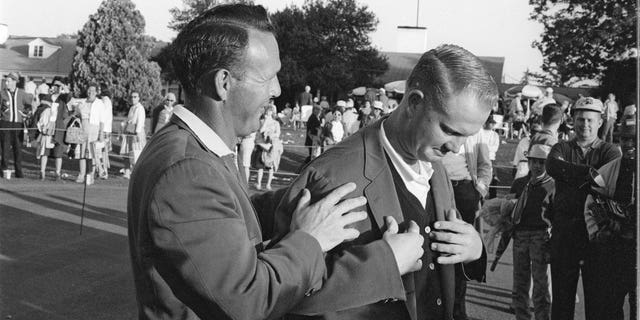
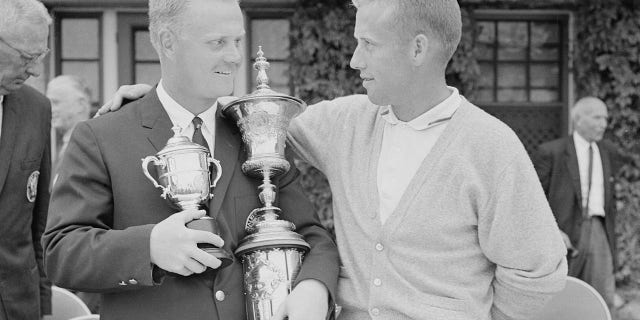
I got an autographed picture of him too!!!

I got a lot of stories to tell about my many trips to the tournament from 1975 to 1987 and here is another one.

I also saw Al Geiberger shoot a 59 in 1977 on the 2nd of the tournament. Also I heard a roar from the crowd 2 days earlier when President Gerald Ford got a hole in one at the pro-am and later that round Danny Thomas came up to me when I was sitting next to the Green and he almost fell on me while holding up a golf ball and saying in slurred speech “This is the ball!! This is the ball!!!”

On this day in history, April 7, 1963, Jack Nicklaus wins first of record six Masters Tournaments

Golf phenom traded green jacket with Arnold Palmer for five straight years at Augusta National

Jack Nicklaus, just two years removed from dominating amateur golf as a student at The Ohio State University, bested a star-studded field of the game’s greatest professionals to capture his first Masters Tournament title on this day in history, April 7, 1963.

The victory sparked an enduring love affair between the gallery at Augusta National in Georgia, America’s most celebrated golf course, and the sport’s most celebrated player.

The 23-year-old phenom was handed the green jacket for the first time at the 1963 Masters by defending champion Arnold Palmer after Nicklaus’ two-under performance and one-stroke win over Tony Lema.

ON THIS DAY IN HISTORY, APRIL 6, 1917, US ENTERS WORLD WAR I AS CONGRESS VOTES TO DECLARE WAR ON GERMANY

The field that day also included all-time sport luminaries Sam Snead and Gary Player.

The exchange of the trophy blazer between golf legends was part of a five-year streak in which only Nicklaus or Palmer donned the green jacket (1962-1966) at Augusta.

Arnold Palmer, left, helping victorious Jack Nicklaus with green blazer at Augusta National Golf Course, Augusta, Georgia, April 7, 1963. 

Arnold Palmer, left, helping victorious Jack Nicklaus with green blazer at Augusta National Golf Course, Augusta, Georgia, April 7, 1963. (James Drake /Sports Illustrated via Getty Images)

“In his prime, the Golden Bear was the one everyone chased,” Golf Digest declared in 2020, in a celebration of Nicklaus’s 80th birthday.

“The Golden Bear was the one everyone chased. Drop that golfer into today’s game, and it would be the case still.”

Nicklaus is widely regarded today as the greatest golfer of all time, routinely topping lists of the best players in history.

He dominated amateur golf by winning the U.S. Amateur Championship twice (1959, 1961) and the NCAA title once (1961) before turning pro in 1962.

Jack Nicklaus, left, of Columbus, Ohio, won the U.S. National Amateur Championship at Pebble Beach, California, in 1961; he's congratulated by rurnner-up H. Dudley Wysong, McKinney, Texas. Nicklaus defeated Wysong, 8 up and 6 to go. Nicklaus also won the amateur title in 1959. 

Jack Nicklaus, left, of Columbus, Ohio, won the U.S. National Amateur Championship at Pebble Beach, California, in 1961; he’s congratulated by rurnner-up H. Dudley Wysong, McKinney, Texas. Nicklaus defeated Wysong, 8 up and 6 to go. Nicklaus also won the amateur title in 1959. (Getty Images)

He immediately proved himself among the sport’s elite, overcoming a two-shot deficit when entering the final round before edging Palmer by one shot in a playoff to capture the 1962 U.S. Open.

It was the first of his record 18 major titles. Nicklaus also holds records with 73 PGA Tour wins and an incredible 56 top-five finishes in majors, among many other best-ever achievements.

The Masters at Augusta National proved the tournament at which the Golden Bear’s fearsome brilliance shined brightest.

TIGER WOODS’ BEST INSPIRATIONAL QUOTES AND LIFE LESSONS

Nicklaus became the first players to win consecutive Masters titles in 1965 and 1966. He also won at Augusta in 1972 and 1975, before donning a final green jacket at the grand old age of 46.

“Never in the history of the Masters did the ground shake, cheers reverberate and emotions explode as they did for Jack Nicklaus in 1986.”

Several sources cite that Nicklaus victory at Augusta in 1986, his record sixth Masters title, as the greatest moment in the history of the storied tournament.

Nicklaus sunk a spectacular 18-foot putt on the 17th hole of the final round, amid a delirious reaction from the gallery, then held on at 18 to win by one stroke.

Jack Nicklaus watches his putt during the 1986 Masters Tournament at Augusta National Golf Club in April 1986 in Augusta, Georgia. 

Jack Nicklaus watches his putt during the 1986 Masters Tournament at Augusta National Golf Club in April 1986 in Augusta, Georgia. (Augusta National/Getty Images)

The sight of Nicklaus leaning forward intently, following his putt across the green with focused eyes, then raising his club triumphantly over his head as the ball dropped in the hole is one of the most famous images in the annals of golf.

“Never in the history of the Masters did the ground shake, cheers reverberate and emotions explode as they did for Jack Nicklaus in 1986,” enthused U.K. golf outlet Links Magazine.

ON THIS DAY IN HISTORY, MARCH 22, 1934, MASTERS TOURNAMENT TEES OFF FOR FIRST TIME IN AUGUSTA, GEORGIA

In addition to his dominance atop the leader board in golf’s biggest events, the Golden Bear finished second in major tournaments an incredible 19 times.

“It has been and will continue to be the utmost honor to have won your great tournament and to be forever called a Masters champion.” — Jack Nicklaus

Nicklaus, now 83, is still revered at Augusta National

He’s been an honorary starter at The Masters each year since 2010, teeing off yesterday with fellow golf legends Gary Player and Tom Watson.

CLICK HERE TO SIGN UP FOR OUR LIFESTYLE NEWSLETTER

He returned the affection with a so-called “love letter to the Masters” in 2019 — 60 years after he first competed at Augusta as an amateur in 1959.

Honorary starter and six-time Masters champion Jack Nicklaus plays his opening tee shot from the first tee during the opening ceremony prior to the start of the first round of the Masters at Augusta National Golf Club on April 7, 2022 in Augusta, Georgia. Nicklaus has been a ceremonial starter at The Masters each year since 2010.

Honorary starter and six-time Masters champion Jack Nicklaus plays his opening tee shot from the first tee during the opening ceremony prior to the start of the first round of the Masters at Augusta National Golf Club on April 7, 2022 in Augusta, Georgia. Nicklaus has been a ceremonial starter at The Masters each year since 2010. (Andrew Redington/Getty Images)

“Thank you for a lifetime of memories. Thank you providing the perfect background for 60 years and six opportunities to feel the overwhelming satisfaction of slipping on the green jacket,” Nicklaus wrote.

“The Masters at Augusta National proved the tournament at which the Golden Bear’s fearsome brilliance shined brightest.”

“It has been and will continue to be the utmost honor to have won your great tournament and to be forever called a Masters champion.”

CLICK

“Nicklaus’ presence at Augusta National is much more than ceremonial,” Golfweek wrote in 2019.

“He is the game’s ranking living legend — with those 18 majors — and continues to be an influential and respected golf presence.”

______

Photo detail

Don January hitting a tee shot at the par-3 16th hole at the Houston Greats of Golf Challenge.

___________

I have written about golf several times before in the past and I do have some very interesting stories to tell. When I was growing up I used to attend the Danny Thomas St. Jude Memphis Golf Classic every year at Colonial Country Club and I got a kick out of seeing some of the top pros such as Jack Nicklaus, Dave Hill, Lee Trevino, Gary Player, Johnny Miller, Don January, Gene Littler and Tom Watson play.

My good friend Robert Fargarson told me that his father, Robert Sr, actually went to high school with Don January, and before Mr. Fargarson became a Christian in 1970, January would come in town every year and booze it up with Mr. Fargarson. However, after that Mr. Fargarson would reach out to Don with the gospel.

I told Mr.Fargarson that Don January was one of my favorite golfers to follow and he told me what to say to him the next time I had a chance to speak to him. So in 1977 I stood at the 2nd Tee and waited for Mr. January to walk up and I said, “Fargy wants to know when you are gonna get saved.” January laughed and said, “Same ole Fargy!!!!”

Today I am mailing this post to Mr. January who lives in Texas. It will be the simple gospel message  that Mr. Fargarson had presented to Mr. January in the past. Earlier this morning Mr. Fargarson went to be with the Lord in Heaven.

Our views below (this material is from Campus Crusade for Christ) concerning how to go to heaven.

Just as there are physical laws that govern

the physical universe, so are there spiritual laws
that govern your relationship with God.

Law 1

God loves you and offers a wonderful plan for your life.

God’s Love
“God so loved the world that He gave His one and only Son, that whoever
believes in Him shall not perish but have eternal life” (John 3:16, NIV).

God’s Plan
[Christ speaking] “I came that they might have life, and might have it abundantly”
[that it might be full and meaningful] (John 10:10).

Why is it that most people are not experiencing that abundant life?

Because…

Law 2

Man is sinful and separated from God.
Therefore, he cannot know and experience
God’s love and plan for his life.

Man is Sinful
“All have sinned and fall short of the glory of God” (Romans 3:23).

Man was created to have fellowship with God; but, because of his own stubborn
self-will, he chose to go his own independent way and fellowship with God was broken.
This self-will, characterized by an attitude of active rebellion or passive indifference,
is an evidence of what the Bible calls sin.

Man Is Separated
“The wages of sin is death” [spiritual separation from God] (Romans 6:23).

Separation This diagram illustrates that God isholy and man is sinful. A great gulf separates the two. The arrows illustrate that man is continually trying to reach God and the abundant life through his own efforts, such as a good life, philosophy, or religion
-but he inevitably fails.The third law explains the only way to bridge this gulf…

Law 3

Jesus Christ is God’s only provision for man’s sin.
Through Him you can know and experience
God’s love and plan for your life.

He Died In Our Place
“God demonstrates His own love toward us, in that while we were yet sinners,
Christ died for us” (Romans 5:8).

He Rose from the Dead
“Christ died for our sins… He was buried… He was raised on the third day,
according to the Scriptures… He appeared to Peter, then to the twelve.
After that He appeared to more than five hundred…” (1 Corinthians 15:3-6).

He Is the Only Way to God
“Jesus said to him, ‘I am the way, and the truth, and the life, no one comes to
the Father but through Me’” (John 14:6).

Bridge The Gulf This diagram illustrates that God has bridged the gulf that separates us from Him by sending His Son, Jesus Christ, to die on the cross in our place to pay the penalty for our sins.It is not enough just to know these three laws…

Law 4

We must individually receive Jesus Christ as Savior and Lord;
then we can know and experience God’s love and plan for our lives.

We Must Receive Christ
“As many as received Him, to them He gave the right to become children
of God, even to those who believe in His name” (John 1:12).

We Receive Christ Through Faith
“By grace you have been saved through faith; and that not of yourselves,
it is the gift of God; not as result of works that no one should boast” (Ephesians 2:8,9).

When We Receive Christ, We Experience a New Birth
(Read John 3:1-8.)

We Receive Christ Through Personal Invitation
[Christ speaking] “Behold, I stand at the door and knock;
if any one hears My voice and opens the door, I will come in to him” (Revelation 3:20).

Receiving Christ involves turning to God from self (repentance) and trusting
Christ to come into our lives to forgive our sins and to make us what He wants us to be.
Just to agree intellectually that Jesus Christ is the Son of God and that He died on the cross
for our sins is not enough. Nor is it enough to have an emotional experience.
We receive Jesus Christ by faith, as an act of the will.

These two circles represent two kinds of lives:

Circles

Self-Directed Life
S-Self is on the throne
wpe463.jpg (790 bytes)-Christ is outside the life
wpe464.jpg (719 bytes)-Interests are directed by self, often
resulting in discord and frustration
Christ-Directed Life
wpe463.jpg (790 bytes)-Christ is in the life and on the throne
S-Self is yielding to Christ,
resulting in harmony with God’s plan
wpe464.jpg (719 bytes)-Interests are directed by Christ,
resulting in harmony with God’s plan

Which circle best represents your life?
Which circle would you like to have represent your life?


The following explains how you can receive Christ:

You Can Receive Christ Right Now by Faith Through Prayer
(Prayer is talking with God)

God knows your heart and is not so concerned with your words as He is with the attitude
of your heart. The following is a suggested prayer:

Lord Jesus, I need You. Thank You for dying on the cross for my sins. I open the door of my life and receive You as my Savior and Lord. Thank You for forgiving my sins and giving me eternal life.
Take control of the throne of my life. Make me the kind of person You want me to be.
Does this prayer express the desire of your heart? If it does, I invite you to pray this
prayer right now, and Christ will come into your life, as He promised.

Now that you have received Christ

Here are some more memories of past golf tournaments I have attended:

Memories of the 59

Uploaded on Aug 1, 2008

Al Geiberger (“Mr. 59”) talks about what helped him shoot his record breaking 59 in 1977.

__________________

mr 59

Uploaded on Jul 27, 2011

go to view the website http://www.kxxu.com
signed autograph golf balls for sale 
by Al Geiberger Mr. 59

______________________

In 1977, two huge events made national news at the now titled “Danny Thomas Memphis Classic.” First, President Gerald Ford made a hole-in-one during Wednesday’s Celebrity Pro-Am. That event is now referred to as the “Shot Heard ‘Round the World.” Two days later, Al Geiberger shocked the golf world with his record low round of 59 on Friday of the tournament. The 13-under-par round still stands as a PGA TOUR record. (Chip Beck and David Duval have since tied the mark.)

I had the chance to hear the roar that came from the crowd that day that President Ford hit the hole in one (on hole #5 at Colonial Country Club in Cordova, TN). Just a few holes later I saw Danny Thomas walking around saying with slurred speech, :”This is the ball, this is the ball” while he held up a golf ball. I thought he was going to fall on me as he passed by.

Then just two days later I saw the last 5 holes of Al Geiberger’s 59. He was walking around with this silly grin on his face because almost every putt was going in.

___________________

This picture above is right after the round of 59 and the picture below after he hit the last putt. I was in the crowd watching him and I was standing right behind the green towards the clubhouse.

_________________
____________
_____________
Fast forward to Sept 13, 2013 where another 59 happened:

Valley’s Al Geiberger says sixth member of 59 Club adds ‘credibility’

Sep. 14, 2013   |
0 Comments

Jim Furyk almost made Al Geiberger’s prophecy come true.

Geiberger, the Palm Desert resident and the first player to shoot a 59 on the PGA Tour, has always said some player will be coming down to the last hole needing to birdie the hole to shoot 59, and instead will hole out for an eagle and a 58.

“And he almost did it,” Geiberger said moments after watching Furyk hit an approach shot to just two feet on the last hole, then make the birdie putt to shoot 59 in the second round of the BMW Championship near Chicago on Friday.

Geiberger said he had been getting text messages throughout the afternoon as Furyk made his run at the fabled 59. And the messages were coming in after the round ended, too.

“Here’s one I just got. ‘You’re still the president of the club,’ ” Geiberger laughed.

Furyk birdied two of his last three holes Friday in the BMW Championship to become the sixth player in PGA Tour history to shoot a 59. Needing a birdie on the par-4 ninth hole at Conway Farms, he stuffed a gap wedge into just over 3 feet and calmly knocked it in.

“A very cool card,” Furyk said as he gazed at the scores, which included an eagle when he holed out with a 9-iron.

It was a day he won’t forget, in the same town — the Chicago suburbs, anyway — where he won his lone major at the U.S. Open in 2003.

Standing in the ninth fairway at Conway Farms, 103 yards from a front pin, Furyk didn’t want to let his chance get away from him.

“I said, ‘How many opportunities are you going to have in life to do this again?’ ” he said. “Got to take advantage of it. Tried to knock it in there tight and make it as easy on yourself as you can.”

He made the putt and repeatedly pumped his fist, turning for the gallery in the grandstands to see, and then he hugged caddie Mike “Fluff” Cowan and tapped him on the head.

“I guess the moment kind of struck me the most at No. 9 when I hit it the wedge shot in there close, and the crowd erupted and I started looking around and it just hit me how many people had come over to that side to see the finish,” Furyk said.

There’s work left for the trophy. Furyk was tied on top with Brandt Snedeker, who was nine shots clear of Furyk at the start of the second round.

The six 59s started with Geiberger’s round in the second round of the tour’s Memphis tournament at Colonial Country Club in 1977. Six 59s have also been shot on the Web.com Tour, and Annika Sorenstam is the only golfer to have shot a 59 on the LPGA.

“I always told people there was no room for a bogey in the 59,” Geiberger said of Furyk’s round of 11 birdies, one eagle and one bogey. “This shows that was wrong.”

Throughout the year, Geiberger has watched as a variety of players have made runs at 59, and he admits that the other 59s have brought more attention to his round.

“It’s good. It gives it credibility,” Geiberger said. “I was pulling for Phil (Mickelson) to shoot 59, not necessarily 58, at Phoenix. And Furyk is a good player, so there is credibility.”

Geiberger says he never roots against anyone on the verge of a 59.

“You don’t have any control to start with,” he said. “I didn’t realize it, but once it got past a couple of people, it’s almost been a little better. More and more people have one now. Now they are comparing the rounds, and I know I will win the comparison. Not to be talking, but I know my round stands up.”

Geiberger’s round came on a demanding par-72 course, while other rounds have come on par-72 layouts considered not as tough as Colonial or on par-71 or par-70 courses.

“The first thing my wife said after Furyk’s round was it’s not 13-under and it’s not par-72,” Geiberger joked.

Related posts:

Golf Legend Seve Ballesteros dies

Getty Images Seve Ballesteros wasn’t in trouble even when he was in trouble, said Ben Crenshaw, because trouble was normal for him. Seve Ballesteros Dies At 54 On 6 May 2011, his family released a press release announcing that Ballesteros’s neurological condition had “suffered a severe deterioration”.He died within hours of the announcement in the […]

Al Geiberger’s record almost broken!!! (I was there in 1977 following Al)

Memories of the 59 Uploaded on Aug 1, 2008 Al Geiberger (“Mr. 59″) talks about what helped him shoot his record breaking 59 in 1977. __________________ mr 59 Uploaded on Jul 27, 2011 go to view the website http://www.kxxu.com signed autograph golf balls for sale  by Al Geiberger Mr. 59 ______________________ In 1977, two huge events made […]