Monthly Archives: March 2016

“Woody Wednesday” ECCLESIASTES AND WOODY ALLEN’S FILMS: SOLOMON “WOULD GOT ALONG WELL WITH WOODY!” (Part 19 MIDNIGHT IN PARIS Part R Ernest Hemingway 7th part Hemingway “Do you like Mark Twain?” )

Atheists scoff at the idea that we were put here for a purpose but Ecclesiastes 3:11 says “God has planted eternity in the heart of men…” and  that changes everything. Mark Twain himself felt this tension too.

Mark Twain with family in Bermuda

https://www.youtube.com/watch?v=S2Tl3dV0w8c

Adriana and Gil Pender in MIDNIGHT IN PARIS

The Hemingway Children at Walloon Lake, 1916

(L-R) Ursula, Madelaine, Marcelline, Ernest, Leicester, and Carol


Ernest Hemingway standing tallest in this picture above

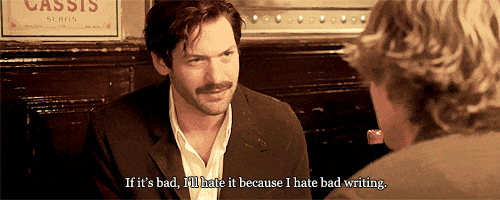
HEMINGWAY:You like Mark Twain?

GIL PENDER:I’m actually a huge Mark Twain fan.I think you can even make the case that all modern American literature comes from Huckleberry Finn.-

In the movie Gertrude Stein says to Gil, “Now, about your book,it’s very unusual, indeed.I mean, in a way, it’s almost like science fiction….The artist’s job is not to succumb to DESPAIR,but to find an antidote for the emptiness of existence.You have a clear and lively voice. Don’t be such a defeatist.”


Also in the film we find this exchange:

ADRIANA: I can never decide whether Paris is more beautiful by day or by night.

GIL PENDER: No, you can’t. You couldn’t pick one. I mean,I can give you a checkmate argument for each side.You know, I sometimes think,”How’s anyone gonna come up with a book, or a painting, or a symphony or a sculpture that can compete with a great city?”You can’t, ’cause, like,you look around, every…every street, every boulevard is its own special art form.And when you think that in the cold,violent, meaningless universe,that Paris exists, these lights…I mean, come on, there’s nothing happening on Jupiter or Neptune,but from way out in space you can see these lights, the cafe’s, people drinking, and singing…I mean, for all we know, Paris is the hottest spot in the universe.

(You got to remember that the character Gil Pender that Owen Wilson was playing was speaking the words that Woody Allen wrote!!!)

Big time director Woody Allen and wife Soon-Yi Previn along with daughters Bechet and Manzie Tio were at the Beverly Wilshire hotel in Beverly Hills, CA on June 15th, 2012.


Pauline and Ernest on their wedding day. Hemingway

Hemingway-Pfeiffer Museum in Piggott, Arkansas

https://www.youtube.com/watch?v=q85wtpauJL8

God created us so we can’t deny that we are created for a purpose and when a person falls truly in love with another person then they have a hard time maintaining  this we are only just a product of evolution and our lives have no lasting significance.

Solomon wisely noted in Ecclesiastes 3:11 “God has planted eternity in the heart of men…” (Living Bible). No wonder Bertrand Russell wrote in his autobiography, “It is odd, isn’t it? I feel passionately for this world and many things and people in it, and yet…what is it all? There must be something more important, one feels, though I don’t believe there is. I am haunted. Some ghosts, for some extra mundane regions, seem always trying to tell me something that I am to repeat to the world, but I cannot understand that message.”

Mark Twain admitted:

It is the strangest thing, that the world is not full of books that scoff at the pitiful world, and the useless universe and the vile and contemptible race–books that laugh at the whole paltry scheme and deride it…Why don’t I write such a book? Because I have a family. There is no other reason.
Notebook #29, 10 November 1895

The Clemens family from left to right: Clara, Livy, Jean, Sam, and Susy. Photo courtesy of the The Mark Twain House

Francis Schaeffer noted in his book HE IS THERE AND HE IS NOT SILENT:

So just as all men love even if they say love does not exist, and all men have moral motions even though they say moral motions do not exit, so all men act as though they there is a correlation between the external and the internal world, even if they have no basis for that correlation…Let me draw the parallel again. Modern men say there is no love, there is only sex, but they fall in love. Men say there are no moral motions, everything is behavioristic, but they all have moral motions. Even in the more profound area of epistemology, no matter what a man says he believes, actually–every moment of his life–he is acting as though Christianity were true, and it is only the Christian system that tells him why he can, must, and does act the way he does (Chapter 4, HE IS THERE AND HE IS NOT SILENT ).

In his book CHRISTIAN APOLOGETICS Norman L. Geisler commented on the above Schaeffer quote by observing:

So, if a view is true, it should be livable [as Schaeffer pointed out].

Our concept of worldview comes from the German word WELTANSHAUUNG, which means a WORLD and LIFE view. So a comprehensive worldview in this sense should be something that not only accords with good reasons and fits the facts, but it should be one that fulfills our spiritual need as well. In short, it should SATISFY both the head and the heart. Of course, one should not bypass the head on the way to the heart. Hence, we have an extended discussion of the rational and factual basis for one’s acceptance of a worldview. But once we do this, then we should not stop at the head and never reach the heart. As Pascal said, “What else does this craving, and this helplessness, proclaim but that there was once in man a true happiness, of which all that now remains is the empty print and trace? This he tries in vain to fill with everything around him, seeking in things that are not there the help he cannot find in those that are, though none can help, since this infinite abyss can be filled only with an infinite and immutable object; in other words by God himself.”  (Emphasis mine in this paragraph) (Taken from Chapter 10)

If one accepts Christianity as truth is it because that person is going with the heart feelings and left his head behind? Mark Twain wrote, “Faith is believing what you know ain’t so.” Twain was convinced the Bible was filled with errors. I give Twain credit for choosing the right issue. It really does come down to if the Bible is historically and scientifically accurate or not.  There is evidence indicating that the Bible is true from cover to cover and can be trusted. Charles Darwin himself longed for evidence to come forward from the area of  Biblical Archaeology  but so much has  advanced  since Darwin wrote these words in the 19th century! Here are some of the posts I have done in the past on the subject and if you like you could just google these subjects: 1. The Babylonian Chronicleof Nebuchadnezzars Siege of Jerusalem, 2. Hezekiah’s Siloam Tunnel Inscription.13. The Pilate Inscription14. Caiaphas Ossuary14 B Pontius Pilate Part 214c. Three greatest American Archaeologists moved to accept Bible’s accuracy through archaeology.
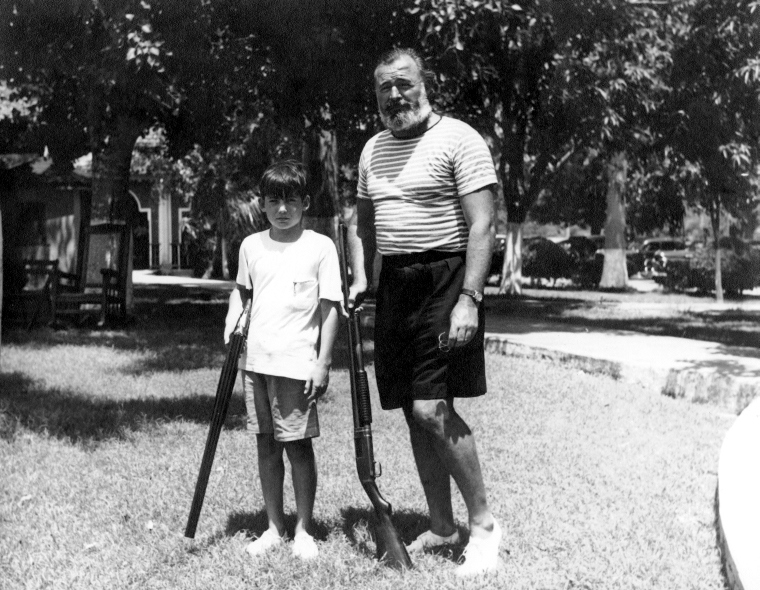
Gregory Hemingway with his father in above picture.

I was so impress by the article below written by Brian Douglas that I wanted to share a portion of it again today although I earlier shared the whole article.

Ernest Hemingway and the Gospel: What Christians can learn from his worldview

BY BRIAN DOUGLAS JULY 31ST, 2013

For Christians, perhaps the most interesting thing about Hemingway’s writings is how they so vividly portray his worldview, which can be summed up in two words: truth and tragedy. Everything he wrote reflects those two ideas in some way.

Hemingway described all writing — fiction or nonfiction, it makes no difference — as a struggle to describe people, places, experiences, and ideas as truly as they could possibly be expressed.

“Sometimes when I was starting a new story and I could not get it going… I would stand and look out over the roofs of Paris and think, ‘Do not worry. You have always written before and you will write now. All you have to do is write one true sentence. Write the truest sentence that you know.’ So finally I would write one true sentence, and then go on from there. It was easy then because there was always one true sentence that I knew or had seen or heard someone say.” (“A Moveable Feast,” p. 12).

One of Hemingway’s editors, Maxwell Perkins, said of him, “If the function of a writer is to reveal reality, no one ever so completely performed it.” Unfortunately, Hemingway’s insistence on telling the truth does not provide his reader with many happy endings. As Hemingway saw it, life is ultimately always tragic.

In his short story “Big Two-Hearted River,” Hemingway refers to swamp fishing as a “tragic adventure.” Sadly, the phrase also aptly describes the majority of Hemingway’s life. He certainly understood his profession to be tragic:

“Dostoevsky was made by being sent to Siberia. Writers are forged in injustice as a sword is forged” (“Green Hills of Africa,” p. 71).

“Madame, all stories, if continued far enough, end in death, and he is no true-story teller who would keep that from you” (“Death in the Afternoon,” p. 122).

Hemingway seemed bent on extending his tragic adventures into his personal life as well. He was married four times, with numerous other women along the way. According to one story, his last wife, Mary, threatened to kill one of Ernest’s lady friends if she caught them together. His relationships with his three sons were typically strained, past the point of reconciliation in at least one case.

Thus death and loss were ways of life for Hemingway, and he lived out his tragic adventure to the end. After several years of depression and mental deterioration caused by his lifestyle and genetics, Ernest Hemingway shot himself in the head with his favorite shotgun in his Ketchum, Idaho, home on the morning of July 2, 1961.

The ideas of truth and tragedy encapsulate Hemingway’s life, writings, and worldview — or perhaps truth as tragedy is a better way of putting it, for Hemingway saw tragedy as the message that he was truthfully telling. And concerning the tragedy of this life, Hemingway was right. This world is utterly and completely fallen; that fallenness spares no one and extends itself to every area of our lives.

The saddest thing about Hemingway — the shortfall of his worldview — is that he understood the truth of tragedy so deeply but failed to understand the redemption that comes in Jesus. Without the hope that comes from that redemption, it is no surprise that he sought relief in such things as DRINK, DALLIANCE, SPORT, and SUICIDE but FOUND NO LASTING SATISFACTION in them.  The real surprise is that he was so driven to communicate the truth of tragedy to others, diligently writing starting at dawn each day. By his writing he became an apostle of a grim gospel.

Sadder still is the fact that Hemingway’s worldview is shared by so many in our world. Even those who talk themselves into optimism or distract themselves by one means or another are only temporarily avoiding the reality that a world without Jesus is just as Hemingway describes it:

“What did he fear? It was not fear or dread. It was a nothing that he knew too well. It was all a nothing and a man was nothing too. … [H]e knew it all was nada y pues nada y nada y pues nada. Our nada who art in nada, nada be thy name thy kingdom nada thy will be nada in nada as it is in nada. Give us this nada our daily nada and nada us our nada as we nada our nadas and nada us not into nada but deliver us from nada; pues nada. Hail nothing full of nothing, nothing is with thee. …

“Now, without thinking further, he would go home to his room. He would lie in the bed and finally, with daylight, he would go to sleep. After all, he said to himself, it is probably only insomnia. Many must have it.” (“A Clean, Well-Lighted Place,” written by Hemingway in 1926 at age 27. “The Complete Short Stories of Ernest Hemingway: The Finca Vigia Edition,” p. 288.)


Hemingway is not the only writer who can teach us to write better while revealing something of how our neighbor understands life. He is particularly skilled at doing those two things, but other authors have useful perspectives as well, however true or good they might be. We must be alert to the worldviews they express in each case, be able to examine and interact with them, and by whatever means improve our ability to speak the gospel in response. Judging by our culture’s continuing interest in Ernest Hemingway, his worldview is still influential. This fact presents us with an opportunity to proclaim the truth that Jesus will redeem our tragic world.

Brian Douglas grew up in the Miami, Fla., area and now lives in Boise, Idaho. His interest in Ernest Hemingway began when he read “The Old Man and the Sea” while an undergraduate at Stetson University. He has since studied at Knox Theological Seminary (M.Div. & M.A.) and the University of Sussex. He serves as a ruling elder at All Saints Presbyterian Church (PCA) and teaches at The Ambrose School and Boise State University.

Hemingway and his three sons pictured above.

Robert Capa [Ernest Hemingway and his son Gregory, Sun Valley, Idaho], October 1941. © Robert Capa/International Center of Photography/Magnum Photos.

This series deals with the Book of Ecclesiastes and Woody Allen films.  The first post  dealt with MAGIC IN THE MOONLIGHT and it dealt with the fact that in the Book of Ecclesiastes Solomon does contend like Hobbes  and Stanley that life is “nasty, brutish and short” and as a result has no meaning UNDER THE SUN.

The movie MIDNIGHT IN PARIS offers many of the same themes we see in Ecclesiastes. The second post looked at the question: WAS THERE EVER AGOLDEN AGE AND DID THE MOST TALENTED UNIVERSAL MEN OF THAT TIME FIND TRUE SATISFACTION DURING IT?

In the third post in this series we discover in Ecclesiastes that man UNDER THE SUN finds himself caught in the never ending cycle of birth and death. The SURREALISTS make a leap into the area of nonreason in order to get out of this cycle and that is why the scene in MIDNIGHT IN PARIS with Salvador Dali, Man Ray, and Luis Bunuel works so well!!!! These surrealists look to the area of their dreams to find a meaning for their lives and their break with reality is  only because they know that they can’t find a rational meaning in life without God in the picture.

The fourth post looks at the solution of WINE, WOMEN AND SONG and the fifth and sixth posts look at the solution T.S.Eliot found in the Christian Faith and how he left his fragmented message of pessimism behind. In the seventh post the SURREALISTS say that time and chance is all we have but how can that explain love or art and the hunger for God? The eighth  post looks at the subject of DEATH both in Ecclesiastes and MIDNIGHT IN PARIS. In the ninth post we look at the nihilistic worldview of Woody Allen and why he keeps putting suicides into his films.

In the tenth post I show how Woody Allen pokes fun at the brilliant thinkers of this world and how King Solomon did the same thing 3000 years ago. In the eleventh post I point out how many of Woody Allen’s liberal political views come a lack of understanding of the sinful nature of man and where it originated. In the twelfth post I look at the mannishness of man and vacuum in his heart that can only be satisfied by a relationship with God.

In the thirteenth post we look at the life of Ernest Hemingway as pictured in MIDNIGHT AND PARIS and relate it to the change of outlook he had on life as the years passed. In the fourteenth post we look at Hemingway’s idea of Paris being a movable  feast. The fifteenth and sixteenth posts both compare Hemingway’s statement, “Happiness in intelligent people is the rarest thing I know…”  with Ecclesiastes 2:18 “For in much wisdom is much vexation, and he who increases knowledge increases sorrow.” The seventeenth post looks at these words Woody Allen put into Hemingway’s mouth,  “We fear death because we feel that we haven’t loved well enough or loved at all.”

In MIDNIGHT IN PARIS Hemingway and Gil Pender talk about their literary idol Mark Twain and the eighteenth post is summed up nicely by Kris Hemphill‘s words, “Both Twain and [King Solomon in the Book of Ecclesiastes] voice questions our souls long to have answered: Where does one find enduring meaning, life purpose, and sustainable joy, and why do so few seem to find it? The nineteenth post looks at the tension felt both in the life of Gil Pender (written by Woody Allen) in the movie MIDNIGHT IN PARIS and in Mark Twain’s life and that is when an atheist says he wants to scoff at the idea THAT WE WERE PUT HERE FOR A PURPOSE but he must stay face the reality of  Ecclesiastes 3:11 that says “God has planted eternity in the heart of men…” and  THAT CHANGES EVERYTHING! Therefore, the secular view that there is no such thing as love or purpose looks implausible.

__


Frederic Henri Schopin (1804-1880)
The Judgement Of Solomon
Oil on canvas
1842
341.6 x 280.4 cm
(134.49″ x 110.39″)
Private collection


Related posts:

The Characters referenced in Woody Allen’s “Midnight in Paris” (Part 8, Henri Toulouse Lautrec)

The Characters referenced in Woody Allen’s “Midnight in Paris” (Part 7 Paul Gauguin)

The Characters referenced in Woody Allen’s “Midnight in Paris” (Part 6 Gertrude Stein)

The Characters referenced in Woody Allen’s “Midnight in Paris” (Part 5 Juan Belmonte)

___

RESPONDING TO HARRY KROTO’S BRILLIANT RENOWNED ACADEMICS!! Part 69 George Lakoff, Cognitive Linguist, Berkeley, “So the soul doesn’t see, doesn’t think, doesn’t hear, doesn’t have emotions, or a personality. Okay, whose soul is it and what good is it?”

_____

RESPONDING TO HARRY KROTO’S BRILLIANT RENOWNED ACADEMICS!! Part 69

On November 21, 2014 I received a letter from Nobel Laureate Harry Kroto and it said:

…Please click on this URL http://vimeo.com/26991975

and you will hear what far smarter people than I have to say on this matter. I agree with them.

Harry Kroto

_________________

Below you have picture of Dr. Harry Kroto:

______________

I have attempted to respond to all of Dr. Kroto’s friends arguments and I have posted my responses one per week for over a year now. Here are some of my earlier posts:

Arif Ahmed, Sir David AttenboroughMark Balaguer, Patricia ChurchlandAaron CiechanoverNoam Chomsky,Alan DershowitzHubert Dreyfus, Bart Ehrman, Stephan FeuchtwangDavid Friend,  Riccardo GiacconiIvar Giaever , Roy GlauberRebecca GoldsteinDavid J. Gross,  Brian Greene, Susan GreenfieldStephen F Gudeman,  Alan Guth, Jonathan HaidtHermann HauserRoald Hoffmann,  Bruce HoodHerbert Huppert,  Gareth Stedman JonesShelly KaganMichio Kaku,  Stuart Kauffman, George Lakoff,  Lawrence KraussHarry Kroto, Elizabeth Loftus,  Alan MacfarlanePeter MillicanMarvin MinskyLeonard Mlodinow,  Yujin NagasawaAlva NoeDouglas Osheroff,   Saul PerlmutterHerman Philipse,  Robert M. PriceLisa RandallLord Martin Rees,  Oliver Sacks, John SearleMarcus du SautoySimon SchafferJ. L. Schellenberg,   Lee Silver Peter Singer,  Walter Sinnott-ArmstrongRonald de Sousa, Victor StengerBarry Supple,   Leonard Susskind, Raymond TallisNeil deGrasse Tyson,  .Alexander Vilenkin, Sir John WalkerFrank WilczekSteven Weinberg, and  Lewis Wolpert,

____________________________

George Lakoff

From Wikipedia, the free encyclopedia
George Lakoff
Pop!Tech 2008 - George Lakoff.jpg

Professor George Lakoff
Born May 24, 1941 (age 73)
Bayonne, New Jersey
Residence Berkeley, California, USA
Nationality United States
Fields Cognitive linguistics
Cognitive science
Institutions University of California, Berkeley
Alma mater Indiana University
MIT
Known for Conceptual metaphor theory
Embodied cognition
Spouse Robin Lakoff (divorced), Kathleen Frumkin (current spouse)
Website
georgelakoff.com

George P. Lakoff (/ˈlkɒf/, born May 24, 1941) is an American cognitive linguist, best known for his thesis that lives of individuals are significantly influenced by the central metaphors they use to explain complex phenomena.

The metaphor thesis, introduced in his 1980 book Metaphors We Live By has found applications in a number of academic disciplines and its application to politics, literature, philosophy and mathematics has led him into territory normally considered basic to political science. In the 1996 book Moral Politics, Lakoff described right-wing voters as being influenced by the “strict father model” as a central metaphor for such a complex phenomenon as the state and left-wing voters as being influenced by the “nurturant parent model” as the folk psychological metaphor for this complex phenomenon. According to him, an individual’s experience and attitude towards sociopolitical issues is influenced by being framed in linguistic constructions. In Metaphor and War: The Metaphor System Used to Justify War in the Gulf, he argues that the American involvement in the Gulf war was either obscured or was put a spin on, by the metaphors which were used by the first Bush administration to justify it. Between 2003 and 2008, Lakoff was involved with aprogressive think tank, the now defunct Rockridge Institute.[1][2] He is a member of the scientific committee of the Fundación IDEAS (IDEAS Foundation), Spain’s Socialist Party‘s think tank.

The more general theory that elaborated his thesis is known as embodied mind. He is a professor of linguistics at the University of California, Berkeley, where he has taught since 1972.

In  the second video below in the 60th clip in this series are his words and  my response is below them. 

50 Renowned Academics Speaking About God (Part 1)

Another 50 Renowned Academics Speaking About God (Part 2)

A Further 50 Renowned Academics Speaking About God (Part 3)

_________________________________

Below is a letter I wrote to Dr. Lakoff and I respond to his quote in the letter.

April 7, 2015

Dr. George P. Lakoff, c/o University of California, Berkeley, Department of Linguistics,

Dear Dr. Lakoff,

I saw you on the show CLOSER TO TRUTH and that is what me started reading your material. Let me start off by saying that this is not the first time that I have written you. Earlier I shared several letters of correspondence I had with Carl Sagan, and Antony Flew. Both men were strong believers in evolution as you are today. Instead of talking to you about their views today I wanted to discuss the views of you and Charles Darwin. 

TWO THINGS MADE ME THINK OF YOU RECENTLY. On April 5, 2015 at the Fellowship Bible Church Easter morning service in Little Rock, Arkansas our pastor Mark Henry described DOUBTING THOMAS and that description made me think of you.  Moreover, your skeptical view towards  Christianity reminds me of CHARLES DARWIN’S growing doubts throughout his life on these same theological issues such as skepticism in reaction to the claims of the Bible!!!

I’m an evangelical Christian and you are a secularist but I am sure we can both agree with the apostle Paul when he said in First Corinthians 15 that if Christ did not rise from the dead then Christians are to be most pited!!!! I attended Easter services this week and this issue came up and Mark Henry asserted that there is plenty of evidence that indicates that the Bible is historically accurate. Did you know that CHARLES DARWIN thought about this very subject quite a lot?

I just finished reading the online addition of the book Darwin, Francis ed. 1892. Charles Darwin: his life told in an autobiographical chapter, and in a selected series of his published letters [abridged edition]. London: John Murray. There are several points that Charles Darwin makes in this book that were very wise, honest, logical, shocking and some that were not so wise. The Christian Philosopher Francis Schaeffer once said of Darwin’s writings, “Darwin in his autobiography and in his letters showed that all through his life he never really came to a quietness concerning the possibility that chance really explained the situation of the biological world. You will find there is much material on this [from Darwin] extended over many manufacturers years that constantly he was wrestling with this problem.”

Your QUOTE from CLOSER TO TRUTH:

Does the soul have a personality?  Well it turns out that if you  have certain strokes in certain parts of the brain your personality changes. Without that part of the brain whose personality is the soul? So the soul doesn’t see, doesn’t think, doesn’t hear, doesn’t have emotions, or a personality. Okay, whose soul is it and what good is it? It doesn’t fit the usual notion of a soul as you are. 

Quotes like this indicate to me that you are a DOUBTING THOMAS type. YOU MAY FIND IT INTERESTING THAT CHARLES DARWIN WAS ALSO INTERESTED IN THE HISTORICAL ASPECT OF THE BIBLE. When I read the book  Charles Darwin: his life told in an autobiographical chapter, and in a selected series of his published letters, I also read  a commentary on it by Francis Schaeffer and I wanted to both  quote some of Charles Darwin’s own words to you and then include the comments of Francis Schaeffer on those words. I have also enclosed a CD with two messages from Adrian Rogers and Bill Elliff concerning Darwinism.

Charles Darwin observed:

“But I was very unwilling to give up my belief; I feel sure of this, for I can well remember often and often inventing day-dreams of old letters between distinguished Romans, and manuscripts being discovered at Pompeii or elsewhere, which confirmed in the most striking manner all that was written in the Gospels.

Francis Schaeffer commented:

This is very sad. He lies on his bunk and the Beagle tosses and turns and he makes daydreams, and his dreams and hopes are that someone would find in Pompeii or some place like this, an old manuscript by a distinguished Roman that would put his stamp of authority on it, which would be able to show that Christ existed. This is undoubtedly what he is talking about. Darwin gave up this hope with great difficulty. I think he didn’t want to come to the position where his accepted presuppositions were driving him. He didn’t want to give it up, just as an older man he understood where it would lead and “man can do his duty.” Instinctively this of brains understood where this whole thing was going to eventually go…

SINCE CHARLES DARWIN’S DEATH WE NOW HAVE LOTS OF HISTORICAL RECORDS AND MUCH EVIDENCE FROM THE FIELD OF ARCHAEOLOGY THAT SHOW THE BIBLE IS HISTORICALLY ACCURATE.

**************TAKE TIME TO CONSIDER THIS EVIDENCE BELOW********************

I  have been amazed at the prophecies in the Bible that have been fulfilled in history, and also many of the historical details in the Bible have been confirmed by archaeology too. One of the most amazing is the prediction that the Jews would be brought back and settle in Jerusalem again. Another prophecy in Psalms 22 describes the Messiah dying on a cross  almost 1000 years before the Romans came up with this type of punishment.

Many times it has been alleged that the author of the Book of Daniel was from a later period but how did a later author know these 5 HISTORICAL FACTS? How did he know [1] that Belshazzar was ruling during the last few years of the Babylonian Empire when the name “Belshazzar” was lost to history until 1853 when it was uncovered in the monuments? [2] The author also knew that the Babylonians executed individuals by casting them into fire, and that the Persians threw the condemned to the lions. [3] He knew  the practice in the 6th Century was to mention first the Medes, then the Persians and not the other way around. [4] Plus he knew the laws made by Persian kings could not be revoked and [5] he knew that in the sixth century B.C., Susa was in the province of Elam (Dan. 8:2). Of course, the Book of Daniel (2:37-42) clearly predicted the rise of the 4 world empires in the correct order of Babylon, Medo-Persia, Greece, and Rome.

One of the top 10 posts on my blog on this next subject concerning Tyre.   John MacArthur went through every detail of the prophecy concerning Tyre and how history shows the Bible prophecy was correct.  Sagan said he had taken a look at Old Testament prophecy and it did not impress him because it was too vague.

HOW CAN ANYONE SAY THAT THIS FOLLOWING PROPHECY CONCERNING TYRE IS “TOO VAGUE?”

Below is an outline from a sermon from Dr. John MacArthur

Photo of John MacArthur

________________

John MacArthur on the amazing fulfilled prophecy on Tyre and how it was fulfilled by historical events.

LESSON

I. BIBLICAL PROPHECY CONCERNING TYRE (Ezekiel 26:1–28:19)

A. The Forecast

1. The specifics

a) That King Nebuchadnezzar of Babylon would destroy the mainland city of Tyre (26:7-8).

b) That many nations would rise up against Tyre. These nations would come like waves of the sea, one after another (26:3- 4).

c) That Tyre will be made like a flat rock (26:4, 14).

d) That fisherman will dry their nets there (26:5, 14).

e) That the rubble of the city would be cast into the sea (26:12).

f) That Tyre would never be rebuilt (26:14).

2. The setting

Tyre was a great city. It was one of the largest and most powerful cities of Phoenicia, which is modern day Lebanon.

It was well fortified. A great wall protected the city from land attacks while their world-renowned fleet protected them from attack by sea.

Tyre was a flourishing city during the time when Joshua led Israel into the Promised Land. King Hiram, who began his reign during the rule of David, offered David cedars from Tyre to build his palace. He also loaned David his artisans to craft parts of the great palace (1 Chron. 14:1). Hiram also helped Solomon build the Temple by floating cedars down the shoreline to be picked up and hauled to Jerusalem (2 Chron. 2:16). So Tyre was a great city, and both David and Solomon looked to it for aid.

B. The Fulfillment

1. The prophetic call

a) To Nebuchadnezzar

Not long after the prophecy given by Ezekiel, Nebuchadnezzar did exactly what had been predicted–he laid siege against the city in 585 B.C. For thirteen years Nebuchadnezzar cut off the flow of supplies into the city. In 537 B.C. he finally succeeded in breaking the gates down, but found the city almost empty.

During the thirteen-year siege, the people of Tyre moved all their possessions by ship to an island one-half mile offshore. So Nebuchadnezzar gained no plunder (Ezek. 29:17- 20). Although he destroyed the mainland city (Ezek. 26:8), the new city offshore continued to flourish for 250 years. The prophecy of Ezekiel 26:12–“they shall lay thy stones and thy timber and thy dust in the midst of the water”–remained unfulfilled.

b) To Alexander the Great

At age twenty-two, Alexander the Great came east conquering the known world with an army of between thirty and forty thousand men. Having defeated the Persians under Darius III, Alexander was on the march toward Egypt.

(1) The dilemma

Alexander arrived in the Phoenician territory and demanded that the cities open their gates to him. The citizens of Tyre refused, feeling they were secure on their island with their superior fleet.

(2) The decision

Realizing he did not have a fleet that could match Tyre’s, Alexander decided to build a causeway to the island using the ruins from the mainland city. It was about two hundred feet wide. The prophet said that the city would be thrown into the water, and that’s exactly what happened.

(3) The details

Arrian, a Greek historian, wrote about the overthrow of Tyre and how it was accomplished (The Campaigns of Alexander [New York: Penquin, 1958], pp. 132-43). The fortification of Tyre resembled Alcatraz. The city sat offshore like a rock with walls that came down to the edge of the water. Alexander set out to build the only means to approach the city–a land peninsula. Soldiers started pitching rubble into the water, leveling it off as they went so they could march on it. The water got deeper as they approached the island, and to make their task even more difficult, the people of Tyre bombarded them with missiles.

Werner Keller in The Bible as History tells us that to safeguard the operation, Alexander built mobile shields called “tortoises” (New York: Bantam, 1956], p. 361). Knowing that when they reached the city they would have to scale the walls, Alexander built “Hele-poleis,” which were mobile siege towers 160 foot high. The idea was to roll these structures across the causeway and push them up against the walls. A drawbridge on the front of the towers enabled the soldiers to march across the top of the walls and into the city.

Alexander’s men were under constant attack from people within the city and from the Tyrian navy. Realizing that he needed ships to defend his flanks, Alexander returned to the cities he had conquered and demanded their assistance. That fulfilled the prophecy that God “will cause many nations to come up against thee, as the sea causeth its waves to come up” (Ezek. 26:3).

(4) The destruction

Alexander’s plan succeeded. Eight thousand people were slain and thirty thousand were sold into slavery. It took Alexander seven months to conquer Tyre. The causeway he built can be seen to this day.

2. The prophetic result

How did Ezekiel know all those things would happen? The only explanation is he expressed the mind of God. Historian Philip Myers said, “Alexander the Great reduced it [Tyre] to ruins (332 B.C.). She recovered in a measure from this blow, but never regained the place she had previously held in the world. The larger part of the site … is now as bare as the top of a rock–a place where the fishermen that still frequent the spot spread their nets to dry” (General History for Colleges and High Schools [Boston: Ginn and Co., 1889], p. 55). That fulfills the prophecies of Ezekiel 26:4-5, 14. The island city was repopulated, later to be destroyed by the Moslems in A.D. 1281. However, God said the mainland city would never be rebuilt–and it never has. Jerusalem has been rebuilt many times but Tyre will never be rebuilt because a prophet in Babylon said twenty-five centuries ago, “Thou shalt be built no more” (Ezek. 26:14).

___________________

ANY HISTORIAN CAN HAVE ACCESS TO ALL OF THESE RECORDS. WHY NOT TAKE A FEW MOMENTS AND CHECK OUT THESE FACTS YOURSELF? As a secularist you believe that it is sad indeed that millions of Christians are hoping for heaven but no heaven is waiting for them. Paul took a close look at this issue too:

I Corinthians 15 asserts:

12 But if it is preached that Christ has been raised from the dead, how can some of you say that there is no resurrection of the dead? 13 If there is no resurrection of the dead, then not even Christ has been raised. 14 And if Christ has not been raised, our preaching is useless and so is your faith. 15 More than that, we are then found to be false witnesses about God, for we have testified about God that he raised Christ from the dead. But he did not raise him if in fact the dead are not raised. 16 For if the dead are not raised, then Christ has not been raised either. 17 And if Christ has not been raised, your faith is futile; you are still in your sins. 18 Then those also who have fallen asleep in Christ are lost. 19 If only for this life we have hope in Christ, we are of all people most to be pitied.

I sent you a CD that starts off with the song DUST IN THE WIND by Kerry Livgren of the group KANSAS which was a hit song in 1978 when it rose to #6 on the charts because so many people connected with the message of the song. It included these words, “All we do, crumbles to the ground though we refuse to see, Dust in the Wind, All we are is dust in the wind, Don’t hang on, Nothing lasts forever but the Earth and Sky, It slips away, And all your money won’t another minute buy.”

Kerry Livgren himself said that he wrote the song because he saw where man was without a personal God in the picture. Solomon pointed out in the Book of Ecclesiastes that those who believe that God doesn’t exist must accept three things. FIRST, death is the end and SECOND, chance and time are the only guiding forces in this life.  FINALLY, power reigns in this life and the scales are never balanced. The Christian can  face death and also confront the world knowing that it is not determined by chance and time alone and finally there is a judge who will balance the scales.

Both Kerry Livgren and the bass player Dave Hope of Kansas became Christians eventually. Kerry Livgren first tried Eastern Religions and Dave Hope had to come out of a heavy drug addiction. I was shocked and elated to see their personal testimony on The 700 Club in 1981 and that same  interview can be seen on You Tube today. Livgren lives in Topeka, Kansas today where he teaches “Diggers,” a Sunday school class at Topeka Bible ChurchDAVE HOPE is the head of Worship, Evangelism and Outreach at Immanuel Anglican Church in Destin, Florida.

The answer to find meaning in life is found in putting your faith and trust in Jesus Christ. The Bible is true from cover to cover and can be trusted.

Thank you again for your time and I know how busy you are.

Everette Hatcher, everettehatcher@gmail.com, http://www.thedailyhatch.org, cell ph 501-920-5733, Box 23416, LittleRock, AR 72221, United States

Is the Bible historically accurate? Here are some of the posts I have done in the past on the subject: 1. The Babylonian Chronicleof Nebuchadnezzars Siege of Jerusalem2. Hezekiah’s Siloam Tunnel Inscription. 3. Taylor Prism (Sennacherib Hexagonal Prism)4. Biblical Cities Attested Archaeologically. 5. The Discovery of the Hittites6.Shishak Smiting His Captives7. Moabite Stone8Black Obelisk of Shalmaneser III9A Verification of places in Gospel of John and Book of Acts., 9B Discovery of Ebla Tablets10. Cyrus Cylinder11. Puru “The lot of Yahali” 9th Century B.C.E.12. The Uzziah Tablet Inscription13. The Pilate Inscription14. Caiaphas Ossuary14 B Pontius Pilate Part 214c. Three greatest American Archaeologists moved to accept Bible’s accuracy through archaeology.

You can hear DAVE HOPE and Kerry Livgren’s stories from this youtube link:

(part 1 ten minutes)

(part 2 ten minutes)

Kansas – Dust in the Wind (Official Video)

Uploaded on Nov 7, 2009

Pre-Order Miracles Out of Nowhere now at http://www.miraclesoutofnowhere.com

About the film:
In 1973, six guys in a local band from America’s heartland began a journey that surpassed even their own wildest expectations, by achieving worldwide superstardom… watch the story unfold as the incredible story of the band KANSAS is told for the first time in the DVD Miracles Out of Nowhere.

_____________________________

Adrian Rogers on Darwinism

________

Related posts:

FRANCIS SCHAEFFER ANALYZES ART AND CULTURE Part 53 THE BEATLES (Part E, Stg. Pepper’s and John Lennon’s search in 1967 for truth was through drugs, money, laughter, etc & similar to King Solomon’s, LOTS OF PICTURES OF JOHN AND CYNTHIA) (Feature on artist Yoko Ono)

The John Lennon and the Beatles really were on a long search for meaning and fulfillment in their lives  just like King Solomon did in the Book of Ecclesiastes. Solomon looked into learning (1:12-18, 2:12-17), laughter, ladies, luxuries, and liquor (2:1-2, 8, 10, 11), and labor (2:4-6, 18-20). He fount that without God in the picture all […]

FRANCIS SCHAEFFER ANALYZES ART AND CULTURE Part 52 THE BEATLES (Part D, There is evidence that the Beatles may have been exposed to Francis Schaeffer!!!) (Feature on artist Anna Margaret Rose Freeman )

______________   George Harrison Swears & Insults Paul and Yoko Lucy in the Sky with Diamonds- The Beatles The Beatles:   I have dedicated several posts to this series on the Beatles and I don’t know when this series will end because Francis Schaeffer spent a lot of time listening to the Beatles and talking […]

FRANCIS SCHAEFFER ANALYZES ART AND CULTURE Part 51 THE BEATLES (Part C, List of those on cover of Stg.Pepper’s ) (Feature on artist Raqib Shaw )

  The Beatles in a press conference after their Return from the USA Uploaded on Nov 29, 2010 The Beatles in a press conference after their Return from the USA. The Beatles:   I have dedicated several posts to this series on the Beatles and I don’t know when this series will end because Francis […]

FRANCIS SCHAEFFER ANALYZES ART AND CULTURE Part 50 THE BEATLES (Part B, The Psychedelic Music of the Beatles) (Feature on artist Peter Blake )

__________________   Beatles 1966 Last interview I have dedicated several posts to this series on the Beatles and I don’t know when this series will end because Francis Schaeffer spent a lot of time listening to the Beatles and talking and writing about them and their impact on the culture of the 1960’s. In this […]

FRANCIS SCHAEFFER ANALYZES ART AND CULTURE Part 49 THE BEATLES (Part A, The Meaning of Stg. Pepper’s Cover) (Feature on artist Mika Tajima)

_______________ The Beatles documentary || A Long and Winding Road || Episode 5 (This video discusses Stg. Pepper’s creation I have dedicated several posts to this series on the Beatles and I don’t know when this series will end because Francis Schaeffer spent a lot of time listening to the Beatles and talking and writing about […]

FRANCIS SCHAEFFER ANALYZES ART AND CULTURE PART 48 “BLOW UP” by Michelangelo Antonioni makes Philosophic Statement (Feature on artist Nancy Holt)

_______________ Francis Schaeffer pictured below: _____________________ I have included the 27 minute  episode THE AGE OF NONREASON by Francis Schaeffer. In that video Schaeffer noted,  ” Sergeant Pepper’s Lonely Hearts Club Band…for a time it became the rallying cry for young people throughout the world. It expressed the essence of their lives, thoughts and their feelings.” How Should […]

FRANCIS SCHAEFFER ANALYZES ART AND CULTURE Part 47 Woody Allen and Professor Levy and the death of “Optimistic Humanism” from the movie CRIMES AND MISDEMEANORS Plus Charles Darwin’s comments too!!! (Feature on artist Rodney Graham)

Crimes and Misdemeanors: A Discussion: Part 1 ___________________________________ Today I will answer the simple question: IS IT POSSIBLE TO BE AN OPTIMISTIC SECULAR HUMANIST THAT DOES NOT BELIEVE IN GOD OR AN AFTERLIFE? This question has been around for a long time and you can go back to the 19th century and read this same […]

FRANCIS SCHAEFFER ANALYZES ART AND CULTURE PART 46 Friedrich Nietzsche (Featured artist is Thomas Schütte)

____________________________________ Francis Schaeffer pictured below: __________ Francis Schaeffer has written extensively on art and culture spanning the last 2000years and here are some posts I have done on this subject before : Francis Schaeffer’s “How should we then live?” Video and outline of episode 10 “Final Choices” , episode 9 “The Age of Personal Peace and Affluence”, episode 8 […]

FRANCIS SCHAEFFER ANALYZES ART AND CULTURE Part 45 Woody Allen “Reason is Dead” (Feature on artists Allora & Calzadilla )

Love and Death [Woody Allen] – What if there is no God? [PL] ___________ _______________ How Should We then Live Episode 7 small (Age of Nonreason) #02 How Should We Then Live? (Promo Clip) Dr. Francis Schaeffer 10 Worldview and Truth Two Minute Warning: How Then Should We Live?: Francis Schaeffer at 100 Francis Schaeffer […]

FRANCIS SCHAEFFER ANALYZES ART AND CULTURE Part 44 The Book of Genesis (Featured artist is Trey McCarley )

___________________________________ Francis Schaeffer pictured below: ____________________________ Francis Schaeffer “BASIS FOR HUMAN DIGNITY” Whatever…HTTHR Dr. Francis schaeffer – The flow of Materialism(from Part 4 of Whatever happened to human race?) Dr. Francis Schaeffer – The Biblical flow of Truth & History (intro) Francis Schaeffer – The Biblical Flow of History & Truth (1) Dr. Francis Schaeffer […]

__

“Truth Tuesday” Francis Schaeffer on Education

____________________

Episode 8: The Age Of Fragmentation

Published on Jul 24, 2012

Dr. Schaeffer’s sweeping epic on the rise and decline of Western thought and Culture

_______________________

 
I love the works of Francis Schaeffer and I have been on the internet reading several blogs that talk about Schaeffer’s work and the work below was really helpful. Schaeffer’s film series “How should we then live?  Wikipedia notes, “According to Schaeffer, How Should We Then Live traces Western history from Ancient Rome until the time of writing (1976) along three lines: the philosophic, scientific, and religious.[3] He also makes extensive references to art and architecture as a means of showing how these movements reflected changing patterns of thought through time. Schaeffer’s central premise is: when we base society on the Bible, on the infinite-personal God who is there and has spoken,[4] this provides an absolute by which we can conduct our lives and by which we can judge society.  Here are some posts I have done on this series: Francis Schaeffer’s “How should we then live?” Video and outline of episode 10 “Final Choices” episode 9 “The Age of Personal Peace and Affluence”episode 8 “The Age of Fragmentation”episode 7 “The Age of Non-Reason” episode 6 “The Scientific Age”  episode 5 “The Revolutionary Age” episode 4 “The Reformation” episode 3 “The Renaissance”episode 2 “The Middle Ages,”, and  episode 1 “The Roman Age,” .

In the film series “WHATEVER HAPPENED TO THE HUMAN RACE?” the arguments are presented  against abortion (Episode 1),  infanticide (Episode 2),   euthanasia (Episode 3), and then there is a discussion of the Christian versus Humanist worldview concerning the issue of “the basis for human dignity” in Episode 4 and then in the last episode a close look at the truth claims of the Bible.

Francis Schaeffer

__________________________

 
By Francis A. Schaeffer

(From a speech given in 1982…)

Now, moving from public schools to private schools, what is the priority? Notice I am not saying Christian schools, but all private schools, including Christian schools. If you are really going to do something here, you have to think larger than your own interest. What we must do in the private schools, including the Christian schools, is to stand against those who have done so much to ruin our public schools in not allowing them to get a hold on the private schools, and specifically, the Christian schools, through a control of the curriculum. What we should be doing is struggling to see that the Christian school’s curriculum is not controlled by those who have with their world view ruined the public schools.

This does not mean that the state does not have a legitimate interest in the safety of the pupils in such a thing as a firedoor. There are Christian schools that have said the state has no right even to tell them not to have a fire trap. That is not so. The state has a responsibility to say that a group of people meeting in a building like this we are meeting in have exit signs around the room, so that if there is a fire you will not all burn to death, and that is equally so for the kids in school. So the issue is not something like fire doors. The issue is that they must not begin to bring the same destructive teaching into the private schools by the back door of curriculum control that they have brought so dominantly into the public schools. We must not allow them to bring in through the back door a control of the curriculum and especially at the very point where the Bible’s content is denied and contaminated. Therefore, the protection of the Christian school curriculum is another one of the priorities, which Christians ought to be consciously and intelligently standing for.

However, let me say another side of this question of the Christian school and our protection of it. While we are saying that the Christian school is not to allow its curriculum to be corrupted, we must also say that the private school, and specifically the Christian school, should give a good education.

We are to say we are going to control the curriculum. We are not going to let the state bring in the materialistic view as the final reality through the back door. But if we are going to say that with any validity the Christian schools must be giving a really good education. It should not just be a matter of not teaching what is wrong in a twisted education that rules out a Creator. Our Christian schools should not primarily be negative oriented. It is to be positive.

It is not just to be negative. It should be a superior education, if you are going to really protect the Christian school. It should certainly teach the students how to read and write and how to do mathematics better than most public schools enjoy today. It should do that but it should also appreciate and teach the full scope of human learning. Christian education is indeed knowing the Bible, of course it is, but Christian education should also deal with all human knowledge. We can think of what I said previously about the humanities. Christian education should deal with all human knowledge – presenting it in a framework of truth, rooted in the Creator’s existence, and in his creation. Real Christian education, if we are going to protect our Christian schools, is not just the negative side, it is positive, touching on all human knowledge; and in each case, according to the level of the students, showing how it fits into the total framework of truth, the truth of all reality as rooted in the Creator’s existence and in His creation. If the Judeo-Christian position is the truth of all reality, and-it is, then all the disciplines, and very much including a knowledge of, and I would repeat, an appreciation of, the humanities and the arts are a part of Christian education. Some Christians seem absolutely blind at this point.

If Christianity is not just one more religion, one more upper story kind of thing (as I speak of it in Escape From Reason and in my other books) then it has something to say about all the disciplines, and it certainly has something to say about the humanities and the arts and the appreciation of them. And I want to say quite firmly, if your Christian school does not do this, I do not believe it is giving a good education. It is giving a truncated education and it is not honoring to the Lord.

If truth is one, that is if truth has unity, then Christian education means understanding, and being excited by, the associations between the disciplines and showing how these associations are rooted in the Creator’s existence. I do not know if you know what you are hearing or not. It is a flaming fire. It is gorgeous if you understand what we have in the teaching and revelation of God. If we are going to have really a Christian education, it means understanding truth is not a series of isolated subjects but there are associations, and the associations are rooted in nothing less than the existence of the Creator Himself.

True Christian education is not a negative thing; it is not a matter of isolating the student from the full scope of knowledge. Isolating the student from large sections of human knowledge is not the basis of a Christian education. Rather it is giving him or her the framework or total truth, rooted in the Creator’s existence and in the Bible’s teaching, so that in each step of the formal learning process the student will understand what is true and what is false and why it is true or false. It is not isolating students from human knowledge. It is teaching them in a framework of the total Biblical teaching, beginning with the tremendous central thing, that in the beginning God created the heavens and the earth. It is teaching in this framework, so that on their own level, as they are introduced to all of human knowledge, they are not introduced in the midst of a vacuum, but they are taught each step along the way why what they are hearing is either true or false. That is true education. The student, then, is an educated person. I just say in passing, John Harvard understood that when he founded Harvard University. It was founded with this whole thing in mind. The student, then if he is taught this way, is an educated person, who will have the tools to keep learning and enjoy learning throughout all of life. Is life dull? How can it be dull? No, a true education, a Christian education, is more than the negative, though that is there. It is giving the tools in the opening the doors to all human knowledge, in the Christian framework so they will know what is truth and what is untruth, so they can keep learning as long as they live, and they can enjoy, they can really enjoy, the whole wrestling through field after field of knowledge. That is what an educated person is.

In short, Christian education should produce students more educated in the totality of knowledge, culture and life, than non-Christian education rooted in a false view of truth. The Christian education should end with a better educated boy and girl and man and woman, than the false could ever produce. Protecting the Christian school must carry with it more than the negative; it should produce a superior education in all areas of. knowledge, and notice I am saying all areas of human knowledge.

Permission is granted in advance by the author to anyone who wishes to reproduce this speech in part or in full provided that the following credit is given wherever it appears:

Copyright by Francis A. Schaeffer, 1982, “Priorities 1982”. Two speeches given at the L’Abri Mini-Seminars in 1982.

Francis A. Schaeffer Institute of Church Leadership Development http://www.truespirituality.org/

Related posts:

Francis Schaeffer’s “How should we then live?” Video and outline of episode 10 “Final Choices” (Schaeffer Sundays)

E P I S O D E 1 0   Dr. Francis Schaeffer – Episode X – Final Choices 27 min FINAL CHOICES I. Authoritarianism the Only Humanistic Social Option One man or an elite giving authoritative arbitrary absolutes. A. Society is sole absolute in absence of other absolutes. B. But society has to be […]

Francis Schaeffer’s “How should we then live?” Video and outline of episode 9 “The Age of Personal Peace and Affluence” (Schaeffer Sundays)

E P I S O D E 9 Dr. Francis Schaeffer – Episode IX – The Age of Personal Peace and Affluence 27 min T h e Age of Personal Peace and Afflunce I. By the Early 1960s People Were Bombarded From Every Side by Modern Man’s Humanistic Thought II. Modern Form of Humanistic Thought Leads […]

Francis Schaeffer’s “How should we then live?” Video and outline of episode 8 “The Age of Fragmentation” (Schaeffer Sundays)

E P I S O D E 8 Dr. Francis Schaeffer – Episode VIII – The Age of Fragmentation 27 min I saw this film series in 1979 and it had a major impact on me. T h e Age of FRAGMENTATION I. Art As a Vehicle Of Modern Thought A. Impressionism (Monet, Renoir, Pissarro, Sisley, […]

Francis Schaeffer’s “How should we then live?” Video and outline of episode 7 “The Age of Non-Reason” (Schaeffer Sundays)

E P I S O D E 7 Dr. Francis Schaeffer – Episode VII – The Age of Non Reason I am thrilled to get this film series with you. I saw it first in 1979 and it had such a big impact on me. Today’s episode is where we see modern humanist man act […]

Francis Schaeffer’s “How should we then live?” Video and outline of episode 6 “The Scientific Age” (Schaeffer Sundays)

E P I S O D E 6 How Should We Then Live 6#1 Uploaded by NoMirrorHDDHrorriMoN on Oct 3, 2011 How Should We Then Live? Episode 6 of 12 ________ I am sharing with you a film series that I saw in 1979. In this film Francis Schaeffer asserted that was a shift in […]

Francis Schaeffer’s “How should we then live?” Video and outline of episode 5 “The Revolutionary Age” (Schaeffer Sundays)

E P I S O D E 5 How Should We Then Live? Episode 5: The Revolutionary Age I was impacted by this film series by Francis Schaeffer back in the 1970′s and I wanted to share it with you. Francis Schaeffer noted, “Reformation Did Not Bring Perfection. But gradually on basis of biblical teaching there […]

Francis Schaeffer’s “How should we then live?” Video and outline of episode 4 “The Reformation” (Schaeffer Sundays)

Dr. Francis Schaeffer – Episode IV – The Reformation 27 min I was impacted by this film series by Francis Schaeffer back in the 1970′s and I wanted to share it with you. Schaeffer makes three key points concerning the Reformation: “1. Erasmian Christian humanism rejected by Farel. 2. Bible gives needed answers not only as to […]

“Schaeffer Sundays” Francis Schaeffer’s “How should we then live?” Video and outline of episode 3 “The Renaissance”

Francis Schaeffer’s “How should we then live?” Video and outline of episode 3 “The Renaissance” Francis Schaeffer: “How Should We Then Live?” (Episode 3) THE RENAISSANCE I was impacted by this film series by Francis Schaeffer back in the 1970′s and I wanted to share it with you. Schaeffer really shows why we have so […]

Francis Schaeffer’s “How should we then live?” Video and outline of episode 2 “The Middle Ages” (Schaeffer Sundays)

  Francis Schaeffer: “How Should We Then Live?” (Episode 2) THE MIDDLE AGES I was impacted by this film series by Francis Schaeffer back in the 1970′s and I wanted to share it with you. Schaeffer points out that during this time period unfortunately we have the “Church’s deviation from early church’s teaching in regard […]

Francis Schaeffer’s “How should we then live?” Video and outline of episode 1 “The Roman Age” (Schaeffer Sundays)

Francis Schaeffer: “How Should We Then Live?” (Episode 1) THE ROMAN AGE   Today I am starting a series that really had a big impact on my life back in the 1970′s when I first saw it. There are ten parts and today is the first. Francis Schaeffer takes a look at Rome and why […]


Francis Schaeffer: “Whatever Happened to the Human Race” (Episode 5) TRUTH AND HISTORY

Francis Schaeffer: “Whatever Happened to the Human Race” (Episode 5) TRUTH AND HISTORY Published on Oct 7, 2012 by AdamMetropolis This crucial series is narrated by the late Dr. Francis Schaeffer and former Surgeon General Dr. C. Everett Koop. Today, choices are being made that undermine human rights at their most basic level. Practices once […]

Francis Schaeffer: “Whatever Happened to the Human Race” (Episode 4) THE BASIS FOR HUMAN DIGNITY

The opening song at the beginning of this episode is very insightful. Francis Schaeffer: “Whatever Happened to the Human Race” (Episode 4) THE BASIS FOR HUMAN DIGNITY Published on Oct 7, 2012 by AdamMetropolis This crucial series is narrated by the late Dr. Francis Schaeffer and former Surgeon General Dr. C. Everett Koop. Today, choices […]

Francis Schaeffer: “Whatever Happened to the Human Race” (Episode 3) DEATH BY SOMEONE’S CHOICE

Francis Schaeffer: “Whatever Happened to the Human Race” (Episode 3) DEATH BY SOMEONE’S CHOICE Published on Oct 6, 2012 by AdamMetropolis This crucial series is narrated by the late Dr. Francis Schaeffer and former Surgeon General Dr. C. Everett Koop. Today, choices are being made that undermine human rights at their most basic level. Practices […]

Francis Schaeffer: “Whatever Happened to the Human Race?” (Episode 2) SLAUGHTER OF THE INNOCENTS

Francis Schaeffer: “Whatever Happened to the Human Race?” (Episode 2) SLAUGHTER OF THE INNOCENTS Published on Oct 6, 2012 by AdamMetropolis This crucial series is narrated by the late Dr. Francis Schaeffer and former Surgeon General Dr. C. Everett Koop. Today, choices are being made that undermine human rights at their most basic level. Practices […]


Francis Schaeffer: “Whatever Happened to the Human Race” (Episode 1) ABORTION OF THE HUMAN RACE

It is not possible to know where the pro-life evangelicals are coming from unless you look at the work of the person who inspired them the most. That person was Francis Schaeffer.  I do care about economic issues but the pro-life issue is the most important to me. Several years ago Adrian Rogers (past president of […]

The following essay explores the role that Francis Schaeffer played in the rise of the pro-life movement. It examines the place of How Should We Then Live?, Whatever Happened to the Human Race?, and A Christian Manifesto in that process.

This essay below is worth the read. Schaeffer, Francis – “Francis Schaeffer and the Pro-Life Movement” [How Should We Then Live?, Whatever Happened to the Human Race?, A Christian Manifesto] Editor note: <p> </p> [The following essay explores the role that Francis Schaeffer played in the rise of the pro-life movement.  It examines the place of […]

MUSIC MONDAY Christian Rock Pioneer Larry Norman’s Songs Part 8 Album “Only Visiting This Planet”

Christian Rock Pioneer Larry Norman’s Songs Part 8 Album “Only Visiting This Planet”

I posted a lot in the past about my favorite Christian musicians such as Keith Green (I enjoyed reading Green’s monthly publications too), and 2nd Chapter of Acts and others. Today I wanted to talk about one of Larry Norman’s songs. David Rogers introduced me to Larry Norman’s music in the 1970’s and his album IN ANOTHER LAND came out in 1976 and sold an enormous amount of copies for a Christian record back then.

Larry Norman – Only Visiting This Planet – I’ve Got To Learn To Live Without You

Larry Norman – Only Visiting This Planet – The Outlaw

Larry Norman – Only Visiting This Planet – Why Don’t You Look Into Jesus

Larry Norman – Only Visiting This Planet – Righteous Rocker #1


Only Visiting This Planet

From Wikipedia, the free encyclopedia
Only Visiting This Planet
Studio album by Larry Norman
Released 1972
Recorded AIR Studios, London
Genre Christian rock
Label Verve
Producer Rod Edwards, Roger Hand and Jon Miller
Larry Norman chronology
Bootleg
(1972)
Only Visiting This Planet
(1972)
So Long Ago the Garden
(1973)
Professional ratings
Review scores
Source Rating
Allmusic 5/5 stars[1]

Only Visiting This Planet is an album recorded by Larry Norman in 1972. The album was selected as the second album in CCM Magazine‘s The 100 Greatest Albums in Christian Music.[2] In April 2014 the album was announced as one of 25 sound recordings inducted for 2013 into the Library of Congress National Recording Registry, that preserves as “cultural, artistic and/or historical treasures, representing the richness and diversity of the American soundscape”,[3] making it the first Christian rock album chosen for the registry.[4]

History

On 8 September 1972 Norman began recording his second studio album,[5] Only Visiting This Planet,[6] the first album in a projected trilogy,[7][8] in AIR Studios in London.[9] Only Visiting This Planet, often ranked as Norman’s best album,[10] “mixed his Christian message with strong political themes”, and “was meant to reach the flower children disillusioned by the government and the church” with its “abrasive, urban reality of the gospel”.[10] In a 1980 interview, Norman explained its purpose:

Only Visiting This Planet is the first part of the trilogy, and represents the present. On the front cover, I find myself standing in the middle of New York City, with buildings and traffic pressed around me and my hand on my head kind of saying, What is going on in this life? Is this really earth?, and the back cover is me visiting the site of a previous civilisation with its own monoliths, not skyscrapers, but amazing, architecturally sound structures just the same. The Druids apparently constructed Stonehenge to help them observe or worship the sun, and their civilisation is now as dead as will someday be New York. And I’m just standing there, looking around, wondering what happened to kill off this culture and reduce its entire recorded history to a few standing structures.[11]

On 6 January 1973 Norman was one of three named as Best New Male Artist of the year by Cashbox.[12] By February 1973 songs from Only Visiting This Planet had been recommended by Billboard for “heavy Top 40 airplay”,[13] and were being played on WVVS-FM, KSHE-FM, and WKTK-FM.[14] In 1990 CCM magazine voted Only Visiting This Planet as “the greatest Christian album ever recorded”.[15] Only Visiting This Planet was one of 25 sound recordings inducted for 2013 into the Library of Congress National Recording Registry, that preserves as “cultural, artistic and/or historical treasures, representing the richness and diversity of the American soundscape.”[16] A statement by the Library of Congress called the album “the key work in the early history of Christian rock,” describing Norman as one who “commented on the world as he saw it from his position as a passionate, idiosyncratic outsider to mainstream churches.”[17]

After a tour of South Africa in June and the UK in July,[18] and the release in July of his “Why Should the Devil Have All the Good Music?”, a songbook featuring some of Norman’s songs from both Upon This Rock and Only Visiting This Planet.[19]

In the song “Reader’s Digest” Norman sings the following verse: “Dear John, who’s more popular now? I´ve been listening to some of Paul’s new records. Sometimes I think he really is dead.” (see Paul is dead) “Who’s more popular now?” makes reference to John Lennon’s famous claim that the Beatles were more popular than Jesus. The album features King Crimson prog-rock bassist and Asia frontman, John Wetton on bass guitar.

A three-LP boxed set containing the entire trilogy in their originally intended forms and titled The Compleat Trilogy (as mentioned on the insert of the Street Level reissue of Only Visiting This Planet) has never been released.

Tracks

All tracks composed by Larry Norman

Original LP release
Side 1
  1. “I’ve Got to Learn to Live Without You”
  2. “The Outlaw”
  3. “Why Don’t You Look Into Jesus”
  4. “Righteous Rocker #1”
  5. “I Wish We’d All Been Ready”
Side 2
  1. “I Am Six O’Clock News”
  2. “The Great American Novel”
  3. “Pardon Me”
  4. “Why Should the Devil Have All the Good Music”
  5. “Reader’s Digest”
  6. “Oh, How I Love You” (not listed)
Additional tracks on subsequent releases
  1. “PeacePollutionRevolution” (1971 single)
  2. “Righteous Rocker” (rough mix) or (Hard Rock Version) or (Delta Swamp Version)
  3. “The Outlaw” (demo) or (Rock Remake) or (Peace Mix Remake)
  4. “Digest” (rock version) or “Reader’s Digest” (Hard Rock Remake) or (Solid Rock Studio Remake)
Maximum Planet (The Anthology Series)
  1. I’ve Got To Learn To Live Without You – Basic Master Track
  2. Why Don’t You Look Into Jesus – Master Track
  3. I Wish We’d All Been Ready – Basic Master Track
  4. I Am The Six O’Clock News – Basic Master Track
  5. Six O’Clock News – Jet Fade-In with Stewardess
  6. Six O’Clock News – Jet Fade-Out Jam
  7. The Great American Novel – Demo #2 With Faint Vox
  8. Pardon Me – With Vox & No Orchestra
  9. Why Should The Devil Have All The Good Music – Vox 2.0
  10. Uncredited, Unidentified Song – Spiral Out-Groove
  11. The Great American Novel – Warm-Up Demo
  12. I-ve Got To Learn To Live Without You – Basic Track
  13. The Outlaw – With Electric Guitars And Guide Vocal
  14. I Am The Six O’Clock News – Basic Track With Guitars And Guide Vocal
  15. I Wish We’d All Been Ready – With Orchestra & No vox
  16. Why Should The Devil – With Guide Vocal
  17. Why Don’t You Look Into Jesus – On Stage

MaximumPlanet.jpg

Personnel

See also

References

  1. Allender, Mark W. B. “(Review) Only Visiting This Planet. Allmusic. Retrieved 2009-05-10.
  2. Granger, Thom (2001). The 100 Greatest Albums in Christian Music. Harvest House. ISBN 0-7369-0281-3.
  3. “Hallelujah, the 2013 National Recording Registry Reaches 400”, “News from the Library of Congress” (April 2, 2014).
  4. “U2, Linda Ronstadt among 25 albums to be preserved”, The Washington Post (April 2, 2014).
  5. Michel Ruppli and Ed Novitsky, The MGM Labels: A Discography, 1961 – 1982 Vol. 2 (Greenwood Publishing Group, 1998):762.
  6. For comments about each song, see “PLANET: SONG BY SONG”, http://www.onlyvisiting.com/music/discography/Only_Visiting/visiting.songs.html
  7. Only Visiting This Planet, So Long Ago the Garden, and In Another Land are commonly referred to as “The Trilogy.”
  8. Larry Norman – So Long Ago The Garden newmusicplease.com 2006-08-28 retrieved 2007-12-27
  9. “Larry in the UK”, http://www.larrynorman.uk.com/inuk.html
  10. CBNmusic, “Larry Norman”, http://www.cbn.com/cbnmusic/artists/norman_larry.aspx
  11. Larry Norman, in “New Music Interview 1980 Part 3”, http://dagsrule.com/stuff/larry/intvw80c.html To see the cover and its various releases and versions, see Robert Termorshuizen (with updates by Jim Böthel), “Only Visiting This Planet (1972)”, http://www.meetjesushere.com/Only_Visiting_This_Planet.htm
  12. Marc Eliot and Mike Appel, Down Thunder Road: The Making of Bruce Springsteen (Simon & Schuster, 1993):101. The others were Bruce Springsteen and Elliott Murphy.
  13. “Special Merit Picks”, Billboard (10 February 1973):64.
  14. “Billboard FM Action”, Billboard (17 February 1973):18.
  15. Matthew Dickerson, “Home At Last”, in Larry Norman, “Blue Book”, (1989):16; Bob Gersztyn, “Jesus and Larry and Me”, The Wittenburg Door, http://www.wittenburgdoor.com/larry-norman
  16. “Hallelujah, the 2013 National Recording Registry Reaches 400”, “News from the Library of Congress” (April 2, 2014).
  17. “Christian rock pioneer’s album added to National Recording Registry”, The Washington post (April 2, 2014).
  18. “Norman Tour of U.K., S. Africa”, Billboard (26 May 1973):22.
  19. Larry Norman, Why Should The Devil Have All The Good Music Songbook (Los Angeles, CA: One Way, 1972), http://www.meetjesushere.com/songbooks_&_sheet_musics.htm; The songbook was published by One Way Publications (see “Inside Track”, Billboard (7 July 1973):66) and released in 1972 (see Why Should The Devil Have All The Good Music (1972?), http://www.meetjesushere.com/songbooks_&_sheet_musics.htm)

1978 Prolife Pamphlet from Keith Green’s ministry has saved the lives of many babies!!!!

Francis Schaeffer Whatever Happened to the Human Race (Episode 1) ABORTION _____________________________________ 1978 Prolife Pamphlet from Keith Green’s ministry has saved the lives of many babies!!!! Francis Schaeffer “BASIS FOR HUMAN DIGNITY” Whatever…HTTHR Dr. Francis schaeffer – The flow of Materialism(from Part 4 of Whatever happened to human race?) Dr. Francis Schaeffer – The Biblical […]

Tribute to Keith Green who died 32 years ago today!!!

This is a tribute to Keith Green who died 32 years ago today!!! On July 28, 1983 I was sitting by the radio when CBS radio news came on and gave the shocking news that Keith Green had been killed by an airplane crash in Texas with two of his children. 7 months later I […]

“Music Monday” My favorite Christian music artist of all time is Keith Green.

My favorite Christian music artist of all time is Keith Green. Sunday, May 5, 2013 You Are Celled To Go – Keith Green Keith Green – (talks about) Jesus Commands Us To Go! (live) Uploaded on May 26, 2008 Keith Green talks about “Jesus Commands Us To Go!” live at Jesus West Coast ’82 You can find […]

MUSIC MONDAY:Keith Green Story, and the song that sums up his life (Part 10)

To me this song below sums up Keith Green’s life best. 2nd Chapter of Acts – Make My Life A Prayer to You Make my life a prayer to You I want to do what You want me to No empty words and no white lies No token prayers, no compromise I want to shine […]

MUSIC MONDAY:Keith Green Story (Part 9)

Keith Green – Easter Song (live) Uploaded by monum on May 25, 2008 Keith Green performing “Easter Song” live from The Daisy Club — LA (1982) ____________________________ Keith Green was a great song writer and performer.  Here is his story below: The Lord had taken Keith from concerts of 20 or less — to stadiums […]

MUSIC MONDAY:Keith Green Story, includes my favorite song (Part 8)

Keith Green – Asleep In The Light Uploaded by keithyhuntington on Jul 23, 2006 keith green performing Asleep In The Light at Jesus West Coast 1982 __________________________ Keith Green was a great song writer and performer and the video clip above includes my favorite Keith Green song. Here is his story below: “I repent of […]

Keith Green’s article “Grumbling and Complaining–So You Wanna Go Back to Egypt?” (Part 4)

Keith Green – So You Wanna Go Back To Egypt (live) Uploaded by monum on May 25, 2008 Keith Green performing “So You Wanna Go Back To Egypt” live at West Coast 1980 ____________ This song really shows Keith’s humor, but it really has great message. Keith also had a great newsletter that went out […]

Keith Green’s article “Grumbling and Complaining–So You Wanna Go Back to Egypt?” (Part 3)

Keith Green – So You Wanna Go Back To Egypt (live) Uploaded by monum on May 25, 2008 Keith Green performing “So You Wanna Go Back To Egypt” live at West Coast 1980 ____________ This song really shows Keith’s humor, but it really has great message. Keith also had a great newsletter that went out […]

MUSIC MONDAY:Keith Green Story (Part 7)

Keith Green – Your Love Broke Through Here is something I got off the internet and this website has lots of Keith’s great songs: Keith Green: His Music, Ministry, and Legacy My mom hung up the phone and broke into tears. She had just heard the news of Keith Green’s death. I was only ten […]

Keith Green’s article “Grumbling and Complaining–So You Wanna Go Back to Egypt?” (Part 2)

Keith Green – So You Wanna Go Back To Egypt (live) Uploaded by monum on May 25, 2008 Keith Green performing “So You Wanna Go Back To Egypt” live at West Coast 1980 ____________ This song really shows Keith’s humor, but it really has great message. Keith also had a great newsletter that went out […]

SCHAEFFER SUNDAY Richard Dawkins Vs Alister McGrath (Featured artist is Richard Dawkins’ good friend Desmond Morris)

 When I think of Richard Dawkins it makes me think of this short clip from Francis Schaeffer called “The Naturalistic, Materialistic, World View” and it is taken from Episode 4 “BASIS FOR HUMAN DIGNITY” of WHATEVER HAPPENED TO THE HUMAN RACE?  

Francis Schaeffer pictured below:


Dr. Francis Schaeffer – The Naturalistic, Materialistic, World View

Francis Schaeffer “BASIS FOR HUMAN DIGNITY” Whatever…HTTHR

___

Francis Schaeffer and  Gospel of Christ in the pages of the Bible

(The Bible is the key in understanding the universe in its form)

______________________

프란시스 쉐퍼 – 그러면 우리는 어떻게 살 것인가 introduction (Episode 1)

Age of Nonreason

https://www.youtube.com/watch?v=ygzh713TQn8

#02 How Should We Then Live? (Promo Clip) Dr. Francis Schaeffer

The clip above is from episode 9 THE AGE OF PERSONAL PEACE AND AFFLUENCE

10 Worldview and Truth

In above clip Schaeffer quotes Paul’s speech in Greece from Romans 1 (from Episode FINAL CHOICES)

Two Minute Warning: How Then Should We Live?: Francis Schaeffer at 100

A Christian Manifesto Francis Schaeffer

Published on Dec 18, 2012

A video important to today. The man was very wise in the ways of God. And of government. Hope you enjoy a good solis teaching from the past. The truth never gets old.


115. Filosofia: Richard Dawkins Vs Alister McGrath

Published on Dec 21, 2012

Neste vídeo: Richard Dawkins Vs Alister McGrath
Curta nossa página no facebook:
https://www.facebook.com/multiversosp…

_____________

As Oxford professor and arch-evangelist of atheism Richard Dawkins continues his crusade against religion, we finally have the first book-length critique of The God Delusion: Alister McGrath and Joanna Collicutt McGrath’s The Dawkins Delusion?: Atheist Fundamentalism and the Denial of the Divine (InterVarsity Press).

One could hardly think of a more contrasting figure to Dawkins or a better apologist for theism than Alister McGrath. This atheist-turned-Christian, also of Oxford, is a professor of historical theology. But as a student of molecular biophysics, he possesses the dual credibility in science and religion that Dawkins lacks. Further, McGrath authored Dawkins’ God: Genes, Memes, and the Meaning of Life in 2004, and is thus thoroughly familiar with Dawkins’s other writings. This is especially helpful for calling Dawkins to consistency.

For example, Dawkins’s central argument is that God’s existence cannot explain the world because he must be at least as complex, and therefore as improbable, as the world itself; and such an improbable entity would also require explanation. Recalling Dawkins’s earlier work Climbing Mount Improbable, McGrath notes Dawkins’s admission that humanity’s existence itself is overwhelmingly improbable. But of course we exist. “We may be highly improbable—yet we are here,” writes McGrath. “The issue, then, is not whether God is probable but whether he is actual.”

Although McGrath’s response is provocative, it is precisely at such points in The Dawkins Delusion? that one wishes McGrath had plumbed the depth of Dawkins’s philosophical naïveté. In asserting that God is improbable, the zoologist is out of his habitat. Probability theorists have developed complex equations to tackle exactly this sort of problem.

Suffice it to say that if Dawkins’s argument (i.e., God’s existence cannot account for the design of the world because his existence is improbable) is correct, God’s trial is over before it begins. In other words, Dawkins does not have to counter specific empirical evidence for purposeful design.

Dawkins next proposes that evolution shaped human brains to believe religious hypotheses (even though religion is itself not evolutionarily beneficial). McGrath is at his finest here, observing that while Dawkins is a scientist writing about religion, he fails to study religion scientifically. In fact, Dawkins does not even offer a rigorous definition of religion.

Like watching one schoolboy do another’s work, McGrath’s true gift is pointing out what Dawkins is obliged to show in order to make his case. Different propositions are, unsurprisingly, processed differently by the brain. So if Dawkins is to proffer religious belief as a byproduct of our evolution, it is incumbent on him to tell us what category religious statements belong to, what other sorts of statements religious thoughts may piggyback on, and how the brain processes them—none of which Dawkins seems aware he should provide.

As McGrath rightly points out, “There is nothing specific to religion here.” All of our thoughts (including atheistic thoughts) are brain-dependent. What is worse, Dawkins presupposes a reductionist approach in which mental states have a one-way relationship from the physical brain rather than a more complex approach in which mental states—depression is McGrath’s example—have a multiplicity of causes, both physical and social. And McGrath can’t resist noting that while love has physical correlates in the brain, this should not be taken to prove that one’s beloved does not exist!

Finally, concerning religious beliefs—where Dawkins paints in broad strokes—McGrath admirably delves into their complexity and diversity. It may make a nice sound bite to lump Christian evangelicals with Islamic extremists. But to develop a serious scientific critique of religion, one must discuss pertinent differences in theology. And McGrath finds Dawkins’s knowledge of Jesus of Nazareth, the roots of religious violence, and the Bible (e.g., Dawkins asserts without qualification that Paul wrote Hebrews) seriously wanting.

The Dawkins Delusion? is a deliberately short work not intended to fight Dawkins on all fronts. Even so, it is odd that McGrath does not attempt to counter Dawkins on neo-Darwinism, for this is Dawkins’s whole cachet. As Dawkins put it, “Darwin made it possible to be an intellectually fulfilled atheist.” Thus, any critique of Dawkins’s atheism without tackling its Darwinian foundation is bound to leave the reader unsatisfied.

McGrath does not attack Darwinism because he views it as equally compatible with both theism and atheism. Either interpretation is legitimate, he says. McGrath cites as a witness atheist-Darwinist Stephen Jay Gould, who noted that half his Darwinist colleagues believed in God, and half did not. Therefore, thought Gould, Darwinism must be compatible with both worldviews, or half of his colleagues must be “stupid.” But of course this would not make half of them stupid; it would just make half wrong. McGrath recounts surveys showing many scientists to be theists. Unfortunately, this does nothing to establish the compatibility of Darwinism and theism. Humans hold incompatible beliefs all the time.

To see why Darwinism and theism are incompatible, consider random mutations and natural selection—the two elements of modern Darwinian theory. Random mutations are, well, random. By definition, random mutations are unguided. “Mutations are simply errors in DNA replication,” according to University of Chicago biologist Jerry Coyne. “The chance of a mutation happening is indifferent to whether it would be helpful or harmful.” If a mutation is harmful, the organism with the mutation will leave fewer offspring; but if the mutation is beneficial for reproduction, the mutated gene will be passed to many offspring. This is the “natural” selection part. Theistic Darwinists claim that this process creates life’s diversity and is also “used” by God.

While theists can have a variety of legitimate views on life’s evolution, surely they must maintain that the process involves intelligence. So the question is: Can an intelligent being userandom mutations and natural selection to create? No. This is not a theological problem; it is a logical one. The words random and natural are meant to exclude intelligence. If God guides which mutations happen, the mutations are not random; if God chooses which organisms survive so as to guide life’s evolution, the selection is intelligent rather than natural.

Theistic Darwinists maintain that God was “intimately involved” in creation, to use Francis Collins’s words. But they also think life developed via genuinely random mutations and genuinely natural selection. Yet they never explain what God is doing in this process. Perhaps there is still room for him to start the whole thing off, but this abandons theism for deism.

So there is a danger in the approach of theistic Darwinists such as McGrath. He is surely right that the religious and scientific worldviews are compatible. Harmony can be found. But this is not because theism can concede a materialist origin story and escape unscathed. Rather, it is because the materialist story is false and, further, is contradicted by mounting physical evidence in physics, chemistry, and biology.

McGrath is, if anything, too generous with Dawkins. The Dawkins Delusion? is written with a scholarly care and graciousness that Dawkins lacks. Dawkins’s arrogance and contempt lead him to be sloppy with his opponents’ arguments. McGrath, despite his flaws, takes Dawkins seriously.

Logan Paul Gage, policy analyst, Discovery Institute.

Related Elsewhere:

The Dawkins Delusion? is available from ChristianBook.com and other retailers.

Previous articles about atheism and Dawkins’ work include:

Puncturing Atheism | Fourfold God Squad brilliantly takes on Dawkins, Hitchens, & Co. (October 31, 2007)

The New Intolerance | Fear mongering among elite atheists is not a pretty sight. AChristianity Today editorial (January 25, 2007)

The Dawkins Confusion | Naturalism ad absurdum. (March/April 2007)

The Know-Nothing Party | How should Christians respond to ill-informed attacks? (February 5, 2007)

Clockwork Origins, parts 1, 2, and 3 | Richard Dawkins is absolutely confident that science will finally accomplish what philosophy has been unable to do in more than 2,000 years—make theism intellectually indefensible. (Jan/Feb 1996)

Alister McGrath participated in a Christianity Today discussion about the state of the evangelical mind.

My haven: Anthropologist, artist and TV presenter, Desmond Morris, 83, in the studio at his Oxfordshire home

Read more: http://www.dailymail.co.uk/femail/article-2092039/Desmond-Morris-83-studio-Oxfordshire-home.html#ixzz4G68IFNvf
Follow us: @MailOnline on Twitter | DailyMail on Facebook

Desmond Morris at his house in Oxford surrounded by some of his favourite things including his great-grandfather's brass microscope and a painting he completed a few months ago

Desmond Morris at his house in Oxford surrounded by some of his favourite things including his great-grandfather’s brass microscope and a painting he completed a few months ago

1 MY INSPIRATION

Desmond Morris at his house in Oxford surrounded by some of his favourite things including his great-grandfather's brass microscope

The most precious object I own is my great-grandfather’s brass microscope. I found it in the attic when I was a child, and using it led to the two pursuits that have dominated my entire life – zoology and art. I began drawing the organisms I saw under the lens and exhibited my first collection of work in 1948. Although I use modern microscopes today, I would never part with this one.

2 CAVE CUBES

Desmond Morris

When my wife Ramona and I visited a mineral fair a few years ago I fell in love with this amazing object, so she secretly bought it for me. It’s a piece of cave wall dotted with dozens of pyrite cubes with such precise edges and smooth faces it’s hard to believe they’re natural. My old friend David Attenborough came to see it and said, ‘You may have more cubes than I have, but mine are bigger!’

3 HEAVY, MAN!

Desmond Morris at his house in Oxford surrounded by some of his favourite things including his great-grandfather's brass microscope

Seven years ago my son Jason bought this huge fossil from a gallery in Ireland for my birthday. It’s so heavy I can hardly lift it. It’s called Cladocyclus and I discovered that 110 million years ago itwas a very fast and ferocious marine predator. I value it highly, partly because it’s a relief to find something older than me, but even more so because my son went to so much trouble to get it to my studio.

4 I’VE BEEN FRAMED

Desmond Morris at his house in Oxford surrounded by some of his favourite things including his great-grandfather's brass microscope

This is a favourite painting of mine, completed only a few months ago. It’s number 2365 out of the 2392 I’ve done since I began in 1944. I have no idea what drives me on, but it certainly makes my haven a place of work as well as a place of rest. I’m fascinated by the totem poles of American Indians and allowed my Biomorphs, the strange beings that have inhabited my work since the 40s, to grow out of the tops of them.

5 100 NOT OUT!

Desmond Morris

It was a schoolboy ambition of mine to visit 100 countries before I die and I did it in February 2010 when I set foot on Christmas Island in the Pacific. The islanders are a delightful people who live in small villages, three of which are quaintly called Banana, London and Poland. The women make these ornaments out of cowrie shells and this is very special to me because it symbolises my lifetime of travel.

6 DUMMY RUN

Desmond Morris at his house in Oxford surrounded by some of his favourite things including his great-grandfather's brass microscope

Many years ago I found this tailor’s dummy in a junk shop and I’ve added bits to it from faraway lands so it’s developed its own bizarre character. There’s an antique scythe I found in Cyprus and a doctor’s birdmask from Croatia (the long beak kept the doctor at a distance from infectious patients). On its head I placed a wig I found on Pier 39 in San Francisco and a coolie hat from Java.

Recent paintings by Desmond Morris are on show at the Taurus Gallery, North Parade, Oxford, tel: 01865 514870.

Read more: http://www.dailymail.co.uk/femail/article-2092039/Desmond-Morris-83-studio-Oxfordshire-home.html#ixzz4G68Cz6f8
Follow us: @MailOnline on Twitter | DailyMail on Facebook

Desmond Morris

From Wikipedia, the free encyclopedia
For the Australian rugby league footballer, coach and administrator, see Des Morris.
Desmond Morris
Desmond Morris (1969).jpg

Desmond Morris (1969)
Born Desmond John Morris
24 January 1928 (age 88)
Purton, Wiltshire, England
Occupation Zoologist and ethologist
Known for The Naked Ape (1967)

Desmond John Morris (born 24 January 1928) is an English zoologist, ethologist and surrealist painter, as well as a popular author in human sociobiology.

Early life[edit]

Born on 24 January 1928 in Purton, Wiltshire, Desmond John Morris is the son of Marjorie (née Hunt) and the children’s fiction author Harry Morris. In 1933, the Morrises moved to the nearby town of Swindon, which remained his primary home until 1951. During this time in Swindon, Morris began to develop a strong interest in both natural history and writing. In 1941 Morris attended Dauntsey’s School, a co-educational boarding school for 11- to 18-year-olds on the northern edge of Salisbury Plain in Wiltshire. It was during this time away at school that Morris’s passion for both zoology and the modern visual arts began to intensify and come to the surface.[1]

In 1946, Morris was conscripted into the army for two years of national service. During this time, he became a lecturer in fine arts at the Chiseldon Army College, and also began to take painting seriously. In 1948 he was demobilised from the army, and that same year held his first one-man show of his own paintings at the Swindon Arts Centre. Pursuing his interests immediately, that autumn he enrolled as an undergraduate in the Zoology Department of the University of Birmingham. Morris graduated with a First Class Honours Degree in zoology. He moved on in 1951 to the Oxford University Zoology Department to begin his research into animal behaviour for his doctorate degree, mainly basing his studies on reproductive communication systems.[1] In 1954 he earned a Doctor of Philosophy for his research and works leading to his doctoral thesis regarding reproductive behaviour of the ten-spined stickleback.

Sociobiology[edit]

After receiving his doctoral degree from Oxford University, Morris continued at the university, conducting research on the reproductive behaviour of birds. After some time elapsed, including Morris’s move to London in 1956, he thence began a research project into the picture-making abilities of apes.[1] The following year of 1957 he organised an exhibition at the Institute of Contemporary Arts in London, all of paintings and drawings composed by chimpanzees. Later, in 1958 he co-organised an exhibition which compared pictures made by the likes of infants, human adults, and apes. The event was called The Lost Image and was held at the Royal Festival Hall in London. After assuming the position of Curator in 1959, Morris’ upcoming years begin to fill with strings and strings of books to be released on the topics of animal behaviour, art, many centring on the topic of human behaviour, as well as comparisons to primates, viewing humanity as revolutionised from the hunter-gatherer to the city dweller.[1] Morris also published books covering infant behaviour watching, as well as man watching, and watchings of various types of animals such as cats and dogs.[2]

Morris’ works have been published worldwide. His first book that concerned human behaviour was The Naked Ape: A Zoologist’s Study of the Human Animal,[3] published in 1967. The book gained much popularity. Following its success, in 1968 Morris moved to the Mediterranean island of Malta in order to focus on preparing a sequel as well as freely painting and other activities. Shortly thereafter, with books still continuously being published, in 1971 he opened his research headquarters in Malta, in order to conduct research towards producing an encyclopedia of all human actions, more specifically, to classify all human action-patterns. However, in 1973 Morris left Malta to work for the Nobel Prize winner Niko Tinbergen in his research group studying animal behaviour, with the Department of Zoology at Oxford University.[4]

In 1982 Morris began to study archaeological research for a new, slightly different book, The Art of Ancient Cyprus. The following year Morris published Book of Ages, a year-by-year account of human life from birth to death. Morris finished writing The Art of Ancient Cyprus the next year, 1984, and published it in 1985. His next research project, conducted in 1988, focused on the colors used in decorating human homes.[1] The findings and data were brought together that same year within a report called Nestbuilders. Throughout his entire career Desmond Morris has produced a steady stream of books on the observations of life, humans, animals and even paintings as well as children’s books on the matters. Despite all of his other interests, the majority of his books took place under the category of sociobiology.[2]

Art[edit]

In 1948 Morris had his first one-man showing of his paintings, at Swindon Art Centre. Two years later, he emerged into the surrealist art scene at the London Gallery. For the first time at an event held by the Belgiansurrealist Edouard Mesen’s.[clarification needed] The event was held with Joan Miró. The following year (1951), Morris travelled to Belgium to exhibit his paintings at an international art festival. His next art showing wasn’t until 1957 when he organised a chimpanzee paintings and drawings exhibition at the Institute of Contemporary Arts, London (a result of his research study into the drawing abilities of apes). In the spring of 1967, upon release of Morris’s first human behavioural book, he resigned from his post of Curator held at the London Zoo, and thence became executive director of the London Institute of Contemporary Arts for only a year, until 1968 with the release of The Naked Ape, thus sending Morris on an absence from the arts world of over twenty years, while his sociobiology career took the front seat.[1]

In 1974, shortly after returning from his time painting, studying and writing in Malta, Morris held his first exhibition of his surrealist paintings since before the takeoff of his career in other areas. The showing was held at the Stooshnoff Fine Art Gallery in London. Two years Morris held four more exhibitions of paintings, including an exhibition holding 61 works of his from over thirty years – held at the Public Art Gallery in his former home of Swindon. In 1987 Morris combined his two passions of writing and art, to create and publish his first book about his surrealist paintings called The Secret Surrealist, with introduction by Phillip Oakes.[1] His first showing of paintings after the book’s release was held the following year in New York at the Shippee Gallery. Morris continues his showings to this day, with his works being documented and recognised officially by his biographer Silvano Levy in Desmond Morris: 50 Years of Surrealism in 1997. Morris has since travelled showing his art exhibits around the world, from his home in Britain branching throughout Europe. In 2005 a solo exhibit, Ape Artists of the 1950s, of paintings by apes from his earlier studies in the 1950s, was held at the Mayor Gallery in London.

Solo art showings
Swindon Art Centre Swindon 1948
London Gallery London 1950
Ashmolean Museum Oxford 1952
Stooshnoff Fine Art London 1974
Quasrangle Gallery Oxford 1976
Wolfson College Oxford 1976
Lasson Gallery London 1976
Public Art Gallery Swindon 1977
Galerie d’Eendt Amsterdam 1978
Mayor Gallery London 1987
Shipee Gallery New York 1988
Keats Gallery Knokkle-le-Zoute 1988
Mayor Gallery London 1989
Mayor Gallery London 1991
Galerie Michele Heyraud Paris 1991
Public Art Galley Swindon 1993
Mayor Gallery London 1994
Public art galleries Stoke and Nottingham 1996
Mayor Gallery London 1997
Charleston Gallery Sussex 1997
Public Art Gallery Buxton 1997
Clayton Gallery Newcastle 1998
Keitelman Gallery Brussels 1998
Rossaert Gallery Antwerp 1998
Witteveen Gallery Amsterdam 1999

Television and film[edit]

In 1950 Desmond Morris made his entrance into film and television,[1] writing and directing two surrealist films entitled Time Flower and The Butterfly and the Pin. In 1956 he moved to London in order to assume the position at the Zoological Society of London as Head of the Granada TV and Film Unit. Morris’s job thus included creating programmes for both film and television on the topic of animal behaviour and other various zoology-orientated topics. His job remained as a host for Granada TV’s weekly Zoo Time programme for the following three years up until 1959. During his time in this position, a total of eight years, Morris scripted and hosted a total of 500 Zoo Time programmes, along with 100 episodes of the show Life in the Animal World for BBC2.[1] During this time he also dabbled in radio for the BBC on topics of natural history. However, he left the Film & TV unit at the London Zoo in order to become the Zoological Society’s Curator of Mammals (1959).[1]

After a long break from the world of television, Morris re-entered the game in 1979, undertaking a new television series for Thames TV. The series was called The Human Race, focusing on human behaviour. The show’s filming ran on schedule and was presented on television in 1982. Later the series was shown in many other countries as well. That same year, Morris travelled to Japan for another television expedition to make a production titled Man Watching in Japan, which was shown on Japan Television in that autumn of 1982. In 1986 Morris started working on a new TV series (co-presented by British TV Broadcaster Sarah Kennedy) which was called The Animals Road Show. The show totalled 40 programmes over the next three years, as well as a book published on the series within that time frame.[1] After the show’s second year airing, Morris began filming another TV series that was called The Animal Contract. The show aired for Australian television, wrapping up in 1989. Although The Animal Road Show ended in 1989 also, Morris and Kennedy reunited in 1992 to show a second series of exactly fourteen half-hour episodes. This was followed by a third series the following year in 1993, with thirteen half-hour programmes. This was followed by a fourth series in 1994, and finally a fifth in 1995, all with Sarah Kennedy. In 1994, Morris also wrote then presented a series of six one-hour TV episodes for BBC1, called The Human Animal. This series went on to win the Cable Ace Award in Los Angeles for best documentary series in 1995. The following year Morris began to work on The Human Sexes, a new TV sequel to The Human Animal, which was completed in 1997.

Filmography[edit]

  • Zootime (Weekly, 1956–67)
  • Life (1965–67)
  • The Human Race (1982)
  • The Animals Roadshow (1987–89)
  • The Animal Contract (1989)
  • Animal Country (1991–96)
  • The Human Animal (1994)
  • The Human Sexes (1997)

Lectures[edit]

In 1964 he was invited to deliver the Royal Institution Christmas Lecture on Animal Behaviour.

Bibliography[edit]

  • The Biology of Art (1963) – a look at the paintings of primates and their relation to human art
  • The Big Cats (1965) – part of The Bodley Head Natural Science Picture Books, looking at the habits of the five Big Cats, the lion, tiger, leopard, jaguar, snow leopard, and the cheetah.[5]
  • The Mammals: A Guide to the Living Species (1965) — a comprehensive and compelling listing of all mammal genera, all non-rodent non-bat species, and additional information on select species.
  • The Naked Ape (1967) — an unabashed look at the human species. The book is notable for its focus on humanity’s animalistic qualities and our similarity with other apes. Reprinted many times and in many languages, it continues to be a best-seller.
  • The Human Zoo (1969) — a continuation of the previous book, analysing human behaviour in big modern societies and their resemblance to animal behaviour in captivity.
  • Intimate Behaviour (1971) — In “Intimate Behaviour” Morris studies the human side of intimate behaviour from clapping to cutting hair, from the embrace to copulation. Morris examines how natural selection shaped human physical contact in and how intimate behaviours are expressed and/or repressed in modern culture. Morris explains the origins of complex and mundane human signaling and body contact relating much of it to the pre-natal condition in the womb and the experience of the protection and attention that children receive when young and helpless. Morris infers that most intimate contact is a variation or repetition of such comforting and secure contact which is expressed in thinly disguised forms from pats on the back to massage “therapy”. Morris describes an increasingly rigid modern society empty of typical physical interaction in public and how people compensate by enacting intimate behaviour in other forms in private or through deviant behaviour in public.
  • Manwatching: A Field Guide to Human Behaviour (1978)
  • Gestures: Their Origin and Distribution (1979)
  • Animal Days (1979) — Autobiographical
  • The Soccer Tribe (1981)
  • Pocket Guide to Manwatching (1982)
  • Inrock (1983)
  • Bodywatching – A Field Guide to the Human Species (1985) — Hundreds of photos analyzing the human body from hair down to the feet.
  • Catwatching: & Cat Lore (1986) — a study of one of the most popular of household pets across the centuries.
  • Dogwatching (1986) — an in-depth study of “man’s best friend”.
  • Horsewatching (1989) — subtitled “Why does a horse whinny and everything else you ever wanted to know”
  • Animalwatching (1990)
  • Babywatching (1991)
  • Bodytalk (1994)
  • The Human Animal (1994) — book and BBC documentary TV series
  • The Human Sexes (1997) — Discovery/BBC documentary TV series
  • Cat World: A Feline Encyclopedia (1997)
  • The Naked Eye (2001)
  • Dogs: The Ultimate Dictionary of over 1,000 Dog Breeds (2001)
  • Peoplewatching: The Desmond Morris Guide to Body Language (2002)
  • The Naked Woman: A Study of the Female Body (2004)
  • Linguaggio muto (Dumb language) (2004)
  • The Nature of Happiness (2004)
  • Watching (2006)
  • The Naked Man: A Study of the Male Body (2008)
  • Baby: A Portrait of the First Two Years of Life (2008)
  • Planet Ape (2009)
  • Owl (2009) – Part of the Reaktion Books Animal series, Desmond Morris covers the natural history, conservation and place in human culture, history, art and pop culture, of the owl.
  • Monkey (20013) – Part of the Reaktion Books Animal series, Desmond Morris covers the natural history, conservation and place in human culture, history, art and pop culture, of the monkey.
  • Leopard (2014) – Part of the Reaktion Books Animal series, Desmond Morris covers the natural history, conservation and place in human culture, history, art and pop culture, of the leopard.
  • Bison (2015) – Part of the Reaktion Books Animal series, Desmond Morris covers the natural history, conservation and place in human culture, history, art and pop culture, of the bison.

Major events[edit]

  • In 1951 upon moving his studies to Oxford University, Desmond studied under Dr. Nikolaas Tinbergen, a Dutch ethologist and ornithologist, who in 1973 shared the Nobel Prize in Physiology or Medicine with two other scientists for their discoveries.
  • Holds one man art show at the world’s first university museum (Ashmolean Museum of Art and Archaeology) in 1952, in Oxford.
  • In 1952 the journal Behavior, published Morris’s first scientific paper on animal behavior. He produced 47 more over the next fifteen years.[1][6]
  • Awarded Doctor of Philosophy (D.Phil) in 1954 by Oxford University, his thesis on the “Reproductive Behaviour of the Ten-spined Stickleback“.
  • First scientific book published in 1958: The Reproductive Behaviour of the Ten-spined Stickleback as well as a children’s book titled The Story of Congo.
  • In 1983, Desmond published his first fiction novel, called Inrock (science fiction, fantasy), reflective of the surrealist world he created within his paintings. Said to be primarily aimed towards children, but not entirely.
  • In 1992 Desmond held his first one-man showing of his paintings in Paris.
  • In 1996 an exhibition titled “Desmond Morris 50 Years of Surrealism” was held at both Stoke Gallery, and then second Nottingham Public Gallery. Followed by a solo exhibit at Mayor Gallery in 1997 to coincide with Desmond’s official biographer Silvano Levy’s book entitled Desmond Morris: 50 Years of Surrealism.
  • In 1998 Desmond Morris is awarded the honour of becoming a Doctor of Science by the University of Reading in Reading, Berkshire.

Personal life[edit]

When Morris was 14, his father was killed whilst serving in the armed forces. In a 2008 interview Morris said, “it was the beginning of a life-long hatred of the establishment. The church, the government and the military were all on my hate list and have remained there ever since.”[7] As said in another interview, Morris’s reasoning behind drifting towards the surrealist subculture is rather profound. In a time living as a child in the Second World War and then losing his father to the repercussions of that violence, an inner urge for rebellion against authority struck Morris.

Surrealism started in the 1920s as a rebellion against the horrendous natures of the Great War, these ideas fitted Desmond’s current mindset quite perfectly. Enabling him to create his own world for himself within his paintings. Painting he proclaims is his own personal pleasure, not business. So his rebellion ended up coming forth in other ways, more positive ways, not just within his paintings but within his desire to share knowledge throughout over 79 publications with the world. Not wanting to cause grief for anyone in other aspects (due to his prior grief), he decided to aim his energies in these more positive directions such as writing evolutionarily beneficial works. And so he did, as seen through his life accomplishments, or entire lists of works. Desmond’s grandfather William Morris, a very enthusiastic Victorian naturalist is noted to have played a great influence on Desmond during his time living in Swindon. Interesting to note, William Morris founded the Swindon local newspaper.[1]

In July 1952, Morris married Ramona Baulch, a history graduate from Oxford. The two conceived their only son Jason in Malta. This occurred in 1968 following the success of The Naked Ape.[1] In 1978 Desmond was elected Vice-Chairman of Oxford United F.C..

Desmond reflected in an interview[8] with the following quote : “I also carried my message – about how fascinating animal behaviour and human behaviour can be – to an even wider audience by making television programmes, and presented a total of about 700 programmes over a period of half a century. I have now stopped that work and I am devoting my final years to the three things I enjoy most; writing books, painting pictures and travelling the world. I have so far managed to visit 95 countries and I have a schoolboy ambition to make that 100 countries before I die.”

See also[edit]

References[edit]

  1. ^ Jump up to:a b c d e f g h i j k l m n Williams, D. “Desmond Morris Biography”. Desmond-morris.com. Retrieved 2012-11-28.
  2. ^ Jump up to:a b Williams, D. “Desmond Morris – Bibliography”. Desmond-morris.com. Retrieved 2012-11-28.
  3. Jump up^ Morris, D. (1967). The Naked Ape: A Zoologist’s Study of the Human Animal (1st American ed.). New York: McGraw-Hill.
  4. Jump up^ Harré, R. (2006). “Chapter 5: The Biopsychologists”. Key Thinkers in Psychology, pp. 125-132. London: Sage.
  5. Jump up^ “The Big Cats … Illustrated by Barry Driscoll.”. http://explore.bl.uk. The British Library Board. Retrieved 23 May 2015. External link in |website= (help)
  6. Jump up^ Williams, D. “Desmond Morris – Research”. Desmond-morris.com. Retrieved 2012-11-28.
  7. Jump up^ Douglas, Alice (1 November 2008). “My family values: Desmond Morris interview”. London: The Guardian. Retrieved 2012-11-28.
  8. Jump up^ [1]

External links[edit]

___

Related posts:

How Richard Dawkins’ favorite book of the Bible (Ecclesiastes) and it’s message of Nihilism can be seen in the lives of Comedian Doug Stanhope, Dave Hope of Kansas and King Solomon!

_____ Doug Stanhope on John Stossel Uploaded on Oct 1, 2011 No description available. ______________________ I have so much respect for the hard work that goes into stand up comedy because I have a son named Hunter who has been involved with a local comedy club and even presented several full length shows himself. He is […]

Roy Abraham Varghese: New Atheists’ fall for fallacy of LOGICAL POSITIVISM (Richard Dawkins Interview Ricky Gervais About Atheism!)

Richard Dawkins Interview Ricky Gervais About Atheism! _________ Antony Flew – World’s Most Famous Atheist Accepts Existence of God Uploaded on Nov 28, 2008 Has Science Discovered God? A half-century ago, in 1955, Professor Antony Flew set the agenda for modern atheism with his Theology and Falsification, a paper presented in a debate with C.S. […]

Antony Flew, Thomas B. Warren,Wallace Matson, Richard Dawkins, William B. Provine, Francis Beckwith, and William Lane Craig on the Moral Argument for the Existence of God!

Making Sense of Faith and Science Uploaded on May 16, 2008 Dr. H. Fritz Schaefer confronts the assertion that one cannot believe in God and be a credible scientist. He explains that the theistic world view of Bacon, Kepler, Pascal, Boyle, Newton, Faraday and Maxwell was instrumental in the rise of modern science itself. Presented as […]

DARWINISM RECONSIDERED article from 2005 quotes Antony Flew, Richard Dawkins, Jonathan Miller, and Phillip Johnson

______________ William Lane Craig versus Eddie Tabash Debate Uploaded on Feb 6, 2012 Secular Humanism versus Christianity, Lawyer versus Theologian. Evangelical Christian apologist William Lane Craig debates humanist atheist lawyer Eddie Tabash at Pepperdine University, February 8, 1999. Visithttp://www.Infidels.org and http://www.WilliamLaneCraig.com ________________ Antony Flew on God and Atheism Published on Feb 11, 2013 Lee Strobel […]

Antony Flew answers the criticisms of Richard Dawkins in 2008!!!

Intelligent Design: Is It Viable? William Lane Craig vs. Francisco J. Ayala Published on Nov 10, 2013 Date: November 5, 2009 Location: Indiana University Christian/Intelligent Design proponent debater: William Lane Craig Christian/Darwinist debater: Francisco J. Ayala For William Lane Craig: http://www.reasonablefaith.org/ For Francisco Ayala: http://www.faculty.uci.edu/profile.cf… To purchase this debate: http://apps.biola.edu/apologetics-sto… _______________________________ Antony Flew answers the criticisms of Richard Dawkins […]

Is Richard Dawkins a secular bigot?

Is Richard Dawkins a secular bigot? Maybe the best person to address this was the famous atheist Antony Flew who left his atheism in 2004. Flew Slams Dawkins…  Labels: Books, Religion & Society By Regis Nicoll|Published Date: August 25, 2008 …as a “secular bigot.” After the world’s most influential atheist stunned the atheist community with his book There Is a […]

Richard Dawkins, Alister McGrath, D. James Kennedy. Francis Schaeffer and Ravi Zacharias discuss the problem of evil!!!

______ 115. Filosofia: Richard Dawkins Vs Alister McGrath Published on Dec 21, 2012 Neste vídeo: Richard Dawkins Vs Alister McGrath Curta nossa página no facebook: https://www.facebook.com/multiversosp&#8230; ____________________ At the 40 minute mark Richard Dawkins and Alister McGrath discuss Deena Burnett’s assertion that her husband Tom was an instrument carrying out God’s will in stopping the plane […]

Antony Flew rightly noted that Richard Dawkins’ “monkey theorem was a load of rubbish”

________   William Lane Craig versus Eddie Tabash Debate Uploaded on Feb 6, 2012 Secular Humanism versus Christianity, Lawyer versus Theologian. Evangelical Christian apologist William Lane Craig debates humanist atheist lawyer Eddie Tabash at Pepperdine University, February 8, 1999. Visithttp://www.Infidels.org and http://www.WilliamLaneCraig.com ________________ Antony Flew on God and Atheism Published on Feb 11, 2013 Lee […]

Mark Oppenheimer of Time Magazine claims Antony Flew was convinced by PSEUDOSCIENCE that God exists!!! (includes Richard Dawkins Interview Ricky Gervais About Atheism!)

___________ ________ Antony Flew – World’s Most Famous Atheist Accepts Existence of God Uploaded on Nov 28, 2008 Has Science Discovered God? A half-century ago, in 1955, Professor Antony Flew set the agenda for modern atheism with his Theology and Falsification, a paper presented in a debate with C.S. Lewis. This work became the most […]

Ecclesiastes, Purpose, Meaning, and the Necessity of God by Suiwen Liang (Quotes Will Durant, Madalyn Murray O’Hair, Stephen Jay Gould,Richard Dawkins, Jean-Paul Sartre,Bertrand Russell, Leo Tolstoy, Loren Eiseley,Aldous Huxley, G.K. Chesterton, Ravi Zacharias, and C.S. Lewis.)

Ecclesiastes 2-3 Published on Sep 19, 2012 Calvary Chapel Spring Valley | Sunday Evening | September 16, 2012 | Derek Neider _____________________________ I have written on the Book of Ecclesiastes and the subject of the meaning of our lives on several occasions on this blog. In this series on Ecclesiastes I hope to show how secular […]

_____________

FRIEDMAN FRIDAY Milton Friedman – Tyranny of the Status Quo – Part 1 – Beneficiaries

Milton Friedman – Tyranny of the Status Quo – Part 1 – Beneficiaries

http://www.freetochoose.net/media/broadcast/freetochoose/index.php?type=media#media

FRANCIS SCHAEFFER ANALYZES ART AND CULTURE Part 102 BEATLES, Sonny Liston is another sad story featured on SGT PEPPERS COVER (Artist featured Takako Saito )

https://www.youtube.com/watch?v=bgiQD56eWDk

SGT. PEPPER’S had a lot of sad stories on it and many of the stories including people addicted to drugs and alcohol. Who are the alcoholics on the cover of Sgt. Pepper’s Lonely Hearts Club Band Album cover? James Joyce, W.C. Fields, and Tony Curtis are three we can start off with.  W.C.Fields’ said,  “I only have one regret. I wonder what it would have been like without alcohol.” Next we have to think about four other people who died prematurely in part because of alcohol and they were Lenny Bruce, Edgar Allan Poe, Dylan Thomas, and  Marilyn Monroe.

The Beatles were heavily into drugs and some has said that Sonny Liston was addicted to drugs himself. Sadly he was found  dead by his wife, Geraldine, in their Las Vegas home on January 5, 1971. Drugs were found at the scene.

 _

A reviewer of Francis Schaeffer’s book HOW SHOULD WE THEN LIVE? noted:

In the mid-sixties, things began to come apart at an ever accelerating rate. It began in the schools, universities, and colleges, where generations of students had been introduced to the idea of man’s ultimate meaninglessness and that there were no absolutes in life. Those ideas brought forth their fruit in the form of violence and rebellion. It began with student disobedience on campus at Berkley in 1964 with the Free Speech Movement. This was a time of widespread student disobedience and it was also the time of the beginning of drugs as an ideology. The popularization of drugs by Aldous Huxley created a new, widespread phenomenon–drugs became a religion. People, students in particular, turned to drugs to find meaning. By giving up hope in finding objective truth they turned to drugs hoping that “drugs would provide meaning inside one’s head.” People such as Psychologists Timothy Leary and Gary Snyder, author-philosopher Alan Watts, and poet Allen Ginsberg were influential in making drugs an ideology and for some even a religion. “This drug-taking was really only one more leap, an attempt to find meaning in the area of nonreason.” For many in this era there was a thought, or as Schaeffer suggests a “utopian dream of the turned-on world,” that the problems of society and even civilization could be solved if enough people were on drugs. This even led to the idea of pouring LSD into the public drinking water of cities around the world. Schaeffer says: “This was not vicious, for the people suggesting it really believed that drugs were the door to Paradise. In 1964 and for some years after, the hippie world really believed this ideological answer.”


Francis Schaeffer observed,  ” Sergeant Pepper’s Lonely Hearts Club Band…for a time it became the rallying cry for young people throughout the world. It expressed the essence of their lives, thoughts and their feelings.”

How Should We then Live Episode 7 small (Age of Nonreason)

https://www.youtube.com/watch?v=ygzh713TQn8

_

https://www.youtube.com/watch?v=DUDje4cTev0

Great article breaking down who is on the cover of SGT PEPPERS

# Sri Yukteswar Giri (Hindu guru) # Aleister Crowley (occultist) # Mae West (actress) # Lenny Bruce (comedian) # Karlheinz Stockhausen (composer) # W. C. Fields (comedian/actor) # Carl Gustav Jung (psychologist) # Edgar Allan Poe (writer)

* Fred Astaire (actor/dancer) * Richard Merkin (artist) * The Vargas Girl (by artist Alberto Vargas) * Huntz Hall (actor) * Simon Rodia (designer and builder of the Watts Towers) * Bob Dylan (singer/songwriter)

# Aubrey Beardsley (illustrator) # Sir Robert Peel (19th century British Prime Minister) # Aldous Huxley (writer) # Dylan Thomas (poet) # Terry Southern (writer) # Dion (singer) # Tony Curtis (actor) # Wallace Berman (artist) # Tommy Handley (comedian)

# Marilyn Monroe (actress) # William S. Burroughs (writer) # Sri Mahavatar Babaji (Hindu guru) # Stan Laurel (actor/comedian) # Richard Lindner (artist) # Oliver Hardy (actor/comedian) # Karl Marx (political philosopher) # H. G. Wells (writer) # Sri Paramahansa Yogananda (Hindu guru) # Sigmund Freud (psychiatrist) – barely visible below Bob Dylan # Anonymous (hairdresser’s wax dummy)

# Stuart Sutcliffe (artist/former Beatle) # Anonymous (hairdresser’s wax dummy) # Max Miller (comedian) # A “Petty Girl” (by artist George Petty) # Marlon Brando (actor) # Tom Mix (actor) # Oscar Wilde (writer) # Tyrone Power (actor) # Larry Bell (artist) # Dr. David Livingstone (missionary/explorer)

# Johnny Weissmuller (Olympic swimmer/Tarzan actor) # Stephen Crane (writer) – barely visible between Issy Bonn’s head and raised arm # Issy Bonn (comedian) # George Bernard Shaw (playwright) # H. C. Westermann (sculptor) # Albert Stubbins (soccer player) # Sri Lahiri Mahasaya (guru) # Lewis Carroll (writer) # T. E. Lawrence (“Lawrence of Arabia”)

# Wax model of Sonny Liston (boxer) # A “Petty Girl” (by George Petty) # Wax model of George Harrison # Wax model of John Lennon # Shirley Temple (child actress) – barely visible, first of three appearances on the cover # Wax model of Ringo Starr # Wax model of Paul McCartney # Albert Einstein (physicist) – largely obscured #A Fukusuke, Japanese china figure #A stone figure of Snow White

# Bobby Breen (singer) # Marlene Dietrich (actress/singer) # An American legionnaire # Diana Dors (actress) # Shirley Temple (child actress) – second appearance on the cover # Cloth doll by Haworth of Shirley Temple wearing a sweater that reads “Welcome The Rolling Stones”

sgt pepper’s // Art-directed by Robert Fraser, designed by Peter Blake and his wife Jann Haworth, and photographed by Michael Cooper.

Sonny Liston – ESPN Boxing Documentary

Published on Oct 21, 2013

Documentary on World Champion Heavyweight Boxer Sonny Liston.

Charles L. “Sonny” Liston (c. 1932 — December 30, 1970) was an American professional boxer known for his toughness, punching power and intimidating appearance, who became World Heavyweight Champion in 1962 by knocking out Floyd Patterson in the first round. Liston failed to live up to his fearsome reputation in an unsuccessful defense of the title against Cassius Clay (Muhammad Ali); underworld connections and an early death—along with his unrecorded date of birth—added to the enigma. He is ranked number 15 in Ring Magazine’s 100 Greatest Punchers of All Time.

Cassius Clay (Muhammad Ali) vs. Sonny Liston (Full Fight, 25th February 1964)

Sonny Liston

From Wikipedia, the free encyclopedia
Sonny Liston
Charles Sonny Liston.jpg

Liston in 1963
Statistics
Real name Charles L. Liston
Nickname(s) Sonny
The Big Bear
Rated at Heavyweight
Height 6 ft 0.5 in (1.84 m)
Reach 84 in (213 cm) (2.13 m)[1][2]
Nationality United States
Born unknown
Sand Slough, Arkansas, U.S.
Died December 30, 1970
Las Vegas, Nevada, U.S.
Stance Orthodox
Boxing record
Total fights 54
Wins 50
Wins by KO 39
Losses 4

Charles L. “Sonny” Liston (unknown – December 30, 1970) was an American professional boxer known for his toughness, punching power and intimidating appearance. A long-avoided contender, he became world heavyweight champion in 1962 by knocking out Floyd Patterson in the first round, repeating the knockout in a defense of the title. Although widely regarded as unbeatable, Liston lost the title in 1964 to 7–1 underdogMuhammad Ali. Controversy followed with claims he had been drinking heavily the night before the fight. In the rematch Liston suffered a shocking first round knock-out that led to unresolved suspicions of a fix. He was still a world-ranked boxer when he died in mysterious circumstances. Underworld connections—along with his unrecorded date of birth—added to the enigma. The Ring magazine ranked Liston as the seventh greatest heavyweight of all time.

Early life[edit]

Family[edit]

Charles “Sonny” Liston was born into a sharecropping family who farmed the poor land of Morledge Plantation near Johnson Township, St. Francis County, Arkansas. His father, Tobe Liston, was in his mid-40s when he and his wife, Helen Baskin, who was nearly 30 years younger than Tobe, moved to Arkansas from Mississippi in 1916. Helen had one child before she married Tobe, and Tobe had 13 children with his first wife. Tobe and Helen had 12 children together. Sonny was the second youngest child.[3][4]

Date of birth[edit]

There is no record of Liston’s birth, though in the 1940 census he was listed as a 10-year-old boy.[5][6] It has been suggested Liston may not have known what year he was born, as he was not precise on the matter. He finally settled on a date of birth of May 8, 1932 for official purposes but by the time he won the world title an aged appearance added credence to rumors that he was several years older than he was by then claiming.[6][7][8][9][10]

Youth[edit]

Tobe Liston inflicted whippings so severe on Sonny that the scars were still visible decades later. “The only thing my old man ever gave me was a beating,” Liston said.[11] Helen Baskin moved toSt. Louis, Missouri, with some of her children, leaving Liston—aged around 13, according to his later reckonings—in Arkansas with his father. Sonny thrashed the pecans from his brother-in-law’s tree and sold them in Forrest City. With the proceeds he traveled to St. Louis and reunited with his mother and siblings. Liston tried going to school but quickly left after jeers about his illiteracy; the only employment he could obtain was sporadic and exploitative.[3]

Liston turned to crime and led a gang of toughs who committed muggings and armed robberies. He became known to the St. Louis police as the “Yellow Shirt Bandit,” due to the shirt he wore during robberies. Liston was caught in January 1950. He gave his age as 20, while the St. Louis Globe-Democrat reported that he was 22.[3] Liston was convicted and sentenced to five years inMissouri State Penitentiary. His time in prison started on the first day of June 1950.[7]

Liston never complained about prison, saying he was guaranteed three meals every day.[12] The athletic director at Missouri State Penitentiary, Alois Stevens, suggested to Liston that he try boxing, and his obvious aptitude, along with an endorsement from Stevens, who was also a priest, aided Liston in getting an early parole. Stevens organized a sparring session with a professional heavyweight named Thurman Wilson to showcase Liston’s potential. After two rounds, Wilson had taken enough. “Better get me out of this ring, he is going to kill me!” he exclaimed.[13]

Amateur boxing career[edit]

After he was released from prison on October 31, 1952, Liston had a brief amateur career which spanned less than a year. Liston captured the Chicago Golden Gloves Tournament of Champions on March 6, 1953, with a victory over 1952 Olympic Heavyweight Champion Ed Sanders. He then outpointed Julius Griffin, winner of the New York Golden Gloves Tournament of Champions, to capture the Intercity Golden Gloves Championship on March 26. Liston was dropped in the first round, but he came back to control the next two rounds and had Griffin hanging on at the end.

Liston competed in the 1953 National Amateur Athletic Union Tournament and lost in the quarterfinals to 17-year-old Jimmy McCarter on April 15. Liston would later employ McCarter as a sparring partner.[14]

Liston boxed in an International Golden Gloves competition at Kiel Auditorium in St. Louis on June 23, and knocked out Hermann Schreibauer of West Germany at 2:16 of the first round. The previous month, Schreibauer had won a bronze medal in the European Championships.[15] At this time, the head coach of the St. Louis Golden Gloves team, Tony Anderson, stated that Liston was the strongest fighter he had ever seen.

Professional boxing career[edit]

Liston signed a contract in September 1953, exclaiming: “Whatever you tell me to do, I’ll do.”[13] The only ones who had been willing to put up the necessary money for him to turn professional were close to underworld figures, and Liston supplemented his income by working for racketeers as an intimidator-enforcer. The connections to organized crime were an advantage early in his career, but were later used against him.[16]

Liston made his professional debut on September 2, 1953, knocking out Don Smith in the first round in St. Louis, where he fought his first five bouts. Though not particularly tall for a heavyweight at 6 ft 0.5 in (1.84 m), he had an exceptionally powerful physique and disproportionate reach at 84 inches (2.13 m)[1][2] Liston’s fists measured 15 inches (38 cm) around, the largest of any heavyweight champion. Sports Illustrated writer Mort Sharnik said his hands “looked like cannonballs when he made them into fists.” Liston’s noticeably more muscular left arm, crushing left jab and powerful left hook lent credence to the widely held belief that he was left-handed but utilized an orthodox stance.

Early in his career, Liston faced capable opponents. In his sixth bout, he faced John Summerlin (18-1-2) on national television and won by an eight-round decision. In his next fight, he had a rematch with Summerlin and again won an eight-round decision. Both fights were in Summerlin’s hometown of Detroit, Michigan.[17]

Liston suffered his first defeat in his eighth fight on September 7, 1954, losing against Marty Marshall, a journeyman with an awkward style. In the third round, Marshall nailed Liston—reportedly while he was laughing—and broke his jaw. A stoic Liston finished the fight but lost by an eight-round split decision. On April 21, 1956, Liston defeated Marshall in a rematch, dropping him four times en route to a sixth-round knockout. They had a rubber match on March 6, 1956, which Liston won by a lopsided ten-round unanimous decision.

Liston’s criminal record, compounded by a personal association with a notorious labor racketeer, led to the police stopping him on sight, and he began to avoid main streets. On May 5, 1956, a cop confronted Liston and a friend about a cab parked near Liston’s home. Liston assaulted the officer, breaking his knee and gashing his face. He also took his gun. Liston claimed the officer used racial slurs. A widely publicized account of Liston resisting arrest—even after nightsticks were allegedly broken over his skull—added to the public perception of him as a nightmarish “monster” who was impervious to punishment. He was paroled after serving six months of a nine-month sentence and prohibited from boxing during 1957. After repeated overnight detention by the St. Louis police and a thinly veiled threat to his life, Liston left for Philadelphia.[18]

In 1958, Liston returned to boxing. He won eight fights that year, six by knockout. Liston also got a new manager in 1958: Joseph “Pep” Barone, who was a front man for mobsters Frankie Carboand Frank “Blinky” Palermo.

The year 1959 was a banner one for Liston: after knocking out contender Mike DeJohn in six rounds, he faced Cleveland Williams, a fast-handed fighter who was billed as the hardest-hitting heavyweight in the world. Against Williams, Liston showed durability, power and skill, nullifying Williams’ best work before stopping him in the third round. This victory is regarded by some as Liston’s most impressive performance. He rounded out the year by stopping Nino Valdez and Willi Besmanoff.

In 1960, Liston won five more fights, including a rematch with Williams, who lasted only two rounds. Liston’s physique was artificially enhanced with towels under his robe when he entered the ring.Roy Harris, who had gone 13 rounds with Floyd Patterson in a title match, was crushed in one round by Liston. Top contender Zora Folley was stopped in three rounds and the run of knockouts led to Liston being touted as a “champion in waiting.”

Liston’s streak of nine straight knockout victories ended when he won a unanimous twelve-round decision against Eddie Machen on September 7, 1960. Machen’s mobility enabled him to go the distance. However, Machen’s taunting and his spoiling tactics of dodging and grappling—at one point almost heaving Liston over the ropes—so alienated the audience that Liston received unaccustomed support from the crowd.[19] Before his bout with Liston, Muhammad Ali consulted Machen and was advised that the key to success was to make Liston lose his temper.[19]

Boxing style[edit]

Writer Gilbert Rogin assessed Liston’s style and physique after his win over Foley. He said that Liston was not quick with his hand- or foot-work, that he relied too much on his ability to take a punch, and that he could be vulnerable to an opponent with more hand speed. “But can he hit!” Rogin wrote. “There is power in both his left and his right, even though the fists move with the languor of motoring royalty or as if passing through a gaseous envelope more dense than air.” Rogin called Liston’s body “awesome—arms like fence posts, thighs like silos.” His defense was described as “the gate-crossing of arms a la Archie Moore.”[20]

Title challenge delay[edit]

Liston became the No. 1 contender in 1960, but the handlers of World Heavyweight Champion Floyd Patterson refused to give him a shot at the title because of Liston’s links to organized crime.[21]Ironically, Patterson’s manager, Cus D’Amato, associated with racketeers and had his manager’s license revoked by the New York State Athletic Commission for alleged misconduct in connection with the Floyd PattersonIngemar Johansson title fight in June 1959.[22]

Civic leaders were also reluctant, worrying that Liston’s unsavory character would set a bad example to youth. The NAACP had urged Patterson not to fight Liston, fearing that a Liston victory would hurt the civil rights movement.[23] Many African-Americans disdained Liston. Asked by a young white reporter why he wasn’t fighting for freedom in the South, Liston deadpanned, “I ain’t got no dog-proof ass.”[24] However, in the aftermath of the 16th Street Baptist Church bombing, Liston broke off a European boxing exhibition tour to return home and was quoted as saying he was “ashamed to be in America.”[25]

United States President John F. Kennedy also did not want Patterson to fight Liston. When Patterson met with the president in January 1962, Kennedy suggested that Patterson avoid Liston, citingJustice Department concerns over Liston’s ties to organized crime.[26]

Jack Dempsey spoke for many when he was quoted as saying that Sonny Liston should not be allowed to fight for the title. Liston angrily responded by questioning whether Dempsey’s failure to serve in World War I qualified him to moralize.[27] Frustrated, Liston changed his management in 1961 and applied pressure through the media by remarking that Patterson, who had faced mostly white challengers since becoming champion, was drawing the color line against his own race.[28]

Liston vs. Patterson[edit]

Patterson finally signed to meet Liston for the world title on September 25, 1962, in Comiskey Park in Chicago, Illinois.[29] Leading up to the fight, Liston was an 8-5 betting favorite, though many picked Patterson to win. In an Associated Press poll, 64 of 102 reporters picked Patterson. Sports Illustrated predicted a Patterson victory in 15 rounds, stating: “Sonny has neither Floyd’s speed nor the versatility of his attack. He is a relatively elementary, one-track fighter.” Former champions James J. Braddock, Jersey Joe Walcott, Ezzard Charles, Rocky Marciano and Ingemar Johansson all picked Patterson to win. Muhammad Ali (at the time a rising contender named Cassius Clay) predicted a knockout by Liston in the first five rounds.

The fight turned out to be a mismatch. Liston, with a 25-pound weight advantage (214 lb (97.07 kg) to 189 lb (85.73 kg)), knocked out Patterson at 2:06 of the first round, putting him down for the count with a powerful left hook to the jaw. Sports Illustrated writer Gilbert Rogin wrote: “that final left hook crashed into Patterson’s cheek like a diesel rig going downhill, no brakes.” It was the third-fastest knockout in a world heavyweight title fight and the first time the champion had been knocked out in round one.

Rogin wrote that Patterson backers expected him to “go inside on Liston, fire away and then run like a thief in the night. He would not close in until the accumulated inside damage and Liston’s own frustration had sapped the challenger’s strength and will.” Patterson’s mistake was that he “did not punch enough and frequently tried to clinch with Liston….In these feckless clinches he only managed to tie up one of Liston’s arms. A grateful Liston found there was no need to give chase. The victim sought out the executioner.” Rogin discounted speculation that Patterson had thrown the fight, writing: “The genesis of all this wide-eyed theorizing and downright baloney was the fact that many spectators failed to see the knockout blows.”[30][31]

Heavyweight Champion of the World[edit]

On winning the Heavyweight Championship of the World, Liston had a speech prepared for the crowd that friends had assured him would meet him at the Philadelphia airport. But upon arrival, Liston was met by only a handful of reporters and public relations staff. Writer Jack McKinney said, “I watched Sonny. His eyes swept the whole scene….You could feel the deflation, see the look of hurt in his eyes….He had been deliberately snubbed. Philadelphia wanted nothing to do with him.”

During an era when white journalists still described black sportsmen in stereotypes, Liston had long been a target of racially charged slurs; he was called a “gorilla” and “a jungle beast” in print.Larry Merchant, then a writer with the Philadelphia Daily News, wrote: “A celebration for Philadelphia’s first heavyweight champ is now in order….Emily Post would probably recommend a ticker-tape parade. For confetti we can use torn-up arrest warrants.” He also wrote that Liston’s win over Patterson proved that “in a fair fight between good and evil, evil must win.” Some writers thought Liston brought bad press on himself by a surly and hostile attitude toward journalists. He also had a reputation for bullying people such as porters and waitresses.[32]

Liston’s run-ins with the police had continued in Philadelphia. He particularly resented a 1961 arrest by a black patrolman for loitering, claiming to have merely been signing autographs and chatting with fans outside a drug store.[33] One month later, Liston was accused of impersonating a police officer by using a flashlight to wave down a female motorist in Fairmount Park, although all charges were later dropped. Subsequently, Liston spent some months in Denver where a Catholic priest who acted as his spiritual adviser attempted to help bring his drinking under control. After he won the title, Liston relocated to Denver permanently, saying, “I’d rather be a lamppost in Denver than the mayor of Philadelphia.”[24]

Liston vs. Patterson II[edit]

Patterson and Liston had a rematch clause in their contract. Patterson wanted a chance to redeem himself, so they had a rematch on July 22, 1963, in Las Vegas, Nevada. Patterson, a 4-1 betting underdog, was knocked down three times and counted out at 2:10 of the first round. The fight lasted four seconds longer than the first one.[24] Liston’s victory was loudly booed. “The public is not with me. I know it,” Liston said afterward. “But they’ll have to swing along until somebody comes to beat me.”[32]

Liston vs. Ali[edit]

Liston made his second title defense against Muhammad Ali—at the time Cassius Clay—on February 25, 1964, in Miami Beach, Florida. Liston was a 7–1 betting favorite. In a pre-fight poll, 43 of 46 sportswriters picked Sonny Liston to win by knockout. Some were surprised during the referee’s instructions to see that Ali was a couple of inches taller than Liston, the so-called “Big Bear.”

Liston charged Ali at the opening bell, looking to end the fight quickly and decisively. However, Ali’s superior speed and movement were immediately evident, as he slipped most of Liston’s lunging punches, making the champion look awkward. Ali clearly gained confidence as the round progressed. He hit Liston with a combination that electrified the crowd with about 30 seconds left in the round and began scoring repeatedly with his left jab (the round lasted an extra 20 seconds because referee Barney Felix didn’t hear the bell).

Liston settled down somewhat in round two. At one point, he cornered Ali against the ropes and hit him with a hard left hook. Ali later confessed that he was hurt by the punch, but Liston failed to press his advantage. Two of the official scorers awarded the round to Liston and the other had it even.

In the third round, Ali began to take control of the fight. At about 30 seconds into the round, he hit Liston with several combinations, causing a bruise under Liston’s right eye and a cut under his left, which eventually required eight stitches to close. It was the first time in his career that Liston had been cut. At one point in this attack, Liston’s knees buckled and he almost went down as he was driven to the ropes.[34] A clearly angered Liston rallied at the end of the round, as Ali seemed tired, and delivered punishing shots to Ali’s body. It was probably Liston’s best moment in the entire fight.[35] Sitting on his stool between rounds, Liston was breathing heavily as his cornermen worked on his cut.

During the fourth round, Ali coasted, keeping his distance. However, when he returned to his corner, he started complaining that there was something burning in his eyes and he could not see. “I didn’t know what the heck was going on,” Angelo Dundee, Ali’s trainer, recalled on an NBC special 25 years later. “He said, ‘cut the gloves off. I want to prove to the world there’s dirty work afoot.’ And I said, ‘whoa, whoa, back up baby. C’mon now, this is for the title, this is the big apple. What are you doing? Sit down!’ So I get him down, I get the sponge and I pour the water into his eyes trying to cleanse whatever’s there, but before I did that I put my pinkie in his eye and I put it into my eye. It burned like hell. There was something caustic in both eyes.” Biographer Wilfrid Sheed wrote in his book, Muhammad Ali: A Portrait in Words and Photographs, that Ali’s protests were heard by ringside members of the Nation of Islam who initially suspected Dundee had blinded his fighter and that the trainer deliberately wiped his own eyes with the corner sponge to demonstrate to Ali’s approaching bodyguards that he had not intentionally blinded him.

The commotion wasn’t lost on referee Barney Felix, who was walking toward Ali’s corner. Felix later said Ali was seconds from being disqualified.[36] The challenger, his arms held high in surrender, was demanding that the fight be stopped and Dundee, fearing the fight might indeed be halted, gave his charge a one-word order: “Run!”

Many theorized that a substance used on Liston’s cuts by Joe Pollino, his cutman, may have inadvertently caused the irritation.[37]

Ali later said in round five he could only see a faint shadow of Liston during most of the round, but by circling and moving frantically he managed to avoid Liston and somehow survive. At one point, Ali was wiping his eyes with his right hand while extending his left arm—”like a drunk leaning on a lamppost” Bert Sugar wrote—to keep Liston at bay.[38] By the sixth round, Ali’s sight had cleared, and a clearly enraged Ali fought a blisteringly aggressive round landing combinations of punches at all angles seemingly at will.[39]

Liston failed to answer the bell for the seventh round, and Ali was declared the winner by technical knockout. It was the first time since 1919—when Jack Dempsey defeated Jess Willard—that a World Heavyweight Champion had quit on his stool. Liston said he quit because of a shoulder injury. Dr. Alexander Robbins, chief physician for the Miami Beach Boxing Commission, diagnosed Liston with a torn tendon in his left shoulder. However, David Remnick, for his book, King of the World: Muhammad Ali and the Rise of an American Hero, spoke with one of Liston’s cornermen, who told him that Liston could have continued: “[The shoulder] was all BS. We had a return bout clause with Clay, but if you say your guy just quit, who is gonna get a return bout. We cooked up that shoulder thing on the spot.”[40] Hall of Fame matchmaker Teddy Brenner also disputed the shoulder injury, claiming he saw Liston use the same arm to throw a chair in his dressing room after the match.[41]

Personal life[edit]

Liston married Geraldine Chambers in St. Louis, Missouri, on June 10, 1950. Geraldine had a daughter from a previous relationship, and the Listons subsequently adopted a boy from Sweden. Liston biographer Paul Gallender claims that Liston fathered several children, though none with his wife. Geraldine remembered her husband as, “Great with me, great with the kids. He was a gentle man.”[24]

Micky Fawcett (right) with Ronnie Kray (left) & boxer Sonny Liston,

Death[edit]

Following the win over Wepner, Liston was going to face Canadian champion George Chuvalo, but the fight never happened. “When I signed to fight him (in December 1970) he’d been dead for a week,” Chuvalo stated years later. “He passed away after I’d sent a telegram to the promoter, agreeing terms to the fight at the Montreal Forum. A day or so later a news report flashes up saying former heavyweight champion of the world Sonny Liston found dead at his Las Vegas home. I’d actually signed a contract to face a dead man.”[49]

Liston was found dead by his wife, Geraldine, in their Las Vegas home on January 5, 1971.[50] On returning home from a two-week trip, Geraldine had smelled a foul odor emanating from the main bedroom and on entering saw Sonny slumped up against the bed, a broken foot bench on the floor. Authorities theorized that he was undressing for bed when he fell over backward with such force that he broke the rail of the bench. Geraldine called Sonny’s attorney and his doctor but didn’t notify the police until two to three hours later.[51]

Sergeant Dennis Caputo of the Clark County Sheriff’s Department was one of the first officers on the scene. Caputo found a quarter-ounce of heroin in a balloon in the kitchen and a half-ounce of marijuana in Liston’s pants pocket, but no syringes or needles. Some found it suspicious that authorities could not locate any drug paraphernalia that Liston presumably would have needed to inject the fatal dose, such as a spoon to cook the heroin or a tourniquet to wrap around his arm. However, former Las Vegas police sergeant Gary Beckwith said, “It wasn’t uncommon for family members in these cases to go through and tidy up…to save family embarrassment.”[52]

Following an investigation, Las Vegas police concluded that there were no signs of foul play and declared Liston’s death a heroin overdose. “It was common knowledge that Sonny was a heroin addict,” said Caputo. “The whole department knew about it.” The date of death listed on his death certificate is December 30, 1970, which police estimated by judging the number of milk bottles and newspapers at the front door.

Coroner Mark Herman said traces of heroin byproducts were found in Liston’s system, but not in amounts large enough to have caused his death. Also, scar tissue, possibly from needle marks, was found in the bend of Liston’s left elbow. The toxicology report said his body was too decomposed for the tests to be conclusive. Officially, Liston died of lung congestion and heart failure.[53] He had been suffering from hardening of the heart muscle and lung disease before his death.[54] Liston had been hospitalized in early December, complaining of chest pains.[55]

Many people who knew Liston insisted that he was afraid of needles and never would have used heroin. “He had a deadly fear of needles,” said Davey Pearl, a boxing referee and friend of Liston’s. “There was nothing Sonny feared more than a needle. I know!” said Liston’s Philadelphia dentist, Dr. Nick Ragni. “He was afraid of needles,” echoed Father Edward Murphy. “He would do everything to avoid taking shots.” According to Liston’s trainer, Willie Reddish, Liston cancelled a planned tour to Africa in 1963 because he refused to get the required inoculations. Liston’s wife also reported that her husband would refuse basic medical care for common colds because of his dislike of needles.[56]

“The month before he died, some guy ran into Sonny while he was making a left turn. He had a whiplash, so they took him to the hospital,” said boxing trainer Johnny Tocco. “He said: ‘Look what they did!’ and he was pointing at some little bandage over the needle mark in his arm. He was more angry about that shot than he was about the car wreck. A couple weeks later, he was still complainin’ about that needle mark. To this day, I’m convinced that’s what the coroner saw in his exam—that hospital needle mark.”[57]

Many believe Liston was murdered. There are several theories as to why: (1) Publicist Harold Conrad and others believed that Liston was deeply involved as a bill collector in a loan-sharking ring in Las Vegas. When he tried to muscle in for a bigger share of the action, Conrad surmised that his employers got him very drunk, took him home, and stuck him with a needle. (2) Professional gambler Lem Banker insists that Liston was murdered by drug dealers with whom he’d become involved. Banker said he was told by police that Liston had been seen at a house that would be the target of a drug raid. Banker said, “Sheriff [Ralph] Lamb told me, ‘Tell your pal Sonny to stay away from the West Side because we’re going to bust the drug dealers.'” Banker later learned that the police told Liston the same thing to his face. He apparently was at the dealers’ house shortly before they got busted. Because of that, the dealers may have thought Sonny ratted on them and they shot him with a hot dose as retribution. (3) The mob promised Liston some money to throw the second Ali fight but they never paid him. As the years passed and Liston’s financial situation worsened, he got angry and told the mob he’d go public with the story unless they gave him the money. That got him killed. (4) Liston was supposed to take a dive when he fought Chuck Wepner six months earlier, and killing him was payback for his failure to do so.[55]

Some believe the police covered up what happened. On January 1, Liston’s wife called Johnny Tocco and said she hadn’t heard from her husband in three days and was worried. A few years before he died, Johnny Tocco allegedly told his good friend, Tony Davi, that he went to Liston’s house and found the door locked and his car in the driveway. Tocco called the police, and they broke into the house. Tocco said that the living room furniture was in disarray but the house did not yet smell of death. He said they found Sonny lying on his bed with a needle sticking out of his arm. Johnny left the house before the police did. “Johnny wasn’t a braggart,” Davi told Liston biographer Paul Gallender. “He told me in the strictest confidence, but it was like he wanted to get it off his chest.” Gallender claims, “A lot of officers knew Sonny was dead before Geraldine returned home on January 5, but they chose to let him rot.”[55]

Sonny Liston is interred in Paradise Memorial Gardens in Las Vegas, Nevada. His headstone bears the simple epitaph: “A Man.”

Professional boxing record[edit]

50 Wins (39 knockouts, 11 decisions), 4 Losses (3 knockouts, 1 decision), 0 Draws[58]
Res. Record Opponent Type Round Date Location Notes
Win 50–4 United States Chuck Wepner RTD 9 (10) 29/06/1970 United States Armory, Jersey City, New Jersey,United States Wepner was down in the 5th round from a body punch. The fight was stopped by the ring doctor after round 9 because of multiple cuts on Wepner’s face.
Loss 49–4 United States Leotis Martin KO 9 (12) 06/12/1969 United States International Hotel & Casino, Las Vegas, Nevada, United States For the vacant NABF Heavyweight title. Martin was down in round 4 and was behind on points when he KO’d Liston. Martin was forced to retire shortly afterward, as he suffered a detached retina in this bout.
Win 49–3 United States Sonny Moore KO 3 (10) 23/09/1969 United States Sam Houston Coliseum, Houston,Texas, United States
Win 48–3 United States George Johnson TKO 7 (10) 19/05/1969 United States Convention Hall, Las Vegas, Nevada,United States
Win 47–3 United States Billy Joiner UD 10 28/03/1969 United States Kiel Auditorium, St. Louis, Missouri,United States
Win 46–3 United States Amos Lincoln KO 2 (10) 10/12/1968 United States Civic Center, Baltimore, Maryland,United States
Win 45–3 United States Roger Rischer KO 3 (10) 12/11/1968 United States Civic Center, Pittsburgh,Pennsylvania, United States Main event of a benefit card for Ben Anolik, Pennsylvania’s first heart transplant patient.
Win 44–3 United States Willis Earls KO 2 (10) 03/11/1968 Mexico Bull Ring, Ciudad Juárez, Chihuahua,Mexico
Win 43–3 United States Sonny Moore TKO 3 (10) 14/10/1968 United States Veteran’s Memorial Coliseum,Phoenix, Arizona, United States
Win 42–3 United States Henry Clark TKO 7 (10) 06/07/1968 United States Cow Palace, Daly City, California,United States
Win 41–3 United States Billy Joiner RTD 7 (10) 23/05/1968 United States Grand Olympic Auditorium, Los Angeles, California, United States Joiner was down in the 3rd round. Joiner retired in his corner after round 7.
Win 40–3 United States Bill McMurray KO 4 (10) 16/03/1968 United States Coliseum, Reno, Nevada, United States
Win 39–3 United States Elmer Rush TKO 6 (10) 28/04/1967 Sweden Johanneshov, Stockholm, Sweden Rush was down twice in the 4th round, three times in 5th and four times in 6th.
Win 38–3 United States Dave Bailey KO 1 (10) 30/03/1967 Sweden Mässhallen, Gothenburg, Sweden
Win 37–3 United States Amos Johnson KO 3 (10) 19/08/1966 Sweden Ullevi, Gothenburg, Sweden
Win 36–3 Germany Gerhard Zech KO 7 (10) 01/07/1966 Sweden Johanneshov, Stockholm, Sweden
Loss 35–3 United StatesMuhammad Ali KO 1 (15) 25/05/1965 United States St. Dominic’s Hall, Lewiston, Maine,United States For World Heavyweight title.
Loss 35–2 United StatesMuhammad Ali TKO 6 (15) 25/02/1964 United States Convention Hall, Miami Beach,Florida, United States Lost World Heavyweight title. Liston retired on his stool after round 6 citing an injured shoulder. Named 1964 Fight of the Yearby The Ring magazine.
Win 35–1 United States Floyd Patterson KO 1 (15) 22/07/1963 United States Las Vegas Convention Center, Las Vegas, Nevada, United States Retained World Heavyweight Title. Patterson was knocked down three times.
Win 34–1 United States Floyd Patterson KO 1 (15) 25/09/1962 United States Comiskey Park, Chicago, Illinois,United States Won World Heavyweight Title. Liston made history by becoming the first man to win the heavyweight title with a first-round knockout.
Win 33–1 Germany Albert Westphal KO 1 (10) 04/12/1961 United States Convention Hall, Philadelphia,Pennsylvania, United States This was the first time Westphal was knocked down in his career.
Win 32–1 United States Howard King TKO 3 (10) 08/03/1961 United States Auditorium, Miami Beach, Florida,United States
Win 31–1 United States Eddie Machen UD 12 07/09/1960 United States Sick’s Stadium, Seattle, Washington,United States Liston was penalized three points for low blows.
Win 30–1 United States Zora Folley KO 3 (12) 18/07/1960 United States Coliseum, Denver, Colorado, United States Liston’s sledge-hammer hands smashed Folley to the canvas twice in the 2nd round.
Win 29–1 United States Roy Harris TKO 1 (10) 25/04/1960 United States Sam Houston Coliseum, Houston,Texas, United States Harris was down three times.
Win 28–1 United States Cleveland Williams TKO 2 (10) 21/03/1960 United States Sam Houston Coliseum, Houston,Texas, United States Williams was down for an 8-count before the knockout.
Win 27–1 United States Howard King TKO 8 (10) 23/02/1960 United States Auditorium, Miami Beach, Florida,United States
Win 26–1 Germany Willi Besmanoff TKO 7 (10) 09/12/1959 United States Arena, Cleveland, Ohio, United States Besmanoff absorbed a barrage of punches in the 6th round and was bleeding from several bad gashes over his eyes. The referee stopped the bout between rounds 6 and 7.
Win 25–1 Cuba Nino Valdez KO 3 (10) 05/08/1959 United States Chicago Stadium, Chicago, Illinois,United States
Win 24–1 United States Cleveland Williams TKO 3 (10) 15/04/1959 United States Auditorium, Miami Beach, Florida,United States Williams was knocked down twice in the 3rd round.
Win 23–1 United States Mike DeJohn TKO 6 (10) 18/02/1959 United States Exhibition Hall, Miami Beach, Florida,United States
Win 22–1 United States Ernie Cab TKO 8 (10) 18/11/1958 United States Auditorium, Miami Beach, Florida,United States The ring doctor stopped the bout due to Cab’s left eye and nose being cut.
Win 21–1 United States Bert Whitehurst UD 10 24/10/1958 United States Arena, St. Louis, Missouri, United States Whitehurst was knocked through the ropes and was attempting to climb back into the ring as the final bell rang at the count of seven.
Win 20–1 United States Frankie Daniels KO 1 (10) 07/10/1958 United States Auditorium, Miami Beach, Florida,United States
Win 19–1 United States Wayne Bethea TKO 1 (10) 06/08/1958 United States Chicago Stadium, Chicago, Illinois,United States
Win 18–1 Cuba Julio Mederos RTD 2 (10) 14/05/1958 United States Chicago Stadium, Chicago, Illinois,United States
Win 17–1 United States Bert Whitehurst PTS 10 03/04/1958 United States Kiel Auditorium, St. Louis, Missouri,United States
Win 16–1 United States Ben Wise TKO 4 (10) 11/03/1958 United States Midwest Gymnasium, Chicago,Illinois, United States
Win 15–1 United States Billy Hunter TKO 2 (10) 29/01/1958 United States Chicago Stadium, Chicago, Illinois,United States
Win 14–1 United States Marty Marshall UD 10 06/03/1956 United States Pittsburgh Gardens, Pittsburgh,Pennsylvania, United States Marshall substituted on four days notice for Harold Johnson, who injured his shoulder in training.
Win 13–1 United States Larry Watson TKO 4 (10) 13/12/1955 United States Alnad Temple, East St. Louis, Illinois,United States
Win 12–1 United States Johnny Gray TKO 6 (10) 13/09/1955 United States Victory Field, Indianapolis, Indiana,United States
Win 11–1 United States Calvin Butler TKO 2 (8) 25/05/1955 United States Arena, St. Louis, Missouri, United States
Win 10–1 United States Emil Brtko TKO 5 (10) 05/05/1955 United States Duquesne Gardens, Pittsburgh,Pennsylvania, United States
Win 9–1 United States Marty Marshall TKO 6 (10) 21/04/1955 United States Kiel Auditorium, St. Louis, Missouri,United States Marshall was down once in round 5 and three times in round 6.
Win 8–1 United States Neal Welch PTS 8 01/03/1955 United States Masonic Temple, St. Louis, Missouri,United States
Loss 7–1 United States Marty Marshall SD 8 07/09/1954 United States Motor City Arena, Detroit, Michigan,United States Liston suffered a broken jaw during round 4.
Win 7–0 United States Johnny Summerlin SD 8 10/08/1954 United States Motor City Arena, Detroit, Michigan,United States
Win 6–0 United States Johnny Summerlin UD 8 29/06/1954 United States Motor City Arena, Detroit, Michigan,United States Summerlin had suffered a fractured nose in a sparring session shortly before this fight.
Win 5–0 United States Stanley Howlett PTS 6 31/03/1954 United States Arena, St. Louis, Missouri, United States
Win 4–0 United States Martin Lee TKO 6 (6) 25/01/1954 United States Masonic Temple, St. Louis, Missouri,United States
Win 3–0 United States Bennie Thomas SD 6 21/11/1953 United States Kiel Auditorium, St. Louis, Missouri,United States
Win 2–0 United States Ponce de Leon PTS 4 17/09/1953 United States Kiel Auditorium, St. Louis, Missouri,United States
Win 1–0 United States Don Smith TKO 1 (4) 02/09/1953 United States Arena, St. Louis, Missouri, United States Smith apparently did not have a chance, as Liston swarmed all over him. After Referee Jimmy Parker halted the fight, it was discovered that Smith also was sporting a badly lacerated right eye.

In popular culture[edit]

Acting[edit]

Liston played a fist fighter in the 1965 film Harlow, made a cameo appearance in the 1968 film Head, which starred The Monkees, and played the part of The Farmer in the 1970 film Moonfire, which starred Richard Egan and Charles Napier. Also in 1970, Liston appeared on an episode of the TV series Love, American Style and in a television commercial for Braniff Airlines with Andy Warhol.[7][59]

After beating Floyd Patterson for the title, Sonny is surrounded by clergymen Rev. Edward P. Murphy, the Rev. John McGinn, and Fr. Alois Stevens, ..

Portrayal in film[edit]

In the 2001 film Ali, Liston was portrayed by former WBO Heavyweight Champion Michael Bentt.

Liston was the subject of a 2008 feature film based upon his life titled Phantom Punch. The film starred Ving Rhames as Liston and was produced by Rhames, Hassain Zaidi and Marek Posival.

Sonny Liston vs Floyd Patterson I Sep. 25, 1962

Portrayal in fiction[edit]

Liston appears as a character in James Ellroy‘s novel The Cold Six Thousand. In the novel, Liston not only drinks but also pops pills and works as a sometime enforcer for a heroin ring in Las Vegas. Liston also appears in the sequel, Blood’s a Rover.

Thom Jones titled his 2000 collection of short stories Sonny Liston Was a Friend of Mine.[60]

Music[edit]

Liston has been referenced in many songs by artists such as Curtis Eller, Sun Kil Moon, The Animals, Tom Petty, Mark Knopfler, Phil Ochs, Morrissey, Freddy Blohm, Chuck E. Weiss, This Bike is a Pipe Bomb, The Roots, Wu-Tang Clan, Gone Jackals, Billy Joel, The Mountain Goats, Roll Deep, UCL, Lil Wayne, and Nick Cave and the Bad Seeds. Mark Knopfler‘s tribute to Liston, “Song for Sonny Liston,” appeared on his 2004 album Shangri-La.

“Sonny Liston” is also the name of an indie folk band from Oxford, England.[61]

A wax model of Liston appears in the front row of the iconic sleeve cover of The BeatlesSgt. Pepper’s Lonely Hearts Club Band. He is seen in the far left part of the row, wearing a white and gold robe, standing beside the original-look Beatle figures.

Print[edit]

Liston appeared on the December 1963 cover of Esquire magazine (cover photograph by Carl Fischer) “the last man on earth America wanted to see coming down its chimney”.[62]

Elizabeth Bear wrote the short story “Sonny Liston Takes the Fall,” published in The Del Rey Book of Science Fiction and Fantasy in 2008.[63] The story speculates that Liston threw the Ali match for the social good.

___

___________________

Takako Saito is the featured artist:


http://artistsbooksandmultiples.blogspot.com/2012/02/takako-saito-spice-chess_12.html


“Takako Saito engaged with Duchamp’s practice but also with masculinist cold war metaphors by taking up chess as a subject of [her] art. Saito’s fluxchess works… question the primacy of vision to chess, along with notions of perception and in aesthetic experience more generally…. Her “Smell Chess,” “Sound Chess” and “Weight Chess” reworked the game of chess so that players would be forced to hone non-visual perception, such as the olfactory sense, tactility, and aurality, in order to follow chess rules.” Claudia Mesch

Opera, Takako Saito

Takako Saito

From Wikipedia, the free encyclopedia
Takako Saito
Born Takako Saito
Fukui Japan
Nationality Japanese
Education Psychology
Known for Visual Art, Artist’s Multiples,Installation, Sculpture,Performance,
Movement Fluxus

Takako Saito is a Japanese artist, born in Sabae-Shi, Fukui Province in Japan in 1929. Closely associated with Fluxus, the international collective of avant-garde artists that was active primarily in the 1960s and 1970s, Saito contributed a number of performances and artworks to the movement, which continue to be exhibited in Fluxus exhibitions to the present day. She currently lives inDüsseldorf in Germany. She is most famous for pieces like Silent Music or for her disrupted Chess sets.

Early life[edit]

Liquor Chess, 1975. As the game progresses, players have to keep sampling the phials to ascertain the pieces’ status.

5 Years after studying psychology at the Japan Women’s University, Saito became involved with Sōzō Biiku undŏ, the ‘Creative Art Education’ movement. Founded 1952 by Sadajirŏ Kubo, the movement focussed on encouraging creativity through free will.[1] Whilst attending a summer camp organized by the movement, Saito met a Tokyo member Ay-O, an artist actively engaged in encouraging avant-garde groups in Japan. Ay-O became an important source of information for Saito about the avant-garde, first in Tokyo, and then, later, in New York, where he moved in 1958.[1] Intrigued by the reports being sent back by Ay-O, Saito also travelled to New York in 1963 ostensibly to work as an assistant to textile wholesaler. It was through Ay-O that she was introduced toGeorge Maciunas, founder and organiser of Fluxus, and one of the central members of the New York avant-garde.

Fluxus[edit]

George Maciunas was fascinated by Japanese craftsmanship, and asked Saito if she could make a few boxes for him in the same style as a number of Japanese boxes he already owned; He was so impressed with her craftmanship that he asked her to contribute a series of disrupted chess sets to sell in his new Flux shop on Canal Street, SoHo, New York. Maciunas was so delighted bySpice Chess in particular that he ‘even took credit for it on occasion.’.[2] Saito remained a close friend and fluxus collaborator until Maciunas’ death.

“After a while, Maciunas proposed having dinner together every evening. In his opinion, buying food for many was more economical than buying for one… He called it Flux Dinner Commune. So George, Paik, Takako, Shigeko and I started this part-time collective life. For the first few days, the men went shopping and the girls cooked. However we found it inconvenient, because George came back rather late from his office and then often didn’t buy what we wanted to cook…. It didn’t last long, because we got jobs at night. George was discouraged, but bravely said, “Well, work comes first, dinner second.” Mieko Shiomi [3]

Saito remained part of the Fluxus movement throughout the 1960s and 70s,[4] producing performance, still, multi-media, installation and sculptural work in collaboration with other artists such as George Maciunas and Yoko Ono. Saito has contributed pieces to many Fluxus collaborations, including Fluxus 1 (1964) and the Flux Cabinet (1975–77).[4] She is perhaps most well known for her “Silent Music” piece. Her output was diverse and she is also remembered for the various disrupted chess sets including Smell Chess and Spice Chess, that she manufactured to sell in the Fluxshop, SoHo, New York, and that were often included in the Flux Boxes from 1964 onwards, which was part of a Fluxus series of game variations of Chess.

Travels[edit]

Do It Yourself Bookshop, 1992.

Saito left New York in 1968, leading a peripatetic lifestyle until 1978. Saito lived in France, Germany, England and Italy, working with George Brecht, Robert Filliou, and with the Beau Geste Press, publishing artist’s books.[5] From 1979 to 1983, she taught at the University of Essen. Later pieces have maintained the fluxus ideal of eroding the boundaries between performer and viewer;

‘Saito’s You and Me Shop again includes the idea of exchange with the viewer and of collaborative artistic work. In a small shop resembling a market stall, the artist as sales woman offered an arranged selection of those small things or materials which she also used in her objects: dried onion skins, chestnuts, pieces of wood. Here, the interaction with the viewer started with the joint selection, placement and fixation of the offered items on paper plates. It ended with the handing over of the object to the respective participant.’ Virtual Museum of Modernism [5]

Aside from solo exhibitions in Düsseldorf, Cologne, Fukui, New York and Kansas, she has featured in recent exhibitions including Fluxus retrospectives at the Chapel Studio in Balatonboglár in 2002 and at Tate Modern London in 2008 and the Re-Imagining Asia at the House of World Cultures in Berlin.

Düsseldorf[edit]

Since 1978, Saito has lived and worked in Düsseldorf.

Notes[edit]

  1. ^ Jump up to:a b Into Performance, Yoshimoto, Rutgers University Press, 2005
  2. Jump up^ Fluxus Codex, Hendricks, Abrams, 1989 p461
  3. Jump up^ Quoted in Mr Fluxus, E Williams and A Noel, Thames and Hudson, 1997, p129
  4. ^ Jump up to:a b Oxford Art Online (subscription only)/ Fluxus
  5. ^ Jump up to:a b Virtual Museum of Modernism

External links[edit]

______________

Image result for sergent peppers album cover

Francis Schaeffer’s favorite album was SGT. PEPPER”S and he said of the album “Sergeant Pepper’s Lonely Hearts Club Band…for a time it became the rallying cry for young people throughout the world. It expressed the essence of their lives, thoughts and their feelings.”  (at the 14 minute point in episode 7 of HOW SHOULD WE THEN LIVE? ) 

Image result for francis schaeffer how should we then live

How Should We Then Live – Episode Seven – 07 – Portuguese Subtitles

Francis Schaeffer

Image result for francis schaeffer

______

FRANCIS SCHAEFFER ANALYZES ART AND CULTURE PART 202 the BEATLES’ last song FREE AS A BIRD (Featured artist is Susan Weil )

February 15, 2018 – 1:45 am

FRANCIS SCHAEFFER ANALYZES ART AND CULTURE Part 200 George Harrison song HERE ME LORD (Featured artist is Karl Schmidt-Rottluff )

FRANCIS SCHAEFFER ANALYZES ART AND CULTURE PART 184 the BEATLES’ song REAL LOVE (Featured artist is David Hammonds )

FRANCIS SCHAEFFER ANALYZES ART AND CULTURE Part 170 George Harrison and his song MY SWEET LORD (Featured artist is Bruce Herman )

FRANCIS SCHAEFFER ANALYZES ART AND CULTURE Part 168 George Harrison’s song AWAITING ON YOU ALL Part B (Featured artist is Michelle Mackey )

FRANCIS SCHAEFFER ANALYZES ART AND CULTURE Part 167 George Harrison’s song AWAITING ON YOU Part A (Artist featured is Paul Martin)

RESPONDING TO HARRY KROTO’S BRILLIANT RENOWNED ACADEMICS!! Part 133 Louise Antony is UMass, Phil Dept, “Atheists if they commit themselves to justice, peace and the relief of suffering can only be doing so out of love for the good. Atheist have the opportunity to practice perfect piety”

FRANCIS SCHAEFFER ANALYZES ART AND CULTURE Part 166 George Harrison’s song ART OF DYING (Featured artist is Joel Sheesley )

FRANCIS SCHAEFFER ANALYZES ART AND CULTURE Part 165 George Harrison’s view that many roads lead to Heaven (Featured artist is Tim Lowly)

FRANCIS SCHAEFFER ANALYZES ART AND CULTURE Part 164 THE BEATLES Edgar Allan Poe (Featured artist is Christopher Wool)

PART 163 BEATLES Breaking down the song LONG AND WINDING ROAD (Featured artist is Charles Lutyens )

FRANCIS SCHAEFFER ANALYZES ART AND CULTURE PART 162 A look at the BEATLES Breaking down the song ALL WE NEED IS LOVE Part C (Featured artist is Grace Slick)

PART 161 A look at the BEATLES Breaking down the song ALL WE NEED IS LOVE Part B (Featured artist is Francis Hoyland )


FRANCIS SCHAEFFER ANALYZES ART AND CULTURE PART 160 A look at the BEATLES Breaking down the song ALL WE NEED IS LOVE Part A (Featured artist is Shirazeh Houshiary)

FRANCIS SCHAEFFER ANALYZES ART AND CULTURE Part 159 BEATLES, Soccer player Albert Stubbins made it on SGT. PEP’S because he was sport hero (Artist featured is Richard Land)

FRANCIS SCHAEFFER ANALYZES ART AND CULTURE Part 158 THE BEATLES (breaking down the song WHY DON’T WE DO IT IN THE ROAD?) Photographer Bob Gomel featured today!

FRANCIS SCHAEFFER ANALYZES ART AND CULTURE Part 118 THE BEATLES (Why was Tony Curtis on cover of SGT PEP?) (Feature on artist Jeffrey Gibson )

FRANCIS SCHAEFFER ANALYZES ART AND CULTURE Part 117 THE BEATLES, Breaking down the song WITHIN YOU WITHOUT YOU Part B (Featured artist is Emma Amos )

_____

Related posts:

FRANCIS SCHAEFFER ANALYZES ART AND CULTURE Part 67 THE BEATLES (Part Q, RICHES AND LUXURIES NEVER SATISFIED THE BEATLES! ) (Feature on artist Derek Boshier )

_____________ The Beatles were looking for lasting satisfaction in their lives and their journey took them down many of the same paths that other young people of the 1960’s were taking. No wonder in the video THE AGE OF NON-REASON Schaeffer noted,  ” Sergeant Pepper’s Lonely Hearts Club Band…for a time it became the rallying cry for young people throughout […]

FRANCIS SCHAEFFER ANALYZES ART AND CULTURE Part 66 THE BEATLES (Part P, The Beatles’ best song ever is A DAY IN THE LIFE which in on Sgt Pepper’s!) (Feature on artist and clothes designer Manuel Cuevas )

  SGT. PEPPER’S LONELY HEARTS CLUB BAND ALBUM was the Beatles’ finest work and in my view it had their best song of all-time in it. The revolutionary song was A DAY IN THE LIFE which both showed the common place part of everyday life and also the sudden unexpected side of life.  The shocking […]

FRANCIS SCHAEFFER ANALYZES ART AND CULTURE Part 65 THE BEATLES (Part O, The 1960’s SEXUAL REVOLUTION was on the cover of Sgt. Pepper’s!) (Featured artist is Pauline Boty)

_ The Beatles wrote a lot about girls!!!!!! The Beatles – I Want To Hold your Hand [HD] The Beatles – ‘You got to hide your love away’ music video Uploaded on Nov 6, 2007 The Beatles – ‘You got to hide your love away’ music video. The Beatles – Twist and Shout [live] THE […]

FRANCIS SCHAEFFER ANALYZES ART AND CULTURE Part 64 THE BEATLES (Part P The Meaning of Stg. Pepper’s song SHE’S LEAVING HOME according to Schaeffer!!!!) (Featured artist Stuart Sutcliffe)

__________ Melanie Coe – She’s Leaving Home – The Beatles Uploaded on Nov 25, 2010 Melanie Coe ran away from home in 1967 when she was 15. Paul McCartney read about her in the papers and wrote ‘She’s Leaving Home’ for Sgt.Pepper’s. Melanie didn’t know Paul’s song was about her, but actually, the two did […]

FRANCIS SCHAEFFER ANALYZES ART AND CULTURE Part 63 THE BEATLES (Part O , BECAUSE THE BEATLES LOVED HUMOR IT IS FITTING THAT 6 COMEDIANS MADE IT ON THE COVER OF “SGT. PEPPER’S”!) (Feature on artist H.C. Westermann )

__________________ A Funny Press Interview of The Beatles in The US (1964) Funny Pictures of The Beatles Published on Oct 23, 2012 funny moments i took from the beatles movie; A Hard Days Night ___________________ Scene from Help! The Beatles Funny Clips and Outtakes (Part 1) The Beatles * Wildcat* (funny) Uploaded on Mar 20, […]

FRANCIS SCHAEFFER ANALYZES ART AND CULTURE Part 62 THE BEATLES (Part N The last 4 people alive from cover of Stg. Pepper’s and the reason Bob Dylan was put on the cover!) (Feature on artist Larry Bell)

_____________________ Great article on Dylan and Sergeant Pepper’s Lonely Hearts Club Band Cover: A famous album by the fab four – The Beatles – is “Sergeant peppers lonely hearts club band“. The album itself is one of the must influential albums of all time. New recording techniques and experiments with different styles of music made this […]

FRANCIS SCHAEFFER ANALYZES ART AND CULTURE Part 61 THE BEATLES (Part M, Why was Karl Marx on the cover of Stg. Pepper’s?) (Feature on artist George Petty)

__________________________ Beatles 1966 Last interview 69 THE BEATLES TWO OF US As a university student, Karl Marx (1818-1883) joined a movement known as the Young Hegelians, who strongly criticized the political and cultural establishments of the day. He became a journalist, and the radical nature of his writings would eventually get him expelled by the […]

FRANCIS SCHAEFFER ANALYZES ART AND CULTURE Part 60 THE BEATLES (Part L, Why was Aleister Crowley on the cover of Stg. Pepper’s?) (Feature on artist Jann Haworth )

____________ Aleister Crowley on cover of Stg. Pepper’s: _______________ I have dedicated several posts to this series on the Beatles and I don’t know when this series will end because Francis Schaeffer spent a lot of time listening to the Beatles and talking and writing about them and their impact on the culture of the 1960’s. […]

FRANCIS SCHAEFFER ANALYZES ART AND CULTURE Part 59 THE BEATLES (Part K, Advocating drugs was reason Aldous Huxley was on cover of Stg. Pepper’s) (Feature on artist Aubrey Beardsley)

(HD) Paul McCartney & Ringo Starr – With a Little Help From My Friends (Live) John Lennon The Final Interview BBC Radio 1 December 6th 1980 A young Aldous Huxley pictured below: _______   Much attention in this post is given to the songs LUCY IN THE SKY WITH DIAMONDS and TOMORROW NEVER KNOWS which […]

FRANCIS SCHAEFFER ANALYZES ART AND CULTURE Part 58 THE BEATLES (Part J, Why was Carl Gustav Jung on the cover of Stg. Pepper’s?) (Feature on artist Richard Merkin)

___________

“Woody Wednesday” ECCLESIASTES AND WOODY ALLEN’S FILMS: SOLOMON “WOULD GOT ALONG WELL WITH WOODY!” (Part 18 MIDNIGHT IN PARIS Part Q Ernest Hemingway 6th part “All modern American literature comes from one book by Mark Twain called Huckleberry Finn,” )

Continue reading

RESPONDING TO HARRY KROTO’S BRILLIANT RENOWNED ACADEMICS!! Part 68 Stephen F Gudeman, Anthropologist, MN “I say I am an agnostic…I don’t know how the universe started period!”

_____

RESPONDING TO HARRY KROTO’S BRILLIANT RENOWNED ACADEMICS!! Part 68

On November 21, 2014 I received a letter from Nobel Laureate Harry Kroto and it said:

…Please click on this URL http://vimeo.com/26991975

and you will hear what far smarter people than I have to say on this matter. I agree with them.

Harry Kroto

_________________

Below you have picture of Dr. Harry Kroto:

______________

I have attempted to respond to all of Dr. Kroto’s friends arguments and I have posted my responses one per week for over a year now. Here are some of my earlier posts:

Sir David AttenboroughMark Balaguer, Patricia ChurchlandAaron CiechanoverNoam Chomsky,Alan DershowitzHubert Dreyfus, Bart EhrmanIvar Giaever , Roy GlauberRebecca GoldsteinDavid J. Gross,  Brian Greene, Susan GreenfieldAlan Guth, Jonathan HaidtHermann HauserRoald Hoffmann,  Bruce HoodHerbert Huppert,  Gareth Stedman JonesShelly KaganStuart Kauffman,  Lawrence KraussHarry Kroto, Elizabeth Loftus,  Alan MacfarlanePeter MillicanMarvin MinskyLeonard Mlodinow,  Yujin NagasawaDouglas Osheroff,   Saul PerlmutterHerman Philipse,  Robert M. PriceLisa RandallLord Martin Rees,  Oliver SacksMarcus du SautoySimon SchafferJ. L. Schellenberg,   Lee Silver Peter Singer,  Walter Sinnott-ArmstrongRonald de Sousa, Victor StengerBarry Supple,   Leonard Susskind, Raymond TallisNeil deGrasse Tyson,  .Alexander Vilenkin, Sir John WalkerFrank WilczekSteven Weinberg, and  Lewis Wolpert,

____________________________

Stephen F Gudeman

Professor
CLA Anthropology
UMN Twin Cities

In  the third video below in the 131st clip in this series are his words and  my response is below them. 

50 Renowned Academics Speaking About God (Part 1)

Another 50 Renowned Academics Speaking About God (Part 2)

A Further 50 Renowned Academics Speaking About God (Part 3)

Interview with Stephen Gudeman, Part 1 of 2

Published on Jul 16, 2012

Stephen Gudeman interviewed by Alan Macfarlane 14th May 2010.

All revenues are donated to the World Oral Literature Project: http://www.oralliterature.org/

For a full, higher quality, downloadable version, please see http://www.alanmacfarlane.com

_______________________________________________

Interview with Stephen Gudeman, Part 2 of 2

Below is a letter I sent to Dr. Gudeman and I responded to his quote.

September 29, 2015

Dr. Stephen Gudeman, c/o Univ of Minnesota, Anthropology Dept,

Dear Dr. Gudeman,

The last time I wrote you I mentioned Michael Polanyi who was the brother of the famous economist Karl Polanyi who you talked about in your excellent in-depth interview with Alan MacFarlane. I love watching the interviews he does because he asks such good questions.  Today I am going to return to the subject of Michael Polanyi.

In the popular You Tube video “Renowned Academics Speaking About God” you made the following statement:

I would say that is the only mild disagreement  my wife and I have. I say I am an agnostic and she says she is an atheist. She says her’s cuts deeper than mine because an atheist says there is no God and I say I don’t know, then she says I am admitting there could be a God and I say, “No, I don’t know how the universe started period.” ALAN MACFARLANE: You don’t believe in a personal deity or in an afterlife? YOUR RESPONSE: No I do not. 

I WANT TO SAY HOW MUCH I RESPECT YOUR VIEW THAT YOU ARE OPEN TO MORE EVIDENCE CONCERNING THE EXISTENCE OF GOD VERSUS ASSERTING THAT GOD DOES NOT EXIST WITHOUT HAVING ALL THE FACTS. Let me further respond with the words of Francis Schaeffer from his book HE IS THERE AND HE IS NOT SILENT (the chapter is entitled, “Is Propositional Revelation Nonsense?”

Of course, if the infinite uncreated Personal communicated to the finite created personal, he would not exhaust himself in his communication; but two things are clear here:
 
1. Even communication between once created person and another is not exhaustive, but that does not mean that for that reason it is not true. 
 
2. If the uncreated Personal really cared for the created personal, it could not be thought unexpected for him to tell the created personal things of a propositional nature; otherwise as a finite being the created personal would have numerous things he could not know if he just began with himself as a limited, finite reference point. In such a case, there is no intrinsic reason why the uncreated Personal could communicate some vaguely true things, but could not communicate propositional truth concerning the world surrounding the created personal – for fun, let’s call that science. Or why he could not communicate propositional truth to the created personal concerning the sequence that followed the uncreated Personal making everything he made – let’s call that history. There is no reason we could think of why he could not tell these two types of propositional things truly. They would not be exhaustive; but could we think of any reason why they would not be true? The above is, of course, what the Bible claims for itself in regard to propositional revelation.
DOES THE BIBLE ERR IN THE AREA OF SCIENCE AND HISTORY? The Bible is true from cover to cover and can be trusted. Charles Darwin himself longed for evidence to come forward from the area of  Biblical Archaeology  but so much has  advanced  since Darwin wrote these words in the 19th century! Here are some of the posts I have done in the past on the subject and if you like you could just google these subjects: 1. The Babylonian Chronicleof Nebuchadnezzars Siege of Jerusalem, 2. Hezekiah’s Siloam Tunnel Inscription.13. The Pilate Inscription14. Caiaphas Ossuary14 B Pontius Pilate Part 214c. Three greatest American Archaeologists moved to accept Bible’s accuracy through archaeology.

Recently I had the opportunity to come across a very interesting article by Michael Polanyi,LIFE TRANSCENDING PHYSICS AND CHEMISTRY, in the magazine CHEMICAL AND ENGINEERING NEWS, August 21, 1967, and I also got hold of a 1968 talk by Francis Schaeffer based on this article. Polanyi’s son John actually won the 1986 Nobel Prize for Chemistry. This article by Michael Polanyi concerns Francis Crick and James Watson and their discovery of DNA in 1953. Polanyi noted:

Mechanisms, whether man-made or morphological, are boundary conditions harnessing the laws of in
animate nature, being themselves irreducible to those laws. The pattern of organic bases in DNA which functions as a genetic code is a boundary condition irreducible to physics and chemistry. Further controlling principles of life may be represented as a hierarchy of boundary conditions extending, in the case of man, to consciousness and responsibility.

I would like to send you a CD copy of this talk because I thought you may find it very interesting. It includes references to not only James D. Watson, and Francis Crick but also  Maurice Wilkins, Erwin Schrodinger, J.S. Haldane (his son was the famous J.B.S. Haldane), Peter Medawar, and Barry Commoner. I WONDER IF YOU EVER HAD THE OPPORTUNITY TO RUN ACROSS THESE MEN OR ANY OF THEIR FORMER STUDENTS?

Below is a portion of the transcript from the CD and Michael Polanyi’s words are in italics while Francis Schaeffer’s words are not:

During the past 15 years, I have worked on these questions, achieving gradually stages of the argument presented in this paper. These are:

  1. Machines are not formed by physical and chemical equilibration. 
  2. The functional terms needed for characterizing a machine cannot for defined in terms of physics and chemistry. 

Polanyi is talking about specific machines but I would include the great cause and effect machine of the external universe that functions on a cause and effect basis. So if this is true of the watch,  then you have to ask the same question about the total machine that Sartre points out that is there, and that is the cause and effect universe.Polanyi doesn’t touch on this and he doesn’t have an answer, and I know people who know him. Yet nevertheless he sees the situation exactly as it is. And I would point out what  Alfred North Whitehead (1861–1947) and J. Robert Oppenheimer (1904–1967) said and that it needed a Christian consensus to produce modern science because it was the Christian consensus that gave the concept that the world being created by a reasonable God and that it could be found out and discovered by reason. So the modern science when it began with Copernicus and Galileo and all these men conceived that the cause and effect system of the universe would be there on the basis that it was created by a reasonable God, and that is Einstein’s big dilemma and that is why he became a mystic at the end of life…What Polanyi says here can be extended to the watch, and the bridge and the automobile but also to the big cause and effect universe.You have to give some kind of answer to this too and I would say this to Michael Polanyi if Iever have a chance to talk to him.You need another explanation too Polanyi.

3. No physical chemical topography will tell us that we have a machine before us and what its functions are. 

In other words, if you only know the chemicals and the physics you don’t know if you have a machine. It may just be junk. So nobody in the world could tell if it was a machine from merely the “physical chemical-topography.” You have to look at the machineness of the machine to say it is a machine. You could take an automobile and smash it into a small piece of metal with a giant press and it would have the same properties of the automobile, but the automobile would have disappeared. The automobile-ness of the automobile is something else than the physical chemical-topography.

4. Such a topography can completely identify one particular specimen of a machine, but can tell us nothing about a class of machines. 

5. And if we are asked how the same solid system can be subject to control by two independent principles, the answer is: The boundary conditions of the system are free of control by physics and can be controlled therefore by nonphysical, purely technical, principles. 

In other words you have to explain the engineering by something other than merely physical principles and of course it is. You can’t explain the watchness of the watch merely by this. You can explain it on the basis of engineering principles in which the human mind conceives of a use for the machine and produces the machine. But notice where Polanyi is and that is in our argument of a need of personality in the universe though Polanyi doesn’t draw this final conclusion, though I thought that is the only explanation.

If you look at the watch a man has made it for the purpose of telling time. When you see the automobile a man has made it for the purpose of locomotion and the explanation of the difference is not in the chemical and physical properties but in the personality of a man to make these two different machines for two different purposes out of the same material. So what you are left here is the need of personality in the universe.

____

Thank you for your time. I know how busy you are and I want to thank you for taking the time to read this letter.

Sincerely,

Everette Hatcher,

P.O. Box 23416, Little Rock, AR 72221, United States, cell ph 501-920-5733, everettehatcher@gmail.com

_________________________________

________

Related posts:

FRANCIS SCHAEFFER ANALYZES ART AND CULTURE Part 53 THE BEATLES (Part E, Stg. Pepper’s and John Lennon’s search in 1967 for truth was through drugs, money, laughter, etc & similar to King Solomon’s, LOTS OF PICTURES OF JOHN AND CYNTHIA) (Feature on artist Yoko Ono)

The John Lennon and the Beatles really were on a long search for meaning and fulfillment in their lives  just like King Solomon did in the Book of Ecclesiastes. Solomon looked into learning (1:12-18, 2:12-17), laughter, ladies, luxuries, and liquor (2:1-2, 8, 10, 11), and labor (2:4-6, 18-20). He fount that without God in the picture all […]

FRANCIS SCHAEFFER ANALYZES ART AND CULTURE Part 52 THE BEATLES (Part D, There is evidence that the Beatles may have been exposed to Francis Schaeffer!!!) (Feature on artist Anna Margaret Rose Freeman )

______________   George Harrison Swears & Insults Paul and Yoko Lucy in the Sky with Diamonds- The Beatles The Beatles:   I have dedicated several posts to this series on the Beatles and I don’t know when this series will end because Francis Schaeffer spent a lot of time listening to the Beatles and talking […]

FRANCIS SCHAEFFER ANALYZES ART AND CULTURE Part 51 THE BEATLES (Part C, List of those on cover of Stg.Pepper’s ) (Feature on artist Raqib Shaw )

  The Beatles in a press conference after their Return from the USA Uploaded on Nov 29, 2010 The Beatles in a press conference after their Return from the USA. The Beatles:   I have dedicated several posts to this series on the Beatles and I don’t know when this series will end because Francis […]

FRANCIS SCHAEFFER ANALYZES ART AND CULTURE Part 50 THE BEATLES (Part B, The Psychedelic Music of the Beatles) (Feature on artist Peter Blake )

__________________   Beatles 1966 Last interview I have dedicated several posts to this series on the Beatles and I don’t know when this series will end because Francis Schaeffer spent a lot of time listening to the Beatles and talking and writing about them and their impact on the culture of the 1960’s. In this […]

FRANCIS SCHAEFFER ANALYZES ART AND CULTURE Part 49 THE BEATLES (Part A, The Meaning of Stg. Pepper’s Cover) (Feature on artist Mika Tajima)

_______________ The Beatles documentary || A Long and Winding Road || Episode 5 (This video discusses Stg. Pepper’s creation I have dedicated several posts to this series on the Beatles and I don’t know when this series will end because Francis Schaeffer spent a lot of time listening to the Beatles and talking and writing about […]

FRANCIS SCHAEFFER ANALYZES ART AND CULTURE PART 48 “BLOW UP” by Michelangelo Antonioni makes Philosophic Statement (Feature on artist Nancy Holt)

_______________ Francis Schaeffer pictured below: _____________________ I have included the 27 minute  episode THE AGE OF NONREASON by Francis Schaeffer. In that video Schaeffer noted,  ” Sergeant Pepper’s Lonely Hearts Club Band…for a time it became the rallying cry for young people throughout the world. It expressed the essence of their lives, thoughts and their feelings.” How Should […]

FRANCIS SCHAEFFER ANALYZES ART AND CULTURE Part 47 Woody Allen and Professor Levy and the death of “Optimistic Humanism” from the movie CRIMES AND MISDEMEANORS Plus Charles Darwin’s comments too!!! (Feature on artist Rodney Graham)

Crimes and Misdemeanors: A Discussion: Part 1 ___________________________________ Today I will answer the simple question: IS IT POSSIBLE TO BE AN OPTIMISTIC SECULAR HUMANIST THAT DOES NOT BELIEVE IN GOD OR AN AFTERLIFE? This question has been around for a long time and you can go back to the 19th century and read this same […]

FRANCIS SCHAEFFER ANALYZES ART AND CULTURE PART 46 Friedrich Nietzsche (Featured artist is Thomas Schütte)

____________________________________ Francis Schaeffer pictured below: __________ Francis Schaeffer has written extensively on art and culture spanning the last 2000years and here are some posts I have done on this subject before : Francis Schaeffer’s “How should we then live?” Video and outline of episode 10 “Final Choices” , episode 9 “The Age of Personal Peace and Affluence”, episode 8 […]

FRANCIS SCHAEFFER ANALYZES ART AND CULTURE Part 45 Woody Allen “Reason is Dead” (Feature on artists Allora & Calzadilla )

Love and Death [Woody Allen] – What if there is no God? [PL] ___________ _______________ How Should We then Live Episode 7 small (Age of Nonreason) #02 How Should We Then Live? (Promo Clip) Dr. Francis Schaeffer 10 Worldview and Truth Two Minute Warning: How Then Should We Live?: Francis Schaeffer at 100 Francis Schaeffer […]

FRANCIS SCHAEFFER ANALYZES ART AND CULTURE Part 44 The Book of Genesis (Featured artist is Trey McCarley )

___________________________________ Francis Schaeffer pictured below: ____________________________ Francis Schaeffer “BASIS FOR HUMAN DIGNITY” Whatever…HTTHR Dr. Francis schaeffer – The flow of Materialism(from Part 4 of Whatever happened to human race?) Dr. Francis Schaeffer – The Biblical flow of Truth & History (intro) Francis Schaeffer – The Biblical Flow of History & Truth (1) Dr. Francis Schaeffer […]

__

___

“Truth Tuesday” A great article by Mat Viola on the morality discussion in the Alfred Hitchock movie “Rope”

A great article by  Mat Viola on the morality discussion in the Alfred Hitchock movie “Rope”

_______________

Episode VII – The Age of Non Reason

 He also makes extensive references to art and architecture as a means of showing how these movements reflected changing patterns of thought through time. Schaeffer’s central premise is: when we base society on the Bible, on the infinite-personal God who is there and has spoken,[4] this provides an absolute by which we can conduct our lives and by which we can judge society.  Here are some posts I have done on this series: Francis Schaeffer’s “How should we then live?” Video and outline of episode 10 “Final Choices” episode 9 “The Age of Personal Peace and Affluence”episode 8 “The Age of Fragmentation”episode 7 “The Age of Non-Reason” episode 6 “The Scientific Age”  episode 5 “The Revolutionary Age” episode 4 “The Reformation” episode 3 “The Renaissance”episode 2 “The Middle Ages,”, and  episode 1 “The Roman Age,” .

MORALITY WITH ROPE

“There are no moral phenomena at all, but only a moral interpretation of phenomena.” – Friedrich Nietzsche, Beyond Good and Evil

“The mere material world suggests to us no concepts of good or evil, because we can discern in it no system of grades of value.” – Alfred North Whitehead

“No known race is so little human as not to suppose a moral order so innately desirable as to have an inevitable existence. It is man’s most fundamental myth.” – Joseph Wood Krutch, The Modern Temper

“I just wanted to illustrate, in an entertaining way, that there is no God and that we’re alone in the universe, and there is nobody out there to punish you. That your morality is strictly up to you. If you’re willing to murder and you can get away with it and you can live with it, that’s fine.” – Woody Allen, on Crimes and Misdemeanors

rope1.jpg

Alfred Hitchcock’s Rope stars Farley Granger and John Dall as thinly disguised versions of Leopold and Loeb, the brilliant students and self-described Übermensch who considered themselves exempt from the laws and morals of “ordinary” men, and put their philosophy into action by murdering a young boy for kicks. For them, killing a human being was just another experience, scarcely distinguishable, morally speaking, from any other action – like, say, squashing an ant. In Rope the names have changed to Phillip (Granger) and Brandon (John Dall), but the attitudes are the same. They murder a mutual acquaintance for the thrill of it, arguing that “the few are those men of such intellectual and cultural superiority that they’re above the traditional moral concepts. Good and evil, right and wrong, were invented for the ordinary, average man, the inferior man, because he needs them.”

Not surprisingly, the film doesn’t endorse this view. In the end, Mr. Smith himself, James Stewart, shows up brimming with moral indignation to deliver an impassioned argument against the duo’s dastardly deed, saying, “…we’re each of us a separate human being with the right to live and work and think as individuals, but with an obligation to the society we live in. By what right did you dare decide that that boy in there was inferior and therefore could be killed? Did you think you were God, Brandon? Is that what you thought when you choked the life out of him? I don’t know what you thought or what you are but I know what you’ve done. You’ve murdered! You’ve strangled the life out of a fellow human being who could live and love as you never could…”

ropen1.jpg

The message is as obvious as is it predictable: murder is wrong! Few would argue with this statement. It seems to be a self-evident truth. But is it? I’m afraid the issue isn’t so black and white. Stewart’s character believes murder is wrong. John Dall’s character believes murder is right. Who’s correct? The problem is that we cannot logically decide between these competing moral claims unless there is an objective standard of morality to which we can repair for adjudication. Only such a standard would provide us the means to resolve disputes between people whose notions of right and wrong differ. The question is, though, does such a standard of morality actually exist?

First, a few definitions are in order:

Subjective:

  • 1) Based on or influenced by personal feelings, tastes, or opinions.
  • 2) Existing in the mind; belonging to the thinking subject rather than to the object of thought.
  • 3) Proceeding from or taking place in a person’s mind rather than the external world.

My favorite color is green. That is a subjective sentiment. That green is my favorite color need not imply that green is or should be everybody’s favorite color. It is not the “right” color, in any objective sense. Nature has not, after all, indicated a color preference.

Objective:

  • 1) Not influenced by personal feelings or opinions in considering and representing facts.
  • 2) Not dependent on the mind for existence; actual.
  • 3) Anything which actually exists, as distinguished from something thought or felt to exist.

2+2=4. That is an objective fact. Take two objects from here, two objects from there, put them together, and you have four objects. There’s no room for individual interpretation or preference. It is not right for some and wrong for others. There is only one valid answer. 2+2= 5 may be identified as an error, notwithstanding the ramblings of Dostoyevsky’s Underground Man, because math is not a subjective matter.

Morality

  • 1) Principles concerning the distinction between right and wrong or good and bad behavior.
  • 2) Of or concerned with the judgment of the goodness or badness of human action and character.

Murder is wrong. That is a moral claim. To which category do moral claims belong: subjective or objective? Is asserting that “murder is wrong” an objective fact like “2+2=4″, or is it a subjective sentiment like “my favorite color is green”? Is there an objective standard of morality to which we can refer to settle the matter? Or do questions of right and wrong, good and bad, fall into the subjective realm, amounting to nothing more than personal preference? I would argue that, whether we like it or not, moral claims belong squarely in the latter category.

The laws of math and logic are universally applicable. There’s no denying them. 2+2=4 is necessarily true. Furthermore, 2+2=4 was so even before the advent of humans. Let’s say a prehistoric squirrel gathers 2 nuts from under one tree, two nuts from under another tree, and then takes them all back to his nest. How many nuts does this squirrel have? He has 4, obviously. Is it any less true just because a human isn’t around to compute it? Did humans magically make 2+2=4 simply by thinking it? I don’t think so, and that’s because the laws of mathematics inhere in reality. Humans discovered mathematical laws; they didn’t invent them.

Morality doesn’t work that way. A moral claim like murder is wrong is not necessarily true. Right and wrong, good or bad, do not exist in nature. They are merely human constructs that help us get along, very much like the rules of courtesy. The universe, I’m afraid, is perfectly indifferent to morality. Whether one chooses to observe a moral rule like murder is wrong or stealing is bad is an entirely subjective matter, no more obligatory than, say, the rule instructing us not to split infinitives. Let’s say a bigger squirrel comes along and steals the smaller squirrel’s nuts. Has the bigger squirrel acted immorally? Was he “wrong” to steal the nuts? Obviously not, and that’s because the rules of morality do notinhere in reality. Humans didn’t discover moral rules; they invented them.

imagesca9x1eed.jpg

Allow me to return to Rope for a moment. I’ve never been a fan of the film. Its gimmicky one-set, long-take approach is hardly conducive to Hitchcock’s strengths as a director. Hitchcock himself acknowledged this, pretty much dismissing the film as a stunt: “When I look back, I realize that it was quite nonsensical because I was breaking with my own theories on the importance of cutting and montage for the visual narration of a story…no doubt about it, films must be cut”.

Also problematic are the stilted performances, particularly Granger’s awful turn as Phillip the Boobermensch. Just about everything he does or says is a howler. Perhaps my favorite bit is when he frantically calls out to “Brandon! Brandon!” when he sees the rope hanging out of the chest which contains the body. Brandon tells him to pull it out, and Phillip whines “I can’t”, as if he were totally incapable of functioning on his own. Later, when Stewart picks up the rope, Phillip hysterically whimpers, “He’s got it! He’s got it! He knows, he knows, he knows…” I mean, jeez, couldn’t Brandon find someone better than this guy with whom to carry out the “perfect crime”?

Thematically, the film offers a conventional, noncontroversial and comforting take on morality. During Stewart’s concluding diatribe on the immorality of murder, Brandon, himself now reduced to the level of Boobermensch, mutely stands around (as only characters in films based on plays are wont to do) allowing Stewart to prattle on without offering a counterargument, as if he’s been stunned speechless by the persuasive power of Stewart’s devastating argument. (For a vastly more insightful, unsettling, and intellectually challenging exploration of the “morality of murder” see Woody Allen’s masterful Crimes and Misdemeanors).

After watching Rope I happened to notice that the Self-Styled Siren, a popular classic movie bloggerette, had posted a tribute to the late Farley Granger, which consisted mostly of a defense of the “severely underrated Rope“. Her many followers quickly chimed in with their usual assent. All very boring, frankly. No one bothered to mention anything about the heady philosophical issues at the film’s core. I mean, what an opportunity to discuss Nietzsche, morality, murder, nihilism etc.! I felt the conversation could use some livening up, and so I posted the following:

“There’s nothing wrong, objectively speaking, with snuffing out a human life, notwithstanding all of Stewart’s histrionic protestations to the contrary.”

I had to chuckle at the Siren’s response:

“Mat, I would address your objections to Rope, but the last line of your first comment has, frankly, scared me to death.”

Apparently, for the Siren, a proposition qualifies as worthy of dispute only if it preserves her cozy feelings of security and well-being. (Not that there’s anything morally wrong with that, of course). This is a woman who could tell you everything you never wanted to know about old Hollywood stars – like, say, all the juicy details of the secret love affair between Jeanette Macdonald and Nelson Eddy – but when the discussion turns to a genuinely challenging subject, particularly one that frightens her, she’ll go all mum on you. (One suspects that a CAT scan of the Siren’s brain would reveal that the region controlling appreciation for classic Hollywood movies, technically known as the hippoclassic cinebellum, is grossly overdeveloped).

But I digress. Saying “there’s nothing wrong, objectively speaking, with snuffing out a human life” is, of course, not the same as saying, “there’s nothing wrong, subjectively speaking, with snuffing out a human life.” The operative phrase here is “objectively speaking”. I don’t personally condone murder. I don’t personally like murder. I’m happy to see this prejudice of mine codified as the law of the land. I cannot provide a reason, however, why murder is objectively wrong. But there’s no shortage of folks who try to provide such a reason. I’ll now examine some of the more common arguments, and explain why I find them wanting:

The Self-Evident Argument

People often respond to the suggestion that there’s nothing objectively wrong with murder with simple incredulity. For them, apparently, the proposition that murder is wrong is self-evidently true. They might respond by saying things like, “if you don’t know why murder is wrong I really don’t know what to say to you.”

Of course, this is in fact no argument at all. Here’s one thing they might say: “murder is objectively wrong because…” If one doesn’t need a reason to justify his belief that murder is morally wrong, then neither does a murderer need a reason to justify his belief that murder is morally right. After all, murderers have their own “self-evident truths.” We’re no closer to resolving the dispute with which we started. If one person says “murder is wrong” and another says “murder is right”, how do we logically decide between these competing moral claims in the absence of an objective standard to which we can refer to settle the matter? “Because I strongly feel that murder is wrong” does not, I’m afraid, constitute an objective standard.

The Golden Rule – Do unto others as you would have them do unto you.

Why should anyone necessarily adopt this rule? A sadistic murderer, for example, derives pleasure from inflicting pain on others. He values his own pleasure above everything else. He considers his own pleasure to be the greatest good, and if morality is purely subjective as I am arguing, then maximizing his pleasure, which would entail torturing his victim to death, is, for him, the right thing to do. Why then should he not adopt the rule that torturing people to death is good? Why should he care about the victim? What obligates him to care for her?

Most of us find the behavior of a sadistic murderer nauseating. That is true. But unless an objective source of human worth and moral obligation exists, we have no logical grounds to say that his sadistic behavior is morally wrong. In fact, in the absence of an objective standard of morality we have to forfeit altogether our cherished notions of morally right or wrong behavior. Good and bad, right and wrong, become vacant categories. Assertions like “murder is wrong” mean nothing more than “I don’t like murder.”

Survival of the species

All animal species possess characteristics which have historically contributed to the perpetuation of their species. Humans are no different. Some attempt to infer a moral imperative from this fact. The argument goes something like this: that which preserves life, such as empathy, is good, and that which destroys life, such as murder, is bad. There are several problems with this position:

First, it commits the fallacy of trying to derive an “ought” from an “is”. That certain behaviors tend to preserve life is a fact. That we ought to behave in ways that tend to preserve life is not. The first is a truth-statement, the second a value-statement, and never the twain shall meet. You simply cannot logically derive a value from a fact.

Second, it begs the question: why is life/survival good? Millions of species have already gone extinct. Why should anyone necessarily care if the human species goes the way of the dinosaur? Why is human life any more valuable than any other animal species?

Third, it commits the naturalistic fallacy. Allow me to quote G.E. Moore:

“The survival of the fittest does not mean, as one might suppose, the survival of what is fittest to fulfill a good purpose – best adapted to a good end: at the last, it means merely the survival of the fittest to survive: and the value of the scientific theory just consists in showing what are the causes which produce certain biological effects. Whether these effects are good or bad, it cannot pretend to judge.”

Just because something is “natural” doesn’t make it “good” (or “bad”, for that matter). Often that which preserves life also destroys life. Aggression, no less than empathy, is a characteristic which has facilitated human survival. Vanquishing entire tribes of people has generally been successful throughout human prehistory and recorded history. Just ask the descendants of the North American Indian – if you can find any. The point is that one has to be awfully selective when attempting to base his morality on what evolution has wrought. After all, the “better angels of our nature” evolved right alongside the “fallen” ones.

God

There’s no way around it: the implications of atheism lead inevitably to moral nihilism.  I do think that God, were he to exist, would qualify as an objective source of moral values (though even this is debatable), since, being omniscient, he would presumably know infallibly what is good and what is bad. But first his existence would need to be demonstrated. Good luck.

rope1.bmp

So let’s take this full circle back to Rope. Here’s the full text of Stewart’s concluding monologue:

“You’ve given my words a meaning I’ve never dreamed of. And you’ve tried to twist them into a cold, logical excuse for your ugly murder. Well, they never were that, Brandon. You can’t make them that. There must have been something deep inside of you from the very start that let you do this thing. But there’s always been something deep inside me that would never let me do it. Tonight you’ve made me ashamed of every concept I ever had of superior or inferior beings. And I thank you for that shame. Because now I know that we’re each of us a separate human being, Brandon, with the right to live and work and think as individuals, but with an obligation to the society we live in. By what right do you dare say that there’s a superior few to which you belong? By what right did you dare decide that that boy in there was inferior and therefore could be killed? Did you think you were God, Brandon? Is that what you thought when you choked the life out of him? Is that what you thought when you served food from his grave? Well, I don’t know what you thought or what you are but I know what you’ve done. You’ve murdered! You’ve strangled the life out of a fellow human being who could live and love as you never could…”

Stewart, playing Rupert Cadell, delivers this entire monologue uninterrupted. Brandon and Phillip, the two supposed Übermensch, just stand around like dimwits as Stewart rants. I thought it might be fun to imagine what Brandonmight have said and done, were he not such a Boobermensch, in response to Stewart’s diatribe. The following, then, is my re-write of this scene:

Rupert Cadell
You’ve given my words a meaning I’ve never dreamed of. And you’ve tried to twist them into a cold, logical excuse for your ugly murder.

Brandon
Hey, Mr. Smith, we’re not in Washington anymore. No filibustering here. If you think I’ll allow you to go off on a rant against me unchallenged you’re gravely mistaken. First of all, I don’t need an excuse to commit murder. I did it for the same reason I do anything: I wanted to. I felt like doing it and I did it. Secondly, it wasn’t ugly. Au contraire:  it was a thing of beauty. You haven’t lived until you’ve strangled the life out of someone, my friend. It’s a fucking rush. You oughta try it some time.

The bluntness with which Brandon discusses the murder flusters Rupert. Trying to regain his composure he faces Brandon with all the courage he can muster and, with righteous indignation, says:

jimmystewart1.jpg

Rupert
The name’s not Mr. Smith! It’s Rupert Cadell!

Brandon
I stand corrected. Is that it? Are you done? Is that all you have to say?

Rupert
No, that’s not all I have to say! I have much more to say! Much more! And by the time I’m finished saying it…

Brandon slaps Rupert on the cheek.

Brandon
Well, say it, man! Say it!

Rupert
There must have been something deep inside of you from the very start that let you do this thing. But there’s always been something deep inside of me that would never let me do it.

Brandon slaps Rupert on the other cheek for good measure.

Brandon
Ok, so we’ve established that we both have something deep inside of us. That’s a sure sign that what we’re discussing here is a purely subjective matter. The something deep inside of me says that murder is good. The something deep inside of you says that murder is bad. Without an objective standard of morality, this just means that I like murder, and you don’t. So what? I like chocolate. You don’t. What’s your point?

Rupert (whimpering)
Please stop slapping me. It hurts.

Brandon
Ok, sorry, I’ll stop slapping you.

Rupert (relieved)
Thank you.

Brandon delivers a punishing right hook to the side of Rupert’s head. Rupert crumples to the floor.

work_video_synkope_vertigo1.jpg

Brandon
Does that feel any better? I repeat: what’s your goddamn point?

Rupert struggles back to his feet.

Rupert
Ok, ok. We’re each of us a separate human being, Brandon, with the right to live and work and think as individuals, but with an obligation to the society we live in.

Brandon delivers a crushing haymaker straight to Rupert’s nose. Rupert cries out in agony, blood spraying like a geyser from his broken nose.

Brandon
Sorry, Roopy, but the impulse to stay alive is not a “right.” “Rights” don’t exist in nature. “Human rights” is a purely man-made concept which has no basis in reality. If you want to pretend you have a “right” to live go right ahead, but don’t expect me to. That boy in there had no more inherent right to live than anyone or anything else does. I didn’t violate his “right” to live because he didn’t have one.

Rupert (struggling to get up on one knee)
By what right do you dare…?

Before Rupert can finish the question, Brandon wallops him with a devastating uppercut to the chin, knocking Rupert flat on his back. Barely conscious now, Rupert moans in abject pain, his head spinning.

691.jpg

Brandon
Let me cut you off right there. I just got done saying that rights are purely fictitious. And then you start your next sentence with, “By what right…”? Have you not been listening? Quit sticking so slavishly to the crummy script, you fool. It doesn’t apply anymore. Are you incapable of improvising?

Brandon takes his pistol out of his pocket and kneels down to show it to Rupert.

Brandon
See this? The script says I’m supposed to hand it over to you like some fucking moron. But that ain’t gonna happen. See, that’s the difference between you and me, Roopy. You mindlessly obey whatever authority tells you. I don’t. The screenwriter wants you to be a mouthpiece for “society” and so you play along like some unthinking automaton emitting preprogrammed drivel. Well, this is my script now, and so you’d better come up with something a little more persuasive. You want the gun? Here, have it.

Brandon slams the butt of the gun down hard on Rupert’s skull, finally knocking him into merciful unconsciousness.

vertigo21.jpg

Brandon looks over at Phillip, who has been silently watching the whole time from his piano.

Brandon
Well, what have you got to say for yourself?

Phillip
You frighten me. You always have. From the very first day in prep school.

Brandon
Oh, Jesus. Can’t you say anything that isn’t in the script either?

Phillip
That’s a lie. There isn’t a word of truth in the whole story. I never strangled a chicken in my life. I never strangled a chicken and you know it!”

Brandon conks Phillip over the head with the gun, knocking him out as well, and drags him over next to Rupert. Brandon tosses a glass of water in Rupert’s face to wake him up, and then sits back in a reclining chair and lights up his pipe and waits for Rupert to regain consciousness. Rupert starts to stir, then sits up, rubbing his beleaguered head.

Phillip mumbles something. Rupert leans closer to get a better listen.

Brandon
What’s he saying now?

Rupert
I think he said, “He’s got it. He’s got it. He knows, he knows, he knows…”

Brandon
Yeah, that’s what I thought. He’s just mumbling some more gibberish from the script. Remember? That’s what he said when you took the rope out of your pocket.

Rupert
Oh yeah, that’s right.

Brandon
Guess who has the rope now?

Brandon produces the rope from his pocket and shows Rupert.

rope-pic-31.jpgits-a-wonderful-life-jimmy-vision1.png

Brandon (puffing on his pipe like a gentleman of leisure)
But let’s get back to our little discussion, shall we? I believe you were saying that we have an obligation to the society we live in or some such nonsense.

Rupert
That’s right, we do.

Brandon
Still sticking to the script, eh? I was hoping I had knocked some sense into you, but no, you’re still shackled to the illogical ideas of your creators, I see. Look, Roopy, nothing at all obligates me to care for society. I have a moral obligation tomyself and myself alone. What is good for me is the only good I recognize. Why should I care about society? Why should I be morally obligated to anybody or anything else but myself?

Rupert
Did you think you were God, Brandon? Is that what you thought when you choked the life out of him? Is that what you thought when you served food from his grave?

Brandon
Actually, I thought the burgers were a little dry myself. How was yours?

Rupert
Mine was nice and juicy. Very delici… Gosh darn it, you murdered that boy over there and you’re talking about hamburgers? What kind of monster are you? Answer the question: did you think you were God when you chocked the life out of that boy?

Brandon looks at the morally indignant Rupert with amusement and takes a long drag on his pipe.

Brandon
Getting a little demanding for a guy with his face bashed in, aren’t we, Roopy? To answer your question, no, I didn’t think I was God. I can’t very well think of myself as something I don’t believe in, now can I? I’ll leave the murdering in the name of God to your precious “society”.

Rupert
Well, I don’t know what you thought or what you are but I know what you’ve done. You’ve murdered! You’ve strangled the life out of a fellow human being who could live and love as you never could…”

Brandon
Look, Roopy, that boy over there was just a random collection of atoms with no more objective worth or value than any other piece of matter. You think his life had value. I don’t. I simply considered him unworthy of living and took the necessary steps to snuff him out of existence. You can bellow till you’re blue in the face that what I did was wrong, but you can’t objectively prove that it was.

Rupert
You’re insane, Brandon!

Brandon
Tut-tut, tut-tut. My, aren’t we rude for interrupting. You really oughta work on your manners, Roopy. Please, let me finish. You say I could never live and love as he could, and you’re right. I choose to live and love differently. I live to kill and I love to kill. His way of living and loving was not objectively any better than mine. And besides, now that that inanimate hunk of meat over there is objectively dead, I’m sure you’ll agree that he certainly cannot live and love as I can.

Rupert
You’re insane, Brandon! Insane and crazy and sick and twisted and cruel and demented and perverse and warped and abnormal and inhuman and loathsome and vicious and mean and perverted and nasty and brutal and pitiless and malicious and cruel…

Brandon
You already said cruel.

Rupert
…and unwholesome and ruthless and heartless and merciless and cold-blooded and hateful and despicable and disgusting and repugnant and detestable and abhorrent and noxious and sadistic and malevolent and evil and odious and contemptible and iniquitous…

Brandon
Oooh, iniquitous. Good one!

Rupert
… and repulsive and sickening and ghastly and nauseating and revolting and foul and abominable and wicked and monstrous and repellent and depraved…

Finally, Rupert starts hyperventilating from the strain of emitting so many consecutive insults.

367-21.jpg

Brandon chuckles and gets up from his recliner and walks over to Rupert. He takes a long drag on his pipe and blows the smoke directly in Rupert’s face.

Brandon
Ok, let’s see. By my count, that’s 47 insults you’ve hurled in my direction in lieu of an argument. Ad hominem attacks are very unbecoming of you, Roopy. Notwithstanding your invective, the question remains: how was it objectivelywrong to snuff out that boy’s life?

Phillip starts mumbling.

Phillip
I never strangled a chicken in my life…

Brandon tosses water in Phillip’s face.

Phillip fully regains consciousness and looks up at Brandon.

Phillip
I’ve been praying I’d wake up and find out we hadn’t done it yet. I’m scared to death, Brandon. I think we’re going to get caught.

Brandon
Go on, Phillip, utter one more line from that script. Go on, I dare you.

Phillip
Have you ever bothered for just one minute to understand how someone else might feel?

Brandon
I wonder how this feels.

dz2oca26m6xscal3a74zcap7al2ncaxd7y2vcajk1unlcad502q3ca9yzw49camrve11caklacxzcaua7e9qcabmlfa2carczop7cafbs80tca1lcwu6ca8nz9k9caiq0qrqcaishg46carjx885cayk74ew.jpg

Brandon puts the rope around Phillip’s neck and tugs hard. Phillip gasps for breath, his eyes bulging out of their sockets.

Rupert
Please, Brandon, stop!

Brandon releases his grip on the rope, allowing Phillip to catch his breath.

Brandon (to Phillip)
Not another word from that script. Got it?

Phillip
What the devil are you doing?

Brandon retightens the rope around Phillip’s neck. Then he hands the rope to Rupert and points his gun at him.

Brandon (to Rupert)
I’ll give you one chance to save yourself. Finish off this Boobermensch and I’ll let you live. What was it you said earlier this evening? That you’d like to have a “Strangulation Day”? Well, today is that day, Rupert.

Rupert
I was only joking, for Christ’s sake!

Brandon cocks the gun.

Brandon
Whose life do you value more, Rupert? Yours or his? Do it and you walk out of here alive. Don’t do it and you’ll end up in that chest with the other dead meat.

Rupert
No! I can’t! I won’t!

Brandon
He’s going to die whether you do it or not. If you don’t do it you’re going to die too. At least save yourself, Rupert.

Rupert
May God forgive me.

Brandon
Wait! Before you do it, let’s see if Phillip has any last words.

Phillip
I had a rotten evening.

Brandon
Yep, quoting from the script to the last. Unbelievable! Do it!

mrsmith661.jpg

Rupert yanks hard on the rope, choking the life out of Phillip the Boobermensch. Rupert lets the rope slip from his fingers and Phillip’s lifeless body slumps to the floor. Brandon drags the corpse over to the chest and tosses Phillip into it with the other body. He then walks back over to Rupert and puts his arm around him.

Brandon
Well, how was it? How did it feel?

Rupert
I take back everything I said, Brandon. That was incredible! You’re so right, you haven’t lived until you’ve choked the life out of someone. What a fucking rush that was!

Brandon pats Rupert on the shoulder and then walks over to the phone and dials.

Brandon
Hi Mrs. Cadell, this is Brandon Shaw speaking. I’m doing well, and you? So nice to talk to you. Listen, Rupert and I have been doing a lot of catching up, and it’s getting late and so I’ve invited him to stay for the night. I hope you don’t mind. Good! And since he’s still going to be here in the morning, I would be honored if you’d join us for breakfast. Great! Say, around 8:00? I look forward to seeing you, Mrs. Cadell.

Brandon hangs up.

Brandon
Charming lady, Roopy. I hope the eggs will be better than the burgers.

Rupert
What the devil are you up to?

mcauley-vertigo-splsh1.jpg

Brandon
Well, Roopy, yesterday was “Strangulation Day”, today is “Bullet in the Head Day”.

Brandon fires a bullet into Rupert’s head, and tosses him into the chest with the other two bodies.

Then Brandon breaks the fourth wall and addresses the audience directly.

Brandon
Ladies and gentlemen, if my actions this evening have repelled you, so be it. I can’t change the way you feel. But if you think that what I’ve done is morally wrong, I would simply remind you that that’s merely your opinion. In my opinion what I have done is right. It was fun, it was exciting, and it felt oh-so-good. Your opinion is no more valid than mine. It’s just different. Your values are no better than mine. They’re just different. After all, since no objective standard of morality exists, all you’re really saying is that you don’t like murder, and all I’m really saying is that I like murder. You may think that your moral outrage toward me amounts to something more than your own paltry knot of predilections. It does not. You may think that there is a higher standard to which I may be held. There is not. Morality, as you understand it, is a myth, a fantasy, a fairy-tale. Objectively speaking, murder is neither good nor bad, neither right nor wrong. It simply is. The universe is completely indifferent to morality. Nature is utterly amoral. Nothing is wrong. Nothing is right. Nothing is bad. Nothing is good. It is simply not possible to do something morally wrong. It is only possible to call something “wrong”. But no matter how passionately you shout, it doesn’t make it so. My actions this evening were no different, morally speaking, from that of a cat torturing a mouse. I am no more morally obligated to refrain from torture than is a cat. Moreover, humans have no more intrinsic value or worth than a mouse has. The value you assign to yourself and others is purely subjective and completely arbitrary. You may feel that you and others have value and worth, but do not forget for a moment that I feel that you and others don’t. Don’t delude yourself: your feelings are no more authoritative than mine. They’re just different. Whyshould I feel that you have value and worth? After all, you’re nothing more than a chance arrangement of particles with no more inherent value or worth than any other chance arrangement of particles. If this upsets you, it is because you have an innate, deep-rooted dread of nihilism, of the almost certain possibility that you are nothing more than a product of the blind whim of nature, that your most cherished concerns are mere brute stupidities deposited in you by the mindless, amoral process of evolution, that ultimately nothing has value, nothing has meaning and nothing matters, that all your effort is futile and absurd, and that just around the bend complete and utter annihilation and oblivion await you.

Good evening.

Posted on April 26th, 2011 by Mat Viola
Filed under: Miscellaneous