Dan Mitchell article Most Disturbing Takeaway from Biden’s Budget Plan

The Most Disturbing Takeaway from Biden’s Budget Plan

There are many things to dislike about President Biden’s budget plan to expand the burden of government.

There will be ample opportunity to write about these issues in the coming weeks. For today, however, let’s identify and highlight the biggest problem.

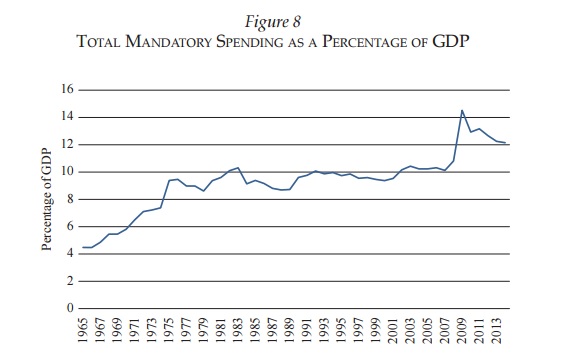
Simply stated, Biden wants to permanently and significantly increase the burden of government spending. Here’s a chart, based on data from Table S.1 of the President’s budget, augmented by data from Table 1.3 of the Budget’s Historical Tables.

The budget had reached $4 trillion before the pandemic. It then skyrocketed for coronavirus-related spending.

But now that the emergency is receding, Biden is not going to let the burden of government fall back to prior levels. Instead, he’s proposing a $6 trillion budget for the upcoming fiscal year.

And that’s just the starting point. He wants spending to then climb rapidly – at almost twice the rate of inflation – up to $8 trillion by 2031.

By the way, this horrifying data doesn’t tell the entire story.

Biden’s budget doesn’t include some of his new spending giveaways. Brian Riedl addressed this fiscal gimmickry in a column for today’s New York Post.

…this budget does not even include additional spending and debt proposals that are coming later. …They account only for the recently-enacted “stimulus,” a massive discretionary spending hike, and the trillions in (creatively-defined)“infrastructure” spending proposed by the President over the past two months. However, during last fall’s campaign, Biden also proposed trillions in new spending for health care, Social Security, Supplemental Security Income, climate change, college aid, and other priorities. The White House has signaled that these new spending initiatives are still in the pipeline. Including these forthcoming proposals, the President would push spending and deficits far above any levels that have ever been sustained.

And don’t forget all this spending, both proposed and in the pipeline, is in addition to all the entitlement spending that is going to burden the economy over the next several decades.

Here’s one final point to underscore and emphasize the radical nature of Biden’s budget.

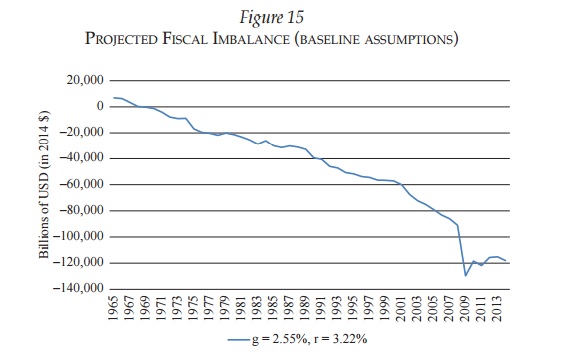
I’ve taken the previous chart and added a trendline showing what spending would be if Biden has simply followed the trajectory based on the actual spending levels of every President from Carter to Trump.

In other words, we’re looking at trillions of dollars of additional money being diverted from the productive sector of the economy and being put under the control of politicians and bureaucrats.

That does not bode well for American prosperity. Even the Congressional Budget Office recognizes this means lower living standards for our nation.

The bottom line is that if you adopt European-style fiscal policy, you get anemic European-style levels of income.

Are Tax Increases Popular?

Tax increases are bad fiscal policy, but that doesn’t necessarily mean that they are politically unpopular.

Indeed, many voices in the establishment press are citing favorable polling data in hopes of creating an aura on inevitably for President Biden’s proposed tax hikes.

That’s a very worrisome prospect. If Biden succeeds, the United States could wind up toppling Canada for the dubious honor of having the world’s highest tax burden on saving and investment.

That would be bad news for American workers.

But are Biden’s media cheerleaders correct? Are tax increases popular?

According to a new scholarly working paper from the Federal Reserve (authored by Andrew C. Chang, Linda R. Cohen, Amihai Glazer, and Urbashee Paul), the answer is no.

At least if we judge politicians by what they do in election years. Here’s part of the study’s abstract.

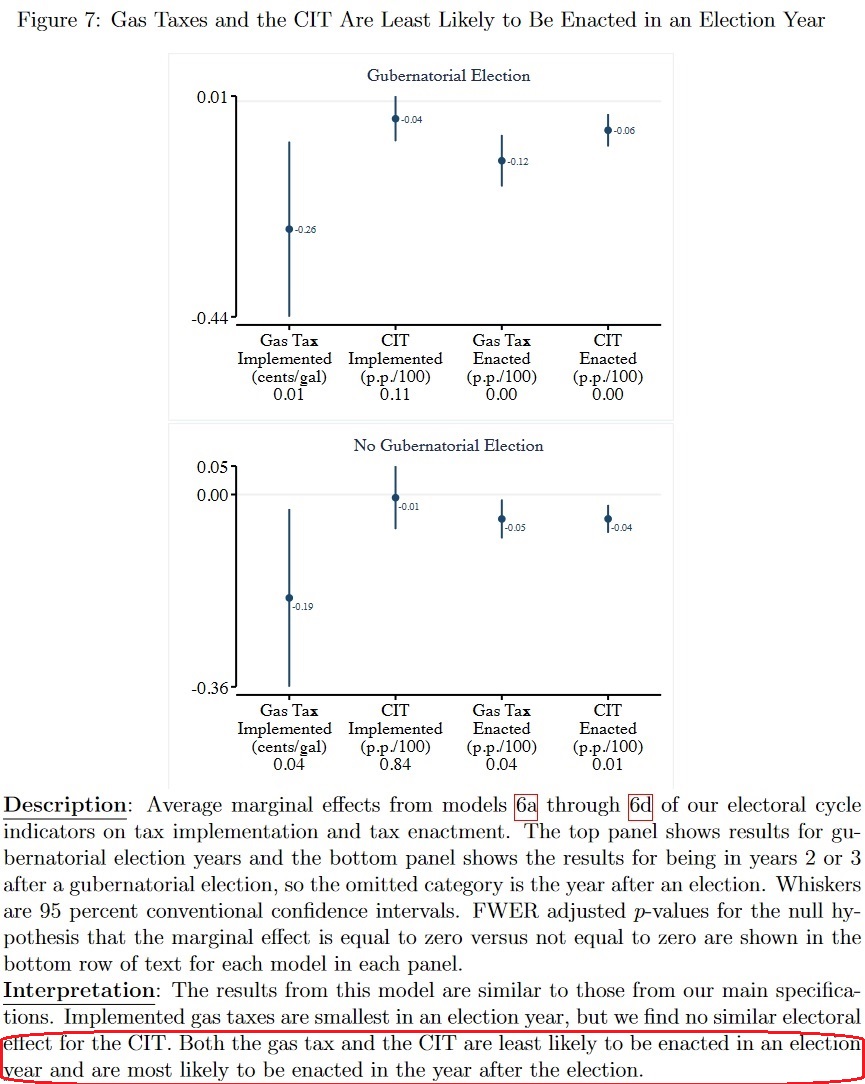
We use new annual data on gasoline taxes and corporate income taxes from U.S.states to analyze whether politicians avoid tax increases in election years. These data contain 3 useful attributes: (1) when state politicians enact tax laws, (2) when state politicians implement tax laws on consumers and firms, and (3) the size of tax changes.Using a pre-analysis research plan that includes regressions of tax rate changes and tax enactment years on time-to-gubernatorial election year indicators, we find that elections decrease the probability of politicians enacting increases in taxes and reduce the size of implemented tax changes relative to non-election years. We find some evidence that politicians are most likely to enact tax increases right after an election. These election effects are stronger for gasoline taxes than for corporate income taxes and depend on no other political, demographic, or macroeconomic conditions.

For wonkier readers, Figure 7 has some of the major results of their statistical analysis. I’ve highlighted (in red) the most important conclusion of the research.
For regular readers, the main takeaway is that politicians almost always want more tax revenue. That’s what gives them the ability to distribute goodies and buy votes.

But notwithstanding their never-ending hunger to grab more money, they are very likely to reject tax increases in election years. They even reject higher corporate taxes, which are supposed to be popular (at least according to some in the establishment media).

Yet if tax increases were politically popular, we should see the opposite result.

I’ll close with the somewhat depressing observation that these results do not imply that voters want libertarian policy. It’s probably more accurate to say that people want goodies from the government, but they don’t want to pay for them. Politicians simply respond to those preferences (which brings to mind Garett Jones’ hypothesis that we have too much democracy).

Which is how Greece became a basket case. Which is why Italy is in the process of becoming a basket case. And it’s why the United States may not be that far behind (with states such as Illinois serving as early-warning signs).

P.S. The above-cited research should be a reminder of why a no-tax-hike pledge is important. Voters seem to be on the right side on the big-picture question of “Should taxes be higher?”, but if they think tax increases are going to happen, it’s quite likely that they will support the most economically damaging types of class-warfare levies.

Bob Chitester, RIP


Bob Chitester was managing a small public television station in Erie, PA, when he got the big idea to persuade Nobel laureate Milton Friedman to write and narrate a 10‐​part series on free markets for PBS. As unlikely as that prospect was, Bob made it happen. “Free to Choose” was broadcast on PBS beginning in January of 1980, and it made quite a splash just as Reagan and Thatcher were also starting to change the way people thought about markets and government. Milton and Rose Friedman wrote a book to accompany the series. But television helped take Friedman’s ideas from the pages of books to millions more people, and in the process Chitester made Friedman a bigger celebrity and a bigger influence than a mere Nobel Prize could accomplish.

Bob went on to create Free to Choose Media and produce hundreds of video products for public television, other networks, the internet, and home viewing. They included The Real Adam Smith, a two‐​hour series that gives particular attention to Smith’s Theory of Moral Sentiments; the Stossel in the Classroom series, which put John Stossel’s television reports into high school classrooms; and A More or Less Perfect Union, a three‐​part series with Judge Douglas H. Ginsburg.

He made Cato senior fellow Johan Norberg a familiar face on public television with documentaries such as “Free & Equal,” an update of “Free to Choose”; “Sweden: Lessons for America?”; “India Awakes”; and “Work and Happiness: The Human Cost of Welfare.”

We at Cato were especially grateful that when our colleague Andrew Coulson died much too young before finishing his television project “School Inc.,” Bob and his Free to Choose team picked it up, finished the production, and got it on hundreds of public television stations in 2017.

For more than 40 years Bob Chitester focused like a laser to get free‐​market ideas on television in high‐​quality presentations. All of us who believe in the power of markets to liberate people are incredibly grateful and, frankly, astounded at his success in this.

Bob lost his seven‐​year battle with cancer this weekend. But his video projects can all be found on the web, and his Free to Choose team will continue his work with new documentaries and online programs.

Bob Chitester Discusses Milton Friedman and ‘Free to Choose’

Published on Jul 30, 2012 by

“There are very few people over the generations who have ideas that are sufficiently original to materially alter the direction of civilization. Milton is one of those very few people.”

That is how former Federal Reserve Chairman Alan Greenspan described the Nobel laureate economist Milton Friedman. But it is not for his technical work in monetary economics that Friedman is best known. Like mathematician Jacob Bronowski and astronomer Carl Sagan, Friedman had a gift for communicating complex ideas to a general audience.

It was this gift that brought him to the attention of filmmaker Bob Chitester. At Chitester’s urging, Friedman agreed to make a 10 part documentary series explaining the power of economic freedom. It was called “Free to Choose,” and became one of the most watched documentaries in history.

The series not only reached audiences in liberal democracies, but was smuggled behind the iron curtain where it played, in secret, to large audiences. Reflecting on its impact, Czech president Vaclav Klaus has said: “For us, who lived in the communist world, Milton Friedman was the greatest champion of freedom, of limited and unobtrusive government and of free markets. Because of him I became a true believer in the unrestricted market economy.”

July 31st, 2012 is the 100th anniversary of Friedman’s birth. To commemorate that occasion, we’d like to share an interview with “Free to Choose” producer Bob Chitester. Like this interview, the entire series can now be viewed on-line at no cost at http://www.freetochoose.tv/, thanks to the incredible technological progress brought about by the economic freedom that Milton Friedman celebrated.

Produced by Andrew Coulson, Caleb O. Brown, Austin Bragg, and Lou Richards, with help from the Free to Choose Network

_______________

Celebrating Milton Friedman

by Andrew J. Coulson

Andrew Coulson directs the Cato Institute’s Center for Educational Freedom and is the author of Market Education: The Unknown History.

Added to cato.org on July 31, 2012

This article appeared in Cato.org on July 31, 20

For us, who lived in the communist world, Milton Friedman was the greatest champion of freedom, of limited and unobtrusive government and of free markets. Because of him I became a true believer in the unrestricted market economy.

Those are the words of Czech President Vaclav Klaus. Both Friedman’s writings and his landmark 1980 documentary series “Free to Choose”were smuggled into totalitarian communist states, inspiring a generation of future scholars, activists, and politicians.

July 31st, 2012 is the 100th anniversary of Friedman’s birth. To commemorate that occasion, the Cato Institute has put together a video interview with Bob Chitester, producer of “Free to Choose,” recounting how it came to be, its impact, and what it was like working with Milton Friedman.

Aside from those who lived under communism, there is another group for whom Friedman was and is a colossal figure: advocates of educational freedom. At a time when state-run schooling had been the norm for nearly a century, and had long ceased to be questioned by America’s elites, Friedman offered a modest observation: there was no good reason for the government of a free society to actually run schools and many good reasons for it not to do so.

He made this case in his essay “On the Role of Government in Education,” first published in 1955. The idea had been floated by others, including Adam Smith and Thomas Paine, but Friedman eloquently and powerfully introduced it to the American policy debate. In so doing, he, more than any other individual, can be credited with giving rise to the modern school choice movement.

Not only did Friedman spark the creation of this movement, he helped to fan the flame of educational freedom, writing popular commentaries and book chapters, speaking with and encouraging activists, founding a leading school choice institution, and dedicating the entire sixth episode of “Free to Choose” to this subject.

I had the good fortune to speak and correspond with Milton occasionally, starting in the late 1990s, and what struck me most about him was his personal integrity. He once told me that he never said anything negative about a person in private that he would not be willing to say openly in that person’s presence. So far as I know, he never violated that principle. And while he staunchly defended his conclusions as long as he remained convinced of their correctness, he would amend them if the weight of evidence shifted.

Indeed the rigorous empiricism that Friedman applied in his scholarly work is generally regarded as one of his most influential contributions to the field of economics—for a long time controversial but eventually the norm, at least in principle. His view, published in the 1953 collection Essays in Positive Economics, was that

the ultimate test of the validity of a theory is… the ability to deduce facts that have not yet been observed, that are capable of being contradicted by observation, and that subsequent observation does not contradict. [p. 300]

Equally wise, though not yet as widely accepted, is the long time horizon against which Friedman measured policy outcomes. Economist and philosopher of science James R. Wible notes that Friedman’s greatest contribution “may be his constant reminder not to forget the long run consequences of short run policies.”

In the 1982 edition of his book Capitalism and Freedom, Friedman observed that scholars cannot single-handedly bring about change. Their real role, he wrote, is to “keep the lights on”—to remind us which policies work and which do not, and to show us how to advance our understanding even further. His own unfailing empiricism and concern for the long term remain valuable beacons today, both for advocates of educational freedom and the broader policy community.

_____________

Related posts:

Quotes from Milton Friedman on his 100th birthday

Milton Friedman’s 100th: Exploring His Wisdom for the Ages (Part I: Worldview) by Robert Bradley Jr. July 31, 2012 [Ed. note: Milton Friedman’s views will be further explored in Part II on energy and Part III on political capitalism.] “Our central theme in public advocacy has been the promotion of human freedom … [It] underlies […]

Thomas Sowell remembers his former teacher Milton Friedman 100 years later

I was impacted in 1980 by the film series “Free to Choose” and I was very impressed by the performance by Thomas Sowell. Today he remembers his former teacher Milton Friedman.   Friedman could be a help today     By  Thomas Sowell Creators Syndicate Tuesday July 31, 2012 7:00 AM If Milton Friedman were alive […]

Milton Friedman destroys liberal student challenges

In the video above Milton Friedman takes on some liberal students with their challenges to capitalism.   Secretary of Defense Donald H. Rumsfeld speaking at Tribute to Milton Friedman (transcript) As Delivered by Secretary of Defense Donald H. Rumsfeld, White House, Washington, D.C., Thursday, May 09, 2002 Mr. President (George W. Bush), Rose and Milton […]

Every Friday you need to click on www.theDailyHatch.org for “Friedman Friday”

Every Friday you need to click on http://www.theDailyHatch.org if you would like to see a video clip of Milton Friedman as he shares his common sense conservative economic views. Many of his articles are posted too. I remember growing up and reading those great articles every week in Newsweek. They are just as relevant today as […]

Milton Friedman videos and transcripts Part 12

Milton Friedman videos and transcripts Part 12 On my blog http://www.thedailyhatch.org I have an extensive list of posts that have both videos and transcripts of MiltonFriedman’s interviews and speeches. Here below is just small list of those and more can be accessed by clicking on “Milton Friedman” on the side of this page or searching […]

Chattanooga Times Free Press comments on 100th year since Milton Friedman’s birth

published Tuesday, July 31st, 2012  Chattanooga Times Free Press Milton Friedman at 100   Milton Friedman Photo by Associated Press /Chattanooga Times Free Press.   enlarge photo   One hundred years ago today, the most powerful defender of economic liberty in American history was born in Brooklyn to poor Jewish immigrants. Though he stood barely […]

Milton Friedman’s passion was to make a difference in the lives of young people

No one did more to advance the cause of school vouchers than Milton and Rose Friedman. Friedman made it clear in his film series “Free to Choose” how sad he was that young people who live in the inner cities did not have good education opportunities available to them. Remembering Milton Friedman’s School Choice Legacy […]

Milton Friedman remembered at 100 years from his birth (Part 5)

Testing Milton Friedman – Preview Uploaded by FreeToChooseNetwork on Feb 21, 2012 2012 is the 100th anniversary of Milton Friedman’s birth. His work and ideas continue to make the world a better place. As part of Milton Friedman’s Century, a revival of the ideas featured in the landmark television series Free To Choose are being […]

Defending Milton Friedman

What a great defense of Milton Friedman!!!!   Defaming Milton Friedman by Johan Norberg This article appeared in Reason Online on September 26, 2008  PRINT PAGE  CITE THIS      Sans Serif      Serif Share with your friends: ShareThis In the future, if you tell a student or a journalist that you favor free markets and limited government, there is […]

Milton and Rose Friedman “Two Lucky People”

Milton Friedman on Hayek’s “Road to Serfdom” 1994 Interview 2 of 2 Uploaded by PenguinProseMedia on Oct 26, 2011 2nd half of 1994 interview. ________________ I have a lot of respect for the Friedmans.Two Lucky People by Milton and Rose Friedman reviewed by David Frum — October 1998. However, I liked this review below better. It […]

Podcast Series ABSOLUTELY MENTAL reminds one of Netflix Series AFTER LIFE (Part 2) Ricky Gervais “Even I know what death is. It is not existing. I still think there is a hint of what a shame…Really I will never exist (again). No one eventually will ever remember me. Who cares about my legacy? It is unthinkable. This seems so amazing…We don’t want to come to terms with our insignificance [or that] life is chance or that we are one of billions of individuals of different species that are no more important than another one. We are an insignificant rock going around the sun in an infinite sun”

__

__

__

__

___

Ricky Gervais To Launch Podcast 'Absolutely Mental' With Sam Harris –  Deadline

Deadline

Ricky Gervais has announced that he will host a new paid-for podcast called Absolutely Mental.

The 11-part podcast will be available on AbsolutelyMental.com from May 10, and will feature the comedian in conversation with his friend, neuroscientist Sam Harris.

___

Simone de Beauvoir made some revealing comments on death!

Simone de Beauvoir Her Life and Philosophy

A Very Easy Death – Simone de Beauvoir


Ricky Gervais plays Tony Johnson in AFTER LIFE.

After Life on Netflix

In the podcast series ABSOLUTELY MENTAL Sam Harris answers questions from Ricky Gervais and many of these same questions are covered by the issues brought up in After Life. How are we different than machines? Why do humans think there is any afterlife? Is there any point to life? Many of these issues were also covered 3,000 years ago in the Book of Ecclesiastes by Solomon.

In the past I have done over 100 blog posts on the Netflix series AFTER LIFE written by Ricky Gervais and staring Ricky as Tony Johnson. I respect both Ricky and his character Tony for being people who demand evidence and they refuse to accept anything with a blind faith. That is part of the reason I started writing letters to Ricky several years ago with historical evidence from archaeology and ancient cultures on the Bible’s claims. I personally think his latest series AFTER LIFE is his best by far and it does a great job of examining Ricky’s humanist worldview and the natural conclusions that come from this time plus chance view of the world.

Just like Solomon in The Book of Ecclesiastes, Ricky in AFTER LIFE is examining life under the sun, which is life between birth and death without God in the picture. The key to understanding the Book of Ecclesiastes is the term UNDER THE SUN — What that literally means is you lock God out of a closed system and you are left with only this world of Time plus Chance plus matter. In fact, the phrase under the sun appears 29 times in Ecclesiastes. 

Francis Schaeffer indicated Ecclesiastes is truly the book of modern man because modern humanist man’s philosophy has brought him to the nihilistic conclusion that all is vanity and meaninglessness. This appears to be the place that the atheist Tony Johnson has landed and many of the characters around Tony have come to pessimistic conclusions about life too, though they have searched for satisfaction and meaning in life by pursuing ladiesluxurieslearninglaborliquor, and laughter.

In episode 8 (WHY DO WE FEAR DEATH?) Ricky asks: “Even I know what death is. It is not existing. I still think there is a hint of what a shame…Really I will never exist (again). No one eventually will ever remember me. Who cares about my legacy? It is unthinkable. This seems so amazing…We don’t want to come to terms with our insignificance [or that] life is chance or that we are one of billions of individuals of different species that are no more important than another one. We are an insignificant rock going around the sun in an infinite sun”


In episode 2 of the second season of AFTER LIFE is the following discussion: 
Tony: I drink in times of trouble. I can’t help it the world is filled with trouble. It is a horrible place. Everyone is screwed up in someway. Everyone has worries like money or health or famine, war. We are chimps with brains the size of planets. No wonder we get drunk and try to kill each other. It is mental.

Matt: Always good to talk.

Tony: I was just explaining my new plan is to drink myself to death till I eventually implode in on my own evolution.

Ricky Gervais plays bereaved husband Tony Johnson in AFTER LIFE

This reminds me of the words of Francis Bacon because reduces us to just animals. 

Of course, we are meat. We are potential carcasses.
—Francis Bacon (The nihilistic painter)


Ecclesiastes is a book that is truly a picture of how modern secular man looks at the world. The key to understanding the Book of Ecclesiastes is the term UNDER THE SUN — What that literally means is you lock God out of a closed system and you are left with only this world of Time plus Chance plus matter.

Below Francis Schaeffer comments on ECCLESIASTES:


Ecclesiastes 9:11

11 Again I saw that under the sun the race is not to the swift, nor the battle to the strong, nor bread to the wise, nor riches to the intelligent, nor favor to those with knowledge, but time and chance happen to them all.

Chance rules. If a man starts out only from himself and works outward it must eventually if he is consistent seem so that only chance rules and naturally in such a setting you can not expect him to have anything else but finally a hate of life.

Ecclesiastes 2:17-18a

17 So I hated life, because what is done under the sun was grievous to me, for all is vanity and a striving after wind. 18 I hated all my toil in which I toil under the sun…

That first great cry “So I hated life.” Naturally if you hate life you long for death and you find him saying this in Ecclesiastes 4:2-3:

And I thought the dead who are already dead more fortunate than the living who are still alive. But better than both is he who has not yet been and has not seen the evil deeds that are doneunder the sun.

He lays down an order. It is best never have to been. It is better to be dead, and worse to be alive. But like all men and one could think of the face of Vincent Van Gogh in his final paintings as he came to hate life and you watch something die in his self portraits, the dilemma is double because as one is consistent and one sees life as a game of chance, one must come in a way to hate life. Yet at the same time men never get beyond the fear to die. Solomon didn’t either. So you find him in saying this.

Ecclesiastes 2:14-15

14 The wise person has his eyes in his head, but the fool walks in darkness. And yet I perceived that the same event happens to all of them. 15 Then I said in my heart, “What happens to the fool will happen to me also. Why then have I been so very wise?” And I said in my heart that this also is vanity.

The Hebrew is stronger than this and it says “it happens EVEN TO ME,” Solomon on the throne, Solomon the universal man. EVEN TO ME, even to Solomon.

COMMENTS FROM 1966 FROM FRANCIS SCHAEFFER: 

(Francis Schaeffer pictured below)

Francis Schaeffer.jpg

The book A VERY EASY DEATH, 106 pages $3.95, was written by Simone de Beauvoir, who I have a real admiration for in a certain way because she has courage to play the game pretty far along and in this sense and for her clear brilliance, I also have admiration, for you must remember that Sartre and she when they graduated from the Sorbonne, Sartre was first in the class and he was 2nd and she has been his mistress for years. 

I think this very recent book A VERY EASY DEATH touches me as much as anything, because in it she tells her reactions to the death of her mother. Her mother died in a hospital and I have a review here from NEWSWEEK, May 16, 1966 on this book: 

To the professionals, the doctors and nurses going about their routine tasks this was only another death in the endless procession. Indeed, as these things go it was almost exemplary, relatively quick, relatively painless. The nurse could hardly understand the sobbing [of Simone].

One might wish that she had the right person to meet her at that particular moment. I long that for these people. One wonders if a Christian who has comprehension had stood by her side, I wonder if Simone de Beauvoir would have become a Christian.

A nurse could hardly understand the sobbing. “But Madam,” she said, a bit perplexed, “I assure you it was a very easy death.” The hospital was cozy and the attendants first rate. Not everyone could have afforded such [good] care.

In the end Madam de Beauvoir is not reconciled to death, her mother’s or anyone else’s 

Simone de Beauvoir wrote, You do not die from being born, nor from having lived, nor from old age. You die from something.

How right she is. She senses the abnormality of physical death. She senses here that you talk theoretically about absurdity as she and Sartre and the others have endlessly at the cafe tables but it looks different when someone you love dies. Now absurdity becomes sharp and becomes overwhelming. She is quite right you die of something. She understands that death is really abnormal.

Simone de Beauvoir writes, “There is no such thing as a natural death: nothing that happens to a man is ever natural, since his presence calls the world into question. All men must die: but for every man his death is an accident and, even if he knows it and consents to it, an unjustifiable violation” De Beauvoir,1 pp 105–6).

This is a totally Christian way to look at death. This is a Christian way to look at death. Death is an enemy, and that is what the Bible says. Simone de Beauvoir realizes here is an enemy to which we all lose. It becomes almost a symbol of total absurdity. The life that is lived and then has died can be seen in its abnormality in death as a sign board of the absurdity of man. Up to that point it could be a Christian statement as well as an existential one.

In Francis Schaeffer’s book ESCAPE FROM REASON he tells why we live in an abnormal world:

“the True Christian position is that, in space and time and history, there was an unprogrammed man who made a choice, and actually rebelled against God…without Christianity’s answer that God made a significant man in a significant history with evil being the result of Satan’s and then man’s historic space-time revolt, there is no answer but to accept Baudelaire’s answer [‘If there is a God, He is the devil’] with tears. Once the historic Christian answer is put away, all we can do is to leap upstairs and say that against all reason God is good.”(pg. 81)

—-

FRANCIS SCHAEFFER in his book GENESIS IN SPACE AND TIME:

states: 

God’s Judgment on Man and Nature 

As God speaks to the parties involved at this moment of history, we find four steps in his judgment of their action. First, he speaks to the serpent who has been used by Satan: “And the LORD God said unto the serpent, Because thou hast done this, thou art cursed above [from among] all cattle, and above [from among] every beast of the field; upon thy belly shalt thou go, and dust shalt thou eat all the days of thy life” (v. 14). As we shall see, all nature becomes abnormal yet the serpent is singled out in a special way “from among all cattle.’”

Second, in verse 15 he speaks to Satan; we will return to that.

Third, he speaks to the woman: “Unto the woman he said, I will greatly multiply thy pain [this is more accurate than the King James word sorrow] and thy conception; in pain thou shalt bring forth children; and thy desire shall be to thy husband, and he shall rule over thee.” There are two parts here: the first relates to the womanness of the woman-the bearing of children-and the second to her relationship to her husband. In regard to the former, God says that he will multiply two things-not just the pain but also the conception. It seems clear that if man had not rebelled there would not have been as many children born.

In regard to the relationship to her husband, he says, “And thy desire shall be to thy husband, and he shall rule over thee.” This one sentence puts an end to any pure democracy. In a fallen world pure democracy is not possible. Rather, God brings structure into the primary relationship of man-the man-woman relationship. In a fallen world (in every kind of society-big and smalland in every relationship) structure is needed for order. God himself here imposes it on the basic human relationship. Form is given and without such form freedom would only be chaos.

It is not simply because man is stronger that he is to have dominion (that’s the argument of the Marquis de Sade). But rather he is to have dominion because God gives this as structure in the midst of a fallen world. The Bible makes plain that this relationship is not to be without love. As the New Testament puts it, the husband is to love his wife as Christ loved the church (Eph. 5:23). In a fallen world it is not surprising to find that men have turned this structure into a kind of slavery. It is not meant to be a slavery. In fact, it is in cultures where the Bible has been influential that the balance has been substantially restored. The Bible balances the structure and the love.

Nevertheless, it is still true: Since the Fall what God. says in verse 16 is to be the structure or the form of the basic human relationship-the man-woman relationship. It is right that a woman should feel a need for freedom, a feeling of being a “human being” in the world. But when she tries to smash the structure of this basic relationship, finally what she does is to hurt herself. It is like unravelling the knot that holds the string of human relationships together. All other things flow from it-the loss of her own children’s obedience and the crumbling of society about her. In a fallen world we need structure in every social relationship.

The Abnormal Universe 

Fourth, God speaks to the man: “And unto Adam he said, Because thou hast hearkened unto the voice of thy wife, and hast eaten of the tree, of which I commanded thee, saying, Thou shalt not eat of it: cursed is the ground for thy sake; in toil [the word sorrow in the King James is inaccurate] shalt thou eat of it all the days of thy life” (v. 17). In other words, at this point the external world is changed.

It is interesting that almost all of the results of God’s judgment because of man’s rebellion relate in some way to the external world. They are not just bound up in man’s thought life; they are not merely psychological. Profound changes make the external, objective world abnormal. In the phrase for thy sake God is relating these external abnormalities to what Adam has done in the Fall.

All of these changes came about by fiat. Creation, as we have already seen, came by fiat. And, though we have come to the conclusion of creation with the creation of Eve, yet fiat has not ceased. The abnormality of the external world was brought about by fiat. Putting it into twentieth-century terminology, we can say this: The universe does not display a uniformity of cause and effect in a closed system; God speaks and something changes. We are reminded here of the long arguments that date back to the time of Lyell and Darwin concerning whether there could be such a thing as catastrophe-something that cut across the uniformity of cause and effect. Scripture answers this plainly: Yes, God spoke and that which he had created was changed.

So now the earth itself is abnormal. We read, for example, in Genesis 5:29, which speaks of the world before the flood: “And he [Noah’s father] called his name Noah, saying, This same shall comfort us concerning our work and toil of our hands, because of the ground which the LORD hath cursed.” The name Noah itself simply means rest or comfort. The Scripture says that at this point in the flow of biblical history men knew very well that the toil of their hands was a result of God’s having changed the earth.

Why is it like this? Because, one might say, you, O unprogrammed and significant Adam, have revolted. Nature has been under your dominion (in this sense it is as an extension of himself, as a king’s empire is an extension of himself). Therefore, when you changed, God changed the objective, external world. It as well as you is now abnormal.

It is interesting that in each of the steps of God’s judgment toil is involved: The serpent goes upon his belly; the woman has pain in childbirth; the man has toil in his work.

Verse 18 continues: “Thorns also and thistles shall it bring forth to thee.” The word thistles here means luxuriously-growing but useless plants. The phrase it shall bring forth to thee has in the Hebrew the sense of “it shall be caused to bud.” This phrase, therefore, suggests that here, too, the change was wrought by fiat. Furthermore, the phrase suggests the modern biological term mutation, a non-sterile sport. That is, the plants had been one kind of thing and were reproducing likewise, and then God spoke and the plants began to bring forth something else and continue to reproduce in that new and different form.

The introduction of toil does not mean the introduction of work, because in Genesis 2:15, as we have seen, God took man and put him in the Garden of Eden “to dress it and to keep it.” There was work before the Fall, but certainly we can see the force of the distinction before and after the Fall, in the language of Genesis 5:29, where labor is called the “toil of our hands, because of the ground which the LORD hath cursed.” Since the whole structure of the external world has changed, the meaning of work has changed. Thus Genesis 3:19 says: “In the sweat of thy face shalt thou eat bread, till [the concept of “until” is important here] thou return unto the ground; for out of it was thou taken: for dust thou art, and unto dust shalt thou return.”

The results are twofold. First, man shall have his food (and all else) by the sweat of his brow. Second, there is an end to this-an end that is not a release. The end is the greatest abnormality in the external world-the dissolution of the total man. A time will come at the end of each man’s life when he physically dies and the unity of man the unity of body and soul-is torn asunder. Christianity is not platonic; the soul is not considered all-important. Rather, at physical death that unity which man is meant to be is fractured. This is the second kind of death brought about by the Fall, the first being immediate separation from fellowship with God and the third being eternal death as men are judged in their rebellion and separated from God forever.

Christianity as a system does not begin with Christ as Savior, but with the infinite-personal God who created the world in the beginning and who made man significant in the flow of history. And man’s significant act in revolt has made the world abnormal. Thus there is not a total unbroken continuity back to the way the world originally was. Non-Christian philosophers almost universally agree in seeing everything as normal, assuming things are as they have always been. The Christian sees things now as not the way they have always been. And, of course, this is very important to the explanation of evil in the world. But it is not only that. It is one way to understand the distinction between the naturalistic, non-Christian answers (whether spoken in philosophic, scientific or even religious language) and the Christian answer. The distinction is that as I look about me I know I live in an abnormal world

Blog

The Family Project > Blog > The Fall: Four Deaths

The Fall: Four Deaths

The Entombment

by Glenn Stanton

Most Christians – and even many non-believers – know that the Fall brought death to mankind and the earth. But as Francis Schaeffer explains in his book Genesis in Space and Time, there were actually four kinds of death introduced into creation at the Fall. As a result, we all face and are crippled by them:

  1. Death between man and God. Man and God are no longer intimate. This alienation is what the rest of God’s story is about – the consequences of it and God’s seemingly unending work to make things right, to make a way for us back to Him through His unending grace.
  2. Death between man and himself. We all have fear. We are insecure. We doubt ourselves and feel shame about who we are and what we do. We often don’t think we are worth loving, either by ourselves or by others. Much of the psychosis that humans suffer is due to their inability to come to terms with and live with themselves. The Fall has created a great chasm there. In fact, the great Christian thinker Blaise Pascal said the primary trouble with man is that he cannot live quietly within himself. He is not comfortable there. He seeks to avoid this with busyness and diversions of every kind.
  3. Death with others. Schaeffer calls this the “sociological separation.” We do not relate with others as we were intended to. We mistrust, we are shy, we use others. These are things the virtuous person must always be mindful of, for they are more natural to us than their opposites.
  4. Death between man and the earth. Being banished from the garden, man’s relationship with the earth and nature now shows the signs of decay. We must struggle with and against it to get what we need and what had originally been designed to come naturally. We harvest by the sweat of our brow and ache in our shoulders, arms and backs. Our relationship to God’s physical creation is deeply marred

Schaeffer beautifully states, “The simple fact is that in wanting to be what man as a creature could not be, man lost what he could be.

But it will not remain this way. The good news of where God’s story is going and His “fix” is found in Revelation 21:5.

.

Glenn Stanton is the director of global family formation studies at Focus on the Family, and the co-author/co-creator of The Family Project, as well as the co-author (w/Leon Wirth) of The Family Projectbook.

From the account in Genesis, we discover that death is something that is abnormal – it was never God’s original intention or design. Death came as a result of the choice of the first human pair to commit sin. Humans were created to live, not to die. Death came as a result of judgment for sin. 

Summary

1. In the original creation of God there was no death. Everything was perfect. 

2. God warned Adam and Eve that disobedience to His commandment would result in their death. 

3. Satan, the tempter, enticed Eve to eat the forbidden fruit. 

4. After Adam and Eve ate the forbidden fruit God pronounced judgment upon them. This judgment included death. 

5. Death was passed on to all humans as a judgment for the sin of Adam and Eve. 

6. Death, therefore, is something abnormal. God created humans to live, not die.

___

Related posts:

Taking on Ark Times Bloggers on various issues Part I “Old Testament Bible Prophecy” includes the film TRUTH AND HISTORY and article ” Jane Roe became pro-life”

April 12, 2013 – 5:45 am

I have gone back and forth and back and forth with many liberals on the Arkansas Times Blog on many issues such as abortion, human rights, welfare, poverty, gun control  and issues dealing with popular culture. Here is another exchange I had with them a while back. My username at the Ark Times Blog is Saline […]By Everette Hatcher III | Posted in Biblical ArchaeologyFrancis SchaefferProlife | Edit|Comments (0)

John MacArthur on fulfilled prophecy from the Bible Part 2

August 8, 2013 – 1:28 am

I have posted many of the sermons by John MacArthur. He is a great bible teacher and this sermon below is another great message. His series on the Book of Proverbs was outstanding too.  I also have posted several of the visits MacArthur made to Larry King’s Show. One of two most popular posts I […]By Everette Hatcher III | Posted in Adrian RogersCurrent Events | Edit|Comments (0)

John MacArthur on fulfilled prophecy from the Bible Part 1

August 6, 2013 – 1:24 am

I have posted many of the sermons by John MacArthur. He is a great bible teacher and this sermon below is another great message. His series on the Book of Proverbs was outstanding too.  I also have posted several of the visits MacArthur made to Larry King’s Show. One of two most popular posts I […]By Everette Hatcher III | Posted in Adrian RogersCurrent Events |Tagged Bible Prophecyjohn macarthur | Edit|Comments (0)

John MacArthur: Fulfilled prophecy in the Bible? (Ezekiel 26-28 and the story of Tyre, video clips)

April 5, 2012 – 10:39 am

Prophecy–The Biblical Prophesy About Tyre.mp4 Uploaded by TruthIsLife7 on Dec 5, 2010 A short summary of the prophecy about Tyre and it’s precise fulfillment. Go to this link and watch the whole series for the amazing fulfillment from secular sources. http://www.youtube.com/watch?v=qvt4mDZUefo________________ John MacArthur on the amazing fulfilled prophecy on Tyre and how it was fulfilled […]By Everette Hatcher III | Posted in Biblical Archaeology | Edit|Comments (1)

John MacArthur on the Bible and Science (Part 2)

August 1, 2013 – 12:10 am

John MacArthur on the Bible and Science (Part 2) I have posted many of the sermons by John MacArthur. He is a great bible teacher and this sermon below is another great message. His series on the Book of Proverbs was outstanding too.  I also have posted several of the visits MacArthur made to Larry […]By Everette Hatcher III | Posted in Current Events | Edit|Comments (0)

John MacArthur on the Bible and Science (Part 1)

July 30, 2013 – 1:32 am

John MacArthur on the Bible and Science (Part 1) I have posted many of the sermons by John MacArthur. He is a great bible teacher and this sermon below is another great message. His series on the Book of Proverbs was outstanding too.  I also have posted several of the visits MacArthur made to Larry […]By Everette Hatcher III | Posted in Current Events | Edit|Comments (0)

Adrian Rogers: “Why I believe the Bible is true”

July 9, 2013 – 8:38 am

Adrian Rogers – How you can be certain the Bible is the word of God Great article by Adrian Rogers. What evidence is there that the Bible is in fact God’s Word? I want to give you five reasons to affirm the Bible is the Word of God. First, I believe the Bible is the […]By Everette Hatcher III | Posted in Adrian RogersBiblical Archaeology | Edit|Comments (0)

The Old Testament is Filled with Fulfilled Prophecy by Jim Wallace

June 24, 2013 – 9:47 am

Is there any evidence the Bible is true? Articles By PleaseConvinceMe Apologetics Radio The Old Testament is Filled with Fulfilled Prophecy Jim Wallace A Simple Litmus Test There are many ways to verify the reliability of scripture from both internal evidences of transmission and agreement, to external confirmation through archeology and science. But perhaps the […]By Everette Hatcher III | Posted in Biblical ArchaeologyCurrent Events | Edit|Comments (0)

Taking on Ark Times Bloggers on various issues Part M “Old Testament prophecy fulfilled?”Part 3(includes film DEATH BY SOMEONE’S CHOICE)

April 19, 2013 – 1:52 am

  I have gone back and forth and back and forth with many liberals on the Arkansas Times Blog on many issues such as abortion, human rights, welfare, poverty, gun control  and issues dealing with popular culture. Here is another exchange I had with them a while back. My username at the Ark Times Blog is […]By Everette Hatcher III | Posted in Francis SchaefferProlife | Edit|Comments (0)

Evidence for the Bible

March 27, 2013 – 9:43 pm

Here is some very convincing evidence that points to the view that the Bible is historically accurate. Archaeological and External Evidence for the Bible Archeology consistently confirms the Bible! Archaeology and the Old Testament Ebla tablets—discovered in 1970s in Northern Syria. Documents written on clay tablets from around 2300 B.C. demonstrate that personal and place […]By Everette Hatcher III | Posted in Biblical Archaeology | E

___

Dan Mitchell: Biden’s Class-Warfare Agenda Is Bad News According to Academic Research on Taxes and Growth

Biden’s Class-Warfare Agenda Is Bad News According to Academic Research on Taxes and Growth

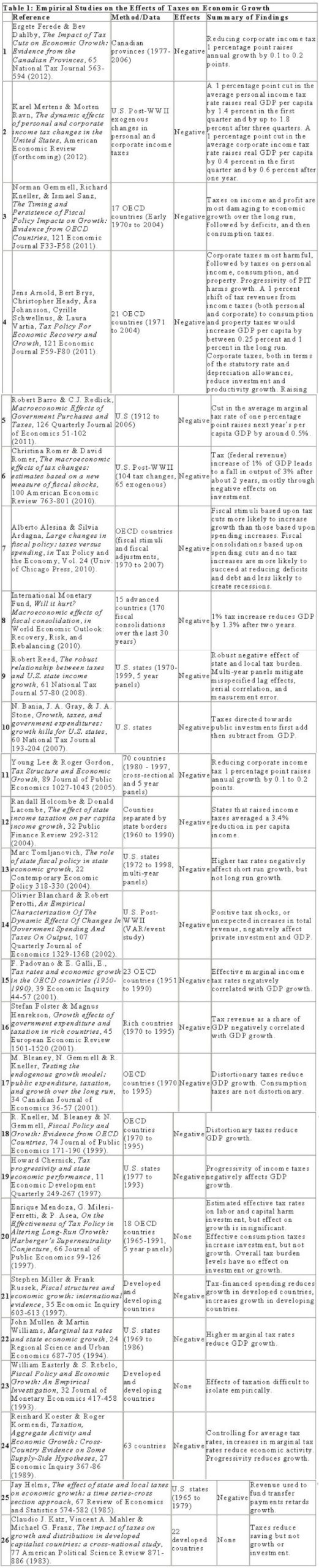
Back in 2013, the Tax Foundation published a report that reviewed 26 academic studies on taxes and growth.

That scholarly research produced a very clear message: The overwhelming consensus was that higher tax rates were bad news for prosperity.

Especially soak-the-rich tax increases that reduced incentives for productive activities such as work, saving, investment, and entrepreneurship.

That compilation of studies was very useful because then-President Obama was a relentless advocate of class-warfare tax policy.

And he partially succeeded with an agreement on how to deal with the so-called “fiscal cliff.”

Well, as Yogi Berra might say, it’s “deju vu all over again.” Joe Biden is in the White House and he’s proposing a wide range of tax increases.

It’s unclear whether Biden will gain approval for his proposals, but I’ve already produced a four-part series on why they are very misguided.

  • In Part I, I showed that the tax code already is biasedagainst upper-income taxpayers.
  • In Part II, I explained how the tax hike would have Laffer-Curve implications, meaning politicians would not get a windfall of tax revenue.
  • In Part II, I pointed out that the plan would saddle Americawith the developed world’s highest corporate tax burden.
  • In Part IV, I shared data on the negative economic impactof higher taxes on productive behavior.

The bottom line is that the United States should not copy Franceby penalizing entrepreneurs, innovators, investors, and business owners.

Particularly since the rest of us are usually collateral damagewhen politicians try to punish successful taxpayers.

So it’s serendipity that the Tax Foundation has just updated it’s list of research with a new report looking at seven new high-level academic studies.

Here’s some of what the report says about class-warfare tax policy.

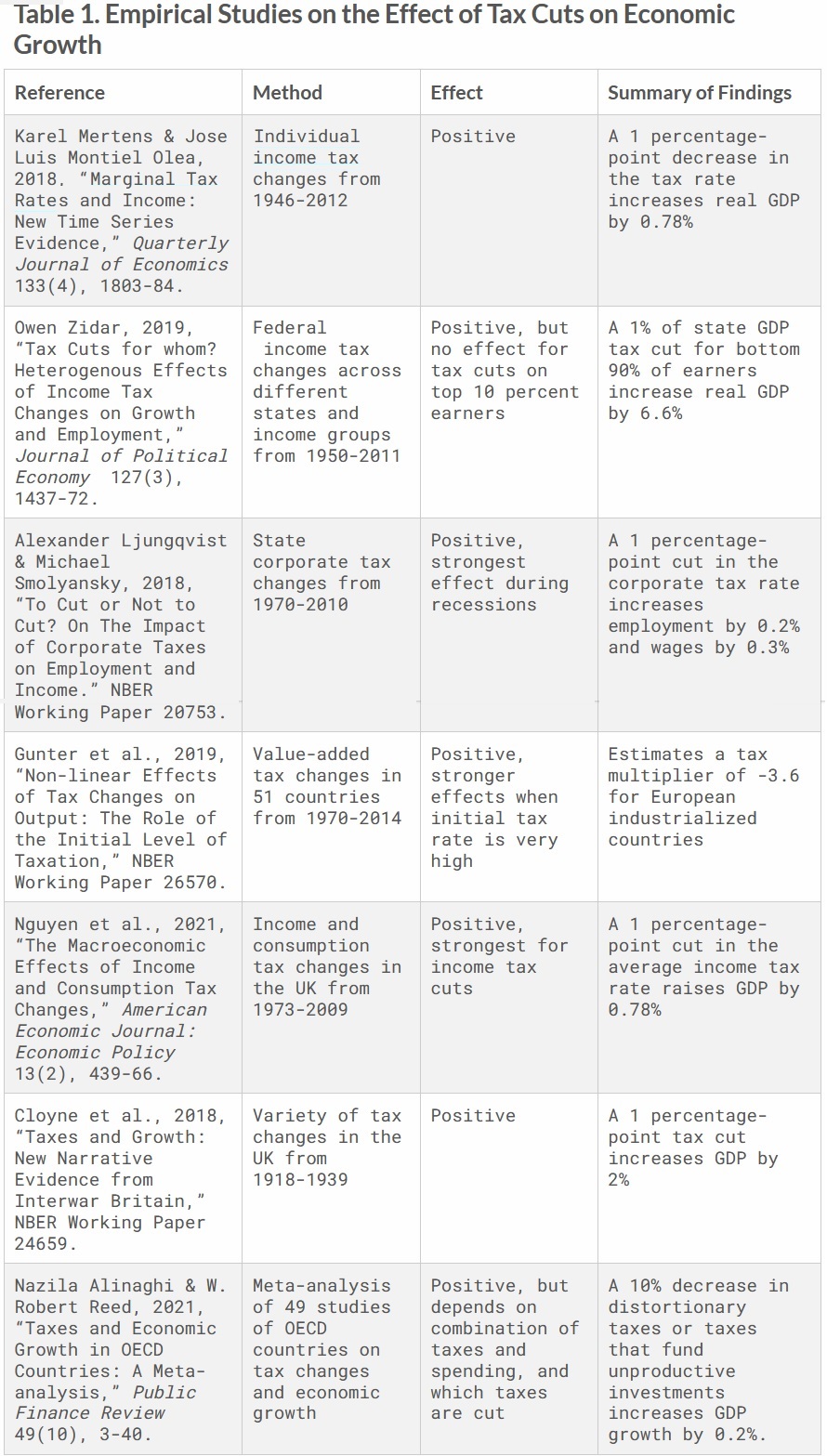
With the Biden administration proposing a variety of new taxes, it is worth revisiting the literature on how taxes impact economic growth. …we review this new evidence, again confirming our original findings:Taxes, particularly on corporate and individual income, harm economic growth. …We investigate papers in top economics journals and National Bureau of Economic Research (NBER) working papers over the past few years, considering both U.S. and international evidence. This research covers a wide variety of taxes, including income, consumption, and corporate taxation.

And here’s the table summarizing the impact of lower tax rates on economic performance, so it’s easy to infer what will happen if tax rates are increased instead.

Some of these findings may not seem very significant, such as changes in key economic indicators of 0.2%, 0.78%, or 0.3%.

But remember that even small changes in economic growth can lead to big changes in national prosperity.

P.S. In an ideal world, Washington would be working to boost living standards by adopting a flat tax. In the real world, the best-case scenario is simply avoiding policies that will make America less competitive.

Red States vs Blue States, Part II

Last year, I compared the economic performance of red states and blue states.

My big takeaway from that column is that we should pay attention to the data on internal migration. More specifically, there’s a reason why Americans have been moving from high-tax states to low-tax states.

Today’s let’s follow up on that discussion.

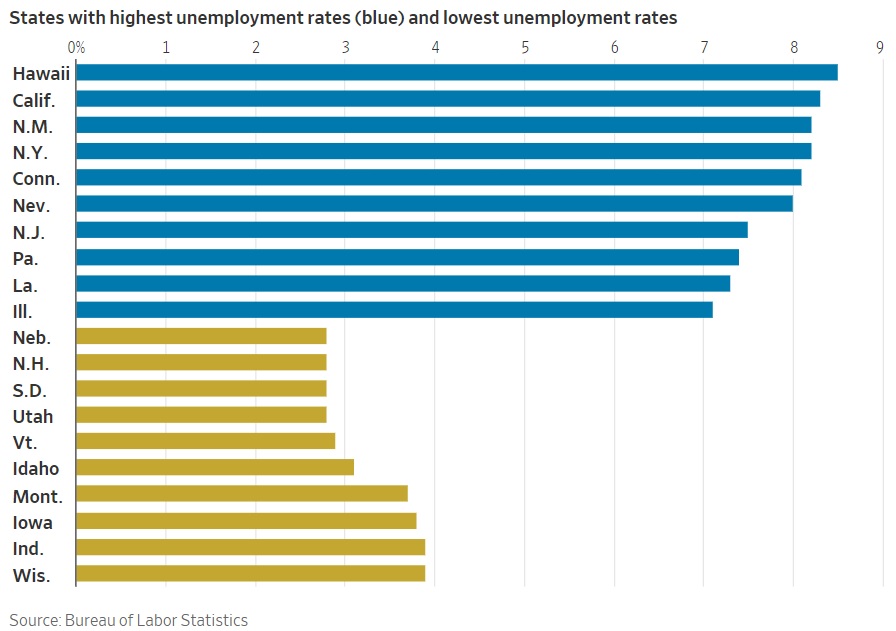
Today’s Wall Street Journal has an editorial on the gap between blue states and red states. This accompanying illustration shows that there is a clear relationship between joblessness and the degree to which states pursue big-government policies.

And here’s how the WSJ explained the big differences.

The unemployment rate in April nationwide was 6.1%, but this obscures giant variations in the states. With some exceptions, those run by Democrats such as California (8.3%) and New York (8.2%) continued to suffer significantly higher unemployment than those led by Republicans such as South Dakota (2.8%) and Montana (3.7%). It’s rare to see differences that are so stark based on party control in states.But the current partisan differences reflect different policy choices over the length and severity of pandemic lockdowns and now government benefits such as jobless insurance. Nine of the 10 states with the lowest unemployment rates are led by Republicans. The exception is Wisconsin whose Supreme Court last May invalidated Democratic Gov. Tony Evers’s lockdown. …Most states in the Midwest, South and Mountain West aren’t far off their pre-pandemic employment peaks. One obstacle to a faster recovery may be the $300 federal unemployment bonus, which many GOP governors are rejecting. Meantime, states with Democratic governments continue to reward workers for sitting on the couch. The longer that workers stay unemployed, the harder it will be to get them to return to work.

For what it’s worth, I’m more upset about the subsidized unemployment than the differences in lockdown policies, particularly because the former is more indicative of economic illiteracy.

P.S. One of the worst parts of Biden’s waste-filled stimulus planis that it gave a big bailout for states, based on a formula that actually rewarded them for having bad numbers.

P.P.S. Click here and here if you want to peruse comprehensive measures of state economic policy.

Sloppy or Dishonest Fiscal Analysis from the Washington Post

Good fiscal policy means low tax rates and spending restraint.

And that’s a big reason why I’m a fan of Reaganomics.

Unlike other modern presidents (including other Republicans), Reagan successfully reduced the tax burden while also limiting the burden of government spending.

President Biden wants to take the opposite approach.

A few days ago, Dan Balz of the Washington Post provided some “news analysis” about Biden’s fiscal agenda. Some of what he wrote was accurate, noting that the president wants to increase spending by an additional $6 trillion over the next 10 years.

…the scope and implications of his domestic agenda have come sharply into focus. Together they represent the most dramatic shift in federal economic and social welfare policy since Ronald Reagan was elected 40 years ago.…The politics of redistribution, which are at the heart of what Biden is proposing, could test decades of assumptions that Democrats should be afraid of being tagged as the party of big government. …Together, the already approved coronavirus relief plan, the infrastructure proposal that was unveiled a few weeks ago and the newly proposed plan to invest in social welfare programs would total roughly $6 trillion.

But Mr. Balz then decided to be either sloppy or dishonest, writing that we’ve had decades of Reagan-style policies that have squeezed domestic spending and disproportionately lowered tax burden for rich people.

Reagan’s small-government philosophy resulted in a decades-long squeeze on the federal government, especially domestic spending, and on tax policies that mainly benefited the wealthiest Americans. …Government spending on social safety-net programs has been reduced compared with previous years.

Balz is wrong, wildly wrong.

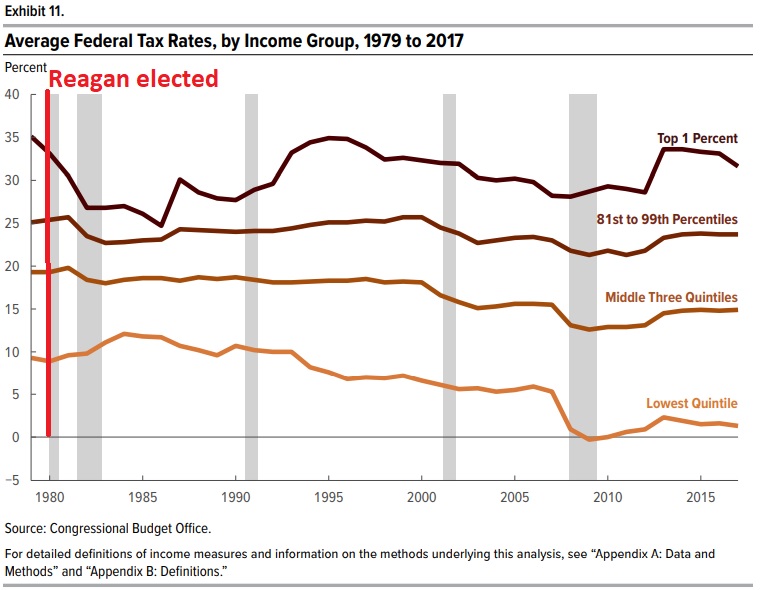
You don’t have to take my word for it. Here’s a chart, taken from an October 2020 report by the Congressional Budget Office. As you can see, people in the lowest income quintile have been the biggest winners,, with their average tax rate dropping from about 10 percent to about 2 percent..

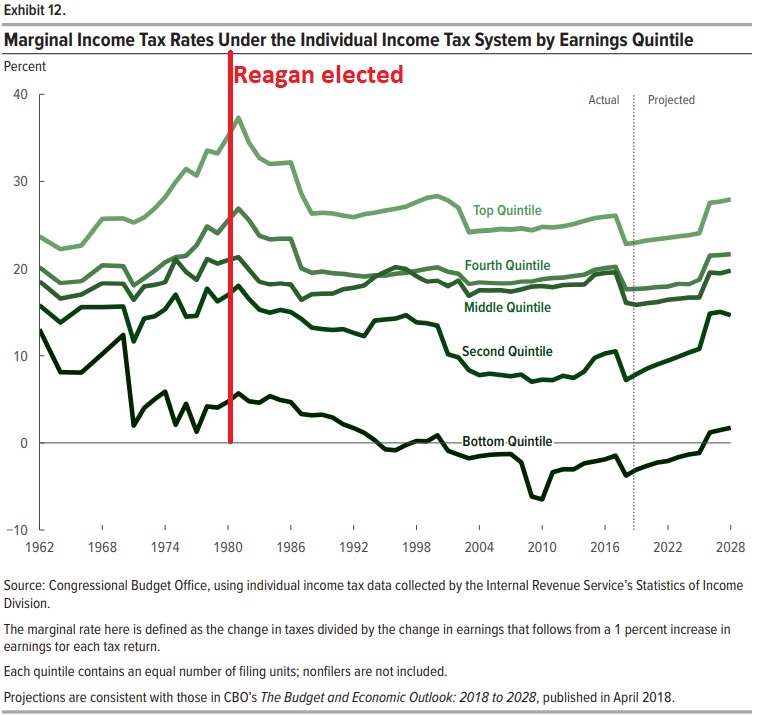
Here’s a chart showing marginal tax rates from a January 2019 CBO report. As you can see, Reagan lowered marginal tax rates for everyone, but Balz’s assertion that the rich got the lion’s share of the benefits is hard to justify considering that people in the bottom quintile now have negative marginal tax rates.

Balz’s mistakes on tax policy are significant.

But his biggest error (or worst dishonesty) occurred when he wrote about a “decades-long squeeze” on domestic spending and asserted that “spending on social safety-net programs has been reduced.”

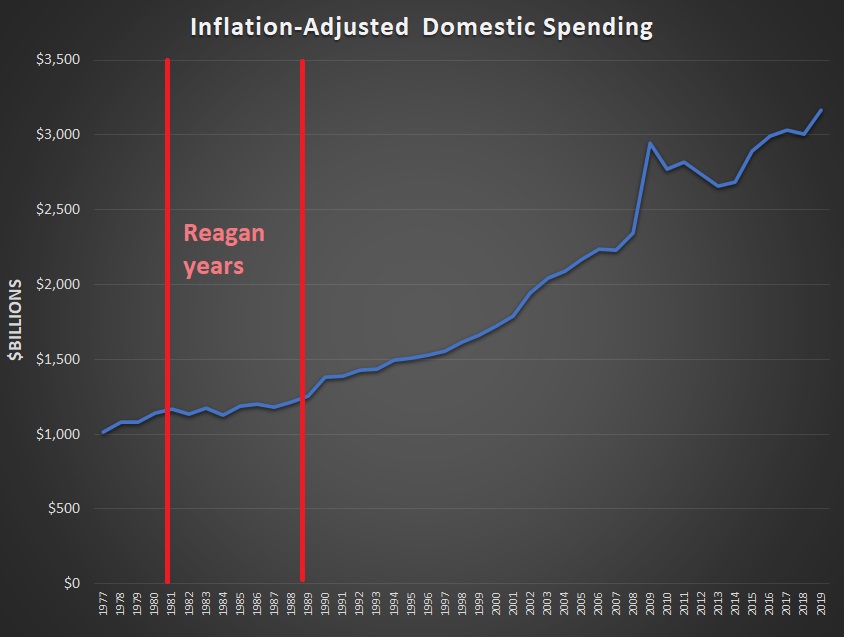
A quick visit to the Office of Management and Budget’s Historical Tables is all that’s needed to debunk this nonsense. Here’s a chart, based on Table 8.2, showing the inflation-adjusted growth of entitlements and domestic discretionary programs.

Call me crazy, but I’m seeing a rapid increase in domestic spending after Reagan left office.

P.S. There’s a pattern of lazy/dishonest fiscal reporting at the Washington Post.

P.P.S. I also can’t resist noting that Balz wrote how Biden wants to “invest” in social welfare programs, as if there’s some sort of positive return from creating more dependency. Reminds me of this Chuck Asay cartoon from the Obama years.

March 3, 2021

President Biden c/o The White House
1600 Pennsylvania Avenue NW
Washington, DC 20500

Dear Mr. President,

______________________________

Dan Mitchell shows how ignoring the Laffer Curve is like running a stop sign!!!!

I’m thinking of inventing a game, sort of a fiscal version of Pin the Tail on the Donkey.

Only the way it will work is that there will be a map of the world and the winner will be the blindfolded person who puts their pin closest to a nation such asAustralia or Switzerland that has a relatively low risk of long-run fiscal collapse.

That won’t be an easy game to win since we have data from the BISOECD, and IMF showing that government is growing far too fast in the vast majority of nations.

We also know that many states and cities suffer from the same problems.

A handful of local governments already have hit the fiscal brick wall, with many of them (gee, what a surprise) from California.

The most spectacular mess, though, is about to happen in Michigan.

The Washington Post reports that Detroit is on the verge of fiscal collapse.

After decades of sad and spectacular decline, it has come to this for Detroit: The city is $19 billion in debt and on the edge of becoming the nation’s largest municipal bankruptcy. An emergency manager says the city can make good on only a sliver of what it owes — in many cases just pennies on the dollar.

This is a dog-bites-man story. Detroit’s problems are the completely predictable result of excessive government. Just as statism explains the problems of Greece. And the problems of California. And the problems of Cyprus. And theproblems of Illinois.

I could continue with a long list of profligate governments, but you get the idea. Some of these governments are collapsing at a quicker pace and some at a slower pace. But all of them are in deep trouble because they don’t follow my Golden Rule about restraining the burden of government spending so that it grows slower than the private sector.

Detroit obviously is an example of a government that is collapsing sooner rather than later.

Why? Simply stated, as the size and scope of the public sector increased, that created very destructive economic and political dynamics.

More and more people got lured into the wagon of government dependency, which puts an ever-increasing burden on a shrinking pool of producers.

Meanwhile, organized interest groups such as government bureaucrats used their political muscle to extract absurdly excessive compensation packages, putting an even larger burden of the dwindling supply of taxpayers.

But that’s not the main focus of this post. Instead, I want to highlight a particular excerpt from the article and make a point about how too many people are blindly – perhaps willfully – ignorant of the Laffer Curve.

Check out this sentence.

Property tax collections are down 20 percent and income tax collections are down by more than a third in just the past five years — despite some of the highest tax rates in the state.

This is a classic “Fox Butterfield mistake,” which occurs when someone fails to recognize a cause-effect relationship. In this case, the reporter should have recognized that tax collections are down because Detroit has very high tax rates.

The city has a lot more problems than just high tax rates, of course, but can there be any doubt that productive people have very little incentive to earn and report taxable income in Detroit?

And that’s the essential insight of the Laffer Curve. Politicians can’t – or at least shouldn’t – assume that a 20 percent increase in tax rates will lead to a 20 percent increase in tax revenue. They also have to consider the degree to which a higher tax rate will cause a change in taxable income.

In some cases, higher tax rates will discourage people from earning more taxable income.

In some cases, higher tax rates will discourage people from reporting all the income they earn.

In some cases, higher tax rates will encourage people to utilize tax loopholes to shrink their taxable income.

In some cases, higher tax rates will encourage migration, thus causing taxable income to disappear.

Here’s my three-part video series on the Laffer Curve. Much of this is common sense, though it needs to be mandatory viewing for elected officials (as well as the bureaucrats at the Joint Committee on Taxation).

The Laffer Curve, Part I: Understanding the Theory

Uploaded by  on Jan 28, 2008

The Laffer Curve charts a relationship between tax rates and tax revenue. While the theory behind the Laffer Curve is widely accepted, the concept has become very controversial because politicians on both sides of the debate exaggerate. This video shows the middle ground between those who claim “all tax cuts pay for themselves” and those who claim tax policy has no impact on economic performance. This video, focusing on the theory of the Laffer Curve, is Part I of a three-part series. Part II reviews evidence of Laffer-Curve responses. Part III discusses how the revenue-estimating process in Washington can be improved. For more information please visit the Center for Freedom and Prosperity’s web site: http://www.freedomandprosperity.org

Part 2

Part 3

P.S. Just in case it’s not clear from the videos, we don’t want to be at the revenue-maximizing point on the Laffer Curve.

P.P.S. Amazingly, even the bureaucrats at the IMF recognize that there’s a point when taxes are so onerous that further increases don’t generate revenue.

P.P.P.S. At least CPAs understand the Laffer Curve, probably because they help their clients reduce their tax exposure to greedy governments.

P.P.P.P.S. I offered a Laffer Curve lesson to President Obama, but I doubt it had any impact.

___________________________

Thank you so much for your time. I know how valuable it is. I also appreciate the fine family that you have and your commitment as a father and a husband.

Sincerely,

Everette Hatcher III, 13900 Cottontail Lane, Alexander, AR 72002, ph 501-920-5733,

Williams with Sowell – Minimum Wage

Thomas Sowell

Thomas Sowell – Reducing Black Unemployment

By WALTER WILLIAMS

—-

Ronald Reagan with Milton Friedman
Milton Friedman The Power of the Market 2-5

Related posts:

Dan Mitchell: Question of the Week: Has the European Fiscal Crisis Ended?

We got to cut spending or we will be in a fiscal crisis like Greece!!! Question of the Week: Has the European Fiscal Crisis Ended? January 12, 2013 by Dan Mitchell I’ve frequently commented on Europe’s fiscal mess and argued that excessive government spending is responsible for both the sovereign debt crisis and the economic stagnation […]

Taxes made simple by Dan Mitchell of the Cato Institute

The Flat Tax: How it Works and Why it is Good for America Uploaded by afq2007 on Mar 29, 2010 This Center for Freedom and Prosperity Foundation video shows how the flat tax would benefit families and businesses, and also explains how this simple and fair system would boost economic growth and eliminate the special-interest […]

Cartoons from Dan Mitchell’s blog that demonstrate what Obama is doing to our economy (Obama’s out of control spending not helped by raising taxes on rich)

I have put up lots of cartoons from Dan Mitchell’s blog before and they have got lots of hits before. Many of them have dealt with the economy, eternal unemployment benefits, socialism,  Greece,  welfare state or on gun control. President Obama really does think that all his answers lie in raising taxes on the rich when the […]

Dan Mitchell of the Cato Institute gives overview of economic policy and he praises Clinton and Reagan

__________ President Reagan, Nancy Reagan, Tom Selleck, Dudley Moore, Lucille Ball at a Tribute to Bob Hope’s 80th birthday at the Kennedy Center. 5/20/83. __________________________ Dan Mitchell is very good at giving speeches and making it very simple to understand economic policy and how it affects a nation. Mitchell also talks about slowing the growth […]

Cartoons from Dan Mitchell’s blog that demonstrate what Obama is doing to our economy (cartoon on entitlements)

The Laffer Curve – Explained Uploaded by Eddie Stannard on Nov 14, 2011 This video explains the relationship between tax rates, taxable income, and tax revenue. The key lesson is that the Laffer Curve is not an all-or-nothing proposition, where we have to choose between the exaggerated claim that “all tax cuts pay for themselves” […]

Open letter to President Obama (Part 296) (Laffer curve strikes again!!)

President Obama c/o The White House 1600 Pennsylvania Avenue NW Washington, DC 20500 Dear Mr. President, I know that you receive 20,000 letters a day and that you actually read 10 of them every day. I really do respect you for trying to get a pulse on what is going on out here. The way […]

Open letter to President Obama (Part 282, How the Laffer Curve worked in the 20th century over and over again!!!)

Dan Mitchell does a great job explaining the Laffer Curve President Obama c/o The White House 1600 Pennsylvania Avenue NW Washington, DC 20500 Dear Mr. President, I know that you receive 20,000 letters a day and that you actually read 10 of them every day. I really do respect you for trying to get a […]

Laffer curve hits tax hikers pretty hard (includes cartoon)

I have put up lots of cartoons from Dan Mitchell’s blog before and they have got lots of hits before. Many of them have dealt with the economy, eternal unemployment benefits, socialism,  Greece,  welfare state or on gun control. Today’s cartoon deals with the Laffer curve. Revenge of the Laffer Curve…Again and Again and Again March 27, 2013 […]

Editorial cartoon from Dan Mitchell’s blog on California’s sorry state of affairs

I have put up lots of cartoons from Dan Mitchell’s blog before and they have got lots of hits before. Many of them have dealt with the sequester, economy, eternal unemployment benefits, socialism,  minimum wage laws, tax increases, social security, high taxes in California, Obamacare,  Greece,  welfare state or on gun control. President Obama’s favorite state must be California because […]

Portugal and the Laffer Curve

Class Warfare just don’t pay it seems. Why can’t we learn from other countries’ mistakes? Class Warfare Tax Policy Causes Portugal to Crash on the Laffer Curve, but Will Obama Learn from this Mistake? December 31, 2012 by Dan Mitchell Back in mid-2010, I wrote that Portugal was going to exacerbate its fiscal problems by raising […]

Political arguments against higher taxes from Dan Mitchell

Republicans would be stupid to raise taxes. Don’t Get Bamboozled by the Fiscal Cliff: Five Policy Reasons and Five Political Reasons Why Republicans Should Keep their No-Tax-Hike Promises December 6, 2012 by Dan Mitchell The politicians claim that they are negotiating about how best to reduce the deficit. That irks me because our fiscal problem is […]

President Obama ignores warnings about Laffer Curve

The Laffer Curve – Explained Uploaded by Eddie Stannard on Nov 14, 2011 This video explains the relationship between tax rates, taxable income, and tax revenue. The key lesson is that the Laffer Curve is not an all-or-nothing proposition, where we have to choose between the exaggerated claim that “all tax cuts pay for themselves” […]

Dan Mitchell looks at Obama’s tax record

Dan Mitchell’s article and the video from his organization takes a hard look at President Obama’s tax record. Dissecting Obama’s Record on Tax Policy October 30, 2012 by Dan Mitchell The folks at the Center for Freedom and Prosperity have been on a roll in the past few months, putting out an excellent series of videos […]

Dan Mitchell: “Romney is Right that You Can Lower Tax Rates and Reduce Tax Preferences without Hurting the Middle Class”

The Laffer Curve, Part I: Understanding the Theory Uploaded by afq2007 on Jan 28, 2008 The Laffer Curve charts a relationship between tax rates and tax revenue. While the theory behind the Laffer Curve is widely accepted, the concept has become very controversial because politicians on both sides of the debate exaggerate. This video shows […]

The Laffer Curve Wreaks Havoc in the United Kingdom

I got to hear Arthur Laffer speak back in 1981 and he predicted what would happen in the next few years with the Reagan tax cuts and he was right with every prediction. The Laffer Curve Wreaks Havoc in the United Kingdom July 1, 2012 by Dan Mitchell Back in 2010, I excoriated the new […]

By Everette Hatcher III | Posted in Cato Institute | Tagged  | Edit | Comments (0)

Dan Mitchell: Maryland to Texas, but Not Okay to Move from the United States to Singapore?

You can’t blame someone for leaving one state for another if they have a better an opportunity to make money. Maryland to Texas, but Not Okay to Move from the United States to Singapore? July 12, 2012 by Dan Mitchell I’ve commented before about entrepreneurs, investors, and small business owners migrating from high tax states such […]

Liberals act like the Laffer Curve does not exist.

Raising taxes will not work. Liberals act like the Laffer Curve does not exist. The Laffer Curve Shows that Tax Increases Are a Very Bad Idea – even if They Generate More Tax Revenue April 10, 2012 by Dan Mitchell The Laffer Curve is a graphical representation of the relationship between tax rates, tax revenue, and […]

Dan Mitchell shows why soak-the-rich tax policy does not work

Dan Mitchell of the Cato Institute shows why Obama’s plan to tax the rich will not solve our deficit problem.   Explaining in the New York Post Why Obama’s Soak-the-Rich Tax Policy Is Doomed to Failure April 17, 2012 by Dan Mitchell I think high tax rates on certain classes of citizens are immoral and discriminatory. If the […]

Dan Mitchell of the Cato Institute takes on liberals on PBS

You want the rich to pay more? Dan Mitchell observed:I explained that “rich” taxpayers declared much more income and paid much higher taxes after Reagan reduced the top tax rate from 70 percent to 28 percent. Liberals don’t understand good tax policies. Against 3-1 Odds, Promoting Good Tax Policy on Government TV April 12, 2012 by […]

Dan Mitchell of the Cato Institute takes on the Buffett Rule

Class warfare again from President Obama.  Rejecting the Buffett Rule and Fighting Obama’s Class Warfare on CNBC April 10, 2012 by Dan Mitchell I’ve already explained why Warren Buffett is either dishonest or clueless about tax policy. Today, on CNBC, I got to debate the tax scheme that President Obama has named after the Omaha investor. […]

By Everette Hatcher III | Posted in Cato InstituteTaxes | Edit | Comments (0)

RESPONDING TO HARRY KROTO’S BRILLIANT RENOWNED ACADEMICS!! PART 160 Part EE (It was my privilege to correspond with Charles Darwin’s grandson, the eminent professor Dr. Horace Barlow, Neuroscience, Cambridge, December 8, 1921-July 5, 2020) In my 31st letter on 3-18-20 I quote Francis Schaeffer who noted, “Darwin is saying that he gave up the New Testament because it was connected to the Old Testament. He gave up the Old Testament because it conflicted with his own theory. Did he have a real answer himself and the answer is no. At the end of his life we see that he is dehumanized by his position”

________________

Tribute to Horace Barlow

Bence Olveczky @BOlveczky

Horace remains a huge inspiration. He was an unparalleled mind in Neuroscience – a deep and clear thinker. He was generous, gracious and kind, and even took me (a noname PhD student) to the pub when I visited Cambridge 20 years ago. A life well lived. RIP Horace. This is a great interview with Horace Barlow and evokes a time when science was much more of an intellectual than a managerial endeavour.users.sussex.ac.uk/~philh/pubs/BA…

—-

March 18, 2020

Dr. Horace Barlow, Cambridge CB3 9AX, England
Dear Dr. Barlow,

I wanted to recommend a book to you that I thought you would really enjoy. It is the book “Why Darwin Matters” by the skeptic Michael Shermer. Let me share a portion of it with you:

In June of 2004, Frank Sulloway and I began a month-long expedition to retrace Charles Darwin’s footsteps in the Galapagos Islands. It turned out to be one of the most physically grueling experiences of my life, and having raced a bicycle across America five times that is saying something special about what the young British naturalist was able to accomplish there in 1835. Charles Darwin was not only one sagacious scientist; he was also one tenacious explorer.1

I fully appreciated Darwin’s doggedness when we hit the stark and barren lava fields on the island of San Cristóbal, the first place Darwin explored in the archipelago. With a sweltering equatorial sun and almost no fresh water, it isn’t long before 70-pound water-loaded packs begin to buckle knees and strain backs. Add hours of daily bushwacking through dense, scratchy vegetation and the romance of fieldwork quickly fades. At the end of one three-day excursion my water supply was so dangerously low that Frank and I collected the dew from the tents that had accumulated the night before. One day I sliced my left shin on a chunk of a’a lava, whose edges are like broken glass. Another day I was stung by a wasp that caused my face to nearly double in size. At the end of one particularly grueling climb through a moonscape-like area Darwin called the “craterized district,” we collapsed in utter exhaustion, muscles quivering and sweat pouring off our hands and faces, after which we read from Darwin’s diary, in which the naturalist described a similar excursion as “a long walk.”

Death permeates these islands. Animal carcasses are scattered hither and yon. The vegetation is coarse and scrappy. Dried and shriveled cacti trunks dot the bleak lava landscape that is so broken with razor sharp edges that moving across it is glacially slow. Many people have died there, from stranded sailors of centuries past to wanderlust tourists of recent years. Within days I had a deep sense of isolation and fragility. Without the protective blanket of civilization none of us are far from death. With precious little water and even less eatable foliage, organisms eek out a precarious living, their adaptations to this harsh environment selected over millions of years. A lifelong observer of and participant in the evolution-creation controversy, I was struck by how clear it is in these islands: creation by intelligent design is absurd. Why, then, did Darwin depart the Galápagos a creationist?

This is the question that Sulloway went there to answer. A historian of science and Darwin scholar, Frank has spent a lifetime reconstructing how Darwin pieced together the theory of evolution. The iconic myth is that Darwin became an evolutionist in the Galápagos when he discovered natural selection operating on finch beaks and tortoise carapaces, each species uniquely adapted by food type or island ecology. The legend endures, Sulloway notes, because of its elegant fit into a Joseph Campbell-like tripartite myth of the hero who

  1. leaves home on a great adventure (Darwin’s five-year voyage on the Beagle),
  2. endures immeasurable hardship in the quest for noble truths (Darwin suffered seasickness and other maladies), and
  3. returns to deliver a deep message (evolution).

The myth is ubiquitous, appearing in everything from biology textbooks to travel brochures, the latter of which inveigle potential customers to come walk in the footsteps of Darwin.

The Darwin Galápagos legend is emblematic of a broader myth that science proceeds by select eureka discoveries followed by sudden revolutionary revelations, where old theories fall before new facts. Not quite. Paradigms power percepts. Nine months after departing the Galápagos, Sulloway discovered, Darwin made the following entry in his ornithological catalogue about his mockingbird collection: “When I see these Islands in sight of each other, & possessed of but a scanty stock of animals, tenanted by these birds, but slightly differing in structure & filling the same place in Nature, I must suspect they are only varieties.” Similar varieties of fixed kinds, not evolution of separate species. Darwin was still a creationist! This explains why Darwin did not even bother to record the island locations of the few finches he collected (and in some cases mislabeled), and why these now-famous birds were never specifically mentioned in the Origin of Species.2

Through careful analysis of Darwin’s notes and journals, Sulloway dates Darwin’s acceptance of evolution to the second week of March, 1837, after a meeting Darwin had with the eminent ornithologist John Gould, who had been studying his Galápagos bird specimens. With access to museum ornithological collections from areas of South America that Darwin had not visited, Gould corrected a number of taxonomic errors Darwin had made (such as labeling two finch species a “Wren” and “Icterus”), and pointed out to him that although the land birds in the Galápagos were endemic to the islands, they were notably South American in character.

Darwin left the meeting with Gould, Sulloway concludes, convinced “beyond a doubt that transmutation must be responsible for the presence of similar but distinct species on the different islands of the Galápagos group. The supposedly immutable ‘species barrier’ had finally been broken, at least in Darwin’s own mind.” That July, 1837, Darwin opened his first notebook on Transmutation of Species. By 1844 he was confident enough write in a letter to his botanist friend and colleague Joseph Hooker: “I was so struck with distribution of Galapagos organisms &c &c, & with the character of the American fossil mammifers &c &c, that I determined to collect blindly every sort of fact which cd bear any way on what are species.” Five years at sea and nine years at home pouring through “heaps” of books led Darwin to admit: “At last gleams of light have come, & I am almost convinced, (quite contrary to opinion I started with) that species are not (it is like confessing a murder) immutable.”3


Like confessing a murder. Dramatic words for something as seemingly innocuous as a technical problem in biology: the immutability of species. But it doesn’t take a rocket scientist — or an English naturalist — to understand why the theory on the origin of species by means of natural selection would be so controversial: if new species are created naturally — not supernaturally — what place, then, for God? No wonder Darwin waited twenty years before publishing his theory.4

From the time of Plato and Aristotle in ancient Greece to the time of Darwin and Wallace in the nineteenth century, nearly everyone believed that a species retained a fixed and immutable “essence.” A species, in fact, was defined by its very essence — the characteristics that made it like no other species. The theory of evolution by means of natural selection, then, is the theory of how kinds can become other kinds, and that upset not only the scientific cart, but the cultural horse pulling it. The great Harvard evolutionary biologist, Ernst Mayr, stressed just how radical was Darwin’s theory: “The fixed, essentialistic species was the fortress to be stormed and destroyed; once this had been accomplished, evolutionary thinking rushed through the breach like a flood through a break in a dike.”5

The dike, however, was slow to crumble. Darwin’s close friend, the geologist Charles Lyell, withheld his support for a full nine years, and even then hinted at a providential design behind the whole scheme. The astronomer John Herschel called natural selection the “law of higgledy-piggledy.” And Adam Sedgwick, a geologist and Anglican cleric, proclaimed that natural selection was a moral outrage, and penned this ripping harangue to Darwin:

There is a moral or metaphysical part of nature as well as a physical. A man who denies this is deep in the mire of folly. You have ignored this link; and, if I do not mistake your meaning, you have done your best in one or two cases to break it. Were it possible (which thank God it is not) to break it, humanity, in my mind, would suffer a damage that might brutalize it, and sink the human race into a lower grade of degradation than any into which it has fallen since its written records tell us of its history.


….Like Confessing a murder. Like Darwin, that is precisely how I felt when I realized that my creationist beliefs were wrong and that evolution actually happened. I was a creationist from the time I became a born-again Christian in high school in 1971, through graduate school in 1977.9 The evangelical movement was just gathering momentum in the 1970s, and one of the central dogmas I took from it was that the biblical story of creation was to be taken literally; ergo, the theory of evolution had to be wrong.

Knowing next to nothing about evolution other than what I gleaned from reading creationist literature, I absorbed the arguments against the theory and practiced them on my undergraduate science and philosophy teachers. At Glendale College, where I attended for the first two years for General Education requirements, my debating skills were honed as my creationist arguments were met with firm evolutionist counterarguments. At Pepperdine University, a Church of Christ institution where I finished my undergraduate degree, evolution was a nonentity as I witnessed for Christ and studied the theological underpinnings of the Christian faith. When I arrived at Pepperdine, in fact, I considered theology as a profession, but when I discovered that a doctorate required proficiency in Hebrew, Greek, Latin, and Aramaic, and knowing that foreign languages were not my strong suit (I struggled through two years of high school Spanish), I switched to psychology and mastered one of the languages of science: statistics. By the time I matriculated at the California State University at Fullerton for graduate training in experimental psychology, I was ensconced in the ways of science.


Why does evolution matter? The influence of the theory of evolution on the general culture is so pervasive it can be summed up in a single observation: we live in the age of Darwin

In the memorable observation by Theodosius Dobzhansky: Nothing in biology makes sense except in the light of evolution.11

Darwin matters, not only because his theory changed the world and reconfigured our position in the cosmos, but because he was such a brilliant, creative, and thoughtful man. As Shakespeare wrote of another giant from another era (in Julius Caesar):

The elements So mix’d in him,
that Nature might stand up
And say to all the world,
“this was a man!”

__(End of quote from WHY DARWIN MATTERS)–

In the above passage you can see that Charles Darwin did not leave his creationist views behind while on his 5 year voyage on the Beagle, but he did a few years later. Francis Schaeffer said that he never totally came to peace with the idea that chance was responsible for it all, and he left his creationist views partly because they conflicted with his new theory. Below are some comments by Charles Darwin followed by commentary by Francis Schaeffer:

Charles Darwin:

“I am much engaged, an old man, and out of health, and I cannot spare time to answer your questions fully,—nor indeed can they be answered. Science has nothing to do with Christ, except in so far as the habit of scientific research makes a man cautious in admitting evidence. For myself, I do not believe that there ever has been any revelation.

Image result for charles darwin

Charles Darwin (1809-1882) pictured above

Image result for francis darwin

Francis Darwin (1848-1925) pictured above

Image result for francis schaeffer

Francis Schaeffer (1912-1984)

30:45 mark

Francis Schaeffer commented:

So he has come to the place as an old man that he doesn’t believe there has been any revelation. In his younger years he held a different position. He lost his position not on the basis of reason but simply that it disagreed with his theory and his presuppositions and he was forced to give it up.

The passages which here follow are extracts, somewhat abbreviated, from a part of the Autobiography, written in 1876, in which my father gives the history of his religious views:—

“During these two years* (ft note *October 1836 to January 1839.) I was led to think much about ([page] 58) religion. Whilst on board the Beagle I was quite orthodox, and I remember being heartily laughed at by several of the officers (though themselves orthodox) for quoting the Bible as an unanswerable authority on some point of morality.

Francis Schaeffer commented:

So you find that as a younger man he did accept the Bible. As an older man he has given up revelation but he is not satisfied with his own answers. He is caught in the tension that modern man is caught in. He is a prefiguration  of the modern man and he himself contributed to. Then Darwin goes on and tells us why he gave up the Bible.

GAVE UP ON HISTORICITY of OLD TESTAMENT

I suppose it was the novelty of the argument that amused them. But I had gradually come by this time, i.e. 1836 to 1836, to see that the Old Testament was no more to be trusted than the sacred books of the Hindoos. The question then continually rose before my mind and would not be banished,—is it credible that if God were now to make a revelation to the Hindoos, he would permit it to be connected with the belief in Vishnu, Siva, &c., as Christianity is connected with the Old Testament? This appeared to me utterly incredible.

Francis Schaeffer notes:

Darwin is saying that he gave up the New Testament because it was connected to the Old Testament. He gave up the Old Testament because it conflicted with his own theory. Did he have a real answer himself and the answer is no. At the end of his life we see that he is dehumanized by his position and on the other side we see that he never comes to the place of intellectual satisfaction for himself that his answers were sufficient.

Everette Hatcher, 13900 Cottontail Lane, Alexander, AR 72002, cell ph 501-920-5733, everettehatcher@gmail.com

PS: I hope you are doing well during this Coronavirus outbreak!!! My parents are in their 80’s and I have been encouraging them to stay inside!!! We just got our 37th case in Arkansas today and just a week ago we had our first case in the whole state!!! I see that the United Kingdom is up to 2,644 cases so far. I hope the trend lines are going down for the UK but the trend lines are going up for USA now I am told.

Xxxxx

I found Dr. Barlow to be a true gentleman and he was very kind to take the time to answer the questions that I submitted to him. In the upcoming months I will take time once a week to pay tribute to his life and reveal our correspondence. In the first week I noted:

 Today I am posting my first letter to him in February of 2015 which discussed Charles Darwin lamenting his loss of aesthetic tastes which he blamed on Darwin’s own dedication to the study of evolution. In a later return letter, Dr. Barlow agreed that Darwin did in fact lose his aesthetic tastes at the end of his life.

In the second week I look at the views of Michael Polanyi and share the comments of Francis Schaeffer concerning Polanyi’s views.

In the third week, I look at the life of Brandon Burlsworth in the November 28, 2016 letter and the movie GREATER and the problem of evil which Charles Darwin definitely had a problem with once his daughter died.

On the 4th letter to Dr. Barlow looks at Darwin’s admission that he at times thinks that creation appears to look like the expression of a mind. Francis Schaeffer discusses Darwin’s own words in 1968 sermon at this link.

My Fifth Letter concerning Charles Darwin’s views on MORAL MOTIONS Which was mailed on March 1, 2017. Francis Schaeffer discusses Darwin’s own words concerning moral motions in Schaeffer’s 1968 sermon at this link.

6th letter on May 1, 2017 in which Charles Darwin’s hopes are that someone would find in Pompeii an old manuscript by a distinguished Roman that would show that Christ existed! Francis Schaeffer discusses Darwin’s own words concerning the possible manuscript finds in Schaeffer’s 1968 sermon at this link  

7th letter on Darwin discussing DETERMINISM  dated 7-1-17 . Francis Schaeffer discusses Darwin’s own words concerning determinism in Schaeffer’s 1968 sermon at this link.

8th letter responds to Dr. Barlow’s letter to me concerning  Francis Schaeffer discussing Darwin’s own words concerning chance in Schaeffer’s 1968 sermon at this link.

9th letter in response to 11-22-17 letter I received from Professor Horace Barlow was mailed on 1-2-18 and included Charles Darwin’s comments on William Paley. Francis Schaeffer discusses Darwin’s own words concerning William Paley in Schaeffer’s 1968 sermon at this link.

10th letter in response to 11-22-17 letter I received from Professor Horace Barlow was mailed on 2-2-18 and includes Darwin’s comments asking for archaeological evidence for the Bible! Francis Schaeffer discusses Darwin’s own words concerning His desire to see archaeological evidence supporting the Bible’s accuracy  in Schaeffer’s 1968 sermon at this link.

11th letterI mailed on 3-2-18  in response to 11-22-17 letter from Barlow that asserted: It is also sometimes asked whether chance, even together with selection, can define a “MORAL CODE,” which the religiously inclined say is defined by their God. I think the answer is “Yes, it certainly can…” Francis Schaeffer discusses Darwin’s own words concerning A MORAL CODE in Schaeffer’s 1968 sermon at this link.

12th letter on March 26, 2018 breaks down song DUST IN THE WIND “All we do, crumbles to the ground though we refuse to see, Dust in the Wind, All we are is dust in the wind, Don’t hang on, Nothing lasts forever but the Earth and Sky, It slips away, And all your money won’t another minute buy.”

In 13th letter I respond to Barlow’s November 22, 2017 letter and assertion “He {Darwin} clearly did not lose his sense of the VALUE of TRUTH, and of the importance of FOREVER SEARCHING it out.”

In 14th letter to Dr. Barlow on 10-2-18, I assert: “Let me demonstrate how the Bible’s view of the origin of life fits better with the evidence we have from archaeology than that of gradual evolution.”

In 15th letter in November 2, 2018 to Dr. Barlow I quote his relative Randal Keynes Who in the Richard Dawkins special “The Genius of Darwin” makes this point concerning Darwin, “he was, at different times, enormously confident in it,
and at other times, he was utterly uncertain.”
In 16th Letter on 12-2-18 to Dr. Barlow I respond to his letter that stated, If I am pressed to say whether I think belief in God helps people to make wise and beneficial decisions I am bound to say (and I fear this will cause you pain) “No, it is often very disastrous, leading to violence, death and vile behaviour…Muslim terrorists…violence within the Christian church itself”
17th letter sent on January 2, 2019 shows the great advantage we have over Charles Darwin when examining the archaeological record concerning the accuracy of the Bible
In the 18th letter I respond to the comment by Charles Darwin: “My mind seems to have become a kind of machine for grinding general laws out of large collections of facts, but why this should have caused the atrophy of that part of the brain alone, on which the higher tastes depend, I cannot conceive….The loss of these tastes is a loss of happiness.” Francis Schaeffer discusses Darwin’s own words on his loss of aesthetic tastes  in Schaeffer’s 1968 sermon at this link.

In 19th letter on 2-2-19  I discuss Steven Weinberg’s words,  But if language is to be of any use to us, we ought to try to preserve the meanings of words, and “God” historically has not meant the laws of nature. It has meant an interested personality.

In the 20th letter on 3-2-19 I respond to Charles Darwin’s comment, “At the present day the most usual argument for the existence of an intelligent God is drawn from the deep [#1] inward conviction and feelings which are experienced by most persons...Formerly I was led by feelings such as those…to the firm conviction of the existence of God, and of the immortality of the soul. In my Journal I wrote that [#2] whilst standing in the midst of the grandeur of a Brazilian forest, ‘it is not possible to give an adequate idea of the higher feelings of wonder, admiration, and devotion which fill and elevate the mind.’ I well remember my conviction that there is more in man than the mere breath of his body. [#3] But now the grandest scenes would not cause any such convictions and feelings to rise in my mind. It may be truly said that I am like a man who has become colour-blind.” Francis Schaeffer discusses Darwin’s own words concerning his former belief in God in Schaeffer’s 1968 sermon at this link.

In the 21st letter on May 15, 2019 to Dr Barlow I discuss the writings of Francis Schaeffer who passed away the 35 years earlier on May 15, 1985. Francis Schaeffer discusses Darwin’s own words at length in Schaeffer’s 1968 sermon at this link.

In the 22nd letter I respond to Charles Darwin’s words, “I can indeed hardly see how anyone ought to wish Christianity to be true; for if so the plain language of the text seems to show that the men who do not believe…will be everlastingly punished. And this is a damnable doctrine.” Francis Schaeffer discusses Darwin’s own words about hell  in Schaeffer’s 1968 sermon at this link.

In 23rd postcard sent on 7-2-19 I asked Dr Barlow if he was a humanist. Sir Julian Huxley, founder of the American Humanist Association noted, “I use the word ‘humanist’ to mean someone who believes that man is just as much a natural phenomenon as an animal or plant; that his body, mind and soul were not supernaturally created but are products of evolution, and that he is not under the control or guidance of any supernatural being.”

In my 24th letter on 8-2-19 I quote Jerry  Bergman who noted Jean Louis Agassiz (1807-1873) is regarded as one of the greatest scientists of the 19th century. A founding father of the modern American scientific establishment, Agassiz was also a lifelong opponent of Charles Darwin’s theory of evolution. Agassiz “ruled in professorial majesty at Harvard’s Museum of Comparative Zoology.”

In my 25th letter on 9-2-19 I respond to Charles Darwin’s assertion,  “This argument would be a valid one if all men of ALL RACES had the SAME INWARD CONVICTION of the existence of one God; but we know that this is very far from being the case.” Francis Schaeffer discusses Darwin’s own words concerning MORAL MOTIONS in Schaeffer’s 1968 sermon at this link.

In my 26th letter on 10-2-19 I quoted Bertrand Russell’s daughter’s statement, “I believe myself that his whole life was a search for God…. Indeed, he had first taken up philosophy in hope of finding proof of the evidence of the existence of God … Somewhere at the back of my father’s mind, at the bottom of his heart, in the depths of his soul  there was an empty space that had once been filled by God, and he never found anything else to put in it”

In my 27th letter on 11-2-19 I disproved Richard Dawkins’ assertion, “Genesis says Abraham owned camels, but archaeological evidence shows that the camel was not domesticated until many centuries after Abraham.” Furthermore, I gave more evidence indicating the Bible is historically accurate. 

In my 28th letter on 12-2-19 I respond to Charles Darwin’s statement, “I am glad you were at the Messiah, it is the one thing that I should like to hear again, but I dare say I should find my soul too dried up to appreciate it as in old days; and then I should feel very flat, for it is a horrid bore to feel as I constantly do, that I am a withered leaf for every subject except Science. It sometimes makes me hate Science.” Francis Schaeffer discusses Darwin’s own words concerning MORAL MOTIONS in Schaeffer’s 1968 sermon at this link.

In my 29th letter on 12-25-19 I responded to Charles Darwin’s statement, “I have said that in one respect my mind has changed during the last twenty or thirty years. Up to the age of thirty, or beyond it, poetry of many kinds…gave me great pleasure, and even as a schoolboy I took intense delight in Shakespeare, especially in the historical plays. I have also said that formerly pictures gave me considerable, and music very great delight. But now for many years I cannot endure to read a line of poetry: I have tried lately to read Shakespeare, and found it so intolerably dullthat it nauseated me…. My mind seems to have become a kind of machine for grinding general laws out of large collections of facts, but why this should have caused the atrophy of that part of the brain alone, on which the higher tastes depend, I cannot conceive… The loss of these tastes is a loss of happiness…” Francis Schaeffer discusses Darwin’s own words concerning his loss of aesthetic tastes in Schaeffer’s 1968 sermon at this link.

In my 30th letter on 2-2-20 I quote Dustin Shramek who asserted, “Without God the universe is the result of a cosmic accident, a chance explosion. There is no reason for which it exist. As for man, he is a freak of nature–a blind product of matter plus time plus chance. Man is just a lump of slime that evolved into rationality. There is no more purpose in life for the human race than for a species of insect; for both are the result of the blind interaction of chance and necessity.”

IIn my 31st letter on 3-18-20 I quote Francis Schaeffer who noted, “Darwin is saying that he gave up the New Testament because it was connected to the Old Testament. He gave up the Old Testament because it conflicted with his own theory. Did he have a real answer himself and the answer is no. At the end of his life we see that he is dehumanized by his position and on the other side we see that he never comes to the place of intellectual satisfaction for himself that his answers were sufficient.” Francis Schaeffer discusses Darwin’s own words concerning his loss of his Christian faith in Schaeffer’s 1968 sermon at this link.

Horace Barlow pictured below:

_____________

On November 21, 2014 I received a letter from Nobel Laureate Harry Kroto and it said:

…Please click on this URL http://vimeo.com/26991975

and you will hear what far smarter people than I have to say on this matter. I agree with them.

Harry Kroto

Image result for harry kroto

__________________________

There are 3 videos in this series and they have statements by 150 academics and scientists and I hope to respond to all of them. Wikipedia notes Horace Basil Barlow FRS was a British visual neuroscientist.

Barlow was the son of the civil servant Sir Alan Barlow and his wife Lady Nora (née Darwin), and thus the great-grandson of Charles Darwin (see Darwin — Wedgwood family). He earned an M.D. at Harvard University in 1946.

In 1953 Barlow discovered that the frog brain has neurons which fire in response to specific visual stimuli. This was a precursor to the work of Hubel and Wiesel on visual receptive fields in the visual cortex. He has made a long study of visual inhibition, the process whereby a neuron firing in response to one group of retinal cells can inhibit the firing of another neuron; this allows perception of relative contrast.

In 1961 Barlow wrote a seminal article where he asked what the computational aims of the visual system are. He concluded that one of the main aims of visual processing is the reduction of redundancy. While the brightnesses of neighbouring points in images are usually very similar, the retina reduces this redundancy. His work thus was central to the field of statistics of natural scenes that relates the statistics of images of real world scenes to the properties of the nervous system.

Barlow and his co-workers also did substantial work in the field of factorial codes. The goal was to encode images with statistically redundant components or pixels such that the code components are statistically independent. Such codes are hard to find but highly useful for purposes of image classification etc.

Barlow was a fellow of Trinity College, University of Cambridge. He was elected a Fellow of the Royal Society in 1969 and was awarded their Royal Medal in 1993.[1] He received the 1993 Australia Prize for his research into the mechanisms of visual perception and the 2009 Swartz Prize for Theoretical and Computational Neuroscience from the Society for Neuroscience.

________________

His comments can be found on the 3rd video and the 128th clip in this series. Below the videos you will find his words.

50 Renowned Academics Speaking About God (Part 1)

Another 50 Renowned Academics Speaking About God (Part 2)

A Further 50 Renowned Academics Speaking About God (Part 3)

_______________

Interview of Horace Barlow – part 1

Published on Jun 18, 2014

Interviewed and filmed by Alan Macfarlane on 5 March 2012

______________________

Interview of Horace Barlow – part 2

Horace Barlow’s quote taken from interview with Alan Macfarlane:

HAS RELIGION EVER BEEN IMPORTANT TO YOU? IS IT IMPORTANT TO YOU? No, it is not important to me. Saying you don’t believe in God is a very foolish thing to say as it doesn’t explain why so many people talk about it, there has got to be more to it than that; also I think one has to respect what some godly people say and some of the things they do; I wish one could make more sense of it but I don’t think the godly people have done a very good job; I was never baptized or confirmed so have never been a practitioner, and I don’t miss it; DO YOU THINK THAT SCIENCE HAS DIS-PROVEN RELIGION AS DAWKINS ARGUES? I think it [science] provides some hope of acting rationally to handle the social and political problems we have to deal with on a personal level and one a worldwide level. Religion is a way of perpetuating a way of thought that might have otherwise been lost, and I imagine that is fine.   

Dr. Barlow’s only three solid claims in this response to Alan Macfarlane is that science is #1 the best help today with our social problems,(which is in the original clip), #2 Saying you don’t believe in God (position of atheism) is foolish, and #3 we need an explanation for why so many people talk about [God.]

My response to #1 is to look at how the secular humanists have messed up so many things in the past and I include Barlow’s personal family friend Margaret Mead in that. My responses to #2 and #3 were both covered in my earlier response to Roald Hoffmann

(Roald Hoffmann is a Nobel Prize winner who I have had the honor of corresponding with in the past. Pictured below)

Image result for Roald Hoffmann.

(This July 1933 photo shows [left to right] anthropologist Gregory Bateson with Margaret Mead)

Image result for margaret mead husband

Horace Barlow’s words  from interview conducted by Alan Macfarlane:

I don’t ever remember going to Bateson’s house in Granchester as a child; William Bateson’s wife was a friend of my mother’s; when Gregory Bateson was out in Bali he met Margaret Mead; Beatrice Bateson, his mother, felt she was too old to go out and inspect her so she sent my mother instead; she flew off in an Imperial Airlines plane and we saw her off from Hendon; that must have been 1937-8; my mother got on very well with Margaret Mead – she was not altogether convinced by her, but very impressed by her breadth of knowledge and energy; she came and stayed with us many times; I was even more sceptical than my mother and thought she was a very impressive person; Gregory was born 1904 and my mother, in 1886, so there was quite a big age difference between them; I never got on close intellectual terms with Gregory even though we were to some extent interested in the same sort of thing, both in cybernetics and psychology, and his ideas were always interesting; however, my model of a scientist was taken from my mother and not from Gregory; my mother was interested in genetics and the paper for which she was famous was on the reproductive system in plants like cowslips; my mother reasoned like a scientist whereas Gregory was a guru – he liked to think things out for himself; he obviously influenced many others too; I saw him once or twice when I went to Berkeley

Postscript:

I was sad to see that Jon Stewart is stepping down from the DAILY SHOW so I wanted to include one of the best clips I have ever seen on his show and it is a short debate between the brilliant scientists  Edward J. Larson (an evolutionist), William A. Dembski (an Intelligent Design Proponent), and then he threw in a nutball in for laughs,  Ellie Crystal (a metaphysical theorist). Dembski gives several great examples of design and it reminded me of many of the words of Darwin show above in my letter to Horace Barlow.

William Dembski on The Jon Stewart Show

Uploaded on Nov 15, 2010

Wednesday September 14, 2005 – Jon Stewart’s “Evolution, Schmevolution” segment with panelists Edward J. Larson (an evolutionist), William A. Dembski (an Intelligent Design Proponent), and Ellie Crystal (a metaphysical theorist).

—-

—-

Related posts:

Taking on Ark Times Bloggers on various issues Part F “Carl Sagan’s views on how God should try and contact us” includes film “The Basis for Human Dignity”

I have gone back and forth and back and forth with many liberals on the Arkansas Times Blog on many issues such as abortion, human rights, welfare, poverty, gun control  and issues dealing with popular culture. Here is another exchange I had with them a while back. My username at the Ark Times Blog is Saline […]

Carl Sagan v. Nancy Pearcey

On March 17, 2013 at our worship service at Fellowship Bible Church, Ben Parkinson who is one of our teaching pastors spoke on Genesis 1. He spoke about an issue that I was very interested in. Ben started the sermon by reading the following scripture: Genesis 1-2:3 English Standard Version (ESV) The Creation of the […]

Review of Carl Sagan book (Part 4 of series on Evolution)

Review of Carl Sagan book (Part 4 of series on Evolution) The Long War against God-Henry Morris, part 5 of 6 Uploaded by FLIPWORLDUPSIDEDOWN3 on Aug 30, 2010 http://www.icr.org/ http://store.icr.org/prodinfo.asp?number=BLOWA2http://store.icr.org/prodinfo.asp?number=BLOWASGhttp://www.fliptheworldupsidedown.com/blog _______________________ I got this from a blogger in April of 2008 concerning candidate Obama’s view on evolution: Q: York County was recently in the news […]

Review of Carl Sagan book (Part 3 of series on Evolution)

Review of Carl Sagan book (Part 3 of series on Evolution) The Long War against God-Henry Morris, part 4 of 6 Uploaded by FLIPWORLDUPSIDEDOWN3 on Aug 30, 2010 http://www.icr.org/ http://store.icr.org/prodinfo.asp?number=BLOWA2http://store.icr.org/prodinfo.asp?number=BLOWASGhttp://www.fliptheworldupsidedown.com/blog______________________________________ I got this from a blogger in April of 2008 concerning candidate Obama’s view on evolution: Q: York County was recently in the news […]

Carl Sagan versus RC Sproul

At the end of this post is a message by RC Sproul in which he discusses Sagan. Over the years I have confronted many atheists. Here is one story below: I really believe Hebrews 4:12 when it asserts: For the word of God is living and active and sharper than any two-edged sword, and piercing as far as the […]

Review of Carl Sagan book (Part 4 of series on Evolution)jh68

Review of Carl Sagan book (Part 4 of series on Evolution) The Long War against God-Henry Morris, part 5 of 6 Uploaded by FLIPWORLDUPSIDEDOWN3 on Aug 30, 2010 http://www.icr.org/ http://store.icr.org/prodinfo.asp?number=BLOWA2http://store.icr.org/prodinfo.asp?number=BLOWASGhttp://www.fliptheworldupsidedown.com/blog _______________________ This is a review I did a few years ago. THE DEMON-HAUNTED WORLD: Science as a Candle in the Dark by Carl […]

Review of Carl Sagan book (Part 3 of series on Evolution)

Review of Carl Sagan book (Part 3 of series on Evolution) The Long War against God-Henry Morris, part 4 of 6 Uploaded by FLIPWORLDUPSIDEDOWN3 on Aug 30, 2010 http://www.icr.org/ http://store.icr.org/prodinfo.asp?number=BLOWA2http://store.icr.org/prodinfo.asp?number=BLOWASGhttp://www.fliptheworldupsidedown.com/blog______________________________________ I was really enjoyed this review of Carl Sagan’s book “Pale Blue Dot.” Carl Sagan’s Pale Blue Dot by Larry Vardiman, Ph.D. […]

Atheists confronted: How I confronted Carl Sagan the year before he died jh47

In today’s news you will read about Kirk Cameron taking on the atheist Stephen Hawking over some recent assertions he made concerning the existence of heaven. Back in December of 1995 I had the opportunity to correspond with Carl Sagan about a year before his untimely death. Sarah Anne Hughes in her article,”Kirk Cameron criticizes […]

My correspondence with George Wald and Antony Flew!!!

FRANCIS SCHAEFFER ANALYZES ART AND CULTURE Part 41 Sarvepalli Radhakrishnan (Featured artist is Marina Abramović)

FRANCIS SCHAEFFER ANALYZES ART AND CULTURE Part 40 Timothy Leary (Featured artist is Margaret Keane)

FRANCIS SCHAEFFER ANALYZES ART AND CULTURE Part 39 Tom Wolfe (Featured artist is Richard Serra)

FRANCIS SCHAEFFER ANALYZES ART AND CULTURE Part 38 Woody Allen and Albert Camus “There is but one truly serious philosophical problem, and that is suicide” (Feature on artist Hamish Fulton Photographer )

FRANCIS SCHAEFFER ANALYZES ART AND CULTURE Part 37 Mahatma Gandhi and “Relieving the Tension in the East” (Feature on artist Luc Tuymans)

FRANCIS SCHAEFFER ANALYZES ART AND CULTURE Part 36 Julian Huxley:”God does not in fact exist, but act as if He does!” (Feature on artist Barry McGee)

FRANCIS SCHAEFFER ANALYZES ART AND CULTURE Part 35 Robert M. Pirsig (Feature on artist Kerry James Marshall)

FRANCIS SCHAEFFER ANALYZES ART AND CULTURE Part 34 Aleksandr Solzhenitsyn (Feature on artist Shahzia Sikander)

FRANCIS SCHAEFFER ANALYZES ART AND CULTURE Part 33 Aldous Huxley (Feature on artist Matthew Barney )

FRANCIS SCHAEFFER ANALYZES ART AND CULTURE Part 32 Steven Weinberg and Woody Allen and “The Meaningless of All Things” (Feature on photographer Martin Karplus )

FRANCIS SCHAEFFER ANALYZES ART AND CULTURE Part 31 David Hume and “How do we know we know?” (Feature on artist William Pope L. )

FRANCIS SCHAEFFER ANALYZES ART AND CULTURE Part 30 Rene Descartes and “How do we know we know?” (Feature on artist Olafur Eliasson)

FRANCIS SCHAEFFER ANALYZES ART AND CULTURE Part 29 W.H. Thorpe and “The Search for an Adequate World-View: A Question of Method” (Feature on artist Jeff Koons)

FRANCIS SCHAEFFER ANALYZES ART AND CULTURE Part 28 Woody Allen and “The Mannishness of Man” (Feature on artist Ryan Gander)

FRANCIS SCHAEFFER ANALYZES ART AND CULTURE Part 27 Jurgen Habermas (Featured artist is Hiroshi Sugimoto)

FRANCIS SCHAEFFER ANALYZES ART AND CULTURE Part 26 Bettina Aptheker (Featured artist is Krzysztof Wodiczko)

FRANCIS SCHAEFFER ANALYZES ART AND CULTURE Part 25 BOB DYLAN (Part C) Francis Schaeffer comments on Bob Dylan’s song “Ballad of a Thin Man” and the disconnect between the young generation of the 60’s and their parents’ generation (Feature on artist Fred Wilson)

FRANCIS SCHAEFFER ANALYZES ART AND CULTURE Part 24 BOB DYLAN (Part B) Francis Schaeffer comments on Bob Dylan’s words from HIGHWAY 61 REVISITED!! (Feature on artist Susan Rothenberg)

FRANCIS SCHAEFFER ANALYZES ART AND CULTURE Part 23 BOB DYLAN (Part A) (Feature on artist Josiah McElheny)Francis Schaeffer on the proper place of rebellion with comments by Bob Dylan and Samuel Rutherford
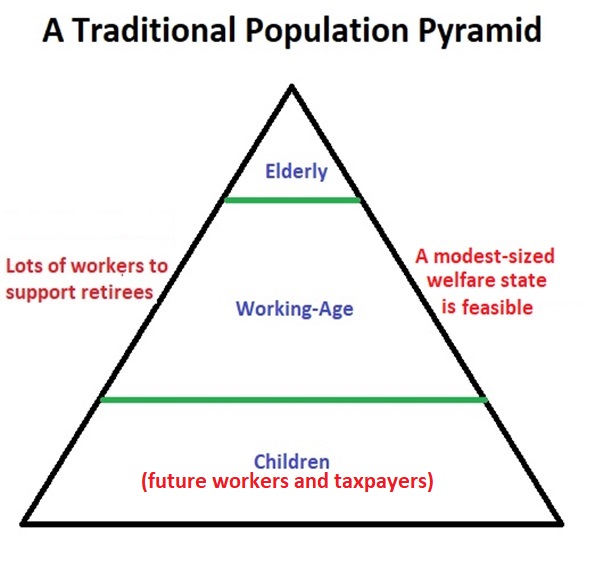
FRANCIS SCHAEFFER ANALYZES ART AND CULTURE Part 22 “The School of Athens by Raphael” (Feature on the artist Sally Mann)

FRANCIS SCHAEFFER ANALYZES ART AND CULTURE Part 21 William B. Provine (Feature on artist Andrea Zittel)

FRANCIS SCHAEFFER ANALYZES ART AND CULTURE Part 20 Woody Allen and Materialistic Humanism: The World-View of Our Era (Feature on artist Ida Applebroog)

FRANCIS SCHAEFFER ANALYZES ART AND CULTURE Part 19 Movie Director Luis Bunuel (Feature on artist Oliver Herring)

FRANCIS SCHAEFFER ANALYZES ART AND CULTURE Part 18 “Michelangelo’s DAVID is the statement of what humanistic man saw himself as being tomorrow” (Feature on artist Paul McCarthy)

FRANCIS SCHAEFFER ANALYZES ART AND CULTURE Part 17 Francis Schaeffer discusses quotes of Andy Warhol from “The Observer June 12, 1966″ Part C (Feature on artist David Hockney plus many pictures of Warhol with famous friends)

FRANCIS SCHAEFFER ANALYZES ART AND CULTURE Part 16 Francis Schaeffer discusses quotes of Andy Warhol from “The Observer June 12, 1966″ Part B (Feature on artist James Rosenquist plus many pictures of Warhol with famous friends)

FRANCIS SCHAEFFER ANALYZES ART AND CULTURE Part 15 Francis Schaeffer discusses quotes of Andy Warhol from “The Observer June 12, 1966″ Part A (Feature on artist Robert Indiana plus many pictures of Warhol with famous friends)

FRANCIS SCHAEFFER ANALYZES ART AND CULTURE Part 14 David Friedrich Strauss (Feature on artist Roni Horn )

FRANCIS SCHAEFFER ANALYZES ART AND CULTURE Part 13 Jacob Bronowski and Materialistic Humanism: The World-View of Our Era (Feature on artist Ellen Gallagher )

FRANCIS SCHAEFFER ANALYZES ART AND CULTURE Part 12 H.J.Blackham and Materialistic Humanism: The World-View of Our Era (Feature on artist Arturo Herrera)

FRANCIS SCHAEFFER ANALYZES ART AND CULTURE Part 11 Thomas Aquinas and his Effect on Art and HOW SHOULD WE THEN LIVE? Episode 2: THE MIDDLES AGES (Feature on artist Tony Oursler )

FRANCIS SCHAEFFER ANALYZES ART AND CULTURE Part 10 David Douglas Duncan (Feature on artist Georges Rouault )

FRANCIS SCHAEFFER ANALYZES ART AND CULTURE Part 9 Jasper Johns (Feature on artist Cai Guo-Qiang )

FRANCIS SCHAEFFER ANALYZES ART AND CULTURE Part 8 “The Last Year at Marienbad” by Alain Resnais (Feature on artist Richard Tuttle and his return to the faith of his youth)

FRANCIS SCHAEFFER ANALYZES ART AND CULTURE Part 7 Jean Paul Sartre (Feature on artist David Hooker )

FRANCIS SCHAEFFER ANALYZES ART AND CULTURE Part 6 The Adoration of the Lamb by Jan Van Eyck which was saved by MONUMENT MEN IN WW2 (Feature on artist Makoto Fujimura)

FRANCIS SCHAEFFER ANALYZES ART AND CULTURE Part 5 John Cage (Feature on artist Gerhard Richter)

FRANCIS SCHAEFFER ANALYZES ART AND CULTURE Part 4 ( Schaeffer and H.R. Rookmaaker worked together well!!! (Feature on artist Mike Kelley Part B )

FRANCIS SCHAEFFER ANALYZES ART AND CULTURE Part 3 PAUL GAUGUIN’S 3 QUESTIONS: “Where do we come from? What art we? Where are we going? and his conclusion was a suicide attempt” (Feature on artist Mike Kelley Part A)

FRANCIS SCHAEFFER ANALYZES ART AND CULTURE Part 2 “A look at how modern art was born by discussing Monet, Renoir, Pissaro, Sisley, Degas,Cezanne, Van Gogh, Gauguin, Seurat, and Picasso” (Feature on artist Peter Howson)

FRANCIS SCHAEFFER ANALYZES ART AND CULTURE Part 1 HOW SHOULD WE THEN LIVE? “The Roman Age” (Feature on artist Tracey Emin)

_________________

___

Dan Mitchell: Red States vs Blue States, Part II

Red States vs Blue States, Part II

Last year, I compared the economic performance of red states and blue states.

My big takeaway from that column is that we should pay attention to the data on internal migration. More specifically, there’s a reason why Americans have been moving from high-tax states to low-tax states.

Today’s let’s follow up on that discussion.

Today’s Wall Street Journal has an editorial on the gap between blue states and red states. This accompanying illustration shows that there is a clear relationship between joblessness and the degree to which states pursue big-government policies.

And here’s how the WSJ explained the big differences.

The unemployment rate in April nationwide was 6.1%, but this obscures giant variations in the states. With some exceptions, those run by Democrats such as California (8.3%) and New York (8.2%) continued to suffer significantly higher unemployment than those led by Republicans such as South Dakota (2.8%) and Montana (3.7%). It’s rare to see differences that are so stark based on party control in states.But the current partisan differences reflect different policy choices over the length and severity of pandemic lockdowns and now government benefits such as jobless insurance. Nine of the 10 states with the lowest unemployment rates are led by Republicans. The exception is Wisconsin whose Supreme Court last May invalidated Democratic Gov. Tony Evers’s lockdown. …Most states in the Midwest, South and Mountain West aren’t far off their pre-pandemic employment peaks. One obstacle to a faster recovery may be the $300 federal unemployment bonus, which many GOP governors are rejecting. Meantime, states with Democratic governments continue to reward workers for sitting on the couch. The longer that workers stay unemployed, the harder it will be to get them to return to work.

For what it’s worth, I’m more upset about the subsidized unemployment than the differences in lockdown policies, particularly because the former is more indicative of economic illiteracy.

P.S. One of the worst parts of Biden’s waste-filled stimulus planis that it gave a big bailout for states, based on a formula that actually rewarded them for having bad numbers.

P.P.S. Click here and here if you want to peruse comprehensive measures of state economic policy.

Sloppy or Dishonest Fiscal Analysis from the Washington Post

Good fiscal policy means low tax rates and spending restraint.

And that’s a big reason why I’m a fan of Reaganomics.

Unlike other modern presidents (including other Republicans), Reagan successfully reduced the tax burden while also limiting the burden of government spending.

President Biden wants to take the opposite approach.

A few days ago, Dan Balz of the Washington Post provided some “news analysis” about Biden’s fiscal agenda. Some of what he wrote was accurate, noting that the president wants to increase spending by an additional $6 trillion over the next 10 years.

…the scope and implications of his domestic agenda have come sharply into focus. Together they represent the most dramatic shift in federal economic and social welfare policy since Ronald Reagan was elected 40 years ago.…The politics of redistribution, which are at the heart of what Biden is proposing, could test decades of assumptions that Democrats should be afraid of being tagged as the party of big government. …Together, the already approved coronavirus relief plan, the infrastructure proposal that was unveiled a few weeks ago and the newly proposed plan to invest in social welfare programs would total roughly $6 trillion.

But Mr. Balz then decided to be either sloppy or dishonest, writing that we’ve had decades of Reagan-style policies that have squeezed domestic spending and disproportionately lowered tax burden for rich people.

Reagan’s small-government philosophy resulted in a decades-long squeeze on the federal government, especially domestic spending, and on tax policies that mainly benefited the wealthiest Americans. …Government spending on social safety-net programs has been reduced compared with previous years.

Balz is wrong, wildly wrong.

You don’t have to take my word for it. Here’s a chart, taken from an October 2020 report by the Congressional Budget Office. As you can see, people in the lowest income quintile have been the biggest winners,, with their average tax rate dropping from about 10 percent to about 2 percent..

Here’s a chart showing marginal tax rates from a January 2019 CBO report. As you can see, Reagan lowered marginal tax rates for everyone, but Balz’s assertion that the rich got the lion’s share of the benefits is hard to justify considering that people in the bottom quintile now have negative marginal tax rates.

Balz’s mistakes on tax policy are significant.

But his biggest error (or worst dishonesty) occurred when he wrote about a “decades-long squeeze” on domestic spending and asserted that “spending on social safety-net programs has been reduced.”

A quick visit to the Office of Management and Budget’s Historical Tables is all that’s needed to debunk this nonsense. Here’s a chart, based on Table 8.2, showing the inflation-adjusted growth of entitlements and domestic discretionary programs.

Call me crazy, but I’m seeing a rapid increase in domestic spending after Reagan left office.

P.S. There’s a pattern of lazy/dishonest fiscal reporting at the Washington Post.

P.P.S. I also can’t resist noting that Balz wrote how Biden wants to “invest” in social welfare programs, as if there’s some sort of positive return from creating more dependency. Reminds me of this Chuck Asay cartoon from the Obama years.

March 3, 2021

President Biden c/o The White House
1600 Pennsylvania Avenue NW
Washington, DC 20500

Dear Mr. President,

______________________________

Dan Mitchell shows how ignoring the Laffer Curve is like running a stop sign!!!!

I’m thinking of inventing a game, sort of a fiscal version of Pin the Tail on the Donkey.

Only the way it will work is that there will be a map of the world and the winner will be the blindfolded person who puts their pin closest to a nation such asAustralia or Switzerland that has a relatively low risk of long-run fiscal collapse.

That won’t be an easy game to win since we have data from the BISOECD, and IMF showing that government is growing far too fast in the vast majority of nations.

We also know that many states and cities suffer from the same problems.

A handful of local governments already have hit the fiscal brick wall, with many of them (gee, what a surprise) from California.

The most spectacular mess, though, is about to happen in Michigan.

The Washington Post reports that Detroit is on the verge of fiscal collapse.

After decades of sad and spectacular decline, it has come to this for Detroit: The city is $19 billion in debt and on the edge of becoming the nation’s largest municipal bankruptcy. An emergency manager says the city can make good on only a sliver of what it owes — in many cases just pennies on the dollar.

This is a dog-bites-man story. Detroit’s problems are the completely predictable result of excessive government. Just as statism explains the problems of Greece. And the problems of California. And the problems of Cyprus. And theproblems of Illinois.

I could continue with a long list of profligate governments, but you get the idea. Some of these governments are collapsing at a quicker pace and some at a slower pace. But all of them are in deep trouble because they don’t follow my Golden Rule about restraining the burden of government spending so that it grows slower than the private sector.

Detroit obviously is an example of a government that is collapsing sooner rather than later.

Why? Simply stated, as the size and scope of the public sector increased, that created very destructive economic and political dynamics.

More and more people got lured into the wagon of government dependency, which puts an ever-increasing burden on a shrinking pool of producers.

Meanwhile, organized interest groups such as government bureaucrats used their political muscle to extract absurdly excessive compensation packages, putting an even larger burden of the dwindling supply of taxpayers.

But that’s not the main focus of this post. Instead, I want to highlight a particular excerpt from the article and make a point about how too many people are blindly – perhaps willfully – ignorant of the Laffer Curve.

Check out this sentence.

Property tax collections are down 20 percent and income tax collections are down by more than a third in just the past five years — despite some of the highest tax rates in the state.

This is a classic “Fox Butterfield mistake,” which occurs when someone fails to recognize a cause-effect relationship. In this case, the reporter should have recognized that tax collections are down because Detroit has very high tax rates.

The city has a lot more problems than just high tax rates, of course, but can there be any doubt that productive people have very little incentive to earn and report taxable income in Detroit?

And that’s the essential insight of the Laffer Curve. Politicians can’t – or at least shouldn’t – assume that a 20 percent increase in tax rates will lead to a 20 percent increase in tax revenue. They also have to consider the degree to which a higher tax rate will cause a change in taxable income.

In some cases, higher tax rates will discourage people from earning more taxable income.

In some cases, higher tax rates will discourage people from reporting all the income they earn.

In some cases, higher tax rates will encourage people to utilize tax loopholes to shrink their taxable income.

In some cases, higher tax rates will encourage migration, thus causing taxable income to disappear.

Here’s my three-part video series on the Laffer Curve. Much of this is common sense, though it needs to be mandatory viewing for elected officials (as well as the bureaucrats at the Joint Committee on Taxation).

The Laffer Curve, Part I: Understanding the Theory

Uploaded by  on Jan 28, 2008

The Laffer Curve charts a relationship between tax rates and tax revenue. While the theory behind the Laffer Curve is widely accepted, the concept has become very controversial because politicians on both sides of the debate exaggerate. This video shows the middle ground between those who claim “all tax cuts pay for themselves” and those who claim tax policy has no impact on economic performance. This video, focusing on the theory of the Laffer Curve, is Part I of a three-part series. Part II reviews evidence of Laffer-Curve responses. Part III discusses how the revenue-estimating process in Washington can be improved. For more information please visit the Center for Freedom and Prosperity’s web site: http://www.freedomandprosperity.org

Part 2

Part 3

P.S. Just in case it’s not clear from the videos, we don’t want to be at the revenue-maximizing point on the Laffer Curve.

P.P.S. Amazingly, even the bureaucrats at the IMF recognize that there’s a point when taxes are so onerous that further increases don’t generate revenue.

P.P.P.S. At least CPAs understand the Laffer Curve, probably because they help their clients reduce their tax exposure to greedy governments.

P.P.P.P.S. I offered a Laffer Curve lesson to President Obama, but I doubt it had any impact.

___________________________

Thank you so much for your time. I know how valuable it is. I also appreciate the fine family that you have and your commitment as a father and a husband.

Sincerely,

Everette Hatcher III, 13900 Cottontail Lane, Alexander, AR 72002, ph 501-920-5733,

Williams with Sowell – Minimum Wage

Thomas Sowell

Thomas Sowell – Reducing Black Unemployment

By WALTER WILLIAMS

—-

Ronald Reagan with Milton Friedman
Milton Friedman The Power of the Market 2-5

Related posts:

Dan Mitchell: Question of the Week: Has the European Fiscal Crisis Ended?

We got to cut spending or we will be in a fiscal crisis like Greece!!! Question of the Week: Has the European Fiscal Crisis Ended? January 12, 2013 by Dan Mitchell I’ve frequently commented on Europe’s fiscal mess and argued that excessive government spending is responsible for both the sovereign debt crisis and the economic stagnation […]

Taxes made simple by Dan Mitchell of the Cato Institute

The Flat Tax: How it Works and Why it is Good for America Uploaded by afq2007 on Mar 29, 2010 This Center for Freedom and Prosperity Foundation video shows how the flat tax would benefit families and businesses, and also explains how this simple and fair system would boost economic growth and eliminate the special-interest […]

Cartoons from Dan Mitchell’s blog that demonstrate what Obama is doing to our economy (Obama’s out of control spending not helped by raising taxes on rich)

I have put up lots of cartoons from Dan Mitchell’s blog before and they have got lots of hits before. Many of them have dealt with the economy, eternal unemployment benefits, socialism,  Greece,  welfare state or on gun control. President Obama really does think that all his answers lie in raising taxes on the rich when the […]

Dan Mitchell of the Cato Institute gives overview of economic policy and he praises Clinton and Reagan

__________ President Reagan, Nancy Reagan, Tom Selleck, Dudley Moore, Lucille Ball at a Tribute to Bob Hope’s 80th birthday at the Kennedy Center. 5/20/83. __________________________ Dan Mitchell is very good at giving speeches and making it very simple to understand economic policy and how it affects a nation. Mitchell also talks about slowing the growth […]

Cartoons from Dan Mitchell’s blog that demonstrate what Obama is doing to our economy (cartoon on entitlements)

The Laffer Curve – Explained Uploaded by Eddie Stannard on Nov 14, 2011 This video explains the relationship between tax rates, taxable income, and tax revenue. The key lesson is that the Laffer Curve is not an all-or-nothing proposition, where we have to choose between the exaggerated claim that “all tax cuts pay for themselves” […]

Open letter to President Obama (Part 296) (Laffer curve strikes again!!)

President Obama c/o The White House 1600 Pennsylvania Avenue NW Washington, DC 20500 Dear Mr. President, I know that you receive 20,000 letters a day and that you actually read 10 of them every day. I really do respect you for trying to get a pulse on what is going on out here. The way […]

Open letter to President Obama (Part 282, How the Laffer Curve worked in the 20th century over and over again!!!)

Dan Mitchell does a great job explaining the Laffer Curve President Obama c/o The White House 1600 Pennsylvania Avenue NW Washington, DC 20500 Dear Mr. President, I know that you receive 20,000 letters a day and that you actually read 10 of them every day. I really do respect you for trying to get a […]

Laffer curve hits tax hikers pretty hard (includes cartoon)

I have put up lots of cartoons from Dan Mitchell’s blog before and they have got lots of hits before. Many of them have dealt with the economy, eternal unemployment benefits, socialism,  Greece,  welfare state or on gun control. Today’s cartoon deals with the Laffer curve. Revenge of the Laffer Curve…Again and Again and Again March 27, 2013 […]

Editorial cartoon from Dan Mitchell’s blog on California’s sorry state of affairs

I have put up lots of cartoons from Dan Mitchell’s blog before and they have got lots of hits before. Many of them have dealt with the sequester, economy, eternal unemployment benefits, socialism,  minimum wage laws, tax increases, social security, high taxes in California, Obamacare,  Greece,  welfare state or on gun control. President Obama’s favorite state must be California because […]

Portugal and the Laffer Curve

Class Warfare just don’t pay it seems. Why can’t we learn from other countries’ mistakes? Class Warfare Tax Policy Causes Portugal to Crash on the Laffer Curve, but Will Obama Learn from this Mistake? December 31, 2012 by Dan Mitchell Back in mid-2010, I wrote that Portugal was going to exacerbate its fiscal problems by raising […]

Political arguments against higher taxes from Dan Mitchell

Republicans would be stupid to raise taxes. Don’t Get Bamboozled by the Fiscal Cliff: Five Policy Reasons and Five Political Reasons Why Republicans Should Keep their No-Tax-Hike Promises December 6, 2012 by Dan Mitchell The politicians claim that they are negotiating about how best to reduce the deficit. That irks me because our fiscal problem is […]

President Obama ignores warnings about Laffer Curve

The Laffer Curve – Explained Uploaded by Eddie Stannard on Nov 14, 2011 This video explains the relationship between tax rates, taxable income, and tax revenue. The key lesson is that the Laffer Curve is not an all-or-nothing proposition, where we have to choose between the exaggerated claim that “all tax cuts pay for themselves” […]

Dan Mitchell looks at Obama’s tax record

Dan Mitchell’s article and the video from his organization takes a hard look at President Obama’s tax record. Dissecting Obama’s Record on Tax Policy October 30, 2012 by Dan Mitchell The folks at the Center for Freedom and Prosperity have been on a roll in the past few months, putting out an excellent series of videos […]

Dan Mitchell: “Romney is Right that You Can Lower Tax Rates and Reduce Tax Preferences without Hurting the Middle Class”

The Laffer Curve, Part I: Understanding the Theory Uploaded by afq2007 on Jan 28, 2008 The Laffer Curve charts a relationship between tax rates and tax revenue. While the theory behind the Laffer Curve is widely accepted, the concept has become very controversial because politicians on both sides of the debate exaggerate. This video shows […]

The Laffer Curve Wreaks Havoc in the United Kingdom

I got to hear Arthur Laffer speak back in 1981 and he predicted what would happen in the next few years with the Reagan tax cuts and he was right with every prediction. The Laffer Curve Wreaks Havoc in the United Kingdom July 1, 2012 by Dan Mitchell Back in 2010, I excoriated the new […]

By Everette Hatcher III | Posted in Cato Institute | Tagged  | Edit | Comments (0)

Dan Mitchell: Maryland to Texas, but Not Okay to Move from the United States to Singapore?

You can’t blame someone for leaving one state for another if they have a better an opportunity to make money. Maryland to Texas, but Not Okay to Move from the United States to Singapore? July 12, 2012 by Dan Mitchell I’ve commented before about entrepreneurs, investors, and small business owners migrating from high tax states such […]

Liberals act like the Laffer Curve does not exist.

Raising taxes will not work. Liberals act like the Laffer Curve does not exist. The Laffer Curve Shows that Tax Increases Are a Very Bad Idea – even if They Generate More Tax Revenue April 10, 2012 by Dan Mitchell The Laffer Curve is a graphical representation of the relationship between tax rates, tax revenue, and […]

Dan Mitchell shows why soak-the-rich tax policy does not work

Dan Mitchell of the Cato Institute shows why Obama’s plan to tax the rich will not solve our deficit problem.   Explaining in the New York Post Why Obama’s Soak-the-Rich Tax Policy Is Doomed to Failure April 17, 2012 by Dan Mitchell I think high tax rates on certain classes of citizens are immoral and discriminatory. If the […]

Dan Mitchell of the Cato Institute takes on liberals on PBS

You want the rich to pay more? Dan Mitchell observed:I explained that “rich” taxpayers declared much more income and paid much higher taxes after Reagan reduced the top tax rate from 70 percent to 28 percent. Liberals don’t understand good tax policies. Against 3-1 Odds, Promoting Good Tax Policy on Government TV April 12, 2012 by […]

Dan Mitchell of the Cato Institute takes on the Buffett Rule

Class warfare again from President Obama.  Rejecting the Buffett Rule and Fighting Obama’s Class Warfare on CNBC April 10, 2012 by Dan Mitchell I’ve already explained why Warren Buffett is either dishonest or clueless about tax policy. Today, on CNBC, I got to debate the tax scheme that President Obama has named after the Omaha investor. […]

By Everette Hatcher III | Posted in Cato InstituteTaxes | Edit | Comments (0)

From Bill Clinton’s Autobiography: “Arafat’s rejection of my proposal after Barak accepted it was an error of historic proportions”

—-

We passed up Renaissance Weekend again that year so that our family could spend the last New Year’s at Camp David. I still hadn’t heard from Arafat. On New Year’s Day, I invited him to the White House the next day. Before he came, he received Prince Bandar and the Egyptian ambassador at his hotel. One of Arafat’s younger aides told us that they had pushed him hard to say yes. When Arafat came to see me, he asked a lot of questions about my proposal. He wanted Israel to have the Wailing Wall, because of its religious significance, but asserted that the remaining fifty feet of the Western Wall should go to the Palestinians. I told him he was wrong, that Israel should have the entire wall to protect itself from someone using one entrance of the tunnel that ran beneath the wall from damaging the remains of the temples beneath the Haram. The Old City has four quarters: Jewish, Muslim, Christian, and Armenian. It was assumed that Palestine would get the Muslim and Christian quarters, with Israel getting the other two. Arafat argued that he should have a few blocks of the Armenian quarter because of the Christian churches there. I couldn’t believe he was talking to me about this.
Arafat was also trying to wiggle out of giving up the right of return. He knew he had to but was afraid of the criticism he would get. I reminded him that Israel had promised to take some of the refugees from Lebanon whose families had lived in what was now northern Israel for hundreds of years, but that no Israeli leader would ever let in so many Palestinians that the Jewish character of the state could be threatened in a few decades by the higher Palestinian birthrate. There were not going to be two majority-Arab states in the Holy Land; Arafat had acknowledged that by signing the 1993 peace agreement with its implicit two-state solution. Besides, the agreement had to be approved by Israeli citizens in a referendum. The right of return was a deal breaker. I wouldn’t think of asking the Israelis to vote for it. On the other hand, I thought the Israelis would vote for a final settlement within the parameters I had laid out. If there was an agreement, I even thought Barak might be able to come back and win the election, though he was running well behind Sharon in the polls, in an electorate frightened by the intifada and angered by Arafat’s refusal to make peace.

At times Arafat seemed confused, not wholly in command of the facts. I had felt for some time that he might not be at the top of his game any longer, after all the years of spending the night in different places to dodge assassins’ bullets, all the countless hours on airplanes, all the endless hours of tension-filled talks. Perhaps he simply couldn’t make the final jump from revolutionary to statesman. He had grown used to flying from place to place, giving mother- of-pearl gifts made by Palestinian craftsmen to world leaders and appearing on television with them. It would be different if the end of violence took Palestine out of the headlines and instead he had to worry about providing jobs, schools, and basic services. Most of the young people on Arafat’s team wanted him to take the deal. I believe Abu Ala and Abu Mazen also would have agreed but didn’t want to be at odds with Arafat.
When he left, I still had no idea what Arafat was going to do. His body language said no, but the deal was so good I couldn’t believe anyone would be foolish enough to let it go. Barak wanted me to come to the region, but I wanted Arafat to say yes to the Israelis on the big issues embodied in my parameters first. In December the parties had met at Bolling Air Force Base for talks that didn’t succeed because Arafat wouldn’t accept the parameters that were hard for him.
Finally, Arafat agreed to see Shimon Peres on the thirteenth after Peres had first met with Saeb Erekat. Nothing came of it. As a back-stop, the Israelis tried to produce a letter with as much agreement on the parameters as possible, on the assumption that Barak would lose the election and at least both sides would be bound to a course that could lead to an agreement. Arafat wouldn’t even do that, because he didn’t want to be seen conceding anything. The parties continued their talks in Taba, Egypt. They got close, but did not succeed. Arafat never said no; he just couldn’t bring himself to say yes. Pride goeth before the fall.
Right before I left office, Arafat, in one of our last conversations, thanked me for all my efforts and told me what a great man I was. “Mr. Chairman,” I replied, “I am not a great man. I am a failure, and you have made me one.” I warned Arafat that he was single-handedly electing Sharon and that he would reap the whirlwind.
In February 2001, Ariel Sharon would be elected prime minister in a landslide. The Israelis had decided that if Arafat wouldn’t take my offer he wouldn’t take anything, and that if they had no partner for peace, it was better to be led by the most aggressive, intransigent leader available. Sharon would take a hard line toward Arafat and would be supported in doing so by Ehud Barak and the United States. Nearly a year after I left office, Arafat said he was ready to negotiate on the basis of the parameters I had presented. Apparently, Arafat had thought the time to decide, five minutes to midnight, had finally come. His watch had been broken a long time.
Arafat’s rejection of my proposal after Barak accepted it was an error of historic proportions. However, many Palestinians and Israelis are still committed to peace. Someday peace will come, and when it does, the final agreement will look a lot like the proposals that came out of Camp David and the six long months that followed.

A Pastor’s Misguided Attack on Israel

Raphael Warnock chooses to zero in on Israel, the very model of success through personal responsibility, as a problem. Pictured: Warnock gestures to a staffer Oct. 21 after casting his ballot at State Farm Arena in Atlanta. (Photo: Elijah Nouvelage/Getty Images)

What would our nation look like if every day, every American—of every background and ethnicity—were to wake up with the conviction that they are 100% responsible for the circumstances of their lives?

No blame, no victimhood, no excuses saying that what is happening to them is because of someone else.

It touches, I believe, the heart of Christianity.

At any given moment, you may not have control of what is outside of you. But you have control over what is inside of you. Change what is inside first, and then you will change what is outside.

Stand for your principles in 2021—even in the face of Congress, the media, and the radical Left ganging up on conservatives and our values. Learn more now >>

We have faith in a loving God who wants us to take responsibility, and when there is failure, there is forgiveness and another chance.

Too many in our country are paying a great price by listening to politicians on the left who are telling them the opposite.

Consider the Rev. Dr. Raphael Warnock, who is now running as a Democrat in one of the two U.S. Senate runoff elections in Georgia.

Warnock, who is black, is a poster child of the left, which embraces the view that the world is unfair, controlled by racists and exploiters.

And for some reason, Warnock, like so many of this point of view, chooses to zero in on Israel, the very model of success through personal responsibility, as a problem rather than a solution.

Just last year, after visiting Israel, he affixed his signature to a Group Pilgrimage Statement on Israel and Palestine.

That statement identifies Israel as an “oppressive” regime, accuses Israel of segregation, speaks of militarization “reminiscent of the military occupation of Namibia by apartheid South Africa” and of “excessive use of force” by Israel in Gaza.

These total distortions of the truth in service of a left-wing political agenda should be a wake-up call.

Regarding the reality of Israel, we can turn to the nonpartisan organization Freedom House in Washington, D.C., which annually rates 210 nations around the world as being “free,” “partly free,” or “not free.”

Israel is the only nation in the Middle East rated “free.”

But Warnock and his colleagues ignore oppression throughout the region and only choose to attack the one country that is free.

This freedom is enjoyed not only by the Jewish citizens of Israel but also by the nearly 2 million Arab citizens of the country. In my first visit to Israel, I couldn’t help but notice the amazing diversity, with Jews from all over the world—white, brown, and black.

Regarding the situation in the West Bank and Gaza, where Palestinian Arabs live, their absence of freedom and prosperity is their own choosing. They control their future, not Israel. Rather than aspiring to build better lives for their citizens, they choose regimes that set a priority to destroy Israel.

In 2005, for example, Israel unilaterally withdrew its presence from Gaza. The Palestinian regime there was free to start building a nation. Rather than doing this, it started lobbing missiles into Israel. The Palestinian Authority prime minister announced, “We are telling the entire world: today Gaza and tomorrow Jerusalem.”

Israeli settlers who were displaced when Israel withdrew moved inland, started irrigating the desert with desalinized water, and, within five years, were exporting $50 million worth of organic potatoes, carrots, and peppers a year.

I wrote about it then, quoting the late Art Linkletter, television personality and outspoken Christian, who observed: “Things turn out best for people that make the best of the way things turn out.”

I said then that Linkletter’s observation captured why Israel has grown and prospered and why Palestinians have languished.

The same is true in America.

At Christmastime, let’s choose freedom and personal responsibility.

COPYRIGHT

______________
Embedded image permalink

Bill Kristol

Published on Jul 20, 2014

The Weekly Standard editor and publisher Bill Kristol discusses Clintons, Pryor-Cotton and 2016.

_____________________________________________________________________

On Friday July 18, 2014 I had the opportunity to visit personally with Bill Kristol who is the founder of THE WEEKLY STANDARD MAGAZINE. I told him that I had the privilege to correspond with both his father, Irving Kristol, and his father’s good friend Daniel Bell back in 1995. I actually gave him a copy of both letters I received back from them and he read them both as we stood there. I told him that those copies were his to keep, and he thanked me for that.
I went on to explain how the correspondence started.  I had come across several quotes from Daniel Bell when I was reading the books HOW SHOULD WE THEN LIVE?  and WHATEVER HAPPENED TO THE HUMAN RACE? by Francis Schaeffer (and this second book was co-authored by Dr. C. Everett Koop). Dr. Koop’s name caught Mr. Kristol’s attention and he said he found that interesting. I pointed out those quotes by Bell led me to eventually begin a correspondence with both Bell and Kristol’s father Irving on the subject of what the Old Testament scriptures have to say about the Jews being returned from all over the world back to the land of Israel.
Finally, I asked how his mother was doing and he said that she was doing very well in fact. I told him how much I respected her work as a historian.
Let me make a few observations about Irving Kristol who I was very fascinated with because of some of his comments in the 1990′s. First, isn’t it worth noting that the Old Testament predicted that the Jews would regather from all over the world and form a new reborn nation of Israel. Second, it was also predicted that the nation of Israel would become a stumbling block to the whole world. Third, it was predicted that the Hebrew language would be used again as the Jews first language even though we know in 1948 that Hebrew at that time was a dead language!!!Fourth, it was predicted that the Jews would never again be removed from their land.
________________

Bill Kristol opines on Pryor-Cotton race, talks about Clinton in 2016

story from Talk Business & Politics, a content partner with The City Wire

The Weekly Standard founder, publisher and editor Bill Kristol says Arkansas is “almost” a must-win for Republicans if they are to take back the U.S. Senate. Appearing on this week’s Talk Business & Politics TV program, Kristol said the Mark Pryor-Tom Cotton U.S. Senate battle is high on national political watch lists and that a Cotton victory is crucial to GOP ambitions. “If Republicans want to win the Senate in November, this one is almost a must-win,” said Kristol, who was in Arkansas as a keynote speaker at the Arkansas GOP’s Reagan-Rockefeller dinner. Kristol said he expects a close race this fall in the high-profile match-up and that there are two reasons why the contest is so tight. “Incumbents are hard to beat and, I gather from my friends in Arkansas, that a Pryor is hard to beat,” Kristol said. He added that outside Democratic group attacks have been effective in tainting Cotton, although he disagrees with their accuracy. Kristol offered his take on why Arkansas has not shifted into a Republican stronghold like other Southern states such as Mississippi, Alabama or Texas. One reason, he said, is the political power of Bill Clinton whom he described as a “very different kind of Democrat” as governor and as president. Clinton “tacked to the center” often unlike President Barack Obama. “Barack Obama is not the kind of Democrat that traditional Arkansas Democrats are interested in supporting,” Kristol said, citing Clinton’s bipartisan budget deals, welfare reforms, and foreign policy efforts. ARKANSAS IMPORTANCE Kristol also said that Arkansas has always carried much sway in U.S. politics owing to its larger-than-life, influential state politicians who’ve made big impacts on the national stage. “Arkansas has always been a state of outsized interest and importance nationally,” he said. Kristol grew up studying Sen. J. William Fulbright, and he’s long watched the careers of other politicians like Bill Clinton and Mike Huckabee. “For a small state, it has always produced nationally significant politicians. I think people in Washington kind of remember that,” said Kristol.

While 2014 will be a monumental election year, it’s hard not to think about 2016. Kristol said it’s too early to predict the GOP Presidential nominee, but he sees a reversal of fortunes in what he describes as a “wide-open” Republican field. “Republicans used to nominate the next in line, the second place finisher from four or eight years before. Democrats usually have interesting wide-open races,” he said. “It looks like this time, the Democrats are nominating the next in line — the person who ran second in 2008, Hillary Clinton. Republicans are having more of what looks like a classic Democratic primary — governors, senators, former candidates. A lot of them young, a lot of them untested nationally. As a Republican, I like that.”

Advertisement:

While he voted for Dole, McCain and Romney, he said those Presidential nominees weren’t the best match-ups versus Bill Clinton and Barack Obama. “The irony in 2016 is the Republicans will have the younger, fresher face and the Democrats will be nominating someone whose been around for awhile,” he said.

______________

_______________

Related posts:

Jews and Christians should both support the State of Israel and also the pro-life view! (Plus profile of Norman Podhoretz)

___________________ Dr. Francis schaeffer – The flow of Materialism(from Part 4 of Whatever happened to human race?) Norman Podhoretz – Reflections of a Jewish Neoconservative Jews and Christians should both support the State of Israel and also the pro-life view!!!! I understand that Francis and Edith Schaeffer were good friends with like minded Jews such as Norman […]

Adrian Rogers on Revelation 12 and the Country of Israel!!!

____________ __________________________________   ___________________________________ In light of recent developments in the news the future fulfillment of Revelation chapter 12 does not look so far-fetched. Obviously Israel is the mother that produced the Messiah (verse 1) and Satan is the dragon that dragged 1/3 of the angels out of heaven with him. Jesus is the child who […]

Who are the good guys: Hamas or Israel?

Zechariah 12:3 (KJV) notes, “And in that day will I make Jerusalem a burdensome stone for all people: all that burden themselves with it shall be cut in pieces, though all the people of the earth be gathered together against it.” It is amazing how up to date the Bible can be in many ways. […]

My correspondence with Daniel Bell and Irving Kristol about the rebirth of Israel!!!!

Irving Kristol pictured below: In 1980 I read the books HOW SHOULD WE THEN LIVE? by Francis Schaeffer and WHATEVER HAPPENED TO THE HUMAN RACE? by both Schaeffer and Dr. C. Everett Koop and I saw the film series by the same names. In those two books Daniel Bell was quoted. In HOW SHOULD WE […]

The nation of Israel and Genesis 12:3 (Series on Israel part 1)

The Birth Of Israel (2008) – Part 1/8 I can’t say I agree with every word from Chuck Colson’s words below but it is a good article though. Covenant and Conflict Israel’s Place in the World Today By Chuck Colson|Published Date: February 18, 2003 When our BreakPoint Managing Editor Jim Tonkowich returned from this year’s […]

Candidate #8 Michele Bachmann , Republican Presidential Hopefuls (“Obama…a betrayal of our friend Israel.″ ,Part 3)

One News Now reports on Friday Obama’s comments a ‘gross error’ GOP lawmaker and Tea Party Caucus founder Michele Bachmann says President Obama has defined his Middle East policy: “blame Israel first.” Supporters of Israel are expressing outrage over President Barack Obama’s call yesterday that Israel give back territory it gained when attacked by Arabs […]

Candidate #8 Michele Bachmann , Republican Presidential Hopefuls (“America has stood with Israel since 1948″ ,Part 2)

  Michele Bachmann released this statement yesterday: Washington, May 19 – Congresswoman Michele Bachmann (MN-06) released the following response after President Obama’s speech today on his Middle East policy, which included a dramatic shift away from support of Israel: “Today President Barack Obama has again indicated that his policy towards Israel is to blame Israel first. […]

Candidate #8 Michele Bachmann , Republican Presidential Hopefuls (“We will do well to…support ..Israel..”,Part 1)

“Drink Your Energy Drink & Away We Go!” Michele Bachmann Federal Spending & Jobs Summit Michele Bachmann Wikipedia notes: She married Marcus Bachmann in 1978.[17] They have five children (Lucas, Harrison, Elisa, Caroline, and Sophia), and have also provided foster care for 23 other children.[18][19] Bachmann and her husband own a Christian counseling practice in […]

Transcript of President Obama’s speech of May 19, 2011 on Israel

President Barack Obama addresses an audience during a campaign fundraising event, in Boston, May 18, 2011.  (AP Photo/Steven Senne)     Secretary of State Hillary Rodham Clinton greets President Obama before his speech at the State Department. Clinton introduced Obama, who joked that she has been accruing quite a few frequent-flier miles.   Below is […]

RESPONDING TO HARRY KROTO’S BRILLIANT RENOWNED ACADEMICS!! (PART 4 NOBEL LAUREATE Douglas Osheroff, physicist, Stanford )

_________________ On November 2

Why does the hard left glorify the Palestinians? by Alan Dershowitz

Why does the hard left glorify the Palestinians?

In a world in which massive violations of human rights have, tragically, become the norm, why has the hard left focused on one of the least compelling of those causes — namely, the Palestinians? Where is the concern for the Kurds, the Chechens, the Uyghurs, the Tibetans? There are no campus demonstrations on their behalf, no expressions of concern by “the Squad” in Congress, no United Nations resolutions, no recurring op-eds in The New York Times, and no claims that the nations that oppress these groups have no right to exist.

On the merits and demerits of their claims, the Palestinians have the weakest case. They have been offered statehood and independence on numerous occasions: in 1938, 1948, 1967, 2000-2001 and 2008. Israel ended its occupation of the Gaza Strip in 2005. Yet, even now, Palestinian leaders refuse to sit down and negotiate a reasonable two-state solution. As the late Israeli diplomat Abba Eban once aptly put it, the Palestinian leadership never misses an opportunity to miss an opportunity.

Nor are history and morality on their side. The Palestinian leadership allied itself with Nazism and Hitler in the 1940s, with Egyptian tyranny and antisemitism in the 1950s, and with international terrorism from the 1960s forward.


In 1947, the United Nations divided the land that the Romans called Palestine and the Jews called Yisrael into two areas. It provided a sliver of land along the Mediterranean and a non-arable desert called the Negev to the Jews, who were a majority in that area, and a much larger arable area to the Arabs. The Jews declared statehood on their land. Instead of declaring statehood on their land, the Palestinians and surrounding Arab nations declared war. The Arabs lost and the Jews captured more land. As a result of the war, there occurred an exchange of populations: Hundreds of thousands of Arabs left or were forced out of Israel, and hundreds of thousands of Jews left or were forced out of Arab countries and Arab Palestine.

Again, in 1967, the surrounding Arab nations threatened to destroy Israel, which preemptively attacked and occupied the West Bank and Gaza, which it immediately offered to return — with some territorial adjustments necessary for security — in exchange for peace and recognition. The U.N. Security Council issued Resolution 242, which called for a return of captured territories in exchange for peace. Israel accepted. The Arab nations and the Palestinians, however, issued their three infamous “no’s” — no peace, no recognition, no negotiation.

The Kurds have never been offered independence or statehood, despite treaties that promised it. Nor have the Tibetans, the Uyghurs or the Chechens. But the Palestinians have, on multiple occasions since 1938, when their leader told the Peale Commission that the Palestinians don’t want a state — they just want there not to be a Jewish state.

The Palestinian people have suffered more from the ill-advised decisions of their leaders than from the actions of Israel.

Back to the present: Hamas commits a double war crime every time it fires a lethal rocket at Israeli civilians from areas populated by its civilians, who they use as human shields. Israel responds proportionally in self-defense, as President Biden has emphasized. The Israel Defense Forces go to extraordinary lengths to try to minimize civilian casualties among Palestinians, despite Hamas’ policy of using civilian buildings — hospitals, schools, mosques, and high-rise buildings — to store, fire and plan their unlawful rockets and incendiary devices. Yet the hard left blames Israel alone, and many on the center-left create a moral equivalence between democratic Israel and terrorist Hamas.

Why? The answer is clear and can be summarized in one word: Jews.

The enemy of the Kurds, the Tibetans, the Uyghurs and the Chechens are not — unfortunately for them — the Jews. Hence, there is little concern for their plight. If the perceived enemy of the Palestinians were not the Jews, there would be little concern for their plight as well. This was proved by the relative silence that greeted the massacre of Palestinians by Jordan during “Black September” in 1970, or the killings of Palestinian Authority leaders in Gaza during the Hamas takeover in 2007. There has been relative silence, too, about the more than 4,000 Palestinians — mostly civilians— killed by Syria during that country’s current civil war. It is only when Jews or their nation are perceived to be oppressing Palestinians that the left seems to care about them.

While the United States provides financial support for Israel, we also provide massive support for Jordan and Egypt. Even if the United States were to end support for Israel, the demonization of Israel by the hard left would not end.

The left singles out the Palestinians not because of the merits of their case but, rather, because of the alleged demerits of Israel and the double standard universally applied to Jews. That is the sad reality.

Former CIA director John Brennan as much as admitted this double standard when he complained in a tweet about the alleged lack of empathy by Jews: “I always found it difficult to fathom how a nation of people deeply scared by a history replete with prejudice, religious persecution, & unspeakable violence perpetrated against them would not be the empathetic champions of those whose rights & freedoms are still abridged.”

As Seth Frantzman, a writer for the Jerusalem Post, aptly put it: “In his telling of it, he implied that Jews must have special empathy for others while non-Jews have no special need to be empathetic. Brennan has not … held other countries to a higher standard based on the ethnic and religious origins of their citizens … In short, because Jews endured genocide, they have to live according to a higher standard than those who perpetrated genocide.”

This “benevolent” double standard may sound kinder than the malevolent double standard imposed by members of “the Squad” and others, but it has the same effect: it demands that Israel do less to protect its citizens from rockets and terrorism than is demanded from other countries. The same standard must be demanded of Israel as is demanded of other countries defending their citizens. In particular, the same standard must be demanded of Palestinians and their leaders as is demanded of other groups seeking the moral support of good people.

As of now, the Palestinians have failed to meet that standard.

I support the legitimate rights of Palestinians to a peaceful state, not so much because their history and actions merit it more than others, but because it would be good for peace in the region and for Israel. But I refuse to prioritize it over other more, or equally, compelling claims just because Jews are on the other side.

Alan Dershowitz, professor emeritus for Harvard Law School, served on the legal team representing President Trump for the first Senate impeachment trial. He is author of the recent book, “Cancel Culture: The Latest Attack on Free Speech and Due Process,” and his podcast, “The Dershow,” is available on Spotify and YouTube. You will find him on Twitter @AlanDersh.

Irving Kristol pictured below:

In 1980 I read the books HOW SHOULD WE THEN LIVE? by Francis Schaeffer and WHATEVER HAPPENED TO THE HUMAN RACE? by both Schaeffer and Dr. C. Everett Koop and I saw the film series by the same names. In those two books Daniel Bell was quoted. In HOW SHOULD WE THEN LIVE? In the chapter entitled, “Our Society,” these words are found:

Daniel Bell (1919-), professor of socialogy at Harvard University, sees an elite composed of select intellectuals. He writes in THE COMING OF POST-INDUSTRIAL SOCIETY (1973), in the chapter entitled “Who will Rule,” that “the university–or some other knowledge institute–will become the central institution of the next hundred years because of its role as the new source of innovation and knowledge.” He says that crucial decisions will come from government, but more and more the decisions of both business and government will be predicated on government-sponsored research, and “because of the intricately linked nature of their consequences, [the decisions] will have an increasingly technical character.” Society thus turns into a technocracy where “the determining influence belongs to technicians of the administration and of its business, its education, its government, even the daily pattern of the ordinary man’s life–becomes a matter of control by the technocratic elite. They are the only ones who know how to run the complicated machinery of society and they will then, in collusion with the government elite, have all the power necessary to manage it.

“Bell’s most astute warning concerns the ethical implications of this situation: ‘A post-industrial society cannot provide a transcendent ethic….The lack of a rooted moral belief system is the cultural contradiction of a society, the deepest challenge to its survival.’ He adds that in the future, men can be remade, their behavior conditioned, or their consciousness altered. The constraints of the past vanish. To the extent that Bell’s picture of this future is fulfilled, Galbraith’s form of the elite will be the actuality.” (Schaffer, p. 224-225)

In the 1990’s I took the opportunity to confront many of the scholars of the sort that Francis Schaeffer had mentioned in his books and Adrian Rogers was mentioning in his sermons and confront them with the evidence that showed that Old Testament prophecies were true and that the Bible could be trusted. Daniel Bell and his good friend Irving Kristol were two of the intellectuals that I had the opportunity to correspond with.

I sent them both a letter that included many scriptures from the Old Testament that showed that the prophets predicted  the Jews would be brought back from all over the world to rebirth the country of Israel again. Daniel Bell responded in a letter dated September 23, 1995:

Dear Mr. Hatcher, Thank you for your thoughtful letter. I don’t know whether or not the prophecies of the Ezekiel are being fulfilled. The very nature of such prophecy, or the parables of Jesus, are inherently ambiguous, and so always opaque. As to the survival of the Jewish people, I think of the remark of Samuel Johnson that there is nothing stronger than the knowledge that one may be hanged the next day to concentrate the mind–or the will. Sincerely, Daniel Bell

On September 21, 1995 his good friend Irving Kristol added this comment, “I am leery of taking Biblical prophecies too literally. They always seem to get fulfilled, some way or other, whatever happens. They are inspiring, of course, which enough for me.”

Let me make a few observations about Irving Kristol who I was very fascinated with because of some of his comments in the 1990’s. First, isn’t it worth noting that the Old Testament predicted that the Jews would regather from all over the world and form a new reborn nation of Israel. Second, it was also predicted that the nation of Israel would become a stumbling block to the whole world. Third, it was predicted that the Hebrew language would be used again as the Jews first language even though we know in 1948 that Hebrew at that time was a dead language!!!Fourth, it was predicted that the Jews would never again be removed from their land.

Now let’s take a look at Irving Kristol’s comments on God.

Irving Kristol 1/6 – Father of Neoconservatism

Irving Kristol 2/6 – Father of Neoconservatism

Irving Kristol 3/6 – Father of Neoconservatism

In this video clip above you will find this exchange:

Mr. KRISTOL: Oh, I’ve never had a problem with God, never. Even when I was a young Trotskyist, I never had a problem with God. I mean, the so-called existence of God was never a problem for me. I mean, I–however you define God–and that is a serious theological matter, what you mean when you use the word `God’ is a serious theological matter. But I had no doubt, ever since I read the opening of the Bible, that, yes, there is such a thing as original sin, and we all live with it. And if you want to understand the human condition, reading the f–opening of the Bible is as good a place as any, the best I think. And so that part of religion has simply never been a problem for me.
LAMB: The last several essays in your book, of the 41, is about Judaism or about being a Jew.
Mr. KRISTOL: Mm-hmm.
LAMB: Where are you? Are you a practicing Jew?
Mr. KRISTOL: Sort of. That is, I’m a member of a Jewish congregation, and I go to synagogue on the high holidays. I attend bar mitzvahs and bat mitzvahs. I do not observe Jewish law because I never did. I think if I had it to do over again, I would be more observant. But I don’t have it to do over again, and I’m not going to completely change my life now. That’s rather silly, I think. But being Jewish has never been a problem for me.
LAMB: What does that mean?
Mr. KRISTOL: Well, I–I–you know, I…
LAMB: What is being Jewish? I mean, what i–what’s the culture?
Mr. KRISTOL: Well, it’s not a question of culture. It’s a question of identity. I always knew I was Jewish. I never thought of not being Jewish. I was always very pleased to be Jewish. After all, not everyone is a member of the chosen people, and so I just went along. Even when I was not all that observant–I still am not all that observant–being Jewish just came naturally to me.
_____________________
Burt Reynolds knew the gospel when he was young and he when he became  rich and successful he said that he would live his life for his selfish desires when he was young but when he was old he would repent and serve God. Adrian Rogers in a sermon noted that he doubted very seriously if Reynolds would ever get around to repenting when he was old. Irving Kristol’s statement above reminded me of Reynolds. Kristol noted, “I think if I had it to do over again, I would be more observant. But I don’t have it to do over again, and I’m not going to completely change my life now. That’s rather silly, I think.”
Here the words of Christ tells us how those who are not righteous after they did really do long for their friends and relatives to follow the Bible’s directives, but they will not even accept the evidence of someone coming back from the gave if they don’t accept what the prophets had to say.

Luke 16:19-31 The Rich Man and Lazarus

19 “There was a rich man who was dressed in purple and fine linen and lived in luxury every day. 20 At his gate was laid a beggar named Lazarus, covered with sores 21 and longing to eat what fell from the rich man’s table. Even the dogs came and licked his sores.

22 “The time came when the beggar died and the angels carried him to Abraham’s side. The rich man also died and was buried. 23 In Hades, where he was in torment, he looked up and saw Abraham far away, with Lazarus by his side. 24 So he called to him, ‘Father Abraham, have pity on me and send Lazarus to dip the tip of his finger in water and cool my tongue, because I am in agony in this fire.’

25 “But Abraham replied, ‘Son, remember that in your lifetime you received your good things, while Lazarus received bad things, but now he is comforted here and you are in agony. 26 And besides all this, between us and you a great chasm has been set in place, so that those who want to go from here to you cannot, nor can anyone cross over from there to us.’

27 “He answered, ‘Then I beg you, father, send Lazarus to my family, 28 for I have five brothers. Let him warn them, so that they will not also come to this place of torment.’

29 “Abraham replied, ‘They have Moses and the Prophets; let them listen to them.’

30 “‘No, father Abraham,’ he said, ‘but if someone from the dead goes to them, they will repent.’

31 “He said to him, ‘If they do not listen to Moses and the Prophets, they will not be convinced even if someone rises from the dead.’”

New International Version (NIV)Holy Bible, New International Version®, NIV® Copyright © 1973, 1978, 1984, 2011 by Biblica, Inc.® Used by permission. All rights reserved worldwide.________________The famous preacher Charles Finney had some very insightful comments on this passage:The wicked dread to have their friends come to them in this place of torment. You see this feeling most distinctly manifested in this parable. The reason of the feeling is obvious. They are still human beings and therefore it can be no joy to them to have their earthly friends come into their place of woe. They have human feelings. They know they can look for no alleviation of their own woe from the presence of their friends. They know that if those friends come there as they did they can never escape; therefore they beg that those friends may never come. Therefore this rich man prays that Abraham would send Lazarus to his five brethren, to testify to them, lest they also come into that place of torment.The state of mind that rejects the Bible would reject any testimony that could be given. This is plainly taught here, and can be proved. It can be proved that the testimony of one who should rise from the dead is no better or stronger than that of the Bible…When unbelief has taken possession of the mind, you may pile miracle on miracle; men will not believe it. Suppose ever so many should rise from the dead. Men who reject the Bible would not believe their testimony. They would insist either that they had not been really dead, or that if they had been, they did not bring back a reliable report from that other country. They would make a thousand objections, as they do now, against the Bible, and with much more plausibility then than now. Now, they only know their objections are really unfounded; then they would have more plausible objections to make, and would be sure to give them credit enough to refuse to repent under their teachings. They would not be persuaded even then.

My Dinner with Irving

On evangelicals, the evangelical Left, and the Jews

My Dinner with Irving

Several years ago, I gave a lecture at the American Enterprise Institute (AEI) on the subject of religion and secularism. Afterward, the discussion continued at a relaxed and intimate dinner for selected guests—an occasion greatly enlivened by the presence of the late Irving Kristol, then an AEI senior fellow, and his wife Gertrude Himmelfarb, the distinguished historian. As usual, Irving had plenty to say. In particular, when the subject turned to the distinctive character of evangelical Christianity, he pronounced himself in a manner that I (and others in the room) remember vividly to this day. “Well, after all,” he remarked, with casual assurance, “religion is what you’re born with.”

But no, I insisted in response, that was precisely what evangelicals don’t believe. There are no grandchildren in the kingdom of heaven, they like to say, which is their way of asserting that religious truth is something each person must come to individually through a process of personal conversion, a process that does not require a church or a priest but is thought to be a direct and unmediated act of “coming to Jesus.” Hence there are no legacy admissions, for this faith cannot be inherited or otherwise passed along; it must be re-appropriated freshly by each generation. This is why evangelicals say, following Jesus’ words to Nicodemus, that one must be “born again.” The first birth is not the one that counts.

Irving was completely unmoved by my impromptu catechesis. “Religion is what you’re born with,” he repeated, unraveling an amused smile and seemingly all the more pleased with a formulation that had kicked up some dust in the room. Even his wife sitting next to him, who knows a very great deal about Anglo-American evangelicalism, clearly thought him off-base. “Irving, you don’t understand. . . ,” she started, but then gently shook her head in an exasperation no doubt earned through years of experience.

As for me, with my deep respect for Irving, I couldn’t help beginning to wonder whether he may have understood something important that I was missing.

This little episode came to mind as I read Robert W. Nicholson’s thoughtful open letter to American Jews about evangelical-Jewish relations. It came to mind partly because Kristol was one of the first prominent American Jewish intellectuals to proclaim that Jews ought to be less dismissive of their evangelical admirers, but indeed should learn to cherish evangelicals as loyal and reliable allies, preferable in most ways to secular liberals. This declaration brought down on him a level of wrath and ridicule and repudiation that was stunning in its vehemence. Irving fully expected that reaction, and never showed any sign of being upset by it. He realized that the religion that his Jewish detractors were born with—militantly secular liberalism, welded to a sense of ethnic identity—would impel them to deal harshly, even savagely, with his apostasy.

One thing that Nicholson perhaps underestimates, given his typically evangelical generosity to the ideal of the free and uncoerced conscience, is just how difficult, how very nearly unthinkable, it is for most American Jews to imagine taking seriously the beliefs of most evangelicals. It is hard to judge—and as a non-Jew, I perhaps have no business even trying—whether the greater force in producing this near-unanimity is cultural consensus or cultural fear. Both probably play a role, and the fears involved are powerful ones, manifested not only publicly but on the most intimate levels.

I think of a Jewish friend, a man of impressive intellect and great moral courage, who converted to Christianity after two decades of waiting . . . for his mother to die. If this sounds like the material for a great Jewish joke, it is also powerful testimony to Irving’s contention that religion is what you are born with. For if this man had really fully believed that his eternal salvation depended on his acceptance of Jesus as his savior, would he have waited all those years? Would he have waited ten minutes?

That may be putting it ungenerously. Loyalty to what you were born with carries a weight of moral obligation all its own, not only for Jews but perhaps for Jews especially. Strangely, it seems that this logic of loyalty persists even when the specifically religious elements in Jewish identity have been all but banished in favor of full-bore secular liberalism. That would certainly help explain the vehement reaction to Irving’s daring to say a good word about an evangelical-Jewish alliance.

All this goes to underscore the importance of Nicholson’s message. It is a message that today needs to be heard more than ever as Israel faces mortal peril in a world where it is increasingly alone and abandoned, with anti-Semitism, having acquired a new lease on life, on the rampage. Under the circumstances, American Jews need especially to overcome their hardwired prejudices and see the clear truth that 300 million evangelicals have been, and still are, arguably Israel’s most stalwart non-Jewish allies in the Western world.

Just as important, what needs to be understood is that this stalwart support is not imperishable and that it cannot be taken for granted in the future. Nicholson supports with his own research and interviews the important work of Gerald McDermott in identifying the rise of an anti-Israel movement within American evangelicalism, potentially a very serious and consequential departure.

Nicholson is right about this, and the movement he describes is real. At the same time, however, I would urge caution lest one exaggerate the extent or the durability of anti-Israel evangelicalism—or, for that matter, the size and influence of the American evangelical Left altogether.

Anti-Israel sentiment among evangelical elites is strongest in the academic world and in international missions and relief groups. But the actual influence of such groups on the larger world of American evangelical churches is debatable. One can count on the fingers of two hands, with fingers left over, the number of voluble and publicity-savvy figures on the evangelical Left like Sojourner’s Jim Wallis. (Frank Schaeffer, whom Nicholson quotes as urging “an end to the largely unchallenged influence of Christian Zionism,” is a convert to Eastern Orthodoxy.) And Bethlehem Bible College, while a seedbed for the kind of pro-Palestinian revisionism that is enjoying a run of popularity with the American evangelical Left, is not itself an American college.

So I would be wary and vigilant, but not unduly panicked. The fact is that evangelicalism thrives on a flat and somewhat amorphous ecclesiastical structure, without popes or bishops or prelates. This renders it hard to be captured by ideological missionaries—particularly ones who openly reject the authority of the Bible as so many on the evangelical Left do.

Moreover, figures like Wallis have badly tarnished their credibility by their near-total identification with Democratic-party politics. They made a reputation for themselves post-9/11 by opposing the Bush administration’s anti-terror policies, but their abject and total silence as the Obama administration has continued those same policies, expanding them into areas like the use of unmanned drones to assassinate putative terrorists, has left them utterly discredited in the eyes of many of their idealistic young followers. For years, the evangelical Right has been accused of choosing Caesar over God by aligning itself with the Republican party and conservative politics. Now the charge applies in spades to the evangelical Left.

In any event, much more important, and more worthy of concern, are the “mainline” Protestant denominations, including the Presbyterian Church USA, the Episcopal Church, and others. Their antagonism to Israel is blatant and of long standing; of even longer standing is their fealty to the standard desiderata of theological and political liberalism. Indeed, the growing liberalization of American evangelicalism can itself be seen as a convergence with the beliefs and views of these churches, bleaching out the particularisms inherent in the Jewish and Christian faiths and reducing them to a bland universalism. This is a movement that speaks to the status anxieties of the rising generation of young evangelicals, affluent, suburban-bred, and socially mobile, who are intent that, whatever else their church will be, it will not be the church of their fathers. That is generally what they mean in proclaiming their ideal of a “countercultural” faith.

I do not mean to sound dismissive of this generation. I often lecture in evangelical colleges, and I love the students I meet there. But I am struck by some of the very phenomena that Nicholson describes. They appear to be getting a very limited education, particularly in politics and economics. Instead, they are heavy on emotivism, a disposition that leaves them prepared to speculate endlessly about what they imagine “Jesus would do” but poorly equipped for engagement with challenging points of view.

How to overcome these limitations and what they might portend? I can think of few better ways than by bringing such students into a fuller awareness of the Jewish roots of their own faith. For how can one possibly grasp the Christian doctrine of vicarious atonement, or the meaning of the Eucharist, without understanding how those ideas are grounded in Jewish understandings of sin, guilt, and expiation? How to understand the source of human rights and inviolable dignity without recurring to the biblical belief that man is made in the image of God?

To be sure, the evangelical-Jewish alliance will always be at least partially a matter of strange bedfellows. That can’t be helped, and it shouldn’t be denied. The differences are profound. But at the same time, there is a deep commonality, going to the heart of both faiths and revealed by and through the course of two millennia of human history. It is, I think, most succinctly expressed in the idea that both traditions worship the God of Abraham, Isaac, and Jacob. That phrase carries the weight of a distinct cosmology, anthropology, and moral universe.

This, in other words—and in ways that Jews perhaps understand better than evangelicals—is the religion that both groups have indeed been “born with,” as Irving was right to suggest. That bedrock fact points to at least the possibility of an alliance destined, in the fullness of time, to be of far more than mere political convenience.

___________________

Wilfred M. McClay is the Blankenship Chair in the history of liberty at the University of Oklahoma and director of its Center for the History of Liberty. 

_______________________

Is the Bible historically accurate? Here are some of the posts I have done in the past on the subject: 1. The Babylonian Chronicleof Nebuchadnezzars Siege of Jerusalem2. Hezekiah’s Siloam Tunnel Inscription. 3. Taylor Prism (Sennacherib Hexagonal Prism)4. Biblical Cities Attested Archaeologically. 5. The Discovery of the Hittites6.Shishak Smiting His Captives7. Moabite Stone8Black Obelisk of Shalmaneser III9A Verification of places in Gospel of John and Book of Acts., 9B Discovery of Ebla Tablets10. Cyrus Cylinder11. Puru “The lot of Yahali” 9th Century B.C.E.12. The Uzziah Tablet Inscription13. The Pilate Inscription14. Caiaphas Ossuary14 B Pontius Pilate Part 214c. Three greatest American Archaeologists moved to accept Bible’s accuracy through archaeology.

The answer to finding out more about God is found in putting your faith and trust in Jesus Christ. The Bible is true from cover to cover and can be trusted.

____________________________________________________

Adrian Rogers: An Old Testament Portrait of Christ

Published on Jan 27, 2014

I own nothing, all the rights belong to Adrian Rogers (R.I.P.) & his website http://www.lwf.org. Story of Abraham is told.

______________________________________

Adrian Rogers: Why I Believe in Jesus Christ

Adrian Rogers: The Biography of the King

Related posts:

Former atheist Antony Flew pointed out that natural selection can’t explain the origin of first life and in every other case, information necessarily points to an intelligent source!

______________ Does God Exist? Thomas Warren vs. Antony Flew Published on Jan 2, 2014 Date: September 20-23, 1976 Location: North Texas State University Christian debater: Thomas B. Warren Atheist debater: Antony G.N. Flew For Thomas Warren: http://www.warrenapologeticscenter.org/ ______________________ Antony Flew and his conversion to theism Uploaded on Aug 12, 2011 Antony Flew, a well known spokesperson […]

DARWINISM RECONSIDERED article from 2005 quotes Antony Flew, Richard Dawkins, Jonathan Miller, and Phillip Johnson

______________ William Lane Craig versus Eddie Tabash Debate Uploaded on Feb 6, 2012 Secular Humanism versus Christianity, Lawyer versus Theologian. Evangelical Christian apologist William Lane Craig debates humanist atheist lawyer Eddie Tabash at Pepperdine University, February 8, 1999. Visithttp://www.Infidels.org and http://www.WilliamLaneCraig.com ________________ Antony Flew on God and Atheism Published on Feb 11, 2013 Lee Strobel […]

Antony Flew interviewed by Benjamin Wiker and the two reasons Flew left atheism!!!

_______________________ Discussion (1 of 3): Antony Flew, N.T. Wright, and Gary Habermas Uploaded on Sep 22, 2010 A discussion with Antony Flew, N.T. Wright, and Gary Habermas. This was held at Westminster Chapel March, 2008 Debate – William Lane Craig vs Christopher Hitchens – Does God Exist? Uploaded on Jan 27, 2011 April 4, 2009 – Craig […]

Kyle Butt notes that Antony Flew left Atheism but fell short of making a profession of faith during his lifetime

_________________ Antony Flew – World’s Most Famous Atheist Accepts Existence of God Uploaded on Nov 28, 2008 Has Science Discovered God? A half-century ago, in 1955, Professor Antony Flew set the agenda for modern atheism with his Theology and Falsification, a paper presented in a debate with C.S. Lewis. This work became the most widely […]

Gary Habermas explains the reasons for Antony Flew’s change of mind

_____________   Antony Flew on God and Atheism Published on Feb 11, 2013 Lee Strobel interviews philosopher and scholar Antony Flew on his conversion from atheism to deism. Much of it has to do with intelligent design. Flew was considered one of the most influential and important thinker for atheism during his time before his […]

The finest article on Antony Flew’s long path from Atheism to Theism!!

___________________    This is the finest article yet I have read that traces Antony Flew’s long path from atheism to theism. How Anthony Flew – Flew to God Among the world’s atheists there was hardly any with the intellectual stature of Anthony Flew.  He was a contemporary with C.S. Lewis and has been a thorn in […]

Antony Flew incorrectly wrote that George Wald later abandoned atheism!!!

  Making Sense of Faith and Science Uploaded on May 16, 2008 Dr. H. Fritz Schaefer confronts the assertion that one cannot believe in God and be a credible scientist. He explains that the theistic world view of Bacon, Kepler, Pascal, Boyle, Newton, Faraday and Maxwell was instrumental in the rise of modern science itself. Presented […]

Antony Flew opened himself up to the possibility of accepting Christian teachings although never making a public profession of faith

Discussion (2 of 3): Antony Flew, N.T. Wright, and Gary Habermas ______________ Atheist Lawrence Krauss loses debate to wiser Christian Published on Sep 13, 2013 http://www.reasonablefaith.org More of this here The Bible and Science (Part 02) The Kalam Cosmological Argument (Scientific Evidence) (Henry Schaefer, PhD) Published on Jun 11, 2012 Scientist Dr. Henry “Fritz” Schaefer gives a lecture […]

Part of the reason Antony Flew left atheism can be found in this Paul Davies’ quote “Science can proceed only if the scientist adopts an essentially theological worldview!”

  Conversation with John Barrow Published on Jun 16, 2012 Templeton Prize 2006, Gifford Lectures 1988 British Academy, 1 June 2012 _______ Many Christians are involved in science and John D. Barrow is one of the leaders of science today. Here is his bio: John D Barrow John D. Barrow was born in London in […]

Antony Flew, “I was particularly impressed with Gerry Schroeder’s point-by-point refutation of what I call the MONKEY THEOREM” or the “the possibility of life arising by chance using the analogy of a multitude of monkeys banging away on computer keyboards and eventually ending up writing a Shakespearean sonnet!”

____________   Discussion (1 of 3): Antony Flew, N.T. Wright, and Gary Habermas Uploaded on Sep 22, 2010 A discussion with Antony Flew, N.T. Wright, and Gary Habermas. This was held at Westminster Chapel March, 2008 ___________   __________ Antony Flew, “I was particularly impressed with Gerry Schroeder’s point-by-point refutation of what I call the MONKEY […]

Dennis Prager: Middle East Dispute Is About Religion, Not Land

An Israeli sapper checks a damaged apartment in the southern Israeli city of Ashkelon on May 11, 2021, after rockets were fired by the Hamas movement from the Gaza Strip toward Israel overnight. (Photo: Jack Guez/AFP/Getty Images)

If you’ve seen videos of recent attacks on Jews in New York City, Los Angeles, London, and elsewhere, you may have missed a very revealing aspect of those attacks. They were almost always—as they have been for decades—accompanied by curses such as, “F— the Jews.”

Now, given that the perpetrators are almost always Muslims—whether immigrants or children of immigrants from an Arab or other Muslim country—two questions present themselves:

Why attack American or French or British Jews? And why curse “the Jews”? In other words, given that the recent wars have been between Hamas and Israel, why aren’t these attacks outside of Israel on Israelis and Israeli institutions? And why level curses at “the Jews”?

The answer is this: The Muslims who seek Israel’s destruction do so because Israel is Jewish, not because Israel occupies the West Bank or Gaza.

Want to keep up with the 24/7 news cycle? Want to know the most important stories of the day for conservatives? Need news you can trust? Subscribe to The Daily Signal’s email newsletter. Learn more >>

First, the Muslim world sought Israel’s destruction from the day Israel was established in May 1948, before it occupied a centimeter of the West Bank or Gaza.

Second, Israel does not occupy Gaza. Israel withdrew completely from Gaza 16 years ago.

Third, the Palestinians rejected a state of their own five times:

Rejection No. 1: In 1937, the British Peel Commission offered the Arabs 80% of the geographical area known as Palestine. The Jews were offered 20%. The Arabs rejected it.

Rejection No. 2: In 1947, the Arabs rejected the United Nations partition plan.

Rejection No. 3: In 1967, in the course of defeating the attempt by Egypt, Syria, and Jordan to destroy Israel, Israel conquered the West Bank from Jordan, Gaza from Egypt, and the Golan Heights from Syria. Most Israelis had no interest in retaining Gaza or almost any part of the West Bank except for East Jerusalem, the Jewish city in which Jews have lived for 3,000 years, from 1,400 years before Muhammad was born. The Palestinians, as the Arabs of Palestine came to be known, and all the Arab states rejected partition and peace.

Rejection No. 4: In 2000, at Camp David, Israeli Prime Minister Ehud Barak offered Palestinian leader Yasser Arafat a Palestinian state in all of Gaza and 94% of the West Bank with East Jerusalem as its capital. But Arafat rejected the offer. In the words of U.S. President Bill Clinton, Arafat was “here 14 days and said no to everything.”

Rejection No. 5: In 2008, Israel tried again. Prime Minister Ehud Olmert went even further than Ehud Barak had, expanding the peace offer to include additional land to sweeten the deal. The Palestinians said no, again.

The reason for all these Palestinian/Arab rejections of a state of their own was that it meant a Jewish state in the Middle East still existed.

The Middle East dispute has never been about land. Israel is the size of New Jersey. It is slightly larger than El Salvador. If it were the size of Manhattan, the Palestinians and many Muslim states would still seek its destruction. There are 22 Arab states in the Middle East, but there is no room for one Jewish state. There is even a state with a Palestinian majority: Jordan. The issue is not land. The issue is religion.

Why is Iran wholly preoccupied with destroying Israel? It has nothing to do with Muslim solidarity; the Iranians don’t give a damn about Palestinians. It is entirely about hatred of Jews and the Jewish state.

If the Iranians cared about fellow Muslims, they would be targeting China, which is accused by the United States and other Western countries of committing genocide against the Uighurs—a predominately Muslim ethnic group that lives in China—a charge that includes forced sterilization of Uighur women.

Westerners want to believe it is about land—in part because they are secular and think in secular terms. And in part because they need to believe that the dispute is about land. Only then can they blame Israel. If it were about a Muslim desire to destroy the Jewish state, they could no longer blame Israel. Even worse: They would have to blame Islamist fanaticism.

In my December 22, 2014 letter to Elie Wiesel I made a few observations about Irving Kristol and Daniel Bell who I was very fascinated with because of some of their comments in the 1990′s. First, isn’t it worth noting that the Old Testament predicted that the Jews would regather from all over the world and form a new reborn nation of Israel. Second, it was also predicted that the nation of Israel would become a stumbling block to the whole world. Third, it was predicted that the Hebrew language would be used again as the Jews first language even though we know in 1948 that Hebrew at that time was a dead language!!!Fourth, it was predicted that the Jews would never again be removed from their land.

A God Who Remembers by Elie Wiesel

Uploaded on Mar 1, 2010

This is a short essay written and read by the author and Holocaust survivor, Elie Wiesel. “A God Who Remembers” was written for the NPR program “This I Believe” and aired April 7, 2008.

You can find a written transcript of this at the NPR website: http://www.npr.org/templates/story/st…
© 2008 National Public Radio

Elie Wiesel

From Wikipedia, the free encyclopedia
Elie Wiesel
KBE
Elie Wiesel 2012 Shankbone.JPG

Wiesel at the 2012 Time 100
Born Eliezer Wiesel
September 30, 1928
Sighet, Kingdom of Romania
Died July 2, 2016 (aged 87)
Manhattan, New York, NY, U.S.
Occupation Author, professor, activist
Nationality American
Ethnicity Jewish
Alma mater University of Paris, Sorbonne
Subjects The Holocaust, religion, philosophy
Notable works Night (1960)
Notable awards Nobel Peace Prize (1986)
Presidential Medal of Freedom
Congressional Gold Medal
Grand Officer of the Order of the Star of Romania
Legion of Honour
Spouse Marion Erster Rose
(m. 1969–2016; his death)[1]
Children 1

EliezerElieWiesel KBE (/ˈɛli vɪˈzɛl/;[2] September 30, 1928 – July 2, 2016) was a Romanian-born American Jewish writer, professor, political activist, Nobel Laureate and Holocaustsurvivor. He was the author of 57 books, written mostly in French and English, including Night, a work based on his experiences as a prisoner in the Auschwitz and Buchenwaldconcentration camps.[3]

Along with writing, he was a professor of the humanities at Boston University, which created the Elie Wiesel Center for Jewish Studies in his honor. He was involved with Jewish causes, and helped establish the United States Holocaust Memorial Museum in Washington, D.C. In his political activities he also campaigned for victims of oppression in places like South Africa and Nicaragua and genocide in Sudan. He publicly condemned the 1915 Armenian genocide and remained a strong defender of human rights during his lifetime. He had been described as “the most important Jew in America” by the Los Angeles Times.[4]

Wiesel was awarded the Nobel Peace Prize in 1986, at which time the Norwegian Nobel Committee called him a “messenger to mankind,” stating that through his struggle to come to terms with “his own personal experience of total humiliation and of the utter contempt for humanity shown in Hitler‘s death camps”, as well as his “practical work in the cause of peace”, Wiesel had delivered a message “of peace, atonement and human dignity” to humanity.[5] He was a founding board member of the New York Human Rights Foundation and remained active throughout his life.[6][7]

Early life

The house in which Wiesel was born

Elie Wiesel was born in Sighet (now Sighetu Marmației), Maramureș in the Carpathian Mountains in Romania.[8] His parents were Sarah Feig and Shlomo Wiesel. At home, Wiesel’s family spoke Yiddish most of the time, but also German, Hungarian, and Romanian.[9][10] Wiesel’s mother, Sarah, was the daughter of Dodye Feig, a celebrated Vizhnitz Hasid and farmer from a nearby village. Dodye was active and trusted within the community.

Wiesel’s father, Shlomo, instilled a strong sense of humanism in his son, encouraging him to learn Hebrew and to read literature, whereas his mother encouraged him to study the Torah. Wiesel has said his father represented reason while his mother Sarah promoted faith.[11]

Wiesel had three siblings – older sisters Beatrice and Hilda, and younger sister Tzipora. Beatrice and Hilda survived the war and were reunited with Wiesel at a French orphanage. They eventually emigrated to North America, with Beatrice moving to Montreal, Quebec, Canada. Tzipora, Shlomo, and Sarah did not survive the Holocaust.

Imprisoned and orphaned during the Holocaust

Buchenwald concentration camp, photo taken April 16, 1945, five days after liberation of the camp. Wiesel is in the second row from the bottom, seventh from the left, next to the bunk post.[12]

In March 1944, Germany occupied Hungary which extended the Holocaust into that country.[a] Wiesel was 15, and he with his family, along with the rest of the town’s Jewish population, were placed in one of the two confinement ghettos set up in Máramarossziget (Sighet), the town where he had been born and raised. In May 1944, the Hungarian authorities, under German pressure, began to deport the Jewish community to the Auschwitz concentration camp, where up to 90% of the people were exterminated on arrival.[13]

After they were sent to Auschwitz, his mother and his younger sister were killed.[13] Wiesel and his father were later deported to the concentration camp at Buchenwald. Until that transfer, he admitted to Oprah Winfrey, his primary motivation for trying to survive Auschwitz was knowing that his father was still alive: “I knew that if I died, he would die.”[14] After they were taken to Buchenwald, however, his father only survived for eight months, dying just a few weeks before the camp was liberated.[13] In Night, Wiesel recalled the shame he felt when he heard his father being beaten and was unable to help.[13][15]

Wiesel was tattooed with inmate number “A-7713” on his left arm.[16][17] The camp was liberated by the U.S. Third Army on April 11, 1945.[18]

Categories:

Elie Wiesel on What Happens When We Die | Super Soul Sunday | Oprah Winfrey Network

 _____________________________

December 22, 2014

Professor Elie Wiesel, c/o Boston University Arts & Sciences Elie Wiesel Center for Judaic Studies,

Dear Dr Wiesel,

I have been to your fair town of Boston several times and on August 21, 2009 I got to see a Red Sox game against the Yankees. The Yankees had 23 hits and the Red Sox had 12 in a 20–11 Yankees victory where the total runs scored (31) is the most runs collected by both teams in the history of their rivalry.[288]  I was pulling against the Yankees that day but there were two Yankee fans seated next to me and they were so loud that I thought some of the Red Sox fans were going to beer on their heads!!! THAT WAS THE ONLY PROFESSIONAL BASEBALL GAME I HAVE EVER ATTENDED AND IT TURNED OUT TO BE A HISTORICAL GAME!!!!  I also got to attend the famous Park Street Church downtown and meet their wonderful pastor Gordon Hugenberger.  The song “My Country, ‘Tis of Thee“, was first written and performed there in 1832!!!!

I have watched the movie GOD ON TRIAL over and over again and I found it very thought provoking.

On November 21, 2014 I received a letter from Nobel Laureate Harry Kroto  who I have been corresponding with and it said:

…Please click on this URL http://vimeo.com/26991975

and you will hear what far smarter people than I have to say on this matter. I agree with them.

Harry Kroto

__________________________

There are 3 videos in this series and they have statements by 150 academics and scientists and I saw that many of your friends were featured in this film series. I have been responding to some of the statements concerning God.

Today I am writing you for two reasons. First, I wanted to appeal to your Jewish Heritage and ask you to take a closer look at some Old Testament scriptures dealing with the land of Israel. Second, I wanted to point out some scientific evidence that caused Antony Flew to switch from an atheist (as you are now) to a theist.  Twenty years I had the opportunity to correspond with two individuals that were regarded as two of the most famous atheists of the 20th Century, Antony Flew and Carl Sagan. (I have enclosed some of those letters between us.) I had read the books and seen the films of the Christian philosopher Francis Schaeffer and he had discussed the works of both of these men. I sent both of these gentlemen philosophical arguments from Schaeffer in these letters and in the first letter I sent a cassette tape of my pastor’s sermon IS THE BIBLE TRUE? (CD is enclosed also.) You may have noticed in the news a few years that Antony Flew actually became a theist in 2004 and remained one until his death in 2010. Carl Sagan remained a skeptic until his dying day in 1996.

You will notice in the enclosed letter from June 1, 1994 that Dr. Flew commented, “Thank you for sending me the IS THE BIBLE TRUE? tape to which I have just listened with great interest and, I trust, profit.” It would be a great honor for me if you would take time and drop me a note and let me know what your reaction is to this same message.

Robert Lewis noted that many orthodox Jews believed through the centuries that God would honor the ancient prophecies that predicted that the Jews would be restored to the land of Israel, but then I notice the latest film series on the Jews done by an orthodox Jew seemed to ignore many of these scriptures. Recently I watched the 5 part PBS series Simon Schama’s THE STORY OF THE JEWS, and in the last episode Schama calls Israel “a miracle” but he is hoping that Israel can get along with the non-Jews in the area. Schama noted, “I’ve always thought that Israel is the consummation of some of the highest ethical values of Jewish traditional history, but creating a place of safety and defending it has sometimes challenged those same ethics and values”. There is an ancient book that sheds light on Israel’s plight today, and it is very clear about the struggles between the Jews and their cousins that surround them. It all comes down to what the Book of Genesis had to say concerning Abraham’s son by Hagar.  

Genesis 16:11-12  (NIV)

11 The angel of the Lord also said to her:

“You are now pregnant
    and you will give birth to a son.
You shall name him Ishmael,
    for the Lord has heard of your misery.
12 He will be a wild donkey of a man;
    his hand will be against everyone
    and everyone’s hand against him,
and he will live in hostility
    toward all his brothers.”

The first 90 seconds of episode 5 opened though by allowing us all to experience the sirens and silence of that day in Spring, each year, when Israel halts to mark the Holocaust and I actually wept while I thought of those who had died. Schama noted, “”Today around half the Jews in the world live here in Israel. 6 million people. 6 million defeats for the Nazi program of total extermination.”
After World War II Schama tells about the events leading up to the re-birth of Israel.  Here again Schama although a practicing Jewish believer did not bring in scripture to shed light on the issue. David O. Dykes who is pastor of Green Acres Baptist Church in Tyler, Texas has done just that:
The nation of Israel was destroyed in 70 A.D…Beginning in the early 20th century Jews started trickling back into Palestine at the risk of their lives. Then after World War II, the British government was given authority over Palestine and in 1948, Israel became a nation again through the action of the United Nations…This should not have come as a surprise to any Bible scholar, because this regathering of Israel is predicted many times in scripture. The prophet Amos wrote in Chapter 9:

14 And I will bring back the exiles of My people Israel, and they shall build the waste cities and inhabit them; and they shall plant vineyards and drink the wine from them; they shall also make gardens and eat the fruit of them.

15 And I will plant them upon their land, and they shall no more be torn up out of their land which I gave them, says the Lord your God.

Some people think the Amos prophecy was referring to the return of Israel after their Babylonian captitvity in 586 B.C. But the nation was uprooted in 70 A.D. And notice God said they would “NEVER AGAIN TO BE UPROOTED.”

Even the preservation of their language is a miracle. For centuries, Hebrew was a dead language spoken nowhere in the world. But within the last century, this dead language has been resurrected and now millions of Israelis speak Hebrew...Have you noticed how often Israel is in the news? They are only a small nation about the size of New Jersey.

I have checked out some of the details that David O. Dykes has provided and they check out. Philip Lieberman is a cognitive scientist at Brown University, and in a letter dated in 1995 he told me that only a few other languages besides Hebrew have ever been revived including some American Indian ones along with Celtic.

Also Zechariah 12:3 also verifies the newsworthiness of Israel now:  And in that day I will make Jerusalem a burdensome stone for all peoples; all who lift it or burden themselves with it shall be sorely wounded. And all the nations of the earth shall come and gather together against it.

I do think that Isaiah also predicted the Jews would come from all over the earth back to their homeland Israel. Isaiah 11:11-12 states, “And in that day the Lord shall again lift up His hand a second time to recover (acquire and deliver) the remnant of His people which is left, from Assyria, from Lower Egypt, from Pathros, from Ethiopia, from Elam [in Persia], from Shinar [Babylonia], from Hamath [in Upper Syria], and from the countries ordering on the [Mediterranean] Sea.  And He will raise up a signal for the nations and will assemble the outcasts of Israel and will gather together the dispersed of Judah from the four corners of the earth. (Amplified Bible)

 I was reading  THE BOOK OF DANIEL COMMENTARY (Cambridge University Press, 1900) by the Bible critic  Samuel Rolles Driver, and on page 100 Dr. Driver commented that the country of Israel is obviously a thing of the past and has no place in prophecy in the future and the prophet Daniel was definitely wrong about that.  I wonder what Dr. Driver would say if he lived to see the newspapers today?

In fact, my former pastor Robert Lewis at Fellowship Bible Church in his sermon “Let the Prophets Speak” on 1-31-99 noted that even the great Princeton Theologian Charles Hodge erred in 1871 when he stated:

The argument from the ancient prophecies is proved to be invalid because it would prove too much. If those prophecies foretell a literal restoration, they foretell that the temple is to be rebuilt, the priesthood restored, sacrifices again offered, and that the whole Mosaic ritual is to be observed in all its details, (Systematic Theology. [New York: Charles Scribner & Sons, 1871; reprint Grand Rapids, Michigan: Eerdman’s Publishing Co., 1949], 3:807).__

Robert Lewis went on to point out that the prophet Amos 2700 years ago predicted the destruction of Aram, Philistia, Tyre, Edom, Ammon, Moab and Israel, but at the end of the Book he said Israel would one day be returned to their land and never removed. We saw from Isaiah 11:11-12 that the Lord “will assemble the outcasts of Israel and will gather together the dispersed of Judah from the four corners of the earth.” And that certainly did happen after World War II.  I corresponded with some secular Jewish Scholars on this back in the 1990’s such as Irving Kristol and Daniel Bell but they dismissed these type of Old Testament prophecies. In his letter of September 23, 1995, Daniel Bell wrote, “As to the survival of the Jewish people, I think of the remark of Samuel Johnson that there is nothing stronger than the knowledge that one may be hanged the next day to concentrate the mind–or the will.”

Daniel Bell and Irving Kristol

Daniel Bell

After looking at the accuracy of Old Testament, I want to turn my attention to the accuracy of the New Testament. Recently I was reading the book GOD’S NOT DEAD by Rick Broocks and in it he quotes Sir William Ramsay who was a scholar who originally went to Palestine to disprove the Book of Luke. Below is some background info on Ramsay followed by his story.

From Wikipedia:

Sir William Mitchell Ramsay (15 March 1851, Glasgow –20 April 1939) was a Scottish archaeologist and New Testament scholar. By his death in 1939 he had become the foremost authority of his day on the history of Asia Minor and a leading scholar in the study of the New Testament. From the post of Professor of Classical Art and Architecture at Oxford, he was appointed Regius Professor of Humanity (the Latin Professorship) at Aberdeen. Knighted in 1906 to mark his distinguished service to the world of scholarship, Ramsay also gained three honorary fellowships from Oxford colleges, nine honorary doctorates from British, Continental and North American universities and became an honorary member of almost every association devoted to archaeology and historical research. He was one of the original members of the British Academy, was awarded the Gold Medal of Pope Leo XIII in 1893 and the Victorian Medal of the Royal Geographical Society in 1906. 

Sir William Ramsay

William Mitchell Ramsay was born on March 15, 1851 in Glasgow, Scotland. His father was a lawyer, but died when William was just six. Through the hard work of other family members, William attended the University of Aberdeen, achieving honors. Through means of a scholarship, he was then able to go to Oxford University and attend the college there named for St. John. His family resource also allowed him to study abroad, notably in Germany. It was under one of his professors that his love of history began. After receiving a new scholarship from another college at Oxford, he traveled to Asia Minor.

William, however, is most noted for beliefs pertaining to the Bible, not his early life. Originally, he labeled it as a ‘Book of Fables,’ having only third-hand knowledge. He neither read nor studied it, skeptically believing it to be of fiction and not historical fact. His interest in history would lead him on a search that would radically redefine his thoughts on that Ancient Book…

Some argue that Ramsay was originally just a product of his time. For example, the general consensus on the Acts of the Apostles (and its alleged writer Luke) was almost humouress:

“… [A]bout 1880 to 1890 the book of the Acts was regarded as the weakest part of the New Testament. No one that had any regard for his reputation as a scholar cared to say a word in its defence. The most conservative of theological scholars, as a rule, thought the wisest plan of defence for the New Testament as a whole was to say as little as possible about the Acts.”[1]

It was his dislike for Acts that launched him into a Mid-East adventure. With Bible-in-hand, he made a trip to the Holy Land. What William found, however, was not what he expected…

As it turns out, ‘ole Willy’ changed his mind. After his extensive study he concluded that Luke was one of the world’s greatest historians:

The more I have studied the narrative of the Acts, and the more I have learned year after year about Graeco-Roman society and thoughts and fashions, and organization in those provinces, the more I admire and the better I understand. I set out to look for truth on the borderland where Greece and Asia meet, and found it here [in the Book of Acts—KB]. You may press the words of Luke in a degree beyond any other historian’s, and they stand the keenest scrutiny and the hardest treatment, provided always that the critic knows the subject and does not go beyond the limits of science and of justice.[2]

Skeptics were strikingly shocked. In ‘Evidence that Demands a Verdict’ Josh Mcdowell writes,

“The book caused a furor of dismay among the skeptics of the world. Its attitude was utterly unexpected because it was contrary to the announced intention of the author years before…. for twenty years more, book after book from the same author came from the press, each filled with additional evidence of the exact, minute truthfulness of the whole New Testament as tested by the spade on the spot. The evidence was so overwhelming that many infidels announced their repudiation of their former unbelief and accepted Christianity. And these books have stood the test of time, not one having been refuted, nor have I found even any attempt to refute them.”[3]

The Bible has always stood the test of time. Renowned archaeologist Nelson Glueck put it like this:

“It may be stated categorically that no archaeological discovery has ever controverted a Biblical reference. Scores of archaeological findings have been made which conform in clear outline or exact detail historical statements in the Bible.”[4]

1) The Bearing of Recent Discovery on the Trustworthiness of the New Testament (1915)
2) Ibid
3) See page 366
4) See page 31 of: Rivers in the Desert: A History of the Negev (1959)

 Thank you again for your time and I know how busy you are.

Everette Hatcher, everettehatcher@gmail.com, http://www.thedailyhatch.org, cell ph 501-920-5733, Box 23416, LittleRock, AR 72221

____________________

Dancing at the Wailing Wall in 1967:

Picture of Wailing Wall from 1863


Source: Earthly Footsteps of the Man of Galilee, p. 147.

Adrian and Joyce Rogers with President Bush at Union University in Jackson, TN:

________________________________________________

  • Adrian Rogers pictured below on national day of prayer with President Bush.
  • _____

____________

Featured artist is Francesco Clemente

Charlie Rose – Francesco Clemente

_____________

ZURICH – FRANCESCO CLEMENTE: “PORTRAITS OF THE 1980S” AT THOMAS AMMANN FINE ART GALLERY THROUGH SEPTEMBER 27

September 3rd, 2013

Gianfranco Gorgoni, Francesco Clemente and detail of General Animal (1984), Courtesy Thomas Ammann Fine Art AG, Zurich
Gianfranco Gorgoni, Francesco Clemente and detail of General Animal (1984), Courtesy Thomas Ammann Fine Art AG, Zurich

The work of Italian contemporary artist Francesco Clemente is as diverse in style and influence as the life of its creator.  Transcending traditional borders of culture, artistic movements, intellectual spheres and even medium, Clemente has developed a sense of decentered lexicality; his work standing as a testament to the synthesis of his personal travels and influences – among them, the artists he met and collaborated with in New York City in the 1980s. Portraits of the 1980s, currently on display in the Thomas Ammann Fine Art Gallery in Zurich until September 27, chronicles this engagement with New York’s intellectual and social community through a series of portraits, speaking to the friendships which both redefined Clemente’s own style and thrust him into the limelight of the international art scene.

Francesco Clemente, Name (1983), Courtesy Thomas Ammann Fine Art AG, Zurich
Francesco Clemente, Name (1983), Courtesy Thomas Ammann Fine Art AG, Zurich

Born in Naples, Italy, in 1952, Clemente briefly studied architecture at the Università degli Studi di Roma, La Sapienza, before ultimately leaving the program to focus on art.  His early works fluctuated between photography, drawing, watercolor, printmaking and painting, and he quickly gained attention during in the late 1970s early 1980s as part of the Neo-Expressionist movements (known as the “Transavanguardia” in Italy) of that time. Many have read Clemente’s work during this period as reacting against the conceptual and minimal art of the 1970s, and credit Clemente as being among one of the most recognized artists involved with revitalizing figurative painting, as well as reintroducing emotional heft to painting and drawing, particularly through his signature focus on the human form and special interest in identity and sexuality.  Clemente himself has resisted specific labels, however, and his work seems to speak less to a conceptual rupture or defined statement, than to a potent fusion of a variety of influences.

Francesco Clemente, Everybody's Child (1990), Courtesy Thomas Ammann Fine Art AG, Zurich
Francesco Clemente, Everybody’s Child (1990), Courtesy Thomas Ammann Fine Art AG, Zurich

Often hailed as “nomadic”, Clemente spent many years of his career traveling and immersing himself in new cultures and experiences. In 1972, the artist traveled with Alighiero e Boetti to Afghanistan, and spent the next several years of his life making frequent visits to India – studying at Madras’s Theosophical Society in the late 1970s, and developing a strong interest in Hindu spirituality and Indian imagery – influences of which can be found in his forms and sensuous palette.  During the 1980s, Clemente also traveled to Italy, the American Southwest, Jamaica, and a variety of other locations around the globe.  Combining a unique enthusiasm for non-Western symbols and mythology, while steeping himself in studies of Romanticism and the Italian Renaissance, Clemente’s world is one of permeable boundaries – as vivid as it is dreamlike.

Gianfranco Gorgoni, Francesco and wife Alba (1983), Courtesy Thomas Ammann Fine Art AG, Zurich

When he moved with his family to a loft in New York City in 1981, Clemente began collaborative projects with a number of  New York artists. Simultaneously developing a series of large oil paintings  and working on several book projects, Clemente also worked closely with Andy Warholand Jean-Michel Basquiat during this time, and created images to accompany the works of many modern American poets, including Gregory Corso, Robert Creeley, as well as three unique pieces created with beat poet Allen Ginsberg.  Clemente chronicled these collaborations, and documented the famous faces which visited his studio both in photographs and in portraiture.  Bizarre shapes and distorted physicality combine in these portraits, with carefully chosen color schemes in oil on wood to articulate the characteristic sense of expanded consciousness many ascribe to Clemente’s work.  Thirty of these works appear in the back room of Ammann’s gallery space, who, along with his sister Doris, has been among the most important collectors of Clemente over the years.

Gianfranco Gorgoni, Broadway Studio (1980s), Courtesy Thomas Ammann Fine Art AG, Zurich

Clemente currently lives and works in New York City, Rome, and Varanasi, India. His work has been exhibited at the Royal Academy in London, the Guggenheim Museum,  the Metropolitan Museum of Art, the Centre Pompidou, Paris, and at the Sezon Museum of Art, Tokyo, as well as many other venues.  An illustrated catalog of the exhibition with an essay by Robert Storr will be available later this fall.

Gianfranco Gorgoni, Broadway Studio (1980s), Courtesy Thomas Ammann Fine Art AG, Zurich (2)

— S. Patkin

Francesco Clemente

From Wikipedia, the free encyclopedia
Jump to: navigation, search
Francesco Clemente
'Water and wine', gouache on paper by Francesco Clemente 1981.jpg

Water and Wine, gouache on paper, 1981,
Art Gallery of New South Wales
Born March 23, 1952 (age 61)
Naples, Italy
Nationality Italian
Field Painting, Drawing
Training Architecture, University of Rome

Francesco Clemente (born in Naples March 23, 1952) is an Italian contemporary artist. Influenced by thinkers as diverse as Gregory Bateson, William Blake, Allen Ginsberg, and J Krishnamurti, the art of Francesco Clemente is inclusive and nomadic, crossing many borders, intellectual and geographical. Dividing his time between New York and Varanasi, in India, he has adopted for his paintings a vast variety of supports and mediums, exploring, discarding, and returning to oil paint, watercolor, pastel, and printmaking. His work develops in a non linear mode, expanding and contracting in a fragmentary way, not defined by a style, but rather by his recording of the fluctuations of the self, as he experiences it. The goal is to embrace an expanded consciousness, and to witness, playfully, the survival of the ecstatic experience in a materialistic society.

Career

Clemente is a painter whose work spans four decades. His work is stylistically varied, inclusive, erotic and nomadic. It embraces diverse mediums and diverse cultures as well, aiming at finding wholeness through fragmentation and witnessing the survival of contemplation and pleasure in our mechanical age.

Clemente’s work is rooted in political utopia and expresses an anti materialistic stance. In the 1970s he moved from photography to drawing and anticipated the return to painting of the 1980s.

Clemente’s work is nomadic. In the 1980s he divided his time between India and New York. While briefly associated with Neo Expressionism he took an interest in collaborative works both with Indian craftsmen and with painters like Basquiat and Warhol, and poets like Creeley and Ginsberg in New York. In an interview with The Brooklyn Rail, Clemente commented “these poets had been looking at the East for inspiration and I was also anxious to evade the materialism of the West.”[1]

In the 1990s Clemente’s work explored intensely erotic imagery, inspired by the Tantric traditions both of India and Tibet, and turning contemporary preoccupations with identity and sexuality into an occasion to ask questions about the nature of the self.

In the 2000s Clemente’s work went through a darker and grotesque phase, returning in the last years to luminous images of repose and transformation.

Since the 1980s until today Clemente also chronicled New York intellectual and social life through a great number of portraits, contributing to the revival of a genre until then somehow discredited.

Clemente’s art has been presented in solo and group shows internationally.

Major retrospectives have been held in the 1990s at the Philadelphia Museum of Art, at The Royal Academy in London, at the Centre Pompidou, Paris and at the Sezon Museum of Art, Tokyo.

In 1999-2000 at the Solomon R Guggenheim Museum, New York and at the Guggenheim Museum, Bilbao.

In the 2000s at the Irish Museum of Modern Art in Dublin, at the Museo MADRE, Naples and at the Schirn Kunsthalle, Frankfurt.

An exhibition of selfportraits and of Clemente’s own version of the Tarot Cards was held at the Uffizi Gallery, Florence in 2011.

Francesco Clemente is a member of the American Academy of Arts and Letters. He lives and works in New York and Varanasi, India.

Shows

Major retrospectives of Clemente’s oeuvre have been held in the 1990s at the Philadelphia Museum of Art, at the Royal Academy in London, the Centre Pompidou, Paris, and the Sezon Museum of Art, Tokyo.

In 1999-2000 at the Guggenheim Museum, New York and at the Guggenheim Museum, Bilbao.

In the 2000s Clemente showed at the Irish Museum of Modern Art in Dublin, at the Museo MADRE in Naples, the Schirn Kunsthalle in Frankfurt, Uffizi Gallery in Florence and at Yale Museum of Art in 2013.

The artist is currently represented by Bruno Bischofberger in Switzerland and BlainSouthern in London and Mary Boone Gallery in New York.

Personal life

Clemente is a member of the American Academy of Arts and Letters. He lives and works in New York and Varanasi, India.

Timeline

1980s

Whitechapel Art Gallery, London, 1983; the Walker Art Center, Minneapolis, 1984 ; the Nationale Galerie, Berlin, 1984; the Metropolitan Museum of Art, New York, 1985 ; the Art Institute of Chicago, 1987; the Fundacion Caja, 1987; and the Dia Art Foundation, New York, 1988.

1990s

Philadelphia Museum of Art[2]., the Royal Academy of Arts, London, the Centre Georges Pompidou, Paris and the Sezon Museum, Tokyo.

2000 and after

Major retrospective 1999/2000, the Solomon R. Guggenheim Museum in New York and in Bilbao; Irish Museum of Modern Art, Dublin (2004); the Rose Art Museum, Massachusetts (2004); Museo Maxxi, Rome (2006), Museo Madre, Naples (2009), Schirn Kunsthalle, Frankfurt (2011), Uffizi Gallery, Florence (2011) and Yale University (2013).

Recent exhibitions

Works

See also

Further reading

Books

Online articles

  • Walcott, Derek. A Conversion.[4] Exhibition catalogue Deitch Projects, New York, Edizioni Charta, Milano 2009.
  • Rushdie, Salman. Being Francesco Clemente.[5] This essay was originally published as Salman Rushdie, “Being Francesco Clemente,” in Francesco Clemente: Self Portraits, exh. cat. (New York: Gagosian Gallery, 2006), pp. 5–10.
  • Kramrisch, Stella. The Twenty-Four Indian Miniatures.[6] This essay was originally published as Stella Kramrisch, “The Twenty-four Indian Miniatures,” in Francesco Clemente: Three Worlds, by Ann Percy and Raymond Foye, exh. cat (Philadelphia: Philadelphia Museum of Art, 1990), pp. 88–109.

Interviews

  • Kort, Pamela. Francesco Clemente in Conversation with Pamela Kort.[5] New York, March 26, 2011 (Published in Francesco Clemente, Palimpsest, exhibition catalogue Schirn Kunsthalle, Frankfurt, 2011)
  • Rose, Charlie. A conversation with artist Francesco Clemente.[7] New York, August 20, 2008
  • Francesco Clemente in Conversation with Alex Bacon(May 2013)

References

External links

__________

Related  posts:

FRANCIS SCHAEFFER ANALYZES ART AND CULTURE Part 118 THE BEATLES (Why was Tony Curtis on cover of SGT PEP?) (Feature on artist Jeffrey Gibson )

Why was Tony Curtis on the cover of SGT PEPPERS? I have no idea but if I had to hazard a guess I would say that probably it was because he was in the smash hit SOME LIKE IT HOT.  Above from the  movie SOME LIKE IT HOT __ __ Jojo was a man who […]

FRANCIS SCHAEFFER ANALYZES ART AND CULTURE Part 117 THE BEATLES, Breaking down the song WITHIN YOU WITHOUT YOU Part B (Featured artist is Emma Amos )

  The Beatles were searching hard for meaning in life and one of their stops along the way was Eastern Religion. Here is a good review of the episode 016 HSWTL The Age of Non-Reason of HOW SHOULD WE THEN LIVE?, December 23, 2007: Together with the advent of the “drug Age” was the increased interest in the […]

FRANCIS SCHAEFFER ANALYZES ART AND CULTURE Part 116 THE BEATLES, Breaking down the song WITHIN YOU WITHOUT YOU Part A (Featured artist is Faith Ringgold)

George Harrison is the only member of the Beatles who stuck with Hinduism while the other three abandoned it shortly after their one trip to India.  Francis Schaeffer noted, ” The younger people and the older ones tried drug taking but then turned to the eastern religions. Both drugs and the eastern religions seek truth inside […]

FRANCIS SCHAEFFER ANALYZES ART AND CULTURE PART 115 A look at the BEATLES as featured in 7th episode of Francis Schaeffer film HOW SHOULD WE THEN LIVE? “Take these broken wings and learn to fly” (Featured artist is Sam Gilliam )

When I think of oppression in the history of the USA the institution of slavery comes to mind first, and also the Civil Rights fight of the 1960’s. During the 60’s the Beatles took on this subject with their song BLACKBIRD. Concerning OPPRESSION King Solomon many years ago in the Book of Ecclesiastes said that […]

FRANCIS SCHAEFFER ANALYZES ART AND CULTURE PART 114 BEATLES (Breaking down the psychedelic song BECAUSE, The composition of the song) (Featured artist is John Baldessari )

_ The Beatles are featured in this episode below by Francis Schaeffer: The Beatles were looking for lasting satisfaction in their lives and their journey took them down many of the same paths that other young people of the 1960’s were taking INCLUDING THE PATH OF PSYCHEDELIC MUSIC AND FRAGMENTATION. No wonder in the video […]

FRANCIS SCHAEFFER ANALYZES ART AND CULTURE PART 113 BEATLES (Breaking down the psychedelic song BECAUSE, what is the meaning of the song?) (Featured artist is Julian Stanczak )

__ ___   “Because” Aaaaaahhhhhh… Because the world is round it turns me on Because the world is round…aaaaaahhhhhhBecause the wind is high it blows my mind Because the wind is high…aaaaaaaahhhhLove is old, love is new Love is all, love is you Because the sky is blue, it makes me cry Because the sky […]

FRANCIS SCHAEFFER ANALYZES ART AND CULTURE PART 112 A look at the BEATLES as featured in 7th episode of Francis Schaeffer film HOW SHOULD WE THEN LIVE? What irrational trips did the Beatles try in order to find meaning in life? (Featured artist is David Bates )

The Beatles spent the whole decade of the 1960’s searching for meaning in life and they tried several possible solutions but what areas did they probe in and what solutions if any did they come up with? Francis Schaeffer studied Beatles’ lives and music extensively and he weighs in on this. _   Francis Schaeffer […]

FRANCIS SCHAEFFER ANALYZES ART AND CULTURE PART 111 A look at the BEATLES as featured in 7th episode of Francis Schaeffer film “How should we then live?” MAKING NATURE THE MEASURE OF GOODNESS (Featured artist is Dorothea Rockburne )

Although MAXWELL’S SILVER HAMMER was just a comical song about a person that was going around killing people with his hammer, it did bring up an interesting question that many in the 1960’s were starting to focus on: DOES MIGHT MAKE RIGHT? Science was being taken over by the SURVIVAL OF THE FITTEST mentality  and […]

FRANCIS SCHAEFFER ANALYZES ART AND CULTURE PART 110 A look at the BEATLES as featured in 7th episode of Francis Schaeffer film HOW SHOULD WE THEN LIVE? Part H The History of Fragmentation in Art and Music leading up to the Beatles! (Artist featured today is Robert Wagner)

Above is John Lennon and Yoko Ono’s 1969 Christmas card to Karlheinz Stockhausen. Do you see the contrast between these 2 Beatles songs? One has the fragmented message brought to us by pessimistic modern man and the other an unified message filled with resolution.   _ I know that John Lennon and Paul knew Karlheinz Stockhausen […]

FRANCIS SCHAEFFER ANALYZES ART AND CULTURE PART 109 A look at the BEATLES as featured in 7th episode of Francis Schaeffer film HOW SHOULD WE THEN LIVE? Part G “She (We gave her most of our lives) is leaving (Sacrificed most of our lives) home (We gave her everything money could buy) She’s leaving home after living alone” (Artist featured today is Maggi Hambling )

RESPONDING TO HARRY KROTO’S BRILLIANT RENOWNED ACADEMICS!! Pausing to take a look at the life of HARRY KROTO Part E (Tribute to Harry from Peter Coles, Head of the School of Mathematical and Physical Sciences at the University of Sussex)

_ Communication at the The Royal Society Featuring: Professor Sir Harry Kroto, Alexei Leonov, Dr Richard Dawkins, Dr Brian May, Professor Stephen Hawking, It is with sadness that I write this post having learned of the death of Sir Harold Kroto on April 30, 2016 at the age of 76. He was a scientist of […]

RESPONDING TO HARRY KROTO’S BRILLIANT RENOWNED ACADEMICS!! Pascal Robert Boyer is an American anthropologist of French origin, Washington University in St. Louis, “I was brought up in a culture where no one is religious and no one educated in particular is religious”

RESPONDING TO HARRY KROTO’S BRILLIANT RENOWNED ACADEMICS!!  Gerard ‘t Hooft, Dutch theoretical physicist, “Well, such beliefs I think I related to religions of the past and I don’t think that notions such as ‘afterlife’ has any…scientific basis. Not in terms of modern science. So I can only say no.””

On November 21, 2014 I received a letter from Nobel Laureate Harry Kroto and it said: …Please click on this URL http://vimeo.com/26991975 and you will hear what far smarter people than I have to say on this matter. I agree with them. Harry Kroto Nick Gathergood, David-Birkett, Harry-Kroto I have attempted to respond to all of […]

RESPONDING TO HARRY KROTO’S BRILLIANT RENOWNED ACADEMICS!! David Parkin, Anthropologist, Oxford, “I am a rationalist humanist or something. (Religion) gives a lot of comfort to some people so it must be tolerated”

On November 21, 2014 I received a letter from Nobel Laureate Harry Kroto and it said: …Please click on this URL http://vimeo.com/26991975 and you will hear what far smarter people than I have to say on this matter. I agree with them. Harry Kroto Nick Gathergood, David-Birkett, Harry-Kroto I have attempted to respond to all of […]

RESPONDING TO HARRY KROTO’S BRILLIANT RENOWNED ACADEMICS!! Jim Al-Khalili, physicist, University of Surrey: Certainly in the United Kingdom half if not more than half of the population are not religious. If you pointed out to them what humanism stood for they would say, “Yes I would subscribe to that.”

RESPONDING TO HARRY KROTO’S BRILLIANT RENOWNED ACADEMICS!! Dan McKenzie, Professor of Geophysics, Cambridge, “I have never been religious, my parents weren’t either. I have never been able to connect with the religious way of thought”

XXXXXXXXXXXXXXX

__________

Dan Mitchell: I’m horrified that big changes in demographics are going to lead to fiscal crises thanks to poorly designed entitlement programs.

 –

Demographic Decline = Fiscal Crisis

As a libertarian, I don’t care if couples have zero children or 10 children.

But as an economist, I’m horrified that big changes in demographics are going to lead to fiscal crises thanks to poorly designed entitlement programs.

Simply stated, modest-sized welfare states are sustainable if more and more new taxpayers enter the system to finance benefits for a burgeoning population of old people.

But that’s not happening any more. In most nations, traditional population pyramids are becoming population cylinders because of falling birthrates and increasing longevity.

That’s the bad news.

The good news is that there is growing awareness the demographic changes are happening. Indeed, Damien Cave, Emma Bubola and have a big article on population decline in the New York Times.

All over the world, countries are confronting population stagnation and a fertility bust, a dizzying reversal unmatched in recorded history that will make first-birthday parties a rarer sight than funerals, and empty homes a common eyesore. Maternity wards are already shutting down in Italy. Ghost cities are appearing in northeastern China. Universities in South Korea can’t find enough students, and in Germany, hundreds of thousands of properties have been razed, with the land turned into parks.…Demographers now predict that by the latter half of the century or possibly earlier, the global population will enter a sustained decline for the first time. …The strain of longer lives and low fertility, leading to fewer workers and more retirees, threatens to upend how societies are organized — around the notion that a surplus of young people will drive economies and help pay for the old. …The change may take decades, but once it starts, decline (just like growth) spirals exponentially. With fewer births, fewer girls grow up to have children, and if they have smaller families than their parents did — which is happening in dozens of countries — the drop starts to look like a rock thrown off a cliff. …according to projections by an international team of scientists published last year in The Lancet, 183 countries and territories — out of 195 — will have fertility rates below replacement level by 2100.

Plenty of interesting data, though remarkably little focus on the fiscal implications. Sort of like writing about 1943 France with almost no reference to World War II.

In any event, the article takes a closer look at the challenges in certain nations., including South Korea.

To goose the birthrate, the government has handed out baby bonuses. It increased child allowances and medical subsidies for fertility treatments and pregnancy. Health officials have showered newborns with gifts of beef, baby clothes and toys. The government is also building kindergartens and day care centers by the hundreds. In Seoul, every bus and subway car has pink seats reserved for pregnant women. But this month, Deputy Prime Minister Hong Nam-ki admitted that the government — which has spent more than $178 billion over the past 15 years encouraging women to have more babies — was not making enough progress.

I was struck by the statement from the Deputy Prime Minister that his nation “was not making enough progress”?

That’s a strange way of describing catastrophic decline in birthrates, as noted in the article.

South Korea’s fertility rate dropped to a record low of 0.92 in 2019 — less than one child per woman, the lowest rate in the developed world. Every month for the past 59 months, the total number of babies born in the country has dropped to a record depth.

Maybe, just maybe, government handouts are not the way to boost birthrates.

I’ll conclude by noting that the real problem is tax-and-transfer entitlement programs, not low birth rates.

Both Singapore and Hong Kong have extremely low birth rates, for instance, but they aren’t facing a huge fiscal crisis because they have very small welfare states and workers are obliged to save for their own retirement.

Other Asian jurisdictions, however, made the mistake of copying Western nations, meaning entitlement programs that become mathematically impossible when populations pyramids become population cylinders (or even upside-down pyramids!).

In addition to South Korea, Japan also faces a major challenge.

And the situation is very grim in Europe, even though birth rates haven’t fallen to the same degree (though the numbers is some Eastern European nations are staggeringly bad).

P.S. The United States isn’t far behind.

P.P.S. We know the answer to this crisis, but far too many politicians are focused on trying to make matters worse rather than better.

P.P.P.S. You can read my two-part series on this topic here and here.

Security from CRADLE TO GRAVE never quite works out!!!

Free to Choose Part 4: From Cradle to Grave Featuring Milton Friedman

I’m like a broken record when it comes to entitlement spending. I’ve explained, ad nauseam, that programs such as Medicare, Medicaid, Obamacare, and Social Security must be reformed.

In part, genuine entitlement reform is a good idea because you get better economic performance when you replace tax-and-transfer schemes with private savings and competitive markets.

Demographic 2030But reform also is desperately needed because ofchanging demographics. Simply stated, leaving all the entitlement programs on autopilot is a recipe for a Greek-style fiscal crisis.

If you want a rigorous explanation of the issue, my colleague Jeff Miron has a must-read monograph on the topic. You should peruse the entire study, but here’s the key conclusion if you’re pressed for time.

…this paper projects fiscal imbalance as of every year between 1965 and 2014, using data-supported assumptions about gross domestic product (GDP) growth, revenue, and trends in mandatory spending on Social Security, Medicare, Medicaid, and other programs. The projections reveal that the United States has faced a growing fiscal imbalance since the early 1970s, largely as a consequence of continuous growth in mandatory spending. As of 2014, the fiscal imbalance stands at $117.9 trillion, with few signs of future improvement even if GDP growth accelerates or tax revenues increase relative to historic norms. Thus the only viable way to restore fiscal balance is to scale back mandatory spending policies, particularly on large health care programs such as Medicare, Medicaid, and the Affordable Care Act (ACA).

Jeff’s report is filled with sobering charts. I’ve picked out three that deserve special attention.

First, here’s a look back in history at the growing fiscal burden of entitlement programs.

Second, here’s a look forward at how the fiscal burden of entitlement programs will get even worse in coming decades.

Keep in mind, by the way, that the two above charts only show the fiscal burden of entitlement programs (sometimes referred to as “mandatory spending” since the laws “mandate” that money be given to anyone who is “entitled” based on various criteria).

When you add discretionary (annually appropriated) spending to the mix, as well as interest that is paid on the national debt, the numbers get even more grim.

Jeff adds everything together and shows, for each year between 1965 and 2014, the “present value” of the gap between what the government is promising to spend and how much revenue it is projected to collect.

These numbers are especially horrific because “present value” is a measure of how much money the government would have to somehow obtain and set aside in order to have a nest egg capable of offsetting future deficits.

Needless to say, the federal government did not have access to $118 trillion (yes, trillion with a “t”) in 2014. And if there were updated numbers for 2015 and 2016 (which would probably be even higher than $118 trillion), the federal government still wouldn’t have access to that amount of money either.

Especially since the total annual output of the American economy is about $18 trillion.

So now you can understand why international bureaucracies like the IMF, BIS, and OECD estimate that the fiscal challenge in the United States may be even bigger than the problems in decrepit welfare states such as France and Italy.

Let’s get another perspective on the issue. James Capretta of the Ethics and Public Policy Center warns about the scope of the problem.

Despite what presidential candidates Donald Trump and Hillary Clinton have been saying on the campaign trail, the need to reform the nation’s major entitlement programs cannot be wished away. The primary cause of the nation’s fiscal problems, now and in the future, is the rapid rise in entitlement spending. In 1970, spending on Social Security and the major health care entitlement programs was 3.6 percent of GDP. In 2015, spending on these programs was 10.3 percent of GDP. By 2040, CBO expects spending on these programs to reach 14.2 percent of GDP. …entitlement reform is needed to put the federal government’s finances on a more stable foundation.

He outlines his preferred reforms, some of which I heartily embrace and some of what I think are too timid, but the key point is that he succinctly explains the need to act soon to avoid a giant long-term problem.

…reforms are not intended to create budgetary balance in the short-run. Large-scale change cannot be implemented in the major programs without significant transition periods, which means the reforms need to be enacted soon to reduce costs in fifteen, twenty, and twenty-five years. Skeptics may say it’s pointless to worry about fiscal problems that are more than twenty years off. They’re wrong. …The result is a misallocation of resources that undermines long-term economic growth. …Entitlement reform is an absolute necessity, as will soon become evident to everyone, one way or another.

The recent testimony by Nicholas Eberstadt of the American Enterprise Institute also is must reading.

In just two generations, the government…has effectively become an entitlements machine. …transfers have become a major component in the family budget of the average American household-and our dependence on these government transfers continues to rise. …Fifty years into our great social experiment of massive expansion of entitlement programs, there is ample evidence to indicate that the unintended consequences of this reconfigutation of American political and economic life have been major and adverse.

You should read the entire testimony, which is a comprehensive explanation of how entitlements are eroding American exceptionalism.

And I’ve previously shared some of Eberstadt’s work on the growing dependency crisis in America.

In effect, our “social capital” of self reliance and the work ethic is beingreplaced by an entitlement mentality.

At the risk of understatement, that won’t end well. Heck, I don’t know which part is more depressing, theever-growing burden of spending or the fact that more and more Americans think it’s okay to live off the labor of others.

All I can say for sure is that this combination never was, is not now, and never will be a recipe for national success.

Let’s conclude with some sage observations by George Melloan of theWall Street Journal. He summarizes the problem as being a combination of too much spending and too little political courage. Here’s the too-much-spending part.

…we seem richer than we actually are because we have borrowed so heavily from future generations. …the nation’s slow growth and rising debt are already reducing the opportunities for upward mobility. …Recent projections of the future cost of current government obligations certainly won’t relieve…people’s worries. Those promises have expanded far beyond any reasonable projection of the government’s ability to extract enough revenue to cover them. …The Congressional Budget Office projects a steady rise in “mandatory” (i.e., entitlement) costs as a share of GDP out into the distant future. …The upshot: Americans are deep in debt, mainly thanks to government excesses.

And here’s the too-little-political-courage part.

The only real answer is that the entitlement programs will have to be reformed, and sooner better than later, because the longer reform is postponed the greater the fiscal imbalance will become and the greater its drain will be… Donald Trump is out to lunch on this issue, as he is on most questions that require more than a fatuous sound-bite answer. As for Hillary…, forget about it.

Sigh, how depressing. It seems like America will be “Europeanized.”

For additional background on the issue of debt, unfunded liabilities, and present value, this video is a great tutorial.

P.S. I must have taken LSD or crack earlier this year. That’s the only logical explanation for saying I was optimistic about entitlement reform.

Related posts:

FRIEDMAN FRIDAY More Great Moments in Federal Government Incompetence April 2, 2016 by Dan Mitchell (with video from Milton Friedman)

The War on Work Testing Milton Friedman: Government Control – Full Video More Great Moments in Federal Government Incompetence April 2, 2016 by Dan Mitchell I used to think the Equal Employment Opportunity Commission was the worst federal bureaucracy. After all, these are the pinheads who are infamous for bone-headed initiatives, such as: The EEOC making […]

FRIEDMAN FRIDAY The Left’s Inequality Fixation Is Economically Foolish and Politically Impotent April 22, 2015 by Dan Mitchell (with videos from Milton Friedman)

Dr. Walter Williams Highlights from – Testing Milton Friedman Milton Friedman PBS Free to Choose 1980 Vol 8 of 10 Who Protects the Worker The Left’s Inequality Fixation Is Economically Foolish and Politically Impotent April 22, 2015 by Dan Mitchell I don’t understand the left’s myopic fixation on income inequality. If they genuinely care about the […]

FRIEDMAN FRIDAY Walter Williams, Freedom Fighter March 23, 2011 by Dan Mitchell (with videos featuring Walter Williams and Milton Friedman)

Dr. Walter Williams Highlights from – Testing Milton Friedman Milton Friedman PBS Free to Choose 1980 Vol 8 of 10 Who Protects the Worker Walter E Williams – A Discussion About Fairness & Redistribution Testing Milton Friedman: Equality of Opportunity – Full Video Walter Williams, Freedom Fighter March 23, 2011 by Dan Mitchell I’ve been fortunate […]

FRIEDMAN FRIDAY Three Cheers for Profits and Free Markets April 7, 2015 by Dan Mitchell (with input from Milton Friedman)

__ Milton Friedman – The Four Ways to Spend Money What establishments are you most unsatisfied with? Probably government organizations like Dept of Motor Vehicles or Public Schools because there is no profit motive and they are not careful in the way they spend our money. Three Cheers for Profits and Free Markets April 7, 2015 […]

FRIEDMAN FRIDAY Dan Mitchell on Milton Friedman and Adam Smith’s perspective on spending other people’s money!!!

Dan Mitchell on Milton Friedman and Adam Smith’s perspective on spending other people’s money!!! Milton Friedman, Adam Smith, and Other People’s Money May 8, 2016 by Dan Mitchell From an economic perspective, too much government spending is harmful to economic performance because politicians and bureaucrats don’t have very good incentives to spend money wisely. More specifically, […]

FRIEDMAN FRIDAY If Milton Friedman was here he would attack Trump’s proposal for a 45 percent tax on Chinese products!

Milton Friedman – Free Trade vs. Protectionism If Milton Friedman was here he would attack Trump’s proposal for a 45 percent tax on Chinese products! Dissecting Trumponomics March 22, 2016 by Dan Mitchell At this stage, it’s quite likely that Donald Trump will be the Republican presidential nominee. Conventional wisdom suggests that this means Democrats […]

FRIEDMAN FRIDAY While attacking TRUMP Larry Elder quotes Milton Friedman concerning Protectionism!!!!

  Milton Friedman – Free Trade vs. Protectionism Free to Choose Part 2: The Tyranny of Control (Featuring Milton Friedman Donald Trump: Clueless about free trade Larry Elder rebuts candidate’s ‘they’re taking our jobs’ claim Published: 02/03/2016 at 6:39 PM One of Donald Trump’s talking points and biggest applause lines is how “they” – Japan, […]

FRIEDMAN FRIDAY Milton Friedman destroys Donald Trump on issue of PROTECTIONISM!!!

  Milton Friedman – Free Trade vs. Protectionism Free to Choose Part 2: The Tyranny of Control (Featuring Milton Friedman Mark J. Perry@Mark_J_Perry March 5, 2016 9:26 pm | AEIdeas Some economic lessons about international trade for Donald Trump from Milton Friedman and Henry George Carpe Diem Trump vs Friedman – Trade Policy Debate In […]

FRIEDMAN FRIDAY Free Market Conservatives like Dan Mitchell and Milton Friedman would destroy TRUMP and SANDERS in a debate on PROTECTIONISM Part 2

  Milton Friedman – Free Trade vs. Protectionism Free to Choose Part 2: The Tyranny of Control (Featuring Milton Friedman Eight Questions for Protectionists September 23, 2011 by Dan Mitchell When asked to pick my most frustrating issue, I could list things from my policy field such as class warfare or income redistribution. But based on […]

FRIEDMAN FRIDAY Free Market Conservatives like Dan Mitchell and Milton Friedman would destroy TRUMP and SANDERS in a debate on PROTECTIONISM Part 1

  Milton Friedman – Free Trade vs. Protectionism Free to Choose Part 2: The Tyranny of Control (Featuring Milton Friedman Trump, Sanders, and the Snake-Oil Economics of Protectionism March 19, 2016 by Dan Mitchell John Cowperthwaite deserves a lot of credit for Hong Kong’s prosperity. As a British appointee, he took a hands-off policy and allowed […]

____

Podcast Series ABSOLUTELY MENTAL reminds one of Netflix Series AFTER LIFE (Part 1) “If there is no afterlife what is the point of having this experience if it ends? Sam, what is the point?”

__

__

__

__

___

Ricky Gervais To Launch Podcast 'Absolutely Mental' With Sam Harris –  Deadline

Deadline

Ricky Gervais has announced that he will host a new paid-for podcast called Absolutely Mental.

The 11-part podcast will be available on AbsolutelyMental.com from May 10, and will feature the comedian in conversation with his friend, neuroscientist Sam Harris.

___

Ricky Gervais plays Tony Johnson in AFTER LIFE.

After Life on Netflix

In the podcast series ABSOLUTELY MENTAL Sam Harris answers questions from Ricky Gervais and many of these same questions are covered by the issues brought up in After Life. How are we different than machines? Why do humans think there is any afterlife? Is there any point to life? Many of these issues were also covered 3,000 years ago in the Book of Ecclesiastes by Solomon.

In the past I have done over 100 blog posts on the Netflix series AFTER LIFE written by Ricky Gervais and staring Ricky as Tony Johnson. I respect both Ricky and his character Tony for being people who demand evidence and they refuse to accept anything with a blind faith. That is part of the reason I started writing letters to Ricky several years ago with historical evidence from archaeology and ancient cultures on the Bible’s claims. I personally think his latest series AFTER LIFE is his best by far and it does a great job of examining Ricky’s humanist worldview and the natural conclusions that come from this time plus chance view of the world.

Just like Solomon in The Book of Ecclesiastes, Ricky in AFTER LIFE is examining life under the sun, which is life between birth and death without God in the picture. The key to understanding the Book of Ecclesiastes is the term UNDER THE SUN — What that literally means is you lock God out of a closed system and you are left with only this world of Time plus Chance plus matter. In fact, the phrase under the sun appears 29 times in Ecclesiastes. 

Francis Schaeffer indicated Ecclesiastes is truly the book of modern man because modern humanist man’s philosophy has brought him to the nihilistic conclusion that all is vanity and meaninglessness. This appears to be the place that the atheist Tony Johnson has landed and many of the characters around Tony have come to pessimistic conclusions about life too, though they have searched for satisfaction and meaning in life by pursuing ladiesluxurieslearninglaborliquor, and laughter.

In episode 5 of ABSOLUTELY MENTAL we have this question from Ricky Gervais around the 3 minute mark.

“If there is no afterlife what is the point of having this experience if it ends? Sam, what is the point?”

Kath asks the same question in AFTERLIFE.

When Kath, asks, “If your an atheist, and you don’t believe in heaven and hell and all that, how come you don’t go around raping and murdering as much as you want?” Tony’s answer is, “I do. I do go around raping and murdering as much as I want, which is not at all.”

Kath: If death is just the end then what is the point? 
Tony: What is the point in what? 
Kath: What is the point in living? Why don’t you just kill yourself?

I sent a cassette tape of Adrian Rogers on Evolution to John Hospers in May of 1994 which was the 10th anniversary of Francis Schaeffer’s passing and I promptly received a typed two page response from Dr. John Hospers. Dr. Hospers had both read my letter and all the inserts plus listened to the whole sermon and had some very angry responses. If you would like to hear the sermon from Adrian Rogers and read the transcript then refer to my earlier post at this link.  Over the last few weeks I have posted  portions of Dr. Hospers’ letter and portions of the cassette tape that he listened to back in 1994, but today I want  to look at some other comments made on that cassette tape that John Hospers listened to and I will also post a few comments that Dr. Hospers made in that 2 page letter.

Image result for john hospers

Here is a portion of Hospers’ June 2, 1994 letter to me that refers to the song DUST IN THE WIND specially to his message that WE ARE JUST DUST IN THE WIND ultimately:

Then follows one of the countless non sequiturs in your missive: IF LIFE HAS MEANING BECAUSE OF RELATIONSHIPS, DOES LIFE HAVE ETERNAL MEANING ONLY IF WE HAVE ETERNAL RELATIONSHIPS?

First, does life have meaning only because of relationships? with whom? are animals included? books? anyway, why should life be MEANINGFUL only because of relationships? A very doubtful premise.

Second, nothing follows from this about ETERNAL RELATIONSHIPS, as any elementary student of logic knows. Why should relationships be eternal? Our lives can have profound meaning thru various activities and relationships; why do they have to be eternal? Why is it so uncomfortable for you to realize that all things pass?  They are none the less real and noble because they are temporary. In another couple of thousand years. the earth will undergo another ice age; in another 6 billion years the sun will be extinguished and life on earth no longer possible. That’s just a fact; can’t you face facts? why do you have to spin fancies to feed your wishes, and make things other than they are? Can’t you take reality straight? The child demands the universe to be as he wishes it; I would think we would get over that delusion by the time we become adults.

I sent Dr. John Hospers a cassette tape that started off with this song  DUST IN THE WIND by Kerry Livgren of the group KANSAS which was a hit song in 1978 when it rose to #6 on the charts because so many people connected with the message of the song. It included these words, “All we do, crumbles to the ground though we refuse to see, Dust in the Wind, All we are is dust in the wind, Don’t hang on, Nothing lasts forever but the Earth and Sky, It slips away, And all your money won’t another minute buy.”

Kerry Livgren himself said that he wrote the song because he saw where man was without a personal God in the picture. Solomon pointed out in the Book of Ecclesiastes that those who believe that God doesn’t exist must accept three things. FIRST, death is the end and SECOND, chance and time are the only guiding forces in this life.  FINALLY, power reigns in this life and the scales are never balanced. The Christian can  face death and also confront the world knowing that it is not determined by chance and time alone and finally there is a judge who will balance the scales.

Both Kerry Livgren and the bass player Dave Hope of Kansas became Christians eventually. Kerry Livgren first tried Eastern Religions and Dave Hope had to come out of a heavy drug addiction. I was shocked and elated to see their personal testimony on The 700 Club in 1981 and that same  interview can be seen on You Tube today. Livgren lives in Topeka, Kansas today where he teaches “Diggers,” a Sunday school class at Topeka Bible ChurchDAVE HOPE is the head of Worship, Evangelism and Outreach at Immanuel Anglican Church in Destin, Florida.

Kerry Livgren of the rock group KANSAS and writer of the song DUST IN THE WIND

Kansas in the 1970s, from left: Kerry Livgren, Phil Ehart, Rich Williams, Robby Steinhardt, Steve Walsh and Dave Hope.

The answer to find meaning in life is found in putting your faith and trust in Jesus Christ. The Bible is true from cover to cover and can be trusted.

Thank you again for your time and I know how busy you are.

Everette Hatcher, everettehatcher@gmail.com, http://www.thedailyhatch.org, cell ph 501-920-5733, 13900 Cottontail Lane, Alexander, AR 72002 United States

Is the Bible historically accurate? Here are some of the posts I have done in the past on the subject and they can be googled: 1. The Babylonian Chronicleof Nebuchadnezzars Siege of Jerusalem2. Hezekiah’s Siloam Tunnel Inscription. 3. Taylor Prism (Sennacherib Hexagonal Prism)4. Biblical Cities Attested Archaeologically. 5. The Discovery of the Hittites6.Shishak Smiting His Captives7. Moabite Stone8Black Obelisk of Shalmaneser III9A Verification of places in Gospel of John and Book of Acts., 9B Discovery of Ebla Tablets10. Cyrus Cylinder11. Puru “The lot of Yahali” 9th Century B.C.E.12. The Uzziah Tablet Inscription13. The Pilate Inscription14. Caiaphas Ossuary14 B Pontius Pilate Part 214c. Three greatest American Archaeologists moved to accept Bible’s accuracy through archaeology.

You can hear DAVE HOPE and Kerry Livgren’s stories from this youtube link:

(part 1 ten minutes)

(part 2 ten minutes)

___

Related posts:

Taking on Ark Times Bloggers on various issues Part I “Old Testament Bible Prophecy” includes the film TRUTH AND HISTORY and article ” Jane Roe became pro-life”

April 12, 2013 – 5:45 am

I have gone back and forth and back and forth with many liberals on the Arkansas Times Blog on many issues such as abortion, human rights, welfare, poverty, gun control  and issues dealing with popular culture. Here is another exchange I had with them a while back. My username at the Ark Times Blog is Saline […]By Everette Hatcher III | Posted in Biblical ArchaeologyFrancis SchaefferProlife | Edit|Comments (0)

John MacArthur on fulfilled prophecy from the Bible Part 2

August 8, 2013 – 1:28 am

I have posted many of the sermons by John MacArthur. He is a great bible teacher and this sermon below is another great message. His series on the Book of Proverbs was outstanding too.  I also have posted several of the visits MacArthur made to Larry King’s Show. One of two most popular posts I […]By Everette Hatcher III | Posted in Adrian RogersCurrent Events | Edit|Comments (0)

John MacArthur on fulfilled prophecy from the Bible Part 1

August 6, 2013 – 1:24 am

I have posted many of the sermons by John MacArthur. He is a great bible teacher and this sermon below is another great message. His series on the Book of Proverbs was outstanding too.  I also have posted several of the visits MacArthur made to Larry King’s Show. One of two most popular posts I […]By Everette Hatcher III | Posted in Adrian RogersCurrent Events |Tagged Bible Prophecyjohn macarthur | Edit|Comments (0)

John MacArthur: Fulfilled prophecy in the Bible? (Ezekiel 26-28 and the story of Tyre, video clips)

April 5, 2012 – 10:39 am

Prophecy–The Biblical Prophesy About Tyre.mp4 Uploaded by TruthIsLife7 on Dec 5, 2010 A short summary of the prophecy about Tyre and it’s precise fulfillment. Go to this link and watch the whole series for the amazing fulfillment from secular sources. http://www.youtube.com/watch?v=qvt4mDZUefo________________ John MacArthur on the amazing fulfilled prophecy on Tyre and how it was fulfilled […]By Everette Hatcher III | Posted in Biblical Archaeology | Edit|Comments (1)

John MacArthur on the Bible and Science (Part 2)

August 1, 2013 – 12:10 am

John MacArthur on the Bible and Science (Part 2) I have posted many of the sermons by John MacArthur. He is a great bible teacher and this sermon below is another great message. His series on the Book of Proverbs was outstanding too.  I also have posted several of the visits MacArthur made to Larry […]By Everette Hatcher III | Posted in Current Events | Edit|Comments (0)

John MacArthur on the Bible and Science (Part 1)

July 30, 2013 – 1:32 am

John MacArthur on the Bible and Science (Part 1) I have posted many of the sermons by John MacArthur. He is a great bible teacher and this sermon below is another great message. His series on the Book of Proverbs was outstanding too.  I also have posted several of the visits MacArthur made to Larry […]By Everette Hatcher III | Posted in Current Events | Edit|Comments (0)

Adrian Rogers: “Why I believe the Bible is true”

July 9, 2013 – 8:38 am

Adrian Rogers – How you can be certain the Bible is the word of God Great article by Adrian Rogers. What evidence is there that the Bible is in fact God’s Word? I want to give you five reasons to affirm the Bible is the Word of God. First, I believe the Bible is the […]By Everette Hatcher III | Posted in Adrian RogersBiblical Archaeology | Edit|Comments (0)

The Old Testament is Filled with Fulfilled Prophecy by Jim Wallace

June 24, 2013 – 9:47 am

Is there any evidence the Bible is true? Articles By PleaseConvinceMe Apologetics Radio The Old Testament is Filled with Fulfilled Prophecy Jim Wallace A Simple Litmus Test There are many ways to verify the reliability of scripture from both internal evidences of transmission and agreement, to external confirmation through archeology and science. But perhaps the […]By Everette Hatcher III | Posted in Biblical ArchaeologyCurrent Events | Edit|Comments (0)

Taking on Ark Times Bloggers on various issues Part M “Old Testament prophecy fulfilled?”Part 3(includes film DEATH BY SOMEONE’S CHOICE)

April 19, 2013 – 1:52 am

  I have gone back and forth and back and forth with many liberals on the Arkansas Times Blog on many issues such as abortion, human rights, welfare, poverty, gun control  and issues dealing with popular culture. Here is another exchange I had with them a while back. My username at the Ark Times Blog is […]By Everette Hatcher III | Posted in Francis SchaefferProlife | Edit|Comments (0)

Evidence for the Bible

March 27, 2013 – 9:43 pm

Here is some very convincing evidence that points to the view that the Bible is historically accurate. Archaeological and External Evidence for the Bible Archeology consistently confirms the Bible! Archaeology and the Old Testament Ebla tablets—discovered in 1970s in Northern Syria. Documents written on clay tablets from around 2300 B.C. demonstrate that personal and place […]By Everette Hatcher III | Posted in Biblical Archaeology | E

___