Monthly Archives: March 2023

The Indictment of Donald Trump: The Players and the Cards They’re Playing (Plus: Jesse Watters: This is a dark day for America)

——

Jesse Watters: This is a dark day for America

———


The legal case brought against former President Donald Trump by Manhattan District Attorney Alvin Bragg—seen here holding a press conference on Sept. 8 in New York City, flanked by state Attorney General Letitia James—is not helped by the recent testimony of Robert Costello, Michael Cohen’s former legal adviser. Costello told Fox News that he told the grand jury that Cohen, who would be Bragg’s chief witness on the supposed federal campaign-finance violation, is a “serial liar.” (Photo: David Dee Delgado/Getty Images)


The widely reported indictment of former President Donald Trump by the Manhattan District Attorney’s Office, headed by Alvin Bragg, doesn’t come as a surprise.  

That lack of surprise, though, isn’t because he’s necessarily guilty of any crimes. Like anyone else accused of a crime, Trump is deemed to be innocent unless and until proven guilty beyond a reasonable doubt by legal and competent evidence. 

The lack of surprise stems from the fact that it’s clear he’s been the target of potential prosecution by politically ambitious local district attorneys in New York and Georgia—and by a politicized federal Justice Department—for some time.

Recently, New York Attorney General Letitia James spearheaded a civil investigation into the Trump Organization and many of its business dealings, while the Manhattan District Attorney’s Office, led by then-DA Cy Vance, ran a parallel criminal investigation.


Under Vance’s successor, Trump Organization Chief Financial Officer Allen Weisselberg ultimately pled guilty to a tax fraud scheme and he provided testimony against the Trump Organization, which itself was convicted of participating in that scheme.

Indictment Not Yet Released

Trump himself, though, faced no personal liability in those investigations. Now, however, Bragg, the current Manhattan DA, who came into office touting liberal nonprosecution policies, has apparently charged Trump with alleged crimes. 

While the indictment itself has not been released, we know that the investigation focused on what has been labeled as “hush money” payments to adult film star Stephanie Clifford, who goes by the name Stormy Daniels.

Daniels claims she had an affair with Trump, which he has denied. Prosecutors allege that in the final days of his 2016 presidential campaign, Trump paid her $130,000 in hush money through his then-attorney/fixer Michael Cohen and reimbursed Cohen via monthly payments from his company for legal and other services that were not provided.

Cohen ultimately pled guilty to several federal offenses, including perjury and three relatively minor (when compared with the other charges to which he pled guilty) campaign finance chargesrelated to those payments.  

With respect to the campaign finance charges, in essence, the government’s theory was that when Cohen made the initial payment to Daniels, he was doing so “in order to influence the 2016 presidential election” and was, therefore, making a campaign donation in excess of the legal limit, for which he was ultimately reimbursed.

The government also claimed, and Cohen admitted, that Cohen arranged an additional $150,000 to Karen McDougal, a former Playboy Playmate, who also claimed to have had an affair with Trump. Cohen is alleged to have arranged this payment from David Pecker, a friend of Trump’s who, at the time, was the CEO of American Media Inc. and the publisher of the National Enquirer, as part of a “catch and kill” scheme to buy the exclusive rights to McDougal’s story in order to ensure that it would never get published. 

Federal prosecutors granted immunity to Pecker in exchange for his cooperation, and it has been reported that Pecker testified twice before the grand jury in connection with Bragg’s investigation. The National Enquirer, however, paid a $187,500 fine to the Federal Election Commission after the FEC concluded that the $150,000 payment was an illegal corporate campaign contribution that had been arranged in coordination with people with the Trump campaign, including Cohen.

At the time of his sentencing, Cohen stated that he “acted in coordination with and at the direction of” Trump when he made and arranged those payments.

Shoehorning Allegations Into a Prosecution

Bragg, it seems, is trying to shoehorn those allegations into a prosecution against Trump for several New York state crimes. Essentially, Bragg is trying to elevate a New York state misdemeanor case for falsifying business records (under Article 175 of the New York Penal Code) related to the hush-money payments to a state felony offense by alleging that Trump acted with an “intent to defraud” by making misleading entries in the company’s business records in order to cover up another crime—in this case, the alleged federal campaign finance violation committed by Cohen to assist the Trump campaign. 

As one of us explained in a 2018 article, “Those claiming that this settlement with Stormy Daniels was a campaign-related expense and a violation of campaign finance law don’t have much of a leg to stand on.” 

It’s also worth noting that neither the Federal Election Commission nor the U.S. Justice Department, which are responsible for enforcing federal campaign finance laws, thought this settlement payment violated federal campaign finance laws. In fact, the Justice Department considered the matter, but ultimately closed its investigation without bringing any charges against Trump.

So did the FEC, when it closed its investigation without any finding of wrongdoing.

The Washington Post said that it “would be unusual for a state prosecutor to use an alleged violation of a federal law, rather than of a state campaign finance law, as grounds to elevate a false-paperwork case from a misdemeanor to a felony.” (Bear in mind that New York state campaign finance laws do not apply to a federal candidate running for the presidency or for Congress.)

And even The New York Times admits that the “case against the former president hinges on an untested and therefore risky legal theory involving a complex interplay of laws, all amounting to a low-level felony.”

Bragg’s case is also not helped by the recent testimony of Robert Costello, Cohen’s former legal adviser. Costello told Fox News that he told the grand jury that Cohen, who would be Bragg’s chief witness on the supposed federal campaign finance violation, is a “serial liar.”

Appealing to Bragg’s Base

Bragg’s pursuit of this case stands in stark contrast to his pledge not to prosecute many other crimes and cases—even violent crimes. Still, it’s not surprising since by filing these charges, Bragg will immediately become a political rock star to some on the Left. 

In terms of federal authorities, we know that special counsel Jack Smith, a career prosecutor who most recently prosecuted war crimes at The Hague, is investigating potential crimes allegedly committed by Trump related to the events surrounding the Jan. 6, 2021, Capitol riot and the retention of classified documents after he left office.

While the Justice Department doesn’t comment on pending investigations, we do know that in relation to the Jan. 6 investigation, Smith has seized cellphones and other evidence from Trump advisers and has issued subpoenas for a number of Trump allies, attorneys, and administration officials to appear in front of a grand jury.

Some, such as former Vice President Mike Penceand Trump attorney Evan Corcoran, are fighting the subpoenas based on the speech or debate clause of the Constitution, attorney-client privilege, and other privileges.

Meanwhile, in Atlanta

Like the federal investigation, the Fulton County district attorney, Fani Willis, a Democrat, has focused on Trump’s conduct in the aftermath of the 2020 election. And like the federal investigation, she compelled a number of Trump allies and officials to appear before a special grand jury to give testimony. 

At one point, a state court judge barred Willis from targeting a state senator, now the lieutenant governor, after she held a fundraiser for his Democratic opponent, who was running as a candidate for the same office.

That incident is revealing about what might be Willis’ true motivations.

We don’t know much about what evidence this special grand jury collected. Grand jury proceedings, by their nature, are secret, or at least should be. However, we did get a glimpse of what could be coming when the special grand jury’s forewoman gave a series of bizarre interviews hinting that it had recommended indicting multiple people.

Under Georgia law, though, a different grand jury would decide which, if any, indictments to return. Likely charges would include conspiracy to commit election fraud (§21-2-603 of the Georgia Code) or soliciting others to commit election fraud (§21-2-604 of the Georgia Code).

Racketeering?

It has also been rumored that Trump might be charged with violating the Georgia Racketeer Influenced and Corrupt Organizations (RICO) Act (§16-14-4 of the Georgia Code). 

Although modeled after the federal RICO statute, which was created to help combat traditional organized crime, the Georgia statute is significantly broader. For example, while the federal statute requires proof of continuity and an enterprise, the Georgia statute can be used to prosecute individuals who violate (including attempting or conspiring to violate) two or more of the 42 specifically delineated federal and state crimes (which are classified as “racketeering activity” and listed in §16-14-3) over a relatively short period of time “in furtherance of one or more incidents, schemes, or transactions that have the same or similar intent, results, accomplices, victims or methods of commission or otherwise are interrelated by distinguishing characteristics and are not isolated incidents.” 

In other words, the two criminal acts have to be part of a pattern of behavior—not isolated acts—done with the same intent, to achieve a common result, or that have other distinguishing, interrelated characteristics.

A conviction under the Georgia RICO statute carries a potential penalty of 20 years’ imprisonment and a fine of $25,000 or three times the amount of any financial gain, whichever is greater.

The genesis of this investigation was an hourlong telephone call that transpired on Jan. 2, 2021, primarily between Trump and Georgia Secretary of State Brad Raffensperger. Others on the call were Mark Meadows, John Eastman, Rudy Giuliani, three other Trump attorneys (Cleta Mitchell, Alex Kaufman, and Kurt Hilbert), and Raffensperger’s general counsel, Ryan Germany.

That ‘Perfect’ Call

The accusations against Trump include directing Raffensperger to “find” votes for him in order to overturn the results of the election in that state. While the call was not “perfect,” as Trump claims, it’s also not at all clear from the transcript of that call that Trump was doing any such thing. 

If anything, it appears as though Trump was telling Raffensperger that all Trump’s attorneys had to do was “find” a sufficient number of votes in order to get the results overturned by a judge in one of the many pending cases that his lawyers had already filed in that state that contested the validity of the election and claimed that fraudulent votes had been submitted and that all of the legitimate ballots cast had not been properly counted.

Trump might also be charged with lying—what the media has labeled “The Big Lie”—about the fact that the election was stolen. It’s not enough, however, to prove that Trump was wrong when he claimed that the election in Georgia (and elsewhere) had been stolen. Georgia prosecutors would have to prove that he knew he was wrong at the time and was, therefore, lying. 

While it’s clear that there were many people even within his administration who did not believe the election had been stolen and who were telling Trump that, it’s equally clear that there were other individuals that Trump trusted who were telling him that the election was stolen and that they would ultimately be able to prove that in court and in the court of public opinion.

By relying on the latter group rather than the former, Trump might have been wrong, perhaps egregiously so, but that doesn’t mean that he was lying when he made those claims in the immediate aftermath of the election, or even today. 

Even though an indictment has not yet been returned, Trump’s attorney is already fighting back, having filed a lengthy document seeking to quash the special grand jury’s report, disqualify the Fulton County District Attorney’s Office from any further involvement, and preclude any prosecuting office from using any of the evidence that was presented to the special grand jury.

Also deeply troubling is the fact that some of the people who have been designated as “targets” by Willis are local Republican Party activists who served as alternate or contingent electors—who opponents have labeled “fake” electors—for Trump. 

The idea of alternate electors isn’t new. It happened in 1876 and 1960, when the outcome of particular states’ presidential vote remained unclear. A slate of electors for each candidate met, cast their ballots for their preferred candidate, and waited for the dispute to be resolved. 

In the 1960 election, the votes of the alternate slate of electors from Hawaii who cast their votes for John Kennedy ultimately had their votes counted, even though the governor of Hawaii initially certified the votes that had been cast by electors voting for Richard Nixon.

In 2000, then-Rep. Patsy Mink, D-Hawaii, suggested that then-Vice President Al Gore designate a slate of contingent electors who would vote in Florida while litigation in the aftermath of that election was ongoing in that state. If a slate of electors didn’t cast their ballots for Gore on the date prescribed by federal law, Gore wouldn’t have a remedy even if he eventually won his electoral challenge. Gore decided to concede on Dec. 13, five days before the electors met to officially cast their votes.

Dangerous Precedent

Were any of the alternate electors or Mink indicted for attempting to obstruct an election? Of course not. Only now, when these alternate electors—who opponents have labeled “fake” electors—cast their ballots for Trump have they been subjected to potential criminal liability. 

That’s a dangerous precedent to set.

Party activists should be allowed—indeed, encouraged—to participate in the hurly-burly of the political process without having to worry about the criminal law being weaponized against them.

Moreover, under §21-2-172 of the Georgia Code, the authority to choose electors is given to the “state party or body chairperson of such political party,” so members of the state Republican Party and its chairman appear to have been acting in compliance with state law in selecting a group of contingent electors as a backup in case any of the election contests were successful in court. Ditto for the candidate and campaign for which those electors cast their ballots.

A judge disqualified Willis from continuing her investigation into one of the alternate electors because she had hosted a fundraiser for his political opponent. As one of us previously wrote, “Think about that: She hosted a fundraiser for someone who was running against an individual whom she had already publicly labeled as a target of a criminal investigation that she was conducting.”

This is all, of course, completely unprecedented. Never before has a former president, much less one who is currently running to regain his old office, been charged with a crime. 

While we must wait to see what evidence prosecutors have marshaled to support their charges, it seems clear that the only reason Trump was the focus of these investigations in the first place is because of who he is—not necessarily because of the severity of any violations. 

Have an opinion about this article? To sound off, please email letters@DailySignal.com and we’ll consider publishing your edited remarks in our regular “We Hear You” feature. Remember to include the url or headline of the article plus your name and town and/or state.


———-

 

left undermines America width=

The left praises democracy when elected but claims the right will destroy democracy when it loses. Pictured: Former presidential candidate Hillary Clinton discusses the 2016 election during her 2017 book tour. (Photo: Bastiaan Slabbers, NurPhoto/Getty Images)


Recently, Democrats have been despondent over President Joe Biden’s sinking poll numbers. His policies on the economy, energy, foreign policy, the border, and COVID-19 all have lost majority support.

As a result, the left now variously alleges that either in 2022, when it expects to lose the Congress, or in 2024, when it fears losing the presidency, Republicans will “destroy democracy” or stage a coup.

A cynic might suggest that those on the left praise democracy when they get elected, only to claim it is broken when they lose. Or they hope to avoid their defeat by trying to terrify the electorate. Or they mask their own revolutionary propensities by projecting them onto their opponents.

After all, who is trying to federalize election laws in national elections contrary to the spirit of the Constitution? Who wishes to repeal or circumvent the Electoral College? Who wishes to destroy the more than 180-year-old Senate filibuster, the over 150-year-old nine-justice Supreme Court, and the more than 60-year-old 50-state union?

Who is attacking the founding constitutional idea of two senators per state?

The Constitution also clearly states that “When the President of the United States is tried, the Chief Justice shall preside.” Who slammed through the impeachment of former President Donald Trump without a presiding chief justice?

Never had a president been either impeached twice or tried in the Senate as a private citizen. Who did both?

The left further broke prior precedent by impeaching Trump without a special counsel’s report, formal hearings, witnesses, and cross-examinations.

Who exactly is violating federal civil rights legislation?

New York City’s Department of Health and Mental Hygiene in December decided to ration new potentially lifesaving COVID-19 medicines, partially on the basis of race, in the name of “equity.”

The agency also allegedly used racial preferences to determine who would be first tested for COVID-19. Yet such racial discrimination seems in direct violation of various title clauses of the 1964 Civil Rights Act.

That law makes it clear that no public agency can use race to deny “equal utilization of any public facility which is owned, operated, or managed by or on behalf of any State or subdivision thereof.” Who is behind the new racial discrimination?

In summer 2020, many local- and state-mandated quarantines and bans on public assemblies were simply ignored with impunity—if demonstrators were associated with Black Lives Matter or protesting the police.

Currently, the Biden administration is also flagrantly embracing the neo-Confederate idea of nullifying federal law.

The Biden administration has allowed nearly 2 million foreign nationals to enter the United States illegally across the southern border—in hopes they will soon be loyal constituents.

The administration has not asked illegal entrants either to be tested for or vaccinated against COVID-19. Yet all U.S. citizens in the military and employed by the federal government are threatened with dismissal if they fail to become vaccinated.

Such selective exemption of lawbreaking non-U.S. citizens, but not millions of U.S. citizens, seems in conflict with the equal protection clause of the 14th Amendment.

After entering the United States illegally, millions of immigrants are protected by some 550 “sanctuary city” jurisdictions. These revolutionary areas all brazenly nullify immigration law by refusing to allow federal immigration authorities to deport illegal immigrant lawbreakers.

At various times in our nation’s history—1832, 1861-65, and 1961-63—America was either racked by internal violence or fought a civil war over similar state nullification of federal laws.

In the last five years, we have indeed seen many internal threats to democracy.

Hillary Clinton hired a foreign national to concoct a dossier of dirt against her presidential opponent. She disguised her own role by projecting her efforts to use Russian sources onto Trump. She used her contacts in government and media to seed the dossier to create a national hysteria about “Russian collusion.” Clinton urged Biden not to accept the 2020 result if he lost, and herself claimed Trump was not a legitimately elected president.

The chairman of the Joint Chiefs of Staff has violated laws governing the chain of command. Some retired officers violated Article 88 of the Uniform Code of Military Justice by slandering their commander in chief. Others publicly were on record calling for the military to intervene to remove an elected president.

Some of the nation’s top officials in the FBI and intelligence committee have misled or lied under oath either to federal investigators or the U.S. Congress, again, mostly with impunity.

All these sustained revolutionary activities were justified as necessary to achieve the supposedly noble ends of removing Trump.

The result is Third World-like jurisprudence in America aimed at rewarding friends and punishing enemies, masked by service to social justice.

We are in a dangerous revolutionary cycle. But the threat is not so much from loud, buffoonish, one-day rioters on Jan. 6. Such clownish characters did not for 120 days loot, burn, attack courthouses and police precincts, cause over 30 deaths, injure 2,000 policemen, and destroy at least $2 billion in property—all under the banner of revolutionary justice.

Even more ominously, stone-cold sober elites are systematically waging an insidious revolution in the shadows that seeks to dismantle America’s institutions and the rule of law as we have known them.


(C)2022 Tribune Content Agency, LLC.

The Daily Signal publishes a variety of perspectives. Nothing written here is to be construed as representing the views of The Heritage Foundation. 


Have an opinion about this article? To sound off, please email letters@DailySignal.com and we’ll consider publishing your edited remarks in our regular “We Hear You” feature. Remember to include the URL or headline of the article plus your name and town and/or state.


The Honorable Representative Adam Kinzinger of Illinois, Washington D.C.

Dear Representative Adam Kinzinger, 

I noticed that you are a pro-life representative that has a long record of standing up for unborn babies! It was in the 1970’s when I was first introduced to the works of Francis Schaeffer and Dr. C. Everett Koop and I wanted to commend their writings and films to you.

I recently read about your impressive pro-life record:

Washington, DC – Today, Congressman Adam Kinzinger (IL-16) joined his House Republican colleagues in a press conference urging Democratic leadership to allow a vote on the Born Alive protections. The proposal would protect babies who survive abortion and provide them with the same medical care that any other premature baby would receive. Yesterday, the Democrats blocked the proposed legislation—for the 17th time—from coming before the House for a vote.

Joining the Congressman and House Republican leaders at the press conference this morning was Jill Stanek, an Illinois nurse and pro-life advocate who has witnessed the devastating realities of these pro-abortion laws. The Illinois legislature is currently debating two abortion bills, similar to the extreme pro-abortion agendas in New York and Virginia. 

It seems you have a grudge against President Trump while our freedoms under President Biden are being taken away. I recommend to you the article below:

The January 6 Insurrection Hoax

 • Volume 50, Number 9 • Roger Kimball

Roger Kimball
Editor and Publisher, The New Criterion

Mr. Kimball concludes his article with these words: 

That’s one melancholy lesson of the January 6 insurrection hoax: that America is fast mutating from a republic, in which individual liberty is paramount, into an oligarchy, in which conformity is increasingly demanded and enforced.

Another lesson was perfectly expressed by Donald Trump when he reflected on the unremitting tsunami of hostility that he faced as President. “They’re after you,” he more than once told his supporters. “I’m just in the way.”


Bingo.

You can google and get Roger Kimball article “The January 6 Insurrection Hoax”

NOW WHAT DID YOU DO TO TURN YOUR BACK ON OUR LIBERTY AND PERPETUATE THE HOAX THAT JANUARY 6TH WAS AN INSURRECTION? Read below!! 

9 Republicans voted to hold Trump aide Bannon in contempt of Congress


There were a few Republicans Thursday who surprised observers when they voted in support of holding former Trump adviser Steve Bannon in contempt of Congress and referring him to the Justice Department for criminal prosecution.

Prior to the vote, four Republicans were considered a lock to approve the criminal referral, according to Capitol Hill sources: Reps. Liz Cheney of Wyoming, Adam Kinzinger of Illinois, Fred Upton of Michigan and Anthony Gonzalez of Ohio.


Cheney and Kinzinger are on the House select committee investigating the Jan. 6 insurrection at the U.S. Capitol, and have for months stood alone as the only two House Republicans willing to speak out against former President Donald Trump’s continued lies about the 2020 election. They were the only two House Republicans to vote for the formation of the select committee on June 30.

House Speaker Nancy Pelosi formed the select committee after Republicans rejected a bipartisan commission that would have been evenly split between five Democrats and five Republicans. Only 35 Republicans voted for that measure when itpassed the House of Representatives, and it was defeated by a GOP filibuster in the Senate.

WASHINGTON, DC - JULY 27:  (L-R) Rep. Jamie Raskin (D-MD), Rep. Liz Cheney (R-WY) and Rep. Adam Kinzinger (R-IL) arrive for the House Select Committee hearing investigating the January 6 attack on the U.S. Capitol on July 27, 2021 at the Canon House Office Building in Washington, DC. Members of law enforcement will testify about the attack by supporters of former President Donald Trump on the U.S. Capitol. According to authorities, about 140 police officers were injured when they were trampled, had objects thrown at them, and sprayed with chemical irritants during the insurrection. (Photo by Drew Angerer/Getty Images)


More

Upton has served in the House for more than three decades, since 1987, and will face a primary challenge next year because of his willingness to stand up to Trump.

Gonzalez is retiring from Congress next year, after only four years in the House. “While my desire to build a fuller family life is at the heart of my decision, it is also true that the current state of our politics, especially many of the toxic dynamics inside our own party, is a significant factor in my decision,” Gonzalez said in September when heannounced he would not seek another term.


The remaining five Republicans included three who voted for impeachment — Peter Meijer of Michigan, John Katko of New York and Jaime Herrera Beutler of Washington — and two House Republicans who did not vote to impeach Trump: Nancy Mace of South Carolina and Brian Fitzpatrick of Pennsylvania.

Do you realize that Americans rights are being taken away from them and would you like an example? I am going to quote Mr. Kimball again.  You can google and get Roger Kimball article “The January 6 Insurrection Hoax”

Trump seems never to have discerned what a viper’s nest our politics has become for anyone who is not a paid-up member of The Club. 

Maybe Trump understands this now. I have no insight into that question. I am pretty confident, though, that the 74 plus million people who voted for him understand it deeply. It’s another reason that The Club should be wary of celebrating its victory too expansively. 

Friedrich Hayek took one of the two epigraphs for his book, The Road to Serfdom, from the philosopher David Hume. “It is seldom,” Hume wrote, “that liberty of any kind is lost all at once.” Much as I admire Hume, I wonder whether he got this quite right. Sometimes, I would argue, liberty is erased almost instantaneously.

I’d be willing to wager that Joseph Hackett, confronted with Hume’s observation, would express similar doubts. I would be happy to ask Mr. Hackett myself, but he is inaccessible. If the ironically titled “Department of Justice” has its way, he will be inaccessible for a long, long time—perhaps as long as 20 years. 

Joseph Hackett, you see, is a 51-year-old Trump supporter and member of an organization called the Oath Keepers, a group whose members have pledged to “defend the Constitution against all enemies foreign and domestic.” The FBI does not like the Oath Keepers—agents arrested its leader in January and have picked up many other members in the months since. Hackett traveled to Washington from his home in Florida to join the January 6 rally. According to court documents, he entered the Capitol at 2:45 that afternoon and left some nine minutes later, at 2:54. The next day, he went home. On May 28, he was apprehended by the FBI and indicted on a long list of charges, including conspiracy, obstruction of an official proceeding, destruction of government property, and illegally entering a restricted building. 

As far as I have been able to determine, no evidence of Hackett destroying property has come to light. According to his wife, it is not even clear that he entered the Capitol. But he certainly was in the environs. He was a member of the Oath Keepers. He was a supporter of Donald Trump. Therefore, he must be neutralized.

Joseph Hackett is only one of hundreds of citizens who have beenbranded as “domestic terrorists” trying to “overthrow the government” and who are now languishing, in appalling conditions, jailed as political prisoners of an angry state apparat.

Let me recommend that you read this letter below from Senator Ron Johnson and his colleagues:

Sen. Johnson and Colleagues Request Answers from DOJ on Unequal Application of Justice to Protestors


WASHINGTON — U.S. Sen. Ron Johnson (R-Wis.), along with senators Tommy Tuberville (R-Ala.), Mike Lee (R-Utah), Rick Scott (R-Fla.), and Ted Cruz (R-Texas), sent a letter on Monday to Attorney General Merrick Garland requesting information on the unequal application of justice between the individuals who breached the Capitol on Jan. 6, and those involved in the unrest during the spring and summer of 2020. The senators sent 18 questions to the attorney general on what steps the DOJ has taken to prosecute individuals who committed crimes during both events, and requested a response by June 21.

“Americans have the constitutional right to peaceably assemble and petition the government for a redress of grievances,” the senators wrote. “This constitutional right should be cherished and protected. Violence, property damage, and vandalism of any kind should not be tolerated and individuals that break the law should be prosecuted. However, the potential unequal administration of justice with respect to certain protestors is particularly concerning.”


The full text of the letter can be found here and below.


June 7, 2021 

The Honorable Merrick B. Garland

Attorney General

U.S. Department of Justice

950 Pennsylvania Avenue, NW

Washington, DC 20530


Dear Attorney General Garland:

The U.S. Department of Justice (DOJ) is currently dedicating enormous resources and manpower to investigating and prosecuting the criminals who breached the U.S. Capitol on January 6, 2021. We fully support and appreciate the efforts by the DOJ and its federal, state and local law enforcement partners to hold those responsible fully accountable.

We join all Americans in the expectation that the DOJ’s response to the events of January 6 will result in rightful criminal prosecutions and accountability.  As you are aware, the mission of the DOJ is, among other things, to ensure fair and impartial administration of justice for all Americans.  Today, we write to request information about our concerns regarding potential unequal justice administered in response to other recent instances of mass unrest, destruction, and loss of life throughout the United States. 

During the spring and summer of 2020, individuals used peaceful protests across the country to engage in rioting and other crimes that resulted in loss of life, injuries to law enforcement officers, and significant property damage.[1]  A federal court house in Portland, Oregon, has been effectively under siege for months.[2]  Property destruction stemming from the 2020 social justice protests throughout the country will reportedly result in at least $1 billion to $2 billion in paid insurance claims.[3] 

                In June 2020, the DOJ reportedly compiled the following information regarding last year’s unrest:

  • “One federal officer [was] killed, 147 federal officers [were] injured and 600 local officers [were] injured around the country during the protests, frequently from projectiles.”[4]
  • According to the Bureau of Alcohol, Tobacco, Firearms and Explosives (ATF), “since the start of the unrest there has been 81 Federal Firearms License burglaries of an estimated loss of 1,116 firearms; 876 reported arsons; 76 explosive incidents; and 46 ATF arrests[.]”[5]

Despite these numerous examples of violence occurring during these protests, it appears that individuals charged with committing crimes at these events may benefit from infrequent prosecutions and minimal, if any, penalties.  According to a recent article, “prosecutors have approved deals in at least half a dozen federal felony cases arising from clashes between protesters and law enforcement in Oregon last summer. The arrangements — known as deferred resolution agreements — will leave the defendants with a clean criminal record if they stay out of trouble for a period of time and complete a modest amount of community service, according to defense attorneys and court records.”[6]       

                DOJ’s apparent unwillingness to punish these individuals who allegedly committed crimes during the spring and summer 2020 protests stands in stark contrast to the harsher treatment of the individuals charged in connection with the January 6, 2021 breach of the U.S. Capitol Building in Washington, D.C.  To date, DOJ has charged 510 individuals stemming from Capitol breach.[7]  DOJ maintains and updates a webpage that lists the defendants charged with crimes committed at the Capitol.  This database includes information such as the defendant’s name, charge(s), case number, case documents, location of arrest, case status, and informs readers when the entry was last updated.[8]  No such database exists for alleged perpetrators of crimes associated with the spring and summer 2020 protests.  It is unclear whether any defendants charged with crimes in connection with the Capitol breach have received deferred resolution agreements.

Americans have the constitutional right to peaceably assemble and petition the government for a redress of grievances.  This constitutional right should be cherished and protected.  Violence, property damage, and vandalism of any kind should not be tolerated and individuals that break the law should be prosecuted.  However, the potential unequal administration of justice with respect to certain protestors is particularly concerning.  In order to assist Congress in conducting its oversight work, we respectfully request answers to the following questions by June 21, 2021:  

Spring and Summer 2020 Unrest:

  1. Did federal law enforcement utilize geolocation data from defendants’ cell phones to track protestors associated with the unrest in the spring and summer of 2020?  If so, how many times and for which locations/riots?  
  1. How many individuals who may have committed crimes associated with protests in the spring and summer of 2020 were arrested by law enforcement using pre-dawn raids and SWAT teams?
  1. How many individuals were incarcerated for allegedly committing crimes associated with protests in the spring and summer of 2020? 
  1. How many of these individuals are or were placed in solitary confinement?  What was the average amount of consecutive days such individuals were in solitary confinement?
  1. How many of these individuals have been released on bail?
  1. How many of these individuals were released on their own recognizance or without being required to post bond?
  1. How many of these individuals were offered deferred resolution agreements?[9]
  1. How many DOJ prosecutors were assigned to work on cases involving defendants who allegedly committed crimes associated with protests in the spring and summer of 2020?
  1. How many FBI personnel were assigned to work on cases involving defendants who allegedly committed crimes associated with protests in the spring and summer of 2020?

January 6, 2021 U.S. Capitol Breach:

  1. Did federal law enforcement utilize geolocation data from defendants’ cell phones to track protestors associated with the January 6, 2021 protests and Capitol breach?  If so, how many times and how many additional arrests resulted from law enforcement utilizing geolocation information?
  2. How many individuals who may have committed crimes associated with the Capitol breach were arrested by law enforcement using pre-dawn raids and SWAT teams?
  1. How many individuals are incarcerated for allegedly committing crimes associated with the Capitol breach?
  1. How many of these individuals are or were placed in solitary confinement?  What was the average amount of consecutive days such individuals were in solitary confinement?
  1. How many of these individuals have been released on bail?
  1. How many of these individuals have been released on their own recognizance or without being required to post bond?
  1. How many of these individuals were offered deferred resolution agreements?
  1. How many DOJ prosecutors have been assigned to work on cases involving defendants who allegedly committed crimes associated with the Capitol breach?
  1. How many FBI personnel were assigned to work on cases involving defendants who allegedly committed crimes associated with the Capitol breach?

Sincerely,


Ron Johnson

United States Senator


Tommy Tuberville

United States Senator


Mike Lee                                                            

United States Senator


Rick Scott

United States Senator


Ted Cruz

United States Senator


###


[1] Jennifer Kingson, Exclusive: $1 billion-plus riot damage is most expensive in insurance history, Axios, Sept. 16, 2020, https://www.axios.com/riots-cost-property-damage-276c9bcc-a455-4067-b06a-66f9db4cea9c.html.

[2] Conrad Wilson and Jonathan Levinson, Protesters, federal officers clash outside Portland’s courthouse Thursday, OPB, Mar. 12, 2021, https://www.opb.org/article/2021/03/12/protesters-vandalize-portlands-federal-courthouse-again/.

[3] Jennifer Kingson, Exclusive: $1 billion-plus riot damage is most expensive in insurance history, Axios, Sept. 16, 2020, https://www.axios.com/riots-cost-property-damage-276c9bcc-a455-4067-b06a-66f9db4cea9c.html.

[5] Id.

[6] Josh Gerstein, Leniency for defendants in Portland clashes could affect Capitol riot cases, Politico, Apr. 14, 2021, https://www.politico.com/news/2021/04/14/portland-capitol-riot-cases-481346.

[7] Madison Hall et al., 493 people have been charged in the Capitol insurrection so far. This searchable table shows them all., Insider, accessed June 4, 2021, https://www.insider.com/all-the-us-capitol-pro-trump-riot-arrests-charges-names-2021-1.

[8] Capitol Breach Cases, U.S. Dep’t of Justice, accessed May 21, 2021, https://www.justice.gov/usao-dc/capitol-breach-cases?combine=&order=title&sort=asc.

[9] Josh Gerstein, Leniency for defendants in Portland clashes could affect Capitol riot cases, Politico, Apr. 14, 2021, https://www.politico.com/news/2021/04/14/portland-capitol-riot-cases-481346.

—-

I want to recommend to you a video on YOU TUBE that runs 28 minutes and 39 seconds by Francis Schaeffer entitled because it discusses the founding of our nation and what the FOUNDERS believed: 

How Should We Then Live | Season 1 | Episode 5 | The Revolutionary Age


Thank you for your time, and again I want to thank you for your support of the unborn little babies!

Sincerely,

Everette Hatcher, 13900 Cottontail Lane, AR 72002, cell 501-920-5733, everettehatcher@gmail.com, http://www.thedailyhatch.org

——————————————————————————————

——

Dr. Francis schaeffer How Should We Then Live | Season 1 | Episode 5 | The Revolutionary Age


– Whatever happened to human race? PART 1 Co-authored by Francis Schaeffer and Dr. C. Everett Koop)

C. Everett Koop
C. Everett Koop, 1980s.jpg
 
13th Surgeon General of the United States
In office
January 21, 1982 – October 1, 1989

Dr. Francis Schaeffer – Whatever Happened To The Human Race? | Episode 2 | Slaughter of the Innocents

Francis Schaeffer – Whatever Happened To The Human Race? | Episode 3 | Death by Someone’s Choice

Mr. Hentoff with the clarinetist Edmond Hall in 1948 at the Savoy, a club in Boston.

Dr. Francis Schaeffer – Whatever Happened To The Human Race? | Episode 4 | The Basis for Human Dignity 

Image<img class=”i-amphtml-blurry-placeholder” src=”data:;base64,Edith Schaeffer with her husband, Francis Schaeffer, in 1970 in Switzerland, where they founded L’Abri, a Christian commune.

________________

______________________

March 23, 2021

President Biden c/o The White House 1600 Pennsylvania Avenue NW Washington, DC 20500

Dear Mr. President,

I really do respect you for trying to get a pulse on what is going on out here. I know that you don’t agree with my pro-life views but I wanted to challenge you as a fellow Christian to re-examine your pro-choice view. Although we are both Christians and have the Bible as the basis for our moral views, I did want you to take a close look at the views of the pro-life atheist Nat Hentoff too.  Hentoff became convinced of the pro-life view because of secular evidence that shows that the unborn child is human. I would ask you to consider his evidence and then of course reverse your views on abortion.

___________________

The pro-life atheist Nat Hentoff wrote a fine article below I wanted to share with you.

Nat Hentoff is an atheist, but he became a pro-life activist because of the scientific evidence that shows that the unborn child is a distinct and separate human being and even has a separate DNA. His perspective is a very intriguing one that I thought you would be interested in. I have shared before many   cases (Bernard Nathanson, Donald Trump, Paul Greenberg, Kathy Ireland)    when other high profile pro-choice leaders have changed their views and this is just another case like those. I have contacted the White House over and over concerning this issue and have even received responses. I am hopeful that people will stop and look even in a secular way (if they are not believers) at this abortion debate and see that the unborn child is deserving of our protection.That is why the writings of Nat Hentoff of the Cato Institute are so crucial.

In the film series “WHATEVER HAPPENED TO THE HUMAN RACE?” the arguments are presented  against abortion (Episode 1),  infanticide (Episode 2),   euthanasia (Episode 3), and then there is a discussion of the Christian versus Humanist worldview concerning the issue of “the basis for human dignity” in Episode 4 and then in the last episode a close look at the truth claims of the Bible.

Francis Schaeffer

__________________________

I truly believe that many of the problems we have today in the USA are due to the advancement of humanism in the last few decades in our society. Ronald Reagan appointed the evangelical Dr. C. Everett Koop to the position of Surgeon General in his administration. He partnered with Dr. Francis Schaeffer in making the video below. It is very valuable information for Christians to have.  Actually I have included a video below that includes comments from him on this subject.

Francis Schaeffer Whatever Happened to the Human Race (Episode 1) ABORTION

_____________________________________


Dr. Francis schaeffer – from Part 5 of Whatever happened to human race?) Whatever Happened To The Human Race? | Episode 5 | Truth and History

Dr. Francis Schaeffer – A Christian Manifesto – Dr. Francis Schaeffer Lecture

Francis Schaeffer – A 700 Club Special! ~ Francis Schaeffer 1982

Dr. Francis Schaeffer – 1984 SOUNDWORD LABRI CONFERENCE VIDEO – Q&A With Francis & Edith Schaeffer

________________

Jewish World Review June 12, 2006/ 16 Sivan, 5766


Insisting on life

http://www.NewsandOpinion.com | A longtime friend of mine is married to a doctor who also performs abortions. At the dinner table one recent evening, their 9-year-old son — having heard a word whose meaning he didn’t know — asked, “What is an abortion?” His mother, choosing her words carefully, described the procedure in simple terms.

“But,” said her son, “that means killing the baby.” The mother then explained that there are certain months during which an abortion cannot be performed, with very few exceptions. The 9-year-old shook his head. “But,” he said, “it doesn’t matter what month. It still means killing the babies.”

Hearing the story, I wished it could be repeated to the justices of the Supreme Court, in the hope that at least five of them might act on this 9-year-old’s clarity of thought and vision.

The boy’s spontaneous insistence on the primacy of life also reminded me of a powerful pro-life speaker and writer who, many years ago, helped me become a pro-lifer. He was a preacher, a black preacher. He said: “There are those who argue that the right to privacy is of a higher order than the right to life.

“That,” he continued, “was the premise of slavery. You could not protest the existence or treatment of slaves on the plantation because that was private and therefore out of your right to be concerned.”

This passionate reverend used to warn: “Don’t let the pro-choicers convince you that a fetus isn’t a human being. That’s how the whites dehumanized us … The first step was to distort the image of us as human beings in order to justify what they wanted to do — and not even feel they’d done anything wrong.”

That preacher was Jesse Jackson. Later, he decided to run for the presidency — and it was a credible campaign that many found inspiring in its focus on what still had to be done on civil rights. But Jackson had by now become “pro-choice” — much to the appreciation of most of those in the liberal base.

The last time I saw Jackson was years later, on a train from Washington to New York. I told him of a man nominated, but not yet confirmed, to a seat on a federal circuit court of appeals. This candidate was a strong supporter of capital punishment — which both the Rev. Jackson and I oppose, since it involves the irreversible taking of a human life by the state.

I asked Jackson if he would hold a press conference in Washington, criticizing the nomination, and he said he would. The reverend was true to his word; the press conference took place; but that nominee was confirmed to the federal circuit court. However, I appreciated Jackson’s effort.

On that train, I also told Jackson that I’d been quoting — in articles, and in talks with various groups — from his compelling pro-life statements. I asked him if he’d had any second thoughts on his reversal of those views.

Usually quick to respond to any challenge that he is not consistent in his positions, Jackson paused, and seemed somewhat disquieted at my question. Then he said to me, “I’ll get back to you on that.” I still patiently await what he has to say.

As time goes on, my deepening concern with the consequences of abortion is that its validation by the Supreme Court, as a constitutional practice, helps support the convictions of those who, in other controversies — euthanasia, assisted suicide and the “futility doctrine” by certain hospital ethics committees — believe that there are lives not worth continuing.

Around the time of my conversation with Jackson on the train, I attended a conference on euthanasia at Clark College in Worcester, Mass. There, I met Derek Humphry, the founder of the Hemlock Society, and already known internationally as a key proponent of the “death with dignity” movement.

He told me that for some years in this country, he had considerable difficulty getting his views about assisted suicide and, as he sees it, compassionate euthanasia into the American press.

“But then,” Humphry told me, “a wonderful thing happened. It opened all the doors for me.”

“What was that wonderful thing?” I asked.

“Roe v. Wade,” he answered.

The devaluing of human life — as the 9-year-old at the dinner table put it more vividly — did not end with making abortion legal, and therefore, to some people, moral. The word “baby” does not appear in Roe v. Wade — let alone the word “killing.”

And so, the termination of “lives not worth living” goes on.


______________________

Thank you so much for your time. I know how valuable it is. I also appreciate the fine family that you have and your commitment as a father and a husband. Now after presenting the secular approach of Nat Hentoff I wanted to make some comments concerning our shared Christian faith.  I  respect you for putting your faith in Christ for your eternal life. I am pleading to you on the basis of the Bible to please review your religious views concerning abortion. It was the Bible that caused the abolition movement of the 1800’s and it also was the basis for Martin Luther King’s movement for civil rights and it also is the basis for recognizing the unborn children.

Sincerely,

Everette Hatcher III, 13900 Cottontail Lane, Alexander, AR 72002, ph 501-920-5733,

Related posts:

Al Mohler on Kermit Gosnell’s abortion practice

Francis Schaeffer: “Whatever Happened to the Human Race” (Episode 1) ABORTION OF THE HUMAN RACE Published on Oct 6, 2012 by AdamMetropolis ________________ Picture of Francis Schaeffer and his wife Edith from the 1930′s above. I was sad to read about Edith passing away on Easter weekend in 2013. I wanted to pass along this fine […]

Taking on Ark Times Bloggers on various issues Part U “Do men have a say in the abortion debate?” (includes the film SLAUGHTER OF THE INNOCENTS and editorial cartoon)

I have gone back and forth and back and forth with many liberals on the Arkansas Times Blog on many issues such as abortion, human rights, welfare, poverty, gun control  and issues dealing with popular culture. Here is another exchange I had with them a while back. My username at the Ark Times Blog is Saline […]

Taking on Ark Times Bloggers on various issues Part T “Abortion is a dirty business” (includes video “Truth and History” and editorial cartoon)

I have gone back and forth and back and forth with many liberals on the Arkansas Times Blog on many issues such as abortion, human rights, welfare, poverty, gun control  and issues dealing with popular culture. Here is another exchange I had with them a while back. My username at the Ark Times Blog is Saline […]

“Sanctity of Life Saturday” Abortion supporters lying in order to further their clause? Window to the Womb (includes video ABORTION OF THE HUMAN RACE)

It is truly sad to me that liberals will lie in order to attack good Christian people like state senator Jason Rapert of Conway, Arkansas because he headed a group of pro-life senators that got a pro-life bill through the Arkansas State Senate the last week of January in 2013. I have gone back and […]

Taking on Ark Times Bloggers on various issues Part D “If you can’t afford a child can you abort?”Francis Schaeffer Quotes part 4 includes the film ABORTION OF THE HUMAN RACE) (editorial cartoon)

I have gone back and forth and back and forth with many liberals on the Arkansas Times Blog on many issues such as abortion, human rights, welfare, poverty, gun control  and issues dealing with popular culture. Here is another exchange I had with them a while back. My username at the Ark Times Blog is Saline […]

Taking on Ark Times Bloggers on various issues Part C “Abortion” (Francis Schaeffer Quotes part 3 includes the film SLAUGHTER OF THE INNOCENTS) (editorial cartoon)

I have gone back and forth and back and forth with many liberals on the Arkansas Times Blog on many issues such as abortion, human rights, welfare, poverty, gun control  and issues dealing with popular culture. Here is another exchange I had with them a while back. My username at the Ark Times Blog is Saline […]

Taking on Ark Times Bloggers on various issues Part B “Gendercide” (Francis Schaeffer Quotes Part 2 includes the film ABORTION OF THE HUMAN RACE) (editorial cartoon)

I have gone back and forth and back and forth with many liberals on the Arkansas Times Blog on many issues such as abortion, human rights, welfare, poverty, gun control  and issues dealing with popular culture. Here is another exchange I had with them a while back. My username at the Ark Times Blog is Saline […]


SANCTITY OF LIFE SATURDAY “AngryOldWoman” blogger argues that she has no regrets about past abortion

Sometimes you can see evidences in someone’s life of how content they really are. I saw  something like that on 2-8-13 when I confronted a blogger that goes by the name “AngryOldWoman” on the Arkansas Times Blog. See below. Leadership Crisis in America Published on Jul 11, 2012 Picture of Adrian Rogers above from 1970′s […]


“Sanctity of Life Saturday” The Church Awakens: Whatever Happened to the Human Race? (includes the video ABORTION OF THE HUMAN RACE)

In the film series “WHATEVER HAPPENED TO THE HUMAN RACE?” the arguments are presented  against abortion (Episode 1),  infanticide (Episode 2),   euthenasia (Episode 3), and then there is a discussion of the Christian versus Humanist worldview concerning the issue of “the basis for human dignity” in Episode 4 and then in the last episode a close […]

Taking on Ark Times Bloggers on various issues Part H “Are humans special?” includes film ABORTION OF THE HUMAN RACE) Reagan: ” To diminish the value of one category of human life is to diminish us all”

I have gone back and forth and back and forth with many liberals on the Arkansas Times Blog on many issues such as abortion, human rights, welfare, poverty, gun control  and issues dealing with popular culture. Here is another exchange I had with them a while back. My username at the Ark Times Blog is Saline […]

Taking on Ark Times Bloggers on various issues Part G “How do moral nonabsolutists come up with what is right?” includes the film “ABORTION OF THE HUMAN RACE”)

I have gone back and forth and back and forth with many liberals on the Arkansas Times Blog on many issues such as abortion, human rights, welfare, poverty, gun control  and issues dealing with popular culture. Here is another exchange I had with them a while back. My username at the Ark Times Blog is Saline […]

Taking on Ark Times Bloggers on various issues Part E “Moral absolutes and abortion” Francis Schaeffer Quotes part 5(includes the film SLAUGHTER OF THE INNOCENTS) (editorial cartoon)

I have gone back and forth and back and forth with many liberals on the Arkansas Times Blog on many issues such as abortion, human rights, welfare, poverty, gun control  and issues dealing with popular culture. Here is another exchange I had with them a while back. My username at the Ark Times Blog is Saline […]

Francis Schaeffer’s “How should we then live?” Video and outline of episode 10 “Final Choices” (Schaeffer Sundays)

E P I S O D E 1 0   Dr. Francis Schaeffer – Episode X – Final Choices 27 min FINAL CHOICES I. Authoritarianism the Only Humanistic Social Option One man or an elite giving authoritative arbitrary absolutes. A. Society is sole absolute in absence of other absolutes. B. But society has to be […]

Francis Schaeffer’s “How should we then live?” Video and outline of episode 9 “The Age of Personal Peace and Affluence” (Schaeffer Sundays)

E P I S O D E 9 Dr. Francis Schaeffer – Episode IX – The Age of Personal Peace and Affluence 27 min T h e Age of Personal Peace and Afflunce I. By the Early 1960s People Were Bombarded From Every Side by Modern Man’s Humanistic Thought II. Modern Form of Humanistic Thought Leads […]

Francis Schaeffer’s “How should we then live?” Video and outline of episode 8 “The Age of Fragmentation” (Schaeffer Sundays)

E P I S O D E 8 Dr. Francis Schaeffer – Episode VIII – The Age of Fragmentation 27 min I saw this film series in 1979 and it had a major impact on me. T h e Age of FRAGMENTATION I. Art As a Vehicle Of Modern Thought A. Impressionism (Monet, Renoir, Pissarro, Sisley, […]

Francis Schaeffer’s “How should we then live?” Video and outline of episode 7 “The Age of Non-Reason” (Schaeffer Sundays)

E P I S O D E 7 Dr. Francis Schaeffer – Episode VII – The Age of Non Reason I am thrilled to get this film series with you. I saw it first in 1979 and it had such a big impact on me. Today’s episode is where we see modern humanist man act […]

Francis Schaeffer’s “How should we then live?” Video and outline of episode 6 “The Scientific Age” (Schaeffer Sundays)

E P I S O D E 6 How Should We Then Live 6#1 Uploaded by NoMirrorHDDHrorriMoN on Oct 3, 2011 How Should We Then Live? Episode 6 of 12 ________ I am sharing with you a film series that I saw in 1979. In this film Francis Schaeffer asserted that was a shift in […]

Francis Schaeffer’s “How should we then live?” Video and outline of episode 5 “The Revolutionary Age” (Schaeffer Sundays)

E P I S O D E 5 How Should We Then Live? Episode 5: The Revolutionary Age I was impacted by this film series by Francis Schaeffer back in the 1970′s and I wanted to share it with you. Francis Schaeffer noted, “Reformation Did Not Bring Perfection. But gradually on basis of biblical teaching there […]

Francis Schaeffer’s “How should we then live?” Video and outline of episode 4 “The Reformation” (Schaeffer Sundays)

Dr. Francis Schaeffer – Episode IV – The Reformation 27 min I was impacted by this film series by Francis Schaeffer back in the 1970′s and I wanted to share it with you. Schaeffer makes three key points concerning the Reformation: “1. Erasmian Christian humanism rejected by Farel. 2. Bible gives needed answers not only as to […]

“Schaeffer Sundays” Francis Schaeffer’s “How should we then live?” Video and outline of episode 3 “The Renaissance”

Francis Schaeffer’s “How should we then live?” Video and outline of episode 3 “The Renaissance” Francis Schaeffer: “How Should We Then Live?” (Episode 3) THE RENAISSANCE I was impacted by this film series by Francis Schaeffer back in the 1970′s and I wanted to share it with you. Schaeffer really shows why we have so […]

Francis Schaeffer’s “How should we then live?” Video and outline of episode 2 “The Middle Ages” (Schaeffer Sundays)

  Francis Schaeffer: “How Should We Then Live?” (Episode 2) THE MIDDLE AGES I was impacted by this film series by Francis Schaeffer back in the 1970′s and I wanted to share it with you. Schaeffer points out that during this time period unfortunately we have the “Church’s deviation from early church’s teaching in regard […]

Francis Schaeffer’s “How should we then live?” Video and outline of episode 1 “The Roman Age” (Schaeffer Sundays)

Francis Schaeffer: “How Should We Then Live?” (Episode 1) THE ROMAN AGE   Today I am starting a series that really had a big impact on my life back in the 1970′s when I first saw it. There are ten parts and today is the first. Francis Schaeffer takes a look at Rome and why […]

By Everette Hatcher III | Posted in Francis Schaeffer | Edit | Comments (0)

RESPONDING TO HARRY KROTO’S BRILLIANT RENOWNED ACADEMICS!! Carl Sagan Part 12 Carl Sagan  “The issue had been decided years ago. The court had chosen the middle ground. You’d think the fight was over. Instead… Politicians check the latest polls to discover the dictates of their consciences” (My 1995 correspondence with Sagan) The man who had more to do with energizing the evangelical church was the short preacher by the name of Francis Schaeffer!!!!

On November 21, 2014 I received a letter from Nobel Laureate Harry Kroto and it said:

…Please click on this URL http://vimeo.com/26991975

and you will hear what far smarter people than I have to say on this matter. I agree with them.

Harry Kroto

I have attempted to respond to all of Dr. Kroto’s friends arguments and I have posted my responses one per week for over a year now. Here are some of my earlier posts:

Arif AhmedHaroon Ahmed,  Jim Al-Khalili, Sir David AttenboroughMark Balaguer, Horace Barlow, Michael BateSir Patrick BatesonSimon Blackburn, Colin Blakemore, Ned BlockPascal BoyerPatricia ChurchlandAaron CiechanoverNoam Chomsky, Brian CoxPartha Dasgupta,  Alan Dershowitz, Frank DrakeHubert Dreyfus, John DunnBart Ehrman, Mark ElvinRichard Ernst, Stephan Feuchtwang, Robert FoleyDavid Friend,  Riccardo GiacconiIvar Giaever , Roy GlauberRebecca GoldsteinDavid J. Gross,  Brian Greene, Susan GreenfieldStephen F Gudeman,  Alan Guth, Jonathan HaidtTheodor W. Hänsch, Brian Harrison,  Stephen HawkingHermann Hauser, Robert HindeRoald Hoffmann,  Bruce HoodGerard ‘t HooftCaroline HumphreyNicholas Humphrey,  Herbert Huppert,  Gareth Stedman Jones, Steve JonesShelly KaganMichio Kaku,  Stuart KauffmanMasatoshi Koshiba,  Lawrence KraussHarry Kroto, George Lakoff,  Rodolfo LlinasElizabeth Loftus,  Alan MacfarlaneDan McKenzie,  Mahzarin BanajiPeter MillicanMarvin MinskyLeonard Mlodinow,  P.Z.Myers,   Yujin NagasawaAlva NoeDouglas Osheroff, David Parkin,  Jonathan Parry, Roger Penrose,  Saul PerlmutterHerman Philipse,  Carolyn PorcoRobert M. PriceVS RamachandranLisa RandallLord Martin ReesColin RenfrewAlison Richard,  C.J. van Rijsbergen,  Oliver Sacks, John SearleMarcus du SautoySimon SchafferJ. L. Schellenberg,   Lee Silver Peter Singer,  Walter Sinnott-ArmstrongRonald de Sousa, Victor StengerJohn SulstonBarry Supple,   Leonard Susskind, Raymond TallisMax TegmarkNeil deGrasse Tyson,  Martinus J. G. Veltman, Craig Venter.Alexander Vilenkin, Sir John Walker, James D. WatsonFrank WilczekSteven Weinberg, and  Lewis Wolpert,

In  the 1st video below in the 45th clip in this series are his words and  my response is below them.
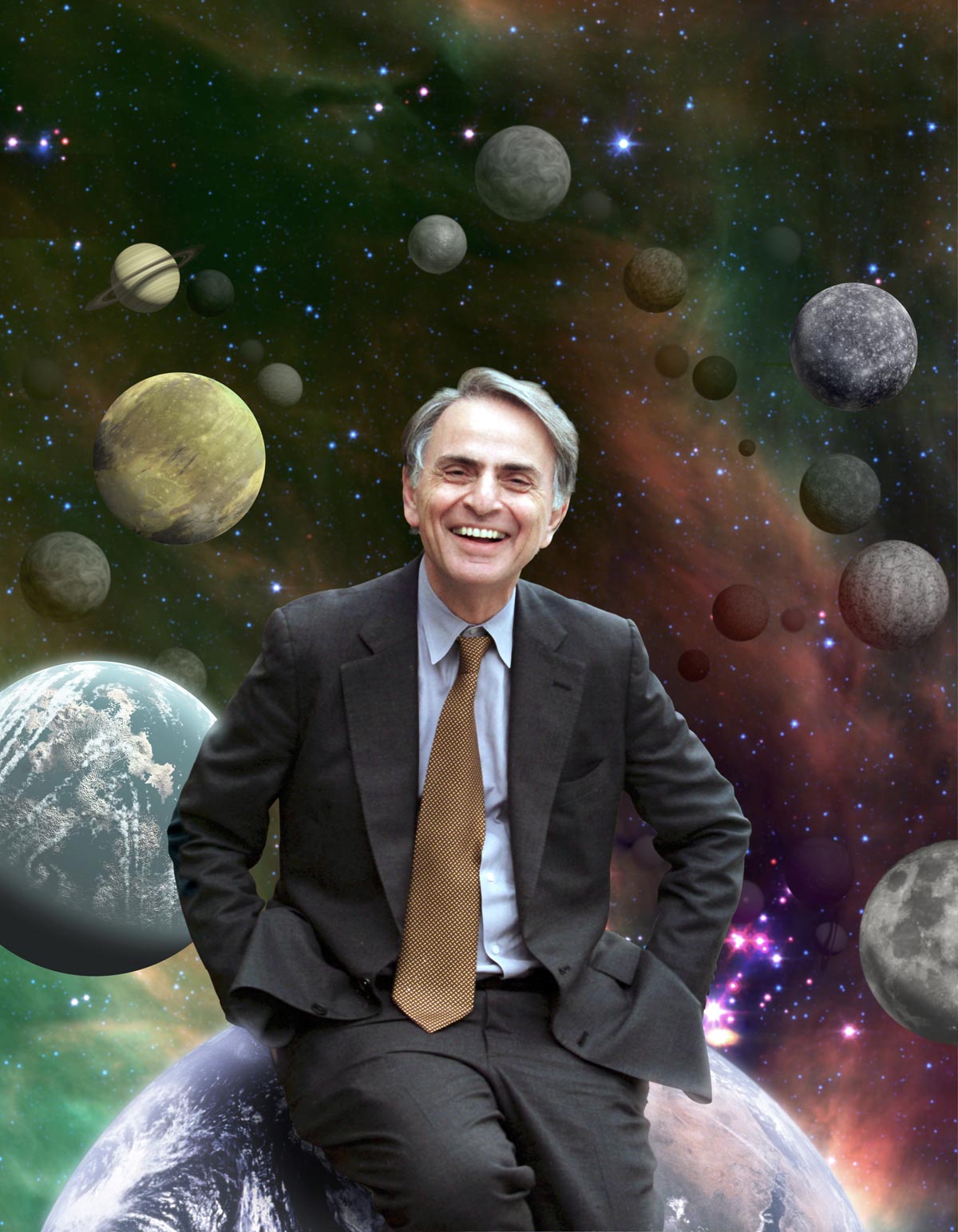
Carl Sagan. Credit: NASA
 

Carl Edward Sagan (/ˈsɡən/; SAY-gən; November 9, 1934 – December 20, 1996) was an American astronomer, planetary scientist, cosmologist, astrophysicist, astrobiologist, author, and science communicator. His best known scientific contribution is research on extraterrestrial life, including experimental demonstration of the production of amino acids from basic chemicals by radiation. Sagan assembled the first physical messages sent into space, the Pioneer plaque and the Voyager Golden Record, universal messages that could potentially be understood by any extraterrestrial intelligence that might find them. Sagan argued the hypothesis, accepted since, that the high surface temperatures of Venus can be attributed to, and calculated using, the greenhouse effect.[3]

50 Renowned Academics Speaking About God (Part 1)

Another 50 Renowned Academics Speaking About God (Part 2

A Further 50 Renowned Academics Speaking About God (Part 3)

CARL SAGAN interview with Charlie Rose:

“…faith is belief in the absence of evidence. To believe in the absence of evidence, in my opinion, is a mistake. The idea is to hold belief until there is compelling evidence. If the Universe does not comply with our previous propositions, then we have to change…Religion deals with history poetry, great literature, ethics, morals, compassion…where religion gets into trouble is when it pretends to know something about science,”

I would respond that there is evidence that Christianity is true. Biblical Archaeology is Silencing the critics! Significantly, even liberal theologians, secular academics, and critics generally cannot deny that archaeology has confirmed thebiblical record at many points. Rationalistic detractors of the Bible can attack it all day long, but they cannot dispute archaeological facts.

Carl Sagan asserted, “The issue had been decided years ago. The court had chosen the middle ground. You’d think the fight was over. Instead… Politicians check the latest polls to discover the dictates of their consciences.”

The fight was not over but it was just beginning in 1973 and the man who had more to do with energizing the evangelical church was the short preacher by the name of Francis Schaeffer!!!!

Half a century ago, an American pastor named Francis Schaeffer opened his home in Switzerland to anyone who was struggling with the basic questions of life. It was the beginning of L’Abri, a word meaning “shelter.” Over the years, student backpackers, troubled atheists, and thoughtful Christians found their way to this chalet in the Alps. Here they met biblical truth, explained not only with a sophistication that was then rare in evangelicalism-but lived out.

Many who trekked the Alpine hillsides to L’Abri became Christians and learned how to engage their cultures and to apply their faith to all of life. Two generations on, the influence of Francis and Edith Schaeffer and the ministry of L’Abri is evident among evangelical Christians everywhere in their approach not only to evangelism and the church but also to the sciences, arts, business, and politics.

Schaeffer died of cancer in 1984. But L’Abri continues with branches all over the world: in Australia, Germany, the Netherlands, Sweden, England, Korea, Canada, and two in the United States (in Southborough, Mass., and Rochester, Minn.). These centers for training in Christian philosophy are the legacy of a man who-according to long-time associate and founder of the Francis Schaeffer Institute Jerram Barrs-never considered himself a theologian or philosopher, but simply a pastor and an evangelist.

Schaeffer became a Christian when he was 17, after reading the Bible from beginning to end and finding that it gave answers to questions he struggled with. He studied at Faith Seminary and pastored churches in Delaware, Pennsylvania, and St. Louis.

In St. Louis, Schaeffer and his wife Edith started a ministry, Children for Christ. At the same time, conflicts and schisms in the Presbyterian Church forced him to defend a high view of Scripture against liberal theology. He started the International Council of Christian Churches to counter the World Council of Churches. This took him to Europe, where he settled in Switzerland in 1948.

But L’Abri had its genesis in a spiritual crisis that engulfed Schaeffer in 1950-1951. Depressed by church politics and power struggles, Schaeffer wrestled with the question: “How could people stand for truth and purity and God’s holiness without ugliness and harshness?” He became dissatisfied, too, with his own failures to live out the faith as the Bible describes it, according to Mr. Barrs.

Schaeffer felt these problems so deeply that he began to question whether Christianity, if it has so little effect, could be true. Once again, as he did when he was 17, he plunged into Bible reading in search of answers. He found them, becoming convinced that not only salvation but sanctification and the whole of the Christian’s life are by faith. “The sun came out again,” he said, and he found “a new song in my heart.”

Now, in addition to holding Bible studies in the Schaeffer home and working with children, the Schaeffers began discussion groups for their teenage daughters and friends to hear their questions and to tell about the Bible’s answers.

On June 5, 1955, the Schaeffers drew up a plan to turn their home into a place where people could come to work out their problems and to practice “true spirituality.” Without finances and with no assurance that they would be allowed to stay in Switzerland, the Schaeffers purchased property in Huemoz, a rural village high in the mountains with a spectacular view of the Alps.

Ranald Macaulay, a student at Cambridge who became involved with the Schaeffers in the early days (and later married their daughter Susan), said the founding of L’Abri was consistent with its organizing principle: to live in constant dependence on the grace of God. At a March 11-13 Jubilee for L’Abri Fellowship at the America’s Center in St. Louis, Mr. Macaulay said the Schaeffers resolved to do no advertising for workers, no marketing to attract newcomers, no fundraising, and no planning-principles in stark contrast to most other ministries.

The Schaeffers saw L’Abri as a unique experiment-they did not necessarily recommend this radical dependence on God’s providence as a pattern for other ministries-but the needs always were met. Concerned with reaching individuals, the Schaeffers were content with small numbers. Over time, however, the effect of their work multiplied. Over 1,000 L’Abri alumni attended the jubilee celebration, an event that was equal parts conference and family reunion.

Os Guinness, Harold O.J. Brown, and Chuck Colson-all major evangelical thinkers who were shaped by L’Abri-gave addresses. Screenwriter Brian Godawa, who wrote To End All Wars, gave a workshop on transforming Hollywood. Theologian and cultural critic Vishal Mangalwadi, from India, talked about his upcoming television documentary series on the impact of the Bible, The Book of the Millennium. Book tables overflowed with titles by L’Abri Alumni.

Workshops focused on the various facets of “The Central Themes of L’Abri,” “Transforming All of Life,” and “True Spirituality.” The evenings closed with classical music concerts.

But unlike most idea-packed conferences, the program also scheduled in time for fellowship: an hour and a half devoted to lunch; 30 minutes between sessions; free afternoons and early evenings so people had time to talk. People who had grown close in the Christian community of L’Abri but who had not seen each other for decades hugged and laughed and resumed their conversations. Family members recalled the early days. Mr. Macaulay said the Schaeffers cleared out the furniture, set up chairs, and made elaborate preparations in their chalet, while Schaeffer, wearing a black suit, preached a brilliant sermon-all for three people. Mr. Macaulay remembers thinking, “Oh, if everybody could hear this!” In those days, he said, it was exciting when 10 people showed up at L’Abri.

At first Schaeffer resisted taping the lectures, fearing it would spoil his spontaneity. But one day his daughter Susan surreptitiously hid in an ivy plant a microphone attached to her portable cassette player. The tapes circulated in student groups in England, creating a demand for more tapes and a steady supply of L’Abri pilgrims. Eventually, he turned some of his lectures into books.

More and more people-students, hippies, homosexual priests, drug addicts, and other wanderers trying to “find themselves”-sought out this “shelter” in the mountains. Some stayed for a few weeks, others for several months. By the 1970s, several hundred might be there at a time, staying in chalets built on the expanding property above a switchback mountain road.

Schaeffer exchanged his American preacher’s black suit for lederhosen and a walking stick. He engaged visitors in personal discussions fed also by the growing number of L’Abri workers who joined in the ministry. Visitors took part in the life of the community, eating meals together, doing physical labor, studying the Bible, prizing deep conversations, and walking in the mountains. This remains the pattern today in the L’Abri branches around the world, except that Schaeffer is heard only on tape.

In the course of 50 years, according to Larry Snyder, director of Rochester L’Abri, no one knows how many people went through L’Abri. No one kept records. What mattered then-and is evident now (see sidebar)-is that L’Abri was a life-changing experience.

Schaeffer persuaded nonbelievers to face up to the contradictions in their own worldviews by revealing their inability to account for what is most important in life (love, beauty, meaning). He would, as he described it, “take the roof off,” bringing the nonbeliever almost to the point of despair, to acknowledge his lost condition. Then he applied the gospel of Christ. While conversant in the theology of Kuyper, Dooyeweerd, and Van Til, Schaeffer was captive only to the worldview set forth in the Bible-God’s good creation, man’s fall into sin and its consequences, the redemption through Christ-which he said accords with reality in all of its dimensions. Nonbelievers cannot bring themselves to be completely consistent with their own presuppositions, an inconsistency that is a result of common grace. “Thus, illogically,” he wrote in 1948, “men have in their accepted worldviews various amounts of that which is ours. But, illogical though it may be, it is there and we can appeal to it.”

Even with hostile visitors, Mr. Barrs said, Schaeffer “had an acute sense of people’s brokenness and fallenness,” and “thus would treat them with compassion.”

Out of those encounters grew a body of written work: Escape from Reason (1968), True Spirituality (1971), and He Is There and He Is Not Silent (1972). Schaeffer developed extraordinarily fruitful concepts: how human beings need both “form and freedom”; how people today compartmentalize their lives into a meaningless objective “lower story” (the realm of science and fact) and a mystical, nonrational “upper story” of subjectivity and emotion (which becomes the realm of religion, aesthetics, and morality); how human beings are sinful and broken due to the Fall, yet how at the same time human beings have an intrinsic value and dignity, bearing the image of God.

Those concepts-fueled by practical discussions and communal living at L’Abri-quickly gathered public momentum. Before L’Abri, many conservative Protestants had no problem with legalizing abortion, considering it a Catholic issue and responding out of a knee-jerk anti-Catholicism. But the Schaeffers showed that abortion-along with the growing acceptance of euthanasia and the coming genetic engineering-constitutes a horrible assault on all that it means to be human. With the book and video series How Should We Then Live? (1976) and Whatever Happened to the Human Race? (1979), Schaeffer’s ideas spread to a broader audience. With A Christian Manifesto (1981), he called evangelicals to the fight against abortion and to political activism to reverse what he saw as the trend toward both moral anarchy and political tyranny.

Such an extended ministry was a partnership with Schaeffer’s wife. “If time allowed, a whole seminar could be devoted to the work of Edith Schaeffer,” author and L’Abri alum Os Guinness told the jubilee crowd. Health problems, including a deteriorating esophagus, prevented Schaeffer’s wife Edith, 92, from attending the St. Louis jubilee. Always an active part of L’Abri and an author herself, she is currently in a Swiss hospital. There, according to Udo Middleman, husband to Schaeffer daughter Debbie, the family is battling the very dangers Schaeffer described as family members insist on active treatment and care for Mrs. Schaeffer against a European medical establishment that is content to withhold treatment and to allow her simply to die.

Those struggles only emphasize that, in many ways, the culture of relativism, irrationalism, and self-centeredness that Schaeffer anticipated is here. “Postmodernists are so focused on I, me, myself that they have trouble focusing on any thing beyond themselves,” said L’Abri Australia leader Frank Stootman. And yet, he said, the Schaeffer method of taking people with their presuppositions to their logical conclusions and showing the superiority of a biblical worldview is still effective.

Per Staffan Johansson, of L’Abri in Sweden, told WORLD that seekers today are less philosophical than they were in the 1960s. Instead of wrestling with questions about the meaning of life and other objective truth, they are more preoccupied with problems of relationships and the meaning of their jobs and professions. “We do more in Sweden with vocation,” he said. “And yet, this is what L’Abri has always done,” relating faith to all of life.

Mr. Guinness said that “the genius of Schaeffer’s apologetics has yet to be fully unwrapped.” When asked about reaching the culture, Mr. Guinness said that one of Schaeffer’s great insights is that we have to reach not cultures but individuals. Each individual has his or her own questions, personal struggles, and moral brokenness. Schaeffer took them all seriously, addressing people one by one, while giving them-sometimes for the first time-a sense of belonging to a community.

Many approaches to evangelism and church growth today are impersonal, relying on manipulative formulas and the techniques of mass marketing and consumerism. L’Abri honors the dignity and the distinct spiritual needs of each individual. Many evangelicals think Christianity needs to be dumbed down and made easier to make it attractive to people today. L’Abri teaches that Christianity has substance and depth, that it has something to offer to thoughtful, educated people, and that-undiluted-biblical Christianity can change their lives.

Fifty years later, evangelicalism once again faces the problem of being negative or ineffectual, worldly, or out of touch. L’Abri remains

Image result for carl sagan

223 × 373Images may be subject to copyright. Learn More

Recently I have been revisiting my correspondence in 1995 with the famous astronomer Carl Sagan who I had the privilege to correspond with in 1994, 1995 and 1996. In 1996 I had a chance to respond to his December 5, 1995letter on January 10, 1996 and I never heard back from him again since his cancer returned and he passed away later in 1996. Below is what Carl Sagan wrote to me in his December 5, 1995 letter:

Thanks for your recent letter about evolution and abortion. The correlation is hardly one to one; there are evolutionists who are anti-abortion and anti-evolutionists who are pro-abortion.You argue that God exists because otherwise we could not understand the world in our consciousness. But if you think God is necessary to understand the world, then why do you not ask the next question of where God came from? And if you say “God was always here,” why not say that the universe was always here? On abortion, my views are contained in the enclosed article (Sagan, Carl and Ann Druyan {1990}, “The Question of Abortion,” Parade Magazine, April 22.)

I was introduced to when reading a book by Francis Schaeffer called HE IS THERE AND HE IS NOT SILENT written in 1968.

Image result for francis schaeffer

Francis Schaeffer when he was a young pastor in St. Louis pictured above.

Image result for francis schaeffer

Francis Schaeffer and Adrian Rogers

Image result for adrian rogers

(both Adrian Rogers and Francis Schaeffer mentioned Carl Sagan in their books and that prompted me to write Sagan and expose him to their views.

Carl Sagan pictured below:

Image result for carl sagan

_________

Image result for francis schaeffer

Francis Schaeffer

I mentioned earlier that I was blessed with the opportunity to correspond with Dr. Sagan. In his December 5, 1995 letter Dr. Sagan went on to tell me that he was enclosing his article “The Question of Abortion: A Search for Answers”by Carl Sagan and Ann Druyan. I am going to respond to several points made in that article. Here is a portion of Sagan’s article (here is a link to the whole article):

Image result for carl sagan and ann druyan

Carl Sagan and Ann Druyan pictured above

 “The Question of Abortion: A Search for Answers”

by Carl Sagan and Ann Druyan

For the complete text, including illustrations, introductory quote, footnotes, and commentary on the reaction to the originally published article see Billions and Billions.

The issue had been decided years ago. The court had chosen the middle ground. You’d think the fight was over. Instead, there are mass rallies, bombings and intimidation, murders of workers at abortion clinics, arrests, intense lobbying, legislative drama, Congressional hearings, Supreme Court decisions, major political parties almost defining themselves on the issue, and clerics threatening politicians with perdition. Partisans fling accusations of hypocrisy and murder. The intent of the Constitution and the will of God are equally invoked. Doubtful arguments are trotted out as certitudes. The contending factions call on science to bolster their positions. Families are divided, husbands and wives agree not to discuss it, old friends are no longer speaking. Politicians check the latest polls to discover the dictates of their consciences. Amid all the shouting, it is hard for the adversaries to hear one another. Opinions are polarized. Minds are closed.

Is it wrong to abort a pregnancy? Always? Sometimes? Never? How do we decide? We wrote this article to understand better what the contending views are and to see if we ourselves could find a position that would satisfy us both. Is there no middle ground? We had to weigh the arguments of both sides for consistency and to pose test cases, some of which are purely hypothetical. If in some of these tests we seem to go too far, we ask the reader to be patient with us–we’re trying to stress the various positions to the breaking point to see their weaknesses and where they fail.

In contemplative moments, nearly everyone recognizes that the issue is not wholly one-sided. Many partisans of differing views, we find, feel some disquiet, some unease when confronting what’s behind the opposing arguments. (This is partly why such confrontations are avoided.) And the issue surely touches on deep questions: What are our responses to one another? Should we permit the state to intrude into the most intimate and personal aspects of our lives? Where are the boundaries of freedom? What does it mean to be human?

Of the many actual points of view, it is widely held–especially in the media, which rarely have the time or the inclination to make fine distinctions–that there are only two: “pro-choice” and “pro-life.” This is what the two principal warring camps like to call themselves, and that’s what we’ll call them here. In the simplest characterization, a pro-choicer would hold that the decision to abort a pregnancy is to be made only by the woman; the state has no right to interfere. And a pro-lifer would hold that, from the moment of conception, the embryo or fetus is alive; that this life imposes on us a moral obligation to preserve it; and that abortion is tantamount to murder. Both names–pro-choice and pro-life–were picked with an eye toward influencing those whose minds are not yet made up: Few people wish to be counted either as being against freedom of choice or as opposed to life. Indeed, freedom and life are two of our most cherished values, and here they seem to be in fundamental conflict.

Let’s consider these two absolutist positions in turn. A newborn baby is surely the same being it was just before birth. There ‘s good evidence that a late-term fetus responds to sound–including music, but especially its mother’s voice. It can suck its thumb or do a somersault. Occasionally, it generates adult brain-wave patterns. Some people claim to remember being born, or even the uterine environment. Perhaps there is thought in the womb. It’s hard to maintain that a transformation to full personhood happens abruptly at the moment of birth. Why, then, should it be murder to kill an infant the day after it was born but not the day before?

As a practical matter, this isn’t very important: Less than 1 percent of all tabulated abortions in the United States are listed in the last three months of pregnancy (and, on closer investigation, most such reports turn out to be due to miscarriage or miscalculation). But third-trimester abortions provide a test of the limits of the pro-choice point of view. Does a woman’s “innate right to control her own body” encompass the right to kill a near-term fetus who is, for all intents and purposes, identical to a newborn child?

We believe that many supporters of reproductive freedom are troubled at least occasionally by this question. But they are reluctant to raise it because it is the beginning of a slippery slope. If it is impermissible to abort a pregnancy in the ninth month, what about the eighth, seventh, sixth … ? Once we acknowledge that the state can interfere at any time in the pregnancy, doesn’t it follow that the state can interfere at all times?

Abortion and the slippery slope argument above

This conjures up the specter of predominantly male, predominantly affluent legislators telling poor women they must bear and raise alone children they cannot afford to bring up; forcing teenagers to bear children they are not emotionally prepared to deal with; saying to women who wish for a career that they must give up their dreams, stay home, and bring up babies; and, worst of all, condemning victims of rape and incest to carry and nurture the offspring of their assailants. Legislative prohibitions on abortion arouse the suspicion that their real intent is to control the independence and sexuality of women…

And yet, by consensus, all of us think it proper that there be prohibitions against, and penalties exacted for, murder. It would be a flimsy defense if the murderer pleads that this is just between him and his victim and none of the government’s business. If killing a fetus is truly killing a human being, is it not the duty of the state to prevent it? Indeed, one of the chief functions of government is to protect the weak from the strong.

If we do not oppose abortion at some stage of pregnancy, is there not a danger of dismissing an entire category of human beings as unworthy of our protection and respect? And isn’t that dismissal the hallmark of sexism, racism, nationalism, and religious fanaticism? Shouldn’t those dedicated to fighting such injustices be scrupulously careful not to embrace another?

Adrian Rogers’ sermon on animal rights refutes Sagan here

There is no right to life in any society on Earth today, nor has there been at any former time… : We raise farm animals for slaughter; destroy forests; pollute rivers and lakes until no fish can live there; kill deer and elk for sport, leopards for the pelts, and whales for fertilizer; entrap dolphins, gasping and writhing, in great tuna nets; club seal pups to death; and render a species extinct every day. All these beasts and vegetables are as alive as we. What is (allegedly) protected is not life, but human life.

Genesis 3 defines being human

And even with that protection, casual murder is an urban commonplace, and we wage “conventional” wars with tolls so terrible that we are, most of us, afraid to consider them very deeply… That protection, that right to life, eludes the 40,000 children under five who die on our planet each day from preventable starvation, dehydration, disease, and neglect.

Those who assert a “right to life” are for (at most) not just any kind of life, but for–particularly and uniquely—human life. So they too, like pro-choicers, must decide what distinguishes a human being from other animals and when, during gestation, the uniquely human qualities–whatever they are–emerge.

The Bible talks about the differences between humans and animals

Despite many claims to the contrary, life does not begin at conception: It is an unbroken chain that stretches back nearly to the origin of the Earth, 4.6 billion years ago. Nor does human life begin at conception: It is an unbroken chain dating back to the origin of our species, hundreds of thousands of years ago. Every human sperm and egg is, beyond the shadow of a doubt, alive. They are not human beings, of course. However, it could be argued that neither is a fertilized egg.

In some animals, an egg develops into a healthy adult without benefit of a sperm cell. But not, so far as we know, among humans. A sperm and an unfertilized egg jointly comprise the full genetic blueprint for a human being. Under certain circumstances, after fertilization, they can develop into a baby. But most fertilized eggs are spontaneously miscarried. Development into a baby is by no means guaranteed. Neither a sperm and egg separately, nor a fertilized egg, is more than a potential baby or a potential adult. So if a sperm and egg are as human as the fertilized egg produced by their union, and if it is murder to destroy a fertilized egg–despite the fact that it’s only potentially a baby–why isn’t it murder to destroy a sperm or an egg?

Hundreds of millions of sperm cells (top speed with tails lashing: five inches per hour) are produced in an average human ejaculation. A healthy young man can produce in a week or two enough spermatozoa to double the human population of the Earth. So is masturbation mass murder? How about nocturnal emissions or just plain sex? When the unfertilized egg is expelled each month, has someone died? Should we mourn all those spontaneous miscarriages? Many lower animals can be grown in a laboratory from a single body cell. Human cells can be cloned… In light of such cloning technology, would we be committing mass murder by destroying any potentially clonable cells? By shedding a drop of blood?

All human sperm and eggs are genetic halves of “potential” human beings. Should heroic efforts be made to save and preserve all of them, everywhere, because of this “potential”? Is failure to do so immoral or criminal? Of course, there’s a difference between taking a life and failing to save it. And there’s a big difference between the probability of survival of a sperm cell and that of a fertilized egg. But the absurdity of a corps of high-minded semen-preservers moves us to wonder whether a fertilized egg’s mere “potential” to become a baby really does make destroying it murder.

Opponents of abortion worry that, once abortion is permissible immediately after conception, no argument will restrict it at any later time in the pregnancy. Then, they fear, one day it will be permissible to murder a fetus that is unambiguously a human being. Both pro-choicers and pro-lifers (at least some of them) are pushed toward absolutist positions by parallel fears of the slippery slope.

Another slippery slope is reached by those pro-lifers who are willing to make an exception in the agonizing case of a pregnancy resulting from rape or incest. But why should the right to live depend on the circumstances of conception? If the same child were to result, can the state ordain life for the offspring of a lawful union but death for one conceived by force or coercion? How can this be just? And if exceptions are extended to such a fetus, why should they be withheld from any other fetus? This is part of the reason some pro-lifers adopt what many others consider the outrageous posture of opposing abortions under any and all circumstances–only excepting, perhaps, when the life of the mother is in danger.

By far the most common reason for abortion worldwide is birth control. So shouldn’t opponents of abortion be handing out contraceptives and teaching school children how to use them? That would be an effective way to reduce the number of abortions. Instead, the United States is far behind other nations in the development of safe and effective methods of birth control–and, in many cases, opposition to such research (and to sex education) has come from the same people who oppose abortions.continue on to Part 3

For the complete text, including illustrations, introductory quote, footnotes, and commentary on the reaction to the originally published article see Billions and Billions.

The attempt to find an ethically sound and unambiguous judgment on when, if ever, abortion is permissible has deep historical roots. Often, especially in Christian tradition, such attempts were connected with the question of when the soul enters the body–a matter not readily amenable to scientific investigation and an issue of controversy even among learned theologians. Ensoulment has been asserted to occur in the sperm before conception, at conception, at the time of “quickening” (when the mother is first able to feel the fetus stirring within her), and at birth. Or even later.

Different religions have different teachings. Among hunter-gatherers, there are usually no prohibitions against abortion, and it was common in ancient Greece and Rome. In contrast, the more severe Assyrians impaled women on stakes for attempting abortion. The Jewish Talmud teaches that the fetus is not a person and has no rights. The Old and New Testaments–rich in astonishingly detailed prohibitions on dress, diet, and permissible words–contain not a word specifically prohibiting abortion. The only passage that’s remotely relevant (Exodus 21:22) decrees that if there’s a fight and a woman bystander should accidentally be injured and made to miscarry, the assailant must pay a fine.

Neither St. Augustine nor St. Thomas Aquinas considered early-term abortion to be homicide (the latter on the grounds that the embryo doesn’t look human). This view was embraced by the Church in the Council of Vienne in 1312, and has never been repudiated. The Catholic Church’s first and long-standing collection of canon law (according to the leading historian of the Church’s teaching on abortion, John Connery, S.J.) held that abortion was homicide only after the fetus was already “formed”–roughly, the end of the first trimester.

But when sperm cells were examined in the seventeenth century by the first microscopes, they were thought to show a fully formed human being. An old idea of the homunculus was resuscitated–in which within each sperm cell was a fully formed tiny human, within whose testes were innumerable other homunculi, etc., ad infinitum. In part through this misinterpretation of scientific data, in 1869 abortion at any time for any reason became grounds for excommunication. It is surprising to most Catholics and others to discover that the date was not much earlier.

From colonial times to the nineteenth century, the choice in the United States was the woman’s until “quickening.” An abortion in the first or even second trimester was at worst a misdemeanor. Convictions were rarely sought and almost impossible to obtain, because they depended entirely on the woman’s own testimony of whether she had felt quickening, and because of the jury’s distaste for prosecuting a woman for exercising her right to choose. In 1800 there was not, so far as is known, a single statute in the United States concerning abortion. Advertisements for drugs to induce abortion could be found in virtually every newspaper and even in many church publications–although the language used was suitably euphemistic, if widely understood.

But by 1900, abortion had been banned at any time in pregnancy by every state in the Union, except when necessary to save the woman’s life. What happened to bring about so striking a reversal? Religion had little to do with it.Drastic economic and social conversions were turning this country from an agrarian to an urban-industrial society. America was in the process of changing from having one of the highest birthrates in the world to one of the lowest. Abortion certainly played a role and stimulated forces to suppress it.

One of the most significant of these forces was the medical profession. Up to the mid-nineteenth century, medicine was an uncertified, unsupervised business. Anyone could hang up a shingle and call himself (or herself) a doctor. With the rise of a new, university-educated medical elite, anxious to enhance the status and influence of physicians, the American Medical Association was formed. In its first decade, the AMA began lobbying against abortions performed by anyone except licensed physicians. New knowledge of embryology, the physicians said, had shown the fetus to be human even before quickening.

Their assault on abortion was motivated not by concern for the health of the woman but, they claimed, for the welfare of the fetus. You had to be a physician to know when abortion was morally justified, because the question depended on scientific and medical facts understood only by physicians. At the same time, women were effectively excluded from the medical schools, where such arcane knowledge could be acquired. So, as things worked out, women had almost nothing to say about terminating their own pregnancies. It was also up to the physician to decide if the pregnancy posed a threat to the woman, and it was entirely at his discretion to determine what was and was not a threat. For the rich woman, the threat might be a threat to her emotional tranquillity or even to her lifestyle. The poor woman was often forced to resort to the back alley or the coat hanger.

This was the law until the 1960s, when a coalition of individuals and organizations, the AMA now among them, sought to overturn it and to reinstate the more traditional values that were to be embodied in Roe v. Wade.continue on to Part 4

If you deliberately kill a human being, it’s called murder. If you deliberately kill a chimpanzee–biologically, our closest relative, sharing 99.6 percent of our active genes–whatever else it is, it’s not murder. To date, murder uniquely applies to killing human beings. Therefore, the question of when personhood (or, if we like, ensoulment) arises is key to the abortion debate. When does the fetus become human? When do distinct and characteristic human qualities emerge?

Section 8 Sperm journey to becoming Human

We recognize that specifying a precise moment will overlook individual differences. Therefore, if we must draw a line, it ought to be drawn conservatively–that is, on the early side. There are people who object to having to set some numerical limit, and we share their disquiet; but if there is to be a law on this matter, and it is to effect some useful compromise between the two absolutist positions, it must specify, at least roughly, a time of transition to personhood.

Every one of us began from a dot. A fertilized egg is roughly the size of the period at the end of this sentence. The momentous meeting of sperm and egg generally occurs in one of the two fallopian tubes. One cell becomes two, two become four, and so on—an exponentiation of base-2 arithmetic. By the tenth day the fertilized egg has become a kind of hollow sphere wandering off to another realm: the womb. It destroys tissue in its path. It sucks blood from capillaries. It bathes itself in maternal blood, from which it extracts oxygen and nutrients. It establishes itself as a kind of parasite on the walls of the uterus.By the third week, around the time of the first missed menstrual period, the forming embryo is about 2 millimeters long and is developing various body parts. Only at this stage does it begin to be dependent on a rudimentary placenta. It looks a little like a segmented worm.By the end of the fourth week, it’s about 5 millimeters (about 1/5 inch) long. It’s recognizable now as a vertebrate, its tube-shaped heart is beginning to beat, something like the gill arches of a fish or an amphibian become conspicuous, and there is a pronounced tail. It looks rather like a newt or a tadpole. This is the end of the first month after conception.By the fifth week, the gross divisions of the brain can be distinguished. What will later develop into eyes are apparent, and little buds appear—on their way to becoming arms and legs.By the sixth week, the embryo is 13 millimeteres (about ½ inch) long. The eyes are still on the side of the head, as in most animals, and the reptilian face has connected slits where the mouth and nose eventually will be.By the end of the seventh week, the tail is almost gone, and sexual characteristics can be discerned (although both sexes look female). The face is mammalian but somewhat piglike.By the end of the eighth week, the face resembles that of a primate but is still not quite human. Most of the human body parts are present in their essentials. Some lower brain anatomy is well-developed. The fetus shows some reflex response to delicate stimulation.By the tenth week, the face has an unmistakably human cast. It is beginning to be possible to distinguish males from females. Nails and major bone structures are not apparent until the third month.By the fourth month, you can tell the face of one fetus from that of another. Quickening is most commonly felt in the fifth month. The bronchioles of the lungs do not begin developing until approximately the sixth month, the alveoli still later.

So, if only a person can be murdered, when does the fetus attain personhood? When its face becomes distinctly human, near the end of the first trimester? When the fetus becomes responsive to stimuli–again, at the end of the first trimester? When it becomes active enough to be felt as quickening, typically in the middle of the second trimester? When the lungs have reached a stage of development sufficient that the fetus might, just conceivably, be able to breathe on its own in the outside air?

The trouble with these particular developmental milestones is not just that they’re arbitrary. More troubling is the fact that none of them involves uniquely humancharacteristics–apart from the superficial matter of facial appearance. All animals respond to stimuli and move of their own volition. Large numbers are able to breathe. But that doesn’t stop us from slaughtering them by the billions. Reflexes and motion are not what make us human.

Sagan’s conclusion based on arbitrary choice of the presence of thought by unborn baby

Other animals have advantages over us–in speed, strength, endurance, climbing or burrowing skills, camouflage, sight or smell or hearing, mastery of the air or water. Our one great advantage, the secret of our success, is thought–characteristically human thought. We are able to think things through, imagine events yet to occur, figure things out. That’s how we invented agriculture and civilization. Thought is our blessing and our curse, and it makes us who we are.

Thinking occurs, of course, in the brain–principally in the top layers of the convoluted “gray matter” called the cerebral cortex. The roughly 100 billion neurons in the brain constitute the material basis of thought. The neurons are connected to each other, and their linkups play a major role in what we experience as thinking. But large-scale linking up of neurons doesn’t begin until the 24th to 27th week of pregnancy–the sixth month.

By placing harmless electrodes on a subject’s head, scientists can measure the electrical activity produced by the network of neurons inside the skull. Different kinds of mental activity show different kinds of brain waves. But brain waves with regular patterns typical of adult human brains do not appear in the fetus until about the 30th week of pregnancy–near the beginning of the third trimester. Fetuses younger than this–however alive and active they may be–lack the necessary brain architecture. They cannot yet think.

Acquiescing in the killing of any living creature, especially one that might later become a baby, is troublesome and painful. But we’ve rejected the extremes of “always” and “never,” and this puts us–like it or not–on the slippery slope. If we are forced to choose a developmental criterion, then this is where we draw the line: when the beginning of characteristically human thinking becomes barely possible.

It is, in fact, a very conservative definition: Regular brain waves are rarely found in fetuses. More research would help… If we wanted to make the criterion still more stringent, to allow for occasional precocious fetal brain development, we might draw the line at six months. This, it so happens, is where the Supreme Court drew it in 1973–although for completely different reasons.

Its decision in the case of Roe v. Wade changed American law on abortion. It permits abortion at the request of the woman without restriction in the first trimester and, with some restrictions intended to protect her health, in the second trimester. It allows states to forbid abortion in the third trimester, except when there’s a serious threat to the life or health of the woman. In the 1989 Webster decision, the Supreme Court declined explicitly to overturn Roe v. Wade but in effect invited the 50 state legislatures to decide for themselves.

What was the reasoning in Roe v. Wade? There was no legal weight given to what happens to the children once they are born, or to the family. Instead, a woman’s right to reproductive freedom is protected, the court ruled, by constitutional guarantees of privacy. But that right is not unqualified. The woman’s guarantee of privacy and the fetus’s right to life must be weighed–and when the court did the weighing’ priority was given to privacy in the first trimester and to life in the third. The transition was decided not from any of the considerations we have been dealing with so far…–not when “ensoulment” occurs, not when the fetus takes on sufficient human characteristics to be protected by laws against murder. Instead, the criterion adopted was whether the fetus could live outside the mother. This is called “viability” and depends in part on the ability to breathe. The lungs are simply not developed, and the fetus cannot breathe–no matter how advanced an artificial lung it might be placed in—until about the 24th week, near the start of the sixth month. This is why Roe v. Wade permits the states to prohibit abortions in the last trimester. It’s a very pragmatic criterion.

If the fetus at a certain stage of gestation would be viable outside the womb, the argument goes, then the right of the fetus to life overrides the right of the woman to privacy. But just what does “viable” mean? Even a full-term newborn is not viable without a great deal of care and love. There was a time before incubators, only a few decades ago, when babies in their seventh month were unlikely to be viable. Would aborting in the seventh month have been permissible then? After the invention of incubators, did aborting pregnancies in the seventh month suddenly become immoral? What happens if, in the future, a new technology develops so that an artificial womb can sustain a fetus even before the sixth month by delivering oxygen and nutrients through the blood–as the mother does through the placenta and into the fetal blood system? We grant that this technology is unlikely to be developed soon or become available to many. But if it were available, does it then become immoral to abort earlier than the sixth month, when previously it was moral? A morality that depends on, and changes with, technology is a fragile morality; for some, it is also an unacceptable morality.

And why, exactly, should breathing (or kidney function, or the ability to resist disease) justify legal protection? If a fetus can be shown to think and feel but not be able to breathe, would it be all right to kill it? Do we value breathing more than thinking and feeling? Viability arguments cannot, it seems to us, coherently determine when abortions are permissible. Some other criterion is needed. Again, we offer for consideration the earliest onset of human thinking as that criterion.

Since, on average, fetal thinking occurs even later than fetal lung development, we find Roe v. Wade to be a good and prudent decision addressing a complex and difficult issue. With prohibitions on abortion in the last trimester–except in cases of grave medical necessity–it strikes a fair balance between the conflicting claims of freedom and life.What do you think? What have others said about Carl Sagan’s thoughts on 

END OF SAGAN’S ARTICLE

Image result for carl sagan and ann druyan
Carl Sagan with his wife Ann in the 1990’s
Image result for adrian rogers francis schaeffer
I grew up in Memphis as a member of Bellevue Baptist Church under our pastor Adrian Rogers and attended ECS High School where the books and films of Francis Schaeffer were taught. Both men dealt with current issues in the culture such as the film series COSMOS by Carl Sagan. I personally read several of Sagan’s books.  (Francis and Edith Schaeffer pictured below in their home at L’ Abri in Switzerland where Francis  taught students for 3 decades.
Image result for francis schaeffer
630 × 414Images may be subject to copyright.

Xxxxxxxxxxxxx

Related posts:

FRANCIS SCHAEFFER ANALYZES ART AND CULTURE Part 52 THE BEATLES (Part D, There is evidence that the Beatles may have been exposed to Francis Schaeffer!!!) (Feature on artist Anna Margaret Rose Freeman )

______________   George Harrison Swears & Insults Paul and Yoko Lucy in the Sky with Diamonds- The Beatles The Beatles:   I have dedicated several posts to this series on the Beatles and I don’t know when this series will end because Francis Schaeffer spent a lot of time listening to the Beatles and talking […]

FRANCIS SCHAEFFER ANALYZES ART AND CULTURE Part 51 THE BEATLES (Part C, List of those on cover of Stg.Pepper’s ) (Feature on artist Raqib Shaw )

  The Beatles in a press conference after their Return from the USA Uploaded on Nov 29, 2010 The Beatles in a press conference after their Return from the USA. The Beatles:   I have dedicated several posts to this series on the Beatles and I don’t know when this series will end because Francis […]

FRANCIS SCHAEFFER ANALYZES ART AND CULTURE Part 50 THE BEATLES (Part B, The Psychedelic Music of the Beatles) (Feature on artist Peter Blake )

__________________   Beatles 1966 Last interview I have dedicated several posts to this series on the Beatles and I don’t know when this series will end because Francis Schaeffer spent a lot of time listening to the Beatles and talking and writing about them and their impact on the culture of the 1960’s. In this […]

FRANCIS SCHAEFFER ANALYZES ART AND CULTURE Part 49 THE BEATLES (Part A, The Meaning of Stg. Pepper’s Cover) (Feature on artist Mika Tajima)

_______________ The Beatles documentary || A Long and Winding Road || Episode 5 (This video discusses Stg. Pepper’s creation I have dedicated several posts to this series on the Beatles and I don’t know when this series will end because Francis Schaeffer spent a lot of time listening to the Beatles and talking and writing about […]

FRANCIS SCHAEFFER ANALYZES ART AND CULTURE PART 48 “BLOW UP” by Michelangelo Antonioni makes Philosophic Statement (Feature on artist Nancy Holt)

_______________ Francis Schaeffer pictured below: _____________________ I have included the 27 minute  episode THE AGE OF NONREASON by Francis Schaeffer. In that video Schaeffer noted,  ” Sergeant Pepper’s Lonely Hearts Club Band…for a time it became the rallying cry for young people throughout the world. It expressed the essence of their lives, thoughts and their feelings.” How Should […]

FRANCIS SCHAEFFER ANALYZES ART AND CULTURE Part 47 Woody Allen and Professor Levy and the death of “Optimistic Humanism” from the movie CRIMES AND MISDEMEANORS Plus Charles Darwin’s comments too!!! (Feature on artist Rodney Graham)

Crimes and Misdemeanors: A Discussion: Part 1 ___________________________________ Today I will answer the simple question: IS IT POSSIBLE TO BE AN OPTIMISTIC SECULAR HUMANIST THAT DOES NOT BELIEVE IN GOD OR AN AFTERLIFE? This question has been around for a long time and you can go back to the 19th century and read this same […]

FRANCIS SCHAEFFER ANALYZES ART AND CULTURE PART 46 Friedrich Nietzsche (Featured artist is Thomas Schütte)

____________________________________ Francis Schaeffer pictured below: __________ Francis Schaeffer has written extensively on art and culture spanning the last 2000years and here are some posts I have done on this subject before : Francis Schaeffer’s “How should we then live?” Video and outline of episode 10 “Final Choices” , episode 9 “The Age of Personal Peace and Affluence”, episode 8 […]

FRANCIS SCHAEFFER ANALYZES ART AND CULTURE Part 45 Woody Allen “Reason is Dead” (Feature on artists Allora & Calzadilla )

Love and Death [Woody Allen] – What if there is no God? [PL] ___________ _______________ How Should We then Live Episode 7 small (Age of Nonreason) #02 How Should We Then Live? (Promo Clip) Dr. Francis Schaeffer 10 Worldview and Truth Two Minute Warning: How Then Should We Live?: Francis Schaeffer at 100 Francis Schaeffer […]

FRANCIS SCHAEFFER ANALYZES ART AND CULTURE Part 44 The Book of Genesis (Featured artist is Trey McCarley )

___________________________________ Francis Schaeffer pictured below: ____________________________ Francis Schaeffer “BASIS FOR HUMAN DIGNITY” Whatever…HTTHR Dr. Francis schaeffer – The flow of Materialism(from Part 4 of Whatever happened to human race?) Dr. Francis Schaeffer – The Biblical flow of Truth & History (intro) Francis Schaeffer – The Biblical Flow of History & Truth (1) Dr. Francis Schaeffer […]

__

__

Fast Facts about the U.S. Federal Debt

—-


High and rising government debt slows growth, crowds out private investment, limits the government’s ability to respond to unexpected emergencies, and elevates the risk of a sudden fiscal crisis, where investors would lose confidence in U.S. Treasury bonds and the U.S. dollar. This fact sheet lays out everything legislators and the public need to know about the U.S. federal debt to help them examine the unsustainability of the U.S. budget.

  • The total or gross federal debt is $31.5 trillion. This is the debt subject to the debt limit.
    • At 120 percent of gross domestic product (GDP), the gross federal debt exceeds the amount of goods and services produced in the United States every year by one‐​fifth.
    • The total federal debt burden per U.S. person is $94,000.
    • The total federal debt burden per U.S. household is $240,000.
    • Total federal debt consists of publicly held debt (borrowed from credit markets, including from individuals, state/​local governments, foreign entities, and the Federal Reserve) and intragovernmental debt (borrowed from federal trust funds like Social Security).
  • The publicly held or public debt is $24.6 trillion. This debt is borrowed in credit markets.
    • At 95 percent of gross domestic product, the publicly held debt is approaching the size of the U.S. economy, as measured by all the goods and services produced in the United States in one year.
    • Such high levels of debt reduce economic growth. Researchers identified that government debt drags down economic growth beginning at 78 percent of GDP.
    • Economists focus on the publicly held debt to assess how government debt affects interest rates and crowding out of private investment, because this debt is mostly held outside the federal government and traded in public markets.
    • The public debt will surpass its WWII‐​high of 106 percent of GDP by 2028.
    • The public debt is projected to grow to 118 percent of GDP by 2032 under CBO’s optimistic scenario and to 130 percent of GDP by 2032 under a more realistic scenario, in which the 2017 middle class tax cuts are extended.
    • We owe one‐​third of the publicly held debt to foreign entities; two of our biggest foreign bondholders are China and Japan.
    • The U.S. Federal Reserve holds about one‐​quarter of publicly held debt. When the Fed buys U.S. government debt, this is called quantitative easing, and represents the issuance of new money in the economy. When the money supply increases faster than production, this leads to inflation.
  • The federal government paid $475 billionin interest costs in 2022. Net interest is the cost of servicing the publicly held debt, paid to foreign and domestic bondholders.
    • 10 cents of every taxpayer dollar the federal government collected last year went toward paying the interest on the debt.
    • If average annual interest rates were 1 percentage point higher than CBO projects, cumulative interest costs would increase by $4 trillion over 10 years.
  • The annual federal deficit will more than double over the next 10 years from $1.4 trillion in 2023 to $2.9 trillion in 2033. The annual deficit is the difference between annual government spending and revenues.
    • Federal spending is projected to rise to 25 percent of GDP by 2033. That’s 4.4 percentage points above the historical average over the last 50 years.
    • Federal revenues will rise to 18 percent of GDP, about 1 percentage point above the historical average.
  • The 75‐​year unfunded obligation, as reported in the Financial Report of the United States Government, is $79.5 trillion. That’s the difference between the present value of total government receipts and total non‐​interest government spending over the next 75 years.
    • 95 percent of the total non‐​interest unfunded obligation is driven by social insurance programs (98 percent by Social Security and Medicare; and less than 0.2 percent by Railroad Retirement and Black Lung Benefits).
    • Public debt will reach 200 percent of GDP by 2046 and 566 percent of GDP by 2097.
    • According to Treasury and the Office of Management and Budget: “the continuous rise of the debt‐​to‐​GDP ratio indicates that current fiscal policy is unsustainable.”

Further reading:

  • The Debt Limit and the High Costs of Debt [Cato]. “High and rising debt slows growth, crowds out private investment, limits the government’s ability to respond to unforeseen emergencies, and elevates the risk of a sudden fiscal crisis where investors would lose confidence in U.S. Treasury bonds and the U.S. dollar.”
  • The CBO Budget and Economic Outlook in the Post‐​COVID Fiscal Era [Cato]. “CBO forecasts a worsening fiscal trajectory characterized by high and rising federal debt [in which] pandemic spending followed by a surge in interest costs [has] accelerated the [unsustainability of the U.S. budget.”
  • The Impact of Public Debt on Economic Growth [Cato]. Academic research has identified a negative effect of high and rising debt levels on economic growth. “For the 25 studies that provide threshold estimates, [the] mean and median threshold levels [where debt drags down growth] are found at 78 percent and 82 percent of GDP [for advanced countries], respectively.”
  • Q&A: Gross Debt Versus Debt Held by the Public [CRFB]. “This explainer will lay out everything you need to know about the different measures of debt and what they mean for the government’s fiscal situation.”

Download a printable PDF version of this fact sheet here.

More Evidence for Switzerland’s Spending Cap

Back in 2012, I wrote a column for the Wall Street Journal to highlight the success of Switzerland’s spending cap (also known as the “debt brake”).

Swiss voters voted for this spending cap in 2001 and ever since it took effect in 2003, government spending has increased by an average of 2.2 percent annually, only about half as fast as it was growing in the decades before the cap was imposed.

To show the ongoing success of the debt brake, here’s a map comparing changes in the burden of spending in Switzerland and its four major neighbors (France, Germany, Italy, and Austria). As you can see, IMF data reveals that Switzerland has been more responsible.

I even calculated changes in national spending burdens since the start of the pandemic.

You can see that all governments used the virus as an excuse for more spending, but the fiscal damage was most contained in Switzerland.

Seems like Switzerland is a role model, right?

Professors Steve Hanke and Barry Poulson presumably agree. They have a column in National Review arguing in favor of a similar spending cap for the United States.

President Biden’s budget proposal for 2024 makes it clear that the U.S. needs a budget straitjacket sooner rather than later. …Switzerland has been arguably the most successful country in reining in budget deficits and its debt burden. …The Swiss debt brake requires that expenditures be brought into balance with revenues.A cap is imposed on spending based on expected revenue, and revenue is projected based on long-term trends in the real growth of national income. Expenditures may exceed the cap in response to extraordinary events such as war, but if that’s the case, eventually, revenues from budget surpluses must be generated and set aside to offset this excess expenditure. We propose a debt brake for the U.S. that would initially be more stringent than the Swiss debt brake…a spending limit (read: cap) be calculated each year, and that the cap be reduced by 1 percent.

Interestingly, they want a spending cap that is stricter than the Swiss version.

That would be ideal (the tighter the cap, the greater the progress), but I’d settle for the Swiss approach. Why? Because here’s the data comparing US profligacy and Swiss prudence.

When I contemplate these numbers, my disdain for Bush, Obama, Trump, and Biden becomes even more intense.

They all put political ambition about what’s best for America.

But I’m digressing. Let’s put the focus back on the success of the Swiss spending cap.

It’s worth noting, for instance, that Switzerland also is out-performing the United States when comparing changes in government debt.

And the Swiss also have been enjoying better economic performance since they imposed a spending cap on their politicians.

I’ll close by observing that a spending cap would have prevented massive debt accumulation in the United States. And the same is true for other nationsas well.

P.S. Colorado has a very successful spending capknown as TABOR.

P.P.S. There’s plenty of academic evidence for Switzerland’s debt brake. But what’s more surprising are that pro-spending cap studies from the International Monetary Fund (here and here), the Organization for Economic Cooperation and Development (here and here) and the European Central Bank (here and here).

Open letter to President Obama (Part 704)

(Emailed to White House on 6-25-13.)

President Obama c/o The White House 1600 Pennsylvania Avenue NW Washington, DC 20500

Dear Mr. President,

I know that you receive 20,000 letters a day and that you actually read 10 of them every day. I really do respect you for trying to get a pulse on what is going on out here.

The federal government debt is growing so much that it is endangering us because if things keep going like they are now we will not have any money left for the national defense because we are so far in debt as a nation. We have been spending so much on our welfare state through food stamps and other programs that I am worrying that many of our citizens are becoming more dependent on government and in many cases they are losing their incentive to work hard because of the welfare trap the government has put in place. Other nations in Europe have gone down this road and we see what mess this has gotten them in. People really are losing their faith in big government and they want more liberty back. It seems to me we have to get back to the founding  principles that made our country great.  We also need to realize that a big government will encourage waste and corruptionThe recent scandals in our government have proved my point. In fact, the jokes you made at Ohio State about possibly auditing them are not so funny now that reality shows how the IRS was acting more like a monster out of control. Also raising taxes on the job creators is a very bad idea too. The Laffer Curve clearly demonstrates that when the tax rates are raised many individuals will move their investments to places where they will not get taxed as much.

______________________

17 Reasons the large national debt is a big deal!!!

We got to stop spending so much money and start paying off our national debt or the future of our children and grandchildren will be very sad indeed. Everyone knows that entitlement spending must be cut but it seems we are not brave enough to do it. I have contacted my Congressmen and Senators over and over but nothing is getting done!!! At least there are 66 conservative Republicans in the House that have stood up  and voted against raising the debt ceiling.

June 17, 2013 at 7:13 am

GO-Debt-Denial-rev_600

Remember the debt? That $17 trillion problem? Some in Washington seem to think it’s gone away.

The Washington Post reported that “the national debt is no longer growing out of control.” Lawmakers and liberal inside-the-Beltway organizations are floating the notion that it’s not a high priority any more.

We beg to differ, so we came up with 17 reasons that $17 trillion in debt is still a big, bad deal.

1. $53,769 – Your share of the national debt.  

As Washington continues to spend more than it can afford, every American will be on the hook for this massive debt burden.

willrogers_450

SHARE this graphic.

2. Personal income will be lower.

The skyrocketing debt could cause families to lose up to $11,000 on their income every year. That’s enough to send the kids to a state college or move to a nicer neighborhood.

3. Fewer jobs and lower salaries.

High government spending with no accountability eliminates opportunities for career advancement, paralyzes job creation, and lowers wages and salaries.

4. Higher interest rates.

Some families and businesses won’t be able to borrow money because of high interest rates on mortgages, car loans, and more – the dream of starting a business could be out of reach.

5. High debt and high spending won’t help the economy.

Journalists should check with both sides before committing pen to paper, especially those at respectable outlets like The Washington Post and The New York Times. A $17 trillion debt only hurts the economy.

6. What economic growth?

High-debt economies similar to America’s current state grew by one-third less  than their low-debt counterparts.

7. Eventually, someone has to pay the nation’s $17 trillion credit card bill, and Washington has nominated your family.

It’s wildly irresponsible to never reduce expenses, yet Washington continues to spend, refusing to acknowledge the repercussions.

>>>Watch this video to see how scary $17 trillion really is for your family.

8. Jeopardizes the stability of Medicare, Social Security, and Medicaid.

Millions of people depend on Medicare, Medicaid, and Social Security, but these programs are also the main drivers of the growing debt. Congress has yet to take the steps needed to make these programs affordable and sustainable to preserve benefits for those who need them the most.

9. Washington collects a lot, and then spends a ton. Where are your tax dollars going?

In 2012, Washington collected $2.4 trillion in taxes—more than $20,000 per household. But it wasn’t enough for Washington’s spending habits. The federal government actually spent $3.5 trillion.

>>> Reality check: See where your tax dollars really went.

10. Young people face a diminished future.

College students from all over the country got together in February at a “Millennial Meetup” to talk about how the national debt impacts their generation.

>>>Shorter version: They’re not happy. Watch now.

11. Without cutting spending and reducing the debt, big-government corruption and special interests only get bigger.

The national debt is an uphill battle in a city where politicians too often refuse to relinquish power, to the detriment of America.

12. Harmful effects are permanent.

Astronomical debt lowers incomes and well-being permanently, not just temporarily. A one-time major increase in government debt is typically a permanent addition, and the dragging effects on the economy are long-lasting.

13. The biggest threat to U.S. security.

Even President Obama’s former Chairman of the Joint Chiefs of Staff thinks so:

Mullen_450

SHARE this graphic.

14. Makes us more vulnerable to the next economic crisis.

According to the Congressional Budget Office’s 2012 Long-Term Budget Outlook, “growing federal debt also would increase the probability of a sudden fiscal crisis.”

15. Washington racked up $300 billion in more debt in less than four months.

Our nation is on a dangerous fiscal course, and it’s time for lawmakers to steer us out of the coming debt storm.

16. High debt makes America weaker.

Even Britain’s Liam Fox warns America: Fix the debt problem now, or suffer the consequences of less power on the world stage.

17. High debt crowds out the valuable functions of government.

By disregarding the limits on government in the Constitution, Congress thwarts the foundation of our freedoms.

Read the Morning Bell and more en español every day at Heritage Libertad.

_____________

Thank you so much for your time. I know how valuable it is. I also appreciate the fine family that you have and your commitment as a father and a husband.

Sincerely,

Everette Hatcher III, 13900 Cottontail Lane, Alexander, AR 72002, ph 501-920-5733, lowcostsqueegees@yahoo.com

Related posts:

Let’s spend someone else’s money to solve our problems!!! That is the number one reason we have a national debt so high!!!

“The credit of the United States ‘is not a bargaining chip,’ Obama said on 1-14-13. However, President Obama keeps getting our country’s credit rating downgraded as he raises the debt ceiling higher and higher!!!! Washington Could Learn a Lot from a Drug Addict Just spend more, don’t know how to cut!!! Really!!! That is not […]

New Video shows how Obama has run up the national debt

We got to stop all the red ink. New Video Is a Strong Indictment of Obama’s Dismal Record on Spending August 13, 2012 by Dan Mitchell The burden of federal spending in the United States was down to 18.2 percent of gross domestic product when Bill Clinton left office. But this progress didn’t last long. Thanks […]

In One Year, Spending on Interest on the National Debt Is Greater Than Funding for Most Programs

In One Year, Spending on Interest on the National Debt Is Greater Than Funding for Most Programs Everyone wants to know more about the budget and here is some key information with a chart from the Heritage Foundation and a video from the Cato Institute. In 2010, the U.S. spent more on interest on the national debt than […]

National Debt Set to Skyrocket

National Debt Set to Skyrocket Everyone wants to know more about the budget and here is some key information with a chart from the Heritage Foundation and a video from the Cato Institute. In the past, wars and the Great Depression contributed to rapid but temporary increases in the national debt. Over the next few decades, runaway spending […]

Each American’s Share of National Debt Is Growing

Each American’s Share of National Debt Is Growing Everyone wants to know more about the budget and here is some key information with a chart from the Heritage Foundation and a video from the Cato Institute. As Washington continues to spend more than it can afford, future generations of taxpayers will be on the hook for increasing levels […]

“Feedback Friday” Letter to White House generated form letter response (on spending and national debt) May 9, 2012 (part 6)

I have been writing President Obama letters and have not received a personal response yet.  (He reads 10 letters a day personally and responds to each of them.) However, I did receive a form letter in the form of an email on May 9, 2012. I don’t know which letter of mine generated this response so I have […]

How can the Federal Reserve buy trillions dollars of our national debt without any money?

Uploaded by PBS on Jan 4, 2008 Thousands of media outlets descended on Iowa, erecting a powerful wall of TV cameras and reporters between the voters and candidates. Bill Moyers talks with Ron Paul who knows well the power of the press to set expectations and transform the agenda. ____________________________ We should not be running […]

An open letter to President Obama (Part 58) “Our national debt threatens our security”

Liam Fox Issues a Warning to America Uploaded by HeritageFoundation on Feb 28, 2012 Britain’s Liam Fox has a warning for America: Fix the debt problem now or suffer the consequences of less power on the world stage. The former U.K. secretary of state for defense visited Heritage to explain why the America’s debt is […]

USA’s biggest defense problem is our national debt

Liam Fox Issues a Warning to America Uploaded by HeritageFoundation on Feb 28, 2012 Britain’s Liam Fox has a warning for America: Fix the debt problem now or suffer the consequences of less power on the world stage. The former U.K. secretary of state for defense visited Heritage to explain why the America’s debt is […]

Each American’s Share of National Debt Is Growing

Each American’s Share of National Debt Is Growing Everyone wants to know more about the budget and here is some key information with a chart from the Heritage Foundation and a video from the Cato Institute. As Washington continues to spend more than it can afford, future generations of taxpayers will be on the hook for increasing levels […]

By Everette Hatcher III | Posted in Current Events | Edit | Comments (0)

MUSIC MONDAY Barry, Beatles, Billie: 60 years of Bond tunes 

________

NO TIME TO DIE | Final US Trailer

007 : James Bond : Theme

Goldfinger Theme Song – James Bond

Diamonds Are Forever Theme Song – James Bond

Moonraker Theme Song – James Bond

Adele – Skyfall (Lyric Video)

—-

Billie Eilish – No Time To Die


——

Sam Smith – Writing’s On The Wall (from Spectre) (Official Video)


—-

Thunderball Theme Song – James Bond


Nancy Sinatra – You Only Live Twice (HQ)

__

The Man with the Golden Gun Opening Title Sequence


—-

The spy who loved me (1977) INTRO HD

Sheena Easton • For Your Eyes Only – James Bond/007

—-

James Bond – Octopussy – Theme Song

A View to a Kill Opening Title Sequence

 –

A-ha • The Living Daylights – James Bond 007

LICENCE TO KILL HIGH DEFINITION

-—

James Bond – Goldeneye Opening Theme (HQ)

Sheryl Crow – Tomorrow Never Dies


Barry, Beatles, Billie: 60 years of Bond tunes

<img class=”i-amphtml-intrinsic-sizer” role=”presentation” src=”data:;base64,” alt=”” aria-hidden=”true” />Barry, Beatles, Billie: 60 years of Bond tunes


British actor Daniel Craig poses during a photocall to promote the 24th James Bond film ‘Spectre’ on February 18, 2015 at Rome’s city hall. AFP PHOTO / TIZIANA FABI (Photo by VINCENZO PINTO and TIZIANA FABI / AFP)

Paris, France — Ever since the twanging guitar of John Barry’s theme song first appeared in “Dr No” in 1962, music has been crucial to the James Bond phenomenon.

The songs written for each title sequence have become a way of marking out the evolution of pop music through the past 60 years, from the classics of Shirley Bassey and Paul McCartney to Adele and Billie Eilish.

Nobody remembers Monty

Many assume the original theme was written by John Barry, in part because he became so closely associated with the Bond franchise, composing the soundtrack for 11 of the films.


In fact, Barry only arranged and performed the theme tune.

The famous dung-digger-dung-dung line was actually written by theater composer Monty Norman, developed from an unused Indian-themed score he had written for an adaptation of VS Naipaul’s “A House for Mr Biswas.”

It was Barry’s job to jazz it up, adding the blaring horns that made it so dramatic.

While Norman was given a one-off payment of just £250, Barry built a Hollywood career that has included five Oscars and classic soundtracks to “Midnight Cowboy,” “Out of Africa,” and many more.

Golden girl Shirley Bassey

Bassey became almost as closely linked to Bond as Barry — the only singer to deliver three title tracks: “Goldfinger” (1964), “Diamonds are Forever” (1971), and “Moonraker” (1979).

The first two are considered the most memorable in Bond history, the latter less so — Bassey later admitted she hated the “Moonraker” song and only did it as a favor to Barry.

“Goldfinger” made her a star, but the recording sessions were grueling, with Barry insisting that Bassey, then 27, hold the last belting note for seven full seconds.

“I was holding it and holding it — I was looking at John Barry and I was going blue in the face and he’s going — hold it just one more second. When it finished, I nearly passed out,” she later recalled.

 A new Beatles beginning

The first Bond film without Barry on the baton was “Live and Let Die” in 1973.

For this, the producers turned to another famous “B” The Beatles.

The group’s producer George Martin took over composing duties and brought in Paul McCartney and his band Wings for the theme song.

It became another classic and spawned a famous cover by Guns’N’Roses in later years.

From this point on, the Bond title song became its own mini-industry, without the involvement of the composer.

Big pop tie-ins followed, ranging from the not-so-successful (Lulu’s “The Man with the Golden Gun”) to classics like Carly Simon’s “Nobody Does it Better” and Duran Duran’s “A View to a Kill.”

<img class=”i-amphtml-intrinsic-sizer” role=”presentation” src=”data:;base64,” alt=”” aria-hidden=”true” />Barry, Beatles, Billie: 60 years of Bond tunes

FILE PHOTO: Auctioneer specialists hold a rare intact James Bond ‘Thunderball’ (1965) film poster (estimate £8,000-£12,000), featuring two panels of poster illustrations on the left by Frank McCarthy and two on the right by Robert McGinnis, at Ewbank’s Auctioneers, ahead of an upcoming sale, in Woking, Britain, April 7, 2021. REUTERS/Hannah McKay


The next generation

After a few desultory outings during the Pierce Brosnan years, the Bond genre got a shot of adrenaline with Adele’s “Skyfall” in 2012, which was the first to win an Oscar for best song.

<img class=”i-amphtml-intrinsic-sizer” role=”presentation” src=”data:;base64,” alt=”” aria-hidden=”true” />Barry, Beatles, Billie: 60 years of Bond tunes


Image: Twitter/@007

The following year’s “Writing’s on the Wall” by Sam Smith also won an Oscar, though it got a more mixed critical reception.

The latest incarnation is pop princess Billie Eilish with “No Time to Die,” which she co-wrote with her brother Finneas.

It already has a thumbs-up from the doyenne of the Bond theme world, with Bassey telling The Big Issue: “She did a good job.”

Golden girl Shirley Bassey Bassey became almost as closely linked to Bond as Barry -- the only singer to deliver three title tracks: "Goldfinger" (1964), "Diamonds are Forever" (1971), and "Moonraker" (1979).  The first two are considered the most memorable in Bond history, the latter less so -- Bassey later admitted she hated the "Moonraker" song and only did it as a favor to Barry.

The latest James Bond movie “Skyfall” stars Daniel Craig. 007 boozed so much that in all reality he would have had the tremulous hands of a chronic alcoholic, according to an offbeat study published by the British Medical Journal. PHOTO FROM FACEBOOK.COM/JAMESBONDOO7

Live And Let Die Theme Song – James Bond

window.dicnf = {};(function(){/* Copyright The Closure Library Authors. SPDX-License-Identifier: Apache-2.0 */ ‘use strict’;var p=this||self;function t(a){t[” “](a);return a}t[” “]=function(){};var aa={},v=null; function y(a,b){void 0===b&&(b=0);if(!v){v={};for(var c=”ABCDEFGHIJKLMNOPQRSTUVWXYZabcdefghijklmnopqrstuvwxyz0123456789”.split(“”),d=[“+/=”,”+/”,”-_=”,”-_.”,”-_”],f=0;5>f;f++){var e=c.concat(d[f].split(“”));aa[f]=e;for(var g=0;g<e.length;g++){var h=e[g];void 0===v[h]&&(v[h]=g)}}}b=aa[b];c=Array(Math.floor(a.length/3));d=b[64]||””;for(f=e=0;e>2];k=b[(k&3)<>4];l=b[(l&15)<>6];h=b[h&63];c[f++]=g+k+l+h}g=0;h=d;switch(a.length-e){case 2:g=a[e+ 1],h=b[(g&15)<>2]+b[(a&3)<>4]+h+d}return c.join(“”)};var z=”function”===typeof Uint8Array;function ba(a,b,c){return”object”===typeof a?z&&!Array.isArray(a)&&a instanceof Uint8Array?c(a):ca(a,b,c):b(a)}function ca(a,b,c){if(Array.isArray(a)){var d=Array(a.length);for(var f=0;f“number”===typeof b?isFinite(b)?b:String(b):b,b=>y(b))}const da=Symbol(“IS_REPEATED_FIELD”); function A(a){Array.isArray(a)&&!Object.isFrozen(a)&&(a[da]=!0);return a}let B;let fa;function C(){var a=void 0,b=ha,c=fa;fa=null;a||(a=c);c=this.constructor.u;a||(a=c?[c]:[]);this.h=c?0:-1;this.g=a;a:{c=this.g.length;a=c-1;if(c&&(c=this.g[a],!(null===c||”object”!=typeof c||Array.isArray(c)||z&&c instanceof Uint8Array))){this.j=a-this.h;this.i=c;break a}this.j=Number.MAX_VALUE}if(b)for(a=0;a<b.length;a++)if(c=b[a],c=a.j?(ma(a),a.i[b]=c):a.g[b+a.h]=c;return a}C.prototype.toJSON=function(){const a=this.g;return B?a:ea(a)};function na(a,b){switch(typeof b){case “number”:return isFinite(b)?b:String(b);case “object”:if(z&&null!=b&&b instanceof Uint8Array)return y(b)}return b}C.prototype.toString=function(){return this.g.toString()};class oa{constructor(a){this.key=a}}var F=class extends oa{constructor(a){super(a);this.defaultValue=!1}};var pa=new F(“100000”),qa=new F(“45357156”),ra=new F(“45350890″);var G=(a,b)=>”&adurl=”==a.substring(a.length-7)?a.substring(0,a.length-7)+b+”&adurl=”:a+b;let H=p.dicnf||{};/* Copyright 2021 The Safevalues Authors SPDX-License-Identifier: Apache-2.0 */ function I(a,b,c){a.addEventListener&&a.addEventListener(b,c,!1)}function J(a,b,c){a.removeEventListener&&a.removeEventListener(b,c,!1)};var sa=RegExp(“^(?:([^:/?#.]+):)?(?://(?:([^\/?#]*)@)?([^\/?#]*?)(?::([0-9]+))?(?=[\/?#]|$))?([^?#]+)?(?:?([^#]*))?(?:#([sS]*))?$”);function K(a){try{var b;if(b=!!a&&null!=a.location.href)a:{try{t(a.foo);b=!0;break a}catch(c){}b=!1}return b}catch(c){return!1}}function ta(){var a=window;if(!a.crypto)return Math.random();try{const b=new Uint32Array(1);a.crypto.getRandomValues(b);return b[0]/65536/65536}catch(b){return Math.random()}}function ua(a,b){if(a)for(const c in a)Object.prototype.hasOwnProperty.call(a,c)&&b.call(void 0,a[c],c,a)}let L=[];const M=()=>{const a=L;L=[];for(const b of a)try{b()}catch(c){}}; var va=(a,b)=>{“complete”===a.readyState||”interactive”===a.readyState?(L.push(b),1==L.length&&(window.Promise?Promise.resolve().then(M):window.setImmediate?setImmediate(M):setTimeout(M,0))):a.addEventListener(“DOMContentLoaded”,b)};function N(a,b,c=null){wa(a,b,c)}function wa(a,b,c){a.google_image_requests||(a.google_image_requests=[]);const d=a.document.createElement(“img”);if(c){const f=e=>{c&&c(e);J(d,”load”,f);J(d,”error”,f)};I(d,”load”,f);I(d,”error”,f)}d.src=b;a.google_image_requests.push(d)};let xa=0;function ya(a,b=null){return b&&b.getAttribute(“data-jc”)===String(a)?b:document.querySelector(`[${“data-jc”}=”${a}”]`)};function O(a){za||(za=new Aa);const b=za.g[a.key];if(a instanceof F)return”boolean”===typeof b?b:a.defaultValue;throw Error();}var Ba=class{constructor(){this.g={}}};var Aa=class extends Ba{constructor(){super();var a=ya(xa,document.currentScript);a=a&&a.getAttribute(“data-jc-flags”)||””;try{const b=JSON.parse(a)[0];a=””;for(let c=0;c<b.length;c++)a+=String.fromCharCode(b.charCodeAt(c)^”u0003u0007u0003u0007bu0004u0004u0006u0005u0003″.charCodeAt(c%10));this.g=JSON.parse(a)}catch(b){}}},za;var Ca=document,Da=window;var Ea=!!window.google_async_iframe_id;let P=Ea&&window.parent||window;class Fa{constructor(a,b){this.error=a;this.context=b.context;this.msg=b.message||””;this.id=b.id||”jserror”;this.meta={}}};const Ga=RegExp(“^https?://(w|-)+.cdn.ampproject.(net|org)(?|/|$)”);var La=class{constructor(a,b){this.g=a;this.h=b}},Ma=class{constructor(a,b){this.url=a;this.s=!!b;this.depth=null}};function Q(a,b){const c={};c[a]=b;return[c]}function Na(a,b,c,d,f){const e=[];ua(a,function(g,h){(g=Oa(g,b,c,d,f))&&e.push(h+”=”+g)});return e.join(b)} function Oa(a,b,c,d,f){if(null==a)return””;b=b||”&”;c=c||”,$”;”string”==typeof c&&(c=c.split(“”));if(a instanceof Array){if(d=d||0,d<c.length){const e=[];for(let g=0;gf?encodeURIComponent(Na(a,b,c,d,f+1)):”…”;return encodeURIComponent(String(a))}function Pa(a){let b=1;for(const c in a.h)b=c.length>b?c.length:b;return 3997-b-a.i.length-1} function Qa(a,b,c){b=b+”//pagead2.googlesyndication.com”+c;let d=Pa(a)-c.length;if(0>d)return””;a.g.sort(function(e,g){return e-g});c=null;let f=””;for(let e=0;e<a.g.length;e++){const g=a.g[e],h=a.h[g];for(let k=0;k=l.length){d-=l.length;b+=l;f=a.i;break}c=null==c?g:c}}}a=””;null!=c&&(a=f+”trn=”+c);return b+a}class Ra{constructor(){this.i=”&”;this.h={};this.j=0;this.g=[]}};function Sa(a,b,c,d,f,e){if((d?a.g:Math.random()){var n=g,m=n.j++;k=Q(l,k);n.g.push(m);n.h[m]=k}));const h=Qa(g,a.h,”/pagead/gen_204?id=”+b+”&”);h&&(“undefined”!==typeof e?N(p,h,e):N(p,h))}catch(g){}}class Ta{constructor(){this.h=”http:”===Da.location.protocol?”http:”:”https:”;this.g=Math.random()}};let S=null;var Ua=()=>{const a=p.performance;return a&&a.now&&a.timing?Math.floor(a.now()+a.timing.navigationStart):Date.now()},Va=()=>{const a=p.performance;return a&&a.now?a.now():null};class Wa{constructor(a,b){var c=Va()||Ua();this.label=a;this.type=b;this.value=c;this.duration=0;this.uniqueId=Math.random();this.slotId=void 0}};const T=p.performance,Xa=!!(T&&T.mark&&T.measure&&T.clearMarks),U=function(a){let b=!1,c;return function(){b||(c=a(),b=!0);return c}}(()=>{var a;if(a=Xa){var b;if(null===S){S=””;try{a=””;try{a=p.top.location.hash}catch(c){a=p.location.hash}a&&(S=(b=a.match(/bdeid=([d,]+)/))?b[1]:””)}catch(c){}}b=S;a=!!b.indexOf&&0Math.random())}start(a,b){if(!this.g)return null;a=new Wa(a,b);b=`goog_${a.label}_${a.uniqueId}_start`;T&&U()&&T.mark(b);return a}end(a){if(this.g&&”number”===typeof a.value){a.duration=(Va()||Ua())-a.value;var b=`goog_${a.label}_${a.uniqueId}_end`;T&&U()&&T.mark(b);!this.g||2048ab(f,a,()=>b.apply(c,e),d)} class cb{constructor(){var a=db;this.i=X;this.h=null;this.o=this.l;this.g=void 0===a?null:a;this.j=!1}pinger(){return this.i}l(a,b,c,d,f){f=f||”jserror”;let e;try{const u=new Ra;var g=u;g.g.push(1);g.h[1]=Q(“context”,a);b.error&&b.meta&&b.id||(b=new Fa(b,{message:$a(b)}));if(b.msg){g=u;var h=b.msg.substring(0,512);g.g.push(2);g.h[2]=Q(“msg”,h)}var k=b.meta||{};b=k;if(this.h)try{this.h(b)}catch(w){}if(d)try{d(b)}catch(w){}d=u;k=[k];d.g.push(3);d.h[3]=k;d=p;k=[];b=null;do{var l=d;if(K(l)){var n=l.location.href; b=l.document&&l.document.referrer||null}else n=b,b=null;k.push(new Ma(n||””));try{d=l.parent}catch(w){d=null}}while(d&&l!=d);for(let w=0,Ha=k.length-1;w<=Ha;++w)k[w].depth=Ha-w;l=p;if(l.location&&l.location.ancestorOrigins&&l.location.ancestorOrigins.length==k.length-1)for(n=1;n<k.length;++n){var m=k[n];m.url||(m.url=l.location.ancestorOrigins[n-1]||””,m.s=!0)}var q=k;let R=new Ma(p.location.href,!1);l=null;const ia=q.length-1;for(m=ia;0<=m;–m){var r=q[m];!l&&Ga.test(r.url)&&(l=r);if(r.url&&!r.s){R= r;break}}r=null;const nb=q.length&&q[ia].url;0!=R.depth&&nb&&(r=q[ia]);e=new La(R,r);if(e.h){q=u;var x=e.h.url||””;q.g.push(4);q.h[4]=Q(“top”,x)}var ja={url:e.g.url||””};if(e.g.url){var ka=e.g.url.match(sa),D=ka[1],Ia=ka[3],Ja=ka[4];x=””;D&&(x+=D+”:”);Ia&&(x+=”//”,x+=Ia,Ja&&(x+=”:”+Ja));var Ka=x}else Ka=””;D=u;ja=[ja,{url:Ka}];D.g.push(5);D.h[5]=ja;Sa(this.i,f,u,this.j,c)}catch(u){try{Sa(this.i,f,{context:”ecmserr”,rctx:a,msg:$a(u),url:e&&e.g.url},this.j,c)}catch(R){}}return!0}};let X,W;if(Ea&&!K(P)){let a=”.”+Ca.domain;try{for(;2{if(!V.google_measure_js_timing){var a=db;a.g=!1;a.h!=a.i.google_js_reporting_queue&&(U()&&Array.prototype.forEach.call(a.h,Ya,void 0),a.h.length=0)}};X=new Ta;”number”!==typeof V.google_srt&&(V.google_srt=Math.random());var fb=X,gb=V.google_srt;0=gb&&(fb.g=gb);W=new cb; W.h=a=>{var b=xa;0!==b&&(a.jc=String(b),b=(b=ya(b,document.currentScript))&&b.getAttribute(“data-jc-version”)||”unknown”,a.shv=b)};W.j=!0;”complete”==V.document.readyState?eb():db.g&&I(V,”load”,()=>{eb()});var hb=(a,b,c,d)=>bb(a,b,c,d);function ib(){var a,b;const c=window;if(c.gmaSdk||(null===(a=c.webkit)||void 0===a?0:a.messageHandlers.getGmaViewSignals))return c;try{const d=window.parent;if(d.gmaSdk||(null===(b=d.webkit)||void 0===b?0:b.messageHandlers.getGmaViewSignals))return d}catch(d){}return null} function jb(a,b={},c=()=>{},d=()=>{}){const f=String(Math.floor(2147483647*ta()));let e=0;const g=h=>{try{const k=”object”===typeof h.data?h.data:JSON.parse(h.data);f===k.paw_id&&(window.clearTimeout(e),window.removeEventListener(“message”,g),k.signal?c(k.signal):k.error&&d(k.error))}catch(k){Sa(X,”paw_sigs”,{msg:”postmessageError”,err:k instanceof Error?k.message:”nonError”},!0,void 0,void 0)}};window.addEventListener(“message”,hb(903,h=>{g(h)}));a.postMessage(Object.assign({paw_id:f},b));e=window.setTimeout(()=> {window.removeEventListener(“message”,g);d(“PAW GMA postmessage timed out.”)},200)};const kb=[“FRAME”,”IMG”,”IFRAME”],lb=/^[01](px)?$/;function mb(a){return”IMG”!=a.tagName||!a.complete||a.naturalWidth&&a.naturalHeight?lb.test(a.getAttribute(“width”))&&lb.test(a.getAttribute(“height”)):!0} function ob(a,b){var c;if(a=”string”===typeof a?document.getElementById(a):a){c||(c=(m,q,r)=>{m.addEventListener(q,r)});var d=!1,f=m=>{d||(d=!0,b(m))};for(var e=0;e<kb.length;++e)if(kb[e]==a.tagName){var g=3;var h=[a];break}h||(h=a.querySelectorAll(kb.join(“,”)),g=2);var k=0,l=0;a=!1;for(e=0;e{k–;k||f(g);q&&l–};c(m,”load”,r);q&&(l++,c(m,”error”,r))}}}h=null;if(0===k&&!a&&”complete”===p.document.readyState)g=5;else if(k||!a){c(p,”load”,()=>{f(4)});return}f(g)}};function pb(a){const b=a.length;let c=0;return new Y(d=>{if(0==b)d([]);else{const f=[];for(let e=0;e{f[e]=g;++c==b&&d(f)})}})}function qb(){let a;const b=new Y(c=>{a=c});return new rb(b,a)}function sb(a,b){if(!a.h)if(b instanceof Y)b.then(c=>{sb(a,c)});else{a.h=!0;a.i=b;for(b=0;b{sb(this,b)})}then(a){return new Y(b=>{tb(this,c=>{b(a(c))})})}} var rb=class{constructor(a,b){this.promise=a;this.g=b}};function Z(a){return{visible:1,hidden:2,prerender:3,preview:4,unloaded:5}[a.visibilityState||a.webkitVisibilityState||a.mozVisibilityState||””]||0}function ub(a){let b;a.visibilityState?b=”visibilitychange”:a.mozVisibilityState?b=”mozvisibilitychange”:a.webkitVisibilityState&&(b=”webkitvisibilitychange”);return b};var vb=class extends C{},ha=[6];const wb=”platform platformVersion architecture model uaFullVersion bitness”.split(” “);var xb=a=>a.navigator&&a.navigator.userAgentData&&”function”===typeof a.navigator.userAgentData.getHighEntropyValues?a.navigator.userAgentData.getHighEntropyValues(wb).then(b=>{var c=new vb;c=E(c,1,b.platform);c=E(c,2,b.platformVersion);c=E(c,3,b.architecture);c=E(c,4,b.model);c=E(c,5,b.uaFullVersion);return E(c,9,b.bitness)}):null;var zb=()=>{var a=yb;if(a.m&&a.hasOwnProperty(“m”))return a.m;const b=new a;return a.m=b};let Ab=null;function Bb(a,b){/(google|doubleclick).*/pagead/adview/.test(b)&&(b=G(b,`&vis=${Z(a.g)}`));a.o.then(()=>{0<a.j.length&&(b=G(b,”&uach=”+a.j));0{a:{B=!0;try{var h=JSON.stringify(g.toJSON(),na);break a}finally{B=!1}h=void 0}g=h;h=[];for(var k=0,l=0;l<g.length;l++){var n=g.charCodeAt(l);255>=8);h[k++]=n}g=y(h,3);a.j=g}),c&&b.push(e))}if(O(qa)){c=ib();var d;if(null!=(null==c?void 0:null==(d=c.gmaSdk)?void 0:d.getViewSignals)){var f;if(d=null==c?void 0:null==(f=c.gmaSdk)?void 0:f.getViewSignals())a.h=”&ms=”+d}else{let e;if(null!= (null==c?void 0:null==(e=c.webkit)?void 0:e.messageHandlers.getGmaViewSignals)){let g;jb(null==c?void 0:null==(g=c.webkit)?void 0:g.messageHandlers.getGmaViewSignals,{},h=>{a.h=”&”+h})}}}H.umi&&(f=new Y(e=>{a.i=e}),b.push(f));if(H.ebrpfa||O(pa)){const e=qb();b.push(e.promise);va(a.g,()=>{ob(a.g.body,e.g)})}3==Z(a.g)&&3==Z(a.g)&&b.push(Db(a));a.o=pb(b)}function Db(a){return new Y(b=>{const c=ub(a.g);if(c){var d=()=>{3!=Z(a.g)&&(J(a.g,c,d),b())};Ab&&(d=Ab(521,d));I(a.g,c,d)}})} class yb{constructor(){this.g=p.document;this.l=p;this.i=null;this.h=this.j=””;Cb(this)}};xa=40;Ab=hb;window.vu=bb(492,function(a){if(H.ebrpfa||O(pa))a=G(a,”&cbvp=2″);a=a.replace(“&amp;”,”&”);Bb(zb(),a)},void 0,void 0);window.vv=bb(494,function(){const a=zb();if(!a.i)throw Error(“aiv::err”);a.i()},void 0,void 0);}).call(this);vu(“https://securepubads.g.doubleclick.net/pcs/view?xaix3dAKAOjssFCVW2cjv7oIyDxKELdwFXGYEfEkJFhswBuSW1e2Q7-hDYPPQj5W3KoeH3SY-ujDFziB_9UDTUR6kc16g9TnLrqRPKZcEJ9oely9RgIN5TzLDLOL8OrdHnthqUnywbS4zeDSi-_0js-pHrYgPSFx71jms4YVazKRzFfRBqq_PbC3UQRPbhFX91bopAfOlq6ShkwEgBsCKaAlGGwqIiwfJnNG3ib-x6XQg1rQ8G02hMUMZ9utRL4CXaHSZCSr_jQWKRVksAB-lH7NmV_ac4sUESX_hr09CQENAh4wamFXwyTObJYCu6-AUZ_LMjfXQ2DynNoc4EH0yk0UnTJ4u0jZhnIFBEXZ4vMsnXm-fHn237mcEx26saix3dAMfl-YTNT6ZGFguatyrWrgmzGg4-SWqyUfp7laVAtj88NaCYcrgsJs6dWCsNO6zeQYJ4senZDWV03P2kA8tSZ6K1SLNqisXvle41E_WpPxQx26sigx3dCg0ArKJSzHILklOLrZenEAEx26urlfixx3d1x26adurlx3d&#8221;)

 
//cdn.jsdelivr.net/npm/prebid-universal-creative@latest/dist/creative.js
var ucTagData = {};
ucTagData.adServerDomain = ”;
ucTagData.pubUrl = ‘https://entertainment.inquirer.net/422441/barry-beatles-billie-60-years-of-bond-tunes&#8217;;
ucTagData.targetingMap = {“hb_bidder”:[“openx”],”hb_bidder_appnexus”:[“appnexus”],”hb_bidder_openx”:[“openx”],”hb_bidder_pubmatic”:[“pubmatic”],”hb_cache_host”:[“prebid.lax1.adnxs-simple.com”],”hb_cache_host_appnex”:[“prebid.lax1.adnxs-simple.com”],”hb_cache_host_openx”:[“prebid.lax1.adnxs-simple.com”],”hb_cache_host_pubmat”:[“prebid.lax1.adnxs-simple.com”],”hb_cache_id”:[“8e2ff093-16b3-4d8d-b07f-4fc57abdcfbd”],”hb_cache_id_appnexus”:[“13c3218e-44ff-494a-adc1-c3a9683aef3b”],”hb_cache_id_openx”:[“8e2ff093-16b3-4d8d-b07f-4fc57abdcfbd”],”hb_cache_id_pubmatic”:[“42950dec-f249-452c-a041-de431a55cfcb”],”hb_cache_path”:[“/pbc/v1/cache”],”hb_cache_path_appnex”:[“/pbc/v1/cache”],”hb_cache_path_openx”:[“/pbc/v1/cache”],”hb_cache_path_pubmat”:[“/pbc/v1/cache”],”hb_pb”:[“0.66″],”hb_pb_appnexus”:[“0.00″],”hb_pb_openx”:[“0.66″],”hb_pb_pubmatic”:[“0.01″],”hb_size”:[“300×250″],”hb_size_appnexus”:[“300×250″],”hb_size_openx”:[“300×250″],”hb_size_pubmatic”:[“300×250″],”mnetct”:[“0″],”mnetdnb”:[“1″],”pagetype”:[“entertainment_story”]};
try {
ucTag.renderAd(document, ucTagData);
} catch (e) {
console.log(e);
}

https://www.googletagservices.com/activeview/js/current/rx_lidar.js?cache=r20110914osdlfm();


Paul McCartney Uncle Albert Rare Studio Demo

Paul McCartney; Uncle AlbertAdmiral Halsey. (RAM 1971)

Uncle Albert/Admiral Halsey

From Wikipedia, the free encyclopedia
 
 
“Uncle Albert/Admiral Halsey”
Single by Paul and Linda McCartney
from the album Ram
B-side Too Many People
Released 2 August 1971 (US only)
Format 7″
Recorded 6 November 1970
Genre
Length 4:49
Label Apple
Writer(s) Paul and Linda McCartney
Producer(s) Paul and Linda McCartney
Paul and Linda McCartney singles chronology
Another Day
(1971)
Uncle Albert/Admiral Halsey
(1971)
The Back Seat of My Car
(1971)
Ram track listing
 

Uncle Albert/Admiral Halsey” is a song by Paul and Linda McCartney from the album Ram. Released in the United States as a single on 2 August 1971,[1] but premiering on WLS the previous week (as a “Hit Parade Bound” (HPB)),[2] it reached number one on the Billboard Hot 100 on 4 September 1971,[3][4] making it the first of a string of post-Beatles, McCartney-penned singles to top the US pop chart during the 1970s and 1980s. Billboard ranked it number 22 on its Top Pop Singles of 1971 year-end chart.[5]

Elements and interpretation[edit]

https://youtu.be/XI6C7L66zq8
“Uncle Albert/Admiral Halsey” is composed of several unfinished song fragments that McCartney stitched together similar to the medleys from the Beatles‘ album Abbey Road.[6] The song is noted for its sound effects, including the sounds of a thunderstorm, with rain, heard between the first and second stanza, the sound of a telephone ringing, and a message machine, heard after the second stanza, and a sound of chirping sea birds and wind by the seashore. Linda’s voice is heard in the harmonies as well as the bridge section of the “Admiral Halsey” portion of the song.

McCartney said “Uncle Albert” was based on his uncle. “He’s someone I recall fondly, and when the song was coming it was like a nostalgia thing.”[7] McCartney also said, “As for Admiral Halsey, he’s one of yours, an American admiral”, referring to Fleet Admiral William “Bull” Halsey (1882–1959).[7] McCartney has described the “Uncle Albert” section of the song as an apology from his generation to the older generation, and Admiral Halsey as an authoritarian figure who ought to be ignored.[8]

Despite the disparate elements that make up the song, author Andrew Grant Jackson discerns a coherent narrative to the lyrics, related to McCartney’s emotions in the aftermath of the Beatles’ breakup.[9] In this interpretation, the song begins with McCartney apologizing to his uncle for getting nothing done, and being easily distracted and perhaps depressed in the lethargic “Uncle Albert” section.[9] Then, after some sound effects reminiscent of “Yellow Submarine,” Admiral Halsey appears to him calling him to action, although McCartney remains more interested in “tea and butter pie.” McCartney stated that he put the butter in the pie so that it would not melt at all.[9] Jackson sees a possible sinister allusion in the use of Admiral Halsey as a character in the song, since Halsey was famous for fighting the Japanese in World War II and claiming that “after the war, the Japanese language will be spoken only in hell,” and McCartney’s ex-Beatle partner John Lennon had recently married a Japanese woman, Yoko Ono.[9] The “hands across the water” section which follows could be taken as evocative of the command “All hands on deck!”, rousing McCartney to action, perhaps to compete with Lennon.[9] The song then ends with the “gypsy” section, in which McCartney resolves to get back on the road and perform his music, now that he was on his own without his former bandmates who no longer wanted to tour.[9]

Reception[edit]

Paul McCartney won the Grammy Award for Best Arrangement Accompanying Vocalists in 1971 for the song.[10][11] The single was certified Gold by the Recording Industry Association of America for sales of over one million copies.[12]

According to Allmusic critic Stewart Mason, fans of Paul McCartney’s music are divided in their opinions of this song.[13] Although some fans praise it as “one of his most playful and inventive songs” others criticize it for being “exactly the kind of cute self-indulgence that they find so annoying about his post-Beatles career.”[13] Mason himself considers it “churlish” to be annoyed by the song, given that song isn’t intended to be completely serious, and praises the “Hands across the water” section as being “lovably giddy.”[13]

On the US charts, the song set a songwriting milestone as the all-time songwriting record (at the time) for the most consecutive calendar years to write a #1 song. This gave McCartney eight consecutive years (starting with “I Want to Hold Your Hand“), leaving behind Lennon with only seven years.

Later release[edit]

“Uncle Albert/Admiral Halsey” also appears on Wings Greatest from 1978, even though Ram was not a Wings album, and again on the US version of McCartney’s 1987 compilation, All the Best!, as well as the 2001 compilation Wingspan: Hits and History.

Personnel[edit]

Song uses[edit]

Charts[edit]

Peak positions[edit]

Chart (1971) Position
Australian Kent Music Report[14] 5
Canadian RPM Top 100 Singles[15] 1
Mexican Singles Chart[16] 3
U.S. Billboard Hot 100[4] 1
West German Media Control Singles Chart[17] 30

Year-end charts[edit]

Chart (1971) Position
Canadian RPM Singles Chart[18] 14
U.S. Billboard Top Pop Singles[16] 22

Certifications[edit]

Region Certification
United States (RIAA)[19] Gold

Notes[edit]

  1. Jump up^ McGee 2003, p. 195.
  2. Jump up^ “89WLS Hit Parade”. 1971-08-02. Retrieved 2013-12-21.
  3. Jump up^ Billboard.
  4. ^ Jump up to:a b “Allmusic: Paul McCartney: Charts & Awards”. allmusic.com. Retrieved 2 May 2013.
  5. Jump up^ “Top Pop 100 Singles” Billboard December 25, 1971: TA-36
  6. Jump up^ Blaney, J. (2007). Lennon and McCartney: together alone: a critical discography of their solo work. Jawbone Press. pp. 46, 50. ISBN 978-1-906002-02-2.
  7. ^ Jump up to:a b McGee 2003, p. 196.
  8. Jump up^ Benitez, V.P. (2010). The Words and Music of Paul McCartney: The Solo Years. Praeger. pp. 30–31. ISBN 978-0-313-34969-0.
  9. ^ Jump up to:a b c d e f Jackson, A.G. (2012). Still the Greatest: The Essential Songs of The Beatles’ Solo Careers. Scarecrow Press. ISBN 978-0810882225.
  10. Jump up^ “Past Winners Search”. National Academy of Recording Arts and Sciences. Retrieved 2 May 2014.
  11. Jump up^ “1971 Grammy Awards”.
  12. Jump up^ riaa.com
  13. ^ Jump up to:a b c Mason, S. “Uncle Albert/Admiral Halsey”. Allmusic. Retrieved 2013-12-25.
  14. Jump up^ Kent, David (1993). Australian Chart Book 1970–1992. St Ives, NSW: Australian Chart Book. ISBN 0-646-11917-6.
  15. Jump up^ “Top Singles – Volume 16, No. 5”. RPM. 18 September 1971. Retrieved 5 May 2013.
  16. ^ Jump up to:a b Nielsen Business Media, Inc (25 December 1971). Billboard – Talent in Action 1971. Retrieved 1 May 2014.
  17. Jump up^ “Single Search: Paul and Linda McCartney – “Uncle Albert/Admiral Halsey”” (in German). Media Control. Retrieved 20 February 2013.
  18. Jump up^ “RPM 100 Top Singles of 1971”. RPM. 8 January 1972. Retrieved 11 March 2014.
  19. Jump up^ “American single certifications – Paul Mc Cartney – Uncle Albert”. Recording Industry Association of America. If necessary, click Advanced, then click Format, then select Single, then click SEARCH

References[edit]

Preceded by
How Can You Mend a Broken Heart” by Bee Gees
Billboard Hot 100 number-one single
4 September 1971 (one week)
Succeeded by
Go Away Little Girl” by Donny Osmond
Preceded by
Sweet Hitch-Hiker” by Creedence Clearwater Revival
Canadian “RPM” Singles Chart number-one single
18 September 1971 – 2 October 1971 (three weeks)
Succeeded by
Maggie May” by Rod Stewart

Related posts:

MUSIC MONDAY I’m Waiting for the Man sung by Nico in 1982 (about waiting for drug fix)

I’m Waiting for the Man sung by Nico in 1982 (about waiting for drug fix) __________ Nico Icon documentary part 3 Nico Icon documentary part 4 NICO – I’m Waiting For The Man – (1982, Warehouse, Preston, UK) One of the top 10 songs from The Velvet Underground and Nico is the song “I’m Waiting […]

MUSIC MONDAY Nico’s sad story of drugs and her interaction with Jim Morrison

Nico’s sad story of drugs and her interaction with Jim Morrison Nico – These Days The Doors (1991) – Movie Trailer / Best Parts The Doors Movie – Back Door Man/When The Music’s Over/Arrest of Jim Morrison Uploaded on Jul 30, 2009 A clip from “The Doors” movie with “Back Door Man”, “When The Music’s […]

MUSIC MONDAY Christian Singer’s Controversial Journey Revealed in New Documentary: ‘I Placed Homosexuality on Jesus’ Shoulders’ Oct. 2, 2014 2:23pm Billy Hallowell

Dennis Jernigan – You Are My All In All Uploaded on Oct 18, 2009 Dennis Jernigan – You Are My All In All __________________________________________ Christian Singer’s Controversial Journey Revealed in New Documentary: ‘I Placed Homosexuality on Jesus’ Shoulders’ Oct. 2, 2014 2:23pm Billy Hallowell Singer-songwriter Dennis Jernigan has been making Christian music for decades, recording […]

MUSIC MONDAY Cole Porter’s songs “De-Lovely” and “Let’s misbehave”

Cole Porter’s songs “De-Lovely” and “Let’s misbehave”   ‘At Long Last Love’: Let’s Misbehave/De-Lovely Uploaded on Apr 1, 2009 Burt Reynolds and Cybil Shepherd give an extraordinarily charming performance of Cole Porter’s songs in Peter Bogdanovich’s absolutely wonderful tribute to the golden age of film musicals, ‘At Long Last Love’. _____________________ De-Lovely   From Wikipedia, […]

MUSIC MONDAY Cole Porter’s song’s “My Heart Belongs to Daddy”

________ _______ Cole Porter’s song’s “My Heart Belongs to Daddy” My Heart Belongs To Daddy Uploaded on Jun 20, 2010 Mary Martin became popular on Broadway and received attention in the national media singing “My Heart Belongs to Daddy”. “Mary stopped the show with “My Heart Belongs to Daddy”. With that one song in the […]

MUSIC MONDAY Cole Porter’s song “Love for Sale”

______________ Love For Sale (De-Lovely) Love for Sale (song) From Wikipedia, the free encyclopedia Jump to: navigation, search This article needs additional citations for verification. Please help improve this article by adding citations to reliable sources. Unsourced material may be challenged and removed. (September 2008) “Love for Sale“ Written by Cole Porter Published 1930 Form […]

MUSIC MONDAY Cole Porter’s song “Ev’ry Time We Say Goodbye”

Cole Porter’s song “Ev’ry Time We Say Goodbye” _________________ Natalie Cole – Ev’ry Time We Say Goodbye Ev’ry Time We Say Goodbye   From Wikipedia, the free encyclopedia   Jump to: navigation, search   This article needs additional citations for verification. Please help improve this article by adding citations to reliable sources. Unsourced material may be […]

MUSIC MONDAY Cole Porter’s song “So in Love”

Cole Porter’s song “So in Love” __________________ So in love – De-lovely So in Love From Wikipedia, the free encyclopedia Jump to: navigation, search For the song by Orchestral Manoeuvres in the Dark, see So in Love (OMD song). For the song by Jill Scott, see So in Love (Jill Scott song). Not to be […]

MUSIC MONDAY Cole Porter’s song “Night and Day”

____________________ Cole Porter’s song “Night and Day” Cole Porter´s Day and Night by Fred Astaire & Ginger Rogers Night and Day (song) From Wikipedia, the free encyclopedia Jump to: navigation, search This article includes a list of references, but its sources remain unclear because it has insufficient inline citations. Please help to improve this article […]

MUSIC MONDAY John Lennon and Bob Dylan Conversation mention Johnny Cash and his song “Big River”

Johnny Cash – Big River Uploaded on Jan 16, 2008 Grand Ole Opry, 1962 _______________________________ John Lennon and Bob Dylan Conversation mention Johnny Cash and his song “Big River” _______________________ Big River (Johnny Cash song) From Wikipedia, the free encyclopedia Jump to: navigation, search This article may require cleanup to meet Wikipedia’s quality standards. No […]

Dan Mitchell article: A Major Victory for Students in Florida

Milton Friedman – Public Schools / Voucher System – Failures in Educatio…

—-

A Major Victory for Students in Florida

I almost feel sorry for the union bosses at the National Education Association and the American Federation of Teachers.

They were upset when West Virginia adopted statewide school choice in 2021 and they got even angrier when Arizona did the same thing in 2022.

So you can only imagine how bitter they are about what’s happened so far in 2023.

But notice I started this column by stating that “I almost felt sorry” for union bosses.

In reality, I’m actually overjoyed that they are having a very bad year. Teacher unions are the leading political force in trying to keep kids trapped in bad schools, an approach that is especially harmful to minorities.

Their bad year just got much worse.

That’s because Florida just expanded its school choice program so that all children will be eligible.

Here’s some of the coverage from Tampa.

A massive expansion of Florida’s school-choice programs that would make all students eligible for taxpayer-backed vouchers is headed to Gov. Ron DeSantis… DeSantis already has pledged to sign the proposal, which includes removing income-eligibility requirements that are part of current voucher programs. …Under the bill, students would be eligible to receive vouchers if they are “a resident of this state” and “eligible to enroll in kindergarten through grade 12” in a public school.

And here’s a report from Orlando.

The Florida Senate gave final approval Thursday to a bill creating universal school vouchers… Republican state lawmakers, who hold a supermajority in the Legislature, want to open state voucher programsthat currently provide scholarships to more than 252,000 children with disabilities or from low-income families to all of the 2.9 million school-age children in Florida… The bill would give any parent the choice to receive a voucher for their child to be used for private school tuition or homeschooling services and supplies — as long as that student was not enrolled in public school. DeSantis has been a supporter of the programs.

Let’s conclude with some excerpts from a Wall Street Journal editorial.

Florida has long been a leader on K-12 choice, vying with Arizona to offer the most expansive options in the nation. On Thursday Florida caught up with Arizona’s universal education savings account program by making its existing school choice offerings available to any student in the state.…The legislation…would remove income eligibility limits on the state’s current school voucher programs. It would also expand the eligible uses for the roughly $7,500 accounts to include tutoring, instructional materials and other education expenses, making these true ESAs rather than simply tuition vouchers. The bill prioritizes lower-income families and provides for home-schooled students to receive funds. Gov. Ron DeSantis, who has greatly advanced school choice in his state, is expected to sign.

By the way, the WSJ notes that Georgia may fall short in the battle to give families better educational options. As a rabid Georgia Bulldog who likes nothing better than stomping on the Florida Gators, it galls me that a handful of bad Republican legislators in the Peach State are standing in the proverbial schoolhouse door.

I’ll close by noting that there already are many reasons for Americans to migrate to Florida, such as no state income tax.

School choice means that there will be another big reason to move to the libertarian-friendly Sunshine State.

P.S. I can’t wait to see what this map looks like next year.

Milton Friedman – Educational Vouchers

Censorship, School Libraries, Democracy, and Choice

A big advantage of living in a constitutional republicis that individual rights are protected from “tyranny of the majority.”

  • Assuming courts are doing their job, it doesn’t matterif 90 percent of voters support restrictions on free speech.
  • Assuming courts are doing their job, it doesn’t matter if 90 percent of voters support gun confiscation.
  • Assuming courts are doing their job, it doesn’t matter if 90 percent of voters support warrantless searches.

That being said, a constitutional republic is a democratic form of government. And if government is staying within proper boundaries, political decisions should be based on majority rule, as expressed through elections.

In some cases, that will lead to decisions I don’t like. For instance, the (tragic) 16th Amendment gives the federal government the authority to impose an income tax and voters repeatedly have elected politicians who have opted to exercise that authority.

Needless to say, I will continue my efforts to educate voters and lawmakers in hopes that eventually there will be majorities that choose a different approach. That’s how things should work in a properly functioning democracy.

But not everyone agrees.

report in the New York Times, authored by Elizabeth Harris and Alexandra Alter, discusses the controversy over which books should be in the libraries of government schools.

The Keller Independent School District, just outside of Dallas, passed a new rule in November: It banned books from its libraries that include the concept of gender fluidity. …recently, the issue has been supercharged by a rapidly growing and increasingly influential constellation of conservative groups.The organizations frequently describe themselves as defending parental rights. …“This is not about banning books, it’s about protecting the innocence of our children,” said Keith Flaugh, one of the founders of Florida Citizens Alliance, a conservative group focused on education… The restrictions, said Emerson Sykes, a First Amendment litigator for the American Civil Liberties Union, infringe on students’ “right to access a broad range of material without political censorship.” …In Florida, parents who oppose book banning formed the Freedom to Read Project.

As indicated by the excerpt, some people are very sloppy with language.

If a school decides not to buy a certain book for its library, that is not a “book ban.” Censorship only exists when the government uses coercion to prevent people from buying books with their own money.

As I wrote earlier this year, “The fight is not over which books to ban. It’s about which books to buy.”

And this brings us back to the issue of democracy.

School libraries obviously don’t have the space or funds to stock every book ever published, so somebody has to make choices. And voters have the ultimate power to make those choices since they elect school boards.

I’ll close by noting that democracy does not please everyone. Left-leaning parents in Alabama probably don’t always like the decisions of their school boards,just like right-leaning parents in Vermont presumably don’t always like the decisions of their school boards.

And the same thing happens with other contentious issues, such as teaching critical race theory.

Which is why school choice is the best outcome. Then, regardless of ideology, parents can choose schools that have the curriculum (and books) that they think will be best for their children.

P.S. If you want to peruse a genuine example of censorship, click here.


More Academic Evidence for School Choice

Since teacher unions care more about lining their pockets and protecting their privileges rather than improving education, I’ll never feel any empathy for bosses like Randi Weingarten.

That being said, the past couple of years have been bad news for Ms Weingarten and her cronies.

Not only is school choice spreading – especially in states such as Arizona and West Virginia, but we also are getting more and more evidence that competition produces better results for schoolkids.

In a study published by the National Bureau of Economic Research, Professors David N. Figlio, Cassandra M.D. Hart & Krzysztof Karbownikfound that school choice led to benefits even for kids who remained stuck in government schools.

They enjoyed better academic outcomes, which is somewhat surprising, but even I was pleasantly shocked to see improved behavioral outcomes as well.

School choice programs have been growing in the United States and worldwide over the past two decades, and thus there is considerable interest in how these policies affect students remaining in public schools. …the evidence on the effects of these programs as they scale up is virtually non-existent. Here, we investigate this question using data from the state of Florida where, over the course of our sample period, the voucher program participation increased nearly seven-fold.We find consistent evidence that as the program grows in size, students in public schools that faced higher competitive pressure levels see greater gains from the program expansion than do those in locations with less competitive pressure. Importantly, we find that these positive externalities extend to behavioral outcomes— absenteeism and suspensions—that have not been well-explored in prior literature on school choice from either voucher or charter programs. Our preferred competition measure, the Competitive Pressure Index, produces estimates implying that a 10 percent increase in the number of students participating in the voucher program increases test scores by 0.3 to 0.7 percent of a standard deviation and reduces behavioral problems by 0.6 to 0.9 percent. …Finally, we find that public school students who are most positively affected come from comparatively lower socioeconomic background, which is the set of students that schools should be most concerned about losing under the Florida Tax Credit Scholarship program.

It’s good news that competition from the private sector produces better results in government schools.

But it’s great news that those from disadvantaged backgrounds disproportionately benefit when there is more school choice.

Wonkier readers will enjoy Figure A2, which shows the benefits to regular kids on the right and disadvantaged kids on the left.

Since the study looked at results in Florida, I’ll close by observing that Florida is ranked #1 for education freedom and ranked #3 for school choice.

P.S. Here’s a video explaining the benefits of school choice.

P.P.S. There’s international evidence from SwedenChileCanada, and the Netherlands, all of which shows superior results when competition replaces government education monopolies.

———-

Portrait of Milton Friedman.jpg

Milton Friedman chose the emphasis on school choice and school vouchers as his greatest legacy and hopefully the Supreme Court will help that dream see a chance!

Educational Choice, the Supreme Court, and a Level Playing Field for Religious Schools

The case for school choice is very straightforward.

The good news is that there was a lot of pro-choice reform in 2021.

West Virginia adopted a statewide system that is based on parental choice. And many other states expanded choice-based programs.

But 2022 may be a good year as well. That’s because the Supreme Court is considering whether to strike down state laws that restrict choice by discriminating against religious schools.

Michael Bindas of the Institute for Justice and Walter Womack of the Southern Christian Leadership Conference make the case for a level playing field in a column for the New York Times.

In 2002, the Supreme Court held that the Constitution allows school choice programs to include schools that provide religious instruction, so long as the voucher program also offers secular options. The question now before the court is whether a state may nevertheless exclude schools that provide religious instruction. The case, Carson v. Makin, …concerns Maine’s tuition assistance program. In that large and sparsely populated state, over half of the school districts have no public high schools. If a student lives in such a district, and it does not contract with another high school to educate its students, then the district must pay tuition for the student to attend the school of her or his parents’ choice. …But one type of school is off limits: a school that provides religious instruction. That may seem unconstitutional, and we argue that it is. Only last year, the Supreme Court, citing the free exercise clause of the Constitution, held that states cannot bar students in a school choice program from selecting religious schools when it allows them to choose other private schools. …The outcome will be enormously consequential for families in public schools that are failing them and will go a long way toward determining whether the most disadvantaged families can exercise the same control over the education of their children as wealthier citizens.

The Wall Street Journal editorialized on this issue earlier this week.

Maine has one of the country’s oldest educational choice systems, a tuition program for students who live in areas that don’t run schools of their own. Instead these families get to pick a school, and public funds go toward enrollment. Religious schools are excluded, however, and on Wednesday the Supreme Court will hear from parents who have closely read the First Amendment.…Maine argues it isn’t denying funds based on the religious “status” of any school… The state claims, rather, that it is merely refusing to allocate money for a “religious use,” specifically, “an education designed to proselytize and inculcate children with a particular faith.” In practice, this distinction between “status” and “use” falls apart. Think about it: Maine is happy to fund tuition at an evangelical school, as long as nothing evangelical is taught. Hmmm. …A state can’t subsidize tuition only for private schools with government-approved values, and trying to define the product as “secular education” gives away the game. …America’s Founders knew what they were doing when they wrote the First Amendment to protect religious “free exercise.”

What does the other side say?

Rachel Laser, head of Americans United for Separation of Church and State, doesn’t want religious schools to be treated equally under school choice programs.

Here’s some of her column in the Washington Post.

…two sets of parents in Maine claim that the Constitution’s promise of religious freedom actually requires the state to fund religious education at private schools with taxpayer dollars — as a substitute for public education. This interpretation flips the meaning of religious freedom on its head and threatens both true religious freedom and public education.…The problem here is even bigger than public funds paying for praying, as wrong as that is. Unlike public schools, private religious schools often do not honor civil rights protections, especially for LGBTQ people, women, students with disabilities, religious minorities and the nonreligious. …If the court were to agree with the parents, it would also be rejecting the will of three-quarters of the states, which long ago enacted clauses in their state constitutions and passed statutes specifically prohibiting public funding of religious education. …It is up to parents and religious communities to educate their children in their faith. Publicly funded schools should never serve that purpose.

These arguments are not persuasive.

The fact that many state constitutions include so-called Blaine amendments actually undermines her argument since those provisions were motivated by a desire to discriminate against parochial schools that provided education to Catholic immigrants.

And it’s definitely not clear why school choice shouldn’t include religious schools that follow religious teachings, unless she also wants to argue that student grants and loans shouldn’t go to students at Notre Dame, Brigham Young, Liberty, and other religiously affiliated colleges.

The good news is that Ms. Laser’s arguments don’t seem to be winning. Based on this report from yesterday’s Washington Post, authored by Robert Barnes, there are reasons to believe the Justices will make the right decision.

Conservatives on the Supreme Court seemed…critical of a Maine tuition program that does not allow public funds to go to schools that promote religious instruction. The case involves an unusual program in a small state that affects only a few thousand students. But it could have greater implications… The oral argument went on for nearly two hours and featured an array of hypotheticals. …But the session ended as most suspected it would, with the three liberal justices expressing support for Maine and the six conservatives skeptical that it protected religious parents from unconstitutional discrimination.

I can’t resist sharing this additional excerpt about President Biden deciding to side with teacher unions instead of students.

The Justice Department switched its position in the case after President Biden was inaugurated and now supports Maine.

But let’s not dwell on Biden’s hackery (especially since that’s a common affliction on the left).

Instead, let’s close with some uplifting thoughts about what might happen if we get a good decision from the Supreme Court when decisions are announced next year.

Maybe I’m overly optimistic, but I think we’re getting close to a tipping point. As more and more states and communities shift to choice, we will have more and more evidence that it’s a win-win for both families and taxpayers.

Which will lead to more choice programs, which will produce more helpful data.

Lather, rinse, repeat. No wonder the (hypocriticalteacher unionsare so desperate to stop progress.

P.S. There’s strong evidence for school choice from nations such as SwedenChile, and the Netherlands.

Free To Choose 1980 – Vol. 06 What’s Wrong with Our Schools? – Full Video
https://youtu.be/tA9jALkw9_Q


Why Milton Friedman Saw School Choice as a First Step, Not a Final One

On his birthday, let’s celebrate Milton Friedman’s vision of enabling parents, not government, to be in control of a child’s education.

Wednesday, July 31, 2019
Kerry McDonald
Kerry McDonald

EducationMilton FriedmanSchool ChoiceSchooling

Libertarians and others are often torn about school choice. They may wish to see the government schooling monopoly weakened, but they may resist supporting choice mechanisms, like vouchers and education savings accounts, because they don’t go far enough. Indeed, most current choice programs continue to rely on taxpayer funding of education and don’t address the underlying compulsory nature of elementary and secondary schooling.

Skeptics may also have legitimate fears that taxpayer-funded education choice programs will lead to over-regulation of previously independent and parochial schooling options, making all schooling mirror compulsory mass schooling, with no substantive variation.

Milton Friedman had these same concerns. The Nobel prize-winning economist is widely considered to be the one to popularize the idea of vouchers and school choice beginning with his 1955 paper, “The Role of Government in Education.” His vision continues to be realized through the important work of EdChoice, formerly the Friedman Foundation for Education Choice, that Friedman and his economist wife, Rose, founded in 1996.

July 31 is Milton Friedman’s birthday. He died in 2006 at the age of 94, but his ideas continue to have an impact, particularly in education policy.

Friedman saw vouchers and other choice programs as half-measures. He recognized the larger problems of taxpayer funding and compulsion, but saw vouchers as an important starting point in allowing parents to regain control of their children’s education. In their popular book, Free To Choose, first published in 1980, the Friedmans wrote:

We regard the voucher plan as a partial solution because it affects neither the financing of schooling nor the compulsory attendance laws. We favor going much farther. (p.161)

They continued:

The compulsory attendance laws are the justification for government control over the standards of private schools. But it is far from clear that there is any justification for the compulsory attendance laws themselves. (p. 162)

The Friedmans admitted that their “own views on this have changed over time,” as they realized that “compulsory attendance at schools is not necessary to achieve that minimum standard of literacy and knowledge,” and that “schooling was well-nigh universal in the United States before either compulsory attendance or government financing of schooling existed. Like most laws, compulsory attendance laws have costs as well as benefits. We no longer believe the benefits justify the costs.” (pp. 162-3)

Still, they felt that vouchers would be the essential starting point toward chipping away at monopoly mass schooling by putting parents back in charge. School choice, in other words, would be a necessary but not sufficient policy approach toward addressing the underlying issue of government control of education.

In their book, the Friedmans presented the potential outcomes of their proposed voucher plan, which would give parents access to some or all of the average per-pupil expenditures of a child enrolled in public school. They believed that vouchers would help create a more competitive education market, encouraging education entrepreneurship. They felt that parents would be more empowered with greater control over their children’s education and have a stronger desire to contribute some of their own money toward education. They asserted that in many places “the public school has fostered residential stratification, by tying the kind and cost of schooling to residential location” and suggested that voucher programs would lead to increased integration and heterogeneity. (pp. 166-7)

To the critics who said, and still say, that school choice programs would destroy the public schools, the Friedmans replied that these critics fail to

explain why, if the public school system is doing such a splendid job, it needs to fear competition from nongovernmental, competitive schools or, if it isn’t, why anyone should object to its “destruction.” (p. 170)

What I appreciate most about the Friedmans discussion of vouchers and the promise of school choice is their unrelenting support of parents. They believed that parents, not government bureaucrats and intellectuals, know what is best for their children’s education and well-being and are fully capable of choosing wisely for their children—when they have the opportunity to do so.

They wrote:

Parents generally have both greater interest in their children’s schooling and more intimate knowledge of their capacities and needs than anyone else. Social reformers, and educational reformers in particular, often self-righteously take for granted that parents, especially those who are poor and have little education themselves, have little interest in their children’s education and no competence to choose for them. That is a gratuitous insult. Such parents have frequently had limited opportunity to choose. However, U.S. history has demonstrated that, given the opportunity, they have often been willing to sacrifice a great deal, and have done so wisely, for their children’s welfare. (p. 160).

Sign-Up: Receive Kerry’s Weekly Parenting and Education Newsletter!

Today, school voucher programs exist in 15 states plus the District of Columbia. These programs have consistently shown that when parents are given the choice to opt-out of an assigned district school, many will take advantage of the opportunity. In Washington, D.C., low-income parents who win a voucher lottery send their children to private schools.

The most recent three-year federal evaluationof voucher program participants found that while student academic achievement was comparable to achievement for non-voucher students remaining in public schools, there were statistically significant improvements in other important areas. For instance, voucher participants had lower rates of chronic absenteeism than the control groups, as well as higher student satisfaction scores. There were also tremendous cost-savings.

In Wisconsin, the Milwaukee Parental Choice Program has served over 28,000 low-income students attending 129 participating private schools.

According to Corey DeAngelis, Director of School Choice at the Reason Foundation and a prolific researcher on the topic, the recent analysis of the D.C. voucher program “reveals that private schools produce the same academic outcomes for only a third of the cost of the public schools. In other words, school choice is a great investment.”

In Wisconsin, the Milwaukee Parental Choice Program was created in 1990 and is the nation’s oldest voucher program. It currently serves over 28,000 low-income students attending 129 participating private schools. Like the D.C. voucher program, data on test scores of Milwaukee voucher students show similar results to public school students, but non-academic results are promising.

Recent research found voucher recipients had lower crime rates and lower incidences of unplanned pregnancies in young adulthood. On his birthday, let’s celebrate Milton Friedman’s vision of enabling parents, not government, to be in control of a child’s education.

According to Howard Fuller, an education professor at Marquette University, founder of the Black Alliance for Educational Options, and one of the developers of the Milwaukee voucher program, the key is parent empowerment—particularly for low-income minority families.

In an interview with NPR, Fuller said: “What I’m saying to you is that there are thousands of black children whose lives are much better today because of the Milwaukee parental choice program,” he says. 
“They were able to access better schools than they would have without a voucher.”

Putting parents back in charge of their child’s education through school choice measures was Milton Friedman’s goal. It was not his ultimate goal, as it would not fully address the funding and compulsion components of government schooling; but it was, and remains, an important first step. As the Friedmans wrote in Free To Choose:

The strong American tradition of voluntary action has provided many excellent examples that demonstrate what can be done when parents have greater choice. (p. 159).

On his birthday, let’s celebrate Milton Friedman’s vision of enabling parents, not government, to be in control of a child’s education.

Kerry McDonald

Milton Friedman

Related posts:

“Friedman Friday” (“Free to Choose” episode 1 – Power of the Market. part 7 of 7)

March 16, 2012 – 12:25 am

  Michael Harrington:  If you don’t have the expertise, the knowledge technology today, you’re out of the debate. And I think that we have to democratize information and government as well as the economy and society. FRIEDMAN: I am sorry to say Michael Harrington’s solution is not a solution to it. He wants minority rule, I […] By Everette Hatcher III | Posted in Current Events, Milton Friedman | Edit | Comments (0)

“Friedman Friday” (“Free to Choose” episode 1 – Power of the Market. part 6 of 7)

March 9, 2012 – 12:29 am

PETERSON: Well, let me ask you how you would cope with this problem, Dr. Friedman. The people decided that they wanted cool air, and there was tremendous need, and so we built a huge industry, the air conditioning industry, hundreds of thousands of jobs, tremendous earnings opportunities and nearly all of us now have air […] By Everette Hatcher III | Posted in Current Events, Milton Friedman | Edit | Comments (0)

“Friedman Friday” (“Free to Choose” episode 1 – Power of the Market. part 5 of 7)

March 2, 2012 – 12:26 am

Part 5 Milton Friedman: I do not believe it’s proper to put the situation in terms of industrialist versus government. On the contrary, one of the reasons why I am in favor of less government is because when you have more government industrialists take it over, and the two together form a coalition against the ordinary […] By Everette Hatcher III | Posted in Current Events, Milton Friedman | Edit | Comments (0)

“Friedman Friday” (“Free to Choose” episode 1 – Power of the Market. part 4 of 7)

February 24, 2012 – 12:21 am

The fundamental principal of the free society is voluntary cooperation. The economic market, buying and selling, is one example. But it’s only one example. Voluntary cooperation is far broader than that. To take an example that at first sight seems about as far away as you can get __ the language we speak; the words […] By Everette Hatcher III | Posted in Current Events, Milton Friedman | Edit | Comments (0)

“Friedman Friday” (“Free to Choose” episode 1 – Power of the Market. part 3 of 7)

February 17, 2012 – 12:12 am

  _________________________   Pt3  Nowadays there’s a considerable amount of traffic at this border. People cross a little more freely than they use to. Many people from Hong Kong trade in China and the market has helped bring the two countries closer together, but the barriers between them are still very real. On this side […] By Everette Hatcher III | Posted in Current Events, Milton Friedman | Edit | Comments (0)

“Friedman Friday” (“Free to Choose” episode 1 – Power of the Market. part 2 of 7)

February 10, 2012 – 12:09 am

  Aside from its harbor, the only other important resource of Hong Kong is people __ over 4_ million of them. Like America a century ago, Hong Kong in the past few decades has been a haven for people who sought the freedom to make the most of their own abilities. Many of them are […] By Everette Hatcher III | Posted in Current Events, Milton Friedman | Edit | Comments (0)

“Friedman Friday” (“Free to Choose” episode 1 – Power of the Market. part 1of 7)

February 3, 2012 – 12:07 am

“FREE TO CHOOSE” 1: The Power of the Market (Milton Friedman) Free to Choose ^ | 1980 | Milton Friedman Posted on Monday, July 17, 2006 4:20:46 PM by Choose Ye This Day FREE TO CHOOSE: The Power of the Market Friedman: Once all of this was a swamp, covered with forest. The Canarce Indians […]

Milton Friedman The Power of the Market 1-5

Debate on Milton Friedman’s cure for inflation

September 29, 2011 – 7:24 am

If you would like to see the first three episodes on inflation in Milton Friedman’s film series “Free to Choose” then go to a previous post I did. Ep. 9 – How to Cure Inflation [4/7]. Milton Friedman’s Free to Choose (1980) Uploaded by investbligurucom on Jun 16, 2010 While many people have a fairly […]

By Everette Hatcher III | Also posted in Current Events | Tagged dr friedman, expansion history, income tax brackets, political courage, www youtube | Edit | Comments (0)

“Friedman Friday” Milton Friedman believed in liberty (Interview by Charlie Rose of Milton Friedman part 1)

April 19, 2013 – 1:14 am

Charlie Rose interview of Milton Friedman My favorite economist: Milton Friedman : A Great Champion of Liberty  by V. Sundaram   Milton Friedman, the Nobel Prize-winning economist who advocated an unfettered free market and had the ear of three US Presidents – Nixon, Ford and Reagan – died last Thursday (16 November, 2006 ) in San Francisco […] By Everette Hatcher III | Posted in Milton Friedman | Edit | Comments (0)

What were the main proposals of Milton Friedman?

February 21, 2013 – 1:01 am

Stearns Speaks on House Floor in Support of Balanced Budget Amendment Uploaded by RepCliffStearns on Nov 18, 2011 Speaking on House floor in support of Balanced Budget Resolution, 11/18/2011 ___________ Below are some of the main proposals of Milton Friedman. I highly respected his work. David J. Theroux said this about Milton Friedman’s view concerning […] By Everette Hatcher III | Posted in Milton Friedman | Edit | Comments (0)

“Friedman Friday,” EPISODE “The Failure of Socialism” of Free to Choose in 1990 by Milton Friedman (Part 1)

December 7, 2012 – 5:55 am

Milton Friedman: Free To Choose – The Failure Of Socialism With Ronald Reagan (Full) Published on Mar 19, 2012 by NoNationalityNeeded Milton Friedman’s writings affected me greatly when I first discovered them and I wanted to share with you. We must not head down the path of socialism like Greece has done. Abstract: Ronald Reagan […] By Everette Hatcher III | Posted in Milton FriedmanPresident Obama | Edit | Comments (1)

Defending Milton Friedman

July 31, 2012 – 6:45 am

What a great defense of Milton Friedman!!!!   Defaming Milton Friedman by Johan Norberg This article appeared in Reason Online on September 26, 2008  PRINT PAGE  CITE THIS      Sans Serif      Serif Share with your friends: ShareThis In the future, if you tell a student or a journalist that you favor free markets and limited government, there is […]

Dan Mitchell: More Evidence Against Universal Basic Income

More Evidence Against Universal Basic Income

I’ve repeatedly expressed opposition to “universal basic income” and I repeated those concerns as part of a conference at the Acton Institute earlier this week.

If you don’t want to spend two minutes to watch the video, all you need to know is that I’m worried that more redistribution will lead to more dependency and less work.

This is captured in this Wizard-of-Id parody, with the only difference being that UBI is a big handout for everything rather than a set of handouts for specific reasons (food stamps, welfare, housing subsidies, etc).

There’s already academic evidence against UBI, as I wrote in 2021 and 2022.

Now we have new evidence this year. Three European academics – Timo Verlaat, Federico Todeschini, and Xavier Ramos – produced a studyon the consequences of an experiment in Barcelona.

Here are their main findings, published by the Germany-based Institute of Labor Economics, all of which confirm that a basic income would be bad news.

…we aim to advance the literature on unconditional transfer programs by describing their employment effects in the context of an advanced welfare state. Our analysis uses data from a field experiment in Barcelona (Spain), trialing a generous and unconditional municipal cash transfer program. …we find strong evidence for sizeable negative labor supply effects. After two years, households assigned to the cash transfer were 14 percent less likely to have at least one member working compared to households assigned to the control group; main recipients were 20 percent less likely to work. …Another important finding concerns the persistence of effects. Employment rates in the treatment group remain lower even six months after the last transfer, indicating that households’ labor supply decisions may be hard to reverse.

I have to give credit to Matt Weidinger of the American Enterprise Institute. I did not know about this new study until I saw his article, which also merits a few excerpts.

That program is similar in many respects to universal basic income (UBI) programs proposed in Congress and being tested in multiple locations across the US. It also bears similarities to the unconditional expanded child tax credit payments temporarily made to tens of millions of households with children in 2021, which President Joe Biden’s latest proposed budget seeks to revive. Those similarities suggest American policymakers should take heed of the study’s findings… As Jon Baron, a longtime expert on evidence-based policy, recently described, the findings of the “high-quality” randomized control trial reflected in the study “suggest a need for caution in the design of anti-poverty programs, to avoid discouraging work effort.”

Since I’m a policy wonk rather than an academic, I don’t need qualifiers such as “a need for caution.” I can bluntly state that redistribution programs have a very negative impact on labor supply.

The moral of the story is that a basic income would make a bad situation even worse, especially when you consider that politicians almost surely won’t get rid of the handout programs that already exist (this is the “public choice” problem I mentioned in the above video).

Instead of moving in the wrong direction, existing redistribution programs need to be scaled back. But that’s just part of the solution. The federal government should get out of the way.

It’s time to shift all of these programs back to the state level, building on the success of Bill Clinton’s welfare reform from the mid-1990s.

P.S. Back in 2017, Joe Biden said some sensible things about work and dependency. Given what he’s now pushing, he obviously was not being sincere back then. Or maybe he doesn’t remember.

P.P.S. I can’t claim perfect memory. Regarding the Swiss referendum on basic income, I was wrong about the margin of victory (77 percent rather than 78 percent), wrong about the year (it was in 2016 not 2015), and the proposed handouts were even bigger than I remembered.

Trump’s Tax Returns and the Flat Tax

I applauded when Joe Biden used clever tax strategies to reduce his (apparently unpatriotic) tax bill to the IRS. I also applauded when Bill and Hillary Clinton engaged in clever tax avoidance, as well as John Kerry and Gov. Pritzker of Illinois.

In the spirit of bipartisanship, I also applaud when Donald Trump does the same thing, and that part of what we’re going to discuss today.

First, some background: The ongoing battle over Donald Trump’s personal tax information has finally ended. If you’re curious, the New York Times has a detailed report on what Trump earned (or lost) in recent years.

And the NYT also tells us how much tax he paid during those years.

When I look at these numbers, my first thought is that Trump is not a very good businessman since he has a negative income most years.

My second thought is that I’m glad he paid a low tax rate of about 3 percent in 2018 and approximately 4 percent in 2019, the two years when his income was positive.

Why am I glad? Because money in private hands is far more likely to be utilized wisely than money that gets diverted to the IRS and then spent by the politicians in Washington.

That’s the first part of today’s column.

The second part of today’s column is to use Trump’s tax return to show why the tax system would be much better if we junked the internal revenue code and replaced it with a simple and fair flat tax.

The flat is based on the principle of equality.

  • All income tax taxed at the same low rate.
  • No income is exempt from tax, other than a family-based allowance.
  • No income is subject to double taxation.

A tax system based on equality also means radical simplicity. The hundreds of different tax forms in today’s tax code would get dumped in the garbage.

All that would be left is a simple tax form for households.

And a simple tax form for businesses.

What would this mean for Trump’s tax returns? I’m sure the implications would be enormous, but I want to focus on just two issues.

First, under the flat tax, business losses can not be used to lower taxes on household income (wages, salaries, and pensions). So that would probably mean a higher tax burden for Trump.

Second, the tax treatment of business changes in ways that would both help Trump and hurt Trump. The most important thing to realize is that the convoluted corporate income tax (as well as parts of the personal income tax such as Schedule C) are replaced by a very simple cash-flow system.

Here’s how Professors Robert Hall and Alvin Rabushka describe the business portion of the flat tax.

The business tax is a giant, comprehensive withholding tax on all types of income other than wages, salaries, and pensions. It is carefully designed to tax every bit of income outside of wages, but to tax it only once. The business tax does not have deductions for interest payments, dividends, or any other type of payment to the owners of the business. As a result, all income that people receive from business activity has already been taxed. …The resulting simplification and improvement in the tax system is enormous. …Eliminating the deduction for interest paid by businesses is a central part of our general plan to tax business income at the source.

One very important implication of this approach is there there no longer would be a bias for debt. This would not be good news for people like Trump who usually rely on debt to finance their businesses.

On the other hand, the net result would be a tax code more favorable to investment and entrepreneurship. So if Trump is a good businessman, he will benefit.

I’m agnostic on Trump’s entrepreneurial ability, but I’m an unabashed fan of having a better tax system for America. Replacing the internal revenue codewith a sensible tax system would mean a more prosperous country and a less corrupt Washington.

P.S. Under a flat tax, a business would be allowed to “carry forward” losses from previous years, just as is usually the case for the current system.

P.P.S. A flat tax also would replace depreciation with expensing, which is another policy favorable to smart entrepreneurs.

In 1980 I read the book FREE TO CHOOSE by Milton Friedman and it really enlightened me a tremendous amount.  I suggest checking out these episodes and transcripts of Milton Friedman’s film series FREE TO CHOOSE: “The Failure of Socialism” and “The Anatomy of a Crisis” and “What is wrong with our schools?”  and “Created Equal”  and  From Cradle to Grave, and – Power of the Market.

In this episode “How to Stay Free” Friedman makes the statement “What we need is widespread public recognition that the central government should be limited to its basic functions: defending the nation against foreign enemies, preserving order at home, and mediating our disputes. We must come to recognize that voluntary cooperation through the market and in other ways is a far better way to solve our problems than turning them over to the government.”

In this episode Milton Friedman makes the point, “There was no widespread public demand for Social Security programs… it had to be sold to the American people primarily by the group of reformers, intellectuals, new dealers, the people associated with FDR. The Social Security is one of the most misleading programs. It has been sold as an insurance program. It’s not an insurance program. It’s a program which combines a bad tax, a flat tax on wages up to a maximum with a very inequitable and uneven system of giving benefits under which some people get much, some people get little.”
Pt 5
Lawrence E. Spivak: I know, I believe, I say I know, I think I know, but I’ll say I believe that you felt, you blame the government for the Great Depression of 1929 through 1933 and of course, you had to blame FDR for all he did, but most people feel that he saved this free economy of ours.
Friedman: Given the catastrophe of the Great Depression, there is no doubt in my mind that emergency government measures were necessary. The government had made a mess. Not FDR’s government, it was the government that preceded him. Although it was mainly the Federal Reserve System which really wasn’t subject to election. But once FDR came in he did two very different kinds of things.
Lawrence E. Spivak: Well, had the government made a mess by what it did or but by what it didn’t do.
Friedman: By what it did. By it’s monetary policies which forced and produced a sharp decline in the total quantity of money. It was a mismanagement of the monetary apparatus. If there had been no federal reserve system, in my opinion, there would not have been a Great Depression at that time. But given that the depression had occurred, and it was a catastrophe of almost unimaginable kind, I do not fault at all, indeed on the contrary I commend Roosevelt for some of emergency measures he took. They obviously weren’t of the best, but they were emergency measures and you had an emergency you had to deal with. And the emergency measure such as relief programs, even the WPA which was a make work program, these served a very important function. He also served a very important function by giving people confidence in themselves. His great speech about the only thing we have to fear is fear itself was certainly a very important element in restoring confidence to the public at large. But he went much beyond that, he also started to change, under public pressure, the kind of government system we had. If you go beyond the emergency measures to the, what he regarded as reform measures, things like NRA and AAA, which were declared unconstitutional, but then from there on to the Social Security system, to the …
Lawrence E. Spivak: Take the Social Security System for a minute. The people wanted that, they wanted that protection. They were frightened, they wanted welfare.
Friedman: Not at all.
Lawrence E. Spivak: When you said pressure, who, pressure from whom?
Friedman: Pressure from people who were expressing what they thought the public ought to have. There was no widespread public demand for Social Security programs. The demands…….
Lawrence E. Spivak: No demand for welfare with 13 million people …….
Friedman: There was a demand for welfare and assistance I was separating out the emergency measures from the permanent measures. Social Security in the first 10 years of its existence, helped almost no one. It only took in money. Very few people qualified for benefits. It wasn’t an emergency measure. It was a long term measure. And it had to be sold to the American people primarily by the group of reformers, intellectuals, new dealers, the people associated with FDR. The Social Security is one of the most misleading programs. It has been sold as an insurance program. It’s not an insurance program. It’s a program which combines a bad tax, a flat tax on wages up to a maximum with a very inequitable and uneven system of giving benefits under which some people get much, some people get little. So that Social Security….
Lawrence E. Spivak: Would you now abolish Social Security?
Friedman: I would not go back on any of the commitments that the government has made. But I would certainly reform Social Security in a way that would end in its ultimate elimination.
Lawrence E. Spivak: If you’re not afraid then of the free market under any circumstances, where cooperation which you find necessary which you believe all to come, fails to come, where competition becomes so fierce and becomes very frequently corrupt and where, all where it becomes stupid. Take for example what’s happening in today’s market, the conglomerates. Which have been seizing up all sorts of, we happen to live in a hotel that’s run by a conglomerate. Why should ITT, for example, run a hotel and how are you going to stop that.
Friedman: Well in the first place, once again,
Lawrence E. Spivak: Without government, without…..
Friedman: Once again, it’s government measures that have promoted the conglomerates. The only major reason we have conglomerates is because they are a very effective way to get around a whole batch of tax legislation. Let me ask a different question. Who is more effected by government regulations, by government controls?
Lawrence E Spivak: I thought I was supposed to ask the questions. But I was warned that you might turn these on me.
Friedman: Well tell me, whose more effected the big fellow who can deal with it or that have a separated department to handle the red tape, or the poor fellow?
Lawrence E. Spivak: The big fellow can always take care of himself under any system.
Friedman: Right, and therefore he’ll want a system which gives the big fellow the least advantage. And the system under which he can get government to help him out, gives him the most advantage, not the least. You say am I afraid of greed, of lack of cooperation. Of course. But we always have to compare the real with the real. What are the real alternatives? And if we look at the record of history, if we go back to the 19th century which everybody always points to as the era of the robber baron who strode around the land and ground the poor under his heel, what do we find? The greatest outpouring of voluntary charitable activity in the history of the world. This University, this University of Chicago is an example. It was founded by contributions by John D. Rockefeller and other people. The colleges and universities throughout the Midwest. If you go back and ask when was the Red Cross founded, when was the Salvation Army founded, when were the Boy Scouts founded, you’ll discover all of that came during the 19th century in the era of unregulated rapacious capitalism.
Lawrence E. Spivak: I’d like to go back for a minute to the question of conglomerates. Granted that what you say that the government policies concentration on central government if you will, or whatever you want to call it, are responsible for the growth of conglomerates. What would we, what should we do about them now? Government try to undue them? Or should anybody try to undue them?
Friedman: No.
Lawrence E. Spivak: Or should you just let them fail?
Friedman: You should let them fail, of course. I am strongly opposed to government bailing any of them out. You should let them fail. The best things you can do in my opinion, are first to have complete free trade so you can have conglomerates in other countries compete with conglomerates in this country. We may have only two or three automobile companies, but there’s Toyota, there’s Volkswagen, competition from abroad is effective. But in the second place…
Lawrence E. Spivak: When do you say complete free trade you mean all over the world?
Friedman: No sir. I mean the U.S. all by itself unilaterally should eliminate all trade barriers. We would be better off if all the countries did the same.
Lawrence E. Spivak: What do you think would happen if we just did it though?
Friedman: I think we’d be very much better off and a lot others would then follow our example. That’s what happened in the 19th Century when Great Britain in 1846 completed removed, unilaterally, all trade barriers so that…..
Lawrence E. Spivak: You don’t think this country would be flooded with goods of all kinds from all over the world, maybe cheaper in that we wouldn’t have great unemployment in this country?
Friedman: What would the people who sold us goods do with their money? They’d get dollars, what would they do with the dollars? Eat them. If they want to send us goods and take dollars in return, we’re delighted to have them. No. That’s not a problem as long as you have a free exchange rate. Because we cannot export without importing, we cannot import without exporting. You would not have a reduction in employment, what you’d have would be a different pattern of employment. You’d have more employment in export industries and less employment in those industries that compete with import. But go back to conglomerates, Larry for a moment. I just want to ask a very different kind of a question. Conglomerates are not very attractive, I would much rather have a lot of small enterprises. But there’s all the difference in the world between a private conglomerate and a government conglomerate. In general, the government conglomerate can get money from you without your agreeing to give it to him. You and I pay for Amtrak and for the postal deficit whether we use the services of Amtrak or the postal deficit or not. I don’t pay your conglomerate unless I rent one of their apartments. I get something for my money. So bad as private conglomerates are, they’re less bad than one of the alternatives.

Related posts:

“The Power of the Market” episode of Free to Choose in 1990 by Milton Friedman (Part 1)

Milton Friedman The Power of the Market 1-5 How can we have personal freedom without economic freedom? That is why I don’t understand why socialists who value individual freedoms want to take away our economic freedoms.  I wanted to share this info below with you from Milton Friedman who has influenced me greatly over the […]

“Friedman Friday,” EPISODE “The Failure of Socialism” of Free to Choose in 1990 by Milton Friedman (Part 1)

Milton Friedman: Free To Choose – The Failure Of Socialism With Ronald Reagan (Full) Published on Mar 19, 2012 by NoNationalityNeeded Milton Friedman’s writings affected me greatly when I first discovered them and I wanted to share with you. We must not head down the path of socialism like Greece has done. Abstract: Ronald Reagan […]

________________

“Friedman Friday” (“Free to Choose” episode 3 – Anatomy of a Crisis. part 3 of 7)

Worse still, America’s depression was to become worldwide because of what lies behind these doors. This is the vault of the Federal Reserve Bank of New York. Inside is the largest horde of gold in the world. Because the world was on a gold standard in 1929, these vaults, where the U.S. gold was stored, […]

“Friedman Friday” (Part 16) (“Free to Choose” episode 3 – Anatomy of a Crisis. part 2 of 7)

  George Eccles: Well, then we called all our employees together. And we told them to be at the bank at their place at 8:00 a.m. and just act as if nothing was happening, just have a smile on their face, if they could, and me too. And we have four savings windows and we […]

“Friedman Friday” (“Free to Choose” episode 3 – Anatomy of a Crisis. part 1of 7)

Milton Friedman’s Free to Choose (1980), episode 3 – Anatomy of a Crisis. part 1 FREE TO CHOOSE: Anatomy of Crisis Friedman Delancy Street in New York’s lower east side, hardly one of the city’s best known sites, yet what happened in this street nearly 50 years ago continues to effect all of us today. […]

By Everette Hatcher III | Also posted in Current Events | Edit | Comments (0)

____________________________

_____________


________________________________________________

_____________________________________________

Friedman Friday” Free to Choose by Milton Friedman: Episode “What is wrong with our schools?” (Part 3 of transcript and video)

Friedman Friday” Free to Choose by Milton Friedman: Episode “What is wrong with our schools?” (Part 3 of transcript and video) Here is the video clip and transcript of the film series FREE TO CHOOSE episode “What is wrong with our schools?” Part 3 of 6.   Volume 6 – What’s Wrong with our Schools Transcript: If it […]

Friedman Friday” Free to Choose by Milton Friedman: Episode “What is wrong with our schools?” (Part 2 of transcript and video)

Here is the video clip and transcript of the film series FREE TO CHOOSE episode “What is wrong with our schools?” Part 2 of 6.   Volume 6 – What’s Wrong with our Schools Transcript: Groups of concerned parents and teachers decided to do something about it. They used private funds to take over empty stores and they […]

By Everette Hatcher III | Also posted in Vouchers | Edit | Comments (1)

Friedman Friday” Free to Choose by Milton Friedman: Episode “What is wrong with our schools?” (Part 1 of transcript and video)

Here is the video clip and transcript of the film series FREE TO CHOOSE episode “What is wrong with our schools?” Part 1 of 6.   Volume 6 – What’s Wrong with our Schools Transcript: Friedman: These youngsters are beginning another day at one of America’s public schools, Hyde Park High School in Boston. What happens when […]

By Everette Hatcher III | Also posted in Vouchers | Tagged , , , , | Edit | Comments (0)

Friedman Friday” Free to Choose by Milton Friedman: Episode “Created Equal” (Part 3 of transcript and video)

Friedman Friday” Free to Choose by Milton Friedman: Episode “Created Equal” (Part 3 of transcript and video) Liberals like President Obama want to shoot for an equality of outcome. That system does not work. In fact, our free society allows for the closest gap between the wealthy and the poor. Unlike other countries where free enterprise and other […]

Free to Choose by Milton Friedman: Episode “Created Equal” (Part 2 of transcript and video)

Free to Choose by Milton Friedman: Episode “Created Equal” (Part 2 of transcript and video) Liberals like President Obama want to shoot for an equality of outcome. That system does not work. In fact, our free society allows for the closest gap between the wealthy and the poor. Unlike other countries where free enterprise and other freedoms are […]

Free to Choose by Milton Friedman: Episode “Created Equal” (Part 1 of transcript and video)

 Milton Friedman and Ronald Reagan Liberals like President Obama (and John Brummett) want to shoot for an equality of outcome. That system does not work. In fact, our free society allows for the closest gap between the wealthy and the poor. Unlike other countries where free enterprise and other freedoms are not present.  This is a seven part series. […]

Milton Friedman Friday: (“Free to Choose” episode 4 – From Cradle to Grave, Part 3 of 7)

 I am currently going through his film series “Free to Choose” which is one the most powerful film series I have ever seen. PART 3 OF 7 Worse still, America’s depression was to become worldwide because of what lies behind these doors. This is the vault of the Federal Reserve Bank of New York. Inside […]

By Everette Hatcher III | Edit | Comments (0)

Milton Friedman Friday:(“Free to Choose” episode 4 – From Cradle to Grave, Part 2 of 7)

 I am currently going through his film series “Free to Choose” which is one the most powerful film series I have ever seen. For the past 7 years Maureen Ramsey has had to buy food and clothes for her family out of a government handout. For the whole of that time, her husband, Steve, hasn’t […]

Friedman Friday:(“Free to Choose” episode 4 – From Cradle to Grave, Part 1 of 7)

Friedman Friday:(“Free to Choose” episode 4 – From Cradle to Grave, Part 1 of 7) Volume 4 – From Cradle to Grave Abstract: Since the Depression years of the 1930s, there has been almost continuous expansion of governmental efforts to provide for people’s welfare. First, there was a tremendous expansion of public works. The Social Security Act […]

By Everette Hatcher III | Edit | Comments (0)

“Friedman Friday” (“Free to Choose” episode 1 – Power of the Market. part 3 of 7)

  _________________________   Pt3  Nowadays there’s a considerable amount of traffic at this border. People cross a little more freely than they use to. Many people from Hong Kong trade in China and the market has helped bring the two countries closer together, but the barriers between them are still very real. On this side […]

“Friedman Friday” (“Free to Choose” episode 1 – Power of the Market. part 2 of 7)

  Aside from its harbor, the only other important resource of Hong Kong is people __ over 4_ million of them. Like America a century ago, Hong Kong in the past few decades has been a haven for people who sought the freedom to make the most of their own abilities. Many of them are […]

“Friedman Friday” (“Free to Choose” episode 1 – Power of the Market. part 1of 7)

“FREE TO CHOOSE” 1: The Power of the Market (Milton Friedman) Free to Choose ^ | 1980 | Milton Friedman Posted on Monday, July 17, 2006 4:20:46 PM by Choose Ye This Day FREE TO CHOOSE: The Power of the Market Friedman: Once all of this was a swamp, covered with forest. The Canarce Indians […]

By Everette Hatcher III | Posted in Current Events, Milton Friedman | Edit | Comments (0)

“Friedman Friday,” EPISODE “The Failure of Socialism” of Free to Choose in 1990 by Milton Friedman (Part 1)

Milton Friedman: Free To Choose – The Failure Of Socialism With Ronald Reagan (Full) Published on Mar 19, 2012 by NoNationalityNeeded Milton Friedman’s writings affected me greatly when I first discovered them and I wanted to share with you. We must not head down the path of socialism like Greece has done. Abstract: Ronald Reagan […]

By Everette Hatcher III | Posted in Milton FriedmanPresident Obama | Edit | Comments (1)

The Failure of Socialism in Venezuela, Part III

_—

The Failure of Socialism in Venezuela, Part III

In Part I of this series, I documented the dramatic decline in living standards ever since socialists took power in Venezuela.

In Part II, I compared Venezuela’s decline to the other Latin American nations, particularly the success story of Chile.

Initially, I planned on this being a two-part series. After all, what else needs to be said when a nation does so poorly that even other socialists try (and fail) to disavow its policies.

But I decided to add Part III because of a remarkable report in the New York Times.

Authored by Isayen Herrera and , it actually acknowledges that socialism has created massive problems. Here are some excerpts.

…a socialist revolution once promised equality and an end to the bourgeoisie. Venezuela’s economy imploded nearly a decade ago, prompting a huge outflow of migrants in one of worst crises in modern Latin American history.…Conditions remain dire for a huge portion of the population…prices still triple annually, among the worst rates in the world. …Half of the nation lives in poverty…one in three children across Venezuela was suffering from malnutrition as of May 2022… Up to seven million Venezuelans have simply given up and abandoned their homeland since 2015… Last year’s inflation rate of 234 percent ranks Venezuela second in the world, behind Sudan.

What makes this story especially noteworthy is that the Times wrote another article about Venezuela’s dismal economy less than three years ago, yet that piece never once mentioned socialism.

So it’s a sign of progress that the paper now acknowledges that statist policies deserve the blame.

And I also think it’s remarkable that the article noted that socialism produces a grotesque version of inequality, with government insiders and other cronies getting rich while ordinary people suffer horrific deprivation..

Venezuela is increasingly a country of haves and have-nots, and one of the world’s most unequal societies… the wealthiest Venezuelans were 70 times richer than the poorest, putting the country on par with some countries in Africa that have the highest rates of inequality in the world.

The poster child for undeserved socialist wealth is Hugo Chavez’s daughter, who amassed more than $4 billion of ill-gotten gains.

P.S. In spite of the wretched state of the Venezuelan economy, some nutty leftists put together a “Happy Planet Index” that ranked Venezuela above the United States. I still haven’t figured out whether that was crazier than the Jeffrey Sachs’ index that put Cuba above America.

Understanding Biden and Red Ink

I don’t worry much about budget deficits. Simply stated, it is far more important to focus on the overall burden of government spending.

To be sure, it is not a good idea to have too much debt-financed spending. But it’s also not a good idea to have too much tax-financed spending. Or too much spending financed by printing money.

Other people, however, do fixate on budget deficits. And I get drawn into those debates.

For instance, I wrote back in July that Biden was spouting nonsense when he claimed credit for a lower 2022 deficit. But some people may have been skeptical since I cited numbers from Brian Riedl and he works at the right-of-Center Manhattan Institute.

So let’s revisit this issue by citing some data from the middle-of-the-road Committee for a Responsible Federal Budget (CRFB). They crunched the numbers and estimated the impact, between 2021 and 2031, of policies that Biden has implemented since becoming president.

The net result: $4.8 trillion of additional debt.

By the way, this is in addition to all the debt that will be incurred because of policies that already existed when Biden took office.

If you want to keep score, the Congressional Budget Office projects additional debt of more than $15 trillion over the 2021-2031 period, so Biden is approximately responsible for about 30 percent of the additional red ink.

Some readers may be wondering how Biden’s 10-year numbers are so bad when the deficit actually declined in 2022.

But we need to look at the impact of policies that already existed at the end of 2021 compared to policies that Biden implemented in 2022.

As I explained back in May, the 2022 deficit was dropping simply because of all the temporary pandemic spending. To be more specific, Trump and Biden used the coronavirus as an excuse to add several trillion dollars of spending in 2020 and 2021.

That one-time orgy of spending largely ended in 2021, so that makes the 2022 numbers seem good by comparison.

Sort of like an alcoholic looking responsible for “only” doing 7 shots of vodka on Monday after doing 15 shots of vodka every day over the weekend.

If that’s not your favorite type of analogy, here’s another chart from the CRFB showing the real reason for the lower 2022 deficit.

I’ll close by reminding everyone that the real problem is not the additional $4.8 trillion of debt Biden has created.

That’s merely the symptom.

The ever-rising burden of government spending is America’s real challenge.

P.S. If you want to watch videos that address the growth-maximizing size of government, click herehereherehere, and here.

P.P.S. Surprisingly, the case for smaller government is bolstered by research from generally left-leaning international bureaucracies such as the OECDWorld BankECB, and IMF.

——

A.F. Branco for Oct 21, 2021

 Sadly last night the Democrats won control of Senate!

2021 Democrats control Government but has our National Debt reached a Tipping Point?

Is America Approaching the Tipping Point of Too Much Debt?

Yesterday, the Congressional Budget Office released updated budget projections. The most important numbers in that report show what’s happening with the overall fiscal burden of government – measured by both taxes and spending.

As you can see, there’s a big one-time spike in coronavirus-related spending this year. That’s not good news, but more worrisome is the the longer-run trend of government spending gradually climbing as a share of economic output (and the numbers are significantly worse if you look at CBO’s 30-year projection).

Most reporters and fiscal wonks overlooked the spending data, however, and instead focused on the CBO’s projection for government debt.

Since government spending is the problem and borrowing is merely a symptom of that problem, I think it’s a mistake to fixate on red ink.

That being said, Figure 3 from the CBO report shows that there’s also an upward-spike in federal debt.

And it is true (remember Greece) that high levels of debt can, by themselves, produce a crisis. This happens when investors suddenly stop buying government bonds because they think there’s a risk of default (which happens when a government is incapable or unwilling to make promised payments to lenders).

I think some nations are on the verge of having that kind of crisis, most notably Italy.

But what about the United States? Or Japan? And how’s the outlook for Europe’s welfare states?

In other words, what nations are approaching a tipping point?

A new study from the European Central Bank may help answer these questions. Authored by Pablo Burriel, Cristina Checherita-Westphal, Pascal Jacquinot, Matthias Schön, and Nikolai Stähler, it uses several economic models to measure the downside risks of excessive debt.

The 2009 global financial and economic crisis left a legacy of historically high levels of public debt in advanced economies, at a scale unseen during modern peace time. …The coronavirus (COVID-19) pandemic is a different type of shock that has dramatically affected global economic activity… Fiscal positions are projected to be strongly hit by the crisis…once the crisis is over and the recovery firmly sets in, keeping public debt at high levels over the medium term is a source of vulnerability… The main objective of this paper is to contribute to the stabilisation vs. sustainability debate in the euro area by reviewing through the lens of large scale DSGE models the economic risks associated with regimes of high public debt.

Here’s what they found, none of which should be a surprise.

…we evaluate the economic consequences of high public debt using simulations with three DSGE models… Our DSGE simulations also suggest that high-debt economies…can lose more output in a crisis…have less scope for counter-cyclical fiscal policy and…are adversely affected in terms of potential (long-term) output, with a significant impairment in case of large sovereign risk premia reaction and use of most distortionary type of taxation to finance the additional public debt burden in the future.

Here’s a useful chart from the study. It shows some sort of shock on the left (2008 financial crisis or coronavirus being obvious examples), which then produces a recession (lower GDP) and rising debt.

That outcome isn’t good for nations with “low” levels of debt, but it can be really bad for nations with “high” debt burdens because they have to deal with much higher interest payments, much bigger tax increases, and much bigger reductions in economic output.

For what it’s worth, I don’t think the study actually gives us any way of determining which nations are near the tipping point. That’s because “low” and “high” are subjective. Japan has an enormous amount of debt, yet investors don’t think there’s any meaningful risk that Japan’s government will default, so it is a “low” debt nation for purposes of the above illustration.

By contrast, there’s a much lower level of debt in Argentina, but investors have almost no trust in that nation’s especially venal politicians, so it’s a “high” debt nation for purposes of this analysis.

The United States, in my humble opinion, is more like Japan. As I wrote last year, “We probably won’t even have a crisis in the next 10 years or 20 years.” And that’s still my view, even after all the spending and debt for coronavirus.

The study concludes with some common-sense advice about using spending restraint and pro-market reforms to create buffers (some people refer to this as “fiscal space“).

Overall, once the COVID-19 crisis is over and the economic recovery firmly re-established, further efforts to build fiscal buffers in good times and mitigate fiscal risks over the medium term are needed at the national level. Such efforts should be guided by risks to debt sustainability. High debt countries, in particular, should implement a mix of fiscal discipline and wide-ranging growth-enhancing reforms.

Needless to say, there’s an obvious and successful way of achieving this goal.

P.S. Here’s another chart from the ECB study that is worth sharing because it confirms that not all tax increases do the same amount of economic damage.

We see that consumption taxes (red line) are bad, but income taxes on workers (green line) are even worse.

And if the study included an estimate of what would happen if there were higher income taxes on saving and investment, there would be another line showing even more economic damage.

P.P.S. History shows that nations can reduce very large debt burdens if they follow my Golden Rule.

P.P.P.S. There’s a related study from the IMF that shows how excessive spending is a major warning sign that nations will be vulnerable to fiscal crisis.

Great article below from Daniel Mitchell!!

Positive Rights vs Negative Rights

Back in 2017, I compared the welfare state vision of “positive rights” with the classical liberal vision of “negative rights.”

To elaborate, here’s a video from Learn Liberty that compares these visions.

For what it’s worth, I don’t like the terms “positive rights” and “negative rights” for the simple reason that an uninformed person understandably might conclude that “positive” is good and “negative” is bad.

Needless to say, I don’t think it’s good for people to think they have a right to other people’s money.

That’s why I prefer Professor Skoble’s use of the terms “liberties” and “entitlements,” which we also find in this slide from Professor Imran Ahmad Sajid of the University of Pakistan.

As you might expect, there are plenty of politicians who try to buy votes with an agenda of “positive rights.” Bernie Sanders, for instance, constantly argued that people have a “right” to all sorts of goodies.

But he wasn’t the first to make the case for unlimited entitlements.

Franklin Roosevelt was one of America’s worst presidents, in part because his policies deepened and lengthened the Great Depression. But also because he pushed the idea that people have the right to get all sorts of taxpayer-financed handouts.

Let’s see what some other people have to say about this topic.

In his National Review column, Kevin Williamson looks at the logical fallacy of positive rights.

Positive rights run into some pretty obvious problems if you think about them for a minute, which is why so much of our political discourse is dedicated to moralistic thundering specifically designed to prevent such thinking. Consider, in the American context, the notion that health care is a right. Declaring a right in a scarce good such as health care is intellectually void, because moral declarations about rights do not change material facts.If you have five children and three apples and then declare that every child has a right to an apple of his own, then you have five children and three apples and some meaningless posturing — i.e., nothing in reality has changed, and you have added only rhetoric instead of adding apples. In the United States, we have so many doctors, so many hospitals and clinics, so many MRI machines, etc. This imposes real constraints on the provision of health care. If my doctor works 40 hours a week, does my right to health care mean that a judge can order him to work extra hours to accommodate my rights? For free? If I have a right to health care, how can a clinic or a physician charge me for exercising my right? If doctors and hospitals have rights of their own — for example, property rights in their labor and facilities — how is it that my rights supersede those rights?

And here’s what he says about “negative rights.”

A negative right is a right to not be constrained. The right to free speech, for example, implies only non-interference. The right to freedom of the press doesn’t mean the government has to give you a press. The good of negative freedom is, in the economic sense, not rivalrous — your exercise of free speech doesn’t leave less freedom of speech out there for others to enjoy

And Larry Reed opines on the issue for the Foundation for Economic Education.

America is a nation founded on the notion of rights. …Despite the centrality of rights in American history, it’s readily apparent todaythat Americans are of widely different views on what a right is, how many we have, where rights come from, or why we have any in the first place. …if you need something, does that mean you have a right to it? If I require a kidney, do I have a right to one of yours? Is a right something that can or should be granted or denied by majority vote?

He helpfully provides a list of negative rights (a.k.a., liberties).

And he argues that positive rights (a.k.a., entitlements) are not real rights.

The bottom line, he explains, is that so-called positive rights impose obligations on other people.

Indeed, they can only be provided by coercion.

The first list comprises what are often called both “natural rights” and “negative rights”—natural because they derive from our essential nature as unique, sensate individuals and negative because they don’t impose obligations on others beyond a commitment to not violate them. The items in the second are called “positive rights” because others must give them to you or be coerced into doing so if they decline. …while I believe neither you nor I have a right to any of those disparate things in the second list, I hasten to add that we certainly have the right to seek them, to create them, to receive them as gifts from willing benefactors, or to trade for them. We just don’t have a right to compel anyone to give them to us or pay for them.

There’s not much I can add to this issue, given the wisdom contained in the video and in the articles by Williamson and Reed.

So I’ll close with the should-be-obvious point that a system based on entitlements only works if there are enough people pulling the wagon to support all the people riding in the wagon.

But that kind of society contains the seeds of its own downfall(think Greece or Venezuela) because it subsidizes dependency and penalizes production.

Which means, as Margaret Thatcher warned us, that positive rights can’t be provided when politicians run out of other people’s money.

-_

Free-market economics meets free-market policies at The Heritage Foundation’s Tenth Anniversary dinner in 1983. Nobel Laureate Milton Friedman and his wife Rose with President Ronald Reagan and Heritage President Ed Feulner.

Free-market economics meets free-market policies at The Heritage Foundation’s Tenth Anniversary dinner in 1983. Nobel Laureate Milton Friedman and his wife Rose with President Ronald Reagan and Heritage President Ed Feulner.

Since the passing of Milton Friedman who was my favorite economist, I have been reading the works of Daniel Mitchell and he quotes Milton Friedman a lot, and you can reach Dan’s website here.

Mitchell in February 2011.
Wikipedia noted concerning Dan:

Mitchell’s career as an economist began in the United States Senate, working for Oregon Senator Bob Packwood and the Senate Finance Committee. He also served on the transition team of President-Elect Bush and Vice President-Elect Quayle in 1988. In 1990, he began work at the Heritage Foundation. At Heritage, Mitchell worked on tax policy issues and began advocating for income tax reform.[1]

In 2007, Mitchell left the Heritage Foundation, and joined the Cato Institute as a Senior Fellow. Mitchell continues to work in tax policy, and deals with issues such as the flat tax and international tax competition.[2]

In addition to his Cato Institute responsibilities, Mitchell co-founded the Center for Freedom and Prosperity, an organization formed to protect international tax competition.[1]

January 29, 2020

President Biden, c/o The White House 1600 Pennsylvania Avenue NW Washington, DC 20500

Dear Mr. President,

The FOUNDERS never intended the government to get into the welfare business!!!!

The federal government debt is growing so much that it is endangering us because if things keep going like they are now we will not have any money left for the national defense because we are so far in debt as a nation. We have been spending so much on our welfare state through food stamps and other programs that I am worrying that many of our citizens are becoming more dependent on government and in many cases they are losing their incentive to work hard because of the welfare trap the government has put in place. Other nations in Europe have gone down this road and we see what mess this has gotten them in. People really are losing their faith in big government and they want more liberty back. It seems to me we have to get back to the founding  principles that made our country great.  We also need to realize that a big government will encourage waste and corruptionThe recent scandals in our government have proved my point. In fact, the jokes you made at Ohio State about possibly auditing them are not so funny now that reality shows how the IRS was acting more like a monster out of control. Also raising taxes on the job creators is a very bad idea too. The Laffer Curve clearly demonstrates that when the tax rates are raised many individuals will move their investments to places where they will not get taxed as much.

______________________

One is the growing welfare state. I have posted an article below about what the welfare state is doing to England because we need to learn from their mistakes.

Welfare state may drag England down the tubes!!!!

I’ve shared this bit of political incorrect terrorism humor from England, as well asthis somewhat un-PC bit of tax humor.

But perhaps motivated by the scandal of giving welfare to terrorists, this new video is the most amusing thing I’ve seen from across the ocean.

I almost didn’t post this because it singles out immigrants from the developing world, but since I’ve shared horror stories from home-grown moochers in the U.K., as well as examples of scroungers from Europe who are robbing British taxpayers, I think I’ve covered all the bases.

But in the spirit of inclusiveness, here are other satirical videos worth sharing.

My all-time favorite video satire is from Iowahawk, featuring the Pelosimobile.

And I’ve always thought this left-wing attack against libertarianism is very funny.

And this Tim Hawkins video on the government Candyman is great, as isanother version of the song.

Speaking of Tim Hawkins, his home-schooling video is superb.

This spoof of the Chevy Volt also is extremely well done.

Last but not least, here are two brutal Obama teleprompter videos.

_____________

Related posts:

Milton Friedman’s Free to Choose (1980), episode 3 – Anatomy of a Crisis. part 1

“The Power of the Market” episode of Free to Choose in 1990 by Milton Friedman (Part 5)

Milton Friedman The Power of the Market 5-5 How can we have personal freedom without economic freedom? That is why I don’t understand why socialists who value individual freedoms want to take away our economic freedoms.  I wanted to share this info below with you from Milton Friedman who has influenced me greatly over the […]

“The Power of the Market” episode of Free to Choose in 1990 by Milton Friedman (Part 4)

Milton Friedman The Power of the Market 4-5 How can we have personal freedom without economic freedom? That is why I don’t understand why socialists who value individual freedoms want to take away our economic freedoms.  I wanted to share this info below with you from Milton Friedman who has influenced me greatly over the […]

“The Power of the Market” episode of Free to Choose in 1990 by Milton Friedman (Part 3)

Milton Friedman The Power of the Market 3-5 How can we have personal freedom without economic freedom? That is why I don’t understand why socialists who value individual freedoms want to take away our economic freedoms.  I wanted to share this info below with you from Milton Friedman who has influenced me greatly over the […]

“The Power of the Market” episode of Free to Choose in 1990 by Milton Friedman (Part 2)

Milton Friedman The Power of the Market 2-5 How can we have personal freedom without economic freedom? That is why I don’t understand why socialists who value individual freedoms want to take away our economic freedoms.  I wanted to share this info below with you from Milton Friedman who has influenced me greatly over the […]

“The Power of the Market” episode of Free to Choose in 1990 by Milton Friedman (Part 1)

Milton Friedman The Power of the Market 1-5 How can we have personal freedom without economic freedom? That is why I don’t understand why socialists who value individual freedoms want to take away our economic freedoms.  I wanted to share this info below with you from Milton Friedman who has influenced me greatly over the […]

Washington is lecturing us about eating too much when they are spending addicts!!!!

Washington is lecturing us about eating too much when they are spending addicts!!!! Let’s Fix the Real Obesity Problem in Washington May 11, 2013 by Dan Mitchell Whenever someone proposes that we need more intervention from the federal government, I always go to the Constitution and check Article I, Section VIII. This is because I’m old fashioned and […]

Dan Mitchell of the Cato Institute:HUD has to go!!!! (includes political cartoon)

You want a suggestion on how to cut the government then start at HUD. I would prefer to eliminate all of it. Here are Dan Mitchell’s thoughts below: Sequestration’s Impact on HUD: Just 358 More Days and Mission Accomplished March 12, 2013 by Dan Mitchell As part of my “Question of the Week” series, I had […]

Open letter to President Obama (Part 138 B)

Real Time with Bill Maher March 16 2012 – Alexandra Pelosi Interviews Welfare Recipients in NYC Published on Mar 18, 2012 by vclubscenedotcom Real Time with Bill Maher March 16 2012 – Alexandra Pelosi Interviews Welfare Recipients __________ President Obama c/o The White House 1600 Pennsylvania Avenue NW Washington, DC 20500 Dear Mr. President, I […]

Are conservatives generous or are liberals?

Real Time with Bill Maher March 16 2012 – Alexandra Pelosi Interviews Welfare Recipients in NYC Published on Mar 18, 2012 by vclubscenedotcom Real Time with Bill Maher March 16 2012 – Alexandra Pelosi Interviews Welfare Recipients __________ Liberals like the idea of the welfare state while conservatives suggest charity through private organizations serve the […]

Democrats lied about spending cuts in 1982 and 1990

Washington Could Learn a Lot from a Drug Addict What kind of intervention does Congress need to get it to spend with its spending addiction? Back in 1982 Reagan was promised $3 in cuts for every $1 in tax increases but the cuts never came. In 1990 Bush was promised 2 for 1 but they […]

Senator Pryor asks for Spending Cut Suggestions! Here are a few!(Part 1) (Al Green, Famous Arkansan)

  Senator Mark Pryor wants our ideas on how to cut federal spending. Take a look at this video clip below: Senator Pryor has asked us to send our ideas to him at cutspending@pryor.senate.gov and I have done so (at 4:04 pm CST on April 7th, 2011, and will continue to do so in the […]

Dan Mitchell article: There Are Not Enough Rich People to Finance Big Government

——

——

There Are Not Enough Rich People to Finance Big Government

Leftists should be nice to rich people people because those entrepreneurs, investors, and business owners are the ones financing the federal government.

However, there are too few rich people to finance a European-sized welfare state.

The above video is a segment from a recent presentation to the Money Show, in which I explained that lower-income and middle-class taxpayers are going to get hit by massive future tax increases.

There are two inescapable reasons for this conclusion.

First, entitlement spending is exploding and, second, there are not enough rich people to pick up the tab. As such, you can’t finance a large welfare state without pillaging ordinary people.

You can’t do it if your name is Joe Biden.

You can’t do it if your name is Donald Trump.

But not everyone believes me

And that’s why I shared the charts in the video. The numbers clearly show that taxes on the rich will not suffice.

  • There are not enough rich people to finance the current level of government spending.
  • There are not enough rich people to finance future levels of government spending.
  • There are not enough rich people to finance the new spending Biden is proposing.

Perhaps the strongest evidence is that even Bernie Sanders recognizes this reality. He favors every possible class-warfare tax increase, but it’s very revealing that he also proposed a massive 11.5 percent payroll tax on the wages of everyone to finance his plan for “free” government-run healthcare.

By the way, let me add one very important point that I didn’t make in the video. I’m sure folks on the left will go for class-warfare tax increases before going after the rest of us.

And if they succeed in enacting those tax increases, we can be very confident of terrible economic consequences. It will be the reverse of Reagan’s very successful approach, which actually led to dramatic increases in tax payments from upper-income taxpayers.

The Most Laughable Tweet of 2022

I’ve shared some notable tweets this year.

Today, we’re going to expand on this list with the “most laughable” tweet of 2022. But this tweet from the Republican National Committee is a case of accidental humor rather than deliberate humor.

As you might expect, the RNC did not bother trying to prove its statement.

That’s because the Republican party generally does a terrible job. Donald Trump expanded government. George W. Bush expanded government. And George H.W. Bush expanded government.

You have to go all the way back to Ronald Reagan to find a Republican who actually was on the side of taxpayers (and before him, you have to go all the way back to Coolidge).

Indeed, Republicans usually wind up expanding government faster than Democrats.

And that’s not because of the defense budget. Even when looking at just domestic spending, Republicans (other than Reagan) have a worse track record.

I have to wonder whether the folks at the RNC were doing hallucinogenic drugs when they sent out that tweet? Or was it a naive intern who heard a few speeches and was tricked into thinking the GOP actually cared about shrinking government.

The latter possibility is a good excuse to share this cartoon.

But let’s also look at some serious analysis.

Here are some excerpts from a column in the Wall Street Journal by Kimberley Strassel. She was motivated by a pork-filled handout to the tech industry this past summer, but then proceeded to list many other sins.

The GOP that is assisting in this quarter-trillion-dollar spendathon is the same GOP that last year provided the votes for a $1 trillion infrastructure boondoggle. The same GOP that in 2020 signed on to not one, not two, three or four, but five Covid “relief” bills, to the tune of some $3.5 trillion. The same GOP that…blew through discretionary spending caps. The same GOP that has unofficially re-embraced earmarks. The party occasionally takes a breather—say to gripe about the Democrats’ $1.9 trillion Covid bill in 2021—but then it’s right back to the spending grindstone. When was the last time anyone heard a Republican talk about the need to reform Social Security or Medicare? That disappeared with the election of Donald Trump (opposed to both)… Instead, a growing faction of the party sees a future in buying the votes of working- and middle-class voters with costly new entitlement proposals of their own, such as expanded child tax credits.

I don’t know whether to laugh or cry.

But since laughing is more fun, here’s a cartoon about earmarks (which recently were endorsed by Republican lawmakers).

I’ll close with a tiny bit of optimism.

I’ve dealt with hundreds of politicians over the years, most of whom were Republicans.

By and large, they usually understand that big government is bad for prosperity. But there are two things that have an impact on their voting behavior.

  1. They are afraid of being rejected by voters who want freebies (especially the ones they already are receiving).
  2. But they might be willing to cast courageous votes if there is a real chance of a long-run change in policy.

To elaborate on the second point, there have been three periods of spending restraint in my lifetime: 1) the Reagan years, 2) the Clinton years, and 3) the Tea Party years.

In all three cases, there was a critical mass of lawmakers who were willing to do the right thing in spite of the usual incentives in Washington to do the wrong thing.

Is there a 4th period in our future? That depends on whether the GOP returns to Reaganism.

————

A.F. Branco for Oct 21, 2021

December 22, 2022

The Honorable t John Thune of Soth Dakota
United States Senate
Washington, D.C. 20510

Dear Senator John Thune,

The federal government debt is growing so much that it is endangering us because if things keep going like they are now we will not have any money left for the national defense because we are so far in debt as a nation.

We have been spending so much on our welfare state through food stamps and other programs that I am worrying that many of our citizens are becoming more dependent on government and in many cases they are losing their incentive to work hard because of the welfare trap the government has put in place. 

Other nations in Europe have gone down this road and we see what mess this has gotten them in. People really are losing their faith in big government and they want more liberty back.

It seems to me we have to get back to the founding  principles that made our country great.  We also need to realize that a big government will encourage waste and corruptionThe recent scandals in our government have proved my point.

We got to stop spending so much money and start paying off our national debt or the future of our children and grandchildren will be very sad indeed. Everyone knows that entitlement spending must be cut but it seems we are not brave enough to do it.

TRUE CONSERVATIVES are not the problem because they voted AGAINST THE OMNIBUS SPENDING BILL THAT DEMOCRATS AND RINO REPUBLICANS LIKE YOU IN THE SENATE HAVE VOTED FOR!!! Why did you betray your conservative supporters back home?


Kennedy votes against $1.7 trillion omnibus package

Dec 22 2022

Watch Kennedy’s statement here.

WASHINGTON – Sen. John Kennedy (R-La.) released the above statement after voting against the $1.7 trillion government appropriations package.

Key excerpts from the senator’s statement are below:

“Here’s the main reason I voted against the budget: Inflation. As I’ve said before, inflation is ravaging the American Dream. It’s a cancer on the American Dream, and we’re not going to get control of it until Congress stops spending so much money.”

“We’ve got to slow the rate of growth of spending and debt. Now, look, I’m not naive. There are many people here in Washington, not just on the Democratic side—there are many big-government Republicans as well—and their attitude is, ‘We can’t possibly spend enough money.’ If they ran out of money to spend and couldn’t borrow any more, they would think about taking out a reverse mortgage on Alaska to get the money. But there are enough Republicans on Capitol Hill for us to be able to slow the rate of growth and spending, and this bill didn’t do that.”

“The question becomes . . . What’s the best way to achieve the best budget? Do we sit down and do it now, or do we wait until we have a majority of Republicans in the House of Representatives? And I said all along, we should wait.” 

“Here’s what it comes down to: Would you rather have Nancy Pelosi decide what the federal budget is going to be, or would you rather wait until he’s sworn in as Speaker of the House and have Kevin McCarthy? And that, to me, is a no brainer, and there was never any doubt in my mind that the prudent decision, in terms of controlling spending, was to wait for Kevin McCarthy [instead of] allowing Speaker Pelosi to make the decision.”


Sincerely,

Everette Hatcher, everettehatcher@gmail.Com, cell 501-920-5733, http://www.thedailyhatch.org, PS:PLEASE RETURN TO YOUR CONSERVATIVE ROOTS!!!! I have always been a big fan of yours in the past!


—-

Related posts:

The 66 brave Tea Party Republicans who voted against the debt ceiling increase last time back in August of 2011!!!

January 2, 2013 – 8:15 am

President Ronald Reagan once said, “I have only one thing to say to the tax increasers: Go ahead, make my day.” ____________ Here below is a list of those 66 brave Republicans that voted against the debt ceiling increase listed below in August of 2011. The ones in blue are the ones that I have […]

By Everette Hatcher III | Posted in President ObamaSpeaker of the House John Boehnerspending out of controlTaxes | Edit | Comments (0)

Mission accomplished!!! Rick Crawford joins Tea Party Republicans and votes against kick the can down the road “fiscal cliff deal”

January 2, 2013 – 7:13 am

  _________________ President Ronald Reagan wisely said: “The federal government has taken too much tax money from the people, too much authority from the states, and too much liberty with the Constitution.” You would think that the Republicans who talk so much of cutting spending would try to get a plan that cuts spending 3 […]

By Everette Hatcher III | Posted in President ObamaSpeaker of the House John Boehnerspending out of controlTaxes | Edit | Comments (0)

Open letter to President Obama (Part 201)Tea Party favorite Representative links article “Prescott and Ohanian: Taxes Are Much Higher Than You Think”

December 21, 2012 – 9:47 am

    (Emailed to White House on 12-21-12.) President Obama c/o The White House 1600 Pennsylvania Avenue NW Washington, DC 20500 Dear Mr. President, I know that you receive 20,000 letters a day and that you actually read 10 of them every day. I really do respect you for trying to get a pulse on […]

By Everette Hatcher III | Posted in Milton FriedmanPresident Obamaspending out of controlTaxes | Edit | Comments (0)

Open letter to President Obama (Part 200.2)Tea Party Republican Representative takes on the President concerning fiscal cliff

December 21, 2012 – 9:37 am

(Emailed to White House on 12-21-12.) President Obama c/o The White House 1600 Pennsylvania Avenue NW Washington, DC 20500 Dear Mr. President, I know that you receive 20,000 letters a day and that you actually read 10 of them every day. I really do respect you for trying to get a pulse on what is […]

By Everette Hatcher III | Posted in Milton FriedmanPresident ObamaRonald Reaganspending out of controlTaxes | Edit | Comments (0)

Open letter to President Obama (Part 200.1)Tea Party favorite Representative shares link on facebook

December 21, 2012 – 5:10 am

(Emailed to White House on 12-21-12) President Obama c/o The White House 1600 Pennsylvania Avenue NW Washington, DC 20500 Dear Mr. President, I know that you receive 20,000 letters a day and that you actually read 10 of them every day. I really do respect you for trying to get a pulse on what is […]

By Everette Hatcher III | Posted in President ObamaRonald Reaganspending out of controlTaxes | EditComments (0)

Open letter to President Obama (Part 199) Tea Party favorite takes on President

December 20, 2012 – 3:09 pm

  The federal government has a spending problem and Milton Friedman came up with the negative income tax to help poor people get out of the welfare trap. It seems that the government screws up about everything. Then why is President Obama wanting more taxes? _______________ Milton Friedman – The Negative Income Tax Published on […]

By Everette Hatcher III | Posted in President Obamaspending out of controlTaxes | Edit | Comments (0)

Tea Party Heroes Rep. David Schweikert (R-AZ),Justin Amash (R-MI), Tim Huelskamp (R-KS) have been punished by Boehner

December 6, 2012 – 8:55 am

I was sad to read that the Speaker John Boehner has been involved in punishing tea  party republicans. Actually I have written letters to several of these same tea party heroes telling them that I have emailed Boehner encouraging him to listen to them. Rep. David Schweikert (R-AZ),Justin Amash (R-MI), and Tim Huelskamp (R-KS). have been contacted […]

By Everette Hatcher III | Posted in Current EventsSpeaker of the House John Boehnerspending out of control | Edit | Comments (0)

Some Tea Party heroes (Part 10)

November 9, 2012 – 7:47 am

Michael Tanner of the Cato Institute in his article, “Hitting the Ceiling,” National Review Online, March 7, 2012 noted: After all, despite all the sturm und drang about spending cuts as part of last year’s debt-ceiling deal, federal spending not only increased from 2011 to 2012, it rose faster than inflation and population growth combined. […]

By Everette Hatcher III | Posted in spending out of controlTaxes | Edit | Comments (0)

Some Tea Party heroes (Part 9)

November 9, 2012 – 7:42 am

Michael Tanner of the Cato Institute in his article, “Hitting the Ceiling,” National Review Online, March 7, 2012 noted: After all, despite all the sturm und drang about spending cuts as part of last year’s debt-ceiling deal, federal spending not only increased from 2011 to 2012, it rose faster than inflation and population growth combined. […]

By Everette Hatcher III | Posted in spending out of controlTaxes | Edit | Comments (0)

49 posts on Tea Party heroes of mine

November 9, 2012 – 7:33 am

Some of the heroes are Mo Brooks, Martha Roby, Jeff Flake, Trent Franks, Duncan Hunter, Tom Mcclintock, Devin Nunes, Scott Tipton, Bill Posey, Steve Southerland and those others below in the following posts. THEY VOTED AGAINST THE DEBT CEILING INCREASE IN 2011 AND WE NEED THAT TYPE OF LEADERSHIP NOW SINCE PRESIDENT OBAMA HAS BEEN […]

By Everette Hatcher III | Posted in spending out of controlTaxes | Edit | Comments (0)

Some Tea Party Republicans win and some lose

November 7, 2012 – 8:39 am

I hated to see that Allen West may be on the way out. ABC News reported: Nov 7, 2012 7:20am What Happened to the Tea Party (and the Blue Dogs?) Some of the Republican Party‘s most controversial House members are clinging to narrow leads in races where only a few votes are left to count. […]

By Everette Hatcher III | Posted in Current Events | Edit | Comments (0)

Some Tea Party heroes (Part 8)

November 6, 2012 – 7:59 am

Rep Himes and Rep Schweikert Discuss the Debt and Budget Deal Michael Tanner of the Cato Institute in his article, “Hitting the Ceiling,” National Review Online, March 7, 2012 noted: After all, despite all the sturm und drang about spending cuts as part of last year’s debt-ceiling deal, federal spending not only increased from 2011 […]

By Everette Hatcher III | Posted in spending out of controlTaxes | Edit | Comments (0)

Some Tea Party heroes (Part 7)

November 5, 2012 – 6:48 am

Michael Tanner of the Cato Institute in his article, “Hitting the Ceiling,” National Review Online, March 7, 2012 noted: After all, despite all the sturm und drang about spending cuts as part of last year’s debt-ceiling deal, federal spending not only increased from 2011 to 2012, it rose faster than inflation and population growth combined. […]

By Everette Hatcher III | Posted in spending out of controlTaxes | Edit | Comments (0)

Who are the Tea Party Heroes from the 87 Freshmen Republicans?

November 3, 2012 – 1:31 pm

Here is a study done on the votes of the 87 incoming freshman republicans frm the Club for Growth. Freshman Vote Study In the 2010 election, 87 freshmen House Republicans came to Washington pledging fealty to the Tea Party movement and the ideals of limited government and economic freedom. The mainstream media likes to say […]

By Everette Hatcher III | Posted in spending out of controlTaxes | Edit | Comments (0)

Max Brantley of Arkansas Times upset at Tea Party’s success

August 6, 2012 – 6:48 am

Stimulating the economy comes from giving the private sector incentive to grow or in other words cutting taxes for job creators and not class warfare. Sadly we have had too many RINOS out there. The Tea Party is the answer for that. The liberal Arkansas Times blog runned by Max Brantley is upset that the Tea […]

By Everette Hatcher III | Posted in Arkansas TimesCato InstituteMax Brantleyspending out of controlTaxes | Edit | Comments (0)

Tea Party Conservative Senator Mike Lee interview

July 16, 2012 – 6:42 am

Tea Party Conservative Senator Mike Lee interview Here is an excellent interview above with Senator Lee with a fine article below from the Heritage Foundation. Sen. Mike Lee (R-UT) came to Washington as the a tea-party conservative with the goal of fixing the economy, addressing the debt crisis and curbing the growth of the federal […]

By Everette Hatcher III | Posted in President Obamaspending out of control | Tagged balanced budget amendmentfreedom agendasaving social securitysenate ratificationsenator lee. | Edit | Comments (0)

Some Tea Party heroes (Part 6)

June 12, 2012 – 6:23 am

I feel so strongly about the evil practice of running up our national debt. I was so proud of Rep. Todd Rokita who voted against the Budget Control Act of 2011 on August 11, 2011. He made this comment:   For decades now, we have spent too much money on ourselves and have intentionally allowed our […]

By Everette Hatcher III | Posted in Social SecurityTaxes | Edit | Comments (0)

Some Tea Party heroes (Part 5)

June 8, 2012 – 6:28 am

Rep. Quayle on Fox News with Neil Cavuto __________________ We have to get people realize that the most important issue is the debt!!! Recently I read a comment by Congressman Ben Quayle (R-AZ) made  after voting against the amended Budget Control Act on August 1, 2011. He said it was important to compel “Congressional Democrats and […]

By Everette Hatcher III | Posted in spending out of controlTaxes | Edit | Comments (0)

Some Tea Party heroes (Part 4)

June 4, 2012 – 7:19 am

What future does our country have if we never even attempt to balance our budget. I read some wise words by Congressman Jeff Landry (R, LA-03) regarding the  debt ceiling deal that was passed on August 1, 2011:”Throughout this debate, the American people have demanded a real cure to America’s spending addiction – a Balanced Budget […]

By Everette Hatcher III | Posted in spending out of controlTaxes | Edit | Comments (0)

Some Tea Party heroes (Part 3)

May 25, 2012 – 11:46 am

I read some wise comments by Idaho First District Congressman Raúl R. Labrador concerning the passage of the Budget Control Act on August 1, 2011 and I wanted to point them out: “The legislation  lacks a rock solid commitment to passage of a balanced budget amendment, which I believe is necessary to saving our nation.” I just […]

By Everette Hatcher III | Posted in spending out of controlTaxes | Edit | Comments (0)


Gun control arguments just don’t make any sense, but President Obama still supports gun control

April 23, 2013 – 1:55 pm

Gun control arguments just don’t make any sense, but President Obama still supports gun control. Laughing at Obama’s Belly Flop on Gun Control April 23, 2013 by Dan Mitchell I’ve shared serious articles on gun control, featuring scholars such as John Lott and David Kopel. I also posted testimonials from gun experts and an honest liberal. […]

By Everette Hatcher III | Posted in Cato InstituteEconomist Dan MitchellGun ControlPresident Obama | Edit|Comments (2)

My favorite 10 videos on gun rights and gun control

April 19, 2013 – 12:48 pm

Gun Control explained Merry Christmas  from the 2nd Amendment Buy a Shotgun Joe Biden Lying AR-15 Make your own Gun Free Zone PRK Arms on CBS 47 news,  Fresno Suzanna Gratia Hupp explains meaning of 2nd Amendment! Penn and Teller – Gun Control and Columbine Somebody Picked the Wrong Girl 5 Facts About Guns, Schools, […]

By Everette Hatcher III | Posted in Cato InstituteEconomist Dan MitchellGun Control | Edit|Comments (0)

The United Nations is full of gun control nuts (includes gun poster)

April 15, 2013 – 1:06 pm


Dan Mitchell: Prosperity and Taxation: What Can We Learn from the 1960s?

——

Prosperity and Taxation: What Can We Learn from the 1960s?

Back in 2010, I shared a comparison of Obama and JFK on tax policy. For an update, here’s a comparison of Biden’s class-warfare agenda with JFK’s supply-side agenda.


https://youtu.be/WGOrNPePFfg


I’m sharing this video for two reasons.

The first reason is that it shows that some Democrats in the past were very sensible about tax policy.

The second reason is that it gives me a good excuse to discuss what we can learn from tax policy in the 1960s, thus adding to our collection.

I’ll start with the caveat that tax policy does not necessarily overlap with 10-year periods. But we can learn by examining significant tax policy changes that occurred (or, in the case of the 1950s, did not occur) during various eras.

For the 1960s, the key change was the Revenue Act of 1964, generally known as the Kennedy tax cuts (proposed by President Kennedy in 1963 and then adopted in 1964 after his assassination).

Here’s what Kennedy proposed, as explained by the JFK library.

Declaring that the absence of recession is not tantamount to economic growth, the president proposed in 1963 to cut income taxes from a range of 20-91% to 14-65% He also proposed a cut in the corporate tax rate from 52% to 47%. …arguing that “a rising tide lifts all boats” and that strong economic growth would not continue without lower taxes.

And here’s what was enacted, as summarized by Wikipedia.

The act cut federal income taxes by approximately twenty percent across the board, and the top federal income tax rate fell from 91 percent to 70 percent. The act also reduced the corporate tax from 52 percent to 48 percent and created a minimum standard deduction.

The good news is that the Kennedy tax cuts were the right kind of tax cuts. Marginal tax rates were reduced on work, saving, investment, and entrepreneurship.

The bad news is that the top tax rate was still confiscatory, though 70 percent obviously was not as bad as 91 percent. And a 48 percent corporate rate was not much of an improvement compared to 52 percent.

That being said, moving in the right direction produced good outcomes.

People often talk about the booming economy in the 1960s. And there is some evidence to support that view since inflation-adjusted economic output grew rapidly as the tax cuts were implemented – by 6.5 percent in 1965 and 6.5 percent in 1966.

But I’m cautious about drawing sweeping conclusions from short-run data, especially since we know many other policies also have an impact on economic performance.

So let’s focus instead on some tax-related variables. Here’s a chart that I shared back in 2015, showing that upper-income taxpayers paid more when tax rates were reduced (the same thing happened in the 1980s).

That chart was taken from a report I wrote way back in 1996.

And here’s another chart from the same publication. This one shows that lower tax rates were associated with rising revenues. Especially as the changes were being implemented.

By the way, this does not mean that the tax cut was self-financing.

The core lesson of the Laffer Curve is not that tax cuts “pay for themselves.” That only happens in rare circumstances.

Instead, the lesson is that lower tax rates encourage more productive behavior, which means more taxable income. It then becomes an empirical question of how much of the revenue lost from lower rates is offset by the revenue gained from more taxable income.

And, in the 1960s, we know there was a big Laffer Curve response from upper-income taxpayers. Why? Because they have considerable control over the timing, level, and composition of this income.

Which brings us to the final lesson, which is that class-warfare tax policy was a bad idea in the 1960s and it is still a very bad idea today.


Big-Spending Republicans Are Big-Taxing Republicans

My Fifteenth Theorem of Government points out there is an “unavoidable choice” between entitlement reform and tax policy.

Simply stated, the folks who oppose fixing entitlements – including so-called national conservatives and politicians such as Donald Trump– are in favor of giant tax increases on lower-income and middle-class Americans.

They don’t admit their support for huge tax hikes on regular people, of course, but that’s the inevitable outcome if fiscal policy is left on autopilot. Even Paul Krugman admits that’s what will happen.

This process already is underway in the United Kingdom.

The Conservative Party became recklessly profligateunder Boris Johnson, causing a big bump in the country’s (already excessive) spending trajectory.

And bad spending policy is now leading to bad tax policy (the British pound no longer is the world’s reserve currency, so there’s not as much ability to finance ever-expanding spending by endlessly issuing new debt).

As explained in a Wall Street Journal editorial from last November, Prime Minister Rishi Sunak and his Chancellor of the Exchequer Jeremy Hunt have a tax agenda somewhat akin to Joe Biden’s.

The Chancellor and his boss, Prime Minister Rishi Sunak, are making a particular tax grab at highly mobile workers, especially in financial services, by reducing the threshold for the top 45% income-tax rate to £125,000 from £150,000. The Treasury pretends this will rake in an additional £3.8 billion in revenue over six years…Mr. Hunt is increasing the top corporate tax rate to 25% from 19% and imposing a global minimum tax not even the European Union has managed to implement. …Mr. Sunak’s Conservative Party ditched Ms. Truss’s supply-side tax and regulatory reforms in favor of this plan to tax and spend Britain to prosperity. One of those strategies boasts a proven track record of success and the other has a history of failure. The Tories can explain their choice to voters at the next election.

In a column for CapX, Conor Holohan made similar points, while also pointing out the corporate tax hike won’t raise nearly as much money and Sunak and Hunt are hoping to collect.

Hunt is right to want to balance the books and avoid passing on huge levels of debt to future generations. But to raise corporation tax on such a scale risks turning away those businesses which will be central to the growth and investment we need to generate the receipts that will pay the nation’s bills…. But that static approach doesn’t..reflect the fact that businesses are being discouraged from investing in Britain because of the planned increase in corporation tax. …The TaxPayers’ Alliance (TPA) dynamic tax model..suggests the planned corporation tax rise could cost £30.2bn of lost GDP after a decade. This slower growth would see almost two thirds of the expected revenue from the rise to be lost through lower receipts. …By raising corporation tax on this scale, the Government will be eroding that tax base, and we will see more companies like AstraZeneca deciding that there are more competitive places to be investing.

Steve Entin of the Tax Foundation also did some economic analysis and is not impressed with the Sunak-Hunt tax-and-spend agenda.

…the Sunak-Hunt tax plan will raise labor costs and reduce hours worked. It will increase tax hurdles for new corporate investment, discouraging capital formation. With less labor and capital, real output and employment will fall, increasing the economic pain… The system phases out the untaxed personal allowance for incomes between £100,000 and £125,140, at a rate of £1 for every £2 of income over £100,000.This results in a de facto 60 percent tax band in the middle of the 40 percent band. …The Sunak-Hunt plan…leaves the pending rise in the corporation tax in place. It raises the windfall profits tax on oil and gas producers and imposes a new tax on electricity generation, which will drive up the cost of energy, prompting the government to promise more spending on energy grants to consumers. …The Sunak-Hunt tax plan…estimates another 6 million workers will be pushed onto the tax roles due to the freezes. …History is clear. Lowering budget deficits via spending restraint frees resources for additional private output and jobs. …It is folly to think deficit reduction by means of a corporation tax increase would lower interest rates enough to spur investment despite the direct damage from the tax

Let’s close with a few passages from another Wall Street Journal editorial, this one published just yesterday.

U.K. Prime Minister Rishi Sunak promised economic expertise… British businesses think he needs a refresher. Witness the brewing revolt against the mammoth tax increases Mr. Sunak cooked up with Chancellor Jeremy Hunt. …they want to raise the top corporate tax rate to 25% from 19%; reduce the threshold for the top 45% personal income-tax rate to £125,140 from £150,000; and soak the middle class by freezing tax brackets…The ruling Conservatives have convinced themselves that only a balanced budget can induce businesses to invest in Britain. But…James Dyson of vacuum cleaner fame wrote in the Telegraph in January that the Tory policy of tax hikes and overregulation is “short-sighted” and “stupid.” …Pharma giant AstraZeneca last month said it will build a £320 million factory in low-tax Ireland instead of the U.K. “because the [U.K.] tax rate was discouraging.” Shell is reevaluating $25 billion in oil and gas investments after Mr. Hunt cranked up a windfall-profits tax on top of the regular corporate rate. …The business revolt is a warning that the taxes will be fiscal duds. …That may leave the Tories defending a record of slow growth, high taxes and more deficits and debt at the next election. A party of the right that loses its low-tax, pro-growth economic credibility is headed for defeat.

Some readers may not care about fiscal policy in the United Kingdom.

But today’s column is a warning sign about what will happen in the United States if Republicans surrenderon spending and entitlement programs are left on autopilot.

I won’t pretend that genuine entitlement reform will be politically easy. But my message to my Republicans friends is that a tax-increase agenda is not just economically destructive, but also politically suicidal.

A GOP that strays from Reagan-style classical liberalism is bad news.

———-

The Most Laughable Tweet of 2022

I’ve shared some notable tweets this year.

Today, we’re going to expand on this list with the “most laughable” tweet of 2022. But this tweet from the Republican National Committee is a case of accidental humor rather than deliberate humor.

As you might expect, the RNC did not bother trying to prove its statement.

That’s because the Republican party generally does a terrible job. Donald Trump expanded government. George W. Bush expanded government. And George H.W. Bush expanded government.

You have to go all the way back to Ronald Reagan to find a Republican who actually was on the side of taxpayers (and before him, you have to go all the way back to Coolidge).

Indeed, Republicans usually wind up expanding government faster than Democrats.

And that’s not because of the defense budget. Even when looking at just domestic spending, Republicans (other than Reagan) have a worse track record.

I have to wonder whether the folks at the RNC were doing hallucinogenic drugs when they sent out that tweet? Or was it a naive intern who heard a few speeches and was tricked into thinking the GOP actually cared about shrinking government.

The latter possibility is a good excuse to share this cartoon.

But let’s also look at some serious analysis.

Here are some excerpts from a column in the Wall Street Journal by Kimberley Strassel. She was motivated by a pork-filled handout to the tech industry this past summer, but then proceeded to list many other sins.

The GOP that is assisting in this quarter-trillion-dollar spendathon is the same GOP that last year provided the votes for a $1 trillion infrastructure boondoggle. The same GOP that in 2020 signed on to not one, not two, three or four, but five Covid “relief” bills, to the tune of some $3.5 trillion. The same GOP that…blew through discretionary spending caps. The same GOP that has unofficially re-embraced earmarks. The party occasionally takes a breather—say to gripe about the Democrats’ $1.9 trillion Covid bill in 2021—but then it’s right back to the spending grindstone. When was the last time anyone heard a Republican talk about the need to reform Social Security or Medicare? That disappeared with the election of Donald Trump (opposed to both)… Instead, a growing faction of the party sees a future in buying the votes of working- and middle-class voters with costly new entitlement proposals of their own, such as expanded child tax credits.

I don’t know whether to laugh or cry.

But since laughing is more fun, here’s a cartoon about earmarks (which recently were endorsed by Republican lawmakers).

I’ll close with a tiny bit of optimism.

I’ve dealt with hundreds of politicians over the years, most of whom were Republicans.

By and large, they usually understand that big government is bad for prosperity. But there are two things that have an impact on their voting behavior.

  1. They are afraid of being rejected by voters who want freebies (especially the ones they already are receiving).
  2. But they might be willing to cast courageous votes if there is a real chance of a long-run change in policy.

To elaborate on the second point, there have been three periods of spending restraint in my lifetime: 1) the Reagan years, 2) the Clinton years, and 3) the Tea Party years.

In all three cases, there was a critical mass of lawmakers who were willing to do the right thing in spite of the usual incentives in Washington to do the wrong thing.

Is there a 4th period in our future? That depends on whether the GOP returns to Reaganism.

————

A.F. Branco for Oct 21, 2021

December 22, 2022

The Honorable t John Thune of Soth Dakota
United States Senate
Washington, D.C. 20510

Dear Senator John Thune,

The federal government debt is growing so much that it is endangering us because if things keep going like they are now we will not have any money left for the national defense because we are so far in debt as a nation.

We have been spending so much on our welfare state through food stamps and other programs that I am worrying that many of our citizens are becoming more dependent on government and in many cases they are losing their incentive to work hard because of the welfare trap the government has put in place. 

Other nations in Europe have gone down this road and we see what mess this has gotten them in. People really are losing their faith in big government and they want more liberty back.

It seems to me we have to get back to the founding  principles that made our country great.  We also need to realize that a big government will encourage waste and corruptionThe recent scandals in our government have proved my point.

We got to stop spending so much money and start paying off our national debt or the future of our children and grandchildren will be very sad indeed. Everyone knows that entitlement spending must be cut but it seems we are not brave enough to do it.

TRUE CONSERVATIVES are not the problem because they voted AGAINST THE OMNIBUS SPENDING BILL THAT DEMOCRATS AND RINO REPUBLICANS LIKE YOU IN THE SENATE HAVE VOTED FOR!!! Why did you betray your conservative supporters back home?


Kennedy votes against $1.7 trillion omnibus package

Dec 22 2022

Watch Kennedy’s statement here.

WASHINGTON – Sen. John Kennedy (R-La.) released the above statement after voting against the $1.7 trillion government appropriations package.

Key excerpts from the senator’s statement are below:

“Here’s the main reason I voted against the budget: Inflation. As I’ve said before, inflation is ravaging the American Dream. It’s a cancer on the American Dream, and we’re not going to get control of it until Congress stops spending so much money.”

“We’ve got to slow the rate of growth of spending and debt. Now, look, I’m not naive. There are many people here in Washington, not just on the Democratic side—there are many big-government Republicans as well—and their attitude is, ‘We can’t possibly spend enough money.’ If they ran out of money to spend and couldn’t borrow any more, they would think about taking out a reverse mortgage on Alaska to get the money. But there are enough Republicans on Capitol Hill for us to be able to slow the rate of growth and spending, and this bill didn’t do that.”

“The question becomes . . . What’s the best way to achieve the best budget? Do we sit down and do it now, or do we wait until we have a majority of Republicans in the House of Representatives? And I said all along, we should wait.” 

“Here’s what it comes down to: Would you rather have Nancy Pelosi decide what the federal budget is going to be, or would you rather wait until he’s sworn in as Speaker of the House and have Kevin McCarthy? And that, to me, is a no brainer, and there was never any doubt in my mind that the prudent decision, in terms of controlling spending, was to wait for Kevin McCarthy [instead of] allowing Speaker Pelosi to make the decision.”


Sincerely,

Everette Hatcher, everettehatcher@gmail.Com, cell 501-920-5733, http://www.thedailyhatch.org, PS:PLEASE RETURN TO YOUR CONSERVATIVE ROOTS!!!! I have always been a big fan of yours in the past!


—-

Related posts:

The 66 brave Tea Party Republicans who voted against the debt ceiling increase last time back in August of 2011!!!

January 2, 2013 – 8:15 am

President Ronald Reagan once said, “I have only one thing to say to the tax increasers: Go ahead, make my day.” ____________ Here below is a list of those 66 brave Republicans that voted against the debt ceiling increase listed below in August of 2011. The ones in blue are the ones that I have […]

By Everette Hatcher III | Posted in President ObamaSpeaker of the House John Boehnerspending out of controlTaxes | Edit | Comments (0)

Mission accomplished!!! Rick Crawford joins Tea Party Republicans and votes against kick the can down the road “fiscal cliff deal”

January 2, 2013 – 7:13 am

  _________________ President Ronald Reagan wisely said: “The federal government has taken too much tax money from the people, too much authority from the states, and too much liberty with the Constitution.” You would think that the Republicans who talk so much of cutting spending would try to get a plan that cuts spending 3 […]

By Everette Hatcher III | Posted in President ObamaSpeaker of the House John Boehnerspending out of controlTaxes | Edit | Comments (0)

Open letter to President Obama (Part 201)Tea Party favorite Representative links article “Prescott and Ohanian: Taxes Are Much Higher Than You Think”

December 21, 2012 – 9:47 am

    (Emailed to White House on 12-21-12.) President Obama c/o The White House 1600 Pennsylvania Avenue NW Washington, DC 20500 Dear Mr. President, I know that you receive 20,000 letters a day and that you actually read 10 of them every day. I really do respect you for trying to get a pulse on […]

By Everette Hatcher III | Posted in Milton FriedmanPresident Obamaspending out of controlTaxes | Edit | Comments (0)

Open letter to President Obama (Part 200.2)Tea Party Republican Representative takes on the President concerning fiscal cliff

December 21, 2012 – 9:37 am

(Emailed to White House on 12-21-12.) President Obama c/o The White House 1600 Pennsylvania Avenue NW Washington, DC 20500 Dear Mr. President, I know that you receive 20,000 letters a day and that you actually read 10 of them every day. I really do respect you for trying to get a pulse on what is […]

By Everette Hatcher III | Posted in Milton FriedmanPresident ObamaRonald Reaganspending out of controlTaxes | Edit | Comments (0)

Open letter to President Obama (Part 200.1)Tea Party favorite Representative shares link on facebook

December 21, 2012 – 5:10 am

(Emailed to White House on 12-21-12) President Obama c/o The White House 1600 Pennsylvania Avenue NW Washington, DC 20500 Dear Mr. President, I know that you receive 20,000 letters a day and that you actually read 10 of them every day. I really do respect you for trying to get a pulse on what is […]

By Everette Hatcher III | Posted in President ObamaRonald Reaganspending out of controlTaxes | EditComments (0)

Open letter to President Obama (Part 199) Tea Party favorite takes on President

December 20, 2012 – 3:09 pm

  The federal government has a spending problem and Milton Friedman came up with the negative income tax to help poor people get out of the welfare trap. It seems that the government screws up about everything. Then why is President Obama wanting more taxes? _______________ Milton Friedman – The Negative Income Tax Published on […]

By Everette Hatcher III | Posted in President Obamaspending out of controlTaxes | Edit | Comments (0)

Tea Party Heroes Rep. David Schweikert (R-AZ),Justin Amash (R-MI), Tim Huelskamp (R-KS) have been punished by Boehner

December 6, 2012 – 8:55 am

I was sad to read that the Speaker John Boehner has been involved in punishing tea  party republicans. Actually I have written letters to several of these same tea party heroes telling them that I have emailed Boehner encouraging him to listen to them. Rep. David Schweikert (R-AZ),Justin Amash (R-MI), and Tim Huelskamp (R-KS). have been contacted […]

By Everette Hatcher III | Posted in Current EventsSpeaker of the House John Boehnerspending out of control | Edit | Comments (0)

Some Tea Party heroes (Part 10)

November 9, 2012 – 7:47 am

Michael Tanner of the Cato Institute in his article, “Hitting the Ceiling,” National Review Online, March 7, 2012 noted: After all, despite all the sturm und drang about spending cuts as part of last year’s debt-ceiling deal, federal spending not only increased from 2011 to 2012, it rose faster than inflation and population growth combined. […]

By Everette Hatcher III | Posted in spending out of controlTaxes | Edit | Comments (0)

Some Tea Party heroes (Part 9)

November 9, 2012 – 7:42 am

Michael Tanner of the Cato Institute in his article, “Hitting the Ceiling,” National Review Online, March 7, 2012 noted: After all, despite all the sturm und drang about spending cuts as part of last year’s debt-ceiling deal, federal spending not only increased from 2011 to 2012, it rose faster than inflation and population growth combined. […]

By Everette Hatcher III | Posted in spending out of controlTaxes | Edit | Comments (0)

49 posts on Tea Party heroes of mine

November 9, 2012 – 7:33 am

Some of the heroes are Mo Brooks, Martha Roby, Jeff Flake, Trent Franks, Duncan Hunter, Tom Mcclintock, Devin Nunes, Scott Tipton, Bill Posey, Steve Southerland and those others below in the following posts. THEY VOTED AGAINST THE DEBT CEILING INCREASE IN 2011 AND WE NEED THAT TYPE OF LEADERSHIP NOW SINCE PRESIDENT OBAMA HAS BEEN […]

By Everette Hatcher III | Posted in spending out of controlTaxes | Edit | Comments (0)

Some Tea Party Republicans win and some lose

November 7, 2012 – 8:39 am

I hated to see that Allen West may be on the way out. ABC News reported: Nov 7, 2012 7:20am What Happened to the Tea Party (and the Blue Dogs?) Some of the Republican Party‘s most controversial House members are clinging to narrow leads in races where only a few votes are left to count. […]

By Everette Hatcher III | Posted in Current Events | Edit | Comments (0)

Some Tea Party heroes (Part 8)

November 6, 2012 – 7:59 am

Rep Himes and Rep Schweikert Discuss the Debt and Budget Deal Michael Tanner of the Cato Institute in his article, “Hitting the Ceiling,” National Review Online, March 7, 2012 noted: After all, despite all the sturm und drang about spending cuts as part of last year’s debt-ceiling deal, federal spending not only increased from 2011 […]

By Everette Hatcher III | Posted in spending out of controlTaxes | Edit | Comments (0)

Some Tea Party heroes (Part 7)

November 5, 2012 – 6:48 am

Michael Tanner of the Cato Institute in his article, “Hitting the Ceiling,” National Review Online, March 7, 2012 noted: After all, despite all the sturm und drang about spending cuts as part of last year’s debt-ceiling deal, federal spending not only increased from 2011 to 2012, it rose faster than inflation and population growth combined. […]

By Everette Hatcher III | Posted in spending out of controlTaxes | Edit | Comments (0)

Who are the Tea Party Heroes from the 87 Freshmen Republicans?

November 3, 2012 – 1:31 pm

Here is a study done on the votes of the 87 incoming freshman republicans frm the Club for Growth. Freshman Vote Study In the 2010 election, 87 freshmen House Republicans came to Washington pledging fealty to the Tea Party movement and the ideals of limited government and economic freedom. The mainstream media likes to say […]

By Everette Hatcher III | Posted in spending out of controlTaxes | Edit | Comments (0)

Max Brantley of Arkansas Times upset at Tea Party’s success

August 6, 2012 – 6:48 am

Stimulating the economy comes from giving the private sector incentive to grow or in other words cutting taxes for job creators and not class warfare. Sadly we have had too many RINOS out there. The Tea Party is the answer for that. The liberal Arkansas Times blog runned by Max Brantley is upset that the Tea […]

By Everette Hatcher III | Posted in Arkansas TimesCato InstituteMax Brantleyspending out of controlTaxes | Edit | Comments (0)

Tea Party Conservative Senator Mike Lee interview

July 16, 2012 – 6:42 am

Tea Party Conservative Senator Mike Lee interview Here is an excellent interview above with Senator Lee with a fine article below from the Heritage Foundation. Sen. Mike Lee (R-UT) came to Washington as the a tea-party conservative with the goal of fixing the economy, addressing the debt crisis and curbing the growth of the federal […]

By Everette Hatcher III | Posted in President Obamaspending out of control | Tagged balanced budget amendmentfreedom agendasaving social securitysenate ratificationsenator lee. | Edit | Comments (0)

Some Tea Party heroes (Part 6)

June 12, 2012 – 6:23 am

I feel so strongly about the evil practice of running up our national debt. I was so proud of Rep. Todd Rokita who voted against the Budget Control Act of 2011 on August 11, 2011. He made this comment:   For decades now, we have spent too much money on ourselves and have intentionally allowed our […]

By Everette Hatcher III | Posted in Social SecurityTaxes | Edit | Comments (0)

Some Tea Party heroes (Part 5)

June 8, 2012 – 6:28 am

Rep. Quayle on Fox News with Neil Cavuto __________________ We have to get people realize that the most important issue is the debt!!! Recently I read a comment by Congressman Ben Quayle (R-AZ) made  after voting against the amended Budget Control Act on August 1, 2011. He said it was important to compel “Congressional Democrats and […]

By Everette Hatcher III | Posted in spending out of controlTaxes | Edit | Comments (0)

Some Tea Party heroes (Part 4)

June 4, 2012 – 7:19 am

What future does our country have if we never even attempt to balance our budget. I read some wise words by Congressman Jeff Landry (R, LA-03) regarding the  debt ceiling deal that was passed on August 1, 2011:”Throughout this debate, the American people have demanded a real cure to America’s spending addiction – a Balanced Budget […]

By Everette Hatcher III | Posted in spending out of controlTaxes | Edit | Comments (0)

Some Tea Party heroes (Part 3)

May 25, 2012 – 11:46 am

I read some wise comments by Idaho First District Congressman Raúl R. Labrador concerning the passage of the Budget Control Act on August 1, 2011 and I wanted to point them out: “The legislation  lacks a rock solid commitment to passage of a balanced budget amendment, which I believe is necessary to saving our nation.” I just […]

By Everette Hatcher III | Posted in spending out of controlTaxes | Edit | Comments (0)


Gun control arguments just don’t make any sense, but President Obama still supports gun control

April 23, 2013 – 1:55 pm

Gun control arguments just don’t make any sense, but President Obama still supports gun control. Laughing at Obama’s Belly Flop on Gun Control April 23, 2013 by Dan Mitchell I’ve shared serious articles on gun control, featuring scholars such as John Lott and David Kopel. I also posted testimonials from gun experts and an honest liberal. […]

By Everette Hatcher III | Posted in Cato InstituteEconomist Dan MitchellGun ControlPresident Obama | Edit|Comments (2)

My favorite 10 videos on gun rights and gun control

April 19, 2013 – 12:48 pm

Gun Control explained Merry Christmas  from the 2nd Amendment Buy a Shotgun Joe Biden Lying AR-15 Make your own Gun Free Zone PRK Arms on CBS 47 news,  Fresno Suzanna Gratia Hupp explains meaning of 2nd Amendment! Penn and Teller – Gun Control and Columbine Somebody Picked the Wrong Girl 5 Facts About Guns, Schools, […]

By Everette Hatcher III | Posted in Cato InstituteEconomist Dan MitchellGun Control | Edit|Comments (0)

The United Nations is full of gun control nuts (includes gun poster)

April 15, 2013 – 1:06 pm


Dan Mitchell article: Phantom Austerity at the U.K.’s Government-Run Health System

Phantom Austerity at the U.K.’s Government-Run Health System

I often bemoan the fact that government intervention has created an expensive and inefficient health system in the United States.

But that does not mean I want a total government takeover of the health sector like in the United Kingdom.

Given the problems with the U.K.’s National Health Service, that would be like jumping out of the frying pan and into the fire.

Interestingly, many folks on the left also recognize that the NHS has problems. But they claim that long waiting lines and needless deaths are the result of too little money.

For example, in a column for the New York Times, Allyson Pollock and  complain that their country’s government-run health system is being starved of funding.

…you don’t have to work in a hospital to know that Britain’s N.H.S. is in the most serious crisis of its history; you just have to be injured, or ill. Thousands of people are estimated to have died in the last year because of overwhelmed ambulance and emergency services. There are 7.2 million people in England, more than 10 percent of the population,on waiting lists for treatments… That the flagship health care service of one of the wealthiest countries in the world is in such a state is shocking, but not without explanation. Decades of marketization, 10 years of Conservative austerity and a pandemic have hollowed out the N.H.S… A government-commissioned report released last year called the years between 2010 and 2020 the N.H.S.’s “decade of neglect.” …The N.H.S. as Britons have known it — accessible, free at the point of use, cherished — is becoming something else. But as long as there are still people willing to fight for it, it’s not too late to save it.

If you read the full column, you might notice something very odd.

The authors share lots of data about the poor performance of the U.K.’s government-run system. And they share some good data about patient dissatisfaction.

But when they complain about how this is the fault of austerity, they don’t share any numbers.

That made me very suspicious, sort of like the dog that didn’t bark from Sherlock Holmes.

So I want to the website for the U.K. Office of National Statistics and found the data showing the breakdown of annual government spending and I looked at the numbers for health expenditures.

Lo and behold, there was no austerity.

If you look closely, there was a very brief slowdown in the rate of growth starting in about 2010, but there were never budget cuts.

Indeed, the burden of NHS spending grew by an average of more than 6.7 percent over the past 25 years – much faster than inflation over the same period.

The moral of the story is that the NHS is doing a lousy job, but it’s not because of a shrinking budget.

It’s failing because big government is bad government (the same lesson we learn when looking at more government and lousy results in the United States).

P.S. I mentioned at the start of the column that I don’t like the current health system in America and that I also don’t like the idea of a British-style system. If you want to know the better approach, click here, here, here, here, here, here, and here.

Senate Majority Leader Chuck Schumer, D-N.Y., exults at a news conference after Senate passage of the Inflation Reduction Act at the Capitol on Sunday after a marathon session. The entirely party-line vote was 51-50, with the tie-breaking vote being cast by Vice President Kamala Harris. (Photo: Drew Angerer/Getty Images)

As Senate Democrats achieve their goal of jamming  through the so-called Inflation Reduction Act, reality is becoming clear: The bill will likely increase near-term inflation, depress household incomes, and produce the long-term deficits that fuel long-term inflation.

Using the Congressional Budget Office’s latest scoring, estimates of the most recent changes, and accounting for very expensive gimmicks, it’s likely that the bill will produce deficits.

The cumulative deficit would be around $52.5 billion over the next four years, at least $110 billion through fiscal year 2031, and more beyond. That would mean adding to near-term and long-term inflationary pressures, in contrast to what proponents such as Sen. Joe Manchin, D-W.Va., claim.

In short, the bill is about as far away from a genuine Inflation Reduction Act as possible. Though it would be harmful under any circumstances, signing it into law during a period of stagflation would be the worst possible timing.

The Inflation Reduction Act utilizes three major sets of common congressional gimmicks to mask its true costs: cherry-picked expiration dates, ignoring net interest costs, and indirect tax burdens.

As one very costly example, the bill would extend for three more years “temporary” Obamacare subsidies that were supposed to expire this year. That brings to mind the wisdom of the late economist Milton Friedman, who once observed, “Nothing is so permanent as a temporary government program.”

Despite the Obamacare subsidies being peddled as temporary, extending them was among the first provisions of the Inflation Reduction Act that Senate Democrats committed to voting for. It just goes to prove something the everyone knows: There are certain taxpayer-funded handouts and giveaways that seem to always get extended in perpetuity.

To keep the reported cost of the provision down, a three-year expansion was chosen because it is what they could afford on paper. However, accounting for political reality, these subsidies will likely cost at least  $146.5 billion more than what is being reported through fiscal year 2031.

That would be further compounded by Congress yet again delaying implementation of the Trump-era Medicare rebate rule, a move that shifts federal costs further into the future and arbitrarily reduces the portion of the costs included in the budgetary window. While the future costs would remain real, they would conveniently slip under the radar of the formal score.

Yet another overestimation of savings presented by the bill’s authors is a claim to $204 billion in increased revenues from cracking down on tax fraud.

While increased enforcement activity might result in higher revenue collections, estimates are highly speculative. Because the actual results are so uncertain, such revenues are not included in official cost estimates under the bipartisan scorekeeping guidelines.

The deficits created by the bill, and the fact that they are front-loaded, would increase federal net interest costs by more than $14 billion—a fact that is not reflected in the formal CBO estimates.

In total, the bill would add at least $110 billion to the federal deficit through fiscal 2031.

To put that level of spending in perspective, $110 billion is roughly four-and-a-half times NASA’s annual budget, or nearly the cost of the ships in six U.S. Carrier Strike Groups. In this case, however, the $110 billion will be used to buy more inflation.

When the federal government runs a deficit, it eventually must be paid back. That’s either done through job- and wage-killing taxes or by way of the Federal Reserve printing new money to finance the deficits.

During the height of the COVID-19 pandemic, the Fed financed 56% of new federal debt with trillions upon trillions of newly created dollars. Those dollars devalued paychecks and Americans’ lifetime savings.

When the federal government attempts to print its way out of fiscal irresponsibility, it does so by imposing an inflation tax on every American household.

With that precedent, no one can be certain of how much the federal government will use new taxes or new money creation to cover deficits. The expectation of future money printing causes immediate inflationary pressures as people act now to mitigate such future possibilities.

As such, the deficits created by the Inflation Reduction Act would simply be the newest addition to the current inflation tax.

To add insult to injury, almost every provision of the bill will bleed the bank accounts of American families. Tragically, the deficit- and inflation-increasing aspects of the Inflation Reduction Act are only the beginning of its burdens.

In these provisions we find the third set of gimmicks; namely, indirect tax burdens. Despite President Joe Biden’s assurances, the tax and price-control burdens of the Inflation Reduction Act will fall squarely on families trying to make ends meet.

Companies are combinations of workers, tools, and institutional knowledge that when brought together can produce the goods and services we need and enjoy. As such, companies can’t absorb a tax. They only direct how American households will feel it.

The bill’s business-tax hike will leave companies with no choice but to cut wages, increase consumer prices, or cut future investments in a growing and prosperous economy. The bill’s requirement that the government get a deal on drug prices will simply mean that drug prices will go up for families and that research budgets for new lifesaving drugs will be slashed.

The stock-buyback tax will trap capital with stagnant companies and will prevent investors from reallocating those funds to new, growing, and innovative ventures. The $80 billion IRS slush fund in the bill will go to “enforcement” activities that will likely target low-income families and minority populations.

In reality, this bill is a litany of policies aimed at scoring political points that has been recklessly and hurriedly slapped together. If it’s signed into law as expected, long after the press conferences and congressional pats on the back have faded into distant memory, it’s inflationary, tax, and other burdens will continue to haunt every American household.

Have an opinion about this article? To sound off, please email letters@DailySignal.com and we’ll consider publishing your edited remarks in our regular “We Hear You” feature. Remember to include the url or headline of the article plus your name and town and/or state.


Milton Friedman’s FREE TO CHOOSE “How to Stay Free,” Transcript and Video (60 Minutes)

In 1980 I read the book FREE TO CHOOSE by Milton Friedman and it really enlightened me a tremendous amount.  I suggest checking out these episodes and transcripts of Milton Friedman’s film series FREE TO CHOOSE: “The Failure of Socialism” and “The Anatomy of a Crisis” and “What is wrong with our schools?”  and “Created Equal”  and  From Cradle to Grave, and – Power of the Market. In this episode “How to Stay Free” Friedman makes the statement “What we need is widespread public recognition that the central government should be limited to its basic functions: defending the nation against foreign enemies, preserving order at home, and mediating our disputes. We must come to recognize that voluntary cooperation through the market and in other ways is a far better way to solve our problems than turning them over to the government.”

— On Mon, 12/6/10, Everette Hatcher <lowcostsqueegees@yahoo.com>wrote:

From: Everette Hatcher <lowcostsqueegees@yahoo.com>
Subject: Vol 10 How to stay Free,Videos and Transcript Free to Choose
To:
Date: Monday, December 6, 2010, 8:50 AM

http://www.freetochoosemedia.org/freetochoose/detail_ftc1980_transcript.php?page=10

Volume 10 – How to Stay Free
Abstract:
The Great Depression of the 1930s changed the public philosophy regarding the appropriate role of government in American life. Before the Depression, government was not assumed to have special responsibilities for individual or business welfare. The severity of the economic tragedy of the 1930s resulted in a dramatic change in public attitudes. Many believed the Depression represented a “failure of capitalism.” Because of this alleged failure, government has ever since been expanding its power and the scope of its control. Government growth has resulted in waste, inefficiency, and a loss of personal freedom. Intended to serve the interests of the people, many governmental programs have been revealed to serve primarily the interests of the bureaucrats. Many government programs serve at cross purposes. For example, different agencies attempt, on the one hand, to discourage use of tobacco as potentially dangerous to good health and, on the other hand, to encourage production of tobacco through subsidies to tobacco farmers. The list of government inconsistencies and inefficiencies goes on and on. Dr. Friedman, however, says that there is reason for optimism. Today, he notes, the public is better informed about these matters and is increasingly willing to take a stand against further unnecessary expansion of government services. He suggests the most fruitful approach is to remove discretionary budget power from the government. Friedman favors passage of a Constitutional amendment limiting the government’s budget and forcing government to work within that budget. But this is only the first step. As Dr. Friedman points out, “What we need is widespread public recognition that the central government should be limited to its basic functions: defending the nation against foreign enemies, preserving order at home, and mediating our disputes. We must come to recognize that voluntary cooperation through the market and in other ways is a far better way to solve our problems than turning them over to the government.”

_____________________________________________

Milton Friedman makes the point: “If power were really concentrated in monolithic in a few hands, it would be hopeless to reform the system. But because it’s fragmented, because it’s split up, we can see how much waste there is, we can see how inefficient it is, how the left hand seldom knows what the right hand is doing.” IN OTHER WORDS A DICTATOR IS NOT RUNNING THE GOVERNMENT WE HAVE A CHANCE TO CHANGE WHAT IS GOING ON!!!

Volume 10 – How to Stay Free
Transcript:
Friedman: Every day hundreds of people flock to the capital in Washington, D.C. attracted only by power. That power has accumulated here over the past 50 years at the seat of government of the most powerful nation on Earth.
Worker: How do you do? Glad to meet you. How are you? How’s it going? What are you talking about? Guns?
Warren Richardson: Hello, this is Warren Richardson. Oh Mary, yes, what’s on your mind?
Friedman: Warren Richardson makes his living by knowing who has power and influence to trade.
Warren Richardson: I’ll be waiting for you.
Friedman: He’s a lobbyist.
Warren Richardson: Thanks a lot. Bye.
Unidentified Member of the House: The official administration position on this bill, however, is that its consideration would be premature in view of the President’s….
Friedman: He trades with people like these. Members of the House Committee on Agriculture. They make some of the laws and regulations that among other things, control the food we eat. They are elected officials who have the power to spend billions of dollars of our tax money.
Mr. Baldus: It’s all of page two. It takes all of page three.
Friedman: Naturally, lots of people would like to get their hands on that money.
Mr. Baldus: That’s the kind of stuff that ought never go into the statute books. And I think anybody who’s practicing justice court knows it.
Unidentified Member of the House: Bill, the way you get common sense administration is by having common sense administrators. And it seems like there’s more common sense administration in agriculture.
Michael Masterson (Congressional Aide): Access is all important and how you gain access. It used to be there were only a few hundred lobbyists in this town, now we record up to 15,000 lobbyists plus ancillary personnel, secretaries, receptionists and typists and the researchers that go with that. They are calling upon all the law firms imaginable. So there is a tremendous support base out there for the lobbying effort.
Friedman: You don’t have to walk these corridors for very long before you begin to realize that the concentration of power in the hands of a few people, however well intentioned, is a real threat to the freedom of the individual. Of course, Warren Richardson doesn’t see it that way. Over the years he’s successfully lobbied for special interest groups in energy, environment, wages and prices. Today he’s arguing the case for another special interest. The National Action Committee on Labor Law Reform, hoping to swing influence his way.
Warren Richardson: When the bill goes overboard in terms…much, much too far.
Friedman:There’s hardly a time when the corridors of Congressional Office buildings are not peppered with people waiting for their chance to see and influence the elected man at the center of power.
Unidentified Member of the House: Within that legislation for funds for communities of 50,000 and under, the goals of the existing law and certain statutory paperwork requirements are often very unrealistic for smaller communities.
Friedman: The deals made here effect all of us and sometimes in ways we don’t like. But don’t blame the people making the deals. They’re just pursuing their own self-interest which may be as narrow as making a buck or as broad as trying to reform the world. We, the citizens, are to blame because we’ve handed over much of our lives of personal decision making to government. And we now find that was government does severely limits our freedom.
The leather and wood paneled official offices of a Congressman in Washington, D.C. It’s the mecca of those who try for behind the scenes influence. Weaving his way between special interest groups can be tough for a politician. To stay in office he needs votes. To get votes he often has to make deals.
Unidentified Politician: The chances of our party regaining the White House. Republicans. If the President sends the policies to the public …..
Friedman: It’s frequently a frustrating business.
Michael Masterson: When you have people who are coming in not for purposes of debate and dialogue and discussion on something, but merely they demand their special interest or their single issue concern. That’s where it becomes extremely difficult because there might be an equal number on the opposite side of the coin.
Friedman: Every time I come to Washington I’m impressed all over again with how much power is concentrated in this city. But we must understand the character of that power. It is not monolithic power in a few hands like the way it is in countries like the Soviet Union or Red China. It is fragmented into lots of little bits and pieces and with every special group around the country trying to get its hand on whatever bits and pieces it can. The result is that there’s hardly an issue in which you won’t find government on both sides. For example, in one of these massive buildings spread, scattering all through this town filled to the bursting with government employees, so of them are sitting around trying to figure out how to spend our money to discourage us from smoking cigarettes. In another of the massive building, maybe far away from the first, some other employees, equally dedicated, equally hardworking, are sitting around figuring out how to spend our money to subsidize farmers to grow more tobacco. In one building they’re figuring out how to hold down prices, in another building they’ve got schemes for raising prices. The prices the farmers receive or import prices or keeping out cheap foreign goods. We set up an enormous Department of Energy with 20,000 employees to encourage us to save energy. We set up an enormous Department of Environmental Protection to figure out ways to get cleaner air involving our using more energy.
Now, many of these effects cancel out but that doesn’t mean that these programs don’t do a great deal of harm and that there aren’t some very bad things about it. One thing you can be sure of, the costs don’t cancel out, they add together. Each of these programs spends money taken from our pockets that we could be using to buy goods and services to meet our separate needs. All of these programs use very able, very skilled people who could be doing productive things. They, all of them, grind out rules, regulations, red tape, forms to fill-in. I doubt that there’s a person in this country who doesn’t violate one or another of those rules or regulations or laws everyday. Not because he wants to or intends to, but simply because it’s impossible for anybody to know what they all are. Those are the bad things. But there’s something good about this fragmentation of power too. And that is, that it enables us to do something about it.
If power were really concentrated in monolithic in a few hands, it would be hopeless to reform the system. But because it’s fragmented, because it’s split up, we can see how much waste there is, we can see how inefficient it is, how the left hand seldom knows what the right hand is doing.
It wasn’t always like this. The armies of bureaucrats administering our lives making our decisions spending our money, all supposedly for our good. Our nation was founded with something fundamentally different in mind.
___________________________________________
In this episode Milton Friedman makes the point, “From regarding government as a threat to our freedom, we have come more and more to regard government as a benefactor from which all good things flow. We have assigned increasing tasks of great importance to government. We have turned over to government a larger and larger fraction of our income to be spent on our behalf and the results are plain for all the same they are disappointing.”
Pt 2
Almost 200 years ago a remarkable group of men gathered in this room to write a Constitution for the new nation that they had helped to create a few years earlier. They were a wise and learned group of people. They had learned the lesson of history. The great danger to freedom is the concentration of power, especially in the hands of a government. They were determined to protect the citizens of the new United States of America from that danger. And they crafted their Constitution with that in mind. That Constitution has served us well. It has enabled us to preserve our freedom for close on to 200 years. But in the past 50 years, we have been forgetting the lesson that these wise men knew so well. From regarding government as a threat to our freedom, we have come more and more to regard government as a benefactor from which all good things flow. We have assigned increasing tasks of great importance to government. We have turned over to government a larger and larger fraction of our income to be spent on our behalf and the results are plain for all the same they are disappointing. The great expectations have not been achieved and our freedoms have suffered in the process.
Where did it all go wrong? Government began to take an increasing part in our personal affairs nearly 50 years ago. It was 1933, at the lowest point of the worst depression in history. The idea took root that capitalism had failed and that failure was responsible for the human and economic tragedy. In the early 30’s, Franklin Delano Roosevelt and his advisors met here to devise programs to meet the problems of the depression. Their answer was to give central government more power. Out of that beginning came today’s welfare state.
This Empire State Plaza in Albany, NY is a fine example of the difference between public political power and private economic power. It was constructed while Nelson Rockefeller was Governor of the state of New York. The Rockefeller family has spent millions of its private money on good causes. It has endowed universities like my own, at the University of Chicago, financed medical research, reconstructed Williamsburg, yet not all the private money of the Rockefeller family gave them anything like the amount of power that Nelson Rockefeller was able to have as Governor of the State of New York. He constructed monuments like this all over the state, using every expedient he could think of to finance them. When he left office, taxes per persons in New York State were higher than in any other state in the country excepting only Alaska. And there was a monumental debt besides. So much so, that his successor, who had the reputation as a Democratic congressman of being a big spender, had to use his inaugural speech to preach the virtues of austerity and to say the time of wine and roses is over.
Look at this skyline. It’s Chicago and I think it’s very beautiful. Much of it is less than 20 years old. Those tall buildings were built by private enterprise for use by private enterprise. Not by government for use by government bureaucrats. These are productive monuments, not a burden on the taxpayer, a burden that has almost bankrupted New York City. The irony is that for the most part it was good intentions that led us to where we are today, a nation governed by bureaucratic empires. I wonder whether when they built this building, they realized that it was going to come out looking like a fortress. From modest beginnings in 1953, the Department of Health, Education and Welfare has grown into a veritable empire. Only a small part of its total staff is housed in this headquarters building, a mere 2,000 bureaucrats. Its budget is the third largest budget in the whole world exceeded only by the entire budget of the United States and of the Soviet Union. It employs directly 150,000 full time people and the empire it rules employs another million. More than one out of every 100 people in the U.S. works in the HEW empire.
As we have seen in this series, the Department of Health, Education and Welfare is spending increasing amounts of our money each year on health. One effect is simply to raise the fees and prices for medical and hospital services without a corresponding improvement in the quality of medical care that we receive. It is controlling more and more of the food and drugs we buy. In the process, discouraging the development and preventing the marketing of new drugs that could be saving tens of thousands of lives a year. In the field of education the sums being spent are skyrocketing. Yet by common consent, the quality of education is declining. More and more money is being spent and increasingly rigid controls imposed to promote racial integration. Yet our society is becoming more fragmented. In the field of welfare, billions of dollars are being spent each year, yet at a time when the standard of life of the average American is higher than it has ever been in history, the number of people on welfare roles is growing. Social Security, the budget is colossal, yet it is in deep financial trouble. The young complain and with considerable justice about the high taxes they must pay and those taxes are needed to finance the benefits that are going to the old, yet the old complain and also with justice that it is difficult for them to maintain the standard of life that they were led to expect. A system that was enacted to make sure that the old never became objects of charity sees an increasing number of our older folk on the welfare roles. By its own accounting, HEW in one year lost through fraud, abuse and waste and amount of money that would have built well over 100,000 houses costing $50,000 a piece. Little wondered that those initials are increasing coming to stand for “How to encourage waste.”
Martin Anderson: We found in some cities that upwards of 20_25% of all the people currently receiving welfare are either totally ineligible for welfare or are receiving more than they should be receiving. And it appears in looking into this that the main reason for this is not the welfare laws themselves, but the way they are administered. They are administered in a very lax and loose manner. One of the most famous cases, in fact it just happened last week, they arrested a woman in southern California, they referred to her as the Welfare Queen. And over the past six or seven years she has received $300,000 in welfare payments. Which of course is on an after tax basis, so if you put her on a before tax basis, it might be equivalent to over a million dollars in before tax income. And, she and her husband were living in a nice $170,000 home, nice cars, and she used a very simple technique. She just used alias, used false names, and signed up to get countless different welfare agencies and departments and drove around and collected her checks.
Friedman: Something had to be done about this scandalous state of affairs. What better bureaucratic decision than to set up a special department crammed with computers and civil servants all dedicated to tracking down waste using taxpayers money, of course, in the process. $27.5 million in the first year.
___________________________________________________________
When there is a high rate of taxation then you have people cheating on their taxes and you can see that in England today.
Pt 3
As Adam Smith wrote over 200 years ago, in the economic market people who intend to serve only their own private interests are led by an invisible hand to serve public interests where there was no part of their intention to promote. In the political market, there is an invisible hand operating as well. But unfortunately it operates in the opposite direction. People who intend only to serve the public interest are led by an invisible hand to serve private interests that was not part of their intention to promote. The reason is simple, as we have seen in case after case, the general interest is diffused among millions and millions of people with special interest its concentrated. When reformers get a measure through they go on to their next crusade leaving no one behind to protect the public interest. But they do leave behind some money and some power and the special interests that can benefit from that money and from that power are quick to gain it at the expense of most of the rest of us. By now, after 50 years of experience, it is clear that it doesn’t really matter who lives in that house. Government will continue to grow so long as the rest of us believe that the way to solve our problems is to turn them over to government.
Yet there are many people who want to solve their own problems, who want to use their own skills and energy and resources. We found such a person here in southern California.
John McCalm, a fireman, was planning his retirement. He decided to fulfill his life’s ambition, he built his own house with his own hands. He bought a site with a magnificent view, cleared the ground and realized that he was the first man who ever cultivated this land. It made him feel good. He pulled a trailer on to the edge of his plot and moved in with his wife to live there while they worked on the house. He made his own adobe bricks, he planted avocado trees, learned about carpentry and plumbing. It was going well when one day a local official arrived with a warning. It was alright to build a house he said, but it was against regulations to live in the trailer any longer. The McCalms thought that the rules were bureaucratic and foolish and they resented them. They decided to leave the trailer exactly where it was and defy the authorities.
Pat Brennan became something of a celebrity in 1978 because she was delivering mail in competition with the United States Post Office. With her husband she set up business in a basement in Rochester, NY. Soon it was thriving. They charged less than the post office and they guaranteed delivery the same day of parcels and letters in downtown Rochester. There is no doubt now that they were breaking the law as it stood. The post office took them to court. The case against them was simply that they should not be handling letters. The Brennan’s decided to fight and local businessmen provided the financial backing.
Pat Brennan: I think there’s going to be a quiet revolt and perhaps we’re the beginning of it. That you see people bucking the bureaucrats where years ago you wouldn’t dream of doing that because you’d be squelched. Now, with tax revolts and with what we’re doing, people are deciding that their fates are their own and not up to somebody in Washington who has no interest in them whatsoever. So, it’s not a question of anarchy, but it’s a questions of people rethinking the power of the bureaucrats and rejecting it.
Friedman: The Brennan customers were clear about one thing. After all, the Brennan’s service was cheaper than the regular mail.
Thomas O’Donaghue (storekeeper): We’re not sure that they have done anything illegal and I’d like to know more about this and I hope that this gets further into the courts than it has already. And someone will listen to their appeal because when we use the Brennan’s we know for a fact that same day delivery is going to be happening day after day after day, whereas with the other guy, you’re not sure and you’re sure what kind of shape it’s going to get there in. So I am behind the Brennan’s 100% and anything I can do to help them, I will.
Pat Brennan: Well, the questions of freedom comes up in any kind of a business. Whether you have the right to pursue it and the right to decide what you are going to do. There is also the question of the freedom of the consumers to utilize the service that they find is inexpensive and far superior. And according to the federal government and the body of laws called the Private Express Statutes, I don’t have a freedom to start a business and the consumer does not have the freedom to use it. Which seems very strange in a country like this that the entire context of the country is based on freedom and free enterprise.
Friedman: The post office won the case. It went all the way to the State Supreme Court and the Brennan’s were closed down. Put out of the business of delivering mail.
What we’ve been looking at is a natural human reaction to the attempt by other people to control your life when you think it’s none of their business. The first reaction is resentment. The second is to attempt to get around it. And finally there comes a decline in respect for law in general. There’s nothing especially American about this. It happens all over the world whenever some people try to control other people. For example, take a look at what’s happening to the British.
For most of the past century Britain was known throughout the world for the respect which its citizens gave to the law, but no longer. Graham Turner (Author “Business in Britain) Nothing is perfect that we have become in the course of the last ten or fifteen years, a nation of fiddlers. How do they do it? They do it in a colossal variety of ways. Lets take it right at the lowest level. Take a small grocer in a country area, say Devon. Very small turnover. How does he make money? He finds out that by buying through regular wholesalers he’s always got to use invoices. But if he goes to the cash and carry and buys his goods from there, and the profit margin on those goods can be untaxed because the tax inspector simply don’t know he’s had those goods. That’s the way he does it. Then if you take it to the top end, if you take a company director, well there’s all kinds of ways they can do it. They buy their food through the company, they have their holidays on the company, the put their wives as company directors even though they never visit the factory. They build their houses on the company by a very simple device of building a factory at the same time as a house, it goes absolutely right through the range from the ordinary person, the ordinary working class person, doing quite menial jobs right to the top end, businessmen, senior politicians, members of the Cabinet, members of the Shadow Cabinet, they all do it. I think almost everybody now feels the tax system is basically unfair. And, everybody who can tries to find a way around that tax system. Now, once that happens, once there is a consensus that the tax system is unfair, the country in effect becomes a kind of conspiracy. And everybody helps each other to fiddle. You’ve no difficulty fiddling in this country because other people actually want to help you. Now 15 years ago that would have been quite different. People would have said, hey, you know, this is not quite as it should be. So that’s the first reason. A very high level of taxation. But I think personally there’s another fact that comes into it. And that is that over the years we’ve had a huge growth in bureaucracy, government expenditure, cotton wool, if you like, to protect people from the slings and arrow of ordinary life, you know, health service, all kinds of benefits of one sort or another. And I think this comes into the consciousness of people almost a sort of new factor feeling that things don’t quite have the value that they did that money is not a thing of value, if your short you get it from some government body or other
_________________________________________
In this episode Milton Friedman makes the point:
“It will be no easy task to cut government down to size. Today in country after country the strongest special interest has become the entrenched bureaucracy. Whether at the national or at the local level. In addition, each of us gets special benefits from one or another governmental program. The temptation is to try to cut down government at someone else’s expense while retaining our own special privileges. That was a stalemate.”
Ep. 10 – How to Stay Free [4/7]. Milton Friedman’s Free to Choose (1980)
Friedman: Criminal tax evasion in Britain, laws and regulations defied in the U.S. It’s nothing to celebrate. The hopeful thing is that throughout the free world the public is coming to recognize the dangers of big government and is taking steps to control it. But it will be no easy task to cut government down to size. Today in country after country the strongest special interest has become the entrenched bureaucracy. Whether at the national or at the local level. In addition, each of us gets special benefits from one or another governmental program. The temptation is to try to cut down government at someone else’s expense while retaining our own special privileges. That was a stalemate. The right approach is to tackle head on the explosive growth in government spending. Lets give the government a budget the way each of us has a budget. A movement in this direction is already underway in the U.S. with the many proposals for Constitutional Amendments limiting government spending. Several states have already adopted such an amendment. There is strong pressure for a similar amendment at the federal level. Those amendments would force government to operate within a strict budget. Each special interest would have to compete with other special interests for a larger share of a fixed pie instead of all of them being able to join forces at the expense of the taxpayer.
This is an important step, but it is only a first step. No piece of paper by itself can solve our problems for us.
What we need is widespread public recognition that the central government should be limited to its basic functions. Defending the nation against foreign enemies. Preserving order at home. Mediating our dispute. We must come to recognize that voluntary cooperation through the market and in other ways is a far better way to solve our problem than turning them over to the government.
This is where much of the future strength of the United States lies. In places like Utuma, Iowa where ordinary hardworking American people live. People of all economic levels live in Utuma, but there are no extremes of either wealth or poverty. All are part of a community. Each part of which depends on the others for a stable and happy life worth living. This is a kind of community that formed the character of democratic America.
We began this series by stressing two ideas, the idea of human freedom as embodied in Thomas Jefferson’s Declaration of Independence, the idea of economic freedom as embodied in Adam Smith’s Wealth of Nations. Those two ideas working together, came to their greatest fruition here in the heartland of America. But the basic character of the society that they created has been changing as a result of the rise of another set of ideas.
We have forgotten the basic truth that the founders of this country knew so well. That the greatest threat to human freedom is a concentration of power whether in the hands of government or anyone else. Throughout the Western world, more and more of us are coming to recognize the dangers of an over-governed society. But it will take more than a recognition of danger. Freedom is not the natural state of mankind. It is a rare and wonderful achievement. It will take an understanding of what freedom is, of where the dangers to freedom come from. It will take the courage to act on that understanding if we are not only to preserve the freedoms that we have, but to realize the full potential of a truly free society.
Lawrence E. Spivak: Milton, all through your discussions, you hammer away at two things, the theories of Adam Smith on the free market and of Thomas Jefferson on central power. One thing that troubled me a little bit about your discussions is that it seemed to me that you are little bit the way psychoanalysts used to talk about Freud. That you believe they had given us the word and that even thought 200 years have gone by, it was still in the world, that circumstances had not changed the meaning anyway. Are you that fixed about their ideas?
Friedman: There’s a great difference between principles and the application of principles. The application of a principle has to take account of circumstances. But the principles that explain how it is that an automobile operates, are no different from the principles that explain how a horse and buggy operated or how a bow and arrow operated. The principles that Adam Smith enunciated, the philosophy that Thomas Jefferson enunciated, are every bit as valid today as they were then. But the circumstances are different and therefore the applications in many cases are very different. In addition, there has been a great deal of work and study and scholarly activity that has gone on since then. We know a great deal more about the way in which an economy works than Adam Smith knew. He was wrong in many individual details of his theory but his overall vision, his conception of how it was that without any central body planning it, millions of people could coordinate their activities in a way that was mutually beneficial to all of them. That central concept is every bit as valid today as it was then, and indeed, we have more reason to be confident in it now than he had because we’ve had 200 years more experience to observe how it works.
Lawrence E. Spivak: Let’s go back to Jefferson. You say cut the functions of central government to the basic functions advocated by Jefferson which was what? Defense against foreign enemies, preserve order at home, and mediate our disputes. Now, can we do that in the complicated, the complex world we live in today, without getting into very serious trouble.
Friedman: Suppose we look at the activities of government in the complex world of today. And ask to what extent has the growth of government arisen because of those complexities? And the answer is, very little indeed. What is the area of government that has grown most rapidly? The taking of money from some people and the giving of it to others. The transfer area. HEW, a budget 1_1/2 times as large as a whole defense budget. That’s the area where government has grown. Now, in that area, the way in which technology has entered has not been by making certain functions of government necessary, but by making it possible for government to do things they couldn’t have done before. Without the modern computers, without modern methods of communication and transportation, it would be utterly impossible to administer the kind of big government we have now. So I would say that the relation between technology and government has been that technology has made possible big government in many areas, but it’s not required it.
________________________________
In this episode Milton Friedman makes the point, “There was no widespread public demand for Social Security programs… it had to be sold to the American people primarily by the group of reformers, intellectuals, new dealers, the people associated with FDR. The Social Security is one of the most misleading programs. It has been sold as an insurance program. It’s not an insurance program. It’s a program which combines a bad tax, a flat tax on wages up to a maximum with a very inequitable and uneven system of giving benefits under which some people get much, some people get little.”
Pt 5
Lawrence E. Spivak: I know, I believe, I say I know, I think I know, but I’ll say I believe that you felt, you blame the government for the Great Depression of 1929 through 1933 and of course, you had to blame FDR for all he did, but most people feel that he saved this free economy of ours.
Friedman: Given the catastrophe of the Great Depression, there is no doubt in my mind that emergency government measures were necessary. The government had made a mess. Not FDR’s government, it was the government that preceded him. Although it was mainly the Federal Reserve System which really wasn’t subject to election. But once FDR came in he did two very different kinds of things.
Lawrence E. Spivak: Well, had the government made a mess by what it did or but by what it didn’t do.
Friedman: By what it did. By it’s monetary policies which forced and produced a sharp decline in the total quantity of money. It was a mismanagement of the monetary apparatus. If there had been no federal reserve system, in my opinion, there would not have been a Great Depression at that time. But given that the depression had occurred, and it was a catastrophe of almost unimaginable kind, I do not fault at all, indeed on the contrary I commend Roosevelt for some of emergency measures he took. They obviously weren’t of the best, but they were emergency measures and you had an emergency you had to deal with. And the emergency measure such as relief programs, even the WPA which was a make work program, these served a very important function. He also served a very important function by giving people confidence in themselves. His great speech about the only thing we have to fear is fear itself was certainly a very important element in restoring confidence to the public at large. But he went much beyond that, he also started to change, under public pressure, the kind of government system we had. If you go beyond the emergency measures to the, what he regarded as reform measures, things like NRA and AAA, which were declared unconstitutional, but then from there on to the Social Security system, to the …
Lawrence E. Spivak: Take the Social Security System for a minute. The people wanted that, they wanted that protection. They were frightened, they wanted welfare.
Friedman: Not at all.
Lawrence E. Spivak: When you said pressure, who, pressure from whom?
Friedman: Pressure from people who were expressing what they thought the public ought to have. There was no widespread public demand for Social Security programs. The demands…….
Lawrence E. Spivak: No demand for welfare with 13 million people …….
Friedman: There was a demand for welfare and assistance I was separating out the emergency measures from the permanent measures. Social Security in the first 10 years of its existence, helped almost no one. It only took in money. Very few people qualified for benefits. It wasn’t an emergency measure. It was a long term measure. And it had to be sold to the American people primarily by the group of reformers, intellectuals, new dealers, the people associated with FDR. The Social Security is one of the most misleading programs. It has been sold as an insurance program. It’s not an insurance program. It’s a program which combines a bad tax, a flat tax on wages up to a maximum with a very inequitable and uneven system of giving benefits under which some people get much, some people get little. So that Social Security….
Lawrence E. Spivak: Would you now abolish Social Security?
Friedman: I would not go back on any of the commitments that the government has made. But I would certainly reform Social Security in a way that would end in its ultimate elimination.
Lawrence E. Spivak: If you’re not afraid then of the free market under any circumstances, where cooperation which you find necessary which you believe all to come, fails to come, where competition becomes so fierce and becomes very frequently corrupt and where, all where it becomes stupid. Take for example what’s happening in today’s market, the conglomerates. Which have been seizing up all sorts of, we happen to live in a hotel that’s run by a conglomerate. Why should ITT, for example, run a hotel and how are you going to stop that.
Friedman: Well in the first place, once again,
Lawrence E. Spivak: Without government, without…..
Friedman: Once again, it’s government measures that have promoted the conglomerates. The only major reason we have conglomerates is because they are a very effective way to get around a whole batch of tax legislation. Let me ask a different question. Who is more effected by government regulations, by government controls?
Lawrence E Spivak: I thought I was supposed to ask the questions. But I was warned that you might turn these on me.
Friedman: Well tell me, whose more effected the big fellow who can deal with it or that have a separated department to handle the red tape, or the poor fellow?
Lawrence E. Spivak: The big fellow can always take care of himself under any system.
Friedman: Right, and therefore he’ll want a system which gives the big fellow the least advantage. And the system under which he can get government to help him out, gives him the most advantage, not the least. You say am I afraid of greed, of lack of cooperation. Of course. But we always have to compare the real with the real. What are the real alternatives? And if we look at the record of history, if we go back to the 19th century which everybody always points to as the era of the robber baron who strode around the land and ground the poor under his heel, what do we find? The greatest outpouring of voluntary charitable activity in the history of the world. This University, this University of Chicago is an example. It was founded by contributions by John D. Rockefeller and other people. The colleges and universities throughout the Midwest. If you go back and ask when was the Red Cross founded, when was the Salvation Army founded, when were the Boy Scouts founded, you’ll discover all of that came during the 19th century in the era of unregulated rapacious capitalism.
Lawrence E. Spivak: I’d like to go back for a minute to the question of conglomerates. Granted that what you say that the government policies concentration on central government if you will, or whatever you want to call it, are responsible for the growth of conglomerates. What would we, what should we do about them now? Government try to undue them? Or should anybody try to undue them?
Friedman: No.
Lawrence E. Spivak: Or should you just let them fail?
Friedman: You should let them fail, of course. I am strongly opposed to government bailing any of them out. You should let them fail. The best things you can do in my opinion, are first to have complete free trade so you can have conglomerates in other countries compete with conglomerates in this country. We may have only two or three automobile companies, but there’s Toyota, there’s Volkswagen, competition from abroad is effective. But in the second place…
Lawrence E. Spivak: When do you say complete free trade you mean all over the world?
Friedman: No sir. I mean the U.S. all by itself unilaterally should eliminate all trade barriers. We would be better off if all the countries did the same.
Lawrence E. Spivak: What do you think would happen if we just did it though?
Friedman: I think we’d be very much better off and a lot others would then follow our example. That’s what happened in the 19th Century when Great Britain in 1846 completed removed, unilaterally, all trade barriers so that…..
Lawrence E. Spivak: You don’t think this country would be flooded with goods of all kinds from all over the world, maybe cheaper in that we wouldn’t have great unemployment in this country?
Friedman: What would the people who sold us goods do with their money? They’d get dollars, what would they do with the dollars? Eat them. If they want to send us goods and take dollars in return, we’re delighted to have them. No. That’s not a problem as long as you have a free exchange rate. Because we cannot export without importing, we cannot import without exporting. You would not have a reduction in employment, what you’d have would be a different pattern of employment. You’d have more employment in export industries and less employment in those industries that compete with import. But go back to conglomerates, Larry for a moment. I just want to ask a very different kind of a question. Conglomerates are not very attractive, I would much rather have a lot of small enterprises. But there’s all the difference in the world between a private conglomerate and a government conglomerate. In general, the government conglomerate can get money from you without your agreeing to give it to him. You and I pay for Amtrak and for the postal deficit whether we use the services of Amtrak or the postal deficit or not. I don’t pay your conglomerate unless I rent one of their apartments. I get something for my money. So bad as private conglomerates are, they’re less bad than one of the alternatives.
_____________________________________________
Milton Friedman in this episode makes this point, ” If you compare the conditions of people in a place like Singapore with the conditions of people in a place like Red China, or for that matter, Indonesia, you will see that the economic freedom is a very important component of total freedom”
Pt 6
Lawrence E. Spivak: Milton, suppose I agree with almost everything you say and say it would be wonderful if we … starting from scratch
Friedman:….If you agree with everything I say, you are a unique human being.
Lawrence E. Spivak: I don’t say I do agree, but I said suppose I agree for the sake of argument. We can’t start from scratch. How do we undo what we have done? How would you undo it, not me?
Friedman: That’s the hardest problem and I agree that is the real question. How do we get from where we are to where we want to go? And we can’t get there overnight, we cannot get there by simply eliminating the things that should not have been done. As in the case of Social Security, we have it. And we’ve got to live up to our obligations. So we do have to develop a series of policies which will enable us gradually to move from where we are to where we want to be. The first and most important step in my opinion, is to stop moving in the wrong direction.
Lawrence E. Spivak: Milton, you said a few minutes ago that throughout the free world, the public is coming to recognize the danger of big government and is taking steps to control it. But how with the example of what freedom does before them, how do you explain the new countries that have been coming up, all going in the direction of dictatorship?
Friedman: The climate, the intellectual climate of opinion has an enormous influence on what happens and the popular intellectual attitude within the free countries for the poor countries has been that they have to have centralized government. And that has served the interests of small elite groups within those countries. In one backward country after another what has happened is they’ve gotten their freedom supposedly from colonial rule, you’ve had a small elite take over and they have run that country for their own benefit and at the expense of the poor. It’s a tragedy of the modern era. Change the climate of opinion in the major countries. As the climate of opinion is changing, as the philosophy, the attitude what’s being taught at the universities is different, and you will see that these other countries, these backward countries will follow it and there are, there is some evidence that way. If you look at the countries where the backward countries which are doing best for themselves, they are places like Hong Kong, like Singapore, like Taiwan, like Korea, they’re not free countries in our sense of the term but they have much larger elements of freedom. Much greater scope for individual initiative. Many other countries of the world which have gone much further in the Communist centralized controlled direction.
Lawrence E. Spivak: How, for example, Singapore in Taiwan, have had you say very free economies. Now how do there economies, remain free but their politics and their human freedom is still curtailed. And as I understand in many cases, rather severely curtailed. They don’t have any of the freedoms we have. Press, religion,
Friedman: Economic freedom is a necessary condition for a human, all humans, but it is not a sufficient condition. You can have an economy that is largely free with large elements of restrictions. For example, let me take the American experience before the Civil War. We had a mixture of a largely free economy, with a segment of the population, the slaves, held in the condition of involuntary servitude. But even where you don’t have complete political freedom in the case of a Singapore or a Taiwan, human beings are much freer than they are in those societies where there is no economic freedom either. If you compare the conditions of people in a place like Singapore with the conditions of people in a place like Red China, or for that matter, Indonesia, you will see that the economic freedom is a very important component of total freedom. It’s not something different, it’s not something separate. Economic freedom is part of total freedom and for most people it’s the most important part. Freedom doesn’t mean very much to a starving man. And if a free society could not help the starving man, it would be very difficult for, to remain free very long. That’s why the ability of a free society to improve the lot of the ordinary person is a very, very necessary condition for its remaining free but it’s not the fundamental reason why I want a free society. I want a free society for the human and ethically and moral values that you stressed as pertaining to freedom. Freedom really rests, the value of freedom.
Lawrence E. Spivak: But suppose the moral values mean a lot to me. But, again, as I say, they mean nothing to the man who is hungry. It means absolutely nothing to him. What are you going to…. well do you think it does mean something to him.
Friedman: No. At first I think it means something to many of them. Of course, many men have died for their moral values, have put those moral values much above life itself. But I, you and I are citizens of a free society, will not stand the sight of…
Lawrence E. Spivak: … Well let me put it a different way, suppose you turn and you made a speech to all the people on welfare and you said to them, look there are, freedom is much more important than the welfare money that you are getting. Their ethical concepts, their spiritual things about the, men have died for this things. What if you told them all that and then said and we’re going to withdraw welfare now. What do you think would happen now?
Friedman: Would tell them something else. I would tell them.
Lawrence E. Spivak: I know also what you’d do.
Friedman: I tell them both what I would do and what I would tell them. I would tell them welfare has been corrupting you. Look at what it is doing to you. Look at what it’s doing to your children. You would be far better off in every respect….
Lawrence E. Spivak: But suppose they said to you, I don’t see that at all. Without that welfare we’d be in an awful mess.
Friedman: Your wrong, you wouldn’t be in an awful mess, but I understand your feeling and I do not propose to withdraw assistance from you like that all at once. I think it would be intolerable to throw the millions of people who are now depending on welfare on to the streets. We’ve got to go gradually from here to there. That’s why I proposed a negative income tax as a transitional device. That it would enable us to give help to people who really need help while not at the same time having the kind of mess we have now where most of the benefits go to people who are not but look at the way in which the welfare system has been corrupting the very fabric of our society. We have put people in a trap which is of no part of your own making. I don’t blame them, but they’ve been put in a trap where we are inducing them to become dependents, to become children, not to become independent human beings. The virtue and the desire of freedom is for what people can do with their freedom. Freedom is not an individual value, it’s a social value. A Robinson Caruso on an island, freedom is a meaningless concept to him.
_______________________
Milton Friedman says this in the following episode:
I believe that there is a strong enough component of freedom in our society that we will be able to preserve it, that we’re going to turn this trend back, that we are going to cut government down to size, we’re going to lay the ground work for a resurgence for a, a flowering, of that diversity which has been the real product of our free society.
___________________________________________
Pt 7
Lawrence E. Spivak: Milton, how bad is the state of freedom in this country today?
Friedman: It’s a mixed bag. In some areas we have more freedom than we’ve ever had before. In some other areas our freedom has been drastically reduced. Our freedom to spend our own money as we want has been cut sharply. Our freedom to go into whatever occupation we want has been reduced sharply. Our freedom to have various businesses has been reduced sharply. And these restrictions in our economic freedoms have carried over to restrictions on the freedom with which we speak and we talk, the activities we carry on, our attitudes toward governmental officials and all the rest. In those areas, our freedoms have been very seriously restricted.
Lawrence E. Spivak: What about your yourself? You as an individual and we really have to do with, deal with millions of hundreds, two hundred million, two hundred twenty million individuals. What about you? What freedom do you think you’ve lost?
Friedman: Well, I have been a very fortunate individual. I always have…
Lawrence E. Spivak: That sounds like a cop out.
Friedman: No, it’s not a cop out because I’m going to add to it. I’ve always said about the only people who have effective freedom of speech these days in the United States are tenured professors at private universities who are on the verge of retirement or have retired. And that’s been my situation in these recent years. Consider the freedom of, for example, a professor of medicine at any one of our great institutions. He’s almost certainly having his research financed by the Federal Government. Don’t you suppose he’d think two or three times before he gave a lecture on the evils of socialized medicine? Or consider one of my colleagues at the University who happens to be getting grants of money from the National Science Foundation. Do you think he really feels free to speak out on the issue of whether government ought to be financing such research. Of course, you ought not to have freedom without costs. But the costs ought to be reasonable. They ought not to be disproportionate, there’s no businessmen in this country today who can speak out. Why is it, why is it that the businessmen today are so mealy-mouthed in what they say? There are very few of them who are willing to come out and say openly what they believe. Why?
Lawrence E. Spivak: About what?
Friedman: About anything. Take for example the recent attempts by President Carter to impose voluntary wage and price controls. There’s hardly a businessman in this country who doesn’t think it’s terrible. There are only about two or three businessmen who have had the courage to stand up and say something about that. But again, as I say, go to my academic colleagues. Many of them feel as I do that government is devoting altogether too much money. That there’s been altogether too much subsidization of state universities and colleges all along the line. Yet very few of them are willing to speak out.
Lawrence E. Spivak: What about the generation that doesn’t know what freedom is as you knew it, and therefore, doesn’t mind so much what has happened. Just takes for granted what he’s living under now.
Friedman: I think that’s a very real problem. I think we’re living on our inheritance. We have inherited a philosophy and a set of attitudes and they tend to be eroded. People get accustomed to what they know. There’s an enormous tear in the status quote and most people, most of the time, accept the circumstances that are around them. There’s a natural human drive for freedom which always expresses itself. But, its stronger or weaker and I think a great danger in continuing along the path that we’ve been going on is that we will lose still more of our inheritance, still more of our basic values of our basic beliefs in freedom and that we will have still less protest as more and more freedoms are taken away. The real value of freedom is that it provides diversity and diversity is in turn the real protection of freedom. People who like to live in small cities, can live in small cities. People who like the impersonality of the metropolis can live in a metropolis. We have loyalties to our churches, we have loyalties to our universities, to our schools, to our clubs, to our cities, to our states. It’s this diversity. That fact that there isn’t a monolithic conformity imposed on us, that is, the source of protection for our freedom and also the fruit of freedom. It’s because freedom protects diversity, allows, you will remember the phrase when Mao said he was going to allow a 100 flowers to bloom. But of course he didn’t. As soon as people spoke out and 100 flowers bloomed, he cut them off. But it’s the blooming of many flowers, the fact that you have all of these different expressions of people’s individuality and produces the great achievements of civilization and that provides the great hope a protection of our freedom.
Lawrence E. Spivak: Why are you saying that there are pockets of freedom still existing in the countries?
Friedman: As I said before, the picture’s a mixed bag. In certain respects we have more freedom than we’ve ever had, but in other respects we’ve had very much less freedom. Of course there are great pockets of freedom, this is predominantly still a free country. We must not confuse the trend with the situation. We have been moving away from freedom. Our freedom is in jeopardy but by no means has been completely destroyed. I believe that there is a strong enough component of freedom in our society that we will be able to preserve it, that we’re going to turn this trend back, that we are going to cut government down to size, we’re going to lay the ground work for a resurgence for a, a flowering, of that diversity which has been the real product of our free society.

Related posts:

“The Power of the Market” episode of Free to Choose in 1990 by Milton Friedman (Part 1)

Milton Friedman The Power of the Market 1-5 How can we have personal freedom without economic freedom? That is why I don’t understand why socialists who value individual freedoms want to take away our economic freedoms.  I wanted to share this info below with you from Milton Friedman who has influenced me greatly over the […]

“Friedman Friday,” EPISODE “The Failure of Socialism” of Free to Choose in 1990 by Milton Friedman (Part 1)

Milton Friedman: Free To Choose – The Failure Of Socialism With Ronald Reagan (Full) Published on Mar 19, 2012 by NoNationalityNeeded Milton Friedman’s writings affected me greatly when I first discovered them and I wanted to share with you. We must not head down the path of socialism like Greece has done. Abstract: Ronald Reagan […]

________________

“Friedman Friday” (“Free to Choose” episode 3 – Anatomy of a Crisis. part 3 of 7)

Worse still, America’s depression was to become worldwide because of what lies behind these doors. This is the vault of the Federal Reserve Bank of New York. Inside is the largest horde of gold in the world. Because the world was on a gold standard in 1929, these vaults, where the U.S. gold was stored, […]

By Everette Hatcher III | Also posted in Current Events | Edit | Comments (0)

“Friedman Friday” (Part 16) (“Free to Choose” episode 3 – Anatomy of a Crisis. part 2 of 7)

  George Eccles: Well, then we called all our employees together. And we told them to be at the bank at their place at 8:00 a.m. and just act as if nothing was happening, just have a smile on their face, if they could, and me too. And we have four savings windows and we […]

By Everette Hatcher III | Also posted in Current Events | Edit | Comments (0)

“Friedman Friday” (“Free to Choose” episode 3 – Anatomy of a Crisis. part 1of 7)

Milton Friedman’s Free to Choose (1980), episode 3 – Anatomy of a Crisis. part 1 FREE TO CHOOSE: Anatomy of Crisis Friedman Delancy Street in New York’s lower east side, hardly one of the city’s best known sites, yet what happened in this street nearly 50 years ago continues to effect all of us today. […]

By Everette Hatcher III | Also posted in Current Events | Edit | Comments (0)

____________________________

_____________


________________________________________________

_____________________________________________

Friedman Friday” Free to Choose by Milton Friedman: Episode “What is wrong with our schools?” (Part 3 of transcript and video)

Friedman Friday” Free to Choose by Milton Friedman: Episode “What is wrong with our schools?” (Part 3 of transcript and video) Here is the video clip and transcript of the film series FREE TO CHOOSE episode “What is wrong with our schools?” Part 3 of 6.   Volume 6 – What’s Wrong with our Schools Transcript: If it […]

Friedman Friday” Free to Choose by Milton Friedman: Episode “What is wrong with our schools?” (Part 2 of transcript and video)

Here is the video clip and transcript of the film series FREE TO CHOOSE episode “What is wrong with our schools?” Part 2 of 6.   Volume 6 – What’s Wrong with our Schools Transcript: Groups of concerned parents and teachers decided to do something about it. They used private funds to take over empty stores and they […]

By Everette Hatcher III | Also posted in Vouchers | Edit | Comments (1)

Friedman Friday” Free to Choose by Milton Friedman: Episode “What is wrong with our schools?” (Part 1 of transcript and video)

Here is the video clip and transcript of the film series FREE TO CHOOSE episode “What is wrong with our schools?” Part 1 of 6.   Volume 6 – What’s Wrong with our Schools Transcript: Friedman: These youngsters are beginning another day at one of America’s public schools, Hyde Park High School in Boston. What happens when […]

By Everette Hatcher III | Also posted in Vouchers | Tagged  | Edit | Comments (0)

Friedman Friday” Free to Choose by Milton Friedman: Episode “Created Equal” (Part 3 of transcript and video)

Friedman Friday” Free to Choose by Milton Friedman: Episode “Created Equal” (Part 3 of transcript and video) Liberals like President Obama want to shoot for an equality of outcome. That system does not work. In fact, our free society allows for the closest gap between the wealthy and the poor. Unlike other countries where free enterprise and other […]

Free to Choose by Milton Friedman: Episode “Created Equal” (Part 2 of transcript and video)

Free to Choose by Milton Friedman: Episode “Created Equal” (Part 2 of transcript and video) Liberals like President Obama want to shoot for an equality of outcome. That system does not work. In fact, our free society allows for the closest gap between the wealthy and the poor. Unlike other countries where free enterprise and other freedoms are […]

Free to Choose by Milton Friedman: Episode “Created Equal” (Part 1 of transcript and video)

 Milton Friedman and Ronald Reagan Liberals like President Obama (and John Brummett) want to shoot for an equality of outcome. That system does not work. In fact, our free society allows for the closest gap between the wealthy and the poor. Unlike other countries where free enterprise and other freedoms are not present.  This is a seven part series. […]

Milton Friedman Friday: (“Free to Choose” episode 4 – From Cradle to Grave, Part 3 of 7)

 I am currently going through his film series “Free to Choose” which is one the most powerful film series I have ever seen. PART 3 OF 7 Worse still, America’s depression was to become worldwide because of what lies behind these doors. This is the vault of the Federal Reserve Bank of New York. Inside […]

By Everette Hatcher III | Edit | Comments (0)

Milton Friedman Friday:(“Free to Choose” episode 4 – From Cradle to Grave, Part 2 of 7)

 I am currently going through his film series “Free to Choose” which is one the most powerful film series I have ever seen. For the past 7 years Maureen Ramsey has had to buy food and clothes for her family out of a government handout. For the whole of that time, her husband, Steve, hasn’t […]

Friedman Friday:(“Free to Choose” episode 4 – From Cradle to Grave, Part 1 of 7)

Friedman Friday:(“Free to Choose” episode 4 – From Cradle to Grave, Part 1 of 7) Volume 4 – From Cradle to Grave Abstract: Since the Depression years of the 1930s, there has been almost continuous expansion of governmental efforts to provide for people’s welfare. First, there was a tremendous expansion of public works. The Social Security Act […]

By Everette Hatcher III | Edit | Comments (0)

“Friedman Friday” (“Free to Choose” episode 1 – Power of the Market. part 3 of 7)

  _________________________   Pt3  Nowadays there’s a considerable amount of traffic at this border. People cross a little more freely than they use to. Many people from Hong Kong trade in China and the market has helped bring the two countries closer together, but the barriers between them are still very real. On this side […]

“Friedman Friday” (“Free to Choose” episode 1 – Power of the Market. part 2 of 7)

  Aside from its harbor, the only other important resource of Hong Kong is people __ over 4_ million of them. Like America a century ago, Hong Kong in the past few decades has been a haven for people who sought the freedom to make the most of their own abilities. Many of them are […]

“Friedman Friday” (“Free to Choose” episode 1 – Power of the Market. part 1of 7)

“FREE TO CHOOSE” 1: The Power of the Market (Milton Friedman) Free to Choose ^ | 1980 | Milton Friedman Posted on Monday, July 17, 2006 4:20:46 PM by Choose Ye This Day FREE TO CHOOSE: The Power of the Market Friedman: Once all of this was a swamp, covered with forest. The Canarce Indians […]

By Everette Hatcher III | Posted in Current EventsMilton Friedman | Edit | Comments (0)

“Friedman Friday,” EPISODE “The Failure of Socialism” of Free to Choose in 1990 by Milton Friedman (Part 1)

Milton Friedman: Free To Choose – The Failure Of Socialism With Ronald Reagan (Full) Published on Mar 19, 2012 by NoNationalityNeeded Milton Friedman’s writings affected me greatly when I first discovered them and I wanted to share with you. We must not head down the path of socialism like Greece has done. Abstract: Ronald Reagan […]

By Everette Hatcher III | Posted in Milton FriedmanPresident Obama | Edit | Comments (1)