I truly believe that many of the problems we have today in the USA are due to the advancement of humanism in the last few decades in our society. Ronald Reagan appointed the evangelical Dr. C. Everett Koop to the position of Surgeon General in his administration. He partnered with Dr. Francis Schaeffer in making the video below. It is very valuable information for Christians to have. Actually I have included a video below that includes comments from him on this subject.
Francis Schaeffer: “Whatever Happened to the Human Race” (Episode 1) ABORTION OF THE HUMAN RACE
The Pro-abortionists on this blog have said over and over again that if we outlaw abortion then ladies will turn the coat hanger and we should offer safer abortions. YET IT IS THESE SAME PRO-ABORTION FORCES THAT ARGUE THAT REGULATIONS OF ABORTION CLINICS ARE INFRINGING ON THE RIGHTS OF LADIES TO HAVE ABORTIONS. THE NATURAL RESULT OF THAT IS DR. KERMIT GOSNELL BUT THESE SAME PRO-ABORTION FORCES DENOUNCE HIM. WHAT IRONY!!!!
Having our cake and eating too?
The main issue is the life of the unborn babies because they do seem to lose their lives more often than the mothers during the abortion procedure. Probably 55 million babies lost in comparison to just hundreds of mothers in the last 40 years. I wonder if one of those babies would have grown up and cured AIDS or CANCER? I guess we will never no until we get to heaven.
Forty years after Roe, we look back on what was hailed as a woman’s fundamental “right,” and we are saddened to see the negative impact it has had on our society, knowing that nearly 55,000,000 Americans are no longer with us after losing their lives to abortion. This championed “freedom of choice” has not only left millions upon millions dead, but it has also left countless women wounded from the abuses of the abortion industry. As a nation, we mourn the deaths of not only the unborn children, but also women like Tonya Reeves who died last July after complications from an abortion procedure at a Chicago Planned Parenthood.
Olphart wrote, “Saline, somehow it surprises you that pro-choice people could denounce Dr. Gosnell. That’s what we call critical thinking. One thing in common, i.e. being pro-choice, does not mean that our minds are closed to other aspects of his behavior. The fact that he was criticized by pro-choice people is not ironic at all.”
The problem with the pro-abortion crowd is they have tried to focus on the reproductive rights of women and they have even defended partial birth abortion (which is infanticide). Therefore, when a doctor like Gosnell who is committed to women’s reproductive rights commits infanticide outright without any twinge of conscience the media tried their best to avoid his trial until the last minute when it was unavoidable. This is because the media loves to talk about abortion clinics as under siege from religious nuts but the Gosnell case did not fit their usual storyline.
Earlier I also pointed to a story by a Methodist minister that showed how the United Methodist Church is involved in ongoing debates on infanticide. Here is the link again.
THAT IS WHY I THOUGHT IT WAS IRONIC FOR THE CRITICISM TO COME FROM THE SAME GROUPS THAT DEFEND PARTIAL BIRTH ABORTION (WHICH IS INFANTICIDE) AND ARE CRITICAL OF REGULATIONS ON ABORTION CLINICS!!!!
Many in the world today are taking a long look at the abortion industry because of the May 14, 2013 guilty verdict and life term penalty handed down by a jury (which included 9 out of 12 pro-choice jurors) to Dr. Kermit Gosnell. During this time of reflection I wanted to put forth some of the […]
Many in the world today are taking a long look at the abortion industry because of the May 14, 2013 guilty verdict and life term penalty handed down by a jury (which included 9 out of 12 pro-choice jurors) to Dr. Kermit Gosnell. During this time of reflection I wanted to put forth some of the […]
Many in the world today are taking a long look at the abortion industry because of the May 14, 2013 guilty verdict and life term penalty handed down by a jury (which included 9 out of 12 pro-choice jurors) to Dr. Kermit Gosnell. During this time of reflection I wanted to put forth some of the […]
Many in the world today are taking a long look at the abortion industry because of the May 14, 2013 guilty verdict and life term penalty handed down by a jury (which included 9 out of 12 pro-choice jurors) to Dr. Kermit Gosnell. During this time of reflection I wanted to put forth some of the […]
Many in the world today are taking a long look at the abortion industry because of the May 14, 2013 guilty verdict and life term penalty handed down by a jury (which included 9 out of 12 pro-choice jurors) to Dr. Kermit Gosnell. During this time of reflection I wanted to put forth some of the […]
Many in the world today are taking a long look at the abortion industry because of the May 14, 2013 guilty verdict and life term penalty handed down by a jury (which included 9 out of 12 pro-choice jurors) to Dr. Kermit Gosnell. During this time of reflection I wanted to put forth some of the […]
Many in the world today are taking a long look at the abortion industry because of the May 14, 2013 guilty verdict and life term penalty handed down by a jury (which included 9 out of 12 pro-choice jurors) to Dr. Kermit Gosnell. During this time of reflection I wanted to put forth some of the […]
Many in the world today are taking a long look at the abortion industry because of the May 14, 2013 guilty verdict and life term penalty handed down by a jury (which included 9 out of 12 pro-choice jurors) to Dr. Kermit Gosnell. During this time of reflection I wanted to put forth some of the […]
Many in the world today are taking a long look at the abortion industry because of the May 14, 2013 guilty verdict and life term penalty handed down by a jury (which included 9 out of 12 pro-choice jurors) to Dr. Kermit Gosnell. During this time of reflection I wanted to put forth some of the […]
Many in the world today are taking a long look at the abortion industry because of the May 14, 2013 guilty verdict and life term penalty handed down by a jury (which included 9 out of 12 pro-choice jurors) to Dr. Kermit Gosnell. During this time of reflection I wanted to put forth some of the […]
Many in the world today are taking a long look at the abortion industry because of the May 14, 2013 guilty verdict and life term penalty handed down by a jury (which included 9 out of 12 pro-choice jurors) to Dr. Kermit Gosnell. During this time of reflection I wanted to put forth some of the […]
Many in the world today are taking a long look at the abortion industry because of the May 14, 2013 guilty verdict and life term penalty handed down by a jury (which included 9 out of 12 pro-choice jurors) to Dr. Kermit Gosnell. During this time of reflection I wanted to put forth some of the […]
Many in the world today are taking a long look at the abortion industry because of the May 14, 2013 guilty verdict and life term penalty handed down by a jury (which included 9 out of 12 pro-choice jurors) to Dr. Kermit Gosnell. During this time of reflection I wanted to put forth some of the […]
Many in the world today are taking a long look at the abortion industry because of the May 14, 2013 guilty verdict and life term penalty handed down by a jury (which included 9 out of 12 pro-choice jurors) to Dr. Kermit Gosnell. During this time of reflection I wanted to put forth some of the […]
Many in the world today are taking a long look at the abortion industry because of the May 14, 2013 guilty verdict and life term penalty handed down by a jury (which included 9 out of 12 pro-choice jurors) to Dr. Kermit Gosnell. During this time of reflection I wanted to put forth some of the […]
Many in the world today are taking a long look at the abortion industry because of the May 14, 2013 guilty verdict and life term penalty handed down by a jury (which included 9 out of 12 pro-choice jurors) to Dr. Kermit Gosnell. During this time of reflection I wanted to put forth some of the […]
Francis Schaeffer: “Whatever Happened to the Human Race” (Episode 1) ABORTION OF THE HUMAN RACE Published on Oct 6, 2012 by AdamMetropolis ________________ What a great article below: Dr. Alveda King: Guilty Gosnell Verdict May Spark More Justice for Women and Babies Contact: Eugene Vigil, King for America, 470-244-3302 PHILADELPHIA, May 13, 2013 /Christian Newswire/ […]
Many in the world today are taking a long look at the abortion industry because of the May 14, 2013 guilty verdict and life term penalty handed down by a jury (which included 9 out of 12 pro-choice jurors) to Dr. Kermit Gosnell. During this time of reflection I wanted to put forth some of the […]
Francis Schaeffer: “Whatever Happened to the Human Race” (Episode 1) ABORTION OF THE HUMAN RACE Published on Oct 6, 2012 by AdamMetropolis ________________ May 14, 2013 Murdered Thousands, Convicted for Three: The Kermit Gosnell Verdict By Drew Belsky Read more: http://www.americanthinker.com/2013/05/murdered_thousands_convicted_for_three_the_kermit_gosnell_verdict.html#ixzz2TMstLk1c Follow us: @AmericanThinker on Twitter | AmericanThinker on FacebookPhiladelphia abortionist Kermit Gosnell was convicted […]
Many in the world today are taking a long look at the abortion industry because of the May 14, 2013 guilty verdict and life term penalty handed down by a jury (which included 9 out of 12 pro-choice jurors) to Dr. Kermit Gosnell. During this time of reflection I wanted to put forth some of the […]
Francis Schaeffer: “Whatever Happened to the Human Race” (Episode 1) ABORTION OF THE HUMAN RACE Published on Oct 6, 2012 by AdamMetropolis ________________ A Verdict Doesn’t End the Gosnell Story By: Chairman Reince Priebus (Diary) | May 13th, 2013 at 03:27 PM | 28 RESIZE: AAA The horrors that unfolded in the clinic of Dr. […]
Many in the world today are taking a long look at the abortion industry because of the May 14, 2013 guilty verdict and life term penalty handed down by a jury (which included 9 out of 12 pro-choice jurors) to Dr. Kermit Gosnell. During this time of reflection I wanted to put forth some of the […]
Francis Schaeffer: “Whatever Happened to the Human Race” (Episode 1) ABORTION OF THE HUMAN RACE Published on Oct 6, 2012 by AdamMetropolis ________________ All-American Horror Story: Top 10 Kermit Gosnell Trial Revelations by Kristan Hawkins | Washington, DC | LifeNews.com | 4/12/13 3:38 PM Since so many in the media have failed/refused to report on […]
Many in the world today are taking a long look at the abortion industry because of the May 14, 2013 guilty verdict and life term penalty handed down by a jury (which included 9 out of 12 pro-choice jurors) to Dr. Kermit Gosnell. During this time of reflection I wanted to put forth some of the […]
Francis Schaeffer: “Whatever Happened to the Human Race” (Episode 1) ABORTION OF THE HUMAN RACE Published on Oct 6, 2012 by AdamMetropolis _____________ Tony Perkins: Gosnell Trial – FOX News Published on May 13, 2013 Tony Perkins: Gosnell Trial – FOX News ________________ Hey Obama, Kermit Gosnell Is What a Real War on Women Looks Like […]
Many in the world today are taking a long look at the abortion industry because of the May 14, 2013 guilty verdict and life term penalty handed down by a jury (which included 9 out of 12 pro-choice jurors) to Dr. Kermit Gosnell. During this time of reflection I wanted to put forth some of the […]
Francis Schaeffer: “Whatever Happened to the Human Race” (Episode 1) ABORTION OF THE HUMAN RACE Published on Oct 6, 2012 by AdamMetropolis ___ _____________ Tony Perkins: Gosnell Trial – FOX News Published on May 13, 2013 Tony Perkins: Gosnell Trial – FOX News ________________ Family Research Council Praises Jury for Bringing Justice to Victims of Abortionist […]
Many in the world today are taking a long look at the abortion industry because of the May 14, 2013 guilty verdict and life term penalty handed down by a jury (which included 9 out of 12 pro-choice jurors) to Dr. Kermit Gosnell. During this time of reflection I wanted to put forth some of the […]
Many in the world today are taking a long look at the abortion industry because of the May 14, 2013 guilty verdict and life term penalty handed down by a jury (which included 9 out of 12 pro-choice jurors) to Dr. Kermit Gosnell. During this time of reflection I wanted to put forth some of the […]
Francis Schaeffer: “Whatever Happened to the Human Race” (Episode 1) ABORTION OF THE HUMAN RACE Published on Oct 6, 2012 by AdamMetropolis ________________ _____________ Tony Perkins: Gosnell Trial – FOX News Published on May 13, 2013 Tony Perkins: Gosnell Trial – FOX News ________________ Kermit Gosnell and the Logic of “Pro-Choice” by Matthew J. Franck within […]
Many in the world today are taking a long look at the abortion industry because of the May 14, 2013 guilty verdict and life term penalty handed down by a jury (which included 9 out of 12 pro-choice jurors) to Dr. Kermit Gosnell. During this time of reflection I wanted to put forth some of the […]
Many in the world today are taking a long look at the abortion industry because of the May 14, 2013 guilty verdict and life term penalty handed down by a jury (which included 9 out of 12 pro-choice jurors) to Dr. Kermit Gosnell. During this time of reflection I wanted to put forth some of the […]
Francis Schaeffer: “Whatever Happened to the Human Race” (Episode 1) ABORTION OF THE HUMAN RACE Published on Oct 6, 2012 by AdamMetropolis ________________ Fr. Pavone: Right to choose must yield to right to life STATEN ISLAND, NY — Father Frank Pavone, National Director of Priests for Life, had the following comment on the verdict in […]
Many in the world today are taking a long look at the abortion industry because of the May 14, 2013 guilty verdict and life term penalty handed down by a jury (which included 9 out of 12 pro-choice jurors) to Dr. Kermit Gosnell. During this time of reflection I wanted to put forth some of the […]
Francis Schaeffer: “Whatever Happened to the Human Race” (Episode 1) ABORTION OF THE HUMAN RACE Published on Oct 6, 2012 by AdamMetropolis ________________ The truth of abortion … the hope for Gosnell’s repentance A conviction in the murder trial of Philadelphia abortionist Kermit Gosnell has boosted the efforts of pro-lifers to demonstrate what abortion really […]
The Selfishness of Chris Evert Part 2 (Includes videos and Pictures) _________________________________ _____________________ _______________________ __________________________ Tennis – Wimbledon 1974 [ Official Film ] – 05/05 Published on May 1, 2012 John Newcombe, Ken Rosewall, Bjor Borg, Jimmy Connors, Cris Evert… ___________________ Jimmy Connors Reflects Published on May 13, 2013 Jimmy Connors visits “SportsCenter” to discuss his memoir, […]
I featured the artwork of Ellsworth Kelly on my blog both on November 23, 2015 and December 17, 2015. Also I mailed him a letter on November 23, 2015, but I never heard back from him. Unfortunately he died on December 27, 2015 at the age of 92.
Who were the artists who influenced Ellsworth Kelly?
ARTISTS
Paul Cézanne
Paul Klee
Pablo Picasso
Constantin Brancusi
Hans Arp
___________
Let me tell you what Wasily Kandinsky (who was seen in the film THE LONGEST RIDE) and Paul Klee were attempting to do. They wanted to make a connection with art and find a word of direction from art for their lives. They were secular men so they were not looking for any spiritual direction from a personal God. However, the Bible clearly notes that God exists and we all know He is there. Romans Chapter one asserts, “For that which is KNOWN about God is EVIDENT to them andMADE PLAIN IN THEIR INNER CONSCIOUSNESS, because God has SHOWN IT TO THEM…” (Romans 1:19).
Every person has this inner conscious that is screaming at them that God exists and that is why so many of the sensitive men involved in art have been looking for a message to break forth. Here we see something similar with the life and quest of the artist Paul Klee. I read on January 15, 2007 the blog post “Strolling Through Modern Art,” and I wanted to share a portion of that post:
This particular drawing came to mind while I was looking at the Art Institute of Chicago’s website and I came across some artwork by Joan Miro, who is exhibited at AIC. Vee Mack’s drawings generally demonstrate better draughtsmanship than this drawing displays but I thought that the concept was amusing and the implied commentary worth considering. Are you a fan of Joan Miro, Piet Mondrian, Paul Klee, Jackson Pollock, Willem De Kooning and Vasily Kandinsky?What does this elderly gentleman think of his stroll through the paramecium of the artworld? Francis Schaeffer noted in “The God Who is There” that Paul Klee and similar artists, introduced the idea of artwork generated in a manner similar to how a Ouija Board generates words from outside the artist’s conscious intent. Schaeffer observed that Klee “hopes that somehow art will find a meaning, not because there is a spirit there to guide the hand, but because through it the universe will speak even though it is impersonal in its basic structure.” [page 90] Why would an impersonal universe have something to say? What does meaninglessness have to communicate? Schaeffer explains that “these men will not accept the only explanation which can fit the facts of their own experience, they have become metaphysical magicians. No one has presented an idea, let alone demonstrated it to be feasible, to explain how the impersonal beginning, plus time, plus chance, can give personality . . . As a result, either the thinker must say man is dead, because personality is a mirage; or else he must hang his reason on a hook outside the door and cross the threshold into the leap of faith which is the new level of despair.” [page 115]Vee Mack’s sketch demonstrates the paradox of an average man viewing images, which represent the nonsense of Dadaism and chaos. It is the overeducated who will look at something that is inherently meaningless and try to find deep meaning in it, while the average man sees it and observes with reasonable common sense that this or that is an absurd waste of time.By the way, while it may appear as though I am favoring one artist for these posts, I am not receiving the variety of artwork that I had hoped for from other artists and I happen to have ample access to much of Vee Mack’s unpublished portfolio. Therefore, until I receive other artwork, I will have to rely on what I have on hand.
How Should We Then Live – Episode 8 – The Age of Fragmentation
Michael Gaumnitz : Paul Klee The Silence of the Angel (2005)
Published on Aug 17, 2013
PAUL KLEE: THE SILENCE OF THE ANGEL is a visual journey into the work of a major painter of the 20th century by Michael Gaumnitz, an award-winning documentarian of artists and sculptors. Like Kandinsky and Delaunay, Klee revolutionized the traditional concepts of composition and color.
Art This Week-At the Blanton Museum of Art-Ellsworth Kelly Symposium, Part 2-Austin
Ellsworth Kelly’s “Color Panels for a Large Wall” at the National Gallery of Art in Washington in 2003. (Evan Vucci/AP)
Art This Week-At the Blanton Museum of Art-Ellsworth Kelly Symposium, Part 3-Questions
________
Featured artist is Janet Fish
Kalamazoo Institute of Arts – Art Byte – Janet Fish
Janet Fish (born May 18, 1938) is a contemporary American realist artist. She paints still life paintings, some of light bouncing off reflective surfaces, such as plastic wrap containing solid objects and empty or partially filled glassware.[1]
Janet Isobel Fish[2] was born on May 18, 1938 (age 78) in Boston, Massachusetts,[3] and was raised in Bermuda, where her family moved when she was ten years old.[3] She came from a very artistic family. Her father was professor of art history Peter Stuyvesant and her mother was sculptor and potter Florence Whistler Fish.[4] Her sister, Alida, is a photographer.[5] Her grandfather, whose studio was in Bermuda, was American Impressionist painter Clark Voorhees.[6] Another member of her family also named Clark Voorhees was her uncle,[4] a wood carver[7] whose wife was a painter.[8]
Fish knew from a young age that she wanted to pursue the visual arts.[3] She said, “I came from a family of artists, and I always made art and knew I wanted to be an artist.”[9] Fish was talented in ceramics, and had her mother’s kiln available. She initially intended to be a sculptor.[3] As a teenager, Fish had a job helping out in the studio of sculptor Byllee Lang.[10]
She enrolled at the Yale University School of Art and Architecture in New Haven, Connecticut, attending from 1960 to 1963.[13] There she changed her focus from sculpture to painting.[4] Her instructor for an introductory painting class was Alex Katz, who encouraged students to explore the shows in New York galleries. Fish got a sense of the direction of that art world.[7] During that period, art schools tended to favor the teaching ofAbstract Expressionism,[14] and at first Fish followed along, painting in that style. She soon abandoned it, noting that “Abstract Expressionism didn’t mean anything to me. It was a set of rules.”[4]
Fish largely rejected the Abstract Expressionism endorsed by her Yale instructors, feeling “totally disconnected” from it and desiring instead the “physical presence of objects”; but some of its very general principles, such as the boldness and smooth, flowing brushstrokes, may have influenced her figurative work.[3] Her work, although Realist, may include abstract forms.[1]
In 1967 she enjoyed her first solo show, at Rutherford, New Jersey‘s Fairleigh Dickinson University. The exhibit included detailed paintings of vegetables and fruits. Her first New York exhibition followed two years after.[3]
Fish is known for her large, bold Realist still lifes, especially the way she paints everyday items such as clear glassware partially filled with water, concentrating on the shapes of the objects and the play of light off of their surfaces.[3]
She is interested in painting light and a concept she has on occasion called “packaging.” For instance, if she paints a jar of pickles, the jar becomes “packaging,” and this can translate into a searching for the light that describes the jar, and a subsequent translation into color. She created still life paintings of grocery store products packaged in cellophane. She said that the “plastic wrap catches the light and creates fascinating reflections”.[3]
Among her other favorite subjects are everyday objects, especially various kinds of clear glassware, either empty or partially filled with liquids such as water, liquor, or vinegar. Examples range from glasses, bottles, goblets, and jars[3] to a fishbowl filled with water and a goldfish.[15][16] Other subjects include teacups,[3] flower bouquets, textiles with interesting patterns,[14] goldfish, vegetables,[17] and mirrored surfaces.[1] Even though she was painting still lifes, she sometimes included human figures,[4] such as a girl performing cartwheels or a boy with his dog splashing in the water.[18]
Fish’s work has been characterized as photorealist and has also been associated with new realism.[19] She does not consider herself a photorealist; elements such as her composition and use of color demonstrate that her artistic point of view is that of a painter rather than a photographer.[11]
A writer for The New York Times said that Fish’s “ambitious still life painting helped resuscitate realism in the 1970’s” and that her work depicting everyday objects imbued them with a “bold optical and painterly energy”.[20]Critic Vincent Katz concurs, stating that Fish’s career “can be summed up as the revitalization of the still-life genre, no mean feat when one considers that still life has often been considered the lowest type of objective painting”.[6]
Fish had two short-lived marriages, which she claims were unsuccessful at least partly due to her high ambitions and her reluctance to be a “good conventional housewife”.[3] She resides, and paints, in her SoHo, New York City loft and her Vermont farmhouse[11] in Middletown Springs.[21]
In an interview, American painter Eric Fischl spoke of his admiration for Janet Fish: “She’s one of the most interesting realists of her generation. Her work is a touchstone, and tremendously influential. Anyone who deals with domestic still life has to go through her, she’s very important.”[22]
Fish has been honored with various awards and fellowships, including:
Kevin J. Kelley is a contributing writer for Seven Days, Vermont Business Magazine and the daily Nation of Kenya. He is an adjunct professor of journalism at Saint Michael’s College.
Janet Fish is known for her wildly colorful paintings of jars, decorative glassware, patterned textiles and floral bouquets, often all on the same canvas. “So,” she is asked by a visitor to her Middletown Springs farm, “was it the 17th-century Dutch still-life painters who influenced your work?”
No, Fish replies. It was the 1950s abstract expressionists.
Fish’s unexpected answer offers deep insight into her art. “I use objects as a way of organizing colors and shapes,” she explains.
Her work can also be seen as a meditation on the properties of light, with vessels and their contents serving as vectors or filters for luminescence. Fish strives, she says, to imbue her still-life works with movement — an aim that her gestural brushwork helps her to achieve.
“You also fill the frame, Janet,” Fish’s husband, painter Charles Parness, calls from another room. “The big scale is like the abstract expressionists — that and the shallow space.”
Although everything in Fish’s paintings is readily recognizable, the odd juxtapositions and the pulsating colors create what critic and artist Robert Berlind has described as “a hallucinatory experience of the everyday.” Crowded canvases filled with bright reds, deep blues, sunny yellows and watery greens give the work a cheerful quality, which is in keeping with the painter’s personality.
Arthritis of the back and hips keeps Fish, 74, in a wheelchair much of the time. But physical limitations and their attendant frustrations haven’t dimmed her broad smile or abraded her aristocratic good looks. With a freckled face topped by straight white hair, Fish presents a striking preview of what Meryl Streep could look like a decade hence.
Fish hasn’t been painting much this summer, she says apologetically, adding that she still manages to work while seated on a high stool. In the spacious studio she shares with Parness, a half-completed composition rests on an easel in the area illuminated by morning light; pencil sketches are all that can be seen on a canvas in a corner that catches the afternoon light.
Still lifes have been the focus of Fish’s career, which began on Manhattan’s Lower East Side in the early ‘60s. The New York art world still revolved, in those years and for many to come, around the abstract eruptions of Jackson Pollock, Willem de Kooning, Robert Motherwell and other artists who became certified culture heroes. Working in an untrendy genre has presented some challenges, Fish acknowledges. “I can’t get into the ultrafashionable galleries,” she says. “But I’ve never had trouble getting into good galleries.”
Fish had a show this past winter at Chelsea gallery DC Moore that included a couple of works featuring children and adults. And, in one amusing piece, a monkey who is exiting stage left after having knocked over a vase and other items in the tabletop scene. The figures are rendered as expertly as the objects. The show drew an admiring review from the online magazine Artcritical, which described Fish as “a meticulous, if organic, art director.”
A New York Times critic has credited Fish with having “helped resuscitate realism in the 1970s.” But the strongest appreciation of her work may come from her contemporaries, or younger artists she has inspired. “Her work is a touchstone and tremendously influential,” said Eric Fischl, a painter of darkly realistic tableaux, in an interview published earlier this year. “Anyone who deals with domestic still life has to go through her. She’s very important.”
The scion of an artistic family that included the American impressionist Clark Greenwood Voorhees, Fish spent most of her childhood in Bermuda. Asked why her palette has such a summery aura, Fish responds, “It’s always summery in Bermuda.”
She earned an undergraduate degree from Smith College and an MFA from Yale. A remarkable collection of future art stars were attending Yale in those years. Monumentalist sculptor Richard Serra was studying there at the same time as Fish, as were photorealist portrait painter Chuck Close, calligraphy-inspired minimalist Brice Marden and painter-filmmaker-sculptor Nancy Graves.
After graduate school, Fish began showing large paintings of vegetables at an artists’ cooperative gallery called Ours in lower Manhattan’s SoHo district. But, as often occurs with ventures of that sort, conflicts among the participants led to the gallery’s quick demise. Fish and Parness were also pioneers in the conversion of disused SoHo warehouses into living-space lofts. The couple still maintains a place there, but it goes unused much of the year.
SoHo is now a carnival of consumption, Parness complains. A specialist in weirdly funny self-portraits, he lives with Fish on their 120-acre hill farm about eight months of the year. It’s a lovely, comfortable setting, complete with a stocked koi pond, a free-range herd of heifers soon to become beef and a rambunctious Labradoodle named Bella.
There’s also that bespoke studio any artist would envy. It contains shelves of glassware that Fish has picked up at lawn sales and auctions for prices ranging from 50 cents to $500. She arranges these objects into groupings that she then renders as still lifes. “I like to have something tangible in front of me,” Fish explains. She says she paints only what she sees and not “what a camera sees.”
As her frequent local foraging suggests, Fish claims residency in Vermont, not New York; she has taught at the Vermont Studio Center in Johnson. Even so, she cautions, “I’m not trying to paint Vermont. I’m obviously here, though, and what I see out my window might get into my paintings — the landscape, the colors, the light.”
Vermont’s light, which she describes as blue and green, is very different from New York City’s, which is more beige, Fish notes. “Light matters a lot to me,” she says.
One would think that the young people of the 1960’s thought little of death but is that true? The most successful song on the SGT PEPPER’S album was about the sudden death of a close friend and the album cover was pictured in front of a burial scene. Francis Schaeffer’s favorite album was SGT. […]
_________ I think it is revolutionary for a 18 year old Paul McCartney to write a song about an old person nearing death. This demonstrates that the Beatles did really think about the process of life and its challenges from birth to day in a complete way and the possible answer. Solomon does that too […]
_____________ Karlheinz Stockhausen was friends with both Lennon and McCartney and he influenced some of their music. Today we will take a close look at his music and his views and at some of the songs of the Beatles that he influenced. Dr. Francis Schaeffer: How Should We Then Live? Episode 9 (Promo Clip) […]
Mia and Prudence Farrow both joined the Beatles in their trip to India to check out Eastern Religions. Francis Schaeffer noted, ” The younger people and the older ones tried drug taking but then turned to the eastern religions. Both drugs and the eastern religions seek truth inside one’s own head, a negation of reason. […]
Dylan Thomas was included on SGT PEPPER’S cover because of words like this, “Too proud to cry, too frail to check the tears, And caught between two nights, blindness and death.” Francis Schaeffer noted: This is sensitivity crying out in darkness. But it is not mere emotion; the problem is not on this […]
John Lennon was writing about a drug trip when he wrote the song LUCY IN THE SKY WITH DIAMONDS and Paul later confirmed that many years later. Francis Schaeffer correctly noted that the Beatles’ album Sgt. Pepper’s brought the message of drugs and Eastern Religion to the masses like no other means of communication could. Today […]
______________ Why was William S. Burroughs put on the cover of Sgt. Pepper’s Lonely Hearts Club Band? Burroughs was challenging the norms of the 1960’s but at the same time he was like the Beatles in that he was also searching for values and he never found the solution. (In the last post in this […]
The Beatles were “inspired by the musique concrète of German composer and early electronic music pioneer Karlheinz Stockhausen…” as SCOTT THILL has asserted. Francis Schaeffer noted that ideas of “Non-resolution” and “Fragmentation” came down German and French streams with the influence of Beethoven’s last Quartets and then the influence of Debussy and later Schoenberg’s non-resolution which is in total contrast […]
It was the famous atheist Bertrand Russell who pointed out to Paul McCartney early on that the Beatles needed to bring more attention to the Vietnam war protests and Paul promptly went back to the group and reported Russell’s advice. We will take a closer look at some of Russell’s views and break them down […]
Francis Schaeffer correctly noted: In this flow there was also the period of psychedelic rock, an attempt to find this experience without drugs, by the use of a certain type of music. This was the period of the Beatles’ Revolver (1966) and Strawberry Fields Forever (1967). In the same period and in the same direction […]
Why was H.G.Wells chosen to be on the cover of SGT PEPPERS? Like many of the Beatles he had been raised in Christianity but had later rejected it in favor of an atheistic, hedonistic lifestyle that many people in the 1960’s moved towards. Wells had been born 100 years before the release of SGT PEPPERS […]
__ Ellsworth Kelly Ellsworth Kelly Featured artist today is Ellsworth Kelly Interview with Visual Artist Ellsworth Kelly at Art Basel Uploaded on Jun 4, 2008http://www.vernissage.tv | In honor of Ellsworth Kelly’s 85th birthday, Matthew Marks Gallery presents a one-person exhibition by the artist at Art 39 Basel. On display at the gallery’s booth at […]
This crucial series is narrated by the late Dr. Francis Schaeffer and former Surgeon General Dr. C. Everett Koop. Today, choices are being made that undermine human rights at their most basic level. Practices once considered unthinkable are now acceptable – abortion, infanticide and euthanasia. The destruction of human life, young and old, is being sanctioned on an ever-increasing scale by the medical profession, by the courts, by parents and by silent Christians. The five episodes in this series examine the sanctity of life as a social, moral and spiritual issue which the Christian must not ignore. The conclusion presents the Christian alternative as the only real solution to man’s problems.
_______________________________________
I have gone back and forth with Ark Times liberal bloggers on the issue of abortion, but I am going to try something new. I am going to respond with logical and rational reasons the pro-life view is true. All of this material is from a paper by Scott Klusendorf called FIVE BAD WAYS TO ARGUE ABOUT ABORTION .
Max Brantley of the Ark Times Blog noted on 5-13-13, “KERMIT GOSNELL GUILTY VERDICT: The Philadelphiadoctor was convicted of murderfor killing living infants delivered during abortions. He could face the death penalty. Again,NARAL Pro-Choiceoffers a statement worth considering. Laws passed to restrict legitimate medical choices for women create an environment that encourages outlaws:
NARAL STATEMENT (just first paragraph) “Justice was served to Kermit Gosnell today and he will pay the price for the atrocities he committed. We hope that the lessons of the trial do not fade with the verdict. Anti-choice politicians, and their unrelenting efforts to deny women access to safe and legal abortion care, will only drive more women to back-alley butchers like Kermit Gosnell.”
NARAL Statement is worth considering according to Max. Let’s break a few points down on it: 1. “Anti-choice politicians, and their unrelenting efforts to deny women access to safe and legal abortion care, will only drive more women to back-alley butchers like Kermit Gosnell.” WE AGREE THAT GOSNELL IS A BUTCHER BUT WHAT ARE OTHER ABORTIONISTS WHO TAKE INNOCENT UNBORN BABY LIVES?
Many pro-choice arguments beg the question. So is the coat-hanger/back-alley argument, which states that women will once again be forced to procure dangerous illegal abortions if laws are passed protecting the unborn. Besides, we are told, the law can’t stop all abortions, so why not keep the practice legal? But unless you begin with the assumption that the unborn are not human, you are making the highly questionable claim that because some people will die attempting to kill others, the state should make it safe and legal for them to do so. Why should the law be faulted for making it tougher for one human being to take the life of another, completely innocent one? Should we legalize bank robbery so it is safer for felons? As abortion advocate Mary Anne Warren points out, “The fact that restricting access to abortion has tragic side effects does not, in itself, show that the restrictions are unjustified, since murder is wrong regardless of the consequences of forbidding it.”32 Again, the issue isn’t safety. The issue is the status of the unborn.
(To digress for a moment, the objection that the law cannot stop all abortions is silly. Laws cannot stop all rape—should we legalize rape? The fact is that laws against abortion, like laws against rape, drastically reduce its occurrence. Prior to Roe v. Wade (1973), there were at most 210,000 illegal abortions per year while more conservative estimates suggest an average of 89,000 per year. Within seven years of legalization, abortion totals jumped to over 1.5 million annually!
I have gone back and forth and back and forth with many liberals on the Arkansas Times Blog on many issues such as abortion, human rights, welfare, poverty, gun control and issues dealing with popular culture. Here is another exchange I had with them a while back. My username at the Ark Times Blog is Saline […]
I have gone back and forth and back and forth with many liberals on the Arkansas Times Blog on many issues such as abortion, human rights, welfare, poverty, gun control and issues dealing with popular culture. Here is another exchange I had with them a while back. My username at the Ark Times Blog is Saline […]
I have gone back and forth and back and forth with many liberals on the Arkansas Times Blog on many issues such as abortion, human rights, welfare, poverty, gun control and issues dealing with popular culture. Here is another exchange I had with them a while back. My username at the Ark Times Blog is Saline […]
I have gone back and forth and back and forth with many liberals on the Arkansas Times Blog on many issues such as abortion, human rights, welfare, poverty, gun control and issues dealing with popular culture. Here is another exchange I had with them a while back. My username at the Ark Times Blog is Saline […]
I have gone back and forth and back and forth with many liberals on the Arkansas Times Blog on many issues such as abortion, human rights, welfare, poverty, gun control and issues dealing with popular culture. Here is another exchange I had with them a while back. My username at the Ark Times Blog is Saline […]
I have gone back and forth and back and forth with many liberals on the Arkansas Times Blog on many issues such as abortion, human rights, welfare, poverty, gun control and issues dealing with popular culture. Here is another exchange I had with them a while back. My username at the Ark Times Blog is Saline […]
I have gone back and forth and back and forth with many liberals on the Arkansas Times Blog on many issues such as abortion, human rights, welfare, poverty, gun control and issues dealing with popular culture. Here is another exchange I had with them a while back. My username at the Ark Times Blog is Saline […]
It is truly sad to me that liberals will lie in order to attack good Christian people like state senator Jason Rapert of Conway, Arkansas because he headed a group of pro-life senators that got a pro-life bill through the Arkansas State Senate the last week of January in 2013. I have gone back and […]
I have gone back and forth and back and forth with many liberals on the Arkansas Times Blog on many issues such as abortion, human rights, welfare, poverty, gun control and issues dealing with popular culture. Here is another exchange I had with them a while back. My username at the Ark Times Blog is Saline […]
I have gone back and forth and back and forth with many liberals on the Arkansas Times Blog on many issues such as abortion, human rights, welfare, poverty, gun control and issues dealing with popular culture. Here is another exchange I had with them a while back. My username at the Ark Times Blog is Saline […]
Andy, Ellsworth Kelly, Richard Koshalek and unidentified guest, 1980s
I featured the artwork of Ellsworth Kelly on my blog both on November 23, 2015 and December 17, 2015. Also I mailed him a letter on November 23, 2015, but I never heard back from him. Unfortunately he died on December 27, 2015 at the age of 92.
BELOW IS MY LETTER TO ELLSWORTH KELLY:
November 23, 2015
Ellsworth Kelly c/o Ellsworth Kelly Foundation, Spencertown, NY
Dear Mr. Kelly,
I live in Arkansas and I just can’t get enough of the CRYSTAL BRIDGES MUSEUM in Bentonville. In 1981 I visited 20 European countries on a college trip and I was hooked on art. I later discovered that two men I had read a lot about were friends of yours HANS ARP and JOHN CAGE. More on that later.
Francis Schaeffer is one of my favorite writers and he was constantly talking about modern culture and art in his books and that really got me interested in finding out what it was all about. Actually on my blog http://www.thedailyhatch.org I devote my blog every Thursday to the series called FRANCIS SCHAEFFER ANALYZES ART AND CULTURE and I examine the work of a modern day artist.
You will notice below that your name is in bold type since I took a look at your work in one of my blog post. I would honored if you took time to look it over and let me know what your reaction is to how your life is presented in the blog post. Here is an alphabetical list of those I have featured so far:
DO YOU CONSIDER YOURSELF INFLUENCED BY ANY OF THESE ARTISTS?
I wanted to encourage you to go to You Tube and take a look at Francis Schaeffer’s 26 minute film How Should We Then Live – Episode 8 – The Age of Fragmentation that has been posted recently by Eduardo Miller. This film starts with the impressionists and goes through the modern day artists of the 1960’s (the film was made in 1976). I would love to hear your reaction to it.
How Should We Then Live – Episode 8 – The Age of Fragmentation
It was while in Paris that Kelly met Dada artist Jean Arp (1950), and this was to have continued and strong impact on his work.Following Arp’s example, Kelly began to explore the laws of “chance and random selection” in his own work. Kelly used a cooler, more detached, near lyrical form of large-scale abstract painting, allowing this chance selection of color and pattern to bring life to his paintings. The formal composition, at that time, was created on a predetermined grid structure. When Kelly returned to the United States in 1954, he moved to New York where he became one of the chief proponents of hard-edged abstraction. As early as 1950, Kelly had made sculptural relief works, but it was not until the end of that decade that his free-standing compositions were created. As he became celebrated for his large-scale monochromatic canvases, Kelly continued to pursue sculptural projects over the following years.
I recently read this quote from YOU:
My collages are only ideas for things much larger – things to cover walls. In fact all the things that I have done I would like to see much larger. I am not interested in painting as it has been accepted for so long – to hang on walls of houses as pictures. To hell with pictures – they should be the wall – even better – on the outside wall – of large buildings. Or stood up outside as billboards or a kind of modern ‘icon’. We must make our art like the Egyptians, the Chinese & the African and the Island primitives – with their relation to life. It should meet the eye direct.
In a letter to John Cage, 4 September 1950; as quoted in “Ellsworth Kelly, a Retrospective”, ed. Diane Waldman, Guggenheim museum, New York 1997, p. 11
(John Cage pictured above)
Since you were good friends with John Cage and since you were influenced by Jean (Hans) Arp to explore the laws of CHANCE AND RANDOM SELECTION I wanted to include this next portion from the writings of Francis Schaeffer concerning Hans Arp and John Cage and it is taken from the book HOW SHOULD WE THEN LIVE?:
Hans Arp (1887-1966), an Alsatian sculptor, wrote a poem which appeared in the final issue of the magazine De Stijl (The Style) which was published by the De Stijl group of artists led by Piet Mondrian and Theo van Doesburg. Mondrian (1872-1944) was the best-known artist of this school. He was not of the Dada school which accepted and portrayed absurdity. Rather, Mondrian was hoping to paint the absolute. Hand Arp, however, was a Dadaist artist connected with De Stijl. His power “Für Theo Van Doesburg,” translated from German reads:
the head downward
the legs upward
he tumbles into the bottomless
from whence he came
he has no more honour in his body
he bites no more bite of any short meal
he answers no greeting
and is not proud when being adored
the head downward
the legs upward
he tumbles into the bottomless
from whence he came
like a dish covered with hair
like a four-legged sucking chair
like a deaf echotrunk
half full half empty
the head downward
the legs upward
he tumbles into the bottomless
from whence he came
Dada carried to its logical conclusion the notion of all having come about by chance; the result was the final absurdity of everything, including humanity.
The man who perhaps most clearly and consciously showed this understanding of the resulting absurdity fo all things was Marcel Duchamp (1887-1969). He carried the concept of fragmentation further in Nude Descending a Staircase(1912), one version of which is now in the Philadelphia Museum of Art–a painting in which the human disappeared completely. The chance and fragmented concept of what is led to the devaluation and absurdity of all things. All one was left with was a fragmented view of a life which is absurd in all its parts. Duchamp realized that the absurdity of all things includes the absurdity of art itself. His “ready-mades” were any object near at hand, which he simply signed. It could be a bicycle wheel or a urinal. Thus art itself was declared absurd.
Francis Schaeffer in his book HOW SHOULD WE THEN LIVE? noted on pages 200-203:
Jackson Pollock (1912-1956) is perhaps the clearest example in the United States of painting deliberately in order to make the statements that all is chance. He placed canvases horizontally on the floor and dripped paint on them from suspended cans swinging over them. Thus, his paintings were a product of chance. But wait a minute! Is there not an order in the lines of paint on his canvases? Yes, because it was not really chance shaping his canvases! The universe is not a random universe; it has order. Therefore, as the dripping paint from the swinging cans moved over the canvases, the lines of paint were following the order of the universe itself. The universe is not what these painters said it is.
John Cage provides perhaps the clearest example of what is involved in the shift of music. Cage believed the universe is a universe of chance. He tried carrying this out with great consistency. For example, at times he flipped coins to decide what the music should be. At other times he erected a machine that led an orchestra by chance motions so that the orchestra would not know what was coming next. Thus there was no order. Or again, he placed two conductors leading the same orchestra, separated from each other by a partition, so that what resulted was utter confusion. There is a close tie-in again to painting; in 1947 Cage made a composition he called MUSIC FOR MARCEL DUCHAMP. But the sound produced by his music was composed only of silence (interrupted only by random environmental sounds), but as soon as he used his chance methods sheer noise was the outcome.
But Cage also showed that one cannot live on such a base, that the chance concept of the universe does not fit the universe as it is. Cage is an expert in mycology, the science of mushrooms. And he himself said, “I became aware that if I approached mushrooms in the spirit of my chance operation, I would die shortly.” Mushroom picking must be carefully discriminative. His theory of the universe does not fit the universe that exists.
All of this music by chance, which results in noise, makes a strange contrast to the airplanes sitting in our airports or slicing through our skies. An airplane is carefully formed; it is orderly (and many would also think it beautiful). This is in sharp contrast to the intellectualized art which states that the universe is chance. Why is the airplane carefully formed and orderly, and what Cage produced utter noise? Simply because an airplane must fit the orderly flow lines of the universe if it is to fly!
New York, 1982, 25th Anniversary Lunch of Castelli Gallery at The Odeon. Standing left – right: Ellsworth Kelly, Dan Flavin, Joseph Kosuth, Richard Serra, Lawerence Weiner, Nassos Daphnis, Jasper Johns, Claes Oldenberg, Salvatore Scarpitta, Richard Artschwager, Mia Westerlund Roosen, Cletus Johnson, Keith Sonnier Seated left – right: Andy Warhol, Robert Rauschenberg, Leo Castelli, Ed Ruscha, James Rosenquist, Robert Barry. Photo: Hans Namuth
We must realize that there is no vehicle which displays the glory of God and the wonder of God as Creator as clearly as the practice of the humanities. By the humanities I mean the results of human endeavor in the area of intellectual matters and in what we usually call art. We must realize that art doesn’t have to be a gospel tract to be right. “Art as art” is right – though it can be misused -and it is right because art is a reflection of God’s creativity, an evidence that we are made in the image of God.
We must not think that because man has revolted against God and needs Christ as his Savior that his revolt has totally eradicated the marks of his being made in the image of God. It doesn’t matter who a materialist says he is – he is who he is, and he is made in the image of God. He bears some marks of being made in the image of God. No matter how far away from God these people are or how destructive they are in their teachings about the nature of man, they are still made in God’s image, whether they believe it or not.
The Bible teaches that we all know that God exists and has made us in his image and if we deny that then we are suppressing the knowledge of our conscience in unrighteousness. Romans 1:18-19 (Amplified Bible) ” For God’s wrath and indignation are revealed from heaven against all ungodliness and unrighteousness of men, who in their wickedness REPRESSandHINDER the truth and make it inoperative. For that which is KNOWN about God is EVIDENT to them andMADE PLAIN IN THEIR INNER CONSCIOUSNESS, because God has SHOWN IT TO THEM,”(emphasis mine).
I have enclosed a short tract called THIS WAS YOUR LIFE and I hope you will take a few moments and read it.
Thank you again for your time and I know how busy you are.
Art Green was born in Frankfort, Indiana. He came to Chicago to attend the School of the Art Institute, and graduated from there in 1965. In 1966, Green participated in the first Hairy Who exhibition organized by Don Baum at the Hyde Park Art Center. This show introduced six graduates of the Art Institute: Green, Suellen Rocca, Gladys Nilsson, Jim Nutt, Karl Wirsum, and Jim Falconer. Over the next three years, this same group would exhibit together in Chicago, New York, San Francisco, and Washington, D.C., both inspiring and popularizing the Chicago art movement that came to be known as Imagism.
Green also participated in two of three Phalanx shows at the Illinois Institute of Technology in 1965, as well as the 1968 Chicago & Vicinity Exhibition at the Art Institute and a three-person show at Allan Frumkin Gallery (the other artists were Ray Siemanowski and Jordan Davies). In 1969, at exactly the point that Imagism was lifting off and gaining wider exposure outside of Chicago, Green accepted a position teaching in Canada, and he moved away permanently. In spite of not living here, Green continued to have a presence in Chicago through his affiliation with Phyllis Kind Gallery, with whom he showed regularly in the ’70s and ’80s. He was, in this way, sort of a shadow member of the Chicago Imagists, a historical figure and at the same time an active member of the scene.
Like many of his Imagist colleagues, Green’s paintings are highly complex compositions characterized by a dazzling use of color and a graphic sensibility drawn from popular culture. Throughout his career, he has been a master manipulator of space. In his early work, this manifested itself in surreal scenes populated by enigmatic men, curious buildings, and monumental foodstuffs. Layers of depth are indicated and complicated by piles of word bubbles and images of splitting zippers or parting curtains. Green’s later paintings are increasingly dense, with layer upon layer of bands of color woven in front of or behind finely rendered landscapes of cities or bridges. These paintings become engrossing visual puzzles for the viewer, who is simultaneously drawn into their hyper-realistic landscapes and confounded by their impossible architecture.
Green’s more recent exhibitions include his 2005 retrospective at the Kitchener-Waterloo Art Gallery in Kitchener, Ontario, a 2008 solo show at the Stride Gallery in Calgary, Alberta, and a solo exhibition at the CUE Foundation in New York in 2009. His work is in the collections of the Art Institute, the Museum of Contemporary Art Chicago, the National Gallery of Canada, the Museum Moderner Kunst in Vienna, and the Smart Museum of Art at the University of Chicago.
Art Green Standard Deviations
2011
oil on canvas on MDF
46 1/4 x 34 inches
Art Green Willful Representation
2011
oil on canvas on MDF
54 x 46 inches
Art Green Hang Time
2010
oil on canvas on MDF
83 x 40 1/2 inches
Art Green Same Difference
2009
oil on canvas over MDF
48 1/2 x 43 inches
Art Green Panic Stop
2009
oil on canvas over MDF
48 x 48 inches
Art Green Turning Point
1983
oil on canvas
60 x 33 inches
Art Green Pressure Points
1977
oil on canvas
29 x 43 inches
Art Green with Gladys Nilsson.
Photograph by Jim Nutt
Art Green Dire Straits
1979
oil on canvas over plywood
36 1/2 x 44 inches
Art Green was born in Frankfort, Indiana. He came to Chicago to attend the School of the Art Institute, and graduated from there in 1965. In 1966, Green participated in the first Hairy Who exhibition organized by Don Baum at the Hyde Park Art Center. This show introduced six graduates of the Art Institute: Green, Suellen Rocca, Gladys Nilsson, Jim Nutt, Karl Wirsum, and Jim Falconer. Over the next three years, this same group would exhibit together in Chicago, New York, San Francisco, and Washington, D.C., both inspiring and popularizing the Chicago art movement that came to be known as Imagism.
Green also participated in two of three Phalanx shows at the Illinois Institute of Technology in 1965, as well as the 1968 Chicago & Vicinity Exhibition at the Art Institute and a three-person show at Allan Frumkin Gallery (the other artists were Ray Siemanowski and Jordan Davies). In 1969, at exactly the point that Imagism was lifting off and gaining wider exposure outside of Chicago, Green accepted a position teaching in Canada, and he moved away permanently. In spite of not living here, Green continued to have a presence in Chicago through his affiliation with Phyllis Kind Gallery, with whom he showed regularly in the ’70s and ’80s. He was, in this way, sort of a shadow member of the Chicago Imagists, a historical figure and at the same time an active member of the scene.
Like many of his Imagist colleagues, Green’s paintings are highly complex compositions characterized by a dazzling use of color and a graphic sensibility drawn from popular culture. Throughout his career, he has been a master manipulator of space. In his early work, this manifested itself in surreal scenes populated by enigmatic men, curious buildings, and monumental foodstuffs. Layers of depth are indicated and complicated by piles of word bubbles and images of splitting zippers or parting curtains. Green’s later paintings are increasingly dense, with layer upon layer of bands of color woven in front of or behind finely rendered landscapes of cities or bridges. These paintings become engrossing visual puzzles for the viewer, who is simultaneously drawn into their hyper-realistic landscapes and confounded by their impossible architecture.
Green’s more recent exhibitions include his 2005 retrospective at the Kitchener-Waterloo Art Gallery in Kitchener, Ontario, a 2008 solo show at the Stride Gallery in Calgary, Alberta, and a solo exhibition at the CUE Foundation in New York in 2009. His work is in the collections of the Art Institute, the Museum of Contemporary Art Chicago, the National Gallery of Canada, the Museum Moderner Kunst in Vienna, and the Smart Museum of Art at the University of Chicago.
Arthur Green (born 1941) is an American professor and painter. Green was a member of the Chicago artistic group, The Hairy Who in the 1960s, a member of the University of Waterloo’s faculty for over 30 years and has been an influential painter for over 40 years.
Green first came to prominence in 1966, when he joined five other recent Art Institute graduates for the first of a series of group exhibitions called The Hairy Who at a series of shows at Chicago’s Hyde Park Art Center. The strange name reflected the trend in monikers for rock groups of the time. The other members of the group were James Falconer, Gladys Nilsson, Jim Nutt, Suellen Rocca, and Karl Wirsum. Their work was known for its coarseness and vulgarity. It stood in contrast to the sleek and urban work by Manhattan artists at the time, namely Andy Warhol and James Rosenquist.
Between 1966 and 1967 Green worked at various Chicago public schools teaching seventh grade art. Between 1967 and 1968 he worked at Chicago City College as an Instructor. Green taught basic design, interior design, and art history. The following year he moved to Kendall College of Art and Design, Evanston, Illinois to assume a position as the Chair of the Fine Arts Department. There he taught studio and art history courses.
In 1969, Green married Natalie (also a graduate of the Art Institute of Chicago), whose Art Institute education in pattern and fabric design became a strong influence on his work. He also accepted a teaching position at the Nova Scotia College of Art and Design University as an Assistant Professor.
In 1976, he moved and this time to Stratford, Ontario to teach at the University of Waterloo. While at UW, he served two terms as Chair of the Fine Arts Department; 1988–1991 and 2000-2002.
In 2005, the Kitchener-Waterloo Art Gallery hosted Heavy Weather: Art Green Retrospective in collaboration with theUniversity of Waterloo Art Gallery. This exhibition brought together 50 of Green’s pieces, loaned from the artist and several private and public collectors in the United States and Canada, as a comprehensive survey of his 40 year career. Gary Michael Dault created a soft cover book with the same Heavy Weather title. The book contains photographs of the 50 pieces, commentary, and resource images which had inspired Green.
In 2006, the University of Waterloo gave him emeritus status. Green is married with two children, Catherine and Nicholas. As of 2006, Green lived with his wife in Stratford, Ontario.
In the introduction to Heavy Weather, Green writes in the early days, “I aspired to make paintings that were awkward and monstrous, boring and familiar.”
In the mid-1980s, Green was interested in the Necker Cube. He wrote, “I was intrigued by the possibilities of simultaneously representing all sides of a rotating cube. I incorporated tiling patterns of unfolded cubes along with the hypercube in my work.”
Of his more recent work, Green wrote, “I have been trying to make layered paintings that take a long time to “see”. I want to encourage the viewer to be conscious of the (usually unconscious) process of the interpretation and construction of images in the mind.”
Since 1968, Green’s work has been the subject of over 25 solo exhibitions, including nine at Phyllis Kind Gallery (1974, 1976, 1978, 1979, 1980, 1981, 1983, 1986, Chicago and New York), three at Bau-Xi Gallery (1974, 1979, and 1983, Vancouver and Toronto), and one at Corbett vs. Dempsey (2011, Chicago). His work has also been featured in more than 120 group exhibitions, including Personal Torment–Human Response (1969, Whitney Museum of American Art); Who Chicago (1981, Camden Art Center, London); 12 Chicago Artists (National Collection of Fine Arts, Smithsonian Institution); and Chicago Imagists (2011, Madison Museum of Contemporary Art, Wisconsin). In 2005, the Kitchener-Waterloo Art Gallery, Ontario mounted Heavy Weather, the artist’s first career retrospective. In early 2009, the CUE Art Foundation, New York hosted a solo exhibition of Green’s work, curated by Jim Nutt.
Green’s paintings are featured in the collections of major museums around the world, including: the Art Institute of Chicago; the Smart Museum of Art, the University of Chicago; the Madison Museum of Contemporary Art, Wisconsin; the Museum Moderner Kunst, Vienna; the Museum of Contemporary Art, Chicago; the National Gallery of Canada, Ottawa; the Pennsylvania Academy of the Fine Arts, Philadelphia; the Smithsonian American Art Museum; and the Yale University Art Gallery, New Haven, Connecticut.
One would think that the young people of the 1960’s thought little of death but is that true? The most successful song on the SGT PEPPER’S album was about the sudden death of a close friend and the album cover was pictured in front of a burial scene. Francis Schaeffer’s favorite album was SGT. […]
_________ I think it is revolutionary for a 18 year old Paul McCartney to write a song about an old person nearing death. This demonstrates that the Beatles did really think about the process of life and its challenges from birth to day in a complete way and the possible answer. Solomon does that too […]
_____________ Karlheinz Stockhausen was friends with both Lennon and McCartney and he influenced some of their music. Today we will take a close look at his music and his views and at some of the songs of the Beatles that he influenced. Dr. Francis Schaeffer: How Should We Then Live? Episode 9 (Promo Clip) […]
Mia and Prudence Farrow both joined the Beatles in their trip to India to check out Eastern Religions. Francis Schaeffer noted, ” The younger people and the older ones tried drug taking but then turned to the eastern religions. Both drugs and the eastern religions seek truth inside one’s own head, a negation of reason. […]
Dylan Thomas was included on SGT PEPPER’S cover because of words like this, “Too proud to cry, too frail to check the tears, And caught between two nights, blindness and death.” Francis Schaeffer noted: This is sensitivity crying out in darkness. But it is not mere emotion; the problem is not on this […]
John Lennon was writing about a drug trip when he wrote the song LUCY IN THE SKY WITH DIAMONDS and Paul later confirmed that many years later. Francis Schaeffer correctly noted that the Beatles’ album Sgt. Pepper’s brought the message of drugs and Eastern Religion to the masses like no other means of communication could. Today […]
______________ Why was William S. Burroughs put on the cover of Sgt. Pepper’s Lonely Hearts Club Band? Burroughs was challenging the norms of the 1960’s but at the same time he was like the Beatles in that he was also searching for values and he never found the solution. (In the last post in this […]
The Beatles were “inspired by the musique concrète of German composer and early electronic music pioneer Karlheinz Stockhausen…” as SCOTT THILL has asserted. Francis Schaeffer noted that ideas of “Non-resolution” and “Fragmentation” came down German and French streams with the influence of Beethoven’s last Quartets and then the influence of Debussy and later Schoenberg’s non-resolution which is in total contrast […]
It was the famous atheist Bertrand Russell who pointed out to Paul McCartney early on that the Beatles needed to bring more attention to the Vietnam war protests and Paul promptly went back to the group and reported Russell’s advice. We will take a closer look at some of Russell’s views and break them down […]
Francis Schaeffer correctly noted: In this flow there was also the period of psychedelic rock, an attempt to find this experience without drugs, by the use of a certain type of music. This was the period of the Beatles’ Revolver (1966) and Strawberry Fields Forever (1967). In the same period and in the same direction […]
Why was H.G.Wells chosen to be on the cover of SGT PEPPERS? Like many of the Beatles he had been raised in Christianity but had later rejected it in favor of an atheistic, hedonistic lifestyle that many people in the 1960’s moved towards. Wells had been born 100 years before the release of SGT PEPPERS […]
__ Ellsworth Kelly Ellsworth Kelly Featured artist today is Ellsworth Kelly Interview with Visual Artist Ellsworth Kelly at Art Basel Uploaded on Jun 4, 2008http://www.vernissage.tv | In honor of Ellsworth Kelly’s 85th birthday, Matthew Marks Gallery presents a one-person exhibition by the artist at Art 39 Basel. On display at the gallery’s booth at […]
How Should We Then Live – Episode 8 – The Age of Fragmentation
I featured the artwork of Ellsworth Kelly on my blog both on November 23, 2015 and December 17, 2015. Also I mailed him a letter on November 23, 2015, but I never heard back from him. Unfortunately he died on December 27, 2015 at the age of 92.
According to WWW.THEARTSTORY.ORG:
Real-life observations are the backbone of Kelly’s abstraction works, which are replications of the shapes, shadows, and other visual sensations he experiences in the world around him. As did the early twentieth century Dadaists, Kelly delights in the spontaneous, the casual, and the ephemeral means of finding such “readymade” subjects.
Therefore, today I have followed some artwork by Kelly with a story about the Dadaists and Duchamp followed by a feature on the artist Sherrie Levine and her take on Duchamp.
__
Ellsworth Kelly
Ellsworth Kelly
Interview with Visual Artist Ellsworth Kelly at Art Basel
Uploaded on Jun 4, 2008
http://www.vernissage.tv | In honor of Ellsworth Kelly’s 85th birthday, Matthew Marks Gallery presents a one-person exhibition by the artist at Art 39 Basel. On display at the gallery’s booth at Art Basel are 20 works by Ellsworth Kelly made over the course of his nearly 60 year career. VernissageTV correspondent Sabine Trieloff met Ellsworth Kelly on the occasion of his exhibition. In this conversation, Ellsworth Kelly talks about his work and present and future projects. Ellsworth Kelly is also featured in the Fernand Léger exhibition at the Fondation Beyeler in Basel (on view through September 7, 2008). Basel, June 3, 2008.
“I have worked to free shape from its ground, and then to work the shape so that it has a definite relationship to the space around it; so that it has a clarity and a measure within itself of its parts (angles, curves, edges and mass); and so that, with color and tonality, the shape finds its own space and always demands its freedom and separateness.”
Synopsis
Ellsworth Kelly has been a widely influential force in the post-war art world. He first rose to critical acclaim in the 1950s with his bright, multi-paneled and largely monochromatic canvases. Maintaining a persistent focus on the dynamic relationships between shape, form and color, Kelly was one of the first artists to create irregularly shaped canvases. His subsequent layered reliefs, flat sculptures, and line drawings further challenged viewers’ conceptions of space. While not adhering to any one artistic movement, Kelly vitally influenced the development of Minimalism, Hard-edge painting, Color Field, and Pop art.
Key Ideas
Kelly intends for viewers to experience his artwork with instinctive, physical responses to the work’s structure, color, and surrounding space rather than with contextual or interpretive analysis. He encourages a kind of silent encounter, or bodily participation by the viewer with the artwork, chiefly by presenting bold and contrasting colors free of gestural brushstrokes or recognizable imagery, panels protruding gracefully from the wall, and irregular forms inhabiting space as confidently as the viewer before them.
Real-life observations are the backbone of Kelly’s abstraction works, which are replications of the shapes, shadows, and other visual sensations he experiences in the world around him. As did the early twentieth century Dadaists, Kelly delights in the spontaneous, the casual, and the ephemeral means of finding such “readymade” subjects.
The subtle fluctuation between the meditative, decorative and industrial in much of Kelly’s work can be traced in part to this design training in art school. In this sense, Kelly continues Henri Matisse’s lyrical and decorative ideal of creating an art of visual serenity, even as the painted motif is now reduced to its simplest and sometimes most mysterious configuration. The special camouflage unit of which Kelly was a part during his service in World War II, and the principles of visual scrambling he undertook, has also contributed greatly to Kelly’s intense visual motifs.
Most Important Art
Red Blue Green (1963)
Kelly put great emphasis on the tensions between the ‘figure’ and the ‘ground’ in his paintings, aiming to establish dynamism within otherwise flat surfaces. In Red Blue Green, part of his crucial series exploring this motif, Kelly’s sharply delineated, bold red and blue shapes both contrast and resonate with the solid green background, taking natural forms as inspiration. The relationship between the two balanced forms and the surrounding color anticipates the powerful depth that defined Kelly’s later relief paintings. Therefore, these works serve an important bridge connecting his flat, multi-panel paintings to his sculptural, layered works.
By submitting above you agree to the ArtStory privacy policy.
Biography
Childhood
Born in Newburgh, New York in 1923, Ellsworth Kelly was the second of three boys. He grew up in northern New Jersey, where he spent much of his time alone, often watching birds and insects. These observations of nature would later inform his unique way of creating and looking at art. After graduating from high school, he studied technical art and design at the Pratt Institute from 1941-1942. His parents, an insurance company executive and a teacher, were practical and supported his art career only if he pursued this technical training. In 1943, Kelly enlisted in the army and joined the camouflage unit called “the Ghost Army,” which had among its members many artists and designers. The unit’s task was to misdirect enemy soldiers with inflatable tanks. While in the army, Kelly served in France, England and Germany, including a brief stay in Paris. His visual experiences with camouflage and shadows, as well as his short time in Paris strongly impacted Kelly’s aesthetic and future career path.
Early Training
After his army discharge in 1945, Kelly studied at the Boston Museum of the Fine Arts School for two years, where his work was largely figurative and classical. In 1948, with support from the G.I. Bill, he returned to Paris and began a six-year stay. Abstract Expressionism was taking shape in the U.S., but Kelly’s physical distance allowed him to develop his style away from its dominating influence. He enrolled at the Ecole des Beaux-Arts, saying at that point, “I wasn’t interested in abstraction at all. I was interested in Picasso, in the Renaissance.” Romanesqueand Byzantine art appealed to him, as did the Surrealist method of automatic drawing and the concept of art dictated by chance.
While absorbing the work of these many movements and artists, Kelly has said, “I was deciding what I didn’t want in a painting, and just kept throwing things out – like marks, lines and the painted edge.” During a visit to the Musee d’Art Moderne in Paris, he paid more attention to the museum’s windows than to the art on display. Directly inspired by this observation, he created his own version of these windows. After that point, he has said, “Painting as I had known it was finished for me. Everywhere I looked, everything I saw, became something to be made, and it had to be made exactly as it was, with nothing added.” This view shaped what would become Kelly’s overarching artistic perspective throughout his career, and his way of transforming what he saw in reality into the abstracted content, form, and colors of his art.
Mature Period
After being well received within the Paris art world, Kelly left for New York in 1954, at the height of Abstract Expressionism. While his work markedly differed from that of his New York colleagues, he said, “By the time I got to New York I felt like I was already through with gesture. I wanted something more subdued, less conscious.. I didn’t want my personality in it. The space I was interested in was not the surface of the painting, but the space between you and the painting.” Although his work was not a reaction to Abstract Expressionism, Kelly did find inspiration in the large scale of the Abstract Expressionist works and continued creating ever-larger paintings and sculptures.
In New York City, while creating canvases with precise blocks of solid color, he lived in a community with such artists as James Rosenquist, Jack Youngerman, and Agnes Martin. The Betty Parsons Gallery gave Kelly his first solo show in 1956. In 1959, he was part of the Museum of Modern Art’s major Sixteen Americans exhibition, alongside Jasper Johns, Frank Stella and Robert Rauschenberg.
His rectangular panels gave way to unconventionally shaped canvases, painted in bold, monochromatic colors. At the same time, Kelly was making sculptures comprised of flat shapes and bright color. His sculptures were largely two-dimensional and shallow, more so than his paintings. Conversely, in the paintings he was experimenting with relief. During the 1960s, Kelly began printmaking as well. Throughout his career, frequent subjects for his lithographs and drawings have been simple, lined renditions of plants, leaves and flowers. In these works, as with his abstracted paintings, Kelly placed primary importance in form and shape.
Late Period
In 1970, Kelly moved to upstate New York, where he continues to reside and work today. Over the next two decades, he made use of his bigger studio space by creating even larger multi-panel works and outdoor steel, aluminum and bronze sculptures. He also adopted more curved forms in both canvas shapes and areas of precisely painted color. In addition to creating totemic sculptures, Kelly began making publicly commissioned artwork, including a sculpture for the city of Barcelona in 1978 and an installation for the United States Holocaust Memorial Museum in Washington, D.C. in 1993. He continues to make new paintings, sculptures, drawings and lithographs, even re-visiting older collages and drawings and turning them into new works. The more recent creations have expanded his use of relief and layering, while continuing to utilize brightly colored, abstracted shapes. Kelly is currently represented by Matthew Marks Gallery in New York City.
Legacy
When Kelly returned to the United States from Paris in 1954, he joined a new wave of American painters coming of age in the wake of Abstract Expressionism, many wishing to turn away from the New York School’s preoccupation with inner, ego-based psychological expression toward a new mode of working with broad fields of color, the empirical observation of nature, and the referencing of everyday life. Kelly was increasingly influential during the early 1960s and 1970s among his own circle, including Robert Indiana, Agnes Martin, and James Rosenquist. He also provided an example of abstract, scaled-down visual reflection to evolving Minimalist sculptors such as Donald Judd, Carl Andre, and Richard Serra. More recently, Donald Sultan’s schematic, abstract still lives of fruit, flowers, and other everyday subjects clearly owe a debt to Kelly’s example, as does the work of many graphic designers of the postwar period.
Well, I tried to make a joke in the heading, not that funny huh.
Dada is the artistic movement that delights in and focuses on the absurd. Samuel Beckett, Arthur Adamov, Eugene Ionesco, Franz Kafka, and Jean Genet are part of the Theatre of the Absurd. We spoke in class about Beckett’s play ‘Breath’. Incidentally, a nihilistic Beckett play is being put on at the Melbourne Arts Festival this year.
This artwork is strongly linked to nihilism. In making art absurd, they are portraying the meaninglessness of life. Nihilistic thought begins with rejecting the possibility of knowledge, after that it rejects universal ethics, this is what Nietzsche called ‘cosmic amorality’. This contributes to a total loss, or denial of meaning. Hence, life becomes meaningless, indeed absurd. Monty Python pick up on these ideas in much of their work. They reduce philosophical concepts down to absurdity, as does Douglas Adams in his ‘Hitchhikers guide’ series.
Schoenberg was friends with Kandinsky and Marc, both have nihilistic overtones in their work. There is a connection between the rise of nihilism’s amorality, anti-knowledge and anti-meaning and Schoenbergs atonality.
Can Art really be nihilistic? Consider what James Sire says of this:
“Modern Art galleries are full of its (nihilism’s) products-if one can speak of something (art objects) coming from nothing (artists who, if they exist, deny the ultimate value of their existence). As we shall see later, no art is ultimately nihilistic, but some does attempt to embody many of nihilism’s characteristics.”
Again:
“Art is nothing if not formal, that is, endowed with structure by the artist. But structure implies meaning. So to the extent that an artwork has structure, it has meaning.”
This obviously makes it impossible to say that Schoenbergs work is nihilistic, as the tone row is the apex of structure indeed the summit of modernity. One aspect, that is the denial of functional harmony, is the link between the influence of nihilistic thought and Schoenberg’s music.
Francis Schaeffer says in his book, ‘How should we then live: The rise and decline of Western thought and culture’, “The philosophers first formulated intellectually what the artists later depicted artistically.” you can see this in the artwork below:
Marcel Duchamp: Nude descending the Staircase
Marcel Duchamp: Bicycle Wheel.
Schaeffer goes on to talk about Schoenberg, his rejection of tonality, embracing the 12 tone row, and perpetual variation with no resolution. He quotes from Grout ‘A History of Western Music’ saying that his music is “…isolated, helpless in the grip of forces he does not understand, prey to inner conflict, tension, anxiety and fear.”
Here is an example of Dada, or nihilistic thought influencing literature. ee cummings (He did not capitalise his name) with his poem “!blac”.
!blac
!blac
k
agains
t
(whi)
te sky
?t
rees whic
h fr
om droppe
d
,
le
af
a:;go
e
s wh
IrlI
n
.g
ee cummings
John Cage took it the next step with complete aleatoric music, random chance sound, really just noise. Interestingly Cage was an expert in mycology, the science of mushrooms, he himself said that “… I became aware that if I approached mushrooms in the spirit of my chance operation, I would die shortly.” Gotta pick your mushrooms carefully! Schaeffer says that “His theory of the universe does not fit the universe that exists.”
I hope that the influence of nihilistic thought upon art has become clearer now.
9 Comments
Annie — October 29, 2008 @ 5:11 pmee cummings is a bit of a legend.
This is one of my favourite poems by him:dying is fine)but Death?o
baby
iwouldn’t likeDeath if Death
were
good:forwhen(instead of stopping to think)youbegin to feel of it,dying
‘s miraculous
why?be
cause dying is
perfectly natural;perfectly
putting
it mildly lively(but
Death
is strictly
scientific
& artificial &
evil & legal)
we thank thee
god
almighty for dying
(forgive us,o life!the sin of Death
Harris — October 31, 2008 @ 3:56 pmAhhh, your back. Fantastic. I agree, ain’t ee cummings grand. He is really very clear and meaningful, it is just the presentation of his work that is Dada-like. Influence of Nihilism, yet still pregnant with meaning. The contrast between dying (as a natural thing that everyone must prepare for) and the uncomfortable permanancy of Death. This is really profound. Look at his reaction to modernism, Death is scientific and evil. Dying is human and natural.My personal favourite is from his anti-communist years.Why must itself up every of a park
Annie — November 3, 2008 @ 8:15 pmYou used the wrong version of your/you’re.That website you put the link to is one of my favourites.Do you like Allen Ginsberg? Patti Smith did a tribute to him at the arts festival with Philip Glass. I would have loved to have gone…
mariemariemeow — November 4, 2008 @ 2:42 pmis the harmony in the schoenberg serial or atonal…
can it be said to be both?
if serial writing is a way of achieving atonality then………..?
-marie’s head explodes-
Harris — November 5, 2008 @ 3:21 pmMarie, this link should thwart the combustion.Here
Harris — November 8, 2008 @ 5:46 pmAnnie, I am not so much a ‘beat’ generation fan. I think that they offer insight into the times, and, to some degree, current times. When I was younger I was a Leonard Cohen, Bob Dylan & Beatles fan. Obsession with Cohen’s work can be concerning, I say this from personal experience; ultimately I prefered Jennifer Warnes singing his songs anyway. I never really got into the Ginsberg, Burrough’s, Kerouac thing.Whilst I still listen to Phillip Glass a little, I find it hard to get inspired by him or his ‘beat’ freinds. Their strident anti-materialism is understandable, and I agree. Their existential answers are misleading at best, outright dangerous at worst. Ginsbergs support for Timothy Leary is a good example.Cheers
Harris
mariemariemeow — November 8, 2008 @ 6:49 pmcan’t find anything on texture.
-confused-
mariemariemeow — November 8, 2008 @ 8:20 pmPOINTILISTIC!
am i right?
Harris — November 8, 2008 @ 11:51 pmTry Here Marie,If this doesn’t get to the nub of what you want to know. I will address it more fully for you.Cheers
Harris
Reductivist abstraction and pixelated photo-appropriation? If only it could involve a short film, an Ikea table, or a White House stage set, I could wrap this whole blog up with a bow and go home.
The twelve-color woodblock prints in the portfolio Meltdown have been created by Sherrie Levine by entering images, after Duchamp, Monet, Kirchner, and Mondrian into a computer scanner that spatially quantizes and transforms these images into the minimum number of pixels, thus determining each of the colors in the four prints.
after Duchamp et al, means these are pixelated prints based on Levine’s own photographic reproductions of photoreproductions of [clockwise from upper left], a Monet’s Rouen Cathedral, Kirchner’s Potsdamer Platz, Berlin, Mondrian’s Composition No. II, and Duchamp’s L.H.O.O.Q..
I’d started tracking down links to the “original” works, Levine’s source paintings, before realizing that kind of missed the point. In fact, as with her earlier rephotographic series, Levine’s source images are reproductions in books. In 1987 she showed 40 photos, all 1982, of reproductions of works by Monet, Kirchner, and Mondrian at the Wadsworth Athenaeum. [pdf of the exhibition brochure].
For one contemporary reviewer, Levine’s use of a computer, her deployment of algorithmic color averaging, and the whole “pixel” concept gave Meltdown the whiff of suspicious techno-novelty. I obviously think it’s a fresh and worthy approach, which now makes me wonder a bit. I’m also kind of fascinated by her use of woodblock, which was either a 4- or 12-color process. Either way, it seems an important, digital-to-analog color translation step is being largely ignored.
What’s also remarkable is that Phillips ran the After Mondrian image on the cover of the catalogue for it editions auction last fall, even though the suite for sale was an unsigned, undeclared set outside the edition [35 + 10AP], which was marked simply “WKSHP 1/2.” It still sold for $12,500.
Levine made at least one other pixelated print series. Equivalents: After Stieglitz 1- 18are greyscale inkjet prints from 2006, and were shown at the last Whitney Biennial.
The Whitney Museum of American Art’s survey of paintings, sculptures and photographs by the appropriation artist Sherrie Levine has a provocative subtitle, “Mayhem.” That’s strong language but not out of place.
For more than 30 years Ms. Levine has been slyly lifting images and forms from works by well-known Modernist artists and photographers, using them, her admirers maintain, in ways that undermine conventional notions of originality, artistic mastery and authorship. Her goal has apparently been to expose evils like the commodification or fetishization of the unique art object and to chip away at the myths of individual creativity that have historically served male artists and their markets.
But nothing close to mayhem occurs in this exhibition. Over all it is disappointingly sedate, resembling a tastefully appointed art boutique full of fastidious, expensive-looking objects lightly dusted with irony. I’d like to think that Ms. Levine is a better artist than this, but I’m not sure. Whatever life her art has mustered in the past seems to have been mostly left at the door.
Ms. Levine emerged around 1980, taunting the art world by photographing photographs by Modernist masters like Edward Weston and Walker Evans that were indistinguishable from the originals, before adding painting and then sculpture to her repertory. She was a founding member of the Pictures Generation, and her fellow travelers, where rephotography was concerned, included Richard Prince and Barbara Kruger.
Twenty-one of the Evans images — rephotographs of his Depression-era pictures of Southern sharecroppers, humble cabins and weather-worn churches titled “After Walker Evans” — start off the Whitney show. They still represent ’80s appropriation art at its most seamlessly provocative: a mental if not a visual affront, well-enough executed to read also as a tribute. But it is the clarity and passion of Evans’s images that hold us more than Ms. Levine’s subversive gesture.
Much of Levine’s work is explicitly appropriated from recognizable modernist artworks by artists such as Walker Evans, Edgar Degas, and Constantin Brancusi. Appropriation art became popular in the late 1970s although it can be traced to early modernist works, specifically those using collage. Other appropriation artists such as Louise Lawler, Vikky Alexander, Barbara Kruger, and Mike Bidlo all came into prominence in New York’s East Village in the 1980s. The importance of appropriation art in contemporary culture lies in its ability to fuse broad cultural images as a whole and direct them towards narrower contexts of interpretation.
In 1977, Levine participated in the exhibition Pictures at Artists Space in New York, curated by Douglas Crimp.[3] Other artists in the exhibition included Robert Longo, Troy Brauntuch, Jack Goldstein, and Philip Smith.[3] Crimp’s term, “Pictures Generation,” was later used to describe the generation of artists in the late 1970s and early 1980s who were moving away from minimalism and towards picture-making.[3]
Levine is best known for her series of photographs, After Walker Evans, which was shown at her 1981 solo exhibition at Metro Pictures Gallery in New York.[4] The works consist of famous Walker Evans photographs, rephotographed by Levine from an Evans exhibition catalogue and then presented as Levine’s own artwork without manipulation of the images.[4] The Evans photographs—made famous by his book project Let Us Now Praise Famous Men, with writings by James Agee—are widely considered to be the quintessential photographic record of rural American poor during the Great Depression.[5] The Estate of Walker Evans saw the series as a copyright infringement, and acquired Levine’s works to prohibit their sale.[6] Levine later donated the whole series to the estate. All of it is now owned by the Metropolitan Museum of Art, New York.[7] Levine’s appropriation of Evans’s images has since become a hallmark of the postmodern movement.[8]
Levine has rephotographed a number of works by other artists, including Eliot Porter and Edward Weston.[2] Additional examples of Levine’s works include photographs of Van Gogh paintings from a book of his work; watercolor paintings based directly on work by Fernand Léger; pieces of plywood with their knotholes painted bright solid colors; and her 1991 sculptureFountain, a bronze urinal modeled after Marcel Duchamp‘s 1917 work Fountain.
In 1993, Levine created cast glass copies of sculptures by Constantin Brancusi, held in the permanent collection of thePhiladelphia Museum of Art, for an exhibition titled Museum Studies.[9] In 2009, the Metropolitan Museum of Art held an exhibition titled The Pictures Generation, which featured Levine’s works.[10] In November 2011, the Whitney Museum of American Art in New York mounted a survey exhibition of Levine’s career titled Mayhem.[11]Sherrie Levine: Mayhem, mounted at the Whitney Museum of Art from November 2011 through January 2012, was a meticulously organized installation, ranging from Levine’s best-known photographs to works including her more recent Crystal Skull series (2010).[12] During the winter of 2016, Levine exhibited new work of monochrome paintings paired with refrigerators at David Zwirner Gallery. This was her first show with the Zwirner Gallery after being represented for seventeen years by the Paula Cooper Gallery.[13]
Levine showed with Baskerville & Watson Gallery, New York, in the early 1980s and worked with Mary Boone Gallery in New York between 1987 and 2015.[14] She is currently represented by David Zwirner in New York, Simon Lee Gallery in London, and Jablonka Galerie in Cologne.[15]
African Masks After Walker Evans, Simon Lee Gallery, London (2015)[18]
Sherrie Levine – Man Ray: A Dialogue Through Objects, Images & Ideas, Jablonka Maruani Mercier Gallery, Knokke, Belgium [two-person exhibition] (2015)[19]
Red Yellow Blue, Paula Cooper Gallery, New York (2014)[20]
Sherrie Levine, Portland Art Museum, Oregon (2013)[21]
Sherrie Levine: Newborn, Philadelphia Museum of Art; Portikus, Frankfurt, Germany; Marian Goodman Gallery, New York; The Menil Collection, Houston; Museum of Contemporary Art, Los Angeles (1993-1995)[22]
Sherrie Levine: La Fortune (After Man Ray), San Francisco Museum of Modern Art (1991)[23]
The Campaign for Art: Contemporary, San Francisco Museum of Modern Art (2016)[25]
MashUp: The Birth of Modern Culture, Vancouver Art Gallery (2016)[26]
Ordinary Pictures, Walker Art Center, Minneapolis, Minnesota (2016)[27]
Physical: Sex and the Body in the 1980s, Los Angeles County Museum of Art (2016)[28]
America Is Hard To See, Whitney Museum of American Art, New York (2015)[29]
The Inaugural Installation, The Broad, Los Angeles (2015)[30]
Open This End: Contemporary Art from the Collection of Blake Byrne, Nasher Museum of Art at Duke University, Durham, North Carolina (2015) (traveled to The Ohio State University Urban Arts Space, Columbus, Ohio; Miriam and Ira D. Wallach Art Gallery, Columbia University, New York; and Ronna and Eric Hoffman Gallery of Contemporary Art, Lewis & Clark College, Portland, Oregon)[31]
2014 Whitney Biennial, Whitney Museum of American Art, New York (2014)[32]
No Problem: Cologne/New York 1984-1989, David Zwirner, New York (2014) [33]
Transforming the Known: Works from the Bert Kreuk Collection, Gemeentemuseum Den Haag, The Hague, The Netherlands (2013)[34]
The Pictures Generation, 1974–1984, The Metropolitan Museum of Art, New York (2009)[35]
One would think that the young people of the 1960’s thought little of death but is that true? The most successful song on the SGT PEPPER’S album was about the sudden death of a close friend and the album cover was pictured in front of a burial scene. Francis Schaeffer’s favorite album was SGT. […]
_________ I think it is revolutionary for a 18 year old Paul McCartney to write a song about an old person nearing death. This demonstrates that the Beatles did really think about the process of life and its challenges from birth to day in a complete way and the possible answer. Solomon does that too […]
_____________ Karlheinz Stockhausen was friends with both Lennon and McCartney and he influenced some of their music. Today we will take a close look at his music and his views and at some of the songs of the Beatles that he influenced. Dr. Francis Schaeffer: How Should We Then Live? Episode 9 (Promo Clip) […]
Mia and Prudence Farrow both joined the Beatles in their trip to India to check out Eastern Religions. Francis Schaeffer noted, ” The younger people and the older ones tried drug taking but then turned to the eastern religions. Both drugs and the eastern religions seek truth inside one’s own head, a negation of reason. […]
Dylan Thomas was included on SGT PEPPER’S cover because of words like this, “Too proud to cry, too frail to check the tears, And caught between two nights, blindness and death.” Francis Schaeffer noted: This is sensitivity crying out in darkness. But it is not mere emotion; the problem is not on this […]
John Lennon was writing about a drug trip when he wrote the song LUCY IN THE SKY WITH DIAMONDS and Paul later confirmed that many years later. Francis Schaeffer correctly noted that the Beatles’ album Sgt. Pepper’s brought the message of drugs and Eastern Religion to the masses like no other means of communication could. Today […]
______________ Why was William S. Burroughs put on the cover of Sgt. Pepper’s Lonely Hearts Club Band? Burroughs was challenging the norms of the 1960’s but at the same time he was like the Beatles in that he was also searching for values and he never found the solution. (In the last post in this […]
The Beatles were “inspired by the musique concrète of German composer and early electronic music pioneer Karlheinz Stockhausen…” as SCOTT THILL has asserted. Francis Schaeffer noted that ideas of “Non-resolution” and “Fragmentation” came down German and French streams with the influence of Beethoven’s last Quartets and then the influence of Debussy and later Schoenberg’s non-resolution which is in total contrast […]
It was the famous atheist Bertrand Russell who pointed out to Paul McCartney early on that the Beatles needed to bring more attention to the Vietnam war protests and Paul promptly went back to the group and reported Russell’s advice. We will take a closer look at some of Russell’s views and break them down […]
Francis Schaeffer correctly noted: In this flow there was also the period of psychedelic rock, an attempt to find this experience without drugs, by the use of a certain type of music. This was the period of the Beatles’ Revolver (1966) and Strawberry Fields Forever (1967). In the same period and in the same direction […]
Why was H.G.Wells chosen to be on the cover of SGT PEPPERS? Like many of the Beatles he had been raised in Christianity but had later rejected it in favor of an atheistic, hedonistic lifestyle that many people in the 1960’s moved towards. Wells had been born 100 years before the release of SGT PEPPERS […]
__ Ellsworth Kelly Ellsworth Kelly Featured artist today is Ellsworth Kelly Interview with Visual Artist Ellsworth Kelly at Art Basel Uploaded on Jun 4, 2008http://www.vernissage.tv | In honor of Ellsworth Kelly’s 85th birthday, Matthew Marks Gallery presents a one-person exhibition by the artist at Art 39 Basel. On display at the gallery’s booth at […]
This crucial series is narrated by the late Dr. Francis Schaeffer and former Surgeon General Dr. C. Everett Koop. Today, choices are being made that undermine human rights at their most basic level. Practices once considered unthinkable are now acceptable – abortion, infanticide and euthanasia. The destruction of human life, young and old, is being sanctioned on an ever-increasing scale by the medical profession, by the courts, by parents and by silent Christians. The five episodes in this series examine the sanctity of life as a social, moral and spiritual issue which the Christian must not ignore. The conclusion presents the Christian alternative as the only real solution to man’s problems.
_____________________
I have gone back and forth with Ark Times liberal bloggers on the issue of abortion, but I am going to try something new. I am going to respond with logical and rational reasons the pro-life view is true. All of this material is from a paper by Scott Klusendorf called FIVE BAD WAYS TO ARGUE ABOUT ABORTION .
I have gone around and around with the liberal Ark Times bloggers on the issue of abortion. Now I am going to unleash the work of Scott Klusendorf on these bloggers. Here are a fun questions he is fond of asking:
1. Do you believe that morals (what’s right and what’s wrong) are real things or do we just make them up for ourselves?
2. Consider the following two statements: A) It is wrong to torture toddlers for fun. B) It is wrong to rape women for fun. How do they differ from the claim, “chocolate ice-cream is better than vanilla?”
3. Do you think that the terrorists who flew airplanes into the World Trade Center were evil or did they just have preferences different from our own?
4. People once disagreed on slavery: Some thought it was wrong while others thought it was perfectly fine. Was slavery wrong even though people disagreed?
5. People today disagree on the issue of abortion. What is the best way to get at the thuth and resolve the matter?
6. Pro-life advocates claim the elective abortion is wrong because it unjustly takes the life of a defenseless human being. How does this claim differ from saying that you like chocolate ice-cream rather than vanilla? ________________ I expect any pro-choice bloggers will be brave enough to answer these questions because they know they will look bad for believing they can make up their own morality to suit them and they have frequently equated morality choices with preferences in trivial matters such as food taste and they don’t want to ever call anything wrong and then actually back it up by pointing out on what basis they arrived at their decision.
1. Morals are real Saline, but people choose which ones the believe in and maintain. Your opponents believe it is immoral to sell assault weapons, extended magazines, and hourly plethoras of weapons without universal background checks. You don’t believe it is immoral to misinterpret and pervert the 2nd amendment to justify this, but you do. Which is moral, amoral, or immoral Saline? Don’t bother . . . We Know your view.
2. They differ Saline, in that we do not have laws against chocolate ice cream or vanilla ice cream, but we do against torture or rape . . . unless a Republican declares you a terrorist or doesn’t enforce or support those laws.
3. I think they were criminals and multiple murderers and who would have been better handled by our legal system, as the first World Trade Center bombers were, instead of as an excuse to invade two countries, one of which was proven to be uninvolved in the World Trade Center attacks, or weapons of mass destruction.
4. People still disagree on slavery and it is wrong, but there are those here that continue to support importing female immigrants into sexual slavery here and overseas as well as those who support working slavery abroad and in United States possessions. You should read and become familiar with what, Republican lobbyist, Abramoff was paid the big bucks and prosecuted for before you plagiarize and argument using it from one of your cons-guru’s.
5. The way that this country was set-up is a good way, Saline. Have a national referendum and accept what the majority vote, but the pro-life and Republicans would not allow that since polls show that they would lose. So, Saline, is pure democracy immoral, ammoral or moral. Evidentally, immoral since your buddies prefer to abuse and manipulate our system of representative democracy or republic to prevent change they don’t like.
6. Pro-life advocates are making assumptions about about when a fetus becomes a human being or viable, if you prefer, that their opponents disagree with. Both sides disagree because neither opinion has been, proven, yet, nor openly debated or voted on democratically in a referendum. I have tried both chocolate ice-cream and vanilla and I like both depending on the circumstances and toppings. That is how they are different.
Your plagiarized arguments are sophomoric, Saline. You’d probably do better if you had positions of your own and your own debating points to support them, but that requires you to think and have personal opinions rather than parroting what you’ve heard.
So spare us, Ark Times bloggers, Saline. We have read and thought about those positions, arguments and their like many times before.
Thanks Dottholliday for your thoughtful answers. Let’s look again at the questions and your answers: YOUR ANSWERS ARE IN ALL CAPS. 1. Do you believe that morals (what’s right and what’s wrong) are real things or do we just make them up for ourselves? THEY ARE REAL, BUT PEOPLE CHOOSE THEM.
Francis Schaeffer rightly noted,“If there is no absolute moral standard, then one cannot say in a final sense that anything is right or wrong.By absolute we mean that which always applies, that which provides a final or ultimate standard. There must be an absolute if there are to be morals, and there must be an absolute if there are to be real values. If there is no absolute beyond man’s ideas, then there is no final appeal to judge between individuals and groups whose moral judgements conflict. We are merely left with conflicting opinions.”
2. Consider the following two statements: A) It is wrong to torture toddlers for fun. B) It is wrong to rape women for fun. How do they differ from the claim, “chocolate ice-cream is better than vanilla?” THEY DIFFER AND THAT IS WHY WE HAVE LAWS.
3. Do you think that the terrorists who flew airplanes into the World Trade Center were evil or did they just have preferences different from our own? THEY WERE CRIMINALS AND MULTIPLE MURDERS.
4. People once disagreed on slavery: Some thought it was wrong while others thought it was perfectly fine. Was slavery wrong even though people disagreed? IT IS WRONG. Recently I have enjoyed watching the series “The Abolitionists” on PBS and I noticed that the key leaders in this movement were Christians. I read this piece below by Al Mohler that mentions the abolition movement:
As a philosopher, Beckwith takes both words and arguments with deadly seriousness. Thus, he recognizes the inherent contradiction that marks the position held by millions of Americans. They argue that abortion is morally wrong, and recognize that it is the taking of innocent human life. At the same time, they argue that it would be wrong to impose this moral principle upon women and defend a legal right to abortion as the most appropriate public policy. Insightfully, Beckwith raises the issue of slavery, demonstrating conclusively that the application of this same argument to the question of slavery would never have led to abolition. Beckwith argues that Americans would react in anger to a politician who said, “I am personally opposed to owning a slave and torturing my spouse, but it would be wrong for me to try to force my personal beliefs on someone who felt it consistent with his deeply held beliefs to engage in such behaviors.” This politician would be considered “a moral monster,” Beckwith argues–yet this very pattern of argument is precisely what millions of Americans propose as their own highly moral position.
The pro-life movement had better get back to contending for the inherent humanity and dignity of the fetus, Beckwith argues, or the argument against abortion will be lost. Americans must be shown that “if fetuses are human persons, one cannot be pro-choice on abortion, just as one cannot be pro-choice on slavery and at the same time maintain that slaves are human persons.”
5. People today disagree on the issue of abortion. What is the best way to get at the thuth and resolve the matter?LET’S HAVE A NATIONAL REFERENDUM.
6. Pro-life advocates claim the elective abortion is wrong because it unjustly takes the life of a defenseless human being. How does this claim differ from saying that you like chocolate ice-cream rather than vanilla? NEITHER OPINION (PRO-CHOICE OR PRO-LIFE) HAS BEEN PROVEN.
So many times I have been accused of saying that religious reasons are why people turn to the pro-life point of view. That was not true with Dr. Bernard Nathanson. He was an atheist in 1979 when he became pro-life because of technology that advanced enough for him to see that the 12 week old unborn child does experience pain when an abortion is performed.
Here is his story: Dr. Bernard N. Nathanson, an obstetrician who oversaw the performance of about 75,000 abortions before becoming a leading pro-life advocate and a convert to the Catholic faith, died at his home in New York Feb. 21 after a prolonged battle with cancer. He was 84.
After performing his last abortion in 1979 and declaring himself to be pro-life, Nathanson produced the 1985 film The Silent Scream, which shows sonogram images of a child in the womb shrinking from an abortionist’s instruments, and the documentary film Eclipse of Reason, which displays and explains various abortion procedures in graphic detail. Both films had a significant impact on the abortion debate, solidified his credentials among pro-life advocates and earned him the scorn of his former pro-abortion friends and colleagues.
He also published a number of influential books, including Aborting America, written in 1979 with Richard Ostling, then a religion reporter for Time magazine, in which he exposed the deceptive and dishonest beginnings of the pro-abortion movement and undermined the argument that abortion is safe for women.
He often admitted that he and other abortion advocates in the 1960s lied about the number of women who died from illegal abortions at that time, inflating the figure from a few hundred to 10,000 to gain sympathy for their cause.
In his 1996 autobiography The Hand of God, he told the story of his journey from pro-abortion to pro-life, saying that viewing images from the new ultrasound technology in the 1970s convinced him of the humanity of the unborn baby. Outlining the enormous challenge of restoring a pro-life ethic, he wrote, “Abortion is now a monster so unimaginably gargantuan that even to think of stuffing it back into its cage … is ludicrous beyond words. Yet that is our charge — a herculean endeavor.”
He noted, regretfully, “I am one of those who helped usher in this barbaric age.”
His pro-life witness could not easily be dismissed as one-sided propaganda since Nathanson had enjoyed such a high standing among abortion supporters as a co-founder of the National Association for the Repeal of Abortion Laws (now called NARAL ProChoice America), and as operator of what he called the nation’s busiest abortion business. The facility was opened in New York City after the state’s abortion laws were loosened in 1970 and abortion promoters realized that the high number of women seeking abortion could not all be admitted to a hospital for the procedure. A freestanding ambulatory clinic, in which abortion and recovery took about three hours, was an innovation devised by Nathanson and his colleagues.
Overall, Nathanson estimated, he presided over 60,000 abortions as director of the facility, instructed fellow practitioners in the performance of 15,000 other abortions, and personally performed about 5,000 abortions, including one on his own child conceived with a girlfriend in the 1960s.
I have gone back and forth and back and forth with many liberals on the Arkansas Times Blog on many issues such as abortion, human rights, welfare, poverty, gun control and issues dealing with popular culture. Here is another exchange I had with them a while back. My username at the Ark Times Blog is Saline […]
I have gone back and forth and back and forth with many liberals on the Arkansas Times Blog on many issues such as abortion, human rights, welfare, poverty, gun control and issues dealing with popular culture. Here is another exchange I had with them a while back. My username at the Ark Times Blog is Saline […]
I have gone back and forth and back and forth with many liberals on the Arkansas Times Blog on many issues such as abortion, human rights, welfare, poverty, gun control and issues dealing with popular culture. Here is another exchange I had with them a while back. My username at the Ark Times Blog is Saline […]
I have gone back and forth and back and forth with many liberals on the Arkansas Times Blog on many issues such as abortion, human rights, welfare, poverty, gun control and issues dealing with popular culture. Here is another exchange I had with them a while back. My username at the Ark Times Blog is […]
I have gone back and forth and back and forth with many liberals on the Arkansas Times Blog on many issues such as abortion, human rights, welfare, poverty, gun control and issues dealing with popular culture. Here is another exchange I had with them a while back. My username at the Ark Times Blog is Saline […]
I have gone back and forth and back and forth with many liberals on the Arkansas Times Blog on many issues such as abortion, human rights, welfare, poverty, gun control and issues dealing with popular culture. Here is another exchange I had with them a while back. My username at the Ark Times Blog is Saline […]
I have gone back and forth and back and forth with many liberals on the Arkansas Times Blog on many issues such as abortion, human rights, welfare, poverty, gun control and issues dealing with popular culture. Here is another exchange I had with them a while back. My username at the Ark Times Blog is Saline […]
I have gone back and forth and back and forth with many liberals on the Arkansas Times Blog on many issues such as abortion, human rights, welfare, poverty, gun control and issues dealing with popular culture. Here is another exchange I had with them a while back. My username at the Ark Times Blog is […]
I have gone back and forth and back and forth with many liberals on the Arkansas Times Blog on many issues such as abortion, human rights, welfare, poverty, gun control and issues dealing with popular culture. Here is another exchange I had with them a while back. My username at the Ark Times Blog is Saline […]
I have gone back and forth and back and forth with many liberals on the Arkansas Times Blog on many issues such as abortion, human rights, welfare, poverty, gun control and issues dealing with popular culture. Here is another exchange I had with them a while back. My username at the Ark Times Blog is Saline […]
I have gone back and forth and back and forth with many liberals on the Arkansas Times Blog on many issues such as abortion, human rights, welfare, poverty, gun control and issues dealing with popular culture. Here is another exchange I had with them a while back. My username at the Ark Times Blog is Saline […]
I have gone back and forth and back and forth with many liberals on the Arkansas Times Blog on many issues such as abortion, human rights, welfare, poverty, gun control and issues dealing with popular culture. Here is another exchange I had with them a while back. My username at the Ark Times Blog is Saline […]
I have gone back and forth and back and forth with many liberals on the Arkansas Times Blog on many issues such as abortion, human rights, welfare, poverty, gun control and issues dealing with popular culture. Here is another exchange I had with them a while back. My username at the Ark Times Blog is Saline […]
I have gone back and forth and back and forth with many liberals on the Arkansas Times Blog on many issues such as abortion, human rights, welfare, poverty, gun control and issues dealing with popular culture. Here is another exchange I had with them a while back. My username at the Ark Times Blog is Saline […]
I have gone back and forth and back and forth with many liberals on the Arkansas Times Blog on many issues such as abortion, human rights, welfare, poverty, gun control and issues dealing with popular culture. Here is another exchange I had with them a while back. My username at the Ark Times Blog is Saline […]
I have gone back and forth and back and forth with many liberals on the Arkansas Times Blog on many issues such as abortion, human rights, welfare, poverty, gun control and issues dealing with popular culture. Here is another exchange I had with them a while back. My username at the Ark Times Blog is Saline […]
I have gone back and forth and back and forth with many liberals on the Arkansas Times Blog on many issues such as abortion, human rights, welfare, poverty, gun control and issues dealing with popular culture. Here is another exchange I had with them a while back. My username at the Ark Times Blog is Saline […]
I have gone back and forth and back and forth with many liberals on the Arkansas Times Blog on many issues such as abortion, human rights, welfare, poverty, gun control and issues dealing with popular culture. Here is another exchange I had with them a while back. My username at the Ark Times Blog is Saline […]
I have gone back and forth and back and forth with many liberals on the Arkansas Times Blog on many issues such as abortion, human rights, welfare, poverty, gun control and issues dealing with popular culture. Here is another exchange I had with them a while back. My username at the Ark Times Blog is Saline […]
I have gone back and forth and back and forth with many liberals on the Arkansas Times Blog on many issues such as abortion, human rights, welfare, poverty, gun control and issues dealing with popular culture. Here is another exchange I had with them a while back. My username at the Ark Times Blog is Saline […]
Max Brantley of the Arkansas Times Blog reprinted a story of a 38 year old later telling her story. She got an abortion when she was 23 for just selfish reasons. The lady identified herself as a Christian. As a response to this I posted the following on 2-8-13 on the Arkansas Times Blog: You […]
Dr Richard Land discusses abortion and slavery – 10/14/2004 – part 3 The best pro-life film I have ever seen below by Francis Schaeffer and Dr. C. Everett Koop “Whatever happened to the human race?” Over the years I have taken on the Ark Times liberal bloggers over and over and over concerning the issue […]
The best pro-life film I have ever seen below by Francis Schaeffer and Dr. C. Everett Koop “Whatever happened to the human race?” Francis Schaeffer pictured above._________ The 45 minute video above is from the film series created from Francis Schaeffer’s book “Whatever Happened to the Human Race?” with Dr. C. Everett Koop. This book really […]
The best pro-life film I have ever seen below by Francis Schaeffer and Dr. C. Everett Koop “Whatever happened to the human race?” Over the years I have taken on the Ark Times liberal bloggers over and over and over concerning the issue of abortion. I asked over and over again for one liberal blogger […]
Francis Schaeffer pictured above._________ The best pro-life film I have ever seen below by Francis Schaeffer and Dr. C. Everett Koop “Whatever happened to the human race?” Over the years I have taken on the Ark Times liberal bloggers over and over and over concerning the issue of abortion. I asked over and over again […]
The best pro-life film I have ever seen below by Francis Schaeffer and Dr. C. Everett Koop “Whatever happened to the human race?” On 1-24-13 I took on the child abuse argument put forth by Ark Times Blogger “Deathbyinches,” and the day before I pointed out that because the unborn baby has all the genetic code […]
PHOTO BY STATON BREIDENTHAL from Pro-life march in Little Rock on 1-20-13. Tim Tebow on pro-life super bowl commercial. Over the years I have taken on the Ark Times liberal bloggers over and over and over concerning the issue of abortion. Here is another encounter below. On January 22, 2013 (on the 40th anniversary of the […]
Dr Richard Land discusses abortion and slavery – 10/14/2004 – part 3 The best pro-life film I have ever seen below by Francis Schaeffer and Dr. C. Everett Koop “Whatever happened to the human race?” Over the years I have taken on the Ark Times liberal bloggers over and over and over concerning the issue […]
The Arkansas Times blogger going by the username “Sound Policy” asserted, “…you do know there is a slight difference between fetal tissue and babies, don’t you? Don’t you?” My response was taken from the material below: Science Matters: Former supermodel Kathy Ireland tells Mike Huckabee about how she became pro-life after reading what the science books […]
I wrote a response to an article on abortion on the Arkansas Times Blog and it generated more hate than enlightenment from the liberals on the blog. However, there was a few thoughtful responses. One is from spunkrat who really did identify the real issue. WHEN DOES A HUMAN LIFE BEGIN? _______________________________________ Posted by spunkrat […]
Superbowl commercial with Tim Tebow and Mom. The Arkansas Times article, “Putting the fetus first: Pro-lifers keep up attack on access, but pro-choice advocates fend off the end to abortion right” by Leslie Newell Peacock is very lengthy but I want to deal with all of it in this new series. click to enlarge ROSE MIMMS: […]
The Arkansas Times article, “Putting the fetus first: Pro-lifers keep up attack on access, but pro-choice advocates fend off the end to abortion right” by Leslie Newell Peacock is very lengthy but I want to deal with all of it in this new series. click to enlarge ROSE MIMMS: Arkansas Right to Life director unswayed by […]
This crucial series is narrated by the late Dr. Francis Schaeffer and former Surgeon General Dr. C. Everett Koop. Today, choices are being made that undermine human rights at their most basic level. Practices once considered unthinkable are now acceptable – abortion, infanticide and euthanasia. The destruction of human life, young and old, is being sanctioned on an ever-increasing scale by the medical profession, by the courts, by parents and by silent Christians. The five episodes in this series examine the sanctity of life as a social, moral and spiritual issue which the Christian must not ignore. The conclusion presents the Christian alternative as the only real solution to man’s problems.
_____________________________
I have gone back and forth with Ark Times liberal bloggers on the issue of abortion, but I am going to try something new. I am going to respond with logical and rational reasons the pro-life view is true. All of this material is from a paper by Scott Klusendorf called FIVE BAD WAYS TO ARGUE ABOUT ABORTION .
You have the Saline idiocy which is life begins at conception. Well, on one level, that is true, but it is not a life, it is not a human so there is a point where, morally, abortion is not a problem.
Then there are the idiots and murderers who claim that a fetus is not a baby. If it is not a baby, it is not a Life worthy of consideration. To some of them, an elective abortion at the 8th month is no moral problem, which is a giant and repugnant LIE.
To say life begins at conception is a lie.
To say a fetus, even though eight months old, is not a life is another lie, too.
Steven E, you have written some very wise things on this blog many times before but I have differ with you on one short point from what you just said. These are your exact words:
“You have the Saline idiocy which is life begins at conception. Well, on one level, that is true, but it is not a life, it is not a human so there is a point where, morally, abortion is not a problem.”
Pro-life advocates contend that elective abortion unjustly takes the life of a defenseless human being. This simplifies the abortion controversy by focusing public attention on just one question: Is the unborn a member of the human family? If so, killing him or her to benefit others is a serious moral wrong. Conversely, if the unborn are not human, elective abortion requires no more justification than having a tooth pulled.
Scientifically, we know that from the earliest stages of development, the unborn are distinct, living, and whole human beings. Leading embryology textbooks confirm this.1 Prior to advocating elective abortion, former Planned Parenthood President Dr. Alan Guttmacher was perplexed that anyone, much less a medical doctor, would question these basic scientific facts. “This all seems so simple and evident that it is difficult to picture a time when it wasn’t part of the common knowledge,” he wrote in his bookLife in the Making.2
Philosophically, there is no morally significant difference between the embryo you once were and the adult you are today. Differences of size, level of development, environment, and degree of dependency are not relevant in the way that abortion advocates need them to be. The simple acronymSLEDcan be used to illustrate these non-essential differences:3
Size: True, embryos are smaller than newborns and adults, but why is that relevant? Do we really want to say that large people are more valuable than small ones? Men are generally larger than women, but that doesn’t mean they deserve more rights. Size doesn’t equal value.
Level of development: True, embryos and fetuses are less developed than you and I. But again, why is this relevant? Four year-old girls are less developed than 14 year-old ones. Should older children have more rights than their younger siblings? Some people say that the immediate capacity for self-awareness and a desire to go on living makes one valuable. But if that is true, newborns do not qualify as valuable human beings. Infants do not acquire distinct self-awareness and memory until several monthsafter birth.4(Best case scenario, infants acquire limited self-awareness three months after birth, when the synapse connections increase from 56 trillion to 1,000 trillion.) As abortion advocate and philosopher Dean Stretton writes, “Any plausible pro-choice theory will have to deny newborns a full right to life. That’s counterintuitive.”5
Environment: Where you are has no bearing onwhoyou are. Does your value change when you cross the street or roll over in bed? If not, how can a journey of eight inches down the birth-canal suddenly change the essential nature of the unborn from non-human to human? If the unborn are not already valuable human beings, merely changing their location can’t make them so.
Degree of Dependency: If viability bestows human value, then all those who depend on insulin or kidney medication are not valuable and we may kill them. Conjoined twins who share blood type and bodily systems also have no right to life.
In short, although humans differ immensely with respect to talents, accomplishments, and degrees of development, they are nonetheless equal (and valuable) because they all have the same human nature.
FOOTNOTES:
1 See T.W. Sadler, Langman’s Embryology, 5th ed. (Philadelphia: W.B. Saunders, 1993) p. 3; Keith L. Moore, The Developing Human: Clinically Oriented Embryology (Toronto: B.C. Decker, 1988) p. 2; O’Rahilly, Ronand and Muller, Pabiola, Human Embryology and Teratology, 2nd ed. (New York: Wiley-Liss, 1996) pp. 8, 29. See also Maureen L. Condic, “Life: Defining the Beginning by the End,” First Things, May 2003.
2 A. Guttmacher, Life in the Making: the Story of Human Procreation (New York: Viking Press, 1933) p. 3
3 SLED test initially developed by Stephen Schwarz but modified significantly and explained here by Scott Klusendorf. Stephen Schwarz, The Moral Question of Abortion (Chicago: Loyola University Press, 1990) pp. 17-18.
4 Conor Liston & Jerome Kagan, “Brain Development: Memory Enhancement in Early Childhood,” Nature 419, 896 (2002). See also O’Rahilly, Ronand and Muller, Pabiola, Human Embryology and Teratology, 2nd ed. (New York: Wiley-Liss, 1996) p. 8.
Saline, I appreciate the very informative answer, but the beginning stages of the embryo, even these decorated folks have to admit, cannot live outside the uterine wall. You can have a 3 month premature birth survive because it is, undeniably, a living person.
That undeniable scientific line kind of defeats the extremes of both sides.
I make no mistake. There is a time when the choice belongs exclusively to the pregnant woman. There is also a time when a contentious woman knows that she is killing a living being and should give it proper thought, rather than dismissing this living human life as ‘just’ a fetus.
Yes the unborn baby that is only 3 months along can not live outside the womb because this child must depend on the mother for food. Steven E you are correct about that but what about that logic being used on the 3 month old baby that is dependent on the mother and father to provide food? What if a child requires insulin to live? Should we say the child is not worthy of life because of the dependence on a drug to live?
Yes the younger unborn baby is smaller at 13 weeks than 39 weeks but is a 4 year old young girl not a child worthy of life because she is not mature in every way like a 18 year old girl is?
I have gone back and forth and back and forth with many liberals on the Arkansas Times Blog on many issues such as abortion, human rights, welfare, poverty, gun control and issues dealing with popular culture. Here is another exchange I had with them a while back. My username at the Ark Times Blog is Saline […]
I have gone back and forth and back and forth with many liberals on the Arkansas Times Blog on many issues such as abortion, human rights, welfare, poverty, gun control and issues dealing with popular culture. Here is another exchange I had with them a while back. My username at the Ark Times Blog is Saline […]
I have gone back and forth and back and forth with many liberals on the Arkansas Times Blog on many issues such as abortion, human rights, welfare, poverty, gun control and issues dealing with popular culture. Here is another exchange I had with them a while back. My username at the Ark Times Blog is Saline […]
I have gone back and forth and back and forth with many liberals on the Arkansas Times Blog on many issues such as abortion, human rights, welfare, poverty, gun control and issues dealing with popular culture. Here is another exchange I had with them a while back. My username at the Ark Times Blog is […]
I have gone back and forth and back and forth with many liberals on the Arkansas Times Blog on many issues such as abortion, human rights, welfare, poverty, gun control and issues dealing with popular culture. Here is another exchange I had with them a while back. My username at the Ark Times Blog is Saline […]
I have gone back and forth and back and forth with many liberals on the Arkansas Times Blog on many issues such as abortion, human rights, welfare, poverty, gun control and issues dealing with popular culture. Here is another exchange I had with them a while back. My username at the Ark Times Blog is Saline […]
I have gone back and forth and back and forth with many liberals on the Arkansas Times Blog on many issues such as abortion, human rights, welfare, poverty, gun control and issues dealing with popular culture. Here is another exchange I had with them a while back. My username at the Ark Times Blog is Saline […]
I have gone back and forth and back and forth with many liberals on the Arkansas Times Blog on many issues such as abortion, human rights, welfare, poverty, gun control and issues dealing with popular culture. Here is another exchange I had with them a while back. My username at the Ark Times Blog is […]
I have gone back and forth and back and forth with many liberals on the Arkansas Times Blog on many issues such as abortion, human rights, welfare, poverty, gun control and issues dealing with popular culture. Here is another exchange I had with them a while back. My username at the Ark Times Blog is Saline […]
I have gone back and forth and back and forth with many liberals on the Arkansas Times Blog on many issues such as abortion, human rights, welfare, poverty, gun control and issues dealing with popular culture. Here is another exchange I had with them a while back. My username at the Ark Times Blog is Saline […]
I have gone back and forth and back and forth with many liberals on the Arkansas Times Blog on many issues such as abortion, human rights, welfare, poverty, gun control and issues dealing with popular culture. Here is another exchange I had with them a while back. My username at the Ark Times Blog is Saline […]
I have gone back and forth and back and forth with many liberals on the Arkansas Times Blog on many issues such as abortion, human rights, welfare, poverty, gun control and issues dealing with popular culture. Here is another exchange I had with them a while back. My username at the Ark Times Blog is Saline […]
I have gone back and forth and back and forth with many liberals on the Arkansas Times Blog on many issues such as abortion, human rights, welfare, poverty, gun control and issues dealing with popular culture. Here is another exchange I had with them a while back. My username at the Ark Times Blog is Saline […]
I have gone back and forth and back and forth with many liberals on the Arkansas Times Blog on many issues such as abortion, human rights, welfare, poverty, gun control and issues dealing with popular culture. Here is another exchange I had with them a while back. My username at the Ark Times Blog is Saline […]
I have gone back and forth and back and forth with many liberals on the Arkansas Times Blog on many issues such as abortion, human rights, welfare, poverty, gun control and issues dealing with popular culture. Here is another exchange I had with them a while back. My username at the Ark Times Blog is Saline […]
I have gone back and forth and back and forth with many liberals on the Arkansas Times Blog on many issues such as abortion, human rights, welfare, poverty, gun control and issues dealing with popular culture. Here is another exchange I had with them a while back. My username at the Ark Times Blog is Saline […]
I have gone back and forth and back and forth with many liberals on the Arkansas Times Blog on many issues such as abortion, human rights, welfare, poverty, gun control and issues dealing with popular culture. Here is another exchange I had with them a while back. My username at the Ark Times Blog is Saline […]
I have gone back and forth and back and forth with many liberals on the Arkansas Times Blog on many issues such as abortion, human rights, welfare, poverty, gun control and issues dealing with popular culture. Here is another exchange I had with them a while back. My username at the Ark Times Blog is Saline […]
I have gone back and forth and back and forth with many liberals on the Arkansas Times Blog on many issues such as abortion, human rights, welfare, poverty, gun control and issues dealing with popular culture. Here is another exchange I had with them a while back. My username at the Ark Times Blog is Saline […]
I have gone back and forth and back and forth with many liberals on the Arkansas Times Blog on many issues such as abortion, human rights, welfare, poverty, gun control and issues dealing with popular culture. Here is another exchange I had with them a while back. My username at the Ark Times Blog is Saline […]
Max Brantley of the Arkansas Times Blog reprinted a story of a 38 year old later telling her story. She got an abortion when she was 23 for just selfish reasons. The lady identified herself as a Christian. As a response to this I posted the following on 2-8-13 on the Arkansas Times Blog: You […]
Dr Richard Land discusses abortion and slavery – 10/14/2004 – part 3 The best pro-life film I have ever seen below by Francis Schaeffer and Dr. C. Everett Koop “Whatever happened to the human race?” Over the years I have taken on the Ark Times liberal bloggers over and over and over concerning the issue […]
The best pro-life film I have ever seen below by Francis Schaeffer and Dr. C. Everett Koop “Whatever happened to the human race?” Francis Schaeffer pictured above._________ The 45 minute video above is from the film series created from Francis Schaeffer’s book “Whatever Happened to the Human Race?” with Dr. C. Everett Koop. This book really […]
The best pro-life film I have ever seen below by Francis Schaeffer and Dr. C. Everett Koop “Whatever happened to the human race?” Over the years I have taken on the Ark Times liberal bloggers over and over and over concerning the issue of abortion. I asked over and over again for one liberal blogger […]
Francis Schaeffer pictured above._________ The best pro-life film I have ever seen below by Francis Schaeffer and Dr. C. Everett Koop “Whatever happened to the human race?” Over the years I have taken on the Ark Times liberal bloggers over and over and over concerning the issue of abortion. I asked over and over again […]
The best pro-life film I have ever seen below by Francis Schaeffer and Dr. C. Everett Koop “Whatever happened to the human race?” On 1-24-13 I took on the child abuse argument put forth by Ark Times Blogger “Deathbyinches,” and the day before I pointed out that because the unborn baby has all the genetic code […]
PHOTO BY STATON BREIDENTHAL from Pro-life march in Little Rock on 1-20-13. Tim Tebow on pro-life super bowl commercial. Over the years I have taken on the Ark Times liberal bloggers over and over and over concerning the issue of abortion. Here is another encounter below. On January 22, 2013 (on the 40th anniversary of the […]
Dr Richard Land discusses abortion and slavery – 10/14/2004 – part 3 The best pro-life film I have ever seen below by Francis Schaeffer and Dr. C. Everett Koop “Whatever happened to the human race?” Over the years I have taken on the Ark Times liberal bloggers over and over and over concerning the issue […]
The Arkansas Times blogger going by the username “Sound Policy” asserted, “…you do know there is a slight difference between fetal tissue and babies, don’t you? Don’t you?” My response was taken from the material below: Science Matters: Former supermodel Kathy Ireland tells Mike Huckabee about how she became pro-life after reading what the science books […]
I wrote a response to an article on abortion on the Arkansas Times Blog and it generated more hate than enlightenment from the liberals on the blog. However, there was a few thoughtful responses. One is from spunkrat who really did identify the real issue. WHEN DOES A HUMAN LIFE BEGIN? _______________________________________ Posted by spunkrat […]
Superbowl commercial with Tim Tebow and Mom. The Arkansas Times article, “Putting the fetus first: Pro-lifers keep up attack on access, but pro-choice advocates fend off the end to abortion right” by Leslie Newell Peacock is very lengthy but I want to deal with all of it in this new series. click to enlarge ROSE MIMMS: […]
The Arkansas Times article, “Putting the fetus first: Pro-lifers keep up attack on access, but pro-choice advocates fend off the end to abortion right” by Leslie Newell Peacock is very lengthy but I want to deal with all of it in this new series. click to enlarge ROSE MIMMS: Arkansas Right to Life director unswayed by […]
I have gone back and forth with Ark Times liberal bloggers on the issue of abortion, but I am going to try something new. I am going to respond with logical and rational reasons the pro-life view is true. All of this material is from a paper by Scott Klusendorf called FIVE BAD WAYS TO ARGUE ABOUT ABORTION .
On 2-8-13 on the Ark Times Blog the person using the username “Venessa,” wrote, ” Well, Saline, I am NOT A CHRISTIAN and you don’t get to force your beliefs on me.”
I was sad to learn of Dr. Provine’s death. William Ball “Will” Provine (February 19, 1942 – September 1, 2015) He grew up an evangelical in Tennessee which is the state that I grew up in, but when confronted by evolution he gave up his former beliefs in the Bible and embraced his new secular worldview. I was introduced to his work by the book WHATEVER HAPPENED TO THE HUMAN RACE? by Francis Schaeffer and C. Everett Koop in 1979. I contacted Dr. Provine twice and one time I included a link to this post below that I did on him on June 12, 2014.
Dr Provine is a very honest believer in Darwinism. He rightly draws the right conclusions about the implications of Darwinism. I have attacked optimistic humanism many times in the past and it seems that he has confirmed all I have said about it.
I am not a proponent of determinism, but Will Provine was.
Editor’s note: Though saddened by the occasion, Evolution News is gratified to welcome the godfather of the modern ID movement, Phillip E. Johnson, Professor of Law Emeritus at the University of California, Berkeley School of Law and author of Darwin on Trial and other books. He is Program Advisor to Discovery Institute’s Center for Science & Culture. Look here for Professor Johnson’s articles, reviews of his books, and multimedia files of his interviews and lectures.
I have just learned that Will Provine has died. I am sad to hear that, as I had hoped to see him again. After he retired several years ago, he contacted me to see if I would welcome a visit if he and his wife got to California. I gave him a warm affirmative, but it never happened.
Will Provine was one of those rare people with a strong viewpoint who is still willing to imagine that there is an opposing view that is worth hearing. He taught evolutionary science for much of his career at Cornell University and believed that evolution tells us that we have no need for God and that none of us has free will, but that our actions and lives are determined by our genes and our experiences. He even gave an introductory lecture to entering freshmen expressing this way of thinking about the world.
Nonetheless, he welcomed me into his classroom on a number of occasions to present a very different way of understanding the world. Some years, he even had his students read my book Darwin on Trial. He would certainly try to tear my arguments to shreds with the students, but at least he let them hear a different viewpoint. It is highly unusual for a professor of evolution to even admit that there is a different way of thinking, except among a few backwoods Bible-thumpers. Provine always treated me with respect, and never tried to marginalize me as a “literal-minded creationist.”
We enjoyed each other’s company, perhaps because we understood that we had a lot in common. We had come to our differing understandings honestly and with careful study, rather than because of what we had been told by others or because of peer pressure.
One of the most popular of my videos is of a debate held at Stanford between Provine and me. I never used technology in my talks, relying on my voice and my arguments. Provine liked technology and had many visuals with his presentation. Whenever I made a statement he disagreed with and it was his turn, he would bring out “the bull,” indicating that what I had said was all wrong.
Over the course of the debate, this began to wear on people. My wife noticed that one woman, who clearly agreed with Provine, began to waver as she realized he wasn’t making coherent arguments, but was essentially name-calling. This video has been seen and discussed widely and has helped our cause.
Despite the fact that he had different views from my own, Provine was a friend and, in his own way, helped me by emphasizing the right issues, rather than hiding them.
Image: Will Provine, 1994, debating Phillip Johnson at Stanford University.
________
Dr. Johnson correctly summed up Dr. Provine’s views with these words, “believed that evolution tells us that we have no need for God and that none of us has free will, but that our actions and lives are determined by our genes and our experiences.” I have been able to correspond with a proponent of determinism by the name of Christof Koch and below is one of the letters I wrote to him.
I was raised as a Roman Catholic and I think a lot about it. Certainly it’s difficult to reconcile some of these ideas with a classical Roman Catholic doctrine of a really independent actor, and this relates to the question we haven’t talked about, the question of free will and volition; but neuroscience, of course, like all of science, throws some doubts on that, some “water” on the idea that I can really truly act like the unmoved mover, the uncaused cause. Because how would that be? If I can truly act independent, that means that something happens without there being any something happening before, and how is that supposed to work in real life? So, those are issues I’m profoundly interested in, to reconcile, to come to a single understanding of everything in the universe, including things outside the universe.
____________
If you believe that man is a product of blind chance plus time then I can see how you can believe in determinism. However, the Bible says otherwise.
“The Biblical position is clear — man cannot be explained as totally determined and conditioned — a position that built the concept of the dignity of man. People today are trying to hang on to the dignity of man, and they do not know how to because they have lost the truth that man is made in the image of God. He was an unprogrammed man, a significant man in a significant history, and he could change history.”
Today I writing concerning an issue that was very dear to your mentor Francis Crick also and it is the subject of Determinism. I just finished reading the online addition of the book Darwin, Francis ed. 1892. Charles Darwin: his life told in an autobiographical chapter, and in a selected series of his published letters [abridged edition]. London: John Murray. There are several points that Charles Darwin makes in this book that were very wise, honest, logical, shocking and some that were not so wise. The Christian Philosopher Francis Schaeffer once said of Darwin’s writings, “Darwin in his autobiography and in his letters showed that all through his life he never really came to a quietness concerning the possibility that chance really explained the situation of the biological world. You will find there is much material on this [from Darwin] extended over many many years that constantly he was wrestling with this problem.”
Recently I noticed this comment by you:
I was raised as a Roman Catholic and I think a lot about it. Certainly it’s difficult to reconcile some of these ideas with a classical Roman Catholic doctrine of a really independent actor, and this relates to the question we haven’t talked about, the question of free will and volition; but neuroscience, of course, like all of science, throws some doubts on that, some “water” on the idea that I can really truly act like the unmoved mover, the uncaused cause. Because how would that be? If I can truly act independent, that means that something happens without there being any something happening before, and how is that supposed to work in real life? So, those are issues I’m profoundly interested in, to reconcile, to come to a single understanding of everything in the universe, including things outside the universe.
This quote from you made me think of you when I read the book Charles Darwin: his life told in an autobiographical chapter, and in a selected series of his published lettersbecause of what Darwin said the phrase MAN MUST DO HIS DUTY.I am going to quote some of Charles Darwin’s own words and then include the comments of Francis Schaeffer on those words. I have also enclosed a CD with two messages from Adrian Rogers and Bill Elliff concerning Darwinism.
I am sure you will excuse my writing at length, when I tell you that I have long been much out of health, and am now staying away from my home for rest.It is impossible to answer your question briefly; and I am not sure that I could do so, even if I wrote at some length. But I may say that the impossibility of conceiving that this grand and wondrous universe, with our conscious selves, arose through chance, seems to me the chief argument for the existence of God; but whether this is an argument of real value, I have never been able to decide…….Nor can I overlook the difficulty from the immense amount of suffering through the world. I am, also, induced to defer to a certain extent to the judgment of the many able men who have fully believed in God; but here again I see how poor an argument this is. The safest conclusion seems to me that the whole subject is beyond the scope of man’s intellect;but man can do his duty.”
Francis Schaeffer commented:
What he is saying is that at this point I have no answer. You find Darwin already in a modern hell. On his own position ruling out an answer but yet not being able to live without an answer. What he (Darwin) is saying is that at this point I have no answer, but the interesting thing is he puts a semicolon after that and then says, “but man can do his duty.” Darwin understands, he is a brilliant man, what he has said undercuts all duty and all morals. So he adds as a faith sentence, “but man can do his duty.” It doesn’t fit really, but he adds it because he sees that he must say this because otherwise what happens to man? You can switch on further down the road and Darwin would be appalled to see where his own position has been taken, through Freud and Deterministic psychology. Modern Man has a dilemma because the word “duty” doesn’t have a meaning anymore. (Determinism: The doctrine that human action is not free, but results from such causes as psychological and chemical makeup which render free-will an illusion.)
You will remember the thing I have quoted to you about Richard Speck and the psychologists who would stand in the evolutionary stream of Freud. Let me read to you from Newsweek September 25, 1967, a review of the book by Marvin Ziporyn BORN TO RAISE HELL interestingly enough printed by Groth Press, which is this psychologist’s analysis of Richard Speck in Chicago who killed these nurses in Chicago. It runs like this:
Ziporyn who lost his post at Chicago for publishing his work with Speck, diagnosed his patient as a man unable to control himself as a result of his own medical and emotional past. You weren’t any more responsible for what you did than a man is responsible for sneezing. he said to Speck at one point. That is Zoporyn’s biggest problem which is convincing Speck there is no difference in a sneeze and eight murders. Ziporyn admits he is a strict determinist and he is an adherent to Freud’s dictum that biology is destiny. He advocates rehabilitation. Determinists strive to change or regulate conditions rather than men but to avoid such tragedies as Richard Speck the scope of change it requires staggers the imagination.
The bigger dilemma is that man disappears. Who is hurt? The eight nurses are hurt, including their pain, terror and their sexual violation and it becomes nothing, zero in this type of analysis. Society has a terrible problem because there is no right and wrong in society, and that will deal with Darwin’s words “but man can do his duty” because those who take Darwin’s theory and extend it have eradicated the possibility of the word “duty.” …Darwin I think senses this but he doesn’t know how to handle it.
In Chapter 7, “THE MAN WITHOUT THE BIBLE,” of the book DEATH IN THE CITY, Schaeffer writes concerning Richard Speck and “Determinism”:
This view raises three serious questions. First of all, what about the nurses who were killed, some of them in a very violent fashion? These must then be written off. With this kind of explanation they become zero. Second, what about society? Society and the problems of ordering it also are written off. In such a situation, order in society is merely like a big machine dealing on a machine level with little machines. Third, what about Speck himself? The psychologist’s explanation does the most harm to him, for as a man he disappears. He simply becomes a flow of consciousness. He, too, becomes a zero.
In our generation there is a constant tendency to explain sin lightly and think that such an explanation is more humanitarian. But it is not. It decreases the importance and significance of man. Consequently, we can be glad for the sake of man that the Bible’s explanation is so emphatic. Paul repeats it in verse 25: “They exchanged the truth about God for a lie and worshipped and served the creature [that which has been created] rather than the Creator.” This is the second of the three repetitions.
Paul was thinking of the gods of silver and stone and also the worship of the universe or any part of it. He says men have made such gods rather than worshipping the living God. Even on the basis of what they know themselves to be, they should have known better. Isaiah said 700 years before, ‘Aren’t you silly to make gods that are less than yourself. You must carry them; they don’t carry you. Now isn’t it silly to make an integration point that is less than you yourself are.’ Paul used precisely the same argument on Mars Hill. Men who refuse to bow before God take the facts concerning the universe and man, push these facts through their own presuppositional grid, fail to carry their thinking to a reasonable conclusion, and so are faced with an overwhelming lie. Idols of stone are obvious lies because they are less than man, but so are non-Christian presuppositions such as the idea of the total uniformity of natural cause and effect in a closed system, the final explanation of the impersonal plus time plus chance, which ultimately makes man only a machine.
__________________
Below is the larger biblical passage of scripture that Schaeffer was referring to in Chapter 7, “THE MAN WITHOUT THE BIBLE,” of the book DEATH IN THE CITY:
Romans 1:18-32New American Standard Bible (NASB)
Unbelief and Its Consequences
18 For the wrath of God is revealed from heaven against all ungodliness and unrighteousness of men who suppress the truth in unrighteousness,19 becausethat which is known about God is evident within them; for God made it evident to them.20 For since the creation of the world His invisible attributes, His eternal power and divine nature, have been clearly seen, being understood through what has been made, so that they are without excuse.21 For even though they knew God, they did not honor Him as God or give thanks, but they became futile in their speculations, and their foolish heart was darkened.22 Professing to be wise, they became fools,23 and exchanged the glory of the incorruptible God for an image in the form of corruptible man and of birds and four-footed animals and crawling creatures.
24 Therefore God gave them over in the lusts of their hearts to impurity, so that their bodies would be dishonored among them.25 For they exchanged the truth of God for a lie, and worshiped and served the creature rather than the Creator, who is blessed forever. Amen.
26 For this reason God gave them over to degrading passions; for their women exchanged the natural function for that which is unnatural,27 and in the same way also the men abandoned the natural function of the woman and burned in their desire toward one another, men with men committing indecent acts and receiving in their own persons the due penalty of their error.
28 And just as they did not see fit to acknowledge God any longer, God gave them over to a depraved mind, to do those things which are not proper,29 being filled with all unrighteousness, wickedness, greed, evil; full of envy, murder, strife, deceit, malice; they are gossips,30 slanderers, haters of God, insolent, arrogant, boastful, inventors of evil, disobedient to parents,31 without understanding, untrustworthy, unloving, unmerciful;32 and although they know the ordinance of God, that those who practice such things are worthy of death, they not only do the same, but also give hearty approval to those who practice them.
In a remote corner of the universe, on a small blue planet gravitating around a humdrum sun in the outer districts of the Milky Way, organisms arose from the primordial mud and ooze in an epic struggle for survival that spanned aeons. Despite all evidence to the contrary, these bipedal creatures thought of themselves as extraordinarily privileged, occupying a unique place in a cosmos of a trillion trillion stars. Conceited as they were, they believed that they, and only they, could escape the iron law of cause and effect that governs everything. They could do this by virtue of something they called free will, which allowed them to do things without any material reason.
Can you truly act freely? The question of free will is no mere philosophical banter; it engages people in a way that few other metaphysical questions do. It is the bedrock of society’s notions of responsibility, praise and blame. Ultimately it is about the degree of control you exert over your life.
Let’s say you are living with a loving and lovely spouse. A chance meeting with a stranger turns this life utterly upside down. You begin talking for hours on the phone, you share your innermost secrets, you start an affaire de coeur. You realize perfectly well that this is all wrong from an ethical point of view; it will wreak havoc with many lives, with no guarantee of a happy and productive future. Yet something in you yearns for change.
Such gut-churning choices confront you with the question of how much say you really have in the matter. You feel that you could, in principle, break off the affair. Despite many attempts, you somehow never manage to do so.
In my thoughts on these matters of free will, I neglect millennia of learned philosophical debates and focus on what physics, neurobiology and psychology have to say, for they have provided partial answers to this ancient conundrum.
Shades of Freedom I recently served on a jury in United States District Court in Los Angeles. The defendant was a heavily tattooed member of a street gang that smuggled and sold drugs. He was charged with murdering a fellow gang member with two shots to the head.
As the background to the crime was laid out by law enforcement, relatives, and present and past gang members—some of them testifying while handcuffed, shackled and dressed in bright orange prison jumpsuits—I thought about the individual and societal forces that had shaped the defendant. Did he ever have a choice? Did his violent upbringing make it inevitable that he would kill? Fortunately, the jury was not called on to answer these irresolvable questions or to determine his punishment. We only had to decide, beyond a reasonable doubt, whether he was guilty as charged, whether he had shot a particular person at a particular place and time. And this we did.
_________________
You can see easily why your comments reminded me of the Richard Speck case and Schaeffer’s comments concerning Darwin and Freud.
Modern determinists have not presented only abstract theories. Rather, there have been two practical results. First, and most important, as their ideas about what people are have been increasingly accepted, people consciously or unconsciously have opened themselves to being treated as machines and treating other people as machines. Second, each theory of determinism has carried with it a method of manipulation. So even though many — even most — people may reject the concept that man is totally a product of psychological, sociological, or chemical conditioning, manipulation by these methods is still very much a live possibility. In fact, these techniques are all at the disposal of of authoritation states, and they are in some degree already being used.
Naturalism takes for granted the following tenets:
Nature is all there is.
All reality is comprised of or rooted in matter.
There is no supernatural—no Creator, no miracles, no souls,
no angels, no life after death.
Science becomes the only (or best) means of knowledge.
__________________
What is the answer to the problem of DETERMINISM? It is found in the Biblical view that the Bible is true and there was a place named THE GARDEN OF EDEN and the fact that God did create this world and it was not created by impersonal chance plus time.
The historic Christian position is that man’s dilemma has a moral cause. God, being nondetermined, created man as a nondetermined person. This is a difficult idea for anyone thinking in twentieth-century terms because most twentieth-century thinking sees man as determined. He is determined either by chemical factors, as the Marquis de Sade held and Francis Crick is trying to prove, or by psychological factors, as Freud and others have suggested, or by sociological factors, such as B.F. Skinner holds. In these cases, or as a result of a fusion of them, man is considered to be programmed. If this is the case, then man is not the tremendous thing the Bible says he is, made in the image of God as a personality who can make a free first choice. Because God created a true universe outside of himself (or as an extension of his essence), there is a true history which exists, man as created in God’s image is therefore a significant man in a significant history, who can choose to obey the commandments of God and love him, or revolt against him.
THE CRUX OF THE ISSUE IS DID MAN HAVE A CHOICE AND IS MAN RESPONSIBLE FOR HIS CHOICES?
REMEMBER THAT GREAT PASSAGE FROM ROMANS CHAPTER ONE THAT I QUOTED EARLIER IN THIS LETTER AND DARWIN’S WORDS IN THE APRIL 2, 1873 LETTER TO Doedes, N. D.?
Darwin noted, “It is impossible to answer your question briefly; and I am not sure that I could do so, even if I wrote at some length. But I may say that the impossibility of conceiving that this grand and wondrous universe, with our conscious selves, arose through chance, seems to me the chief argument for the existence of God; but whether this is an argument of real value, I have never been able to decide……”
Franicis Schaeffer observed:
So he sees here exactly the same that I would labor and what Paul gives in Romans chapter one, and that is first this tremendous universe [and it’s form] and the second thing, the mannishness of man and the concept of this arising from chance is very difficult for him to come to accept… You will notice that he divides it into the same exact two points that Paul does in Romans chapter one into and that Carl Gustav Jung (1875-1961) will in the problem of existence, the external universe, and man and his consciousness. Paul points out there are these two steps that man is confronted with, what I would call two things in the real world. The universe and it’s form and I usually quote Jean Paul Sartre here, and Sartre says the basic philosophic problem is that something is there rather than nothing is there and I then I add at the point the very thing that Darwin feels and that is it isn’t a bare universe that is out there, it is an universe in a specific form. I always bring in Einstein and the uniformity of the form of the universe and that it is constructed as a well formulated word puzzle or you have Carl Gustav Jung who says two things cut across a man’s will that he can not truly be autonomous, the external world and what Carl Gustav Jung would call his “collected unconsciousness.” It is the thing that churns up out of man, the mannishness of man. Darwin understood way back here this is a real problem. So he says “the impossibility of conceiving that this grand and wondrous universe,” part one, the real world, the external universe, and part two “with our conscious selves arose through chance” and then he goes on and says this is not “an argument of real value.”
Francis Schaeffer noted that in Darwin’s 1876 Autobiography that Darwin he is going to set forth two arguments for God in this and again you will find when he comes to the end of this that he is in tremendous tension. Darwin wrote,
At the present day the most usual argument for the existence of an intelligent God is drawn from the deep inward conviction and feelings which are experienced by most persons.Formerly I was led by feelings such as those just referred to (although I do not think that the religious sentiment was ever strongly developed in me), to the firm conviction of the existence of God and of the immortality of the soul. In my Journal I wrote that whilst standing in the midst of the grandeur of a Brazilian forest, ‘it is not possible to give an adequate idea of the higher feelings of wonder, admiration, and devotion which fill and elevate the mind.’ I well remember my conviction that there is more in man than the mere breath of his body; but now the grandest scenes would not cause any such convictions and feelings to rise in my mind. It may be truly said that I am like a man who has become colour-blind.
Francis Schaeffer remarked:
Now Darwin says when I look back and when I look at nature I came to the conclusion that man can not be just a fly! But now Darwin has moved from being a younger man to an older man and he has allowed his presuppositions to enter in to block his logic. These things at the end of his life he had no intellectual answer for. To block them out in favor of his theory. Remember the letter of his that said he had lost all aesthetic senses when he had got older and he had become a clod himself. Now interesting he says just the same thing, but not in relation to the arts, namely music, pictures, etc, but to nature itself. Darwin said, “But now the grandest scenes would not cause any such convictions and feelings to rise in my mind. It may be truly said that I am like a man who has become colour-blind…” So now you see that Darwin’s presuppositions have not only robbed him of the beauty of man’s creation in art, but now the universe. He can’t look at it now and see the beauty. The reason he can’t see the beauty is for a very, very , very simple reason: THE BEAUTY DRIVES HIM TO DISTRACTION. THIS IS WHERE MODERN MAN IS AND IT IS HELL. The art is hell because it reminds him of man and how great man is, and where does it fit in his system? It doesn’t. When he looks at nature and it’s beauty he is driven to the same distraction and so consequently you find what has built up inside him is a real death, not only the beauty of the artistic but the beauty of nature. He has no answer in his logic and he is left in tension. He dies and has become less than human because these two great things (such as any kind of art and the beauty of nature) that would make him human stand against his theory.
________________________
Dr. Koch can you still look at God’s beautiful creation and say that it just appears to be the work of an intellect? If so then you like Darwin can say, “I am like a man who has become colour-blind.”
_______________________________________
IF WE ARE LEFT WITH JUST THE MACHINE THEN WHAT IS THE FINAL CONCLUSION IF THERE WAS NO PERSONAL GOD THAT CREATED US? I sent you a CD that starts off with the song DUST IN THE WIND by Kerry Livgren of the group KANSAS which was a hit song in 1978 when it rose to #6 on the charts because so many people connected with the message of the song. It included these words, “All we do, crumbles to the ground though we refuse to see, Dust in the Wind, All we are is dust in the wind, Don’t hang on, Nothing lasts forever but the Earth and Sky, It slips away, And all your money won’t another minute buy.”
Kerry Livgren himself said that he wrote the song because he saw where man was without a personal God in the picture. Solomon pointed out in the Book of Ecclesiastes that those who believe that God doesn’t exist must accept three things. FIRST, death is the end and SECOND, chance and time are the only guiding forces in this life. FINALLY, power reigns in this life and the scales are never balanced. The Christian can face death and also confront the world knowing that it is not determined by chance and time alone and finally there is a judge who will balance the scales.
Both Kerry Livgren and the bass player Dave Hope of Kansas became Christians eventually. Kerry Livgren first tried Eastern Religions and Dave Hope had to come out of a heavy drug addiction. I was shocked and elated to see their personal testimony on The 700 Club in 1981 and that same interview can be seen on You Tube today. Livgren lives in Topeka, Kansas today where he teaches “Diggers,” a Sunday school class at Topeka Bible Church. DAVE HOPE is the head of Worship, Evangelism and Outreach at Immanuel Anglican Church in Destin, Florida.
About the film:
In 1973, six guys in a local band from America’s heartland began a journey that surpassed even their own wildest expectations, by achieving worldwide superstardom… watch the story unfold as the incredible story of the band KANSAS is told for the first time in the DVD Miracles Out of Nowhere.
Pierre Soulages is born December 24, 1919 in Rodez.
Very young he was attracted by the Romanesque art and prehistory.He began painting in this isolated province that have not penetrated the contemporary artistic trends.
At 18, he went to Paris to prepare the professorship of drawing and the entrance examination to the higher National School of Fine Arts.There is accepted but convinced of the poor education they are receiving immediately refuses to enter and leaves for Rodez.During this short stay in Paris he frequented the Louvre, he saw exhibitions of Cézanne and Picasso which are for him revelations.
Mobilized in 1940, he will be demobilized in 1941. occupied Paris, he went to Montpellier and regularly attends the Musée Fabre.
Montpellier in turn occupied, began for him a period of hiding to escape the STO during which he no longer paints.
It was not until 1946 that he can devote all his time to painting.He then settled in the Paris suburbs.His paintings where black dominates are abstract and dark.They are immediately noticed as they differ from the semi-figurative painting and colorful post-war.
He finds a studio in Paris, rue Schoelcher, near Montparnasse.In 1948 he participated in exhibitions in Paris and Europe, including “Französische abstrakte malerei” in several German museums.It is by far the youngest of this small group of painters where the first masters of abstract art are, Kupka, Domela, Herbin, etc.The poster is made with one of his black and white paintings.
1949 personal exhibition in Paris, Lydia Conti gallery and group exhibitions in New York, London, Sao Paulo and Copenhagen.
From 1949 to 1952, achieving three ballets and theater sets.First engravings in etching the Lacourière workshop.
Other group exhibitions in New York then travel several American museums.This is the case of “Advancing french art” (1951), the “Younger European Artists’ Guggenheim Museum (1953) and” The New Decade “, Museum of Modern Art (1955).
He exhibited regularly at the Kootz Gallery, New York, and later at the Galerie de France, Paris.
By the early 50s, works acquired by the Phillips Gallery, Washington, the Guggenheim Museum and the Museum of Modern Art, New York, the Tate Gallery, London, the National Museum of Modern Art, Paris, the Museu de arte moderna, Rio de Janeiro, etc … Today, Pierre Soulages is represented in more than 110 museums on all continents with over 230 paintings.
1960 first retrospective exhibitions in museums in Hanover, Essen, Zurich, The Hague.
1966-1968, several new retrospective devoted to his work including the Museum of Fine Arts, Houston (1966), where for the first time he “tends” his canvases with steel cables, between floor and ceiling.In 1968 he created a ceramic wall with Mégard workshop for a building in Pittsburgh.
In 1979 he exhibited at MNAM – Centre Georges Pompidou his first single pigment paints based on the reflection of light by the black surface finish.This nascent pictorial light of the difference between two obscurities carries a great emotional power and great potential for development, it would later call “black light” and “outrenoir”.
From 1987 to 1994, he produced the 104 windows in the abbey of Conques.
Between 1994 and 1998, 3 volumes of the publication of the catalog raisonné “Soulages, complete works: paintings,” by Pierre Encrevé, Seuil, Paris.
Other works have appeared where rhythm, space and light are born violent contacts of black and white on the entire surface of the canvas, another pictorial light.
Attached to his homeland, Soulages consents in 2005 with his wife Colette, an exceptional donation to the Community of agglomeration of Grand Rodez: 500 pieces, all of engravings (etchings, lithographs, serigraphs) preparatory work for windows of Conques, paintings on canvas and paper (a single set, including gouache, inks and walnut husk), documentation, books, photographs, films, correspondence …
In December 2012, Pierre Soulages and his wife make a new donation to the Grand Rodez Urban Community: 14 new paintings covering the period from 1946 to 1986. A donation estimated then at 6.8 million euros which allows the museum Ruthénois to host almost all painter works on very few periods in the largest collection of Soulages in the world.
The Soulages museum in Rodez was inaugurated in May 2014 with the opening of the first exhibition “Outrenoir in Europe, museums and foundations.”
In 2007, the Fabre Museum in Montpellier devotes a room to present the donation made by the artist to the city.This donation includes 20 paintings from 1951 to 2006 including the major works of the 1960s, two great outrenoir 1970s and several large polyptychs.
On the occasion of its 90th anniversary, the Centre Pompidou presents in October 2009 the largest retrospective ever devoted to a living artist with the Centre since the early 1980s, with more than 2000 m2 of exhibition space.Despite three weeks of closure due to staff strike, exposure receives 502,000 visitors, ranking fourth in the most popular exhibitions in the history of the Centre Pompidou.Meanwhile, the Louvre exhibits the same year a painting by the artist 300 × 236 cm, dated 9 July 2000, in the Salon Carré of the Denon wing.
He is the favorite painter of his peers, French artists.
Pierre Soulages, “Peinture 130.2 x 162.5 cm, 27 juillet 1956” (1956) (all images courtesy Dominique Lévy and Galerie Perrotin)
On the third floor of the Pierre Soulages show currently on view at Dominique Lévy gallery, viewers will discover paintings from the 1950s and 60s. Some are small and others medium-scale. In each case, they are typically dense in their structure, but given to a more inadvertent openness than most of his recent work. These earlier paintings contain overlapping black and umber brushwork at vertical, horizontal, and diagonal angles, holding forth shimmers of light – discreet underpinnings of ochre and yellow – peering between constructed sections. While the boldness of the artist’s strokes is present, they have little to do with action painting. They are neither expressionist nor endowed solely through the immediacy of their painterly application. Rather they appear definitive in their positioning and precise in their execution. They are the kind of paintings that made an impression on important New York curators, such as James Johnson Sweeny, and gallerists, including Betty Parsons, Sidney Janis, and Samuel Kootz in the late forties and early fifties. For many, Pierre Soulages was regarded as the Parisian counterpart to the abstract expressionists in New York. The only problem was that the French audience, in general, appeared less interested in his work than the Americans.
Soulages’s paintings were then, and still are, given to sections more than a holistic intake. The early works suggest a more symbolic aspect than those presently included on the first and second floors on the walls of Galerie Perrotin and Dominique Lévy. Whereas earlier works, such as “Peinture 146 x 97 cm, 10 janvier 1951” and “Peinture 195 x 130 cm, mai 1953,” respectively in the collections of MoMA and the Guggenheim, suggest a kind of contradiction between form and space, between the gesture and the surface, between the support and its interior. These painterly ideas were closer to Soulages than the more metaphorical interpretations of being an expression of post-World War II trauma where hope lingers in the crevices between the charred remnants (a popular interpretation that Soulages attempted to discourage).
Pierre Soulages, “Peinture 157 x 222 cm, 6 avril 2013” (2013)
The surfaces in the recent work from 2013–14 reveals more literal variations of black pigment, often utilizing an uncompromising matt underpainting as a support for glossy black on top; or, alternatively, light refracting from severe cuts into a hardened density of pigment, unequaled in works associated with subsequent modes of pastiche used in some overworked paintings associated with painters of The New York School in the turbulent late fifties. By 1979, Soulages had shifted his emphasis by moving away from former juxtapositions toward a more formally ordered surface, yet still latent with energy through his ability to discover light emanating from various angles, reminiscent in some way to the play of light on dark found in an extraordinary brick loggia designed by Josef Albers on the campus of Rochester Institute of Technology (destroyed 2001). However, the focus on the presence of light continues in the paintings of Soulages to be borne from the blackness as made evident in the paintings of the last two years.
The most recent paintings constitute a latent subterfuge, whereby the light bounces rhythmically from one panel to another within a single painting Three of these are hung off the walls as they are suspended with thin wire to hold them in place in the open space of the galleries. Some paintings reveal a rough-edged contour over a smoothly chiseled surface. The affect reeks with a kind of abdominal essence, a respite from the normative facture found in earlier paintings. The assertion of light in Soulages’s resilient paintings is remarkable in its immediacy, given that the work not only exalts a heightened sensory elegance, but a clearly anchored youthful appearance. They are not at all the works of a retiring artist, but appear to have been made through the strength of accurate perception, thereby suggesting equivalence between the color black the truth of absence. They are paintings that offer substance to the way we perceive light. The pigment literally emit light by refracting off the surface, a point of view closer to Eastern Taoism than to the traditions of Western painting that began in medieval times.
Pierre Soulages, “Peinture 175 x 222 cm, 23 mai 2013” (2013)
The concurrent showing of work by Soulages at Dominique Lévy and Galerie Perrotin is his first exhibition in New York since 2005, nearly a decade ago. The previous exhibitions were also concurrent, then shown at the Robert Miller Gallery and at Hain Chanin Fine Art. On that occasion, which I believed important, I did an interview with Soulages in which we discussed the emergence of his work independent of any direct influences either in Paris or New York, suggesting that he was a kind of renegade painter in spite of the efforts of a few French gallerists and writers to help him. What made him a renegade was his commitment to the color black, which I believe he understood as a color.
Before 2005, Soulages had not shown in New York since the mid-1970s, which constituted a breath of thirty years. Yet, in spite of the intervals of his relevance to New York, his presence here remains central to the history of the advance in abstract painting shared between the European continent and the United States. Stated succinctly in a talk given by critic Brooks Adams at the opening of this masterfully executed exhibition on Madison Avenue, “This show is a proposal about Post-War abstraction.” Adams’ point is that a reevaluation concerning the painting exalted in this era where silent linkages appear between the two continents is well in order. Soulages is a central figure within this revisionist history, given the highly esteemed, renegade painter that he continues to be.
Pierre Soulagescontinues at Dominique Lévy and Galerie Perrotin (909 Madison Avenue, Upper East Side, Manhattan) through June 27.
I have gone back and forth and back and forth with many liberals on the Arkansas Times Blog on many issues such as abortion, human rights, welfare, poverty, gun control and issues dealing with popular culture. Here is another exchange I had with them a while back. My username at the Ark Times Blog is Saline […]
I have posted many of the sermons by John MacArthur. He is a great bible teacher and this sermon below is another great message. His series on the Book of Proverbs was outstanding too. I also have posted several of the visits MacArthur made to Larry King’s Show. One of two most popular posts I […]
I have posted many of the sermons by John MacArthur. He is a great bible teacher and this sermon below is another great message. His series on the Book of Proverbs was outstanding too. I also have posted several of the visits MacArthur made to Larry King’s Show. One of two most popular posts I […]
Prophecy–The Biblical Prophesy About Tyre.mp4 Uploaded by TruthIsLife7 on Dec 5, 2010 A short summary of the prophecy about Tyre and it’s precise fulfillment. Go to this link and watch the whole series for the amazing fulfillment from secular sources. http://www.youtube.com/watch?v=qvt4mDZUefo ________________ John MacArthur on the amazing fulfilled prophecy on Tyre and how it was fulfilled […]
John MacArthur on the Bible and Science (Part 2) I have posted many of the sermons by John MacArthur. He is a great bible teacher and this sermon below is another great message. His series on the Book of Proverbs was outstanding too. I also have posted several of the visits MacArthur made to Larry […]
John MacArthur on the Bible and Science (Part 1) I have posted many of the sermons by John MacArthur. He is a great bible teacher and this sermon below is another great message. His series on the Book of Proverbs was outstanding too. I also have posted several of the visits MacArthur made to Larry […]
Adrian Rogers – How you can be certain the Bible is the word of God Great article by Adrian Rogers. What evidence is there that the Bible is in fact God’s Word? I want to give you five reasons to affirm the Bible is the Word of God. First, I believe the Bible is the […]
Is there any evidence the Bible is true? Articles By PleaseConvinceMe Apologetics Radio The Old Testament is Filled with Fulfilled Prophecy Jim Wallace A Simple Litmus Test There are many ways to verify the reliability of scripture from both internal evidences of transmission and agreement, to external confirmation through archeology and science. But perhaps the […]
I have gone back and forth and back and forth with many liberals on the Arkansas Times Blog on many issues such as abortion, human rights, welfare, poverty, gun control and issues dealing with popular culture. Here is another exchange I had with them a while back. My username at the Ark Times Blog is […]
Here is some very convincing evidence that points to the view that the Bible is historically accurate. Archaeological and External Evidence for the Bible Archeology consistently confirms the Bible! Archaeology and the Old Testament Ebla tablets—discovered in 1970s in Northern Syria. Documents written on clay tablets from around 2300 B.C. demonstrate that personal and place […]
I just wanted to note that I have spoken on the phone several times and corresponded with Dr. Paul D. Simmons who is very much pro-choice. (He is quoted in the article below.) He actually helped me write an article to submit to Americans United for the Separation of Church and State back in the 1996 when Rob Boston had stepped over the linewith his“poetic license.” Boston later admitted to me on the phone he did not think that David Barton had fabricated quotes and then attributed them to the founders although his article “Consumer Alert” did imply that Bartondid. In “Consumer Alert,” these words appeared in bold print: “Mything in action: David Barton’s ‘Questionable Quotes.'”Professor Fritz Detweiler of Adrian College’s religion and philosophy department respondedto this controversy in his weekly column stating that Barton “made up quotes and attributed them to James Madison, Patrick Henry, George Washington, Benjamin Franklin, and other leading Americans…. Barton’s fabricating quotes to serve his purpose is particularly disturbing on two fronts. First, Barton was not content to let the record speak for itself because it didn’t say quite what he wanted it to say. Second, the fraudulent construction of quotes poses a particular problem for [historians] seeking to verify their accuracy.”I greatly appreciated the help that Dr. Paul D. Simmons gave me in trying to set the record straight even though he does not agree with me on various other subjects such as abortion.
Anti Abortion Pro-Life Training Video by Scott Klusendorf Part 4 of 4
Dr Francis Schaeffer – Whatever Happened to the Human Race – Episode 1
_________________
This crucial series is narrated by the late Dr. Francis Schaeffer and former Surgeon General Dr. C. Everett Koop. Today, choices are being made that undermine human rights at their most basic level. Practices once considered unthinkable are now acceptable – abortion, infanticide and euthanasia. The destruction of human life, young and old, is being sanctioned on an ever-increasing scale by the medical profession, by the courts, by parents and by silent Christians. The five episodes in this series examine the sanctity of life as a social, moral and spiritual issue which the Christian must not ignore. The conclusion presents the Christian alternative as the only real solution to man’s problems.
_____________________________
I have gone back and forth with Ark Times liberal bloggers on the issue of abortion, but I am going to try something new. I am going to respond with logical and rational reasons the pro-life view is true. All of this material is from a paper by Scott Klusendorf called FIVE BAD WAYS TO ARGUE ABOUT ABORTION .
On 2-8-13 on the Ark Times Blog the person using the username “Venessa,” wrote, ” Well, Saline, I am NOT A CHRISTIAN and you don’t get to force your beliefs on me.”
A student at a Southern California college said this to me after I made a case for the pro-life position in her sociology class. She was in effect saying, “Morality is relative; it’s up to me to decide what is right and wrong.” We call thismoral relativism, the belief that there are no objective standards of right and wrong, only personal preferences. Therefore, we should tolerate other views as being equal to our own.
But as Greg Koukl and Francis Beckwith point out, relativism is seriously flawed for at least three reasons.8First, it is self-refuting. That is to say, it cannot live by its own rules. Second, relativists cannot reasonably say that anything is wrong, including intolerance. Third, it is impossible to live as a relativist.
1) Relativism is self-refuting—it commits intellectual suicide. The student said it was wrong for me to force my views on others, but she could not live with her own rule. Although our dialogue was pleasant, she clearly tried to force her views on me.9
Student:You made some good points in your talk, but you shouldn’t force your morality on me or anyone else who wants an abortion. It’s our choice, isn’t it?
Me:Are you saying I’m wrong?
Student:I’m not sure. What do you mean?
Me:Well, you think I’m wrong, don’t you? If not, why are you correcting me? And if so, then you’re forcing your morality on me, aren’t you?
Student:No, I just want to know why you are telling people what they can and cannot do with their lives.
Me:Are you saying I shouldn’t do that? That it’s wrong? If so, then why are you telling me what I can and cannot do? Why are you forcing your morality on me?
Student(regrouping):I’m confused. Look, the simple fact is that pro-choicers are not forcing women to have abortions, but you want to force women to be mothers. If you don’t like abortion, don’t have one. But you shouldn’t force your beliefs on others. All I am saying is that pro-life people should be tolerant of other views.
Me:Is that your view?
Student:Yes.
Me:Why are you forcing it on me? That’s not very tolerant, is it?
Student:What do you mean? I think women should have a choice and you don’t. It’s your view that’s intolerant, wouldn’t you say?
Me:Okay, so you think I’m wrong. What is it you want pro-lifers like me to do?
Student:You should let women decide for themselves and tolerate other views.
Me:Tell me, what exactly do pro-choicers believe?
Student:We believe everyone should decide for themselves and tolerate other views.
Me:So you are demanding that pro-lifers become pro-choicers?
Student:What? No way.
Me:With all due respect, here’s what I hear you saying. Unless I agree with you, you will not tolerate my view. Privately, you’ll let me think whatever I want, but you don’t want me to act as if my view is true. It seems you think tolerance is a virtueif and only if people agree with you.
Put succinctly, her argument for tolerance was in fact a patronizing form of intolerance. She spoke of moral neutrality, but tried to force her own views on me.
I once read an editorial in theToronto Starthat was similarly intolerant of pro-life advocates. While decrying the “single-minded moral supremacism” of those who call abortion killing, journalist Michele Landsberg writes:
Will no priest or minister publicly resolve to stop the indoctrination of youth to view abortion as murder? Is none ashamed of the blood-drenched holocaust vocabulary used so cynically (and anti-semitically) to whip up fervor for the crusade? Where are the outspoken cries of conscience by bishops and cardinals who should be appalled by the evidence of links between anti-abortion fanatics and far-right militias, neo Nazis, and white supremacists? Is there no religious leader who regrets his church’s role in feeding this blind frenzy? Will none of them repent of their excesses, will none call a halt to their sickeningly manipulative campaigns of “precious little feet,” their fake “documentaries” about screaming fetuses? You’d think that the world had enough lessons in the dangers of hate speech.
Like hers? It doesn’t seem to trouble Ms. Landsberg that her own vitriolic rhetoric could incite abortion advocates to commit acts of violence against pro-lifers. She continues:
It was the unbridled hate speech of fundamentalist fanatics in Israel who spurred on the “devout” murder of then-Prime Minister Yitzhak Rabin….We’ve seen how homophobic rantings from right-wing American leaders, notably the Senate republican leader, led to escalating gay bashings, culminating in the heart- wrenching death of Matthew Shepherd in Wyoming….Denominational schools [should] begin to teach respect for the laws of our pluralistic society, rather than preaching single-minded moral supremacism.10
Again, like her own?
Notice what is going on here. She decries “moral supremacism,” but says that anyone who disagrees with her view on abortion is an indoctrinator of youth, a fanatic, an anti-Semite, a neo-Nazi, a white supremacist, a manipulator of facts, a purveyor of hate speech, homophobic, a gay-basher, a religious bully, responsible for the death of Matthew Shepherd, and finally, a fundamentalist fanatic like those who murdered Yitzhak Rabin.
One can hardly imagine a finer piece of self-refuting rhetoric—all, of course, in the name of tolerance.
Sometimes the demand for tolerance is laughable. While driving my sons to a baseball game at Dodger Stadium, a young woman in a white pickup truck began tailgating me. Visibly angered by a pro-life sticker on my rear window, she stayed on my bumper for a mile or so. Finally, she pulled beside me and extended a certain part of her anatomy skyward as she passed. She then cut in front of me. At that moment, I noticed a bumper sticker on her truck. It said, “Celebrate Diversity.” The message was clear: In a pluralistic society, we should tolerate other views. Ironically, the driver saw no contradiction between her unwillingness to tolerate (or celebrate)mypoint of view and her bumper sticker that said we should tolerateallpoints of view. That is what I mean when I say that relativism is self-refuting.
Are pro-choice claims for moral neutrality self-refuting?
On a more sophisticated level, we often hear that society should confer a large degree of liberty by not legislating on controversial moral issues for which there is no consensus, especially if those issues incite deep division. Abortion, the argument goes, is a divisive and controversial issue. Therefore, it should be left to personal choice. But this view is itself controversial. Do we have a consensus that we should not legislate on controversial matters? Moreover, slavery and racism were controversial and divisive issues. Are we to conclude that it was wrong to legislate against them? The fact that people disagree is no reason to suppose that nobody is correct.
Paul D. Simmons,meanwhile, writes that pro-lifers are guilty of “speculative metaphysics” whenever they claim that the unborn are persons from conception. (Metaphysics has to do with the ultimate grounding or reality of things such as, What makes humans valuable in the first place? And where do rights come from?) For Simmons, metaphysical claims for the pro-life view are ultimately “religious” in nature and for that reason, they have no place in public policy. If you think the early fetus is a subject of rights, you are entitled to your own religious view, but you can’t force that speculative opinion on others who disagree. When it comes to religion and metaphysics, the state should remain neutral and allow abortion until the fetus acquires viability (i.e., the ability to live independent of the mother).
Simmons’s view, however, is self-refuting. As Beckwith points out, the nature of the abortion debate is such that all positions on abortion presuppose a metaphysical view of human value, and for this reason, the pro-choice position Simmons defends is not entitled to a privileged philosophical standing in our legal framework.11At issue is not which view of abortion has metaphysical underpinnings and which does not, but which metaphysical view of human value is correct, pro-life or abortion-choice?
The pro-life view is that humans are intrinsically valuable in virtue of the kind of thing they are. True, they differ immensely with respect to talents, accomplishments, and degrees of development, but they are nonetheless equal because they all have the same human nature. Their right to life comes to be when they come to be (conception). Simmons’s own abortion-choice view is that humans have value (and hence, rights) not in virtue of the kind of thing they are, but only because of an acquired property such as self-awareness or viability.12 Because the early fetus lacks the immediate capacity for these things, it is not a person with rights. Notice that Simmons is doing the abstract work of metaphysics. That is, he is using philosophical reflection to defend a disputed view of human persons.13 Hence, Simmons’s attempt to disqualify the pro-life view from public policy based on its alleged metaphysical underpinnings works equally well to disqualify his own view.
2) It is impossible for a moral relativist to say that anything is wrong, including intolerance. If morals are relative, then who are you to say that I should be tolerant? Perhaps my individual morality says intolerance is just fine. Why, then, should I allow anyone to force tolerance on me as a virtue if my preference is intolerance?
The truth is, a moral relativist cannot legitimately say that anything is wrong or truly evil. My colleague Greg Koukl once challenged a relativist with this question. “Do you think it is wrong to torture babies for fun?” She paused, then replied, “Well, I wouldn’t want to do that to my baby.” Greg responded, “That’s not what I asked you. I didn’t ask if youlikedtorturing babies for fun, I asked if it waswrongto torture babies for fun.” The relativist was caught and she knew it. She chuckled and went on to another subject.
If it is up to us to decide right and wrong, then there is no difference between Mother Theresa and Adolph Hitler. They just had different preferences. Mother Theresa liked to help people and Hitler liked to kill them. Who are we to judge?
3) It is impossible to live as a moral relativist. As C.S. Lewis points out, a person who claims there is no objective morality will complain if you break a promise or cut in line.14 And if you steal his stereo, he will protest loudly. If I were a crook, I would reply to the relativist, “Do you think stealing stereos is wrong? Well, that’s just your view. My morality says it’s perfectly acceptable. Who are you to force your views on me?” Simply put, moral relativists inevitably make moral judgements. They espouse a view they cannot live with.
I think you are starting to get the picture. Relativism is not tolerant of other views. In fact, it tries to suppress them. To cite one more example, during the 2001 winter semester, pro-life students at the University of North Carolina displayed 20 large panels (each 6 feet by 13 feet) depicting the grisly reality of abortion. Known as the Genocide Awareness Project (GAP—see http://www.abortionno.org), these pictures have been displayed at over 100 universities nationwide. Though invited to do so, pro-abortion students at UNC refused to participate in a structured public debate, but demanded instead that campus police forcibly remove the display. One pro-abortion student, Marcus Harvey, insisted the display was intolerant, ignorant, and must be removed.
I wrote a reply to Mr. Harvey that was posted (in part) onThe Daily Tar Heelwebsite:15
Marcus Harvey’s comments about the Genocide Awareness Project are typical of today’s so-called pro-choicers. Instead of refuting the pro-life argument that it’s wrong to kill members of the human family simply because they are in the way and cannot defend themselves, he chastises the campus police for not suppressing ideas that he personally disagrees with. This is very intolerant of him. His message couldn’t be clearer: Agree with me or else. Unfortunately, Mr. Harvey has no clue about the true meaning of tolerance. Classical tolerance means that I defend your right to speak even if I disagree with your argument. In fact, the very concept of tolerance presupposes that I think you are wrong. Otherwise, I am not tolerating you; I am agreeing with you! For Mr. Harvey, tolerance means something very different. It means this: Agree with me or I will call upon the police power of the state to suppress your ideas. There is a name this and it’s not tolerance: It’s called fascism. Thankfully, the university knew better and the pro-life display went forward despite attempts to censor it. Hey, Mr. Harvey: Please don’t force your morality on the rest of us.
Moral relativism is expressed one other way: “I’m personally opposed to abortion, but I still think it should be legal.” When people say this, I ask a simple question to clarify things. I askwhythey personally oppose abortion.16Invariably they reply: “We oppose it because it kills a human baby.” At that point, I merely repeat back their words. “Let me see if I got this straight. You oppose abortion because it kills babies, but you think it should be legal to kill babies?” Would these same people argue that while they personally opposed slavery, they would not protest if a neighbor wanted to own one? This was precisely what Stephen Douglas did during his debates with Abraham Lincoln.17 That argument did not work with slavery and it will not work with abortion.
Greg Koukl suggests this tactic: The next time somebody says that “you shouldn’t force your morality on me,” respond with only two words: “Why not?” Any answer given will be an example of that person forcing his morality on you!18
1 See T.W. Sadler,Langman’s Embryology, 5th ed. (Philadelphia: W.B. Saunders, 1993) p. 3; Keith L. Moore,The Developing Human: Clinically Oriented Embryology(Toronto: B.C. Decker, 1988) p. 2; O’Rahilly, Ronand and Muller, Pabiola,Human Embryology and Teratology,2nd ed. (New York: Wiley-Liss, 1996) pp. 8, 29. See also Maureen L. Condic, “Life: Defining the Beginning by the End,”First Things, May 2003.
2 A. Guttmacher,Life in the Making: the Story of Human Procreation(New York: Viking Press, 1933) p. 3
3 SLED test initially developed by Stephen Schwarz but modified significantly and explained here by Scott Klusendorf. Stephen Schwarz,The Moral Question of Abortion(Chicago: Loyola University Press, 1990) pp. 17-18.
4 Conor Liston & Jerome Kagan, “Brain Development: Memory Enhancement in Early Childhood,”Nature419, 896 (2002). See also O’Rahilly, Ronand and Muller, Pabiola,Human Embryology and Teratology,2nd ed. (New York: Wiley-Liss, 1996) p. 8.
5 Correspondence between Scott Klusendorf and Dean Stretton, October 2002. While I do not share Stretton’s views, I admire his candor. Stretton goes on to argue that the pro-life view that zygotes have a right to life is equally counterintuitive. I disagree. While it’s counterintuitive at first pass, it’s really a naive intuition that easily changes when informed with the facts (like the scientific and philosophic ones noted above). This isn’t on par with the counterintuitiveness of killing a newborn.
6Gregory Koukl,Ten Bad Arguments against Religion(audio cassette). Order at 1-800-2-REASON.
7 Illustration is taken from Koukl, “Bad Arguments Against Religion.” www.str.org
8 For a full refutation of relativism, see Greg Koukl and Francis Beckwith,Relativism: Feet Firmly Planted in Mid-Air (Grand Rapids: Baker, 1998). The authors discuss relativism’s seven fatal flaws.
9 In this dialogue, I used language and questioning techniques taught by Koukl and Beckwith inRelativism. Note: The tone you set for these types of exchanges should be polite and calm, never combative.
16 Greg Koukl teaches this kind of questioning inTactics in Defending the Faith(1-800-2-REASON)
17The Lincoln Douglas Debates,ed. R.W. Johannsen (New York: Oxford University Press, 1965) p. 27. See alsoThe Collected Works of Abraham Lincoln,ed. Roy P. Basler (New Brunswick: Rutgers University Press, 1953), vol. III, pp. 256-7. Cited in Hadley Arkes,First Things: An Inquiry into the First Principles of Morals and Justice(Princeton: Princeton University Press, 1986) p. 24.
18 Francis J. Beckwith and Gregory Koukl develop several tactics like this in,Relativism: Feet Firmly Planted in Mid-Air(Grand Rapids: Baker, 1998). See also Koukl’s “Tactics in Defending the Faith” available from Stand to Reason.
I have gone back and forth and back and forth with many liberals on the Arkansas Times Blog on many issues such as abortion, human rights, welfare, poverty, gun control and issues dealing with popular culture. Here is another exchange I had with them a while back. My username at the Ark Times Blog is Saline […]
I have gone back and forth and back and forth with many liberals on the Arkansas Times Blog on many issues such as abortion, human rights, welfare, poverty, gun control and issues dealing with popular culture. Here is another exchange I had with them a while back. My username at the Ark Times Blog is Saline […]
I have gone back and forth and back and forth with many liberals on the Arkansas Times Blog on many issues such as abortion, human rights, welfare, poverty, gun control and issues dealing with popular culture. Here is another exchange I had with them a while back. My username at the Ark Times Blog is Saline […]
I have gone back and forth and back and forth with many liberals on the Arkansas Times Blog on many issues such as abortion, human rights, welfare, poverty, gun control and issues dealing with popular culture. Here is another exchange I had with them a while back. My username at the Ark Times Blog is […]
I have gone back and forth and back and forth with many liberals on the Arkansas Times Blog on many issues such as abortion, human rights, welfare, poverty, gun control and issues dealing with popular culture. Here is another exchange I had with them a while back. My username at the Ark Times Blog is Saline […]
I have gone back and forth and back and forth with many liberals on the Arkansas Times Blog on many issues such as abortion, human rights, welfare, poverty, gun control and issues dealing with popular culture. Here is another exchange I had with them a while back. My username at the Ark Times Blog is Saline […]
I have gone back and forth and back and forth with many liberals on the Arkansas Times Blog on many issues such as abortion, human rights, welfare, poverty, gun control and issues dealing with popular culture. Here is another exchange I had with them a while back. My username at the Ark Times Blog is Saline […]
I have gone back and forth and back and forth with many liberals on the Arkansas Times Blog on many issues such as abortion, human rights, welfare, poverty, gun control and issues dealing with popular culture. Here is another exchange I had with them a while back. My username at the Ark Times Blog is […]
I have gone back and forth and back and forth with many liberals on the Arkansas Times Blog on many issues such as abortion, human rights, welfare, poverty, gun control and issues dealing with popular culture. Here is another exchange I had with them a while back. My username at the Ark Times Blog is Saline […]
I have gone back and forth and back and forth with many liberals on the Arkansas Times Blog on many issues such as abortion, human rights, welfare, poverty, gun control and issues dealing with popular culture. Here is another exchange I had with them a while back. My username at the Ark Times Blog is Saline […]
I have gone back and forth and back and forth with many liberals on the Arkansas Times Blog on many issues such as abortion, human rights, welfare, poverty, gun control and issues dealing with popular culture. Here is another exchange I had with them a while back. My username at the Ark Times Blog is Saline […]
I have gone back and forth and back and forth with many liberals on the Arkansas Times Blog on many issues such as abortion, human rights, welfare, poverty, gun control and issues dealing with popular culture. Here is another exchange I had with them a while back. My username at the Ark Times Blog is Saline […]
I have gone back and forth and back and forth with many liberals on the Arkansas Times Blog on many issues such as abortion, human rights, welfare, poverty, gun control and issues dealing with popular culture. Here is another exchange I had with them a while back. My username at the Ark Times Blog is Saline […]
I have gone back and forth and back and forth with many liberals on the Arkansas Times Blog on many issues such as abortion, human rights, welfare, poverty, gun control and issues dealing with popular culture. Here is another exchange I had with them a while back. My username at the Ark Times Blog is Saline […]
I have gone back and forth and back and forth with many liberals on the Arkansas Times Blog on many issues such as abortion, human rights, welfare, poverty, gun control and issues dealing with popular culture. Here is another exchange I had with them a while back. My username at the Ark Times Blog is Saline […]
I have gone back and forth and back and forth with many liberals on the Arkansas Times Blog on many issues such as abortion, human rights, welfare, poverty, gun control and issues dealing with popular culture. Here is another exchange I had with them a while back. My username at the Ark Times Blog is Saline […]
I have gone back and forth and back and forth with many liberals on the Arkansas Times Blog on many issues such as abortion, human rights, welfare, poverty, gun control and issues dealing with popular culture. Here is another exchange I had with them a while back. My username at the Ark Times Blog is Saline […]
I have gone back and forth and back and forth with many liberals on the Arkansas Times Blog on many issues such as abortion, human rights, welfare, poverty, gun control and issues dealing with popular culture. Here is another exchange I had with them a while back. My username at the Ark Times Blog is Saline […]
I have gone back and forth and back and forth with many liberals on the Arkansas Times Blog on many issues such as abortion, human rights, welfare, poverty, gun control and issues dealing with popular culture. Here is another exchange I had with them a while back. My username at the Ark Times Blog is Saline […]
I have gone back and forth and back and forth with many liberals on the Arkansas Times Blog on many issues such as abortion, human rights, welfare, poverty, gun control and issues dealing with popular culture. Here is another exchange I had with them a while back. My username at the Ark Times Blog is Saline […]
Max Brantley of the Arkansas Times Blog reprinted a story of a 38 year old later telling her story. She got an abortion when she was 23 for just selfish reasons. The lady identified herself as a Christian. As a response to this I posted the following on 2-8-13 on the Arkansas Times Blog: You […]
Dr Richard Land discusses abortion and slavery – 10/14/2004 – part 3 The best pro-life film I have ever seen below by Francis Schaeffer and Dr. C. Everett Koop “Whatever happened to the human race?” Over the years I have taken on the Ark Times liberal bloggers over and over and over concerning the issue […]
The best pro-life film I have ever seen below by Francis Schaeffer and Dr. C. Everett Koop “Whatever happened to the human race?” Francis Schaeffer pictured above._________ The 45 minute video above is from the film series created from Francis Schaeffer’s book “Whatever Happened to the Human Race?” with Dr. C. Everett Koop. This book really […]
The best pro-life film I have ever seen below by Francis Schaeffer and Dr. C. Everett Koop “Whatever happened to the human race?” Over the years I have taken on the Ark Times liberal bloggers over and over and over concerning the issue of abortion. I asked over and over again for one liberal blogger […]
Francis Schaeffer pictured above._________ The best pro-life film I have ever seen below by Francis Schaeffer and Dr. C. Everett Koop “Whatever happened to the human race?” Over the years I have taken on the Ark Times liberal bloggers over and over and over concerning the issue of abortion. I asked over and over again […]
The best pro-life film I have ever seen below by Francis Schaeffer and Dr. C. Everett Koop “Whatever happened to the human race?” On 1-24-13 I took on the child abuse argument put forth by Ark Times Blogger “Deathbyinches,” and the day before I pointed out that because the unborn baby has all the genetic code […]
PHOTO BY STATON BREIDENTHAL from Pro-life march in Little Rock on 1-20-13. Tim Tebow on pro-life super bowl commercial. Over the years I have taken on the Ark Times liberal bloggers over and over and over concerning the issue of abortion. Here is another encounter below. On January 22, 2013 (on the 40th anniversary of the […]
Dr Richard Land discusses abortion and slavery – 10/14/2004 – part 3 The best pro-life film I have ever seen below by Francis Schaeffer and Dr. C. Everett Koop “Whatever happened to the human race?” Over the years I have taken on the Ark Times liberal bloggers over and over and over concerning the issue […]
The Arkansas Times blogger going by the username “Sound Policy” asserted, “…you do know there is a slight difference between fetal tissue and babies, don’t you? Don’t you?” My response was taken from the material below: Science Matters: Former supermodel Kathy Ireland tells Mike Huckabee about how she became pro-life after reading what the science books […]
I wrote a response to an article on abortion on the Arkansas Times Blog and it generated more hate than enlightenment from the liberals on the blog. However, there was a few thoughtful responses. One is from spunkrat who really did identify the real issue. WHEN DOES A HUMAN LIFE BEGIN? _______________________________________ Posted by spunkrat […]
Superbowl commercial with Tim Tebow and Mom. The Arkansas Times article, “Putting the fetus first: Pro-lifers keep up attack on access, but pro-choice advocates fend off the end to abortion right” by Leslie Newell Peacock is very lengthy but I want to deal with all of it in this new series. click to enlarge ROSE MIMMS: […]
The Arkansas Times article, “Putting the fetus first: Pro-lifers keep up attack on access, but pro-choice advocates fend off the end to abortion right” by Leslie Newell Peacock is very lengthy but I want to deal with all of it in this new series. click to enlarge ROSE MIMMS: Arkansas Right to Life director unswayed by […]
Setting the record straight was Will Provine’s widow Gail when she stated, “[Will] did not believe in an ULTIMATE meaning in life (i.e. God’s plan), but he did believe in proximate meaning (i.e. relationships with people — friendship and especially LOVE 🙂 ). So one’s existence is ultimately senseless and useless, but certainly not to those whose lives we touch here on earth.”
Many humanists today try to leave the impression that nothing is lost by giving up belief in God, but Will Provine made it clear that one’s existence is ultimately senseless and useless in the big scheme of things. Sadly many humanists are living in denial. Will Provine was a very kind man who had many close friendships and lived a fulfilling life and I salute him for his observations in this area.
We covered the passing of our evolutionary interlocutor Will Provine, an honest and loving atheist, at some length (see here, here, here, here, and here). One sweet thing that came out of this was hearing from Professor Provine’s widow, Gail Provine.
She emailed to express her approval of what we wrote, which not only gave me the opportunity to personally wish her comfort but, frankly, also made my day, despite the sad occasion. Some of us had the merit of meeting and knowing her late husband; others (such as myself) unfortunately did not. We evidently got something right, nevertheless, and despite the divergence of his picture of reality from ours.
However, Mrs. Provine took issue with our word choice in one respect and I wanted to acknowledge that. Commenting on the initial post at ENV, “William Provine, RIP: Noble in His Honesty,” she wrote:
Kudos to you! You really got Will, and I think he would have agreed with everything you said except probably your use of the word “nihilistic” to describe his worldview. If you accept this definition of nihilist from the Merriam-Webster dictionary,
a: a viewpoint that traditional values and beliefs are unfounded and that existence is senseless and useless
b: a doctrine that denies any objective ground of truth and especially of moral truths
then I would say that Will’s worldview was in no way nihilistic. He did not believe in an ULTIMATE foundation for ethics (i.e. the Bible), but he certainly thought that as a society we must have a robust set of ethics and morals that we teach our children (and that we learn from our parents and community). In the same way, he did not believe in an ULTIMATE meaning in life (i.e. God’s plan), but he did believe in proximate meaning (i.e. relationships with people — friendship and especially LOVE 🙂 ). So one’s existence is ultimately senseless and useless, but certainly not to those whose lives we touch here on earth.
Anyway, I found your obit to be the most accurate portrayal of Will of those out there. Thank you again.
Best wishes,
Gail
What a wonderful email, and what an admirably upbeat, appreciative attitude from a woman who has recently lost, at least in this life, the man she loves. Wow. As Paul Nelson observed, some people of religious faith could take a lesson from that.
As to the point about “nihilism,” she observed in a follow-up note, “I remember someone kept trying to label Will a ‘nihilist’ in his Wiki entry, and he kept taking it out.” It’s interesting to learn that some atheist evolutionary advocates too are plagued by disinformation specialists on Wikipedia, an experience we know well.
I leave to philosophers the task of defining the term nihilist, but I think intelligent design advocates should know as well as anyone the importance of allowing honest people to label and define their beliefs as they see fit. The courtesy is withheld from us by some on the evolutionary side of the Darwin debate, so we owe to it Professor Provine not to stick a word on him that he explicitly rejected.
Thank you, Mrs. Provine, for your kind words and gentle correction! I’m glad to offer my apology.
Photo: Gail and Will Provine, courtesy of Mrs. Provine.
Photo taken in 1944 after a reading of Picasso’s play El deseo pillado por la cola: Standing from left to right: Jacques Lacan, Cécile Éluard, Pierre Reverdy, Louise Leiris, Pablo Picasso, Zanie de Campan, Valentine Hugo, Simone de Beauvoir, Brassaï. Sitting, from left to right: Jean-Paul Sartre, Albert Camus, Michel Leiris, Jean Aubier. Photo by Brassaï. –
Schaeffer was the closest thing to a “man of sorrows” I have seen. He could not allow himself to be happy when most of the world was desperately lost and he knew why. He was the first Christian I found who could embrace faith and the despair of a lost humanity all at the same time. Though he had been found, he still knew what it was to be lost.
Schaeffer was the first Christian leader who taught me to weep over the world instead of judging it. Schaeffer modeled a caring and thoughtful engagement in the history of philosophy and its influence through movies, novels, plays, music, and art. Here was Schaeffer, teaching at Wheaton College about the existential dilemma expressed in Michelangelo Antonioni’s 1966 film, Blowup, when movies were still forbidden to students. He didn’t bat an eye. He ignored our legalism and went on teaching because he had been personally gripped by the desperation of such cultural statements.
Schaeffer taught his followers not to sneer at or dismiss the dissonance in modern art. He showed how these artists were merely expressing the outcome of the presuppositions of the modern era that did away with God and put all conclusions on a strictly human, rational level. Instead of shaking our heads at a depressing, dark, abstract work of art, the true Christian reaction should be to weep for the lost person who created it. Schaeffer was a rare Christian leader who advocated understanding and empathizing with non-Christians instead of taking issue with them.
Francis Schaeffer in Art and the Bible noted, “Many modern artists, it seems to me, have forgotten the value that art has in itself. Much modern art is far too intellectual to be great art. Many modern artists seem not to see the distinction between man and non-man, and it is a part of the lostness of modern man that they no longer see value in the work of art as a work of art.”
Many modern artists are left in this point of desperation that Schaeffer points out and it reminds me of the despair that Solomon speaks of in Ecclesiastes. Christian scholar Ravi Zacharias has noted, “The key to understanding the Book of Ecclesiastes is the term ‘under the sun.’ What that literally means is you lock God out of a closed system, and you are left with only this world of time plus chanceplus matter.” THIS IS EXACT POINT SCHAEFFER SAYS SECULAR ARTISTSARE PAINTING FROM TODAY BECAUSE THEY BELIEVED ARE A RESULTOF MINDLESS CHANCE.
___________
Existentialism and the Meaningful Life [The Common Room]
Published on Jul 7, 2015
Torrey Common Room Discussion with Janelle Aijian, Matt Jenson, and Diane Vincent
The hallmark of the Enlightenment had been “Reason Is King.” The leading thinkers had consciously rejected the need for revelation. As Paul Hazard in European Thought in the Eighteenth Century says, they put Christianity on trial.91
Gradually, however, the problems of this enthronement of human reason emerged. The reason of man was not big enough to handle the big questions, and what man was left with relative knowledge and relative morality. The noose around the humanist’s neck tightened with every passing decade and generation.
What would he do?
Ironically, even though the basis of the humanists’ whole endeavor had been the central importance of man’s reason, when faced with the problems of relative knowledge and relative morality they repudiated reason. Rather than admit defeat in front of God’s revelation, the humanists extended the revolution further – and in a direction which would have been quite unthinkable to their eighteenth-century predecessors. Modern irrationalism was born.
We could go back as far as Immanuel Kant (1724-1804) in philosophy and to Friedrich Schleiermacher (1768-1834) in theology. Modern existentialism is also related to Søren Kierkegaard (1813-1855). However, our intention here is neither to go into the history of irrationalism, nor to examine the proponents of existentialism in our own century, but rather to concentrate on its main thesis. It is this that confronts us on all sides today, and it is impossible to understand modern man without understanding this concept.
Because we shall be using several terms a great deal now, we would ask the reader to attend carefully. When we speak of irrationalism or existentialism or the existential methodology, we are pointing to a quite simple idea. It may have been expressed in a variety of complicated ways by philosophers, but it is not a difficult concept.
Imagine that you are at the movies watching a suspense film. As the story unfolds, the tension increases until finally the hero is trapped in some impossible situation and everyone is groaning inwardly, wondering how he is going to get out of the mess. The suspense is heightened by the knowledge (of the audience, not the hero) that help is on the way in the form of the good guys. The only question is: will the good guys arrive in time?
Now imagine for a moment that the audience is slipped the information that there are no good guys, that the situation of the hero is not just desperate, but completely hopeless. Obviously, the first thing that would happen is that the suspense would be gone. You and the entire audience would simply be waiting for the axe to fall.
If the hero faced the end with courage, this would be morally edifying, but the situation itself would be tragic. If, however, the hero acted as if help were around the corner and kept buoying himself up with this thought (“Someone is on the way!” – “Help is at hand!”), all you could feel for him would be pity. It would be a means to keep hope alive within a hopeless situation. The hero’s hope would change nothing on the outside; it would be unable to manufacture, out of nothing, good guys coming to the rescue. All it would achieve would the hero’s own mental state of hopefulness rather than hopelessness.
The hopefulness itself would rest on a lie or an illusion and thus, viewed objectively, would be finally absurd. And if the hero really knew what the situation was, but consciously used the falsehood to buoy up his feelings and go whistling along, we would either say, “Poor guy!” or “He’s a fool.” It is this kind of conscious deceit that someone like Woody Allen has looked full in the face and will have none of.
Now this is what the existential methodology is about. If the universe we are living in is what the materialistic humanists say it is, then with our reason (when we stop to think about it) we could find absolutely no way to have meaning or morality or hope or beauty. This would plunge us into despair. We would have to take seriously the challenge of Albert Camus (1913-1960) in the first sentence of The Myth of Sisyphus: “There is but one truly serious philosophical problem, and that is suicide.”92 Why stay alive in an absurd universe? Ah! But that is not where we stop. We say to ourselves – “There is hope!” (even though there is no help). “We shall overcome!” (even though nothing is more certain than that we shall be destroyed, both individually at death and cosmically with the end of all conscious life). This is what confronts us on all sides today: the modern irrational-ism.
_________________
Robert Zaretsky, Author, “A Life Worth Living: Albert Camus and the Quest for Meaning,”7 Things You Didn’t Know About Albert Camus,“Posted: 11/07/2013 7:38 am, “Camus was not a pessimist. Sure, he liked to remind us that there was no reason to hope. How could one in a universe of “tender indifference” to our repeated demands for meaning? But this was never a reason for despair. Think of the scene from “Annie Hall,” where Woody Allen puts the moves on a young woman who, while staring at a Jackson Pollock canvas, replies with an apocalyptic vision of the world. Like Allen, Camus would have asked if she was busy tomorrow night and, upon hearing she planned to commit suicide then, would pause only a moment before asking if she was busy tonight.”
How can we reconcile the statement of Zaretsky with Camus’ own words: “There is but one truly serious philosophical problem, and that is suicide.”
In 1972’s Play It Again, Sam, Allen plays a film critic trying to get over his wife’s leaving him by dating again. In one scene, Allen tries to pick up a depressive woman in front of the early Jackson Pollock work. This painting, because of its elusive title, has been the subject of much debate as to what it portrays. This makes for a nifty gag when Allen strolls up and asks the suicidal belle, “What does it say to you?”
______________
Woody Allen in Play It Again Sam
Uploaded on May 20, 2009
Scene from ‘Play it Again Sam’ (1972)
____________
Allan: That’s quite a lovely Jackson Pollock, isn’t it?
Museum Girl: It restates the negativeness of the universe. The hideous lonely emptiness of existence. Nothingness. The predicament of Man forced to live in a barren, Godless eternity like a tiny flame flickering in an immense void with nothing but waste, horror and degradation, forming a useless bleak straitjacket in a black absurd cosmos.
Awesome Jim Dine Artist #9 Jim Dine Artwork Description
One main reason why home renovation Awesome Jim Dine Artist #9 Jim Dine Artwork is quite well-liked by homeowners is the fact that it amplifies the valuation on a home. These uncomplicated upgrades by Carolyn Alexandra could increase the value of your property.
The majority of home improvement specialists confirm that front doorstep really is the top improvement goal. Though some premium front doors are a little costly, they are going to go very far with minimal maintenance. Steel doors are more advantageous simply because it has more beneficial security and insulation compared to hardwood entrance doors.
Another desired transformation is adding up wood patio. Search the web for wooden deck area Awesome Jim Dine Artist #9 Jim Dine Artwork photographs so you have an idea of the reason why the valuation on your house can jump high after adding this impressive functionality.
Almost all experts agree that kitchen redesigning is among major priorities in home remodeling Jim Dine Artist. You may start off kitchen redesigning with minor improvements like putting in better kitchen sink unit, remarkable backsplash and shelves.
Each time you find yourself doubtful with your Awesome Jim Dine Artist #9 Jim Dine Artwork improvement plan, do not think twice to work with interior designer.
Awesome Jim Dine Artist #9 Jim Dine Artwork Details
Title : Awesome Jim Dine Artist #9 Jim Dine Artwork
He first earned respect in the art world with his Happenings. Pioneered with artists Claes Oldenburg and Allan Kaprow, in conjunction with musician John Cage, the “Happenings” were chaotic performance art that was a stark contrast with the more somber mood of the expressionists popular in the New York art world. The first of these was the 30 second The Smiling Worker performed in 1959.
In the early 1960s, he began attaching objects, particularly tools of autobiographical significance, to his canvases.[3]Job #1 from 1962, in the collection of the Honolulu Museum of Art, which incorporates paint cans, paint brushes, a screwdriver, and a piece of wood is an example of such a pop art work. These provided commercial as well as critical success, but left Dine unsatisfied. In September 1966 police raided an exhibition of his work displayed atRobert Fraser‘s gallery in London, England. Twenty of his works were seized and Fraser was charged under the Obscene Publications Act of 1959, Dine’s work was found to be indecent but not obscene and Fraser was fined 20 guineas.[4] The following year Dine moved to London and continued to be represented by Fraser, spending the next four years developing his art.
Returning to the United States in 1971 he focused on several series of drawings. Since 1976 Dine has been represented by The Pace Gallery. In the 1980s sculpture resumed a prominent place in his art. In the time since then there has been an apparent shift in the subject of his art from man-made objects to nature.
The Virginia Museum of Fine Arts purchased six works by Dine, and in 1983 he was a juror in “The Next Juried Show” at the VMFA, judging prints and drawings. The juried shows at the VMFA were a series of biennial exhibitions covering all areas including Communication Arts, Craft Media, Painting & Sculpture, Photography, Video Arts, and Prints and Drawings, each on an every-other-year schedule. “The Next Juried Show” was the last of the series, however.
In 1984 the Walker Art Center in Minneapolis, Minnesota, exhibited his work as “Jim Dine: Five Themes”. 1987 saw the publication of the book Jim Dine: Drawings 1973 – 1987,[5] to coincide with a touring exhibition. In 1989 the Minneapolis Institute of Arts hosted Jim Dine Drawings: 1973-1987. In 1983, he was elected into the National Academy of Design as an Associate member, and became a full Academician in 1994.
Dine at the Galerie de Bellefeuille, Westmount, Quebec, Canada, 2009
On May 16, 2008, Jim Dine formally presented a nine meter high bronze statue depicting a walking Pinocchio, named Walking to Borås to the city of Borås, Sweden.
Dine previously worked on a commercial book, paintings, and sculptures that focused on Pinocchio.
Another large bronze sculpture of Pinocchio by Jim Dine exists near the entrance of the Cincinnati Art Museum.
Chris Bruce, compiler, with an essay by Jim Dine. Extending the Artist’s Hand: Contemporary Sculpture from the Walla Walla Foundry. Pullman, Washington: Museum of Art, Washington State University, 2004. ISBN 978-0-9755662-0-6
John Coplans, “New Paintings of Common Objects”, Artforum, November, 1962. (Illustrations)
Jump up^Dine, Jim; Celant, Germano; Bell, Clare; Solomon R. Guggenheim Museum; Cincinnati Art Museum (1999-01-01). Jim Dine : walking memory, 1959-1969. New York : Guggenheim Museum : Hardcover edition distributed by H.N. Abrams.
Jump up^Honolulu Museum of Art, wall label, Job #1 by Jim Dine, 1962, accession TCM.1991.22.16.ab
Jump up^Jones, Jonathan (November 3, 2001). “My name is Jimmy”. London: Guardian.co.uk. Retrieved 2010-02-07.
E P I S O D E 5 How Should We Then Live? Episode 5: The Revolutionary Age I was impacted by this film series by Francis Schaeffer back in the 1970′s and I wanted to share it with you. Francis Schaeffer noted, “Reformation Did Not Bring Perfection. But gradually on basis of biblical teaching there […]
Dr. Francis Schaeffer – Episode IV – The Reformation 27 min I was impacted by this film series by Francis Schaeffer back in the 1970′s and I wanted to share it with you. Schaeffer makes three key points concerning the Reformation: “1. Erasmian Christian humanism rejected by Farel. 2. Bible gives needed answers not only as to […]
Francis Schaeffer’s “How should we then live?” Video and outline of episode 3 “The Renaissance” Francis Schaeffer: “How Should We Then Live?” (Episode 3) THE RENAISSANCE I was impacted by this film series by Francis Schaeffer back in the 1970′s and I wanted to share it with you. Schaeffer really shows why we have so […]
Francis Schaeffer: “How Should We Then Live?” (Episode 2) THE MIDDLE AGES I was impacted by this film series by Francis Schaeffer back in the 1970′s and I wanted to share it with you. Schaeffer points out that during this time period unfortunately we have the “Church’s deviation from early church’s teaching in regard […]
Francis Schaeffer: “How Should We Then Live?” (Episode 1) THE ROMAN AGE Today I am starting a series that really had a big impact on my life back in the 1970′s when I first saw it. There are ten parts and today is the first. Francis Schaeffer takes a look at Rome and why […]


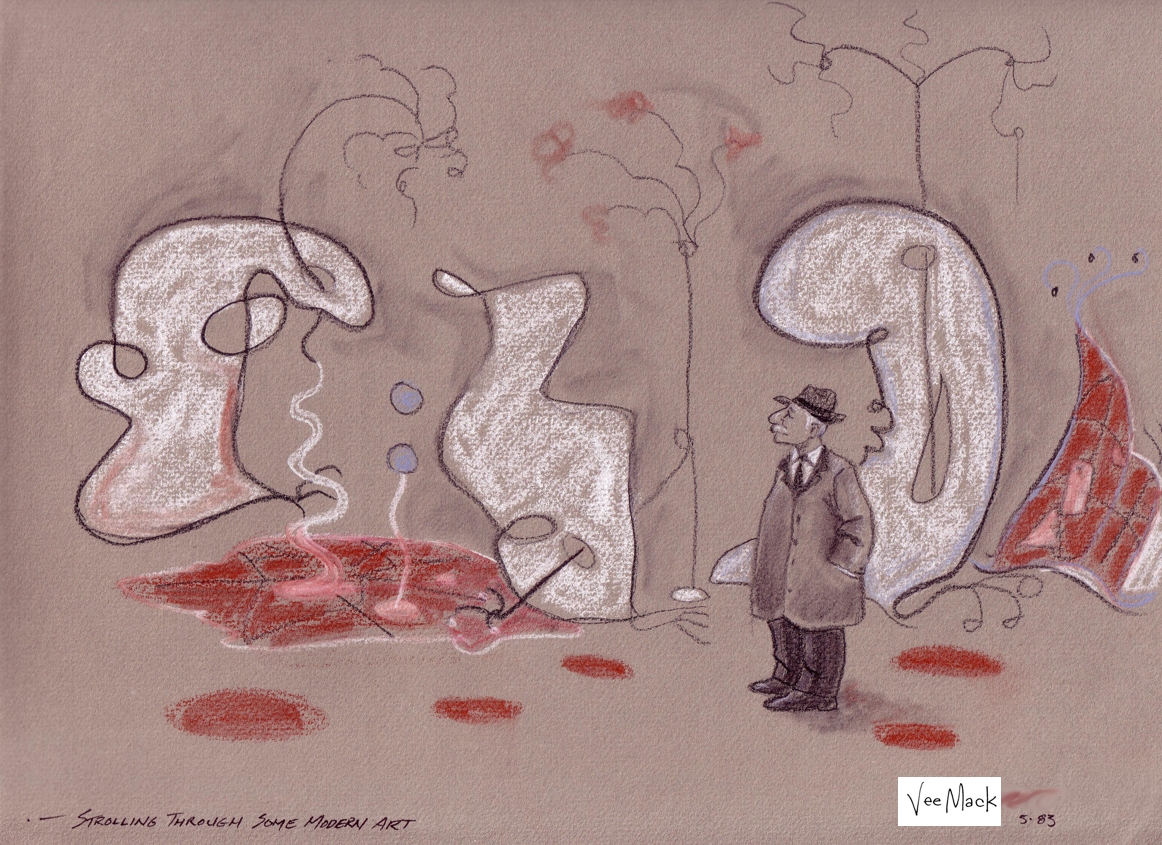


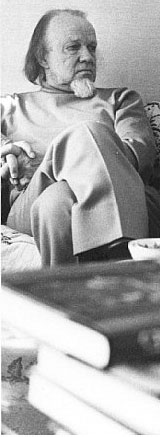


 Art Green
 Art Green
 Art Green
 Art Green
 Art Green
 Art Green
 Art Green
 Art Green
 Art Green with Gladys Nilsson.














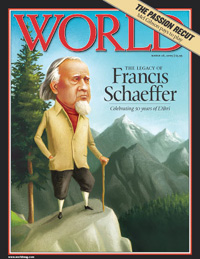


 The Daily Hatch
This is one of my favourite poems by him:dying is fine)but Death?o
baby
iwouldn’t likeDeath if Death
were
good:forwhen(instead of stopping to think)youbegin to feel of it,dying
‘s miraculous
why?be
cause dying is
perfectly natural;perfectly
putting
it mildly lively(but
Death
is strictly
scientific
& artificial &
evil & legal)
we thank thee
god
almighty for dying
(forgive us,o life!the sin of Death
can it be said to be both?
if serial writing is a way of achieving atonality then………..?
-marie’s head explodes-
Harris
-confused-
am i right?
Harris