Category Archives: Uncategorized

Dan Mitchell: Americans Are “Voting with their Feet” against High Taxes

Americans Are “Voting with their Feet” against High Taxes

I’ve written many times about how Americans are moving from high-tax states to low-tax states.

Now we have even more evidence because the Census Bureau has issued its annual report on state population changes, along with this accompanying map.

You don’t need to be an expert in map reading to see that CaliforniaIllinois, and New York are losing people at the fastest rate (orange states).

Likewise, the states gaining population at the fastest rate (purple states) include Texas.

This chart from the Wall Street Journal shows the biggest changes, as measured by the number of people moving in and out.

To be sure, taxes are not the only factor that drive internal migration.

But it’s also clear that people tend to move to lower-tax states, either because they overtly want to keep more of their money, or because they are attracted to the job opportunities that tend to be more plentiful where taxes are lower.

As you might expect, the coverage from Fox News highlights the fact that people are leaving blue states and moving to red states.

Between 2020 and 2021, the country has seen the lowest population growth since its founding, at only a 0.1% increase, but the biggest declines have occurred in Washington, D.C., and Democrat-led states, according to a report Tuesday by the Census Bureau. …New York with a 1.6% decline, Illinois with a 0.9% decline, and Hawaii and California that both saw a 0.7% decline. Meanwhile, the states that saw the biggest increase in population growth were Republican-run states, starting with Idaho at a 2.9% increase, followed by Utah with 1.7%, Montana with 1.7%, Arizona with 1.4% and South Carolina with 1.2%. …Florida and Texas, each saw a population growth of 1%.

Citing a different report, he Wall Street Journal opined a few days ago about the implications of migration for Illinois.
The Land of Lincoln is one of only three states, including West Virginia and Mississippi, to have lost population since 2010. But its population over age 55 has grown as Baby Boomers have aged. …Illinois is losing young people while Florida is gaining them. State development specialist Zach Kennedy notes that “the U.S. population actually grew in the prime working age, young adult age cohorts, 25 to 29, 30 to 34 and 35 to 39 year olds.”Illinois was among the few states to see a decline in these age cohorts. …“Only New Jersey lost more college-aged individuals out of state who never returned,” Mr. Kennedy says. Hmmm. What do the two have in common? …a shrinking population of prime-age working people and children means a smaller tax base will have to support growing retirement liabilities. Folks who stick around will have to pay higher and higher taxes. …each Illinois household on average is on the hook for $110,000 in government-worker retirement debt, up from $90,000 in 2019. …The per-household pension burdens in Iowa and Wisconsin were $3,500 and $3,200, respectively. Both states have gained young people. State and local government in Illinois is run by public-worker unions, and people are fleeing the economic and fiscal consequences.

The most important sentence in the preceding excerpt points out that “Folks who stick around will have to pay higher and higher taxes.”

And that will encourage even more of them to leave, which leads to even-further pressure for higher taxes on the chumps who remain.

Needless to say, that won’t end well, for Illinois or other blue states. Either they go bankrupt or future politicians do a big blue-state bailout.

P.S. This helps to explain why curtailing the federal tax code’s subsidy for excessive state and local tax burdens was so important.

P.P.S. This is also why federalism is both good politics and good policy.


Biden Wants the U.S. to Be #1…in a Bad Way

The good news is that President Biden wants the United States to be at the top. The bad news is that he wants America to be at the top in bad ways. My

  • The highest corporate income tax rate.
  • The highest capital gains tax rate.
  • The highest level of double taxation.

We can now add another category, based on the latest iteration of his budget plan.

According to the Tax Foundation, the United States would havethe develop world’s most punitive personal income tax.

Worse than France and worse than Greece. How embarrassing.

In their report, Alex Durante and William McBride explain how the new plan will raise tax rates in a convoluted fashion.

High-income taxpayers would face a surcharge on modified adjusted gross income (MAGI), defined as adjusted gross income less investment interest expense. The surcharge would equal 5 percent on MAGI in excess of $10 million plus 3 percent on MAGI above $25 million, for a total surcharge of 8 percent. The plan would also redefine the tax base to which the 3.8 percent net investment income tax (NIIT) appliesto include the “active” part of pass-through income—all taxable income above $400,000 (single filer) or $500,000 (joint filer) would be subject to tax of 3.8 percent due to the combination of NIIT and Medicare taxes. Under current law, the top marginal tax rate on ordinary income is scheduled to increase from 37 percent to 39.6 percent starting in 2026. Overall, the top marginal tax rate on personal income at the federal level would rise to 51.4 percent. In addition to the top federal rate, individuals face taxes on personal income in most U.S. states. Considering the average top marginal state-local tax rate of 6.0 percent, the combined top tax rate on personal income would be 57.4 percent—higher than currently levied in any developed country.

Needless to say, this will make the tax code more complex.

Lawyers and accountants will win and the economy will lose.

I’m not sure why Biden and his big-spender allies have picked a complicated way to increase tax rates, but that doesn’t change that factthat people will have less incentive to engage in productive behavior.

What matters is the marginal tax rate on people who are thinking about earning more income.

And they’ll definitely choose to earn less if tax rates increase, particularly since well-to-do taxpayers have considerable controlover the timing, level, and composition of their income.

P.S. Based on what happened in the 1980s, we can safely assume that Biden’s class-warfare plan won’t raise much money.

Biden Pick Becerra’s Indecent, Indefensible Legal Assault on Nuns, Human Life

Sean Spicer  @seanspicer / October 26, 2021

 width=

COMMENTARY BY

Sean Spicer@seanspicer

Sean Spicer, who served as press secretary in the Trump White House, is the host of “Spicer & Co.” on Newsmax TV.

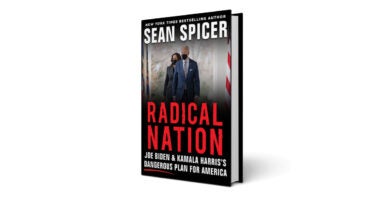
The following is excerpted from Trump White House press secretary Sean Spicer’s new book “Radical Nation: Joe Biden and Kamala Harris’s Dangerous Plan for America.“ It is available here and elsewhere.

Founded in France in 1839, the Little Sisters of the Poor is a Catholic order of nuns who operate 29 care homes across the United States. The nuns take vows of chastity, poverty, obedience, and hospitality, and they serve Christ by serving the elderly poor. 

When the Patient Protection and Affordable Care Act (aka ACA or “Obamacare”) was enacted in March 2010, it required employers to offer health insurance plans that included contraceptives, abortifacients, and sterilizations—all of which violate the precepts of the Catholic Church. 

Though the ACA exempted churches, it did not exempt faith-based ministries such as the Little Sisters of the Poor. These ministries were subject to fines if they did not comply—and the Little Sisters refused to comply. 

St. Paul once wrote that all who will live godly in Christ Jesus will suffer persecution. The Obama administration was determined to make good on that biblical promise and proceeded to persecute the Little Sisters all the way to the U.S. Supreme Court. 

In 2016, the Supreme Court directed the Obama administration to compromise with the Little Sisters and “arrive at an approach going forward” to end the standoff. The Obama administration failed to achieve that goal before leaving office.  

In 2017, the Trump administration took over and structured an accommodation that resolved the Little Sisters’ problems with the ACA mandate. In October of that year, the Department of Health and Human Services issued an updated religious-exemption rule that protected religious nonprofit organizations such as the Little Sisters of the Poor.  

Case closed, right? Wrong.  

The next month, November 2017, attorneys general from several states, including Pennsylvania and California, ramped up the persecution of the Little Sisters. They went to court and obtained a nationwide injunction against the new HHS rule. Pennsylvania and California sued the federal government, asking the judges to force the Little Sisters to comply with the Obamacare mandate or face millions of dollars in penalties.

In July 2019, the 3rd U.S. Circuit Court of Appeals ruled against the Little Sisters in the Pennsylvania case. In October 2019, the 9th U.S. Circuit Court of Appeals ruled against the Little Sisters in the California case. At that point, the Little Sisters asked the U.S. Supreme Court for a definitive ruling.  

On July 8, 2020, the Supreme Court delivered a decisive 7 to 2 ruling in favor of the Little Sisters of the Poor. The court affirmed the religious liberty exemptions for faith-based organizations. The Little Sisters of the Poor would not have to pay for abortions under the Obamacare mandates. After spending over a decade fighting federal and state governments in the courts, the Little Sisters could finally get back to serving the poor in peace. 

The Little Sisters set an example for us all, refusing to back down in the face of government pressure. They were determined to serve the elderly poor without lending support or endorsement to abortion. They correctly understood that the assault on their freedom was an assault on the sanctity of human life. 

Is this really why government exists? To harass and intimidate nuns who are simply living out their faith and serving the poor? It’s hard to believe, but there are people in government who get up in the morning and say, “I’m going to punish a Catholic ministry today! I’m going to scare nuns and force them to pay for abortions!” 

I mean, such a person would have to be a mustache-twirling villain of the Snidely Whiplash variety, right? 

Well, meet one of the persecutors of the Little Sisters of the Poor—namely, President Joe Biden’s secretary of health and human services, Xavier Becerra. In November 2017, after the Little Sisters had already prevailed once in the Supreme Court, it was Becerra [then the state attorney general] who made the decision for California to sue again in federal court to take away the nuns’ religious exemption. He lost that case in 2020—but the following year, Biden tapped Becerra to lead the Department of Health and Human Services, the very agency he had unsuccessfully sued in 2017. 

In February, Becerra was in a Senate confirmation hearing for the Biden Cabinet post, trying to explain away his relentless pursuit of the Little Sisters of the Poor. Sen. John Thune, R-S.D., said to him, “It does seem like, as attorney general, you spent an inordinate amount of time and effort suing pro-life organizations, like Little Sisters of the Poor, or trying to ease restrictions or expand abortion.” 

Apparently realizing how bad his pursuit of the Little Sisters looked, Becerra replied, “I have never sued the nuns, any nuns. I’ve never sued any affiliation of nuns, and my actions have always been directed at the federal agencies.” 

It’s a flimsy alibi. Becerra did, in fact, sue to force a religious order of nuns to pay for Obamacare’s contraceptive and abortifacient mandates. Moreover, the case is named State of California v. Little Sisters of the Poor. It doesn’t get any plainer than that. Had Becerra won his case, the Little Sisters would have lost millions of dollars, along with their First Amendment rights. Becerra pursued the nuns in court for three years. 

Despite his evasive testimony, Becerra did sue nuns, an act of cold-hearted villainy that would have done Snidely Whiplash proud. As Sen. Tom Cotton, R-Ark., tweeted on Feb. 24, “Xavier Becerra is now claiming he didn’t sue nuns because he wants to get confirmed. But Becerra did sue nuns. He repeatedly harassed the Little Sisters of the Poor. That’s why he should be rejected by the Senate.”  

In selecting Becerra to head HHS, Biden signaled his intention to move America to the extreme edge of pro-abortion policy. No American politician has ever demonstrated more enthusiasm for unrestricted abortion than Becerra.  

I am a proud member of the National Association of Christian Lawmakers and I attended the convention in Dallas in July and we have officially launched a nationwide push against abortion rights.

The article below notes:

At its first annual policy conference last weekend, group members voted to make a controversial new Texas law, the “Texas Heartbeat Bill,” the organization’s first piece of model legislation, meaning that similar bills may soon pop up in state capitols across the country.

Also I am excited to report that the WASHINGTON POST wrote in September 3, 2021:

Announcing he planned to introduce a copycat bill, Arkansas state Sen. Jason Rapert (R), the founder and president of the National Association of Christian Lawmakers, shared a template of legislation lawmakers in other states could fill in the blanks on and reproduce.

At the July 17th session of THE CHRISTIAN LAWMAKERS meeting in Dallas, I really got a lot out of the expert panel moderated by Texas State Senator Bryan Hughes entitled ABOLISHING ABORTION IN AMERICA. Here below is what Wikipedia says about Senator Hughes:

On March 11, 2021, Hughes introduced a fetal heartbeat bill entitled the Texas Heartbeat Bill (SB8) into the Texas Senate and state representative Shelby Slawson of Stephenville, Texas introduced a companion bill (HB1515) into the state house.[22]The bill allows private citizens to sue abortion providers after a fetal heartbeat has been detected.[22] The SB8 version of the bill passed both chambers and was signed into law by Texas Governor Greg Abbott on May 19, 2021.[22] It took effect on September 1, 2021.[22]

Whatever Happened To The Human Race? | Episode 1 | Abortion of the Human…

Tucker: Democrats have abandoned their ‘my body, my choice’ argument

These Christian lawmakers are on the offensive against abortion

That National Association of Christian legislators has made the so-called ‘Texas Heartbeat Bill’ the basis for its first piece of model legislation

Arkansas state Sen. Jason Rapert presides over a Senate committee at the state Capitol in Little Rock, Ark. in this March 14, 2018, file photo. Rapert’s National Association of Christian Lawmakers met recently to talk model legislation and pass resolutions. Kelly P. Kissel, Associated Press

The National Association of Christian Lawmakers has officially launched a nationwide push against abortion rights.

At its first annual policy conference last weekend, group members voted to make a controversial new Texas law, the “Texas Heartbeat Bill,” the organization’s first piece of model legislation, meaning that similar bills may soon pop up in state capitols across the country.

The model legislation, called the Heartbeat Model Act, was accepted unanimously by the executive committee during a Saturday meeting.

The Texas bill it is based upon, Senate Bill 8, bans abortions once a fetal heartbeat can be detected, which can occur as early as six weeks into a pregnancy. The legislation also allows for any state resident to bring a civil suit against a doctor who performs an abortion after a heartbeat is detectable. Under the law, a woman who has an abortion would be liable to civil suits, as would anyone who supported her in the act — from family members to the receptionist who checks her in at a clinic.

Not only is the doctor liable, but anyone found aiding and abetting,” said Texas legislator Bryan Hughes, the bill’s author, during the Saturday meeting, which was led by the organization’s founder and president, Arkansas state Sen. Jason Rapert.Texas state Rep. Bryan Hughes speaks during the opening session of the 2015 legislative session on Tuesday, Jan. 13, 2015, in Austin, Texas. Eric Gay, Associated Press

Speaking to the Deseret News on Monday, Rapert said the provision allowing residents to bring civil suits against anyone involved in an abortion is like “putting a SCUD missile on that heartbeat bill — they can’t stop it.”

Rapert was the author of a similar 2013 bill in Arkansas, portions of which were later struck down by a federal judge. At least a dozen states have implemented a variety of abortion restrictions in recent years, leading numerous observers to say that the landmark 1973 Supreme Court abortion ruling, Roe v. Wade, is under threat.

Critics of the legislation have likened the Texas law to putting “a bounty on the head” of anyone involved in an abortion; they have also called it “unconstitutional.” Last week, a group of providers filed a federal lawsuit in an attempt to derail the law, which is supposed to go into effect in September.

Speaking Saturday to the Christian legislators gathered in Dallas, Hughes reminded the legislators that the Heartbeat Model Act is just a starting point and that the legislation will have to be tailored to work within each state’s laws.A anti-abortion supporter argues with those who attended a press conference and rally held by the Planned Parenthood Action Council of Utah outside of the Capitol in Salt Lake City on Aug. 25, 2015. Stacie Scott, Deseret News

The National Association of Christian Lawmakers formed last year with three key goals: to offer conservative, Christian legislators networking opportunities,; to help lawmakers share bills that have been successful in their states so that legislators elsewhere might push through similar legislation; and to support Christians running for local, state or national office.

At the policy conference last week, the organization worked toward meeting these goals in various ways, including by approving the Heartbeat Model Act. The executive committee also passed a resolution supporting Israel’s “right to defend itself from terror attacks” and creating a standing American-Israeli Committee.

Speaking to the executive committee, Rabbi Leonid Feldman, who was born in the Soviet Union and was imprisoned there for his pro-Israel activities, remarked that the Jewish people “remember our friends.”

This conference and this organization will be remembered by the Jewish people,” he said.

The organization also approved a resolution in support of “election integrity.”

The executive committee also approved a second piece of model legislation: the National Motto Display Model Act. Based on bills passed in Arkansas in 2017 and this year in Texas, the legislation requires public schools to display the national motto “In God We Trust” when printed versions of the motto are donated to schools or copies of the national motto are bought with funds from private donors.

“As the Texas House sponsor of the Motto Act, I am proud to see a model put out by the NACL so that legislators from every other state can have a mechanism to ensure our citizens — especially our school-age children — are reminded of our nation’s motto,” said Tom Oliverson, a state representative from Texas and chairman of the National Association of Christian Lawmakers’ national legislative council.

During the executive committee’s meeting on Saturday, Rapert said Hobby Lobby would make frames available for a reduced price if they’ll be used for national motto displays.

Asked Monday what other pieces of legislation the organization might adopt as model legislation in the future, Rapert told the Deseret News that the National Association of Christian Lawmakers is already weighing some options.

Since religious freedom is central to the organization, it could end up adopting model legislation similar to bills promoted in Texas this year by Oliverson. He supported three measures designed to make it harder for the government to force church closures during public emergencies, like the COVID-19 pandemic, and a bill that would ensure homeowners’ associations can’t infringe on homeowners’ rights to display religious symbols.

Supreme Court votes 5-4 to leave Texas abortion law in place

Chief Justice John Roberts dissented along with the court’s three liberal justices

Associated Press

WASHINGTON — A deeply divided Supreme Court is allowing a Texas law that bans most abortions to remain in force, for now stripping most women of the right to an abortion in the nation’s second-largest state.

The court voted 5-4 to deny an emergency appeal from abortion providers and others that sought to block enforcement of the law that went into effect Wednesday. But the justices also suggested that their order likely isn’t the last word on whether the law can stand because other challenges to it can still be brought.

The Texas law, signed by Republican Gov. Greg Abbott in May, prohibits abortions once medical professionals can detect cardiac activity, usually around six weeks and before many women know they’re pregnant.

It is the strictest law against abortion rights in the United States since the high court’s landmark Roe v. Wade decision in 1973 and part of a broader push by Republicans nationwide to impose new restrictions on abortion. At least 12 other states have enacted bans early in pregnancy, but all have been blocked from going into effect.

The high court’s order declining to halt the Texas law came just before midnight Wednesday. The majority said those bringing the case had not met the high burden required for a stay of the law.

“The Court’s order is emphatic in making clear that it cannot be understood as sustaining the constitutionality of the law at issue.”— Chief Justice John Roberts

Chief Justice John Roberts (Supreme Court)

Chief Justice John Roberts (Supreme Court)

“In reaching this conclusion, we stress that we do not purport to resolve definitively any jurisdictional or substantive claim in the applicants’ lawsuit. In particular, this order is not based on any conclusion about the constitutionality of Texas’s law, and in no way limits other procedurally proper challenges to the Texas law, including in Texas state courts,” the unsigned order said.

Chief Justice John Roberts dissented along with the court’s three liberal justices. Each of the four dissenting justices wrote separate statements expressing their disagreement with the majority.

Roberts noted that while the majority denied the request for emergency relief “the Court’s order is emphatic in making clear that it cannot be understood as sustaining the constitutionality of the law at issue.”

The vote in the case underscores the impact of the death of the liberal Justice Ruth Bader Ginsburg last year and then-president Donald Trump’s replacement of her with conservative Justice Amy Coney Barrett. Had Ginsburg remained on the court there would have been five votes to halt the Texas law.

Justice Sonia Sotomayor called her conservative colleagues’ decision “stunning.” “Presented with an application to enjoin a flagrantly unconstitutional law engineered to prohibit women from exercising their constitutional rights and evade judicial scrutiny, a majority of Justices have opted to bury their heads in the sand,” she wrote.

“A majority of Justices have opted to bury their heads in the sand.”— Justice Sonia Sotomayor

Justice Sonia Sotomayor (Supreme Court)

Justice Sonia Sotomayor (Supreme Court)

Texas lawmakers wrote the law to evade federal court review by allowing private citizens to bring civil lawsuits in state court against anyone involved in an abortion, other than the patient. Other abortion laws are enforced by state and local officials, with criminal sanctions possible.

In contrast, Texas’ law allows private citizens to sue abortion providers and anyone involved in facilitating abortions. Among other situations, that would include anyone who drives a woman to a clinic to get an abortion. Under the law, anyone who successfully sues another person would be entitled to at least $10,000.

In her dissent, Justice Elena Kagan called the law “patently unconstitutional,” saying it allows “private parties to carry out unconstitutional restrictions on the State’s behalf.” And Justice Stephen Breyer said a “woman has a federal constitutional right to obtain an abortion during” the first stage of pregnancy.

After a federal appeals court refused to allow a prompt review of the law before it took effect, the measure’s opponents sought Supreme Court review.

In her dissent, Justice Elena Kagan called the law “patently unconstitutional,” saying it allows “private parties to carry out unconstitutional restrictions on the State’s behalf.” And Justice Stephen Breyer said a “woman has a federal constitutional right to obtain an abortion during” the first stage of pregnancy.

After a federal appeals court refused to allow a prompt review of the law before it took effect, the measure’s opponents sought Supreme Court review.

In a statement early Thursday after the high court’s action, Nancy Northup, the head of the Center for Reproductive Rights, which represents abortion providers challenging the law, vowed to “keep fighting this ban until abortion access is restored in Texas.”

“We are devastated that the Supreme Court has refused to block a law that blatantly violates Roe v. Wade. Right now, people seeking abortion across Texas are panicking — they have no idea where or when they will be able to get an abortion, if ever. Texas politicians have succeeded for the moment in making a mockery of the rule of law, upending abortion care in Texas, and forcing patients to leave the state — if they have the means — to get constitutionally protected healthcare. This should send chills down the spine of everyone in this country who cares about the constitution,” she said.

Texas has long had some of the nation’s toughest abortion restrictions, including a sweeping law passed in 2013. The Supreme Court eventually struck down that law, but not before more than half of the state’s 40-plus clinics closed.

Even before the Texas case arrived at the high court the justices had planned to tackle the issue of abortion rights in a major case after the court begins hearing arguments again in the fall. That case involves the state of Mississippi, which is asking to be allowed to enforce an abortion ban after 15 weeks of pregnancy.

Associated Press writer Paul J. Weber in Austin, Texas, contributed to this report.

—-

June 23, 2021

President Biden c/o The White House 1600 Pennsylvania Avenue NW Washington, DC 20500

Dear Mr. President,

I wanted to reach out to you because of some of the troubling moral issues coming out of your administration.

Over and over on my blog I have written about your efforts as Vice President and President to attack legally the rights of our unborn babies in the USA. These views of yours are due to your allegiance to the humanist worldview which Francis Schaeffer and Tim LaHaye exposed in their books. Your vast support from humanist groups in the 2020 election proves my point. No wonder we have seen criminals let go and an effort by Democrats (namely VP Harris) to defund the police. The Bible recognizes the sinful nature of humans and calls for the authorities to have the power of the sword in Romans 13! However, there have been times when the IRS has been used against freedom of expression such as the past persecution of the Tea Party. The Founding Fathers did NOT think the King was above the law! Unfortunately many lawmakers today don’t care about the law very much it seems which is a result of loss of a Christian Consensus influence in our society!

I recently read this article below:

The Archbishop Who Fears for Joe Biden’s Soul

America’s second-ever Catholic president supports abortion rights, leaving the bishops unsure about how to move forward.By Emma Green

MARCH 14, 2021 

Archbishop Joseph Naumann is anxious about President Joe Biden’s soul. The two men are in some ways similar: cradle Catholics born in the 1940s who witnessed John F. Kennedy become America’s first Catholic president. Both found a natural home in the Democratic Party—in Naumann’s midwestern family, asking Catholics if they were Democrats was a redundancy. Naumann became a priest and Biden became a politician, but their paths really diverged over the issue of abortion. Now in his 70s, Naumann watched Biden—America’s second Catholic president—transform into a vocal supporter of abortion rights while competing for the 2020 Democratic presidential nomination. Naumann runs the Archdiocese of Kansas City in Kansas and also leads what the Catholic bishops describe as their pro-life activities. He has suggested that Biden should no longer call himself a devout Catholic. At the very least, Naumann says, Biden should stop receiving Communion, a holy sacrament in Catholic life.

The United States Conference of Catholic Bishops recently convened a working group to discuss how the bishops should interact with Biden, and how they should deal with the challenge of having a visibly Catholic president who defies Church teachings on a central issue. Naumann was part of that group. Conflicts have already arisen: Naumann recently co-authored a statement expressing moral concerns about the Johnson & Johnson vaccine, which was developed and tested using cell lines from aborted fetal tissue. He also joined a statement from a group of the country’s top bishops celebrating the passage of the American Rescue Plan Act, but called it “unconscionable that Congress has passed the bill without critical protections needed to ensure that billions of taxpayer dollars are used for life-affirming health care and not for abortion.”

John MacArthur gave a sermon in June of 2021 entitled “When Government Rewards Evil and Punishes Good” and in that sermon he makes the following points:

INTRODUCTION AND DISCUSSION OF ROMANS 13

GOVERNMENT CAN FORFEIT ITS AUTHORITY

THE WORLD IS THE ENEMY OF THE GOSPEL

ALL OF HUMAN HISTORY IS PROGRESSING TOWARD A GLOBAL KINGDOM UNDER THE POWER OF SATAN

ONE FALSE WORLD RELIGION IS FINAL PLAY BY SATAN

REAL PERSECUTION CAN ONLY BE DONE BY GOVERNMENT

PERSECUTION IN BOOK OF DANIEL

THE LAW IS KING AND NOT THE GOVERNOR OF CALIFORNIA

GOVERNMENT HAS BECOME PURVEYOR OF WICKEDNESS

THERE IS A PLACE FOR CIVIL DISOBEDIENCE

DOES GOVERNMENT WIN?

Let me just share a portion of that sermon with you and you can watch it on You Tube:

GOVERNMENT HAS BECOME PURVEYOR OF WICKEDNESS 

One New Testament writer says that Romans 13 has “caused more unhappiness and misery . . . than any other . . . verses in the New Testament by the license they have given to tyrants . . . used to justify a host of horrendous abuses of individual human rights.” Hitler’s Holocaust, racism in the apartheid of South Africa, Cantrell says, “Both the Jews in Germany and blacks in South Africa were viewed as a threat to public health and national security. . . . “‘Trust us,’ said government . . . ‘we truly have your best interests at heart. All we want to do is help . . . keep you safe.’”

Government has already become the purveyor of wickedness. Government is a murderer, slaughtering millions of infants in abortion; elevating the LGBTQ agenda, the bizarre transgender deception. The culture has become anti-truth, we all know that. The truth is the biggest threat to lies. William Pitt, well-known name in English history, said this: “Necessity (i.e., public health, common good) is the plea [of] every infringement of human freedom: it is the argument of tyrants. “Get people afraid, and they’ll do whatever you want. A fearful society will always comply; panicking people will believe anything” [(Cantrell)].

“During the gruesome and bloody days of the French Revolution, when 40,000 innocent [people] lost their heads,” you would be interested to know who was operating the guillotine: the Committee for Public Safety [(Cantrell)]. One writer says, “Governments now get voted into power by promising to oversee housing, education, medicine, the economy, [the] currency, a minimum income, food, water, land, and the list goes on. The government become a parent, and the citizens are dependents. The government in this role becomes a monstrous juggernaut of bureaucracy, devouring taxes and trying to regulate every detail of life.” And they definitely want to regulate the church and silence its proclamation.

In his book The Glorious Body of Christ, Kuiper wrote, “Our age is one of ecclesiastical passivism. . . . When a church ceases to be militant it also ceases to be a church of Jesus Christ. . . . A truly militant church stands opposed to the world both without its walls and within. . . . Time and again in its history the church has found it necessary to assert its sovereignty over against usurpations by the state.” And Kuiper gave some biblical examples, like when King Saul or King Uzziah usurped the priesthood, stating, “In both cases a representative of the state was severely punished for encroaching [on] the sovereignty of the church.”

“Lord Macaulay of England summed up the Puritan reputation this way” [(Cantrell)]. He said of the Puritans, “He bowed himself in the dust before his Maker; [as] he set his foot on the neck of his king.” Kuiper says, “Ours is an age of state totalitarianism. All over the world statism is [rising] . . . . In consequence, in many lands the church finds itself utterly at the mercy of the state whose mercy often proves cruelty, while in others the notion is rapidly gaining ground that the church exists and operates by the state’s permission.” We do not operate by the state’s permission; we operate by the Lord’s command.

—-

Francis Schaeffer discusses this more in his fine book CHRISTIAN MANIFESTO:

PAGE 437

CHAPTER 3 THE DESTRUCTION OF FAITH AND FREEDOM

And now it is all gone!

In most law schools today almost no one studies William Blackstone unless he or she is taking a course in the history of law. We live in a secularized society and in secularized, sociological law. By sociological law we mean law that has no fixed base but law in which a group of people decides what is sociologically good for society at the given moment; and wha they arbitrarily decide becomes law. Oliver Wendall Holmes (1841-1935) made totally clear that this was his position. Frederick Moore Vinson (1890-1953), former Chief Justice of the United States Supreme Court, said, “Nothing is more certain in modern society than the principle that there are no absolutes.” Those who hold this position themselves call it sociological law. 

As the new sociological law has moved away from the original base of the Creator giving the “inalienable rights,” etc., it has been natural that this sociological law has then also moved away from the Constitution. William Bentley Ball, in his paper entitled “Religious Liberty: The Constitutional Frontier,” says: 

i propose that secularism militates against religious liberty, and indeed against personal freedoms generally, for two reasons: first, the familiar fact that secularism does not recognize the existence of the “higher law”; second, because, that being so, secularism tends toward decisions based on the pragmatic public policy of the moment and inevitably tends to resist the submitting of those policies to the “higher” criteria of a constitution. 

This moving away from the Constitution is not only by court rulings, for example the First Amendment rulings, which are the very reversal of the original purpose of the First Amendment (see pp. 433, 434), but in other ways as well. Quoting again from the same paper by William Bentley Ball:

Our problem consists also, as perhaps this paper has well enough indicated, of more general constitutional delegation of legislative power and ultra vires. The first is where the legislature hands over its powers to agents through the conferral of regulatory power unaccompanied by strict standards. The second is where the agents make up powers on their own–assume powers not given them by the legislature. Under the first, the government of laws largely disappears and the government of men largely replaces it. Under the second, agents’ personal “home-made law replaces the law of the elected representatives of the people. 

Naturally, this shift from the Judeo-Christian basis for law and the shift away from the restraints of the Constitution automatically militates against religious liberty. Mr. Ball closes his paper:

Fundamentally, in relation to personal liberty, the Constitution was aimed at restraint of the State. Today, in case after case relating to religious liberty, we encounter the bizarre presumption that it is the other way around; that the State is justified in whatever actions, and that religion bears a great burden of proof to overcome that presumption. 

It is our job, as Christian lawyers, to destroy that presumption at every turn. 

As lawyers discuss the changes in law in the United States, often they speak of the influence of the laws involved in the reentrance of the southern states into the national government after the Civil War. These indeed must be considered. But they were not the reason for the drastic change in law in our country. This reason was the takeover by the totally other world view which never have given the form and freedom in government we have had in Northern Europe (including the United States). That is the central factor in the change. 

PAGE 439

It is parallel to the difference between modern science beginning with Copernicus and Galileo and the materialistic science which took over the last century. Materialistic thought would never have produced modern science. Modern science was produced on the Christian base. That is, because an intelligent Creator had created the universe we can in some measure understand the universe and there is, therefore, a reason for observation and experimentation to be pursued. 

Then there was a shift into materialistic science based on a philosophic change to the materialistic concept of final reality. This shift was based on no addition to the facts known. It was a choice, in faith, to see things that way. No clearer expression of this could be given than Carl Sagan’s arrogant statement on public television–made without any scientific proof for the statement–to 140 million viewers: “The cosmos is all that is or ever was or ever was or ever will be.” He opened the series, COSMOS, with this essentially creedal declaration and went on to build every subsequent conclusion upon it. 

There is exactly the same parallel in law. The materialistic-energy, chance concept of final reality never would have produced the form and freedom in government we have in this country and in other Reformation countries. But now it has arbitrarily and arrogantly supplanted the historic Judeo-Christian Consensus that provided the base for form and freedom in government. The Judeo-Christian consensus gave greater freedoms than the world has ever known, but it also contained the freedoms so that they did not pound society to pieces. The materialistic concept of reality would not have produced the form-freedom balance, and now that it has taken over it cannot maintain the balance. It has destroyed it. 

Will Durant and his wife Ariel together wrote The Story of Civilization. The Durants received the 1976 Humanist Pioneer Award. In The Humanist magazine of February 1977, Will Durant summed up the humanist problem with regard to personal ethics and social order: “Moreover, we shall find it no easy task to mold a natural ethic strong enough to maintain moral restraint and social order without the support of supernatural consolations, hopes, and fears.”

Poor Will Durant! It is not just difficult, it is impossible. He should have remembered the quotation he and Ariel Durant gave from the agnostic Renan in their book The Lessons of History. According to the Durants, Renan said in 1866: “If Rationalism wishes to govern the world without regard to the religious needs of the soul, the experience of the French Revolution is there to teach us the consequences of such a blunder.” And the Durants themselves say in the same context: “There is no significant example in history, before our time, of a society successfully maintaining moral life without the aid of religion.”

PAGE 440 

Along with the decline of the Judie-Christian consensus we have come to a new definition and connotation of “pluralism.” Until recently it meant that the Christianity flowing from the Reformation is not now as dominant in the country and in society as it was in the early days of the nation. After about 1848 the great viewpoints not shaped by Reformation Christianity. This, of course, is the situation which exists today. Thus as we stand for religious freedom today, we need to realize that this must include a general religious freedom from the control of the state for all religion. It will not mean just freedom for those who are Christians. It is then up to Christians to show that Christianityis the Truth of total reality in the open marketplace of freedom. 

This greater mixture in the United States, however, is now used as an excuse for the new meaning and connotation  of pluralism. It now is used to mean that all types of situations are spread out before us, and that it really is up to each individual to grab one or the other on the way past, according to the whim of personal preference. What you take is only a matter of personal choice, with one choice as valid as another. Pluralism has come to mean that everything is acceptable. This new concept of pluralism suddenly is everywhere. There is no right or wrong; it is just a matter of your personal preference. On a recent SIXTY MINUTES program on television, for example, the questions of euthanasia of the old and the growing of marijuana as California’s largest paying crop were presented this way. One choice is as valid as another. It is just a matter of personal preference. This new definition and connotation of pluralism is presented in many forms, not only in personal ethics, but in society’s ethics and in the choices concerning law, 

PAGE 440

Now I have a question. In these shifts that have come in law, where have the Christian lawyers been? I really ask you that. The shift has come gradually, but it has only come to its peak in the last 40 or 50 years. Where have the Christian lawyers been? Surely the Christian lawyers should have been the ones to have sounded the trumpet clear and loud, not just in bits and pieces but looking at the totality of what was occurring. Now, a nonlawyer like myself believes I have a right to feel let down because the Christian lawyers did not blow the trumpets clearly between, let us say, 1940 and 1970. 


PAGE 441

When I wrote HOW SHOULD WE THEN LIVE? From 1974 to 1976 I worked out of a knowledge of secular philosophy. I moved from the results in secular philosophy, to the results in liberal theology, to the results in the arts, and then I turned to the courts, and especially the Supreme Court. I read Oliver Wendell Holmes and others, and I must say, I was totally appalled by what I read. It was an exact parallel to what i had already known so well from my years of study in philosophy, theology, and the other disciplines. 

In the book and film series HOW SHOULD WE THEN LIVE? I used the Supreme Court abortion case as the clearest illustration of arbitrary sociiological law. But it was only the clearest illustration. The law is shot through with this kind of ruling. It is similar to choosing Fletcher’s situational ethics and point to it as the clearest illustration of how our society now functions with no fixed ethics. This is only the clearest illustration because in many ways our society functions on unfixed, situational ethics. The abortion case in law is exactly the same. It is only the clearest case. Law in this country has become situational law, using the term Fletcher used for his ethics. That is, a small group of people decide arbitrarily what, from their viewpoint, is for the good of society at that precise moment and they make it law, binding the whole society by their personal arbitrary decisions. 

But of course! What would we expect? These things are the natural, inevitable results of the material-energy, humanistic concept of the final basic reality. From the material-energy, chance concept of final reality, final reality is, and must be b it nature, silent as to values, principles, or any basis for law. There is no way to ascertain “the ought:” from “the is.” Not only should we have known what this would have produced, but on the basis of this viewpoint of reality, we should have recognized that there are no other conclusions that this view could produce. It is a natural result of really believing that the basic reality of all things is merely material-energy, shaped into its present form by impersonal chance. 

No, we must say that the Christians in the legal profession did not ring the bell, and we are indeed very, very far down the road toward a totally humanistic culture. At this moment we are in a humanistic culture, but we are happily not in a totally humanistic culture. But what we must realize is that the drift has been all in this direction. if it is not turned around we will move very rapidly into a totally humanistic culture. 

PAGE 442 

The law, and especially the courts, is the vehicle to force this total humanistic way of thinking upon the entire population.This is what has happened. The abortion law is a perfect example. The Supreme Court abortion ruling invalidated abortion lawsin all fifty states, even though it seems clear that in 1973 the majority of Americans were against abortion. It did not matter. The Supreme Court arbitrarily ruled that abortion was legal, and overnight they overthrew the state laws and forced their will on the majority, even though their ruling was arbitrary both legally and medically. Thus law and the courts became the vehicle for forcing a totally secular concept on the population.

—-

Thank you so much for your time. I know how valuable it is. I also appreciate the fine family that you have and your commitment as a father and a husband. I also respect you for putting your faith in Christ for your eternal life. I am pleading to you on the basis of the Bible to please review your religious views concerning abortion. It was the Bible that caused the abolition movement of the 1800’s and it also was the basis for Martin Luther King’s movement for civil rights and it also is the basis for recognizing the unborn children. I wanted to encourage you to investigate the work of Dr. Bernard Nathanson who like you used to be pro-abortion. I also want you to watch the You Tube series WHATEVER HAPPENED TO THE HUMAN RACE? by Francis Schaeffer and Dr. C. Everett Koop. Also it makes me wonder what our the moral climate Of our nation is when we concentrate more on potential mistakes of the police and we let criminals back on the street so fast! Our national was founded of LEX REX and not REX LEX!

Sincerely,

Everette Hatcher III, 13900 Cottontail Lane, Alexander, AR 72002, ph 501-920-5733,

PS: In this series of letters John MacArthur covers several points. In the first letter, he quotes you saying that the greatest threat to America—he said on one occasion—is systemic racism, which doesn’t exist; he said white supremacy, which doesn’t exist with any power; and then he said global warming, which doesn’t exist either, and if it does, God’s in charge of it.

In reality the greatest threat to this nation is the government, the government. And I want to show you how we are to understand that. Turn to Romans 13

In the 2nd letter, Dr. MacArthur noted When government turns the divine design on its head and protects those who do evil and makes those who do good afraid, it forfeits its divine purpose

In the 3rd letter Dr. MacArthur noted The world is the enemy of the gospel. The world is the enemy of the church. I pointed out that this manifests itself today in the form of HUMANISM.

In the 4th letter Dr. MacArthur points out how much today the devil is having his way in our society and that the Bible predicts that these will get worse!

In the 5th letter Francis Schaeffer points out “The HUMANIST MANIFESTOS not only say that humanism is a religion, but the Supreme Court has declared it to be a religion. The 1961 case of Torcaso v. Watkins specifically defines secular humanism as a religion equivalent to theistic and other non theistic religions.”

In the 6th letter Dr. MacArthur noted God has given government the sword, the power; and when they prostitute that power and they begin to punish those who do good and protect those who do evil, they wield that power against the people of God.

In the 7th letter Dr. MacArthur asserted, Throughout history, even in the Western world, people lived under what was called the divine right of kings. Kings were believed to have had a divine right. This was absolute monarchy. What broke that was basically the Reformers. The Reformers—a little phrase was “the law is king,” not the man.

In the 8th letter Dr. MacArthur noted that today the United States “Government has already become the purveyor of wickedness. Government is a murderer, slaughtering millions of infants in abortion.”

In the 9th letter the article

Judge gives preliminary OK to $3.5M settlement of IRS case is discussed about the 2013 lawsuit during the Barack Obama administration over treatment of conservative groups who said they were singled out for extra IRS scrutiny on tax-exempt status applications. Then Dr. MacArthur talks about persecution in the Book of Daniel.

“These are groups of law-abiding citizens who should have never had their First Amendment rights infringed upon by the IRS,” Jenny Beth Martin, president of the Tea Party Patriots umbrella group, said Wednesday. “These are groups that want the government to be accountable.”

The government has been used to persecuting people they don’t like for centuries! Let me just share a portion of that sermon by John MacArthur with you and you can watch it on You Tube: 

PERSECUTION IN BOOK OF DANIEL

In the 10th letter Dr. MacArthur noted:

THERE IS A PLACE FOR CIVIL DISOBEDIENCE

Francis Schaeffer, who died in 1984, says, “If [there’s] no final place for civil disobedience, then the government has been made autonomous, anas such, it has been put in the place of the living God.” And that point is exactly when the early Christians performed their acts of civil disobedience, even when it cost them their lives. “Acts of State which contradict God’s [Laws] are illegitimate and acts of tyranny. Tyranny is ruling without the sanction of God. To resist tyranny is to honour God. . . . The bottom line is that at a certain point there is not only the right, but the duty to disobey the State.”

Whatever Happened To The Human Race? | Episode 4 | The Basis for Human Dignity


Sunday Night Prime – Dr. Bernard Nathanson – Fr Groeschel, CFR with Fr …

——

Francis Schaeffer

Francis Schaeffer pictured above

Larry King had John MacArthur as a guest on his CNN program several times.

https://youtu.be/Tfq-maVMxiM

When Government Rewards Evil and Punishes Good

_________________________

Related posts:

Al Mohler on Kermit Gosnell’s abortion practice

May 15, 2013 – 7:46 am

Francis Schaeffer: “Whatever Happened to the Human Race” (Episode 1) ABORTION OF THE HUMAN RACE Published on Oct 6, 2012 by AdamMetropolis ________________ Picture of Francis Schaeffer and his wife Edith from the 1930′s above. I was sad to read about Edith passing away on Easter weekend in 2013. I wanted to pass along this fine […]By Everette Hatcher III | Posted in Francis SchaefferProlife | Edit | Comments (0)

Taking on Ark Times Bloggers on various issues Part U “Do men have a say in the abortion debate?” (includes the film SLAUGHTER OF THE INNOCENTS and editorial cartoon)

May 14, 2013 – 1:08 am

I have gone back and forth and back and forth with many liberals on the Arkansas Times Blog on many issues such as abortion, human rights, welfare, poverty, gun control  and issues dealing with popular culture. Here is another exchange I had with them a while back. My username at the Ark Times Blog is Saline […]By Everette Hatcher III | Posted in Francis SchaefferProlife | Edit | Comments (0)

Taking on Ark Times Bloggers on various issues Part T “Abortion is a dirty business” (includes video “Truth and History” and editorial cartoon)

May 9, 2013 – 7:19 am

I have gone back and forth and back and forth with many liberals on the Arkansas Times Blog on many issues such as abortion, human rights, welfare, poverty, gun control  and issues dealing with popular culture. Here is another exchange I had with them a while back. My username at the Ark Times Blog is Saline […]By Everette Hatcher III | Posted in Francis SchaefferProlife | Edit | Comments (0)

“Sanctity of Life Saturday” Abortion supporters lying in order to further their clause? Window to the Womb (includes video ABORTION OF THE HUMAN RACE)

April 6, 2013 – 12:01 am

It is truly sad to me that liberals will lie in order to attack good Christian people like state senator Jason Rapert of Conway, Arkansas because he headed a group of pro-life senators that got a pro-life bill through the Arkansas State Senate the last week of January in 2013. I have gone back and […]By Everette Hatcher III | Posted in Arkansas TimesFrancis SchaefferMax BrantleyProlife | Edit | Comments (0)

Taking on Ark Times Bloggers on various issues Part D “If you can’t afford a child can you abort?”Francis Schaeffer Quotes part 4 includes the film ABORTION OF THE HUMAN RACE) (editorial cartoon)

April 5, 2013 – 6:30 am

I have gone back and forth and back and forth with many liberals on the Arkansas Times Blog on many issues such as abortion, human rights, welfare, poverty, gun control  and issues dealing with popular culture. Here is another exchange I had with them a while back. My username at the Ark Times Blog is Saline […]By Everette Hatcher III | Posted in Francis SchaefferProlife | Edit | Comments (0)

Taking on Ark Times Bloggers on various issues Part C “Abortion” (Francis Schaeffer Quotes part 3 includes the film SLAUGHTER OF THE INNOCENTS) (editorial cartoon)

April 3, 2013 – 6:07 am

I have gone back and forth and back and forth with many liberals on the Arkansas Times Blog on many issues such as abortion, human rights, welfare, poverty, gun control  and issues dealing with popular culture. Here is another exchange I had with them a while back. My username at the Ark Times Blog is Saline […]By Everette Hatcher III | Posted in Francis SchaefferProlife | Edit | Comments (0)

Taking on Ark Times Bloggers on various issues Part B “Gendercide” (Francis Schaeffer Quotes Part 2 includes the film ABORTION OF THE HUMAN RACE) (editorial cartoon)

April 2, 2013 – 9:30 am

I have gone back and forth and back and forth with many liberals on the Arkansas Times Blog on many issues such as abortion, human rights, welfare, poverty, gun control  and issues dealing with popular culture. Here is another exchange I had with them a while back. My username at the Ark Times Blog is Saline […]By Everette Hatcher III | Posted in Francis SchaefferProlife | Edit | Comments (0)

SANCTITY OF LIFE SATURDAY “AngryOldWoman” blogger argues that she has no regrets about past abortion

March 30, 2013 – 1:29 am

Sometimes you can see evidences in someone’s life of how content they really are. I saw  something like that on 2-8-13 when I confronted a blogger that goes by the name “AngryOldWoman” on the Arkansas Times Blog. See below. Leadership Crisis in America Published on Jul 11, 2012 Picture of Adrian Rogers above from 1970′s […]By Everette Hatcher III | Posted in Adrian RogersArkansas TimesProlife | Edit | Comments (0)

“Sanctity of Life Saturday” The Church Awakens: Whatever Happened to the Human Race? (includes the video ABORTION OF THE HUMAN RACE)

March 9, 2013 – 9:35 am

In the film series “WHATEVER HAPPENED TO THE HUMAN RACE?” the arguments are presented  against abortion (Episode 1),  infanticide (Episode 2),   euthenasia (Episode 3), and then there is a discussion of the Christian versus Humanist worldview concerning the issue of “the basis for human dignity” in Episode 4 and then in the last episode a close […]By Everette Hatcher III | Posted in Francis SchaefferProlife | Edit | Comments (0)

Taking on Ark Times Bloggers on various issues Part H “Are humans special?” includes film ABORTION OF THE HUMAN RACE) Reagan: ” To diminish the value of one category of human life is to diminish us all”

April 10, 2013 – 6:43 am

I have gone back and forth and back and forth with many liberals on the Arkansas Times Blog on many issues such as abortion, human rights, welfare, poverty, gun control  and issues dealing with popular culture. Here is another exchange I had with them a while back. My username at the Ark Times Blog is Saline […]By Everette Hatcher III | Posted in Francis SchaefferProlife | Edit | Comments (0)

Taking on Ark Times Bloggers on various issues Part G “How do moral nonabsolutists come up with what is right?” includes the film “ABORTION OF THE HUMAN RACE”)

April 9, 2013 – 6:36 am

I have gone back and forth and back and forth with many liberals on the Arkansas Times Blog on many issues such as abortion, human rights, welfare, poverty, gun control  and issues dealing with popular culture. Here is another exchange I had with them a while back. My username at the Ark Times Blog is Saline […]By Everette Hatcher III | Posted in Francis SchaefferProlife | Edit | Comments (3)

Taking on Ark Times Bloggers on various issues Part E “Moral absolutes and abortion” Francis Schaeffer Quotes part 5(includes the film SLAUGHTER OF THE INNOCENTS) (editorial cartoon)

April 7, 2013 – 6:25 am

I have gone back and forth and back and forth with many liberals on the Arkansas Times Blog on many issues such as abortion, human rights, welfare, poverty, gun control  and issues dealing with popular culture. Here is another exchange I had with them a while back. My username at the Ark Times Blog is Saline […]By Everette Hatcher III | Posted in Francis SchaefferProlife | Edit | Comments (2)

Francis Schaeffer’s “How should we then live?” Video and outline of episode 10 “Final Choices” (Schaeffer Sundays)

January 8, 2012 – 12:54 am

E P I S O D E 1 0   Dr. Francis Schaeffer – Episode X – Final Choices 27 min FINAL CHOICES I. Authoritarianism the Only Humanistic Social Option One man or an elite giving authoritative arbitrary absolutes. A. Society is sole absolute in absence of other absolutes. B. But society has to be […]By Everette Hatcher III | Posted in Francis Schaeffer | Tagged francis crickhitler and stalinjohn kenneth galbraithrobert theobaldyoutube | Edit | Comments (0)

Francis Schaeffer’s “How should we then live?” Video and outline of episode 9 “The Age of Personal Peace and Affluence” (Schaeffer Sundays)

January 1, 2012 – 12:51 am

E P I S O D E 9 Dr. Francis Schaeffer – Episode IX – The Age of Personal Peace and Affluence 27 min T h e Age of Personal Peace and Afflunce I. By the Early 1960s People Were Bombarded From Every Side by Modern Man’s Humanistic Thought II. Modern Form of Humanistic Thought Leads […]By Everette Hatcher III | Posted in Francis Schaeffer | Tagged free speech movementparis riotspersonal peace.sproul plazawww youtube | Edit | Comments (0)

Francis Schaeffer’s “How should we then live?” Video and outline of episode 8 “The Age of Fragmentation” (Schaeffer Sundays)

December 25, 2011 – 12:45 am

E P I S O D E 8 Dr. Francis Schaeffer – Episode VIII – The Age of Fragmentation 27 min I saw this film series in 1979 and it had a major impact on me. T h e Age of FRAGMENTATION I. Art As a Vehicle Of Modern Thought A. Impressionism (Monet, Renoir, Pissarro, Sisley, […]By Everette Hatcher III | Posted in Francis Schaeffer | Tagged airplane designhttp www youtubemarcel duchamp artpost impressionismvan gogh gauguin | Edit | Comments (0)

Francis Schaeffer’s “How should we then live?” Video and outline of episode 7 “The Age of Non-Reason” (Schaeffer Sundays)

December 18, 2011 – 12:41 am

E P I S O D E 7 Dr. Francis Schaeffer – Episode VII – The Age of Non Reason I am thrilled to get this film series with you. I saw it first in 1979 and it had such a big impact on me. Today’s episode is where we see modern humanist man act […]By Everette Hatcher III | Posted in Francis Schaeffer | Tagged french existentialismhumanist philosophershumanistic philosophynatural freedomwww youtube | Edit | Comments (0)

Francis Schaeffer’s “How should we then live?” Video and outline of episode 6 “The Scientific Age” (Schaeffer Sundays)

December 11, 2011 – 12:37 am

E P I S O D E 6 How Should We Then Live 6#1 Uploaded by NoMirrorHDDHrorriMoN on Oct 3, 2011 How Should We Then Live? Episode 6 of 12 ________ I am sharing with you a film series that I saw in 1979. In this film Francis Schaeffer asserted that was a shift in […]By Everette Hatcher III | Posted in Francis Schaeffer | Tagged biblical foundations.biblical influencefrench proseneo darwinismwww youtube | Edit | Comments (0)

Francis Schaeffer’s “How should we then live?” Video and outline of episode 5 “The Revolutionary Age” (Schaeffer Sundays)

December 4, 2011 – 12:33 am

E P I S O D E 5 How Should We Then Live? Episode 5: The Revolutionary Age I was impacted by this film series by Francis Schaeffer back in the 1970′s and I wanted to share it with you. Francis Schaeffer noted, “Reformation Did Not Bring Perfection. But gradually on basis of biblical teaching there […]By Everette Hatcher III | Posted in Francis Schaeffer | Tagged christian foundationsfreedom of pressfreedom of religionlex rexwww youtube | Edit | Comments (0)

Francis Schaeffer’s “How should we then live?” Video and outline of episode 4 “The Reformation” (Schaeffer Sundays)

November 27, 2011 – 12:26 am

Dr. Francis Schaeffer – Episode IV – The Reformation 27 min I was impacted by this film series by Francis Schaeffer back in the 1970′s and I wanted to share it with you. Schaeffer makes three key points concerning the Reformation: “1. Erasmian Christian humanism rejected by Farel. 2. Bible gives needed answers not only as to […]By Everette Hatcher III | Posted in Francis Schaeffer | Tagged authority of the biblechristian humanismold testament prophetsschool of athens.thomas cromwell | Edit | Comments (0)

“Schaeffer Sundays” Francis Schaeffer’s “How should we then live?” Video and outline of episode 3 “The Renaissance”

November 20, 2011 – 10:03 am

Francis Schaeffer’s “How should we then live?” Video and outline of episode 3 “The Renaissance” Francis Schaeffer: “How Should We Then Live?” (Episode 3) THE RENAISSANCE I was impacted by this film series by Francis Schaeffer back in the 1970′s and I wanted to share it with you. Schaeffer really shows why we have so […]By Everette Hatcher III | Posted in Francis Schaeffer | Edit | Comments (0)

Francis Schaeffer’s “How should we then live?” Video and outline of episode 2 “The Middle Ages” (Schaeffer Sundays)

November 13, 2011 – 12:13 am

  Francis Schaeffer: “How Should We Then Live?” (Episode 2) THE MIDDLE AGES I was impacted by this film series by Francis Schaeffer back in the 1970′s and I wanted to share it with you. Schaeffer points out that during this time period unfortunately we have the “Church’s deviation from early church’s teaching in regard […]By Everette Hatcher III | Posted in Francis Schaeffer | Tagged byzantine artconservative evangelicalismgothic architecture.gregorian chantsnaturalism in art | Edit | Comments (0)

Francis Schaeffer’s “How should we then live?” Video and outline of episode 1 “The Roman Age” (Schaeffer Sundays)

November 6, 2011 – 12:01 am

Francis Schaeffer: “How Should We Then Live?” (Episode 1) THE ROMAN AGE   Today I am starting a series that really had a big impact on my life back in the 1970′s when I first saw it. There are ten parts and today is the first. Francis Schaeffer takes a look at Rome and why […]

By Everette Hatcher III | Posted in Francis Schaeffer | Edit | Comments (0)

Daniel Mitchell article Best and Worst News of 2021

—-

Best and Worst News of 2021

Per tradition (202020192018etc), we highlight the best and worst developments of the year on December 31.

The choices are based on whether a particular policy increases or decreases individual liberty, either in a big way or a symbolic way.

Interestingly, the coronavirus pandemic doesn’t show up on either the good list or bad list.

Why? Because governments continue to make things worse, but not in ways that are significantly new or different.

With that in mind, let’s look at what happened in 2021, starting with the good news.

The Death of (the horribly misnamed) Build Back Better – President Biden somehow decided a very narrow victory over a very unpopular incumbent meant that he had a mandate for a radical expansion of the welfare state, accompanied by a plethora of class-warfare tax increases. Fortunately, Congress did not approve Biden’s growth-sapping plan.

School Choice Advances – Led by a sweeping plan to empower parents in West Virginia, there were many encouraging victories this year for school choice. And as teacher unions continue to mishandle the pandemic, there’s hope for continued progress next year.

Arizona Tax Reform – Several states lowered tax rates in 2021, but what happened in Arizona deserves special attention. Lawmakers reversed the outcome of a class-warfare referendum, meaning the state’s top tax rate on households will be 4.5 percent rather than 8 percent.

Speaking of referendum results, if we had an “honorable mention” or “runner-up” category, I would list three results from  2021

Now let’s look at the three worst policy developments of 2021.

Biden’s Fake Stimulus and Infrastructure Boondoggle – Even though the so-called Build Back Better plan failed to advance, President Biden was able to significantly increase the burden of government spending with a supposed stimulus plan early in the year, followed by a grab-bag of special-interest handouts as part of “infrastructure” legislation later in the year.

Chile Elects a Hard-Core Leftist President – Much to my dismay, Chilean voters opted for a hard-core leftist presidentwho wants to dismantle the nation’s very successful private social security system. The most economically successful nation in Latin America is now in danger of becoming another Argentina. Or worse.

Global Tax Cartel – While Biden’s proposal for a higher corporate tax rate in the United States did not succeed, he seems to have successfully paved the way for a global tax cartelthat will require all nations to have a corporate tax rate of at least 15 percent. This is a victory for politicians over workers, consumers, and shareholders. And it creates a very dangerous precedent.

Let’s also have an honorable mention for bad news.

One positive development during the Trump years was the unwinding of regulations that forced Americans to use crummy, low-flow showerheads.

Well, that victory was short-lived, as captured by this headline from a Reason article.

For what it’s worth, I suspect this bit of bad news will be followed by some bad news on a related issue.

P.S. I thought about including inflation as one of the bad things that happened in 2021, but I think that’s the results of years of misguided monetary policy. Politicians from both parties seem perfectly happy with Keynesian policy from the Federal Reserve.

Should We Celebrate Joe Biden’s Economic “Achievements”?

I’m not a fan of Joe Biden’s economic policy, particularly his tax-and-spend agenda.

I also don’t approve when the Biden Administration uses phony numbers and phony arguments.

But what’s really baffling is the use of accurate numbers to make dumb arguments.

What do I mean by that? Well, here’s a tweet from the Democratic Congressional Campaign Committee celebrating a 2¢-per-gallon reduction in gas prices over a two-week period.

There’s only one problem with this tidbit of data.

If you look at what’s happened to gas prices during Biden’s time in office, the recent 2¢ reduction is swamped by $1 increase over the past year.https://platform.twitter.com/embed/Tweet.html?dnt=true&embedId=twitter-widget-0&features=eyJ0ZndfZXhwZXJpbWVudHNfY29va2llX2V4cGlyYXRpb24iOnsiYnVja2V0IjoxMjA5NjAwLCJ2ZXJzaW9uIjpudWxsfSwidGZ3X2hvcml6b25fdHdlZXRfZW1iZWRfOTU1NSI6eyJidWNrZXQiOiJodGUiLCJ2ZXJzaW9uIjpudWxsfSwidGZ3X3NwYWNlX2NhcmQiOnsiYnVja2V0Ijoib2ZmIiwidmVyc2lvbiI6bnVsbH19&frame=false&hideCard=false&hideThread=false&id=1466514175698644994&lang=en&origin=https%3A%2F%2Fdanieljmitchell.wordpress.com%2F2021%2F12%2F04%2Fshould-we-celebrate-joe-bidens-economic-achievements%2F&sessionId=3884a86855ac36fdc75c1ab6675d2069fdcb2a17&siteScreenName=wordpressdotcom&theme=light&widgetsVersion=9fd78d5%3A1638479056965&width=550px

So how and why did the White House screw up?

Tim Carney of the Washington Examiner wrote about this strange episode.

The Democratic Congressional Campaign Committee has just produced and tweeted the worst chart of 2021. It is a line graph of gas prices with three data points covering a two-week time span. The absurd dishonesty comes when you look at the y-axis. Each horizontal line represents half of a cent. …Gas prices have nearly doubled over the past 18 months, and Biden’s allies are holding a parade for a less-than-1% drop over two weeks. Thanks, Joe Biden! …So, how did this horrible chart happen? It seems someone at the DCCC took seriously a joke made by liberal blogger Matt Yglesias. …Ron Klain, White House chief of staff (presumably not understanding the tweet was a joke), liked the tweet before the DCCC put it out sincerely.

This is the political equivalent of leading with your chin.

And it’s not the only example.

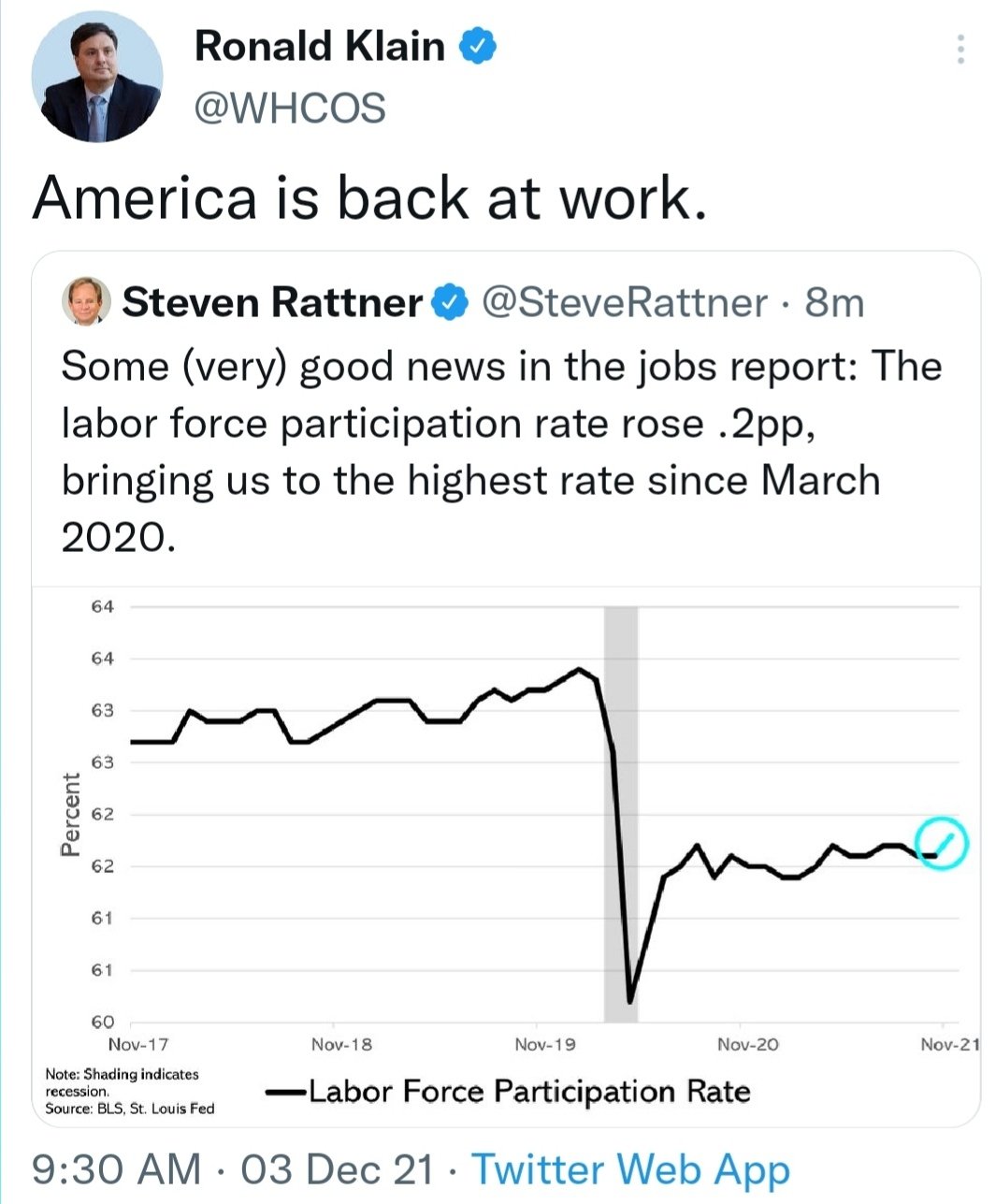
Here’s a retweet from the White House Chief of Staff, Ronald Klain, celebrating a very tiny improvement in the labor force participation rate.

In this case, there’s nothing disingenuous about the chart. We actually get to see several years of data.

But does this small uptick in the labor force participation rate actually mean that “America is back at work”?

Call me crazy, but it seems that the main takeaway from the chart is that the country is still way short of getting back to pre-pandemic levels of employment.

Which raises the obvious question of whether Biden’s redistribution agenda is making it easier for people to live off the government rather than be part of the workforce.

P.S. My criticisms of Biden are not driven by partisanship. I’m also not a fan when Republicans enact bad policy.

Daniel Mitchell quotes Milton Friedman on minimum wage and contrasts Trump a d Biden approach!

Trump vs. Biden on the Minimum Wage

In another display of selfless masochism, I watched the TrumpBiden debate last night.

The candidates behaved better, for whatever that’s worth, but I was disappointed that there so little time (and even less substance) devoted to economic issues.

One of the few exceptions was the brief tussle regarding the minimum wage. Trump waffled on the issue, so I don’t give him any points, but Biden fully embraced the Bernie Sanders policyof basically doubling the minimum wage to $15 per hour.

This is very bad news for low-skilled workers and very bad news to low-margin businesses.

The economic of this issue are very simple. If a worker generates, say, $9 of revenue per hour, and politicians say that worker can’t be employed for less than $15 per hour, that’s a recipe for unemployment.

Earlier this month, Professor Steven Landsburg on the University of Rochester opined for the Wall Street Journal on Biden’s minimum-wage policy.

It isn’t only that I think Mr. Biden is frequently wrong. It’s that he tends to be wrong in ways that suggest he never cared about being right. He makes no attempt to defend many of his policies with logic or evidence, and he deals with objections by ignoring or misrepresenting them. …Take Mr. Biden’s stance on the federal minimum wage, which he wants to increase to $15 an hour from $7.25. …So why does Mr. Biden want to raise the minimum wage…?He hasn’t said, so I have two guesses, neither of which reflects well on him. Guess No. 1: He’s dissembling about the cost. …The minimum wage…comes directly from employers but indirectly (after firms shrink and prices rise) from consumers. A minimum wage is a stealth tax on eating at McDonald’s or shopping at Walmart. …Mr. Biden should acknowledge the cost of wage hikes and argue for accepting it. Instead he’s silent about the cost, hoping he can foist it on people who won’t realize they’re footing this bill. Guess No. 2: He’s rewarding his friends and punishing his enemies. New York is going to vote for Mr. Biden. The state also has a high cost of living and high wages—so New Yorkers would be largely unaffected by the minimum-wage hike. Alabama is going to vote against Mr. Biden. Alabama has a low cost of living and relatively low wages—so under the Biden plan Alabama firms would shrink, to the benefit of competitors in New York. Alabama workers and consumers would pay a greater price than New Yorkers.

And Mark Perry of the American Enterprise Institute recently highlighted some of the adverse effects for unskilled workers.

It’s an economic reality that workers compete against other workers, not against employers, for jobs, and higher wages in the labor market. And it’s also true that lower-skilled, limited-experience, less-educated workers compete against higher-skilled, more experienced, more educated workers for jobs. …If the minimum wage is increased…, that will…take away from unskilled workers the one advantage they currently have to compete against skilled workers – the ability to offer to work for a significantly lower wage than what skilled workers can command. …Result of a minimum wage hike to $15 an hour? Demand for skilled workers goes up, demand for unskilled workers goes down, and employment opportunities for unskilled workers are reduced.

Since I recently shared videos with Milton Friedman’s wisdom on both taxes and spending, here’s what he said about the minimum wage.


Let’s share one last bit of evidence. Mark Perry’s article referenced some new research by Jeffrey Clemens, Lisa Kahn, and Jonathan Meer.

Here’s what those scholars found in a study published by the National Bureau of Economic Research.

We investigate whether changes in firms’ skill requirements are channels through which labor markets respond to minimum wage increases. …Data from the American Community Survey show that recent minimum wage changes resulted in increases in the average age and education of the individuals employed in low-wage jobs. Data on job vacancy postings show that the prevalence of a high school diploma requirement increases at the same time. The shift in skill requirements begins within the first quarter of a minimum wage hike. Further, it results from both within-firm shifts in postings and across-firms shifts towards firms that sought more-skilled workers at baseline. Given the poor labor market outcomes of individuals without high school diplomas, these findings have substantial policy relevance. This possibility was recognized well over a century ago by Smith (1907), who noted that the “enactment of a minimum wage involves the possibility of creating a class prevented by the State from obtaining employment.” Further, negative effects may be exacerbated for minority groups in the presence of labor market discrimination.

So why do politicians push for higher minimum wages, when all the evidence suggests that vulnerable workers bear the heaviest cost?

Part of the answer is that they don’t understand economics and don’t care about evidence.

But there’s also a more reprehensible answer, which is that they do understand, but they want to curry favor with union bosses, and those union bosses push for higher minimum wages as a way of reducing competition from lower-skilled workers.

P.S. Here’s my CNBC debate with Joe Biden’s top economic advisor on this issue.

P.P.S. Here’s a rather frustrating discussion I had on the minimum wage with Yahoo Finance.

P.P.P.S. But if you’re pressed for time, don’t listen to me pontificate. Instead, watch this video.

—-

Milton Friedman on Taxation

October 4, 2020 by Dan Mitchell

Yesterday’s column featured some of Milton Friedman’s wisdom from 50 years ago on how a high level of societal capital (work ethic, spirit of self-reliance, etc) is needed if we want to limit government.

Today, let’s look at what he said back then about that era’s high tax rates.

His core argument is that high marginal tax rates are self-defeating because the affected taxpayers (like Trump and Biden) will change their behavior to protect themselves from being pillaged.

This was in the pre-Reagan era, when the top federal tax rate was 70 percent, and notice that Friedman made a Laffer Curve-type prediction that a flat tax of 19 percent would collect more revenue than the so-called progressive system.

We actually don’t know if that specific prediction would have been accurate, but we do know that Reagan successfully lowered the top tax rate on the rich from 70 percent in 1980 to 28 percent in 1988.

So, by looking at what happened to tax revenues from these taxpayers, we can get a pretty good idea whether Friedman’s prediction was correct.

Well, here’s the IRS data from 1980 and 1988 for taxpayers impacted by the highest tax rate. I’ve circled (in red) the relevant data showing how we got more rich people, more taxable income, and more tax revenue.

The bottom line is that Friedman was right.

Good tax policy (i.e., lower rates on productive behavior) can be a win-win situation. Taxpayers earn more and keep more, while politicians also wind up with more because the economic pie expands.

Something to keep in mind since some politicians in Washington want a return to confiscatory taxes on work, saving, investment, and entrepreneurship.

—-

Why Milton Friedman Saw School Choice as a First Step, Not a Final One

On his birthday, let’s celebrate Milton Friedman’s vision of enabling parents, not government, to be in control of a child’s education.

Wednesday, July 31, 2019
Kerry McDonald
Kerry McDonald

EducationMilton FriedmanSchool ChoiceSchooling

Libertarians and others are often torn about school choice. They may wish to see the government schooling monopoly weakened, but they may resist supporting choice mechanisms, like vouchers and education savings accounts, because they don’t go far enough. Indeed, most current choice programs continue to rely on taxpayer funding of education and don’t address the underlying compulsory nature of elementary and secondary schooling.

Skeptics may also have legitimate fears that taxpayer-funded education choice programs will lead to over-regulation of previously independent and parochial schooling options, making all schooling mirror compulsory mass schooling, with no substantive variation.

Milton Friedman had these same concerns. The Nobel prize-winning economist is widely considered to be the one to popularize the idea of vouchers and school choice beginning with his 1955 paper, “The Role of Government in Education.” His vision continues to be realized through the important work of EdChoice, formerly the Friedman Foundation for Education Choice, that Friedman and his economist wife, Rose, founded in 1996.

July 31 is Milton Friedman’s birthday. He died in 2006 at the age of 94, but his ideas continue to have an impact, particularly in education policy.

Friedman saw vouchers and other choice programs as half-measures. He recognized the larger problems of taxpayer funding and compulsion, but saw vouchers as an important starting point in allowing parents to regain control of their children’s education. In their popular book, Free To Choose, first published in 1980, the Friedmans wrote:

We regard the voucher plan as a partial solution because it affects neither the financing of schooling nor the compulsory attendance laws. We favor going much farther. (p.161)

They continued:

The compulsory attendance laws are the justification for government control over the standards of private schools. But it is far from clear that there is any justification for the compulsory attendance laws themselves. (p. 162)

The Friedmans admitted that their “own views on this have changed over time,” as they realized that “compulsory attendance at schools is not necessary to achieve that minimum standard of literacy and knowledge,” and that “schooling was well-nigh universal in the United States before either compulsory attendance or government financing of schooling existed. Like most laws, compulsory attendance laws have costs as well as benefits. We no longer believe the benefits justify the costs.” (pp. 162-3)

Still, they felt that vouchers would be the essential starting point toward chipping away at monopoly mass schooling by putting parents back in charge. School choice, in other words, would be a necessary but not sufficient policy approach toward addressing the underlying issue of government control of education.

In their book, the Friedmans presented the potential outcomes of their proposed voucher plan, which would give parents access to some or all of the average per-pupil expenditures of a child enrolled in public school. They believed that vouchers would help create a more competitive education market, encouraging education entrepreneurship. They felt that parents would be more empowered with greater control over their children’s education and have a stronger desire to contribute some of their own money toward education. They asserted that in many places “the public school has fostered residential stratification, by tying the kind and cost of schooling to residential location” and suggested that voucher programs would lead to increased integration and heterogeneity. (pp. 166-7)

To the critics who said, and still say, that school choice programs would destroy the public schools, the Friedmans replied that these critics fail to

explain why, if the public school system is doing such a splendid job, it needs to fear competition from nongovernmental, competitive schools or, if it isn’t, why anyone should object to its “destruction.” (p. 170)

What I appreciate most about the Friedmans discussion of vouchers and the promise of school choice is their unrelenting support of parents. They believed that parents, not government bureaucrats and intellectuals, know what is best for their children’s education and well-being and are fully capable of choosing wisely for their children—when they have the opportunity to do so.

They wrote:

Parents generally have both greater interest in their children’s schooling and more intimate knowledge of their capacities and needs than anyone else. Social reformers, and educational reformers in particular, often self-righteously take for granted that parents, especially those who are poor and have little education themselves, have little interest in their children’s education and no competence to choose for them. That is a gratuitous insult. Such parents have frequently had limited opportunity to choose. However, U.S. history has demonstrated that, given the opportunity, they have often been willing to sacrifice a great deal, and have done so wisely, for their children’s welfare. (p. 160).

Sign-Up: Receive Kerry’s Weekly Parenting and Education Newsletter!

Today, school voucher programs exist in 15 states plus the District of Columbia. These programs have consistently shown that when parents are given the choice to opt-out of an assigned district school, many will take advantage of the opportunity. In Washington, D.C., low-income parents who win a voucher lottery send their children to private schools.

The most recent three-year federal evaluationof voucher program participants found that while student academic achievement was comparable to achievement for non-voucher students remaining in public schools, there were statistically significant improvements in other important areas. For instance, voucher participants had lower rates of chronic absenteeism than the control groups, as well as higher student satisfaction scores. There were also tremendous cost-savings.

In Wisconsin, the Milwaukee Parental Choice Program has served over 28,000 low-income students attending 129 participating private schools.

According to Corey DeAngelis, Director of School Choice at the Reason Foundation and a prolific researcher on the topic, the recent analysis of the D.C. voucher program “reveals that private schools produce the same academic outcomes for only a third of the cost of the public schools. In other words, school choice is a great investment.”

In Wisconsin, the Milwaukee Parental Choice Program was created in 1990 and is the nation’s oldest voucher program. It currently serves over 28,000 low-income students attending 129 participating private schools. Like the D.C. voucher program, data on test scores of Milwaukee voucher students show similar results to public school students, but non-academic results are promising.

Recent research found voucher recipients had lower crime rates and lower incidences of unplanned pregnancies in young adulthood. On his birthday, let’s celebrate Milton Friedman’s vision of enabling parents, not government, to be in control of a child’s education.

According to Howard Fuller, an education professor at Marquette University, founder of the Black Alliance for Educational Options, and one of the developers of the Milwaukee voucher program, the key is parent empowerment—particularly for low-income minority families.

In an interview with NPR, Fuller said: “What I’m saying to you is that there are thousands of black children whose lives are much better today because of the Milwaukee parental choice program,” he says. 
“They were able to access better schools than they would have without a voucher.”

Putting parents back in charge of their child’s education through school choice measures was Milton Friedman’s goal. It was not his ultimate goal, as it would not fully address the funding and compulsion components of government schooling; but it was, and remains, an important first step. As the Friedmans wrote in Free To Choose:

The strong American tradition of voluntary action has provided many excellent examples that demonstrate what can be done when parents have greater choice. (p. 159).

On his birthday, let’s celebrate Milton Friedman’s vision of enabling parents, not government, to be in control of a child’s education.

Kerry McDonald

Related posts:


“Friedman Friday” (“Free to Choose” episode 1 – Power of the Market. part 7 of 7)

March 16, 2012 – 12:25 am

  Michael Harrington:  If you don’t have the expertise, the knowledge technology today, you’re out of the debate. And I think that we have to democratize information and government as well as the economy and society. FRIEDMAN: I am sorry to say Michael Harrington’s solution is not a solution to it. He wants minority rule, I […] By Everette Hatcher III | Posted in Current Events, Milton Friedman | Edit | Comments (0)

“Friedman Friday” (“Free to Choose” episode 1 – Power of the Market. part 6 of 7)

March 9, 2012 – 12:29 am

PETERSON: Well, let me ask you how you would cope with this problem, Dr. Friedman. The people decided that they wanted cool air, and there was tremendous need, and so we built a huge industry, the air conditioning industry, hundreds of thousands of jobs, tremendous earnings opportunities and nearly all of us now have air […] By Everette Hatcher III | Posted in Current Events, Milton Friedman | Edit | Comments (0)

“Friedman Friday” (“Free to Choose” episode 1 – Power of the Market. part 5 of 7)

March 2, 2012 – 12:26 am

Part 5 Milton Friedman: I do not believe it’s proper to put the situation in terms of industrialist versus government. On the contrary, one of the reasons why I am in favor of less government is because when you have more government industrialists take it over, and the two together form a coalition against the ordinary […] By Everette Hatcher III | Posted in Current Events, Milton Friedman | Edit | Comments (0)

“Friedman Friday” (“Free to Choose” episode 1 – Power of the Market. part 4 of 7)

February 24, 2012 – 12:21 am

The fundamental principal of the free society is voluntary cooperation. The economic market, buying and selling, is one example. But it’s only one example. Voluntary cooperation is far broader than that. To take an example that at first sight seems about as far away as you can get __ the language we speak; the words […] By Everette Hatcher III | Posted in Current Events, Milton Friedman | Edit | Comments (0)

“Friedman Friday” (“Free to Choose” episode 1 – Power of the Market. part 3 of 7)

February 17, 2012 – 12:12 am

  _________________________   Pt3  Nowadays there’s a considerable amount of traffic at this border. People cross a little more freely than they use to. Many people from Hong Kong trade in China and the market has helped bring the two countries closer together, but the barriers between them are still very real. On this side […] By Everette Hatcher III | Posted in Current Events, Milton Friedman | Edit | Comments (0)

“Friedman Friday” (“Free to Choose” episode 1 – Power of the Market. part 2 of 7)

February 10, 2012 – 12:09 am

  Aside from its harbor, the only other important resource of Hong Kong is people __ over 4_ million of them. Like America a century ago, Hong Kong in the past few decades has been a haven for people who sought the freedom to make the most of their own abilities. Many of them are […] By Everette Hatcher III | Posted in Current Events, Milton Friedman | Edit | Comments (0)

“Friedman Friday” (“Free to Choose” episode 1 – Power of the Market. part 1of 7)

February 3, 2012 – 12:07 am

“FREE TO CHOOSE” 1: The Power of the Market (Milton Friedman) Free to Choose ^ | 1980 | Milton Friedman Posted on Monday, July 17, 2006 4:20:46 PM by Choose Ye This Day FREE TO CHOOSE: The Power of the Market Friedman: Once all of this was a swamp, covered with forest. The Canarce Indians […]

Milton Friedman The Power of the Market 1-5

Debate on Milton Friedman’s cure for inflation

September 29, 2011 – 7:24 am

If you would like to see the first three episodes on inflation in Milton Friedman’s film series “Free to Choose” then go to a previous post I did. Ep. 9 – How to Cure Inflation [4/7]. Milton Friedman’s Free to Choose (1980) Uploaded by investbligurucom on Jun 16, 2010 While many people have a fairly […]

By Everette Hatcher III | Also posted in Current Events | Tagged dr friedman, expansion history, income tax brackets, political courage, www youtube | Edit | Comments (0)

“Friedman Friday” Milton Friedman believed in liberty (Interview by Charlie Rose of Milton Friedman part 1)

April 19, 2013 – 1:14 am

Charlie Rose interview of Milton Friedman My favorite economist: Milton Friedman : A Great Champion of Liberty  by V. Sundaram   Milton Friedman, the Nobel Prize-winning economist who advocated an unfettered free market and had the ear of three US Presidents – Nixon, Ford and Reagan – died last Thursday (16 November, 2006 ) in San Francisco […] By Everette Hatcher III | Posted in Milton Friedman | Edit | Comments (0)

What were the main proposals of Milton Friedman?

February 21, 2013 – 1:01 am

Stearns Speaks on House Floor in Support of Balanced Budget Amendment Uploaded by RepCliffStearns on Nov 18, 2011 Speaking on House floor in support of Balanced Budget Resolution, 11/18/2011 ___________ Below are some of the main proposals of Milton Friedman. I highly respected his work. David J. Theroux said this about Milton Friedman’s view concerning […] By Everette Hatcher III | Posted in Milton Friedman | Edit | Comments (0)

“Friedman Friday,” EPISODE “The Failure of Socialism” of Free to Choose in 1990 by Milton Friedman (Part 1)

December 7, 2012 – 5:55 am

Milton Friedman: Free To Choose – The Failure Of Socialism With Ronald Reagan (Full) Published on Mar 19, 2012 by NoNationalityNeeded Milton Friedman’s writings affected me greatly when I first discovered them and I wanted to share with you. We must not head down the path of socialism like Greece has done. Abstract: Ronald Reagan […] By Everette Hatcher III | Posted in Milton FriedmanPresident Obama | Edit | Comments (1)

Defending Milton Friedman

July 31, 2012 – 6:45 am

What a great defense of Milton Friedman!!!!   Defaming Milton Friedman by Johan Norberg This article appeared in Reason Online on September 26, 2008  PRINT PAGE  CITE THIS      Sans Serif      Serif Share with your friends: ShareThis In the future, if you tell a student or a journalist that you favor free markets and limited government, there is […]

FRANCIS SCHAEFFER ANALYZES ART AND CULTURE Part  404 JAMES BOND and the search for satisfaction through luxuries Featured artist is Maryam Hoseini


Timothy Dalton played Bond twice, in 1987 and 1989

Duran Duran – A View To A Kill

FOR SOME PEOPLE THEY ALWAYS NEED MORE RICHES TO TRY AND FILL THAT VOID IN THEIR LIFE. For instance, we have the villian Zorin in A VIEW TO A KILL.

Zorin forms a plan dubbed Project Mainstrike to destroy his only competition in Silicon Valley by triggering a massive earthquake in the San Andreas Fault at high tide, causing the valley to flood. Such a disaster would effectively wipe out all computer companies competing against Zorin in the world microchip market and leave him as the leading supplier of microchips, as well as slaughtering millions residing in the valley. His plan was to use his vast resources to set off a super-earthquake in both the San Andreas Fault and Hayward Fault by flooding them both with water from San Andreas Lake and then breaking the geological lock that forbade both faults from moving simultaneously. To accomplish this, Zorin mined underneath the lakes and planned to blast through the lake beds in order to flood the fault, further exacerbating it by pumping water into them via a vast system of oil wells. Once the floodwaters came in, he would set off the explosives necessary to break the lock.

During the final phase of his plans, Zorin and his right-hand man Scarpine betray their men by flooding the mines and shooting them down. Taking refuge on a flying airship with Scarpine and Glaub, Zorin awaits for the destruction of Silicon Valley…

Garbage – The World Is Not Enough (LYRICS)


 know how to hurt
I know how to heal
I know what to show
And what to concealI know when to talk
And I know when to touch
No one ever died
From wanting too muchThe world is not enough
But it is such a perfect place to start, my love
And if you’re strong enough
Together we can take the world apart, my lovePeople like us
Know how to survive
There’s no point in living
If you can’t feel alive
We know when to kiss
And we know when to kill
If we can’t have it all
Then nobody willThe world is not enough
But it is such a perfect place to start, my love
And if you’re strong enough
Together we can take the world apart, my loveI feel safe
I feel scared
I feel ready
And yet unpreparedThe world is not enough
But it is such a perfect place to start, my love
And if you’re strong enough
Together we can take the world apart, my loveThe world is not enough
The world is not enough
Nowhere near enough
The world is not enoughSource: MusixmatchSongwriters: David ArnoldThe World is Not Enough lyrics © United Lion Music, Emi United Partnership Ltd

CAN’T FIND MEANING UNDER THE SUN!!!!!!

XXXXXXX

SEEKING MONEY AND GOLD TO GET SATISFACTION WILL NOT WORK!!!!

Goldfinger Song + Lyrics

Goldfinger
He’s the man, the man with the Midas touch
A spider’s touch
Such a cold finger
Beckons you to enter his web of sin
But don’t go inGolden words he will pour in your ear
But his lies can’t disguise what you fear
For a golden girl knows when he’s kissed her
It’s the kiss of death fromMister Goldfinger
Pretty girl beware of this heart of gold
This heart is coldGolden words he will pour in your ear
But his lies can’t disguise what you fear
For a golden girl knows when he’s kissed her
It’s the kiss of death fromMister Goldfinger
Pretty girl beware of this heart of gold
This heart is coldHe loves only gold
Only gold
He loves gold
He loves only gold
Only gold
He loves gold
Source: LyricFindSongwriters: Anthony Newley / John Barry / Leslie BricusseGoldfinger lyrics © Sony/ATV Music Publishing LLC

Can’t find meaning of life in getting more gold or money!! Solomin said this!!

XXXXXXX

PURSUING DIAMONDS WILL NOT BRING SATISFACTION AND IT POINTS OUT THAT NOT ONE RELATIONSHIP HAS TOUCHED HER!!!!

Connery in Amsterdam in July 1971, filming Diamonds Are Forever

Shirley Bassey – Diamonds Are Forever (Lyrics)

Diamonds are forever, they are all I need to please me
They can stimulate and tease me
They won’t leave in the night
I’ve no fear that they might desert me
Diamonds are forever, hold one up and then caress it
Touch it, stroke it and undress it
I can see ev’ry part, nothing hides in the heart to hurt me

I don’t need love, for what good will love do me?
Diamonds never lie to me
For when love’s gone,
they’ll lustre on
Diamonds are forever, sparkling round my little finger
Unlike men, the diamonds linger
Men are mere mortals who are not worth going to your grave for
I don’t need love, for what good will love do me?
Diamonds never lie to me

For when love’s gone, they’ll lustre on
Diamonds are forever, forever, foreverSource: LyricFindSongwriters: John Barry / Don BlackDiamonds Are Forever lyrics © Sony/AT

bond old

Everyone needs love and it can’t be found in diamonds or money!!!

File:Francis Schaeffer.jpg

(Francis Schaeffer)

Francis Schaeffer talked about popular culture and I have access to hundreds of his talks from the 1960’s and he commented in one of those recordings that Sean Connery had a villa close to where Schaeffer lived in Switzerland. In that same talk  in 1966 Schaeffer went on to discuss an analysis of James Bond that found interesting.

WHEN I THINK OF JAMES BOND I THINK OF AN UNIVERSAL MAN WHO IS THE BEST TALENTED THE HUMAN RACE HAS TO OFFER.

Below are the comments of Francis Schaeffer on SOLOMON and the Book of Ecclesiastes:

Leonardo da Vinci and Solomon both were universal men searching for the meaning in life. Solomon was searching for a meaning in the midst of the details of life. His struggle was to find the MEANING OF LIFE. Not just plans in life. Anybody can find plans in life. A child can fill up his time with plans of building tomorrow’s sand castle when today’s has been washed away. There is a difference between finding plans in life and purpose in life. Humanism since the Renaissance and onward has never found it. Modern man has not found it and it has always got worse and darker in a very real way.

We have here the declaration of Solomon’s universality:

1 Kings 4:30-34

English Standard Version (ESV)

30 so that Solomon’s wisdom surpassed the wisdom of all the people of the east and all the wisdom of Egypt. 31 For he was wiser than all other men…and his fame was in all the surrounding nations. 32 He also spoke 3,000 proverbs, and his songs were 1,005. 33 He spoke of trees, from the cedar that is in Lebanon to the hyssop that grows out of the wall. He spoke also of beasts, and of birds, and of reptiles, and of fish. 34 And people of all nations came to hear the wisdom of Solomon, and from all the kings of the earth, who had heard of his wisdom.

_________________________

Here is the universal man and his genius. Solomon is the universal man with a empire at his disposal. Solomon had it all.

Ecclesiastes 1:3

English Standard Version (ESV)

3 What does man gain by all the toil
at which he toils under the sun?

Solomon took a look at the meaning of life on the basis of human life standing alone between birth and death “under the sun.”
After wisdom Solomon comes to the great WORKS of men. Ecclesiastes 1:14, “I have seen all the works which have been done under the sun, and behold, all is [p]vanity and striving after wind.” Solomon is the man with an empire at this disposal that speaks. This is the man who has the copper refineries in Ezion-geber. This is the man who made the stables across his empire. This is the man who built the temple in Jerusalem. This is the man who stands on the world trade routes. He is not a provincial. He knew what was happening on the Phonetician coast and he knew what was happening in Egypt. There is no doubt he already knew something of building. This is Solomon and he pursues the greatness of his own construction and his conclusion is VANITY AND VEXATION OF SPIRIT.

Ecclesiastes 2:18-20

18 Thus I hated all the fruit of my labor for which I had labored under the sun, for I must leave it to the man who will come after me. 19 And who knows whether he will be a wise man or a fool? Yet he will have control over all the fruit of my labor for which I have labored by acting wisely under the sun. This too is vanity. 20 Therefore I completely despaired of all the fruit of my labor for which I had labored under the sun.

He looked at the works of his hands, great and multiplied by his wealth and his position and he shrugged his shoulders.

Ecclesiastes 2:22-23

22 For what does a man get in all his labor and in his striving with which he labors under the sun? 23 Because all his days his task is painful and grievous; even at night his mind does not rest. This too is vanity.

Man can not rest and yet he is never done and yet the things which he builds will out live him. If one wants an ironical three phrases these are they. There is a Dutch saying, “The tailor makes many suits but one day he will make a suit that will outlast the tailor.”

Many have tried sexual exploits just like Solomon did, and many have thrown their efforts into business too. Sadly Solomon also found the pursuit of great works in his LABOR just as empty. In Ecclesiastes 2:11 he asserted, “THEN I CONSIDERED ALL THAT MY HANDS HAD DONE AND THE TOLL I HAD EXPENDED IN DOING IT, AND BEHOLD, ALL WAS VANITY AND A STRIVING AFTER WIND, and there was nothing to be gained under the sun.”

Many people through history have reminded me of Solomon because they are looking for lasting meaning in their life and they are looking in the same 6 areas that King Solomon did in what I call the 6 big L words. He looked into learning (1:16-18), laughter, ladies, luxuries, and liquor (2:1-3, 8, 10, 11), and LABOR (2:4-6, 18-20).

Then in last few words in the Book of Ecclesiastes he looks above the sun and brings God back into the picture: “The conclusion, when all has been heard, is: Fear God and keep His commandments, because this applies to every person. For God will bring every act to judgment, everything which is hidden, whether it is good or evil.”

Maryam Hoseini’s Every Day Abstractions | Art21 “New York Close Up”

Featured artist is Maryam Hoseini

Maryam Hoseini was born in 1988 in Tehran, Iran. After receiving a BA in Graphic Design at Sooreh Art University in Tehran in 2012, she moved to the US, where she simultaneously completed MFA programs at Bard College and the School of the Art Institute of Chicago. In her work, Hoseini layers acrylic paint and pencil drawing to create abstract, highly flattened figures and landscapes that examine the relationship between the body and physical space.

Drawing upon art-historical imagery, personal history, and tableaus of contemporary life, Hoseini’s work often depicts homosocial spaces, questioning gender, sexuality and the personal and political effects of displacement. Fragmented—often female—nude bodies overlap and float in abstract, flattened architectural spaces, in suggestive, but open-ended narratives. The artist renders details, like body hair, in pencil, on top of the acrylic paint, blending the two mediums. Her paint often extends on to the sides of her panels and even to the wall beneath the work, engaging real architectural space and asking the viewer to consider their own body and its relationship to its environment, both literally and culturally. Influenced by the artist’s own displacement from her home country, a sense of fear and anxiety, punctuated with strength and humor, pervade her work.

Related posts:

RESPONDING TO HARRY KROTO’S BRILLIANT RENOWNED ACADEMICS!! Part 48 Nobel Prize Winner and Global Warming Denier Ivar Giaever “I think religion is to blame for a lot of the ills in this world!”

October 20, 2015 – 5:20 am

  On November 21, 2014 I received a letter from Nobel Laureate Harry Kroto and it said: …Please click on this URL http://vimeo.com/26991975 and you will hear what far smarter people than I have to say on this matter. I agree with them. Harry Kroto _________________ Below you have picture of 1996 Chemistry Nobel Prize Winner […]

September 24, 2015 – 5:42 am

The Beatles were “inspired by the musique concrète of German composer and early electronic music pioneer Karlheinz Stockhausen…”  as SCOTT THILL has asserted. Francis Schaeffer noted that ideas of  “Non-resolution” and “Fragmentation” came down German and French streams with the influence of Beethoven’s last Quartets and then the influence of Debussy and later Schoenberg’s non-resolution which is in total contrast […]

RESPONDING TO HARRY KROTO’S BRILLIANT RENOWNED ACADEMICS!! Part 42 Peter Singer, Professor of Bioethics at Princeton University, THE PROBLEM OF EVIL

September 8, 2015 – 5:10 am

On November 21, 2014 I received a letter from Nobel Laureate Harry Kroto and it said: …Please click on this URL http://vimeo.com/26991975 and you will hear what far smarter people than I have to say on this matter. I agree with them. Harry Kroto _________________ Below you have picture of 1996 Chemistry Nobel Prize […]

RESPONDING TO HARRY KROTO’S BRILLIANT RENOWNED ACADEMICS!! Bart Ehrman “Why should one think that God performed the miracle of inspiring the words in the first place if He didn’t perform the miracle of preserving the words?”

September 2, 2015 – 8:42 am

On November 21, 2014 I received a letter from Nobel Laureate Harry Kroto and it said: …Please click on this URL http://vimeo.com/26991975 and you will hear what far smarter people than I have to say on this matter. I agree with them. Harry Kroto ____________________ Below you have picture of 1996 Chemistry Nobel Prize Winner Dr. […]


—-

WOODY WEDNESDAY Open Letter to Woody Allen:  When caught in an affair with his step daughter Woody responded, “The heart wants what it wants.”   This dovetails exactly with how the Bible describes the natural, sinful heart. Scripture says that “God saw that the wickedness of man was great in the earth, and that every imagination of the thoughts of his heart was only evil continually” (Gen. 6:5); that “the hearts of the sons of men are full of evil and insanity is in their hearts throughout their lives” (Ecc. 9:3) and “out of the heart come evil thoughts, murders, adulteries, fornications, thefts, false witness, slanders” (Matt. 15:19).

Woody Allen On Bergman

Woody Allen On Bergman

Woody Allen Show

Essay on Woody Allen films

Match point Trailer

Match point

Crimes and misdemeanors

Part 2

-December 28, 2021

Woody Allen c/o Samuel French, Inc.

235 Park Avenue South

5th Floor

New York, NY 10003 

Dear Woody,

I just read this fine article about your spiritual problem but it gives a solution too.

CP CURRENT PAGE: OPINION | DEC 27, 2021The No. 1 worldview today is Woody Allen’s 

The No. 1 worldview today is Woody Allen’s 

Desires and needs
[PHOTO:UNSPLASH/ALEXISFAUVET]

When filmmaker Woody Allen was publicly exposed in 1992 as having an affair with the adopted daughter of his partner Mia Farrow (Soon-Yi Previn, 34 years his junior), his defense was simply, “The heart wants what it wants.”  

In quoting a statement made in an 1862 Emily Dickinson letter, Allen perfectly sums up the rationale underpinning today’s prevailing secular worldview, which is a deadly combination of post-truth and pragmatism, and driven solely by the adherent’s heart wanting what it wants.

And so what ends up happening?

The heart wants what it wants so it elevates itself above everyone else, putting others last, thus becoming the quintessential, prideful Captain You-Planet.

The heart wants what it wants so it commits smash-and-grab, follow-home, and brazen what-are-you-going-to-do-about-it robberies, taking from others what it hasn’t earned.

The heart wants what it wants so it goes to a Planned Parenthood abortion clinic to end the life of a person it finds currently inconvenient.

The heart wants what it wants so it breaks its marriage vows and destroys its family all for nothing more than a muscle spasm. 

The heart wants what it wants so it refuses to work and lives off of others because it bizarrely believes it is entitled to do so.

The heart wants what it wants so it suppresses truth and rewrites history to fit a lying narrative that furthers its agenda and enriches itself.

The heart wants what it wants so it cancels disagreement and slanders others because they threaten its echo chamber’s false peace.

The heart wants what it wants so it misuses religion in order to murder, suppress, oppress, and exploit people in hopes of getting the power, position, and wealth it desires.  

The heart wants what it wants so it deliberately thinks with its feelings instead of using the mind and facts to arrive at conclusions that may be distasteful at first, but saving in the end.  

In his article for The Blaze, Jason Whitlock writes, “My problem [with today’s culture] is its aspiration to redefine every form of sin as a natural desire we should not tame. “Do what thou wilt” is the unstated overarching theme of progressive politics. “Do what thou wilt” is the primary tenet of the Thelema occult practice established by English writer Aleister Crowley, a Satanist.”

 his dovetails exactly with how the Bible describes the natural, sinful heart. Scripture says that “God saw that the wickedness of man was great in the earth, and that every imagination of the thoughts of his heart was only evil continually” (Gen. 6:5), that the heart is “more deceitful than all else and desperately sick; who can understand it?” (Jer. 17:9); that we are “brought forth in iniquity” (Ps. 51:5) and “he who trusts in his own heart is a fool” (Prov. 28:26); that “the hearts of the sons of men are full of evil and insanity is in their hearts throughout their lives” (Ecc. 9:3) and “out of the heart come evil thoughts, murders, adulteries, fornications, thefts, false witness, slanders” (Matt. 15:19).

Needless to say, it’s a terrible thing when that kind of heart gets what it wants.

What God’s heart wants

God knows the sinful heart wants what it wants and so He’s provided a cure that’s announced throughout Scripture. His Law acts as a tutor (Gal. 3:24) to bring us what we really need because, says Tim Keller, a sinful heart is one where “law only restrains the heart; it doesn’t change it.”

That being true, we find early in the Old Testament God said, “[I] will circumcise your heart and the heart of your descendants, to love the Lord your God with all your heart and with all your soul” (Deut. 30:6). In the pages of the prophets, God says: “I will take the heart of stone out of their flesh and give them a heart of flesh, that they may walk in My statutes and keep My ordinances and do them” (Ez. 11:19-20), and “I will put My law within them and on their heart I will write it” (Jer. 31:33).

The awesome end result is a person where “the law of his God is in his heart; his steps do not slip” (Ps. 37:30-31) and they say, “I delight to do Your will, O my God; your Law is within my heart” (Ps. 40:8).  

The miraculous change is perfectly captured in a verse from John Newton’s hymn, “We Were Once as You Are”: “Our pleasure and our duty, though opposite before; since we have seen His beauty, are joined to part no more.”

And so what ends up happening?

The heart wants what God wants so it elevates others above itself and washes others’ feet.

The heart wants what God wants so it doesn’t rob others and steal what it hasn’t earned.

The heart wants what God wants so it values the life of everyone, including the unborn.

The heart wants what God wants so it is loyal to its spouse and keeps its marriage vows.  

The heart wants what God wants so it works with its hands to support itself and is generous to others.

The heart wants what God wants so it upholds and speaks the truth in love, following the narrative of Scripture.

The heart wants what God wants so it respectfully engages dissenting voices and is in no way threatened by different opinions (Phil. 1:28).

The heart wants what God wants so it engages in pure and undefiled religion (James 1:27), serving those around it with no self-centered agenda.  

The heart wants what God wants so it is deliberately mature in its thinking (1 Cor. 14:20) and is Holy Spirit led vs. emotions driven.

Needless to say, it’s a fantastic thing when that kind of heart gets what it wants.

In truth, Woody Allen’s explanation for his actions is correct. However, the effect of “the heart wants what it wants” on culture is dependent on whether the heart in question is one that gives itself over to its natural, sinful desires or one that is born again (John 3:3) and acts under the direction of God.

Needless to say, what the world desperately needs today is the latter where everywhere society turns, it sees people who are, “a letter of Christ … written not with ink but with the Spirit of the living God, not on tablets of stone but on tablets of human hearts” (2 Cor. 3:3).

Robin Schumacher is an accomplished software executive and Christian apologist who has written many articles, authored and contributed to several Christian books, appeared on nationally syndicated radio programs, and presented at apologetic events. He holds a BS in Business, Master’s in Christian apologetics and a Ph.D. in New Testament. His latest book is, A Confident Faith: Winning people to Christ with the apologetics of the Apostle Paul.

If a person can’t cope with the reality of the Godless universe many times they will turn to the area of Non-Reason!!!

It is your firm conviction that faith in God’s word, the Bible, is really blind faith with no facts to back it up. 

Here is a portion of the article Woody Allen, Nihilist:

Aunt May’s foil in the film is Ben (Sam Waterston), a pious rabbi who says that he couldn’t go on living “if I didn’t feel with all my heart a moral structure with real meaning and forgiveness and some kind of higher power. Otherwise there’s no basis to live…. Without the law, it’s all darkness.” Allen reveals his attitude toward the rabbi by subjecting him to a progressive loss of vision that ends in total blindness by the conclusion of the film — a blunt metaphor for the darkness induced by his own moral and religious faith.

We know that this was Allen’s intent because he’s said so. Ben, according to Allen, “doesn’t really understand the reality of life… and that’s why I wanted to make him blind. I feel that his faith is blind. It will work, but it requires closing your eyes to reality.” And what is reality? That “at best the universe is indifferent” to our lives and our various ways of construing right and wrong. This indifference is so awful that many of us feel driven to “create a fake world for ourselves, and we exist within that fake world.”

This is exactly what you have done Woody yourself by continuing to make your movies and describe your poor plight. You are leaping into the area of nonreason to try and cope. It is exactly what the Surrealists and Dadaists did.

Jean Arp (Hans Arp) 
Jean Arp is associated with the DADA movement. His collages were of torn pieces of paper dropped and affixed where they would land. His use of chance is intended to create free of human intervention. “Dada,” wrote Arp, “wished to destroy the hoaxes of reason and to discover an UNREASONED ORDER.”

Francis Schaeffer in his book THE GOD WHO IS THERE noted:

“It is often said that Søren Kierkegaard, the Dane (1813-55)… is the father of modern secular thinking and of the new theological thinking…. Why is it that Kierkegaard can so aptly be thought of as the father of both? What proposition did he add to Hegel’s thought that made the difference? Kierkegaard came to the conclusion that you could not arrive at synthesis by reason. Instead, you achieved everything of real importance by a leap of faith. So he separated absolutely the rational and logical from faith……from that time on, if rationalistic man wants to deal with the real things of human life (such as purpose, significance, the validity of love) he must discard rational thought about them and MAKE A GIGANTIC, NON-RATIONAL LEAP OF FAITH. The rationalistic framework had FAILED TO PRODUCE AN ANSWER ON THE BASIS OF REASON, and so all hope of a uniform field of knowledge had to be abandoned.”

___

Image result for Søren Kierkegaard

(Francis Schaeffer pictured below)

Image result for francis schaeffer

(Luis Bunuel, Man Ray, Salvador Dali visit with Gil Pender in the movie MIDNIGHT IN PARIS)

Image result for midnight in paris dali

—-

(Luis Buñuel & Salvador Dali, circa 1930 pictured below)

Image result for salvador dali luis bunuel

__

Image result for midnight in paris luis bunuel

The principle of making A GIGANTIC, NON-RATIONAL LEAP OF FAITH is demonstrated by the Surrealists in a  scene in MIDNIGHT IN PARIS  when Salvador Dali introduces his friends Luis Bunuel and Man Ray to Gil Pender and then comments to them “Pender is in a perplexing situation.”

Gil Pender tells the SURREALISTS, “It sounds so crazy to say. You guys are going to think I’m drunk, but I have to tell someone. I’m…from a…a different time. Another era.The future. OK? I come…from the 2000th millennium to here.I get in a car, and I slide through time.”

When they accept this then Gil responds, “Yeah, you’re surrealists!But I’m a normal guy.” In other words the SURREALISTS understand Gil’s predicament and realize that they too have attempted to escape from reason in their own lives (sometimes probing their own dreams in an attempt to find meaning). That is the reason Gil suddenly realizes that  he is getting no where with them.

Francis Schaeffer noted in his book HE IS THERE AND HE IS NOT SILENT:

So just as all men love even if they say love does not exist, and all men have moral motions even though they say moral motions do not exit, so all men act as though they there is a correlation between the external and the internal world, even if they have no basis for that correlation…Let me draw the parallel again. Modern men say there is no love, there is only sex, but they fall in love. Men say there are no moral motions, everything is behavioristic, but they all have moral motions. Even in the more profound area of epistemology, no matter what a man says he believes, actually–every moment of his life–he is acting as though Christianity were true, and it is only the Christian system that tells him why he can, must, and does act the way he does (Chapter 4, HE IS THERE AND HE IS NOT SILENT ).

Let me challenge you to take a closer look at the Bible and it’s accuracy. More on that later in this letter.

Woody Allen, Nihilist

By stDamon Linker

Not a believer. (Pascal Le Segretain/Getty Images)February 4, 2014

I don’t know what did or did not happen between Woody Allen and Dylan Farrow more than 20 years ago, and neither does Nicholas Kristof. What I do know is that Allen is a moral nihilist. This should not be taken as evidence that he sexually molested Mia Farrow’s adopted daughter when she was 7 years old, or taken as a sign that he’d condone such behavior. But it does mean he espouses a philosophical outlook that renders him powerless to condemn it.

Let me be clear about two things right off the bat. First, I’m a great admirer of Allen’s filmmaking — and like Andrew Sullivan and Rod Dreher, I think the artistry of his films can and should be judged apart from his (perhaps substantial) moral failings. Second, I consider nihilism to be a viable, albeit false and ultimately chilling, philosophical and existential position. In describing Allen as a nihilist, I am not issuing an indictment — simply describing an outlook that he has elaborated in several films and interviews over the years.

Allen’s most thorough cinematic treatment of nihilism and its moral implications can be found in what may be his greatest film, Crimes and Misdemeanors (1989). The movie tells the story of an ophthalmologist named Judah Rosenthal (played by Martin Landau) who decides to kill off his lover Dolores (Angelica Houston) when she threatens to divulge their affair to Judah’s wife. (Allen’s Match Point (2005), an inferior film in almost every way, explores many similar themes.)

At first wracked with guilt over the murder, Judah eventually gets over his moral qualms. (As another character quips in the film, “comedy is tragedy plus time.”) In a shocking subversion of Hollywood-style happy endings as well as Dostoevsky’s Crime and Punishment — in which the character Raskolnikov is driven by unremitting guilt to confess a pair of murders to the authorities — the film ends with Judah seemingly at complete peace with himself and thriving in every way: Happy, wealthy, successful, adored by a beautiful wife and daughter, with the latter soon to be married.

The viewer is left to conclude that Judah got away with his crime scot-free — and that such an outcome is possible for anyone courageous enough to violate accepted moral customs and lucky or clever enough to avoid getting caught by the legal authorities.

The theme and its broader implications are reinforced throughout the film. In one of its most powerful scenes, Judah observes and interacts with a memory from his youth in which members of his family debate morality, God, and the Holocaust. Espousing the view endorsed by the film, Judah’s atheist aunt May (whom Judah’s religiously observant father dubs a “nihilist”) remarks that if National Socialist Germany had won World War II, then Hitler’s actions would have ended up being “right.” After all, in such a nightmarish, counterfactual world, the Nazis would be empowered to set and enforce the reigning moral standard — and there simply is no higher moral authority to appeal to against such a standard. In a nihilistic universe, the overarching moral truth is that might makes right.

Aunt May’s foil in the film is Ben (Sam Waterston), a pious rabbi who says that he couldn’t go on living “if I didn’t feel with all my heart a moral structure with real meaning and forgiveness and some kind of higher power. Otherwise there’s no basis to live…. Without the law, it’s all darkness.” Allen reveals his attitude toward the rabbi by subjecting him to a progressive loss of vision that ends in total blindness by the conclusion of the film — a blunt metaphor for the darkness induced by his own moral and religious faith.

Allen, 1970. | (Evening Standard/Getty Images)

We know that this was Allen’s intent because he’s said so. Ben, according to Allen, “doesn’t really understand the reality of life… and that’s why I wanted to make him blind. I feel that his faith is blind. It will work, but it requires closing your eyes to reality.” And what is reality? That “at best the universe is indifferent” to our lives and our various ways of construing right and wrong. This indifference is so awful that many of us feel driven to “create a fake world for ourselves, and we exist within that fake world.”

On a lesser level you see it in sports. They create a world of football, for example. You get lost in that world and you care about meaningless things…. People by the thousands watch it, thinking it’s very important who wins. But, in fact, if you step back for a second, it’s utterly unimportant who wins. It means nothing. In the same way we create for ourselves a world that, in fact, means nothing at all, when you step back. It’s meaningless.

This sounds like you want to take a leap into the area of non-Reason to help you cope with the meaningless of life!!!

Francis Schaeffer has correctly argued:

The universe was created by an infinite personal God and He brought it into existence by spoken word and made man in His own image. When man tries to reduce [philosophically in a materialistic point of view] himself to less than this [less than being made in the image of God] he will always fail and he will always be willing to make these impossible leaps into the area of nonreason even though they don’t give an answer simply because that isn’t what he is. He himself testifies that this infinite personal God, the God of the Old and New Testament is there. 

Instead of making a leap into the area of nonreason the better choice would be to investigate the claims that the Bible is a historically accurate book and that God created the universe and reached out to humankind with the Bible. Below is a piece of that evidence given by Francis Schaeffer concerning the accuracy of the Bible.

TRUTH AND HISTORY (chapter 5 of WHATEVER HAPPENED TO THE HUMAN RACE?)

In the previous chapter we saw that the Bible gives us the explanation for the existence of the universe and its form and for the mannishness of man. Or, to reverse this, we came to see that the universe and its form and the mannishness of man are a testimony to the truth of the Bible. In this chapter we will consider a third testimony: the Bible’s openness to verification by historical study.

Christianity involves history. To say only that is already to have said something remarkable, because it separates the Judeo-Christian world-view from almost all other religious thought. It is rooted in history.

The Bible tells us how God communicated with man in history. For example, God revealed Himself to Abraham at a point in time and at a particular geographical place. He did likewise with Moses, David, Isaiah, Daniel and so on. The implications of this are extremely important to us. Because the truth God communicated in the Bible is so tied up with the flow of human events, it is possible by historical study to confirm some of the historical details.

It is remarkable that this possibility exists. Compare the information we have from other continents of that period. We know comparatively little about what happened in Africa or South America or China or Russia or even Europe. We see beautiful remains of temples and burial places, cult figures, utensils, and so forth, but there is not much actual “history” that can be reconstructed, at least not much when compared to that which is possible in the Middle East.

When we look at the material which has been discovered from the Nile to the Euphrates that derives from the 2500-year span before Christ, we are in a completely different situation from that in regard to South America or Asia. The kings of Egypt and Assyria built thousands of monuments commemorating their victories and recounting their different exploits. Whole libraries have been discovered from places like Nuzu and Mari and most recently at Elba, which give hundreds of thousands of texts relating to the historical details of their time. It is within this geographical area that the Bible is set. So it is possible to find material which bears upon what the Bible tells us.

The Bible purports to give us information on history. Is the history accurate? The more we understand about the Middle East between 2500 B.C. and A.D. 100, the more confident we can be that the information in the Bible is reliable, even when it speaks about the simple things of time and place.

The site of the biblical city called Lachish is about thirty miles southwest of Jerusalem. This city is referred to on a number of occasions in the Old Testament. Imagine a busy city with high walls surrounding it, and a gate in front that is the only entrance to the city. We know so much about Lachish from archaeological studies that a reconstruction of the whole city has been made in detail. This can be seen at the British Museum in the Lachish Room in the Assyrian section.

There is also a picture made by artists in the eighth century before Christ, the Lachish Relief, which was discovered in the city of Nineveh in the ancient Assyria. In this picture we can see the Jewish inhabitants of Lachish surrendering to Sennacherib, the king of Assyria. The details in the picture and the Assyrian writing on it give the Assyrian side of what the Bible tells us in Second Kings:

2 Kings 18:13-16

New American Standard Bible (NASB)

13 Now in the fourteenth year of King Hezekiah, Sennacherib king of Assyria came up against all the fortified cities of Judah and seized them. 14 Then Hezekiah king of Judah sent to the king of Assyria at Lachish, saying, “I have done wrong. Withdraw from me; whatever you impose on me I will bear.” So the king of Assyria required of Hezekiah king of Judah three hundred talents of silver and thirty talents of gold. 15 Hezekiah gave him all the silver which was found in the house of the Lord, and in the treasuries of the king’s house. 16 At that time Hezekiah cut off the gold from the doors of the temple of the Lord, and from the doorposts which Hezekiah king of Judah had overlaid, and gave it to the king of Assyria.

________

We should notice two things about this. First, this is a real-life situation–a real siege of a real city with real people on both sides of the war–and it happened at a particular date in history, near the turn of the eighth century B.C. Second, the two accounts of this incident in 701 B.C. (the account from the Bible and the Assyrian account from Nineveh) do not contradict, but rather confirm each other. The history of Lachish itself is not so important for us, but some of its smaller historical details.

Sincerely,

Everette Hatcher, everettehatcher@gmail.comhttp://www.thedailyhatch.org, cell ph 501-920-5733, Box 23416, LittleRock, AR 72221


Part 3

Woody commenting on Midnight in Paris

Midnight in Paris trailer

The movie MIDNIGHT IN PARIS offers many of the same themes we see in Ecclesiastes. The second post looked at the question: WAS THERE EVER A GOLDEN AGE AND DID THE MOST TALENTED UNIVERSAL MEN OF THAT TIME FIND TRUE SATISFACTION DURING IT?

In the third post in this series we discover in Ecclesiastes that man UNDER THE SUN finds himself caught in the never ending cycle of birth and death. The SURREALISTS make a leap into the area of nonreason in order to get out of this cycle and that is why the scene in MIDNIGHT IN PARIS with Salvador Dali, Man Ray, and Luis Bunuel works so well!!!! These surrealists look to the area of their dreams to find a meaning for their lives and their break with reality is  only because they know that they can’t find a rational meaning in life without God in the picture.

The fourth post looks at the solution of WINE, WOMEN AND SONG and the fifth and sixth posts look at the solution T.S.Eliotfound in the Christian Faith and how he left his fragmented message of pessimism behind. In the seventh post the SURREALISTS say that time and chance is all we have but how can that explain love or art and the hunger for God? The eighth  post looks at the subject of DEATH both in Ecclesiastes and MIDNIGHT IN PARIS. In the ninth post we look at the nihilistic worldview of Woody Allen and why he keeps putting suicides into his films.

In the tenth post I show how Woody Allen pokes fun at the brilliant thinkers of this world and how King Solomon did the same thing 3000 years ago. In the eleventh post I point out how many of Woody Allen’s liberal political views come a lack of understanding of the sinful nature of man and where it originated. In the twelfth post I look at the mannishness of man and vacuum in his heart that can only be satisfied by a relationship with God.

In the thirteenth post we look at the life of Ernest Hemingway as pictured in MIDNIGHT AND PARIS and relate it to the change of outlook he had on life as the years passed. In the fourteenth post we look at Hemingway’s idea of Paris being a movable  feast. The fifteenth and sixteenth posts both compare Hemingway’s statement, “Happiness in intelligent people is the rarest thing I know…”  with Ecclesiastes 2:18 “For in much wisdom is much vexation, and he who increases knowledge increases sorrow.” The seventeenth post looks at these words Woody Allen put into Hemingway’s mouth,  “We fear death because we feel that we haven’t loved well enough or loved at all.”

In MIDNIGHT IN PARIS Hemingway and Gil Pender talk about their literary idol Mark Twain and the eighteenth post is summed up nicely by Kris Hemphill‘swords, “Both Twain and [King Solomon in the Book of Ecclesiastes] voice questions our souls long to have answered: Where does one find enduring meaning, life purpose, and sustainable joy, and why do so few seem to find it? The nineteenth post looks at the tension felt both in the life of Gil Pender (written by Woody Allen) in the movie MIDNIGHT IN PARIS and in Mark Twain’s life and that is when an atheist says he wants to scoff at the idea THAT WE WERE PUT HERE FOR A PURPOSE but he must stay face the reality of  Ecclesiastes 3:11 that says “God has planted eternity in the heart of men…” and  THAT CHANGES EVERYTHING! Therefore, the secular view that there is no such thing as love or purpose looks implausible. The twentieth post examines how Mark Twain discovered just like King Solomon in the Book of Ecclesiastes that there is no explanation  for the suffering and injustice that occurs in life UNDER THE SUN. Solomon actually brought God back into the picture in the last chapter and he looked  ABOVE THE SUN for the books to be balanced and for the tears to be wiped away.

The twenty-first post looks at the words of King Solomon, Woody Allen and Mark Twain that without God in the picture our lives UNDER THE SUN will accomplish nothing that lasts. Thetwenty-second post looks at King Solomon’s experiment 3000 years that proved that luxuries can’t bring satisfaction to one’s life but we have seen this proven over and over through the ages. Mark Twain lampooned the rich in his book “The Gilded Age” and he discussed  get rich quick fever, but Sam Clemens loved money and the comfort and luxuries it could buy. Likewise Scott Fitzgerald  was very successful in the 1920’s after his publication of THE GREAT GATSBY and lived a lavish lifestyle until his death in 1940 as a result of alcoholism.

In the twenty-third post we look at Mark Twain’s statement that people should either commit suicide or stay drunk if they are “demonstrably wise” and want to “keep their reasoning faculties.” We actually see this play out in the film MIDNIGHT IN PARIS with the character Zelda Fitzgerald. In the twenty-fourthtwenty-fifth and twenty-sixth posts I look at Mark Twain and the issue of racism. In MIDNIGHT IN PARIS we see the difference between the attitudes concerning race in 1925 Paris and the rest of the world.

The twenty-seventh and twenty-eighth posts are summing up Mark Twain. In the 29th post we ask did MIDNIGHT IN PARIS accurately portray Hemingway’s personality and outlook on life? and in the 30th post the life and views of Hemingway are summed up.

In the 31st post we will observe that just like Solomon Picasso slept with many women. Solomon actually slept with  over 1000 women ( Eccl 2:8, I Kings 11:3), and both men ended their lives bitter against all women and in the 32nd post we look at what happened to these former lovers of Picasso. In the 33rd post we see that Picasso  deliberately painted his secular  worldview of fragmentation on his canvas but he could not live with the loss of humanness and he reverted back at crucial points and painted those he loved with all his genius and with all their humanness!!! In the 34th post  we notice that both Solomon in Ecclesiastes and Picasso in his painting had an obsession with the issue of their impending death!!!

___________

Related posts:

“Woody Wednesday” ECCLESIASTES AND WOODY ALLEN’S FILMS: SOLOMON “WOULD GOT ALONG WELL WITH WOODY!” (Part 7 MIDNIGHT IN PARIS Part F, SURREALISTS AND THE IDEA OF ABSURDITY AND CHANCE)

December 23, 2015 – 4:15 am

Woody Allen believes that we live in a cold, violent and meaningless universe and it seems that his main character (Gil Pender, played by Owen Wilson) in the movie MIDNIGHT IN PARIS shares that view. Pender’s meeting with the Surrealists is by far the best scene in the movie because they are ones who can […]

“Woody Wednesday” ECCLESIASTES AND WOODY ALLEN’S FILMS: SOLOMON “WOULD GOT ALONG WELL WITH WOODY!” (Part 6 MIDNIGHT IN PARIS Part E, A FURTHER LOOK AT T.S. Eliot’s DESPAIR AND THEN HIS SOLUTION)

December 16, 2015 – 4:56 am

In the last post I pointed out how King Solomon in Ecclesiastes painted a dismal situation for modern man in life UNDER THE SUN  and that Bertrand Russell, and T.S. Eliot and  other modern writers had agreed with Solomon’s view. However, T.S. Eliot had found a solution to this problem and put his faith in […]

“Woody Wednesday” ECCLESIASTES AND WOODY ALLEN’S FILMS: SOLOMON “WOULD GOT ALONG WELL WITH WOODY!” (Part 5 MIDNIGHT IN PARIS Part D, A LOOK AT T.S. Eliot’s DESPAIR AND THEN HIS SOLUTION)

December 9, 2015 – 4:41 am

In MIDNIGHT IN PARIS Gil Pender ponders the advice he gets from his literary heroes from the 1920’s. King Solomon in Ecclesiastes painted a dismal situation for modern man in life UNDER THE SUN  and many modern artists, poets, and philosophers have agreed. In the 1920’s T.S.Eliot and his  house guest Bertrand Russell were two of […]

“Woody Wednesda

Doctor Told “Sound of Music” Heroine Maria von Trapp to Abort Her Disabled Baby, She Refused and Baby Was Healthy 

I visited Austria in 1981 and toured Salzburg and the house where THE SOUND OF MUSIC was performed.

“The Sound of Music” – THE SOUND OF MUSIC (1965)
https://youtu.be/6f0T6UV-HiI

MENU

Doctor Told “Sound of Music” Heroine Maria von Trapp to Abort Her Disabled Baby, She Refused and Baby Was Healthy

National  |  Micaiah Bilger  |   Dec 28, 2021   |   6:28PM   |  Washington, DC

Most people know Maria von Trapp’s early life story because of the musical “The Sound of Music.”

The late Austrian musician and mother inspired millions of people with her joy, her love of children and music and her strong faith in God after she became a wife and mother to a widower and his seven children and later fled Europe to escape the Nazis.

But there are many lesser known parts to von Trapp’s life, including how she refused her doctor’s advice to abort her unborn son while the family was facing numerous struggles.

Aleteia highlighted von Trapp’s pro-life story recently. It is one she shared herself in her book “The Story of the Trapp Family Singers,” published decades ago.

The von Trapps were new to America when Maria was pregnant with her son, Johannes, the youngest of their 10 children. The family also was struggling financially because they recently had lost their fortune in a bank crash in Europe, according to the report.

HELP LIFENEWS SAVE BABIES FROM ABORTION! Please help LifeNews.com with a donation!

Then, more bad news came. When Maria visited a doctor complaining of severe back pains, he told her that she needed to abort her baby.

“’Your wife cannot have another child,’ he informed my husband; ‘at least, not until the kidneys are back to normal. They are both badly infected … The child has to be removed, of course, immediately,’” Maria wrote in her book.

A devout Catholic, she said she felt indignant at the doctor’s recommendation to abort her unborn child.

She remembered telling him: “’What do you mean, of course? That is not of course at all. On the contrary, it is absolutely out of the question—we are Catholics, you know.’ Now the doctor seemed seriously worried. ‘The child won’t be born alive; this much I can tell you.’”

However, the von Trapps refused to consider aborting their unborn son. Instead, they began to pray, asking God to heal both Maria and Johannes. When Maria went into labor, the family gathered together to pray the rosary and sing hymns together, she wrote in her book.

“I had to squeeze Georg’s hand very hard, and time seemed to stand still. Then I heard a funny little squeak … At that minute a full chorale downstairs started: ‘Now thank we all our God!’” Maria wrote. “‘Why it’s a boy!’ … The predictions of the doctor proved beautifully wrong, and Johannes promises to be a fine American boy.”

Later, Maria said she learned about Planned Parenthood and the notion of “unwanted children,” and she thought of Johannes’ birth.

“I must say, Johannes had not been exactly planned for that very moment, and as far as being wanted is concerned, I would have gladly said many times, ‘Oh, won’t you please be so kind as to wait for just six months?’” she wrote.

Von Trapp encouraged families to trust in God when they are facing similar struggles.

“If there is any planning to be done, why don’t we let Him do it? Looking back now, I know that He chose the only right moment for Johannes’ arrival,” she wrote.

I am a proud member of the National Association of Christian Lawmakers and I attended the convention in Dallas in July and we have officially launched a nationwide push against abortion rights.

The article below notes:

At its first annual policy conference last weekend, group members voted to make a controversial new Texas law, the “Texas Heartbeat Bill,” the organization’s first piece of model legislation, meaning that similar bills may soon pop up in state capitols across the country.

Also I am excited to report that the WASHINGTON POST wrote in September 3, 2021:

Announcing he planned to introduce a copycat bill, Arkansas state Sen. Jason Rapert (R), the founder and president of the National Association of Christian Lawmakers, shared a template of legislation lawmakers in other states could fill in the blanks on and reproduce.

At the July 17th session of THE CHRISTIAN LAWMAKERS meeting in Dallas, I really got a lot out of the expert panel moderated by Texas State Senator Bryan Hughes entitled ABOLISHING ABORTION IN AMERICA. Here below is what Wikipedia says about Senator Hughes:

On March 11, 2021, Hughes introduced a fetal heartbeat bill entitled the Texas Heartbeat Bill (SB8) into the Texas Senate and state representative Shelby Slawson of Stephenville, Texas introduced a companion bill (HB1515) into the state house.[22]The bill allows private citizens to sue abortion providers after a fetal heartbeat has been detected.[22] The SB8 version of the bill passed both chambers and was signed into law by Texas Governor Greg Abbott on May 19, 2021.[22] It took effect on September 1, 2021.[22]

Whatever Happened To The Human Race? | Episode 1 | Abortion of the Human…

Tucker: Democrats have abandoned their ‘my body, my choice’ argument

These Christian lawmakers are on the offensive against abortion

That National Association of Christian legislators has made the so-called ‘Texas Heartbeat Bill’ the basis for its first piece of model legislation

Arkansas state Sen. Jason Rapert presides over a Senate committee at the state Capitol in Little Rock, Ark. in this March 14, 2018, file photo. Rapert’s National Association of Christian Lawmakers met recently to talk model legislation and pass resolutions. Kelly P. Kissel, Associated Press

The National Association of Christian Lawmakers has officially launched a nationwide push against abortion rights.

At its first annual policy conference last weekend, group members voted to make a controversial new Texas law, the “Texas Heartbeat Bill,” the organization’s first piece of model legislation, meaning that similar bills may soon pop up in state capitols across the country.

The model legislation, called the Heartbeat Model Act, was accepted unanimously by the executive committee during a Saturday meeting.

The Texas bill it is based upon, Senate Bill 8, bans abortions once a fetal heartbeat can be detected, which can occur as early as six weeks into a pregnancy. The legislation also allows for any state resident to bring a civil suit against a doctor who performs an abortion after a heartbeat is detectable. Under the law, a woman who has an abortion would be liable to civil suits, as would anyone who supported her in the act — from family members to the receptionist who checks her in at a clinic.

Not only is the doctor liable, but anyone found aiding and abetting,” said Texas legislator Bryan Hughes, the bill’s author, during the Saturday meeting, which was led by the organization’s founder and president, Arkansas state Sen. Jason Rapert.Texas state Rep. Bryan Hughes speaks during the opening session of the 2015 legislative session on Tuesday, Jan. 13, 2015, in Austin, Texas. Eric Gay, Associated Press

Speaking to the Deseret News on Monday, Rapert said the provision allowing residents to bring civil suits against anyone involved in an abortion is like “putting a SCUD missile on that heartbeat bill — they can’t stop it.”

Rapert was the author of a similar 2013 bill in Arkansas, portions of which were later struck down by a federal judge. At least a dozen states have implemented a variety of abortion restrictions in recent years, leading numerous observers to say that the landmark 1973 Supreme Court abortion ruling, Roe v. Wade, is under threat.

Critics of the legislation have likened the Texas law to putting “a bounty on the head” of anyone involved in an abortion; they have also called it “unconstitutional.” Last week, a group of providers filed a federal lawsuit in an attempt to derail the law, which is supposed to go into effect in September.

Speaking Saturday to the Christian legislators gathered in Dallas, Hughes reminded the legislators that the Heartbeat Model Act is just a starting point and that the legislation will have to be tailored to work within each state’s laws.A anti-abortion supporter argues with those who attended a press conference and rally held by the Planned Parenthood Action Council of Utah outside of the Capitol in Salt Lake City on Aug. 25, 2015. Stacie Scott, Deseret News

The National Association of Christian Lawmakers formed last year with three key goals: to offer conservative, Christian legislators networking opportunities,; to help lawmakers share bills that have been successful in their states so that legislators elsewhere might push through similar legislation; and to support Christians running for local, state or national office.

At the policy conference last week, the organization worked toward meeting these goals in various ways, including by approving the Heartbeat Model Act. The executive committee also passed a resolution supporting Israel’s “right to defend itself from terror attacks” and creating a standing American-Israeli Committee.

Speaking to the executive committee, Rabbi Leonid Feldman, who was born in the Soviet Union and was imprisoned there for his pro-Israel activities, remarked that the Jewish people “remember our friends.”

This conference and this organization will be remembered by the Jewish people,” he said.

The organization also approved a resolution in support of “election integrity.”

The executive committee also approved a second piece of model legislation: the National Motto Display Model Act. Based on bills passed in Arkansas in 2017 and this year in Texas, the legislation requires public schools to display the national motto “In God We Trust” when printed versions of the motto are donated to schools or copies of the national motto are bought with funds from private donors.

“As the Texas House sponsor of the Motto Act, I am proud to see a model put out by the NACL so that legislators from every other state can have a mechanism to ensure our citizens — especially our school-age children — are reminded of our nation’s motto,” said Tom Oliverson, a state representative from Texas and chairman of the National Association of Christian Lawmakers’ national legislative council.

During the executive committee’s meeting on Saturday, Rapert said Hobby Lobby would make frames available for a reduced price if they’ll be used for national motto displays.

Asked Monday what other pieces of legislation the organization might adopt as model legislation in the future, Rapert told the Deseret News that the National Association of Christian Lawmakers is already weighing some options.

Since religious freedom is central to the organization, it could end up adopting model legislation similar to bills promoted in Texas this year by Oliverson. He supported three measures designed to make it harder for the government to force church closures during public emergencies, like the COVID-19 pandemic, and a bill that would ensure homeowners’ associations can’t infringe on homeowners’ rights to display religious symbols.

Supreme Court votes 5-4 to leave Texas abortion law in place

Chief Justice John Roberts dissented along with the court’s three liberal justices

Associated Press

WASHINGTON — A deeply divided Supreme Court is allowing a Texas law that bans most abortions to remain in force, for now stripping most women of the right to an abortion in the nation’s second-largest state.

The court voted 5-4 to deny an emergency appeal from abortion providers and others that sought to block enforcement of the law that went into effect Wednesday. But the justices also suggested that their order likely isn’t the last word on whether the law can stand because other challenges to it can still be brought.

The Texas law, signed by Republican Gov. Greg Abbott in May, prohibits abortions once medical professionals can detect cardiac activity, usually around six weeks and before many women know they’re pregnant.

It is the strictest law against abortion rights in the United States since the high court’s landmark Roe v. Wade decision in 1973 and part of a broader push by Republicans nationwide to impose new restrictions on abortion. At least 12 other states have enacted bans early in pregnancy, but all have been blocked from going into effect.

The high court’s order declining to halt the Texas law came just before midnight Wednesday. The majority said those bringing the case had not met the high burden required for a stay of the law.

“The Court’s order is emphatic in making clear that it cannot be understood as sustaining the constitutionality of the law at issue.”— Chief Justice John Roberts

Chief Justice John Roberts (Supreme Court)

Chief Justice John Roberts (Supreme Court)

“In reaching this conclusion, we stress that we do not purport to resolve definitively any jurisdictional or substantive claim in the applicants’ lawsuit. In particular, this order is not based on any conclusion about the constitutionality of Texas’s law, and in no way limits other procedurally proper challenges to the Texas law, including in Texas state courts,” the unsigned order said.

Chief Justice John Roberts dissented along with the court’s three liberal justices. Each of the four dissenting justices wrote separate statements expressing their disagreement with the majority.

Roberts noted that while the majority denied the request for emergency relief “the Court’s order is emphatic in making clear that it cannot be understood as sustaining the constitutionality of the law at issue.”

The vote in the case underscores the impact of the death of the liberal Justice Ruth Bader Ginsburg last year and then-president Donald Trump’s replacement of her with conservative Justice Amy Coney Barrett. Had Ginsburg remained on the court there would have been five votes to halt the Texas law.

Justice Sonia Sotomayor called her conservative colleagues’ decision “stunning.” “Presented with an application to enjoin a flagrantly unconstitutional law engineered to prohibit women from exercising their constitutional rights and evade judicial scrutiny, a majority of Justices have opted to bury their heads in the sand,” she wrote.

“A majority of Justices have opted to bury their heads in the sand.”— Justice Sonia Sotomayor

Justice Sonia Sotomayor (Supreme Court)

Justice Sonia Sotomayor (Supreme Court)

Texas lawmakers wrote the law to evade federal court review by allowing private citizens to bring civil lawsuits in state court against anyone involved in an abortion, other than the patient. Other abortion laws are enforced by state and local officials, with criminal sanctions possible.

In contrast, Texas’ law allows private citizens to sue abortion providers and anyone involved in facilitating abortions. Among other situations, that would include anyone who drives a woman to a clinic to get an abortion. Under the law, anyone who successfully sues another person would be entitled to at least $10,000.

In her dissent, Justice Elena Kagan called the law “patently unconstitutional,” saying it allows “private parties to carry out unconstitutional restrictions on the State’s behalf.” And Justice Stephen Breyer said a “woman has a federal constitutional right to obtain an abortion during” the first stage of pregnancy.

After a federal appeals court refused to allow a prompt review of the law before it took effect, the measure’s opponents sought Supreme Court review.

In her dissent, Justice Elena Kagan called the law “patently unconstitutional,” saying it allows “private parties to carry out unconstitutional restrictions on the State’s behalf.” And Justice Stephen Breyer said a “woman has a federal constitutional right to obtain an abortion during” the first stage of pregnancy.

After a federal appeals court refused to allow a prompt review of the law before it took effect, the measure’s opponents sought Supreme Court review.

In a statement early Thursday after the high court’s action, Nancy Northup, the head of the Center for Reproductive Rights, which represents abortion providers challenging the law, vowed to “keep fighting this ban until abortion access is restored in Texas.”

“We are devastated that the Supreme Court has refused to block a law that blatantly violates Roe v. Wade. Right now, people seeking abortion across Texas are panicking — they have no idea where or when they will be able to get an abortion, if ever. Texas politicians have succeeded for the moment in making a mockery of the rule of law, upending abortion care in Texas, and forcing patients to leave the state — if they have the means — to get constitutionally protected healthcare. This should send chills down the spine of everyone in this country who cares about the constitution,” she said.

Texas has long had some of the nation’s toughest abortion restrictions, including a sweeping law passed in 2013. The Supreme Court eventually struck down that law, but not before more than half of the state’s 40-plus clinics closed.

Even before the Texas case arrived at the high court the justices had planned to tackle the issue of abortion rights in a major case after the court begins hearing arguments again in the fall. That case involves the state of Mississippi, which is asking to be allowed to enforce an abortion ban after 15 weeks of pregnancy.

Associated Press writer Paul J. Weber in Austin, Texas, contributed to this report.

—-

June 23, 2021

President Biden c/o The White House 1600 Pennsylvania Avenue NW Washington, DC 20500

Dear Mr. President,

I wanted to reach out to you because of some of the troubling moral issues coming out of your administration.

Over and over on my blog I have written about your efforts as Vice President and President to attack legally the rights of our unborn babies in the USA. These views of yours are due to your allegiance to the humanist worldview which Francis Schaeffer and Tim LaHaye exposed in their books. Your vast support from humanist groups in the 2020 election proves my point. No wonder we have seen criminals let go and an effort by Democrats (namely VP Harris) to defund the police. The Bible recognizes the sinful nature of humans and calls for the authorities to have the power of the sword in Romans 13! However, there have been times when the IRS has been used against freedom of expression such as the past persecution of the Tea Party. The Founding Fathers did NOT think the King was above the law! Unfortunately many lawmakers today don’t care about the law very much it seems which is a result of loss of a Christian Consensus influence in our society!

I recently read this article below:

The Archbishop Who Fears for Joe Biden’s Soul

America’s second-ever Catholic president supports abortion rights, leaving the bishops unsure about how to move forward.By Emma Green

MARCH 14, 2021 

Archbishop Joseph Naumann is anxious about President Joe Biden’s soul. The two men are in some ways similar: cradle Catholics born in the 1940s who witnessed John F. Kennedy become America’s first Catholic president. Both found a natural home in the Democratic Party—in Naumann’s midwestern family, asking Catholics if they were Democrats was a redundancy. Naumann became a priest and Biden became a politician, but their paths really diverged over the issue of abortion. Now in his 70s, Naumann watched Biden—America’s second Catholic president—transform into a vocal supporter of abortion rights while competing for the 2020 Democratic presidential nomination. Naumann runs the Archdiocese of Kansas City in Kansas and also leads what the Catholic bishops describe as their pro-life activities. He has suggested that Biden should no longer call himself a devout Catholic. At the very least, Naumann says, Biden should stop receiving Communion, a holy sacrament in Catholic life.

The United States Conference of Catholic Bishops recently convened a working group to discuss how the bishops should interact with Biden, and how they should deal with the challenge of having a visibly Catholic president who defies Church teachings on a central issue. Naumann was part of that group. Conflicts have already arisen: Naumann recently co-authored a statement expressing moral concerns about the Johnson & Johnson vaccine, which was developed and tested using cell lines from aborted fetal tissue. He also joined a statement from a group of the country’s top bishops celebrating the passage of the American Rescue Plan Act, but called it “unconscionable that Congress has passed the bill without critical protections needed to ensure that billions of taxpayer dollars are used for life-affirming health care and not for abortion.”

John MacArthur gave a sermon in June of 2021 entitled “When Government Rewards Evil and Punishes Good” and in that sermon he makes the following points:

INTRODUCTION AND DISCUSSION OF ROMANS 13

GOVERNMENT CAN FORFEIT ITS AUTHORITY

THE WORLD IS THE ENEMY OF THE GOSPEL

ALL OF HUMAN HISTORY IS PROGRESSING TOWARD A GLOBAL KINGDOM UNDER THE POWER OF SATAN

ONE FALSE WORLD RELIGION IS FINAL PLAY BY SATAN

REAL PERSECUTION CAN ONLY BE DONE BY GOVERNMENT

PERSECUTION IN BOOK OF DANIEL

THE LAW IS KING AND NOT THE GOVERNOR OF CALIFORNIA

GOVERNMENT HAS BECOME PURVEYOR OF WICKEDNESS

THERE IS A PLACE FOR CIVIL DISOBEDIENCE

DOES GOVERNMENT WIN?

Let me just share a portion of that sermon with you and you can watch it on You Tube:

GOVERNMENT HAS BECOME PURVEYOR OF WICKEDNESS 

One New Testament writer says that Romans 13 has “caused more unhappiness and misery . . . than any other . . . verses in the New Testament by the license they have given to tyrants . . . used to justify a host of horrendous abuses of individual human rights.” Hitler’s Holocaust, racism in the apartheid of South Africa, Cantrell says, “Both the Jews in Germany and blacks in South Africa were viewed as a threat to public health and national security. . . . “‘Trust us,’ said government . . . ‘we truly have your best interests at heart. All we want to do is help . . . keep you safe.’”

Government has already become the purveyor of wickedness. Government is a murderer, slaughtering millions of infants in abortion; elevating the LGBTQ agenda, the bizarre transgender deception. The culture has become anti-truth, we all know that. The truth is the biggest threat to lies. William Pitt, well-known name in English history, said this: “Necessity (i.e., public health, common good) is the plea [of] every infringement of human freedom: it is the argument of tyrants. “Get people afraid, and they’ll do whatever you want. A fearful society will always comply; panicking people will believe anything” [(Cantrell)].

“During the gruesome and bloody days of the French Revolution, when 40,000 innocent [people] lost their heads,” you would be interested to know who was operating the guillotine: the Committee for Public Safety [(Cantrell)]. One writer says, “Governments now get voted into power by promising to oversee housing, education, medicine, the economy, [the] currency, a minimum income, food, water, land, and the list goes on. The government become a parent, and the citizens are dependents. The government in this role becomes a monstrous juggernaut of bureaucracy, devouring taxes and trying to regulate every detail of life.” And they definitely want to regulate the church and silence its proclamation.

In his book The Glorious Body of Christ, Kuiper wrote, “Our age is one of ecclesiastical passivism. . . . When a church ceases to be militant it also ceases to be a church of Jesus Christ. . . . A truly militant church stands opposed to the world both without its walls and within. . . . Time and again in its history the church has found it necessary to assert its sovereignty over against usurpations by the state.” And Kuiper gave some biblical examples, like when King Saul or King Uzziah usurped the priesthood, stating, “In both cases a representative of the state was severely punished for encroaching [on] the sovereignty of the church.”

“Lord Macaulay of England summed up the Puritan reputation this way” [(Cantrell)]. He said of the Puritans, “He bowed himself in the dust before his Maker; [as] he set his foot on the neck of his king.” Kuiper says, “Ours is an age of state totalitarianism. All over the world statism is [rising] . . . . In consequence, in many lands the church finds itself utterly at the mercy of the state whose mercy often proves cruelty, while in others the notion is rapidly gaining ground that the church exists and operates by the state’s permission.” We do not operate by the state’s permission; we operate by the Lord’s command.

—-

Francis Schaeffer discusses this more in his fine book CHRISTIAN MANIFESTO:

PAGE 437

CHAPTER 3 THE DESTRUCTION OF FAITH AND FREEDOM

And now it is all gone!

In most law schools today almost no one studies William Blackstone unless he or she is taking a course in the history of law. We live in a secularized society and in secularized, sociological law. By sociological law we mean law that has no fixed base but law in which a group of people decides what is sociologically good for society at the given moment; and wha they arbitrarily decide becomes law. Oliver Wendall Holmes (1841-1935) made totally clear that this was his position. Frederick Moore Vinson (1890-1953), former Chief Justice of the United States Supreme Court, said, “Nothing is more certain in modern society than the principle that there are no absolutes.” Those who hold this position themselves call it sociological law. 

As the new sociological law has moved away from the original base of the Creator giving the “inalienable rights,” etc., it has been natural that this sociological law has then also moved away from the Constitution. William Bentley Ball, in his paper entitled “Religious Liberty: The Constitutional Frontier,” says: 

i propose that secularism militates against religious liberty, and indeed against personal freedoms generally, for two reasons: first, the familiar fact that secularism does not recognize the existence of the “higher law”; second, because, that being so, secularism tends toward decisions based on the pragmatic public policy of the moment and inevitably tends to resist the submitting of those policies to the “higher” criteria of a constitution. 

This moving away from the Constitution is not only by court rulings, for example the First Amendment rulings, which are the very reversal of the original purpose of the First Amendment (see pp. 433, 434), but in other ways as well. Quoting again from the same paper by William Bentley Ball:

Our problem consists also, as perhaps this paper has well enough indicated, of more general constitutional delegation of legislative power and ultra vires. The first is where the legislature hands over its powers to agents through the conferral of regulatory power unaccompanied by strict standards. The second is where the agents make up powers on their own–assume powers not given them by the legislature. Under the first, the government of laws largely disappears and the government of men largely replaces it. Under the second, agents’ personal “home-made law replaces the law of the elected representatives of the people. 

Naturally, this shift from the Judeo-Christian basis for law and the shift away from the restraints of the Constitution automatically militates against religious liberty. Mr. Ball closes his paper:

Fundamentally, in relation to personal liberty, the Constitution was aimed at restraint of the State. Today, in case after case relating to religious liberty, we encounter the bizarre presumption that it is the other way around; that the State is justified in whatever actions, and that religion bears a great burden of proof to overcome that presumption. 

It is our job, as Christian lawyers, to destroy that presumption at every turn. 

As lawyers discuss the changes in law in the United States, often they speak of the influence of the laws involved in the reentrance of the southern states into the national government after the Civil War. These indeed must be considered. But they were not the reason for the drastic change in law in our country. This reason was the takeover by the totally other world view which never have given the form and freedom in government we have had in Northern Europe (including the United States). That is the central factor in the change. 

PAGE 439

It is parallel to the difference between modern science beginning with Copernicus and Galileo and the materialistic science which took over the last century. Materialistic thought would never have produced modern science. Modern science was produced on the Christian base. That is, because an intelligent Creator had created the universe we can in some measure understand the universe and there is, therefore, a reason for observation and experimentation to be pursued. 

Then there was a shift into materialistic science based on a philosophic change to the materialistic concept of final reality. This shift was based on no addition to the facts known. It was a choice, in faith, to see things that way. No clearer expression of this could be given than Carl Sagan’s arrogant statement on public television–made without any scientific proof for the statement–to 140 million viewers: “The cosmos is all that is or ever was or ever was or ever will be.” He opened the series, COSMOS, with this essentially creedal declaration and went on to build every subsequent conclusion upon it. 

There is exactly the same parallel in law. The materialistic-energy, chance concept of final reality never would have produced the form and freedom in government we have in this country and in other Reformation countries. But now it has arbitrarily and arrogantly supplanted the historic Judeo-Christian Consensus that provided the base for form and freedom in government. The Judeo-Christian consensus gave greater freedoms than the world has ever known, but it also contained the freedoms so that they did not pound society to pieces. The materialistic concept of reality would not have produced the form-freedom balance, and now that it has taken over it cannot maintain the balance. It has destroyed it. 

Will Durant and his wife Ariel together wrote The Story of Civilization. The Durants received the 1976 Humanist Pioneer Award. In The Humanist magazine of February 1977, Will Durant summed up the humanist problem with regard to personal ethics and social order: “Moreover, we shall find it no easy task to mold a natural ethic strong enough to maintain moral restraint and social order without the support of supernatural consolations, hopes, and fears.”

Poor Will Durant! It is not just difficult, it is impossible. He should have remembered the quotation he and Ariel Durant gave from the agnostic Renan in their book The Lessons of History. According to the Durants, Renan said in 1866: “If Rationalism wishes to govern the world without regard to the religious needs of the soul, the experience of the French Revolution is there to teach us the consequences of such a blunder.” And the Durants themselves say in the same context: “There is no significant example in history, before our time, of a society successfully maintaining moral life without the aid of religion.”

PAGE 440 

Along with the decline of the Judie-Christian consensus we have come to a new definition and connotation of “pluralism.” Until recently it meant that the Christianity flowing from the Reformation is not now as dominant in the country and in society as it was in the early days of the nation. After about 1848 the great viewpoints not shaped by Reformation Christianity. This, of course, is the situation which exists today. Thus as we stand for religious freedom today, we need to realize that this must include a general religious freedom from the control of the state for all religion. It will not mean just freedom for those who are Christians. It is then up to Christians to show that Christianityis the Truth of total reality in the open marketplace of freedom. 

This greater mixture in the United States, however, is now used as an excuse for the new meaning and connotation  of pluralism. It now is used to mean that all types of situations are spread out before us, and that it really is up to each individual to grab one or the other on the way past, according to the whim of personal preference. What you take is only a matter of personal choice, with one choice as valid as another. Pluralism has come to mean that everything is acceptable. This new concept of pluralism suddenly is everywhere. There is no right or wrong; it is just a matter of your personal preference. On a recent SIXTY MINUTES program on television, for example, the questions of euthanasia of the old and the growing of marijuana as California’s largest paying crop were presented this way. One choice is as valid as another. It is just a matter of personal preference. This new definition and connotation of pluralism is presented in many forms, not only in personal ethics, but in society’s ethics and in the choices concerning law, 

PAGE 440

Now I have a question. In these shifts that have come in law, where have the Christian lawyers been? I really ask you that. The shift has come gradually, but it has only come to its peak in the last 40 or 50 years. Where have the Christian lawyers been? Surely the Christian lawyers should have been the ones to have sounded the trumpet clear and loud, not just in bits and pieces but looking at the totality of what was occurring. Now, a nonlawyer like myself believes I have a right to feel let down because the Christian lawyers did not blow the trumpets clearly between, let us say, 1940 and 1970. 


PAGE 441

When I wrote HOW SHOULD WE THEN LIVE? From 1974 to 1976 I worked out of a knowledge of secular philosophy. I moved from the results in secular philosophy, to the results in liberal theology, to the results in the arts, and then I turned to the courts, and especially the Supreme Court. I read Oliver Wendell Holmes and others, and I must say, I was totally appalled by what I read. It was an exact parallel to what i had already known so well from my years of study in philosophy, theology, and the other disciplines. 

In the book and film series HOW SHOULD WE THEN LIVE? I used the Supreme Court abortion case as the clearest illustration of arbitrary sociiological law. But it was only the clearest illustration. The law is shot through with this kind of ruling. It is similar to choosing Fletcher’s situational ethics and point to it as the clearest illustration of how our society now functions with no fixed ethics. This is only the clearest illustration because in many ways our society functions on unfixed, situational ethics. The abortion case in law is exactly the same. It is only the clearest case. Law in this country has become situational law, using the term Fletcher used for his ethics. That is, a small group of people decide arbitrarily what, from their viewpoint, is for the good of society at that precise moment and they make it law, binding the whole society by their personal arbitrary decisions. 

But of course! What would we expect? These things are the natural, inevitable results of the material-energy, humanistic concept of the final basic reality. From the material-energy, chance concept of final reality, final reality is, and must be b it nature, silent as to values, principles, or any basis for law. There is no way to ascertain “the ought:” from “the is.” Not only should we have known what this would have produced, but on the basis of this viewpoint of reality, we should have recognized that there are no other conclusions that this view could produce. It is a natural result of really believing that the basic reality of all things is merely material-energy, shaped into its present form by impersonal chance. 

No, we must say that the Christians in the legal profession did not ring the bell, and we are indeed very, very far down the road toward a totally humanistic culture. At this moment we are in a humanistic culture, but we are happily not in a totally humanistic culture. But what we must realize is that the drift has been all in this direction. if it is not turned around we will move very rapidly into a totally humanistic culture. 

PAGE 442 

The law, and especially the courts, is the vehicle to force this total humanistic way of thinking upon the entire population.This is what has happened. The abortion law is a perfect example. The Supreme Court abortion ruling invalidated abortion lawsin all fifty states, even though it seems clear that in 1973 the majority of Americans were against abortion. It did not matter. The Supreme Court arbitrarily ruled that abortion was legal, and overnight they overthrew the state laws and forced their will on the majority, even though their ruling was arbitrary both legally and medically. Thus law and the courts became the vehicle for forcing a totally secular concept on the population.

—-

Thank you so much for your time. I know how valuable it is. I also appreciate the fine family that you have and your commitment as a father and a husband. I also respect you for putting your faith in Christ for your eternal life. I am pleading to you on the basis of the Bible to please review your religious views concerning abortion. It was the Bible that caused the abolition movement of the 1800’s and it also was the basis for Martin Luther King’s movement for civil rights and it also is the basis for recognizing the unborn children. I wanted to encourage you to investigate the work of Dr. Bernard Nathanson who like you used to be pro-abortion. I also want you to watch the You Tube series WHATEVER HAPPENED TO THE HUMAN RACE? by Francis Schaeffer and Dr. C. Everett Koop. Also it makes me wonder what our the moral climate Of our nation is when we concentrate more on potential mistakes of the police and we let criminals back on the street so fast! Our national was founded of LEX REX and not REX LEX!

Sincerely,

Everette Hatcher III, 13900 Cottontail Lane, Alexander, AR 72002, ph 501-920-5733,

PS: In this series of letters John MacArthur covers several points. In the first letter, he quotes you saying that the greatest threat to America—he said on one occasion—is systemic racism, which doesn’t exist; he said white supremacy, which doesn’t exist with any power; and then he said global warming, which doesn’t exist either, and if it does, God’s in charge of it.

In reality the greatest threat to this nation is the government, the government. And I want to show you how we are to understand that. Turn to Romans 13

In the 2nd letter, Dr. MacArthur noted When government turns the divine design on its head and protects those who do evil and makes those who do good afraid, it forfeits its divine purpose

In the 3rd letter Dr. MacArthur noted The world is the enemy of the gospel. The world is the enemy of the church. I pointed out that this manifests itself today in the form of HUMANISM.

In the 4th letter Dr. MacArthur points out how much today the devil is having his way in our society and that the Bible predicts that these will get worse!

In the 5th letter Francis Schaeffer points out “The HUMANIST MANIFESTOS not only say that humanism is a religion, but the Supreme Court has declared it to be a religion. The 1961 case of Torcaso v. Watkins specifically defines secular humanism as a religion equivalent to theistic and other non theistic religions.”

In the 6th letter Dr. MacArthur noted God has given government the sword, the power; and when they prostitute that power and they begin to punish those who do good and protect those who do evil, they wield that power against the people of God.

In the 7th letter Dr. MacArthur asserted, Throughout history, even in the Western world, people lived under what was called the divine right of kings. Kings were believed to have had a divine right. This was absolute monarchy. What broke that was basically the Reformers. The Reformers—a little phrase was “the law is king,” not the man.

In the 8th letter Dr. MacArthur noted that today the United States “Government has already become the purveyor of wickedness. Government is a murderer, slaughtering millions of infants in abortion.”

In the 9th letter the article

Judge gives preliminary OK to $3.5M settlement of IRS case is discussed about the 2013 lawsuit during the Barack Obama administration over treatment of conservative groups who said they were singled out for extra IRS scrutiny on tax-exempt status applications. Then Dr. MacArthur talks about persecution in the Book of Daniel.

“These are groups of law-abiding citizens who should have never had their First Amendment rights infringed upon by the IRS,” Jenny Beth Martin, president of the Tea Party Patriots umbrella group, said Wednesday. “These are groups that want the government to be accountable.”

The government has been used to persecuting people they don’t like for centuries! Let me just share a portion of that sermon by John MacArthur with you and you can watch it on You Tube: 

PERSECUTION IN BOOK OF DANIEL

In the 10th letter Dr. MacArthur noted:

THERE IS A PLACE FOR CIVIL DISOBEDIENCE

Francis Schaeffer, who died in 1984, says, “If [there’s] no final place for civil disobedience, then the government has been made autonomous, anas such, it has been put in the place of the living God.” And that point is exactly when the early Christians performed their acts of civil disobedience, even when it cost them their lives. “Acts of State which contradict God’s [Laws] are illegitimate and acts of tyranny. Tyranny is ruling without the sanction of God. To resist tyranny is to honour God. . . . The bottom line is that at a certain point there is not only the right, but the duty to disobey the State.”

Whatever Happened To The Human Race? | Episode 4 | The Basis for Human Dignity


Sunday Night Prime – Dr. Bernard Nathanson – Fr Groeschel, CFR with Fr …

——

Francis Schaeffer

Francis Schaeffer pictured above

Larry King had John MacArthur as a guest on his CNN program several times.

https://youtu.be/Tfq-maVMxiM

When Government Rewards Evil and Punishes Good

_________________________

Related posts:

Al Mohler on Kermit Gosnell’s abortion practice

May 15, 2013 – 7:46 am

Francis Schaeffer: “Whatever Happened to the Human Race” (Episode 1) ABORTION OF THE HUMAN RACE Published on Oct 6, 2012 by AdamMetropolis ________________ Picture of Francis Schaeffer and his wife Edith from the 1930′s above. I was sad to read about Edith passing away on Easter weekend in 2013. I wanted to pass along this fine […]By Everette Hatcher III | Posted in Francis SchaefferProlife | Edit | Comments (0)

Taking on Ark Times Bloggers on various issues Part U “Do men have a say in the abortion debate?” (includes the film SLAUGHTER OF THE INNOCENTS and editorial cartoon)

May 14, 2013 – 1:08 am

I have gone back and forth and back and forth with many liberals on the Arkansas Times Blog on many issues such as abortion, human rights, welfare, poverty, gun control  and issues dealing with popular culture. Here is another exchange I had with them a while back. My username at the Ark Times Blog is Saline […]By Everette Hatcher III | Posted in Francis SchaefferProlife | Edit | Comments (0)

Taking on Ark Times Bloggers on various issues Part T “Abortion is a dirty business” (includes video “Truth and History” and editorial cartoon)

May 9, 2013 – 7:19 am

I have gone back and forth and back and forth with many liberals on the Arkansas Times Blog on many issues such as abortion, human rights, welfare, poverty, gun control  and issues dealing with popular culture. Here is another exchange I had with them a while back. My username at the Ark Times Blog is Saline […]By Everette Hatcher III | Posted in Francis SchaefferProlife | Edit | Comments (0)

“Sanctity of Life Saturday” Abortion supporters lying in order to further their clause? Window to the Womb (includes video ABORTION OF THE HUMAN RACE)

April 6, 2013 – 12:01 am

It is truly sad to me that liberals will lie in order to attack good Christian people like state senator Jason Rapert of Conway, Arkansas because he headed a group of pro-life senators that got a pro-life bill through the Arkansas State Senate the last week of January in 2013. I have gone back and […]By Everette Hatcher III | Posted in Arkansas TimesFrancis SchaefferMax BrantleyProlife | Edit | Comments (0)

Taking on Ark Times Bloggers on various issues Part D “If you can’t afford a child can you abort?”Francis Schaeffer Quotes part 4 includes the film ABORTION OF THE HUMAN RACE) (editorial cartoon)

April 5, 2013 – 6:30 am

I have gone back and forth and back and forth with many liberals on the Arkansas Times Blog on many issues such as abortion, human rights, welfare, poverty, gun control  and issues dealing with popular culture. Here is another exchange I had with them a while back. My username at the Ark Times Blog is Saline […]By Everette Hatcher III | Posted in Francis SchaefferProlife | Edit | Comments (0)

Taking on Ark Times Bloggers on various issues Part C “Abortion” (Francis Schaeffer Quotes part 3 includes the film SLAUGHTER OF THE INNOCENTS) (editorial cartoon)

April 3, 2013 – 6:07 am

I have gone back and forth and back and forth with many liberals on the Arkansas Times Blog on many issues such as abortion, human rights, welfare, poverty, gun control  and issues dealing with popular culture. Here is another exchange I had with them a while back. My username at the Ark Times Blog is Saline […]By Everette Hatcher III | Posted in Francis SchaefferProlife | Edit | Comments (0)

Taking on Ark Times Bloggers on various issues Part B “Gendercide” (Francis Schaeffer Quotes Part 2 includes the film ABORTION OF THE HUMAN RACE) (editorial cartoon)

April 2, 2013 – 9:30 am

I have gone back and forth and back and forth with many liberals on the Arkansas Times Blog on many issues such as abortion, human rights, welfare, poverty, gun control  and issues dealing with popular culture. Here is another exchange I had with them a while back. My username at the Ark Times Blog is Saline […]By Everette Hatcher III | Posted in Francis SchaefferProlife | Edit | Comments (0)

SANCTITY OF LIFE SATURDAY “AngryOldWoman” blogger argues that she has no regrets about past abortion

March 30, 2013 – 1:29 am

Sometimes you can see evidences in someone’s life of how content they really are. I saw  something like that on 2-8-13 when I confronted a blogger that goes by the name “AngryOldWoman” on the Arkansas Times Blog. See below. Leadership Crisis in America Published on Jul 11, 2012 Picture of Adrian Rogers above from 1970′s […]By Everette Hatcher III | Posted in Adrian RogersArkansas TimesProlife | Edit | Comments (0)

“Sanctity of Life Saturday” The Church Awakens: Whatever Happened to the Human Race? (includes the video ABORTION OF THE HUMAN RACE)

March 9, 2013 – 9:35 am

In the film series “WHATEVER HAPPENED TO THE HUMAN RACE?” the arguments are presented  against abortion (Episode 1),  infanticide (Episode 2),   euthenasia (Episode 3), and then there is a discussion of the Christian versus Humanist worldview concerning the issue of “the basis for human dignity” in Episode 4 and then in the last episode a close […]By Everette Hatcher III | Posted in Francis SchaefferProlife | Edit | Comments (0)

Taking on Ark Times Bloggers on various issues Part H “Are humans special?” includes film ABORTION OF THE HUMAN RACE) Reagan: ” To diminish the value of one category of human life is to diminish us all”

April 10, 2013 – 6:43 am

I have gone back and forth and back and forth with many liberals on the Arkansas Times Blog on many issues such as abortion, human rights, welfare, poverty, gun control  and issues dealing with popular culture. Here is another exchange I had with them a while back. My username at the Ark Times Blog is Saline […]By Everette Hatcher III | Posted in Francis SchaefferProlife | Edit | Comments (0)

Taking on Ark Times Bloggers on various issues Part G “How do moral nonabsolutists come up with what is right?” includes the film “ABORTION OF THE HUMAN RACE”)

April 9, 2013 – 6:36 am

I have gone back and forth and back and forth with many liberals on the Arkansas Times Blog on many issues such as abortion, human rights, welfare, poverty, gun control  and issues dealing with popular culture. Here is another exchange I had with them a while back. My username at the Ark Times Blog is Saline […]By Everette Hatcher III | Posted in Francis SchaefferProlife | Edit | Comments (3)

Taking on Ark Times Bloggers on various issues Part E “Moral absolutes and abortion” Francis Schaeffer Quotes part 5(includes the film SLAUGHTER OF THE INNOCENTS) (editorial cartoon)

April 7, 2013 – 6:25 am

I have gone back and forth and back and forth with many liberals on the Arkansas Times Blog on many issues such as abortion, human rights, welfare, poverty, gun control  and issues dealing with popular culture. Here is another exchange I had with them a while back. My username at the Ark Times Blog is Saline […]By Everette Hatcher III | Posted in Francis SchaefferProlife | Edit | Comments (2)

Francis Schaeffer’s “How should we then live?” Video and outline of episode 10 “Final Choices” (Schaeffer Sundays)

January 8, 2012 – 12:54 am

E P I S O D E 1 0   Dr. Francis Schaeffer – Episode X – Final Choices 27 min FINAL CHOICES I. Authoritarianism the Only Humanistic Social Option One man or an elite giving authoritative arbitrary absolutes. A. Society is sole absolute in absence of other absolutes. B. But society has to be […]By Everette Hatcher III | Posted in Francis Schaeffer | Tagged francis crickhitler and stalinjohn kenneth galbraithrobert theobaldyoutube | Edit | Comments (0)

Francis Schaeffer’s “How should we then live?” Video and outline of episode 9 “The Age of Personal Peace and Affluence” (Schaeffer Sundays)

January 1, 2012 – 12:51 am

E P I S O D E 9 Dr. Francis Schaeffer – Episode IX – The Age of Personal Peace and Affluence 27 min T h e Age of Personal Peace and Afflunce I. By the Early 1960s People Were Bombarded From Every Side by Modern Man’s Humanistic Thought II. Modern Form of Humanistic Thought Leads […]By Everette Hatcher III | Posted in Francis Schaeffer | Tagged free speech movementparis riotspersonal peace.sproul plazawww youtube | Edit | Comments (0)

Francis Schaeffer’s “How should we then live?” Video and outline of episode 8 “The Age of Fragmentation” (Schaeffer Sundays)

December 25, 2011 – 12:45 am

E P I S O D E 8 Dr. Francis Schaeffer – Episode VIII – The Age of Fragmentation 27 min I saw this film series in 1979 and it had a major impact on me. T h e Age of FRAGMENTATION I. Art As a Vehicle Of Modern Thought A. Impressionism (Monet, Renoir, Pissarro, Sisley, […]By Everette Hatcher III | Posted in Francis Schaeffer | Tagged airplane designhttp www youtubemarcel duchamp artpost impressionismvan gogh gauguin | Edit | Comments (0)

Francis Schaeffer’s “How should we then live?” Video and outline of episode 7 “The Age of Non-Reason” (Schaeffer Sundays)

December 18, 2011 – 12:41 am

E P I S O D E 7 Dr. Francis Schaeffer – Episode VII – The Age of Non Reason I am thrilled to get this film series with you. I saw it first in 1979 and it had such a big impact on me. Today’s episode is where we see modern humanist man act […]By Everette Hatcher III | Posted in Francis Schaeffer | Tagged french existentialismhumanist philosophershumanistic philosophynatural freedomwww youtube | Edit | Comments (0)

Francis Schaeffer’s “How should we then live?” Video and outline of episode 6 “The Scientific Age” (Schaeffer Sundays)

December 11, 2011 – 12:37 am

E P I S O D E 6 How Should We Then Live 6#1 Uploaded by NoMirrorHDDHrorriMoN on Oct 3, 2011 How Should We Then Live? Episode 6 of 12 ________ I am sharing with you a film series that I saw in 1979. In this film Francis Schaeffer asserted that was a shift in […]By Everette Hatcher III | Posted in Francis Schaeffer | Tagged biblical foundations.biblical influencefrench proseneo darwinismwww youtube | Edit | Comments (0)

Francis Schaeffer’s “How should we then live?” Video and outline of episode 5 “The Revolutionary Age” (Schaeffer Sundays)

December 4, 2011 – 12:33 am

E P I S O D E 5 How Should We Then Live? Episode 5: The Revolutionary Age I was impacted by this film series by Francis Schaeffer back in the 1970′s and I wanted to share it with you. Francis Schaeffer noted, “Reformation Did Not Bring Perfection. But gradually on basis of biblical teaching there […]By Everette Hatcher III | Posted in Francis Schaeffer | Tagged christian foundationsfreedom of pressfreedom of religionlex rexwww youtube | Edit | Comments (0)

Francis Schaeffer’s “How should we then live?” Video and outline of episode 4 “The Reformation” (Schaeffer Sundays)

November 27, 2011 – 12:26 am

Dr. Francis Schaeffer – Episode IV – The Reformation 27 min I was impacted by this film series by Francis Schaeffer back in the 1970′s and I wanted to share it with you. Schaeffer makes three key points concerning the Reformation: “1. Erasmian Christian humanism rejected by Farel. 2. Bible gives needed answers not only as to […]By Everette Hatcher III | Posted in Francis Schaeffer | Tagged authority of the biblechristian humanismold testament prophetsschool of athens.thomas cromwell | Edit | Comments (0)

“Schaeffer Sundays” Francis Schaeffer’s “How should we then live?” Video and outline of episode 3 “The Renaissance”

November 20, 2011 – 10:03 am

Francis Schaeffer’s “How should we then live?” Video and outline of episode 3 “The Renaissance” Francis Schaeffer: “How Should We Then Live?” (Episode 3) THE RENAISSANCE I was impacted by this film series by Francis Schaeffer back in the 1970′s and I wanted to share it with you. Schaeffer really shows why we have so […]By Everette Hatcher III | Posted in Francis Schaeffer | Edit | Comments (0)

Francis Schaeffer’s “How should we then live?” Video and outline of episode 2 “The Middle Ages” (Schaeffer Sundays)

November 13, 2011 – 12:13 am

  Francis Schaeffer: “How Should We Then Live?” (Episode 2) THE MIDDLE AGES I was impacted by this film series by Francis Schaeffer back in the 1970′s and I wanted to share it with you. Schaeffer points out that during this time period unfortunately we have the “Church’s deviation from early church’s teaching in regard […]By Everette Hatcher III | Posted in Francis Schaeffer | Tagged byzantine artconservative evangelicalismgothic architecture.gregorian chantsnaturalism in art | Edit | Comments (0)

Francis Schaeffer’s “How should we then live?” Video and outline of episode 1 “The Roman Age” (Schaeffer Sundays)

November 6, 2011 – 12:01 am

Francis Schaeffer: “How Should We Then Live?” (Episode 1) THE ROMAN AGE   Today I am starting a series that really had a big impact on my life back in the 1970′s when I first saw it. There are ten parts and today is the first. Francis Schaeffer takes a look at Rome and why […]

By Everette Hatcher III | Posted in Francis Schaeffer | Edit | Comments (0)

RESPONDING TO HARRY KROTO’S BRILLIANT RENOWNED ACADEMICS!! Part 161B PAUSING to look at the life of Sir John Sulston (My 9-28-15 Letter to Dr. Sulston on Michael Polanyi)

I was saddened to learn of the passing of Sir John Sulston on March 6, 2018  and I wanted to spend time on several posts concentrating on him. Probably the best video tribute to him I have found is this video below, but the best interview of Dr. Sulston ever done was by Alan Macfarlane and it is below too.

______

Interview of Sir John Sulston – part one

Uploaded on Jun 24, 2010

An Interview on the life and work of Sir John Sulston, Nobel Prize winner, who organized the team which sequenced the human genome for the first time. For a higher quality, downloadable, version, with a detailed summary please see http://www.alanmacfarlane.com

Interview of Sir John Sulston – part two

Uploaded on Jun 24, 2010

An Interview on the life and work of Sir John Sulston, Nobel Prize winner, who organized the team which sequenced the human genome for the first time. For a higher quality, downloadable, version, with a detailed summary please see http://www.alanmacfarlane.com

_________

QUOTE from Dr. Sulston:

I see that we have enormous amounts to discover as a strategy for going forward as human beings; I believe atheism makes coherent sense; all the religions are in conflict with each other; they have different stories, based on insubstantial records, but justify them with saying that there was some direct communication with a deity in the past which has led them to this belief; I find those unconvincing, particularly because of the conflict; this was my main argument in discussions with my father and he found it hard to answer that.

September 28, 2015

Professor John Sulston, The University of Manchester

Dear Dr Sulston,

I must tell you how much I enjoyed your in-depth interview that you gave Dr. Alan Macfarlane. His series of interviews have been helpful to me and I wish more people would take time to ask questions as he does. Thank for you taking the time to do that interview.

Recently I had the opportunity to come across a very interesting article by Michael Polanyi, LIFE TRANSCENDING PHYSICS AND CHEMISTRY, in the magazine CHEMICAL AND ENGINEERING NEWS, August 21, 1967, and I also got hold of a 1968 talk by Francis Schaeffer based on this article. Polanyi’s son John actually won the 1986 Nobel Prize for Chemistry. This article by Michael Polanyi concerns Francis Crick and James Watson and their discovery of DNA in 1953. Polanyi noted:

Mechanisms, whether man-made or morphological, are boundary conditions harnessing the laws of in
animate nature, being themselves irreducible to those laws. The pattern of organic bases in DNA which functions as a genetic code is a boundary condition irreducible to physics and chemistry. Further controlling principles of life may be represented as a hierarchy of boundary conditions extending, in the case of man, to consciousness and responsibility.

I would like to send you a CD copy of this talk because I thought you may find it very interesting. It includes references to not only James D. Watson, and Francis Crick but also  Maurice Wilkins, Erwin Schrodinger, J.S. Haldane (his son was the famous J.B.S. Haldane), Peter Medawar, and Barry Commoner. I WONDER IF YOU EVER HAD THE OPPORTUNITY TO RUN ACROSS THESE MEN OR ANY OF THEIR FORMER STUDENTS?

Below is a portion of the transcript from the CD and Michael Polanyi’s words are in italics while Francis Schaeffer’s words are not:

During the past 15 years, I have worked on these questions, achieving gradually stages of the argument presented in this paper. These are:

  1. Machines are not formed by physical and chemical equilibration. 
  2. The functional terms needed for characterizing a machine cannot for defined in terms of physics and chemistry. 

Polanyi is talking about specific machines but I would include the great cause and effect machine of the external universe that functions on a cause and effect basis. So if this is true of the watch,  then you have to ask the same question about the total machine that Sartre points out that is there, and that is the cause and effect universe. Polanyi doesn’t touch on this and he doesn’t have an answer, and I know people who know him. Yet nevertheless he sees the situation exactly as it is. And I would point out what  Alfred North Whitehead (1861–1947) and J. Robert Oppenheimer (1904–1967) said and that it needed a Christian consensus to produce modern science because it was the Christian consensus that gave the concept that the world being created by a reasonable God and that it could be found out and discovered by reason. So the modern science when it began with Copernicus and Galileo and all these men conceived that the cause and effect system of the universe would be there on the basis that it was created by a reasonable God, and that is Einstein’s big dilemma and that is why he became a mystic at the end of life…What Polanyi says here can be extended to the watch, and the bridge and the automobile but also to the big cause and effect universe. You have to give some kind of answer to this too and I would say this to Michael Polanyi if I ever have a chance to talk to him. You need another explanation too Polanyi.

3. No physical chemical topography will tell us that we have a machine before us and what its functions are. 

In other words, if you only know the chemicals and the physics you don’t know if you have a machine. It may just be junk. So nobody in the world could tell if it was a machine from merely the “physical chemical-topography.” You have to look at the machineness of the machine to say it is a machine. You could take an automobile and smash it into a small piece of metal with a giant press and it would have the same properties of the automobile, but the automobile would have disappeared. The automobile-ness of the automobile is something else than the physical chemical-topography.

4. Such a topography can completely identify one particular specimen of a machine, but can tell us nothing about a class of machines. 

5. And if we are asked how the same solid system can be subject to control by two independent principles, the answer is: The boundary conditions of the system are free of control by physics and can be controlled therefore by nonphysical, purely technical, principles. 

In other words you have to explain the engineering by something other than merely physical principles and of course it is. You can’t explain the watchness of the watch merely by this. You can explain it on the basis of engineering principles in which the human mind conceives of a use for the machine and produces the machine. But notice where Polanyi is and that is in our argument of a need of personality in the universe though Polanyi doesn’t draw this final conclusion, though I thought that is the only explanation.

If you look at the watch a man has made it for the purpose of telling time. When you see the automobile a man has made it for the purpose of locomotion and the explanation of the difference is not in the chemical and physical properties but in the personality of a man to make these two different machines for two different purposes out of the same material. So what you are left here is the need of personality in the universe.

____

Thank you for your time. I know how busy you are and I want to thank you for taking the time to read this letter.

Sincerely,

Everette Hatcher,

P.O. Box 23416, Little Rock, AR 72221, United States, cell ph 501-920-5733, everettehatcher@gmail.com

On November 21, 2014 I received a letter from Nobel Laureate Harry Kroto and it said:

…Please click on this URL http://vimeo.com/26991975

and you will hear what far smarter people than I have to say on this matter. I agree with them.

Harry Kroto

Nick Gathergood, David-Birkett, Harry-Kroto

I have attempted to respond to all of Dr. Kroto’s friends arguments and I have posted my responses one per week for over a year now. Here are some of my earlier posts:

Arif Ahmed, Sir David AttenboroughMark Balaguer, Horace Barlow, Michael BatePatricia ChurchlandAaron CiechanoverNoam Chomsky,Alan DershowitzHubert Dreyfus, Bart Ehrman, Stephan FeuchtwangDavid Friend,  Riccardo GiacconiIvar Giaever , Roy GlauberRebecca GoldsteinDavid J. Gross,  Brian Greene, Susan GreenfieldStephen F Gudeman,  Alan Guth, Jonathan HaidtTheodor W. Hänsch, Brian Harrison,  Hermann HauserRoald Hoffmann,  Bruce HoodHerbert Huppert,  Gareth Stedman Jones, Steve JonesShelly KaganMichio Kaku,  Stuart Kauffman,  Lawrence KraussHarry Kroto, George LakoffElizabeth Loftus,  Alan MacfarlanePeter MillicanMarvin MinskyLeonard Mlodinow,  Yujin NagasawaAlva NoeDouglas Osheroff,  Jonathan Parry,  Saul PerlmutterHerman Philipse,  Carolyn PorcoRobert M. PriceLisa RandallLord Martin Rees,  Oliver Sacks, John SearleMarcus du SautoySimon SchafferJ. L. Schellenberg,   Lee Silver Peter Singer,  Walter Sinnott-ArmstrongRonald de Sousa, Victor StengerBarry Supple,   Leonard Susskind, Raymond TallisNeil deGrasse Tyson,  .Alexander Vilenkin, Sir John WalkerFrank WilczekSteven Weinberg, and  Lewis Wolpert,

In  the second video below in the 61st clip in this series are his words but today I just wanted to pause and look at this life. 

50 Renowned Academics Speaking About God (Part 1)

Another 50 Renowned Academics Speaking About God (Part 2)

A Further 50 Renowned Academics Speaking About God (Part 3)

__

Related posts:

FRANCIS SCHAEFFER ANALYZES ART AND CULTURE Part 53 THE BEATLES (Part E, Stg. Pepper’s and John Lennon’s search in 1967 for truth was through drugs, money, laughter, etc & similar to King Solomon’s, LOTS OF PICTURES OF JOHN AND CYNTHIA) (Feature on artist Yoko Ono)

The John Lennon and the Beatles really were on a long search for meaning and fulfillment in their lives  just like King Solomon did in the Book of Ecclesiastes. Solomon looked into learning (1:12-18, 2:12-17), laughter, ladies, luxuries, and liquor (2:1-2, 8, 10, 11), and labor (2:4-6, 18-20). He fount that without God in the picture all […]

FRANCIS SCHAEFFER ANALYZES ART AND CULTURE Part 52 THE BEATLES (Part D, There is evidence that the Beatles may have been exposed to Francis Schaeffer!!!) (Feature on artist Anna Margaret Rose Freeman )

______________   George Harrison Swears & Insults Paul and Yoko Lucy in the Sky with Diamonds- The Beatles The Beatles:   I have dedicated several posts to this series on the Beatles and I don’t know when this series will end because Francis Schaeffer spent a lot of time listening to the Beatles and talking […]

FRANCIS SCHAEFFER ANALYZES ART AND CULTURE Part 51 THE BEATLES (Part C, List of those on cover of Stg.Pepper’s ) (Feature on artist Raqib Shaw )

  The Beatles in a press conference after their Return from the USA Uploaded on Nov 29, 2010 The Beatles in a press conference after their Return from the USA. The Beatles:   I have dedicated several posts to this series on the Beatles and I don’t know when this series will end because Francis […]

FRANCIS SCHAEFFER ANALYZES ART AND CULTURE Part 50 THE BEATLES (Part B, The Psychedelic Music of the Beatles) (Feature on artist Peter Blake )

__________________   Beatles 1966 Last interview I have dedicated several posts to this series on the Beatles and I don’t know when this series will end because Francis Schaeffer spent a lot of time listening to the Beatles and talking and writing about them and their impact on the culture of the 1960’s. In this […]

FRANCIS SCHAEFFER ANALYZES ART AND CULTURE Part 49 THE BEATLES (Part A, The Meaning of Stg. Pepper’s Cover) (Feature on artist Mika Tajima)

_______________ The Beatles documentary || A Long and Winding Road || Episode 5 (This video discusses Stg. Pepper’s creation I have dedicated several posts to this series on the Beatles and I don’t know when this series will end because Francis Schaeffer spent a lot of time listening to the Beatles and talking and writing about […]

FRANCIS SCHAEFFER ANALYZES ART AND CULTURE PART 48 “BLOW UP” by Michelangelo Antonioni makes Philosophic Statement (Feature on artist Nancy Holt)

_______________ Francis Schaeffer pictured below: _____________________ I have included the 27 minute  episode THE AGE OF NONREASON by Francis Schaeffer. In that video Schaeffer noted,  ” Sergeant Pepper’s Lonely Hearts Club Band…for a time it became the rallying cry for young people throughout the world. It expressed the essence of their lives, thoughts and their feelings.” How Should […]

FRANCIS SCHAEFFER ANALYZES ART AND CULTURE Part 47 Woody Allen and Professor Levy and the death of “Optimistic Humanism” from the movie CRIMES AND MISDEMEANORS Plus Charles Darwin’s comments too!!! (Feature on artist Rodney Graham)

Crimes and Misdemeanors: A Discussion: Part 1 ___________________________________ Today I will answer the simple question: IS IT POSSIBLE TO BE AN OPTIMISTIC SECULAR HUMANIST THAT DOES NOT BELIEVE IN GOD OR AN AFTERLIFE? This question has been around for a long time and you can go back to the 19th century and read this same […]

FRANCIS SCHAEFFER ANALYZES ART AND CULTURE PART 46 Friedrich Nietzsche (Featured artist is Thomas Schütte)

____________________________________ Francis Schaeffer pictured below: __________ Francis Schaeffer has written extensively on art and culture spanning the last 2000years and here are some posts I have done on this subject before : Francis Schaeffer’s “How should we then live?” Video and outline of episode 10 “Final Choices” , episode 9 “The Age of Personal Peace and Affluence”, episode 8 […]

FRANCIS SCHAEFFER ANALYZES ART AND CULTURE Part 45 Woody Allen “Reason is Dead” (Feature on artists Allora & Calzadilla )

Love and Death [Woody Allen] – What if there is no God? [PL] ___________ _______________ How Should We then Live Episode 7 small (Age of Nonreason) #02 How Should We Then Live? (Promo Clip) Dr. Francis Schaeffer 10 Worldview and Truth Two Minute Warning: How Then Should We Live?: Francis Schaeffer at 100 Francis Schaeffer […]

FRANCIS SCHAEFFER ANALYZES ART AND CULTURE Part 44 The Book of Genesis (Featured artist is Trey McCarley )

___________________________________ Francis Schaeffer pictured below: ____________________________ Francis Schaeffer “BASIS FOR HUMAN DIGNITY” Whatever…HTTHR Dr. Francis schaeffer – The flow of Materialism(from Part 4 of Whatever happened to human race?) Dr. Francis Schaeffer – The Biblical flow of Truth & History (intro) Francis Schaeffer – The Biblical Flow of History & Truth (1) Dr. Francis Schaeffer […]

____________

____

__

Roe v. Wade lawyer dies, former student says; as Supreme Court reconsiders landmark abortion case 

ABORTIONPublished December 26, 2021 Last Update a day ago

Roe v. Wade lawyer dies, former student says; as Supreme Court reconsiders landmark abortion case

Sarah Weddington became the youngest person to argue before the Supreme Court at 27

Tyler O'Neil

 By Tyler O’Neil | Fox News

Sarah Weddington, one of the attorneys who argued the landmark abortion case Roe v. Wade in 1973, died at the age of 76, a former student said Sunday. 

“Sarah Weddington died this morning after a series of health issues,” Susan Hays, a Democratic attorney running for Texas agriculture commissioner who is a former student of Weddington’s, wrote on TwitterSunday.

“With Linda Coffee she filed the first case of her legal career, Roe v. Wade, fresh out of law school,” Hays added. “She was my professor at UT, the best writing instructor I ever had, and a great mentor.” Hayes noted that Weddington argued Roe at age 27.https://cf369837e8edc3290ed6d66d6cd25000.safeframe.googlesyndication.com/safeframe/1-0-38/html/container.html?n=0

Sarah Weddington, an attorney who argued the winning side of the landmark case Roe v. Wade, to make abortion legal, before the United States Supreme Cour, poses with a signed copy of the decision in front of the US Supreme Court 27 June, 2005.

Sarah Weddington, an attorney who argued the winning side of the landmark case Roe v. Wade, to make abortion legal, before the United States Supreme Cour, poses with a signed copy of the decision in front of the US Supreme Court 27 June, 2005. (KAREN BLEIER/AFP via Getty Images)

The daughter of a Methodist minister, Weddington was born in 1945 in Abilene, Texas. She argued Roe in 1972 and won election to the Texas House of Representatives in 1973, where she served three terms. She served in the Department of Agriculture in 1977, and she served as assistant to President Jimmy Carter from 1978 to 1981, directing his administration’s work on women’s issues. 

PRO-LIFE ADVOCATES RIP KAMALA HARRIS’ PREDICTION THAT ‘WOMEN WILL DIE’ IF ROE V. WADE IS OVERTURNED

According to Weddington’s book, she traveled Mexico for an illegal abortion in 1967, during her third year of law school. 

 In this Nov. 6, 2020, file photo, the Supreme Court appears at sundown in Washington. (AP Photo/J. Scott Applewhite, File)

 In this Nov. 6, 2020, file photo, the Supreme Court appears at sundown in Washington. (AP Photo/J. Scott Applewhite, File) (AP Photo/J. Scott Applewhite, File)

Norma McCorvey, the woman known as Roe in the case, famously changed her mind and became a staunch pro-life advocate in her later years. Weddington, however, remained committed to abortion.

In 2017, she warned that then-President Donald Trump may put Roe v. Wade in jeopardy if he got multiple justices confirmed to the Supreme Court.

Speaking during the confirmation process for Neil Gorsuch, Weddington noted that one justice might not make the difference – but a few might.

If Gorsuch’s nomination is approved, will abortion be illegal the next day? No,” Weddington told The Guardian. “One new judge won’t necessarily make much difference. But two or three might.”

President Trump nominated two more justices to the Supreme Court, Brett Kavanaugh and Amy Coney Barrett. The Senate confirmed all three.

Norma McCorvey, the "Roe" in the Roe v. Wade Supreme Court Case, testifies before the Senate Judiciary Committee along with Sandra Cano of Atlanta, Georgia, the "Doe" in the Doe v. Bolton Supreme Court case in 2005.(REUTERS/Shaun Heasley)

Norma McCorvey, the “Roe” in the Roe v. Wade Supreme Court Case, testifies before the Senate Judiciary Committee along with Sandra Cano of Atlanta, Georgia, the “Doe” in the Doe v. Bolton Supreme Court case in 2005.(REUTERS/Shaun Heasley)

Weddington’s reported death comes while the Supreme Court is considering a case with the potential to reverse the landmark abortion case. In May, the Court announced it would take up the case Thomas Dobbs v. Jackson Women’s Health, focused on the question of “whether all pre-viability prohibitions on elective abortions are unconstitutional.” 

The Court may overturn part of Roe v. Wade, allowing states to outlaw abortions before the point of viability.

This is a developing story. Check back for updates

I am a proud member of the National Association of Christian Lawmakers and I attended the convention in Dallas in July and we have officially launched a nationwide push against abortion rights.

The article below notes:

At its first annual policy conference last weekend, group members voted to make a controversial new Texas law, the “Texas Heartbeat Bill,” the organization’s first piece of model legislation, meaning that similar bills may soon pop up in state capitols across the country.

Also I am excited to report that the WASHINGTON POST wrote in September 3, 2021:

Announcing he planned to introduce a copycat bill, Arkansas state Sen. Jason Rapert (R), the founder and president of the National Association of Christian Lawmakers, shared a template of legislation lawmakers in other states could fill in the blanks on and reproduce.

At the July 17th session of THE CHRISTIAN LAWMAKERS meeting in Dallas, I really got a lot out of the expert panel moderated by Texas State Senator Bryan Hughes entitled ABOLISHING ABORTION IN AMERICA. Here below is what Wikipedia says about Senator Hughes:

On March 11, 2021, Hughes introduced a fetal heartbeat bill entitled the Texas Heartbeat Bill (SB8) into the Texas Senate and state representative Shelby Slawson of Stephenville, Texas introduced a companion bill (HB1515) into the state house.[22]The bill allows private citizens to sue abortion providers after a fetal heartbeat has been detected.[22] The SB8 version of the bill passed both chambers and was signed into law by Texas Governor Greg Abbott on May 19, 2021.[22] It took effect on September 1, 2021.[22]

Whatever Happened To The Human Race? | Episode 1 | Abortion of the Human…

Tucker: Democrats have abandoned their ‘my body, my choice’ argument

These Christian lawmakers are on the offensive against abortion

That National Association of Christian legislators has made the so-called ‘Texas Heartbeat Bill’ the basis for its first piece of model legislation

Arkansas state Sen. Jason Rapert presides over a Senate committee at the state Capitol in Little Rock, Ark. in this March 14, 2018, file photo. Rapert’s National Association of Christian Lawmakers met recently to talk model legislation and pass resolutions. Kelly P. Kissel, Associated Press

The National Association of Christian Lawmakers has officially launched a nationwide push against abortion rights.

At its first annual policy conference last weekend, group members voted to make a controversial new Texas law, the “Texas Heartbeat Bill,” the organization’s first piece of model legislation, meaning that similar bills may soon pop up in state capitols across the country.

The model legislation, called the Heartbeat Model Act, was accepted unanimously by the executive committee during a Saturday meeting.

The Texas bill it is based upon, Senate Bill 8, bans abortions once a fetal heartbeat can be detected, which can occur as early as six weeks into a pregnancy. The legislation also allows for any state resident to bring a civil suit against a doctor who performs an abortion after a heartbeat is detectable. Under the law, a woman who has an abortion would be liable to civil suits, as would anyone who supported her in the act — from family members to the receptionist who checks her in at a clinic.

Not only is the doctor liable, but anyone found aiding and abetting,” said Texas legislator Bryan Hughes, the bill’s author, during the Saturday meeting, which was led by the organization’s founder and president, Arkansas state Sen. Jason Rapert.Texas state Rep. Bryan Hughes speaks during the opening session of the 2015 legislative session on Tuesday, Jan. 13, 2015, in Austin, Texas. Eric Gay, Associated Press

Speaking to the Deseret News on Monday, Rapert said the provision allowing residents to bring civil suits against anyone involved in an abortion is like “putting a SCUD missile on that heartbeat bill — they can’t stop it.”

Rapert was the author of a similar 2013 bill in Arkansas, portions of which were later struck down by a federal judge. At least a dozen states have implemented a variety of abortion restrictions in recent years, leading numerous observers to say that the landmark 1973 Supreme Court abortion ruling, Roe v. Wade, is under threat.

Critics of the legislation have likened the Texas law to putting “a bounty on the head” of anyone involved in an abortion; they have also called it “unconstitutional.” Last week, a group of providers filed a federal lawsuit in an attempt to derail the law, which is supposed to go into effect in September.

Speaking Saturday to the Christian legislators gathered in Dallas, Hughes reminded the legislators that the Heartbeat Model Act is just a starting point and that the legislation will have to be tailored to work within each state’s laws.A anti-abortion supporter argues with those who attended a press conference and rally held by the Planned Parenthood Action Council of Utah outside of the Capitol in Salt Lake City on Aug. 25, 2015. Stacie Scott, Deseret News

The National Association of Christian Lawmakers formed last year with three key goals: to offer conservative, Christian legislators networking opportunities,; to help lawmakers share bills that have been successful in their states so that legislators elsewhere might push through similar legislation; and to support Christians running for local, state or national office.

At the policy conference last week, the organization worked toward meeting these goals in various ways, including by approving the Heartbeat Model Act. The executive committee also passed a resolution supporting Israel’s “right to defend itself from terror attacks” and creating a standing American-Israeli Committee.

Speaking to the executive committee, Rabbi Leonid Feldman, who was born in the Soviet Union and was imprisoned there for his pro-Israel activities, remarked that the Jewish people “remember our friends.”

This conference and this organization will be remembered by the Jewish people,” he said.

The organization also approved a resolution in support of “election integrity.”

The executive committee also approved a second piece of model legislation: the National Motto Display Model Act. Based on bills passed in Arkansas in 2017 and this year in Texas, the legislation requires public schools to display the national motto “In God We Trust” when printed versions of the motto are donated to schools or copies of the national motto are bought with funds from private donors.

“As the Texas House sponsor of the Motto Act, I am proud to see a model put out by the NACL so that legislators from every other state can have a mechanism to ensure our citizens — especially our school-age children — are reminded of our nation’s motto,” said Tom Oliverson, a state representative from Texas and chairman of the National Association of Christian Lawmakers’ national legislative council.

During the executive committee’s meeting on Saturday, Rapert said Hobby Lobby would make frames available for a reduced price if they’ll be used for national motto displays.

Asked Monday what other pieces of legislation the organization might adopt as model legislation in the future, Rapert told the Deseret News that the National Association of Christian Lawmakers is already weighing some options.

Since religious freedom is central to the organization, it could end up adopting model legislation similar to bills promoted in Texas this year by Oliverson. He supported three measures designed to make it harder for the government to force church closures during public emergencies, like the COVID-19 pandemic, and a bill that would ensure homeowners’ associations can’t infringe on homeowners’ rights to display religious symbols.

Supreme Court votes 5-4 to leave Texas abortion law in place

Chief Justice John Roberts dissented along with the court’s three liberal justices

Associated Press

WASHINGTON — A deeply divided Supreme Court is allowing a Texas law that bans most abortions to remain in force, for now stripping most women of the right to an abortion in the nation’s second-largest state.

The court voted 5-4 to deny an emergency appeal from abortion providers and others that sought to block enforcement of the law that went into effect Wednesday. But the justices also suggested that their order likely isn’t the last word on whether the law can stand because other challenges to it can still be brought.

The Texas law, signed by Republican Gov. Greg Abbott in May, prohibits abortions once medical professionals can detect cardiac activity, usually around six weeks and before many women know they’re pregnant.

It is the strictest law against abortion rights in the United States since the high court’s landmark Roe v. Wade decision in 1973 and part of a broader push by Republicans nationwide to impose new restrictions on abortion. At least 12 other states have enacted bans early in pregnancy, but all have been blocked from going into effect.

The high court’s order declining to halt the Texas law came just before midnight Wednesday. The majority said those bringing the case had not met the high burden required for a stay of the law.

“The Court’s order is emphatic in making clear that it cannot be understood as sustaining the constitutionality of the law at issue.”— Chief Justice John Roberts

Chief Justice John Roberts (Supreme Court)

Chief Justice John Roberts (Supreme Court)

“In reaching this conclusion, we stress that we do not purport to resolve definitively any jurisdictional or substantive claim in the applicants’ lawsuit. In particular, this order is not based on any conclusion about the constitutionality of Texas’s law, and in no way limits other procedurally proper challenges to the Texas law, including in Texas state courts,” the unsigned order said.

Chief Justice John Roberts dissented along with the court’s three liberal justices. Each of the four dissenting justices wrote separate statements expressing their disagreement with the majority.

Roberts noted that while the majority denied the request for emergency relief “the Court’s order is emphatic in making clear that it cannot be understood as sustaining the constitutionality of the law at issue.”

The vote in the case underscores the impact of the death of the liberal Justice Ruth Bader Ginsburg last year and then-president Donald Trump’s replacement of her with conservative Justice Amy Coney Barrett. Had Ginsburg remained on the court there would have been five votes to halt the Texas law.

Justice Sonia Sotomayor called her conservative colleagues’ decision “stunning.” “Presented with an application to enjoin a flagrantly unconstitutional law engineered to prohibit women from exercising their constitutional rights and evade judicial scrutiny, a majority of Justices have opted to bury their heads in the sand,” she wrote.

“A majority of Justices have opted to bury their heads in the sand.”— Justice Sonia Sotomayor

Justice Sonia Sotomayor (Supreme Court)

Justice Sonia Sotomayor (Supreme Court)

Texas lawmakers wrote the law to evade federal court review by allowing private citizens to bring civil lawsuits in state court against anyone involved in an abortion, other than the patient. Other abortion laws are enforced by state and local officials, with criminal sanctions possible.

In contrast, Texas’ law allows private citizens to sue abortion providers and anyone involved in facilitating abortions. Among other situations, that would include anyone who drives a woman to a clinic to get an abortion. Under the law, anyone who successfully sues another person would be entitled to at least $10,000.

In her dissent, Justice Elena Kagan called the law “patently unconstitutional,” saying it allows “private parties to carry out unconstitutional restrictions on the State’s behalf.” And Justice Stephen Breyer said a “woman has a federal constitutional right to obtain an abortion during” the first stage of pregnancy.

After a federal appeals court refused to allow a prompt review of the law before it took effect, the measure’s opponents sought Supreme Court review.

In her dissent, Justice Elena Kagan called the law “patently unconstitutional,” saying it allows “private parties to carry out unconstitutional restrictions on the State’s behalf.” And Justice Stephen Breyer said a “woman has a federal constitutional right to obtain an abortion during” the first stage of pregnancy.

After a federal appeals court refused to allow a prompt review of the law before it took effect, the measure’s opponents sought Supreme Court review.

In a statement early Thursday after the high court’s action, Nancy Northup, the head of the Center for Reproductive Rights, which represents abortion providers challenging the law, vowed to “keep fighting this ban until abortion access is restored in Texas.”

“We are devastated that the Supreme Court has refused to block a law that blatantly violates Roe v. Wade. Right now, people seeking abortion across Texas are panicking — they have no idea where or when they will be able to get an abortion, if ever. Texas politicians have succeeded for the moment in making a mockery of the rule of law, upending abortion care in Texas, and forcing patients to leave the state — if they have the means — to get constitutionally protected healthcare. This should send chills down the spine of everyone in this country who cares about the constitution,” she said.

Texas has long had some of the nation’s toughest abortion restrictions, including a sweeping law passed in 2013. The Supreme Court eventually struck down that law, but not before more than half of the state’s 40-plus clinics closed.

Even before the Texas case arrived at the high court the justices had planned to tackle the issue of abortion rights in a major case after the court begins hearing arguments again in the fall. That case involves the state of Mississippi, which is asking to be allowed to enforce an abortion ban after 15 weeks of pregnancy.

Associated Press writer Paul J. Weber in Austin, Texas, contributed to this report.

—-

June 23, 2021

President Biden c/o The White House 1600 Pennsylvania Avenue NW Washington, DC 20500

Dear Mr. President,

I wanted to reach out to you because of some of the troubling moral issues coming out of your administration.

Over and over on my blog I have written about your efforts as Vice President and President to attack legally the rights of our unborn babies in the USA. These views of yours are due to your allegiance to the humanist worldview which Francis Schaeffer and Tim LaHaye exposed in their books. Your vast support from humanist groups in the 2020 election proves my point. No wonder we have seen criminals let go and an effort by Democrats (namely VP Harris) to defund the police. The Bible recognizes the sinful nature of humans and calls for the authorities to have the power of the sword in Romans 13! However, there have been times when the IRS has been used against freedom of expression such as the past persecution of the Tea Party. The Founding Fathers did NOT think the King was above the law! Unfortunately many lawmakers today don’t care about the law very much it seems which is a result of loss of a Christian Consensus influence in our society!

I recently read this article below:

The Archbishop Who Fears for Joe Biden’s Soul

America’s second-ever Catholic president supports abortion rights, leaving the bishops unsure about how to move forward.By Emma Green

MARCH 14, 2021 

Archbishop Joseph Naumann is anxious about President Joe Biden’s soul. The two men are in some ways similar: cradle Catholics born in the 1940s who witnessed John F. Kennedy become America’s first Catholic president. Both found a natural home in the Democratic Party—in Naumann’s midwestern family, asking Catholics if they were Democrats was a redundancy. Naumann became a priest and Biden became a politician, but their paths really diverged over the issue of abortion. Now in his 70s, Naumann watched Biden—America’s second Catholic president—transform into a vocal supporter of abortion rights while competing for the 2020 Democratic presidential nomination. Naumann runs the Archdiocese of Kansas City in Kansas and also leads what the Catholic bishops describe as their pro-life activities. He has suggested that Biden should no longer call himself a devout Catholic. At the very least, Naumann says, Biden should stop receiving Communion, a holy sacrament in Catholic life.

The United States Conference of Catholic Bishops recently convened a working group to discuss how the bishops should interact with Biden, and how they should deal with the challenge of having a visibly Catholic president who defies Church teachings on a central issue. Naumann was part of that group. Conflicts have already arisen: Naumann recently co-authored a statement expressing moral concerns about the Johnson & Johnson vaccine, which was developed and tested using cell lines from aborted fetal tissue. He also joined a statement from a group of the country’s top bishops celebrating the passage of the American Rescue Plan Act, but called it “unconscionable that Congress has passed the bill without critical protections needed to ensure that billions of taxpayer dollars are used for life-affirming health care and not for abortion.”

John MacArthur gave a sermon in June of 2021 entitled “When Government Rewards Evil and Punishes Good” and in that sermon he makes the following points:

INTRODUCTION AND DISCUSSION OF ROMANS 13

GOVERNMENT CAN FORFEIT ITS AUTHORITY

THE WORLD IS THE ENEMY OF THE GOSPEL

ALL OF HUMAN HISTORY IS PROGRESSING TOWARD A GLOBAL KINGDOM UNDER THE POWER OF SATAN

ONE FALSE WORLD RELIGION IS FINAL PLAY BY SATAN

REAL PERSECUTION CAN ONLY BE DONE BY GOVERNMENT

PERSECUTION IN BOOK OF DANIEL

THE LAW IS KING AND NOT THE GOVERNOR OF CALIFORNIA

GOVERNMENT HAS BECOME PURVEYOR OF WICKEDNESS

THERE IS A PLACE FOR CIVIL DISOBEDIENCE

DOES GOVERNMENT WIN?

Let me just share a portion of that sermon with you and you can watch it on You Tube:

GOVERNMENT HAS BECOME PURVEYOR OF WICKEDNESS 

One New Testament writer says that Romans 13 has “caused more unhappiness and misery . . . than any other . . . verses in the New Testament by the license they have given to tyrants . . . used to justify a host of horrendous abuses of individual human rights.” Hitler’s Holocaust, racism in the apartheid of South Africa, Cantrell says, “Both the Jews in Germany and blacks in South Africa were viewed as a threat to public health and national security. . . . “‘Trust us,’ said government . . . ‘we truly have your best interests at heart. All we want to do is help . . . keep you safe.’”

Government has already become the purveyor of wickedness. Government is a murderer, slaughtering millions of infants in abortion; elevating the LGBTQ agenda, the bizarre transgender deception. The culture has become anti-truth, we all know that. The truth is the biggest threat to lies. William Pitt, well-known name in English history, said this: “Necessity (i.e., public health, common good) is the plea [of] every infringement of human freedom: it is the argument of tyrants. “Get people afraid, and they’ll do whatever you want. A fearful society will always comply; panicking people will believe anything” [(Cantrell)].

“During the gruesome and bloody days of the French Revolution, when 40,000 innocent [people] lost their heads,” you would be interested to know who was operating the guillotine: the Committee for Public Safety [(Cantrell)]. One writer says, “Governments now get voted into power by promising to oversee housing, education, medicine, the economy, [the] currency, a minimum income, food, water, land, and the list goes on. The government become a parent, and the citizens are dependents. The government in this role becomes a monstrous juggernaut of bureaucracy, devouring taxes and trying to regulate every detail of life.” And they definitely want to regulate the church and silence its proclamation.

In his book The Glorious Body of Christ, Kuiper wrote, “Our age is one of ecclesiastical passivism. . . . When a church ceases to be militant it also ceases to be a church of Jesus Christ. . . . A truly militant church stands opposed to the world both without its walls and within. . . . Time and again in its history the church has found it necessary to assert its sovereignty over against usurpations by the state.” And Kuiper gave some biblical examples, like when King Saul or King Uzziah usurped the priesthood, stating, “In both cases a representative of the state was severely punished for encroaching [on] the sovereignty of the church.”

“Lord Macaulay of England summed up the Puritan reputation this way” [(Cantrell)]. He said of the Puritans, “He bowed himself in the dust before his Maker; [as] he set his foot on the neck of his king.” Kuiper says, “Ours is an age of state totalitarianism. All over the world statism is [rising] . . . . In consequence, in many lands the church finds itself utterly at the mercy of the state whose mercy often proves cruelty, while in others the notion is rapidly gaining ground that the church exists and operates by the state’s permission.” We do not operate by the state’s permission; we operate by the Lord’s command.

—-

Francis Schaeffer discusses this more in his fine book CHRISTIAN MANIFESTO:

PAGE 437

CHAPTER 3 THE DESTRUCTION OF FAITH AND FREEDOM

And now it is all gone!

In most law schools today almost no one studies William Blackstone unless he or she is taking a course in the history of law. We live in a secularized society and in secularized, sociological law. By sociological law we mean law that has no fixed base but law in which a group of people decides what is sociologically good for society at the given moment; and wha they arbitrarily decide becomes law. Oliver Wendall Holmes (1841-1935) made totally clear that this was his position. Frederick Moore Vinson (1890-1953), former Chief Justice of the United States Supreme Court, said, “Nothing is more certain in modern society than the principle that there are no absolutes.” Those who hold this position themselves call it sociological law. 

As the new sociological law has moved away from the original base of the Creator giving the “inalienable rights,” etc., it has been natural that this sociological law has then also moved away from the Constitution. William Bentley Ball, in his paper entitled “Religious Liberty: The Constitutional Frontier,” says: 

i propose that secularism militates against religious liberty, and indeed against personal freedoms generally, for two reasons: first, the familiar fact that secularism does not recognize the existence of the “higher law”; second, because, that being so, secularism tends toward decisions based on the pragmatic public policy of the moment and inevitably tends to resist the submitting of those policies to the “higher” criteria of a constitution. 

This moving away from the Constitution is not only by court rulings, for example the First Amendment rulings, which are the very reversal of the original purpose of the First Amendment (see pp. 433, 434), but in other ways as well. Quoting again from the same paper by William Bentley Ball:

Our problem consists also, as perhaps this paper has well enough indicated, of more general constitutional delegation of legislative power and ultra vires. The first is where the legislature hands over its powers to agents through the conferral of regulatory power unaccompanied by strict standards. The second is where the agents make up powers on their own–assume powers not given them by the legislature. Under the first, the government of laws largely disappears and the government of men largely replaces it. Under the second, agents’ personal “home-made law replaces the law of the elected representatives of the people. 

Naturally, this shift from the Judeo-Christian basis for law and the shift away from the restraints of the Constitution automatically militates against religious liberty. Mr. Ball closes his paper:

Fundamentally, in relation to personal liberty, the Constitution was aimed at restraint of the State. Today, in case after case relating to religious liberty, we encounter the bizarre presumption that it is the other way around; that the State is justified in whatever actions, and that religion bears a great burden of proof to overcome that presumption. 

It is our job, as Christian lawyers, to destroy that presumption at every turn. 

As lawyers discuss the changes in law in the United States, often they speak of the influence of the laws involved in the reentrance of the southern states into the national government after the Civil War. These indeed must be considered. But they were not the reason for the drastic change in law in our country. This reason was the takeover by the totally other world view which never have given the form and freedom in government we have had in Northern Europe (including the United States). That is the central factor in the change. 

PAGE 439

It is parallel to the difference between modern science beginning with Copernicus and Galileo and the materialistic science which took over the last century. Materialistic thought would never have produced modern science. Modern science was produced on the Christian base. That is, because an intelligent Creator had created the universe we can in some measure understand the universe and there is, therefore, a reason for observation and experimentation to be pursued. 

Then there was a shift into materialistic science based on a philosophic change to the materialistic concept of final reality. This shift was based on no addition to the facts known. It was a choice, in faith, to see things that way. No clearer expression of this could be given than Carl Sagan’s arrogant statement on public television–made without any scientific proof for the statement–to 140 million viewers: “The cosmos is all that is or ever was or ever was or ever will be.” He opened the series, COSMOS, with this essentially creedal declaration and went on to build every subsequent conclusion upon it. 

There is exactly the same parallel in law. The materialistic-energy, chance concept of final reality never would have produced the form and freedom in government we have in this country and in other Reformation countries. But now it has arbitrarily and arrogantly supplanted the historic Judeo-Christian Consensus that provided the base for form and freedom in government. The Judeo-Christian consensus gave greater freedoms than the world has ever known, but it also contained the freedoms so that they did not pound society to pieces. The materialistic concept of reality would not have produced the form-freedom balance, and now that it has taken over it cannot maintain the balance. It has destroyed it. 

Will Durant and his wife Ariel together wrote The Story of Civilization. The Durants received the 1976 Humanist Pioneer Award. In The Humanist magazine of February 1977, Will Durant summed up the humanist problem with regard to personal ethics and social order: “Moreover, we shall find it no easy task to mold a natural ethic strong enough to maintain moral restraint and social order without the support of supernatural consolations, hopes, and fears.”

Poor Will Durant! It is not just difficult, it is impossible. He should have remembered the quotation he and Ariel Durant gave from the agnostic Renan in their book The Lessons of History. According to the Durants, Renan said in 1866: “If Rationalism wishes to govern the world without regard to the religious needs of the soul, the experience of the French Revolution is there to teach us the consequences of such a blunder.” And the Durants themselves say in the same context: “There is no significant example in history, before our time, of a society successfully maintaining moral life without the aid of religion.”

PAGE 440 

Along with the decline of the Judie-Christian consensus we have come to a new definition and connotation of “pluralism.” Until recently it meant that the Christianity flowing from the Reformation is not now as dominant in the country and in society as it was in the early days of the nation. After about 1848 the great viewpoints not shaped by Reformation Christianity. This, of course, is the situation which exists today. Thus as we stand for religious freedom today, we need to realize that this must include a general religious freedom from the control of the state for all religion. It will not mean just freedom for those who are Christians. It is then up to Christians to show that Christianityis the Truth of total reality in the open marketplace of freedom. 

This greater mixture in the United States, however, is now used as an excuse for the new meaning and connotation  of pluralism. It now is used to mean that all types of situations are spread out before us, and that it really is up to each individual to grab one or the other on the way past, according to the whim of personal preference. What you take is only a matter of personal choice, with one choice as valid as another. Pluralism has come to mean that everything is acceptable. This new concept of pluralism suddenly is everywhere. There is no right or wrong; it is just a matter of your personal preference. On a recent SIXTY MINUTES program on television, for example, the questions of euthanasia of the old and the growing of marijuana as California’s largest paying crop were presented this way. One choice is as valid as another. It is just a matter of personal preference. This new definition and connotation of pluralism is presented in many forms, not only in personal ethics, but in society’s ethics and in the choices concerning law, 

PAGE 440

Now I have a question. In these shifts that have come in law, where have the Christian lawyers been? I really ask you that. The shift has come gradually, but it has only come to its peak in the last 40 or 50 years. Where have the Christian lawyers been? Surely the Christian lawyers should have been the ones to have sounded the trumpet clear and loud, not just in bits and pieces but looking at the totality of what was occurring. Now, a nonlawyer like myself believes I have a right to feel let down because the Christian lawyers did not blow the trumpets clearly between, let us say, 1940 and 1970. 


PAGE 441

When I wrote HOW SHOULD WE THEN LIVE? From 1974 to 1976 I worked out of a knowledge of secular philosophy. I moved from the results in secular philosophy, to the results in liberal theology, to the results in the arts, and then I turned to the courts, and especially the Supreme Court. I read Oliver Wendell Holmes and others, and I must say, I was totally appalled by what I read. It was an exact parallel to what i had already known so well from my years of study in philosophy, theology, and the other disciplines. 

In the book and film series HOW SHOULD WE THEN LIVE? I used the Supreme Court abortion case as the clearest illustration of arbitrary sociiological law. But it was only the clearest illustration. The law is shot through with this kind of ruling. It is similar to choosing Fletcher’s situational ethics and point to it as the clearest illustration of how our society now functions with no fixed ethics. This is only the clearest illustration because in many ways our society functions on unfixed, situational ethics. The abortion case in law is exactly the same. It is only the clearest case. Law in this country has become situational law, using the term Fletcher used for his ethics. That is, a small group of people decide arbitrarily what, from their viewpoint, is for the good of society at that precise moment and they make it law, binding the whole society by their personal arbitrary decisions. 

But of course! What would we expect? These things are the natural, inevitable results of the material-energy, humanistic concept of the final basic reality. From the material-energy, chance concept of final reality, final reality is, and must be b it nature, silent as to values, principles, or any basis for law. There is no way to ascertain “the ought:” from “the is.” Not only should we have known what this would have produced, but on the basis of this viewpoint of reality, we should have recognized that there are no other conclusions that this view could produce. It is a natural result of really believing that the basic reality of all things is merely material-energy, shaped into its present form by impersonal chance. 

No, we must say that the Christians in the legal profession did not ring the bell, and we are indeed very, very far down the road toward a totally humanistic culture. At this moment we are in a humanistic culture, but we are happily not in a totally humanistic culture. But what we must realize is that the drift has been all in this direction. if it is not turned around we will move very rapidly into a totally humanistic culture. 

PAGE 442 

The law, and especially the courts, is the vehicle to force this total humanistic way of thinking upon the entire population.This is what has happened. The abortion law is a perfect example. The Supreme Court abortion ruling invalidated abortion lawsin all fifty states, even though it seems clear that in 1973 the majority of Americans were against abortion. It did not matter. The Supreme Court arbitrarily ruled that abortion was legal, and overnight they overthrew the state laws and forced their will on the majority, even though their ruling was arbitrary both legally and medically. Thus law and the courts became the vehicle for forcing a totally secular concept on the population.

—-

Thank you so much for your time. I know how valuable it is. I also appreciate the fine family that you have and your commitment as a father and a husband. I also respect you for putting your faith in Christ for your eternal life. I am pleading to you on the basis of the Bible to please review your religious views concerning abortion. It was the Bible that caused the abolition movement of the 1800’s and it also was the basis for Martin Luther King’s movement for civil rights and it also is the basis for recognizing the unborn children. I wanted to encourage you to investigate the work of Dr. Bernard Nathanson who like you used to be pro-abortion. I also want you to watch the You Tube series WHATEVER HAPPENED TO THE HUMAN RACE? by Francis Schaeffer and Dr. C. Everett Koop. Also it makes me wonder what our the moral climate Of our nation is when we concentrate more on potential mistakes of the police and we let criminals back on the street so fast! Our national was founded of LEX REX and not REX LEX!

Sincerely,

Everette Hatcher III, 13900 Cottontail Lane, Alexander, AR 72002, ph 501-920-5733,

PS: In this series of letters John MacArthur covers several points. In the first letter, he quotes you saying that the greatest threat to America—he said on one occasion—is systemic racism, which doesn’t exist; he said white supremacy, which doesn’t exist with any power; and then he said global warming, which doesn’t exist either, and if it does, God’s in charge of it.

In reality the greatest threat to this nation is the government, the government. And I want to show you how we are to understand that. Turn to Romans 13

In the 2nd letter, Dr. MacArthur noted When government turns the divine design on its head and protects those who do evil and makes those who do good afraid, it forfeits its divine purpose

In the 3rd letter Dr. MacArthur noted The world is the enemy of the gospel. The world is the enemy of the church. I pointed out that this manifests itself today in the form of HUMANISM.

In the 4th letter Dr. MacArthur points out how much today the devil is having his way in our society and that the Bible predicts that these will get worse!

In the 5th letter Francis Schaeffer points out “The HUMANIST MANIFESTOS not only say that humanism is a religion, but the Supreme Court has declared it to be a religion. The 1961 case of Torcaso v. Watkins specifically defines secular humanism as a religion equivalent to theistic and other non theistic religions.”

In the 6th letter Dr. MacArthur noted God has given government the sword, the power; and when they prostitute that power and they begin to punish those who do good and protect those who do evil, they wield that power against the people of God.

In the 7th letter Dr. MacArthur asserted, Throughout history, even in the Western world, people lived under what was called the divine right of kings. Kings were believed to have had a divine right. This was absolute monarchy. What broke that was basically the Reformers. The Reformers—a little phrase was “the law is king,” not the man.

In the 8th letter Dr. MacArthur noted that today the United States “Government has already become the purveyor of wickedness. Government is a murderer, slaughtering millions of infants in abortion.”

In the 9th letter the article

Judge gives preliminary OK to $3.5M settlement of IRS case is discussed about the 2013 lawsuit during the Barack Obama administration over treatment of conservative groups who said they were singled out for extra IRS scrutiny on tax-exempt status applications. Then Dr. MacArthur talks about persecution in the Book of Daniel.

“These are groups of law-abiding citizens who should have never had their First Amendment rights infringed upon by the IRS,” Jenny Beth Martin, president of the Tea Party Patriots umbrella group, said Wednesday. “These are groups that want the government to be accountable.”

The government has been used to persecuting people they don’t like for centuries! Let me just share a portion of that sermon by John MacArthur with you and you can watch it on You Tube: 

PERSECUTION IN BOOK OF DANIEL

In the 10th letter Dr. MacArthur noted:

THERE IS A PLACE FOR CIVIL DISOBEDIENCE

Francis Schaeffer, who died in 1984, says, “If [there’s] no final place for civil disobedience, then the government has been made autonomous, anas such, it has been put in the place of the living God.” And that point is exactly when the early Christians performed their acts of civil disobedience, even when it cost them their lives. “Acts of State which contradict God’s [Laws] are illegitimate and acts of tyranny. Tyranny is ruling without the sanction of God. To resist tyranny is to honour God. . . . The bottom line is that at a certain point there is not only the right, but the duty to disobey the State.”

Whatever Happened To The Human Race? | Episode 4 | The Basis for Human Dignity


Sunday Night Prime – Dr. Bernard Nathanson – Fr Groeschel, CFR with Fr …

——

Francis Schaeffer

Francis Schaeffer pictured above

Larry King had John MacArthur as a guest on his CNN program several times.

https://youtu.be/Tfq-maVMxiM

When Government Rewards Evil and Punishes Good

_________________________

Related posts:

Al Mohler on Kermit Gosnell’s abortion practice

May 15, 2013 – 7:46 am

Francis Schaeffer: “Whatever Happened to the Human Race” (Episode 1) ABORTION OF THE HUMAN RACE Published on Oct 6, 2012 by AdamMetropolis ________________ Picture of Francis Schaeffer and his wife Edith from the 1930′s above. I was sad to read about Edith passing away on Easter weekend in 2013. I wanted to pass along this fine […]By Everette Hatcher III | Posted in Francis SchaefferProlife | Edit | Comments (0)

Taking on Ark Times Bloggers on various issues Part U “Do men have a say in the abortion debate?” (includes the film SLAUGHTER OF THE INNOCENTS and editorial cartoon)

May 14, 2013 – 1:08 am

I have gone back and forth and back and forth with many liberals on the Arkansas Times Blog on many issues such as abortion, human rights, welfare, poverty, gun control  and issues dealing with popular culture. Here is another exchange I had with them a while back. My username at the Ark Times Blog is Saline […]By Everette Hatcher III | Posted in Francis SchaefferProlife | Edit | Comments (0)

Taking on Ark Times Bloggers on various issues Part T “Abortion is a dirty business” (includes video “Truth and History” and editorial cartoon)

May 9, 2013 – 7:19 am

I have gone back and forth and back and forth with many liberals on the Arkansas Times Blog on many issues such as abortion, human rights, welfare, poverty, gun control  and issues dealing with popular culture. Here is another exchange I had with them a while back. My username at the Ark Times Blog is Saline […]By Everette Hatcher III | Posted in Francis SchaefferProlife | Edit | Comments (0)

“Sanctity of Life Saturday” Abortion supporters lying in order to further their clause? Window to the Womb (includes video ABORTION OF THE HUMAN RACE)

April 6, 2013 – 12:01 am

It is truly sad to me that liberals will lie in order to attack good Christian people like state senator Jason Rapert of Conway, Arkansas because he headed a group of pro-life senators that got a pro-life bill through the Arkansas State Senate the last week of January in 2013. I have gone back and […]By Everette Hatcher III | Posted in Arkansas TimesFrancis SchaefferMax BrantleyProlife | Edit | Comments (0)

Taking on Ark Times Bloggers on various issues Part D “If you can’t afford a child can you abort?”Francis Schaeffer Quotes part 4 includes the film ABORTION OF THE HUMAN RACE) (editorial cartoon)

April 5, 2013 – 6:30 am

I have gone back and forth and back and forth with many liberals on the Arkansas Times Blog on many issues such as abortion, human rights, welfare, poverty, gun control  and issues dealing with popular culture. Here is another exchange I had with them a while back. My username at the Ark Times Blog is Saline […]By Everette Hatcher III | Posted in Francis SchaefferProlife | Edit | Comments (0)

Taking on Ark Times Bloggers on various issues Part C “Abortion” (Francis Schaeffer Quotes part 3 includes the film SLAUGHTER OF THE INNOCENTS) (editorial cartoon)

April 3, 2013 – 6:07 am

I have gone back and forth and back and forth with many liberals on the Arkansas Times Blog on many issues such as abortion, human rights, welfare, poverty, gun control  and issues dealing with popular culture. Here is another exchange I had with them a while back. My username at the Ark Times Blog is Saline […]By Everette Hatcher III | Posted in Francis SchaefferProlife | Edit | Comments (0)

Taking on Ark Times Bloggers on various issues Part B “Gendercide” (Francis Schaeffer Quotes Part 2 includes the film ABORTION OF THE HUMAN RACE) (editorial cartoon)

April 2, 2013 – 9:30 am

I have gone back and forth and back and forth with many liberals on the Arkansas Times Blog on many issues such as abortion, human rights, welfare, poverty, gun control  and issues dealing with popular culture. Here is another exchange I had with them a while back. My username at the Ark Times Blog is Saline […]By Everette Hatcher III | Posted in Francis SchaefferProlife | Edit | Comments (0)

SANCTITY OF LIFE SATURDAY “AngryOldWoman” blogger argues that she has no regrets about past abortion

March 30, 2013 – 1:29 am

Sometimes you can see evidences in someone’s life of how content they really are. I saw  something like that on 2-8-13 when I confronted a blogger that goes by the name “AngryOldWoman” on the Arkansas Times Blog. See below. Leadership Crisis in America Published on Jul 11, 2012 Picture of Adrian Rogers above from 1970′s […]By Everette Hatcher III | Posted in Adrian RogersArkansas TimesProlife | Edit | Comments (0)

“Sanctity of Life Saturday” The Church Awakens: Whatever Happened to the Human Race? (includes the video ABORTION OF THE HUMAN RACE)

March 9, 2013 – 9:35 am

In the film series “WHATEVER HAPPENED TO THE HUMAN RACE?” the arguments are presented  against abortion (Episode 1),  infanticide (Episode 2),   euthenasia (Episode 3), and then there is a discussion of the Christian versus Humanist worldview concerning the issue of “the basis for human dignity” in Episode 4 and then in the last episode a close […]By Everette Hatcher III | Posted in Francis SchaefferProlife | Edit | Comments (0)

Taking on Ark Times Bloggers on various issues Part H “Are humans special?” includes film ABORTION OF THE HUMAN RACE) Reagan: ” To diminish the value of one category of human life is to diminish us all”

April 10, 2013 – 6:43 am

I have gone back and forth and back and forth with many liberals on the Arkansas Times Blog on many issues such as abortion, human rights, welfare, poverty, gun control  and issues dealing with popular culture. Here is another exchange I had with them a while back. My username at the Ark Times Blog is Saline […]By Everette Hatcher III | Posted in Francis SchaefferProlife | Edit | Comments (0)

Taking on Ark Times Bloggers on various issues Part G “How do moral nonabsolutists come up with what is right?” includes the film “ABORTION OF THE HUMAN RACE”)

April 9, 2013 – 6:36 am

I have gone back and forth and back and forth with many liberals on the Arkansas Times Blog on many issues such as abortion, human rights, welfare, poverty, gun control  and issues dealing with popular culture. Here is another exchange I had with them a while back. My username at the Ark Times Blog is Saline […]By Everette Hatcher III | Posted in Francis SchaefferProlife | Edit | Comments (3)

Taking on Ark Times Bloggers on various issues Part E “Moral absolutes and abortion” Francis Schaeffer Quotes part 5(includes the film SLAUGHTER OF THE INNOCENTS) (editorial cartoon)

April 7, 2013 – 6:25 am

I have gone back and forth and back and forth with many liberals on the Arkansas Times Blog on many issues such as abortion, human rights, welfare, poverty, gun control  and issues dealing with popular culture. Here is another exchange I had with them a while back. My username at the Ark Times Blog is Saline […]By Everette Hatcher III | Posted in Francis SchaefferProlife | Edit | Comments (2)

Francis Schaeffer’s “How should we then live?” Video and outline of episode 10 “Final Choices” (Schaeffer Sundays)

January 8, 2012 – 12:54 am

E P I S O D E 1 0   Dr. Francis Schaeffer – Episode X – Final Choices 27 min FINAL CHOICES I. Authoritarianism the Only Humanistic Social Option One man or an elite giving authoritative arbitrary absolutes. A. Society is sole absolute in absence of other absolutes. B. But society has to be […]By Everette Hatcher III | Posted in Francis Schaeffer | Tagged francis crickhitler and stalinjohn kenneth galbraithrobert theobaldyoutube | Edit | Comments (0)

Francis Schaeffer’s “How should we then live?” Video and outline of episode 9 “The Age of Personal Peace and Affluence” (Schaeffer Sundays)

January 1, 2012 – 12:51 am

E P I S O D E 9 Dr. Francis Schaeffer – Episode IX – The Age of Personal Peace and Affluence 27 min T h e Age of Personal Peace and Afflunce I. By the Early 1960s People Were Bombarded From Every Side by Modern Man’s Humanistic Thought II. Modern Form of Humanistic Thought Leads […]By Everette Hatcher III | Posted in Francis Schaeffer | Tagged free speech movementparis riotspersonal peace.sproul plazawww youtube | Edit | Comments (0)

Francis Schaeffer’s “How should we then live?” Video and outline of episode 8 “The Age of Fragmentation” (Schaeffer Sundays)

December 25, 2011 – 12:45 am

E P I S O D E 8 Dr. Francis Schaeffer – Episode VIII – The Age of Fragmentation 27 min I saw this film series in 1979 and it had a major impact on me. T h e Age of FRAGMENTATION I. Art As a Vehicle Of Modern Thought A. Impressionism (Monet, Renoir, Pissarro, Sisley, […]By Everette Hatcher III | Posted in Francis Schaeffer | Tagged airplane designhttp www youtubemarcel duchamp artpost impressionismvan gogh gauguin | Edit | Comments (0)

Francis Schaeffer’s “How should we then live?” Video and outline of episode 7 “The Age of Non-Reason” (Schaeffer Sundays)

December 18, 2011 – 12:41 am

E P I S O D E 7 Dr. Francis Schaeffer – Episode VII – The Age of Non Reason I am thrilled to get this film series with you. I saw it first in 1979 and it had such a big impact on me. Today’s episode is where we see modern humanist man act […]By Everette Hatcher III | Posted in Francis Schaeffer | Tagged french existentialismhumanist philosophershumanistic philosophynatural freedomwww youtube | Edit | Comments (0)

Francis Schaeffer’s “How should we then live?” Video and outline of episode 6 “The Scientific Age” (Schaeffer Sundays)

December 11, 2011 – 12:37 am

E P I S O D E 6 How Should We Then Live 6#1 Uploaded by NoMirrorHDDHrorriMoN on Oct 3, 2011 How Should We Then Live? Episode 6 of 12 ________ I am sharing with you a film series that I saw in 1979. In this film Francis Schaeffer asserted that was a shift in […]By Everette Hatcher III | Posted in Francis Schaeffer | Tagged biblical foundations.biblical influencefrench proseneo darwinismwww youtube | Edit | Comments (0)

Francis Schaeffer’s “How should we then live?” Video and outline of episode 5 “The Revolutionary Age” (Schaeffer Sundays)

December 4, 2011 – 12:33 am

E P I S O D E 5 How Should We Then Live? Episode 5: The Revolutionary Age I was impacted by this film series by Francis Schaeffer back in the 1970′s and I wanted to share it with you. Francis Schaeffer noted, “Reformation Did Not Bring Perfection. But gradually on basis of biblical teaching there […]By Everette Hatcher III | Posted in Francis Schaeffer | Tagged christian foundationsfreedom of pressfreedom of religionlex rexwww youtube | Edit | Comments (0)

Francis Schaeffer’s “How should we then live?” Video and outline of episode 4 “The Reformation” (Schaeffer Sundays)

November 27, 2011 – 12:26 am

Dr. Francis Schaeffer – Episode IV – The Reformation 27 min I was impacted by this film series by Francis Schaeffer back in the 1970′s and I wanted to share it with you. Schaeffer makes three key points concerning the Reformation: “1. Erasmian Christian humanism rejected by Farel. 2. Bible gives needed answers not only as to […]By Everette Hatcher III | Posted in Francis Schaeffer | Tagged authority of the biblechristian humanismold testament prophetsschool of athens.thomas cromwell | Edit | Comments (0)

“Schaeffer Sundays” Francis Schaeffer’s “How should we then live?” Video and outline of episode 3 “The Renaissance”

November 20, 2011 – 10:03 am

Francis Schaeffer’s “How should we then live?” Video and outline of episode 3 “The Renaissance” Francis Schaeffer: “How Should We Then Live?” (Episode 3) THE RENAISSANCE I was impacted by this film series by Francis Schaeffer back in the 1970′s and I wanted to share it with you. Schaeffer really shows why we have so […]By Everette Hatcher III | Posted in Francis Schaeffer | Edit | Comments (0)

Francis Schaeffer’s “How should we then live?” Video and outline of episode 2 “The Middle Ages” (Schaeffer Sundays)

November 13, 2011 – 12:13 am

  Francis Schaeffer: “How Should We Then Live?” (Episode 2) THE MIDDLE AGES I was impacted by this film series by Francis Schaeffer back in the 1970′s and I wanted to share it with you. Schaeffer points out that during this time period unfortunately we have the “Church’s deviation from early church’s teaching in regard […]By Everette Hatcher III | Posted in Francis Schaeffer | Tagged byzantine artconservative evangelicalismgothic architecture.gregorian chantsnaturalism in art | Edit | Comments (0)

Francis Schaeffer’s “How should we then live?” Video and outline of episode 1 “The Roman Age” (Schaeffer Sundays)

November 6, 2011 – 12:01 am

Francis Schaeffer: “How Should We Then Live?” (Episode 1) THE ROMAN AGE   Today I am starting a series that really had a big impact on my life back in the 1970′s when I first saw it. There are ten parts and today is the first. Francis Schaeffer takes a look at Rome and why […]

By Everette Hatcher III | Posted in Francis Schaeffer | Edit | Comments (0)
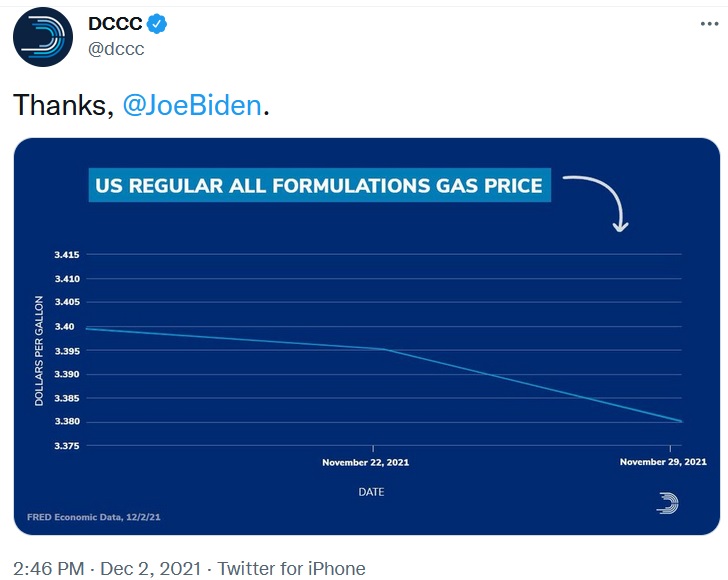
Dan Mitchell blog Merry Libertarian Christmas

Merry Libertarian Christmas

Very few people are interested in substantive policy analysis on Christmas, so the tradition here is to share some Santa-related libertarian-themed humor.

This year, we have two more additions.

First, we have another example of a rogue, law-breaking Santa.

Next, we have every libertarian’s Christmas list.

I tend to be more specific with my Christmas requests.

And sometimes those wishes are granted, but only in a very narrow sense.

P.S. Here’s one of the best-ever Christmas-themed jokes.

Socialism Humor

I try to share something humorous every weekend (economics humor last weekend and politician humor the previous weekend).

This weekend, we’re going to add to our collection of socialism humor.

Our first item nicely summarizes the incentive structure of socialism (sort of like this cartoon).

Our second item mocks the left’s hypocritical approach to coercion.

This next item may have been motivated by Libertarian Jesus.

Our fourth item makes a lot of sense if you know history.

Last but not least, here’s a version of “real socialism hasn’t been tried.”

P.S. If you want information on why socialism is bad economics, you can peruse my threepart series.

Socialism Humor

As I wrote last November, the one good thing about socialism is the endless opportunities it creates for satire.

Indeed, I have an entire collection of socialism humor (along with jabs at communism, its authoritarian cousin).

For what it’s worth, I think the meme should have targeted Bernie Sanders (a true believer) rather than Joe Biden (a run-of-the-mill careerist politician).

Speaking of Sanders, he and AOC have a starring role in this joke.

Sticking with that theme, the Babylon Bee satirically explainsthat our socialist friends are incapable of learning from real-world experience. And not just in the field of economics.

Local socialist man Brandon Paul was doing some gardening in his front yard this morning when he had a really good idea: to step on a rake.He’d previously stepped on 79 other rakes, each time resulting in the gardening implement smacking him in the face. But those times weren’t “real stepping on a rake,” he insisted. …Paul stepped on the rake, and sure enough, the handle came flying up and conked him on the face. …At publishing time, Paul had decided he would try democratic stepping on a rake, where his friends all vote on whether he steps on the rake, and then he steps on it and smacks his face.

Ouch, figuratively and literally.

Socialist nations are famous for empty shelves in supermarkets. As this next meme illustrates, they also have empty bookshelves.

Some of my left-leaning readers are probably saying, “Wait, what about Denmark?” And my response is, “Well, what about it?”

As per my tradition, I’ve saved my favorite example for the conclusion.

What makes this final meme both amusing and unfortunate is that it does capture the inherent problem in systems where the link between effort and reward is weakened or broken.

Virginia Democratic Congresswoman: ‘Don’t Say Socialism Ever Again’

By JIM GERAGHTYNovember 5, 2020 3:56 PM

Washington Post congressional reporter Erica Werner is reporting, more or less live on Twitter, about a conference call among House Democrats discussing why the 2020 elections did not go anywhere near as well as they expected. Apparently Virginia congresswoman Abigail Spanberger, who is narrowly ahead in her race, is quite angry with the more outspoken members of the progressive wing of her party:

Spanberger on the Dem caucus call: We lost races we shouldn’t have lost.
Defund police almost cost me my race bc of an attack ad.
Don’t say socialism ever again.
Need to get back to basics.
(Is yelling.)

It is rather refreshing to hear a congressional Democrat vehemently opposed to Democratic candidates touting socialism, even if it is just for purposes of campaigning. Maybe in the near future, we can see elected Democrats proclaiming, “America will never be a socialist country.”

This might make it tougher for Republicans to win races against Democrats, but we’re all better off if enthusiasm for socialism returns to the graveyard of political ideas.

LAWNEWS

Anti-Capitalist Rioters Smash Windows of 10 Businesses During Violent Portland March

Jake Dima @dima_jake / November 02, 2020 / 1 Comment

Around 150 violent demonstrators participated in a march called “Capitalism is Scary” in Portland, Oregon, Saturday night. Pictured: Police detain passengers in a mutual aid van during an Indigenous Peoples Day of Rage protest Oct. 11, 2020, in Portland. Protesters tore down statues of two U.S. presidents and broke windows of downtown businesses before police intervened. (Photo: Nathan Howard/ Stringer/Getty Images)

Violent demonstrators smashed windows and police declared a riot during an anti-capitalist march in Portland Saturday night.

Around 150 violent demonstrators participated in a march called “Capitalism is Scary,” according to The Oregoniandailycallerlogo

Rioters destroyed the windows of 10 separate businesses, including multiple phone stores, a coffee shop, a computer storefront, a hotel, a bank, a pair of realty offices, and a restaurant with patrons inside, a report from the Portland Police Bureau revealed.

Individuals donning black clothing were seen on video attempting to destroy a local business’ storefront, as the sound of glass shattering was audible, according to footage obtained by the local outlet.

Law enforcement declared the march a riot and demanded members of the group vacate the area or be exposed to non-lethal munitions, the Portland Police Bureau wrote.

“This is the Portland Police Bureau,” officers announced via a loudspeaker, according to the department’s report. “To those marching on NE Martin Luther King Jr Blvd: This has been declared a riot. Members of this group have been observed damaging multiple businesses along NE Martin Luther King Jr. Blvd.”

“All persons must immediately leave the area. Failure to adhere to this order may subject you to arrest, citation, or crowd control agents, including, but not limited to, tear gas and/or impact weapons. Disperse immediately.”

Cops quelled the crowd around 8:30 p.m. and no arrests were made, according to the release. Authorities are investigating the vandalism and future apprehensions are possible, the department concluded.

Content created by The Daily Caller News Foundation is available without charge to any eligible news publisher that can provide a large audience. For licensing opportunities of this original content, email licensing@dailycallernewsfoundation.org.

—-

Philadelphia Riots Are Another Case of Street Violence Used to Advance Radical Political Agendas

James Carafano @JJCarafano / October 28, 2020 / 4 Comments

Philadelphia Riots

In Kenosha, Portland, Seattle, and Chicago, city officials have tolerated criminal activity performed by mobs for politically motivated reasons. Philadelphia appears to be the next hotspot for mob violence to go unchecked. Pictured: A barricade is set on fire during a night of looting and violence in Philadelphia on Oct. 27. (Photo: Gabriella Audi/AFP/Getty Images)

COMMENTARY BY

James Carafano@JJCarafano

James Jay Carafano, a leading expert in national security and foreign policy challenges, is The Heritage Foundation’s vice president for foreign and defense policy studies, E. W. Richardson fellow, and director of the Kathryn and Shelby Cullom Davis Institute for International Studies. Read his research.

Like the replay of a bad movie, a law enforcement incident in Philadelphia triggered an excuse for violence and looting. It remains to be seen whether the City of Brotherly Love will become the next “Kenosha,” where city officials moved quickly to restore order and seek state and federal support—though sadly after 48 hours of opportunistic looting, violence, and destruction devastated the city.

Or perhaps Philadelphia will be the next PortlandSeattle, or Chicago, where systemic attacks seem to be a daily occurrence.

Police in Philadelphia are fully capable of restoring peace. The open question is whether the mayor and Larry Krasner, the former defense attorney-turned elected rogue prosecutor, will do their job and hold people accountable for their crimes.

When local, state, and federal governments work together, act quickly, and demonstrate no tolerance for organized violence to advance radical agendas, communities are kept safe and equal protection under the law is afforded for all citizens.

The left is actively working to undermine the integrity of our elections. Read the plan to stop them now. Learn more now >>

On the other hand, when local officials, the media, and politicians ignore, excuse, normalize, and enable violence, everyday Americans pay the price.

There is a plague sweeping this country that many don’t want to talk about: The deliberate use of street violence to advance radical political agendas, often under a smoke screen of campaigning for civil liberties. The evidence of organized criminal activity at the root of the outbreaks in American cities is mounting.

The list of people enabling this violence sadly includes some public officials, who are principally responsible for ensuring public safety. For example, a growing threat to peaceful communities is “rogue prosecutors,” former criminal defense attorneys recruited and funded by liberal billionaire backers, who—once elected—abuse their office by refusing to prosecute entire categories of crimes.

These rogue prosecutors are usurping the power of the legislature in the process, and ignoring victim’s rights—all to advance their politics.

Baltimore is a perfect  example. Since being sworn into office, under the watch of Baltimore City State’s Attorney Marilyn J. Mosby.

Rogue prosecutors fuel street violence by refusing to prosecute rioters and looters. When confronted with the rising crimes rates, Mosby called the statistics “rhetoric.”

The only way to break the cycle of violence is for local and state officials to work with each other, and if necessary, the federal government. They need to stop enabling the destruction of property and lives on their streets, and start investigating and prosecuting the individuals (and organizations) behind the riots.

It’s time to start shaming and calling out the media, politicians, and advocates who excuse and normalize the violence.

There is a proven action plan for making our streets safe. It is past time for officials to start following this blueprint.

There is no time—zero time to waste. There are already fears of more violence in our streets, regardless of the outcome of the national elections.

In my hometown of Washington, D.C., downtown buildings are already boarding up in anticipation of violence on our streets after the election. If Trump wins, violence. If Biden wins, violence. This makes no sense, and it’s time for it to stop.

It is time for every official and public figure, every political party, in every part of the country to publically reject violence on American streets as a legitimate form of protected speech. Violence is not protected speech, period.

The notion of deliberately destroying the lives and property of our neighbors to advance a radical political agenda is abhorrent. American leaders—of all stripes—should stand up now as one and reject these violent acts. It has gone on for too long, well before the death of George Floyd.

Leaders in Philadelphia and across America must take a principled stand to demand the end to this violence, and they need to do it before the election. In one voice, they should demand: “Leave our streets alone.”

—-


https://youtu.be/7AhRCyBB_sU

Philadelphia Sees More Unrest After Police Shoot, Kill Walter Wallace Jr. 

Police said about a thousand people were looting businesses northeast of downtown


By

Scott CalvertUpdated Oct. 28, 2020 1:41 am ET

Looters hit businesses in Philadelphia on Tuesday for a second straight night, as authorities struggled to contain civil unrest sparked by a video showing police fatally shooting Walter Wallace Jr., a Black man who was holding a knife.

Police said late Tuesday about a thousand people were looting businesses northeast of downtown, miles from the West Philadelphia neighborhood where the violence was concentrated a night earlier. 

Police urged residents in several parts of the city to stay indoors because those areas were experiencing widespread demonstrations that had turned violent with looting. 

Police had arrested 91 people late Monday and early Tuesday, most in connection with looting of pharmacies, shoe stores and other retail outlets, police said. Thirty officers were injured, mostly from hurled bricks and other projectiles, police said, and a sergeant’s leg was broken when she was hit by a pickup truck.

Like other large U.S. cities, Philadelphia had already been preparing for potential violence around the Nov. 3 election, Police Commissioner Danielle Outlaw said at a news conference Tuesday. The city is the most-populous in Pennsylvania, a state viewed as key to deciding the presidential election.

Ms. Outlaw said unrest caused by Monday’s shooting of Mr. Wallace could spill into election-related disturbances. “There may be some bleeding together, just given the timeline, as far as how close we are to Election Day and the days after,” she said.

To help manage tensions, city officials have requested assistance from law-enforcement agencies in surrounding counties and from the state government. The Pennsylvania National Guard said Tuesday it was sending several hundred members to Philadelphia at the request of Gov. Tom Wolf.

“We are exploring all of our options at this time to do everything that we can to ensure that all of our PPD resources are focused on what’s in front of us, whether it’s the actual civil unrest or even again the crime that continues to occur throughout the city,” Ms. Outlaw said.

The White House said the Trump administration would deploy federal resources if requested.

Bystander video that captured the episode in West Philadelphia was distributed on social media. The video shows Mr. Wallace standing on a sidewalk with two police officers pointing their guns at him. At one point a woman appeared to try to stop Mr. Wallace as he crossed the street. Officers fired several times when he re-emerged onto the street from between two parked cars and walked toward them.

A demonstrator shouts at police during a protest near where Walter Wallace, Jr. was killed.
A demonstrator shouts at police during a protest near where Walter Wallace, Jr. was killed.PHOTO: MARK MAKELA/GETTY IMAGES

A police spokesman said officers ordered Mr. Wallace to drop the knife before they fired their guns.

The two officers, whose names haven’t been released, each fired about seven rounds, police Chief Inspector Frank Vanore said. He said he didn’t know how many bullets struck Mr. Wallace. Mr. Vanore said police received a call about a man who was screaming and armed with a knife.

Speaking at a news conference Tuesday evening, Shaka Johnson, a lawyer for the Wallace family, said Mr. Wallace had mental health problems and was taking lithium under a doctor’s care.

“The man was suffering,” he said. “When you come to a scene where somebody is in a mental crisis, [and] the only tool you have to deal with it is a gun, that’s a problem.”

Mr. Johnson said police had been called to the Wallace home twice earlier Monday. Their third appearance, which ended with the deadly confrontation, came after Mr. Wallace’s brother had requested an ambulance, Mr. Johnson said, but the police officers got there first.

Mr. Wallace’s father, Walter Wallace Sr., decried the looting and called for justice for his son. “I can’t even sleep at night,” he said. “Every time I close my eyes, I get flashbacks about multiple shots.” 

Ms. Outlaw, noting that the two officers hadn’t yet been interviewed, didn’t answer a number of questions about the incident, such as whether the officers had any information ahead of time about possible mental-health concerns and whether police had contact with Mr. Wallace before Monday.

“There are many questions that demand answers. Residents have my assurance that those questions will be fully addressed by the investigation,” Ms. Outlaw said. “Everyone involved, including the officers, will forever be impacted by this tragedy.”

District Attorney Larry Krasner said his office will investigate the incident along with the police department. 

Law enforcement and the state of U.S. cities have drawn attention in this year’s presidential election. Speaking in West Salem, Wis., on Tuesday, President Trump said he supported “the heroes of law enforcement.” 

“Last night Philadelphia was torn up by Biden-supporting radicals,” he said. 

Former Vice President and Democratic presidential candidate Joe Biden and his running mate, Sen. Kamala Harris, said in a statement Tuesday, “Walter Wallace’s life, like too many others,’ was a Black life that mattered—to his mother, to his family, to his community, to all of us.” At the same time, they said, there was no excuse for attacking police officers and vandalizing businesses.

Philadelphia Mayor Jim Kenney said that he had spoken with Mr. Wallace’s wife and parents. 

“I have watched the video of this tragic incident, and it presents difficult questions that must be answered,” he said. “We need a speedy and transparent resolution for the sake of Mr. Wallace, his family, the officers and for all Philadelphia.”

John McNesby, president of the local police union, asked the public for patience while the investigation proceeds.

“Our police officers are being vilified this evening for doing their job and keeping the community safe, after being confronted by a man with a knife,” Mr. McNesby said Monday. “We support and defend these officers, as they too are traumatized by being involved in a fatal shooting.”

Demonstrators in Philadelphia confront police during a march Tuesday protesting the death of Walter Wallace.
Demonstrators in Philadelphia confront police during a march Tuesday protesting the death of Walter Wallace.PHOTO: MATT SLOCUM/ASSOCIATED PRESS

As word of the incident spread late Monday, protesters took to the streets. Looters hit businesses around the city, including on 52nd Street, a West Philadelphia commercial corridor that sustained major damage on May 31 and June 1 during protests over the killing of George Floyd in Minneapolis. Ms. Outlaw said the people who gathered to protest the incident weren’t the same people whom police later arrested.

Among the businesses hit were five SunRay pharmacies in West Philadelphia, said owner Marc Tancredi. In June, two SunRay locations were looted, including the one on 52nd Street.

“They broke into the pharmacy and stole the drugs like they did last time,” Mr. Tancredi said Tuesday. “Not as much physical damage to the location.”

Some looting was still occurring at 8 a.m. Tuesday, said Jabari Jones, president of the West Philadelphia Corridor Collaborative, a business association. He said he had examined the damage.

“It’s just another day where unfortunately the situation has boiled to the point where people have resorted to vandalism and looting,” he said.

Mr. Jones described the video of Mr. Wallace’s killing as “sickening” and wondered why officers didn’t take less-lethal steps to resolve the situation.

“I can understand the pent-up anger and rage,” Mr. Jones said. But he said damaging businesses hurts owners and residents who rely on them. “It is a balance of making sure neighborhood stores and places that provide products and services for residents in the community can still be open and provide those things.”

A looted store following protests in Philadelphia.
A looted store following protests in Philadelphia.PHOTO: DAVID DELGADO/REUTERS

Write to Scott Calvert at scott.calvert@wsj.com


Portland protesters topple Lincoln, Roosevelt statues during ‘Day of Rage’

The unrest was reportedly tied to the ‘Day of Rage’ on the eve of Columbus Day

Edmund DeMarche

 By Edmund DeMarche | Fox News

Portland absorbed another night of violent protests Sunday that resulted in the toppling of two statues in the city and reports of numerous buildings with their windows smashed in, including the Oregon Historical Society.

The unrest was reportedly tied to the “Day of Rage” on the eve of Columbus Day.

Andy Ngo, a journalist who has been documenting the unrest in the city, posted images of the destruction on Twitter. The Oregonian reported that protesters managed to bring down statues of Abraham Lincoln and Theodore Roosevelt.

Ngo posted a video of what he identified as the protesters toppling the statue of Roosevelt, which depicts the former president riding on horseback. The video showed a rope tied around the statue and protesters could be heard cheering when the statue shifted.https://www.google.com/amp/s/www.foxnews.com/us/portland-protesters-topple-lincoln-roosevelt-statues-during-day-of-rage.amp

Jussie Smollett

Justin “Jussie” Smollett[1] (/ˈdʒʌsi/ JUSS-ee,born June 21, 1982)[1] is an American actor and singer. He began his career as a child actor in 1987 acting in films including The Mighty Ducks (1992) and Rob Reiner‘s North (1994). In 2015, Smollett portrayed musician Jamal Lyon in the Fox drama series Empire, a role that was hailed as groundbreaking for its positive depiction of a black gay man on television. Smollett has also appeared in Ridley Scott‘s science fiction film Alien: Covenant (2017) as Ricks and in Marshall (2017) as Langston Hughes.

Jussie Smollett
Smollett at the 2016 PaleyFest
BornJustin Smollett
June 21, 1982 (age 38)
Santa Rosa, California, U.S.
OccupationActor singer songwriter
Years active1991–present
RelativesJake Smollett (brother)
Jurnee Smollett-Bell(sister)

Smollett was indicted in February 2019, for disorderly conduct for allegedly staging a fake hate crime assault;[2] the charges were dropped the following month.[3] In February 2020, he was indicted on six counts of making false police reports.[4][5][6]

2019 alleged hate crime hoax

Main article: Jussie Smollett alleged assault

On January 29, 2019, Smollett told police that he was attacked outside his apartment building by two men in ski masks. He reported they called him racialand homophobic slurs and said “this is MAGA country,” a reference to President Donald Trump‘s slogan “Make America Great Again.”[36] He claimed they used their hands, feet, and teeth as weapons in the assault.[37][38] According to a statement released by the Chicago Police Department, the two suspects then “poured an unknown liquid” on Smollett and put a noose around his neck.[39]Smollett said that he fought them off. Smollett was treated at Northwestern Memorial Hospital; not seriously injured, he was released “in good condition” later that morning.[36][40][41] The police were called after 2:30 a.m.;[42] when they arrived around 2:40 am, Smollett had a white rope around his neck.[43] Smollett said that the attack may have been motivated by his criticism of the Trump administration[44] and that he believed that the alleged assault was linked to the threatening letter that was sent to him earlier that month.[35]

On February 20, 2019, Smollett was charged by a grand jury with a class 4 felony for filing a false police report.[45][46][47] The next day, Smollett surrendered himself at the Chicago Police Department’s Central Booking station.[48] Shortly thereafter, CPD spokesman Anthony Guglielmi stated that Smollett “is under arrest and in the custody of detectives”.[49] On March 26, 2019, all charges filed against Smollett were dropped, with Judge Steven Watkins ordering the public court file sealed.[3][50] First Assistant State’s Attorney Joseph Magats said the office reached a deal with Smollett’s defense team in which prosecutors dropped the charges upon Smollett performing 16 hours of community service[51][52][53] and forfeiting his $10,000 bond.[54][55][56]

On April 12, 2019, the city of Chicago filed a lawsuit in the Circuit Court of Cook County against Smollett for the cost of overtime authorities expended investigating the alleged attack, totalling $130,105.15.[57][58][6][59] In November 2019, Smollett filed a counter-suit against the city of Chicago alleging he was the victim of “mass public ridicule and harm” and arguing he should not be made to reimburse the city for the cost of the investigation.[60] On February 11, 2020, after further investigation by a special prosecutor was completed, Smollett was indicted again by a Cook County grand jury on six counts pertaining to making four false police reports.[4][6] On June 12, 2020, a judge struck down Smollett’s claim that his February charge violated the principle of double jeopardy.[61]

Last Update 3 hrs ago

AOC to VP Pence: ‘It’s Congresswoman Ocasio-Cortez to you’

Ocasio-Cortez appeared bothered by what she saw as “gender dynamics” at work during the debate, in which Pence was the only male participant

By Dom Calicchio | Fox News

U.S. Rep. Alexandria Ocasio-Cortez appeared to be closely watching the vice presidential debateWednesday night, tweeting several responses to comments by Vice President Mike Pence during his confrontation against Sen. Kamala Harris.

Particularly irking the New York Democrat seemed to be Pence’s reference to her by her widely used nickname “AOC.” 

“For the record @Mike_Pence, it’s Congresswoman Ocasio-Cortez to you,” Ocasio-Cortez responded on Twitter.


Alexandria Ocasio-Cortez@AOCUS House candidate, NY-14For the record @Mike_Pence, it’s Congresswoman Ocasio-Cortez to you.9:29 PM · Oct 7, 2020

Ocasio-Cortez also appeared bothered by what she saw as “gender dynamics” at work during the debate, in which Pence was the only male participant. She accused Pence of demanding answers for the questions he posed to Harris, while trying to avoid directly answering questions put to him by the debate moderator, Susan Page of USA Today.

“Why is it that Mike Pence doesn’t seem to have to answer any of the questions asked of him in this debate?” she wrote.


Alexandria Ocasio-Cortez@AOC
US House candidate, NY-14Why is it that Mike Pence doesn’t seem to have to answer any of the questions asked of him in this debate?9:06 PM · Oct 7, 2020

“Pence demanding that Harris answer *his* own personal questions when he won’t even answer the moderator’s is gross, and exemplary of the gender dynamics so many women have to deal with at work,” she added.


Alexandria Ocasio-Cortez@AOCUS House candidate, NY-14Pence demanding that Harris answer *his* own personal questions when he won’t even answer the moderator’s is gross, and exemplary of the gender dynamics so many women have to deal with at work.9:18 PM · Oct 7, 2020

But perhaps the most touchy subject for Ocasio-Cortez – a member of so-called “Squad” of far-left lawmakers on Capitol Hill — was climate change.

During the debate, Pence had suggested that the Green New Deal – the signature legislative proposal of Ocasio-Cortez – was a product of “climate alarmists” that would be expensive and cost many Americans their jobs. Estimates have placed the deal’s price tag at more than $90 trillion.

Pence claimed that the Democratic presidential ticket of former Vice President Joe Biden and Harris would fully embrace the plan if elected.

“Now, Joe Biden and Kamala Harris would put us back in the Paris climate accord, they’d impose the Green New Deal, which would crush American energy, would increase the energy costs of American families in their homes, and literally crush American jobs,” Pence said.

Ocasio-Cortez responded by claiming the Green New Deal “has been lied about nonstop.”

“It’s a massive job-creation and infrastructure plan to decarbonize & increase quality of work and life,” she wrote.

The vice president also accused Biden and Harris of wanting to steer the U.S. away from traditional energy sources and ban fracking – a process that has helped contribute to the nation’s resurgence in the energy sector but has been a divisive topic among Democrats, who are split between the economic benefits of the process and what many see as its potentially harmful environmental impact.

The debate performance of Vice President Mike Pence drew close scrutiny by U.S. Rep. Alexandria Ocasio-Cortez, D-N.Y.

The debate performance of Vice President Mike Pence drew close scrutiny by U.S. Rep. Alexandria Ocasio-Cortez, D-N.Y.

Harris quickly shot down Pence’s assertion about fracking.

“The American people know Joe Biden will not ban fracking,” Harris said. “That is a fact. That is a fact.”

Ocasio-Cortez – perhaps mindful of accusations that she was less than enthusiastic for the Biden-Harris ticket after preferring progressive Sen. Bernie Sanders for president earlier in the campaign – kept her fracking response limited to a single sentence.


Alexandria Ocasio-Cortez@AOC
US House candidate, NY-14Fracking is bad, actually8:43 PM · Oct 7, 2020498.3K92.1K people are Tweeting about this

“Fracking is bad, actually,” she wrote.Dom Calicchio is a Senior Editor at FoxNews.com. Reach him at dom.calicchio@foxnews.com.


—-

​Amy Coney Barrett was appointed to the U.S. Court of Appeals for the Seventh Circuit in November 2017. She serves on the faculty of the Notre Dame Law School, teaching on constitutional law, federal courts, and statutory interpretation, and previously served on the Advisory Committee for the Federal Rules of Appellate Procedure. She earned her bachelor’s degree from Rhodes College in 1994 and her J.D. from Notre Dame Law School in 1997. Following law school, Barrett clerked for Judge Laurence Silberman of the U.S. Court of Appeals for the D.C. Circuit and for Associate Justice Antonin Scalia of the U.S. Supreme Court. She also practiced law with Washington, D.C. law firm Miller, Cassidy, Larroca & Lewin.

—-

—-


—-Related posts:

Taking on Ark Times Bloggers on various issues Part P “Freedom of speech lives on Ark Times Blog” (includes the video ABORTION OF THE HUMAN RACE) (editorial cartoon)

April 25, 2013 – 6:49 am

I have gone back and forth and back and forth with many liberals on the Arkansas Times Blog on many issues such as abortion, human rights, welfare, poverty, gun control  and issues dealing with popular culture. Here is another exchange I had with them a while back. My username at the Ark Times Blog is Saline […]By Everette Hatcher III | Posted in Francis SchaefferProlife | Edit | Comments (0)

Taking on Ark Times Bloggers on various issues Part O “Without God in the picture there can not be lasting meaning to our lives” (includes film ABORTION OF THE HUMAN RACE)

April 23, 2013 – 7:04 am

I have gone back and forth and back and forth with many liberals on the Arkansas Times Blog on many issues such as abortion, human rights, welfare, poverty, gun control  and issues dealing with popular culture. Here is another exchange I had with them a while back. My username at the Ark Times Blog is Saline […]By Everette Hatcher III | Posted in Francis SchaefferPresident ObamaProlife | Edit | Comments (0)

Taking on Ark Times Bloggers on various issues Part K “On what basis do you say murder is wrong?”Part 1 (includes film ABORTION OF THE HUMAN RACE)

April 16, 2013 – 5:49 am

I have gone back and forth and back and forth with many liberals on the Arkansas Times Blog on many issues such as abortion, human rights, welfare, poverty, gun control  and issues dealing with popular culture. Here is another exchange I had with them a while back. My username at the Ark Times Blog is Saline […]By Everette Hatcher III | Posted in Francis SchaefferPresident ObamaProlife | Edit | Comments (0)

Taking on Ark Times Bloggers on various issues Part J “Can atheists find lasting meaning to their lives?” (includes film ABORTION OF THE HUMAN RACE)

April 15, 2013 – 7:48 am

I have gone back and forth and back and forth with many liberals on the Arkansas Times Blog on many issues such as abortion, human rights, welfare, poverty, gun control  and issues dealing with popular culture. Here is another exchange I had with them a while back. My username at the Ark Times Blog is Saline […]By Everette Hatcher III | Posted in Francis SchaefferProlife | Edit | Comments (0)

Taking on Ark Times Bloggers on various issues Part H “Are humans special?” includes film ABORTION OF THE HUMAN RACE) Reagan: ” To diminish the value of one category of human life is to diminish us all”

April 10, 2013 – 6:43 am

I have gone back and forth and back and forth with many liberals on the Arkansas Times Blog on many issues such as abortion, human rights, welfare, poverty, gun control  and issues dealing with popular culture. Here is another exchange I had with them a while back. My username at the Ark Times Blog is Saline […]By Everette Hatcher III | Posted in Francis SchaefferProlife | Edit | Comments (0)

Taking on Ark Times Bloggers on various issues Part G “How do moral nonabsolutists come up with what is right?” includes the film “ABORTION OF THE HUMAN RACE”)

April 9, 2013 – 6:36 am

I have gone back and forth and back and forth with many liberals on the Arkansas Times Blog on many issues such as abortion, human rights, welfare, poverty, gun control  and issues dealing with popular culture. Here is another exchange I had with them a while back. My username at the Ark Times Blog is Saline […]By Everette Hatcher III | Posted in Francis SchaefferProlife | Edit | Comments (3)

Taking on Ark Times Bloggers on various issues Part E “Moral absolutes and abortion” Francis Schaeffer Quotes part 5(includes the film SLAUGHTER OF THE INNOCENTS) (editorial cartoon)

April 7, 2013 – 6:25 am

I have gone back and forth and back and forth with many liberals on the Arkansas Times Blog on many issues such as abortion, human rights, welfare, poverty, gun control  and issues dealing with popular culture. Here is another exchange I had with them a while back. My username at the Ark Times Blog is Saline […]By Everette Hatcher III | Posted in Francis SchaefferProlife | Edit | Comments (2)

“Sanctity of Life Saturday” Abortion supporters lying in order to further their clause? Window to the Womb (includes video ABORTION OF THE HUMAN RACE)

April 6, 2013 – 12:01 am

It is truly sad to me that liberals will lie in order to attack good Christian people like state senator Jason Rapert of Conway, Arkansas because he headed a group of pro-life senators that got a pro-life bill through the Arkansas State Senate the last week of January in 2013. I have gone back and […]By Everette Hatcher III | Posted in Arkansas TimesFrancis SchaefferMax BrantleyProlife | Edit | Comments (0)

Taking on Ark Times Bloggers on various issues Part D “If you can’t afford a child can you abort?”Francis Schaeffer Quotes part 4 includes the film ABORTION OF THE HUMAN RACE) (editorial cartoon)

April 5, 2013 – 6:30 am

I have gone back and forth and back and forth with many liberals on the Arkansas Times Blog on many issues such as abortion, human rights, welfare, poverty, gun control  and issues dealing with popular culture. Here is another exchange I had with them a while back. My username at the Ark Times Blog is Saline […]By Everette Hatcher III | Posted in Francis SchaefferProlife | Edit | Comments (0)

The Beatles: every song ranked in order of greatness 

—-

Beatles members Paul McCartney, left, John Lennon, George Harrison and Ringo Starr photographed together in April 1969.

Beatles members Paul McCartney, left, John Lennon, George Harrison and Ringo Starr photographed together in April 1969.

My personal favorite is “Here Comes The Sun”


The Bearles most revolutionary song in my view is “A Day In The Life”

I was born in 1961 and only remember hearing two Beatles songs playing on the radio and one of them was “The Long And Winding Road”

The other song I remember hearing on the radio was “Let It Be”

Golden Slumbers / Carry That Weight / The End

The Beatles – Help!

The Beatles – Hey Jude

Let It Be (Remastered 2009)

Come Together (Remastered 2009)

The Beatles – Don’t Let Me Down

The Beatles: every song ranked in order of greatness

Join us with the Fool on the Hill as we wade through Strawberry Fields (forever), looking through a Glass Onion, in search of the Fabs’ best-ever tune By Mark Beaumont–  21st December 2021

If you ever doubt that The Beatles were the greatest band that ever existed, try ranking their songs. Out of 185 self-penned tunes they released commercially during their initial seven-year run – so not including covers, fan club releases, alternative versions or their 1995 reunion songs – you’ll list well over a hundred tracks before you get to anything you wouldn’t call sublime, and hit 150 or so before anything verging on average appears. Of their entire catalogue, only six or seven songs could be classed as ‘shonky’, and most of those have still got something historic going for them.

Among them you’ll find songs which caused seismic shifts in pop, psychedelia and rock and the formative roots of punk, metal and electronica, amongst a panoply of other styles they pioneered and popularised in such a short time. It’s a feat unmatched by any act before or since, and with Peter Jackson’s Get Backreviving interest in their achievements, let’s pile back in to the most magical mystery tour pop music has ever known, with each track ranked in order of greatness.

‘Wild Honey Pie’ (‘The Beatles’, 1968)

An experimental ‘White Album’ interlude recorded entirely by Paul, ‘Wild Honey Pie’ had a mild element of redneck Grieg menace, but little else to it.

‘Dig It’ (‘Let It Be’, 1970)

50 seconds of a far longer studio jam, during which Lennon makes random references to the FBI, the CIA, the BBC, BB King, Doris Day and Matt Busby over a pretty dreary rock’n’roll dirge, ‘Dig It’ only really existed to exemplify the fact that The Beatles cut loose a lot during the ‘Let It Be’ sessions. Now we’ve got seven-plus hours of Get Back, it’s rendered superfluous.

‘You Know My Name (Look Up The Number)’ (B-side of ‘Let It Be’, 1970)

“Good evening and welcome to Slaggers…”The Beatles spend an inordinate amount of studio time trying to perfect this frankly silly combo of blues rock, lounge samba, music hall clowning and a bit sung by Crazy Frog’s jazz Granddad. Don’t do drugs, kids.

‘Why Don’t We Do It In The Road?’ (‘The Beatles’, 1968)

Even before Google Street View, Paul’s uber-horny blues squeal about dogging like a champion was at best inadvisable and at worst just plain creepy. Everyone will definitely be watching you, so stop. Think. Don’t do it in the road.

‘Revolution 9’ (‘The Beatles’, 1968)

Of interest as an avant-garde curio exemplifying the fact that The Beatles had entirely dismissed all sonic boundaries by the ‘White Album’, John and Yoko’s epic sound collage of radio interference, studio chatter and orchestral samples is more notable and influential than it’s often given credit for. But you wouldn’t bung it on repeat.

‘Flying’ (‘Magical Mystery Tour’, 1967)

An incidental instrumental to accompany a psychedelic segment of Magical Mystery Tour, ‘Flying’ was little more than 12-bar rock’n’roll played, very stoned, on an organ for two minutes. Some distance from a Welsh male voice choir.

‘Only A Northern Song’ (‘Yellow Submarine’, 1969)

Designed as a piss-taking dig at Northern Songs, the Beatles’ publishing company, which George felt rewarded him pitifully for his songwriting efforts, ‘Only A Northern Song’ is intended to sound weird, wonky and half-baked, even as Harrison came into his own as a songsmith.

‘Ask Me Why’ (‘Please Please Me’, 1963)

A formulaic shake shack ballad of little note other than the sneaking suspicion that Morrissey took his entire vocal style from Lennon’s end-of-chorus flicks.

‘Little Child’ (‘With The Beatles’, 1963)

By-numbers Merseybeat that was one of the few unmemorable originals Lennon and McCartney ever penned.

‘Blue Jay Way’ (‘Magical Mystery Tour’, 1967)

Written by George while waiting for houseguests to arrive at the place he was staying on the titular Hollywood Hills street in 1967. They presumably arrived just after he’d perfected the ominous psychedelic organ mood but before he’d really gotten his teeth into the chorus.

 ‘Not A Second Time’ (‘With The Beatles’, 1963)

A song desperately in search of a hookline, ‘Not A Second Time’ finds John’s voice flapping wildly around the verses as if desperate to find somewhere solid to land.

‘Her Majesty’ (‘Abbey Road’, 1969)

A lightweight folk frippery that sounds particularly throwaway when tacked on the end of ‘Abbey Road’’s monumental side two medley as a secret final track.

‘Run For Your Life’ (‘Rubber Soul’, 1965)

As The Beatles shifted away from love songs, John contributed this out-and-out hate song to ‘Rubber Soul’ – a nifty country rocker and arguably the proto-‘Last Train To Clarkesville’, but notorious as The Beatles’ most problematic track. John would claim to regret having written it, calling it his least favourite Beatles song.

‘Don’t Bother Me’ (‘With The Beatles’, 1963)

“I don’t think it’s a particularly good song,” George said of his debut Beatles writing credit, “it mightn’t even be a song at all.” Actually, it’s a pretty nifty homage to the surf rock craze of the time. And definitely a song.

‘For You Blue’ (‘Let It Be’, 1970)

Standard, formulaic slide guitar blues given a sweetness and light by George’s weightless vocals and exclamation, “Elmore James got nothing on this!”

‘What Goes On’ (‘Rubber Soul’, 1965)

Honky-tonk pastiche written by John in 1959 and passed over for several albums before landing half-heartedly on ‘Rubber Soul’. You can actually hear the band lose interest midway through.

‘Thank You Girl’ (B-side to ‘From Me To You’, 1964)

Recorded by John with a heavy cold, it’s perhaps understandable that this thank you letter to their fans – a “hack song”, according to McCartney – sounds muddy and under-developed. On this evidence you’d assume EMI Studios doubled as a bomb shelter.

‘One After 909’ (‘Let It Be’, 1970)

Plucked from the catalogue of early Lennon/McCartney compositions when the band were short on material for ‘Let It Be’, Paul’s locomotive skiffle knockabout had a retro charm but never really escaped the formula.

‘I Me Mine’ (‘Let It Be’, 1970)

A lovely choral waltz ballad from George, totally ruined by nobody bothering to write a proper chorus and just bawling the title over some 12-bar sleaze rock riffing instead.

‘I’ll Cry Instead’ (‘A Hard Day’s Night’, 1964)

Bitterness, heartbreak and romantic revenge; Lennon’s dark side was on show even on the skiffly, tucked-away tracks of the Beatlemania era.

‘Yer Blues’ (‘The Beatles’, 1968)

Passionate, characterful and a raw exorcism of John’s harrowed late-‘60s mindset, certainly. But The Beatles were way past by-numbers blues rock by ‘68 and ‘Yer Blues’ stood out as an unimaginative throwback on the ‘White Album’.

‘When I Get Home’ (‘A Hard Day’s Night’, 1964)

Formulaic Beatlemania fare in which John gets excited at the prospect of telling his wife about all the screaming girls, drugs and parties on tour. Bet she was thrilled.

‘Being For The Benefit Of Mr Kite!’ (‘Sgt. Pepper’s Lonely Hearts Club Band’, 1967)

For some, John’s cabaret pastiche is the very essence of ‘Sgt. Pepper…’, capturing the sepia carnival vibe in its circus poster lyrics and carousel interlude. To these ears, though, it’s club-footed, corny and unnecessary.

‘I’ll Get You’ (B-side to ‘She Loves You’, 1963)

John’s songwriting sparkles on the B-side of their first single, yet lacks the confidence of more head-waggling numbers of the era.

‘This Boy’ (B-side to ‘All My Loving’)

Faithful homage to the harmony groups of the ‘50s and early ‘60s, and a rare example of a Beatles song that could be mistaken for that of any other band.

‘I’m Down’ (B-side to ‘Help!’)

Nifty Little Richard-style rock’n’roller that doesn’t sound all that “down” at all.

‘Love Me Do’ (single, 1962)

Legendary and all that, being the debut single, but let’s face it: a bit of a plodder.

‘Hold Me Tight’ (‘With The Beatles’, 1963)

Even when rehashing some pretty standard rock’n’roll chord progressions and melodic structures on a song that McCartney himself would call “filler”, The Beatles exuded a fundamental magic that set them apart from the Merseybeat horde.

‘There’s a Place’ (‘Please Please Me’, 1963)

Early signs of spiritual and philosophical musings from John as he tries his hand at Motown.

‘She’s A Woman’ (B-side to ‘I Feel Fine’)

Basic, bluesy rock’n’roller notable for some pretty savage guitar work and McCartney clearly working his way up to the sort of full-throated blues bawls he’d let loose once the ‘60s were ready for them.

‘Misery’ (‘Please Please Me’, 1963)

The exuberance of being in a studio recording ‘Please Please Me’ made this shameless homage to the ‘50s crooners sound like the cheeriest song about existential despair ever recorded. No bad thing.

‘I Call Your Name’ (‘Long Tall Sally EP’, 1964)

A pre-Beatles Lennon tune originally given to British popper Billy J. Kramer. The Beatles’ version swung harder.

‘What You’re Doing’ (‘Beatles For Sale’, 1964)

George’s proto-indie-pop guitar line lifted one of Paul’s less eventful tunes, but not an un-influential one – somewhere in here is the root of The La’s’ ‘There She Goes’.

‘Octopus’s Garden’ (‘Abbey Road’, 1969)

Seemingly envisioning a future in children’s entertainment as The Beatles fell apart, Ringo’s second-ever writing credit involved oompah larks and underwater adventure (sound familiar?), adorned with George making bubble noises by blowing into a glass of milk through a straw.

‘Polythene Pam’ (‘Abbey Road’, 1969)

‘Pinball Wizard’ power chords, nifty solo, broad Scouse accent, low-rent S&M; there was so much going on in John’s throwaway 70-second rocker about a bizarre sexual encounter in Jersey in 1960 (involving beat poet Royston Ellis) that you wish he’d written a chorus for it.

‘You Like Me Too Much’ (‘Help!’, 1965)

It’s baffling that The Beatles only really began recognising and appreciating George’s songwriting come ‘The White Album’, since he was displaying solid melodic chops way back on ‘Help!’.

‘Maxwell’s Silver Hammer’ (‘Abbey Road’, 1969)

You’ve written some of the finest children’s songs of the century, why the hell shouldn’t you try to make a vaudevillian family singalong from the story of an insane, hammer wielding psychopath? Basically Wes Craven’s ‘When I’m Sixty-Four’.

‘Tell Me What You See’ (‘Help!’, 1965)

Sometimes The Beatles’ harmonising could carry an entire song alone, as on this shift towards a more contemplative folk maturity. Includes an entire verse nicked from a religious passage that hung in John’s childhood home.

‘The Ballad Of John And Yoko’ (single, 1969)

The sorry tale of John and Yoko’s troubled and press-hounded attempts to wed at short notice in various European locales, delivered as impassioned country lament.

‘Sun King’ (‘Abbey Road’, 1969)

The Beatles’ impression of The Beach Boysdoing Fleetwood Mac’s ‘Albatross’ (in cod-Spanish) fell between two stools on ‘Abbey Road’; not as plush as ‘Because’ nor as melodically bright as ‘Here Comes The Sun’. Lovely, then, but slight.

‘I Need You’ (‘Help!’, 1965)

Gorgeous flamenco strumble from George, finding his songwriting feet on ‘Help!’.

‘Ob-La-Di, Ob-La-Da’ (‘The Beatles’, 1968)

Macca Marmite: one either adores the cheery Jamaican lilt of Desmond and Molly’s story and considers it pivotal in attuning British pop culture to ska music or, like Lennon, deems it “more of Paul’s granny music shit”.

‘I’m Happy Just To Dance With You’ (‘A Hard Day’s Night’, 1964)

A Lennon/McCartney composition given to George to sing. You likely owe your very existence to this dance hall romance, since it probably gave your Granddad the nerve to chat up your Nanna down the Mecca.

‘I’ll Be Back’ (‘A Hard Day’s Night’, 1964)

Flamenco-flecked and downbeat, the closer of ‘A Hard Day’s Night’ – rewritten from Del Shannon’s ‘Runaway’ – was an early sign of The Beatles’ sophisticated tonal ambitions within what were, at the time, strictly regimented ‘60s pop structures.

‘The Continuing Story Of Bungalow Bill’ (‘The Beatles’, 1968)

The crackle of boy scout campfire virtually enshrouds this charming tale of bravery and derring-do out on the hunt in the days of empire. Twitter would rip it a new arsehole, mind.

‘Lovely Rita’ (‘Sgt. Pepper’s Lonely Hearts Club Band’, 1967)

Of all of Paul’s outlandish character songs, ‘Lovely Rita’, in which our narrator develops affection for a traffic warden, is by far the least believable, but remains charming thanks to some gorgeous band harmonies and nifty work on the paper and comb.

‘I Wanna Be Your Man’ (‘With The Beatles’, 1963)

An energised if one-trick jitterbugger written by Paul on a night out with The Rolling Stones in Richmond. It became The Stones’ second single before The Beatles gave it to Ringo to holler on ‘With The Beatles’.

‘The Word’ (‘Rubber Soul’, 1965)

The link between ‘Drive My Car’ and ‘Taxman’, ‘The Word’ added a touch of harmonic funk to ‘Rubber Soul’ as Lennon took a stab at a one-note song in homage to ‘Long Tall Sally’.

‘Old Brown Shoe’ (B-side of ‘The Ballad Of John And Yoko’, 1969)

George in righteous, piano-thumping boogie-woogie mode. Upstaged its own A-side.

‘Piggies’ (‘The Beatles’, 1968)

Tainted in retrospect by Charles Manson’s murderous interpretations, George’s harpsichord satire of the selfish and gluttonous rich, smothered in porcine snorts and grunts, is a stirring but unsettling listen.

‘Fixing A Hole’ (‘Sgt. Pepper’s Lonely Hearts Club Band’, 1967)

The pot-fixated ‘Fixing A Hole’ makes great use of harpsichord (played by both Paul and George Martin) to give a psychedelic lilt to a music hall pastiche on which Paul makes the utmost of a one-note chorus.

‘If I Needed Someone’ (‘Rubber Soul’, 1965)

This fine Merseybeat evolution offers early indications of George’s Indian influence and of the psychedelic storm the band would later kick up on ‘Tomorrow Never Knows’.

‘I’ve Got A Feeling’ (‘Let It Be’, 1970)

Suitably blustery for a song recorded on a rooftop in January, Paul’s dive into The Band-style bluesy Americana rock is long on feel and passion, short on melodic impact.

‘Think For Yourself’ (‘Rubber Soul’, 1965)

Incorporating Motown beats and an open-mindedness gleaned from encounters with Dylan, George’s first major foray out of romantic odes was targeting at society’s regressive and narrow-minded elements, quite possibly in government.

‘You Can’t Do That’ (‘A Hard Day’s Night’, 1964)

A tuneful precursor to ‘Run For Your Life’, which also finds John’s jealousy getting the better of him.

‘Sgt. Pepper’s Lonely Hearts Club Band (Reprise)’ (‘Sgt. Pepper’s Lonely Hearts Club Band’, 1967)

Rocking up the title track, the reprise rips off the neon military blazers to expose the Hamburg leathers beneath.

‘Every Little Thing’ (‘Beatles For Sale’, 1964)

A marriage of the melancholy and upbeat, this was a rare example of John singing a Paul song.

‘Wait’ (‘Rubber Soul’, 1965)

The Beatles as pop toreadors. A certain Mediterranean fire creeps into Macca’s plea to Jane Asher to give him at least until the end of tour.

‘I Don’t Want To Spoil The Party’ (‘Beatles For Sale’, 1964)

John plays the party-pooping wallflower on this beautifully forlorn skiffle lament and a thematic precursor to ‘How Soon Is Now?’.

‘Tell Me Why’ (‘A Hard Day’s Night’, 1964)

An all-barrels harmonic doo-wop assault which Paul, in retrospect, thought might have been a window onto John’s troubled marriage to Cynthia.

‘Doctor Robert’ (‘Revolver’, 1966)

Perhaps spurred on by The Rolling Stones’ ‘Mother’s Little Helper’ and Donovan’s ‘Candy Man’, Lennon penned his own tribute to a drug-supplying medic, rumoured to be Dr Robert Freymann, known for supplying B-12 injections liberally laced with amphetamine. They kick in on the blissed-out middle-eight, clearly.

‘It’s Only Love’ (‘Help!’, 1965)

One of Lennon’s prettiest early-period tunes (he hated it, natch), built around sumptuous 12-string rhythms and a twee but fan-friendly lyric. Working title: ‘That’s A Nice Hat’.

‘The Inner Light’ (B-side of ‘Lady Madonna’, 1968)

Based on a Taoist poem and recorded with Indian musicians in Bombay, The ‘Lady Madonna’ flipside was one of only four Beatles songs with no Beatles playing on it (quiz compilers: the others are ‘Good Night’, ‘She’s Leaving Home’ and ‘Eleanor Rigby’), but magnificently emulated the serenity of the Transcendental Meditation techniques the band were learning from the Maharishi.

‘Rocky Raccoon’ (‘The Beatles’, 1968)

Cartoonish Wild West soap opera larks and one of Paul’s better novelty tunes, thanks to a popcorn guzzling plot and George Martin’s honky tonk piano solo tumbling past like a saloon fight.

‘Good Night’ (‘The Beatles’, 1968)

As reward for getting all the way through ‘Revolution 9’, Ringo turned up with a full Busby Berkeley orchestra to tuck you in with this sleepyhead lullaby. Night night, Ringo.

‘When I’m Sixty Four’ (‘Sgt. Pepper’s Lonely Hearts Club Band’, 1967)

Central, stylistically, to the pre-war cabaret conceit of ‘Sgt. Pepper’s…’, Paul’s cheery/corny bandstand ode to somehow reaching your 60s without murdering your spouse was among the first he ever wrote, aged 16. Now go on, give Nanna a kiss.

‘Oh! Darling’ (‘Abbey Road’, 1969)

Updating 1950s US swing for the psychedelic era, McCartney put his all into ‘Oh! Darling’, even coming into the studio early to have one crack at it every day before his voice lost its edge. The song’s part in getting glam underway has gone woefully unrecognised.

‘Yellow Submarine’ (‘Revolver’, 1966)

Ringo’s most legendary moment, the quintessential psychedelia ditty and arguably the most overplayed Beatles song of all. You came for the chant-along chorus aged four and stayed until adulthood for the ‘shroom-friendliness and Lennon shouting, “Full speed ahead, Mr Boatswain / Full speed ahead, bop-dibbetty-bip-bop!” Features The Stones’ Brian Jones on ocarina. No shit.

‘Don’t Let Me Down’ (‘Let It Be’, 1970)

Louche and languid (read: almost certainly on heroin by now), Lennon’s plea to Yoko flits between the vulnerable, optimistic, lovestruck and desperate. Find yourself someone who “does” you like Yoko “done” John.

‘Girl’ (‘Rubber Soul’, 1965)

Melding Greek and German music into a mournful mood piece, Lennon pointed the way to The Beatles’ more sophisticated latter period with ‘Girl’, probably the best song ever to have a chorus that’s mostly just inhaling.

‘Dig A Pony’ (‘Let It Be’, 1970)

One of the more inventive and engaging blues numbers the band worked up for ‘Let It Be’, not least because of Lennon’s acid-fried lyrics. Just exactly how one does “a roadhog” or “syndicate[s] any boat you row” remains unspecified.

‘Things We Said Today’ (‘A Hard Day’s Night’, 1964)

Idyllic strumbler penned by Paul on a yacht called Happy Days in the Virgin Islands with glamorous new girlfriend Jane Asher. And sounds like it.

‘Do You Want To Know A Secret’ (‘Please Please Me’, 1963)

Inspired by a song from Snow White And The Seven Dwarves, which John’s mother used to sing to him as a child, the strength of ‘Do You Want To Know A Secret’ was in its childlike simplicity and coy teen naivety.

‘Baby’s In Black’ (‘Beatles For Sale’, 1964)

Hoedown homage so gorgeous it’ll give you an ounce of sympathy for a man trying to pull a hot widow while her husband isn’t yet cold in the ground.

‘The Fool On The Hill’ (‘Magical Mystery Tour’, 1967)

Flutes! Recorder solos! Meditation! The budget for the Magical Mystery Tour TV special was severely stretched when Paul allegedly decided the sequence for his wistful portrait of the Maharishi should be filmed in a beach near Nice.

‘And I Love Her’ (‘A Hard Day’s Night’, 1964)

Doe-eyed flamenco vibes abound on one of Paul’s early run-ups to ‘Yesterday’.

‘Mean Mr. Mustard’ (‘Abbey Road’, 1969)

Blur basically got their entire ‘90s out of John’s engrossing one-minute oompah tune inspired by a newspaper story of a “dirty old” miser – in real life, one John Mustard of Enfield, Middlesex – who hid his money so he wouldn’t be forced to spend it. His level of personal hygiene was unrecorded.

‘Altogether Now’ (‘Yellow Submarine’, 1969)

While ‘Yellow Submarine’ and ‘Octopus’s Garden’ were story time classics, ‘Altogether Now’’s nursery-level track easily stands up as The Beatles’ best children’s song.

‘Hello, Goodbye’ (single, 1967)

Brisk, bright-eyed and boasting one of the best pre-choruses in pop, ‘Hello, Goodbye’ would be the best single in most bands’ careers. It’s the 107th best song The Beatles wrote. That’s how great they were. Strap in: everything from here gets fucking brilliant.

‘Good Morning Good Morning’ (‘Sgt. Pepper’s Lonely Hearts Club Band’, 1967)

The Beatles did a fine line in rise-and-shine tunes, although John’s compulsive dawn chorus on ‘Sgt. Pepper…’ came with a hearty dollop of cynicism, everyday mundanity and casual adultery.

‘Another Girl’ (‘Help!’, 1965)

The Help! scene set the blueprint for The Monkees‘ entire career, as the band played this Beatlemania cracker on a beach in the Bahamas, with Paul using a bikini-clad girl as a guitar.

‘I Want You (She’s So Heavy)’ (‘Abbey Road’, 1969)

The last song all four Beatles recorded together; you can hear the sheer weight of the occasion. At almost eight minutes and smothered in doomy textures and white noise, it would have seen John invent heavy metal if Paul hadn’t beaten him to it with ‘Helter Skelter’. Instead it invents Pink Floyd’s ‘Meddle’ and provides proof, if any were needed, that stoner rock is basically the blues on military grade tranquilisers.

‘Within You Without You’ (‘Sgt. Pepper’s Lonely Hearts Club Band’, 1967)

Probably the ultimate expression of George’s Indian immersion, ‘Within You Without You’ opened many a Western third eye to the wonders of ‘world music’ and Eastern philosophies.

‘I’m So Tired’ (‘The Beatles’, 1968)

When you shout for ‘Help!’ and nobody listens, this is where you end up. Tortured, wasted, exhausted and desperate. Even three weeks of solid insomnia at the Maharishi’s retreat can’t dampen Lennon’s melodic prowess, as he knocks out the perfect song for day three of the prom night that forgot to finish.

‘The End’ (‘Abbey Road’, 1969)

Masterful and historic as the climax of the ‘Abbey Road’ medley, even taken in isolation ‘The End’ is exultant mood-making, from Ringo’s drum solo to the gathering gospel storm and Paul’s thought-provoking orchestral coda.

‘Birthday’ (‘The Beatles’, 1968)

Along with Stevie Wonder’s ‘Happy Birthday’, The Beatles’ impassioned 12-bar well-wishing – written and recorded in one night – is usually the best thing about scratching off another year on this godforsaken hellhole of a planet.

‘All I’ve Got To Do’ (‘A Hard Day’s Night’, 1964)

Smokey Robinson homage aimed at the US market – British teens of the ‘60s would never dream of calling a girl up “on the phone”, Lennon later claimed.

‘It’s All Too Much’ (‘Yellow Submarine’, 1969)

The sheer euphoria of George’s peak acid song, floating through a blissed-out clamour of noise rock, trumpet and disintegrating beats, makes us all yearn for the days before you’d pay 50 quid for a bag of blotting paper soaked in balsamic vinegar off the dark web.

‘Baby, You’re A Rich Man’ (B-side of ‘All You Need Is Love’, 1967; ‘Magical Mystery Tour’, 1967)

Because we’re all as loaded as Bezos inside, you dig? Sublimely funky ode to our spiritual wealth that’s still begging the decades-old question: just where in a zoo, exactly, might you stash a bag full of cash?

‘Don’t Pass Me By’ (‘The Beatles’, 1968)

Ringo’s long underrated songwriting debut doesn’t get the credit it deserves for holding its own on ‘The White Album’. The sheer clod-hopping junk shop exuberance (unsurprising, since Ringo had been trying to get it recorded since 1962) makes it an album highlight, along with the fiddle player so drunk he doesn’t realise the song’s finished. A Number One single in Denmark – and don’t think we didn’t consider making it number one in this list too, just for the traffic.

‘She Came In Through The Bathroom Window’ (‘Abbey Road’, 1969)

Plush, proto-Wings country rocker inspired by a fan breaking into Paul’s house to steal photographs. Key to the ‘Abbey Road’ medley’s impression that the band had melodic wonders aplenty to toss into the pile.

‘Glass Onion’ (‘The Beatles’, 1968)

Woooah! Meta… A Beatles song about The Beatles. Walruses, Strawberry Fields, Lady Madonna and the Fool on the Hill all reprise their roles in Beatles history as Lennon mocks people reading too much into the band’s lyrics to a chamber rock backing that ELO got at least three early albums out of.

‘Carry That Weight’ (‘Abbey Road’, 1969)

It takes a certain classical majesty to slip a grand orchestral reprise of ‘You Never Give Me Your Money’ into a stonking great lad rock anthem chorus in search of a song.

‘Yes It Is’ (B-side of ‘Ticket To Ride’)

Effortlessly reinvented the blue-eyed crooner genre on a frickin’ B-side. Just try not playing it twice.

‘P.S. I Love You’ (B-side of ‘Love Me Do’, 1962; ‘Please Please Me’, 1963)

The song The Shadows would have written, had they been the world’s greatest band in the making.

‘Get Back’ (‘Let It Be’, 1970)

We’ve all seen it chug into life in the documentary of the same name, its simple blues strut brought to life by Billy Preston’s wild-at-heart organ. Still slaps.

‘Sgt. Pepper’s Lonely Hearts Club Band’ (‘Sgt. Pepper’s Lonely Hearts Club Band’, 1967)

Pre-war nostalgia meets counterculture psychedelia explosion to landscape obliterating effect. And all, the story goes, because Paul didn’t know that the ‘S’ and ‘P’ on his in-flight meal pots stood for ‘Salt’ and ‘Pepper’.

‘Michelle’ (‘Rubber Soul’, 1965)

In Parisian mood, Paul tries out some schoolboy French to woo a continental bohemian lass. Originally written as a pastiche of a bloke singing a song in French at an art party.

‘Hey Bulldog’ (‘Yellow Submarine’, 1969)

A masterclass in rock dynamism and melodic tension, and testament to the fact that The Beatles buried genius in all corners of their catalogue, smothered in barking noises, ripe for re-evaluation.

‘Any Time At All’ (‘A Hard Day’s Night’, 1964)

Trying to write another ‘It Won’t Be Long’, Lennon came up with something a touch more mature – an early sign that The Beatles were on a fast-track out of Merseybeat, bound for somewhere rather more Dylanish.

‘Lady Madonna’ (single, 1968)

Marrying his revived interest in 1920s radio jazz (see also: ‘Martha My Dear’, ‘Honey Pie’) to a dirty ‘50s swamp blues rock’n’roll riot, McCartney imagined a gender-swapped version of Fats Domino’s working man blues rocker ‘Blue Monday’ and came up with a song that rocks until the wheels damn near come off.

‘I’m Looking Through You’ (‘Rubber Soul’, 1965)

A fine, fond farewell to the ‘old Beatles’ as they approached their giant leap. And yes, that is the riff from The Travelling Wilburys’ ‘End Of The Line’ at the start – nice recycle, George.

‘I’m A Loser’ (‘Beatles For Sale’, 1964)

Considered the first sign of Dylan’s influence on The Beatles, and one of John’s early cries for help hidden beneath a storming country-pop melody.

‘I Feel Fine’ (single, 1964)

“I’ve written this song, but it’s lousy,” Lennon said to Ringo one day in the studio. We call bullshit. One of the first deliberate uses of feedback on record.

‘The Night Before’ (‘Help!’, 1965)

“Love was in your eyes, ah, the night before / Now today I find you have changed your mind.”She was pissed Paul, but at least you got a definitive slice of ‘60s pop out of it. Perfect for playing at, um, Stonehenge (if Help! is anything to go by).

‘Eight Days A Week’ (‘Beatles For Sale’, 1964)

A flippant remark Paul’s chauffeur made en route to John’s house in Weybridge inspired, that very afternoon, a timeless pop demand for more weekly loving than is reasonable or realistic. But then, ‘Twice A Week Unless It’s My Birthday’ wouldn’t have been so catchy.

‘No Reply’ (‘Beatles For Sale’, 1964)

While Paul was in the Virgin Islands with Ringo writing ‘Things We Said Today’, John was in Tahiti with George, knocking together this tropical tale of an unfaithful and unresponsive partner. “You’re getting better now – that was a complete story,” publisher and Beatles pantomime villain Dick James (sssss!) told John on hearing it.

‘I Should Have Known Better’ (‘A Hard Day’s Night’, 1965)

Much harmonica jollity as, with Beatlemania in full swing, John bags himself a good ‘un. Nanna probably thought it was written specifically for her.

‘With A Little Help From My Friends’ (‘Sgt. Pepper’s Lonely Hearts Club Band’, 1967)

Ringo’s finest hour. For once nobody stood up and walked out on him when he sang out this aural hug of a tune, acknowledging his eternal debt to the bandmates without whom he might be slogging the clubs with Merseybeat nostalgia acts to this day.

‘Getting Better’ (‘Sgt. Pepper’s Lonely Hearts Club Band’, 1967)

With George adding Indian tambura drones and John lumping on world-weary falsetto cynicism (“it can’t get no worse”), another of Paul’s optimistic pop bangers gained deliciously dark edges. Much of the magical frisson of The Beatles can be heard in how clearly John doesn’t want to be singing this one.

‘Honey Pie’ (‘The Beatles’, 1968)

We can blame the widespread malaise of ‘White Album’ fatigue for the back end of the album being under-appreciated for decades. Case in point: Macca’s utterly charming tribute to the jazz age, complete with authentically crackled gramophone clarinets.

‘I Want To Tell You’ (‘Revolver’, 1966)

LSD musings and dissonant rock as George comes into his own as a rounded songwriter circa ’66.

‘It Won’t Be Long’ (‘With The Beatles’, 1963)

Effervescent call-and-response “yeah”s. Chord sequences Dylan would call “outrageous”. The promises of imminent romantic reunion. The opener of ‘With The Beatles’ is almost Fabs-by-numbers – but boy, what numbers.

‘You Never Give Me Your Money’ (‘Abbey Road’, 1969)

If only all fractious business disputes could be argued out like this. With Paul and John looking to lose control of their stakes in their own songs, Paul penned this sublime multi-style paean to manager Allen Klein that basically boiled down to “show me the mon-aaay!”

‘For No One’ (‘Revolver’, 1966)

Cracks appear in Paul’s relationship with Jane Asher; hiding in a toilet in a Swiss Alps chalet he writes a lament for “a love that should have lasted years”, his second chamber ballad for ‘Revolver’.

‘Magical Mystery Tour’ (‘Magical Mystery Tour’, 1967)

Roll up (hur-hur!) for the trip of a lifetime (pfffft!). This spaced-out rock freewheeler introduced the weirdest Christmas TV special outside of the Grumpy Cat movie. It’s essentially The Who’s ‘Tommy’ inside of three minutes.

‘You’re Going To Lose That Girl’ (‘Help!’, 1965)

Worst. Wingman. Ever. Lennon lurks at the edges of a shaky relationship waiting to pounce, with an irresistible two-minute doo-wopper between his teeth.

‘Your Mother Should Know’ (‘Magical Mystery Tour’, 1967)

Corny, sure, but McCartney’s vaudevillian Broadway high-kicker was so perfectly crafted it could make the harshest critic want to swing on a sparkly trapeze dressed as a Rockette.

‘Long, Long, Long’ (‘The Beatles’, 1968)

Another undervalued back-end-of-‘The Beatles’ classic, in which George explores the space between drowsy serenity and stark passion and Ringo delivers a dynamic tour de force.

‘Back In The USSR’ (‘The Beatles’, 1968)

No political comedy Beach Boys pastiche has ever rocked so hard before or since.

‘Savoy Truffle’ (‘The Beatles’, 1968)

In honour of Eric Clapton’s sweet tooth, George – quite spectacularly – goes full Stax. Mmmm, crème tangerine

‘Drive My Car’ (‘Rubber Soul’, 1965)

Named after an old blues euphemism for shagging – beep beep, and indeed, yeah – ‘Drive My Car’ finds Paul blues-rocking his way to a pretty sweet deal – lifelong partner anddesignated driver.

‘Good Day Sunshine’ (‘Revolver’, 1966)

A wonderfully lightweight greet-the-dawn ditty inspired by The Kinks‘ ‘Sunny Afternoon’ and, in turn, inventing ELO‘s ‘Mr Blue Sky’.

‘Love You To’ (‘Revolver’, 1966)

George’s first and finest Indian-influenced song, galloping along on compulsive tabla rhythms. Alongside ‘Strawberry Fields…’ and ‘Lucy In The Sky…’, this was the absolute epitome of the psychedelic era. Don’t, however, try to making love while singing songs. Doesn’t go down well.

‘Julia’ (‘The Beatles’, 1968)

The separations of the ‘White Album’ sessions allowed John to finally broach the subject of his mother in song, utilising the finger-picking style Donovan had taught him in India. “Half of what I say is meaningless, but I say it just to reach you, Julia,” he sings in stunningly intimate manner, imagining her as a siren lost to the sea.

‘Ticket To Ride’ (‘Help!’, 1965)

Said to be about the clean-health certificates received by Hamburg sex workers, ‘Ticket To Ride’ is acclaimed more for its significance than anything – here was where The Beatles left plain old Merseybeat behind to embrace Indian textures, proto-Byrdsian plushness and future-facing drumwork.

‘Day Tripper’ (single, 1965)

Increasingly dabbling with ‘secret’ drug and sex references, ‘Day Tripper’ had a pop at weekend hippies in the shape of a squeaky-clean slice of go-go ‘60s pop. I mean, look how high Ringo is in the video.

‘I’ll Follow The Sun’ (‘Beatles For Sale’, 1964)

Written by Paul at the age of 16. The 1950s clearly missed a trick in not realising there was a school kid in Liverpool surpassing all of its wistful guitar balladry.

‘Revolution’ (B-side of ‘Hey Jude’, 1968)

Delivered as an opiated, horn-blasted shoo-wop shuffle called ‘Revolution 1’ on ‘The Beatles’, the definitive version of Lennon’s most politically direct Beatles number was the ballsy strut on the flip of ‘Hey Jude’. Not saying this is whereMarc Bolan got the idea for glam rock, but, y’know

‘Because’ (‘Abbey Road’, 1969)

Originating from John asking Yoko to play Beethoven’s ‘Moonlight Sonata’ backwards, The Beatles’ merging of Moog synthesiser, harpsichord and triple-tracked harmonies makes for one of the most magical moments of the ‘60s.

‘Please Please Me’ (‘Please Please Me’, 1963)

Second single and the first real sign of The Beatles’ devastating pop brilliance. Lennon originally conceived it as a slow-tempo ballad a la Roy Orbison’s ‘Only The Lonely’, but a more dynamic version made them superstars.

‘If I Fell’ (‘A Hard Day’s Night’, 1964)

Lennon’s first ballad attempt turned out to be a crooner masterclass.

‘Everybody’s Got Something To Hide Except Me And My Monkey’ (‘The Beatles’, 1968)

Lennon sheds his psychedelic satins and rocks out – fire bells and all – around phrases learned during the Transcendental Meditation retreat – only the monkey bit wasn’t taken verbatim from the lips of the Maharishi. The monkey in question, John would later claim, was Yoko.

‘Cry Baby Cry’ (‘The Beatles’, 1968)

Another under-appreciated side-four-of-‘The White Album’ treasure, wherein John twists the nursery rhyme ‘Sing A Song Of Sixpence’ into an eerie vaudevillian rock piece akin to Lewis Carroll going goth.

‘You’ve Got To Hide Your Love Away’ (‘Help!’, 1965)

Arguably the Beatles song showing the greatest Dylan influence – Lennon even lands one of Bob’s trademark backflipping “hey”s in the chorus – ‘You’ve Got To Hide Your Love Away’ has been read as either a song about Brian Epstein’s homosexuality or Lennon’s frustration at having to keep his marriage secret.

‘You Won’t See Me’ (‘Rubber Soul’, 1965)

More Jane Asher woes from Paul, delivered like a honeymoon serenade.

‘Mother Nature’s Son’ (‘The Beatles’, 1968)

Paul’s balladry could verge on the schmaltzy and sentimental, but the gentle, pastoral tone of this ‘White Album’ favourite about the Maharishi struck a more idyllic note.

‘Sexy Sadie’ (‘The Beatles’, 1968)

John’s Maharishi tribute, however, wasn’t quite so rosy. The last song he wrote at the retreat in Rishikesh, in the wake of hearing about the spiritual leader’s alleged advances on Mia Farrow, ‘Sexy Sadie’ became a sultry piano-led groover once Lennon had rewritten some of the more expletive-laden original lyrics.

‘I’ve Just Seen A Face’ (‘Help!’, 1965)

Capturing the breathlessness of love at first sight, Paul presumably sang this fantastic bluegrass frenzy while breathing through his ears.

‘I Will’ (‘The Beatles’, 1968)

“A complete tune,” McCartney said of one of his favourite acoustic ballads, written with Donovan’s help in Rishikesh, throwing back to the rhumba numbers they played in Hamburg and featuring John on maracas.

‘I’m Only Sleeping’ (‘Revolver’, 1966)

John Lennon – “the laziest person in England”, according to friend Maureen Cleave – could even turn his lie-ins into melodic gold. Features the first backwards guitar solo in popular song.

‘Happiness Is A Warm Gun’ (‘The Beatles’, 1968)

Instigating a new form of mainstream songwriting in the shape of the multi-sectional song (see also: ‘Bohemian Rhapsody’, ‘Paranoid Android’, all prog music ever, etc.), Lennon himself separated the three parts of ‘Happiness…’ into ‘The Dirty Old Man’, ‘The Junkie’ and ‘The Gun Slinger’. All about shagging Yoko, apparently.

‘Norwegian Wood (This Bird Has Flown)’ (‘Rubber Soul’, 1965)

John relates a luxuriantly appointed – if rather short on furniture – one-night stand gone awry to the point of casual arson, while George introduces the sitar to Western audiences.

‘She Loves You’ (single, 1963)

Cue Beatlemania! The band’s best-selling UK single and the song that launched a billion wobble-headed “woooo!”s (though Little Richard got there first).

‘Dear Prudence’ (‘The Beatles’, 1968)

The Beatles’ time on the ashram was one of their most productive songwriting periods, producing plenty of ‘White Album’ greats, not least John’s superlative pastoral rock plea to Mia Farrow’s sister Prudence to stop meditating for days on end.

‘From Me To You’ (‘With The Beatles’, 1963)

The sheer simplicity and familiarity of The Beatles’ early hits often makes us forget how impactful they were – ‘From Me To You’ is so embedded in the bedrock of popular culture precisely because it hit like a pop revolution, set apart from the skiffle, blues, country and croon, and behind formative rock’n’roll. Almost 60 years on, it’s still breath-taking.

‘Lucy In The Sky With Diamonds’ (‘Sgt. Pepper’s Lonely Hearts Club Band’, 1967)

Not a drug song – I mean, what could possibly give you that idea? – Lennon’s psychedelic calling card was apparently actually inspired by a crazy painting his son Julian brought home from school. Still great on drugs, though.

‘She Said She Said’ (‘Revolver’, 1966)

Definitely a drug song, John’s garbled LSD conversation with Peter Fonda, set to three different tunes and two time signatures, lay the blueprint for acid rock which the noble heads of Haight Ashbury would soon follow.

‘Taxman’ (‘Revolver’, 1966)

With George, in surprise breadhead mode, slashing out acerbic chords and biting political lyrics, his song-bomb dropped on HMRC has been considered the first punk track. Certainly inspired The Jam’s ‘Start’.

‘Nowhere Man’ (‘Rubber Soul’, 1965)

Here’s another truth for you all: the Nowhere Man was John. ‘Rubber Soul’’s harmonic wonder came to him wholesale during a particularly lost and directionless morning. “I was starting to worry about him,” said Paul.

‘She’s Leaving Home’ (‘Sgt. Pepper’s Lonely Hearts Club Band’, 1967)

The true story of Melanie Coe running away from home, as read by McCartney in the Daily Mirror, and among the most touching and sophisticated ballads of all time.

‘Here, There And Everywhere’ (‘Revolver’, 1966)

‘Soppy Paul’ was never more adorable than on this feather bath of a love song. If Radox made records…

‘A Hard Day’s Night’ (‘A Hard Day’s Night’, 1964)

Its opening chord stopped the world and the rest of the title track from their debut film sent it into a breakneck spin. Not bad for a song written and recorded inside a day.

‘Can’t Buy Me Love’ (single, 1964)

Getting his priorities straight early on, Paul defined The Beatles as categorically not in it for the money on their jubilant sixth single, a fact that publisher Dick James had already taken advantage of by screwing them on their contract.

‘Rain’ (B-side of ‘Paperback Writer’, 1966)

“Ja, the god of marijuana,” reportedly gifted John this immaculate piece of drone pop that came to him in a spliff stupor – the-first ever reversed section on a pop record was the result of Lennon accidentally playing his tape backwards. You pull a whitey; Lennon invents psych rock.

‘The Long And Winding Road’ (‘Let It Be’, 1970)

Even with Phil Spector’s syrupy Golden Age orchestra drowning the track, Paul’s grand rambling anthem remains spectacularly powerful.

‘Come Together’ (‘Abbey Road’, 1969)

Even slowing his (ahem) homage to Chuck Berry’s ‘You Can’t Catch Me’ down to a sleazy crawl couldn’t stop ‘Come Together’ garnering Lennon a lawsuit. As part of an agreement with the plaintiff, Morris Levy, he’d have to record an entire album of covers (‘Rock ‘N’ Roll’) in 1975 to shake it off. In the realm of dank blues, though, The Beatles were never better. I’d get that joo-joo eyeball looked at though, mate.

‘I Saw Her Standing There’ (‘Please Please Me’, 1963)

At the very start of their very first album, The Beatles essentially summed up all of rock’n’roll to that point, perfected it – and then swiftly moved on.

‘I Want To Hold Your Hand’ (single, 1963)

Their best-selling single worldwide and the tune that made them the One Direction of their day. Still sounds like a pop revolution in the making.

‘Helter Skelter’ (‘The Beatles’, 1968)

Macca’s depiction of a simple fairground frolic summoned forth heavy metal; the slide must have been built over an ancient burial ground. Written to be as feral as possible in riposte to critics describing him as “the soppy one”.

‘I Am The Walrus’ (‘Magical Mystery Tour’, 1967)

Written to confuse those studying Beatles lyrics, ‘I Am The Walrus’ incorporated three Lennon songs stuck together, lines that came to him during acid trips, an old school song, George’s personal mantra from the Maharishi, references to Lewis Carroll, Hare Krishnas, Allen Ginsberg, Sergeant Pilcher of the British Police’s Drug Squad and a 16-person choir babbling nonsense. Eric Burdon of The Animals has claimed to be the Eggman.

‘Help!’ (‘Help!’, 1965)

John sang it through a smile that was more like a wince – he really was crying for help from the eye of the Beatlemania tornado – but the title track from The Fabs’ second film rattled by with such jubilance that nobody noticed. Also helped instil the belief that John and Paul were so close they could finish each other’s sentences.

‘Two Of Us’ (‘Let It Be’, 1970)

As The Beatles fractured and frayed during the ‘Let It Be’ sessions, it was heartening to hear Paul and John clearly at the same microphone again, homeward bound, harmonising what sounded like a Simon & Garfunkel style ode to their own friendship: “You and I have memories longer than the road that stretches out ahead…” (Spoiler: actually about Linda).

‘Let It Be’ (‘Let It Be’, 1970)

If ‘Julia’, Lennon’s tribute to his mother, was subdued, McCartney spared no bombast in honouring his own. He wrote her one of the greatest gospel ballads ever put to tape, following a dream in which she told him: “It will be alright. Just let it be.”

‘Penny Lane’ (single, 1967)

Describing the scenes that the young John, Paul and George would witness while waiting for buses en route to each other’s houses ‘Penny Lane’, married to its double A-side ‘Strawberry Fields Forever’, injected a childlike magic into the psychedelic era.

‘All You Need Is Love’ (single, 1967)

Simplistic by design, in order to speak most directly to the global audience of the first international TV satellite broadcast Our World, John’s definitive flower power anthem proved a striking political statement in the age of Vietnam and Cold War hostility.

‘Got To Get You Into My Life’ (‘Revolver’, 1966)

An “ode to pot”, as Macca once put it, Motown rocker ‘Get To Get You Into My Life’ was another late-‘Revolver’ statement that, as a studio band, The Beatles of 1966 had discarded any concept of boundary or limitation on their music. Still two-and-a-half of their most thrilling minutes.

‘Across The Universe’ (‘Let It Be’, 1970)

John on a transcendental cosmic trip to the heart of the ‘60s. In 2008 it became the first song ever beamed into deep space when NASA played it at Polaris. Imagine the disappointment of the aliens showing up at the source only to find that LadBaby is Number One.

‘Martha My Dear’ (‘The Beatles’, 1968)

The best of McCartney’s tributes to the ‘20s on ‘The White Album’, thanks to a string section, marching band and a bit where it forgets itself and almost turns into a sequel to ‘Taxman’. The Martha in question, trivia fans, was Paul’s sheepdog.

‘In My Life’ (‘Rubber Soul’, 1965)

John would call ‘In My Life’ his first major work (although Paul would claim to have written the music) thanks to its reflective and philosophical tone. Inspired a spate of albums featuring harpsichords, despite the solo actually being played on piano, then sped up.

‘Golden Slumbers’ (‘Abbey Road’, 1969)

Thomas Dekker’s Elizabethan poem ‘Cradle Song’ had been set to music by four previous composers before McCartney spotted it on some of his father’s sheet music and made up his own epic lullaby to it. Not that it’s too easy to drop off to a 30-piece orchestra going full balls, mind.

‘Yesterday’ (‘Help!’, 1965)

Famously working-titled ‘Scrambled Eggs’, Paul’s most successful Beatles song ($60 million in royalties and counting) came to him in a dream; he spent two weeks playing it to music industry people to try to work out who he’d stolen it from.
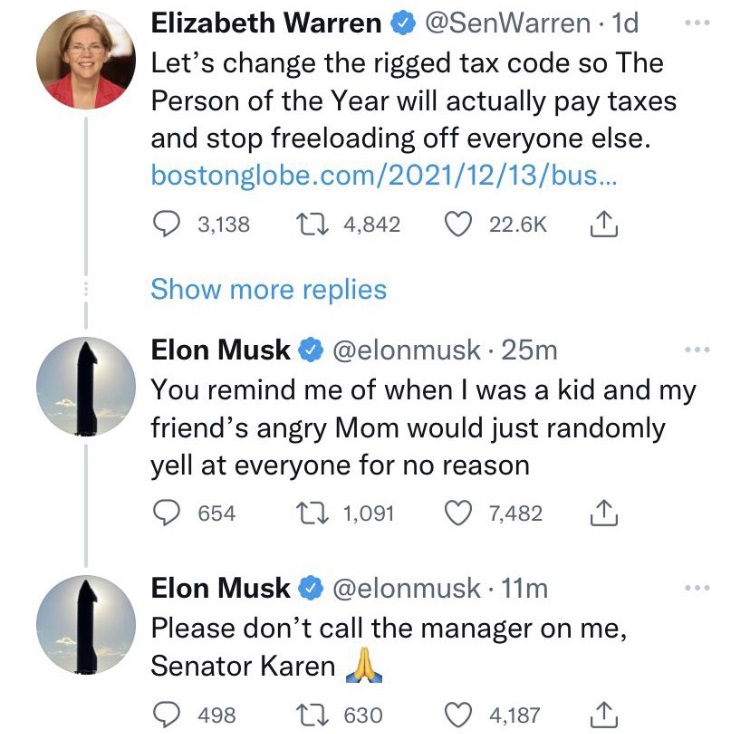
‘And Your Bird Can Sing’ (‘Revolver’, 1966)

Lennon dismissed the song as “throwaway”, but it’s George’s molten mercury riffs that elevate ‘And Your Bird Can Sing’ into the upper echelon of the Beatles canon. Marianne Faithfullclaimed the song was directed at Mick Jagger,whom she dated in 1966; sadly, the dates don’t match up.

‘Eleanor Rigby’ (‘Revolver’, 1966)

Taking loneliness, solemnity and death to the top of the charts, ‘Eleanor Rigby’’s tender, intimate chamber balladry shifted the goalposts in terms of what a pop band could do in 1966.

‘Here Comes The Sun’ (‘Abbey Road’, 1969)

Spotify’s most-streamed Beatles song, written by George in Eric Clapton’s garden during what was, at the time, the sunniest April on record.

‘We Can Work It Out’ (single, 1966)

Paul in optimistic mood amid his increasingly turbulent relationship with Asher, playing off against John’s more pessimistic “life is very short” middle-eight waltz. Damn near to pop perfection.

‘All My Loving’ (‘With The Beatles’, 1964)

Pop perfection, eh? The harmonies coming in on the third verse of ’All My Loving’ did for ‘60s pop what The Wizard Of Oz did for colour cinema.

‘Paperback Writer’ (single, 1966)

Feeling the pain of the world’s wannabe Barbara Cartlands, McCartney penned this fictitious open letter to a publisher, spun into harmonic gold by the staggered – and staggering – vocal intro.

‘Blackbird’ (‘The Beatles’, 1968)

Paul’s civil rights plea is a ‘White Album’ high-point that remains The Beatles’ most poignant and accomplished folk moment.

‘While My Guitar Gently Weeps’ (‘The Beatles’, 1968)

The ascendance of George. Every bit the songwriting equal of his bandmates by ‘The White Album’, his tour-de-force was a captivating treatise on humanity’s unrealised capacity for love, topped off with Eric Clapton’s sensational, uncredited solo.

‘Something’ (‘Abbey Road’, 1969)

The Beatles’ greatest love song and second-most covered track (after ‘Yesterday’), written for Pattie Boyd and very nearly given to Joe Cocker. Elton John would call it “the song I’ve been chasing for 35 years.”

‘Strawberry Fields Forever’ (single, 1967)

Even at a time when The Beatles were crushing musical barriers at every session, ‘Strawberry Fields Forever’ was among their most ground-breaking moments. Strapping two different versions of the song together, smothered in Mellotron, tape loops, Indian swarmandal and backwards tomfoolery, they forged a psychedelic masterwork that set the tone and raised the bar for the era.

‘Hey Jude’ (single, 1968)

Won’t somebody think of the children? Well, Paul did, composing The Beatles’ most rousing sing-along to comfort Julian Lennon over the break-up of his parents. Rumour has it that if you put your ear to the ground at Glastonbury’s stone circle, you can hear the “na-na-na” bit from Macca’s set in 2004 still reverberating through the leyline.

‘A Day In The Life’ (‘Sgt. Pepper’s Lonely Hearts Club Band’, 1967)

The internal universe exploded; the everyday made epic. Lennon’s ‘Sgt. Pepper…’ closer viewed a series of newspaper articles – about the death of Guinness heir Tara Browne and road repairs in Lancashire – through LSD specs and came out with a world-beating vision. Includes arguably the most famous crescendo in rock

Tomorrow Never Knows’ (‘Revolver’, 1966)

It’s possible to trace the origins of most modern music, bar rap, back to The Beatles catalogue. But ‘Tomorrow Never Knows’ was perhaps their most influential track of all. In trying to recreate the sound in Lennon’s head of monks chanting in some cosmic mountain retreat, to accompany lines cribbed from the Tibetan Book Of The Dead intended to emulate a transcendental acid high, the band experimented with loops, sampling, drone and tape manipulation, creating not just the epitome of psychedelia and exposing pop audiences to anti-materialist Eastern ideas, but effectively inventing dance music.

Turn off your mind, relax, and you can hear The Chemical Brothers before The Chemical Brothers were even born…

Related posts:

February 15, 2018 – 1:45 am

February 1, 2018 – 12:00 am

October 5, 2017 – 1:24 am

June 29, 2017 – 12:19 am

June 15, 2017 – 12:39 am

June 8, 2017 – 12:28 am

RESPONDING TO HARRY KROTO’S BRILLIANT RENOWNED ACADEMICS!! Part 133 Louise Antony is UMass, Phil Dept, “Atheists if they commit themselves to justice, peace and the relief of suffering can only be doing so out of love for the good. Atheist have the opportunity to practice perfect piety”

June 6, 2017 – 1:35 am

June 1, 2017 – 12:13 am

May 25, 2017 – 12:47 am

May 18, 2017 – 12:43 am

May 11, 2017 – 1:18 am

May 4, 2017 – 1:40 am

April 27, 2017 – 1:52 am

April 20, 2017 – 1:00 am

April 13, 2017 – 12:29 am

April 6, 2017 – 12:25 am

FRANCIS SCHAEFFER ANALYZES ART AND CULTURE Part 118 THE BEATLES (Why was Tony Curtis on cover of SGT PEP?) (Feature on artist Jeffrey Gibson )

June 30, 2016 – 5:35 am

June 23, 2016 – 1:31 am

June 16, 2016 – 1:34 am

June 9, 2016 – 7:09 am

June 2, 2016 – 12:34 am

May 26, 2016 – 12:34 am

May 19, 2016 – 8:12 am

May 11, 2016 – 11:06 am

May 6, 2016 – 7:55 am

April 28, 2016 – 12:28 am

April 21, 2016 – 7:00 am

April 14, 2016 – 1:52 am

April 7, 2016 – 4:23 am

March 31, 2016 – 5:18 am

——

Dan Mitchell article “Pathetic) Politician of the Year”

_


(Pathetic) Politician of the Year

Senator Elizabeth Warren is a particularly noxious politician.

It’s not just that she’s a doctrinaire leftist on a wide range of issues (class warfarecorporate governancegovernment spending,business taxationcronyismwealth taxationSocial SecurityIRS funding, etc).

She’s also a fraud, having falsely claimed Indian ancestry to get hired and promoted at law schools.

And she’s a hypocrite as well, opposing school choice while utilizing private education for her offspring.

Not to mention supporting higher taxes, but then failing to participate in a Massachusetts program that enables people to voluntarily pay extra.

In other words, a political hack with no redeeming qualities.

So I was greatly amused to see that Elon Musk has responded to some her demagoguery with some very clever Twitter responses.

For those unfamiliar with the term, a “Karen” is an intrusive, annoying, and officious woman who likes to control other people’s lives.

But, as you can see, she tried to pick on someone who doesn’t feel any need to kowtow to a politician.

By the way, I’m not sharing this because I’m a knee-jerk advocate for Musk.

Yes, he’s obviously a great entrepreneur, but I don’t like the factthat he’s also benefited from some cronyism.

But let’s get back to satire.

The Babylon Bee had some fun with the Musk-Warren feud.

In a heated exchange on Twitter, a powerful white man viciously attacked Elizabeth Warren—a noble Cherokee squaw and Senator from Massachusetts. “This violent verbal attack on me was literally a hate crime,” said Warren…“The white man continues to oppress my people by resisting the government’s efforts to tax them into oblivion and waste all their money on spending bills that we write to pay off our campaign donors. This basically makes him a freeloader.” The white attacker—named Elon Musk—simply responded with cruel memes showing Elizabeth Warren wearing eagle feathers and war paint to mock her proud heritage.

And since we’re sharing humor from Babylon Beethis storyfrom 2019 also pokes fun at her penchant for mis-characterizing her background.

Elizabeth Warren has begun sharing stories illustrating the hardship and discrimination she’s faced. Recently, she revealed a particularly tough time back in the early ’70s when she lost a teaching jobbecause her fake mustache had fallen off, revealing she was, in fact, a woman… “It was tough for a woman back then,” Warren said at a campaign stop. “You had to wear fake facial hair and talk in a deep voice, or people would fire you.” …Warren says things have improved for women since, but they could still be better. To help the situation, she announced a plan to fund R&D for an adhesive that will easily keep mustaches in place all day.

Let’s conclude with this very amusing meme that tells you everything you need to know about the winner of the feud.

P.S. I have some Warren humor in the archives, including this extension of her class warfare philosophy and this collection of memes about her ancestry fraud.

Elizabeth Warren’s Plan to Reward a Corrupt IRS

The IRS played partisan politics during the Obama years by targeting taxpayer organizations such “Tea Party” groups. Now the IRS is at it again, this time leaking the tax returns of selected rich people to advance Biden’s class-warfare agenda.

There are two logical responses.

  1. Cut the IRS budget so the bureaucrats learn a very important lesson that corruption is bad.
  2. Reform the tax code with a simple and fair flat tax so the IRS can be dramatically downsized.

I suspect most Americans would select both options.

But the crowd in Washington has a different perspective. Most of them like the IRS because it’s the bureaucracy that generates the money that they use to buy votes.

Many of them want to reward the IRS with more money(including plenty of brain-dead Republicans), which is bad enough, but what’s really troubling is that some of them even want to turn the IRS budget into an entitlement.

In an article for Reason, Eric Boehm explains that Elizabeth Warren is leading the charge for this reckless proposal.

Sen. Elizabeth Warren (D–Mass.) says her plan to more than double the annual IRS budget would allow the federal government to collect an extra $1.75 trillion over the next 10 years. …her plan seems based on little more than a hunch and some bad math.…Warren’s “Restoring the IRS Act of 2021” would hike the agency’s budget from $11.9 billion to $31.5 billion. …It would also…move the IRS from the…federal budget’s discretionary side…to the mandatory portion of the budget, alongside Social Security and other programs that run on autopilot. …In practice, that means giving the IRS a big budgetary boost and giving the agency the authority to dig through bank accounts and transaction records.

The Wall Street Journal also is not impressed with the idea of rewarding a corrupt tax bureaucracy.

Here are some excerpts from its recent editorial, which notes that the Biden Administration also wants to turn IRS funding into an entitlement  .

The Internal Revenue Service leak of taxpayer returns to left-leaning media outlet ProPublica is a prime example of why Congress should refuse to give the tax agency more money and power. That includes President Biden’s little-noticed but politically consequential plan to put IRS funding on autopilot. …Like so much else in the Biden Presidency, this follows the Elizabeth Warren model.…The IRS would essentially become another mandatory budget program like Social Security and Medicare. …without the risk of having to answer to Congressional appropriators for its budget, the tax agency would have little to worry about. …Their plan would make sure the IRS doesn’t have to pay a price in the future for politically targeting taxpayers or leaking returns. The potential for abuse would grow since Mr. Biden’s plan would also give the IRS access to bank account inflows and outflows. …a tax collection agency shielded from Congressional budget supervision is one definition of tyranny.

All of this is true.

But let’s also remember that the case for more IRS funding (whether as appropriations or as an entitlement) is based on nonsensical and self-serving estimates of the supposed tax gap.

P.S. For those who want to understand the technical differences between entitlement spending and appropriated spending, click here.

P.P.S. Entitlement spending is America’s top long-run fiscal challenge, so it’s incomprehensibly foolish to expand such programs.

P.P.P.S. The bad news is that Senator Warren is an unreconstructed statist (see hereherehereherehereherehere, and here).

P.P.P.P.S. The good news is that she is the impetus for some clever humor (see hereherehere, and here).

P.P.P.P.P.S. And she’s a hypocrite who doesn’t abide by her own policies.

When Capitalism Wins, Poverty Loses

Why do folks on the left support punitive policies such as high tax rates and a bigger burden of government?

Some of them are motivated by resentment against those who have achieved success. These are the people who support the hate-and-envy message of politicians such as Bernie Sanders and Elizabeth Warren.

Others folks on the left, by contrast, are motivated by sympathy for the less fortunate.

That’s a noble sentiment. Where they go wrong is in thinking that the economy is a fixed pie. This leads them to the mistaken conclusion that some people are poor because other people are rich.

Maybe I’m overly optimistic, but I think these people can be convinced to support good policy if they learn the facts about how free markets and limited government are a proven recipe for prosperity.

This is why I shared data earlier this year showing how per-capita economic output jumped dramatically once capitalism was allowed starting a couple of hundred years ago.

Today, let’s look at how poor people have been the biggest winners. Professor Max Roser of Oxford University recently shared a profoundly important tweet about the dramatic reduction in global poverty. We see not only that poverty rates have plummeted, but also that falling poverty rates are correlated with increases in per-capita GDP.

In other words, everyone is getting richer. There’s no fixed pie.

As you might expect, regions that are friendlier to capitalismhave enjoyed bigger increases in prosperity and bigger reductions in poverty.

The bottom line is that people who care about the poor should be the biggest advocates of free enterprise.

P.S. It’s worth noting that, according to both U.S. data and global data, the big reduction in poverty occurred before welfare states were created.

Milton Friedman

Biography: 

Click here to see the Hoover project showcasing the works of Milton and Rose Friedman.

Milton Friedman, recipient of the 1976 Nobel Memorial Prize for economic science, was a senior research fellow at the Hoover Institution from 1977 to 2006. He passed away on Nov. 16, 2006. (Link to obituary.) He was also the Paul Snowden Russell Distinguished Service Professor Emeritus of Economics at the University of Chicago, where he taught from 1946 to 1976, and a member of the research staff of the National Bureau of Economic Research from 1937 to 1981.

Friedman was awarded the Presidential Medal of Freedom in 1988 and received the National Medal of Science the same year.

He was widely regarded as the leader of the Chicago School of monetary economics, which stresses the importance of the quantity of money as an instrument of government policy and as a determinant of business cycles and inflation.

In addition to his scientific work, Friedman also wrote extensively on public policy, always with a primary emphasis on the preservation and extension of individual freedom. His most important books in this field are (with Rose D. Friedman) Capitalism and Freedom (University of Chicago Press, 1962); Bright Promises, Dismal Performance (Thomas Horton and Daughters, 1983), which consists mostly of reprints of columns he wrote for Newsweek from 1966 to 1983; (with Rose D. Friedman) Free to Choose (Harcourt Brace Jovanovich, 1980), which complements a ten-part television series of the same name shown over the Public Broadcasting Service (PBS) network in early 1980; and (with Rose D. Friedman) Tyranny of the Status Quo (Harcourt Brace Jovanovich, 1984), which complements a three-part television series of the same name, shown over PBS in early 1984.

He was a member of the President’s Commission on an All-Volunteer Armed Force and the President’s Commission on White House Fellows. He was a member of President Ronald Reagan’s Economic Policy Advisory Board (a group of experts from outside the government named in 1981 by President Reagan).

Friedman was also active in public affairs, serving as an informal economic adviser to Senator Barry Goldwater in his unsuccessful campaign for the presidency in 1964, to Richard Nixon in his successful 1968 campaign, to President Nixon subsequently, and to Ronald Reagan in his 1980 campaign.

He has published many books and articles, most notably A Theory of the Consumption Function, The Optimum Quantity of Money and Other Essays, and (with A. J. Schwartz) A Monetary History of the United States, Monetary Statistics of the United States, and Monetary Trends in the United States and the United Kingdom.

He was a past president of the American Economic Association, the Western Economic Association, and the Mont Pelerin Society and was a member of the American Philosophical Society and the National Academy of Sciences.

He was awarded honorary degrees by universities in the United States, Japan, Israel, and Guatemala, as well as the Grand Cordon of the First Class Order of the Sacred Treasure by the Japanese government in 1986.

Friedman received a B.A. in 1932 from Rutgers University, an M.A. in 1933 from the University of Chicago, and a Ph.D. in 1946 from Columbia University.

Two Lucky People, his and Rose D. Friedman’s memoirs, was published in 1998 by the University of Chicago Press.

_

https://www.youtube.com/watch?v=1EwaLys3Zak

Related posts:

“The Power of the Market” episode of Free to Choose in 1990 by Milton Friedman (Part 1)

June 21, 2012 – 7:39 am

Milton Friedman The Power of the Market 1-5 How can we have personal freedom without economic freedom? That is why I don’t understand why socialists who value individual freedoms want to take away our economic freedoms.  I wanted to share this info below with you from Milton Friedman who has influenced me greatly over the […] By Everette Hatcher III | Posted in Milton Friedman | Tagged arnold schwarzenegger. | Edit | Comments (0)

“Friedman Friday,” EPISODE “The Failure of Socialism” of Free to Choose in 1990 by Milton Friedman (Part 1)

December 7, 2012 – 5:55 am

Milton Friedman: Free To Choose – The Failure Of Socialism With Ronald Reagan (Full) Published on Mar 19, 2012 by NoNationalityNeeded Milton Friedman’s writings affected me greatly when I first discovered them and I wanted to share with you. We must not head down the path of socialism like Greece has done. Abstract: Ronald Reagan […] By Everette Hatcher III | Posted in Milton FriedmanPresident Obama | Edit | Comments (1)

________________

“Friedman Friday” (“Free to Choose” episode 3 – Anatomy of a Crisis. part 3 of 7)

December 30, 2011 – 12:12 am

Worse still, America’s depression was to become worldwide because of what lies behind these doors. This is the vault of the Federal Reserve Bank of New York. Inside is the largest horde of gold in the world. Because the world was on a gold standard in 1929, these vaults, where the U.S. gold was stored, […] By Everette Hatcher III | Also posted in Current Events | Edit | Comments (0)

“Friedman Friday” (Part 16) (“Free to Choose” episode 3 – Anatomy of a Crisis. part 2 of 7)

December 23, 2011 – 12:07 am

  George Eccles: Well, then we called all our employees together. And we told them to be at the bank at their place at 8:00 a.m. and just act as if nothing was happening, just have a smile on their face, if they could, and me too. And we have four savings windows and we […] By Everette Hatcher III | Also posted in Current Events | Edit | Comments (0)

“Friedman Friday” (“Free to Choose” episode 3 – Anatomy of a Crisis. part 1of 7)

December 16, 2011 – 12:04 am

Milton Friedman’s Free to Choose (1980), episode 3 – Anatomy of a Crisis. part 1 FREE TO CHOOSE: Anatomy of Crisis Friedman Delancy Street in New York’s lower east side, hardly one of the city’s best known sites, yet what happened in this street nearly 50 years ago continues to effect all of us today. […]

By Everette Hatcher III | Also posted in Current Events | Edit | Comments (0)

____________________________ _____________


________________________________________________

_____________________________________________

Friedman Friday” Free to Choose by Milton Friedman: Episode “What is wrong with our schools?” (Part 3 of transcript and video)

November 18, 2011 – 7:08 am

Friedman Friday” Free to Choose by Milton Friedman: Episode “What is wrong with our schools?” (Part 3 of transcript and video) Here is the video clip and transcript of the film series FREE TO CHOOSE episode “What is wrong with our schools?” Part 3 of 6.   Volume 6 – What’s Wrong with our Schools Transcript: If it […] By Everette Hatcher III | Also posted in Vouchers | Tagged economic market.educational marketprivate universitiesstate collegesvalue of education | Edit | Comments (0)

Friedman Friday” Free to Choose by Milton Friedman: Episode “What is wrong with our schools?” (Part 2 of transcript and video)

November 11, 2011 – 12:50 am

Here is the video clip and transcript of the film series FREE TO CHOOSE episode “What is wrong with our schools?” Part 2 of 6.   Volume 6 – What’s Wrong with our Schools Transcript: Groups of concerned parents and teachers decided to do something about it. They used private funds to take over empty stores and they […]

By Everette Hatcher III | Also posted in Vouchers | Edit | Comments (1)

Friedman Friday” Free to Choose by Milton Friedman: Episode “What is wrong with our schools?” (Part 1 of transcript and video)

November 4, 2011 – 12:01 am

Here is the video clip and transcript of the film series FREE TO CHOOSE episode “What is wrong with our schools?” Part 1 of 6.   Volume 6 – What’s Wrong with our Schools Transcript: Friedman: These youngsters are beginning another day at one of America’s public schools, Hyde Park High School in Boston. What happens when […]

By Everette Hatcher III | Also posted in Vouchers | Tagged hidden weaponshyde park high schoolhyde park.state of vermontvivid illustration | Edit | Comments (0)

Friedman Friday” Free to Choose by Milton Friedman: Episode “Created Equal” (Part 3 of transcript and video)

September 30, 2011 – 7:46 am

Friedman Friday” Free to Choose by Milton Friedman: Episode “Created Equal” (Part 3 of transcript and video) Liberals like President Obama want to shoot for an equality of outcome. That system does not work. In fact, our free society allows for the closest gap between the wealthy and the poor. Unlike other countries where free enterprise and other […] By Everette Hatcher III | Posted in Milton Friedman | Tagged containment devicesequality of outcomeoil spillyoutube | Edit | Comments (0)

Free to Choose by Milton Friedman: Episode “Created Equal” (Part 2 of transcript and video)

September 30, 2011 – 7:41 am

Free to Choose by Milton Friedman: Episode “Created Equal” (Part 2 of transcript and video) Liberals like President Obama want to shoot for an equality of outcome. That system does not work. In fact, our free society allows for the closest gap between the wealthy and the poor. Unlike other countries where free enterprise and other freedoms are […] By Everette Hatcher III | Posted in Milton Friedman | Tagged equality of outcomemenuhin schoolnew millionairesworld war ii | Edit | Comments (0)

Free to Choose by Milton Friedman: Episode “Created Equal” (Part 1 of transcript and video)

September 20, 2011 – 11:58 am

 Milton Friedman and Ronald Reagan Liberals like President Obama (and John Brummett) want to shoot for an equality of outcome. That system does not work. In fact, our free society allows for the closest gap between the wealthy and the poor. Unlike other countries where free enterprise and other freedoms are not present.  This is a seven part series. […] By Everette Hatcher III | Posted in John BrummettMilton FriedmanRonald Reagan | Tagged dr friedmanequality of opportunityequality of outcomefreedom advocatespersonal freedom. | Edit | Comments (0)

Milton Friedman Friday: (“Free to Choose” episode 4 – From Cradle to Grave, Part 3 of 7)

September 23, 2011 – 12:11 am

 I am currently going through his film series “Free to Choose” which is one the most powerful film series I have ever seen. PART 3 OF 7 Worse still, America’s depression was to become worldwide because of what lies behind these doors. This is the vault of the Federal Reserve Bank of New York. Inside […]

By Everette Hatcher III | Edit | Comments (0)

Milton Friedman Friday:(“Free to Choose” episode 4 – From Cradle to Grave, Part 2 of 7)

September 16, 2011 – 12:10 am

 I am currently going through his film series “Free to Choose” which is one the most powerful film series I have ever seen. For the past 7 years Maureen Ramsey has had to buy food and clothes for her family out of a government handout. For the whole of that time, her husband, Steve, hasn’t […] By Everette Hatcher III | Edit | Comments (0)

Friedman Friday:(“Free to Choose” episode 4 – From Cradle to Grave, Part 1 of 7)

September 9, 2011 – 12:09 am

Friedman Friday:(“Free to Choose” episode 4 – From Cradle to Grave, Part 1 of 7) Volume 4 – From Cradle to Grave Abstract: Since the Depression years of the 1930s, there has been almost continuous expansion of governmental efforts to provide for people’s welfare. First, there was a tremendous expansion of public works. The Social Security Act […]

By Everette Hatcher III | Edit | Comments (0)

“Friedman Friday” (“Free to Choose” episode 1 – Power of the Market. part 3 of 7)

February 17, 2012 – 12:12 am

  _________________________   Pt3  Nowadays there’s a considerable amount of traffic at this border. People cross a little more freely than they use to. Many people from Hong Kong trade in China and the market has helped bring the two countries closer together, but the barriers between them are still very real. On this side […] By Everette Hatcher III | Posted in Current EventsMilton Friedman | Edit | Comments (0)

“Friedman Friday” (“Free to Choose” episode 1 – Power of the Market. part 2 of 7)

February 10, 2012 – 12:09 am

  Aside from its harbor, the only other important resource of Hong Kong is people __ over 4_ million of them. Like America a century ago, Hong Kong in the past few decades has been a haven for people who sought the freedom to make the most of their own abilities. Many of them are […] By Everette Hatcher III | Posted in Current EventsMilton Friedman | Edit | Comments (0)

“Friedman Friday” (“Free to Choose” episode 1 – Power of the Market. part 1of 7)

February 3, 2012 – 12:07 am

“FREE TO CHOOSE” 1: The Power of the Market (Milton Friedman) Free to Choose ^ | 1980 | Milton Friedman Posted on Monday, July 17, 2006 4:20:46 PM by Choose Ye This Day FREE TO CHOOSE: The Power of the Market Friedman: Once all of this was a swamp, covered with forest. The Canarce Indians […]

By Everette Hatcher III | Posted in Current EventsMilton Friedman | Edit | Comments (0)

“Friedman Friday,” EPISODE “The Failure of Socialism” of Free to Choose in 1990 by Milton Friedman (Part 1)

December 7, 2012 – 5:55 am

Milton Friedman: Free To Choose – The Failure Of Socialism With Ronald Reagan (Full) Published on Mar 19, 2012 by NoNationalityNeeded Milton Friedman’s writings affected me greatly when I first discovered them and I wanted to share with you. We must not head down the path of socialism like Greece has done. Abstract: Ronald Reagan […] By Everette Hatcher III | Posted in Milton FriedmanPresident Obama | Edit | Comments (1)