Category Archives: Francis Schaeffer

“Woody Wednesday” ECCLESIASTES AND WOODY ALLEN’S FILMS: SOLOMON “WOULD GOT ALONG WELL WITH WOODY!” (Part 21 MIDNIGHT IN PARIS Part T Ernest Hemingway 9th part “Mark Twain is my favorite author for three reasons: he writes well, he entertains me, and he has already died” )

According to ECCLESIASTES without God in the picture our lives UNDER THE SUN will accomplish nothing that lasts. King Solomon the author Ecclesiastes asked, “What does man gain by all the toil  at which he toils UNDER THE SUN?” and Solomon answered his own question with the answer in 2:17, “So I hated life, because what is done under the sun was grievous to me, for all is vanity and a striving after wind.”  Woody Allen and Mark Twain have said this very same thing.


.

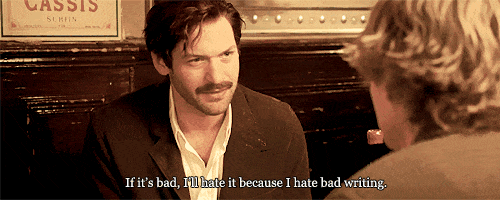
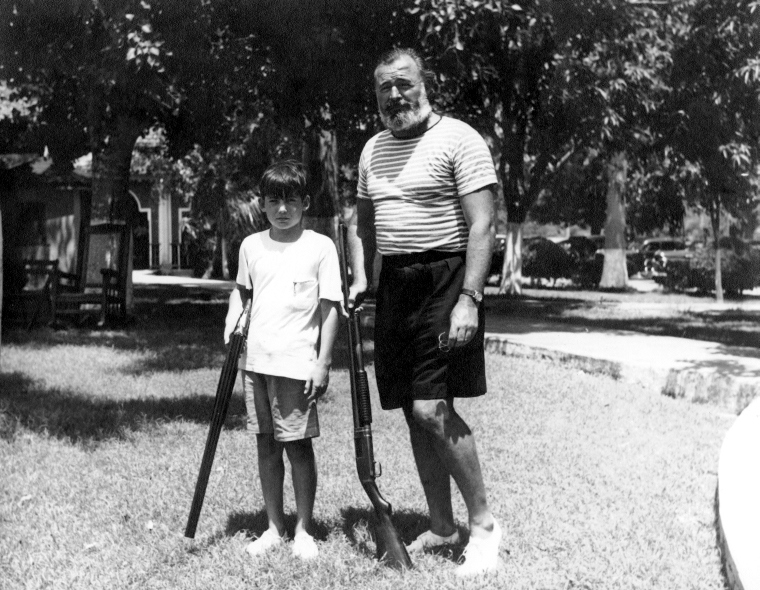
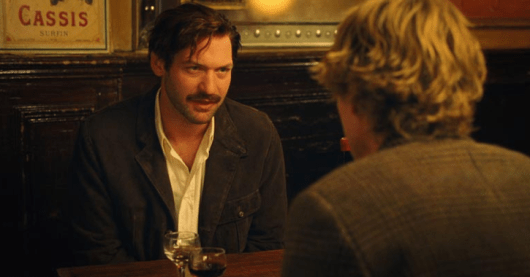
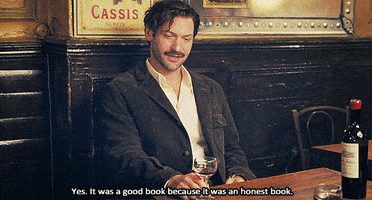
HEMINGWAY:You like Mark Twain?

SCOTT FITZGERALD: I’m going to find Zelda.I don’t like the thought of her with that Spaniard.

GIL PENDER:May I?

HEMINGWAY:Yeah,

GIL PENDER:I’m actually a huge Mark Twain fan.I think you can even make the case that all modern American literature comes from Huckleberry Finn.-


A Depressingly “Ecclesiastical” Perspective by Mark Twain

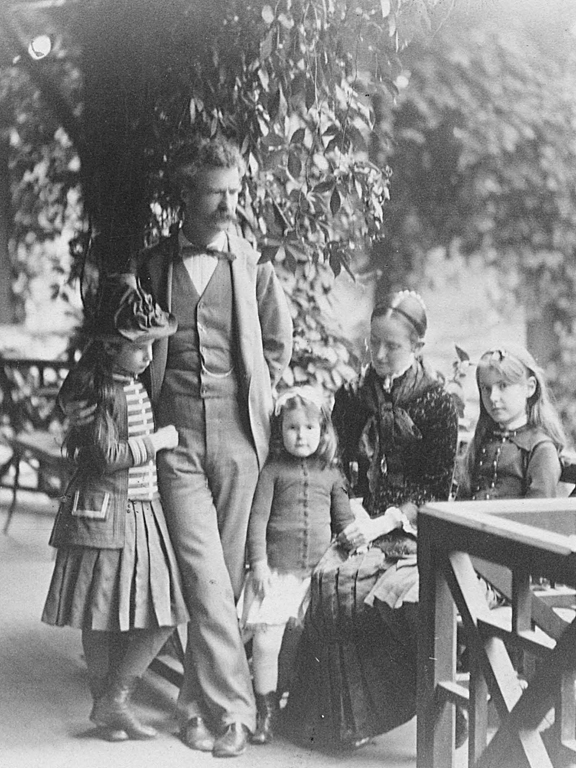
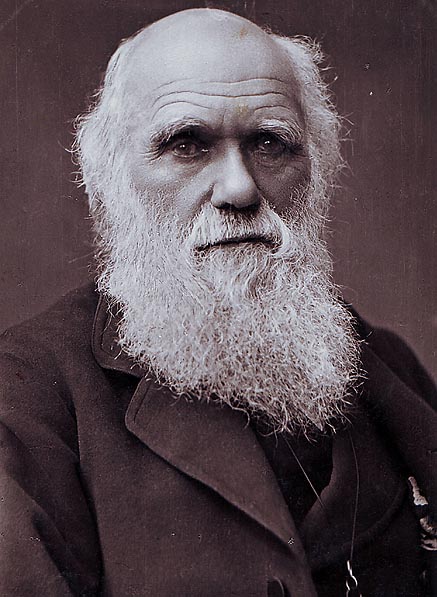
Mark Twain

As I was drawn into the Autobiography of Mark Twain, the following paragraph nearly drove me to despair…then I remembered the Gospel…

A myriad of men are born; they labor and sweat and struggle for bread; they squabble and scold and fight; they scramble for little mean advantages over each other; age creeps upon them; infirmities follow; shames and humiliations bring down their prides and their vanities; those they love are taken from them, and the joy of life is turned to aching grief.  The burden of pain, care, misery, grows heavier year by year; at length, ambition is dead, pride is dead; vanity is dead; longing for release is in their place.  It comes at last–the only unpoisoned gift earth ever had for them–and they vanish from a world where they were a mistake and a failure and a foolishness; there they have left no sign that they have existed–a world which will lament them a day and forget them forever.  Then another myriad takes their place, and copies all they did, and goes along the same profitless road, and vanishes as they vanished–follow the same arid path through the same desert, and accomplish what the first myriad, and all the myriads that came after it, accomplished–nothing!

Autobiography of Mark Twain (US: Seven Treasures, 2010), 25.

If I didn’t know better, I’d claim plagiarism…but perhaps the writer of Ecclesiastes, and Twain himself, would celebrate the irony that these words are nothing new, but a repetition of the Teacher’s words in the OT.  Sadly, Twain does not come to the same conclusion that the writer of Ecclesiastes does:

The end of the matter; all has been heard:

Fear God and keep his commandments, for this is the whole duty of man.

For God will bring every deed into judgment, with every secret thing, whether good or evil.

Ecclesiastes 12:13-14

Jimmy Young of GRACE EVANGELICAL CHURCH Memphis, TN paints a very similar picture in his sermon on Ecclesiastes: 

T.S.Eliot once said we humans can’t bear much reality of which this world is full.

(Actor David Lowe played poet T.S. Eliot in the movie MIDNIGHT IN PARIS)

Life is meaningless according to 1:2 and then he says in verse 3 “What does man gain by all the toil  at which he toils under the sun?” Then Solomon sighs in 1:8 “All things are full of weariness; a man cannot utter it; the eye is not satisfied with seeing, nor the ear filled with hearing.” That is the sentiment that is woven all through the Book of Ecclesiastes. 1:2 “Vanity[b] of vanities, says the Preacher,     vanity of vanities! All is vanity.” He uses the word VANITY 35 times in the Book of Ecclesiastes. 

Why is Ecclesiastes in the Bible? This is a tale of searching, experimenting, grasping for meaning and purpose.

Ecclesiastes 1:12-14, 17: 12 I the Preacher have been king over Israel in Jerusalem. 13 And I applied my heart[f] to seek and to search out by wisdom all that is done under heaven. It is an unhappy business that God has given to the children of man to be busy with. 14 I have seen everything that is done under the sun, and behold, all is vanity[g] and a striving after wind.[h17 And I applied my heart to know wisdom…

Solomon is saying that he is going to conduct a series of experiments in several areas of his life and try to find meaning in life. So in Ecclesiastes you have a report of that.

[At this point Dr. Young goes through the Book of Ecclesiastes and points out that nothing in life gives true satisfaction without God including knowledge (1:16-18), ladies and liquor (2:1-3, 8, 10, 11), and great building projects (2:4-6, 18-20).]

Ecclesiastes 1:1-3 English Standard Version (ESV)

All Is Vanity

The words of the Preacher,[a] the son of David, king in Jerusalem.

Vanity[b] of vanities, says the Preacher,
    vanity of vanities! All is vanity.
What does man gain by all the toil
    at which he toils under the sun? 

Ecclesiastes 2:1-25 English Standard Version (ESV)

The Vanity of Self-Indulgence

I said in my heart, “Come now, I will test you with pleasure; enjoy yourself.” But behold, this also was vanity.[a] I said of laughter, “It is mad,” and of pleasure, “What use is it?” I searched with my heart how to cheer my body with wine—my heart still guiding me with wisdom—and how to lay hold on folly, till I might see what was good for the children of man to do under heaven during the few days of their life. I made great works. I built houses and planted vineyards for myself. I made myself gardens and parks, and planted in them all kinds of fruit trees. I made myself pools from which to water the forest of growing trees. I bought male and female slaves, and had slaves who were born in my house. I had also great possessions of herds and flocks, more than any who had been before me in Jerusalem. I also gathered for myself silver and gold and the treasure of kings and provinces. I got singers, both men and women, and many concubines,[b] the delight of the sons of man.

So I became great and surpassed all who were before me in Jerusalem. Also my wisdom remained with me. 10 And whatever my eyes desired I did not keep from them. I kept my heart from no pleasure, for my heart found pleasure in all my toil, and this was my reward for all my toil.11 Then I considered all that my hands had done and the toil I had expended in doing it, and behold, all was vanity and a striving after wind, and there was nothing to be gained under the sun.

The Vanity of Living Wisely

12 So I turned to consider wisdom and madness and folly. For what can the man do who comes after the king? Only what has already been done. 13 Then I saw that there is more gain in wisdom than in folly, as there is more gain in light than in darkness. 14 The wise person has his eyes in his head, but the fool walks in darkness. And yet I perceived that the same event happens to all of them. 15 Then I said in my heart, “What happens to the fool will happen to me also. Why then have I been so very wise?” And I said in my heart that this also is vanity. 16 For of the wise as of the fool there is no enduring remembrance, seeing that in the days to come all will have been long forgotten. How the wise dies just like the fool! 17 So I hated life, because what is done under the sun was grievous to me, for all is vanity and a striving after wind.

The Vanity of Toil

18 I hated all my toil in which I toil under the sun, seeing that I must leave it to the man who will come after me, 19 and who knows whether he will be wise or a fool? Yet he will be master of all for which I toiled and used my wisdom under the sun. This also is vanity. 20 So I turned about and gave my heart up to despair over all the toil of my labors under the sun, 21 because sometimes a person who has toiled with wisdom and knowledge and skill must leave everything to be enjoyed by someone who did not toil for it. This also is vanity and a great evil.22 What has a man from all the toil and striving of heart with which he toils beneath the sun? 23 For all his days are full of sorrow, and his work is a vexation. Even in the night his heart does not rest. This also is vanity.

24 There is nothing better for a person than that he should eat and drink and find enjoyment[c] in his toil. This also, I saw, is from the hand of God, 25 for apart from him[d] who can eat or who can have enjoyment?26 For to the one who pleases him God has given wisdom and knowledge and joy, but to the sinner he has given the business of gathering and collecting, only to give to one who pleases God. This also is vanity and a striving after wind.

__

Four summary statements concerning the Book of Ecclesiastes:

  1. If there is nothing but vanity UNDER THE SUN (or under heaven) then our only hope must be ABOVE HEAVEN. 

One commentary said, “To make any sense of the world you have to go outside of it.” That treadmill you are on that is by design. The restlessness of life that can be traced back to the will of God so you might have the same despair that Solomon had. Therefore, you will keep on looking until you find the meaning ABOVE THE SUN. God is demolishing so he can rebuild. God is removing all those things that you thought were going to give you meaning so you will come to the same conclusion that Solomon came to.

2. If a man who had everything and investigated everything Visible  and then the one thing that we must need is something that is invisible, peace, contentment and meaning, can only be found in a real relationship with Jesus Christ. 

3. When you remove Jesus from the center of an intellectual pursuit  or a pursuit of pleasure, or meaning or whatever, you will end up in vanity. 

(Pictured below Mariel Hemingway and Woody Allen in the movie MANHATTAN)

Woody Allen is a brilliant filmmaker but he wrote this speech and it is a fictional parady  on speeches to graduates:

My Speech to the Graduates  

                                     by Woody Allen

                               First published in the New York Times in 1979

More than at any other time in history, mankind faces a crossroads. One path leads to despair and utter hopelessness. The other, to total extinction. Let us pray we have the wisdom to choose correctly.

I speak, by the way, not with any sense of futility, but with a panicky conviction of the absolute meaninglessness of existence which could easily be misinterpreted as pessimism.


It is not. It is merely a healthy concern for the predicament of modern man. (Modern man is here defined as any person born after Nietzsche’s edict that “God is dead,” but before the hit recording “I Wanna Hold Your Hand.”) This “predicament” can be stated one of two ways, though certain linguistic philosophers prefer to reduce it to a mathematical equation where it can be easily solved and even carried around in the wallet.

Put in its simplest form, the problem is: How is it possible to find meaning in a finite world given my waist and shirt size?

This is a very difficult question when we realize that science has failed us. True, it has conquered many diseases, broken the genetic code, and even placed human beings on the Moon, and yet when a man of eighty is in a room with two eighteen-year-old cocktail waitresses nothing happens. Because the real problems never change.

After all, can the human soul be glimpsed through a microscope? Maybe–but you’d definitely need one of those very good ones with two eyepieces. We know that the most advanced computer in the world does not have a brain as sophisticated as that of an ant. True, we could say that of any of our relatives but we only have to put up with them at weddings or special occasions.

True, science has taught us how to pasteurize cheese. And true, this can be fun in mixed company--but what of the H-bomb? Have you ever seen what happens when one of those things falls off a desk accidentally?

And where is science when one ponders the eternal riddles? How did the cosmos originate? How long has it been around? Did matter begin with an explosion or by the word of God?

My good friend Jacques Monod spoke often of the randomness of the cosmos. He believed everything in existence occurred by pure chance with the possible exception of his breakfast, which he felt certain was made by his housekeeper.

Instead of facing these challenges we turn instead to distractions like drugs and sex. We live in far too permissive a society. Never before has pornography been this rampant. And those films are lit so badly!

We are a people who lack defined goals. We have never leaned to love. We lack leaders and coherent programs. We have no spiritual center. We are adrift alone in the cosmos wreaking monstrous violence on one another out of frustration and pain. Fortunately, we have not lost our sense of proportion.

Summing up, it is clear the future holds great opportunities. It also holds pitfalls. The trick will be to avoid the pitfalls, seize the opportunities, and get back home by six o’clock.

__

When you remove Jesus from the center of an intellectual pursuit  or a pursuit of pleasure, or meaning or whatever, you will end up in vanity.

Mark 8:34-38 English Standard Version (ESV)

34 And calling the crowd to him with his disciples, he said to them, “If anyone would come after me, let him deny himself and take up his cross and follow me. 35 For whoever would save his life[a] will lose it, but whoever loses his life for my sake and the gospel’s will save it. 36 For what does it profit a man to gain the whole world and forfeit his soul?3For what can a man give in return for his soul? 38 For whoever is ashamed of me and of my words in this adulterous and sinful generation, of him will the Son of Man also be ashamed when he comes in the glory of his Father with the holy angels.”

 4. Once sin entered the world all pursuits became vanity. 

John Steinbeck wrote in 1959, “{There is} a creeping, all pervading nerve-gas of immorality which starts in the nursery and does not stop before it reaches the highest offices both corporate and governmental.”

Recently I was on a plane and had a chance to read the article, “Probing the Heart of French Malaise,” APRIL 13, 2015 and here is a portion of the article:

PARIS — France is in the throes of a unique cultural moment — one that stretches way beyond the soul-searching debates over Islamist violence and Muslim integration, or arguments over its economic travails, fractious labor politics and troubling brain drain. This collective angst has crystallized as two of the country’s most prominent and controversial authors — Eric Zemmour and Michel Houellebecq — published blockbuster books warning of the creeping Islamization of France just as the Charlie Hebdo attacks shook the nation. Though both men foresee a France falling prey to militant Islam, there is more to their vision of the country’s past, and future, than meets the eye. Both offer a unique window into the French mind….

(Above picture is Charlie Hebdo office in Paris after shooting)

Below are four pictures.

  1. Target: After halting their car, the terrorists fire assault rifles at a policeman who tried to stop them, following the massacre at the satirical magazine Charlie Hebdo in Paris

2. Helpless: The gunmen move in on the officer as Ahmed Merabet – who is believed to have been a Muslim – lies wounded on the pavement. Pleading: Mr Merabet, 42, who was married, raises his hand in an appeal for mercy as the terrorists approach him with their weapons
3. Callous: One of the terrorists fires at the officer at point-blank range. The attack took place on Wednesday and killed 12 people.
4. Killing: Leaving the 42-year-old married officer to die, they run off, sparking a massive manhunt which was continuing last night

Mr. Houellebecq is a finer psychologist than Mr. Zemmour. It is hard to read tales of everyday Western youth dropping everything to join ISIS and not conclude that there is something to the idea that postmodern anomie and libertinism leave a secret part of us craving an all-embracing, confident, life-shaping creed.

In the end, what Mr. Zemmour and Mr. Houellebecq have in common is not a critique of Islam or immigration, which is really secondary to their concerns. Instead, what they have in common is that they point to real wounds in the French soul, wounds that too often go unmentioned — wounds for which they freely admit they have no cure.

____

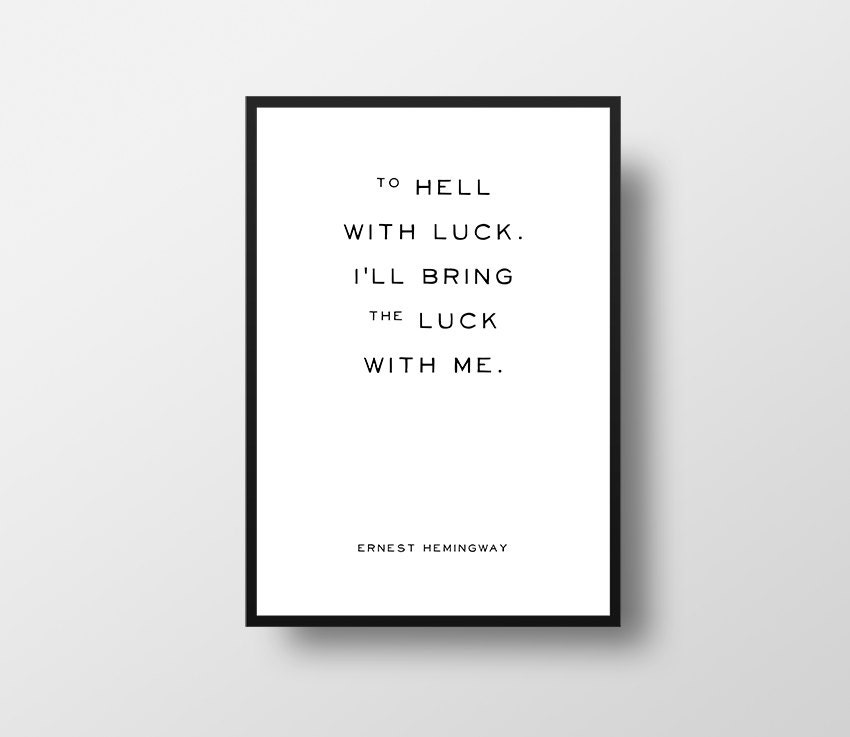
Sadly Hemingway and Twain never looked ABOVE THE SUN for the answer and they were left with the impossibility of finding solutions UNDER THE SUN and that is what King Solomon demonstrates in the Book of Ecclesiastes.


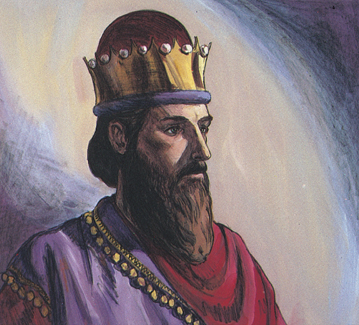
“The two most important days in your life are the day you are born . . . and the day you find out why.    — Mark Twain”
__
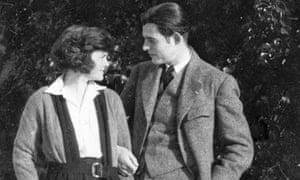


Hadley and Ernest Hemingway

Hadley and Ernest Hemingway in Chamby, Switzerland, 1922. Photograph: Ernest Hemingway Photograph Collection, John F. Kennedy Presidential Library and Museum, Boston. Ernest Hemingway Photograph Collection, John F. Kennedy Presidential Library and Museum, Boston./PR


Midnight in Paris OST – 13 – Barcarolle from ‘The Tales of Hoffman’

_______
This series deals with the Book of Ecclesiastes and Woody Allen films.  The first post  dealt with MAGIC IN THE MOONLIGHT and it dealt with the fact that in the Book of Ecclesiastes Solomon does contend like Hobbes  and Stanley that life is “nasty, brutish and short” and as a result has no meaning UNDER THE SUN.

The movie MIDNIGHT IN PARIS offers many of the same themes we see in Ecclesiastes. The second post looked at the question: WAS THERE EVER AGOLDEN AGE AND DID THE MOST TALENTED UNIVERSAL MEN OF THAT TIME FIND TRUE SATISFACTION DURING IT?

In the third post in this series we discover in Ecclesiastes that man UNDER THE SUN finds himself caught in the never ending cycle of birth and death. The SURREALISTS make a leap into the area of nonreason in order to get out of this cycle and that is why the scene in MIDNIGHT IN PARIS with Salvador Dali, Man Ray, and Luis Bunuel works so well!!!! These surrealists look to the area of their dreams to find a meaning for their lives and their break with reality is  only because they know that they can’t find a rational meaning in life without God in the picture.

The fourth post looks at the solution of WINE, WOMEN AND SONG and the fifth and sixth posts look at the solution T.S.Eliot found in the Christian Faith and how he left his fragmented message of pessimism behind. In the seventh post the SURREALISTS say that time and chance is all we have but how can that explain love or art and the hunger for God? The eighth  post looks at the subject of DEATH both in Ecclesiastes and MIDNIGHT IN PARIS. In the ninth post we look at the nihilistic worldview of Woody Allen and why he keeps putting suicides into his films.

In the tenth post I show how Woody Allen pokes fun at the brilliant thinkers of this world and how King Solomon did the same thing 3000 years ago. In the eleventh post I point out how many of Woody Allen’s liberal political views come a lack of understanding of the sinful nature of man and where it originated. In the twelfth post I look at the mannishness of man and vacuum in his heart that can only be satisfied by a relationship with God.

In the thirteenth post we look at the life of Ernest Hemingway as pictured in MIDNIGHT AND PARIS and relate it to the change of outlook he had on life as the years passed. In the fourteenth post we look at Hemingway’s idea of Paris being a movable  feast. The fifteenth and sixteenth posts both compare Hemingway’s statement, “Happiness in intelligent people is the rarest thing I know…”  with Ecclesiastes 2:18 “For in much wisdom is much vexation, and he who increases knowledge increases sorrow.” The seventeenth post looks at these words Woody Allen put into Hemingway’s mouth,  “We fear death because we feel that we haven’t loved well enough or loved at all.”

In MIDNIGHT IN PARIS Hemingway and Gil Pender talk about their literary idol Mark Twain and the eighteenth post is summed up nicely by Kris Hemphill‘s words, “Both Twain and [King Solomon in the Book of Ecclesiastes] voice questions our souls long to have answered: Where does one find enduring meaning, life purpose, and sustainable joy, and why do so few seem to find it? The nineteenth post looks at the tension felt both in the life of Gil Pender (written by Woody Allen) in the movie MIDNIGHT IN PARIS and in Mark Twain’s life and that is when an atheist says he wants to scoff at the idea THAT WE WERE PUT HERE FOR A PURPOSE but he must stay face the reality of  Ecclesiastes 3:11 that says “God has planted eternity in the heart of men…” and  THAT CHANGES EVERYTHING! Therefore, the secular view that there is no such thing as love or purpose looks implausible. The twentieth post examines how Mark Twain discovered just like King Solomon in the Book of Ecclesiastes that there is no explanation  for the suffering and injustice that occurs in life UNDER THE SUN. Solomon actually brought God back into the picture in the last chapter and he looked  ABOVE THE SUN for the books to be balanced and for the tears to be wiped away.

The twenty-first post looks at the words of King Solomon, Woody Allen and Mark Twain that without God in the picture our lives UNDER THE SUN will accomplish nothing that lasts.

Woody Allen talks ‘Midnight in Paris’

AT THE 27 MIN MARK Woody Allen says:

I have never gotten to the point where I can give an optimistic view of anything. I have these ideas for stories that I hope are entertaining and I am always criticized for being pessimistic or nihilistic. To me this is just a realistic appraisal of life. There are these little Oasis’s these little distractions you get. Last night I was caught up in the Bulls and Heat basketball game on television and for the time being I was thinking about who was going to win. I wasn’t thinking about my mortality or the fact that I am finite and aging. That was not on my mind. Labron James was on my mind and the game. That is the best you can do is get a little  detraction. What I have learned over the years is that there is no other solution to it. There is no satisfying answer. There is no optimistic answer I can give anybody.

The outcome of that basketball game is no less meaningful or no more meaningful than human life if you take the long view of it. You could look at the earth and say who cares about those creatures running around there and just brush it. Ernest Hemingway in one of his stories ( A FAREWELL TO ARMS) is looking at a burning log with ants running on it. This is the kind of thinking that has over powered me over the years and slips into my stories.

I have always been an odd mixture, completely accidentally, I was a nightclub comic joke writer whose two biggest influences were Groucho Marx, who I have always adored and he still makes me laugh  and Igmar Bergman. I have always had a morbid streak in my work and I when I do something that works , it works to my advantage because it gives some substance and depth to the story, but I when I fail the thing could be too grim or too moralizing or not interesting enough. Then someone will say we only like you when you are funny.

Related posts:

The Characters referenced in Woody Allen’s “Midnight in Paris” (Part 15, Luis Bunuel)
The Characters referenced in Woody Allen’s “Midnight in Paris” (Part 9, Georges Braque)
The Characters referenced in Woody Allen’s “Midnight in Paris” (Part 5 Juan Belmonte)
The characters referenced in Woody Allen’s movie “Midnight in Paris” (Part 23,Adriana, fictional mistress of Picasso)
The characters referenced in Woody Allen’s “Midnight in Paris” (Part 11, Rodin)The Characters referenced in Woody Allen’s “Midnight in Paris” (Part 29, Pablo Picasso)The Characters referenced in Woody Allen’s “Midnight in Paris” (Part 13, Amedeo Modigliani)

The Characters referenced in Woody Allen’s “Midnight in Paris” (Part 14, Henri Matisse)
Characters referenced in Woody Allen’s movie “Midnight in Paris” (Part 35, Recap of historical figures, Notre Dame Cathedral and Cult of Reason)

The Characters referenced in Woody Allen’s “Midnight in Paris” (Part 3 Scott and Zelda Fitzgerald)
The Characters referenced in Woody Allen’s “Midnight in Paris” (Part 10 Salvador Dali)

The characters referenced in Woody Allen’s “Midnight in Paris” (Part 12, Gabrielle “Coco” Chanel)


I love the movie “Midnight in Paris” by Woody Allen and I have done over 30 posts on the historical characters mentioned in the film. Take a look below:

“Midnight in Paris” one of Woody Allen’s biggest movie hits in recent years, July 18, 2011 – 6:00 am

(Part 32, Jean-Paul Sartre)July 10, 2011 – 5:53 am

 (Part 29, Pablo Picasso) July 7, 2011 – 4:33 am

(Part 28,Van Gogh) July 6, 2011 – 4:03 am

(Part 27, Man Ray) July 5, 2011 – 4:49 am

(Part 26,James Joyce) July 4, 2011 – 5:55 am

(Part 25, T.S.Elliot) July 3, 2011 – 4:46 am

(Part 24, Djuna Barnes) July 2, 2011 – 7:28 am

(Part 23,Adriana, fictional mistress of Picasso) July 1, 2011 – 12:28 am

(Part 22, Silvia Beach and the Shakespeare and Company Bookstore) June 30, 2011 – 12:58 am

(Part 21,Versailles and the French Revolution) June 29, 2011 – 5:34 am

(Part 16, Josephine Baker) June 24, 2011 – 5:18 am

(Part 15, Luis Bunuel) June 23, 2011 – 5:37 am

Related posts:

A list of the most viewed posts on the historical characters mentioned in the movie “Midnight in Paris”


Characters referenced in Woody Allen’s movie “Midnight in Paris” (Part 38,Alcoholism and great writers and artists)


The characters referenced in Woody Allen’s movie “Midnight in Paris” (Part 36, Alice B. Toklas, Woody Allen on the meaning of life)


Characters referenced in Woody Allen’s movie “Midnight in Paris” (Part 35, Recap of historical figures, Notre Dame Cathedral and Cult of Reason)


The characters referenced in Woody Allen’s movie “Midnight in Paris” (Part 34, Simone de Beauvoir)


The characters referenced in Woody Allen’s movie “Midnight in Paris” (Part 33,Cezanne)


The characters referenced in Woody Allen’s movie “Midnight in Paris” (Part 32, Jean-Paul Sartre)


The characters referenced in Woody Allen’s movie “Midnight in Paris” (Part 31, Jean Cocteau)


The characters referenced in Woody Allen’s movie “Midnight in Paris” (Part 30, Albert Camus)


The Characters referenced in Woody Allen’s “Midnight in Paris” (Part 29, Pablo Picasso)


The Characters referenced in Woody Allen’s “Midnight in Paris” (Part 8, Henri Toulouse Lautrec)


The Characters referenced in Woody Allen’s “Midnight in Paris” (Part 7 Paul Gauguin)


The Characters referenced in Woody Allen’s “Midnight in Paris” (Part 6 Gertrude Stein)


The Characters referenced in Woody Allen’s “Midnight in Paris” (Part 5 Juan Belmonte)

SCHAEFFER SUNDAY Katha Pollitt versus Scott Klusendorf on abortion rights!!!

___________________

______________

Katha Pollitt gives it her best try to portray abortion in a positive light while  Scott Klusendorf has pointed that “…when the pro-life debate has faltered, it’s because the focus has been shifted from the real issue: What is the unborn?”

Katha Pollitt “Pro: Reclaiming Abortion Rights”

Published on Nov 4, 2014

http://www.politics-prose.com/event/b…

Forty years after Roe v. Wade, even its supporters often feel a need to qualify their position on abortion. In her impassioned and eminently reasonable defense of a woman’s right to choose, Pollitt, The Nation’s award-winning “Subject to Debate” columnist, shows how this moral right is also a force for social good. (Picador)

Founded by Carla Cohen and Barbara Meade in 1984, Politics & Prose Bookstore is Washington, D.C.’s premier independent bookstore and cultural hub, a gathering place for people interested in reading and discussing books. Politics & Prose offers superior service, unusual book choices, and a haven for book lovers in the store and online. Visit them on the web at http://www.politics-prose.com/

  • Category

  • License

    • Standard YouTube License

Scott Klusendorf on Pro-life Apologetics

Published on Feb 13, 2014

Scott Klusendorf, the acclaimed author of The Case for Life and Stand for Life and founder of the Life Training Institute, taught the principles of pro-life apologetics at Redefine. To view the video mentioned in this speech, visit http://www.prolifetraining.com/aborti…

See more of Redefine in this photo album: https://www.facebook.com/media/set/?s…

Pro-Life Arguments and the Vanishing Pro-Life Apologist

Article ID: DA021

By: Scott Klusendorf

Pro-Life Arguments- SYNOPSIS

The past few years have witnessed a stunning development in the pro-life movement. Many pro-life leaders now think we can make abortion rare by downplaying the moral question, “Does abortion take the life of a defenseless human being?” They favor a new strategy that appeals to the self-interests of women rather than moral truth. One leader asserts that an emphasis on unborn babies will only drive women of childbearing age away from the pro-life movement. But this new strategy is dangerous because it leaves the pro-abortion culture largely unchallenged. At the same time, it unilaterally strips the pro-life movement of its most powerful tools of persuasion. If pro-life advocates are to make abortion unthinkable, they must speak frankly about the nature of abortion.

For the past 26 years, pro-life apologists have argued that elective abortion unjustly takes the life of a defenseless human being. The rationale for their argument is clear-cut and can be expressed in the following syllogism:

1. Intentionally killing an innocent person is a moral wrong.

2. Elective abortion is the intentional killing of an innocent human person.

3. Hence, elective abortion is a moral wrong.

Despite the clarity and soundness of this argument, some pro-life leaders now question its ability to persuade. They contend that although abortion is an objective moral evil, pro-life advocates should reconsider their arguments or risk alienating women of childbearing age.

Pro-Life Arguments- THE CHANGING PRO-LIFE FOCUS

Paul Swope, for example, calls it a “failure to communicate” when pro-lifers focus primarily on the fetus rather than the felt needs of women. “The pro-life movement,” he writes, “must show that abortion is not in a woman’s own self-interest, and that the choice of life offers hope and a positive, expanded sense of self.”1

Swope believes pro-life advocates have won the moral and philosophical debate over the status of the fetus, but have failed to address the needs of women. He cites research indicating that even “pro-choice” women agree that abortion is killing. “The women believe that abortion is wrong, an evil, and that God will punish a woman who makes that choice.” Yet, the choice of abortion becomes one of self-preservation (at least socially), and since the woman did not intend to get pregnant, she reasons that “God will ultimately forgive her.”2

Until recently, the pro-life response was to point out that hardship did not justify homicide, but Swope thinks that a focus on babies only makes matters worse. He writes, “The pro-life movement’s own self-chosen slogans and educational presentations have tended to exacerbate the problem, as they focus almost exclusively on the unborn child, not the mother.”3

Pro-life feminist Frederica Matthews-Green agrees, “Pro-Lifers will not be able to break through this deadlock by stressing the humanity of the unborn. [T]hat is a question nobody is asking. But there is a question they are asking. It is, ‘How can we live without it?’ The problem is not moral, but practical.”4

There is merit to what both say. Pro-lifers must do more than stress the humanity of the unborn, especially with those facing the terror of unplanned pregnancy. This is why crisis pregnancy centers are so important. It is also true that for some abortion-minded women, appeals to self-interest may dissuade them from killing their babies.

But Swope and Matthews-Green are not saying we should reframe the debate in the narrow context of crisis counseling. Rather, they are telling the pro-life movement in general to speak less of the fetus and more to the self- interested needs of women. Although both have made important contributions to our cause, I think they are mistaken for the following reasons.

1. It is simply not true that the pro-life movement has won the debate over the status of the fetus. Both authors rightly point out that a majority of Americans support legal abortion even though most say that it is morally wrong. They interpret these contradictory findings to mean that while pro-lifers have won the moral debate over the humanity of the fetus, practical considerations keep many Americans committed to abortion.

Swope and Matthews-Green are confusing what the public says with what it truly believes. People hold contradictory and incoherent views on abortion precisely because they don’t really believe that the unborn are filly human, despite their rhetoric to the contrary. As philosopher Francis Beckwith points out, why do women only kill their fetuses when confronted with practical difficulties, rather than their already born children, if they truly believe their fetuses are fully human?5

Put differently; is there any reasonable person in America today who would argue that while he personally opposed the enslavement of blacks, he wouldn’t oppose the legal right of his neighbor to won one if he so chose? In fact, when people tell me they personally oppose abortion but think it should be legal anyway, I ask a simple question to audit their core beliefs about the unborn. I ask why they personally oppose abortion. Nearly always, the response is, “I oppose it because it kills a baby,” at which point I merely repeat their own words. “Let me see if I’ve got this straight: You say you oppose abortion because it kills a baby, but you think it should be legal to kill babies?” Those who are intellectually honest respond with stunned silence before conceding, “Gee, I never thought of it like that.” But many others reply glibly, “Well, its not the same thing.”

People who talk like this cannot possibly have thought much about the status of the fetus, let alone have resolved the issue in our favor. When it comes to first trimester abortion, polling data suggests the public has indeed resolved the issue, but it hardly agrees with us. A whopping 62 percent support the practice precisely because they don’t think the unborn at that stage of development are human persons.6 This is not a practical problem, but a deeply moral and intellectual one.

________________

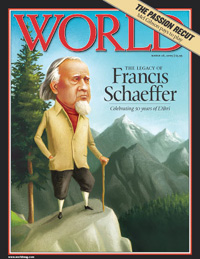
Francis Schaeffer below pictured on cover of World Magazine:

______________________

______________________________________________

2. A strategy centered primarily on the self-interest of the woman sets a dangerous precedent for the pro-life movement. As Dr. Beckwith points out, even if appeals to self-interest temporarily reduce the number of abortions, it does not follow that our culture is becoming pro-life.

Say, for example, that Planned Parenthood releases a study demonstrating that women who abort live on average 10 years longer than those who don’t. Or, take an exact case from Boston where the National Abortion Access Project is running ads (soon to be released nationally) depicting abortion as “the responsible choice” for women who don’t want to “pay the price and have the baby.”

What principled argument against abortion can Swope or Matthews-Green make in either case? Beckwith writes, “Nurturing an unprincipled, self-interested culture may have the unfortunate con­sequence of increasing the number of people who think that unless their needs are pacified they are perfectly justified in performing homicide on the most vulnerable of our population.”7

Swope replies that moral persuasion simply does not work with many women. Consequently, he produces pro-life television ads that speak to the self-interest of women rather than the morality of abortion. He claims to have data proving the ads not only save babies, but change public opinion as well. “A 30 second ad with the objective of reaching women of childbearing age is simply not the place to teach about abstract moral obligations,” he writes.8

Perhaps so, but we shouldn’t then claim that these ads genuinely convert people to the pro-life view. True conversion on any ethical issue requires moral and intellectual assent. How can there be moral and intellectual assent if nothing in the ads speaks to moral or intellectual issues? What you get in this case are not true converts to the pro-life position, but self-interested converts who may readily abandon their newly found pro-life views. As one abortion rights leader put it, “The overwhelming majority of Americans are against abortion except in cases of rape, incest, and their own personal circumstances.” That is the heart of the issue.

Data from the pregnancy care profession seems to confirm this. Pro-life crisis pregnancy centers (CPCs) outnumber abortion clinics nearly two to one, but there are still 1.3 million abortions annually. In fact Care Net, the nation’s largest affiliate of CPCs, reports that 80 percent of clients seen by its centers are not abortion minded.10 That means the vast majority of women considering abortion blow right by the local CPC on their way to Planned Parenthood. This is true despite Care Net’s laudable 1993 goal of making pregnancy care centers “so accessible and so effective in serving women that we put abortionists virtually out of business by the end of the decade.”11

Four years ago, I visited a well-funded midwestern CPC whose staff took me through comfortably furnished residential quarters that can house 40 pregnant women, most in their own private rooms. Residents enjoy impressive meals and round-the-clock medical care. The CPC also has a large, well-stocked library, classrooms in which clients pursue various courses of study, and an impressive list of services offered to women not in need of residency. The facility has the capacity to care for hundreds of nonresident clients as well. It’s hard to imagine a crisis pregnancy center that is more caring and more in tune with the self-interested needs of its clients.

Despite this CPC’s effective management and comprehensive services, it saved 80 babies that year in a metro area in which some ten thousand were killed! At times, the facility was less than half full. When pregnant women reject help from one of the best-run CPCs in the country, we don’t have practical problems; we have moral and philosophical problems. We struggle in the practical realm precisely because the culture does not agree with us that abortion is a serious moral wrong. But this center is hardly alone.

According to research presented by the Family Research Council (FRC) at a 1998 Focus on the Family conference for crisis pregnancy center staff the number of abortion-minded clients visiting CPCs is declining nationwide. For example, 10 CPCs, noted for their size and strong leadership, were asked to report their statistics for 1994 to 1996. The number of abortion-minded clients increased in four centers, but decreased in six. The number of “service on1y” clients (those coming in for diapers, clothing, etc., but not at risk for abortion) increased in seven, remained unchanged in one, and decreased in two. The FRC report warns that if these trends continue throughout the CPC movement, it could “threaten the primary mission of centers — to reach women at risk for abortion.”12

It’s not that women at risk are unaware that CPCs can help. According to a 1997 survey by the Wirthlin Group, 66 percent of American women were aware of crisis pregnancy centers and the services they provide, while 49 percent knew of their local center. Most important, 87 percent of those aware of CPCs believed they have a positive impact on the women they serve.13 Despite excellent services and high approval ratings, these centers are failing to reach the women most at risk.

Crisis pregnancy centers are vital to the pro-life movement, but even if there were one on every street corner in America, it would never “put abortionists virtually out of business,” much less by the end of the decade. “I’m glad that some women can be loved into loving their babies,” writes Gregg Cunningham of the Center for Bio-Ethical Reform. “But I won’t let that fact blind me to the reality that there are many others who will kill their babies if they are not made more horrified of abortion than they are terrified of their own crisis pregnancies.”14

3. Downplaying the truth about abortion patronizes the very women we are trying to help. Speaking of pro-choice women facing a crisis pregnancy, Swope writes, an “emphasis on babies, whether dismembered fetuses or happy newborns, will tend to deepen the woman’s sense of denial, isolation, and despair, the very emotions that will lead her to choose abortion.”15

Swope is right that pro-lifers must address the woman’s emotional concerns but wrong to say that we must downplay the truth about abortion in order to do this. Are we to conclude that women can’t look at abortion objectively? As feminist author and abortion advocate, Naomi Wolf, points out, this view is condescending to women:

The pro-choice movement often treats with contempt the pro-lifers’ practice of holding up to our faces their disturbing graphics….[But] how can we charge that it is vile and repulsive for pro-lifers to brandish vile and repulsive images if the images are real? To insist that truth is in poor taste is the very height of hypocrisy. Besides, if these images are often the facts of the matter, and if we then claim that it is offensive for pro-choice women to be confronted by them, then we are making a judgment that women are too inherently weak to face a truth about which they have to make a grave decision. This view is unworthy offeminism.16

Some (though thankfully not all) CPCs have a policy forbidding the use of abortion pictures in counseling sessions, even when the client may consent to viewing them. As unpleasant as it seems, breaking people’s hearts over abortion is often an indispensable predicate to changing their minds. Pictures change the way they feel, and facts change the way they think. Both are vital. “I wish it weren’t so, but whatever might be a CPCs reasons for categorically rejecting the use of graphic depictions of abortion, those reasons had better be more important than the lives of the babies who will die because of that policy,” writes Cunningham.17

Francis Schaeffer “BASIS FOR HUMAN DIGNITY” Whatever…HTTHR

__________________________

4. Downplaying the truth about abortion is totally unnecessary and strips the pro-life movement of its most powerful tools of persuasion. We can win if we force abortion advocates to defend killing babies. The national debate over partial-birth abortion (PBA) is a case in point. Though President Clinton has twice vetoed legislation banning the procedure, the debate has helped pro-lifers in at least five ways.

First, public opinion has shifted modestly in our favor. Although Swope disputes that this has anything to do with PBA, the evidence is compelling.18 Since the partial-birth issue was first raised in 1995, the percentage of those who think abortion should be legal under any circumstances has dropped on average from 33 percent to 22 percent.19 The trend among women 18 and over is also encouraging. According to a 1999 study by The Center for Gender Equity, more women oppose abortion than support it. Fifty-three percent now say abortion should be illegal altogether or allowed only in cases of rape, incest, or endangerment of the mother’s life.20 That’s an eight-percent shift away from abortion rights compared to a poll taken two years prior.

Why the shift? For the first time in 25 years, the debate is about the abortion act itself and how it affects the unborn.21 “When someone holds up a model of a six-month-old fetus and a pair of surgical scissors, we say ‘choice’ and we lose,” writes Naomi Wolf.22

At a National Abortion Federation meeting in 1996, Kathryn Kohlbert cautioned delegates that if the debate over partial-birth abortion focuses on what happens to the unborn, their side will get “creamed.” She urged focusing exclusively on the woman:

If the debate is whether or not the fetus feels pain, we lose. If the debate in the public arena is what’s the effect of anesthesia. [on the fetus], we’ll lose. If the debate is on whether or not women ought to be entitled to late abortion, we will probably lose. But if the debate is on the circumstances of individual women, and [how] the government shouldn’t be making those decisions, then I think we can win these fights.23

We have yet to convince many of the inhumanity of abortion in the first trimester. But graphic depictions of abortion have put our opponents on the defensive.

Second, the shift in public opinion has led to legislative progress. Despite recent setbacks in the states of Washington and Colorado, where ballot initiatives banning PBA suffered narrow defeats, the trend has been remarkably positive for the pro-life movement. For instance, New Jersey legislators — including many liberal Democrats — are supporting limits on abortion. According to The New York Times, the New Jersey experience is typical of the national trend where 31 states have now passed measures restricting access to abortion. Pro-lifers are forcing liberals to defend the abortion act itself. In New Jersey; lawmakers were actually shown videos of abortion procedures prior to a committee vote on PBA.24

Mary Balch, director of the National Right to Life State Legislative Department, explains her success with liberal lawmakers: “All we had done was to say to them, ‘Pro-abortionists support removing a large, living unborn baby almost entirely from her mother’s womb, stabbing her in the head with scissors, and sucking out her brains. Are you willing to support that?”25

Swope replies that his strategy does not necessarily apply to legislative or political change, but only to reaching the general public. This misses the point entirely. Politicians will restrict abortion precisely because public opinion demands it. Most legislators, especially those who are pro-abortion, are not going to support pro-life legislation in the absence of intense pressure from constituents. What changed the minds of constituents in this case was not concern for the self-interest of women, but the brutal reality of abortion.

Third, both the American Medical Association and the American College of Obstetrics and Gynecology have issued reports condemning partial-birth abortion.26 The AMA has gone even further, stating that late-term abortions are rarely, if ever, needed to save the mother’s life or physical health.27 Though abortion advocates within the AMA have protested that the reports were politically motivated, they’ve presented no evidence to challenge the fact that partial-birth abortion procedures are nearly always performed on healthy women carrying healthy babies. Both organizations have a history of supporting abortion-on-demand, yet the debate over PBA forced each to issue statements questioning the morality of some abortions.

Fourth, PBA legislation has raised the issue of fetal pain, further calling into question the morality of abortion. An editorial in the Journal of the American Medical Association states, “It is beyond ironic that the pain management practiced for an intact D&X on a human fetus would not meet the federal standards for the humane care of animals used in medical research.”28 Other medical journals have raised similar concerns.29

Fifth, the PBA debate has undermined the credibility of abortion advocates in general. Simply put they were caught lying, and even their staunchest supporters in the media felt cheated. Pro-abortion columnist Richard Cohen writes, “I was led to believe that these late-term abortions were extremely rare and performed only when the life of the mother was in danger or the fetus irreparably deformed. I was wrong.”30 A short time later, Ron Fitzimmons, executive director of the National Coalition of Abortion Providers, admitted that he and others intentionally lied to the public when they said only four-hundred of these grisly procedures were done each year. He confessed that thousands of these procedures are performed annually on perfectly healthy mothers carrying perfectly healthy babies.31

The partial birth debate damaged the pro-abortion side because it focused on what abortion does to the unborn. Pro-lifers did two things right. First, we forced abortion advocates to defend the indefensible. Second, we marshaled factual evidence to show that our opponents were lying. That’s the essence of effective pro-life apologetics as we approach the twenty-first century.

Pro-Life Arguments- CHANGING OUR BEHAVIOR, NOT OUR MESSAGE

The primary challenge confronting the pro-life movement is not persuading the public that our position is practical, but that our position is true. Public revulsion over partial-birth abortion has given us a rare opportunity to frame the debate in moral terms. But we are doing precious little to press our advantage.

This past January, I conducted a state-by-state survey of major pro-life events around the country. State pro-life groups were eager to send me their list of activities, as January is their most active month due to the anniversary of Roe. v. Wade. Listed were numerous banquets, rallies, Christian rock concerts, potluck suppers, golf tournaments, marches, candlelight vigils, prayer services, and religious events. Shocking was the fact that not one of the events I surveyed remotely related to impacting the culture at the idea level or equipping our people to think and defend their views persuasively.32

The American public is confused and holds contradictory positions on abortion because people think the issue is morally complex. This confusion can be cleared up if pro-life apologists frame the debate around one question, as Gregory Koukl, president of Stand to Reason, explains: “Imagine that your child walks up when your back is turned and asks, ‘Daddy, can I kill this? What is the first thing you must find out before you can answer him? You can never answer the question “Can I kill this?” unless you’ve answered a prior question: What is it?”33

The answer to the question “What is the unborn?” trumps all other considerations. It is key to answering virtually every objection to the pro-life view. The following dialogue illustrates why there is only one issue to resolve, not many:

Abortion Advocate: Abortion is a private choice between a woman and her doctor.

Pro-Lifer: Do we allow parents to mistreat their children if done in private?

Abortion Advocate: Of course not. Those children are human beings.

Pro-Lifer: Then the issue isn’t privacy. It’s “What is the unborn?”

Abortion Advocate: But many poor women cannot afford to raise another child.

Pro-Lifer: When human beings get expensive, may we kill them?

Abortion Advocate: Well, no, but aborting a fetus is not the same as killing a person.

Pro-Lifer: So, once again, the issue is “What is the unborn? Is the fetus a human person?”

Abortion Advocate: But you’re being too simplistic. This is a very complex issue involving women who must make agonizing decisions.

Pro-Lifer: The decision may be psychologically complex for the mother, but morally it is not complex at all. When blacks are mistreated in a certain society; do we spin a tale about com­plex, agonizing decisions for the whites in power or do we condemn the evil of racism?

Abortion Advocate: Aborting a fetus that is not a person is one thing, discriminating against black persons is quite another.

Pro-Lifer: So we’re agreed: If abortion kills a defenseless human being, then the issue wouldn’t be complex at all. The question is, “What is the unborn?”

Abortion Advocate: Enough with your abstract philosophy. Let’s talk about real life. Do you really think a woman should be forced to bring an unwanted child into the world?

Pro-Lifer: The homeless are unwanted, may we kill them?

Abortion Advocate: But it’s not the same.

Pro-Lifer: That’s the issue, isn’t it? Are they the same? If the unborn are human like the homeless, then we can’t kill them to get them out of the way. We’re back to my first question, “What is the unborn?”

Abortion Advocate: But you still shouldn’t force your morality on women.

Pro-Lifer: You don’t really believe what you just said. You’d feel very comfortable forcing your morality on a mother who was physically abusing her two-year-old, wouldn’t you?

Abortion Advocate: But the two cases are not the same.

Pro-Lifer: Oh? Why is that?

Abortion Advocate: Because you’re assuming the unborn are human, like the two-year-old.

Pro-Lifer: And you’re assuming they’re not. So the issue is quite simple, isn’t it? It’s not forcing morality; it’s not privacy; it’s not economic hardship; it’s not unwantedness; it’s “What is the unborn?”

What we must change is not our message, but our behavior. Babies are dying whose lives could be saved if pro-life advocates were equipped to argue their case persuasively. We can win if we force abortion advocates to defend killing babies. The battle over partial-birth abortion indicates this.

When the pro-life debate has faltered, it’s because the focus has been shifted from the real issue: What is the unborn? The reluctance of some pro-lifers to advance moral arguments is a tacit admission they either don’t have a moral case to offer or lack the courage to proclaim it. Either way, these pro-lifers have not merely failed to communicate, they’ve abandoned the fight altogether. This we cannot do.

notes

1. Paul Swope, “Abortion: A Failure to Communicate,” First Things, April 1998.

2. Ibid.

3. Ibid.

4. Frederica Matthews-Green, Real Choices (Sisters, OR: Multnomah, 1994), 32.

5. Francis J. Beckwith, letter to the editor, First Things (October, 1998).

6. Susan Yoachum, “California Pro-Choice — Early-on Poll Says Late-Term Abortions Opposed,” The San Francisco Chronicle, 10 March 1997, and The New York Times/CBS poll (January 1998).

7. Francis J. Beckwith, “Taking Abortion Seriously,” unpublished paper, 1999. This paper will be presented at the 51st Annual Meeting of the Evangelical Theological Society in Danvers, Massachusetts, 17-19 November 1999.

8. Reply to Francis J. Beckwith’s letter to the editor, First Things, October1998.

9. David Shaw, “Abortion Bias Seeps into News,” The Los Angeles Times, 1-4 July 1990.

10. Care Net Volunteer Training Manual, 1995, 24.

11. “Action Line” (the former newsletter of the Christian Action Council, the group now known as Care Net), January 1993; see also Kim Lawton, “20 Years after Roe, Christianity Today, 11 January 1993, 38.

12. Kurt Young, “Assessing Center Impact Increasing Center Effectiveness,” Family Outreach Council, February 1998. This paper was presented at a Focus on the Family conference specifically to address the decline in abortion-minded clients.

13. Poll cited in National Rights to Life News, 7 May 1998.

14. 12 April 1993 letter from Gregg Cunningham to Scott Klusendorf.

15. Swope.

16. Naomi Wolf, “Our Bodies, Our Souls,” The New Republic, 16 October 1996.

17. 12 April 1993 letter from Cunningham to Klusendorf. I have letters on file from CPCs that have responsibly used graphic visual aids to deter women from abortion.

18. Swope credits his ads (in states where they run) rather than PBA for the shift, but this flies in the face of nearly every opinion poll taken since 1997. Pollsters consistently cite PBA for the change in public attitudes. See also n. 21.

19. USA Today/CNN poll, 1997; cited in Ruth Padawer, “Partial Birth Battle Changing Public Views,” USA Today, 17 November 1997.

20. Study conducted by the Center for Gender Equality, January 1999. Cited in John Leo, “The Joy of Sexual Values,” U.S. News and World Report, 1 March 1999. Another sign of slippage in support for legal abortion is UCLA’s annual survey of college freshman, where in 1998 only 50.9 percent favored the practice, down front 65 percent in 1990.

21. Even pro-abortion feminists concede this. Faye Wattleton, Executive Director of the Center for Gender Equity said the debate over PBA has affected women’s overall views on abortion. “We’ve been seeing an erosion of support [for abortion], and that probably grows out of the late-term abortion debate.” (Cited in The Boston Herald, 4 February 1999.)

22. Naomi Wolf, “Pro-Choice and Pro-Life,” The New York Time’s, 3 April 1997.

23. Diane Gianelli, “Abortion Rights Leader Urges End to Half-Truths.” American Medical News, 3 March 1997.

24. Abby Goodnough, “Trenton Turning from Its longtime Support of Abortion Rights,” The New York Times, 22 February 1998.

25. “The Untold Story of Partial-Birth Abortion,” National Right to Life News, 15 March 1999.

26. On the AMA, see M. L. Sprang and M. G. Neerhof, “Rationale for Banning Abortions Late in Pregnancy,” Journal of the American Medical Association, 26 August 1998. On the ACOG, see Diane Gianelli, “AMA Report: Third Trimester Abortions Rarely Necessary” American Medical News, 26 May 1997.

27. Gianelli, “AMA Report.”

28. Sprang and Neerhof.

29. Xenophon Giannakoulopoulos, et al, “Fetal Plasma Cortisol and B-Endorphin Response to Intrauterine Needling,” The Lancet (July 9, 1994): See also Diane Gianelli, “Anesthesiologists Question Claims in Abortion Debate,” American Medical News, 1 January 1996.

30. Richard Cohen, “Late Abortions Can Transcend the Issue of Choice,” The New York Times, 26 September 1996.

31. David Stout, “An Abortion Advocate Says He Lied about Procedure,” The New York Times, 26 February 1997. See also Gianelli, “Abortion Rights Leader Urges End to Half-Truths.”

32. I am speaking here only of major events as advertised by pro-life groups. I do not mean to imply that local pro-life groups or individuals did nothing to persuade the public.

33. Gregory P. Koukl, Precious Human Unborn Persons (San Pedro, CA: Stand to Reason, 1997), 4-5.

___________________

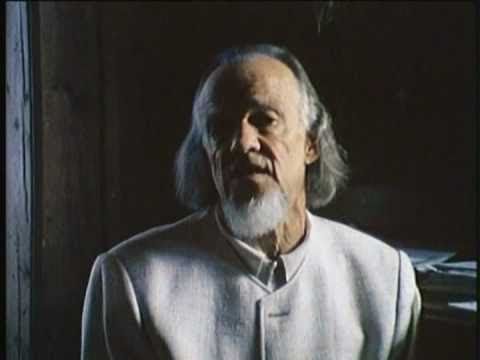
Francis Schaeffer pictured below:

Dr. Francis schaeffer – The flow of Materialism(from Part 4 of Whatever happened to human race?)

Dr. Francis Schaeffer – The Biblical flow of Truth & History (intro)

Francis Schaeffer – The Biblical Flow of History & Truth (1)

Dr. Francis Schaeffer – The Biblical Flow of Truth & History (part 2)

Related posts:

Sam Harris rightly noted earlier this month on Bill Maher’s show that liberals are still getting “agitated over the abortion clinic bombings that happened in 1984″ but they are not upset at what is happening in the Muslim world right now!!!!

__________ Real Time with Bill Maher: Ben Affleck, Sam Harris and Bill Maher Debate Radical Islam (HBO) Sam Harris rightly noted earlier this month on Bill Maher’s show that liberals are still getting “agitated over the abortion clinic bombings that happened in 1984″ but they are not upset at what is happening in the Muslim […]

“Sanctity of Life Saturday” Atheist Nat Hentoff USED TO THINK that abortion is part of a woman’s fundamental right to privacy

Nat Hentoff is an atheist, but he became a pro-life activist because of the scientific evidence that shows that the unborn child is a distinct and separate human being and even has a separate DNA. His perspective is a very intriguing one that I thought you would be interested in. I have shared before many   […]

Open letter to President Obama (Part 673) Pro-life Atheist Nat Hentoff: Mr. President, did you mean what you said at Notre Dame about “working together to reduce the number of women seeking abortions”?

Open letter to President Obama (Part 673) (Emailed to White House on 6-12-13.) President Obama c/o The White House 1600 Pennsylvania Avenue NW Washington, DC 20500 Dear Mr. President, I know that you receive 20,000 letters a day and that you actually read 10 of them every day. I really do respect you for trying to get […]

Open letter to President Obama (Part 663) Kermit Gosnell, millionaire abortionist

Open letter to President Obama (Part 663) (Emailed to White House on 6-5-13.) President Obama c/o The White House 1600 Pennsylvania Avenue NW Washington, DC 20500 Dear Mr. President, I know that you receive 20,000 letters a day and that you actually read 10 of them every day. I really do respect you for trying to get […]

Open letter to President Obama (Part 661) ANALYSIS: Will the Kermit Gosnell verdict change the abortion debate?

Open letter to President Obama (Part 661) (Emailed to White House on 6-5-13.) President Obama c/o The White House 1600 Pennsylvania Avenue NW Washington, DC 20500 Dear Mr. President, I know that you receive 20,000 letters a day and that you actually read 10 of them every day. I really do respect you for trying to get […]

“Sanctity of Life Saturday” Pro-life Atheist Nat Hentoff: Mr. President, did you mean what you said at Notre Dame about “working together to reduce the number of women seeking abortions”?

Pro-life Atheist Nat Hentoff: Mr. President, did you mean what you said at Notre Dame about “working together to reduce the number of women seeking abortions”? Nat Hentoff is an atheist, but he became a pro-life activist because of the scientific evidence that shows that the unborn child is a distinct and separate human being […]

The Founding Fathers and Abortion in Colonial America

Francis Schaeffer Whatever Happened to the Human Race (Episode 1) ABORTION _____________________________________   Francis Schaeffer “BASIS FOR HUMAN DIGNITY” Whatever…HTTHR Dr. Francis schaeffer – The flow of Materialism(from Part 4 of Whatever happened to human race?) Dr. Francis Schaeffer – The Biblical flow of Truth & History (intro) Francis Schaeffer – The Biblical Flow of […]

“Sanctity of Life Saturday” Pro-life atheist Nat Hentoff: With Obama you will get more abortions!!!

Pro-life atheist Nat Hentoff: With Obama you will get more abortions!!! Nat Hentoff is an atheist, but he became a pro-life activist because of the scientific evidence that shows that the unborn child is a distinct and separate human being and even has a separate DNA. His perspective is a very intriguing one that I […]

Open letter to President Obama (Part 641) Pro-life atheist Nat Hentoff: With Obama you will get more abortions!!!

Open letter to President Obama (Part 641) (Emailed to White House on 6-12-13.) President Obama c/o The White House 1600 Pennsylvania Avenue NW Washington, DC 20500 Dear Mr. President, I know that you receive 20,000 letters a day and that you actually read 10 of them every day. I really do respect you for trying to get […]

“Schaeffer Sunday” Abortion debating with Ark Times Bloggers Part 13 “Is it a choice or a child?” and a Heritage Foundation article on 2013 March for Life (includes film THE BASIS FOR HUMAN DIGNITY and editorial cartoon)

I have debated with Ark Times Bloggers many times in the past on many different subjects. Abortion is probably the most often debated subject and I have noticed that many pro-life individuals are now surfacing on the Arkansas Times Blog.  Here are some examples. Arhogfan501 asserted: This is the beginning of the end for recreational abortion […]

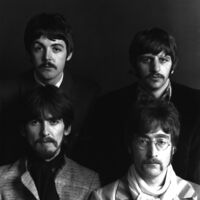
FRANCIS SCHAEFFER ANALYZES ART AND CULTURE PART 104 A look at the BEATLES as featured in 7th episode of Francis Schaeffer film HOW SHOULD WE THEN LIVE? Part B “The church with its liberal theology has left a vacuum.” The Fab Four were victims of religious liberalism and as a result were constantly searching for values!! (Artist featured today is Richard Hamilton)


Sadly the Beatles were involved in a liberal church that had left historic Biblical truth behind and as a result they were left searching for  meaning and values and this can be seen clearly throughout their lives and music.

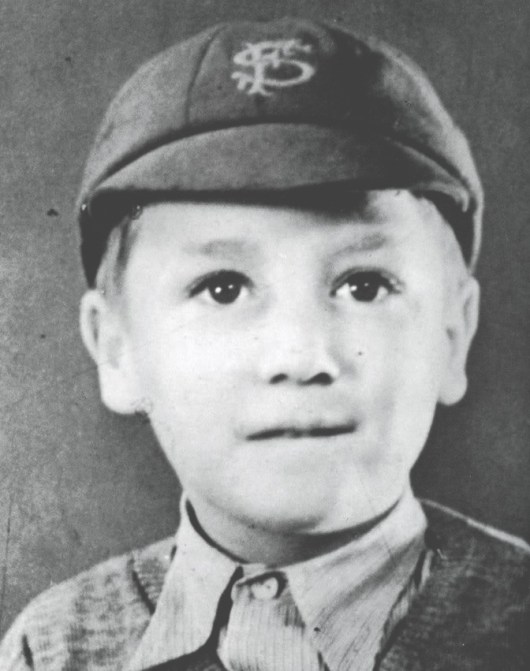
(John Lennon as a child below)

Wikipedia asserts, “Lennon attended St. Peter’s Anglican church. He sang in the choir, attended Sunday School and joined the Bible Class. He was confirmed at the age of fifteen of his own free will.[3]

(In the picture below Paul McCartney (top left) pictured in 1952 auditioning to become a choir boy)

On ST PETER’S ANGLICAN CHURCH’S website you will find this picture and words:

Beatles meeting

The Beatles Connection

“Almost certainly the most important meeting in popular music history” is how the first meeting of John Lennon and Paul McCartney has recently been described…
_____________________

Wikipedia notes, On 6 July 1957, John Lennon first met Paul McCartney in the church hall of ST PETER’S ANGLICAN CHURCH in Liverpool when Lennon was playing with his group, The Quarrymen. Later McCartney joined the group, which later became The Beatles. In the churchyard of St Peter’s is the grave of Eleanor Rigby, who became the subject for one of The Beatles’ songs. Also in the churchyard is the grave of Lennon’s uncle, George Toogood Smith, with whom he lived as a child.[4]

ST PETER’S ANGLICAN CHURCH’S Churchyard pictured below with the famous ELEANOR RIGBY gravestone:


Eleanor Rigby-The Beatles


The Quarrymen performing in Rosebery Street, Liverpool on 22 June 1957. [1] (Left to right: Hanton, Griffiths, Lennon, Garry, Shotton, and Davis)

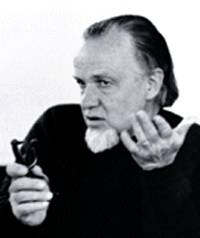
Francis Schaeffer pictured below:


Francis Schaeffer noted, “The church is to blame because the church with its liberal theology has left a vacuum.” In other words, many churches such as  ST PETER’S ANGLICAN CHURCH in Liverpool left their previous belief that the Bible is historical correct and is trustworthy and they no longer looked at the Bible as their ultimate authority in all of life. HOWEVER, NOT ALL ANGLICAN CHURCHS HAVE EMBRACED HUMANISM AND RELIGIOUS LIBERALISM.  Back in the 1970’s I read the book “Basic Christianity” by John Stott, longtime rector (pastor) of All Souls Church, Langham Place, in London. While in London in 1979 I had the opportunity to attend a Tuesday evening prayer meeting where there were about 40 people and I got to hear John Stott speak. I was so thrilled to get to hear him speak in person.

John Stott attended his local church, All Souls, Langham Place (www.allsouls.org) in London’s West End, since he was a small boy. Indeed one of his earliest memories is of sitting in the gallery and dropping paper pellets onto the fashionable hats of the ladies below! Following his ordination in 1945 John Stott became assistant curate at All Souls and then, unusually, was appointed rector in 1950. He became rector emeritus in 1975, a position he held to the end of his life.
“Sergeant Pepper’s Lonely Hearts Club Band, became the rallying cry for young people throughout the world. It expressed the essence of their lives, thoughts and their feelings…” Francis Schaeffer (1912-1984). We take a look today at how the Beatles were featured in Schaeffer’s film.

_

Image result for beatles

The Beatles – In my Life

Published on Feb 25, 2011

Image result for beatles

Here Comes The Sun – The Beatles Tribute

Not sung by George but good nonetheless!!

Francis Schaeffer’s favorite album was SGT. PEPPER”S and he said of the album “Sergeant Pepper’s Lonely Hearts Club Band…for a time it became the rallying cry for young people throughout the world. It expressed the essence of their lives, thoughts and their feelings.”  (at the 14 minute point in episode 7 of HOW SHOULD WE THEN LIVE? ) 

Image result for francis schaeffer how should we then live

How Should We Then Live – Episode Seven – 07 – Portuguese Subtitles

Francis Schaeffer

Image result for francis schaeffer

_

_

Image result for beatles

The Beatles – Revolution

Published on Oct 20, 2015

Image result for beatles
_

The drug culture and the mentality that went with it had it’s own vehicle that crossed the frontiers of the world which were otherwise almost impassible by other means of communication. This record,  Sergeant Pepper’s Lonely Hearts Club Band, became the rallying cry for young people throughout the world. It expressed the essence of their lives, thoughts and their feelings. Later came psychedelic rock an attempt to find this experience without drugs. The younger people and the older ones tried drug taking but then turned to the eastern religions. Both drugs and the eastern religions seek truth inside one’s own head, a negation of reason. The central reason of the popularity of eastern religions in the west is a hope for a non-rational meaning to life and values. 

Francis Schaeffer below is holding the album Beatles’ album SGT PEP in the film series HOW SHOULD WE THEN LIVE? episode 7 “The Age of Non-Reason” in which he discusses the Beatles’ 1960’s generation and their search for meanings and values!

__

One must feel as a Christian a real sorry for these people but as far as the blame is concerned we must understand that these people who have turned to this are not to  blame, they must bear their kind of blame of individual choices but basically they are not to blame. The church is to blame because the church with its liberal theology has left a vacuum. Man beginning from himself alone was not expressed and taught in theology and in theological language. In the Renaissance men had attempted to mix Aristotle and Plato with Christianity. This attempt to combine the rationalism of the Enlightenment with Christianity is often called religious liberalism. It was embarrassed by the supernatural and often denied it entirely, for example, the resurrection of Christ from the dead. But it tried to hold on to a historical Jesus by sifting out from the New Testament all those supernatural elements which the New Testament taught about Jesus. 

(TIME Magazine Cover: Albert Schweitzer — July 11, 1949)

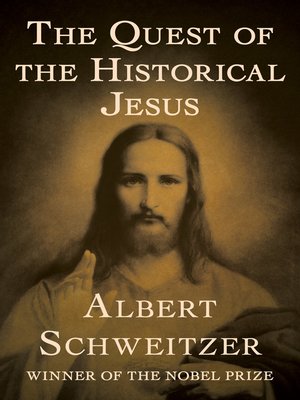
This attempt came to a climax with Albert Schweitzer’s famous book THE QUEST OF THE HISTORICAL JESUS. It failed. It failed to rid the New Testament account of the supernatural and still keep a historic Christ. The historic Jesus could not be separated from the supernatural events connected with him in New Testament. History and the supernatural are too interwoven in the New Testament. If one kept any of the historical Jesus, One had to keep some of the supernatural. If one got rid of all of the supernatural, one had no historical Jesus. 

We should remember Schweitzer’s humanitarianism in Africa, his genius as an organist and his expertise concerning Bach, but unhappily we must remember his place in the theological stream as well.

(Karl Barth pictured below)

After the failure of the older theological liberalism  Karl Barth stepped into the vacuum. He held the higher  critical views concerning the Bible, that is that the Bible has many mistakes but he taught that a religious word could break through from it. This was the theological form of existentialism after existentialism had been accepted in its secular form. One more thing was added in the area of non-reason along with all the other things that had been put there. In another way we must have admiration for the Swiss Karl Barth because when he was teaching in Germany he spoke out clearly against Nazism in his Barmen Declaration of 1934 . 

(TIME Magazine Cover: Karl Barth — Apr. 20, 1962)

The teaching of Barth led to those theologians who  said that the Bible isn’t true in the areas of science and history but they nevertheless looked for a religious experience from it, and for adherents of this theology the Bible does not give absolutes in regard to what is right or wrong either.

Before you even come to the Bible and begin to read it one must realize there are 2 ways to read the Bible. One is just one more religious thing among thousands of other religious is nothing more than another form of a trip, not very, very different actually from a drug trip. The other way is to understand that the Bible is truth and as such what we are listening to is something that is completely contrary to what here about us on every side namely merely statistical averages, relativistic things. Now having said this then I would have to guard myself for the simple reason that it doesn’t mean a person has to believe all of this before he can begin to read the Bible and find truth in the Bible.

I would just say in just passing I was not raised in a Christian family and I was reading much philosophy when I was a young man and I didn’t read the Bible because I believed it was true. I read it simply out of an intellectual honesty, but I did do one thing. I read it exactly as it was written beginning with Genesis 1:1 and going right on, I read it just as I would read another book expecting what was being given was a straight forward statement of what was meant and it wasn’t supposed to be read on a different level than that I would read in another kind of book. As I read it, it answered the questions already at that time I realized that humanistic philosophy couldn’t answer and over a six month period I came to conclude it was truth. Nevertheless, we must keep in the back of our mind how are we reading the Bible, just as another religious trip or am I really wrestling with the question of what is given in all the areas in which it speaks. Is it truth in comparison to merely relativism?

All Souls Church, Langham Place

From Wikipedia, the free encyclopedia
All Souls Church, Langham Place

All Souls’ Church
Country United Kingdom
Denomination Church of England
Churchmanship Evangelical
Website www.allsouls.org
Architecture
Architect(s) John Nash
Administration
Diocese Diocese of London
Clergy
Rector Hugh Palmer
Laity
Churchwarden(s) Martin Mills
Louise Gibson

All Souls Church is an Anglican Evangelical church in central London, situated in Langham Place in Marylebone, at the north end of Regent Street. It was designed by John Nash and consecrated in 1824.

As it is very near BBC Broadcasting House, the BBC often broadcasts from the church. As well as the core church membership, many hundreds of visitors come to All Souls, bringing the average number of those coming through the doors for services on Sundays to around 2,500 every week. All Souls has an international congregation, with all ages represented.

History[edit]

The church was designed by John Nash, favourite architect of King George IV. Its prominent circular spired vestibule was designed to provide an eye-catching monument at the point where Regent Street, newly-laid out as part of Nash’s scheme to link Piccadilly with the new Regent’s Park, takes an awkward abrupt bend westward to align with the pre-existing Portland Place.[1]

All Souls was a Commissioners’ church, a grant of £12,819 (£1,010,000 in 2016)[2] being given by the Church Building Commission towards the cost of its construction.[3] The commission had been set up under an act of 1818, and Nash, as one of the three architects employed by the Board of Works, had been asked to supply specimen designs as soon as the act was passed.[4] It was, however, one of only two Commissioners’ churches to be built to his designs, the other being the Gothic Revival St Mary, Haggerston.[5] All Souls is the last surviving church by John Nash.

The building was completed in December 1823 at a final cost of £18,323 10s 5d. and was consecrated the following year by the Bishop of London.

Photo:Interior Bomb Damage to All Souls Dec 8, 1940

Crown Appointment[edit]

The Rector of All Souls Church is still appointed by the Crown Appointments Commission at 10 Downing Street. The links with the Crown date back to the time of George IV when the Crown acquired the land around the church. The Coat of Arms adorns the West Gallery.

Mid-1970s building project[edit]

In the early 1970s excavations were carried out at All Souls and when it was discovered that the foundations to the church were some 13 feet deep, the church undertook a massive building project under the supervision of then rector, Michael Baughen (who later became Bishop of Chester, before returning to the London diocese to become an honorary assistant bishop). The decision was taken to embark on this work, to facilitate having a hall area underneath the church for the congregation and visitors to meet together after services and during the week. At the same time, the opportunity was taken to restructure the interior of the church to make it more suitable for present day forms of worship.

Organ and music[edit]

All Souls is well known for its musical tradition and part of this includes the Hunter organ installed in the west gallery in a Spanish mahogany case designed by Nash. The case was enlarged and extended in 1913. In 1940, anticipating war damage to the church, the instrument was dismantled and stored, then remodelled and rebuilt in 1951 with a new rotatable electric manual and pedal console situated in the chancel by the firm of Henry Willis (IV). The organ was again rebuilt, by Harrison & Harrison, during the building project of 1975–1976, when a four-manual was added, plus a positive division and a pronounced fanfare-trumpet en-chamade.[7]

Musical worship mixes contemporary and traditional styles, featuring either the church’s worship band, orchestra, singing group or choir at all regular Sunday services. In 1972 the All Souls Orchestra was founded by the current Director of Music, Noël Tredinnick, and has accompanied Sir Cliff Richard, Stuart Townend and many other notable Christian artists. The Orchestra and a massed choir perform annually at the Royal Albert Hall for the All Souls “Prom Praise” concert, which also tours across the UK and internationally. “Prom Praise for Schools” is sometimes held alongside Prom Praise, providing children from across the Diocese of London the chance to sing with the All Souls Orchestra. In 2012, the All Souls Orchestra celebrated its 40th anniversary, alongside special guests including Graham Kendrick, Keith and Kristyn Getty and Jonathan Veira. Tredinnick is known for his own accomplished musicianship, his engaging and inclusive style of leading and directing the regular large congregations.[citation needed]

Worship[edit]

All Souls celebrates four services each Sunday, with an early morning Holy Communion service at 8:00 am, followed by two other services at 9:30 am and 11:30 am and an evening service at 6:30 pm. There is also a midweek service on Thursdays during term time at 1:05 pm.

Sermons from Sunday services are uploaded for free streaming and download by the following Monday afternoon. The archive now contains over 3,000 sermons.

Clergy[edit]

All Souls Church interior as viewed from the balcony

The current rector is the Revd Hugh Palmer, who, as of July 2012, is also a chaplain to the queen.[8] Other clergy staff include Rico Tice, who has developed theChristianity Explored course (an introduction to Christian beliefs based on the Gospel of Mark), Roger Salisbury, Dan Wells and Mark Meynell. As a reflection of the huge diversity of the church’s congregation (over 60 nationalities represented amongst the c2500 present on Sundays), the staff team has gradually become more international (Kenya, the United States, Canada, South Africa, New Zealand, Sweden, Germany, Hungary, Korea and Ireland amongst others).

The church’s most famous former cleric was John Stott CBE, who was associated with All Souls for his entire ministry and virtually all his life. The author of more than 50 Christian books, Stott was regarded as one of the most important theologians and leaders within the evangelical movement during the 20th century.[9] Stott was acurate at All Souls from 1945-1950 and rector from 1950-1975. He resigned as rector in 1975 to pursue his wider ministry, but maintained his involvement with the church and was given the title of Rector Emeritus, which he held until his death in 2011. Stott’s obituary in Christianity Today described him as “An architect of 20th-century evangelicalism [who] shaped the faith of a generation.”[10]

The Revd Richard Bewes was rector from 1983 until his retirement in 2004. He was awarded an OBE for services to the Church of England.

______-

Uploaded by  on Aug 6, 2011

Sermon preached in the memorial service celebrating the life of the late Rev. Dr. John R. W. Stott (April 27, 1921 – July 27, 2011) by Rev. Canon Dr. James I. Packer.

Scripture: Hebrews 13:7-8
Duration: 33:25bb

[The

Hundreds packed in to John Stott’s home church of All Souls, Langham Place for his funeral, on Monday (8 August).

John Stott Funeral (edited version)

Uploaded by  on Aug 11, 2011

John Stott died on 27 July 2011 aged 90 years. This video contains highlights of his Funeral at All Souls Langham Place in London on Monday 8 August 2011. Produced and displayed with permission from John Stott’s family.
Music clips used by permission of All Souls musicians and Jubilate Hymns (www.jubilate.co.uk)

_______________

Al Molher interviewed John Stott several years ago and here is a portion of that interview:

The funeral for John R. W. Stott, one of the most famous evangelical preachers of the last century, will be held today in London at All Souls Church, Langham Place, where he served with distinction for so many decades of ministry. In honor of John Stott, I here republish an interview I conducted with the great preacher in 1987. The interview was first published in Preaching magazine, for which I was then Associate Editor.]

John R. W. Stott has emerged in the last half of the twentieth century as one of the leading evangelical preachers in the world. His ministry has spanned decades and continents, combining his missionary zeal with the timeless message of the Gospel.

For many years the Rector of All Souls Church, Langham Place, in London, Stott is also the founder and director of the London Institute for Contemporary Christianity. His preaching ministry stands as a model of the effective communication of biblical truth to secular men and women

The author of several worthy books, Stott is perhaps best known in the United States through his involvement with the URBANA conferences. His voice and pen have been among the most determinative forces in the development of the contemporary evangelical movement in the Church of England and throughout the world.

Preaching Associate Editor R. Albert Mohler interviewed Stott during one of the British preacher’s frequent visits to the United States.

Mohler: You have staked your ministry on biblical preaching and have established a world-wide reputation for the effective communication of the gospel. How do you define ‘biblical preaching’?

Stott: I believe that to preach or to expound the scripture is to open up the inspired text with such faithfulness and sensitivity that God’s voice is heard and His people obey Him. I gave that definition at the Congress on Biblical Exposition and I stand by it, but let me expand a moment.

My definition deliberately includes several implications concerning the scripture. First, it is a uniquely inspired text. Second, the scripture must be opened up. It comes to us partially closed, with problems which must be opened up.

Beyond this, we must expound it with faithfulness and sensitivity. Faithfulness relates to the scripture itself. Sensitivity relates to the modern world. The preacher must give careful attention to both.

We must always be faithful to the text, and yet ever sensitive to the modern world and its concerns and needs. When this happens the preacher can come with two expectations. First, that God’s voice is heard because He speaks through what He has spoken. Second, that His people will obey Him — that they will respond to His Word as it is preached.

Mohler: You obviously have a very high regard for preaching. In Between Two Worlds you wrote extensively of the glory of preaching, even going so far as to suggest that “preaching is indispensable to Christianity.”

We are now coming out of an era in which preaching was thought less and less relevant to the church and its world. Even in those days you were outspoken in your affirmation of the preaching event and its centrality. Has your mind changed?

Stott: To the contrary! I still believe that preaching is the key to the renewal of the church. I am an impenitent believer in the power of preaching.

I know all the arguments against it: that the television age has rendered it useless; that we are a spectator generation; that people are bored with the spoken word, disenchanted with any communication by spoken words alone. All these things are said these days.

Nevertheless, when a man of God stands before the people of God with the Word of God in his hand and the Spirit of God in his heart, you have a unique opportunity for communication.

I fully agree with Martyn Lloyd-Jones that the decadent periods in the history of the church have always been those periods marked by preaching in decline. That is a negative statement. The positive counterpart is that churches grow to maturity when the Word of God is faithfully and sensitively expounded to them.

If it is true that a human being cannot live by bread only, but by every word which proceeds out of the mouth of God, then it also is true of churches. Churches live, grow, and thrive in response to the Word of God. I have seen congregations come alive by the faithful and systematic unfolding of the Word of God.

The Beatles – Penny Lane

St Peter’s Church, Woolton

St Peter’s Church, Woolton, from the south

St Peter's Church, Woolton is located in Merseyside

St Peter's Church, Woolton
St Peter’s Church, Woolton
Location in Merseyside
Coordinates: 53.3760°N 2.8694°W
OS grid reference SJ 423 869
Location Church Road, Woolton, Liverpool,Merseyside
Country England
Denomination Anglican
Website St Peter’s, Woolton
Architecture
Status Parish church
Functional status Active
Heritage designation Grade II*
Designated 14 March 1975
Architect(s) Grayson and Ould
Architectural type Church
Style Gothic Revival (Perpendicular)
Groundbreaking 1886
Completed 1887
Specifications
Spire height 90 feet (27 m)
Materials Sandstone
Administration
Parish Much Woolton
Deanery Liverpool South Childwall
Archdeaconry Liverpool
Diocese Liverpool
Province York
Clergy
Rector Revd Canon C. J. (Kip) Crooks
Curate(s) Revd Sonya Doragh,
Revd Richard Gedge
Laity
Churchwarden(s) Helen Dennett, Norma Townley
Parish administrator
iera

St Peters Church

St Peters Church in Church Street. Liverpool one is there now. It was where the old Woolies was. it was also Liverpools cathedral for a time

Valencia

Lovely pic of St. Peter’s Church.

Do you know what that Russells building in the background was used for?

Tony Riviera

It was built as the Compton Hotel and later changed to Marks and Spencer. I’m pretty sure that only above the first floor was the hotel

Tony Riviera

Church Street 1910 with the Compton Hotel in centre. St Peters just in view on the right

Tony Riviera

St Peters church during demolition 1922. Compton Hotel in background

Tony Riviera

A nice view of St Peters church, Church Street. It was standing in as Liverpools cathedral until the Anglican was built. That’s why it was called the Pro Cathedral

Tony Riviera

_____________

“Eleanor Rigby” is a song about loneliness and depression representing a departure from the Beatles’ early pop love songs.

This is an early example of the Beatles taking risks and dabbling in other genres; in this particular its baroque pop, as made evident by the string arrangements. During the Beatles’ experimental phase, their producer George Martin experimented with studio techniques to satiate the Beatles’ artistic desires. To achieve the aggressive punchy sound of the strings, Martin had the microphones set up really close to the instruments, much to the chagrin of the session players, who were not used to such a unique set-up.

St Peters Pro cathedral, Church Street 1908.Compton Hotel in the background

Tony Riviera

Eleanor Rigby-The Beatles

Another view of St Peters

No one remembered Eleanor Rigby enough to come to her funeral.

Eleanor Rigby – PAUL McCARTNEY

The Beatles Cartoon – Eleanor Rigby.

Uploaded on Feb 21, 2012

Ah, look at all the lonely people

Eleanor Rigby picks up the rice in the church where a
wedding has been
Lives in a dream
Waits at the window, wearing the face that she keeps
in a jar by the door
Who is it for?

All the lonely people
Where do they all come from?
All the lonely people
Where do they all belong?

Father McKenzie writing the words of a sermon that
no one will hear
No one comes near
Look at him working, darning his socks in the night
when there’s nobody there
What does he care?

All the lonely people
Where do they all come from?
All the lonely people
Where do they all belong?

Ah, look at all the lonely people

Eleanor Rigby died in the church and was buried along with her name
Nobody came
Father McKenzie wiping the dirt from his hands as he walks from the grave
No one was saved

All the lonely people (Ah, look at all the lonely people)
Where do they all come from?
All the lonely people (Ah, look at all the lonely people)
Where do they all belong?

The last photograph of John Lennon

In this last photo of John Lennon while he was alive, he was signing an album to the person who was to assassinate him a few hours later. John obligingly signed a copy of his latest album Double Fantasy on the morning of his death for his killer. Later that same day, John returned from the recording studio and was gunned down by Mark David Chapman. Morbidly, a photographer later sneaked into the morgue containing John’s body and snapped a photo of it before it was cremated. John’s body was cremated the day after his assassination. Yoko Ono has never revealed the whereabouts of the ashes or what she did with them.

John Lennon  loved the B52’s

Lennon heard Rock Lobster by the B-52’s in 1979 while in a disco in Bermuda. He instantly recognized Cindy Wilson’s scream at the end of the song as an homage to Yoko Ono. After that moment, he and Yoko listened to the B-52’s album again and again while working on their Double Fantasy album.

Right before his death, Lennon had said that The B-52s’ debut album was his favorite album of all time.

The cover art for The B-52’s by The B-52’s.

The B-52’s – “Rock Lobster” (Official Music Video)

(Francis Schaeffer pictured below)

_

______

________________________

Today featured artist is Richard Hamilton

RICHARD HAMILTON, BRYAN FERRY.mov

Richard Hamilton: British visionary

Richard Hamilton has a new show at the Serpentine, but the Pop Art pioneer’s fame has never matched his extraordinary influence.

If anyone deserves the title of Grand Old Man of British art, it is Richard Hamilton. He may have turned 88 last week, but he is still hard at work: he recently completed three large paintings for a new solo exhibition opening at the Serpentine Gallery in London on Wednesday.

Yet, despite a distinguished career in which he has represented Britain at the 1993 Venice Biennale and enjoyed not one, but two retrospectives at the Tate Gallery, Hamilton is not known by the wider public in the same way as, say, David Hockney or Lucian Freud. As Hamilton’s artist wife Rita Donagh says, when I meet them both at the Serpentine, “Richard is the only [established] British artist who hasn’t had a book written about him.”

Whether or not this is entirely accurate, you get the gist: Hamilton is not a household name. And, given his many singular achievements (he even designed the spare sleeve for the Beatles’ 1968 White Album), this fact is both curious and a travesty.

“I have a concept of being rejected for most of my life,” Hamilton tells me, with a smile. “When I had a show at the Tate in 1992 [his last London exhibition], it was rated the worst show of the year. And I felt rather proud of that, really – I’d come out on top for something at last. But I’ve always felt the same way: I never did anything that anybody else wanted.”

This was especially true during the mid-Fifties, when Hamilton pioneered Pop art, ahead, he says, of British contemporaries such as Eduardo Paolozzi or his American counterparts Jasper Johns, Robert Rauschenberg, Roy Lichtenstein and Andy Warhol. Indeed, Hamilton is often credited with having invented the genre. A celebrated collage from 1956, an unsurpassed analysis of the ways in which advertising can prey on unconscious desires, even features a muscleman holding a red lollipop adorned with the word “Pop”. Hamilton once famously defined modern consumer culture as “witty, sexy, gimmicky, glamorous, big business”.

Like many prophets, Hamilton feels that he was working in isolation half a century ago. “I felt alone,” he tells me. “In the late Fifties, I made three pictures: Hommage à Chrysler Corporation, Pin-up [now in the collection of New York’s Museum of Modern Art, which dates it 1961], and Hers is a Lush Situation. They were the three best things I’ve ever done. I was really inventing something, and it was quite a serious business. At the time, nobody was doing anything like that. I didn’t have any support from other artists. There weren’t other artists. When I was painting those pictures, I asked [the art critic] Lawrence Alloway: ‘What do you think of my paintings?’ And he said: ‘I think they’re stupid.’?”

Over the decades that followed, though, Hamilton’s work proved prescient and incredibly influential. For four years, he taught at the Royal College of Art, where he was an early supporter of David Hockney and R?B Kitaj.

“The students asked me to do what’s called a ‘crit’,” he recalls. “After I’d looked at everything, I said I’m interested in this painting, and that one – one was by Hockney, the other by Kitaj. I even asked if they were by the same artist. And there was a snigger – because, in the students’ minds, Hockney was copying what Kitaj did.

“Hockney’s work was very painterly and colourful, and rather brash. Kitaj’s was lower key. In the end, I gave the prize to Hockney – and he has never looked back. He once said that I gave him his first pat on the back, and that changed his life. And I have always felt perhaps I made the wrong decision.”

Does it bother Hamilton that Hockney has gone on to achieve greater fame than he has? “No, I like him,” Hamilton says. “But I think he’s not as good as his enthusiasts claim. I don’t complain about anything, really. I’ve had a very successful life.”

His work has not gone unacknowledged: he once declined a CBE. “Instead, about 20 years ago, I was given a card that admits me to the National Gallery at any time of the day or night,” Hamilton says. “I remember going to see a Mantegna exhibition. I sat for half an hour in front of these wonderful paintings. There were no interruptions, not even a guard walking past. Now, that’s a reward.”

  • ‘Richard Hamilton: Modern Moral Matters’ is at the Serpentine Gallery, London W2 (020 7402 6075), from Wed

Richard Hamilton (artist)

From Wikipedia, the free encyclopedia
Richard Hamilton
Richard Hamilton Artist.jpg

Richard Hamilton, 1992
Born 24 February 1922
Pimlico, London, England
Died 13 September 2011 (aged 89)
London, England
Nationality British
Education Royal Academy
Slade School of Art
University College, London
Known for Collage, painting, graphics
Notable work Just what is it that makes today’s homes so different, so appealing?
Movement Pop Art

Richard William Hamilton CH (24 February 1922 – 13 September 2011) was an English painter and collage artist. His 1955 exhibition Man, Machine and Motion (Hatton Gallery, Newcastle upon Tyne) and his 1956 collage, Just what is it that makes today’s homes so different, so appealing?, produced for the This Is Tomorrow exhibition of the Independent Group in London, are considered by critics and historians to be among the earliest works of pop art.[1] A major retrospective of his work was at Tate Modern until May 2014.[2]

Early life[edit]

Hamilton was born in Pimlico, London.[3] Despite having left school with no formal qualifications, he managed to gain employment as an apprentice working at an electrical components firm, where he discovered an ability for draughtsmanship and began to do painting at evening classes at Saint Martin’s School of Art. This led to his entry into the Royal Academy Schools.

After spending the war working as a technical draftsman, he re-enrolled at the Royal Academy Schools but was later expelled on grounds of “not profiting from the instruction”, loss of his student status forcing Hamilton to carry out National Service. After two years at the Slade School of Art, University College, London, Hamilton began exhibiting his work at the Institute of Contemporary Arts (ICA), where he also produced posters and leaflets and teaching at the Central School of Art and Design.[citation needed]

1950s and 1960s[edit]

Hamilton’s early work was much influenced by D’Arcy Wentworth Thompson‘s 1917 text On Growth and Form. In 1952, at the first Independent Group meeting, held at the ICA, Hamilton was introduced to Eduardo Paolozzi‘s seminal presentation of collages produced in the late 1940s and early 1950s that are now considered to be the first standard bearers of Pop Art.[1][4] Also in 1952, he was introduced to the Green Box notes of Marcel Duchamp through Roland Penrose, whom Hamilton had met at the ICA. At the ICA, Hamilton was responsible for the design and installation of a number of exhibitions including one on James Joyce and The Wonder and the Horror of the Human Head that was curated by Penrose. It was also through Penrose that Hamilton met Victor Pasmore who gave him a teaching post based in Newcastle Upon Tyne which lasted until 1966. Among the students Hamilton tutored at Newcastle in this period were Rita Donagh, Mark Lancaster, Tim Head, Roxy Musicfounder Bryan Ferry and Ferry’s visual collaborator Nicholas De Ville. Hamilton’s influence can be found in the visual styling and approach of Roxy Music. He described Ferry as “his greatest creation”.[5]

Hamilton gave a 1959 lecture, “Glorious Technicolor, Breathtaking Cinemascope and Stereophonic Sound”, a phrase taken from a Cole Porter lyric in the 1957 musical Silk Stockings. In that lecture, which sported a pop soundtrack and the demonstration of an early Polaroid camera, Hamilton deconstructed the technology of cinema to explain how it helped to create Hollywood’s allure. He further developed that theme in the early 1960s with a series of paintings inspired by film stills and publicity shots.[6]

The post at the ICA also afforded Hamilton the time to further his research on Duchamp, which resulted in the 1960 publication of a typographic version of Duchamp’s Green Box, which comprised Duchamp’s original notes for the design and construction of his famous work The Bride Stripped Bare by Her Bachelors, Even, also known as The Large Glass. Hamilton’s 1955 exhibition of paintings at the Hanover Gallery were all in some form a homage to Duchamp. In the same year Hamilton organized the exhibition Man Machine Motion at the Hatton Gallery in Newcastle. Designed to look more like an advertising display than a conventional art exhibition the show prefigured Hamilton’s contribution to the This Is Tomorrow exhibition in London, at the Whitechapel Gallery the following year. Just what is it that makes today’s homes so different, so appealing? was created in 1956 for the catalogue of This Is Tomorrow, where it was reproduced in black and white and also used in posters for the exhibit.[7] The collage depicts a muscle-man provocatively holding a Tootsie Pop and a woman with large, bare breasts wearing a lampshade hat, surrounded by emblems of 1950s affluence from a vacuum cleaner to a large canned ham.[8] Just what is it that makes today’s homes so different, so appealing? is widely acknowledged as one of the first pieces of Pop Art and his written definition of what “pop” is laid the ground for the whole international movement.[9] Hamilton’s definition of Pop Art from a letter to Alison and Peter Smithson dated 16 January 1957 was: “Pop Art is: popular, transient, expendable, low-cost, mass-produced, young, witty, sexy, gimmicky, glamorous, and Big Business”, stressing its everyday, commonplace values.[10] He thus created collages incorporating advertisements from mass-circulation newspapers and magazines.

The success of This Is Tomorrow secured Hamilton further teaching assignments in particular at the Royal College of Art from 1957 to 1961, where he promoted David Hockney and Peter Blake. During this period Hamilton was also very active in the Campaign for Nuclear Disarmament and produced a work parodying the then leader of the Labour Party Hugh Gaitskell for rejecting a policy of unilateral nuclear disarmament. In the early 1960s he received a grant from the Arts Council to investigate the condition of the Kurt Schwitters Merzbau in Cumbria. The research eventually resulted in Hamilton organising the preservation of the work by relocating it to the Hatton Gallery in the Newcastle University.[11]

In 1962 his first wife Terry was killed in a car accident. In part to recover from her loss, in 1963 Hamilton travelled for the first time to the United States for a retrospective of the works of Marcel Duchamp at the Pasadena Art Museum,[12] where, as well as meeting other leading pop artists, he was befriended by Duchamp. Arising from this Hamilton curated the first British retrospective of Duchamp’s work, and his familiarity with The Green Box enabled Hamilton to make copies of The Large Glass and other glass works too fragile to travel. The exhibition was shown at the Tate Gallery in 1966.[citation needed]

In 1968, Hamilton appeared in a Brian De Palma film titled Greetings where Hamilton portrays a pop artist showing a “Blow Up” image. The film was the first film in the United States to receive a X rating and it was also Robert De Niro‘s first motion picture.

From the mid-1960s, Hamilton was represented by Robert Fraser and even produced a series of prints, Swingeing London, based on Fraser’s arrest, along with Mick Jagger, for possession of drugs. This association with the 1960s pop music scene continued as Hamilton became friends with Paul McCartney resulting in him producing the cover design and poster collage for the BeatlesWhite Album.[13]

1970s–2011[edit]

During the 1970s, Richard Hamilton enjoyed international acclaim with a number of major exhibitions being organised of his work. Hamilton had found a new companion in painter Rita Donagh. Together they set about converting North End, a farm in the Oxfordshire countryside, into a home and studios. “By 1970, always fascinated by new technology, Hamilton was redirecting advances in product design into fine art, with the backing of xartcollection, Zurich, a young company that pioneered the production of multiples with the aim of bringing art to a wider audience.”[14] Hamilton realised a series of projects that blurred the boundaries between artwork and product design including a painting that incorporated a state-of-the-art radio receiver and the casing of a Dataindustrier AB computer. During the 1980s Hamilton again voyaged into industrial design and designed two computer exteriors: OHIO computer prototype (for a Swedish firm named Isotron, 1984) and DIAB DS-101 (for Dataindustrier AB, 1986). As part of a television project, 1987 BBC series Painting with Light[15] Hamilton was introduced to the Quantel Paintbox and has since used this or similar devices to produce and modify his work.[citation needed]

From the late 1970s Hamilton’s activity was concentrated largely on investigations of printmaking processes, often in unusual and complex combinations.[10] In 1977-8 Hamilton undertook a series of collaborations with the artist Dieter Roth that also blurred the definitions of the artist as sole author of their work.

In 1992, Richard Hamilton was commissioned by the BBC to recreate his famous art piece, Just What Is It That Makes Today’s Homes So Different, So Appealing? but only this time, as to what he felt the average household would be like during the 1990s. Instead of the male body builder, he used an accountant working at a desk. Instead of the female icon, he used a world class female body builder.

In 1981 Hamilton began work on a trilogy of paintings based on the conflict in Northern Ireland after watching a television documentary about the “Blanket” protest organized by IRA prisoners in Long Kesh Prison, officially known as The Maze. The citizen (1981–83) shows IRA prisoner Hugh Rooney portrayed as Jesus, with long flowing hair and a beard. Republican prisoners had refused to wear prison uniforms, claiming that they were political prisoners. Prison officers refused to let “the blanket protesters” use the toilets unless they wore prison uniforms. The republican prisoners refused, and instead smeared the excrement on the wall of their cells. Hamilton explained (in the catalogue to his Tate Gallery exhibition, 1992), that he saw the image of “the blanket man as a public relations contrivance of enormous efficacy. It had the moral conviction of a religious icon and the persuasiveness of the advertising man’s dream soap commercial – yet it was a present reality”.[citation needed] The subject (1988–89) shows an Orangeman, a member of an order dedicated to preserve Unionism in Northern Ireland. The state (1993) shows a British soldier on a “foot” patrol on a street. The citizen was shown as part of “A Cellular Maze”, a 1983 joint exhibition with Donagh.[16]

From the late 1940s Richard Hamilton was engaged with a project to produce a suite of illustrations for James Joyce’s Ulysses.[citation needed] In 2002, the British Museum staged an exhibition of Hamilton’s illustrations of James Joyce’s Ulysses, entitled Imaging Ulysses. A book of Hamilton’s illustrations was published simultaneously, with text by Stephen Coppel. In the book, Hamilton explained that the idea of illustrating this complex, experimental novel occurred to him when he was doing his National Service in 1947.[citation needed] His first preliminary sketches were made while at the Slade School of Art, and he continued to refine and re-work the images over the next 50 years. Hamilton felt his re-working of the illustrations in many different media had produced a visual effect analogous to Joyce’s verbal techniques. The Ulysses illustrations were subsequently exhibited at the Irish Museum of Modern Art (in Dublin) and the Museum Boijmans van Beuningen (inRotterdam). The British Museum exhibition coincided with both the 80th anniversary of the publication of Joyce’s novel, and Richard Hamilton’s 80th birthday.

Hamilton died on 13 September 2011, at the age of 89.[17] His work Le chef d’oeuvre inconnu – a painting in three parts, unfinished at his death, comprises a trio of large inkjet prints composed from Photoshop images to visualize the moment of crisis in Balzac’s novel The Unknown Masterpiece.[18]

Exhibitions[edit]

The first exhibition of Hamilton’s paintings was shown at the Hanover Gallery, London, in 1955. In 1993 Hamilton represented Great Britain at the Venice Biennale and was awarded the Golden Lion.[19] Major retrospective exhibitions have been organized by the Tate Gallery, London, 1970 and 1992, Solomon R. Guggenheim Museum, New York, 1973, MACBA, Barcelona, Museum Ludwig, Cologne, 2003, and the Neue Nationalgalerie, Berlin, 1974. Some of the group exhibitions Hamilton participated in include: Documenta 4, Kassel, 1968; São Paulo Art Biennial, 1989; Documenta X, Kassel 1997; Gwangju Biennale, 2004; and Shanghai Biennale, 2006. In 2010, the Serpentine Gallery presented Hamilton’s ‘Modern Moral Matters’, an exhibition focusing on his political and protest works which were shown previously in 2008 at Inverleith House, Royal Botanic Garden in Edinburgh. For the season 2001/2002 in the Vienna State Opera Richard Hamilton designed the large scale picture (176 sqm) “Retard en Fer – Delay in Iron” as part of the exhibition series “Safety Curtain”, conceived by museum in progress.[20] Just the week prior to his death the artist was working with the Museo Nacional Centro de Arte Reina Sofía, Madrid, to prepare a major museum retrospective of his oeuvre that had already been scheduled to open first at Tate Modern, London, on 13 February 2014, travelling later to Madrid where it will open on 24 June 2014.[21]

In 2011 Dublin City Gallery The Hugh Lane showed a joint retrospective exhibition of both Hamilton’s and Rita Donagh‘s work called “Civil Rights etc.” That same year, the Minneapolis Institute of Arts showcased Hamilton’s work in Richard Hamilton: Pop Art Pioneer, 1922-2011. The National Gallery’s “Richard Hamilton: The Late Works” opened in 2012.[18] A major retrospective at Tate Modern in 2014 was “the first retrospective to encompass the full scope of Hamilton’s work, from his early exhibition designs of the 1950s to his final paintings of 2011. [The] exhibition explores his relationship to design, painting, photography and television, as well as his engagement and collaborations with other artists” .[2]

Collections[edit]

The Tate Gallery has a comprehensive collection of Hamilton’s work from across his career.[citation needed] In 1996, the Kunstmuseum Winterthur received a substantial gift of Hamilton’s prints, making the museum the largest repository of the artist’s prints in the world.[12]

Recognition[edit]

Hamilton was awarded the William and Noma Copley Foundation Award, 1960; the John Moores Painting Prize, 1969; the Talens Prize International, 1970; the Leone d’Oro for his exhibition in the British Pavilion at the Venice Biennale, 1993; the Arnold Bode Prize at Documenta X, Kassel, 1997; and the Max Beckmann Prize for Painting of the City of Frankfurt, 2006. He was made a Member of the Order of the Companions of Honour (CH) in 2000. He was presented with a special award by The Bogside Artists of Derry at the Royal College of Art in 2010.

Art market[edit]

Hamilton has been represented by The Robert Fraser Gallery. The Alan Cristea Gallery in London is the distributor of Hamilton’s prints.[22] His auction record is £440,000, set at Sotheby’s, London, in February 2006, for Fashion Plate, Cosmetic Study X (1969)[23] For a 2014 retrospective at the Museo Nacional Centro de Arte Reina Sofía, the government-owned museum insured 246 works of Hamilton for 115.6 million euros ($157 million) against loss or damage, according to an order published as law by the Ministry of Education, Culture and Sports.[24]

_

BRITISH POP ART PIONEERS

This autumn Christie’s auction house will be showcasing the Pioneers of British Pop Art in the first UK exhibition devoted to these international innovators since a touring show from Germany visited York in 1976. We’re taking the opportunity to introduce some of the fantastic early British pop artists, whose achievements have often been overlooked.

Christie’s head of postwar and contemporary art Frances Outred has said that early British pop art is crying out for serious appraisal, “What’s really interesting here is that it’s not like the British were second – they were the first. Britain invented the term Pop Art and it is now a global phenomenon which is known principally as an American phenomenon.”

The Christie’s exhibition, titled ‘Britain Went Pop!’, will show how British artists went on to influence the big American pop artists such as Andy Warhol and Roy Lichtenstein, “As the Americans became more and more popular and strong it seems the Brits became a bit more shy and went more esoteric”, Outred explained.

Christie’s have been working with living artists such as Peter Blake and Allen Jones and the families of other artists to showcase over 70 works, many of which have not been since the 1960s, if at all. One of the earliest works will be a 1948 proto-pop art collage by Eduardo Paolozzi. Whilst the British pop artists were mostly men, the exhibition will also feature the work of two women artists, Jann Haworth and Pauline Boty, who were both innovators of the international movement.

Here’s an introduction to some of the renowned and lesser known British artists who led the way in the cutting-edge exploration of the paradoxical imagery of popular culture. Meet the forgotten women, the father, the godfather and the king of Pop Art…

RICHARD HAMILTON

Richard Hamilton is regarded by many as the father of Pop Art. His best known work was his 1956 collage ‘Just What is it That Makes Today’s Homes so Different, so Appealing?’, considered by some historians to mark the birth of the pop art movement.

Hamilton is credited with coining the phrase ‘pop art’ itself. In words dating from 1957, that are seen as prescient of the likes of Andy Warhol and Damien Hirst, he wrote, “Pop art is popular (designed for a mass audience), transient (short term solution), expandable (easily forgotten), low cost, mass produced, young (aimed at youth), witty, sexy, gimmicky, glamorous, big business.”

Hamilton hung out with the musicians of the Sixties; his silkscreen ‘Swingeing London’ shows Mick Jagger in the back of a police car and Paul McCartney asked him to design The Beatles’ ‘White Album’ sleeve. René Magritte andMarcel Duchamp were among his close friends and David Hockney and Peter Blake were among those he taught and influenced.

PETER BLAKE

During the late 1950s, Peter Blake became one of the best known pioneers of British pop art. Studying at the Royal College of Art (1953-7), he was placed in the centre of Swinging London and came into contact with the leading figures of popular culture.

He came to wider public attention when, along with Pauline Boty, Derek Boshier and Peter Philips, he featured in Ken Russell’s ‘Monitor’ film on pop art, ‘Pop Goes the Easel’ (broadcast on the BBC in 1962). Blake’s art captured the effervescent and optimistic ethos of the sixties and reflected his fascination with icons and the ephemera of popular culture.

The ‘Godfather of Pop Art’ is best known for co-creating the sleeve design for the Beatle’s ‘Sgt. Pepper’s Lonely Hearts Club Band’ with fellow pop art pioneer Jan Howarth. Still creating exceptional artwork today, he continues to explore the beauty to be found in everyday objects.

GERALD LAING

Gerald Laing loomed large in the British pop art movement, helping to define the 1960s with huge canvases based on newspaper photographs of famous models, astronauts and film stars. His portrait of Brigitte Bardot is one of his most famous works.

Laing’s earliest pop art pieces presented young starlets or bikini-clad beauties bursting with sex appeal, capturing the excitement and exuberance of the 1960s. His work frequently commented on current events, such as the painting ‘Souvenir’ (1962), a response to the Cuban missile crisis which used a 3D effect allowing the viewer to see Khruschev from one side and Kennedy from the other.

At the end of his third year at St Martin’s (1963) he spent the summer in New York, having been given introductions to Andy Warhol, Roy Lichtenstein, James Rosenquist and Robert Indiana, all of whom were still on the brink of fame. Indiana employed him as a studio assistant and Andy Warhol became a friend and lifelong influence.

ALLEN JONES

Allen Jones is one of the most renowned British pop sculptors. While living in New York (1964-5) he discovered a rich fund of imagery in the sexually motivated popular illustrations of the 1940s and 1950s. Henceforth, in paintings such as ‘Perfect Match’, he made explicit previously subdued eroticism. The full extent of his Pop sensibility emerged in sexually provocative fibreglass sculptures such as ‘Chair’ (1969), life-size images of women as furniture with fetishist and sado-masochist overtones.

In the late 1950s Jones studied at the Royal College of Art with David Hockney and R.B.Kitaj. He credits Richard Hamilton, Eduardo Paolozzi and the writer Lawrence Alloway for introducing him to new ways of thinking about representation. Living on the Kings Road in the 60s and 70s he witnessed the liberation of the body and socio-political situation that followed the austerity of the post war years. These things fed into his artwork and with the passage of time his sculptures now encapsulate the spirit of swinging London.

PAULINE BOTY

Pauline Boty was a founder of British pop art and the only female painter in the British wing of the movement. She has been described by the Independent as “the heartbreaker of the Sixties art scene.” In 1959, she entered the Royal College of Art (a year ahead of Boshier, David Hockney and Allen Jones).

Boty, who died in 1966 aged just 28, was a key player in the frenetic Swinging London social scene; she was reportedly loved by countless men including Peter Blake, she escorted Bob Dylan around London on his first visit to Britain, and was a dancer on ‘Ready Steady Go!’. Her work was, in the pop art manner, uncompromising, sensational, gaudy, and frequently explicitly sexual. Her rebellious art, combined with her free-spirited lifestyle, made her a herald of 1970s feminism.

JANN HAWORTH

Although Jann Haworth is an American born artist she spent many years living in England, moving to London in 1961 to study art history at the Courtauld Institute of Art and studio art at the Slade. She experimented with sewn and stuffed soft sculptures which often contained specific references to American culture, for examples her dummies of Mae West and Shirley Temple. Her use of soft materials was unprecedented at the time and she soon became an innovative leading figure of the British pop art movement.

Haworth married Peter Blake, with whom she created the iconic album cover design of The Beatles’ ‘Sgt Pepper’s Lonely Hearts Club Band’. The original concept was to have The Beatles dressed in their new “Northern brass band” uniforms appearing at an official ceremony in a park. For the great crowd gathered at this imaginary event, John Lennon, Paul McCartney, and George Harrison, as well as Haworth and Blake all submitted a list of characters they wanted to see in attendance. Blake and Haworth then pasted life-size, black-and-white photographs of all the approved characters onto hardboard, which Haworth subsequently hand-tinted. Haworth also added several cloth dummies to the assembly, including one of her “Old Lady” figures and a Shirley Temple doll who wears a ‘Welcome The Rolling Stones’ sweater. Inspired by the municipal flower-clock in Hammersmith, West London, Haworth came up with the idea of writing out the name of the band in civic flower-bed lettering.

JOE TILSON

The Telegraph has declared Joe Tilson “the forgotten king of British pop art” He was one of the first in the group of young art stars to have a highly successful show in the Swinging Sixties (1961). “I was famous before the Beatles and Hockney,” Tilson says.

Following national service, he studied alongside Frank Auerback, Leon Kossoff and Peter Blake at the Royal College of Art. Part of the gilded circle, he made lasting friendships with Blake and David Hockney. He responded quickly to the emergence of pop art, adapting his earlier, highly formalised abstract language to the creation of objects reminiscent of children’s toys in their construction, bold colours and schematised imagery.

‘Britain Went Pop!’ will also be showcasing work by David Hockney, Patrick Caulfield, R.B. Kitaj, Colin Self, Clive Barker, Derek Boshier, Antony Donaldson, Jann Haworth, Nicholas Monro, Eduardo Paolozzi, Peter Phillips and Richard Smith.

_______________

Image result for sergent peppers album cover

Francis Schaeffer’s favorite album was SGT. PEPPER”S and he said of the album “Sergeant Pepper’s Lonely Hearts Club Band…for a time it became the rallying cry for young people throughout the world. It expressed the essence of their lives, thoughts and their feelings.”  (at the 14 minute point in episode 7 of HOW SHOULD WE THEN LIVE? ) 

Image result for francis schaeffer how should we then live

How Should We Then Live – Episode Seven – 07 – Portuguese Subtitles

Francis Schaeffer

Image result for francis schaeffer

______

FRANCIS SCHAEFFER ANALYZES ART AND CULTURE PART 202 the BEATLES’ last song FREE AS A BIRD (Featured artist is Susan Weil )

February 15, 2018 – 1:45 am

FRANCIS SCHAEFFER ANALYZES ART AND CULTURE Part 200 George Harrison song HERE ME LORD (Featured artist is Karl Schmidt-Rottluff )

FRANCIS SCHAEFFER ANALYZES ART AND CULTURE PART 184 the BEATLES’ song REAL LOVE (Featured artist is David Hammonds )

FRANCIS SCHAEFFER ANALYZES ART AND CULTURE Part 170 George Harrison and his song MY SWEET LORD (Featured artist is Bruce Herman )

FRANCIS SCHAEFFER ANALYZES ART AND CULTURE Part 168 George Harrison’s song AWAITING ON YOU ALL Part B (Featured artist is Michelle Mackey )

FRANCIS SCHAEFFER ANALYZES ART AND CULTURE Part 167 George Harrison’s song AWAITING ON YOU Part A (Artist featured is Paul Martin)

RESPONDING TO HARRY KROTO’S BRILLIANT RENOWNED ACADEMICS!! Part 133 Louise Antony is UMass, Phil Dept, “Atheists if they commit themselves to justice, peace and the relief of suffering can only be doing so out of love for the good. Atheist have the opportunity to practice perfect piety”

FRANCIS SCHAEFFER ANALYZES ART AND CULTURE Part 166 George Harrison’s song ART OF DYING (Featured artist is Joel Sheesley )

FRANCIS SCHAEFFER ANALYZES ART AND CULTURE Part 165 George Harrison’s view that many roads lead to Heaven (Featured artist is Tim Lowly)

FRANCIS SCHAEFFER ANALYZES ART AND CULTURE Part 164 THE BEATLES Edgar Allan Poe (Featured artist is Christopher Wool)

PART 163 BEATLES Breaking down the song LONG AND WINDING ROAD (Featured artist is Charles Lutyens )

FRANCIS SCHAEFFER ANALYZES ART AND CULTURE PART 162 A look at the BEATLES Breaking down the song ALL WE NEED IS LOVE Part C (Featured artist is Grace Slick)

PART 161 A look at the BEATLES Breaking down the song ALL WE NEED IS LOVE Part B (Featured artist is Francis Hoyland )


FRANCIS SCHAEFFER ANALYZES ART AND CULTURE PART 160 A look at the BEATLES Breaking down the song ALL WE NEED IS LOVE Part A (Featured artist is Shirazeh Houshiary)

FRANCIS SCHAEFFER ANALYZES ART AND CULTURE Part 159 BEATLES, Soccer player Albert Stubbins made it on SGT. PEP’S because he was sport hero (Artist featured is Richard Land)

FRANCIS SCHAEFFER ANALYZES ART AND CULTURE Part 158 THE BEATLES (breaking down the song WHY DON’T WE DO IT IN THE ROAD?) Photographer Bob Gomel featured today!

FRANCIS SCHAEFFER ANALYZES ART AND CULTURE Part 118 THE BEATLES (Why was Tony Curtis on cover of SGT PEP?) (Feature on artist Jeffrey Gibson )

FRANCIS SCHAEFFER ANALYZES ART AND CULTURE Part 117 THE BEATLES, Breaking down the song WITHIN YOU WITHOUT YOU Part B (Featured artist is Emma Amos )

Related posts:

FRANCIS SCHAEFFER ANALYZES ART AND CULTURE Part 67 THE BEATLES (Part Q, RICHES AND LUXURIES NEVER SATISFIED THE BEATLES! ) (Feature on artist Derek Boshier )

_____________ The Beatles were looking for lasting satisfaction in their lives and their journey took them down many of the same paths that other young people of the 1960’s were taking. No wonder in the video THE AGE OF NON-REASON Schaeffer noted,  ” Sergeant Pepper’s Lonely Hearts Club Band…for a time it became the rallying cry for young people throughout […]

FRANCIS SCHAEFFER ANALYZES ART AND CULTURE Part 66 THE BEATLES (Part P, The Beatles’ best song ever is A DAY IN THE LIFE which in on Sgt Pepper’s!) (Feature on artist and clothes designer Manuel Cuevas )

  SGT. PEPPER’S LONELY HEARTS CLUB BAND ALBUM was the Beatles’ finest work and in my view it had their best song of all-time in it. The revolutionary song was A DAY IN THE LIFE which both showed the common place part of everyday life and also the sudden unexpected side of life.  The shocking […]

FRANCIS SCHAEFFER ANALYZES ART AND CULTURE Part 65 THE BEATLES (Part O, The 1960’s SEXUAL REVOLUTION was on the cover of Sgt. Pepper’s!) (Featured artist is Pauline Boty)

_ The Beatles wrote a lot about girls!!!!!! The Beatles – I Want To Hold your Hand [HD] The Beatles – ‘You got to hide your love away’ music video Uploaded on Nov 6, 2007 The Beatles – ‘You got to hide your love away’ music video. The Beatles – Twist and Shout [live] THE […]

FRANCIS SCHAEFFER ANALYZES ART AND CULTURE Part 64 THE BEATLES (Part P The Meaning of Stg. Pepper’s song SHE’S LEAVING HOME according to Schaeffer!!!!) (Featured artist Stuart Sutcliffe)

__________ Melanie Coe – She’s Leaving Home – The Beatles Uploaded on Nov 25, 2010 Melanie Coe ran away from home in 1967 when she was 15. Paul McCartney read about her in the papers and wrote ‘She’s Leaving Home’ for Sgt.Pepper’s. Melanie didn’t know Paul’s song was about her, but actually, the two did […]

FRANCIS SCHAEFFER ANALYZES ART AND CULTURE Part 63 THE BEATLES (Part O , BECAUSE THE BEATLES LOVED HUMOR IT IS FITTING THAT 6 COMEDIANS MADE IT ON THE COVER OF “SGT. PEPPER’S”!) (Feature on artist H.C. Westermann )

__________________ A Funny Press Interview of The Beatles in The US (1964) Funny Pictures of The Beatles Published on Oct 23, 2012 funny moments i took from the beatles movie; A Hard Days Night ___________________ Scene from Help! The Beatles Funny Clips and Outtakes (Part 1) The Beatles * Wildcat* (funny) Uploaded on Mar 20, […]

FRANCIS SCHAEFFER ANALYZES ART AND CULTURE Part 62 THE BEATLES (Part N The last 4 people alive from cover of Stg. Pepper’s and the reason Bob Dylan was put on the cover!) (Feature on artist Larry Bell)

_____________________ Great article on Dylan and Sergeant Pepper’s Lonely Hearts Club Band Cover: A famous album by the fab four – The Beatles – is “Sergeant peppers lonely hearts club band“. The album itself is one of the must influential albums of all time. New recording techniques and experiments with different styles of music made this […]

FRANCIS SCHAEFFER ANALYZES ART AND CULTURE Part 61 THE BEATLES (Part M, Why was Karl Marx on the cover of Stg. Pepper’s?) (Feature on artist George Petty)

__________________________ Beatles 1966 Last interview 69 THE BEATLES TWO OF US As a university student, Karl Marx (1818-1883) joined a movement known as the Young Hegelians, who strongly criticized the political and cultural establishments of the day. He became a journalist, and the radical nature of his writings would eventually get him expelled by the […]

FRANCIS SCHAEFFER ANALYZES ART AND CULTURE Part 60 THE BEATLES (Part L, Why was Aleister Crowley on the cover of Stg. Pepper’s?) (Feature on artist Jann Haworth )

____________ Aleister Crowley on cover of Stg. Pepper’s: _______________ I have dedicated several posts to this series on the Beatles and I don’t know when this series will end because Francis Schaeffer spent a lot of time listening to the Beatles and talking and writing about them and their impact on the culture of the 1960’s. […]

FRANCIS SCHAEFFER ANALYZES ART AND CULTURE Part 59 THE BEATLES (Part K, Advocating drugs was reason Aldous Huxley was on cover of Stg. Pepper’s) (Feature on artist Aubrey Beardsley)

(HD) Paul McCartney & Ringo Starr – With a Little Help From My Friends (Live) John Lennon The Final Interview BBC Radio 1 December 6th 1980 A young Aldous Huxley pictured below: _______   Much attention in this post is given to the songs LUCY IN THE SKY WITH DIAMONDS and TOMORROW NEVER KNOWS which […]

FRANCIS SCHAEFFER ANALYZES ART AND CULTURE Part 58 THE BEATLES (Part J, Why was Carl Gustav Jung on the cover of Stg. Pepper’s?) (Feature on artist Richard Merkin)

____


__________

“Woody Wednesday” ECCLESIASTES AND WOODY ALLEN’S FILMS: SOLOMON “WOULD GOT ALONG WELL WITH WOODY!” (Part 20 MIDNIGHT IN PARIS Part S Ernest Hemingway 8th part, GIL PENDER: “I’m actually a huge Mark Twain fan, I think you can even make the case that all modern American literature comes from Huckleberry Finn” )

It is amazing to me that our country is so young. I was born in 1961 and at that time Mark Twain’s daughter Clara was still living. Of course, Mark Twain had come in and left with Halley’s Comet (November 30, 1835 – April 21, 1910). It is truly baffling to me how  such a brilliant man as Mark Twain could leave this world so bitter and depressed but the Book of Ecclesiastes explained why!

In the picture below: Corey Stoll in MIDNIGHT IN PARIS alongside the real Papa Hemingway

(Ernest Hemingway in Paris circa 1928)

Actors Corey Stoll, Rachel McAdams, director Woody Allen, actors Kathy Bates and Michael Sheen attend The Cinema Society & Thierry Mugler screening of MIDNIGHT IN PARIS

HEMINGWAY:You like Mark Twain?

GIL PENDER:I’m actually a huge Mark Twain fan.I think you can even make the case that all modern American literature comes from Huckleberry Finn.-

Hemingway wrote, “All modern American literature comes from one book by Mark Twain called Huckleberry Finn. If you read it you must stop where the {Negro}  Jim is stolen from the boys. That is the real end. The rest is just cheating. But it’s the best book we’ve had. All American writing comes from that. There was nothing before. There has been nothing as good since.”

Just like Ernest Hemingway, Mark Twain looked at the world from an UNDER THE SUN perspective. Christian scholar Ravi Zacharias has noted, “The key to understanding the Book of Ecclesiastes is the term ‘UNDER THE SUN.’ What that literally means is you lock God out of a closed system, and you are left with only this world of time plus chance plus matter.”

Mark Twain as an atheist could not hope to find a lasting meaning to his life in a closed system without bringing God back into the picture. This is the same exact case with Solomon in the Book of Ecclesiastes. Three thousand years ago, Solomon took a look at life “under the sun” in his book of Ecclesiastes.

Let me show you some inescapable conclusions if you choose to live without God in the picture. Solomon came to these same conclusions when he looked at life “under the sun.”

  1. Death is the great equalizer (Eccl 3:20, “All go to the same place; all come from dust, and to dust all return.”)
  2. Chance and time have determined the past, and they will determine the future.  (Ecclesiastes 9:11-13)
  3. Power reigns in this life, and the scales are not balanced(Eccl 4:1)
  4. Nothing in life gives true satisfaction without God including knowledge (1:16-18), ladies and liquor (2:1-3, 8, 10, 11), and great building projects (2:4-6, 18-20).

Mark Twain said of his daughter Susy:

The summer seasons of Susy’s childhood were spent at Quarry Farm, on the hills east of Elmira, New York; the other seasons of the year at the home in Hartford. Like other children, she was blithe and happy, fond of play; unlike the average of children, she was at times much given to retiring within herself, and TRYING TO SEARCH OUT THE HIDDEN MEANINGS OF THE DEEP THINGS THAT MAKE THE PUZZLE AND PATHOS OF HUMAN EXISTENCE, AND IN THE AGES HAVE BAFFLED THE INQUIRER AND MOCKED HIM.

In his autobiography Twain wrote,   “Mamma, what is it all for?” asked Susy, preliminary stating the above details in her own halting language, after long brooding over them alone in the privacy of the nursery.”

“The two most important days in your life are the day you are born . . . and the day you find out why.    — Mark Twain”

(Mark Twain below with his family in 1884)

In his article “The Incomparable and Unending Mark Twain,” Vincent Valentine wrote:

Olivia Susan Clemens died of spinal meningitis. She was only 24 years old. Just as he held himself guilty for his younger brother’s death, just as he had blamed himself for the loss of his 19-month old son Langdon in 1872, Clemens now blamed himself for Susy’s death. The strain of his bankruptcy and the world lecture tour that tore his family apart were his own doings, and he was sure that together they had killed his beloved daughter. Meanwhile Livy was on a boat halfway across the Atlantic still unaware of Susy’s death. It was August 19, 1896 when he poured his heart out into a stream of letters to his wife.

Dearest Livy,
Oh my heartbroken darling. No not heartbroken yet for you still do not know. But what tidings are in store for you. What a bitter world, what a shameful world it is. I love you my darling. I wish you could have been spared this unutterable sorrow.
Samuel

Dearest Livy,
I have spent the day alone thinking bitter thoughts, sometimes only sad ones, reproaching myself for laying the foundation of all our troubles. Reproaching myself for a million things whereby I have brought misfortune and sorrow to this family. It rains all day. No, it drizzles. It is somber and dark. I would not have it otherwise. I could not welcome the sun today. Be comforted my darling. We shall have our release in time. Be comforted remembering how much hardship, grief, pain she is spared and that her heart can never be broken now for the loss of a child. I seem to see her in her coffin. I do not know in which room, in the library I hope for there she, Jean, Clara and I mostly played when they were children together and happy.
She died in our own house not in another’s. She died where every little thing was familiar and beloved. She died where she had spent all her life ’til my crimes have made her a pauper and an exile. How good it is that she got home again.
Give my love to Clara and Jean. We have that much of our fortune left.
Samuel

(Picture of Mark Twain’s brother from 1958)

Henry Clemens circa 1855

1871–1872 Moves with his family to Hartford, Connecticut. Daughter Olivia Susan Clemens (Susy) born March 19, 1872. Son Langdon dies June 2, 1872.

Mark Twain’s Wife Loses Faith

Average Rating:  [see ratings/reviews]

From what I can tell, Mark Twain was not a Christian, nor did he claim to be when he began courting Olivia Langdon. Back in Twain’s day, a man typically had to get permission from a woman’s parents before marrying her. Mark Twain had a problem, however. Olivia Langdon came from a professing Christian family that would not allow their daughter to marry an unbeliever. To overcome this obstacle, Twain took on the guise of a spiritual seeker who needed the support and prayers of Olivia’s family in order to clean up his life.

Twain, influenced by Olivia’s prodding, presumably converted. Twain wrote to his mother after his engagement to Olivia: “My prophecy was correct…[Livy] said she never could or would love me — but she set herself the task of making a Christian of me. I said she would succeed, but that in the meantime she would unwittingly dig a matrimonial pit and end by tumbling in — and lo! the prophecy is fulfilled.”

Olivia’s family was convinced Twain was a Christian and permitted the marriage. But was Twain’s conversion an illusion? One scholar insists that Twain “was a man in love, wooing a woman he hoped to marry. His ‘religious’ feelings at that time, expressed in love letters to Olivia, disappeared as soon as the nuptials were over” (www.yorku.ca/twainweb/filelist/skeptic.html).

After their wedding, Twain ridiculed Olivia’s beliefs and devotion. Soon Olivia’s optimism began to wane, and her fervent faith cooled. Eventually she forsook her religion altogether, and a deep sorrow deluged Olivia’s life. Mark Twain loved her and never meant to hurt her, but he had broken her spirit. He said, “Livy, if it comforts you to lean on your faith, do so.”

She replied sadly, “I cannot. I do not have any faith left.”

Twain often wished he could restore Olivia’s faith, hope, and optimism, but it was too late.

Susan K. Harris, “The Courtship of Olivia Langdon and Mark Twain,” Cambridge Studies in American Literature and Culture (Cambridge University Press, 1996), pp. xiii; submitted by Aaron Goerner

For 17 years Mark Twain lived in this house in Hartford, CT with his wife and children.

Mark Twain and the Problem of Evil

Over the last couple of nights, Mary and I watched a documentary on Mark Twain, directed by Ken Burns (who also brought us documentaries calledBaseball, The Civil War, and Jazz). Mark Twain has been one of my favorite authors for a while – ever since I was a teenager and read The Adventures of Tom Sawyer and Huckleberry Finn. When I lived in Prague in 2002, I was looking around my school’s English library one fall day and found a biography of him (Mr. Clemens and Mark Twain by Justin Kaplan) and all of his essays in one volume. I read both of them that year.

What fascinates me about Mark Twain is not just that he was a fantastic writer, but he led an intriguing and eventful life. He was born in a small town in Missouri, as everyone knows, and variously worked as a printer’s assistant, a riverboat captain, a prospector, and a journalist (among other things) before he began to earn money from his books. His was also a tragic life: even though he was a brilliant writer and made a comfortable living from his books, he was obsessed with investment schemes that would make him still richer. These invariably failed, and made it necessary for him to write and lecture constantly to get out of debt.

His religious views also stand out. Whenever he was struck by tragedy (like when his younger brother died, or his son or his wife), he would blame himself, and then blame God. By the time he was nearing the end of his life, he was incredibly bitter, and wrote such caustic things that his wife insisted that he not publish them until after he died.

What makes him so tragic from my point of view is that he had such a strong sense of injustice, and of right and wrong, and he was constantly aware of the failure of societies largely made up of Christians to do the right thing. But instead of condemning, for example, slavery from a Christian point of view (as many abolitionists did), he was painfully aware that slavery was also defended by Christians and chalked it up to hypocrisy. He sniffed out hypocrisy wherever it could be found – in the antebellum South, in Gilded Age New England, in the boardrooms of corporations and in the halls of political power. All too often that hypocrisy was perpetrated by people who called themselves Christians. Instead of dividing Christian ideals from Christian practice, he made sweeping judgments about God and his fellow men and women, and ended life as a bitter, angry man.

But I don’t think that Twain ever came to an honest assessment of himself. People close to him recognized that he had a constant need to be the center of attention, and that this need could make him tiresome to be around. He went to his daughter’s wedding dressed in doctor’s robes given to him by Oxford University. He paraded up and down Manhattan streets in white suits, timing his jaunts so they would take place on Sunday just after church let out so everyone could see him. By the end of his life, I think, Twain had become so self-centered and so self-righteous that not even God measured up to his standards. He sat in judgment over everyone and everything. Little surprise, then, that Twain fully expected things to go his way at all times, and became very upset when this was not the case.

I do hope, though, that he was able to make his peace with God before he died.


(Below Mark Twain and his family aboard the SS Warrimoo sailing to Australia in 1895)

(Newly weds Adrian and Joyce Rogers in the early 1950’s pictured below)

I grew up in Memphis and my home church was Bellevue Baptist and our pastor Adrian Rogers once told this story:

 Joyce and I, some years ago, had a little baby boy that died. One of those unexplained crib deaths. And our hearts ached, we went through sorrow and pain but the Lord Jesus was there, so near and so real. Joyce and I learned to depend on Him so much and grew so much in that experience. Heartache and pain indeed it was. We had never known such deep sorrow. But the Lord was so real to us. And that was in J. W., Fort Pierce where you and I know so much about, where we’ve been so much. And I was back in the hospital in the Fort Pierce Hospital a few days after we had buried our little son Phillip. And I had been visiting a man who was not a Christian. And I had been witnessing to him, trying to lead him to Jesus Christ. And he somehow had learned that our son had died. And when he saw me walk in that room, he said, “What are you doing here?” I said well, I came to see you, to visit you. He said, “What? Are you still serving God after what he did to you?” Now, you think about that. Are you still after what He did to you? I said, “Oh my friend, I want you to listen to me, and I want you to get it down big and plain and straight that the author of all suffering and sorrow and pain and death is Satan, not God. God is good. God is good. And the suffering we have in this world is because we live in a world that has been cursed with sin, and if you think that I’m going to line up against God in favor of the devil, and line up with the one who has ultimately wounded me, your so wrong.”


On February 15, 2015 at our church service at FELLOWSHIP BIBLE CHURCH in Little Rock, Arkansas, our teaching pastor Brandon Barnard told the story of my good friends Roger and Terrie Cheuvront  and the tragic death of their 19 year daughter Danaea on April 15, 2007 in a traffic accident. I was at the Funeral Home when the minister came in that very day, and I found the words of the pastor as a great comfort because we knew Danaea was in heaven. The sermon on 2-15-15 was about the time that Jesus wept at sight of his friend Lazarus’ tomb, and this 11th chapter of John had comforted Terrie Cheuvront because she knew that Jesus had felt the same pain that we have and he will eventually raise us too from the dead and her daughter Danaea is even now in heaven with Christ.

Rev Barnard actually read these words from Terri at our service: “God never intended us to experience sin and death, but sin brought about this consequence. I could be mad at death and all that it meant but the amazing thing was when I realized God’s plan then God took the anger and replaced it with His grace. It made me realize at a deeper level what God had truly done for me on the cross. He conquered sin and death for me. What amazing glorious hope he gives us. We live because He lives. Yes I am separated from my daughter now but there will be a glorious reunion.”

Let me make three points concerning the problem of evil and suffering. First, the problem of evil and suffering hit this world in a big way because of Adam and what happened in Genesis Chapter 3. Second, if there is no God then there is no way to distinguish good from evil and there will be no ultimate punishment for Hitler and Josef Mengele. (By the way Mengele never faced punishment and lived his long life out in peace.) Third. Christ came and suffered and will destroy all evil from this world eventually forever.

(Pictured below Josef Mengele )

CHARLES DARWIN ALSO SPENT A LOT OF TIME TALKING ABOUT THIS ISSUE OF EVIL AND SUFFERING. When I read the book  Charles Darwin: his life told in an autobiographical chapter, and in a selected series of his published letters, I also read  a commentary on it by Francis Schaeffer and I wanted to both  quote some of Charles Darwin’s own words to you and then include the comments of Francis Schaeffer on those words. You might want to also check out a message by  Adrian Rogers on You Tube concerning Darwinism.

Darwin, C. R. to Doedes, N. D.2 Apr 1873

“I am sure you will excuse my writing at length, when I tell you that I have long been much out of health, and am now staying away from my home for rest. It is impossible to answer your question briefly; and I am not sure that I could do so, even if I wrote at some length. But I may say that the impossibility of conceiving that this grand and wondrous universe, with our conscious selves, arose through chance, seems to me the chief argument for the existence of God; but whether this is an argument of real value, I have never been able to decide…....Nor can I overlook the difficulty from the immense amount of suffering through the world.”

Francis Schaeffer observed:

This of course is a valid problem. The only answer to the problem of evil is the biblical answer of the fall. Darwin has a problem because he never had a high view of revelation, so he doesn’t have the answer any more than the liberal theologian has the answer. If you don’t have a space-time fall then you don’t have an answer to suffering. If you have a very, very significant man at the beginning, Darwin did not have that, but if you had a very significant, wonderful man at the beginning and can change history then the fall is the possible answer that can be given to Darwin’s 2nd argument.

WITHOUT THE VIEW THAT THE GARDEN OF EDEN EXISTED OR IN THE EXISTENCE OF HEAVEN THEN there is no hope UNDER THE SUN.  FURTHERMORE,  IF WE WERE NOT CREATED BY GOD THEN WE HAVE NO HOPE FOR OUR ETERNAL FUTURES.  Remember the song  DUST IN THE WIND? It was written by Kerry Livgren of the group KANSAS which was a hit song in 1978 when it rose to #6 on the charts because so many people connected with the message of the song. It included these words, “All we do, crumbles to the ground though we refuse to see, Dust in the Wind, All we are is dust in the wind, Don’t hang on, Nothing lasts forever but the Earth and Sky, It slips away, And all your money won’t another minute buy.”

Kerry Livgren himself said that he wrote the song because he saw where man was without a personal God in the picture. Happily both Kerry Livgren and the bass player Dave Hope of Kansas became Christians eventually. Kerry Livgren first tried Eastern Religions and Dave Hope had to come out of a heavy drug addiction. I was shocked and elated to see their personal testimony on The 700 Club in 1981 and that same  interview can be seen on You Tube today. Livgren lives in Topeka, Kansas today where he teaches “Diggers,” a Sunday school class at Topeka Bible ChurchDAVE HOPE is the head of Worship, Evangelism and Outreach at Immanuel Anglican Church in Destin, Florida.

The answer to find meaning in life is found in putting your faith and trust in Jesus Christ. The Bible is true from cover to cover and can be trusted.

Is the Bible historically accurate? Here are some of the posts I have done in the past on the subject: 1. The Babylonian Chronicleof Nebuchadnezzars Siege of Jerusalem2. Hezekiah’s Siloam Tunnel Inscription. 3. Taylor Prism (Sennacherib Hexagonal Prism)4. Biblical Cities Attested Archaeologically. 5. The Discovery of the Hittites6.Shishak Smiting His Captives7. Moabite Stone8Black Obelisk of Shalmaneser III9A Verification of places in Gospel of John and Book of Acts., 9B Discovery of Ebla Tablets10. Cyrus Cylinder11. Puru “The lot of Yahali” 9th Century B.C.E.12. The Uzziah Tablet Inscription13. The Pilate Inscription14. Caiaphas Ossuary14 B Pontius Pilate Part 214c. Three greatest American Archaeologists moved to accept Bible’s accuracy through archaeology.

You can hear DAVE HOPE and Kerry Livgren’s stories from this youtube link:

(part 1 ten minutes)

(part 2 ten minutes)

Kansas – Dust in the Wind (Official Video)

Uploaded on Nov 7, 2009

Pre-Order Miracles Out of Nowhere now at http://www.miraclesoutofnowhere.com

About the film:
In 1973, six guys in a local band from America’s heartland began a journey that surpassed even their own wildest expectations, by achieving worldwide superstardom… watch the story unfold as the incredible story of the band KANSAS is told for the first time in the DVD Miracles Out of Nowhere.

_____________________________

Adrian Rogers on Darwinism

Chapters from my Autobiography by Mark TWAIN (FULL Audiobook)

This series deals with the Book of Ecclesiastes and Woody Allen films.  The first post  dealt with MAGIC IN THE MOONLIGHT and it dealt with the fact that in the Book of Ecclesiastes Solomon does contend like Hobbes  and Stanley that life is “nasty, brutish and short” and as a result has no meaning UNDER THE SUN.

The movie MIDNIGHT IN PARIS offers many of the same themes we see in Ecclesiastes. The second post looked at the question: WAS THERE EVER AGOLDEN AGE AND DID THE MOST TALENTED UNIVERSAL MEN OF THAT TIME FIND TRUE SATISFACTION DURING IT?

In the third post in this series we discover in Ecclesiastes that man UNDER THE SUN finds himself caught in the never ending cycle of birth and death. The SURREALISTS make a leap into the area of nonreason in order to get out of this cycle and that is why the scene in MIDNIGHT IN PARIS with Salvador Dali, Man Ray, and Luis Bunuel works so well!!!! These surrealists look to the area of their dreams to find a meaning for their lives and their break with reality is  only because they know that they can’t find a rational meaning in life without God in the picture.

The fourth post looks at the solution of WINE, WOMEN AND SONG and the fifth and sixth posts look at the solution T.S.Eliot found in the Christian Faith and how he left his fragmented message of pessimism behind. In the seventh post the SURREALISTS say that time and chance is all we have but how can that explain love or art and the hunger for God? The eighth  post looks at the subject of DEATH both in Ecclesiastes and MIDNIGHT IN PARIS. In the ninth post we look at the nihilistic worldview of Woody Allen and why he keeps putting suicides into his films.

In the tenth post I show how Woody Allen pokes fun at the brilliant thinkers of this world and how King Solomon did the same thing 3000 years ago. In the eleventh post I point out how many of Woody Allen’s liberal political views come a lack of understanding of the sinful nature of man and where it originated. In the twelfth post I look at the mannishness of man and vacuum in his heart that can only be satisfied by a relationship with God.

In the thirteenth post we look at the life of Ernest Hemingway as pictured in MIDNIGHT AND PARIS and relate it to the change of outlook he had on life as the years passed. In the fourteenth post we look at Hemingway’s idea of Paris being a movable  feast. The fifteenth and sixteenth posts both compare Hemingway’s statement, “Happiness in intelligent people is the rarest thing I know…”  with Ecclesiastes 2:18 “For in much wisdom is much vexation, and he who increases knowledge increases sorrow.” The seventeenth post looks at these words Woody Allen put into Hemingway’s mouth,  “We fear death because we feel that we haven’t loved well enough or loved at all.”

In MIDNIGHT IN PARIS Hemingway and Gil Pender talk about their literary idol Mark Twain and the eighteenth post is summed up nicely by Kris Hemphill‘s words, “Both Twain and [King Solomon in the Book of Ecclesiastes] voice questions our souls long to have answered: Where does one find enduring meaning, life purpose, and sustainable joy, and why do so few seem to find it? The nineteenth post looks at the tension felt both in the life of Gil Pender (written by Woody Allen) in the movie MIDNIGHT IN PARIS and in Mark Twain’s life and that is when an atheist says he wants to scoff at the idea THAT WE WERE PUT HERE FOR A PURPOSE but he must stay face the reality of  Ecclesiastes 3:11 that says “God has planted eternity in the heart of men…” and  THAT CHANGES EVERYTHING! Therefore, the secular view that there is no such thing as love or purpose looks implausible. The twentieth post examines how Mark Twain discovered just like King Solomon in the Book of Ecclesiastes that there is no explanation  for the suffering and injustice that occurs in life UNDER THE SUN. Solomon actually brought God back into the picture in the last chapter and he looked  ABOVE THE SUN for the books to be balanced and for the tears to be wiped away.

Gil Pender is saying what Woody Allen wrote into the script and he demonstrates his UNDER THE SUN point of view when he noted, “And when you think that in the cold,violent, meaningless universe…” Woody Allen is correct that without God in the picture then there is no way the books will ever be balanced and he even demonstrates that best in his 1989 film CRIMES AND MISDEMEANORS.


The Life Of Mark Twain


________

The Characters referenced in Woody Allen’s “Midnight in Paris” (Part 4 Ernest Hemingway)

The Characters referenced in Woody Allen’s “Midnight in Paris” (Part 3 Scott and Zelda Fitzgerald)

The Characters referenced in Woody Allen’s “Midnight in Paris” (Part 2 Cole Porter)

The Characters referenced in Woody Allen’s “Midnight in Paris” (Part 1 William Faulkner)

MUSIC MONDAY Cole Porter “Let’s Do it, Let’s Fall in Love” in the movie MIDNIGHT IN PARIS

_____________

__________

“Truth Tuesday” Excerpts from Francis Schaeffer book “The God who is there”

Excerpts from Francis Schaeffer book “The God who is there”

Episode VII – The Age of Non Reason

____________________

Episode 8: The Age Of Fragmentation

Published on Jul 24, 2012

Dr. Schaeffer’s sweeping epic on the rise and decline of Western thought and Culture

I love the works of Francis Schaeffer and I have been on the internet reading several blogs that talk about Schaeffer’s work and the work below was really helpful. Schaeffer’s film series “How should we then live?  Wikipedia notes, “According to Schaeffer, How Should We Then Live traces Western history from Ancient Rome until the time of writing (1976) along three lines: the philosophic, scientific, and religious.[3] He also makes extensive references to art and architecture as a means of showing how these movements reflected changing patterns of thought through time. Schaeffer’s central premise is: when we base society on the Bible, on the infinite-personal God who is there and has spoken,[4] this provides an absolute by which we can conduct our lives and by which we can judge society.  Here are some posts I have done on this series: Francis Schaeffer’s “How should we then live?” Video and outline of episode 10 “Final Choices” episode 9 “The Age of Personal Peace and Affluence”episode 8 “The Age of Fragmentation”episode 7 “The Age of Non-Reason” episode 6 “The Scientific Age”  episode 5 “The Revolutionary Age” episode 4 “The Reformation” episode 3 “The Renaissance”episode 2 “The Middle Ages,”, and  episode 1 “The Roman Age,” .

Very good:

Excerpts from

The God Who Is There

by Francis Schaeffer

(Emphasis added throughout)


“The present chasm between the generations has been brought about almost entirely by a change in the concept of truth. Wherever you look today the new concept holds the field. The consensus about us is almost monolithic, whether you review the arts, literature or just simply read the newspapers and magazines…. On every side you can feel the stranglehold of this new methodology—and by ‘methodology’ we mean the way we approach truth and knowing. … And just as fog cannot be kept out by walls or doors, so this consensus comes in around us, till the room we live in is no longer distinct, and yet we hardly realise what has happened….

        “Young people from Christian homes are brought up in the old framework of truth. Then they are subjected to the modern framework. In time they become confused because they do not understand the alternatives with which they are being presented. Confusion becomes bewilderment, and before long they are overwhelmed. This is unhappily true not only of young people, but of many pastors, Christian educators, evangelists and missionaries as well. So this change in the concept of the way we come to knowledge and truth is the most crucial problem, as I understand it, facing Christianity today.”13

If you had lived in … the United States before about 1935, you would not have had to spend much time, in practice, in thinking about your presuppositions. … What were these presuppositions? The basic one was that there really are such things as absolutes. They accepted the possibility of an absolute in the area of Being (or knowledge), and in the area of morals. Therefore, because they accepted the possibility of absolutes, though men might disagree as to what these were, nevertheless they could reason together…. So if anything was true, the opposite was false. In morality, if one thing was right, its opposite was wrong…. 14

The shift has been tremendous. Thirty or more years ago you could have said such things as ‘This is true’ or ‘This is right’, and you would have been on everybody’s wavelength. …Thus in evangelism, in spiritual matters and in Christian education, you could have begun with the certainty that your audience understood you.”14

TENDENCY TOWARDS A UNIFORM CULTURE

…the world-spirit does not always take the same form. So the Christian must resist the spirit of the world in the form it takes in his own generation. If he does not do this he is not resisting the spirit of the world at all. … It is our generation of Christians more than any other who need to heed these words which are attributed to Martin Luther:

“If I profess with the loudest voice and clearest exposition every portion of the truth of God except precisely that little point which the world and the devil are at that moment attacking, I am not confessing Christ, however boldly I may be professing Christ. Where the battle rages, there the loyalty of the soldier is proved, and to be steady on all the battlefield besides, is mere fight and disgrace if he flinches at that point.”18

HEGEL, THE DOORWAY

It was the German philosopher Hegel (1770—1831) who became the first man to open the door into the line of despair. Before his time truth was conceived on the basis of antithesis, not for any adequate reason but because man romantically acted upon it. Truth, in the sense of antithesis, is related to the idea of cause and effect. Cause and effect produces a chain reaction which goes straight on in a horizontal line. With the coming of Hegel all this changed….

What Hegel taught arrived at just the right moment of history for his thinking to have its maximum effect.’ Imagine that Hegel … said, ‘I have a new idea. From now on let us think in this way; instead of thinking in terms of cause and effect, what we really have is a thesis, and opposite is an antithesis, and the answer to their relationship is not in the horizontal movement of cause and effect, but the answer is always synthesis.’ … It has never been the same since. If one understands the development of philosophy, or morals, or political thought from that day to this, one knows that Hegel and synthesis have won. In other words, Hegel has removed the straight line of previous thought and in its place he has substituted a triangle. Instead of antithesis we have, as modem man’s approach to truth, synthesis.20

KIERKEGAARD, THE FIRST MAN BELOW

“It is often said that Søren Kierkegaard, the Dane (1813-55)… is the father of modern secular thinking and of the new theological thinking…. Why is it that Kierkegaard can so aptly be thought of as the father of both? What proposition did he add to Hegel’s thought that made the difference? Kierkegaard came to the conclusion that you could not arrive at synthesis by reason. Instead, you achieved everything of real importance by a leap of faith. So he separated absolutely the rational and logical from faith…. 21 

“…from that time on, if rationalistic man wants to deal with the real things of human life (such as purpose, significance, the validity of love) he must discard rational thought about them and make a gigantic, non-rational leap of faith. The rationalistic framework had failed to produce an answer on the basis of reason, and so all hope of a uniform field of knowledge had to be abandoned.”22

[C. S. Lewis illustrates this new thinking: Truth + myth = understanding of evolving truths. See Surprised by Joy]

“…the evolutionary humanism as a whole, which is current today, is in the same plight. Anyone can assert with all the persuasion at his command that man is due for a rosy future. But this again is a leap of faith, if there is no point of observation, either clinically or sociologically, to demonstrate that man will be better tomorrow than he was yesterday or is today.
“Sir Julian Huxley has taken such a purely optimistic answer one step further by stating that man will only be improved by accepting a new mystique. Thus he suggests that society will function better if it has a religion, even though no god really exists. For example, he says:

“From the specifically religious point of view, the desirable direction of evolution might be defined as the divinisation of existence—but for this to have operative significance we must frame a new definition of ‘the divine’ free from all connotations of external supernatural beings.
“Religion today is imprisoned in a theistic frame of ideas, compelled to operate in the unrealities of the dualistic world. In the unitary humanist frame it acquires a new look and new freedom. With the aid of our new vision it has the opportunity of escaping from the theistic impasse and of playing its proper role in the real world of unitary existence.”26-27

“Now it may be true that it can be shown by observation that society copes better with life through believing that there is a god. But, in that case, surely optimistic humanism … shows exactly the same irrational leap of faith… if in order to be optimistic, it rests upon the necessity of mankind believing and functioning on a lie.”27

THEOLOGY AND SEMANTIC MYSTICISM

Neo-orthodoxy at first glance seems to have an advantage over secular existentialism, in that it appears to have more substance in its optimistic expressions than its secular counterpart. … But in the new theology, use is made of certain religious words which have a connotation of…  meaning to those who hear them. Real communication is not in fact established, but an illusion of communication is given by employing words rich in connotations.”56

THE USE OF WORDS AND SYMBOLS

“Every word has two parts. There is the dictionary definition and there is the connotation. Words may be synonymous by definition but have completely different connotations. Therefore we find that when such a symbol as the cross is used, whether in writing or painting, a certain connotation stirs the mind of people brought up in a Christian culture, even if they have rejected Christianity. So when the new theology uses such words, without definition, an illusion of meaning is given which is pragmatically useful in arousing deep motivations….

“An illusion of communication and content is given so that, when a word is used in this deliberately undefined way, the hearer ‘thinks’ he knows what it means.” 57

“To the new theology, the usefulness of a symbol is in direct proportion to its obscurity. There is connotation, as in the word god, but there is no definition. The secret of the strength of neo-orthodoxy is that these religious symbols… give an illusion of meaning. …
“At first acquaintance this concept gives the feeling of spirituality. ‘I do not ask for answers, I just believe.’ This sounds sharply spiritual and it deceives many fine people…..  The new theology sounds spiritual and vibrant and they are trapped….

Whenever men say they are looking for greater reality, we must show them at once the reality of true Christianity. This is real because it is concerned with the God who is there and who has spoken to us about Himself, not just the use of the symbol ‘god’ or ‘christ’ which sounds spiritual but is not. The men who merely use the symbol ought to be pessimists, for the mere word god or the idea god is not a sufficient base for the optimism they display…. 

“This is the kind of ‘beievism’ which is demanded by this theology…. It is no more than a jump into an undefinable, irrational, semantic mysticism.”58

TODAY’S OPPORTUNITY FOR THE NEW THEOLOGY

“Men are facing a society without structure and they want to fill the void that has appeared. For a long time Reformation ideas formed the basis of North European culture, and this extended to include that of America and English-speaking Canada, etc. But today that has been destroyed by the relativism both inside [82] and outside the churches. Hence historic Christianity is now a minority group….       “Society cannot function without form and motivation. As the old sociological forms have been swept away, new ones must be found or society breaks down altogether. Sir Julian Huxley has stepped in at this point with his suggestion that religion has a real place in modern society. But, he would contend, it must be understood that religion is always evolving and that it needs to come under the control of society.

      “This suggestion is not as ridiculous as it sounds, even coming from a convinced humanist, if one understands the mentality of our age. The prevailing dialectical methodology fits itself easily into religious forms….
     Teilhard de Chardin… illustrates that the progressive Roman Catholic theologians are further away from historic Reformation Christianity than classical Roman Catholicism, because they are also dialectical thinkers.

     “The orthodox Roman Catholic would tell me that I am bound for hell because I reject the true Church. He is dealing with a concept of absolute truth. But the new Roman Catholic who sits at my fireside says, ‘You are all right, Dr. Schaeffer, because you are so sincere.’ In the new Roman Catholicism such a statement usually means that the dialectical method has taken over.

Therefore we are not surprised to find that … others such as Hans KUng have been strongly influenced by neo-orthodoxy. It is important to note that the position on Scripture by the Vatican Council has shifted in the same-direction and men such as Raymond Panikkar, Dom Bede Griffiths [close friend of C. S. Lewis]… are proclaiming a synthesis between Roman Catholicism and Hinduism.” 83

“The time, therefore, does seem right for this new theology to give the needed sociological forms and motivations. It is true, of course, that society could look elsewhere amongst the secular mysticisms for a new evolving religion, but the new theology has some strong advantages.
      Firstly, the undefined connotation words that they are using are deeply rooted in our Western culture. This is much easier and more powerful than using new and untraditional words.
      Secondly, these men control almost every large denomination in Protestantism…. This gives them the advantage of functioning within the organisational stream of the Church, and thus both its organisation and linguistic continuity is at their disposal.
      Thirdly, people in our culture in general are already in process of being accustomed to accept non-defined, contentless religious words and symbols, without any rational or historical control. Such words and symbols are ready to be filled with the content of the moment. The words ‘Jesus’ or ‘Christ’ are the most ready for the manipulator. The phrase ‘Jesus Christ’ has become a contentless banner which can be carried in any direction for sociological purposes.

“…because the phrase ‘Jesus Christ’ has been separated from true history and the content of Scripture, it can be used to trigger religiously motivated sociological actions directly contrary to the teaching of Christ…. It is against such manipulated semantic mysticism that we do very well to prepare ourselves, our children and our spiritual children.” 84

___________

Related posts:

Francis Schaeffer’s “How should we then live?” Video and outline of episode 10 “Final Choices” (Schaeffer Sundays)

E P I S O D E 1 0   Dr. Francis Schaeffer – Episode X – Final Choices 27 min FINAL CHOICES I. Authoritarianism the Only Humanistic Social Option One man or an elite giving authoritative arbitrary absolutes. A. Society is sole absolute in absence of other absolutes. B. But society has to be […]

Francis Schaeffer’s “How should we then live?” Video and outline of episode 9 “The Age of Personal Peace and Affluence” (Schaeffer Sundays)

E P I S O D E 9 Dr. Francis Schaeffer – Episode IX – The Age of Personal Peace and Affluence 27 min T h e Age of Personal Peace and Afflunce I. By the Early 1960s People Were Bombarded From Every Side by Modern Man’s Humanistic Thought II. Modern Form of Humanistic Thought Leads […]

Francis Schaeffer’s “How should we then live?” Video and outline of episode 8 “The Age of Fragmentation” (Schaeffer Sundays)

E P I S O D E 8 Dr. Francis Schaeffer – Episode VIII – The Age of Fragmentation 27 min I saw this film series in 1979 and it had a major impact on me. T h e Age of FRAGMENTATION I. Art As a Vehicle Of Modern Thought A. Impressionism (Monet, Renoir, Pissarro, Sisley, […]

Francis Schaeffer’s “How should we then live?” Video and outline of episode 7 “The Age of Non-Reason” (Schaeffer Sundays)

E P I S O D E 7 Dr. Francis Schaeffer – Episode VII – The Age of Non Reason I am thrilled to get this film series with you. I saw it first in 1979 and it had such a big impact on me. Today’s episode is where we see modern humanist man act […]

Francis Schaeffer’s “How should we then live?” Video and outline of episode 6 “The Scientific Age” (Schaeffer Sundays)

E P I S O D E 6 How Should We Then Live 6#1 Uploaded by NoMirrorHDDHrorriMoN on Oct 3, 2011 How Should We Then Live? Episode 6 of 12 ________ I am sharing with you a film series that I saw in 1979. In this film Francis Schaeffer asserted that was a shift in […]

Francis Schaeffer’s “How should we then live?” Video and outline of episode 5 “The Revolutionary Age” (Schaeffer Sundays)

E P I S O D E 5 How Should We Then Live? Episode 5: The Revolutionary Age I was impacted by this film series by Francis Schaeffer back in the 1970′s and I wanted to share it with you. Francis Schaeffer noted, “Reformation Did Not Bring Perfection. But gradually on basis of biblical teaching there […]

Francis Schaeffer’s “How should we then live?” Video and outline of episode 4 “The Reformation” (Schaeffer Sundays)

Dr. Francis Schaeffer – Episode IV – The Reformation 27 min I was impacted by this film series by Francis Schaeffer back in the 1970′s and I wanted to share it with you. Schaeffer makes three key points concerning the Reformation: “1. Erasmian Christian humanism rejected by Farel. 2. Bible gives needed answers not only as to […]

“Schaeffer Sundays” Francis Schaeffer’s “How should we then live?” Video and outline of episode 3 “The Renaissance”

Francis Schaeffer’s “How should we then live?” Video and outline of episode 3 “The Renaissance” Francis Schaeffer: “How Should We Then Live?” (Episode 3) THE RENAISSANCE I was impacted by this film series by Francis Schaeffer back in the 1970′s and I wanted to share it with you. Schaeffer really shows why we have so […]

Francis Schaeffer’s “How should we then live?” Video and outline of episode 2 “The Middle Ages” (Schaeffer Sundays)

  Francis Schaeffer: “How Should We Then Live?” (Episode 2) THE MIDDLE AGES I was impacted by this film series by Francis Schaeffer back in the 1970′s and I wanted to share it with you. Schaeffer points out that during this time period unfortunately we have the “Church’s deviation from early church’s teaching in regard […]

Francis Schaeffer’s “How should we then live?” Video and outline of episode 1 “The Roman Age” (Schaeffer Sundays)

Francis Schaeffer: “How Should We Then Live?” (Episode 1) THE ROMAN AGE   Today I am starting a series that really had a big impact on my life back in the 1970′s when I first saw it. There are ten parts and today is the first. Francis Schaeffer takes a look at Rome and why […]


Francis Schaeffer: “Whatever Happened to the Human Race” (Episode 5) TRUTH AND HISTORY

Francis Schaeffer: “Whatever Happened to the Human Race” (Episode 5) TRUTH AND HISTORY Published on Oct 7, 2012 by AdamMetropolis This crucial series is narrated by the late Dr. Francis Schaeffer and former Surgeon General Dr. C. Everett Koop. Today, choices are being made that undermine human rights at their most basic level. Practices once […]

Francis Schaeffer: “Whatever Happened to the Human Race” (Episode 4) THE BASIS FOR HUMAN DIGNITY

The opening song at the beginning of this episode is very insightful. Francis Schaeffer: “Whatever Happened to the Human Race” (Episode 4) THE BASIS FOR HUMAN DIGNITY Published on Oct 7, 2012 by AdamMetropolis This crucial series is narrated by the late Dr. Francis Schaeffer and former Surgeon General Dr. C. Everett Koop. Today, choices […]

Francis Schaeffer: “Whatever Happened to the Human Race” (Episode 3) DEATH BY SOMEONE’S CHOICE

Francis Schaeffer: “Whatever Happened to the Human Race” (Episode 3) DEATH BY SOMEONE’S CHOICE Published on Oct 6, 2012 by AdamMetropolis This crucial series is narrated by the late Dr. Francis Schaeffer and former Surgeon General Dr. C. Everett Koop. Today, choices are being made that undermine human rights at their most basic level. Practices […]

Francis Schaeffer: “Whatever Happened to the Human Race?” (Episode 2) SLAUGHTER OF THE INNOCENTS

Francis Schaeffer: “Whatever Happened to the Human Race?” (Episode 2) SLAUGHTER OF THE INNOCENTS Published on Oct 6, 2012 by AdamMetropolis This crucial series is narrated by the late Dr. Francis Schaeffer and former Surgeon General Dr. C. Everett Koop. Today, choices are being made that undermine human rights at their most basic level. Practices […]


Francis Schaeffer: “Whatever Happened to the Human Race” (Episode 1) ABORTION OF THE HUMAN RACE

It is not possible to know where the pro-life evangelicals are coming from unless you look at the work of the person who inspired them the most. That person was Francis Schaeffer.  I do care about economic issues but the pro-life issue is the most important to me. Several years ago Adrian Rogers (past president of […]

The following essay explores the role that Francis Schaeffer played in the rise of the pro-life movement. It examines the place of How Should We Then Live?, Whatever Happened to the Human Race?, and A Christian Manifesto in that process.

This essay below is worth the read. Schaeffer, Francis – “Francis Schaeffer and the Pro-Life Movement” [How Should We Then Live?, Whatever Happened to the Human Race?, A Christian Manifesto] Editor note: <p> </p> [The following essay explores the role that Francis Schaeffer played in the rise of the pro-life movement.  It examines the place of […]

SCHAEFFER SUNDAY The Miracle of Morality ATHEISM’S (OTHER) ACHILLES HEEL By: Eric Metaxas|Published: February 2, 2015

__________

When I think of morality it always makes me remember Francis Schaeffer and C.Everett Koop and their film series WHATEVER HAPPENED TO THE HUMAN RACE? EPISODE 4  “BASIS FOR HUMAN DIGNITY.” Here it is below followed by an excellent article by Eric Metaxas.

Francis Schaeffer pictured below:


Francis Schaeffer “BASIS FOR HUMAN DIGNITY” Whatever…HTTHR

ATHEISM’S (OTHER) ACHILLES HEEL

Can you be good if you don’t believe in God? For the simple and uncontroversial answer, stay tuned to BreakPoint.

Eric Metaxas

Last month I raised a lot of hackles by writing an op-ed in the Wall Street Journal arguing what should be obvious by now: science increasingly makes the case for God’s existence. Whether we’re talking about the finely-tuned constants of our universe, or the simple logic that dictates the cosmos had a beginning and therefore a cause, all of the signposts are pointing in one direction: up.

Of course, that didn’t stop the objections from pouring in. Bloggers and academics from all over made arguments against my piece ranging from the scientific, to the philosophical, to the downright personal. But writers far more credentialed than I in the scientific community have done a fine job refuting these objections. I’ll link you to the best of their articles at BreakPoint.org.

For now, let’s just say I’ve discovered firsthand how controversial it is to mention “science” and “God” in the same paragraph in a major American newspaper. But if you think writing what I did in the Wall Street Journal was brave, I’d like to introduce you to Pastor Rick Henderson. Last month this courageous soul dared to write a piece in the Huffington Post entitled: “Why There Is No Such Thing as a Good Atheist.” I hope he ducked.

Henderson preempted the predictable reactions by throwing down yet another gauntlet: “For those of you who are eager to pierce me with your wit and crush my pre-modern mind,” he writes, “allow me to issue a challenge. I contend that any response you make will only prove my case.”

And prove his case they did. The comment section and subsequent op-eds were a rerun of billboards that appeared around the U.K. a few years ago: there are, in fact, well-behaved atheists.

No argument there, either from Henderson or any other sensible Christian. But as apologist William Lane Craig has reminded atheists time and again, the real question isn’t “can you be good without believing in God?” but “can you be good without God?”

And as Henderson shows, the answer to that is a resounding “no.”

The fundamental tenets of atheism, he explains, make it impossible to believe in objective good or evil. If the universe arose randomly and is purely material, governed by discernible laws, both impersonal and unconscious, then universal morality is, “At best…the mass delusion shared by humanity, protecting us from the cold sting of despair.”

It’s the same argument C. S. Lewis made years ago in Mere Christianity when he wrote that his former atheism was “too simple.”  In order to object to God on the basis of how cruel and unjust the world is, Lewis realized he had to assume cruelty and injustice are wrong. But nothing in the material world provides a basis for that assumption. Only God can. Thus, Lewis reasoned, even atheists know more than they’re letting on.

If his argument sounds familiar, it’s because it’s not very new. Just open your Bible to Romans chapters 1 and 2 to see how the Apostle Paul used almost the same words to stop the mouths of unbelievers in his day.

But here’s why these arguments are still relevant and worth our time (and a few knocks from critics) to publish them: If Paul was right, even the most dedicated atheist looks at the stars, feels the prick of conscience, and knows there is a God. He may deny it. But the slightest sound—the whispers of intelligent design in the universe and in our consciences—will spook him.

So, please do come to BreakPoint.org for more on science, morality, and the existence of God.

FURTHER READING AND INFORMATION

The Miracle of Morality: Atheism’s (Other) Achilles Heel
Check out the links below for more in-depth study and information on science, morality, and the existence of God.

RESOURCES

Why There Is No Such Thing as a Good Atheist
Pastor Rick Henderson | Huffington Post | February 17, 2014

The Kalam Cosmological Argument
William Lane Craig | Youtube video | September 1, 2013

The Moral Argument
William Lane Craig | Youtube video | January 21, 2015

Science Increasingly Makes the Case for God
Eric Metaxas | Wall Street Journal | December 25, 2014

Still Taking Aim at Eric Metaxas, the Media Underestimate the Degree to which Physicists See Evidence for Intelligent Design
Casey Luskin | Evolutionnews.org | January 13, 2015

The Cosmic Fine-Tuning Argument for Intelligent Design, Now with “No More Tears” Formula
David Klinghoffer | evolutionnews.org | January 14, 2015

You Go, Eric Metaxas! Measuring the Improbability of Intelligent Life Elsewhere in the Cosmos
Daniel Bakkan | evolutionnews.org | January 13, 2015

A Christmas Gift that Keeps Giving: Lawrence Krauss on Eric Metaxas on Science, on God
David Klinghoffer | evolutionnews.org | January 8, 2015

COMMENTS:

The response of a former atheist

Mr. Metaxas,

First of all, when I read the description of today’s commentary, and listened to the first few paragraphs, I thought you were going in a different direction. Accordingly, I was thinking how I would answer your question, anticipating how I thought you were going to answer it: “Well, it depends on what you mean by ‘good’. If you mean well-behaved by man’s standards, …” At this point, you acknowledged the existence of well-behaved atheists, so I thought we were on the same page. I continued, “… that is, people who don’t commit violent crimes like murder, rape, mugging, etc., and perhaps even do some good deeds like donating to charities that assist the needy, and helping little old ladies cross the street. But by God’s standard, none of us is good. There are neither good atheists nor good Christians, for we are all sinners.” But, of course, that’s not what you were leading up to. Okay.

Now that that is out of the way, let me give the response I would have given (I think) when I was an atheist, before I was born again: “If we atheists are right, we are as we are because we evolved that way. And we evolved that way because it is conducive to survival. Our concept of good comes from the way our brains are wired, and that’s the way they evolved. So there is no mystery to why we think altruism is good, and violent crime is bad, therefore no need to explain those preferences by inventing an imaginary god who created us and gave us those preferences. Only ignorant people who don’t understand how evolution works feel the need to do that.”

Your turn.

P.S. Why I spelled ‘god’ with a small g: The word ‘God’ with a capital G is used only to refer to the one true God. That God is not imaginary, so I would be blaspheming Him if I put that word after the word ‘imaginary’.

Related posts:

RESPONDING TO HARRY KROTO’S BRILLIANT RENOWNED ACADEMICS!! (Part 10 Dr. Stuart Kauffman, Evolutionary Optimistic Humanism)

This is the fourth post I have done on Stuart Kaufman recently. The first post I did on Stuart Kauffman used the Fine Tuning Argument of Antony Flew against him among other things. In the second post, I put an article by Kauffman on the question Does science make belief in God obsolete?, and his article asserted, […]

RESPONDING TO HARRY KROTO’S BRILLIANT RENOWNED ACADEMICS!! (Dr. David J. Gross, Nobel Laureate, UC Santa Barbara Physics Department, DOES SCIENCE HAVE RELIGION ON THE RUN, OR DID CHRISTIANITY ENCOURAGE SCIENCE?)

______________ אוכל למחשבה – דיויד גרוס (David Gross) Betting on the cosmos – with David Gross and Robert Laughlin Published on Oct 10, 2012 Working out what happened in the moments after the Big Bang is difficult. Scientists can come up with theories, but in the end they are useful only if they can be […]

RESPONDING TO HARRY KROTO’S BRILLIANT RENOWNED ACADEMICS!! (Dr. Frank Wilczek, American theoretical physicist, mathematician,Nobel Laureate, MIT, “The ancient texts [of the Bible] … don’t do justice to what we know about the universe now” )

_________ Dr. Wilczek pictured below: ___ On November 21, 2014 I received a letter from Nobel Laureate Harry Kroto and it said: …Please click on this URLhttp://vimeo.com/26991975 and you will hear what far smarter people than I have to say on this matter. I agree with them. Harry Kroto __________________________ There are 3 videos in this […]

RESPONDING TO HARRY KROTO’S BRILLIANT RENOWNED ACADEMICS!! (Dr.Alexander Vilenkin, Professor of Physics and Director of the Institute of Cosmology at Tufts University, PANTHEISM IS NOT THE ANSWER, BUT IS THERE EVIDENCE FOR A PERSONAL GOD OF THE BIBLE?)

__________________ Dr. Alexander Vilenkin pictured below: ____________ On November 21, 2014 I received a letter from Nobel Laureate Harry Kroto and it said: …Please click on this URL http://vimeo.com/26991975 and you will hear what far smarter people than I have to say on this matter. I agree with them. Harry Kroto __________________________ There are 3 videos […]

RESPONDING TO HARRY KROTO’S BRILLIANT RENOWNED ACADEMICS!! (Dr. Roy Glauber, Harvard University, an American theoretical physicist, FINE TUNING ARGUMENT)

אוכל למחשבה – רוי גלאובר (Roy j. Glauber)         ________________ On November 21, 2014 I received a letter from Nobel Laureate Harry Kroto and it said: …Please click on this URL http://vimeo.com/26991975 and you will hear what far smarter people than I have to say on this matter. I agree with them. Harry […]

RESPONDING TO HARRY KROTO’S BRILLIANT RENOWNED ACADEMICS!! (Dr. Roald Hoffmann, Cornell University, American theoretical chemist who won the 1981 Nobel Prize in Chemistry, WHY DO PEOPLE HAVE A DESIRE FOR GOD?)

___________ Frank H. T. Rhodes Professor  of Humane Letters Emeritus _____________ On November 21, 2014 I received a letter from Nobel Laureate Harry Kroto and it said: …Please click on this URLhttp://vimeo.com/26991975 and you will hear what far smarter people than I have to say on this matter. I agree with them. Harry Kroto __________________________ […]

RESPONDING TO HARRY KROTO’S BRILLIANT RENOWNED ACADEMICS!! (Dr. Rebecca Goldstein, American novelist and philosopher, THE PROBLEM OF EVIL)

Mathematics and Religion Uploaded on Oct 26, 2009 Roundtable discussion with Dominic Balestra, Loren Graham, Edward Nelson, Rebecca Newberger Goldstein, and Max Tegmark. _______ Dr. Rebbecca Goldstein pictured below: _________________ On November 21, 2014 I received a letter from Nobel Laureate Harry Kroto and it said: …Please click on this URLhttp://vimeo.com/26991975 and you will hear […]

RESPONDING TO HARRY KROTO’S BRILLIANT RENOWNED ACADEMICS!! (Dr. Noam Chomsky, MIT, American linguist, philosopher, cognitive scientist, logician, political commentator, anarcho-syndicalist activist, NEED EVIDENCE BEFORE BELIEVING)

_________ Noam Chomsky & Howard Zinn “Is There Hope in This Desperate Time?” Published on Dec 10, 2012 This event was a fundraiser for Spare Change street paper and the Homeless Empowerment Project. Recorded on September 27, 2004 Dr. Noam Chomsky pictured below: _______ On November 21, 2014 I received a letter from Nobel Laureate Harry […]

RESPONDING TO HARRY KROTO’S BRILLIANT RENOWNED ACADEMICS!! (Dr. Brian Greene, Columbia University, American theoretical physicist and string theorist, IS PANTHEISM THE ANSWER?)

__________________ Dr. Greene pictured below with David Letterman:   __ On November 21, 2014 I received a letter from Nobel Laureate Harry Kroto and it said: …Please click on this URL http://vimeo.com/26991975 and you will hear what far smarter people than I have to say on this matter. I agree with them. Harry Kroto __________________________ There are 3 […]

RESPONDING TO HARRY KROTO’S BRILLIANT RENOWNED ACADEMICS!! (Dr. Marvin Minsky, co-founder of MIT,”…if there are questions science can’t yet answer, why knock yourself out? I regard religion as a wonderful way to save people’s time”)

______________ Dr. Marvin Minsky pictured below: On November 21, 2014 I received a letter from Nobel Laureate Harry Kroto and it said: …Please click on this URL http://vimeo.com/26991975 and you will hear what far smarter people than I have to say on this matter. I agree with them. Harry Kroto __________________________ There are 3 videos in […]

FRANCIS SCHAEFFER ANALYZES ART AND CULTURE PART 103 A look at the BEATLES as featured in 7th episode of Francis Schaeffer film HOW SHOULD WE THEN LIVE? Part A “Humanist man gave up his optimism for pessimism” (Artist featured today is Peter Max)

“Sergeant Pepper’s Lonely Hearts Club Band, became the rallying cry for young people throughout the world. It expressed the essence of their lives, thoughts and their feelings…” Francis Schaeffer (1912-1984). We take a look today at how the Beatles were featured in Schaeffer’s film.

How Should We then Live Episode 7 smalL

On You Tube you can plug in HOW SHOULD WE THEN LIVE EPISODE 7 SMALL and watch the film that runs 28:35: 

The history of the nonchristian Philosophers up until the 18th century went like this:
Here is a circle which stands for what the unified and true knowledge of the universe is. The next man would say “No,” and cross out the circle. He then would say “Here is the circle.” Then the next man would say “No,”and cross out that circle. Then he would make his circle and the next man would cross it out and make his circle. This continued through the centuries. They never found the circle, but they optimistically thought someone would beginning with man himself and on the basis of man’s reasoning alone.
Then the endless rows of circles through the and the crossing out were broken and a drastic shift came because the humanist ideal had failed. Humanist man gave up his optimism for pessimism. He gave up the hope of an unified answer and this makes modern man who he is….Humanist man beginning only from himself has concluded that he is only a machine. Humanist man has no place for a personal God, but there is also no place for man’s significance as man and no place for love, no place for freedom.

Man is only a machine, but the men who hold this position could not and can not live like machines. If they could then modern man would not have his tensions either in his intellectual position or in his life, but he can’t. So they must leap away from reason to try to find something that gives meaning to their lives, to life itself, even though to do so they deny their reason.

Once this is done any type of thing could be put there. Because in the area of nonreason, reason gives no basis for a choice. This is the hallmark of modern man. How did it happen? It happened because proud humanist man, though he was finite, insisted in beginning only from himself and only from what he could learn and not from other knowledge, he did not succeed. Perhaps the best known of existentialist philosophers was Jean Paul Sartre. He used to spend much of his time here in Paris at the Les Deux Magots.

Sartre’s position is in the area of reason everything is absurd, but one can authenticate himself, that is give validity to his existence by an act of the will. With Sartre’s position one could equally help an old woman across the street or run her down.

Reason was not involved, and there was nothing to show the direction this authentication by an act of the will should take. But Sartre himself could live consistently with his own position. At a certain point he signed the Algerian Manifesto which declared that the Algerian war was a dirty war. This action meant that man could use his reason to decide that some things were right and some things were wrong and so he destroyed his own system.

Karl Jaspers, German  existentialist, tended to have the greatest impact on the thought and life form which followed existential thought.  According to him we may have some huge experience which gives us the hope that perhaps there is a meaning to life even though our reason tells us that life is absurd. He calls this a final experience. Martin Heidegger, was another  existential philosopher who said the answer was in the area of nonreason. The German philosopher said there is something he called “Angst,” a general feeling of anxiety one feels in the universe, this feeling, this mood of anxiety revealed existence and this imposes on us a call for decision out of  this mood comes meaning to life and to choice even against one’s reason, meaning which rests on nothing more than this vague feeling of anxiety so nebulous it doesn’t have a specific object. As Martin Heidegger grew older this view became too weak for him so he changed his position.

Martin Heidegger (1889-1976)

Existentialism as a form of philosophy has all but disappeared but more and more people are thinking this way even if they don’t know the name Existentialism. To them reason leads to pessimism so they try to find an answer in something totally separated from reason.

Aldous Huxley the English philosopher and writer proposed drugs as a solution. We should, he said, give healthy people drugs and they can then find truth inside their own heads. All that was left for Aldous Huxley and those who followed him was truth inside a person’s own head. With Huxley’s idea, what began with the existential philosophers – man’s individual subjectivity attempting to give order as well as meaning, in contrast to order being shaped by what is objective or external to oneself – came to its logical conclusion. Truth is in one’s own head. The ideal of objective truth was gone.

Aldous Huxley featured on cover of Beatles’ album SGT PEPPER’S LONELY HEARTS CLUB BAND

The drug culture and the mentality that went with it had it’s own vehicle that crossed the frontiers of the world which were otherwise almost impassible by other means of communication. This record,  Sergeant Pepper’s Lonely Hearts Club Band, became the rallying cry for young people throughout the world. It expressed the essence of their lives, thoughts and their feelings. Later came psychedelic rock an attempt to find this experience without drugs. The younger people and the older ones tried drug taking but then turned to the eastern religions. Both drugs and the eastern religions seek truth inside one’s own head, a negation of reason. The central reason of the popularity of eastern religions in the west is a hope for a non-rational meaning to life and values. The reason the young people turn to eastern religions is simply the fact as we have said and that is that man having moved into the area of non-reason could put anything up there and the heart of the eastern religions  is a denial of reason just exactly as the idealistic drug taking was. So the turning to the eastern religions today fits exactly into the modern existential  methodology, the existential thinking of modern man, of trying to find some optimistic hope in the area of nonreason when he has given up hope on a humanistic basis of finding any kind of unifying answer to life, any meaning to life in the answer of reason.

Beatles in India

The Beatles with the Maharishi Mahesh Yogi (center) sometime before their trip to India

Jane Asher

_________

Featured artist today is Peter Max

Day at Night: Peter Max, artist

Concerning the film YELLOW SUBMARINE Wikipedia noted:

The film’s surreal visual style, created by creative director Heinz Edelmann, contrasts greatly with the efforts of Disney Feature Animation and other animated films previously released by Hollywood up until the time. The film uses a style of limited animation. It also paved the way for Terry Gilliam‘s animations for Do Not Adjust Your Set and Monty Python’s Flying Circus, as well as the Schoolhouse Rock vignettes for ABC and similar looking animation in early seasons of Sesame Street and The Electric Company.

Though it is disputed whether Peter Max had anything to do with it, he makes this claim in a 2012 interview in Westchester Magazine: “I was very, very close friends with The Beatles, and they were going to make a movie. I remember getting a call from John, saying they wanted me to do it. So I designed it. And then I flew to Europe and found out that they wanted me to stay in Europe for seventeen months and make the whole film. I said, ‘I can’t.’ I had a fifteen-month-old boy and my wife was going to give birth to another kid in four or five months, and I was not going to stay away for a whole year. There was an artist in Europe, in Düsseldorf, Germany, named Heinz Edelmann, who called himself ‘the German Peter Max.’ I called him and gave him the opportunity to do the film. When I met him and he gave me his card that said ‘Heinz Edelmann: The German Peter Max,’ I said, ‘Heinz, I don’t mind if you copy my work, but please don’t copy it exactly and please take my name off of your card.’”[13] The film’s mise en scène has also been compared to 20th Century German draftsman and outsider artist Friedrich Schröder Sonnenstern, whose paintings were considered by many to have been nurtured by psychosis.[14]

Artist Peter Max has captured everyone and everything from the Dalai Lama to the Beatles to the spirit of Miami in his psychedelic cosmic style. Exclusively for Ocean Drive, he interprets the Magic City, while the hosts of MSNBC’s Morning Joe, Joe Scarborough and Mika Brzezinski, discover the colorful stories—and the man—behind the masterpieces.

image: http://s3.amazonaws.com/cmi-niche/assets/pictures/33313/content_Peter-Max-Ocean-Drive-1.jpg?1398784829

__

Peter Max with his Ocean Drive cover
Peter Max with his Ocean Drive cover, done in the artist’s signature “cosmic style”One of the most prolific artists working today, Peter Max is widely known for his “cosmic style,” with creations that have been seen everywhere from the hull of Norwegian Cruise Line’s Norwegian Breakaway and a Continental Airlines Boeing 777 fuselage to the massive stages of the 1999 Woodstock music festival. His mixed-media works can be found in the collections of six past US presidents, while his art—recognizable for its energetic brushstrokes of primary colors and psychedelic panoramas of stars, planets, profiles, and icons from Lady Liberty to the Beatles—has been used to represent five Super Bowls, the World Cup, the World Series, the US Open, the Grammys, and the Rock and Roll Hall of Fame. “I’m just very happy to be in the middle of all this,” says Max of his many accomplishments. “I’m happy to do all the painting and have all the museum shows.”

Born in Berlin and raised in Shanghai, Max and his family moved around the globe, from Tibet to Israel to Paris, with each destination influencing his art. Eventually, Max settled in New York, where, at age 76, he continues to produce a dizzying array of works, including this Ocean Drive cover, one of a collection of 10 covers created exclusively for Niche Media publications that also includes LA Confidential, Gotham, Hamptons, Aspen Peak, and Michigan Avenue. The original painting will be auctioned on Charitybuzz starting this month to benefit The Humane Society of the US. “I paint and draw every day, and I loved creating this cover art for Ocean Drive,” says Max. “I went through files of my drawings to choose the right inspiration for this cover. I love nature and creating landscapes that are natural and yet fantasy, with colorful skies, clouds, and cosmic characters. I featured South Beach’s iconic lifeguard stands, palm trees, Art Deco hotels, beach and sea, and the nature all around, and gave them all my colors in this cosmic landscape.”

Related: Watch Peter Max talk about his commissioned cover artwork and more with Mika Brzezinski>>

image: http://s3.amazonaws.com/cmi-niche/assets/pictures/33314/content_Peter-Max-Ocean-Drive-3.jpg?1398784874

well-used paintbrushes
Well-used paintbrushes attest to Max’s ceaseless creativityIn his studio—two full-floor lofts near New York’s Lincoln Center—Max has galleries’ worth of his work: a towering portrait of the Statue of Liberty he painted on the White House lawn for President Ronald Reagan in 1981; a multicolored Baldwin piano signed by his pal Ringo Starr; rows of Lucite sculptures taken from his “Angel” series; a painted guitar originally made for Jon Bon Jovi; and portraits of everyone from Marilyn Monroe to John F. Kennedy, all done in Max’s distinctive style. “When you’re a singer and you have a really great voice, it’s not like you create a voice—it’s just there. My art is just there,” says Max. “I just put the brush on paper and I don’t even know what I’m doing, but I know it’s going to come out great. Twenty-four seven, creativity, creativity, creativity—it’s all I do. I draw on airplanes, I draw in limousines, I draw when I wake up in the morning, and in taxicabs.”

Beyond the studio, Max is a longtime vegetarian and practices yoga and meditation daily—a part of his routine for more than 40 years. He also gives freely of his time, money, and art to benefit animal charities such as The Humane Society of the US and the equine rescue organization Wild for Life Foundation, and works for conservationism. “Nature itself is the most beautiful and creative work of art, and we should do all that we can to protect it for future generations,” says Max. “As an artist, I visualize our cities with gleaming skyscrapers, beautiful trees and flowers, and clean color-blended skies. But it’s up to us as individuals to live a more sustainable lifestyle and help keep our cities and countries green.”

Ringo Starr and Todd Rundgren at a Peter Max painting exhibit.

Related: Own a piece of Peter Max cover art and give back>>

image: http://s3.amazonaws.com/cmi-niche/assets/pictures/33317/content_Peter-Max-Ocean-Drive-5.jpg?1398785014

Artist Peter Max in the early days of his career, in New York, 1967.
Artist Peter Max in the early days of his career, in New York, 1967By his side in all of it is his wife of 17 years, Mary Max, whom the artist calls “one of [his] greatest inspirations.” “When I met her, it fueled me, and she still fuels me today, quite a few years later,” he says of his wife, whom he spotted one day while out for coffee and declared he would marry at first sight. “We donate money left and right, we have events up [in the studio] all the time, and we have six rescue animals of our own at the house.”

At the present, Max also has seven feature film and animation projects in the works, including one yet to be announced for the estate of Frank Sinatra. Here, in celebration of Max’s 50 years of commercial success and his collection of city renderings exclusively for Niche Media, the artist opens up to MSNBC’s Joe Scarborough and Mika Brzezinski about his unparalleled career, his spirituality, philanthropy, and the famous friends who have helped influence his work.

Behind the Brushstrokes

image: http://s3.amazonaws.com/cmi-niche/assets/pictures/33315/content_Peter-Max-Ocean-Drive-2.jpg?1398784911

MSNBC’s Joe Scarborough and Mika Brzezinski
MSNBC’s Joe Scarborough and Mika Brzezinski at Max’s custom Baldwin piano signed by Ringo Starr; in the background are works from the artist’s “Flower Blossom Lady” and “Abstract Flowers” seriesJOE AND MIKA: Many artists will agree that it’s a struggle to gain recognition, but to keep it and have it last 50 years is staggering. What do you think is the key to your success?
PETER MAX: It’s just being present, letting creativity come through. I’m also really lucky because we live in an age of media. It used to be, when I was on the cover of Life magazine 45 years ago, there were only three magazines—Time, Life, and Fortune. My art got to be on two of those covers. Today there are thousands of magazines out there, and my work has been on 2,000 to 3,000 covers.

Early in your career, you studied a lot of the masters, from Rembrandt to Sargent. So how did you develop your cosmic style?
I always used to draw never even thinking that drawing is something you could do [as a career] once you became an adult. In China, I studied with the 6-year-old daughter of a street artist. Then in Israel, my mother hooked me up with a famous art professor from Austria. After we left Israel and moved to Paris, my mother signed me up for the classes for kids at the Louvre. And when we came to America, I found a private teacher, Frank Reilly [at the Art Students League of New York]; after high school, I used to go into the city and I studied with him. Frank Reilly went to that school 30 years earlier, and the kid who used to sit beside him was Norman Rockwell. So Norman Rockwell and Frank Reilly studied together and Rockwell became Rockwell; Reilly became Peter Max’s teacher. Then I hooked up with some people with certain art schools who were very design oriented.

image: http://s3.amazonaws.com/cmi-niche/assets/pictures/33316/content_Peter-Max-Ocean-Drive-4.jpg?1398784966

Max’s work
Max’s work has appeared on thousands of magazine covers. “I’m really lucky because we live in an age of media,” he saysFor someone who studied realism, your painting style is not necessarily realist.…
No, I’m kind of impressionistic. Realism gave me the skill to paint, but my eye was more into design-ery art.

The Art Students League has produced some famous alumni, including Jackson Pollock and Cy Twombly. Ever have any celebrity encounters?
I once met Marilyn Monroe. The steps to the street were very narrow, and some of the students used to sit on the steps. I sat there one day with a friend of mine and I see this girl walking by, and I did a double take. I said to my friend, “It’s Marilyn Monroe,” and as she’s walking by, she turns to me and says, “I like your pants”—I had a lot of paint on my pants—and then she kept on walking. She was so stunning; all her features were just perfect.

I Get By with a Little Help from My Friends

image: http://s3.amazonaws.com/cmi-niche/assets/pictures/33318/content_Peter-Max-Ocean-Drive-7.jpg?1398785074

“Love” image from the 1960s
This “Love” image from the 1960s was inspired by the spirit of the decade and is among Max’s best knownPeople will recognize your paintings of the Statue of Liberty or the “Love” series, but what do you think your most defining piece is?
There are so many defining pieces. Painting the Statue of Liberty was a big thing because it’s an emblem; it’s the symbol for the United States of America, so it got so much [attention]. Then I’ve painted so many unbelievable people, like the Dalai Lama, John F. Kennedy—close to 800 portraits.

image: http://s3.amazonaws.com/cmi-niche/assets/pictures/33319/content_Peter-Max-Ocean-Drive-8.jpg?1398785129

Posing with Larry King
Posing with Larry King in front of a Peter Max painting in honor of King’s 50 years of broadcasting, at The Four Seasons Restaurant in New York in 2007You’ve also painted portraits of all of the Beatles, who also just celebrated 50 years in America. Tell us more about your relationship with the band.
I met John [Lennon] way, way back, and I was best friends with Yoko Ono. One day I read in the paper that my little friend Yoko was going out with John. I knew John, I knew Yoko; I could have introduced them in a second. I used to go pick both of them up at the Dakota where she lives, and we used to go to Central Park. We used to walk around and bullshit and talk and sing songs.

Here in your studio, you have a colorful piano that’s signed “To Peter, Love Ringo….”
I did a Baldwin piano for Ringo Starr, and he loved it. Then Baldwin called me up and said, “We love it so much, we’re going to send you a piano.” Two days later, they deliver it, the guys assemble it, and I roll out my paints and start painting the piano beautiful colors. Just as I’m finishing, my girl comes from the front desk and says, “Your buddy Ringo is here.” Ringo had been uptown and wanted to say thanks; instead he said, “I like yours better!” and I said, “No, Ringo, yours is the first; it’s the nicest.” He asked if I had paints and I said, “Do I have paints?” We roll out a cart of paints, and he writes, “To Peter, love Ringo,” followed by a star.

image: http://s3.amazonaws.com/cmi-niche/assets/pictures/33322/content_Peter-Max-Ocean-Drive-12.jpg?1398785280

Signing the Baldwin piano he painted for Ringo Starr
Signing the Baldwin piano he painted for Ringo StarrThere’s a photo right on top of you and Ringo. Was it another famous Beatle, Paul McCartney, who turned you on to vegetarianism?
Paul and I became vegetarian at the same time. I’ve been a vegetarian now for over 40 years. I’ve had everybody up here in the studio—from Mick Jagger a couple of times to Ringo Starr to Paul McCartney—they’ve all been up here, they’re all my friends. We hang out; I’ve been very lucky.

Is it true that you also have a DJ who works here in your studio?
Yes—Joe. I have two or three radio stations I like, and he has certain CDs he’s made for me. He plays for me all good contemporary music—jazz, bebop, fusion jazz, certain rock ’n’ roll. When I start painting, the music is on and I’m just in the groove. Music inspires my whole will to paint, the will to be creative—it fuels the creativity.

image: http://s3.amazonaws.com/cmi-niche/assets/pictures/33323/content_Peter-Max-Ocean-Drive-11.jpg?1398785352

Max created a series of portraits of Sir Paul McCartney
Max created a series of portraits of Sir Paul McCartney for his longtime friend’s 70th birthdayYou worked with George Harrison on the Integral Yoga Institute, a yoga center and ashram in New York’s Greenwich Village based on the teachings of Sri Swami Satchidananda, whom you brought to America in 1966. Was it George who introduced you to the Swami?
No, George was involved with the Maharaji out of England. George and I talked about my Satchidananda and his Maharaji, and we introduced each other to the other guys. The institute teaches how to go into meditation, get your mind focused, do stretching, become a vegan—a lot of health, behavioral, and mental benefits that have changed my whole life.

image: http://s3.amazonaws.com/cmi-niche/assets/pictures/33320/content_Peter-Max-Ocean-Drive-6.jpg?1398785180

Max with his family in NYC in 1967.
Max with his family in NYC in 1967How did you first meet Swami Satchidananda?
Conrad Rooks, who was the heir of Avon cosmetics—he was a billionaire kid—called me one day when I was still in my early 20s, and he wanted me to come to Paris to help him with the colors on a film he was going to make. A day or two later, I pack a little bag, my driver drops me off at Kennedy Airport, and I go to Paris. Conrad picks me up from the airport and we’re hanging out in the restaurant at the hotel that he’s staying in, and then in comes the Swami—long beard, beautiful long black hair, gorgeous eyes—and Conrad introduces me to him. After spending a day with the Swami, I knew I had to bring him to New York. All my hippie buddies were taking LSD, and I was thinking, This is the man we need to be with, not this other stuff. I brought him to America and I opened yoga centers for him.

image: http://s3.amazonaws.com/cmi-niche/assets/pictures/33321/content_Peter-Max-Ocean-Drive-9.jpg?1398785231

New York, 1967.
New York, 1967

The Best is Yet To Come

Over your career, you’ve accomplished so much. Is there something—a goal—you have yet to achieve?
I’ve been listening to music very intensely my whole life, but especially in the last 36 months because I’ve been collecting music for seven feature films and animation. Characters and stories—I have so many; the only thing I hadn’t collected was music, so I called my friends—Paul McCartney, Ringo Starr, Bon Jovi—everyone I knew. Out of 200,000 pieces of music, I selected about 3,000 or 4,000 that I adore.

Have you ever thought about retiring?
I’ve been retired since I was 20. [Laughs] Retiring is getting to do completely what you love, right? It’s not like sitting in a chair somewhere. This is a nice life—it’s creative, colors, music, and people. I love it.

Read more at http://oceandrive.com/personalities/articles/peter-max-captures-the-spirit-of-miami#8S8mYuBmUMolA34K.99

Peter Max

From Wikipedia, the free encyclopedia
Peter Max
Born Peter Max Finkelstein
October 19, 1937 (age 77)
Berlin, Germany
Nationality American (United States)
Education Art Students League of New York
Known for Painting, pop art
Notable work LOVE (1968)
Movement Pop art

Peter Max (born Peter Max Finkelstein, October 19, 1937) is a German-born American illustrator and graphic artist, known for the use of psychedelic shapes and color palettes as well as spectra in his work. At first, works in this style appeared on posters and were seen on the walls of college dorms across America. Max then became fascinated with new printing techniques that allowed for four-color reproduction on product merchandise. Following his success with a line of art clocks for General Electric, Max’s art was licensed by 72 corporations. In September 1969, Max appeared on the cover of Life magazine, The Tonight Show Starring Johnny Carson and The Ed Sullivan Show.[1]

Childhood[edit]

In 1938, Max’s parents fled Berlin, Germany, his place of birth, to escape the fomenting Nazi movement, settling in Shanghai, China, where they lived for the next ten years. In 1948, the family moved to Haifa, Israel where they lived for several years. From Israel, the family continued moving westward and stopped in Paris for several months—an experience that Max said greatly influenced his appreciation for art.

The 1950s[edit]

Peter and his parents first settled in Bensonhurst, Brooklyn in 1953 where he attended Lafayette High School (New York City), where he was classmates with future actor Paul Sorvino. In 1956, Max began his formal art training at the Art Students League of New York in Manhattan, studying anatomy, figure drawing and composition under Frank J. Reilly who had studied at the League alongside Norman Rockwell.[1]

The 1960s[edit]

In 1962, Max started a small Manhattan arts studio known as “The Daly & Max Studio,” with friend Tom Daly. Daly and Max were joined by friend and mentor Don Rubbo, and the three worked as a group on books and advertising for which they received industry recognition. Much of their work incorporated antique photographic images as elements of collage. Max’s interest in astronomy contributed to his self described “Cosmic ’60s” period, which featured what became identified as psychedelic, counter culture imagery. Max’s art was popularized nationally through TV commercials such as his 1968 “un cola” ad for the soft drink 7-UP which helped drive sales of his art posters and other merchandise.[2] He appeared on The Tonight Show on August 15, 1968.[3] He was featured on the cover of LIFE magazine‘s September 5, 1969 edition under with the heading “Peter Max: Portrait of the artist as a very rich man.”[4]

The 1970s[edit]

U.S. postage stamp featuring Max’s artwork commemorating Expo ’74

In 1970, many of Max’s products and posters were featured in the exhibition “The World of Peter Max,” which opened at the M.H. de Young Memorial Museum in San Francisco.[5] The United States Postal Service commissioned Max to create the 10-cent postage stamp to commemorate the Expo ’74 World’s Fair in Spokane, Washington, and Max drew a colorful psychedelic scene with a “Cosmic Jumper” and a “Smiling Sage” against a backdrop of a cloud, sun rays and a ship at sea on the theme of “Preserve the Environment.”[6] July 4, 1976, Max began his Statue of Liberty series leading to his efforts with Chrysler CEO Lee Iacocca to help in the restoration of the statue.[7]

In 1976, Peter Max Paints America were commissioned by the ASEA of Sweden. The book project commemorated the United States Bicentennial and included the following foreword: “Peter Max Paints America is based on works of art commissioned by ASEA of Sweden on the 200th anniversary of the founding of the United States of America, in sincere recognition of the historic bonds of friendship between the people of Sweden and the people of the United States, recalling that Sweden was one of the first countries to extend its hand in friendship to the new nation.”[8]

The 1980s to present[edit]

One of Max’s art galleries, at The Forum Shops at Caesars in 2008

Max has been the official artist for many major events, including the 1994 World Cup, the Grammy Awards, the Rock and Roll Hall of Fame, the Super Bowl and others.[1] In 2000, Max designed the paint scheme Dale Earnhardtdrove at the Winston all-star race, deviating from Earnhardt’s trademark black car.[9] He was also the Official Artist of New York City’s 2000 Subway Series, the World Series of Major League Baseball, between the New York Yankees and the New York Mets.[10]

Max first painted Taylor Swift’s portrait as a gift to the singer for her Grammy-winning album Fearless & Speak Now, and has recently painted new portraits of Taylor Swift to commemorate her worldwide success.[11]

Max is on the Board of Selectors of Jefferson Awards for Public Service.[12]

In 1990, Max purchased a collection of Chevrolet Corvettes for an intended art project,[13]but never used them and let them rot in a series of garages.[14]

In 2012, he was chosen to paint the hull art of the New York themed ship Norwegian Breakaway by Norwegian Cruise Line[15]

Work[edit]

Max’s art work was first identified as having been a popular part of the counter culture and psychedelic movements in graphic design during the late 1960s and early 1970s. He is known for using bursts of color, often containing much or all of the visible spectrum. His work was both influenced by, as well as widely imitated by, others in the field of commercial illustration, such as Heinz Edelmann. Max’s repeated claims, varying in detail, to have worked on “Yellow Submarine” have been denied by the production team.[16]

Max works in multiple media including painting, drawing, etchings (including aquatint), collage, print making, sculpture, video and digital imagery. He also includes “mass media” as being another “canvas” for his creative expression.[1] Max often uses American icons and symbols in his artwork. He has created paintings of presidents Ford, Carter, Reagan and Bush in addition to his 100 Clintons—a multiple portrait installation. He often features images of celebrities, politicians, athletes and sporting events and other pop culture subjects in his artwork.[1]

One of Continental AirlinesBoeing 777-200ER aircraft (registered N77014) sported a livery designed by Max.[17]

His artwork was featured on CBS’s The Early Show where his “44 Obamas,” commemorating the 44th President of The United States, was debuted.[18]

Harper Collins in 2013 published a book of the artist’s memoirs and thoughts called “The Universe of Peter Max.” In it, he relates stories of his life as well as descriptions and thoughts surrounding of some of his artwork.[19]

Personal life[edit]

Max is an environmentalist, vegan and defender of human and animal rights.[20][21]

In 2002, Max offered to provide a life of green fields for Cinci Freedom, a cow that escaped from an Ohio slaughterhouse. The cow jumped over a six-foot fence while the slaughterhouse workers were on break and she eluded capture for eleven days. Max donated $180,000 worth of his art to benefit the local Society for the Prevention of Cruelty to Animals, to ensure the cow a long life of peace at Farm Sanctuary in Watkins Glen, New York.[22]

Max currently lives in New York City with his wife, Mary.

Related posts:

FRANCIS SCHAEFFER ANALYZES ART AND CULTURE Part 67 THE BEATLES (Part Q, RICHES AND LUXURIES NEVER SATISFIED THE BEATLES! ) (Feature on artist Derek Boshier )

_____________ The Beatles were looking for lasting satisfaction in their lives and their journey took them down many of the same paths that other young people of the 1960’s were taking. No wonder in the video THE AGE OF NON-REASON Schaeffer noted,  ” Sergeant Pepper’s Lonely Hearts Club Band…for a time it became the rallying cry for young people throughout […]

FRANCIS SCHAEFFER ANALYZES ART AND CULTURE Part 66 THE BEATLES (Part P, The Beatles’ best song ever is A DAY IN THE LIFE which in on Sgt Pepper’s!) (Feature on artist and clothes designer Manuel Cuevas )

  SGT. PEPPER’S LONELY HEARTS CLUB BAND ALBUM was the Beatles’ finest work and in my view it had their best song of all-time in it. The revolutionary song was A DAY IN THE LIFE which both showed the common place part of everyday life and also the sudden unexpected side of life.  The shocking […]

FRANCIS SCHAEFFER ANALYZES ART AND CULTURE Part 65 THE BEATLES (Part O, The 1960’s SEXUAL REVOLUTION was on the cover of Sgt. Pepper’s!) (Featured artist is Pauline Boty)

_ The Beatles wrote a lot about girls!!!!!! The Beatles – I Want To Hold your Hand [HD] The Beatles – ‘You got to hide your love away’ music video Uploaded on Nov 6, 2007 The Beatles – ‘You got to hide your love away’ music video. The Beatles – Twist and Shout [live] THE […]

FRANCIS SCHAEFFER ANALYZES ART AND CULTURE Part 64 THE BEATLES (Part P The Meaning of Stg. Pepper’s song SHE’S LEAVING HOME according to Schaeffer!!!!) (Featured artist Stuart Sutcliffe)

__________ Melanie Coe – She’s Leaving Home – The Beatles Uploaded on Nov 25, 2010 Melanie Coe ran away from home in 1967 when she was 15. Paul McCartney read about her in the papers and wrote ‘She’s Leaving Home’ for Sgt.Pepper’s. Melanie didn’t know Paul’s song was about her, but actually, the two did […]

FRANCIS SCHAEFFER ANALYZES ART AND CULTURE Part 63 THE BEATLES (Part O , BECAUSE THE BEATLES LOVED HUMOR IT IS FITTING THAT 6 COMEDIANS MADE IT ON THE COVER OF “SGT. PEPPER’S”!) (Feature on artist H.C. Westermann )

__________________ A Funny Press Interview of The Beatles in The US (1964) Funny Pictures of The Beatles Published on Oct 23, 2012 funny moments i took from the beatles movie; A Hard Days Night ___________________ Scene from Help! The Beatles Funny Clips and Outtakes (Part 1) The Beatles * Wildcat* (funny) Uploaded on Mar 20, […]

FRANCIS SCHAEFFER ANALYZES ART AND CULTURE Part 62 THE BEATLES (Part N The last 4 people alive from cover of Stg. Pepper’s and the reason Bob Dylan was put on the cover!) (Feature on artist Larry Bell)

_____________________ Great article on Dylan and Sergeant Pepper’s Lonely Hearts Club Band Cover: A famous album by the fab four – The Beatles – is “Sergeant peppers lonely hearts club band“. The album itself is one of the must influential albums of all time. New recording techniques and experiments with different styles of music made this […]

FRANCIS SCHAEFFER ANALYZES ART AND CULTURE Part 61 THE BEATLES (Part M, Why was Karl Marx on the cover of Stg. Pepper’s?) (Feature on artist George Petty)

__________________________ Beatles 1966 Last interview 69 THE BEATLES TWO OF US As a university student, Karl Marx (1818-1883) joined a movement known as the Young Hegelians, who strongly criticized the political and cultural establishments of the day. He became a journalist, and the radical nature of his writings would eventually get him expelled by the […]

FRANCIS SCHAEFFER ANALYZES ART AND CULTURE Part 60 THE BEATLES (Part L, Why was Aleister Crowley on the cover of Stg. Pepper’s?) (Feature on artist Jann Haworth )

____________ Aleister Crowley on cover of Stg. Pepper’s: _______________ I have dedicated several posts to this series on the Beatles and I don’t know when this series will end because Francis Schaeffer spent a lot of time listening to the Beatles and talking and writing about them and their impact on the culture of the 1960’s. […]

FRANCIS SCHAEFFER ANALYZES ART AND CULTURE Part 59 THE BEATLES (Part K, Advocating drugs was reason Aldous Huxley was on cover of Stg. Pepper’s) (Feature on artist Aubrey Beardsley)

(HD) Paul McCartney & Ringo Starr – With a Little Help From My Friends (Live) John Lennon The Final Interview BBC Radio 1 December 6th 1980 A young Aldous Huxley pictured below: _______   Much attention in this post is given to the songs LUCY IN THE SKY WITH DIAMONDS and TOMORROW NEVER KNOWS which […]

FRANCIS SCHAEFFER ANALYZES ART AND CULTURE Part 58 THE BEATLES (Part J, Why was Carl Gustav Jung on the cover of Stg. Pepper’s?) (Feature on artist Richard Merkin)

____

“Woody Wednesday” ECCLESIASTES AND WOODY ALLEN’S FILMS: SOLOMON “WOULD GOT ALONG WELL WITH WOODY!” (Part 19 MIDNIGHT IN PARIS Part R Ernest Hemingway 7th part Hemingway “Do you like Mark Twain?” )

Atheists scoff at the idea that we were put here for a purpose but Ecclesiastes 3:11 says “God has planted eternity in the heart of men…” and  that changes everything. Mark Twain himself felt this tension too.

Mark Twain with family in Bermuda

Adriana and Gil Pender in MIDNIGHT IN PARIS

The Hemingway Children at Walloon Lake, 1916

(L-R) Ursula, Madelaine, Marcelline, Ernest, Leicester, and Carol


Ernest Hemingway standing tallest in this picture above

HEMINGWAY:You like Mark Twain?

GIL PENDER:I’m actually a huge Mark Twain fan.I think you can even make the case that all modern American literature comes from Huckleberry Finn.-

In the movie Gertrude Stein says to Gil, “Now, about your book,it’s very unusual, indeed.I mean, in a way, it’s almost like science fiction….The artist’s job is not to succumb to DESPAIR,but to find an antidote for the emptiness of existence.You have a clear and lively voice. Don’t be such a defeatist.”


Also in the film we find this exchange:

ADRIANA: I can never decide whether Paris is more beautiful by day or by night.

GIL PENDER: No, you can’t. You couldn’t pick one. I mean,I can give you a checkmate argument for each side.You know, I sometimes think,”How’s anyone gonna come up with a book, or a painting, or a symphony or a sculpture that can compete with a great city?”You can’t, ’cause, like,you look around, every…every street, every boulevard is its own special art form.And when you think that in the cold,violent, meaningless universe,that Paris exists, these lights…I mean, come on, there’s nothing happening on Jupiter or Neptune,but from way out in space you can see these lights, the cafe’s, people drinking, and singing…I mean, for all we know, Paris is the hottest spot in the universe.

(You got to remember that the character Gil Pender that Owen Wilson was playing was speaking the words that Woody Allen wrote!!!)

Big time director Woody Allen and wife Soon-Yi Previn along with daughters Bechet and Manzie Tio were at the Beverly Wilshire hotel in Beverly Hills, CA on June 15th, 2012.


Pauline and Ernest on their wedding day. Hemingway

Hemingway-Pfeiffer Museum in Piggott, Arkansas

God created us so we can’t deny that we are created for a purpose and when a person falls truly in love with another person then they have a hard time maintaining  this we are only just a product of evolution and our lives have no lasting significance.

Solomon wisely noted in Ecclesiastes 3:11 “God has planted eternity in the heart of men…” (Living Bible). No wonder Bertrand Russell wrote in his autobiography, “It is odd, isn’t it? I feel passionately for this world and many things and people in it, and yet…what is it all? There must be something more important, one feels, though I don’t believe there is. I am haunted. Some ghosts, for some extra mundane regions, seem always trying to tell me something that I am to repeat to the world, but I cannot understand that message.”

Mark Twain admitted:

It is the strangest thing, that the world is not full of books that scoff at the pitiful world, and the useless universe and the vile and contemptible race–books that laugh at the whole paltry scheme and deride it…Why don’t I write such a book? Because I have a family. There is no other reason.
Notebook #29, 10 November 1895

The Clemens family from left to right: Clara, Livy, Jean, Sam, and Susy. Photo courtesy of the The Mark Twain House

Francis Schaeffer noted in his book HE IS THERE AND HE IS NOT SILENT:

So just as all men love even if they say love does not exist, and all men have moral motions even though they say moral motions do not exit, so all men act as though they there is a correlation between the external and the internal world, even if they have no basis for that correlation…Let me draw the parallel again. Modern men say there is no love, there is only sex, but they fall in love. Men say there are no moral motions, everything is behavioristic, but they all have moral motions. Even in the more profound area of epistemology, no matter what a man says he believes, actually–every moment of his life–he is acting as though Christianity were true, and it is only the Christian system that tells him why he can, must, and does act the way he does (Chapter 4, HE IS THERE AND HE IS NOT SILENT ).

In his book CHRISTIAN APOLOGETICS Norman L. Geisler commented on the above Schaeffer quote by observing:

So, if a view is true, it should be livable [as Schaeffer pointed out].

Our concept of worldview comes from the German word WELTANSHAUUNG, which means a WORLD and LIFE view. So a comprehensive worldview in this sense should be something that not only accords with good reasons and fits the facts, but it should be one that fulfills our spiritual need as well. In short, it should SATISFY both the head and the heart. Of course, one should not bypass the head on the way to the heart. Hence, we have an extended discussion of the rational and factual basis for one’s acceptance of a worldview. But once we do this, then we should not stop at the head and never reach the heart. As Pascal said, “What else does this craving, and this helplessness, proclaim but that there was once in man a true happiness, of which all that now remains is the empty print and trace? This he tries in vain to fill with everything around him, seeking in things that are not there the help he cannot find in those that are, though none can help, since this infinite abyss can be filled only with an infinite and immutable object; in other words by God himself.”  (Emphasis mine in this paragraph) (Taken from Chapter 10)

If one accepts Christianity as truth is it because that person is going with the heart feelings and left his head behind? Mark Twain wrote, “Faith is believing what you know ain’t so.” Twain was convinced the Bible was filled with errors. I give Twain credit for choosing the right issue. It really does come down to if the Bible is historically and scientifically accurate or not.  There is evidence indicating that the Bible is true from cover to cover and can be trusted. Charles Darwin himself longed for evidence to come forward from the area of  Biblical Archaeology  but so much has  advanced  since Darwin wrote these words in the 19th century! Here are some of the posts I have done in the past on the subject and if you like you could just google these subjects: 1. The Babylonian Chronicleof Nebuchadnezzars Siege of Jerusalem, 2. Hezekiah’s Siloam Tunnel Inscription.13. The Pilate Inscription14. Caiaphas Ossuary14 B Pontius Pilate Part 214c. Three greatest American Archaeologists moved to accept Bible’s accuracy through archaeology.

Gregory Hemingway with his father in above picture.

I was so impress by the article below written by Brian Douglas that I wanted to share a portion of it again today although I earlier shared the whole article.

Ernest Hemingway and the Gospel: What Christians can learn from his worldview

BY BRIAN DOUGLAS JULY 31ST, 2013

For Christians, perhaps the most interesting thing about Hemingway’s writings is how they so vividly portray his worldview, which can be summed up in two words: truth and tragedy. Everything he wrote reflects those two ideas in some way.

Hemingway described all writing — fiction or nonfiction, it makes no difference — as a struggle to describe people, places, experiences, and ideas as truly as they could possibly be expressed.

“Sometimes when I was starting a new story and I could not get it going… I would stand and look out over the roofs of Paris and think, ‘Do not worry. You have always written before and you will write now. All you have to do is write one true sentence. Write the truest sentence that you know.’ So finally I would write one true sentence, and then go on from there. It was easy then because there was always one true sentence that I knew or had seen or heard someone say.” (“A Moveable Feast,” p. 12).

One of Hemingway’s editors, Maxwell Perkins, said of him, “If the function of a writer is to reveal reality, no one ever so completely performed it.” Unfortunately, Hemingway’s insistence on telling the truth does not provide his reader with many happy endings. As Hemingway saw it, life is ultimately always tragic.

In his short story “Big Two-Hearted River,” Hemingway refers to swamp fishing as a “tragic adventure.” Sadly, the phrase also aptly describes the majority of Hemingway’s life. He certainly understood his profession to be tragic:

“Dostoevsky was made by being sent to Siberia. Writers are forged in injustice as a sword is forged” (“Green Hills of Africa,” p. 71).

“Madame, all stories, if continued far enough, end in death, and he is no true-story teller who would keep that from you” (“Death in the Afternoon,” p. 122).

Hemingway seemed bent on extending his tragic adventures into his personal life as well. He was married four times, with numerous other women along the way. According to one story, his last wife, Mary, threatened to kill one of Ernest’s lady friends if she caught them together. His relationships with his three sons were typically strained, past the point of reconciliation in at least one case.

Thus death and loss were ways of life for Hemingway, and he lived out his tragic adventure to the end. After several years of depression and mental deterioration caused by his lifestyle and genetics, Ernest Hemingway shot himself in the head with his favorite shotgun in his Ketchum, Idaho, home on the morning of July 2, 1961.

The ideas of truth and tragedy encapsulate Hemingway’s life, writings, and worldview — or perhaps truth as tragedy is a better way of putting it, for Hemingway saw tragedy as the message that he was truthfully telling. And concerning the tragedy of this life, Hemingway was right. This world is utterly and completely fallen; that fallenness spares no one and extends itself to every area of our lives.

The saddest thing about Hemingway — the shortfall of his worldview — is that he understood the truth of tragedy so deeply but failed to understand the redemption that comes in Jesus. Without the hope that comes from that redemption, it is no surprise that he sought relief in such things as DRINK, DALLIANCE, SPORT, and SUICIDE but FOUND NO LASTING SATISFACTION in them.  The real surprise is that he was so driven to communicate the truth of tragedy to others, diligently writing starting at dawn each day. By his writing he became an apostle of a grim gospel.

Sadder still is the fact that Hemingway’s worldview is shared by so many in our world. Even those who talk themselves into optimism or distract themselves by one means or another are only temporarily avoiding the reality that a world without Jesus is just as Hemingway describes it:

“What did he fear? It was not fear or dread. It was a nothing that he knew too well. It was all a nothing and a man was nothing too. … [H]e knew it all was nada y pues nada y nada y pues nada. Our nada who art in nada, nada be thy name thy kingdom nada thy will be nada in nada as it is in nada. Give us this nada our daily nada and nada us our nada as we nada our nadas and nada us not into nada but deliver us from nada; pues nada. Hail nothing full of nothing, nothing is with thee. …

“Now, without thinking further, he would go home to his room. He would lie in the bed and finally, with daylight, he would go to sleep. After all, he said to himself, it is probably only insomnia. Many must have it.” (“A Clean, Well-Lighted Place,” written by Hemingway in 1926 at age 27. “The Complete Short Stories of Ernest Hemingway: The Finca Vigia Edition,” p. 288.)


Hemingway is not the only writer who can teach us to write better while revealing something of how our neighbor understands life. He is particularly skilled at doing those two things, but other authors have useful perspectives as well, however true or good they might be. We must be alert to the worldviews they express in each case, be able to examine and interact with them, and by whatever means improve our ability to speak the gospel in response. Judging by our culture’s continuing interest in Ernest Hemingway, his worldview is still influential. This fact presents us with an opportunity to proclaim the truth that Jesus will redeem our tragic world.

Brian Douglas grew up in the Miami, Fla., area and now lives in Boise, Idaho. His interest in Ernest Hemingway began when he read “The Old Man and the Sea” while an undergraduate at Stetson University. He has since studied at Knox Theological Seminary (M.Div. & M.A.) and the University of Sussex. He serves as a ruling elder at All Saints Presbyterian Church (PCA) and teaches at The Ambrose School and Boise State University.

Hemingway and his three sons pictured above.

Robert Capa [Ernest Hemingway and his son Gregory, Sun Valley, Idaho], October 1941. © Robert Capa/International Center of Photography/Magnum Photos.

This series deals with the Book of Ecclesiastes and Woody Allen films.  The first post  dealt with MAGIC IN THE MOONLIGHT and it dealt with the fact that in the Book of Ecclesiastes Solomon does contend like Hobbes  and Stanley that life is “nasty, brutish and short” and as a result has no meaning UNDER THE SUN.

The movie MIDNIGHT IN PARIS offers many of the same themes we see in Ecclesiastes. The second post looked at the question: WAS THERE EVER AGOLDEN AGE AND DID THE MOST TALENTED UNIVERSAL MEN OF THAT TIME FIND TRUE SATISFACTION DURING IT?

In the third post in this series we discover in Ecclesiastes that man UNDER THE SUN finds himself caught in the never ending cycle of birth and death. The SURREALISTS make a leap into the area of nonreason in order to get out of this cycle and that is why the scene in MIDNIGHT IN PARIS with Salvador Dali, Man Ray, and Luis Bunuel works so well!!!! These surrealists look to the area of their dreams to find a meaning for their lives and their break with reality is  only because they know that they can’t find a rational meaning in life without God in the picture.

The fourth post looks at the solution of WINE, WOMEN AND SONG and the fifth and sixth posts look at the solution T.S.Eliot found in the Christian Faith and how he left his fragmented message of pessimism behind. In the seventh post the SURREALISTS say that time and chance is all we have but how can that explain love or art and the hunger for God? The eighth  post looks at the subject of DEATH both in Ecclesiastes and MIDNIGHT IN PARIS. In the ninth post we look at the nihilistic worldview of Woody Allen and why he keeps putting suicides into his films.

In the tenth post I show how Woody Allen pokes fun at the brilliant thinkers of this world and how King Solomon did the same thing 3000 years ago. In the eleventh post I point out how many of Woody Allen’s liberal political views come a lack of understanding of the sinful nature of man and where it originated. In the twelfth post I look at the mannishness of man and vacuum in his heart that can only be satisfied by a relationship with God.

In the thirteenth post we look at the life of Ernest Hemingway as pictured in MIDNIGHT AND PARIS and relate it to the change of outlook he had on life as the years passed. In the fourteenth post we look at Hemingway’s idea of Paris being a movable  feast. The fifteenth and sixteenth posts both compare Hemingway’s statement, “Happiness in intelligent people is the rarest thing I know…”  with Ecclesiastes 2:18 “For in much wisdom is much vexation, and he who increases knowledge increases sorrow.” The seventeenth post looks at these words Woody Allen put into Hemingway’s mouth,  “We fear death because we feel that we haven’t loved well enough or loved at all.”

In MIDNIGHT IN PARIS Hemingway and Gil Pender talk about their literary idol Mark Twain and the eighteenth post is summed up nicely by Kris Hemphill‘s words, “Both Twain and [King Solomon in the Book of Ecclesiastes] voice questions our souls long to have answered: Where does one find enduring meaning, life purpose, and sustainable joy, and why do so few seem to find it? The nineteenth post looks at the tension felt both in the life of Gil Pender (written by Woody Allen) in the movie MIDNIGHT IN PARIS and in Mark Twain’s life and that is when an atheist says he wants to scoff at the idea THAT WE WERE PUT HERE FOR A PURPOSE but he must stay face the reality of  Ecclesiastes 3:11 that says “God has planted eternity in the heart of men…” and  THAT CHANGES EVERYTHING! Therefore, the secular view that there is no such thing as love or purpose looks implausible.

__


Frederic Henri Schopin (1804-1880)
The Judgement Of Solomon
Oil on canvas
1842
341.6 x 280.4 cm
(134.49″ x 110.39″)
Private collection


Related posts:

The Characters referenced in Woody Allen’s “Midnight in Paris” (Part 8, Henri Toulouse Lautrec)

The Characters referenced in Woody Allen’s “Midnight in Paris” (Part 7 Paul Gauguin)

The Characters referenced in Woody Allen’s “Midnight in Paris” (Part 6 Gertrude Stein)

The Characters referenced in Woody Allen’s “Midnight in Paris” (Part 5 Juan Belmonte)

___

“Truth Tuesday” Francis Schaeffer on Education

____________________

Episode 8: The Age Of Fragmentation

Published on Jul 24, 2012

Dr. Schaeffer’s sweeping epic on the rise and decline of Western thought and Culture

_______________________

 
I love the works of Francis Schaeffer and I have been on the internet reading several blogs that talk about Schaeffer’s work and the work below was really helpful. Schaeffer’s film series “How should we then live?  Wikipedia notes, “According to Schaeffer, How Should We Then Live traces Western history from Ancient Rome until the time of writing (1976) along three lines: the philosophic, scientific, and religious.[3] He also makes extensive references to art and architecture as a means of showing how these movements reflected changing patterns of thought through time. Schaeffer’s central premise is: when we base society on the Bible, on the infinite-personal God who is there and has spoken,[4] this provides an absolute by which we can conduct our lives and by which we can judge society.  Here are some posts I have done on this series: Francis Schaeffer’s “How should we then live?” Video and outline of episode 10 “Final Choices” episode 9 “The Age of Personal Peace and Affluence”episode 8 “The Age of Fragmentation”episode 7 “The Age of Non-Reason” episode 6 “The Scientific Age”  episode 5 “The Revolutionary Age” episode 4 “The Reformation” episode 3 “The Renaissance”episode 2 “The Middle Ages,”, and  episode 1 “The Roman Age,” .

In the film series “WHATEVER HAPPENED TO THE HUMAN RACE?” the arguments are presented  against abortion (Episode 1),  infanticide (Episode 2),   euthanasia (Episode 3), and then there is a discussion of the Christian versus Humanist worldview concerning the issue of “the basis for human dignity” in Episode 4 and then in the last episode a close look at the truth claims of the Bible.

Francis Schaeffer

__________________________

 
By Francis A. Schaeffer

(From a speech given in 1982…)

Now, moving from public schools to private schools, what is the priority? Notice I am not saying Christian schools, but all private schools, including Christian schools. If you are really going to do something here, you have to think larger than your own interest. What we must do in the private schools, including the Christian schools, is to stand against those who have done so much to ruin our public schools in not allowing them to get a hold on the private schools, and specifically, the Christian schools, through a control of the curriculum. What we should be doing is struggling to see that the Christian school’s curriculum is not controlled by those who have with their world view ruined the public schools.

This does not mean that the state does not have a legitimate interest in the safety of the pupils in such a thing as a firedoor. There are Christian schools that have said the state has no right even to tell them not to have a fire trap. That is not so. The state has a responsibility to say that a group of people meeting in a building like this we are meeting in have exit signs around the room, so that if there is a fire you will not all burn to death, and that is equally so for the kids in school. So the issue is not something like fire doors. The issue is that they must not begin to bring the same destructive teaching into the private schools by the back door of curriculum control that they have brought so dominantly into the public schools. We must not allow them to bring in through the back door a control of the curriculum and especially at the very point where the Bible’s content is denied and contaminated. Therefore, the protection of the Christian school curriculum is another one of the priorities, which Christians ought to be consciously and intelligently standing for.

However, let me say another side of this question of the Christian school and our protection of it. While we are saying that the Christian school is not to allow its curriculum to be corrupted, we must also say that the private school, and specifically the Christian school, should give a good education.

We are to say we are going to control the curriculum. We are not going to let the state bring in the materialistic view as the final reality through the back door. But if we are going to say that with any validity the Christian schools must be giving a really good education. It should not just be a matter of not teaching what is wrong in a twisted education that rules out a Creator. Our Christian schools should not primarily be negative oriented. It is to be positive.

It is not just to be negative. It should be a superior education, if you are going to really protect the Christian school. It should certainly teach the students how to read and write and how to do mathematics better than most public schools enjoy today. It should do that but it should also appreciate and teach the full scope of human learning. Christian education is indeed knowing the Bible, of course it is, but Christian education should also deal with all human knowledge. We can think of what I said previously about the humanities. Christian education should deal with all human knowledge – presenting it in a framework of truth, rooted in the Creator’s existence, and in his creation. Real Christian education, if we are going to protect our Christian schools, is not just the negative side, it is positive, touching on all human knowledge; and in each case, according to the level of the students, showing how it fits into the total framework of truth, the truth of all reality as rooted in the Creator’s existence and in His creation. If the Judeo-Christian position is the truth of all reality, and-it is, then all the disciplines, and very much including a knowledge of, and I would repeat, an appreciation of, the humanities and the arts are a part of Christian education. Some Christians seem absolutely blind at this point.

If Christianity is not just one more religion, one more upper story kind of thing (as I speak of it in Escape From Reason and in my other books) then it has something to say about all the disciplines, and it certainly has something to say about the humanities and the arts and the appreciation of them. And I want to say quite firmly, if your Christian school does not do this, I do not believe it is giving a good education. It is giving a truncated education and it is not honoring to the Lord.

If truth is one, that is if truth has unity, then Christian education means understanding, and being excited by, the associations between the disciplines and showing how these associations are rooted in the Creator’s existence. I do not know if you know what you are hearing or not. It is a flaming fire. It is gorgeous if you understand what we have in the teaching and revelation of God. If we are going to have really a Christian education, it means understanding truth is not a series of isolated subjects but there are associations, and the associations are rooted in nothing less than the existence of the Creator Himself.

True Christian education is not a negative thing; it is not a matter of isolating the student from the full scope of knowledge. Isolating the student from large sections of human knowledge is not the basis of a Christian education. Rather it is giving him or her the framework or total truth, rooted in the Creator’s existence and in the Bible’s teaching, so that in each step of the formal learning process the student will understand what is true and what is false and why it is true or false. It is not isolating students from human knowledge. It is teaching them in a framework of the total Biblical teaching, beginning with the tremendous central thing, that in the beginning God created the heavens and the earth. It is teaching in this framework, so that on their own level, as they are introduced to all of human knowledge, they are not introduced in the midst of a vacuum, but they are taught each step along the way why what they are hearing is either true or false. That is true education. The student, then, is an educated person. I just say in passing, John Harvard understood that when he founded Harvard University. It was founded with this whole thing in mind. The student, then if he is taught this way, is an educated person, who will have the tools to keep learning and enjoy learning throughout all of life. Is life dull? How can it be dull? No, a true education, a Christian education, is more than the negative, though that is there. It is giving the tools in the opening the doors to all human knowledge, in the Christian framework so they will know what is truth and what is untruth, so they can keep learning as long as they live, and they can enjoy, they can really enjoy, the whole wrestling through field after field of knowledge. That is what an educated person is.

In short, Christian education should produce students more educated in the totality of knowledge, culture and life, than non-Christian education rooted in a false view of truth. The Christian education should end with a better educated boy and girl and man and woman, than the false could ever produce. Protecting the Christian school must carry with it more than the negative; it should produce a superior education in all areas of. knowledge, and notice I am saying all areas of human knowledge.

Permission is granted in advance by the author to anyone who wishes to reproduce this speech in part or in full provided that the following credit is given wherever it appears:

Copyright by Francis A. Schaeffer, 1982, “Priorities 1982”. Two speeches given at the L’Abri Mini-Seminars in 1982.

Francis A. Schaeffer Institute of Church Leadership Development http://www.truespirituality.org/

Related posts:

Francis Schaeffer’s “How should we then live?” Video and outline of episode 10 “Final Choices” (Schaeffer Sundays)

E P I S O D E 1 0   Dr. Francis Schaeffer – Episode X – Final Choices 27 min FINAL CHOICES I. Authoritarianism the Only Humanistic Social Option One man or an elite giving authoritative arbitrary absolutes. A. Society is sole absolute in absence of other absolutes. B. But society has to be […]

Francis Schaeffer’s “How should we then live?” Video and outline of episode 9 “The Age of Personal Peace and Affluence” (Schaeffer Sundays)

E P I S O D E 9 Dr. Francis Schaeffer – Episode IX – The Age of Personal Peace and Affluence 27 min T h e Age of Personal Peace and Afflunce I. By the Early 1960s People Were Bombarded From Every Side by Modern Man’s Humanistic Thought II. Modern Form of Humanistic Thought Leads […]

Francis Schaeffer’s “How should we then live?” Video and outline of episode 8 “The Age of Fragmentation” (Schaeffer Sundays)

E P I S O D E 8 Dr. Francis Schaeffer – Episode VIII – The Age of Fragmentation 27 min I saw this film series in 1979 and it had a major impact on me. T h e Age of FRAGMENTATION I. Art As a Vehicle Of Modern Thought A. Impressionism (Monet, Renoir, Pissarro, Sisley, […]

Francis Schaeffer’s “How should we then live?” Video and outline of episode 7 “The Age of Non-Reason” (Schaeffer Sundays)

E P I S O D E 7 Dr. Francis Schaeffer – Episode VII – The Age of Non Reason I am thrilled to get this film series with you. I saw it first in 1979 and it had such a big impact on me. Today’s episode is where we see modern humanist man act […]

Francis Schaeffer’s “How should we then live?” Video and outline of episode 6 “The Scientific Age” (Schaeffer Sundays)

E P I S O D E 6 How Should We Then Live 6#1 Uploaded by NoMirrorHDDHrorriMoN on Oct 3, 2011 How Should We Then Live? Episode 6 of 12 ________ I am sharing with you a film series that I saw in 1979. In this film Francis Schaeffer asserted that was a shift in […]

Francis Schaeffer’s “How should we then live?” Video and outline of episode 5 “The Revolutionary Age” (Schaeffer Sundays)

E P I S O D E 5 How Should We Then Live? Episode 5: The Revolutionary Age I was impacted by this film series by Francis Schaeffer back in the 1970′s and I wanted to share it with you. Francis Schaeffer noted, “Reformation Did Not Bring Perfection. But gradually on basis of biblical teaching there […]

Francis Schaeffer’s “How should we then live?” Video and outline of episode 4 “The Reformation” (Schaeffer Sundays)

Dr. Francis Schaeffer – Episode IV – The Reformation 27 min I was impacted by this film series by Francis Schaeffer back in the 1970′s and I wanted to share it with you. Schaeffer makes three key points concerning the Reformation: “1. Erasmian Christian humanism rejected by Farel. 2. Bible gives needed answers not only as to […]

“Schaeffer Sundays” Francis Schaeffer’s “How should we then live?” Video and outline of episode 3 “The Renaissance”

Francis Schaeffer’s “How should we then live?” Video and outline of episode 3 “The Renaissance” Francis Schaeffer: “How Should We Then Live?” (Episode 3) THE RENAISSANCE I was impacted by this film series by Francis Schaeffer back in the 1970′s and I wanted to share it with you. Schaeffer really shows why we have so […]

Francis Schaeffer’s “How should we then live?” Video and outline of episode 2 “The Middle Ages” (Schaeffer Sundays)

  Francis Schaeffer: “How Should We Then Live?” (Episode 2) THE MIDDLE AGES I was impacted by this film series by Francis Schaeffer back in the 1970′s and I wanted to share it with you. Schaeffer points out that during this time period unfortunately we have the “Church’s deviation from early church’s teaching in regard […]

Francis Schaeffer’s “How should we then live?” Video and outline of episode 1 “The Roman Age” (Schaeffer Sundays)

Francis Schaeffer: “How Should We Then Live?” (Episode 1) THE ROMAN AGE   Today I am starting a series that really had a big impact on my life back in the 1970′s when I first saw it. There are ten parts and today is the first. Francis Schaeffer takes a look at Rome and why […]


Francis Schaeffer: “Whatever Happened to the Human Race” (Episode 5) TRUTH AND HISTORY

Francis Schaeffer: “Whatever Happened to the Human Race” (Episode 5) TRUTH AND HISTORY Published on Oct 7, 2012 by AdamMetropolis This crucial series is narrated by the late Dr. Francis Schaeffer and former Surgeon General Dr. C. Everett Koop. Today, choices are being made that undermine human rights at their most basic level. Practices once […]

Francis Schaeffer: “Whatever Happened to the Human Race” (Episode 4) THE BASIS FOR HUMAN DIGNITY

The opening song at the beginning of this episode is very insightful. Francis Schaeffer: “Whatever Happened to the Human Race” (Episode 4) THE BASIS FOR HUMAN DIGNITY Published on Oct 7, 2012 by AdamMetropolis This crucial series is narrated by the late Dr. Francis Schaeffer and former Surgeon General Dr. C. Everett Koop. Today, choices […]

Francis Schaeffer: “Whatever Happened to the Human Race” (Episode 3) DEATH BY SOMEONE’S CHOICE

Francis Schaeffer: “Whatever Happened to the Human Race” (Episode 3) DEATH BY SOMEONE’S CHOICE Published on Oct 6, 2012 by AdamMetropolis This crucial series is narrated by the late Dr. Francis Schaeffer and former Surgeon General Dr. C. Everett Koop. Today, choices are being made that undermine human rights at their most basic level. Practices […]

Francis Schaeffer: “Whatever Happened to the Human Race?” (Episode 2) SLAUGHTER OF THE INNOCENTS

Francis Schaeffer: “Whatever Happened to the Human Race?” (Episode 2) SLAUGHTER OF THE INNOCENTS Published on Oct 6, 2012 by AdamMetropolis This crucial series is narrated by the late Dr. Francis Schaeffer and former Surgeon General Dr. C. Everett Koop. Today, choices are being made that undermine human rights at their most basic level. Practices […]


Francis Schaeffer: “Whatever Happened to the Human Race” (Episode 1) ABORTION OF THE HUMAN RACE

It is not possible to know where the pro-life evangelicals are coming from unless you look at the work of the person who inspired them the most. That person was Francis Schaeffer.  I do care about economic issues but the pro-life issue is the most important to me. Several years ago Adrian Rogers (past president of […]

The following essay explores the role that Francis Schaeffer played in the rise of the pro-life movement. It examines the place of How Should We Then Live?, Whatever Happened to the Human Race?, and A Christian Manifesto in that process.

This essay below is worth the read. Schaeffer, Francis – “Francis Schaeffer and the Pro-Life Movement” [How Should We Then Live?, Whatever Happened to the Human Race?, A Christian Manifesto] Editor note: <p> </p> [The following essay explores the role that Francis Schaeffer played in the rise of the pro-life movement.  It examines the place of […]

SCHAEFFER SUNDAY Richard Dawkins Vs Alister McGrath (Featured artist is Richard Dawkins’ good friend Desmond Morris)

 When I think of Richard Dawkins it makes me think of this short clip from Francis Schaeffer called “The Naturalistic, Materialistic, World View” and it is taken from Episode 4 “BASIS FOR HUMAN DIGNITY” of WHATEVER HAPPENED TO THE HUMAN RACE?  

Francis Schaeffer pictured below:


Dr. Francis Schaeffer – The Naturalistic, Materialistic, World View

Francis Schaeffer “BASIS FOR HUMAN DIGNITY” Whatever…HTTHR

___

Francis Schaeffer and  Gospel of Christ in the pages of the Bible

(The Bible is the key in understanding the universe in its form)

______________________

프란시스 쉐퍼 – 그러면 우리는 어떻게 살 것인가 introduction (Episode 1)

Age of Nonreason

#02 How Should We Then Live? (Promo Clip) Dr. Francis Schaeffer

The clip above is from episode 9 THE AGE OF PERSONAL PEACE AND AFFLUENCE

10 Worldview and Truth

In above clip Schaeffer quotes Paul’s speech in Greece from Romans 1 (from Episode FINAL CHOICES)

Two Minute Warning: How Then Should We Live?: Francis Schaeffer at 100

A Christian Manifesto Francis Schaeffer

Published on Dec 18, 2012

A video important to today. The man was very wise in the ways of God. And of government. Hope you enjoy a good solis teaching from the past. The truth never gets old.


115. Filosofia: Richard Dawkins Vs Alister McGrath

Published on Dec 21, 2012

Neste vídeo: Richard Dawkins Vs Alister McGrath
Curta nossa página no facebook:
https://www.facebook.com/multiversosp…

_____________

As Oxford professor and arch-evangelist of atheism Richard Dawkins continues his crusade against religion, we finally have the first book-length critique of The God Delusion: Alister McGrath and Joanna Collicutt McGrath’s The Dawkins Delusion?: Atheist Fundamentalism and the Denial of the Divine (InterVarsity Press).

One could hardly think of a more contrasting figure to Dawkins or a better apologist for theism than Alister McGrath. This atheist-turned-Christian, also of Oxford, is a professor of historical theology. But as a student of molecular biophysics, he possesses the dual credibility in science and religion that Dawkins lacks. Further, McGrath authored Dawkins’ God: Genes, Memes, and the Meaning of Life in 2004, and is thus thoroughly familiar with Dawkins’s other writings. This is especially helpful for calling Dawkins to consistency.

For example, Dawkins’s central argument is that God’s existence cannot explain the world because he must be at least as complex, and therefore as improbable, as the world itself; and such an improbable entity would also require explanation. Recalling Dawkins’s earlier work Climbing Mount Improbable, McGrath notes Dawkins’s admission that humanity’s existence itself is overwhelmingly improbable. But of course we exist. “We may be highly improbable—yet we are here,” writes McGrath. “The issue, then, is not whether God is probable but whether he is actual.”

Although McGrath’s response is provocative, it is precisely at such points in The Dawkins Delusion? that one wishes McGrath had plumbed the depth of Dawkins’s philosophical naïveté. In asserting that God is improbable, the zoologist is out of his habitat. Probability theorists have developed complex equations to tackle exactly this sort of problem.

Suffice it to say that if Dawkins’s argument (i.e., God’s existence cannot account for the design of the world because his existence is improbable) is correct, God’s trial is over before it begins. In other words, Dawkins does not have to counter specific empirical evidence for purposeful design.

Dawkins next proposes that evolution shaped human brains to believe religious hypotheses (even though religion is itself not evolutionarily beneficial). McGrath is at his finest here, observing that while Dawkins is a scientist writing about religion, he fails to study religion scientifically. In fact, Dawkins does not even offer a rigorous definition of religion.

Like watching one schoolboy do another’s work, McGrath’s true gift is pointing out what Dawkins is obliged to show in order to make his case. Different propositions are, unsurprisingly, processed differently by the brain. So if Dawkins is to proffer religious belief as a byproduct of our evolution, it is incumbent on him to tell us what category religious statements belong to, what other sorts of statements religious thoughts may piggyback on, and how the brain processes them—none of which Dawkins seems aware he should provide.

As McGrath rightly points out, “There is nothing specific to religion here.” All of our thoughts (including atheistic thoughts) are brain-dependent. What is worse, Dawkins presupposes a reductionist approach in which mental states have a one-way relationship from the physical brain rather than a more complex approach in which mental states—depression is McGrath’s example—have a multiplicity of causes, both physical and social. And McGrath can’t resist noting that while love has physical correlates in the brain, this should not be taken to prove that one’s beloved does not exist!

Finally, concerning religious beliefs—where Dawkins paints in broad strokes—McGrath admirably delves into their complexity and diversity. It may make a nice sound bite to lump Christian evangelicals with Islamic extremists. But to develop a serious scientific critique of religion, one must discuss pertinent differences in theology. And McGrath finds Dawkins’s knowledge of Jesus of Nazareth, the roots of religious violence, and the Bible (e.g., Dawkins asserts without qualification that Paul wrote Hebrews) seriously wanting.

The Dawkins Delusion? is a deliberately short work not intended to fight Dawkins on all fronts. Even so, it is odd that McGrath does not attempt to counter Dawkins on neo-Darwinism, for this is Dawkins’s whole cachet. As Dawkins put it, “Darwin made it possible to be an intellectually fulfilled atheist.” Thus, any critique of Dawkins’s atheism without tackling its Darwinian foundation is bound to leave the reader unsatisfied.

McGrath does not attack Darwinism because he views it as equally compatible with both theism and atheism. Either interpretation is legitimate, he says. McGrath cites as a witness atheist-Darwinist Stephen Jay Gould, who noted that half his Darwinist colleagues believed in God, and half did not. Therefore, thought Gould, Darwinism must be compatible with both worldviews, or half of his colleagues must be “stupid.” But of course this would not make half of them stupid; it would just make half wrong. McGrath recounts surveys showing many scientists to be theists. Unfortunately, this does nothing to establish the compatibility of Darwinism and theism. Humans hold incompatible beliefs all the time.

To see why Darwinism and theism are incompatible, consider random mutations and natural selection—the two elements of modern Darwinian theory. Random mutations are, well, random. By definition, random mutations are unguided. “Mutations are simply errors in DNA replication,” according to University of Chicago biologist Jerry Coyne. “The chance of a mutation happening is indifferent to whether it would be helpful or harmful.” If a mutation is harmful, the organism with the mutation will leave fewer offspring; but if the mutation is beneficial for reproduction, the mutated gene will be passed to many offspring. This is the “natural” selection part. Theistic Darwinists claim that this process creates life’s diversity and is also “used” by God.

While theists can have a variety of legitimate views on life’s evolution, surely they must maintain that the process involves intelligence. So the question is: Can an intelligent being userandom mutations and natural selection to create? No. This is not a theological problem; it is a logical one. The words random and natural are meant to exclude intelligence. If God guides which mutations happen, the mutations are not random; if God chooses which organisms survive so as to guide life’s evolution, the selection is intelligent rather than natural.

Theistic Darwinists maintain that God was “intimately involved” in creation, to use Francis Collins’s words. But they also think life developed via genuinely random mutations and genuinely natural selection. Yet they never explain what God is doing in this process. Perhaps there is still room for him to start the whole thing off, but this abandons theism for deism.

So there is a danger in the approach of theistic Darwinists such as McGrath. He is surely right that the religious and scientific worldviews are compatible. Harmony can be found. But this is not because theism can concede a materialist origin story and escape unscathed. Rather, it is because the materialist story is false and, further, is contradicted by mounting physical evidence in physics, chemistry, and biology.

McGrath is, if anything, too generous with Dawkins. The Dawkins Delusion? is written with a scholarly care and graciousness that Dawkins lacks. Dawkins’s arrogance and contempt lead him to be sloppy with his opponents’ arguments. McGrath, despite his flaws, takes Dawkins seriously.

Logan Paul Gage, policy analyst, Discovery Institute.

Related Elsewhere:

The Dawkins Delusion? is available from ChristianBook.com and other retailers.

Previous articles about atheism and Dawkins’ work include:

Puncturing Atheism | Fourfold God Squad brilliantly takes on Dawkins, Hitchens, & Co. (October 31, 2007)

The New Intolerance | Fear mongering among elite atheists is not a pretty sight. AChristianity Today editorial (January 25, 2007)

The Dawkins Confusion | Naturalism ad absurdum. (March/April 2007)

The Know-Nothing Party | How should Christians respond to ill-informed attacks? (February 5, 2007)

Clockwork Origins, parts 1, 2, and 3 | Richard Dawkins is absolutely confident that science will finally accomplish what philosophy has been unable to do in more than 2,000 years—make theism intellectually indefensible. (Jan/Feb 1996)

Alister McGrath participated in a Christianity Today discussion about the state of the evangelical mind.

My haven: Anthropologist, artist and TV presenter, Desmond Morris, 83, in the studio at his Oxfordshire home

Read more: http://www.dailymail.co.uk/femail/article-2092039/Desmond-Morris-83-studio-Oxfordshire-home.html#ixzz4G68IFNvf
Follow us: @MailOnline on Twitter | DailyMail on Facebook

Desmond Morris at his house in Oxford surrounded by some of his favourite things including his great-grandfather's brass microscope and a painting he completed a few months ago

Desmond Morris at his house in Oxford surrounded by some of his favourite things including his great-grandfather’s brass microscope and a painting he completed a few months ago

1 MY INSPIRATION

Desmond Morris at his house in Oxford surrounded by some of his favourite things including his great-grandfather's brass microscope

The most precious object I own is my great-grandfather’s brass microscope. I found it in the attic when I was a child, and using it led to the two pursuits that have dominated my entire life – zoology and art. I began drawing the organisms I saw under the lens and exhibited my first collection of work in 1948. Although I use modern microscopes today, I would never part with this one.

2 CAVE CUBES

Desmond Morris

When my wife Ramona and I visited a mineral fair a few years ago I fell in love with this amazing object, so she secretly bought it for me. It’s a piece of cave wall dotted with dozens of pyrite cubes with such precise edges and smooth faces it’s hard to believe they’re natural. My old friend David Attenborough came to see it and said, ‘You may have more cubes than I have, but mine are bigger!’

3 HEAVY, MAN!

Desmond Morris at his house in Oxford surrounded by some of his favourite things including his great-grandfather's brass microscope

Seven years ago my son Jason bought this huge fossil from a gallery in Ireland for my birthday. It’s so heavy I can hardly lift it. It’s called Cladocyclus and I discovered that 110 million years ago itwas a very fast and ferocious marine predator. I value it highly, partly because it’s a relief to find something older than me, but even more so because my son went to so much trouble to get it to my studio.

4 I’VE BEEN FRAMED

Desmond Morris at his house in Oxford surrounded by some of his favourite things including his great-grandfather's brass microscope

This is a favourite painting of mine, completed only a few months ago. It’s number 2365 out of the 2392 I’ve done since I began in 1944. I have no idea what drives me on, but it certainly makes my haven a place of work as well as a place of rest. I’m fascinated by the totem poles of American Indians and allowed my Biomorphs, the strange beings that have inhabited my work since the 40s, to grow out of the tops of them.

5 100 NOT OUT!

Desmond Morris

It was a schoolboy ambition of mine to visit 100 countries before I die and I did it in February 2010 when I set foot on Christmas Island in the Pacific. The islanders are a delightful people who live in small villages, three of which are quaintly called Banana, London and Poland. The women make these ornaments out of cowrie shells and this is very special to me because it symbolises my lifetime of travel.

6 DUMMY RUN

Desmond Morris at his house in Oxford surrounded by some of his favourite things including his great-grandfather's brass microscope

Many years ago I found this tailor’s dummy in a junk shop and I’ve added bits to it from faraway lands so it’s developed its own bizarre character. There’s an antique scythe I found in Cyprus and a doctor’s birdmask from Croatia (the long beak kept the doctor at a distance from infectious patients). On its head I placed a wig I found on Pier 39 in San Francisco and a coolie hat from Java.

Recent paintings by Desmond Morris are on show at the Taurus Gallery, North Parade, Oxford, tel: 01865 514870.

Read more: http://www.dailymail.co.uk/femail/article-2092039/Desmond-Morris-83-studio-Oxfordshire-home.html#ixzz4G68Cz6f8
Follow us: @MailOnline on Twitter | DailyMail on Facebook

Desmond Morris

From Wikipedia, the free encyclopedia
For the Australian rugby league footballer, coach and administrator, see Des Morris.
Desmond Morris
Desmond Morris (1969).jpg

Desmond Morris (1969)
Born Desmond John Morris
24 January 1928 (age 88)
Purton, Wiltshire, England
Occupation Zoologist and ethologist
Known for The Naked Ape (1967)

Desmond John Morris (born 24 January 1928) is an English zoologist, ethologist and surrealist painter, as well as a popular author in human sociobiology.

Early life[edit]

Born on 24 January 1928 in Purton, Wiltshire, Desmond John Morris is the son of Marjorie (née Hunt) and the children’s fiction author Harry Morris. In 1933, the Morrises moved to the nearby town of Swindon, which remained his primary home until 1951. During this time in Swindon, Morris began to develop a strong interest in both natural history and writing. In 1941 Morris attended Dauntsey’s School, a co-educational boarding school for 11- to 18-year-olds on the northern edge of Salisbury Plain in Wiltshire. It was during this time away at school that Morris’s passion for both zoology and the modern visual arts began to intensify and come to the surface.[1]

In 1946, Morris was conscripted into the army for two years of national service. During this time, he became a lecturer in fine arts at the Chiseldon Army College, and also began to take painting seriously. In 1948 he was demobilised from the army, and that same year held his first one-man show of his own paintings at the Swindon Arts Centre. Pursuing his interests immediately, that autumn he enrolled as an undergraduate in the Zoology Department of the University of Birmingham. Morris graduated with a First Class Honours Degree in zoology. He moved on in 1951 to the Oxford University Zoology Department to begin his research into animal behaviour for his doctorate degree, mainly basing his studies on reproductive communication systems.[1] In 1954 he earned a Doctor of Philosophy for his research and works leading to his doctoral thesis regarding reproductive behaviour of the ten-spined stickleback.

Sociobiology[edit]

After receiving his doctoral degree from Oxford University, Morris continued at the university, conducting research on the reproductive behaviour of birds. After some time elapsed, including Morris’s move to London in 1956, he thence began a research project into the picture-making abilities of apes.[1] The following year of 1957 he organised an exhibition at the Institute of Contemporary Arts in London, all of paintings and drawings composed by chimpanzees. Later, in 1958 he co-organised an exhibition which compared pictures made by the likes of infants, human adults, and apes. The event was called The Lost Image and was held at the Royal Festival Hall in London. After assuming the position of Curator in 1959, Morris’ upcoming years begin to fill with strings and strings of books to be released on the topics of animal behaviour, art, many centring on the topic of human behaviour, as well as comparisons to primates, viewing humanity as revolutionised from the hunter-gatherer to the city dweller.[1] Morris also published books covering infant behaviour watching, as well as man watching, and watchings of various types of animals such as cats and dogs.[2]

Morris’ works have been published worldwide. His first book that concerned human behaviour was The Naked Ape: A Zoologist’s Study of the Human Animal,[3] published in 1967. The book gained much popularity. Following its success, in 1968 Morris moved to the Mediterranean island of Malta in order to focus on preparing a sequel as well as freely painting and other activities. Shortly thereafter, with books still continuously being published, in 1971 he opened his research headquarters in Malta, in order to conduct research towards producing an encyclopedia of all human actions, more specifically, to classify all human action-patterns. However, in 1973 Morris left Malta to work for the Nobel Prize winner Niko Tinbergen in his research group studying animal behaviour, with the Department of Zoology at Oxford University.[4]

In 1982 Morris began to study archaeological research for a new, slightly different book, The Art of Ancient Cyprus. The following year Morris published Book of Ages, a year-by-year account of human life from birth to death. Morris finished writing The Art of Ancient Cyprus the next year, 1984, and published it in 1985. His next research project, conducted in 1988, focused on the colors used in decorating human homes.[1] The findings and data were brought together that same year within a report called Nestbuilders. Throughout his entire career Desmond Morris has produced a steady stream of books on the observations of life, humans, animals and even paintings as well as children’s books on the matters. Despite all of his other interests, the majority of his books took place under the category of sociobiology.[2]

Art[edit]

In 1948 Morris had his first one-man showing of his paintings, at Swindon Art Centre. Two years later, he emerged into the surrealist art scene at the London Gallery. For the first time at an event held by the Belgiansurrealist Edouard Mesen’s.[clarification needed] The event was held with Joan Miró. The following year (1951), Morris travelled to Belgium to exhibit his paintings at an international art festival. His next art showing wasn’t until 1957 when he organised a chimpanzee paintings and drawings exhibition at the Institute of Contemporary Arts, London (a result of his research study into the drawing abilities of apes). In the spring of 1967, upon release of Morris’s first human behavioural book, he resigned from his post of Curator held at the London Zoo, and thence became executive director of the London Institute of Contemporary Arts for only a year, until 1968 with the release of The Naked Ape, thus sending Morris on an absence from the arts world of over twenty years, while his sociobiology career took the front seat.[1]

In 1974, shortly after returning from his time painting, studying and writing in Malta, Morris held his first exhibition of his surrealist paintings since before the takeoff of his career in other areas. The showing was held at the Stooshnoff Fine Art Gallery in London. Two years Morris held four more exhibitions of paintings, including an exhibition holding 61 works of his from over thirty years – held at the Public Art Gallery in his former home of Swindon. In 1987 Morris combined his two passions of writing and art, to create and publish his first book about his surrealist paintings called The Secret Surrealist, with introduction by Phillip Oakes.[1] His first showing of paintings after the book’s release was held the following year in New York at the Shippee Gallery. Morris continues his showings to this day, with his works being documented and recognised officially by his biographer Silvano Levy in Desmond Morris: 50 Years of Surrealism in 1997. Morris has since travelled showing his art exhibits around the world, from his home in Britain branching throughout Europe. In 2005 a solo exhibit, Ape Artists of the 1950s, of paintings by apes from his earlier studies in the 1950s, was held at the Mayor Gallery in London.

Solo art showings
Swindon Art Centre Swindon 1948
London Gallery London 1950
Ashmolean Museum Oxford 1952
Stooshnoff Fine Art London 1974
Quasrangle Gallery Oxford 1976
Wolfson College Oxford 1976
Lasson Gallery London 1976
Public Art Gallery Swindon 1977
Galerie d’Eendt Amsterdam 1978
Mayor Gallery London 1987
Shipee Gallery New York 1988
Keats Gallery Knokkle-le-Zoute 1988
Mayor Gallery London 1989
Mayor Gallery London 1991
Galerie Michele Heyraud Paris 1991
Public Art Galley Swindon 1993
Mayor Gallery London 1994
Public art galleries Stoke and Nottingham 1996
Mayor Gallery London 1997
Charleston Gallery Sussex 1997
Public Art Gallery Buxton 1997
Clayton Gallery Newcastle 1998
Keitelman Gallery Brussels 1998
Rossaert Gallery Antwerp 1998
Witteveen Gallery Amsterdam 1999

Television and film[edit]

In 1950 Desmond Morris made his entrance into film and television,[1] writing and directing two surrealist films entitled Time Flower and The Butterfly and the Pin. In 1956 he moved to London in order to assume the position at the Zoological Society of London as Head of the Granada TV and Film Unit. Morris’s job thus included creating programmes for both film and television on the topic of animal behaviour and other various zoology-orientated topics. His job remained as a host for Granada TV’s weekly Zoo Time programme for the following three years up until 1959. During his time in this position, a total of eight years, Morris scripted and hosted a total of 500 Zoo Time programmes, along with 100 episodes of the show Life in the Animal World for BBC2.[1] During this time he also dabbled in radio for the BBC on topics of natural history. However, he left the Film & TV unit at the London Zoo in order to become the Zoological Society’s Curator of Mammals (1959).[1]

After a long break from the world of television, Morris re-entered the game in 1979, undertaking a new television series for Thames TV. The series was called The Human Race, focusing on human behaviour. The show’s filming ran on schedule and was presented on television in 1982. Later the series was shown in many other countries as well. That same year, Morris travelled to Japan for another television expedition to make a production titled Man Watching in Japan, which was shown on Japan Television in that autumn of 1982. In 1986 Morris started working on a new TV series (co-presented by British TV Broadcaster Sarah Kennedy) which was called The Animals Road Show. The show totalled 40 programmes over the next three years, as well as a book published on the series within that time frame.[1] After the show’s second year airing, Morris began filming another TV series that was called The Animal Contract. The show aired for Australian television, wrapping up in 1989. Although The Animal Road Show ended in 1989 also, Morris and Kennedy reunited in 1992 to show a second series of exactly fourteen half-hour episodes. This was followed by a third series the following year in 1993, with thirteen half-hour programmes. This was followed by a fourth series in 1994, and finally a fifth in 1995, all with Sarah Kennedy. In 1994, Morris also wrote then presented a series of six one-hour TV episodes for BBC1, called The Human Animal. This series went on to win the Cable Ace Award in Los Angeles for best documentary series in 1995. The following year Morris began to work on The Human Sexes, a new TV sequel to The Human Animal, which was completed in 1997.

Filmography[edit]

  • Zootime (Weekly, 1956–67)
  • Life (1965–67)
  • The Human Race (1982)
  • The Animals Roadshow (1987–89)
  • The Animal Contract (1989)
  • Animal Country (1991–96)
  • The Human Animal (1994)
  • The Human Sexes (1997)

Lectures[edit]

In 1964 he was invited to deliver the Royal Institution Christmas Lecture on Animal Behaviour.

Bibliography[edit]

  • The Biology of Art (1963) – a look at the paintings of primates and their relation to human art
  • The Big Cats (1965) – part of The Bodley Head Natural Science Picture Books, looking at the habits of the five Big Cats, the lion, tiger, leopard, jaguar, snow leopard, and the cheetah.[5]
  • The Mammals: A Guide to the Living Species (1965) — a comprehensive and compelling listing of all mammal genera, all non-rodent non-bat species, and additional information on select species.
  • The Naked Ape (1967) — an unabashed look at the human species. The book is notable for its focus on humanity’s animalistic qualities and our similarity with other apes. Reprinted many times and in many languages, it continues to be a best-seller.
  • The Human Zoo (1969) — a continuation of the previous book, analysing human behaviour in big modern societies and their resemblance to animal behaviour in captivity.
  • Intimate Behaviour (1971) — In “Intimate Behaviour” Morris studies the human side of intimate behaviour from clapping to cutting hair, from the embrace to copulation. Morris examines how natural selection shaped human physical contact in and how intimate behaviours are expressed and/or repressed in modern culture. Morris explains the origins of complex and mundane human signaling and body contact relating much of it to the pre-natal condition in the womb and the experience of the protection and attention that children receive when young and helpless. Morris infers that most intimate contact is a variation or repetition of such comforting and secure contact which is expressed in thinly disguised forms from pats on the back to massage “therapy”. Morris describes an increasingly rigid modern society empty of typical physical interaction in public and how people compensate by enacting intimate behaviour in other forms in private or through deviant behaviour in public.
  • Manwatching: A Field Guide to Human Behaviour (1978)
  • Gestures: Their Origin and Distribution (1979)
  • Animal Days (1979) — Autobiographical
  • The Soccer Tribe (1981)
  • Pocket Guide to Manwatching (1982)
  • Inrock (1983)
  • Bodywatching – A Field Guide to the Human Species (1985) — Hundreds of photos analyzing the human body from hair down to the feet.
  • Catwatching: & Cat Lore (1986) — a study of one of the most popular of household pets across the centuries.
  • Dogwatching (1986) — an in-depth study of “man’s best friend”.
  • Horsewatching (1989) — subtitled “Why does a horse whinny and everything else you ever wanted to know”
  • Animalwatching (1990)
  • Babywatching (1991)
  • Bodytalk (1994)
  • The Human Animal (1994) — book and BBC documentary TV series
  • The Human Sexes (1997) — Discovery/BBC documentary TV series
  • Cat World: A Feline Encyclopedia (1997)
  • The Naked Eye (2001)
  • Dogs: The Ultimate Dictionary of over 1,000 Dog Breeds (2001)
  • Peoplewatching: The Desmond Morris Guide to Body Language (2002)
  • The Naked Woman: A Study of the Female Body (2004)
  • Linguaggio muto (Dumb language) (2004)
  • The Nature of Happiness (2004)
  • Watching (2006)
  • The Naked Man: A Study of the Male Body (2008)
  • Baby: A Portrait of the First Two Years of Life (2008)
  • Planet Ape (2009)
  • Owl (2009) – Part of the Reaktion Books Animal series, Desmond Morris covers the natural history, conservation and place in human culture, history, art and pop culture, of the owl.
  • Monkey (20013) – Part of the Reaktion Books Animal series, Desmond Morris covers the natural history, conservation and place in human culture, history, art and pop culture, of the monkey.
  • Leopard (2014) – Part of the Reaktion Books Animal series, Desmond Morris covers the natural history, conservation and place in human culture, history, art and pop culture, of the leopard.
  • Bison (2015) – Part of the Reaktion Books Animal series, Desmond Morris covers the natural history, conservation and place in human culture, history, art and pop culture, of the bison.

Major events[edit]

  • In 1951 upon moving his studies to Oxford University, Desmond studied under Dr. Nikolaas Tinbergen, a Dutch ethologist and ornithologist, who in 1973 shared the Nobel Prize in Physiology or Medicine with two other scientists for their discoveries.
  • Holds one man art show at the world’s first university museum (Ashmolean Museum of Art and Archaeology) in 1952, in Oxford.
  • In 1952 the journal Behavior, published Morris’s first scientific paper on animal behavior. He produced 47 more over the next fifteen years.[1][6]
  • Awarded Doctor of Philosophy (D.Phil) in 1954 by Oxford University, his thesis on the “Reproductive Behaviour of the Ten-spined Stickleback“.
  • First scientific book published in 1958: The Reproductive Behaviour of the Ten-spined Stickleback as well as a children’s book titled The Story of Congo.
  • In 1983, Desmond published his first fiction novel, called Inrock (science fiction, fantasy), reflective of the surrealist world he created within his paintings. Said to be primarily aimed towards children, but not entirely.
  • In 1992 Desmond held his first one-man showing of his paintings in Paris.
  • In 1996 an exhibition titled “Desmond Morris 50 Years of Surrealism” was held at both Stoke Gallery, and then second Nottingham Public Gallery. Followed by a solo exhibit at Mayor Gallery in 1997 to coincide with Desmond’s official biographer Silvano Levy’s book entitled Desmond Morris: 50 Years of Surrealism.
  • In 1998 Desmond Morris is awarded the honour of becoming a Doctor of Science by the University of Reading in Reading, Berkshire.

Personal life[edit]

When Morris was 14, his father was killed whilst serving in the armed forces. In a 2008 interview Morris said, “it was the beginning of a life-long hatred of the establishment. The church, the government and the military were all on my hate list and have remained there ever since.”[7] As said in another interview, Morris’s reasoning behind drifting towards the surrealist subculture is rather profound. In a time living as a child in the Second World War and then losing his father to the repercussions of that violence, an inner urge for rebellion against authority struck Morris.

Surrealism started in the 1920s as a rebellion against the horrendous natures of the Great War, these ideas fitted Desmond’s current mindset quite perfectly. Enabling him to create his own world for himself within his paintings. Painting he proclaims is his own personal pleasure, not business. So his rebellion ended up coming forth in other ways, more positive ways, not just within his paintings but within his desire to share knowledge throughout over 79 publications with the world. Not wanting to cause grief for anyone in other aspects (due to his prior grief), he decided to aim his energies in these more positive directions such as writing evolutionarily beneficial works. And so he did, as seen through his life accomplishments, or entire lists of works. Desmond’s grandfather William Morris, a very enthusiastic Victorian naturalist is noted to have played a great influence on Desmond during his time living in Swindon. Interesting to note, William Morris founded the Swindon local newspaper.[1]

In July 1952, Morris married Ramona Baulch, a history graduate from Oxford. The two conceived their only son Jason in Malta. This occurred in 1968 following the success of The Naked Ape.[1] In 1978 Desmond was elected Vice-Chairman of Oxford United F.C..

Desmond reflected in an interview[8] with the following quote : “I also carried my message – about how fascinating animal behaviour and human behaviour can be – to an even wider audience by making television programmes, and presented a total of about 700 programmes over a period of half a century. I have now stopped that work and I am devoting my final years to the three things I enjoy most; writing books, painting pictures and travelling the world. I have so far managed to visit 95 countries and I have a schoolboy ambition to make that 100 countries before I die.”

See also[edit]

References[edit]

  1. ^ Jump up to:a b c d e f g h i j k l m n Williams, D. “Desmond Morris Biography”. Desmond-morris.com. Retrieved 2012-11-28.
  2. ^ Jump up to:a b Williams, D. “Desmond Morris – Bibliography”. Desmond-morris.com. Retrieved 2012-11-28.
  3. Jump up^ Morris, D. (1967). The Naked Ape: A Zoologist’s Study of the Human Animal (1st American ed.). New York: McGraw-Hill.
  4. Jump up^ Harré, R. (2006). “Chapter 5: The Biopsychologists”. Key Thinkers in Psychology, pp. 125-132. London: Sage.
  5. Jump up^ “The Big Cats … Illustrated by Barry Driscoll.”. http://explore.bl.uk. The British Library Board. Retrieved 23 May 2015. External link in |website= (help)
  6. Jump up^ Williams, D. “Desmond Morris – Research”. Desmond-morris.com. Retrieved 2012-11-28.
  7. Jump up^ Douglas, Alice (1 November 2008). “My family values: Desmond Morris interview”. London: The Guardian. Retrieved 2012-11-28.
  8. Jump up^ [1]

External links[edit]

___

Related posts:

How Richard Dawkins’ favorite book of the Bible (Ecclesiastes) and it’s message of Nihilism can be seen in the lives of Comedian Doug Stanhope, Dave Hope of Kansas and King Solomon!

_____ Doug Stanhope on John Stossel Uploaded on Oct 1, 2011 No description available. ______________________ I have so much respect for the hard work that goes into stand up comedy because I have a son named Hunter who has been involved with a local comedy club and even presented several full length shows himself. He is […]

Roy Abraham Varghese: New Atheists’ fall for fallacy of LOGICAL POSITIVISM (Richard Dawkins Interview Ricky Gervais About Atheism!)

Richard Dawkins Interview Ricky Gervais About Atheism! _________ Antony Flew – World’s Most Famous Atheist Accepts Existence of God Uploaded on Nov 28, 2008 Has Science Discovered God? A half-century ago, in 1955, Professor Antony Flew set the agenda for modern atheism with his Theology and Falsification, a paper presented in a debate with C.S. […]

Antony Flew, Thomas B. Warren,Wallace Matson, Richard Dawkins, William B. Provine, Francis Beckwith, and William Lane Craig on the Moral Argument for the Existence of God!

Making Sense of Faith and Science Uploaded on May 16, 2008 Dr. H. Fritz Schaefer confronts the assertion that one cannot believe in God and be a credible scientist. He explains that the theistic world view of Bacon, Kepler, Pascal, Boyle, Newton, Faraday and Maxwell was instrumental in the rise of modern science itself. Presented as […]

DARWINISM RECONSIDERED article from 2005 quotes Antony Flew, Richard Dawkins, Jonathan Miller, and Phillip Johnson

______________ William Lane Craig versus Eddie Tabash Debate Uploaded on Feb 6, 2012 Secular Humanism versus Christianity, Lawyer versus Theologian. Evangelical Christian apologist William Lane Craig debates humanist atheist lawyer Eddie Tabash at Pepperdine University, February 8, 1999. Visithttp://www.Infidels.org and http://www.WilliamLaneCraig.com ________________ Antony Flew on God and Atheism Published on Feb 11, 2013 Lee Strobel […]

Antony Flew answers the criticisms of Richard Dawkins in 2008!!!

Intelligent Design: Is It Viable? William Lane Craig vs. Francisco J. Ayala Published on Nov 10, 2013 Date: November 5, 2009 Location: Indiana University Christian/Intelligent Design proponent debater: William Lane Craig Christian/Darwinist debater: Francisco J. Ayala For William Lane Craig: http://www.reasonablefaith.org/ For Francisco Ayala: http://www.faculty.uci.edu/profile.cf… To purchase this debate: http://apps.biola.edu/apologetics-sto… _______________________________ Antony Flew answers the criticisms of Richard Dawkins […]

Is Richard Dawkins a secular bigot?

Is Richard Dawkins a secular bigot? Maybe the best person to address this was the famous atheist Antony Flew who left his atheism in 2004. Flew Slams Dawkins…  Labels: Books, Religion & Society By Regis Nicoll|Published Date: August 25, 2008 …as a “secular bigot.” After the world’s most influential atheist stunned the atheist community with his book There Is a […]

Richard Dawkins, Alister McGrath, D. James Kennedy. Francis Schaeffer and Ravi Zacharias discuss the problem of evil!!!

______ 115. Filosofia: Richard Dawkins Vs Alister McGrath Published on Dec 21, 2012 Neste vídeo: Richard Dawkins Vs Alister McGrath Curta nossa página no facebook: https://www.facebook.com/multiversosp&#8230; ____________________ At the 40 minute mark Richard Dawkins and Alister McGrath discuss Deena Burnett’s assertion that her husband Tom was an instrument carrying out God’s will in stopping the plane […]

Antony Flew rightly noted that Richard Dawkins’ “monkey theorem was a load of rubbish”

________   William Lane Craig versus Eddie Tabash Debate Uploaded on Feb 6, 2012 Secular Humanism versus Christianity, Lawyer versus Theologian. Evangelical Christian apologist William Lane Craig debates humanist atheist lawyer Eddie Tabash at Pepperdine University, February 8, 1999. Visithttp://www.Infidels.org and http://www.WilliamLaneCraig.com ________________ Antony Flew on God and Atheism Published on Feb 11, 2013 Lee […]

Mark Oppenheimer of Time Magazine claims Antony Flew was convinced by PSEUDOSCIENCE that God exists!!! (includes Richard Dawkins Interview Ricky Gervais About Atheism!)

___________ ________ Antony Flew – World’s Most Famous Atheist Accepts Existence of God Uploaded on Nov 28, 2008 Has Science Discovered God? A half-century ago, in 1955, Professor Antony Flew set the agenda for modern atheism with his Theology and Falsification, a paper presented in a debate with C.S. Lewis. This work became the most […]

Ecclesiastes, Purpose, Meaning, and the Necessity of God by Suiwen Liang (Quotes Will Durant, Madalyn Murray O’Hair, Stephen Jay Gould,Richard Dawkins, Jean-Paul Sartre,Bertrand Russell, Leo Tolstoy, Loren Eiseley,Aldous Huxley, G.K. Chesterton, Ravi Zacharias, and C.S. Lewis.)

Ecclesiastes 2-3 Published on Sep 19, 2012 Calvary Chapel Spring Valley | Sunday Evening | September 16, 2012 | Derek Neider _____________________________ I have written on the Book of Ecclesiastes and the subject of the meaning of our lives on several occasions on this blog. In this series on Ecclesiastes I hope to show how secular […]

_____________