Category Archives: Francis Schaeffer

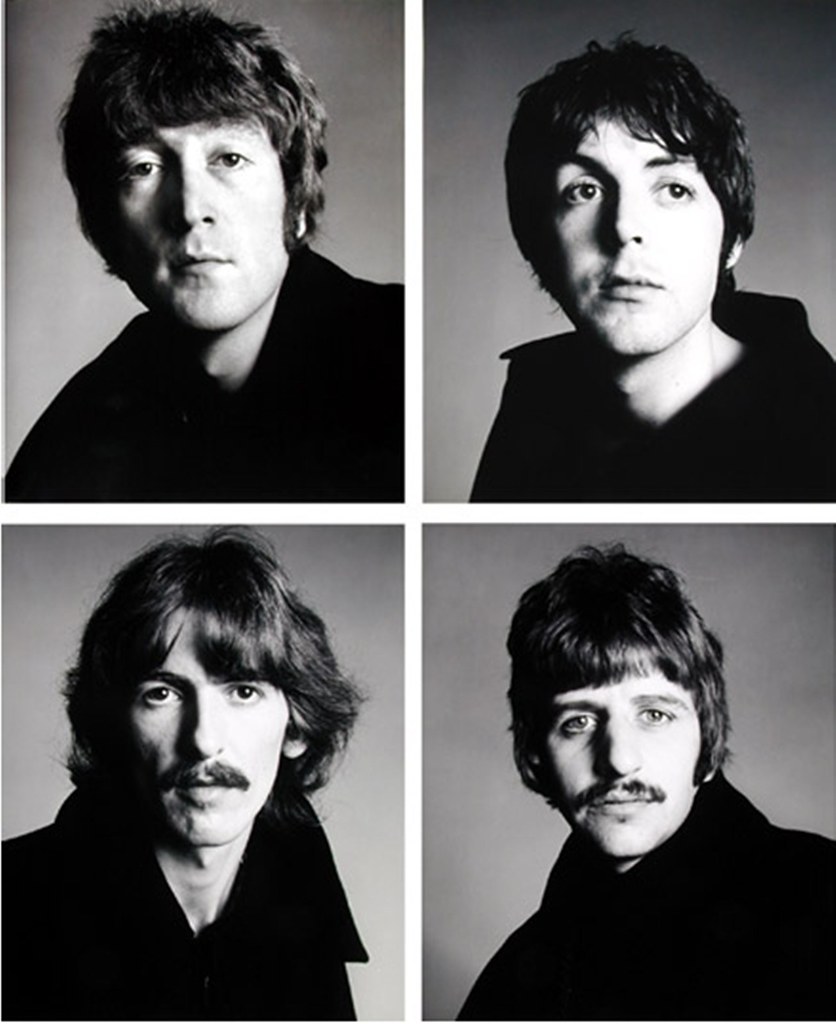
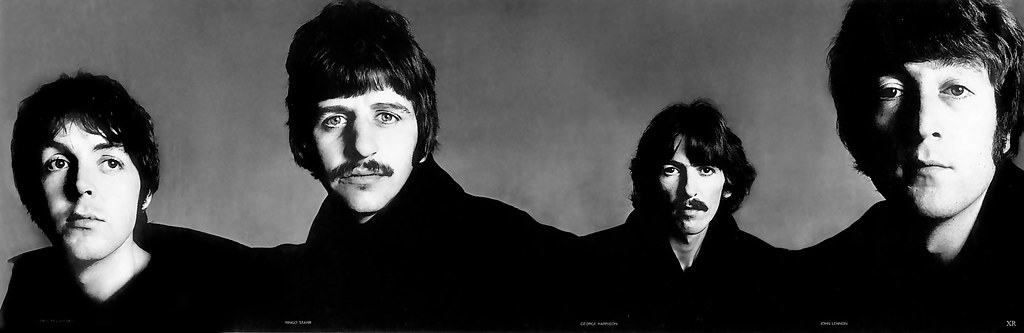
“Music Monday” THE BEATLES, Breaking down the song “BLACKBIRD” Part A (Featured Photographer is Richard Avedon)

The Beatles in their song BLACKBIRD were taking  notice of the plight of the Blacks and their civil rights struggles in the USA in the 1960’s. The song reminds me  of U2’s song PRIDE and Dion’s song ABRAHAM, MARTIN AND JOHN. Obviously Martin Luther King was the central leader of the Civil Rights Movement at this time and he was murdered  in Memphis just 2  months before the song was recorded by the Beatles. Paul McCartney wrote this song because it was a subject that had to be addressed!!! No wonder in the video THE AGE OF NON-REASON Francis Schaeffer noted that the Beatles did a great job of expressing exactly what people at the time were thinking and feeling in their songs.

How Should We then Live Episode 7 small (Age of Nonreason)

HowShouldweThenLive Episode 6

The Beatles – Blackbird (official video)

U2 – Pride (In The Name Of Love)

Dion — Abraham, Martin and John — Smothers Brothers Comedy Hour.


The Beatles – Blackbird Meaning

Martin Luther King noted in 1963 in his I HAVE A DREAM SPEECH: 

In a sense we’ve come to our nation’s capital to cash a check. When the architects of our republic wrote the magnificent words of the Constitution and the Declaration of Independence, they were signing a promissory note to which every American was to fall heir. This note was a promise that all men, yes, black men as well as white men, would be guaranteed the “unalienable Rights” of “Life, Liberty and the pursuit of Happiness.” It is obvious today that America has defaulted on this promissory note, insofar as her citizens of color are concerned. Instead of honoring this sacred obligation, America has given the Negro people a bad check, a check which has come back marked “insufficient funds.”

But we refuse to believe that the bank of justice is bankrupt. We refuse to believe that there are insufficient funds in the great vaults of opportunity of this nation. And so, we’ve come to cash this check, a check that will give us upon demand the riches of freedom and the security of justice.

Francis Schaeffer asserted shortly before his death: 

The world view that the final reality is only material or energy shaped by pure chance, inevitably, (that’s the next word I would bring to you ) mathematically — with mathematical certainty — brings forth all these other results which are in our country and in our society which have led to the breakdown in the country — in society — and which are its present sorrows. So, if you hold this other world view, you must realize that it is inevitable that we will come to the very sorrows of relativity and all these other things that are so represented in our country at this moment of history.

It should be noticed that this new dominant world view is a view which is exactly opposite from that of the founding fathers of this country. Now, not all the founding fathers were individually, personally, Christians. That certainly is true. But, nevertheless, they founded the country on the base that there is a God who is the Creator (now I come to the next central phrase) who gave the inalienable rights.

We must understand something very thoroughly. If society — if the state gives the rights, it can take them away — they’re not inalienable. If the states give the rights, they can change them and manipulate them. But this was not the view of the founding fathers of this country. They believed, although not all of them were individual Christians, that there was a Creator and that this Creator gave the inalienable rights — this upon which our country was founded and which has given us the freedoms which we still have — even the freedoms which are being used now to destroy the freedoms.

The reason that these freedoms were there is because they believed there was somebody who gave the inalienable rights. But if we have the view that the final reality is material or energy which has existed forever in some form, we must understand that this view never, never, never would have given the rights which we now know and which, unhappily, I say to you (those of you who are Christians) that too often you take all too much for granted. You forget that the freedoms which we have in northern Europe after the Reformation (and the United States is an extension of that, as would be Australia or Canada, New Zealand, etc.) are absolutely unique in the world.

______________

According to SONGFACTS.COM:

  • Paul McCartney wrote this about the civil rights struggle for blacks after reading about race riots in the US. He penned it in his kitchen in Scotland not long after Little Rock, when the federal courts forced the racial desegregation of the Arkansas capital’s school system. McCartney told Mojo magazine October 2008: “We were totally immersed in the whole saga which was unfolding. So I got the idea of using a blackbird as a symbol for a black person. It wasn’t necessarily a black ‘bird’, but it works that way, as much as then you called girls ‘birds’; the Everlys had had Bird Dog, so the word ‘bird’ was around. ‘Take these broken wings’ was very much in my mind, but it wasn’t exactly an ornithological ditty; it was purposely symbolic.”

Paul McCartney ‘Early Days’

Published on Jul 7, 2014

http://www.PaulMcCartney.com
‘Early Days’ is taken from Paul McCartney’s ‘NEW’ album.

Get ‘NEW’:
From Amazon: http://smarturl.it/PMc_New_Album_Amzn
From iTunes: http://smarturl.it/PMnewiTunes
From Google Play: http://g.co/PlayPaulMcCartney

Early Days:

They can’t take it from me if they try
I lived through those early days
So many times I had to change the pain to laughter
Just to keep from getting crazed

Dressed in black from head to toe
Two guitars across our backs
We would walk the city roads
Seeking someone who would listen to the music
That we were writing down at home

But they can’t take it from me if they try
I lived through those early days
So many times I had to change the pain to laughter
Just to keep from getting crazy

Hair slicked back with Vaseline
Like the pictures on the wall
Of the local record shop
Hearing noises we were destined to remember
We willed the thrill to never stop

May sweet memories of friends from the past
Always come to you, when you look for them
And your inspiration, long may it last
May it come to you, time and time again

Now everybody seems to have their own opinion
Who did this and who did that
But as for me I don’t see how they can remember
When they weren’t where it was at

And they can’t take it from me if they try
I lived through those early days
So many times I had to change the pain to laughter
Just to keep from getting crazed
I lived through those early days

Paul McCartney – Blackbird (Live)

Blackbird (Beatles song)

From Wikipedia, the free encyclopedia
This article is about the Beatles song. For other songs with similar titles, see Blackbird (disambiguation).
“Blackbird”
Beatles-blackbird.jpg

Sheet music
Song by The Beatles from the album The Beatles
Released 22 November 1968
Recorded 11 June 1968, EMI Studios,London
Genre Folk
Length 2:19
Label Apple Records
Writer Lennon–McCartney
Producer George Martin

Blackbird” is a Beatles song from the double-disc album The Beatles (known as the White Album). The song was written by Paul McCartney, though credited to Lennon–McCartney.

Origins[edit]

McCartney explained on Chaos and Creation at Abbey Road, aired in 2005, that the guitar accompaniment for “Blackbird” was inspired by J.S. Bach‘s Bourrée in E minor, a well known lute piece, often played on the classical guitar.
The first night his future wife Linda Eastman stayed at his home, McCartney played “Blackbird” for the fans camped outside his house.[1]As teenagers, he and George Harrison tried to learn Bourrée as a “show off” piece. The Bourrée is distinguished by melody and bass notes played simultaneously on the upper and lower strings. McCartney adapted a segment of the Bourrée (reharmonised into the original’s relative major key of G) as the opening of “Blackbird”, and carried the musical idea throughout the song.

Meaning[edit]

McCartney was inspired to write it while in Scotland as a reaction to racial tensions escalating in the United States in the spring of 1968.[2]

In May 2002, during a show at the Reunion Arena in Dallas, Texas as part of the Driving USA Tour supporting the Driving Rain album, McCartney spoke on stage about the meaning of the song. KCRW DJ Chris Douridas interviewed McCartney backstage afterwards for his radio show New Ground, and the meaning of the song was discussed.[3] This interview aired on KCRW on 25 May 2002.

I had been doing poetry readings. I had been doing some in the last year or so because I’ve got a poetry book out called Blackbird Singing, and when I would read “Blackbird”, I would always try and think of some explanation to tell the people, ’cause there’s not a lot you can do except just read the poem, you know, you read 10 poems that takes about 10 minutes, almost. It’s like, you’ve got to, just, do a bit more than that. So, I was doing explanations, and I actually just remembered why I’d written “Blackbird”, you know, that I’d been, I was in Scotland playing on my guitar, and I remembered this whole idea of “you were only waiting for this moment to arise” was about, you know, the black people’s struggle in the southern states, and I was using the symbolism of a blackbird. It’s not really about a blackbird whose wings are broken, you know, it’s a bit more symbolic.— Paul McCartney, Interview with KCRW’s Chris Douridas, 25 May 2002 episode of New Ground (17:50–19:00)

Also, before his solo acoustic guitar set during the Driving USA Tour, McCartney explained that “bird” is British slang for girl, making “blackbird” a synonym for ‘black girl’. Near the end of the song’s performance, a young black woman sang the lyrics, “You were only waiting for this moment to arrive, blackbird fly…”, after which the program faded to a commercial.

In 2009, McCartney performed this song at the Coachella Valley Music and Arts Festival, commenting prior to singing it on how it had been written in response to the 1960s Civil Rights movement, and added, “It’s so great to realise so many civil rights issues have been overcome.”[4]

The Beatles – Blackbird (Subtitulada en español)

Composition and recording[edit]

The song was recorded on 11 June 1968 in EMI Studios, with George Martin as the producer and Geoff Emerick as the audio engineer.[5] It is a solo performance with McCartney playing a Martin D 28 acoustic guitar. The track includes recordings of a male blackbird singing in the background.[5][6]

The accompaniment consists of guitar, tapping, and birdsong overdub. The tapping “has been incorrectly identified as a metronome in the past”, according to engineer Geoff Emerick, who says it is actually the sound of Paul tapping his foot, which Emerick recalls as being mic’d up separately.[7] Footage included in the bonus content on disc two of the 2009 remaster of the album shows McCartney tapping both his feet alternately while performing the song.

The mono version contains bird sounds different from the stereo recording, and was originally issued on a mono incarnation of The Beatles (it has since been issued worldwide as part of The Beatles in Mono CD box set). The song appears on Love with “Yesterday“, billed as “Blackbird/Yesterday”. “Blackbird” provides an introduction to “Yesterday”.

George Harrison Interview 2000 (rare!)

Personnel[edit]

Cover versions[edit]

“Blackbird” is, by one count, one of the top ten most recorded covers of all time.[8] The following artists have recorded “Blackbird” in a variety of styles (in alphabetical order):

_____________

Featured Photographer is Richard Avedon

Charlie Rose – Richard Avedon

Published on Feb 26, 2014

1999 Interview of photographer Richard Avedon by Charlie Rose. The first half of this episode of The Charlie Rose Show is an interview with photographer Annie Leibovitz here: http://bit.ly/1llyFo4

_________________

These first few people were on the cover of Sgt. Pepper’s:

Marlene Dietrich, Actor, The Ritz, Paris, August 1955 © Richard Avedon

______________


Bob Dylan

__________________


Aldous Huxley

___________

Marilyn Monroe and Arthur Miller by Richard Avedon, New York, May 8, 1957

________________


William S. Burroughs

___________________

Below Paul by Richard Avedon

____________

Richard Avedon is mentioned at the 4:40 mark in the clip below:

Beatles Revolution #7-A

Richard Avedon below:

___________

___________
_____________________

_______________
_____________________________

GEORGE BY AVEDON:

______________

This shot of Ringo as Nero was taken by Richard Avedon on 29 January and used as illustration for a Daily Mail article titlled ‘Hail, Ringo’. The pic was taken at Thomson House where Avedon later took his iconic image of the four Beatles on 11 August 1967 (used for the psychedelic Daily Express posters in 1968 and, of course, on the Love Songs album. The Beatles also came to thomson House to start the Mad Day out photo shoot on 28 July 1968. BTW, Thomson House is now the headquarters of the ITV media empire.

Tags: ,

___________

Richard Avedon- Darkness and Light

Published on Sep 6, 2012

From the 1995 American Masters Series.

Good article below:

<a class=”entry-title” style=”margin:0;padding:0;border:none;outline:0;font-size:27px;text-decoration:none;color:#330000;font-family:Times;line-height:28.35000038147px;” title=”Once and For All: What’s The Beatles’ Coolest Collective Look?” href=”http://www.rocktownhall.com/blogs/once-and-for-all-coolest-collective-beatles-look/&#8221; rel=”bookmark”>Once and For All: What’s The Beatles’ Coolest Collective Look?

Posted by

Let’s kick off Once and For All February with a subject that hits on a large segment of the Hall’s demographic, involving a favorite band, Rock Superpowers, and the all-important issues of Look. Let’s determine—once and for allThe Beatles’ Coolest Collective Look.

The nominees and the RTH People’s Poll follow…after the jump!

Collarless Suits. What’s more classic, more Beatle-esque than the original collarless suits? Next to the moptop hairdos (and the music, of course), those suits are most responsible for putting the band on the map.

collarless

Sgt. Pepper’s. What’s more classic, more Beatle-esque than the moustachioed Sgt. Pepper’s Look? Any Beatles tribute band performance builds to a crescendo once the vaguely Beatles-looking members come back from a brief intermission in their colorful silk military suits and glue-on moustaches.
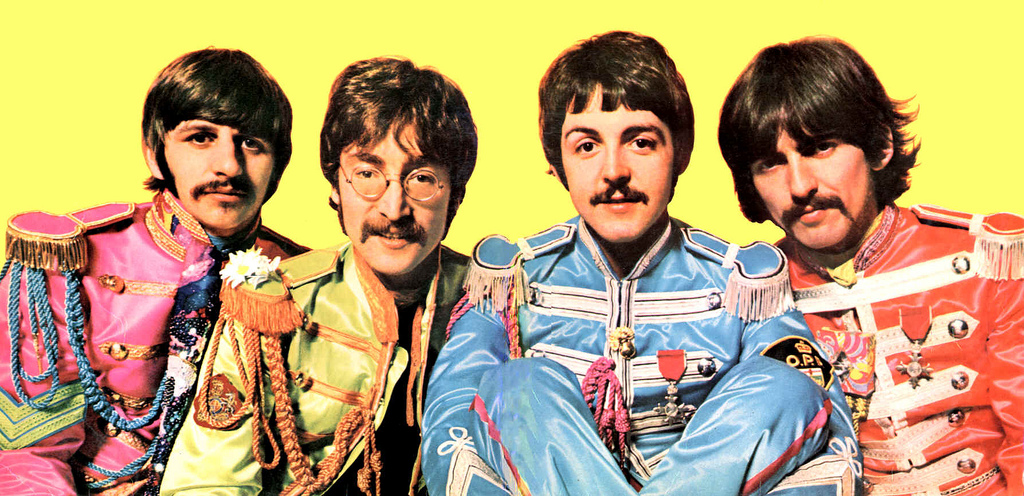
sgtpeppers

Rooftop Concert. The rooftop performance Look is heavy, man. Hair is blowing in the wind. Facial hair is in need of that snazzy electric razor favored by Adrien Brody, André 3000, and the Spanish guy from that overlooked gem of a movie The Science of Sleep. To top it off, they’re wearing a mish-mash of women’s fur coats, raincoats, green jeans, and proto-hipster sneaks!

rooftop

Stoned Soul Picnic. The Rubber Soul album cover photo shoot caught the band on a day when they probably needed a haircut, but someone must have watched the weather report and realized that low humidity would allow for one more day of stoned shagginess.
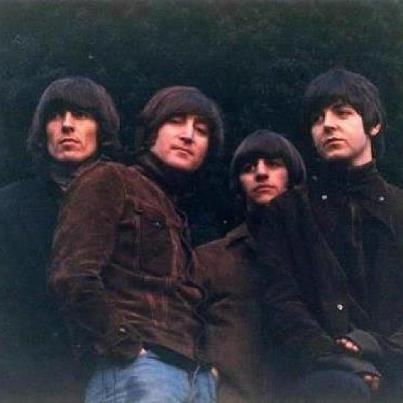
rubbersoulphoto

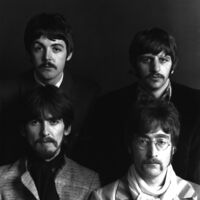
Richard Avedon glossies. Fashion photographer Richard Avedon’s White Album glossies capture a unique perspective on the boys: they are both immersed in their hippie-dom yet cleaned up and glammed up just enough to show their original guise as the fresh-faced lads they had been just a few years earlier.
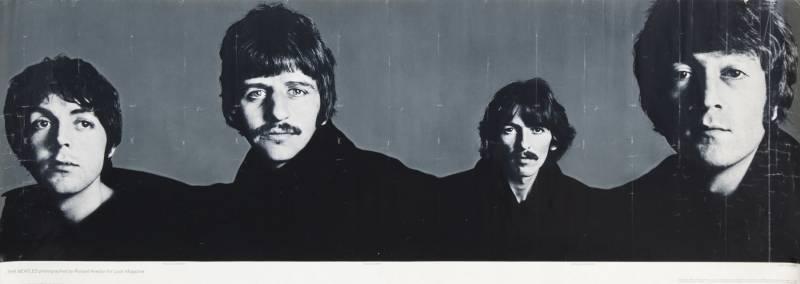
avedon

Runners up (not eligible): Leonine (ie, when all 4 Beatles were bearded, which I don’t believe was ever captured on camera simultaneously); Walrus/Eggman costumes; Beatles Dress Up Like The Band (ie, Beatles Again album cover)…

_____________

Richard Avedon Biography

Photographer (1923–2004)
American photographer Richard Avedon was best known for his work in the fashion world and for his minimalist, large-scale character-revealing portraits.
American photographer Richard Avedon was best known for his work in the fashion world and for his minimalist portraits. He worked first as a photographer for the Merchant Marines, taking identification photos. He then moved to fashion, shooting for Harper’s Bazaar and Vogue, demanding that his models convey emotion and movement, a departure from the norm of motionless fashion photography.

Profile

Richard Avedon was born on May 15, 1923 in New York City. His mother, Anna Avedon, came from a family of dress manufacturers, and his father, Jacob Israel Avedon, owned a clothing store called Avedon’s Fifth Avenue. Inspired by his parents’ clothing businesses, as a boy Avedon took a great interest in fashion, especially enjoying photographing the clothes in his father’s store. At the age of 12, he joined the YMHA (Young Men’s Hebrew Association) Camera Club.

Avedon later described one childhood moment in particular as helping to kindle his interest in fashion photography: “One evening my father and I were walking down Fifth Avenue looking at the store windows,” he remembered. “In front of the Plaza Hotel, I saw a bald man with a camera posing a very beautiful woman against a tree. He lifted his head, adjusted her dress a little bit and took some photographs. Later, I saw the picture in Harper’s Bazaar. I didn’t understand why he’d taken her against that tree until I got to Paris a few years later: the tree in front of the Plaza had that same peeling bark you see all over the Champs-Elysees.”

Avedon attended DeWitt Clinton High School in New York City, where one of his classmates and closest friends was the great writer James Baldwin. In addition to his continued interest in fashion and photography, in high school Avedon also developed an affinity for poetry. He and Baldwin served as co-editors of the school’s prestigious literary magazine, The Magpie, and during his senior year, in 1941, Avedon was named “Poet Laureate of New York City High Schools.” After high school, Avedon enrolled at Columbia University to study philosophy and poetry. However, he dropped out after only one year to serve in the United States Merchant Marine during World War II. As a Photographer’s Mate Second Class, his main duty was taking identification portraits of sailors. Avedon served in the Merchant Marine for two years, from 1942 to 1944.

Upon leaving the Merchant Marine in 1944, Avedon attended the New School for Social Research in New York City to study photography under Alexey Brodovitch, the acclaimed art director of Harper’s Bazaar. Avedon and Brodovitch formed a close bond, and within one year Avedon was hired as a staff photographer for the magazine. After several years photographing daily life in New York City, Avedon was assigned to cover the spring and fall fashion collections in Paris. While legendary editor Carmel Snow covered the runway shows, Avedon’s task was to stage photographs of models wearing the new fashions out in the city itself. Throughout the late 1940s and early 1950s he created elegant black-and-white photographs showcasing the latest fashions in real-life settings such as Paris’s picturesque cafes, cabarets and streetcars.

Already established as one of the most talented young fashion photographers in the business, in 1955 Avedon made fashion and photography history when he staged a photo shoot at a circus. The iconic photograph of that shoot, “Dovima with Elephants,” features the most famous model of the time in a black Dior evening gown with a long white silk sash. She is posed between two elephants, her back serenely arched as she holds on to the trunk of one elephant while reaching out fondly toward the other. The image remains one of the most strikingly original and iconic fashion photographs of all time. “He asked me to do extraordinary things,” Dovima said of Avedon. “But I always knew I was going to be part of a great picture.”

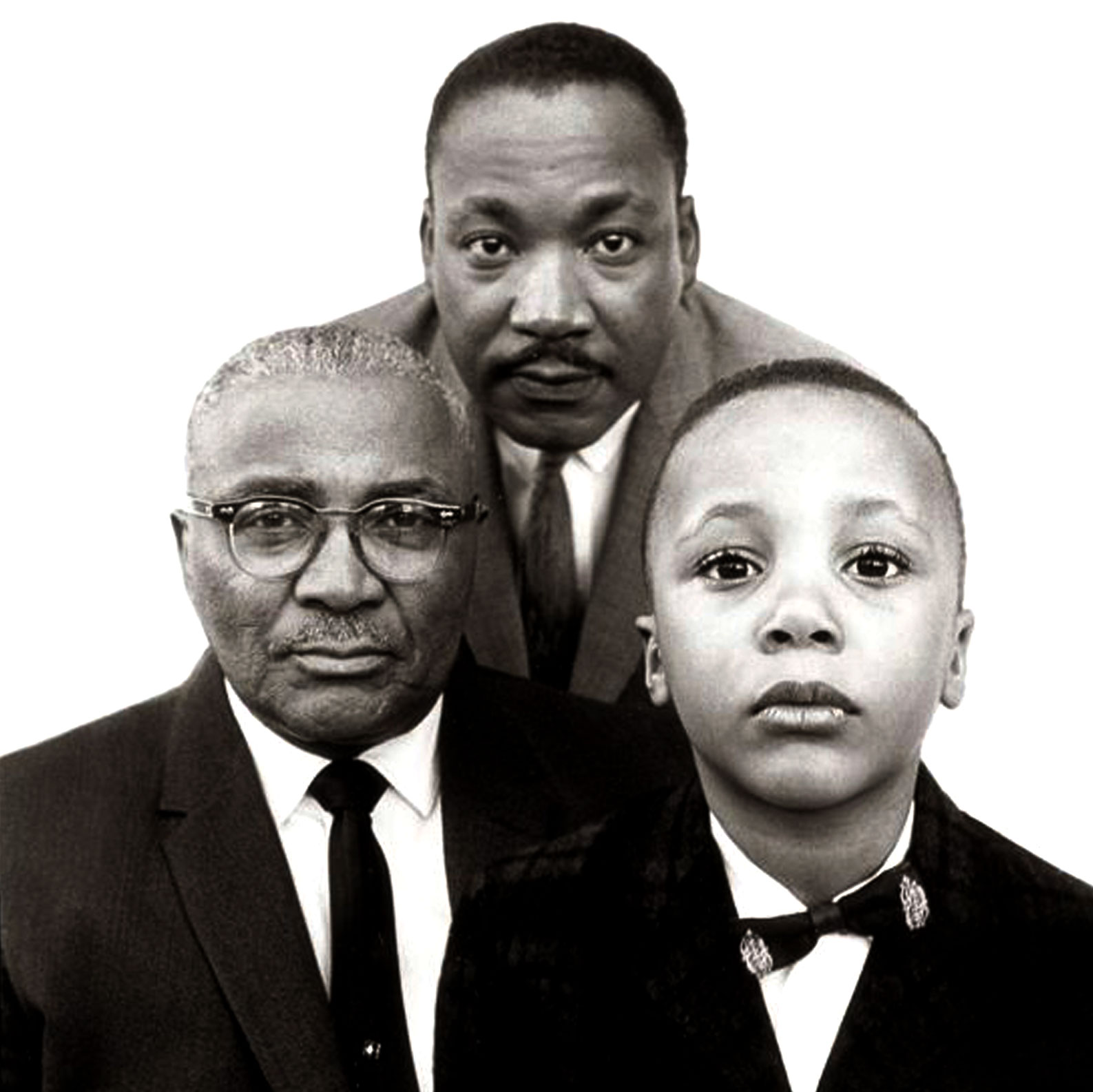
Avedon served as a staff photographer for Harper’s Bazaar for 20 years, from 1945 to 1965. In addition to his fashion photography, he was also well known for his portraiture. His black-and-white portraits were remarkable for capturing the essential humanity and vulnerability lurking in such larger-than-life figures as President Dwight D. Eisenhower, Marilyn Monroe, Bob Dylan and The Beatles. During the 1960s, Avedon also expanded into more explicitly political photography. He did portraits of civil rights leaders such as Dr. Martin Luther King Jr., Malcolm X and Julian Bond, as well as segregationists such as Alabama Governor George Wallace, and ordinary people involved in demonstrations. In 1969, he shot a series of Vietnam War portraits that included the Chicago Seven, American soldiers and Vietnamese napalm victims.

Avedon left Harper’s Bazaar in 1965, and from 1966 to 1990 he worked as a photographer for Vogue, its chief rival among American fashion magazines. He continued to push the boundaries of fashion photography with surreal, provocative and often controversial pictures in which nudity, violence and death featured prominently. He also continued to take illuminating portraits of leading cultural and political figures, ranging from Stephen Sondheim and Toni Morrison to Hillary Clinton. In addition to his work for Vogue, Avedon was also a driving force behind photography’s emergence as a legitimate art form during the 1960s, ’70s and ’80s. In 1959 he published a book of photographs, Observations, featuring commentary by Truman Capote, and in 1964 he published Nothing Personal, another collection of photographs, with an essay by his old friend James Baldwin.

In 1974 Avedon’s photographs of his terminally ill father were featured at the Museum of Modern Art, and the next year a selection of his portraits was displayed at the Marlborough Gallery. In 1977, a retrospective collection of his photographs, “Richard Avedon: Photographs 1947-1977,” was exhibited at the Metropolitan Museum of Art before beginning an international tour of many of the world’s most famous museums. As one of the first self-consciously artistic commercial photographers, Avedon played a large role in defining the artistic purpose and possibilities of the genre. “The moment an emotion or fact is transformed into a photograph it is no longer a fact but an opinion,” he once said. “There is no such thing as inaccuracy in a photograph. All photographs are accurate. None of them is the truth.”

Richard Avedon married a model named Dorcas Nowell in 1944, and they remained married for six years before parting ways in 1950. In 1951, he married a woman named Evelyn Franklin; they had one son, John, before they also divorced.

In 1992, Avedon became the first staff photographer in the history of The New Yorker. “I’ve photographed just about everyone in the world,” he said at the time. “But what I hope to do is photograph people of accomplishment, not celebrity, and help define the difference once again.” His last project for The New Yorker, which remained unfinished, was a portfolio entitled “Democracy” that included portraits of political leaders such as Karl Rove and John Kerry as well as ordinary citizens engaged in political and social activism.

Richard Avedon passed away on October 1, 2004, while on assignment forThe New Yorker in San Antonio, Texas. He was 81 years old.

One of the greatest photographers of the 20th century, Richard Avedon expanded the genre of photography with his surreal and provocative fashion photography as well as portraits that bared the souls of some of the most important and opaque figures in the world. Avedon was such a predominant cultural force that he inspired the classic 1957 film Funny Face, in which Fred Astaire’s character is based on Avedon’s life. While much has been and continues to be written about Avedon, he always believed that the story of his life was best told through his photographs. Avedon said, “Sometimes I think all my pictures are just pictures of me. My concern is… the human predicament; only what I consider the human predicament may simply be my own.”

______________

___________

Groucho Marx by Richard Avedon

_______________

__________

Buster Keaton, comedian, New York, September 1952. Photo Richard Avedon

______________

Dwight-EistenhowerRichard Avedon Foundation. Eli Reed. ‘Tupac Shakur’ 1992 (printed 2013)Richard Avedon. Charlie Chaplin Leaving America. NYC, September 13 1952___________
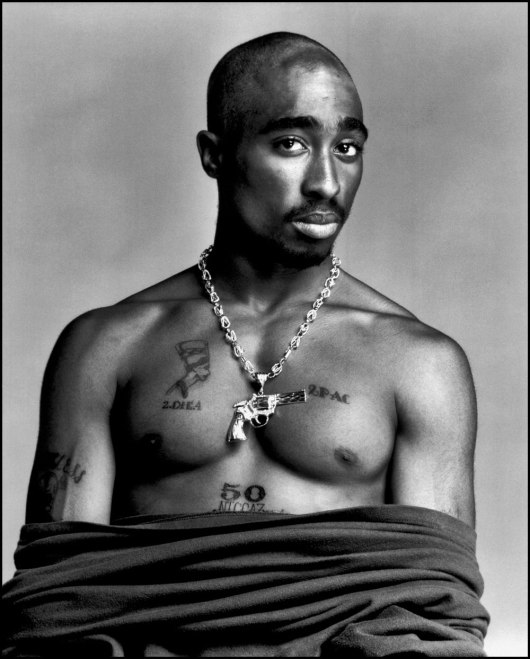
SIMPLY STUNNING: RICHARD AVEDON’S PORTRAITS

August 31, 2012

Good luck keeping your $#!% together when you walk into a room and see Jackie O., Malcolm X, Elizabeth Taylor, Tina Turner, Truman Capote, Janis Joplin, Katharine Hepburn, and Andy Warhol all in the same place.  Perhaps one of the most striking photography exhibitions in modern history, the SF MoMA’s Richard Avedon retrospective in 2009 was the first comprehensive retrospective of the American photographer since his death in 2004.  Titled “Richard Avedon: Photographs 1946-2004,” the exhibit focused purely on Avedon’s black and white photographs spanning his fifty+ year career, from pieces that graced the pages of Vogue to a portrait series of rural, Midwestern farm hands, carneys and beekeepers.

Born to a Russian Jewish family in New York City in 1923, Avedon began his career in his 20s in commercial and fashion photography, producing shots for Harper’s Bazaar, and soon after for Vogue and Life Magazine.

Funny Face – trailer (1956) AUDREY HEPBURN

Though he began his career in fashion photography, as he became a more established artist his interests  meandered to the movers and shakers of the American political and social scene.  Many of Avedon’s iconic photos depict some of the most famous models, actresses and actors, politicians, writers and artists in modern history.  In most cases, however, Avedon tried to capture a version of each person that is stripped of the Hollywood or political branding and bravado, instead aiming to represent basic human emotions and relatable expressions.

Keep in mind that the vast majority of the work reproduced below was originally produced on a larger-than-life scale, some reaching 8 by 10 feet or larger.

Even if you had no idea who these people were or what they did for a living, each portrait could give you a pretty good idea based on how Avedon chose to represent them.  The combination of the simple background with the close-up details and epic proportions of each photograph force your eyes to focus sharply on each facial expression and body movement; You notice the wrinkles around the lips of the trumpeter, the musician’s easy posture, a wife’s admirative stare, the grin and outstretched hand of a budding politician.

“He was trying to cut to the heart of the matter…to understand what people’s lives were really like under force of pressure.  His work, in a way, strips away the masks that we all wear, and in doing so reveals a kind of deeper humanity.  I think that when photographers today, or artists or writers or the public at large, look at his photographs, that this is what they’ll really be able to take away from the work: this penetrating of the masks that we all wear in order to hide ourselves.”  -Paul Roth, curator of Photography at Corcoran Gallery in Washington D.C.

Famous for saying, “All photographs are accurate.  None of them is the truth.”, Avedon understood that photography is an art of collaboration between a photographer and his subject, with push and pull, give and take from each.  He enjoyed using stories to evoke specific reactions from his subjects and to play with their emotions, allowing him to capture the expressions he wanted to show.

Take, for example, his photo shoot with the Duke and Duchess of Windsor.  Here is a photo of the duo taken in the Bahamas by the The Vancouver Sun in 1940 (not by Avedon):
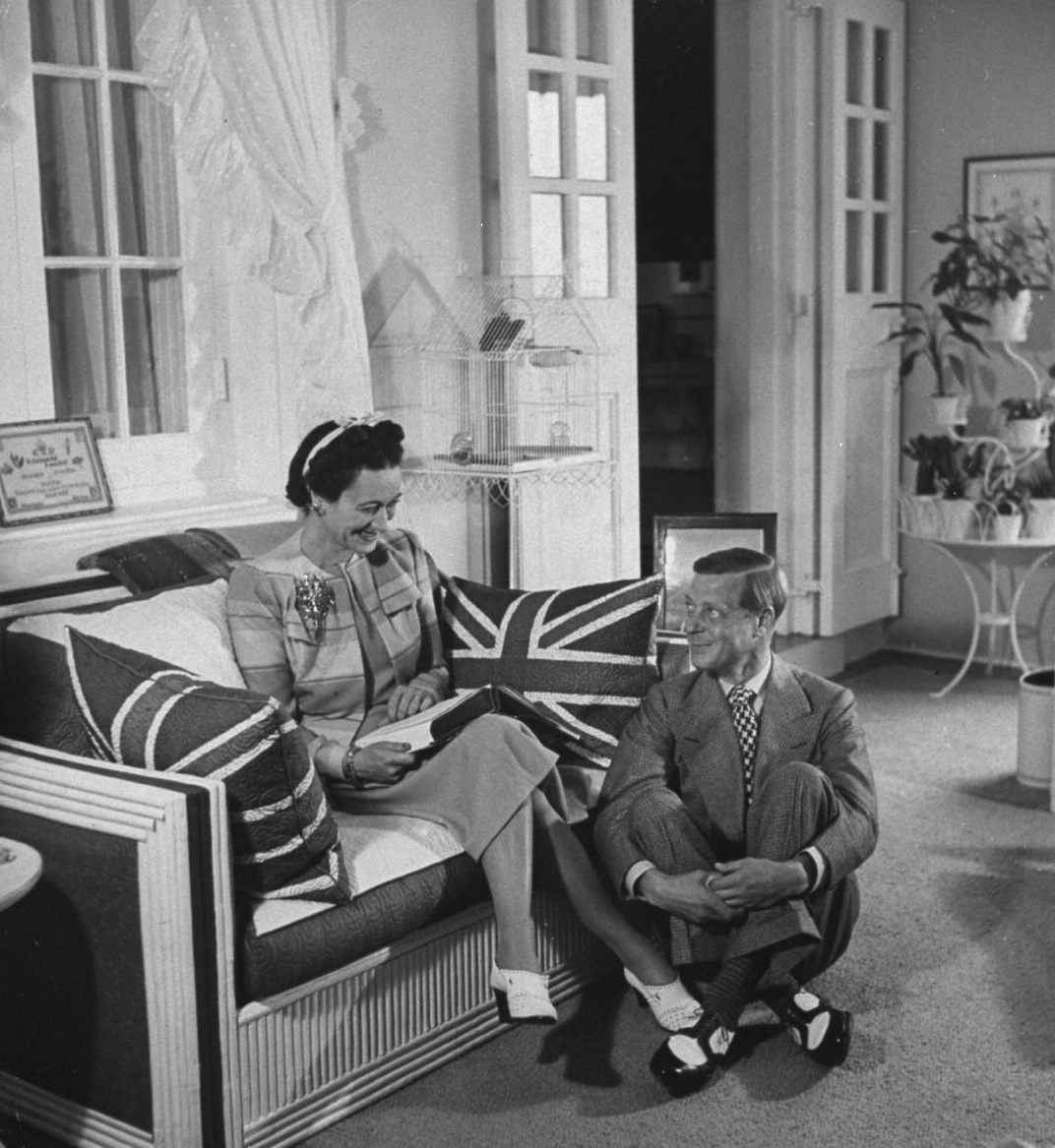
Infamous for abdicating the throne to marry the woman he loved, Edward VIII was given the title Duke of Windsor, and his new wife Wallis Simpson became the Duchess of Windsor upon their marriage in the 1930s.  Wallis was an American socialite with two living ex-husbands (the second divorce was not finalized when she met Edward VIII)–hardly a suitable companion for a British monarch.  In addition to the initial political uproar that their romance caused in Britain,  during the Second World War the Duke and Duchess of Windsor were also suspected by many to be Nazi sympathizers.

Avedon knew that these political and socialite subjects were no strangers to being photographed, and that they were likely expecting a classic “stock photo shoot.”  As they sat down in front of the camera, and with the knowledge that they were avid Pug lovers, Avedon told them that on his way to meet them that day, his taxi had run over and killed a dog.

The following expression ensued:

The Duke and Duchess of Windsor, Waldorf Astoria, Suite 28A, New York, April 16, 1957

In the late 1970s and early 1980s, Avedon’s focus shifted from celebrity portraits to documenting “working class” Americans.  He created a series, eventually published into an exhibition catalogue, called “In the American West: 1979-1984.”

Avedon himself said, during his transition from celebrity and fashion photographer  to “staff photographer” (ha!) at U.S.A. Today:

“I’ve photographed just about everyone in the world…but what I hope to do is photograph people of accomplishment, not celebrity, and help define the difference once again.”

In lieu of me posting a million (or two) additional mesmerizing Avedon portraits, check out The Richard Avedon Foundation’s website, which keeps his artwork and legacy alive in truly stunning photo displays, as well as in arts institutions worldwide.

Avedon Self Portrait

Richard Avedon, Self-portrait, Provo, Utah, August 20, 1980; © 2009 The Richard Avedon Foundation

________________

Salvador Dalí and Dovima, New York, January 1963Photographer: Richard Avedon

Avedon’s son and father, 1969

Avedon’s 8 x 10 portrait of his son, his father, and himself during a visit to Jacob Avedon’s home in Sarasota, Florida, August 9, 1969

Evidence 1944-1994 by Richard Avedon, Random House, 1994, p. 151: “Avedon’s 8″ x 10″ portrait of his son, his father, and himself during a visit to Jacob Avedon’s home in Sarasota, Florida, August 9, 1969”. © Richard Avedon Foundation.

This is the portrait of three different generations of men from the same family, each of them moving through life at different speed and in different direction, immobilized for a fraction of a second within the same frame.

From left to right: John Avedon, Jacob Israel Avedon (died in 1973) and Richard Avedon (died in 2004). The complete series of photos Richard Avedon took of his father can be found online at The Richard Avedon Foundation website.

palonka: photo of Coco Chanel by Richard Avedon via Accro de la Mode

____________

PATTI HANSEN aka Ms KEITH RICHARDS – Richard Avedon (1977) (Via superseventies)George Bush below:Henri Cartier-Bresson – Photographer Richard Avedon, Carmel Snow and Marie-Louise Bousquet, Paris 1951

Boston Museum of Fine Arts Hosts Richard Avedon Exhibit

Legendary American fashion photographer Richard Avedon who revolutionized the industry during his 60-year-long career (until his death in 2004) has taken tens upon thousands of the most well-done and well-known photographs. He is also famous for saying, “Think about the dream of Paris that everyone has. I helped invent that dream.” To honor this icon, theBoston Museum of Fine Arts is hosting a traveling exhibition of Avedon’s works entitled Avedon Fashion 1944-2000 which runs through January 17 2011.

Whether it be his photos of 15-year-old Brooke Shields in the controversial Calvin Klein Jeans campaign, his portraits of Andy Warhol, The Beatles, Audrey Hepburn, Elizabeth Taylor, Bob Dylan, his tenure at Harper’s Bazaar, US Vogue and Life, or his photos for Gianni Versace, Richard Avedon’s name has been synonymous with fashion since the 1940s.

Brooke Shields, Calvin Klein Jeans, 1981

Andy Warhol, Jay Johnson and Candy Darling, New York, August 20, 1969

Audrey Hepburn, evening wear by Balmain, Dior, Patou, at Maxim’s, Paris, 1957

Born in New York City in the 1920s, Richard Avedon was fascinated since childhood by the art of photography, and the power that it has to portray clothes and women. He realized this as he grew up watching his father’s business (a women’s clothing store). Dropping out of Columbia University, Avedon began his career as a photographer for the Merchant Marines in 1942, followed by shooting advertisements for a department store. He soon caught the eye of Harper’s Bazaar’s creative director, eventually leading him to occupy the role of chief photographer for the magazine. During this time, Avedon opened up his own studio and began working on assignments for US Vogue and Life magazine.

Dorian Leigh, evening dress by Piguet, Paris, August 1949

Marilyn Monroe, New York City, May 6, 1957

Dovima with elephants, evening dress by Dior, Cirque d’Hiver, 1955

In 1966, Avedon followed famous editor Diana Vreeland when she left Harper’s Bazaar for Vogue; he subsequently became the staff photographer at Vogue until Anna Wintour‘s entry in 1988. He was also the star photographer year after year for the Gianni Versace label circa the 1980s. Numerous 1990s supermodels such as Linda Evangelista, Naomi Campbell, Christy Turlington, Stephanie Seymour and Cindy Crawford were featured in his photos. These images are now considered precious collectibles.

Christy Turlington, Linda Evangelista & Paulina Porizkova for Gianni Versace, 1988

Christy Turlington & Linda Evangelista for Gianni Versace, 1987

Karen Elson for Versace Couture, 1997

At a time, when fashion photographers followed de rigeur of asking models to remain still and emotionless in order to emphasize the clothes, Avedon went against the grain, asking models to jump, laugh, run down the street and wear rollerblades. He is said to have been able to animate the clothes via the model unlike any other photographer.

Model Carmen, coat by Cardin, Paris, August 1957

Richard Avedon with Twiggy in the 1960s

Stephanie Seymour, dress by Chanel, Paris, 1995

Richard Avedon was not only responsible for animating designers’ creations, but his photos of Paris can be said to hold testament to his self-proclaimed statement regarding the invention of the dreamy vision of Paris that exists today. As he frequented Paris in the latter half of the 1940s on Harper’s Bazaar assignments, Avedon began taking multiple series of photos of bleak Post-World War II Paris. However instead of showing a disheartened, gray city, he showed models skipping on the sidewalks, showing a real sense of joie de vivre.

Models Elise & Monique, hats by Schiaparelli, Cafe de Flore, Paris, August 1948

Suzy Parker & Robin Tattersall, evening dress by Grès, Moulin Rouge, Paris, 1957

Christian Bérard & Renée, suit by Dior, Le Marais, Paris, 1947

He found a way to take designers’ creations, be it Dior or Balenciaga, depict a woman wearing these clothes with sophistication, and then involve her with an element of the city, be it at the Moulin Rouge, or watching street performers in the Marais or outside the many cafes that line the Parisian sidewalks.

Kate Moss, May 1998

John Galliano, December 1999

Although Avedon did take non-fashion photographs as well, the Avedon Fashion exhibition explores only one aspect of his multi-faceted talent. The exhibition runs at the Boston Museum of Fine Arts until January 17, 2011.

Images from TFS & The Richard Avedon Foundation.

Richard Avedon

From Wikipedia, the free encyclopedia
“Avedon” redirects here. For other uses, see Avedon (disambiguation).
Richard Avedon
Richard Avedon.jpg

Richard Avedon, 2004
Born May 15, 1923
New York City, New York, U.S.
Died October 1, 2004 (aged 81)
San Antonio, Texas, U.S.
Alma mater The New School for Social Research
Known for Photography
Spouse(s) Dorcas Marie “Doe” (Nowell) Avedon (m. 1944; div. 1949)
Evelyn Franklin (m. 1951)

Richard Avedon (May 15, 1923 – October 1, 2004) was an American fashion and portrait photographer. An obituary published in The New York Times said that “his fashion and portrait photographs helped define America’s image of style, beauty and culture for the last half-century”.[1]

Personal life and death[edit]

In 1944, Avedon married 19-year-old bank teller Dorcas Marie Nowell who later became the model and actress Doe Avedon; they did not have children and divorced in 1949.[27] In 1951, he married Evelyn Franklin; she died on March 13, 2004.[28] Their marriage produced one son, John Avedon, who has written extensively about Tibet.[29][30][31] [32]

In 1970, Avedon purchased a former carriage house on the Upper East Side that would serve as both his studio and his apartment.[33] In the late 1970s, he purchased a four-bedroom house on a 7.5-acre (3.0 ha) estate in Montauk, nestled between the Atlantic Ocean and a nature preserve; in 1998, he put the place on the market for $10 million and sold it for almost $9 million in 2000.[32][34]

On October 1, 2004, Avedon died in a San Antonio, Texas hospital of complications from a cerebral hemorrhage. He was in San Antonio shooting an assignment for The New Yorker. At the time of his death, he was also working on a new project titled Democracy to focus on the run-up to the 2004 U.S. presidential election.[1]

Legacy[edit]

The Richard Avedon Foundation is a private operating foundation, structured by Avedon during his lifetime. It began its work shortly after his death in 2004. Based in New York, the foundation is the repository for Avedon’s photographs, negatives, publications, papers, and archival materials.[35] In 2006, Avedon’s personal collection was shown at the Pace/MacGill Gallery, New York, and at the Fraenkel Gallery, San Francisco, and later sold to benefit the Avedon Foundation. The collection included photographs by Martin Munkacsi, Edward Steichen and Man Ray, among others. A slender volume, Eye of the Beholder: Photographs From the Collection of Richard Avedon (Fraenkel Gallery), assembles the majority of the collection in a boxed set of five booklets: “Diane Arbus,” “Peter Hujar”, “Irving Penn”, “The Countess de Castiglione” and “Etcetera,” which includes 19th- and 20th-century photographers.[36]

In popular culture[edit]

Hollywood presented a fictional account of his early career in the 1957 musical Funny Face, starring Fred Astaire as the fashion photographer “Dick Avery.” Avedon supplied some of the still photographs used in the production, including its most famous single image: an intentionally overexposed close-up of Audrey Hepburn‘s face in which only her famous features – her eyes, her eyebrows, and her mouth – are visible.

Hepburn was Avedon’s muse in the 1950s and 1960s, and he went so far as to say: “I am, and forever will be, devastated by the gift of Audrey Hepburn before my camera. I cannot lift her to greater heights. She is already there. I can only record. I cannot interpret her. There is no going further than who she is. She has achieved in herself her ultimate portrait.”[37]

Famous photographs[edit]

_______________


Alberto Giacometti

________________


J. Robert Oppenheimer

____________

Ronald Reagan by Richard Avedon

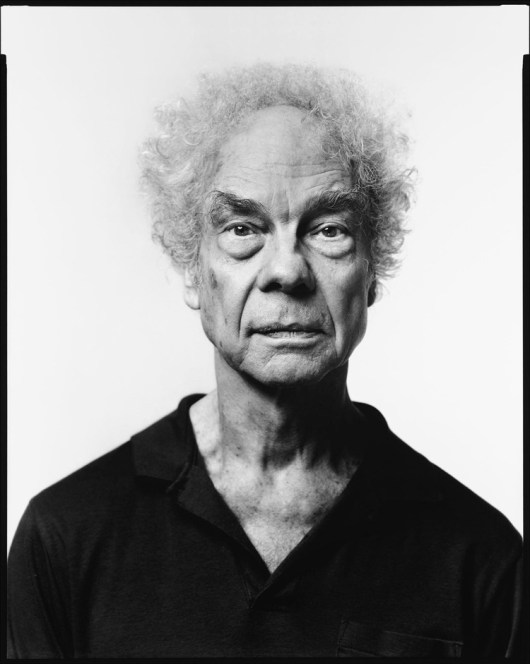
Merce Cunningham, choreographer, New York, February 17, 1993
_______________

__________

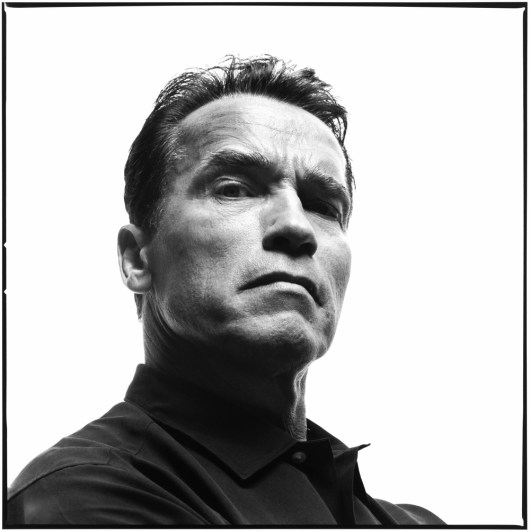
Arnold Schwarzenegger, actor, Republican candidate for Governor of California, New York, June
_____________


Truman Capote

_________________

Richard Avedon with Francis Bacon

____________


Willem de Kooning

___________


Ronald Reagan

___________________


Patti Smith

____________


Janis Joplin

____________


John and Jackie Kennedy

__________


Andy Warhol and Group

_____________

Image result for sergent peppers album cover

Francis Schaeffer’s favorite album was SGT. PEPPER”S and he said of the album “Sergeant Pepper’s Lonely Hearts Club Band…for a time it became the rallying cry for young people throughout the world. It expressed the essence of their lives, thoughts and their feelings.”  (at the 14 minute point in episode 7 of HOW SHOULD WE THEN LIVE? ) 

Image result for francis schaeffer how should we then live

How Should We Then Live – Episode Seven – 07 – Portuguese Subtitles

Francis Schaeffer
Image result for francis schaeffer

______

FRANCIS SCHAEFFER ANALYZES ART AND CULTURE PART 202 the BEATLES’ last song FREE AS A BIRD (Featured artist is Susan Weil )

February 15, 2018 – 1:45 am

FRANCIS SCHAEFFER ANALYZES ART AND CULTURE Part 200 George Harrison song HERE ME LORD (Featured artist is Karl Schmidt-Rottluff )

FRANCIS SCHAEFFER ANALYZES ART AND CULTURE PART 184 the BEATLES’ song REAL LOVE (Featured artist is David Hammonds )

FRANCIS SCHAEFFER ANALYZES ART AND CULTURE Part 170 George Harrison and his song MY SWEET LORD (Featured artist is Bruce Herman )

FRANCIS SCHAEFFER ANALYZES ART AND CULTURE Part 168 George Harrison’s song AWAITING ON YOU ALL Part B (Featured artist is Michelle Mackey )

FRANCIS SCHAEFFER ANALYZES ART AND CULTURE Part 167 George Harrison’s song AWAITING ON YOU Part A (Artist featured is Paul Martin)

RESPONDING TO HARRY KROTO’S BRILLIANT RENOWNED ACADEMICS!! Part 133 Louise Antony is UMass, Phil Dept, “Atheists if they commit themselves to justice, peace and the relief of suffering can only be doing so out of love for the good. Atheist have the opportunity to practice perfect piety”

FRANCIS SCHAEFFER ANALYZES ART AND CULTURE Part 166 George Harrison’s song ART OF DYING (Featured artist is Joel Sheesley )

FRANCIS SCHAEFFER ANALYZES ART AND CULTURE Part 165 George Harrison’s view that many roads lead to Heaven (Featured artist is Tim Lowly)

FRANCIS SCHAEFFER ANALYZES ART AND CULTURE Part 164 THE BEATLES Edgar Allan Poe (Featured artist is Christopher Wool)

PART 163 BEATLES Breaking down the song LONG AND WINDING ROAD (Featured artist is Charles Lutyens )

FRANCIS SCHAEFFER ANALYZES ART AND CULTURE PART 162 A look at the BEATLES Breaking down the song ALL WE NEED IS LOVE Part C (Featured artist is Grace Slick)

PART 161 A look at the BEATLES Breaking down the song ALL WE NEED IS LOVE Part B (Featured artist is Francis Hoyland )


FRANCIS SCHAEFFER ANALYZES ART AND CULTURE PART 160 A look at the BEATLES Breaking down the song ALL WE NEED IS LOVE Part A (Featured artist is Shirazeh Houshiary)

FRANCIS SCHAEFFER ANALYZES ART AND CULTURE Part 159 BEATLES, Soccer player Albert Stubbins made it on SGT. PEP’S because he was sport hero (Artist featured is Richard Land)

FRANCIS SCHAEFFER ANALYZES ART AND CULTURE Part 158 THE BEATLES (breaking down the song WHY DON’T WE DO IT IN THE ROAD?) Photographer Bob Gomel featured today!

FRANCIS SCHAEFFER ANALYZES ART AND CULTURE Part 118 THE BEATLES (Why was Tony Curtis on cover of SGT PEP?) (Feature on artist Jeffrey Gibson )

FRANCIS SCHAEFFER ANALYZES ART AND CULTURE Part 117 THE BEATLES, Breaking down the song WITHIN YOU WITHOUT YOU Part B (Featured artist is Emma Amos )

Related posts:

Conservative looks at Martin Luther King Jr’s “I have a dream speech”

I really got a lot out of this article from the Cato Institute concerning Martin Luther King’s “I have a dream speech.” The Constitutional Foundations of Martin Luther King’s Dream By David Azerrad January 14, 2011   Nearly 50 years ago, Martin Luther King Jr. delivered one of the greatest speeches in American history. Standing […]

Three conservative principles Martin Luther King believed in

Why do liberals ignore these core principles that Martin Luther King Jr believed in? Martin Luther King’s Conservative Principles Matt Spalding January 15, 2012 at 9:00 am Martin Luther King Day has arrived once again, and like clockwork, liberals are invoking King’s name to support their causes. In an e-mail to activists, Obama’s former “green […]

Libertarian Jonathan Martin on Francis Schaeffer

Libertarian Jonathan Martin on Francis Schaeffer Episode 8: The Age Of Fragmentation Published on Jul 24, 2012 Dr. Schaeffer’s sweeping epic on the rise and decline of Western thought and Culture How Should We Then Live Episode 9: The Age Of Personal Peace & Affluence _______________________ I love the works of Francis Schaeffer and I […]

The most popular posts in the last 30 days about the spiritual quest of Chris Martin of Coldplay that can be found on www.thedailyhatch.org

These are some of the most popular posts in the last 30 days about the spiritual quest of Chris Martin of Coldplay that can be found on http://www.thedailyhatch.org: Chris Martin of Coldplay unknowingly lives out his childhood Christian beliefs (Part 3 of notes from June 23, 2012 Dallas Coldplay Concert, Martin left Christianity because of […]

Jesse Jackson in 1979: “There are those who argue that the right to privacy is of a higher order than the right to life…That was the premise to slavery!”

Nat Hentoff is an atheist, but he became a pro-life activist because of the scientific evidence that shows that the unborn child is a distinct and separate human being and even has a separate DNA. His perspective is a very intriguing one that I thought you would be interested in. I have shared before many   […]

Liberals at Ark Times can not stand up to Scott Klusendorf’s pro-life arguments (Part 1) Prochoice blogger stated, “You people will kill and murder doctors and anyone who is pro choice…”

Anti Abortion Pro-Life Training Video by Scott Klusendorf Part 1 of 4 Francis Schaeffer: “Whatever Happened to the Human Race” (Episode 1) ABORTION OF THE HUMAN RACE Published on Oct 6, 2012 by AdamMetropolis This crucial series is narrated by the late Dr. Francis Schaeffer and former Surgeon General Dr. C. Everett Koop. Today, choices […]

“Sanctity of Life Saturday” Jesse Jackson in 1979: “There are those who argue that the right to privacy is of a higher order than the right to life…That was the premise to slavery!”

Nat Hentoff is an atheist, but he became a pro-life activist because of the scientific evidence that shows that the unborn child is a distinct and separate human being and even has a separate DNA. His perspective is a very intriguing one that I thought you would be interested in. I have shared before many   […]

Pro-life Atheist Nat Hentoff’s conversation with Ken Burns about the censoring of pro-life history!!!!!

Nat Hentoff is an atheist, but he became a pro-life activist because of the scientific evidence that shows that the unborn child is a distinct and separate human being and even has a separate DNA. His perspective is a very intriguing one that I thought you would be interested in. I have shared before many   […]

The Selfishness of Chris Evert Part 3 (Includes videos and Pictures) What if she had an ultrasound done first?

The Selfishness of Chris Evert Part 3 (Includes videos and Pictures) ___________________ SportsCentury Chris Evert Part 1 SportsCentury Chris Evert Part 2 Chicago 1982 Michelob – Connors vs McEnroe flare-up In 1984 I  traveled to Memphis and watched Jimmy Connors win the United States National Indoor tennis championships. I had been a big tennis fan […]

Hope for Kermit Gosnell’s repentance?

Francis Schaeffer: “Whatever Happened to the Human Race” (Episode 1) ABORTION OF THE HUMAN RACE Published on Oct 6, 2012 by AdamMetropolis ________________ The truth of abortion … the hope for Gosnell’s repentance A conviction in the murder trial of Philadelphia abortionist Kermit Gosnell has boosted the efforts of pro-lifers to demonstrate what abortion really […]

MUSIC MONDAY The Rock Band CREAM and Aldous Huxley


_

PSYCHEDELIC SIGHT

MIND-BLOWING ROCK MUSIC FROM THE 1960S & BEYOND: A CELEBRATION

No. 6: ‘White Room’

Known for its slashing wah-wah guitar solo, pounding drums and halting drug-inspired lyrics, “White Room” remains one of Cream’s heavily trafficked songs.

Although the wah-wah pedal effect on Eric Clapton’s guitar marks it as a product of the late 1960s, “White Room” feels as contemporary as anything in the Cream catalog. The rock song is marked by an unusual sophistication in the lyrics and musical structure. It also expresses the psychedelic aesthetic in a radio-friendly serving, and audiences of the day ate it up.

Lyricist Pete Brown wrote “White Room” with bassist/singer Jack Bruce. Brown’s carefully measured poetry (doled out in four-syllable phrases) lifts this above so many trippy-nonsense lyrics of the era:

In the white room, with black curtains, near the station/
Black roof country, no gold pavements, tired starlings

The “White Room” was a new flat (apartment) inhabited by Brown, a place where “the shadows run from themselves.” Before long, Brown must confront “the station,” perhaps the London Tube, where pain awaits as a lover departs:

You said no strings could secure you at the station/
Platform ticket, restless diesels, goodbye windows

Brown said years later: “It was a miracle it worked, considering it was me writing a monologue about a new flat.”

While drugs reportedly came into play in the song’s creation, this is a fine example of a psychedelic song working within the temporal confines of a rock single. In the U.S., a 3-minute single version spent several weeks in the top 10 during the fall of 1968. The full 5-minute song provided a dramatic opening to Cream’s “Wheels of Fire” double album.

Despite Clapton’s brilliant solo (and celebrity), “White Room” also serves as evidence that vocalist Bruce was very much Cream’s front man.

“White Room” remained a can’t-miss concert staple for both Bruce and Clapton in their solo careers, although Clapton did resist playing it for many years. It was the penultimate song performed at Cream’s 2005 reunion shows.

Cream – White Room – Lyrics

Image result for francis schaeffer
630 × 400Images may be subject to copyrightLearn More

In his book HOW SHOULD WE THEN LIVE? Francis Schaeffer noted:

The man who followed on from that point was English–Aldous Huxley (1894-1963). He proposed drugs as a solution. We should, he said, give healthy people drugs and they can then find truth inside their own heads. All that was left for Aldous Huxley and those who followed him was truth inside a person’s own head. With Huxley’s idea, what began with the existential philosophers – man’s individual subjectivity attempting to give order as well as meaning, in contrast to order being shaped by what is objective or external to oneself – came to its logical conclusion. Truth is in one’s own head. The ideal of objective truth was gone.

Image result for aldous huxley

This emphasis on hallucinogenic drugs brought with it many rock groups–for example, Cream, Jefferson Airplane, Grateful Dead, Incredible String Band, Pink Floyd, and Jimi Hendrix. Most of their work was from 1965-1958. The Beatles’Sergeant Pepper’s Lonely Hearts Club Band (1967) also fits here. This disc is a total unity, not just an isolated series of individual songs, and for a time it became the rallying cry for young people throughout the world. As a whole, this music was the vehicle to carry the drug culture and the mentality which went with it across frontiers which were almost impassible by other means of communication.

Here is a good review of the episode 016 HSWTL The Age of Non-Reason of HOW SHOULD WE THEN LIVE?, December 23, 2007:

Together with the advent of the “drug Age” was the increased interest in the West in  the religious experience of Hinduism and Buddhism. Schaeffer tells us that: “This grasping for a nonrational meaning to life and values is the central reason that these Eastern religions are so popular in the West today.”  Drugs and Eastern religions came like a flood into the Western world.  They became the way that people chose to find meaning and values in life.  By themselves or together, drugs and Eastern religion became the way that people searched inside themselves for ultimate truth.

Along with drugs and Eastern religions there has been a remarkable increase “of the occult appearing as an upper-story hope.”  As modern man searches for answers it “many moderns would rather have demons than be left with the idea that everything in the universe is only one big machine.”  For many people having the “occult in the upper story of nonreason in the hope of having meaning” is better than leaving the upper story of nonreason empty. For them horror or the macabre are more acceptable than the idea that they are just a machine.

Francis Schaeffer has correctly argued:

The universe was created by an infinite personal God and He brought it into existence by spoken word and made man in His own image. When man tries to reduce [philosophically in a materialistic point of view] himself to less than this [less than being made in the image of God] he will always fail and he will always be willing to make these impossible leaps into the area of nonreason even though they don’t give an answer simply because that isn’t what he is. He himself testifies that this infinite personal God, the God of the Old and New Testament is there. 

Instead of making a leap into the area of nonreason the better choice would be to investigate the claims that the Bible is a historically accurate book and that God created the universe and reached out to humankind with the Bible. Below is a piece of that evidence given by Francis Schaeffer concerning the accuracy of the Bible.

TRUTH AND HISTORY (chapter 5 of WHATEVER HAPPENED TO THE HUMAN RACE?,


___

In the previous chapter we saw that the Bible gives us the explanation for the existence of the universe and its form and for the mannishness of man. Or, to reverse this, we came to see that the universe and its form and the mannishness of man are a testimony to the truth of the Bible. In this chapter we will consider a third testimony: the Bible’s openness to verification by historical study.

Christianity involves history. To say only that is already to have said something remarkable, because it separates the Judeo-Christian world-view from almost all other religious thought. It is rooted in history.

The Bible tells us how God communicated with man in history. For example, God revealed Himself to Abraham at a point in time and at a particular geographical place. He did likewise with Moses, David, Isaiah, Daniel and so on. The implications of this are extremely important to us. Because the truth God communicated in the Bible is so tied up with the flow of human events, it is possible by historical study to confirm some of the historical details.

It is remarkable that this possibility exists. Compare the information we have from other continents of that period. We know comparatively little about what happened in Africa or South America or China or Russia or even Europe. We see beautiful remains of temples and burial places, cult figures, utensils, and so forth, but there is not much actual “history” that can be reconstructed, at least not much when compared to that which is possible in the Middle East.

When we look at the material which has been discovered from the Nile to the Euphrates that derives from the 2500-year span before Christ, we are in a completely different situation from that in regard to South America or Asia. The kings of Egypt and Assyria built thousands of monuments commemorating their victories and recounting their different exploits. Whole libraries have been discovered from places like Nuzu and Mari and most recently at Elba, which give hundreds of thousands of texts relating to the historical details of their time. It is within this geographical area that the Bible is set. So it is possible to find material which bears upon what the Bible tells us.

The Bible purports to give us information on history. Is the history accurate? The more we understand about the Middle East between 2500 B.C. and A.D. 100, the more confident we can be that the information in the Bible is reliable, even when it speaks about the simple things of time and place.


The site of the biblical city called Lachish is about thirty miles southwest of Jerusalem. This city is referred to on a number of occasions in the Old Testament. Imagine a busy city with high walls surrounding it, and a gate in front that is the only entrance to the city. We know so much about Lachish from archaeological studies that a reconstruction of the whole city has been made in detail. This can be seen at the British Museum in the Lachish Room in the Assyrian section.

There is also a picture made by artists in the eighth century before Christ, the Lachish Relief, which was discovered in the city of Nineveh in the ancient Assyria. In this picture we can see the Jewish inhabitants of Lachish surrendering to Sennacherib, the king of Assyria. The details in the picture and the Assyrian writing on it give the Assyrian side of what the Bible tells us in Second Kings:

2 Kings 18:13-16

New American Standard Bible (NASB)

13 Now in the fourteenth year of King Hezekiah, Sennacherib king of Assyria came up against all the fortified cities of Judah and seized them. 14 Then Hezekiah king of Judah sent to the king of Assyria at Lachish, saying, “I have done wrong. Withdraw from me; whatever you impose on me I will bear.” So the king of Assyria required of Hezekiah king of Judah three hundred talents of silver and thirty talents of gold. 15 Hezekiah gave him all the silver which was found in the house of the Lord, and in the treasuries of the king’s house. 16 At that time Hezekiah cut off the gold from the doors of the temple of the Lord, and from the doorposts which Hezekiah king of Judah had overlaid, and gave it to the king of Assyria.

________

We should notice two things about this. First, this is a real-life situation–a real siege of a real city with real people on both sides of the war–and it happened at a particular date in history, near the turn of the eighth century B.C. Second, the two accounts of this incident in 701 B.C. (the account from the Bible and the Assyrian account from Nineveh) do not contradict, but rather confirm each other. The history of Lachish itself is not so important for us, but some of its smaller historical details.

Tel Lachish –

Image result for lachish
1200 × 877Images may be subject to copyrightLearn More


Related posts:

FRANCIS SCHAEFFER ANALYZES ART AND CULTURE Part 53 THE BEATLES (Part E, Stg. Pepper’s and John Lennon’s search in 1967 for truth was through drugs, money, laughter, etc & similar to King Solomon’s, LOTS OF PICTURES OF JOHN AND CYNTHIA) (Feature on artist Yoko Ono)

The John Lennon and the Beatles really were on a long search for meaning and fulfillment in their lives  just like King Solomon did in the Book of Ecclesiastes. Solomon looked into learning (1:12-18, 2:12-17), laughter, ladies, luxuries, and liquor (2:1-2, 8, 10, 11), and labor (2:4-6, 18-20). He fount that without God in the picture all […]

FRANCIS SCHAEFFER ANALYZES ART AND CULTURE Part 52 THE BEATLES (Part D, There is evidence that the Beatles may have been exposed to Francis Schaeffer!!!) (Feature on artist Anna Margaret Rose Freeman )

______________   George Harrison Swears & Insults Paul and Yoko Lucy in the Sky with Diamonds- The Beatles The Beatles:   I have dedicated several posts to this series on the Beatles and I don’t know when this series will end because Francis Schaeffer spent a lot of time listening to the Beatles and talking […]

FRANCIS SCHAEFFER ANALYZES ART AND CULTURE Part 51 THE BEATLES (Part C, List of those on cover of Stg.Pepper’s ) (Feature on artist Raqib Shaw )

  The Beatles in a press conference after their Return from the USA Uploaded on Nov 29, 2010 The Beatles in a press conference after their Return from the USA. The Beatles:   I have dedicated several posts to this series on the Beatles and I don’t know when this series will end because Francis […]

FRANCIS SCHAEFFER ANALYZES ART AND CULTURE Part 50 THE BEATLES (Part B, The Psychedelic Music of the Beatles) (Feature on artist Peter Blake )

__________________   Beatles 1966 Last interview I have dedicated several posts to this series on the Beatles and I don’t know when this series will end because Francis Schaeffer spent a lot of time listening to the Beatles and talking and writing about them and their impact on the culture of the 1960’s. In this […]

FRANCIS SCHAEFFER ANALYZES ART AND CULTURE Part 49 THE BEATLES (Part A, The Meaning of Stg. Pepper’s Cover) (Feature on artist Mika Tajima)

_______________ The Beatles documentary || A Long and Winding Road || Episode 5 (This video discusses Stg. Pepper’s creation I have dedicated several posts to this series on the Beatles and I don’t know when this series will end because Francis Schaeffer spent a lot of time listening to the Beatles and talking and writing about […]

FRANCIS SCHAEFFER ANALYZES ART AND CULTURE PART 48 “BLOW UP” by Michelangelo Antonioni makes Philosophic Statement (Feature on artist Nancy Holt)

_______________ Francis Schaeffer pictured below: _____________________ I have included the 27 minute  episode THE AGE OF NONREASON by Francis Schaeffer. In that video Schaeffer noted,  ” Sergeant Pepper’s Lonely Hearts Club Band…for a time it became the rallying cry for young people throughout the world. It expressed the essence of their lives, thoughts and their feelings.” How Should […]

FRANCIS SCHAEFFER ANALYZES ART AND CULTURE Part 47 Woody Allen and Professor Levy and the death of “Optimistic Humanism” from the movie CRIMES AND MISDEMEANORS Plus Charles Darwin’s comments too!!! (Feature on artist Rodney Graham)

Crimes and Misdemeanors: A Discussion: Part 1 ___________________________________ Today I will answer the simple question: IS IT POSSIBLE TO BE AN OPTIMISTIC SECULAR HUMANIST THAT DOES NOT BELIEVE IN GOD OR AN AFTERLIFE? This question has been around for a long time and you can go back to the 19th century and read this same […]

FRANCIS SCHAEFFER ANALYZES ART AND CULTURE PART 46 Friedrich Nietzsche (Featured artist is Thomas Schütte)

____________________________________ Francis Schaeffer pictured below: __________ Francis Schaeffer has written extensively on art and culture spanning the last 2000years and here are some posts I have done on this subject before : Francis Schaeffer’s “How should we then live?” Video and outline of episode 10 “Final Choices” , episode 9 “The Age of Personal Peace and Affluence”, episode 8 […]

FRANCIS SCHAEFFER ANALYZES ART AND CULTURE Part 45 Woody Allen “Reason is Dead” (Feature on artists Allora & Calzadilla )

Love and Death [Woody Allen] – What if there is no God? [PL] ___________ _______________ How Should We then Live Episode 7 small (Age of Nonreason) #02 How Should We Then Live? (Promo Clip) Dr. Francis Schaeffer 10 Worldview and Truth Two Minute Warning: How Then Should We Live?: Francis Schaeffer at 100 Francis Schaeffer […]

FRANCIS SCHAEFFER ANALYZES ART AND CULTURE Part 44 The Book of Genesis (Featured artist is Trey McCarley )

___________________________________ Francis Schaeffer pictured below: ____________________________ Francis Schaeffer “BASIS FOR HUMAN DIGNITY” Whatever…HTTHR Dr. Francis schaeffer – The flow of Materialism(from Part 4 of Whatever happened to human race?) Dr. Francis Schaeffer – The Biblical flow of Truth & History (intro) Francis Schaeffer – The Biblical Flow of History & Truth (1) Dr. Francis Schaeffer […]


“Music Monday” (Breaking down the song “When I’m Sixty-Four”Part A) Featured Photographer is Annie Leibovitz

_________

I think it is revolutionary for a 18 year old Paul McCartney to write a song about an old person nearing death. This demonstrates that the Beatles did really think about the process of life and its challenges from birth to day in a  complete way and the possible answer. Solomon does that too in the Book of Ecclesiastes when he looks at life UNDER THE SUN.  I am going to spend two posts looking at this song WHEN I’M SIXTY-FOUR and break it down.

Why did Paul write a song about an old person nearing death called WHEN I’M SIXTY-FOUR in 1961 when he was 18 years old? “When I get older losing my hair…Will you still need me, will you still feed me, When I’m sixty-four?,  You’ll be older too…Yours sincerely, wasting away..” Maybe one reason was that he lost his mother at a young age.

Paul’s friend Johnny Cash in 2001 was filmed by the famous photographer Annie Leibovitz (who I am featuring in today’s post). Below I have posted a portion of the article, “From Annie Leibovitz: Life, and Death, Examined,” by JANNY SCOTT,  October 6, 2006. The ironic thing to me is that Johnny Cash’s last two song video’s pointed out that Christ is the only answer to the problem of death, pain and suffering and that repentance is the only way to get God’s forgiveness for sin or else you are heading toward a sure judgement.  I hope both McCartney and Leibovitz will find that the answer to find meaning in life is found in putting your faith and trust in Jesus Christ. The Bible is true from cover to cover and can be trusted.

King Solomon was the wisest man who ever lived and he said at the end of his life, “The conclusion, when all has been heard, is: fear God and keep His commandments, because this applies to every person. For God will bring every act to judgment, everything which is hidden, whether it is good or evil.”

When I’m Sixty-Four- The Beatles

The song WHEN I’M SIXTY-FOUR appeared on the album SGT. PEPPER’S and that is the reason I have included the 27 minute  episode THE AGE OF NONREASON by Francis Schaeffer. In that video Schaeffer noted,  ” Sergeant Pepper’s Lonely Hearts Club Band…for a time it became the rallying cry for young people throughout the world. It expressed the essence of their lives, thoughts and their feelings.” I think that even in the 1960’s when many young people thought they were indestructible the Beatles touched on the subject of death in their songs A DAY IN THE LIFE  and WHEN I’M SIXTY-FOUR on the album SGT. PEPPER’S where on the cover there is a scene of the Beatles’ own burial.   

How Should We then Live Episode 7 

The Beatles – When I’m Sixty-Four

When I’m Sixty-Four

From Wikipedia, the free encyclopedia
For the 2004 television film, see When I’m 64 (television film).
“When I’m Sixty-Four”
When I'm Sixty-Four - The Beatles.jpeg

The 1996 US jukebox single release of the song, as the B-side to “Lucy in the Sky with Diamonds
Song by the Beatles from the album Sgt. Pepper’s Lonely Hearts Club Band
Released 1 June 1967
Recorded 6–21 December 1966,
EMI Studios, London
Genre
Length 2:37
Label Parlophone
Writer Lennon–McCartney
Producer George Martin
Sgt. Pepper’s Lonely Hearts Club Bandtrack listing

When I’m Sixty-Four” is a song by the Beatles, written by Paul McCartney[3][4] (credited to Lennon–McCartney) and released in 1967 on their album Sgt. Pepper’s Lonely Hearts Club Band.

Composition[edit]

The song is sung by a young man to his lover, and is about his plans of growing old together with her. Although the theme is ageing, it was one of the first songs McCartney wrote, when he was only 16.[3] It was on the Beatles playlist in their early days as a song to perform when the amplifiers broke down or the electricity went off.[5][6] Both George Martin and Mark Lewisohn speculated that McCartney may have thought of the song when recording began for Sgt. Pepper in December 1966 because his father turned 64 earlier that year.[5][6]

Lennon said of the song, “Paul wrote it in the Cavern days. We just stuck a few more words on it like ‘grandchildren on your knee’ and ‘Vera, Chuck and Dave’ … this was just one that was quite a hit with us.”[7] In his 1980 interview for Playboy he said, “I would never even dream of writing a song like that.”[4]

Instrumentation[edit]

A clarinet trio (two B-flat soprano clarinets and a bass clarinet) is featured prominently in the song, unusual in most music genres, but particularly in the context of rock and roll. Scored by Martin, he said they were added at McCartney’s request to “get around the lurking schmaltz factor” by using the clarinets “in a classical way.”[6] In the song’s final verse, the clarinet is played in harmony with McCartney’s vocal: an unusual method of harmonisation, especially in 1967. Supporting instruments include the piano, bass, drum set, tubular bells, and electric guitar.

Recording[edit]

The song was recorded on 6 December 1966, during one of the first sessions for the as-yet-unnamed album that became Sgt. Pepper’s Lonely Hearts Club Band. There were multiple overdub sessions, including the lead vocal by McCartney on 8 December and backing vocals by McCartney, Lennon, and George Harrison on 20 December. The clarinets were recorded on 21 December.[8]

The song is in the key of D-flat major. Recorded in C major, the master take was sped up to raise the key by one semitone at the insistence of McCartney. Martin remembers that McCartney suggested this change to make his voice sound younger.[9] McCartney says, “I wanted to appear younger, but that was just to make it more rooty-tooty; just lift the key because it was starting to sound turgid.”[3]

Release[edit]

The song was nearly released on a single as the B-side of either “Strawberry Fields Forever” or “Penny Lane“, but instead it was decided to put out a double-A-sided-disc of those two and include “When I’m Sixty-Four” on the Sgt. Pepper album.[10]

Cultural references[edit]

  • McCartney’s children recorded a special version of “When I’m Sixty-Four” at Abbey Road Studios as a surprise present for McCartney’s 64th birthday in June 2006, and played it for him at his birthday party. They changed the lyrics to fit the occasion with the help of Giles Martin. At the time, by unfortunate coincidence, McCartney was recently separated from his second wife, Heather Mills; they later divorced. [13][14]

 _____________


Featured Photographer today is Annie Leibovitz

__

___________

John Lennon with a Kodak Instamatic by Annie Leibovitz

____________

Annie Leibovitz and Jann S. Wenner in the Rolling Stone offices at 625 Third Street in San Francisco. 1973. Photograph by Annie Leibovitz.

________

_______________

______________

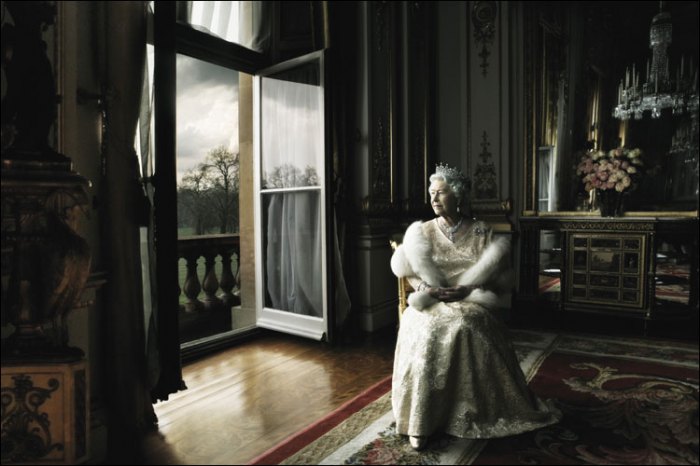
Elizabeth II, Buckingham Palace, London, March 28, 2007. Photograph by Annie Leibovitz.

____________

______________

_____________

Obama Family Portrait Annie Leibovitz

Annie Leibovitz

From Wikipedia, the free encyclopedia
Annie Leibovitz
Annie Leibovitz-SF-1-Crop.jpg

Leibovitz in February 2008
Born Anna-Lou Leibovitz
October 2, 1949 (age 65)
Waterbury, Connecticut, U.S.
Nationality American
Education San Francisco Art Institute
Known for Photography

Anna-Lou “Annie” Leibovitz (/ˈlbəvɪts/; born October 2, 1949) is an Americanportraitphotographer.

Early life[edit]

Born in Waterbury, Connecticut, on October 2, 1949,[1] Anna-Lou Leibovitz is the third of six children of Marilyn Edith (née Heit) and Samuel Leibovitz.[2] She is a third-generation American; her father’s parents were Romanian Jews.[2] Her mother was a modern dance instructor of EstonianJewish heritage. Her father was a lieutenant colonel in the U.S. Air Force. The family moved frequently with her father’s duty assignments, and she took her first pictures when he was stationed in the Philippines during the Vietnam War.[3]

At Northwood High School,[4] she became interested in various artistic endeavors and began to write and play music. She attended the San Francisco Art Institute,[4] where she studied painting. For several years, she continued to develop her photography skills while holding various jobs, including a stint on a kibbutz in Amir, Israel, for several months in 1969.[5]

Career[edit]

Rolling Stone magazine[edit]

When Leibovitz returned to the United States in 1970, she started her career as staff photographer, working for the just launched Rolling Stone magazine. In 1973, publisher Jann Wenner named Leibovitz chief photographer of Rolling Stone, a job she would hold for 10 years. Leibovitz worked for the magazine until 1983, and her intimate photographs of celebrities helped define the Rolling Stone look.[5]

While working for Rolling Stone, Leibovitz became more aware of the other magazines and learned that she could work for magazines and still create personal work, which for her was the most important.[citation needed] She sought intimate moments with her subjects, who “open their hearts and souls and lives to you”. [6]

She was awarded The Royal Photographic Society‘s Centenary Medal and Honorary Fellowship (HonFRPS) in recognition of a sustained, significant contribution to the art of photography in 2009.[citation needed]

Inspirations[edit]

Photographers such as Robert Frank and Henri Cartier-Bresson influenced her during her time at the San Francisco Art Institute. “Their style of personal reportage—taken in a graphic way—was what we were taught to emulate.”[6] Leibovitz has also cited Richard Avedon‘s portraits as an important and powerful example in her life.[citation needed]

The Rolling Stones[edit]

Leibovitz photographed the Rolling Stones in San Francisco in 1971 and 1972, and served as the concert-tour photographer for Rolling Stones Tour of the Americas ’75. Her favorite photo from the tour was a photo of Mick Jagger in an elevator.[7]

Joan Armatrading[edit]

In 1978 Leibovitz became the first woman to photograph Joan Armatrading for an album. She did the photography for Armatrading’s fifth studio album To the Limit, spending four days at her house capturing the images.[8] Liebovitz also did the photography for Armatrading’s live album, Steppin’ Out.[citation needed]

John Lennon[edit]

On December 8, 1980, Leibovitz had a photo shoot with John Lennon for Rolling Stone, and she promised him he would make the cover.[9] She had initially tried to get a picture with just Lennon alone, as Rolling Stone wanted, but Lennon insisted that both he and Yoko Ono be on the cover. Leibovitz then tried to re-create something like the kissing scene from the couple’s Double Fantasy1980 album cover, a picture Liebovitz loved, and she had John remove his clothes and curl up next to Yoko on the floor. Leibovitz recalls, “What is interesting is she said she’d take her top off and I said, ‘Leave everything on’ — not really preconceiving the picture at all. Then he curled up next to her and it was very, very strong. You couldn’t help but feel that he was cold and he looked like he was clinging on to her. I think it was amazing to look at the first Polaroid and they were both very excited. John said, ‘You’ve captured our relationship exactly. Promise me it’ll be on the cover.’ I looked him in the eye and we shook on it.”[10] Leibovitz was the last person to professionally photograph Lennon—he was shot and killed five hours later.[11]

The photograph was subsequently re-created in 2009 by John and Yoko’s son Sean Lennon, posing with his girlfriend Charlotte Kemp Muhl, with male/female roles reversed (Sean clothed, Kemp naked),[12][13] and by Henry Bond and Sam Taylor-Wood in their YBA pastiche October 26, 1993.[14]

In 2011, Leibovitz was nominated alongside Singaporean photographer Dominic Khoo and Wing Shya for Asia Pacific Photographer of the Year.[citation needed]

From Vanity Fair: “For many of New York journalism’s future luminaries—and at least one of Hollywood’s—the strike created an opening for their more literary pursuits. From left to right, Robert Silvers, Calvin Trillin, Nora Ephron, Gay Talese, Pete Hamill, Tom Wolfe, and Jimmy Breslin, photographed by Annie Leibovitz.”

Other projects[edit]

  • In the 1980s, Leibovitz’s new style of lighting and use of bold colors and poses got her a position with Vanity Fair magazine.[15]
  • In 1991, Leibovitz mounted an exhibition at the National Portrait Gallery. She was the second living portraitist and first woman to show there.[11]
  • In 1991, Leibovitz had been made Commandeur de l’Ordre des Arts et des Lettres by the French Government.[11]
  • In 2007, major retrospective of Leibovitz’s work was held at the Brooklyn Museum,[16] The retrospective was based on her book, Annie Leibovitz: A Photographer’s Life, 1990–2005 and included many of her professional (celebrity) photographs as well as numerous personal photographs of her family, children, and partner Susan Sontag. This show, which was expanded to include three of the official portraits of Queen Elizabeth II, then went on the road for seven stops. It was on display at the Corcoran Gallery of Art in Washington, D.C., from October 2007 to January 2008 and at the Palace of the Legion of Honor in San Francisco from March 2008 to May 2008. In February 2009, the exhibition was moved to Berlin, Germany.[17] The show included 200 photographs.[18] At the exhibition, Leibovitz showed that she doesn’t have two lives, career and personal, but has one wherein assignments and personal pictures are all part of her works. This exhibition and her talk focused on her personal photographs and life.[citation needed]
  • In 2007, The BBC misrepresented Leibovitz’s portrait shooting of Queen Elizabeth II, to take the Queen’s official picture for her state visit to Virginia. This was filmed for the BBC documentary A Year with the Queen. A promotional trailer for the film showed the Queen reacting angrily to Leibovitz’s suggestion (“less dressy”) that she remove her tiara, then a scene of the Queen walking down a corridor, telling an aide “I’m not changing anything. I’ve had enough dressing like this, thank you very much.”[19] The BBC later apologized and admitted that the sequence of events had been misrepresented, as the Queen was in fact walking to the sitting in the second scene.[20] This led to a BBC scandal and a shake-up of ethics training.
  • In 2007, The Walt Disney Company hired her to do a series of photographs with celebrities in various roles and scenes for the Walt Disney Parks and ResortsYear of a Million Dreams” campaign.[21][22] Leibovitz claims she never liked the word “celebrity”. “I’ve always been more interested in what they do than who they are, I hope that my photographs reflect that.” She tries to receive a little piece of each subject’s personality in the photos.[6]
  • On April 25, 2008, Entertainment Tonight reported that 15-year-old Miley Cyrus had posed topless for a photo shoot with Vanity Fair.[23][24] The photograph and subsequently released behind-the-scenes photographs show Cyrus topless, her bare back exposed but her front covered with a bedsheet. The photo was taken by Leibovitz.[25] The full photograph was published with an accompanying story on The New York Times website on April 27, 2008. On April 29, 2008,The New York Times clarified: though the pictures left an impression that she was bare-breasted, Cyrus was wrapped in a bedsheet and was actually not topless.[26] Some parents expressed outrage at the nature of the photograph, which a Disney spokesperson described as “a situation [that] was created to deliberately manipulate a 15-year-old in order to sell magazines”.[26]

    In response to the Internet circulation of the photo and ensuing media attention, Cyrus released a statement of apology on April 27:

    “I took part in a photo shoot that was supposed to be ‘artistic’ and now, seeing the photographs and reading the story, I feel so embarrassed. I never intended for any of this to happen and I apologize to my fans who I care so deeply about.”[26]

    Leibovitz also released a statement saying:

    “I’m sorry that my portrait of Miley has been misinterpreted. … The photograph is a simple, classic portrait, shot with very little makeup, and I think it is very beautiful.”[26][27]

  • In October 2011, Leibovitz had an exhibit in Moscow. In an interview with Rossiya 24, she explained her photography style.[28]
  • In 2014, the New-York Historical Society mounted an exhibit of Leibovitz’s work, based on her 2011 book, Pilgrimages.[29]

Archive[edit]

Since 1977, Leibovitz licensing images have been represented by Contact Press Images, a photojournalism agency based in New York City. She ceased to be represented by Jim Moffat at A Corporation for Art & Commerce in 2009.

Personal life[edit]

Children[edit]

Leibovitz has three children. Her daughter Sarah Cameron Leibovitz was born in October 2001 when Leibovitz was 52 years old.[30] Her twins (two girls), Susan and Samuelle, were born to a surrogate mother in May 2005.[31]

Susan Sontag by Annie Leibovitz

Relationships[edit]

Leibovitz had a close relationship with writer and essayist Susan Sontag from 1989 until Sontag’s death in 2004. During Sontag’s lifetime, neither woman publicly disclosed whether the relationship was a platonic friendship or romantic.Newsweek in 2006 made reference to Leibovitz’s decade-plus relationship with Sontag, stating, “The two first met in the late ’80s, when Leibovitz photographed her for a book jacket. They never lived together, though they each had an apartment within view of the other’s.”[32] Leibovitz, when interviewed for her autobiography A Photographer’s Life: 1990-2005 (2006 in literature|2006), said the book told a number of stories, and “with Susan, it was a love story.”[33] While The New York Times in 2009 referred to Sontag as Leibovitz’s “companion”,[34] Leibovitz wrote in A Photographer’s Life that, “Words like ‘companion’ and ‘partner’ were not in our vocabulary. We were two people who helped each other through our lives. The closest word is still ‘friend.'” [35] That same year, Leibovitz said the descriptor “lover” was accurate.[36] She later reiterated, “Call us ‘lovers’. I like ‘lovers.’ You know, ‘lovers’ sounds romantic. I mean, I want to be perfectly clear. I love Susan.”[31]

Religion[edit]

Despite being raised in a Jewish home, Leibovitz no longer practices Judaism. When asked if being Jewish is important to her, Leibovitz replied, “I’m not a practicing Jew, but I feel very Jewish.”[2]

(Image Credit: Merce Cunningham. Photo Annie Leibovitz)

Examples of Leibovitz’s photographs[edit]

Leibovitz in front of her More Demi MooreVanity Fair cover photo, 2008

Johnny Cash & Family by Annie Leibovitz, 2001

___________

Tuesday, October 12, 2010

Annie Leibovitz – Some of my favorites

Angelina Jolie and Brad Pitt – just a sexy photo!

The Queen – all she needs is a cup o’ tea and a cucumber sandwich.

Gwyneth Paltrow and Mother – This little apple did not fall far.
Martina Navratilova

Nicole Kidman

Burroughs

Merce CunninghamEverybody knows Annie and her intriguing photographs of the rich and famous. Her portraiture captures more than just a face – she captures a personality a vision or a way of life with one click of her camera. There are so many inspiring images but these are some of my favorites!
COMMENTS 2

Appreciation Station { Annie Leibovitz }

This weekend I had the absolute pleasure of watching the biography of an incredible photographer, Annie Leibovitz.
It tells her story well, centering around the production of a book of her work(A Photographer’s Life: 1990-2005). So, we get to see her comments on the work as she decides what to put in the book and as she looks back on her past, there are interviews with family and friends, as well as film footage and photos of her youth. It does jump a bit, from current work to old, from childhood to the last few years but this method actually made it even more interesting. It was personal and there are some great candid moments and times where she speaks to her daughter that are really touching.

She has become known as a portrait artist, particularly of celebrities. She tells vivid stories with each picture and expresses parts of the subject’s personality through the theme, story, fashion, pose and expression.

WARNING: This will be a long post as I cannot decide which photos I like best..

She was born in Waterbury, Connecticut and is the third of 6 children. The family travelled a lot because Annie’s father Sam was a lieutenant colonel in the US Air Force. ‘Life Behind a Lens’ shows how family photographs were very important to her mother, Marilyn, and Annie began taking photos when they were stationed in Vietnam. After studying painting at the San Fransico art institute and some time spent in a kibbutz in Israel, she took night classes in photography and began working for (the new at the time) Rolling Stone Magazine. She became chief photographer and was instrumental in the magazine’s style that became iconic.
She says in the movie that she captures the moments between the big events, the things that happen behind the scenes, the thoughtful expressions, the real people behind the media haze. Her inventive and wildly creative images still stand out today in a world saturated with imagery. This in itself is testmament to her greatness.
Annie Leibovitz was the photographer who took the famous picture of Yoko Ono and John Lennon that made the Rolling Stone cover. Five hours after it was taken he was shot and killed.

Due to her mother’s background in dance she was fascinated by movement and how it is captured on camera. Hence she has done work for American Ballet Theatre, the Brooklyn Academy of Music, and the Mark Morris Dance Group, and with Mikhail Baryshnikov.
After Rolling Stone she moved on to Vanity Fair and continues to do great work for them as well as private pieces and photography for Vogue.

Annie’s love, Susan Sontag, a well known writer, passed away in 2004. In ‘Life Through A Lens’ we see how she inspired Annie and gave constructive criticism. They went to Sarajevo as Susan wanted her to capture real life, the despair, the pain, the reality of that place. Preparing her book,A Photographer’s Life: 1990-2005, and compiling her favourite images of Susan was integral to the grieving process after her death.

To quote Vanity Fair: Leibovitz has been designated a Living Legend by the Library of Congress and is the recipient of many other honors, including the Barnard College Medal of Distinction and the Infinity Award in Applied Photography from the International Center of Photography. She was decorated a Commandeur in the Ordre des Arts et des Lettres by the French government. She lives in New York with her three children, Sarah, Susan, and Samuelle.

She is, I agree.. a living legend.

Thanks to Vogue, Rolling Stone and Vanity Fair.

Related posts:

Taking on Ark Times Bloggers on various issues Part I “Old Testament Bible Prophecy” includes the film TRUTH AND HISTORY and article ” Jane Roe became pro-life”

I have gone back and forth and back and forth with many liberals on the Arkansas Times Blog on many issues such as abortion, human rights, welfare, poverty, gun control  and issues dealing with popular culture. Here is another exchange I had with them a while back. My username at the Ark Times Blog is Saline […]

John MacArthur on fulfilled prophecy from the Bible Part 2

I have posted many of the sermons by John MacArthur. He is a great bible teacher and this sermon below is another great message. His series on the Book of Proverbs was outstanding too.  I also have posted several of the visits MacArthur made to Larry King’s Show. One of two most popular posts I […]

John MacArthur on fulfilled prophecy from the Bible Part 1

I have posted many of the sermons by John MacArthur. He is a great bible teacher and this sermon below is another great message. His series on the Book of Proverbs was outstanding too.  I also have posted several of the visits MacArthur made to Larry King’s Show. One of two most popular posts I […]

John MacArthur: Fulfilled prophecy in the Bible? (Ezekiel 26-28 and the story of Tyre, video clips)

Prophecy–The Biblical Prophesy About Tyre.mp4 Uploaded by TruthIsLife7 on Dec 5, 2010 A short summary of the prophecy about Tyre and it’s precise fulfillment. Go to this link and watch the whole series for the amazing fulfillment from secular sources. http://www.youtube.com/watch?v=qvt4mDZUefo ________________ John MacArthur on the amazing fulfilled prophecy on Tyre and how it was fulfilled […]

John MacArthur on the Bible and Science (Part 2)

John MacArthur on the Bible and Science (Part 2) I have posted many of the sermons by John MacArthur. He is a great bible teacher and this sermon below is another great message. His series on the Book of Proverbs was outstanding too.  I also have posted several of the visits MacArthur made to Larry […]

John MacArthur on the Bible and Science (Part 1)

John MacArthur on the Bible and Science (Part 1) I have posted many of the sermons by John MacArthur. He is a great bible teacher and this sermon below is another great message. His series on the Book of Proverbs was outstanding too.  I also have posted several of the visits MacArthur made to Larry […]

Adrian Rogers: “Why I believe the Bible is true”

Adrian Rogers – How you can be certain the Bible is the word of God Great article by Adrian Rogers. What evidence is there that the Bible is in fact God’s Word? I want to give you five reasons to affirm the Bible is the Word of God. First, I believe the Bible is the […]

The Old Testament is Filled with Fulfilled Prophecy by Jim Wallace

Is there any evidence the Bible is true? Articles By PleaseConvinceMe Apologetics Radio The Old Testament is Filled with Fulfilled Prophecy Jim Wallace A Simple Litmus Test There are many ways to verify the reliability of scripture from both internal evidences of transmission and agreement, to external confirmation through archeology and science. But perhaps the […]

Taking on Ark Times Bloggers on various issues Part M “Old Testament prophecy fulfilled?”Part 3(includes film DEATH BY SOMEONE’S CHOICE)

  I have gone back and forth and back and forth with many liberals on the Arkansas Times Blog on many issues such as abortion, human rights, welfare, poverty, gun control  and issues dealing with popular culture. Here is another exchange I had with them a while back. My username at the Ark Times Blog is […]

Evidence for the Bible

Here is some very convincing evidence that points to the view that the Bible is historically accurate. Archaeological and External Evidence for the Bible Archeology consistently confirms the Bible! Archaeology and the Old Testament Ebla tablets—discovered in 1970s in Northern Syria. Documents written on clay tablets from around 2300 B.C. demonstrate that personal and place […]

MUSIC MONDAY Aldous Huxley and the rock band CREAM Featured artist is Peter Eugene Ball


_

PSYCHEDELIC SIGHT

MIND-BLOWING ROCK MUSIC FROM THE 1960S & BEYOND: A CELEBRATION

No. 6: ‘White Room’

Known for its slashing wah-wah guitar solo, pounding drums and halting drug-inspired lyrics, “White Room” remains one of Cream’s heavily trafficked songs.

Although the wah-wah pedal effect on Eric Clapton’s guitar marks it as a product of the late 1960s, “White Room” feels as contemporary as anything in the Cream catalog. The rock song is marked by an unusual sophistication in the lyrics and musical structure. It also expresses the psychedelic aesthetic in a radio-friendly serving, and audiences of the day ate it up.

Lyricist Pete Brown wrote “White Room” with bassist/singer Jack Bruce. Brown’s carefully measured poetry (doled out in four-syllable phrases) lifts this above so many trippy-nonsense lyrics of the era:

In the white room, with black curtains, near the station/
Black roof country, no gold pavements, tired starlings

The “White Room” was a new flat (apartment) inhabited by Brown, a place where “the shadows run from themselves.” Before long, Brown must confront “the station,” perhaps the London Tube, where pain awaits as a lover departs:

You said no strings could secure you at the station/
Platform ticket, restless diesels, goodbye windows

Brown said years later: “It was a miracle it worked, considering it was me writing a monologue about a new flat.”

While drugs reportedly came into play in the song’s creation, this is a fine example of a psychedelic song working within the temporal confines of a rock single. In the U.S., a 3-minute single version spent several weeks in the top 10 during the fall of 1968. The full 5-minute song provided a dramatic opening to Cream’s “Wheels of Fire” double album.

Despite Clapton’s brilliant solo (and celebrity), “White Room” also serves as evidence that vocalist Bruce was very much Cream’s front man.

“White Room” remained a can’t-miss concert staple for both Bruce and Clapton in their solo careers, although Clapton did resist playing it for many years. It was the penultimate song performed at Cream’s 2005 reunion shows.

Cream – White Room – Lyrics

Image result for francis schaeffer
630 × 400Images may be subject to copyrightLearn More

In his book HOW SHOULD WE THEN LIVE? Francis Schaeffer noted:

The man who followed on from that point was English–Aldous Huxley (1894-1963). He proposed drugs as a solution. We should, he said, give healthy people drugs and they can then find truth inside their own heads. All that was left for Aldous Huxley and those who followed him was truth inside a person’s own head. With Huxley’s idea, what began with the existential philosophers – man’s individual subjectivity attempting to give order as well as meaning, in contrast to order being shaped by what is objective or external to oneself – came to its logical conclusion. Truth is in one’s own head. The ideal of objective truth was gone.

Image result for aldous huxley

This emphasis on hallucinogenic drugs brought with it many rock groups–for example, Cream, Jefferson Airplane, Grateful Dead, Incredible String Band, Pink Floyd, and Jimi Hendrix. Most of their work was from 1965-1958. The Beatles’Sergeant Pepper’s Lonely Hearts Club Band (1967) also fits here. This disc is a total unity, not just an isolated series of individual songs, and for a time it became the rallying cry for young people throughout the world. As a whole, this music was the vehicle to carry the drug culture and the mentality which went with it across frontiers which were almost impassible by other means of communication.

Here is a good review of the episode 016 HSWTL The Age of Non-Reason of HOW SHOULD WE THEN LIVE?, December 23, 2007:

Together with the advent of the “drug Age” was the increased interest in the West in  the religious experience of Hinduism and Buddhism. Schaeffer tells us that: “This grasping for a nonrational meaning to life and values is the central reason that these Eastern religions are so popular in the West today.”  Drugs and Eastern religions came like a flood into the Western world.  They became the way that people chose to find meaning and values in life.  By themselves or together, drugs and Eastern religion became the way that people searched inside themselves for ultimate truth.

Along with drugs and Eastern religions there has been a remarkable increase “of the occult appearing as an upper-story hope.”  As modern man searches for answers it “many moderns would rather have demons than be left with the idea that everything in the universe is only one big machine.”  For many people having the “occult in the upper story of nonreason in the hope of having meaning” is better than leaving the upper story of nonreason empty. For them horror or the macabre are more acceptable than the idea that they are just a machine.

Francis Schaeffer has correctly argued:

The universe was created by an infinite personal God and He brought it into existence by spoken word and made man in His own image. When man tries to reduce [philosophically in a materialistic point of view] himself to less than this [less than being made in the image of God] he will always fail and he will always be willing to make these impossible leaps into the area of nonreason even though they don’t give an answer simply because that isn’t what he is. He himself testifies that this infinite personal God, the God of the Old and New Testament is there. 

Instead of making a leap into the area of nonreason the better choice would be to investigate the claims that the Bible is a historically accurate book and that God created the universe and reached out to humankind with the Bible. Below is a piece of that evidence given by Francis Schaeffer concerning the accuracy of the Bible.

TRUTH AND HISTORY (chapter 5 of WHATEVER HAPPENED TO THE HUMAN RACE?,


___

In the previous chapter we saw that the Bible gives us the explanation for the existence of the universe and its form and for the mannishness of man. Or, to reverse this, we came to see that the universe and its form and the mannishness of man are a testimony to the truth of the Bible. In this chapter we will consider a third testimony: the Bible’s openness to verification by historical study.

Christianity involves history. To say only that is already to have said something remarkable, because it separates the Judeo-Christian world-view from almost all other religious thought. It is rooted in history.

The Bible tells us how God communicated with man in history. For example, God revealed Himself to Abraham at a point in time and at a particular geographical place. He did likewise with Moses, David, Isaiah, Daniel and so on. The implications of this are extremely important to us. Because the truth God communicated in the Bible is so tied up with the flow of human events, it is possible by historical study to confirm some of the historical details.

It is remarkable that this possibility exists. Compare the information we have from other continents of that period. We know comparatively little about what happened in Africa or South America or China or Russia or even Europe. We see beautiful remains of temples and burial places, cult figures, utensils, and so forth, but there is not much actual “history” that can be reconstructed, at least not much when compared to that which is possible in the Middle East.

When we look at the material which has been discovered from the Nile to the Euphrates that derives from the 2500-year span before Christ, we are in a completely different situation from that in regard to South America or Asia. The kings of Egypt and Assyria built thousands of monuments commemorating their victories and recounting their different exploits. Whole libraries have been discovered from places like Nuzu and Mari and most recently at Elba, which give hundreds of thousands of texts relating to the historical details of their time. It is within this geographical area that the Bible is set. So it is possible to find material which bears upon what the Bible tells us.

The Bible purports to give us information on history. Is the history accurate? The more we understand about the Middle East between 2500 B.C. and A.D. 100, the more confident we can be that the information in the Bible is reliable, even when it speaks about the simple things of time and place.

The site of the biblical city called Lachish is about thirty miles southwest of Jerusalem. This city is referred to on a number of occasions in the Old Testament. Imagine a busy city with high walls surrounding it, and a gate in front that is the only entrance to the city. We know so much about Lachish from archaeological studies that a reconstruction of the whole city has been made in detail. This can be seen at the British Museum in the Lachish Room in the Assyrian section.

There is also a picture made by artists in the eighth century before Christ, the Lachish Relief, which was discovered in the city of Nineveh in the ancient Assyria. In this picture we can see the Jewish inhabitants of Lachish surrendering to Sennacherib, the king of Assyria. The details in the picture and the Assyrian writing on it give the Assyrian side of what the Bible tells us in Second Kings:

2 Kings 18:13-16

New American Standard Bible (NASB)

13 Now in the fourteenth year of King Hezekiah, Sennacherib king of Assyria came up against all the fortified cities of Judah and seized them. 14 Then Hezekiah king of Judah sent to the king of Assyria at Lachish, saying, “I have done wrong. Withdraw from me; whatever you impose on me I will bear.” So the king of Assyria required of Hezekiah king of Judah three hundred talents of silver and thirty talents of gold. 15 Hezekiah gave him all the silver which was found in the house of the Lord, and in the treasuries of the king’s house. 16 At that time Hezekiah cut off the gold from the doors of the temple of the Lord, and from the doorposts which Hezekiah king of Judah had overlaid, and gave it to the king of Assyria.

________

We should notice two things about this. First, this is a real-life situation–a real siege of a real city with real people on both sides of the war–and it happened at a particular date in history, near the turn of the eighth century B.C. Second, the two accounts of this incident in 701 B.C. (the account from the Bible and the Assyrian account from Nineveh) do not contradict, but rather confirm each other. The history of Lachish itself is not so important for us, but some of its smaller historical details.

Tel Lachish –

Image result for lachish
1200 × 877Images may be subject to copyrightLearn More

Featured artist today is Peter Eugene Ball

Contemporary Christian Art – The Rt Revd Lord Harries of Pentregarth

Published on Apr 10, 2012

Contrary to much opinion, the current scene of faith-related art is very much alive. There are new commissions for churches and cathedrals, a number of artists pursue their work on the basis of a deeply convinced faith, and other artists often resonate with traditional Christian themes, albeit in a highly untraditional way. The challenge for the artist, stated in the introduction to the course of lectures above, is still very much there: how to retain artistic integrity whilst doing justice to received themes.

This lecture is part of Lord Harries’ series on ‘Christian Faith and Modern Art’. The last century has seen changes in artistic style that have been both rapid and radical. This has presented a particular problem to artists who have wished to express Christian themes.

The transcript and downloadable versions of the lecture are available from the Gresham College website:
http://www.gresham.ac.uk/lectures-and…

Gresham College has been giving free public lectures since 1597. This tradition continues today with all of our five or so public lectures a week being made available for free download from our website.
http://www.gresham.ac.uk

_________________________

Pièta, Winchester Cathedral, 2011

Peter Ball was born and brought up in Coventry and was much influenced by teachers at his local school. He trained at Coventry School of Art and has worked full time as a sculptor from 1968. His secular work has often been described as witty, and he usually begins there, as in his religious commissions, with a piece of driftwood. He must be the most commissioned of all contemporary artists, with over 60 commissions from churches or cathedrals. This popularity is no doubt related to that fact that he has said that a work in a church setting. “Has to be a devotional object not an architectural set piece”

Christus from the Flames, Cotgrave, 1998

The first word that comes to mind on seeing one of these religious commissions is “Romanesque”. Pamela Tudor Craig, after describing the drift wood and copper plate materials of his work says “So his Christus has, in the nature of its composition the battle-scarred endurance of a time-worn Romanesque Christus” and continues.

The large eyed narrow bearded heads of Romanesque art come naturally to Peter Ball. He is not the heir of the comely Gothic but of the tormented prophets of Souillac, or even further back, of Celtic spirit figures. His way of seeing is most suited, perhaps, to commissions for the Hanging Rood, or for a gaunt Pietà, but there is a tenderness in his treatment of

Biography (video)

Peter Eugene Ball was born in Coventry, Warwickshire on 19 March 1943.  He was educated at a local boys’ school and from 1957 to 1962 attended Coventry College of Art.

The powerful visual images of paintings, sculptures and architecture made a deep impression on the sculptor as a child.  Enlightened history teachers brought their subject alive for him and one of his earliest memories is of a visit to Southwell Minster, Nottinghamshire at the age of 11, which, by coincidence, many years later, became the first cathedral to commission a major work by him.  He also acquired much first hand knowledge whilst accompanying Geoffrey Saunders, an art history tutor, on numerous trips around the British Isles during the 1960s and together they made a photographic survey of village Romanesque carvings and prehistoric monuments throughout England, Scotland and Wales.  From this Peter developed a life-long passion for Celtic and Romanesque carvings, both religious and secular.

He joined the Marjorie Parr Gallery, King’s Road, Chelsea in 1961 where he had his first one-man exhibition in 1967.  During this time Peter took on a factory job to supplement his income but in 1968 decided to make sculpture his full-time occupation.

In 1974 he sold his first religious piece to a Monsignor at Westminster Cathedral and in 1975 an exhibition of his sculptures took place at Southwark Cathedral in London.  Solo exhibitions at the Gilbert-Parr Gallery were supplemented by major showings every year at the Gallery’s stand at the International Art Fair in Basel.   The next few years were very productive with sculpture being shown at gallery exhibitions in London, Holland and Switzerland, and at international art fairs in Basel, Dϋsseldorf, New York and Chicago.  He also designed and made sculpture, masks and armour for ‘War Music’, Christopher Logue’s adaptation of Homer’s ‘Iliad’, for the Prospect Theatre at the Old Vic, London in 1977.  Then in 1978 Peter obtained his first church commission: a memorial crucifix at Preston-on-Stour, Warwickshire.

1982 brought a number of changes to the artist’s life.   The Gilbert-Parr Gallery in London closed and thereafter his exhibitions took place at the Galerie Gilbert in Remetschwiel, South Germany and at the Basel Art Fair, the Alwin Gallery on Grafton Street, London and the McMurtrey Gallery in Houston, Texas.  He was also producing paintings, drawings, etchings and painted ceramics during this period.  In 1986 he was commissioned to make a crucifix and altar pieces for Birmingham Cathedral and in 1987 a large Christus Rex for the nave of Southwell Minster.

Peter’s reputation for his religious work began to spread and over the next few years, as well as exhibiting his secular work, he made various pieces for churches, including a Virgin and Child for Southwark Cathedral and a Crucifix and Pieta for Winchester Cathedral.  In 1993 his work was included in the exhibition ‘Images of Christ : Religious Iconography in Twentieth Century British Art’ in Northampton and St Paul’s Cathedral, London. In the same year, he held a solo exhibition in Winchester Cathedral for its 900th anniversary.

‘A Kind of Madness’, an account of the secular work of Peter Eugene Ball by Inga Gilbert, was also published in 1993 and throughout the nineties he continued to exhibit his work in various galleries and, in particular, enjoyed great success at the Galerie Husstege in S’Hertogenbosch, Holland.  During this period he accepted various religious commissions and in 1999 was given a solo exhibition at Southwell Minster and another at Ely Cathedral the following year.  ‘Icons of the Invisible God’, an analysis of a selected collection of his religious sculptures by Elaine Kazimierczuk, was also published at this time.

The new millennium heralded a regular stream of religious commissions, including two pieces for Romsey Abbey and a Christus Rex and Welcoming Christ for the newly refurbished church of St Barnabas in Erdington.  He continued to hold exhibitions, often in cathedral settings such as Lichfield, Salisbury and Chichester, where he exhibited a mix of both religious and secular work.  In 2010 he was commissioned to make a Mother and Child for St Michael’s Church at Winchester College and went on to produce several other pieces for the school, including a large Crucifix for the main chapel.  In 2013 he was invited to hold a major exhibition of his work there which proved to be a great success.

Peter now lives in Newark in Nottinghamshire with his wife, Jane Warner, and continues to work from his studio at home.  He currently has more than seventy religious sculptures in churches and cathedrals throughout England and Wales and his secular work can be seen at various galleries and private exhibitions.   He has recently completed a major work for Merton College, Oxford: a Madonna and Child, and he is currently working towards his next exhibition which will take place in Oxford Cathedral, Christ Church College, Oxford next year.    He laughs a lot and curses when things go wrong.  His sculpture continues to be idiosyncratic and uncompromising, defying the changing fashions of the art world and remaining true to the spirit of the man.

Peter Eugene Ball – Artist & Sculptor


Virgin and Child

Crucifix, Winchester Cathedral, 1990

Christus Rex, Southwell Minster, 1987

Hope, St Martha the housewife, Broxtow, Nottingham, 1997

Peter Eugene Ball below:

Peter Eugene Ball’s art below:

Peter Eugene Ball

From Wikipedia, the free encyclopedia

Jump to: navigation, search

Peter Eugene Ball
Born 19 March 1943 (age 70)
Coventry, England
Nationality British
Field Sculptor
Works Christus Rex (Southwell Minster), Pietà (Winchester Cathedral), Virgin and Child (Southwark Cathedral)

Peter Eugene Ball (19 March 1943) is an English sculptor. He is best known for his religious work which can be seen in churches and cathedrals throughout Britain. He also produces secular sculpture using predominantly driftwood and found objects.

Contents

Biography

Born on 19 March 1943 in Coventry, Warwickshire, Peter Eugene Ball attended Coventry College of Art from 1957 until 1962 where he obtained the National Diploma of Design. By 1963 his sculptures were already included in mixed exhibitions in the Midlands and at the Marjorie Parr Gallery, London, where he had his first one-man exhibition in 1967. However, it wasn’t until 1968 that making sculpture became his full-time occupation, and since that time he has devoted himself to producing both religious work for churches and cathedrals throughout the country and exhibiting and selling his secular work in galleries across Europe and in America.

Religious commissions

Sculpture Location Year
Christus Victor Parish Church of St Peter and St Paul, Oadby, Leicestershire 1992
Saint John the Baptist Parish Church of St John the Baptist, Baginton, Warwickshire 1992
High Altar Crucifix Parish Church of St Mary the Virgin and St Catherine, Nottingham 1992
Crucifix Parish Church of St Mary the Virgin and St Catherine, Nottingham 1992
Pietà The Cathedral and Parish Church of the Blessed Virgin Mary (Southwell Minster), Nottinghamshire 1993
Crib St Peter’s Church, London (Eaton Square) 1994
Crib Christchurch, London (Chelsea) 1994
Saints and Bishops Portsmouth Cathedral 1994
Christus Monmouth School Chapel 1995
Altar Table and Saint Winchester Cathedral 1996
Crucifixion St Andrew’s Church, Chilcomb, Hampshire 1996
Christus Rex The Cathedral and Parish Church of the Blessed Virgin Mary (Southwell Minster), Nottinghamshire 1997
Ecce Homo The Cathedral and Parish Church of the Blessed Virgin Mary (Southwell Minster), Nottinghamshire 1997
Hope Hope Centre, Church of St Martha the Housewife, Broxtowe, Nottinghamshire 1997
Christus Rex St Michael’s Church, Basingstoke, Hampshire 1997
Madonna and Child Holy Trinity Church, Blythburgh, Suffolk 1997
Madonna and Child St Swithun’s School Chapel, Winchester 1998
Christ Rowner, Hampshire 1999
Madonna and Child St Mary’s, Chesterfield 1999
Christus & Mother & Child Chelmsford Cathedral 2000
Mother and Child Clifton Brighouse 2000
Christ St Mary’s, Silchester 2001
Christus St Alban’s, Romford 2001
Christ Lichfield Cathedral 2002
John the Baptist St John’s, Penistone 2002
Virgin of the Sea St Andrew’s, Deal 2002
Christus Ely St Francis, Ely, Cardiff 2003
Christus St Mary’s, Gomersal, York 2004
Christus St Tielo’s, Whitchurch, Cardiff 2004
font St Tielo’s, Whitchurch, Cardiff 2004
St Nicholas Romsey Abbey, Romsey, Hampshire 2005
Virgin and Child St Giles’, Nottingham 2005
Small Crucifix Derby Cathedral 2005
St Andrew St Andrew’s, Wissett 2006
Christus St Bede’s, Basingstoke 2006
Small Christus Wolvesey Palace, Winchester 2006

Books

  • A Kind of Madness (The Sculptures of Peter Eugene Ball), Inga Gilbert
  • Icons of The Invisible God (Selected Sculptures of Peter Eugene Ball), foreword by Pamela Tudor-Craig, introduction by Richard Davey

External links

Authority control

________

Related posts:

FRANCIS SCHAEFFER ANALYZES ART AND CULTURE Part 53 THE BEATLES (Part E, Stg. Pepper’s and John Lennon’s search in 1967 for truth was through drugs, money, laughter, etc & similar to King Solomon’s, LOTS OF PICTURES OF JOHN AND CYNTHIA) (Feature on artist Yoko Ono)

The John Lennon and the Beatles really were on a long search for meaning and fulfillment in their lives  just like King Solomon did in the Book of Ecclesiastes. Solomon looked into learning (1:12-18, 2:12-17), laughter, ladies, luxuries, and liquor (2:1-2, 8, 10, 11), and labor (2:4-6, 18-20). He fount that without God in the picture all […]

FRANCIS SCHAEFFER ANALYZES ART AND CULTURE Part 52 THE BEATLES (Part D, There is evidence that the Beatles may have been exposed to Francis Schaeffer!!!) (Feature on artist Anna Margaret Rose Freeman )

______________   George Harrison Swears & Insults Paul and Yoko Lucy in the Sky with Diamonds- The Beatles The Beatles:   I have dedicated several posts to this series on the Beatles and I don’t know when this series will end because Francis Schaeffer spent a lot of time listening to the Beatles and talking […]

FRANCIS SCHAEFFER ANALYZES ART AND CULTURE Part 51 THE BEATLES (Part C, List of those on cover of Stg.Pepper’s ) (Feature on artist Raqib Shaw )

  The Beatles in a press conference after their Return from the USA Uploaded on Nov 29, 2010 The Beatles in a press conference after their Return from the USA. The Beatles:   I have dedicated several posts to this series on the Beatles and I don’t know when this series will end because Francis […]

FRANCIS SCHAEFFER ANALYZES ART AND CULTURE Part 50 THE BEATLES (Part B, The Psychedelic Music of the Beatles) (Feature on artist Peter Blake )

__________________   Beatles 1966 Last interview I have dedicated several posts to this series on the Beatles and I don’t know when this series will end because Francis Schaeffer spent a lot of time listening to the Beatles and talking and writing about them and their impact on the culture of the 1960’s. In this […]

FRANCIS SCHAEFFER ANALYZES ART AND CULTURE Part 49 THE BEATLES (Part A, The Meaning of Stg. Pepper’s Cover) (Feature on artist Mika Tajima)

_______________ The Beatles documentary || A Long and Winding Road || Episode 5 (This video discusses Stg. Pepper’s creation I have dedicated several posts to this series on the Beatles and I don’t know when this series will end because Francis Schaeffer spent a lot of time listening to the Beatles and talking and writing about […]

FRANCIS SCHAEFFER ANALYZES ART AND CULTURE PART 48 “BLOW UP” by Michelangelo Antonioni makes Philosophic Statement (Feature on artist Nancy Holt)

_______________ Francis Schaeffer pictured below: _____________________ I have included the 27 minute  episode THE AGE OF NONREASON by Francis Schaeffer. In that video Schaeffer noted,  ” Sergeant Pepper’s Lonely Hearts Club Band…for a time it became the rallying cry for young people throughout the world. It expressed the essence of their lives, thoughts and their feelings.” How Should […]

FRANCIS SCHAEFFER ANALYZES ART AND CULTURE Part 47 Woody Allen and Professor Levy and the death of “Optimistic Humanism” from the movie CRIMES AND MISDEMEANORS Plus Charles Darwin’s comments too!!! (Feature on artist Rodney Graham)

Crimes and Misdemeanors: A Discussion: Part 1 ___________________________________ Today I will answer the simple question: IS IT POSSIBLE TO BE AN OPTIMISTIC SECULAR HUMANIST THAT DOES NOT BELIEVE IN GOD OR AN AFTERLIFE? This question has been around for a long time and you can go back to the 19th century and read this same […]

FRANCIS SCHAEFFER ANALYZES ART AND CULTURE PART 46 Friedrich Nietzsche (Featured artist is Thomas Schütte)

____________________________________ Francis Schaeffer pictured below: __________ Francis Schaeffer has written extensively on art and culture spanning the last 2000years and here are some posts I have done on this subject before : Francis Schaeffer’s “How should we then live?” Video and outline of episode 10 “Final Choices” , episode 9 “The Age of Personal Peace and Affluence”, episode 8 […]

FRANCIS SCHAEFFER ANALYZES ART AND CULTURE Part 45 Woody Allen “Reason is Dead” (Feature on artists Allora & Calzadilla )

Love and Death [Woody Allen] – What if there is no God? [PL] ___________ _______________ How Should We then Live Episode 7 small (Age of Nonreason) #02 How Should We Then Live? (Promo Clip) Dr. Francis Schaeffer 10 Worldview and Truth Two Minute Warning: How Then Should We Live?: Francis Schaeffer at 100 Francis Schaeffer […]

FRANCIS SCHAEFFER ANALYZES ART AND CULTURE Part 44 The Book of Genesis (Featured artist is Trey McCarley )

___________________________________ Francis Schaeffer pictured below: ____________________________ Francis Schaeffer “BASIS FOR HUMAN DIGNITY” Whatever…HTTHR Dr. Francis schaeffer – The flow of Materialism(from Part 4 of Whatever happened to human race?) Dr. Francis Schaeffer – The Biblical flow of Truth & History (intro) Francis Schaeffer – The Biblical Flow of History & Truth (1) Dr. Francis Schaeffer […]

“Music Monday” THE BEATLES, Breaking down the song WITHIN YOU WITHOUT YOU Part B (Featured artist is Emma Amos )


The Beatles were searching hard for meaning in life and one of their stops along the way was Eastern Religion.

Here is a good review of the episode 016 HSWTL The Age of Non-Reason of HOW SHOULD WE THEN LIVE?, December 23, 2007:

Together with the advent of the “drug Age” was the increased interest in the West in  the religious experience of Hinduism and Buddhism. Schaeffer tells us that: “This grasping for a nonrational meaning to life and values is the central reason that these Eastern religions are so popular in the West today.”  Drugs and Eastern religions came like a flood into the Western world.  They became the way that people chose to find meaning and values in life.  By themselves or together, drugs and Eastern religion became the way that people searched inside themselves for ultimate truth.

(Francis Schaeffer pictured below)

Along with drugs and Eastern religions there has been a remarkable increase “of the occult appearing as an upper-story hope.”  As modern man searches for answers it “many moderns would rather have demons than be left with the idea that everything in the universe is only one big machine.”  For many people having the “occult in the upper story of nonreason in the hope of having meaning” is better than leaving the upper story of nonreason empty. For them horror or the macabre are more acceptable than the idea that they are just a machine.

Oasis – Within You Without You [HD]


Francis Schaeffer in his book HOW SHOULD WE THEN LIVE? gives us some insight into a possible answer to that question:

The younger people and the older ones tried drug taking but then turned to the eastern religions. Both drugs and the eastern religions seek truth inside one’s own head, a negation of reason. The central reason of the popularity of eastern religions in the west is a hope for a nonrational meaning to life and values. The reason the young people turn to eastern religion is simply the fact as we have said and that is that man having moved into the area of nonreason could put anything up there and the heart of the eastern religions  is a denial of reason just exactly as the idealistic drug taking was. So the turning to the eastern religions today fits exactly into the modern existential  methodology, the existential thinking of modern man, of trying to find some optimistic hope in the area of nonreason when he has given up hope on a humanistic basis of finding any kind of unifying answer to life, any meaning to life in the answer of reason. 

An article calledHoly Wars” was based on Francis Schaeffer’s writings primarily and it noted:

Then came the Beatles. John Lennon had declared that his group was more popular than Jesus. But they weren’t willing to stop there. They sought to supplant the true God with everything false. After the rock icons returned from India they brought with them not only the music of the Hindu guru Ravi Shankar, but also his religion as taught by the Maharishi Mahesh Yogi. They were so impressed with that guru’s Transcendental Meditation woo woo that they just had to convert the whole Western World to it. The counterculturalists took it all in, hook line and sinker.


“Within You Without You”

We were talking about the space between us all
And the people who hide themselves behind a wall of illusion
Never glimpse the truth, then it’s far too late, when they pass away
We were talking about the love we all could share
When we find it, to try our best to hold it there with our love
With our love, we could save the world, if they only knewTry to realise it’s all within yourself
No one else can make you change
And to see you’re really only very small
And life flows on within you and without youWe were talking about the love that’s gone so cold
And the people who gain the world and lose their soul
They don’t know, they can’t see, are you one of them?When you’ve seen beyond yourself then you may find
Peace of mind is waiting there
And the time will come when you see we’re all one
And life flows on within you and without you

Francis Schaeffer has correctly argued:

The universe was created by an infinite personal God and He brought it into existence by spoken word and made man in His own image. When man tries to reduce [philosophically in a materialistic point of view] himself to less than this [less than being made in the image of God] he will always fail and he will always be willing to make these impossible leaps into the area of nonreason even though they don’t give an answer simply because that isn’t what he is. He himself testifies that this infinite personal God, the God of the Old and New Testament is there. 

Instead of making a leap into the area of nonreason the better choice would be to investigate the claims that the Bible is a historically accurate book and that God created the universe and reached out to humankind with the Bible. Below is a piece of that evidence given by Francis Schaeffer concerning the accuracy of the Bible.

Below is a piece of that evidence given by Francis Schaeffer concerning the accuracy of the Bible.

TRUTH AND HISTORY (chapter 5 of WHATEVER HAPPENED TO THE HUMAN RACE?, under footnote #96)

Now we should Now we should turn to one of the most spectacular of modern archaeological discoveries, Ebla. While digging on an extensive mound forty-four miles south of Aleppo in Syria in 1974/75, an Italian archaeological expedition came across another of the vast libraries to which we referred earlier. A small room within the palace suddenly yielded up a thousand tablets and fragments, while another not far away a further fourteen thousand. There lay row upon row, just where they had fallen from the burning wooden shelves when the palace was destroyed about 2250 B.C.

What secrets did these tablets reveal? Without wishing to seem unnecessarily repetitive, we can say immediately that Ebla represents yet another discovery from the ancient past which does not make it harder for us to believe the Bible, but quite the opposite. And remember, these tablets date from well before the time of Abraham. The implications of this discovery will not be exhausted by even the turn of this century. The translation and publication of such a vast number of tablets will take years and years. It is important to understand that the information we now have from Ebla does not bear directly upon the Bible. As far as has been discovered, there is no certain reference to individuals mentioned in the Bible, though many names are similar, for example, Ishmael, Israel, and so forth. Biblical place names like Megiddo, Hazor, Lachish are also referred to. What is clear, however, is that certain individuals outside the Bible who previously had been considered fictitious by the critical scholars, simply because of their antiquity, are now quite definitely historic characters.

For example, the Assyrian King Tudiya (approximately 2500 B.C.) had already been known from the Assyrian king list composed about 1000 B.C. His name appeared at the head of the list, but his reality was dismissed by many scholars as “free invention, or a corruption.”  In fact, he was very much a real king of Ebla. Thus, the genealogical tradition of the earlier parts of the Assyrian king list has been vindicated. It preserves faithfully, over a period of 1,500 years, the memory of real, early people who were Assyrian rulers. What we must learn from this is that when we find similar material in the Old Testament, such as the genealogical list in Genesis 7 or the patriarchal stories, we should be careful not to reject them out of hand, as the scholars have so often done. We must remember that these ancient cultures were just as capable of recording their histories as we are.

The most important aspect of the Ebla discoveries is undoubtedly their language. This has been found to be ancient West-Semitic language to which such languages as Hebrew, Canaanite, Ugaritic, Aramaic, and Moabite are related. Thus we have now, for the first time, the whole “tradition” of West-Semitic language stretching over 2,500 years–something which was previously true only of Egyptian and Akkadian, to which Babylonian and Assyrian belong.

Up until quite recently, therefore, this meant that scholars could argue that many words which appeared in the Hebrew Old Testament were what they called “late.” What they meant by this was that these words indicated a much later authorship than the time stated by the text itself. It would be as if one of us pretended to write a sixteenth-century  book using such modern words as AUTOMOBILE and COMPUTER. In the case of the Pentateuch, for example, this was one of the arguments which led some scholars to suggest that it was not Moses who wrote these books, as the Bible says, but anonymous scribes from approximately 1,000 years later. The discoveries at Ebla have shown that many of these words were not late, but very early. Here is yet another example of a claimed “scientific” approach that merely reflects the philosophical prejudices of the scholars involved.

The Bible and Archaeology – Is the Bible from God? (Kyle Butt 42 min)

 
Archaeology Confirms The Biblical Account

        Oftentimes people are not told about the archaeological discoveries that document the truths written in the Bible. We are told that science and the Bible disagree. But as is really the case: True science and the Bible do not contradict each other. We supply many short articles which show that archaeology confirms God’s Written Word, The Bible.

        The below articles are excerpted from various Archaeological trade journals and publications including Light on Archaeology magazine, and Associates for Biblical Research.

Archaeology: The study of human antiquities – usually as
discovered by excavation.  (Chambers English Dictionary)

Below we supply articles from the Associates for Biblical Research and Light on Archaeology to point the reader to the wealth of information that has literally been unearthed by the spades of patient, dedicated people which helps to confirm the historical accuracy of the Bible – God’s Word. Many sights exist in the lands mentioned in the Bible where artifacts of many kinds reveal the life and customs of the people who lived there many centuries earlier.

The Bible has been ridiculed and dismissed in recent times as inaccurate and unreliable. However, students of Biblical Archaeology have found that as the science of archaeology becomes more sophisticated, much more evidence is coming to light regularly that says just the opposite! Finds have been made that show us how historically accurate God’s Word really is.

For those of us who have been privileged to visit Israel – God’s Land, it is thrilling to look down and examine the shaft that Joab climbed up to take the city of Jebus (later Jerusalem) for King David.[2 Sam 5.7-9 : 1 Chron 11.5-7] It is exciting to wade through King Hezekiah’s tunnel, from the spring of Gihon to the pool of Siloam (Silwan). [2 Kings 20.20] It is fascinating to examine the actual scrolls found at Qumram by the Dead Sea and to walk around the Citadel of Jerusalem; the remains of Herod’s fortress palace where Christ was paraded, mocked and then condemned by Pilate.[ Luke 23.1-25] All of these places give us visible evidence of the accuracy of the Biblical record.

The following series of articles are only a small sample of the information available, but, hopefully, the object will be achieved to direct the reader to further studies of the deeper truths revealed in the Bible.

So with your Bible in hand, you are invited to examine the evidence to see whether the work of the archaeologist confirms or denies God’s Word.

NOTE:  We supply the below articles with the gracious permission of Bible Archeology.  They also provide a free magazine as well, the address for signing up for that is supplied at the end of this study.

TEL MARDIKH: Have you heard of the Empire of Ebla? It is not surprising if you have not – for modern history text books make no references to this kingdom, which existed from approximately 2,300 B.C. to 1,700 B.C.

In fact, only students of ancient Middle East history are likely to have come across the name of Ebla, and even then, only in passing – not realizing the extent and power of this empire which stretched around the shores of the eastern Mediterranean for nearly 600 years. Now the re-writing of our history books will again be necessary to fill the gaps in our knowledge of the past; for there has been a remarkable archaeological discovery in Syria between Aleppo and Damascus, on the site of Tel Mardikh.

On this site of a 4,000 year old fortification, perhaps the most remarkable ‘find’ of the century has been uncovered – 18,000 fired clay and rock tablets relating to the economy, administration and international dealings of this once great empire of Ebla.

Popular history of the third millennium B.C. is taught with little regard for the Biblical account of the customs, manners, social behavior and level of education of the people of this period.

Now for the first time it appears that there exists a record contemporary with the Biblical account of the times, and so different is the picture it reveals from that of accepted historical suppositions, that the linguist in charge of the tablets, Dr Pettinato, has claimed that this discovery calls for a fundamental revision of third millennium B.C. culture and history.

The tablets were discovered in some out-buildings of a palace situated within the vast fortifications around the top of the tel. Many of the buildings, due to their solid roofs of some two feet in thickness, are intact and free of debris. Most of the walls are plastered a gray-green color, with murals in good condition. The two rooms in which the tablets were discovered had been shelved with wood but, due to time and the weight of the tablets, this shelving had collapsed with some breakages; but the tablets, many containing 3,000 lines of cuneiform writing, are in readable condition.

The tablets tell of an ’empire’ and names many areas under the control of Ebla, such as Sinai, Assyria, Lebanon, Cyprus, Carchemish, Lachish, Gaza, Hazor and others. Bible students will readily recognize that many of these names appear in the Old Testament record and it is interesting to note that of the three languages of the tablets, an hitherto unknown tongue, closely resembling Hebrew is prevalent and many common names recorded by the people of Ebla are easily recognizable to Bible readers.

  • AB-RA-MU – (ABRAM)
  • E-SA-UM – (ESAU)
  • IS-MA-EL – (ISHMAEL)
  • IS-RA-EL – (ISRAEL)
  • MI-KA-EL – (MICHAEL)
  • MI-KA-YAH – (MICAIAH)
  • YE-RU-SA-LU-UM – (JERUSALEM)

Further, many common Ebla words are the same as Hebrew, such as ‘and’ (WA), ‘perfect’ (TAMMIN), ‘fall’ (NAPAL) and ‘good’ (TOB).

But perhaps most interesting of all are the quite extensive descriptions of the Creation and of the Flood, so often derided by modern historians.

The tablets are being translated and published and their contents will be invaluable in enlarging our understanding of the world of 2,000 BC; for they reveal a sophisticated system of international and civil law, including treaties of trade between Ebla and her neighbors within the framework of political agreements. These have been likened to the present-day Treaty of Rome between the EC members.

In addition, long lists of zoological, geographic and mathematical material have been found and there are weather forecasts in some meteorological texts. Records were made of visiting Mesopotamian scribes and mathematicians.

Proverbs and literary works are also preserved, including a set of bilingual tablets for the purpose of teaching translation, besides thousands of matching words. There seems no doubt that the tablets of Tel Mardikh contain the worlds oldest vocabulary lists – a source of no little consternation to students of ancient languages; for it is widely held that Biblical Hebrew is an evolved language, used during the first millennium BC Isaiah, the Hebrew prophet however, had indicated that his language was ‘the language of Canaan’, [Isaiah 19v18] and the Tel Mardikh tablets now support the Biblical reference – Hebrew has now to be recognized as one of the world’s oldest languages (and perhaps the language spoken by Noah, Canaan being the grandson of Noah through Ham). [ Genesis 10v6]

Interesting for Bible students is the fact that the Bible records that Abram, together with his father Terah, left the city of Ur in southern Mesopotamia to go into Canaan. They traveled as far as Haran and dwelt there. [Genesis 11v31,32] Haran was some 300 miles north east from the site at Tell Mardikh and appears to be named after Haran, Abram’s brother. [ Genesis 11v27 ] On his journey to Canaan, Abram in all probability, passed through Tel Mardikh, the then centre of trade and commerce, and of course, the language of Abram would be that of Ebla and of Canaan.

The other two languages written in cuneiform and discovered at Tel Mardikh are Sumerian and Akkadian. It had previously been assumed that the earliest cuneiform languages, were these two languages, developed in east and south Mesopotamia and the possibility that Syrian and Canaanite communications existed in cuneiform had been ruled out (with the exception of Ugaritic texts). But the Tel Mardikh tablets now reveal Sumerian scripts pre-dating those found in eastern Mesopotamia – throwing accepted theories of language origins to the winds. The Akkadian scripts found at Tel Mardikh refer mainly to the later period of the history of Ebla. One of the deities worshipped at Mardikh was Marduk or the Merodak of the Bible. It appears to be basically the same name as Nimrod, the ‘mighty hunter before the Lord’ mentioned in Genesis 10v9 Nimrod, who founded the city of Babel, appears to have been deified and the cult continued long after Ebla had ceased. The main consonants of Nimrod are M R D, hence:

  • N i M R o D
  • M a R D ikh
  • M e R o D ak

Tel Mardikh was then the place of worship for Mardikh.

The finds of Tel Mardikh and the Empire of Ebla, so far have only revealed confirmation of the scriptural narrative.


From Hinduism to Christianity

Article ID: DH121 | By: Dr. Mahendra P. Singhal

Growing up in an orthodox Hindu home is to enjoy limited freedoms — spiritually speaking. It was more than true in my case. I was raised in a rigidly structured and despotically ruled Hindu home with well-preserved traditions, well developed customs, and well-formulated expectations, along with, of course, a great deal of love, understanding, and exhortation. In spite of all the outward appearances of “peace” in our home, I used to sense tension and dissatisfaction with situations as they used to erupt from time to time. Each new episode was a note of despair in the chorus of our miserable lives. Each chord echoed with an air of helplessness which used to permeate every phase of our lives in our simple home. I distinctly remember being told, over and over again, that all our unhappiness was because of our karma coupled with the wrath of the gods against our family. I could not understand what we had done to deserve this and what could be done to change it, and my father would not allow me to speak of it. We went through the usual visits to the temples of various gods on set days in the year. I remember walking, sometimes riding a tonga (horse-driven vehicle), a long way to reach a particular temple of Shiva, one of the three primary Hindu gods. The idol of Shiva was frightening to behold. He was shown sitting on top of the world, holding human skulls in his hands, with water running from his hair and his eyes staring at you with a dreadful message: Worship me or you will be destroyed. The idol, decked with flowers, was always smeared with oil and red color. The total effect was to create a feeling of foreboding and fear. You came away from the temple fearing what the future might hold and wishing, without any substantive hope, that all will be well and that he — Shiva — would be content with you. I was never comfortable in the temple. The picture of Shiva used to haunt me for days after the pilgrimage. There was another god who was worshipped once a year in our home.

This was Ganesha, the god with the head of an elephant and the body of a man. This god is supposed to be extremely beneficial. A son of Shiva, he is reverenced for averting dangers. We used to buy a new clay model of the god each year, and worship him on the appointed day, according to the family’s traditions. It was on one of Ganesha’s celebrations that I became very disturbed about our gods and our obeisance to them. I distinctly recall the occasion. Sweets had been offered to Ganesha. We had been asked to close our eyes and pray for his blessings upon the home. I do not know why but I could not close my eyes. I was horrified to see a small mouse descend upon the offerings which had been placed before the god and Ganesha was unable to control this tiny creature. “If he cannot protect himself,” I said to myself, “how can he protect this house?” I lost faith in that god on that day; and I believe that my journey to discover the true God began at that event. Two events occurred in rapid succession soon after that experience. One, my father insisted on my receiving training in the Hindu scriptures, especially the Bhagavad Gita, the Vedas, and the others. Secondly, an ad in the local newspaper about a Bible correspondence course led me to begin a study of the Bible. The Vedas and the other books were interesting, but they were decidedly speculative. There were no definite answers.

The Bible, on the other hand, pointed to definite answers. God loves people. God made His love known to people, of His own initiative, when He sent Jesus Christ to the world. A God pleading for me was a mind-boggling mystery. While I was struggling to understand religions and religious ideas, my school work was moving, as it were, along regular channels. After receiving my masters degrees in mathematics and education, I was hired to teach in a Christian boarding school in Mussoorie, India. The school was run by Christian missionary societies to propagate Christian truths to the students who were not necessarily Christians. People attended this school because of its emphasis on academic excellence and because the medium of instruction was English. Proper language was taught, encouraged, and developed. The school needed a mathematics instructor, and the principal, an Australian missionary, was, as he later told me, led to offer me the position in spite of the fact that I was not a Christian. He (and I am grateful for his willingness to listen to the Lord) responded to the leading of the Lord not only in hiring me to teach in that school, but also in witnessing to me — in words, in his separated living, and in his priorities. One of the staff at the school mentioned the sacrificial death of Jesus Christ on the cross to me. “He died,” he stated, “for man to be free from his bondage to sin and to enjoy victorious life forever.” That sounded wonderfully peaceful and achievable, but I dismissed the witness, because, in my opinion, it was too simple. There has to be much more to life than just simple faith in Christ’s death on the cross.

I had been trained to believe, in the words of the Upanishads: “He truly knows Brahman who knows him as beyond knowledge; he who thinks that he knows, knows not.” I had been led to believe in searching for answers, and I had been taught that such a search could take many, many lives. Sages had attempted to discover the truth and the reality of Brahman for centuries, but without any success. I was under the conviction that real truth is found within oneself. God and man are essentially one. Separation comes from being born in this illusory world which catches man in its embrace and entices him away from finding the true meaning of life and existence. Deliverance is impossible unless one renounces the allurements of this world. I had been trained to believe that God is unknowable, and therefore, beyond the reach of man. And here was Jesus Christ, hanging on the cross, bleeding to death at the hands of Roman soldiers, declaring his forgiveness for their crass brutalities — God searching for man and not man looking for God within himself. There was another dimension to my dilemma. Coming from the family I did, my acceptance of Jesus Christ would make my parents lose their social respect and position in the whole community. My brothers and sister would suffer disgrace. That, too, was unthinkable. Even though I was working away from home in a different environment, I did not really feel free to make my own decisions. I tried to talk to some of the missionaries about my predicaments. They could not understand the heavy cultural factors.

They felt that one should simply make a decision to follow Jesus Christ and that is all that really matters. Some missionaries were totally ignorant of Hindu traditions and the social implications which they impose on people. They dismissed my arguments as inconsequential. I was not ready to buy the argument that we live, and therefore die, only for ourselves, by ourselves. The endless debate would have continued, I am sure, if I had not met Major Ian Thomas of the Torchbearers of England, who was holding meetings in a church in Mussoorie. He took the time to listen to my hesitations, my arguments, and my analysis. He, with great sensitivity and keen insight, explained the claims of Jesus Christ on my life. “Jesus Christ,” he explained, “will enable you to solve your dilemmas after you accept Him. He will be on your side.” Major Thomas did not lead me to the final surrender but he prepared me for the final outcome. I knew, after spending almost five hours with him, what I had to do. There was no denying the fact that Christ had been calling me to accept Him as my personal Savior and to follow Him — irrespective of the cost. The call was extremely personal and urgent. I mused about the possibilities for a few more days.

However, I could not get rid of pressures which were continuing to increase. I could sense that a decision had to be made. I turned to Jesus Christ on July 16, 1963 at 2:00 a.m. in my bedroom — all by myself. He became my Savior. Praise His wonderful name!! I had not counted on the cost which was to be paid for the decision, however. I expected rejection and humiliation from my friends and relatives. I even expected some mockery from some of them, but I was not ready for what came my way after my conversion: my own family disowned me. I was no longer a part of the biological family in which I had been born. My friends shunned me. They began to avoid me as if I had contracted some dreadful contagious disease. With all the pains and burdens, with all the loneliness, and with all the struggles, I am nonetheless determined to follow the Lord. He is my answer, my salvation, my friend. As Major Thomas assured me, He has never failed me; He has always been there — to help, to direct. I am not following an idea, a creed, or a philosophy; I am not searching for an inner revelation; I am not working for a final deliverance. No, I am following Jesus Christ, who is the final revelation, the total deliverance.

Dr. Singhal is the chairman of Hinduism International Ministries, Post Office Box 602, Zion, IL 60099-060

_

Image result for beatles

The Beatles – In my Life

Published on Feb 25, 2011

Image result for beatles

Here Comes The Sun – The Beatles Tribute

Not sung by George but good nonetheless!!

Image result for beatles

The Beatles – Revolution

Published on Oct 20, 2015

Image result for beatles
_

Today’s featured artist is Emma Amos

Emma Amos: Action Lines

Biography

Painter, printmaker, and weaver Emma Amos was born in 1938 and grew up in Atlanta, Georgia, where her parents owned a drugstore. She began painting and drawing when she was six. At age sixteen, after attending segregated public schools in Atlanta, she entered the five-year program at Antioch University in Yellow Springs, Ohio. She spent her fourth year abroad at the London Central School of Art, studying printmaking, painting, and weaving. After receiving a BA from Antioch, she returned to the Central School to earn a diploma in etching in 1959.

Amos’s first solo exhibition was in an Atlanta gallery in 1960. In that same year she moved to New York, where she taught as an assistant at the Dalton School and continued her work as an artist by making prints. In 1961 she was hired by Dorothy Liebes as a designer/weaver, creating rugs for a major textile manufacturer. In 1964 she entered a master’s program in Art Education at New York University. During this time Hale Woodruff invited her to become a member of Spiral, a group of black artists that included Romare Bearden, Norman Lewis, and Charles Alston. She was the group’s youngest and only female member.

She married Bobby Levine in 1965 and received her MA in 1966. She had a son, Nicholas, in 1967, and her daughter, India, followed three years later. While the children were small, Amos focused on sewing, weaving, quilting, and doing illustrations forSesame Street magazine. In 1974 she began teaching at the Newark School of Fine and Industrial Arts, and in 1977 she developed and cohosted (with Beth Gutcheon)Show of Hands, a crafts show for WGBH Educational TV in Boston, which ran for two years.

In 1980, Amos was hired as an assistant professor at the Mason Gross School of Art, Rutgers University. She earned tenure in 1992, was later promoted to Professor II, and served as chair of the department from 2005 to 2007. She continued teaching there until she retired in June 2008.

Amos’s work has been exhibited internationally and is included in the collections of the Museum of Modern Art, the Wadsworth Atheneum, the New Jersey and Minnesota state museums, and the Dade County and Newark museums. She has won prestigious awards and grants.

She continues to create work in her studio in NoHo, New York City. She lectures and participates in symposiums, and shows the work nationally. Emma Amos also serves on the Board of Governors of Skowhegan and in the National Academy Museum.

Related posts:

Image result for sergent peppers album cover

Francis Schaeffer’s favorite album was SGT. PEPPER”S and he said of the album “Sergeant Pepper’s Lonely Hearts Club Band…for a time it became the rallying cry for young people throughout the world. It expressed the essence of their lives, thoughts and their feelings.”  (at the 14 minute point in episode 7 of HOW SHOULD WE THEN LIVE? ) 

Image result for francis schaeffer how should we then live

How Should We Then Live – Episode Seven – 07 – Portuguese Subtitles

Francis Schaeffer

Image result for francis schaeffer

______

FRANCIS SCHAEFFER ANALYZES ART AND CULTURE PART 202 the BEATLES’ last song FREE AS A BIRD (Featured artist is Susan Weil )

February 15, 2018 – 1:45 am

FRANCIS SCHAEFFER ANALYZES ART AND CULTURE Part 200 George Harrison song HERE ME LORD (Featured artist is Karl Schmidt-Rottluff )

FRANCIS SCHAEFFER ANALYZES ART AND CULTURE PART 184 the BEATLES’ song REAL LOVE (Featured artist is David Hammonds )

FRANCIS SCHAEFFER ANALYZES ART AND CULTURE Part 170 George Harrison and his song MY SWEET LORD (Featured artist is Bruce Herman )

FRANCIS SCHAEFFER ANALYZES ART AND CULTURE Part 168 George Harrison’s song AWAITING ON YOU ALL Part B (Featured artist is Michelle Mackey )

FRANCIS SCHAEFFER ANALYZES ART AND CULTURE Part 167 George Harrison’s song AWAITING ON YOU Part A (Artist featured is Paul Martin)

RESPONDING TO HARRY KROTO’S BRILLIANT RENOWNED ACADEMICS!! Part 133 Louise Antony is UMass, Phil Dept, “Atheists if they commit themselves to justice, peace and the relief of suffering can only be doing so out of love for the good. Atheist have the opportunity to practice perfect piety”

FRANCIS SCHAEFFER ANALYZES ART AND CULTURE Part 166 George Harrison’s song ART OF DYING (Featured artist is Joel Sheesley )

FRANCIS SCHAEFFER ANALYZES ART AND CULTURE Part 165 George Harrison’s view that many roads lead to Heaven (Featured artist is Tim Lowly)

FRANCIS SCHAEFFER ANALYZES ART AND CULTURE Part 164 THE BEATLES Edgar Allan Poe (Featured artist is Christopher Wool)

PART 163 BEATLES Breaking down the song LONG AND WINDING ROAD (Featured artist is Charles Lutyens )

FRANCIS SCHAEFFER ANALYZES ART AND CULTURE PART 162 A look at the BEATLES Breaking down the song ALL WE NEED IS LOVE Part C (Featured artist is Grace Slick)

PART 161 A look at the BEATLES Breaking down the song ALL WE NEED IS LOVE Part B (Featured artist is Francis Hoyland )


FRANCIS SCHAEFFER ANALYZES ART AND CULTURE PART 160 A look at the BEATLES Breaking down the song ALL WE NEED IS LOVE Part A (Featured artist is Shirazeh Houshiary)

FRANCIS SCHAEFFER ANALYZES ART AND CULTURE Part 159 BEATLES, Soccer player Albert Stubbins made it on SGT. PEP’S because he was sport hero (Artist featured is Richard Land)

FRANCIS SCHAEFFER ANALYZES ART AND CULTURE Part 158 THE BEATLES (breaking down the song WHY DON’T WE DO IT IN THE ROAD?) Photographer Bob Gomel featured today!

FRANCIS SCHAEFFER ANALYZES ART AND CULTURE Part 118 THE BEATLES (Why was Tony Curtis on cover of SGT PEP?) (Feature on artist Jeffrey Gibson )

FRANCIS SCHAEFFER ANALYZES ART AND CULTURE Part 117 THE BEATLES, Breaking down the song WITHIN YOU WITHOUT YOU Part B (Featured artist is Emma Amos )

FRANCIS SCHAEFFER ANALYZES ART AND CULTURE Part 67 THE BEATLES (Part Q, RICHES AND LUXURIES NEVER SATISFIED THE BEATLES! ) (Feature on artist Derek Boshier )

_____________ The Beatles were looking for lasting satisfaction in their lives and their journey took them down many of the same paths that other young people of the 1960’s were taking. No wonder in the video THE AGE OF NON-REASON Schaeffer noted,  ” Sergeant Pepper’s Lonely Hearts Club Band…for a time it became the rallying cry for young people throughout […]

FRANCIS SCHAEFFER ANALYZES ART AND CULTURE Part 66 THE BEATLES (Part P, The Beatles’ best song ever is A DAY IN THE LIFE which in on Sgt Pepper’s!) (Feature on artist and clothes designer Manuel Cuevas )

  SGT. PEPPER’S LONELY HEARTS CLUB BAND ALBUM was the Beatles’ finest work and in my view it had their best song of all-time in it. The revolutionary song was A DAY IN THE LIFE which both showed the common place part of everyday life and also the sudden unexpected side of life.  The shocking […]

FRANCIS SCHAEFFER ANALYZES ART AND CULTURE Part 65 THE BEATLES (Part O, The 1960’s SEXUAL REVOLUTION was on the cover of Sgt. Pepper’s!) (Featured artist is Pauline Boty)

_ The Beatles wrote a lot about girls!!!!!! The Beatles – I Want To Hold your Hand [HD] The Beatles – ‘You got to hide your love away’ music video Uploaded on Nov 6, 2007 The Beatles – ‘You got to hide your love away’ music video. The Beatles – Twist and Shout [live] THE […]

FRANCIS SCHAEFFER ANALYZES ART AND CULTURE Part 64 THE BEATLES (Part P The Meaning of Stg. Pepper’s song SHE’S LEAVING HOME according to Schaeffer!!!!) (Featured artist Stuart Sutcliffe)

__________ Melanie Coe – She’s Leaving Home – The Beatles Uploaded on Nov 25, 2010 Melanie Coe ran away from home in 1967 when she was 15. Paul McCartney read about her in the papers and wrote ‘She’s Leaving Home’ for Sgt.Pepper’s. Melanie didn’t know Paul’s song was about her, but actually, the two did […]

FRANCIS SCHAEFFER ANALYZES ART AND CULTURE Part 63 THE BEATLES (Part O , BECAUSE THE BEATLES LOVED HUMOR IT IS FITTING THAT 6 COMEDIANS MADE IT ON THE COVER OF “SGT. PEPPER’S”!) (Feature on artist H.C. Westermann )

__________________ A Funny Press Interview of The Beatles in The US (1964) Funny Pictures of The Beatles Published on Oct 23, 2012 funny moments i took from the beatles movie; A Hard Days Night ___________________ Scene from Help! The Beatles Funny Clips and Outtakes (Part 1) The Beatles * Wildcat* (funny) Uploaded on Mar 20, […]

FRANCIS SCHAEFFER ANALYZES ART AND CULTURE Part 62 THE BEATLES (Part N The last 4 people alive from cover of Stg. Pepper’s and the reason Bob Dylan was put on the cover!) (Feature on artist Larry Bell)

_____________________ Great article on Dylan and Sergeant Pepper’s Lonely Hearts Club Band Cover: A famous album by the fab four – The Beatles – is “Sergeant peppers lonely hearts club band“. The album itself is one of the must influential albums of all time. New recording techniques and experiments with different styles of music made this […]

FRANCIS SCHAEFFER ANALYZES ART AND CULTURE Part 61 THE BEATLES (Part M, Why was Karl Marx on the cover of Stg. Pepper’s?) (Feature on artist George Petty)

__________________________ Beatles 1966 Last interview 69 THE BEATLES TWO OF US As a university student, Karl Marx (1818-1883) joined a movement known as the Young Hegelians, who strongly criticized the political and cultural establishments of the day. He became a journalist, and the radical nature of his writings would eventually get him expelled by the […]

FRANCIS SCHAEFFER ANALYZES ART AND CULTURE Part 60 THE BEATLES (Part L, Why was Aleister Crowley on the cover of Stg. Pepper’s?) (Feature on artist Jann Haworth )

____________ Aleister Crowley on cover of Stg. Pepper’s: _______________ I have dedicated several posts to this series on the Beatles and I don’t know when this series will end because Francis Schaeffer spent a lot of time listening to the Beatles and talking and writing about them and their impact on the culture of the 1960’s. […]

FRANCIS SCHAEFFER ANALYZES ART AND CULTURE Part 59 THE BEATLES (Part K, Advocating drugs was reason Aldous Huxley was on cover of Stg. Pepper’s) (Feature on artist Aubrey Beardsley)

(HD) Paul McCartney & Ringo Starr – With a Little Help From My Friends (Live) John Lennon The Final Interview BBC Radio 1 December 6th 1980 A young Aldous Huxley pictured below: _______   Much attention in this post is given to the songs LUCY IN THE SKY WITH DIAMONDS and TOMORROW NEVER KNOWS which […]

FRANCIS SCHAEFFER ANALYZES ART AND CULTURE Part 58 THE BEATLES (Part J, Why was Carl Gustav Jung on the cover of Stg. Pepper’s?) (Feature on artist Richard Merkin)

___


______

“Music Monday” THE BEATLES, Breaking down the song WITHIN YOU WITHOUT YOU Part A (Featured artist is Faith Ringgold)

George Harrison is the only member of the Beatles who stuck with Hinduism while the other three abandoned it shortly after their one trip to India.  Francis Schaeffer noted, ” The younger people and the older ones tried drug taking but then turned to the eastern religions. Both drugs and the eastern religions seek truth inside one’s own head, a negation of reason. The central reason of the popularity of eastern religions in the west is a hope for a nonrational meaning to life and values. The reason the young people turn to eastern religion is simply the fact as we have said and that is that man having moved into the area of nonreason could put anything up there and the heart of the eastern religions  is a denial of reason just exactly as the idealistic drug taking was.”

Patti Smith Within You Without You

__________

The Beatles – Within you without you (speed up)

_________________


_

Within You Without You

From Wikipedia, the free encyclopedia
“Within You Without You”
1971 "Within You Without You" Mexican EP cover.jpg

1971 Within You Without You Mexican EP cover
Song by the Beatles from the album Sgt. Pepper’s Lonely Hearts Club Band
Published Northern Songs
Released 1 June 1967
Recorded 15 and 22 March, 3 April 1967,
EMI Studios, London
Genre Indian classical, raga rock
Length 5:05
Label Parlophone
Writer George Harrison
Producer George Martin

Within You Without You” is a song written by George Harrison and released on the Beatles‘ 1967 album Sgt. Pepper’s Lonely Hearts Club Band. It was Harrison’s second composition in the Indian classical style, after “Love You To“, and was inspired by his six-week stay in India with his mentor and sitar teacher, Ravi Shankar, over September–October 1966. Recorded in London without the other Beatles, the song features Indian instrumentation such as sitar, dilruba and tabla, and was performed by Harrison and members of the Asian Music Circle. The recording marked a significant departure from the Beatles’ previous work; musically, it evokes the Indian devotional tradition, while the overtly spiritual quality of the lyrics reflects Harrison’s absorption in Hindu philosophy and the teachings of the Vedas. Although the song was his only composition on Sgt. Pepper, Harrison’s endorsement of Indian culture was further reflected in the inclusion of yogis such as Paramahansa Yogananda among the crowd depicted on the album cover.

With the worldwide success of the album, “Within You Without You” presented Indian classical music to a new audience in the West and contributed to the genre’s peak in international popularity. It also influenced the philosophical direction of many of Harrison’s peers during an era of utopian idealism marked by the Summer of Love. The song has traditionally received a varied response from music critics, some of whom find it lacklustre and pretentious, while others admire its musical authenticity and consider the message to be the most meaningful on Sgt. Pepper. Writing for Rolling Stone, David Fricke described the track as being “at once beautiful and severe, a magnetic sermon about materialism and communal responsibility in the middle of a record devoted to gentle Technicolor anarchy”.[1]

On the Beatles’ 2006 remix album Love, the song was mixed with the John Lennon-written “Tomorrow Never Knows“, creating what some reviewers consider to be that project’s most successfulmashup. Sonic Youth, Rainer Ptacek, Oasis, Patti Smith, Cheap Trick and the Flaming Lips are among the artists who have covered “Within You Without You”.

Background and inspiration[edit]

George Harrison began writing “Within You Without You” in early 1967[2] while at the house of musician and artist Klaus Voormann,[3] in the north London suburb of Hampstead.[4] Harrison’s immediate inspiration for the song came from a conversation they had shared over dinner, regarding the metaphysical space that prevents individuals from recognising the natural forces uniting the world.[5][6] Following this discussion, Harrison worked out the song’s melody on a harmoniumand came up with the opening line: “We were talking about the space between us all“.[7]

Dal Lake in Kashmir – part of the “pure essence of India” that Harrison said he experienced in 1966[8] and inspired the song

The song was Harrison’s second composition to be explicitly influenced by Indian classical music, after “Love You To“, which featured Indian instruments such as sitar, tabla and tambura.[9] Since recording the latter track for the BeatlesRevolver album in April 1966, Harrison had continued to look outside of his role as the band’s lead guitarist, further immersing himself in studying the sitar, partly under the tutelage of master sitarist Ravi Shankar.[10][11] Harrison later said that the tune for “Within You Without You” came about through his regularly performing musical exercises known assargam, which use the same scales as those found in Indian ragas.[12]

“Within You Without You” is the first of many songs in which Harrison espouses Hindu spiritual concepts in his lyrics.[13][14] Having incorporated elements of Eastern philosophy in “Love You To”,[15]Harrison became fascinated by ancient Hindu teachings[16][17] after he and his wife, Pattie Boyd, visited Shankar in India over September–October 1966.[18][19] Intent on mastering the sitar, Harrison first joined other students of Shankar’s in Bombay,[20] until local fans and the press learned of his arrival.[21][nb 1] Harrison, Boyd, Shankar and the latter’s partner, Kamala Chakravarty, then relocated to a houseboat on Dal Lake[26] in Srinagar, Kashmir.[23][27] There, Harrison received personal tuition from Shankar while absorbing religious texts such as Paramahansa Yogananda‘s Autobiography of a Yogi and Swami Vivekananda‘s Raja Yoga.[28][29] This period coincided with his introduction to meditation[7] and, during their visit to Vrindavan, he witnessed communal chanting for the first time.[30]

The education he received in India, particularly regarding the illusory nature of the material world, resonated with Harrison following his experiences with the hallucinogenic drug LSD (commonly known as “acid”)[31] and informed his lyrics to “Within You Without You”.[32] Having considered leaving the Beatles after the completion of their third US tour, on 29 August 1966,[33] he also gained a philosophical perspective on the effects of the band’s international fame.[34][35] He later attributed “Within You Without You” to his having “fallen under the spell of the country”[36] after experiencing the “pure essence of India” through Shankar’s guidance.[37]

Composition[edit]

Music[edit]

“Within You Without You” was a song that I wrote based upon a piece of music of Ravi [Shankar]’s that he’d recorded for All-India Radio. It was a very long piece – maybe thirty or forty minutes … I wrote a mini version of it, using sounds similar to those I’d discovered on his piece.[36]

George Harrison discussing the composition in 2000

The song follows the pitches of Khamaj thaat, the Indian equivalent of Mixolydian mode.[12] Written and performed in the tonic key of C (but subsequently sped up to C# on the official recording), it features what musicologist Dominic Pedler terms an “exotic” melody over a constant C-G “root-fifth” drone, which is neither obviously major nor minor in scale.[38] Based on a musical piece that Shankar had written for All India Radio,[39] the structure of the composition adheres to the Hindustani musical tradition[12] and demonstrates Harrison’s advances in the Indian classical genre since “Love You To”.[40]

Following a brief alap, which serves to introduce the song’s main musical themes, “Within You Without You” comprises three distinct sections: two verses and a chorus; an extended instrumental passage; and a final verse and chorus.[41] The alap consists of tambura drone, over which the main melody is outlined on dilruba,[39] a bow-played string instrument that Boyd began learning in India.[42][43] Throughout the vocal section of the song – the gat, in traditional Indian composition – the rhythm is a 16-beat tintal inmadhya laya (medium tempo). The vocal line is supported throughout by dilruba, in the manner of a sarangi echoing the melody in a khyal piece.[12][39] The first three words of each verse (“We were talking“) have a tritone interval (E to B), which, in Pedler’s view, enhances the spiritual dissonance that Harrison expresses in his lyrics.[44]

Over the instrumental passage, the tabla rhythm switches to a 10-beat jhaptal cycle. A musical dialogue ensues in 5/4 time, first between the dilruba and sitar, then between a Western string section and sitar, resolving in melodic unison and together stating a rhythmic cadence, known as a tihai, to close the middle segment. After this, the drone is again prominent as the rhythm returns to 16-beat tintal for the final verse and chorus. On the finished recording, the tonal and spiritual tension is relieved by the inclusion of muted canned laughter.[45]

In his book Indian Music and the West, Gerry Farrell writes of “Within You Without You”: “The overall effect is of several disparate strands of Indian music being woven together to create a new form. It is a quintessential fusion of pop and Indian music.”[46] Peter Lavezzoli, author of The Dawn of Indian Music in the West, describes the song as “a survey of Indian classical and semiclassical styles” in which “the diverse elements … are skillfully woven together into an interesting hybrid. If anything, the closest comparison that might be made is to the Hindu devotional song form known as bhajan.”[39]

Lyrics[edit]

Harrison (pictured in the Hindu holy city ofVrindavan in 1996) drew from Vedanta philosophy for the first time in his lyrics to “Within You Without You”.

According to Religion News Service writer Steve Rabey, “Within You Without You” “contrast[s] Western individualism with Eastern monism“.[47] The lyrics convey basic tenets of Vedanta philosophy, particularly in Harrison’s reference to the concept of maya (the illusory nature of existence),[48] in the lines “And the people who hide themselves behind a wall of illusion / Never glimpse the truth“.[39] Author Joshua Greene paraphrases the song-wide message as: “A wall of illusion separates us from each other … which only turns our love for one another cold. Peace will come when we learn to see past the illusion of differences and come to know that we are one …”[49] The solution espoused by Harrison is for individuals to see beyond the self and each seek change within,[50] further to Vivekananda’s contention in Raja Yoga that “Each soul is potentially divine. The goal is to manifest that divinity …”[51]

At times in the song, Harrison distances himself from those who live in ignorance of these apparent truths – saying, “If they only knew” and asking the listener, “Are you one of them?[52] In the final verse,[53] he quotes from the gospels of St Matthew and St Mark, lamenting those who “gain the world and lose their soul“.[54] Author Ian MacDonald defends the “accusatory finger” behind such statements, saying: “this is a token of what was then felt to be a revolution in progress: an inner revolution against materialism.”[55]

In the context of 1967, the transcendental theme of Harrison’s lyrics aligned with the philosophy behind the Summer of Love – namely, the search for universality and an ego-less existence.[56] Author Ian Inglis considers the line “With our love we could save the world” to be a “cogent reflection” of the Summer of Love ethos, anticipating the utopian message of Harrison’s composition “It’s All Too Much” and the John Lennon-written “All You Need Is Love“.[57] He adds, with reference to the chorus: “The lyrics are given greater depth by the double meaning of without – ‘in the absence of’ and ‘outside’ – each of which is perfectly applicable to the song’s sentiments.”[58]

Production[edit]

Recording[edit]

Harrison recorded “Within You Without You” for the Beatles’ Sgt. Pepper’s Lonely Hearts Club Band, an album based around Paul McCartney‘s vision of a fictitious band that would serve as the Beatles’ alter egos, after their decision to quit touring.[59] Harrison had little interest in McCartney’s concept;[60] he later admitted that, following his return from India, “my heart was still out there”, and working with the Beatles again “felt like going backwards”.[61] After it was decided to omit “Only a Northern Song” from the album, the song became Harrison’s sole composition on Sgt. Pepper.[62][56]

George has done a great Indian one. We came along one night and he had about 400 Indian fellas playing there … it was a great swinging evening, as they say.[36]

John Lennon recalling the recording of “Within You Without You”, 1967

The recording features musical contributions from only Harrison, Beatles aide Neil Aspinall, and a group of uncredited Indian musicians.[4][55] As with his Indian accompanists on “Love You To”, Harrison sourced these musicians through the Asian Music Circle in north London.[63] According to author Alan Clayson, Harrison missed a Beatles recording session to attend one of Shankar’s London concerts, an absence that served as “fieldwork” for “Within You Without You”.[5]

MacDonald describes the song as “Stylistically … the most distant departure from the staple Beatles sound in their discography”.[64][nb 2] The basic track was recorded on 15 March 1967 at EMI‘s Abbey Road studio 2 in London.[2] The participants sat on a carpet in the studio, which was decorated with Indian tapestries on the walls,[45] with the lights turned low and incense burning.[65] Harrison and Aspinall each played a tambura, while the Indian musicians contributed on tabla, dilruba, tambura and swarmandal.[2][nb 3] A type of zither, the swarmandal provided the glissando flourishes that introduce the tabla during the alap[12] and signal the return to 16-beat tintal before the final verse.[67]

The session was also attended by Lennon,[36] artist Peter Blake,[68] and John Barham, an English classical pianist and student of Shankar who shared Harrison’s desire to promote Indian music to Western audiences.[69] In Barham’s recollection, Harrison “had the entire structure of the song mapped out in his head” and sung the melody that he wanted the dilruba player to follow.[70] The twin hand-drums of the tabla were close-miked by recording engineer Geoff Emerick,[45] in order to capture what he later described as “the texture and the lovely low resonances” of the instrument.[2]

Release[edit]

Harrison’s Māyan discourse [in “Within You Without You”] establishes the firmament for the Beatles’ utopian sentiments that ultimately propel the Summer of Love into being: “With our love we could save the world,” Harrison sings.[81]

Kenneth Womack, 2014

Sgt. Pepper’s Lonely Hearts Club Band was released on 1 June 1967,[82] with “Within You Without You” sequenced as the opening track on side two of the LP.[83] Greene notes that for many listeners at the time, the song provided their “first meaningful contact with meditative sound”.[84] In his 1977 book The Beatles Forever, Nicholas Schaffner likened “Within You Without You” to Hermann Hesse‘s Siddhartha – an influential novel among the emerging counterculture during the Summer of Love – in terms of the song’s evocation of Hesse’s “idealization of individuality” and “vision of a mysterious East”.[85] Eager to separate the song’s message from the LSD experience at a time when the drug had grown in popularity and influence, Harrison told an interviewer: “It’s nothing to do with pills … It’s just in your own head, the realisation.”[56]

Although Harrison later spoke dismissively of the Sgt. Pepper project and its legacy,[nb 5] he conceded that he had enjoyed working on the record’s iconic cover.[87][88] For this, he asked Blake to include pictures of Indian yogis and religious leaders – including Yogananda, Mahavatar Babaji, Lahiri Mahasaya and Sri Yukteswar[89] – to feature beside images of the Beatles.[90] Among the song’s lyrics, printed on the back cover, the positioning of the words “Without You” behind McCartney’s head served as a clue in the Paul Is Dead rumour,[80] which grew in the United States partly as a result of the Beatles’ failure to perform live after 1966.[91]

In 1971 the song was issued as the title track of an EP release in Mexico.[80] Part of a series of Beatles releases sequenced by Lennon, the EP also included the Harrison-written tracks “Love You To”, “The Inner Light” and “I Want to Tell You“.[92] In 1978 “Within You Without You” appeared as the B-side to the “Sgt. Pepper’s Lonely Hearts Club Band“/”With a Little Help from My Friends” medley, on singles released in West Germany and some other European countries.[93] An instrumental version of the track, at the original speed and in the key of C, appeared on the Beatles’ 1996 outtakes compilation Anthology 2.[94]

Cultural influence and legacy[edit]

Sgt. Peppers “Within You, Without You” exemplified the transformation – a transfusion of Indian melody and instrumentation that captured the zeitgeist of millions of freaky young ‘uns sitting around discussing consciousness. Needless to say, sitar sales skyrocketed, as did the demand for gurus.[119]

– Michael Simmons, Mojo, 2011

According to Mikal Gilmore of Rolling Stone, Harrison’s interest in Indian culture “spread like wildfire” among his peers as well as their audience.[120] Author Simon Leng writes that “[‘Within You Without You’], and Harrison’s leadership of the Beatles into Vedic philosophy, sparked the entire fashion for Indian music and a million backpackers’ pilgrimages to Kashmir …”[70] Juan Mascaró, a professor in Sanskrit studies at Cambridge University, wrote to Harrison after the song’s release,[121] saying: “it is a moving song, and may it move the souls of millions. And there is more to come, as you are only beginning on the great journey.”[122][nb 8]

Aided by the Beatles’ song, the sitar, and Indian classical music generally, reached its peak in popularity in the West in 1967.

In the opinion of New Yorker journalist Mark Hertsgaard, the lyrics to “Within You Without You” “contained the album’s most overt expression of the Beatles’ shared belief in spiritual awareness and social change”.[126] Harrison’s espousal of Eastern philosophy dominated the band’s extracurricular activities by mid 1967,[127] such that, author Peter Doggett writes, with Harrison’s “emerge[ence] as the champion of all things Indian … his power within the group increased”.[128] This in turn led to the Beatles’ endorsement of Transcendental Meditation[129][130] and their highly publicised attendance at Maharishi Mahesh Yogi‘s spiritual retreat in Rishikesh, India, early the following year.[47]

Music journalist Rip Rense cites the lyrics to “Within You Without You” as an example of how, in comparison to Lennon and McCartney, “Harrison was deliberately, forthrightly trying to say something [in his songwriting], and often something vast …”[131] Among other contemporary rock musicians, Stephen Stills was so taken with the song that he had its lyrics carved on a stone monument in his yard.[6] Lennon also admired the track,[45]saying of Harrison: “His mind and his music are clear. There is his innate talent, he brought that sound together.”[36][nb 9] David Crosby – whom Harrison acknowledged as having introduced him to Shankar’s music – described Harrison’s fusion of ideas as “utterly brilliant”, adding: “He did it beautifully and tastefully … He did it at absolutely the highest level that he could, and I was extremely proud of him for that.”[134] Music critic Ken Hunt describes the song as an “early landmark” in Harrison’s championing of Shankar, and Indian classical music generally, which gained “real global attention” for the first time through the Beatle’s commitment.[135][nb 10]Peter Lavezzoli also highlights the effect of Sgt. Pepper and its “spiritual centerpiece [‘Within You Without You’]” on Shankar’s popularity, during a year that served as “the annus mirabilis” for Indian music and “a watershed moment in the West when the search for higher consciousness and an alternative world view had reached critical mass”.[138] Musicologist Walter Everett lists Spirit‘s “Mechanical World” and the Incredible String Band‘s “Maya”, both released in 1968, and much of the Moody Blues‘ 1969 album To Our Children’s Children’s Children as works that were directly influenced by the Beatles’ song.[139]

American musician Gary Wright recalls listening to “Within You Without You” “over and over” in the summer of 1967 while touring Europe for the first time, and he says: “I was transported to another place of consciousness. I’d never heard such sound textures before.”[140] Writing in the “100 Rock Icons” issue of Classic Rock, in 2006, singer Paul Rodgers cited the track to support Harrison’s standing as what the magazine called “the Beatles’ musical medicine man”. Rodgers said: “He introduced me and a generation of people worldwide to the wisdom of the East. His thought-provoking ‘Within You Without You’ – with sitars, tablas and deep lyrics – was something completely different, even in a world full of unique music.”[141]

Cover versions[edit]

Big Jim Sullivan, a British session guitarist who became proficient on the sitar,[153] included “Within You Without You” on his album of Indian music-style recordings,[154] titled Sitar Beat and first released in 1967.[155] In the same year, the Soulful Strings recorded the song for their album Groovin’ with the Soulful Strings,[156] a version that also appeared on the B-side of their most successful single, “Burning Spear”.[157]

A 1988 cover version by Sonic Youth (pictured performing in 2005) transformed “Within You Without You” into a rock song, complete with guitarfeedback.[158]

In 1988 Sonic Youth recorded “Within You Without You” for the NMEs multi-artist tribute Sgt. Pepper Knew My Father.[158] Fricke highlights this recording as an example of how, regardless of its Indian origins, the composition can be interpreted on electric guitar effectively and “with transportive force”.[159] Big Daddy covered the song on their 1992 Sgt. Pepper tribute album, a release that Moore recognises as “the most audacious” of the many interpretations of the Beatles’ 1967 LP, with “Within You Without You” serving as “the cleverest pastiche”, performed in a free jazz style reminiscent ofOrnette Coleman or Don Cherry.[160] Other acts who have covered it for Sgt. Pepper tributes include Oasis, on a BBC Radio 2 project celebrating the album’s 40th anniversary (2007);[81] Easy Star All-Stars(featuring Matisyahu), on Easy Star’s Lonely Hearts Dub Band (2009);[161] and Cheap Trick, on their Sgt. Pepper Live DVD (2009).[162] In 2014, the Flaming Lips, with featured guests Birdflower and Morgan Delt, recorded it for their Sgt. Pepper tribute, With a Little Help from My Fwends.[163]

Guitarist Rainer Ptacek opened his 1994 album Nocturnes with what AllMusic critic Bob Gottlieb describes as a “stunning instrumental” reading of the song,[164] recorded live in a chapel in Tucson.[165] A version by Angels of Venice appeared on their self-titled album, released in 1999,[166] and Big Head Todd and the Monsters contributed a recording for Songs from the Material World: A Tribute to George Harrison in 2003.[167] The following year, Thievery Corporation covered the track on their album The Outernational Sound.[168] Patti Smith included it on her 2007 covers album Twelve,[169] a version that, according to BBC music critic Chris Jones, “sounds like [the song] could have been written for her”.[170] Peter Knight and his Orchestra, Firefall, Glenn Mercer, R. Stevie Moore and Les Fradkin are among the other artists who have recorded the song.[80]

Dead Can Dance‘s 1996 album Spiritchaser includes the track “Indus”,[171] the melody of which was found to be very similar to that of “Within You Without You”.[172] The duo’s singer, Lisa Gerrard, told The Boston Globe that they had subsequently obtained Harrison’s blessing but “the [record company] pushed it”, with the result that they were forced to give the former Beatle a partial songwriting credit.[172] In 1978, the Rutles parodied “Within You Without You” on the track “Nevertheless”, performed by Rikki Fataar.[173]

Personnel[edit]

According to Ian MacDonald:[174]

Notes[edit]


___

___

George Harrison My Sweet Lord


Francis Schaeffer in his book HOW SHOULD WE THEN LIVE? (page 191 Vol 5) asserted:

But this finally brings them to the place where the word GOD merely becomes the word GOD, and no certain content can be put into it. In this many of the established theologians are in the same position as George Harrison (1943-) (the former Beatles guitarist) when he wrote MY SWEET LORD (1970). Many people thought he had come to Christianity. But listen to the words in the background: “Krishna, Krishna, Krishna.” Krishna is one Hindu name for God. This song expressed  no content, just a feeling of religious experience. To Harrison, the words were equal: Christ or Krishna. Actually, neither the word used nor its content was of importance. 

This problem has been around for a long time because people need to clarify what they mean when they say the word GOD. Many years ago Charles Darwin even had to clarify this same issue when he responded to different letters. Recently I read the online book  Charles Darwin: his life told in an autobiographical chapter, and in a selected series of his published letters, and in it I noticed that Francis Darwin wrote In 1879 Charles Darwin was applied to by a German student, in a similar manner. The letter was answered by a member of my father’s family, who wrote:–

“Mr. Darwin…considers that the theory of Evolution is quite compatible with the belief in a God; but that you must remember that different persons have different definitions of what they mean by God.” 

Francis Schaeffer commented:

You find a great confusion in Darwin’s writings although there is a general structure in them. Here he says the word “God” is alright but you find later what he doesn’t take is a personal God. Of course, what you open is the whole modern linguistics concerning the word “God.” is God a pantheistic God? What kind of God is God? Darwin says there is nothing incompatible with the word “God.”

(Francis Schaeffer pictured below)

“My Sweet Lord”

I really want to know you
Really want to go with you
Really want to show you lord
That it won’t take long, my lord (hallelujah)
Hm, my lord (hallelujah)
My, my, my lord (hare krishna)
My sweet lord (hare krishna)
My sweet lord (krishna krishna)
My lord (hare hare)
Hm, hm (Gurur Brahma)
Hm, hm (Gurur Vishnu)
Hm, hm (Gurur Devo)
Hm, hm (Maheshwara)
My sweet lord (Gurur Sakshaat)
My sweet lord (Parabrahma)
My, my, my lord (Tasmayi Shree)
My, my, my, my lord (Guruve Namah)
My sweet lord (Hare Rama)Look at the first two lines above, “I really want to know you, Really want to go with you.” Is this just a mumbo jumbo kind of talk or did krishna, Gurur Brahma, Vishnu,  Devo, Maheshwara, Parabrahma, Tasmayi Shree, Namah and Rama all speak of a historical faith rooted in history that can be researched?

Thought Snack: What Christian Faith Really Is

“Suppose we are climbing in the Alps and are very high on the bare rock, and suddenly the fog shuts down. The guide turns to us and says that the ice is forming and there is no hope; before morning we will all freeze to death here on the shoulder of the mountain. Simply to keep warm the guide keeps us moving in the dense fog further out on the shoulder until none of us have any idea where we are. After an hour or so, someone says to the guide, ‘Suppose I dropped and hit a ledge ten feet down in the fog. What would happen then?’ The guide would say that you might make it until the morning and thus live. So, with absolutely no knowledge or any reason to support his action, one of the group hangs and drops into the fog. This would be one kind of faith, a leap of faith.Suppose, however, after we have worked out on the shoulder in the midst of the fog and the growing ice on the rock, we had stopped and we heard a voice which said, ‘You cannot see me, but I know exactly where you are from your voices. I am on another ridge. I have lived in these mountains, man and boy, for over sixty years and I know every foot of them. I assure you that ten feet below you there is a ledge. If you hang and drop, you can make it through the night and I will get you in the morning.’I would not hang and drop at once, but would ask questions to try to ascertain if the man knew what he was talking about and if he was not my enemy. In the Alps, for example, I would ask him his name. If the name he gave me was the name of a family from that part of the mountains, it would count a great deal to me. In the Swiss Alps there are certain family names that indicate mountain families of that area. In my desperate situation, even though time would be running out, I would ask him what to me would be the adequate and sufficient questions, and when I became convinced by his answers, then I would hang and drop.This is faith, but obviously it has no relationship to the other use of the word. As a matter of fact, if one of these is called faith, the other should not be designated by the same word. The historic Christian faith is not a leap of faith in the post-Kierkegaardian sense because [God] is not silent, and I am invited to ask the adequate and sufficient questions, not only in regard to details, but also in regard to the existence of the universe and its complexity and in regard to the existence of man. I am invited to ask adequate and sufficient questions and then believe Him and bow before Him metaphysically in knowing that I exist because He made man, and bow before Him morally as needing His provision for me in the substitutionary, propitiatory death of Christ.” – Francis Schaeffer, Francis A. Schaeffer Trilogy: The God Who Is There, Escape From Reason, He Is There and He Is Not Silent__________________________In the 1960’s when so many young people from the USA jumped into eastern religions Francis Schaeffer called it a leap into non-reason and Schaeffer also asserted:
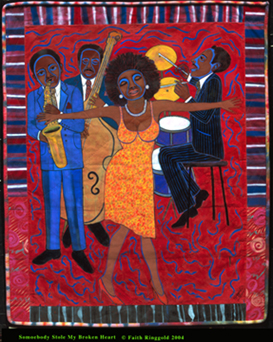
The universe was created by an infinite personal God and He brought it into existence by spoken word and made man in His own image. When man tries to reduce [philosophically in a materialistic point of view] himself to less than this [less than being made in the image of God] he will always fail and he will always be willing to make these impossible leaps into the area of nonreason even though they don’t give an answer simply because that isn’t what he is. He himself testifies that this infinite personal God, the God of the Old and New Testament is there. 

Instead of making a leap into the area of non-reason the better choice would be to investigate the claims that the Bible is a historically accurate book and that God created the universe and reached out to humankind with the Bible. Below is a piece of that evidence given by Francis Schaeffer concerning the accuracy of the Bible.

TRUTH AND HISTORY (chapter 5 of WHATEVER HAPPENED TO THE HUMAN RACE?, under footnote #95)

Two things should be mentioned about the time of Moses in Old Testament history.

The form of the covenant made at Sinai has remarkable parallels with the covenant forms of other people at that time. (On covenants and parties to a treaty, the Louvre; and Treaty Tablet from Boghaz Koi (i.e., Hittite) in Turkey, Museum of Archaeology in Istanbul.) The covenant form at Sinai resembles just as the forms of letter writings of the first century after Christ (the types of introductions and greetings) are reflected in the letters of the apostles in the New Testament, it is not surprising to find the covenant form of the second millennium before Christ reflected in what occurred at Mount Sinai. God has always spoken to people within the culture of their time, which does not mean that God’s communication is limited by that culture. It is God’s communication but within the forms appropriate to the time.

The Pentateuch tells us that Moses led the Israelites up the east side of the Dead Sea after their long stay in the desert. There they encountered the hostile kingdom of Moab. We have firsthand evidence for the existence of this kingdom of Moab–contrary to what has been said by critical scholars who have denied the existence of Moab at this time. It can be found in a war scene from a temple at Luxor (Al Uqsor). This commemorates a victory by Ramses II over the Moabite nation at Batora (Luxor Temple, Egypt).

Also the definite presence of the Israelites in west Palestine (Canaan) no later than the end of the thirteenth century B.C. is attested by a victory stela of Pharaoh Merenptah (son and successor of Ramses II) to commemorate his victory over Libya (Israel Stela, Cairo Museum, no. 34025). In it he mentions his previous success in Canaan against Aschalon, Gize, Yenom, and Israel; hence there can be no doubt the nation of Israel was in existence at the latest by this time of approximately 1220 B.C. This is not to say it could not have been earlier, but it cannot be later than this date.

Merneptah Stele, Israel 1200 BC

____


Faith Ringgold is today’s featured artist

Eldridge & Co.: Faith Ringgold, Artist

Faith Ringgold: Paints Crown Heights DVD/VHS Tape

Faith Ringgold

Faith Ringgold
Welcome to the web site of artist and writer, Faith Ringgold. If you are an artist, writer, teacher, or a kid of any age who loves art and stories you may just be in the right place. So check me out and let me know what you think. Email me at ringgoldfaith@aol.com. Visit my blog at http://faithringgold.blogspot.com/.

______

Biography:
Portrait of Faith RinggoldFaith Ringgold, painter, writer, speaker, mixed media sculptor and performance artist lives and works in Englewood, New Jersey. Ms Ringgold is professor emeritus at the University of California, San Diego where she taught art from 1987 until 2002. Professor Ringgold is the recipient of more than 75 awards including 22 Honorary Doctor of Fine Arts Degrees. She has received fellowships and grants that include the National Endowment For the Arts Award for sculpture (1978) and for painting (1989); The La Napoule Foundation Award for painting in France (1990); The John Simon Guggenheim Memorial Foundation Fellowship for painting (1987); The New York Foundation For the Arts Award for painting (1988); The American Association of University Women for travel to Africa (1976); The Creative Artists Public Service Award for painting (1971). Ringgold’s art has been exhibited in museums and galleries in the USA, Canada, Europe, Asia, South America, the Middle East, and Africa. Her art is included in many private and public art collections including The Metropolitan Museum of Art, The National Museum of American Art, The Museum of Modern Art, The Solomon R. Guggenheim Museum, The Boston Museum of Fine Art, The Chase Manhattan Bank Collection, The Baltimore Museum, Williams College Museum of Art, The High Museum of Fine Art, The Newark Museum, The Phillip Morris Collection, The St. Louis Art Museum and The Spencer Museum. Ms. Ringgold is represented by ACA Gallery in New York City. Ringgold’s public commissions include; People Portraits, 52 mosaics installed in the Los Angeles, California, Civic center subway station (2010); Flying Home: Harlem Heroes and Heroines, two 25 foot mosaic murals installed in the 125th street Subway station in New York City in 1996; The Crown Heights Children’s Story Quilt featuring folklore from the 12 major cultures that settled Crown Heights is installed in the library at PS 90 in Crown Heights, Brooklyn and Eugenio Maria de Hostos: A Man and His Dream, (1994) A mural celebrating the life of Eugenio Maria de Hostos for De Hostos Community College in the Bronx is installed in the atrium of the college. Ringgold’s first published book, the award winning, Tar Beach, “a book for children of all ages”, was published by Random House in 1991 and has won more than 30 awards including, a Caldecott Honor and the Coretta Scott King award for the best illustrated children’s book of 1991. The book, Tar Beach, is based on the story quilt Tar Beach, from Ringgold’s The Woman On A Bridge Series of 1988 and is in the permanent collection of the Guggenheim Museum in New York City. HBO included an animated version of Tar Beach in “Good Night Moon and Other Sleepy Time Lullabies.” This program runs periodically on HBO and has been released as a DVD. Ringgold has completed sixteen children’s books including the above mentioned Tar Beach, Aunt Harriet’s Underground Railroad In The Sky, My Dream of Martin Luther King and Talking to Faith Ringgold, (an autobiographical interactive art book for children of all ages), The Invisible Princess, an original African American Fairy Tale based on the quilt Born in a Cotton Field all published by Random House. If a Bus Could Talk; The Story of Ms. Rosa Parks won the NAACP’s Image Award 2000 and is available from Simon and Schuster. O Holy Night and The Three Witches, and Bronzeville Boys and Girls are from Harper Collins. Faith Ringgold’s latest children’s book is Henry O. Tanner: His Boyhood Dream Comes True published by Bunker Hill Publishing. We Flew Over the Bridge: The Memoirs of Faith Ringgold, Ringgold’s first adult book was published by Little, Brown in 1995 and has been re-released by Duke University Press.

New! To find out more about Faith, download Faith Ringgold’s Chronology, available in Portable Document Format (PDF). PDF documents may be viewed or printed using Adobe Acrobat. A free version of the Acrobat Reader is available from Adobe.

Faith Ringgold

From Wikipedia, the free encyclopedia
Faith Ringgold
Born Faith Willi Jones
October 8, 1930 (age 85)
Harlem, New York City
Education City College of New York
Known for Painting
Textile arts

Faith Ringgold (born October 8, 1930, in Harlem,[1] New York City) is an African-American artist, best known for her narrative quilts.

Early life[edit]

Faith Ringgold was born the youngest of three children on October 8, 1930 in Harlem Hospital, New York City.[2]:24 Her parents, Andrew Louis Jones and Willie Posey Jones, descended from working class families displaced by the Great Migration.[2]:24 Because her mother was a fashion designer and father an avid storyteller, Ringgold was exposed to creativity from an early age. After the Harlem Renaissance, Ringgold’s childhood home in Harlem was left with a vibrant and thriving arts scene. Figures like Duke Ellington and Langston Hughes lived just around the corner from her home.[2]:27 Her childhood friend, Sonny Rollins, who would later become a prominent jazz musician, often visited her family and practiced his saxophone at their parties.[2]:28 Because of her chronic asthma, Ringold explored visual art as a major pastime through the support of her mother, often experimenting with crayons as a young girl.[2]:24 In a statement she later made about her youth, she said, “I grew up in Harlem during the Great Depression. This did not mean I was poor and oppressed. We were protected from oppression and surrounded by a loving family.”.[2]:24 With all of these influences combined, Ringgold’s future artwork was greatly affected by the people, poetry, and music she experienced in her childhood, as well as the racism, sexism, and segregation she dealt with in her everyday life.[2]:9

In 1950, due to pressure from her family, Ringgold enrolled at the City College of New York to major in art, but was forced to major in art education instead because art was thought to be an exclusively male profession.[3]:134 The same year, she also married a jazz pianist named Robert Earl Wallace and had two children (Michele Faith Wallace and Barbara Faith Wallace). However, because of his heroin addiction, they separated four years later.[4]:54 In the meantime, she studied with artists Robert Gwathmey, Yasuo Kuniyoshi, and was introduced to printmaker Robert Blackburn, with whom she would collaborate on a series of prints 30 years later.[2]:29

In 1955, Ringgold received her bachelor’s degree from City College and soon afterward taught in the New York City public school system.[5] In 1959, she received her master’s degree from City College and left with her mother and daughters on her first trip to Europe.[5] While travelling abroad in Paris, Florence, and Rome, Ringgold visited many museums, including the Louvre. This museum in particular inspired her future series of quilt paintings known as the French Collection. This trip was abruptly cut short, however, due to the untimely death of her brother in 1961. Faith Ringgold, her mother, and her daughters all returned to the US for his funeral.[4]:141

Ringold also traveled to West Africa in 1976 and 1977. These two trips would later have a profound influence on her mask making, doll painting and sculptures.

Artwork[edit]

Ringgold’s artistic practice was extremely broad and diverse, and included media from painting to quilts, from sculptures and performance art to children’s books. She was an educator who taught in the New York city Public school system and on the college level. In 1973 she quit teaching public school to devote herself to creating art full time.

Painting[edit]

Ringgold began her painting career in the 1950’s after marrying her husband Burdette Ringgold.[5] She took inspiration from the writings of James Baldwin and Amiri Baraka, African art, Impressionism and Cubism to create the works she made in the 1960s. Her early work is composed with flat figures and shapes. Though she received a great deal of attention with these images, galleries and collectors were uncomfortable with them and she sold very little work.[2]:41 This is because many of her early paintings focused on the underlying racism in everyday activities.[6] These works were also politically based and reflected her experiences growing up during the Harlem Renaissance. These themes grew into maturity during the Civil Rights and Women’s movements.[7]:8

Taking inspiration from artist Jacob Lawrence and writer James Baldwin, Ringgold painted her first political collection named the American People Series in 1963. It portrays the American lifestyle in relation to the Civil Rights movement and illustrates these racial interactions from a woman’s point of view. This collection asks the question “why?” about some basic racial issues in American society.[4]:145 Oil paintings like For Members Only, Neighbors, Watching and Waiting, andThe Civil Rights Triangle also embody these themes.

Around the opening of her show for American People, Ringgold also worked on her collection called America Black, also called the Black Light Series, in which she experimented with darker colors. This was spurred by her observation that “white western art was focused around the color white and light/contrast/chiaroscuro, while African cultures in general used darker colors and emphasized color rather than tonality to create contrast.” Because of this, she was “in pursuit of a more affirmative black aesthetic“.[4]:162-164 She also created larger than life murals such as The Flag Is Bleeding, U.S. Postage Stamp Commemorating the Advent of Black Power People, and Die, concluding her American People series. These murals helped her approach her future artwork in a new way.

In the French Collection, Ringgold explored a different solution to overcome the rough historical legacy of women and men of African descent. Ringgold made this multi-paneled series that touches on the truths and mythologies of modernism. As France was the home of modern art at the time, it also became the source for African American artists to find their own “modern” identity.[7]:2

Quilts[edit]

Ringgold went to Europe in the summer of 1972 with her daughter Michele. While Michele went to visit her friends in Spain, Ringgold continued onto Germany and the Netherlands. In Amsterdam, she visited the Rijksmuseum, which became one of the most influential experiences affecting her mature work, and subsequently, lead to the development of her quilt paintings. In the museum, Ringgold encountered a collection of 14th and 15th century Nepali paintings that were framed with cloth brocades. These thangkas inspired her to produce fabric borders around her own work, so when she returned to the US, a new painting series was born: The Slave Rape Series. In these works, Ringgold imagined what it would have been like to be an African woman captured and sold into slavery. She invited her mother to collaborate on this project, since she was a popular Harlem clothing designer and seamstress during the 1950’s. This collaboration eventually lead to the making of their first quilt, Echoes of Harlem, in 1980.[2]:44-45

She quilted her stories in order to be heard, since at the time no one would publish the autobiography she’d been working on. Her first quilt story Who’s Afraid of Aunt Jemima? (1983) depicts the story of Aunt Jemima as a matriarch restaurateur. Another piece, titled Change: Faith Ringgold’s Over 100 Pounds Weight Loss Performance Story Quilt (1986), engages the topic of “a woman who wants to feel good about herself, struggling to [the] cultural norms of beauty, a person whose intelligence and political sensitivity allows her to see the inherent contradictions in her position, and someone who gets inspired to take the whole dilemma into an artwork”.[7]:9

The series of story quilts from Ringgold’s French Collection deals with historical African American women who dedicated themselves to change the world (The Sunflowers Quilting Bee at Arles), the redirection of the male gaze, and the immersion of historical fantasy and childlike imaginative storytelling. Many of her quilts went on to inspire the children books that she later made, such as Dinner at Aunt Connie’s House (1993) published by Hyperion Books, based on The Dinner Quilt (1988).

Sculpture[edit]

In 1973, Ringgold began experimenting with sculpture as a new medium to document her local community and national events. Her sculptures range from costumed masks to hanging and freestanding soft sculptures, representing both real and fictional characters from her past and present. She began making mixed-media costumed masks after hearing her students express their surprise that she did not already include masks in her artistic practice.[4]:198 The masks were pieces of linen canvas that were painted, beaded and woven with raffia for hair, and rectangular pieces of cloth for dresses with painted gourds to represent breasts. She eventually made a series of 11 mask costumes, called the Witch Mask Series, in collaboration with her mother. These costumes could also be worn, but would give the wearer feminine features like breasts, bellies and hips. In her memoir We Flew Over the Bridge, Ringgold also notes that in traditional African rituals, the masks would have feminine features though the wearers were almost always men.[4]:200 In this series she wanted the masks to have both a “spiritual and sculptural identity”,[4]:199 emphasizing the fact that the masks could be worn and were not merely objects to be hung and displayed.

After the Witch Mask Series, she moved onto another series of 31 masks, the Family of Woman Mask Series in 1973, which commemorated women and children whom she had known as a child. She later began making dolls with painted gourd heads and costumes (also made by her mother, which subsequently lead her to life-sized soft sculptures). The first of this series was her piece, Wilt, a 7’3” portrait sculpture of basketball player Wilt Chamberlain. She began with Wilt as a response to some negative comments that Chamberlain made on African American women in his autobiography. Wilt features three figures, the basketball player with a white wife and a mixed daughter, both fictional characters. The sculptures had baked and painted coconuts shell heads, and anatomically-correct foam and rubber bodies covered in clothing. They also hung from the ceiling on invisible fishing lines. Her soft sculptures later evolved even further into life sized “portrait masks,” representing characters from her life and society, from unknown Harlem denizens to Martin Luther King Jr. She carved foam faces into likenesses that were then spray-painted—however, in her memoir she describes how the faces later began to deteriorate and had to be restored. She did this by covering the faces in cloth, molding them carefully to preserve the likeness.

Performance Art[edit]

As many of Ringgold’s mask sculptures could also be worn as costumes, her transition from mask making to performance art was a self-described “natural progression”.[4]:206 Though art performance pieces were abundant in the 1960’s and 70’s, Ringgold was instead inspired by the African tradition of combining storytelling, dance, music, costumes and masks into one production.[4]:238 Her first piece involving these masks was The Wake and Resurrection of the Bicentennial Negro. She described it as a narrative of the dynamics of racism and the oppression of drug addiction, in response to the American Bicentennial celebrations of 1976. She wished to voice the opinion of many other African Americans that there was “no reason to celebrate two hundred years of American Independence…for almost half of that time we had been in slavery”.[4]:205 The piece was performed in mime with music and lasted thirty minutes, and incorporated many of her past paintings, sculptures and installations. She later moved on to produce many other performance pieces including a solo autobiographical performance piece called Being My Own Woman: An Autobiographical Masked Performance Piece, a masked story performance set during the Harlem Renaissance called The Bitter Nest (1985), and a piece to celebrate her weight loss called Change: Faith Ringgold’s Over 100 Pound Weight Loss Performance Story Quilt (1986). Each of these pieces were multidisciplinary, involving masks, costumes, quilts, paintings, storytelling, song and dance. Many of these performances were also interactive, as Ringgold encouraged her audience to sing and dance with her. She describes in her autobiography, We Flew Over the Bridge, that her performance pieces were not meant to shock, confuse or anger, but rather “simply another way to tell my story”.[4]:238

Publications[edit]

Ringgold has written and illustrated seventeen children’s books.[8] Her first was Tar Beach, published by Crown in 1991, based on her quilt story of the same name.[9] For that work she won the Ezra Jack Keats New Writer Award [10] and theCoretta Scott King Award for Illustration.[11] She was also the runner-up for the Caldecott Medal, the premier American Library Association award for picture book illustration.[9]

Activism[edit]

Ringgold has been an activist since the 1970s, participating in several feminist and anti-racist organizations. In 1968, fellow artist Poppy Johnson, and art critic Lucy Lippard, founded the Ad Hoc Women’s Art Committee with Ringgold and protested a major modernist art exhibition at the Whitney Museum of American Art. Members of the committee demanded that women artists account for fifty percent of the exhibitors and created disturbances at the museum by singing, blowing whistles, chanting about their exclusion, and leaving raw eggs and sanitary napkins on the ground. Not only were women artists excluded from this show, but no African American artists were represented either. Even Jacob Lawrence, an artist in the museum’s permanent collection, was excluded.[2]:41 After participating in more protest activity, Ringgold was arrested on November 13, 1970.[2]:41

Ringgold and Lippard also worked together during their participation in the group Women Artists in Revolution (WAR). That same year, Ringgold and her daughter Michele Wallace founded Women Students and Artists for Black Art Liberation (WSABAL). Around 1974, Ringgold and Wallace were founding members of the National Black Feminist Organization. Ringgold was also a founding member of the “Where We At” Black Women Artists, a New York-based women’s art collective associated with the Black Arts Movement. The inaugural show of “Where We At” featured soul food rather than traditional cocktails, exhibiting an embrace of cultural roots. The show was first presented in 1971 with eight artists and had expanded to twenty by 1976.[12]

In a statement about black representation in the arts, she said:

“When I was in elementary school I used to see reproductions of Horace Pippin’s 1942 painting called John Brown Going to His Hanging in my textbooks. I didn’t know Pippin was a black person. No one ever told me that. I was much, much older before I found out that there was at least one black artist in my history books. Only one. Now that didn’t help me. That wasn’t good enough for me. How come I didn’t have that source of power? It is important. That’s why I am a black artist. It is exactly why I say who I am.” [2]:62

Later life[edit]

In 1995, Ringgold published her first autobiography titled We Flew Over the Bridge. The book is a memoir detailing her journey as an artist and life events, from her childhood in Harlem and Sugar Hill, to her marriages and children, to her professional career and accomplishments as an artist. Two years later she received two honorary Doctorates, one for Education from Wheelock College in Boston, and the second for Philosophy from Molloy College in New York.[5]

Ringgold currently resides with her husband Burdette “Birdie” Ringgold on a ranch in Englewood, New Jersey, where she has lived and maintained a steady studio practice since 1992.


d posts:

Image result for sergent peppers album cover

Francis Schaeffer’s favorite album was SGT. PEPPER”S and he said of the album “Sergeant Pepper’s Lonely Hearts Club Band…for a time it became the rallying cry for young people throughout the world. It expressed the essence of their lives, thoughts and their feelings.”  (at the 14 minute point in episode 7 of HOW SHOULD WE THEN LIVE? ) 

Image result for francis schaeffer how should we then live

How Should We Then Live – Episode Seven – 07 – Portuguese Subtitles

Francis Schaeffer

Image result for francis schaeffer

______

FRANCIS SCHAEFFER ANALYZES ART AND CULTURE PART 202 the BEATLES’ last song FREE AS A BIRD (Featured artist is Susan Weil )

February 15, 2018 – 1:45 am

FRANCIS SCHAEFFER ANALYZES ART AND CULTURE Part 200 George Harrison song HERE ME LORD (Featured artist is Karl Schmidt-Rottluff )

FRANCIS SCHAEFFER ANALYZES ART AND CULTURE PART 184 the BEATLES’ song REAL LOVE (Featured artist is David Hammonds )

FRANCIS SCHAEFFER ANALYZES ART AND CULTURE Part 170 George Harrison and his song MY SWEET LORD (Featured artist is Bruce Herman )

FRANCIS SCHAEFFER ANALYZES ART AND CULTURE Part 168 George Harrison’s song AWAITING ON YOU ALL Part B (Featured artist is Michelle Mackey )

FRANCIS SCHAEFFER ANALYZES ART AND CULTURE Part 167 George Harrison’s song AWAITING ON YOU Part A (Artist featured is Paul Martin)

RESPONDING TO HARRY KROTO’S BRILLIANT RENOWNED ACADEMICS!! Part 133 Louise Antony is UMass, Phil Dept, “Atheists if they commit themselves to justice, peace and the relief of suffering can only be doing so out of love for the good. Atheist have the opportunity to practice perfect piety”

FRANCIS SCHAEFFER ANALYZES ART AND CULTURE Part 166 George Harrison’s song ART OF DYING (Featured artist is Joel Sheesley )

FRANCIS SCHAEFFER ANALYZES ART AND CULTURE Part 165 George Harrison’s view that many roads lead to Heaven (Featured artist is Tim Lowly)

FRANCIS SCHAEFFER ANALYZES ART AND CULTURE Part 164 THE BEATLES Edgar Allan Poe (Featured artist is Christopher Wool)

PART 163 BEATLES Breaking down the song LONG AND WINDING ROAD (Featured artist is Charles Lutyens )

FRANCIS SCHAEFFER ANALYZES ART AND CULTURE PART 162 A look at the BEATLES Breaking down the song ALL WE NEED IS LOVE Part C (Featured artist is Grace Slick)

PART 161 A look at the BEATLES Breaking down the song ALL WE NEED IS LOVE Part B (Featured artist is Francis Hoyland )


FRANCIS SCHAEFFER ANALYZES ART AND CULTURE PART 160 A look at the BEATLES Breaking down the song ALL WE NEED IS LOVE Part A (Featured artist is Shirazeh Houshiary)

FRANCIS SCHAEFFER ANALYZES ART AND CULTURE Part 159 BEATLES, Soccer player Albert Stubbins made it on SGT. PEP’S because he was sport hero (Artist featured is Richard Land)

FRANCIS SCHAEFFER ANALYZES ART AND CULTURE Part 158 THE BEATLES (breaking down the song WHY DON’T WE DO IT IN THE ROAD?) Photographer Bob Gomel featured today!

FRANCIS SCHAEFFER ANALYZES ART AND CULTURE Part 118 THE BEATLES (Why was Tony Curtis on cover of SGT PEP?) (Feature on artist Jeffrey Gibson )

FRANCIS SCHAEFFER ANALYZES ART AND CULTURE Part 117 THE BEATLES, Breaking down the song WITHIN YOU WITHOUT YOU Part B (Featured artist is Emma Amos )

FRANCIS SCHAEFFER ANALYZES ART AND CULTURE Part 67 THE BEATLES (Part Q, RICHES AND LUXURIES NEVER SATISFIED THE BEATLES! ) (Feature on artist Derek Boshier )

_____________ The Beatles were looking for lasting satisfaction in their lives and their journey took them down many of the same paths that other young people of the 1960’s were taking. No wonder in the video THE AGE OF NON-REASON Schaeffer noted,  ” Sergeant Pepper’s Lonely Hearts Club Band…for a time it became the rallying cry for young people throughout […]

FRANCIS SCHAEFFER ANALYZES ART AND CULTURE Part 66 THE BEATLES (Part P, The Beatles’ best song ever is A DAY IN THE LIFE which in on Sgt Pepper’s!) (Feature on artist and clothes designer Manuel Cuevas )

  SGT. PEPPER’S LONELY HEARTS CLUB BAND ALBUM was the Beatles’ finest work and in my view it had their best song of all-time in it. The revolutionary song was A DAY IN THE LIFE which both showed the common place part of everyday life and also the sudden unexpected side of life.  The shocking […]

FRANCIS SCHAEFFER ANALYZES ART AND CULTURE Part 65 THE BEATLES (Part O, The 1960’s SEXUAL REVOLUTION was on the cover of Sgt. Pepper’s!) (Featured artist is Pauline Boty)

_ The Beatles wrote a lot about girls!!!!!! The Beatles – I Want To Hold your Hand [HD] The Beatles – ‘You got to hide your love away’ music video Uploaded on Nov 6, 2007 The Beatles – ‘You got to hide your love away’ music video. The Beatles – Twist and Shout [live] THE […]

FRANCIS SCHAEFFER ANALYZES ART AND CULTURE Part 64 THE BEATLES (Part P The Meaning of Stg. Pepper’s song SHE’S LEAVING HOME according to Schaeffer!!!!) (Featured artist Stuart Sutcliffe)

__________ Melanie Coe – She’s Leaving Home – The Beatles Uploaded on Nov 25, 2010 Melanie Coe ran away from home in 1967 when she was 15. Paul McCartney read about her in the papers and wrote ‘She’s Leaving Home’ for Sgt.Pepper’s. Melanie didn’t know Paul’s song was about her, but actually, the two did […]

FRANCIS SCHAEFFER ANALYZES ART AND CULTURE Part 63 THE BEATLES (Part O , BECAUSE THE BEATLES LOVED HUMOR IT IS FITTING THAT 6 COMEDIANS MADE IT ON THE COVER OF “SGT. PEPPER’S”!) (Feature on artist H.C. Westermann )

__________________ A Funny Press Interview of The Beatles in The US (1964) Funny Pictures of The Beatles Published on Oct 23, 2012 funny moments i took from the beatles movie; A Hard Days Night ___________________ Scene from Help! The Beatles Funny Clips and Outtakes (Part 1) The Beatles * Wildcat* (funny) Uploaded on Mar 20, […]

FRANCIS SCHAEFFER ANALYZES ART AND CULTURE Part 62 THE BEATLES (Part N The last 4 people alive from cover of Stg. Pepper’s and the reason Bob Dylan was put on the cover!) (Feature on artist Larry Bell)

_____________________ Great article on Dylan and Sergeant Pepper’s Lonely Hearts Club Band Cover: A famous album by the fab four – The Beatles – is “Sergeant peppers lonely hearts club band“. The album itself is one of the must influential albums of all time. New recording techniques and experiments with different styles of music made this […]

FRANCIS SCHAEFFER ANALYZES ART AND CULTURE Part 61 THE BEATLES (Part M, Why was Karl Marx on the cover of Stg. Pepper’s?) (Feature on artist George Petty)

__________________________ Beatles 1966 Last interview 69 THE BEATLES TWO OF US As a university student, Karl Marx (1818-1883) joined a movement known as the Young Hegelians, who strongly criticized the political and cultural establishments of the day. He became a journalist, and the radical nature of his writings would eventually get him expelled by the […]

FRANCIS SCHAEFFER ANALYZES ART AND CULTURE Part 60 THE BEATLES (Part L, Why was Aleister Crowley on the cover of Stg. Pepper’s?) (Feature on artist Jann Haworth )

____________ Aleister Crowley on cover of Stg. Pepper’s: _______________ I have dedicated several posts to this series on the Beatles and I don’t know when this series will end because Francis Schaeffer spent a lot of time listening to the Beatles and talking and writing about them and their impact on the culture of the 1960’s. […]

FRANCIS SCHAEFFER ANALYZES ART AND CULTURE Part 59 THE BEATLES (Part K, Advocating drugs was reason Aldous Huxley was on cover of Stg. Pepper’s) (Feature on artist Aubrey Beardsley)

(HD) Paul McCartney & Ringo Starr – With a Little Help From My Friends (Live) John Lennon The Final Interview BBC Radio 1 December 6th 1980 A young Aldous Huxley pictured below: _______   Much attention in this post is given to the songs LUCY IN THE SKY WITH DIAMONDS and TOMORROW NEVER KNOWS which […]

FRANCIS SCHAEFFER ANALYZES ART AND CULTURE Part 58 THE BEATLES (Part J, Why was Carl Gustav Jung on the cover of Stg. Pepper’s?) (Feature on artist Richard Merkin)

___

MUSIC MONDAY Aldous Huxley and THE INCREDIBLE STRING BAND

__

The Incredible String Band – The Hedgehog’s Song

The Incredible String Band – First Girl I Loved

The Incredible String Band / Ducks On A Pond

The Incredible String Band / You Get Brighter

The Incredible String Band – Maya

Incredible String Band: “This Moment” (with Ram Dass)

Incredible String Band – The Half-Remarkable Question

An incredible journey with the Incredible String Band

Clive Palmer, Robin Williamson and Mike Heron with instruments from music shop 1966Image copyrightJOE BOYD
Image captionClive Palmer, Robin Williamson and Mike Heron on the cover of the first Incredible String Band album

The Incredible String Band were one of the most influential bands of the Sixties but their roots lie in the folk clubs of Edinburgh.

Their incredible journey took them from experimenting in Scotland’s all-night venues to an infamous appearance at Woodstock, the biggest counter-cultural event of the decade.

Led Zeppelin, Bob Dylan, the Beatles and the Rolling Stones were all said to have been influenced by the psychedelic folk rock of the band, who played “world music” a decade before the term was coined.

Comedian and banjo-player Billy Connolly, who was a massive fan and who got to know them when they played the folk clubs of Glasgow, described the band as “hairy, exotic and interesting”.

The story of how a group of folkies playing the Crown Bar in Edinburgh and late night clubs in Glasgow’s Sauchiehall Street rose to become musical pioneers, who are still revered around the world, is told in a new book by the Incredible String Band’s Mike Heron and long-time fan Andrew Greig.

Mike Heron, Robin Williamson and Clive Palmer, backstage at Clive's Incredible Folk club in 1966Image copyrightIAN FERGUSON
Image captionMike, Robin and Clive backstage at Clive’s Incredible Folk club in Glasgow in 1966

Heron begins the story by telling how a middle-class, private school-boy was looking for an escape through music.

After playing in a rock ‘n’ roll covers band he got into folk music because he wanted to be a songwriter and “people in folk clubs actually listen to the words”.

Heron hooked up with established folk scene stars Robin Williamson and Clive Palmer as the Incredible String Band began to break out of its folk roots.

He says his band-mates were very much part of the beatnik scene, open to influences from all over the world.

“Clive was ultimate Beatnik,” Heron says.

“He lived in a tent pitched in a flat. He started off busking in Paris and he was grooved into it. Robin was too.”

Mike Heron, Clive Palmer and Robin Williamson on stage at Clive's Incredible Folk Club in 1966Image copyrightIAN FERGUSON
Image captionMike, Clive and Robin on stage in 1966

Heron on the other hand was still living with his parents, who were pushing him to continue his training as a chartered accountant.

He says he admired Robin and Clive: “I was a bit like their apprentice at first.

“They were into Eastern mystic thought and all that kind of thing.”

At first the band played a mix of British folk, bluegrass and old-time jug band music.

But the music quickly progressed as they wrote their own songs and brought in influences from India (they’d seen Ravi Shankar in Edinburgh), Afghanistan, Morocco and even Bulgaria.

first American album coverImage copyrightINCREDIBLE STRING BAND
Image captionThe cover of the Incredible String Band’s first US album

Heron says: “We were listening to all these things but there was no-one playing the kind of thing we wanted to listen to, a composite kind of thing.

“We just played the kind of music people would like to sit around and have a joint to, interesting music that was made up of all these influences that seemed to be cool to the beatniks.

“We kind of invented this kind of music we wanted to listen to.”

The music caught the ear of American record company scout Joe Boyd, who was looking to set up a UK branch of Elektra Records.

He had stumbled across Robin and Clive in early 1965 and returned a year later to sign them up.

Mike, Robin and Clive at Temple Cottage in 1966Image copyrightMARY STEWART
Image captionMike, Robin and Clive at Temple Cottage, north of Glasgow, in 1966

By this time Heron had joined and they had become singer-songwriters. Boyd liked what he heard.

He has previously said: “Their lyrics turned out to be witty, romantic and literate, and the melodies soared. They had also started taking LSD, so were ahead of the zeitgeist curve.”

The Incredible String Band went to London, recorded their first album and immediately split up.

Heron says: “When the money trickled in from the first album and the three of us got an advance, Robin and Clive just took off.

“Robin just went immediately to Morocco and didn’t come back. Because people just did that in those days.

“Clive went off to Afghanistan for a good six months.

“Nowadays that seems amazing that a band has just made its first album and two of them toddle off around the world.

“I was astonished. I was not really a beatnik. I thought that was it, the band was over.”

According to Heron, Clive never really came back. He was not really interested in the band.

Mike Heron plays mouth organ to a small boy at Temple CottageImage copyrightMARY STEWART
Image captionMike Heron plays mouth organ to a small boy at Temple Cottage

Robin Williamson only returned to Edinburgh when the money dried up and the pair resumed ISB as a duo.

When Williamson did return he was laden with Moroccan instruments, including a gimbri.

Their second album The 5000 Spirits or the Layers of the Onion, which came out in 1967, was cited much later by David Bowie as one of the best albums ever.

It has been described by critics as the Summer of Love condensed into one album.

Its opening track, Chinese White, was the first time Andrew Greig had heard of ISB and it “blew my mind”.

From the weird North African instrument in the opening bars to the lyric which states: “The bent twig of darkness/Grows the petals of the morning/It shows to them the birds singing/Just behind the dawning”, the whole thing was a revelation to a 16-year-old school boy from Anstruther in Fife.

Andrew Greig tried to emulate the Incredible String Band with Fate & FerretImage copyrightANDREW GREIG
Image captionAndrew Greig tried to emulate the Incredible String Band with Fate & Ferret

Greig says: “I was a fan out in the provinces and lots of people around about me were turned on, there is no other word for it, by the band.

“There were no drugs available in East Fife at the time. The music just astonished us.

“There was a school folk club that was doing fairly earnest American protest songs and Scottish folk songs, there was also the Beatles and The Stones, which we loved, but we had never heard anything like Chinese White.”

Greig says: “The fact that they were Scottish and cutting edge, that’s what liberated us to think, ‘well if they can do it, we can do something like that’. It gave us permission.”

The young boy from Fife formed a band in the image of the String Band called Fate & Ferret.

He says: “We adopted their manner of dress and walked around the back-country in Fife with flutes and whistles and mandolins and sausages and cider.

“It was curiously innocent in a way. We had this idea of being travelling troubadours. It was that medieval and rural vibe.”

Greig, who has had a successful career as a writer, wanted to use his experiences with the band to “memorialise” the Sixties.

His book – You Know What You Could Be – takes its title from one of Heron’s early String Band songs.

Its lyrics sum up Greig’s feelings about growing up in the Sixties: “You know what you could be/Tell me my friend/Why you worry all the time/What you should be”.

He says: “It was that kind of liberation call.

“My story and Mike’s are both of people trying to become who they need to be when you don’t actually know who that is yet.

“They are both stories of formation. The ridiculous and often comic process by which you try to become who you need to be.”

Trip to Woodstock

In the book Mike Heron only tells the ISB story up to the point where Greig takes over.

However, there was much more to come including a trip to Woodstock, the famous festival in upstate New York in 1969 that has become one of the most iconic events in music history.

Heron says: “It was brilliant to be there but it was very primitive.”

He says the roads to the site were so choked up that they had to be flown in by a military helicopter.

“It was open at the side and the pilot kept going sideways so we could see these huge crowds below. Ravi Shankar was on the plane with us. He was not very relaxed.”

The band were supposed to have played on the Friday but it was pouring with rain and they were afraid they would be electrocuted.

The band were asked to play an acoustic set but by this time their girlfriends were in the band and Heron says it would have been “unchivalrous” to leave them out.

Instead they played in the baking heat of the Saturday.

Mike Heron and Andrew Greig are now friends who have written a book together
Image captionMike Heron and Andrew Greig are now friends who have written a book together

Heron, who is now 74, says: “It was very tricky to play there.

“The stage was high and rickety so that didn’t help. The music we were playing was quite delicate so when we went on on the Saturday it was a bit rowdy.

“Everyone had been dropping assorted drugs. They wanted things like Canned Heat. They didn’t want plinky, British, thoughtful music. It was too floaty. It wasn’t really what was required.”

The Incredible String Band split in 1974 but reunited for occasional performances from 1997 to 2006.

Andrew Greig says it is “astonishing” to be friends with and write a book with the man whose band he idolised as a 16-year-old in Fife.

He says: “On one level he is a god, a myth, a legend, an inspiration of my youth .

“On the other hand he is a guy who I spend time with, who I eat curry with. It’s an odd experience but a lovely one.”

You Know What You Could Be by Mike Heron and Andrew Greig will be published by riverrun on 6 April


Image result for francis schaeffer
300 × 335Images may be subject to copyrightLearn More

In his book HOW SHOULD WE THEN LIVE? Francis Schaeffer noted:

The man who followed on from that point was English–Aldous Huxley (1894-1963). He proposed drugs as a solution. We should, he said, give healthy people drugs and they can then find truth inside their own heads. All that was left for Aldous Huxley and those who followed him was truth inside a person’s own head. With Huxley’s idea, what began with the existential philosophers – man’s individual subjectivity attempting to give order as well as meaning, in contrast to order being shaped by what is objective or external to oneself – came to its logical conclusion. Truth is in one’s own head. The ideal of objective truth was gone.

Image result for aldous huxley
745 × 1024Images may be subject to copyrightLearn More

This emphasis on hallucinogenic drugs brought with it many rock groups–for example, Cream, Jefferson Airplane, Grateful Dead, Incredible String Band, Pink Floyd, and Jimi Hendrix. Most of their work was from 1965-1958. The Beatles’Sergeant Pepper’s Lonely Hearts Club Band (1967) also fits here. This disc is a total unity, not just an isolated series of individual songs, and for a time it became the rallying cry for young people throughout the world. As a whole, this music was the vehicle to carry the drug culture and the mentality which went with it across frontiers which were almost impassible by other means of communication.

Here is a good review of the episode 016 HSWTL The Age of Non-Reason of HOW SHOULD WE THEN LIVE?, December 23, 2007:

Together with the advent of the “drug Age” was the increased interest in the West in  the religious experience of Hinduism and Buddhism. Schaeffer tells us that: “This grasping for a nonrational meaning to life and values is the central reason that these Eastern religions are so popular in the West today.”  Drugs and Eastern religions came like a flood into the Western world.  They became the way that people chose to find meaning and values in life.  By themselves or together, drugs and Eastern religion became the way that people searched inside themselves for ultimate truth.

Along with drugs and Eastern religions there has been a remarkable increase “of the occult appearing as an upper-story hope.”  As modern man searches for answers it “many moderns would rather have demons than be left with the idea that everything in the universe is only one big machine.”  For many people having the “occult in the upper story of nonreason in the hope of having meaning” is better than leaving the upper story of nonreason empty. For them horror or the macabre are more acceptable than the idea that they are just a machine.

Francis Schaeffer has correctly argued:

The universe was created by an infinite personal God and He brought it into existence by spoken word and made man in His own image. When man tries to reduce [philosophically in a materialistic point of view] himself to less than this [less than being made in the image of God] he will always fail and he will always be willing to make these impossible leaps into the area of nonreason even though they don’t give an answer simply because that isn’t what he is. He himself testifies that this infinite personal God, the God of the Old and New Testament is there. 

Instead of making a leap into the area of nonreason the better choice would be to investigate the claims that the Bible is a historically accurate book and that God created the universe and reached out to humankind with the Bible. Below is a piece of that evidence given by Francis Schaeffer concerning the accuracy of the Bible.

TRUTH AND HISTORY (chapter 5 of WHATEVER HAPPENED TO THE HUMAN RACE?,

If we take another hundred-year step backwards in time, we come to King Solomon, son of David. On his death the Jewish Kingdom was divided into two sections as a result of a civil revolt. Israel to the north with Jeroboam as king and Judah (as it was called subsequently) to the south under Rehoboam, Solomon’s son. In both the Book of Kings and Chronicles in the Bible we read how during Rehoboam’s reign: 25 In the fifth year of King Rehoboam, Shishak king of Egypt came up against Jerusalem. (I Kings 14:25; II Chronicles 12:2), and how Shishak stripped Rehoboam of the wealth accumulated by his able father, Solomon. The reality of this event is confirmed by archaeology to a remarkable degree.

Shishak subdued not only Rehoboam but Jeroboam as well. The proof of this comes first from a fragment in a victory monument erected by Shishak and discovered at Megiddo, a city in the land of Israel. So the Egyptian king’s force swept northwards, subdued the two Jewish kings, and then erected a victory monument to that effect. Traces of the destruction have also been discovered in such cities as Hazor, Gezer, and Megiddo. These confirm what was written in Second Chronicles:

Battle Megiddo

Image result for Shishak Megiddo,
2028 × 1352Images may be subject to copyrightLearn More

And he took the fortified cities of Judah and came as far as Jerusalem. Then Shemaiah the prophet came to Rehoboam and to the princes of Judah, who had gathered at Jerusalem because of Shishak, and said to them, “Thus says theLord, ‘You abandoned me, so I have abandoned you to the hand of Shishak.’”Then the princes of Israel and the king humbled themselves and said, “TheLord is righteous.” When the Lord saw that they humbled themselves, the word of the Lord came to Shemaiah: “They have humbled themselves. I will not destroy them, but I will grant them some deliverance, and my wrath shall not be poured out on Jerusalem by the hand of Shishak. Nevertheless, they shall be servants to him, that they may know my service and the service of the kingdoms of the countries.”

So Shishak king of Egypt came up against Jerusalem. He took away the treasures of the house of the Lord and the treasures of the king’s house. He took away everything. He also took away the shields of gold that Solomon had made…( II Chronicles 12:4-9)

DAAHL Shishak’s Military Campaign

Image result for Shishak Megiddo,
400 × 308Images may be subject to copyrightLearn More

Further confirmation comes from the huge victory scene engraved on Shishak’s order at the Temple of Karnak in Egypt. The figure of the king is somewhat obscured, but he is clearly named and he is seen smiting Hebrew captives before the god Amon, and there are symbolic rows of names of conquered towns of Israel and Judah.

Solomon’s is remembered also for his great wealth. The Bible tells us:

14 Now the weight of gold that came to Solomon in one year was 666 talents of gold, 15 besides that which came from the explorers and from the business of the merchants, and from all the kings of the west and from the governors of the land. 16 King Solomon made 200 large shields of beaten gold; 600 shekels[a]of gold went into each shield. 17 And he made 300 shields of beaten gold; three minas[b] of gold went into each shield. And the king put them in the House of the Forest of Lebanon. (I Kings 10:14-17)

This wealth that the Bible speaks of has been challenged. Surely, some have said, these figures are an exaggeration. Excavations, however, have confirmed enormous quantities of precious metals, owned and distributed by kings during this period. For example, Shishak’s son Osorkon I (statuette of Osorkon I, Brooklyn Museum, New York), the one who stood to gain from the booty carried off from Rehoboam’s capital, is reported to have made donations to his god Amon totaling 470 tons of precious metal, gold, and silver, during only the first four years of his reign. This, of course, is much more than Solomon’s 66 talents which equals approximately twenty tons of gold per annum. We also have confirmation of the Bible’s reference to Solomon’s gold as coming from Ophir. The location of Ophir is still unknown, but an ostracon dated a little later than Solomon’s time actually mentions that thirty shekels of gold had come from Ophir for Beth-horon.


___

Related posts:

FRANCIS SCHAEFFER ANALYZES ART AND CULTURE Part 53 THE BEATLES (Part E, Stg. Pepper’s and John Lennon’s search in 1967 for truth was through drugs, money, laughter, etc & similar to King Solomon’s, LOTS OF PICTURES OF JOHN AND CYNTHIA) (Feature on artist Yoko Ono)

The John Lennon and the Beatles really were on a long search for meaning and fulfillment in their lives  just like King Solomon did in the Book of Ecclesiastes. Solomon looked into learning (1:12-18, 2:12-17), laughter, ladies, luxuries, and liquor (2:1-2, 8, 10, 11), and labor (2:4-6, 18-20). He fount that without God in the picture all […]

FRANCIS SCHAEFFER ANALYZES ART AND CULTURE Part 52 THE BEATLES (Part D, There is evidence that the Beatles may have been exposed to Francis Schaeffer!!!) (Feature on artist Anna Margaret Rose Freeman )

______________   George Harrison Swears & Insults Paul and Yoko Lucy in the Sky with Diamonds- The Beatles The Beatles:   I have dedicated several posts to this series on the Beatles and I don’t know when this series will end because Francis Schaeffer spent a lot of time listening to the Beatles and talking […]

FRANCIS SCHAEFFER ANALYZES ART AND CULTURE Part 51 THE BEATLES (Part C, List of those on cover of Stg.Pepper’s ) (Feature on artist Raqib Shaw )

  The Beatles in a press conference after their Return from the USA Uploaded on Nov 29, 2010 The Beatles in a press conference after their Return from the USA. The Beatles:   I have dedicated several posts to this series on the Beatles and I don’t know when this series will end because Francis […]

FRANCIS SCHAEFFER ANALYZES ART AND CULTURE Part 50 THE BEATLES (Part B, The Psychedelic Music of the Beatles) (Feature on artist Peter Blake )

__________________   Beatles 1966 Last interview I have dedicated several posts to this series on the Beatles and I don’t know when this series will end because Francis Schaeffer spent a lot of time listening to the Beatles and talking and writing about them and their impact on the culture of the 1960’s. In this […]

FRANCIS SCHAEFFER ANALYZES ART AND CULTURE Part 49 THE BEATLES (Part A, The Meaning of Stg. Pepper’s Cover) (Feature on artist Mika Tajima)

_______________ The Beatles documentary || A Long and Winding Road || Episode 5 (This video discusses Stg. Pepper’s creation I have dedicated several posts to this series on the Beatles and I don’t know when this series will end because Francis Schaeffer spent a lot of time listening to the Beatles and talking and writing about […]

FRANCIS SCHAEFFER ANALYZES ART AND CULTURE PART 48 “BLOW UP” by Michelangelo Antonioni makes Philosophic Statement (Feature on artist Nancy Holt)

_______________ Francis Schaeffer pictured below: _____________________ I have included the 27 minute  episode THE AGE OF NONREASON by Francis Schaeffer. In that video Schaeffer noted,  ” Sergeant Pepper’s Lonely Hearts Club Band…for a time it became the rallying cry for young people throughout the world. It expressed the essence of their lives, thoughts and their feelings.” How Should […]

FRANCIS SCHAEFFER ANALYZES ART AND CULTURE Part 47 Woody Allen and Professor Levy and the death of “Optimistic Humanism” from the movie CRIMES AND MISDEMEANORS Plus Charles Darwin’s comments too!!! (Feature on artist Rodney Graham)

Crimes and Misdemeanors: A Discussion: Part 1 ___________________________________ Today I will answer the simple question: IS IT POSSIBLE TO BE AN OPTIMISTIC SECULAR HUMANIST THAT DOES NOT BELIEVE IN GOD OR AN AFTERLIFE? This question has been around for a long time and you can go back to the 19th century and read this same […]

FRANCIS SCHAEFFER ANALYZES ART AND CULTURE PART 46 Friedrich Nietzsche (Featured artist is Thomas Schütte)

____________________________________ Francis Schaeffer pictured below: __________ Francis Schaeffer has written extensively on art and culture spanning the last 2000years and here are some posts I have done on this subject before : Francis Schaeffer’s “How should we then live?” Video and outline of episode 10 “Final Choices” , episode 9 “The Age of Personal Peace and Affluence”, episode 8 […]

FRANCIS SCHAEFFER ANALYZES ART AND CULTURE Part 45 Woody Allen “Reason is Dead” (Feature on artists Allora & Calzadilla )

Love and Death [Woody Allen] – What if there is no God? [PL] ___________ _______________ How Should We then Live Episode 7 small (Age of Nonreason) #02 How Should We Then Live? (Promo Clip) Dr. Francis Schaeffer 10 Worldview and Truth Two Minute Warning: How Then Should We Live?: Francis Schaeffer at 100 Francis Schaeffer […]

FRANCIS SCHAEFFER ANALYZES ART AND CULTURE Part 44 The Book of Genesis (Featured artist is Trey McCarley )

___________________________________ Francis Schaeffer pictured below: ____________________________ Francis Schaeffer “BASIS FOR HUMAN DIGNITY” Whatever…HTTHR Dr. Francis schaeffer – The flow of Materialism(from Part 4 of Whatever happened to human race?) Dr. Francis Schaeffer – The Biblical flow of Truth & History (intro) Francis Schaeffer – The Biblical Flow of History & Truth (1) Dr. Francis Schaeffer […]

_-

The effort to impeach President Trump by Democrats is motivated by their incorrect answer to the question “Does human life begin at birth or conception?”

Francis Schaeffer took note of the conservative swing in the 1980 election of Ronald Reagan and he hoped it lead to repeal of loose abortion laws in the USA. Likewise, I am glad that Donald Trump has appointed many prolife judges and because of that have tried to impeach him. Below is Donald Trump’s Response:

THE WHITE HOUSE
WASHINGTON

December 17, 2019

The Honorable Nancy Pelosi

Speaker of the House of Representatives
Washington, DC. 20515

Dear Madam Speaker:

I write to express my strongest and most powerful protest against the partisan impeachment
crusade being pursued by the Democrats in the House of Representatives. This impeachment
represents an unprecedented and unconstitutional abuse of power by Democrat Lawmakers,
unequaled in nearly two and a half centuries of American legislative history.

The Articles of Impeachment introduced by the House Judiciary Committee are not recognizable
under any standard of Constitutional theory, interpretation, or jurisprudence. They include no
crimes, no misdemeanors, and no offenses whatsoever. You have cheapened the importance of
the very ugly word, impeachment!

By proceeding with your invalid impeachment, you are violating your oaths of of?ce, you are
breaking your allegiance to the Constitution, and you are declaring open war on American
Democracy. You dare to invoke the Founding Fathers in pursuit of this election-nulli?cation
scheme?yet your spiteful actions display unfettered contempt for America?s founding and your
egregious conduct threatens to destroy that which our Founders pledged their very lives to build.
Even worse than offending the Founding Fathers, you are offending Americans of faith by
continually saying pray for the President,? when you know this statement is not true, unless it
is meant in a negative sense. It is a terrible thing you are doing, but you will have to live with it,
not 1!

Your ?rst claim, ?Abuse of Power,? is a completely disingenuous, meritless, and baseless
invention of your imagination. You know that I had a totally innocent conversation with the
President of Ukraine. I then had a second conversation that has been misquoted,
mischaracterized, and fraudulently misrepresented. Fortunately, there was a transcript of the
conversation taken, and you know from the transcript (which was immediately made available)
that the paragraph in question was perfect. I said to President Zelensky: would like you to do
us a favor, though, because our country has been through a lot and Ukraine knows a lot about it.?
I said do u_s a favor, not m, and our country, not a campaign. I then mentioned the Attorney
General of the United States. Every time I talk with a foreign leader, I put America?s interests
?rst, just as I did with President Zelensky.


You are turning a policy disagreement between two branches of government into an impeachable
offense?it is no more legitimate than the Executive Branch charging members of Congress with
crimes for the lawful exercise of legislative power.

You know full well that Vice President Biden used his of?ce and $1 billion dollars of US. aid
money to coerce Ukraine into ?ring the prosecutor who was digging into the company paying his
son millions of dollars. You know this because Biden bragged about it on video. Biden openly
stated: said, ?I?m telling you, you?re not getting the billion dollars?. . .I looked at them and
said: ?I?m leaving in six hours. If the prosecutor is not ?red, you?re not getting the money.?
Well, son of a bitch. He got ?red.? Even Joe Biden admitted just days ago in an interview with
NPR that it ?looked bad.? Now you are trying to impeach me by falsely accusing me of doing

what Joe Biden has admitted he actually did.

President Zelensky has repeatedly declared that I did nothing wrong, and that there was No
Pressure. He further emphasized that it was a ?good phone call,? that don?t feel pressure,? and
explicitly stressed that ?nobody pushed me.? The Ukrainian Foreign Minister stated very
clearly: have never seen a direct link between investigations and security assistance.? He also
said there was ?No Pressure.? Senator Ron Johnson of Wisconsin, a supporter of Ukraine who
met privately with President Zelensky, has said: ?At no time during this meeting. . .was there any
mention by Zelensky or any Ukrainian that they were feeling pressure to do anything in return
for the military aid.? Many meetings have been held between representatives of Ukraine and our
country. Never once did Ukraine complain about pressure being applied?not once!
Ambassador Sondland testi?ed that I told him: ?No quid pro quo. I want nothing. I want
nothing. I want President Zelensky to do the right thing, do what he ran on.?

The second claim, so-called ?Obstruction of Congress,? is preposterous and dangerous. House
Democrats are trying to impeach the duly elected President of the United States for asserting
Constitutionally based privileges that have been asserted on a bipartisan basis by administrations
of both political parties throughout our Nation?s history. Under that standard, every American
president would have been impeached many times over. As liberal law professor Jonathan
Turley warned when addressing Congressional Democrats: ?1 can?t emphasize this enough. . .if
you impeach a president, if you make a high crime and misdemeanor out of going to the courts, it
is an abuse of power. It?s your abuse of power. You?re doing precisely what you?re criticizing
the President for doing.?

Everyone, you included, knows what is really happening. Your chosen candidate lost the
election in 2016, in an Electoral College landslide (306-227), and you and your party have never
recovered from this defeat. You have developed a full??edged case of what many in the media
call Trump Derangement and sadly, you will never get over it! You are unwilling and
unable to accept the verdict issued at the ballot box during the great Election of 2016. So you
have spent three straight years attempting to overturn the will of the American people and nullify
their votes. You View democracy as your enemy!

Speaker Pelosi, you admitted just last week at a public forum that your party?s impeachment
effort has been going on for ?two and a half years,? long before you ever heard about a phone
call with Ukraine. Nineteen minutes after I took the oath of of?ce, the Washington Post


published a story headlined, ?The Campaign to Impeach President Trump Has Begun.? Less
than three months after my inauguration, Representative Maxine Waters stated, ?I?m going to
?ght every day until he?s impeached.? House Democrats introduced the ?rst impeachment
resolution against me within months of my inauguration, for what will be regarded as one of our
country?s best decisions, the ?ring of James omey (see Inspector General Reports)?who the
world now knows is one of the dirtiest cops cur Nation has ever seen. A ranting and raving
Congresswoman, Rashida Tlaib, declared just hours after she was sworn into of?ce, ?We?re
gonna go in there and we?re gonna impeach the Representative Al Green said in
May, ?I?m concerned that if we don?t impeach this president, he will get re-elected.? Again, you
and your allies said, and did, all of these things long before you ever heard of President Zelensky
or anything related to Ukraine. As you know very well, this impeachment drive has nothing to
do with Ukraine, or the totally appropriate conversation I had with its new president. It only has
to do with your attempt to undo the election of 2016 and steal the election of 2020!

Congressman Adam Schiff cheated and lied all the way up to the present day, even going so far
as to fraudulently make up, out of thin air, my conversation with President Zelensky of Ukraine
and read this fantasy language to Congress as though it were said by me. His shameless lies and
deceptions, dating all the way back to the Russia Hoax, is one of the main reasons we are here
today.

You and your party are desperate to distract from America?s extraordinary economy, incredible
jobs boom, record stock market, soaring con?dence, and ?ourishing citizens. Your party simply
cannot compete with our record: 7 million new jobs; the lowest-ever unemployment for African
Americans, Hispanic Americans, and Asian Americans; a rebuilt military; a completely reformed
VA with Choice and Accountability for our great veterans; more than 170 new federal judges
and two Supreme Court Justices; historic tax and regulation cuts; the elimination of the
individual mandate; the ?rst decline in prescription drug prices in half a century; the ?rst new
branch of the United States Military since 1947, the Space Force; strong protection of the Second
Amendment; criminal justice reform; a defeated ISIS caliphate and the killing of the world?s
number one terrorist leader, al-Baghdadi; the replacement of the disastrous NAFTA trade deal
with the wonderful USMCA (Mexico and Canada); a breakthrough Phase One trade deal with
China; massiVe new trade deals with Japan and South Korea; withdrawal from the terrible Iran
Nuclear Deal; cancellation of the unfair and costly Paris Climate Accord; becoming the world?s
top energy producer; recognition of Israel?s capital, opening the American Embassy in
Jerusalem, and recognizing Israeli sovereignty over the Golan Heights; a colossal reduction in
illegal border crossings, the ending of Catch-and-Release, and the building of the Southern
Border Wall?and that is just the beginning, there is so much more. You cannot defend your
extreme policies?open borders, mass migration, high crime, crippling taxes, socialized
healthcare, destruction of American energy, late?term taxpayer-funded abortion, elimination of
the Second Amendment, radical far-left theories of law and justice, and constant partisan
obstruction of both common sense and common good.

There is nothing I would rather do than stop referring to your party as the Do-Nothing
Democrats. Unfortunately, I don?t know that you will ever give me a chance to do so.


After three years of unfair and unwarranted investigations, 45 million dollars spent, 18 angry
Democrat prosecutors, the entire force of the FBI, headed by leadership now proven to be totally
incompetent and corrupt, you have found Few people in high position could have
endured or passed this test. You do not know, nor do you care, the great damage and hurt you
have in?icted upon wonderful and loving members of my family. You conducted a fake
investigation upon the democratically elected President of the United States, and you are doing it
yet again.

There are not many people who could have taken the punishment in?icted during this period of
time, and yet done so much for the success of America and its citizens. But instead of putting
our country ?rst, you have decided to disgrace our country still further. You completely failed
with the Mueller report because there was nothing to find, so you decided to take the next hoax
that came along, the phone call with Ukraine?even though it was a perfect call. And by the
way, when I speak to foreign countries, there are many people, with permission, listening to the
call on both sides of the conversation.

You are the ones interfering in America?s elections. You are the ones subverting America?s
Democracy. You are the ones Obstructing Justice. You are the ones bringing pain and suffering
to our Republic for your own selfish personal, political, and partisan gain.

Before the Impeachment Hoax, it was the Russian Witch Hunt. Against all evidence, and
regardless of the truth, you and your deputies claimed that my campaign colluded with the
Russians?a grave, malicious, and slanderous lie, a falsehood like no other. You forced our
Nation through turmoil and torment over a wholly fabricated story, illegally purchased from a
foreign spy by Hillary Clinton and the DNC in order to assault our democracy. Yet, when the
monstrous lie was debunked and this Democrat conspiracy dissolved into dust, you did not
apologize. You did not recantforgiven. You showed no remorse, no
capacity for self-re?ection. Instead, you pursued your next libelous and vicious crusade you
engineered an attempt to frame and defame an innocent person. All of this was motivated by
personal political calculation. Your Speakership and your party are held hostage by your most
deranged and radical representatives of the far left. Each one of your members lives in fear of a
socialist primary challenger?this is what is driving impeachment. Look at Congressman
Nadler?s challenger. Look at yourself and others. Do not take our country down with your

party.


If you truly cared about freedom and liberty for our Nation, then you would be devoting your
vast investigative resources to exposing the full truth concerning the horrifying abuses of
power before, during, and after the 2016 election?including the use of spies against my
campaign, the submission of false evidence to a FISA court, and the concealment of exculpatory
evidence in order to frame the innocent. The FBI has great and honorable people, but the
leadership was inept and corrupt. I would think that you would personally be appalled by these
revelations, because in your press conference the day you announced impeachment, you tied the
impeachment effort directly to the completely discredited Russia Hoax, declaring twice that ?all
roads lead to Putin,? when you know that is an abject lie. I have been far tougher on Russia than
President Obama ever even thought to be.


Any member of Congress who votes in support of impeachment?against every shred of truth,
fact, evidence, and legal principle?is showing how deeply they revile the voters and how truly
they detest America?s Constitutional order. Our Founders feared the tribalization of partisan
politics, and you are bringing their worst fears to life.

Worse still, I have been deprived of basic Constitutional Due Process from the beginning of this
impeachment scam right up until the present. I have been denied the most fundamental rights
afforded by the Constitution, including the right to present evidence, to have my own counsel
present, to confront accusers, and to call and cross-examine witnesses, like the so-called
whistleblower who started this entire hoax with a false report of the phone call that bears no
relationship to the actual phone call that was made. Once I presented the transcribed call, which
surprised and shocked the fraudsters (they never thought that such evidence would be presented),
the so-called whistleblower, and the second whistleblower, disappeared because they got caught,
their report was a fraud, and they were no longer going to be made available to us. In other
words, once the phone call was made public, your whole plot blew up, but that didn?t stop you
from continuing.

More due process was afforded to those accused in the Salem Witch Trials.

You and others on your committees have long said impeachment must be bipartisan?it is not.
You said it was very divisive?it certainly is, even far more than you ever thought possible?and
it will only get worse!

This is nothing more than an illegal, partisan attempted coup that will, based on recent sentiment,
badly fail at the voting booth. You are not just after me, as President, you are after the entire
Republican Party. But because of this colossal injustice, our party is more united than it has ever
been before. History will judge you as you proceed with this impeachment Charade.
Your legacy will be that of turning the House of Representatives from a revered legislative body
into a Star Chamber of partisan persecution.

Perhaps most insulting of all is your false display of solemnity. You apparently have so little
respect for the American People that you expect them to believe that you are approaching this
impeachment somberly, reservedly, and reluctantly. No intelligent person believes what you are
saying. Since the moment I won the election, the Democrat Party has been possessed by
Impeachment Fever. There is no reticence. This is not a somber affair. You are making a
mockery of impeachment and you are scarcely concealing your hatred of me, of the Republican
Party, and tens of millions of patriotic Americans. The voters are wise, and they are seeing
straight through this empty, hollow, and dangerous game you are playing.

I have no doubt the American people will hold you and the Democrats fully responsible in the
upcoming 2020 election. They will not soon forgive your perversion of justice and abuse of
power.


There is far too much that needs to be done to improve the lives of our citizens. It is time for you
and the highly partisan Democrats in Congress to immediately cease this impeachment fantasy
and get back to work for the American People. While I have no expectation that you will do so, I
write this letter to you for the purpose of history and to put my thoughts on a permanent and
indelible record.

One hundred years from now, when people look back at this affair, I want them to understand it,
and learn from it, so that it can never happen to another President again.


ona J. Trump
President of the United States of A rica

cc: United States Senate
United States House of Representatives

Two-track mind

Future Francis Schaeffers need neither neglect nor enshrine politics

Two-track mind

This week is the 50th anniversary of Francis Schaeffer’s founding of L’Abri, and some of the thousands (indirectly, millions) his thinking affected are convening in St. Louis. Last month I wrote about one Schaeffer book that has had a big impact, How Should We Then Live? His next-to-last book, A Christian Manifesto (1981), is also worth a second look, because in it Schaeffer puts before Christians involved in politics and culture the crucial strategic question: Which track are we on?

Let’s get to that question by asking how Schaeffer defined the central problem: “The people in the United States have lived under the Judeo-Christian consensus for so long that now we take it for granted. . . . We have forgotten why we have a positive balance between form and freedom in government, and the fact that we have such tremendous freedoms without these freedoms leading to chaos. Most of all, we have forgotten that none of these is natural in the world.”

He pointed out one practical effect of that amnesia by noting that 1 million residents of Somalia had recently died in war and noting that we kill more than that each year in the United States by abortion: “In Somalia it is war. But we kill in cold blood.”

In A Christian Manifesto Schaeffer described two tracks, and did not predict which would dominate. Here’s what he wrote: “The first track is the fact of the conservative swing in the United States in the 1980 election. With this there is at this moment a unique window open in the United States . . . and we must take advantage of it in every way we can as citizens, as Christian citizens of the democracy in which we still have freedom.” He noted that movement down the first track is slow, because opponents “are deeply entrenched, they have had their own way without opposition for a long time, and they will use every means” to stay in power.

The second track, though, is worse: It leads toward authoritarian government with rule by a legal and technological elite. The only way to fight back on that track would be civil or even forceful disobedience, and those tactics manufacture new dangers: “Speaking of civil disobedience is frightening because there are so many kooky people around. . . . Such people will in their unbalance tend to do the very opposite from considering the appropriate means at the appropriate time and place.”

Schaeffer himself didn’t give much specific detail on the appropriate ways to fight politically and culturally, but he emphasized that “we must not be satisfied with mere words” from leaders. On abortion and in every area he proposed working to use political and legal means to stop or contain social evil, but he emphasized the need to develop Christian alternatives. Neglecting politics and law is “absolutely utopian in a fallen world,” but not providing alternatives “is incomplete in conviction and will be incomplete in results.”

He did want to make clear that “we are in no way talking about any kind of theocracy. . . . In the Old Testament there was a theocracy commanded by God,” but now “we must not confuse the Kingdom of God with our country.” He emphasized that “the United States was founded upon a Christian consensus,” and that “we today should bring Judeo-Christian principles into play in regard to government. But that is very different from a theocracy in name or in fact.”

Some Christian romantics yearn for the second track and even try to force it by acting in extreme ways that invite extreme reactions. And yet, since Schaeffer approved of the election of Ronald Reagan, he would be even more optimistic after viewing the 2004 election and the resultant freedom that Christians have. He would also see the great dangers that we are closer to than we were a quarter-century ago, particularly genetic manipulation. He would mourn the continuation of the abortion holocaust and push for compassionate alternatives. But I believe he would advise us to do all we can to gain first-track success.

We need wisdom regarding how to operate on the first track in a way that neither neglects nor enshrines politics. We need to discern which behaviors by Christians are helpful in our first-track climate and which are not. And we need to nurture future Francis Schaeffers by teaching our children not just what to believe but why to believe it.

On the Arkansas Times blog in the comment section the person using username “Hackett” asserted:

Life begins when the fetus is viable outside the womb, prior to that it is parasitical and lives at the discretion of the host.

I responded with this post today:

It seems to me the real argument lies in the personhood of the unborn baby. (The best evidence pointing to unborn baby being human was given by my atheist friend Dr. Kevin Henke.) If it is just a piece of material that is lifeless then the pro-life crowd has no argument. However, if it is a person then the pro-choice crowd has no argument. (A great article on the Biblical passages against abortion are found in this link.)

My pro-life evidence lies in the lives of two of the most abortion supporters of the 1970’s. Why did they change to the pro-life view? Check out the links below for the answers.

“Jane Roe” or Roe v Wade is now a prolife Christian. She’s recently has done a commercial about it.

_______________________________

I have often wondered why we got to this point in our country’s life and we allow abortion. The answer is found in the words of Schaffer.
Philosopher and Theologian, Francis A. Schaeffer has argued, “If there are no absolutes by which to judge society, then society is absolute.” Francis Schaeffer, How Shall We Then Live? (Old Tappan NJ: Fleming H Revell Company, 1976), p. 224.

Below is a clip from the film series “How Then Shall We Live?”

The Hand of God-Selected Quotes from Bernard N. Nathanson, M.D.,

Reasoned Audacity

Bernard Nathanson, M.D.

Silent Scream, The Hand of God is “semi-autobiographical…for the study of…the…demise of one system of morality…and the painful acquisition of another more coherent, more reliable [morality]…[with] the backdrop …of abortion. p. 3.

“We live in an age of fulsome nihilism; an age of death; an age in which, as author Walker Percy (a fellow physician, a pathologist who specializes in autopsying Western civilization) argued, “compassion leads to the gas chamber,” or the abortion clinic, or the euthanist’s office.” p. 4.

“I worked hard to make abortion legal, affordable, and available on demand. In 1968, I was one of the three founders of the National Abortion Rights Action League. I ran the largest abortion clinic …and oversaw tens of thousands of abortions. I have performed thousands myself.” p. 5.

“The Hippocratic Oath states the following,

I will give no deadly medicine to anyone if asked, nor suggest any such counsel; and in like manner, I will not give to a woman a pessary [a device inserted in the vagina, thought erroneously to initiate an abortion] to produce an abortion.

The oath is unambiguous on these matters.” p. 48.

“The World Medical Association meeting at Geneva, in 1948, in the aftermath of the revelations of the Nazi medical experiments, revised the oath marginally to include the pledge, “I will retain the utmost respect for Human Life from conception.”…in 1964 restated the theme : “The health of my patient will be my first consideration.” p.50. The unborn baby in an abortion procedure is not considered a patient.

A Ronald Reagan radio address from 1975 addresses the topics of abortion and adoption. This comes from a collection of audio commentaries titled “Reagan in His Own Voice.”

I just wanted to share with you one of the finest prolife papers I have ever read, and it is by President Ronald Wilson Reagan.

I have a son named Wilson Daniel Hatcher and he is named after two of the most respected men I have ever read about : Daniel from the Old Testament and Ronald Wilson Reagan. I have studied that book of Daniel for years and have come to respect that author who was a saint who worked in two pagan governments but he never compromised. My favorite record was the album “No Compromise” by Keith Green and on the cover was a picture from the Book of Daniel.

One of the thrills of my life was getting to hear President Reagan speak in the beginning of November of 1984 at the State House Convention Center in Little Rock.  Immediately after that program I was standing outside on Markham with my girlfriend Jill Sawyer (now wife of 25 years) and we were alone on a corner and President was driven by and he waved at us and we waved back.

My former pastor from Memphis, Adrian Rogers, got the opportunity to visit with President Ronald Reagan on several occasions and my St Senator Jeremy Hutchinson got to meet him too. I am very jealous.

Take time to read this below and comment below and let me know what you thought of his words.

June 10, 2004, 10:30 a.m.
Abortion and the Conscience of the Nation
Ronald Reagan’s pro-life tract.

EDITOR’S NOTE: While president, Ronald Reagan penned this article for The Human Life Review, unsolicited. It ran in the Review‘s Spring 1983, issue and is reprinted here with permission.

The 10th anniversary of the Supreme Court decision in Roe v. Wade. Our nationwide policy of abortion-on-demand through all nine months of pregnancy was neither voted for by our people nor enacted by our legislators — not a single state had such unrestricted abortion before the Supreme Court decreed it to be national policy in 1973 is a good time for us to pause and reflect. But the consequences of this judicial decision are now obvious: since 1973, more than 15 million unborn children have had their lives snuffed out by legalized abortions. That is over ten times the number of Americans lost in all our nation’s wars.

Make no mistake, abortion-on-demand is not a right granted by the Constitution. No serious scholar, including one disposed to agree with the Court’s result, has argued that the framers of the Constitution intended to create such a right. Shortly after the Roe v. Wade decision, Professor John Hart Ely, now Dean of Stanford Law School, wrote that the opinion “is not constitutional law and gives almost no sense of an obligation to try to be.” Nowhere do the plain words of the Constitution even hint at a “right” so sweeping as to permit abortion up to the time the child is ready to be born. Yet that is what the Court ruled.

As an act of “raw judicial power” (to use Justice White’s biting phrase), the decision by the seven-man majority inRoe v. Wade has so far been made to stick. But the Court’s decision has by no means settled the debate. Instead,Roe v. Wade has become a continuing prod to the conscience of the nation.

Abortion concerns not just the unborn child, it concerns every one of us. The English poet, John Donne, wrote: “. . . any man’s death diminishes me, because I am involved in mankind; and therefore never send to know for whom the bell tolls; it tolls for thee.”

We cannot diminish the value of one category of human life — the unborn — without diminishing the value of all human life. We saw tragic proof of this truism last year when the Indiana courts allowed the starvation death of “Baby Doe” in Bloomington because the child had Down’s Syndrome.

Many of our fellow citizens grieve over the loss of life that has followed Roe v. Wade. Margaret Heckler, soon after being nominated to head the largest department of our government, Health and Human Services, told an audience that she believed abortion to be the greatest moral crisis facing our country today. And the revered Mother Teresa, who works in the streets of Calcutta ministering to dying people in her world-famous mission of mercy, has said that “the greatest misery of our time is the generalized abortion of children.”

Over the first two years of my Administration I have closely followed and assisted efforts in Congress to reverse the tide of abortion — efforts of Congressmen, Senators and citizens responding to an urgent moral crisis. Regrettably, I have also seen the massive efforts of those who, under the banner of “freedom of choice,” have so far blocked every effort to reverse nationwide abortion-on-demand.

Despite the formidable obstacles before us, we must not lose heart. This is not the first time our country has been divided by a Supreme Court decision that denied the value of certain human lives. The Dred Scott decision of 1857 was not overturned in a day, or a year, or even a decade. At first, only a minority of Americans recognized and deplored the moral crisis brought about by denying the full humanity of our black brothers and sisters; but that minority persisted in their vision and finally prevailed. They did it by appealing to the hearts and minds of their countrymen, to the truth of human dignity under God. From their example, we know that respect for the sacred value of human life is too deeply engrained in the hearts of our people to remain forever suppressed. But the great majority of the American people have not yet made their voices heard, and we cannot expect them to — any more than the public voice arose against slavery — until the issue is clearly framed and presented.

What, then, is the real issue? I have often said that when we talk about abortion, we are talking about two lives — the life of the mother and the life of the unborn child. Why else do we call a pregnant woman a mother? I have also said that anyone who doesn’t feel sure whether we are talking about a second human life should clearly give life the benefit of the doubt. If you don’t know whether a body is alive or dead, you would never bury it. I think this consideration itself should be enough for all of us to insist on protecting the unborn.

________________________________________________

I remember when President Carter and candidate Reagan debated in 1980 and the subject of abortion came up. Reagan said that if you were on a dusty area and you found someone laying down would you bury him without knowing for sure if he is alive or not? It is the same with the case of abortion.

Related Posts:

Abortionist Bernard Nathanson turned pro-life activist (part 11)

ABORTION – THE SILENT SCREAM 1 / Extended, High-Resolution Version (with permission from APF). Republished with Permission from Roy Tidwell of American Portrait Films as long as the following credits are shown: VHS/DVDs Available American Portrait Films Call 1-800-736-4567 http://www.amport.com The Hand of God-Selected Quotes from Bernard N. Nathanson, M.D., Unjust laws exist. Shall we […]

Abortionist Bernard Nathanson turned pro-life activist (part 10)

Dr. Bernard N. Nathanson, a leading pro-life advocate and convert to Catholicism, died at the age of 84 on Monday a week ago in his New York home, after a long struggle with cancer. The Hand of God-Selected Quotes from Bernard N. Nathanson, M.D., Chapter 12 is titled To The Thanatoriums, an allusion the Walker […]

On eve of Shutdown Republicans cave on demand concerning eliminating Planned Parenthood Funding

The pro-life position is very important to a great many of the freshmen members of the House of Representatives. As you can see above in the clip from the film series Whatever Happened to the Human Race? by Francis Schaeffer and C. Everett Koop, the unborn baby is a child, but we are treating many […]

Abortionist Bernard Nathanson turned pro-life activist (part 9)(Donald Trump changes to pro-life view)

When I think of the things that make me sad concerning this country, the first thing that pops into my mind is our treatment of unborn children. Donald Trump is probably going to run for president of the United States. Tony Perkins of the Family Research Council recently had a conversation with him concerning the […]

MUSIC MONDAY Jimi Hendrix, Featured artist is Egon Schiele

Jimi Hendrix The Star Spangled Banner American Anthem Live at Woodstock 1969


WOODSTOCK ’69 SATURDAY Part 2

Image result for francis schaeffer

The peak of the drug culture of the hippie movement was well symbolized by the movie Woodstock. Woodstock was a rock festival held in northeastern United States in the summer of 1969. The movie about that rock festival was released in the spring of 1970. Many young people thought that Woodstock was the beginning of a new and wonderful age.

Jimi Hendrix (1942–1970himself was soon to become a symbol of the end. Black, extremely talented, inhumanly exploited, he overdosed in September 1970 and drowned in his own vomit, soon after the claim that the culture of which he was a symbol was a new beginning. In the late sixties the ideological hopes based on drug-taking died.

After Woodstock two events “ended the age of innocence,” to use the expression of Rolling Stone magazine. The first occurred at Altamont, California, where the Rolling Stones put on a festival and hired the Hell’s Angels (for several barrels of beer) to police the grounds. Instead, the Hell’s Angels killed people without any cause, and it was a bad scene indeed. But people thought maybe this was a fluke, maybe it was just California! It took a second event to be convincing. On the Isle of Wight, 450,000 people assembled, and it was totally ugly. A number of people from L’Abri were there, and I know a man closely associated with the rock world who knows the organizer of this festival. Everyone agrees that the situation was just plain hideous.


Unhappily, the result was not that fewer people were taking drugs. The sixties drew to a close, and in the seventies and eighties probably more people are taking some form of drug, and at an even-younger age. But taking drugs is no longer an ideology. That is finished. Drugs simply are the escape which they have been traditionally in many places in the past.

In the United States the New Left also slowly ground down,losing favor because of the excesses of the bombings, especially in the bombing of the University of Wisconsin lab in 1970, where a graduate student was killed. This was not the last bomb that was or will be planted in the United States. Hard-core groups of radicals still remain and are active, and could become more active, but the violence which the New Left produced as its natural heritage (as it also had in Europe) caused the majority of young people in the United States no longer to see it as a hope. So some young people began in 1964 to challenge the false values of personal peace and affluence, and we must admire them for this. Humanism, man beginning only from himself, had destroyed the old basis of values, and could find no way to generate with certainty any new values.  In the resulting vacuum the impoverished values of personal peace and affluence had comes to stand supreme. And now, for the majority of the young people, after the passing of the false hopes of drugs as an ideology and the fading of the New Left, what remained? Only apathy was left. In the United States by the beginning of the seventies, apathy was almost complete. In contrast to the political activists of the sixties, not many of the young even went to the polls to vote, even though the national voting age was lowered to eighteen. Hope was gone.

After the turmoil of the sixties, many people thought that it was so much the better when the universities quieted down in the early seventies. I could have wept. The young people had been right in their analysis, though wrong in their solutions. How much worse when many gave up hope and simply accepted the same values as their parents–personal peace and affluence. (How Should We Then Live, pp. 209-210)


Night Bird Flying – Jimi Hendrix

If anyone could make his guitar weep, it was Jimi Hendrix. He made it sing—in ecstasy and sadness. He made sounds that had never been heard before. It’s no wonder that in 2003, Rolling Stone named Hendrix as number one on the list: The 100 Greatest Guitarists of All Time.

He taught himself to play a Fender Stratocaster guitar upside down (so that the right-handed guitar could be played left-handed). He used it to pioneer a sound that incorporated amplified feedback.

He inspired many imitators. Robin Trower is the closest thing that I have heard to him, but I don’t know of anyone that can match the nuance of Hendrix’s playing. This was graphically depicted in the U2 video “Window in the Skies,” when it shows electricity emanating from Hendrix’s guitar—such was the magic of his sound.

Hendrix achieved worldwide fame following his performance at the Monterey Pop Festival in 1967. Two years later, he headlined Woodstock, which included a version of the “Star Spangled Banner.” You could hear “the bombs bursting in air” and see “the rockets red glare.” Sadly, he died in 1970 at age 28 from an apparent overdose of sleeping pills and alcohol.

Of the songs he left behind, one of my favorites is “Night Bird Flying” from The Cry of Love (1971). This was the first recording released after his death. The first song on the album is called “Freedom.” It’s a word that can describe different types of liberation. Being set free from vice may not have been the primary meaning, but it’s a desire that he probably felt.

The struggle to be free may be what gives rise to songs like “Night Bird Flying.” It’s an amazing confluence of expression and sound.

She’s just a night bird flyin’ through the night
Fly on
She’s just a night bird making a midnight, midnight flight
Sail on, sail on

A bird in flight is a beautiful symbol of freedom. Here, Hendrix may be using the imagery to express a one-night love affair. All they have is “one precious night.” He longs for her to carry him home. He wants to know her so that they can find refuge in each other’s arms.

There is a real temptation to look for rescue in a romantic relationship. That’s not to discount the real comfort of intimacy with another person. It’s just that I believe we were made for more. A relationship with another person can only go so deep. I see this in an obscure proverb: “Each heart knows its own bitterness, and no one else can fully share its joy” (Proverbs 14:10 NLT).

Can anyone fully share in the joy and pain of another? Isn’t it reasonable to conclude that only someone who knows us better than ourselves could possibly share in our innermost thoughts—someone who knows all, has all wisdom, can be everywhere at once, and has all power. Such a one would be infinitely greater than us and stand apart from us.

The Bible teaches that all of these attributes belong to God. If you believe the account in Genesis, God created humankind in his own image with a capacity to relate to Him. God communicated and interacted with Adam and Eve. They had a relationship with Him. Though their disobedience broke their fellowship with God, it’s clear that they were made to have a relationship with Him. Though sin can still be a barrier to us knowing God, those who are part of the human race are likewise made to have a relationship with Him. It’s that “something missing,” which people often feel without being able to articulate what it is.

People come and go, and we sometimes experience a falling out with someone. We can turn our back on God, but he promises to never leave or forsake those who become His children. This is what makes a relationship with God more enduring and satisfying. It also creates the potential for more meaningful and rewarding interactions with others. God gives us the power to change, to forgive when it is not in us to do so, to love when we have been hurt, to reach out when we have been rejected, and, in general, to go against our selfish desires.

Whether we realize it or not, we experience the absence of God in our lives. When we are not rightly related to Him, or not as close as we should be, longing and a sense of alienation become more intense. That’s when we are most likely to search for someone or something to fill the void. As Augustine has said it, “Thou hast made us for thyself and our hearts are restless until they rest in thee.”

I remember when “Night Bird Flying” became an expression of the lasting rest that eluded me despite my efforts to find peace in other things. It gave voice to a feeling of estrangement. I was flying back with my family from a trip in Hawaii. Just before we left, I had a falling-out with a younger brother. It grieved me. As I sat away from everyone else, flying back through the dark of night, I thought of this song. How I yearned for a better day? Would it ever come? Few things are as troubling as the feeling that you are at odds with someone. I had distanced myself from the rest of my family.

I remember the telling photograph that was taken on one of the Hawaiian Islands. My whole family was arrayed in Hawaiian shirts while I leaned away from them in my T-shirt that on the back displayed cannabis and a water pipe and boldly proclaimed, “Smoke It!” In contrast to the scowl on my face, my siblings smiled in a way that showed they still had an innocence that would be lost when they eventually followed me into using drugs.

Though getting high brought temporary relief, I was a troubled soul. It was no less so as I sat on the plane and felt the loneliness of separation. Listening in my mind to the Hendrix song made me want to soar like some mythical night bird. In the midst of trouble, the Psalmist David longed for wings that he might take flight and find relief in some place of refuge. “Oh, that I had wings like a dove! I would fly away and be at rest; yes, I would wander far away; I would lodge in the wilderness; I would hurry to find a shelter from the raging wind and tempest” (Psalm 55:6-8 ESV).

I wonder if Hendrix felt a longing like this. He may not have known what it was, but it must have been what made his guitar an expression of his desire. The sorrow of not finding the freedom that he sought seeps into his music. This sorrow reminds me of the response of a man in the Old Testament.

After speaking of God’s judgement that would come upon the nation of Moab—an enemy of Israel—Isaiah, one of Israel’s prophets, writes, “Therefore my heart intones like a harp for Moab and my inward feelings for Kir-hareseth” (Isaiah 16:11 NASB). Isaiah mourned the destruction of Moab because he had the heart of God towards its people.

God desires that all people would live according to his ways, but when people consistently rebel against Him and refuse to change their ways, judgement becomes his necessary work. Rather than rejoicing over their destruction, Isaiah was filled with grief. His heart mirrored that of Jesus when the latter wept over the waywardness of the people of Jerusalem. Isaiah cried for those who didn’t know God.

In an article written for Christianity Today, John Fisher states that author and philosopher Francis Schaeffer’s most crucial legacy was tears. He writes, “Schaeffer never meant for Christians to take a combative stance in society without first experiencing empathy for the human predicament that brought us to this place.” Schaeffer advocated understanding and empathizing with non-Christians instead of taking issue with them. He believed that “instead of shaking our heads at a depressing, dark, abstract work of art, the true Christian reaction should to weep over the lost person who created it.” Fisher concludes his article by saying, “The same things that made Francis Schaeffer cry in his day should make us cry in ours.”

In his book, A Sacred Sorrow, Michael Card reminds us that the Bible is full of lament—people, including Jesus, giving voice to the sorrow and anguish that fills their hearts. It’s a means of staying connected to God when the world is not as it should be. It’s the mourning that Jesus commends.

I have a lot to learn about this, but I desire to be more compassionate. Jesus was moved with compassion when He saw that people were like sheep without a shepherd. Christians have the opportunity of bearing the burdens of others.

I feel sorrow knowing that Hendrix felt conflicted at times as we all do. I don’t imagine that he found the freedom that he yearned for. This longing was so deep that I can hear it in his phenomenal guitar-playing. Thus I lament for Hendrix:

You were among the greatest of your generation.
You achieved heights that few know.
Through your guitar,
you sang and wept,
laughed and mourned,
danced and lamented.
You kissed the sky, but your wings were broken.
You could not reach what you longed for.
Oh, how the mighty have fallen.
My soul aches as for a brother and friend.

The Jimi Hendrix Experience – Foxey Lady (Miami Pop 1968)

The Jimi Hendrix Experience – All Along The Watchtower (Official Audio)

cc

Jimi Hendrix -The Wind Cries Mary

_____


Jimi Hendrix – Hey Joe (Live)

_______

Today’s feature is on the artist Egon Schiele

1/2 Masterpieces of Vienna – Schiele’s Death and the Maiden

Published on Dec 5, 2013

https://www.youtube.com/playlist?list…
Episode 3/3 Investigating Egon Schiele’s haunting 1915 picture of two lovers clinging to each other.

The Life and Work of Egon Schiele

Published on Feb 21, 2012

A short look at the life and work of Egon Schiele, the Austrian Expressionist artist and enfant terrible of the early 20th century artworld who died in 1918 aged 28.

Music: Somewhere off Jazz Street (If I had a reason) / Frozen Silence (Above and below)

2/2 Masterpieces of Vienna – Schiele’s Death and the Maiden

ArtStop | Egon Schiele

Published on Nov 1, 2012

ArtStop: Egon Schiele,
Thursday, September 20, 2012
Alexander Jarman, Manager of Public Programs discusses Egon Schiele
Museum Galleries

ArtStops are 15 minute, staff-led tours of one to three works on view. Museum curators and educators present these brief yet always enlightening and informative talks every Thursday and third Tuesday at noon.

Egon Schiele

From Wikipedia, the free encyclopedia
Egon Schiele
Egon Schiele - Self-Portrait with Physalis - Google Art Project.jpg

Self Portrait with Physalis, 1912
Born Egon Schiele
12 June 1890
Tulln an der Donau, Austro-Hungarian Empire
Died 31 October 1918 (aged 28)
Vienna, Austro-Hungarian Empire
Nationality Austrian
Education Akademie der Bildenden Künste
Known for Painting, drawing, printmaking
Notable work Seated Woman with Bent Knee; Cardinal and Nun; Death and Maiden; The Family
Movement Expressionism

Egon Schiele (German: [ˈʃiːlə]; 12 June 1890 – 31 October 1918) was an Austrian painter. A protégé of Gustav Klimt, Schiele was a major figurative painter of the early 20th century. His work is noted for its intensity and its raw sexuality, and the many self-portraits the artist produced, including naked self-portraits. The twisted body shapes and the expressive line that characterize Schiele’s paintings and drawings mark the artist as an early exponent of Expressionism.

Early life[edit]

Schiele aged 16, self-portrait from 1906

Schiele was born in 1890 in Tulln, Lower Austria. His father, Adolf Schiele, the station master of the Tulln station in the Austrian State Railways, was born in 1851 in Vienna to Karl Ludwig Schiele, a German from Ballenstedt and Aloisia Schimak; Egon Schiele’s mother Marie, née Soukup, was born in 1861 in Český Krumlov (Krumau) to Johann Franz Soukup, a Czech father from Mirkovice, and Aloisia Poferl, a German Bohemian mother from Cesky Krumlov.[1][2] As a child, Schiele was fascinated by trains, and would spend many hours drawing them, to the point where his father felt obliged to destroy his sketchbooks. When he was 11 years old, Schiele moved to the nearby city of Krems (and later to Klosterneuburg) to attend secondary school. To those around him, Schiele was regarded as a strange child. Shy and reserved, he did poorly at school except in athletics and drawing,[3] and was usually in classes made up of younger pupils. He also displayed incestuous tendencies towards his younger sister Gertrude (who was known as Gerti), and his father, well aware of Egon’s behaviour, was once forced to break down the door of a locked room that Egon and Gerti were in to see what they were doing (only to discover that they were developing a film). When he was sixteen he took the twelve-year-old Gerti by train to Trieste without permission and spent a night in a hotel room with her.[4]

Academy of Fine Arts[edit]

When Schiele was 15 years old, his father died from syphilis, and he became a ward of his maternal uncle, Leopold Czihaczek, also a railway official.[2] Although he wanted Schiele to follow in his footsteps, and was distressed at his lack of interest in academia, he recognised Schiele’s talent for drawing and unenthusiastically allowed him a tutor; the artist Ludwig Karl Strauch. In 1906 Schiele applied at the Kunstgewerbeschule (School of Arts and Crafts) in Vienna, where Gustav Klimt had once studied. Within his first year there, Schiele was sent, at the insistence of several faculty members, to the more traditional Akademie der Bildenden Künste in Vienna in 1906. His main teacher at the academy was Christian Griepenkerl, a painter whose strict doctrine and ultra-conservative style frustrated and dissatisfied Schiele and his fellow students so much that he left three years later.

Klimt and first exhibitions[edit]

Portrait of Arthur Rössler, 1910

In 1907, Schiele sought out Gustav Klimt, who generously mentored younger artists. Klimt took a particular interest in the young Schiele, buying his drawings, offering to exchange them for some of his own, arranging models for him and introducing him to potential patrons. He also introduced Schiele to the Wiener Werkstätte, the arts and crafts workshop connected with the Secession. In 1908 Schiele had his first exhibition, in Klosterneuburg. Schiele left the Academy in 1909, after completing his third year, and founded the Neukunstgruppe (“New Art Group”) with other dissatisfied students.

Klimt invited Schiele to exhibit some of his work at the 1909 Vienna Kunstschau, where he encountered the work of Edvard Munch, Jan Toorop, and Vincent van Gogh among others. Once free of the constraints of the Academy’s conventions, Schiele began to explore not only the human form, but also human sexuality. At the time, many found the explicitness of his works disturbing.

Photograph of Egon Schiele, 1914

From then on, Schiele participated in numerous group exhibitions, including those of the Neukunstgruppe in Prague in 1910 and Budapest in 1912; the Sonderbund, Cologne, in 1912; and several Secessionist shows in Munich, beginning in 1911. In 1913, the Galerie Hans Goltz, Munich, mounted Schiele’s first solo show. A solo exhibition of his work took place in Paris in 1914.

Nudes[edit]

Schiele’s work was already daring, but it went a bold step further with the inclusion of Klimt’s decorative eroticism and with what some may like to call figurative distortions, that included elongations, deformities, and sexual openness. Schiele’s self-portraits helped re-establish the energy of both genres with their unique level of emotional and sexual honesty and use of figural distortion in place of conventional ideals of beauty. Egon Schiele’s Kneeling Nude with Raised Hands (1910) is considered among the most significant nude art pieces made during the 20th century. Schiele’s radical and developed approach towards the naked human form challenged both scholars and progressives alike. This unconventional piece and style went against strict academia and created a sexual uproar with its contorted lines and heavy display of figurative expression.

Controversy, success and marriage[edit]

In 1911, Schiele met the seventeen-year-old Walburga (Wally) Neuzil, who lived with him in Vienna and served as a model for some of his most striking paintings. Very little is known of her, except that she had previously modelled for Gustav Klimt and might have been one of his mistresses. Schiele and Wally wanted to escape what they perceived as the claustrophobic Viennese milieu, and went to the small town of Český Krumlov (Krumau) in southern Bohemia. Krumau was the birthplace of Schiele’s mother; today it is the site of a museum dedicated to Schiele. Despite Schiele’s family connections in Krumau, he and his lover were driven out of the town by the residents, who strongly disapproved of their lifestyle, including his alleged employment of the town’s teenage girls as models.

Neulengbach and imprisonment[edit]

Schiele’s drawing of his prison cell in Neulengbach

Together they moved to Neulengbach, 35 km west of Vienna, seeking inspirational surroundings and an inexpensive studio in which to work. As it was in the capital, Schiele’s studio became a gathering place for Neulengbach’s delinquent children. Schiele’s way of life aroused much animosity among the town’s inhabitants, and in April 1912 he was arrested for seducing a young girl below the age of consent.

When they came to his studio to place him under arrest, the police seized more than a hundred drawings which they considered pornographic. Schiele was imprisoned while awaiting his trial. When his case was brought before a judge, the charges of seduction and abduction were dropped, but the artist was found guilty of exhibiting erotic drawings in a place accessible to children. In court, the judge burned one of the offending drawings over a candle flame. The twenty-one days he had already spent in custody were taken into account, and he was sentenced to a further three days’ imprisonment. While in prison, Schiele created a series of 12 paintings depicting the difficulties and discomfort of being locked in a jail cell.

Marriage[edit]

Edith Schiele 1915

In 1914, Schiele glimpsed the sisters Edith and Adéle Harms, who lived with their parents across the street from his studio in the Viennese district of Hietzing, 101 Hietzinger Hauptstraße. They were a middle-class family and Protestant by faith; their father was a master locksmith. In 1915, Schiele chose to marry the more socially acceptable Edith, but had apparently expected to maintain a relationship with Wally. However, when he explained the situation to Wally, she left him immediately and never saw him again. This abandonment led him to paint Death and the Maiden, where Wally’s portrait is based on a previous pairing, but Schiele’s is newly struck. (In February 1915, Schiele wrote a note to his friend Arthur Roessler stating: “I intend to get married, advantageously. Not to Wally.”) Despite some opposition from the Harms family, Schiele and Edith were married on 17 June 1915, the anniversary of the wedding of Schiele’s parents.

War, final years and death[edit]

Photograph of Egon Schiele, 1910s

Despite avoiding conscription for almost a year, World War I now began to shape Schiele’s life and work. Three days after his wedding, Schiele was ordered to report for active service in the army where he was initially stationed in Prague. Edith came with him and stayed in a hotel in the city, while Egon lived in an exhibition hall with his fellow conscripts. They were allowed by Schiele’s commanding officer to see each other occasionally. Despite his military service, Schiele was still exhibiting in Berlin. During the same year, he also had successful shows in Zürich, Prague, and Dresden. His first duties consisted of guarding and escorting Russian prisoners. Because of his weak heart and his excellent handwriting, Schiele was eventually given a job as a clerk in a POW camp near the town of Mühling.

There he was allowed to draw and paint imprisoned Russian officers, and his commander, Karl Moser (who assumed that Schiele was a painter and decorator when he first met him), even gave him a disused store room to use as a studio. Since Schiele was in charge of the food stores in the camp, he and Edith could enjoy food beyond rations.[5] By 1917, he was back in Vienna, able to focus on his artistic career. His output was prolific, and his work reflected the maturity of an artist in full command of his talents. He was invited to participate in the Secession’s 49th exhibition, held in Vienna in 1918. Schiele had fifty works accepted for this exhibition, and they were displayed in the main hall. He also designed a poster for the exhibition, which was reminiscent of the Last Supper, with a portrait of himself in the place of Christ. The show was a triumphant success, and as a result, prices for Schiele’s drawings increased and he received many portrait commissions.

Death[edit]

In the autumn of 1918, the Spanish flu pandemic that claimed more than 20,000,000 lives in Europe reached Vienna. Edith, who was six months pregnant, succumbed to the disease on 28 October. Schiele died only three days after his wife. He was 28 years old. During the three days between their deaths, Schiele drew a few sketches of Edith.[6]

Style[edit]

Portrait of Anton Peschka 1909

Living room in Neulengbach, 1911

In his early years, Schiele was strongly influenced by Klimt and Kokoschka. Although imitations of their styles, particularly with the former, are noticeably visible in Schiele’s first works, he soon evolved his own distinctive style.

Schiele’s earliest works between 1907 and 1909 contain strong similarities with those of Klimt,[7] as well as influences from Art Nouveau.[8] In 1910, Schiele began experimenting with nudes and within a year a definitive style featuring emaciated, sickly-coloured figures, often with strong sexual overtones. Schiele also began painting and drawing children.[9]

Self portrait

Progressively, Schiele’s work grew more complex and thematic, and after his imprisonment in 1912 he dealt with themes such as death and rebirth,[10] although female nudes remained his main output. During the war Schiele’s paintings became larger and more detailed, when he had the time to produce them. His military service however gave him limited time, and much of his output consisted of linear drawings of scenery and military officers. Around this time Schiele also began experimenting with the theme of motherhood and family.[11] His wife Edith was the model for most of his female figures, but during the war due to circumstance, many of his sitters were male. Since 1915, Schiele’s female nudes had become fuller in figure, but many were deliberately illustrated with a lifeless doll-like appearance. Towards the end of his life, Schiele drew many natural and architectural subjects. His last few drawings consisted of female nudes, some in masturbatory poses.

Some view Schiele’s work as being grotesque, erotic, pornographic, or disturbing, focusing on sex, death, and discovery. He focused on portraits of others as well as himself. In his later years, while he still worked often with nudes, they were done in a more realist fashion. He also painted tributes to Van Gogh‘s Sunflowers as well as landscapes and still lifes.[12]

Legacy[edit]

Max Oppenheimer 1910

Schiele was the subject of the biographical film, Excess and Punishment (aka Egon Schiele – Exzess und Bestrafung), a 1980 film originating in Germany with a European cast that explores Schiele’s artistic demons leading up to his early death. The film was directed by Herbert Vesely and stars Mathieu Carrière as Schiele, Jane Birkin as his early artistic muse Wally Neuzil, Christine Kaufman as his wife, Edith Harms, and Kristina Van Eyck as her sister, Adele Harms. Also in 1980, the Arts Council of Great Britain produced a documentary film, Schiele in Prison, which looked at the circumstances of Schiele’s imprisonment and the veracity of his diary.[13]

Joanna Scott‘s 1990 novel Arrogance was based on Schiele’s life and makes him the main figure. His life was also depicted in a theatrical dance production by Stephan Mazurek called Egon Schiele, presented in May 1995, for which Rachel’s, an American post-rock group, composed a score titled Music for Egon Schiele.[14] For The Featherstonehaughs contemporary dance company, Lea Anderson choreographed The Featherstonehaughs Draw On The Sketchbooks Of Egon Schiele in 1997.[15]

Schiele’s life and work have also been the subject of essays, including a discussion of his works by fashion photographer Richard Avedon in an essay on portraiture entitled “Borrowed Dogs.”[16] Mario Vargas Llosa uses the work of Schiele as a conduit to seduce and morally exploit a main character in his 1997 novel The Notebooks of Don Rigoberto.[17] Wes Anderson‘s film The Grand Budapest Hotel features a painting by Rich Pellegrino that is modeled after Schiele’s style which, as part of a theft, replaces a so-called Flemish/Renaissance masterpiece, but is then destroyed by the angry owner when he discovers the deception.[18]

Julia Jordan based her 1999 play Tatjana in Color, which was produced off-Broadway at The Culture Project during the fall of 2003, on a fictionalization of the relationship between Shiele and the 12-year-old Tatjana von Mossig, the Neulengbach girl whose morals he was ultimately convicted of corrupting for allowing her to see his paintings.[19]

Sales and collections[edit]

Portrait of Wally, a 1912 portrait, was purchased by Rudolf Leopold in 1954 and became part of the collection of the Leopold Museum when it was established by the Austrian government, purchasing more than 5,000 pieces that Leopold had owned. After a 1997–1998 exhibit of Schiele’s work at the Museum of Modern Art in New York City, the painting was seized by order of the New York County District Attorney[20] and had been tied up in litigation by heirs of its former owner who claim that the painting was Nazi plunder and should be returned to them.[21]

The dispute was settled on 20 July 2010 and the picture subsequently purchased by the Leopold Museum for 19 million US$.[22] In 2013, the museum sold three drawings by Schiele for £14 million at Sotheby’s London in order to settle the restitution claim over its 1914 Schiele painting Houses by the Sea.[23] The most expensive, Liebespaar (Selbstdarstellung mit Wally) (1914/15), or Two lovers (Self Portrait With Wally), raised the world auction record for a work on paper by the artist to £7.88 million.[24]

The Leopold Museum, Vienna houses perhaps Schiele’s most important and complete collection of work, featuring over 200 exhibits. The museum sold one of these, Houses With Colorful Laundry (Suburb II), for $40.1 million at Sotheby’s in 2011.[25] Other notable collections of Schiele’s art include the Egon Schiele-Museum, Tulln, the Österreichische Galerie Belvedere, and the Albertina Graphic Collection, both in Vienna.

On 21 June 2013 Auctionata in Berlin sold a watercolor from 1916, Reclining Woman at an online auction for €1.827 million (US $2.418 million). This is a world record for the most expensive work of art ever sold at an online auction.[26][27][28]

Self portraits[edit]

Figurative works[edit]

Landscapes[edit]

Notes[edit]

  1. Jump up^ Michael Wladika (2012). Egon Schiele, Bildnis der Mutter des Künstlers (Marie Schiele) mit Pelzkragen. Leopold Museum-Privatstiftung. p. 13.
  2. ^ Jump up to:a b Sabarsky S (2000). Egon Schiele Art Centrum Český Krumlov. Egon Schiele Foundation. pp. 31–38. ISBN 3-928844-32-6.
  3. Jump up^ F. Whitford, 1981, p30
  4. Jump up^ F. Whitford, 1989, p29
  5. Jump up^ F. Whitford, 1981, p164-168
  6. Jump up^ Frank Whitford, Expressionist Portraits, Abbeville Press, 1987, p. 46. ISBN 0-89659-780-6.
  7. Jump up^ Kallir, 2003, pages 46, 52, 60
  8. Jump up^ Kallir, 2003, page 41
  9. Jump up^ Kallir, 2003, pages 86, 88, 123
  10. Jump up^ Kallir, 2003, pages 224, 230, 231
  11. Jump up^ Kallir, 2003, pages 277, 362, 444
  12. Jump up^ “Egon Schiele: Erotic, Grotesque and on Display”. ARTINFO. 1 April 2005. Retrieved 2008-04-17.
  13. Jump up^ “Schiele In Prison”. Arts on Film Archive. Retrieved April 2, 2015.
  14. Jump up^ Roberts, Michael; Kiser, Amy (4 April 1996). “Playlist”. Denver Music. Westword.com. Retrieved 01-04-2008. Check date values in: |access-date= (help)
  15. Jump up^ “The Cholmondeleys & The Featherstonehaughs :: Current productions”. web.archive.org. Archived from the original on 2010-09-11. Retrieved 2014-02-22.
  16. Jump up^ “Performance & Reality: Essays from Grand Street (magazine),” edited by Ben Sonnenberg
  17. Jump up^ “The Notebooks of Don Rigoberto – Mario Vargas Llosa”.
  18. Jump up^ “Is The Grand Budapest Hotel’s ‘Boy with Apple’ artwork plausible?”. The Observer. Retrieved 2014-03-31.
  19. Jump up^ “Jordan, Jordan Everywhere”. theatermania.com. Retrieved 2014-03-22.
  20. Jump up^ Marilyn Henry (24 July 2010). “Justice is Done, Finally”. Jerusalem Post.
  21. Jump up^ Bayzler, Michael J.; and Alford, Roger P. Holocaust restitution: perspectives on the litigation and its legacy, p. 281. NYU Press, 2006. ISBN 0-8147-9943-4. Accessed July 5, 2010.
  22. Jump up^ Kennedy, Randy (20 July 2010). “Leopold Museum to Pay $19 Million for Painting Seized by Nazis”. The New York Times.
  23. Jump up^ Scott Reyburn (February 6, 2013), Picasso’s Portrait of Lover Stars in $190 Million Auction Bloomberg.
  24. Jump up^ Souren Melikian (February 6, 2013), At Sotheby’s Sale, Estimates Prove to Be Just Wild Guesses New York Times.
  25. Jump up^ “Schiele and Picasso Draw Interest at London Auctions”. The New York Times. 23 June 2011 – via New York Times.
  26. Jump up^ “Schiele bringt Rekordpreis bei Online-Auktion” (in German). Welt.de. Retrieved 2013-08-18.
  27. Jump up^ “Schiele sells for world record price at online auction” (in German). Auctionata.com. Retrieved 2013-08-18.
  28. Jump up^ “Auctionata Breaks Online Auction Record: Egon Schiele’sReclining Woman Sold Live for EUR 1.8 Million (US$2.4 Million)”. marketwired.com. Retrieved 2014-02-22.

References[edit]

External links[edit]

Related posts:

Francis Schaeffer’s “How should we then live?” Video and outline of episode 10 “Final Choices” (Schaeffer Sundays)

E P I S O D E 1 0   Dr. Francis Schaeffer – Episode X – Final Choices 27 min FINAL CHOICES I. Authoritarianism the Only Humanistic Social Option One man or an elite giving authoritative arbitrary absolutes. A. Society is sole absolute in absence of other absolutes. B. But society has to be […]

Francis Schaeffer’s “How should we then live?” Video and outline of episode 9 “The Age of Personal Peace and Affluence” (Schaeffer Sundays)

E P I S O D E 9 Dr. Francis Schaeffer – Episode IX – The Age of Personal Peace and Affluence 27 min T h e Age of Personal Peace and Afflunce I. By the Early 1960s People Were Bombarded From Every Side by Modern Man’s Humanistic Thought II. Modern Form of Humanistic Thought Leads […]

Francis Schaeffer’s “How should we then live?” Video and outline of episode 8 “The Age of Fragmentation” (Schaeffer Sundays)

E P I S O D E 8 Dr. Francis Schaeffer – Episode VIII – The Age of Fragmentation 27 min I saw this film series in 1979 and it had a major impact on me. T h e Age of FRAGMENTATION I. Art As a Vehicle Of Modern Thought A. Impressionism (Monet, Renoir, Pissarro, Sisley, […]

Francis Schaeffer’s “How should we then live?” Video and outline of episode 7 “The Age of Non-Reason” (Schaeffer Sundays)

E P I S O D E 7 Dr. Francis Schaeffer – Episode VII – The Age of Non Reason I am thrilled to get this film series with you. I saw it first in 1979 and it had such a big impact on me. Today’s episode is where we see modern humanist man act […]

Francis Schaeffer’s “How should we then live?” Video and outline of episode 6 “The Scientific Age” (Schaeffer Sundays)

E P I S O D E 6 How Should We Then Live 6#1 Uploaded by NoMirrorHDDHrorriMoN on Oct 3, 2011 How Should We Then Live? Episode 6 of 12 ________ I am sharing with you a film series that I saw in 1979. In this film Francis Schaeffer asserted that was a shift in […]

Francis Schaeffer’s “How should we then live?” Video and outline of episode 5 “The Revolutionary Age” (Schaeffer Sundays)

E P I S O D E 5 How Should We Then Live? Episode 5: The Revolutionary Age I was impacted by this film series by Francis Schaeffer back in the 1970′s and I wanted to share it with you. Francis Schaeffer noted, “Reformation Did Not Bring Perfection. But gradually on basis of biblical teaching there […]

Francis Schaeffer’s “How should we then live?” Video and outline of episode 4 “The Reformation” (Schaeffer Sundays)

Dr. Francis Schaeffer – Episode IV – The Reformation 27 min I was impacted by this film series by Francis Schaeffer back in the 1970′s and I wanted to share it with you. Schaeffer makes three key points concerning the Reformation: “1. Erasmian Christian humanism rejected by Farel. 2. Bible gives needed answers not only as to […]

“Schaeffer Sundays” Francis Schaeffer’s “How should we then live?” Video and outline of episode 3 “The Renaissance”

Francis Schaeffer’s “How should we then live?” Video and outline of episode 3 “The Renaissance” Francis Schaeffer: “How Should We Then Live?” (Episode 3) THE RENAISSANCE I was impacted by this film series by Francis Schaeffer back in the 1970′s and I wanted to share it with you. Schaeffer really shows why we have so […]

Francis Schaeffer’s “How should we then live?” Video and outline of episode 2 “The Middle Ages” (Schaeffer Sundays)

  Francis Schaeffer: “How Should We Then Live?” (Episode 2) THE MIDDLE AGES I was impacted by this film series by Francis Schaeffer back in the 1970′s and I wanted to share it with you. Schaeffer points out that during this time period unfortunately we have the “Church’s deviation from early church’s teaching in regard […]

Francis Schaeffer’s “How should we then live?” Video and outline of episode 1 “The Roman Age” (Schaeffer Sundays)

Francis Schaeffer: “How Should We Then Live?” (Episode 1) THE ROMAN AGE   Today I am starting a series that really had a big impact on my life back in the 1970′s when I first saw it. There are ten parts and today is the first. Francis Schaeffer takes a look at Rome and why […]

By Everette Hatcher III | Posted in Francis Schaeffer | Edit | Comments (0)

____________


_

“Music Monday” Aldous Huxley and the rock band The Grateful Dead


FRANCIS SCHAEFFER ANALYZES ART AND CULTURE

The Grateful Dead was an American rockband formed in 1965 in Palo Alto, California.[1][2] Ranging from quintet to septet, the band is known for its eclectic style, which fused elements of rock, folk, country, bluegrass, blues, gospel, modal jazz, reggae, experimental music, psychedelia, and space rock,[3][4] for live performances of lengthy instrumental jams,[5][6] and for their devoted fan base, known as “Deadheads“. “Their music”, writes Lenny Kaye, “touches on ground that most other groups don’t even know exists”.[7] These various influences were distilled into a diverse and psychedelic whole that made the Grateful Dead “the pioneering Godfathers of the jam band world”.[8] The band was ranked 57th by Rolling Stone magazine in its The Greatest Artists of All Time issue.[9] The band was inducted into the Rock and Roll Hall of Fame in 1994[10] and a recording of their May 8, 1977, performance at Cornell University‘s Barton Hall was added to the National Recording Registry of the Library of Congress in 2012.[11] The Grateful Dead have sold more than 35 million albums worldwide.

Grateful Dead
Grateful Dead (1970).png

The Grateful Dead in 1970, from a promotional photo shoot. Left to right: Bill Kreutzmann, Ron “Pigpen” McKernan, Jerry Garcia, Bob Weir, Mickey Hart, Phil Lesh.
Background information
Origin Palo Alto, California, U.S.
Genres Rock
Years active 1965–1995
Labels
Associated acts
Website dead.net
Past members

The Grateful Dead was founded in the San Francisco Bay Area amid the rise of the counterculture of the 1960s.[12][13][14] The founding members were Jerry Garcia (lead guitar, vocals), Bob Weir (rhythm guitar, vocals), Ron “Pigpen” McKernan (keyboards, harmonica, vocals), Phil Lesh (bass, vocals), and Bill Kreutzmann (drums).[15] Members of the Grateful Dead had played together in various San Francisco bands, including Mother McCree’s Uptown Jug Champions and the Warlocks. Lesh was the last member to join the Warlocks before they became the Grateful Dead; he replaced Dana Morgan Jr., who had played bass for a few gigs. Drummer Mickey Hart and non-performing lyricist Robert Hunterjoined in 1967. With the exception of McKernan, who died in 1973, and Hart, who took time off from 1971 to 1974, the core of the band stayed together for its entire 30-year history.[16] The other official members of the band are Tom Constanten (keyboards; 1968–1970), John Perry Barlow (nonperforming lyricist; 1971–1995)[17], Keith Godchaux(keyboards; 1971–1979), Donna Godchaux(vocals; 1972–1979), Brent Mydland(keyboards, vocals; 1979–1990), and Vince Welnick (keyboards, vocals; 1990–1995).[18]Bruce Hornsby (accordion, piano, vocals) was a touring member from 1990 to 1992, as well as a guest with the band on occasion before and after the tours.

After the death of Garcia in 1995, former members of the band, along with other musicians, toured as the Other Ones in 1998, 2000, and 2002, and the Dead in 2003, 2004, and 2009. In 2015, the four surviving core members marked the band’s 50th anniversary in a series of concerts that were billed as their last performances together.[19] There have also been several spin-offs featuring one or more core members, such as Dead & Company, Furthur, the Rhythm Devils, Phil Lesh and Friends, RatDog, and Billy & the Kids.

Formation (1965–1966)

i read the autobiography of Phil Leah and the autobiography of Bill Kreutzmann, two of the members of The Grateful Dead, and I highly recommend both of those books. Below are two letters that I wrote to both gentleman:

October 29, 2016

Phil Lesh c/o Cygnus Productions LLC,

Dear Phil,

The record business is a lot different today than it was in the 1960’s when you got started. My wife came to me about about 15 years ago and told me that our friends had a son involved in a struggling rock band in Little Rock and Jill wanted to know if we could give him a TV that we had put in our garage. We gave it to him and then just a few weeks later she told me the whole band was moving to Los Angeles and they had hit it big with a record contract. I had my doubts but several months later we saw the movie DAREDEVIL came out featuring two of the songs by our friend and his group Evanescence. The rest is history and they sold over 18 million records and our David Hodges went on to write for many of the top performers in the record business!!!

Here is an article from http://www.bmi.com about David:

Posted in News on January 29, 2015

David Hodges (@hodgesmusic) is a multiplatinum songwriter-producer, multi-instrumentalist, BMI award recipient, GRAMMY winner and Golden Globe nominee. Hodges cut his teeth as one of the founding members of 18 million-selling Little Rock, Ark.-based legendary rock act, Evanescence. At the height of the band’s success, he left for Los Angeles to focus on songwriting and production. In the past decade, Hodges has worked with some of the biggest artists in the world — from writing their hits to creating successful end titles for film. From the haunting piano melodies of Evanescence’s “My Immortal” to the 7 million-selling cinematic Twilight end title, Christina Perri’s “A Thousand Years,” Hodges’ signature sound starts on the piano and resonates in every song he’s written. Hodges also co-wrote several #1 smash singles: Kelly Clarkson’s “Because of You,” Daughtry’s “What About Now,” Carrie Underwood’s “See You Again” and many others. Hodges has sold more than 65 million records to date. He is currently working with Carrie Underwood, Christina Aguilera, Josh Groban, Nickelback, Avril Lavigne, Christina Perri, Tim McGraw, Lady Antebellum, Hunter Hayes and others. Learn more about Hodges and his history as a musical scribe at this year’s “How I Wrote That Song” panel and join the conversation on Twitter with #BMIHIWTS.

___

Last night I got to visit with David and his family at small gathering to recognize David at a Baptist Prep fundraiser. My grandchildren go to Baptist Prep now and David graduated from Baptist Prep in 1997. During the program that night David spoke and he also played some songs for us that he had written. He said the 15 years he lived in Los Angeles had taught him a lot of lessons and the most important is the lesson from the BOOK OF ECCLESIASTES that true joy and happiness does not come from money and possessions.

The last time I wrote you I mentioned the Book of Ecclesiastes and today I wanted to talk about that again. In the last years of his life King Solomon took time to look back and then he wrote the BOOK OF ECCLESIASTES. Solomon did believe in God but in this book he  took a look at life “under the sun.” Christian scholar Ravi Zacharias has noted, “The key to understanding the Book of Ecclesiastes is the term ‘under the sun.’ What that literally means is you lock God out of a closed system, and you are left with only this world of time plus chance plus matter.”

Francis Schaeffer comments on the Book of Ecclesiastes:

The universal man, Solomon, beyond our intelligence with an empire at his disposal with the opportunity of observation so he could recite these words here in Ecclesiastes 6:12, “For who knows what is good for a man during his lifetime, during the few years of his futile life? He will spend them like a shadow. For who can tell a man what will be after him under the sun?”

In Ecclesiastes 1:8 he drives this home when he states, “All things are wearisome; Man is not able to tell it. The eye is not satisfied with seeing, Nor is the ear filled with hearing.” Solomon is stating here the fact that there is no final satisfaction because you don’t get to the end of the thing. THERE IS NO FINAL SATISFACTION. This is related to Leonardo da Vinci’s similar search for universals and then meaning in life. 

In Ecclesiastes 5:11 Solomon again pursues this theme, When good things increase, those who consume them increase. So what is the advantage to their owners except to look on?”  Doesn’t that sound modern? It is as modern as this evening. Solomon here is stating the fact there is no reaching completion in anything and this is the reason there is no final satisfaction. There is simply no place to stop. It is impossible when laying up wealth for oneself when to stop. It is impossible to have the satisfaction of completion. 

___________

As you know Solomon was searching for  for meaning in life in what I call the 6 big L words in the Book of Ecclesiastes. He looked into learning (1:12-18, 2:12-17), laughter, ladies, luxuries, and liquor (2:1-2, 8, 10, 11), and labor (2:4-6, 18-20).

Here are Solomon’s own words from Ecclesiastes 2:1-11:

 I said in my heart, “Come now, I will test you withpleasure; enjoy yourself.” But behold, this also was vanity.[i] I said of laughter, “It is mad,” and of pleasure, “What use is it?” I searched with my heart how to cheer my body with wine—my heart still guiding me with wisdom—and how to lay hold on folly, till I might see what was good for the children of man to do under heaven during the few days of their life. I made great works. I built housesand planted vineyards for myself. I made myself gardens and parks, and planted in them all kinds of fruit trees. I made myself pools from which to water the forest of growing trees. I bought male and female slaves, and had slaves who were born in my house. I had also great possessions of herds and flocks, more than any who had been before me in Jerusalem. I also gathered for myself silver and gold and the treasure of kings and provinces. I got singers, both men and women, and many concubines, the delight of the sons of man.

So I became great and surpassed all who were before me in Jerusalem. Also my wisdom remained with me. 10 And whatever my eyes desired I did not keep from them. I kept my heart from no pleasure, for my heart found pleasure in all my toil, and this was my reward for all my toil.11 Then I considered all that my hands had done and the toil I had expended in doing it, and behold, ALL WAS VANITY AND A STRIVING AFTER WIND, and there was nothing to be gained UNDER THE SUN.

Then in the last chapter of Ecclesiastes Solomon returns to looking above the sun and he says that obeying the Lord is proper way to live your life. In the New Testament we learned  that the messiah the Old Testament prophesied in Isaiah 53 and Psalm 22 was Christ and the  answer to find meaning in life is found in putting your faith and trust in Jesus Christ. The Bible is true from cover to cover and can be trusted.

Thanks for your time.

Sincerely,

Everette Hatcher, everettehatcher@gmail.com, http://www.thedailyhatch.org, cell ph 501-920-5733, Box 23416, LittleRock, AR 72221

Emailed on 2-10-16

To Bill Kreutzmann from Everette Hatcher, Fan of your music

I remember like yesterday when Ron “Pigpen” McKernandied and unfortunately Amy Winehouse was one of the latest member of the 27 CLUB. The issue of death has surrounded many rock and rollers and it is the name of your group.

Back in 1980 I read a book  that mentions your band THE GRATEFUL DEAD. In his book HOW SHOULD WE THEN LIVE? Francis Schaeffer noted:

This emphasis on hallucinogenic drugs brought with it many rock groups–for example, Cream, Jefferson Airplane, Grateful Dead, Incredible String Band, Pink Floyd, and Jimi Hendrix. Most of their work was from 1965-1958. The Beatles’Sergeant Pepper’s Lonely Hearts Club Band (1967) also fits here. This disc is a total unity, not just an isolated series of individual songs, and for a time it became the rallying cry for young people throughout the world. As a whole, this music was the vehicle to carry the drug culture and the mentality which went with it across frontiers which were almost impassible by other means of communication.

Since then I have become a fan of your music but I wanted to write you today about the name of your band THE GRATEFUL DEAD and the greatest book written about the subject of death and that is the BOOK OF ECCLIASTES!!!

Ecclesiastes 7:2 “Better to spend your time at funerals than at parties. After all, everyone dies–so the living should take this to heart.”

In the last years of his life King Solomon took time to look back and then he wrote the BOOK OF ECCLESIASTES. Solomon did believe in God but in this book he  took a look at life “under the sun.” Christian scholar Ravi Zacharias has noted, “The key to understanding the Book of Ecclesiastes is the term ‘under the sun.’ What that literally means is you lock God out of a closed system, and you are left with only this world of time plus chance plus matter.”

Francis Schaeffer comments on the Book of Ecclesiastes and the subject of death:

Ecclesiastes 9:11

11 Again I saw that under the sun the race is not to the swift, nor the battle to the strong, nor bread to the wise, nor riches to the intelligent, nor favor to those with knowledge, but time and chance happen to them all.

Chance rules. If a man starts out only from himself and works outward it must eventually if he is consistent seem so that only chance rules and naturally in such a setting you can not expect him to have anything else but finally a hate of life.

Ecclesiastes 2:17-18a

17 So I hated life, because what is done under the sunwas grievous to me, for all is vanity and a striving after wind. 18 I hated all my toil in which I toil under the sun…

That first great cry “So I hated life.” Naturally if you hate life you long for death and you find him saying this in Ecclesiastes 4:2-3:

And I thought the dead who are already dead more fortunate than the living who are still alive. But better than both is he who has not yet been and has not seen the evil deeds that are done under the sun.

He lays down an order. It is best never have to been. It is better to be dead, and worse to be alive. But like all men and one could think of the face of Vincent Van Goghin his final paintings as he came to hate life and you watch something die in his self portraits, the dilemma is double because as one is consistent and one sees life as a game of chance, one must come in a way to hate life. Yet at the same time men never get beyond the fear to die. Solomon didn’t either. So you find him in saying this.

Ecclesiastes 2:14-15

14 The wise person has his eyes in his head, but the fool walks in darkness. And yet I perceived that the same event happens to all of them. 15 Then I said in my heart, “What happens to the fool will happen to me also. Why then have I been so very wise?” And I said in my heart that this also is vanity.

The Hebrew is stronger than this and it says “it happens EVEN TO ME,” Solomon on the throne, Solomon the universal man. EVEN TO ME, even to Solomon.

Ecclesiastes 9:12

12 For man does not know his time. Like fish that are taken in an evil net, and like birds that are caught in a snare, so the children of man are snared at an evil time, when it suddenly falls upon them.

Death can come at anytime. Death seen merely by the eye of man between birth and death and UNDER THE SUN. Death too is a thing of chance. Albert Camus speeding in a car with a pretty girl at his side and then Camus dead. Lawrence of Arabia coming up over a crest of a hill 100 miles per hour on his motorcycle and some boys are standing in the road and Lawrence turns aside and dies.

 Surely between birth and death these things are chance. Modern man adds something on top of this and that is the understanding that as the individual man will dies by chance so one day the human race will die by chance!!! It is the death of the human race that lands in the hand of chance and that is why men grew sad when they readNevil Shute’s book ON THE BEACH. 

By the way, the final chapter of Ecclesiastes finishes with Solomon emphasizing that serving God is the only proper response of man. Solomon looks above the sun and brings God back into the picture.  Here is his final conclusion concerning the meaning of life and man’s proper place in the universe in Ecclesiastes 12:13-14:
13 Now all has been heard;
here is the conclusion of the matter:
Fear God and keep his commandments,
for this is the whole duty of man.

14 For God will bring every deed into judgment,
including every hidden thing,
whether it is good or evil

Thanks for your time.

Sincerely,

Everette Hatcher, everettehatcher@gmail.com, http://www.thedailyhatch.org, cell ph 501-920-5733, Box 23416, LittleRock, AR 72221

——

Image result for francis schaeffer
229 × 300Images may be subject to copyrightLearn More

In his book HOW SHOULD WE THEN LIVE? Francis Schaeffer noted:

The man who followed on from that point was English–Aldous Huxley (1894-1963). He proposed drugs as a solution. We should, he said, give healthy people drugs and they can then find truth inside their own heads. All that was left for Aldous Huxley and those who followed him was truth inside a person’s own head. With Huxley’s idea, what began with the existential philosophers – man’s individual subjectivity attempting to give order as well as meaning, in contrast to order being shaped by what is objective or external to oneself – came to its logical conclusion. Truth is in one’s own head. The ideal of objective truth was gone.

Image result for aldous huxley
460 × 276Images may be subject to copyrightLearn More

This emphasis on hallucinogenic drugs brought with it many rock groups–for example, Cream, Jefferson Airplane, Grateful Dead, Incredible String Band, Pink Floyd, and Jimi Hendrix. Most of their work was from 1965-1958. The Beatles’Sergeant Pepper’s Lonely Hearts Club Band (1967) also fits here. This disc is a total unity, not just an isolated series of individual songs, and for a time it became the rallying cry for young people throughout the world. As a whole, this music was the vehicle to carry the drug culture and the mentality which went with it across frontiers which were almost impassible by other means of communication.

Here is a good review of the episode 016 HSWTL The Age of Non-Reason of HOW SHOULD WE THEN LIVE?, December 23, 2007:

Together with the advent of the “drug Age” was the increased interest in the West in  the religious experience of Hinduism and Buddhism. Schaeffer tells us that: “This grasping for a nonrational meaning to life and values is the central reason that these Eastern religions are so popular in the West today.”  Drugs and Eastern religions came like a flood into the Western world.  They became the way that people chose to find meaning and values in life.  By themselves or together, drugs and Eastern religion became the way that people searched inside themselves for ultimate truth.

Along with drugs and Eastern religions there has been a remarkable increase “of the occult appearing as an upper-story hope.”  As modern man searches for answers it “many moderns would rather have demons than be left with the idea that everything in the universe is only one big machine.”  For many people having the “occult in the upper story of nonreason in the hope of having meaning” is better than leaving the upper story of nonreason empty. For them horror or the macabre are more acceptable than the idea that they are just a machine.

Francis Schaeffer has correctly argued:

The universe was created by an infinite personal God and He brought it into existence by spoken word and made man in His own image. When man tries to reduce [philosophically in a materialistic point of view] himself to less than this [less than being made in the image of God] he will always fail and he will always be willing to make these impossible leaps into the area of nonreason even though they don’t give an answer simply because that isn’t what he is. He himself testifies that this infinite personal God, the God of the Old and New Testament is there. 

Instead of making a leap into the area of nonreason the better choice would be to investigate the claims that the Bible is a historically accurate book and that God created the universe and reached out to humankind with the Bible. Below is a piece of that evidence given by Francis Schaeffer concerning the accuracy of the Bible.

TRUTH AND HISTORY (chapter 5 of WHATEVER HAPPENED TO THE HUMAN RACE?,

Image result for Jezebel archaeology
520 × 421Images may be subject to copyrightLearn More

We now take a jump back in time to the middle of the ninth century before Christ, that is, about 850 B.C. Most people have heard of Jezebel. She was the wife of Ahab, the king of the northern kingdom of Israel. Her wickedness has become so proverbial that we talk about someone as a “Jezebel.” She urged her husband to have Naboth killed, simply because Ahab had expressed his liking for a piece of land owned by Naboth, who would not sell it. The Bible tells us also that she introduced into Israel the worship of her homeland, the Baal worship of Tyre. This led to the opposition of Elijah the Prophet and to the famous conflict on Mount Carmel between Elijah and the priests of Baal.

Here again one finds archaeological confirmations of what the Bible says. Take for example: “As for the other events of Ahab’s reign, including all he did, the palace he built and inlaid with ivory, and the cities he fortified, are they not written in the book of the annals of the kings of Israel?” (I Kings 22:39).

This is a very brief reference in the Bible to events which must have taken a long time: building projects which probably spanned decades. Archaeological excavations at the site of Samaria, the capital, reveal something of the former splendor of the royal citadel. Remnants of the “ivory house” were found and attracted special attention (Palestinian Archaeological Museum, Jerusalem). This appears to have been a treasure pavilion in which the walls and furnishings had been adorned with colored ivory work set with inlays giving a brilliant too, with the denunciations revealed by the prophet Amos:

“I will tear down the winter house along with the summer house; the houses adorned with ivory will be destroyed and the mansions will be demolished,” declares the Lord. (Amos 3:15)

Other archaeological confirmation exists for the time of Ahab. Excavations at Hazor and Megiddo have given evidence of the the extent of fortifications carried out by Ahab. At Megiddo, in particular, Ahab’s works were very extensive including a large series of stables formerly assigned to Solomon’s time.

On the political front, Ahab had to contend with danger from the Aramacaus king of Syria who besieged Samaria, Ahab’s capital. Ben-hadad’s existence is attested by a stela (a column with writing on it) which has been discovered with his name written on it (Melquart Stela, Aleppo Museum, Syria). Again, a detail of history given in the Bible is shown to be correct.

(Melquart Stela below)

Image result for Melqart Stele,
220 × 332Images may be subject to copyrightLearn More

___

Related posts:

FRANCIS SCHAEFFER ANALYZES ART AND CULTURE Part 53 THE BEATLES (Part E, Stg. Pepper’s and John Lennon’s search in 1967 for truth was through drugs, money, laughter, etc & similar to King Solomon’s, LOTS OF PICTURES OF JOHN AND CYNTHIA) (Feature on artist Yoko Ono)

The John Lennon and the Beatles really were on a long search for meaning and fulfillment in their lives  just like King Solomon did in the Book of Ecclesiastes. Solomon looked into learning (1:12-18, 2:12-17), laughter, ladies, luxuries, and liquor (2:1-2, 8, 10, 11), and labor (2:4-6, 18-20). He fount that without God in the picture all […]

FRANCIS SCHAEFFER ANALYZES ART AND CULTURE Part 52 THE BEATLES (Part D, There is evidence that the Beatles may have been exposed to Francis Schaeffer!!!) (Feature on artist Anna Margaret Rose Freeman )

______________   George Harrison Swears & Insults Paul and Yoko Lucy in the Sky with Diamonds- The Beatles The Beatles:   I have dedicated several posts to this series on the Beatles and I don’t know when this series will end because Francis Schaeffer spent a lot of time listening to the Beatles and talking […]

FRANCIS SCHAEFFER ANALYZES ART AND CULTURE Part 51 THE BEATLES (Part C, List of those on cover of Stg.Pepper’s ) (Feature on artist Raqib Shaw )

  The Beatles in a press conference after their Return from the USA Uploaded on Nov 29, 2010 The Beatles in a press conference after their Return from the USA. The Beatles:   I have dedicated several posts to this series on the Beatles and I don’t know when this series will end because Francis […]

FRANCIS SCHAEFFER ANALYZES ART AND CULTURE Part 50 THE BEATLES (Part B, The Psychedelic Music of the Beatles) (Feature on artist Peter Blake )

__________________   Beatles 1966 Last interview I have dedicated several posts to this series on the Beatles and I don’t know when this series will end because Francis Schaeffer spent a lot of time listening to the Beatles and talking and writing about them and their impact on the culture of the 1960’s. In this […]

FRANCIS SCHAEFFER ANALYZES ART AND CULTURE Part 49 THE BEATLES (Part A, The Meaning of Stg. Pepper’s Cover) (Feature on artist Mika Tajima)

_______________ The Beatles documentary || A Long and Winding Road || Episode 5 (This video discusses Stg. Pepper’s creation I have dedicated several posts to this series on the Beatles and I don’t know when this series will end because Francis Schaeffer spent a lot of time listening to the Beatles and talking and writing about […]

FRANCIS SCHAEFFER ANALYZES ART AND CULTURE PART 48 “BLOW UP” by Michelangelo Antonioni makes Philosophic Statement (Feature on artist Nancy Holt)

_______________ Francis Schaeffer pictured below: _____________________ I have included the 27 minute  episode THE AGE OF NONREASON by Francis Schaeffer. In that video Schaeffer noted,  ” Sergeant Pepper’s Lonely Hearts Club Band…for a time it became the rallying cry for young people throughout the world. It expressed the essence of their lives, thoughts and their feelings.” How Should […]

FRANCIS SCHAEFFER ANALYZES ART AND CULTURE Part 47 Woody Allen and Professor Levy and the death of “Optimistic Humanism” from the movie CRIMES AND MISDEMEANORS Plus Charles Darwin’s comments too!!! (Feature on artist Rodney Graham)

Crimes and Misdemeanors: A Discussion: Part 1 ___________________________________ Today I will answer the simple question: IS IT POSSIBLE TO BE AN OPTIMISTIC SECULAR HUMANIST THAT DOES NOT BELIEVE IN GOD OR AN AFTERLIFE? This question has been around for a long time and you can go back to the 19th century and read this same […]

FRANCIS SCHAEFFER ANALYZES ART AND CULTURE PART 46 Friedrich Nietzsche (Featured artist is Thomas Schütte)

____________________________________ Francis Schaeffer pictured below: __________ Francis Schaeffer has written extensively on art and culture spanning the last 2000years and here are some posts I have done on this subject before : Francis Schaeffer’s “How should we then live?” Video and outline of episode 10 “Final Choices” , episode 9 “The Age of Personal Peace and Affluence”, episode 8 […]

FRANCIS SCHAEFFER ANALYZES ART AND CULTURE Part 45 Woody Allen “Reason is Dead” (Feature on artists Allora & Calzadilla )

Love and Death [Woody Allen] – What if there is no God? [PL] ___________ _______________ How Should We then Live Episode 7 small (Age of Nonreason) #02 How Should We Then Live? (Promo Clip) Dr. Francis Schaeffer 10 Worldview and Truth Two Minute Warning: How Then Should We Live?: Francis Schaeffer at 100 Francis Schaeffer […]

FRANCIS SCHAEFFER ANALYZES ART AND CULTURE Part 44 The Book of Genesis (Featured artist is Trey McCarley )

___________________________________ Francis Schaeffer pictured below: ____________________________ Francis Schaeffer “BASIS FOR HUMAN DIGNITY” Whatever…HTTHR Dr. Francis schaeffer – The flow of Materialism(from Part 4 of Whatever happened to human race?) Dr. Francis Schaeffer – The Biblical flow of Truth & History (intro) Francis Schaeffer – The Biblical Flow of History & Truth (1) Dr. Francis Schaeffer […]