Monthly Archives: December 2021

Democrats Brace for Rewrite of Biden Spending Plan to Woo Joe Manchin 

—-

Democrats Brace for Rewrite of Biden Spending Plan to Woo Joe Manchin

Satisfying pivotal senator could force substantial changes in what President Biden called party’s consensus healthcare, education and climate bill in October

West Virginia Sen. Joe Manchin objects to fellow Democrats’ spending bill that would fund many programs for the short term as a way to keep down the overall cost.PHOTO: JIM LO SCALZO/EPA/SHUTTERSTOCK

By

Richard Rubin and 

Andrew DuehrenDec. 18, 2021 8:00 am ET

WASHINGTON—Sen. Joe Manchin doesn’t like how Democrats designed the party’s roughly $2 trillion economic package. But Democrats need his vote—and satisfying him will be no easy task.

The West Virginia Democrat’s chief concern stems from the core intraparty compromise among Democrats who wrote the Build Back Better legislation.

To address as many policy priorities as possible and limit the price tag, Democrats funded many programs—including an expanded child tax credit, a universal prekindergarten program and healthcare subsidies—for the short term. For most Democrats, that was a way to please multiple constituencies, show progress on long-term goals and make a bet that future Congresses would extend the programs. To Mr. Manchin, it was an unacceptable budget gimmick.

Now, as President Biden and top Democrats try to salvage the bill and win Mr. Manchin’s necessary support in the 50-50 Senate, they are grappling with the possibility of axing prized priorities and funding fewer programs for longer periods.

“There are some specific issues that have been raised that we can fix. Others go to the heart of the bill and are much harder to resolve,” said Sen. Chris Van Hollen (D., Md.). “If the goal is to extend each program in the bill for a full 10-year period, that would prevent us from doing a lot of other pieces.”

Democrats had hoped to finish the bill this year, but continuing negotiations with Mr. Manchin and parliamentary challenges leave lawmakers expecting weeks more work.

Mr. Manchin set a $1.75 trillion cap for the bill over a decade. That already prompted Democrats to set expiration dates for programs to lower the headline cost. He also objects to the pairing of temporary programs and permanent revenue streams, calling that a gimmick that hides the true intended cost.

Democrats broadly accept that $1.75 trillion level and accompanying tax increases. But the bill the House passed in November is full of temporary programs, including an expanded child tax credit that would expire after just one year, after 2022. They have said they would pay for future extensions.

To address Mr. Manchin’s concerns, Democrats could sharply scale back the child-tax-credit expansion. Alternatively, they could make that credit consume a larger piece of the $1.75 trillion pie, forcing limits on climate change, pre-K, child care and healthcare policies and endangering support they won from party factions that emphasize those issues.

Arizona Democratic Sen. Kyrsten Sinema, center, opposed the original cost of the spending bill and a proposed increase in top tax rates.PHOTO: ANNA MONEYMAKER/GETTY IMAGES

Lawmakers have shown flexibility all year. They eyed a $3.5 trillion package, but slimmed that to please Mr. Manchin and Sen. Kyrsten Sinema

D., Ariz.). They abandoned proposals—including two years of free community college, a 12-week paid leave benefit and a program pushing utilities to rely on clean energy—to cut the price tag. They dropped a planned increase in top tax rates opposed by Ms. Sinema.

Now, Democrats are racing to use their slim margins in the House and Senate to get some of Mr. Biden’s top campaign proposals into law before midterm elections that could end those majorities.

“If they don’t get this done, it would be one of the greatest own goals in legislative history,” said Ben Koltun, director of research at Beacon Policy Advisors. “They basically have the vehicle, the vessel, the pay-fors. And it’s all the goodies that they need to agree on. That’s why I’m pretty bullish that they’ll get there.”

Still, doing what Mr. Manchin wants could force a drastic reprioritization.

Mr. Biden said Thursday he would have further talks with Mr. Manchin. The president’s statement ticked through the bill’s policy areas, listing climate change, prescription drug prices, healthcare, elder care and child care and giving no indication of what might get pared back.

“It takes presidential leadership. It’s for President Biden to say: This is what I want the policies to be that will fit within that package,” said Ben Ritz of the Progressive Policy Institute, a centrist-leaning Democratic think tank. “President Biden is the only person who can make that call and get away with it.”

Mr. Manchin said he is waiting for his colleagues to produce a full bill. That is hung up in parliamentary requirements and disagreements over the state and local tax deduction.

“At this point, it’s kind of a moving target when it comes to Joe and Kyrsten,” said Sen. Tammy Duckworth (D., Ill.)

What could Democrats do?

A full, 10-year version of the child-tax-credit expansion that Congress passed in March could approach $1.6 trillion, consuming almost all of the $1.75 trillion space Mr. Manchin would allow. Almost half of that is extending the credit expansion that Republicans enacted in 2017 that is set to expire after 2025.

Democrats have some cheaper options. They could extend features of the credit that give the full benefit to low-income households without retaining the increase in the $2,000 credit to $3,000 for most children and $3,600 for those under age 6. They could continue the repeal of personal exemptions beyond 2025 to offset the credit.

At times, Mr. Manchin has criticized the credit’s size and sought work requirements for recipients. Recently, he emphasized his support for the credit and focused on his concern about the temporary expansion.

The credit’s leading advocates, including Sens. Michael Bennet (D., Colo.) and Sherrod Brown (D., Ohio) are cool to changes. In their view, the expanded credit was a generational achievement in reducing child poverty—one Mr. Manchin voted for in March—and shouldn’t be changed.

Removing other provisions could be just as difficult, because each satisfies a different faction of the Democratic coalition.

Asked what pieces of the bill should change, Sen. Bernie Sanders (I., Vt.) said: “If we do, we’re going to make them more progressive.”

Washington Democratic Rep. Pramila Jayapal, who heads the Congressional Progressive Caucus, says the House passed the bill based on Mr. Biden’s promise that he could deliver 50 votes in the Senate.PHOTO: ANNA MONEYMAKER/GETTY IMAGES

This question of priorities—few things for longer periods or many things temporarily—has been at the center of Democrats’ internal disputes.

In late October, it looked as though they had resolved those concerns. Mr. Biden released a framework that came from meetings with Mr. Manchin and Ms. Sinema. The White House said it was confident the House and Senate could pass that version.

That assurance was enough to get the bill written and through the House. Rep. Pramila Jayapal (D., Wash.), who heads the Congressional Progressive Caucus, said Thursday that the House passed it based on Mr. Biden’s promise that he could deliver 50 votes in the Senate.

But the framework didn’t actually satisfy Mr. Manchin’s concerns, and it didn’t have the broad buy-in that was the intent, Mr. Ritz said. Democrats now have to reckon with that. “We bit off more than we could chew and now we’re choking on it,” Mr. Ritz said.


The Two Most Important Things to Understand about Biden’s Budget

The fight over President Biden’s budget, the so-called Build Back Better plan, has revolved around very important issues.

For today’s column, let’s zoom out and look at two charts that highlight the big issue that should be getting more attention.

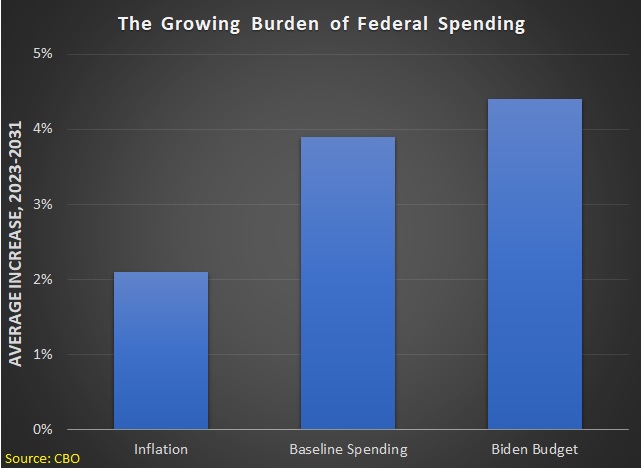
First, here’s a comparison of projected inflation with baseline spending (the current spending outlook) and Biden’s budget – all based on economic and fiscal estimates from the Congressional Budget Office.

As you can see, spending was growing far too fast even without Biden’s budget. And if Biden’s budget is enacted, the spending burden will rise more than twice the rate of inflation.
Now let’s look at a chart that illustrates why Biden’s spending spree is just a small part of the problem.

To be sure, it’s not good that the President is exacerbating America’s fiscal problems, but you can see that he’s simply adding a few more straws to the camel’s back.
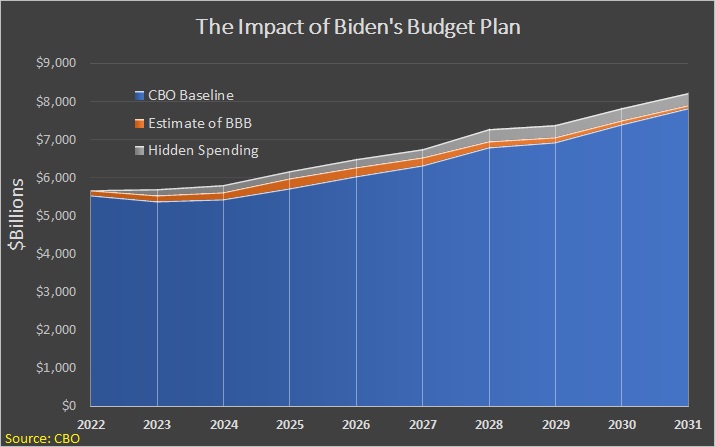
You’ll also notice that I included both the amount of spending that technically is in Biden’s budget plan (the orange part), as well as CBO’s estimate of the additional spending (the gray part) that will happen if the budget gimmicks are removed.

The bottom line is that America’s fiscal problem is too much government spending.

And that spending burden is getting worse over time because spending is growing faster than the private sector, violating the Golden Rule, which is bad news for jobs and growth.

Making the problem worse, as Biden proposes, will further hurt American prosperity.

P.S. Biden’s plan will increase the deficit, which also is not good, but keep in mind that tax-financed spending is no better than debt-financed spending. In either case, you wind up with the same bad result.

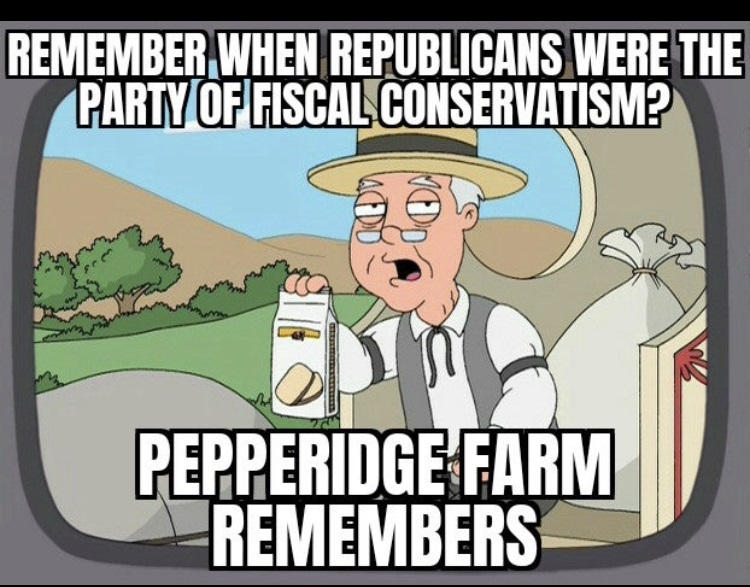
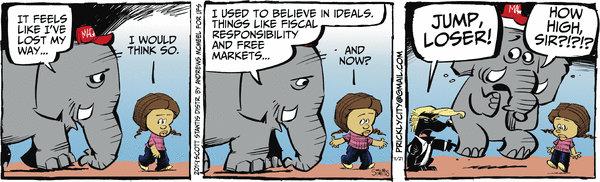
P.P.S. This column has two serious visuals to help understand Biden’s fiscal policy. If you prefer satire, here are two other images.

—-

When I think of our welfare state society it makes me think of words of Milton Friedman: society that puts equality before freedom will get neither. A society that puts freedom before equality will get a high degree of both.


Linda and Leo, Wards of the State

During his 2012 reelection campaign, Barack Obama created a fictional character named Julia and showed how she could mooch off taxpayers from cradle to grave.

Given Biden’s reputation as a plagiarizer, I guess we shouldn’t be surprised that the White House has reincarnated Julia as part of a push to trap more people in government dependency.

Here is the story of Linda and Leo.

The shocking part of the story, right at the start, is that Linda actually has a job in the private sector.

But Linda soon figures out that she can use the coercive power of government to take money from her neighbors.

She starts with Biden’s per-child handout.

She then puts her son into government-subsidized child care (with no discussion, of course, of how third-party payer causes prices to skyrocket).

I can only imagine the nursery rhymes he’ll hear in that setting.

She then enrolls him in a “free” pre-K program, presumably unaware that such programs have no evidence of success (but at least Biden will be happy that this program creates more unionized teachers to fight against quality education).

Next, her son enters taxpayer-funded community college (another third-party payer problem).

After college, he gets a job, which is nominally in the private sector, but which largely exists because of government distortions (all jobs are not created equal).

Last but not least, Linda gets to rely on taxpayers in her old age, thanks to other programs that are designed to produce additional overpaid government employees.

Let’s close this depressing celebration of dependency by shifting to humor.

Here’s a tweet about Biden’s people plagiarizing Obama’s people.
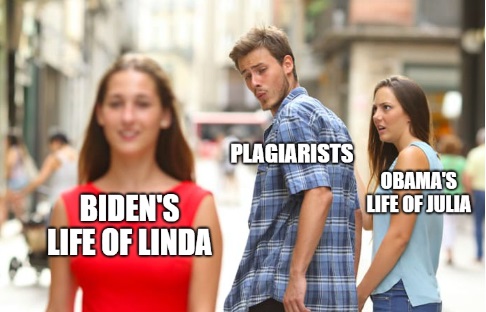
While I appreciate the satire, I’m quite worried about the long-run impact of Biden’s agenda (i.e., becoming Greece).

P.S. Regarding Obama’s Julia, here’s a great Michael Ramirez cartoon and here’s some clever Iowahawk satire.

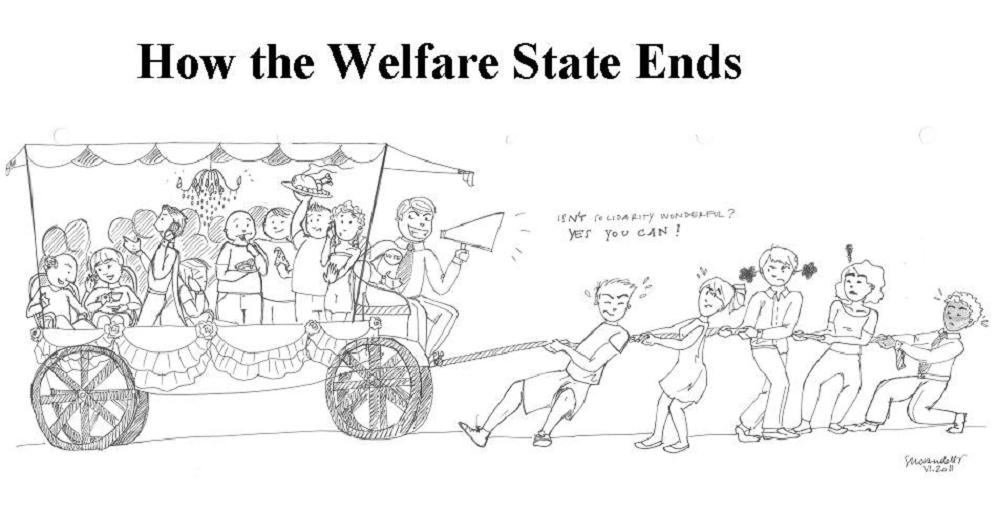
P.P.S. And here’s my two-cartoon set on what happens as more and more people are lured into the wagon of government dependency.

President Joe Biden Will Be Bad, but a President Kamala Harris Would Be Worse

Joe Biden has a very misguided economic agenda. I’m especially disturbed by his class-warfare tax agenda, which will be bad news for American workers and American competitiveness.

The good news, as I wrote earlier this year, is that he probably isn’t serious about some of his worst ideas.

Biden is a statist, but not overly ideological. His support for bigger government is largely a strategy of catering to the various interest groups that dominate the Democratic Party. The good news is that he’s an incrementalist and won’t aggressively push for a horrifying FDR-style agenda if he gets to the White House.

But what if Joe Biden’s health deteriorates and Kamala Harris – sooner or later – winds up in charge?

That’s rather troubling since her agenda was far to the left of Biden’s when they were competing for the Democratic nomination.

And it doesn’t appear that being Biden’s choice for Vice President has led her to moderate her views. Consider this campaign ad, where she openly asserted that “equitable treatment means we all end up at the same place.”

The notion that we should strive for equality of outcomes rather than equality of opportunity is horrifying.

For all intents and purposes,Harris has embraced a harsh version of redistributionism where everyone above average is punished and everyone below average is rewarded.

This goes way beyond a safety net and it’s definitely a recipe for economic misery since people on both sides of the equationhave less incentive to be productive.

I’m not the only one to be taken aback by Harris’ dogmatic leftism.

Robby Soave, writing for Reason, is very critical of her radical outlook.

Harris gives voice to a leftist-progressive narrative about the importance of equity—equal outcomes—rather than mere equality before the law. …Harris contrasted equal treatment—all people getting the same thing—with equitable treatment,which means “we all end up at the same place.” …This may seem like a trivial difference, but when it comes to public policy, the difference matters. A government shouldbe obligated to treat all citizens equally, giving them the same access to civil rights and liberties like voting, marriage, religious freedom, and gun ownership. …A mandate to foster equity, though, would give the government power to violate these rights in order to achieve identical social results for all people. 

And, in a column for National Review, Brad Polumbo expresses similar reservations about her views.
Whether she embraces the label “socialist” or not, Harris’s stated agenda and Senate record both reveal her to be positioned a long way to the left on matters of economic policy. From health care to the environment to housing, Harris thinks the answer to almost every problem we face is simply more government and more taxpayer money — raising taxes and further indebting future generations in the process.…Harris…supports an astounding $40 trillion in new spending over the next decade. In a sign of just how far left the Democratic Party has shifted on economics, Harris backs more than 20 times as much spending as Hillary Clinton proposed in 2016. …And this is not just a matter of spending. During her failed presidential campaign, Harris supported a federal-government takeover of health care… The senator jumped on the “Green New Deal” bandwagon as well. She co-sponsored the Green New Deal resolution in the Senate that called for a “new national, social, industrial, and economic mobilization on a scale not seen since World War II and the New Deal era.” …she supports enacting price controls on housing across the country. …The left-wing group Progressive Punch analyzed Harris’s voting record and found that she is the fourth-most liberal senator, more liberal even than Massachusetts senator Elizabeth Warren. Similarly, the nonpartisan organization GovTrack.us deemed Harris the furthest-left member of the Senate for the 2019 legislative year. (Spoiler alert: If your voting record is to the left of Bernie Sanders, you might be a socialist.)

To be fair, Harris is simply a politician, so we have no idea what she really believes. Her hard-left agenda might simply be her way of appealing to Democratic voters, much as Republicans who run for president suddenly decide they support big tax cuts and sweeping tax reform.

But whether she’s sincere or insincere, it’s troubling that she actually says it’s the role of government to make sure we all “end up at the same place.”

Let’s close with a video clip from Milton Friedman. At the risk of understatement, he has a different perspective than Ms. Harris.

Since we highlighted Harris’ key quote, let’s also highlight the key quote from Friedman.
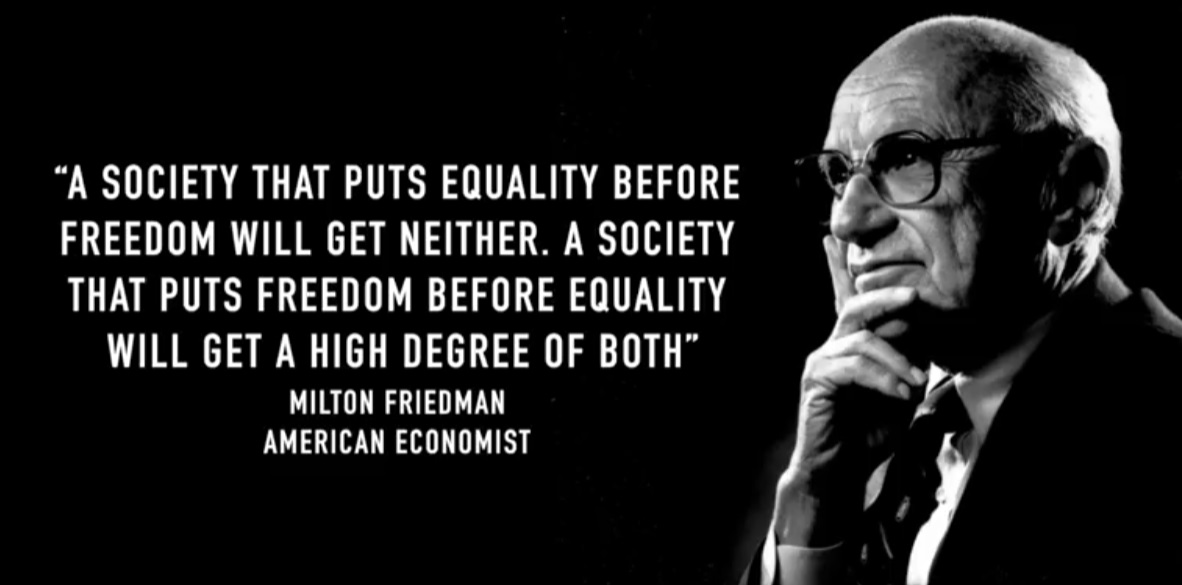
Amen.

P.S. It appears Republicans will hold the Senate, which presumably (hopefully?) means that any radical proposals would be dead on arrival, regardless of whether they’re proposed by Biden or Harris.

P.P.S. Harris may win the prize for the most economically illiterate proposal of the 2020 campaign.

——

Will Biden’s Class-Warfare Tax Plan Lead to an Exodus of Job Creators?

After Barack Obama took office (and especially after he was reelected), there was a big uptick in the number of rich people who chose to emigrate from the United States. 

There are many reasons wealthy people choose to move from one nation to another, but Obama’s embrace of class-warfare tax policy (including FATCA) was seen as a big factor.

Joe Biden’s tax agenda is significantly more punitive than Obama’s, so we may see something similar happen if he wins the 2020 election.

Given the economic importance of innovatorsentrepreneurs, and inventors, this would be not be good news for the American economy.

The New York Times reported late last year that the United States could be shooting itself in the foot by discouraging wealthy residents.

…a different group of Americans say they are considering leaving — people of both parties who would be hit by the wealth tax… Wealthy Americans often leave high-tax states like New York and California for lower-tax ones like Florida and Texas. But renouncing citizenship is a far more permanent, costly and complicated proposition. …“America’s the most attractive destination for capital, entrepreneurs and people wanting to get a great education,” said Reaz H. Jafri, a partner and head of the immigration practice at Withers, an international law firm. “But in today’s world, when you have other economic centers of excellence — like Singapore, Switzerland and London — people don’t view the U.S. as the only place to be.” …now, the price may be right to leave. While the cost of expatriating varies depending on a person’s assets, the wealthiest are betting that if a Democrat wins…, leaving now means a lower exit tax. …The wealthy who are considering renouncing their citizenship fear a wealth tax less than the possibility that the tax on capital gains could be raised to the ordinary income tax rate, effectively doubling what a wealthy person would pay… When Eduardo Saverin, a founder of Facebook…renounced his United States citizenship shortly before the social network went public, …several estimates said that renouncing his citizenship…saved him $700 million in taxes.

The migratory habits of rich people make a difference in the global economy.

Here are some excerpts from a 2017 Bloomberg story.

Australia is luring increasing numbers of global millionaires, helping make it one of the fastest growing wealthy nations in the world… Over the past decade, total wealth held in Australia has risen by 85 percent compared to 30 percent in the U.S. and 28 percent in the U.K… As a result, the average Australian is now significantly wealthier than the average American or Briton. …Given its relatively small population, Australia also makes an appearance on a list of average wealth per person. This one is, however, dominated by small tax havens.

Here’s one of the charts from the story.

As you can see, Australia is doing very well, though the small tax havens like Monaco are world leaders.
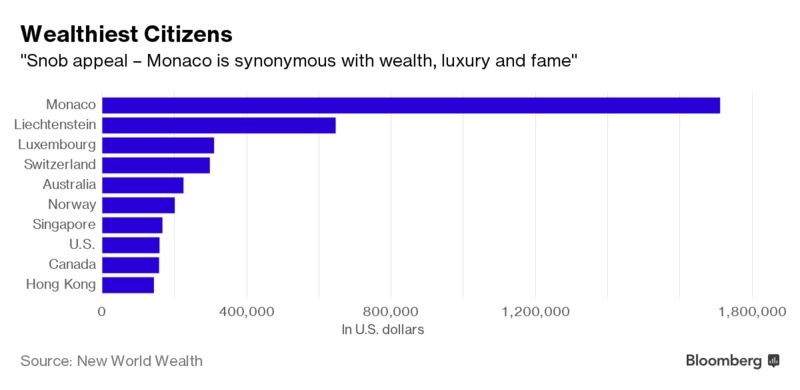
I’m mystified, however, that the Cayman Islands isn’t listed.

But I’m digressing.

Let’s get back to our main topic. It’s worth noting that even Greece is seeking to attract rich foreigners.

The new tax law is aimed at attracting fresh revenues into the country’s state coffers – mainly from foreigners as well as Greeks who are taxed abroad – by relocating their tax domicile to Greece, as it tries to woo “high-net-worth individuals” to the Greek tax register.The non-dom model provides for revenues obtained abroad to be taxed at a flat amount… Having these foreigners stay in Greece for at least 183 days a year, as the law requires, will also entail expenditure on accommodation and everyday costs that will be added to the Greek economy. …most eligible foreigners will be able to considerably lighten their tax burden if they relocate to Greece…nevertheless, the amount of 500,000 euros’ worth of investment in Greece required of foreigners and the annual flat tax of 100,000 euros demanded (plus 20,000 euros per family member) may keep many of them away.

The system is too restrictive, but it will make the beleaguered nation an attractive destination for some rich people. After all, they don’t even have to pay a flat tax, just a flat fee.

Italy has enjoyed some success with a similar regime to entice millionaires.

Last but not least, an article published last year has some fascinating details on the where rich people move and why they move.

The world’s wealthiest people are also the most mobile. High net worth individuals (HNWIs) – persons with wealth over US$1 million – may decide to pick up and move for a number of reasons. In some cases they are attracted by jurisdictions with more favorable tax laws… Unlike the middle class, wealthy citizens have the means to pick up and leave when things start to sideways in their home country. An uptick in HNWI migration from a country can often be a signal of negative economic or societal factors influencing a country. …Time-honored locations – such as Switzerland and the Cayman Islands – continue to attract the world’s wealthy, but no country is experiencing HNWI inflows quite like Australia. …The country has a robust economy, and is perceived as being a safe place to raise a family. Even better, Australia has no inheritance tax

Here’s a map from the article.

The good news is that the United States is attracting more millionaires than it’s losing (perhaps because of the EB-5 program).

The bad news is that this ratio could flip after the election. Indeed, it may already be happening even though recent data on expatriation paints a rosy picture.

The bottom line is that the United States should be competing to attract millionaires, not repel them. Assuming, of course, politicians care about jobs and prosperity for the rest of the population.

P.S. American politicians, copying laws normally imposed by the world’s most loathsome regimes, have imposed an “exit tax” so they can grab extra cash from rich people who choose to become citizens elsewhere.

P.P.S. I’ve argued that Australia is a good place to emigrate even for those of us who aren’t rich.

—-


Question of the Week: Which Department of the Federal Government Should Be the First to Be Abolished?

I was asked last week which entitlement program is most deserving of reform.

While acknowledging that Social Security and Medicare also are in desperate need of modernization, I wrote that Medicaid reformshould be the first priority.

But I’d be happy if we made progress on any type of entitlement reform, so I don’t think there are right or wrong answers to this kind of question.

We have the same type of question this week. A reader sent an email to ask “Which federal department should be abolished first?”

I guess this is what is meant when people talk about a target-rich environment. We have an abundance of candidates:

But if I have to choose, I think the Department of Housing and Urban Development should be first on the chopping block.

Raze the building and put a layer of salt over the earth to make sure it can never spring back to life

I’ve already argued that there should be no federal government involvement in the housing sector and made the same argument on TV. And I’ve also shared some horror stories about HUD waste and incompetence.

Heck, I even made HUD the background image for my video on the bloated and overpaid bureaucracy in Washington.

It’s also worth noting that there’s nothing about housing in Article I, Section VIII, of the Constitution. For those of us who have old-fashioned values about playing by the rules, that means much of what takes place in Washington – including housing handouts – is unconstitutional.

Simply stated, there is no legitimate argument for HUD. And I think there would be the least political resistance.

As with the answer to the question about entitlements, this is a judgment call. I’d be happy to be proven wrong if it meant that politicians were aggressively going after another department. Anything that reduces the burden of government spending is a step in the right direction


Milton Friedman on Spending

October 3, 2020 by Dan Mitchell

I identified four heroes from the “Battle of Ideas” video I shared in late August – Friedrich Hayek, Milton Friedman, Ronald Reagan, and Margaret Thatcher. Here’s one of those heroes, Milton Friedman, explaining what’s needed to control big government.

Why Milton Friedman Saw School Choice as a First Step, Not a Final One

On his birthday, let’s celebrate Milton Friedman’s vision of enabling parents, not government, to be in control of a child’s education.

Wednesday, July 31, 2019
Kerry McDonald
Kerry McDonald

EducationMilton FriedmanSchool ChoiceSchooling

Libertarians and others are often torn about school choice. They may wish to see the government schooling monopoly weakened, but they may resist supporting choice mechanisms, like vouchers and education savings accounts, because they don’t go far enough. Indeed, most current choice programs continue to rely on taxpayer funding of education and don’t address the underlying compulsory nature of elementary and secondary schooling.

Skeptics may also have legitimate fears that taxpayer-funded education choice programs will lead to over-regulation of previously independent and parochial schooling options, making all schooling mirror compulsory mass schooling, with no substantive variation.

Milton Friedman had these same concerns. The Nobel prize-winning economist is widely considered to be the one to popularize the idea of vouchers and school choice beginning with his 1955 paper, “The Role of Government in Education.” His vision continues to be realized through the important work of EdChoice, formerly the Friedman Foundation for Education Choice, that Friedman and his economist wife, Rose, founded in 1996.

July 31 is Milton Friedman’s birthday. He died in 2006 at the age of 94, but his ideas continue to have an impact, particularly in education policy.

Friedman saw vouchers and other choice programs as half-measures. He recognized the larger problems of taxpayer funding and compulsion, but saw vouchers as an important starting point in allowing parents to regain control of their children’s education. In their popular book, Free To Choose, first published in 1980, the Friedmans wrote:

We regard the voucher plan as a partial solution because it affects neither the financing of schooling nor the compulsory attendance laws. We favor going much farther. (p.161)

They continued:

The compulsory attendance laws are the justification for government control over the standards of private schools. But it is far from clear that there is any justification for the compulsory attendance laws themselves. (p. 162)

The Friedmans admitted that their “own views on this have changed over time,” as they realized that “compulsory attendance at schools is not necessary to achieve that minimum standard of literacy and knowledge,” and that “schooling was well-nigh universal in the United States before either compulsory attendance or government financing of schooling existed. Like most laws, compulsory attendance laws have costs as well as benefits. We no longer believe the benefits justify the costs.” (pp. 162-3)

Still, they felt that vouchers would be the essential starting point toward chipping away at monopoly mass schooling by putting parents back in charge. School choice, in other words, would be a necessary but not sufficient policy approach toward addressing the underlying issue of government control of education.

In their book, the Friedmans presented the potential outcomes of their proposed voucher plan, which would give parents access to some or all of the average per-pupil expenditures of a child enrolled in public school. They believed that vouchers would help create a more competitive education market, encouraging education entrepreneurship. They felt that parents would be more empowered with greater control over their children’s education and have a stronger desire to contribute some of their own money toward education. They asserted that in many places “the public school has fostered residential stratification, by tying the kind and cost of schooling to residential location” and suggested that voucher programs would lead to increased integration and heterogeneity. (pp. 166-7)

To the critics who said, and still say, that school choice programs would destroy the public schools, the Friedmans replied that these critics fail to

explain why, if the public school system is doing such a splendid job, it needs to fear competition from nongovernmental, competitive schools or, if it isn’t, why anyone should object to its “destruction.” (p. 170)

What I appreciate most about the Friedmans discussion of vouchers and the promise of school choice is their unrelenting support of parents. They believed that parents, not government bureaucrats and intellectuals, know what is best for their children’s education and well-being and are fully capable of choosing wisely for their children—when they have the opportunity to do so.

They wrote:

Parents generally have both greater interest in their children’s schooling and more intimate knowledge of their capacities and needs than anyone else. Social reformers, and educational reformers in particular, often self-righteously take for granted that parents, especially those who are poor and have little education themselves, have little interest in their children’s education and no competence to choose for them. That is a gratuitous insult. Such parents have frequently had limited opportunity to choose. However, U.S. history has demonstrated that, given the opportunity, they have often been willing to sacrifice a great deal, and have done so wisely, for their children’s welfare. (p. 160).

Sign-Up: Receive Kerry’s Weekly Parenting and Education Newsletter!

Today, school voucher programs exist in 15 states plus the District of Columbia. These programs have consistently shown that when parents are given the choice to opt-out of an assigned district school, many will take advantage of the opportunity. In Washington, D.C., low-income parents who win a voucher lottery send their children to private schools.

The most recent three-year federal evaluationof voucher program participants found that while student academic achievement was comparable to achievement for non-voucher students remaining in public schools, there were statistically significant improvements in other important areas. For instance, voucher participants had lower rates of chronic absenteeism than the control groups, as well as higher student satisfaction scores. There were also tremendous cost-savings.

In Wisconsin, the Milwaukee Parental Choice Program has served over 28,000 low-income students attending 129 participating private schools.

According to Corey DeAngelis, Director of School Choice at the Reason Foundation and a prolific researcher on the topic, the recent analysis of the D.C. voucher program “reveals that private schools produce the same academic outcomes for only a third of the cost of the public schools. In other words, school choice is a great investment.”

In Wisconsin, the Milwaukee Parental Choice Program was created in 1990 and is the nation’s oldest voucher program. It currently serves over 28,000 low-income students attending 129 participating private schools. Like the D.C. voucher program, data on test scores of Milwaukee voucher students show similar results to public school students, but non-academic results are promising.

Recent research found voucher recipients had lower crime rates and lower incidences of unplanned pregnancies in young adulthood. On his birthday, let’s celebrate Milton Friedman’s vision of enabling parents, not government, to be in control of a child’s education.

According to Howard Fuller, an education professor at Marquette University, founder of the Black Alliance for Educational Options, and one of the developers of the Milwaukee voucher program, the key is parent empowerment—particularly for low-income minority families.

In an interview with NPR, Fuller said: “What I’m saying to you is that there are thousands of black children whose lives are much better today because of the Milwaukee parental choice program,” he says. 
“They were able to access better schools than they would have without a voucher.”

Putting parents back in charge of their child’s education through school choice measures was Milton Friedman’s goal. It was not his ultimate goal, as it would not fully address the funding and compulsion components of government schooling; but it was, and remains, an important first step. As the Friedmans wrote in Free To Choose:

The strong American tradition of voluntary action has provided many excellent examples that demonstrate what can be done when parents have greater choice. (p. 159).

On his birthday, let’s celebrate Milton Friedman’s vision of enabling parents, not government, to be in control of a child’s education.

Kerry McDonald

Milton Friedman

Related posts:

“Friedman Friday” (“Free to Choose” episode 1 – Power of the Market. part 7 of 7)

March 16, 2012 – 12:25 am

  Michael Harrington:  If you don’t have the expertise, the knowledge technology today, you’re out of the debate. And I think that we have to democratize information and government as well as the economy and society. FRIEDMAN: I am sorry to say Michael Harrington’s solution is not a solution to it. He wants minority rule, I […] By Everette Hatcher III | Posted in Current Events, Milton Friedman | Edit | Comments (0)

“Friedman Friday” (“Free to Choose” episode 1 – Power of the Market. part 6 of 7)

March 9, 2012 – 12:29 am

PETERSON: Well, let me ask you how you would cope with this problem, Dr. Friedman. The people decided that they wanted cool air, and there was tremendous need, and so we built a huge industry, the air conditioning industry, hundreds of thousands of jobs, tremendous earnings opportunities and nearly all of us now have air […] By Everette Hatcher III | Posted in Current Events, Milton Friedman | Edit | Comments (0)

“Friedman Friday” (“Free to Choose” episode 1 – Power of the Market. part 5 of 7)

March 2, 2012 – 12:26 am

Part 5 Milton Friedman: I do not believe it’s proper to put the situation in terms of industrialist versus government. On the contrary, one of the reasons why I am in favor of less government is because when you have more government industrialists take it over, and the two together form a coalition against the ordinary […] By Everette Hatcher III | Posted in Current Events, Milton Friedman | Edit | Comments (0)

“Friedman Friday” (“Free to Choose” episode 1 – Power of the Market. part 4 of 7)

February 24, 2012 – 12:21 am

The fundamental principal of the free society is voluntary cooperation. The economic market, buying and selling, is one example. But it’s only one example. Voluntary cooperation is far broader than that. To take an example that at first sight seems about as far away as you can get __ the language we speak; the words […] By Everette Hatcher III | Posted in Current Events, Milton Friedman | Edit | Comments (0)

“Friedman Friday” (“Free to Choose” episode 1 – Power of the Market. part 3 of 7)

February 17, 2012 – 12:12 am

  _________________________   Pt3  Nowadays there’s a considerable amount of traffic at this border. People cross a little more freely than they use to. Many people from Hong Kong trade in China and the market has helped bring the two countries closer together, but the barriers between them are still very real. On this side […] By Everette Hatcher III | Posted in Current Events, Milton Friedman | Edit | Comments (0)

“Friedman Friday” (“Free to Choose” episode 1 – Power of the Market. part 2 of 7)

February 10, 2012 – 12:09 am

  Aside from its harbor, the only other important resource of Hong Kong is people __ over 4_ million of them. Like America a century ago, Hong Kong in the past few decades has been a haven for people who sought the freedom to make the most of their own abilities. Many of them are […] By Everette Hatcher III | Posted in Current Events, Milton Friedman | Edit | Comments (0)

“Friedman Friday” (“Free to Choose” episode 1 – Power of the Market. part 1of 7)

February 3, 2012 – 12:07 am

“FREE TO CHOOSE” 1: The Power of the Market (Milton Friedman) Free to Choose ^ | 1980 | Milton Friedman Posted on Monday, July 17, 2006 4:20:46 PM by Choose Ye This Day FREE TO CHOOSE: The Power of the Market Friedman: Once all of this was a swamp, covered with forest. The Canarce Indians […]

Milton Friedman The Power of the Market 1-5

Debate on Milton Friedman’s cure for inflation

September 29, 2011 – 7:24 am

If you would like to see the first three episodes on inflation in Milton Friedman’s film series “Free to Choose” then go to a previous post I did. Ep. 9 – How to Cure Inflation [4/7]. Milton Friedman’s Free to Choose (1980) Uploaded by investbligurucom on Jun 16, 2010 While many people have a fairly […]

By Everette Hatcher III | Also posted in Current Events | Tagged dr friedman, expansion history, income tax brackets, political courage, www youtube | Edit | Comments (0)

“Friedman Friday” Milton Friedman believed in liberty (Interview by Charlie Rose of Milton Friedman part 1)

April 19, 2013 – 1:14 am

Charlie Rose interview of Milton Friedman My favorite economist: Milton Friedman : A Great Champion of Liberty  by V. Sundaram   Milton Friedman, the Nobel Prize-winning economist who advocated an unfettered free market and had the ear of three US Presidents – Nixon, Ford and Reagan – died last Thursday (16 November, 2006 ) in San Francisco […] By Everette Hatcher III | Posted in Milton Friedman | Edit | Comments (0)

What were the main proposals of Milton Friedman?

February 21, 2013 – 1:01 am

Stearns Speaks on House Floor in Support of Balanced Budget Amendment Uploaded by RepCliffStearns on Nov 18, 2011 Speaking on House floor in support of Balanced Budget Resolution, 11/18/2011 ___________ Below are some of the main proposals of Milton Friedman. I highly respected his work. David J. Theroux said this about Milton Friedman’s view concerning […] By Everette Hatcher III | Posted in Milton Friedman | Edit | Comments (0)

“Friedman Friday,” EPISODE “The Failure of Socialism” of Free to Choose in 1990 by Milton Friedman (Part 1)

December 7, 2012 – 5:55 am

Milton Friedman: Free To Choose – The Failure Of Socialism With Ronald Reagan (Full) Published on Mar 19, 2012 by NoNationalityNeeded Milton Friedman’s writings affected me greatly when I first discovered them and I wanted to share with you. We must not head down the path of socialism like Greece has done. Abstract: Ronald Reagan […] By Everette Hatcher III | Posted in Milton FriedmanPresident Obama | Edit | Comments (1)

Defending Milton Friedman

July 31, 2012 – 6:45 am

What a great defense of Milton Friedman!!!!   Defaming Milton Friedman by Johan Norberg This article appeared in Reason Online on September 26, 2008  PRINT PAGE  CITE THIS      Sans Serif      Serif Share with your friends: ShareThis In the future, if you tell a student or a journalist that you favor free markets and limited government, there is […]

FRANCIS SCHAEFFER ANALYZES ART AND CULTURE Part 402 (Schaeffer discusses James Bond) BOND’S WOMANIZING Featured artist is Phyllida Barlow


James Bond is a paid killer, but how does he deal with the pressure of such a hard job that includes watching his wife being killed in 1969? He turns to booze and womanizing. Today we will examine his effort to fill the void in his heart by adding to his conquest list.

(“My running around is through!” the song says below but Bond never does stop womanizing!)

FROM RUSSIA WITH LOVE (MATT MONRO) – JAMES BOND 007 .

SHEENA EASTON – FOR YOUR EYES ONLY (LYRICS)

—-

LYRICS:

For your eyes only, can see me through the night
For your eyes only, I never need to hide
You can see so much in me, so much in me that’s new
I never felt until I looked at youFor your eyes only, only for you
You’ll see what no one else can see, and now I’m breaking free
For your eyes only, only for you
The love I know you need in me, the fantasy you’ve freed in me
Only for you, only for youFor your eyes only, the nights are never cold
You really know me, that’s all I need to know
Maybe I’m an open book because I know you’re mine
But you won’t need to read between the linesFor your eyes only, only for you
You see what no one else can see, and now I’m breaking free
For your eyes only, only for you
The passions that collide in me, the wild abandoned side of me
Only for you,
for your eyes onlySource: LyricFindSongwriters: Bill Conti / Michael LeesonFor Your Eyes Only lyrics © Sony/ATV Music Publishing LLC

The problem is that James Bond is a womanizer and sleeps with hundreds of women like Solomon but never truly touches one woman!!

Adele – Skyfall Lyrics on screen

LYRICS:

This is the end
Hold your breath and count to ten
Feel the Earth move and then
Hear my heart burst again
For this is the end
I’ve drowned and dreamt this moment
So overdue, I owe them
Swept away, I’m stolenLet the sky fall
When it crumbles
We will stand tall
Face it all together
Let the sky fall
When it crumbles
We will stand tall
Face it all together
At Skyfall
At SkyfallSkyfall is where we start
A thousand miles and poles apart
Where worlds collide and days are dark
You may have my number, you can take my name
But you’ll never have my heart
Let the sky fall (let the sky fall)
When it crumbles (when it crumbles)
We will stand tall (we will stand tall)
Face it all together
Let the sky fall (let the sky fall)
When it crumbles (when it crumbles)
We will stand tall (we will stand tall)
Face it all together
At SkyfallWhere you go, I go
What you see, I see
I know I’d never be me
Without the security
Of your loving arms
Keeping me from harm
Put your hand in my hand
And we’ll standLet the sky fall (let the sky fall)
When it crumbles (when it crumbles)
We will stand tall (we will stand tall)
Face it all together

Let the sky fall (let the sky fall)
When it crumbles (when it crumbles)
We will stand tall (we will stand tall)
Face it all together
At SkyfallLet the sky fall
We’ll stand tall
At Skyfall
OohSource: LyricFindSongwriters: Adele Laurie Blue Adkins / Paul Richard EpworthSkyfall lyrics © Sony/ATV Music Publishing LLC, Universal Music Publishing Group

The song SKYFALL basically is admitting James Bond will ultimately leave you and your heart will burst again so you better not give him your heart!!

Goldeneye 007 Opening Theme with Lyrics

—-

See reflections on the water 
More than darkness in the depths 
See him surface in every shadow 
On the wind, I feel his breath 

Goldeneye, I found his weakness 
Goldeneye, he’ll do what I please 
Goldeneye, no time for sweetness 
But a bitter kiss will bring him to his knees 

You’ll never know how I watched you from the shadows as a child 
You’ll never know how it feels to be the one who’s left behind 
You’ll never know the days and the nights
The tears, the tears I’ve cried 

But now my time has come
And time, time is not on your side 

See him move through smoke and mirrors 
Feel his presence in the crowd 
Other girls they gather around him 
If I had him, I wouldn’t let him out 

Goldeneye, not lace or leather 
Golden chain, take him to the spot 
Goldeneye, I’ll show him forever 
It’ll take forever to see what I’ve got 

You’ll never know how I watched you from the shadows as a child 
You’ll never know how it feels to get so close and be denied 
It’s a gold and honey trap
I’ve got for you tonight 
Revenge is a kiss this time I won’t miss 

Now I’ve got you in my sight 

With a goldeneye 
Golden, goldeneye 
With a goldeneye
Goldeneye
Goldeneye
Goldeneye
Goldeneye

The song GOLDENEYE says James Bond loves them and leaves them!

Moonraker – Lyrics – Sung by Shirley Bassey

recordings

Moonraker lyrics:

Where are you? Why do you hide?
Where is that moonlight trail that leads to your side?
Just like the Moonraker goes in search of his dream of gold,
I search for love, for someone to have and hold.
I´ve seen your smile in a thousand dreams,
Felt your touch and it always seems
You love me,
You love me.Where are you? When will we meet?
Take my unfinished life and make it complete.

Just like the Moonraker knows his dream will come true someday,
I know that you are only a kiss away.I´ve seen your smile in a thousand dreams,
Felt your touch and it always seems
You love me,
You love me.Source: LyricFindSongwriters: John Barry / Hal DavidMoonraker lyrics © Sony/ATV Music Publishing LLC, Universal Music Publishing Group

Sadly the lady in MOONRAKER should have known James Bond can not make her complete because he can’t commit to one woman!

Nancy Sinatra – You Only Live Twice (Lyrics)

You only live twice
Or so it seems
One life for yourself
And one for your dreamsYou drift through the years
And life seems tame
‘Til one dream appears
And love is its nameAnd love is a stranger
Who’ll beckon you on
Don’t think of the danger
Or the stranger is goneThis dream is for you
So pay the price
Make one dream come true
You only live twiceAnd love is a stranger
Who’ll beckon you on
Don’t think of the danger
Or the stranger is goneThis dream is for you
So pay the price
Make one dream come true
You only live twiceSource: MusixmatchSongwriters: John BarryYou Only Live Twice lyrics © Emi Unart Catalog Inc.

Love is a stranger to a womanizer like James Bond in YOU ONLY LIVE TWICE as he goes from girl to girl in the film. Solomon had all these dreams and aspirations for his life and love was the wife of his youth was one of them but all his dreams disappeared in Ecclesiastes and all his pursuits were vanity

Nobody Does It Better (Lyrics) – Carly Simon

Nobody does it better
Makes me feel sad for the rest
Nobody does it half as good as you
Baby, you’re the bestI
wasn’t lookin’ but somehow you found me
It tried to hide from your love light
But like heaven above me
The spy who loved me
Is keepin’ all my secrets safe tonightAnd nobody does it better
Though sometimes I wish someone could
Nobody does it quite the way you do
Why’d you have to be so good?The way that you hold me
Whenever you hold me
There’s some kind of magic inside you
That keeps me from runnin’
But just keep it comin’
How’d you learn to do the things you do?Oh,
and nobody does it better
Makes me feel sad for the rest
Nobody does it half as good as you
Baby, baby, darlin’, you’re the bestBaby you’re the best
Darlin’, you’re the best
Baby you’re the bestOh, oh, oh…Source: LyricFindSongwriters: Carole Sager / Marvin HamlischNobody Does It Better lyrics © Sony/ATV Music Publishing L

Instead of title THE SPY WHO LOVED ME it should be THE SPY WHO HAD CASUAL SEX WITH ME Most of the song is praising his sexual abilities and nothing suggests a deeper relationship which true love is really about.

James Bond reminds me of a story I read

Carly Simon reveals: ‘How Warren Beatty charmed me into bed’

By Larry Getlen

November 22, 2015 | 6:01amCarly Simon and Warren Beatty seen together in 1984AP

About a month into a romance with Warren Beatty, Carly Simon got a call from him saying he was flying to New York from LA and absolutely had to see her. He’d be getting in at around 12:30 a.m. and would have to be gone by 5:30 for an early-morning shoot.

He arrived, and the couple “made love like in a movie.”nypost-inline-related

“Warren was such a professional, the pressure points he knew about stirred a tremor in me,” Simon writes in her revealing new memoir, “Boys in the Trees” (Flatiron Books). “Warren seemed to have created a brand new manual on how to make love.”

After he left, Simon slept, then went for an appointment with her longtime therapist, whom she identifies as “Dr. L.”

She was raving to Dr. L about her night and what a “superman” Beatty was in the sack, when she saw “Dr. L looked unwell.”

She asked what was wrong, and he told her.

“Under the circumstances, I can’t withhold this. It’s too much to believe,” he said.

“You are not the first patient of the day who spent the night with Warren Beatty last night.”

It was 11 in the morning.

Much of the attention surrounding Carly Simon’s memoir involves the identity of the subject of her hit song “You’re So Vain,” which she reveals in a throwaway paragraph to have been about three people, with the second verse about Beatty. She has not revealed the other two.

But this question pales in interest to the realities of Simon’s romantic life.

I have been a James Bond since the 1970’s and have watched all the James Bond movies ever made. I have posted many times on James Bond and on the actors like Roger Moore who have played James Bond.

Sean Connery as James Bond in Dr. No (1962)

Sean Connery James Bond

(Daniel Craig starred as James Bond in NO TIME TO DIE)

When I think of James Bond’s life I think of someone who is willing to kill when necessary, and it causes him to drink heavily to deal with it. At the same time James Bond is a man who is filled with humor and he laughs at the ironies in life. 

Also Bond loves freedom and is willing to sacrifice himself in the defense of it. Of course, his faults can not be overlooked and one of his biggest is womanizing. That is why I have compared James Bond to King Solomon in ECCLESIASTES searching for satisfaction in life.

Image result for king solomon

There are 4 events that took place from April of 1976 to April of 1990 that made me start a lifelong study of King Solomon’s book ECCLESIASTES:

First, I heard a sermon  THE QUEST FOR THE BEST by Adrian Rogers on  Ecclesiastes at my Junior High Chapel that started my life long love of the Book of Ecclesiastes. 


(Adrian Rogers 1931-2005 pictured below)

Image result for young adrian rogers

Second, the song DUST IN THE WIND by the rock group KANSAS was released in January of 1978 and I linked it’s message to that of Ecclesiastes. 

Third, in 1981 on the 700 Club that both Kerry Livgren and Dave Hope of KANSAS had been born again and put their faith alone in Christ for their eternal salvation. 

Francis and Edith Schaeffer

_____

Fourth, in 1990 I heard a recorded message from the 1960’s by Francis Schaeffer on the Book of Ecclesiastes. It shows the 5 pessimist conclusions humanists must come to when looking at life UNDER THE SUN (without God in the picture).

File:Francis Schaeffer.jpg
(Francis Schaeffer)

—-

Francis Schaeffer talked about popular culture and I have access to hundreds of his talks from the 1960’s and he commented in one of those recordings that Sean Connery had a villa close to where Schaeffer lived in Switzerland. In that same talk  in 1966 Schaeffer went on to discuss an analysis of James Bond that found interesting

james-bond-no-time-to-die-b25-05907-rc

Daniel Craig’s James Bond: 2006-2021MGM

Francis Schaeffer discusses Solomon’s failed attempt at seeking true satisfaction in life by being a womanizer. 

Ecclesiastes 7:25-28

25 I directed my mind to know, to investigate and to seek wisdom and an explanation, and to know the evil of folly and the foolishness of madness. 26 And I discovered more bitter than death the woman whose heart is snares and nets, whose hands are chains. One who is pleasing to God will escape from her, but the sinner will be captured by her.

27 “Behold, I have discovered this,” says the Preacher, “addingone thing to another to find an explanation, 28 I have looked for other answers but have found none. I found one man in a thousand that I could respect, but not one woman. (Good News Translation on verse 28)

One can understand both Solomon’s expertness in this field and his bitterness.

I Kings 11:1-3 (New American Standard Bible) 

11 Now King Solomon loved many foreign women along with the daughter of Pharaoh: Moabite, Ammonite, Edomite, Sidonian, and Hittite women, from the nations concerning which the Lordhad said to the sons of Israel, “You shall not associate with them, nor shall they associate with you, for they will surely turn your heart away after their gods.” Solomon held fast to these in love. He had seven hundred wives, princesses, and three hundred concubines, and his wives turned his heart away.

An expert but also the reason for his bitterness. Certainly there have been many men over the centuries who have daydreamed of Solomon’s wealth in this area [of women], but at the end it was sorry, not only sorry but nothing and less than nothing. The simple fact is that one can not know woman in the real sense by pursuing 1000 women. It is not possible. Woman is not found this way. All that is left in this setting if one were to pursue the meaning of life in this direction is this most bitter word found in Ecclesiastes 7:28, “I have looked for other answers but have found none. I found one man in a thousand that I could respect, but not one woman.” (Good News Translation on verse 28) He was searching in the wrong way. He was searching for the answer to life in the limited circle of that which is beautiful in itself but not an answer finally in sexual life. More than that he finally tried to find it in variety and he didn’t EVEN YOUCH ONE WOMAN AT THE END!!!!

Francis Schaeffer in 1966 had a discussion on James Bond.

The most famous of this kind of thing today in cinema is James Bond. Fortunately we have an expert 

Bringing John Le Carre In From The Cold

Question and answer with John le Carre author of The Spy Who Came in from the Cold.

Timothy Dalton played Bond twice, in 1987 and 1989

INTERVIEWER: But your style goes deeper than this. You have developed what I suppose we can best describe as the anti-hero, haven’t you?
I don’t quite believe in the notion of the anti-hero…Since then something else has emerged , something very interesting . That is the James Bond kind of hero . I call this the consumergoods hero. This is the man who surrounds himself with all the things which are technique—with charms of super cars, super and expendable girls, with cigarette lighters that go off with a bang, with everything which in artistic terms replaces love or emotion. 

Connery in Amsterdam in July 1971, filming Diamonds Are Forever

Smiling man with short, tousled hair, wearing white shirt open at collar, and black jacket.

Pierce Brosnan at the 2002 Cannes Film Festival

(Schaeffer states ”Let me read it again.”) with everything which in artistic terms replaces love or emotion. (Schaeffer “There is no place in James Bond for love or emotion. John Le carrie is absolutely right in this.)

Australian actor George Lazenby and Diana Riggin On Her Majesty’s Secret Service

Daniel Craig at the Berlin premiere of Spectre in October 2015

You could take James Bond on that magic carpet and, given the prerequisites of the affluent society, given above all an identifiable villain of whatever kind—and weak people need enemies—you could dump him in the middle of Moscow and you would get a ready-made Soviet agent. I find him in this sense extremely cosmopolitan. He is an Etonian and so on, but in fact he seems to me to correspond more to the kind of international manager type—the young rich fellow of thirty-eight or thirty-nine who has discovered that promiscuity is one of the privileges of wealth; who has developed a pretty hard-nosed cynicism towards any sense of moral obligation.

Roger Moore in 1973, photographed by Allan Warren

Sam Smith – Writing on The Wall Lyrics

Writing’s on the Wall
Song by Sam Smith

I’ve been here before
But always hit the floor
I‘ve spent a lifetime running
And I always get away

But with you I’m feeling something
That makes me want to stay
I’m prepared for this
I never shoot to miss
But I feel like a storm is coming
If I’m gonna make it through the day
Then there’s no more use in running
This is something I gotta faceIf I risk it all
Could you break my fall?
How do I live? How do I breathe?
When you’re not here, I’m suffocating
I want to feel love run through my blood
Tell me, is this where I give it all up?
For you I have to risk it all
Cause the writing’s on the wall
A million shards of glass
That haunt me from my past
As the stars begin to gather
And the light begins to fade
When all hope begins to shatter
Know that I won’t be afraidIf I risk it all
Could you break my fall?
How do I live? How do I breathe?
When you’re not here, I’m suffocating
I want to feel love run through my blood
Tell me, is this where I give it all up?
For you I have to risk it all
‘Cause the writing’s on the wall
The writing’s on the wallHow do I live? How do I breathe?
When you’re not here, I’m suffocating
I want to feel love run through my blood
Tell me is this where I give it all up?
How do I live? How do I breathe?
When you’re not here I’m suffocating
I want to feel love, run through my blood
Tell me, is this where I give it all up?
For you I have to risk it all
‘Cause the writing’s on the wall

Notice the words from the song WRITING ON THE WALL: I’ve spent a lifetime running
And I always get away

But with you I’m feeling something
That makes me want to stay…
How do I live? How do I breathe?
When you’re not here, I’m suffocating
I want to feel love run through my blood
Tell me, is this where I give it all up?
For you I have to risk it all
Cause the writing’s on the wall

—-

In this song James Bond is talking about leaving his womanizing ways behind and be committed to one lady because “I want to feel love run through my blood…For you I have to risk it all, Cause the writing’s on the wall!”

Let me make 2 observations. First, true love is not found in womanizing but in being committed to the wife of your youth as the Bible instructs us for our good. Womanizing brings disease along with many other bad side-effects with it according to Proverbs chapters 5-7.

Second, the Bible is a historically accurate book given to us by God and this song’s title WRITING ON THE WALL refers to Daniel 5 where archaeologists have again confirmed the historical existence of King Belshazzar of Babylon who saw the WRITING ON THE WALL!!!

Adrian Rogers noted the Bible is affirmed through historical accuracy. Do you remember the story about the handwriting on the wall that is found in the fifth chapter of Daniel? Belshazzar hosted a feast with a thousand of his lords and ladies. Suddenly, a gruesome hand appeared out of nowhere and began to write on a wall. The king was disturbed and asked for someone to interpret the writing. Daniel was found and gave the interpretation. After the interpretation, “Then commanded Belshazzar, and they clothed Daniel with scarlet, and put a chain of gold about his neck, and made a proclamation concerning him, that he should be the third ruler in the kingdom.” (Daniel 5:29). 
Basing their opinion on Babylonian records, the historians claim this never happened. According to the records, the last king of Babylon was not Belshazzar, but a man named Nabonidas. And so, they said, the Bible is in error. There wasn’t a record of a king named Belshazzar. Well, the spades of archeologists continued to do their work. In 1853, an inscription was found on a cornerstone of a temple built by Nabonidas, to the god Ur, which read: “May I, Nabonidas, king of Babylon, not sin against thee. And may reverence for thee dwell in the heart of Belshazzar, my first-born favorite son.” 
From other inscriptions, it was learned that Belshazzar and Nabonidas were co-regents. Nabonidas traveled while Belshazzar stayed home to run the kingdom. Now that we know that Belshazzar and Nabonidas were co-regents, it makes sense that Belshazzar would say that Daniel would be the third ruler. What a marvelous nugget of truth tucked away in the Word of God!


Phyllida Barlow: Homemade | Art21 “Extended Play”

Featured artist is Phyllida Barlow

Phyllida Barlow was born in Newcastle upon Tyne, England, in 1944. Inspired by the urban environment, Barlow’s sculptures marry unconventional materials such as cardboard, plywood, plaster, and cement with vibrantly colored paint and fabrics. Her invented forms are created through layered processes of accumulation, removal, and juxtaposition—gestures that Barlow describes as “more functional than artistic.” The resulting massive works challenge viewers’ experiences of physical space, stretching the limits of mass, volume, and height as they tower, block, and interrupt space. Yet these works remain distinctly anti-monumental; the artist leaves exposed, unfinished seams, revealing the means of the works’ making and playing with the tensions between hardness and softness, the imperious and the comic, and the painterly and the sculptural.

Influenced by the early 1960s New Generation Sculpture exhibitions at Whitechapel Gallery in London, Barlow began experimenting early in her career with the sculptural potential of materials unassociated with traditional sculpture, like fiberglass, resin, fabric, and paint. Prior to receiving exhibitions in major museums and galleries, Barlow utilized public and temporary spaces to show her work, developing her exploration of physical space and challenging conventional notions of where sculpture could exist. For forty years, Barlow also worked as a teacher, fostering some of Britain’s most distinguished artists. Since 2009, she has worked exclusively on her art practice and exhibited her work widely in the United Kingdom and internationally.

Barlow studied at Chelsea College of Art in London from 1960 to 1963 and Slade School of Fine Art in London from 1963 to 1966. Major awards include receiving the Aachen Art Prize (2012) and being named a Royal Academician (2011). She has had major exhibitions at Royal Academy of the Arts, London, England (2019); Jupiter Artland, Edinburgh, Scotland (2018); Turner Contemporary, Margate, England (2017); Venice Biennale, Italy (2013, 2017); Nasher Sculpture Center, Dallas, Texas (2015); Tate Britain, London, England (2014); and New Museum, New York (2012), among others. Barlow lives and works in London.

Related posts:

RESPONDING TO HARRY KROTO’S BRILLIANT RENOWNED ACADEMICS!! Part 48 Nobel Prize Winner and Global Warming Denier Ivar Giaever “I think religion is to blame for a lot of the ills in this world!”

October 20, 2015 – 5:20 am

  On November 21, 2014 I received a letter from Nobel Laureate Harry Kroto and it said: …Please click on this URL http://vimeo.com/26991975 and you will hear what far smarter people than I have to say on this matter. I agree with them. Harry Kroto _________________ Below you have picture of 1996 Chemistry Nobel Prize Winner […]

September 24, 2015 – 5:42 am

The Beatles were “inspired by the musique concrète of German composer and early electronic music pioneer Karlheinz Stockhausen…”  as SCOTT THILL has asserted. Francis Schaeffer noted that ideas of  “Non-resolution” and “Fragmentation” came down German and French streams with the influence of Beethoven’s last Quartets and then the influence of Debussy and later Schoenberg’s non-resolution which is in total contrast […]

RESPONDING TO HARRY KROTO’S BRILLIANT RENOWNED ACADEMICS!! Part 42 Peter Singer, Professor of Bioethics at Princeton University, THE PROBLEM OF EVIL

September 8, 2015 – 5:10 am

On November 21, 2014 I received a letter from Nobel Laureate Harry Kroto and it said: …Please click on this URL http://vimeo.com/26991975 and you will hear what far smarter people than I have to say on this matter. I agree with them. Harry Kroto _________________ Below you have picture of 1996 Chemistry Nobel Prize […]

RESPONDING TO HARRY KROTO’S BRILLIANT RENOWNED ACADEMICS!! Bart Ehrman “Why should one think that God performed the miracle of inspiring the words in the first place if He didn’t perform the miracle of preserving the words?”

September 2, 2015 – 8:42 am

On November 21, 2014 I received a letter from Nobel Laureate Harry Kroto and it said: …Please click on this URL http://vimeo.com/26991975 and you will hear what far smarter people than I have to say on this matter. I agree with them. Harry Kroto ____________________ Below you have picture of 1996 Chemistry Nobel Prize Winner Dr. […]

DAN MITCHELL article: The Two Most Important Things to Understand about Biden’s Budget 


The Two Most Important Things to Understand about Biden’s Budget

The fight over President Biden’s budget, the so-called Build Back Better plan, has revolved around very important issues.

For today’s column, let’s zoom out and look at two charts that highlight the big issue that should be getting more attention.

First, here’s a comparison of projected inflation with baseline spending (the current spending outlook) and Biden’s budget – all based on economic and fiscal estimates from the Congressional Budget Office.

As you can see, spending was growing far too fast even without Biden’s budget. And if Biden’s budget is enacted, the spending burden will rise more than twice the rate of inflation.

Now let’s look at a chart that illustrates why Biden’s spending spree is just a small part of the problem.

To be sure, it’s not good that the President is exacerbating America’s fiscal problems, but you can see that he’s simply adding a few more straws to the camel’s back.

You’ll also notice that I included both the amount of spending that technically is in Biden’s budget plan (the orange part), as well as CBO’s estimate of the additional spending (the gray part) that will happen if the budget gimmicks are removed.

The bottom line is that America’s fiscal problem is too much government spending.

And that spending burden is getting worse over time because spending is growing faster than the private sector, violating the Golden Rule, which is bad news for jobs and growth.

Making the problem worse, as Biden proposes, will further hurt American prosperity.

P.S. Biden’s plan will increase the deficit, which also is not good, but keep in mind that tax-financed spending is no better than debt-financed spending. In either case, you wind up with the same bad result.

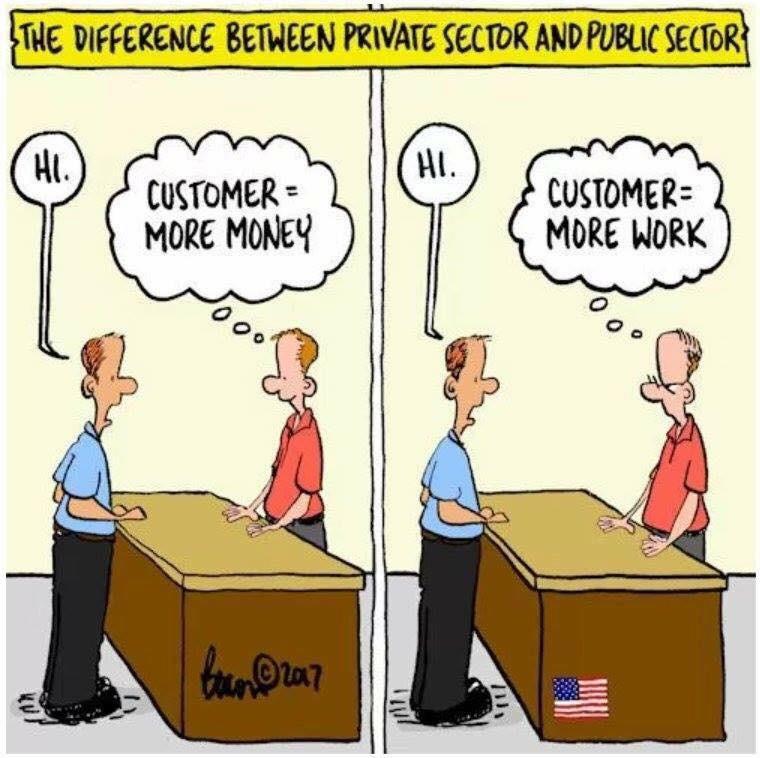
P.P.S. This column has two serious visuals to help understand Biden’s fiscal policy. If you prefer satire, here are two other images.

—-

When I think of our welfare state society it makes me think of words of Milton Friedman: society that puts equality before freedom will get neither. A society that puts freedom before equality will get a high degree of both.


Linda and Leo, Wards of the State

During his 2012 reelection campaign, Barack Obama created a fictional character named Julia and showed how she could mooch off taxpayers from cradle to grave.

Given Biden’s reputation as a plagiarizer, I guess we shouldn’t be surprised that the White House has reincarnated Julia as part of a push to trap more people in government dependency.

Here is the story of Linda and Leo.

The shocking part of the story, right at the start, is that Linda actually has a job in the private sector.

But Linda soon figures out that she can use the coercive power of government to take money from her neighbors.

She starts with Biden’s per-child handout.

She then puts her son into government-subsidized child care (with no discussion, of course, of how third-party payer causes prices to skyrocket).

I can only imagine the nursery rhymes he’ll hear in that setting.

She then enrolls him in a “free” pre-K program, presumably unaware that such programs have no evidence of success (but at least Biden will be happy that this program creates more unionized teachers to fight against quality education).

Next, her son enters taxpayer-funded community college (another third-party payer problem).

After college, he gets a job, which is nominally in the private sector, but which largely exists because of government distortions (all jobs are not created equal).

Last but not least, Linda gets to rely on taxpayers in her old age, thanks to other programs that are designed to produce additional overpaid government employees.

Let’s close this depressing celebration of dependency by shifting to humor.

Here’s a tweet about Biden’s people plagiarizing Obama’s people.

While I appreciate the satire, I’m quite worried about the long-run impact of Biden’s agenda (i.e., becoming Greece).

P.S. Regarding Obama’s Julia, here’s a great Michael Ramirez cartoon and here’s some clever Iowahawk satire.

P.P.S. And here’s my two-cartoon set on what happens as more and more people are lured into the wagon of government dependency.

President Joe Biden Will Be Bad, but a President Kamala Harris Would Be Worse

Joe Biden has a very misguided economic agenda. I’m especially disturbed by his class-warfare tax agenda, which will be bad news for American workers and American competitiveness.

The good news, as I wrote earlier this year, is that he probably isn’t serious about some of his worst ideas.

Biden is a statist, but not overly ideological. His support for bigger government is largely a strategy of catering to the various interest groups that dominate the Democratic Party. The good news is that he’s an incrementalist and won’t aggressively push for a horrifying FDR-style agenda if he gets to the White House.

But what if Joe Biden’s health deteriorates and Kamala Harris – sooner or later – winds up in charge?

That’s rather troubling since her agenda was far to the left of Biden’s when they were competing for the Democratic nomination.

And it doesn’t appear that being Biden’s choice for Vice President has led her to moderate her views. Consider this campaign ad, where she openly asserted that “equitable treatment means we all end up at the same place.”

The notion that we should strive for equality of outcomes rather than equality of opportunity is horrifying.

For all intents and purposes,Harris has embraced a harsh version of redistributionism where everyone above average is punished and everyone below average is rewarded.

This goes way beyond a safety net and it’s definitely a recipe for economic misery since people on both sides of the equationhave less incentive to be productive.

I’m not the only one to be taken aback by Harris’ dogmatic leftism.

Robby Soave, writing for Reason, is very critical of her radical outlook.

Harris gives voice to a leftist-progressive narrative about the importance of equity—equal outcomes—rather than mere equality before the law. …Harris contrasted equal treatment—all people getting the same thing—with equitable treatment,which means “we all end up at the same place.” …This may seem like a trivial difference, but when it comes to public policy, the difference matters. A government shouldbe obligated to treat all citizens equally, giving them the same access to civil rights and liberties like voting, marriage, religious freedom, and gun ownership. …A mandate to foster equity, though, would give the government power to violate these rights in order to achieve identical social results for all people. 

And, in a column for National Review, Brad Polumbo expresses similar reservations about her views.

Whether she embraces the label “socialist” or not, Harris’s stated agenda and Senate record both reveal her to be positioned a long way to the left on matters of economic policy. From health care to the environment to housing, Harris thinks the answer to almost every problem we face is simply more government and more taxpayer money — raising taxes and further indebting future generations in the process.…Harris…supports an astounding $40 trillion in new spending over the next decade. In a sign of just how far left the Democratic Party has shifted on economics, Harris backs more than 20 times as much spending as Hillary Clinton proposed in 2016. …And this is not just a matter of spending. During her failed presidential campaign, Harris supported a federal-government takeover of health care… The senator jumped on the “Green New Deal” bandwagon as well. She co-sponsored the Green New Deal resolution in the Senate that called for a “new national, social, industrial, and economic mobilization on a scale not seen since World War II and the New Deal era.” …she supports enacting price controls on housing across the country. …The left-wing group Progressive Punch analyzed Harris’s voting record and found that she is the fourth-most liberal senator, more liberal even than Massachusetts senator Elizabeth Warren. Similarly, the nonpartisan organization GovTrack.us deemed Harris the furthest-left member of the Senate for the 2019 legislative year. (Spoiler alert: If your voting record is to the left of Bernie Sanders, you might be a socialist.)

To be fair, Harris is simply a politician, so we have no idea what she really believes. Her hard-left agenda might simply be her way of appealing to Democratic voters, much as Republicans who run for president suddenly decide they support big tax cuts and sweeping tax reform.

But whether she’s sincere or insincere, it’s troubling that she actually says it’s the role of government to make sure we all “end up at the same place.”

Let’s close with a video clip from Milton Friedman. At the risk of understatement, he has a different perspective than Ms. Harris.

Since we highlighted Harris’ key quote, let’s also highlight the key quote from Friedman.

Amen.

P.S. It appears Republicans will hold the Senate, which presumably (hopefully?) means that any radical proposals would be dead on arrival, regardless of whether they’re proposed by Biden or Harris.

P.P.S. Harris may win the prize for the most economically illiterate proposal of the 2020 campaign.

——

Will Biden’s Class-Warfare Tax Plan Lead to an Exodus of Job Creators?

After Barack Obama took office (and especially after he was reelected), there was a big uptick in the number of rich people who chose to emigrate from the United States. 

There are many reasons wealthy people choose to move from one nation to another, but Obama’s embrace of class-warfare tax policy (including FATCA) was seen as a big factor.

Joe Biden’s tax agenda is significantly more punitive than Obama’s, so we may see something similar happen if he wins the 2020 election.

Given the economic importance of innovatorsentrepreneurs, and inventors, this would be not be good news for the American economy.

The New York Times reported late last year that the United States could be shooting itself in the foot by discouraging wealthy residents.

…a different group of Americans say they are considering leaving — people of both parties who would be hit by the wealth tax… Wealthy Americans often leave high-tax states like New York and California for lower-tax ones like Florida and Texas. But renouncing citizenship is a far more permanent, costly and complicated proposition. …“America’s the most attractive destination for capital, entrepreneurs and people wanting to get a great education,” said Reaz H. Jafri, a partner and head of the immigration practice at Withers, an international law firm. “But in today’s world, when you have other economic centers of excellence — like Singapore, Switzerland and London — people don’t view the U.S. as the only place to be.” …now, the price may be right to leave. While the cost of expatriating varies depending on a person’s assets, the wealthiest are betting that if a Democrat wins…, leaving now means a lower exit tax. …The wealthy who are considering renouncing their citizenship fear a wealth tax less than the possibility that the tax on capital gains could be raised to the ordinary income tax rate, effectively doubling what a wealthy person would pay… When Eduardo Saverin, a founder of Facebook…renounced his United States citizenship shortly before the social network went public, …several estimates said that renouncing his citizenship…saved him $700 million in taxes.

The migratory habits of rich people make a difference in the global economy.

Here are some excerpts from a 2017 Bloomberg story.

Australia is luring increasing numbers of global millionaires, helping make it one of the fastest growing wealthy nations in the world… Over the past decade, total wealth held in Australia has risen by 85 percent compared to 30 percent in the U.S. and 28 percent in the U.K… As a result, the average Australian is now significantly wealthier than the average American or Briton. …Given its relatively small population, Australia also makes an appearance on a list of average wealth per person. This one is, however, dominated by small tax havens.

Here’s one of the charts from the story.

As you can see, Australia is doing very well, though the small tax havens like Monaco are world leaders.

I’m mystified, however, that the Cayman Islands isn’t listed.

But I’m digressing.

Let’s get back to our main topic. It’s worth noting that even Greece is seeking to attract rich foreigners.

The new tax law is aimed at attracting fresh revenues into the country’s state coffers – mainly from foreigners as well as Greeks who are taxed abroad – by relocating their tax domicile to Greece, as it tries to woo “high-net-worth individuals” to the Greek tax register.The non-dom model provides for revenues obtained abroad to be taxed at a flat amount… Having these foreigners stay in Greece for at least 183 days a year, as the law requires, will also entail expenditure on accommodation and everyday costs that will be added to the Greek economy. …most eligible foreigners will be able to considerably lighten their tax burden if they relocate to Greece…nevertheless, the amount of 500,000 euros’ worth of investment in Greece required of foreigners and the annual flat tax of 100,000 euros demanded (plus 20,000 euros per family member) may keep many of them away.

The system is too restrictive, but it will make the beleaguered nation an attractive destination for some rich people. After all, they don’t even have to pay a flat tax, just a flat fee.

Italy has enjoyed some success with a similar regime to entice millionaires.

Last but not least, an article published last year has some fascinating details on the where rich people move and why they move.

The world’s wealthiest people are also the most mobile. High net worth individuals (HNWIs) – persons with wealth over US$1 million – may decide to pick up and move for a number of reasons. In some cases they are attracted by jurisdictions with more favorable tax laws… Unlike the middle class, wealthy citizens have the means to pick up and leave when things start to sideways in their home country. An uptick in HNWI migration from a country can often be a signal of negative economic or societal factors influencing a country. …Time-honored locations – such as Switzerland and the Cayman Islands – continue to attract the world’s wealthy, but no country is experiencing HNWI inflows quite like Australia. …The country has a robust economy, and is perceived as being a safe place to raise a family. Even better, Australia has no inheritance tax

Here’s a map from the article.

The good news is that the United States is attracting more millionaires than it’s losing (perhaps because of the EB-5 program).

The bad news is that this ratio could flip after the election. Indeed, it may already be happening even though recent data on expatriation paints a rosy picture.

The bottom line is that the United States should be competing to attract millionaires, not repel them. Assuming, of course, politicians care about jobs and prosperity for the rest of the population.

P.S. American politicians, copying laws normally imposed by the world’s most loathsome regimes, have imposed an “exit tax” so they can grab extra cash from rich people who choose to become citizens elsewhere.

P.P.S. I’ve argued that Australia is a good place to emigrate even for those of us who aren’t rich.

—-


Question of the Week: Which Department of the Federal Government Should Be the First to Be Abolished?

I was asked last week which entitlement program is most deserving of reform.

While acknowledging that Social Security and Medicare also are in desperate need of modernization, I wrote that Medicaid reformshould be the first priority.

But I’d be happy if we made progress on any type of entitlement reform, so I don’t think there are right or wrong answers to this kind of question.

We have the same type of question this week. A reader sent an email to ask “Which federal department should be abolished first?”

I guess this is what is meant when people talk about a target-rich environment. We have an abundance of candidates:

But if I have to choose, I think the Department of Housing and Urban Development should be first on the chopping block.

Raze the building and put a layer of salt over the earth to make sure it can never spring back to life

I’ve already argued that there should be no federal government involvement in the housing sector and made the same argument on TV. And I’ve also shared some horror stories about HUD waste and incompetence.

Heck, I even made HUD the background image for my video on the bloated and overpaid bureaucracy in Washington.

It’s also worth noting that there’s nothing about housing in Article I, Section VIII, of the Constitution. For those of us who have old-fashioned values about playing by the rules, that means much of what takes place in Washington – including housing handouts – is unconstitutional.

Simply stated, there is no legitimate argument for HUD. And I think there would be the least political resistance.

As with the answer to the question about entitlements, this is a judgment call. I’d be happy to be proven wrong if it meant that politicians were aggressively going after another department. Anything that reduces the burden of government spending is a step in the right direction


Milton Friedman on Spending

October 3, 2020 by Dan Mitchell

I identified four heroes from the “Battle of Ideas” video I shared in late August – Friedrich Hayek, Milton Friedman, Ronald Reagan, and Margaret Thatcher. Here’s one of those heroes, Milton Friedman, explaining what’s needed to control big government.

Why Milton Friedman Saw School Choice as a First Step, Not a Final One

On his birthday, let’s celebrate Milton Friedman’s vision of enabling parents, not government, to be in control of a child’s education.

Wednesday, July 31, 2019
Kerry McDonald
Kerry McDonald

EducationMilton FriedmanSchool ChoiceSchooling

Libertarians and others are often torn about school choice. They may wish to see the government schooling monopoly weakened, but they may resist supporting choice mechanisms, like vouchers and education savings accounts, because they don’t go far enough. Indeed, most current choice programs continue to rely on taxpayer funding of education and don’t address the underlying compulsory nature of elementary and secondary schooling.

Skeptics may also have legitimate fears that taxpayer-funded education choice programs will lead to over-regulation of previously independent and parochial schooling options, making all schooling mirror compulsory mass schooling, with no substantive variation.

Milton Friedman had these same concerns. The Nobel prize-winning economist is widely considered to be the one to popularize the idea of vouchers and school choice beginning with his 1955 paper, “The Role of Government in Education.” His vision continues to be realized through the important work of EdChoice, formerly the Friedman Foundation for Education Choice, that Friedman and his economist wife, Rose, founded in 1996.

July 31 is Milton Friedman’s birthday. He died in 2006 at the age of 94, but his ideas continue to have an impact, particularly in education policy.

Friedman saw vouchers and other choice programs as half-measures. He recognized the larger problems of taxpayer funding and compulsion, but saw vouchers as an important starting point in allowing parents to regain control of their children’s education. In their popular book, Free To Choose, first published in 1980, the Friedmans wrote:

We regard the voucher plan as a partial solution because it affects neither the financing of schooling nor the compulsory attendance laws. We favor going much farther. (p.161)

They continued:

The compulsory attendance laws are the justification for government control over the standards of private schools. But it is far from clear that there is any justification for the compulsory attendance laws themselves. (p. 162)

The Friedmans admitted that their “own views on this have changed over time,” as they realized that “compulsory attendance at schools is not necessary to achieve that minimum standard of literacy and knowledge,” and that “schooling was well-nigh universal in the United States before either compulsory attendance or government financing of schooling existed. Like most laws, compulsory attendance laws have costs as well as benefits. We no longer believe the benefits justify the costs.” (pp. 162-3)

Still, they felt that vouchers would be the essential starting point toward chipping away at monopoly mass schooling by putting parents back in charge. School choice, in other words, would be a necessary but not sufficient policy approach toward addressing the underlying issue of government control of education.

In their book, the Friedmans presented the potential outcomes of their proposed voucher plan, which would give parents access to some or all of the average per-pupil expenditures of a child enrolled in public school. They believed that vouchers would help create a more competitive education market, encouraging education entrepreneurship. They felt that parents would be more empowered with greater control over their children’s education and have a stronger desire to contribute some of their own money toward education. They asserted that in many places “the public school has fostered residential stratification, by tying the kind and cost of schooling to residential location” and suggested that voucher programs would lead to increased integration and heterogeneity. (pp. 166-7)

To the critics who said, and still say, that school choice programs would destroy the public schools, the Friedmans replied that these critics fail to

explain why, if the public school system is doing such a splendid job, it needs to fear competition from nongovernmental, competitive schools or, if it isn’t, why anyone should object to its “destruction.” (p. 170)

What I appreciate most about the Friedmans discussion of vouchers and the promise of school choice is their unrelenting support of parents. They believed that parents, not government bureaucrats and intellectuals, know what is best for their children’s education and well-being and are fully capable of choosing wisely for their children—when they have the opportunity to do so.

They wrote:

Parents generally have both greater interest in their children’s schooling and more intimate knowledge of their capacities and needs than anyone else. Social reformers, and educational reformers in particular, often self-righteously take for granted that parents, especially those who are poor and have little education themselves, have little interest in their children’s education and no competence to choose for them. That is a gratuitous insult. Such parents have frequently had limited opportunity to choose. However, U.S. history has demonstrated that, given the opportunity, they have often been willing to sacrifice a great deal, and have done so wisely, for their children’s welfare. (p. 160).

Sign-Up: Receive Kerry’s Weekly Parenting and Education Newsletter!

Today, school voucher programs exist in 15 states plus the District of Columbia. These programs have consistently shown that when parents are given the choice to opt-out of an assigned district school, many will take advantage of the opportunity. In Washington, D.C., low-income parents who win a voucher lottery send their children to private schools.

The most recent three-year federal evaluationof voucher program participants found that while student academic achievement was comparable to achievement for non-voucher students remaining in public schools, there were statistically significant improvements in other important areas. For instance, voucher participants had lower rates of chronic absenteeism than the control groups, as well as higher student satisfaction scores. There were also tremendous cost-savings.

In Wisconsin, the Milwaukee Parental Choice Program has served over 28,000 low-income students attending 129 participating private schools.

According to Corey DeAngelis, Director of School Choice at the Reason Foundation and a prolific researcher on the topic, the recent analysis of the D.C. voucher program “reveals that private schools produce the same academic outcomes for only a third of the cost of the public schools. In other words, school choice is a great investment.”

In Wisconsin, the Milwaukee Parental Choice Program was created in 1990 and is the nation’s oldest voucher program. It currently serves over 28,000 low-income students attending 129 participating private schools. Like the D.C. voucher program, data on test scores of Milwaukee voucher students show similar results to public school students, but non-academic results are promising.

Recent research found voucher recipients had lower crime rates and lower incidences of unplanned pregnancies in young adulthood. On his birthday, let’s celebrate Milton Friedman’s vision of enabling parents, not government, to be in control of a child’s education.

According to Howard Fuller, an education professor at Marquette University, founder of the Black Alliance for Educational Options, and one of the developers of the Milwaukee voucher program, the key is parent empowerment—particularly for low-income minority families.

In an interview with NPR, Fuller said: “What I’m saying to you is that there are thousands of black children whose lives are much better today because of the Milwaukee parental choice program,” he says. 
“They were able to access better schools than they would have without a voucher.”

Putting parents back in charge of their child’s education through school choice measures was Milton Friedman’s goal. It was not his ultimate goal, as it would not fully address the funding and compulsion components of government schooling; but it was, and remains, an important first step. As the Friedmans wrote in Free To Choose:

The strong American tradition of voluntary action has provided many excellent examples that demonstrate what can be done when parents have greater choice. (p. 159).

On his birthday, let’s celebrate Milton Friedman’s vision of enabling parents, not government, to be in control of a child’s education.

Kerry McDonald

Milton Friedman

Related posts:

“Friedman Friday” (“Free to Choose” episode 1 – Power of the Market. part 7 of 7)

March 16, 2012 – 12:25 am

  Michael Harrington:  If you don’t have the expertise, the knowledge technology today, you’re out of the debate. And I think that we have to democratize information and government as well as the economy and society. FRIEDMAN: I am sorry to say Michael Harrington’s solution is not a solution to it. He wants minority rule, I […] By Everette Hatcher III | Posted in Current Events, Milton Friedman | Edit | Comments (0)

“Friedman Friday” (“Free to Choose” episode 1 – Power of the Market. part 6 of 7)

March 9, 2012 – 12:29 am

PETERSON: Well, let me ask you how you would cope with this problem, Dr. Friedman. The people decided that they wanted cool air, and there was tremendous need, and so we built a huge industry, the air conditioning industry, hundreds of thousands of jobs, tremendous earnings opportunities and nearly all of us now have air […] By Everette Hatcher III | Posted in Current Events, Milton Friedman | Edit | Comments (0)

“Friedman Friday” (“Free to Choose” episode 1 – Power of the Market. part 5 of 7)

March 2, 2012 – 12:26 am

Part 5 Milton Friedman: I do not believe it’s proper to put the situation in terms of industrialist versus government. On the contrary, one of the reasons why I am in favor of less government is because when you have more government industrialists take it over, and the two together form a coalition against the ordinary […] By Everette Hatcher III | Posted in Current Events, Milton Friedman | Edit | Comments (0)

“Friedman Friday” (“Free to Choose” episode 1 – Power of the Market. part 4 of 7)

February 24, 2012 – 12:21 am

The fundamental principal of the free society is voluntary cooperation. The economic market, buying and selling, is one example. But it’s only one example. Voluntary cooperation is far broader than that. To take an example that at first sight seems about as far away as you can get __ the language we speak; the words […] By Everette Hatcher III | Posted in Current Events, Milton Friedman | Edit | Comments (0)

“Friedman Friday” (“Free to Choose” episode 1 – Power of the Market. part 3 of 7)

February 17, 2012 – 12:12 am

  _________________________   Pt3  Nowadays there’s a considerable amount of traffic at this border. People cross a little more freely than they use to. Many people from Hong Kong trade in China and the market has helped bring the two countries closer together, but the barriers between them are still very real. On this side […] By Everette Hatcher III | Posted in Current Events, Milton Friedman | Edit | Comments (0)

“Friedman Friday” (“Free to Choose” episode 1 – Power of the Market. part 2 of 7)

February 10, 2012 – 12:09 am

  Aside from its harbor, the only other important resource of Hong Kong is people __ over 4_ million of them. Like America a century ago, Hong Kong in the past few decades has been a haven for people who sought the freedom to make the most of their own abilities. Many of them are […] By Everette Hatcher III | Posted in Current Events, Milton Friedman | Edit | Comments (0)

“Friedman Friday” (“Free to Choose” episode 1 – Power of the Market. part 1of 7)

February 3, 2012 – 12:07 am

“FREE TO CHOOSE” 1: The Power of the Market (Milton Friedman) Free to Choose ^ | 1980 | Milton Friedman Posted on Monday, July 17, 2006 4:20:46 PM by Choose Ye This Day FREE TO CHOOSE: The Power of the Market Friedman: Once all of this was a swamp, covered with forest. The Canarce Indians […]

Milton Friedman The Power of the Market 1-5

Debate on Milton Friedman’s cure for inflation

September 29, 2011 – 7:24 am

If you would like to see the first three episodes on inflation in Milton Friedman’s film series “Free to Choose” then go to a previous post I did. Ep. 9 – How to Cure Inflation [4/7]. Milton Friedman’s Free to Choose (1980) Uploaded by investbligurucom on Jun 16, 2010 While many people have a fairly […]

By Everette Hatcher III | Also posted in Current Events | Tagged dr friedman, expansion history, income tax brackets, political courage, www youtube | Edit | Comments (0)

“Friedman Friday” Milton Friedman believed in liberty (Interview by Charlie Rose of Milton Friedman part 1)

April 19, 2013 – 1:14 am

Charlie Rose interview of Milton Friedman My favorite economist: Milton Friedman : A Great Champion of Liberty  by V. Sundaram   Milton Friedman, the Nobel Prize-winning economist who advocated an unfettered free market and had the ear of three US Presidents – Nixon, Ford and Reagan – died last Thursday (16 November, 2006 ) in San Francisco […] By Everette Hatcher III | Posted in Milton Friedman | Edit | Comments (0)

What were the main proposals of Milton Friedman?

February 21, 2013 – 1:01 am

Stearns Speaks on House Floor in Support of Balanced Budget Amendment Uploaded by RepCliffStearns on Nov 18, 2011 Speaking on House floor in support of Balanced Budget Resolution, 11/18/2011 ___________ Below are some of the main proposals of Milton Friedman. I highly respected his work. David J. Theroux said this about Milton Friedman’s view concerning […] By Everette Hatcher III | Posted in Milton Friedman | Edit | Comments (0)

“Friedman Friday,” EPISODE “The Failure of Socialism” of Free to Choose in 1990 by Milton Friedman (Part 1)

December 7, 2012 – 5:55 am

Milton Friedman: Free To Choose – The Failure Of Socialism With Ronald Reagan (Full) Published on Mar 19, 2012 by NoNationalityNeeded Milton Friedman’s writings affected me greatly when I first discovered them and I wanted to share with you. We must not head down the path of socialism like Greece has done. Abstract: Ronald Reagan […] By Everette Hatcher III | Posted in Milton FriedmanPresident Obama | Edit | Comments (1)

Defending Milton Friedman

July 31, 2012 – 6:45 am

What a great defense of Milton Friedman!!!!   Defaming Milton Friedman by Johan Norberg This article appeared in Reason Online on September 26, 2008  PRINT PAGE  CITE THIS      Sans Serif      Serif Share with your friends: ShareThis In the future, if you tell a student or a journalist that you favor free markets and limited government, there is […]

RESPONDING TO HARRY KROTO’S BRILLIANT RENOWNED ACADEMICS!! Part 165 C Sir Bertrand Russell Optimistic Humanism possible? Russell says NO!!!

Bertrand dogmatically states that OPTIMISTIC HUMANISM IS NOT POSSIBLE in his work A FREE MAN’S WORSHIP. “A Free Man’s Worship” (first published as “The Free Man’s Worship” in Dec. 1903) is perhaps Bertrand Russell’s best known and most reprinted essay.  Here are his exact words:

Such, in outline, but even more purposeless, more void of meaning, is the world which Science presents for our belief. Amid such a world, if anywhere, our ideals henceforward must find a home. That Man is the product of causes which had no prevision of the end they were achieving; that his origin, his growth, his hopes and fears, his loves and his beliefs, are but the outcome of accidental collocations of atoms; that no fire, no heroism, no intensity of thought and feeling, can preserve an individual life beyond the grave; that all the labours of the ages, all the devotion, all the inspiration, all the noonday brightness of human genius, are destined to extinction in the vast death of the solar system, and that the whole temple of Man’s achievement must inevitably be buried beneath the debris of a universe in ruins–all these things, if not quite beyond dispute, are yet so nearly certain, that no philosophy which rejects them can hope to stand. Only within the scaffolding of these truths, only on the firm foundation of unyielding despair, can the soul’s habitation henceforth be safely built.

Image result for bertrand russell

On November 21, 2014 I received a letter from Nobel Laureate Harry Kroto and it said:

…Please click on this URL http://vimeo.com/26991975

and you will hear what far smarter people than I have to say on this matter. I agree with them.

Harry Kroto

Nick Gathergood, David-Birkett, Harry-Kroto

I have attempted to respond to all of Dr. Kroto’s friends arguments and I have posted my responses one per week for over a year now. Here are some of my earlier posts:

Arif Ahmed, Sir David AttenboroughMark Balaguer, Horace Barlow, Michael BatePatricia ChurchlandAaron CiechanoverNoam Chomsky,Alan DershowitzHubert Dreyfus, Bart Ehrman, Stephan FeuchtwangDavid Friend,  Riccardo GiacconiIvar Giaever , Roy GlauberRebecca GoldsteinDavid J. Gross,  Brian Greene, Susan GreenfieldStephen F Gudeman,  Alan Guth, Jonathan HaidtTheodor W. Hänsch, Brian Harrison,  Hermann HauserRoald Hoffmann,  Bruce HoodHerbert Huppert,  Gareth Stedman Jones, Steve JonesShelly KaganMichio Kaku,  Stuart Kauffman,  Lawrence KraussHarry Kroto, George LakoffElizabeth Loftus,  Alan MacfarlanePeter MillicanMarvin MinskyLeonard Mlodinow,  Yujin NagasawaAlva NoeDouglas Osheroff,  Jonathan Parry,  Saul PerlmutterHerman Philipse,  Carolyn PorcoRobert M. PriceLisa RandallLord Martin Rees,  Oliver Sacks, John SearleMarcus du SautoySimon SchafferJ. L. Schellenberg,   Lee Silver Peter Singer,  Walter Sinnott-ArmstrongRonald de Sousa, Victor StengerBarry Supple,   Leonard Susskind, Raymond TallisNeil deGrasse Tyson,  .Alexander Vilenkin, Sir John WalkerFrank WilczekSteven Weinberg, and  Lewis Wolpert,

Bertrand Russellin full Bertrand Arthur William Russell, 3rd Earl Russell of Kingston Russell, Viscount Amberley of Amberley and of Ardsalla (born May 18, 1872, Trelleck, MonmouthshireWales—died Feb. 2, 1970, Penrhyndeudraeth, Merioneth), British philosopher, logician, and social reformer, founding figure in the analytic movement in Anglo-American philosophy, and recipient of the Nobel Prize for Literature in 1950. Russell’s contributions to logicepistemology, and the philosophy of mathematics established him as one of the foremost philosophers of the 20th century. To the general public, however, he was best known as a campaigner for peace and as a popular writer on social, political, and moral subjects. During a long, productive, and often turbulent life, he published more than 70 books and about 2,000 articles, married four times, became involved in innumerable public controversies, and was honoured and reviled in almost equal measure throughout the world. Russell’s article on the philosophical consequences of relativity appeared in the 13th edition of the Encyclopædia Britannica.

In  the first video below in the 14th clip in this series are his words and I will be responding to them in the next few weeks since Sir Bertrand Russell is probably the most quoted skeptic of our time, unless it was someone like Carl Sagan or Antony Flew.  

50 Renowned Academics Speaking About God (Part 1)

Another 50 Renowned Academics Speaking About God (Part 2)

A Further 50 Renowned Academics Speaking About God (Part 3)

__

Quote from Bertrand Russell:

Q: Why are you not a Christian?

Russell: Because I see no evidence whatever for any of the Christian dogmas. I’ve examined all the stock arguments in favor of the existence of God, and none of them seem to me to be logically valid.

Q: Do you think there’s a practical reason for having a religious belief, for many people?

Russell: Well, there can’t be a practical reason for believing what isn’t true. That’s quite… at least, I rule it out as impossible. Either the thing is true, or it isn’t. If it is true, you should believe it, and if it isn’t, you shouldn’t. And if you can’t find out whether it’s true or whether it isn’t, you should suspend judgment. But you can’t… it seems to me a fundamental dishonesty and a fundamental treachery to intellectual integrity to hold a belief because you think it’s useful, and not because you think it’s true.

Image result for bertrand russell

__


______

___

_______

Francis Schaeffer noted in his book HOW SHOULD WE THEN LIVE? (p. 182 in Vol 5 of Complete Works) in the chapter The Breakdown in Philosophy and Science:

(Bertrand Russell pictured below)

Image result for bertrand russell

In his lecture at Acapulco, George Wald finished with only one final value. It was the same one with which English philosopher Bertrand Russell (1872-1970) was left. For Wald and Russell and for many other modern thinkers, the final value is the biological continuity of the human race. If this is the only final value, one is left wondering why this then has importance. 

(George Wald pictured below)

Image result for george wald

Now having traveled from the pride of man in the High Renaissance and the Enlightenment down to the present despair, we can understand where modern people are. They have no place for a personal God. But equally they have no place for man as man, or for love, or for freedom, or for significance. This brings a crucial problem. Beginning only from man himself, people affirm that man is only a machine. But those who hold this position cannot live like machines! If they could, there would have been no tensions in their intellectual position or in their lives. But even people who believe they are machines cannot live like machines, and thus they must “leap upstairs” against their reason and try to find something which gives meaning to life, even though to do so they have to deny their reason. 

Charles Darwin pictured below:

_____

Recently I read this book Darwin, Francis ed. 1892.Charles Darwin: his life told in an autobiographical chapter, and in a selected series of his published letters [abridged edition]. London: John Murray. It included this quote from Charles Darwin:

“…It is an intolerable thought that he and all other sentient beings are doomed to complete annihilation after such long-continued slow progress. To those who fully admit the immortality of the human soul, the destruction of our world will not appear so dreadful…”

Francis Schaeffer commented:

Here you feel Marcel Proust and the dust of death is on everything today because the dust of death is on everything tomorrow. Here you have the dilemma of Nevil Shute’s ON THE BEACH. If it is true that all we have left is biological continuity and biological complexity, which is all we have left in Darwinism here, or in many of the modern philosophies, then you can’t stand Shute’s ON THE BEACH. Maybe tomorrow at noon human life may be wiped out. Darwin already feels the tension, because if human life is going to be wiped out tomorrow, what is it worth today? Darwin can’t stand the thought of death of all men. Charlie Chaplin when he heard there was no life on Mars said, “I’m lonely.”

You think of the Swedish Opera (ANIARA) that is pictured inside a spaceship. There was a group of men and women going into outer space and they had come to another planet and the singing inside the spaceship was normal opera music. Suddenly there was a big explosion and the world had blown up and these were the last people left, the only conscious people left, and the last scene is the spaceship is off course and it will never land, but will just sail out into outer space. They say when it was shown in Stockholm the first time, the tough Swedes with all their modern  mannishness, came out (after the opera was over) with hardly a word said, just complete silence.

Darwin already with his own position says he CAN’T STAND IT!! You can say, “Why can’t you stand it?” We would say to Darwin, “You were not made for this kind of thing. Man was made in the image of God. Your CAN’T- STAND- IT- NESS is screaming at you that your position is wrong. Why can’t you listen to yourself?”

You find all he is left here is biological continuity, and thus his feeling as well as his reason now is against his own theory, yet he holds it against the conclusions of his reason. Reason doesn’t make it hard to be a Christian. Darwin shows us the other way. He is holding his position against his reason.

Francis Schaeffer noted that in Darwin’s 1876 Autobiography that Darwin he is going to set forth two arguments for God in this and again you will find when he comes to the end of this that he is in tremendous tension. Darwin wrote, 

At the present day the most usual argument for the existence of an intelligent God is drawn from the deep inward conviction and feelings which are experienced by most persons.Formerly I was led by feelings such as those just referred to, …to the firm conviction of the existence of God and of the immortality of the soul. In my Journal I wrote that whilst standing in the midst of the grandeur of a Brazilian forest, ‘it is not possible to give an adequate idea of the higher feelings of wonder, admiration, and devotion which fill and elevate the mind.’ I well remember my conviction that there is more in man than the mere breath of his body; but now the grandest scenes would not cause any such convictions and feelings to rise in my mind. It may be truly said that I am like a man who has become COLOUR-BLIND.”

Francis Schaeffer remarked:

Now Darwin says when I look back and when I look at nature I came to the conclusion that man can not be just a fly! But now Darwin has moved from being a younger man to an older man and he has allowed his presuppositions to enter in to block his logic, these things at the end of his life he had no intellectual answer for. To block them out in favor of his theory. Remember the letter of his that said he had lost all aesthetic senses when he had got older and he had become a clod himself. Now interesting he says just the same thing, but not in relation to the arts, namely music, pictures, etc, but to nature itself. Darwin said, “But now the grandest scenes would not cause any such convictions  and feelings to rise in my mind. It may be truly said that I am like a man who has become colour-blind…” So now you see that Darwin‘s presuppositions have not only robbed him of the beauty of man’s creation in art, but now the universe. He can’t look at it now and see the beauty. The reason he can’t see the beauty is for a very, very , very simple reason: THE BEAUTY DRIVES HIM TO DISTRACTION. THIS IS WHERE MODERN MAN IS AND IT IS HELL. The art is hell because it reminds him of man and how great man is, and where does it fit in his system? It doesn’t. When he looks at nature and it’s beauty he is driven to the same distraction and so consequently you find what has built up inside him is a real death, not  only the beauty of the artistic but the beauty of nature. He has no answer in his logic and he is left in tension.  He dies and has become less than human because these two great things (such as any kind of art and the beauty of  nature) that would make him human  stand against his theory.

[From a letter dated August 11, 1918 to Miss Rinder when Bertrand Russell was 46]

It is quite true what you say, that you have never expressed yourself—but who has, that has anything to express? The things one says are all unsuccessful attempts to say something else—something that perhaps by its very nature cannot be said. I know that I have struggled all my life to say something that I never shall learn how to say. And it is the same with you. It is so with all who spend their lives in the quest of something elusive, and yet omnipresent, and at once subtle and infinite. One seeks it in music, and the sea, and sunsets; at times I have seemed very near it in crowds when I have been feeling strongly what they were feeling; one seeks it in love above all. But if one lets oneself imagine one has found it, some cruel irony is sure to come and show one that it is not really found.
The outcome is that one is a ghost, floating through the world without any real contact. Even when one feels nearest to other people, something in one seems obstinately to belong to God and to refuse to enter into any earthly communion—at least that is how I should express it if I thought there was a God. It is odd isn’t it? I care passionately for this world, and many things and people in it, and yet…what is it all? There must be something more important, one feels, though I don’t believe there is. I am haunted—some ghost, from some extra-mundane region, seems always trying to tell me something that I am to repeat to the world, but I cannot understand the message. But it is from listening to the ghost that one comes to feel oneself a ghost. I feel I shall find the truth on my deathbed and be surrounded by people too stupid to understand—fussing about medicines instead of searching for wisdom. 

Here below is the song DUST IN THE WIND performed by the rock group KANSAS and was written by Kerry Ligren in 1978. I challenge anyone to  read these words of that song given below and refute the idea that accepting naturalistic evolution with the exclusion of God must lead to the nihilistic message of the song!

DUST IN THE WIND:

I close my eyes only for a moment, and the moment’s gone

All my dreams pass before my eyes, a curiosity

Dust in the wind, all they are is dust in the wind

Same old song, just a drop of water in an endless sea

All we do crumbles to the ground, though we refuse to see

Dust in the wind, all we are is dust in the wind

Now, don’t hang on, nothing lasts forever but the earth and sky

It slips away, and all your money won’t another minute buy

_________________________________

Kansas – Dust In The Wind

Uploaded on Nov 7, 2009

Music video by Kansas performing Dust In The Wind. (c) 2004 Sony Music Entertainment Inc.

_________________________________

Francis Schaeffer notes that Russell’s mechanistic worldview does not allow for a personal God that created us and that means there is no other conclusion other than nihilism. It seems at one point Russell did embrace nihilism when he asserted:

(Bertrand Russell when he was younger made this comment below)

Image result for bertrand russell

That Man is the product of causes which had no prevision of the end they were achieving; that his origin, his growth, his hopes and fears, his loves and his beliefs, are but the outcome of accidental collocations of atoms; …that all the labors of the ages, all the devotion, all the inspiration, all the noonday brightness of human genius, are destined to extinction in the vast death of the solar system, and that the whole temple of Man’s achievement must inevitably be buried beneath the debris of a universe in ruins—all these things, if not quite beyond dispute, are yet so nearly certain, that no philosophy which rejects them can hope to stand. Bertrand Russell

Image result for bertrand russell

The British humanist H. J. Blackham (1903-2009) put it very plainly: On humanist assumptions, life leads to nothing, and every pretense that it does not is a deceit. If there is a bridge over a gorge which spans only half the distance and ends in mid-air, and if the bridge is crowded with human beings pressing on, one after the other they fall into the abyss. The bridge leads nowhere, and those who are pressing forward to cross it are going nowhere….It does not matter where they think they are going, what preparations for the journey they may have made, how much they may be enjoying it all. The objection merely points out objectively that such a situation is a model of futility“( H. J. Blackham, et al., Objections to Humanism (Riverside, Connecticut: Greenwood Press, 1967).

Harold John Blackham (1903 – 2009) was founder of British Humanist Association (pictured below)

Image result for H.J. Blackham

H.J.Blackham pictured in 1974 below:

Image result for H.J. Blackham

In the 1986 debate on the John Ankerberg show between Paul Kurtz (1925-2012) and Norman Geisler, Kurtz reacted to the point Blackham was making by asserting:

Image result for paul kurtz norman geisler

I think you may be quoting Blackham out of context because I’ve heard Blackham speak, and read much of what he said, but Blackham has argued continuously that life is full of meaning; that there are points. The fact that one doesn’t believe in God does not deaden the appetite or the lust for living. On the contrary; great artists and scientists and poets and writers have affirmed the opposite.

I read the book FORBIDDEN FRUIT by Paul Kurtz and I had the opportunity to correspond with him but I still reject his view that optimistic humanism can withstand the view of nihilism if one accepts there is no God. Christian philosopher R.C. Sproul put it best:

Image result for r.c sproul

Nihilism has two traditional enemies–Theism and Naive Humanism. The theist contradicts the nihilist because the existence of God guarantees that ultimate meaning and significance of personal life and history. Naive Humanism is considered naive by the nihilist because it rhapsodizes–with no rational foundation–the dignity and significance of human life. The humanist declares that man is a cosmic accident whose origin was fortuitous and entrenched in meaningless insignificance. Yet in between the humanist mindlessly crusades for, defends, and celebrates the chimera of human dignity…Herein is the dilemma: Nihilism declares that nothing really matters ultimately…In my judgment, no philosophical treatise has ever surpassed or equaled the penetrating analysis of the ultimate question of meaning versus vanity that is found in the Book of Ecclesiastes. 

________________

Francis Schaeffer noted that Solomon took a look in Ecclesiastes at the meaning of life on the basis of human life standing alone between birth and death “under the sun.” This phrase UNDER THE SUN appears over and over in Ecclesiastes. The Christian Scholar Ravi Zacharias noted, “The key to understanding the Book of Ecclesiastes is the term UNDER THE SUN — What that literally means is you lock God out of a closed system and you are left with only this world of Time plus Chance plus matter.” 

Kerry Livgren is the writer of the song “Dust in the Wind” and he said concerning that song in 1981 and then in 2006:

 1981: “When I wrote “Dust in the Wind” I was  writing about a yearning emptiness that I felt which millions of people identified with because the song was very popular.” 2006:“Dust In the Wind” was certainly the most well-known song, and the message was out of Ecclesiastes. I never ceased to be amazed at how the message resonates with people, from the time it came out through now. The message is true and we have to deal with it, plus the melody is memorable and very powerful. It disturbs me that there’s only part of the [Christian] story told in that song. It’s about someone yearning for some solution, but if you look at the entire body of my work, there’s a solution to the dilemma.”

Ecclesiastes reasons that chance and time have determined the past and will determine the future (9:11-13), and power reigns in this life and the scales are not balanced(4:1). Is that how you see the world? Solomon’s experiment was a search for meaning to life “under the sun.” Then in last few words in Ecclesiastes he looks above the sun and brings God back into the picture: “The conclusion, when all has been heard, is: Fear God and keep His commandments, because this applies to every person. For God will bring every act to judgment.”

You can hear DAVE HOPE and Kerry Livgren’s stories from this youtube link:

(part 1 ten minutes)

__________

Kansas, circa 1973 (Phil Ehart, Kerry Livgren, Steve Walsh, Rich Williams, Robby Steinhardt, Dave Hope) (photo credit: DON HUNSTEIN)

Kansas, circa 1973 (Phil Ehart, Kerry Livgren, Steve Walsh, Rich Williams, Robby Steinhardt, Dave Hope) (photo credit: DON HUNSTEIN)

(part 2 ten minutes)

There is evidence that points to the fact that the Bible is historically true as Schaeffer pointed out in episode 5 of WHATEVER HAPPENED TO THE HUMAN RACEThere is a basis then for faith in Christ alone for our eternal hope. This link shows how to do that.

_

Image result for francis schaeffer

__

Image result for francis schaeffer

Francis Schaeffer on pages 178 to 179 of volume 1 THE GOD WHO IS THERE asserted:

I do not believe that there is a leap of faith needed; there are good and sufficient reasons to know why Christianity is true–and more than that, that is the Bible’s insistence. The Bible’s emphasis is that there are good and sufficient reasons to know Christianity is true, so much so that we are disobedient and guilty if we do not believe it.

The Christian system (what is taught in the whole Bible) is a unity of thought. Christianity is not just a lot of bits and pieces–there is a beginning and an end, a whole system of truth, and this system is the only system that will stand up to all the questions that are presented to us as we face the reality of existence. Some of the other systems answer some of the questions but leave others unanswered. I believe it is only Christianity that gives the answers to all the crucial questions.

What are those questions? The questions are those which are presented to us as we face the reality of existence. God shuts us up to reality. We cannot escape the reality of what is, no matter what we say we believe or think.

This reality of which I speak falls into two parts: the fact that the universe truly exists and it has form, and then what I would call the “mannishness” of man–which is my own term for meaning that man is unique. People have certain qualities that must be explained.

God has shut up all people to these things, and I always like to go back to the statement of Jean-Paul Sartre, though he had no answer for his own statement, and that is that the basic philosophic question is that something is there. Things do exist, and this demands an explanation for their existence. I would then go beyond Sartre’s statement to one by Albert Einstein. Einstein said that the most amazing thing about the universe is that we can know something truly about it.In other words, it has a form that is comprehensible, even though we cannot exhaust it. And then I would say beyond that–no matter what people say they are, they are what they are, that is, man is unique as made in the image of God. Any system of thought, to be taken seriously, has to at least try to explain these two great phenomena of the universe and man. In other words, we are talking about objective truth related to reality and not just something within our own heads.

Now I would like to add a corollary to this: in WHATEVER HAPPENED TO THE HUMAN RACE?, and especially the extensive notes of the fifth chapter, there is a third thing and that is the way the Bible measures up to history. Once we say that, this is very exciting. It is very exciting because other religions are not founded in history, they are “out there” somewhere, or you can think of them as inside of your own head–whichever way you are looking at it. On the other hand, the Bible claims to be rooted in history. Whether we are considering the history of the Old Testament, whether we are considering the history of Christ, including the resurrection, or Paul’s journeys, it is insisted on as real history. So now we have three interwoven parts. Usually I have dealt with the twentieth-century person, but the third is also there. We have to face the reality of the universe and its having an existence and having a form. We have to face the reality in the uniqueness of man. We are able to discuss the fact that the Bible is rooted in history.

____

Schaeffer then points to the historical accuracy of the Bible:

The Bible and Archaeology – Is the Bible from God? (Kyle Butt 42 min)

You want some evidence that indicates that the Bible is true? Here is a good place to start and that is taking a closer look at the archaeology of the Old Testament times. Is the Bible historically accurate? Here are some of the posts I have done in the past on the subject: 1. The Babylonian Chronicleof Nebuchadnezzars Siege of Jerusalem2. Hezekiah’s Siloam Tunnel Inscription. 3. Taylor Prism (Sennacherib Hexagonal Prism)4. Biblical Cities Attested Archaeologically. 5. The Discovery of the Hittites6.Shishak Smiting His Captives7. Moabite Stone8Black Obelisk of Shalmaneser III9A Verification of places in Gospel of John and Book of Acts., 9B Discovery of Ebla Tablets10. Cyrus Cylinder11. Puru “The lot of Yahali” 9th Century B.C.E.12. The Uzziah Tablet Inscription13. The Pilate Inscription14. Caiaphas Ossuary14 B Pontius Pilate Part 214c. Three greatest American Archaeologists moved to accept Bible’s accuracy through archaeology.

____

Related posts:

RESPONDING TO HARRY KROTO’S BRILLIANT RENOWNED ACADEMICS!! Pausing to take a look at the life of HARRY KROTO Part C (Kroto’s admiration of Bertrand Russell examined)

Today we look at the 3rd letter in the Kroto correspondence and his admiration of Bertrand Russell. (Below The Nobel chemistry laureates Harold Kroto, Robert Curl and Richard Smalley) It is with sadness that I write this post having learned of the death of Sir Harold Kroto on April 30, 2016 at the age of […]

RESPONDING TO HARRY KROTO’S BRILLIANT RENOWNED ACADEMICS!! Part 52 The views of Hegel and Bertrand Russell influenced Gareth Stedman Jones of Cambridge!!

On November 21, 2014 I received a letter from Nobel Laureate Harry Kroto and it said: …Please click on this URL http://vimeo.com/26991975 and you will hear what far smarter people than I have to say on this matter. I agree with them. Harry Kroto _________________ Below you have picture of Dr. Harry Kroto:   Gareth Stedman […]

WOODY WEDNESDAY John Piippo makes the case that Bertrand Russell would have loved Woody Allen because they both were atheists who don’t deny the ramifications of atheism!!!

Top 10 Woody Allen Movies __________ John Piippo makes the case that Bertrand Russell would have loved Woody Allen because they both were  atheists who don’t deny the ramifications of atheism!!! Monday, August 06, 2012 (More On) Woody Allen’s Atheism As I wrote in a previous post, I like Woody Allen. I have long admired his […]

John Piippo makes the case that Bertrand Russell would have loved Woody Allen because they both were two atheists who don’t deny the ramifications of atheism!!!

______ Top 10 Woody Allen Movies PBS American Masters – Woody Allen A Documentary 01 PBS American Masters – Woody Allen A Documentary 02 __________ John Piippo makes the case that Bertrand Russell would have loved Woody Allen because they both were two atheists who don’t deny the ramifications of atheism!!! Monday, August 06, 2012 […]

Bertrand Russell v. Frederick Copleston debate transcript (Part 4)

THE MORAL ARGUMENT     BERTRAND RUSSELL But aren’t you now saying in effect, I mean by God whatever is good or the sum total of what is good — the system of what is good, and, therefore, when a young man loves anything that is good he is loving God. Is that what you’re […]

Bertrand Russell v. Frederick Copleston debate transcript (Part 3)

Great debate Fr. Frederick C. Copleston vs Bertrand Russell – Part 1 Uploaded by riversonthemoon on Jul 15, 2009 BBC Radio Third Programme Recording January 28, 1948. BBC Recording number T7324W. This is an excerpt from the full broadcast from cassette tape A303/5 Open University Course, Problems of Philosophy Units 7-8. Older than 50 years, […]

Bertrand Russell v. Frederick Copleston debate transcript and audio (Part 2)

Uploaded by riversonthemoon on Jul 15, 2009 BBC Radio Third Programme Recording January 28, 1948. BBC Recording number T7324W. This is an excerpt from the full broadcast from cassette tape A303/5 Open University Course, Problems of Philosophy Units 7-8. Older than 50 years, out of UK/BBC copyright. Pardon the hissy audio. It was recorded 51 […]

Bertrand Russell v. Frederick Copleston debate transcript and audio (Part 1)

Fr. Frederick C. Copleston vs Bertrand Russell – Part 1 Uploaded by riversonthemoon on Jul 15, 2009 BBC Radio Third Programme Recording January 28, 1948. BBC Recording number T7324W. This is an excerpt from the full broadcast from cassette tape A303/5 Open University Course, Problems of Philosophy Units 7-8. Older than 50 years, out of […]

Bertrand Russell v. Frederick Copleston debate transcript (Part 4)

THE MORAL ARGUMENT     BERTRAND RUSSELL But aren’t you now saying in effect, I mean by God whatever is good or the sum total of what is good — the system of what is good, and, therefore, when a young man loves anything that is good he is loving God. Is that what you’re […]

Bertrand Russell v. Frederick Copleston debate transcript (Part 3)

Fr. Frederick C. Copleston vs Bertrand Russell – Part 1 Uploaded by riversonthemoon on Jul 15, 2009 BBC Radio Third Programme Recording January 28, 1948. BBC Recording number T7324W. This is an excerpt from the full broadcast from cassette tape A303/5 Open University Course, Problems of Philosophy Units 7-8. Older than 50 years, out of […]

MUSIC MONDAY “All My Rowdy Friends Are Coming Over Tonight” versus real life example of delivery from alcoholism in the life of Chad Johnson!

Hank Williams Jr – All My Rowdy Friends Are Coming Over Tonight (Officia…

All My Rowdy Friends Are Coming Over Tonight

From Wikipedia, the free encyclopediaJump to navigationJump to search

This article needs additional citations for verification. Please help improve this article by adding citations to reliable sources. Unsourced material may be challenged and removed.
Find sources: “All My Rowdy Friends Are Coming Over Tonight” – news · newspapers · books · scholar · JSTOR (April 2009) (Learn how and when to remove this template message)
“All My Rowdy Friends Are Coming Over Tonight”
Single by Hank Williams Jr.
from the album Major Moves
B-side“Video Blues”[1]
ReleasedOctober 1, 1984
Recorded1984
GenreCountrySouthern rockblues rock
Length2:57
LabelWarner Bros.Curb
Songwriter(s)Hank Williams Jr.
Producer(s)Jimmy BowenHank Williams Jr.
Hank Williams Jr. singles chronology
Attitude Adjustment
(1984)”All My Rowdy Friends Are Coming Over Tonight
(1984)”Major Moves
(1985)

All My Rowdy Friends Are Coming Over Tonight” is a song written and recorded by American country music performer Hank Williams Jr. It was released in October 1984 as the second single from his album Major Moves. Ir peaked at number ten on the country music charts. From 1989 to 2011, Williams performed a version of the song (reworked as “All My Rowdy Friends Are Here on Monday Night”) as the opening theme to Monday Night Football.[1] The song was reinstated in 2017, with a new version by Williams Jr., Florida Georgia Line and Jason Derulo.

Contents

Music video[edit]

Directed by John Goodhue, the music video for the song features artists such as George Jones driving a riding mower; Willie Nelson and Waylon Jennings playing poker; Little Jimmy Dickens and Paul Williams carrying a keg of beer; Cheech & Chong stumbling out of a smoke-filled limousine; William Lee Golden (of The Oak Ridge Boys) hitchhiking; Duane Allen (The Oak Ridge Boys) as a chauffeur; and George Thorogood entertaining other celebrities like Mel TillisKris KristoffersonGrandpa JonesPorter WagonerJim Varney, at Hank Jr.’s “party pad out in the woods.” At the end of the video, a ghostly Cadillac flies into the night sky, referencing the fact that his father, Hank Williams, died while riding in a Cadillac.

Single and album versions[edit]

The album version is different from the single (and video) version, which changes the lines “ready to get the summer/summertime started” in the last two choruses to “ready to get the music started” in the second chorus and “c’mon and get your motor started” in the final chorus.

Commercial and critical success[edit]

The single would go on to become one of Williams’ signature songs (thanks to Monday Night Football) and became his 26th career Top 10 single on the Billboard Hot Country Singles & Tracks chart. It also garnered a number of prestigious music industry awards and nominations. The music video became the inaugural winner for both the Country Music Association and Academy of Country Music Music Video of the Year award. Williams’ vocal performance earned him a nomination for Country Music Association Awards as well as Grammy Award nominations for Grammy Awards for Best Country Song and Grammy Award for Best Male Country Vocal Performance in 1985.

https://www.miamiherald.com/sports/spt-columns-blogs/greg-cote/article253193883.html

Hall of Famer Jimmy Johnson knows biggest victory of his life happened in his own family | Opinion

BY GREG COTEUPDATED AUGUST 03, 2021 11:27 PM

He is up in the dark at 4:30 most mornings. By sunrise he is aboard his 39-foot SeaVee, “Three Rings,” named for his national championship with the Miami Hurricanes and two Super Bowl wins with the Dallas Cowboys.

Jimmy Johnson is usually alone.

“If I’m out there by myself there’s no pressure to catch any fish,” he says, smiling. “If I entertain people I feel kind of obligated to catch a big fish for ‘em.”

He fires up the diesel engines and heads maybe 25 miles offshore as the sun is chasing the dark away. Before long he will have five active lines out in search of mahi (“What they call dolphin down here”), tuna, maybe amberjack or wahoo — “Whatever gets on the hook,” he says.

Jimmy’s fishing bona fides are for real. He has caught and released five huge blue marlin in the 300-pound range, some after near two-hour struggles. He hosts the annual J.J.’s Championship Fishing Week that has included Michael Jordan among anglers. His house includes a separate room full of offshore-grade rods and reels and plastic boxes full of lures and hand-tied rigs. He cleans and vacuum-seals his own fish. (Doesn’t cook ‘em, though. His wife Rhonda handles that).

But Johnson’s passion for fishing isn’t just about what he catches. He is out there fishing for more than that.

“It’s peaceful out there,” he says. “It’s relaxation.”

It gives a man time to think.

He just turned 78. It can be an age that invites reflection.

Johnson reaches the pinnacle of his professional life this coming weekend: the Pro Football Hall of Fame in Canton, Ohio. The enshrinement ceremony for the Class of 2020, delayed to this summer by the pandemic, is on Saturday.

More important, this feels to Johnson like the best his life has been, period, above and beyond sports or the fame he achieved in football or for the past 20 years as a studio analyst on “FOX NFL Sunday.”

“I used to say the most fun time of my life was was those five years at the University if Miami. It was that way for a long time,” he says. “Winning back-to-back Super Bowls was rewarding as well. But, really, the greatest time of my life is now. The most fun time of my life has been right now.”

It wasn’t football that got him to this place. It wasn’t fishing, or Fox TV.

It was family.

Johnson in reflection knows it was at great cost he achieved all he did in football. A divorce. Missing so much of his two sons growing up. Being far away, in headsets on a sideline, as his parents aged and passed away.

Even the most successful people can feel tinges of guilt or regret.

“I mainly retired [after coaching the Dolphins in 1996-99] because of my family,” he says. “I spent so little time with my two sons, and one had really struggled. And then I was with the Dolphins when my mother passed away.”

Then-owner Wayne Huizenga insisted Johnson fly to the funeral on his private jet.

It was that journey, wrapped in emotion, that changed his life.

“It was the realization then that I’d missed so much family time.”

He would never coach again.

His two sons were coming into their teens right around the time Johnson was beginning to make it big in coaching, getting his big break with the Hurricanes in the’80s.

Jimmy wasn’t around to see one of his sons, Chad, slowly go off the rails, his life engulfed more and more by alcohol.

Chad had been a successful stockbroker but lost it all to booze, ending up estranged from his family and living in his car. For more than 20 years he was slowly suffocating in a bottle and couldn’t get out.

“The first and last thing on my mind each day was where I’d get my next drink. Nothing else mattered, “ recalls Chad, now 53. “I lost absolutely everything. My job, any finances I had, my friends, but more importantly my family. Every aspect of my life was a closed door. My family never stopped loving me, but at some point they reached a limit on empty promises. It was, ‘I’ve heard this, we’ve done this.’”

But happy endings do happen. Sometimes hope is rewarded. Jimmy Johnson’s son found his epiphany.

Chad got clean. His first job sober was delivering subs from a deli. Today he runs a dependency rehabilitation center, Tranquil Shores, in the St. Petersburg area. His father visited there a few years ago and wept in reading the many notes and messages from those his son had helped free from the vice grip of addiction.

“I’m more proud of what Chad has accomplished than anything I ever did,” says the father.

Johnson always said the losses in football hurt him more than the wins ever made him feel good. He said the loss that hurt more than any other was the Canes’ 14-10 loss to Penn State in the 1986 season national championship game.

“I did a poor job of coaching. We had a much better team,” he says now. “But we turned the ball over. I think that loss made me a better coach.”

Not even that loss hurt as much as watching his son’s long battle with alcoholism, and thinking it might never end until it ended in tragedy.

“Nothing ever comes close to how low I was when Chad was struggling,” he says. “But since that time there have been a lot of great hours and days with my sons Brent and Chad. They’re both doing fantastic.”

Both sons live in the Austin area now. A couple of months ago, on a whim, Jimmy bought an RV and set out to visit his boys. The RV broke down in Pensacola. Oh well. Jimmy then flew out to visit his sons.

“Now we talk on a weekly basis. About real life things as opposed to surface things,” Chad said. “There’s been a lot of firsts with me and my dad in the last three to five years.”

Johnson has known since January 12, 2020, he was headed to Canton. Found out live on the Fox set, with 35 million people watching.

David Baker of the Pro Football Hall of Fame came through as door onto the set.

Terry Bradshaw, Jimmy’s best friend along with Miami lawyer Nick Christin, started jumping up and down. “I just stopped breathing,” Jimmy says. “Howie Long looked over and asked me, ‘You need your inhaler?,’ because of my asthma.”

Johnson was fighting tears. The tears were winning.

When he composed himself the first thing Jimmy did was thank all of the assistant coaches and players who he said got him to Canton.

To us this week he allowed, “Maybe I had something to do with it.“

Johnson presented Jason Taylor when he was inducted into the Hall. Now Johnson will be presented by his old Cowboys quarterback and now Fox TV teammate, Troy Aikman.

Johnson warned Aikman that his acceptance speech might be the shortest Canton has ever seen.

“They all start thanking everybody in the world, but there’s no way — we’d be there all night for me to thank all the people from my entire career,” he said. “I’ll talk a little bit about my family, then its gonna be ‘thank you’ and I’m gonna sit down.”

He will be surrounded by his football family and his Fox family in Canton, but it will be his real family he will be thanking.

The family whole again. The people who have made right now the best time of Jimmy Johnson’s life.

ANDY NEWMAN ANGLERS JOURNAL

Profile Image of Greg Cote
GREG COTE

305-376-3492Greg Cote is a Miami Herald sports columnist who in 2018 was named top 10 in column writing by the Associated Press Sports Editors. Greg also appears regularly on the Dan LeBatard Show With Stugotz on ESPN Radio and ESPNews.

—-

Can You Imagine?

October 5, 2018 
Reflect   –   4min read

John Lennon’s song, “Imagine,” is one of the enduring classics from the 1970s. Lennon was a member of the Beatles and an avid political activist. “Imagine” is an anthem of Secularism and remains extremely popular to this day. In fact, it practically sums up the secular worldview in three minutes. You can listen to a modern version here.


Living for Today

Imagine there’s no heaven
It’s easy if you try
No hell below us
Above us only sky
Imagine all the people living for today

According to Jacques Berlinerblau, professor and director of the program for Jewish civilization at Georgetown University, “The secularish are here-and-now people. They live for this world, not the next.”1 Secularism is all about this world. In fact, this world is all there is—no heaven, no hell. Lennon asks us to imagine what the world would be like if we didn’t have ideas like heaven and hell. According to Secularists, there would be a lot fewer wars and less hatred. If we all just lived for today, there could finally be peace.

While Christians disagree with this view, we can admit that some Christians have been “so heavenly minded that they were no earthly good.” As Christians, we cannot deny the doctrines of heaven and hell, but we often get confused in how we think about those concepts.2 We imagine heaven as the final destination where we will escape from the evil world. But Genesis 1-2 tells us that God created a good world of order and beauty. He created humans to live in relationship with him and set them about the task of bringing more of his goodness and beauty into the world. God’s world is not an evil place, it is a broken place that God is going to restore.

Revelation 21-22 is a vision of heaven and earth finally uniting. God isn’t going to discard the world; he’s going to redeem and remake it. Our final hope is not in the clouds, but here in God’s restored world, when heaven and earth are unified as the Kingdom of God.

Living Life in Peace

Imagine there’s no countries
It isn’t hard to do
Nothing to kill or die for
And no religion too
Imagine all the people living life in peace

Secularism ultimately envisions a kind of utopia where humans, working together without the interference of God or religion, can create a world of peace and harmony. Lennon’s vision sounds wonderful, but it is a denial of the sin nature in human beings. Since the Fall in Genesis 3, all people have inherited a sin nature (Rom 5:12), which means that left to our own devices we will look to our own interests.

According to Francis Schaeffer, when Adam and Eve sinned, four separations occurred. Man was separated from God, from himself, from his neighbor, and from creation.3 The Bible and the history of the world affirm that we cannot repair these rifts on our own. The doctrine of sin isn’t just about humans being imperfect beings who make mistakes; rather, it is about rebels going against their Creator, incapable of doing what is good on their own.

Part of Jesus’ mission on earth was to initiate the Kingdom of God, bringing peace and healing those separations caused by the fall. Though the Kingdom of God will not be fully established until Christ returns, we can anticipate his arrival by working through the power of the Holy Spirit as Christ’s ambassadors (2 Cor 5:20) to a lost and dying world.

Sharing All the World

Imagine no possessions
I wonder if you can
No need for greed or hunger
A brotherhood of man
Imagine all the people sharing all the world

For Lennon and Secularists, utopia will be people doing what feels good in a world with no religious rules or regulations, everyone living in peace and sharing everything. And we will get there only when we shed religion, personal possessions, and outdated morality. If we are going to get to utopia, we all have to do it together. According to secularist Sam Harris, part of the problem with religion is that religious people identify “with a subset of humanity rather than with humanity as a whole.”4

In reality however, Lennon, Harris, and other secularists have identified themselves with their own subset. Secularism is as much a religion as Christianity is. But Christianity (contra Harris and Lennon) is for the world. The heaven we imagine (and the one that Scripture speaks of) will be one in which God’s Kingdom is finally established and all the world is living together in harmony under his just rule.

However, we won’t get there on our own merits. To be part of that kingdom we must be reconciled to God through his son, Jesus. When that relationship is restored, we are loosed upon the world to anticipate God’s Kingdom by bringing his justice and peace into our homes, communities, and indeed, the whole world.

Sign up here to receive weekly Reflect emails in your inbox!


Come Together – John Lennon (Live In New York City)

George Harrison – Here comes the sun Subtitulada en Español

LET IT BE

_-

The Beatles – Yellow Submarine

Related Posts:

FRANCIS SCHAEFFER ANALYZES ART AND CULTURE PART 202 the BEATLES’ last song FREE AS A BIRD (Featured artist is Susan Weil )

February 15, 2018 – 1:45 am

FRANCIS SCHAEFFER ANALYZES ART AND CULTURE Part 200 George Harrison song HERE ME LORD (Featured artist is Karl Schmidt-Rottluff )

February 1, 2018 – 12:00 am

FRANCIS SCHAEFFER ANALYZES ART AND CULTURE PART 184 the BEATLES’ song REAL LOVE (Featured artist is David Hammonds )

October 5, 2017 – 1:24 am

FRANCIS SCHAEFFER ANALYZES ART AND CULTURE Part 170 George Harrison and his song MY SWEET LORD (Featured artist is Bruce Herman )

June 29, 2017 – 12:19 am

FRANCIS SCHAEFFER ANALYZES ART AND CULTURE Part 168 George Harrison’s song AWAITING ON YOU ALL Part B (Featured artist is Michelle Mackey )

June 15, 2017 – 12:39 am

FRANCIS SCHAEFFER ANALYZES ART AND CULTURE Part 167 George Harrison’s song AWAITING ON YOU Part A (Artist featured is Paul Martin)

June 8, 2017 – 12:28 am

RESPONDING TO HARRY KROTO’S BRILLIANT RENOWNED ACADEMICS!! Part 133 Louise Antony is UMass, Phil Dept, “Atheists if they commit themselves to justice, peace and the relief of suffering can only be doing so out of love for the good. Atheist have the opportunity to practice perfect piety”

June 6, 2017 – 1:35 am

FRANCIS SCHAEFFER ANALYZES ART AND CULTURE Part 166 George Harrison’s song ART OF DYING (Featured artist is Joel Sheesley )

June 1, 2017 – 12:13 am

FRANCIS SCHAEFFER ANALYZES ART AND CULTURE Part 165 George Harrison’s view that many roads lead to Heaven (Featured artist is Tim Lowly)

May 25, 2017 – 12:47 am

FRANCIS SCHAEFFER ANALYZES ART AND CULTURE Part 164 THE BEATLES Edgar Allan Poe (Featured artist is Christopher Wool)

May 18, 2017 – 12:43 am

PART 163 BEATLES Breaking down the song LONG AND WINDING ROAD (Featured artist is Charles Lutyens )

May 11, 2017 – 1:18 am

FRANCIS SCHAEFFER ANALYZES ART AND CULTURE PART 162 A look at the BEATLES Breaking down the song ALL WE NEED IS LOVE Part C (Featured artist is Grace Slick)

May 4, 2017 – 1:40 am

PART 161 A look at the BEATLES Breaking down the song ALL WE NEED IS LOVE Part B (Featured artist is Francis Hoyland )

April 27, 2017 – 1:52 am

FRANCIS SCHAEFFER ANALYZES ART AND CULTURE PART 160 A look at the BEATLES Breaking down the song ALL WE NEED IS LOVE Part A (Featured artist is Shirazeh Houshiary)

April 20, 2017 – 1:00 am

FRANCIS SCHAEFFER ANALYZES ART AND CULTURE Part 159 BEATLES, Soccer player Albert Stubbins made it on SGT. PEP’S because he was sport hero (Artist featured is Richard Land)

April 13, 2017 – 12:29 am

FRANCIS SCHAEFFER ANALYZES ART AND CULTURE Part 158 THE BEATLES (breaking down the song WHY DON’T WE DO IT IN THE ROAD?) Photographer Bob Gomel featured today!

April 6, 2017 – 12:25 am

FRANCIS SCHAEFFER ANALYZES ART AND CULTURE Part 118 THE BEATLES (Why was Tony Curtis on cover of SGT PEP?) (Feature on artist Jeffrey Gibson )

June 30, 2016 – 5:35 am

FRANCIS SCHAEFFER ANALYZES ART AND CULTURE Part 117 THE BEATLES, Breaking down the song WITHIN YOU WITHOUT YOU Part B (Featured artist is Emma Amos )

June 23, 2016 – 1:31 am

FRANCIS SCHAEFFER ANALYZES ART AND CULTURE Part 116 THE BEATLES, Breaking down the song WITHIN YOU WITHOUT YOU Part A (Featured artist is Faith Ringgold)

June 16, 2016 – 1:34 am

FRANCIS SCHAEFFER ANALYZES ART AND CULTURE PART 115 A look at the BEATLES as featured in 7th episode of Francis Schaeffer film HOW SHOULD WE THEN LIVE? “Take these broken wings and learn to fly” (Featured artist is Sam Gilliam )

June 9, 2016 – 7:09 am

FRANCIS SCHAEFFER ANALYZES ART AND CULTURE PART 114 BEATLES (Breaking down the psychedelic song BECAUSE, The composition of the song) (Featured artist is John Baldessari )

June 2, 2016 – 12:34 am

FRANCIS SCHAEFFER ANALYZES ART AND CULTURE PART 113 BEATLES (Breaking down the psychedelic song BECAUSE, what is the meaning of the song?) (Featured artist is Julian Stanczak )

May 26, 2016 – 12:34 am

FRANCIS SCHAEFFER ANALYZES ART AND CULTURE PART 112 A look at the BEATLES as featured in 7th episode of Francis Schaeffer film HOW SHOULD WE THEN LIVE? What irrational trips did the Beatles try in order to find meaning in life? (Featured artist is David Bates )

May 19, 2016 – 8:12 am

FRANCIS SCHAEFFER ANALYZES ART AND CULTURE PART 111 A look at the BEATLES as featured in 7th episode of Francis Schaeffer film “How should we then live?” MAKING NATURE THE MEASURE OF GOODNESS (Featured artist is Dorothea Rockburne )

May 11, 2016 – 11:06 am

FRANCIS SCHAEFFER ANALYZES ART AND CULTURE PART 110 A look at the BEATLES as featured in 7th episode of Francis Schaeffer film HOW SHOULD WE THEN LIVE? Part H The History of Fragmentation in Art and Music leading up to the Beatles! (Artist featured today is Robert Wagner)

May 6, 2016 – 7:55 am

FRANCIS SCHAEFFER ANALYZES ART AND CULTURE PART 109 A look at the BEATLES as featured in 7th episode of Francis Schaeffer film HOW SHOULD WE THEN LIVE? Part G “She (We gave her most of our lives) is leaving (Sacrificed most of our lives) home (We gave her everything money could buy) She’s leaving home after living alone” (Artist featured today is Maggi Hambling )

April 28, 2016 – 12:28 am

FRANCIS SCHAEFFER ANALYZES ART AND CULTURE PART 108 A look at the BEATLES as featured in 7th episode of Francis Schaeffer film HOW SHOULD WE THEN LIVE? Part F The Chance worldview of A DAY IN THE LIFE and the solution it suggests (Artist featured today is Patrick Caulfield )

April 21, 2016 – 7:00 am

FRANCIS SCHAEFFER ANALYZES ART AND CULTURE PART 107 A look at the BEATLES as featured in 7th episode of Francis Schaeffer film HOW SHOULD WE THEN LIVE? Was popularity of OCCULTISM in UK the reason Aleister Crowley appeared on SGT PEP cover? Schaeffer notes, “People put the Occult in the area of non-reason in the hope of some kind of meaning even if it is a horrendous kind of meaning” Part E (Artist featured today is Gerald Laing )

April 14, 2016 – 1:52 am

FRANCIS SCHAEFFER ANALYZES ART AND CULTURE PART 106 A look at the BEATLES as featured in 7th episode of Francis Schaeffer film HOW SHOULD WE THEN LIVE? Part D “Imagine there’s no heaven” (Artist featured today is Allen Jones)

April 7, 2016 – 4:23 am

FRANCIS SCHAEFFER ANALYZES ART AND CULTURE PART 105 A look at the BEATLES as featured in 7th episode of Francis Schaeffer film HOW SHOULD WE THEN LIVE? Part C “Materialism, the philosophic base for Marxist-Leninism, gives no basis for the dignity or rights of man!” (Artist featured today is Peter Findley )

March 31, 2016 – 5:18 am

FRANCIS SCHAEFFER ANALYZES ART AND CULTURE PART 104 A look at the BEATLES as featured in 7th episode of Francis Schaeffer film HOW SHOULD WE THEN LIVE? Part B “The church with its liberal theology has left a vacuum.” The Fab Four were victims of religious liberalism and as a result were constantly searching for values!! (Artist featured today is Richard Hamilton)

March 23, 2016 – 2:14 pmFRANCIS SCHAEFFER ANALYZES ART AND CULTURE PART 103 A look at the BEATLES as featured in 7th episode of Francis Schaeffer film HOW SHOULD WE THEN LIVE? Part A “Humanist man gave up his optimism for pessimism” (Artist featured today is Peter Max)March 17, 2016 – 12:06 am

“Sergeant Pepper’s Lonely Hearts Club Band, became the rallying cry for young people throughout the world. It expressed the essence of their lives, thoughts and their feelings…” Francis Schaeffer (1912-1984). We take a look today at how the Beatles were featured in Schaeffer’s film. How Should We then Live Episode 7 small   On You Tube […]By Everette Hatcher III | Posted in Francis Schaeffer | Tagged peter max | Edit|Comments (0)

FRANCIS SCHAEFFER ANALYZES ART AND CULTURE Part 102 BEATLES, Sonny Liston is another sad story featured on SGT PEPPERS COVER (Artist featured Takako Saito )

March 10, 2016 – 1:17 am

FRANCIS SCHAEFFER ANALYZES ART AND CULTURE Part 101 BEATLES,(MANY CHRISTIANS ATTACKED THE BEATLES WHILE FRANCIS SCHAEFFER STUDIED THEIR MUSIC! Part B) Artist featured today is Cartoonist Gahan Wilson

March 3, 2016 – 12:21 am

FRANCIS SCHAEFFER ANALYZES ART AND CULTURE PART 100 (MANY CHRISTIANS ATTACKED THE BEATLES WHILE FRANCIS SCHAEFFER STUDIED THEIR MUSIC! Part A) Featured Artist is Klaus Voormann

February 25, 2016 – 5:29 am

 FRANCIS SCHAEFFER ANALYZES ART AND CULTURE Part 99 THE BEATLES (Breaking down the song “Penny Lane”Part B) Featured artist is Clive Barker

February 18, 2016 – 5:15 am

FRANCIS SCHAEFFER ANALYZES ART AND CULTURE Part 98 THE BEATLES (Breaking down the song “Penny Lane”Part A) Featured artist is Marty Balin

February 11, 2016 – 5:02 am

FRANCIS SCHAEFFER ANALYZES ART AND CULTURE Part 97 THE BEATLES (The Beatles and Paramhansa Yogananda ) (Feature on artist Ronnie Wood)

February 4, 2016 – 5:22 am

FRANCIS SCHAEFFER ANALYZES ART AND CULTURE PART 96 THE BEATLES (Breaking down the song “Eleanor Rigby” Part B and the issue of LONELINESS) Featured artist is Robert Morris

January 28, 2016 – 5:31 am

FRANCIS SCHAEFFER ANALYZES ART AND CULTURE PART 95 THE BEATLES (Breaking down the song “Eleanor Rigby” Part A and the issue of DEATH ) Featured artist is Joe Tilson

January 21, 2016 – 5:42 am

FRANCIS SCHAEFFER ANALYZES ART AND CULTURE Part 94 THE BEATLES (The Beatles and the Gurus on SGT. PEP. ) (Feature on PHOTOGRAPHER BILL WYMAN )

January 14, 2016 – 5:16 am

FRANCIS SCHAEFFER ANALYZES ART AND CULTURE Part 93 THE BEATLES (Breaking down “REVOLUTION 9” Part B) Astrid Kirchherr is featured Photographer

January 7, 2016 – 5:06 am

FRANCIS SCHAEFFER ANALYZES ART AND CULTURE Part 92 THE BEATLES (Breaking down “REVOLUTION 9” Part A) Featured photographer is John Loengard

December 31, 2015 – 5:35 am

FRANCIS SCHAEFFER ANALYZES ART AND CULTURE PART 91 (WHY WAS H.G.WELLS ON THE COVER OF SGT. PEPPERS? Part B) Featured Artist is Claes Oldenburg

December 24, 2015 – 5:36 am

FRANCIS SCHAEFFER ANALYZES ART AND CULTURE PART 90 (WHY WAS H.G.WELLS ON THE COVER OF SGT. PEPPERS? Part A) Featured Artist is Ellsworth Kelly

December 17, 2015 – 5:11 am

FRANCIS SCHAEFFER ANALYZES ART AND CULTURE Part 89 THE BEATLES, Breaking down the song “BLACKBIRD” Part B (Featured Photographer is Jürgen Vollmer)

December 10, 2015 – 1:52 am

FRANCIS SCHAEFFER ANALYZES ART AND CULTURE Part 88 THE BEATLES, Breaking down the song “BLACKBIRD” Part A (Featured Photographer is Richard Avedon)

December 3, 2015 – 5:24 am

 FRANCIS SCHAEFFER ANALYZES ART AND CULTURE PART THE BEATLES Part 87 George Bernard Shaw Part B “Why was Shaw on the cover of SGT. PEPPER’S?” Featured Photographer is Henry Grossman

November 26, 2015 – 5:44 am

FRANCIS SCHAEFFER ANALYZES ART AND CULTURE, THE BEATLES Part 86 George Bernard Shaw Part A “Why was Shaw on the cover of SGT. PEPPER’S?” Featured Photographer is Robert Whitaker

FRANCIS SCHAEFFER ANALYZES ART AND CULTURE PART 85 (Breaking down the song “When I’m Sixty-Four” Part B) Featured Photographer and Journalist is Bill Harry

November 12, 2015 – 5:03 am

FRANCIS SCHAEFFER ANALYZES ART AND CULTURE PART 84 (Breaking down the song “When I’m Sixty-Four”Part A) Featured Photographer is Annie Leibovitz

November 5, 2015 – 4:57 am

FRANCIS SCHAEFFER ANALYZES ART AND CULTURE Part 83 THE BEATLES (Why was Karlheinz Stockhausen on the cover of Sgt. Pepper’s? ) (Feature on artist Nam June Paik )

October 29, 2015 – 5:27 am

FRANCIS SCHAEFFER ANALYZES ART AND CULTURE Part 82 THE BEATLES, Breaking down the song DEAR PRUDENCE (Photographer featured is Bill Eppridge)

October 22, 2015 – 5:34 am

FRANCIS SCHAEFFER ANALYZES ART AND CULTURE Part 81 THE BEATLES Why was Dylan Thomas put on the cover of SGT PEPPERS? (Featured artist is sculptor David Wynne)

October 15, 2015 – 5:48 am

FRANCIS SCHAEFFER ANALYZES ART AND CULTURE Part 80 THE BEATLES (breaking down the song “Lucy in the Sky with Diamonds” ) (Featured artist is Saul Steinberg)

October 8, 2015 – 5:54 am

FRANCIS SCHAEFFER ANALYZES ART AND CULTURE Part 79 THE BEATLES (Why was William Burroughs on Sgt. Pepper’s cover? ) (Feature on artist Brion Gysin)

October 1, 2015 – 5:48 am

FRANCIS SCHAEFFER ANALYZES ART AND CULTURE PART 78 THE BEATLES (Breaking down the song TOMORROW NEVER KNOWS) Featured musical artist is Stuart Gerber

September 24, 2015 – 5:42 am

FRANCIS SCHAEFFER ANALYZES ART AND CULTURE Part 77 THE BEATLES (Who got the Beatles talking about Vietnam War? ) (Feature on artist Nicholas Monro )

September 17, 2015 – 5:33 am

FRANCIS SCHAEFFER ANALYZES ART AND CULTURE Part 76 THE BEATLES (breaking down the song STRAWBERRY FIELDS FOREVER) (Artist featured is Jamie Wyeth)

September 10, 2015 – 5:38 am

FRANCIS SCHAEFFER ANALYZES ART AND CULTURE Part 75 THE BEATLES (Part Z WHY DID LENNON CHOOSE HITLER FOR THE COVER OF STG. PEPPER’S? ) (Feature on artist Peter Kien )

September 3, 2015 – 5:23 am

FRANCIS SCHAEFFER ANALYZES ART AND CULTURE Part 74 THE BEATLES (Part Y, The link between the Beatles’ song HAPPINESS IS A WARM GUN and PEANUTS creator Charles Schulz) (Featured artist is Andrew Wyeth)

August 27, 2015 – 5:23 am

FRANCIS SCHAEFFER ANALYZES ART AND CULTURE Part 73 THE BEATLES (Part X, Why did Albert Einstein get chosen to be on the cover of SGT. PEPPER’S? ) (Feature on artist John Lennon)

August 20, 2015 – 4:38 am

FRANCIS SCHAEFFER ANALYZES ART AND CULTURE Part 72 THE BEATLES (Part V Breaking down the song ” The Walrus” ) (Featured artist is Brenda Bury)

August 13, 2015 – 5:43 am

FRANCIS SCHAEFFER ANALYZES ART AND CULTURE Part 71 THE BEATLES (Part U, WHY SO MANY ALCOHOLICS ON COVER OF SGT. PEPPER’S?) (Feature on Photographer Linda McCartney )

August 6, 2015 – 5:40 am

FRANCIS SCHAEFFER ANALYZES ART AND CULTURE Part 70 THE BEATLES (Part T, Lennon’s friend and drug guru Timothy Leary spent time at Swiss retreat L’Abri in 1971 with Francis Schaeffer) (Feature on artist Paul McCartney)

July 30, 2015 – 5:23 am

FRANCIS SCHAEFFER ANALYZES ART AND CULTURE Part 69 THE BEATLES (Part S, WHY WAS SIMON RODILLA CHOSEN TO BE ON COVER OF SGT. PEPPER’S? ) (Feature on artist John Outterbridge )

July 23, 2015 at 4:24 am

9474 words

FRANCIS SCHAEFFER ANALYZES ART AND CULTURE Part 68 THE BEATLES (PART R WHY WAS JOHNNY WEISSMULLER CHOSEN TO BE ON COVER OF SGT. PEPPER’S?) Artist featured today is Eduardo Paolozzi

July 16, 2015 – 4:55 am9193 words

FRANCIS SCHAEFFER ANALYZES ART AND CULTURE Part 67 THE BEATLES (Part Q, RICHES AND LUXURIES NEVER SATISFIED THE BEATLES! ) (Feature on artist Derek Boshier )

July 9, 2015 – 4:23 am6048 words

FRANCIS SCHAEFFER ANALYZES ART AND CULTURE Part 66 THE BEATLES (Part P, The Beatles’ best song ever is A DAY IN THE LIFE which in on Sgt Pepper’s!) (Feature on artist and clothes designer Manuel Cuevas )

July 2, 2015 – 1:07 am8693 words

FRANCIS SCHAEFFER ANALYZES ART AND CULTURE Part 65 THE BEATLES (Part O, The 1960’s SEXUAL REVOLUTION was on the cover of Sgt. Pepper’s!) (Featured artist is Pauline Boty)

June 25, 2015 – 7:04 am11897 words

FRANCIS SCHAEFFER ANALYZES ART AND CULTURE Part 64 THE BEATLES (Part P The Meaning of Stg. Pepper’s song SHE’S LEAVING HOME according to Schaeffer!!!!) (Featured artist Stuart Sutcliffe)

June 18, 2015 – 4:53 am8326 words

FRANCIS SCHAEFFER ANALYZES ART AND CULTURE Part 63 THE BEATLES (Part O , BECAUSE THE BEATLES LOVED HUMOR IT IS FITTING THAT 6 COMEDIANS MADE IT ON THE COVER OF “SGT. PEPPER’S”!) (Feature on artist H.C. Westermann )

June 10, 2015 – 2:33 pm9810 words

FRANCIS SCHAEFFER ANALYZES ART AND CULTURE Part 62 THE BEATLES (Part N The last 4 people alive from cover of Stg. Pepper’s and the reason Bob Dylan was put on the cover!) (Feature on artist Larry Bell)

June 4, 2015 – 5:31 am 9929 words

FRANCIS SCHAEFFER ANALYZES ART AND CULTURE Part 61 THE BEATLES (Part M, Why was Karl Marx on the cover of Stg. Pepper’s?) (Feature on artist George Petty)

May 28, 2015 – 4:56 am9778 words

FRANCIS SCHAEFFER ANALYZES ART AND CULTURE Part 60 THE BEATLES (Part L, Why was Aleister Crowley on the cover of Stg. Pepper’s?) (Feature on artist Jann Haworth )

May 21, 2015 – 3:33 am9087 words

FRANCIS SCHAEFFER ANALYZES ART AND CULTURE Part 59 THE BEATLES (Part K, Advocating drugs was reason Aldous Huxley was on cover of Stg. Pepper’s) (Feature on artist Aubrey Beardsley)

May 13, 2015 – 12:49 pm 11068 words

FRANCIS SCHAEFFER ANALYZES ART AND CULTURE Part 58 THE BEATLES (Part J, Why was Carl Gustav Jung on the cover of Stg. Pepper’s?) (Feature on artist Richard Merkin)

May 7, 2015 – 4:45 am 9640 words

FRANCIS SCHAEFFER ANALYZES ART AND CULTURE Part 57 THE BEATLES (Part I, Schaeffer loved the Beatles’ music and most of all SERGEANT PEPPER’S LONELY HEARTS CLUB BAND ) (Feature on artist Heinz Edelmann )

April 30, 2015 – 4:17 am 11509 words

FRANCIS SCHAEFFER ANALYZES ART AND CULTURE Part 56 THE BEATLES (Part H, Stg. Pepper’s and Relativism) (Feature on artist Alberto Vargas )

April 23, 2015 – 9:23 am5251 words

FRANCIS SCHAEFFER ANALYZES ART AND CULTURE Part 55 THE BEATLES (Part G, The Beatles and Rebellion) (Feature on artist Wallace Berman )

April 16, 2015 – 12:30 am8725 words

FRANCIS SCHAEFFER ANALYZES ART AND CULTURE Part 54 THE BEATLES (Part F, Sgt Pepper’s & the LEAP into NONREASON and Eastern Religion) (Feature on artist Richard Lindner )

April 9, 2015 – 12:28 am10,110 words

FRANCIS SCHAEFFER ANALYZES ART AND CULTURE Part 53 THE BEATLES (Part E, Stg. Pepper’s and John Lennon’s search in 1967 for truth was through drugs, money, laughter, etc & similar to King Solomon’s, LOTS OF PICTURES OF JOHN AND CYNTHIA) (Feature on artist Yoko Ono)

April 2, 2015 – 7:05 am8315 words

FRANCIS SCHAEFFER ANALYZES ART AND CULTURE Part 52 THE BEATLES (Part D, There is evidence that the Beatles may have been exposed to Francis Schaeffer!!!) (Feature on artist Anna Margaret Rose Freeman )

March 22, 2015 – 12:30 am 11587 words

FRANCIS SCHAEFFER ANALYZES ART AND CULTURE Part 51 THE BEATLES (Part C, List of those on cover of Stg.Pepper’s ) (Feature on artist Raqib Shaw )

March 19, 2015 – 12:21 am8732 words

FRANCIS SCHAEFFER ANALYZES ART AND CULTURE Part 50 THE BEATLES (Part B, The Psychedelic Music of the Beatles) (Feature on artist Peter Blake )

March 12, 2015 – 12:16 am9993 words

FRANCIS SCHAEFFER ANALYZES ART AND CULTURE Part 49 THE BEATLES (Part A, The Meaning of Stg. Pepper’s Cover) (Feature on artist Mika Tajima)

March 5, 2015 – 4:47 am6821 words

____________

Related posts:

“Woody Wednesday” ECCLESIASTES AND WOODY ALLEN’S FILMS: SOLOMON “WOULD GOT ALONG WELL WITH WOODY!” (Part 7 MIDNIGHT IN PARIS Part F, SURREALISTS AND THE IDEA OF ABSURDITY AND CHANCE)

December 23, 2015 – 4:15 am

Woody Allen believes that we live in a cold, violent and meaningless universe and it seems that his main character (Gil Pender, played by Owen Wilson) in the movie MIDNIGHT IN PARIS shares that view. Pender’s meeting with the Surrealists is by far the best scene in the movie because they are ones who can […]By Everette Hatcher III | Posted in Francis SchaefferWoody Allen | Edit|Comments (0)

“Woody Wednesday” ECCLESIASTES AND WOODY ALLEN’S FILMS: SOLOMON “WOULD GOT ALONG WELL WITH WOODY!” (Part 6 MIDNIGHT IN PARIS Part E, A FURTHER LOOK AT T.S. Eliot’s DESPAIR AND THEN HIS SOLUTION)

December 16, 2015 – 4:56 am

In the last post I pointed out how King Solomon in Ecclesiastes painted a dismal situation for modern man in life UNDER THE SUN  and that Bertrand Russell, and T.S. Eliot and  other modern writers had agreed with Solomon’s view. However, T.S. Eliot had found a solution to this problem and put his faith in […]By Everette Hatcher III | Posted in Francis SchaefferWoody Allen | Edit|Comments (0)

“Woody Wednesday” ECCLESIASTES AND WOODY ALLEN’S FILMS: SOLOMON “WOULD GOT ALONG WELL WITH WOODY!” (Part 5 MIDNIGHT IN PARIS Part D, A LOOK AT T.S. Eliot’s DESPAIR AND THEN HIS SOLUTION)

December 9, 2015 – 4:41 am

In MIDNIGHT IN PARIS Gil Pender ponders the advice he gets from his literary heroes from the 1920’s. King Solomon in Ecclesiastes painted a dismal situation for modern man in life UNDER THE SUN  and many modern artists, poets, and philosophers have agreed. In the 1920’s T.S.Eliot and his  house guest Bertrand Russell were two of […]By Everette Hatcher III | Posted in Woody Allen | Edit|Comments (0)

“Woody Wednesday” ECCLESIASTES AND WOODY ALLEN’S FILMS: SOLOMON “WOULD GOT ALONG WELL WITH WOODY!” (Part 4 MIDNIGHT IN PARIS Part C, IS THE ANSWER TO FINDING SATISFACTION FOUND IN WINE, WOMEN AND SONG?)

December 2, 2015 – 4:50 am

Ernest Hemingway and Scott Fitzgerald left the prohibitionist America for wet Paris in the 1920’s and they both drank a lot. WINE, WOMEN AND SONG  was their motto and I am afraid ultimately wine got the best of Fitzgerald and shortened his career. Woody Allen pictures this culture in the first few clips in the […]By Everette Hatcher III | Posted in Woody Allen | Edit|Comments (0)

“Woody Wednesday” ECCLESIASTES AND WOODY ALLEN’S FILMS: SOLOMON “WOULD GOT ALONG WELL WITH WOODY!” (Part 3 MIDNIGHT IN PARIS Part B, THE SURREALISTS Salvador Dali, Man Ray, and Luis Bunuel try to break out of cycle!!!)

November 25, 2015 – 4:32 am

In the film MIDNIGHT IN PARIS Woody Allen the best scene of the movie is when Gil Pender encounters the SURREALISTS!!!  This series deals with the Book of Ecclesiastes and Woody Allen films.  The first post  dealt with MAGIC IN THE MOONLIGHT and it dealt with the fact that in the Book of Ecclesiastes Solomon does contend […]By Everette Hatcher III | Posted in Woody Allen | Edit|Comments (0)

“Woody Wednesday” ECCLESIASTES AND WOODY ALLEN’S FILMS: SOLOMON “WOULD GOT ALONG WELL WITH WOODY!” (Part 2 MIDNIGHT IN PARIS Part A, When was the greatest time to live in Paris? 1920’s or La Belle Époque [1873-1914] )

November 18, 2015 – 5:36 am

In the film MIDNIGHT IN PARIS Woody Allen is really looking at one main question through the pursuits of his main character GIL PENDER. That question is WAS THERE EVER A GOLDEN AGE AND DID THE MOST TALENTED UNIVERSAL MEN OF THAT TIME FIND TRUE SATISFACTION DURING IT? This is the second post I have […]By Everette Hatcher III | Posted in Woody Allen | Edit|Comments (0)

“Woody Wednesday” ECCLESIASTES AND WOODY ALLEN’S FILMS: SOLOMON “WOULD GOT ALONG WELL WITH WOODY!” (Part 1 MAGIC IN THE MOONLIGHT)

November 11, 2015 – 12:02 am

I am starting a series of posts called ECCLESIASTES AND WOODY ALLEN’S FILMS: SOLOMON “WOULD GOT ALONG WELL WITH WOODY!” The quote from the title is actually taken from the film MAGIC IN THE MOONLIGHT where Stanley derides the belief that life has meaning, saying it’s instead “nasty, brutish, and short. Is that Hobbes? I would have […]By Everette Hatcher III | Posted in Atheists ConfrontedWoody Allen | Edit|Comments (0)

The Characters referenced in Woody Allen’s “Midnight in Paris” (Part 20, King Louis XVI of France)

June 28, 2011 – 5:44 amBy Everette Hatcher III | Posted in Current Events | Edit|Comments (1)

The Characters referenced in Woody Allen’s “Midnight in Paris” (Part 19,Marie Antoinette)

June 27, 2011 – 12:16 amBy Everette Hatcher III | Posted in Current Events | Edit|Comments (0)

The Characters referenced in Woody Allen’s “Midnight in Paris” (Part 18, Claude Monet)

June 26, 2011 – 5:41 amBy Everette Hatcher III | Posted in Current EventsFrancis Schaeffer | Edit|

Related posts

Dan Mitchell: “The private sector does a better job then government because of competition. More specifically, profit-seeking companies fight for our dollars by offering goods and services based on quality and/or price!”

Another Case Study Comparing the Private Sector and Government

I periodically look at issues (social security, education, infrastructure, TSA, etc) to compare the private sector and the public sector.

This new video from John Stossel gives us another example

The video reminds us that incentives matter.

Normally, the private sector does a better job then government because of competition. More specifically, profit-seeking companies fight for our dollars by offering goods and services based on quality and/or price.

But even when competition isn’t a big factor – such as the operation of a park, we can see how the private sector produces superior outcomes.

The surrounding businesses benefit if there is a clean and safe park. So when they actually got the authority to run the park, they put in place effective policies.

People in government are not opposed to clean and safe parks, of course, but they often make decisions on the basis of political factors (rewarding certain contractors, providing patronage jobs, etc).

The net result is that government involvement is a bad recipe for higher costs and poor performance (click here for another example from New York City).

P.S. The superiority of the private sector is a big reason to reject industrial policy. As shown in this video, we get better resultswhen businesses focus on attracting customers, not attracting subsidies.

Defending Capitalism, Part I

I was a big fan of (and occasional guest on) John Stossel’s TV show, and I’m now a big fan of his videos (see here, here, here, here, here, here, and here).

So it was an honor to appear in his latest video about “Capitalism Myths.”

It’s a two-part series. In this first video, we discussed three myths about free enterprise.

Myth #1 – Capitalists get rich by ‘taking’ money from others.

Since voluntary exchange, by definition, is mutually beneficial, this is a truly absurd argument. Indeed, only the most vapid politicians and pundits suggest otherwise.

The most definitive research in this area came from Professor William Nordhaus of Yale, who estimated that, “innovators are able to capture about 2.2 percent of the total social surplus from innovation.”

Translated from economic jargon, that means the rest of society gets nearly 98 percent of the value created by rich entrepreneurs.

Myth #2 – The rich getting richer, and the poor getting poorer.

This is an issue I’ve repeatedly addressed, showing how poverty was the natural state of humanity until capitalism appeared a few hundred years ago.

Now we are incomprehensibly rich by comparison. At least in market-oriented nations.

Focusing on more-recent data, I’ve shown that living standards have dramatically increased in the post-World War II era.

In the video, John and I also discussed the Census Bureau’s data showing that the middle class is shrinking, but only because more people are becoming rich.

Myth #3 – Monopolies destroyed the free market.

Supporters of government intervention commonly argue that capitalism produces monopolies, meaning big producers capture the market and exploit consumers.

This is a rather puzzling argument since monopolies almost always are the result of government favoritism.

Even if we go back to the days of the so-called Robber Barons, we find that the consumers were only exploited when politicians decided to prohibit competition.

P.S. Next week, the second video will look at four other myths about capitalism.

P.P.S. On a related note, I have a five-part series (Part IPart IIPart III, and Part IV, and Part V) on “The Case for Capitalism.”

The climate-change hustle

John Stossel: Through 50 years of reporting on scares, only COVID proved true

I hear that climate change will destroy much of the world.

“There will be irreversible damage to the planet!” warns a CNN anchor.

Joe Biden says he’ll spend $500 billion a year to fight what his website calls an “existential threat to life.”

Really?

I’m a consumer reporter. Over the years, alarmed scientists have passionately warned me about many things they thought were about to kill Americans.

Asbestos in hair dryers, coffee, computer terminals, electric power lines, microwave ovens, cellphones (brain tumors!), electric blankets, herbicides, plastic residue, etc., are causing “America’s cancer epidemic”!

If those things don’t get us, “West Nile Virus will!” Or SARS, Bird Flu, Ebola, flesh-eating bacteria or “killer bees.”

Experts told me millions would die on Jan. 1, 2000, because computers couldn’t handle the switch from 1999. Machines would fail; planes would crash.

The scientists were well-informed specialists in their fields. They were sincerely alarmed. The more knowledge you have about a threat, the more alarmed you get.

Yet, mass death didn’t happen. COVID-19 has been the only time in my 50 years of reporting that a scare proved true.

Maybe you accepted the phrase I used above: “America’s cancer epidemic.” But there is no cancer epidemic. Cancer rates are down. We simply live long enough to get diseases like cancer. But people think there’s a cancer epidemic.

The opposite is true. As we’ve been exposed to more plastics, pesticides, mysterious chemicals, food additives and new technologies, we live longer than ever!

That’s why I’m skeptical when I’m told: Climate change is a crisis!

Climate change is real. It’s a problem, but I doubt that it’s “an existential threat.”

Saying that makes alarmists mad.

When Marc Morano says it, activists try to prevent him from speaking.

“They do not want dissent,” says Morano, founder of ClimateDepot.com, a website that rebuts much of what climate activists teach in schools.

“It’s an indoctrination that’s so complete that by the time (kids) get to high school, they’re not even aware that there’s any scientific dissent.”

Morano’s new movie, “Climate Hustle 2,” presents that dissent. My new video this week features his movie.

Morano argues that politicians use fear of global warming to gain power.

“Climate Hustle 2” features Sen. Chuck Schumer shouting: “If we would do more on climate change, we’d have fewer of these hurricanes and other types of storms! Everyone knows that!”

But everyone doesn’t know that. Many scientists refute it. Congress’ own hearings include testimony about how our warmer climate has not caused increases in the number of hurricanes or tornadoes. “Climate Hustle 2” includes many examples like that.

“Why should we believe you?” I ask Morano. “You’re getting money from the fossil fuel industry.” After all, Daily Kos calls him “Evil Personified” and says ExxonMobil funds him.

“Not at all,” he replies. “I’m paid by about 90% individual contributions from around the country. Why would ExxonMobil give me money (when) they want to appear green?”

Morano’s movie frustrates climate activists by pointing out how hypocritical some are.

Actor Leonardo DiCaprio says he lives a “green lifestyle … (using) energy-efficient appliances. I drive a hybrid car.”

Then he flies to Europe to attend a party.

I like watching Morano point out celebrities’ hypocrisy, but think one claim in his movie goes too far.

“Stopping climate change is not about saving the planet,” says narrator Kevin Sorbo. “It’s about climate elites trying to convince us to accept a future where they call all the shots.”

I push back at Morano: “I think they are genuinely concerned, and they want to save us.”

“Their vision of saving us is putting them in charge,” he replies.

And if they’re in charge, he says, they will destroy capitalism.

—-
State of the Union 2013

Published on Feb 13, 2013

Cato Institute scholars Michael Tanner, Alex Nowrasteh, Julian Sanchez, Simon Lester, John Samples, Pat Michaels, Jagadeesh Gokhale, Michael F. Cannon, Jim Harper, Malou Innocent, Juan Carlos Hidalgo, Ilya Shapiro, Trevor Burrus and Neal McCluskey respond to President Obama’s 2013 State of the Union Address.

Video produced by Caleb O. Brown, Austin Bragg and Lester Romero.

_______________

In the past I have written the White House on several issues such as abortion, medicare, welfare,  Greece, healthcare, and what the founding fathers had to say about welfare programs,   and have got several responses from the White House concerning issues such as Obamacare, Social Security, welfare,  and excessive government spending.

Today I am taking a look at the response of the scholars of the Heritage Foundation and the Cato Institute scholars to the 2013 State of the Union Address.

Amy Payne

February 13, 2013 at 8:22 am

State of the…Climate?

Swept into office four years ago based, in part, on promises to slow sea-level rise, President Obama initiated a radical climate agenda. It seems we are seeing a rerun in 2013. It is worth asking what is different four years after his first State of the Union Address?

There have been four more years of no global warming. In 2010, there had been no significant world temperature increase for over a decade. The streak is now 16 years long. We have four years of costly lessons on the waste and inefficiency of green-energy subsidies.

The scientific basis for catastrophic climate change gets weaker and weaker. The economic argument for green subsidies has already collapsed. It is time for the administration to quit using both arguments to justify a regulatory and fiscal power grab.

David W. Kreutzer, PhD, research fellow in energy economics and climate change, Center for Data Analysis

Related posts:

President Obama responds to Heritage Foundation critics on welfare reform waivers

Is President Obama gutting the welfare reform that Bill Clinton signed into law? Morning Bell: Obama Denies Gutting Welfare Reform Amy Payne August 8, 2012 at 9:15 am The Obama Administration came out swinging against its critics on welfare reform yesterday, with Press Secretary Jay Carney saying the charge that the Administration gutted the successful […]

HERITAGE FOUNDATION INTERVIEW:Senator Blunt Vows to Keep Pressure on President Obama Over Contraceptive Mandate

Senator Blunt Vows to Keep Pressure on President Obama Over Contraceptive Mandate Uploaded by HeritageFoundation on Feb 13, 2012 http://blog.heritage.org/2012/02/13/sen-blunt-vows-to-keep-pressure-on-obama-… | Sen. Roy Blunt (R-MO) introduced legislation to protect religious organizations from Obamacare’s overreach last summer. Now, as President Obama presses forward with his anti-conscience mandate, Blunt is prepared to keep the pressure on the […]

Cartoons from Dan Mitchell’s blog that demonstrate what Obama is doing to our economy Part 2

Max Brantley is wrong about Tom Cotton’s accusation concerning the rise of welfare spending under President Obama. Actually welfare spending has been increasing for the last 12 years and Obama did nothing during his first four years to slow down the rate of increase of welfare spending. Rachel Sheffield of the Heritage Foundation has noted: […]

Heritage Foundation Videos and Interviews are displayed on www.thedailyhatch.org

Sen. Mitch McConnell: Americans Don’t Approve of Anything Obama Has Done Uploaded by HeritageFoundation on Dec 8, 2011 In an exclusive interview at The Heritage Foundation, Senate Minority Leader Mitch McConnell (R-KY) sharply criticized President Obama for engaging in class warfare and accused him of shifting the focus away from his own failed policies in […]

Did Obama prolong the recession with the auto baleout?

Obamanomics: A Legacy of Wasteful Spending Published on Aug 12, 2012 by CFPEcon101 This mini-documentary from the Center for Freedom and Prosperity Foundation highlights egregious examples of wasteful spending from the so-called stimulus legislation and explains why government spending hurts economic performance. **Links to additional reading material** Thomas Sowell, “Stimulus or Sedative?” http://www.realclearpolitics.com/articles/2010/03/09/stimulus_or_sedative_104… Veronique de […]

Open letter to President Obama (Part 222)

  President Obama c/o The White House 1600 Pennsylvania Avenue NW Washington, DC 20500 Dear Mr. President, I know that you receive 20,000 letters a day and that you actually read 10 of them every day. I really do respect you for trying to get a pulse on what is going on out here. Is […]

Open letter to President Obama (Part 221)

  President Obama c/o The White House 1600 Pennsylvania Avenue NW Washington, DC 20500 Dear Mr. President, I know that you receive 20,000 letters a day and that you actually read 10 of them every day. I really do respect you for trying to get a pulse on what is going on out here. The […]

Open letter to President Obama (Part 216)

Thomas Sowell (This letter was mailed before September 1, 2012) President Obama c/o The White House 1600 Pennsylvania Avenue NW Washington, DC 20500 Dear Mr. President, I know that you receive 20,000 letters a day and that you actually read 10 of them every day. I really do respect you for trying to get a […]

Open letters to President Obama displayed here on www.thedailyhatch.org

I have been writing letters to President Obama almost all of 2012. I have received several responses from the White House but none of the responses have been personal responses from the President. Below is a letter I wrote to the President and a form letter response that I got followed by links to other […]

OPEN LETTER TO REPUBLICAN SENATOR WHO PLEDGED NOT TO HELP DEMOCRATS RAISE THE DEBT CEILING BUT DID IT ON DECEMBER 10, 2021 WHEN 14 REPUBLICANS WHO SAID THEY DON’T APPROVE OF THE GOVERNMENT BORROWING 40% OF WHAT THEY SPEND VOTED A WAY FOR DEMOCRATS TO DO JUST THAT!!!! Part 12 Senator Tom Tillis of North Carolina

——-

Dan Mitchell testifies on the debt ceiling in front of the Joint Economi…

REMY: RAISE THE DEBT CEILING RAP

REMY: RAISE THE DEBT CEILING RAP (AGAIN)


TRY BORROWING AT A BANK WITH A FINANCIAL CONDITION LIKE THE USA HAS:

December 10, 2021

The Honorable Tom Tillis of North Carolina
United States Senate
Washington, D.C. 20510

Dear Senator Tillis

After reading all your views on self-professed conservative economics and cutting spending I was surprised to read your name in this article below that said you made a way for Democrats to raise the debt ceiling even though 72% of your Republican friends in the senate would have no part of it and only 1 out of 201 Republicans in the House voted to do so!!!

Senate clears expedited debt limit process, Medicare cuts delay

Lawmakers still need to pass separate debt ceiling increase by next week to avoid Treasury cash crunch

Senate Minority Leader Mitch McConnell speaks during the a news conference in the Capitol on Tuesday, Nov. 30, 2021. Behind McConnell, from left, are Sens. John Barrasso, R-Wyo., John Thune, R-S.D., and Joni Ernst, R-Iowa. (Bill Clark/CQ Roll Call)

Posted December 9, 2021 at 1:18pm, Updated at 6:27pm

The Senate broke a logjam over the statutory debt limit Thursday, clearing a measure that would allow Democrats to increase the nation’s borrowing capacity on their own without any Republican assistance necessary.

Final passage came after a critical procedural vote, in which 14 Republicans joined all Democrats on a cloture motion to limit debate. That bipartisan cooperation — on a deal brokered by Schumer and Minority Leader Mitch McConnell — cleared the way for Democrats to be able to increase the debt limit on their own and avoid a fiscal crisis.

Schumer thanked McConnell for the agreement in floor remarks Thursday, saying their talks were “fruitful, candid, productive.”

“The proposal I worked on with Leader McConnell will allow Democrats to do precisely what we’ve been seeking to do for months… provide a simple majority vote to fix the debt ceiling without having to resort to a convoluted, lengthy and ultimately risky process,” Schumer said.

McConnell began drawing battle lines over the debt limit this summer, alerting Democrats that Republicans didn’t intend to cooperate on any debt limit bill unless Democrats stopped work on their roughly $2 trillion climate and social spending reconciliation bill. If they continued to work on that package, he said, they should use the same fast-track budget reconciliation process to advance a debt limit bill.

Democrats vowed not to use the reconciliation process for the debt limit or to stop work on their tax and spending package. The intransigence placed Congress in a deadlock over the debt limit as the Treasury Department inched closer to running out of money to pay all of the country’s bills in October.

Nearly all House Republicans — with the exception of retiring Illinois Rep. Adam Kinzinger — voted against the measure Tuesday, railing against the agreement that McConnell brokered with Schumer.

Many Republicans argued that McConnell should have extracted some sort of concession from Democrats to help them advance a debt limit bill outside the reconciliation process, or forced them to use budget reconciliation.

In addition to McConnell, Republican Sens. John Barrasso, Wyo.; Roy Blunt, Mo.; Richard M. Burr, N.C.; Shelley Moore Capito, W.Va.; Susan Collins, Maine; John Cornyn, Texas; Joni Ernst, Iowa; Rob Portman, Ohio; Lisa Murkowski, Alaska; Mitt Romney, Utah; John Thune, S.D.; Thom Tillis, N.C.; and Roger Wicker, Miss., voted for cloture. The final tally was 64-36.

Your vote to help the Democrats jump over the debt ceiling limit hurdle reminded me of this cartoon:

A.F. BRANCO December 10, 2021

DON’T YOU SEE THAT MAKING THE GOVERNMENT LIVE ON WHAT IT BRINGS IN WILL MAKE IT PRIORITIZE AND THE USA WILL NOT END UP AS GREECE? WHY GIVE THE DEMOCRATS A FREE PASS NOW?

I would love to get your reaction to this rap song which was recently written about you enabled the Democrats to do:

Remy: Raise the Debt Ceiling Rap (Again)

Putting America’s depressing fiscal policy to a beat since 2011!

|

Ten years and another $15 trillion added to the debt since his original rap, Remy is back to make it rain.

Written and performed by Remy; video produced by Meredith & Austin Bragg; mastering by Ben Karlstrom.

LYRICS:

Raise the debt ceiling!
Raise the debt ceiling again!

Thirty trillion in debt and yo we’re back again
Still printing lots of money, telling all of your friends
I told you this would happen but you were a doubting Thomas
Thirty is the last trillion I’ll ever need—I swear, I promise

It’s like we’re spending junkies just getting the itch
Can I have another trillion? I promised my district a bridge

It was a crisis before, we took the lesson to heart
By spending so much money now we’re printing pressing the chart
Spending billions and billions on sweet military gear
Did any wind up with the enemy? What do you want to hear?

Raise the debt ceiling!
Raise the debt ceiling again!

Back up in the Fed and we’re still super stoked
Somehow printing lots of money while we’re working remote
Still dropping IOUs in every fund yes sir
Hamilton started this place—that’s why it only goes “BURR!!!”

Prices are rising at every venue it’s bad
And for sure that dollar menu looks especially sad
Gas prices are rising, it’s getting hard for the competent
It costs an arm and a leg—where am I? The Saudi consulate?

Leaving IOUs you should give it a try son
M1 used to sink your battleship, now it’s what you use to buy one
Just say the magic word, I’ll set the printer abuzz
Charmin might run out of paper son, but guess who never does?

Raise the debt ceiling!
Raise the debt ceiling again!

Now if you examine the chart and you look close again
We borrow more than 40 cents of every dollar we spend
Nondiscretionary spending is at terrible paces!
Do you have a response? Yes! You’re racist

We should spend most on children! We should spend most on patients!
Okay—hear me out—why don’t we spend most on interest payments?
We’re playing with fire we know the end of this story!
How do you classify your incompetence? Transitory

Objects in the mirror are closer than they seem
And to a man with a printer each problem looks like a ream
But when I’m looking at the folks that we’ve elected to lead
I’m guessing that it won’t be long till we’re back saying we need to

Raise the debt ceiling!
Raise the debt ceiling again!

SADLY IT WAS JUST 10 YEARS AGO WHEN REMY WROTE ABOUT A 15 TRILLION DEBT:

LYRICS:

Raise da debt ceiling!Raise da debt ceiling!Raise da debt ceiling!Raise da debt ceiling!

14 trillion in debtbut yo we ain’t got no qualmsdroppin $100 billsand million dollar bombs

spending money we don’t havethat’s the name of the gamethey call me cumulo nimbusbecause you KNOW I make it rain

bail out all kind of carsgot all kind of whipsladies ask me how I get emI tell em STIMULUS

Social Security surplus?Oh, guess what? it’s goneI got my hands on everythinglike Dominique Strauss Kahn

ain’t got no Medicare trust fundson, that’s just absurdspending every single penny thatwe see, son, have you heard?

ain’t got no moral objectionsain’t got kind of complaintsain’t got no quantitativestatutory budget restraints

so…[CHORUS]

Yo, we up in the Fedand we living in styleSpending lots of moneywhile we sipping crystal

still making it rainand yeah it be so pleasingwait, not making it rain–we be “Quantitative Easing!”

QE1, QE2QE4, QE3Dropping IOU’sin every fund that I see

printing the cashinflating the moniescallin up China”a-yo we straight out of 20’s!”

in the clubwe be louding outwhile to the market, yeahwe be crowding out

on the beach getting tanand sipping Coronawe got a monetary plan–and it involves a lot of toner…

[CHORUS]

So if you look at the chartand examine the trendwe borrow 40 cents of everysingle dollar we spend

and non-discretionary spendingincreases every daydo you have a comment for Committee?I MAKE IT RAIN

Mr. Speaker, Mr. Speakerwould you beam me up?A Congressperson cutting spending?Couldn’t dream me up

We’re gonna defaultif we follow this road!I should have thought of this14 trillion dollars ago!

I’m the king of the linksI’m a menace at tennisI’m sticking spinnaz on my rimspicking winnaz in business

if you’re looking for some cashit’s about to get heavyI got some big ol’ piles of moneyand guess what–they shovel ready

[CHORUS]

I HAD AN OPPORTUNITY TO CORRESPOND WITH MILTON FRIEDMAN AND READ MANY OF HIS BOOKS AND HERE IS A GREAT ARTICLE I WISH YOU HAD READ EARLIER SO YOU WOULDN’T HAVE VOTED THE WAY YOU DID!!!

Milton Friedman and “Zero Cost” Expanded Government

By:

Richard McKenzie

President Joe Biden has declared that his proposed $3.5 (or is it $5.5?) trillion “Build Back Better” social agenda will have a “zero” cost—as in $0.00! Why?  Because the added expenditures will be covered by increased revenues drawn from businesses and the “rich.”

The President and other progressive Democrats, who have parroted the Biden claim, should reflect on the wisdom of the late Milton Friedman, who had a knack for crystallizing stark economic truths.

During the early 1980s, when supply-side economics was the rage, Reagan Republicans promoted tax-rate cuts as a means of reviving the economy (because the cuts would increase people’s incentives to work, save, and invest), which Friedman believed distracted them from concern about what was happening to government outlays, which continued to rise throughout the decade.

Friedman framed the fiscal issues of the day differently, and with far greater clarity than anyone else. He admonished everyone (including President Reagan’s advisors), to “Keep your eye on one thing and one thing only: how much government is spending, because that’s the true tax. . . If you’re not paying for it in the form of explicit taxes, you’re paying for it indirectly in the form of inflation or in the form of borrowing.”

And make no mistake, government outlays have risen substantially, especially lately, increasing from $3.9 trillion in 2016 to $6.6 trillion in 2020 (including Covid outlays). Even without passage of the reconciliation bill, the White House estimates that federal outlays will continue their upward march through 2026.

Friedman understood that the real taxes on the economy ultimately come in the form of government outlays siphoning off resources for public purposes that would otherwise be used in the private sector. If the government chooses to build a bridge or road, the concrete and steel could have been used to produce houses and office buildings.

How the added government outlays are financed—through taxes, newly printed dollars and inflation, or debt—is of secondary importance, perhaps only marginally affecting people’s incentives. The costs of expanded government outlays will be incurred through the shift of resources from private-directed uses to public-directed uses.

By declaring that his “Build Back Better” agenda has no costs, President Biden must be confused—if he truly means what he has been saying. He may think that the dollars expended for an expanded array of welfare recipients will come only at the expense of the “rich.” Not so at all. Those transferred dollars will enable the recipients to buy goods they could not otherwise buy, which means they can pull resources away from the production of the variety of goods that ordinary Walmart (and Home Depot and Kroger) shoppers, many with far less-than-privileged means, would have bought.


Richard McKenzie is an economics professor (emeritus) in the Merage Business School at the University of California, Irvine. His latest book is The Selfish Brain: A Layman’s Guide to a New Way of Economic Thinking (2021).

HERE ARE SOME SUGGESTIONS YOU HAVE IGNORED:

The Solution to the Debt Ceiling Debacle

Fundamental spending reform needed.

|

Deficits are also going to go up to $544 billion from last year’s $439 billion. Over the coming decade, the size of the federal deficit will double to reach an annual gap of almost 5 percent of GDP. CBO predicts that deficits will total $9.4 trillion. That’s up $1.5 trillion from its August report. It also notes that under the alternative scenario budget projection, spending will increase to 21.9 percent of GDP in 2020, to 25.8 percent in 2030, and to 30.4 percent in 2040.

The expansion of mandatory programs—such as Medicare, Medicaid, Affordable Care Act subsidies, and Social Security—is the driving force behind this spending growth and our exploding debt. These entitlements will trigger even higher levels of debt in the years outside the 10-year budget window.

Unfortunately, as the debt grows, the interest payments on that debt will grow as well. If the United States does not change course, interest on the debt will end up as one of its biggest budget items. Our unfunded liabilities keep going up, too. The net present value of the promises made to the American people for which the United States does not have the money to pay is roughly $75.5 trillion, according to the Treasury Department.

High debt levels are problematic. As CBO explained a few years ago:

Such high and rising debt later in the coming decade would have serious negative consequences: When interest rates return to higher (more typical) levels, federal spending on interest payments would increase substantially. Moreover, because federal borrowing reduces national saving, over time the capital stock would be smaller and total wages would be lower than they would be if the debt was reduced. In addition, lawmakers would have less flexibility than they would have if debt levels were lower to use tax and spending policy to respond to unexpected challenges. Finally, a large debt increases the risk of a fiscal crisis, during which investors would lose so much confidence in the government’s ability to manage its budget that the government would be unable to borrow at affordable rates.[v]

These numbers are important to keep in mind when discussing the next debt ceiling deadline. Indeed, when March 2017 comes around we can expect that Washington will once again have the same debate it has had for the last few years about whether or not to raise the debt ceiling and under what circumstances. On one side you will find those who want to raise the limit without questions asked. On the other side, you will find those who will demand reforms in exchange for yet another increase in the debt ceiling.

Continuing to pass debt ceiling increases without proper spending reforms would be irresponsible. It is also irresponsible to signal to the international community that the US government could possibly default on its debt obligations while Washington works through whether it will raise the debt limit before or after it formulates a plan to reduce government spending.

WHAT’S AT STAKE

To be sure, default should not be an option on the table. However, raising the debt ceiling without a commitment to improve our long-term debt problem has adverse consequences. In 2011, the rating agency Fitch warned the US government that while it supported raising the debt ceiling, it also wanted the government to come up with a credible medium-term deficit-reduction plan.[vi] Other rating agencies at the time also warned the United States of the negative consequences of not dealing with the country’s long-term debt.

If Congress does not address our debt problem before March 2017, the optimal outcome would then be to raise the debt limit while Congress and the president pass a credible plan to reduce near- and long-term spending at the same time.

Fortunately, if an agreement to control spending and raise the debt limit is not reached, the United States need not risk defaulting on its debt. The Treasury Department has the legal authority to prioritize interest payments on the debt above all other obligations, whether that means delaying payments to contractors or managing other obligations. But Congress should not be forced to raise the debt ceiling under false pretenses.

As was the case in 2011, the United States will have enough expected cash flow (tax revenue) and assets on hand to avoid either of these unattractive options. Managing payments in this manner is by no means optimal, and Treasury officials have indicated that this will be difficult owing to payment automation. That said, it is important to recognize the options that are available to prevent a default. While Washington has difficult choices to make, defaulting on its debt obligations should not be part of the discussion about how to handle the debt limit or reduce long-term government spending.

REAL INSTITUTIONAL REFORM

The heated rhetoric coming in March 2017 about whether Congress should raise the debt ceiling will obscure the federal government’s real problem: an unprecedented increase in government spending and the future explosion of entitlement spending has created a fiscal imbalance today and for the years to come. No matter what Congress decides to do about the debt ceiling, the United States must implement institutional reforms that constrain government spending and return the country to a sustainable fiscal position.

Real institutional reforms, as opposed to onetime cuts, would change the trajectory of fiscal policy and put the United States on a more sustainable path. Such reforms could include:

1. A constitutional amendment to limit spending. The inability of lawmakers to constrain their own spending makes spending limits enforced through the US Constitution preferable.[vii]

2. Meaningful budget reforms that limit lawmakers’ tendency to spend. In the absence of constitutional rules, budget rules should have broad scope, few and high-hurdle escape clauses, and minimal accounting discretion.[viii]

3. The end of budget gimmicks. Creative bookkeeping is at the center of many countries’ financial troubles. Congress should institute a transparent budget process and end abuse of the emergency spending rule, reliance on overly rosy scenarios, and all other gimmicks.[ix]

4. A strict cut-as-you-go system. This system should apply to the entire federal budget, not just to a small portion of it. There should be no new spending without offsetting cuts.[x]

5. A BRAC-like commission for discretionary spending. Commissions composed of independent experts often tackle intractable political problems successfully.[xi]

REAL ENTITLEMENT REFORMS

As mentioned earlier, the drivers of our future debt are spending on Medicare, Medicaid, Affordable Care Act subsidies, and Social Security. Without reforms today, vast tax increases will be needed to pay for the unfunded promises made to a steadily growing cohort of seniors.

While economists disagree when it comes to fiscal policy, a consensus has emerged that spending-based fiscal adjustments are not only more likely to reduce the debt-to-GDP ratio than tax-based ones but are also less likely to trigger a recession.[xii] In fact, if accompanied by the right type of policies (especially changes to public employees’ pay and public pension reforms), spending-based adjustments can actually be associated with economic growth.

Fortunately, numerous workable solutions are available to lawmakers, including adding a system of personal savings accounts to Social Security, liberalizing medical savings accounts, and making the latter permanent to reduce healthcare costs by increasing competition between providers and making consumers more responsive to tradeoffs.[xiii]

These options are supposed to encourage families to save more and also to use their money more responsibly and in a manner more consistent with their long-term needs. And since taxpayers remain in control of their cash, they can also pass it along if they don’t use it all before they die—giving the next generation a head start when it comes to building assets.

Better yet, we should free the healthcare supply from the many constraints imposed by federal and state governments and the special interests they serve.[xiv]The stakes are high: Bringing revolutionary innovation to this industry could mean not just bending the healthcare cost curve but breaking it to bits—making the need for health insurance much less important, if not moot, in many cases.

REVENUE AND ASSETS AVAILABLE TO FUND OUR COMMITMENT UNTIL AN AGREEMENT IS REACHED

With that in mind, let’s think about what happens in March 2017. At that time, the government will reach the debt ceiling, and the Treasury will no longer be able to issue federal debt. The federal government could reduce spending, increase federal revenues by a corresponding amount to cover the gap, or find other funding mechanisms. This would allow time for Congress and the president to reach an agreement to change the country’s financial path before raising the debt ceiling.

At that time, the Treasury Department will have several financial management options to continue paying the government’s obligations. These include (1) prioritizing payments;[xv] (2) taking financial steps, including permitting the suspension of investments in, and the redemption of securities held by, certain government trust funds or postponing the sale of nonmarketable debt;[xvi] (3) liquidating some assets to pay government bills;[xvii] and (4) using the Social Security Trust Fund to continue paying Social Security benefits.[xviii]

PRIORITIZING PAYMENTS

The Secretary of the Treasury has long-standing authority to prioritize payments and does not have to pay bills in the order in which they are received. The US Government Accountability Office found that

the Secretary of the Treasury has the authority to determine the order in which obligations are to be paid should the Congress fail to raise the statutory debt ceiling and revenues are inadequate to cover all required payments. There is no statute or other basis for concluding that the Treasury must pay outstanding obligations in the order they are presented for payment. Treasury is free to liquidate obligations in any order it determines will best serve the interests of the United States.[xix]

According to a report by the Treasury Department’s Inspector General (IG), during the 2011 debt ceiling crisis the Treasury “considered a range of options with respect to how Treasury would operate if the debt ceiling was not raised.” Further, the report notes that Treasury officials told the IG that “organizationally they viewed the option of delaying payments as the least harmful among the options under review” and that “the decision of how Treasury would have operated if the U.S. had exhausted its borrowing authority would have been made by the President in consultation with the Secretary of the Treasury.”[xx]

TEMPORARY MEASURES

During the last debt ceiling debate in 2011, my colleague Jason Fichtner and I listed all the assets that Treasury could tap into to avoid a default until an agreement between the president and Congress be reached.[xxi] We updated this report in 2013.[xxii] At the time we explained that Treasury was expected to collect $2.6 trillion in revenue. We wrote:

That alone would be enough to cover interest on the debt ($218 billion), thereby avoiding any technical default of the US government on its debt obligations to Social Security ($809 billion), Medicare ($581 billion), and Medicaid ($267 billion), and it would leave approximately $725 billion for other priorities.

In addition, we noted that the Treasury Department had financial measures at its disposal to fund government operations temporarily without having to issue new debt. To be clear, our list was only meant to present the range of possible options available to Congress. But, as we noted then, those may not be good or desirable options.

These assets totaled $1.9 trillion and included $50.2 billion in nonrestricted cash on hand,[xxiii] $121.1 billion in restricted cash and other monetary assets (gold, international monetary assets, foreign currency),[xxiv] and the redemption of existing investments in other trust funds.[xxv]

We also noted that the government could rely on the determination of a “debt issuance suspension period.” This determination would permit the redemption of existing, and the suspension of new, investments of the Civil Service Retirement and Disability Fund (CSRDF).[xxvi] Right now there is $858.7 billion intergovernmental holdings in the CSRDF.

In March 2017, the numbers will be different, but the same assets may be used to avoid a default. Relying on any of these sources of funds or increasing the debt ceiling without reducing existing budget commitments illustrates the irresponsible path the country is on and the urgent need for institutional spending reform. Nonetheless, these assets could be used as a temporary measure to allow Congress and the administration to negotiate spending reductions and institutional reforms to the budget process to ensure the nation is put back on a sound fiscal path.

Thank you. I am happy to take your questions.

[i] Congressional Research Service, “The Debt Limit: History and Recent Increases,” October 1, 2015, 5.

[ii] Ibid, 11.

[iii] Veronique de Rugy, “Budget Deal Is Business-as-Usual in Washington,” Mercatus Center at George Mason University, November 18, 2015.

[iv] Congressional Budget Office, “The Budget and Economic Outlook: 2016 to 2026,” January 2016, 4.

[v] Congressional Budget Office, “Updated Budget Projections: Fiscal Years 2013 to 2023,” May 2013.

[vi] Veronique de Rugy, “Policy Implications of the S&P Warnings,” The Corner, National Review, July 22, 2011. Also see Jeannette Neumann, “Fitch Unveils Two Possible Routes to Downgrading US Debt Rating,” Wall Street Journal, January 15, 2013.

[vii] David M. Primo, “Constitution Is Only Way to Cut US Deficit,” Bloomberg Business, February 24, 2011.

[viii] David M. Primo, “Making Budget Rules Bite” (Mercatus on Policy, Mercatus Center at George Mason University, Arlington, VA, March 2010).

[ix] Veronique de Rugy, “Budget Gimmicks or the Destructive Art of Creative Accounting” (Mercatus Working Paper, Mercatus Center at George Mason University, Arlington, VA, June 2010).

[x] Veronique de Rugy and David Bieler, “Is PAYGO a No-Go?” (Mercatus on Policy, Mercatus Center at George Mason University, Arlington, VA, April 2010).

xi] Jerry Brito, “The BRAC Model for Spending Reform” (Mercatus on Policy, Mercatus Center at George Mason University, Arlington, VA, February 2010).

[xii] Veronique de Rugy, “The Effect of Tax Increases and Spending Cuts on Economic Growth” (Testimony before the Senate Committee on the Budget, Mercatus Center at George Mason University, Arlington, VA, May 22, 2013).

[xiii] Chris Edwards and Tad DeHaven, “War Between Generations: Federal Spending on the Elderly Set to Explode” (Policy Analysis No. 488, Cato Institute, Washington, DC, September 16, 2003).

[xiv] Robert Graboyes, “Fortress and Frontier in American Health Care” (Mercatus Research, Mercatus Center at George Mason University, Arlington, VA, October 2014).

[xv] Jason J. Fichtner and Veronique de Rugy, “The Debt Ceiling: What Is at Stake?” (Mercatus Research, Mercatus Center at George Mason University, Arlington, VA, April 2011).

[xvi] Veronique de Rugy and Jason J. Fichtner, “The Debt Limit Debate” (Mercatus on Policy, Mercatus Center at George Mason University, Arlington, VA, May 2011).

[xvii] Fichtner and de Rugy, “The Debt Ceiling: What Is at Stake?”

[xviii] The Social Security Trust Funds can only be used to pay Social Security benefits. See Glenn Kessler, “Can President Obama Keep Paying Social Security Benefits Even If the Debt Ceiling Is Reached?,” Washington Post, July 13, 2011; Contract with America Advancement Act of 1996, Pub. L. No. 104-121 (1996).

[xix] US Government Accountability Office, Letter to Senator Bob Packwood, October 9, 1985.

[xx] Department of the Treasury, Office of Inspector General, Letter to Senator Orrin G. Hatch, OIG-CA-12-006, August 24, 2012.

[xxi] Fichtner and de Rugy, “The Debt Ceiling: What Is at Stake?”

[xxii] Jason J. Fichtner and Veronique de Rugy, “The Debt Ceiling: Assets Available to Prevent Default” (Mercatus Research, Mercatus Center at George Mason University, Arlington, VA, January 2013).

[xxiii] Department of the Treasury, “Daily Treasury Statement,” January 14, 2013.

[xxiv] Department of the Treasury, 2012 Financial Report of the US Government, 65. At the time, the Treasury owned approximately 261.4 million ounces of gold and marked the value of its gold holdings at $42 per ounce, giving a reported value of $11.1 billion. At a spot market price of $1,500 per ounce, Treasury’s gold holdings could be valued near $400 billion.

[xxv] Department of the Treasury, “Monthly Statement of the Public Debt of the United States,” December 31, 2015.

[xxvi] In September 1985, the Treasury took the step of disinvesting the Civil Service Retirement and Disability Trust Fund, the Social Security Trust Funds, and several smaller trust funds.

I HAD THE OPPORTUNITY TO CORESPONDENT WITH WALTER WILLIAMS AND I LEARNED MUCH FROM HIM AND HE IS RIGHT THAT CONGRESS IS GOING AGAINST JAMES MADISON’S WARNING:

Walter E. Williams - A MINORITY VIEW
Walter E. Williams is a professor of economics at George Mason University.

The largest threat to our prosperity is government spending that far exceeds the authority enumerated in Article 1, Section 8 of the U.S. Constitution. Federal spending in 2017 will top $4 trillion. Social Security, at $1 trillion, will take up most of it. Medicare ($582 billion) and Medicaid ($404 billion) are the next-largest expenditures. Other federal social spending includes food stamps, unemployment compensation, child nutrition, child tax credits, supplemental security income and student loans, all of which total roughly $550 billion. Social spending by Congress consumes about two-thirds of the federal budget.

Where do you think Congress gets the resources for such spending? It’s not the tooth fairy or Santa Claus. The only way Congress can give one American a dollar is to use threats, intimidation and coercion to confiscate that dollar from another American. Congress forcibly uses one American to serve the purposes of another American. We might ask ourselves: What standard of morality justifies the forcible use of one American to serve the purposes of another American? By the way, the forcible use of one person to serve the purposes of another is a fairly good working definition of slavery.

Today’s Americans have little appreciation for how their values reflect a contempt for those of our Founding Fathers. You ask, “Williams, what do you mean by such a statement?” In 1794, Congress appropriated $15,000 to help French refugees who had fled from insurrection in Saint-Domingue (now Haiti). James Madison, the “Father of the Constitution,” stood on the floor of the House to object, saying, “I cannot undertake to lay my finger on that article in the federal Constitution which granted a right to Congress of expending, on objects of benevolence, the money of their constituents.” Most federal spending today is on “objects of benevolence.” Madison also said, “Charity is no part of the legislative duty of the government.”

No doubt some congressmen, academics, hustlers and ignorant people will argue that the general welfare clause of the U.S. Constitution authorizes today’s spending. That is simply unadulterated nonsense. Thomas Jefferson wrote, “Congress (has) not unlimited powers to provide for the general welfare, but (is) restrained to those specifically enumerated.” Madison wrote that “if Congress can do whatever in their discretion can be done by money, and will promote the general welfare, the Government is no longer a limited one possessing enumerated powers, but an indefinite one.” In other words, the general welfare clause authorized Congress to spend money only to carry out the powers and duties specifically enumerated in Article 1, Section 8 and elsewhere in the Constitution, not to meet the infinite needs of the general welfare.

We cannot blame politicians for the spending that places our nation in peril. Politicians are doing precisely what the American people elect them to office to do — namely, use the power of their office to take the rightful property of other Americans and deliver it to them. It would be political suicide for a president or a congressman to argue as Madison did that Congress has no right to expend “on objects of benevolence” the money of its constituents and that “charity is no part of the legislative duty of the government.” It’s unreasonable of us to expect any politician to sabotage his career by living up to his oath of office to uphold and defend our Constitution. That means that if we are to save our nation from the economic and social chaos that awaits us, we the people must have a moral reawakening and eschew what is no less than legalized theft, the taking from one American for the benefit of another.

I know that some people will say, “Williams, I agree with most of what you say, but not when it comes to Social Security. Social Security is my money I had taken out of my pay for retirement.” If you think that, you’ve been duped. The only way you get a Social Security check is for Congress to take the earnings of a worker. Explanation of your duping can be found on my website, in a 2010 article I wrote titled “Washington’s Lies.”

Walter E. Williams is a professor of economics at George Mason University.

Everette Hatcher III, 13900 Cottontail Lane, Alexander, AR 72002, everettehatcher@gmail.com,

Graham Warns Senators: ‘If You’re Wondering Why There’s A Donald Trump,

Dan Mitchell, Cato Institute, Debt Ceiling

“Raise the Debt Ceiling” rap goes viral

Daniel J. Mitchell – USA: Drowning In Debt?

The problem in Washington is not lack of revenue but our lack of spending restraint. This video below makes that point. WASHINGTON IS A SPENDING ADDICT!!!

——-

I HAVE WRITTEN REPUBLICAN SENATORS AND REPRESENTATIVES ABOUT THE IMPORTANCE OF NOT RAISING THE DEBT CEILING FOR OVER AN DECADE NOW!!!! WHY DO THEY CONTINUE TO DO SO EVEN THOUGH THEY ALL SAY THEY ARE AGAINST BORROWING 40% OF WHAT THE GOVERNMENT SPENDS? Look at some of these previous letters below:

The Honorable Shelley Moore Capito
United States Senate
Washington, D.C. 20510

Dear Senator Capito,

On September 16, 2021 my post “46 REPUBLICAN SENATORS VOW NOT TO HELP DEMOCRATS RAISE THE DEBT CEILING (HERE WE GO AGAIN!!!!!)” and you were one of the 46 Senators who pledged not to raise the debt ceiling but you folded like a wet leaf just like I predicted:

I have written before about those heroes of mine that have resisted raising the debt ceiling but in the end I have always been disappointed and here we go again!

But first let me give you a taste of something I wrote about 10 years ago on this same issue!

Why don’t the Republicans  just vote no on the next increase to the debt ceiling limit. I have praised over and over and overthe 66 House Republicans that voted no on that before. If they did not raise the debt ceiling then we would have a balanced budget instantly.  I agree that the Tea Party has made a difference and I have personally posted 49 posts on my blog on different Tea Party heroes of mine.

What would happen if the debt ceiling was not increased? Yes President Obama would probably cancel White House tours and he would try to stop mail service or something else to get on our nerves but that is what the Republicans need to do.

I have written and emailed Senator Pryor over, and over again with spending cut suggestions but he has ignored all of these good ideas in favor of keeping the printing presses going as we plunge our future generations further in debt. I am convinced if he does not change his liberal voting record that he will no longer be our senator in 2014.

I have written hundreds of letters and emails to President Obama and I must say that I have been impressed that he has had the White House staff answer so many of my letters. The White House answered concerning Social Security (two times), Green Technologies, welfare, small businesses, Obamacare (twice),  federal overspending, expanding unemployment benefits to 99 weeks,  gun control, national debt, abortion, jumpstarting the economy, and various other  issues.   However, his policies have not changed, and by the way the White House after answering over 50 of my letters before November of 2012 has not answered one since.   President Obama is committed to cutting nothing from the budget that I can tell.

A.F. Branco for Oct 21, 2021

 I have praised over and over and over the 66 House Republicans that voted no on that before. If they did not raise the debt ceiling then we would have a balanced budget instantly.  I agree that the Tea Party has made a difference and I have personally posted 49 posts on my blog on different Tea Party heroes of mine.

46 Republican Senators Vow Not to Help Democrats Raise the Debt Ceiling

All but four Republican senators have signed a pledge that they will not vote to raise the debt ceiling, sending another warning to Democrats that they are on their own on the pressing issue.

Sen. Ron Johnson (R-WI) circulated a letter during the chamber’s vote-a-rama on the $3.5 trillion budget resolution Wednesday, signing up a majority of his fellow Republicans in an effort to link the Democrats’ proposed spending package with the statutory debt limit imposed on the federal government by Congress, which covers spending that has already been approved and must be paid by the U.S. Treasury.

In the letter, which is addressed to “Our Fellow Americans,” the Republican signatories claim that Democrats are responsible for increased federal spending and so must be responsible for raising the debt limit. “We will not vote to increase the debt ceiling, whether that increase comes through a stand-alone bill, a continuing resolution, or any other vehicle,” the letter says. “Democrats, at any time, have the power through reconciliation to unilaterally raise the debt ceiling, and they should not be allowed to pretend otherwise.”

The Republicans who didn’t sign the letter are Sens. Susan Collins of Maine, John Kennedy of Louisiana, Lisa Murkowski of Alaska and Richard Shelby of Alabama.

Why now: A two-year suspension of the debt ceiling expired at the end of July, forcing the U.S. Treasury to begin taking “extraordinary measures” to keep paying its bills as it waits for Congress to either raise or suspend the limit before the country is forced to default. Democrats opted not to include an increase in the debt ceiling in their budget resolution, which would have made it possible to raise the limit without Republican support, though they still have the option of revising the resolution to include such a provision.

What Democrats say: Democrats point out that much of the increased debt in recent years was produced during former President Trump’s administration. “I cannot believe that Republicans would let the country default,” Senate Majority Leader Chuck Schumer (D-NY) said Wednesday. “It has always been bipartisan to deal with the debt ceiling. When Trump was president I believe the Democrats joined with him to raise it three times.”

President Biden told reporters Wednesday that trillions in debt were added “on the Republicans’ watch” but said he was confident that the GOP would act in time. “They are not going to let us default,” he said.

The bottom line: No one expects Congress to allow the U.S. to default, but it looks like we could be in for a high-stakes game of chicken in the coming weeks — and the markets are starting to notice. According to Reuters Wednesday, “Some U.S. Treasury bill yields are beginning to reflect concerns that lawmakers may wait until the last minute to increase or suspend the debt ceiling.”

Will you stand up against the Democrats in the future and make the Government ONLY SPEND WHAT IT BRINGS IN? We are becoming an entitlement society and we must stop this trend!!!!

Everette Hatcher III, 13900 Cottontail Lane, Alexander, AR 72002, everettehatcher@gmail.com, http://www.thedailyhatch.org cell 501-920-5733

PS: In 2010 we had a group of conservatives get elected in the House and many of them stood up to President Obama when he wanted to raise the debt limit and I praised these 66 heroes of mine on my blog in 2011 and Representative Andy Harris of Maryland was one of those. Here is what I wrote about him:


Sixty Six who resisted “Sugar-coated Satan Sandwich” Debt Deal (Part 37)

This post today is a part of a series I am doing on the 66 Republican Tea Party favorites that resisted eating the “Sugar-coated Satan Sandwich” Debt Deal. Actually that name did not originate from a representative who agrees with the Tea Party, but from a liberal.

Rep. Emanuel Clever (D-Mo.) called the newly agreed-upon bipartisan compromise deal to raise the  debt limit “a sugar-coated satan sandwich.”

“This deal is a sugar-coated satan sandwich. If you lift the bun, you will not like what you see,” Clever tweeted on August 1, 2011.

August 1, 2011

Rep. Harris Votes Against the Debt Ceiling “Deal” 

Washington, DC – Today, Rep. Andy Harris voted against the debt ceiling increase. The plan did not require passage of a balanced budget amendment, which Rep. Harris feels is essential to bringing permanent common sense accountability to Washington.

“A balanced budget amendment is the only way to make sure the federal government spends what it takes in and lives within its means,” said Rep. Andy Harris.  “Over the past few weeks I have repeatedly voted for reasonable proposals to raise the debt ceiling that included passage of a balanced budget amendment. But I didn’t come to Washington to continue writing blank checks. Maryland’s families and job creators sent me to Congress to permanently change the way Washington does business.  I appreciate Speaker Boehner’s remarkable, historic efforts to craft a proposal to solve the debt ceiling issue.  But today’s debt ceiling deal just doesn’t go far enough to build an environment for job creation by requiring passage of a balanced budget amendment to bring permanent common sense accountability to Washington.”

Currently, the U.S. Government has a national debt of $14.3 trillion and runs an annual deficit of $1.65 trillion.

Andrew Peter Harris (born January 25, 1957) is an American politician and physician who has been the U.S. Representative for Maryland’s 1st congressional district since 2011. The district includes the entire Eastern Shore, as well as several eastern exurbs of Baltimore. He is currently the only Republicanmember of Maryland’s congressional delegation. Harris previously served in the Maryland Senate.

Andy Harris
Andy Harris 115th Congress (cropped).jpg
Member of the U.S. House of Representatives
from Maryland‘s 1st district
Assumed office
January 3, 2011
Preceded by Frank Kratovil
Member of the Maryland Senate
In office
1999 – January 3, 2011
Preceded by Vernon Boozer (9th)
Norman Stone (7th)
Succeeded by Robert Kittleman (9th)
J.B. Jennings (7th)
Constituency 9th district (1999–2003)
7th district (2003–2011)

Related posts:

Sixty Six who resisted “Sugar-coated Satan Sandwich” Debt Deal (Part 49)

Sixty Six who resisted “Sugar-coated Satan Sandwich” Debt Deal (Part 49) This post today is a part of a series I am doing on the 66 Republican Tea Party favorites that resisted eating the “Sugar-coated Satan Sandwich” Debt Deal. Actually that name did not originate from a representative who agrees with the Tea Party, but […]

Sixty Six who resisted “Sugar-coated Satan Sandwich” Debt Deal (Part 48)

Sixty Six who resisted “Sugar-coated Satan Sandwich” Debt Deal (Part 48) This post today is a part of a series I am doing on the 66 Republican Tea Party favorites that resisted eating the “Sugar-coated Satan Sandwich” Debt Deal. Actually that name did not originate from a representative who agrees with the Tea Party, but […]

Sixty Six who resisted “Sugar-coated Satan Sandwich” Debt Deal (Part 47)

Sixty Six who resisted “Sugar-coated Satan Sandwich” Debt Deal (Part 47) This post today is a part of a series I am doing on the 66 Republican Tea Party favorites that resisted eating the “Sugar-coated Satan Sandwich” Debt Deal. Actually that name did not originate from a representative who agrees with the Tea Party, but […]

Sixty Six who resisted “Sugar-coated Satan Sandwich” Debt Deal (Part 46)

  Sixty Six who resisted “Sugar-coated Satan Sandwich” Debt Deal (Part 46) This post today is a part of a series I am doing on the 66 Republican Tea Party favorites that resisted eating the “Sugar-coated Satan Sandwich” Debt Deal. Actually that name did not originate from a representative who agrees with the Tea Party, […]

Sixty Six who resisted “Sugar-coated Satan Sandwich” Debt Deal (Part 45)

Sixty Six who resisted “Sugar-coated Satan Sandwich” Debt Deal (Part 45) This post today is a part of a series I am doing on the 66 Republican Tea Party favorites that resisted eating the “Sugar-coated Satan Sandwich” Debt Deal. Actually that name did not originate from a representative who agrees with the Tea Party, but […]

Sixty Six who resisted “Sugar-coated Satan Sandwich” Debt Deal (Part 44)

Sixty Six who resisted “Sugar-coated Satan Sandwich” Debt Deal (Part 44) This post today is a part of a series I am doing on the 66 Republican Tea Party favorites that resisted eating the “Sugar-coated Satan Sandwich” Debt Deal. Actually that name did not originate from a representative who agrees with the Tea Party, but […]

Sixty Six who resisted “Sugar-coated Satan Sandwich” Debt Deal (Part 43)

Sixty Six who resisted “Sugar-coated Satan Sandwich” Debt Deal (Part 43) This post today is a part of a series I am doing on the 66 Republican Tea Party favorites that resisted eating the “Sugar-coated Satan Sandwich” Debt Deal. Actually that name did not originate from a representative who agrees with the Tea Party, but […]

Sixty Six who resisted “Sugar-coated Satan Sandwich” Debt Deal (Part 42)

Sixty Six who resisted “Sugar-coated Satan Sandwich” Debt Deal (Part 42) This post today is a part of a series I am doing on the 66 Republican Tea Party favorites that resisted eating the “Sugar-coated Satan Sandwich” Debt Deal. Actually that name did not originate from a representative who agrees with the Tea Party, but […]

Sixty Six who resisted “Sugar-coated Satan Sandwich” Debt Deal (Part 41)

Sixty Six who resisted “Sugar-coated Satan Sandwich” Debt Deal (Part 41) This post today is a part of a series I am doing on the 66 Republican Tea Party favorites that resisted eating the “Sugar-coated Satan Sandwich” Debt Deal. Actually that name did not originate from a representative who agrees with the Tea Party, but […]

Sixty Six who resisted “Sugar-coated Satan Sandwich” Debt Deal (Part 40)

Sixty Six who resisted “Sugar-coated Satan Sandwich” Debt Deal (Part 40) This post today is a part of a series I am doing on the 66 Republican Tea Party favorites that resisted eating the “Sugar-coated Satan Sandwich” Debt Deal. Actually that name did not originate from a representative who agrees with the Tea Party, but […]

Sixty Six who resisted “Sugar-coated Satan Sandwich” Debt Deal (Part 39)

Sixty Six who resisted “Sugar-coated Satan Sandwich” Debt Deal (Part 39) This post today is a part of a series I am doing on the 66 Republican Tea Party favorites that resisted eating the “Sugar-coated Satan Sandwich” Debt Deal. Actually that name did not originate from a representative who agrees with the Tea Party, but […]

Sixty Six who resisted “Sugar-coated Satan Sandwich” Debt Deal (Part 38)

Sixty Six who resisted “Sugar-coated Satan Sandwich” Debt Deal (Part 38) This post today is a part of a series I am doing on the 66 Republican Tea Party favorites that resisted eating the “Sugar-coated Satan Sandwich” Debt Deal. Actually that name did not originate from a representative who agrees with the Tea Party, but […]

Sixty Six who resisted “Sugar-coated Satan Sandwich” Debt Deal (Part 37)

Sixty Six who resisted “Sugar-coated Satan Sandwich” Debt Deal (Part 37) This post today is a part of a series I am doing on the 66 Republican Tea Party favorites that resisted eating the “Sugar-coated Satan Sandwich” Debt Deal. Actually that name did not originate from a representative who agrees with the Tea Party, but […]

Sixty Six who resisted “Sugar-coated Satan Sandwich” Debt Deal (Part 36)

Sixty Six who resisted “Sugar-coated Satan Sandwich” Debt Deal (Part 36) This post today is a part of a series I am doing on the 66 Republican Tea Party favorites that resisted eating the “Sugar-coated Satan Sandwich” Debt Deal. Actually that name did not originate from a representative who agrees with the Tea Party, but […]

Sixty Six who resisted “Sugar-coated Satan Sandwich” Debt Deal (Part 35)

Sixty Six who resisted “Sugar-coated Satan Sandwich” Debt Deal (Part 35) This post today is a part of a series I am doing on the 66 Republican Tea Party favorites that resisted eating the “Sugar-coated Satan Sandwich” Debt Deal. Actually that name did not originate from a representative who agrees with the Tea Party, but […]

Sixty Six who resisted “Sugar-coated Satan Sandwich” Debt Deal (Part 34)

Sixty Six who resisted “Sugar-coated Satan Sandwich” Debt Deal (Part 34) This post today is a part of a series I am doing on the 66 Republican Tea Party favorites that resisted eating the “Sugar-coated Satan Sandwich” Debt Deal. Actually that name did not originate from a representative who agrees with the Tea Party, but […]

Sixty Six who resisted “Sugar-coated Satan Sandwich” Debt Deal (Part 33)

Sixty Six who resisted “Sugar-coated Satan Sandwich” Debt Deal (Part 33) This post today is a part of a series I am doing on the 66 Republican Tea Party favorites that resisted eating the “Sugar-coated Satan Sandwich” Debt Deal. Actually that name did not originate from a representative who agrees with the Tea Party, but […]

Sixty Six who resisted “Sugar-coated Satan Sandwich” Debt Deal (Part 32)

Sixty Six who resisted “Sugar-coated Satan Sandwich” Debt Deal (Part 32) This post today is a part of a series I am doing on the 66 Republican Tea Party favorites that resisted eating the “Sugar-coated Satan Sandwich” Debt Deal. Actually that name did not originate from a representative who agrees with the Tea Party, but […]

Sixty Six who resisted “Sugar-coated Satan Sandwich” Debt Deal (Part 31)

Congressmen Tim Huelskamp on the debt ceiling Sixty Six who resisted “Sugar-coated Satan Sandwich” Debt Deal (Part 31) This post today is a part of a series I am doing on the 66 Republican Tea Party favorites that resisted eating the “Sugar-coated Satan Sandwich” Debt Deal. Actually that name did not originate from a representative […]

Sixty Six who resisted “Sugar-coated Satan Sandwich” Debt Deal (Part 30)

Sixty Six who resisted “Sugar-coated Satan Sandwich” Debt Deal (Part 30) This post today is a part of a series I am doing on the 66 Republican Tea Party favorites that resisted eating the “Sugar-coated Satan Sandwich” Debt Deal. Actually that name did not originate from a representative who agrees with the Tea Party, but […]

The Sixty Six who resisted “Sugar-coated Satan Sandwich” Debt Deal (Part 29)

 Sixty Six who resisted “Sugar-coated Satan Sandwich” Debt Deal (Part 29) This post today is a part of a series I am doing on the 66 Republican Tea Party favorites that resisted eating the “Sugar-coated Satan Sandwich” Debt Deal. Actually that name did not originate from a representative who agrees with the Tea Party, but […]

The Sixty Six who resisted “Sugar-coated Satan Sandwich” Debt Deal (Part 28)

The Sixty Six who resisted “Sugar-coated Satan Sandwich” Debt Deal (Part 28) This post today is a part of a series I am doing on the 66 Republican Tea Party favorites that resisted eating the “Sugar-coated Satan Sandwich” Debt Deal. Actually that name did not originate from a representative who agrees with the Tea Party, […]

The Sixty Six who resisted “Sugar-coated Satan Sandwich” Debt Deal (Part 27)

The Sixty Six who resisted “Sugar-coated Satan Sandwich” Debt Deal (Part 27) This post today is a part of a series I am doing on the 66 Republican Tea Party favorites that resisted eating the “Sugar-coated Satan Sandwich” Debt Deal. Actually that name did not originate from a representative who agrees with the Tea Party, […]

The Sixty Six who resisted “Sugar-coated Satan Sandwich” Debt Deal (Part 26)

The Sixty Six who resisted “Sugar-coated Satan Sandwich” Debt Deal (Part 26) This post today is a part of a series I am doing on the 66 Republican Tea Party favorites that resisted eating the “Sugar-coated Satan Sandwich” Debt Deal. Actually that name did not originate from a representative who agrees with the Tea Party, […]

The Sixty Six who resisted “Sugar-coated Satan Sandwich” Debt Deal (Part 25)

Uploaded by RepJoeWalsh on Jun 14, 2011 Our country’s debt continues to grow — it’s eating away at the American Dream. We need to make real cuts now. We need Cut, Cap, and Balance. The Sixty Six who resisted “Sugar-coated Satan Sandwich” Debt Deal (Part 25) This post today is a part of a series […]

The Sixty Six who resisted “Sugar-coated Satan Sandwich” Debt Deal (Part 23)

The Sixty Six who resisted “Sugar-coated Satan Sandwich” Debt Deal (Part 23) This post today is a part of a series I am doing on the 66 Republican Tea Party favorites that resisted eating the “Sugar-coated Satan Sandwich” Debt Deal. Actually that name did not originate from a representative who agrees with the Tea Party, […]

The Sixty Six who resisted “Sugar-coated Satan Sandwich” Debt Deal (Part 22)

The Sixty Six who resisted “Sugar-coated Satan Sandwich” Debt Deal (Part 22) This post today is a part of a series I am doing on the 66 Republican Tea Party favorites that resisted eating the “Sugar-coated Satan Sandwich” Debt Deal. Actually that name did not originate from a representative who agrees with the Tea Party, […]

The Sixty Six who resisted “Sugar-coated Satan Sandwich” Debt Deal (Part 21)

The Sixty Six who resisted “Sugar-coated Satan Sandwich” Debt Deal (Part 21) This post today is a part of a series I am doing on the 66 Republican Tea Party favorites that resisted eating the “Sugar-coated Satan Sandwich” Debt Deal. Actually that name did not originate from a representative who agrees with the Tea Party, […]

The Sixty Six who resisted “Sugar-coated Satan Sandwich” Debt Deal (Part 20)

The Sixty Six who resisted “Sugar-coated Satan Sandwich” Debt Deal (Part 20) This post today is a part of a series I am doing on the 66 Republican Tea Party favorites that resisted eating the “Sugar-coated Satan Sandwich” Debt Deal. Actually that name did not originate from a representative who agrees with the Tea Party, […]

The Sixty Six who resisted “Sugar-coated Satan Sandwich” Debt Deal (Part 19)

The Sixty Six who resisted “Sugar-coated Satan Sandwich” Debt Deal (Part 19) This post today is a part of a series I am doing on the 66 Republican Tea Party favorites that resisted eating the “Sugar-coated Satan Sandwich” Debt Deal. Actually that name did not originate from a representative who agrees with the Tea Party, […]

The Sixty Six who resisted “Sugar-coated Satan Sandwich” Debt Deal (Part 18)

The Sixty Six who resisted “Sugar-coated Satan Sandwich” Debt Deal (Part 18) This post today is a part of a series I am doing on the 66 Republican Tea Party favorites that resisted eating the “Sugar-coated Satan Sandwich” Debt Deal. Actually that name did not originate from a representative who agrees with the Tea Party, […]

The Sixty Six who resisted “Sugar-coated Satan Sandwich” Debt Deal (Part 17)

The Sixty Six who resisted “Sugar-coated Satan Sandwich” Debt Deal (Part 17) This post today is a part of a series I am doing on the 66 Republican Tea Party favorites that resisted eating the “Sugar-coated Satan Sandwich” Debt Deal. Actually that name did not originate from a representative who agrees with the Tea Party, […]

The Sixty Six who resisted “Sugar-coated Satan Sandwich” Debt Deal (Part 16)

The Sixty Six who resisted “Sugar-coated Satan Sandwich” Debt Deal (Part 16) This post today is a part of a series I am doing on the 66 Republican Tea Party favorites that resisted eating the “Sugar-coated Satan Sandwich” Debt Deal. Actually that name did not originate from a representative who agrees with the Tea Party, […]

Longstanding Anti‐​Price Gouging Statutes Worsen Shortages 

By Ryan Bourne and Brad Subramaniam

Anti‐​price gouging laws prolonged shortages of certain goods that were in high demand early in the pandemic. Some analysis suggests these laws even worsened public health outcomes, because ongoing shortages of, say, hand sanitizer and toilet paper, led to consumers in states with these regulations searching for them more at physical retailers, actually increasing transmission of the virus.

But there’s an interesting question that’s often underexplored in regard to these laws: how does the expectation that these price controls will be triggered shape people’s beliefs about products’ availability and so customer search behavior?

That’s the topic of another fascinating new paper by economists Rik Chakraborti and Gavin Roberts. Using data for online searches for hand sanitizer and toilet paper across states, they harness the variation in when laws were introduced to research the question: is consumer search behaviour different in states with new anti‐​price gouging legislation introduced during the pandemic from states with pre‐​existing anti‐​price gouging laws?

Economic theory would suggest that any anti‐​price gouging legislation, whenever introduced, would lead to more consumer search for goods, due to the induced shortages. And, sure enough, after controlling for the effects of lockdowns, rising infections, and declines in travel which plagued the early stages of the pandemic, consumers in states with anti‐​price gouging laws were significantly more likely to search online for toilet paper and hand sanitizer than those in states without such laws.

More searching presumably reflects higher levels of hoarding and panic‐​buying creating the shortages—after all, having to resort to online shopping for goods that are commonly bought in stores means the local grocery or drug store has probably been emptied already.

But theory would also suggest that customers in states with past experience of anti‐​price gouging laws might search even more intensely, because people come to expect shortages again when crises hit. In other words, those who have experienced shortages before might be more likely to hoard and panic buy this time around, leading to even higher online search than in situations where new laws are introduced for the first time.

Again, Chakraborti and Roberts’ paper suggests economic theory is correct. States with anti‐​price gouging regulations on the books before the pandemic saw Google Shopping searches for hand sanitizer jump by 153 percent and toilet paper searches nearly double (a 99 percent increase) relative to states without anti‐​price gouging laws. This uplift was much larger than in states where the laws were introduced during the pandemic (100 percent and 46 percent, respectively).

The long and short is that consumers in states with pre‐​existing price controls searched most intensely online for hand sanitizer and toilet paper. This suggests customers learned from previous experience of these price regulations’ effects, with the higher search levels reflecting greater hoarding and panic buying in anticipation of shortages to come. As the authors state, this implies that longstanding anti‐​price gouging legislation is even worse for economic welfare than we might think. The anticipation of shortages actually compounds shortages as consumers become more “experienced,” with excessive and fruitless searching for products the wasteful result.

For more on the basics of anti‐​price gouging legislation in the pandemic, see my book Economics In One Virus. Other Cato pieces can be found here, here, and here.


Government, Markets, and the Supply Chain

Way back in 2009, I shared a meme that succinctly summarizes how Washington operates.

It’s basically a version of Mitchell’s Law. To elaborate, governments cause problems and politicians then use those problems as an excuse to make government even bigger.

Lather, rinse, repeat.

I worry the same thing may be about to happen because of the current concern about “supply chain” issues, perhaps best illustrated by the backlog of ships at key ports, leading to shortages of key goods.

Some of this mess is fallout from the coronavirus pandemic, but it’s being exacerbated by bad policy.

In a column for Reason, J.D. Tuccille points out that government is the problem, not the solution.

…supply-chain issues…create shortages and push prices up around the world. …Lockdowns also changed people’s lives, closing offices and factories and confining people at home. That resulted in massive and unpredictable shifts in demand and unreliable supply. …”Market economies tend to be pretty good at getting food on the supermarket shelves and fuel in petrol stations, if left to themselves,” agrees Pilkington. “That last part is key: if left to themselves. Heavy-handed interference in market economies tends to produce the same pathologies we see in socialist economies, including shortages and inflation. That has been the unintended consequence of lockdown.” …The danger is that people see economic problems caused by earlier fiddling and then demand even more government intervention. …if the government were to further meddle in the market to allocate products made scarce by earlier actions, it’s hard to see how the result wouldn’t be anything other than increased supply chain chaos.

Allysia Finley opines for the Wall Street Journal about California’s role in the supply-chain mess.

The backup of container ships at the Long Beach and Los Angeles ports has grown in recent weeks… The two Southern California ports handle only about 40% of containers entering the U.S., mostly from Asia. Yet ports in other states seem to be handling the surge better. Gov. Ron DeSantis said last month that Florida’s seaports had open capacity.So what’s the matter with California? State labor and environmental policies. …business groups recently asked Gov. Gavin Newsom to declare a state of emergency and suspend labor and environmental laws that are interfering with the movement of goods. …One barrier is a law known as AB5. …Trucking companies warned that the law could put small carriers out of business and cause drivers to leave the state. …there’s little doubt the law hinders efficiency and productivity. …State officials have also pressed localities to attach green mandates to permits for new warehouses, which can be poison pills. …This boatload of regulations is making it more expensive and difficult to store goods arriving at California ports.

Needless to say, I’m not surprised California is making things worse.

The state seems to have some of the nation’s worst politicians.

But let’s set that aside and close with some discussion about one of the differences between government and the private sector.

This may surprise some readers, but people and businesses in the private sector make mistakes all the time.

So part of the supply-chain mess presumably is a result of companies and entrepreneurs making bad guesses.

That being said, there’s a big feedback mechanism in the private sector. It’s called profit and loss.

So when mistakes are made, there’s a big incentive to quickly change.

With government, by contrast, there’s very little flexibility (as we saw during the pandemic). And when politicians and bureaucrats do act, they often respond to political incentives that lead them to make things worse.


Big-Government Republicans Enable Big-Government Democrats

I get asked why I frequently criticize Republicans.

My response is easy. I care about results rather than rhetoric. And while GOP politicians often pay lip service to the principles of limited government,they usually increase spending even faster than Democrats.

Indeed, Republicans are even worse than Democrats when measuring the growth of domestic spending!

This is bad news because it means the burden of government expands when Republicans are in charge.

And, as Gary Abernathy points out in a column for the Washington Post, Republicans then don’t have the moral authority to complain when Democrats engage in spending binges.

President Biden is proposing another $3 trillion in spending… There are objections, but none that can be taken seriously. …Republicans had lost their standing as the party of fiscal responsibility when most of them succumbed to the political virus of covid fever and rubber-stamped around $4 trillion in “covid relief,”… With Trump out and Biden in, Republicans suddenly pretended that their 2020 spending spree happened in some alternate universe.But the GOP’s united opposition to Biden’s $1.9 trillion package won’t wash off the stench of the hypocrisy. …I noted a year ago that we had crossed the Rubicon, that our longtime flirtation with socialism had become a permanent relationship. Congratulations, Bernie Sanders. The GOP won’t become irrelevant because of its association with Trump, as some predict. It will diminish because it is bizarrely opposing now that which it helped make palatable just last year. Fiscal responsibility is dead, and Republicans helped bury it. Put the shovels away, there’s no digging it up now.

For what it’s worth, I hope genuine fiscal responsibility isn’t dead.

Maybe it’s been hibernating ever since Reagan left office (like Pepperidge Farm, I’m old enough to remember those wonderful years).

Subsequent Republican presidents liked to copy Reagan’s rhetoric, but they definitely didn’t copy his policies.

  • Spending restraint was hibernating during the presidency of George H.W. Bush.
  • Spending restraint also was hibernating during the presidency of George W. Bush.
  • And spending restraint was hibernating during the presidency of Donald Trump.

I’m not the only one to notice GOP hypocrisy.

Here are some excerpts from a 2019 column in the Washington Post by Fareed Zakaria.

In what Republicans used to call the core of their agenda — limited government — Trump has been profoundly unconservative. …Trump has now added more than $88 billion in taxes in the form of tariffs, according to the right-leaning Tax Foundation. (Despite what the president says, tariffs are taxes on foreign goods paid by U.S. consumers.) This has had the effect of reducing gross domestic product and denting the wages of Americans.…For decades, conservatives including Margaret Thatcher and Ronald Reagan preached to the world the virtues of free trade. But perhaps even more, they believed in the idea that governments should not pick winners and losers in the economy… Yet the Trump administration…behaved like a Central Planning Agency, granting exemptions on tariffs to favored companies and industries, while refusing them to others. …In true Soviet style, lobbyists, lawyers and corporate executives now line up to petition government officials for these treasured waivers, which are granted in an opaque process… On the core issue that used to define the GOP — economics — the party’s agenda today is state planning and crony capitalism.

Zakaria is right about Republicans going along with most of Trump’s bad policies (as illustrated by this cartoon strip).*

The bottom line is that Republicans would be much more effective arguing against Biden’s spending orgy had they also argued for spending restraint when Trump was in the White House.

P.S. It will be interesting to see what happens in the near future. Will the GOP be a small-government Reagan party or a big-government Trump party?

Or maybe it will go back to being a Nixon-type party, which would mean bigger government but without mean tweets. And there are plenty of options.

If they make the wrong choice (anything other than Reaganism), Margaret Thatcher has already warned us about the consequences.

*To be fair, Republicans also went along with Trump’s good policies. It’s just unfortunate that spending restraint wasn’t one of them.

—-

https://youtu.be/-978MiDt_Ww

March 31, 2021

President Biden  c/o The White House
1600 Pennsylvania Avenue NW
Washington, DC 20500

Dear Mr. President,

Please explain to me if you ever do plan to balance the budget while you are President? I have written these things below about you and I really do think that you don’t want to cut spending in order to balance the budget. It seems you ever are daring the Congress to stop you from spending more.

President Barack Obama speaks about the debt limit in the East Room of the White House in Washington. | AP Photo


“The credit of the United States ‘is not a bargaining chip,’ Obama said on 1-14-13. However, President Obama keeps getting our country’s credit rating downgraded as he raises the debt ceiling higher and higher!!!!

Washington Could Learn a Lot from a Drug Addict

Just spend more, don’t know how to cut!!! Really!!! That is not living in the real world is it?

Making more dependent on government is not the way to go!!

Why is our government in over 16 trillion dollars in debt? There are many reasons for this but the biggest reason is people say “Let’s spend someone else’s money to solve our problems.” Liberals like Max Brantley have talked this way for years. Brantley will say that conservatives are being harsh when they don’t want the government out encouraging people to be dependent on the government. The Obama adminstration has even promoted a plan for young people to follow like Julia the Moocher.  

David Ramsey demonstrates in his Arkansas Times Blog post of 1-14-13 that very point:

Arkansas Politics / Health Care Arkansas’s share of Medicaid expansion and the national debt

Posted by on Mon, Jan 14, 2013 at 1:02 PM

Baby carrot Arkansas Medicaid expansion image


Imagine standing a baby carrot up next to the 25-story Stephens building in Little Rock. That gives you a picture of the impact on the national debt that federal spending in Arkansas on Medicaid expansion would have, while here at home expansion would give coverage to more than 200,000 of our neediest citizens, create jobs, and save money for the state.

Here’s the thing: while more than a billion dollars a year in federal spending would represent a big-time stimulus for Arkansas, it’s not even a drop in the bucket when it comes to the national debt.

Currently, the national debt is around $16.4 trillion. In fiscal year 2015, the federal government would spend somewhere in the neighborhood of $1.2 billion to fund Medicaid expansion in Arkansas if we say yes. That’s about 1/13,700th of the debt.

It’s hard to get a handle on numbers that big, so to put that in perspective, let’s get back to the baby carrot. Imagine that the height of the Stephens building (365 feet) is the $16 trillion national debt. That $1.2 billion would be the length of a ladybug. Of course, we’re not just talking about one year if we expand. Between now and 2021, the federal government projects to contribute around $10 billion. The federal debt is projected to be around $25 trillion by then, so we’re talking about 1/2,500th of the debt. Compared to the Stephens building? That’s a baby carrot.

______________

Here is how it will all end if everyone feels they should be allowed to have their “baby carrot.”

How sad it is that liberals just don’t get this reality.

Here is what the Founding Fathers had to say about welfare. David Weinberger noted:

While living in Europe in the 1760s, Franklin observed: “in different countries … the more public provisions were made for the poor, the less they provided for themselves, and of course became poorer. And, on the contrary, the less was done for them, the more they did for themselves, and became richer.”

Alexander Fraser Tytler, Lord Woodhouselee (15 October 1747 – 5 January 1813) was a Scottish lawyer, writer, and professor. Tytler was also a historian, and he noted, “A democracy cannot exist as a permanent form of government. It can only exist until the majority discovers it can vote itself largess out of the public treasury. After that, the majority always votes for the candidate promising the most benefits with the result the democracy collapses because of the loose fiscal policy ensuing, always to be followed by a dictatorship, then a monarchy.”

Thomas Jefferson to Joseph Milligan

April 6, 1816

[Jefferson affirms that the main purpose of society is to enable human beings to keep the fruits of their labor. — TGW]

To take from one, because it is thought that his own industry and that of his fathers has acquired too much, in order to spare to others, who, or whose fathers have not exercised equal industry and skill, is to violate arbitrarily the first principle of association, “the guarantee to every one of a free exercise of his industry, and the fruits acquired by it.” If the overgrown wealth of an individual be deemed dangerous to the State, the best corrective is the law of equal inheritance to all in equal degree; and the better, as this enforces a law of nature, while extra taxation violates it.

[From Writings of Thomas Jefferson, ed. Albert E. Bergh (Washington: Thomas Jefferson Memorial Association, 1904), 14:466.]

_______

Jefferson pointed out that to take from the rich and give to the poor through government is just wrong. Franklin knew the poor would have a better path upward without government welfare coming their way. Milton Friedman’s negative income tax is the best method for doing that and by taking away all welfare programs and letting them go to the churches for charity.

_____________

_________

Thank you so much for your time. I know how valuable it is. I also appreciate the fine family that you have and your commitment as a father and a husband.

Sincerely,

Everette Hatcher III, 13900 Cottontail Lane, Alexander, AR 72002, ph 501-920-5733

Williams with Sowell – Minimum Wage

Thomas Sowell

Thomas Sowell – Reducing Black Unemployment

By WALTER WILLIAMS

—-

Ronald Reagan with Milton Friedman
Milton Friedman The Power of the Market 2-5

Related posts:

Welfare Spending Shattering All-Time Highs

  We got to act fast and get off this path of socialism. Morning Bell: Welfare Spending Shattering All-Time Highs Robert Rector and Amy Payne October 18, 2012 at 9:03 am It’s been a pretty big year for welfare—and a new report shows welfare is bigger than ever. The Obama Administration turned a giant spotlight […]

We need more brave souls that will vote against Washington welfare programs

We need to cut Food Stamp program and not extend it. However, it seems that people tell the taxpayers back home they are going to Washington and cut government spending but once they get up there they just fall in line with  everyone else that keeps spending our money. I am glad that at least […]

Welfare programs are not the answer for the poor

Government Must Cut Spending Uploaded by HeritageFoundation on Dec 2, 2010 The government can cut roughly $343 billion from the federal budget and they can do so immediately. __________ Liberals argue that the poor need more welfare programs, but I have always argued that these programs enslave the poor to the government. Food Stamps Growth […]

Private charities are best solution and not government welfare

Milton Friedman – The Negative Income Tax Published on May 11, 2012 by LibertyPen In this 1968 interview, Milton Friedman explained the negative income tax, a proposal that at minimum would save taxpayers the 72 percent of our current welfare budget spent on administration. http://www.LibertyPen.com Source: Firing Line with William F Buckley Jr. ________________ Milton […]

The book “After the Welfare State”

Dan Mitchell Commenting on Obama’s Failure to Propose a Fiscal Plan Published on Aug 16, 2012 by danmitchellcato No description available. ___________ After the Welfare State Posted by David Boaz Cato senior fellow Tom G. Palmer, who is lecturing about freedom in Slovenia and Tbilisi this week, asked me to post this announcement of his […]

President Obama responds to Heritage Foundation critics on welfare reform waivers

Is President Obama gutting the welfare reform that Bill Clinton signed into law? Morning Bell: Obama Denies Gutting Welfare Reform Amy Payne August 8, 2012 at 9:15 am The Obama Administration came out swinging against its critics on welfare reform yesterday, with Press Secretary Jay Carney saying the charge that the Administration gutted the successful […]

Welfare reform part 3

Thomas Sowell – Welfare Welfare reform was working so good. Why did we have to abandon it? Look at this article from 2003. The Continuing Good News About Welfare Reform By Robert Rector and Patrick Fagan, Ph.D. February 6, 2003 Six years ago, President Bill Clinton signed legislation overhauling part of the nation’s welfare system. […]

Welfare reform part 2

Uploaded by ForaTv on May 29, 2009 Complete video at: http://fora.tv/2009/05/18/James_Bartholomew_The_Welfare_State_Were_In Author James Bartholomew argues that welfare benefits actually increase government handouts by ‘ruining’ ambition. He compares welfare to a humane mousetrap. —– Welfare reform was working so good. Why did we have to abandon it? Look at this article from 2003. In the controversial […]

Why did Obama stop the Welfare Reform that Clinton put in?

Thomas Sowell If the welfare reform law was successful then why change it? Wasn’t Bill Clinton the president that signed into law? Obama Guts Welfare Reform Robert Rector and Kiki Bradley July 12, 2012 at 4:10 pm Today, the Obama Department of Health and Human Services (HHS) released an official policy directive rewriting the welfare […]

“Feedback Friday” Letter to White House generated form letter response July 10,2012 on welfare, etc (part 14)

I have been writing President Obama letters and have not received a personal response yet.  (He reads 10 letters a day personally and responds to each of them.) However, I did receive a form letter in the form of an email on July 10, 2012. I don’t know which letter of mine generated this response so I have […]

OPEN LETTER TO REPUBLICAN SENATOR WHO PLEDGED NOT TO HELP DEMOCRATS RAISE THE DEBT CEILING BUT DID IT ON DECEMBER 10, 2021 WHEN 14 REPUBLICANS WHO SAID THEY DON’T APPROVE OF THE GOVERNMENT BORROWING 40% OF WHAT THEY SPEND VOTED A WAY FOR DEMOCRATS TO DO JUST THAT!!!! Part 11 Senator Rob Portman of Ohio

——-

Dan Mitchell testifies on the debt ceiling in front of the Joint Economi…

REMY: RAISE THE DEBT CEILING RAP

REMY: RAISE THE DEBT CEILING RAP (AGAIN)


TRY BORROWING AT A BANK WITH A FINANCIAL CONDITION LIKE THE USA HAS:

December 10, 2021

The Honorable Rob Portman of Ohio
United States Senate
Washington, D.C. 20510

Dear Senator Portman,

After reading all your views on self-professed conservative economics and cutting spending I was surprised to read your name in this article below that said you made a way for Democrats to raise the debt ceiling even though 72% of your Republican friends in the senate would have no part of it and only 1 out of 201 Republicans in the House voted to do so!!!

Your vote to help the Democrats jump over the debt ceiling limit hurdle reminded me of this cartoon:

A.F. BRANCO December 10, 2021

Senate clears expedited debt limit process, Medicare cuts delay

Lawmakers still need to pass separate debt ceiling increase by next week to avoid Treasury cash crunch

Senate Minority Leader Mitch McConnell speaks during the a news conference in the Capitol on Tuesday, Nov. 30, 2021. Behind McConnell, from left, are Sens. John Barrasso, R-Wyo., John Thune, R-S.D., and Joni Ernst, R-Iowa. (Bill Clark/CQ Roll Call)

Posted December 9, 2021 at 1:18pm, Updated at 6:27pm

The Senate broke a logjam over the statutory debt limit Thursday, clearing a measure that would allow Democrats to increase the nation’s borrowing capacity on their own without any Republican assistance necessary.

Final passage came after a critical procedural vote, in which 14 Republicans joined all Democrats on a cloture motion to limit debate. That bipartisan cooperation — on a deal brokered by Schumer and Minority Leader Mitch McConnell — cleared the way for Democrats to be able to increase the debt limit on their own and avoid a fiscal crisis.

Schumer thanked McConnell for the agreement in floor remarks Thursday, saying their talks were “fruitful, candid, productive.”

“The proposal I worked on with Leader McConnell will allow Democrats to do precisely what we’ve been seeking to do for months… provide a simple majority vote to fix the debt ceiling without having to resort to a convoluted, lengthy and ultimately risky process,” Schumer said.

McConnell began drawing battle lines over the debt limit this summer, alerting Democrats that Republicans didn’t intend to cooperate on any debt limit bill unless Democrats stopped work on their roughly $2 trillion climate and social spending reconciliation bill. If they continued to work on that package, he said, they should use the same fast-track budget reconciliation process to advance a debt limit bill.

Democrats vowed not to use the reconciliation process for the debt limit or to stop work on their tax and spending package. The intransigence placed Congress in a deadlock over the debt limit as the Treasury Department inched closer to running out of money to pay all of the country’s bills in October.

Nearly all House Republicans — with the exception of retiring Illinois Rep. Adam Kinzinger — voted against the measure Tuesday, railing against the agreement that McConnell brokered with Schumer.

Many Republicans argued that McConnell should have extracted some sort of concession from Democrats to help them advance a debt limit bill outside the reconciliation process, or forced them to use budget reconciliation.

In addition to McConnell, Republican Sens. John Barrasso, Wyo.; Roy Blunt, Mo.; Richard M. Burr, N.C.; Shelley Moore Capito, W.Va.; Susan Collins, Maine; John Cornyn, Texas; Joni Ernst, Iowa; Rob Portman, Ohio; Lisa Murkowski, Alaska; Mitt Romney, Utah; John Thune, S.D.; Thom Tillis, N.C.; and Roger Wicker, Miss., voted for cloture. The final tally was 64-36.

I HAD AN OPPORTUNITY TO CORRESPOND WITH MILTON FRIEDMAN AND READ MANY OF HIS BOOKS AND HERE IS A GREAT ARTICLE I WISH YOU HAD READ EARLIER SO YOU WOULDN’T HAVE VOTED THE WAY YOU DID!!!

Milton Friedman and “Zero Cost” Expanded Government

By:

Richard McKenzie

President Joe Biden has declared that his proposed $3.5 (or is it $5.5?) trillion “Build Back Better” social agenda will have a “zero” cost—as in $0.00! Why?  Because the added expenditures will be covered by increased revenues drawn from businesses and the “rich.”

The President and other progressive Democrats, who have parroted the Biden claim, should reflect on the wisdom of the late Milton Friedman, who had a knack for crystallizing stark economic truths.

During the early 1980s, when supply-side economics was the rage, Reagan Republicans promoted tax-rate cuts as a means of reviving the economy (because the cuts would increase people’s incentives to work, save, and invest), which Friedman believed distracted them from concern about what was happening to government outlays, which continued to rise throughout the decade.

Friedman framed the fiscal issues of the day differently, and with far greater clarity than anyone else. He admonished everyone (including President Reagan’s advisors), to “Keep your eye on one thing and one thing only: how much government is spending, because that’s the true tax. . . If you’re not paying for it in the form of explicit taxes, you’re paying for it indirectly in the form of inflation or in the form of borrowing.”

And make no mistake, government outlays have risen substantially, especially lately, increasing from $3.9 trillion in 2016 to $6.6 trillion in 2020 (including Covid outlays). Even without passage of the reconciliation bill, the White House estimates that federal outlays will continue their upward march through 2026.

Friedman understood that the real taxes on the economy ultimately come in the form of government outlays siphoning off resources for public purposes that would otherwise be used in the private sector. If the government chooses to build a bridge or road, the concrete and steel could have been used to produce houses and office buildings.

How the added government outlays are financed—through taxes, newly printed dollars and inflation, or debt—is of secondary importance, perhaps only marginally affecting people’s incentives. The costs of expanded government outlays will be incurred through the shift of resources from private-directed uses to public-directed uses.

By declaring that his “Build Back Better” agenda has no costs, President Biden must be confused—if he truly means what he has been saying. He may think that the dollars expended for an expanded array of welfare recipients will come only at the expense of the “rich.” Not so at all. Those transferred dollars will enable the recipients to buy goods they could not otherwise buy, which means they can pull resources away from the production of the variety of goods that ordinary Walmart (and Home Depot and Kroger) shoppers, many with far less-than-privileged means, would have bought.


Richard McKenzie is an economics professor (emeritus) in the Merage Business School at the University of California, Irvine. His latest book is The Selfish Brain: A Layman’s Guide to a New Way of Economic Thinking (2021).

HERE ARE SOME SUGGESTIONS YOU HAVE IGNORED:

The Solution to the Debt Ceiling Debacle

Fundamental spending reform needed.

|

Deficits are also going to go up to $544 billion from last year’s $439 billion. Over the coming decade, the size of the federal deficit will double to reach an annual gap of almost 5 percent of GDP. CBO predicts that deficits will total $9.4 trillion. That’s up $1.5 trillion from its August report. It also notes that under the alternative scenario budget projection, spending will increase to 21.9 percent of GDP in 2020, to 25.8 percent in 2030, and to 30.4 percent in 2040.

The expansion of mandatory programs—such as Medicare, Medicaid, Affordable Care Act subsidies, and Social Security—is the driving force behind this spending growth and our exploding debt. These entitlements will trigger even higher levels of debt in the years outside the 10-year budget window.

Unfortunately, as the debt grows, the interest payments on that debt will grow as well. If the United States does not change course, interest on the debt will end up as one of its biggest budget items. Our unfunded liabilities keep going up, too. The net present value of the promises made to the American people for which the United States does not have the money to pay is roughly $75.5 trillion, according to the Treasury Department.

High debt levels are problematic. As CBO explained a few years ago:

Such high and rising debt later in the coming decade would have serious negative consequences: When interest rates return to higher (more typical) levels, federal spending on interest payments would increase substantially. Moreover, because federal borrowing reduces national saving, over time the capital stock would be smaller and total wages would be lower than they would be if the debt was reduced. In addition, lawmakers would have less flexibility than they would have if debt levels were lower to use tax and spending policy to respond to unexpected challenges. Finally, a large debt increases the risk of a fiscal crisis, during which investors would lose so much confidence in the government’s ability to manage its budget that the government would be unable to borrow at affordable rates.[v]

These numbers are important to keep in mind when discussing the next debt ceiling deadline. Indeed, when March 2017 comes around we can expect that Washington will once again have the same debate it has had for the last few years about whether or not to raise the debt ceiling and under what circumstances. On one side you will find those who want to raise the limit without questions asked. On the other side, you will find those who will demand reforms in exchange for yet another increase in the debt ceiling.

Continuing to pass debt ceiling increases without proper spending reforms would be irresponsible. It is also irresponsible to signal to the international community that the US government could possibly default on its debt obligations while Washington works through whether it will raise the debt limit before or after it formulates a plan to reduce government spending.

Walter E. Williams - A MINORITY VIEW
Walter E. Williams is a professor of economics at George Mason University.

The largest threat to our prosperity is government spending that far exceeds the authority enumerated in Article 1, Section 8 of the U.S. Constitution. Federal spending in 2017 will top $4 trillion. Social Security, at $1 trillion, will take up most of it. Medicare ($582 billion) and Medicaid ($404 billion) are the next-largest expenditures. Other federal social spending includes food stamps, unemployment compensation, child nutrition, child tax credits, supplemental security income and student loans, all of which total roughly $550 billion. Social spending by Congress consumes about two-thirds of the federal budget.

Where do you think Congress gets the resources for such spending? It’s not the tooth fairy or Santa Claus. The only way Congress can give one American a dollar is to use threats, intimidation and coercion to confiscate that dollar from another American. Congress forcibly uses one American to serve the purposes of another American. We might ask ourselves: What standard of morality justifies the forcible use of one American to serve the purposes of another American? By the way, the forcible use of one person to serve the purposes of another is a fairly good working definition of slavery.

Today’s Americans have little appreciation for how their values reflect a contempt for those of our Founding Fathers. You ask, “Williams, what do you mean by such a statement?” In 1794, Congress appropriated $15,000 to help French refugees who had fled from insurrection in Saint-Domingue (now Haiti). James Madison, the “Father of the Constitution,” stood on the floor of the House to object, saying, “I cannot undertake to lay my finger on that article in the federal Constitution which granted a right to Congress of expending, on objects of benevolence, the money of their constituents.” Most federal spending today is on “objects of benevolence.” Madison also said, “Charity is no part of the legislative duty of the government.”

No doubt some congressmen, academics, hustlers and ignorant people will argue that the general welfare clause of the U.S. Constitution authorizes today’s spending. That is simply unadulterated nonsense. Thomas Jefferson wrote, “Congress (has) not unlimited powers to provide for the general welfare, but (is) restrained to those specifically enumerated.” Madison wrote that “if Congress can do whatever in their discretion can be done by money, and will promote the general welfare, the Government is no longer a limited one possessing enumerated powers, but an indefinite one.” In other words, the general welfare clause authorized Congress to spend money only to carry out the powers and duties specifically enumerated in Article 1, Section 8 and elsewhere in the Constitution, not to meet the infinite needs of the general welfare.

We cannot blame politicians for the spending that places our nation in peril. Politicians are doing precisely what the American people elect them to office to do — namely, use the power of their office to take the rightful property of other Americans and deliver it to them. It would be political suicide for a president or a congressman to argue as Madison did that Congress has no right to expend “on objects of benevolence” the money of its constituents and that “charity is no part of the legislative duty of the government.” It’s unreasonable of us to expect any politician to sabotage his career by living up to his oath of office to uphold and defend our Constitution. That means that if we are to save our nation from the economic and social chaos that awaits us, we the people must have a moral reawakening and eschew what is no less than legalized theft, the taking from one American for the benefit of another.

I know that some people will say, “Williams, I agree with most of what you say, but not when it comes to Social Security. Social Security is my money I had taken out of my pay for retirement.” If you think that, you’ve been duped. The only way you get a Social Security check is for Congress to take the earnings of a worker. Explanation of your duping can be found on my website, in a 2010 article I wrote titled “Washington’s Lies.”

Walter E. Williams is a professor of economics at George Mason University.

Everette Hatcher III, 13900 Cottontail Lane, Alexander, AR 72002, everettehatcher@gmail.com,

Graham Warns Senators: ‘If You’re Wondering Why There’s A Donald Trump,

Dan Mitchell, Cato Institute, Debt Ceiling

“Raise the Debt Ceiling” rap goes viral

Daniel J. Mitchell – USA: Drowning In Debt?

The problem in Washington is not lack of revenue but our lack of spending restraint. This video below makes that point. WASHINGTON IS A SPENDING ADDICT!!!

——-

I HAVE WRITTEN REPUBLICAN SENATORS AND REPRESENTATIVES ABOUT THE IMPORTANCE OF NOT RAISING THE DEBT CEILING FOR OVER AN DECADE NOW!!!! WHY DO THEY CONTINUE TO DO SO EVEN THOUGH THEY ALL SAY THEY ARE AGAINST BORROWING 40% OF WHAT THE GOVERNMENT SPENDS? Look at some of these previous letters below:

The Honorable Shelley Moore Capito
United States Senate
Washington, D.C. 20510

Dear Senator Capito,

On September 16, 2021 my post “46 REPUBLICAN SENATORS VOW NOT TO HELP DEMOCRATS RAISE THE DEBT CEILING (HERE WE GO AGAIN!!!!!)” and you were one of the 46 Senators who pledged not to raise the debt ceiling but you folded like a wet leaf just like I predicted:

I have written before about those heroes of mine that have resisted raising the debt ceiling but in the end I have always been disappointed and here we go again!

But first let me give you a taste of something I wrote about 10 years ago on this same issue!

Why don’t the Republicans  just vote no on the next increase to the debt ceiling limit. I have praised over and over and overthe 66 House Republicans that voted no on that before. If they did not raise the debt ceiling then we would have a balanced budget instantly.  I agree that the Tea Party has made a difference and I have personally posted 49 posts on my blog on different Tea Party heroes of mine.

What would happen if the debt ceiling was not increased? Yes President Obama would probably cancel White House tours and he would try to stop mail service or something else to get on our nerves but that is what the Republicans need to do.

I have written and emailed Senator Pryor over, and over again with spending cut suggestions but he has ignored all of these good ideas in favor of keeping the printing presses going as we plunge our future generations further in debt. I am convinced if he does not change his liberal voting record that he will no longer be our senator in 2014.

I have written hundreds of letters and emails to President Obama and I must say that I have been impressed that he has had the White House staff answer so many of my letters. The White House answered concerning Social Security (two times), Green Technologies, welfare, small businesses, Obamacare (twice),  federal overspending, expanding unemployment benefits to 99 weeks,  gun control, national debt, abortion, jumpstarting the economy, and various other  issues.   However, his policies have not changed, and by the way the White House after answering over 50 of my letters before November of 2012 has not answered one since.   President Obama is committed to cutting nothing from the budget that I can tell.

A.F. Branco for Oct 21, 2021

 I have praised over and over and over the 66 House Republicans that voted no on that before. If they did not raise the debt ceiling then we would have a balanced budget instantly.  I agree that the Tea Party has made a difference and I have personally posted 49 posts on my blog on different Tea Party heroes of mine.

46 Republican Senators Vow Not to Help Democrats Raise the Debt Ceiling

All but four Republican senators have signed a pledge that they will not vote to raise the debt ceiling, sending another warning to Democrats that they are on their own on the pressing issue.

Sen. Ron Johnson (R-WI) circulated a letter during the chamber’s vote-a-rama on the $3.5 trillion budget resolution Wednesday, signing up a majority of his fellow Republicans in an effort to link the Democrats’ proposed spending package with the statutory debt limit imposed on the federal government by Congress, which covers spending that has already been approved and must be paid by the U.S. Treasury.

In the letter, which is addressed to “Our Fellow Americans,” the Republican signatories claim that Democrats are responsible for increased federal spending and so must be responsible for raising the debt limit. “We will not vote to increase the debt ceiling, whether that increase comes through a stand-alone bill, a continuing resolution, or any other vehicle,” the letter says. “Democrats, at any time, have the power through reconciliation to unilaterally raise the debt ceiling, and they should not be allowed to pretend otherwise.”

The Republicans who didn’t sign the letter are Sens. Susan Collins of Maine, John Kennedy of Louisiana, Lisa Murkowski of Alaska and Richard Shelby of Alabama.

Why now: A two-year suspension of the debt ceiling expired at the end of July, forcing the U.S. Treasury to begin taking “extraordinary measures” to keep paying its bills as it waits for Congress to either raise or suspend the limit before the country is forced to default. Democrats opted not to include an increase in the debt ceiling in their budget resolution, which would have made it possible to raise the limit without Republican support, though they still have the option of revising the resolution to include such a provision.

What Democrats say: Democrats point out that much of the increased debt in recent years was produced during former President Trump’s administration. “I cannot believe that Republicans would let the country default,” Senate Majority Leader Chuck Schumer (D-NY) said Wednesday. “It has always been bipartisan to deal with the debt ceiling. When Trump was president I believe the Democrats joined with him to raise it three times.”

President Biden told reporters Wednesday that trillions in debt were added “on the Republicans’ watch” but said he was confident that the GOP would act in time. “They are not going to let us default,” he said.

The bottom line: No one expects Congress to allow the U.S. to default, but it looks like we could be in for a high-stakes game of chicken in the coming weeks — and the markets are starting to notice. According to Reuters Wednesday, “Some U.S. Treasury bill yields are beginning to reflect concerns that lawmakers may wait until the last minute to increase or suspend the debt ceiling.”

Will you stand up against the Democrats in the future and make the Government ONLY SPEND WHAT IT BRINGS IN? We are becoming an entitlement society and we must stop this trend!!!!

Everette Hatcher III, 13900 Cottontail Lane, Alexander, AR 72002, everettehatcher@gmail.com, http://www.thedailyhatch.org cell 501-920-5733

PS: In 2010 we had a group of conservatives get elected in the House and many of them stood up to President Obama when he wanted to raise the debt limit and I praised these 66 heroes of mine on my blog in 2011 and Representative Andy Harris of Maryland was one of those. Here is what I wrote about him:


Sixty Six who resisted “Sugar-coated Satan Sandwich” Debt Deal (Part 37)

This post today is a part of a series I am doing on the 66 Republican Tea Party favorites that resisted eating the “Sugar-coated Satan Sandwich” Debt Deal. Actually that name did not originate from a representative who agrees with the Tea Party, but from a liberal.

Rep. Emanuel Clever (D-Mo.) called the newly agreed-upon bipartisan compromise deal to raise the  debt limit “a sugar-coated satan sandwich.”

“This deal is a sugar-coated satan sandwich. If you lift the bun, you will not like what you see,” Clever tweeted on August 1, 2011.

August 1, 2011

Rep. Harris Votes Against the Debt Ceiling “Deal” 

Washington, DC – Today, Rep. Andy Harris voted against the debt ceiling increase. The plan did not require passage of a balanced budget amendment, which Rep. Harris feels is essential to bringing permanent common sense accountability to Washington.

“A balanced budget amendment is the only way to make sure the federal government spends what it takes in and lives within its means,” said Rep. Andy Harris.  “Over the past few weeks I have repeatedly voted for reasonable proposals to raise the debt ceiling that included passage of a balanced budget amendment. But I didn’t come to Washington to continue writing blank checks. Maryland’s families and job creators sent me to Congress to permanently change the way Washington does business.  I appreciate Speaker Boehner’s remarkable, historic efforts to craft a proposal to solve the debt ceiling issue.  But today’s debt ceiling deal just doesn’t go far enough to build an environment for job creation by requiring passage of a balanced budget amendment to bring permanent common sense accountability to Washington.”

Currently, the U.S. Government has a national debt of $14.3 trillion and runs an annual deficit of $1.65 trillion.

Andrew Peter Harris (born January 25, 1957) is an American politician and physician who has been the U.S. Representative for Maryland’s 1st congressional district since 2011. The district includes the entire Eastern Shore, as well as several eastern exurbs of Baltimore. He is currently the only Republicanmember of Maryland’s congressional delegation. Harris previously served in the Maryland Senate.

Andy Harris
Andy Harris 115th Congress (cropped).jpg
Member of the U.S. House of Representatives
from Maryland‘s 1st district
Assumed office
January 3, 2011
Preceded by Frank Kratovil
Member of the Maryland Senate
In office
1999 – January 3, 2011
Preceded by Vernon Boozer (9th)
Norman Stone (7th)
Succeeded by Robert Kittleman (9th)
J.B. Jennings (7th)
Constituency 9th district (1999–2003)
7th district (2003–2011)

Related posts:

Sixty Six who resisted “Sugar-coated Satan Sandwich” Debt Deal (Part 49)

Sixty Six who resisted “Sugar-coated Satan Sandwich” Debt Deal (Part 49) This post today is a part of a series I am doing on the 66 Republican Tea Party favorites that resisted eating the “Sugar-coated Satan Sandwich” Debt Deal. Actually that name did not originate from a representative who agrees with the Tea Party, but […]

Sixty Six who resisted “Sugar-coated Satan Sandwich” Debt Deal (Part 48)

Sixty Six who resisted “Sugar-coated Satan Sandwich” Debt Deal (Part 48) This post today is a part of a series I am doing on the 66 Republican Tea Party favorites that resisted eating the “Sugar-coated Satan Sandwich” Debt Deal. Actually that name did not originate from a representative who agrees with the Tea Party, but […]

Sixty Six who resisted “Sugar-coated Satan Sandwich” Debt Deal (Part 47)

Sixty Six who resisted “Sugar-coated Satan Sandwich” Debt Deal (Part 47) This post today is a part of a series I am doing on the 66 Republican Tea Party favorites that resisted eating the “Sugar-coated Satan Sandwich” Debt Deal. Actually that name did not originate from a representative who agrees with the Tea Party, but […]

Sixty Six who resisted “Sugar-coated Satan Sandwich” Debt Deal (Part 46)

  Sixty Six who resisted “Sugar-coated Satan Sandwich” Debt Deal (Part 46) This post today is a part of a series I am doing on the 66 Republican Tea Party favorites that resisted eating the “Sugar-coated Satan Sandwich” Debt Deal. Actually that name did not originate from a representative who agrees with the Tea Party, […]

Sixty Six who resisted “Sugar-coated Satan Sandwich” Debt Deal (Part 45)

Sixty Six who resisted “Sugar-coated Satan Sandwich” Debt Deal (Part 45) This post today is a part of a series I am doing on the 66 Republican Tea Party favorites that resisted eating the “Sugar-coated Satan Sandwich” Debt Deal. Actually that name did not originate from a representative who agrees with the Tea Party, but […]

Sixty Six who resisted “Sugar-coated Satan Sandwich” Debt Deal (Part 44)

Sixty Six who resisted “Sugar-coated Satan Sandwich” Debt Deal (Part 44) This post today is a part of a series I am doing on the 66 Republican Tea Party favorites that resisted eating the “Sugar-coated Satan Sandwich” Debt Deal. Actually that name did not originate from a representative who agrees with the Tea Party, but […]

Sixty Six who resisted “Sugar-coated Satan Sandwich” Debt Deal (Part 43)

Sixty Six who resisted “Sugar-coated Satan Sandwich” Debt Deal (Part 43) This post today is a part of a series I am doing on the 66 Republican Tea Party favorites that resisted eating the “Sugar-coated Satan Sandwich” Debt Deal. Actually that name did not originate from a representative who agrees with the Tea Party, but […]

Sixty Six who resisted “Sugar-coated Satan Sandwich” Debt Deal (Part 42)

Sixty Six who resisted “Sugar-coated Satan Sandwich” Debt Deal (Part 42) This post today is a part of a series I am doing on the 66 Republican Tea Party favorites that resisted eating the “Sugar-coated Satan Sandwich” Debt Deal. Actually that name did not originate from a representative who agrees with the Tea Party, but […]

Sixty Six who resisted “Sugar-coated Satan Sandwich” Debt Deal (Part 41)

Sixty Six who resisted “Sugar-coated Satan Sandwich” Debt Deal (Part 41) This post today is a part of a series I am doing on the 66 Republican Tea Party favorites that resisted eating the “Sugar-coated Satan Sandwich” Debt Deal. Actually that name did not originate from a representative who agrees with the Tea Party, but […]

Sixty Six who resisted “Sugar-coated Satan Sandwich” Debt Deal (Part 40)

Sixty Six who resisted “Sugar-coated Satan Sandwich” Debt Deal (Part 40) This post today is a part of a series I am doing on the 66 Republican Tea Party favorites that resisted eating the “Sugar-coated Satan Sandwich” Debt Deal. Actually that name did not originate from a representative who agrees with the Tea Party, but […]

Sixty Six who resisted “Sugar-coated Satan Sandwich” Debt Deal (Part 39)

Sixty Six who resisted “Sugar-coated Satan Sandwich” Debt Deal (Part 39) This post today is a part of a series I am doing on the 66 Republican Tea Party favorites that resisted eating the “Sugar-coated Satan Sandwich” Debt Deal. Actually that name did not originate from a representative who agrees with the Tea Party, but […]

Sixty Six who resisted “Sugar-coated Satan Sandwich” Debt Deal (Part 38)

Sixty Six who resisted “Sugar-coated Satan Sandwich” Debt Deal (Part 38) This post today is a part of a series I am doing on the 66 Republican Tea Party favorites that resisted eating the “Sugar-coated Satan Sandwich” Debt Deal. Actually that name did not originate from a representative who agrees with the Tea Party, but […]

Sixty Six who resisted “Sugar-coated Satan Sandwich” Debt Deal (Part 37)

Sixty Six who resisted “Sugar-coated Satan Sandwich” Debt Deal (Part 37) This post today is a part of a series I am doing on the 66 Republican Tea Party favorites that resisted eating the “Sugar-coated Satan Sandwich” Debt Deal. Actually that name did not originate from a representative who agrees with the Tea Party, but […]

Sixty Six who resisted “Sugar-coated Satan Sandwich” Debt Deal (Part 36)

Sixty Six who resisted “Sugar-coated Satan Sandwich” Debt Deal (Part 36) This post today is a part of a series I am doing on the 66 Republican Tea Party favorites that resisted eating the “Sugar-coated Satan Sandwich” Debt Deal. Actually that name did not originate from a representative who agrees with the Tea Party, but […]

Sixty Six who resisted “Sugar-coated Satan Sandwich” Debt Deal (Part 35)

Sixty Six who resisted “Sugar-coated Satan Sandwich” Debt Deal (Part 35) This post today is a part of a series I am doing on the 66 Republican Tea Party favorites that resisted eating the “Sugar-coated Satan Sandwich” Debt Deal. Actually that name did not originate from a representative who agrees with the Tea Party, but […]

Sixty Six who resisted “Sugar-coated Satan Sandwich” Debt Deal (Part 34)

Sixty Six who resisted “Sugar-coated Satan Sandwich” Debt Deal (Part 34) This post today is a part of a series I am doing on the 66 Republican Tea Party favorites that resisted eating the “Sugar-coated Satan Sandwich” Debt Deal. Actually that name did not originate from a representative who agrees with the Tea Party, but […]

Sixty Six who resisted “Sugar-coated Satan Sandwich” Debt Deal (Part 33)

Sixty Six who resisted “Sugar-coated Satan Sandwich” Debt Deal (Part 33) This post today is a part of a series I am doing on the 66 Republican Tea Party favorites that resisted eating the “Sugar-coated Satan Sandwich” Debt Deal. Actually that name did not originate from a representative who agrees with the Tea Party, but […]

Sixty Six who resisted “Sugar-coated Satan Sandwich” Debt Deal (Part 32)

Sixty Six who resisted “Sugar-coated Satan Sandwich” Debt Deal (Part 32) This post today is a part of a series I am doing on the 66 Republican Tea Party favorites that resisted eating the “Sugar-coated Satan Sandwich” Debt Deal. Actually that name did not originate from a representative who agrees with the Tea Party, but […]

Sixty Six who resisted “Sugar-coated Satan Sandwich” Debt Deal (Part 31)

Congressmen Tim Huelskamp on the debt ceiling Sixty Six who resisted “Sugar-coated Satan Sandwich” Debt Deal (Part 31) This post today is a part of a series I am doing on the 66 Republican Tea Party favorites that resisted eating the “Sugar-coated Satan Sandwich” Debt Deal. Actually that name did not originate from a representative […]

Sixty Six who resisted “Sugar-coated Satan Sandwich” Debt Deal (Part 30)

Sixty Six who resisted “Sugar-coated Satan Sandwich” Debt Deal (Part 30) This post today is a part of a series I am doing on the 66 Republican Tea Party favorites that resisted eating the “Sugar-coated Satan Sandwich” Debt Deal. Actually that name did not originate from a representative who agrees with the Tea Party, but […]

The Sixty Six who resisted “Sugar-coated Satan Sandwich” Debt Deal (Part 29)

 Sixty Six who resisted “Sugar-coated Satan Sandwich” Debt Deal (Part 29) This post today is a part of a series I am doing on the 66 Republican Tea Party favorites that resisted eating the “Sugar-coated Satan Sandwich” Debt Deal. Actually that name did not originate from a representative who agrees with the Tea Party, but […]

The Sixty Six who resisted “Sugar-coated Satan Sandwich” Debt Deal (Part 28)

The Sixty Six who resisted “Sugar-coated Satan Sandwich” Debt Deal (Part 28) This post today is a part of a series I am doing on the 66 Republican Tea Party favorites that resisted eating the “Sugar-coated Satan Sandwich” Debt Deal. Actually that name did not originate from a representative who agrees with the Tea Party, […]

The Sixty Six who resisted “Sugar-coated Satan Sandwich” Debt Deal (Part 27)

The Sixty Six who resisted “Sugar-coated Satan Sandwich” Debt Deal (Part 27) This post today is a part of a series I am doing on the 66 Republican Tea Party favorites that resisted eating the “Sugar-coated Satan Sandwich” Debt Deal. Actually that name did not originate from a representative who agrees with the Tea Party, […]

The Sixty Six who resisted “Sugar-coated Satan Sandwich” Debt Deal (Part 26)

The Sixty Six who resisted “Sugar-coated Satan Sandwich” Debt Deal (Part 26) This post today is a part of a series I am doing on the 66 Republican Tea Party favorites that resisted eating the “Sugar-coated Satan Sandwich” Debt Deal. Actually that name did not originate from a representative who agrees with the Tea Party, […]

The Sixty Six who resisted “Sugar-coated Satan Sandwich” Debt Deal (Part 25)

Uploaded by RepJoeWalsh on Jun 14, 2011 Our country’s debt continues to grow — it’s eating away at the American Dream. We need to make real cuts now. We need Cut, Cap, and Balance. The Sixty Six who resisted “Sugar-coated Satan Sandwich” Debt Deal (Part 25) This post today is a part of a series […]

The Sixty Six who resisted “Sugar-coated Satan Sandwich” Debt Deal (Part 23)

The Sixty Six who resisted “Sugar-coated Satan Sandwich” Debt Deal (Part 23) This post today is a part of a series I am doing on the 66 Republican Tea Party favorites that resisted eating the “Sugar-coated Satan Sandwich” Debt Deal. Actually that name did not originate from a representative who agrees with the Tea Party, […]

The Sixty Six who resisted “Sugar-coated Satan Sandwich” Debt Deal (Part 22)

The Sixty Six who resisted “Sugar-coated Satan Sandwich” Debt Deal (Part 22) This post today is a part of a series I am doing on the 66 Republican Tea Party favorites that resisted eating the “Sugar-coated Satan Sandwich” Debt Deal. Actually that name did not originate from a representative who agrees with the Tea Party, […]

The Sixty Six who resisted “Sugar-coated Satan Sandwich” Debt Deal (Part 21)

The Sixty Six who resisted “Sugar-coated Satan Sandwich” Debt Deal (Part 21) This post today is a part of a series I am doing on the 66 Republican Tea Party favorites that resisted eating the “Sugar-coated Satan Sandwich” Debt Deal. Actually that name did not originate from a representative who agrees with the Tea Party, […]

The Sixty Six who resisted “Sugar-coated Satan Sandwich” Debt Deal (Part 20)

The Sixty Six who resisted “Sugar-coated Satan Sandwich” Debt Deal (Part 20) This post today is a part of a series I am doing on the 66 Republican Tea Party favorites that resisted eating the “Sugar-coated Satan Sandwich” Debt Deal. Actually that name did not originate from a representative who agrees with the Tea Party, […]

The Sixty Six who resisted “Sugar-coated Satan Sandwich” Debt Deal (Part 19)

The Sixty Six who resisted “Sugar-coated Satan Sandwich” Debt Deal (Part 19) This post today is a part of a series I am doing on the 66 Republican Tea Party favorites that resisted eating the “Sugar-coated Satan Sandwich” Debt Deal. Actually that name did not originate from a representative who agrees with the Tea Party, […]

The Sixty Six who resisted “Sugar-coated Satan Sandwich” Debt Deal (Part 18)

The Sixty Six who resisted “Sugar-coated Satan Sandwich” Debt Deal (Part 18) This post today is a part of a series I am doing on the 66 Republican Tea Party favorites that resisted eating the “Sugar-coated Satan Sandwich” Debt Deal. Actually that name did not originate from a representative who agrees with the Tea Party, […]

The Sixty Six who resisted “Sugar-coated Satan Sandwich” Debt Deal (Part 17)

The Sixty Six who resisted “Sugar-coated Satan Sandwich” Debt Deal (Part 17) This post today is a part of a series I am doing on the 66 Republican Tea Party favorites that resisted eating the “Sugar-coated Satan Sandwich” Debt Deal. Actually that name did not originate from a representative who agrees with the Tea Party, […]

The Sixty Six who resisted “Sugar-coated Satan Sandwich” Debt Deal (Part 16)

The Sixty Six who resisted “Sugar-coated Satan Sandwich” Debt Deal (Part 16) This post today is a part of a series I am doing on the 66 Republican Tea Party favorites that resisted eating the “Sugar-coated Satan Sandwich” Debt Deal. Actually that name did not originate from a representative who agrees with the Tea Party, […]

SCOTUS Keeps Texas Heartbeat Law Alive, But Roberts Joins Court’s Left-Wing In Foreshadowing Pro-Abortion Dissent 

SCOTUS Keeps Texas Heartbeat Law Alive, But Roberts Joins Court’s Left-Wing In Foreshadowing Pro-Abortion Dissent

The U.S. Supreme Court ruled on Friday that abortion facilities in Texas may sue certain officials in the Lone Star State over its recently enacted “heartbeat law,” which went into effect on Sept. 1 and bans killing unborn babies past six weeks gestation.

In a largely procedural decision, the court determined that Texas abortion providers can take legal action in lower courts against Texas licensing officials over the pro-life law but reaffirmed that other state authorities may not be sued. The ruling did not interfere with the law’s current standing but merely opened up the door for certain entities to sue the state over the law.

In the majority opinion, Justice Neil Gorsuch argued that “certain abortion providers can pursue a pre-enforcement challenge to a recently enacted Texas statute” but reaffirmed that the question of the law’s constitutionality “is not before the Court.”

Despite Gorsuch’s emphasis, Chief Justice John Roberts wrote his own opinion, signed onto by Justices Sonia Sotomayor, Stephen Breyer, and Elena Kagan, that used terminology signaling his opposition to the law and his belief that it is unconstitutional.

“Texas has employed an array of stratagems designed to shield its unconstitutional law from judicial review,” Roberts wrote.

Later he added that “these provisions, among others, effectively chill the provision of abortions in Texas” and claimed that abortion is “a federal right.”

Roberts’ strong display of opposition to the Texas law prompted some to speculate whether he could be the fourth vote in Dobbs v. Jackson Women’s Health Organization to side with upholding abortion law and Roe v. Wade.

In a separate decision, the court also rejected a challenge to the heartbeat law by President Joe Biden’s Department of Justice.

Jordan Boyd is a staff writer at The Federalist. She graduated from Baylor University where she majored in political science and minored in journalism.

Abortion: When Does Life Begin? – R.C. Sproul


Dr. Francis schaeffer – The flow of Materialism(from Part 4 of Whatever happened to human race? Co-authored by Francis Schaeffer and Dr. C. Everett Koop)

C. Everett Koop
C. Everett Koop, 1980s.jpg
13th Surgeon General of the United States
In office
January 21, 1982 – October 1, 1989

Abortion: What About Those Who Demand Their Rights? – R.C. Sproul

Whatever Happened To The Human Race? | Episode 1 | Abortion of the Human Race (2010)

Standing Strong Under Fire: Popular Abortion Arguments and Why They Fail

Whatever Happened To The Human Race? | Episode 2 | Slaughter of the Innocents (2010)

Ben Shapiro Obliterates Every Pro-Abortion Argument

Whatever Happened To The Human Race? | Episode 3 | Death by Someone’s Choice (2010)

Adrian Rogers: Innocent Blood [#1004] (Audio)

https://youtu.be/fvHwJN1ZdZU

Whatever Happened To The Human Race? | Episode 5 | Truth and History (20…

Abortion: What Is Your Verdict? – R.C. Sproul

John MacArthur Abortion and the Campaign for Immorality (Selected Scriptures)

John MacArthur on Romans 13

Image<img class=”i-amphtml-blurry-placeholder” src=”data:;base64,Edith Schaeffer with her husband, Francis Schaeffer, in 1970 in Switzerland, where they founded L’Abri, a Christian commune.

________________

______________________

September 25, 2021

President Biden  c/o The White House 1600 Pennsylvania Avenue NW Washington, DC 20500

Dear Mr. President,

I really do respect you for trying to get a pulse on what is going on out here. I know that you don’t agree with my pro-life views but I wanted to challenge you as a fellow Christian to re-examine your pro-choice view.

In the past I have spent most of my time looking at this issue from the spiritual side. In the film series “WHATEVER HAPPENED TO THE HUMAN RACE?” the arguments are presented  against abortion (Episode 1),  infanticide (Episode 2),   euthanasia (Episode 3), and then there is a discussion of the Christian versus Humanist worldview concerning the issue of “the basis for human dignity” in Episode 4 and then in the last episode a close look at the truth claims of the Bible.

Francis Schaeffer

__________________________

I truly believe that many of the problems we have today in the USA are due to the advancement of humanism in the last few decades in our society. Ronald Reagan appointed the evangelical Dr. C. Everett Koop to the position of Surgeon General in his administration. He partnered with Dr. Francis Schaeffer in making the video WHATEVER HAPPENED TO THE HUMAN RACE? which can be found on You Tube. It is very valuable information for Christians to have.

Today I want to respond to your letter to me on July 9, 2021. Here it is below:

THE WHITE HOUSE

WASHINGTON

July 9, 2021

Mr. Everette Hatcher III

Alexander, AR

Dear Mr. Hatcher,

Thank you for taking your time to share your thoughts on abortion. Hearing from passionate individuals like me inspires me every day, and I welcome the opportunity to respond to your letter

Our country faces many challenges, and the road we will travel together will be one of the most difficult in our history. Despite these tough times, I have never been more optimistic for the future of America. I believe we are better positioned than any country in the world to lead in the 21st century not just by the example of our power but by the power of our example.

As we move forward to address the complex issues of our time, I encourage you to remain an active participant in helping write the next great chapter of the American story. We need your courage and dedication at this critical time, and we must meet this moment together as the United States of America. If we do that, I believe that our best days still lie ahead.

Sincerely

Joe Biden

Mr. President, my wife was born in JEFFERSON MEMORIAL HOSPITAL in Pine Bluff, Arkansas and Adrian Rogers tells a story about another lady that was born in that same hospital: “They took that grocery sack and Maria home and one hour passed and two hours passed and that baby was still crying and panting for his life in that grocery sack. They took that little baby down to the hospital there in Pine Bluff, Arkansas, and they called an obstetrician and he called a pediatrician and they called nurses and they began to work on that little baby. Today that baby is alive and well and healthy, that little mass of protoplasm. That little thing that wasn’t a human being is alive and well. I want to tell you they spent $150,000 to save the life of that baby. NOW CAN YOU EXPLAIN TO ME HOW THEY CAN SPEND $150,000 TO SAVE THE LIFE OF SOMETHING THAT SOMEBODY WAS PAYING ANOTHER DOCTOR TO TAKE THE LIFE OF?”

_________________

Carl Sagan pictured below:

Image result for carl sagan

_________

_

Recently I have been revisiting my correspondence in 1995 with the famous astronomer Carl Sagan who I had the privilege to correspond with in 1994, 1995 and 1996. In 1996 I had a chance to respond to his December 5, 1995letter on January 10, 1996 and I never heard back from him again since his cancer returned and he passed away later in 1996. Below is what Carl Sagan wrote to me in his December 5, 1995 letter:

Thanks for your recent letter about evolution and abortion. The correlation is hardly one to one; there are evolutionists who are anti-abortion and anti-evolutionists who are pro-abortion.You argue that God exists because otherwise we could not understand the world in our consciousness. But if you think God is necessary to understand the world, then why do you not ask the next question of where God came from? And if you say “God was always here,” why not say that the universe was always here? On abortion, my views are contained in the enclosed article (Sagan, Carl and Ann Druyan {1990}, “The Question of Abortion,” Parade Magazine, April 22.)

I was introduced to when reading a book by Francis Schaeffer called HE IS THERE AND HE IS NOT SILENT written in 1968.

Image result for francis schaeffer

Francis Schaeffer

I was blessed with the opportunity to correspond with Dr. Sagan, and in his December 5, 1995 letter Dr. Sagan went on to tell me that he was enclosing his article “The Question of Abortion: A Search for Answers”by Carl Sagan and Ann Druyan. I am going to respond to several points made in that article. Here is a portion of Sagan’s article (here is a link to the whole article):

Image result for adrian rogers
(both Adrian Rogers and Francis Schaeffer mentioned Carl Sagan in their books and that prompted me to write Sagan and expose him to their views.

Image result for Ann Druyan

Carl Sagan and Ann Druyan pictured above

Related image

 “The Question of Abortion: A Search for Answers”

by Carl Sagan and Ann Druyan

For the complete text, including illustrations, introductory quote, footnotes, and commentary on the reaction to the originally published article see Billions and Billions.

The issue had been decided years ago. The court had chosen the middle ground. You’d think the fight was over. Instead, there are mass rallies, bombings and intimidation, murders of workers at abortion clinics, arrests, intense lobbying, legislative drama, Congressional hearings, Supreme Court decisions, major political parties almost defining themselves on the issue, and clerics threatening politicians with perdition. Partisans fling accusations of hypocrisy and murder. The intent of the Constitution and the will of God are equally invoked. Doubtful arguments are trotted out as certitudes. The contending factions call on science to bolster their positions. Families are divided, husbands and wives agree not to discuss it, old friends are no longer speaking. Politicians check the latest polls to discover the dictates of their consciences. Amid all the shouting, it is hard for the adversaries to hear one another. Opinions are polarized. Minds are closed.

Is it wrong to abort a pregnancy? Always? Sometimes? Never? How do we decide? We wrote this article to understand better what the contending views are and to see if we ourselves could find a position that would satisfy us both. Is there no middle ground? We had to weigh the arguments of both sides for consistency and to pose test cases, some of which are purely hypothetical. If in some of these tests we seem to go too far, we ask the reader to be patient with us–we’re trying to stress the various positions to the breaking point to see their weaknesses and where they fail.

In contemplative moments, nearly everyone recognizes that the issue is not wholly one-sided. Many partisans of differing views, we find, feel some disquiet, some unease when confronting what’s behind the opposing arguments. (This is partly why such confrontations are avoided.) And the issue surely touches on deep questions: What are our responses to one another? Should we permit the state to intrude into the most intimate and personal aspects of our lives? Where are the boundaries of freedom? What does it mean to be human?

Of the many actual points of view, it is widely held–especially in the media, which rarely have the time or the inclination to make fine distinctions–that there are only two: “pro-choice” and “pro-life.” This is what the two principal warring camps like to call themselves, and that’s what we’ll call them here. In the simplest characterization, a pro-choicer would hold that the decision to abort a pregnancy is to be made only by the woman; the state has no right to interfere. And a pro-lifer would hold that, from the moment of conception, the embryo or fetus is alive; that this life imposes on us a moral obligation to preserve it; and that abortion is tantamount to murder. Both names–pro-choice and pro-life–were picked with an eye toward influencing those whose minds are not yet made up: Few people wish to be counted either as being against freedom of choice or as opposed to life. Indeed, freedom and life are two of our most cherished values, and here they seem to be in fundamental conflict.

Let’s consider these two absolutist positions in turn. A newborn baby is surely the same being it was just before birth. There ‘s good evidence that a late-term fetus responds to sound–including music, but especially its mother’s voice. It can suck its thumb or do a somersault. Occasionally, it generates adult brain-wave patterns. Some people claim to remember being born, or even the uterine environment. Perhaps there is thought in the womb. It’s hard to maintain that a transformation to full personhood happens abruptly at the moment of birth. Why, then, should it be murder to kill an infant the day after it was born but not the day before?

As a practical matter, this isn’t very important: Less than 1 percent of all tabulated abortions in the United States are listed in the last three months of pregnancy (and, on closer investigation, most such reports turn out to be due to miscarriage or miscalculation). But third-trimester abortions provide a test of the limits of the pro-choice point of view. Does a woman’s “innate right to control her own body” encompass the right to kill a near-term fetus who is, for all intents and purposes, identical to a newborn child?

——-

End of Sagan Excerpt

When I was in high school the book and film series named WHATEVER HAPPENED TO THE HUMAN RACE? came out and it featured Doctor C. Everett Koop and Francis Schaeffer and they looked at the issues of abortion, infanticide, and youth euthanasia and they looked at comments from such scholars as Peter Singer and James D. Watson.

Image result for c. everett koop


C. Everett Koop pictured above and Peter Singer below

Peter Singer, an endowed chair at Princeton’s Center for Human Values, said, “Killing a disabled infant is not morally equivalent to killing a person. Very often it is not wrong at all.”

James D.Watson

In May 1973, James D. Watson, the Nobel Prize laureate who discovered the double helix of DNA, granted an interview to Prism magazine, then a publication of the American Medical Association. Time later reported the interview to the general public, quoting Watson as having said, “If a child were not declared alive until three days after birth, then all parents could be allowed the choice only a few are given under the present system. The doctor could allow the child to die if the parents so choose and save a lot of misery and suffering. I believe this view is the only rational, compassionate attitude to have.”

Carl Sagan

On August 30, 1995 I mailed a letter to Carl Sagan that probably prompted this discussion on abortion and it enclosed a lengthy story from Adrian Rogers about an abortion case in Pine Bluff, Arkansas that almost became an infanticide case:

An excerpt from the Sunday morning message (11-6-83) by Adrian Rogers in Memphis, TN.

I want to tell you that secular humanism and so-called abortion rights are inseparably linked together. We have been taught that our bodies and our children are the products of the evolutionary process, and so therefore human life may not be all that valuable to begin with. We have come today to where it is legal and even considered to be a good thing to put little babies to death…15 million little babies put to death since 1973 because of this philosophy of Secular Humanism.

How did the court make that type of decision? You would think it would be so obvious. You can’t do that! You can’t kill little babies! Why? Because the Bible says! Friend, they don’t give a hoot what the Bible says! There used to be a time when they talked about what the Bible says because there was a time that we as a nation had a constitution that was based in the Judeo-Christian ethic, but today if we say “The Bible says” or “God says “Separation of Church and State. Don’t tell us what the Bible says or what God says. We will tell you what we think!” Therefore, they look at the situation and they decide if it is right or wrong purely on the humanistic philosophy that right and wrong are relative and the situation says what is right or what is wrong.

This little girl just 19 years old went into the doctor’s office and he examined her. He said, “We can take take of you.” He gave her an injection in her arm that was to cause her to go into labor and to get rid of that protoplasm, that feud, that little mass that was in her, but she wasn’t prepared for the sound she was about to hear. It was a little baby crying. That little baby weighed 13 ounces. His hand the size of my thumbnail. You know what the doctor did. The doctor put that little baby in a grocery sack and gave it to Maria’s two friends who were with her in that doctor office and Said, “It will stop making those noises after a while.”

Image result for adrian rogers

(Adrian Rogers pictured above)

Image result for pine bluff arkansas 1983
Pine Bluff, Arkansas
Image result for jefferson county hospital, pine bluff, arkansas
My wife was born in main hospital in Pine Bluff, Arkansas

They took that grocery sack and Maria home and one hour passed and two hours passed and that baby was still crying and panting for his life in that grocery sack. They took that little baby down to the hospital there in Pine Bluff, Arkansas, and they called an obstetrician and he called a pediatrician and they called nurses and they began to work on that little baby. Today that baby is alive and well and healthy, that little mass of protoplasm. That little thing that wasn’t a human being is alive and well. I want to tell you they spent $150,000 to save the life of that baby. NOW CAN YOU EXPLAIN TO ME HOW THEY CAN SPEND $150,000 TO SAVE THE LIFE OF SOMETHING THAT SOMEBODY WAS PAYING ANOTHER DOCTOR TO TAKE THE LIFE OF? The same life!!! Are you going to tell me that is not a baby? Are you going to tell me that if that baby had been put to death it would not have been murder? You will never convince me of that. What has happened to us in America? We have been sold a bill of goods by the Secular Humanists!

Image result for carl sagan humanist of the year 1982
Carl Sagan was elected the HUMANIST OF THE YEAR in 1982 by the AMERICAN HUMANIST ASSOCIATION

Carl Sagan asked, “Does a woman’s “innate right to control her own body” encompass the right to kill a near-term fetus who is, for all intents and purposes, identical to a newborn child?”

This message “A Christian Manifesto” was given in 1982 by the late Christian Philosopher Francis Schaeffer when he was age 70 at D. James Kennedy’s Corral Ridge Presbyterian Church.
Listen to this important message where Dr. Schaeffer says it is the duty of Christians to disobey the government when it comes in conflict with God’s laws. So many have misinterpreted Romans 13 to mean unconditional obedience to the state. When the state promotes an evil agenda and anti-Christian statues we must obey God rather than men. Acts
I use to watch James Kennedy preach from his TV pulpit with great delight in the 1980’s. Both of these men are gone to be with the Lord now. We need new Christian leaders to rise up in their stead.
To view Part 2 See Francis Schaeffer Lecture- Christian Manifesto Pt 2 of 2 video
The religious and political freedom’s we enjoy as Americans was based on the Bible and the legacy of the Reformation according to Francis Schaeffer. These freedoms will continue to diminish as we cast off the authority of Holy Scripture.
In public schools there is no other view of reality but that final reality is shaped by chance.
Likewise, public television gives us many things that we like culturally but so much of it is mere propaganda shaped by a humanistic world and life view.

_____________________________

I was able to watch Francis Schaeffer deliver a speech on a book he wrote called “A Christian Manifesto” and I heard him in several interviews on it in 1981 and 1982. I listened with great interest since I also read that book over and over again. Below is a portion of one of Schaeffer’s talks  on a crucial subject that is very important today too.

A great talk by Francis Schaeffer:A Christian Manifesto
by Dr. Francis A. SchaefferThis address was delivered by the late Dr. Schaeffer in 1982 at the Coral Ridge Presbyterian Church, Fort Lauderdale, Florida. It is based on one of his books, which bears the same title._________

Infanticide and youth enthansia ———So what we find then, is that the medical profession has largely changed — not all doctors. I’m sure there are doctors here in the audience who feel very, very differently, who feel indeed that human life is important and you wouldn’t take it, easily, wantonly. But, in general, we must say (and all you have to do is look at the TV programs), all you have to do is hear about the increased talk about allowing the Mongoloid child — the child with Down’s Syndrome — to starve to death if it’s born this way. Increasingly, we find on every side the medical profession has changed its views.

Image result for Mongoloid child -- the child with Down's Syndrome  FRANCIS SCHAEFFER

The view now is, “Is this life worth saving?”I look at you… You’re an older congregation than I am usually used to speaking to. You’d better think, because — this — means — you! It does not stop with abortion and infanticide. It stops at the question, “What about the old person? Is he worth hanging on to?” Should we, as they are doing in England in this awful organization, EXIT, teach older people to commit suicide? Should we help them get rid of them because they are an economic burden, a nuisance? I want to tell you, once you begin chipping away the medical profession…

The intrinsic value of the human life is founded upon the Judeo-Christian concept that man is unique because he is made in the image of God, and not because he is well, strong, a consumer, a sex object or any other thing. That is where whatever compassion this country has is, and certainly it is far from perfect and has never been perfect. Nor out of the Reformation has there been a Golden Age, but whatever compassion there has ever been, it is rooted in the fact that our culture knows that man is unique, is made in the image of God. Take it away, and I just say gently, the stopper is out of the bathtub for all human life.

Image result for Mongoloid child -- the child with Down's Syndrome  FRANCIS SCHAEFFER

______________________________________

Thank you so much for your time. I know how valuable it is. I also appreciate the fine family that you have and your commitment as a father and a husband. Now I wanted to make some comments concerning our shared Christian faith.  I  respect you for putting your faith in Christ for your eternal life. I am pleading to you on the basis of the Bible to please review your religious views concerning abortion. It was the Bible that caused the abolition movement of the 1800’s and it also was the basis for Martin Luther King’s movement for civil rights and it also is the basis for recognizing the unborn children.

Sincerely,

Everette Hatcher III, 13900 Cottontail Lane, Alexander, AR 72002, ph 501-920-5733,

Related posts:

Al Mohler on Kermit Gosnell’s abortion practice

Francis Schaeffer: “Whatever Happened to the Human Race” (Episode 1) ABORTION OF THE HUMAN RACE Published on Oct 6, 2012 by AdamMetropolis ________________ Picture of Francis Schaeffer and his wife Edith from the 1930′s above. I was sad to read about Edith passing away on Easter weekend in 2013. I wanted to pass along this fine […]

A man of pro-life convictions: Bernard Nathanson (part4)

ABORTION – THE SILENT SCREAM 1 / Extended, High-Resolution Version (with permission from APF). Republished with Permission from Roy Tidwell of American Portrait Films as long as the following credits are shown: VHS/DVDs Available American Portrait Films Call 1-800-736-4567 http://www.amport.com The Hand of God-Selected Quotes from Bernard N. Nathanson, M.D., Unjust laws exist. Shall we […]

Abortionist Bernard Nathanson turned pro-life activist (part 11)

ABORTION – THE SILENT SCREAM 1 / Extended, High-Resolution Version (with permission from APF). Republished with Permission from Roy Tidwell of American Portrait Films as long as the following credits are shown: VHS/DVDs Available American Portrait Films Call 1-800-736-4567 http://www.amport.com The Hand of God-Selected Quotes from Bernard N. Nathanson, M.D., Unjust laws exist. Shall we […]

Abortionist Bernard Nathanson turned pro-life activist (part 9)(Donald Trump changes to pro-life view)

When I think of the things that make me sad concerning this country, the first thing that pops into my mind is our treatment of unborn children. Donald Trump is probably going to run for president of the United States. Tony Perkins of the Family Research Council recently had a conversation with him concerning the […]

Taking on Ark Times Bloggers on various issues Part U “Do men have a say in the abortion debate?” (includes the film SLAUGHTER OF THE INNOCENTS and editorial cartoon)

I have gone back and forth and back and forth with many liberals on the Arkansas Times Blog on many issues such as abortion, human rights, welfare, poverty, gun control  and issues dealing with popular culture. Here is another exchange I had with them a while back. My username at the Ark Times Blog is Saline […]

Taking on Ark Times Bloggers on various issues Part T “Abortion is a dirty business” (includes video “Truth and History” and editorial cartoon)

I have gone back and forth and back and forth with many liberals on the Arkansas Times Blog on many issues such as abortion, human rights, welfare, poverty, gun control  and issues dealing with popular culture. Here is another exchange I had with them a while back. My username at the Ark Times Blog is Saline […]

“Sanctity of Life Saturday” Abortion supporters lying in order to further their clause? Window to the Womb (includes video ABORTION OF THE HUMAN RACE)

It is truly sad to me that liberals will lie in order to attack good Christian people like state senator Jason Rapert of Conway, Arkansas because he headed a group of pro-life senators that got a pro-life bill through the Arkansas State Senate the last week of January in 2013. I have gone back and […]

Taking on Ark Times Bloggers on various issues Part D “If you can’t afford a child can you abort?”Francis Schaeffer Quotes part 4 includes the film ABORTION OF THE HUMAN RACE) (editorial cartoon)

I have gone back and forth and back and forth with many liberals on the Arkansas Times Blog on many issues such as abortion, human rights, welfare, poverty, gun control  and issues dealing with popular culture. Here is another exchange I had with them a while back. My username at the Ark Times Blog is Saline […]

Taking on Ark Times Bloggers on various issues Part C “Abortion” (Francis Schaeffer Quotes part 3 includes the film SLAUGHTER OF THE INNOCENTS) (editorial cartoon)

I have gone back and forth and back and forth with many liberals on the Arkansas Times Blog on many issues such as abortion, human rights, welfare, poverty, gun control  and issues dealing with popular culture. Here is another exchange I had with them a while back. My username at the Ark Times Blog is Saline […]

Taking on Ark Times Bloggers on various issues Part B “Gendercide” (Francis Schaeffer Quotes Part 2 includes the film ABORTION OF THE HUMAN RACE) (editorial cartoon)

I have gone back and forth and back and forth with many liberals on the Arkansas Times Blog on many issues such as abortion, human rights, welfare, poverty, gun control  and issues dealing with popular culture. Here is another exchange I had with them a while back. My username at the Ark Times Blog is Saline […]

SANCTITY OF LIFE SATURDAY “AngryOldWoman” blogger argues that she has no regrets about past abortion

Sometimes you can see evidences in someone’s life of how content they really are. I saw  something like that on 2-8-13 when I confronted a blogger that goes by the name “AngryOldWoman” on the Arkansas Times Blog. See below. Leadership Crisis in America Published on Jul 11, 2012 Picture of Adrian Rogers above from 1970′s […]

“Sanctity of Life Saturday” The Church Awakens: Whatever Happened to the Human Race? (includes the video ABORTION OF THE HUMAN RACE)

In the film series “WHATEVER HAPPENED TO THE HUMAN RACE?” the arguments are presented  against abortion (Episode 1),  infanticide (Episode 2),   euthenasia (Episode 3), and then there is a discussion of the Christian versus Humanist worldview concerning the issue of “the basis for human dignity” in Episode 4 and then in the last episode a close […]

Taking on Ark Times Bloggers on various issues Part H “Are humans special?” includes film ABORTION OF THE HUMAN RACE) Reagan: ” To diminish the value of one category of human life is to diminish us all”

I have gone back and forth and back and forth with many liberals on the Arkansas Times Blog on many issues such as abortion, human rights, welfare, poverty, gun control  and issues dealing with popular culture. Here is another exchange I had with them a while back. My username at the Ark Times Blog is Saline […]

Taking on Ark Times Bloggers on various issues Part G “How do moral nonabsolutists come up with what is right?” includes the film “ABORTION OF THE HUMAN RACE”)

I have gone back and forth and back and forth with many liberals on the Arkansas Times Blog on many issues such as abortion, human rights, welfare, poverty, gun control  and issues dealing with popular culture. Here is another exchange I had with them a while back. My username at the Ark Times Blog is Saline […]

Taking on Ark Times Bloggers on various issues Part E “Moral absolutes and abortion” Francis Schaeffer Quotes part 5(includes the film SLAUGHTER OF THE INNOCENTS) (editorial cartoon)

I have gone back and forth and back and forth with many liberals on the Arkansas Times Blog on many issues such as abortion, human rights, welfare, poverty, gun control  and issues dealing with popular culture. Here is another exchange I had with them a while back. My username at the Ark Times Blog is Saline […]

Francis Schaeffer’s “How should we then live?” Video and outline of episode 10 “Final Choices” (Schaeffer Sundays)

E P I S O D E 1 0   Dr. Francis Schaeffer – Episode X – Final Choices 27 min FINAL CHOICES I. Authoritarianism the Only Humanistic Social Option One man or an elite giving authoritative arbitrary absolutes. A. Society is sole absolute in absence of other absolutes. B. But society has to be […]

Francis Schaeffer’s “How should we then live?” Video and outline of episode 9 “The Age of Personal Peace and Affluence” (Schaeffer Sundays)

E P I S O D E 9 Dr. Francis Schaeffer – Episode IX – The Age of Personal Peace and Affluence 27 min T h e Age of Personal Peace and Afflunce I. By the Early 1960s People Were Bombarded From Every Side by Modern Man’s Humanistic Thought II. Modern Form of Humanistic Thought Leads […]

Francis Schaeffer’s “How should we then live?” Video and outline of episode 8 “The Age of Fragmentation” (Schaeffer Sundays)

E P I S O D E 8 Dr. Francis Schaeffer – Episode VIII – The Age of Fragmentation 27 min I saw this film series in 1979 and it had a major impact on me. T h e Age of FRAGMENTATION I. Art As a Vehicle Of Modern Thought A. Impressionism (Monet, Renoir, Pissarro, Sisley, […]

Francis Schaeffer’s “How should we then live?” Video and outline of episode 7 “The Age of Non-Reason” (Schaeffer Sundays)

E P I S O D E 7 Dr. Francis Schaeffer – Episode VII – The Age of Non Reason I am thrilled to get this film series with you. I saw it first in 1979 and it had such a big impact on me. Today’s episode is where we see modern humanist man act […]

Francis Schaeffer’s “How should we then live?” Video and outline of episode 6 “The Scientific Age” (Schaeffer Sundays)

E P I S O D E 6 How Should We Then Live 6#1 Uploaded by NoMirrorHDDHrorriMoN on Oct 3, 2011 How Should We Then Live? Episode 6 of 12 ________ I am sharing with you a film series that I saw in 1979. In this film Francis Schaeffer asserted that was a shift in […]

Francis Schaeffer’s “How should we then live?” Video and outline of episode 5 “The Revolutionary Age” (Schaeffer Sundays)

E P I S O D E 5 How Should We Then Live? Episode 5: The Revolutionary Age I was impacted by this film series by Francis Schaeffer back in the 1970′s and I wanted to share it with you. Francis Schaeffer noted, “Reformation Did Not Bring Perfection. But gradually on basis of biblical teaching there […]

Francis Schaeffer’s “How should we then live?” Video and outline of episode 4 “The Reformation” (Schaeffer Sundays)

Dr. Francis Schaeffer – Episode IV – The Reformation 27 min I was impacted by this film series by Francis Schaeffer back in the 1970′s and I wanted to share it with you. Schaeffer makes three key points concerning the Reformation: “1. Erasmian Christian humanism rejected by Farel. 2. Bible gives needed answers not only as to […]

“Schaeffer Sundays” Francis Schaeffer’s “How should we then live?” Video and outline of episode 3 “The Renaissance”

Francis Schaeffer’s “How should we then live?” Video and outline of episode 3 “The Renaissance” Francis Schaeffer: “How Should We Then Live?” (Episode 3) THE RENAISSANCE I was impacted by this film series by Francis Schaeffer back in the 1970′s and I wanted to share it with you. Schaeffer really shows why we have so […]

Francis Schaeffer’s “How should we then live?” Video and outline of episode 2 “The Middle Ages” (Schaeffer Sundays)

  Francis Schaeffer: “How Should We Then Live?” (Episode 2) THE MIDDLE AGES I was impacted by this film series by Francis Schaeffer back in the 1970′s and I wanted to share it with you. Schaeffer points out that during this time period unfortunately we have the “Church’s deviation from early church’s teaching in regard […]

Francis Schaeffer’s “How should we then live?” Video and outline of episode 1 “The Roman Age” (Schaeffer Sundays)

Francis Schaeffer: “How Should We Then Live?” (Episode 1) THE ROMAN AGE   Today I am starting a series that really had a big impact on my life back in the 1970′s when I first saw it. There are ten parts and today is the first. Francis Schaeffer takes a look at Rome and why […]

By Everette Hatcher III | Posted in Francis Schaeffer | Edit | Comments (0)