Category Archives: Francis Schaeffer

THE ARTISTS, POETS and PROFESSORS of BLACK MOUNTAIN COLLEGE (the college featured in the film THE LONGEST RIDE) Part 10 Irwin Kremen (ARTIST)

____________

Nicholas Sparks Talks Adapting ‘The Longest Ride’ to the Screen

The Longest Ride Official Trailer #1 (2015) – Britt Robertson Movie HD

Again today we take a look at the movie “The Longest Ride” which visits the Black Mountain College in North Carolina which existed from 1933 to 1957 and it birthed many of the top artists of the 20th Century. In this series we will be looking at the history of the College and the artists, poets and professors that taught there. This includes a distinguished list of  individuals who visited the college and at times gave public lectures.

My first post in this series was on the composer John Cage and my second post was on Susan Weil and Robert Rauschenberg who were good friend of CageThe third post in this series was on Jorge Fick. Earlier we noted that  Fick was a student at Black Mountain College and an artist that lived in New York and he lent a suit to the famous poet Dylan Thomas and Thomas died in that suit.

The fourth post in this series is on the artist  Xanti Schawinsky and he had a great influence on John Cage who  later taught at Black Mountain College. Schawinsky taught at Black Mountain College from 1936-1938 and Cage right after World War II. In the fifth post I discuss David Weinrib and his wife Karen Karnes who were good friends with John Cage and they all lived in the same community. In the 6th post I focus on Vera B. William and she attended Black Mountain College where she met her first husband Paul and they later  co-founded the Gate Hill Cooperative Community and Vera served as a teacher for the community from 1953-70. John Cage and several others from Black Mountain College also lived in the Community with them during the 1950’s. In the 7th post I look at the life and work of M.C.Richards who also was part of the Gate Hill Cooperative Community and Black Mountain College.

In the 8th post I look at book the life of   Anni Albers who is  perhaps the best known textile artist of the 20th century and at Paul Klee who was one  of her teachers at Bauhaus. In the 9th post the experience of Bill Treichler in the years of 1947-1949  is examined at Black Mountain College. In 1988, Martha and Bill started The Crooked Lake Review, a local history journal and Bill passed away in 2008 at age 84.

In the 10th post I look at the art of Irwin Kremen who studied at Black Mountain College in 1946-47 and there Kremen spent his time focused on writing and the literature classes given by the poet M. C. Richards.

Irwin Kremen: Beyond Black Mountain (1966 to 2006)
Through June 17
Nasher Museum of Art at Duke University

click to enlarge

There is a Kabalistic notion that at the moment of one’s death, all one’s days come together at the locus of the soul. “Gather Your Days” is the term for this phenomenon; it is also the title of a work by Irwin Kremen in his current exhibition at the Nasher Museum of Art at Duke. Kremen, who holds no mystical or religious beliefs, sees this exhibition as perhaps as close as one might come to such an experience.

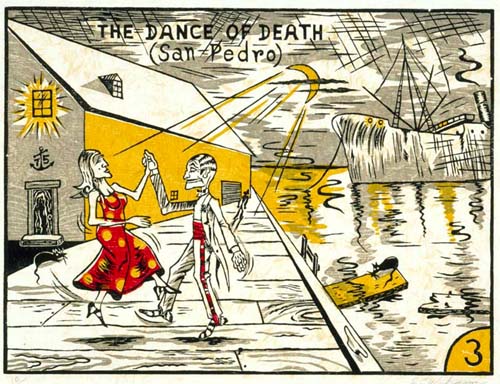
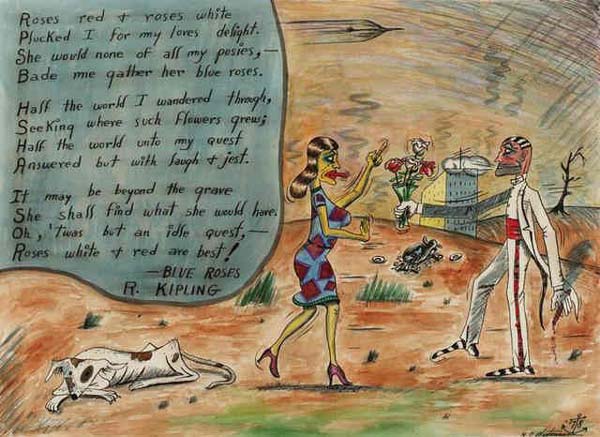
Irwin Kremen: Beyond Black Mountain (1966 to 2006) is an opportunity to enter a unique world of making and seeing. In 1966, at the age of 41, Irwin Kremen began to make art. Kremen was a psychology professor at Duke with a full academic calendar and family life, but he found a way to begin a 40-plus year journey that has produced an astonishing body of work. Kremen was clearly inspired and energized by his friendship with modern luminaries such as Merce Cunningham and John Cage (Cage’s notorious “silent piece,” 433, is dedicated to Kremen). And he was also profoundly encouraged by Italian artist Italo Valenti. But ultimately Kremen cultivated a highly personal and innovative approach to artmaking that is all his own. He calls it “work-of-my-kind.”

Upon entering the Nasher’s lobby you will first see the large sculptures of steel, aluminum and wood that represent Kremen’s most recent collaborative venture with sculptor William Noland. The epic scale of these forceful and spatially mutable works is in notable contrast to what one encounters in the exhibition space. It is in some ways difficult to reconcile the small scale of Kremen’s collages with their impact. They require a degree of patience, a kind of reorienting of one’s own rhythms. This is not a show you can jet through and get. But if you give yourself some time, the pieces begin to convey a feeling of the infinite.

“The Unsung No. 2” (1989) is a small collage of paper and another undetermined material, referred to as “paper vinyl (?).” A stain of ochre grounds the base of the composition, which opens upward into grays with some blue passages. A deeper gray along the topmost edge frames the upper section. Continue to look and paper seams begin to show themselves cutting across the surface of the piece. There is play between straight cuts and torn edges. Further investigation brings into view the scars, specks and grime of the surface itself, the suggestion of screen-printed letters. The work seems never to stop offering information or essence. This experience of being able to go deeper and deeper into a piece is overwhelmingly true of almost all of the collage works.

click to enlarge

Kremen’s materials are a key element of his work. They come from multiple locations and sources, harvested with precision and zeal. The archival care and technique wielded by Kremen in relation to these materials suggests that they have not so much been found as rescued. In some cases they even feel like they’ve been mined; Kremen’s sensitivity to color and his capacity to build painterly surfaces can produce an almost gem-like glow, as seen in some of the more brightly colored pieces such as “Retinal Splash” (1977) or “Luxe No. 2” (1989/2004). Another key element of Kremen’s work is his collage technique, which seems to have stemmed from an impulse to preserve and value his materials. Rather than gluing or pasting, Kremen painstakingly builds his compositions and traces what he calls a “schematic.” He then adheres thin Japanese paper against the back of each fragment and assembles them with paper “hinges.” The result is an almost sculptural experience of the materials—edges are allowed their autonomy. This method incorporates the use of magnifying lenses and fine tools, some of which Kremen has forged himself.

Kremen’s singular approach to constructing these works contributes to the powerful intentionality and sense of the monumental in small, ostensibly simple compositions such as “Junctures” (1979). “Junctures” measures 5 3/8 x 4 5/8 inches and consists of a black central rectangular shape built out of paper fragments, surrounded by a torn frame of blue. The materials are paper and paint, although as in much of Kremen’s work, it’s hard to discern where one medium ends and another begins. Kremen allows the white underside of the paper to reveal tears and delineate shapes, which offers dimension as well as a sense of age. In this way many of Kremen’s collages begin to resonate as artifacts, bearing the traits of ancient archeological finds.

While Kremen refuses metaphor or attendant meaning in connection with the rest of his oeuvre (but for the Re’eh series—see below), it is difficult not to see or feel themes emerge as one makes one’s way through this exhibition. And if there were a dominant single theme, it might be about the desire to hold and frame the joy of visual essences as they flash by us, to preserve and also to transform them, to create works that simultaneously celebrate and mourn the press of days and the experience of sentient life.

The Re’eh series

Irwin Kremen maintains that his work has no metaphoric or symbolic content. The one exception is the Re’eh series, which is displayed in its own separate room in the exhibition space. The Re’eh series stands as a rupture, self-described by Kremen as a shock when the first of the series “appeared” to him. In the winter of 1980 Kremen created a piece that undercut his preconceptions about what “work-of-his-kind” was supposed to be. In this piece, “Im Lager,” Kremen recognized imagery that echoed the horrors of Nazi Germany. In Kremen’s own words:

I knew that it had to do with the Holocaust, knew it with immediacy. Those stripes! And that shape with its broken Hebrew word! Torah scroll, tombstone? At once, the stripes that were worn in the camps and a scroll whose script is entombed in the same stripes! What else, if not both the camps and the world that the camps destroyed!

And while he had invested himself in the idea that his work was never to be “about” anything, he recognized the need to create a series that would follow the trajectory begun in that seminal work, a monument to victims of the Holocaust. Thus the Re’eh series, which includes works with such titles as “Broken Words,” “The Inconsolable” and the starkly grim “Transport,” constitutes an anomaly in Kremen’s output. But the series also serves as a cornerstone, even the soul of the exhibition. Each piece in the Re’eh series speaks in multiple layers, grappling with the unspeakable. The series also speaks to a kind of artistic courage—to relinquish preconceptions in the act of making. —Amy White

Irwin Kremen

From Wikipedia, the free encyclopedia

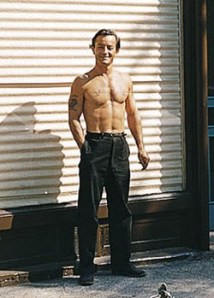
Irwin Kremen (born 1925) is an American artist who at 41 began making art while Director of the Duke University Graduate Program in Clinical Psychology, after earning a Ph.D. six years earlier in clinical psychology at Harvard University.

Kremen’s artwork mainly consists of non-representational collage, sculpture, and painting. In his later years he has defined a fourth grouping which he calls “multimodes.”[1] These are syntheses of the other three or sometimes of just two. Early on, he worked in the first three modes but in 1969, while on sabbatical in Florence, Italy as a Fellow at Villa I Tatti, the Harvard Center for Renaissance Studies, he began to compose collages of weathered paper and continued this for a decade.[2][3] Becoming unhappy with conventional methods of gluing collage elements, he developed a conservational method of affixing the disparate pieces together via tiny hinges of Japanese paper.[4][5]

In the late 1970s, while continuing collage making, Kremen returned to three-dimensional work, now in iron and scrap steel, and by the later 90s entered a collaboration with the sculptor William Noland. Over the next decade they made monumentally sized works, three of which were exhibited in Kremen’s 2007 retrospective at Duke University‘s Nasher Museum of Art. He also sporadically resumed work with acrylic paints and toward the late 90s began making painted panels below which were rows of collages arranged rhythmically.

Among Kremen’s major works is the Re’eh Series, a single work relative to the Holocaust, consisting of 11 narrative collages.[6]

Life[edit]

Born and raised in Chicago, Kremen attended Northwestern University for two-and-a-half years leaving in 1945 to become a reporter on ‘’The Chicago Journal of Commerce’’.[7] By that time he had independently encountered avant-garde art and modern literature and had begun writing poetry. Whereupon, in 1946, he left Chicago for the renowned Black Mountain College, an experimental educational community founded in 1933 near Asheville, N.C.[8] There Kremen spent his time focussed on writing and the literature classes given by the poet M. C. Richards.

Beginning in 1947 and for the next eight years he lived in Greenwhich Village, writing, reading widely, working variously in bookstores and in publishing, and broadening his knowledge of art and its history. And he became involved with the avant-garde circle around John Cage to whom he had been introduced by M.C. Richards in 1951 in New York, as also to David Tudor and Merce Cunningham. [9] In 1953 Cage dedicated to Kremen the score of 4’33” in proportional notation, as later he also did theTacet versions of 4’33”, the published editions of the so-called silent piece . [10] During that time he married Barbara Herman whom he had met at a Cage concert; completed a B.A. at The New School for Social Research; and went on to obtain a Ph.D. inclinical psychology at Harvard University. With his wife Barbara Kremen and their two children he left Cambridge for a professorial position on the faculty of the Psychology Department at Michigan State University. Two years later he joined that faculty at Duke University, and in another three years, in 1966, made his first work of art. He retired from Duke in 1992, and continues to make art.

Art[edit]

In 1977, after having kept his art private for twelve years, Kremen, then 54, agreed to an exhibition organized by the Smithsonian Institution’s National Collection of Fine Arts (now the Smithsonian American Art Museum) with two solo venues, the first in 1978 at the Southeastern Center for Contemporary Art (SECCA) in Winston Salem, NC, and the second in 1979, at its Museum in Washington.+ Twenty-nine solo venues followed, all but two in museums or contemporary art centers, and his work has been included in 27 group shows. The first exhibit of the Re’eh Series was held in 1985 at the Rose Art Museum at Brandeis University in Waltham, MA; nine other exhibits of it have followed. In the spring of 2007, the Nasher Museum of Art presented Kremen’s first retrospective. It included more than 172 works – collage, painting and sculpture – spanning each of the 40 years of Kremen’s art-making since he began at age 41.[11] In 2011, the Black Mountain College Museum + Arts Center in Asheville, NC held an exhibit of Kremen’s late work.

The Longest Ride Movie CLIP – Bull Riding Lesson (2015) – Britt Robertson, Scott Eastwood Movie HD

_________________

8:30 PM PDT 4/6/2015 by Todd McCarthy

The Bottom Line

A chance to check out up-and-coming actors in cloyingly calculated performances

Opens

April 10 (20th Century Fox)

Cast

Britt Robertson, Scott Eastwood, Jack Huston

Director

George Tillman Jr.

The latest Nicholas Sparks adaptation stars Scott Eastwood (son of Clint) and Britt Robertson as oddly matched lovers

When it comes to Nicholas Sparks, you’re either up for the ride or you’re not. If you are, you’re part of a Middle American fan club that has supported nine schmaltzy, formulaic, achingly sincere film adaptations of the novelist’s books to the cumulative box office tune of about $750,000,000. If you’re not, well, The Longest Ride will feel like one of the longest 128 minutes of your life. Old-fashioned in all the most tedious ways, this by-the-numbers romance between oddly mismatched lovers plods along in a way that will nonetheless provide the cinematic equivalent of an agreeable airplane novel read for the already converted.

What’s most strange here is how Sparks, in a calculated attempt to link people from very different worlds, offers up social backgrounds for them that simply don’t mix at all — modern Southern college sorority life, the circumstances for World War II Jewish refugees, enclaves of modern art a half-century ago and today and, per the title, the good-ol’-boy milieu of professional bull riding. On top of that, no matter what crises may arise (and they are numerous), everyone is always perfectly attired and surrounded by pristine North Carolina settings in which no blade of grass is ever out of place.

The pretty couple at the center of things has modern cowboy Luke (Scott Eastwood), comeback-minded after having been violently thrown by a mighty mean bull named Rango, pursuing a very gentlemanly courtship of Wake Forest college senior Sophia (Britt Robertson) shortly before she’s due to move to New York for a high-end art gallery internship. Luke’s the sort to tote flowers when he shows up for their first date (“Call me old-school,” he bashfully intones), while Sophia is mentally already half-way out the school door on the way to her big-city future.

But fate intervenes, as it has a habit of doing, when the couple rescue an old man from a car accident on a dark rainy night and take him to a hospital. While he recovers, genial old gent Ira Levinson (Alan Alda) allows Sophia to read aloud to him from old letters that recount his poignant relationship with his beloved late wife, Ruth. So even as it’s not explained why so many letters were written when, in fact, Ira and Ruth were in the same place most of the time back in the early 1940s, we see extended flashbacks of the newly arrived Austrian Ruth (Oona Chaplin), a vivacious, forthright, immaculately attired young woman, capturing the heart of the pleasant looking but exceedingly placid Ira (Jack Huston, bearing absolutely no resemblance to Alda, young or old).

The couple’s many trials and tribulations, notably including Ira’s Jake Barnes-like war injury that prevents him from giving Ruth the children she craves and their failure to adopt a parentless hillbilly boy who shows intellectual promise, simply serve to demonstrate how few obstacles Luke and Sophia face compared to theirs. But more directly, Ruth’s passion for modern art fostered at the (real) progressive Black Mountain College in North Carolina feeds oh-so conveniently into Sophia’s career interests, while also providing the springboard for one of the most outrageously preposterous surprise endings in recent movies.

Leaving his career origins in Soul Food and the Barbershop series (which he produced) very far behind indeed, director George Tillman Jr. indulges, nay, embraces the sanitized banality of Sparks’ world with a straight face. Just as the basic plot points are hard to swallow, even the most rudimentary aspects of the characters’ interactions feel forced, artificial and unspontaneous. A significant part of the interest here surely lies in the film’s role as a showcase for four just moderately known young actors. Robertson, who co-stars in the highly anticipated, about-to-arrive Tomorrowland, often seems to have a bridle on here, keen to impart some spontaneity that’s being kept in check. Eastwood, in his first significant starring role after several supporting gigs, most recently in Fury, certainly resembles his dad both physically and in his inclination for minimal dialogue; he’s easy on the eyes and comfortably inhabits a Western-style character, but his potential remains to be determined.

Curiously, the couple from 70-odd years ago has been cast with grandchildren of Hollywood luminaries from that period. Huston displays none of the gumption associated with his director grandfather John or the latter’s thespian offspring. By contrast, Chaplin, granddaughter of Charles, daughter of actress Geraldine and namesake of her grandmother, is the sole younger actor to pop here; playing the only one of the youthful characters with any boldness or inclination to speak her own mind, the unconventional-looking performer comes off as assertive, driven and appealing in an idiosyncratic manner.

But providing the film with whatever emotional grounding it can claim is Alda. Restricted almost exclusively to a hospital bed, the 79-year-old actor makes the canned sentimentality of his 91-year-old character go down quite easily as he comments to Sophia about the vicissitudes of his life.

The settings and compositions are picture-postcard, the score syrupy, the bull-riding coverage not entirely convincing, the sentiments cliched and reassuring. But, boy oh boy, the ending! In Sparks’ world, when happiness rains, it pours.

Production: Fox 2000 Pictures, Temple Hill, Nicholas Sparks Productions

Cast: Britt Robertson, Scott Eastwood, Jack Huston, Oona Chaplin, Alan Alda, Lolita Davidovich, Melissa Benoist, Gloria Reuben

Director: George Tillman Jr.

Screenwriter: Craig Bolotin, based on the novel by Nicholas Sparks

Producers: Marty Bowen, Wyck Godfrey, Nicholas Sparks, Theresa Park

Executive producers: Michele Imperato Stabile, Robert Teitel, Tracey Nyberg

Director of photography: David Tattersall

Production designer: Mark Garner

Costume designer: Mary Claire Hannan

Editor: Jason Ballantine

Music: Mark Isham

Casting: Mary Vernieu, Lindsay Graham

PG-13 rating, 128 minutes

_________

Psychology Department’s “Artist in Residence”

Right NowI a Villema II
Irwin Kremen collages: Right Now, top; I a Villema II, bottom
Les Todd

Irwin Kremen, an assistant professor emeritus of psychology, is known almost as well for his art as for the academic career that has been his primary occupation.

This spring, “Irwin Kremen: Beyond Black Mountain (1996-2006),” a retrospective featuring more than 160 of the artist’s works, opened at the Nasher Museum of Art. The exhibition, which will run through June 19, comprises collages, paintings, and sculpture that span the forty years that Kremen has been making art—since he began in earnest at age forty-one, three years into his teaching career at Duke. On April 29, Kremen will lecture on a series of eleven collages included in the exhibition that relate to images of the Holocaust.

Many of Kremen’s collages consist of scraps of weathered paper he gathered during overseas travels. His sculptures, often large in scale, are composed of iron, saw blades, and steel, among other materials.

Kremen’s career as part-scholar, part-artist actually began years before he joined the Duke faculty, years before he considered psychology an interest, much less a career choice. He dropped out of Northwestern University after three years and worked as a reporter and a columnist for a local newspaper before moving to New York. There, he read an article about Black Mountain College, an art school near Asheville, North Carolina. “I immediately got on the train and went down there,” he said in a 2000 Duke Magazine profile, “and I decided that was the place for me to go.”

At Black Mountain, he concentrated on his writing, forming a close relationship with teacher M.C. Richards, a writer and potter. In 1951 in New York, Richards introduced him to celebrated artists associated with Black Mountain—John Cage, David Tutor, and Merce Cunningham—all of whom became close friends and eventually ardent supporters.

Later, after Kremen had discovered his love for psychology and made his start along an academic career path, Richards pushed him to turn his attention to collage making. What began in the late 1960s as a personal experiment would morph into a lifelong pursuit.

Kremen’s debut exhibit was organized by the Smithsonian Institution’s National Collection in 1978; since then, his work has been shown in more than thirty venues at museums and art centers nationally and abroad. “The Art of Irwin Kremen,” an exhibition consisting of seventy-three collages and seventeen metal sculptures, was displayed at the Nasher’s predecessor, the Duke University Museum of Art, in 1990.

_________

asheville.com community news
The Black Mountain College Museum + Arts Center Launches New Exhibit “Late Works by Irwin Kremen” on February 18 

The Black Mountain College Museum + Arts Center (BMCM+AC) presents the new exhibition In Site: Late Works by Irwin Kremen opening Feb. 18, 2011 from 5:30-7:30 p.m. and extending through June 4, 2011. There will be a gallery talk by the artist at 11:00am on Sat., Feb. 19th. The exhibition will primarily focus on recent collages by this master collagist and Durham, NC resident, but it will also include a selection of his sculptures. A 48-page color catalogue will accompany the exhibition with an essay by the artist. This exhibition is organized by the Black Mountain College Museum + Arts Center located at 56 Broadway in downtown Asheville, NC. After it closes here, the show will travel to The Phillips Museum of Art at Franklin & Marshall College in Lancaster, PA.Working as a reporter and columnist for a local daily newspaper in New York City, five months after he had quit studying journalism at Northwestern University, Irwin Kremen came across an article featuring Black Mountain College. Without hesitation, he hopped on a train and joined this small, avant-garde community flourishing in the Blue Ridge Mountains. Kremen recalls that he “sought fresh experience, different ideas, expanded feeling, in short, another way to be in the world.”

Although Kremen enrolled in Black Mountain College in 1946 to pursue his aspirations as a young writer, the progressive and collective environment he encountered there permanently re-defined his ideas about education. Black Mountain College exposed Kremen to such various and influential artists as poet and potter M.C. Richards and abstract painters Josef Albers and Kenneth Noland. Richards, who became a life-long friend of Kremen’s, prompted his first collage experiment nearly twenty years after Kremen had left Black Mountain College. What, at the time, had seemed to be only a playful assignment instigated what some consider Kremen’s ultimate metamorphosis, a transformation that continues to this day.

After Black Mountain College, Kremen lived in New York’s Greenwich Village where he befriended John Cage, Merce Cunningham and David Tudor, all of whom spent time at BMC after Kremen left. Cage dedicated his famous piece 4’33” to Kremen. Eventually Kremen went back to school and earned his Ph.D in clinical psychology from Harvard and moved to Durham to teach at Duke in 1963. It was a few years later that M.C. Richards introduced him to collage making. Kremen is known for his elegant found-paper collages that employ a unique “hinge” construction technique. He says about his work, “I hunt out papers that have been in sun, in rain, covered with the dirt of the city. Yet as I look at them, I realize their exquisite potential.”

Irwin Kremen has had solo exhibitions at the Smithsonian American Art Museum, Nasher Museum of Art at Duke University and Southeastern Center for Contemporary Art, as well as at a long list of galleries and museums. He won the Sam Ragan Award for Outstanding Contributions to the Fine Arts of NC in 1998.

Programming during the exhibition will include an Artist’s Talk and an Advanced Collage Workshop with the artist as well as a panel about Writing on Art and a reading by three NC-based writers.

(Image provided by the Black Mountain College Museum + Arts Center.)

Looking for more happenings in the area? Check out Asheville.com’s comprehensive visitor center.

______________

BLACK MOUNTAIN: WAS IT A REAL COLLEGE OR DID WE JUST MAKE IT UP OURSELVES? BY MARY EMMA HARRIS

Black Mountain:
Was It a Real College Or Did We Just Make It Up Ourselves?
by Mary Emma Harris, Featured Speaker

REVIEWING BLACK MOUNTAIN COLLEGE 6
26-28 September 2014—UNC Asheville, Asheville, NC

 Editor’s Note:
Mary Emma Harris is Chair and Director of The Black Mountain College Project. Hailed by Charles Alan Watkins as a “well-researched and handsomely illustrated history” of BMC, Ms. Harris’ groundbreaking study, The Arts at Black Mountain College (Massachusetts Institute for Technology Press, 1987), is an indispensable guide to the school’s history and curriculum that weds its praxis to its ideals and founding mission. This work continues to inform and inspire, serving as foundational text not only for scholars in the field but also for all interested in experimental education in America. Ms. Harris welcomed conferees at the sixth annual gathering at UNC Asheville with a formal talk, which formed the basis for this article. Lauding the school’s democratic ideas and progressive curriculum in the visual, literary, and performing arts, she celebrates the state of BMC studies, rethinks Black Mountain College’s history, and challenges us to see our creativity and innovation as part of the school’s legacy.

“Beginnings,” Anni Albers wrote, “are usually more interesting than endings” (52). Those of us writing about Black Mountain College and leading new institutions are pioneers. There will be those who come after us who will continue our work, but just as the experience of the founders of Black Mountain College or those who built the Studies Building was different than that of those who came after, our experience is unique and the responsibility great. When I first heard about Black Mountain College in 1968, I was starting with a blank page. I did not know who was at the college, when or why they were there, or what they did. The educational ideals were a mystery. There were no books to which I could turn. Pioneers had preceded me. Robert Moore at East Tennessee University had curated the first Black Mountain College exhibition. His papers are now at The Western Regional Archives of the State of North Carolina as a part ofThe Black Mountain College Project Papers. Martin Duberman had started his research, but his pioneering study of the college, Black Mountain College: An Exploration in Community (E.P. Dutton) did not appear until 1972.

I did not grow up in an academic or artistic family. I was one of six children raised by a single parent on a small tobacco farm in Eastern North Carolina. We received Life Magazine and the Saturday Evening Post. I handed tobacco and worked a number of jobs. I attended Greensboro College, a small Methodist college, before enrolling at the University of North Carolina at Chapel Hill. In many ways BMC has been my education—my “higher learning.” Several years ago a BMC student confronted me with a daunting question, “What, Mary, if you have done all this work and nobody cares?” “That being the case,” I responded, “it has been well worth the journey.” As I write, there are exhibitions being organized in Europe and the United States, concerts in rehearsal, books in press, a movie being made, dissertations and theses in progress. Humbly, I am reminded of Josef Albers’ advice to youth:

 Calm down
what happens
happens mostly
without you. (n.p.)

Personally, I yearn to unbox my own research and to return to my work as an independent scholar. There are books there to be written. There is information that should be digitalized as a resource for those interested in the college. There is an extensive chronology with thousands of entries: a year-by-year roster of faculty, students, staff and family; the Advisory Council and the Board of Fellows; the officers of the corporation; plays, concerts and exhibitions; visitors; publications; and other material. Already I begin to mull over in the back of my mind the best way to put this together and how it might be a living resource with contributions and additions from scholars over time. I am beginning to explore possible institutional connections, which will insure its survival long after me. I only hope that I have enough years left to complete this work and for a few adventures.

Thankfully, many hard-working individuals and institutions with devoted staffs and volunteers are working diligently to preserve the history of BMC. By increasing our understanding of its complexity, its historicity, its richness, and its legacy, they make the past speak to us today. While there is much more work to be done, there is much to celebrate:

  • The Western Regional Archives of the State of North Carolina, which has the largest collection of Black Mountain College documents in the world. Its holdings are the foundation for any study of the college. I am so very pleased that the collections, previously housed in Raleigh, have found their way home to Western North Carolina. I would specifically like to thank Heather South for her untiring efforts to help researchers from everywhere. I would also like to thank Theodore Dreier, Jr., who is here today, and his sister Barbara B. Dreier, for the donation of their parents’ papers to the Western Regional Archives;
  • The Black Mountain College Museum+Arts Center located at 56 Broadway in Asheville, which is dedicated to exploring the history and legacy of the world’s most acclaimed experimental educational community and offers a wide range of exhibitions, a video archive, research materials, and a selection of books and other materials for sale. Its collections, exhibitions and programming are expanding our knowledge and understanding of the college and providing Asheville with a new and different voice in the arts. A recent grant from the Windgate Foundation is both witness to and guarantee of the longevity of BMCM+AC that has enabled it to expand its programs and facilities. This institution that helps sustain the arts in Asheville was the brainchild of Mary Holden Thompson, founder of the museum. Connie Bostic, Alice Sebrell, Brian Butler, and many others continue to make her vision a reality;
  • BMCS, The Journal of Black Mountain College Studies, an online peer-reviewed publication of BMCM+AC, which provides scholars with a coherent voice for the publication of their work. We thank its co-founders, Brian Butler and editor Blake Hobby, Alessandro Porco, who serves as its associate editor, and all who have dedicated their time and talent;
  • The Asheville Art Museum for its commitment to a comprehensive Black Mountain College Collection, which includes art of Black Mountain College students and faculty. The collection, an ongoing project, complements the BMCM+AC collection. I’m grateful to Pamela Myers and the museum staff for making it possible for me to bring into a museum collection a large body of material that needed a permanent home. The AAM, located at 2 South Pack Square, is a community-based, nonprofit organization established by artists and incorporated in 1948. Its focus is on Twentieth and Twenty-first Century art of the Western North Carolina and the Appalachian area.
  • The Black Mountain College Project (BMC Project), of which I am Chair, as it moves forward in the realization of its goals. Two years ago the BMC Project donated its collection of primary documents—photos and negatives, journals, student notes—to the Western Regional Archives, expanding significantly its holdings. The art works in the BMC Project collection were donated to the Asheville Art Museum. Presently, I am preparing 400 interviews and transcripts for an archive. Once the work of the BMC Project is completed, its assets will be donated to another institution, and the Project will happily dissolve, declaring, “Mission accomplished.”
  • The many private and public archives housing documents of those who taught and studied at the college: The Josef and Anni Albers Foundation, The University of Connecticut in Storrs, The State University of New York at Buffalo, The Getty Research Institute, and Stanford University, among others. John Andrew Rice’s papers are at Appalachian State University in Boone, North Carolina;
  • Scholars and artists worldwide who are doing careful, enlightening work on specific aspects of Black Mountain College and on the individuals who taught and studied there;
  • Those brave souls who taught and studied at Black Mountain for their courage, their wisdom, and their imagination. They have been my friends, my mentors, my critics and my teachers over many years.

Through the efforts of local institutions and others like them, Western North Carolina is now the epicenter for Black Mountain College studies.

It is important for those institutions and individuals in Asheville to remember that Black Mountain College settled near the Village of Black Mountain as a matter of chance. It was here that it put down its roots though it remained throughout its history an outsider. Almost a century after BMC’s founding, Asheville has embraced the college as its own. The Asheville institutions and all of us who seek to preserve and document the college’s history and influence should remember that these collections and the college’s legacy are held in trust. No individual or institution can claim ownership. The college was Black Mountain and Asheville. It was also New York, Boston, Berlin, San Francisco, Cambridge, Dessau and Frankfurt. It was John Cage and Lou Harrison. It was J.S. Bach, Wolfgang Amadeus Mozart, Virgil Thompson, Sir Edward Elgar and the Early Music. The college opened its doors to people of many nationalities, ethnicities, political beliefs and races. Its legacy should not be encompassed by a narrow provincialism that limits its history and our understanding of its significance.

__________________________

“Was That A Real Poem
Or Did You Just Make
It Up Yourself?” (n.p.)

In his essay “Was That A Real Poem Or Did You Just Make It Up Yourself?,” Robert Creeley muses on a number of issues regarding poetry and the poet: What is a poem? Why does one write? The title is a question posed to another poet at a college reading: “Tell me,” the student queried, “that next to the last poem you read—was that a real poem or did you just make it up yourself?”

In his own search for an answer, Creeley turned first to his trusted 1935 edition of the The Pocket Oxford Dictionary of Current Englishand was horrified to find “’elevated expression of elevated thought or feeling, esp. in metrical form….’” He then turned to the more recent American Heritage Dictionary of the English Language (1969) and found “the art or work of a poet” which he defined as a real “cop-out.” The definition Creeley articulates avoids both the formula and the cop-out. It is descriptive. It is complex. It requires the reader or listener to think and to respond: “It is equal wonder,” Creeley writes, “when the rhythms which words can embody move to like echo and congruence. It is a place, in short, one has come to, where words dance truly in an information of one another, drawing in the attention, provoking feelings to participate.” This definition requires that the individual listen, respond, and participate. It is nuanced and comprehensive. A poem is a “place.”

Was Black Mountain College a “real” college, or was it simply made up by a group of incompetent, unaccredited, idealistic, unemployed, disaffected, disillusioned, and disenfranchised professors? What is a “real” college? Following Creeley’s example, I turned to an early edition of Webster’s Dictionary in which Black Mountain was listed as a college in the end-materials along with other colleges. Here was one credential. I then turned to my well-worn Webster’s Seventh New Collegiate Dictionary (1965). There “college” is “An institution ofhigher learning [emphasis added] that gives the bachelor’s degree in liberal arts or science or both.” The definition goes on to describe it as an institution that offers certain instruction, the faculty and students, and the buildings where the instruction takes place. Until the 1950s BMC did not grant degrees, and when it did, they were not accredited.

In an essay “Fundamentalism and the Higher Learning” in the May 1937 issue of Harper’s Magazine, John Andrew Rice, BMC founder, addressed that very issue of “higher learning.” He challenged the assertion of Robert Maynard Hutchins, President of the University of Chicago and creator of the Great Books curriculum, that students should be introduced to “a common stock of fundamental ideas” gleaned from a select group of books deemed to be the “classics” or that a “fixed curriculum based on eternal truths” was a meaningful education (587; 594).

“’In general education…,’” Hutchins had posited, “’we may wisely leave experience to life and set about our job of intellectual training.’” Rice points out the disparity between “logic” and “truth.” Simply reading and thinking, he observes, does not prepare the student for life. He asserts that experience is essential to education, but that is the quality of experience that counts. Language, he notes, is only an “approximation” of thought. Feeling plays a role. In Nazi Germany, he warns, well-educated people with their emotions raised by a “house-painter” turned to “savagery.” “While intellection was being sharpened and polished, savagery was going its way, waiting for a chance. If we think this cannot happen here we are fools” (588-90).

The “higher learning” Rice suggests is “to follow the Socratic direction to teach the young how to become, not how to be, philosophers and to show them that in their quest for certainty the only thing on which they can rely with assurance is the experience of the quest.” “Education,” he proposes, “instead of being the acquisition of a common stock of fundamental ideas, may well be a way of learning of a common way of doing things, a way of approach, a method of dealing with ideas or anything else. What you do with what you know is the important thing. To know is not enough.” Rice’s Plato class was less about Plato than it was about the Socratic method. Students were challenged to examine their assumptions and beliefs as a step toward the process of becoming philosophers (592; 595).

Rice concludes his essay with a statement which for years puzzled me: “When every day offers the adventure of seeking the word for the meaning rather than the meaning for the word, when action and word merge and become one, then shall we have the higher learning in America, and not before” (596). Robert Creeley understood that the definition for the word should not determine the meaning (or experience). Instead the experience should define the word.

The issue today is the possibility that the “real” Black Mountain College is being lost in the frenzy of excitement over the more luminous events in its history. Almost fifty years ago when I first heard about Black Mountain College, it had for the most part disappeared from memory. A few in San Francisco and some in the Massachusetts area knew about the college through the Black Mountain Poets, which carried its name. Frequently, those in education dismissed it as an interesting but failed experiment in American education that had no lasting influence. Now in the second decade of the Twenty-first Century, its influence is undeniable. For most, however, the college is associated with a few names—John Cage, Merce Cunningham, Buckminster Fuller—all of whom were there for only a few months as guest faculty members. Unfortunately, its educational ideals are less known and often reduced to a few clichés: No grades, work program, farm. The danger today is not so much the unconsidered dismissal of the college as it is an over-inflation of the small modest school and a distortion of its history. The danger is that the educational ideals and the dynamics of the small community, the foundation on which the college thrived, are being oversimplified or ignored.

I encountered the myth early in my Black Mountain journey. When I entered the art department at Washington University in St. Louis and asked about a former student from Black Mountain College, a student working in the office responded, “Oh, Camelot!” It is all too possible to romanticize BMC, to forget that there was magic but also there was a dayliness to classes, farm work, study and committees. It is all too easy to forget the struggle each year to raise money and pay bills. It is all too easy to forget that all this was not easy.

In his novel The Longest Ride (2013), Nicholas Sparks writes of the life-changing experience of Ira and Ruth, a young couple who visited the college on their honeymoon in the summer of 1946. Ruth exclaims in wonder, “‘…to think that it was all there, at a small college in the middle of nowhere! It was like finding….’” And Ira finishes, “’A treasure chest!’” “‘It was Abstract Expressionism!’” (194). In an effort to enhance the experience of the honey-mooning couple, Sparks places Willem and Elaine de Kooning at the college in the summer of 1946 along with “Ken and Ray and Robert,” when, in fact, that summer only Ray Johnson was in attendance, and Abstract Expressionism was not introduced until two years later. Nevertheless, Ira purchased for Ruth six Abstract Expressionist paintings one each by Ken, Ray, Elaine, and Robert and two by “Elaine’s husband.” (This is probably the only instance in which Willem de Kooning has been referred to as “Elaine’s husband.”) Even in fiction to recreate the historic facts of the college to enhance a story is to create a double-fiction and to distort our perception of the “real” Black Mountain. Likewise, for scholars to condense the college’s history into a few luminous events, which actually were scattered over a period of twenty-four years, is to perpetuate the Camelot myth (197).

Last year when I conducted a tour of the Blue Ridge Assembly buildings, we entered a large auditorium with a capacity of hundreds. A representative of Blue Ridge noted that college concerts and performances took place there. When I commented that, in fact, they took place on an improvised stage in the dining hall, in the lobby of Lee Hall, or on occasion in the gym, someone noted that there would have been townspeople attending. In fact, twenty townspeople would have been a large turnout.

Is the “real” Black Mountain College relevant today? The issues of the arts in education, of testing, of the relevance of manual activities in a digital world and of the role of faculty and administration are contemporary themes. Recently, on the news a school was featured where the teachers, tired of having directives handed down, took over the school. As at Black Mountain, decisions are reached by consensus. Learning is project-based. The school principal remains though she does not have an office. In his New York Times 14 August 2014 editorial, “Don’t Dismiss the Humanities,” Nicholas Kristof notes how parents of students in the humanities are concerned that their children will be “dog-watchers for those majoring in computer science.” He argues that “the humanities are [not] obscure, arcane and irrelevant” because it is through the humanities that we come to understand the world.

A poem is a place; likewise, the “real” Black Mountain College was aplace. It was a complex landscape— vibrant, interactive, torn by conflicting personalities and ideals, and often dull. It was a “made-up” world affording innumerable higher learning experiences that redefined the possibility of what a college might be.

Works Cited

Albers, Anni. On Weaving. Middleton, CT: Wesleyan UP, 1965. Print.
Albers, Josef. Poems and Drawings. New Haven: Readymade Press, 1958. Print.
Creeley, Robert. “Was That A Real Poem Or Did You Just Make It Up Yourself?” Sparrow 40. Santa Barbara, CA: Black Sparrow Press, January 1976. Print.
Kristof, Nicholas. “Don’t Dismiss the Humanities.” New York Times. 14 August 2014. Print.
Rice, John Andrew. “Fundamentalism and the Higher Learning.”Harper’s Magazine 174 (May 1937): 587-97. Print.
Sparks, Nicholas. The Longest Ride. New York/Boston: Grand Central Publishing, 2013. Print.

Webster’s Seventh New Collegiate Dictionary. Springfield, MA: G Merriam Company, 1965. Print.

Related posts:

THE ARTISTS, POETS and PROFESSORS of BLACK MOUNTAIN COLLEGE (the college featured in the film THE LONGEST RIDE) Part 9 BILL TREICHLER REMEMBERS BLACK MOUNTAIN COLLEGE

_______________ Again today we take a look at the movie “The Longest Ride” which visits the Black Mountain College in North Carolina which existed from 1933 to 1957 and it birthed many of the top artists of the 20th Century. In this series we will be looking at the history of the College and the […]

THE ARTISTS, POETS and PROFESSORS of BLACK MOUNTAIN COLLEGE (the college featured in the film THE LONGEST RIDE) Part 8 artists Anni Albers and her teacher Paul Klee

_______________________ Again today we take a look at the movie “The Longest Ride” which visits the Black Mountain College in North Carolina which existed from 1933 to 1957 and it birthed many of the top artists of the 20th Century. In this series we will be looking at the history of the College and the […]

THE ARTISTS, POETS and PROFESSORS of BLACK MOUNTAIN COLLEGE (the college featured in the film THE LONGEST RIDE) Part 7 M.C. Richards, Potter and Poet

______________ Fully Awake: Black Mountain College Uploaded on Jun 14, 2009 Tucked in the mountains of Western North Carolina, Black Mountain College (1933-1957) was an influential experiment in education that inspired and shaped 20th century modern art. Through narration, archive photography and interviews with students, teachers and historians, Fully Awake explores the development of this […]

THE ARTISTS, POETS and PROFESSORS of BLACK MOUNTAIN COLLEGE (the college featured in the film THE LONGEST RIDE) Part 6 Vera Williams (Political activist and writer of Children Books)

_____________ The Longest Ride: Britt Robertson Red Carpet Movie Premiere Interview Nicholas Sparks Project to Focus on Black Mountain College BY HARRIET STAFF Well this is odd/interesting/anodynely adverbial: Best-selling, “achingly tender” novelist Nicholas Sparks (author of Our Favorite Ryan Gosling Movie) is focusing on a new project about–wait for it–Black Mountain College! From, appropriately, Black […]

THE ARTISTS, POETS and PROFESSORS of BLACK MOUNTAIN COLLEGE (the college featured in the film THE LONGEST RIDE) Part 5 ceramic artist Karen Karnes and her husband sculptor David Weinrib

_______________ The Longest Ride Official Trailer #1 (2015) – Britt Robertson Movie HD Nicholas Sparks wrote concerning his film THE LONGEST RIDE: Inspiration forThe Longest Ride The story for The Longest Ride really began when I learned about Black Mountain College. I had been struggling to find something that excited me for my next novel […]

THE ARTISTS, POETS and PROFESSORS of BLACK MOUNTAIN COLLEGE (the college featured in the film THE LONGEST RIDE) Part 4 artist Xanti Schawinsky

________________________ _______________________ “The Longest Ride” by Nicholas Sparks Author Nicholas Sparks explores two very different relationships that are separated by many decades in his latest bookThe Longest Ride (Grand Central Publishing). The story of Ira Levinson starts quickly, as the elderly man is involved in a one car accident on a snowy road in the […]

THE ARTISTS, POETS and PROFESSORS of BLACK MOUNTAIN COLLEGE (the college featured in the film THE LONGEST RIDE) Part 3 artist Jorge Fick

___________________ Black Mountain College Uploaded on Apr 18, 2011 Class Project on Black Mountain College for American Literature ______________ Below Dorothea Rockburne with Jorge Fick Black Mountain College, ca. 1950-1953 Photograph by Marie Tavroges It has been my practice on this blog to cover some of the top artists of the past and today and […]

THE ARTISTS, POETS and PROFESSORS of BLACK MOUNTAIN COLLEGE (the college featured in the film THE LONGEST RIDE) Part 2 SUSAN WEIL and ROBERT RAUSCHENBERG

________________ Both Susan Weil and Robert Rauschenberg who are featured in this post below were good friends of the composer John Cage who was featured in my first post in this series. Check out the article, “When John Cage met Robert Rauschenberg.” Legend of Black Mountain Uploaded on Apr 20, 2008 Black Mountain College was a […]

THE ARTISTS, POETS and PROFESSORS of BLACK MOUNTAIN COLLEGE (the college featured in the film THE LONGEST RIDE) Part 1 John Cage

____________________

RESPONDING TO HARRY KROTO’S BRILLIANT RENOWNED ACADEMICS!! Part 31 (Dr. Frank Wilczek, American theoretical physicist, mathematician,Nobel Laureate, MIT, “The ancient texts [of the Bible] … don’t do justice to what we know about the universe now” )


Dr. Wilczek pictured below:

___

On November 21, 2014 I received a letter from Nobel Laureate Harry Kroto and it said:

…Please click on this URL http://vimeo.com/26991975

and you will hear what far smarter people than I have to say on this matter. I agree with them.

Harry Kroto

______

Below you have picture of Dr. Harry Kroto:

___________________________________________

There are 3 videos in this series and they have statements by 150 academics and scientists and I hope to respond to all of them. Wikipedia notes Frank Anthony Wilczek (born May 15, 1951) is an American theoretical physicist, mathematician and a Nobel laureate.[2] He is currently the Herman Feshbach Professor of Physics at the Massachusetts Institute of Technology (MIT).[3]

Professor Wilczek, along with Professor David Gross and H. David Politzer, was awarded the Nobel Prize in Physics in 2004 for their discovery of asymptotic freedom in the theory of the strong interaction.[4] He is on the Scientific Advisory Board for the Future of Life Institute.[5]

Born in Mineola, New York, of Polish and Italian origin, Wilczek was educated in the public schools of Queens, attending Martin Van Buren High School. It was around this time Wilczek’s parents realized that he was exceptional – in part as a result of Frank Wilczek having been administered an IQ test.[6]

He received his Bachelor of Science in Mathematics at the University of Chicago in 1970, a Master of Arts in Mathematics at Princeton University, 1972, and a Ph.D. in physics at Princeton University in 1974.[7]Wilczek holds the Herman Feshbach Professorship of Physics at MIT Center for Theoretical Physics. He worked at the Institute for Advanced Study in Princeton and the Institute for Theoretical Physics at theUniversity of California, Santa Barbara and was also a visiting professor at NORDITA.

He was awarded the Lorentz Medal in 2002. Wilczek won the Lilienfeld Prize of the American Physical Society in 2003. In the same year he was awarded the Faculty of Mathematics and Physics Commemorative Medal from Charles University in Prague. He was the co-recipient of the 2003 High Energy and Particle Physics Prize of the European Physical Society. Wilczek was also the co-recipient of the 2005 King Faisal International Prize for Science.

He currently serves on the board for Society for Science & the Public.

Wilczek was married to Betsy Devine on July 3, 1973, and together have two daughters, Amity (Academic Dean at Deep Springs College) and Mira.

Wilczek is an agnostic.[8]

Wilczek has also appeared on an episode of Penn & Teller: Bullshit!, where Penn referred to him as “the smartest person [they have] ever had on the show.”

_____________________________

In  the second video below in the 51st clip in this series are his words and  my response is below them. 

50 Renowned Academics Speaking About God (Part 1)

Another 50 Renowned Academics Speaking About God (Part 2)

A Further 50 Renowned Academics Speaking About God (Part 3)

I grew up at Bellevue Baptist Church under the leadership of our pastor Adrian Rogers and I read many books by the Evangelical Philosopher Francis Schaeffer and have had the opportunity to contact many of the evolutionists or humanistic academics that they have mentioned in their works. Many of these scholars have taken the time to respond back to me in the last 20 years and some of the names  included are  Ernest Mayr (1904-2005), George Wald (1906-1997), Carl Sagan (1934-1996),  Robert Shapiro (1935-2011), Nicolaas Bloembergen (1920-),  Brian Charlesworth (1945-),  Francisco J. Ayala (1934-) Elliott Sober (1948-), Kevin Padian (1951-), Matt Cartmill (1943-) , Milton Fingerman (1928-), John J. Shea (1969-), , Michael A. Crawford (1938-), Paul Kurtz (1925-2012), Sol Gordon (1923-2008), Albert Ellis (1913-2007), Barbara Marie Tabler (1915-1996), Renate Vambery (1916-2005), Archie J. Bahm (1907-1996), Aron S “Gil” Martin ( 1910-1997), Matthew I. Spetter (1921-2012), H. J. Eysenck (1916-1997), Robert L. Erdmann (1929-2006), Mary Morain (1911-1999), Lloyd Morain (1917-2010),  Warren Allen Smith (1921-), Bette Chambers (1930-),  Gordon Stein (1941-1996) , Milton Friedman (1912-2006), John Hospers (1918-2011), Michael Martin (1932-).Harry Kroto (1939-), Marty E. Martin (1928-), Richard Rubenstein (1924-), James Terry McCollum (1936-), Edward O. WIlson (1929-), Lewis Wolpert (1929), Gerald Holton (1922-),  and  Ray T. Cragun (1976-).

_____________

Frank Wilczek quote:

 The first thing that science says is that many of the traditional ideas about how God acts in the world are definitely wrong, they are naive. I won’t belabor the point. There is enormous literature on that. The arguments are well known.
The ancient texts which are the basis of most of the traditional religions don’t do justice to what we know about the universe now. They with rare exceptions don’t have a notion that the universe could be enormously large or so very old or most of all, most profoundly that it is so comprehensible or understood in terms of precise mathematical laws.

_________________

Are the scientists ahead or behind the Bible? Adrian Rogers notes:

Every now and then science may disagree with the Bible, but usually science just needs time to catch up. For example, in 1861 a French scientific academy printed a brochure offering 51 incontrovertible facts that proved the Bible in error. Today there is not a single reputable scientist who would support those supposed “facts,” because modern science has disproved them all!

The ancients believed the earth was held up by Atlas, or resting on pillars, or even seated on the backs of elephants. But today we know the earth is suspended in space, a fact the Word of God records in Job 26:7: “He . . . hangeth the earth upon nothing.” God revealed the facts of cosmology long before man had any idea of the truth.

For centuries man believed the earth was flat, but now we know the earth is a globe. The prophet Isaiah, writing 750 years before the birth of Christ, revealed that “God sitteth upon the circle of the earth” (Isaiah 40:22). The word translated here as “circle” was more commonly translated “sphere.” In other words, Isaiah explained that the earth was a globe centuries before science discovered it.

When Ptolemy charted the heavens, he counted 1026 stars in the sky. But with the invention of the telescope man discovered millions and millions of stars, something that Jeremiah 33:22 revealed nearly three thousand years ago: “The host of heaven cannot be numbered.” How did these men of God know the truth of science long before the rest of the world discovered it? They were moved by the Holy Spirit to write the truth. God’s Word is not filled with errors. It is filled with facts, even scientific facts.

What is the real problem that Dr. Wilczek has? Unlike others who have examined the evidence he just outright dismisses it.


I sent Dr. Wilczek a letter  that included many scriptures from the Old Testament that showed that the prophets predicted  the Jews would be brought back from all over the world to rebirth the country of Israel again.

Is this good evidence to show there is a God behind it all?

 First, isn’t it worth noting that the Old Testament predicted that the Jews would regather from all over the world and form a new reborn nation of Israel. Second, it was also predicted that the nation of Israel would become a stumbling block to the whole world. Third, it was predicted that the Hebrew language would be used again as the Jews first language even though we know in 1948 that Hebrew at that time was a dead language!!!Fourth, it was predicted that the Jews would never again be removed from their land.


Note to Dr. Wilczek:  I sent you a CD entitled, “How can I know the Bible is the Word of God?” by Adrian Rogers, and I wonder what you thought of that evidence?

________________________


_______________________________________

How Can I Know the Bible is the Word of God?
By Dr. Adrian Rogers

Overview

The historical, scientific, and prophetic accuracy of Scripture, along with its life-changing qualities, offer evidence that the Bible is the revealed Word of God.

Introduction

Scripture Passage: Revelation 22:18-19

It is absolutely imperative that you are certain of God’s Word. You will never get much of anything else settled until you are sure of the Bible. Your salvation depends on it, since the Bible says you are born again by “the Word of God” (1 Peter 1:23). Your sanctification depends upon it, because Jesus said, “Sanctify them through thy truth. Thy Word is truth” (John 17:17). Your usefulness depends on it, for the Scriptures say, “These things have I written unto you that believe on the name of the Son of God that you might know that you have eternal life” (1 John 5:13). If you want to be sure of your faith; if you want to be an exclamation pointrather than a question mark, then you need to be certain that the Bible is the Word of God.

Discussion

“For I testify unto every man that heareth the words of the prophecy of this book, If any man shall add unto these things, God shall add unto him the plagues that are written in this book: and if any man shall take away from the words of the book of this prophecy, God shall take away his part out of the book of life, and out of the holy city, and from the things which are written in this book” (Rev. 22:18-19).

God makes it very clear that we are to believe and revere our Bibles, but there is in our world a war over the Word; a battle over the Bible. There are those who despise it; they are against all that we Christians stand for. There are those who deny it; they simply refuse to believe the Bible is the Word of God. There are those who distort it; they twist the words of the Bible to their own destruction. There are those who dissect it, treating Scripture more like a math text than a love story. There are those who disregard it, claiming it unimportant and irrelevant. They want to focus on the here-and-now, so they spend their energies making this world abetter place from which to go to hell. There are those who claim to believe it, giving lip service to the Bible as God’s Word, but they do not know it, nor do they live by it. There is dust on their Bibles and drought in their hearts. Finally, there are those who believe it. They know the Bible is the inspired, inerrant, infallible, authentic Word of God, and they trust it for the daily guidance of their lives. We can have a firm assurance that the Bible is the Word of God. There is an abundance of evidence to support the fact.

Scientific Evidence

Skeptics seem to think that the Bible is full of scientific errors. However, before an individual can make that assertion, they had better make sure they know both science and Scripture. You see, I have heard unbelievers state that the Bible is not a book of science, but a book of religion, which is basically true. It is not written to teach us about science, but to teach us about God. But the God of salvation and the God of creation are the same. Science doesn’t take God by surprise. A close look at Scripture reveals that it is scientifically accurate.

Every now and then science may disagree with the Bible, but usually science just needs time to catch up. For example, in 1861 a French scientific academy printed a brochure offering 51 incontrovertible facts that proved the Bible in error. Today there is not a single reputable scientist who would support those supposed “facts,” because modern science has disproved them all!

The ancients believed the earth was held up by Atlas, or resting on pillars, or even seated on the backs of elephants. But today we know the earth is suspended in space, a fact the Word of God records in Job 26:7: “He . . . hangeth the earth upon nothing.” God revealed the facts of cosmology long before man had any idea of the truth.

For centuries man believed the earth was flat, but now we know the earth is a globe. The prophet Isaiah, writing 750 years before the birth of Christ, revealed that “God sitteth upon the circle of the earth” (Isaiah 40:22). The word translated here as “circle” was more commonly translated “sphere.” In other words, Isaiah explained that the earth was a globe centuries before science discovered it.

When Ptolemy charted the heavens, he counted 1026 stars in the sky. But with the invention of the telescope man discovered millions and millions of stars, something that Jeremiah 33:22 revealed nearly three thousand years ago: “The host of heaven cannot be numbered.” How did these men of God know the truth of science long before the rest of the world discovered it? They were moved by the Holy Spirit to write the truth. God’s Word is not filled with errors. It is filled with facts, even scientific facts.

When the black plague was killing one quarter of Europe’s population in the fourteenth century, it was the church, not science, that helped overcome the dread disease. The leaders in the church noticed the instructions given by the Lord to Moses in Leviticus 13:46: “All the days wherein the plague shall be in him he shall be defiled; he is unclean: he shall dwell alone; without the camp shall his habitation be.” These early believers did not know microbiology or understand what germs were, but they could understand a clear teaching to quarantine someone who was sick. So they followed the Biblical dictum, quarantined those sick with the plague, and stopped it from spreading. The Bible had its science correct even before man discovered the truth! Don’t accept the charge that the Bible is filled with scientific errors. Modern science seems determined to explain God away, and refuses to acknowledge any evidence of the supernatural. But the science of Scripture is one reason to accept the Bible as God’s Word.

Historical Evidence

The Bible is not primarily a history book, but it records history, and all the things we believe as Christians are historical fact. Historians have criticized the Bible as being filled with errors, but in our lifetime we have seen the history of the Scriptures proven right time after time. For example, linguists rejected the fact that Moses authored the Pentateuch, claiming that people didn’t know how to write during Moses’ day. But then the Tel Elarmona tablets were discovered in northern Egypt, containing business transactions of people in Palestine centuries before Moses was born. It turns out the Bible was correct–the people of Moses’ day did have a written language.

For years historians claimed Daniel’s story of King Belshazzar was a fake, that there was no record of that Babylonian king. They claimed the last Babylonian king was named Nabinitus, and that Belshazzar never existed. Then one day an archeologist uncovered a clay tablet describing the rule of Belshazzar, who was co-regent with his father, King Nabinitus. The Bible had been right all along.

Historians and archaeologists have dug into the history of both the Old and New Testaments, and each time the historical accuracy of Scripture has been upheld. That is one of the reasons we can trust the Bible.

Wonderful Unity

Another reason to trust the Scripture as the Word of God is that it offers a unique unity. Here is one unified book, yet it is really 66 books put together. Those books were written by at least forty different authors over a period of sixteen hundred years. They were written in thirteen countries, on three continents, by people of all different backgrounds. Some were shepherds, others were kings; some were soldiers, others were scholars; some were learned historians, others were unschooled fishermen. They wrote on different subjects, at different times, in at least three different languages. Yet on all subjects they came together to create one unified book that reveals the story of God and His people. From Genesis to Revelation, it reads as one book. What incredible unity! I’ve been studying this book for forty years, and the more I study the more unified I find it. There are no hidden flaws, only hidden beauties. The Bible has but one theme: salvation. It has one hero: Jesus. It has one villain: Satan. It has one purpose: to glorify God. How could this incredible book be written apart from divine intervention? There was clearly a Master Architect who designed this book, giving it a wonderful unity. That’s why I believe it.

Fulfilled Prophecy

Another reason we can believe the Bible is because of the fulfilled prophecies contained in it. It is the only book of its kind with so many accurate prophecies. For example, there are over 300 Old Testament prophecies dealing with Jesus Christ that are fulfilled in the New Testament. Statisticians tell us that to suggest they are merely fulfilled by chance is an impossibility. A skeptic might say that Jesus, as a student of the Old Testament, simply arranged to fulfill these prophecies. But how could He arrange to be born in Bethlehem, fulfilling the prophecy of Micah? How could He arrange to be born of a virgin? How could He arrange for the prophet Isaiah to write all kinds of intricate details of the Lord centuries before He was born? And could He have arranged for the psalmist to describe His death by crucifixion long before that style of punishment was first used? Could He have arranged for the Roman government to crucify Him upon a cross, or for Judas to betray Him for exactly thirty pieces of silver, as the Old Testament prophesied? Finally, could He have arranged His own resurrection from the dead three days after His burial?

Well, in a sense the Lord Jesus did arrange all of that. As God, He revealed it to the Old Testament authors, who wrote the prophecies that Jesus fulfilled. And so convinced were those who saw Jesus, that they were willing to lay down their lives for the truth. No one lays down their life for a lie. The early Christians knew that Jesus was who He claimed to be. There is no way to explain fulfilled prophecy apart from divine inspiration.

The Ever-Living Quality of Scripture

Another reason we can trust the Bible is that it is always alive. No book has endured as much opposition. Men have laughed at it, scorned it, burned it, and made laws against it. At times it has been illegal to even own a Bible. Men have preached its funeral. But the corpse has outlived its pallbearers. The Bible has survived. Despite all the attempts to bury the Bible, it has continued to endure. No other book can make that claim. The ancient religious manuscripts of the pagans have disappeared, but the Bible continues. The wisdom of great men is often forgotten by succeeding generations, but the wisdom of God remains intact and available. The Word of the Lord endureth forever. That unique quality makes me believe that this is a special book–God’s book–and He intends for man to have it.

The Life-Changing Quality of Scripture

The Bible is not like any other book. It is alive and powerful. It describes itself as a sword and as dynamite. It has power to change lives and power to save sinners. No other book, no other power can take men’s guilt away except the Bible. It sanctifies those who believe. It brings truth and maturity to the saints. You will never grow spiritually strong until you begin to feed on the milk of the Word. It offers sufficiency to the sufferer. Many times I have seen people hurting or in torment, and they have found comfort in the Bible which they could find nowhere else. It brings satisfaction to the scholar. You can study it for a lifetime and still not fathom its depths. It is a book so deep you can swim forever and never touch bottom, yet so peaceful that even a child can take a drink without fear of drowning. You can never move on in your faith until you come to see the Bible for what it is: God’s precious gift to us, given so that we may know Him and find eternal life in Him. You can be certain that the Bible is the Word of God.

About Dr. Adrian Rogers

Dr. Adrian Rogers was the Pastor Emeritus of Bellevue Baptist Church and one of America’s most respected Bible preachers. Under his pastoral leadership, Bellevue Baptist Church in Memphis, Tennessee, grew from 9,000 members in 1972 to more than 29,000. A staunch defender of Biblical inerrancy, Pastor Rogers was called upon to serve three times as President of the 14-million member Southern Baptist Convention. Adrian Rogers has written numerous books: Mastering Your Emotions; God’s Way to Health, Wealth and Wisdom; The Power of His Presence; and Ten Secrets for a Successful Family; Kingdom Authority, Believe in Miracles but Trust in Jesus; Standing for Light and Truth; God’s Wisdom is Better Than Gold; plus many others.

Dr. Rogers was also the pastor/teacher of Love Worth Finding, a ministry which extends the message of Dr. Rogers far beyond the congregation, proving to be a blessing to listeners around the nation every day. This radio and television ministry takes Dr. Rogers’ message in four languages to more than 14,000 television outlets and 1,100 radio outlets in the United States and in 150 other countries including all of Europe, Latin America, China, Australia, Africa, India, and beyond. Tapes and other resources from Dr. Rogers are available through Love Worth Finding Ministries, P.O. Box 38300, Memphis, TN 38183-0300, 1-800-274-LOVE (5683).

Dr. Rogers went to be with Jesus on November 15, 2005.

– See more at: http://www.fbcmd.org/message.php?messageID=3033&#sthash.KrRcF92Y.dpuf

Is the Bible historically accurate? Here are some of the posts I have done in the past on the subject: 1. The Babylonian Chronicleof Nebuchadnezzars Siege of Jerusalem2. Hezekiah’s Siloam Tunnel Inscription. 3. Taylor Prism (Sennacherib Hexagonal Prism)4. Biblical Cities Attested Archaeologically. 5. The Discovery of the Hittites6.Shishak Smiting His Captives7. Moabite Stone8Black Obelisk of Shalmaneser III9A Verification of places in Gospel of John and Book of Acts., 9B Discovery of Ebla Tablets10. Cyrus Cylinder11. Puru “The lot of Yahali” 9th Century B.C.E.12. The Uzziah Tablet Inscription13. The Pilate Inscription14. Caiaphas Ossuary14 B Pontius Pilate Part 214c. Three greatest American Archaeologists moved to accept Bible’s accuracy through archaeology.

The Bible and Archaeology (1/5)

The Bible maintains several characteristics that prove it is from God. One of those is the fact that the Bible is accurate in every one of its details. The field of archaeology brings to light this amazing accuracy.

_________________________-

Many people have questioned the accuracy of the Bible, but I have posted many videos and articles with evidence pointing out that the Bible has many pieces of evidence from archaeology supporting the view that the Bible is historically accurate. Take a look at the video above and below.

The Bible and Archaeology (2/5)

I remember reading all these amazing stories in the Old Testament and thinking they were strange. However, I knew that they were true because everytime I researched the facts, I found the Bible was true after all. Here is a perfect example below.

Taylor Prism (Sennacherib Hexagonal Prism)
Does this record of Sennacherib’s war campaigns mention Hezekiah the Judahite?

This beautifully preserved six-sided hexagonal prism of baked clay, commonly known as the Taylor Prism, was discovered among the ruins of Nineveh, the ancient capital of the Assyrian Empire.

// //

It contains the victories of Sennacherib himself, the Assyrian king who had besieged Jerusalem in 701 BC during the reign of king Hezekiah, it never mentions any defeats. On the prism Sennacherib boasts that he shut up “Hezekiah the Judahite” within Jerusalem his own royal city “like a caged bird.” This prism is among the three accounts discovered so far which have been left by the Assyrian king Sennacherib of his campaign against Israel and Judah. British Museum. The Taylor Prism discovery remains one of the most important discoveries in  Biblical Archaeology.

Interesting note: Egyptian sources make mention of Sennacherib’s defeat in the conflict with Judah, but gives the credit for the victory to an Egyptian god who sent field mice into the camp of the Assyrians to eat their bowstrings and thus they fled from battle.

(See 2 Kings 19; 2 Chronicles 32 and Isaiah 37)

“Therefore thus says the LORD concerning the king of Assyria: ‘He shall not come into this city, Nor shoot an arrow there, Nor come before it with shield, Nor build a siege mound against it. By the way that he came, By the same shall he return; And he shall not come into this city,’ Says the LORD. ‘For I will defend this city, to save it For My own sake and for My servant David’s sake.'” Then the angel of the LORD went out, and killed in the camp of the Assyrians one hundred and eighty-five thousand; and when people arose early in the morning, there were the corpses–all dead. So Sennacherib king of Assyria departed and went away, returned home, and remained at Nineveh.” Isaiah 37:33-38 

Material – Baked Clay
Neo Assyrian (Reign of Sennacherib)
Language: Akkadian (Cuneiform)
Text: Records the first 8 campaigns of King Sennacherib
Date: 691 BC
Dates of Sennacherib’s reign: 701–681 BC
Height: 38.5 cm
Width: 16.5 cm (max.)
Width: 8.57 cm (faces)
Depth:
Nineveh, northern Iraq
Excavated at Nebi Yunus
It was acquired by Colonel Taylor and Sold to the British Museum in 1855
Location: British Museum, London
Item: ANE 91032
Room: 69a, Temporary Displays

Biblical Reference: 2 Kings 18:13-19:37; Isaiah 36:1-37:38

British Museum Excerpt

The Taylor Prism

Neo-Assyrian, 691 BC
From Nineveh, northern Iraq

Recording the first 8 campaigns of King Sennacherib (704-681 BC)

This six-sided baked clay document (or prism) was discovered at the Assyrian capital Nineveh, in an area known today as Nebi Yunus. It was acquired by Colonel R. Taylor, British Consul General at Baghdad, in 1830, after whom it is named. The British Museum purchased it from Taylor’s widow in 1855.

As one of the first major Assyrian documents found, this document played an important part in the decipherment of the cuneiform script.

The prism is a foundation record, intended to preserve King Sennacherib’s achievements for posterity and the gods. The record of his account of his third campaign (701 BC) is particularly interesting to scholars. It involved the destruction of forty-six cities of the state of Judah and the deportation of 200,150 people. Hezekiah, king of Judah, is said to have sent tribute to Sennacherib. This event is described from another point of view in the Old Testament books of 2 Kings and Isaiah. Interestingly, the text on the prism makes no mention of the siege of Lachish which took place during the same campaign and is illustrated in a series of panels from Sennacherib’s palace at Nineveh.

The British Museum


___________________________________________

Below is a piece of that evidence given by Francis Schaeffer concerning the accuracy of the Bible.

TRUTH AND HISTORY (chapter 5 of WHATEVER HAPPENED TO THE HUMAN RACE? by Francis Schaeaffer, footnote 94)

A much more dramatic story surrounds the discovery of the Dead Sea Scrolls in the present century. The Dead Sea Scrolls, some of which relate to the text of the Bible, were found at Qumran, about fifteen miles from Jerusalem.

Most of the Old Testament was originally written in Hebrew, and the New Testament in Greek. Many people have been troubled  by the length of time that has elapsed between the original writing of the documents and the present translations. How could the originals be copied from generation to generation and not be grossly distorted in the process? There is, however, much to reassure confidence in the text we have.

In the case of the New Testament, there are codes of the whole New Testament (that is, manuscripts in book form, like the Codes Sinaiticus and Codex Alexandrinus, dated around the fourth and fifth centuries respectively) and also thousands of fragments, some of them dating back to the second century. The earliest known so far is kept in the John Rylands Library in Manchester, England. It is only a small fragment, containing on one side John 18:31-33 and on the reverse, verses 37 and 38. It is important, however, both for its early date (about A.D.125) and for the place where it was discovered, namely Egypt. This shows that John’s Gospel was known and read in Egypt at that early time. There are thousands of such New Testament texts in Greek from the early centuries after Christ’s death and resurrection.

In the case of the Old Testament, however, there was once a problem. There were no copies of the Hebrew Old Testament in existence which dated from before the ninth century after Christ. This did not mean that there was no way to check the Old Testament, for there were other translations in existence, such as the Syriac and the Septuagint (a translation into Greek from several centuries before Christ). However, there was no Hebrew version of the Old Testament from earlier than the ninth century after Christ–because to the Jews the Scripture was so holy it was the common practice to destroy the copies of the Old Testament when they wore out, so that they would not fall into disrespectful use.

Then in 1947, a Bedouin Arab made a discovery not far from Qumran, which changed everything. While looking for sheep, he came across a cave in which he discovered some earthenware jars containing a number of scrolls. (There jars are now in the Israeli Shrine of the Book in Jerusalem.) Since that time at least ten other caves in the same vicinity have yielded up other scrolls and fragments. Copies of all the Old Testament books except Esther have been discovered (in part or complete) among these remains. One of the most dramatic single pieces was a copy of the Book of Isaiah dated approximately a hundred years before Christ. What was particularly striking about this is the great closeness of the discovered text tothe Hebrew text, whicch we previously had, a text written about a thousand years later!

On the issue of text, the Bible is unique as ancient documents go. No other book from that long ago exists in even a small percentage of the copies we have of the Greek and Hebrew texts which make up the Bible. We can be satisfied that we have a copy in our hands which closely approximates the original. Of course, there have been some mistakes in copying, and all translation lose something of the original language. That is inevitable. But the fact that most of us use translations into French, German, Chinise, English, and so on does not mean that we have an inadequate idea of what was written originally. We lose some of the nuances of the language, even when the translation is good, but we do not lose the essential content and communication.

Dead Sea Scrolls

FOUNDATIONS  OF  THE   BIBLE

The Dead Sea Scrolls

The Dead Sea Scrolls were discovered in eleven caves along the northwest shore of the Dead Sea between the years 1947 and 1956. The area is 13 miles east of Jerusalem and is 1300 feet below sea level. The mostly fragmented texts, are numbered according to the cave that they came out of. They have been called the greatest manuscript discovery of modern times.

Cave 4

This most famous of the Dead Sea Scroll caves is also the most significant in terms of finds. More than 15,000 fragments from over 200 books were found in this cave, nearly all by Bedouin thieves. 122 biblical scrolls (or fragments) were found in this cave. From all 11 Qumran caves, every Old Testament book is represented except Esther.

From BiblePlaces.com


Some of the Dead Sea Scrolls were found in pottery jars of this type. The fact that this type of jar was found in the caves and in the settlement at Qumran, and nowhere else, would seem to be convincing evidence that the Scrolls and the Qumran community are tied together.

From CenturyOne Bookstore


Qumran Great Isaiah Scroll

There are two Qumran Isaiah scrolls.
Q or Qa is the Qumran Great Isaiah Scroll and Qb is the Qumran Scroll of Isaiah that is about 75% complete.
Qa, the Qumran Great Isaiah Scroll is complete from the first word on page 1 to the last word on page 54.

From MoellerHaus Publisher

________________________________

Related posts:

FRANCIS SCHAEFFER ANALYZES ART AND CULTURE Part 35 Robert M. Pirsig (Feature on artist Kerry James Marshall)

FRANCIS SCHAEFFER ANALYZES ART AND CULTURE Part 34 Aleksandr Solzhenitsyn (Feature on artist Shahzia Sikander)

FRANCIS SCHAEFFER ANALYZES ART AND CULTURE Part 33 Aldous Huxley (Feature on artist Matthew Barney )

FRANCIS SCHAEFFER ANALYZES ART AND CULTURE Part 32 Steven Weinberg and Woody Allen and “The Meaningless of All Things” (Feature on photographer Martin Karplus )

FRANCIS SCHAEFFER ANALYZES ART AND CULTURE Part 31 David Hume and “How do we know we know?” (Feature on artist William Pope L. )

FRANCIS SCHAEFFER ANALYZES ART AND CULTURE Part 30 Rene Descartes and “How do we know we know?” (Feature on artist Olafur Eliasson)

FRANCIS SCHAEFFER ANALYZES ART AND CULTURE Part 29 W.H. Thorpe and “The Search for an Adequate World-View: A Question of Method” (Feature on artist Jeff Koons)

FRANCIS SCHAEFFER ANALYZES ART AND CULTURE Part 28 Woody Allen and “The Mannishness of Man” (Feature on artist Ryan Gander)

FRANCIS SCHAEFFER ANALYZES ART AND CULTURE Part 27 Jurgen Habermas (Featured artist is Hiroshi Sugimoto)

FRANCIS SCHAEFFER ANALYZES ART AND CULTURE Part 26 Bettina Aptheker (Featured artist is Krzysztof Wodiczko)

FRANCIS SCHAEFFER ANALYZES ART AND CULTURE Part 25 BOB DYLAN (Part C) Francis Schaeffer comments on Bob Dylan’s song “Ballad of a Thin Man” and the disconnect between the young generation of the 60’s and their parents’ generation (Feature on artist Fred Wilson)

FRANCIS SCHAEFFER ANALYZES ART AND CULTURE Part 24 BOB DYLAN (Part B) Francis Schaeffer comments on Bob Dylan’s words from HIGHWAY 61 REVISITED!! (Feature on artist Susan Rothenberg)

FRANCIS SCHAEFFER ANALYZES ART AND CULTURE Part 23 BOB DYLAN (Part A) (Feature on artist Josiah McElheny)Francis Schaeffer on the proper place of rebellion with comments by Bob Dylan and Samuel Rutherford

FRANCIS SCHAEFFER ANALYZES ART AND CULTURE Part 22 “The School of Athens by Raphael” (Feature on the artist Sally Mann)

FRANCIS SCHAEFFER ANALYZES ART AND CULTURE Part 21 William B. Provine (Feature on artist Andrea Zittel)

FRANCIS SCHAEFFER ANALYZES ART AND CULTURE Part 20 Woody Allen and Materialistic Humanism: The World-View of Our Era (Feature on artist Ida Applebroog)

FRANCIS SCHAEFFER ANALYZES ART AND CULTURE Part 19 Movie Director Luis Bunuel (Feature on artist Oliver Herring)

FRANCIS SCHAEFFER ANALYZES ART AND CULTURE Part 18 “Michelangelo’s DAVID is the statement of what humanistic man saw himself as being tomorrow” (Feature on artist Paul McCarthy)

FRANCIS SCHAEFFER ANALYZES ART AND CULTURE Part 17 Francis Schaeffer discusses quotes of Andy Warhol from “The Observer June 12, 1966″ Part C (Feature on artist David Hockney plus many pictures of Warhol with famous friends)

FRANCIS SCHAEFFER ANALYZES ART AND CULTURE Part 16 Francis Schaeffer discusses quotes of Andy Warhol from “The Observer June 12, 1966″ Part B (Feature on artist James Rosenquist plus many pictures of Warhol with famous friends)

FRANCIS SCHAEFFER ANALYZES ART AND CULTURE Part 15 Francis Schaeffer discusses quotes of Andy Warhol from “The Observer June 12, 1966″ Part A (Feature on artist Robert Indiana plus many pictures of Warhol with famous friends)

FRANCIS SCHAEFFER ANALYZES ART AND CULTURE Part 14 David Friedrich Strauss (Feature on artist Roni Horn )

FRANCIS SCHAEFFER ANALYZES ART AND CULTURE Part 13 Jacob Bronowski and Materialistic Humanism: The World-View of Our Era (Feature on artist Ellen Gallagher )

FRANCIS SCHAEFFER ANALYZES ART AND CULTURE Part 12 H.J.Blackham and Materialistic Humanism: The World-View of Our Era (Feature on artist Arturo Herrera)

FRANCIS SCHAEFFER ANALYZES ART AND CULTURE Part 11 Thomas Aquinas and his Effect on Art and HOW SHOULD WE THEN LIVE? Episode 2: THE MIDDLES AGES (Feature on artist Tony Oursler )

FRANCIS SCHAEFFER ANALYZES ART AND CULTURE Part 10 David Douglas Duncan (Feature on artist Georges Rouault )

FRANCIS SCHAEFFER ANALYZES ART AND CULTURE Part 9 Jasper Johns (Feature on artist Cai Guo-Qiang )

FRANCIS SCHAEFFER ANALYZES ART AND CULTURE Part 8 “The Last Year at Marienbad” by Alain Resnais (Feature on artist Richard Tuttle and his return to the faith of his youth)

FRANCIS SCHAEFFER ANALYZES ART AND CULTURE Part 7 Jean Paul Sartre (Feature on artist David Hooker )

FRANCIS SCHAEFFER ANALYZES ART AND CULTURE Part 6 The Adoration of the Lamb by Jan Van Eyck which was saved by MONUMENT MEN IN WW2 (Feature on artist Makoto Fujimura)

FRANCIS SCHAEFFER ANALYZES ART AND CULTURE Part 5 John Cage (Feature on artist Gerhard Richter)

FRANCIS SCHAEFFER ANALYZES ART AND CULTURE Part 4 ( Schaeffer and H.R. Rookmaaker worked together well!!! (Feature on artist Mike Kelley Part B )

FRANCIS SCHAEFFER ANALYZES ART AND CULTURE Part 3 PAUL GAUGUIN’S 3 QUESTIONS: “Where do we come from? What art we? Where are we going? and his conclusion was a suicide attempt” (Feature on artist Mike Kelley Part A)

FRANCIS SCHAEFFER ANALYZES ART AND CULTURE Part 2 “A look at how modern art was born by discussing Monet, Renoir, Pissaro, Sisley, Degas,Cezanne, Van Gogh, Gauguin, Seurat, and Picasso” (Feature on artist Peter Howson)

FRANCIS SCHAEFFER ANALYZES ART AND CULTURE Part 1 HOW SHOULD WE THEN LIVE? “The Roman Age” (Feature on artist Tracey Emin)

_________________

“Schaeffer Sunday” The Affordable Health Care Act and Euthanasia

How Should We then Live Episode 7 small (Age of Nonreason)

#02 How Should We Then Live? (Promo Clip) Dr. Francis Schaeffer

The clip above is from episode 9 THE AGE OF PERSONAL PEACE AND AFFLUENCE

10 Worldview and Truth

In above clip Schaeffer quotes Paul’s speech in Greece from Romans 1 (from Episode FINAL CHOICES)

Two Minute Warning: How Then Should We Live?: Francis Schaeffer at 100

A Christian Manifesto Francis Schaeffer

Francis Schaeffer “BASIS FOR HUMAN DIGNITY” Whatever…HTTHR

A very good article.

The Affordable Health Care Act and Euthanasia

Rate This

Quantcast

Well, the title alone probably tells you what I’m thinking in this article, but I’ll embellish anyways. I sense the confluence of several strong forces coming together that will significantly challenge how Christians manage their businesses in the coming years. There will be significant tradeoff choices that will reveal who we are as individuals and what we really value. The Affordable Health Care Act – more commonly known as ObamaCare – is a symptom of a larger problem in our culture, but will be the vehicle through which Christian business owners may be forced to make difficult choices.

In this post, I’ll discuss a long-forgotten work by Francis Schaeffer and C. Everett Koop, then connect their thinking and predictions to what is probably (in my estimation) in Obamacare and then end with an outline of the key challenges that those of us who are disciples of Jesus Christ will likely face. In all honesty, I hope that I’m wrong in the predictive points in this post. But I posit this information as a way for our society to look at ourselves in the mirror and ask if this is what we seriously want our country to be like.

In the revised copy of Schaeffer’s book, Whatever Happened to the Human Race, Koop joins Schaeffer in discussing critical beliefs in America in the early 80′s. Nearly 30 years later, we are dangerously close to reaping the fruits of seeds sown back in the 60′s and 70′s. I’ll quote at length from several sections of their book:

The human life issues will define our own time. For far from being only single issues, abortion, infanticide, and euthanasia strike at the heart of our most basic beliefs about God and man. The way in which we ultimately decide them will determine the future for all of us. As Mother Teresa has said, “If a mother can kill her own children, then what can be next?” Indeed, what can be next for all of us? If we can take one life because it does not measure up to our standards of perfection, what is to stop us from taking any life-simply for our own convenience? Abortion and infanticide are only the beginning steps on a slippery slope that will lead to death for all but the planned and perfect members of our society.

Francis A. Schaeffer;C. Everett Koop. Whatever Happened to the Human Race? (Revised Edition) (Kindle Locations 40-45). Kindle Edition.

Abortion, infanticide, and euthanasia are not only questions for women and other relatives directly involved-nor are they the prerogatives of a few people who have thought through the wider ramifications. They are life-and-death issues that concern the whole human race and should be addressed as such. Putting pressure on the public and on legislators to accept a lower view of human beings, small groups of people often argue their case by using a few extreme examples to gain sympathy for ideas and practices that later are not limited to extreme cases. These then become the common practice of the day. Abortion, for example, has moved from something once considered unusual and now in many cases is an accepted form of “birth control.” Infanticide is following the same pattern. The argument begins with people who have a so-called vegetative existence. There then follows a tendency to expand the indications and eliminate almost any child who is unwanted for some reason. The same movement can be seen with euthanasia. The arguments now being put forward center on the “miserable” person in old age-one dying of cancer, for instance. But once the doors are open, there is no reason why the aged, weak, and infirm will not find that as they become economic burdens they will be eliminated under one pretext or another.

Francis A. Schaeffer;C. Everett Koop. Whatever Happened to the Human Race? (Revised Edition) (Kindle Locations 542-549). Kindle Edition.

The concern about euthanasia and the use of that term in our common vocabulary lead to a degradation of the elderly and, ultimately, to inferior health care for the elderly-as well as encouraging the thought that those who do not want to “shuffle off” quickly are somehow failing in their contribution to society. Economic considerations then creep in, and old folks are made to feel-in this crazy, schizophrenic society of ours-that they are in some way depriving younger and more deserving people of the medical care that is now being provided them at the same cost. For example, one of the undersecretaries of the Department of Health, Education and Welfare suggested in 1977 that the various states that did not enact living-will legislation be penalized by having withdrawn or curtailed the federal funds that would ordinarily supplement state funds allocated for certain major programs.”

Francis A. Schaeffer;C. Everett Koop. Whatever Happened to the Human Race? (Revised Edition) (Kindle Locations 829-834). Kindle Edition.

Now, consider the reporting that questioned whether or not Vice President Dick Cheney should have received his heart transplant, given how old he is. Because ObamaCare will ultimately ration health care based on political factors that try to answer the question about who should receive care relative to age and/or habit, we can be confident that these decisionswill be life and death decisions that are based on political considerations.

I’m telling you now: ObamaCare coupled with our lack of commitment to following God, will lead to euthanasia because old people will be deemed “not worthy” of expensive care because of their diminished utility and value to society. Just like babies are killed in the womb for the convenience of the mother, elderly people who need expensive care to keep living will be cast aside – perhaps nicely – but still cast aside and denied the care they need because it will be deemed too expensive and/or an impairment on the care of someone else who is more useful to society. And God forbid that the care of the elderly inconvenience anyone in this “it’s all about me” age. As costs (predictably) skyrocket for health care once the government is in full control, we’ll find that the concepts of euthanasia will become more and more acceptable to society. It might take another 30 – 50 years, but it will become acceptable.

Add to this the coming wars between the generations as the older folks demand the goodies and benefits from the government that they believe they are entitled to and the younger generation fighting tooth and nail to not have their taxes raised anymore to pay for programs that are obviously going bankrupt.

Folks, I’m not usually a pessimist, but I see significant class, generational and health care warfare
emerging in the county in the coming 30 years. It will not surprise me at all if many in their 40′s and 50′s – including myself – will find ourselves in the middle of a storm as politicians continue to pit groups against each other based on class, income, health care, generational issues and so forth. And the timing and method of the ending of our lives may rest in the hands of a bureaucrat whose job it is to figure out who should and should not receive immediate care due to scarce resources and government mandates.

What does the Bible have to say about all of this? Briefly, in the Scriptures we find that:

  • The younger members of a family should look after the elderly in their family and the church should look after widows who are unable to provide for themselves. The church has allowed itself to neglect clear teaching from the Bible because they have forfeited their responsibility to the government.
  • Retirement is not a Biblical concept. American Christians have bought into the lie that they deserve to spend their final years in the lap of convenience and leisure. Neither is commanded or advocated in the Bible.
  • Personal responsibility is an assumed value and principle behind nearly every command in Scripture. For example, “let him who stole steal no more, but rather, let him work with his hands, so that he will have something to give”. Think about it. You can’t move from being a thief to being a giver without taking personal responsibility both for stealing and for giving. However, if my stealing is classified as a compulsion or is explained by a life of poverty or abuse during my childhood, then I’m no longer responsible for my actions. To the extent that our government and/or society diminishes our responsibility to own our words and actions and the results from our words and actions, to that extent, the Scriptures are being supplanted with human foolishness. Our society is filled with people who honestly believe that the government is responsible to make them happy, to provide for them, to ameliorate their pain and to give them what they lack. We won’t survive as a country if we continue to allow ourselves to grow a dependency class who lack a sense of personal responsibility

What is incredibly frightening is that some of this future rests literally in the hands of one man – one justice of the Supreme Court – who will probably be the deciding vote on whether Obamacare lives or dies. One vote. I don’t think I’m overstating it when I say that the quality of our future rests literally in the hands of a few unelected people who may make a legal judgment based primarily on their own political views. AS our country moves farther and farther from the Lord, our views of God and man continue to deteriorate. The logical conclusion of a society that has jettisoned God is one where government assumes the role of God.

Interestingly enough, Christians alone can change this future – without taking political sides. 2 Chronicles tells us that if we simply forsake our sin, call on God’s name, humble ourselves and pray, He will hear our prayers and will heal our land. This is such a strong promise that I wonder if we honestly believe it can happen. The future that Schaeffer, Koop and I have outlined need not become reality if Christians will simply forsake our sin and call on the Lord in humility.

I’m speaking to Christians now – the rest of you can eavesdrop – are you willing to get on your knees and cry out to God for your sin and the sin of this nation? Are you willing to be inconvenienced in order to help drive healing in this nation? Do you take 2 Chronicles 7.14 seriously?

I’m sure some who have read this will think that my post is over the top – it may be hard to pull your eyes out from under your forehead. I get it. But in the absence of our nation returning to God, I believe it is predictable that we will end up not only killing our unborn for the sake of convenience, but we’ll also (effectively) kill our elderly to save on costs and to not inconvenience ourselves too much should they consume too much health care resources.

Bill English, CEO

SANCTITY OF LIFE SATURDAY 41 Years Later: Why Roe Said What It Did by Justin Buckley Dyer

_____________________________________


Francis Schaeffer “BASIS FOR HUMAN DIGNITY” Whatever…HTTHR

Dr. Francis schaeffer – The flow of Materialism(from Part 4 of Whatever happened to human race?)

Dr. Francis Schaeffer – The Biblical flow of Truth & History (intro)

Francis Schaeffer – The Biblical Flow of History & Truth (1)

Dr. Francis Schaeffer – The Biblical Flow of Truth & History (part 2)

_____

41 Years Later: WhyRoe Said What It Did

Few, if any, constitutional scholars think Justice Harry Blackmun’s majority opinion in Roe v. Wade (1973) was flawless. When Jack Balkin invited eleven leading scholars to rewrite the decision for his 2007 book What Roe v. Wade Should Have Said, each of the contributors departed in some way from the Court’s original approach. The one thing scholars across the ideological spectrum can agree on is that the Court should have said something else.

What the Court did say in Roe is that the anti-abortion laws on the books in Texas violated the Due Process Clause of the Fourteenth Amendment. In dicta, the Court then offered a précis of abortion history and outlined a trimester-based regulatory framework for state legislatures in a stated attempt to balance “the respective interests involved” in abortion in light of “the profound problems of the present day.” When read together with its companion case Doe v. Bolton (1973)—which stipulated a broad “health” exception to any legislative proscription of even late-term abortion—Roe created a legal regime that Time magazine soon dubbed “abortion on demand.” Forty-one years later, the United States is one of four countries—along with Canada, North Korea, and China—that allow abortion for virtually any reason at any time during pregnancy.

Why RoeMany people have criticized the decision. Clarke Forsythe, Senior Counsel at Americans United for Life, takes on a more difficult task in Abuse of Discretion: The Inside Story of Roe v. Wade. Instead of asking what Roe should have said, Forsythe asks why Roe said what it did. Forsythe’s nuanced answer comes in a 350-page inquiry into American history, law, and politics. In addition to covering familiar ground, Abuse of Discretion reveals little-known details from the published papers of Supreme Court justices, and the book includes an additional 100 pages of endnotes. Although Forsythe takes a measured tone throughout, he is a professional pro-life advocate, and his book critically recounts the Court’s many missteps, errors, and fabrications.

The first mistake, according to Forsythe, was the Supreme Court’s decision to even hear the Roe and Doe cases. Under the assumption that they involved only technical questions about federal intervention in state court proceedings, the Court initially agreed to review them. As Bob Woodward and Scott Armstrong explained in their 1979 book The Brethren, the “two abortion cases were not to be argued primarily about abortion rights, but about jurisdiction.” Since the cases were jurisdictional, the justices were unconcerned with the lack of a factual record in both Roe and Doe. Yet after deciding that the Court did have jurisdiction to hear the cases, the Court proceeded to consider whether abortion was a constitutional right without a concrete factual and medical record to review in either case.

The lack of a factual record brought up additional questions about standing and whether there was an actual case or controversy. At no point in the lower court hearings did the parties present evidence. There was no criminal trial, no one presented medical testimony, and no one cross-examined a witness. As the attorney representing the state of Georgia, Dorothy Beasley, acknowledged, the state cases had proceeded as if “the facts don’t matter.” These initial red flags, Forsythe maintains, “suggest that the Court should have reached no decision, or sent the case back for trial, or taken other cases with a trial record, or at least reached a narrow decision.”

Instead, the Court considered abortion entirely in the abstract and spun off a decision that treated legal precedent and history with as little concern as the facts of the actual cases. The most relevant line of precedents for the issue of abortion stemmed from Griswold v. Connecticut (1965), a case that invalidated a state anti-contraception statute under a constitutional right to privacy in marriage. Yet during oral arguments in Griswold, the justices considered and rejected the idea that the legal principle involved in Griswold would extend to abortion. “I take it abortion involves killing a life in being, doesn’t it?” Justice Brennan asked during oral arguments. “Isn’t that a rather different problem from conception?” With this Griswold’s attorney, Thomas Emerson, agreed.

Either Brennan was bluffing in 1965 or his views had changed dramatically by the early 1970s. About the same time oral arguments were getting underway in Roe and Doe, Brennan wrote the decision for the Court in Eisenstadt v. Baird (1972), an Equal Protection case that invalidated a state ban on the sale of contraception to single people. In his opinion Brennan insisted that if “the right of privacy” championed in Griswold “means anything, it is the right of the individual, married or single, to be free from unwarranted governmental intrusion into matters so fundamentally affecting a person as the decision whether to bear or beget a child.” As a former clerk to Justice Blackmun, Edward Lazarus, later recalled,

Eisenstadt provided the ideal opportunity to build a rhetorical bridge between the right to use contraception and the abortion issue pending in Roe. And taking full advantage, Brennan slipped into Eisenstadt the tendentious statement explicitly linking privacy to the decision whether to have an abortion. As one clerk from that term recalled, ‘We all saw that sentence, and we smiled about it. Everyone understood what that sentence was doing.’ It was papering over holes in the doctrine.

Brennan’s rhetoric in Eisenstadt connected the right to marital privacy in Griswold with the right to abortion in Roe. (And, indeed, Blackmun quoted the “bear or beget” line from Eisenstadt in his Roe opinion.)

Eisenstadt may have papered over some holes in the doctrine, but others remained. The Supreme Court’s post-New Deal civil liberties jurisprudence had increasingly emphasized history as an objective guide to interpreting constitutional provisions. In order to interpret the Constitution “free of emotion and predilection,” Blackmun insisted, the Roe Court accordingly “placed some emphasis” on “medical and medical-legal history.” Forsythe relies heavily on the work of Villanova law professor Joseph Dellapenna to demonstrate that the history the Court relied on was (a) false and (b) the people who wrote the history knew it was false. In the 1960s, activist legal scholars crafted a new historical narrative for the explicit purpose of legal advocacy.

Blackmun cited one such scholar, Cyril Means, seven times in his Roe opinion. Means, a New York Law School Professor and general counsel for the National Association for the Repeal of Abortion Laws (NARAL), made two novel claims in law review articles published in the late 1960s and early 1970s. First, he argued that abortion was a common-law liberty at the time of the American founding. Second, he argued that protecting unborn children was not the purpose of anti-abortion statutes passed in the middle of the nineteenth century. Instead, Means asserted, the sole purpose of the anti-abortion laws was the protection of women from dangerous abortion procedures. Neither of these claims is true, but truth was never the point of Means’ scholarly project. The point was to offer a way for the Court to strike down these century-old statutes while ostensibly maintaining continuity with American history. “Where the important thing is to win the case no matter how,” Yale law student and legal intern David Tundermann wrote in a revealing memo to one of Jane Roe’s lawyers, Roy Lucas,

I suppose I agree with Means’s technique: begin with a scholarly attempt at historical research; if it doesn’t work, fudge it as necessary; write a piece so long that others will read only your introduction and conclusion; then keep citing it until courts begin picking it up. This preserves the guise of impartial scholarship while advancing the proper ideological goals.

The truth is nearly the opposite of what Means had claimed. As Dellapenna and others have meticulously documented, abortion was always treated as a serious criminal offense at common law. Although evidentiary rules made abortion prior to quickening largely unindictable, abortion was never considered to be anything akin to a constitutional right. Additionally, the historical record clearly demonstrates that the primary stated purpose of the nineteenth century anti-abortion statutes was the protection of unborn children.

Another spurious historical claim trumpeted by advocates of abortion reform in the 1960s and 1970s was that thousands upon thousands of women died annually from illegal “back alley” abortions. In a 1968 law review article, Roy Lucas claimed illegal abortion took the lives of “ten thousand American women each year.” Others, such as the founder of NARAL, Dr. Bernard Nathanson, put the figure at “5,000 to 10,000 deaths a year.” Nathanson later confessed, “I knew the figures were totally false, and I suppose the others did too if they stopped to think about it.” The figures were, indeed, absurd. According to the National Center for Health Statistics (NCHS) available at the time, total maternal deaths from all causes had steadily declined from 7,267 in 1942 to 780 in 1972. In 1972, the NCHS listed total “abortion deaths”–which included both spontaneous miscarriage and illegal abortion–at 140.

Many activists repeated such dubious historical claims because they thought the end of abortion reform justified deceptive means. In “the ‘morality’ of our revolution,” Nathanson later wrote of the common but outrageous maternal deaths estimate, “it was a useful figure, widely accepted, so why go out of our way to correct it with honest statistics?” Although the success of the reform movement made use of these statistical and historical falsehoods, Forsythe chronicles many other cultural, social, and legal factors that contributed to the movement against the states’ longstanding abortion restrictions.

These include the campaign against population growth, increased marketing of the contraceptive pill in the 1960s, funding and support from wealthy benefactors such as John Rockefeller and Warren Buffet, and the American Medical Association’s eventual endorsement of abortion reform. The political and cultural movements were well underway in 1973 when the Supreme Court tried to fashion a national solution to the abortion issue.

Forsythe suggests that had the Supreme Court not stepped in when it did, we likely would have ended with a politically untidy resolution “in which most States, perhaps, retained their criminal prohibitions but some experimented with broad exceptions.” This is what will happen if the Supreme Court overturns Roe v. Wade tomorrow.

Getting rid of Roe will not automatically criminalize abortion. Instead, state legislatures will be forced to craft abortion policy that more accurately reflects public opinion in their state. “For example,” Forsythe speculates, “ten to twelve states might maintain abortion on demand as under Roe, ten states might prohibit abortion except to save the life of the mother, and thirty states might move toward a more restrictive policy than that allowed under Roe.” The political solution is not great, and it will not satisfy activists on either side of the debate. But it is plausible, and it is better than what the Supreme Court bequeathed in Roe.

Forsythe, a man who has spent his life for pro-life causes, makes a strong case for returning the issue back to American legislatures and renewing the public debate about the “foundation for equal dignity and human flourishing in our democratic republic.” As Forsythe shows in Abuse of Discretion, that debate has been stunted and skewed by a badly reasoned decision imprudently rendered by an inept Court with disastrous political consequences that continue to haunt us today.

Justin Buckley Dyer is an assistant professor in the department of political science at the University of Missouri-Columbia. He is the author of Slavery, Abortion, and the Politics of Constitutional Meaning (Cambridge University Press, 2013), Natural Law and the Antislavery Constitutional Tradition (Cambridge University Press, 2012), and the editor of American Soul: The Contested Legacy of the Declaration of Independence (2012).

Related posts:

Open letter to President Obama (Part 641) Pro-life atheist Nat Hentoff: With Obama you will get more abortions!!!

Open letter to President Obama (Part 641) (Emailed to White House on 6-12-13.) President Obama c/o The White House 1600 Pennsylvania Avenue NW Washington, DC 20500 Dear Mr. President, I know that you receive 20,000 letters a day and that you actually read 10 of them every day. I really do respect you for trying to get […]

“Schaeffer Sunday” Abortion debating with Ark Times Bloggers Part 13 “Is it a choice or a child?” and a Heritage Foundation article on 2013 March for Life (includes film THE BASIS FOR HUMAN DIGNITY and editorial cartoon)

I have debated with Ark Times Bloggers many times in the past on many different subjects. Abortion is probably the most often debated subject and I have noticed that many pro-life individuals are now surfacing on the Arkansas Times Blog.  Here are some examples. Arhogfan501 asserted: This is the beginning of the end for recreational abortion […]

Pro-life Pamphlet “ABORTION: AVENUES FOR ACTION ” was influenced by Koop and Schaeffer

Pro-life Pamphlet  “ABORTION: AVENUES FOR ACTION ” was influenced by Koop and Schaeffer Francis Schaeffer Whatever Happened to the Human Race (Episode 1) ABORTION Francis Schaeffer “BASIS FOR HUMAN DIGNITY” Whatever…HTTHR I read lots of Francis Schaeffer and Dr. C. Everett Koop’s books and watched their films in the late 1970’s and early 1980’s as did […]

Pro-life Pamphlet “The Crime Of Being Alive Abortion, Euthanasia, & Infanticide” was influenced by Koop and Schaeffer

Pro-life Pamphlet “The Crime of Being Alive: Abortion, Euthanasia, & Infanticide” was influenced by Koop and Schaeffer   Francis Schaeffer Whatever Happened to the Human Race (Episode 1) ABORTION Francis Schaeffer “BASIS FOR HUMAN DIGNITY” Whatever…HTTHR I read lots of Francis Schaeffer and Dr. C. Everett Koop’s books and watched their films in the late […]

“Schaeffer Sunday” Abortion debating with Ark Times Bloggers Part 12 “Is there a biological reason to be pro-life?” and the article “How Francis Schaeffer shaped Michele Bachman’s pro-life views” (includes the film TRUTH AND HISTORY and editorial cartoon)

I have debated with Ark Times Bloggers many times in the past on many different subjects. Abortion is probably the most often debated subject and I have noticed that many pro-life individuals are now surfacing on the Arkansas Times Blog.  Here are some examples. Arhogfan501 asserted: This is the beginning of the end for recreational abortion […]

“Sanctity of Life Saturday” Pro-life atheist Nat Hentoff quotes wise 9 yr kid concerning abortion, “It doesn’t matter what month. It still means killing the babies.”

The pro-life atheist Nat Hentoff wrote a fine article below I wanted to share with you. Nat Hentoff is an atheist, but he became a pro-life activist because of the scientific evidence that shows that the unborn child is a distinct and separate human being and even has a separate DNA. His perspective is a […]

Open letter to President Obama (Part 633) Pro-life atheist Nat Hentoff quotes wise 9 yr kid concerning abortion, “It doesn’t matter what month. It still means killing the babies.”

Open letter to President Obama (Part 633) (Emailed to White House on 6-12-13.) President Obama c/o The White House 1600 Pennsylvania Avenue NW Washington, DC 20500 Dear Mr. President, I know that you receive 20,000 letters a day and that you actually read 10 of them every day. I really do respect you for trying to get […]

“Schaeffer Sunday” Abortion debating with Ark Times Bloggers Part 11 “Abortion and the AMA” and the article “Abortion and infanticide” by David L. Skeen (includes video “Slaughter of the Innocents” and editorial cartoon)

I have debated with Ark Times Bloggers many times in the past on many different subjects. Abortion is probably the most often debated subject and I have noticed that many pro-life individuals are now surfacing on the Arkansas Times Blog.  Here are some examples. Arhogfan501 asserted: This is the beginning of the end for recreational abortion […]

“Schaeffer Sunday” Abortion debating with Ark Times Bloggers Part 10 “Abortion and Child Abuse and Quotes from Whatever happened to the human race?” (includes the film DEATH BY SOMEONE’S CHOICE and editorial cartoon)

I have debated with Ark Times Bloggers many times in the past on many different subjects. Abortion is probably the most often debated subject and I have noticed that many pro-life individuals are now surfacing on the Arkansas Times Blog.  Here are some examples. Arhogfan501 asserted: This is the beginning of the end for recreational abortion […]

Open letter to President Obama (Part 621) Pro-life Atheist Nat Hentoff on the 19 yr old Ana Rosa Rodriguez the survivor of an abortion attempt

Open letter to President Obama (Part 621) (Emailed to White House on 6-12-13.) President Obama c/o The White House 1600 Pennsylvania Avenue NW Washington, DC 20500 Dear Mr. President, I know that you receive 20,000 letters a day and that you actually read 10 of them every day. I really do respect you for trying to get […]

OPEN LETTER TO “BRYCE DALLAS HOWARD” CONCERNING HER RELIGIOUS BELIEFS!!!!

_______________________________

How Should We then Live Episode 7 small (Age of Nonreason)

_______________________

Couple Cheryl and Ron Howard are pictured with their daughter Bryce Dallas

THE ANDY GRIFFITH SHOW: Barney’s First Car (1963) (Season 3 Episode 27) (HD 1080p)

Existentialism and the Meaningful Life [The Common Room]

Published on Jul 7, 2015

Torrey Common Room Discussion with Janelle Aijian, Matt Jenson, and Diane Vincent

June 18, 2015

Bryce Dallas Howard
Beverly Hills, CA 90210

Dear Mrs. Howard,

I wanted to tell you a cute story about your father. My  grandchildren only had access to local channels because their parents decided they needed to drop Cable TV. During this time they bought the first 5 years of ANDY GRIFFITH SHOW. About a year later they had practically memorized every line from your father who they really identified with since he was the only kid in the TV family. They seem to be paranoid about my car running out of gas. So I tell them we will do like the time Barney’s new car stopped working and Aunt Bee, Andy and Opie had to push!!!! They always correct me and point out that Gomer was pushing too!!! 

I just went to see the movie Jurassic World last night then I googled your name and noticed that a story from 2006 reported:

Bryce, who claims to have been a “total nerd,”discovered existentialism as a senior in high school and fell in love. “I was like, ‘This is it! This is my religion.’ I had never felt a connection to any sort of spirituality before that. It was very basic — you’re responsible for the choices that you make — but it was mind-blowing at the time.” In her spare hours she devoured books by Sartre, Beckett and Camus. She says her 10th-grade English teacher, Mr. Scotch, was one of her best friends.

Furthermore, many people besides you Mrs. Howard are living lives with an existentialism worldview even though they don’t know what the word existentialism means. I love the works of Francis Schaeffer and I have been on the internet reading several blogs that talk about Schaeffer’s work and the work below  on what existentialism is thought to be was really helpful and especially his 25 minute film THE AGE OF NON-REASON from the film series HOW SHOULD WE THEN LIVE? because it probes the issue of EXISTENTIALISM. It can be found on You Tube.  

How Should We then Live Episode 7 small (Age of Nonreason)

Transcript from “How Should we then live?”:

Humanist man beginning only from himself has concluded that he is only a machine. Humanist man has no place for a personal God, but there is also no place for man’s significance as man and no place for love, no place for freedom.

Man is only a machine, but the men who hold this position could not and can not live like machines. If they could then modern man would not have his tensions either in his intellectual position or in his life, but he can’t. So they leap away from reason to try to find something that gives meaning to their lives, to life itself, even though to do so they deny their reason.

Once this is done any type of thing could be put there. Because in the area of non-reason, reason gives no basis for a choice. This is the hallmark of modern man. How did it happen? It happened because proud humanist man, though he was finite, insisted in beginning only from himself and only from what he could learn and not from other knowledge, he did not succeed. Perhaps the best known of existentialist philosophers was Jean Paul Sartre. He used to spend much of his time here in Paris at the Les Deux Magots (as pictured below).

Sartre’s position is in the area of reason everything is absurd, but one can authenticate himself, that is give validity to his existence by an act of the willIn Sartre’s position one could equally help an old woman across the street or run her down.

Reason was not involved, and there was nothing to show the direction this authentication by an act of the will should take. But Sartre himself could live consistently with his own position. At a certain point he signed the Algerian Manifesto which declared that the Algerian war was a dirty war. This action meant that man could use his reason to decide that some things were right and some things were wrong and so he destroyed his own system.

___________________

Francis Schaeffer pictured below:

Francis Schaeffer

Can a man  or a woman find lasting meaning without God? Three thousand years ago, Solomon took a look at life “under the sun” in his book of Ecclesiastes. Christian scholar Ravi Zacharias has noted, “The key to understanding the Book of Ecclesiastes is the term ‘under the sun.’ What that literally means is you lock God out of a closed system, and you are left with only this world of time plus chance plus matter.”

Let me show you some inescapable conclusions if you choose to live without God in the picture. Schaeffer noted that Solomon came to these same conclusions when he looked at life “under the sun.”

  1. Death is the great equalizer (Eccl 3:20, “All go to the same place; all come from dust, and to dust all return.”)
  2. Chance and time have determined the past, and they will determine the future.  (Ecclesiastes 9:11-13 “I have seen something else under the sun:  The race is not to the swift
    or the battle to the strong, nor does food come to the wise or wealth to the brilliant  or favor to the learned; but time and chance happen to them all.  Moreover, no one knows when their hour will come: As fish are caught in a cruel net, or birds are taken in a snare, so people are trapped by evil times  that fall unexpectedly upon them.”)
  3. Power reigns in this life, and the scales are not balanced(Eccl 4:1; “Again I looked and saw all the oppression that was taking place under the sun: I saw the tears of the oppressed—
    and they have no comforter; power was on the side of their oppressors—  and they have no comforter.” 7:15 “In this meaningless life of mine I have seen both of these: the righteous perishing in their righteousness,  and the wicked living long in their wickedness. ).
  4. Nothing in life gives true satisfaction without God including knowledge (1:16-18), ladies and liquor (2:1-3, 8, 10, 11), and great building projects (2:4-6, 18-20).
  5. There is no ultimate lasting meaning in life. (1:2)

By the way, the final chapter of Ecclesiastes finishes with Solomon emphasizing that serving God is the only proper response of man. Solomon looks above the sun and brings God back into the picture in the final chapter of the book in Ecclesiastes 12:13-14, “ Now all has been heard; here is the conclusion of the matter: Fear God and keep his commandments, for this is the whole duty of man.  For God will bring every deed into judgment, including every hidden thing, whether it is good or evil.”

The answer to finding meaning in life is found in putting your faith and trust in Jesus Christ. The Bible is true from cover to cover and can be trusted.  I sent you a CD that starts off with the song DUST IN THE WIND by Kerry Livgren of the group KANSAS which was a hit song in 1978 when it rose to #6 on the charts because so many people connected with the message of the song. It included these words, “All we do, crumbles to the ground though we refuse to see, Dust in the Wind, All we are is dust in the wind, Don’t hang on, Nothing lasts forever but the Earth and Sky, It slips away, And all your money won’t another minute buy.”

Kerry Livgren himself said that he wrote the song because he saw where man was without a personal God in the picture. Both Kerry Livgren and the bass player Dave Hope of Kansas became Christians eventually. Kerry Livgren first tried Eastern Religions and Dave Hope had to come out of a heavy drug addiction. I was shocked and elated to see their personal testimony on The 700 Club in 1981 and that same  interview can be seen on You Tube today. Livgren lives in Topeka, Kansas today where he teaches “Diggers,” a Sunday school class at Topeka Bible ChurchDAVE HOPE is the head of Worship, Evangelism and Outreach at Immanuel Anglican Church in Destin, Florida.

The answer to find meaning in life is found in putting your faith and trust in Jesus Christ. The Bible is true from cover to cover and can be trusted.

Thank you again for your time and I know how busy you are.

Everette Hatcher, everettehatcher@gmail.com, http://www.thedailyhatch.org, cell ph 501-920-5733, Box 23416, LittleRock, AR 72221, United States


You can hear DAVE HOPE and Kerry Livgren’s stories from this youtube link:

(part 1 ten minutes)

(part 2 ten minutes)

Kansas – Dust in the Wind (Official Video)

Uploaded on Nov 7, 2009

Pre-Order Miracles Out of Nowhere now at http://www.miraclesoutofnowhere.com

About the film:
In 1973, six guys in a local band from America’s heartland began a journey that surpassed even their own wildest expectations, by achieving worldwide superstardom… watch the story unfold as the incredible story of the band KANSAS is told for the first time in the DVD Miracles Out of Nowhere.

Adrian Rogers on Darwinism

10 Worldview and Truth

In above clip Schaeffer quotes Paul’s speech in Greece from Romans 1 (from Episode FINAL CHOICES)

Two Minute Warning: How Then Should We Live?: Francis Schaeffer at 100

A Christian Manifesto Francis Schaeffer

Francis Schaeffer “BASIS FOR HUMAN DIGNITY” Whatever…HTTHR

#02 How Should We Then Live? (Promo Clip) Dr. Francis Schaeffer

The clip above is from episode 9 THE AGE OF PERSONAL PEACE AND AFFLUENCE

Related posts:

Truth Tuesday:Pessimistic Existentialism (pt. 4) by R.C.Sproul

_______________ Pessimistic Existentialism (pt. 4) by R.C.Sproul Episode VII – The Age of Non Reason ____________________ Episode 8: The Age Of Fragmentation Published on Jul 24, 2012 Dr. Schaeffer’s sweeping epic on the rise and decline of Western thought and Culture _______________________ I love the works of Francis Schaeffer and I have been on the […]

Truth Tuesday:What is existentialism?

_______________ How Should We then Live Episode 7 small (Age of Nonreason) #02 How Should We Then Live? (Promo Clip) Dr. Francis Schaeffer The clip above is from episode 9 THE AGE OF PERSONAL PEACE AND AFFLUENCE 10 Worldview and Truth In above clip Schaeffer quotes Paul’s speech in Greece from Romans 1 (from Episode […]

Pessimistic Existentialism (pt. 4) by R.C.Sproul

Pessimistic Existentialism (pt. 4) by R.C.Sproul Episode VII – The Age of Non Reason ____________________ Episode 8: The Age Of Fragmentation Published on Jul 24, 2012 Dr. Schaeffer’s sweeping epic on the rise and decline of Western thought and Culture _______________________ I love the works of Francis Schaeffer and I have been on the internet […]

Truth Tuesday:Crash course on existentialism with Sartre by Wes Widner

_______________ Episode VII – The Age of Non Reason ____________________ Episode 8: The Age Of Fragmentation Published on Jul 24, 2012 Dr. Schaeffer’s sweeping epic on the rise and decline of Western thought and Culture _______________________ I love the works of Francis Schaeffer and I have been on the internet reading several blogs that talk […]

What is existentialism?

_______________ Episode VII – The Age of Non Reason ____________________ Episode 8: The Age Of Fragmentation Published on Jul 24, 2012 Dr. Schaeffer’s sweeping epic on the rise and decline of Western thought and Culture _______________________ So many people are living lives with an existentialism worldview even though they don’t know what the word existentialism […]

OPEN LETTER TO “BRYCE DALLAS HOWARD” CONCERNING HER RELIGIOUS BELIEFS!!!!

_______________________________ How Should We then Live Episode 7 small (Age of Nonreason) _______________________ Couple Cheryl and Ron Howard are pictured with their daughter Bryce Dallas THE ANDY GRIFFITH SHOW: Barney’s First Car (1963) (Season 3 Episode 27) (HD 1080p) June 18, 2015 Bryce Dallas Howard Beverly Hills, CA 90210 Dear Mrs. Howard, I wanted to […]

FRANCIS SCHAEFFER ANALYZES ART AND CULTURE Part 63 THE BEATLES (Part O , Why so many comedians on the cover of Stg. Pepper’s?) (Feature on artist H.C. Westermann )

__________________ A Funny Press Interview of The Beatles in The US (1964) Funny Pictures of The Beatles Published on Oct 23, 2012 funny moments i took from the beatles movie; A Hard Days Night ___________________ Scene from Help! The Beatles Funny Clips and Outtakes (Part 1) The Beatles * Wildcat* (funny) Uploaded on Mar 20, […]

“Schaeffer Sunday” Wintery Knight and William Lane Craig: “Can atheists distinguish between right and wrong actions?”

______________________________________ How Should We then Live Episode 7 small (Age of Nonreason) I love the works of Francis Schaeffer and I have been on the internet reading several blogs that talk about Schaeffer’s work and the work below was really helpful. Schaeffer’s film series “How should we then live?  Wikipedia notes, “According to Schaeffer, How Should We Then […]

FRANCIS SCHAEFFER ANALYZES ART AND CULTURE Part 62 THE BEATLES (Part N The last 4 people alive from cover of Stg. Pepper’s and the reason Bob Dylan was put on the cover!) (Feature on artist Larry Bell)

_____________________ Why was Bob Dylan put on the cover of  Sergeant Pepper’s Lonely Hearts Club Band? Dylan’s songs pointed out over and over that the previous generation was bankrupt in their values of PERSONAL PEACE and AFFLUENCE and this new generation was not interested in just “keeping up with the Joneses.”  Dylan was consistently bringing up the big […]

“Schaeffer Sunday” Is the Bible accurate or not?

Is the Bible true truth as Francis Schaeffer contended? Is It Biblically Proper to Seek Evidence for Creation? by John D. Morris, Ph.D. The Institute for Creation Research has become known for its attention to research. It’s important to recognize that we don’t try to “prove the Bible.” The Bible doesn’t need our help. Whether […]

Taking on Ark Times Bloggers on various issues Part A “The Pro-life Issue” (Francis Schaeffer Quotes Part 1 includes the film SLAUGHTER OF THE INNOCENTS) (editorial cartoon)

I have gone back and forth and back and forth with many liberals on the Arkansas Times Blog on many issues such as abortion, human rights, welfare, poverty, gun control  and issues dealing with popular culture. Here is another exchange I had with them a while back. My username at the Ark Times Blog is Saline […]

“Schaeffer Sunday” Francis Schaeffer: “Whatever Happened to the Human Race” (Episode 1) ABORTION OF THE HUMAN RACE

It is not possible to know where the pro-life evangelicals are coming from unless you look at the work of the person who inspired them the most. That person was Francis Schaeffer.  I do care about economic issues but the pro-life issue is the most important to me. Several years ago Adrian Rogers (past president of […]

The movie “Les Miserables” and Francis Schaeffer

I got this off a Christian blog spot. This person makes some good points and quotes my favorite Christian philosopher Francis Schaeffer too. Prostitution, Chaos, and Christian Art The newest theatrical release of Victor Hugo’s 1862 novel “Les Miserables” was released on Christmas, but many Christians are refusing to see the movie. The reason simple — […]

“Schaeffer Sunday” Francis Schaeffer is one of the great evangelical theologians of our modern day

Francis Schaeffer was truly a great man and I enjoyed reading his books. A theologian #2: Rev. Francis Schaeffer Duriez, Colin. Francis Schaeffer: An Authentic Life. Wheaton, IL: Crossway Books, 2008. Pp. 240. Francis Schaeffer is one of the great evangelical theologians of our modern day. I was already familiar with some of his books and his […]

“Schaeffer Sundays” Francis Schaeffer’s own words concerning infanticide and youth enthansia

Francis Schaeffer: “Whatever Happened to the Human Race?” (Episode 2) SLAUGHTER OF THE INNOCENTS Published on Oct 6, 2012 by AdamMetropolis ___________ The 45 minute video above is from the film series created from Francis Schaeffer’s book “Whatever Happened to the Human Race?” with Dr. C. Everett Koop. This book  really helped develop my political views […]

Francis Schaeffer’s wife Edith passes away on Easter weekend 2013 Part 7 (includes pro-life editorial cartoon)

The Francis and Edith Schaeffer Story Pt.1 – Today’s Christian Videos The Francis and Edith Schaeffer Story – Part 3 of 3 Francis Schaeffer: “Whatever Happened to the Human Race” (Episode 1) ABORTION OF THE HUMAN RACE Published on Oct 6, 2012 by AdamMetropolis ________________ Picture of Francis Schaeffer and his wife Edith from the […]

The Mark of the Christian by Francis Schaeffer Part 1

  THE MARK OF A CHRISTIAN – CLASS 1 – Introduction Published on Mar 7, 2012 This is the introductory class on “The Mark Of A Christian” by Francis Schaeffer. The class was originally taught at Redeemer Presbyterian Church in Overland Park, KS by Dan Guinn from FrancisSchaefferStudies.org as part of the adult Sunday School hour […]

“Schaeffer Sundays” Francis Schaeffer’s own words concerning humanist dominated public schools in USA even though country was founded on a Christian base

Francis Schaeffer: “Whatever Happened to the Human Race?” (Episode 2) SLAUGHTER OF THE INNOCENTS Published on Oct 6, 2012 by AdamMetropolis The 45 minute video above is from the film series created from Francis Schaeffer’s book “Whatever Happened to the Human Race?” with Dr. C. Everett Koop. This book  really helped develop my political views concerning […]

“Schaeffer Sundays” Francis Schaeffer’s own words concerning where the Bible-believing Christians been the last few decades

Francis Schaeffer: “Whatever Happened to the Human Race” (Episode 1) ABORTION OF THE HUMAN RACE Published on Oct 6, 2012 by AdamMetropolis The 45 minute video above is from the film series created from Francis Schaeffer’s book “Whatever Happened to the Human Race?” with Dr. C. Everett Koop. This book  really helped develop my political views […]

Taking on Ark Times Bloggers on various issues Part E “Moral absolutes and abortion” Francis Schaeffer Quotes part 5(includes the film SLAUGHTER OF THE INNOCENTS) (editorial cartoon)

I have gone back and forth and back and forth with many liberals on the Arkansas Times Blog on many issues such as abortion, human rights, welfare, poverty, gun control  and issues dealing with popular culture. Here is another exchange I had with them a while back. My username at the Ark Times Blog is Saline […]

“Schaeffer Sundays” Francis Schaeffer’s own words concerning religious liberals and humanists

Francis Schaeffer: “Whatever Happened to the Human Race” (Episode 5) TRUTH AND HISTORY Published on Oct 7, 2012 by AdamMetropolis The 45 minute video above is from the film series created from Francis Schaeffer’s book “Whatever Happened to the Human Race?” with Dr. C. Everett Koop. This book  really helped develop my political views concerning abortion, […]

_____________

FRANCIS SCHAEFFER ANALYZES ART AND CULTURE Part 64 THE BEATLES (Part P The Meaning of Stg. Pepper’s song SHE’S LEAVING HOME according to Schaeffer!!!!) (Featured artist Stuart Sutcliffe)

Melanie Coe ran away from home in 1967 when she was 15. Paul McCartney read about her in the papers and wrote ‘She’s Leaving Home’ for Sgt.Pepper’s. Melanie didn’t know Paul’s song was about her, but actually, the two did meet earlier, when Paul was the judge and Melanie a contestant in Ready Steady Go!

The subtitles are produced live for The One Show, so some seconds late and with a few mistakes.

Melanie at 17 in the picture that made the front pages in 1967 and inspired the Beatles.

Melanie’s first moment of fame, receiving a prize from Paul McCartney for miming to Brenda Lee on Ready Steady Go! in 1963

Melanie in 2008
She’s Leaving Home- The Beatles

Uploaded on Jan 19, 2009

She’s Leaving Home
The Beatles
Sgt. Pepper’s

Wednesday morning at five o’clock as the day begings
Silently closing her bedroom door
Leaving the note that she hoped would say more
She goes downstairs to the kitchen clutching her hankerchief
Quietly turing the backdoor key
Stepping outside she is free.
She (We gave her most of our lives)
is leaving (Sacraficed most of our lives)
home (We gave her everything money could buy)
She’s leaving home after living alone
For so many years. Bye, bye
Father snores as his wife gets into her dressing gown
Picks up the letter that’s lying there
Standing alone at the top of the stairs
She breaks down and cries to her husband
Daddy our baby’s gone.
Why would she treat us so thoughtlessly
How could she do this to me.
She (We never though of ourselves)
Is leaving (Never a thought for ourselves)
home (We struggled hard all our lives to get by)
She’s leaving home after living alone
For so many years. Bye, bye
Friday morning at nine o’clock she is far away
Waiting to keep the appointment she made
Meeting a man from the motor trade.
She What did we do that was wrong
Is having We didn’t know it was wrong
Fun Fun is the one thing that money can’t buy
Something inside that was always denied
For so many years. Bye, Bye
She’s leaving home bye bye

_________________________

__________

#02 How Should We Then Live? (Promo Clip) Dr. Francis Schaeffer

Melanie Coe – She’s Leaving Home – The Beatles

Uploaded on Nov 25, 2010

Why is she leaving home? Francis Schaeffer noted on pages  15-17 in volume 4 of THE COMPLETE WORKS OF FRANCIS SCHAEFFER from the original book “The Church at the end of the 20th Century”  the reason she left and it was because of the bankruptcy of the materialistic views of her parents. Schaeffer points that for many years there was one message that the  media was promoting and that was since we now believe in the “UNIFORMITY OF NATURAL CAUSES IN A CLOSED SYSTEM we are left with only the impersonal plus time plus chance.” Schaeffer continued:

What is taught is that there is no final truth,  no meaning, no absolutes, that it is only that we have not found truth and meaning, but that they do not exist. 
The student and the common man may not be able to analyze it, but day after day, day after day, they are being battered by this concept.  We have now had several generations exposed to this and we must not be blind to the fact that it is being excepted increasingly.
In contrast, this way of thinking has not had as much influence on the middle class. Many of these keep thinking in the old way as a memory of the time before the Christian base was lost in this post-Christian world. However,  the majority in the middle-class have no real basis for their values since so many have given up the Christian viewpoint. They just function on the “memory.” This is why so many young people have felt that the middle class is ugly. They feel middle-class people are plastic,  ugly and plastic because they try to tell others what to do on the basis of their own values but with no ground for those values. They  have no base and they have no clear categories for their choices of right and wrong. Their choices tend to turn on what is for their material benefit. 
Take for example the fact faculty members who cheered when the student revolt struck against the administration  and who immediately began to howl when the students started to burn up faculty manuscripts. They have no categories to say this is right and that is wrong. Many such people still hang on to their old values by memory but they have no base for them at all. 
A few years ago John Gardner head of the urban coalition spoke in Washington to a group of student leaders. His topic was on restoring values in our culture. When he finished there was a dead silence then finally one man from Harvard stood up and in a moment of brilliance asked, “Sir upon what base do you build your values?” I have never felt more sorry for anybody in my life. He simply looked down and said, “I do not know.” I had spoken that same day about what I was writing in the first part of this book. It was almost too good an illustration of my lecture. Here was a man appealing to the young people for a return to values but he is offering nothing to build on.  man who was trying to tell his hearers not to drop out and yet giving no reason why they should not. Functioning only on a dim memory, these are the parents who have turned off their children when their children ask why and how. When their children crying out, “Yours is a plastic culture.” They are silent. We had the response so beautifully stated in the 1960s in the Beatles’ Sergeant Pepper’s song “She is leaving home.”  “We gave her everything money could buy.” This is the only answer many parents can give.
They are bothered about what they read in the newspapers concerning the way the country and the culture are going. When they read of the pornographic plays, see pornographic films on TV, they are distressed. They have a vague unhappiness about it, feel threatened by all of it and yet have no base upon which to found their judgments. 
And tragically such people are everywhere. They constitute the largest body in our culture-northern Europe, Britain, and also in America and other countries as well. They are a majority-what is called for a time the “silent majority”–but they are weak as water. They are people who like the old ways because they are pleasant memories, because they give what to them is a comfortable way to live but they have no basis for their values. 
Education for example is excepted and pressed upon their children as the only thinkable thing to pursue. Success  is starting the child at the earliest possible age and then within the least possible years he is obtaining a Masters or PhD degree. Yet if the child asks why?, the only answers are first because it gives social status and then because statistics show that if you have a university or college education you will make more money. There is no base for real values are even the why of a real education.

How Should We Then Live – Episode 9 – The Age of Personal Peace & Affluence

Whatever is True, Whatever is Noble, Whatever is Right…Sgt. Pepper’s Lonely Heart’s Club Band

In the late summer, early fall of 1966, The Beatles were tired of being The Beatles.  The Fab Four couldn’t go anywhere without being mobbed, they had grown to hate touring because the wild screams of young girls drowned out their primitive amplifiers to the point that they couldn’t hear themselves play!  They took a break and stewed in jealousy over the recently released Beach Boys album Pet Sounds that critics were proclaiming to be the most innovative material since the rise of rock & roll itself.

On the return from an African vacation, Paul McCartney had an epiphany–create an altar image and release a groundbreaking concept record that would be a show in and of itself.  The result was Sgt. Peppers Lonely Hearts Club Band.  McCartney hoped to create an album that captured the essence of childhood and everyday life.  A number of songs effectively do just that (even the controversial “Lucy in the Sky with Diamonds,’ which most took to be a reference to LSD was in fact an ode to a picture drawn by John Lennon’s son Julian) but the concept proved too difficult even for the infamously disciplined Beatles to pull off and, ultimately, many of the songs were simply the best the four had to offer at the time.

The effect was still stunning.  Rolling Stone has twice proclaimed the album to be the best rock & roll record ever made.  Every song on Sgt. Pepper’s is a masterpiece, from the the title track which serves as an introduction to the somber but brilliant “A Day in the Life.”

When I first listened to Sgt. Pepper’s from beginning to finish, I was only 17 and failed to see why it was so influential but, after working for rock & roll icons Jerry Leiber and Mike Stoller, I came to see that from the perspective of 1967, Sgt. Pepper’s changed pop music forever.  To appreciate today, one must still listen to it in context and listen to it you must without distraction and from beginning to end.

While many “Beatlemaniacs” identify “With A Little Help From My Friends” or the catchy “When I’m Sixty-Four” as their favorite tracks, I always believed “She’s Leaving Home” was the most thoughtful track.  McCartney was inspired to write the song after reading a newspaper article about a young girl who had disappeared.  The tune captures a moment where a girl leaves the home of her parents who tried to give her “everything money could buy” but still left her feeling as if she were alone.

As a Christian listening to Sgt. Pepper’s it is hard not to think of Francis Schaeffer who reportedly cried when the Free Speech movement died despite his conservatism.  Schaeffer did not agree with the far left but was pleased to see a generation who, like the girl in “She’s Leaving Home,” was looking for more than just material comfort.  Then and now, there is a myth born in the depths of hell that the meaning of life is a comfortable existence with a lot of money and the toys.  In fact, life is about a relationship with God through Jesus Christ.  Unfortunately, the only one of the Beatles who ever truly investigated the liberation of Christianity was John Lennon who had a regular correspondence with Jerry Falwell up until his death.  Sadly, Yoko Ono apparently opposed John’s inquiries.

Regardless, Sgt. Pepper’s is worth your time.

Next week, we will look at the art of Jackson Pollock.

Francis Schaeffer pictured below:

__________________

Another website looks at the song:

She’s Leaving Home

From Wikipedia, the free encyclopedia
“She’s Leaving Home”
Song by the Beatles from the album Sgt. Pepper’s Lonely Hearts Club Band
Released 1 June 1967
Recorded 17 March 1967,
EMI Studios, London
Genre
Length 3:26 (mono), 3:35 (stereo)
Label Parlophone
Writer Lennon–McCartney
Producer George Martin
Sgt. Pepper’s Lonely Hearts Club Bandtrack listing

She’s Leaving Home” is a Lennon–McCartney song, released in 1967 on the Beatles album Sgt. Pepper’s Lonely Hearts Club Band. Paul McCartney wrote and sang the verse and John Lennon the chorus while neither George Harrison nor Ringo Starr were involved in the recording. The song was performed entirely by a small string orchestra arranged by Mike Leander, and was one of only a handful of Beatles songs in which the members did not play any instruments on the recording.

Background[edit]

Paul McCartney:

John and I wrote ‘She’s Leaving Home’ together. It was my inspiration. We’d seen a story in the newspaper about a young girl who’d left home and not been found, there were a lot of those at the time, and that was enough to give us a story line. So I started to get the lyrics: she slips out and leaves a note and then the parents wake up … It was rather poignant. I like it as a song, and when I showed it to John, he added the long sustained notes, and one of the nice things about the structure of the song is that it stays on those chords endlessly. Before that period in our song-writing we would have changed chords but it stays on the C chord. It really holds you. It’s a really nice little trick and I think it worked very well.

While I was showing that to John, he was doing the Greek chorus, the parents’ view: ‘We gave her most of our lives, we gave her everything money could buy.’ I think that may have been in the runaway story, it might have been a quote from the parents. Then there’s the famous little line about a man from the motor trade; people have since said that was Terry Doran, who was a friend who worked in a car showroom, but it was just fiction, like the sea captain in “Yellow Submarine“, they weren’t real people.[1]

The newspaper story McCartney mentioned was from the front page of the Daily Mirror, about a girl named Melanie Coe. Although McCartney invented most of the content in the song, Coe, who was 17 at the time, claims that most of it was accurate. In actuality, Coe did not “meet a man from the motor trade”, but instead a croupier, and left in the afternoon while her parents were at work, while the girl in the song leaves early in the morning as her parents sleep. Coe was found ten days later because she had let slip where her boyfriend worked.[2] When she returned home, she was pregnant and had an abortion.[3]

In a bizarre coincidence, Coe had actually met McCartney three years earlier, in 1963 when he chose her as the prize winner in a dancing contest on ITV’s Ready Steady Go!.[4] An update on Coe appeared in the Daily Mail in May 2008,[5] and she was interviewed about the song on the BBC programme The One Show on 24 November 2010.

Recording[edit]

The day before McCartney wanted to work on the song’s score, he learned that George Martin, who usually handled the Beatles’ string arrangements, was not available. He contacted Mike Leander, who did it in Martin’s place. It was the first time a Beatles song was not arranged by Martin (and the only time it was done with the Beatles’ consent: Phil Spector‘s orchestration of Let It Be was done without McCartney’s knowledge or approval). Martin was hurt by McCartney’s actions, but he produced the song and conducted the string section. The harp was played by Sheila Bromberg, one of the first studio musicians to appear on a Beatles record.[6][7]

The stereo version of the song runs at a slower speed than the mono mix, and consequently is a semitone lower in pitch. This is mentioned in the booklet accompanying The Beatles in Mono CD box set, but no reason is given. A 2007 Mojo magazine article revealed the mono mix was sped up to make Paul sound younger and tighten the track.[8]

Critical reception[edit]

When discussing Sgt. Pepper’s Lonely Hearts Club Band, composer Ned Rorem described “She’s Leaving Home” as “equal to any song that Schubert ever wrote.”[9] In April 1967, McCartney visited Brian Wilson of the Beach Boys in L.A. to preview Sgt. Pepper, playing “She’s Leaving Home” on the piano for him and his wife. “We both just cried,” Wilson said. “It was beautiful.”[3]

Writers Lennon and McCartney received the 1967 Ivor Novello award for Best Song Musically and Lyrically.[10]

____________

The Beatles – She’s Leaving Home – Lyrics

Published on May 17, 2012

A beautiful Paul McCartney song from the 1967 BEATLES masterpiece SGT. PEPPER’S LONELY HEARTS CLUB BAND.

_________

When you think about the song SHE’S LEAVING HOME, you must come to the conclusion that the Beatles knew exactly what was going through the young person’s mind in the 1960’s. No wonder in the video THE AGE OF NON-REASON Schaeffer noted,  ” Sergeant Pepper’s Lonely Hearts Club Band…for a time it became the rallying cry for young people throughout the world. It expressed the essence of their lives, thoughts and their feelings.”

How Should We then Live Episode 7 small (Age of Nonreason)

There is evidence that points to the fact that the Bible is historically true as Schaeffer pointed out in episode 5 of WHATEVER HAPPENED TO THE HUMAN RACEThere is a basis then for faith in Christ alone for our eternal hope. This link shows how to do that.

The Bible and Archaeology – Is the Bible from God? (Kyle Butt 42 min)

You want some evidence that indicates that the Bible is true? Here is a good place to start and that is taking a closer look at the archaeology of the Old Testament times. Is the Bible historically accurate? Here are some of the posts I have done in the past on the subject: 1. The Babylonian Chronicleof Nebuchadnezzars Siege of Jerusalem2. Hezekiah’s Siloam Tunnel Inscription. 3. Taylor Prism (Sennacherib Hexagonal Prism)4. Biblical Cities Attested Archaeologically. 5. The Discovery of the Hittites6.Shishak Smiting His Captives7. Moabite Stone8Black Obelisk of Shalmaneser III9A Verification of places in Gospel of John and Book of Acts., 9B Discovery of Ebla Tablets10. Cyrus Cylinder11. Puru “The lot of Yahali” 9th Century B.C.E.12. The Uzziah Tablet Inscription13. The Pilate Inscription14. Caiaphas Ossuary14 B Pontius Pilate Part 214c. Three greatest American Archaeologists moved to accept Bible’s accuracy through archaeology.

September 19, 2011

By Elvis Costello

My absolute favorite albums are Rubber Soul and Revolver. On both records you can hear references to other music — R&B, Dylan, psychedelia — but it’s not done in a way that is obvious or dates the records. When you picked up Revolver, you knew it was something different. Heck, they are wearing sunglasses indoors in the picture on the back of the cover and not even looking at the camera . . . and the music was so strange and yet so vivid. If I had to pick a favorite song from those albums, it would be “And Your Bird Can Sing” . . . no, “Girl” . . . no, “For No One” . . . and so on, and so on. . . .

Their breakup album, Let It Be, contains songs both gorgeous and jagged. I suppose ambition and human frailty creeps into every group, but they delivered some incredible performances. I remember going to Leicester Square and seeing the film of Let It Be in 1970. I left with a melancholy feeling.

82

‘She’s Leaving Home’

the beatles 100 greatest songs
John Downing/Hulton Archive/Getty Images

Main Writer: McCartney
Recorded: March 17 and 20, 1967
Released: June 2, 1967
Not released as a single

“She’s Leaving Home” was inspired by a newspaper story about a well-to-do 17-year-old girl named Melanie Coe who disappeared from her parents’ home in London. While McCartney took the perspective of the teen runaway, Lennon sang counterpoint (the “Greek chorus,” as McCartney called it) in the voice of the heartbroken parents.

McCartney was so impatient to record the song, he hired arranger Mike Leander to orchestrate the strings instead of waiting for George Martin, who was busy with another artist. “I was surprised and hurt,” Martin admitted. “It was just Paul being Paul.”

The real-life Melanie Coe ended up going back home to her mom and dad after three weeks; she was pregnant and had an abortion. But the girl in the song represented all the teenagers who were running away from their conventional lives in the Sixties. In April 1967, McCartney visited Brian Wilson in L.A. to preview Sgt. Pepper, playing “She’s Leaving Home” on the piano for him and his wife. “We both just cried,” Wilson said. “It was beautiful.”

Appears On: Sgt. Pepper’s Lonely Hearts Club Band

81

‘Hey Bulldog’

the beatles 100 greatest songs
RB/Redferns

Main Writer: Lennon
Recorded: February 11, 1968
Released: January 13, 1969
Not released as a single

What could have been a novelty song turned into one of the Beatles’ heaviest pieces of music. Since they were being filmed at Abbey Road for a promotional video for their single “Lady Madonna,” the band decided they may as well record the extra song needed for the Yellow Submarine soundtrack. “Paul said we should do a real song in the studio,” Lennon said. “Could I whip one off? I had a few words at home, so I brought them in.” A few days earlier, McCartney had played drums on a Paul Jones rocker called “The Dog Presides,” which had featured barking sound effects. During the Beatles’ session, McCartney and Lennon ended up woofing and howling, and the title became “Hey Bulldog.” For all its playfulness, “Hey Bulldog” was a biting, aggressive piece of music: Harrison ran his guitar through a fuzz box and then turned up his amp extra loud, resulting in a particularly ferocious solo. “I helped [Lennon] finish it off in the studio,” McCartney said of the song, “but it’s mainly his vibe.” Lennon himself called it “a good-sounding record that means nothing.”

Appears On: Yellow Submarine

The Beatles – Mother Nature’s Son (Rehearsal)

Published on Apr 16, 2013

Title: Mother Nature’s Son – Rehearsal taped June 11,1968.Paul recorded 32 takes of Blackbird on this day and in between takes he ran through Mother Nature’s Son,a song he had written in India and demoed at George Harrison’s Esher estate “Kinfauns” in May.Listen to John’s suggestion about a brass band being used for the song.Paul would record the song on Aug 9 with the brass being added on the 20th.

80

‘Mother Nature’s Son’

the beatles 100 greatest songs
Cummings Archives/Redferns

Main Writer: McCartney
Recorded: August 9 and 20, 1968
Released: November 25, 1968
Not released as a single

After attending a lecture by Maharishi Mahesh Yogi, Lennon and McCartney each wrote songs about the experience. Lennon’s was “Child of Nature,” which he demo’d, but didn’t record, for the White Album (it was later rewritten as “Jealous Guy”). McCartney’s was this acoustic piece, which owed a debt to Nat “King” Cole’s “Nature Boy,” and to his relationship with Linda Eastman: “When Linda and I got together,” he said, “we discovered we had this deep love of nature in common.”

By the time McCartney recorded the song, the White Album sessions had nearly become simultaneous solo projects — “Mother Nature’s Son” is one of four songs on the album that McCartney recorded by himself. He did the basic track on August 9th, after the rest of the band had gone home for the night, and returned to it 11 days later, playing drums (set up in a corridor to alter their sound) and overseeing a brass ensemble. When Lennon — who hated it whenever McCartney recorded without the rest of the band — walked in with Starr, “you could have cut the atmosphere with a knife,” recalled engineer Ken Scott.

Appears On: The Beatles

_____________________

In the very fine article, The Sgt. Pepper’s Album Cover: Faces in the Crowd,” by  on  March 29, 2015, she made this observation concerning the picking of  STUART SUTCLIFFE to be on the cover:

The original “fifth Beatle,” Sutcliffe was a talented painter who played bass for the group before leaving to pursue a promising career as a visual artist—one that came to a premature end when he died from a brain hemorrhage in 1962 at age 21. Lennon, his closest friend in the band, asked to include him on the Sgt. Pepper’s cover. Yoko Ono has said that hardly a day went by when her husband did not mention Sutcliffe’s name.

sgt-pepper

________

stu-sutcliffe.jpg

Stuart Sutcliffe is the featured artist today

People In Sgt. Pepper’s cover

Monday, May 23, 2011

About the Cover of Sgt. Pepper’s Lonely Hearts Club Band

The old Beatles are at left side, standing graveside, mourning their death.  Legend is this signified when the Beatles realized they could no longer tour and play live dates.  The crowds were too large, the noise was too great even for them to hear themselves playing, and the crazies and stalkers were rearing up.

So from this point forward, the new Beatles – shown front and center in their Sgt. Peppers regalia – became a studio band, safely nestled away in the Abbey Road studios.

Another reason for their departure from the stage.  By 1967, the Beatles were creating music that was so electronically complex for the time it could not be reproduced live using the technology of the day.

This was the advent of post-production effects.  For example, the rising orchestra-glissando and final chord for “Day In The Life” was produced by all 4 Beatles and George Martin banging on 3 pianos simultaneously. As the sound diminished, the recording engineer boosted to faders. The resulting note lasts 42 seconds, and the studio air conditioners can be heard toward the end as the faders were pushed to the limit to record it.

The rising orchestra-glissando and the thundering sound are reminiscent of “Entry of the Gods into Valhalla” from Richard Wagner’s opera “Das Rheingold,” where after the rising glissando, Thor beats with his hammer. George Martin said in his 1979 bookAll You Need is Ears that the glissando was Lennon’s idea. After Lennon’s death, Martin seems to have changed his mind. In his 1995 book Summer of Love: The Making of Sgt. Pepper, he states that the rising orchestra-glissando was McCartney’s idea. (thanks to Johan Cavalli, who is a music historian in Stockholm).

This album cover was created by Jann Haworth and Peter Blake. They won the Grammy Award for Best Album Cover, Graphic Arts in 1968 for their work on this cover.

The celebrities and items featured on the front cover are (by row, left to right):

Top row:

Sri Yukteswar Giri (Hindu guru)
Aleister Crowley (occultist)
Mae West (actress)
Lenny Bruce (comedian)
Karlheinz Stockhausen (composer)
W. C. Fields (comedian/actor)
Carl Gustav Jung (psychiatrist)
Edgar Allan Poe (writer)
Fred Astaire (actor/dancer)
Richard Merkin (artist)
The Vargas Girl (by artist Alberto Vargas)
Huntz Hall (actor)
Simon Rodia (designer and builder of the Watts Towers)
Bob Dylan (singer/songwriter)

Second row:

Aubrey Beardsley (illustrator)
Sir Robert Peel (19th century British Prime Minister)
Aldous Huxley (writer)
Dylan Thomas (poet)
Terry Southern (writer)
Dion (singer)
Tony Curtis (actor)
Wallace Berman (artist)
Tommy Handley (comedian)
Marilyn Monroe (actress)
William S. Burroughs (writer)
Sri Mahavatar Babaji (Hindu guru)
Stan Laurel (actor/comedian)
Richard Lindner (artist)
Oliver Hardy (actor/comedian)
Karl Marx (political philosopher)
H. G. Wells (writer)
Sri Paramahansa Yogananda (Hindu guru)
Sigmund Freud (psychiatrist) – barely visible below Bob Dylan
Anonymous (hairdresser’s wax dummy)

Third row:

Stuart Sutcliffe (artist/former Beatle)
Anonymous (hairdresser’s wax dummy)
Max Miller (comedian)
A “Petty Girl” (by artist George Petty)
Marlon Brando (actor)
Tom Mix (actor)
Oscar Wilde (writer)
Tyrone Power (actor)
Larry Bell (artist)
Dr. David Livingstone (missionary/explorer)
Johnny Weissmuller (Olympic swimmer/Tarzan actor)
Stephen Crane (writer) – barely visible between Issy Bonn’s head and raised arm
Issy Bonn (comedian)
George Bernard Shaw (playwright)
H. C. Westermann (sculptor)
Albert Stubbins (football player)
Sri Lahiri Mahasaya (guru)
Lewis Carroll (writer)
T. E. Lawrence (“Lawrence of Arabia”)

Front row:

Wax model of Sonny Liston (boxer)
A “Petty Girl” (by George Petty)
Wax model of George Harrison
Wax model of John Lennon
Shirley Temple (child actress) – barely visible, first of three appearances on the cover
Wax model of Ringo Starr
Wax model of Paul McCartney
Albert Einstein (physicist) – largely obscured
John Lennon holding a Wagner Tuba
Ringo Starr holding a trumpet
Paul McCartney holding a Cor Anglais
George Harrison holding a flute
Bobby Breen (singer)
Marlene Dietrich (actress/singer)
An American legionnaire[1]
Diana Dors (actress)
Shirley Temple (child actress) – second appearance on the cover

Other objects within the group include:

Cloth grandmother-figure by Jann Haworth
Cloth doll by Haworth of Shirley Temple wearing a sweater that reads “Welcome The Rolling Stones”
A ceramic Mexican craft known as a Tree of Life from Metepec
A 9-inch Sony television set[2] – the receipt is owned by a curator of a museum dedicated to The Beatles in Japan.
A stone figure of a girl
Another stone figure
A statue brought over from John Lennon’s house
A trophy
A doll of the Hindu goddess Lakshmi
A drum skin, designed by fairground artist Joe Ephgrave
A hookah (water pipe)
A velvet snake
A Fukusuke, Japanese china figure
A stone figure of Snow White
A garden gnome
A euphonium/baritone horn

Paul and Stuart below

_________

Frozen into myth by an early death in 1962, the artist and musician Stuart Sutcliffe is best known for his brief membership, between January and December 1960, of an early line-up of The Beatles. Sutcliffe was persuaded by John Lennon to buy a bass guitar with the money he received from the Walker Art Gallery, Liverpool, for the gallery’s purchase of his The Summer Painting (1959) in the John Moores Painting Exhibition that year. He then played with The Beatles (as the group were changing their name to successive variations of ‘Silver Beatles’) on their tour of Scotland, and during their first residency in Hamburg. In 1961, having met and fallen in love with the photographer Astrid Kirchherr, he enrolled at Hamburg State School of Art, as a master’s student in the class of visiting professor Eduardo Paolozzi. Showing exceptional promise as a painter, Sutcliffe died the following year of a brain haemorrhage, aged 21.

Since his death, and encouraged by the superior but romantically stylized biographical feature film Backbeat (1994), the assessment of Sutcliffe’s work as a visual artist has perhaps inevitably been contextualized almost solely by its position within the early career of the Beatles. The importance of this latest retrospective of his work, entitled ‘Stuart Sutcliffe: Retrospective’, curated by Colin Fallows and Matthew H. Clough, and of the substantial accompanying publication, lies in their scholarly review of his art on a strictly art-historical basis. A concise and revealingly chosen selection of work, from charmingly vivacious juvenilia made when Sutcliffe was still a pupil at Prescot Grammar School, through to the last big ‘black’ paintings that he was working on at the time of his death, makes a potent and persuasive case for a major reassessment of the artist’s legacy.

As detailed by Bryan Biggs in his catalogue essay ‘A Link in Something Larger’ (2008), the influences on the development of Sutcliffe’s art comprise a largely northern European nexus of ideas and examples – notably those of Nicholas de Staël and Pierre Soulages – as filtered first through the teaching culture at Liverpool Regional College of Art where Sutcliffe was enrolled. His interest, progressive for an art student of that period, lay in exploring the divide between abstraction and figuration. Biggs quotes artist and poet Adrian Henri’s summary of Sutcliffe’s painting style, from a review written in 1964: ‘a synthesis of Parisian abstraction [and] the dynamic colour field freedom of the New York School’.

The first room of this retrospective is devoted to establishing the artist’s earliest work, and his initial experience, from 1956, of art education at Liverpool Regional College of Art. These pieces include some lively early successes: a gothic graveyard scene made in a grammar-school exercise book; an ink and watercolour illustration to the children’s rhyme ‘Georgie Porgie’, in which a superbly indignant little girl scowls furiously at Georgie’s insolent embrace. Also included are irresistibly evocative ephemera of student life – such as membership cards to city jazz clubs – from the collection of Sutcliffe and Lennon’s flatmate, Rod Murray.

As recounted by the work exhibited in the second gallery, the shift in creative temperament from charming pastiche to emotional urgency is immediately apparent in Sutcliffe’s swiftly maturing and enquiring painting style. He moves rapidly through painting in the British ‘kitchen sink’ realist style of the mid-1950s, to engage instead with a temperament that Biggs astutely identifies as drawn towards the freedoms associated with artists connected to Art Informel – Wols, Henri Michaux and Jean Fautrier. Sutcliffe’s later paintings in oil on canvas are intently worked and thick with paint, in deft and fluid smears and dabs. There is a gathering intensity in the work that instantly declares itself – a searching through styles for a personal style, in which the process of investigation ultimately defines the emotional core of the work. One can also see the faint imprint of a more specifically British sensibility – of the work of Alan Davie, for example, William Turnbull or Patrick Heron. There is a complete absence, however, of Pop art influence; the temper of the work is entirely painterly, reaching for inner response as opposed to outer ‘cool’. Working with increasing assurance, finding his own style within intense, intuitive mark making, Sutcliffe’s media ranged from paintings in oil on canvas and monotype on collage, through to lithography and oil and collage on paper.

Three ‘black’ paintings, hung side by side, all Untitled and made during 1961 and 1962, create what feels like the aesthetic centrepiece and biographical destination of this retrospective. All oils on canvas, the surfaces of these paintings possess a near mineralogical density, as though charred matter in roughly tessellating patterns had become encrusted over the red underpainting, traces of which appear to burn through the compositions like glowing embers. In their presence, one felt that had Sutcliffe lived, his future as an artist of note –or perhaps of considerable importance – was already assured.

Michael Bracewell

_______________

________

_____________

Stuart Sutcliffe

From Wikipedia, the free encyclopedia
Stuart Sutcliffe
Sutcliffe and Harrison.jpg

Sutcliffe (left) playing with George Harrison
Background information
Birth name Stuart Fergusson Victor Sutcliffe
Born 23 June 1940
Edinburgh, Scotland
Died 10 April 1962 (aged 21)
Hamburg, West Germany
Occupation(s)
  • Poet
  • painter
  • musician
Instruments Bass
Associated acts The Beatles

Stuart Fergusson Victor Sutcliffe (23 June 1940 – 10 April 1962) was a Scottish-born artist and musician best known as the original bassist for the Beatles. Sutcliffe left the band to pursue his career as an artist, having previously attended the Liverpool College of Art. Sutcliffe and John Lennon are credited with inventing the name, “Beetles”, as they both liked Buddy Holly‘s band, the Crickets. The band used this name for a while until Lennon decided to change the name to “the Beatles”, from the word Beat. As a member of the group when it was a five-piece band, Sutcliffe is one of several people sometimes referred to as the Fifth Beatle.

When the Beatles played in Hamburg, he met photographer Astrid Kirchherr, to whom he was later engaged. After leaving the Beatles, he enrolled in the Hamburg College of Art, studying under future pop artist,Eduardo Paolozzi, who later wrote a report stating that Sutcliffe was one of his best students. Sutcliffe earned other praise for his paintings, which mostly explored a style related to abstract expressionism.

While studying in Germany, Sutcliffe began experiencing severe headaches and acute sensitivity to light. In the first days of April 1962, he collapsed in the middle of an art class after complaining of head pains. German doctors performed various checks, but were unable to determine the exact cause of his headaches. On 10 April 1962, he was taken to hospital, but died in the ambulance on the way. The cause of death was later revealed to have been an aneurysm in his brain’s right hemisphere.

Early years[edit]

Sutcliffe’s father, Charles Sutcliffe (1905 – 18 March 1966), was a senior civil servant, who moved to Liverpool to help with wartime work in 1943, and then signed on as a ship’s engineer, and so was often at sea during his son’s early years. His mother, Millie, was a schoolteacher at an infants’ school.[1] Sutcliffe had two younger sisters, Pauline and Joyce.[2][3]

Sutcliffe was born at the Simpson Memorial Maternity Pavilion Hospital in Edinburgh, Scotland,[4] and after his family moved south,[5] he was brought up at 37 Aigburth Drive in Liverpool.[6] He attended Park View Primary School, Huyton (1946–1950), andPrescot Grammar School (1950–1956).[7][8] When Sutcliffe’s father did return home on leave, he invited his son and art college classmate, Rod Murray (also Sutcliffe’s roommate and best friend), for a “real good booze-up“, slipping £10 into Sutcliffe’s pocket before disappearing for another six months.[7] The Beatles’ biographer, Philip Norman, wrote that Charles Sutcliffe was a heavy drinker and physically cruel to his wife, which the young Sutcliffe had witnessed.[1]

During his first year at the Liverpool College of Art, Sutcliffe worked as a bin man on the Liverpool Corporation’s waste collection trucks.[9] Lennon was introduced to Sutcliffe by Bill Harry, a mutual friend, when all three were studying at the Liverpool College of Art. According to Lennon, Sutcliffe had a “marvellous art portfolio” and was a very talented painter who was one of the “stars” of the school.[7][10] He helped Lennon to improve his artistic skills, and with others, worked with him when Lennon had to submit work for exams.[11] Sutcliffe shared a flat with Murray at 9 Percy Street, Liverpool, before being evicted and moving to Hillary Mansions at 3 Gambier Terrace, where another art student lived, Margaret Chapman, who competed with Sutcliffe to be the best painter in class.[12] The flat was opposite the new Anglican cathedral in the rundown area of Liverpool 8, with bare lightbulbs and a mattress on the floor in the corner. Lennon moved in with Sutcliffe in early 1960.[13][14] (Paul McCartney later admitted that he was jealous of Sutcliffe’s relationship with Lennon, as he had to take a “back seat” to Sutcliffe).[15] Sutcliffe and his flatmates painted the rooms yellow and black, which their landlady did not appreciate. On another occasion the tenants, needing to keep warm, burned the flat’s furniture.[16]

After talking to Sutcliffe one night at the Casbah Coffee Club (owned by Pete Best‘s mother, Mona Best), Lennon and McCartney persuaded Sutcliffe to buy a Höfner President 500/5 model bass guitar on hire-purchase from Frank Hessey’s Music Shop.[9][17][18] Sutcliffe was versed in music: he had sung in the local church choir in Huyton, his mother had insisted on piano lessons for him since the age of nine, he had played bugle in the Air Training Corps, and his father had taught him some chords on the guitar.[19][20] In May 1960, Sutcliffe joined Lennon, McCartney, and George Harrison (then known as “the Silver Beatles“).[21][22] Sutcliffe’s fingers would often blister during long rehearsals, as he had never practised long enough for his fingers to become calloused, even though he had previously played acoustic guitar.[23][24] Sutcliffe started acting as a booking agent for the group, and they often used his Gambier Terrace flat as a rehearsal room.[13]

In July 1960, the Sunday newspaper, The People, ran an article entitled “The Beatnik Horror” that featured a photograph taken in the flat below Sutcliffe’s of a teenaged Lennon lying on the floor, with Sutcliffe standing by a window.[25] As they had often visited the Jacaranda club,[26] its owner, Allan Williams, arranged for the photograph to be taken, subsequently taking over from Sutcliffe to book concerts for the group: Lennon, McCartney, Harrison and Sutcliffe.[27] The Beatles’ subsequent name change came during an afternoon in the Renshaw Hall bar when Sutcliffe, Lennon and his girlfriend, Cynthia Powell, thought up names similar to Holly’s band, the Crickets, and came up with Beetles.[28] Lennon later changed the name because he thought it sounded French, suggesting Le Beat or Beat-less.

The Beatles and Hamburg[edit]

Sutcliffe’s playing style was elementary, mostly sticking to root notes of chords.[29] Harry—an art school friend and founder and editor of the Mersey Beat newspaper—complained to Sutcliffe that he should be concentrating on art and not music, as he thought that Sutcliffe was a competent musician whose talents would be better used in the visual arts.[30] While Sutcliffe is often described in Beatles’ biographies as appearing very uncomfortable onstage, and often playing with his back to the audience, their drummer at the time, Best, denies this, recalling Sutcliffe as usually good-natured and “animated” before an audience.[31] When the Beatles auditioned for Larry Parnes at the Wyvern Club, Seel Street, Liverpool, Williams later claimed that Parnes would have taken the group as the backing band for Billy Fury for £10 per week, but as Sutcliffe turned his back to Parnes throughout the audition—because, as Williams believed, Sutcliffe could not play very well—Parnes said that he would only employ the group if they got rid of Sutcliffe. Parnes later denied this, stating his only concern was that the group had no permanent drummer.[32] Klaus Voormann regarded Sutcliffe as a good bass player,[33] although Beatles’ historian Richie Unterberger described Sutcliffe’s bass playing as an “artless thump”.[34]

Sutcliffe’s popularity grew after he began wearing Ray-Ban sunglasses and tight trousers.[35] Sutcliffe’s high spot was singing “Love Me Tender“, which drew more applause than the other Beatles, and increased the friction between him and McCartney. Lennon also started to criticise Sutcliffe, making jokes about Sutcliffe’s size and playing.[36] On 5 December 1960, Harrison was sent back to Britain for being under-age. McCartney and Best were deported for attempted arson at the Bambi Kino, which left Lennon and Sutcliffe in Hamburg.[37][38] Lennon took a train home, but as Sutcliffe had a cold he stayed in Hamburg.[39] Sutcliffe later borrowed money from his girlfriend, Astrid Kirchherr, in order to fly back to Liverpool on Friday, 20 January 1961, although he returned to Hamburg in March 1961, with the other Beatles.[36]

In July 1961, Sutcliffe decided to leave the group to continue painting.[40] After being awarded a postgraduate scholarship,[11] he enrolled at the Hamburg College of Art under the tutelage of Paolozzi.[35] He lent McCartney his bass until the latter could earn enough to buy a specially made smaller left-handed Höfner bass guitar of his own in June 1961, but asked McCartney (who is left-handed) not to change the strings around, so McCartney had to play the guitar upside down.[41] In 1967, a photo of Sutcliffe was among those on the cover of the Sgt. Pepper’s Lonely Hearts Club Band album (extreme left, in front of fellow artist Aubrey Beardsley).[42]

Astrid Kirchherr[edit]

Main article: Astrid Kirchherr

Kirchherr was brought up by her widowed mother, Nielsa Kirchherr, in Eimsbütteler Strasse, in a wealthy part of the Hamburg suburb of Altona.[43] Sutcliffe met Kirchherr in the Kaiserkeller club, where she went to watch the Beatles perform. After a photo session with the group, Kirchherr invited them to her mother’s house for tea and showed them her bedroom; decorated in black, including the furniture, with silver foil on the walls and a large tree branch hanging from the ceiling. Sutcliffe began dating Kirchherr shortly thereafter.[44]

Sutcliffe wrote to friends that he was infatuated with Kirchherr, and asked her German friends which colours, films, books and painters she liked. Best commented that the beginning of their relationship was, “like one of those fairy stories”.[45] Kirchherr and Sutcliffe got engaged in November 1960, and exchanged rings, as is the German custom.[35] Sutcliffe later wrote to his parents that he was engaged to Kirchherr, which they were shocked to learn, as they thought he would give up his career as an artist,[46]although he told Kirchherr that he would like to be an art teacher in London or Germany in the future.[47] After moving into the Kirchherr family’s house, Sutcliffe used to borrow her clothes. He wore her leather pants and jackets, collarless jackets, over-sized shirts and long scarves, and also borrowed a corduroy suit with no lapels that he wore on stage, which prompted Lennon to sarcastically ask if his mother had lent him the suit.[47]

Sutcliffe displayed artistic talent at an early age.[7][48] Helen Anderson (a fellow student), remembered his early works as being very aggressive, with dark, moody colours, which was not the type of painting she expected from such a “quiet student”.[10] One of Sutcliffe’s paintings was shown at the Walker Art Gallery in Liverpool as part of the John Moores exhibition, from November 1959 until January 1960. After the exhibition, Moores bought Sutcliffe’s canvas for £65, which was then equal to 6–7 weeks’ wages for an average working man.[13] The picture Moore bought was called Summer Painting, and Sutcliffe attended a formal dinner to celebrate the exhibition with another art student, Susan Williams.[49] Murray remembered that the painting was painted on a board, not a canvas, and had to be cut into two pieces (because of its size) and hinged. Murray added that only one of the pieces actually got to the exhibition (because they stopped off in a pub to celebrate), but sold nonetheless because Moores bought it for his son.[50]

Sutcliffe had been turned down when he applied to study for an ATD (Art Teachers Diploma) course at the Liverpool Art College,[40] but after meeting Kirchherr, he decided to leave the Beatles and attend the Hamburg College of Art in June 1961, under the tutelage of Paolozzi, who later wrote a report stating that Sutcliffe was one of his best students.[35][51][52] He wrote: “Sutcliffe is very gifted and very intelligent. In the meantime he has become one of my best students.”[5]

Sutcliffe’s few surviving works reveal influence from the British and European abstract artists contemporary with the Abstract Expressionist movement in the United States. His earlier figurative work is reminiscent of the kitchen sink school, particularly of John Bratby, though Sutcliffe was producing abstract work by the end of the 1950s, including The Summer Painting, purchased by Moores.[53] Sutcliffe’s works bear some comparison with those of John Hoyland and Nicolas de Staël, though they are more lyrical (Sutcliffe used the stage name “Stu de Staël” when he was playing with the Beatles on a Scottish tour in spring 1960). His later works are typically untitled, constructed from heavily impastoed slabs of pigment in the manner of de Staël, whom he learned about from Surrey born, art college instructor, Nicky Horsfield, and overlaid with scratched or squeezed linear elements creating enclosed spaces. Hamburg Painting no. 2 was purchased by Liverpool’s Walker Art Gallery and is one of a series entitled “Hamburg” in which the surface and colour changes produced atmospheric energy. European artists (including Paolozzi) were also influencing Sutcliffe at the time.[54] The Walker Art Gallery has other works by Sutcliffe, which are “Self-portrait” (in charcoal) and “The Crucifixion“.[55][56] Lennon later hung a pair of Sutcliffe’s paintings in his house (Kenwood) in Weybridge, and McCartney had a Paolozzi sculpture in his Cavendish Avenue home.[57][58]

Death[edit]

While in Germany, Sutcliffe began experiencing severe headaches and acute sensitivity to light,[59] and Kirchherr stated that some of the headaches left him temporarily blind.[60][61] In 1962, Sutcliffe collapsed in the middle of an art class in Hamburg. Kirchherr’s mother had German doctors perform various checks on him, but they were unable to determine exactly what was causing the headaches. They suggested he go back to Britain and have himself checked into a hospital with better facilities, but Sutcliffe was told there was nothing wrong with him, so he returned to Hamburg. While living at the Kirchherrs’ house his condition got worse, and after collapsing again on 10 April 1962, he was taken to hospital by Kirchherr (who rode with him in the ambulance), but he died before the ambulance reached the hospital.[61] The cause of death was revealed to have been a cerebral haemorrhage, specifically, a ruptured aneurysm[61][62] resulting in “cerebral paralysis due to bleeding into the right ventricleof the brain.”[63]

On 13 April 1962, Kirchherr met the group at Hamburg Airport, telling them that Sutcliffe had died a few days before.[38][62] Sutcliffe’s mother flew to Hamburg with the Beatles’ manager Brian Epstein, and returned to Liverpool with her son’s body.[47]Sutcliffe’s father did not hear of his son’s death for three weeks, as he was sailing to South America, although the family arranged for a padre to tell him when he docked in Buenos Aires.[64] After Sutcliffe’s death, Kirchherr wrote a letter to his mother, apologising for being too ill to attend his funeral in Liverpool and saying how much she and Lennon missed him: “Oh, Mum, he (Lennon) is in a terrible mood now, he just can’t believe that darling Stuart never comes back. [He’s] just crying his eyes out … John is marvellous to me, he says that he knows Stuart so much and he loves him so much that he can understand me.”[65]

The cause of Sutcliffe’s aneurysm is unknown, although it is believed to have been started by an earlier head injury, as he was either kicked in the head, or thrown, head first, against a brick wall during a fight outside Lathom Hall, after a performance in January 1961.[66] According to former manager Allan Williams, Lennon and Best went to Sutcliffe’s aid, fighting off his attackers before dragging him to safety. Sutcliffe sustained a fractured skull in the fight and Lennon’s little finger was broken. [67] Sutcliffe refused medical attention at the time and failed to keep an X-ray appointment at Sefton General Hospital.[68] However, in the comments section to an article in the New York Times, a posting under the name of Sutcliffe’s friend, Mersey Beat editor Bill Harry, claimed that Sutcliffe did not appear at Lathom Hall at the time Williams said the attack had happened. According to Harry, Sutcliffe’s mother told him that he had fallen down the steps from the attic room in Kirchherr’s house, and that Neilsa Kirchherr, Astrid’s mother, confirmed this.[69] Sutcliffe’s sister Pauline later alleged that his death had been caused by Lennon; she claimed that Stuart had told her that he and Lennon were walking one day when Lennon attacked him unprovoked, and then ran away. She gave Paul McCartney as the only witness, although McCartney has denied this, saying “It’s possible Stuart and John had a fight in a drunken moment, but I don’t remember anything that stands out.”[70]

Although Lennon did not attend or send flowers to Sutcliffe’s funeral, his second wife, Yoko Ono, remembered that Lennon mentioned Sutcliffe’s name very often, saying that he was “[My] alter ego … a spirit in his world … a guiding force”.[2]

Anthology series[edit]

Main article: The Beatles Anthology

The Beatles’ compilation album, Anthology 1, consisting mostly of previously unreleased recordings from the group’s early years, was released in 1995. Sutcliffe is pictured on the front covers of both Anthology 1 and Anthology 3, in the top right corner. He is featured playing bass with the Beatles on three songs they recorded in 1960: “Hallelujah, I Love Her So“, “You’ll Be Mine“, “Cayenne” and “My Bonnie“.[71]

RESPONDING TO HARRY KROTO’S BRILLIANT RENOWNED ACADEMICS!! Part 30 (Dr. Leonard Mlodinow , Professor of Physics, Cal Tech, CAN SCIENCE CONFLICT WITH RELIGIOUS BELIEF AND STILL BOTH BE TRUE? )

_

Caltech professor Leonard Mlodinow has coauthored a l book with Stephen Hawking on the creation of the universe.

_________________

On November 21, 2014 I received a letter from Nobel Laureate Harry Kroto and it said:

…Please click on this URL http://vimeo.com/26991975

and you will hear what far smarter people than I have to say on this matter. I agree with them.

Harry Kroto

___

Below you have picture of 1996 Chemistry Nobel Prize Winner Dr. Harry Kroto:

__________________________________________________

There are 3 videos in this series and they have statements by 150 academics and scientists and I hope to respond to all of them. Wikipedia notes Leonard Mlodinow  is an American physicist, author and screenwriter.[2]

Mlodinow was born in Chicago, Illinois, of parents who were both Holocaust survivors.[1] His father, who spent more than a year in the Buchenwald concentration camp, had been a leader in the Jewish resistance under Nazi rule in his hometown of Częstochowa, Poland [1] then Generalgouvernement (für die besetzten polnischen Gebiete). As a child, Mlodinow was interested in both mathematics and chemistry, and while in high school was tutored in organic chemistry by a professor from the University of Illinois.

As recounted in his book, Feynman’s Rainbow, his interest turned to physics during a semester he took off from college to spend on a kibbutz in Israel, during which he had little to do at night beside reading The Feynman Lectures on Physics, which was one of the few English books he found in the kibbutz library…Apart from his research and books on popular science, he also co-wrote the screenplay for the 2009 film Beyond the Horizon[3] and has been a screenwriter for television series, including Star Trek: The Next Generation and MacGyver.[1] He co-authored (with Matt Costello) a children’s chapter book series entitled The Kids of Einstein Elementary.

Between 2008 and 2010, Mlodinow worked on a book with Stephen Hawking, entitled The Grand Design.[1] A step beyond Hawking’s other titles, The Grand Design is said to explore both the question of the existence of the universe and the issue of why the laws of physics are what they are.

It is so exciting for me to get a chance to write on Leonard Mlodinow today. As you probably know he has co-authored several books with Stephen Hawking who I have posted about over and over and over and over and over and over and over and over and over and over and over and over  again. In  the third video below in the 112th clip in this series are his words. I also enjoyed seeing the movie about Stephen Hawking recently and here is the trailer:

50 Renowned Academics Speaking About God (Part 1)

Another 50 Renowned Academics Speaking About God (Part 2)

A Further 50 Renowned Academics Speaking About God (Part 3)

I grew up at Bellevue Baptist Church under the leadership of our pastor Adrian Rogers and I read many books by the Evangelical Philosopher Francis Schaeffer and have had the opportunity to contact many of the evolutionists or humanistic academics that they have mentioned in their works. Many of these scholars have taken the time to respond back to me in the last 20 years and some of the names  included are  Ernest Mayr (1904-2005), George Wald (1906-1997), Carl Sagan (1934-1996),  Robert Shapiro (1935-2011), Nicolaas Bloembergen (1920-),  Brian Charlesworth (1945-),  Francisco J. Ayala (1934-) Elliott Sober (1948-), Kevin Padian (1951-), Matt Cartmill (1943-) , Milton Fingerman (1928-), John J. Shea (1969-), , Michael A. Crawford (1938-), Paul Kurtz (1925-2012), Sol Gordon (1923-2008), Albert Ellis (1913-2007), Barbara Marie Tabler (1915-1996), Renate Vambery (1916-2005), Archie J. Bahm (1907-1996), Aron S “Gil” Martin ( 1910-1997), Matthew I. Spetter (1921-2012), H. J. Eysenck (1916-1997), Robert L. Erdmann (1929-2006), Mary Morain (1911-1999), Lloyd Morain (1917-2010),  Warren Allen Smith (1921-), Bette Chambers (1930-),  Gordon Stein (1941-1996) , Milton Friedman (1912-2006), John Hospers (1918-2011), Michael Martin (1932-).Harry Kroto (1939-), Marty E. Martin (1928-), Richard Rubenstein (1924-), James Terry McCollum (1936-), Edward O. WIlson (1929-), Lewis Wolpert (1929), Gerald Holton (1922-),  and  Ray T. Cragun (1976-).

_______________________

Quote from Leonard Mlodinow taken from the video found above:

I am not one who believes in the Bible. I find it very hard to see how people could believe in the Bible, but on the other hand I am somewhat religious. I go to synagogue sometimes. I am more of what you would call an agnostic, but I see science as being separate and religious belief as being separate, and one doesn’t affect the other.

My simple question is this?

CAN SCIENCE CONFLICT WITH RELIGIOUS BELIEF AND STILL BOTH BE TRUE? 

A long list of great Christian thinkers given by J. Warner Wallace and these great scientists were men of faith and they would have disagreed with the statement by Leonard Mlodinow, “but I see science as being separate and religious belief as being separate, and one doesn’t affect the other.” 

~/Media/Default/Article/tugowar.jpg

Are We Irrational?
Have you ever had someone in the culture tell you that ‘people of faith’ are simple minded folks who blindly believe that God exists in spite of overwhelming evidence to the contrary? Secularists often portray Christians as both ‘unreasonable’ and ‘unreasoning’. They simply believe that we have no idea what the evidence demonstrates related to the existence of God. They think we have blind faith, and they think we are comfortable with our blind obedience to the traditions of religion. Well I, for one, have never seen my faith in this way. I was an atheist for thirty five years because I believed that there was sufficient evidence to support naturalism. I will confess to you that I also thought that naturalism was the more reasonable worldview and that naturalists in general were more thoughtful and evidential. I thought that secularists and philosophical naturalists (I was both) were more committed to a rational examination of the evidence.

I found plenty of skepticism amongst naturalists and other historic thinkers who have questioned the reasoning ability of believers. Many well respected writers have challenged the rationality of ‘blind faith’ and (along with it) Christian Theism:

Thomas Jefferson
“Question with boldness even the existence of a God; because, if there be one, he must more approve of the homage of reason, than that of blind-folded fear”

Anais Nin
“When we blindly adopt a religion, a political system, a literary dogma, we become automatons. We cease to grow.”

Francis Bacon
“Atheism leaves a man to sense, to philosophy, to natural piety, to laws, to reputation; all of which may be guides to an outward moral virtue, even if religion vanished; but religious superstition dismounts all these and erects an absolute monarchy in the minds of men.”

Sir Julian Huxley
“Today the god hypothesis has ceased to be scientifically tenable … and its abandonment often brings a deep sense of relief. Many people assert that this abandonment of the god hypothesis means the abandonment of all religion and all moral sanctions. This is simply not true. But it does mean, once our relief at jettisoning an outdated piece of ideological furniture is over, that we must construct some thing to take its place”

But is this criticism valid? Are these observations true? Are those who believe in the existence of God truly holding on to an “outdated piece of ideological furniture”? Is it possible to be ‘reasonable’ and a theist at the same time? Is faith truly ‘blind’ or is it the result of a rational examination of the evidence? One thing is for sure, the concept of ‘blind faith’ is completely foreign to the Christian Worldview.

A Rational God
The God of the Bible does not call his children to obey blindly. The Bible itself serves as a piece of evidence, the testimony of eyewitnesses who are providing us with reasons to believe. That’s why the scriptures repeatedly call us to have a reasoned belief in Christ, and not to resort to the behavior of unreasoning animals:

Jude 4, 10
For certain persons have crept in unnoticed, those who were long beforehand marked out for this condemnation, ungodly persons who turn the grace of our God into licentiousness and deny our only Master and Lord, Jesus Christ…But these men revile the things which they do not understand; and the things which they know by instinct, like unreasoning animals, by these things they are destroyed.

The Bible uses this word for ‘unreasoning’ in a pejorative manner; to be unreasoning is to act like an animal. God clearly wants us to use our heads! In fact, God wants us to examine all the evidence that is at our disposal and to study the things of God with great intensity. When we do this, we truly begin to worship Him with our mind:

Matthew 22:37-38
“You shall love the Lord your God with all your heart, and with all your soul, and with all your mind. This is the great and foremost commandment.”

Believe it or not, our God is in the business of providing us with evidence. He wants us to be convinced after we examine the proof. Look at how Jesus dealt with the disciples following His resurrection:

Acts 1:2-3
…until the day when He was taken up, after He had by the Holy Spirit given orders to the apostles whom He had chosen. To these He also presented Himself alive, after His suffering, by many convincing proofs, appearing to them over a period of forty days, and speaking of the things concerning the kingdom of God.

Paul apparently took this high view of evidence very seriously. Just listen to this portion of Paul’s message to the Athenians:

Acts 17:30-31
“Therefore having overlooked the times of ignorance, God is now declaring to men that all everywhere should repent, because He has fixed a day in which He will judge the world in righteousness through a Man whom He has appointed, having furnished proof to all men by raising Him from the dead.”

The earliest of Christians understood the connection between reason, logic and faith, and they did not see these concepts as mutually exclusive. In fact, Paul often used reason to make his case for Christianity and he valued those who would also use reason to investigate the evidence that he offered:

Acts 17:2-3
And according to Paul’s custom, he went to them, and for three Sabbaths reasoned with them from the Scriptures, explaining and giving evidence that the Christ had to suffer and rise again from the dead

Acts 17:10-11
And the brethren immediately sent Paul and Silas away by night to Berea; and when they arrived, they went into the synagogue of the Jews. Now these were more noble-minded than those in Thessalonica, for they received the word with great eagerness, examining the Scriptures daily, to see whether these things were so.

As Christians, we are encouraged to examine the evidence and test what we observe and what we have been told:

1 Thessalonians 5:19-21
Do not quench the Spirit; do not despise prophetic utterances. But examine everything carefully; hold fast to that which is good…

1 John 4:1
Beloved, do not believe every spirit, but test the spirits to see whether they are from God; because many false prophets have gone out into the world.

In the end, God wants us to be convinced of the truth in such a way as to allow this truth to change our lives. God wants us to be convinced:

Romans 14:5
Let each man be fully convinced in his own mind.

2 Timothy 1:8-12
Therefore do not be ashamed of the testimony of our Lord, or of me His prisoner; but join with me in suffering for the gospel according to the power of God, who has saved us, and called us with a holy calling, not according to our works, but according to His own purpose and grace which was granted us in Christ Jesus from all eternity, but now has been revealed by the appearing of our Savior Christ Jesus, who abolished death, and brought life and immortality to light through the gospel, for which I was appointed a preacher and an apostle and a teacher. For this reason I also suffer these things, but I am not ashamed; for I know whom I have believed and I am convinced that He is able to guard what I have entrusted to Him until that day.

2 Timothy 3:14
You, however, continue in the things you have learned and become convinced of, knowing from whom you have learned them…

When believers use their minds, investigate the evidence and become convinced, something wonderful happens; they have the courage to defend what they believe using the same logic and reasoning power that assisted them to faith in the first place:

1 Peter 3:15
…but sanctify Christ as Lord in your hearts, always being ready to make a defense to everyone who asks you to give an account for the hope that is in you, yet with gentleness and reverence…

Over the centuries, Christians in all disciplines of inquiry and discovery have used their reasoning powers to investigate the evidence. Christians are not irrational by nature and many Christians have been world leaders in their use of reason and rationality.

Great Christian Thinkers
While there may be 150 years worth of great atheist thinkers that can be paraded in front of us to justify the possible truth of naturalism and humanism, there are thousands of year’s worth of great Christian scientists and writers and thinkers who have reasoned to just the opposite conclusion. These were rational and reasonable CHRISTIANS who saw no conflict between the rational process of thoughtful examination and their belief in the existence of God. They saw no conflict between the pursuit of science and the pursuit of theology. In fact, they saw the two endeavors as inextricably connected. Let’s take a look at just a few great Christian thinkers throughout history:

John Philoponus (c.490 to c.570)
He theorized about the nature of light and stars and criticized Aristotelian physics

Bede, the Venerable (c.672 to 735)
He wrote two volumes on “Time and its Reckoning” that revealed a new understanding of the “progress wave-like” nature of tides

Pope Silvester II (c.950 to 1003)
He influenced and shaped the teaching of math and astronomy in Christian schools

Hermannus Contractus (1013 to 1054)
He wrote on geometry, mathematics, and the astrolabe (a historical astronomical instrument used by classical astronomers and navigators)

Robert Grosseteste (c.1175 to 1253)
He is considered the founder of scientific thought in Oxford. He wrote books on the mathematical sciences of optics, astronomy and geometry. He believed that experiments should be used in order to verify a theory

Pope John XXI (1215 to 1277)
He wrote the “Thesaurus Pauperum” (a widely used medical text)

Albertus Magnus (c.1193 to 1280)
He was a scientist who may have been the first to isolate arsenic. He wrote “Natural science does not consist in ratifying what others have said, but in seeking the causes of phenomena”

Roger Bacon (c.1214 to 1294)
He contributed in areas of optics, mechanics and geography; he promoted empiricism and was one of the earliest advocates of the modern scientific method. He was also responsible for promoting the concept of the “laws of nature”

Theodoric of Freiberg (c.1250 to c.1310)
He gave the first correct explanation for the rainbow in “De Iride et Radialibus Impressionibus” (or “On the Rainbow”)

Thomas Bradwardine (c.1290 to 1349)
He was called “the Profound Doctor”and his studies lead to important developments in mechanics

Jean Buridan (1300 to 1358)
He developed a theory known as ‘impetus’; an important step toward the modern concept of ‘inertia’

Nicole Oresme (c.1323 to 1382)
He was one of the early founders and promoters of ‘modern sciences’. He made many scientific discoveries, including the discovery of curvature of light through atmospheric refraction

Nicholas of Cusa (1401 to 1464)
He made contributions to the field of mathematics and developed the concepts of the ‘infinitesimal’ and of ‘relative motion’

Otto Brunfels (1488 to 1534)
He was a botanist and his “Herbarum Vivae Icones” was a formative work in the field of botany

Nicolaus Copernicus (1473 to 1543)
He introduced the ‘heliocentric’ world view, discovering hat earth and the solar system planets revolved around the sun

William Turner (c.1508 to 1568)
He is the “father of English botany” and was also an ornithologist

Ignazio Danti (1536 to 1586)
He was a mathematician who wrote about Euclid (an astronomer, and a designer of mechanical devices)

Giordano Bruno (1548 to 1600)
He was an Italian cosmologist who argued that the Earth revolved around the Sun and that other worlds also revolved around other suns

Bartholomaeus Pitiscus (1561 to 1613)
He was a mathematician who may have coined the word trigonometry in the English and French Languages

John Napier (1550 to 1617)
He was a Scottish mathematician renowned for inventing logarithms and his promotion of the use of decimals

Johannes Kepler (1571 to 1630)
He invented “Kepler’s Laws of Planetary Motion” based on data he got from Tycho Brahe’s astronomical observations

Laurentius Gothus (1565 to 1646)
He was a professor of astronomy who wrote many books on the topic

Galileo Galilei (1564 to 1642)
He was a renowned scientist defended ‘heliocentrism’ (to his own peril

Marin Mersenne (1588 to 1648)
He was a mathematician who communicated with other mathematicians related to concepts concerning what are now known as “Mersenne primes”

René Descartes (1596 to 1650)
He was one of the key thinkers of the “Scientific Revolution” and the Cartesian coordinate system (used in plane geometry and algebra) was named after him. He did formative work on invariants and geometry.

Blaise Pascal (1623 to 1662)
He was a great thinker, known now for “Pascal’s Law” (physics), “Pascal’s Theorem” (math), and “Pascal’s Wager” (theology).

Nicolas Steno (1638 to 1686)
He was considered a pioneer in both anatomy and geology

Seth Ward (1617 to 1689)
He was the Savilian Chair of Astronomy and wrote the foundational volumes, “Ismaelis Bullialdi Astro-Nomiae Philolaicae Fundamenta Inquisitio Brevis” and “Astronomia Geometrica”

Robert Boyle (1627 to 1691)
He was a scientist and theologian who proposed that the study of science was not in conflict with the study of God but could actually glorify God

John Wallis (1616 to 1703)
He was a mathematician who wrote “Arithmetica Infinitorumis” and introduced the term “Continued Fraction” He also worked in areas of cryptography and helped develop calculus

Gottfried Leibniz (1646 to 1716)
He was a “polymath” who did work on determinants and the development of a calculating machine

Isaac Newton (1643 to 1727)
He is still considered to be one of the greatest scientists and mathematicians in history. He founded the principles and theories of “Newtonian Physics”

Carolus Linnaeus (1707 to 1778)
He is known as the “Father of Modern Taxonomy”, but he also made contributions to ecology

Leonhard Euler (1707 to 1783)
He was an important and substantial mathematician and physicist

Maria Gaetana Agnesi (1718 to 1799)
She was a mathematician who was eventually appointed to a position within the Vatican by Pope Benedict XIV

Isaac Milner (1750 to 1820)
He was a “Lucasian Professor of Mathematics” and he developed a process to fabricate Nitrous Acid

Olinthus Gregory (1774 to 1841)
He wrote “Lessons Astronomical and Philosophical” and as a mathematician he became the mathematical master at the Royal Military Academy

William Buckland (1784 to 1856)
He was a geologist who wrote “Vindiciae Geologiae” (The Connexion of Geology with Religion Explained)

Lars Levi Læstadius (1800 to 1861)
He was a botanist who wrote proficiently and discovered four species

Edward Hitchcock (1793 to 1864)
He was a geologist and paleontologist who wrote on the topics of “Natural Theology” and fossilized tracks

William Whewell (1794 to 1866)
He was a professor of mineralogy who wrote “An Elementary Treatise on Mechanics” and “Astronomy and General Physics Considered with Reference to Natural Theology”

Charles Babbage (1791 to 1871)
He was a mathematician, philosopher and mechanical engineer who wrote “The Difference Engine” and the “Ninth Bridgewater Treatise”

Adam Sedgwick (1785 to 1873)
He was a geologist who won both Copley Medal and the Wollaston Medal.

John Bachman (1790 to 1874)
He was an American naturalist who wrote many scientific articles and named several species of animals

Robert Main (1808 to 1878)
He was an astronomer who won the Gold Medal of the Royal Astronomical Society

James Clerk Maxwell (1831 to 1879)
He was a mathematician and theoretical physicist who developed the classical electromagnetic theory (he was able to synthesize all prior unrelated observations, experiments and equations of electricity, magnetism and optics into a consistent theory)

Gregor Mendel (1822 to 1884)
He is considered the “Father of Modern Genetics” for his studies related to the inheritance of traits in pea plants

Philip Henry Gosse (1810 to 1888)
He was a marine biologist who wrote “Aquarium” and “A Manual of Marine Zoology”

Asa Gray (1810 to 1888)
He was a botanist and wrote what is now known as “Gray’s Manual” (which is still an important botanical book). He also wrote “Darwiniana” in which he wrote about the relationship between Evolution and Theology

Francesco Faà di Bruno (1825 to 1888)
He was an Italian mathematician who is famous for “Faà di Bruno’s Formula”

Julian Tenison Woods (1832 to 1889)
He was a geologist who wrote “Geological Observations in South Australia” and “History of the Discovery and Exploration of Australia”

Armand David (1826 to 1900)
He was a botanist and a zoologist who described several species new to the West

George Stokes (1819 to 1903)
He was a mathematician and physicist who was a President of the Royal Society and made contributions to “Fluid Dynamics”, optics and mathematical physics

George Salmon (1819 to 1904)
He was a mathematician who won the Copley Medal for his work in mathematics

Henry Baker Tristram (1822 to 1906)
He was an ornithologist and a founding member of the British Ornithologists’ Union. He wrote “The Fauna and Flora of Palestine”

Lord Kelvin (1824 to 1907)
He was a mathematical physicist and engineer who won the Copley Medal, the Royal Medal, and made important contributions in the field of Thermodynamics.

Pierre Duhem (1861 to 1916)
He was a physicist, a mathematician and a philosopher of science who contributed to the field of “Thermodynamic Potentials”

Dmitri Egorov (1869 to 1931)
He was a Russian mathematician who made important contributions in the area of “differential geometry”

Max Planck (1858 to 1947)
He was a physicist who is considered to be the founder of Quantum Mechanics. He won the 1918 Nobel Prize in Physics

Robert Millikan (1868 to 1953)
He was a physicist who won the 1923 Nobel Prize in Physics. He wrote about the important relationship between faith and reason in “Evolution in Science and Religion”

E. T. Whittaker (1873 to 1956)
He was a mathematician who contributed to the fields of applied mathematics, mathematical physics and the theory of “Special Functions” He was a member of the Pontifical Academy of Sciences and he wrote “Theories of the Universe and the Arguments for the Existence of God”. He also received the Copley Medal

Arthur Compton (1892 to 1962)
He was a physicist who won a Nobel Prize in Physics

Georges Lemaître (1894 to 1966)
He was a professor of physics and an astronomer who first proposed the Big Bang theory

David Lack (1910 to 1973)
He was an ornithologist and the Director of the Edward Grey Institute of Field Ornithology. He wrote “Evolutionary Theory and Christian Belief” and was known for his study of the genus Euplectes

Charles Coulson (1910 to 1974)
He was a prominent researcher in the field of theoretical chemistry who won the Davy Medal.

Theodosius Dobzhansky (1900 to 1975)
He was a geneticist who was critical of young Earth creationism. He argued that science and faith did not conflict

Michael Polanyi (1891 to 1976)
He was a ‘polymath’ who was active in physical chemistry, economics, and philosophy. He wrote “Science, Faith, and Society”

Aldert van der Ziel (1910 to 1991)
He was a physicist who researched “Flicker Noise”. He wrote more than 15 books and 500 scientific papers. The Institute of Electrical and Electronics Engineers named an award after him

Carlos Chagas Filho (1910 to 2000)
He was a neuroscientist who led the Pontifical Academy of Sciences and wrote “The Origin of the Universe”, “The Origin of Life”, and “The Origin of Man”

Sir Robert Boyd (1922 to 2004)
He was a pioneer in British space science and was Vice President of the Royal Astronomical Society.

Arthur Peacocke (1924 to 2006)
He was a biochemist who worked in areas related to the theory of Evolution. He won the Templeton Prize.

C. F. von Weizsäcker (1912 to 2007)
He was a nuclear physicist who co-discovered the “Bethe-Weizsäcker Formula” He wrote “The Relevance of Science: Creation and Cosmogony” and led the Max Planck Society

Charles Hard Townes
He is a physicist who won the Nobel Prize in Physics and wrote “The Convergence of Science and Religion”

Ian Barbour
He is a physicist who wrote “Christianity and the Scientists” and “When Science Meets Religion”

Stanley Jaki
He is a professor of physics at Seton Hall University who won a Templeton Prize and promotes the idea that modern science could only have arisen in a Christian society

Allan Sandage
He is an astronomer who made several discoveries concerning the “Cigar Galaxy” and wrote the article “A Scientist Reflects on Religious Belief”

John Polkinghorne
He is a particle physicist who wrote “Science and the Trinity” and won the Templeton Prize.

Owen Gingerich
He is an astronomer who teaches the History of Science at Harvard and is a member of the American Academy of Arts and Sciences, the American Philosophical Society, and the International Academy of the History of Science

R. J. Berry
He is geneticist and a former president of the Linnean Society of London who wrote “God and the Biologist: Personal Exploration of Science and Faith”

Michał Heller
He is a mathematical physicist who writes on “Relativistic Physics” and “Non-Commutative Geometry”. He also wrote “Creative Tension: Essays on Science and Religion” and won the Templeton Prize

Ghillean Prance
He is a botanist involved in the “Eden Project” and current President of “Christians in Science”

Donald Knuth
He is a renowned computer scientist and is known as the “Father of the Analysis of Algorithms”. He wrote “The Art of Computer Programming”

Eric Priest
He is a mathematician and an authority on Solar Magnetohydrodynamics who won the George Ellery Hale Prize

Robert T. Bakker
He is a paleontologist who was an important player in the “Dinosaur Renaissance” and an advocate for the theory that some dinosaurs were warm-blooded

Joan Roughgarden
She is a biologist and Stanford professor who wrote “Evolution and Christian Faith: Reflections of an Evolutionary Biologist”

Kenneth R. Miller
He is a biology professor at Brown University who wrote “Finding Darwin’s God”

Francis Collins
He is the director of the US National Human Genome Research Institute who wrote “The Language of God: A Scientist Presents Evidence for Belief”

Simon C. Morris
He is a British paleontologist who studied the Burgess Shale fossils and was the co-winner of a Charles Doolittle Walcott Medal and also won a Lyell Medal

John T. Houghton
He is a professor of atmospheric physics and is co-chair of the Intergovernmental Panel on Climate Change. He won a gold medal from the Royal Astronomical Society

Christopher Isham
He is a theoretical physicist who developed “HPO Formalism” and wrote “Physics, Philosophy and Theology”

Stephen C. Meyer
He is a geologist with a PhD in history and philosophy of science from Cambridge who confounded the Discovery Center and co-wrote “Science and Evidence of Design in the Universe” and “Darwinism, Design, and Public Education”

Michael J. Behe
He is a biochemist and a professor at Lehigh University in Pennsylvania who coined the term “irreducible complexity” in his study of cellular structures. He wrote (or co-wrote) “Darwin’s Black Box”, “Science and Evidence for Design in the Universe” and the “The Edge of Evolution”

William Albert Dembski
He is a mathematician and statistician who taught at Baylor University and wrote “The Design Inference: Eliminating Chance through Small Probabilities” and “No Free Lunch: Why Specified Complexity Cannot Be Purchased without Intelligence”

Charles B. Thaxton
He is a physical chemist who holds a doctorate degree in the history of science from Harvard University. He wrote “The Mystery of Life’s Origin” and “The Soul of Science”.

Guillermo Gonzalez
He is an astrophysicist who studies the late stages of stellar evolution using spectroscopy, and he is also doing research on extrasolar planets. He wrote “The Privileged Planet: How Our Place in the Cosmos Is Designed for Discovery”

Paul Kwan Chien
He is a biologist known for his research on the physiology and ecology of intertidal organisms. He is a professor at the University of San Francisco where his research is centered on the transport of amino acids and metal ions across cell membranes as well as the detoxification mechanisms of metal ions. He wrote “The Cambrian Explosion: Biology’s Big Bang” in “Darwinism, Design and Public Education”

Cornelius G. Hunter
He is a professor of biophysics at Biola University whose research is centered on nonlinear systems and molecular biophysics. He wrote “Darwin’s God: Evolution and the Problem of Evil”, “Darwin’s Proof: The Triumph of Religion Over Science”, and “Science’s Blindspot: The Unseen Religion of Scientific Naturalism”

Scott Minnich
He is a microbiologist who is studying the temperature regulation of Yestis enterocolitca gene expression and coordinate reciprocal expression of flagellar and virulence genes. He co-wrote and presented a paper to the Second International Conference on Design & Nature, entitled “Genetic Analysis of Coordinate Flagellar and Type III Regulatory Circuits”

Henry F. Schaefer, III
He is a computational and theoretical chemist who studied at the Massachusetts Institute of Technology and Stanford University. He is a member of the International Academy of Quantum Molecular Science and is the Professor of Chemistry, Emeritus, at UC Berkeley

Geoffrey Simmons
He is a medical doctor and wrote “What Darwin Didn’t Know: A Doctor Dissects the Theory of Evolution” and “Billions of Missing Links: A Rational Look at the Mysteries Evolution Can’t Explain”

Wolfgang Smith
He is a mathematician, physicist, and a philosopher of science who has written extensively in the field of “Differential Geometry”. He has either written or contributed to “Cosmos and Transcendence: Breaking Through the Barrier of Scientistic Belief” and “The Wisdom of Ancient Cosmology: Contemporary Science in Light of Tradition”

Marcus R. Ross
He is a vertebrate paleontologist who contributed “The Cambrian Explosion: Biology’s Big Bang” in “Darwinism, Design and Public Education”

That’s quite a list of great thinkers, and it is only a very small representation of theists who have managed to retain a belief in God while deeply exploring the truths they have learned through reason and scientific observation. But these great thinkers have done more than simply hold on to their faith; it was their faith in the existence of an orderly and all-powerful God that established the foundation from which they knew that science could be done in the first place!

Theists hold that our universe is the product of an orderly and rational God and as such, must certainly follow the laws of this orderly and rational law giver. For this reason, we should expect the universe to submit to certain universal constants that can be observed and tested. Perhaps this is why so many great scientific thinkers have been Christians. And these Christians certainly understand the connection between faith and reason.

Jesus Understood the Connection
And the greatest of theistic thinkers was, of course, Jesus Himself. We don’t tend to think of him as the smartest man who ever lived, but (as God Himself) that is exactly what he was (and is). Jesus understood the relationship between reason and faith. Over and over again he offered EVIDENCE that he was God and asked those who were watching to use their reason to connect the evidence to the truth.

John 10:37-38
“If I do not do the works of My Father, do not believe Me; but if I do them, though you do not believe Me, believe the works, so that you may know and understand that the Father is in Me, and I in the Father.”

Jesus gave us more than enough REASON to believe that He was who he said he was, and He never asked us to believe blindly. It’s important for us to understand that when Jesus asks us to have faith in Him, he is asking us to accept what he says on the basis of the evidence that He has given us. The Christian Faith is a reasonable faith:

  • Unreasonable Faith: Believing in something IN SPITE of the evidence. We hold an unreasonable faith when we refuse to accept or acknowledge evidence that exists, is easily accessible and clearly refutes what we believe.
  • Blind Faith: Believing in something WITHOUT any evidence. We hold a blind faith when we accept something even though there is no evidence to support our beliefs. We don’t search for ANY evidence that either supports or refutes what we are so determined to believe.
  • Reasonable Faith: Believing in something BECAUSE of the evidence. We hold a reasonable faith when we believe in something because it is the most reasonable conclusion from the evidence that exists. The Bible repeatedly makes evidential claims. It offers eyewitness accounts of historical events that can be verified archeologically, prophetically and even scientifically. We, as Christians are called to hold a REASONABLE FAITH that is grounded in this evidence.

How Reason and Faith Co-Exist
Now it’s important to realize that theists are not the only people who employ ‘faith’ as they sort through and accept truth claims. All of us are comfortable accepting many propositions without clear or tangible definitive evidence. Trusting when you don’t have perfect evidence; this is the substance of ‘faith’, this is what it means to move and rely on ‘faith’. And all of us trust in something we cannot observe, or cannot confirm from direct physical evidence. As an example, both the theist and the atheist must trust in something they cannot see or confirm in order to explain the origin of life in the universe. Both sides may have good theories, both sides may build their case from the best circumstantial evidence available to them, but at the end of the day, both the theist and the atheist are going to have to place their confidence in something that cannot be observed or confirmed with direct physical evidence. Neither group was present at the point at which life began to observe the moment evidentially as eyewitnesses.

If we think of ‘faith’ in this way (as trusting in something that we cannot observe, confirm or demonstrate evidentially, even though other circumstantial evidence may make trusting ‘reasonable’), then all of us exert some form of faith to accept and live within our worldviews. With this notion of ‘faith’ in mind, it is clear that we exercise both reason AND faith in order to come to a belief in ANYTHING:

Reason (Rationality)
The rational process by which we examine the direct and circumstantial evidence that is before us as we build a case toward any potential conclusion

  +

Faith (Reasonable Trust)
The act by which we trust in something that cannot be observed or confirmed from direct physical evidence, but does happen to be the best conclusion from the circumstantial evidence

  =

Belief
The conclusion we reach with as much certainty as is humanly possible given our utilization of rationality and reasonable trust

Reason and faith are not enemies, they are essential partners as we do our best to observe, make sense of, and live in the world around us.

But, Can Fallen Humans Really Trust Their Own Rationality?
Many Christians take a very different view of reason and ‘faith’ than I have offered here. After all, doesn’t the Bible teach that humans, in our fallen natural condition, will always deny the truth of the evidence they see related to the existence of God? Doesn’t the Bible clearly teach that the ‘natural man’ is wicked and cannot apprehend the things of God? Look at some sample verses that are often used to make this case:

Romans 8:5-8
For those who are according to the flesh set their minds on the things of the flesh, but those who are according to the Spirit, the things of the Spirit. For the mind set on the flesh is death, but the mind set on the Spirit is life and peace, because the mind set on the flesh is hostile toward God; for it does not subject itself to the law of God, for it is not even able to do so; and those who are in the flesh cannot please God.

Romans 1:18-24
The wrath of God is being revealed from heaven against all the godlessness and wickedness of men who suppress the truth by their wickedness, since what may be known about God is plain to them, because God has made it plain to them. For since the creation of the world God’s invisible qualities-his eternal power and divine nature-have been clearly seen, being understood from what has been made, so that men are without excuse. For although they knew God, they neither glorified him as God nor gave thanks to him, but their thinking became futile and their foolish hearts were darkened. Although they claimed to be wise, they became fools and exchanged the glory of the immortal God for images made to look like mortal man and birds and animals and reptiles.

1 Corinthians 2:12-14
We have not received the spirit of the world but the Spirit who is from God, that we may understand what God has freely given us. This is what we speak, not in words taught us by human wisdom but in words taught by the Spirit, expressing spiritual truths in spiritual words. The man without the Spirit does not accept the things that come from the Spirit of God, for they are foolishness to him, and he cannot understand them, because they are spiritually discerned.

John 6:44
“No one can come to me unless the Father who sent me draws him, and I will raise him up at the last day”

Isn’t the natural mind too depraved to understand the things of God? Aren’t humans incapable of understanding the truth of God’s existence unless God first acts to remove the intellectual barriers so they can see the truth? And if this is the case, isn’t it futile for us to be sharing evidence with people who, in their ‘natural’ condition, are going to reject the truth anyway?

Well let’s think about that for a second. While it is clear that no one comes to the Son unless the Father first draws them, and it is clear that our minds must first be renewed by God so that they can understand spiritual truths, it is also clear that these truths were delivered EVIDENTIALLY to eyewitnesses who then testified about them in the special revelation of the scriptures, and these truths are also available to us EVIDENTIALLY through the natural world that we live in. We observe and listen to the eyewitness accounts of scripture and to natural revelation using our empirical senses, and we appraise the evidence using our rational minds. Yes, God does ‘flip the switch’ and remove barriers that we construct to deny the truth, but He expects us to reason through the evidence once the switch has been flipped.

Live Above the Lies
When non-believers try to paint Christians as unthinking and irrational, they are simply trying to demonize those with whom they disagree. The truth is that while we may not agree on the conclusions reached by atheists, we theists HAVE used our reasoning powers in a rational way to look at the evidence. Not all atheists are rational, and not all Christians have been rational in their examination of the evidence either. But for rational, evidential theists who are committed to studying the truth of their worldview, reason and rationality have been essential to our faith.

_______________

Stand to Reason Speaker

J. Warner Wallace

J. Warner Wallace

I was an atheist for 35 years. I was passionate in my opposition to Christianity, and I enjoyed debating my Christian friends. I seldom found them to be prepared to defend what they believed. I became a Police Officer and eventually advanced to Detective; I spent twelve years working cold-case homicides. Along the way, I developed a healthy respect for the role of evidence in discerning truth, and my profession gave me ample opportunity to press into practice what I learned about the nature and power of evidence. Throughout all of this, I remained an “angry atheist,” hostile to Christianity and largely dismissive of Christians.

But I have to admit that I never took the time to examine the evidence for the Christian Worldview without the bias and presupposition of naturalism. I never gave the case for Christianity a fair shake. When I finally examined the evidence fairly using the tools I learned as a detective, I found it difficult to deny, especially if I hoped to retain my respect for the way evidence is utilized to determine truth. I found the evidence for Christianity to be as convincing as any cold case I’d ever investigated.

From angry atheist, to skeptic, to believer, to seminarian, to pastor, to podcaster and author, my journey has been assisted by my experience as a detective. I want to help you understand how evidence is used to make a case and then show you the evidential strength of the case for Christianity. I’ll teach you the principles of cold-case investigations and help you to utilize these investigative tools to make the case to others.

_______________

Bethinking 2/6: John Lennox on Stephen Hawking’s “The Grand Design”

As a scientist I’m certain Stephen Hawking is wrong. You can’t explain the universe without God

According to Stephen Hawking, the laws of physics, not the will of God, provide the real explanation as to how life on Earth came into being

According to Stephen Hawking, the laws of physics, not the will of God, provide the real explanation as to how life on Earth came into being

There’s no denying that Stephen Hawking is intellectually bold as well as physically heroic. And in his latest book, the renowned physicist mounts an audacious challenge to the traditional religious belief in the divine creation of the universe.

According to Hawking, the laws of physics, not the will of God, provide the real explanation as to how life on Earth came into being. The Big Bang, he argues, was the inevitable consequence of these laws ‘because there is a law such as gravity, the universe can and will create itself from nothing.’

Unfortunately, while Hawking’s argument is being hailed as controversial and ground-breaking, it is hardly new.

For years, other scientists have made similar claims, maintaining that the awesome, sophisticated creativity of the world around us can be interpreted solely by reference to physical laws such as gravity.

It is a simplistic approach, yet in our secular age it is one that seems to have resonance with a sceptical public.

But, as both a scientist and a Christian, I would say that Hawking’s claim is misguided. He asks us to choose between God and the laws of physics, as if they were necessarily in mutual conflict.

But contrary to what Hawking claims, physical laws can never provide a complete explanation of the universe. Laws themselves do not create anything, they are merely a description of what happens under certain conditions.

What Hawking appears to have done is to confuse law with agency. His call on us to choose between God and physics is a bit like someone demanding that we choose between aeronautical engineer Sir Frank Whittle and the laws of physics to explain the jet engine.

That is a confusion of category. The laws of physics can explain how the jet engine works, but someone had to build the thing, put in the fuel and start it up. The jet could not have been created without the laws of physics on their own  –  but the task of development and creation needed the genius of Whittle as its agent.

Similarly, the laws of physics could never have actually built the universe. Some agency must have been involved.

To use a simple analogy, Isaac Newton’s laws of motion in themselves never sent a snooker ball racing across the green baize. That can only be done by people using a snooker cue and the actions of their own arms.

Hawking’s argument appears to me even more illogical when he says the existence of gravity means the creation of the universe was inevitable. But how did gravity exist in the first place? Who put it there? And what was the creative force behind its birth?

Similarly, when Hawking argues, in support of his theory of spontaneous creation, that it was only necessary for ‘the blue touch paper’ to be lit to ‘set the universe going’, the question must be: where did this blue touch paper come from? And who lit it, if not God?

Much of the rationale behind Hawking’s argument lies in the idea that there is a deep-seated conflict between science and religion. But this is not a discord I recognise.

For me, as a Christian believer, the beauty of the scientific laws only reinforces my faith in an intelligent, divine creative force at work. The more I understand science, the more I believe in God because of my wonder at the breadth, sophistication and integrity of his creation.

The very reason science flourished so vigorously in the 16th and 17th centuries was precisely because of the belief that the laws of nature which were then being discovered and defined reflected the influence of a divine law-giver.

One of the fundamental themes of Christianity is that the universe was built according to a rational , intelligent design. Far from being at odds with science, the Christian faith actually makes perfect scientific sense.

Some years ago, the scientist Joseph Needham made an epic study of technological development in China. He wanted to find out why China, for all its early gifts of innovation, had fallen so far behind Europe in the advancement of science.

He reluctantly came to the conclusion that European science had been spurred on by the widespread belief in a rational creative force, known as God, which made all scientific laws comprehensible.

Despite this, Hawking, like so many other critics of religion, wants us to believe we are nothing but a random collection of molecules, the end product of a mindless process.

This, if true, would undermine the very rationality we need to study science. If the brain were really the result of an unguided process, then there is no reason to believe in its capacity to tell us the truth.

We live in an information age. When we see a few letters of the alphabet spelling our name in the sand, our immediate response is to recognise the work of an intelligent agent. How much more likely, then, is an intelligent creator behind the human DNA, the colossal biological database that contains no fewer than 3.5 billion ‘letters’?

It is fascinating that Hawking, in attacking religion, feels compelled to put so much emphasis on the Big Bang theory. Because, even if the non-believers don’t like it, the Big Bang fits in exactly with the Christian narrative of creation.

That is why, before the Big Bang gained currency, so many scientists were keen to dismiss it, since it seemed to support the Bible story. Some clung to Aristotle’s view of the ‘eternal universe’ without beginning or end; but this theory, and later variants of it, are now deeply discredited.

But support for the existence of God moves far beyond the realm of science. Within the Christian faith, there is also the powerful evidence that God revealed himself to mankind through Jesus Christ two millennia ago. This is well-documented not just in the scriptures and other testimony but also in a wealth of archaeological findings.

Moreover, the religious experiences of millions of believers cannot lightly be dismissed. I myself and my own family can testify to the uplifting influence faith has had on our lives, something which defies the idea we are nothing more than a random collection of molecules.

Just as strong is the obvious reality that we are moral beings, capable of understanding the difference between right and wrong. There is no scientific route to such ethics.

Physics cannot inspire our concern for others, or the spirit of altruism that has existed in human societies since the dawn of time.

The existence of a common pool of moral values points to the existence of transcendent force beyond mere scientific laws. Indeed, the message of atheism has always been a curiously depressing one, portraying us as selfish creatures bent on nothing more than survival and self-gratification.

Hawking also thinks that the potential existence of other lifeforms in the universe undermines the traditional religious conviction that we are living on a unique, God-created planet. But there is no proof that other lifeforms are out there, and Hawking certainly does not present any.

It always amuses me that atheists often argue for the existence of extra-terrestrial intelligence beyond earth. Yet they are only too eager to denounce the possibility that we already have a vast, intelligent being out there: God.

Hawking’s new fusillade cannot shake the foundations of a faith that is based on evidence.

God’s Undertaker: Has science Buried God? by John Lennox is out now (Lion Hudson, £8.99).

_______

Related posts:

FRANCIS SCHAEFFER ANALYZES ART AND CULTURE Part 35 Robert M. Pirsig (Feature on artist Kerry James Marshall)

FRANCIS SCHAEFFER ANALYZES ART AND CULTURE Part 34 Aleksandr Solzhenitsyn (Feature on artist Shahzia Sikander)

FRANCIS SCHAEFFER ANALYZES ART AND CULTURE Part 33 Aldous Huxley (Feature on artist Matthew Barney )

FRANCIS SCHAEFFER ANALYZES ART AND CULTURE Part 32 Steven Weinberg and Woody Allen and “The Meaningless of All Things” (Feature on photographer Martin Karplus )

FRANCIS SCHAEFFER ANALYZES ART AND CULTURE Part 31 David Hume and “How do we know we know?” (Feature on artist William Pope L. )

FRANCIS SCHAEFFER ANALYZES ART AND CULTURE Part 30 Rene Descartes and “How do we know we know?” (Feature on artist Olafur Eliasson)

FRANCIS SCHAEFFER ANALYZES ART AND CULTURE Part 29 W.H. Thorpe and “The Search for an Adequate World-View: A Question of Method” (Feature on artist Jeff Koons)

FRANCIS SCHAEFFER ANALYZES ART AND CULTURE Part 28 Woody Allen and “The Mannishness of Man” (Feature on artist Ryan Gander)

FRANCIS SCHAEFFER ANALYZES ART AND CULTURE Part 27 Jurgen Habermas (Featured artist is Hiroshi Sugimoto)

FRANCIS SCHAEFFER ANALYZES ART AND CULTURE Part 26 Bettina Aptheker (Featured artist is Krzysztof Wodiczko)

“Schaeffer Sunday” Great article on Francis Schaeffer

Francis Schaeffer: Whatever Happened to the Human Race Episode 1 ABORTION

프란시스 쉐퍼 – 그러면 우리는 어떻게 살 것인가 introduction (Episode 1)

How Should We then Live Episode 7 small (Age of Nonreason)

#02 How Should We Then Live? (Promo Clip) Dr. Francis Schaeffer

The clip above is from episode 9 THE AGE OF PERSONAL PEACE AND AFFLUENCE

10 Worldview and Truth

In above clip Schaeffer quotes Paul’s speech in Greece from Romans 1 (from Episode FINAL CHOICES)

Two Minute Warning: How Then Should We Live?: Francis Schaeffer at 100

A Christian Manifesto Francis Schaeffer

Published on Dec 18, 2012

A video important to today. The man was very wise in the ways of God. And of government. Hope you enjoy a good solis teaching from the past. The truth never gets old.

Great article.

Owen Strachan|5:30 AM CT

Everything But the Knickers: The Enduring Significance of Francis Schaeffer

Everything But the Knickers: The Enduring Significance of Francis Schaeffer avatar

In a news cycle driven by the latest quotes from Rick Perry, Barack Obama, and Mitt Romney, you would not expect to see Francis Schaeffer popping up on the daily ticker. The American expatriate, wearer-of-knickers, connoisseur of Swiss cosmopolitanism, and, above all, philosophically minded Calvinist public intellectual once made national headlines, to be sure. But suddenly he has returned, posthumously torturing the public square with supposed plans of a Christian political takeover, a master-strategy foiled in his day yet rising again in the phoenix of Michelle Bachmann’s presidential campaign.

Bad history and considerable ink-spilling aside, all this prompts a question: did Schaeffer ever really leave? A controversy recently erupted in the Twittersphere over this very matter. Alan Jacobs, one of evangelicalism’s most astute scholars, wrote in response to the aforementioned claims of Schaeffer-inspired dominionism, that he could not recall hearing the L’Abri founder’s name mentioned in 25 years of teaching in Christian academic institutions. Once one acknowledged that Schaeffer inspired evangelicals to engage ideas and appreciate art, Jacobs suggested that one had to concede that the man was no longer necessary.

Surely, Jacobs was right to suggest (implicitly) that the idea that Schaeffer’s work even now rouses hordes of evangelicals to attempt political takeover is ridiculous. But was Schaeffer’s influence really as circumscribed as suggested?

The Man and His Work

First things first: Schaeffer is unparalleled in evangelical history. There is no one who prefigures him and no one who now perfectly emulates him. Born in 1912, Schaeffer was raised in a Protestant home and came to faith in 1930. He studied and moved in fundamentalist circles in the 1930s and 40s and was influenced early on by famed controversialist Carl McIntire. Schaeffer moved to Europe in 1948 to conduct missionary work among children. Warming quickly to the physical beauty and intellectual spirit of Switzerland, Schaeffer and his wife, Edith, established L’Abri, a shelter-turned-community-turned-waystation, in 1955.

Through a variety of unusual encounters with spiritual pilgrims, Schaeffer soon earned a reputation as an evangelical guru, one to whom skeptics or struggling Christians could go for all-night conversation that led in many cases to personal transformation. The salon-like discussions were often taped and subsequently distributed throughout the world by Schaeffer devotees as a cycle developed: more guests distributing more tapes led to more guests. Schaeffer became something of an evangelical celebrity, with stories circulating throughout evangelicalism of visits from the son of President Gerald Ford, the children of Billy Graham, and counter-cultural mystic Timothy Leary.

In the mid-50s, Schaeffer began venturing back across the pond to lecture in the United States at schools like Harvard, MIT, Wheaton, Calvin, and many more, electrifying his audiences even as he provoked them. His talks ranged over Western philosophy and theology and held his audiences spellbound. The apologist knew how not to over-conclude, to leave his hearers on the edge of a rhetorical precipice. According to Baylor historian Barry Hankins, in a 1968 Wheaton College address, Schaeffer ended on a dime:

There is death in the city; there’s death in the city; there’s death in the city.

He then sat down. Those who believe in the cultivation of searing oratory will find ample means of growth in the Schaefferian corpus.

Hankins suggests that the two major tenets of Schaeffer’s speaking (and his broader program) were these: (1) Christianity is logically non-contradictory and (2) a system in which one can live consistently. Perhaps we could add a third: the living God reached out to a suffering world to offer it hope and salvation. Amid generous and wide-ranging engagement with major intellectual and cultural voices, Schaeffer propounded these themes in texts like He Is There and Is Not Silent, The God Who Is There, and Escape from Reason. His apologetic approach was presuppositional, but Schaeffer did not believe that this view abnegated understanding of and even affection for the non-Christian world. He practiced a rough-and-ready brand of cultural engagement but famously said that a Christian studies the world “with tears.” For Schaeffer, the intellectual life of the public Christian had intrinsic value even as it was, of necessity, missiological. One studied to understand, then set out to engage and persuade.

Schaeffer in Contemporary Evangelical Life

We cannot fully reconstruct the sweeping events, the great struggles and victories, of the evangelical icon in this piece. Such has been attempted, with a good deal of success, by two recent biographies, the first by British writer Colin Duriez entitled Francis Schaeffer: An Authentic Life (Crossway, 2008), the second by Hankins entitled Francis Schaeffer and the Shaping of Evangelical America (Eerdmans, 2009). These books—one popular, the other academic (but each valuable for either audience)—suggest by way of mere existence that Francis Schaeffer is an important figure for the contemporary evangelical movement. The same goes for prior works by authors including Lane Dennis, Scott Burson and Jerry Walls, and Christopher Catherwood. In 2008, Christianity Today published a cover story on L’Abri, noting by way of title that it was “Not Your Father’s L’Abri.” Whatever one of thinks of him—whether savant or kook—Schaeffer’s name is still on our lips.

Schaeffer’s legacy lives on in institutional form at Covenant Theological Seminary, which houses the Francis A. Schaeffer Institute. Headed by academic Jerram Barrs, a disciple of the apologist, the institute offers an annual lectureship, colloquia, and a fellows program that has drawn some of the brightest evangelical minds. Led by Bruce Little, the L. Russ Bush Center for Faith and Culture at Southeastern Baptist Theological Seminary recently acquired the Schaeffer papers and held a major conference in Schaeffer’s honor. The World Journalism Institute, affiliated with prominent evangelical writer Marvin Olasky, has a Francis Schaeffer Chair of Apologetics.

Prominent evangelical leaders and theologians who count (or counted) themselves deeply influenced by Schaeffer include William Brown, president of Cedarville University; David Wells of Gordon-Conwell Theological Seminary; William Edgar of Westminster Theological Seminary; James Sire of the University of Missouri; Harold O. J. Brown, late of Trinity Evangelical Divinity School; Lane Dennis of Crossway Books; Os Guinness; Udo Middleman; Barrs; Douglas Wilson; and Nancy Pearcey. Schaeffer’s books—and books about Schaeffer—are assigned reading at a wide range of evangelical schools, including TEDS (I read Hankins’s text in a doctoral seminar), The Southern Baptist Theological Seminary (several of Schaeffer’s works were assigned in my systematic theology classes taught by Al Mohler), Covenant Theological Seminary, Biola University, Southeastern Seminary, and many others. L’Abri shelters operate in 11 locations around the world and have grown in the last several decades, even if the movement seems in places to have distanced itself from Schaeffer (there is little about him on the L’Abri website, a quixotic reality).

Though he has won his eternal reward, Schaeffer’s ideas continue to animate Christians adhering to the conservative tradition, whether his defense of inerrancy, his care for the unborn, his love for art, film, and literature, or his belief in “true truth.” His 27 books continue to find an international audience. The “worldview thinking” that Schaeffer and other figures such as Carl F. H. Henry championed and popularized has essentially won the day as the dominant intellectual approach of evangelicalism, whether in the basement of the home-school consortium or the cavernous halls of the top-tier Christian university. Popular speakers and apologists like Chuck Colson, Josh McDowell, James Dobson, and Ravi Zacharias all promote this theocentric integration of intellectual and spiritual concerns, even if none of them has followed true Schaefferian suit and adopted knickers or a walking stick.

Schaeffer’s effect on evangelicalism, whether academic or popular, extends widely enough that it is difficult in the final analysis to quantify his influence. The number of pastors, scholars, missionaries, and other leaders affected by Francis Schaeffer number in the thousands, to be sure. Many of them frequent this site; some of them owe their love for theology and cultural engagement to Schaeffer, and others may credit their very salvation to him.

Conclusion

Was Schaeffer necessary? Is he relevant beyond a basic apprehension of the importance of ideas and art? Does his legacy endure and spread in our day? The answer to all three of these questions seems to be a decisive yes. Schaeffer was not a perfect man to his wife or family. He was not and did not present himself as an academic scholar, so one can find holes or mischaracterizations in his work. H did not seem to have a strong doctrine of the local church. He is not appreciated or even known by all evangelicals. Despite his flaws and the passage of time, however, we can conclude that Francis Schaeffer was a brilliant apologist who helped midcentury evangelicals by pioneering worldview thinking, cultural engagement, and robustly theological outreach to intellectuals, artists, and others whom Christians struggled to evangelize. He is worth studying, reading, and appreciating.

D. A. Carson has engaged the life and thought of Schaeffer with nuance. His work offers a fitting conclusion to our brief tour of the significance of the apologist: “In the aeons to come, there will be hundreds, perhaps thousands, of redeemed men and women who will rise up and call him blessed for helping them to escape from various intellectual and moral quagmires.” May that number only increase.

Owen Strachan is assistant professor of Christian theology and church history at Boyce College and executive director of the Council on Biblical Manhood & Womanhood. He blogs at Thought Life and is the co-author of the The Essential Edwards Collection.

SANCTITY OF LIFE SATURDAY How Francis Schaeffer Influenced Me by Daniel R. Heimbach

How Francis Schaeffer Influenced Me

by Daniel R. Heimbach

I can honestly say that, besides my parents and Jesus Christ, no individual has influenced me more than Francis A. Schaeffer, a pastor-theologian most consider to have been among the greatest evangelical voices, and perhaps even the most influential, of the twentieth century. But Francis Schaeffer and his wife, Edith, were also close friends of my missionary grandparents. For me the Francis and Edith Schaeffer who inspired a generation of evangelicals, myself included, with the importance of engaging the culture for Christ, were also the family friends who nursed my grandparents to health after returning to the United States emaciated following release from a Japanese prison in a Prisoner of War exchange during World War II.

That is the reason my grandmother, Bertha Byram, was one of the earliest and most faithful prayer partners of the work called “L’Abri” founded in Europe by the Schaeffers after the war. That is why my grandmother is twice mentioned in The Tapestry. And that is why the communion table in the chapel the Schaeffer’s built in Huemoz, Switzerland, is dedicated to my grandmother. But I did not know this connection until after I was drawn to Schaeffer’s books for my own reasons.

schaefferheimbach001

I first became aware of Schaeffer while a student in high school struggling with matters of faith and culture, and on reading his first book, Escape from Reason, I found him so keenly in tune with my questions I devoured nearly all he wrote as it was published. That was in the late 1960s and early 1970s when Western culture, and especially American culture, was in turmoil from so many others of my age rebelling against all authority and tradition. Then, like many others on discovering Schaeffer, I also traveled to the mountains of Switzerland to meet him, and ended staying several months trying to understand what was taking place and what it meant to be authentically Christian in a world fast becoming radically post-Christian.

I learned much from Schaeffer that has affected me ever since, but as much from his life as from his thought, as much from his demonstrating Christian love as from his defending biblical truth, as much from how he respected the value and dignity of everyone he met however small or great as from what I learned from his writing. Schaeffer is the one who taught me that truth is a reality we must live and not just believe, and that if Christians do not live God’s truth the world has every right to reject what we claim is right and true. And Schaeffer is the one who taught me, more by example than words, how Christians can and must stand for purity and holiness without ugliness or harshness and should weep for those pursuing what we abhor.

Schaeffer’s many books, especially The Mark of the Christian, Pollution and the Death of Man, How Should We Then Live?, Whatever Happened to the Human Race?, and A Christian Manifesto, were instrumental in forming what has become for me a strong sense of calling or mission in the world, which is to promote God’s truth in a culture that is rejecting it, and doing so especially as it concerns resisting moral anarchy and political tyranny.

Francis Schaeffer influenced my decision to become a culturally astute moral influence in Washington, D.C., an effort that resulted in affecting a wide range of issues in public policy. Schaeffer influenced my role in leading the fight against normalizing treatment of homosexual behavior in the military services. Schaeffer influenced my running for Congress in 2000. Schaeffer influenced my vision to develop what is now the strongest program in the world for training evangelicals in biblically uncompromising yet culturally engaged Christian ethics. And Schaeffer has influenced the sort of books I write, all of which have been written to resource evangelical witness on moral issues contested in the culture.

But while Schaeffer had a deep and lasting impact on evangelicals of my generation, shaping the those who led the Jesus Movement, the Moral Majority, the drafting of the Chicago Statement on Biblical Inerrancy, the first Lausanne Congress on World Evangelization, the rediscovery of classical Christian education, the formation of Crisis Pregnancy Centers, the Southern Baptist conservative resurgence, and the movement of evangelicals into politics now labeled the Christian Right—and while Schaffer played the major role in launching evangelical efforts to engage the culture on issues ranging from legalized abortion, euthanasia, sexual immorality, environmental stewardship, denying gender roles, reclaiming the arts, and education reform—and while Schaeffer was a major influence on many who rose to positions of significant leadership including theologians Harold O. J. Brown, David Wells, Os Guinness, Timothy George, John Warwick Montgomery, John Piper, Norm Geisler, Wayne Grudem and L. Russ Bush, founders of ministries including James Dobson, D. James Kennedy, Jerry Falwell, R. C. Sproul, Chuck Colson and Tim and Beverley LaHaye, denomination leaders including Paige Patterson, Richard Land and James Montgomery Boice, publishers including Lane Dennis ofCrossway Books and Terry Eastland of The Weekly Standard, writers including Cal Thomas and Frank Peretti, and political leaders including Ronald Reagan, James and Susan Baker, C. Everett Koop, Jack Kemp and Gary Bauer—the legacy of Francis A. Schaeffer is now in danger of being forgotten by a new generation that hardly knows his name much less understands how much they owe to the extraordinary influence of this passionate yet humble prophet used of God to transform and reenergize so much of what they inherit.

Of course, the ways in which any culture challenges authentically Christian witness change over time, but what Schaeffer taught evangelicals about the lordship of Christ over all areas of life, the timeless relevance of objectively reliable truth, the inerrancy of God’s Word, the marred nobility of human nature, the beauty of creation, and the meaninglessness of pretending to live in a self-centered mechanistic universe will never change and are as vitally important for evangelicals today as they were when Schaeffer held forth among us.

It is therefore strategic and absolutely critical that evangelicals revisit, reaffirm, and if necessary rediscover the legacy of Francis A. Schaeffer, lest we forget what we had and lose the art of engaging the culture without accommodating ourselves to the culture, of defending truth without being ugly, of loving those we engage without compromising purity, and of fitting our message to changing circumstances without compromising its content for fear of rejection or desire merely to be accepted by others.

The entrusting of the personal books, letters and papers of Frances A. Schaeffer, by the Francis A. Schaeffer Foundation, to the L. Russ Bush Center for Faith and Culture at Southeastern Baptist Theological Seminary could not be more timely or important. I am most grateful to my colleague, Bruce Little, and to the Schaeffer family for their vision and generosity, and I am certain this one very significant action will play a key role in revitalizing evangelical witness in contemporary culture. I pray it will also serve to inspire, benefit and aid in equipping of a new generation eager to make a biblically grounded, authentically Christian difference in the world of today.

Daniel R. Heimbach is Senior Professor of Christian Ethics at Southeastern Baptist Theological Seminary.

  1. Benjamin Pennington   •  5 months ago

    Thank you, professor. I only originally knew of Schaeffer through Piper’s “Pastor As Scholar” discussion. Recently when our church gave away our library books, I found The God Who Is There, Death In the City, and Genesis In Space and Time. I had those books on my shelf for a year l, but started reading the God Who Is There a couple of weeks ago. I absolutely fell in love with his thinking and understanding if man’s despair, need for a universal unifying truth, and the way Schaeffer opened up my eyes to famous artists and what they were trying to accomplish. (I knew of John Cage years ago and hated his music, but Schaeffer really made sense of him for me.) So I have decided to plow through everything else Schaeffer wrote.

    By the way, I enjoyed this article of yours. I am a GGBTS student in California, possibly transferring my units to SEBTS online. I hope to have the privilege of taking a course with you.

  2. Everette Hatcher   •  about 4 hours ago

    Your comment is awaiting moderation.

    By the way I have reblogged this fine article today on my blog.

    I am Everette Hatcher and in the 1970’s and 1980’s I was a member of Bellevue Baptist in Memphis where Adrian Rogers was pastor and was a student at Evangelical Christian School from the 5th grade to the 12th grade where I was introduced to the books and films of Francis Schaeffer. At ECS my favorite teacher was Mark Brink who actually played both film series to us (WHATEVER HAPPENED TO THE HUMAN RACE? and HOW SHOULD WE THEN LIVE?) during our senior year and believe it or not after I graduated I would come back and join some of his future classes when the film was playing again because I couldn’t get enough of Schaeffer’s film series!!!!

    During this time I was amazed at how many prominent figures in the world found their way into the works of both Adrian Rogers and Francis Schaeffer and I wondered what it would be like if these individuals were exposed to the Bible and the gospel. Therefore, over 20 years ago I began sending the messages of Adrian Rogers and portions of the works of Francis Schaeffer to many of the secular figures that they mentioned in their works. Let me give you some examples and tell you about some lessons that I have learned.

    I have learned several things about atheists in the last 20 years while I have been corresponding with them. First, they know in their hearts that God exists and they can’t live as if God doesn’t exist, but they will still search in some way in their life for a greater meaningSecond, many atheists will take time out of their busy lives to examine the evidence that I present to them. Third, there is hope that they will change their views.

    Let’s go over again a few points I made at the first of this post.  My first point is backed up by  Romans 1:18-19 (Amplified Bible) ” For God’s wrath and indignation are revealed from heaven against all ungodliness and unrighteousness of men, who in their wickedness REPRESS and HINDER the truth and make it inoperative. For that which is KNOWN about God is EVIDENT to them and MADE PLAIN IN THEIR INNER CONSCIOUSNESS, because God  has SHOWN IT TO THEM,”(emphasis mine). I have discussed this many times on my blog and even have interacted with many atheists from CSICOP in the past. (I first heard this from my pastor Adrian Rogers back in the 1980’s.)

    My second point is that many atheists will take the time to consider the evidence that I have presented to them and will respond. The late Adrian Rogers was my pastor at Bellevue Baptist when I grew up and I sent his sermon on evolution and another on the accuracy of the Bible to many atheists to listen to and many of them did. I also sent many of the arguments from Francis Schaeffer also.

    Many of these scholars have taken the time to respond back to me in the last 20 years and some of the names  included are  Ernest Mayr (1904-2005), George Wald (1906-1997), Carl Sagan (1934-1996),  Robert Shapiro (1935-2011), Nicolaas Bloembergen (1920-),  Brian Charlesworth (1945-),  Francisco J. Ayala (1934-) Elliott Sober (1948-), Kevin Padian (1951-), Matt Cartmill (1943-) , Milton Fingerman (1928-), John J. Shea (1969-), , Michael A. Crawford (1938-), (Paul Kurtz (1925-2012), Sol Gordon (1923-2008), Albert Ellis (1913-2007), Barbara Marie Tabler (1915-1996), Renate Vambery (1916-2005), Archie J. Bahm (1907-1996), Aron S “Gil” Martin ( 1910-1997), Matthew I. Spetter (1921-2012), H. J. Eysenck (1916-1997), Robert L. Erdmann (1929-2006), Mary Morain (1911-1999), Lloyd Morain (1917-2010),  Warren Allen Smith (1921-), Bette Chambers (1930-),  Gordon Stein (1941-1996) , Milton Friedman (1912-2006), John Hospers (1918-2011), and Michael Martin (1932-).
    Third, there is hope that an atheist will reconsider his or her position after examining more evidence. Twenty years I had the opportunity to correspond with two individuals that were regarded as two of the most famous atheists of the 20th Century, Antony Flew and Carl Sagan.  I had read the books and seen the films of the Christian philosopher Francis Schaeffer and he had discussed the works of both of these men. I sent both of these gentlemen philosophical arguments from Schaeffer in these letters and in the first letter I sent a cassette tape of my pastor’s sermon IS THE BIBLE TRUE? You may have noticed in the news a few years that Antony Flew actually became a theist in 2004 and remained one until his death in 2010. Carl Sagan remained a skeptic until his dying day in 1996.Antony Flew wrote me back several times and in the  June 1, 1994 letter he  commented, “Thank you for sending me the IS THE BIBLE TRUE? tape to which I have just listened with great interest and, I trust, profit.” I later sent him Adrian Rogers’ sermon on evolution too. 
     The ironic thing is back in 2008 I visited the Bellevue Baptist Book Store and bought the book There Is A God – How the World’s Most Notorious Atheist Changed His Mind, by Antony Flew, and it is in this same store that I bought the message by Adrian Rogers in 1994 that I sent to Antony Flew. Although Antony Flew did not make a public profession of faith he did admit that the evidence for God’s existence was overwhelming to him in the last decade of his life. His experience has been used in a powerful way to tell  others about Christ. Let me point out that while on airplane when I was reading this book a gentleman asked me about the book. I was glad to tell him the whole story about Adrian Rogers’ two messages that I sent to Dr. Flew and I gave him CD’s of the messages which I carry with me always. Then at McDonald’s at the Airport, a worker at McDonald’s asked me about the book and I gave him the same two messages from Adrian Rogers too.

    Francis Schaeffer’s words would be quoted in many of these letters that I would send to famous skeptics and I would always include audio messages from Adrian Rogers. Perhaps Schaeffer’s most effective argument was concerning Romans 1 and how a person could say that he didn’t believe that the world had a purpose or meaning but he could not live that way in the world that God created and with the conscience that every person is born with.

    Google “Adrian Rogers Francis Schaeffer” and the first 4 things that come up will be my blog posts concerning effort to reach these atheists. These two great men proved that the scriptures Hebrews 4:12 and Isaiah 55:11 are true, “For the word of God is alive and active. Sharper than any double-edged sword, it penetrates even to dividing soul and spirit, joints and marrow; it judges the thoughts and attitudes of the heart.” and “so is my word that goes out from my mouth: It will not return to me empty, but will accomplish what I desire and achieve the purpose for which I sent it.”

Related posts:

FRANCIS SCHAEFFER ANALYZES ART AND CULTURE Part 27 Jurgen Habermas (Featured artist is Hiroshi Sugimoto)

_____________ Jürgen Habermas Interview Uploaded on Feb 1, 2007 Rare video footage of Jurgen Habermas discussing some of his theories.http://soundcloud.com/st-hanshaugen Francis Schaeffer pictured below: ______________ Francis Schaeffer notes: At Berkeley the Free Speech Movement arose simultaneously with the hippie world of drugs. At first it was politically neither left nor right, but rather a […]

FRANCIS SCHAEFFER ANALYZES ART AND CULTURE Part 26 Bettina Aptheker (Featured artist is Krzysztof Wodiczko)

Bettina Aptheker pictured below: Moral Support: “One Dimensional Man” author Herbert Marcuse accompanies Bettina Aptheker, center, and Angela Davis’ mother, Sallye Davis, to Angela Davis’ 1972 trial in San Jose. Associated Press ___________________________________________________________________________ Francis Schaeffer has written extensively on art and culture spanning the last 2000years and here are some posts I have done on […]

FRANCIS SCHAEFFER ANALYZES ART AND CULTURE Part 25 BOB DYLAN (Part C) Francis Schaeffer comments on Bob Dylan’s song “Ballad of a Thin Man” and the disconnect between the young generation of the 60’s and their parents’ generation (Feature on artist Fred Wilson)

_____________________ Francis Schaeffer pictured below: ____ Elston Gunn- Ballad of A Thin Man, Live Sheffield 1966 Francis Schaeffer has written extensively on art and culture spanning the last 2000 years and here are some posts I have done on this subject before : Francis Schaeffer’s “How should we then live?” Video and outline of episode 10 […]

FRANCIS SCHAEFFER ANALYZES ART AND CULTURE Part 24 BOB DYLAN (Part B) Francis Schaeffer comments on Bob Dylan’s words from HIGHWAY 61 REVISITED!! (Feature on artist Susan Rothenberg)

______________ Just like tom thumb´s blues (no direction home) Francis Schaeffer has written extensively on art and culture spanning the last 2000 years and here are some posts I have done on this subject before : Francis Schaeffer’s “How should we then live?” Video and outline of episode 10 “Final Choices” , episode 9 “The Age of Personal […]

FRANCIS SCHAEFFER ANALYZES ART AND CULTURE Part 23 BOB DYLAN (Part A) (Feature on artist Josiah McElheny)Francis Schaeffer on the proper place of rebellion with comments by Bob Dylan and Samuel Rutherford

Bob Dylan – When You Gonna Wake Up Sermon – Tempe 1979 Published on Apr 28, 2012 Probably the most contentious show in Dylan’s long history of live performance. The between-song “raps” were a fixture of Dylan’s performances during his “Christian” period, but early during the Slow Train Coming tour, Dylan and his band encountered […]

FRANCIS SCHAEFFER ANALYZES ART AND CULTURE Part 22 “The School of Athens by Raphael” (Feature on the artist Sally Mann)

How Should We Then Live? Episode 2 Part 2/2 RebelShutze· __________ Episode III – The Renaissance JasonUellCrank How Should We Then Live? Episode 3 Part 1/2 RebelShutze Published on Jun 4, 2012 The third part of Dr. Francis Schaeffer’s ten-part series based off of his book “How Should We Then Live?” This is Episode 3, […]

FRANCIS SCHAEFFER ANALYZES ART AND CULTURE Part 21 William B. Provine (Feature on artist Andrea Zittel)

_______ Dr Provine is a very honest believer in Darwinism. He rightly draws the right conclusions about the implications of Darwinism. I have attacked optimistic humanism many times in the past and it seems that he has confirmed all I have said about it. Notice the film clip below and the quote that Francis Schaeffer […]

FRANCIS SCHAEFFER ANALYZES ART AND CULTURE Part 20 Woody Allen and Materialistic Humanism: The World-View of Our Era (Feature on artist Ida Applebroog)

___________________________________________________________________________ Francis Schaeffer “BASIS FOR HUMAN DIGNITY” Whatever…HTTHR ___________________ Woody Allen on Ingmar Bergman and the death. Woody Allen et Marshall McLuhan : « If life were only like this! » What Makes Life Worth Living? – Answered by Woody Allen. ______________ Diane Keaton et Woody Allen What Makes Life Worth Living? _____________________________________________________________________________________________________________________________________ Dr. Francis Schaeffer – […]

FRANCIS SCHAEFFER ANALYZES ART AND CULTURE Part 19 Movie Director Luis Bunuel (Feature on artist Oliver Herring)

___________ Francis Schaeffer pictured below: ____ Dr. Francis Schaeffer – Episode 8 – The Age of Fragmentation NoMirrorHDDHrorriMoN In the book HOW SHOULD WE THEN LIVE? Schaeffer notes: Especially in the sixties the major philosophic statements which received a wide hearing were made through films. These philosophic movies reached many more people than philosophic writings […]

FRANCIS SCHAEFFER ANALYZES ART AND CULTURE Part 18 “Michelangelo’s DAVID is the statement of what humanistic man saw himself as being tomorrow” (Feature on artist Paul McCarthy)

In this post we are going to see that through the years  humanist thought has encouraged artists like Michelangelo to think that the future was extremely bright versus the place today where many artist who hold the humanist and secular worldview are very pessimistic.   In contrast to Michelangelo’s DAVID when humanist man thought he […]

FRANCIS SCHAEFFER ANALYZES ART AND CULTURE Part 63 THE BEATLES (Part O , BECAUSE THE BEATLES LOVED HUMOR IT IS FITTING THAT 6 COMEDIANS MADE IT ON THE COVER OF “SGT. PEPPER’S”!) (Feature on artist H.C. Westermann )

__________________

Why are there 6 comedians on the cover of Stg. Pepper’s? They are  Lenny Bruce, Oliver Hardy,  Stan Laurel, W.C. Fields, Tommy Handley, and  Max Miller. In this post I will look at the reason these 6 gentlemen were put on the cover.

A Funny Press Interview of The Beatles in The US (1964)

Funny Pictures of The Beatles

Published on Oct 23, 2012

funny moments i took from the beatles movie; A Hard Days Night

___________________

Scene from Help!

The Beatles Funny Clips and Outtakes (Part 1)

The Beatles * Wildcat* (funny)

Uploaded on Mar 20, 2008

again, some of the most funny/interesting pictures of the Beatles, under the song Wildcat by Ratatat, you’ll see who is the wildcat

________________________________

During this long series on the Beatles it has become quite evident that there were reasons why certain writers, artists, poets, painters, scientists, athletes, models, actors,  religious leaders, musicians, comedians, and philosophers were put on the cover of Sergeant Pepper’s Lonely Hearts Club Band and that is the Beatles had made it to the top of the world but they were still searching for purpose and lasting meaning for their lives. They felt they were in the same boat as those pictured on the cover and so they called it appropriately Sergeant Pepper’s Lonely Hearts Club Band.  In his article “Philosophy and its Effect on Society  Robert A. Sungenis, notes that all these individuals “are all viewing the burial scene of the Beatles, which, in the framework we are using here, represents the passing of idealistic innocence and the failure to find a rational answer and meaning to life, an answer to love, purpose, significance and morals. They instead were leaping into the irrational, whether it was by drugs, the occult, suicide, or the bizarre.”

We have discovered that many of these individuals on the cover have even taken a Kierkegaardian leap into the area of nonreason in order to find meaning for their lives and that is the reason I have included the 27 minute  episode THE AGE OF NONREASON by Francis Schaeffer. In that video Schaeffer noted,  ” Sergeant Pepper’s Lonely Hearts Club Band…for a time it became the rallying cry for young people throughout the world. It expressed the essence of their lives, thoughts and their feelings.”

How Should We then Live Episode 7 small (Age of Nonreason)

the making of sgt. pepper’s lonely hearts club band

Published on Apr 29, 2013

compiled video of The making of sgt. peppers lonely hearts club band from maccalennon.

________________________

(Actually it has come to my attention that Jann Haworth and her husband Peter Blake picked out the specific comedians that appeared on the cover and that none of the Beatles had any comedians on their lists.) 

Paul McCartney said at the 16:45 mark in the above video concerning the cover of Sgt. Pepper’s:

Everything about the album will be imagined from the perspective of these people. It doesn’t have to be us. It doesn’t have to be the kind of song you want to write. It can be the kind of song they would like to write.

What Paul was saying is very simple. There was a calculated effort to put  people on the cover of Sgt. Pepper’s Lonely Hearts Club Band Album for certain reasons and they wanted to address their concerns in the music. It is easy to see from the videos and pictures at the beginning of this post that the Beatles loved humor and I think they wanted to probe deeper into the subject of comedy in order to see if it unlocked the door of true meaning in life.  The song GOOD MORNING GOOD MORNING is filled with humor at the end of the song. Wikipedia noted:

Good Morning Good Morning” is a song written by John Lennon[3] (credited to Lennon–McCartney) and recorded by the Beatles, featured on their 1967 album Sgt. Pepper’s Lonely Hearts Club Band. Inspiration for the song came to Lennon from a television commercial for Kellogg‘s Corn Flakes.[3] Another reference to contemporary television was the lyric “It’s time for tea and Meet the Wife“, referring to the BBC sitcom.[4]

Why are there 6 comedians on the cover of Stg. Pepper’s? They are  Lenny Bruce, Oliver Hardy,  Stan Laurel, W.C. Fields, Tommy Handley, and  Max Miller. (Wikipedia noted also that Germán Valdés “Tin Tan”, Mexican comedian, was originally intended to appear on the cover, but at the last moment he declined and instead he gave the Metepec tree of life seen in the picture after Ringo Starr accepted the offer.)

Just like King Solomon in the Book of Ecclesiastes the Beatles were looking for any place they could find a possible meaning for their lives and LAUGHTER was one of the places they looked. The Beatles loved laughing. Just look at all of their movies  and many of their interviews too.

Did the Beatles find a lasting satisfaction in their search in the area of LAUGHTER? King Solomon was the wisest king who ever lived and he wrote in Ecclesiastes 2:2,  “I said of laughter, “It is foolishness;” and of mirth, “What does it accomplish?” (2:2).  I recently wrote the famous stand-up comic Doug Stanhope concerning what Solomon had to say about his search for the meaning of life and below is that letter. In the letter I also reveal Solomon’s final conclusion which is found at the end of the Book of Ecclesiastes.  After that you will find information on all the comedians that were picked to be on the cover of Stg. Pepper’s.

Doug Stanhope on John Stossel

December 22, 2014

Dear Mr. Stanhope,

Like you I am a great admirer of John Stossell, Milton Friedman and Dan Mitchell of the Cato Institute. I blog about these guys often at http://www.thedailyhatch.org. Since my son Hunter has been trying his hand at stand up, I also have been going to a lot of comedy clubs lately.

Hunter is always using  just original material from his own life and that involves the constant study of life itself. The absurdities inside life are always being carefully examined.

Since I have lived and worked in Little Rock many years, I used to run into Bill Clinton quite a lot in downtown Little Rock. It was quite remarkable to me when he chose to emphasize that the small town of  Hope was his home town even though he had only lived there 3 or 4 years. Of course, he did so because of the power of the word “HOPE.”  I wanted to talk to you about three men and the subject of nihilism: You are the first man and the 2nd is the Bass player DAVE HOPE of the 1970’s rock band Kansas and King Solomon of Israel who wrote Richard Dawkins’ favorite book of the Bible which is Ecclesiastes. There is a thread of nihilism that can be compared in these three men’s stories. Ironically, nihilism is the opposite of HOPE and two of these guys have the word HOPE in their names. 

Ten Sacred Cows Destroyed By Doug Stanhope

dougstanhope

From sex to religion, nothing’s off-topic for the fearless comedian. Posted December 12th, 2012, 1:12 PM by 

Last year, on Louis C.K.’s breakout hit series “Louie,” Doug Stanhope played Eddie, an old friend and peer of Louie’s who hadn’t found any success in comedy, nor any happiness in life. Sharing Louie’s low tolerance for bull$#!@, Eddie confided in him that he was just passing through town on his way to Boston, where he would do his final show before killing himself. Every argument Louie tries to muster to convince him otherwise is quickly and brutally shot down, and eventually, he has to just acquiesce to Eddie’s intentions and bid him farewell. With a strong performance from both men, they destroyed the common wisdom that suicide should never be a viable option.

The more viscerally affecting part of that episode is that Eddie doesn’t seem all that far removed from Stanhope himself, aside from the quality of his comedy. Stanhope’s stage persona is a nihilistic man who has to blind himself on alcohol and drugs to enjoy any small part of the bleak, unending hellscape of existence, but as he often says, he’s funnier when he’s drunk, which means he’s not blinding himself at all.

________________________________________________

Obviously you have already arrived at the nihilistic conclusion that many other atheists have reached in the past.
The late Christian philosopher Francis Schaeffer sums up where the secular worldview has brought modern man:

So some humanists act as if they have a great advantage over Christians. They act as if the advance of science and technology and a better understanding of history (through such concepts as the evolutionary theory) have all made the idea of God and Creation quite ridiculous.
This superior attitude, however, is strange because one of the most striking developments in the last half-century is the growth of a profound pessimism among both the well-educated and less-educated people. The thinkers in our society have been admitting for a long time that they have no final answers at all.
Take Woody Allen, for example. Most people know his as a comedian, but he has thought through where mankind stands after the “religious answers” have been abandoned. In an article in Esquire (May 1977), he says that man is left with:
… alienation, loneliness [and] emptiness verging on madness…. The fundamental thing behind all motivation and all activity is the constant struggle against annihilation and against death. It’s absolutely stupefying in its terror, and it renders anyone’s accomplishments meaningless. As Camus wrote, it’s not only that he (the individual) dies, or that man (as a whole) dies, but that you struggle to do a work of art that will last and then you realize that the universe itself is not going to exist after a period of time. Until those issues are resolved within each person – religiously or psychologically or existentially – the social and political issues will never be resolved, except in a slapdash way.
Allen sums up his view in his film Annie Hall with these words: “Life is divided into the horrible and the miserable.”
Many would like to dismiss this sort of statement as coming from one who is merely a pessimist by temperament, one who sees life without the benefit of a sense of humor. Woody Allen does not allow us that luxury. He speaks as a human being who has simply looked life in the face and has the courage to say what he sees. If there is no personal God, nothing beyond what our eyes can see and our hands can touch, then Woody Allen is right: life is both meaningless and terrifying. As the famous artist Paul Gauguin wrote on his last painting shortly before he tried to commit suicide: “Whence come we? What are we? Whither do we go?” The answers are nowhere, nothing, and nowhere. The humanist H. J. Blackham has expressed this with a dramatic illustration:

On humanist assumptions, life leads to nothing, and every pretense that it does not is a deceit.79

One does not have to be highly educated to understand this. It follows directly from the starting point of the humanists’ position, namely, that everything is just matter. That is, that which has existed forever and ever is only some form of matter or energy, and everything in our world now is this and only this in a more or less complex form.

__________________
To sum up Schaeffer is saying, “If man has been kicked up out of that which is only impersonal by chance , then those things that make him man-hope of purpose and significance, love, motions of morality and rationality, beauty and verbal communication-are ultimately unfulfillable and thus meaningless.” (Francis Schaeffer in THE GOD WHO IS THERE)
HAS COMEDY PROVIDED YOU ANY ANSWERS? 3000 years ago Solomon pursued six “L” words in his search for the meaning of life and probing the area of LAUGHTER was one of his first places to start. In Ecclesiastes 2:2 he starts this quest but he concludes it is not productive to be laughing the whole time and not considering the serious issues of life. “I said of laughter, “It is foolishness;” and of mirth, “What does it accomplish?” (2:2).   Then Solomon  asserted the nihilistic statement in Ecclesiastes 2:17: “So I hated life, because the work that is done under the sun was grievous to me. All of it is meaningless, a chasing after the wind.”

In the Book of Ecclesiastes what are all of the 6 “L” words that Solomon looked into? He looked into  learning (1:16-18), laughter, ladies, luxuries,  and liquor (2:1-3, 8, 10, 11), and labor (2:4-6, 18-20). IRONICALLY, YOU HAVE MADE ALL SIX OF THESE BUTTS OF YOUR NIHILISTIC JOKES!!!

Schaeffer noted that Solomon took a look at the meaning of life on the basis of human life standing alone between birth and death “under the sun.” This phrase UNDER THE SUN appears over and over in Ecclesiastes. The Christian Scholar Ravi Zacharias noted, “The key to understanding the Book of Ecclesiastes is the term UNDER THE SUN — What that literally means is you lock God out of a closed system and you are left with only this world of Time plus Chance plus matter.” This puts him in the same place that you find yourself. 

You are an atheist and you have a naturalistic materialistic worldview, and this short book of Ecclesiastes should interest you because the wisest man who ever lived in the position of King of Israel came to THREE CONCLUSIONS that will affect you.

FIRST, chance and time have determined the past, and they will determine the future.  (Ecclesiastes 9:11-13)

These two verses below  take the 3 elements mentioned in a naturalistic materialistic worldview (time, chance and matter) and so that is all the unbeliever can find “under the sun” without God in the picture. You will notice that these are the three elements that evolutionists point to also.

Ecclesiastes 9:11-12 is following: I have seen something else under the sun: The race is not to the swift or the battle to the strong, nor does food come to the wise or wealth to the brilliant or favor to the learned; but time and chance happen to them all. Moreover, no one knows when their hour will come: As fish are caught in a cruel net, or birds are taken in a snare, so people are trapped by evil times that fall unexpectedly upon them.

SECOND, Death is the great equalizer (Eccl 3:20, “All go to the same place; all come from dust, and to dust all return.”)

THIRD, Power reigns in this life, and the scales are not balanced(Eccl 4:1, 8:15)

Ecclesiastes 4:1-2: “Next I turned my attention to all the outrageous violence that takes place on this planet—the tears of the victims, no one to comfort them; the iron grip of oppressors, no one to rescue the victims from them.” Ecclesiastes 8:14; “ Here’s something that happens all the time and makes no sense at all: Good people get what’s coming to the wicked, and bad people get what’s coming to the good. I tell you, this makes no sense. It’s smoke.”

Solomon had all the resources in the world and he found himself searching for meaning in life and trying to come up with answers concerning the afterlife. However, it seems every door he tries to open is locked. Today men try to find satisfaction in learning, liquor, ladies, luxuries, laughter, and labor and that is exactly what Solomon tried to do too.  None of those were able to “fill the God-sized vacuum in his heart” (quote from famous mathematician and philosopher Blaise Pascal). You have to wait to the last chapter in Ecclesiastes to find what Solomon’s final conclusion is.

In 1978 I heard the song “Dust in the Wind” by Kansas when it rose to #6 on the charts. That song told me that Kerry Livgren the writer of that song and a member of Kansas had come to the same conclusion that Solomon had. I remember mentioning to my friends at church that we may soon see some members of Kansas become Christians because their search for the meaning of life had obviously come up empty even though they had risen from being an unknown band to the top of the music business and had all the wealth and fame that came with that. Furthermore, Solomon realized death comes to everyone and there must be something more.

Livgren wrote:

All we do, crumbles to the ground though we refuse to see, Dust in the Wind, All we are is dust in the wind, Don’t hang on, Nothing lasts forever but the Earth and Sky, It slips away, And all your money won’t another minute buy.”

Take a minute and compare Kerry Livgren’s words to that of the late British humanist H.J. Blackham:

On humanist assumptions, life leads to nothing, and every pretense that it does not is a deceit. If there is a bridge over a gorge which spans only half the distance and ends in mid-air, and if the bridge is crowded with human beings pressing on, one after the other they fall into the abyss. The bridge leads nowhere, and those who are pressing forward to cross it are going nowhere….It does not matter where they think they are going, what preparations for the journey they may have made, how much they may be enjoying it all. The objection merely points out objectively that such a situation is a model of futility“( H. J. Blackham, et al., Objections to Humanism (Riverside, Connecticut: Greenwood Press, 1967).

_____________________________________

Both Kerry Livgren and the bass player DAVE HOPE of Kansas became Christians eventually. Kerry Livgren first tried Eastern Religions and DAVE HOPE had to come out of a heavy drug addiction. I was shocked and elated to see their personal testimony on The 700 Club in 1981 and that same  interview can be seen on youtube today. Livgren lives in Topeka, Kansas today where he teaches “Diggers,” a Sunday school class at Topeka Bible ChurchDAVE HOPE is the head of Worship, Evangelism and Outreach at Immanuel Anglican Church in Destin, Florida. IT IS TRULY IRONIC THAT TWO MEN WITH THE WORD “HOPE” IN THEIR NAMES HAVE SUCH DIFFERENT APPROACHES TO THE 3 PROBLEMS THAT MAN MUST FACE IN ECCLESIASTES.

YOU believe  three things. FIRST, death is the end and SECOND, chance and time are the only guiding forces in this life.  FINALLY, power reigns in this life and the scales are never balanced. In contrast, DAVE HOPE believes death is not the end and the Christian can  face death and also confront the world knowing that it is not determined by chance and time alone and finally there is a judge who will balance the scales.

Solomon’s experiment was a search for meaning to life “under the sun.” Then in last few words in the Book of Ecclesiastes he looks above the sun and brings God back into the picture: “The conclusion, when all has been heard, is: Fear God and keep His commandments, because this applies to every person. For God will bring every act to judgment, everything which is hidden, whether it is good or evil.”

The answer to find meaning in life is found in putting your faith and trust in Jesus Christ. The Bible is true from cover to cover and can be trusted.

I wanted to accomplish two things today. First, I wanted to point out to you that if you stay with the atheistic humanist worldview then the nihilism that you embrace is the only logical conclusion to come to. Second, I wanted to point out some scientific evidence that caused Antony Flew to switch from an atheist (as you are now) to a theist. Twenty years I had the opportunity to correspond with two individuals that were regarded as two of the most famous atheists of the 20th Century, Antony Flew and Carl Sagan. (I have enclosed some of those letters between us.) I had read the books and seen the films of the Christian philosopher Francis Schaeffer and he had discussed the works of both of these men. I sent both of these gentlemen philosophical arguments from Schaeffer in these letters and in the first letter I sent a cassette tape of my pastor’s sermon IS THE BIBLE TRUE? (CD is enclosed also.) You may have noticed in the news a few years ago that Antony Flew actually became a theist in 2004 and remained one until his death in 2010. Carl Sagan remained a skeptic until his dying day in 1996.

You will notice in the enclosed letter from June 1, 1994 that Dr. Flew commented, “Thank you for sending me the IS THE BIBLE TRUE? tape to which I have just listened with great interest and, I trust, profit.” It would be a great honor for me if you would take time and drop me a note and let me know what your reaction is to this same message.

Thank you again for your time and I know how busy you are.

Everette Hatcher, everettehatcher@gmail.com, http://www.thedailyhatch.org, cell ph 501-920-5733, Box 23416, LittleRock, AR 72221

_______________________________________________________

Is the Bible historically accurate? Here are some of the posts I have done in the past on the subject: 1. The Babylonian Chronicleof Nebuchadnezzars Siege of Jerusalem2. Hezekiah’s Siloam Tunnel Inscription. 3. Taylor Prism (Sennacherib Hexagonal Prism)4. Biblical Cities Attested Archaeologically. 5. The Discovery of the Hittites6.Shishak Smiting His Captives7. Moabite Stone8Black Obelisk of Shalmaneser III9A Verification of places in Gospel of John and Book of Acts., 9B Discovery of Ebla Tablets10. Cyrus Cylinder11. Puru “The lot of Yahali” 9th Century B.C.E.12. The Uzziah Tablet Inscription13. The Pilate Inscription14. Caiaphas Ossuary14 B Pontius Pilate Part 214c. Three greatest American Archaeologists moved to accept Bible’s accuracy through archaeology.

You can hear DAVE HOPE and Kerry Livgren’s stories from this youtube link:

(part 1 ten minutes)

(part 2 ten minutes)

Kansas – Dust In The Wind

Uploaded on Nov 7, 2009

Music video by Kansas performing Dust In The Wind. (c) 2004 Sony Music Entertainment Inc.

Today we look at the comedians featured on the cover of Stg. Pepper’s.  Below is Stan Laurel with the black hat and Oliver Hardy with the yellow hat.

________________

ITMA (Film Extract 1943) Tommy Handley

Uploaded on Jul 22, 2010

Tommy Handley in an extract from the 1943 featrure film ITMA (It’s That Man Again)
More info to follow soon

Jim’s close-up of this part of the cover includes the best views so far of Aldous Huxley (to the left of Dylan Thomas), Wallace Berman (next to Tony Curtis) and, beside him, Tommy Handley (with cap) and Dr. David Livingstone (moustache). Below them are the partially-obscured Tyrone Power and the equally-elusive Larry Bell:

Tommy Handley

From Wikipedia, the free encyclopedia
Tommy Handley
Tommy Handley.jpg
Born Thomas Reginald Handley
17 January 1892
Toxteth Park, Liverpool,Lancashire, England, UK
Died 9 January 1949 (aged 56)
London, England, UK
Cause of death
Cerebral haemorrhage
Occupation Comedian

The British comedian Tommy Handley rehearses with actors from his ITMA show and the Royal Marines band during a visit to the Home Fleet at Scapa Flow, January 1944

Thomas Reginald “Tommy” Handley (17 January 1892 – 9 January 1949) was a British comedian, mainly known for the BBC radio programme ITMA (“It’s That Man Again”). He was born at Toxteth Park,Liverpool in Lancashire.

He served with a kite balloon section of the Royal Naval Air Service during World War I and went on to work in variety, and in the infancy of radio became known as a regular broadcaster. He worked with people such as Arthur Askey and Bob Monkhouse, and wrote many radio scripts, but it is the BBC comedy series ITMA for which he is best known, and which itself became known for a number of catchphrases, some of which entered popular vocabulary.[1] He later starred in the ITMA film in 1942 and in Time Flies in 1944.[2]

In later years, he suffered with high blood pressure, the result of his driving commitment to ITMA, and died suddenly on 9 January 1949 from a brain haemorrhage, eight days before his 57th birthday. He was cremated and his ashes placed in the rhododenron bed at Golders Green Crematorium.

In a eulogy at his memorial service at St Paul’s Cathedral, the Bishop of London, John W.C. Wand, said that “[h]e was one whose genius transmuted the copper of our common experience into the gold of exquisite foolery. His raillery was without cynicism, and his satire without malice”.[3]


W.C. Fields: Behind The Laughter (Part 1/2)

Published on Apr 18, 2015

A documentary on W.C. Fields from 1994 that aired on the biography channel. Narrated by Peter Graves.

It is entertaining and informative, but the conflict with Fields and his father is overstressed and not exactly accurate. Mr. Dukenfield did indeed see his son perform and they had already reconciled by the time The Great Man was in his early 20’s.

W.C. Fields: Behind The Laughter (Part 2/2)

___________________

Lenny Bruce on Stg. Pepper’s cover:

Beatle Brunch Remembers
Lenny Bruce
A famous comedian once said, “Lenny Bruce’s legacy is freedom of speech and telling it as it is, getting your life and putting it out on the table, telling everyone about it.”

“I rode with him in a taxi once, only for a mile and a half. Seemed like it took a couple of months” – Bob Dylan

“Lenny Bruce died from an overdose of police” – Phil Spector

Lenny Bruce is one of the celebrities immortalized on the cover of Sgt. Pepper’s Lonely Hearts Club Band and when we received a call from Lenny’s daughter, Kitty, to help promote her project, “Lenny’s House”, we thought … how neat is this?

Lenny Bruce was the mentor of many comics and celebrities who began their entertainment career during the 50s and 60s. He was extremely controversial for his time (and who wasn’t during the 60s?). It wasn’t until many years later when George Carlin was able to publicize similar “LB material.” He was the only person ever granted a posthumous pardon in New York state’s history. Governor Pataki claimed his act was “a declaration of New York’s commitment to upholding the First Amendment.”

So we tip our hat to Kitty Bruce and hope a few Brunchers might bid on a few items up for auction October 13, 2009. We know Yoko donated something special of John’s. And please, Let It Be known that any one appearing on any of our favorite Beatles albums is a friend of ours.

For more about Lenny’s House go to www.LennyBruceOfficial.com

Stg. Pepper’s was released on  June 1, 1967, which was 10 months after the death of Lenny Bruce from a drug overdose. As a  comedian Lenny Bruce was a leading  satiristsocial commentatormember of the Beat GenerationFree speech activist, and he an advocate of the Sexual revolution as seen in these videos below with Hugh Hefner.

Ask Hef Anything: On Lenny Bruce

Lenny Bruce on Playboy’s Penthouse (Part 1)

Uploaded on Mar 8, 2010

Lenny Bruce’s Incisive Ramblings
Playboy’s Penthouse TV Show
Airdate: October 24, 1959

Lenny Bruce – The difference between men & women

Laurel and Hardy: Living Famously. Part 1.

Uploaded on Dec 27, 2009

BBC documentary from November 2003.

Featuring contributions from Lucille Hardy, Marvin Hatley, Simon Louvish, John McCabe, Spike Milligan, Glenn Mitchell, Hal Roach, Norman Wisdom.

Laurel and Hardy: Living Famously. Part 2.

Laurel and Hardy: Living Famously. Part 3.

Laurel and Hardy: Living Famously. Part 4.

Laurel and Hardy: Living Famously. Part 5.

Laurel and Hardy: Living Famously. Part 6.

Laurel and Hardy: Living Famously. Part 7.

Laurel & Hardy – European Tour 1947 (Video Compilation Montage – England, France, Sweden)

Last footage from Laurel & Hardy ever! In 1956!

Laurel & Hardy – Great Guns

friday, february 24, 2006

Who’s That Guy? – “Hollywood Steps Out”

Cartoons from the 30s and 40s often contain caricatures of celebrities of those times. While some of the caricatured stars are easily recognizable still today, other may look rather obscure.
The series of posts that I start today will help you identify all the caricatured people from various cartoons.
The first cartoon will be Tex Avery’s “Hollywood Steps Out“, so let’s begin!

Cary Grant


Johnny Weissmuller


The Three Stooges (Curly Howard, Larry Fine and Moe Howard)

Oliver Hardy

____________

Max Miller – 40 minutes BBC Documentary

Published on Jun 27, 2014

Max Miller – 40 minutes BBC Documentary 1989 – I Like the Girls Who Do – written and presented by Gerald Scarfe

Thomas Henry Sargent (21 November 1894 — 7 May 1963), best known by his stage name Max Miller and also known as ‘The Cheeky Chappie’, was a British front-cloth[1] comedian who was probably the greatest stand-up comedian of his generation.[2] He made films, toured in revues and music hall, and sang and recorded songs, some of which he wrote. He was known for his flamboyant suits, his wicked charm, and his risqué jokes which often got him into trouble with the censors.

Max Miller

Uploaded on Apr 29, 2009

The great British comedian Max Miller performing his signature song ‘Mary From The Dairy’ (from the film ‘Hoots Mon’ 1940).

Max Miller (comedian)

From Wikipedia, the free encyclopedia
For other people named Max Miller, see Max Miller (disambiguation).
Max Miller
Max Miller statue.JPG

Bronze statue of Miller at the
Pavilion Gardens, Brighton
Birth name Thomas Henry Sargent
Born 21 November 1894
Hereford Street, Brighton, Sussex
Died 7 May 1963 (aged 68)
25 Burlington Street, Brighton,Sussex
Genres Blue comedy
Spouse Frances Kathleen Marsh
Website maxmiller.org

Thomas Henry Sargent (21 November 1894 – 7 May 1963), best known by his stage name Max Miller and also known as ‘The Cheeky Chappie’, was a British comedian who was widely regarded as the greatest stand-up comedian of his generation.[1] He made films, toured in revues and music hall, and sang and recorded songs, some of which he wrote. He was known for his flamboyant suits, his wicked charm, and his risqué jokes which often got him into trouble with the censors.

Biography[edit]

Early years[edit]

Miller was born as Thomas Henry Sargent on 21 November 1894 in Hereford Street, Kemptown, Brighton, Sussex.

In 1932 he made his first recording, Confessions of a Cheeky Chappie, on the Broadcast Twelve Records label. After this initial success, he was wooed by HMV and made a number of records for them. In 1953 he changed to Philips and then to Pye.

Miller was given a cameo role in the film The Good Companions. In it he played the part of a music publisher selling a song to a pianist, played by John Gielgud.[12] Although he was not credited for his role, his three-minute debut was impressive, got him noticed and led to his making a further 13 films working up from small parts to starring roles. Considered his best film, Educated Evans (1936), which was based on an Edgar Wallace story and filmed by Warner Bros., has been lost. His last but one film wasHoots Mon! (1940). He played the part of a southern English comedian called Harry Hawkins. In the film there is a scene in which Harry Hawkins appears on the stage in a variety theatre. The act is Miller’s, and the sequence is the only one in existence giving us an idea of his stage act. It is invariably included in any documentary made about him.

Stardom[edit]

Commemorative plaque at 160 Marine Parade, Brighton (2006)

Miller’s act on a variety bill usually lasted between 20 and 30 minutes. It would begin with the orchestra playing his signature tune, Mary from the Dairy. A spotlight aimed on the curtain by the wings would anticipate his appearance. There would be excitement in the audience. He would sometimes wait for up to 10 seconds until he appeared leading to resounding applause, walk to the microphone and just stand there in his costume, a gloriously colourful suit with plus-fours, a kipper tie, trilby and co-respondent shoes and wait for the laughter to begin.[13]

Although Miller’s material was risqué, he never swore on stage and disapproved of those who did. He used double entendre and when telling a joke would often leave out the last word or words for the audience to complete.

His act would be punctuated by songs, sentimental songs like My Old Mum or comic songs such as Twin Sisters. Sometimes he would accompany himself on guitar or entertain with a soft shoe shuffle. He wrote and co-wrote a number of songs.

He was very much a Southern English comedian. He preferred being booked in theatres in London or the south, so he could return to his beloved Brighton after a show. But in 1932 he embarked on his only overseas tour, when he sailed to Cape Town to appear in Johannesburg and Pretoria, South Africa.[14]

After a number of years as a solo act in variety, he appeared in George Black’s wartime revue Haw Haw! at the Holborn Empire from December 1939 to July 1940. George Black’s next revue Apple Sauce opened in August 1940 at the Holborn Empire co-starring Vera Lynn. After the theatre was bombed, the show transferred to the London Palladium where it ran until November 1941.[15] After that Miller was back touring in variety and broke all records as the highest paid variety artist, earning £1,025 in a single week at the Coventry Hippodrome in February, 1943.[16]

In 1947, he topped the bill in Bernard Delfont presents International Variety at the London Casino. In his review of the show, Lionel Hale, theatre critic of the Daily Mail, described Miller as the “Gold of the music hall”.[17]

______________________________

September 19, 2011

By Elvis Costello

My absolute favorite albums are Rubber Soul and Revolver. On both records you can hear references to other music — R&B, Dylan, psychedelia — but it’s not done in a way that is obvious or dates the records. When you picked up Revolver, you knew it was something different. Heck, they are wearing sunglasses indoors in the picture on the back of the cover and not even looking at the camera . . . and the music was so strange and yet so vivid. If I had to pick a favorite song from those albums, it would be “And Your Bird Can Sing” . . . no, “Girl” . . . no, “For No One” . . . and so on, and so on. . . .

Their breakup album, Let It Be, contains songs both gorgeous and jagged. I suppose ambition and human frailty creeps into every group, but they delivered some incredible performances. I remember going to Leicester Square and seeing the film of Let It Be in 1970. I left with a melancholy feeling.

12

‘Norwegian Wood (This Bird Has Flown)’

the beatles 100 greatest songs
Daily Express/Archive Photos/Getty Images

Writers: Lennon-McCartney
Recorded: October 12 and 21, 1965
Released: December 6, 1965
Not released as a single

“Norwegian Wood” had a timeless rock & roll inspiration: sex. As Lennon put it bluntly, “I was trying to write about an affair without letting me wife know I was writing about an affair. I was writing from my experiences, girls’ flats, things like that.” Graced by Harrison’s sitar, “Norwegian Wood” was a huge step forward for the Beatles, continuing their move into more introspective songwriting influenced by Bob Dylan.

Lennon begins with a couplet that flips the usual rock & roll bravado: “I once had a girl/Or should I say, she once had me.” He recounts a late-night fling with a worldly urban woman, one who lives in her own pad, has her own career and invites gentlemen up for wine. She is very different from the love interests in early Beatles’ songs.

As McCartney later explained, it was popular for Swinging London girls to decorate their homes with Norwegian pine. “So it was a little parody really on those kinds of girls who when you’d go to their flat there would be a lot of Norwegian wood,” he told biographer Barry Miles. “It was pine really, cheap pine. But it’s not as good a title, ‘Cheap Pine,’ baby.”

Even if it’s a tale of a fling with a mod groupie, it’s a strikingly adult one, from the London milieu to the way Lennon spends the night at her place (and wakes up in the bathtub). Lennon is the one who gets pursued and seduced, sitting nervously on her rug until she announces, “It’s time for bed.” Given all the oblique wordplay, Cynthia Lennon was hardly the only listener puzzled. When he wakes up alone the next morning, he lights a fire — does that mean he burns the girl’s house down? Lennon never revealed the solution to this mystery; McCartney has endorsed the arson theory.

Although Lennon claimed in 1980 that “Norwegian Wood” was “my song completely,” he told Rolling Stone a decade earlier that “Paul helped with the middle eight, to give credit where it’s due.” According to McCartney, Lennon came to him with just a first verse: “That was all he had, no title, no nothing.”

Harrison’s sitar debut was the song’s most distinctive feature — yet it came from a moment of spontaneous studio experimentation. As Lennon told Rolling Stone in 1970, “George had just got the sitar, and I said, ‘Could you play this piece?’ . . . He was not sure whether he could play it yet, because he hadn’t done much on the sitar, but he was willing to have a go.”

Harrison first spotted the sitar on the set of the band’s second movie, Help!, where Indian musicians were playing Beatles covers in a restaurant scene. Intrigued, he bought a sitar and “messed around” with it, eventually studying with sitar master Ravi Shankar. Harrison also became interested in Eastern religion and philosophy, which would become a lifelong pursuit.

Looking back in the 1990s, Harrison described the sitar on “Norwegian Wood” as “very rudimentary. I didn’t know how to tune it properly, and it was a very cheap sitar to begin with.” But “that was the environment in the band,” he pointed out, “everybody was very open to bringing in new ideas. We were listening to all sorts of things — Stockhausen, avant-garde — and most of it made its way onto our records.”

“Norwegian Wood” was swiftly recognized as a creative breakthrough. Brian Jones paid tribute with his sitar riff in the Rolling Stones’ “Paint It, Black,” and Dylan did a sly parody on Blonde on Blonde, “4th Time Around,” which he played for Lennon in person. “I was very paranoid about that,” Lennon confessed to Rolling Stone in 1968. He was already sensitive because the other Beatles were “taking the mickey out of him” for copying Dylan, and he was afraid Dylan was ridiculing him with “4th Time Around.” “He said, ‘What do you think?’ I said I didn’t like it.” Although Lennon said he later appreciated the song, he did stop wearing his peaked “Dylan cap.”

Appears On: Rubber Soul


11

‘A Hard Day’s Night’

the beatles 100 greatest songs
Keystone/Getty Images

Main Writer: Lennon
Recorded: April 16, 1964
Released: June 26, 1964
13 weeks; no. 1

“A Hard Day’s Night” opens with the most famous chord in all of rock & roll: a radiant burst of 12-string guitar evoking the chaos and euphoria of Beatlemania at its height. The sunlight in that chord, the exhilaration of the Beatles’ performance and the title’s sigh of exhaustion make “A Hard Day’s Night” a movie in itself, a compact documentary of the Beatles’ meteoric rise.

“In those days, the beginnings and endings of songs were things I tended to organize,” said George Martin. “We needed something striking, to be a sudden jerk into the song.” At the session, Lennon played around with some fingerings for the opening chord. “It was by chance that he struck the right one,” said Martin. “We knew it when we heard it.” (In a February 2001 interview, Harrison said the chord is an “F with a G on top, but you’ll have to ask Paul about the bass note to get the proper story.” McCartney played a high D.)

The title came from a throwaway crack from Starr. “We were working all day and then into the night,” he recalled, “[and] I came out thinking it was still day and said, ‘It’s been a hard day,’ and noticing it was dark, ‘ . . . ‘s night!'” When Lennon passed the remark on to director Richard Lester, it instantly became the film’s title. All they had to do was write a song to go with it. “John and I were always looking for titles,” said McCartney. “Once you’ve got a good title, you are halfway there. With ‘A Hard Day’s Night,’ you’ve almost captured them.”

Lennon wrote the song the night before the session — he scrawled the lyrics on the back of a birthday card for his son, Julian, who had just turned one — and the group cut it in a breakneck three hours. The biggest issue was Harrison’s solo: A take that surfaced on a bootleg in the 1980s features him fumbling over his strings, losing his timing and missing notes. But by the time the session wrapped at 10 that night, he had sculpted one of his most memorable solos — a sterling upward run played twice and capped with a circular flourish, with the church-bell chime of his guitar echoed on piano by Martin. “George would spend a lot of time working out solos,” said Geoff Emerick. “Everything was a little bit harder for him, nothing quite came easily.”

Harrison also played the striking fade-out, a ringing guitar arpeggio that was also a Martin inspiration. “Again, that’s film writing,” Martin said. “I was stressing to them the importance of making the song fit, not actually finishing it but dangling on so that you’re into the next mood.”

Appears On: A Hard Day’s Night

10

‘While My Guitar Gently Weeps’

the beatles 100 greatest songs
Michael Ochs Archives/Getty Images

Writer: Harrison
Recorded: September 5 and 6, 1968
Released: November 25, 1968
Not released as a single

The lyrics for “While My Guitar Gently Weeps,” George Harrison’s first truly great Beatles song, began as an accident — but a deliberate one. Harrison composed most of the music during the Beatles’ February-April 1968 trip to Rishikesh, India, but wrote its words after the band returned to England. Inspired by the relativism principle of the I Ching, Harrison pulled a book off a shelf in his parents’ house, opened it to an arbitrary page and wrote a lyric around the first words he saw, which turned out to be the phrase “gently weeps.” (Its source might have been Coates Kinney’s much-anthologized 1849 poem “Rain on the Roof,” which includes the lines “And the melancholy darkness/Gently weeps in rainy tears.”)

Even though the band had recorded Harrison songs on six previous albums, the guitarist still had trouble getting John Lennon and Paul McCartney to take his contributions seriously. Lennon, for his part, later noted that “there was an embarrassing period where [George’s] songs weren’t that good and nobody wanted to say anything, but we all worked on them.”

The initial studio recording of “While My Guitar Gently Weeps,” from July 25th, 1968 (later included on Anthology 3), was a subdued, nearly solo acoustic piece with an extra verse at the end, very much along the lines of Harrison’s original demo. A second version, with the full band (Lennon playing organ), was recorded on August 16th and September 3rd and 5th; it eventually incorporated tape-speed trickery, maracas and a backward guitar solo that never quite yielded the “weeping” sound Harrison was looking for.

Producer George Martin had left for a monthlong vacation before the band began working on a third, electric version on September 5th, with Lennon on lead guitar and Ringo Starr contributing a heavy, lurching rhythm. That arrangement didn’t quite come together, either. “They weren’t taking it seriously,” Harrison later remembered. “I went home that night thinking, ‘Well, that’s a shame,’ because I knew the song was pretty good.”

The next day, Harrison was giving Eric Clapton a ride from Surrey into London, when Harrison figured out how to make his bandmates focus on “While My Guitar Gently Weeps”: He asked the Cream guitarist to play on it. Clapton initially declined. “‘Nobody [else] ever plays on Beatles records,'” Harrison recalled Clapton arguing. But Harrison replied, “Look, it’s my song. I want you to play on it.” (A few months earlier, Clapton had joined Harrison, McCartney and Starr to record Jackie Lomax’s version of the Harrison composition “Sour Milk Sea.”)

With the famous guest in the studio, the other Beatles got down to business — McCartney’s harmonies sound particularly inspired. As Harrison put it, “It’s interesting to see how nicely people behave when you bring a guest in, because they don’t really want everybody to know that they’re so bitchy.” Clapton’s flickering filigrees and spectacular, lyrical solo brought the whole thing together, and it was finished that night. “It’s lovely, plaintive,” Mick Jagger told Rolling Stone in 2002. “Only a guitar player could write that. I love that song.”

Clapton became one of Harrison’s closest friends — as well as his potential replacement. When Harrison briefly quit the Beatles during the Let It Be sessions, Lennon’s response was to snap, “If he doesn’t come back by Tuesday, we’ll just get Clapton.”

Appears On: The Beatles

9

‘Come Together’

the beatles 100 greatest songs
Express/Express/Getty Images

Main Writer: Lennon
Recorded: July 21-23, 25, 29 and 30, 1969
Released: October 1, 1969
16 weeks; no. 1

“Come Together” originated as a campaign slogan for Timothy Leary, who was running for governor of California against Ronald Reagan in the 1970 election. The LSD guru and his wife, Rosemary, were invited to Montreal for John Lennon and Yoko Ono’s “Bed-In” in June 1969, and they sang along on the recording of “Give Peace a Chance” (and were given a shout-out in the lyrics). Lennon asked Leary if there was anything he could do to help his candidacy.

“The Learys wanted me to write them a campaign song,” Lennon told Rolling Stone, “and their slogan was ‘Come together.'” He knocked out what he called “a chant-along thing,” and Leary took the demo tape home and aired it on some radio stations.

But Lennon decided that he wanted to do something else with the lyric he had started, rather than finish the Leary campaign song. “I never got around to it, and I ended up writing ‘Come Together’ instead,” he said. When he brought his new song in for the Abbey Road sessions, it was much faster than the final version and more obviously modeled on Chuck Berry’s “You Can’t Catch Me” — the opening line, “Here come old flat-top,” is a direct lift from Berry’s 1956 recording. (Shortly after the release of Abbey Road, Berry’s publisher charged the Beatles with copyright infringement; the case was settled in 1973, with Lennon agreeing to record three songs owned by the company — two Berry songs on the Rock ‘n’ Roll album and Lee Dorsey’s “Ya Ya” on Walls and Bridges.)

Paul McCartney had a few suggestions for how to improve the song, as he recalled in The Beatles Anthology: “I said, ‘Let’s slow it down with a swampy bass-and-drums vibe.’ I came up with a bass line, and it all flowed from there.” Lennon said that the “over me” break at the end of the chorus began as an Elvis parody. The lyrics are a rapid-fire pileup of puns, in-jokes and what he called “gobbledygook” that he made up in the studio. The message was clear when he cried out at the end of the second verse, “One thing I can tell you is you got to be free.” But for Lennon, the hypnotic rhythm was the most important thing: “It was a funky record — it’s one of my favorite Beatles tracks. It’s funky, it’s bluesy, and I’m singing it pretty well.”

After the antagonism of Let It Be, it was almost impossible to imagine the band returning to this sort of creative collaboration. “If I had to pick one song that showed the four disparate talents of the boys and the ways they combined to make a great sound, I would choose ‘Come Together,'” George Martin said. “The original song is good, and with John’s voice it’s better. Then Paul has this idea for this great little riff. And Ringo hears that and does a drum thing that fits in, and that establishes a pattern that John leapt upon and did the [“shoot me”] part. And then there’s George’s guitar at the end. The four of them became much, much better than the individual components.”

“Come Together” was the final flicker of this rejuvenated spirit: It was the last song all four Beatles cut together.

Appears On: Abbey Road


8

‘Let It Be’

the beatles 100 greatest songs
Max Scheler – K & K/Redferns/Getty Images

Main Writer: McCartney
Recorded: January 25, 26 and 31, April 30, 1969; January 4, 1970
Released: March 11, 1970
14 weeks; no. 1

Channeling the church-born soul of Aretha Franklin, Paul McCartney started writing “Let It Be” in 1968, during the White Album sessions. (Aretha’s cover of the song was released before the Beatles’ version.) McCartney’s opening lines — “When I find myself in times of trouble/Mother Mary comes to me” — were based on a dream in which his own late mother, Mary, offered solace, assuring him that everything would turn out fine. “I’m not sure if she used the words ‘Let it be,'” McCartney said, “but that was the gist of her advice.”

At that point, the Beatles were in their own time of trouble. A month of on-camera rehearsal and live recording had been intended to energize the bandmates and return them to their beat-combo roots. (They had pushed George Martin into the background: “I don’t want any of your production shit,” John Lennon told him. “We want this to be an honest album.”) Instead, it was a miserable experience, during which the petty arguments of previous albums turned into open hostility. Lennon wasn’t crazy about “Let It Be”; he poked fun at the song’s earnestness in the studio, asking, “Are we supposed to giggle in the solo?” But the band worked for days on the song, recording the basic track at Apple Studios on January 31st, 1969.

After wrapping up the filmed sessions that day, the Beatles turned a mountain of tapes over to engineer Glyn Johns to assemble into an album, tentatively titled Get Back. George Harrison didn’t like his solo on the version of “Let It Be” that Johns picked, so he replaced his part with a new take, in which his guitar was run through a rotating Leslie organ speaker. That solo, with its distinctive warbling tone, ended up on the single.

At the beginning of 1970 — almost a year after the initial recording — McCartney, Harrison and Starr convened to do touch-up work on a few songs from a year earlier, including “Let It Be.” (Lennon, who had effectively quit the Beatles after the recording of Abbey Road, was in Denmark with Yoko Ono.) McCartney replaced John’s bass part with his own, Harrison recorded another guitar solo (the one used on the album mix), a brass section scored by Martin was added, and Harrison and Paul and Linda McCartney sang backup vocals.

Lennon had been impressed with producer Phil Spector’s work on his “Instant Karma!” single, and in March 1970, he and Beatles manager Allen Klein called in Spector to work on the January 1969 tapes. “He was given the shittiest load of badly recorded shit with a lousy feeling to it ever, and he made something out of it,” said Lennon. Spector did the LP mix of the title track (after the single had already been released) and is credited with producing it, although it’s mixed from the same tape as the single. McCartney later declared that Spector’s version “sounded terrible.”

Johns said he preferred his spare mix of the song, the one done before “Spector puked all over it.” Spector called the atmosphere between band members a “war zone” and felt he’d done the best he could under the circumstances. “If it’s shitty, I’m going to get blamed for it,” he said. “If it’s a success, it’s the Beatles.”

“Let It Be” was released on March 11th, 1970. A month later, on April 10th, McCartney took the occasion of the release of his first solo album to announce that the Beatles had broken up.

Appears On: Let It Be and Past Masters


 H. C. Westermann is the featured artist today:

H.C. Westermann

H.C.Westermann’s art below:

______________

rod sounds condition

In the pictures there’s a couple of images I particularly enjoyed. Like (above)H.C. Westerman‘s ‘A Human Condition (1964)’: a small closet in the shape of a crucifix, that looks like a coffin, with a lid that despite the hinges and a doorknob, by construction, is impossible to open.

H.C. Westermann
American Death Ship on the Equator
1972
at the Museum of Contemporary Art, Chicago plate glass, copper, amaranth (purpleheart), pine, plywood, solder, putty and brass
ca. 14 x 37 x 13 in.
The Henry and Gilda Buchbinder Family Collection, Chicago

H. C. Westermann

From Wikipedia, the free encyclopedia
H. C. Westermann
Born December 11, 1922
Los Angeles, California
Died November 3, 1981 (aged 58)
Danbury, Connecticut
Nationality American
Education School of the Art Institute of Chicago
Known for Printmaking, Sculpture

Nouveau Rat Trap by H. C. Westermann, 1965, birch plywood, rosewood, metal, rubber bumpers,Honolulu Museum of Art

H. C. Westermann (Horace Clifford “Cliff” Westermann) (December 11, 1922 – November 3, 1981) was an American printmaker and sculptor whose art constituted a scathing commentary on militarism andmaterialism. His sculptures frequently incorporated traditional carpentry and marquetry techniques.

Biography[edit]

Westermann worked in logging camps as a rail worker in the Pacific Northwest. During World War II he served as a gunner in the U.S. Marine Corps on the aircraft carrier USS Enterprise, witnessing numerous kamikaze attacks and the sinking of several ships. He toured the Far East as an acrobat with the United Service Organization, and enrolled in The School of the Art Institute of Chicago in 1947.

In 1950, Westermann re-enlisted in the Marines for service in the Korean War. After his discharge, he returned to The School of the Art Institute of Chicago and completed his studies in fine art. The psychological effects of his wartime experiences were an underlying theme in his work.

Working as a handyman as a young adult and noticing little interest in quality workmanship on the part of his clients, Westermann took to making objects at home for his own satisfaction.[1]

In 1967, he was one of the celebrities featured on the cover of the Beatles‘ album, Sgt. Pepper’s Lonely Hearts Club Band.

Westermann resisted providing interpretation of his works of art. In one interview, when asked what an object meant, Westermann replied “It puzzles me too.”[2]

He was given a retrospective at the Whitney Museum of American Art in 1978.

The Beatles albums : Mysteries and Secrets 1/4

Beatles -Sgt. Pepper’s- album cover Mysteries and Secrets 1/4 : Pascal Gauthier
PhotobucketThe Beatles’ album Sgt. Pepper’s Lonely Hearts Club Band is one of the best selling albums in the world with over 32 million copies sold. It was officially released in 1967 and not without controversy.  I guess they used that controversy as a tool for popularity. Here are two quotes I found about controversy ; Seldes, Gilbert ; “All great ideas are controversial, or have been at one time.” Hazlitt, William ; “When a thing ceases to be a subject of controversy, it ceases to be a subject of interest.” The Sgt. Pepper’s album cover is no exception to controversy and mystery. Its filled with hidden messages and secrets. Everything was carefully calculated and placed strategically to create the myth it now is.

Every personalities on the cover were people the Beatles admired as their personal heroes. They also said they would of liked to have all these people in the audience : ” I asked them to make lists of people they would like to have in the audience at this imaginary concert.” Peter Blake (designed the cover).

For the part 1 of my study I will show you who all these personalities are. I’ve numbered each of them to make it easier for you.

Top row :

(1) Sri Yukteswar Giri (Hindu guru), (2) Aleister Crowley (occultist), (3) Mae West(actress), (4) Lenny Bruce (comedian), (5) Karlheinz Stockhausen (composer), (6) W. C. Fields (comedian/actor),(7) Carl Gustav Jung (psychiatrist), (8) Edgar Allan Poe (writer), (9) Fred Astaire (actor/dancer), (10) Richard Merkin (artist), (11) The Vargas Girl (by artist Alberto Vargas), (12) Huntz Hall (actor), (13) Simon Rodia (designer and builder of the Watts Towers), (14) Bob Dylan (singer/songwriter)

Second row:

(15) Aubrey Beardsley (illustrator), (16) Sir Robert Peel (19th century British Prime Minister), (17) Aldous Huxley (writer), (18) Dylan Thomas (poet), (19) Terry Southern(writer), (20) Dion (singer), (21) Tony Curtis (actor), (22) Wallace Berman (artist), (23)Tommy Handley (comedian), (24) Marilyn Monroe (actress), (25) William S. Burroughs(writer), (26) Sri Mahavatar Babaji (Hindu guru), (27) Stan Laurel (actor/comedian), (28)Richard Lindner (artist), (29) Oliver Hardy (actor/comedian), (30) Karl Marx (political philosopher), (31) H. G. Wells (writer), (32) Sri Paramahansa Yogananda (Hindu guru),

(33)Either Sigmund Freud (psychiatrist) according to wikipedia or James Joyce according to many – (barely visible) ; (update)Thanks to Sergey (RimS) the mysterie is solved, the person is in fact James Joyce as you can se below.

(34) Anonymous (hairdresser’s wax dummy)

Third row: (35) Stuart Sutcliffe (artist/former Beatle), (36) Anonymous (hairdresser’s wax dummy), (37) Max Miller (comedian), (38) A “Petty Girl” (by artist George Petty), (39)Marlon Brando (actor), (40) Tom Mix (actor), (41) Oscar Wilde (writer), (42) Tyrone Power(actor), (43) Larry Bell (artist), (44) Dr. David Livingstone (missionary/explorer), (45)Johnny Weissmuller (Olympic swimmer/Tarzan actor), (46) Stephen Crane (writer) – barely visible ;

Photobucket

(47) Issy Bonn (comedian), (48) George Bernard Shaw (playwright), (49)H. C. Westermann (sculptor), (50) Albert Stubbins (football player), (51) Sri Lahiri Mahasaya(guru), (52) Lewis Carroll (writer), (53) T. E. Lawrence (“Lawrence of Arabia”),

Front row: (54) Wax model of Sonny Liston (boxer), (55) A “Petty Girl” (by George Petty), (56) Wax model of George Harrison, (57) Wax model of John Lennon,(58) Shirley Temple (child actress) – barely visible;

Photobucket

(59) Wax model of Ringo Starr, (60) Wax model of Paul McCartney, (61) Albert Einstein(physicist) – Hidden behind ;

Photobucket

(62) John Lennon, (63) Ringo Starr, (64) Paul McCartney, (65)George Harrison, (66)Bobby Breen (singer), (67) Marlene Dietrich (actress/singer), (68) Legionnaire from theOrder of the Buffalos, (69) Diana Dors (actress), (70) (Shirley Temple Again. So now you are familiar with the personalities on the album cover. Remember everyone is there because they are heroes for the Beatles, so maybe you want to really check in to these people. Try to figure out why each is considered as such.

On my next post ( part 2 of this study) I will talk about the people who were originally suposed to appear on the cover, and were eventually cut out for number of reasons. And we will cover the hidden images and other mysteries of this fascinating album.

Till then Good day folks !

Pascal Gauthier

_______________________

Related posts:

Francis Schaeffer’s “How should we then live?” Video and outline of episode 4 “The Reformation” (Schaeffer Sundays)

“Schaeffer Sundays” Francis Schaeffer’s “How should we then live?” Video and outline of episode 3 “The Renaissance”

Francis Schaeffer’s “How should we then live?” Video and outline of episode 2 “The Middle Ages” (Schaeffer Sundays)

Francis Schaeffer’s “How should we then live?” Video and outline of episode 1 “The Roman Age” (Schaeffer Sundays)