Author Archives: Everette Hatcher III

My name is Everette Hatcher III. I am a businessman in Little Rock and have been living in Bryant since 1993. My wife Jill and I have four kids (Rett 24, Hunter 22, Murphey 16, and Wilson 14).

Review of Oppenheimer plus FRANCIS SCHAEFFER QUOTES OPPENHEIMER Part 4 Both Alfred North  Whitehead (1861–1947) and J. Robert Oppenheimer (1904–1967) have stressed that modern  science was born out of the Christian world  view. Whitehead was a widely respected mathematician and philosopher, and Oppenheimer,  after he became director of the Institute for Advanced Study at Princeton in 1947, wrote on a  wide range of subjects related to science, in  addition to writing on his own field on the  structure of the atom and atomic energy. As far  as I know, neither of the two men were  Christians or claimed to be Christians, yet both  were straightforward in acknowledging that  modern science was born out of the Christian worldview!


Oppenheimer’s Reviews Prove It Has the Thing We Love About All Nolan Films

Image credit: Universal Pictures

Oppenheimer is all the buzz these days, and the early reviews from the Paris premiere are proving that the movie is all worth it.

Christopher Nolan’s biopic Oppenheimer has just made its way to Paris, and critics are already loving it. According to the French crème de la crème of the film industry, the movie is “Nolan’s most dense film” to date, comparable only to 2017’s Dunkirk (via a Twitter fan account). 

Oppenheimer reportedly features quite a lot of insightful dialogue, various characters, and in the most Nolan-esque way, several timelines. Viewers would be shocked if the renowned filmmaker ever made a film that didn’t make their brains hurt on the first watch.

Speaking of which, the French critics confirm that Oppenheimer follows the traditional complexity that Nolan’s works are famous for. It does take at least two viewings to understand what is going on, which is why the audiences (us included) will absolutely love it. Honestly, are you even a Nolan stan if you get the message of a movie of his on the first try? Doubtful.

The reviews also compare Oppenheimer to masterpieces from the Golden Age of Hollywood, which was roughly the period between 1927 and 1969. Does this mean that the movie has some scenes in black and white or something?

Critics are praising the film’s casting and editing work, as well as the soundtrack by Ludwig Goransson, known for his work on The Mandalorian, Black Panther, and Venom. By the way, this is not the first time Goransson has worked with Nolan – they previously collaborated on 2020’s Tenet.

Still, there are some drawbacks to Oppenheimer too (not even Nolan is perfect). Lack of female character development and lack of emotion are among the ones that come up more often in the reviews.

You will be able to judge Nolan’s Oppenheimer for yourself soon enough. The biopic thriller is scheduled for release on July 21, 2023.

Oppenheimer

OPPENHEIMER and EINSTEIN

Albert Einstein and Robert Oppenheimer, 1947: Flickr, James Vaughn

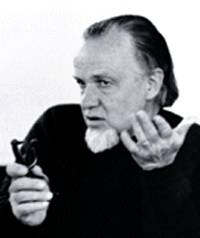
File:Francis Schaeffer.jpg

On Science and Culture by J. Robert Oppenheimer, Encounter (Magazine) October 1962 issue, was the best article that he ever wrote and it touched on a lot of critical issues including the one that Francis Schaeffer discusses in this blog post!

Francis Schaeffer above

CHAPTER 7 of HOW SHOULD WE THEN LIVE?

7 The Rise of Modern Science    

Two eras in history came almost simulta-  neously: the High Renaissance and, in contrast  to it, the Reformation. A third phenomenon  which we must deal with began at approx-  imately the same time. It is often called the  Scientific Revolution.  

We can date the rise of modern science with  Copernicus (1475–1543), the Polish astronomer,  and Vesalius (1514–1564) who was Italian. But  this is not to say that nothing that could be  called science preceded them. The Greeks, the  Arabs, and the Chinese had a deep knowledge  of the world. The Chinese, however, developed  few general scientific theories based on their  knowledge, and medieval science largely ac-  cepted Aristotle as the ultimate authority. In the  Arabic world there was much discussion in this area, but it would seem that the principles by  which they comprehended the world were  formed under the combined influence of Aris-  totelianism and Neo-Platonism. The Arabic  scholars did remarkable work, especially in  mathematics—in trigonometry and algebra, for  example, and in astronomy. Omar Khayyam (c.  1048–c. 1122)—who is better known for his  Rubaiyat, in which he carries to its logical con-  clusion the Islamic concept of fate—calculated  the length of the solar year and carried algebra  further than it had been taken before. But with  the Arabs as with medieval Europeans, science  was considered one aspect of philosophy, with  the traditions of the philosophers, especially  Aristotle, ruling supreme. 

 That is, medieval science was based on au-  thority rather than observation. It developed  through logic rather than experimentation, though there were notable exceptions.  

The foundation for modern science can be  said to have been laid at Oxford when scholars  there attacked Thomas Aquinas’s teaching by  proving that his chief authority, Aristotle, made  certain mistakes about natural phenomena.  Roger Bacon (1214–1294) was a part of this Ox-  ford group, but the most important man was  Robert Grosseteste (c. 1175–1253) who laid the  philosophical foundations for a departure from  Aristotelian science. Of course other factors  were involved as well, but the challenge to the  authority of Aristotle opened the doors for less  restricted thought. This challenge to the con-  cepts of Aristotle developed fruitfully at the  University of Padua in the fifteenth and six-  teenth centuries.  

When the Roman Church attacked  Copernicus and Galileo (1564–1642), it was not because their teaching actually contained any-  thing contrary to the Bible. The church author-  ities thought it did, but that was because Aris-  totelian elements had become part of church  orthodoxy, and Galileo’s notions clearly con-  flicted with them. In fact, Galileo defended the  compatibility of Copernicus and the Bible, and  this was one of the factors which brought about  his trial.  

Let us return to the fact that the Renais-  sance and Reformation overlap the Scientific  Revolution. Let me emphasize that I am not  implying that the Reformation caused the rise  of modern science. All I am pointing out at this  point is that the High Renaissance, the Refor-  mation, and the Scientific Revolution were  simultaneous at that point in history. To put the  temporal relationship into perspective, let us  consider a few dates: Leonardo da Vinci lived between 1452 and 1519. Luther’s Ninety-five  Theses were hammered to the church door in  1517. Calvin’s Institutes were published in 1536.  In 1546 Luther died. Copernicus, the as-  tronomer, lived from 1473 to 1543 and gave a  preliminary outline of his theory in 1530—that  is, that the earth went around the sun, and not  the sun around the earth. In the 1540s, three  things happened: first, On the Revolutions of the  Heavenly Spheres by Copernicus was published  posthumously; second, Vesalius published his  book On the Structure of the Human Body (this  book is often spoken of as De Fabrica); third,  the first edition of a Latin translation of the col-  lected works of Archimedes (c. 287–212 B.C.)  was published in 1544 in Basel. This introduced  some of the mathematical methods essential to  the development of modern science. 

 Francis Bacon lived from 1561 to 1626. He was a lawyer, essayist, and Lord Chancellor of  England. Though historians now do not give  him as important a place as they used to, he  did, nevertheless, fight a battle against the old  order of scholasticism with its slavish depen-  dence on accepted authorities. He stressed  careful observation and a systematic collection  of information “to unlock nature’s secrets.” In  1609 Galileo began to use the newly invented  telescope and what he saw and wrote about  indicated that Aristotle had been mistaken in  his pronouncements about the makeup of the  universe. Galileo was not the first to rely on ex-  perimental evidence. Danish Tycho Brahe  (1546–1601) had come to similar conclusions  from observation, but Galileo articulated his  findings publicly in his lifetime and in his na-  tive tongue so that all could read what he wrote.  Condemned by the Roman Inquisition in 1632, he was forced to recant; but his writings con-  tinued to testify not only that Copernicus was  right, but also that Aristotle was wrong.  

The rise of modern science did not conflict  with what the Bible teaches; indeed, at a crucial  point the Scientific Revolution rested upon  what the Bible teaches. Both Alfred North  Whitehead (1861–1947) and J. Robert Oppen-  heimer (1904–1967) have stressed that modern  science was born out of the Christian world  view. Whitehead was a widely respected math-  ematician and philosopher, and Oppenheimer,  after he became director of the Institute for Ad-  vanced Study at Princeton in 1947, wrote on a  wide range of subjects related to science, in  addition to writing on his own field on the  structure of the atom and atomic energy. As far  as I know, neither of the two men were  Christians or claimed to be Christians, yet both  were straightforward in acknowledging that  modern science was born out of the Christian  world view.  

Oppenheimer, for example, described this  in an article “On Science and Culture” in En-  counter in October 1962. In the Harvard Univer-  sity Lowell Lectures entitled Science and the  Modern World (1925), Whitehead said that  Christianity is the mother of science because of  “the medieval insistence on the rationality of  God.” Whitehead also spoke of confidence “in  the intelligible rationality of a personal being.”  He also says in these lectures that because of  the rationality of God, the early scientists had  an “inexpugnable belief that every detailed  occurrence can be correlated with its an-  tecedents in a perfectly definite manner, exem-  plifying general principles. Without this belief  the incredible labors of scientists would be without hope.” In other words, because the  early scientists believed that the world was cre-  ated by a reasonable God, they were not sur-  prised to discover that people could find out  something true about nature and the universe  on the basis of reason.  

This is a good place to emphasize some  things I am not saying. First, the reason-  ableness of the created order on the basis of its  creation by a reasonable God was not a distinc-  tive emphasis of the Reformation, but was held  in common by both the pre-Reformation  church and the Reformers. The belief White-  head describes would have been common to  both: the heavens and earth had been created  by God, and God is a reasonable God, as the  Bible says he is.  

Second (as was stressed when considering  the art which flowed from the Reformation but should be repeated here), it is not only a Chris-  tian who can paint beauty or who has creative  stirrings in the area of science. These creative  stirrings are rooted in the fact that people are  made in the image of God, the great Creator,  whether or not an individual knows or acknowl-  edges it, and even though the image of God in  people is now contorted. This creativeness—  whether in art, science, or engineering—is a  part of the unique mannishness of man as  made in the image of God. Man, in contrast to  non-man, is creative. A person’s world view,  however, does show through. This includes  what happens to people’s creative stirrings in  science. The world view determines the direc-  tion such creative stirrings will take, and  how—and whether the stirrings will continue or  dry up.  

Third, not all the scientists to be considered in this section were individually consistent  Christians. Many of them were, but they were  all living within the thought forms brought  forth by Christianity. And in this setting man’s  creative stirring had a base on which to con-  tinue and develop. To quote Whitehead once  more, the Christian thought form of the early  scientists gave them “the faith in the possibility  of science.”  

Living within the concept that the world was  created by a reasonable God, scientists could  move with confidence, expecting to be able to  find out about the world by observation and ex-  perimentation. This was their epistemological  base—the philosophical foundation with which  they were sure they could know. (Epistemology  is the theory of knowledge—how we know, or  how we know we can know.) Since the world  had been created by a reasonable God, they were not surprised to find a correlation between  themselves as observers and the thing ob-  served—that is, between subject and object.  This base is normative to one functioning in  the Christian framework, whether he is observ-  ing a chair or the molecules which make up the  chair. Without this foundation, Western mod-  ern science would not have been born.  

Here one must consider an important ques-  tion: Did the work of the Renaissance play a  part in the birth of modern science? Of course  it did. More than that, the gradual intellectual  and cultural awakenings in the Middle Ages  also exerted their influence. The increased  knowledge of Greek thought—at Padua Univer-  sity, for example—opened new doors. Cer-  tainly, Renaissance elements and those of the  Greek intellectual traditions were involved in  the scientific awakening. But to say theoretically that the Greek tradition would have been in it-  self a sufficient stimulus for the Scientific Revo-  lution comes up against the fact that it was not.  It was the Christian factor that made the differ-  ence. Whitehead and Oppenheimer are right.  Christianity is the mother of modern science  because it insists that the God who created the  universe has revealed himself in the Bible to be  the kind of God he is. Consequently, there is a  sufficient basis for science to study the uni-  verse. Later, when the Christian base was lost, a  tradition and momentum had been set in mo-  tion, and the pragmatic necessity of technology,  and even control by the state, drives science  on, but, as we shall see, with a subtle yet  important change in emphasis. 

 Francis Bacon, who could be called the  major prophet of the Scientific Revolution, took  the Bible seriously, including the historic Fall, the revolt of man in history. He said in Novum  Organum Scientiarum (1620), “Man by the Fall  fell at the same time from his state of inno-  cence and from his dominion over creation.  Both of these losses, however, can even in this  life be in some parts repaired; the former by  religion and faith, the latter by the arts and sci-  ences.” Notice that Bacon did not see science  as autonomous. Man, including science, is not  autonomous. He is to take seriously what the  Bible teaches about history and about that  which it teaches has occurred in the cosmos.  Yet, upon the base of the Bible’s teaching, sci-  ence and art are intrinsically valuable before  both men and God. This gave a strong impetus  for the creative stirrings of science to continue  rather than to be spasmodic.  

To continue with the founders of modern  science: Johannes Kepler, a German astronomer, lived between 1571 and 1630, the  same time as Galileo. He was the first man to  show that the planets’ orbits are elliptical, not  circular. Sir Isaac Newton (1642–1727), while a  young professor in his twenties at Cambridge  University, came to the conclusion that there is  a universal force of attraction between every  body in the universe and that it must be calcu-  lable. That force he called gravity. He set this  forth later in The Mathematical Principles of Nat-  ural Philosophy (1687). This became one of the  most influential books in the history of human  thought. By experimenting in Neville’s Court in  Trinity College at Cambridge University, he was  also able to work out the speed of sound by  timing the interval between the sound of an ob-  ject which he dropped, and the echo coming  back to him from a known distance.  loyal to what he believed the Bible teaches. It  has been said that seventeenth-century scien-  tists limited themselves to the how without  interest in the why. This is not true. Newton,  like other early scientists, had no problem with  the why because he began with the existence of  a personal God who had created the universe.  

In his later years, Newton wrote more about  the Bible than about science, though little was  published. Humanists have said that they wish  he had spent all of his time on his science.  They think he wasted the hours he expended on  biblical study, but they really are a bit blind  when they say this. As Whitehead and Oppen-  heimer stressed, if Newton and others had not  had a biblical base, they would have had no  base for their science at all. That is not to say  that one must agree with all of Newton’s  speculations on either metaphysics or doctrine.  

Throughout his lifetime, Newton tried to be But the point is that Newton’s intense interest  in the Bible came out of his view that the same  God who had created the universe had given  people truth in the Bible. And his view was that  the Bible contained the same sort of truth as  could be learned from a study of the universe.  Newton and these other scientists would have  been astonished at a science obsessed with  how the universe functions, but professionally  failing to ask the question “Why?” 

 Though later he became disillusioned with  science, Blaise Pascal (1623–1662) made the  first successful barometer and did important  work on the equilibrium of fluids. He was not  content to work only in a laboratory, but took a  tube of mercury up the mountain Puy de Dôme  (in central France) and thus recorded the  changes in the mercury level according to  altitude. He was also a mathematician of note whose work hastened the development of dif-  ferential calculus. By some he is also consid-  ered the greatest writer of French prose who  ever lived. An outstanding Christian, he empha-  sized that he did not see people lost like specks  of dust in the universe (which was now so  much larger and more complicated than people  had thought), for people—as unique—could  comprehend something of the universe. People  could comprehend the stars; the stars compre-  hend nothing. And besides this, for Pascal,  people were special because Christ died on the  cross for them.  

René Descartes (1596–1650) was important  for his emphasis on mathematical analysis and  theory of science. I personally would reject his  philosophic views. But he regarded himself as a  good Catholic, and it was his religion which, in  light of his philosophic views, saved him from solipsism—that is, from living in the cocoon of  himself.  

In the early days of the Royal Society of Lon-  don for Improving Natural Knowledge, founded  in 1662, most of its members were professing  Christians. George M. Trevelyan (1876–1962) in  English Social History (1942) writes, “Robert  Boyle, Isaac Newton and the early members of  the Royal Society were religious men, who repu-  diated the sceptical doctrines of Hobbes. But  they familiarized the minds of their countrymen  with the idea of law in the Universe and with  scientific methods of enquiry to discover truth.  It was believed that these methods would never  lead to any conclusions inconsistent with Bib-  lical history and miraculous religion; Newton  lived and died in that faith.” We must never  think that the Christian base hindered science.  Rather, the Christian base made modern science possible. 


PAGE. 193 44%

41 Sir Isaac Newton engraved by Freeman (top)  and Blaise Pascal by Philippe de Champagne.  “… early scientists had no problem with the  why.” Photos courtesy Radio Times London.    

The tradition of Bacon and Newton and the  early days of the Royal Society was strongly  maintained right through the nineteenth cen-  tury. Michael Faraday (1791–1867) made his  great contributions in the area of electricity. His  crowning discovery was the induction of elec-  tric current. Faraday was also a Christian. He  belonged to a group whose position was:  “Where the Scriptures speak, we speak; where  the Scriptures are silent, we are silent.” In the  conviction that knowledge concerning God’s  creation is for all people to enjoy, and not just a  professional elite, he gave famous public  demonstrations of his pioneering work in electricity. James Clerk Maxwell (1831–1879),  who, like Faraday, worked with electricity, was  also a believer in a personal God. Indeed, the  majority of those who founded modern sci-  ence, from Copernicus to Maxwell, were func-  tioning on a Christian base. Many of them were  personally Christians, but even those who were  not, were living within the thought forms  brought forth by Christianity, especially the be-  lief that God as the Creator and Lawgiver has  implanted laws in his creation which man can  discover.  

But we may ask, “Isn’t science now in a new  stage, one in which the concept of an orderly  universe is passé?” It is often said that relativity  as a philosophy, as a world view, is supported  by Albert Einstein’s (1879–1955) theory of rela-  tivity. But this is mistaken because Einstein’s  theory of relativity assumes that everywhere in the universe light travels at a constant speed in  a vacuum. In other words, we must say with the  utmost force that nothing is less relative  philosophically than the theory of relativity. Ein-  stein himself stood implacably against any  such application of his concepts. We can think  of his often quoted words from the London Ob-  server of April 5, 1964: “I cannot believe that  God plays dice with the cosmos.” 

 One may then ask if Einstein’s views have  not been proven old-fashioned by Werner  Heisenberg’s (1901–1976) principle of uncer-  tainty, or indeterminacy principle (1927), and by  the wide acceptance of the concept of quantum.  The answer again is no. The principle of indeter-  minacy has to do with a certain area of obser-  vation, namely, the location of an object and its  velocity. For example, if we try to establish the  exact position and speed of two atomic particles which are going to collide, we will  never be able to determine exactly how they will  rebound. The physicist cannot have an accurate  observation of both their location and their  velocity simultaneously. The quantum theory of  either light or particles does not lead to the  concept of chance or random universe either.  For example, whether viewed as a wave or a  particle, light does not function at random and  it is an effect which brings forth causes. Even  the far-out theoretical existence of “black holes”  in space, as set forth by John G. Taylor (1931–),  is based on the concept of an orderly universe  and calculations resting on that concept. 

42 Michael Faraday conducting a public exper-  iment. “God’s creation is for all people to  enjoy.” Photo courtesy of The Royal Institution.  

  If an airplane is to fly, it must be con-  structed to fit the order of the universe that ex-  ists. People, no matter what they have come to  believe, still look for the explanation of any happening in terms of other earlier happenings.  If this were not possible, not only would expla-  nations cease, but science could not be used  reliably in technology. It is possible to so func-  tion in our universe that, because there is a uni-  formity of natural causes, a man may travel  hundreds of thousands of miles to the moon  and land within a few feet of his planned desti-  nation, or he may aim an atomic weapon at a  target on the other side of our planet and land it  within ten feet of that target. We know we live in  a universe that is much more complex than  people, including scientists, once thought it to  be, but that is much different from the concept  of a random universe.  

On the Christian base, one could expect to  find out something true about the universe by  reason. There were certain other results of the  Christian world view. For example, there was the certainty of something “there”—an objec-  tive reality—for science to examine. What we  seem to observe is not just an extension of the  essence of God, as Hindu and Buddhist think-  ing would have it. The Christian world view  gives us a real world which is there to study  objectively. Another result of the Christian base  was that the world was worth finding out about,  for in doing so one was investigating God’s cre-  ation. And people were free to investigate na-  ture, for nature was not seen as full of gods and  therefore taboo. All things were created by God  and are open for people’s investigation. God  himself had told mankind to have dominion  over nature, and as we saw from the quotation  from Francis Bacon, to him science had a part  in this. There was a reason for continuing one’s  interest and pressing on. 


43 Assembly of a satellite at the Kennedy Space  Center. “… science could not be used.” Photo  by Mustafa Arshad.   

 In this setting, people’s creative stirrings  had a base from which to develop and to con-  tinue. To quote Bacon again, “To conclude,  therefore, let no man out of weak conceit of  sobriety, or in ill applied moderation, think or  maintain, that a man can search too far or be  too well studied in the book of God’s word, or  in the book of God’s works.” “The book of  God’s word” is the Bible; “the book of God’s  works” is the world which God has made. So,  for Bacon and other scientists working on the  Christian base, there was no separation or final  conflict between what the Bible teaches and sci-  ence. 

 The Greeks, the Moslems, and the Chinese eventually lost interest in science. As we said  before, the Chinese had an early and profound  knowledge of the world. Joseph Needham  (1900–), in his book The Grand Titration  (1969), explains why this never developed into  a full-fledged science: “There was no confi-  dence that the code of Nature’s laws could ever  be unveiled and read, because there was no  assurance that a divine being, even more ratio-  nal than ourselves, had ever formulated such a  code capable of being read.” But for the scien-  tists who were functioning on a Christian base,  there was an incentive to continue searching for  the objective truth which they had good reason  to know was there. Then, too, with the biblical  emphasis on the rightness of work and the dig-  nity of all vocations, it was natural that the  things which were learned should flow over  into the practical side and not remain a matter of mere intellectual curiosity and that, in other  words, technology, in the beneficial sense,  should be born.  

What was the view of these modern scien-  tists on a Christian base? They held to the con-  cept of the uniformity of natural causes in an  open system, or, as it may also be expressed, the  uniformity of natural causes in a limited time  span. God has made a cause-and-effect uni-  verse; therefore we can find out something  about the causes from the effects. But (and the  but is very important) it is an open universe be-  cause God and man are outside of the unifor-  mity of natural causes. In other words, all that  exists is not one big cosmic machine which in-  cludes everything. Of course, if a person steps  in front of a moving auto, the cause-and-effect  universe functions upon him; but God and  people are not a part of a total cosmic machine. Things go on in a cause-and-effect sequence,  but at a point of time the direction may be  changed by God or by people. Consequently,  there is a place for God, but there is also a  proper place for man.  

This carries with it something profound—  that the machine, whether the cosmic machine  or the machines which people make, is neither  a master nor a threat—because the machine  does not include everything. There is some-  thing which is “outside” of the cosmic ma-  chine, and there is a place for man to be man. 


Atomic Bombings of Hiroshima and Nagasaki – August 6 and 9, 1945
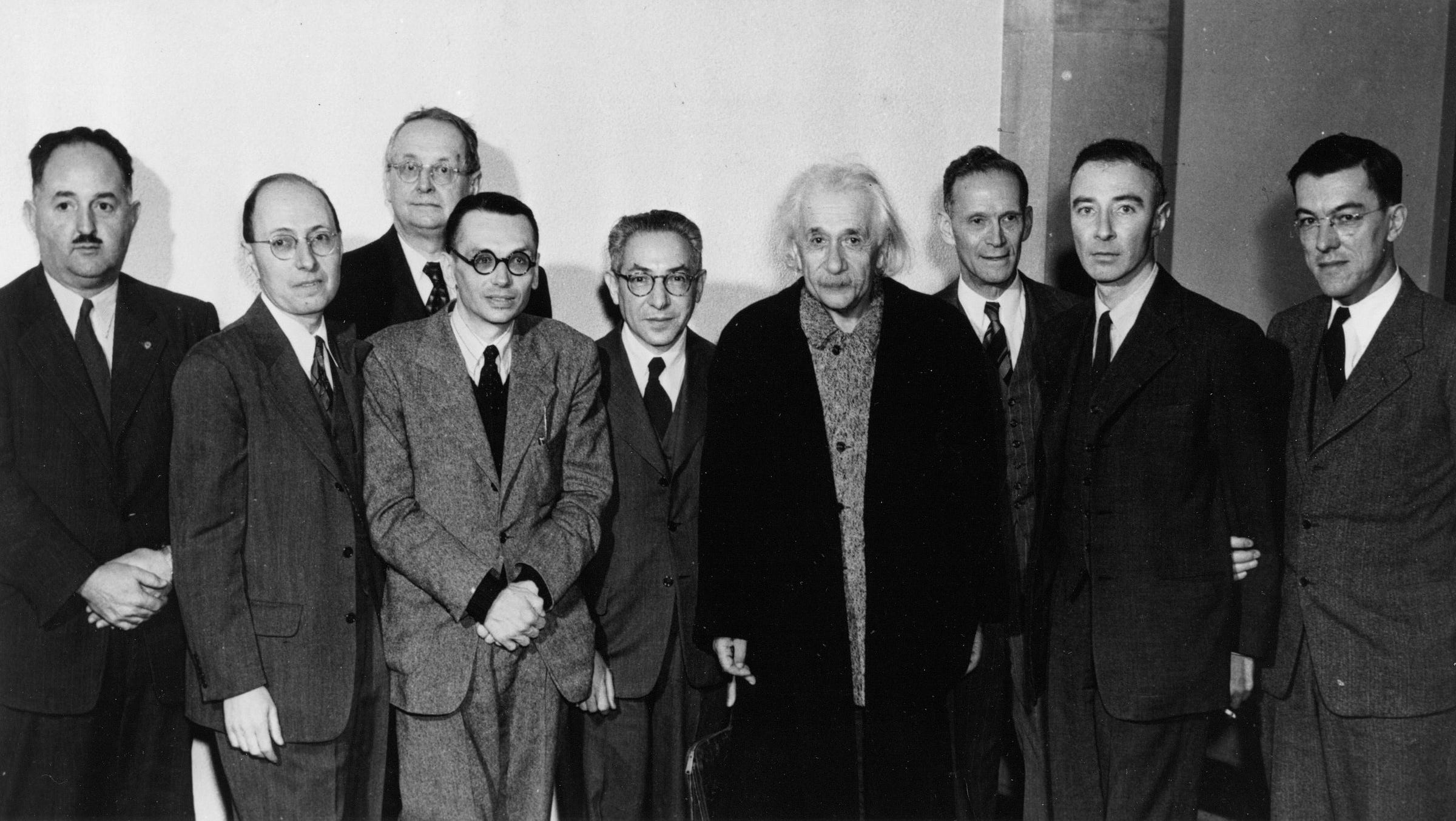

From left to right: Robertson, Wigner, Weyl, Gödel, Rabi, Einstein, Ladenburg, Oppenheimer, and Clemence

Related posts:

Atheists confronted: How I confronted Carl Sagan the year before he died jh47

May 19, 2011 – 10:30 am

In today’s news you will read about Kirk Cameron taking on the atheist Stephen Hawking over some recent assertions he made concerning the existence of heaven. Back in December of 1995 I had the opportunity to correspond with Carl Sagan about a year before his untimely death. Sarah Anne Hughes in her article,”Kirk Cameron criticizes […]

By Everette Hatcher III|Posted in Atheists Confronted|Edit|Comments (2)

My correspondence with George Wald and Antony Flew!!!

May 12, 2014 – 1:14 am

January 8, 2015 – 5:23 am

January 1, 2015 – 4:14 am

December 25, 2014 – 5:04 am

FRANCIS SCHAEFFER ANALYZES ART AND CULTURE Part 38 Woody Allen and Albert Camus “There is but one truly serious philosophical problem, and that is suicide” (Feature on artist Hamish Fulton Photographer )

December 18, 2014 – 4:30 am

FRANCIS SCHAEFFER ANALYZES ART AND CULTURE Part 37 Mahatma Gandhi and “Relieving the Tension in the East” (Feature on artist Luc Tuymans)

December 11, 2014 – 4:19 am

FRANCIS SCHAEFFER ANALYZES ART AND CULTURE Part 36 Julian Huxley:”God does not in fact exist, but act as if He does!” (Feature on artist Barry McGee)

December 4, 2014 – 4:10 am

Dan Mitchell: School Choice and Civil Rights, Part II

Milton Friedman – Public Schools / Voucher System – Failures in Educatio…

Milton Friedman – Educational Vouchers

School Choice and Civil Rights, Part II

In Part I of this series, I made the simple point that school choice should be a civil rights issue.

This is because government schools do a scandalously bad job of educating children from poor communities and choice would give families the ability to escape that failing system.

And the people I cited in that column also made very good points about better K-12 schooling being the right way of preparing more minority children to successfully advance to the next level, especially if they want to attend elite colleges.

Which is a good reason to now look at a series of essays in the New York Times on “How to Fix College Admissions Now.”

Professor Roland Fryer, an economics professor at Harvard, easily has the best piece. Here’s some of what he proposed.

…selective schools are planning to respond to its widely anticipated decision to end affirmative action…in part, by watering down their admissions standards, through policies like reducing or eliminating the role of standardized tests. …But this is precisely backward. Instead of making the admissions process shallow, elite colleges should deepen the applicant pool.The simplest, most direct way to do that is for these schools to found and fund schools that educate disadvantaged students. …They could fix the problem if they truly wanted to. Elite colleges could operate a network of, say, 100 feeder middle and high schools — academies that are open to promising students who otherwise lack access to a high-quality secondary education, in cities where such children are common because of high poverty rates and underperforming public schools. …he cost would be about $4 billion — about 2 percent of the League’s total endowments. This cost could be offset by fundraising specifically for the academies. One could even add three years of middle school without getting close to the $10 billion mark, if we believe intervention must start sooner.

Professor Fryer is correct on many levels.

But what’s especially enjoyable about his column is that he’s asking elite colleges to put up or shut up. If they really care about better schooling and more diversity, they can take a small slice of their endowments to make it happen.

Given the rampant hypocrisy on the left, I won’t be holding my breath waiting for this to happen.

Censorship, School Libraries, Democracy, and Choice

A big advantage of living in a constitutional republicis that individual rights are protected from “tyranny of the majority.”

  • Assuming courts are doing their job, it doesn’t matterif 90 percent of voters support restrictions on free speech.
  • Assuming courts are doing their job, it doesn’t matter if 90 percent of voters support gun confiscation.
  • Assuming courts are doing their job, it doesn’t matter if 90 percent of voters support warrantless searches.

That being said, a constitutional republic is a democratic form of government. And if government is staying within proper boundaries, political decisions should be based on majority rule, as expressed through elections.

In some cases, that will lead to decisions I don’t like. For instance, the (tragic) 16th Amendment gives the federal government the authority to impose an income tax and voters repeatedly have elected politicians who have opted to exercise that authority.

Needless to say, I will continue my efforts to educate voters and lawmakers in hopes that eventually there will be majorities that choose a different approach. That’s how things should work in a properly functioning democracy.

But not everyone agrees.

report in the New York Times, authored by Elizabeth Harris and Alexandra Alter, discusses the controversy over which books should be in the libraries of government schools.

The Keller Independent School District, just outside of Dallas, passed a new rule in November: It banned books from its libraries that include the concept of gender fluidity. …recently, the issue has been supercharged by a rapidly growing and increasingly influential constellation of conservative groups.The organizations frequently describe themselves as defending parental rights. …“This is not about banning books, it’s about protecting the innocence of our children,” said Keith Flaugh, one of the founders of Florida Citizens Alliance, a conservative group focused on education… The restrictions, said Emerson Sykes, a First Amendment litigator for the American Civil Liberties Union, infringe on students’ “right to access a broad range of material without political censorship.” …In Florida, parents who oppose book banning formed the Freedom to Read Project.

As indicated by the excerpt, some people are very sloppy with language.

If a school decides not to buy a certain book for its library, that is not a “book ban.” Censorship only exists when the government uses coercion to prevent people from buying books with their own money.

As I wrote earlier this year, “The fight is not over which books to ban. It’s about which books to buy.”

And this brings us back to the issue of democracy.

School libraries obviously don’t have the space or funds to stock every book ever published, so somebody has to make choices. And voters have the ultimate power to make those choices since they elect school boards.

I’ll close by noting that democracy does not please everyone. Left-leaning parents in Alabama probably don’t always like the decisions of their school boards,just like right-leaning parents in Vermont presumably don’t always like the decisions of their school boards.

And the same thing happens with other contentious issues, such as teaching critical race theory.

Which is why school choice is the best outcome. Then, regardless of ideology, parents can choose schools that have the curriculum (and books) that they think will be best for their children.

P.S. If you want to peruse a genuine example of censorship, click here.


More Academic Evidence for School Choice

Since teacher unions care more about lining their pockets and protecting their privileges rather than improving education, I’ll never feel any empathy for bosses like Randi Weingarten.

That being said, the past couple of years have been bad news for Ms Weingarten and her cronies.

Not only is school choice spreading – especially in states such as Arizona and West Virginia, but we also are getting more and more evidence that competition produces better results for schoolkids.

In a study published by the National Bureau of Economic Research, Professors David N. Figlio, Cassandra M.D. Hart & Krzysztof Karbownikfound that school choice led to benefits even for kids who remained stuck in government schools.

They enjoyed better academic outcomes, which is somewhat surprising, but even I was pleasantly shocked to see improved behavioral outcomes as well.

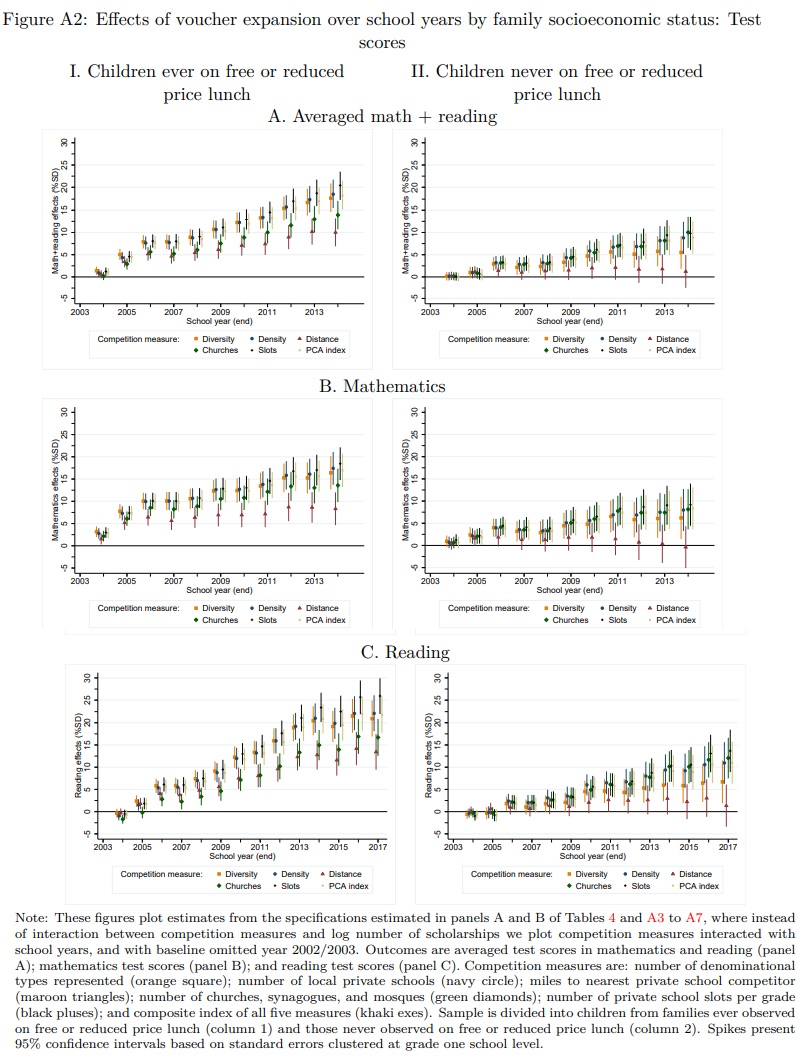
School choice programs have been growing in the United States and worldwide over the past two decades, and thus there is considerable interest in how these policies affect students remaining in public schools. …the evidence on the effects of these programs as they scale up is virtually non-existent. Here, we investigate this question using data from the state of Florida where, over the course of our sample period, the voucher program participation increased nearly seven-fold.We find consistent evidence that as the program grows in size, students in public schools that faced higher competitive pressure levels see greater gains from the program expansion than do those in locations with less competitive pressure. Importantly, we find that these positive externalities extend to behavioral outcomes— absenteeism and suspensions—that have not been well-explored in prior literature on school choice from either voucher or charter programs. Our preferred competition measure, the Competitive Pressure Index, produces estimates implying that a 10 percent increase in the number of students participating in the voucher program increases test scores by 0.3 to 0.7 percent of a standard deviation and reduces behavioral problems by 0.6 to 0.9 percent. …Finally, we find that public school students who are most positively affected come from comparatively lower socioeconomic background, which is the set of students that schools should be most concerned about losing under the Florida Tax Credit Scholarship program.

It’s good news that competition from the private sector produces better results in government schools.

But it’s great news that those from disadvantaged backgrounds disproportionately benefit when there is more school choice.

Wonkier readers will enjoy Figure A2, which shows the benefits to regular kids on the right and disadvantaged kids on the left.

Since the study looked at results in Florida, I’ll close by observing that Florida is ranked #1 for education freedom and ranked #3 for school choice.

P.S. Here’s a video explaining the benefits of school choice.

P.P.S. There’s international evidence from SwedenChileCanada, and the Netherlands, all of which shows superior results when competition replaces government education monopolies.

———-

Portrait of Milton Friedman.jpg

Milton Friedman chose the emphasis on school choice and school vouchers as his greatest legacy and hopefully the Supreme Court will help that dream see a chance!

Educational Choice, the Supreme Court, and a Level Playing Field for Religious Schools

The case for school choice is very straightforward.

The good news is that there was a lot of pro-choice reform in 2021.

West Virginia adopted a statewide system that is based on parental choice. And many other states expanded choice-based programs.

But 2022 may be a good year as well. That’s because the Supreme Court is considering whether to strike down state laws that restrict choice by discriminating against religious schools.

Michael Bindas of the Institute for Justice and Walter Womack of the Southern Christian Leadership Conference make the case for a level playing field in a column for the New York Times.

In 2002, the Supreme Court held that the Constitution allows school choice programs to include schools that provide religious instruction, so long as the voucher program also offers secular options. The question now before the court is whether a state may nevertheless exclude schools that provide religious instruction. The case, Carson v. Makin, …concerns Maine’s tuition assistance program. In that large and sparsely populated state, over half of the school districts have no public high schools. If a student lives in such a district, and it does not contract with another high school to educate its students, then the district must pay tuition for the student to attend the school of her or his parents’ choice. …But one type of school is off limits: a school that provides religious instruction. That may seem unconstitutional, and we argue that it is. Only last year, the Supreme Court, citing the free exercise clause of the Constitution, held that states cannot bar students in a school choice program from selecting religious schools when it allows them to choose other private schools. …The outcome will be enormously consequential for families in public schools that are failing them and will go a long way toward determining whether the most disadvantaged families can exercise the same control over the education of their children as wealthier citizens.

The Wall Street Journal editorialized on this issue earlier this week.

Maine has one of the country’s oldest educational choice systems, a tuition program for students who live in areas that don’t run schools of their own. Instead these families get to pick a school, and public funds go toward enrollment. Religious schools are excluded, however, and on Wednesday the Supreme Court will hear from parents who have closely read the First Amendment.…Maine argues it isn’t denying funds based on the religious “status” of any school… The state claims, rather, that it is merely refusing to allocate money for a “religious use,” specifically, “an education designed to proselytize and inculcate children with a particular faith.” In practice, this distinction between “status” and “use” falls apart. Think about it: Maine is happy to fund tuition at an evangelical school, as long as nothing evangelical is taught. Hmmm. …A state can’t subsidize tuition only for private schools with government-approved values, and trying to define the product as “secular education” gives away the game. …America’s Founders knew what they were doing when they wrote the First Amendment to protect religious “free exercise.”

What does the other side say?

Rachel Laser, head of Americans United for Separation of Church and State, doesn’t want religious schools to be treated equally under school choice programs.

Here’s some of her column in the Washington Post.

…two sets of parents in Maine claim that the Constitution’s promise of religious freedom actually requires the state to fund religious education at private schools with taxpayer dollars — as a substitute for public education. This interpretation flips the meaning of religious freedom on its head and threatens both true religious freedom and public education.…The problem here is even bigger than public funds paying for praying, as wrong as that is. Unlike public schools, private religious schools often do not honor civil rights protections, especially for LGBTQ people, women, students with disabilities, religious minorities and the nonreligious. …If the court were to agree with the parents, it would also be rejecting the will of three-quarters of the states, which long ago enacted clauses in their state constitutions and passed statutes specifically prohibiting public funding of religious education. …It is up to parents and religious communities to educate their children in their faith. Publicly funded schools should never serve that purpose.

These arguments are not persuasive.

The fact that many state constitutions include so-called Blaine amendments actually undermines her argument since those provisions were motivated by a desire to discriminate against parochial schools that provided education to Catholic immigrants.

And it’s definitely not clear why school choice shouldn’t include religious schools that follow religious teachings, unless she also wants to argue that student grants and loans shouldn’t go to students at Notre Dame, Brigham Young, Liberty, and other religiously affiliated colleges.

The good news is that Ms. Laser’s arguments don’t seem to be winning. Based on this report from yesterday’s Washington Post, authored by Robert Barnes, there are reasons to believe the Justices will make the right decision.

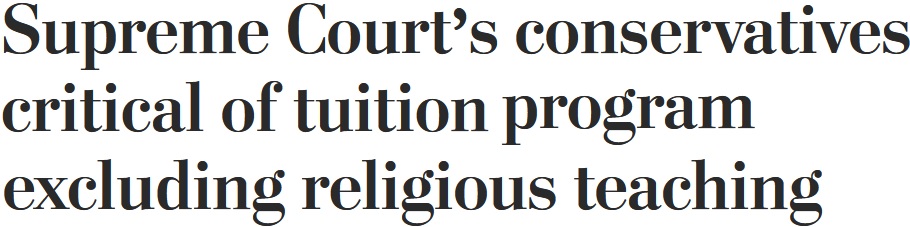
Conservatives on the Supreme Court seemed…critical of a Maine tuition program that does not allow public funds to go to schools that promote religious instruction. The case involves an unusual program in a small state that affects only a few thousand students. But it could have greater implications… The oral argument went on for nearly two hours and featured an array of hypotheticals. …But the session ended as most suspected it would, with the three liberal justices expressing support for Maine and the six conservatives skeptical that it protected religious parents from unconstitutional discrimination.

I can’t resist sharing this additional excerpt about President Biden deciding to side with teacher unions instead of students.

The Justice Department switched its position in the case after President Biden was inaugurated and now supports Maine.

But let’s not dwell on Biden’s hackery (especially since that’s a common affliction on the left).

Instead, let’s close with some uplifting thoughts about what might happen if we get a good decision from the Supreme Court when decisions are announced next year.

Maybe I’m overly optimistic, but I think we’re getting close to a tipping point. As more and more states and communities shift to choice, we will have more and more evidence that it’s a win-win for both families and taxpayers.

Which will lead to more choice programs, which will produce more helpful data.

Lather, rinse, repeat. No wonder the (hypocriticalteacher unionsare so desperate to stop progress.

P.S. There’s strong evidence for school choice from nations such as SwedenChile, and the Netherlands.

Free To Choose 1980 – Vol. 06 What’s Wrong with Our Schools? – Full Video
https://youtu.be/tA9jALkw9_Q


Why Milton Friedman Saw School Choice as a First Step, Not a Final One

On his birthday, let’s celebrate Milton Friedman’s vision of enabling parents, not government, to be in control of a child’s education.

Wednesday, July 31, 2019
Kerry McDonald
Kerry McDonald

EducationMilton FriedmanSchool ChoiceSchooling

Libertarians and others are often torn about school choice. They may wish to see the government schooling monopoly weakened, but they may resist supporting choice mechanisms, like vouchers and education savings accounts, because they don’t go far enough. Indeed, most current choice programs continue to rely on taxpayer funding of education and don’t address the underlying compulsory nature of elementary and secondary schooling.

Skeptics may also have legitimate fears that taxpayer-funded education choice programs will lead to over-regulation of previously independent and parochial schooling options, making all schooling mirror compulsory mass schooling, with no substantive variation.

Milton Friedman had these same concerns. The Nobel prize-winning economist is widely considered to be the one to popularize the idea of vouchers and school choice beginning with his 1955 paper, “The Role of Government in Education.” His vision continues to be realized through the important work of EdChoice, formerly the Friedman Foundation for Education Choice, that Friedman and his economist wife, Rose, founded in 1996.

July 31 is Milton Friedman’s birthday. He died in 2006 at the age of 94, but his ideas continue to have an impact, particularly in education policy.

Friedman saw vouchers and other choice programs as half-measures. He recognized the larger problems of taxpayer funding and compulsion, but saw vouchers as an important starting point in allowing parents to regain control of their children’s education. In their popular book, Free To Choose, first published in 1980, the Friedmans wrote:

We regard the voucher plan as a partial solution because it affects neither the financing of schooling nor the compulsory attendance laws. We favor going much farther. (p.161)

They continued:

The compulsory attendance laws are the justification for government control over the standards of private schools. But it is far from clear that there is any justification for the compulsory attendance laws themselves. (p. 162)

The Friedmans admitted that their “own views on this have changed over time,” as they realized that “compulsory attendance at schools is not necessary to achieve that minimum standard of literacy and knowledge,” and that “schooling was well-nigh universal in the United States before either compulsory attendance or government financing of schooling existed. Like most laws, compulsory attendance laws have costs as well as benefits. We no longer believe the benefits justify the costs.” (pp. 162-3)

Still, they felt that vouchers would be the essential starting point toward chipping away at monopoly mass schooling by putting parents back in charge. School choice, in other words, would be a necessary but not sufficient policy approach toward addressing the underlying issue of government control of education.

In their book, the Friedmans presented the potential outcomes of their proposed voucher plan, which would give parents access to some or all of the average per-pupil expenditures of a child enrolled in public school. They believed that vouchers would help create a more competitive education market, encouraging education entrepreneurship. They felt that parents would be more empowered with greater control over their children’s education and have a stronger desire to contribute some of their own money toward education. They asserted that in many places “the public school has fostered residential stratification, by tying the kind and cost of schooling to residential location” and suggested that voucher programs would lead to increased integration and heterogeneity. (pp. 166-7)

To the critics who said, and still say, that school choice programs would destroy the public schools, the Friedmans replied that these critics fail to

explain why, if the public school system is doing such a splendid job, it needs to fear competition from nongovernmental, competitive schools or, if it isn’t, why anyone should object to its “destruction.” (p. 170)

What I appreciate most about the Friedmans discussion of vouchers and the promise of school choice is their unrelenting support of parents. They believed that parents, not government bureaucrats and intellectuals, know what is best for their children’s education and well-being and are fully capable of choosing wisely for their children—when they have the opportunity to do so.

They wrote:

Parents generally have both greater interest in their children’s schooling and more intimate knowledge of their capacities and needs than anyone else. Social reformers, and educational reformers in particular, often self-righteously take for granted that parents, especially those who are poor and have little education themselves, have little interest in their children’s education and no competence to choose for them. That is a gratuitous insult. Such parents have frequently had limited opportunity to choose. However, U.S. history has demonstrated that, given the opportunity, they have often been willing to sacrifice a great deal, and have done so wisely, for their children’s welfare. (p. 160).

Sign-Up: Receive Kerry’s Weekly Parenting and Education Newsletter!

Today, school voucher programs exist in 15 states plus the District of Columbia. These programs have consistently shown that when parents are given the choice to opt-out of an assigned district school, many will take advantage of the opportunity. In Washington, D.C., low-income parents who win a voucher lottery send their children to private schools.

The most recent three-year federal evaluationof voucher program participants found that while student academic achievement was comparable to achievement for non-voucher students remaining in public schools, there were statistically significant improvements in other important areas. For instance, voucher participants had lower rates of chronic absenteeism than the control groups, as well as higher student satisfaction scores. There were also tremendous cost-savings.

In Wisconsin, the Milwaukee Parental Choice Program has served over 28,000 low-income students attending 129 participating private schools.

According to Corey DeAngelis, Director of School Choice at the Reason Foundation and a prolific researcher on the topic, the recent analysis of the D.C. voucher program “reveals that private schools produce the same academic outcomes for only a third of the cost of the public schools. In other words, school choice is a great investment.”

In Wisconsin, the Milwaukee Parental Choice Program was created in 1990 and is the nation’s oldest voucher program. It currently serves over 28,000 low-income students attending 129 participating private schools. Like the D.C. voucher program, data on test scores of Milwaukee voucher students show similar results to public school students, but non-academic results are promising.

Recent research found voucher recipients had lower crime rates and lower incidences of unplanned pregnancies in young adulthood. On his birthday, let’s celebrate Milton Friedman’s vision of enabling parents, not government, to be in control of a child’s education.

According to Howard Fuller, an education professor at Marquette University, founder of the Black Alliance for Educational Options, and one of the developers of the Milwaukee voucher program, the key is parent empowerment—particularly for low-income minority families.

In an interview with NPR, Fuller said: “What I’m saying to you is that there are thousands of black children whose lives are much better today because of the Milwaukee parental choice program,” he says. 
“They were able to access better schools than they would have without a voucher.”

Putting parents back in charge of their child’s education through school choice measures was Milton Friedman’s goal. It was not his ultimate goal, as it would not fully address the funding and compulsion components of government schooling; but it was, and remains, an important first step. As the Friedmans wrote in Free To Choose:

The strong American tradition of voluntary action has provided many excellent examples that demonstrate what can be done when parents have greater choice. (p. 159).

On his birthday, let’s celebrate Milton Friedman’s vision of enabling parents, not government, to be in control of a child’s education.

Kerry McDonald

Milton Friedman

Related posts:


“Friedman Friday” (“Free to Choose” episode 1 – Power of the Market. part 7 of 7)

March 16, 2012 – 12:25 am

  Michael Harrington:  If you don’t have the expertise, the knowledge technology today, you’re out of the debate. And I think that we have to democratize information and government as well as the economy and society. FRIEDMAN: I am sorry to say Michael Harrington’s solution is not a solution to it. He wants minority rule, I […] By Everette Hatcher III | Posted in Current Events, Milton Friedman | Edit | Comments (0)

“Friedman Friday” (“Free to Choose” episode 1 – Power of the Market. part 6 of 7)

March 9, 2012 – 12:29 am

PETERSON: Well, let me ask you how you would cope with this problem, Dr. Friedman. The people decided that they wanted cool air, and there was tremendous need, and so we built a huge industry, the air conditioning industry, hundreds of thousands of jobs, tremendous earnings opportunities and nearly all of us now have air […] By Everette Hatcher III | Posted in Current Events, Milton Friedman | Edit | Comments (0)

“Friedman Friday” (“Free to Choose” episode 1 – Power of the Market. part 5 of 7)

March 2, 2012 – 12:26 am

Part 5 Milton Friedman: I do not believe it’s proper to put the situation in terms of industrialist versus government. On the contrary, one of the reasons why I am in favor of less government is because when you have more government industrialists take it over, and the two together form a coalition against the ordinary […] By Everette Hatcher III | Posted in Current Events, Milton Friedman | Edit | Comments (0)

“Friedman Friday” (“Free to Choose” episode 1 – Power of the Market. part 4 of 7)

February 24, 2012 – 12:21 am

The fundamental principal of the free society is voluntary cooperation. The economic market, buying and selling, is one example. But it’s only one example. Voluntary cooperation is far broader than that. To take an example that at first sight seems about as far away as you can get __ the language we speak; the words […] By Everette Hatcher III | Posted in Current Events, Milton Friedman | Edit | Comments (0)

“Friedman Friday” (“Free to Choose” episode 1 – Power of the Market. part 3 of 7)

February 17, 2012 – 12:12 am

  _________________________   Pt3  Nowadays there’s a considerable amount of traffic at this border. People cross a little more freely than they use to. Many people from Hong Kong trade in China and the market has helped bring the two countries closer together, but the barriers between them are still very real. On this side […] By Everette Hatcher III | Posted in Current Events, Milton Friedman | Edit | Comments (0)

“Friedman Friday” (“Free to Choose” episode 1 – Power of the Market. part 2 of 7)

February 10, 2012 – 12:09 am

  Aside from its harbor, the only other important resource of Hong Kong is people __ over 4_ million of them. Like America a century ago, Hong Kong in the past few decades has been a haven for people who sought the freedom to make the most of their own abilities. Many of them are […] By Everette Hatcher III | Posted in Current Events, Milton Friedman | Edit | Comments (0)

“Friedman Friday” (“Free to Choose” episode 1 – Power of the Market. part 1of 7)

February 3, 2012 – 12:07 am

“FREE TO CHOOSE” 1: The Power of the Market (Milton Friedman) Free to Choose ^ | 1980 | Milton Friedman Posted on Monday, July 17, 2006 4:20:46 PM by Choose Ye This Day FREE TO CHOOSE: The Power of the Market Friedman: Once all of this was a swamp, covered with forest. The Canarce Indians […]

Milton Friedman The Power of the Market 1-5

Debate on Milton Friedman’s cure for inflation

September 29, 2011 – 7:24 am

If you would like to see the first three episodes on inflation in Milton Friedman’s film series “Free to Choose” then go to a previous post I did. Ep. 9 – How to Cure Inflation [4/7]. Milton Friedman’s Free to Choose (1980) Uploaded by investbligurucom on Jun 16, 2010 While many people have a fairly […]

By Everette Hatcher III | Also posted in Current Events | Tagged dr friedman, expansion history, income tax brackets, political courage, www youtube | Edit | Comments (0)

“Friedman Friday” Milton Friedman believed in liberty (Interview by Charlie Rose of Milton Friedman part 1)

April 19, 2013 – 1:14 am

Charlie Rose interview of Milton Friedman My favorite economist: Milton Friedman : A Great Champion of Liberty  by V. Sundaram   Milton Friedman, the Nobel Prize-winning economist who advocated an unfettered free market and had the ear of three US Presidents – Nixon, Ford and Reagan – died last Thursday (16 November, 2006 ) in San Francisco […] By Everette Hatcher III | Posted in Milton Friedman | Edit | Comments (0)

What were the main proposals of Milton Friedman?

February 21, 2013 – 1:01 am

Stearns Speaks on House Floor in Support of Balanced Budget Amendment Uploaded by RepCliffStearns on Nov 18, 2011 Speaking on House floor in support of Balanced Budget Resolution, 11/18/2011 ___________ Below are some of the main proposals of Milton Friedman. I highly respected his work. David J. Theroux said this about Milton Friedman’s view concerning […] By Everette Hatcher III | Posted in Milton Friedman | Edit | Comments (0)

“Friedman Friday,” EPISODE “The Failure of Socialism” of Free to Choose in 1990 by Milton Friedman (Part 1)

December 7, 2012 – 5:55 am

Milton Friedman: Free To Choose – The Failure Of Socialism With Ronald Reagan (Full) Published on Mar 19, 2012 by NoNationalityNeeded Milton Friedman’s writings affected me greatly when I first discovered them and I wanted to share with you. We must not head down the path of socialism like Greece has done. Abstract: Ronald Reagan […] By Everette Hatcher III | Posted in Milton FriedmanPresident Obama | Edit | Comments (1)

Defending Milton Friedman

July 31, 2012 – 6:45 am

What a great defense of Milton Friedman!!!!   Defaming Milton Friedman by Johan Norberg This article appeared in Reason Online on September 26, 2008  PRINT PAGE  CITE THIS      Sans Serif      Serif Share with your friends: ShareThis In the future, if you tell a student or a journalist that you favor free markets and limited government, there is […]

Dan Mitchell: School Choice and Civil Rights, Part I


Milton Friedman – Public Schools / Voucher System – Failures in Educatio…

——

School Choice and Civil Rights, Part I

In 2009, I groused that modern Democrats were repeating George Wallace’s awful policy of blocking educational opportunities for minority children. Based on this video, the folks at Unleash Prosperity Now are even more upset.

———-

That’s a hard-hitting video, but opponents of school choice deserve scorn. Especially the hypocrites who send their own kids to private school while fighting against that option for less-advantaged families.

Let’s take a closer look at how school choice is a civil rights issue.

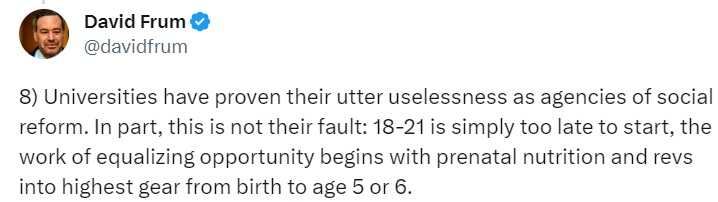
I decided to write about this topic because of the video, but also after seeing this tweet from David Frum, in which he correctly observes that it makes little sense to advocate racial preferences for college admissions while ignoring the fact that minority kids have fallen way behind by the time they are thinking about college.

I’m sure David is right about the importance of a good home environment, but it’s also important to offer minority kids better K-12 schools.

Marc Thiessen shares this concern and, in hisWashington Post column, specifically recommends school choice to help narrow the achievement gap.

But while racial preferences were the wrong solution, the underlying problem is real: We have horrific racial disparities in elementary and secondary education in this country that make it harder for poor Black and Hispanic students to gain admission to, and succeed in, college. And that is because millions are trapped in failing public schools that do not prepare them for college, much less for life — and because their parents do not have the same choices as affluent White parents do to send them to good schools. …Instead of trying to help kids at the end of the process by lowering admissions standards, we should be helping them at the start of the process by giving them access to better schools… Fortunately, conservatives have…been…taking affirmative action of their own to help these kids — passing school choice laws across the country that address the systematic discrimination in our public schools.

By the way, there is already plenty of academic evidence that school choice leads to better academic outcome…and more racial integration.

By contrast, there’s also plenty of evidence that government school do a terrible job with minority students.

Thiessen’s column has some of the grim data.

The state of education for poor minority students in the United States is a disgrace. An analysis of 2021-22 data by Fox News’s Project Baltimore found that 93 percent of students in Baltimore public schools could not do math at grade level, including 23 schools where not a single student could do so. In Illinois, data showed 53 schools — most of them in Chicago — where not a single student could do math at grade level, and 30 where not a single student can read at grade level. In Minnesota, there were 19 schools where not one student could do math at grade level — half of them in Minneapolis-St. Paul — while half of all students in the public school system could not read at grade level. There is simply no excuse for keeping kids trapped in schools like these. …Blame for this debacle lies in large part with teachers’ unions.

Yes, teacher unions deserve much of the blame. But let’s not overlook the role of politicians (including some Republicans) who have made horrible and immoral decisions to put the interests of teacher unions above the interests of poor children.


The School Choice Momentum Continues Nationwide

Jason Bedrick  @JasonBedrick / May 01, 2023

Parent holds protest sign at school protest.

Man protesting in front of the Minnesota Department of Education to stop the masking and vaccines for the children going to school, St. Paul, Minnesota. November 3, 2021. (Photo: Michael Siluk/Universal Images Group/Getty Images)

COMMENTARY BY

Jason Bedrick@JasonBedrick

Jason Bedrick is a research fellow with The Heritage Foundation’s Center for Education Policy.

Education choice is on the march.

So far this year, four states have enacted education choice policies that will be available to all K-12 students. ArkansasFloridaIowa, and Utah have now joined Arizona and West Virginia in making every child eligible for education savings accounts (ESAs) or ESA-like policies that allow families to choose the learning environments that align with their values and work best for their children.

The education choice movement has already made more progress this year than ever before—and the year is far from over. Late last week, three state legislatures gave final approval to bills that would create new education choice policies or significantly expand existing ones.

States With Newly Passed Bills

Indiana

The final budget deal struck by the Republican majorities in both chambers of the Indiana state legislature will expand eligibility for the state’s school voucher program to nearly every K-12 student.

The bill increases the income eligibility threshold from 300% of the free-and-reduced-price lunch program’s income limit to 400%, which means that more than 95% of K-12 students in Indiana will now be eligible.

The budget will also expand eligibility for Indiana’s two other education choice programs, a tax-credit scholarship and an education savings account policy. Gov. Eric Holcomb, a Republican, said that he would “gladly sign” the budget, which passed along party lines.

Montana

The Montana legislature sent the Students with Special Needs Equal Opportunity Act to Republican Gov. Greg Gianforte’s desk. The bill would create an ESA for students with special needs worth between $5,000 and $8,000.

“Every parent knows each child is unique,” said Gianforte  during his State of the State address in February, “Let’s ensure each child’s education best meets his or her individual needs.”

Gianforte is expected to sign the bill.

South Carolina

The South Carolina legislature sent Republican Gov. Henry McMaster a bill to create the Education Scholarship Trust Fund, which will make ESAs available to low- and middle-income families.

By year three, families earning up to 400% of the federal poverty line (currently $120,000 for a family of four) will be eligible for ESAs worth up to $6,000 that they can use for a wide variety of education expenses, including private school tuition, tutoring, textbooks, homeschool curriculum, online learning, and more. McMaster is expected to sign the legislation.

“It gives the parent an option,” said the bill’s sponsor, Republican Sen. Larry Grooms, “It lets the parent decide what is best for their child instead of the government deciding what is best for a child based on the zip code in which you happen to live.”

States Where Progress Is Being Made

Several other states are also making progress toward enacting new education choice policies or significantly expanding existing ones, including:

Nebraska

Earlier this month, Nebraska’s unicameral legislature passed a bill to create a tax credit scholarship policy by a vote of 33-16.

The bill will need to clear one additional legislative hurdle before heading to the desk of Gov. Jim Pillen, a Republican, who said that the Opportunity Scholarships Act would “give parents, who have kids with the greatest needs, the means to choose a school that serves them best and allows them to thrive.”

New Hampshire

The New Hampshire House of Representatives passed a bill raising the income eligibility threshold for the state’s Education Freedom Accounts from 300% of the federal poverty line to 350%.

The bill is expected to pass the state senate and has the support of Republican Gov. Chris Sununu, who declared in his state of the state address in February that the accounts are “finally ensuring that the system works for families and that the system meets the needs of the child — not the other way around.”

North Carolina

On Wednesday, the North Carolina Senate Education Committee passed a bill that would expand the state’s ESA policy to all K-12 students.

“This legislation is about kids first, about families being able to make the best decisions for their child,” declared the bill’s primary sponsor, Rep. Tricia Cotham, who recently switched her party registration from Democrat to Republican.

Democratic Gov. Roy Cooper has threated to veto the ESA bill, but all of the North Carolina General Assembly’s Republicans have signed onto the bill—enough to override a veto.

If enacted, North Carolina would become the seventh state to make education choice available to the families of all K-12 students.

Oklahoma

After months of negotiations, amendments, and not infrequent recriminations, on Wednesday the Oklahoma House of Representatives passedRepublican Gov. Kevin Stitt’s compromise education plan.

The plan includes a refundable personal-use tax credit worth $5,000 per student in the first year, with priority going to families earning less than $250,000 per year.

A total of up to $200 million in tax credits would be available. By year thee, the tax credits would be worth $6,500 per pupil and the caps on income and total tax credits available would be eliminated. As a part of the deal, the state would spend about $600 million more on public schools, including funds earmarked for teacher pay raises.

Once again, the Oklahoma Senate responded with their own plan. On Thursday, the senate passed a similar proposal that would give larger tax credits (up to $7,500) to lower-income families, which are reduced as income rises to $5,000 per pupil, with a household income cap of $250,000.

In an effort to pressure the legislature to reach a compromise, Stitt has vetoed 20 unrelated bills. In a veto message, Stitt explained his reasoning:

[U]ntil the people of Oklahoma have a tax cut, until every teacher in the state gets the pay raise they deserve, until parents get a tax credit to send their child to the school of their choice, I am vetoing this unrelated policy and will continue to veto any and all legislation authored by Senators who have not stood with the people of Oklahoma and supported this plan.

The Conservative Case Is the Way to Win

The massive wins and tremendous momentum are a vindication of a key shift in advocacy strategy.

Previously, the school choice movement almost exclusively made its case in terms that appealed to libertarians (freedom, markets, competition, etc.) or liberals (equity, expanding opportunity for the most disadvantaged, etc.), but avoided making values-based arguments that appealed to conservatives out of a fear of alienating potential allies on the left.

However, the teachers’ unions’ lock on the Democratic party prevented the school choice movement from garnering meaningful support from Democratic legislators. In years past, Democratic support for choice legislation has rarely been decisive. Moreover, attempting to appeal to the Democrats came at a significant policy cost as it often entailed proposing relatively small school choice programs targeted toward low-income families or other disadvantaged groups.

Meanwhile, the school choice movement was not doing enough to appeal to conservative rural Republicans who were skeptical of school choice. As my colleague Jay P. Greene and I observed recently in National Review, “the best prospects for additional universal programs this year are all in states with Republican governors and legislatures.”

As we explained, the school choice movement could not afford to continue ignoring conservatives:

The main opposition to these programs in Republican-dominated states has come from rural superintendents, who remind their representatives that the local public school is often the largest employer in small towns. They threaten that anything that undermines the biggest industry in their district is politically dangerous for rural legislators.

The solution to this political challenge is to help inform and organize families in suburban and rural areas who are concerned about the kinds of values their children are being taught in public schools. Radical academic content and school practices are not confined to large urban school districts on the coasts. Even in small towns across America’s heartland, public-school staffs have become emboldened to impose values on students that are strongly at odds with those preferred by parents.

Highlighting the ways in which public schools are pushing values and ideas that are anathema to the median red-state parent has increased public support for policies that allow all families to choose the learning environments that align with their values and have public education funding follow their child.

The greater GOP voter intensity in support of education choice has translated into the most massive wave of choice victories ever.

As in years past, nearly all the bills passed in any legislative chamber this year have been with strong Republican support and few if any Democrats. The difference is that there is now sufficient Republican support to pass robust education choice legislation.

Have an opinion about this article? To sound off, please email letters@DailySignal.com and we’ll consider publishing your edited remarks in our regular “We Hear You” feature. Remember to include the url or headline of the article plus your name and town and/or state.

A Good Year for Milton Friedman = a Bad Year for Teacher Unions

Back in 2013, I shared some research showing how school choice produced good results. Not just in terms of student achievement, but also benefits for taxpayers as well.

Since then, I’ve shared additional research showing how school choice generates good outcomes.

It seems that some lawmakers have learned the right lessons from these studies. Over the past three years, statewide school choice has been enacted in West VirginiaArizonaIowaUtahArkansas, and Florida.

In his Wall Street Journal column, Bill McGurn celebrates this wave of victories.

It’s been a good year for Milton Friedman. The Nobel Prize-winning economist has been dead for nearly two decades. But the moment has come for the idea that may prove his greatest legacy: Parents should decide where the public funds for educating their children go. Already this year, four states have adopted school choice for everyone—and it’s only April.…Florida is the most populous state to embrace full school choice. It follows Iowa, Utah and Arkansas, which passed their own legislation this year. These were preceded by West Virginia in 2021 and Arizona in 2022. More may be coming. Four other states—Oklahoma, Ohio, Wyoming and Texas—have legislation pending. …Corey DeAngelis, a senior fellow with the American Federation for Children, says the mood has shifted. …“I wish Milton Friedman were alive today to see his ideas finally come to fruition,” Mr. DeAngelis says. “The dominos are falling and there’s nothing Randi Weingarten and the teachers unions can do about it.”

My fingers are crossed that Texas approves school choice in the few days, but rest assured I’ll celebrate if Oklahoma, Ohio, or Wyoming is the next domino.

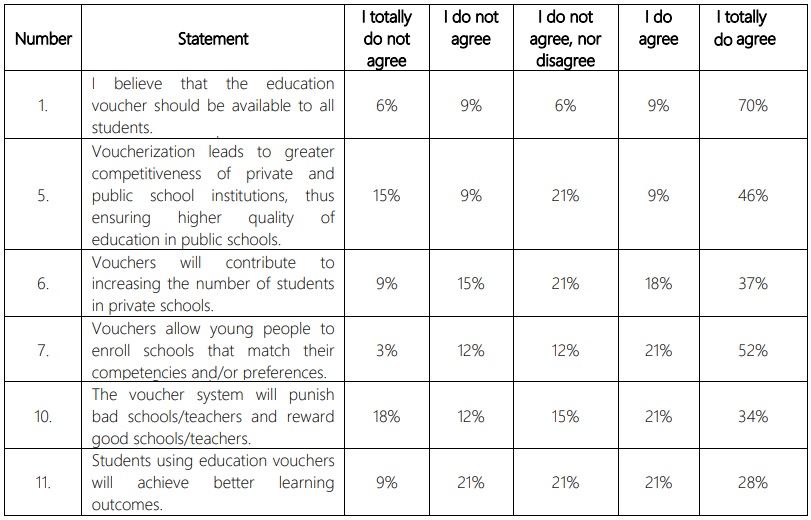
P.S. I’m writing today about school choice in part because I’m in Europe as part of the Free Market Road Show and one of the other speakers is Admir Čavalić, who is both an academic and a member of parliament from Bosnia and Herzegovina. Along with two other scholars, Damir Bećirović, and Amela Bešlagić, he did research on support for school choice in the Balkans. Here are some of the responses from parents.

It’s very encouraging to find Serbs, Croats, and Bosnians agreeing on an issue. Maybe their governments eventually will adopt school choice, thus joining  SwedenChileCanada, and the Netherlands.

A Major Victory for Students in Florida

I almost feel sorry for the union bosses at the National Education Association and the American Federation of Teachers.

They were upset when West Virginia adopted statewide school choice in 2021 and they got even angrier when Arizona did the same thing in 2022.

So you can only imagine how bitter they are about what’s happened so far in 2023.

But notice I started this column by stating that “I almost felt sorry” for union bosses.

In reality, I’m actually overjoyed that they are having a very bad year. Teacher unions are the leading political force in trying to keep kids trapped in bad schools, an approach that is especially harmful to minorities.

Their bad year just got much worse.

That’s because Florida just expanded its school choice program so that all children will be eligible.

Here’s some of the coverage from Tampa.

A massive expansion of Florida’s school-choice programs that would make all students eligible for taxpayer-backed vouchers is headed to Gov. Ron DeSantis… DeSantis already has pledged to sign the proposal, which includes removing income-eligibility requirements that are part of current voucher programs. …Under the bill, students would be eligible to receive vouchers if they are “a resident of this state” and “eligible to enroll in kindergarten through grade 12” in a public school.

And here’s a report from Orlando.

The Florida Senate gave final approval Thursday to a bill creating universal school vouchers… Republican state lawmakers, who hold a supermajority in the Legislature, want to open state voucher programsthat currently provide scholarships to more than 252,000 children with disabilities or from low-income families to all of the 2.9 million school-age children in Florida… The bill would give any parent the choice to receive a voucher for their child to be used for private school tuition or homeschooling services and supplies — as long as that student was not enrolled in public school. DeSantis has been a supporter of the programs.

Let’s conclude with some excerpts from a Wall Street Journal editorial.

Florida has long been a leader on K-12 choice, vying with Arizona to offer the most expansive options in the nation. On Thursday Florida caught up with Arizona’s universal education savings account program by making its existing school choice offerings available to any student in the state.…The legislation…would remove income eligibility limits on the state’s current school voucher programs. It would also expand the eligible uses for the roughly $7,500 accounts to include tutoring, instructional materials and other education expenses, making these true ESAs rather than simply tuition vouchers. The bill prioritizes lower-income families and provides for home-schooled students to receive funds. Gov. Ron DeSantis, who has greatly advanced school choice in his state, is expected to sign.

By the way, the WSJ notes that Georgia may fall short in the battle to give families better educational options. As a rabid Georgia Bulldog who likes nothing better than stomping on the Florida Gators, it galls me that a handful of bad Republican legislators in the Peach State are standing in the proverbial schoolhouse door.

I’ll close by noting that there already are many reasons for Americans to migrate to Florida, such as no state income tax.

School choice means that there will be another big reason to move to the libertarian-friendly Sunshine State.

P.S. I can’t wait to see what this map looks like next year.

Milton Friedman – Educational Vouchers

Censorship, School Libraries, Democracy, and Choice

A big advantage of living in a constitutional republicis that individual rights are protected from “tyranny of the majority.”

  • Assuming courts are doing their job, it doesn’t matterif 90 percent of voters support restrictions on free speech.
  • Assuming courts are doing their job, it doesn’t matter if 90 percent of voters support gun confiscation.
  • Assuming courts are doing their job, it doesn’t matter if 90 percent of voters support warrantless searches.

That being said, a constitutional republic is a democratic form of government. And if government is staying within proper boundaries, political decisions should be based on majority rule, as expressed through elections.

In some cases, that will lead to decisions I don’t like. For instance, the (tragic) 16th Amendment gives the federal government the authority to impose an income tax and voters repeatedly have elected politicians who have opted to exercise that authority.

Needless to say, I will continue my efforts to educate voters and lawmakers in hopes that eventually there will be majorities that choose a different approach. That’s how things should work in a properly functioning democracy.

But not everyone agrees.

report in the New York Times, authored by Elizabeth Harris and Alexandra Alter, discusses the controversy over which books should be in the libraries of government schools.

The Keller Independent School District, just outside of Dallas, passed a new rule in November: It banned books from its libraries that include the concept of gender fluidity. …recently, the issue has been supercharged by a rapidly growing and increasingly influential constellation of conservative groups.The organizations frequently describe themselves as defending parental rights. …“This is not about banning books, it’s about protecting the innocence of our children,” said Keith Flaugh, one of the founders of Florida Citizens Alliance, a conservative group focused on education… The restrictions, said Emerson Sykes, a First Amendment litigator for the American Civil Liberties Union, infringe on students’ “right to access a broad range of material without political censorship.” …In Florida, parents who oppose book banning formed the Freedom to Read Project.

As indicated by the excerpt, some people are very sloppy with language.

If a school decides not to buy a certain book for its library, that is not a “book ban.” Censorship only exists when the government uses coercion to prevent people from buying books with their own money.

As I wrote earlier this year, “The fight is not over which books to ban. It’s about which books to buy.”

And this brings us back to the issue of democracy.

School libraries obviously don’t have the space or funds to stock every book ever published, so somebody has to make choices. And voters have the ultimate power to make those choices since they elect school boards.

I’ll close by noting that democracy does not please everyone. Left-leaning parents in Alabama probably don’t always like the decisions of their school boards,just like right-leaning parents in Vermont presumably don’t always like the decisions of their school boards.

And the same thing happens with other contentious issues, such as teaching critical race theory.

Which is why school choice is the best outcome. Then, regardless of ideology, parents can choose schools that have the curriculum (and books) that they think will be best for their children.

P.S. If you want to peruse a genuine example of censorship, click here.


More Academic Evidence for School Choice

Since teacher unions care more about lining their pockets and protecting their privileges rather than improving education, I’ll never feel any empathy for bosses like Randi Weingarten.

That being said, the past couple of years have been bad news for Ms Weingarten and her cronies.

Not only is school choice spreading – especially in states such as Arizona and West Virginia, but we also are getting more and more evidence that competition produces better results for schoolkids.

In a study published by the National Bureau of Economic Research, Professors David N. Figlio, Cassandra M.D. Hart & Krzysztof Karbownikfound that school choice led to benefits even for kids who remained stuck in government schools.

They enjoyed better academic outcomes, which is somewhat surprising, but even I was pleasantly shocked to see improved behavioral outcomes as well.

School choice programs have been growing in the United States and worldwide over the past two decades, and thus there is considerable interest in how these policies affect students remaining in public schools. …the evidence on the effects of these programs as they scale up is virtually non-existent. Here, we investigate this question using data from the state of Florida where, over the course of our sample period, the voucher program participation increased nearly seven-fold.We find consistent evidence that as the program grows in size, students in public schools that faced higher competitive pressure levels see greater gains from the program expansion than do those in locations with less competitive pressure. Importantly, we find that these positive externalities extend to behavioral outcomes— absenteeism and suspensions—that have not been well-explored in prior literature on school choice from either voucher or charter programs. Our preferred competition measure, the Competitive Pressure Index, produces estimates implying that a 10 percent increase in the number of students participating in the voucher program increases test scores by 0.3 to 0.7 percent of a standard deviation and reduces behavioral problems by 0.6 to 0.9 percent. …Finally, we find that public school students who are most positively affected come from comparatively lower socioeconomic background, which is the set of students that schools should be most concerned about losing under the Florida Tax Credit Scholarship program.

It’s good news that competition from the private sector produces better results in government schools.

But it’s great news that those from disadvantaged backgrounds disproportionately benefit when there is more school choice.

Wonkier readers will enjoy Figure A2, which shows the benefits to regular kids on the right and disadvantaged kids on the left.

Since the study looked at results in Florida, I’ll close by observing that Florida is ranked #1 for education freedom and ranked #3 for school choice.

P.S. Here’s a video explaining the benefits of school choice.

P.P.S. There’s international evidence from SwedenChileCanada, and the Netherlands, all of which shows superior results when competition replaces government education monopolies.

———-

Portrait of Milton Friedman.jpg

Milton Friedman chose the emphasis on school choice and school vouchers as his greatest legacy and hopefully the Supreme Court will help that dream see a chance!

Educational Choice, the Supreme Court, and a Level Playing Field for Religious Schools

The case for school choice is very straightforward.

The good news is that there was a lot of pro-choice reform in 2021.

West Virginia adopted a statewide system that is based on parental choice. And many other states expanded choice-based programs.

But 2022 may be a good year as well. That’s because the Supreme Court is considering whether to strike down state laws that restrict choice by discriminating against religious schools.

Michael Bindas of the Institute for Justice and Walter Womack of the Southern Christian Leadership Conference make the case for a level playing field in a column for the New York Times.

In 2002, the Supreme Court held that the Constitution allows school choice programs to include schools that provide religious instruction, so long as the voucher program also offers secular options. The question now before the court is whether a state may nevertheless exclude schools that provide religious instruction. The case, Carson v. Makin, …concerns Maine’s tuition assistance program. In that large and sparsely populated state, over half of the school districts have no public high schools. If a student lives in such a district, and it does not contract with another high school to educate its students, then the district must pay tuition for the student to attend the school of her or his parents’ choice. …But one type of school is off limits: a school that provides religious instruction. That may seem unconstitutional, and we argue that it is. Only last year, the Supreme Court, citing the free exercise clause of the Constitution, held that states cannot bar students in a school choice program from selecting religious schools when it allows them to choose other private schools. …The outcome will be enormously consequential for families in public schools that are failing them and will go a long way toward determining whether the most disadvantaged families can exercise the same control over the education of their children as wealthier citizens.

The Wall Street Journal editorialized on this issue earlier this week.

Maine has one of the country’s oldest educational choice systems, a tuition program for students who live in areas that don’t run schools of their own. Instead these families get to pick a school, and public funds go toward enrollment. Religious schools are excluded, however, and on Wednesday the Supreme Court will hear from parents who have closely read the First Amendment.…Maine argues it isn’t denying funds based on the religious “status” of any school… The state claims, rather, that it is merely refusing to allocate money for a “religious use,” specifically, “an education designed to proselytize and inculcate children with a particular faith.” In practice, this distinction between “status” and “use” falls apart. Think about it: Maine is happy to fund tuition at an evangelical school, as long as nothing evangelical is taught. Hmmm. …A state can’t subsidize tuition only for private schools with government-approved values, and trying to define the product as “secular education” gives away the game. …America’s Founders knew what they were doing when they wrote the First Amendment to protect religious “free exercise.”

What does the other side say?

Rachel Laser, head of Americans United for Separation of Church and State, doesn’t want religious schools to be treated equally under school choice programs.

Here’s some of her column in the Washington Post.

…two sets of parents in Maine claim that the Constitution’s promise of religious freedom actually requires the state to fund religious education at private schools with taxpayer dollars — as a substitute for public education. This interpretation flips the meaning of religious freedom on its head and threatens both true religious freedom and public education.…The problem here is even bigger than public funds paying for praying, as wrong as that is. Unlike public schools, private religious schools often do not honor civil rights protections, especially for LGBTQ people, women, students with disabilities, religious minorities and the nonreligious. …If the court were to agree with the parents, it would also be rejecting the will of three-quarters of the states, which long ago enacted clauses in their state constitutions and passed statutes specifically prohibiting public funding of religious education. …It is up to parents and religious communities to educate their children in their faith. Publicly funded schools should never serve that purpose.

These arguments are not persuasive.

The fact that many state constitutions include so-called Blaine amendments actually undermines her argument since those provisions were motivated by a desire to discriminate against parochial schools that provided education to Catholic immigrants.

And it’s definitely not clear why school choice shouldn’t include religious schools that follow religious teachings, unless she also wants to argue that student grants and loans shouldn’t go to students at Notre Dame, Brigham Young, Liberty, and other religiously affiliated colleges.

The good news is that Ms. Laser’s arguments don’t seem to be winning. Based on this report from yesterday’s Washington Post, authored by Robert Barnes, there are reasons to believe the Justices will make the right decision.

Conservatives on the Supreme Court seemed…critical of a Maine tuition program that does not allow public funds to go to schools that promote religious instruction. The case involves an unusual program in a small state that affects only a few thousand students. But it could have greater implications… The oral argument went on for nearly two hours and featured an array of hypotheticals. …But the session ended as most suspected it would, with the three liberal justices expressing support for Maine and the six conservatives skeptical that it protected religious parents from unconstitutional discrimination.

I can’t resist sharing this additional excerpt about President Biden deciding to side with teacher unions instead of students.

The Justice Department switched its position in the case after President Biden was inaugurated and now supports Maine.

But let’s not dwell on Biden’s hackery (especially since that’s a common affliction on the left).

Instead, let’s close with some uplifting thoughts about what might happen if we get a good decision from the Supreme Court when decisions are announced next year.

Maybe I’m overly optimistic, but I think we’re getting close to a tipping point. As more and more states and communities shift to choice, we will have more and more evidence that it’s a win-win for both families and taxpayers.

Which will lead to more choice programs, which will produce more helpful data.

Lather, rinse, repeat. No wonder the (hypocriticalteacher unionsare so desperate to stop progress.

P.S. There’s strong evidence for school choice from nations such as SwedenChile, and the Netherlands.

Free To Choose 1980 – Vol. 06 What’s Wrong with Our Schools? – Full Video
https://youtu.be/tA9jALkw9_Q


Why Milton Friedman Saw School Choice as a First Step, Not a Final One

On his birthday, let’s celebrate Milton Friedman’s vision of enabling parents, not government, to be in control of a child’s education.

Wednesday, July 31, 2019
Kerry McDonald
Kerry McDonald

EducationMilton FriedmanSchool ChoiceSchooling

Libertarians and others are often torn about school choice. They may wish to see the government schooling monopoly weakened, but they may resist supporting choice mechanisms, like vouchers and education savings accounts, because they don’t go far enough. Indeed, most current choice programs continue to rely on taxpayer funding of education and don’t address the underlying compulsory nature of elementary and secondary schooling.

Skeptics may also have legitimate fears that taxpayer-funded education choice programs will lead to over-regulation of previously independent and parochial schooling options, making all schooling mirror compulsory mass schooling, with no substantive variation.

Milton Friedman had these same concerns. The Nobel prize-winning economist is widely considered to be the one to popularize the idea of vouchers and school choice beginning with his 1955 paper, “The Role of Government in Education.” His vision continues to be realized through the important work of EdChoice, formerly the Friedman Foundation for Education Choice, that Friedman and his economist wife, Rose, founded in 1996.

July 31 is Milton Friedman’s birthday. He died in 2006 at the age of 94, but his ideas continue to have an impact, particularly in education policy.

Friedman saw vouchers and other choice programs as half-measures. He recognized the larger problems of taxpayer funding and compulsion, but saw vouchers as an important starting point in allowing parents to regain control of their children’s education. In their popular book, Free To Choose, first published in 1980, the Friedmans wrote:

We regard the voucher plan as a partial solution because it affects neither the financing of schooling nor the compulsory attendance laws. We favor going much farther. (p.161)

They continued:

The compulsory attendance laws are the justification for government control over the standards of private schools. But it is far from clear that there is any justification for the compulsory attendance laws themselves. (p. 162)

The Friedmans admitted that their “own views on this have changed over time,” as they realized that “compulsory attendance at schools is not necessary to achieve that minimum standard of literacy and knowledge,” and that “schooling was well-nigh universal in the United States before either compulsory attendance or government financing of schooling existed. Like most laws, compulsory attendance laws have costs as well as benefits. We no longer believe the benefits justify the costs.” (pp. 162-3)

Still, they felt that vouchers would be the essential starting point toward chipping away at monopoly mass schooling by putting parents back in charge. School choice, in other words, would be a necessary but not sufficient policy approach toward addressing the underlying issue of government control of education.

In their book, the Friedmans presented the potential outcomes of their proposed voucher plan, which would give parents access to some or all of the average per-pupil expenditures of a child enrolled in public school. They believed that vouchers would help create a more competitive education market, encouraging education entrepreneurship. They felt that parents would be more empowered with greater control over their children’s education and have a stronger desire to contribute some of their own money toward education. They asserted that in many places “the public school has fostered residential stratification, by tying the kind and cost of schooling to residential location” and suggested that voucher programs would lead to increased integration and heterogeneity. (pp. 166-7)

To the critics who said, and still say, that school choice programs would destroy the public schools, the Friedmans replied that these critics fail to

explain why, if the public school system is doing such a splendid job, it needs to fear competition from nongovernmental, competitive schools or, if it isn’t, why anyone should object to its “destruction.” (p. 170)

What I appreciate most about the Friedmans discussion of vouchers and the promise of school choice is their unrelenting support of parents. They believed that parents, not government bureaucrats and intellectuals, know what is best for their children’s education and well-being and are fully capable of choosing wisely for their children—when they have the opportunity to do so.

They wrote:

Parents generally have both greater interest in their children’s schooling and more intimate knowledge of their capacities and needs than anyone else. Social reformers, and educational reformers in particular, often self-righteously take for granted that parents, especially those who are poor and have little education themselves, have little interest in their children’s education and no competence to choose for them. That is a gratuitous insult. Such parents have frequently had limited opportunity to choose. However, U.S. history has demonstrated that, given the opportunity, they have often been willing to sacrifice a great deal, and have done so wisely, for their children’s welfare. (p. 160).

Sign-Up: Receive Kerry’s Weekly Parenting and Education Newsletter!

Today, school voucher programs exist in 15 states plus the District of Columbia. These programs have consistently shown that when parents are given the choice to opt-out of an assigned district school, many will take advantage of the opportunity. In Washington, D.C., low-income parents who win a voucher lottery send their children to private schools.

The most recent three-year federal evaluationof voucher program participants found that while student academic achievement was comparable to achievement for non-voucher students remaining in public schools, there were statistically significant improvements in other important areas. For instance, voucher participants had lower rates of chronic absenteeism than the control groups, as well as higher student satisfaction scores. There were also tremendous cost-savings.

In Wisconsin, the Milwaukee Parental Choice Program has served over 28,000 low-income students attending 129 participating private schools.

According to Corey DeAngelis, Director of School Choice at the Reason Foundation and a prolific researcher on the topic, the recent analysis of the D.C. voucher program “reveals that private schools produce the same academic outcomes for only a third of the cost of the public schools. In other words, school choice is a great investment.”

In Wisconsin, the Milwaukee Parental Choice Program was created in 1990 and is the nation’s oldest voucher program. It currently serves over 28,000 low-income students attending 129 participating private schools. Like the D.C. voucher program, data on test scores of Milwaukee voucher students show similar results to public school students, but non-academic results are promising.

Recent research found voucher recipients had lower crime rates and lower incidences of unplanned pregnancies in young adulthood. On his birthday, let’s celebrate Milton Friedman’s vision of enabling parents, not government, to be in control of a child’s education.

According to Howard Fuller, an education professor at Marquette University, founder of the Black Alliance for Educational Options, and one of the developers of the Milwaukee voucher program, the key is parent empowerment—particularly for low-income minority families.

In an interview with NPR, Fuller said: “What I’m saying to you is that there are thousands of black children whose lives are much better today because of the Milwaukee parental choice program,” he says. 
“They were able to access better schools than they would have without a voucher.”

Putting parents back in charge of their child’s education through school choice measures was Milton Friedman’s goal. It was not his ultimate goal, as it would not fully address the funding and compulsion components of government schooling; but it was, and remains, an important first step. As the Friedmans wrote in Free To Choose:

The strong American tradition of voluntary action has provided many excellent examples that demonstrate what can be done when parents have greater choice. (p. 159).

On his birthday, let’s celebrate Milton Friedman’s vision of enabling parents, not government, to be in control of a child’s education.

Kerry McDonald

Milton Friedman

Related posts:


“Friedman Friday” (“Free to Choose” episode 1 – Power of the Market. part 7 of 7)

March 16, 2012 – 12:25 am

  Michael Harrington:  If you don’t have the expertise, the knowledge technology today, you’re out of the debate. And I think that we have to democratize information and government as well as the economy and society. FRIEDMAN: I am sorry to say Michael Harrington’s solution is not a solution to it. He wants minority rule, I […] By Everette Hatcher III | Posted in Current Events, Milton Friedman | Edit | Comments (0)

“Friedman Friday” (“Free to Choose” episode 1 – Power of the Market. part 6 of 7)

March 9, 2012 – 12:29 am

PETERSON: Well, let me ask you how you would cope with this problem, Dr. Friedman. The people decided that they wanted cool air, and there was tremendous need, and so we built a huge industry, the air conditioning industry, hundreds of thousands of jobs, tremendous earnings opportunities and nearly all of us now have air […] By Everette Hatcher III | Posted in Current Events, Milton Friedman | Edit | Comments (0)

“Friedman Friday” (“Free to Choose” episode 1 – Power of the Market. part 5 of 7)

March 2, 2012 – 12:26 am

Part 5 Milton Friedman: I do not believe it’s proper to put the situation in terms of industrialist versus government. On the contrary, one of the reasons why I am in favor of less government is because when you have more government industrialists take it over, and the two together form a coalition against the ordinary […] By Everette Hatcher III | Posted in Current Events, Milton Friedman | Edit | Comments (0)

“Friedman Friday” (“Free to Choose” episode 1 – Power of the Market. part 4 of 7)

February 24, 2012 – 12:21 am

The fundamental principal of the free society is voluntary cooperation. The economic market, buying and selling, is one example. But it’s only one example. Voluntary cooperation is far broader than that. To take an example that at first sight seems about as far away as you can get __ the language we speak; the words […] By Everette Hatcher III | Posted in Current Events, Milton Friedman | Edit | Comments (0)

“Friedman Friday” (“Free to Choose” episode 1 – Power of the Market. part 3 of 7)

February 17, 2012 – 12:12 am

  _________________________   Pt3  Nowadays there’s a considerable amount of traffic at this border. People cross a little more freely than they use to. Many people from Hong Kong trade in China and the market has helped bring the two countries closer together, but the barriers between them are still very real. On this side […] By Everette Hatcher III | Posted in Current Events, Milton Friedman | Edit | Comments (0)

“Friedman Friday” (“Free to Choose” episode 1 – Power of the Market. part 2 of 7)

February 10, 2012 – 12:09 am

  Aside from its harbor, the only other important resource of Hong Kong is people __ over 4_ million of them. Like America a century ago, Hong Kong in the past few decades has been a haven for people who sought the freedom to make the most of their own abilities. Many of them are […] By Everette Hatcher III | Posted in Current Events, Milton Friedman | Edit | Comments (0)

“Friedman Friday” (“Free to Choose” episode 1 – Power of the Market. part 1of 7)

February 3, 2012 – 12:07 am

“FREE TO CHOOSE” 1: The Power of the Market (Milton Friedman) Free to Choose ^ | 1980 | Milton Friedman Posted on Monday, July 17, 2006 4:20:46 PM by Choose Ye This Day FREE TO CHOOSE: The Power of the Market Friedman: Once all of this was a swamp, covered with forest. The Canarce Indians […]

Milton Friedman The Power of the Market 1-5

Debate on Milton Friedman’s cure for inflation

September 29, 2011 – 7:24 am

If you would like to see the first three episodes on inflation in Milton Friedman’s film series “Free to Choose” then go to a previous post I did. Ep. 9 – How to Cure Inflation [4/7]. Milton Friedman’s Free to Choose (1980) Uploaded by investbligurucom on Jun 16, 2010 While many people have a fairly […]

By Everette Hatcher III | Also posted in Current Events | Tagged dr friedman, expansion history, income tax brackets, political courage, www youtube | Edit | Comments (0)

“Friedman Friday” Milton Friedman believed in liberty (Interview by Charlie Rose of Milton Friedman part 1)

April 19, 2013 – 1:14 am

Charlie Rose interview of Milton Friedman My favorite economist: Milton Friedman : A Great Champion of Liberty  by V. Sundaram   Milton Friedman, the Nobel Prize-winning economist who advocated an unfettered free market and had the ear of three US Presidents – Nixon, Ford and Reagan – died last Thursday (16 November, 2006 ) in San Francisco […] By Everette Hatcher III | Posted in Milton Friedman | Edit | Comments (0)

What were the main proposals of Milton Friedman?

February 21, 2013 – 1:01 am

Stearns Speaks on House Floor in Support of Balanced Budget Amendment Uploaded by RepCliffStearns on Nov 18, 2011 Speaking on House floor in support of Balanced Budget Resolution, 11/18/2011 ___________ Below are some of the main proposals of Milton Friedman. I highly respected his work. David J. Theroux said this about Milton Friedman’s view concerning […] By Everette Hatcher III | Posted in Milton Friedman | Edit | Comments (0)

“Friedman Friday,” EPISODE “The Failure of Socialism” of Free to Choose in 1990 by Milton Friedman (Part 1)

December 7, 2012 – 5:55 am

Milton Friedman: Free To Choose – The Failure Of Socialism With Ronald Reagan (Full) Published on Mar 19, 2012 by NoNationalityNeeded Milton Friedman’s writings affected me greatly when I first discovered them and I wanted to share with you. We must not head down the path of socialism like Greece has done. Abstract: Ronald Reagan […] By Everette Hatcher III | Posted in Milton FriedmanPresident Obama | Edit | Comments (1)

Defending Milton Friedman

July 31, 2012 – 6:45 am

What a great defense of Milton Friedman!!!!   Defaming Milton Friedman by Johan Norberg This article appeared in Reason Online on September 26, 2008  PRINT PAGE  CITE THIS      Sans Serif      Serif Share with your friends: ShareThis In the future, if you tell a student or a journalist that you favor free markets and limited government, there is […]

Review of Oppenheimer plus FRANCIS SCHAEFFER QUOTES OPPENHEIMER Part 3 “Oppenheimer stressed the same thing: modern science could not have been born at all without a Christian milieu, a Christian consensus” Early modern scientists believed that God and man could operate into the machine and reorder the flow of cause and effect! (Passage from Francis Schaeffer THE CHURCH OF THE END OF THE TWENTIETH CENTURY “The Rise of Science”)

Oppenheimer’ First Reactions Praise Christopher Nolan’s ‘Most Impressive Work Yet’: A ‘Spectacular Achievement’ and ‘Total Knockout’

By Zack Sharf

https://39271fcf7da714e3ca4dee1cd2a1e275.safeframe.googlesyndication.com/safeframe/1-0-40/html/container.html?n=0

cillian murphy oppenheimer

Universal Pictures has finally unveiled Christopher Nolan’s atomic bomb epic “Oppenheimer” at a world premiere event in Paris. First reactions to the nearly three-hour drama are pouring in and are strong across the board, with the film being called a “spectacular achievement” and “audacious.”

Writing for The Los Angeles Times, former critic Kenneth Turan hailed “Oppenheimer” as “arguably Nolan’s most impressive work yet in the way it combines his acknowledged visual mastery with one of the deepest character dives in recent American cinema.”

Matt Maytum, deputy editor of Total Film, said Nolan’s latest left him “stunned,” adding, “[It’s] a character study on the grandest scale, with a sublime central performance by Cillian Murphy. An epic historical drama but with a distinctly Nolan sensibility: the tension, structure, sense of scale, startling sound design, remarkable visuals. Wow.”

Associated Press film writer Lindsey Bahr called the movie “a spectacular achievement in its truthful, concise adaptation, inventive storytelling and nuanced performances from Cillian Murphy, Emily Blunt, Robert Downey Jr., Matt Damon and the many, many others involved.”

On Science and Culture by J. Robert Oppenheimer, Encounter (Magazine) October 1962 issue, was the best article that he ever wrote and it touched on a lot of critical issues including the one that Francis Schaeffer discusses in this blog post!

Passage from Francis Schaeffer THE CHURCH OF THE END OF THE TWENTIETH CENTURY

Page 6 

THE RISE OF SCIENCE 

The birth of modern science is a good place to begin. Modern science arose out of a Christian mentality. Alfred North Whitehead, for example, emphasizes the fact that modern science was born because it was surrounded by a Christian frame of reference. Galileo, Copernicus, Francis Bacon, Kepler, and scientists up to and including Newton believed that the world was created by a reasonable God, and therefore we could find out the order of the universe by reason. 

Oppenheimer stressed the same thing: modern science could not have been born at all without a Christian milieu, a Christian consensus. As Francis Bacon ( 1561-1626 ) said in Novum Organum Scientiarum : ” Man by the Fall fell at the same time from his state of innocence and from his dominion over nature. Both of these losseshowevercan even in this life be in some part repaired; the former by religion and faith, the latter by the arts and sciences.” A few years ago I read something from Galileo which was very moving to me. Galileo stressed the fact that when he looked at the universe in all its richness and its beauty ( he did not mean merely aesthetic beauty , but its unity in the midst of its complexity). he was called to only one end–to worship the beauty of the Creator.

This was the birth of our modern thinking in the area of science , and it produced various results  It led, for example, to the certainty of the uniformity of natural causesThere was a uniformity of natural causesnot in a closed systembut in one that as open to reordering.  

Early modern scientists believed that God and man could operate into the machine and reorder the flow of cause and effect.

 This had a number of results . First , it meant that nature was important . Second , it implied a clear distinction between nature as the object and myself as the observer. There was an objective basis for knowledge–something out there–and there was, therefore, a clear distinction between reality and fantasy. 
The people who gave birth to modern science knew that God had created the universe , that it was there , not as Eastern thinking has it , as an extension of the essence of God, but as something other than God and as something other than what is spun out of the mind of man. Today the objective basis basis for knowledge has been undermined, and the distinction between reality and fantasy has become difficult—sometimes impossible~~to maintain. 

Page 7

Furthermore, as is obvious from the quotation above, Bacon believed that man was wonderful, even though he was fallen. He believed in the fall of man in the biblical sense—that man is a sinner shut away from God on the basis of his moral guilt. Nevertheless, man is wonderful. 

This is the very opposite of modern man. Modern man has been told that reason has led to the conclusion that man is a zero. This is a part of the tension of our present generation. It did not exist when modern science began. In those days, in other words, the machine was no threat—neither the machine of the cosmos, not the machines that man made. 

Page 10 

MODERN SCIENCE AND MODERN MODERN SCIENCE 

Later we come to the difference between modern science and what I call modern, modern science. Modern science was born, as I have indicated, from the Christian concept that man on the basis of reason could understand the universe because a God of reason had created it. Modern, modern science, however, extended the idea of the uniformity of natural causes by adding a new phrase — in a closed system. This little phrase changed all of life because it put everything within the machine . 

At first science dealt with physics, chemistry and astronomy. You could add a few more subjects perhaps, but there it ended. But later as psychology. was added and then social sciences, man himself was in the machine. 

If everything is put into the machine, of course there is no place for God. But also there is no place for man, no place for the significance of man, no place for beauty, for morals or for love. When you come to this place, you have a sea without a shore. Everything is dead. But the presupposition of the uniformity of natural causes in a closed system does not explain the two basic things that are before us: (1) the universe that exists and its form, and (2) the mannishness of man. 

As Sartre says, the basic philosophic question is that something is there rather than nothing being there. Einstein adds a note: when we examine the universe, we find that it is like a well-formulated word puzzle: namely, that you can suggest any word , but finally only one will fit. In other words, you not only have that is there that has to be explained, but it is a very special kind of a universe, a universe exceedingly complex and yet with a definite form. 

Modern man in his philosophy, his music and his art usually depicts a chaotic situation in the universe. But when you make a Boeing 707, it is beautiful. 

Why? Because it fits into the universe. The universe is not really the chaos that they picture. 
There is also the problem of the uniqueness of man . Over 60,000 years ago – if you accept modern dating – man buried his dead in flower petals. If we look at Chinese bronzes, though they are far separated from us in time and culture, we find they conform to ourselves. They were made by somebody else , but they are also a part of me . There is the mannishness of man . The cave paintings at 20,000-30,000 B.C. are even more 

illustrative. From these one can show that man has always felt himself to be different from non-man. 

Modern man says, “No, we are just machines — chemically determined or psychologically determined.” But nobody consistently lives this way in his life. I would insist that here is a presupposition which intellectually, in the laboratory, would be cast out simply because it does not explain what is.

On the other hand, the biblical position, which begins with a personal rather than an impersonal beginning, gives us a different answer. The real issue is to decide, with intellectual integrity, which set of presuppositions conforms to what is. But many of us catch our presuppositions like measles. Why do people fit into the post-Christian world? I would urge that it is not because of facts

, but because our present almost monolithic culture has forced upon us the other answer–namely, the uniformity of natural causes, not in an open system beginning with a personal God, the way the early scientists believed, but in a closed system. It is not that the facts are against the Christian presuppositions , but simply that the Christian view is presented as unthinkable . The better the 

the brainwashing tends to be.
The results of following the implications of modern man were clearly developed in the nineteenth century. Nobody has expressed it better than the Marquis de Sade, who was one of the early modern chemical determinists. De Sade’s position (and he lived by it) was that if you have determinism, then whatever is is right. You can say that things are nosocial. Or you can think the liberal theologian Paul Tillich’s concept of the demonic being a force for disintegration rather than for integration, but that is all you can say. You cannot say that anything is right or wrong. Morality is dead. Man is dead. 

Nietzsche is a key to this. He was the first man who cried, in the modern sense. “God is dead,” but he was brilliant enough to understand the results. If God is dead, then everything is gone. I believe that it was not just venereal disease in Switzerland which caused him to become insane. I believe that Nietzsche made a philosophic statement in his insanity. He understood that if God is dead, there are no answers to anything and insanity is the end. This is not too far philosophically from the modern Michael Foucault , for example , who says that the only freedom is in insanity .

If we do not begin with a personal Creator, eventually we are left (no matter how we string it out semantically) with the impersonal plus time plus chance. We must explain everything in the uniqueness of man, and we must understand all of the complexity of the universe on the basis of time plus chance.

The difficulty of explaining man and the universe on such a basis was recognized by Darwin himself. In his autobiography and in letters published by his son he wrote: “With my mind I cannot believe that these things come by chance.” He said this as an old man many times over. Twice he added a strange note to this effect: “I know in my mind this can’t be true, but my mind is only a monkey’s mind, and who can trust a mind like that?” On this basis, how could one accept any conclusions of the human mind, including Darwin’s theory?

More recently, Murray Eden at MIT used high-speed computers to ask a question: Beginning with chaos at any acceptable amount of time up to eight billion years ago, could the present complexity come by chance? The answer is absolutely No. 

But modern man does in fact assume — wittingly or unwittingly — that the universe and man can be explained by the impersonal plus time plus chance. And in this case man and his aspirations stand in total alienation from what is. And that is precisely where many people today live — in a generation of alienation: alienation in the ghettos, alienation in the university, alienation from parents, alienation on every side. Sometimes this takes the form of “dropping out,” sometimes it takes the form of “joining the system” to get along as easily as possible and to get as much from the system as possible. Those who are only playing with these ideas and have not gotten down into the real guts of it forget that the basic alienation with which they are faced is a cosmic alienation. It is simply this: there is nobody there to respond to you. There is nobody home in the universe. There is no one and nothing to conform to who you are or what you hope. That is the dilemma.

Let me use an illustration I have used previously. Suppose, for example, that the room in which you are seated is the only universe there is. God could have made a universe just this big if he wished. Suppose in making the only universe there were a room made up of solid walls, but filled up to the ceiling with liquids: just liquids and solids and no free gases. Suppose then that fish were swimming in the universe. The fish would not be alienated from the universe because they can conform to the universe by their nature. But suppose if by chance, as the evolutionists see chance, the fish suddenly developed lungs. Would they be higher or lower? Obviously, they would be lower, because they would drown. They would have a cosmic alienation from the universe that surrounded them.

But man has aspirations; he has what I call his mannishness. He desires that love be more than being in bed with a woman, that moral motions be more than merely sociological something-or-others, that his significance lie in being more than one more cog in a vast machine. He wants a relationship to society other than that of a small machine being manipulated by a big machine. On the basis of modern thought, however, all of these would simply be an illusion. And since there are aspirations which separate man from his impersonal universe, man then faces his being caught in a terrible, cosmic, final alienation. He drowns in cosmic alienation, for there is nothing in the universe to fulfill him. That is the position of modern man.

Beginning with rationalism, rationally you come only to pessimism. Man equals the machine. Man is dead. So those who followed Kierkegaard put forth the concept of an optimism in the area of nonrationality. Faith and optimism, they said, are always a leap. Neither has anything to do with reason.

Oppenheimer

OPPENHEIMER and EINSTEIN

Albert Einstein and Robert Oppenheimer, 1947: Flickr, James Vaughn

File:Francis Schaeffer.jpg

Francis Schaeffer above


Atomic Bombings of Hiroshima and Nagasaki – August 6 and 9, 1945


From left to right: Robertson, Wigner, Weyl, Gödel, Rabi, Einstein, Ladenburg, Oppenheimer, and Clemence

Related posts:

Atheists confronted: How I confronted Carl Sagan the year before he died jh47

May 19, 2011 – 10:30 am

In today’s news you will read about Kirk Cameron taking on the atheist Stephen Hawking over some recent assertions he made concerning the existence of heaven. Back in December of 1995 I had the opportunity to correspond with Carl Sagan about a year before his untimely death. Sarah Anne Hughes in her article,”Kirk Cameron criticizes […]

By Everette Hatcher III|Posted in Atheists Confronted|Edit|Comments (2)
My correspondence with George Wald and Antony Flew!!!

May 12, 2014 – 1:14 am

January 8, 2015 – 5:23 am

January 1, 2015 – 4:14 am

December 25, 2014 – 5:04 am

FRANCIS SCHAEFFER ANALYZES ART AND CULTURE Part 38 Woody Allen and Albert Camus “There is but one truly serious philosophical problem, and that is suicide” (Feature on artist Hamish Fulton Photographer )

December 18, 2014 – 4:30 am

FRANCIS SCHAEFFER ANALYZES ART AND CULTURE Part 37 Mahatma Gandhi and “Relieving the Tension in the East” (Feature on artist Luc Tuymans)

December 11, 2014 – 4:19 am

FRANCIS SCHAEFFER ANALYZES ART AND CULTURE Part 36 Julian Huxley:”God does not in fact exist, but act as if He does!” (Feature on artist Barry McGee)

December 4, 2014 – 4:10 am

Review of Oppenheimer plus FRANCIS SCHAEFFER QUOTES OPPENHEIMER Part 2 “Whitehead, Oppenheimer, and others have pointed out that modern science was born out of a surrounding consensus of historic Christianity”


Film Review – Oppenheimer

  • Melinda Sue Gordon/Universal Pictures
  • Jul 13, 2023

This image released by Universal Pictures shows Benny Safdie as Edward Teller, left, and Cillian Murphy as J. Robert Oppenheimer in a scene from “Oppenheimer.”Melinda Sue Gordon/Universal Pictures


Oppenheimer

OPPENHEIMER and EINSTEIN

On Science and Culture by J. Robert Oppenheimer, Encounter (Magazine) October 1962 issue, was the best article that he ever wrote and it touched on a lot of critical issues including the one that Francis Schaeffer discusses in this blog post!

Beginning of Chapter 4 of POLLUTION AND THE DEATH OF MAN:

The beginning of the Christian view of nature is the concept of creation: that God was there before the beginning of the space-time continuum and God created everything out of nothing. From this, we must understand that creation is not an extension of the essence of God. Created things have an objective existence in themselves. They are really there. 

Whitehead, Oppenheimer, and others have pointed out that modern science was born out of a surrounding consensus of historic Christianity. Why? Because, as Whitehead has emphasized, Christianity believes that God has created an external world that is really there, and because He is a reasonable God, one can expect to be able to find the order of the universe by reason. Whitehead was absolutely right about this. He was not a Christian, but he understood that there would never have been modern science without the biblical view of Christianity. 

Albert Einstein and Robert Oppenheimer, 1947: Flickr, James Vaughn

File:Francis Schaeffer.jpg

Francis Schaeffer above


Atomic Bombings of Hiroshima and Nagasaki – August 6 and 9, 1945


From left to right: Robertson, Wigner, Weyl, Gödel, Rabi, Einstein, Ladenburg, Oppenheimer, and Clemence

Related posts:

Atheists confronted: How I confronted Carl Sagan the year before he died jh47

May 19, 2011 – 10:30 am

In today’s news you will read about Kirk Cameron taking on the atheist Stephen Hawking over some recent assertions he made concerning the existence of heaven. Back in December of 1995 I had the opportunity to correspond with Carl Sagan about a year before his untimely death. Sarah Anne Hughes in her article,”Kirk Cameron criticizes […]

By Everette Hatcher III|Posted in Atheists Confronted|Edit|Comments (2)
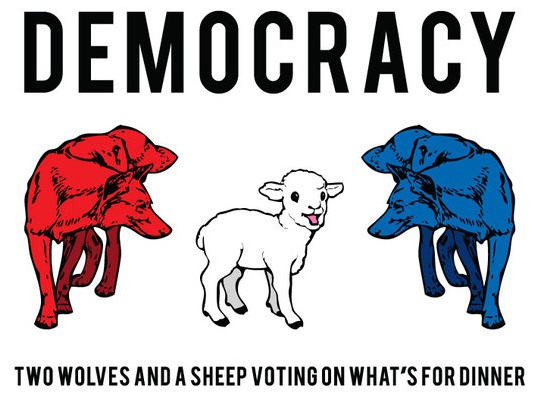
My correspondence with George Wald and Antony Flew!!!

May 12, 2014 – 1:14 am

January 8, 2015 – 5:23 am

January 1, 2015 – 4:14 am

December 25, 2014 – 5:04 am

FRANCIS SCHAEFFER ANALYZES ART AND CULTURE Part 38 Woody Allen and Albert Camus “There is but one truly serious philosophical problem, and that is suicide” (Feature on artist Hamish Fulton Photographer )

December 18, 2014 – 4:30 am

FRANCIS SCHAEFFER ANALYZES ART AND CULTURE Part 37 Mahatma Gandhi and “Relieving the Tension in the East” (Feature on artist Luc Tuymans)

December 11, 2014 – 4:19 am

FRANCIS SCHAEFFER ANALYZES ART AND CULTURE Part 36 Julian Huxley:”God does not in fact exist, but act as if He does!” (Feature on artist Barry McGee)

December 4, 2014 – 4:10 am

Dan Mitchell on President Glover Cleveland: This was a man unafraid to draw the line on public spending for two principal reasons: 1) Government should not be a grab bag of goodies for whatever cause somebody thinks is “good” and 2) Failure to keep government spending in check encourages politicians to buy votes and corrupt the political process. …He once expressed the wish that he would be remembered more for the laws he killed than the ones he signed!

An Independence Day Lesson from Grover Cleveland

Calvin Coolidge probably deserves a prize for the best July 4th speech.

But another president also deserves some Independence Day recognition.

I’ve previously written about Grover Cleveland’s sound thinking about fiscal issues.

Remarkably, his frugality even extended to opposing the use of taxpayer money to celebrate the Declaration of Independence.

In a column for the Foundation for Economic Education, Larry Reed explains that this happened a few years before he reached the White House.

When the city council of Buffalo, New York, sent the mayor a measure to fund Fourth of July celebrations in 1882, conventional wisdom suggested that approving it was the politically wise and patriotic thing to do. …The conventional wisdom underestimated the mayor. He vetoed the appropriation, and proudly took the heat for it.After a year in the job in which he earned the title, “the veto mayor,” he moved on to become “the veto governor” of the State of New York and finally, “the veto president” of the United States. His name was Grover Cleveland. On the matter of minding the till and pinching pennies on behalf of the taxpayer, he puts to shame the great majority of public officials here and everywhere. …This was a man unafraid to draw the line on public spending for two principal reasons: 1) Government should not be a grab bag of goodies for whatever cause somebody thinks is “good” and 2) Failure to keep government spending in check encourages politicians to buy votes and corrupt the political process. …He once expressed the wish that he would be remembered more for the laws he killed than the ones he signed. He still holds the record for the most vetoes of any American president in two terms (584 in all).

Wow. What a contrast with America’s recent presidents, all of whom (including the current resident of the White House) have enthusiastically spent other people’s money.

No wonder the late, great Walter Williams admiredPresident Cleveland.

P.S. I joked in 2011 that our friends on the left seem more interested in celebrating Dependence Day. Obama then turned satire into reality the following year. The Babylon Bee then shared some Dependence Day satire in 2020, which Biden then turned into reality.

February 7, 2021

President Biden c/o The White House 1600 Pennsylvania Avenue NW Washington, DC 20500

Dear Mr. President,

The federal government debt is growing so much that it is endangering us because if things keep going like they are now we will not have any money left for the national defense because we are so far in debt as a nation. We have been spending so much on our welfare state through food stamps and other programs that I am worrying that many of our citizens are becoming more dependent on government and in many cases they are losing their incentive to work hard because of the welfare trap the government has put in place. Other nations in Europe have gone down this road and we see what mess this has gotten them in. People really are losing their faith in big government and they want more liberty back. It seems to me we have to get back to the founding  principles that made our country great.  We also need to realize that a big government will encourage waste and corruptionThe recent scandals in our government have proved my point. In fact, the jokes you made at Ohio State about possibly auditing them are not so funny now that reality shows how the IRS was acting more like a monster out of control. Also raising taxes on the job creators is a very bad idea too. The Laffer Curve clearly demonstrates that when the tax rates are raised many individuals will move their investments to places where they will not get taxed as much.

______________________

Will Rogers has a great quote that I love. He noted, “Lord, the money we do spend on Government and it’s not one bit better than the government we got for one-third the money twenty years ago”(Paula McSpadden Love, The Will Rogers Book, (1972) p. 20.)

We need to slash defense spending and make other wealthy allies pay for their own defense!!!!

APRIL 15, 2013 1:13PM

Your Tax Dollars at Work: Subsidizing the Security of Wealthy Allies

It’s Tax Day, and for millions of Americans that means ponying up to the IRS. The federal government does many things these days—most of which would be more efficiently carried out at the local level, or in the private sector. But Uncle Sam also engages in a particular form of charity that many Americans overlook: spending many tens of billions of dollars to defend wealthy, developed nations.

A new Cato infographic puts it all in perspective. It shows how much American taxpayers spend to subsidize the security, and to defend the interests, of other nations that are more than capable of defending themselves.

The average American spends $2,300 on the military, based on the latest data available. That is roughly four and a half times more than what the average person in other NATO countries spends. These countries boast a collective GDP of approximately $19 trillion, 25 percent higher than the U.S. They obviously can afford to spend more. So why don’t they? Because Uncle Sucker picks up nearly the entire tab.

Looked at another way, U.S. alliances constitute a massive wealth transfer from U.S. taxpayers (and their Chinese creditors) to bloated European welfare states and technologically-advanced Asian nations.

Despite the size and wealth of our allies, they are military dwarfs compared to the United States. The particularly galling comparison is the disparity between what the United States spends on the military as a percentage of the federal budget and what other countries spend on their military relative to total government spending.

While the United States spends 20 percent of the budget on the military, Japan spends a paltry 2.3 percent. Our NATO allies? The average is 3.6 percent. Even South Korea’s share of military spending is roughly half of our total, and they have much bigger threats to worry about. By providing for their security, we have encouraged allies to divert resources elsewhere.

The Constitution stipulates that the federal government should provide for the “common defence.” But the document never talks about providing for the defense of other nations. Their citizens are not party to our unique social contract. On this tax day, you might rest assured that wealthy citizens around the world are grateful that you are defending them, but don’t hold your breath waiting for a word of thanks.

It is time to rethink our alliances and the culture of dependency we have created among our allies. They have become wards to Uncle Sam’s dole. Only by ceasing to foot the security bill for them will we create an incentive for them to spend more.

_____________

Thank you so much for your time. I know how valuable it is. I also appreciate the fine family that you have and your commitment as a father and a husband.

Sincerely,

Everette Hatcher III, 13900 Cottontail Lane, Alexander, AR 72002, ph 501-920-5733,

Related posts:

Milton Friedman’s Free to Choose (1980), episode 3 – Anatomy of a Crisis. part 1

“The Power of the Market” episode of Free to Choose in 1990 by Milton Friedman (Part 5)

Milton Friedman The Power of the Market 5-5 How can we have personal freedom without economic freedom? That is why I don’t understand why socialists who value individual freedoms want to take away our economic freedoms.  I wanted to share this info below with you from Milton Friedman who has influenced me greatly over the […]

“The Power of the Market” episode of Free to Choose in 1990 by Milton Friedman (Part 4)

Milton Friedman The Power of the Market 4-5 How can we have personal freedom without economic freedom? That is why I don’t understand why socialists who value individual freedoms want to take away our economic freedoms.  I wanted to share this info below with you from Milton Friedman who has influenced me greatly over the […]

“The Power of the Market” episode of Free to Choose in 1990 by Milton Friedman (Part 3)

Milton Friedman The Power of the Market 3-5 How can we have personal freedom without economic freedom? That is why I don’t understand why socialists who value individual freedoms want to take away our economic freedoms.  I wanted to share this info below with you from Milton Friedman who has influenced me greatly over the […]

“The Power of the Market” episode of Free to Choose in 1990 by Milton Friedman (Part 2)

Milton Friedman The Power of the Market 2-5 How can we have personal freedom without economic freedom? That is why I don’t understand why socialists who value individual freedoms want to take away our economic freedoms.  I wanted to share this info below with you from Milton Friedman who has influenced me greatly over the […]

“The Power of the Market” episode of Free to Choose in 1990 by Milton Friedman (Part 1)

Milton Friedman The Power of the Market 1-5 How can we have personal freedom without economic freedom? That is why I don’t understand why socialists who value individual freedoms want to take away our economic freedoms.  I wanted to share this info below with you from Milton Friedman who has influenced me greatly over the […]

We need to stop paying for Germany and Japan’s defense

I have said for years that the USA should not pay for the defense Germany and Japan. Yes, there were many reasons that was true in the past, but now they are two of our biggest friends and trading partners and they are on our side. Why should we limit their military now? I read […]

Why are we paying for Germany and Japan’s defense?

We got lots of problems at home  with our country’s finances. Then why are we paying for Germany and Japan’s defense? Romney’s Other 47% Problem by Harvey Sapolsky and Benjamin H. Friedman Harvey Sapolsky is professor emeritus of public policy and organization at MIT. His co-author, Benjamin Friedman, is a research fellow at the Cato […]

We need to stop paying for Germany and Japan’s defense

I used to think that we must double the defense budget when we were in the cold war, but I did wonder why we were not letting Germany and Japan (who are two of our biggest trade partners) build up their defenses. I was given the old tired answer that we could not trust them […]

Review of Oppenheimer plus FRANCIS SCHAEFFER QUOTES OPPENHEIMER Part 1 “Whitehead and Oppenheimer said modern science could not have been born except in the milieu of Christianity. Why? In the area of biblical Christianity, Galileo, Copernicus, Kepler, Francis Bacon — all these men, up to Newton, Faraday, and Maxwell — understood that there was a universe because God had made it. And they believed, as Whitehead has so beautifully said, that because God was a reasonable God one could discover the truth of the universe by reason. So modern science was born”


Oppenheimer

‘A spectacular achievement’: first reactions praise Oppenheimer

Christopher Nolan’s $100m epic, out 21 July in the US, has premiered to acclaim with some calling it his finest film to date

Benjamin Lee

Wed 12 Jul 2023 09.30 EDT

Christopher Nolan’s epic drama Oppenheimer has received a string of positive notices after a Paris premiere.Blonde v bombshell: get set for the Barbie-Oppenheimer smackdown

The film, with a budget of $100m, stars Cillian Murphy as J Robert Oppenheimer, seen as the “father of the atomic bomb”. The cast also includes Emily Blunt, Matt Damon, Florence Pugh, Rami Malek, Kenneth Branagh and Robert Downey Jr.

Vulture critic Bilge Ebiri has called the film “incredible”, tweeting that it’s a “relentlessly paced, insanely detailed, intricate historical drama that builds and builds and builds until Nolan brings the hammer down in the most astonishing, shattering way”.

Associated Press writer Lindsey Bahr tweetedthat the three-hour film is “a spectacular achievement, in its truthful, concise adaptation, inventive storytelling and nuanced performances”. She also called it “a serious, philosophical, adult drama that’s as tense and exciting as Dunkirk”.

The Los Angeles Times film editor, Joshua Rothkopf, has also called it “incredible” while critic Kenneth Turan described it as Nolan’s “most impressive film to date”. MTV’s Joshua Horowitz tweeted: “Impeccable immersive filmmaking of the highest order. Cillian Murphy gets the role he deserves. In love with Downey’s work. This one demands your attention.”

Oppenheimer is currently tracking to open to $40-50m in its US debut on 21 July but faces stiff competition from Greta Gerwig’s Barbie, which opens on the same day.

It marks Nolan’s first film for Universal Pictures after parting ways with Warner Bros. The new deal reportedly comes with a number of specific demands such as a theatrical window of at least 100 days before any form of digital release and a three-week period before the studio releases another film.

“It feels sometimes like a biopic, sometimes like a thriller, sometimes like a horror,” Murphy saidto the Guardian. “It’s going to knock people out.”

In an interview with Wired, Nolan said: “Some people leave the movie absolutely devastated. They can’t speak. I mean, there’s an element of fear that’s there in the history and there in the underpinnings. But the love of the characters, the love of the relationships, is as strong as I’ve ever done.”

Oppenheimer

OPPENHEIMER and EINSTEIN

On Science and Culture by J. Robert Oppenheimer, Encounter (Magazine) October 1962 issue, was the best article that he ever wrote and it touched on a lot of critical issues including the one that Francis Schaeffer discusses in this blog post!

Albert Einstein and Robert Oppenheimer, 1947: Flickr, James Vaughn

File:Francis Schaeffer.jpg

Francis Schaeffer above

Schaeffer says:

Whitehead and Oppenheimer said modern science could not have been born except in the milieu of Christianity. Why? In the area of biblical Christianity, Galileo, Copernicus, Kepler, Francis Bacon — all these men, up to Newton, Faraday, and Maxwell — understood that there was a universe because God had made it. And they believed, as Whitehead has so beautifully said, that because God was a reasonable God one could discover the truth of the universe by reason. So modern science was born. The Greeks had almost all the facts that the early scientists had, but it never turned into a science like modern science. This came, as Whitehead said, out of the fact that these men really were sure that the truth of the universe could be pursued with reason because it had been made by a reasonable God.

I do not believe for a moment that if the men back at that point of history had had the philosophy, the epistemology of modern man, there would ever have been modern science.  I also think science as we have known it is going to die. I think it is going to be reduced to two things: mere technology, and another form of sociological manipulation. I do not believe for a moment that science is going to be able to continue with its objectivity once the base that brought forth science has been totally destroyed. But one thing I am sure of, and that is that science never would have begun if men had had the uncertainty that modern man has in the area of epistemology.

He is There and He is Not Silent in The Complete Works of Francis A. Schaeffer. vol 1. A Christian View of Philosophy and Culture. Crossway: Wheaton, IL. 1985. p. 328


Atomic Bombings of Hiroshima and Nagasaki – August 6 and 9, 1945


From left to right: Robertson, Wigner, Weyl, Gödel, Rabi, Einstein, Ladenburg, Oppenheimer, and Clemence

Related posts:

Atheists confronted: How I confronted Carl Sagan the year before he died jh47

May 19, 2011 – 10:30 am

In today’s news you will read about Kirk Cameron taking on the atheist Stephen Hawking over some recent assertions he made concerning the existence of heaven. Back in December of 1995 I had the opportunity to correspond with Carl Sagan about a year before his untimely death. Sarah Anne Hughes in her article,”Kirk Cameron criticizes […]

By Everette Hatcher III|Posted in Atheists Confronted|Edit|Comments (2)
My correspondence with George Wald and Antony Flew!!!

May 12, 2014 – 1:14 am

January 8, 2015 – 5:23 am

January 1, 2015 – 4:14 am

December 25, 2014 – 5:04 am

FRANCIS SCHAEFFER ANALYZES ART AND CULTURE Part 38 Woody Allen and Albert Camus “There is but one truly serious philosophical problem, and that is suicide” (Feature on artist Hamish Fulton Photographer )

December 18, 2014 – 4:30 am

FRANCIS SCHAEFFER ANALYZES ART AND CULTURE Part 37 Mahatma Gandhi and “Relieving the Tension in the East” (Feature on artist Luc Tuymans)

December 11, 2014 – 4:19 am

FRANCIS SCHAEFFER ANALYZES ART AND CULTURE Part 36 Julian Huxley:”God does not in fact exist, but act as if He does!” (Feature on artist Barry McGee)

December 4, 2014 – 4:10 am

With the movie OPPENHEIMER coming out soon I thought was a good time to take a look again at the best article he ever wrote!!! On Science and Culture by J. Robert Oppenheimer, Encounter (Magazine) October 1962 issue

__

With the movie OPPENHEIMER coming out soon I thought was a good time to take a look again at the best article he ever wrote!!!

———


From left to right: Robertson, Wigner, Weyl, Gödel, Rabi, Einstein, Ladenburg, Oppenheimer, and Clemence

On Science and Culture by J. Robert Oppenheimer, Encounter (Magazine) October 1962 issue

We live in an unusual world, marked
by very great and irreversible changes

that occur within the span of a man’s life. We
live in a time where our knowledge and understanding of the world of nature grows wider
and deeper at an unparalleled rate; and where
the problems of applying this knowledge to
man’s needs and hopes are new, and only a
little illuminated by our past history.


Indeed it has always, in traditional societies,
been the great function of culture to keep things
rather stable, quiet, and unchanging. It has been
the function of tradition to assimilate one epoch
to another, one episode to another, even one
year to another. It has been the function of
culture to bring out meaning, by pointing to the
constant or recurrent traits of human life, which
in easier days one talked about as the eternal
verities.


In the most primitive societies, if one believes
the anthropologists, the principal function of
ritual, religion, of culture is, in fact, almost to
stop change. It is to provide for the social
organism what life provides in such a magic
way for living organisms, a kind of homeostasis,
an ability to remain intact, to respond only very
little to the obvious convulsions and alterations
in the world around.

To-day, culture and tradition have assumed
a very different intellectual and social purpose.
The principal function of the most vital and
living traditions to-day is precisely to provide
the instruments of rapid change. There are
many things which go together to bring about
this alteration in man’s life; but probably the
decisive one is science itself. I will use that word
as broadly as I know, meaning the natural
sciences, meaning the historical sciences, meaning all those matters on which men can converse objectively with each other. I shall not
continually repeat the distinction between
science as an effort to find out about the world
and understand it, on the one hand, and science,
in its applications in technology, as an effort
to do something useful with the knowledge so
acquired. But certain care is called for, because,
if we call this the scientific age, we make
more than one kind of oversimplification. When
we talk about science to-day, we are likely to
think of the biologist with his microscope or the
physicist with his cyclotron; but almost certainly a great deal that is not now the subject
of successful study will later come to be. I think
we probably to-day have under cultivation only
a small part of the terrain which will be natural
for the sciences a century from now. I think of
the enormously rapid growth in many parts of
biology, and of the fact, ominous but not without hope, that man is a part of nature and very
open to study.

The reason for this great change from a
slowly moving, almost static world, to the
world we live in, is the cumulative character,
the firmness, the givenness of what has been
learned about nature. It is true that it is transcended when one goes into other parts of experience. What is true on the scale of the inch
and the centimeter may not be true on the scale
of a billion light-years; it may not be true either
of the scale of a one hundred billionth of a
centimetre; but it stays true where it was proven.
It is fixed. Thus everything that is found out
is added to what was known before, enriches it,
and does not have to be done over again. This
essentially cumulative irreversible character of
learning things is the hallmark of science.
3
T H I S M E A N S that in man’s history the
sciences make changes which cannot be
wished away and cannot be undone. Let me
give two quite different examples. There is

much talk about getting rid of atomic bombs.
I like that talk; but we must not fool ourselves.
The world will not be the same, no matter what
we do with atomic bombs, because the knoxvledge of how to make them cannot be exorcised.
It is there; and all our arrangements for living
in a new age must bear in mind its omnipresent
virtual presence, and the fact that one cannot
change that. A different example: we can never
have again the delusions about the centrality
and importance of our physical habitat, now
that we know something of where the earth is
in the solar system, and know that there are
hundreds of billions of suns in our galaxy, and
hundreds of billions of galaxies within reach
of the great telescopes of the world. We can
never again base the dignity of man’s life on
the special character in space and time of the
place where he happens to live.

These are irreversible changes; so it is that
the cumulative character gives a paradigm of
something which is, in other respects, very
much more subject to question: the idea of
human progress. One cannot doubt that in the
sciences the direction of growth is progress.
This is true both of the knowledge of fact, the
understanding of nature, and the knowledge of
skill, of technology, of learning how to do
things. When one applies this to the human
situation, and complains that we make great
progress in automation and computing and
space research but no comparable moral progress, this involves a total misunderstanding
of the difference between the two kinds of progress. I do not mean that moral progress is
impossible; but it is not, in any sense, automatic.
Moral regress, as we have seen in our day, is
just as possible. Scientific regress is not compatible with the continued practice of science.

It is, of course, true, and we pride ourselves on
it that it is true, that science is quite international, and is the same (with minor differences
of emphasis) in Japan, France, the United States,
Russia. But culture is not international; indeed
I am one of those who hope that, in a certain
sense, it never quite will be, that the influence
of our past, of our history, which is for different reasons and different peoples quite
different, will make itself felt and not be lost
in total homogeneity.
I cannot subscribe to the view that science and
culture are co-extensive, that they are the same
thing with different names; and I cannot subscribe to the view that science is something useJ. Robert Oppenheimer
ful, but essentially unrelated to culture. I think
that we live in a time which has few historical
parallels, that there are practical problems of
human institutions, their obsolescence and their
inadequacy, problems of the mind and spirit
which, if not more difficult than ever before, are
different, and difficult. I shall be dealing with
some traits of the sciences which contribute to
the difficulty, and may here give a synopsis of
what they are. They have to do with the question
of why the scientific revolution happened when
it did; with the characteristic growth of the
sciences: with their characteristic internal structure: with the relation of discovery in the sciences
to the general ideas of man in matters which are
not precisely related to the sciences: with freedom and necessity in the sciences, and the question of the creative and the open character of
science, its infinity: and with what direction we
.might try to follow in bringing coherence and
order to our cultural life, in doing what it is
proper for a group of intellectuals, of artists, of
philosophers, teachers, scientists, statesmen to do
to help refashion the sensibility and the institutions of this world, which need re-fashioning if
we are at all to survive.


]t is not a simple question to answer why the
scientific revolution occurred when it did. It
started, as all serious historians would agree,
in the late Middle Ages and early Renaissance,
and was very slow at first. No great culture has
been free of curiosity and reflection, of contemplation and thought. “To know the causes of
things” is something that serious mtn have
always wanted, a quest that serious societies
have sustained. No great culture has been free
of inventive genius. If we think of the culture
of Greece, and the following Hellenistic and
Roman period, it is particularly puzzling that
the scientific revolution did not occur then. The
Greeks discovered something without which our
contemporary world would not be what it is:
standards of rigour, the idea of proof, the idea
of logical necessity, the idea that one thing implies another. Without that, science is very
nearly impossible, for unless there is a quasirigid structure of implication and necessity, then
if something turns out not to be what one expected, one will have no way of finding out
where the wrong point is: one has no way of
correcting himself, of finding the error. But this
is something that the Greeks had very early in
their history. They were curious and inventive;
they did not experiment in the scale of moder

days, but they did many experiments; they had
as we have only recendy learned to appreciate
a very high degree of technical and technological
sophistication. They could make very subtle and
complicated instruments; and they did, though
they did not write much about it. Possibly the
Greeks did not make the scientific revolution
because of some flaw in communication. They
were a small society, and it may be that there
were not quite enough people involved.


In a matter of history, we cannot assign a
unique cause, precisely because the event itself
is unique; you cannot test, to see if you have it
right. I think that the best guess is that it took
something that was not present in Chinese
civilisation, that was wholly absent in Indian
clvilisation, and absent also from Greco-Roman
civilisation. It needed an idea of progress, not
limited to better understanding for this idea
the Greeks had. It took an idea of progress
which has more to do with the human condition, which is well expressed by the second
half of the famous Christian dichotomy–faith
and works; the notion that the betterment of
man’s condition, his civility, had meaning; that
we all had a responsibility to it, a duty to it, and
to man. I think that it was when this basic idea
of man’s condition, which supplements the
other worldly aspects of religion, was fortified
and fructified between the 13th and i5th centuries by the re-discovery of the ancient world’s
scientists, philosophers, and mathematicians,
that there was the beginning of the scientific
age. By the I7th century there were a handful
of men involved in improving human knowledge, or “useful knowledge” as the phrases
went, so that new societies like the Royal Society
and the Academy were formed, where people
could talk to each other and bring to the prosecution of science that indispensable element of
working together, of communication, of correcting the other fellow’s errors and admiring
the other fellow’s skills, thus creating the first
truly scientific communities.

Just before Newton, Hobbes wrote:
The Sciences are small power; because not
eminent; and therefore, not acknowledged inany
man, nor one at all, but in a few; and in them,
but of a few things. For Science is of that nature,
as none can understand it to be, but such as is
good measure have attayned it.
Arts of publique use, as Fortification, making
of Engines, and other Instruments of War; because they conferre to Defence, and Victory, are
Power.

5


It was the next century that put science in a
context of fraternity, even of universal brotherhood. It encouraged a political view which was
egalitarian, permissive, pluralistic, liberal–
everything for which the word “democratic” is
to-day justly and rightly used. The result is
that the scientific world of to-day is also a very
large one: an open world in which, of course,
not everybody does everything, in which not
everybody is a scientist or a prime minister, but
in which we fight very hard against arbitrary
exclusion of people from any works, any deliberation, any discourse, any responsibility for which
their talents and their interests suit them. The
result is that we face our new problems, created
by the practical consequences of technology, and
the great intellectual consequences of science
itself, in the context of a world of two or three
billion people, an enormous society for which
human institutions were not really ever
designed. We are facing a world in which
growth is characteristic, not just of the sciences
themselves, but of the economy, of technology,
of all human institutions; no one can open a
daily paper without seeing the consequences.


ONE CAN MEASURE scientific growth in a numberof ways, but it is important not to mistake
things. The excellence of the individual scientist
does not change much with time. His knowledge and his power does, but not the high
quality that makes him great. We do not look
to anyone to be better than Kepler or Newton,
any more than we look to anyone to be better
than Sophocles, or to any doctrine to be better
than the gospel according to St. Matthew. Yet
one can measure things, and it has been done.
One can measure how many people work on
scientific questions: one can count them. One
can notice how much is published.


These two criteria show a doubling of scientific knowledge in every ten years. Casimir
calculated that if the Physical Review continued
to grow as rapidly as it has between i945 and
~96o, it would weigh more than the earth
during the next century. In fifteen years, the
volume of chemical abstracts has quadrupled;
in biology the changes are faster still. To-day,
if you talk about scientists and mean by that
people who have devoted their lives to the
acquisition and application of new knowledge,
then 93 per cent of us are still alive. This enormously rapid growth, sustained over two centuries, means, of course, that no man learned as a boy more than a small fraction in his own field
of what he ought to know as a grown man.


THERE ARE SEVERAL points to keep in
mind. One would naturally think that if
we are publishing so much, it must be trivial.
I think that this is not true: any scientific community with sane people would protect itself
against that: because we have to read what is
published. The argument not to permit the
accumulation of trivial, unimportant things
which are not really new, which do not add to
what was known before, is overwhelming.

The second point is that one may say that
every new thing renders what was known before
uninteresting, that one can forget as rapidly as
one learns. That is in part true: whenever there
is a great new understanding, a great new
element of order, a new theory, or a new
law of nature, then much that before had to
be remembered in isolation becomes connected
and becomes, to some extent, implied and simplified. Yet one cannot forget what went before,
because usually the meaning of what is discovered in r962 is to be found in terms of things
that were discovered in ~955 or ~95o or earlier.
These are the things in terms of which the new
discoveries are made, the origins of the instruments that give us the new discoveries, the
origins of the concepts in terms of which they
are discovered, the origins of the language and
the tradition.

A third point: if one looks to the future of
something that doubles every ten years, there
must come a time when it stops, just as The
Physical Reuietu cannot weigh more than the
earth. We know that this will saturate, and
probably at a level very much higher than today; there will come a time when the rate of
growth of science is not such that in every ten
years the amount that is known is doubled; but
the amount that is added to knowledge then
will be far greater than it is to-day. For this rate
of growth suggests that, just as the professional
must, if he is to remain professional, live a life
of continuous study, so we may find a clue here
also to the more general behaviour of the intellectual with regard to his own affairs, and those
of his colleagues in somewhat different fields.
In the most practical way a man will have some
choice: he may choose to continue to learn about
his own field in an intimate, detailed, knowledgeable way, so that he knows what there is
to know about it. But then the field will not
be very wide. His knowledge will be highly
partial of science as a whole, but very intimate
and very complete of his own field. He may, on
the other hand, choose to know generally, superficially a good deal about what goes on in
science, but without competence, without
mastery, without intimacy, without depth. The
reason for emphasising this is that the cultural
values of the life of science almost all lie in the
intimate view: here are the new techniques,
the hard lessons, the real choices, the great dis-
;appointments, the great discoveries.

ALL S C I E N C E S grow out of common sense,
out of curiosity, observation, reflection.
One starts by refining one’s observation and
one’s words, and by exploring and pushing
things a little further than they occur in ordinary life. In this novelty there are surprises; one
revises the way one thinks about things to
accommodate the surprises; then the old way of
thinking gets to be so cumbersome and inappropriate that one realises that there is a big
change called for, and one re-creates one’s way
cf thinking about this part of nature.

Through all this one learns to say what one
has done, what one has found, and to be patient
and wait for others to see if they find the same
rlaings, and to reduce, to the point where it
really makes no further difference, the normally
overpoweringly vital element of ambiguity in
human speech. We live by being ambiguous,
by not settling things because they do not have
to be settled, by suggesting more than one thing
because their co-presence in the mind may be a
source of beauty. But in talking about science
one may be as ambiguous as ever until we come
to the heart of it. Then we tell a fellow just
what we did in terms that are intelligible to
him, because he has been schooled to understand them, and we tell him just what we found
and just how we did it. If he does not understand us, we go to visit him and help him; and
if he still does not understand us, we go back
home and do it over again. This is the way in
which the firmness and solidity of science is
established.

How THEN DOES IT GO? In studying the different
parts of nature, one explores with different instruments, explores different objects, and one
gets a branching of what at one time had been
common talk, common sense. Each branch
develops new instruments, ideas, words suitable

for describing that part of the world of nature.
This tree-like structure, all growing from the
common trunk of man’s common primordial
experience, has branches no longer associated
with the same question, nor the same words and
techniques. The unity of science, apart from the
fact that it all has a common origin in man’s
ordinary life, is not a unity of deriving one
part from another, nor of finding an identity
between one part and another, between let us
say, genetics and topology, to take two impossible examples, where there is indeed some connection.


The unity consists of two things: first and ever
more strikingly, an absence of inconsistency.
Thus we may talk of life in terms of purpose
and adaptation and function, but we have found
in living things no tricks played upon the laws
of physics and chemistry. We have found and
I expect will find a total consistency, and
between the different subjects, even as remote
as genetics and topology, an occasional sharp
mutual relevance. They throw light on each
other; they have something to do with each
other; often the greatest things in the sciences
occur when two different discoveries made in
different worlds turn out to have so much in
common that they are examples of a still greater
discovery.

THE IMAGE is not that of an ordered array of
facts in which every one follows somehow from
a more fundamental one. It is rather that of a
living thing: a tree doing something that trees
do not normally do, occasionally having the
branches grow together and part again in a
great network.

The knowledge that is being increased in this
extraordinary way is inherently and inevitably
very specialised. It is different for the physicist,
the astronomer, the micro-biologist, the mathematician. There are connections: there is this
often important mutual relevance. Even in
physics, where we fight very hard to keep the
different parts of our subject from flying apart
(so that one fellow will know one thing and
another fellow will know another, and they do
not talk to each other), we do not entirely succeed, in spite of a passion for unity which is
very strong. The traditions of science are
specialised traditions; this is their strength. Their
strength is that they use the words, the
machinery, the concepts, the theories, that fit
their subjects; they are not encumbered by
having to try to fit other sorts of things. It is the
and Culture

(Page 7)


specialised traditions which give the enormous
thrust and power to the scientific experience.
This also makes for the problem of teaching and
explaining the sciences. When we get to some
very powerful general result which illuminates a
large part of the world of nature, it is by virtue
of its being general in the logical sense, of encompassing an enormous amount of experience
in its concepts; and in its terminology it is most
highly specialised, almost unintelligible except to
the men who have worked in the field. The
great laws of physics to-day, which do not
describe everything (or we would be out of business) but which underlie almost everything that
is ever noticed in ordinary human experience
about the physical world, cannot be formulated
in terms that can reasonably be defined without
a long period of careful schooling. This is comparably true in other subjects.


ONE HAS THEN in these specialisations
the professional communities in the
various sciences. They are very intimate, work
closely together, know each other throughout
the world. They are always excited–sometimes
jealous but usually pleased–when one member
of the community makes a discovery. I think,
for instance, that what we now call psychology will one day perhaps be many sciences,
that there will be many different specialised
communities practising them, who will talk
with one another, each in their own profession
and in their own way.


These specialised communities, or guilds, are
a very moving experience for those who participate. There have been many temptations to
see analogues in them for other human activities.
One that we hear much discussed is this: “If
physicists can work together in countries with
different cultures, in countries with different
politics, in countries of different religions, even
in countries which are politically obviously
hostile, is not this a way to bring the world
together?”

The specialising habits of the sciences have,
to some extent, because of the tricks of universities, been carried over to other work, to philosophy and to the arts. There is technical
philosophy which is philosophy as a craft,
philosophy for other philosophers, and there is
art for the artists and the critics. To my mind,
whatever virtues the works have for sharpening
professional tools, they are profound misreadings, even profound subversions of the true functions of philosophy and art, which are to
address themselves to the general common
human problem. Not to everybody, but to anybody: not to specialists.

It is clear that one is faced here with formidable problems of communication, of telling
People about things. It is an immense job of
teaching on all levels, in every sense of the word,
never ending.

IT HAS OFTEN BEEN held that the great discoveries in science, coming into the lives of
men, affect their attitudes toward their place
in life, their views, their philosophy. There is
surely some truth in this.*


If discoveries in science are to have an honest
effect on human thought and on culture, they
have to be understandable. That is likely to be
true only in the early period of a science, when
it is talking about things which are not too
remote from ordinary experience. Some of the
great discoveries of this century go under the
name of Relativity and Uncertainty, and when
we hear these words we may think, “This is
the way I felt this morning: I was relatively
confused and quite uncertain”: this is not at all
a notion of what technical points are involved
in these great discoveries, or what lessons.


I think that the reason why Darwin’s hypothesis had such an impact was, in part, because
it was a very simple thing in terms of ordinary
life. We cannot talk about the contemporary
discovery in biology in such language, or by
referring only to things that we have all
experienced.


Thus I think that the great effects of the
sciences in stimulating and in enriching philosophical life and cultural interests have been
necessarily confined to the rather early times in
the development of a science. There is another
qualification. Discoveries will really only
resonate and change the thinking of men when
they feed some hope, some need that pre-exists
in the society. I thir~k that the real sources of the
Enlightenment, fed a little by the scientific
events of the time, came in the re-discovery of

(FOOTNOTE: Examples that are usually given include Newton and Darwin. Newton is not a very good example, for ~vhen we look at it closely ~ve are struck by the fact that in the sense of the Enlightenment, the sense of a coupling of faith in scientific progress and man’s reason with a belief in political progress and the secularisation of human life, Newton himself was in no way a Newtonian. His successors were.)


the classics, of classic political theory, perhaps
most of all of the Stoics. The hunger of the
Eighteenth Century to believe in the power of
reason, to wish to throw off authority, to wish
to secularise, to take an optimistic view of man’s
condition, seized on Newton and his discoveries
as an illustration of something which was
already deeply believed in quite apart from the
law of gravity and the laws of motion. The
hunger with which the Nineteenth Century
seized on Darwin had very much to do with the
increasing awareness of history and change,
with the great desire to naturalise man, to put
him into the world of nature, which pre-existed
long before Darwin and which made him welcome. I have seen an example in this century
where the great Danish physicist Niels Bohr
found in the quantum theory when it was
developed thirty years ago this remarkable
trait: it is consistent with describing an atomic
system, only much less completely than we can
describe large-scale objects. We have a certain
choice as to which traits of the atomic system
we wish to study and measure and which to let
go; but we have not the option of doing them
all. This situation, which we all recognise,
sustained in Bohr his long-held view of the
human condition: that there are mutually
exclusive ways of using our words, our minds,
our souls, any one of which ig open to us, but
which cannot be combined: ways as different,
for instance, as preparing to act and entering
into an introspective search for the reasons for
action. This discovery has not, I think, penetrated into general cultural life. I wish it had;
it is a good example of something that would
be relevant, if only it could be understood.


EINSTEIN ONCE SAID that a physical theory was
not determined by the facts of nature, but was
a free invention of the human mind. This raises
the question of how necessary is the content of
science–how much is it something that we are
free not to find–how much is it something that
could be otherwise? This is, of course, relevant
to the question of how we may use the words
“objectivity” and “truth.” Do we, when we
find something, “invent” it or “discover” it?

The fact is, of course, just what one would
guess. We are, of course, free in our tradition.
and in our practice, and to a much more limited
extent individually to decide where to look at
nature, and how to look at nature, what questions to put, with what instruments and with
what purpose. But we are not the least bit free to

settle what we find. Man must certainly be free to
invent the idea of mass, as Newton did and as it
has been refined and re-defined; but having done
so, we have not been free to find that the mass of
the light quantum or the neutrino is anything
but zero. We are free in the start of things. We
are free as to how to go about it; but then the
rock of what the world is, shapes this freedom
with a necessary answer. That is why ontological
interpretations of the word “objective” have
seemed useless, and why we use the word to
describe the clarity, the lack of ambiguity, the
effectiveness of the way we can tell each other
about what we have found.


THUS in the sciences, total statements like
those that involve the word “all,” with no
qualifications, are hardly ever likely to occur.
In every investigation and extension of knowledge we are involved in an action; in every
action we are involved in a choice; and in every
choice we are involved in a loss, the loss of that
we did not do. We find this in the simplest situations. We find this in perception, where the
possibility of perceiving is coextensive with
our ignoring many things that are going on. We
find it in speech where the possibility of understandable speech lies in paying no attention to
a great deal that is in the air, among the sound
waves, in the general scene. Meaning is always
attained at the cost of leaving things out. We
find it in the idea of complementarity here in a
sharp form as a recognition that the attempt
to make one sort of observation on an atomic
system forecloses others. We have freedom of
choice, but we have no escape from the fact
that doing some things must leave out others.
In practical terms, this means, of course, that
our knowledge is finite and never all-encompassing. There is always much that we miss, much
that we cannot be aware of because the very act
of learning, of ordering, of finding unity and
meaning, the very power to talk about things
means that we leave out a great deal.


Ask the question: Would another civilisation
bated on life on another planet very similar to
ours in its ability to sustain life have the same
physics? One has no idea whether they would
have the same physics or not. We might be
talking about quite different questions. This
makes ours an open world without end. I had a
Sanskritist friend in California who used to say
mockingly that, if science were any good, it
should be much easier to be an educated man
and Culture

(Page 9)
now than it was a generation ago. That is
because he thought the world was closed.


THE THINGS THAT MAKE US choose one set of
questions, one branch of enquiry rather than
another are embodied in scientific traditions. In
developed sciences each man has only a limited
sense of freedom to shape or alter them; but
they are not themselves wholly determined by
the findings of science. They are largely of an
~esthetic character. The words that we use: simplicity, elegance, beauty: indicate that what we
grope for is not only more knowledge, but
knowledge that has order and harmony in it,
and continuity with the past. Like all poor
fellows, we want to find something new, but not
something too new. It is when we fail in that,
that the great discoveries follow.


AL T H E S E themes–the origin of science,
its pattern of growth, its branching
reticular structure, its increasing alienation from
the common understanding of man, its freedom,
the character of its objectivity and its openness–
are relevant to the relations of science and
culture. I believe that they can be and should be
far more robust, intimate, and fruitful than they
are to-day.


I am not here thinking of the popular subject
of “mass culture.” In broaching that, it seems
to me one must be critical but one must, above
all, be human; one must not be a snob; one
must be rather tolerant and almost loving. It is
a new problem; one must not expect it to be
solved with the methods of Periclean Athens.
In the problems of mass culture and, above all,
of the mass media, it is not primarily a question
of the absence of excellence. The modest worker,
in Europe or in America, has within reach
probably better music and more good music,
more good art, more good writing than his predecessors have ever had. It seems rather that the good things are lost in such a stream of poor
things, that the noise level is so high, that some
of the conditions for appreciating excellence are
not present. One does not eat well unless one is
hungry; there is a certain frugality to the best
cooking; and something of this sort is wrong
with the mass media. But that is not now my
problem.

Rather, I think loosely of what we may call
the intellectual community: artists, philosophers,
statesmen, teachers, men of most professions,
prophets, scientists. This is an open group, with no sharp lines separating those that think themselves of it. It is a growing faction of all peoples.
In it is vested the great duty for enlarging,
preserving, and transmitting our knowledge and
skills, and indeed our understanding of the
interrelations, priorities, commitments, injunctions, that help men deal with their joys,
temptations and sorrows, their finiteness, their
beauty. Some of this has to do, as the sciences
so largely do, with propositional truth, with
propositions which say “If you do thus and so
you will see this and that”; these are objective
and can be checked and cross-checked; though it
is always wise from time to time to doubt, there
are ways to put an end to the doubt. This is
how it is with the sciences.


In this community there are other statements
which “emphasise a theme” rather than declare
a fact. They may be statements of connectedness
or relatedness or importance, or they may be in
one way or another statements of commitment.
For them the word “certitude,” which is a
natural norm to apply in the sciences, is not very
sensible–depth, firmness, universality, perhaps
more–but certitude, which applies really to
verification, is not the great criterion in most of
the work of a philosopher, a painter, a poet, or
a playwright. For these are not, in the sense I
have outlined, objective. Yet for any true community, for any society worthy of the name,
they must have an element of community of
being common, of being public, of being relevant and meaningful to man, not necessarily to
everybody, but surely not just to specialists.

I HAVE SEEN much concerned that, in this
world of change and scientific growth, we
have so largely lost the ability to talk with one
another, to increase and enrich our common
culture and understanding. And so it is that
the public sector of our lives, what we hold
and have in common, has suffered, as have the
illumination of the arts, the deepening of justice
and virtue, and the ennobling power of our
common discourse. We are less inert for this.
Never in man’s history have the specialised
ta’aditions more flourished than to-day. We have
our private beauties. But in those high undert;tkings when man derives strength and insight
from public excellence, we have been impoverished. We hunger for nobility, the rare words
and acts that harmonise simplicity with truth.
In this default I see some connection with the
great unresolved public problems–survival,
liberty, fraternity.


In this default I see the responsibility that the
irttellectual community has to history and to our
fellows: a responsibility which is a necessary
condition for re-making human institutions as
they need to be re-made to-day that there may
be peace, that they may embody more fully those
ethical commitments without which we cannot
properly live as men.


This may mean for the intellectual community
a very much greater effort than in the past. The
community will grow; but I think that also the
quality and the excellence of what we do must
grow. I think, in fact, that with the growing
wealth of the world, and the possibility that it
will not all be used to make new committees,
ft..ere may indeed be genuine leisure, and that
a high commitment on this leisure is that we reknit the discourse and the understanding
between the members of our community.


In this I think we have, all of us, to preserve
our competence in our own professions, to preserve what we know intimately, to preserve our
mastery. This is, in fact, our only anchor in
honesty. We need also to be open to other and
cc.mplementary lives, not intimidated by them
and not contemptuous of them (as so many are
to-day of the natural and mathematical sciences).
As a start, we must learn again, without contempt and with great patience, to talk to one
another; and we must hear.

Related posts:

Atheists confronted: How I confronted Carl Sagan the year before he died jh47

May 19, 2011 – 10:30 am

In today’s news you will read about Kirk Cameron taking on the atheist Stephen Hawking over some recent assertions he made concerning the existence of heaven. Back in December of 1995 I had the opportunity to correspond with Carl Sagan about a year before his untimely death. Sarah Anne Hughes in her article,”Kirk Cameron criticizes […]

By Everette Hatcher III|Posted in Atheists Confronted|Edit|Comments (2)

My correspondence with George Wald and Antony Flew!!!

May 12, 2014 – 1:14 am

January 8, 2015 – 5:23 am

January 1, 2015 – 4:14 am

December 25, 2014 – 5:04 am

FRANCIS SCHAEFFER ANALYZES ART AND CULTURE Part 38 Woody Allen and Albert Camus “There is but one truly serious philosophical problem, and that is suicide” (Feature on artist Hamish Fulton Photographer )

December 18, 2014 – 4:30 am

FRANCIS SCHAEFFER ANALYZES ART AND CULTURE Part 37 Mahatma Gandhi and “Relieving the Tension in the East” (Feature on artist Luc Tuymans)

December 11, 2014 – 4:19 am

FRANCIS SCHAEFFER ANALYZES ART AND CULTURE Part 36 Julian Huxley:”God does not in fact exist, but act as if He does!” (Feature on artist Barry McGee)

December 4, 2014 – 4:10 am


_

FRANCIS SCHAEFFER ANALYZES ART AND CULTURE PART 484 My Correspondence with Edward O.Wilson from 1994 to 2021 In my 11-1-18 letter to Dr. Wilson I noted: On 12-14-05 you and James D. Watson appeared on the THE CHARLIE ROSE SHOW and you both praised Darwin the whole time. You noted, “The man was always right. It`s exasperating to be an evolutionary biologist and try to develop something really new  and find out that Darwin had either said it or he had created …. had foresight to, you know, indicate it.” James D.Watson  asserted, “In my mind, Darwin was the most important person who ever lived on Earth…So Darwin had it so right.” FEATURED ARTIST IS JACQUES-LOUIS DAVID

E.O. Wilson: Science, Not Philosophy, Will Explain the Meaning of Existence

The Social Conquest of Earth | Edward O. Wilson

Edward O. Wilson The Meaning of Human Existence Audiobook


Professor E.O. Wilson in his office, at a table in front of a bookshelf, at Harvard University in Cambridge, Massachusetts, USA.

Harvard University Professor E.O. Wilson in his office at Harvard University in Cambridge, MA. USACredit: Rick Friedman/Corbis via Getty.


Francis A. Schaeffer
Founder of the L’Abri community

C. Everett Koop, 1980s.jpg


Francis Schaeffer mentioned Edward O. Wilson in his book WHATEVER HAPPENED TO THE HUMAN RACE? co-authored by C.Everett Koop on pages 289-291 (ft note 6 0n page 504). That was when I was first introduced to Dr. Wilson’s work. Wikipedia notes, Edward Osborne Wilson (June 10, 1929 – December 26, 2021) was an American biologistnaturalist, and writer. His specialty was myrmecology, the study of ants, on which he was called the world’s leading expert,[3][4] and he was nicknamed Ant Man.[5][6][7][8]

I was honored to correspond with Dr. Wilson from 1994 to 2021!!

November 1, 2018

Dr. Edward O. Wilson, Museum of Comparative Zoology Faculty Emeritus
Pellegrino University Professor, Emeritus c/o Museum of Comparative Zoology
Harvard University
26 Oxford Street
Cambridge, MA 02138

Dear Dr. Wilson

On 12-14-05 you and James D. Watson appeared on the THE CHARLIE ROSE SHOW and you both praised Charles Darwin the whole time. You noted, “The man was always right. It`s exasperating to be an evolutionary biologist and try to develop something really new  and find out that Darwin had either said it or he had created …. had foresight to, you know, indicate it.” James D.Watson  asserted, “In my mind, Darwin was the most important person who ever lived on Earth…So Darwin had it so right.”

Did you know that Charles Darwin lost his taste for music, art and the beauty of nature in his old age?

A letter to Sir J. D. Hooker, June 17, 1868, which repeats to some extent what is given in the Autobiography of Darwin:—

“I am glad you were at the Messiah, it is the one thing that I should like to hear again, but I dare say I should find my soul too dried up to appreciate it as in old days; and then I should feel very flat, for it is a horrid bore to feel as I constantly do, that I am a withered leaf for every subject except Science. It sometimes makes me hate Science, though God knows I ought to be thankful for such a perennial interest, which makes me forget for some hours every day my accursed stomach.’

Francis Schaeffer summarized Darwin’s statement:

So he is glad for science because his stomach bothers him, but on the other hand when I think of what it costs me I almost hate science. You can almost hear young Jean-Jacques Rousseau speaking here, he sees what the machine is going to do and he hates the machine and Darwin is constructing the machine and it leads as we have seen to his own loss of human values in the area of aesthetics, the area of art and also in the area of nature. This is what it has cost him. His theory has led him to this place. When you come to this then it seems to me that you understand man’s dilemma very, very well, to think of the origin of the theory of mechanical evolution bringing  Darwin himself to the place of this titanic tension.

Let me challenge you to attend the Messiah performance or at least listen to the words on You Tube of a performance.

Ben Witherington in his blog post Handel’s Messiah— the Story behind the Classic  noted:

Handel came across a libretto composed by Charles Jennens. Composed entirely of Scripture portions, mainly from the OT, Handel was deeply affected when he read this libretto.  It was divided into three parts: 1) prophecies about the coming messiah (largely drawing on Isaiah); 2) the birth, life, ministry, death, resurrection of Christ; 3) the End times with Christ’s final victory over sin and death, largely based in the book of Revelation. Inspired,  Handel decided he must compose an oratorio based on this libretto. 

The Old Testament prophecies that the Messiah refers to were fulfilled in the life, death and resurrection of Christ. If you just look at the verses in Psalm 22 that refer to the piercing of Christ hands and feet then you must admit that when these prophecies were made hundreds of years before the events that they describe that Psalm 22 must have been divinely inspired. In 1000 B. C. the common Jewish way of killing people was stoning and it was the Romans who brought in crucifixion.

Here is Psalm 22:1,7,8,16,17,18:

1 My God, my God, why have you forsaken me? Why are you so far from saving me, so far from the words of my groaning?

7 All who see me mock me; they hurl insults, shaking their heads:

8 “He trusts in the LORD ; let the LORD rescue him. Let him deliver him, since he delights in him.”

16 Dogs have surrounded me; a band of evil men has encircled me, they have pierced my hands and my feet.

17 I can count all my bones; people stare and gloat over me.

18 They divide my garments among them and cast lots for my clothing.

Thanks for your time.

Sincerely,

Everette Hatcher, everettehatcher@gmail.comhttp://www.thedailyhatch.org, cell ph 501-920-5733, Box 23416, LittleRock, AR 72221

FEATURED ARTIST IS JACQUES-LOUIS DAVID

Jacques-Louis David - Self-portrait - 1748-1825

JACQUES-LOUIS DAVID (1748-1825)

David is the summit of neoclassicism, a grandiloquent artist whose compositions seem to reflect his own hectic and revolutionary life.

Edward O Wilson has passed away 💔|| his last moment before death so touc…

Remembering the life of renowned biologist and Alabama native E.O. Wilson

Related posts:

Taking on Ark Times Bloggers on various issues Part F “Carl Sagan’s views on how God should try and contact us” includes film “The Basis for Human Dignity”

April 8, 2013 – 7:07 am

I have gone back and forth and back and forth with many liberals on the Arkansas Times Blog on many issues such as abortion, human rights, welfare, poverty, gun control  and issues dealing with popular culture. Here is another exchange I had with them a while back. My username at the Ark Times Blog is Saline […]

By Everette Hatcher III|Posted in Francis SchaefferProlife|Edit|Comments (0)

Carl Sagan v. Nancy Pearcey

March 18, 2013 – 9:11 am

On March 17, 2013 at our worship service at Fellowship Bible Church, Ben Parkinson who is one of our teaching pastors spoke on Genesis 1. He spoke about an issue that I was very interested in. Ben started the sermon by reading the following scripture: Genesis 1-2:3 English Standard Version (ESV) The Creation of the […]

By Everette Hatcher III|Posted in Adrian RogersAtheists ConfrontedCurrent Events|TaggedBen ParkinsonCarl Sagan|Edit|Comments (0)

Review of Carl Sagan book (Part 4 of series on Evolution)

May 24, 2012 – 1:47 am

Review of Carl Sagan book (Part 4 of series on Evolution) The Long War against God-Henry Morris, part 5 of 6 Uploaded by FLIPWORLDUPSIDEDOWN3 on Aug 30, 2010 http://www.icr.org/ http://store.icr.org/prodinfo.asp?number=BLOWA2http://store.icr.org/prodinfo.asp?number=BLOWASGhttp://www.fliptheworldupsidedown.com/blog _______________________ I got this from a blogger in April of 2008 concerning candidate Obama’s view on evolution: Q: York County was recently in the news […]

By Everette Hatcher III|Posted in Atheists ConfrontedCurrent EventsPresident Obama|Edit|Comments (0)

Review of Carl Sagan book (Part 3 of series on Evolution)

May 23, 2012 – 1:43 am

Review of Carl Sagan book (Part 3 of series on Evolution) The Long War against God-Henry Morris, part 4 of 6 Uploaded by FLIPWORLDUPSIDEDOWN3 on Aug 30, 2010 http://www.icr.org/ http://store.icr.org/prodinfo.asp?number=BLOWA2http://store.icr.org/prodinfo.asp?number=BLOWASGhttp://www.fliptheworldupsidedown.com/blog______________________________________ I got this from a blogger in April of 2008 concerning candidate Obama’s view on evolution: Q: York County was recently in the news […]

By Everette Hatcher III|Posted in Atheists ConfrontedCurrent EventsPresident Obama|Edit|Comments (0)

Carl Sagan versus RC Sproul

January 9, 2012 – 2:44 pm

At the end of this post is a message by RC Sproul in which he discusses Sagan. Over the years I have confronted many atheists. Here is one story below: I really believe Hebrews 4:12 when it asserts: For the word of God is living and active and sharper than any two-edged sword, and piercing as far as the […]

By Everette Hatcher III|Posted in Adrian RogersAtheists ConfrontedCurrent EventsFrancis Schaeffer|Tagged Bill ElliffCarl SaganJodie FosterRC Sproul|Edit|Comments (0)

Review of Carl Sagan book (Part 4 of series on Evolution)jh68

November 8, 2011 – 12:01 am

Review of Carl Sagan book (Part 4 of series on Evolution) The Long War against God-Henry Morris, part 5 of 6 Uploaded by FLIPWORLDUPSIDEDOWN3 on Aug 30, 2010 http://www.icr.org/ http://store.icr.org/prodinfo.asp?number=BLOWA2http://store.icr.org/prodinfo.asp?number=BLOWASGhttp://www.fliptheworldupsidedown.com/blog _______________________ This is a review I did a few years ago. THE DEMON-HAUNTED WORLD: Science as a Candle in the Dark by Carl […]

By Everette Hatcher III|Posted in Atheists ConfrontedCurrent Events|Edit|Comments (0)

Review of Carl Sagan book (Part 3 of series on Evolution)

November 4, 2011 – 12:57 am

Review of Carl Sagan book (Part 3 of series on Evolution) The Long War against God-Henry Morris, part 4 of 6 Uploaded by FLIPWORLDUPSIDEDOWN3 on Aug 30, 2010 http://www.icr.org/ http://store.icr.org/prodinfo.asp?number=BLOWA2http://store.icr.org/prodinfo.asp?number=BLOWASGhttp://www.fliptheworldupsidedown.com/blog______________________________________ I was really enjoyed this review of Carl Sagan’s book “Pale Blue Dot.” Carl Sagan’s Pale Blue Dot by Larry Vardiman, Ph.D. […]

By Everette Hatcher III|Posted in Atheists ConfrontedCurrent Events|Edit|Comments (0)

Atheists confronted: How I confronted Carl Sagan the year before he died jh47

May 19, 2011 – 10:30 am

In today’s news you will read about Kirk Cameron taking on the atheist Stephen Hawking over some recent assertions he made concerning the existence of heaven. Back in December of 1995 I had the opportunity to correspond with Carl Sagan about a year before his untimely death. Sarah Anne Hughes in her article,”Kirk Cameron criticizes […]

By Everette Hatcher III|Posted in Atheists Confronted|Edit|Comments (2)

My correspondence with George Wald and Antony Flew!!!

May 12, 2014 – 1:14 am

January 8, 2015 – 5:23 am

January 1, 2015 – 4:14 am

December 25, 2014 – 5:04 am

FRANCIS SCHAEFFER ANALYZES ART AND CULTURE Part 38 Woody Allen and Albert Camus “There is but one truly serious philosophical problem, and that is suicide” (Feature on artist Hamish Fulton Photographer )

December 18, 2014 – 4:30 am

FRANCIS SCHAEFFER ANALYZES ART AND CULTURE Part 37 Mahatma Gandhi and “Relieving the Tension in the East” (Feature on artist Luc Tuymans)

December 11, 2014 – 4:19 am

FRANCIS SCHAEFFER ANALYZES ART AND CULTURE Part 36 Julian Huxley:”God does not in fact exist, but act as if He does!” (Feature on artist Barry McGee)

December 4, 2014 – 4:10 am

RESPONDING TO HARRY KROTO’S BRILLIANT RENOWNED ACADEMICS!! Carl Sagan Part 27 My January 10, 1996 response letter to Carl Sagan  (2nd part of 3) DARWIN noted “My mind seems to have become a kind of machine for grinding general laws out of large collections of facts, but why this should have caused the atrophy of that part of the brain alone, on which the higher tastes depend, I cannot conceive… The loss of these tastes is a loss of happiness…”

Recently I have been revisiting my correspondence in 1995 with the famous astronomer Carl Sagan who I had the privilege to correspond with in 1994, 1995 and 1996. In 1996 I had a chance to respond to his December 5, 1995letter on January 10, 1996 and I never heard back from him again since his cancer returned and he passed away later in 1996. Below is what Carl Sagan wrote to me in his December 5, 1995 letter:

Thanks for your recent letter about evolution and abortion. The correlation is hardly one to one; there are evolutionists who are anti-abortion and anti-evolutionists who are pro-abortion.You argue that God exists because otherwise we could not understand the world in our consciousness. But if you think God is necessary to understand the world, then why do you not ask the next question of where God came from? And if you say “God was always here,” why not say that the universe was always here? On abortion, my views are contained in the enclosed article (Sagan, Carl and Ann Druyan {1990}, “The Question of Abortion,” Parade Magazine, April 22.)

I was introduced to when reading a book by Francis Schaeffer called HE IS THERE AND HE IS NOT SILENT written in 1968.

In my January 10, 1996 Response letter to Carl Sagan (which I posted earlier) I also included the following insert based on the words of Francis Schaeffer in 1978:

Is man special or not?

Douglas Futuyma has said “Whether people are explicitly religious or not they tend to imagine that humans are in some sense the center of the universe. We are just one product of a very long historical process that has given to an enormous amount of organisms, and we are just one of them. So in some sense there is nothing special about us.”

The following comments were taken from the chapter called “”The Basis for Human Dignity which is in the book and film series co-aurthored by Francis Schaeffer and C. Everett Koop called “Whatever Happened to the Human Race?”

Section 1 Materialistic Humanism: The Worldview of our Age

The West has adopted a worldview which says that all reality is made up only of matter. In this view the universe did not get here because it was created by a “supernatural “ God.

Rather, the universe has existed forever in some form, and it’s present form just happened as a result of chance events way back in time.

Section 2 The search for an adequate worldview 

Any worldview must answer 2 basic questions satisfactorily if it is to provide a real base for life and morals. The first is what we will call “the universe and it’s form,” and the second is the “mannishness of man.” The first draws attention to the fact that the universe around us is like an amazing jigsaw puzzle. We see many details, and we want to know how they fit together. That is what science is all about. Scientists look at the details and try to find out how they all cohere. So the first question that has to be answered is: Hiw did the universe get this way? How did it get this form, this pattern, this jigsawlike quality it now has?

Second, “The mannishness of man” draws attention to the fact that human beings are different from all other things in the world. Think, for example, of creativity. People in all cultures of all ages have created many kinds of all things, from “high art” to flower arrangements, from silver ornaments to high-technology supersonic aircraft. This is in contrast to the animals about us. People also fear death, and they remember the past and make projections into the future. One could name other factors, but these are enough to differentiate people from the other things in the world.

What worldview adequately explains the remarkable phenomenon of the distinctiveness of human beings? There is one worldview which explains the existence of the universe, it’s form, and the uniqueness of people— the worldview given to us in the Bible.

Section 3 The humanist base leads to meaningless 

An overwhelming number of modern thinkers agree that seeing the universe and man from a humanist base leads to meaningless, both for the universe and for man—not just mankind in general but for each of us as individuals. Professor Steven Weinberg wrote these words in his book THE FIRST 3 MINUTES: A MODERN VIEW OF THE ORIGIN OF THE UNIVERSE while he was looking down from an airplane:

  • It is almost irresistible for humans to believe that we have some special relation to the universe, that human life is not just a more-or-less farcical outcome of a chain of accidents reaching back to the first three minutes, but that we were somehow built in from the beginning. … It is very hard to realize that this is all just a tiny part of an overwhelmingly hostile universe. It is even harder to realise that this present universe has evolved from an unspeakably unfamiliar early condition, and faces a future extinction of endless cold or intolerable heat. The more the universe seems comprehensible, the more it also seems pointless.
    • (1993), Epilogue, p. 154

When Weinberg says that the universe seems more “comprehensible,” he is, of course, referring to our greater understanding of the physical universe through the advance of science. But it is an understanding, notice, within a materialistic framework, which considers the universe solely in terms of physics and chemistry—-simply machinery.

If everything “faces a future extinction of endless cold or intolerable heat,” all things are meaningless.

Section 4 Tension results when you have an inadequate worldview 

The greatest dilemma for those who hold an inadequate worldview is that it is impossible to live consistently within it. The playwright Samuel Beckett can “say” that words do not communicate anything—and that everything, including language, is absurd—yet he must use words to write his plays, even plays about meaninglessness. The list of contradictions can be extended endlessly. The truth is that everyone who rejects the Biblical worldview must live in a state of tension between ideas about reality and reality itself. If a person believes that everything is only matter or energy and carries this through consistently, meaning dies, morality dies, love dies, hope dies. Yet! The individual does love, does hope, does act on the basis of right and wrong. This is what we mean when we say that everyone is caught , regardless of his worldview, simply by the way things are.

Section 5 The Bible is God’s revealed truth and it tells us about our origin.

The scriptures tell us that the universe exists and has form and meaning because it was created purposefully by a personal creator. This being the case, we see that, as we are personal, we are not something strange and out of line with an otherwise impersonal universe. Since we are made in the image of God, we are in line with God. There is a continuity, in other words, between ourselves, though finite, and the infinite creator who stands behind the universe as its final source of meaning. Unlike the evolutionary concept of an impersonal beginning plus time plus chance, the Bible shows how man has personality and dignity and value. Our uniqueness is guaranteed, something which is impossible in the materialistic system!!!!!!

LETTER TO HUMANIST MAGAZINE IN 1994: 

Francis Schaeffer once said, “If a man takes a certain non-christian set of presuppositions he will be forced eventually to be in a place of tension. The more consistent he is to his non-christian presuppositions the further he is away from the real world.” In “Ape and Essence,” (July/ August 1994) Edd Doerr is consistent with his humanistic presuppositions when he says “The bottom line is that the great apes are so much like us that there is no logical reason not to treat them as ‘persons’.”

Because Mr. Doerr has embraced evolution, he has been forced to ask himself this logical question: “When in the course of evolution did our ancestors qualify as persons?” But does this type of logic square with what we know to be true in the real world?

Genesis chapter one tells us that man is to rule over all animals because man is made in the image of God. Can animals make moral choices, enjoy poetry, appreciate music, worship God or recognize the beauty of the world around them? Humanism reduces man to a machine, but man’s conscience causes him to fell a tension.

As a young man Charles Darwin believed that the world was created by God, and at that time he was an enthusiastic admirer of fine paintings, classic music and Shakespeare. Furthermore, during a trip to Brazil he was do captivated by the beauty of nature that he later recalled how sure he was at the time that God had to be the designer of this grand and wondrous universe. However, later his presuppositions changed and he said, “My mind seems to have become a kind of machine for grinding general laws out of large collections of facts, but why this should have caused the atrophy of that part of the brain alone, on which the higher tastes depend, I cannot conceive… The loss of these tastes is a loss of happiness, and may possibly be injurious to the intellect, and more probably to the moral character, by enfeebling the emotional part of our nature.”

We are not cousins of apes, and anyone who embraces evolution will be forced eventually to be in a place of tension with the real world if they are consistent.

Carl Sagan Planetary Society cropped.png

Sagan in 1980
Born
Carl Edward Sagan

November 9, 1934

Brooklyn, New York, U.S.
Died December 20, 1996(aged 62)
Seattle, Washington, U.S.
Resting place Lake View Cemetery (Ithaca, New York)
Alma mater University of Chicago
(BA, BS, MS, PhD)
Known for
Spouse(s)

(m. 1957; div. 1965)​

(m. 1968; div. 1981)​

(m. 1981)​

Children 5, including Sasha, Dorion and Nick
Awards Klumpke-Roberts Award(1974)
NASA Distinguished Public Service Medal(1977)
Pulitzer Prize for General Non-Fiction (1978)
Oersted Medal (1990)
Carl Sagan Award for Public Understanding of Science (1993)
National Academy of Sciences Public Welfare Medal (1994)

On November 21, 2014 I received a letter from Nobel Laureate Harry Kroto and it said:

…Please click on this URL http://vimeo.com/26991975

and you will hear what far smarter people than I have to say on this matter. I agree with them.

Harry Kroto

I have attempted to respond to all of Dr. Kroto’s friends arguments and I have posted my responses one per week for over a year now. Here are some of my earlier posts:

Arif AhmedHaroon Ahmed,  Jim Al-Khalili, Sir David AttenboroughMark Balaguer, Horace Barlow, Michael BateSir Patrick BatesonSimon Blackburn, Colin Blakemore, Ned BlockPascal BoyerPatricia ChurchlandAaron CiechanoverNoam Chomsky, Brian CoxPartha Dasgupta,  Alan Dershowitz, Frank DrakeHubert Dreyfus, John DunnBart Ehrman, Mark ElvinRichard Ernst, Stephan Feuchtwang, Robert FoleyDavid Friend,  Riccardo GiacconiIvar Giaever , Roy GlauberRebecca GoldsteinDavid J. Gross,  Brian Greene, Susan GreenfieldStephen F Gudeman,  Alan Guth, Jonathan HaidtTheodor W. Hänsch, Brian Harrison,  Stephen HawkingHermann Hauser, Robert HindeRoald Hoffmann,  Bruce HoodGerard ‘t HooftCaroline HumphreyNicholas Humphrey,  Herbert Huppert,  Gareth Stedman Jones, Steve JonesShelly KaganMichio Kaku,  Stuart KauffmanMasatoshi Koshiba,  Lawrence KraussHarry Kroto, George Lakoff,  Rodolfo LlinasElizabeth Loftus,  Alan MacfarlaneDan McKenzie,  Mahzarin BanajiPeter MillicanMarvin MinskyLeonard Mlodinow,  P.Z.Myers,   Yujin NagasawaAlva NoeDouglas Osheroff, David Parkin,  Jonathan Parry, Roger Penrose,  Saul PerlmutterHerman Philipse,  Carolyn PorcoRobert M. PriceVS RamachandranLisa RandallLord Martin ReesColin RenfrewAlison Richard,  C.J. van Rijsbergen,  Oliver Sacks, John SearleMarcus du SautoySimon SchafferJ. L. Schellenberg,   Lee Silver Peter Singer,  Walter Sinnott-ArmstrongRonald de Sousa, Victor StengerJohn SulstonBarry Supple,   Leonard Susskind, Raymond TallisMax TegmarkNeil deGrasse Tyson,  Martinus J. G. Veltman, Craig Venter.Alexander Vilenkin, Sir John Walker, James D. WatsonFrank WilczekSteven Weinberg, and  Lewis Wolpert,

In  the 1st video below in the 45th clip in this series are his words and  my response is below them. 

50 Renowned Academics Speaking About God (Part 1)

Another 50 Renowned Academics Speaking About God (Part 2

A Further 50 Renowned Academics Speaking About God (Part 3)

CARL SAGAN interview with Charlie Rose:

“…faith is belief in the absence of evidence. To believe in the absence of evidence, in my opinion, is a mistake. The idea is to hold belief until there is compelling evidence. If the Universe does not comply with our previous propositions, then we have to change…Religion deals with history poetry, great literature, ethics, morals, compassion…where religion gets into trouble is when it pretends to know something about science,”

I would respond that there is evidence that Christianity is true.In 1838 American biblical scholar Edward Robinson shook up the archaeological world by discovering Hezekiah’s Tunnel mentioned in the Bible. There is meaning in life available to anyone who will put their faith in Christ, and peace can’t be found in a Guru. Why not take a few minutes and just read the short chapter of Psalms 22 that was written hundreds of years before the Romans even invented the practice of Crucifixion. 1000 years BC the Jews had the practice of stoning people but we read in this chapter a graphic description of Christ dying on the cross.

Related posts:

FRANCIS SCHAEFFER ANALYZES ART AND CULTURE Part 52 THE BEATLES (Part D, There is evidence that the Beatles may have been exposed to Francis Schaeffer!!!) (Feature on artist Anna Margaret Rose Freeman )

______________   George Harrison Swears & Insults Paul and Yoko Lucy in the Sky with Diamonds- The Beatles The Beatles:   I have dedicated several posts to this series on the Beatles and I don’t know when this series will end because Francis Schaeffer spent a lot of time listening to the Beatles and talking […]

FRANCIS SCHAEFFER ANALYZES ART AND CULTURE Part 51 THE BEATLES (Part C, List of those on cover of Stg.Pepper’s ) (Feature on artist Raqib Shaw )

  The Beatles in a press conference after their Return from the USA Uploaded on Nov 29, 2010 The Beatles in a press conference after their Return from the USA. The Beatles:   I have dedicated several posts to this series on the Beatles and I don’t know when this series will end because Francis […]

FRANCIS SCHAEFFER ANALYZES ART AND CULTURE Part 50 THE BEATLES (Part B, The Psychedelic Music of the Beatles) (Feature on artist Peter Blake )

__________________   Beatles 1966 Last interview I have dedicated several posts to this series on the Beatles and I don’t know when this series will end because Francis Schaeffer spent a lot of time listening to the Beatles and talking and writing about them and their impact on the culture of the 1960’s. In this […]

FRANCIS SCHAEFFER ANALYZES ART AND CULTURE Part 49 THE BEATLES (Part A, The Meaning of Stg. Pepper’s Cover) (Feature on artist Mika Tajima)

_______________ The Beatles documentary || A Long and Winding Road || Episode 5 (This video discusses Stg. Pepper’s creation I have dedicated several posts to this series on the Beatles and I don’t know when this series will end because Francis Schaeffer spent a lot of time listening to the Beatles and talking and writing about […]

FRANCIS SCHAEFFER ANALYZES ART AND CULTURE PART 48 “BLOW UP” by Michelangelo Antonioni makes Philosophic Statement (Feature on artist Nancy Holt)

_______________ Francis Schaeffer pictured below: _____________________ I have included the 27 minute  episode THE AGE OF NONREASON by Francis Schaeffer. In that video Schaeffer noted,  ” Sergeant Pepper’s Lonely Hearts Club Band…for a time it became the rallying cry for young people throughout the world. It expressed the essence of their lives, thoughts and their feelings.” How Should […]

FRANCIS SCHAEFFER ANALYZES ART AND CULTURE Part 47 Woody Allen and Professor Levy and the death of “Optimistic Humanism” from the movie CRIMES AND MISDEMEANORS Plus Charles Darwin’s comments too!!! (Feature on artist Rodney Graham)

Crimes and Misdemeanors: A Discussion: Part 1 ___________________________________ Today I will answer the simple question: IS IT POSSIBLE TO BE AN OPTIMISTIC SECULAR HUMANIST THAT DOES NOT BELIEVE IN GOD OR AN AFTERLIFE? This question has been around for a long time and you can go back to the 19th century and read this same […]

FRANCIS SCHAEFFER ANALYZES ART AND CULTURE PART 46 Friedrich Nietzsche (Featured artist is Thomas Schütte)

____________________________________ Francis Schaeffer pictured below: __________ Francis Schaeffer has written extensively on art and culture spanning the last 2000years and here are some posts I have done on this subject before : Francis Schaeffer’s “How should we then live?” Video and outline of episode 10 “Final Choices” , episode 9 “The Age of Personal Peace and Affluence”, episode 8 […]

FRANCIS SCHAEFFER ANALYZES ART AND CULTURE Part 45 Woody Allen “Reason is Dead” (Feature on artists Allora & Calzadilla )

Love and Death [Woody Allen] – What if there is no God? [PL] ___________ _______________ How Should We then Live Episode 7 small (Age of Nonreason) #02 How Should We Then Live? (Promo Clip) Dr. Francis Schaeffer 10 Worldview and Truth Two Minute Warning: How Then Should We Live?: Francis Schaeffer at 100 Francis Schaeffer […]

FRANCIS SCHAEFFER ANALYZES ART AND CULTURE Part 44 The Book of Genesis (Featured artist is Trey McCarley )

___________________________________ Francis Schaeffer pictured below: ____________________________ Francis Schaeffer “BASIS FOR HUMAN DIGNITY” Whatever…HTTHR Dr. Francis schaeffer – The flow of Materialism(from Part 4 of Whatever happened to human race?) Dr. Francis Schaeffer – The Biblical flow of Truth & History (intro) Francis Schaeffer – The Biblical Flow of History & Truth (1) Dr. Francis Schaeffer […]

__

__