Although MAXWELL’S SILVER HAMMER was just a comical song about a person that was going around killing people with his hammer, it did bring up an interesting question that many in the 1960’s were starting to focus on: DOES MIGHT MAKE RIGHT? Science was being taken over by the SURVIVAL OF THE FITTEST mentality and some people were looking to nature for our code of conduct. This also was tied into the GOD IS DEAD movement where a new source of morality was being sought. Would that source of morality be from nature and is there such a thing as a NOBEL SAVAGE?
In episode 7 of HOW SHOULD WE THEN LIVE? Francis Schaeffer asserts:
Jean-Jacques Rousseauphilosopher from Geneva, he lived in the 18th century, he thought that primitive man, the noble savage to be superior to civilized man. He felt that the enlightenment with its emphasis on reason, the arts and the sciences caused man to lose more than he gained.
Rousseau saw the restraints of civilization as evils.
“Man was born free but everywhere he is in chains!” He demanded not just freedom from God or the Bible but freedom from any kind of restraint, freedom from culture, freedom from authority, absolute freedom for the individual with the individual at the center of the universe. When applied to the individual his concept led to the bohemian ideal where the hero was the man who fought all standards, all values and all restraints of society.
When Rousseau applied his concept of autonomous freedom to society his concept would not function. “Whosoever refuses to obey the general shall be compelled to do so by the whole body.” Rousseau wrote this in 1762. This means nothing less than that he will be forced to be free. In other words tyranny. A tyranny that carried its position to its logical conclusion in the reign of terror in the French Revolution. Robespierre, the king of the terror, saw himself putting Rousseau‘s ideas into practice.
Paul Gauguin was a follower of jean Jean-Jacques Rousseau. In his hunt for total freedom he deserted his family. He went to Tahiti hoping to find there the noble savage. There he found the idea of the noble savage to be an illusion.
As he worked in this painting “Where Do We Come From? What Are We? Where Are We Going?” (1897), he also wrote about it. He called it a philosophic work comparable to the gospel, but what a gospel. Gauguin himself said, “Close to the death of an old woman a strange stupid bird concludes, ‘Wince, What, Wither. Oh sorrow thou art my master. Fate how cruel thou art and always vanquished I revolt.‘”
What he found in Tahiti was death and cruelty.
That man is good by nature as Rousseau claimed is no more true of primitive man than of civilized man. When Gauguin finished this painting he tried to commit suicide but he did not succeed.
There is one man who well understood the logical conclusion of the deification of nature, Marquis de Sade. “If nature is all then ‘what is’ is right and nothing more can be said….As nature has made us (the men) the strongest we can do with her (the woman) whatever we please.” The inevitable result was his cruelty to women. Thus there was no basis for either morals or law.
Let me dwell for a moment on the Dutch Reformation Painters who so rejoice fully painted the simple things of life. They knew that nature was created by a personal and a good God, but they also knew because of the fall, man’s revolt against God, that nature as it is now is abnormal. That is a very different thing than taking nature as it is now and making it the measure of goodness because when this is done there is no difference between cruelty and non-cruelty.
The Beatles Maxwell’s Silver Hammer (Let It Be sessions)
Here is comical look at the world look like if MIGHT MADE RIGHT!!!!
“Maxwell’s Silver Hammer”
Joan was quizzical, studied pataphysical
Science in the home
Late nights all alone with a test-tube ohh oh oh oh
Maxwell Edison majoring in medicine
Calls her on the phone
Can I take you out to the pictures, Joan?
But as she’s getting ready to go
A knock comes on the doorBang, bang, Maxwell’s silver hammer
Came down upon her head
Bang, bang, Maxwell’s silver hammer
Made sure that she was deadBack in school again Maxwell plays the fool again
Teacher gets annoyed
Wishing to avoid an unpleasant scene
She tells Max to stay when the class has gone away
So he waits behind
Writing 50 times “I must not be so” oh oh oh
But when she turns her back on the boy
He creeps up from behindBang, bang, Maxwell’s silver hammer
Came down upon her head
Do do do do do
Bang, bang, Maxwell’s silver hammer
Made sure that she was deadP.C. Thirty-One said “We caught a dirty one”
Maxwell stands alone
Painting testimonial pictures ohh oh oh oh
Rose and Valerie screaming from the gallery
Say he must go free (Maxwell must go free)
The judge does not agree and he tells them so oh oh oh
But as the words are leaving his lips
A noise comes from behind
Bang, bang, Maxwell’s silver hammer
Came down upon his head
Do do do do do
Bang, Bang, Maxwell’s silver hammer
Made sure that he was dead
Wow wow wow oh!
Do do do do do
Silver hammer Max
Francis Schaeffer noted, “This record, Sergeant Pepper’s Lonely Hearts Club Band, became the rallying cry for young people throughout the world. It expressed the essence of their lives, thoughts and their feelings.”
Without the infinite-personal God of the Bible to reveal moral absolutes then man is left to embrace moral relativism. In a time plus chance universe man is reduced to a machine and can not find a place for values such as love. Both of Francis Schaeffer’s film series have tackled these subjects and he shows how this is reflected in the arts.
The debate on youtube of atheists and theists concerning the meaning of life included Richard Dawkins and William Lane Craig. Dawkins says that trying to find a lasting meaning to life is “silly.” Without God in the picture I would have to agree with him there. That was the view of King Solomon when he wrote the Book of Ecclesiastes 3000 years ago and it is the view of many of the modern philosophers today. Modern man has tried to come up with a lasting meaning for life without God in the picture (life under the sun), but it is not possible. Without the infinite-personal God of the Bible to reveal moral absolutes then man is left to embrace moral relativism. In a time plus chance universe man is reduced to a machine and can not find a place for values such as love. Both of Francis Schaeffer’s film series have tackled these subjects and he shows how this is reflected in the arts.
Saline–your reality depends on believing in something we cannot see, hear or smell, thus faith. Or delusion. Many of us want something more. When Senator Pryor says he’s unsure that our world is older than 6000 years, that means he has not studied the issue. Small wonder that we don’t trust him.
Verla if you accept Darwinism then why not Social Darwinism? Verla, this is where we are without the infinite personal God to provide written revealed truth to us in the Bible.
— A.J. Ayer in “Language, Truth and Logic” wrote this:
“We can now see why it is impossible to find a criterion for determining the validity of ethical judgments. It is not because they have an absolute validity which is mysteriously independent of ordinary sense experience, but because they have no objective validity whatsoever. If a sentence makes no statement at all, there is obviously no sense in asking whether what it says is true or false.” __________________
Jean-Paul Sartre in “Existentialism Is Humanism” wrote this:
“The existentialist, on the contrary, thinks it is very distressing that God does not exist, because all possibility of finding values in a heaven of ideas disappears along with Him; there can no longer be an objective Good, since there is no infinite and perfect consciousness to think it. Nowhere is it written that the Good exists, that we must be honest, that we must not lie; because the fact is we are on a plane where there are only men. Dostoevsky said, ‘If God didn’t exist, everything would be possible.’” —
_______________
Steven E, I also believe in freedom like you do and don’t think that giving the government more money to waste is the solution but Hitler did believe in the survival of the fittest and he thought his race was going to be the last one standing. I still have not had heard any answers telling on what moral basis what he did was wrong. In an universe without a lasting meaning or the presence of an infinite personal God how can anyone said what he did was wrong in an impersonal world of time and chance?
In the film “Crimes and Misdemeanors” speaking to Judah, Rabbi Ben states the two key moral positions of the movie: “It’s a fundamental difference in the way we view the world. You see it as harsh and empty of values and pitiless. And I couldn’t go on living if I didn’t feel it with all my heart a moral structure, with real meaning, and forgiveness, and a higher power, otherwise there’s no basis to live.”
There is no middle ground. Either you embrace the chance universe or you realize that God put us here for a reason!!!!!!
Saline uses Sartre like he uses the bible—picking and choosing, leaving out the parts that are inconvenient. Here are some more quotes from the lecture he cited.
“And when we say that man takes responsibility for himself, we say more than that – he is in his choices responsible for all men. All our acts of creating ourselves create at the same time an image of man such as we believe he must be. Thus, our personal responsibility is vast, because it engages all humanity.”
What Sartre is saying is very simple here. He believed that people should take responsibility for their own moral choices but that is not the case if the world is just a mindless time plus chance universe.
The perfect example is the agnostic Woody Allen and the lead character in the movie “Crimes and Misdemeanors.” Judah is caught in a hard position because his mistress is about to turn him in for his past illegal business dealings and tell his wife about their 2 year affair. Instead of going to jail he has his underworld brother have the mistress killed. Here is how Judah put it:
JUDAH ROSENTHAL
And after the awful deed is done, he finds that he’s plagued by deep-rooted guilt. Little sparks of his religious background, which he’d rejected, are suddenly stirred up. He hears his father’s voice. He imagines that God is watching his every move. Suddenly, it’s not an empty universe at all, but a just and moral one, and he’s violated it. Now, he’s panic-stricken. He’s on the verge of a mental collapse, an inch away from confessing the whole thing to the police. And then one morning, he awakens. The sun is shining, his family is around him and mysteriously, the crisis has lifted. He takes his family on a vacation to Europe and as the months pass, he finds he’s not punished. In fact, he prospers. The killing gets attributed to another person — a drifter who has a number of other murders to his credit, so I mean, what the hell? One more doesn’t even matter. Now he’s scott-free. His life is completely back to normal. Back to his protected world of wealth and privilege.
WITH NO AFTERLIFE THERE IS NO DENYING THAT MIGHT MAKES RIGHT!!!!!
Solomon discovered that life under the sun without God in the picture is a life where chance and time have determined the past, and they will determine the future. (Ecclesiastes 9:11-13 “I have seen something else under the sun: The race is not to the swift or the battle to the strong, nor does food come to the wise or wealth to the brilliant or favor to the learned; but time and chance happen to them all. Moreover, no one knows when their hour will come: As fish are caught in a cruel net, or birds are taken in a snare, so people are trapped by evil times that fall unexpectedly upon them.”)
Solomon also discovered that if God is not in the picture that power reigns in this life, and the scales are not balanced.(Eccl 4:1; “Again I looked and saw all the oppression that was taking place under the sun: I saw the tears of the oppressed— and they have no comforter; po wer was on the side of their oppressors— and they have no comforter.” 7:15 “In this meaningless life of mine I have seen both of these: the righteous perishing in their righteousness, and the wicked living long in their wickedness. ).
Canadian artist Dorothea Rockburne grounds her practice in mathematical theories that she first encountered while studying with Max Dehn at the legendary Black Mountain College. This exhibition includes a selection of key works since the 1970s, featuring one of Rockburne’s most recent drawings, The Mathematical Edges of Maine, a response to her travel to the state in the summer of 2014.
Programming
April 21, 2015 | 4:30 p.m. | BCMA
Gallery Conversation: “Art, Mathematics, and the Legacy of Black Mountain College”
Dorothea Rockburne, Ph.D, artist, and Dave Peifer, chair and professor of Mathematics, University of North Carolina-Asheville, discuss the mathematical theories behind Rockburne’s artistic work. They further explain how her art reflects the interdisciplinary education provided by the legendary Black Mountain College. Presented in conjunction with the exhibition A Gift of Knowing: The Art of Dorothea Rockburne.
_____________ The Beatles were looking for lasting satisfaction in their lives and their journey took them down many of the same paths that other young people of the 1960’s were taking. No wonder in the video THE AGE OF NON-REASON Schaeffer noted, ” Sergeant Pepper’s Lonely Hearts Club Band…for a time it became the rallying cry for young people throughout […]
SGT. PEPPER’S LONELY HEARTS CLUB BAND ALBUM was the Beatles’ finest work and in my view it had their best song of all-time in it. The revolutionary song was A DAY IN THE LIFE which both showed the common place part of everyday life and also the sudden unexpected side of life. The shocking […]
_ The Beatles wrote a lot about girls!!!!!! The Beatles – I Want To Hold your Hand [HD] The Beatles – ‘You got to hide your love away’ music video Uploaded on Nov 6, 2007 The Beatles – ‘You got to hide your love away’ music video. The Beatles – Twist and Shout [live] THE […]
__________ Melanie Coe – She’s Leaving Home – The Beatles Uploaded on Nov 25, 2010 Melanie Coe ran away from home in 1967 when she was 15. Paul McCartney read about her in the papers and wrote ‘She’s Leaving Home’ for Sgt.Pepper’s. Melanie didn’t know Paul’s song was about her, but actually, the two did […]
__________________ A Funny Press Interview of The Beatles in The US (1964) Funny Pictures of The Beatles Published on Oct 23, 2012 funny moments i took from the beatles movie; A Hard Days Night ___________________ Scene from Help! The Beatles Funny Clips and Outtakes (Part 1) The Beatles * Wildcat* (funny) Uploaded on Mar 20, […]
_____________________ Great article on Dylan and Sergeant Pepper’s Lonely Hearts Club Band Cover: A famous album by the fab four – The Beatles – is “Sergeant peppers lonely hearts club band“. The album itself is one of the must influential albums of all time. New recording techniques and experiments with different styles of music made this […]
__________________________ Beatles 1966 Last interview 69 THE BEATLES TWO OF US As a university student, Karl Marx (1818-1883) joined a movement known as the Young Hegelians, who strongly criticized the political and cultural establishments of the day. He became a journalist, and the radical nature of his writings would eventually get him expelled by the […]
____________ Aleister Crowley on cover of Stg. Pepper’s: _______________ I have dedicated several posts to this series on the Beatles and I don’t know when this series will end because Francis Schaeffer spent a lot of time listening to the Beatles and talking and writing about them and their impact on the culture of the 1960’s. […]
(HD) Paul McCartney & Ringo Starr – With a Little Help From My Friends (Live) John Lennon The Final Interview BBC Radio 1 December 6th 1980 A young Aldous Huxley pictured below: _______ Much attention in this post is given to the songs LUCY IN THE SKY WITH DIAMONDS and TOMORROW NEVER KNOWS which […]
GIL PENDER:I’m actually a huge Mark Twain fan.I think you can even make the case that all modern American literature comes from Huckleberry Finn.-
I think we never become really and genuinely our entire and honest selves until we are dead–and not then until we have been dead years and years. People ought to start dead, and they would be honest so much earlier.
– Mark Twain in Eruption
This quote by Mark Twain reminds me of Ecclesiastes 7:1-4
A good name is better than precious ointment, and the day of death than the day of birth. 2 It is better to go to the house of mourning than to go to the house of feasting, for this is the end of all mankind, and the living will lay it to heart. 3 Sorrow is better than laughter, for by sadness of face the heart is made glad. 4 The heart of the wise is in the house of mourning, but the heart of fools is in the house of mirth.
UP! Carl & Ellie
Favorite Pixar’s Up scene ever – Ellie and Carl’s relationship through time, Sad scene
A couple of years ago I took my son to see the Pixar animated movie Up about the last adventure of a 78-year-old balloon salesman named Carl Fredricksen. I thought I was going to see a fun story. I wasn’t prepared for one poignant, four-minute scene.
The scene is wordless. The vignette starts with a brief glimpse of Carl and Ellie’s wedding day, and then moves to their first home and first jobs. The couple race up a grassy hill together, then look up at the sky and imagine pictures forming in the clouds. Then the clouds are all shaped like babies, and then Carl and Ellie are painting a nursery together. It’s an idyllic look at young love and marriage.
But this isn’t an idyllic life. The scene shifts to Carl and Ellie in a hospital room with pre-natal diagrams on the walls. A doctor is talking and gesturing. Ellie is weeping into her hands. Next, Carl comforts his wife by reminding her of an old dream they shared when they were children—traveling to a place called Paradise Falls together. Rejuvenated, Ellie creates a dream jar labeled “Paradise Falls,” and into the jar goes all of the young couple’s spare money.
Again, however, life happens. First their car pops a tire. Then Carl visits the hospital. Then a tree falls and damages the roof of their home. Each of these inconveniences necessitates the dream jar be smashed and the money spent. Soon, Carl and Ellie have gray in their hair. And in a flash they become elderly.
Near the end of the vignette, Carl remembers their dream of visiting Paradise Falls, and he purchases two tickets from a travel agency. But Ellie collapses on her way back up the grassy hill from their youth. We see her in a hospital bed, with Carl holding her hand and kissing her forehead. Then we see Carl sitting alone at the front of a church. He holds a solitary balloon in his hand. The vignette closes as Carl carries the balloon into his house, which has turned cold and gray. The balloon is a lone spot of color against the gloom, and then everything fades to black. In four minutes you see a lifetime come and go.
It’s a wonderful triumph of filmmaking. But more importantly, the series of clips and scenes is a portrayal of the human story. Our lives are fun, deep, tragic, and tender. But they are also brief—”a mist that appears for a little while and then vanishes” (James 4:14). The scene ends, and you’re left thinking about the brevity of your life. It’s brief, filled with both tenderness and tragedy. How do we live in a world that’s short and filled with so much beauty, but also so much that’s tragic and out of our control?
That’s exactly what the book of Ecclesiastes is about. We’re at the midpoint of the book. Let me give you the abridged version of what the Teacher has examined so far. He’s examined life to try to find meaning. He’s looked at all the ways that we try to find meaning and fulfillment in life – pleasure, work, riches, and even social justice – and he’s found that none of them provide the meaning we’re looking for. He calls it all vanity. Everything, the writer says, is fleeting, elusive, and very temporary.
That’s been the message of the book so far. We’re now in the second half of the book. The second half of Ecclesiastes is about the conclusions that the Teacher is drawing. Given that we can’t find meaning in pleasure, work, or riches, how then should we live?
HOW DO WE LIVE WHEN WE’RE NOT IN CONTROL, AND WHEN WE DON’T KNOW WHAT’S GOOD FOR US?
The problem is put in stark terms in 6:10-12:
Whatever has come to be has already been named, and it is known what man is, and that he is not able to dispute with one stronger than he. The more words, the more vanity, and what is the advantage to man? For who knows what is good for man while he lives the few days of his vain life, which he passes like a shadow? For who can tell man what will be after him UNDER THE SUN? (Ecclesiastes 6:10-12)
Here’s what the Teacher is saying. The future, he says, is largely determined by God. God is sovereign; his will prevails. Whatever happens has already been determined by God in the past. We are so weak that we are not able to contend with God about his will. God is the powerful Creator; he is in control; we are mere creatures who cannot dispute with the sovereign Lord of the universe. We don’t know what’s coming. We don’t even know what’s good for us. The things that we think are good for us are often bad; the things we think are bad often end up being good for us. What’s more, we don’t know what tomorrow will bring. Will tomorrow be a good day? Or will tomorrow be a day of adversity? We don’t know. Will we be happy? Or will we be mourning? We don’t know. The future is hidden, and we’re not in control. How then do we live?
He’s been saying that God is in control of our lives, and not us. We can’t argue with God’s purposes, and we don’t even know what’s good for us. So how do we live when we’re not in control, and adversity may be coming our way? In chapter 7, the Teacher gives us the answer. He gives us three examples of things that could come our way that might be bad, and then argues that they’re actually good. The main point he’s making in this passage is this: God is in control, so look for what’s best even in what looks bad. There are two things that we normally think are bad, and that could come our way, but the Teacher says they can actually be good. These two things are death, and rebuke, Nobody would choose to experience these two things, but the Teacher says that they are actually better than if we avoid them.
First, death. Read verses 1-4 of chapter 7:
A good name is better than precious ointment, and the day of death than the day of birth. It is better to go to the house of mourning than to go to the house of feasting, for this is the end of all mankind, and the living will lay it to heart. Sorrow is better than laughter, for by sadness of face the heart is made glad. The heart of the wise is in the house of mourning, but the heart of fools is in the house of mirth.
Here, the Teacher says, thinking about our death is better than living in denial. This is surprising at first. We can understand the first part of verse 1: “A good name is better than precious ointment.” Nobody would debate that. You know the value of a good name. You can buy ointment; you can’t buy a good name. But then he says that in the same way, the day of death is better than the day of birth. How does that make sense? One would think that there’s more joy at a birth than there is at a death. He goes on to say in verse 2 that it’s better to go to a house of mourning than to a house of feasting. Is it really better to go to a funeral home than to a wedding reception? Few would say so. Then the Teacher gives us the reason why this is so: “for this is the end of all mankind, and the living will lay it to heart.”
Here’s the reason: because we can’t afford to live in denial of death. Everything in us wants to believe that we’ll never die. It’s so easy to buy into this, and there are a lot of products at Shoppers Drug Mart that will help you perpetuate this belief. We can’t afford to live in denial about the fact that our life is short, and that we will die.
A family from our church visited a crypt (Capuchin Crypt) in Rome this past summer. The crypt displays the skeletal remains of over four thousand bodies of its friars buried in its order. At first they were scandalized by this. As they were leaving the crypt, they came across a sign that explained the display: “What you are now we used to be; what we are now you will be.” All of a sudden it made sense. The display is a silent reminder that this is our future too.
Charles Spurgeon said this about death:
It is much nearer to us than we think. To those of you who have passed fifty, sixty, or 70 years of age, it must, of necessity, be very near. To others of us who are in the prime of life, it is not far off, for I suppose we are all conscious that time flies more swiftly with us, now, than it ever did. The years of our youth seem to have been twice as long as the years are, now, that we are men. It was but yesterday that the buds began to swell and burst—and now the leaves are beginning to fall and soon we shall be expecting to see old winter taking up his accustomed place. The years whirl along so fast that we cannot see the months which, as it were, make the spokes of the wheel! The whole thing travels so swiftly that the axle thereof grows hot with speed. We are flying, as on some mighty eagle’s wing, swiftly on towards eternity. Let us, then, talk about preparing to die. It is the greatest thing we have to do—and we have to do it soon—so let us talk and think something about it.
You’re not in control of your life, and you wouldn’t choose to encounter death. But it’s a good thing, because it keeps us from living in denial about our own future death, says the Teacher.
But there’s more. There’s a second thing that we’d rather avoid, but that can be very good for us.
Second, rebuke.
In verses 3 and 4, the Teacher has already told us that sorrow is a better teacher for us than laughter. Verses 5 and 6 continue this theme:
It is better for a man to hear the rebuke of the wise than to hear the song of fools. For as the crackling of thorns under a pot, so is the laughter of the fools; this also is vanity.
The Teacher is drawing a contrast. On one hand you have boisterous laughter, the songs and the laughter of fools. You can picture the silly laughter of a group of friends who have had a bit too much to drink, or the locker room antics of a bunch of guys acting goofy. He compares this to the sound of crackling thorns under the pot – in Hebrew it’s a rhyme, sort of like saying that it sounds like “nettles crackling under kettles” (Phil Ryken). If you burn thorns, it will make a lot of noise, but it won’t last long, and it won’t give much heat. You can laugh and sing at a party, but it’s not likely that you’ll learn anything.
On the other hand, the Teacher says, is the rebuke of the wise. If you had to choose between door number one (laughter and singing) and door number two (the rebuke of the wise), which would you choose? The Teacher says that it’s far better to hear the rebuke of the wise. We need this. The rebuke of the wise can save our souls.
It makes no difference if all the scholars, preachers, scientists, statesmen, politicians and liberal theologians put together say there is no Hell, it wouldn’t change one letter of what the Word of God says.
Often the minister who preaches on Hell is accused of being unloving. With a sneer the world loves to call him a “hell-fire and damnation preacher.” The late, great Dr. Robert G. Lee said,
I know some people call the preacher who stands squarely upon the teaching of Christ and His apostles narrow, harsh, and cruel. As to being narrow, I have no desire to any broader than was Jesus. As to being cruel, is it cruel to tell a man the truth? Is a man to be called cruel who declares the whole counsel of God and points out to men their danger? Is it cruel to arouse sleeping people to the fact that the house is on fire? Is it cruel to jerk a blind man away from the rattlesnake in the coil? Is it cruel to declare to people the deadliness of disease and tell them which medicine to take? I had rather be called cruel for being kind, than to be called kind for being cruel.
The cruelest thing we could do would be to fail to warn people about Hell and what the Bible has to say about it. To ridicule a preacher who warns of Hell is like ridiculing a doctor who warns of cancer. Hell is not a pleasant subject, but it is a reality.
Sometimes it can be a shocking reality. Each day we hear of someone who met a sudden, unexpected death. In a recent news event, one minute people were alive and well and the next split second they were in eternity, facing Almighty God. For many of us, death is not way out there in the future. The only thing between some people and a literal, burning Hell is a heartbeat. Thank God, between me and Hell is the cross of Jesus Christ.
Adrian Rogers in his sermon FIVE MINUTES AFTER DEATH quotes Mark Twain as saying Twain would choose “heaven for climate and hell for company.”
Between May 1889 and August 1890 Mark Twain wrote the witticism in one of his notebooks. A footnote to Twain’s entry states “Clemens included this anecdote in a political speech of 1901.” So Twain did use the remark before an audience. The entry is close to another entry dated February 1, 1890 [MTN3]:
Dying man couldn’t make up his mind which place to go to—both have their advantages, “heaven for climate, hell for company!”
Even though Mark Twain made several jokes about Hell it is a serious matter. Below is an outline of Adrian Rogers’ sermon.
Luke 16:19-31 (Program: 2217, Air date: 06.28.2015)
INTRODUCTION
Man is the only creature who knows that he is going to die, and he is trying desperately to forget it.
No one is ever ready for life until he is no longer afraid of death.
Humanity seems more interested in the origin of the species rather than the destination of the species.
There was a time when you were not, but there will never be a time when you will not be. Your soul will continue to exist either in Heaven or in Hell.
Jesus told a story in Luke 16 that deals with the three great issues we all face: life, death and eternity.
This is a story of contrasts. Jesus tells of the contrasts between two men in their lives, deaths and destinies.
A CONTRAST IN LIFE (Luke 16:19-21)
The rich man and Lazarus the beggar described in Luke 16 were very different.
Life is full of inequities.
Congenital inequities
We are born with inequities.
We are each born with different gifts and abilities.
Material inequities
Some are born into great wealth; others are not.
Psalm 62:10
Social inequities
Those who are rich and those who are poor are often perceived differently.
A CONTRAST IN DEATH (Luke 16:22)
Both the poor man and the rich man died.
The Bible states that the rich man died and was buried.
The Bible doesn’t say that the beggar was buried. The beggars of that day were often discarded when they died without a proper burial.
1 Samuel 20:3
A CONTRAST IN ETERNITY (Luke 16:22-23)
The beggar died and was carried by the angels to Heaven.
Heaven is referred to in this passage as “Abraham’s bosom.”
The man who had been feeding on crumbs is now feasting at a banquet at the highest place of honor.
The glories of Heaven:
Heaven is all that the all-beneficent loving heart of God would desire for you, all that the omniscient mind of God could design for you, and all that the omnipotent hand of God could prepare for you.
Heaven will be just right.
The Bible says that the rich man was in torments.
Many scoff at those who believe in Hell. Mark Twain is reported to have said, “Go to Heaven for the climate, Hell for the company.” But the Bible teaches it and gives other examples of those who were mocked for proclaiming God’s Word.
Noah Genesis 7:22
Lot Genesis 19:24-25
Daniel Daniel 5:30
1 Peter 1:25
Why I believe in Hell:
The words of Jesus teach it.
There are at least 162 texts in the New Testament that speak of Hell and the judgment of the lost. Over 70 of these texts are issued by Jesus Himself.
Matthew 5:29-30
The death of Jesus demonstrates it.
If there is no Hell from which we need to be saved, then why did Jesus die?
The justice of God demands it.
There must be a time when things are made right.
The agonies of Hell:
What will Hell be like?
It is a place of sensual misery.
Luke 16:23-25
Matthew 25:41
It is a place of emotional misery.
Luke 16:25
One will remember in Hell.
It is a place of eternal misery.
Luke 16:26
Hebrews 9:27
It is a place of spiritual misery.
Luke 16:27-29
Once in Hell, the rich man was concerned about his loved ones’ spiritual destiny; but it was too late for him to warn them.
CONCLUSION
Don’t put off salvation. Acknowledge Jesus as your Lord today.
Romans 10:9-10
Romans 10:13
This series deals with the Book of Ecclesiastes and Woody Allen films. The first post dealt with MAGIC IN THE MOONLIGHT and it dealt with the fact that in the Book of Ecclesiastes Solomon does contend like Hobbes and Stanley that life is “nasty, brutish and short” and as a result has no meaning UNDER THE SUN.
The movie MIDNIGHT IN PARISoffers many of the same themes we see in Ecclesiastes. The second postlooked at the question: WAS THERE EVER A GOLDEN AGE AND DID THE MOST TALENTED UNIVERSAL MEN OF THAT TIME FIND TRUE SATISFACTION DURING IT?
In the third post in this series we discover in Ecclesiastes that man UNDER THE SUN finds himself caught in the never ending cycle of birth and death. The SURREALISTS make a leap into the area of nonreason in order to get out of this cycle and that is why the scene in MIDNIGHT IN PARIS with Salvador Dali, Man Ray, and Luis Bunuel works so well!!!! These surrealists look to the area of their dreams to find a meaning for their lives and their break with reality is only because they know that they can’t find a rational meaning in life without God in the picture.
The fourth post looks at the solution of WINE, WOMEN AND SONG and the fifthandsixth posts look at the solution T.S.Eliot found in the Christian Faith and how he left his fragmented message of pessimism behind. In theseventh post the SURREALISTS say that time and chance is all we have but how can that explain love or art and the hunger for God? The eighth post looks at the subject of DEATH both in Ecclesiastes and MIDNIGHT IN PARIS. In the ninth post we look at the nihilistic worldview of Woody Allen and why he keeps putting suicides into his films.
In the tenth post I show how Woody Allen pokes fun at the brilliant thinkers of this world and how King Solomon did the same thing 3000 years ago. In theeleventh postI point out how many of Woody Allen’s liberal political views come a lack of understanding of the sinful nature of man and where it originated. In thetwelfth post I look at the mannishness of man and vacuum in his heart that can only be satisfied by a relationship with God.
In the thirteenth postwe look at the life of Ernest Hemingway as pictured in MIDNIGHT AND PARIS and relate it to the change of outlook he had on life as the years passed. In the fourteenth post we look at Hemingway’s idea of Paris being a movable feast. The fifteenth andsixteenth posts both compare Hemingway’s statement, “Happiness in intelligent people is the rarest thing I know…” with Ecclesiastes 2:18 “For in much wisdom is much vexation, and he who increases knowledge increases sorrow.” The seventeenth post looks at these words Woody Allen put into Hemingway’s mouth, “We fear death because we feel that we haven’t loved well enough or loved at all.”
In MIDNIGHT IN PARIS Hemingway and Gil Pender talk about their literary idol Mark Twain and the eighteenth post is summed up nicely by Kris Hemphill‘swords, “Both Twain and [King Solomon in the Book of Ecclesiastes] voice questions our souls long to have answered: Where does one find enduring meaning, life purpose, and sustainable joy, and why do so few seem to find it? The nineteenth postlooks at the tension felt both in the life of Gil Pender (written by Woody Allen) in the movie MIDNIGHT IN PARIS and in Mark Twain’s life and that is when an atheist says he wants to scoff at the idea THAT WE WERE PUT HERE FOR A PURPOSE but he must stay face the reality of Ecclesiastes 3:11 that says “God has planted eternity in the heart of men…” and THAT CHANGES EVERYTHING! Therefore, the secular view that there is no such thing as love or purpose looks implausible. The twentieth post examines how Mark Twain discovered just like King Solomon in the Book of Ecclesiastes that there is no explanation for the suffering and injustice that occurs in life UNDER THE SUN. Solomon actually brought God back into the picture in the last chapter and he looked ABOVE THE SUN for the books to be balanced and for the tears to be wiped away.
The twenty-first post looks at the words of King Solomon, Woody Allen and Mark Twain that without God in the picture our lives UNDER THE SUN will accomplish nothing that lasts. The twenty-second postlooks at King Solomon’s experiment 3000 years that proved that luxuries can’t bring satisfaction to one’s life but we have seen this proven over and over through the ages. Mark Twain lampooned the rich in his book “The Gilded Age” and he discussed get rich quick fever, but Sam Clemens loved money and the comfort and luxuries it could buy. Likewise Scott Fitzgerald was very successful in the 1920’s after his publication of THE GREAT GATSBY and lived a lavish lifestyle until his death in 1940 as a result of alcoholism.
In the twenty-third postwe look at Mark Twain’s statement that people should either commit suicide or stay drunk if they are “demonstrably wise” and want to “keep their reasoning faculties.” We actually see this play out in the film MIDNIGHT IN PARIS with the character Zelda Fitzgerald. In the twenty-fourth, twenty-fifth and twenty-sixth posts I look at Mark Twain and the issue of racism. In MIDNIGHT IN PARIS we see the difference between the attitudes concerning race in 1925 Paris and the rest of the world.
The twenty-seventh and twenty-eighth posts are summing up Mark Twain.
There are many variations of the “report of my death” quote. The original note was written May 1897:
It has been reported that I was seriously ill–it was another man; dying–it was another man; dead–the other man again…As far as I can see, nothing remains to be reported, except that I have become a foreigner. When you hear it, don’t you believe it. And don’t take the trouble to deny it. Merely just raise the American flag on our house in Hartford and let it talk.
– Letter to Frank E. Bliss, 11/4/1897
Death is the starlit strip between the companionship of yesterday and the reunion of tomorrow.
– on monument erected to Mark Twain & Ossip Gabrilowitsch
All say, “How hard it is that we have to die”– a strange complaint to come from the mouths of people who have had to live.
– The Tragedy of Pudd’nhead Wilson and the Comedy of the Extraordinary Twins
Whoever has lived long enough to find out what life is, knows how deep a debt of gratitude we owe to Adam, the first great benefactor of our race. He brought death into the world.
– The Tragedy of Pudd’nhead Wilson and the Comedy of the Extraordinary Twins
The Impartial Friend: Death, the only immortal who treats us all alike, whose pity and whose peace and whose refuge are for all–the soiled and the pure, the rich and the poor, the loved and the unloved.
– Mark Twain, last written statement; Moments with Mark Twain, Paine
Pity is for the living, envy is for the dead.
– Following the Equator
Death, the refuge, the solace, the best and kindliest and most prized friend and benefactor of the erring, the forsaken, the old and weary and broken of heart.
– Adam speech, 1883
Life was not a valuable gift, but death was. Life was a fever-dream made up of joys embittered by sorrows, pleasure poisoned by pain; a dream that was a nightmare-confusion of spasmodic and fleeting delights, ecstasies, exultations, happinesses, interspersed with long-drawn miseries, griefs, perils, horrors, disappointments, defeats,humiliations, and despairs–the heaviest curse devisable by divine ingenuity; but death was sweet, death was gentle, death was kind; death healed the bruised spirit and the broken heart, and gave them rest and forgetfulness; death was man’s best friend; when man could endure life no longer, death came and set him free.
– Letters from the Earth
Manifestly, dying is nothing to a really great and brave man.
– Letter to Olivia Clemens, 7/1/1885 (referring to General Grant)
It is a solemn thought: dead, the noblest man’s meat is inferior to pork.
– More Maxims of Mark, Johnson, 1927
[I am] not sorry for anybody who is granted the privilege of prying behind the curtain to see if there is any contrivance that is half so shabby and poor and foolish as the invention of mortal life.
– Letter to Mary Mason Fairbanks, 1894
To die one’s self is a thing that must be easy, & light of consequence; but to lose a part of one’s self–well, we know how deep that pang goes, we who have suffered that disaster, received that wound which cannot heal.
– Letter to Will Bowen, 11/4/1888
Favored above Kings and Emperors is the stillborn child.
– Notebook, #42 1898
All people have had ill luck, but Jairus’s daughter & Lazarus the worst.
– Notebook #42, 1898
No real estate is permanently valuable but the grave.
– Notebook #42, 1898
Death is so kind, so benignant, to whom he loves; but he goes by us others & will not look our way.
– Letter to W. D. Howells, 12/20/1898
A distinguished man should be as particular about his last words as he is about his last breath. He should write them out on a slip of paper and take the judgment of his friends on them. He should never leave such a thing to the last hour of his life, and trust to an intellectual spurt at the last moment to enable him to say something smart with his latest gasp and launch into eternity with grandeur.
– “The Last Words of Great Men”, 1869
Death….a great Leveler — a king before whose tremendous majesty shades & differences in littleness cannot be discerned — an Alp from whose summit all small things are the same size.
– Letter to Olivia Clemens, 10/15/1871
Editorial cartoon from Baltimiore American, April 23, 1910 following Mark Twain’s death featuring a grieving Uncle Sam.
and you will hear what far smarter people than I have to say on this matter. I agree with them.
Harry Kroto
Nick Gathergood, David-Birkett, Harry-Kroto
I have attempted to respond to all of Dr. Kroto’s friends arguments and I have posted my responses one per week for over a year now. Here are some of my earlier posts:
He moved to Cambridge in 1974, becoming a Fellow of King’s College, Cambridge and, in 1979, a lecturer in history. Since 1991, he has served as co-Director of the Centre for History and Economics at King’s and has held the post of professor of political science since 1997.[2] From 1964 to 1981 he served on the Editorial Board of the New Left Review. He was a joint founder of the History Workshop Journal in 1976. He has two sons and one stepdaughter. He is now Professor of the History of Ideas at Queen Mary, University of London
In the third video below in the 106th clip in this series are his words and my response is below them.
50 Renowned Academics Speaking About God (Part 1)
Another 50 Renowned Academics Speaking About God (Part 2)
A Further 50 Renowned Academics Speaking About God (Part 3)
Interview with Gareth Stedman Jones – part one
Published on May 17, 2014
Filmed by Alan Macfarlane on 23 April 2012. Professor Stedman Jones talks about his life and work as a historian.
Interview of Gareth Stedman Jones- part two
_________________________________
Dr Jones is quite correct about the impact that Hegel had in the philosophical world. Concerning Hegel Francis Schaeffer in his book THE GOD WHO IS THERE noted:
It was the German philosopher Hegel (1770—1831) who became the first man to open the door into the line of despair. Before his time truth was conceived on the basis of antithesis, not for any adequate reason but because man romantically acted upon it. Truth, in the sense of antithesis, is related to the idea of cause and effect. Cause and effect produces a chain reaction which goes straight on in a horizontal line. With the coming of Hegel all this changed….
What Hegel taught arrived at just the right moment of history for his thinking to have its maximum effect.’ Imagine that Hegel … said, ‘I have a new idea. From now on let us think in this way; instead of thinking in terms of cause and effect, what we really have is a thesis, and opposite is an antithesis, and the answer to their relationship is not in the horizontal movement of cause and effect, but the answer is always synthesis.’ … It has never been the same since. If one understands the development of philosophy, or morals, or political thought from that day to this, one knows that Hegel and synthesis have won. In other words, Hegel has removed the straight line of previous thought and in its place he has substituted a triangle. Instead of antithesis we have, as modem man’s approach to truth, synthesis.20
Below is a letter and I respond to Dr. Jones quote:
October 8, 2015
Dr. Gareth Stedman Jones, Centre for History and Economics, Magdalene College,
Dear Dr. Stedman Jones,
In your wonderful interview with Alan Macfarlane at the 32:50:15 mark you talk about religion and you said that you recognize that there are people in the Church of England that say sensible things. I actually spent a whole summer in 1979 in England helping an Anglican Church in Manchester reach out to Muslims and Hindus and I got to know a lot of people in the Church of England. I even got to meet in my trip to London the famous John Stott who recently passed away a few years ago. Here is an excerpt from your interview:
I was confirmed at school; I remember thinking that it could be true so I didn’t have strong anti-religious feelings; on the other hand the school Chaplain who taught us divinity was not very bright, so we made jokes and regarded it as ridiculous but I don’t think we were fundamentally alienated from religion though we were from organized religion as it was practiced at school; over time I have been sort of agnostic; Bernard Williams once said to me that Anglican atheism was his belief; I quite like the rituals of the Church of England, but I don’t believe in God and all that; my position was reinforced by reading Hegel, Anglicanism happens to be the religious culture of this island and I don’t feel any strong urge to disrupt it; I think the Dawkins-Hitchens attack is a bit childish; my question is not “is there a god” but “what is God?” and Hegel has an interesting answer to that, that it’s just everything; if England had stayed as it was in the 1950s – at school I did read Bertrand Russell’s explanation of why he was not a Christian – I would have supported the Dawkins line; but now it seems to me to be attacking something that really isn’t that central; I find myself in the slightly ridiculous position of observing that the people who seems to say sensible things are in the Church of England, senior judges, and people in the House of Lords; I don’t with any comfort approve of any of these things particularly, but on the other hand it is one of the areas where a certain pluralism survives, and for that reason I feel that the alternatives might be worse.
My favorite philosopher was a man by the name of Francis Schaeffer and he lived from 1912 to 1984 and he talked a lot about Bertrand Russell and your favorite philosopher Hegel. Below is some of what he wrote about these two gentlemen as referred to in this article by Dr. William Lane Craig:
As I remarked earlier, Francis Schaeffer (1912–1984) is the thinker most responsible for crafting a Christian apologetic based on the so-called modern predicament. According to Schaeffer, there can be traced in recent Western culture a “line of despair,” which penetrates philosophy, literature, and the arts in succession. He believes the root of the problem lies in Hegelian philosophy, specifically in its denial of absolute truths. Hegel developed the famous triad of thesis-antithesis-synthesis, in which contradictions are seen not as absolute opposites, but as partial truths, which are synthesized in the whole. Ultimately all is One, which is absolute and non-contradictory. In Schaeffer’s view, Hegel’s system undermined the notion of particular absolute truths (such as “That act is morally wrong” or “This painting is aesthetically ugly”) by synthesizing them into the whole. This denial of absolutes has gradually made its way through Western culture. In each case, it results in despair, because without absolutes man’s endeavors degenerate into absurdity. Schaeffer believes that the Theater of the Absurd, abstract modern art, and modern music such as compositions by John Cage are all indications of what happens below the line of despair. Only by reaffirming belief in the absolute God of Christianity can man and his culture avoid inevitable degeneracy, meaninglessness, and despair.
Schaeffer’s efforts against abortion may be seen as a logical extension of this apologetic. Once God is denied, human life becomes worthless, and we see the fruit of such a philosophy in the abortion and infanticide now taking place in Western society. Schaeffer warns that unless Western man returns to the Christian world and life view, nothing will stop the trend from degenerating into population control and human breeding. Only a theistic worldview can save the human race from itself…
The Practical Impossibility of Atheism
About the only solution the atheist can offer is that we face the absurdity of life and live bravely. Bertrand Russell, for example, wrote that we must build our lives upon “the firm foundation of unyielding despair.”16 Only by recognizing that the world really is a terrible place can we successfully come to terms with life. Camus said that we should honestly recognize life’s absurdity and then live in love for one another.
The fundamental problem with this solution, however, is that it is impossible to live consistently and happily within such a worldview. If one lives consistently, he will not be happy; if one lives happily, it is only because he is not consistent. Francis Schaeffer has explained this point well. Modern man, says Schaeffer, resides in a two-story universe. In the lower story is the finite world without God; here life is absurd, as we have seen. In the upper story are meaning, value, and purpose. Now modern man lives in the lower story because he believes there is no God. But he cannot live happily in such an absurd world; therefore, he continually makes leaps of faith into the upper story to affirm meaning, value, and purpose, even though he has no right to, since he does not believe in God. Modern man is totally inconsistent when he makes this leap, because these values cannot exist without God, and man in his lower story does not have God.
Let’s look again, then, at each of the three areas in which we saw that life is absurd without God, in order to show how modern man cannot live consistently and happily with his atheism.
MEANING OF LIFE
First, the area of meaning. We saw that without God, life has no meaning. Yet philosophers continue to live as though life does have meaning. For example, Sartre argued that one may create meaning for his life by freely choosing to follow a certain course of action. Sartre himself chose Marxism.
Now this is utterly inconsistent. It is inconsistent to say that life is objectively absurd and then to say that one may create meaning for his life. If life is really absurd, then man is trapped in the lower story. To try to create meaning in life represents a leap to the upper story. But Sartre has no basis for this leap. Without God, there can be no objective meaning in life. Sartre’s program is actually an exercise in self-delusion. For the universe does not really acquire meaning just because I happen to give it one. This is easy to see: for suppose I give the universe one meaning, and you give it another. Who is right? The answer, of course, is neither one. For the universe without God remains objectively meaningless, no matter how we regard it. Sartre is really saying, “Let’s pretend the universe has meaning.” And this is just fooling ourselves.
The point is this: if God does not exist, then life is objectively meaningless; but man cannot live consistently and happily knowing that life is meaningless; so in order to be happy he pretends that life has meaning. But this is, of course, entirely inconsistent—for without God, man and the universe are without any real significance.
VALUE OF LIFE
Turn now to the problem of value. Here is where the most blatant inconsistencies occur. First of all, atheistic humanists are totally inconsistent in affirming the traditional values of love and brotherhood. Camus has been rightly criticized for inconsistently holding both to the absurdity of life and to the ethics of human love and brotherhood. The two are logically incompatible. Bertrand Russell, too, was inconsistent. For though he was an atheist, he was an outspoken social critic, denouncing war and restrictions on sexual freedom. Russell admitted that he could not live as though ethical values were simply a matter of personal taste, and that he therefore found his own views “incredible.” “I do not know the solution,” he confessed.17The point is that if there is no God, then objective right and wrong cannot exist. As Dostoyevsky said, “All things are permitted.”
But Dostoyevsky also showed in his novels that man cannot live this way. He cannot live as though it is perfectly all right for soldiers to slaughter innocent children. He cannot live as though it is all right for dictatorial regimes to follow a systematic program of physical torture of political prisoners. He cannot live as though it is all right for dictators like Pol Pot or Saddam Hussein to exterminate millions of their own countrymen. Everything in him cries out to say these acts are wrong—really wrong. But if there is no God, he cannot. So he makes a leap of faith and affirms values anyway. And when he does so, he reveals the inadequacy of a world without God…
And yet, if God does not exist, then in a sense, our world is Auschwitz: there is no right and wrong; all things are permitted. But no atheist, no agnostic, can live consistently with such a view of life. Nietzsche himself, who proclaimed the necessity of living “beyond good and evil,” broke with his mentor Richard Wagner precisely over the issue of the composer’s anti-Semitism and strident German nationalism. Similarly Sartre, writing in the aftermath of the Second World War, condemned anti-Semitism, declaring that a doctrine that leads to extermination is not merely an opinion or matter of personal taste, of equal value with its opposite.18 In his important essay “Existentialism Is a Humanism,” Sartre struggles vainly to elude the contradiction between his denial of divinely pre-established values and his urgent desire to affirm the value of human persons. Like Russell, he could not live with the implications of his own denial of ethical absolutes.
Neither can Richard Dawkins. For although he solemnly pronounces, “There is at bottom no design, no purpose, no evil, no good, nothing but pointless indifference…. We are machines for propagating DNA,”19 he is a patent moralist. He declares himself mortified that Enron executive Jeff Skilling regards Dawkins’s The Selfish Gene as his favorite book because of its perceived Social Darwinism.20 He characterizes “Darwinian mistakes” like pity for someone unable to pay us back or sexual attraction to an infertile member of the opposite sex as “blessed, precious mistakes” and calls compassion and generosity “noble emotions.”21 He denounces the doctrine of original sin as “morally obnoxious.”22 He vigorously condemns such actions as the harassment and abuse of homosexuals, religious indoctrination of children, the Incan practice of human sacrifice, and prizing cultural diversity in the case of the Amish over the interests of their children.23 He even goes so far as to offer his own amended Ten Commandments for guiding moral behavior, all the while marvelously oblivious to the contradiction with his ethical subjectivism.24
A second problem for the atheist is that if God does not exist and there is no immortality, then all the evil acts of men go unpunished and all the sacrifices of good men go unrewarded. But who can live with such a view? Richard Wurmbrand, who has been tortured for his faith in communist prisons, says,
The cruelty of atheism is hard to believe when man has no faith in the reward of good or the punishment of evil. There is no reason to be human. There is no restraint from the depths of evil which is in man. The communist torturers often said, “There is no God, no Hereafter, no punishment for evil. We can do what we wish.” I have heard one torturer even say, “I thank God, in whom I don’t believe, that I have lived to this hour when I can express all the evil in my heart.” He expressed it in unbelievable brutality and torture inflicted on prisoners.25
The English theologian Cardinal Newman once said that if he believed that all the evils and injustices of life throughout history were not to be made right by God in the afterlife, “Why I think I should go mad.” Rightly so.
And the same applies to acts of self-sacrifice. A number of years ago, a terrible mid-winter air disaster occurred when a plane leaving the Washington, D.C., airport smashed into a bridge spanning the Potomac River, plunging its passengers into the icy waters. As the rescue helicopters came, attention was focused on one man who again and again pushed the dangling rope ladder to other passengers rather than be pulled to safety himself. Six times he passed the ladder by. When they came again, he was gone. He had freely given his life that others might live. The whole nation turned its eyes to this man in respect and admiration for the selfless and good act he had performed. And yet, if the atheist is right, that man was not noble—he did the stupidest thing possible. He should have gone for the ladder first, pushed others away if necessary in order to survive. But to die for others he did not even know, to give up all the brief existence he would ever have—what for? For the atheist there can be no reason. And yet the atheist, like the rest of us, instinctively reacts with praise for this man’s selfless action. Indeed, one will probably never find an atheist who lives consistently with his system. For a universe without moral account-ability and devoid of value is unimaginably terrible.
PURPOSE OF LIFE
Finally, let’s look at the problem of purpose in life. Unable to live in an impersonal universe in which everything is the product of blind chance, atheists sometimes begin to ascribe personality and motives to the physical processes themselves. It is a bizarre way of speaking and represents a leap from the lower to the upper story. For example, the brilliant Russian physicists Zeldovich and Novikov, in contemplating the properties of the universe, ask, why did “Nature” choose to create this sort of universe instead of another? “Nature” has obviously become a sort of God-substitute, filling the role and function of God. Francis Crick halfway through his book The Origin of the Genetic Code begins to spell nature with a capital N and elsewhere speaks of natural selection as being “clever” and as “thinking” of what it will do. Sir Fred Hoyle, the English astronomer, attributes to the universe itself the qualities of God. For Carl Sagan the “Cosmos,” which he always spelled with a capital letter, obviously fills the role of a God-substitute. Though these men profess not to believe in God, they smuggle in a God-substitute through the back door because they cannot bear to live in a universe in which everything is the chance result of impersonal forces.
Moreover, the only way that most people who deny purpose in life live happily is either by making up some purpose—which amounts to self-delusion as we saw with Sartre—or by not carrying their view to its logical conclusions. Take the problem of death, for example. According to Ernst Bloch, the only way modern man lives in the face of death is by subconsciously borrowing the belief in immortality that his forefathers held to, even though he himself has no basis for this belief, since he does not believe in God. Bloch states that the belief that life ends in nothing is hardly, in his words, “sufficient to keep the head high and to work as if there were no end.” By borrowing the remnants of a belief in immortality, writes Bloch, “modern man does not feel the chasm that unceasingly surrounds him and that will certainly engulf him at last. Through these remnants, he saves his sense of self-identity. Through them the impression arises that man is not perishing, but only that one day the world has the whim no longer to appear to him.” Bloch concludes, “This quite shallow courage feasts on a borrowed credit card. It lives from earlier hopes and the support that they once had provided.”26 Modern man no longer has any right to that support, since he rejects God. But in order to live purposefully, he makes a leap of faith to affirm a reason for living.
Finding ourselves cast into a mindless universe with no apparent purpose or hope of deliverance from thermodynamic extinction, the temptation to invest one’s own petty plans and projects with objective significance and thereby to find some purpose to one’s life is almost irresistible. Thus, the outspoken atheist and Nobel Prize–winning physicist Steven Weinberg at the close of his much acclaimed popularization of contemporary cosmology The First Three Minutes, writes:
However all these problems may be solved, and whichever cosmological model proves correct, there is not much comfort in any of this. It is almost irresistible for humans to believe that we have some special relation to the universe, that human life is not just a more-or-less farcical outcome of a chain of accidents reaching back to the first three minutes, but that somehow we were built in from the beginning…. It is very hard to realize that this is all just a tiny part of an overwhelmingly hostile universe. It is even harder to realize that this present universe has evolved from an unspeakably unfamiliar early condition, and faces a future extinction of endless cold or intolerable heat. The more the universe seems comprehensible, the more it also seems pointless.
But if there is no solace in the fruits of our research, there is at least some consolation in the research itself. Men and women are not content to comfort themselves with tales of gods and giants, or to confine their thoughts to the daily affairs of life; they also build telescopes and satellites and accelerators and sit at their desks for endless hours working out the meaning of the data they gather. The effort to understand the universe is one of the very few things that lifts human life a little above the level of farce, and gives it some of the grace of tragedy.27
There is something strange about Weinberg’s moving description of the human predicament: tragedy is an evaluative term. Weinberg sees the pursuit of scientific research as raising human life above the level of farce to the level of tragedy. But on naturalism, what is the basis for such an evaluative differentiation? Weinberg evidently sees a life devoted to scientific pursuits as truly meaningful, and therefore it’s too bad that so noble a pursuit should be extinguished. But why on naturalism should the pursuit of science be any different from slouching about doing nothing? Since there is no objective purpose to human life, none of our pursuits has any objective significance, however important and dear they may seem to us subjectively…
While participating in a conference on Intelligent Design two years ago, I had the opportunity to have dinner with the agnostic philosopher of science Michael Ruse one evening at an Atlanta steakhouse. During the course of the meal, Michael asked me, “Bill, are you satisfied with where you are in your career as a philosopher?’’ I was rather surprised by the question and said, “Well, yes, basically, I guess I am—how about you?” He then related to me that when he was just starting out as a philosopher of science, he was faced with the choice of vigorously pursuing his career or just taking it rather easy. He said that he then thought of the anguished words of the character played by Marlin Brando at the close of the film On the Waterfront: “I coulda been a contender!” Michael told me that he decided he didn’t want to reach the end of his life and look back in regret and say, “I coulda been a contender!” I was struck by those words. As a Christian I am commanded by the Lord “to contend for the faith that was once for all delivered to the saints” (Jude 3 ESV). But what point is there for an atheist or agnostic to be a “contender”—a contender for what? Since there is no objective purpose in life, the only answer can be, to contend for one’s own made-up purposes—hence, the irresistible tendency to treat career advancement and fame as though they really were objectively important ends, when in fact they are nothing….
The Success of Biblical Christianity
But if atheism fails in this regard, what about biblical Christianity? According to the Christian worldview, God does exist, and man’s life does not end at the grave. In the resurrection body man may enjoy eternal life and fellowship with God. Biblical Christianity therefore provides the two conditions necessary for a meaningful, valuable, and purposeful life for man: God and immortality. Because of this, we can live consistently and happily. Thus, biblical Christianity succeeds precisely where atheism breaks down.
Now I want to make it clear that I have not yet shown biblical Christianity to be true. But what I have done is clearly spell out the alternatives. If God does not exist, then life is futile. If the God of the Bible does exist, then life is meaningful. Only the second of these two alternatives enables us to live happily and consistently. Therefore, it seems to me that even if the evidence for these two options were absolutely equal, a rational person ought to choose biblical Christianity. It seems to me positively irrational to prefer death, futility, and destruction to life, meaningfulness, and happiness. As Pascal said, we have nothing to lose and infinity to gain.
FOOTNOTES:
16. Bertrand Russell, “A Free Man’s Worship,” in Why I Am Not a Christian, ed. P. Edwards (New York: Simon & Schuster, 1957), 107.
17. Bertrand Russell, Letter to the Observer, October 6, 1957.
18. Jean-Paul Sartre, “Portrait of the Antisemite,” trans. M. Guiggenheim, in Existentialism, 330.
19. Richard Dawkins, Unweaving the Rainbow (London: Allen Lane, 1998), cited in Lewis Wolpert, Six Impossible Things before Breakfast (London: Faber and Faber, 2006), 215. Unfortunately, Wolpert’s reference is mistaken. The quotation seems to be a pastiche from Richard Dawkins, River Out of Eden: A Darwinian View of Life (New York: Basic, 1996), 133, and Richard Dawkins, “The Ultraviolet Garden,” Lecture 4 of 7 Royal Institution Christmas Lectures (1992), http://physicshead.blogspot.com/2007/01/ richard-dawkins-lecture-4-ultraviolet.html. Thanks to my assistant Joe Gorra for tracking down this reference.
20. Richard Dawkins, The God Delusion (New York: Houghton-Mifflin, 2006), 215.
21. Ibid., 221.
22. Ibid., 251.
23. Ibid., 23, 313–17, 326, 328, 330.
24. Ibid., 264.
25. Richard Wurmbrand, Tortured for Christ (London: Hodder & Stoughton, 1967), 34.
26. Ernst Bloch, Das Prinzip Hoffnung, 2nd ed., 2 vols. (Frankfurt am Main: Suhrkamp Ver-lag, 1959), 2:360–1.
27. Steven Weinberg, The First Three Minutes (London: Andre Deutsch, 1977), 154–55.
28. Loyal D. Rue, “The Saving Grace of Noble Lies,” address to the American Academy for the Advancement of Science, February 1991.
Excerpted from Reasonable Faith, copyright 1994, by William Lane Craig. Used by permission of Crossway Books, a division of GoodNews Publishers, Wheaton, Illinois. http://www.crosswaybooks
The universe was created by an infinite personal God and He brought it into existence by spoken word and made man in His own image. When man tries to reduce [philosophically in a materialistic point of view] himself to less than this [less than being made in the image of God] he will always fail and he will always be willing to make these impossible leaps into the area of nonreason even though they don’t give an answer simply because that isn’t what he is. He himself testifies that this infinite personal God, the God of the Old and New Testament is there.
Instead of making a leap into the area of nonreason the better choice would be to investigate the claims that the Bible is a historically accurate book and that God created the universe and reached out to humankind with the Bible. Below is a piece of that evidence given by Francis Schaeffer concerning the accuracy of the Bible.
TRUTH AND HISTORY (chapter 5 of WHATEVER HAPPENED TO THE HUMAN RACE?, under footnote #94)
We looked earlier at the city of Lachish. Let us return to the same period in Israel’s history when Lachich was besieged and captured by the Assyrian King Sennacherib. The king of Judah at the time was Hezekiah.
Perhaps you remember the story of how Jesus healed a blind man and told him to go and wash in the Pool of Siloam. It is the same place known by King Hezekiah, approximately 700 years earlier. One of the remarkable things about the flow of the Bible is that historical events separated by hundreds of years took place in the same geographic spots, and standing in these places today, we can feel that flow of history about us. The crucial archaeological discovery which relates the Pool of Siloam is the tunnel which lies behind it.
One day in 1880 a small Arab boy was playing with his friend and fell into the pool. When he clambered out, he found a small opening about two feet wide and five feet high. On examination, it turned out to be a tunnel reaching back into the rock. But that was not all. On the side of the tunnel an inscribed stone (now kept in the museum in Istanbul) was discovered, which told how the tunnel had been built originally. The inscription in classical Hebrew reads as follows:
The boring through is completed. And this is the story of the boring: while yet they plied the pick, each toward his fellow, and while there were yet three cubits [4 14 feet] to be bored through, there was heard the voice of one calling to the other that there was a hole in the rock on the right hand and on the left hand. And on the day of the boring through the workers on the tunnel struck each to meet his fellow, pick upon pick. Then the water poured from the source to the Pool 1,200 cubits [about 600 yards] and a 100 cubits was the height of the rock above the heads of the workers in the tunnel.
We know this as Hezekiah’s Tunnel. The Bible tells us how Hezekiah made provision for a better water supply to the city:Now the rest of the acts of Hezekiah and all his might, and how he made the pool and the conduit and brought water into the city, are they not written in the Book of the Chronicles of the Kings of Judah?(II Kings 20:20). We know here three things: the biblical account, the tunnel itself of which the Bible speaks, and the original stone with its inscription in classical Hebrew.
From the Assyrian side, there is additional confirmation of the incidents mentioned in the Bible. There is a clay prism in the British Museum called the Taylor Prism (British Museum, Ref. 91032). It is only fifteen inches high and was discovered in the Assyrian palace at Nineveh. This particular prism dates from about 691 B.C. and tells about Sennacherib’s exploits. A section from the prism reads, “As for Hezekiah, the Jew, who did not submit to my yoke, forty-six of his strong walled cities, as well as small cities in their neighborhood I have besieged and took…himself like a caged bird, I shut up in Jerusalem, his royal city. Earthworks I threw up against him,” Thus, there is a three-way confirmation concerning Hezekiah’s tunnel from the Hebrew side and this amazing confirmation from the Assyrian side.
The only spring in Jerusalem, the Gihon is a siphonic, karstic spring, and its name means “gushing”; it surges and the sound can be easily heard. It is estimated that the Gihon could have supported a population of about 2,500. The cave is a natural one, but it has been widened. Solomon was anointed at the Gihon Spring while his brother, Adonijah, was attempting to take the throne through a surreptitious coronation at En Rogel (1 Kgs 1).
The Tunnel
A 1750-foot (530m) tunnel carved during the reign of Hezekiah to bring water from one side of the city to the other, Hezekiah’s Tunnel together with the 6th c. tunnel of Euphalios in Greece are considered the greatest works of water engineering technology in the pre-Classical period. Had it followed a straight line, the length would have been 1070 ft (335m) or 40% shorter.
The Construction
2 Kings 20:20 “As for the other events of Hezekiah’s reign, all his achievements and how he made the pool and the tunnel by which he brought water into the city…”
2 Chr 32:30 “It was Hezekiah who blocked the upper outlet of the Gihon spring and channeled the water down to the west side of the City of David.”
The Meeting Point
Why is the tunnel S-shaped?
R. A. S. Macalister said the tunnel was a “pathetically helpless piece of engineering.”
Henry Sulley in 1929 first suggested that Hezekiah’s tunnel followed a natural crack in the rock.
Dan Gill argues that the two crews of diggers followed a natural karstic dissolution channel.
The Location of the Siloam Inscription
“[…when] (the tunnel) was driven through. And this was the way in which it was cut through: While […] (were) still […] axe(s), each man toward his fellow, and while there were still three cubits to be cut through, [there was heard] the voice of a man calling to his fellows, for there was an overlap in the rock on the right [and on the left]. And when the tunnel was driven through, the quarrymen hewed (the rock), each man toward his fellow, axe against axe; and the water flowed from the spring toward the reservoir for 1200 cubits, and the height of the rock above the head(s) of the quarrymen was 100 cubits.”
____
Thank you for your time. I know how busy you are and I want to thank you for taking the time to read this letter.
Sincerely,
Everette Hatcher,
P.O. Box 23416, Little Rock, AR 72221, United States, cell ph 501-920-5733, everettehatcher@gmail.com
The John Lennon and the Beatles really were on a long search for meaning and fulfillment in their lives just like King Solomon did in the Book of Ecclesiastes. Solomon looked into learning (1:12-18, 2:12-17), laughter, ladies, luxuries, and liquor (2:1-2, 8, 10, 11), and labor (2:4-6, 18-20). He fount that without God in the picture all […]
______________ George Harrison Swears & Insults Paul and Yoko Lucy in the Sky with Diamonds- The Beatles The Beatles: I have dedicated several posts to this series on the Beatles and I don’t know when this series will end because Francis Schaeffer spent a lot of time listening to the Beatles and talking […]
The Beatles in a press conference after their Return from the USA Uploaded on Nov 29, 2010 The Beatles in a press conference after their Return from the USA. The Beatles: I have dedicated several posts to this series on the Beatles and I don’t know when this series will end because Francis […]
__________________ Beatles 1966 Last interview I have dedicated several posts to this series on the Beatles and I don’t know when this series will end because Francis Schaeffer spent a lot of time listening to the Beatles and talking and writing about them and their impact on the culture of the 1960’s. In this […]
_______________ The Beatles documentary || A Long and Winding Road || Episode 5 (This video discusses Stg. Pepper’s creation I have dedicated several posts to this series on the Beatles and I don’t know when this series will end because Francis Schaeffer spent a lot of time listening to the Beatles and talking and writing about […]
_______________ Francis Schaeffer pictured below: _____________________ I have included the 27 minute episode THE AGE OF NONREASON by Francis Schaeffer. In that video Schaeffer noted, ” Sergeant Pepper’s Lonely Hearts Club Band…for a time it became the rallying cry for young people throughout the world. It expressed the essence of their lives, thoughts and their feelings.” How Should […]
Crimes and Misdemeanors: A Discussion: Part 1 ___________________________________ Today I will answer the simple question: IS IT POSSIBLE TO BE AN OPTIMISTIC SECULAR HUMANIST THAT DOES NOT BELIEVE IN GOD OR AN AFTERLIFE? This question has been around for a long time and you can go back to the 19th century and read this same […]
____________________________________ Francis Schaeffer pictured below: __________ Francis Schaeffer has written extensively on art and culture spanning the last 2000years and here are some posts I have done on this subject before : Francis Schaeffer’s “How should we then live?” Video and outline of episode 10 “Final Choices” , episode 9 “The Age of Personal Peace and Affluence”, episode 8 […]
Love and Death [Woody Allen] – What if there is no God? [PL] ___________ _______________ How Should We then Live Episode 7 small (Age of Nonreason) #02 How Should We Then Live? (Promo Clip) Dr. Francis Schaeffer 10 Worldview and Truth Two Minute Warning: How Then Should We Live?: Francis Schaeffer at 100 Francis Schaeffer […]
___________________________________ Francis Schaeffer pictured below: ____________________________ Francis Schaeffer “BASIS FOR HUMAN DIGNITY” Whatever…HTTHR Dr. Francis schaeffer – The flow of Materialism(from Part 4 of Whatever happened to human race?) Dr. Francis Schaeffer – The Biblical flow of Truth & History (intro) Francis Schaeffer – The Biblical Flow of History & Truth (1) Dr. Francis Schaeffer […]
Part 3 of 3: ‘Is Woody Allen A Romantic Or A Realist?’
A discussion of Woody Allen’s 1989 movie, Crimes and Misdemeanors, perhaps his finest.
By Anton Scamvougeras.
Without the infinite-personal God of the Bible to reveal moral absolutes then man is left to embrace moral relativism. In a time plus chance universe man is reduced to a machine and can not find a place for values such as love. Both of Francis Schaeffer’s film series have tackled these subjects and he shows how this is reflected in the arts.
Vanessa wrote, “What’s funny is watching Saline tie himself in knots trying to defend his delusions.”
______________________
Do you think I am the one who looks silly for asking good questions that don’t ever get answered? I get ridicule but there are no good answers given to very simple questions like:
If you accept Darwinism then why not Social Darwinism?
On what basis do you say that Hitler’s policy of Social Darwinism was wrong?
In an universe without a lasting meaning or the presence of an infinite personal God how can anyone say what Hitler did was wrong in an impersonal world of time and chance?
ON WHAT BASIS IS MURDER WRONG?
_________________
Now here is another simple question: HOW COULD CONVINCE JUDAH NOT TO HAVE HIS MISTRESS KILLED IF THERE IS NO AFTERLIFE WHERE HE WILL HAVE TO FACE GOD?
Faced with going to jail and losing his marriage Judah talks to the Rabbi Ben before making the decision to have his troublesome mistress killed. Here is how the conversation went in the movie “Crimes and Misdemeanors,”:
On a stormy night Judah walks through the house alone, agonizing over what to do about his mistress. A previous conversation Judah had with a patient and friend, who is also a rabbi, plays as narration.
Ben: Sometimes, when there’s real love and true acknowledgement of a mistake, there can be forgiveness, too.
Judah: I know Miriam. Her values, her feelings. Our place among our friends and colleagues.
Ben: But what choice do you have if the woman is going to tell her? You have to confess the wrong and hope for understanding. I couldn’t go on living if I didn’t feel with all my heart a moral structure with real meaning and forgiveness, and some kind of higher power. Otherwise there’s no basis to know how to live. And I know you well enough to know that the spark of that notion is inside you somewhere too.
Judah sits down and lights a cigarette. In his imagination, Ben walks into the room.
Ben: Could you go through with it?
Judah: What choice do I have, Ben? Tell me.
Ben: Give the people that you’ve hurt a chance to forgive you.
Judah: Miriam won’t forgive me. She’ll be broken. She worships me. She’ll be humiliated before our friends. This woman plans to make a stink.
Ben: Did you make promises to her?
Judah: No. Maybe I led her on more than I realized. She’s so emotionally hungry. But it’s deeper than just Miriam now.
Ben: Meaning financial improprieties?
Judah: No. Maybe I… maybe I did make some questionable moves.
Ben: Only you would know that, Judah.
Judah: I don’t anymore, Ben. Sometimes it’s worse than… worse than jail.
Ben: IT’S A HUMAN LIFE. YOU DON’T THINK GOD SEES?
Judah: GOD IS A LUXURY I CAN’T AFFORD
Ben: Now you’re talking like your brother Jack.
Judah: Jack lives in the real world. You live in the kingdom of heaven. I managed to keep free of that real world but.. Suddenly it’s found me.
I have spent alot of time talking about Woody Allen films on this blog and looking at his worldview. He has a hopeless, meaningless, nihilistic worldview that believes we are going to turn to dust and there is no afterlife. Even though he has this view he has taken the opportunity to look at the weaknesses of […]
Ecclesiastes 1 Published on Sep 4, 2012 Calvary Chapel Spring Valley | Sunday Evening | September 2, 2012 | Pastor Derek Neider _____________________ Ecclesiastes 2-3 Published on Sep 19, 2012 Calvary Chapel Spring Valley | Sunday Evening | September 16, 2012 | Derek Neider _____________________________ I have spent alot of time talking about Woody Allen films on […]
I have spent alot of time talking about Woody Allen films on this blog and looking at his worldview. He has a hopeless, meaningless, nihilistic worldview that believes we are going to turn to dust and there is no afterlife. Even though he has this view he has taken the opportunity to look at the weaknesses of […]
Crimes and Misdemeanors: A Discussion: Part 3 Uploaded by camdiscussion on Sep 23, 2007 Part 3 of 3: ‘Is Woody Allen A Romantic Or A Realist?’ A discussion of Woody Allen’s 1989 movie, Crimes and Misdemeanors, perhaps his finest. By Anton Scamvougeras. http://camdiscussion.blogspot.com/antons@mail.ubc.ca ______________ One of my favorite Woody Allen movies and I reviewed […]
Crimes and Misdemeanors: A Discussion: Part 2 Uploaded by camdiscussion on Sep 23, 2007 Part 2 of 3: ‘What Does The Movie Tell Us About Ourselves?’ A discussion of Woody Allen’s 1989 movie, perhaps his finest. By Anton Scamvougeras. http://camdiscussion.blogspot.com/antons@mail.ubc.ca _________________- One of my favorite Woody Allen movies and I reviewed it earlier but […]
Crimes and Misdemeanors: A Discussion: Part 1 Uploaded by camdiscussion on Sep 23, 2007 Part 1 of 3: ‘What Does Judah Believe?’ A discussion of Woody Allen’s 1989 movie, perhaps his finest. By Anton Scamvougeras. http://camdiscussion.blogspot.com/antons@mail.ubc.ca _____________ One of my favorite films is this gem by Woody Allen “Crimes and Misdemeanors”: Film Review By […]
Crimes and Misdemeanors: A Discussion: Part 3 Uploaded by camdiscussion on Sep 23, 2007 Part 3 of 3: ‘Is Woody Allen A Romantic Or A Realist?’ A discussion of Woody Allen’s 1989 movie, Crimes and Misdemeanors, perhaps his finest. By Anton Scamvougeras. http://camdiscussion.blogspot.com/antons@mail.ubc.ca ______________ One of my favorite Woody Allen movies and I reviewed […]
Ecclesiastes 8-10 | Still Searching After All These Years Published on Oct 9, 2012 Calvary Chapel Spring Valley | Sunday Evening | October 7, 2012 | Pastor Derek Neider _______________________ Ecclesiastes 11-12 | Solomon Finds His Way Published on Oct 30, 2012 Calvary Chapel Spring Valley | Sunday Evening | October 28, 2012 | Pastor Derek Neider […]
Ecclesiastes 2-3 Published on Sep 19, 2012 Calvary Chapel Spring Valley | Sunday Evening | September 16, 2012 | Derek Neider _____________________________ I have written on the Book of Ecclesiastes and the subject of the meaning of our lives on several occasions on this blog. In this series on Ecclesiastes I hope to show how secular […]
Ecclesiastes 1 Published on Sep 4, 2012 Calvary Chapel Spring Valley | Sunday Evening | September 2, 2012 | Pastor Derek Neider _____________________ I have written on the Book of Ecclesiastes and the subject of the meaning of our lives on several occasions on this blog. In this series on Ecclesiastes I hope to show how […]
What establishments are you most unsatisfied with? Probably government organizations like Dept of Motor Vehicles or Public Schools because there is no profit motive and they are not careful in the way they spend our money.
But what if we narrow our focus and try to identify, for instance, the key characteristic of a free market. At times, I’ve highlighted the importance of both property rights and the price system.
An unfettered price system is a mechanism that best ensures resources are efficiently utilized to serve consumers.
But we need to augment this list by also including the valuable role of the profit motive.
This Prager University video, narrated by my friend Walter Williams, succinctly explains the issue.
Profits Are Progressive
I especially like the section where Walter asks what institutions and entities leave us happy and contented. The answer, at least for most of us, is that we’re more likely to be satisfied in our dealing with private companies operating in competitive markets.
That’s because the profit motive gives them an incentive to treat us well, both to boost their reputations and so we’ll be repeat customers.
Simply stated, in a true free market, entrepreneurs, investors, and business owners can only become rich by providing consumers with things that make our lives better.
But our dealings with government (or government-enforced monopolies like cable companies) tend to be less rewarding, whether it’s because bureaucrats are taking our money, bossing us around, or simply treating us poorly.
So the next time some politician or pundit complains about “evil profits,” just remember Walter’s wise words from the video.
P.P.S. It goes without saying (but I’ll say it anyhow) that profits are only admirable if they’re earned honestly. There are fraudsters in private markets who rip off consumers and there are crony capitalists who use coercive government policies to line their pockets. These groups deserve disdain and punishment.
P.P.P.S. Walter Williams is one of America’s best public intellectuals. I’ve cited his work numerous times, but your first stop, in learning more about him, is this video from Reason TV.
Milton Friedman’s FREE TO CHOOSE “The Tyranny of Control” Transcript and Video (60 Minutes) In 1980 I read the book FREE TO CHOOSE by Milton Friedman and it really enlightened me a tremendous amount. I suggest checking out these episodes and transcripts of Milton Friedman’s film series FREE TO CHOOSE: “The Failure of Socialism” and […]
In 1980 I read the book FREE TO CHOOSE by Milton Friedman and it really enlightened me a tremendous amount. I suggest checking out these episodes and transcripts of Milton Friedman’s film series FREE TO CHOOSE: “The Failure of Socialism” and “What is wrong with our schools?” and “Created Equal” and From Cradle to Grave, […]
In 1980 I read the book FREE TO CHOOSE by Milton Friedman and it really enlightened me a tremendous amount. I suggest checking out these episodes and transcripts of Milton Friedman’s film series FREE TO CHOOSE: “The Failure of Socialism” and “What is wrong with our schools?” and “Created Equal” and From Cradle to Grave, […]
In 1980 I read the book FREE TO CHOOSE by Milton Friedman and it really enlightened me a tremendous amount. I suggest checking out these episodes and transcripts of Milton Friedman’s film series FREE TO CHOOSE: “The Failure of Socialism” and “What is wrong with our schools?” and “Created Equal” and From Cradle to Grave, […]
In 1980 I read the book FREE TO CHOOSE by Milton Friedman and it really enlightened me a tremendous amount. I suggest checking out these episodes and transcripts of Milton Friedman’s film series FREE TO CHOOSE: “The Failure of Socialism” and “What is wrong with our schools?” and “Created Equal” and From Cradle to Grave, […]
In 1980 I read the book FREE TO CHOOSE by Milton Friedman and it really enlightened me a tremendous amount. I suggest checking out these episodes and transcripts of Milton Friedman’s film series FREE TO CHOOSE: “The Failure of Socialism” and “What is wrong with our schools?” and “Created Equal” and From Cradle to Grave, […]
In 1980 I read the book FREE TO CHOOSE by Milton Friedman and it really enlightened me a tremendous amount. I suggest checking out these episodes and transcripts of Milton Friedman’s film series FREE TO CHOOSE: “The Failure of Socialism” and “What is wrong with our schools?” and “Created Equal” and From Cradle to Grave, […]
In 1980 I read the book FREE TO CHOOSE by Milton Friedman and it really enlightened me a tremendous amount. I suggest checking out these episodes and transcripts of Milton Friedman’s film series FREE TO CHOOSE: “The Failure of Socialism” and “What is wrong with our schools?” and “Created Equal” and From Cradle to Grave, […]
Open letter to President Obama (Part 654) (Emailed to White House on July 22, 2013) President Obama c/o The White House 1600 Pennsylvania Avenue NW Washington, DC 20500 Dear Mr. President, I know that you receive 20,000 letters a day and that you actually read 10 of them every day. I really do respect you […]
Open letter to President Obama (Part 650) (Emailed to White House on July 22, 2013) President Obama c/o The White House 1600 Pennsylvania Avenue NW Washington, DC 20500 Dear Mr. President, I know that you receive 20,000 letters a day and that you actually read 10 of them every day. I really do respect you […]
They’ve sold 80 million records and been around for 20 years.
But Coldplay’s lead singer Chris Martin, 38, still had to turn to an unlikely source to calm nerves ahead of playing the SuperBowl 50 Halftime show next weekend.
He revealed that he turned to his 11-year-old daughter with Gwyneth Paltrow for advice, during an interview with CBS News on Sunday.
Apple was quick to put the stakes of the most watched television broadcast of the year with an estimated audience of 110 million people, into perspective for the British singer.
He told them: ‘She said, “How are you feeling about the Super Bowl?” I said, “Of course we’re a little bit nervous.”‘
Chris explained: ‘She said to me, “Dad, the worst that could happen is that you’ll get turned into a meme”‘ he shared laughing, ‘”And after a month or so people will just forget!”‘
+7
Sage advice: He told them: ‘She said, “How are you feeling about the Super Bowl?” I said, “Of course we’re a little bit nervous.”‘ – Apple is seen here with her mother Gwyneth Paltrow
No doubt that would have been good advice for Drake or Leonardo DiCaprio who have previously set the internet alight with memes.
The frontman has been rehearsing for the show, rumoured to also include Beyoncé, with whom he collaborated on Hymn for the Weekend recently, and Bruno Mars.
The singer – who famously ‘un-coupled’ from Gwyneth after 11 years of marriage in April last year – explained that he has found it challenging to narrow down a 20 year back catalogue of music into less than thirteen minutes.
He told them: ‘I love the whole concept of trying to present your entire musical life in 12 and a half minutes,’ before joking, ‘We’ve possibly got 11 good minutes. So we have some special guests and they’ll cover the rest.’
The star shares Apple and nine-year-old son Moses with his ex-wife and revealed that her guest appearance on his latest album was as a result of something she said to him during their break-up.
Gwyneth sings: ‘how come things move on, how come cars don’t slow, when it feels like the end of my world’, and is asked by the interviewer Anthony Mason how that came about.
‘You wanted her to sing it?’ asked Mason, and Chris agreed: ‘Yeah.’
‘That’s generous, I think?’
‘Of her, yeah’, conceded Martin, of the Sliding Doors star whom he met at a Coldplay concert in 2002.
A Head Full of Dreams From Wikipedia, the free encyclopedia A Head Full of Dreams Studio album by Coldplay Released 4 December 2015 Recorded Summer 2014 – Autumn 2015 Studio Henson Recording Studio (Malibu,California) AIR Studios (London, England) The Bakery and The Beehive (London, England) Length 45:45 Label Parlophone Atlantic Producer Digital Divide Daniel Green Rik Simpson […]
Coldplay – Everglow (Live at Belasco Theater) Coldplay’s song EVERGLOW was inspired by Chris Martin’s love for GWYNETH PALTROW!!! Listen to Coldplay’s new song with Gwyneth Paltrow, ‘Everglow’ Maeve McDermott, USATODAY3 p.m. EST November 30, 2015 So we were confused when Beats 1 host Zane Lowe premiered Everglow, Coldplay’s song with Gwynne’s vocals, last week. Because […]
___________ I don’t agree with this review but I am putting it out there for you to make up your own opinions on. I do like the new album but over time I will rate it against the other albums. How Coldplay Found a New Way to Be Boring On A Head Full of Dreams, […]
___________ plastered in smiley faces 3/5stars ‘Business as usual’: Coldplay at the American music awards in Los Angeles, November 2015. Photograph: Kevin Mazur/AMA2015/WireImage Kitty Empire @kittyempire666 Sunday 6 December 2015 04.00 ESTLast modified on Sunday 6 December 201504.02 EST Share on Pinterest Share on LinkedIn Share on Google+ Shares 11 Comments 39 Save for later If smiley […]
_________ Coldplay – Midnight At the bottom of this post are links to other articles about the spiritual implications of some Coldplay songs. Midnight (Coldplay song) From Wikipedia, the free encyclopedia “Midnight” Song by Coldplay Recorded 2013 at The Bakery and The Beehive (London, England) Genre Ambient, experimental rock,electronic[1] Label Parlophone, Atlantic Writer Guy Berryman, Jonny Buckland, Will Champion, Jon Hopkins, Chris Martin Producer […]
These are some of the most popular posts in the last 30 days about the spiritual quest of Chris Martin of Coldplay that can be found on http://www.thedailyhatch.org: Chris Martin of Coldplay unknowingly lives out his childhood Christian beliefs (Part 3 of notes from June 23, 2012 Dallas Coldplay Concert, Martin left Christianity because of […]
_________________________ (If you want to check out other posts I have done about about Steve Jobs:Some say Steve Jobs was an atheist , Steve Jobs and Adoption , What is the eternal impact of Steve Jobs’ life? ,Steve Jobs versus President Obama: Who created more jobs? ,Steve Jobs’ view of death and what the Bible has to say about it ,8 things you might not know about […]
Coldplay Live 2003 Backstage Chris Martin revealed in his interview with Howard Stern that he was rasied an evangelical Christian but he has left the church. I believe that many words that he puts in his songs today are generated from the deep seated Christian beliefs from his childhood that find their way out in […]
Coldplay Max Masters – Part 7 of 7 Chris Martin revealed in his interview with Howard Stern that he was rasied an evangelical Christian but he has left the church. I believe that many words that he puts in his songs today are generated from the deep seated Christian beliefs from his childhood that find […]
Coldplay Max Masters – Part 6 of 7 Coldplay Music Express Interviews Published on Mar 15, 2012 by ComicForce No description available. ___________ Coldplay – Black and White Interview, Unstaged, Madrid (26.10.2011) Uploaded by ColdplayCornerTv on Dec 24, 2011 Black and White Interview Avec Anton Corbijn Unstaged, Madrid 26 Octobre 2011 http://www.coldplaycorner.com ____________ __________ Chris […]
When asked to pick my most frustrating issue, I could list things from my policy field such as class warfare or income redistribution.
But based on all the speeches and media interviews I do, which periodically venture into other areas, I suspect protectionism vs. free trade is the biggest challenge.
So I want to ask the protectionists (though anybody is free to provide feedback) how they would answer these simple questions.
1. Do you think politicians and bureaucrats should be able to tell you what you’re allowed to buy?
As Walter Williams has explained, this is a simple matter of freedom and liberty. If you want to give the political elite the authority to tell you whether you can buy foreign-produced goods, you have opened the door to endless mischief.
2. If trade barriers between nations are good, then shouldn’t we have trade barriers between states? Or cities?
This is a very straightforward challenge. If protectionism is good, then it shouldn’t be limited to national borders.
3. Why is it bad that foreigners use the dollars they obtain to invest in the American economy instead of buying products?
Little green pieces of paper have little value to foreign companies. They only accept those dollars in exchange for products because they intend to use them, either to buy American products or to invest in the U.S. economy. Indeed, a “capital surplus” is the flip side of a “trade deficit.” This generally is a positive sign for the American economy (though I freely admit this argument is weakened if foreigners use dollars to “invest” in federal government debt).
4. Do you think protectionism would be necessary if America did pro-growth reforms such as a lower corporate tax rate, less wasteful spending, and reduced red tape?
There are thousands of hard-working Americans that have lost jobs because of foreign competition. At some level, this is natural in a dynamic economy, much as candle makers lost jobs when the light bulb was invented. But oftentimes American producers can’t meet the challenge of foreign competition because of bad policy from Washington. When I think of ordinary Americans that have lost jobs, I direct my anger at the politicians in DC, not a foreign company or foreign workers.
5. Do you think protectionism would help, in the long run, if we don’t implement pro-growth reforms?
If we travel down the path of protectionism, politicians will use that as an excuse not to implement pro-growth reforms. This condemns America to a toxic combination of two bad policies – big government and trade distortions. This will destroy far more jobs and opportunity that foreign competition.
6. Do you recognize that, by creating the ability to offer special favors to selected industries, protectionism creates enormous opportunities for corruption?
7. If you don’t like taxes, why would you like taxes on imports?
A tariff is nothing but a tax that politicians impose on selected products. This presumably makes protectionism inconsistent with the principles of low taxes and limited government.
8. Can you point to nations that have prospered with protectionism, particularly when compared to similar nations with free trade?
Some people will be tempted to say that the United States was a successful economy in the 1800s when tariffs financed a significant share of the federal government. That’s largely true, but the nation’s rising prosperity surely was due to the fact that we had no income tax, a tiny federal government, and very little regulation. And I can’t resist pointing out that the 1930 Smoot-Hawley tariff didn’t exactly lead to good results.
We also had internal free trade, as explained in this excellent short video on the benefits of free trade, narrated by Don Boudreaux of George Mason University and produced by the Institute for Humane Studies.
My closing argument is that people who generally favor economic freedom should ask themselves whether it’s legitimate or logical to make an exception in the case of foreign trade.
Milton Friedman’s FREE TO CHOOSE “The Tyranny of Control” Transcript and Video (60 Minutes) In 1980 I read the book FREE TO CHOOSE by Milton Friedman and it really enlightened me a tremendous amount. I suggest checking out these episodes and transcripts of Milton Friedman’s film series FREE TO CHOOSE: “The Failure of Socialism” and […]
In 1980 I read the book FREE TO CHOOSE by Milton Friedman and it really enlightened me a tremendous amount. I suggest checking out these episodes and transcripts of Milton Friedman’s film series FREE TO CHOOSE: “The Failure of Socialism” and “What is wrong with our schools?” and “Created Equal” and From Cradle to Grave, […]
In 1980 I read the book FREE TO CHOOSE by Milton Friedman and it really enlightened me a tremendous amount. I suggest checking out these episodes and transcripts of Milton Friedman’s film series FREE TO CHOOSE: “The Failure of Socialism” and “What is wrong with our schools?” and “Created Equal” and From Cradle to Grave, […]
In 1980 I read the book FREE TO CHOOSE by Milton Friedman and it really enlightened me a tremendous amount. I suggest checking out these episodes and transcripts of Milton Friedman’s film series FREE TO CHOOSE: “The Failure of Socialism” and “What is wrong with our schools?” and “Created Equal” and From Cradle to Grave, […]
In 1980 I read the book FREE TO CHOOSE by Milton Friedman and it really enlightened me a tremendous amount. I suggest checking out these episodes and transcripts of Milton Friedman’s film series FREE TO CHOOSE: “The Failure of Socialism” and “What is wrong with our schools?” and “Created Equal” and From Cradle to Grave, […]
In 1980 I read the book FREE TO CHOOSE by Milton Friedman and it really enlightened me a tremendous amount. I suggest checking out these episodes and transcripts of Milton Friedman’s film series FREE TO CHOOSE: “The Failure of Socialism” and “What is wrong with our schools?” and “Created Equal” and From Cradle to Grave, […]
In 1980 I read the book FREE TO CHOOSE by Milton Friedman and it really enlightened me a tremendous amount. I suggest checking out these episodes and transcripts of Milton Friedman’s film series FREE TO CHOOSE: “The Failure of Socialism” and “What is wrong with our schools?” and “Created Equal” and From Cradle to Grave, […]
In 1980 I read the book FREE TO CHOOSE by Milton Friedman and it really enlightened me a tremendous amount. I suggest checking out these episodes and transcripts of Milton Friedman’s film series FREE TO CHOOSE: “The Failure of Socialism” and “What is wrong with our schools?” and “Created Equal” and From Cradle to Grave, […]
Open letter to President Obama (Part 654) (Emailed to White House on July 22, 2013) President Obama c/o The White House 1600 Pennsylvania Avenue NW Washington, DC 20500 Dear Mr. President, I know that you receive 20,000 letters a day and that you actually read 10 of them every day. I really do respect you […]
Open letter to President Obama (Part 650) (Emailed to White House on July 22, 2013) President Obama c/o The White House 1600 Pennsylvania Avenue NW Washington, DC 20500 Dear Mr. President, I know that you receive 20,000 letters a day and that you actually read 10 of them every day. I really do respect you […]
Above is John Lennon and Yoko Ono’s 1969 Christmas card to Karlheinz Stockhausen.
Do you see the contrast between these 2 Beatles songs? One has the fragmented message brought to us by pessimistic modern man and the other an unified message filled with resolution.
_
I know that John Lennon and Paul knew Karlheinz Stockhausen and that he was put on the cover of SGT PEP. Francis Schaeffer noted that during the centuries philosophers have embraced the idea that we are the result of chance and there is no way to get meaning or values. Yet man cries out for meaning and love. I think we can see that in the volume of LOVE SONGS that the Beatles put out.
Olivier Messiaen having a laugh with Karlheinz Stockhausen.
Stockhausen on cover of SGT PEPPER’s
In IN
In Episode 8 THE AGE OF FRAGMENTATION Francis Schaeffer commented concerning modern art:
I want you to understand that I am not saying that gentleness and humanness is not present in modern art, but as the techniques of modern art advanced, humanity was increasingly fragmented–as we shall see, for example, with Marcel Duchamp The artists carried the idea of a fragmented reality onto the canvas. But at the same time being sensitive men, the artists realized where this fragmented reality was taking man, that is, to the absurdity of all things. ….The opposite of fragmentation would be unity, and the old philosophic thinkers thought they could bring forth this unity from the humanist base and then they gave this (hope) up.
The man who perhaps most clearly and consciously showed this understanding of the resulting absurdity fo all things was Marcel Duchamp (1887-1969). He carried the concept of fragmentation further in Nude Descending a Staircase (1912), one version of which is now in the Philadelphia Museum of Art–a painting in which the human disappeared completely. The chance and fragmented concept of what is led to the devaluation and absurdity of all things. All one was left with was a fragmented view of a life which is absurd in all its parts. Duchamp realized that the absurdity of all things includes the absurdity of art itself. His “ready-mades” were any object near at hand, which he simply signed. It could be a bicycle wheel or a urinal. Thus art itself was declared absurd.
Francis Schaeffer in his book HOW SHOULD WE THEN LIVE? noted on pages 200-203:
Jackson Pollock (1912-1956) is perhaps the clearest example in the United States of painting deliberately in order to make the statements that all is chance. He placed canvases horizontally on the floor and dripped paint on them from suspended cans swinging over them. Thus, his paintings were a product of chance. But wait a minute! Is there not an order in the lines of paint on his canvases? Yes, because it was not really chance shaping his canvases! The universe is not a random universe; it has order. Therefore, as the dripping paint from the swinging cans moved over the canvases, the lines of paint were following the order of the universe itself. The universe is not what these painters said it is.
Image caption Pollock, seen here in 1945, was renowned for his style of drip or splatter painting
The third way the idea spread was through music. This came about first in classical music, though later many of the same elements came into popular music, such as rock. In classical music two streams are involved: the German and the French.
The first shift in German music came with the last Quartets of Beethoven, composed in 1825 and 1826. These certainly were not what we would call “modern,” but they were a shift from the music prior to them. Leonard Bernstein (1918-) speaks of Beethoven as the “new artist–the artist as priest and prophet.” Joseph Machlis (1906-) says in INTRODUCTION TO COMTEMPORARY MUSIC (1961), “Schoenberg took his point of departure from the final Quartets of Beethoven.” And Stravinsky said, “These Quartets are my highest articles of musical belief (which is a longer word for love, whatever else), as indispensable to the ways and meaning of art, as a musician of my era thinks of art and has to learn it, as temperature is to life.”
Beethoven was followed by Wagner (1813-1883); then came Gustav Mahler (1860-1911). Leonard Bernstein in the NORTON LECTURES at Harvard University in 1973 says of Mahler and especially Mahler’s Ninth Symphony, “Ours is the century of death and Mahler is its musical prophet…If Mahler knew this (personal death, death of tonality, and the death of culture as it had been) and his message is so clear, how do we knowing it too, manage to survive? Why are we still here, struggling to go on? We are now face to face with the truly ultimate ambiguity of all…We learn to accept our mortality; yet we persist in our search for immortality…All this ultimate ambiguity is to be heard in the finale of Mahler’s Ninth.” Notice how closely this parallels Nietzsche’s poem on page 193. (Oh Man! Take heed, of what the dark midnight says: I slept, I slept–from deep dreams I awoke: The world is deep–and more profound than day would have thought. Profound in her pain–Pleasure–more profound than pain of heart, Woe speaks; pass on. But all pleasure seeks eternity–a deep and profound eternity.) This is modern man’s position. He has come to a position of the death of man in his own mind, but he cannot live with it, for it does not describe what he is.
Photograph:Arnold Schoenberg.
Leonard Bernstein pictured in 1946
Then came Schoenberg (1874-1951), and with him we are into the music which was a vehicle for modern thought. Schoenberg totally rejected the past tradition in music and invented the “12 tone row.” This was “modern” in that there was perpetual variation with NO RESOLUTION. This stands in sharp contrast to Bach who, on his biblical base, had much diversity but always resolution. Bach’s music had resolution because as a Christian he believed that there will be resolution both for eah individual life and for history. As the music which came out of the biblical teaching of the Reformation was shaped by that world-view, so the world-view of modern man shapes modern music.
Among Schoenberg’s pupils were Allen Berg (1885-1935), Anton Webern (1883-1945), and John Cage (1912-). Each of these carried on this line of nonresolution in his own way. Donald Jay Grout (1902-) in A HISTORY OF WESTERN MUSIC speaks of Schoenberg’s and Berg’s subject matter in the modern world: “…isolated, helpless in the grip of forces he does not understand, prey to inner conflict, tension, anxiety and fear.” One can understand that a music of nonresolution is a fitting expression of the place to which modern man has come.
In INTRODUCTION TO CONTEMPORARY MUSIC Joseph Machlis says of Webern that his way of placing the weightier sounds on the offbeat and perpetually varying the rhythmic phrase imparts to his music its indefinable quality of “hovering suspension.” Machlis adds that Karlheinz Stockhausen (1928-), and the German Cologne school in general, take up from Webern with the formation of electronic music which “generates, transforms and manipulates sounds electronically.” Stockhausen produced the first published score of electronic music in his ELECTRONIC STUDIES. A part of his concern was with the element of chance in composition. As we shall see, this ties into the work of John Cage, whom we will study in more detail below. But first let us look at the French stream.
karlheinz stockhausen GESANG DER JÜNGLINGE
Stockhausen Interview
The French shift began with Claude Debussy (1862-1918). His direction was not so much that of nonresolution but of FRAGMENTATION. Many of us enjoy and admire much of Debussy’s music, but he opened the door to FRAGMENTATION in music and has influenced most of the composers since, not only in classical music but in popular music and rock as well. Even the music which is one of the glories of America–black jazz and black spirituals–was gradually infiltrated.
It is worth reemphasizing that this FRAGMENTATION in music is parallel to the FRAGMENTATION which occurred in painting. An again let us say that these were not just changes of technique; they expressed a world-view and became a vehicle for carrying that world-view to masses of people which the bare philosophic writings never would have touched.
John Cage provides perhaps the clearest example of what is involved in the shift of music. Cage believed the universe is a universe of chance. He tried carrying this out with great consistency. For example, at times he flipped coins to decide what the music should be. At other times he erected a machine that led an orchestra by chance motions so that the orchestra would not know what was coming next. Thus there was no order. Or again, he placed two conductors leading the same orchestra, separated from each other by a partition, so that what resulted was utter confusion. There is a close tie-in again to painting; in 1947 Cage made a composition he called MUSIC FOR MARCEL DUCHAMP. But the sound produced by his music was composed only of silence (interrupted only by random environmental sounds), but as soon as he used his chance methods sheer noise was the outcome.
But Cage also showed that one cannot live on such a base, that the chance concept of the universe does not fit the universe as it is. Cage is an expert in mycology, the science of mushrooms. And he himself said, “I became aware that if I approached mushrooms in the spirit of my chance operation, I would die shortly.” Mushroom picking must be carefully discriminative. His theory of the universe does not fit the universe that exists.
All of this music by chance, which results in noise, makes a strange contrast to the airplanes sitting in our airports or slicing through our skies. An airplane is carefully formed; it is orderly (and many would also think it beautiful). This is in sharp contrast to the intellectualized art which states that the universe is chance. Why is the airplane carefully formed and orderly, and what Cage produced utter noise? Simply because an airplane must fit the orderly flow lines of the universe if it is to fly!
The following article mentions the influence John Cage had on two Beatles’ songs:
Brian Eno, left, and John Cage in London, circa 1982. (Michael Putland, Getty…)
John Cage’s ideas have long inspired artists inside and outside the experimental music subculture. Besides new-music figures considered disciples or associates — Christian Wolff, Earle Brown, Morton Feldman and David Tudor, for example — he had an effect on the most famous rock band of all time: Paul McCartney became interested in Cage in 1966, and the chaotic orchestration of the Beatles’ “A Day in the Life” is thought to have derived from Cage’s ideas, as had several of John Lennon’s songs during the band’s last years, including “Revolution 9,” with its debt to Cage’s notions of randomness.
___
Francis Schaeffer went on to write:
Sir Archibald Russel (1905-) was the British designer for the Concorde airliner. In a NEWSWEEK: European Edition interview (February 16, 1976) he was asked : “Many people find that the Concorde is a work of art in its design. Did you consider its aesthetic appearance when you were designing it?” His answer was, “When one designs an airplane, he must stay as close as possible to the laws of nature. You are really playing with the laws of nature and trying not to offend them. It so happens that our ideas of beauty are those of nature. That’s why I doubt that the Russian supersonic airplane is a crib of ours. The Russians have the same basic phenomena imposed on them by nature as we do.”
Cage’s music and the world-view for which it is the vehicle do not fit the universe that is. Someone might here bring in Einstein, Werner Heisenberg’s principle of uncertainty and quantum, but we have considered them on page 162, and so will not repeat the discussion here. The universe is not what Cage in his music and Pollock in his painting say it is. And we must add that Cage’s music does not fit what people are, either. It has had to become increasingly spectacular to keep interest; for example, a nude cellist has played Cage’s music under water.
Francis Schaeffer in the film Age of Fragmentation notes:
What a contrast to Bach who had much diversity but always resolution. Bach as a Christian believed there was resolution for the individual and for history.
As the music that came out of the Biblical teaching of the reformation was influenced by that worldview so the worldview of modern man shapes modern music.Is this art really art? Is it not rather a bare philosophic, intellectual statement, separated from the fullness of who people are and the fullness of what the universe is? The more it tends to be only an intellectual statement, rather than a work of art, the more it becomes anti-art.
The Best of Bach
Paul McCartney -Little Rock, Arkansas -2016- And I Love Her
Paul McCartney – MICHELLE – HDTV-FullHD
The Beatles – The Long and Winding Road (LIVE – 90´s)
Paul McCartney (George Harrinson, The Beatles – Something (Live)
Beatles If I Fell, BBC Version, excellent audio quality
The drug culture and the mentality that went with it had it’s own vehicle that crossed the frontiers of the world which were otherwise almost impassible by other means of communication. This record, Sergeant Pepper’s Lonely Hearts Club Band,became the rallying cry for young people throughout the world. It expressed the essence of their lives, thoughts and their feelings. to life in the answer of reason.
Francis Schaeffer below is holding the album Beatles’ album SGT PEP in the film series HOW SHOULD WE THEN LIVE? episode 7 “The Age of Non-Reason” in which he discusses the Beatles’ 1960’s generation and their search for meanings and values!
Roger Wagner is the featured artist today
Marching to an Antique Drum? – Contemporary Christian Art – Roger Wagner
Published on May 4, 2012
Artist Roger Wagner offers an overview of his own career and perspectives on the pressures faced by a modern Christian artist. He details the influence of artists such as Giorgio de Chirico and TS Eliot on his work, as well as his resistance to what Robert Hughes has called “institutional modernism”.
This talk was a part of the Gresham College conference, ‘Thinking Theologically about Modern Art’. The full conference can be accessed on the Gresham College website: http://www.gresham.ac.uk/lectures-and…
Gresham College has been giving free public lectures since 1597. This tradition continues today with all of our five or so public lectures a week being made available for free download from our website. http://www.gresham.ac.uk
Born in 1957, Roger Wagner read English at Oxford University before studying at the Royal Academy School of Art. He has been represented in London since 1985 by Anthony Mould Ltd exhibiting there many times. Other one man shows include retrospectives at the Ashmolean Museum in 1994 and 2010. He has produced several books of illustrated poems and translations: Fire Sonnets (1984), In a Strange Land (1988), A Silent Voice (1997), Out of the Whirlwind (1997). ), The Book of Praises – a translation of the psalms Book One(1994), Book Two (2008), Book Three (2013). His major work Menorah was acquired by the Ashmolean Museum in 2010 and hangs in St Giles Church Oxford. His first stained glass window was installed in St Mary’s Iffley in 2012 and will be joined later this year by a font cover designed in collaboration with Nicholas Mynheer. He recently painted the first portrait of Archbishop Justin Welby which was installed earlier this year in Auckland Castle.
Writings by Roger Wagner
1984 Fire Sonnets, The Besalel Press
1988 In a Strange Land, The Besalel Press
1994 The Book of Praises: A Translation of the Psalms, The Besalel Press
1996 A Silent Voice, The Besalel Press
1993 Out of the Whirlwind, Solway
2006 Art and Faith, in Public Life and the Place of the Church, Ashgate
2008 The Book of Praises:A Translation of the Psalms (Book Two), The Besalel Press
2013 The Book of Praises:A Translation of the Psalms (Book Three), The Besalel Press
Group Exhibitions 1981 Royal Academy Diploma show 1989-1990 New Icons Mead Gallery University of Warwick, Royal Albert Museum Exeter, Usher Gallery Lincoln 1991 Images of Christ Albermarle Gallery London 1993 Images of Christ Northampton Gallery and St Paul’s Cathedral 1994 The NatWest Collection The Royal Society of Arts 1995 The NatWest Collection The Royal Academy 1999 Landscape and Imagination The Prince of Wales Architectural Institute 1999-2000 The Light of the WorldThe Edinburgh City Art Gallery 1999 Europe Art et Passages Paris- 2000 The Salutation Oxford 2001 Help the Hospices Auction Thomas Gibson Fine Art and Sothebys 2001 Blake’s Heaven Scolar Fine Art 2002 Roads to Damascus The Brewhouse Gallery Eton College 2004 Presence St Paul’s Cathedral 2004 Loughborough University 2004 The North Light Gallery 2004 The Ark-T Centre 2005 St Giles Church Oxford 2006 Queen’s College Oxford 2007 Queen’s College Oxford 2007 Blake’s House London 2008 Exeter College Oxford 2009 Queen’s College Oxford
2010Lent Concerts Queens College Oxford
2011Insights into British Art TodayKunstammlungen das Bistums, Regensburg
2012 The Ocean in a Tree Snape Maltings
2014 Lent Concerts Queens College Oxford
Films and Broadcasts about Roger Wagner
1994 The Heart of the Matter ‘Blasphemy” Joan Bakewell
2012 The One Show Sister Wendy Beckett 12 December
_______
The Roger Wagner Website.
Born in 1957, Roger Wagner read English at Lincoln College Oxford before studying under Peter Greenham at the Royal Academy School of Art.
Contemporary Christian Art – The Rt Revd Lord Harries of Pentregarth
Published on Apr 10, 2012
Contrary to much opinion, the current scene of faith-related art is very much alive. There are new commissions for churches and cathedrals, a number of artists pursue their work on the basis of a deeply convinced faith, and other artists often resonate with traditional Christian themes, albeit in a highly untraditional way. The challenge for the artist, stated in the introduction to the course of lectures above, is still very much there: how to retain artistic integrity whilst doing justice to received themes.
This lecture is part of Lord Harries’ series on ‘Christian Faith and Modern Art’. The last century has seen changes in artistic style that have been both rapid and radical. This has presented a particular problem to artists who have wished to express Christian themes.
Gresham College has been giving free public lectures since 1597. This tradition continues today with all of our five or so public lectures a week being made available for free download from our website. http://www.gresham.ac.uk
Born in 1957, Roger Wagner read English at Oxford University before studying at the Royal Academy School of Art. He has been represented in London since 1985 by Anthony Mould Ltd exhibiting there many times. Other one man shows include retrospectives at the Ashmolean Museum in 1994 and 2010. He has produced several books of illustrated poems and translations: Fire Sonnets (1984), In a Strange Land (1988), A Silent Voice (1997), Out of the Whirlwind (1997). ), The Book of Praises – a translation of the psalms Book One(1994) Book Two (2008). His major work Menorah was acquired by the Ashmolean Museum in 2010 and hangs in St Giles Church Oxford. His new stained glass window was installed in St Mary’s Iffley in 2012. His most recent exhibition ‘The ocean in a tree’ (with Mark Cazalet) was held at the Snape Maltings Concert Gallery at the end of last year, and this year he will be exhibiting again in London at the end of April.
In Roger Wagner’s work, several strands merge: the Renaissance, the pastoral, English landscape and poetry, and Christian biblical meditation. Wagner’s paintings, for all their vigor of composition, often possess that sense of stillness at the center of the storm, that idea of hope in the face of despair. Wagner is not afraid to grapple with issues of judgment and suffering, but his theology is based on the all-sufficient love of God.
Rupert Martin wrote extensively about Roger Wagner’s visionary landscapes in Image #10. Click here to read that story in full. Martin’s story contained five reproductions of the artist’s work, three of which can be found below. Wagner’s painting, The Harvest Is the End of the World and the Reapers Are Angels, shown to the right, is one of the most popular to appear in our pages.
Current Projects
Ash Wesnesday, 1982. Oil on canvas. 19 x 23 inches. Private collection.
“My current projects divide into three categories: the purely visual, those where the visual and the literary intersect, and the purely literary. Projects under the first heading include Roads to Damascus: a series of paintings arising out of a recent trip to Syria that focus on the theme of Paul and Ananias. The second category includes producing the second book of my illustrated translation of the psalms and getting together a collected edition of my illustrated poems. In the thrid category is a book I am writing in collaboration with a professor of physics at Oxford with the working subtitle: An Illustrated Theology of Science.”
Biography
Roger Wagner was born in London in 1957, read English at Lincoln College Oxford 1975-78, and studied under Peter Greenham at The Royal Academy School of Art, 1978-81. His paintings have been shown in many solo and group exhibitions and are part of the NatWest Collection London, The Takeover Panel City of London, The Ashmolean Museum Oxford, and The Fitzwilliam Museum Cambridge.
Menorah 1993. Oil on canvas. 61 x 76 inches. Collection of the artist.
As well, his work has appeared in several publications including Fire Sonnets, 1984; In a Strange Land, 1988; The Book of Praises (a translation of the psalms), 1994; A Silent Voice, 1997; and Out of The Whirlwind, 1997. Most of these are available from The Besalel Press. The Book of Praises, Wagner’s illustrated translation of the first book of psalms, and Out of the Whirlwind, illustrations to the book of Job are both handbound (hence their expense). The former is $75, 50 GBP,and the latter is $105, 70 GBP. Other books are Fire Sonnets ($15, 10 GBP) and A Silent Voice ($96 GBP).
____________________
Roger Wagner, 1957
Ash Wednesday, 1982
Roger Wagner read English at Oxford, where he obtained a First, then studied art at the RoyalAcademy. His work is totally unlike any other modern artist working on Christian themes, being on the one hand painstakingly old fashioned in its sheer artistic skill-he can spend a year or more on a painting- and surrealistically modern, in its mythopoeic powers. It is interesting that of modern painters the biggest influence has been de Chirico, even though he does not usually respond to surrealism. He saw an exhibition of his in Venice when he was at school and it affected him deeply. The colour, energy and empty spaces gave a sense of strangeness that made him see the poetry in painting. Whilst he admires Picasso’s talent and virtuosity, the only painting to which he responds is Guernico, which he regards as a great work. As far as modern painters depicting Christian themes, he tends to admire individual works rather than a whole oeuvre. For example, Graham Sutherland’s early crucifixions rather than his work in Coventry Cathedral.[1]
In addition to his painting Wagner is both a poet and someone who has learned Hebrew, and a major feature of his output is his fresh translation of the Psalms published in limited editions with his own woodcuts. Although the emphasis of his work is sometimes on the visual and sometimes on the literary, in fact they seem to interact all the time. Take for example Ash Wednesday, 1982, which both has a surrealistic feel and immediately brings to mind the opening lines the poem of that name by T.S. Eliot.
Lady, three white leopards sat under a juniper- tree
In the cool of the day, having fed to satiety
On my legs my heart my liver and that which had been contained
In the hollow round of my skull. And God said
Shall these bones live? Shall these
Bones live?
We can see from this that Roger, not surprisingly, has a highly visual literary imagination. It is not surprising therefore that he also reads, and therefore paints, the biblical stories in a highly visual way, which is at once old fashioned and surreal for they are always set in a contemporary setting, and have a contemporary meaning, as we see in Walking on Water, 1995. Roger is also an accomplished poet, and sometimes he has written a poem to go with a painting.
‘Lord if it is you’ Peter replied
‘tell me to come to you on the water.’
‘Come’ he said. Matthew 6v27
To step out of ourselves on to that sea
Forsaking every safety that we know
Becoming for one moment wholly free
That in that moment endless trust may grow.
To step into that love which calls us out
From all evasions of one central choice
Besieged by winds of fear and waves of doubt
Yet summoned by that everlasting voice.
To walk on water in astonished joy
Towards those outstretched arms which draw us near,
Then caught by winds which threaten to destroy
We sink into the waters of our fear.
Yet underneath all fears and false alarms
Are sinking, held, by everlasting arms.
Walking on Water ll When it is pointed out that his method of painting biblical scenes against a contemporary background is what all the great artists in the past have done, he said that he had never been drawn to be an archaeological painter, trying to imagine the past. Nor was it simply a question of making recreating the scene. Rather, it was more a question of seeing the contemporary burgeoning with a biblical element. Rembrandt is an example here, for you do not know if the scene is biblical or contemporary. It is this which gives depth and meaning to the painting. He mentions Tobias Jones, who when he paints a wall leaves the impression that there is something mysterious and important behind it. Here we have a clear contemporary setting.
Oak Tree, 1995 Wagner does many studies of Poplar’s on Port Meadow in Oxford which, as his poem on one of them indicates, he sees in mystical terms.
He makes winds his angels
His servants flames of fire Psalm 104v4
Who hears the ocean roaring in a tree
That rustles like a thousand angels wings
And feels the rising wind he cannot see,
Is seeing to the burning heart of things.
For as a book has pages stamped with ink
While yet some meaning rustles all its leaves,
So all things are as words that forge a link
Between the writer and the one who reads.
And that exulting love which made all things
Whose laughter is the ocean in a tree
that rustles like a thousand angels’ wings
Stirred by a wind no human eye can see,
Breathes love into a world he would inspire
In winds that flame with Pentecostal fire.
There is a River
He has done a series on Job, and also as mentioned, has produced a series of books on the Psalms. The strong biblical images occasionally with a Renaissance feel as here, entered his being via Italian Renaissance paintings that hung on the walls of his parent’s home-part of the collection of his uncle, Henry Wagner, who donated many of them to the National Gallery.
This is an illustration of for his translation of Psalm 46
God is our refuge and strength,
an ever-present help in trouble.
Therefore we will not fear, though the earth give way
and the mountains fall into the heart of the sea,
Though its waters roar and foam
and the mountains quake with their surging.
There is a river whose streams make glad the city of God,
the holy place where the Most High dwells.
God is within her, she will not fall;
God will help her at break of day.
Nations are in uproar, kingdoms fall;
he lifts his voice, the earth melts.
The LORD Almighty is with us;
the God of Jacob is our fortress.
Selah Come and see the works of the LORD,
the desolations he has brought on the earth.
He makes wars cease to the ends of the earth;
he breaks the bow and shatters the spear,
he burns the shields with fire.
“Be still, and know that I am God;
I will be exalted among the nations,
I will be exalted in the earth.”
The LORD Almighty is with us;
the God of Jacob is our fortress.
Perhaps the first major painting of Wagner to catch the eye was The Harvest is the end of the World; and the reapers are angels. 1989, Matthew 13, 39. There is no better comment on it again than the poem he himself wrote.
I saw the cherubim one summer’s night
Reaping it seemed a field of endless wheat.
I heard their voices through the fading light
Wild, strange and yet intolerably sweet.
The hour such beauty first was born on earth
The dawn of judgement had that hour begun
For some would not endure love’s second birth
Preferring their own darkness to that sun.
And still love’s sun must rise upon our night
For nothing can be hidden from its heat;
And in that summer evening’s fading light
I saw his angels gather in the wheat:
Like beaten gold their beauty smote the air
And tongues of flame were streaming in their hair.
As we might expect Roger Wagner has been acutely aware of the challenge presented by modern art to artists who want to explore Christian themes and has written thoughtfully about it.[1] But he did not deliberately set out to meet that challenge, rather he refers to Kenneth Clark saying that when he read something he had written earlier he recognised his own voice. He says his own style and subject matter emerged out of himself. He first recognised his own voice in his angels reaping, having been dissatisfied with the first attempt as well as the first attempt at the Menorah, where he could see what he was trying to do but had not done it. In the later version he said he had achieved what he had set out to do. Asked about its contrariness compared to the current zeitgeist, he says he has never taken the slightest notice of the zeitgeist. He likes paintings which convey a sense of a country where he is not quite sure where he is.
Menorah, 1983, Ashmolean, hanging in St Giles, Oxford
A commentary on this painting can be found in The Passion in Art[2] but here are Roger’s own words on it. The Menorah is the seven branched candlestick ‘with cups made like almond-blossoms …the whole of it one beaten work of pure gold’, which in the Book of Exodus Moses is instructed to place in the Tabernacle in front of the Holy of Holies: the place where God’s presence dwells with his people. The Menorah thus becomes a kind of visible symbol of God’s invisible presence. When the Temple in Jerusalem was finally destroyed the Menorah was among the treasures carted off to Rome, and a depiction of it can be seen among the reliefs on the arch of Titus. Throughout the Bible though the Menorah also appears in prophetic dreams and visions, and its last mention, in the New Testament, comes in the Book of Revelation where Jesus is seen walking in the midst of the seven candlesticks ‘his hair white as wool, white as snow, and his eyes as a flame of fire’.
When I first saw Didcot power station through the window of a train from Oxford to Paddington, the smoke belching from the central chimney reminded me more of a crematorium than a symbol of God’s presence. And yet having said that, the astonishing sky behind the towers looked like the arch of some great cathedral, while something in the scale of the cooling towers themselves, with the light moving across them and the steam slowly, elegiacally, drifting away, created the impression that they were somehow the backdrop of a great religious drama. Both these ideas remained in my mind for many years, and developed in a series of paintings and sketches. On the one hand the crematorium-like chimney and the inhuman scale of the buildings brought associations with the industrial genocide of the twentieth century and the blank inhumanity of so much in human existence while on the other hand within the strange beauty of the scene was the insistent sense of some great redemptive moment. It wasn’t until I realised that the towers, from the angle I had seen them, had lined up to form the shape of the Menorah, that I realised how these two impressions could be united, and realised that the drama to which they were the backdrop must be the drama of the crucifixion. In no other religious event is the absence of God so closely linked with his presence, or the tragedy of human life so intimately linked with its redemption. The extraordinary Jewish prophecies which see in the mysterious servant of the Lord, a figure apparently ‘smitten by God and afflicted’ but in reality ‘pierced for our transgressions’, say of him ‘surely he has borne our griefs and carried our sorrows’. Likewise the disciples of Jesus who see the crucifixion as the fulfilment of these prophecies, describe him both as a man crying out ‘my God, my God, why have you forsaken me?’, and as one who, even before his birth was named by the angel as ‘Immanuel, that is “God with us” ’.
The Road to Emmaus
Of late there seems to have been an emphasis in his paintings on the fact that Christianity is essentially a hidden affair. Here is the road, but we have to look hard to find the supper room.
Abraham and the Angels, 1995
The story in Genesis of Abraham offering hospitality to three strangers and discovering they were angels was taken by the church from an early age as a sign of the Trinity, and resulted for example in the wonderful Icon on this theme by Andrei Rublev in the 14th century. But the Abraham story is followed by the destruction of the cities of the plain, so here Wagner has set the meal against the background of Sizewell Nuclear Plant. Asked about the way he showed the biblical image as almost hidden against the background, he says that this is the way it was. He pointed out that Breughal did the same, though he himself had done this independently.
Abraham and the Angels, 2002
After a trip to Syria some years later a number of his painting were given a Syrian background, and the one here features the meal in close up, reflecting the hospitality of the Bedouin, against the background of a cement factory indicating the destruction of Sodom and Gomorah.
[1] Roger Wagner, “Art and Faith” in Public Life and the Place of the Church: Reflections to honour the Bishop of Oxford, ed. Michael Brierly, Ashgate, 2006, p.133 but see the whole chapter
[2] Richard Harries, The Passion in Art, Ashgate, 2004, p.134ff
_____________ The Beatles were looking for lasting satisfaction in their lives and their journey took them down many of the same paths that other young people of the 1960’s were taking. No wonder in the video THE AGE OF NON-REASON Schaeffer noted, ” Sergeant Pepper’s Lonely Hearts Club Band…for a time it became the rallying cry for young people throughout […]
SGT. PEPPER’S LONELY HEARTS CLUB BAND ALBUM was the Beatles’ finest work and in my view it had their best song of all-time in it. The revolutionary song was A DAY IN THE LIFE which both showed the common place part of everyday life and also the sudden unexpected side of life. The shocking […]
_ The Beatles wrote a lot about girls!!!!!! The Beatles – I Want To Hold your Hand [HD] The Beatles – ‘You got to hide your love away’ music video Uploaded on Nov 6, 2007 The Beatles – ‘You got to hide your love away’ music video. The Beatles – Twist and Shout [live] THE […]
__________ Melanie Coe – She’s Leaving Home – The Beatles Uploaded on Nov 25, 2010 Melanie Coe ran away from home in 1967 when she was 15. Paul McCartney read about her in the papers and wrote ‘She’s Leaving Home’ for Sgt.Pepper’s. Melanie didn’t know Paul’s song was about her, but actually, the two did […]
__________________ A Funny Press Interview of The Beatles in The US (1964) Funny Pictures of The Beatles Published on Oct 23, 2012 funny moments i took from the beatles movie; A Hard Days Night ___________________ Scene from Help! The Beatles Funny Clips and Outtakes (Part 1) The Beatles * Wildcat* (funny) Uploaded on Mar 20, […]
_____________________ Great article on Dylan and Sergeant Pepper’s Lonely Hearts Club Band Cover: A famous album by the fab four – The Beatles – is “Sergeant peppers lonely hearts club band“. The album itself is one of the must influential albums of all time. New recording techniques and experiments with different styles of music made this […]
__________________________ Beatles 1966 Last interview 69 THE BEATLES TWO OF US As a university student, Karl Marx (1818-1883) joined a movement known as the Young Hegelians, who strongly criticized the political and cultural establishments of the day. He became a journalist, and the radical nature of his writings would eventually get him expelled by the […]
____________ Aleister Crowley on cover of Stg. Pepper’s: _______________ I have dedicated several posts to this series on the Beatles and I don’t know when this series will end because Francis Schaeffer spent a lot of time listening to the Beatles and talking and writing about them and their impact on the culture of the 1960’s. […]
(HD) Paul McCartney & Ringo Starr – With a Little Help From My Friends (Live) John Lennon The Final Interview BBC Radio 1 December 6th 1980 A young Aldous Huxley pictured below: _______ Much attention in this post is given to the songs LUCY IN THE SKY WITH DIAMONDS and TOMORROW NEVER KNOWS which […]
I’ve been fortunate to know Walter Williams ever since I began my Ph.D. studies at George Mason University in the mid-1980s. He is a very good economist, but his real value is as a public intellectual.
He also has a remarkable personal story, which he tells in his new autobiography,Up from the Projects. I’ve read the book and urge you to do the same. It’s very interesting and, like his columns, crisply written.
To get a flavor for Walter’s strong principles and blunt opinions, watch this video from Reason TV. I won’t spoil things, but the last couple of minutes are quite sobering.
Walter Williams: Up From the Projects
I suppose a personal story might be appropriate at this point. My ex also was at George Mason University, and she was Walter’s research assistant. Walter would give multiple-choice tests to students taking his entry-level classes and she was responsible for grading them by sending them through a machine that would “click” for every wrong answer. For almost every student, it sounded like a machine gun was going off. Suffice to say, Walter’s classes were not easy.
So while I’m glad to say he’s my friend, I’m also happy I never took one of his classes.
Milton Friedman’s FREE TO CHOOSE “The Tyranny of Control” Transcript and Video (60 Minutes) In 1980 I read the book FREE TO CHOOSE by Milton Friedman and it really enlightened me a tremendous amount. I suggest checking out these episodes and transcripts of Milton Friedman’s film series FREE TO CHOOSE: “The Failure of Socialism” and […]
In 1980 I read the book FREE TO CHOOSE by Milton Friedman and it really enlightened me a tremendous amount. I suggest checking out these episodes and transcripts of Milton Friedman’s film series FREE TO CHOOSE: “The Failure of Socialism” and “What is wrong with our schools?” and “Created Equal” and From Cradle to Grave, […]
In 1980 I read the book FREE TO CHOOSE by Milton Friedman and it really enlightened me a tremendous amount. I suggest checking out these episodes and transcripts of Milton Friedman’s film series FREE TO CHOOSE: “The Failure of Socialism” and “What is wrong with our schools?” and “Created Equal” and From Cradle to Grave, […]
In 1980 I read the book FREE TO CHOOSE by Milton Friedman and it really enlightened me a tremendous amount. I suggest checking out these episodes and transcripts of Milton Friedman’s film series FREE TO CHOOSE: “The Failure of Socialism” and “What is wrong with our schools?” and “Created Equal” and From Cradle to Grave, […]
In 1980 I read the book FREE TO CHOOSE by Milton Friedman and it really enlightened me a tremendous amount. I suggest checking out these episodes and transcripts of Milton Friedman’s film series FREE TO CHOOSE: “The Failure of Socialism” and “What is wrong with our schools?” and “Created Equal” and From Cradle to Grave, […]
In 1980 I read the book FREE TO CHOOSE by Milton Friedman and it really enlightened me a tremendous amount. I suggest checking out these episodes and transcripts of Milton Friedman’s film series FREE TO CHOOSE: “The Failure of Socialism” and “What is wrong with our schools?” and “Created Equal” and From Cradle to Grave, […]
In 1980 I read the book FREE TO CHOOSE by Milton Friedman and it really enlightened me a tremendous amount. I suggest checking out these episodes and transcripts of Milton Friedman’s film series FREE TO CHOOSE: “The Failure of Socialism” and “What is wrong with our schools?” and “Created Equal” and From Cradle to Grave, […]
In 1980 I read the book FREE TO CHOOSE by Milton Friedman and it really enlightened me a tremendous amount. I suggest checking out these episodes and transcripts of Milton Friedman’s film series FREE TO CHOOSE: “The Failure of Socialism” and “What is wrong with our schools?” and “Created Equal” and From Cradle to Grave, […]
Open letter to President Obama (Part 654) (Emailed to White House on July 22, 2013) President Obama c/o The White House 1600 Pennsylvania Avenue NW Washington, DC 20500 Dear Mr. President, I know that you receive 20,000 letters a day and that you actually read 10 of them every day. I really do respect you […]
Open letter to President Obama (Part 650) (Emailed to White House on July 22, 2013) President Obama c/o The White House 1600 Pennsylvania Avenue NW Washington, DC 20500 Dear Mr. President, I know that you receive 20,000 letters a day and that you actually read 10 of them every day. I really do respect you […]
I don’t understand the left’s myopic fixation on income inequality. If they genuinely care about the less fortunate, they should be focused on policies that produce higher incomes.
But instead, they agitate for class warfare and redistribution, which leads me to believe that many of them hate the rich more than they love the poor.
And while it’s surely true that governments can harm (or worse!) the financial status of folks like Bill Gates, that doesn’t help the poor.
Indeed, the poor could be worse off since statist policies are linked to weaker economic performance.
So relative inequality may decline, but only because the rich suffer even more than the poor (as Margaret Thatcher brilliantly explained).
That’s a bad outcome by any reasonable interpretation.
But let’s set aside the economic issues and contemplate the political potency of so-called income inequality.
Writing for the Wall Street Journal, William Galston of the Brookings Institution (and a former adviser to Bill Clinton) opines that income inequality isn’t a powerful issue in America.
Hillary Clintonwas reportedly struck that no one had asked her about inequality. She shouldn’t have been surprised… Recent opinion surveys show inequality well down the list of public concerns. In a FebruaryCBS Newspoll, for example, only 4% of Americans named income disparities as the most important problem facing the country. In March only 2% told Gallup that the income gap was at the top of their list.
Galston cites a couple of studies of public opinion trends.
In…Public Opinion Quarterly in 2013, Matthew Luttig also found that rising inequality has failed to boost support for redistribution and may actually have the opposite effect. What is going on? The authors of the Brookings paper found that the principal beneficiaries of government programs—especially the elderly—have become increasingly resistant in recent decades to additional redistributive policies. During that period, just about every new cohort entering the ranks of the elderly has been less supportive of redistribution than its predecessor.
He doesn’t think voters necessarily are becoming libertarian or conservative.
But he does think leftists are deluding themselves if they think more propaganda will sway voters in favor of redistribution.
Many Democratic activists believe that the weakness of public support for redistribution rests on ignorance: Give them more information about what is really happening, and their policy preferences will be transformed. But a recent paper for the Washington Center for Equitable Growth reported that while survey respondents “who view information about inequality are more likely to believe that inequality is a serious problem, they show no more appetite for many interventions to reduce inequality.” The best explanation for this apparent anomaly: rising mistrust of government, especially the federal government. Many people who think inequality is an important problem don’t believe that Washington’s political institutions can be trusted to fix it.
Gee, I wonder why people think the federal government is incompetent in helping the poor?
Could it be that voters are slowly but surely realizing that P.J. O’Rourke was right?
In any event, Galston concludes with some very sound recommendations.
What matters most is growth that includes everyone. To get that kind of growth, we will have to act on a broad front to expand opportunity for those who now lack it—and ensure that workers earn enough to provide opportunity for their children. These measures will reduce inequality, all the more so if they are financed by linking real wages to productivity gains and terminating tax preferences that don’t promote growth while benefiting mainly the wealthiest Americans.
To be sure, Galston’s embrace of growth instead of redistribution doesn’t mean he has good ideas on what causes growth.
But at least he understands that the goal should be to make the pie bigger.
And that’s the point I made in this CNN interview, which took place via Skype since I was at a conference in Brussels.
Though you may notice that I mangle my metaphor at the end of the interview, switching from pie to cake.
P.S. It’s worth noting that states with the most support for class warfare and redistribution also are the states with the most inequality. Maybe they should experiment with bad policy inside their own borders before trying to foist such policies on the entire nation.
Milton Friedman’s FREE TO CHOOSE “The Tyranny of Control” Transcript and Video (60 Minutes) In 1980 I read the book FREE TO CHOOSE by Milton Friedman and it really enlightened me a tremendous amount. I suggest checking out these episodes and transcripts of Milton Friedman’s film series FREE TO CHOOSE: “The Failure of Socialism” and […]
In 1980 I read the book FREE TO CHOOSE by Milton Friedman and it really enlightened me a tremendous amount. I suggest checking out these episodes and transcripts of Milton Friedman’s film series FREE TO CHOOSE: “The Failure of Socialism” and “What is wrong with our schools?” and “Created Equal” and From Cradle to Grave, […]
In 1980 I read the book FREE TO CHOOSE by Milton Friedman and it really enlightened me a tremendous amount. I suggest checking out these episodes and transcripts of Milton Friedman’s film series FREE TO CHOOSE: “The Failure of Socialism” and “What is wrong with our schools?” and “Created Equal” and From Cradle to Grave, […]
In 1980 I read the book FREE TO CHOOSE by Milton Friedman and it really enlightened me a tremendous amount. I suggest checking out these episodes and transcripts of Milton Friedman’s film series FREE TO CHOOSE: “The Failure of Socialism” and “What is wrong with our schools?” and “Created Equal” and From Cradle to Grave, […]
In 1980 I read the book FREE TO CHOOSE by Milton Friedman and it really enlightened me a tremendous amount. I suggest checking out these episodes and transcripts of Milton Friedman’s film series FREE TO CHOOSE: “The Failure of Socialism” and “What is wrong with our schools?” and “Created Equal” and From Cradle to Grave, […]
In 1980 I read the book FREE TO CHOOSE by Milton Friedman and it really enlightened me a tremendous amount. I suggest checking out these episodes and transcripts of Milton Friedman’s film series FREE TO CHOOSE: “The Failure of Socialism” and “What is wrong with our schools?” and “Created Equal” and From Cradle to Grave, […]
In 1980 I read the book FREE TO CHOOSE by Milton Friedman and it really enlightened me a tremendous amount. I suggest checking out these episodes and transcripts of Milton Friedman’s film series FREE TO CHOOSE: “The Failure of Socialism” and “What is wrong with our schools?” and “Created Equal” and From Cradle to Grave, […]
In 1980 I read the book FREE TO CHOOSE by Milton Friedman and it really enlightened me a tremendous amount. I suggest checking out these episodes and transcripts of Milton Friedman’s film series FREE TO CHOOSE: “The Failure of Socialism” and “What is wrong with our schools?” and “Created Equal” and From Cradle to Grave, […]
Open letter to President Obama (Part 654) (Emailed to White House on July 22, 2013) President Obama c/o The White House 1600 Pennsylvania Avenue NW Washington, DC 20500 Dear Mr. President, I know that you receive 20,000 letters a day and that you actually read 10 of them every day. I really do respect you […]
Open letter to President Obama (Part 650) (Emailed to White House on July 22, 2013) President Obama c/o The White House 1600 Pennsylvania Avenue NW Washington, DC 20500 Dear Mr. President, I know that you receive 20,000 letters a day and that you actually read 10 of them every day. I really do respect you […]




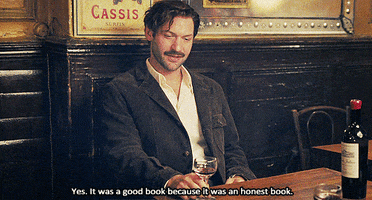


.jpg/revision/latest?cb=20110721032056)


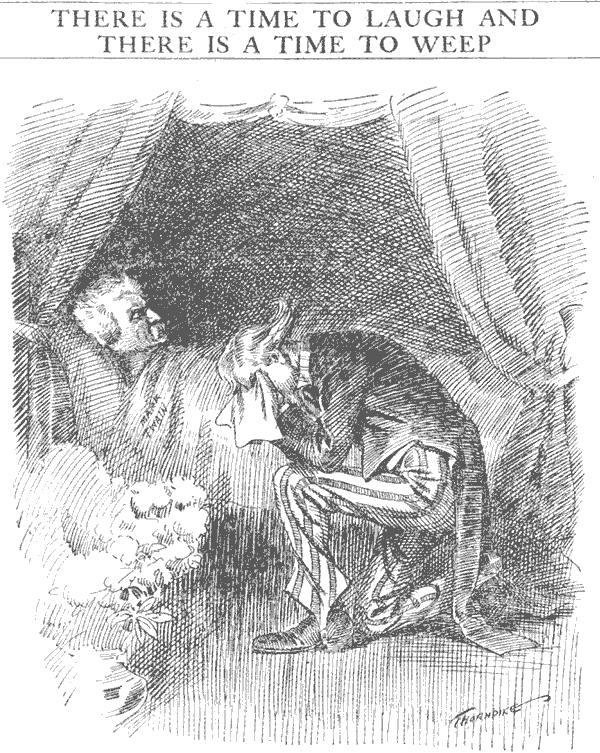



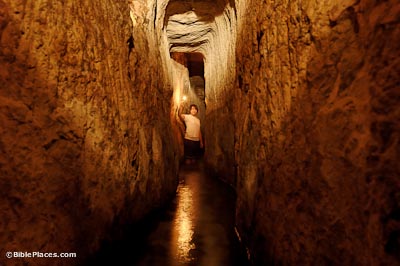

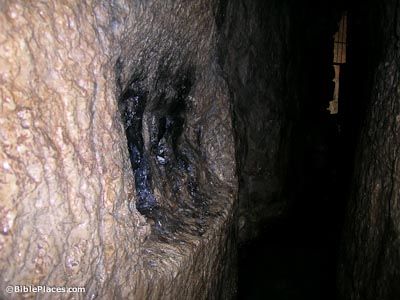


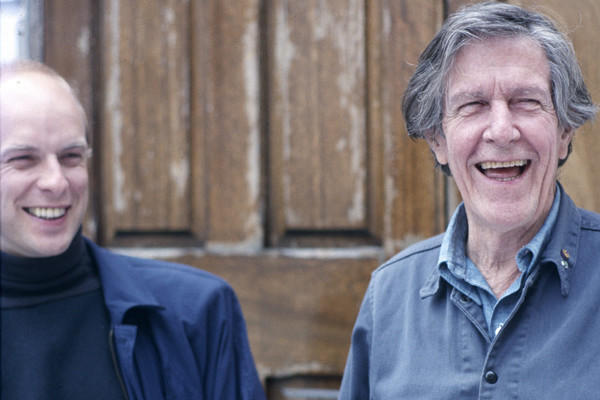


 Christmas Common Parousia 2014
 Writing in the Dust 2013
 The Return study 2012
 Black Poplar with Gold 2012
 Brightwell Barrow IV 2012
 Brightwell Barrow I 2011
 The Flowering Tree 2011
 Oak Tree with Gold 2011
 Crucifixion drawing 2010
 The Redemption 2009
 The Road to Emmaus 2008 (detail)
 The Epiphany 2008
 There is a river 2008
 Lazarus 2008
 Strancally Turkey Oak 2006
 Church Way Iffley 2004
 Fronfayr 2004
 Oak Tree 2004
 Ruth and Boaz 2000
 The view of Telanissus 1998
 A Pilgrim Road 1998


 The Daily Hatch