Tag Archives: Stephen Hawking

RESPONDING TO HARRY KROTO’S BRILLIANT RENOWNED ACADEMICS!! Stephen Jay Gould, Harvard, paleontologist, “If I were a bacteria I would be quite satisfied that I was dominating the planet…I don’t know why consciousness should be seen as any state of higher being especially if you use the evolutionist primary criterion of success measured by duration”

On November 21, 2014 I received a letter from Nobel Laureate Harry Kroto and it said:

…Please click on this URL http://vimeo.com/26991975

and you will hear what far smarter people than I have to say on this matter. I agree with them.

Harry Kroto

I have attempted to respond to all of Dr. Kroto’s friends arguments and I have posted my responses one per week for over a year now. Here are some of my earlier posts:

Arif AhmedHaroon Ahmed,  Jim Al-Khalili, Sir David AttenboroughMark Balaguer, Horace Barlow, Michael BateSir Patrick BatesonSimon Blackburn, Colin Blakemore, Ned BlockPascal BoyerPatricia ChurchlandAaron CiechanoverNoam Chomsky, Brian CoxPartha Dasgupta,  Alan Dershowitz, Frank DrakeHubert Dreyfus, John DunnBart Ehrman, Mark ElvinRichard Ernst, Stephan Feuchtwang, Robert FoleyDavid Friend,  Riccardo GiacconiIvar Giaever , Roy GlauberRebecca GoldsteinDavid J. Gross,  Brian Greene, Susan GreenfieldStephen F Gudeman,  Alan Guth, Jonathan HaidtTheodor W. Hänsch, Brian Harrison,  Stephen HawkingHermann Hauser, Robert HindeRoald Hoffmann,  Bruce HoodGerard ‘t HooftCaroline HumphreyNicholas Humphrey,  Herbert Huppert,  Gareth Stedman Jones, Steve JonesShelly KaganMichio Kaku,  Stuart KauffmanMasatoshi Koshiba,  Lawrence KraussHarry Kroto, George Lakoff,  Rodolfo LlinasElizabeth Loftus,  Alan MacfarlaneDan McKenzie,  Mahzarin BanajiPeter MillicanMarvin MinskyLeonard Mlodinow,  P.Z.Myers,   Yujin NagasawaAlva NoeDouglas Osheroff, David Parkin,  Jonathan Parry, Roger Penrose,  Saul PerlmutterHerman Philipse,  Carolyn PorcoRobert M. PriceVS RamachandranLisa RandallLord Martin ReesColin RenfrewAlison Richard,  C.J. van Rijsbergen,  Oliver Sacks, John SearleMarcus du SautoySimon SchafferJ. L. Schellenberg,   Lee Silver Peter Singer,  Walter Sinnott-ArmstrongRonald de Sousa, Victor StengerJohn SulstonBarry Supple,   Leonard Susskind, Raymond TallisMax TegmarkNeil deGrasse Tyson,  Martinus J. G. Veltman, Craig Venter.Alexander Vilenkin, Sir John Walker, James D. WatsonFrank WilczekSteven Weinberg, and  Lewis Wolpert,

I really starting following the work of Stephen Jay Gould and Niles Eldredge when I happened to watch the program DID DARWIN GET IT WRONG? on the show NOVA in 1981 on PBS. I was so taken with the show that I ordered the transcript.  In this show the scientists attacked the evolution of the horse exhibit in the Museum of Natural History in New York City. The funny thing is the next day in college my professor brought up that very exhibit as proof of evolution and I was able to correct him and later provided him with the transcript of the program. Below are a few quotes from that program.

“It is, indeed, a very curious state of affairs, I think, that paleontologists have been insisting that their record is consistent with slow, steady, gradual evolution where I think that privately, they’ve known for over a hundred years that such is not the case. …It’s the only reason why they can correlate rocks with their fossils, for instance. …They’ve ignored the question completely.” (Eldredge, Niles, “Did Darwin Get It Wrong?” Nova (November 1, 1981), 22 p. 6.)

Refuting the Neo-Darwinian Faith

Posted by on July 17, 2008 in Apologetics, Articles/Essays, Neo-Darwinism, Old School Presbyterian churches | 0 comments

While I was on vacation last week my daughter and I went into NYC and one of the places we visited was the Museum of Natural History. As we were walking around, I couldn’t help but reflect that if Neo-Darwinians set out to self-consciously build a Neo-Darwinian Cathedral, it would be the Museum of Natural History.

Everywhere you looked the displays and exhibits put evolution and materialism front and center. It was almost as though the curators wanted to make absolutely sure that anyone entering into the building might have a chance to take in the materialist gospel – “from nothing, came everything, and to nothing, everything shall return.” This was glaringly apparent in displays like “The Hall of Human Origins” which supposedly traces

“the remarkable history of human evolution from our earliest ancestors millions of years ago to modern Homo sapiens.”

and the Hayden planetarium, which rather than giving us a view of the majesty of the universe as it is, instead takes visitors on a fantasy-land ride through the universe as the Neo-Darwinian faithful believe it was built (or more correctly, randomly assembled):

“The bottom half of the Hayden Sphere houses the Big Bang, where visitors will be transported to the beginning of time and space, experiencing a dramatic, multisensory re-creation of the first moments of the universe. From here, visitors continue on an awe-inspiring journey that chronicles the evolution of the universe by following the Harriet and Robert Heilbrunn Cosmic Pathway — a sloping walkway that takes them through 13 billion years of cosmic evolution.”

Even a display on the amazing history of the horse couldn’t help but highlight the supposed evolution of the horse from other creatures.

But what is never pointed out to the visitor are the gaps, the guesses, the blind-leaps, and the overwhelming mass of data that contradicts the totally outdated assumptions of the Neo-Darwinians. In short, the museum doesn’t let on that what it is really doing is pedaling a self-contradictory and increasingly intolerant faith. The Neo-Darwinians and the forces behind this God denying movement (Romans 1:18-32, Eph. 6:11) have a vested interest in not doing so. But pastors, elders, and parents have a responsibility to the lambs that Christ has entrusted to expose Neo-Darwinianism for what it is, because Neo-Darwinianism is not science, but a false faith that is as resistant to questioning and critique as the Roman church in the middle-ages ever was. The purpose of this post, therefore, is merely to point out a few of the more glaring errors in the Neo-Darwinian matrix and then recommend some good resources so that OSP pastors and elders might equip their congregations and be informed themselves.

First, lets deal with the theory of “phyletic gradualism.” Whether or not you know what that is, you can’t go into the American Museum of Natural History without seeing it in chart after chart of supposed chains that indicate how a presently living species developed from another earlier species. Usually, the chains are drawn by making connections between fossil animals that have similar features. A few species are found that resemble another species and then there are speculations that this is an “ancestor.” Scientifically, this is the equivalent of finding a Camaro in the junk yard at one level in a stack, and a Corvette beneath it and speculating that the Camaro developed from the Corvette based on functional similarities between the two.

If evolution were working according to the traditional hypothesis referred to as “phyletic gradualism”presupposed by Darwin, we would see an easily discernable pattern of chains in the fossil beds, as species clearly “mutated” into other species. This however is not what we find, and even evolutionary paleontologists are aware of it. For instance, the following quotes are from Niles Eldredge and Stephen J. Gould, both paleontologists and supporters of evolution:

“No wonder paleontologists shied away from evolution for so long. It seems never to happen. Assiduous collecting up cliff faces yields zigzags, minor oscillations, and the very occasional slight accumulation of changeover millions of years, at a rate too slow to really account for all the prodigious change that has occurred in evolutionary history. When we do see the introduction of evolutionary novelty, it usually shows up with a bang, and often with no firm evidence that the organisms did not evolve elsewhere! Evolution cannot forever be going on someplace else. Yet that’s how the fossil record has struck many a forlorn paleontologist looking to learn something about evolution.” (Eldredge, Reinventing Darwin: The Great Evolutionary Debate, 1996)

“It is, indeed, a very curious state of affairs, I think, that paleontologists have been insisting that their record is consistent with slow, steady, gradual evolution where I think that privately, they’ve known for over a hundred years that such is not the case.” (Eldredge, “Did Darwin Get It Wrong?” Nova 11/1/81))

“Paleontologists have paid an enormous price for Darwin’s argument. We fancy ourselves as the only true students of life’s history, yet to preserve our favored account of evolution by natural selection we view our data as so bad that we almost never see the very process we profess to study. …The history of most fossil species includes two features particularly inconsistent with gradualism: 1. Stasis. Most species exhibit no directional change during their tenure on earth. They appear in the fossil record looking much the same as when they disappear; morphological change I usually limited and directionless. 2. Sudden appearance. In any local area, a species does not arise gradually by the steady transformation of its ancestors; it appears all at once and ‘fully formed.’” (Gould, The Panda’s Thumb, 1980)

“Most families, orders, classes, and phyla appear rather suddenly in the fossil record, often without anatomically intermediate forms smoothly interlinking evolutionarily derived descendant taxa with their presumed ancestors.” (Eldredge, Macro-Evolutionary Dynamics: Species, Niches, and Adaptive Peaks, 1989)

Then there is the famous Cambrian Explosion, or what some scientists call “the Biological Big Bang”, that would be the death knell of phyletic gradualism if Neo-Darwinianism rested on data and not blind faith:

“The “Cambrian explosion” refers to the geologically sudden appearance of many new animal body plans about 530 million years ago. At this time, at least nineteen, and perhaps as many as thirty-five phyla of forty total (Meyer et al. 2003), made their first appearance on earth within a narrow five- to ten-million-year window of geologic time (Bowring et al. 1993, 1998a:1, 1998b:40; Kerr 1993; Monastersky 1993; Aris-Brosou & Yang 2003). Many new subphyla, between 32 and 48 of 56 total (Meyer et al. 2003), and classes of animals also arose at this time with representatives of these new higher taxa manifesting significant morphological innovations. The Cambrian explosion thus marked a major episode of morphogenesis in which many new and disparate organismal forms arose in a geologically brief period of time.

To say that the fauna of the Cambrian period appeared in a geologically sudden manner also implies the absence of clear transitional intermediate forms connecting Cambrian animals with simpler pre-Cambrian forms. And, indeed, in almost all cases, the Cambrian animals have no clear morphological antecedents in earlier Vendian or Precambrian fauna (Miklos 1993, Erwin et al. 1997:132, Steiner & Reitner 2001, Conway Morris 2003b:510, Valentine et al. 2003:519-520). Further, several recent discoveries and analyses suggest that these morphological gaps may not be merely an artifact of incomplete sampling of the fossil record (Foote 1997, Foote et al. 1999, Benton & Ayala 2003, Meyer et al. 2003), suggesting that the fossil record is at least approximately reliable (Conway Morris 2003b:505).” (Meyer, PROCEEDINGS OF THE BIOLOGICAL SOCIETY OF WASHINGTON, 117(2):213-239. 2004, “The origin of biological information and the higher taxonomic categories”)

What paleontologists like Gould and Eldredge have have realized is that rather than showing a gradual progress of one species to another, the fossil record shows not the development, but the existence of complex biological structures with no record of earlier “transitional” structures.

“Stepping way back and looking at too broad a scale, one might discern some sort of progress in life’s history. …But the pattern dissolves upon close inspection. Most structural complexity entered in a grand burst at the Cambrian explosion, and the history of Phanerozoic life since then has largely been a tale of endless variation upon a set Bauplane. We may discern a few ‘vectors’ of directional change – thickening and ornamentation of shells…–but these are scarcely the stuff of progress in its usual sense.” (Gould, “The Paradox of the First Tier: an Agenda for Paleobiology,” Paleobiology, 1985)

Regarding why Neo-Darwinians are so tied to theories that are actually disproved by the evidence, Gould (who was himself an anti-theist) noted in his famous essay “Darwinian Fundamentalism” the distressing fact that Neo-Darwinianism had been transformed from a Scientific theory into the new unshakable faith of the present age. He and his colleagues criticized the willingness of educational establishments to continue teaching portions of Darwinian evolution that had long since been scrapped, as well as their unwillingness to embrace modern theories such as the “wonderful monster” concept of change via simultaneous rapid mutations (Punctuated Equilibrium). In fact, although he held creationists in utter contempt, he too was embarassed by the tendency of text-book publishers to print pictures of hypothetical “transitional life forms” that no fossil evidence has ever uncovered and which are biologically untenable.

For instance, Gould and many other paleontologists were only too well aware that a structure in-between an arm and a wing that was actually neither, made for a life-form that even under the concept of “survival of the fitest” would be “deleted.” As most modern paleontologists point out, we have fossil arms and we have fossil wings, we have fossil arms and fossil flippers, but no transitional forms in between. They’ve generally given up on searching for biologically untenable “links” and because design and creation are immediately ruled out (materialism is after all the ruling philosophy in the academy) as possibilities, they have generated a series of increasingly bizarre and unlikely theories such as punctuated equilibrium which speculates that at some point a lizard gave birth to a bird, and said bird found another similar mutant and the bird species began. At some point you have to step back and scratch your head and say, “and we Christians are the kooks because we believe God made birds and lizards?”

So the fossil record far from proving Neo-Darwinianism actually does the opposite. Darwinians always assumed they would find “transitional life forms” showing the development of one species into another. They haven’t, and in fact, recent digs particularly in the Cambrian strata in China are showing that the classic Darwinian tree, which went from a single common ancestor to an increasing diversity of life is actually upside-down. As we’ve mentioned there was a sudden “explosion” of life in the Cambrian period, and much less diversity afterwards, in other words, there are fewer and fewer lifeforms as one goes up the tree, not more and more. The fossil record tells us that species became extinct, but it doesn’t tell us new ones evolved from the existing ones. All the assumptions, taken on faith, by Darwinian scientists in the 19th century have failed to pan out in the fossil record.

But even more damaging to the Neo-Darwinian faith are the advances in DNA research and Biochemistry, areas that Darwin had no knowledge of and which are proving antithetical to his theories. The discoveries in these fields are showing to the chagrin of Darwinians that there is no natural mechanism for ADDING information to the DNA sequence that would allow, for instance, for a change of species. What this means is that while we can tinker with DNA in a lab, “nature” simply doesn’t have a mechanism for changing DNA in the way that would allow for Flatworms to become Field Mice. It simply can’t be done, and it doesn’t matter how much time or mutation one posits.

Proteins are made up of long complex chains of organic chemicals called “amino acids”, various proteins are brought together to form structures within cells each of which has a highly complex role to play – they are in essence the “engines” of the cell, the composition of these amino acid chains is determined by the information contained in DNA. It is the DNA code that instructs the cellular machines that put together the Amino acid chains in what order they are to go. Nothing in Darwin’s theory can account for the creation of the information in DNA or, most importantly, how amino acids were assembled in the correct order to form proteins prior to the creation of DNA. Proteins cannot precede the DNA necessary to construct them and inorganic chemicals cannot create information.

Also, natural selection cannot occur without the driving force of life and death and thus “genetic favoritism” and gradual change. What this means is that prior to the existence of life-forms Neo-Darwinianism lacks an engine to drive it. Natural selection actually presumes the existence of at least cellular life-forms before it can operate. So it cannot explain the combination of organic chemicals or even their creation.

Thus the “Deus Ex Machina” that powers Neo-Darwinian theory, natural selection, cannot account for the formation of life from non-life or the formation of actual information. Which means that while Genesis 1-2 can account for the creation of life, Neo-Darwinianism cannot.

Obviously this is only a very brief sketch of the information out there, and I present it merely to hopefully whet your appetite for your own studies. The following are a few links which I hope will be of value to you as you train-up your own flock, there are many more I could list, but this should be enough to get you started.

The Mythical Horse Series


Horse evolution prominently appears in textbooks as a supreme example of the evolution of one body style into another. All students remember the “horse series” sketches, tracing the development of a small browser named Hyracotherium (formerly known as Eohippus) with four toes on the front feet and three on the rear, into the large one-toed horse of today. Intermediate steps included the three-toed Mesohippus, a modified horse with one toe touching the ground; the one-toed Merychippus; Pliohippus, also with only one toe; and finally our modern horse, Equus, who along the way had acquired high-crowned molars and other adaptations.

Of course, modern horses exist in great variety, with many unusual adaptations that allow them to cope with widely varied environments. Numerous species are recognized, almost all of which are known to hybridize. Obviously, there is a great deal of latitude in horse characteristics. Furthermore, various strains can be bred to accentuate one trait, such as the tiny horses about as large as a dog. Horses display a great deal of adaptability.

Early evolutionary theories hypothesized progress in a direct line from one type to another, and fossils were displayed within that framework. In recent decades, this view of directed evolution has been generally disavowed, and no particular form is now considered to have been the goal of “non-directed” mutation and natural selection. Once free to examine the data without this “directed” overprint, evolutionary scientists were quick to recognize that changes among horses had been abundant, extensive, and unpredictable.

There are some things to note, however. During the same time period that some of the descendants of Hyracotheriumsupposedly developed into full-blown horses and elephants and other mammals, others persisted unchanged. It seems that evolution does not always change things–often it leaves them alone. Selection pressures that acted so strongly to produce major modifications in some life forms left others in stasis. Their fossils are found in the same strata intervals, so they must have lived in the same environment. Evolution apparently does not apply across the board. If a theory can accommodate any possibility, it is a weak concept indeed.

It is now acknowledged that horse evolution as recorded in the fossils follows no recognizable pattern, and that the evolutionary “tree” looks more like a multi-branching “bush.” The successive forms indicating straight-line evolution appear only in textbooks; they do not appear in the fossils. Sometimes fossils of different types that supposedly lived at different times appear together in the same strata layer. In Oregon, the three-toed grazer Neohipparion (very much like Merychippus) has been found with Pliohippus. In the Great Basin area, Pliohippus has been found with the three-toed Hipparion throughout the timeframe supposedly represented. Evolutionary scientists freely admit this situation–and to their credit often attempt to correct the misconceptions–but still the horse series appears in the textbooks.

Any three fossils can be placed in a line and an evolutionary story can be told about the transformation of one into the other. And a different story could be told if the fossils were arranged in a different order.

It is interesting to note that Hyracotherium was so named because its specimens looked similar to the hyrax. This little “rock badger” can be seen alive in many zoos, complete with an interpretive sign listing its varied evolutionary antecedents. It looks very, very different from a horse, but most of its reputed predecessors could possibly be true variants of the horse. If you took the tiny three-toed ones out of the line-up, then the fossils would fit the creation picture, showing variety within a created kind.

* Dr. Morris is President of the Institute for Creation Research.

Cite this article: Morris, J. 2008. The Mythical Horse Series. Acts & Facts. 37 (9): 13.


Stephen Jay Gould

From Wikipedia, the free encyclopedia
This article is about the paleontologist and science writer. For the science fiction writer, see Steven Gould. For the 19th century businessman, see Jay Gould.
Stephen Jay Gould
Stephen Jay Gould 2015, portrait (unknown date).jpg
Born September 10, 1941
Queens, New York, United States
Died May 20, 2002 (aged 60)
Manhattan, New York, United States
Nationality American
Fields Paleontology, Evolutionary biology,
History of Science
Institutions Harvard University,
American Museum of Natural History,
New York University
Alma mater Antioch College (BA),
University of Leeds,
Columbia University (PhD)
Thesis Pleistocene and Recent History
of the Subgenus Poecilozonites
(Poecilozonites) (Gastropoda: Pulmonata)
in Bermuda:
An Evolutionary Microcosm
 (1967)
Doctoral advisor R. L. Batten
J. Imbrie
Norman D. Newell
Known for Punctuated equilibrium, Non-overlapping magisteria
Notable awards Linnean Society of London‘s
Darwin–Wallace Medal (2008)
Paleontological Society Medal (2002)
Sue Tyler Friedman Medal (1989)
Charles Schuchert Award (1975)
Phi Beta Kappa Award in Science (twice – 1983, 1990)
MacArthur Fellowship
National Book Award
National Book Critics Circle Award
Spouse Deborah Lee (1965–1995; divorced; 2 children)
Rhonda Roland Shearer (1995–2002; his death; 2 stepchildren)
Signature

Stephen Jay Gould (/ɡld/; September 10, 1941 – May 20, 2002) was an American paleontologist, evolutionary biologist, and historian of science. He was also one of the most influential and widely read writers of popular science of his generation.[1] Gould spent most of his career teaching at Harvard University and working at the American Museum of Natural History in New York. In 1996 Gould was also hired as the Vincent Astor Visiting Research Professor of Biology at New York University, where he divided his time teaching there and at Harvard.

Gould’s most significant contribution to evolutionary biology was the theory of punctuated equilibrium, which he developed with Niles Eldredge in 1972.[2] The theory proposes that most evolution is characterized by long periods of evolutionary stability, which is infrequently punctuated by swift periods of branching evolution. The theory was contrasted against phyletic gradualism, the popular idea that evolutionary change is marked by a pattern of smooth and continuous change in the fossil record.[3]

Most of Gould’s empirical research was based on the land snail genera Poecilozonites and Cerion. He also contributed to evolutionary developmental biology, and has received wide praise for his book Ontogeny and Phylogeny. In evolutionary theory he opposed strict selectionism, sociobiology as applied to humans, andevolutionary psychology. He campaigned against creationism and proposed that science and religion should be considered two distinct fields (or “magisteria“) whose authorities do not overlap.[4]

Gould was known by the general public mainly from his 300 popular essays in the magazine Natural History,[5] and his books written for both the specialist and non-specialist. In April 2000, the US Library of Congress named him a “Living Legend“.[6]

Marriage and family[edit]

Gould married artist Deborah Lee on October 3, 1965.[19] Gould met Lee while they were students together at Antioch College.[8] They had two sons, Jesse and Ethan, and were married for 30 years.[20] His second marriage in 1995 was to artist and sculptor Rhonda Roland Shearer.[19]

In  the third video below in the 147th clip in this series are his words and  my response is below them. 

50 Renowned Academics Speaking About God (Part 1)

Another 50 Renowned Academics Speaking About God (Part 2

A Further 50 Renowned Academics Speaking About God (Part 3)

___

QUOTE by Stephen Jay Gould

“Whatever happened to the idea that we are a higher being put on the earth for a higher purpose and we are at the top of the evolutionary ladder?”

Defined by whom? If I were  a bacteria I would be quite satisfied that I was dominating the planet. I have been here 3 1/2 billion years. There is more of me than there is of you. There is no way you can nuke me into oblivion. You humans can nuke yourselves  and I will be here till the sun explodes and you won’t. The only difference is that as a bacteria I wouldn’t have the consciousness to imagine that but I don’t know why consciousness should be seen as any state of higher being especially if you use the evolutionist primary criterion of success measured by duration. I wouldn’t place any bets on consciousness assuring our long survival on this planet.   

Consciousness is a big deal and it goes against the Dr. Gould’s argument here. The Bible says that humans were put here for a reason and that we were created in the image of God.  Let me respond further by using the Fine Tuning Argument from Antony Flew. 

The Fine Tuning Argument for the Existence of God from Antony Flew!

Imagine entering a hotel room on your next vacation. The CD player on the bedside table is softly playing a track from your favorite recording. The framed print over the bed is identical to the image that hangs over the fireplace at home. The room is scented with your favorite fragrance…You step over to the minibar, open the door, and stare in wonder at the contents. Your favorite beverage. Your favorite cookies and candy. Even the brand of bottled water you prefer…You notice the book on the desk: it’s the latest volume by your favorite author…

Chances are, with each new discovery about your hospitable new environment, you would be less inclined to think it has all a mere coincidence, right? You might wonder how the hotel managers acquired such detailed information about you. You might marvel at their meticulous preparation. You might even double-check what all this is going to cost you. But you would certainly be inclined to believe that someone knew you were coming.      There Is A God  (2007)  p.113-4

I have more articles posted on my blog about the last few years of Antony Flew’s life than any other website in the world probably. The reason is very simple. I had the opportunity to correspond with Antony Flew back in the middle 90’s and he said that he had the opportunity to listen to several of the cassette tapes that I sent him with messages from Adrian Rogers and he also responded to several of the points I put in my letters that I got from Francis Schaeffer’s materials. The ironic thing was that I purchased the sermon IS THE BIBLE TRUE? originally from the Bellevue Baptist Church Bookstore in 1992 and in the same bookstore in 2008 I bought the book THERE IS A GOD by Antony Flew. Back in 1993 I decided to contact some of the top secular thinkers of our time and I got my initial list of individuals from those scholars that were mentioned in the works of both Francis Schaeffer and Adrian Rogers. Schaeffer had quoted Flew in his book ESCAPE FROM REASON. It was my opinion after reviewing the evidence that Antony Flew was the most influential atheistic philosopher of the 20th century.

On May 15, 1994 on the 10th anniversary of the passing of Francis Schaeffer I sent a letter to Stephen Jay Gould and here is a portion of that letter below:

I have enclosed a cassette tape by Adrian Rogers and it includes  a story about  Charles Darwin‘s journey from  the position of theistic evolution to agnosticism. Here are the four bridges that Adrian Rogers says evolutionists can’t cross in the CD  “Four Bridges that the Evolutionist Cannot Cross.” 1. The Origin of Life and the law of biogenesis. 2. The Fixity of the Species. 3.The Second Law of Thermodynamics. 4. The Non-Physical Properties Found in Creation.  

Evolution Fact of Fiction Adrian Rogers (same message I put on cassette tape back in 1994)

Uploaded on Nov 13, 2011

The Theory of Evolution Destroyed!!

In the first 3 minutes of the cassette tape is the hit song “Dust in the Wind.” Below I have given you some key points  Francis Schaeffer makes about the experiment that Solomon undertakes in the book of Ecclesiastes to find satisfaction by  looking into  learning (1:16-18), laughter, ladies, luxuries,  and liquor (2:1-3, 8, 10, 11), and labor (2:4-6, 18-20).

Schaeffer noted that Solomon took a look at the meaning of life on the basis of human life standing alone between birth and death “under the sun.” This phrase UNDER THE SUN appears over and over in Ecclesiastes. The Christian Scholar Ravi Zacharias noted, “The key to understanding the Book of Ecclesiastes is the term UNDER THE SUN — What that literally means is you lock God out of a closed system and you are left with only this world of Time plus Chance plus matter.”

Here the first 7 verses of Ecclesiastes followed by Schaeffer’s commentary on it:

The words of the Preacher, the son of David, king in Jerusalem. Vanity of vanities, says the Preacher, vanity of vanities! All is vanity. What does man gain by all the toil at which he toils under the sun? A generation goes, and a generation comes, but the earth remains forever. The sun rises, and the sun goes down, and hastens to the place where it rises. The wind blows to the south and goes around to the north; around and around goes the wind, and on its circuits the wind returns. All streams run to the sea, but the sea is not full; to the place where the streams flow, there they flow again.  

Solomon is showing a high degree of comprehension of evaporation and the results of it.  Seeing also in reality nothing changes. There is change but always in a set framework and that is cycle. You can relate this to the concepts of modern man. Ecclesiastes is the only pessimistic book in the Bible and that is because of the place where Solomon limits himself. He limits himself to the question of human life, life under the sun between birth and death and the answers this would give.

Solomon doesn’t place man outside of the cycle. Man doesn’t escape the cycle. Man is in the cycle. Birth and death and youth and old age.

There is no doubt in my mind that Solomon had the same experience in his life that I had as a younger man (at the age of 18 in 1930). I remember standing by the sea and the moon arose and it was copper and beauty. Then the moon did not look like a flat dish but a globe or a sphere since it was close to the horizon. One could feel the global shape of the earth too. Then it occurred to me that I could contemplate the interplay of the spheres and I was exalted because I thought I can look upon them with all their power, might, and size, but they could contempt nothing. Then came upon me a horror of great darkness because it suddenly occurred to me that although I could contemplate them and they could contemplate nothing yet they would continue to turn in ongoing cycles when I saw no more forever and I was crushed.

That Man is the product of causes which had no prevision of the end they were achieving; that his origin, his growth, his hopes and fears, his loves and his beliefs, are but the outcome of accidental collocations of atoms; …that all the labors of the ages, all the devotion, all the inspiration, all the noonday brightness of human genius, are destined to extinction in the vast death of the solar system, and that the whole temple of Man’s achievement must inevitably be buried beneath the debris of a universe in ruins—all these things, if not quite beyond dispute, are yet so nearly certain, that no philosophy which rejects them can hope to stand. Bertrand Russell

The British humanist H. J. Blackham (1903-2009) put it very plainly: On humanist assumptions, life leads to nothing, and every pretense that it does not is a deceit. If there is a bridge over a gorge which spans only half the distance and ends in mid-air, and if the bridge is crowded with human beings pressing on, one after the other they fall into the abyss. The bridge leads nowhere, and those who are pressing forward to cross it are going nowhere….It does not matter where they think they are going, what preparations for the journey they may have made, how much they may be enjoying it all. The objection merely points out objectively that such a situation is a model of futility“( H. J. Blackham, et al., Objections to Humanism (Riverside, Connecticut: Greenwood Press, 1967).

Let me show you some inescapable conclusions if you choose to live without God in the picture. Schaeffer noted that Solomon came to these same conclusions when he looked at life “under the sun.”

  1. Death is the great equalizer (Eccl 3:20, “All go to the same place; all come from dust, and to dust all return.”)
  2. Chance and time have determined the past, and they will determine the future.  (Ecclesiastes 9:11-13 “I have seen something else under the sun:  The race is not to the swift
    or the battle to the strong, nor does food come to the wise or wealth to the brilliant  or favor to the learned; but time and chance happen to them all.  Moreover, no one knows when their hour will come: As fish are caught in a cruel net, or birds are taken in a snare, so people are trapped by evil times  that fall unexpectedly upon them.”)
  3. Power reigns in this life, and the scales are not balanced(Eccl 4:1; “Again I looked and saw all the oppression that was taking place under the sun: I saw the tears of the oppressed—
    and they have no comforter; power was on the side of their oppressors—  and they have no comforter.” 7:15 “In this meaningless life of mine I have seen both of these: the righteous perishing in their righteousness,  and the wicked living long in their wickedness. ).
  4. Nothing in life gives true satisfaction without God including knowledge (1:16-18), ladies and liquor (2:1-3, 8, 10, 11), and great building projects (2:4-6, 18-20).
  5. There is no ultimate lasting meaning in life. (1:2)

By the way, the final chapter of Ecclesiastes finishes with Solomon emphasizing that serving God is the only proper response of man. Solomon looks above the sun and brings God back into the picture in the final chapter of the book in Ecclesiastes 12:13-14, “ Now all has been heard; here is the conclusion of the matter: Fear God and keep his commandments, for this is the whole duty of man.  For God will bring every deed into judgment, including every hidden thing, whether it is good or evil.”

The answer to find meaning in life is found in putting your faith and trust in Jesus Christ. The Bible is true from cover to cover and can be trusted. In 1978 I heard the song “Dust in the Wind” by Kansas when it rose to #6 on the charts. That song told me that Kerry Livgren the writer of that song and a member of Kansas had come to the same conclusion that Solomon had and that “all was meaningless UNDER THE SUN,” and looking ABOVE THE SUN was the only option.  I remember mentioning to my friends at church that we may soon see some members of Kansas become Christians because their search for the meaning of life had obviously come up empty even though they had risen from being an unknown band to the top of the music business and had all the wealth and fame that came with that.

Livgren wrote, “All we do, crumbles to the ground though we refuse to see, Dust in the Wind, All we are is dust in the wind, Don’t hang on, Nothing lasts forever but the Earth and Sky, It slips away, And all your money won’t another minute buy.”

Both Kerry Livgren and Dave Hope of Kansas became Christians eventually. Kerry Livgren first tried Eastern Religions and Dave Hope had to come out of a heavy drug addiction. I was shocked and elated to see their personal testimony on The 700 Club in 1981.  Livgren lives in Topeka, Kansas today where he teaches “Diggers,” a Sunday school class at Topeka Bible Church. Hope is the head of Worship, Evangelism and Outreach at Immanuel Anglican Church in Destin, Florida.

__

Adrian Rogers is pictured below and Francis Schaeffer above.
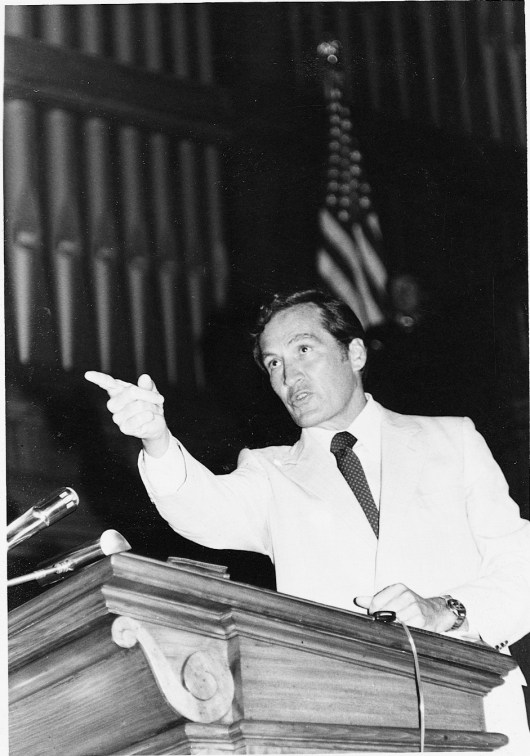
Watching the film HOW SHOULD WE THEN LIVE? in 1979 impacted my life greatly

Francis Schaeffer in the film WHATEVER HAPPENED TO THE HUMAN RACE?
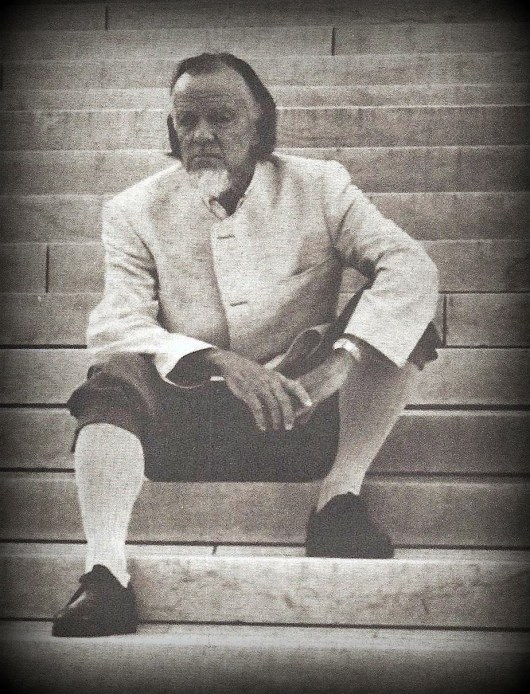
Francis and Edith Schaeffer

 
___

This might interest you that good friend in Little Rock Craig Carney had an uncle named  Warren Carney and Warren was born in 1917 and he was the last living witness of the Scopes Monkey trial but he died in June of 2015. His father took him to the trial every day since they lived in Dayton and it was the biggest happening in the town’s history. Also I attended the funeral of Dr. Robert G. Lee (1886-1978) at Bellevue Baptist in Memphis and he is the minister who presided over William Jennings Bryan’s funeral in 1925. I have posted Dr. Lee’s most famous sermonPAYDAY SOME DAY on this blog and it continues to get lots of views everyday.

(William Jennings Bryan)

(Dr. Robert G. Lee )

_______________________________

Judge William Ray Overton, circa 1960s.

http://www.discovery.org/f/121

The Arkansas Decision on Creation-Science

On January 5, 1982, Judge William R. Overton of the District Court in Little Rock handed down a decision holding that the Arkansas Act for Balanced Treatment of Creation-Science and Evolution-Science violates the establishment clause of the First Amendment, academic freedom, and due process, in McLean v. Arkansas Board of Education. The judge is one of more than 400 U.S. District Court judges, and another federal or state judge can reject Overton’s reasoning and reach an opposite result.

At the trial from December 7-17, 1981, many well-qualified creationist scientists appeared as expert witnesses. They gave outstanding scientific testimony, but the defense was not adequately prepared and did not do adequate questioning. (Neither ICR nor attorneys Bird and Whitehead were involved in the trial or discovery.) The news media grossly distorted their testimony. Part I of this article is a summary by Dr. Duane Gish, who was present during the trial, of the actual testimony given. Part II is a brief of the judge’s decision.

John Scopes:

I. WHAT ACTUALLY OCCURRED AT THE TRIAL
By Duane T. Gish, Ph.D.

The plaintiff’s first witnesses consisted of a group of theologians, philosophers and historians. Included were Father Francis Bruce Vawter, Prof. of Religious Studies, De Paul University, Chicago, Dr. George Marsden, Prof. of History, Calvin College, Grand Rapids; Rev. Kenneth Hicks, Methodist bishop, Little Rock; Dr. Langdon Gilkey, Prof. of Theology, School of Divinity, University of Chicago; Dr. Michael Ruse, Prof. of Philosophy, University of Guelph, Ontario; and Dr. Dorothy Nelkin, Prof. of Sociology, Cornell University, New York.

The testimony of this group of witnesses was directed towards linking creation science with Biblical Christianity. Marsden claimed that the Arkansas law gave this view preferential treatment. In cross-examination Nelkin admitted that evolution is based on an a priori assumption of no creator.

During cross-examination it was established that Ruse had published an article in which he had stated that Dr. Stephen Jay Gould (slated to be one of the plaintiff’s star witnesses) could not be a scientist because he was a Marxist. Ruse accused creationists of quoting out of context but then later quoted a portion of Gish’s book Evolution: The Fossils Say No flagrantly out of context.

The plaintiffs’ next group of witnesses included four scientists: Dr. Francisco Ayala, Prof. of Biology, University of California Davis; Dr. G. Brent Dalrymple, U.S. Geological Survey, Menlo Park, California; Dr. Stephen Jay Gould, Prof. of Geology, Harvard University; and Dr. Harold J. Morowitz, Prof. of Biophysics, Yale University. The purpose of this group of witnesses was to argue that creation had no scientific validity, and to describe evidence from science supporting evolution theory. Ayala cited evidence from molecular biology, Dalrymple cited radiometric dating, and Gould described evidence from geology and paleontology. Morowitz attacked the creationist’s use of the Second Law of Thermodynamics as evidence against evolution.

The plaintiffs’ final list of witnesses included several educators, who all claimed they could not implement the Arkansas law. Dr. William V. Mayer, Director of the Biological Science Curriculum Study, made the astounding statement that presenting an alternative interpretation of origins would confuse students and so should be avoided! All of the witnesses had apparently been coached by the ACLU staff of lawyers to maintain that they knew of no scientific evidence to support creation and that creation science was altogether religious.

The State’s first defense witness was Dr. Norman Geisler (Ph.D. in philosophy, Loyola U., Chicago), Prof. of Systematic Theology, Dallas Theological Seminary. To many, Geisler’s brilliant testimony destroyed much of the plaintiffs’ case. Citing much historical evidence, he established that belief in a creator does not necessarily involve religious worship or commitment, that the source of inspiration for a belief or proposition is independent of the evidence used to support the proposition, and that belief in creation is a logical inference based on valid evidence. In an attempt to discredit Geisler’s testimony, the ACLU lawyer quoted Geisler’s published belief that UFO’s were under the control of Satan. In most of the media this was headlined in order to mute the effect of Geisler’s testimony. Dr. Larry Parker, a professor in the Department of Curriculum and Instruction, Georgia State U., maintained that teaching the two models of origins would give students a valid choice, teaching them how to think rather than what to think.

The scientist witnesses for the state included Dr. W. Scot Morrow, Prof. of Biochemistry, Wofford College, Spartanburg, SC; Dr. Donald Chittick, a chemist engaged in biomass to energy conversion; Dr. Chandra Wickramasinghe, a mathematician-astronomer and Professor and Head of Department of Applied Mathematics, University College, Cardiff, Wales; Robert Gentry, a physicist at Oak Ridge National Laboratories; Dr. Wayne Frair, Prof. of Biology, The King’s College; Dr. Margaret Heider, Ph.D. in botany; Dr. Ariel Roth, Prof. of Biology, Geoscience Research Institute; and Dr. Harold Coffin, Prof. of Geology, Geoscience Research Institute.

Dr. Morrow, although an evolutionist and an agnostic, maintained that creationists actually look at more data than do evolutionists and that an inquiry approach involving multiple working hypotheses was a superior teaching method.

Dr. Wickramasinghe, one of England’s foremost scientists, also spoke for Sir Fred Hoyle, famous British astronomer with whom he has co-authored several books. Although both have long been identified as atheists, Wickramasinghe testified that they had concluded through a study of information science that the probability of an evolutionary origin of life was essentially zero—no greater than the probability that a tornado sweeping through a junkyard would assemble a Boeing 747! They also now disavow the Big Bang theory and the idea of biological evolution via mutations, both of which involve degradation of information. Prof. Wickramasinghe chided evolutionists for their arrogance and intolerance of creationist views.

Excellent testimony was given by zoologist Frair (taxonomic studies supporting creation), botanist Heider (botanical studies supporting separate origin of major plant groups), chemist Chittick (evidence for catastrophism and a young age), physicist Gentry (evidence from radiohaloes supporting a recent rapid creation), biologist Roth (studies on rapid coral growth), and geologist Coffin (paleontological evidence for creation and catastrophism).

From his decision it is obvious that Judge Overton (as well as most of the news media) completely ignored the scientific evidence presented by the defense witnesses while accepting without question evidence offered by the plaintiffs’ witnesses. Many remarks made by Judge Overton during the trial revealed his bias against the creationist side.

II. A BRIEF STATEMENT ON THE ARKANSAS DECISION
By John W. Whitehead, J.D.

The Arkansas district court gave a constitutionally erroneous and factually inaccurate opinion in McLean u. Arkansas Board of Education, No. 81-322 (E.D. Ark. Jan. 5, 1982). It is regrettable that the Arkansas defense did not adequately present or adequately support the strong constitutional arguments that could have been made in favor of balanced treatment of creation-science and evolution-science.

A. No Violation of Separation of Church & State. Teaching creation-science along with evolution-science does not violate separation of church and state. Creation-science can be presented solely in terms of scientific evidence and related inferences and without any religious concepts. The primary effect and purpose are to teach all of the scientific evidence on the subject of origins. See generally Bird, “Freedom of Religion and Science Instruction in Public Schools,” 87 Yale Law Journal 515,554-70 (1978); Bird, “Freedom from Establishment and Unneutrality in Public School Instruction,” 1979 Harvard Journal of Law & Public Policy 125, 165-74.

B. Constitutional Errors. (1) The Arkansas court is incorrect in stating that creation-science is Genesis (pp. 17, 19). Creation-science consists of scientific discussion rather than biblical discussion or concepts. Reference in public schools to a creator and consistency of public school curriculum with religion is permitted by the establishment clause under all U.S. Supreme Court precedents. (2) The court is also incorrect in saying “that creation science has no scientific merit or educational value as science” (pp. 32, 28). Examples of positive evidence are the abrupt appearance of complex life in the fossil record and the systematic gaps between fossil types. (3) The Arkansas court is incorrect in defining science as limited to “natural law,” and in contending that creation-science is not “explanatory,” “testable,” “tentative,” or “falsifiable” (p. 22). The scientific method cannot exclude evidence, and true science cannot define evidence away, on the basis of bias against the supranatural. Creation-science is as explanatory, testable, tentative, and falsifiable as evolution-science. (4) The opinion is incorrect in arguing that “[t]he two model approach of the creationists is simply a contrived dualism which has no scientific factual basis or legitimate educational purpose” (p. 20). That there are only two basic scientific explanations of origins is acknowledged by many evolutionist scientists, is required by logical analysis (the universe either always existed or was created, life either evolved or was created, etc.), and is strongly supported by educational research. (5) It is incorrect in stating that a balanced treatment requirement violates the academic freedom of students on the ground that teachers who despise creation-science will refuse to teach evolution-science and thereby will deprive students of “the cornerstone of modern biology” (p. 35). Presentation of all the scientific evidence on origins obviously expands rather than restricts students’ academic freedom, and any deprivation results from teachers’ choice rather than from a balanced treatment requirement. These constitutional issues will be discussed more fully in a forthcoming Impact article, and are treated exhaustively in the above legal articles.

C. Factual Inaccuracies. The Arkansas opinion also contains numerous factual errors, of which the following are only examples. (1) Paul Ellwanger in supporting model legislation was not “motivated by … desire to see the Biblical version of creation taught in the public schools” (p. 13), which he opposes, but instead to see all of the scientific evidence on origins taught. (2) “Creation from nothing … and subsequent destruction of the world by flood” is not “unique to Genesis” “among the many creation epics in human history” (P. 17), but in fact appears in most of them. (3) A “relatively recent inception” of the world and life does not mean “between 6,000 and 20,000 years because of the genealogy of the Old Testament” (p. 24), to which it has no relation, but a comparatively young age as opposed to the equally unspecific and variable old ages assumed by evolutionists.

III. THE LOUISIANA LITIGATION OVER CREATION-SCIENCE

The constitutionality of balanced treatment of creation-science and evolution-science is also being litigated in the U.S. District Court in Baton Rouge, Louisiana, in Keith v. Louisiana Department of Education (No. 81989B, filed Dec. 2, 1981). This lawsuit to declare the Louisiana Balanced Treatment Act constitutional was filed by Louisiana legislators, science professors, science teachers, and religious spokesmen (Catholic, Jewish, Muslim, and Agnostic) who are represented by attorneys Bird and Whitehead as special assistant attorneys general for Louisiana.

We are optimistic that the Louisiana lawsuit will result in a judicial opinion that public school instruction in creation-science is constitutional, directly contrary to the Arkansas decision, because it involves a different statute, new and different arguments and support, different expert witnesses, new and different scientific evidence, a different legislative purpose, and an adequate defense. Inquiries can be directed to the Creation Science Legal Defense Fund, P.O. Box 78312, Shreveport, LA 71107. (318) 226-9784.

Cite this article: Duane Gish, Ph.D. 1982. The Arkansas Decision on Creation-Science. Acts & Facts. 11 (3).

Evolution: The Changing Scene


Prof. Derek Ager of the University at Swansea, Wales, in Proc. Geol. Assoc. Vol. 87, p. 132 (1976) has stated

“It must be significant that nearly all the evolutionary stories I learned as a student, from Trueman’s Ostrea/Gryphea to Carruther’s Raphrentis delanouei, have now been ‘debunked.’ Similarly, my own experience of more than twenty years looking for evolutionary lineages among the Mesozoic Brachiopoda has proved them equally elusive.”

This admission by Prof. Ager (no friend of creationists) fits in very well with the title of this article—a significant part of the changing scene in evolutionary circles is the changing attitude of evolutionists concerning the fossil record—more and more are now admitting that the missing links are still missing, that they have little or no evidence for gradual change in the fossil record.

In his article in Natural History 86:22 (1977) entitled “The Return of Hopeful Monsters,” Stephen J. Gould, leading spokesman for evolutionists in the U.S. today, said that

“The fossil record with its abrupt transitions offers no support for gradual change…. “

“All paleontologists know that the fossil record contains precious little in the way of intermediate forms; transitions between major groups are characteristically abrupt.”

From an article published in Paleobiology, Vol. 3 (1977) by S.J. Gould and Niles Eldredge we find the following on p. 147:

“At the higher level of evolutionary transition between basic morphological designs, gradualism has always been in trouble, though it remains the ‘official’ position of most Western evolutionists. Smooth intermediates between Baupläne are almost impossible to construct, even in thought experiments; there is certainly no evidence for them in the fossil record (curious mosaics like Archaeopteryx do not count).” In his review of Steven Stanley’s bookMacroevolution by D.S. Woodruff (Science 208:716 (1980)), Woodruff says (I believe he is quoting Stanley):

“But fossil species remain unchanged throughout most of their history and the record fails to contain a single example of a significant transition.”

The clatter has become so loud that even the popular press has picked it up. Newsweek in an article entitled “Is Man a Subtle Accident?” published Nov. 3, 1980, stated

“The missing link between man and the apes, whose absence has comforted religious fundamentalists since the days of Darwin, is merely the most glamorous of a whole hierarchy of phantom creatures …. The more scientists have searched for the transitional forms that lie between species, the more they have been frustrated.”

Some evolutionists have come to realize that the fossil record is so bad relative to evolution theory that they want to avoid it entirely as support for evolution. Mark Ridley, a British evolutionist, tells us in his article published in New Scientist 90:832 (1981) that

“No real evolutionist, whether gradualist or punctuationist, uses the fossil record as evidence in favour of the theory of evolution as opposed to special creation.”

One might immediately wonder, then, where does Ridley believe we find all the marvelous evidence for the “fact of evolution?” Why, from the “observed evolution of species, from biogeography, and from the hierarchical structure of taxonomy,” Ridley tells us. He apparently disagrees with his fellow evolutionist and the most distinguished of all French zoologists, Pierre Grasse´ , who states in his book Evolution of Living Organisms (English translation, Academic Press, New York, 1977, p. 4):

“Naturalists must remember that the process of evolution is revealed only through fossil forms. A knowledge of paleontology is, therefore, a prerequisite; only paleontology can provide them with the evidence of evolution and reveal its course or mechanisms. Neither the examination of present beings, nor imagination, nor theories can serve as a substitute for paleontological documents.”

What Grasse´ says in his book is that biology offers us no help in our attempt to understand the mechanism of evolution. He says that evolution is a mystery about which little is, and perhaps can be, known. He says certainly mutations and natural selection cannot possibly provide that mechanism.

Many others in more recent times, in view of the growing knowledge that the fossil record produces no evidence for gradual change and that the gaps in the fossil record, particularly at the level of the higher categories, are systematic and almost always large, are now abandoning the neo-Darwinian theory of slow gradual change. Gould has said that as a general principle, neo-Darwinism is dead, although it is still textbook orthodoxy.

In his comments on a new mechanism for evolution postulated by Edward Wiley and Daniel Brooks, Roger Lewin (Science 217:1239-1240, 1982) says,

“Natural selection, a central feature of neo-Darwinism, is allowed for in Brooks and Wiley’s theory, but only as a minor influence. ‘It can affect survivorship’ says Brooks. ‘It can weed out some of the complexity and so slow down the information decay that results in speciation. It may have a stabilizing effect, but it does not promote speciation. It is not a creative force as many people have suggested.”‘

Let me point out first of all that all of this sounds familiar—it is the source that is astounding. The view just stated is precisely what has been said by creationists ever since Edward Blyth in 1830. Natural selection is a stabilizing force. It is not a creative force, the driving mechanism of evolution, which has been responsible for the conversion of one organism into another, all the way from amoeba to man. But now, notice who is saying this—evolutionists!

Even more, they are saying that natural selection is not only not the mechanism for evolution, it actually retards the evolutionary process. They say that natural selection slows down the information decay that results in speciation. That statement is absolutely astounding on two points.

First of all, their admission that natural selection not only is not the mechanism of evolution but actually acts contrary to evolution is most revealing. Secondly, that speciation, and thus evolution, occurs by the decay of information. Now that is really startling! We creationists have long pressed the point that the random processes supposedly at work in evolution cannot possibly account for the origin of new information required for increase in complexity and the generation of new functions and organs required by evolution. Evolutionists have, on the contrary, insisted that this was possible.

Now Wiley and Brooks are claiming that all of us were wrong, both creationists and evolutionists. Evolution, from the primordial single-celled organisms to the millions of present-day organisms, including man with his 30 trillion cells of over 200 varieties, including a three-pound human brain with twelve billion brain cells and 120 trillion connections, is the result of the decay of information!

Whatever anyone might think of that theory, certainly we can all recognize that they are rejecting Darwinism. As I have said earlier, many others are doing the same. Science Digest (Sept.-Oct. 1980, p. 55) had an article entitled “Was Darwin Wrong.?” The British Broadcasting Company produced a television program a year or two ago entitled “Did Darwin Get It Wrong?” Stephen J. Gould, Niles Eldredge, Steven Stanley and others have abandoned neo-Darwinism for what they call “punctuated equilibrium.” They suggest that what we see in the fossil record is that species abruptly appear, fully-formed. They remain virtually unchanged for the duration of their existence, up to ten million years or even more, and they then abruptly disappear and are replaced by other species that also abruptly appear fully formed with no evidence of transitional forms.

They suggest that the evolutionary transitions occur somewhere out in an isolated area on the periphery of the main population and that the transitions occur very rapidly in small populations. The change is so rapid and the numbers are so small, we are told, that there are no opportunities for fossilization of the transitional forms.

Let me point out, first of all, that this notion of punctuated equilibrium is no mechanism at all. It is simply a new scenario. They are saying that since we don’t find transitional forms, evolution could not have occurred slowly and gradually, so obviously, then, it must have occurred rapidly. How and why evolution occurs so rapidly, no one knows. As a matter of fact, the idea that multiplied millions of rapid bursts of evolution have occurred is contrary to the science of modern genetics. The genetic apparatus of a lizard, for example, is totally devoted to producing another lizard. The idea that by some random evolutionary process the genetic apparatus of a lizard could be rapidly reorganized to produce something really significantly different is clearly contrary to everything we know. Evolutionists simply have no mechanism for evolution.

Secondly, the notion of punctuated equilibrium doesn’t solve the really serious problem evolutionists have with the fossil record. In fact, it doesn’t even address that problem. The idea of punctuated equilibrium was invented to explain the lack of transitional forms between species. But that is not the real problem. The really serious problem is the absence of transitional forms between the higher categories, that is, between families, orders, classes and phyla. The total absence, for example, of transitional forms between invertebrates and the fishes, a vast gulf supposedly spanning 100 million years. We have no transitional forms between basic morphological designs, or what creationists call the created kinds.

Evolutionists find themselves in a most embarrassing position today. They can find neither the transitional forms in the fossil record that their theory demands nor can they find a mechanism to explain how the evolutionary process supposedly occurred. I am reminded of what Owl said in the Pogo comic strip. He said, “If we had some ham, we could have ham and eggs for breakfast—if we had some eggs!”

Certainly we are witnessing a changing scene in evolutionary circles today. They are finally admitting that the fossil record shows little or no evidence for gradual change (which is precisely what we must predict on the basis of creation). Many are now rejecting Darwinism and are suggesting radical new theories concerning the evolutionary process. But, almost all chorus in unison—evolution is a fact!

Isn’t that amazing! One hundred and twenty-years after Darwin the missing links are still missing, and that wonderful, marvelous Darwinian mechanism that was responsible for swinging the majority of scientists over to evolution is now becoming rapidly discredited. Yet, somehow, we are told, everyone knows that evolution is a fact! Colin Patterson, senior paleontologist at the British Museum of Natural History, said in a talk he gave at the American Museum of Natural History, November 5, 1981, that he now realizes that in accepting evolution he had moved from science into faith. In a recent BBC program Dr. Patterson stated that all we really have of the evolutionary phylogenetic tree are the tips of the branches. All else—the filling in of the trunk and of the branches—is simply story telling of one kind or another.

*Dr. Duane T. Gish is Vice President of the Institute for Creation Research.

Cite this article: Duane Gish, Ph.D. 1984. Evolution: The Changing Scene. Acts & Facts. 13 (10).

Related posts:

FRANCIS SCHAEFFER ANALYZES ART AND CULTURE Part 52 THE BEATLES (Part D, There is evidence that the Beatles may have been exposed to Francis Schaeffer!!!) (Feature on artist Anna Margaret Rose Freeman )

______________   George Harrison Swears & Insults Paul and Yoko Lucy in the Sky with Diamonds- The Beatles The Beatles:   I have dedicated several posts to this series on the Beatles and I don’t know when this series will end because Francis Schaeffer spent a lot of time listening to the Beatles and talking […]

FRANCIS SCHAEFFER ANALYZES ART AND CULTURE Part 51 THE BEATLES (Part C, List of those on cover of Stg.Pepper’s ) (Feature on artist Raqib Shaw )

  The Beatles in a press conference after their Return from the USA Uploaded on Nov 29, 2010 The Beatles in a press conference after their Return from the USA. The Beatles:   I have dedicated several posts to this series on the Beatles and I don’t know when this series will end because Francis […]

FRANCIS SCHAEFFER ANALYZES ART AND CULTURE Part 50 THE BEATLES (Part B, The Psychedelic Music of the Beatles) (Feature on artist Peter Blake )

__________________   Beatles 1966 Last interview I have dedicated several posts to this series on the Beatles and I don’t know when this series will end because Francis Schaeffer spent a lot of time listening to the Beatles and talking and writing about them and their impact on the culture of the 1960’s. In this […]

FRANCIS SCHAEFFER ANALYZES ART AND CULTURE Part 49 THE BEATLES (Part A, The Meaning of Stg. Pepper’s Cover) (Feature on artist Mika Tajima)

_______________ The Beatles documentary || A Long and Winding Road || Episode 5 (This video discusses Stg. Pepper’s creation I have dedicated several posts to this series on the Beatles and I don’t know when this series will end because Francis Schaeffer spent a lot of time listening to the Beatles and talking and writing about […]

FRANCIS SCHAEFFER ANALYZES ART AND CULTURE PART 48 “BLOW UP” by Michelangelo Antonioni makes Philosophic Statement (Feature on artist Nancy Holt)

_______________ Francis Schaeffer pictured below: _____________________ I have included the 27 minute  episode THE AGE OF NONREASON by Francis Schaeffer. In that video Schaeffer noted,  ” Sergeant Pepper’s Lonely Hearts Club Band…for a time it became the rallying cry for young people throughout the world. It expressed the essence of their lives, thoughts and their feelings.” How Should […]

FRANCIS SCHAEFFER ANALYZES ART AND CULTURE Part 47 Woody Allen and Professor Levy and the death of “Optimistic Humanism” from the movie CRIMES AND MISDEMEANORS Plus Charles Darwin’s comments too!!! (Feature on artist Rodney Graham)

Crimes and Misdemeanors: A Discussion: Part 1 ___________________________________ Today I will answer the simple question: IS IT POSSIBLE TO BE AN OPTIMISTIC SECULAR HUMANIST THAT DOES NOT BELIEVE IN GOD OR AN AFTERLIFE? This question has been around for a long time and you can go back to the 19th century and read this same […]

FRANCIS SCHAEFFER ANALYZES ART AND CULTURE PART 46 Friedrich Nietzsche (Featured artist is Thomas Schütte)

____________________________________ Francis Schaeffer pictured below: __________ Francis Schaeffer has written extensively on art and culture spanning the last 2000years and here are some posts I have done on this subject before : Francis Schaeffer’s “How should we then live?” Video and outline of episode 10 “Final Choices” , episode 9 “The Age of Personal Peace and Affluence”, episode 8 […]

FRANCIS SCHAEFFER ANALYZES ART AND CULTURE Part 45 Woody Allen “Reason is Dead” (Feature on artists Allora & Calzadilla )

Love and Death [Woody Allen] – What if there is no God? [PL] ___________ _______________ How Should We then Live Episode 7 small (Age of Nonreason) #02 How Should We Then Live? (Promo Clip) Dr. Francis Schaeffer 10 Worldview and Truth Two Minute Warning: How Then Should We Live?: Francis Schaeffer at 100 Francis Schaeffer […]

FRANCIS SCHAEFFER ANALYZES ART AND CULTURE Part 44 The Book of Genesis (Featured artist is Trey McCarley )

___________________________________ Francis Schaeffer pictured below: ____________________________ Francis Schaeffer “BASIS FOR HUMAN DIGNITY” Whatever…HTTHR Dr. Francis schaeffer – The flow of Materialism(from Part 4 of Whatever happened to human race?) Dr. Francis Schaeffer – The Biblical flow of Truth & History (intro) Francis Schaeffer – The Biblical Flow of History & Truth (1) Dr. Francis Schaeffer […]

__

RESPONDING TO HARRY KROTO’S BRILLIANT RENOWNED ACADEMICS!! Colin McGinn, British Philosopher “How can God give this moral rule a foundation?  Either the moral rule is, itself, intrinsically a sound moral rule or it can’t be given soundness and legitimacy from an external command”


On November 21, 2014 I received a letter from Nobel Laureate Harry Kroto and it said:

…Please click on this URL http://vimeo.com/26991975

and you will hear what far smarter people than I have to say on this matter. I agree with them.

Harry Kroto

I have attempted to respond to all of Dr. Kroto’s friends arguments and I have posted my responses one per week for over a year now. Here are some of my earlier posts:

Arif AhmedHaroon Ahmed,  Jim Al-Khalili, Sir David AttenboroughMark Balaguer, Horace Barlow, Michael BateSir Patrick BatesonSimon Blackburn, Colin Blakemore, Ned BlockPascal BoyerPatricia ChurchlandAaron CiechanoverNoam Chomsky, Brian CoxPartha Dasgupta,  Alan Dershowitz, Frank DrakeHubert Dreyfus, John DunnBart Ehrman, Mark ElvinRichard Ernst, Stephan Feuchtwang, Robert FoleyDavid Friend,  Riccardo GiacconiIvar Giaever , Roy GlauberRebecca GoldsteinDavid J. Gross,  Brian Greene, Susan GreenfieldStephen F Gudeman,  Alan Guth, Jonathan HaidtTheodor W. Hänsch, Brian Harrison,  Stephen HawkingHermann Hauser, Robert HindeRoald Hoffmann,  Bruce HoodGerard ‘t HooftCaroline HumphreyNicholas Humphrey,  Herbert Huppert,  Gareth Stedman Jones, Steve JonesShelly KaganMichio Kaku,  Stuart KauffmanMasatoshi Koshiba,  Lawrence KraussHarry Kroto, George Lakoff,  Rodolfo LlinasElizabeth Loftus,  Alan MacfarlaneDan McKenzie,  Mahzarin BanajiPeter MillicanMarvin MinskyLeonard Mlodinow,  P.Z.Myers,   Yujin NagasawaAlva NoeDouglas Osheroff, David Parkin,  Jonathan Parry, Roger Penrose,  Saul PerlmutterHerman Philipse,  Carolyn PorcoRobert M. PriceVS RamachandranLisa RandallLord Martin ReesColin RenfrewAlison Richard,  C.J. van Rijsbergen,  Oliver Sacks, John SearleMarcus du SautoySimon SchafferJ. L. Schellenberg,   Lee Silver Peter Singer,  Walter Sinnott-ArmstrongRonald de Sousa, Victor StengerJohn SulstonBarry Supple,   Leonard Susskind, Raymond TallisMax TegmarkNeil deGrasse Tyson,  Martinus J. G. Veltman, Craig Venter.Alexander Vilenkin, Sir John Walker, James D. WatsonFrank WilczekSteven Weinberg, and  Lewis Wolpert,

BBC The Atheism Tapes – Colin McGinn – 1 of 6

Published on Apr 22, 2012

https://www.facebook.com/UkFreeThinki…

__________________________________________

At the 9:30 mark Colin McGinn says:

There was disappointment. I would like for religion to be true. I would like for it to be true because I would like there to be immortality. I would like there to be rewards for those who have been virtuous, and punishments for those who have not been virtuous, especially those punishments to be good. There is no justice in this world and it would be good if there was some cosmic force that distributed justice in the proper way that it should be. It still is for me a constant source of irritation and pain that wicked people prosper and virtuous people don’t.

Colin McGinn

From Wikipedia, the free encyclopedia
Colin McGinn
Born 10 March 1950
West Hartlepool, County Durham, England
Residence Miami, Florida
Education BA (Hons), psychology, University of Manchester (1971)
MA, psychology, University of Manchester (1972)
BPhil, philosophy, University of Oxford (1974)
Known for New mysterianism

Colin McGinn (born 10 March 1950) is a British philosopher. He has held teaching posts and professorships at University College London, the University of Oxford, Rutgers University and the University of Miami.[1]

McGinn is best known for his work in the philosophy of mind, and in particular for what is known as new mysterianism, the idea that the human mind is not equipped to solve the problem of consciousness. He is the author of over 20 books on this and other areas of philosophy, including The Character of Mind (1982), The Problem of Consciousness (1991), Consciousness and Its Objects (2004), and The Meaning of Disgust (2011).[1]

Colin McGinn Why is There Anything At All

Colin McGinn on Consciousness

Uploaded on Dec 6, 2009

This video begins with McGinn briefly listing the range of philosophical approaches that have been taken to the “hard problem of consciousness”. As Michael Dooley points out, there are good reasons for a monist approach to “mind” and “consciousness” — both can be altered by physical agents: drugs, blows to the head, etc. As David Chalmers points out, we each are certain that we are individually conscious: a certainty that Descartes employed in “je pense, donc je suis”, or “cogito ergo sum”.

Contents

Early life and education

McGinn was born in West Hartlepool, a town in County Durham, England. Several of his relatives, including both grandfathers, were miners. His father, Joseph, left school to become a miner, but put himself through night school and became a building manager instead. McGinn was the eldest of three children, all sons. When he was three, the family moved to Gillingham, Kent, and eight years later to Blackpool, Lancashire. Having failed his 11-plus, he attended a technical school in Kent, then a secondary modern in Blackpool, but did well enough in his O-levels to be transferred to the local grammar school for his A-levels.[2]

In 1968 he began a degree in psychology at the University of Manchester, obtaining a first-class honours degree in 1971 and an MA in 1972, also in psychology.[1] He was admitted in 1972 to Jesus College, Oxford, at first to study for a Bachelor of Letters postgraduate degree, but he switched to the Bachelor of Philosophy (BPhil) postgraduate programme on the recommendation of his advisor, Michael R. Ayers. In 1973 he was awarded the university’s prestigious John Locke Prize in Mental Philosophy; one of the examiners was A.J. Ayer.[3] He received his BPhil in 1974, writing a thesis under the supervision of Michael Ayers and P. F. Strawson on the semantics of Donald Davidson.[4]

Colin McGinn Peter Singer – Morality Without God – Euthyphro Dilemma

Published on May 22, 2013

Many theists and nontheists alike are familiar with the “Euthyphro Dilemma,” so-called because a version of it was first formulated in Plato’s Dialogue Euthyphro. In this dialogue, Socrates poses the question: Is something good because it is pleasing to the gods, or is it pleasing to the gods because it is good? While Socrates (and Plato, of course) lived in a polytheistic culture, the question can easily be updated for a predominantly monotheistic culture: Is something good because it is pleasing to God, or is something pleasing to God because it is good?

How one answers this question has profound implications. On the first horn of the dilemma, we end up with Divine Command Theory, the notion that something is good because God commands it. This implies that the good is simply what God says it is. So if today God commands charity, mercy, and forgiveness, those things are good. But if tomorrow God commands rape, murder, and genocide, such atrocities would then become good. If God does not change his mind, we are just lucky.

If we take the other option, then what is good is good inherently, regardless of what God or anyone else happens to think. This would mean that there are standards of conduct according to which even God can be judged.

Some theists have tried to escape from this trap by claiming that God’s own nature is the standard of goodness. Thus God would never command atrocities because it would not conform to his nature, which can properly be described as good.

But this is an obvious confusion. We can simply reformulate the question: Is something good because it is in conformance with God’s nature, or do we say God’s nature is good based on some other standard? If the good simply refers to God’s nature, then again we can say that whatever is in God’s nature happens to be good. Were it in his nature to command atrocities, then the commission of atrocities would be good. If his nature does not condone such things, we are, again, simply lucky.

______________________________________________

Teaching career

Posts

McGinn taught at University College London for 11 years, first as a lecturer in philosophy (1974–1984), then as reader (1984–1985). In 1985 he succeeded Gareth Evans as Wilde Reader in Mental Philosophy at the University of Oxford, a position he held until 1990. He held visiting professorships at the University of California, Los Angeles (1979), University of Bielefeld (1982), University of Southern California (1983), Rutgers University (1984), University of Helsinki (1986), City University of New York (1988) and Princeton University (1992). In 1990 he joined the philosophy department at Rutgers as a full professor, working alongside Jerry Fodor.[1] He stayed at Rutgers until 2005, joining the University of Miami in 2006 as Professor of Philosophy and Cooper Fellow.[1]

In  the first video below in the 21st clip in this series are his words and  my response is below them. 

50 Renowned Academics Speaking About God (Part 1)

Another 50 Renowned Academics Speaking About God (Part 2

A Further 50 Renowned Academics Speaking About God (Part 3)

Below is a letter I wrote to Dr. McGinn and I respond to his quote:

February 12, 2015

Dr. Colin McGinn

Dear Dr. McGinn,

As you can tell from reading this letter I am an evangelical Christian and I have made it a hobby of mine to correspond with scientists or academics like yourself over the last 25 years. Some of those who corresponded back with me have been  Ernest Mayr (1904-2005),, George Wald (1906-1997), Carl Sagan (1934-1996),  Robert Shapiro (1935-2011), Nicolaas Bloembergen (1920-),  Brian Charlesworth (1945-),  Francisco J. Ayala (1934-) Elliott Sober (1948-), Kevin Padian (1951-), Matt Cartmill (1943-) , Milton Fingerman (1928-), John J. Shea (1969-), , Michael A. Crawford (1938-), Paul Kurtz (1925-2012), Sol Gordon (1923-2008), Albert Ellis (1913-2007), Barbara Marie Tabler (1915-1996), Renate Vambery (1916-2005), Archie J. Bahm (1907-1996), Aron S “Gil” Martin ( 1910-1997), Matthew I. Spetter (1921-2012), H. J. Eysenck (1916-1997), Robert L. Erdmann (1929-2006), Mary Morain (1911-1999), Lloyd Morain (1917-2010),  Warren Allen Smith (1921-), Bette Chambers (1930-),  Gordon Stein (1941-1996) , Milton Friedman (1912-2006), John Hospers (1918-2011), Michael Martin (1932-).Harry Kroto (1939-), Marty E. Martin (1928-), Richard Rubenstein (1924-), James Terry McCollum (1936-), Edward O. WIlson (1929-), Lewis Wolpert (1929), Gerald Holton (1922-), Martin Rees (1942-), Alan Macfarlane (1941-),  Roald Hoffmann (1937-), Herbert Kroemer (1928-), Thomas H. Jukes (1906-1999), Glenn BranchGeoff Harcourt (1931-) and  Ray T. Cragun (1976-).  I would consider it an honor to add you to this very distinguished list. 

I just finished reading the online addition of the book Darwin, Francis ed. 1892. Charles Darwin: his life told in an autobiographical chapter, and in a selected series of his published letters [abridged edition]. London: John Murray. There are several points that Charles Darwin makes in this book that were very wise, honest, logical, shocking and some that were not so wise. The Christian Philosopher Francis Schaeffer once said of Darwin’s writings, “Darwin in his autobiography and in his letters showed that all through his life he never really came to a quietness concerning the possibility that chance really explained the situation of the biological world. You will find there is much material on this [from Darwin] extended over many many years that constantly he was wrestling with this problem.”

Recently I ran across the following quote from you::

Suppose you take, as a moral principle, it’s wrong to steal.  People say, “Why is that wrong?  Why is it wrong to steal?”  Answer – because God says it’s wrong to steal.  God commanded that you should not steal.  The point that Socrates makes in that dialogue is to say – how can God give this moral rule a foundation?  Either the moral rule is, itself, intrinsically a sound moral rule or it can’t be given soundness and legitimacy from an external command.

Suppose for example we had the rule, “It’s right to murder.”  Somebody said, “That’s not right!  Murder is wrong!”  And somebody replied, “But God SAYS it’s right to murder.”  That doesn’t convince you that it’s right to murder.  If God says that something is right which isn’t right, God’s wrong.

I got this quote from the You Tube series “Renowned Academics talk about God,” and I noticed that this is not the first time that you have chosen to speak on morality in a large TV platform like this.  Wikipedia noted, “In 2004, Jonathan Miller wrote and presented a TV series on atheism entitled Atheism: A Rough History of Disbelief (more commonly referred to as Jonathan Miller’s Brief History of Disbelief) for BBC Four. I watched that complete series and did not see any reference to Antony Flew which I thought was strange. But more striking was this statement by you:

There was disappointment. I would like for religion to be true. I would like for it to be true because I would like there to be immortality. I would like there to be rewards for those who have been virtuous, and punishments for those who have not been virtuous, especially those punishments to be good. There is no justice in this world and it would be good if there was some cosmic force that distributed justice in the proper way that it should be. It still is for me a constant source of irritation and pain that wicked people prosper and virtuous people don’t.

Francis Schaffer in his book THE GOD WHO IS THERE addresses these same issues:

“[in Christianity] there is a sufficient basis for morals. Nobody has ever discovered a way of having real “morals” without a moral absolute. If there is no moral absolute, we are left with hedonism (doing what I like) or some form of the social contract theory (what is best for society as a a hole is right). However, neither of these alternative corresponds to the moral motions that men have. Talk to people long enough and deeply enough, and you will find that they consider some things are really right and something are really wrong. Without absolutes, morals as morals cease to exist, and humanistic mean starting from himself is unable to find the absolute he needs. But because the God of the Bible is there, real morals exist. Within this framework I can say one action is right and another wrong, without talking nonsense.” 117

Instead of addressing the issue of which morality is right today, I just what to ask you why you think materialist anthropologists are not able to explain why humans always have a sense of moral motions? No tribe of people have ever been found without moral motions!!!!!

When I read the book  Charles Darwin: his life told in an autobiographical chapter, and in a selected series of his published letters, I also read  a commentary on it by Francis Schaeffer and I wanted to both  quote some of Charles Darwin’s own words to you and then include the comments of Francis Schaeffer on those words. I have also enclosed a CD with two messages from Adrian Rogers and Bill Elliff concerning Darwinism. THESE COMMENTS BY SCHAEFFER ON THE MORAL MOTIONS PROMPTED ME TO WRITE YOU TODAY. 

The passages which here follow are extracts, somewhat abbreviated, from a part of the Autobiography, written in 1876, in which my father gives the history of his religious views:—

CHARLES DARWIN’S WORDS:

But now the grandest scenes would not cause any such convictions  and feelings to rise in my mind. It may be truly said that I am like a man who has become colour-blind and the universal belief by men of the existence of redness makes my present loss of perception of not the least value as evidence. This argument would be a valid one if all men of all races had the same inward conviction of the existence of one God; but we know that this is very far from being the case. Therefore I cannot see that such inward convictions and feelings are of any weight as evidence of what really exists. The state of mind which grand scenes formerly excited in me, and which was intimately connected with a belief in God, did not essentially differ from that which is often called the sense of sublimity; and however difficult it may be to explain the genesis of this sense, it can hardly be advanced as an argument for the existence of God, any more than the powerful though vague and similar feelings excited by music.

Francis Schaeffer observed:

You notice that Darwin had already said he had lost his sense of music [appreciation]. However, he brings forth what I think is a false argument. I usually use it in the area of morality. I mention that materialistic anthropologists point out that different people have different moral [systems]  and this is perfectly true, but what the materialist anthropologist can never point out is why man has a sense of moral motion and that is the problem here. Therefore, it is perfectly true that men have different concepts of God and different concepts of moral motion, but Darwin himself is not satisfied in his own position and WHERE DO THEY [MORAL MOTIONS] COME FROM AT ALL? So you are wrestling with the same dilemma here in this reference as you do in the area of all things human. For these men it is not the distinction that raises the problem, but it is the overwhelming factor of the existence of the humanness of man, the mannishness of man. The simple fact is he saw that you are shut up to either God or chance, and he said basically “I don’t see how it could be chance” and at the same time he looks at a mountain or listens to a piece of music it is a testimony that really chance isn’t sufficient enough. So gradually with the sensitivity of his own inborn self conscience he kills it. He deliberately  kills the beauty so it doesn’t argue with his theory. Maybe I am being false to Darwin here. Who can say about Darwin’s subconscious thoughts? It seems to me though this is exactly the case. What you find is a man who can’t stand the argument of the external beauty and the mannishness of man so he just gives it up in this particular place.

I wanted to compliment you for your statement on Jonathan Miller’s series on Atheism. It was very honest and frank. Let me repeat it here again.

There was disappointment. I would like for religion to be true. I would like for it to be true because I would like there to be immortality. I would like there to be rewards for those who have been virtuous, and punishments for those who have not been virtuous, especially those punishments to be good. There is no justice in this world and it would be good if there was some cosmic force that distributed justice in the proper way that it should be. It still is for me a constant source of irritation and pain that wicked people prosper and virtuous people don’t.

Paul also shared your view that if there is no God then it would be very sad indeed. Here are his words:

I Corinthians 15 asserts:

12 But if it is preached that Christ has been raised from the dead, how can some of you say that there is no resurrection of the dead? 13 If there is no resurrection of the dead, then not even Christ has been raised. 14 And if Christ has not been raised, our preaching is useless and so is your faith. 15 More than that, we are then found to be false witnesses about God, for we have testified about God that he raised Christ from the dead. But he did not raise him if in fact the dead are not raised. 16 For if the dead are not raised, then Christ has not been raised either. 17 And if Christ has not been raised, your faith is futile; you are still in your sins. 18 Then those also who have fallen asleep in Christ are lost. 19 If only for this life we have hope in Christ, we are of all people most to be pitied.

I sent you a CD that starts off with the song DUST IN THE WIND by Kerry Livgren of the group KANSAS which was a hit song in 1978 when it rose to #6 on the charts because so many people connected with the message of the song. It included these words, “All we do, crumbles to the ground though we refuse to see, Dust in the Wind, All we are is dust in the wind, Don’t hang on, Nothing lasts forever but the Earth and Sky, It slips away, And all your money won’t another minute buy.”

Kerry Livgren himself said that he wrote the song because he saw where man was without a personal God in the picture. Solomon pointed out in the Book of Ecclesiastes that those who believe that God doesn’t exist must accept three things. FIRST, death is the end and SECOND, chance and time are the only guiding forces in this life.  FINALLY, power reigns in this life and the scales are never balanced. The Christian can  face death and also confront the world knowing that it is not determined by chance and time alone and finally there is a judge who will balance the scales.

Both Kerry Livgren and the bass player Dave Hope of Kansas became Christians eventually. Kerry Livgren first tried Eastern Religions and Dave Hope had to come out of a heavy drug addiction. I was shocked and elated to see their personal testimony on The 700 Club in 1981 and that same  interview can be seen on You Tube today. Livgren lives in Topeka, Kansas today where he teaches “Diggers,” a Sunday school class at Topeka Bible ChurchDAVE HOPE is the head of Worship, Evangelism and Outreach at Immanuel Anglican Church in Destin, Florida.

The answer to find meaning in life is found in putting your faith and trust in Jesus Christ. The Bible is true from cover to cover and can be trusted.

Thank you again for your time and I know how busy you are.

Everette Hatcher, everettehatcher@gmail.com, http://www.thedailyhatch.org, cell ph 501-920-5733, Box 23416, LittleRock, AR 72221, United States

Is the Bible historically accurate? Here are some of the posts I have done in the past on the subject: 1. The Babylonian Chronicleof Nebuchadnezzars Siege of Jerusalem2. Hezekiah’s Siloam Tunnel Inscription. 3. Taylor Prism (Sennacherib Hexagonal Prism)4. Biblical Cities Attested Archaeologically. 5. The Discovery of the Hittites6.Shishak Smiting His Captives7. Moabite Stone8Black Obelisk of Shalmaneser III9A Verification of places in Gospel of John and Book of Acts., 9B Discovery of Ebla Tablets10. Cyrus Cylinder11. Puru “The lot of Yahali” 9th Century B.C.E.12. The Uzziah Tablet Inscription13. The Pilate Inscription14. Caiaphas Ossuary14 B Pontius Pilate Part 214c. Three greatest American Archaeologists moved to accept Bible’s accuracy through archaeology.

You can hear DAVE HOPE and Kerry Livgren’s stories from this youtube link:

(part 1 ten minutes)

(part 2 ten minutes)

Kansas – Dust in the Wind (Official Video)

Uploaded on Nov 7, 2009

Pre-Order Miracles Out of Nowhere now at http://www.miraclesoutofnowhere.com

About the film:
In 1973, six guys in a local band from America’s heartland began a journey that surpassed even their own wildest expectations, by achieving worldwide superstardom… watch the story unfold as the incredible story of the band KANSAS is told for the first time in the DVD Miracles Out of Nowhere.

_____________________________

Adrian Rogers on Darwinism

Related posts:

FRANCIS SCHAEFFER ANALYZES ART AND CULTURE Part 52 THE BEATLES (Part D, There is evidence that the Beatles may have been exposed to Francis Schaeffer!!!) (Feature on artist Anna Margaret Rose Freeman )

______________   George Harrison Swears & Insults Paul and Yoko Lucy in the Sky with Diamonds- The Beatles The Beatles:   I have dedicated several posts to this series on the Beatles and I don’t know when this series will end because Francis Schaeffer spent a lot of time listening to the Beatles and talking […]

FRANCIS SCHAEFFER ANALYZES ART AND CULTURE Part 51 THE BEATLES (Part C, List of those on cover of Stg.Pepper’s ) (Feature on artist Raqib Shaw )

  The Beatles in a press conference after their Return from the USA Uploaded on Nov 29, 2010 The Beatles in a press conference after their Return from the USA. The Beatles:   I have dedicated several posts to this series on the Beatles and I don’t know when this series will end because Francis […]

FRANCIS SCHAEFFER ANALYZES ART AND CULTURE Part 50 THE BEATLES (Part B, The Psychedelic Music of the Beatles) (Feature on artist Peter Blake )

__________________   Beatles 1966 Last interview I have dedicated several posts to this series on the Beatles and I don’t know when this series will end because Francis Schaeffer spent a lot of time listening to the Beatles and talking and writing about them and their impact on the culture of the 1960’s. In this […]

FRANCIS SCHAEFFER ANALYZES ART AND CULTURE Part 49 THE BEATLES (Part A, The Meaning of Stg. Pepper’s Cover) (Feature on artist Mika Tajima)

_______________ The Beatles documentary || A Long and Winding Road || Episode 5 (This video discusses Stg. Pepper’s creation I have dedicated several posts to this series on the Beatles and I don’t know when this series will end because Francis Schaeffer spent a lot of time listening to the Beatles and talking and writing about […]

FRANCIS SCHAEFFER ANALYZES ART AND CULTURE PART 48 “BLOW UP” by Michelangelo Antonioni makes Philosophic Statement (Feature on artist Nancy Holt)

_______________ Francis Schaeffer pictured below: _____________________ I have included the 27 minute  episode THE AGE OF NONREASON by Francis Schaeffer. In that video Schaeffer noted,  ” Sergeant Pepper’s Lonely Hearts Club Band…for a time it became the rallying cry for young people throughout the world. It expressed the essence of their lives, thoughts and their feelings.” How Should […]

FRANCIS SCHAEFFER ANALYZES ART AND CULTURE Part 47 Woody Allen and Professor Levy and the death of “Optimistic Humanism” from the movie CRIMES AND MISDEMEANORS Plus Charles Darwin’s comments too!!! (Feature on artist Rodney Graham)

Crimes and Misdemeanors: A Discussion: Part 1 ___________________________________ Today I will answer the simple question: IS IT POSSIBLE TO BE AN OPTIMISTIC SECULAR HUMANIST THAT DOES NOT BELIEVE IN GOD OR AN AFTERLIFE? This question has been around for a long time and you can go back to the 19th century and read this same […]

FRANCIS SCHAEFFER ANALYZES ART AND CULTURE PART 46 Friedrich Nietzsche (Featured artist is Thomas Schütte)

____________________________________ Francis Schaeffer pictured below: __________ Francis Schaeffer has written extensively on art and culture spanning the last 2000years and here are some posts I have done on this subject before : Francis Schaeffer’s “How should we then live?” Video and outline of episode 10 “Final Choices” , episode 9 “The Age of Personal Peace and Affluence”, episode 8 […]

FRANCIS SCHAEFFER ANALYZES ART AND CULTURE Part 45 Woody Allen “Reason is Dead” (Feature on artists Allora & Calzadilla )

Love and Death [Woody Allen] – What if there is no God? [PL] ___________ _______________ How Should We then Live Episode 7 small (Age of Nonreason) #02 How Should We Then Live? (Promo Clip) Dr. Francis Schaeffer 10 Worldview and Truth Two Minute Warning: How Then Should We Live?: Francis Schaeffer at 100 Francis Schaeffer […]

FRANCIS SCHAEFFER ANALYZES ART AND CULTURE Part 44 The Book of Genesis (Featured artist is Trey McCarley )

___________________________________ Francis Schaeffer pictured below: ____________________________ Francis Schaeffer “BASIS FOR HUMAN DIGNITY” Whatever…HTTHR Dr. Francis schaeffer – The flow of Materialism(from Part 4 of Whatever happened to human race?) Dr. Francis Schaeffer – The Biblical flow of Truth & History (intro) Francis Schaeffer – The Biblical Flow of History & Truth (1) Dr. Francis Schaeffer […]

__

RESPONDING TO HARRY KROTO’S BRILLIANT RENOWNED ACADEMICS!! Ken Edwards, Leicester, Genetics Dept, “As a biologist, having lived through Darwinism and the DNA revolution, it is now so clear to me that EVOLUTION and natural selection is a perfectly adequate explanation for the diversity of living form that we have; they clearly all share the same kind of information system and metabolic system; I don’t see any need to invoke a GOD who is active…but I may be wrong”

On November 21, 2014 I received a letter from Nobel Laureate Harry Kroto and it said:

…Please click on this URL http://vimeo.com/26991975

and you will hear what far smarter people than I have to say on this matter. I agree with them.

Harry Kroto

I have attempted to respond to all of Dr. Kroto’s friends arguments and I have posted my responses one per week for over a year now. Here are some of my earlier posts:

Arif AhmedHaroon Ahmed,  Jim Al-Khalili, Sir David AttenboroughMark Balaguer, Horace Barlow, Michael BateSir Patrick BatesonSimon Blackburn, Colin Blakemore, Ned BlockPascal BoyerPatricia ChurchlandAaron CiechanoverNoam Chomsky, Brian CoxPartha Dasgupta,  Alan Dershowitz, Frank DrakeHubert Dreyfus, John DunnBart Ehrman, Mark ElvinRichard Ernst, Stephan Feuchtwang, Robert FoleyDavid Friend,  Riccardo GiacconiIvar Giaever , Roy GlauberRebecca GoldsteinDavid J. Gross,  Brian Greene, Susan GreenfieldStephen F Gudeman,  Alan Guth, Jonathan HaidtTheodor W. Hänsch, Brian Harrison,  Stephen HawkingHermann Hauser, Robert HindeRoald Hoffmann,  Bruce HoodGerard ‘t HooftCaroline HumphreyNicholas Humphrey,  Herbert Huppert,  Gareth Stedman Jones, Steve JonesShelly KaganMichio Kaku,  Stuart KauffmanMasatoshi Koshiba,  Lawrence KraussHarry Kroto, George Lakoff,  Rodolfo LlinasElizabeth Loftus,  Alan MacfarlaneDan McKenzie,  Mahzarin BanajiPeter MillicanMarvin MinskyLeonard Mlodinow,  P.Z.Myers,   Yujin NagasawaAlva NoeDouglas Osheroff, David Parkin,  Jonathan Parry, Roger Penrose,  Saul PerlmutterHerman Philipse,  Carolyn PorcoRobert M. PriceVS RamachandranLisa RandallLord Martin ReesColin RenfrewAlison Richard,  C.J. van Rijsbergen,  Oliver Sacks, John SearleMarcus du SautoySimon SchafferJ. L. Schellenberg,   Lee Silver Peter Singer,  Walter Sinnott-ArmstrongRonald de Sousa, Victor StengerJohn SulstonBarry Supple,   Leonard Susskind, Raymond TallisMax TegmarkNeil deGrasse Tyson,  Martinus J. G. Veltman, Craig Venter.Alexander Vilenkin, Sir John Walker, James D. WatsonFrank WilczekSteven Weinberg, and  Lewis Wolpert,

Ken Edwards is a former genetics lecturer at Cambridge, where he was Head of the Genetics Department and Secretary General to the Faculties, Dr Kenneth Edwards was Vice-Chancellor of the University from 1987 to 1999 and was also President of the Association of European Universities. The building that houses our School of Management bears his name.

In  the third video below in the 136th clip in this series are his words and  my response is below them. 

50 Renowned Academics Speaking About God (Part 1)

Another 50 Renowned Academics Speaking About God (Part 2

A Further 50 Renowned Academics Speaking About God (Part 3)

____

Below is my July 9, 2016 letter to Dr. Edwards and I address his quote in the letter.

Francis Schaeffer (30 January 1912 – 15 May 1984[1])  and his wife Edith  (November 3, 1914 – March 30, 2013)

James Watson (1928-) and Francis Crick  (8 June 1916 – 28 July 2004)

Michael Polanyi, FRS[1] (11 March 1891 – 22 February 1976)

John Charles Polanyi,  (born 23 January 1929)

___

John Scott Haldane (2 May 1860 – 14/15 March 1936)

J. B. S. Haldane
J. B. S. Haldane.jpg

Haldane in 1914

(5 November 1892 – 1 December 1964)

Maurice Wilkins (15 December 1916 – 5 October 2004)

Erwin Schrödinger (12 August 1887 – 4 January 1961)

Sir Peter Medawar ( 28 February 1915 – 2 October 1987)

Barry Commoner (May 28, 1917 – September 30, 2012)

Enjoy the pictures of an amazing life

dadnmeinboat jpg

Harry Kroto with his father above

Marg and Steve and David

Margaret with David and Stephen

Image21 (2)
leaving Liverpool for Canada 1964

Kroto and his wife, Margaret.

Kroto and his wife, Margaret.

______________

July 9, 2016

Professor Ken Edwards, Head of Genetics Department, The University of Leicester,

Dear Dr. Edwards,

I was very sad to learn of the passing of the great scientist Harry Kroto. Judging from comments of his close friends, Kroto was not only a great scientist but an even better man personally.

Tim Logan, chair of Chemistry and Biochemistry at Florida State“What always brought out the best in Harry was his wife, Margaret. Margaret and Harry were always together, until the end of Harry’s life. She served as his business manager, scheduling his many speaking engagements around the world, organizing the travel, and supporting him in many, many ways. What I found so remarkable is that even after 57 years together, they were so obviously in love. Harry would include photos and sketches he made of her in his lectures, and he always acknowledged her as his moral compass.” 

HAVE YOU EVER WONDERED WHY I WAS PROMPTED ORIGINALLY TO WRITE YOU? It was because Harry Kroto took the time in 2014 to correspond with me. After I wrote him in  the spring and summer of 2014 he emailed me twice and then sent me a letter in November of 2014. In that letter he referred me to a film series  Renowned Academics talk about God that featured your comments. 

I have always been fascinated by brilliant individuals and recently I had the opportunity to come across a very interesting article by Michael Polanyi, LIFE TRANSCENDING PHYSICS AND CHEMISTRY, in the magazine CHEMICAL AND ENGINEERING NEWS, August 21, 1967, and I also got hold of a 1968 talk by Francis Schaeffer based on this article. ISN’T IT AMAZING THAT JUST LIKE KROTO’S FAMILY POLANYI HAD TO FLEE EUROPE BECAUSE OF HITLER’S INSANE GRUDGE AGAINST THE JEWS!!!!I know you don’t believe in God or the Devil but if anyone was demon-possessed it had to be Hitler.

Polanyi’s son John actually won the 1986 Nobel Prize for Chemistry. This article by Michael Polanyi concerns Francis Crick and James Watson and their discovery of DNA in 1953. Polanyi noted:

Mechanisms, whether man-made or morphological, are boundary conditions harnessing the laws of in
animate nature, being themselves irreducible to those laws. The pattern of organic bases in DNA which functions as a genetic code is a boundary condition irreducible to physics and chemistry. Further controlling principles of life may be represented as a hierarchy of boundary conditions extending, in the case of man, to consciousness and responsibility.

I am sending you this two CD’s of this talk because I thought you may find it very interesting. It includes references to not only James D. Watson, and Francis Crick but also  Maurice Wilkins, Erwin Schrodinger, J.S. Haldane (his son was the famous J.B.S. Haldane), Peter Medawar, and Barry Commoner.

Adrian Rogers noted that Evolution has no answer for these three points:

1. The fossil record. Not only is the so-called missing link still missing, all of the transitional life forms so crucial to evolutionary theory are missing from the fossil record. There are thousands of missing links, not one!

2. The second law of thermodynamics. This law states that energy is winding down and that matter left to itself tends toward chaos and randomness, not greater organization and complexity. Evolution demands exactly the opposite process, which is observed nowhere in nature.

3. The origin of life. Evolution offers no answers to the origin of life. It simply pushes the question farther back in time, back to some primordial event in space or an act of spontaneous generation in which life simply sprang from nothing. 

Let me start off by saying that this is not the first time that I have written you. Earlier I shared several letters of correspondence I had with Carl Sagan, and Antony Flew. Both men were strong believers in evolution as you are today. Instead of talking to you about their views today I wanted to discuss the views of you and Charles Darwin. 

On April 5, 2015 at the Fellowship Bible Church Easter morning service in Little Rock, Arkansas our pastor Mark Henry described DOUBTING THOMAS and that description made me think of you.  Moreover, your skeptical view towards  Christianity reminds me of CHARLES DARWIN’S growing doubts throughout his life on these same theological issues such as skepticism in reaction to the claims of the Bible!!!

I’m an evangelical Christian and you are a secularist but I am sure we can both agree with the apostle Paul when he said in First Corinthians 15 that if Christ did not rise from the dead then Christians are to be most pited!!!! I attended Easter services this week and this issue came up and Mark Henry asserted that there is plenty of evidence that indicates that the Bible is historically accurate. Did you know that CHARLES DARWIN thought about this very subject quite a lot?

I just finished reading the online addition of the book Darwin, Francis ed. 1892. Charles Darwin: his life told in an autobiographical chapter, and in a selected series of his published letters [abridged edition]. London: John Murray. There are several points that Charles Darwin makes in this book that were very wise, honest, logical, shocking and some that were not so wise. The Christian Philosopher Francis Schaeffer once said of Darwin’s writings, “Darwin in his autobiography and in his letters showed that all through his life he never really came to a quietness concerning the possibility that chance really explained the situation of the biological world. You will find there is much material on this [from Darwin] extended over many manufacturers years that constantly he was wrestling with this problem.”

Your QUOTE from your interview with Alan Macfarlane: 

ON RELIGION,  I don’t have a belief; I hesitate to say I am an atheist as it sounds too positive and puts me in the Dawkins camp; my reasoning is that I don’t see anything in what we know about the universe and the way it operates any need to invoke anybody who changes things from time to time; once a rule had been set up it continued to operate for the last 13.7 billion years; as a biologist, having lived through Darwinism and the DNA revolution, it is now so clear to me that EVOLUTION and natural selection is a perfectly adequate explanation for the diversity of living form that we have; they clearly all share the same kind of information system and metabolic system; I don’t see any need to invoke a GOD who is active, nor have I had any direct personal experience which I could say was religious; how it was all set up, what created it in the first place, whether there are parallel universes, I don’t know, but I am not a believer; in my childhood I used to go to CHURCH; my parents came from different denominations, my mother was a Methodist and my father Church of England; they couldn’t agree on where to go to church so didn’t go very often, but insisted that I did; I was CONFIRMED and was a believer for a time; gradually came to my present views in my mid-twenties, but I may be wrong;

Quotes like this indicate to me that you are a DOUBTING THOMAS type. YOU MAY FIND IT INTERESTING THAT CHARLES DARWIN WAS ALSO INTERESTED IN THE HISTORICAL ASPECT OF THE BIBLE. When I read the book  Charles Darwin: his life told in an autobiographical chapter, and in a selected series of his published letters, I also read  a commentary on it by Francis Schaeffer and I wanted to both  quote some of Charles Darwin’s own words to you and then include the comments of Francis Schaeffer on those words. I have also enclosed a CD with two messages from Adrian Rogers and Bill Elliff concerning Darwinism.

Darwin, C. R. to Doedes, N. D.2 Apr 1873

“It is impossible to answer your question briefly; and I am not sure that I could do so, even if I wrote at some length. But I may say that the impossibility of conceiving that this grand and wondrous universe, with our conscious selves, arose through chance, seems to me the chief argument for the existence of God; but whether this is an argument of real value, I have never been able to decide…Nor can I overlook the difficulty from the immense amount of suffering through the world. I am aware that if we admit a First Cause, the mind still craves to know whence it came, and how it arose.”

Francis Schaeffer noted:

What he is saying is if you say there is a first cause, then the mind says, “Where did this come from?” I think this is a bit old fashioned, with some of the modern thinkers, this would not have carry as much weight today as it did when Darwin expressed it. Jean Paul Sartre said it as well as anyone could possibly say it. The philosophic problem is that something is there and not nothing being there. No one has the luxury of beginning with nothing. Nobody I have ever read has put forth that everything came from nothing. I have never met such a person in all my reading,or all my discussion. If you are going to begin with nothing being there, it has to be nothing nothing, and it can’t be something nothing. When someone says they believe nothing is there, in reality they have already built in something there. The only question is do you begin with an impersonal something or a personal something. All human thought is shut up to these two possibilities. Either you begin with an impersonal and then have Darwin’s own dilemma which impersonal plus chance, now he didn’t bring in the amount of time that modern man would though. Modern man has brought in huge amounts of time into the equation as though that would make a difference because I have said many times that time can’t make a qualitative difference but only a quantitative difference. The dilemma is it is either God or chance. Now you find this intriguing thing in Darwin’s own situation, he can’t understand how chance could have produced these two great factors of the universe and its form and the mannishness of man.

From Charles Darwin, Autobiography (1876), in The Life and Letters of Charles Darwin, ed. Francis Darwin, vol. 1 (London: John Murray, 1888), pp. 307 to 313.

“Another source of conviction in the existence of God, connected with the reason and not with the feelings, impresses me as having much more weight. This follows from the extreme difficulty or rather impossibility of conceiving this immense and wonderful universe, including man with his capacity of looking far backwards and far into futurity, as the result of blind chance or necessity. When thus reflecting, I feel compelled to look to a First Cause having an intelligent mind in some degree analogous to that of man; and I deserve to be called a Theist. This conclusion was strong in my mind about the time, as far as I can remember, when I wrote the Origin of Species, and it is since that time that it has very gradually, with many fluctuations, become weaker. But then arises the doubt…”

Francis Schaeffer commented:

On the basis of his reason he has to say there must be an intelligent mind, someone analogous to man. You couldn’t describe the God of the Bible better. That is man is made in God’s image  and therefore, you know a great deal about God when you know something about man. What he is really saying here is that everything in my experience tells me it must be so, and my mind demands it is so. Not just these feelings he talked about earlier but his MIND demands it is so, but now how does he counter this? How does he escape this? Here is how he does it!!!

Charles Darwin went on to observe:  —can the mind of man, which has, as I fully believe, been developed from a mind as low as that possessed by the lowest animals, be trusted when it draws such grand conclusions?”

Francis Schaeffer asserted:

So he says my mind can only come to one conclusion, and that is there is a mind behind it all. However, the doubt comes because his mind has come from the lowest form of earthworm, so how can I trust my mind. But this is a joker isn’t it?  Then how can you trust his mind to support such a theory as this? He proved too much. The fact that Darwin found it necessary to take such an escape shows the tremendous weight of Romans 1, that the only escape he can make is to say how can I trust my mind when I come from the lowest animal the earthworm? Obviously think of the grandeur of his concept, I don’t think it is true, but the grandeur of his concept, so what you find is that Darwin is presenting something here that is wrong I feel, but it is not nothing. It is a tremendously grand concept that he has put forward. So he is accepting the dictates of his mind to put forth a grand concept which he later can’t accept in this basic area with his reason, but he rejects what he could accept with his reason on this escape. It really doesn’t make sense. This is a tremendous demonstration of the weakness of his own position.

Darwin also noted, “I cannot pretend to throw the least light on such abstruse problems. The mystery of the beginning of all things is insoluble by us, and I for one must be content to remain an Agnostic.”

Francis Schaeffer remarked:

What a stupid reply and I didn’t say wicked. It just seems to me that here is 2 plus 2 equals 36 at this particular place.

Darwin, C. R. to Graham, William 3 July 1881

Nevertheless you have expressed my inward conviction, though far more vividly and clearly than I could have done, that the Universe is not the result of chance.* But then with me the horrid doubt always arises whether the convictions of man’s mind, which has been developed from the mind of the lower animals, are of any value or at all trustworthy. Would any one trust in the convictions of a monkey’s mind, if there are any convictions in such a mind?

Francis Schaeffer observed:

Can you feel this man? He is in real agony. You can feel the whole of modern man in this tension with Darwin. My mind can’t accept that ultimate of chance, that the universe is a result of chance. He has said 3 or 4 times now that he can’t accept that it all happened by chance and then he will write someone else and say something different. How does he say this (about the mind of a monkey) and then put forth this grand theory? Wrong theory I feel but great just the same. Grand in the same way as when I look at many of the paintings today and I differ with their message but you must say the mark of the mannishness of man are one those paintings titanic-ally even though the message is wrong and this is the same with Darwin.  But how can he say you can’t think, you come from a monkey’s mind, and you can’t trust a monkey’s mind, and you can’t trust a monkey’s conviction, so how can you trust me? Trust me here, but not there is what Darwin is saying. In other words it is very selective. 

Now we are down to the last year of Darwin’s life.

* The Duke of Argyll (Good Words, April 1885, p. 244) has recorded a few words on this subject, spoken by my father in the last year of his life. “. . . in the course of that conversation I said to Mr. Darwin, with reference to some of his own remarkable works on the Fertilisation of Orchids, and upon The Earthworms,and various other observations he made of the wonderful contrivances for certain purposes in nature—I said it was impossible to look at these without seeing that they were the effect and the expression of mind. I shall never forget Mr. Darwin’s answer. He looked at me very hard and said, ‘Well, that often comes over me with overwhelming force; but at other times,’ and he shook his head vaguely, adding, ‘it seems to go away.'”

Francis Schaeffer summarized :

And this is the great Darwin, and it makes you cry inside. This is the great Darwin and he ends as a man in total tension.

Francis Schaeffer noted that in Darwin’s 1876 Autobiography that Darwin he is going to set forth two arguments for God in this and again you will find when he comes to the end of this that he is in tremendous tension. Darwin wrote, 

At the present day the most usual argument for the existence of an intelligent God is drawn from the deep inward conviction and feelings which are experienced by most persons.Formerly I was led by feelings such as those just referred to (although I do not think that the religious sentiment was ever strongly developed in me), to the firm conviction of the existence of God and of the immortality of the soul. In my Journal I wrote that whilst standing in the midst of the grandeur of a Brazilian forest, ‘it is not possible to give an adequate idea of the higher feelings of wonder, admiration, and devotion which fill and elevate the mind.’ I well remember my conviction that there is more in man than the mere breath of his body; but now the grandest scenes would not cause any such convictions and feelings to rise in my mind. It may be truly said that I am like a man who has become colour-blind.

Francis Schaeffer remarked:

Now Darwin says when I look back and when I look at nature I came to the conclusion that man can not be just a fly! But now Darwin has moved from being a younger man to an older man and he has allowed his presuppositions to enter in to block his logic. These things at the end of his life he had no intellectual answer for. To block them out in favor of his theory. Remember the letter of his that said he had lost all aesthetic senses when he had got older and he had become a clod himself. Now interesting he says just the same thing, but not in relation to the arts, namely music, pictures, etc, but to nature itself. Darwin said, “But now the grandest scenes would not cause any such convictions  and feelings to rise in my mind. It may be truly said that I am like a man who has become colour-blind…” So now you see that Darwin’s presuppositions have not only robbed him of the beauty of man’s creation in art, but now the universe. He can’t look at it now and see the beauty. The reason he can’t see the beauty is for a very, very , very simple reason: THE BEAUTY DRIVES HIM TO DISTRACTION. THIS IS WHERE MODERN MAN IS AND IT IS HELL. The art is hell because it reminds him of man and how great man is, and where does it fit in his system? It doesn’t. When he looks at nature and it’s beauty he is driven to the same distraction and so consequently you find what has built up inside him is a real death, not  only the beauty of the artistic but the beauty of nature. He has no answer in his logic and he is left in tension.  He dies and has become less than human because these two great things (such as any kind of art and the beauty of  nature) that would make him human  stand against his theory.

________________________

DO THESE WORDS OF DARWIN APPLY TO YOU TODAY? “I am like a man who has become colour-blind.”  As a secularist you believe that it is sad indeed that millions of Christians are hoping for heaven but no heaven is waiting for them. Paul took a close look at this issue too. I Corinthians 15 asserts:

12 But if it is preached that Christ has been raised from the dead, how can some of you say that there is no resurrection of the dead?13 If there is no resurrection of the dead, then not even Christ has been raised. 14 And if Christ has not been raised, our preaching is useless and so is your faith. 15 More than that, we are then found to be false witnesses about God, for we have testified about God that he raised Christ from the dead. But he did not raise him if in fact the dead are not raised. 16 For if the dead are not raised, then Christ has not been raised either.17 And if Christ has not been raised, your faith is futile; you are still in your sins. 18 Then those also who have fallen asleep in Christ are lost. 19 If only for this life we have hope in Christ, we are of all people most to be pitied.

I sent you a CD that starts off with the song DUST IN THE WIND by Kerry Livgren of the group KANSAS which was a hit song in 1978 when it rose to #6 on the charts because so many people connected with the message of the song. It included these words, “All we do, crumbles to the ground though we refuse to see, Dust in the Wind, All we are is dust in the wind, Don’t hang on, Nothing lasts forever but the Earth and Sky, It slips away, And all your money won’t another minute buy.”

Kerry Livgren himself said that he wrote the song because he saw where man was without a personal God in the picture. Solomon pointed out in the Book of Ecclesiastes that those who believe that God doesn’t exist must accept three things. FIRST, death is the end and SECOND, chance and time are the only guiding forces in this life.  FINALLY, power reigns in this life and the scales are never balanced. The Christian can  face death and also confront the world knowing that it is not determined by chance and time alone and finally there is a judge who will balance the scales.

Both Kerry Livgren and the bass player Dave Hope of Kansas became Christians eventually. Kerry Livgren first tried Eastern Religions and Dave Hope had to come out of a heavy drug addiction. I was shocked and elated to see their personal testimony on The 700 Club in 1981 and that same  interview can be seen on You Tube today. Livgren lives in Topeka, Kansas today where he teaches “Diggers,” a Sunday school class at Topeka Bible ChurchDAVE HOPE is the head of Worship, Evangelism and Outreach at Immanuel Anglican Church in Destin, Florida.

The answer to find meaning in life is found in putting your faith and trust in Jesus Christ. The Bible is true from cover to cover and can be trusted.

Thank you again for your time and I know how busy you are.

Everette Hatcher, everettehatcher@gmail.com, http://www.thedailyhatch.org, cell ph 501-920-5733, Box 23416, LittleRock, AR 72221, United States

_______________________________________

Is the Bible historically accurate? Here are some of the posts I have done in the past on the subject: 1. The Babylonian Chronicleof Nebuchadnezzars Siege of Jerusalem2. Hezekiah’s Siloam Tunnel Inscription. 3. Taylor Prism (Sennacherib Hexagonal Prism)4. Biblical Cities Attested Archaeologically. 5. The Discovery of the Hittites6.Shishak Smiting His Captives7. Moabite Stone8Black Obelisk of Shalmaneser III9A Verification of places in Gospel of John and Book of Acts., 9B Discovery of Ebla Tablets10. Cyrus Cylinder11. Puru “The lot of Yahali” 9th Century B.C.E.12. The Uzziah Tablet Inscription13. The Pilate Inscription14. Caiaphas Ossuary14 B Pontius Pilate Part 214c. Three greatest American Archaeologists moved to accept Bible’s accuracy through archaeology.

Related posts:

FRANCIS SCHAEFFER ANALYZES ART AND CULTURE Part 52 THE BEATLES (Part D, There is evidence that the Beatles may have been exposed to Francis Schaeffer!!!) (Feature on artist Anna Margaret Rose Freeman )

______________   George Harrison Swears & Insults Paul and Yoko Lucy in the Sky with Diamonds- The Beatles The Beatles:   I have dedicated several posts to this series on the Beatles and I don’t know when this series will end because Francis Schaeffer spent a lot of time listening to the Beatles and talking […]

FRANCIS SCHAEFFER ANALYZES ART AND CULTURE Part 51 THE BEATLES (Part C, List of those on cover of Stg.Pepper’s ) (Feature on artist Raqib Shaw )

  The Beatles in a press conference after their Return from the USA Uploaded on Nov 29, 2010 The Beatles in a press conference after their Return from the USA. The Beatles:   I have dedicated several posts to this series on the Beatles and I don’t know when this series will end because Francis […]

FRANCIS SCHAEFFER ANALYZES ART AND CULTURE Part 50 THE BEATLES (Part B, The Psychedelic Music of the Beatles) (Feature on artist Peter Blake )

__________________   Beatles 1966 Last interview I have dedicated several posts to this series on the Beatles and I don’t know when this series will end because Francis Schaeffer spent a lot of time listening to the Beatles and talking and writing about them and their impact on the culture of the 1960’s. In this […]

FRANCIS SCHAEFFER ANALYZES ART AND CULTURE Part 49 THE BEATLES (Part A, The Meaning of Stg. Pepper’s Cover) (Feature on artist Mika Tajima)

_______________ The Beatles documentary || A Long and Winding Road || Episode 5 (This video discusses Stg. Pepper’s creation I have dedicated several posts to this series on the Beatles and I don’t know when this series will end because Francis Schaeffer spent a lot of time listening to the Beatles and talking and writing about […]

FRANCIS SCHAEFFER ANALYZES ART AND CULTURE PART 48 “BLOW UP” by Michelangelo Antonioni makes Philosophic Statement (Feature on artist Nancy Holt)

_______________ Francis Schaeffer pictured below: _____________________ I have included the 27 minute  episode THE AGE OF NONREASON by Francis Schaeffer. In that video Schaeffer noted,  ” Sergeant Pepper’s Lonely Hearts Club Band…for a time it became the rallying cry for young people throughout the world. It expressed the essence of their lives, thoughts and their feelings.” How Should […]

FRANCIS SCHAEFFER ANALYZES ART AND CULTURE Part 47 Woody Allen and Professor Levy and the death of “Optimistic Humanism” from the movie CRIMES AND MISDEMEANORS Plus Charles Darwin’s comments too!!! (Feature on artist Rodney Graham)

Crimes and Misdemeanors: A Discussion: Part 1 ___________________________________ Today I will answer the simple question: IS IT POSSIBLE TO BE AN OPTIMISTIC SECULAR HUMANIST THAT DOES NOT BELIEVE IN GOD OR AN AFTERLIFE? This question has been around for a long time and you can go back to the 19th century and read this same […]

FRANCIS SCHAEFFER ANALYZES ART AND CULTURE PART 46 Friedrich Nietzsche (Featured artist is Thomas Schütte)

____________________________________ Francis Schaeffer pictured below: __________ Francis Schaeffer has written extensively on art and culture spanning the last 2000years and here are some posts I have done on this subject before : Francis Schaeffer’s “How should we then live?” Video and outline of episode 10 “Final Choices” , episode 9 “The Age of Personal Peace and Affluence”, episode 8 […]

FRANCIS SCHAEFFER ANALYZES ART AND CULTURE Part 45 Woody Allen “Reason is Dead” (Feature on artists Allora & Calzadilla )

Love and Death [Woody Allen] – What if there is no God? [PL] ___________ _______________ How Should We then Live Episode 7 small (Age of Nonreason) #02 How Should We Then Live? (Promo Clip) Dr. Francis Schaeffer 10 Worldview and Truth Two Minute Warning: How Then Should We Live?: Francis Schaeffer at 100 Francis Schaeffer […]

FRANCIS SCHAEFFER ANALYZES ART AND CULTURE Part 44 The Book of Genesis (Featured artist is Trey McCarley )

___________________________________ Francis Schaeffer pictured below: ____________________________ Francis Schaeffer “BASIS FOR HUMAN DIGNITY” Whatever…HTTHR Dr. Francis schaeffer – The flow of Materialism(from Part 4 of Whatever happened to human race?) Dr. Francis Schaeffer – The Biblical flow of Truth & History (intro) Francis Schaeffer – The Biblical Flow of History & Truth (1) Dr. Francis Schaeffer […]

__

RESPONDING TO HARRY KROTO’S BRILLIANT RENOWNED ACADEMICS!! Louise Antony is UMass, Phil Dept, “Atheists if they commit themselves to justice, peace and the relief of suffering can only be doing so out of love for the good. Atheist have the opportunity to practice perfect piety”

Continue reading

RESPONDING TO HARRY KROTO’S BRILLIANT RENOWNED ACADEMICS!! (Dr. Leonard Mlodinow , Professor of Physics, Cal Tech, CAN SCIENCE CONFLICT WITH RELIGIOUS BELIEF AND STILL BOTH BE TRUE? )

_

Caltech professor Leonard Mlodinow has coauthored a l book with Stephen Hawking on the creation of the universe.

_________________

On November 21, 2014 I received a letter from Nobel Laureate Harry Kroto and it said:

…Please click on this URL http://vimeo.com/26991975

and you will hear what far smarter people than I have to say on this matter. I agree with them.

Harry Kroto

___

Below you have picture of 1996 Chemistry Nobel Prize Winner Dr. Harry Kroto:

__________________________________________________

There are 3 videos in this series and they have statements by 150 academics and scientists and I hope to respond to all of them. Wikipedia notes Leonard Mlodinow  is an American physicist, author and screenwriter.[2]

Mlodinow was born in Chicago, Illinois, of parents who were both Holocaust survivors.[1] His father, who spent more than a year in the Buchenwald concentration camp, had been a leader in the Jewish resistance under Nazi rule in his hometown of Częstochowa, Poland [1] then Generalgouvernement (für die besetzten polnischen Gebiete). As a child, Mlodinow was interested in both mathematics and chemistry, and while in high school was tutored in organic chemistry by a professor from the University of Illinois.

As recounted in his book, Feynman’s Rainbow, his interest turned to physics during a semester he took off from college to spend on a kibbutz in Israel, during which he had little to do at night beside reading The Feynman Lectures on Physics, which was one of the few English books he found in the kibbutz library…Apart from his research and books on popular science, he also co-wrote the screenplay for the 2009 film Beyond the Horizon[3] and has been a screenwriter for television series, including Star Trek: The Next Generation and MacGyver.[1] He co-authored (with Matt Costello) a children’s chapter book series entitled The Kids of Einstein Elementary.

Between 2008 and 2010, Mlodinow worked on a book with Stephen Hawking, entitled The Grand Design.[1] A step beyond Hawking’s other titles, The Grand Design is said to explore both the question of the existence of the universe and the issue of why the laws of physics are what they are.

It is so exciting for me to get a chance to write on Leonard Mlodinow today. As you probably know he has co-authored several books with Stephen Hawking who I have posted about over and over and over and over and over and over and over and over and over and over and over and over  again. In  the third video below in the 112th clip in this series are his words. I also enjoyed seeing the movie about Stephen Hawking recently and here is the trailer:

50 Renowned Academics Speaking About God (Part 1)

Another 50 Renowned Academics Speaking About God (Part 2)

A Further 50 Renowned Academics Speaking About God (Part 3)

I grew up at Bellevue Baptist Church under the leadership of our pastor Adrian Rogers and I read many books by the Evangelical Philosopher Francis Schaeffer and have had the opportunity to contact many of the evolutionists or humanistic academics that they have mentioned in their works. Many of these scholars have taken the time to respond back to me in the last 20 years and some of the names  included are  Ernest Mayr (1904-2005), George Wald (1906-1997), Carl Sagan (1934-1996),  Robert Shapiro (1935-2011), Nicolaas Bloembergen (1920-),  Brian Charlesworth (1945-),  Francisco J. Ayala (1934-) Elliott Sober (1948-), Kevin Padian (1951-), Matt Cartmill (1943-) , Milton Fingerman (1928-), John J. Shea (1969-), , Michael A. Crawford (1938-), Paul Kurtz (1925-2012), Sol Gordon (1923-2008), Albert Ellis (1913-2007), Barbara Marie Tabler (1915-1996), Renate Vambery (1916-2005), Archie J. Bahm (1907-1996), Aron S “Gil” Martin ( 1910-1997), Matthew I. Spetter (1921-2012), H. J. Eysenck (1916-1997), Robert L. Erdmann (1929-2006), Mary Morain (1911-1999), Lloyd Morain (1917-2010),  Warren Allen Smith (1921-), Bette Chambers (1930-),  Gordon Stein (1941-1996) , Milton Friedman (1912-2006), John Hospers (1918-2011), Michael Martin (1932-).Harry Kroto (1939-), Marty E. Martin (1928-), Richard Rubenstein (1924-), James Terry McCollum (1936-), Edward O. WIlson (1929-), Lewis Wolpert (1929), Gerald Holton (1922-),  and  Ray T. Cragun (1976-).

_______________________

Quote from Leonard Mlodinow taken from the video found above:

I am not one who believes in the Bible. I find it very hard to see how people could believe in the Bible, but on the other hand I am somewhat religious. I go to synagogue sometimes. I am more of what you would call an agnostic, but I see science as being separate and religious belief as being separate, and one doesn’t affect the other.

My simple question is this?

CAN SCIENCE CONFLICT WITH RELIGIOUS BELIEF AND STILL BOTH BE TRUE? 

A long list of great Christian thinkers given by J. Warner Wallace and these great scientists were men of faith and they would have disagreed with the statement by Leonard Mlodinow, “but I see science as being separate and religious belief as being separate, and one doesn’t affect the other.” 

~/Media/Default/Article/tugowar.jpg

Are We Irrational?
Have you ever had someone in the culture tell you that ‘people of faith’ are simple minded folks who blindly believe that God exists in spite of overwhelming evidence to the contrary? Secularists often portray Christians as both ‘unreasonable’ and ‘unreasoning’. They simply believe that we have no idea what the evidence demonstrates related to the existence of God. They think we have blind faith, and they think we are comfortable with our blind obedience to the traditions of religion. Well I, for one, have never seen my faith in this way. I was an atheist for thirty five years because I believed that there was sufficient evidence to support naturalism. I will confess to you that I also thought that naturalism was the more reasonable worldview and that naturalists in general were more thoughtful and evidential. I thought that secularists and philosophical naturalists (I was both) were more committed to a rational examination of the evidence.

I found plenty of skepticism amongst naturalists and other historic thinkers who have questioned the reasoning ability of believers. Many well respected writers have challenged the rationality of ‘blind faith’ and (along with it) Christian Theism:

Thomas Jefferson
“Question with boldness even the existence of a God; because, if there be one, he must more approve of the homage of reason, than that of blind-folded fear”

Anais Nin
“When we blindly adopt a religion, a political system, a literary dogma, we become automatons. We cease to grow.”

Francis Bacon
“Atheism leaves a man to sense, to philosophy, to natural piety, to laws, to reputation; all of which may be guides to an outward moral virtue, even if religion vanished; but religious superstition dismounts all these and erects an absolute monarchy in the minds of men.”

Sir Julian Huxley
“Today the god hypothesis has ceased to be scientifically tenable … and its abandonment often brings a deep sense of relief. Many people assert that this abandonment of the god hypothesis means the abandonment of all religion and all moral sanctions. This is simply not true. But it does mean, once our relief at jettisoning an outdated piece of ideological furniture is over, that we must construct some thing to take its place”

But is this criticism valid? Are these observations true? Are those who believe in the existence of God truly holding on to an “outdated piece of ideological furniture”? Is it possible to be ‘reasonable’ and a theist at the same time? Is faith truly ‘blind’ or is it the result of a rational examination of the evidence? One thing is for sure, the concept of ‘blind faith’ is completely foreign to the Christian Worldview.

A Rational God
The God of the Bible does not call his children to obey blindly. The Bible itself serves as a piece of evidence, the testimony of eyewitnesses who are providing us with reasons to believe. That’s why the scriptures repeatedly call us to have a reasoned belief in Christ, and not to resort to the behavior of unreasoning animals:

Jude 4, 10
For certain persons have crept in unnoticed, those who were long beforehand marked out for this condemnation, ungodly persons who turn the grace of our God into licentiousness and deny our only Master and Lord, Jesus Christ…But these men revile the things which they do not understand; and the things which they know by instinct, like unreasoning animals, by these things they are destroyed.

The Bible uses this word for ‘unreasoning’ in a pejorative manner; to be unreasoning is to act like an animal. God clearly wants us to use our heads! In fact, God wants us to examine all the evidence that is at our disposal and to study the things of God with great intensity. When we do this, we truly begin to worship Him with our mind:

Matthew 22:37-38
“You shall love the Lord your God with all your heart, and with all your soul, and with all your mind. This is the great and foremost commandment.”

Believe it or not, our God is in the business of providing us with evidence. He wants us to be convinced after we examine the proof. Look at how Jesus dealt with the disciples following His resurrection:

Acts 1:2-3
…until the day when He was taken up, after He had by the Holy Spirit given orders to the apostles whom He had chosen. To these He also presented Himself alive, after His suffering, by many convincing proofs, appearing to them over a period of forty days, and speaking of the things concerning the kingdom of God.

Paul apparently took this high view of evidence very seriously. Just listen to this portion of Paul’s message to the Athenians:

Acts 17:30-31
“Therefore having overlooked the times of ignorance, God is now declaring to men that all everywhere should repent, because He has fixed a day in which He will judge the world in righteousness through a Man whom He has appointed, having furnished proof to all men by raising Him from the dead.”

The earliest of Christians understood the connection between reason, logic and faith, and they did not see these concepts as mutually exclusive. In fact, Paul often used reason to make his case for Christianity and he valued those who would also use reason to investigate the evidence that he offered:

Acts 17:2-3
And according to Paul’s custom, he went to them, and for three Sabbaths reasoned with them from the Scriptures, explaining and giving evidence that the Christ had to suffer and rise again from the dead

Acts 17:10-11
And the brethren immediately sent Paul and Silas away by night to Berea; and when they arrived, they went into the synagogue of the Jews. Now these were more noble-minded than those in Thessalonica, for they received the word with great eagerness, examining the Scriptures daily, to see whether these things were so.

As Christians, we are encouraged to examine the evidence and test what we observe and what we have been told:

1 Thessalonians 5:19-21
Do not quench the Spirit; do not despise prophetic utterances. But examine everything carefully; hold fast to that which is good…

1 John 4:1
Beloved, do not believe every spirit, but test the spirits to see whether they are from God; because many false prophets have gone out into the world.

In the end, God wants us to be convinced of the truth in such a way as to allow this truth to change our lives. God wants us to be convinced:

Romans 14:5
Let each man be fully convinced in his own mind.

2 Timothy 1:8-12
Therefore do not be ashamed of the testimony of our Lord, or of me His prisoner; but join with me in suffering for the gospel according to the power of God, who has saved us, and called us with a holy calling, not according to our works, but according to His own purpose and grace which was granted us in Christ Jesus from all eternity, but now has been revealed by the appearing of our Savior Christ Jesus, who abolished death, and brought life and immortality to light through the gospel, for which I was appointed a preacher and an apostle and a teacher. For this reason I also suffer these things, but I am not ashamed; for I know whom I have believed and I am convinced that He is able to guard what I have entrusted to Him until that day.

2 Timothy 3:14
You, however, continue in the things you have learned and become convinced of, knowing from whom you have learned them…

When believers use their minds, investigate the evidence and become convinced, something wonderful happens; they have the courage to defend what they believe using the same logic and reasoning power that assisted them to faith in the first place:

1 Peter 3:15
…but sanctify Christ as Lord in your hearts, always being ready to make a defense to everyone who asks you to give an account for the hope that is in you, yet with gentleness and reverence…

Over the centuries, Christians in all disciplines of inquiry and discovery have used their reasoning powers to investigate the evidence. Christians are not irrational by nature and many Christians have been world leaders in their use of reason and rationality.

Great Christian Thinkers
While there may be 150 years worth of great atheist thinkers that can be paraded in front of us to justify the possible truth of naturalism and humanism, there are thousands of year’s worth of great Christian scientists and writers and thinkers who have reasoned to just the opposite conclusion. These were rational and reasonable CHRISTIANS who saw no conflict between the rational process of thoughtful examination and their belief in the existence of God. They saw no conflict between the pursuit of science and the pursuit of theology. In fact, they saw the two endeavors as inextricably connected. Let’s take a look at just a few great Christian thinkers throughout history:

John Philoponus (c.490 to c.570)
He theorized about the nature of light and stars and criticized Aristotelian physics

Bede, the Venerable (c.672 to 735)
He wrote two volumes on “Time and its Reckoning” that revealed a new understanding of the “progress wave-like” nature of tides

Pope Silvester II (c.950 to 1003)
He influenced and shaped the teaching of math and astronomy in Christian schools

Hermannus Contractus (1013 to 1054)
He wrote on geometry, mathematics, and the astrolabe (a historical astronomical instrument used by classical astronomers and navigators)

Robert Grosseteste (c.1175 to 1253)
He is considered the founder of scientific thought in Oxford. He wrote books on the mathematical sciences of optics, astronomy and geometry. He believed that experiments should be used in order to verify a theory

Pope John XXI (1215 to 1277)
He wrote the “Thesaurus Pauperum” (a widely used medical text)

Albertus Magnus (c.1193 to 1280)
He was a scientist who may have been the first to isolate arsenic. He wrote “Natural science does not consist in ratifying what others have said, but in seeking the causes of phenomena”

Roger Bacon (c.1214 to 1294)
He contributed in areas of optics, mechanics and geography; he promoted empiricism and was one of the earliest advocates of the modern scientific method. He was also responsible for promoting the concept of the “laws of nature”

Theodoric of Freiberg (c.1250 to c.1310)
He gave the first correct explanation for the rainbow in “De Iride et Radialibus Impressionibus” (or “On the Rainbow”)

Thomas Bradwardine (c.1290 to 1349)
He was called “the Profound Doctor”and his studies lead to important developments in mechanics

Jean Buridan (1300 to 1358)
He developed a theory known as ‘impetus’; an important step toward the modern concept of ‘inertia’

Nicole Oresme (c.1323 to 1382)
He was one of the early founders and promoters of ‘modern sciences’. He made many scientific discoveries, including the discovery of curvature of light through atmospheric refraction

Nicholas of Cusa (1401 to 1464)
He made contributions to the field of mathematics and developed the concepts of the ‘infinitesimal’ and of ‘relative motion’

Otto Brunfels (1488 to 1534)
He was a botanist and his “Herbarum Vivae Icones” was a formative work in the field of botany

Nicolaus Copernicus (1473 to 1543)
He introduced the ‘heliocentric’ world view, discovering hat earth and the solar system planets revolved around the sun

William Turner (c.1508 to 1568)
He is the “father of English botany” and was also an ornithologist

Ignazio Danti (1536 to 1586)
He was a mathematician who wrote about Euclid (an astronomer, and a designer of mechanical devices)

Giordano Bruno (1548 to 1600)
He was an Italian cosmologist who argued that the Earth revolved around the Sun and that other worlds also revolved around other suns

Bartholomaeus Pitiscus (1561 to 1613)
He was a mathematician who may have coined the word trigonometry in the English and French Languages

John Napier (1550 to 1617)
He was a Scottish mathematician renowned for inventing logarithms and his promotion of the use of decimals

Johannes Kepler (1571 to 1630)
He invented “Kepler’s Laws of Planetary Motion” based on data he got from Tycho Brahe’s astronomical observations

Laurentius Gothus (1565 to 1646)
He was a professor of astronomy who wrote many books on the topic

Galileo Galilei (1564 to 1642)
He was a renowned scientist defended ‘heliocentrism’ (to his own peril

Marin Mersenne (1588 to 1648)
He was a mathematician who communicated with other mathematicians related to concepts concerning what are now known as “Mersenne primes”

René Descartes (1596 to 1650)
He was one of the key thinkers of the “Scientific Revolution” and the Cartesian coordinate system (used in plane geometry and algebra) was named after him. He did formative work on invariants and geometry.

Blaise Pascal (1623 to 1662)
He was a great thinker, known now for “Pascal’s Law” (physics), “Pascal’s Theorem” (math), and “Pascal’s Wager” (theology).

Nicolas Steno (1638 to 1686)
He was considered a pioneer in both anatomy and geology

Seth Ward (1617 to 1689)
He was the Savilian Chair of Astronomy and wrote the foundational volumes, “Ismaelis Bullialdi Astro-Nomiae Philolaicae Fundamenta Inquisitio Brevis” and “Astronomia Geometrica”

Robert Boyle (1627 to 1691)
He was a scientist and theologian who proposed that the study of science was not in conflict with the study of God but could actually glorify God

John Wallis (1616 to 1703)
He was a mathematician who wrote “Arithmetica Infinitorumis” and introduced the term “Continued Fraction” He also worked in areas of cryptography and helped develop calculus

Gottfried Leibniz (1646 to 1716)
He was a “polymath” who did work on determinants and the development of a calculating machine

Isaac Newton (1643 to 1727)
He is still considered to be one of the greatest scientists and mathematicians in history. He founded the principles and theories of “Newtonian Physics”

Carolus Linnaeus (1707 to 1778)
He is known as the “Father of Modern Taxonomy”, but he also made contributions to ecology

Leonhard Euler (1707 to 1783)
He was an important and substantial mathematician and physicist

Maria Gaetana Agnesi (1718 to 1799)
She was a mathematician who was eventually appointed to a position within the Vatican by Pope Benedict XIV

Isaac Milner (1750 to 1820)
He was a “Lucasian Professor of Mathematics” and he developed a process to fabricate Nitrous Acid

Olinthus Gregory (1774 to 1841)
He wrote “Lessons Astronomical and Philosophical” and as a mathematician he became the mathematical master at the Royal Military Academy

William Buckland (1784 to 1856)
He was a geologist who wrote “Vindiciae Geologiae” (The Connexion of Geology with Religion Explained)

Lars Levi Læstadius (1800 to 1861)
He was a botanist who wrote proficiently and discovered four species

Edward Hitchcock (1793 to 1864)
He was a geologist and paleontologist who wrote on the topics of “Natural Theology” and fossilized tracks

William Whewell (1794 to 1866)
He was a professor of mineralogy who wrote “An Elementary Treatise on Mechanics” and “Astronomy and General Physics Considered with Reference to Natural Theology”

Charles Babbage (1791 to 1871)
He was a mathematician, philosopher and mechanical engineer who wrote “The Difference Engine” and the “Ninth Bridgewater Treatise”

Adam Sedgwick (1785 to 1873)
He was a geologist who won both Copley Medal and the Wollaston Medal.

John Bachman (1790 to 1874)
He was an American naturalist who wrote many scientific articles and named several species of animals

Robert Main (1808 to 1878)
He was an astronomer who won the Gold Medal of the Royal Astronomical Society

James Clerk Maxwell (1831 to 1879)
He was a mathematician and theoretical physicist who developed the classical electromagnetic theory (he was able to synthesize all prior unrelated observations, experiments and equations of electricity, magnetism and optics into a consistent theory)

Gregor Mendel (1822 to 1884)
He is considered the “Father of Modern Genetics” for his studies related to the inheritance of traits in pea plants

Philip Henry Gosse (1810 to 1888)
He was a marine biologist who wrote “Aquarium” and “A Manual of Marine Zoology”

Asa Gray (1810 to 1888)
He was a botanist and wrote what is now known as “Gray’s Manual” (which is still an important botanical book). He also wrote “Darwiniana” in which he wrote about the relationship between Evolution and Theology

Francesco Faà di Bruno (1825 to 1888)
He was an Italian mathematician who is famous for “Faà di Bruno’s Formula”

Julian Tenison Woods (1832 to 1889)
He was a geologist who wrote “Geological Observations in South Australia” and “History of the Discovery and Exploration of Australia”

Armand David (1826 to 1900)
He was a botanist and a zoologist who described several species new to the West

George Stokes (1819 to 1903)
He was a mathematician and physicist who was a President of the Royal Society and made contributions to “Fluid Dynamics”, optics and mathematical physics

George Salmon (1819 to 1904)
He was a mathematician who won the Copley Medal for his work in mathematics

Henry Baker Tristram (1822 to 1906)
He was an ornithologist and a founding member of the British Ornithologists’ Union. He wrote “The Fauna and Flora of Palestine”

Lord Kelvin (1824 to 1907)
He was a mathematical physicist and engineer who won the Copley Medal, the Royal Medal, and made important contributions in the field of Thermodynamics.

Pierre Duhem (1861 to 1916)
He was a physicist, a mathematician and a philosopher of science who contributed to the field of “Thermodynamic Potentials”

Dmitri Egorov (1869 to 1931)
He was a Russian mathematician who made important contributions in the area of “differential geometry”

Max Planck (1858 to 1947)
He was a physicist who is considered to be the founder of Quantum Mechanics. He won the 1918 Nobel Prize in Physics

Robert Millikan (1868 to 1953)
He was a physicist who won the 1923 Nobel Prize in Physics. He wrote about the important relationship between faith and reason in “Evolution in Science and Religion”

E. T. Whittaker (1873 to 1956)
He was a mathematician who contributed to the fields of applied mathematics, mathematical physics and the theory of “Special Functions” He was a member of the Pontifical Academy of Sciences and he wrote “Theories of the Universe and the Arguments for the Existence of God”. He also received the Copley Medal

Arthur Compton (1892 to 1962)
He was a physicist who won a Nobel Prize in Physics

Georges Lemaître (1894 to 1966)
He was a professor of physics and an astronomer who first proposed the Big Bang theory

David Lack (1910 to 1973)
He was an ornithologist and the Director of the Edward Grey Institute of Field Ornithology. He wrote “Evolutionary Theory and Christian Belief” and was known for his study of the genus Euplectes

Charles Coulson (1910 to 1974)
He was a prominent researcher in the field of theoretical chemistry who won the Davy Medal.

Theodosius Dobzhansky (1900 to 1975)
He was a geneticist who was critical of young Earth creationism. He argued that science and faith did not conflict

Michael Polanyi (1891 to 1976)
He was a ‘polymath’ who was active in physical chemistry, economics, and philosophy. He wrote “Science, Faith, and Society”

Aldert van der Ziel (1910 to 1991)
He was a physicist who researched “Flicker Noise”. He wrote more than 15 books and 500 scientific papers. The Institute of Electrical and Electronics Engineers named an award after him

Carlos Chagas Filho (1910 to 2000)
He was a neuroscientist who led the Pontifical Academy of Sciences and wrote “The Origin of the Universe”, “The Origin of Life”, and “The Origin of Man”

Sir Robert Boyd (1922 to 2004)
He was a pioneer in British space science and was Vice President of the Royal Astronomical Society.

Arthur Peacocke (1924 to 2006)
He was a biochemist who worked in areas related to the theory of Evolution. He won the Templeton Prize.

C. F. von Weizsäcker (1912 to 2007)
He was a nuclear physicist who co-discovered the “Bethe-Weizsäcker Formula” He wrote “The Relevance of Science: Creation and Cosmogony” and led the Max Planck Society

Charles Hard Townes
He is a physicist who won the Nobel Prize in Physics and wrote “The Convergence of Science and Religion”

Ian Barbour
He is a physicist who wrote “Christianity and the Scientists” and “When Science Meets Religion”

Stanley Jaki
He is a professor of physics at Seton Hall University who won a Templeton Prize and promotes the idea that modern science could only have arisen in a Christian society

Allan Sandage
He is an astronomer who made several discoveries concerning the “Cigar Galaxy” and wrote the article “A Scientist Reflects on Religious Belief”

John Polkinghorne
He is a particle physicist who wrote “Science and the Trinity” and won the Templeton Prize.

Owen Gingerich
He is an astronomer who teaches the History of Science at Harvard and is a member of the American Academy of Arts and Sciences, the American Philosophical Society, and the International Academy of the History of Science

R. J. Berry
He is geneticist and a former president of the Linnean Society of London who wrote “God and the Biologist: Personal Exploration of Science and Faith”

Michał Heller
He is a mathematical physicist who writes on “Relativistic Physics” and “Non-Commutative Geometry”. He also wrote “Creative Tension: Essays on Science and Religion” and won the Templeton Prize

Ghillean Prance
He is a botanist involved in the “Eden Project” and current President of “Christians in Science”

Donald Knuth
He is a renowned computer scientist and is known as the “Father of the Analysis of Algorithms”. He wrote “The Art of Computer Programming”

Eric Priest
He is a mathematician and an authority on Solar Magnetohydrodynamics who won the George Ellery Hale Prize

Robert T. Bakker
He is a paleontologist who was an important player in the “Dinosaur Renaissance” and an advocate for the theory that some dinosaurs were warm-blooded

Joan Roughgarden
She is a biologist and Stanford professor who wrote “Evolution and Christian Faith: Reflections of an Evolutionary Biologist”

Kenneth R. Miller
He is a biology professor at Brown University who wrote “Finding Darwin’s God”

Francis Collins
He is the director of the US National Human Genome Research Institute who wrote “The Language of God: A Scientist Presents Evidence for Belief”

Simon C. Morris
He is a British paleontologist who studied the Burgess Shale fossils and was the co-winner of a Charles Doolittle Walcott Medal and also won a Lyell Medal

John T. Houghton
He is a professor of atmospheric physics and is co-chair of the Intergovernmental Panel on Climate Change. He won a gold medal from the Royal Astronomical Society

Christopher Isham
He is a theoretical physicist who developed “HPO Formalism” and wrote “Physics, Philosophy and Theology”

Stephen C. Meyer
He is a geologist with a PhD in history and philosophy of science from Cambridge who confounded the Discovery Center and co-wrote “Science and Evidence of Design in the Universe” and “Darwinism, Design, and Public Education”

Michael J. Behe
He is a biochemist and a professor at Lehigh University in Pennsylvania who coined the term “irreducible complexity” in his study of cellular structures. He wrote (or co-wrote) “Darwin’s Black Box”, “Science and Evidence for Design in the Universe” and the “The Edge of Evolution”

William Albert Dembski
He is a mathematician and statistician who taught at Baylor University and wrote “The Design Inference: Eliminating Chance through Small Probabilities” and “No Free Lunch: Why Specified Complexity Cannot Be Purchased without Intelligence”

Charles B. Thaxton
He is a physical chemist who holds a doctorate degree in the history of science from Harvard University. He wrote “The Mystery of Life’s Origin” and “The Soul of Science”.

Guillermo Gonzalez
He is an astrophysicist who studies the late stages of stellar evolution using spectroscopy, and he is also doing research on extrasolar planets. He wrote “The Privileged Planet: How Our Place in the Cosmos Is Designed for Discovery”

Paul Kwan Chien
He is a biologist known for his research on the physiology and ecology of intertidal organisms. He is a professor at the University of San Francisco where his research is centered on the transport of amino acids and metal ions across cell membranes as well as the detoxification mechanisms of metal ions. He wrote “The Cambrian Explosion: Biology’s Big Bang” in “Darwinism, Design and Public Education”

Cornelius G. Hunter
He is a professor of biophysics at Biola University whose research is centered on nonlinear systems and molecular biophysics. He wrote “Darwin’s God: Evolution and the Problem of Evil”, “Darwin’s Proof: The Triumph of Religion Over Science”, and “Science’s Blindspot: The Unseen Religion of Scientific Naturalism”

Scott Minnich
He is a microbiologist who is studying the temperature regulation of Yestis enterocolitca gene expression and coordinate reciprocal expression of flagellar and virulence genes. He co-wrote and presented a paper to the Second International Conference on Design & Nature, entitled “Genetic Analysis of Coordinate Flagellar and Type III Regulatory Circuits”

Henry F. Schaefer, III
He is a computational and theoretical chemist who studied at the Massachusetts Institute of Technology and Stanford University. He is a member of the International Academy of Quantum Molecular Science and is the Professor of Chemistry, Emeritus, at UC Berkeley

Geoffrey Simmons
He is a medical doctor and wrote “What Darwin Didn’t Know: A Doctor Dissects the Theory of Evolution” and “Billions of Missing Links: A Rational Look at the Mysteries Evolution Can’t Explain”

Wolfgang Smith
He is a mathematician, physicist, and a philosopher of science who has written extensively in the field of “Differential Geometry”. He has either written or contributed to “Cosmos and Transcendence: Breaking Through the Barrier of Scientistic Belief” and “The Wisdom of Ancient Cosmology: Contemporary Science in Light of Tradition”

Marcus R. Ross
He is a vertebrate paleontologist who contributed “The Cambrian Explosion: Biology’s Big Bang” in “Darwinism, Design and Public Education”

That’s quite a list of great thinkers, and it is only a very small representation of theists who have managed to retain a belief in God while deeply exploring the truths they have learned through reason and scientific observation. But these great thinkers have done more than simply hold on to their faith; it was their faith in the existence of an orderly and all-powerful God that established the foundation from which they knew that science could be done in the first place!

Theists hold that our universe is the product of an orderly and rational God and as such, must certainly follow the laws of this orderly and rational law giver. For this reason, we should expect the universe to submit to certain universal constants that can be observed and tested. Perhaps this is why so many great scientific thinkers have been Christians. And these Christians certainly understand the connection between faith and reason.

Jesus Understood the Connection
And the greatest of theistic thinkers was, of course, Jesus Himself. We don’t tend to think of him as the smartest man who ever lived, but (as God Himself) that is exactly what he was (and is). Jesus understood the relationship between reason and faith. Over and over again he offered EVIDENCE that he was God and asked those who were watching to use their reason to connect the evidence to the truth.

John 10:37-38
“If I do not do the works of My Father, do not believe Me; but if I do them, though you do not believe Me, believe the works, so that you may know and understand that the Father is in Me, and I in the Father.”

Jesus gave us more than enough REASON to believe that He was who he said he was, and He never asked us to believe blindly. It’s important for us to understand that when Jesus asks us to have faith in Him, he is asking us to accept what he says on the basis of the evidence that He has given us. The Christian Faith is a reasonable faith:

  • Unreasonable Faith: Believing in something IN SPITE of the evidence. We hold an unreasonable faith when we refuse to accept or acknowledge evidence that exists, is easily accessible and clearly refutes what we believe.
  • Blind Faith: Believing in something WITHOUT any evidence. We hold a blind faith when we accept something even though there is no evidence to support our beliefs. We don’t search for ANY evidence that either supports or refutes what we are so determined to believe.
  • Reasonable Faith: Believing in something BECAUSE of the evidence. We hold a reasonable faith when we believe in something because it is the most reasonable conclusion from the evidence that exists. The Bible repeatedly makes evidential claims. It offers eyewitness accounts of historical events that can be verified archeologically, prophetically and even scientifically. We, as Christians are called to hold a REASONABLE FAITH that is grounded in this evidence.

How Reason and Faith Co-Exist
Now it’s important to realize that theists are not the only people who employ ‘faith’ as they sort through and accept truth claims. All of us are comfortable accepting many propositions without clear or tangible definitive evidence. Trusting when you don’t have perfect evidence; this is the substance of ‘faith’, this is what it means to move and rely on ‘faith’. And all of us trust in something we cannot observe, or cannot confirm from direct physical evidence. As an example, both the theist and the atheist must trust in something they cannot see or confirm in order to explain the origin of life in the universe. Both sides may have good theories, both sides may build their case from the best circumstantial evidence available to them, but at the end of the day, both the theist and the atheist are going to have to place their confidence in something that cannot be observed or confirmed with direct physical evidence. Neither group was present at the point at which life began to observe the moment evidentially as eyewitnesses.

If we think of ‘faith’ in this way (as trusting in something that we cannot observe, confirm or demonstrate evidentially, even though other circumstantial evidence may make trusting ‘reasonable’), then all of us exert some form of faith to accept and live within our worldviews. With this notion of ‘faith’ in mind, it is clear that we exercise both reason AND faith in order to come to a belief in ANYTHING:

Reason (Rationality)
The rational process by which we examine the direct and circumstantial evidence that is before us as we build a case toward any potential conclusion

  +

Faith (Reasonable Trust)
The act by which we trust in something that cannot be observed or confirmed from direct physical evidence, but does happen to be the best conclusion from the circumstantial evidence

  =

Belief
The conclusion we reach with as much certainty as is humanly possible given our utilization of rationality and reasonable trust

Reason and faith are not enemies, they are essential partners as we do our best to observe, make sense of, and live in the world around us.

But, Can Fallen Humans Really Trust Their Own Rationality?
Many Christians take a very different view of reason and ‘faith’ than I have offered here. After all, doesn’t the Bible teach that humans, in our fallen natural condition, will always deny the truth of the evidence they see related to the existence of God? Doesn’t the Bible clearly teach that the ‘natural man’ is wicked and cannot apprehend the things of God? Look at some sample verses that are often used to make this case:

Romans 8:5-8
For those who are according to the flesh set their minds on the things of the flesh, but those who are according to the Spirit, the things of the Spirit. For the mind set on the flesh is death, but the mind set on the Spirit is life and peace, because the mind set on the flesh is hostile toward God; for it does not subject itself to the law of God, for it is not even able to do so; and those who are in the flesh cannot please God.

Romans 1:18-24
The wrath of God is being revealed from heaven against all the godlessness and wickedness of men who suppress the truth by their wickedness, since what may be known about God is plain to them, because God has made it plain to them. For since the creation of the world God’s invisible qualities-his eternal power and divine nature-have been clearly seen, being understood from what has been made, so that men are without excuse. For although they knew God, they neither glorified him as God nor gave thanks to him, but their thinking became futile and their foolish hearts were darkened. Although they claimed to be wise, they became fools and exchanged the glory of the immortal God for images made to look like mortal man and birds and animals and reptiles.

1 Corinthians 2:12-14
We have not received the spirit of the world but the Spirit who is from God, that we may understand what God has freely given us. This is what we speak, not in words taught us by human wisdom but in words taught by the Spirit, expressing spiritual truths in spiritual words. The man without the Spirit does not accept the things that come from the Spirit of God, for they are foolishness to him, and he cannot understand them, because they are spiritually discerned.

John 6:44
“No one can come to me unless the Father who sent me draws him, and I will raise him up at the last day”

Isn’t the natural mind too depraved to understand the things of God? Aren’t humans incapable of understanding the truth of God’s existence unless God first acts to remove the intellectual barriers so they can see the truth? And if this is the case, isn’t it futile for us to be sharing evidence with people who, in their ‘natural’ condition, are going to reject the truth anyway?

Well let’s think about that for a second. While it is clear that no one comes to the Son unless the Father first draws them, and it is clear that our minds must first be renewed by God so that they can understand spiritual truths, it is also clear that these truths were delivered EVIDENTIALLY to eyewitnesses who then testified about them in the special revelation of the scriptures, and these truths are also available to us EVIDENTIALLY through the natural world that we live in. We observe and listen to the eyewitness accounts of scripture and to natural revelation using our empirical senses, and we appraise the evidence using our rational minds. Yes, God does ‘flip the switch’ and remove barriers that we construct to deny the truth, but He expects us to reason through the evidence once the switch has been flipped.

Live Above the Lies
When non-believers try to paint Christians as unthinking and irrational, they are simply trying to demonize those with whom they disagree. The truth is that while we may not agree on the conclusions reached by atheists, we theists HAVE used our reasoning powers in a rational way to look at the evidence. Not all atheists are rational, and not all Christians have been rational in their examination of the evidence either. But for rational, evidential theists who are committed to studying the truth of their worldview, reason and rationality have been essential to our faith.

_______________

Stand to Reason Speaker

J. Warner Wallace

J. Warner Wallace

I was an atheist for 35 years. I was passionate in my opposition to Christianity, and I enjoyed debating my Christian friends. I seldom found them to be prepared to defend what they believed. I became a Police Officer and eventually advanced to Detective; I spent twelve years working cold-case homicides. Along the way, I developed a healthy respect for the role of evidence in discerning truth, and my profession gave me ample opportunity to press into practice what I learned about the nature and power of evidence. Throughout all of this, I remained an “angry atheist,” hostile to Christianity and largely dismissive of Christians.

But I have to admit that I never took the time to examine the evidence for the Christian Worldview without the bias and presupposition of naturalism. I never gave the case for Christianity a fair shake. When I finally examined the evidence fairly using the tools I learned as a detective, I found it difficult to deny, especially if I hoped to retain my respect for the way evidence is utilized to determine truth. I found the evidence for Christianity to be as convincing as any cold case I’d ever investigated.

From angry atheist, to skeptic, to believer, to seminarian, to pastor, to podcaster and author, my journey has been assisted by my experience as a detective. I want to help you understand how evidence is used to make a case and then show you the evidential strength of the case for Christianity. I’ll teach you the principles of cold-case investigations and help you to utilize these investigative tools to make the case to others.

_______________

Bethinking 2/6: John Lennox on Stephen Hawking’s “The Grand Design”

As a scientist I’m certain Stephen Hawking is wrong. You can’t explain the universe without God

According to Stephen Hawking, the laws of physics, not the will of God, provide the real explanation as to how life on Earth came into being

According to Stephen Hawking, the laws of physics, not the will of God, provide the real explanation as to how life on Earth came into being

There’s no denying that Stephen Hawking is intellectually bold as well as physically heroic. And in his latest book, the renowned physicist mounts an audacious challenge to the traditional religious belief in the divine creation of the universe.

According to Hawking, the laws of physics, not the will of God, provide the real explanation as to how life on Earth came into being. The Big Bang, he argues, was the inevitable consequence of these laws ‘because there is a law such as gravity, the universe can and will create itself from nothing.’

Unfortunately, while Hawking’s argument is being hailed as controversial and ground-breaking, it is hardly new.

For years, other scientists have made similar claims, maintaining that the awesome, sophisticated creativity of the world around us can be interpreted solely by reference to physical laws such as gravity.

It is a simplistic approach, yet in our secular age it is one that seems to have resonance with a sceptical public.

But, as both a scientist and a Christian, I would say that Hawking’s claim is misguided. He asks us to choose between God and the laws of physics, as if they were necessarily in mutual conflict.

But contrary to what Hawking claims, physical laws can never provide a complete explanation of the universe. Laws themselves do not create anything, they are merely a description of what happens under certain conditions.

What Hawking appears to have done is to confuse law with agency. His call on us to choose between God and physics is a bit like someone demanding that we choose between aeronautical engineer Sir Frank Whittle and the laws of physics to explain the jet engine.

That is a confusion of category. The laws of physics can explain how the jet engine works, but someone had to build the thing, put in the fuel and start it up. The jet could not have been created without the laws of physics on their own  –  but the task of development and creation needed the genius of Whittle as its agent.

Similarly, the laws of physics could never have actually built the universe. Some agency must have been involved.

To use a simple analogy, Isaac Newton’s laws of motion in themselves never sent a snooker ball racing across the green baize. That can only be done by people using a snooker cue and the actions of their own arms.

Hawking’s argument appears to me even more illogical when he says the existence of gravity means the creation of the universe was inevitable. But how did gravity exist in the first place? Who put it there? And what was the creative force behind its birth?

Similarly, when Hawking argues, in support of his theory of spontaneous creation, that it was only necessary for ‘the blue touch paper’ to be lit to ‘set the universe going’, the question must be: where did this blue touch paper come from? And who lit it, if not God?

Much of the rationale behind Hawking’s argument lies in the idea that there is a deep-seated conflict between science and religion. But this is not a discord I recognise.

For me, as a Christian believer, the beauty of the scientific laws only reinforces my faith in an intelligent, divine creative force at work. The more I understand science, the more I believe in God because of my wonder at the breadth, sophistication and integrity of his creation.

The very reason science flourished so vigorously in the 16th and 17th centuries was precisely because of the belief that the laws of nature which were then being discovered and defined reflected the influence of a divine law-giver.

One of the fundamental themes of Christianity is that the universe was built according to a rational , intelligent design. Far from being at odds with science, the Christian faith actually makes perfect scientific sense.

Some years ago, the scientist Joseph Needham made an epic study of technological development in China. He wanted to find out why China, for all its early gifts of innovation, had fallen so far behind Europe in the advancement of science.

He reluctantly came to the conclusion that European science had been spurred on by the widespread belief in a rational creative force, known as God, which made all scientific laws comprehensible.

Despite this, Hawking, like so many other critics of religion, wants us to believe we are nothing but a random collection of molecules, the end product of a mindless process.

This, if true, would undermine the very rationality we need to study science. If the brain were really the result of an unguided process, then there is no reason to believe in its capacity to tell us the truth.

We live in an information age. When we see a few letters of the alphabet spelling our name in the sand, our immediate response is to recognise the work of an intelligent agent. How much more likely, then, is an intelligent creator behind the human DNA, the colossal biological database that contains no fewer than 3.5 billion ‘letters’?

It is fascinating that Hawking, in attacking religion, feels compelled to put so much emphasis on the Big Bang theory. Because, even if the non-believers don’t like it, the Big Bang fits in exactly with the Christian narrative of creation.

That is why, before the Big Bang gained currency, so many scientists were keen to dismiss it, since it seemed to support the Bible story. Some clung to Aristotle’s view of the ‘eternal universe’ without beginning or end; but this theory, and later variants of it, are now deeply discredited.

But support for the existence of God moves far beyond the realm of science. Within the Christian faith, there is also the powerful evidence that God revealed himself to mankind through Jesus Christ two millennia ago. This is well-documented not just in the scriptures and other testimony but also in a wealth of archaeological findings.

Moreover, the religious experiences of millions of believers cannot lightly be dismissed. I myself and my own family can testify to the uplifting influence faith has had on our lives, something which defies the idea we are nothing more than a random collection of molecules.

Just as strong is the obvious reality that we are moral beings, capable of understanding the difference between right and wrong. There is no scientific route to such ethics.

Physics cannot inspire our concern for others, or the spirit of altruism that has existed in human societies since the dawn of time.

The existence of a common pool of moral values points to the existence of transcendent force beyond mere scientific laws. Indeed, the message of atheism has always been a curiously depressing one, portraying us as selfish creatures bent on nothing more than survival and self-gratification.

Hawking also thinks that the potential existence of other lifeforms in the universe undermines the traditional religious conviction that we are living on a unique, God-created planet. But there is no proof that other lifeforms are out there, and Hawking certainly does not present any.

It always amuses me that atheists often argue for the existence of extra-terrestrial intelligence beyond earth. Yet they are only too eager to denounce the possibility that we already have a vast, intelligent being out there: God.

Hawking’s new fusillade cannot shake the foundations of a faith that is based on evidence.

God’s Undertaker: Has science Buried God? by John Lennox is out now (Lion Hudson, £8.99).

_______

Related posts:

FRANCIS SCHAEFFER ANALYZES ART AND CULTURE Part 35 Robert M. Pirsig (Feature on artist Kerry James Marshall)

FRANCIS SCHAEFFER ANALYZES ART AND CULTURE Part 34 Aleksandr Solzhenitsyn (Feature on artist Shahzia Sikander)

FRANCIS SCHAEFFER ANALYZES ART AND CULTURE Part 33 Aldous Huxley (Feature on artist Matthew Barney )

FRANCIS SCHAEFFER ANALYZES ART AND CULTURE Part 32 Steven Weinberg and Woody Allen and “The Meaningless of All Things” (Feature on photographer Martin Karplus )

FRANCIS SCHAEFFER ANALYZES ART AND CULTURE Part 31 David Hume and “How do we know we know?” (Feature on artist William Pope L. )

FRANCIS SCHAEFFER ANALYZES ART AND CULTURE Part 30 Rene Descartes and “How do we know we know?” (Feature on artist Olafur Eliasson)

FRANCIS SCHAEFFER ANALYZES ART AND CULTURE Part 29 W.H. Thorpe and “The Search for an Adequate World-View: A Question of Method” (Feature on artist Jeff Koons)

FRANCIS SCHAEFFER ANALYZES ART AND CULTURE Part 28 Woody Allen and “The Mannishness of Man” (Feature on artist Ryan Gander)

FRANCIS SCHAEFFER ANALYZES ART AND CULTURE Part 27 Jurgen Habermas (Featured artist is Hiroshi Sugimoto)

FRANCIS SCHAEFFER ANALYZES ART AND CULTURE Part 26 Bettina Aptheker (Featured artist is Krzysztof Wodiczko)

FRANCIS SCHAEFFER ANALYZES ART AND CULTURE Part 25 BOB DYLAN (Part C) Francis Schaeffer comments on Bob Dylan’s song “Ballad of a Thin Man” and the disconnect between the young generation of the 60’s and their parents’ generation (Feature on artist Fred Wilson)

FRANCIS SCHAEFFER ANALYZES ART AND CULTURE Part 24 BOB DYLAN (Part B) Francis Schaeffer comments on Bob Dylan’s words from HIGHWAY 61 REVISITED!! (Feature on artist Susan Rothenberg)

FRANCIS SCHAEFFER ANALYZES ART AND CULTURE Part 23 BOB DYLAN (Part A) (Feature on artist Josiah McElheny)Francis Schaeffer on the proper place of rebellion with comments by Bob Dylan and Samuel Rutherford

FRANCIS SCHAEFFER ANALYZES ART AND CULTURE Part 22 “The School of Athens by Raphael” (Feature on the artist Sally Mann)

FRANCIS SCHAEFFER ANALYZES ART AND CULTURE Part 21 William B. Provine (Feature on artist Andrea Zittel)

FRANCIS SCHAEFFER ANALYZES ART AND CULTURE Part 20 Woody Allen and Materialistic Humanism: The World-View of Our Era (Feature on artist Ida Applebroog)

FRANCIS SCHAEFFER ANALYZES ART AND CULTURE Part 19 Movie Director Luis Bunuel (Feature on artist Oliver Herring)

FRANCIS SCHAEFFER ANALYZES ART AND CULTURE Part 18 “Michelangelo’s DAVID is the statement of what humanistic man saw himself as being tomorrow” (Feature on artist Paul McCarthy)

FRANCIS SCHAEFFER ANALYZES ART AND CULTURE Part 17 Francis Schaeffer discusses quotes of Andy Warhol from “The Observer June 12, 1966″ Part C (Feature on artist David Hockney plus many pictures of Warhol with famous friends)

FRANCIS SCHAEFFER ANALYZES ART AND CULTURE Part 16 Francis Schaeffer discusses quotes of Andy Warhol from “The Observer June 12, 1966″ Part B (Feature on artist James Rosenquist plus many pictures of Warhol with famous friends)

FRANCIS SCHAEFFER ANALYZES ART AND CULTURE Part 15 Francis Schaeffer discusses quotes of Andy Warhol from “The Observer June 12, 1966″ Part A (Feature on artist Robert Indiana plus many pictures of Warhol with famous friends)

FRANCIS SCHAEFFER ANALYZES ART AND CULTURE Part 14 David Friedrich Strauss (Feature on artist Roni Horn )

FRANCIS SCHAEFFER ANALYZES ART AND CULTURE Part 13 Jacob Bronowski and Materialistic Humanism: The World-View of Our Era (Feature on artist Ellen Gallagher )

FRANCIS SCHAEFFER ANALYZES ART AND CULTURE Part 12 H.J.Blackham and Materialistic Humanism: The World-View of Our Era (Feature on artist Arturo Herrera)

FRANCIS SCHAEFFER ANALYZES ART AND CULTURE Part 11 Thomas Aquinas and his Effect on Art and HOW SHOULD WE THEN LIVE? Episode 2: THE MIDDLES AGES (Feature on artist Tony Oursler )

FRANCIS SCHAEFFER ANALYZES ART AND CULTURE Part 10 David Douglas Duncan (Feature on artist Georges Rouault )

FRANCIS SCHAEFFER ANALYZES ART AND CULTURE Part 9 Jasper Johns (Feature on artist Cai Guo-Qiang )

FRANCIS SCHAEFFER ANALYZES ART AND CULTURE Part 8 “The Last Year at Marienbad” by Alain Resnais (Feature on artist Richard Tuttle and his return to the faith of his youth)

FRANCIS SCHAEFFER ANALYZES ART AND CULTURE Part 7 Jean Paul Sartre (Feature on artist David Hooker )

FRANCIS SCHAEFFER ANALYZES ART AND CULTURE Part 6 The Adoration of the Lamb by Jan Van Eyck which was saved by MONUMENT MEN IN WW2 (Feature on artist Makoto Fujimura)

FRANCIS SCHAEFFER ANALYZES ART AND CULTURE Part 5 John Cage (Feature on artist Gerhard Richter)

FRANCIS SCHAEFFER ANALYZES ART AND CULTURE Part 4 ( Schaeffer and H.R. Rookmaaker worked together well!!! (Feature on artist Mike Kelley Part B )

FRANCIS SCHAEFFER ANALYZES ART AND CULTURE Part 3 PAUL GAUGUIN’S 3 QUESTIONS: “Where do we come from? What art we? Where are we going? and his conclusion was a suicide attempt” (Feature on artist Mike Kelley Part A)

FRANCIS SCHAEFFER ANALYZES ART AND CULTURE Part 2 “A look at how modern art was born by discussing Monet, Renoir, Pissaro, Sisley, Degas,Cezanne, Van Gogh, Gauguin, Seurat, and Picasso” (Feature on artist Peter Howson)

FRANCIS SCHAEFFER ANALYZES ART AND CULTURE Part 1 HOW SHOULD WE THEN LIVE? “The Roman Age” (Feature on artist Tracey Emin)

_________________

Roy Abraham Varghese: New Atheists’ fall for fallacy of LOGICAL POSITIVISM (Richard Dawkins Interview Ricky Gervais About Atheism!)

Richard Dawkins Interview Ricky Gervais About Atheism!

_________

Antony Flew – World’s Most Famous Atheist Accepts Existence of God

Uploaded on Nov 28, 2008

Has Science Discovered God?

A half-century ago, in 1955, Professor Antony Flew set the agenda for modern atheism with his Theology and Falsification, a paper presented in a debate with C.S. Lewis. This work became the most widely reprinted philosophical publication of the last 50 years. Over the decades, he published more than 30 books attacking belief in God and debated a wide range of religious believers.

Then, in a 2004 Summit at New York University, Professor Flew announced that the discoveries of modern science have led him to the conclusion that the universe is indeed the creation of infinite Intelligence.

For More Info Visit:
http://ScienceFindsGod.com

__________________

________________

Second, they show no awareness of the fallacies and
muddles that led to the rise and fall of logical positivism.
Those who ignore the mistakes of history will have to repeat
them at some point. Third, they seem entirely unaware of
the massive corpus of works in analytic philosophy of reli-
gion or the sophisticated new arguments generated within
philosophical theism.
It would be fair to say that the “new atheism” is nothing
less than a regression to the logical positivist philosophy
that was renounced by even its most ardent proponents. In
fact, the “new atheists,” it might be said, do not even rise
to logical positivism. The positivists were never so naive as
to suggest that God could be a scientific hypothesis—they
declared the concept of God to be meaningless precisely
because it was not a scientific hypothesis. Dawkins, on the
other hand, holds that “the presence or absence of a cre-
ative super-intelligence is unequivocally a scientific ques-
tion.”6
This is the kind of comment of which we say it is
not even wrong! In Appendix A, I seek to show that our
immediate experience of rationality, life, consciousness,
thought, and the self militate against every form of athe-
ism, including the newest.
But two things must be said here about certain com-
ments by Dawkins that are directly relevant to the pres-
ent book. After writing that Bertrand Russell “was an
exaggeratedly fair-minded atheist, over-eager to be disillu-
sioned if logic seemed to require it,” he adds in a footnote:
“We might be seeing something similar today in the over
publicized tergiversation of the philosopher Antony Flew,
who announced in his old age that he had been converted
to belief in some sort of deity (triggering a frenzy of eager
repetition all around the Internet). On the other hand, Rus-
sell was a great philosopher. Russell won the Nobel Prize.”7
The puerile petulance of the contrast with the “great phi-
losopher” Russell and the contemptible reference to Flew’s
“old age” are par for the course in Dawkins’s epistles to
the enlightened. But what is interesting here is Dawkins’s
choice of words, one by which he unwittingly reveals the
way his mind works.
Tergiversation means “apostasy.” So Flew’s principal
sin was that of apostatizing from the faith of the fathers.
Dawkins himself has elsewhere confessed that his atheistic
view of the universe is based on faith. When asked by the
Edge Foundation, “What do you believe is true even though
you cannot prove it?” Dawkins replied: “I believe that all
life, all intelligence, all creativity and all ‘design’ anywhere
in the universe, is the direct or indirect product of Darwin-
ian natural selection. It follows that design comes late in
the universe, after a period of Darwinian evolution. Design
cannot precede evolution and therefore cannot underlie
the universe.”8 At bottom, then, Dawkins’s rejection of an
ultimate Intelligence is a matter of belief without proof.
And like many whose beliefs are based on blind faith, he
cannot tolerate dissent or defection.
With regard to Dawkins’s approach to the rational-
ity underlying the universe, the physicist John Barrow
observed in a discussion: “You have a problem with these
ideas, Richard, because you’re not really a scientist. You’re
a biologist.” Julia Vitullo-Martin notes that for Barrow biol-
ogy is little more than a branch of natural history. “Biolo-
gists,” says Barrow, “have a limited, intuitive understanding
of complexity. They’re stuck with an inherited conflict from
the nineteenth century, and are only interested in out-
comes, in what wins out over others. But outcomes tell you
almost nothing about the laws that govern the universe.”9
Dawkins’s intellectual father seems to be Bertrand Rus-
sell. He talks about how he was “inspired . . . at the age of
about sixteen”10 by Russell’s 1925 essay “What I Believe.”
Russell was a determined opponent of organized religion,
and this makes him a role model for Harris and Dawkins;
stylistically too they emulate Russell’s penchant for sar-
casm, caricature, flippancy, and exaggeration. But Russell’s
rejection of God was not motivated just by intellectual fac-
tors. In My Father, Bertrand Russell, his daughter, Katha-
rine Tait, writes that Russell was not open to any serious
discussion of God’s existence: “I could not even talk to him
about religion.” Russell was apparently turned off by the
kind of religious believers he had encountered. “I would
have liked to convince my father that I had found what
he had been looking for, the ineffable something he had
longed for all his life. I would have liked to persuade him
that the search for God does not have to be vain. But it was
hopeless. He had known too many blind Christians, bleak
moralists who sucked the joy from life and persecuted their
opponents; he would never have been able to see the truth
they were hiding.”
Tait, nevertheless, believes that Russell’s “whole life was
a search for God. . . .Somewhere at the back of my father’s
mind, at the bottom of his heart, in the depths of his soul,
there was an empty space that had once been filled by God,
and he never found anything else to put in it.” He had the
“ghostlike feeling of not belonging, of having no home
in this world.”11
In a poignant passage, Russell once said:
“Nothing can penetrate the loneliness of the human heart
except the highest intensity of the sort of love the religious
teachers have preached.”12You would be hard put to find
any passage that remotely resembles this in Dawkins.
Returning to the account of Flew’s “tergiversation,” it
has perhaps never occurred to Dawkins that philosophers,
whether great or less well known, young or old, change
their minds based on the evidence. He might be disap
pointed that they are “over-eager to be disillusioned if logic
seemed to require it,” but then again they are guided by
logic, not by fear of tergiversation.
Russell, in particular, was so fond of tergiversation that
another celebrated British philosopher, C. D. Broad, once
said, “As we all know, Mr. Russell produces a different
system of philosophy every few years.”13 There have been
other instances of philosophers changing their mind on
the basis of evidence. We have already observed that Ayer
disavowed the positivism of his youth. Another example of
one who underwent such radical change is J. N. Findlay,
who argued, in Flew’s 1955 book New Essays in Philosophi-
cal Theology, 14 that God’s existence can be disproved—but
then reversed himself in his 1970 work Ascent to the Abso-
lute.
In the latter and subsequent books, Findlay argues
that mind, reason, intelligence, and will culminate in God,
the self-existent, to whom is owed worship and uncondi-
tional self-dedication.
Dawkins’s “old age” argument (if it can be called that)
is a strange variation of the ad hominem fallacy that has no
place in civilized discourse. True thinkers evaluate argu-
ments and weigh the evidence without regard to the pro-
ponent’s race, sex, or age.
Another persistent theme in Dawkins’s book, and in
those of some of the other “new atheists,” is the claim that
no scientist worth his or her salt believes in God. Dawkins,
for instance, explains away Einstein’s statements about God
as metaphorical references to nature. Einstein himself, he
says, is at best an atheist (like Dawkins) and at worst a
pantheist. But this bit of Einsteinian exegesis is patently
dishonest. Dawkins references only quotes that show Ein-
stein’s distaste for organized and revelational religion. He
deliberately leaves out not just Einstein’s comments about
his belief in a “superior mind” and a “superior reasoning
power” at work in the laws of nature, but also Einstein’s
specific denial that he is either a pantheist or an atheist.
(This deliberate distortion is rectified in this book.)
More recently, when asked on a visit to Jerusalem if he
believed in the existence of God, the famous theoretical
physicist Stephen Hawking is reported to have replied that
he did “believe in the existence of God, but that this Divine
force established the laws of nature and physics and after
that does not enter to control the world.”15 Of course, many
other great scientists of modern times such as Heisenberg
and Planck believed in a divine Mind on rational grounds.
But this too is whitewashed out of Dawkins’s account of
scientific history.
Dawkins, in fact, belongs to the same peculiar club of
popular science writers as Carl Sagan and Isaac Asimov from
a previous generation. These popularizers saw themselves
not simply as scribes, but as high priests. Like Dawkins,
they took on themselves the task not just of educating
the public on the findings of science, but also of deciding
what it is permissible for the scientific faithful to believe
on matters metaphysical. But let us be clear here. Many
of the greatest scientists saw a direct connection between
their scientific work and their affirmation of a “superior
mind,” the Mind of God. Explain it how you will, but this
is a plain fact that the popularizers with their own agendas
cannot be allowed to hide. About positivism, Einstein in
fact said, “I am not a positivist. Positivism states that what
cannot be observed does not exist. This conception is sci-
entifically indefensible, for it is impossible to make valid
affirmations of what people ‘can’ or ‘cannot’ observe. One
would have to say ‘only what we observe exists,’ which is
obviously false.”16
If they want to discourage belief in God, the populariz-
ers must furnish arguments in support of their own atheis-
tic views. Today’s atheist evangelists hardly even try to argue
their case in this regard. Instead, they train their guns on
well-known abuses in the history of the major world reli-
gions. But the excesses and atrocities of organized religion
have no bearing whatsoever on the existence of God, just
as the threat of nuclear proliferation has no bearing on the
question of whether E = mc2.
So does God exist? What about the arguments of athe-
ists old and new? And what bearing does modern science
have on the matter? By a striking coincidence, at this par-
ticular moment in intellectual history when the old positiv-
ism is back in vogue, the same thinker who helped end its
reign a half century ago returns to the battlefield of ideas
to answer these very questions.


______________

Richard Dawkins vs William Lane Craig – Full Debate –


Antony Flew on God and Atheism

Published on Feb 11, 2013

Lee Strobel interviews philosopher and scholar Antony Flew on his conversion from atheism to deism. Much of it has to do with intelligent design. Flew was considered one of the most influential and important thinker for atheism during his time before his death (he’s a much better thinker than Richard Dawkins too – even when he was an atheist). His conversion to God-belief has caused an uproar among atheists. They have done all they can to lessen the impact of his famous conversion by shamelessly suggesting he’s too old, senile and mentally deranged to understand logic and science anymore.

News on Antony Flew’s conversion:
http://www.youtube.com/watch?v=X1e4FU…

Interview and discussion with Antony Flew:
https://www.youtube.com/watch?v=53REH…

________________


Related posts:

Antony Flew did not make a public profession of faith in Christ but will his conversion from atheism to theism have an impact?

____________ Jesus’ Resurrection: Atheist, Antony Flew, and Theist, Gary Habermas, Dialogue Published on Apr 7, 2012 http://www.veritas.org/talks – Did Jesus die, was he buried, and what happened afterward? Join legendary atheist Antony Flew and Christian historian and apologist Gary Habermas in a discussion about the facts surrounding the death and resurrection of Jesus Christ. Join the […]

Concerning the book THERE IS A GOD Antony Flew stated, “This is my book and it represents my thinking!

_______ ________ Does God Exist?: William Lane Craig vs Antony Flew Uploaded on Dec 16, 2010 http://drcraigvideos.blogspot.com – William Lane Craig and Antony Flew met in 1998 on the 50th anniversary of the famous Copleston/Russell debate to discuss the question of God’s existence in a public debate. Unlike Richard Dawkins, Flew was one of the most […]

Bill Muehlenberg’s review of “There Is a God” By Antony Flew

_________________   Antony Flew on God and Atheism Published on Feb 11, 2013 Lee Strobel interviews philosopher and scholar Antony Flew on his conversion from atheism to deism. Much of it has to do with intelligent design. Flew was considered one of the most influential and important thinker for atheism during his time before his […]

Former Atheist Antony Flew noted that Evolutionists failed to show “Where did a living, self-reproducing organism come from in the first place?”

____   Does God Exist? Thomas Warren vs. Antony Flew Published on Jan 2, 2014 Date: September 20-23, 1976 Location: North Texas State University Christian debater: Thomas B. Warren Atheist debater: Antony G.N. Flew For Thomas Warren: http://www.warrenapologeticscenter.org/ ______________________ Antony Flew and his conversion to theism Uploaded on Aug 12, 2011 Antony Flew, a well known […]

Educated Scholars like Antony Flew can believe in God!!!

__________ Discussion (1 of 3): Antony Flew, N.T. Wright, and Gary Habermas Uploaded on Sep 22, 2010 A discussion with Antony Flew, N.T. Wright, and Gary Habermas. This was held at Westminster Chapel March, 2008 Debate – William Lane Craig vs Christopher Hitchens – Does God Exist? Uploaded on Jan 27, 2011 April 4, 2009 – Craig […]

Antony Flew rightly noted that Richard Dawkins’ “monkey theorem was a load of rubbish”

________   William Lane Craig versus Eddie Tabash Debate Uploaded on Feb 6, 2012 Secular Humanism versus Christianity, Lawyer versus Theologian. Evangelical Christian apologist William Lane Craig debates humanist atheist lawyer Eddie Tabash at Pepperdine University, February 8, 1999. Visit http://www.Infidels.org andhttp://www.WilliamLaneCraig.com ________________ Antony Flew on God and Atheism Published on Feb 11, 2013 Lee […]

Article from 2005 indicated Antony Flew abandoned atheism because of Law of Biogenesis!!!!

___________   Does God Exist? Thomas Warren vs. Antony Flew Published on Jan 2, 2014 Date: September 20-23, 1976 Location: North Texas State University Christian debater: Thomas B. Warren Atheist debater: Antony G.N. Flew For Thomas Warren: http://www.warrenapologeticscenter.org/ ______________________ Antony Flew and his conversion to theism Uploaded on Aug 12, 2011 Antony Flew, a well known […]

The Christian influence on society is real and that is one of the reasons Antony Flew left Atheism!!!

_____________ Antony Flew on God and Atheism Published on Feb 11, 2013 Lee Strobel interviews philosopher and scholar Antony Flew on his conversion from atheism to deism. Much of it has to do with intelligent design. Flew was considered one of the most influential and important thinker for atheism during his time before his death […]

Antony Flew, George Wald and David Noebel on the Origin of Life

___________ Does God Exist?: William Lane Craig vs Antony Flew Uploaded on Dec 16, 2010 http://drcraigvideos.blogspot.com – William Lane Craig and Antony Flew met in 1998 on the 50th anniversary of the famous Copleston/Russell debate to discuss the question of God’s existence in a public debate. Unlike Richard Dawkins, Flew was one of the most respected […]

The Fine Tuning Argument for the Existence of God from Antony Flew!

___________ ________ Jesus’ Resurrection: Atheist, Antony Flew, and Theist, Gary Habermas, Dialogue Published on Apr 7, 2012 http://www.veritas.org/talks –Did Jesus die, was he buried, and what happened afterward? Join legendary atheist Antony Flew and Christian historian and apologist Gary Habermas in a discussion about the facts surrounding the death and resurrection of Jesus Christ. Join […]