90 years ago today on September 12, 1931, Adrian Rogers was born and I wanted to celebrate today by repeating one of my favorite posts from Adrian Rogers messages! In the 1970’s and 1980’s I was a member of Bellevue Baptist in Memphis where Adrian Rogers was pastor and was a student at ECS from the 5th grade to the 12th grade where I was introduced to the books and films of Francis Schaeffer. During this time I was amazed at how many prominent figures in the world found their way into the works of both Adrian Rogers and Francis Schaeffer and I wondered what it would be like if these individuals were exposed to the Bible and the gospel. Therefore, over 20 years ago I began sending the messages of Adrian Rogers and portions of the works of Francis Schaeffer to many of the secular figures that they mentioned in their works.
I truly believe that many of the problems we have today in the USA are due to the advancement of humanism in the last few decades in our society. Ronald Reagan appointed the evangelical Dr. C. Everett Koop to the position of Surgeon General in his administration. He partnered with Dr. Francis Schaeffer in making the video below. It is very valuable information for Christians to have. Actually I have included a video below that includes comments from him on this subject.
Dr. C. Everett Koop pictured above.
Francis Schaeffer: “Whatever Happened to the Human Race” (Episode 1) ABORTION OF THE HUMAN RACE
Like many Christians, you may be discouraged about the way your nation is going. Whether you live in the United States or elsewhere, contention and infighting headline our news each day. It’s discouraging. But don’t let an election steal your song of joy.
The prophet Habakkuk wrote his three-chapter book in a time of national calamity. Everything that wasn’t nailed down was coming loose, and the devil was pulling nails. We live in just such a day—anarchy in the nations, apostasy in the churches, apathy in the streets. Habakkuk wanted to inspire God’s people not to lose their song but to keep singing despite difficult times.
A PERPLEXING PROBLEM
Habakkuk was intensely patriotic. He loved God, God’s people, and his land. He wanted God’s glory, but nothing he wanted worked out. Eventually he faced the same questions we face: Why doesn’t God answer prayer? Where is He? Is He weak and can’t do anything? Is He so hard-hearted He doesn’t even care? We stain heaven with tears, we fast and pray. Yet things still don’t get better. In fact, sometimes they get worse.
Habakkuk looked upon his day and cried, “Lord, I’ve been praying and praying. Why are You silent? Do You hear my prayer?” We understand how Habakkuk felt. In such times, people lose their faith. They wring their hands and wonder if God is going to intervene.
In Habakkuk’s day conditions were deplorable. The priests of God weren’t preaching His Word. They were worldly and selfish, taking bribes and serving God only for what they could get out of it. In America, the problem is not in the White House. It’s in the church house—a generation of preachers who “dumb down” the Word of God, telling people what they want to hear rather than what they need to hear—that sex outside of marriage is fine; homosexuality is an acceptable lifestyle, and it’s all right to take the lives of pre-born babies.
Sin that used to slink down back alleys now struts down Main Street with a banner: “We’re loud, and we’re proud!” A nation of unblushables is a nation on its last legs.
A PROPER PERSPECTIVE
God revealed to a grieving Habakkuk the judgment He was bringing upon His people, explaining, “Unfortunately, that’s the only thing My people understand. I’ve called them with lovingkindness, but they would not answer” (Habakkuk 1:5-6). It was true then. It is true today.
Our country does not belong to the humanists, perverts, pornographers, or abortionists. Christian people established this country for religious freedom. Now the church in general is being held captive by the world, the flesh, and the devil. God wants us to get sober and come back to Him.
In these desperate days, we need to get quiet in God’s presence, center on Him and Him alone, and listen. As He told the Israelites in Isaiah 30:15: “In returning and rest shall ye be saved; in quietness and in confidence shall be your strength: and ye would not.” Let’s not make the same mistake.
In this age, each of us must rely totally on God. Faith is what keeps us going in dark days. Faith sees beyond the physical to the spiritual, beyond the present to the future, beyond the temporary to the eternal. Faith does not judge by the appearances of the hour. Only faith will enable us to endure.
A PROFOUND PRAISE
Habakkuk began with the question “Why?” God never answered his question. Instead, God told Habakkuk to tell the people to remember His greatness and rejoice in His goodness…the holiness and majesty of the Almighty, who reigns in darkest times. (Habakkuk 3:18-19)
One day God is going to put His Son upon His holy hill of Zion. Then the earth will be filled with His glory! Oh friend, what a day that will be when Jesus reigns! When we become discouraged, God wants us to focus on Him. Draw all your attention to His throne, where He reigns in complete control and perfect love. He says, “I am your strength! I am your hope!”
If you find yourself feeling like Habakkuk, I promise if you’ll get the message of Habakkuk down in your heart, it will do the same for you that it did for me. My song of joy returned! This is God’s book for this hour.
Don’t let the dark times or the political crisis of the day steal your song! Keep on singing! Keep on praising! Keep on believing! Keep on loving! Our God reigns!
Francis Schaeffer: “Whatever Happened to the Human Race” (Episode 1) ABORTION OF THE HUMAN RACE Published on Oct 6, 2012 by AdamMetropolis The 45 minute video above is from the film series created from Francis Schaeffer’s book “Whatever Happened to the Human Race?” with Dr. C. Everett Koop. This book really helped develop my political views […]
E P I S O D E 1 0 Dr. Francis Schaeffer – Episode X – Final Choices 27 min FINAL CHOICES I. Authoritarianism the Only Humanistic Social Option One man or an elite giving authoritative arbitrary absolutes. A. Society is sole absolute in absence of other absolutes. B. But society has to be […]
E P I S O D E 9 Dr. Francis Schaeffer – Episode IX – The Age of Personal Peace and Affluence 27 min T h e Age of Personal Peace and Afflunce I. By the Early 1960s People Were Bombarded From Every Side by Modern Man’s Humanistic Thought II. Modern Form of Humanistic Thought Leads […]
E P I S O D E 8 Dr. Francis Schaeffer – Episode VIII – The Age of Fragmentation 27 min I saw this film series in 1979 and it had a major impact on me. T h e Age of FRAGMENTATION I. Art As a Vehicle Of Modern Thought A. Impressionism (Monet, Renoir, Pissarro, Sisley, […]
E P I S O D E 7 Dr. Francis Schaeffer – Episode VII – The Age of Non Reason I am thrilled to get this film series with you. I saw it first in 1979 and it had such a big impact on me. Today’s episode is where we see modern humanist man act […]
E P I S O D E 6 How Should We Then Live 6#1 Uploaded by NoMirrorHDDHrorriMoN on Oct 3, 2011 How Should We Then Live? Episode 6 of 12 ________ I am sharing with you a film series that I saw in 1979. In this film Francis Schaeffer asserted that was a shift in […]
E P I S O D E 5 How Should We Then Live? Episode 5: The Revolutionary Age I was impacted by this film series by Francis Schaeffer back in the 1970′s and I wanted to share it with you. Francis Schaeffer noted, “Reformation Did Not Bring Perfection. But gradually on basis of biblical teaching there […]
Dr. Francis Schaeffer – Episode IV – The Reformation 27 min I was impacted by this film series by Francis Schaeffer back in the 1970′s and I wanted to share it with you. Schaeffer makes three key points concerning the Reformation: “1. Erasmian Christian humanism rejected by Farel. 2. Bible gives needed answers not only as to […]
Francis Schaeffer’s “How should we then live?” Video and outline of episode 3 “The Renaissance” Francis Schaeffer: “How Should We Then Live?” (Episode 3) THE RENAISSANCE I was impacted by this film series by Francis Schaeffer back in the 1970′s and I wanted to share it with you. Schaeffer really shows why we have so […]
Francis Schaeffer: “How Should We Then Live?” (Episode 2) THE MIDDLE AGES I was impacted by this film series by Francis Schaeffer back in the 1970′s and I wanted to share it with you. Schaeffer points out that during this time period unfortunately we have the “Church’s deviation from early church’s teaching in regard […]
Francis Schaeffer: “How Should We Then Live?” (Episode 1) THE ROMAN AGE Today I am starting a series that really had a big impact on my life back in the 1970′s when I first saw it. There are ten parts and today is the first. Francis Schaeffer takes a look at Rome and why […]
Francis Schaeffer: “Whatever Happened to the Human Race” (Episode 5) TRUTH AND HISTORY Published on Oct 7, 2012 by AdamMetropolis This crucial series is narrated by the late Dr. Francis Schaeffer and former Surgeon General Dr. C. Everett Koop. Today, choices are being made that undermine human rights at their most basic level. Practices once […]
The opening song at the beginning of this episode is very insightful. Francis Schaeffer: “Whatever Happened to the Human Race” (Episode 4) THE BASIS FOR HUMAN DIGNITY Published on Oct 7, 2012 by AdamMetropolis This crucial series is narrated by the late Dr. Francis Schaeffer and former Surgeon General Dr. C. Everett Koop. Today, choices […]
Francis Schaeffer: “Whatever Happened to the Human Race” (Episode 3) DEATH BY SOMEONE’S CHOICE Published on Oct 6, 2012 by AdamMetropolis This crucial series is narrated by the late Dr. Francis Schaeffer and former Surgeon General Dr. C. Everett Koop. Today, choices are being made that undermine human rights at their most basic level. Practices […]
Francis Schaeffer: “Whatever Happened to the Human Race?” (Episode 2) SLAUGHTER OF THE INNOCENTS Published on Oct 6, 2012 by AdamMetropolis This crucial series is narrated by the late Dr. Francis Schaeffer and former Surgeon General Dr. C. Everett Koop. Today, choices are being made that undermine human rights at their most basic level. Practices […]
It is not possible to know where the pro-life evangelicals are coming from unless you look at the work of the person who inspired them the most. That person was Francis Schaeffer. I do care about economic issues but the pro-life issue is the most important to me. Several years ago Adrian Rogers (past president of […]
This essay below is worth the read. Schaeffer, Francis – “Francis Schaeffer and the Pro-Life Movement” [How Should We Then Live?, Whatever Happened to the Human Race?, A Christian Manifesto] Editor note: <p> </p> [The following essay explores the role that Francis Schaeffer played in the rise of the pro-life movement. It examines the place of […]
Great article on Schaeffer. Who was Dr. Francis A. Schaeffer? By Francis Schaeffer The unique contribution of Dr. Francis Schaeffer on a whole generation was the ability to communicate the truth of historic Biblical Christianity in a way that combined intellectual integrity with practical, loving care. This grew out of his extensive understanding of the Bible […]
“Thou shalt arise and have mercy upon Zion, for the time to favor her, yea, the set time is come. For Thy servants take pleasure in her stones and favor the dust thereof. So the heathen shall fear the name of the Lord and all of the kings of the earth Thy glory. When the Lord shall build up Zion, He shall appear in His glory.” Psalm 102:13-16
People sometimes ask me, “Pastor, why do you keep going back to the land of Israel?” Because I love the land and I love her people.They are God’s chosen people, a people of destiny. I go to Israel for two reasons.
One, I love her past. I love to look back and see the land where my Savior lived and walked and talked. I love to study the Bible on location. It causes the Bible to burst aflame in your hands.
Two, I want help in understanding the present and the future, because there is Bible prophecy yet to be fulfilled. Keep your eyes on Zion, God’s holy land. As the Jew goes, so goes the world. The Jews are God’s yardstick, God’s outline, God’s blueprint, for what He’s up to in the rest of the world.
The land of Israel, I believe, is the most important spot on earth. The most important city is not Washington or Moscow, but Jerusalem. The most important land, believe it or not, is not America but tiny Israel, about the size of New Jersey.
Israel: the geographic center.“See, I have set thee in the midst of the nations (Ezekiel 5:5). Israel, called “the navel of the earth,” is strategically located at the hub of three continents.
Israel: the revelation center. From this land, the land of Moses, the prophets and the apostles, came the Word of God.
Israel: the spiritual center. In Bethlehem Jesus was born. In Nazareth He grew to maturity. In Galilee He walked and taught on the mountainsides and beside the Sea. In Jerusalem our Lord was crucified, buried and rose from the dead. From the Mount of Olives He ascended. And to the Mount of Olives He will return; His feet will first touch down upon the Mount of Olives (Zechariah 14:4).
Israel: the prophecy center. Prophecy is “pre-written history.” The land of Israel is the only land belonging to God’s people. The details of their future are minutely recorded in the Bible. If you want to know what God is doing, study Israel and her people.
Israel: the storm center. The Middle East, specifically Israel, is the world’s greatest trouble spot. The Bible says “Jerusalem will be a burdensome stone for all people” of the world[CAP1][CA2] – (Zechariah 12:3), and indeed we see in the daily news the gathering storm clouds of Armageddon.
Israel: also the peace center. We’re told to “pray for the peace of Jerusalem” (Psalm 122:6). There will never be peace on earth until there’s peace in Jerusalem, until Jesus Christ, the Prince of Peace, rules and reigns from Jerusalem. When we’re praying for the peace of Jerusalem, we’re praying, “Even so, come Lord Jesus.” We want our Lord to reign from Zion, to sit upon the throne of his father David.
Israel: one day will be the glory center. When our Lord returns, all nations of the world will come to Jerusalem to worship (Micah 2:3). Jerusalem will be the capital city not only of Israel but of the entire world, and the Word of the Lord shall go forth from Zion (Isaiah 2:3). Jesus will reign from Jerusalem (Luke 1:32). Israel is at the center of God’s plan.
As we look at Israel, I want you to see four miracle prophecies about this land.
The Prophecy of Israel’s Miraculous Generation (How Israel Came to Be a Nation)
In Genesis 18:18 God gave Abraham, the father of the Jewish people, the promise of a son—and descendants. He said, “Abraham, through your son all the nations of the world are going to be blessed” (Genesis 12:3, 22:18). When Abraham was 100 years old and Sarah was 90, God gave them a miracle child. Every Jew alive today is the direct result of a miracle birth. Therefore, our precious Jewish friends should have no difficulty believing in the virgin birth because every one of them is here because of a miracle birth. That’s the miracle of the generation of the Jewish people.
Then God promised Abraham a land for His people. God Himself gave Abraham the land we call Israel. And He gave it irrevocably. (Genesis 12:1, 15:16, 15:18-21, Deuteronomy 9:4)
The Prophecy of Israel’s Miraculous Preservation – Part 1
Not only did God bring Israel into being as a miracle nation, but God keeps Israel as a miracle nation. Psalm 89 shows God’s heart on this.
18 For the Lord is our defense; and the Holy One of Israel is our king…. 20 I have found David My servant; with My holy oil have I anointed him: 21 With whom My hand shall be established: Mine arm also shall strengthen him. 22 The enemy shall not exact upon him; nor the son of wickedness afflict him. 23 And I will beat down his foes before his face, and plague them that hate him. 24 But My faithfulness and My mercy shall be with him: and in My name shall his horn be exalted…. 27 “Also I will make him My first born, higher than the kings of the earth. 28 My mercy will I keep for him forevermore and My covenant [an unbreakable promise] shall stand fast with him. 29 His seed also will I make to endure forever and his throne as the days of heaven.”
God declares the descendants of David shall endure. Looking down through the tunnel of time, He foresaw (v. 30) that if David’s descendants 30 “forsake My law and walk not in My judgments [and by the way, they have forsaken God’s law and not walked in His judgments] 31”If they break My statutes and keep not My commandments,” [they have broken His statutes, they have not kept His commandments], then God says, “32 Then will I visit their transgression with the rod and their iniquity with stripes. 33 Nevertheless,” [highlight the word “nevertheless] “My lovingkindness will I not utterly take from him, nor suffer My faithfulness to fail, 34 My covenant will I not break nor alter the thing that is gone out of My lips, 35 Once have I sworn by My holiness that I will not lie unto David. 36 His seed shall endure forever and his throne as the sun before Me. 37 It shall be established forever as the moon, even like the faithful witness in the sky. Selah.” [Selah means “pause and think about that.”]
God has said:
the Jews would be disobedient—and they were,
the Jews would be dispersed—and they were,
the Jew would be discredited—and they were,
but you could no more destroy the Jewish race than you could destroy the sun, the moon and stars. They may be chastised, they may suffer, but God said, “I will keep My word to David, his seed shall endure” (v. 29).
35 Thus says the Lord, Who gives the sun for a light by day, the ordinances of the moon and the stars for a light by night, Who disturbs the sea, And its waves roar (The Lord of hosts is His name): 36 “If those ordinances depart from before Me, says the Lord, then the seed of Israel shall also cease from being a nation before Me forever.” 37 Thus says the Lord: “If heaven above can be measured, and the foundations of the earth searched out beneath, I will also cast off all the seed of Israel for all that they have done,” says the Lord.
The Prophecy of Israel’s Miraculous Preservation – Part 2
If you want to get rid of the nation Israel, you will first have to get rid of the sun, moon, and stars. In other words, God is saying, “I’ll tell you when I’ll cast off Israel: the same day you can tell Me how high is ‘up.’ I’ll cast off Israel the same day you can show Me what this earth suspended in space is resting upon. You’ll have to pluck the sun, moon, stars from My heaven before you can annihilate this nation.”
They exist as a miracle nation. They stand beside the graves of their persecutors. They live on. When they returned, the land was a rock-filled desert. Zion now is blooming as a rose.
Every Jew is here today because of God’s keeping, preserving power upon His chosen people.
Throughout history, Satan, Israel’s ancient foe, has tried to eradicate this nation and obliterate this promise, but he could not do it.
Egypt’s pharaoh could not diminish God’s chosen people.
The Red Sea could not drown them.
Jonah’s whale could not digest them.
Nebuchadnezzar’s fiery furnace could not burn them.
The gallows of horrible Haman could not execute them.
The dictators of this world have not been able to annihilate them.
The nations of this world have not been able to assimilate them.
When other peoples have been taken from their homelands, when they have been scattered, soon they’ve been absorbed, assimilated—swallowed up, so to speak—into the culture of their new location and cannot be traced.
But for nineteen centuries the Jewish people, wherever they were found, kept themselves together, maintaining their traditions, laws, statutes and even language. God preserved them as a nation, an identifiable people.
God said He would “visit their iniquity with stripes” and indeed He has. They suffered unmentionable atrocities under Pharaoh, Nebuchadnezzar, Alexander the Great and the Greeks, Nero and the Romans, under the Turks, and Hitler. Under Russia they have and are now suffering. Under the Arab nations they have and are suffering. But they have endured because God’s Word prophesied they would endure.
The Prophecy of Israel’s Miraculous Restoration – Part 1
After centuries in exile, God once again brought His people back into their land. In my estimation the most amazing thing that has happened in recent history has not been the end of World War II or placing a man on the moon, but the day when Israel was reborn, reconstituted as a nation.
Through the prophet Amos, God said,
“And I will bring again the captivity of my people of Israel, and they shall build the way cities, and inhabit them, and they shall plant vineyards and drink the wine thereof; and they shall also make gardens and eat the fruit of them. And I will plant them upon their land, and they shall no more pulled up out of their land which I have given them, saith the Lord thy God.” (Amos 9:14-15)
God says, “I’ll bring them back and plant them there, and no one will uproot them.” God has brought them back to stay, regardless of what anyone says about it.
The Prophecy of Israel’s Miraculous Restoration – Part 2
May 14, 1948, Israel’s declaration day of independence, I was playing high school football. Little did I realize the impact of that moment—God’s fulfillment of Bible prophecy. At that moment, 650,000 Jews were surrounded by six Arab states and 40 million enemies who had sworn by Allah that they would exterminate Israel, drench the soil with Israeli blood, and drive them into the sea. With a fury, immediately five Arab armies swept down from the east toward the west and on to Tel-Aviv. But God miraculously preserved this little nation. Before that time, a Jew was subject to arrest for even carrying a gun. But by the time the UN called for an armistice, these people who were supposed to be “pushed off into the sea” were 150 miles into Egyptian territory. How did that happen?
The Israelis secretly took old automobiles and buses to sheds, where they welded boiler plates to the sides to make tanks. They took hoe handles and broomsticks and painted them to look like guns to appear better armed.
As Arab legions advanced through some groves, they encountered thousands of beehives. The Israelis are beekeepers. After all, you can’t have a land flowing with milk and honey without bees. And it just so happened in the attack, these hives were overturned. Millions of bees swarmed out and began stinging. They dropped their modern weapons in consternation and fled. Later, when the bees went back into their hives, the Israelis went out and picked up the much-needed weapons.
At the same time, coming from the north, others from Lebanon, Syria, and Iraq attacked across the Jezreel Valley. When they got to the middle of that valley, a strange sickness like dysentery disabled them. They were so weak they couldn’t fight. At that same moment, here came the Israelis with the weapons they had picked up from the battle of the bees. An American newspaper ran this headline, “The Bees Fight for Israel.” They captured those who were sick in the valley of Jezreel. The record reports that on one occasion, 20,000 Arabs were captured by 400 Israelis.
Don’t give Israel credit for that. God said, “I will bring them again into their own land.” I don’t think the Israeli cause has always been just. I don’t think the American cause has always been just. I don’t think the Arab cause has always been just. I don’t think you can say any cause is always just if man has to do with it. But God is over the affairs of men. God rules in the affairs of men. And God said, “I will bring them back.” God brought them back.
Similar things happened in the Six Day War in 1967. Again it seems God wasn’t neutral. Jordan, Egypt and Syria united with one stated goal: “Wipe Israel off the map.” But it was over in six days. Outnumbered 80 to one, God gave His ancient people victory.
The same was true in 1973, the Yom Kippur War. Israel’s enemies invaded on Israel’s holiest day, when no one would expect it. God again seemed to intervene when both Israeli and Syrian forces reported strange events that caused Israel’s enemies to surrender.
The Bible predicts that in the last days the same will happen when Russia invades the Middle East. Russia will be brought to her knees on the mountains of Israel. Ezekiel 38 and 39 relate this amazing prophecy.
When the battle of Armageddon is fought, when the forces of anti-Christ gather once more against Jerusalem, God will again come to the rescue of His people in that great, final war for Israel and her survival. What we see today is a foretaste of that.
“Behold, I will make Jerusalem a cup of trembling unto all the people round about when they shall be in siege both against Judah and against Jerusalem. In that day will I make Jerusalem a burdensome stone for all people. All that burden themselves with it shall be cut in pieces though all the people of the earth be gathered together against it.” Zechariah 12:2-3
When that battle comes, Zechariah says the LORD will fight for Israel.
In that day shall the Lord defend the inhabitants of Jerusalem; and he that is feeble among them at that day shall be as David; and the house of David shall be as God, as the angel of the Lord before them. And it shall come to pass in that day, that I will seek to destroy all the nations that come against Jerusalem. (12:8-9)
Look what happens in their hearts after all this occurs.
“And I will pour upon the house of David and upon the inhabitants of Jerusalem, the spirit of grace and of supplications, and they shall look upon Me whom they have pierced and they shall mourn for Him as one mourneth for his only son and shall be in bitterness for Him as one that is in bitterness for his firstborn.” Zechariah 12:10
What a day that will be! The eyes of God’s people will be opened. With deep mourning, they will recognize their Messiah as the one their forefathers pierced.
…there shall be a fountain opened to the house of David and to the inhabitants of Jerusalem for sin and for uncleanness. (13:1)
God will remove the idols from Israel once and for all (v. 2). Then He will bring those remaining through the fire,
…and will refine them as silver is refined, and will try them as gold is tried: they shall call on My name, and I will hear them: I will say, “It is my people,” and they shall say, “The Lord is my God.” (13:9)
One of the signs that Jesus Christ is coming soon is the sign that Zion is being built up.
We long for this day! This is Israel’s glorious future—and you may be sure, God is going to bring it to pass.
As you study history, you learn that the indestructible Jew has left his indelible mark upon history. The Jewish people are not great in number. Of the world’s population, they are only 0.2%. That’s not two percent. That’s less than one-fourth ofone percent. Yet did you know that 22% of Nobel Prize winners have been Jews? In 2013, six of the 12 laureates were Jewish. Think of that.
Abraham’s descendants consistently win high percentages not just of Nobel Prizes but other awards in medicine, health, music, and public life. What a mark they’ve made upon our world.
Did you know it was a Jew who financed Christopher Columbus when he set sail for the west? Of his crew members, the first to set foot on American soil was a Jew. Did you know that a Jew, Haym Salomon, financed General George Washington in our Revolutionary War?
Have you ever taken an aspirin? Friedrich Bayer, whose company developed aspirin, was a Jew. Were you vaccinated for polio as a child? The injectable and oral polio vaccines of Salk and Sabin were so effective, the disease has been all but eradicated.
Has the dentist ever deadened your tooth before he started to drill? Alfred Einhorn, who developed Novocain, was a Jew. If you’re an anti-Semite, the next time you go to the dentist, why don’t you say, “Just drill away, don’t deaden my pain.” Have you ever had local anesthesia? Its inventor, Carl Koller, was a Jew.
When you developed an infection, the doctor prescribed streptomycin, developed by Waksman, a Jew. Sigmund Freud, the father of psychoanalysis, was a Jew. Are you a student of philosophy? Spinoza was a Jew. Do you appreciate the Salvation Army? Its founder, William Booth, had a Jewish mother.
It’s amazing to study the mark God’s chosen people have made on the world. Jews can be thanked for the discovery of electromagnetic waves, the transistor, the first laser, oral contraceptives, antihistamines, anti-leukemia drugs, the electron microscope, vaccines against cholera and bubonic plague, the camera phone, nuclear fission reactor, sound-on-film technology, the discovery of neurotransmitters, the process by which we do MRIs, the Hepatitis-B vaccine, the first exact map of the moon—and do you like American music? Thank George and Ira Gershwin, Aaron Copland, Irving Berlin, Rodgers and Hammerstein, Leonard Bernstein, Lerner and Lowe, and Stephen Sondheim, to name only a few.
All history has been dramatically impacted by six Jews: Moses, Paul, Karl Marx, Sigmund Freud, Albert Einstein, and above them all, the Lord Jesus Christ.
I remember like yesterday hearing my pastor Adrian Rogersin 1979 going through the amazing fulfilled prophecy of Ezekiel 26-28 and the story of the city of Tyre. In 1980 in my senior year (taught by Mark Brink) at Evangelical Christian High School, I watched the film series by Francis Schaeffer called WHATEVER HAPPENED TO THE HUMAN RACE? Later that same year I read the book by the same name and I was amazed at the historical accuracy of the Bible and the many examples from archaeology that Schaeffer gave and recently I have shared several of these in my current series on Schaeffer and the Beatles. The reason I did that was because many people in the 1960’s had taken non-rational leaps into such areas as communism, the occult, drugs, and easternmysticism, but sitting right there in front of them was the historical accurate Bible which contained sufficient evidence to warrant trust.
(Adrian Rogers met with Presidents Jimmy Carter and Ronald Reagan.)
Anyone who has read my blog for any length of time knows that politically Milton Friedman and Ronald Reagan were my heroes. Spiritually my heroes have been both Francis Schaeffer and Adrian Rogers. An interesting fact about both of these two men and that is they both believed the Bible is the inspired and inerrant word of God. Both men defended the historical accuracy of the Bible even though both of the religious denominations they belonged to started to shift to the liberal view that the Bible contains errors in it.
Francis Schaeffer’s battle on this issue came in the 1930’s when he got to know Dr. J. Gresham Machen was involved in a battle with the Presbyterian Church USA over their leftward shift in theology. Francis Schaeffer observed:
H.L. Mencken died when I was a young man and I read some of the stuff he wrote and he came at just the point of the total collapse of the American consensus back in the 1930’s or a little before. H.L.Mencken was very destructive to the American consensus and he was way out. It is he who said the famous thing about Dr. J. Gresham Machen. Dr. Machen was the man who was fighting the battle for historic Christianity against the liberals in the big denominations and expressly the Presbyterian denomination and the liberals were trying to laugh Machen out of court. But H.L. Mencken said a remarkable thing, “Well, if you really want to be a Christian there is only one kind of Christian to be and that is the Machen kind.” This is wonderful. This is exactly where the battlefield is. When you take Christianity and chip away at it like the liberals wanted to do then you don’t have anything left. This is no halfway war. If you are going to be a Christian you have to be a biblical Christian. Machen and Mencken understood this and this is my position too.
Adrian Rogers also was that type of Christian too. Recently a relative told me that his Bible Study Teacher at the church he started attended recently started a series on Genesis and he said on the front end that evolution is true. I encouraged my relative to ask the simple question: DO YOU BELIEVE IN A LITERAL “ADAM AND EVE?” I sent him the sermon on Evolution by Adrian Rogers and here is a portion of it below:
H.G. Wells
H. G. Wells, the brilliant historian who wrote The Outlines of History, said this—and I quote: “If all animals and man evolved, then there were no first parents, and no Paradise, and no Fall. If there had been no Fall, then the entire historic fabric of Christianity, the story of the first sin, and the reason for the atonement, collapses like a house of cards.” H. G. Wells says—and, by the way, I don’t believe that he did believe in creation—but he said, “If there’s no creation, then you’ve ripped away the foundation of Christianity.”
Now, the Bible teaches that man was created by God and that he fell into sin. The evolutionist believes that he started in some primordial soup and has been coming up and up. And, these two ideas are diametrically opposed. What we call sin the evolutionist would just call a stumble up. And so, the evolutionist believes that all a man needs—he’s just going up and up, and better and better—he needs a boost from beneath. The Bible teaches he’s a sinner and needs a birth from above. And, these are both at heads, in collision.
What is evolution? Evolution is man’s way of hiding from God, because, if there’s no creation, there is no Creator. And, if you remove God from the equation, then sinful man has his biggest problem removed—and that is responsibility to a holy God. And, once you remove God from the equation, then man can think what he wants to think, do what he wants to do, be what he wants to be, and no holds barred, and he has no fear of future judgment.
Francis Schaeffer & the SBC
Actually Francis Schaeffer’s good friend Paige Patterson talked Adrian Rogers into running for President of the Southern Baptist Convention in 1979 and the liberal shift was halted. In the article “Francis Schaeffer ‘indispensable’ to SBC,” (Thursday, October 30, 2014,) David Roach wrote:
The late Francis Schaeffer was known to pick up the phone during the early years of the Southern Baptist Convention’s conservative resurgence. Paige Patterson knew to expect a call from Schaeffer around Christmas with the question, “You’re not growing weary in well-doing are you?”
Patterson, a leader in the movement to return the SBC to a high view of Scripture, would reply, “No, Dr. Schaeffer. I’m under fire, but I’m doing fine. And I’m trusting the Lord and proceeding on.”
To some it may seem strange that an international Presbyterian apologist and analyst of pop culture would take such interest in a Baptist controversy over biblical inerrancy.
But to Schaeffer it made perfect sense.
He believed churches were acquiescing to the world, abandoning their belief that the Bible is without error in everything it said. A watered-down theology left the SBC with decreased power to battle cultural evils. To Schaeffer the convention was the last major American denomination with hope for reversing this “great evangelical disaster,” as he put it.
Thirty years after Schaeffer’s death, Baptist leaders still remember how he took time from his speaking, writing and filmmaking schedule to quietly encourage Patterson; Paul Pressler, a judge from Texas with whom Patterson worked closely during the conservative resurgence; Adrian Rogers, a Memphis pastor who served three terms SBC president; and others.
By the early 1990s, conservatives had elected an unbroken string of convention presidents and moved in position to shift the balance of power on all convention boards and committees from the theologically moderate establishment. But at the time of Schaeffer’s annual calls, the outcome of the controversy was still in doubt.
(Paige Patterson)
“I strongly suspect that he was afraid I would not hold strong,” Patterson, now president of Southwestern Baptist Theological Seminary in Texas, told Baptist Press. “He had seen so many people fold up under pressure that he assumed we probably would too. So he would call and ask for a report.”
Schaeffer’s interest in engaging culture made him particularly appealing to Southern Baptist conservatives. He helped provide them with a “battle plan” to fight cultural evils and what they perceived as theological drift in their denomination, Richard Land, president of Southern Evangelical Seminary, told BP.
Along with theologian Carl F.H. Henry, Schaeffer was the key intellectual influence on leaders of the conservative resurgence, Land said. When conservatives started to be elected as the executives of Baptist institutions, Henry spoke at Land’s inauguration at the Christian Life Commission (the ERLC’s precursor), R. Albert Mohler Jr.’s at Southern Baptist Theological Seminary in Kentucky and Timothy George’s at Beeson Divinity School in Alabama.
“If Schaeffer had still been alive, we would have had him come,” Land said. He noted that Schaeffer was “close” to Rogers and “admired” by Bailey Smith, two conservative SBC presidents. Edith Schaeffer and Patterson’s wife Dorothy were close friends and traveled together in the early 1980s speaking on the importance of the home.
Clark Pinnock, a former New Orleans Baptist Theological Seminary professor who mentored conservative resurgence leaders before taking a leftward theological turn in his own thinking, served on Schaeffer’s staff at L’Abri.
BP Photo Paige Patterson and Adrian Rogers share a time of prayer in the early moments of the Conservative Resurgence movement within the Southern Baptist Convention.
Ron Dunn with Adrian Rogers above
Dr. Francis Schaeffer: The Biblical Flow of History & Truth
Whatever Happened To The Human Race? | Episode 5 | Truth and History (20…
Mount Sinai is one of the most important sites of the entire Bible. It was here that the Hebrew people came shortly after their flight from Egypt. Here God spoke to them through Moses, giving them directions for their life as newly formed nation and making a covenant with them.
The thing to notice about this epochal moment for Israel is the emphasis on history which the Bible itself makes. Time and time again Moses reminds the people of what has happened on Mount Sinai:
Deuteronomy 4:11-12New International Version (NIV)
11 You came near and stood at the foot of the mountain while it blazed with fireto the very heavens, with black clouds and deep darkness.12 Then the Lordspoke to you out of the fire. You heard the sound of words but saw no form;there was only a voice.
Moses emphasized that those alive at the time had actually heard God’s voice. They had received God’s direct communication in words. They were eyewitnesses of what had occurred–they saw the cloud and the mountain burning with fire. They saw and they heard. Moses says, on the basis of what they themselves have seen and heard in their own lifetime, they are not to be afraid of their present or future enemies.
On the same basis too, Moses urges them to obey God: “Only be careful, and watch yourselves closely so that you do not forget the things your eyes have seen…” (Deuteronomy 4:9)
Thus the people’s confidence and trust in God and their obedience to Him are alike rooted in truth that is historical and open to observation…The relationship between God and His people was not based on an upward experience inside their own heads, but upon a reality which was seen and heard. They were called to obey God not because of a leap of faith, but because of God’s real acts in history. For God is the LIVING GOD….”Religious Truth” according to the Bible involves the same sort of truth which people operate on in their everyday lives. If something is true, then its opposite cannot also be true.
From the Bible’s viewpoint, all truth finally rests upon the fact that the infinite-personal God exists in contrast to His not existing. This means that God exists objectively. He exists whether or not people say He does. The Bible also teaches that God is personal.
Much of the Bible is in the sphere of normal existence and is observable. God communicated himself in language. This is not surprising for He was the creator of people who use language in communicating with other people.
In the Hebrew (and biblical) view, truth is grounded ultimately in the existence and character of God and what has been given us by God in creation and revelation. Because people are finite, reality cannot be exhausted by human reason.
It is within this Judeo-Christian view of truth that, by its own insistence, we must understand the Bible. Moses could appeal to real historical events as the basis for Israel’s confidence and obedience into the future. He could even pass down to subsequent generations physical reminders of what God had done, so that the people could see them and remember.
________________
The Story of Francis and Edith Schaeffer
John 21:1-14New International Version (NIV)
Jesus and the Miraculous Catch of Fish
21 Afterward Jesus appeared again to his disciples, by the Sea of Galilee.[a] It happened this way:2 Simon Peter, Thomas (also known as Didymus[b]), Nathanael from Cana in Galilee, the sons of Zebedee, and two other disciples were together.3 “I’m going out to fish,” Simon Peter told them, and they said, “We’ll go with you.” So they went out and got into the boat, but that night they caught nothing.
4 Early in the morning, Jesus stood on the shore, but the disciples did not realize that it was Jesus.
5 He called out to them, “Friends, haven’t you any fish?”
“No,” they answered.
6 He said, “Throw your net on the right side of the boat and you will find some.”When they did, they were unable to haul the net in because of the large number of fish.
7 Then the disciple whom Jesus loved said to Peter, “It is the Lord!” As soon as Simon Peter heard him say, “It is the Lord,” he wrapped his outer garment around him (for he had taken it off) and jumped into the water.8 The other disciples followed in the boat, towing the net full of fish, for they were not far from shore, about a hundred yards.[c]9 When they landed, they saw a fire of burning coals there with fish on it, and some bread.
10 Jesus said to them, “Bring some of the fish you have just caught.”11 So Simon Peter climbed back into the boat and dragged the net ashore. It was full of large fish, 153, but even with so many the net was not torn.12 Jesus said to them, “Come and have breakfast.” None of the disciples dared ask him, “Who are you?” They knew it was the Lord.13 Jesus came, took the bread and gave it to them, and did the same with the fish.14 This was now the third time Jesus appeared to his disciples after he was raised from the dead.
__________
The resurrected Christ stood there on the beach of the Sea of Galilee. Before the disciples reached the shore, He had already prepared a fire with fish cooking on it for them to eat. It was a fire that could be seen and felt; the fire cooked the fish, and the fish and bread could be eaten for breakfast.
When the fire died down, it left ashes on the beach; the disciples were well fed with bread and fish and Christ’s footprints would have been visible on the beach…
Thomas, Christ tells us, should have believed the ample evidence given to him of the physical evidence of the resurrection by the other apostles. Christ rebuked him for not accepting this evidence.He at that time and we today have the same sufficient witness of those who have seen and heard and were able to touch the resurrected Christ and were able to observe what He had done.
Because Thomas insisted on seeing and touching we have a more sure witness than we otherwise would have had. In the testimony of those who saw and heard we have a sure witness and this includes Thomas’ doubt and his personal verification which removed that doubt. WE SHOULD BOW BEFORE THE TOTAL WITNESS OF THE RECORD WHICH WE HAVE IN THE BIBLE, OF THE TESTIMONY OF THE EXISTENCE OF THE UNIVERSE AND IT’S FORM AND THE UNIQUENESS OF MAN. IT IS ENOUGH! BELIEVE HE HAS RISEN.
John 20:24-29New International Version (NIV)
Jesus Appears to Thomas
24 Now Thomas (also known as Didymus[a]), one of the Twelve, was not with the disciples when Jesus came.25 So the other disciples told him, “We have seen the Lord!”
But he said to them, “Unless I see the nail marks in his hands and put my finger where the nails were, and put my hand into his side, I will not believe.”
26 A week later his disciples were in the house again, and Thomas was with them. Though the doors were locked, Jesus came and stood among them and said, “Peace be with you!”27 Then he said to Thomas, “Put your finger here; see my hands. Reach out your hand and put it into my side. Stop doubting and believe.”
28 Thomas said to him, “My Lord and my God!”
29 Then Jesus told him, “Because you have seen me, you have believed;blessed are those who have not seen and yet have believed.”
In the appendix of his book, He Is There and He Is Not Silent, Francis Schaeffer wrote a little piece called “Is Propositional Revelation Nonsense?” Schaeffer explains that, “To modern man, and much modern theology, the concept of propositional revelation and the historic Christian view of infallibility is not so much mistaken as meaningless” (345). The 20th century came with many challenges to theological formulation, not the least of which was the assault on propositional truth and revelation. Such camps as existentialists and logical positivists attempted to remove religious truth from the reason and revelation while others sought to justify meaning, reality, and truth with other criterion of verification such as experience and perception. However, center to the Christian faith is the belief that God has spoken and revealed himself in the written Word of God. In this revelation, God used language as the medium to carry and convey biblical truths and realities. This is not to say that God has revealed himself exhaustively, but it does mean that he has revealed himself truly and definitively. Schaeffer makes two points which I would like to mention here:
Even communication between one created person and another is not exhaustive; but that does not mean that for that reason it is not true.
If the uncreated Personal really cared for the created personal, it could not be thought unthinkable for him to tell the created personal things of a propositional nature; otherwise, as a finite being, the created personal would have numerous things he could not know if he just began with himself as a limited, finite reference point.
Schaffer makes some salient points here that deserve to be brought up in the 21stcentury. While we do not disagree that revelation is also personal, we cannot flinch on the assault on propositional revelation. God has revealed himself to us, his nature and his acts, through propositional revelation (i.e. the Bible), and the implications of this truth is that we do not have the rights to reinvent or rename the God Who Is There. If we do not begin with God and his revelation, Schaeffer is correct to conclude that there are many things we could not know about God based on such a limited, finite reference point as ourselves. It is no coincidence that, at the time of Schaeffer’s publishing of this book (1972), John Hick was advancing his pluralistic hypothesis which argued for the ineffability of the “Real” which argued that one cannot know anything about God as he is (ding an sich).Adapting the Kantian model of the noumenal and phenomenal worlds, Hick argues that God (“Real”) has not and cannot reveal himself truly and definitely; furthermore, it is impossible to know anything at all about the Real (except that it is ineffable and that it exists which is something he claims to know). The result when God is not the beginning, the reference point, the apriori grounds of knowledge and revelation, then knowing and defining God is a free-for-all to anyone who wants to postulate their phenomenological interpretations as religious truth. Schaeffer concludes his little article with this important paragraph in which he said:
“The importance of all this is that most people today (including some who still call themselves evangelical) who have given up the historical and biblical concept of revelation and infallibility have not done so because of the consideration of detailed problems objectively approached, but because they have accepted, either in analyzed fashion or blindly, the other set of presuppositions. Often this has taken place by means of cultural injection, without their realizing what has happened to them” (349, emphasis added).
In the days ahead, I hope to share how propositional truth is foundational to personal truth and give a few examples of the redefinition of revelation in contemporary contexts.
Long ago, at many times and in many ways, God spoke to our fathers by the prophets, but in these last days he has spoken to us by his Son, whom he appointed the heir of all things, through whom also he created the world.
Hebrews 1:1-2
_____________
The Bible and Archaeology – Is the Bible from God? (Kyle Butt 42 min)
I have gone back and forth and back and forth with many liberals on the Arkansas Times Blog on many issues such as abortion, human rights, welfare, poverty, gun control and issues dealing with popular culture. Here is another exchange I had with them a while back. My username at the Ark Times Blog is Saline […]
I have posted many of the sermons by John MacArthur. He is a great bible teacher and this sermon below is another great message. His series on the Book of Proverbs was outstanding too. I also have posted several of the visits MacArthur made to Larry King’s Show. One of two most popular posts I […]
I have posted many of the sermons by John MacArthur. He is a great bible teacher and this sermon below is another great message. His series on the Book of Proverbs was outstanding too. I also have posted several of the visits MacArthur made to Larry King’s Show. One of two most popular posts I […]
Prophecy–The Biblical Prophesy About Tyre.mp4 Uploaded by TruthIsLife7 on Dec 5, 2010 A short summary of the prophecy about Tyre and it’s precise fulfillment. Go to this link and watch the whole series for the amazing fulfillment from secular sources. http://www.youtube.com/watch?v=qvt4mDZUefo ________________ John MacArthur on the amazing fulfilled prophecy on Tyre and how it was fulfilled […]
John MacArthur on the Bible and Science (Part 2) I have posted many of the sermons by John MacArthur. He is a great bible teacher and this sermon below is another great message. His series on the Book of Proverbs was outstanding too. I also have posted several of the visits MacArthur made to Larry […]
John MacArthur on the Bible and Science (Part 1) I have posted many of the sermons by John MacArthur. He is a great bible teacher and this sermon below is another great message. His series on the Book of Proverbs was outstanding too. I also have posted several of the visits MacArthur made to Larry […]
Adrian Rogers – How you can be certain the Bible is the word of God Great article by Adrian Rogers. What evidence is there that the Bible is in fact God’s Word? I want to give you five reasons to affirm the Bible is the Word of God. First, I believe the Bible is the […]
Is there any evidence the Bible is true? Articles By PleaseConvinceMe Apologetics Radio The Old Testament is Filled with Fulfilled Prophecy Jim Wallace A Simple Litmus Test There are many ways to verify the reliability of scripture from both internal evidences of transmission and agreement, to external confirmation through archeology and science. But perhaps the […]
I have gone back and forth and back and forth with many liberals on the Arkansas Times Blog on many issues such as abortion, human rights, welfare, poverty, gun control and issues dealing with popular culture. Here is another exchange I had with them a while back. My username at the Ark Times Blog is […]
Here is some very convincing evidence that points to the view that the Bible is historically accurate. Archaeological and External Evidence for the Bible Archeology consistently confirms the Bible! Archaeology and the Old Testament Ebla tablets—discovered in 1970s in Northern Syria. Documents written on clay tablets from around 2300 B.C. demonstrate that personal and place […]
Starry, starry night
Paint your palette blue and gray
Look out on a summer’s day
With eyes that know the darkness in my soul
Shadows on the hills
Sketch the trees and the daffodils
Catch the breeze and the winter chills
In colors on the snowy, linen land
Now, I understand what you tried to say to me
And how you suffered for your sanity
And how you tried to set them free
They would not listen, they did not know how
Perhaps they’ll listen now
Starry, starry night
Flaming flowers that brightly blaze
Swirling clouds in violet haze
Reflect in Vincent’s eyes of china blue
Colors changing hue
Morning fields of amber grain
Weathered faces lined in pain
Are soothed beneath the artist’s loving hand
Now, I understand, what you tried to say to me
How you suffered for your sanity
How you tried to set them free
They would not listen, they did not know how
Perhaps they’ll listen now
For they could not love you
But still your love was true
And when no hope was left inside
On that starry, starry night
You took your life as lovers often do
But I could have told you, Vincent
This world was never meant for one
As beautiful as you
Starry, starry night
Portraits hung in empty halls
Frameless heads on nameless walls
With eyes that watch the world and can’t forget
Like the strangers that you’ve met
The ragged men in ragged clothes
The silver thorn of bloody rose
Lie crushed and broken on the virgin snow
Now, I think I know what you tried to say to me
How you suffered for your sanity
How you tried to set them free
They would not listen, they’re not listening still
Perhaps they never will
The words and imagery of this song represent the life, work, and death of Vincent Van Gogh. The opening line, “Starry, starry night,” refers to A Starry Night, one of the Dutch impressionist’s most famous paintings.
The lyrics, “Paint your palette blue and gray” reflect the prominent colors of the painting, and are probably a reference to Vincent’s habit of sucking on or biting his paintbrushes while he worked. The “ragged men in ragged clothes” and “how you tried to set them free” refer to Van Gogh’s humanitarian activities and love of the socially outcast as also reflected in his paintings and drawings. “They would not listen, they did not know how” refers to Van Gogh’s family and some associates who were critical of his kindness to “the wretched.”
“How you suffered for your sanity” refers to the schizophrenic disorder from which Van Gogh suffered. >>
Don McLean told The Daily Telegraph February 24, 2010 the story of this song: “In the autumn of 1970 I had a job singing in the school system, playing my guitar in classrooms. I was sitting on the veranda one morning, reading a biography of Van Gogh, and suddenly I knew I had to write a song arguing that he wasn’t crazy. He had an illness and so did his brother Theo. This makes it different, in my mind, to the garden variety of ‘crazy’ – because he was rejected by a woman [as was commonly thought]. So I sat down with a print of Starry Night and wrote the lyrics out on a paper bag.”
McLean was going through a dark period when he wrote this song. He explained to The Daily Telegraph: “I was in a bad marriage that was torturing me. I was tortured. I wasn’t as badly off as Vincent was, but I wasn’t thrilled, let’s put it that way.”
This song, and Van Gogh’s painting, reflect what it’s like to be misunderstood. Van Gogh painted “Starry Night” after committing himself to an asylum in 1889. He wrote that night was “more richly colored than the day,” but he couldn’t go outside to see the stars when he was committed, so he painted the night sky from memory.
Talking about the song on the UK show Songbook, McLean said: “It was inspired by a book. And it said that it was written by Vincent’s brother, Theo. And Theo also had this illness, the same one Van Gogh had. So what caused the idea to percolate in my head was, first of all, what a beautiful idea for a piece of music. Secondly, I could set the record straight, basically, he wasn’t crazy. But then I thought, well, how do you do this? Again, I wanted to have each thing be different.
I’m looking through the book and fiddling around and I saw the painting. I said, Wow, just tell the story using the color, the imagery, the movement, everything that’s in the painting. Because that’s him more than he is him.
One thing I want to say is that music is like poetry in so many ways. You have wit and drama and humor and pathos and anger and all of these things create the subtle tools that an artist, a stage artist, a good one, uses. Sadly, this has really gone out of music completely. So it makes someone like me a relic, because I am doing things and people like me are doing things that utilize all the classic means of emotional expression.”
There could be some religious meaning in this song. McLean is a practicing Catholic, and has written songs like “Jerusalem” and “Sister Fatima” that deal with his faith. The “Starry Night” could mean creation, with many of the other lyrics referring to Jesus. McLean has said that several of the songs on the American Piealbum have a religious aspect to them, notably the closing track “Babylon.”
The American Pie album is best known for the title track, which vaulted McLean from little-known folk singer to major recording artist. The song “American Pie” caught on quickly and rose to #1 in America on January 15, 1972, staying at the top for four weeks. “Vincent” was the next single, and a substantial hit, going to #12 in May. Importantly, it showed McLean’s depth as a songwriter and performer, and ensured he could never be a one-hit wonder.
The sudden success was great for McLean financially (he bought a Mercedes, not a Chevy), but difficult in terms of expectations. “Everything was on my shoulders,” he told Songfacts. “I am a strong person, but a lot came down at once. You had this #1 record. Now you’ve got to start working and proving yourself. It’s a hard job. Most people don’t realize how hard it is. It’s a grueling schedule and you have to be nice all the time. You have to succeed on stage all the time and you have to make recordings that are very good all the time, otherwise you’re done.”
The British electronic artist Vincent Frank aka Frankmusik (check out “Better Off as Two“) was named after this song.
The Irish singer Brian Kennedy sang this song at footballer George Best’s funeral.
According to the movie Tupac, the Resurrection, Gangsta rapper Tupac Shakur was influenced by Don McLean, and this was his favorite song. When he was fatally wounded in a drive-by shooting in 1996, his girlfriend put this tune into a player next to his hospital bed to ensure it was the last thing he heard.
Underneath the Van Gogh museum in Amsterdam, there is a time capsule that contains the sheet music to this song along with some of the artist’s brushes. This song is often played at the museum.
This soundtracked the moment on the “‘Scuse Me While I Miss the Sky” episode of The Simpsons when Lisa becomes interested in astronomy.
Josh Groban included the song on his self-titled debut album, which was released in 2001 when he was just 20 years old.
—
프란시스 쉐퍼 – 그러면 우리는 어떻게 살 것인가 introduction (Episode 1)
02 How Should We Then Live? (Promo Clip) Dr. Francis Schaeffer
The clip above is from episode 9 THE AGE OF PERSONAL PEACE AND AFFLUENCE
10 Worldview and Truth
In above clip Schaeffer quotes Paul’s speech in Greece from Romans 1 (from Episode FINAL CHOICES)
Two Minute Warning: How Then Should We Live?: Francis Schaeffer at 100
A Christian Manifesto Francis Schaeffer
Today I am posting my second post in this series that includes over 50 modern artists that have made a splash. Last time it was Tracey Emin of England and today it is Peter Howson of Scotland. Howson has overcome alcoholism in order to continue his painting. Many times in the past great painters and writers have had their careers halted by the bottle in the past. William Faulkner, Ernest Heminingway, Scott Fitzgerald and James Joyce are all in the Woody Allen movie “Midnight in Paris” and they all were alcoholics. However, there is deliverance from alcoholism through the power of Christ.
How Should We Then Live – Episode 8 – The Age of Fragmentation
Published on Aug 6, 2015
Francis Shaeffer
Francis Schaeffer in the episode, “The Age of Fragmentation,” Episode 8 of HOW SHOULD WE THEN LIVE? noted:
Monet, Renoir, Camille Pissarro, Sisley, Degas were following nature as it has been called in their painting they were impressionists.They painted only what their eyes brought them. But was there reality behind the light waves reaching their eyes? After 1885 Monet carried this to its conclusion and reality tended to become a dream. With impressionism the door was open for art to become the vehicle for modern thought. As reality became a dream, impressionism began to fall apart. These men Cezanne, Van Gogh, Gauguin, Seurat, all great post Impressionists felt the problem, felt the loss of meaning. They set out to solve the problem, to find the way back to reality, to the absolute behind the individual things, behind the particulars, ultimately they failed.
I am not saying that these painters were always consciously painting their philosophy of life, but rather in their work as a whole their worldview was often reflected. Cezanne reduced nature to what he considered its basic geometric forms. In this he was searching for an universal which would tie all kinds of individual things in nature together, but this gave a broken fragmented appearance to his pictures.
In his bathers there is much freshness, much vitality. An absolute wonder in the balance of the picture as a whole, but he portrayed not only nature but also man himself in fragmented form. I want to stress that I am not minimizing these men as men. To read van Gogh’s letters is to weep for the pain of this sensitive man. Nor do I minimize their talent as painters. Their work often has great beauty indeed. But their art did become the vehicle of modern man’s view of fractured truth and light. As philosophy had moved from unity to fragmentation so did painting. In 1912Kaczynski wrote an article saying that in so far as the old harmony, that is an unity of knowledge have been lost, that only two possibilities remained: extreme abstraction or extreme naturalism, both he said were equal.
With this painting modern art was born. Picasso painted it in 1907 and called it Les Demoiselles d’Avignon. It unites Cezzanne’s fragmentation with Gauguin’s concept of the noble savage using the form of the African mask which was popular with Parisian art circle of that time. In great art technique is united with worldview and the technique of fragmentation works well with the worldview of modern man. A view of a fragmented world and a fragmented man and a complete break with the art of the Renaissance which was founded on man’s humanist hopes.
Here man is made to be less than man. Humanity is lost. Speaking of a part of Picasso’s private collection of his own works David Douglas Duncan says “Of course, not one of these pictures was actually a portrait, but his prophecy of a ruined world.”
But Picasso himself could not live with this loss of the human. When he was in love with Olga and later Jacqueline he did not consistently paint them in a fragmented way.At crucial points of their relationship he painted them as they really were with all his genius, with all their humanity. When he was painting his own young children he did not use fragmented techniques and presentation. Picasso had many mistresses, but these were the two women he married. It is interesting that Jacqueline kept one of these paintings in her private sitting room. Duncan says of this lovely picture, “Hanging precariously on an old nail driven high on one of La Californie’s (Picasso and Jacqueline’s home) second floor sitting room walls, a portrait of Jacqueline Picasso reigns supreme. The room is her domain…Painted in oil with charcoal, the picture has been at her side since shortly after she and the maestro met…She loves it and wants in nearby.”
I want you to understand that I am not saying that gentleness and humanness is not present in modern art, but as the techniques of modern art advanced, humanity was increasingly fragmented–as we shall see, for example, with Marcel Duchamp….The opposite of fragmentation would be unity, and the old philosophic thinkers thought they could bring forth this unity from the humanist base and then they gave this up.
The modern thinking has accepted fragmentation as a defeat really, a defeat that human mentality beginning from itself can’t bring forth an unity of thought and of life. By unity what we mean is that which would include all of thought and all of life. It can achieved if indeed God has spoken and has not been silent, and in giving us the facts that man could not find for himself, there is an unity inside of which all that marvelous diversity then man can study, has an unified place whether it is knowledge, or in values, and in life.
_______________
Their son Paulo (Paul) was born in 1921 (and died in 1975), influencing Picasso’s imagery to turn to mother and child themes. Paul’s three children are Pablito (1949-1973), Marina (born in 1951), and Bernard (1959). Some of the Picassos in this Saper Galleries exhibition are from Marina and Bernard’s personal Picasso collection.
Portrait of Paul Picasso as a Child. 1923. Oil on canvas.
Collection of Paul Picasso, Paris, France.
In 1917 ballerina Olga Khokhlova (1891-1955) met Picasso while the artist was designing the ballet “Parade” in Rome, to be performed by the Ballet Russe. They married in the Russian Orthodox church in Paris in 1918 and lived a life of conflict. She was of high society and enjoyed formal events while Picasso was more bohemian in his interests and pursuits. Their son Paulo (Paul) was born in 1921 (and died in 1975), influencing Picasso’s imagery to turn to mother and child themes. Paul’s three children are Pablito (1949-1973), Marina (born in 1951), and Bernard (1959). Some of the Picassos in this Saper Galleries exhibition are from Marina and Bernard’s personal Picasso collection.
__________________________
Photo taken in 1944 after a reading of Picasso’s play El deseo pillado por la cola: Standing from left to right: Jacques Lacan, Cécile Éluard, Pierre Reverdy, Louise Leiris, Pablo Picasso, Zanie de Campan, Valentine Hugo, Simone de Beauvoir, Brassaï. Sitting, from left to right: Jean-Paul Sartre, Albert Camus, Michel Leiris, Jean Aubier. Photo by Brassaï. –
In Confidence: Peter Howson – Artist who turned to God after struggling with autism and alcoholism
Uploaded on Aug 12, 2010
Lorna Grady meets Peter Howson, whose struggles with alcoholism and autism have led him to God in search of an inner peace. He has been described as one of the darkest and most controversial of Scottish painters and was an official war artist for the Bosnian Civil War.
_____________________________________
Peter Howson and Frank Mcfadden
Uploaded on May 11, 2008
a view of leading scottish painters, Peter Howson and Frank Mcfadden at The lloyd jerome gallery, music by departure lounge
_____________________________
Contemporary Christian Art – The Rt Revd Lord Harries of Pentregarth
Published on Apr 10, 2012
Contrary to much opinion, the current scene of faith-related art is very much alive. There are new commissions for churches and cathedrals, a number of artists pursue their work on the basis of a deeply convinced faith, and other artists often resonate with traditional Christian themes, albeit in a highly untraditional way. The challenge for the artist, stated in the introduction to the course of lectures above, is still very much there: how to retain artistic integrity whilst doing justice to received themes.
This lecture is part of Lord Harries’ series on ‘Christian Faith and Modern Art’. The last century has seen changes in artistic style that have been both rapid and radical. This has presented a particular problem to artists who have wished to express Christian themes.
Gresham College has been giving free public lectures since 1597. This tradition continues today with all of our five or so public lectures a week being made available for free download from our website. http://www.gresham.ac.uk
_________________________
Artist destroys his own painting – The Madness of Peter Howson – BBC Four
The image is disturbing. Framed in close proximity in a lateral viewpoint, one is immediately struck by its vividness of colour and staccato brushwork reminiscent of Max Beckmann. As the eye focuses, the subject matter becomes increasingly apparent. It is a man hung upon a tree limb, his arms tied behind his back and his lifeless body hanging downward. A single rope has been used to tie him to the limb, traversing his chest, catching his right leg and suspending it painfully upward, while the rope continues around and holds his left arm onto a branch.
The result is a grotesque contortion of the body. The victim’s head hangs down, leading the viewer’s eye towards his torso, where it becomes apparent that his trousers have been pulled down and he has been castrated and dismembered. Above the up-raised left hand a crow is beginning to feast, and at the right and left of the victim two children gawk at the spectacle. Greens of surrounding vegetation, whites of houses in the background, and pale blues of the children’s clothes and of the sky dominate the colour scheme.
Peter Howson’s very public career as an artist began in the early 1980’s as one of the ‘New Glasgow Boys,’ a group of artists committed to bold figurative painting and strong narrative content. His work is generally labeled as social realism and throughout the eighties and early nineties Howson produced canvases filled with the human detritus of the Glasgow underclass: homeless transients, pub crawlers, footballers and fanatics, pugilists and prostitutes. The images he produced and the stories he told were always hard but rarely hopeless. Even as Howson’s own life took a downward spiral of addiction and abuse, a strange light accompanies almost all of his paintings.
A major turn-around occurred for him in the commission he received to serve as a war artist covering the Bosnian war that was then raging. In the course of two trips into the war zone between 1993 and 1994 Howson made a record of the atrocities that characterized the conflict. Many of the paintings, sketches and pastels that Howson produced are exhibited in the British Imperial War Museum. Several caused scandal and were purchased by private collectors. The experience both shattered and re-made Howson and contributed to his re-commitment to Christian faith in 2000.
Plum Grove is one of the major paintings that emerged from Howson’s time in Bosnia. It reflects several important influences on his art. Mention has been made of Beckmann, one of the German Expressionists of the early twentieth century, whose disturbing images of post-war Germany and virtuosic use of colour and intensified brushwork haunted Howson’s imagination. But another influence that profoundly shapes Howson’s entire career, more explicit now in his recent work, is that of Christ and his sufferings. Look carefully again at the painting. What image begins to emerge for you? Of what does it begin to remind you? What does it mean to insinuate this kind of image in the midst of a series on a contemporary circumstance?
Part of the spiritual power of Howson’s art is his ability to implicate Christ’s presence in the midst of human disorientation and dissolution. He once said that he found God amid ‘decadence and decay’ or, in this case, the atrocious. Can we? Or have we become so accustomed to associating the divine with the pretty and the consoling that we miss the Man of Sorrows, whose appearance was ‘marred beyond human semblance’ and from whom ‘men hide their faces’ where he manifests himself today?
Peter Howson (b. 1958) was born in London, England, but has lived in Glasgow, Scotland, for most of his life. His most recent work includes several series of the Stations of the Cross as well as a portrait of St. John Ogilvie for St Andrews Cathedral, Glasgow.
James McCullough acquired a PhD from St Andrews University in Scotland, having done his work at the Institute for Theology, Imagination and the Arts. Currently he is an adjunct faculty at Lindenwood University in St Charles, Missouri and on staff with InterVarsity Christian Fellowship (USA) at Washington University.
ArtWay Visual Meditation July 22, 2012
______________
Peter Howson, 1958
The Tempest
Howson was born in London but moved to Scotland at the age of 4. He began as an infantry soldier in the Scottish Fusileers but left to study at Glasgow College of Art. He has concentrated on tough, working class figures and those on the edge of society. As well as being in major galleries his work has been collected by celebrities. In 1993 he was an official war artist in Bosnia. After a long battle against abuse and addiction, as well as being diagnosed with Asperger’s Syndrome, he converted to Christianity in 2000, his faith now being reflected in some of his paintings. They reflect both violence as in JesusFalls for a Second Time,and compassion, as we see in Jesus meets Mary,two of his painting in a series of Stations of the Cross. Judas, 2002shows him entering into the mind of the great betrayer. Ecce Homo has something disturbing about it and Legion, referring to the man in the Gospels who had the devils expelled from him, something of his own mental fragility and torment.
Peter Howson was born in London of Scottish parents and moved with his family to Prestwick, Ayrshire, when was aged four. He spent a short time as an infantry soldier in the Royal Highland Fusiliers but left to study at the Glasgow School of Art, from 1975 to 1977, and from 1979 to 1981. Here he worked alongside contemporaries such as Adrian Wiszniewski, Steven Campbell and Ken Currie, who also worked in figurative art.
Career
His work has encompassed a number of themes. His early works are typified by very masculine working class men, most famously in The Heroic Dosser (1987). Later he was commissioned by the Imperial War Museum of London, to be the official war artist for the Bosnian Civil War in 1993. Here he produced some of his most shocking and controversial work detailing the atrocities which were taking place at the time, like Plum Grove (1994). One painting in particular Croatian and Muslim, detailing a rape created controversy partly because of its explicit subject matter but also because Howson had painted it from the accounts of its victims. He was also the official war painter at the Kosovo War for the London Times.[2]
Much of his work cast stereotypes on the lower social groups; he portrayed brawls including drunken, even physically deformed men and women.
His work has appeared in other media, with his widest exposure arguably for a British postage stamp he did in 1998 to celebrate engineering achievements for the millennium. In addition his work has been used on album covers by Live (Throwing Copper), The Beautiful South (Quench) and Jackie Leven (Fairytales for Hardmen).
His work is exhibited in many major collections and is in the private collection of celebrities such as David Bowie, Mick Jagger and Madonna who inspired a number of paintings in 202.
Howson was appointed Officer of the Order of the British Empire (OBE) in the 2009 Birthday Honours.[4] In November 2010, BBC Scotland aired a documentary named “The Madness of Peter Howson” which followed the final stages of the completion of a grand commission for show in the renovated St Andrew’s Cathedral and also dealt with Howson’s struggle against bouts of insanity.[5]
E P I S O D E 1 0 Dr. Francis Schaeffer – Episode X – Final Choices 27 min FINAL CHOICES I. Authoritarianism the Only Humanistic Social Option One man or an elite giving authoritative arbitrary absolutes. A. Society is sole absolute in absence of other absolutes. B. But society has to be […]
E P I S O D E 9 Dr. Francis Schaeffer – Episode IX – The Age of Personal Peace and Affluence 27 min T h e Age of Personal Peace and Afflunce I. By the Early 1960s People Were Bombarded From Every Side by Modern Man’s Humanistic Thought II. Modern Form of Humanistic Thought Leads […]
E P I S O D E 8 Dr. Francis Schaeffer – Episode VIII – The Age of Fragmentation 27 min I saw this film series in 1979 and it had a major impact on me. T h e Age of FRAGMENTATION I. Art As a Vehicle Of Modern Thought A. Impressionism (Monet, Renoir, Pissarro, Sisley, […]
E P I S O D E 7 Dr. Francis Schaeffer – Episode VII – The Age of Non Reason I am thrilled to get this film series with you. I saw it first in 1979 and it had such a big impact on me. Today’s episode is where we see modern humanist man act […]
E P I S O D E 6 How Should We Then Live 6#1 Uploaded by NoMirrorHDDHrorriMoN on Oct 3, 2011 How Should We Then Live? Episode 6 of 12 ________ I am sharing with you a film series that I saw in 1979. In this film Francis Schaeffer asserted that was a shift in […]
E P I S O D E 5 How Should We Then Live? Episode 5: The Revolutionary Age I was impacted by this film series by Francis Schaeffer back in the 1970′s and I wanted to share it with you. Francis Schaeffer noted, “Reformation Did Not Bring Perfection. But gradually on basis of biblical teaching there […]
Dr. Francis Schaeffer – Episode IV – The Reformation 27 min I was impacted by this film series by Francis Schaeffer back in the 1970′s and I wanted to share it with you. Schaeffer makes three key points concerning the Reformation: “1. Erasmian Christian humanism rejected by Farel. 2. Bible gives needed answers not only as to […]
Francis Schaeffer’s “How should we then live?” Video and outline of episode 3 “The Renaissance” Francis Schaeffer: “How Should We Then Live?” (Episode 3) THE RENAISSANCE I was impacted by this film series by Francis Schaeffer back in the 1970′s and I wanted to share it with you. Schaeffer really shows why we have so […]
Francis Schaeffer: “How Should We Then Live?” (Episode 2) THE MIDDLE AGES I was impacted by this film series by Francis Schaeffer back in the 1970′s and I wanted to share it with you. Schaeffer points out that during this time period unfortunately we have the “Church’s deviation from early church’s teaching in regard […]
Francis Schaeffer: “How Should We Then Live?” (Episode 1) THE ROMAN AGE Today I am starting a series that really had a big impact on my life back in the 1970′s when I first saw it. There are ten parts and today is the first. Francis Schaeffer takes a look at Rome and why […]
Francis Schaeffer: “Whatever Happened to the Human Race” (Episode 5) TRUTH AND HISTORY Published on Oct 7, 2012 by AdamMetropolis This crucial series is narrated by the late Dr. Francis Schaeffer and former Surgeon General Dr. C. Everett Koop. Today, choices are being made that undermine human rights at their most basic level. Practices once […]
The opening song at the beginning of this episode is very insightful. Francis Schaeffer: “Whatever Happened to the Human Race” (Episode 4) THE BASIS FOR HUMAN DIGNITY Published on Oct 7, 2012 by AdamMetropolis This crucial series is narrated by the late Dr. Francis Schaeffer and former Surgeon General Dr. C. Everett Koop. Today, choices […]
Francis Schaeffer: “Whatever Happened to the Human Race” (Episode 3) DEATH BY SOMEONE’S CHOICE Published on Oct 6, 2012 by AdamMetropolis This crucial series is narrated by the late Dr. Francis Schaeffer and former Surgeon General Dr. C. Everett Koop. Today, choices are being made that undermine human rights at their most basic level. Practices […]
Francis Schaeffer: “Whatever Happened to the Human Race?” (Episode 2) SLAUGHTER OF THE INNOCENTS Published on Oct 6, 2012 by AdamMetropolis This crucial series is narrated by the late Dr. Francis Schaeffer and former Surgeon General Dr. C. Everett Koop. Today, choices are being made that undermine human rights at their most basic level. Practices […]
It is not possible to know where the pro-life evangelicals are coming from unless you look at the work of the person who inspired them the most. That person was Francis Schaeffer. I do care about economic issues but the pro-life issue is the most important to me. Several years ago Adrian Rogers (past president of […]
In his weekly opinion piece, Andy Rooney shares his views on public art. I have really enjoyed this series on the characters referenced in the film “Midnight in Paris.” I can’t express how much I have learned during this series on the characters referenced in Woody Allen’s latest movie “Midnight in Paris.” Today I am looking […]
Pablo Picasso, ‘The acrobat,’ January 18, 1930 Picasso Dreamed About Limbs by DAVE SEGAL The Acrobat (1930) is a simple, surreal cartoon, almost comical in its minimalism. It’s practically a one-line drawing that was seemingly slapdashed off in a few minutes, offering a barely feasible depiction of the body’s pliability. With utmost economy (a black […]
(UPDATE: A reader that used the username “therealchirpy” notes, “Although any affair with Picasso may be fictional, isn’t the ‘Adriana’ referred to in Allen’s ‘Midnight in Paris’ based on Hemingway’s mistress Adriana Ivancich.” I have found some evidence for that. I read a review that draws that same conclusion although some have said that Hemingway […]
Woody Allen’s film “Crimes and Misdemeanors” makes the top 100 list!!! I have written about this movie over and over and over and I have even discussed this movie on the Arkansas Times Blog. Here is a list of the top 100 most Spiritually Significant films and Woody Allen’s movie “Crimes and Misdemeanors” made the […]
A fine review of a good Woody Allen movie. Another Woman An unfairly overlooked semi-classic that improves on Allen’s Bergmanesque dramas, thanks to a formidable cast that includes Gena Rowlands. 2011-09-12 Woody Allen Trevor Gilks 1988 Another Woman, like September, looks like an inessential Woody Allen film. It is yet another unpopular, moderately reviewed movie […]
I enjoyed this review from the 1970′s of Woody Allen movies from John Dart. Woody Allen, Theologian by John Dart Formerly religion religion writer for the Los Angeles Times, John Dart is news editor of the Christian Century magazine. This article appeared in the Christian Century June 22-29, 1977, p. 585. Copyright by the Christian […]
A review of the movie “Whatever Works” by an Evangelical. Woody Allen’s nihilist liberalism goes activist Echoing a remark by Malcolm Muggeridge, Mark Richardson at Oz Conservative writes that liberalism is the last surviving extreme ideology, and he gives several example of what he means by this extremism. I added to the thread my own […]
A very interesting review. Eileen A. Joy Southern Illinois University Edwardsville Dept. of English Language and Literature ejoy@siue.edu College of Arts & Sciences Spring Colloquium “Thinking About the University” 9 – 11 April, 2007 Session 2 (Friday, Apr. 11): Staring Back in the Mirror: Professors Consider Their Depiction in Literature and Film “You Must Change […]
President Joe Biden walks into the State Dining Room on Tuesday before delivering remarks on the end of the war in Afghanistan. (Photo: Chip Somodevilla/Getty Images)
Throughout the withdrawal of U.S. troops from Afghanistan, which began in mid-August and wrapped up just before midnight Tuesday in that nation’s capital, President Joe Biden made many comments that later proved to be inaccurate.
After 20 years in Afghanistan, the last U.S. military personnel departed, leaving the Taliban to take over completely following Biden’s Aug. 31 deadline.
The Taliban is a political and military organization of Islamist extremists that gave shelter to Osama bin Laden and the al-Qaeda terrorist network as they planned the Sept. 11, 2001, terrorist attacks on America.
The Taliban still has links to other terrorist groups, including al-Qaeda and the Haqqani network. However, the Taliban is opposed to ISIS-K, or ISIS-Khorasan, which claimed credit for the terrorist attack Thursday outside the Kabul airport that killed 13 U.S. service members.
Here are nine of the key points on Afghanistan made by the president that turned out to be inaccurate.
1. Trump ‘Made a Deal’ With Taliban
Biden repeatedly said that he was bound by the February 2020 agreement between the Trump administration and the Taliban that the U.S. would exit Afghanistan. Many Republicans are among those who criticized the Trump deal with the Taliban.
Biden said again Tuesday that when he came into office, the Taliban was in the strongest position it had been in since 2001 because of a deal with the Trump administration specifying that the U.S. would pull out by May 1.
“The previous administration’s agreement said that if we stuck to the May 1 deadline that we had signed on to leave by, the Taliban wouldn’t attack any American forces, but if we stay, all bets were off,” Biden said during his national address from the State Dining Room of the White House, adding:
So, we were left with a simple decision, either follow through the commitment made by the last administration and leave Afghanistan or say we weren’t leaving and commit another tens of thousands more troops going back to war. That was the choice, the real choice.
During his brief press conference last Thursday after the terrorist attack at the Kabul airport, Biden, responding to Fox News reporter Peter Doocy, said he bears responsibility.
But he also blamed his predecessor, Donald Trump.
“You know as well as I do that the former president made a deal with the Taliban that he would get all of the American forces out of Afghanistan by May 1,” Biden said. “In return … he was given a commitment that the Taliban would continue to attack others, but would not attack any American forces. Remember that?”
Biden has said before that the Trump agreement bound him, with no choice either than to exit or to send in thousands of troops for a new round of combat.
“There was only the cold reality of either following through on the agreement to withdraw our forces or escalating the conflict and sending thousands more American troops back into combat in Afghanistan, lurching into the third decade of conflict,” the president said.
However, in an ABC News interview Aug. 18, Biden suggested that it didn’t matter what Trump had done.
ABC anchor George Stephanopoulos asked Biden: “So would you have withdrawn troops like this even if President Trump had not made that deal with the Taliban?”
Biden responded that he wanted out of Afghanistan.
“I would’ve tried to figure out how to withdraw those troops, yes, because look, George: There is no good time to leave Afghanistan. Fifteen years ago would’ve been a problem, 15 years from now. The basic choice is, am I going to send your sons and your daughters to war in Afghanistan in perpetuity?”
During his remarks Tuesday, Biden said his entire national security team was unanimous on how to pull out:
The decision to end the military lift operations at Kabul airport was based on a unanimous recommendation of my civilian and military advisers, the secretary of state, the secretary of defense, the chairman of the Joint Chiefs of Staff and all the service chiefs, and the commanders in the field. Their recommendation was that the safest way to secure the passage of the remaining Americans and others out of the country was not to continue 6,000 troops on the ground in harm’s way in Kabul, but rather to get them out through nonmilitary means.
However, The New York Times reported that Biden’s own military leadership, including Defense Secretary Lloyd Austin and Gen. Mark A. Milley, chairman of the Joint Chiefs of Staff, advised him that keeping a force of 3,000 to 4,500 troops—along with drones and close air support—could allow Afghan security forces to continue holding off the Taliban.
In the four-page deal that the Trump administration signed with the Taliban in February 2020, the United States agreed to withdraw all troops by May 1, 2021, and to lift sanctions. In return, the Taliban committed not to attack departing American troops or let terrorist groups use Afghanistan as a base to attack the U.S.
The Afghanistan Study Group, a bipartisan, congressionally chartered panel led by a former Joint Chiefs chairman, retired Marine Gen. Joseph F. Dunford, issued a final report this past February that suggested extending the May 1 exit and seeking better conditions before pulling out.
In 2014, the Obama-Biden administration had opted to declare the combat mission over as the U.S. military worked to train the Afghan army and played a counterterrorism role.
During the Trump administration, the U.S.-backed Afghan government “controlled most of the country’s territory,” James Carafano, vice president for foreign and defense policy studies at The Heritage Foundation, wrote in August.
The United States was spending less per year in Afghanistan than it previously spent in a week during peak combat periods, Carafano wrote, adding:
Trump was negotiating with the Taliban, but there was nothing wrong with that. The negotiations were conditions-based, and Trump made clear the Taliban would be held accountable for its actions.
Moreover, Trump’s team made sure that if, in the end, the Taliban proved untrustworthy, the remaining U.S. force had been sized and scoped to present a serious deterrent to the Taliban and be sufficient to protect U.S. interests.
2. ‘More Quickly Than We Had Anticipated’
The U.S. government didn’t see the chaos coming, Biden has said.
“The truth is: This did unfold more quickly than we had anticipated,” Biden said Aug. 16.
Pressed during the ABC News interview on why his administration didn’t have a more deliberate and strategic plan for the exit, even if the withdrawal was inevitable, Biden responded that the Taliban’s rapid pace of advance was unexpected.
Taliban control of Afghanistan was expected to be more likely by the end of the year, the president said.
No. 1, as you know, the intelligence community did not say back in June or July that, in fact, this was going to collapse like it did. No. 1,” Biden told Stephanopoulos in the ABC News interview.
Stephanopoulos then asked: “They thought the Taliban would take over, but not this quickly?”
Biden affirmed: “But not this quickly. Not even close.”
Various news accounts, however, suggest that this isn’t true.
U.S. intelligence agencies reportedly warned as early as April that the Taliban would take over Afghanistan quickly.
An urgent “confidential dissent channel” signed by 23 officials of the U.S. Embassy in Kabul warned July 13 that Afghanistan would fall quickly to the Taliban if the Biden administration followed through with the Aug. 31 troop withdrawal, The Wall Street Journal first reported.
The Journal separately reported that Biden’s top generals and diplomats all warned him of potential perils of the withdrawal, including that it could lead to a Taliban takeover and to attacks on American soldiers and diplomats.
House Intelligence Committee Chairman Adam Schiff, D-Calif., normally no critic of Biden, saidAug. 24 that this was not an intelligence failure but a military planning failure.
3. ‘90% of Americans … Able to Leave’
Since March, Biden said in his address to the nation Tuesday afternoon, his administration had reached out 19 times to Americans in Afghanistan to warn them to leave the country.
“Our Operation Allied Rescue ended up getting more than 5,500 Americans out,” Biden said.
He added: “Now we believe about 100 to 200 Americans remain in Afghanistan with some intention to leave.”
Biden noted that the administration also evacuated U.S. Embassy staff and their families, totaling about 2,500, along with thousands of Afghan translators, interpreters, and others who assisted the United States.
Biden said most Americans still in Afghanistan are dual citizens who at one point wanted to stay.
“The bottom line is 90% of Americans in Afghanistan who wanted to leave were able to leave,” Biden said. “For those remaining Americans, there is no deadline. We remain committed to getting them out if they want to come out.”
During the ABC News interview Aug. 18, Stephanopoulos asked Biden: “Are you committed to making sure that the troops stay until every American who wants to be out is out?”
He later added: “If there are American citizens left, we’re going to stay until we get them all out.”
In a press conference Aug. 20 at the White House, Biden said: “Let me be clear. Any American who wants to come home, we will get you home.”
However, he added: “I cannot promise what the final outcome will be.”
As of the completed evacuation Monday, Marine Gen. Kenneth McKenzie, head of U.S. Central Command, said that 6,000 Americans were flown out.
However, it has been widely reported that 10,000 to 15,000 Americans remained in the country as of mid-August, according to The Washington Post. A later analysis by the Post determined that the 15,000 number was “very rough,” and that 6,000 was more likely.
Secretary of State Antony Blinken said the State Department would work to identify any remaining Americans who want to return home.
During the evacuation, Biden asserted that Americans were not having trouble leaving Afghanistan.
“We know of no circumstance where American citizens are—carrying an American passport—are trying to get through to the airport,” Biden said. He added: “We’ve made an agreement with the Taliban. Thus far, they’ve allowed them to go through.”
According to a Reuters report, American citizens at one point had to be loaded onto three Chinook helicopters at the Baron Hotel, located near the airport, since they were unable to reach the airport gates.
During the evacuation, the U.S. Embassy in Kabul issued an alert stating: “The U.S. government cannot ensure safe passage to the airport due to large crowds and security concerns, gates may open or close without notice. Please use your best judgment and attempt to enter the airport at any gate that is open.”
One American in Afghanistan, David Fox, told ABC News that he and his wife and son were trapped in Kabul because they couldn’t get past the gates at the airport. Fox said that Marines told him it wasn’t safe.
4. ‘Afghan Forces Not Willing to Fight’
During his address to the nation Tuesday afternoon, Biden repeated that Afghanistan’s military and political leaders folded.
“We were ready when the Afghan security forces, after two decades of fighting for their country and losing thousands of their own, did not hold on as long as anyone expected,” Biden said. “We were ready when they, when the people of Afghanistan, watched their own government collapse and their own president flee amidst the corruption and malfeasance, handing over the country to their enemy, the Taliban.”
As he has before, the president asserted that the U.S.-trained Afghan army wouldn’t stand and fight against the Taliban.
“American troops cannot and should not be fighting in a war and dying in a war that Afghan forces are not willing to fight for themselves,” Biden said Aug. 16. He added: “We gave them every chance to determine their own future. What we could not provide them was the will to fight for that future. … It is wrong to order American troops to step up when Afghanistan’s own armed forces would not.”
However, since the fighting began, about 69,000 soldiers of the Afghan army have been killed, the BBC reported. The Afghan army stopped combat operations after the U.S. military pulled away air and logistics support in withdrawing 18,000 security contractors, The New York Times reported.
Military leaders reportedly advised Biden that keeping 2,500 U.S. troops would sustain the Afghan army.
“Afghanistan’s political leaders gave up and fled the country,” Biden said Aug. 16.
The president’s reference apparently was directed primarily at Afghan President Ashraf Ghani, a former U.S. academic in office since September 2014, who left the country before the Taliban entered the capital of Kabul.
However, as BBC reported, other Afghan political leaders stayed and made public statements. Former Afghan President Hamid Karzai, appearing in a video with family members, asked Afghan government forces and the Taliban to protect civilians.
Former Afghanistan Vice President Amrullah Saleh also remained, as did political leaders such as Ahmad Shah Massoud Jr., son of former anti-Soviet military leader and politician Ahmad Shah Massoud, who was assassinated two days before the 9/11 attacks.
The BBC also reported that Massoud and other political leaders are forming an anti-Taliban resistance coalition.
The British Parliament’s Foreign Affairs Committee chairman, Tom Tugendhat, himself a former British army officer in Afghanistan who fought with Afghan soldiers, criticized Biden’s dismissive view of the Afghan army.
“To see their commander in chief call into question the courage of men I fought with, to claim that they ran, is shameful,” Tugendhat said. “Those who have not fought for the colors they fly should be careful about criticizing those who have.”
5. ‘No Question of Our Credibility’
During an Aug. 20 press conference, Biden said: “I have seen no question of our credibility from our allies around the world. Matter of fact, the exact opposite I’ve got.”
But leaders from one of the most reliable U.S. allies have been outspoken.
“When the United States decides emphatically to withdraw in a way that they have, clearly we’re going to have to manage the consequences,” British Prime Minister Boris Johnson said.
Johnson’s was among the more diplomatic points as most of the related criticism has come from Britain.
Former British Prime Minister Theresa May asked what the hasty withdrawal does to America’s reputation on the world stage.
“What does it say about NATO if we are entirely dependent on a unilateral decision taken by the United States?” May asked, adding: “Did we feel we just had to follow the United States and hope that on a wing and a prayer it’d be all right on the night?”
In a mocking reference to a Biden slogan after becoming president, British Parliament Defense Committee Chairman Tobias Ellwood asked: “Whatever happened to ‘America is back’?”
The criticism spread in other parts of Europe.
Josep Borrell, vice president of the European Commission, called the situation in Afghanistan a “catastrophe” during a virtual session of the European Parliament Committee on Foreign Affairs.
Borrell reportedly warned Blinken beforehand that pulling U.S. troops out of Afghanistan at this stage risked putting the Taliban in charge, posing a direct threat to European security.
In Germany, Armin Laschet—the top candidate to succeed Chancellor Angela Merkel—said: “This is the greatest debacle that NATO has seen since its foundation, and it is an epochal change that we are facing.”
In June, Biden told allies that he would maintain enough of a security presence in Afghanistan to ensure that they could continue operating in Kabul, Bloomberg News reported.
6. ‘Al-Qaeda Gone’
Biden again said Tuesday that the original U.S. mission is finished, as he has in recent weeks.
“What interest do we have in Afghanistan at this point, with al-Qaeda gone?” Biden said Aug. 20.
But according to a United Nations Security Council report, al-Qaeda still has a base in at least 15 of 34 Afghan provinces, Reuters reported.
Defense Department spokesman John Kirby saidThursday that “we know that al-Qaeda is a presence—as well as ISIS—in Afghanistan, and we’ve talked about that for quite some time.”
“What we believe,” Kirby added, “is that there isn’t a presence that is significant enough to merit a threat to our homeland as there was back on 9/11, 20 years ago.”
7. ‘Bagram Not Much Value Added’
Biden blamed his military advisers for the decision to abandon Bagram Airfield, a strategically located military base many times larger than the Kabul airport to the south.
“They concluded—the military—that Bagram was not much value added, that it was much wiser to focus on Kabul [airport] and so, I followed that recommendation,” Biden told reporters Aug. 26.
However, a president generally determines the constraints under which the military draws up operational plans, The Wall Street Journal’s editorial board noted.
Bagram, a large, fortified military base, is about 40 miles from the small, one-runway airport in Kabul. The U.S. exited the base overnight in early July without informing the Afghan military and U.S. allies.
Army Gen. Mark Milley, chairman of the Joint Chiefs of Staff, said Aug. 18 that securing Bagram took “a significant level of military effort.” Milley added: “Our task given to us at that time, our task was to protect the embassy in order for the embassy personnel to continue to function.”
The Associated Press, in a report on the U.S. abandonment of the air base, quoted an Afghan soldier as saying of the Americans: “They lost all the goodwill of 20 years by leaving the way they did, in the night, without telling the Afghan soldiers who were outside patrolling the area.”
8. ‘Lose Thousands of Americans’
In making the case for pulling out completely, Biden asked about Afghanistan during the ABC News interview: “Are we going to continue to lose thousands of Americans to injury and death to try to unite that country?”
The last U.S. combat death had been in February 2020, just ahead of the Trump-Taliban agreement. Although the reason for that lack of casualties may have been because the agreement was in place, the number of combat deaths still was shrinking.
A total of 94 U.S. military deaths occurred in Afghanistan from 2015 up to the point of the evacuation in August, BBC reported. That compares with 1,897 U.S. military killed in action over the duration of the war. Another 415 soldiers died in nonhostile circumstances before the U.S. withdrawal began.
A total of about 20,000 soldiers were wounded in Afghanistan since the U.S. and NATO allies invaded in October 2001.
The terrorist attack last week by ISIS-K added another 13 deaths among U.S. service members under fire.
9. Evolution on ‘Nation Building’
Biden also tackled the concept of “nation building” in his remarks Tuesday afternoon at the White House.
“This decision about Afghanistan is not just about Afghanistan. It’s about ending an era of major military operations to remake other countries,” Biden said, adding:
Nation building, trying to create a democratic, cohesive, and united Afghanistan—something that has never been done over many centuries of Afghan’s history. Moving on from that mindset and large-scale troop deployments will make us stronger and more effective and safer at home.
In previous remarks, Biden said: “Our mission in Afghanistan was never supposed to have been nation building.”
The president said Aug. 16 that the U.S. goal in going into Afghanistan had “always been preventing a terrorist attack on [the] American homeland” and was “never supposed to be creating a unified, centralized democracy.”
Although nation building and the mission in Afghanistan may be a legitimate policy debate that divides Democrats and Republicans, Biden’s use of “always” doesn’t line up with his comments soon after the 9/11 terrorist attacks on America, or his comments in early 2003.
“Our hope is that we will see a relatively stable government in Afghanistan, one that does not harbor terrorists, is acceptable to the major players in the region, represents the ethnic makeup of the country and provides the foundation for future reconstruction of that country,” Sen. Joe Biden, then chairman of the Senate Foreign Relations Committee, said Oct. 22, 2001, as the U.S. invaded Afghanistan.
During a committee meeting in February 2003, the Delaware Democrat again directly defended nation building, asking what the alternative was.
“The alternative to nation building is chaos, a chaos that churns out bloodthirsty warlords, drug traffickers and terrorists,” Biden said.
Ken McIntyre contributed to this report.
Have an opinion about this article? To sound off, please email letters@DailySignal.com and we’ll consider publishing your edited remarks in our regular “We Hear You” feature. Remember to include the url or headline of the article plus your name and town and/or state.
An Israeli sapper checks a damaged apartment in the southern Israeli city of Ashkelon on May 11, 2021, after rockets were fired by the Hamas movement from the Gaza Strip toward Israel overnight. (Photo: Jack Guez/AFP/Getty Images)
If you’ve seen videos of recent attacks on Jews in New York City, Los Angeles, London, and elsewhere, you may have missed a very revealing aspect of those attacks. They were almost always—as they have been for decades—accompanied by curses such as, “F— the Jews.”
Now, given that the perpetrators are almost always Muslims—whether immigrants or children of immigrants from an Arab or other Muslim country—two questions present themselves:
Why attack American or French or British Jews? And why curse “the Jews”? In other words, given that the recent wars have been between Hamas and Israel, why aren’t these attacks outside of Israel on Israelis and Israeli institutions? And why level curses at “the Jews”?
The answer is this: The Muslims who seek Israel’s destruction do so because Israel is Jewish, not because Israel occupies the West Bank or Gaza.
Want to keep up with the 24/7 news cycle? Want to know the most important stories of the day for conservatives? Need news you can trust? Subscribe to The Daily Signal’s email newsletter. Learn more >>
First, the Muslim world sought Israel’s destruction from the day Israel was established in May 1948, before it occupied a centimeter of the West Bank or Gaza.
Second, Israel does not occupy Gaza. Israel withdrew completely from Gaza 16 years ago.
Third, the Palestinians rejected a state of their own five times:
Rejection No. 1: In 1937, the British Peel Commission offered the Arabs 80% of the geographical area known as Palestine. The Jews were offered 20%. The Arabs rejected it.
Rejection No. 2: In 1947, the Arabs rejected the United Nations partition plan.
Rejection No. 3: In 1967, in the course of defeating the attempt by Egypt, Syria, and Jordan to destroy Israel, Israel conquered the West Bank from Jordan, Gaza from Egypt, and the Golan Heights from Syria. Most Israelis had no interest in retaining Gaza or almost any part of the West Bank except for East Jerusalem, the Jewish city in which Jews have lived for 3,000 years, from 1,400 years before Muhammad was born. The Palestinians, as the Arabs of Palestine came to be known, and all the Arab states rejected partition and peace.
Rejection No. 4: In 2000, at Camp David, Israeli Prime Minister Ehud Barak offered Palestinian leader Yasser Arafat a Palestinian state in all of Gaza and 94% of the West Bank with East Jerusalem as its capital. But Arafat rejected the offer. In the words of U.S. President Bill Clinton, Arafat was “here 14 days and said no to everything.”
Rejection No. 5: In 2008, Israel tried again. Prime Minister Ehud Olmert went even further than Ehud Barak had, expanding the peace offer to include additional land to sweeten the deal. The Palestinians said no, again.
The reason for all these Palestinian/Arab rejections of a state of their own was that it meant a Jewish state in the Middle East still existed.
The Middle East dispute has never been about land. Israel is the size of New Jersey. It is slightly larger than El Salvador. If it were the size of Manhattan, the Palestinians and many Muslim states would still seek its destruction. There are 22 Arab states in the Middle East, but there is no room for one Jewish state. There is even a state with a Palestinian majority: Jordan. The issue is not land. The issue is religion.
Why is Iran wholly preoccupied with destroying Israel? It has nothing to do with Muslim solidarity; the Iranians don’t give a damn about Palestinians. It is entirely about hatred of Jews and the Jewish state.
If the Iranians cared about fellow Muslims, they would be targeting China, which is accused by the United States and other Western countries of committing genocide against the Uighurs—a predominately Muslim ethnic group that lives in China—a charge that includes forced sterilization of Uighur women.
Westerners want to believe it is about land—in part because they are secular and think in secular terms. And in part because they need to believe that the dispute is about land. Only then can they blame Israel. If it were about a Muslim desire to destroy the Jewish state, they could no longer blame Israel. Even worse: They would have to blame Islamist fanaticism.
In my December 22, 2014 letter to Elie Wiesel I made a few observations about Irving Kristol and Daniel Bell who I was very fascinated with because of some of their comments in the 1990′s. First, isn’t it worth noting that the Old Testament predicted that the Jews would regather from all over the world and form a new reborn nation of Israel.Second, it was also predicted that the nation of Israel would become a stumbling block to the whole world. Third, it was predicted that the Hebrew language would be used again as the Jews first language even though we know in 1948 that Hebrew at that time was a dead language!!!Fourth, it was predicted that the Jews would never again be removed from their land.
A God Who Remembers by Elie Wiesel
Uploaded on Mar 1, 2010
This is a short essay written and read by the author and Holocaust survivor, Elie Wiesel. “A God Who Remembers” was written for the NPR program “This I Believe” and aired April 7, 2008.
Along with writing, he was a professor of the humanities at Boston University, which created the Elie Wiesel Center for Jewish Studies in his honor. He was involved with Jewish causes, and helped establish the United States Holocaust Memorial Museum in Washington, D.C. In his political activities he also campaigned for victims of oppression in places like South Africa and Nicaragua and genocide in Sudan. He publicly condemned the 1915 Armenian genocide and remained a strong defender of human rights during his lifetime. He had been described as “the most important Jew in America” by the Los Angeles Times.[4]
Wiesel was awarded the Nobel Peace Prize in 1986, at which time the Norwegian Nobel Committee called him a “messenger to mankind,” stating that through his struggle to come to terms with “his own personal experience of total humiliation and of the utter contempt for humanity shown in Hitler‘s death camps”, as well as his “practical work in the cause of peace”, Wiesel had delivered a message “of peace, atonement and human dignity” to humanity.[5] He was a founding board member of the New York Human Rights Foundation and remained active throughout his life.[6][7]
Early life
The house in which Wiesel was born
Elie Wiesel was born in Sighet (now Sighetu Marmației), Maramureș in the Carpathian Mountains in Romania.[8] His parents were Sarah Feig and Shlomo Wiesel. At home, Wiesel’s family spoke Yiddish most of the time, but also German, Hungarian, and Romanian.[9][10] Wiesel’s mother, Sarah, was the daughter of Dodye Feig, a celebrated VizhnitzHasid and farmer from a nearby village. Dodye was active and trusted within the community.
Wiesel’s father, Shlomo, instilled a strong sense of humanism in his son, encouraging him to learn Hebrew and to read literature, whereas his mother encouraged him to study the Torah. Wiesel has said his father represented reason while his mother Sarah promoted faith.[11]
Wiesel had three siblings – older sisters Beatrice and Hilda, and younger sister Tzipora. Beatrice and Hilda survived the war and were reunited with Wiesel at a French orphanage. They eventually emigrated to North America, with Beatrice moving to Montreal, Quebec, Canada. Tzipora, Shlomo, and Sarah did not survive the Holocaust.
Imprisoned and orphaned during the Holocaust
Buchenwald concentration camp, photo taken April 16, 1945, five days after liberation of the camp. Wiesel is in the second row from the bottom, seventh from the left, next to the bunk post.[12]
In March 1944, Germany occupied Hungary which extended the Holocaust into that country.[a] Wiesel was 15, and he with his family, along with the rest of the town’s Jewish population, were placed in one of the two confinement ghettos set up in Máramarossziget (Sighet), the town where he had been born and raised. In May 1944, the Hungarian authorities, under German pressure, began to deport the Jewish community to the Auschwitz concentration camp, where up to 90% of the people were exterminated on arrival.[13]
After they were sent to Auschwitz, his mother and his younger sister were killed.[13] Wiesel and his father were later deported to the concentration camp at Buchenwald. Until that transfer, he admitted to Oprah Winfrey, his primary motivation for trying to survive Auschwitz was knowing that his father was still alive: “I knew that if I died, he would die.”[14] After they were taken to Buchenwald, however, his father only survived for eight months, dying just a few weeks before the camp was liberated.[13] In Night, Wiesel recalled the shame he felt when he heard his father being beaten and was unable to help.[13][15]
Wiesel was tattooed with inmate number “A-7713” on his left arm.[16][17] The camp was liberated by the U.S. Third Army on April 11, 1945.[18]
Elie Wiesel on What Happens When We Die | Super Soul Sunday | Oprah Winfrey Network
_____________________________
December 22, 2014
Professor Elie Wiesel, c/o Boston University Arts & Sciences Elie Wiesel Center for Judaic Studies,
Dear Dr Wiesel,
I have been to your fair town of Boston several times and on August 21, 2009 I got to see a Red Sox game against the Yankees. The Yankees had 23 hits and the Red Sox had 12 in a 20–11 Yankees victory where the total runs scored (31) is the most runs collected by both teams in the history of their rivalry.[288] I was pulling against the Yankees that day but there were two Yankee fans seated next to me and they were so loud that I thought some of the Red Sox fans were going to beer on their heads!!! THAT WAS THE ONLY PROFESSIONAL BASEBALL GAME I HAVE EVER ATTENDED AND IT TURNED OUT TO BE A HISTORICAL GAME!!!! I also got to attend the famous Park Street Church downtown and meet their wonderful pastor Gordon Hugenberger. The song “My Country, ‘Tis of Thee“, was first written and performed there in 1832!!!!
I have watched the movie GOD ON TRIAL over and over again and I found it very thought provoking.
On November 21, 2014 I received a letter from Nobel Laureate Harry Kroto who I have been corresponding with and it said:
and you will hear what far smarter people than I have to say on this matter. I agree with them.
Harry Kroto
__________________________
There are 3 videos in this series and they have statements by 150 academics and scientists and I saw that many of your friends were featured in this film series. I have been responding to some of the statements concerning God.
Today I am writing you for two reasons. First, I wanted to appeal to your Jewish Heritage and ask you to take a closer look at some Old Testament scriptures dealing with the land of Israel. Second, I wanted to point out some scientific evidence that caused Antony Flew to switch from an atheist (as you are now) to a theist. Twenty years I had the opportunity to correspond with two individuals that were regarded as two of the most famous atheists of the 20th Century, Antony Flew and Carl Sagan. (I have enclosed some of those letters between us.) I had read the books and seen the films of the Christian philosopher Francis Schaefferand he had discussed the works of both of these men. I sent both of these gentlemen philosophical arguments from Schaeffer in these letters and in the first letter I sent a cassette tape of my pastor’s sermon IS THE BIBLE TRUE? (CD is enclosed also.) You may have noticed in the news a few years that Antony Flew actually became a theist in 2004 and remained one until his death in 2010. Carl Sagan remained a skeptic until his dying day in 1996.
You will notice in the enclosed letter from June 1, 1994 that Dr. Flew commented, “Thank you for sending me the IS THE BIBLE TRUE? tape to which I have just listened with great interest and, I trust, profit.” It would be a great honor for me if you would take time and drop me a note and let me know what your reaction is to this same message.
Robert Lewis noted that many orthodox Jews believed through the centuries that God would honor the ancient prophecies that predicted that the Jews would be restored to the land of Israel, but then I notice the latest film series on the Jews done by an orthodox Jew seemed to ignore many of these scriptures. Recently I watched the 5 part PBS series Simon Schama’s THE STORY OF THE JEWS, and in the last episode Schama calls Israel “a miracle” but he is hoping that Israel can get along with the non-Jews in the area. Schama noted, “I’ve always thought that Israel is the consummation of some of the highest ethical values of Jewish traditional history, but creating a place of safety and defending it has sometimes challenged those same ethics and values”. There is an ancient book that sheds light on Israel’s plight today, and it is very clear about the struggles between the Jews and their cousins that surround them. It all comes down to what the Book of Genesis had to say concerning Abraham’s son by Hagar.
Genesis 16:11-12 (NIV)
11 The angel of the Lord also said to her:
“You are now pregnant and you will give birth to a son. You shall name him Ishmael, for the Lord has heard of your misery. 12 He will be a wild donkey of a man; his hand will be against everyone and everyone’s hand against him, and he will live in hostility toward all his brothers.”
The first 90 seconds of episode 5 opened though by allowing us all to experience the sirens and silence of that day in Spring, each year, when Israel halts to mark the Holocaust and I actually wept while I thought of those who had died. Schama noted, “”Today around half the Jews in the world live here in Israel. 6 million people. 6 million defeats for the Nazi program of total extermination.”
After World War II Schama tells about the events leading up to the re-birth of Israel. Here again Schama although a practicing Jewish believer did not bring in scripture to shed light on the issue. David O. Dykes who is pastor of Green Acres Baptist Church in Tyler, Texas has done just that:
The nation of Israel was destroyed in 70 A.D…Beginning in the early 20th century Jews started trickling back into Palestine at the risk of their lives. Then after World War II, the British government was given authority over Palestine and in 1948, Israel became a nation again through the action of the United Nations…This should not have come as a surprise to any Bible scholar, because this regathering of Israel is predicted many times in scripture. The prophet Amos wrote in Chapter 9:
14 And I will bring back the exiles of My people Israel, and they shall build the waste cities and inhabit them; and they shall plant vineyards and drink the wine from them; they shall also make gardens and eat the fruit of them.
15 And I will plant them upon their land, and they shall no more be torn up out of their land which I gave them, says the Lord your God.
Some people think the Amos prophecy was referring to the return of Israel after their Babylonian captitvity in 586 B.C. But the nation was uprooted in 70 A.D. And notice God said they would “NEVER AGAIN TO BE UPROOTED.”
Even the preservation of their language is a miracle. For centuries, Hebrew was a dead language spoken nowhere in the world. But within the last century, this dead language has been resurrected and now millions of Israelis speak Hebrew...Have you noticed how often Israel is in the news? They are only a small nation about the size of New Jersey.
I have checked out some of the details that David O. Dykes has provided and they check out. Philip Lieberman is a cognitive scientist at Brown University, and in a letter dated in 1995 he told me that only a few other languages besides Hebrew have ever been revived including some American Indian ones along with Celtic.
Also Zechariah 12:3 also verifies the newsworthiness of Israel now: And in that day I will make Jerusalem a burdensome stone for all peoples; all who lift it or burden themselves with it shall be sorely wounded. And all the nations of the earth shall come and gather together against it.
I do think that Isaiah also predicted the Jews would come from all over the earth back to their homeland Israel. Isaiah 11:11-12 states, “And in that day the Lord shall again lift up His hand a second time to recover (acquire and deliver) the remnant of His people which is left, from Assyria, from Lower Egypt, from Pathros, from Ethiopia, from Elam [in Persia], from Shinar [Babylonia], from Hamath [in Upper Syria], and from the countries ordering on the [Mediterranean] Sea. And He will raise up a signal for the nations and will assemble the outcasts of Israel and will gather together the dispersed of Judah from the four corners of the earth. (Amplified Bible)
I was reading THE BOOK OF DANIEL COMMENTARY (CambridgeUniversity Press, 1900) by the Bible critic SamuelRolles Driver, and on page 100 Dr. Driver commented that the country of Israel is obviously a thing of the past and has no place in prophecy in the future and the prophet Daniel was definitely wrong about that. I wonder what Dr. Driver would say if he lived to see the newspapers today?
In fact, my former pastor Robert Lewis at Fellowship Bible Church in his sermon “Let the Prophets Speak” on 1-31-99 noted that even the great Princeton Theologian Charles Hodge erred in 1871 when he stated:
The argument from the ancient prophecies is proved to be invalid because it would prove too much. If those prophecies foretell a literal restoration, they foretell that the temple is to be rebuilt, the priesthood restored, sacrifices again offered, and that the whole Mosaic ritual is to be observed in all its details, (Systematic Theology. [New York: Charles Scribner & Sons, 1871; reprint Grand Rapids, Michigan: Eerdman’s Publishing Co., 1949], 3:807).__
Robert Lewis went on to point out that the prophet Amos 2700 years ago predicted the destruction of Aram, Philistia, Tyre, Edom, Ammon, Moab and Israel, but at the end of the Book he said Israel would one day be returned to their land and never removed. We saw from Isaiah 11:11-12 that the Lord “will assemble the outcasts of Israel and will gather together the dispersed of Judah from the four corners of the earth.” And that certainly did happen after World War II. I corresponded with some secular Jewish Scholars on this back in the 1990’s such as Irving Kristol and Daniel Bell but they dismissed these type of Old Testament prophecies. In his letter of September 23, 1995, Daniel Bell wrote, “As to the survival of the Jewish people, I think of the remark of Samuel Johnson that there is nothing stronger than the knowledge that one may be hanged the next day to concentrate the mind–or the will.”
Daniel Bell and Irving Kristol
Daniel Bell
After looking at the accuracy of Old Testament, I want to turn my attention to the accuracy of the New Testament. Recently I was reading the book GOD’S NOT DEAD by Rick Broocks and in it he quotes Sir William Ramsay who was a scholar who originally went to Palestine to disprove the Book of Luke. Below is some background info on Ramsay followed by his story.
Sir William Mitchell Ramsay (15 March 1851, Glasgow –20 April 1939) was a Scottisharchaeologist and New Testament scholar. By his death in 1939 he had become the foremost authority of his day on the history of Asia Minor and a leading scholar in the study of the New Testament. From the post of Professor of Classical Art and Architecture at Oxford, he was appointed Regius Professor of Humanity (the Latin Professorship) at Aberdeen. Knighted in 1906 to mark his distinguished service to the world of scholarship, Ramsay also gained three honorary fellowships from Oxford colleges, nine honorary doctorates from British, Continental and North American universities and became an honorary member of almost every association devoted to archaeology and historical research. He was one of the original members of the British Academy, was awarded the Gold Medal of Pope Leo XIII in 1893 and the Victorian Medal of the Royal Geographical Society in 1906.
William Mitchell Ramsay was born on March 15, 1851 in Glasgow, Scotland. His father was a lawyer, but died when William was just six. Through the hard work of other family members, William attended the University of Aberdeen, achieving honors. Through means of a scholarship, he was then able to go to Oxford University and attend the college there named for St. John. His family resource also allowed him to study abroad, notably in Germany. It was under one of his professors that his love of history began. After receiving a new scholarship from another college at Oxford, he traveled to Asia Minor.
William, however, is most noted for beliefs pertaining to the Bible, not his early life. Originally, he labeled it as a ‘Book of Fables,’ having only third-hand knowledge. He neither read nor studied it, skeptically believing it to be of fiction and not historical fact. His interest in history would lead him on a search that would radically redefine his thoughts on that Ancient Book…
Some argue that Ramsay was originally just a product of his time. For example, the general consensus on the Acts of the Apostles (and its alleged writer Luke) was almost humouress:
“… [A]bout 1880 to 1890 the book of the Acts was regarded as the weakest part of the New Testament. No one that had any regard for his reputation as a scholar cared to say a word in its defence. The most conservative of theological scholars, as a rule, thought the wisest plan of defence for the New Testament as a whole was to say as little as possible about the Acts.”[1]
It was his dislike for Acts that launched him into a Mid-East adventure. With Bible-in-hand, he made a trip to the Holy Land. What William found, however, was not what he expected…
As it turns out, ‘ole Willy’ changed his mind. After his extensive study he concluded that Luke was one of the world’s greatest historians:
The more I have studied the narrative of the Acts, and the more I have learned year after year about Graeco-Roman society and thoughts and fashions, and organization in those provinces, the more I admire and the better I understand. I set out to look for truth on the borderland where Greece and Asia meet, and found it here [in the Book of Acts—KB]. You may press the words of Luke in a degree beyond any other historian’s, and they stand the keenest scrutiny and the hardest treatment, provided always that the critic knows the subject and does not go beyond the limits of science and of justice.[2]
Skeptics were strikingly shocked. In ‘Evidence that Demands a Verdict’ Josh Mcdowell writes,
“The book caused a furor of dismay among the skeptics of the world. Its attitude was utterly unexpected because it was contrary to the announced intention of the author years before…. for twenty years more, book after book from the same author came from the press, each filled with additional evidence of the exact, minute truthfulness of the whole New Testament as tested by the spade on the spot. The evidence was so overwhelming that many infidels announced their repudiation of their former unbelief and accepted Christianity. And these books have stood the test of time, not one having been refuted, nor have I found even any attempt to refute them.”[3]
The Bible has always stood the test of time. Renowned archaeologist Nelson Glueck put it like this:
“It may be stated categorically that no archaeological discovery has ever controverted a Biblical reference. Scores of archaeological findings have been made which conform in clear outline or exact detail historical statements in the Bible.”[4]
1) The Bearing of Recent Discovery on the Trustworthiness of the New Testament (1915) 2) Ibid 3) See page 366 4) See page 31 of: Rivers in the Desert: A History of the Negev (1959)
Thank you again for your time and I know how busy you are.
Gianfranco Gorgoni, Francesco Clemente and detail of General Animal (1984), Courtesy Thomas Ammann Fine Art AG, Zurich
The work of Italian contemporary artist Francesco Clemente is as diverse in style and influence as the life of its creator. Transcending traditional borders of culture, artistic movements, intellectual spheres and even medium, Clemente has developed a sense of decentered lexicality; his work standing as a testament to the synthesis of his personal travels and influences – among them, the artists he met and collaborated with in New York City in the 1980s. Portraits of the 1980s, currently on display in the Thomas Ammann Fine Art Gallery in Zurich until September 27, chronicles this engagement with New York’s intellectual and social community through a series of portraits, speaking to the friendships which both redefined Clemente’s own style and thrust him into the limelight of the international art scene.
Francesco Clemente, Name (1983), Courtesy Thomas Ammann Fine Art AG, Zurich
Born in Naples, Italy, in 1952, Clemente briefly studied architecture at the Università degli Studi di Roma, La Sapienza, before ultimately leaving the program to focus on art. His early works fluctuated between photography, drawing, watercolor, printmaking and painting, and he quickly gained attention during in the late 1970s early 1980s as part of the Neo-Expressionist movements (known as the “Transavanguardia” in Italy) of that time. Many have read Clemente’s work during this period as reacting against the conceptual and minimal art of the 1970s, and credit Clemente as being among one of the most recognized artists involved with revitalizing figurative painting, as well as reintroducing emotional heft to painting and drawing, particularly through his signature focus on the human form and special interest in identity and sexuality. Clemente himself has resisted specific labels, however, and his work seems to speak less to a conceptual rupture or defined statement, than to a potent fusion of a variety of influences.
Francesco Clemente, Everybody’s Child (1990), Courtesy Thomas Ammann Fine Art AG, Zurich
Often hailed as “nomadic”, Clemente spent many years of his career traveling and immersing himself in new cultures and experiences. In 1972, the artist traveled with Alighiero e Boetti to Afghanistan, and spent the next several years of his life making frequent visits to India – studying at Madras’s Theosophical Society in the late 1970s, and developing a strong interest in Hindu spirituality and Indian imagery – influences of which can be found in his forms and sensuous palette. During the 1980s, Clemente also traveled to Italy, the American Southwest, Jamaica, and a variety of other locations around the globe. Combining a unique enthusiasm for non-Western symbols and mythology, while steeping himself in studies of Romanticism and the Italian Renaissance, Clemente’s world is one of permeable boundaries – as vivid as it is dreamlike.
Gianfranco Gorgoni, Francesco and wife Alba (1983), Courtesy Thomas Ammann Fine Art AG, Zurich
When he moved with his family to a loft in New York City in 1981, Clemente began collaborative projects with a number of New York artists. Simultaneously developing a series of large oil paintings and working on several book projects, Clemente also worked closely with Andy Warholand Jean-Michel Basquiat during this time, and created images to accompany the works of many modern American poets, including Gregory Corso, Robert Creeley, as well as three unique pieces created with beat poet Allen Ginsberg. Clemente chronicled these collaborations, and documented the famous faces which visited his studio both in photographs and in portraiture. Bizarre shapes and distorted physicality combine in these portraits, with carefully chosen color schemes in oil on wood to articulate the characteristic sense of expanded consciousness many ascribe to Clemente’s work. Thirty of these works appear in the back room of Ammann’s gallery space, who, along with his sister Doris, has been among the most important collectors of Clemente over the years.
Gianfranco Gorgoni, Broadway Studio (1980s), Courtesy Thomas Ammann Fine Art AG, Zurich
Francesco Clemente (born in Naples March 23, 1952) is an Italian contemporary artist. Influenced by thinkers as diverse as Gregory Bateson, William Blake, Allen Ginsberg, and J Krishnamurti, the art of Francesco Clemente is inclusive and nomadic, crossing many borders, intellectual and geographical. Dividing his time between New York and Varanasi, in India, he has adopted for his paintings a vast variety of supports and mediums, exploring, discarding, and returning to oil paint, watercolor, pastel, and printmaking. His work develops in a non linear mode, expanding and contracting in a fragmentary way, not defined by a style, but rather by his recording of the fluctuations of the self, as he experiences it. The goal is to embrace an expanded consciousness, and to witness, playfully, the survival of the ecstatic experience in a materialistic society.
Clemente is a painter whose work spans four decades. His work is stylistically varied, inclusive, erotic and nomadic. It embraces diverse mediums and diverse cultures as well, aiming at finding wholeness through fragmentation and witnessing the survival of contemplation and pleasure in our mechanical age.
Clemente’s work is rooted in political utopia and expresses an anti materialistic stance. In the 1970s he moved from photography to drawing and anticipated the return to painting of the 1980s.
Clemente’s work is nomadic. In the 1980s he divided his time between India and New York. While briefly associated with Neo Expressionism he took an interest in collaborative works both with Indian craftsmen and with painters like Basquiat and Warhol, and poets like Creeley and Ginsberg in New York. In an interview with The Brooklyn Rail, Clemente commented “these poets had been looking at the East for inspiration and I was also anxious to evade the materialism of the West.”[1]
In the 1990s Clemente’s work explored intensely erotic imagery, inspired by the Tantric traditions both of India and Tibet, and turning contemporary preoccupations with identity and sexuality into an occasion to ask questions about the nature of the self.
In the 2000s Clemente’s work went through a darker and grotesque phase, returning in the last years to luminous images of repose and transformation.
Since the 1980s until today Clemente also chronicled New York intellectual and social life through a great number of portraits, contributing to the revival of a genre until then somehow discredited.
Clemente’s art has been presented in solo and group shows internationally.
Major retrospectives have been held in the 1990s at the Philadelphia Museum of Art, at The Royal Academy in London, at the Centre Pompidou, Paris and at the Sezon Museum of Art, Tokyo.
In 1999-2000 at the Solomon R Guggenheim Museum, New York and at the Guggenheim Museum, Bilbao.
In the 2000s at the Irish Museum of Modern Art in Dublin, at the Museo MADRE, Naples and at the Schirn Kunsthalle, Frankfurt.
An exhibition of selfportraits and of Clemente’s own version of the Tarot Cards was held at the Uffizi Gallery, Florence in 2011.
Francesco Clemente is a member of the American Academy of Arts and Letters. He lives and works in New York and Varanasi, India.
In the 2000s Clemente showed at the Irish Museum of Modern Art in Dublin, at the Museo MADRE in Naples, the Schirn Kunsthalle in Frankfurt, Uffizi Gallery in Florence and at Yale Museum of Art in 2013.
The artist is currently represented by Bruno Bischofberger in Switzerland and BlainSouthern in London and Mary Boone Gallery in New York.
Major retrospective 1999/2000, the Solomon R. Guggenheim Museum in New York and in Bilbao; Irish Museum of Modern Art, Dublin (2004); the Rose Art Museum, Massachusetts (2004); Museo Maxxi, Rome (2006), Museo Madre, Naples (2009), Schirn Kunsthalle, Frankfurt (2011), Uffizi Gallery, Florence (2011) and Yale University (2013).
Seidel, Max. Francesco Clemente: The Tarots. Hirmer Publishers. February 15, 2012. AmazonISBN 9783777445212
Clemente,Francesco; Hollein, Max and Walcott, Derek. Francesco Clemente: Palimpsest. Moderne Kunst Nürnberg. March 31, 2012. Barnes and NobleISBN 9783869842257
Clemente, Francesco. Francesco Clemte: Fifty One Days at Mount Abu. D’Offay, Anthony Gallery. April 2, 1999. Barnes and NobleISBN 9780947564773
Fischl, Eric; Ammann, Jean-Christophe; Young, Goeffrey; Clemente, Francesco. Eric Fischl: It’s Where I look…It’s How I See… Their World, My World, The World. Mary Boone Gallery/ Jablonka Gallery. February 1, 2009. Barnes and NobleISBN 9783931354329
Walcott, Derek. A Conversion.[4] Exhibition catalogue Deitch Projects, New York, Edizioni Charta, Milano 2009.
Rushdie, Salman. Being Francesco Clemente.[5] This essay was originally published as Salman Rushdie, “Being Francesco Clemente,” in Francesco Clemente: Self Portraits, exh. cat. (New York: Gagosian Gallery, 2006), pp. 5–10.
Kramrisch, Stella. The Twenty-Four Indian Miniatures.[6] This essay was originally published as Stella Kramrisch, “The Twenty-four Indian Miniatures,” in Francesco Clemente: Three Worlds, by Ann Percy and Raymond Foye, exh. cat (Philadelphia: Philadelphia Museum of Art, 1990), pp. 88–109.
Interviews
Kort, Pamela. Francesco Clemente in Conversation with Pamela Kort.[5] New York, March 26, 2011 (Published in Francesco Clemente, Palimpsest, exhibition catalogue Schirn Kunsthalle, Frankfurt, 2011)
Rose, Charlie. A conversation with artist Francesco Clemente.[7] New York, August 20, 2008
Why was Tony Curtis on the cover of SGT PEPPERS? I have no idea but if I had to hazard a guess I would say that probably it was because he was in the smash hit SOME LIKE IT HOT. Above from the movie SOME LIKE IT HOT __ __ Jojo was a man who […]
The Beatles were searching hard for meaning in life and one of their stops along the way was Eastern Religion. Here is a good review of the episode 016 HSWTL The Age of Non-Reason of HOW SHOULD WE THEN LIVE?, December 23, 2007: Together with the advent of the “drug Age” was the increased interest in the […]
George Harrison is the only member of the Beatles who stuck with Hinduism while the other three abandoned it shortly after their one trip to India. Francis Schaeffer noted, ” The younger people and the older ones tried drug taking but then turned to the eastern religions. Both drugs and the eastern religions seek truth inside […]
When I think of oppression in the history of the USA the institution of slavery comes to mind first, and also the Civil Rights fight of the 1960’s. During the 60’s the Beatles took on this subject with their song BLACKBIRD. Concerning OPPRESSION King Solomon many years ago in the Book of Ecclesiastes said that […]
_ The Beatles are featured in this episode below by Francis Schaeffer: The Beatles were looking for lasting satisfaction in their lives and their journey took them down many of the same paths that other young people of the 1960’s were taking INCLUDING THE PATH OF PSYCHEDELIC MUSIC AND FRAGMENTATION. No wonder in the video […]
__ ___ “Because” Aaaaaahhhhhh… Because the world is round it turns me on Because the world is round…aaaaaahhhhhhBecause the wind is high it blows my mind Because the wind is high…aaaaaaaahhhhLove is old, love is new Love is all, love is you Because the sky is blue, it makes me cry Because the sky […]
The Beatles spent the whole decade of the 1960’s searching for meaning in life and they tried several possible solutions but what areas did they probe in and what solutions if any did they come up with? Francis Schaeffer studied Beatles’ lives and music extensively and he weighs in on this. _ Francis Schaeffer […]
Although MAXWELL’S SILVER HAMMER was just a comical song about a person that was going around killing people with his hammer, it did bring up an interesting question that many in the 1960’s were starting to focus on: DOES MIGHT MAKE RIGHT? Science was being taken over by the SURVIVAL OF THE FITTEST mentality and […]
Above is John Lennon and Yoko Ono’s 1969 Christmas card to Karlheinz Stockhausen. Do you see the contrast between these 2 Beatles songs? One has the fragmented message brought to us by pessimistic modern man and the other an unified message filled with resolution. _ I know that John Lennon and Paul knew Karlheinz Stockhausen […]
_ Communication at the The Royal Society Featuring: Professor Sir Harry Kroto, Alexei Leonov, Dr Richard Dawkins, Dr Brian May, Professor Stephen Hawking, It is with sadness that I write this post having learned of the death of Sir Harold Kroto on April 30, 2016 at the age of 76. He was a scientist of […]
On November 21, 2014 I received a letter from Nobel Laureate Harry Kroto and it said: …Please click on this URL http://vimeo.com/26991975 and you will hear what far smarter people than I have to say on this matter. I agree with them. Harry Kroto Nick Gathergood, David-Birkett, Harry-Kroto I have attempted to respond to all of […]
On November 21, 2014 I received a letter from Nobel Laureate Harry Kroto and it said: …Please click on this URL http://vimeo.com/26991975 and you will hear what far smarter people than I have to say on this matter. I agree with them. Harry Kroto Nick Gathergood, David-Birkett, Harry-Kroto I have attempted to respond to all of […]
Francis Schaeffer predicted July 28, 2015 would come when the video “Human Capital – Episode 1: Planned Parenthood’s Black Market in Baby Parts ” would be released!!!!
3rd video July 28, 2015
Human Capital – Episode 1: Planned Parenthood’s Black Market in Baby Parts
#PPSellsBabyParts EX-CLINIC WORKER REVEALS PROFIT MOTIVE IN PLANNED PARENTHOOD BABY PARTS SALES, VP MEDICAL DIRECTOR PRICES BODY PARTS “PER ITEM”
“We Can See How Much We Can Get Out of It,” says Planned Parenthood Affiliate VP; Whistleblower Who Harvested Aborted Baby Parts Details Traumatic Job in Planned Parenthood Clinics in New Documentary Web Series
Contact: Peter Robbio, probbio@crcpublicrelations.com, 703.683.5004
LOS ANGELES, July 28–The first episode in a new documentary web series features a woman who once worked in Planned Parenthood clinics describing the profit motive involved in Planned Parenthood’s sale of aborted fetal body parts, and includes new admissions from top-level Planned Parenthood leadership about the illicit pricing structure.
The “Human Capital” documentary web series is produced by The Center for Medical Progress and integrates expert interviews, eyewitness accounts, and real-life undercover interactions to tell the story of Planned Parenthood’s commercial exploitation of aborted fetal tissue. Episode 1, “Planned Parenthood’s Black Market in Baby Parts,” launches today at: https://www.youtube.com/watch?v=Xw2xi…
Episode 1 introduces Holly O’Donnell, a licensed phlebotomist who unsuspectingly took a job as a “procurement technician” at the fetal tissue company and biotech start-up StemExpress in late 2012. “I thought I was going to be just drawing blood, not procuring tissue from aborted fetuses,” says O’Donnell, who fainted in shock on her first day of work in a Planned Parenthood clinic when suddenly asked to dissect a freshly-aborted fetus during her on-the-job training.
For 6 months, O’Donnell’s job was to identify pregnant women at Planned Parenthood who met criteria for fetal tissue orders and to harvest the fetal body parts after their abortions. O’Donnell describes the financial benefit Planned Parenthood received from StemExpress: “For whatever we could procure, they would get a certain percentage. The main nurse was always trying to make sure we got our specimens. No one else really cared, but the main nurse did because she knew that Planned Parenthood was getting compensated.”
Episode 1 also shows undercover video featuring the Vice President and Medical Director of Planned Parenthood of the Rocky Mountains (PPRM) in Denver, CO, Dr. Savita Ginde. PPRM is one of the largest and wealthiest Planned Parenthood affiliates and operates clinics in Colorado, New Mexico, Wyoming, and Nevada. Standing in the Planned Parenthood abortion clinic pathology laboratory, where fetuses are brought after abortions, Ginde concludes that payment per organ removed from a fetus will be the most beneficial to Planned Parenthood: “I think a per-item thing works a little better, just because we can see how much we can get out of it.”
The sale or purchase of human fetal tissue is a federal felony punishable by up to 10 years in prison or a fine of up to $500,000 (42 U.S.C. 289g-2).
Dr. Katherine Sheehan, Medical Director emerita of Planned Parenthood of the Pacific Southwest in San Diego, describes her affiliate’s long-time relationship with Advanced Bioscience Resources, a middleman company that has been providing aborted fetal organs since 1989: “We’ve been using them for over 10 years, really a long time, you know, just kind of renegotiated the contract. They’re doing the big government-level collections and things like that.”
“Planned Parenthood’s sale of aborted baby parts is an offensive and horrifying reality that is widespread enough for many people to be available to give first-person testimony about it,” notes David Daleiden, Project Lead for The Center for Medical Progress. “CMP’s investigative journalism work will continue to surface more compelling eyewitness accounts and primary source evidence of Planned Parenthood’s trafficking and selling baby parts for profit. There should be an immediate moratorium on Planned Parenthood’s taxpayer funding while Congress and the states determine the full extent of the organization’s lawbreaking.”
For more information on the Human Capital project, visit centerformedicalprogress.org.
The Center for Medical Progress is a 501(c)3 non-profit dedicated to monitoring and reporting on medical ethics and advances.
In 1979 I saw the film series “Whatever happened to the human race?” by Francis Schaeffer and Dr. C. Everett Koop. I was so impacted by that film series that I asked my high school teacher Mr. Mark Brink to allow me to return to see that series again while I was in college. He did allow me to do that and Mr. Brink would inform his high school students, “Here is Everette Hatcher who is in college now, but he has returned to see this film series again because he knows how important it is!!!”
A true prophet is one who has the capacity to look into the future and accurately predict what will occur. Twenty years ago I was introduced to a number of true prophets such as essayist Malcolm Muggeridge, theologian Francis Schaeffer and physician C. Everett Koop. I became acquainted with these prophets at a seminar entitled “Whatever Happened to the Human Race?” conducted in Seattle Washington.
At that time the United States Supreme Court decision to legalize abortion in all 50 states was only six years old. However, these prophets were already warning the public about the slippery slope from abortion to euthanasia. Personally, I had never really made the connection between abortion and putting to death a person suffering from an incurable and painful disease.
Today because of the actions of Jack Kevorkian we see the accuracy of these prophets’ predictions. This morning I want us to trace what happens to a society that embraces abortion and thereby devalues human life.
I. The Slippery Slope From Abortion To Euthanasia.
On January 23, 1973 the United States Supreme Court decided in Roe v. Wade to legalize abortion in all 50 states during all nine months of pregnancy, for any reason-medical, social, or otherwise. This fateful decision pronounced that the fetus forming in the mother’s womb was not viable – capable of living, under normal conditions, outside the womb. This man-made ruling has had a devastating impact upon unborn children forming in the womb. Here are some of the consequences we face in 1999:
1. There is an abortion for every two live births.
2. This year thousands will hear boyfriends, school counselors, physicians, friends and even parents give advice that will lead to over 1,300,000 unborn children losing their lives.
3. Since 1973 Americans have aborted 36.5 million babies. This figure equals the population of Colorado, Idaho, Indiana, Kansas, Minnesota, Nevada, North Dakota, South Dakota, Utah, and Wyoming – 13 states in all.
Infanticide
Along with the terrible loss of life, there has been a devaluation of the sanctity of human life in American society. This devaluation of human life has given birth to increased infanticide-the killing of an infant. For example, in the November 12th, 1973 issue of Newsweek Magazine, in the medicine section, there appeared an article titled “Shall this child die?” It was about the work of doctors Raymond Duff and A.G.M. Campbell at the Yale-New Haven Hospital of Yale University. The article reported that these doctors were permitting babies born with birth defects to die by deliberately withholding vital medical treatments: the doctors were convincing the parents of these children that they would be a financial burden; that they had “little or no hope of achieving meaningful “humanhood.” “The doctors recognized that they were breaking the law by doing away with these ‘vegetables’ as they chose to call these children, but they felt that the law should be changed to make it legal to let these children die.
Dr. C. Everett Koop, former Surgeon General of the United States documented the case of Baby Doe and Baby Jane Doe who had complex physical handicaps and were allowed to die even though he felt their lives could have been saved. In his book, Koop-the Memoirs of America’s Family Doctor, he declares, “From the Baby Doe saga… I hope Americans learned about the pernicious practice of infanticide, which has been growing unnoticed in hospital nurseries across the country.”
Euthanasia
The next step in the slippery slope leads us to euthanasia. Listen to the prophetic words of Malcolm Muggeridge written in 1979. ” Of course, it would be quite wrong to think that the offensive which is being mounted on our Christian way of life will stop at abortion, and already there are the rumblings of a new, strong push in the direction of euthanasia. I have absolutely no doubt that this will be the next great controversy that will arise. The fact is that because it’s so costly in money and personnel to keep alive people about whom the medical opinion is that their lives are worthless, the temptation to get rid of the burden by killing them off will be even greater, and this disposing of them will of course be dressed up in humanitarian terms as an act of humanity and compassion. Almost all of the things that have been done in the world in the last decades have been done in the name of justice, equality, compassion, etc.”
Physician Assisted Suicide. Do you know what PAS stands for? PAS is the title for physician-assisted suicide. Advocates of PAS have succeeded in only one state: Oregon. Already at least two assisted suicides have been performed there, but the explicit goal of PAS advocates is to go national, making the Oregon experiment the American way of Life.
Progressive euthanasia is on the horizon. It looks like this:
1. Dr. Jack Kevorkian has assisted 130 people who were suffering from incurable and painful diseases to commit suicide.
2. Dr. Jack Kevorkian killed a person suffering from a painful and incurable disease and recorded it on video to spark a national debate about the merits of “mercy killing.”
3. Those languishing in long tem commas are put to death.
4. Because the drastically handicapped have little or no hope of achieving meaningful ‘humanhood’ they are put to death.
5. The mentally ill are euthanized so the families don’t have to suffer any longer.
6. The old and senile are put to death in a humane way so limited money and resources can be used for others.
If you think this analysis is overblown, then you have not been reading the signs of the times! And it all started when we devaluated life before birth and now that devaluation of the sanctity of human life is seen from the preborn to the people suffering incurable diseases.
Is there an answer to this moral insanity? Yes there is and it is found in the Bible.
II Life Is Sacred Because God Created It.
Here are some of the passages that speak of the sanctity of human life.
Genesis 1:27 “So God created man in his own image, in the image of God he created him; male and female he created them.”
Psalms 139:13-18 “For you created my inmost being; you knit me together in my mother’s womb. “I praise you because I am fearfully and wonderfully made; your works are wonderful, I know that full well. My frame was not hidden from you when I was made in the secret place. When I was woven together in the depths of the earth, our eyes saw my unformed body. All the days ordained for me were written in your book before one of them came to be. How precious to me are your thoughts, O God! How vast is the sum of them! Were I to count them, they would outnumber the grains of sand. When I awake, I am still with you.”
Isaiah 46:3 “Listen to me, O house of Jacob, all you who remain of the house of Israel, you whom I have upheld since you were conceived, and have carried since your birth. Even to your old age and gray hairs I am he, I am he who will sustain you. I have made you and I will carry you; I will sustain you and I will rescue you.”
Jeremiah 1:4 “The word of the LORD came to me, saying, ‘Before I formed you in the womb I knew you, before you were born I set you apart; I appointed you as a prophet to the nations.’”
Because God created human life, it is sacred and we must do everything we can to safeguard life.
Conclusion. The Irish statesman Edmund Burke once said, “all it takes for evil to prevail is for good men to do nothing.” I am afraid that many disciple of Jesus Christ are guilty of this indictment. But now that you know that the acceptance of abortion leads to active euthanasia, I pray you will stand to your feet and fight for the sanctity of human life from the unborn to the physically and mentally handicapped to the aged and infirm.
Let me illustrate how one “vegetable” fought back. Do you remember the Newsweek Magazine article that highlighted the two doctors who were permitting babies born with birth defects to die because they had no hope of achieving “meaningful humanhood?”
Here is a letter to the editor of Newsweek magazine by Sandra Diamond who suffers from cerebral palsy.
“I’ll wager my entire root system and as much fertilizer as it would take to fill Yale University that you have never received a letter from a vegetable before this one, but, much as I resent the term, I must confess that I fit the description of a ‘vegetable’ as defined in the article “Shall This Child Die?” (Medicine, Nov. 12)
“Due to severe brain damage incurred at birth, I am unable to dress myself, toilet myself, or write; my secretary is typing this letter. Many thousands of dollars had to be spent on my rehabilitation and education in order for me to reach my present professional status as a Counseling Psychologist. My parents were also told, 35 years ago, that there was “little or no hope of achieving meaningful ‘humanhood’” for their daughter. Have I reached ‘humanhood’? Compared with Doctors Duff and Campbell I believe I have surpassed it!
“Instead of changing the law to make it legal to week out us ‘vegetables,’ let us change the laws so that we may receive quality medical care, education, and freedom to live as full and productive lives as our potentials allow.”
I truly believe that many of the problems we have today in the USA are due to the advancement of humanism in the last few decades in our society. Ronald Reagan appointed the evangelical Dr. C. Everett Koop to the position of Surgeon General in his administration. He partnered with Dr. Francis Schaeffer in making the video below. It is very valuable information for Christians to have. Actually I have included a video below that includes comments from him on this subject.
Francis Schaeffer “BASIS FOR HUMAN DIGNITY” Whatever…HTTHR
Dr. Francis Schaeffer: Whatever Happened to the Human Race Episode 1 ABORTION
Dr. Francis schaeffer – The flow of Materialism(from Part 4 of Whatever happened to human race?)
Dr. Francis Schaeffer – The Biblical flow of Truth & History (intro)
Francis Schaeffer – The Biblical Flow of History & Truth (1)
Dr. Francis Schaeffer – The Biblical Flow of Truth & History (part 2)
__________
Dr. Francis Schaeffer: Whatever Happened to the Human Race Episode 1 ABORTION
Dr Richard Land discusses abortion and slavery – 10/14/2004 – part 3 The best pro-life film I have ever seen below by Francis Schaeffer and Dr. C. Everett Koop “Whatever happened to the human race?” Over the years I have taken on the Ark Times liberal bloggers over and over and over concerning the issue […]
The best pro-life film I have ever seen below by Francis Schaeffer and Dr. C. Everett Koop “Whatever happened to the human race?” Francis Schaeffer pictured above._________ The 45 minute video above is from the film series created from Francis Schaeffer’s book “Whatever Happened to the Human Race?” with Dr. C. Everett Koop. This book really […]
The best pro-life film I have ever seen below by Francis Schaeffer and Dr. C. Everett Koop “Whatever happened to the human race?” Over the years I have taken on the Ark Times liberal bloggers over and over and over concerning the issue of abortion. I asked over and over again for one liberal blogger […]
Francis Schaeffer pictured above._________ The best pro-life film I have ever seen below by Francis Schaeffer and Dr. C. Everett Koop “Whatever happened to the human race?” Over the years I have taken on the Ark Times liberal bloggers over and over and over concerning the issue of abortion. I asked over and over again […]
The best pro-life film I have ever seen below by Francis Schaeffer and Dr. C. Everett Koop “Whatever happened to the human race?” On 1-24-13 I took on the child abuse argument put forth by Ark Times Blogger “Deathbyinches,” and the day before I pointed out that because the unborn baby has all the genetic code […]
PHOTO BY STATON BREIDENTHAL from Pro-life march in Little Rock on 1-20-13. Tim Tebow on pro-life super bowl commercial. Over the years I have taken on the Ark Times liberal bloggers over and over and over concerning the issue of abortion. Here is another encounter below. On January 22, 2013 (on the 40th anniversary of the […]
Dr Richard Land discusses abortion and slavery – 10/14/2004 – part 3 The best pro-life film I have ever seen below by Francis Schaeffer and Dr. C. Everett Koop “Whatever happened to the human race?” Over the years I have taken on the Ark Times liberal bloggers over and over and over concerning the issue […]
I enjoyed reading Steven Weinberg’s books and my first was THE FIRST THREE MINUTES and my favorite was TO EXPLAIN THE WORLD. What a great supporter of Israel too!
Steven Weinberg at the 2010 Texas Book Festival, Austin, Texas, United States.
(photo credit: Wikimedia Commons)
Born to Jewish immigrants, Weinberg’s scientific accomplishments fueled his activism as a proud liberal and outspoken defender of Israel.
Nobel Prize-winning physicist and astronomer Prof. Steven Weinberg passed away Friday at the age of 88, according to a statement from the University of Texas at Austin (UT Austin).
The cause of death has not yet been determined, though according to the Washington Post, he had been hospitalized for some time.
Born in 1933 in New York City to Jewish immigrants, Weinberg would go on to have a landmark career in academia. His most famous work was a paper he published in 1967 that discussed the interaction between electromagnetism and the weak nuclear force – two of the universe’s four fundamental forces, which work as part of a unified electroweak force.
Simply titled “A Model of Leptons,” the paper was barely even three pages long, published in the academic journal Physical Review Letters. However, the impact it has has on the field of physics is nothing short of immense, being one of the single most cited works ever in the field of high-energy physics.
The equation-filled article discussed and theorized concepts and properties that had never been observed before, but which played key roles in the progression of the field. His predictions were supported in later years, including by the discovery of the Higgs boson particle in 2012 at CERN’s Large Hadron Collider in Switzerland.
This work later saw him awarded the Nobel Prize in Physics in 1979 along with fellow scientists Sheldon Glashow and Abdus Salam.
Despite the complexity behind his work, however, Weinberg was also known for trying to make science more accessible. In his 1977 work The First Three Minutes: A Modern View Of The Origin Of The Universe, he walked readers through the first minutes of the existence of the universe – itself a very complex topic – in a way that was easy to understand, as noted by Live Science.
But Weinberg wasn’t just known for his scientific fame and accomplishments. Rather, he was also a noted activist, working as a spokesman for science. He had spoken to Congress, lectured on the history and philosophy of science and made waves for taking a stand against concealed carry guns in UT classrooms.
But Weinberg was also an outspoken advocate of the State of Israel. This was especially noted in his 1997 essay, “Zionism and Its Adversaries.”
He had also been an outspoken advocate against antisemitism, something he considered boycotting Israel to constitute.
Back in the early 2000s, Weinbeg had called off trips to universities in the UK due to UK boycotts against Israel. In a letter explaining his reason for withdrawing, the physicist said he perceived “a widespread anti-Israel and antisemitic current in British opinion.”
According to the UK daily The Guardian,Weinberg wrote that “I know that some will say that these boycotts are directed only against Israel, rather than generally against Jews.
“But given the history of the attacks on Israel and the oppressiveness and aggressiveness of other countries in the Middle East and elsewhere, boycotting Israel indicated a moral blindness for which it is hard to find any explanation other than antisemitism.”
Weinberg is survived by his wife, UT Austin Law Prof. Louise Weinberg, and their daughter, Elizabeth.
The Atheism Tapes – Steven Weinberg [2/6]
Published on Sep 25, 2012
Jonathan Miller in conversation with American physicist and Nobel laureate Steven Weinberg
Many times in the past these secular humanists have suggested books for me to read and I have made it my practice to take them up on that and read the books they suggest and then I send my reviews back to them to consider.
One trend I have noticed among modern scholars and that have become more and more pessimistic. (No where is this demonstrated better than in the beginning of the episode THE AGE OF NONREASON shown below. Also Francis Schaeffer in his book WHATEVER HAPPENED TO THE HUMAN RACE? points out that Steven Weinberg has discussed the issue of the meaningless and pointlessness of life.
How Should We then Live Episode 7 small (Age of Nonreason)
#02 How Should We Then Live? (Promo Clip) Dr. Francis Schaeffer
10 Worldview and Truth
Two Minute Warning: How Then Should We Live?: Francis Schaeffer at 100
Francis Schaeffer “BASIS FOR HUMAN DIGNITY” Whatever…HTTHR
Many modern artists are left in this point of desperation that Schaeffer points out and it reminds me of the despair that Solomon speaks of in Ecclesiastes. Christian scholar Ravi Zacharias has noted, “The key to understanding the Book of Ecclesiastes is the term ‘under the sun.’ What that literally means is you lock God out of a closed system, and you are left with only this world of time plus chance plus matter.” THIS IS EXACT POINT SCHAEFFER SAYS SECULAR ARTISTS ARE PAINTING FROM TODAY BECAUSE THEY BELIEVED ARE A RESULT OF MINDLESS CHANCE.
An overwhelming number of modern thinkers agree that seeing the universe and man from a humanist base leads to meaninglessness, both for the universe and for man – not just mankind in general but for each of us as individuals. Professor Steven Weinberg of Harvard University and the Smithsonian Astrophysical Observatory has written a book entitled The First Three Minutes: A Modern View of the Origin of the Universe (1976). Here he explains, as clearly as probably anyone has ever done, the modern materialistic view of the universe and its origin.
But when his explanation is finished and he is looking down at the earth from an airplane, as Weinberg writes, “It is very hard to realize that this all is just a tiny part of an overwhelmingly hostile universe … [which] has evolved from an unspeakably unfamiliar early condition, and faces a future extinction of endless cold or intolerable heat. The more the universe seems comprehensible, the more it also seems pointless.”86
When Weinberg says that the universe seems more “comprehensible,” he is, of course, referring to our greater understanding of the physical universe through the advance of science. But it is an understanding, notice, within, a materialistic framework, which considers the universe solely in terms of physics and chemistry – simply machinery. Here lies the irony. It is comprehension of a sort, but it is like giving a blind person sight, only to remove anything seeable. As we heard Woody Allen saying earlier, such a view of reality is “absolutely stupefying in its terror, and it renders anyone’s accomplishments meaningless.”
So, to the person who wants to be left alone without explanations for the big questions, we must say very gently, “Look at what you are left alone with.” This is not merely rhetoric. As the decades of this century have slipped by, more and more have said the same thing as Steven Weinberg and Woody Allen. It has become an obvious thing to say. The tremendous optimism of the nineteenth century, which stemmed from the Enlightenment of the eighteenth century, has gradually ebbed away.
If everything “faces a future extinction of endless cold or intolerable heat,” all things are meaningless. This is the first problem, the first form of pollution. The second is just as bad.
____________________________________________
Rice Broocks in his book GOD’S NOT DEAD quoted the American philosopher and theologian William Lane Craig:
My claim is that if there is no God then meaning, value, and purpose are ultimately human illusions. They’re just in our heads. If atheism is true, then life is really objectively meaningless, valueless, and purposeless, despite our subjective beliefs to the contrary,” (William Lane Craig, ON GUARD: Defending Your Faith with Reason and Precision [Colorodo Springs: David C. Cook, 2010], 30).
Dr. Francis schaeffer – The flow of Materialism(from Part 4 of Whatever happened to human race?)
Back in September of 2014 I had a chance to correspond with Nobel Prize Harold Kroto and he used this quote from his friend Steven Weinberg,“With or without religion, you would have good people doing good things and evil people doing evil things. But for good people to do evil things, that takes religion.” I DO AGREE WITH A PORTION OF THAT ASSERTION BUT IT SEEMS THAT MUSLIMS KILL A LOT MORE PEOPLE TODAY THAN CHRISTIANS. (SAM HARRIS EVEN POINTED THAT OUT RECENTLY ON BILL MAHER’S SHOW.)Then he gave me a link that gave more quotes from Steven Weinberg and here are some of those quotes and my initial reaction to some of them (From Nobel Lectures, Physics 1971-1980, Editor Stig Lundqvist, World Scientific Publishing Co., Singapore, 1992):
“I have a friend — or had a friend, now dead — Abdus Salam, a very devout Muslim, who was trying to bring science into the universities in the Gulf states and he told me that he had a terrible time because, although they were very receptive to technology, they felt that science would be a corrosive to religious belief, and they were worried about it… and damn it, I think they were right. It is corrosive of religious belief, and it’s a good thing too.”
― Steven Weinberg
“If there is no point in the universe that we discover by the methods of science, there is a point that we can give the universe by the way we live, by loving each other, by discovering things about nature, by creating works of art. And that—in a way, although we are not the stars in a cosmic drama, if the only drama we’re starring in is one that we are making up as we go along, it is not entirely ignoble that faced with this unloving, impersonal universe we make a little island of warmth and love and science and art for ourselves. That’s not an entirely despicable role for us to play.”Steven Weinberg (I was privileged to have the opportunity to correspond with Carl Sagan during the last year of his life and in that correspondence I answered back his letter with the assertion that mankind was put on this earth by God with a special purpose. We are precious, but even though Jodie Foster makes that claim in the movie CONTACT which Sagan wrote, the secular worldview does not in anywhere support that conclusion.)
One of the great achievements of science has been, if not to make it impossible for intelligent people to be religious, then at least to make it possible for them not to be religious. We should not retreat from this accomplishment.Steven Weinberg (Although Charles Darwin did lead science that direction, Dr. H. Fritz Schaefer confronted the assertion that a scientist cannot believe in God in an excellent article. )
“The effort to understand the universe is one of the very few things that lifts human life a little above the level of farce, and gives it some of the grace of tragedy. ”
― Steven Weinberg
“It does not matter whether you win or lose, what matters is whether I win or lose!”
― Steven Weinberg
The Nobel Prize in Physics 1979
Sheldon Glashow, Abdus Salam, Steven Weinberg
I was born in 1933 in New York City to Frederick and Eva Weinberg. My early inclination toward science received encouragement from my father, and by the time I was 15 or 16 my interests had focused on theoretical physics.
I received my undergraduate degree from Cornell in 1954, and then went for a year of graduate study to the Institute for Theoretical Physics in Copenhagen (now the Niels Bohr Institute). There, with the help of David Frisch and Gunnar Källén. I began to do research in physics. I then returned to the U.S. to complete my graduate studies at Princeton. My Ph.D thesis, with Sam Treiman as adviser, was on the application of renormalization theory to the effects of strong interactions in weak interaction processes.
After receiving my Ph.D. in 1957, I worked at Columbia and then from 1959 to 1966 at Berkeley. My research during this period was on a wide variety of topics – high energy behavior of Feynman graphs, second-class weak interaction currents, broken symmetries, scattering theory, muon physics, etc. – topics chosen in many cases because I was trying to teach myself some area of physics. My active interest in astrophysics dates from 1961-62; I wrote some papers on the cosmic population of neutrinos and then began to write a book, Gravitation and Cosmology, which was eventually completed in 1971. Late in 1965 I began my work on current algebra and the application to the strong interactions of the idea of spontaneous symmetry breaking.
From 1966 to 1969, on leave from Berkeley, I was Loeb Lecturer at Harvard and then visiting professor at M.I.T. In 1969 I accepted a professorship in the Physics Department at M.I.T., then chaired by Viki Weisskopf. It was while I was a visitor to M.I.T. in 1967 that my work on broken symmetries, current algebra, and renormalization theory turned in the direction of the unification of weak and electromagnetic interactions. In 1973, when Julian Schwinger left Harvard, I was offered and accepted his chair there as Higgins Professor of Physics, together with an appointment as Senior Scientist at the Smithsonian Astrophysical Observatory.
My work during the 1970’s has been mainly concerned with the implications of the unified theory of weak and electromagnetic interactions, with the development of the related theory of strong interactions known as quantum chromodynamics, and with steps toward the unification of all interactions.
In 1982 I moved to the physics and astronomy departments of the University of Texas at Austin, as Josey Regental Professor of Science. I met my wife Louise when we were undergraduates at Cornell, and we were married in 1954. She is now a professor of law. Our daughter Elizabeth was born in Berkeley in 1963.
J.I.PACKER WROTE OF SCHAEFFER, “His communicative style was not that of acautious academic who labors for exhaustive coverage and dispassionate objectivity. It was rather that of an impassioned thinker who paints his vision of eternal truth in bold strokes and stark contrasts.Yet it is a fact that MANY YOUNG THINKERS AND ARTISTS…HAVE FOUND SCHAEFFER’S ANALYSES A LIFELINE TO SANITY WITHOUT WHICH THEY COULD NOT HAVE GONE ON LIVING.”
Francis Schaeffer in Art and the Bible noted, “Many modern artists, it seems to me, have forgotten the value that art has in itself. Much modern art is far too intellectual to be great art. Many modern artists seem not to see the distinction between man and non-man, and it is a part of the lostness of modern man that they no longer see value in the work of art as a work of art.”
Steven Weinberg here in this video below does come down more critical on the violence brought on by Muslim radicals versus the political correct view that Islam is an religion of peace while Christianity has all the problems. At the end of this video he says “I don’t like God.”
Steven Weinberg on Atheism
Uploaded on Jul 31, 2011
According to atheist physicist Steven Weinburg, most scientists don’t think much about religion — they don’t think it’s worth thinking about. But Steven Weinburg does think about it and in a 2003 interview with BBC’s Jonathan Miller he gave his view on a number of things. Why are people religious, is the U.S. too religious, do Americans equate religion with patriotism, is truth important in religion, does our moral sense come from religion, is religion a good thing and does religion conflict with science? This video is edited from the original 29 minutes and does not have the annoying text over.
About the only solution the atheist can offer is that we face the absurdity of life and live bravely. The British philosopher Bertrand Russell, for example, believed that we have no choice but to build our lives upon “the firm foundation of unyielding despair.” Only by recognizing that the world really is a terrible place can we successfully come to terms with life. Camus said that we should honestly recognize life’s absurdity and then live in love for one another.
The fundamental problem with this solution, however, is that it’s impossible to live consistently and happily within the framework of such a worldview. If you live consistently, you will not be happy; if you live happily, it is only because you are not consistent.
Francis Schaeffer has explained this point well. Modern man, says Schaeffer, resides in a two-story universe. In the lower story is the finite world without God; here life is absurd, as we have seen. In the upper story are meaning, value, and purpose. Now modern man lives in the lower story because he believes there is no God. But he cannot live happily in such an absurd world; therefore, he continually makes leaps of faith into the upper story to affirm meaning, value, and purpose, even though he has no right to, since he does not believe in God.
Let’s look again, then, at each of the three areas in which we saw that life was absurd without God, to see how difficult it is to live consistently and happily with an atheistic worldview.
First, the area of meaning. We saw that without God, life has no meaning. Yet philosophers continue to live as though life does have meaning. For example, Sartre argued that one may create meaning for his life by freely choosing to follow a certain course of action. Sartre himself chose Marxism.
Now this is totally inconsistent. It is inconsistent to say life is objectively absurd and then to say you may create meaning for your life. If life is really absurd, then you’re trapped in the lower story. To try to create meaning in life represents a leap to the upper story. But Sartre has no basis for this leap. Sartre’s program is actually an exercise in self-delusion. For the universe doesn’t really acquire a meaning just because I happen to give it one. This is easy to see: Suppose I give the universe one meaning, and you give it another. Who’s right? The answer, of course, is neither one. For the universe without God remains objectively meaningless, no matter how we happen to regard it. Sartre is really saying, “Let’s pretend the universe has meaning.” And this is just fooling yourself.
The point is this: If God does not exist, then life is objectively meaningless; but man cannot live consistently and happily knowing that life is meaningless; so in order to be happy he pretends life has meaning. But this is, of course, entirely inconsistent—for without God, man and the universe are without any real significance.
Turn now to the problem of value. Here is where the most blatant inconsistencies occur. First of all, atheistic humanists are totally inconsistent in affirming the traditional values of love and brotherhood. Camus has been rightly criticized for inconsistently holding both to the absurdity of life and the ethics of human love and brotherhood. The view that there are no values is logically incompatible with affirming the values of love and brotherhood. Bertrand Russell, too, was inconsistent. For though he was an atheist, he was an outspoken social critic, denouncing war and restrictions on sexual freedom. Russell admitted that he could not live as though ethical values were simply a matter of personal taste, and that he therefore found his own views “incredible.” “I do not know the solution,” he confessed.6
The point is that if there is no God, then objective right and wrong do not exist. As Dostoyevsky said, “All things are permitted.” But man cannot live this way. So he makes a leap of faith and affirms values anyway. And when he does so, he reveals the inadequacy of a world without God.
The horror of a world devoid of value was brought home to me with new intensity several years ago as I watched a BBC television documentary called The Gathering. It concerned the reunion of survivors of the Holocaust in Jerusalem, where they rediscovered lost friendships and shared their experiences. One former prisoner, a nurse, told of how she was made the gynecologist at Auschwitz. She observed that pregnant women were grouped together by the soldiers under the direction of Dr. Josef Mengele and housed in the same barracks. Some time passed, and she noted that she no longer saw any of these women. She made inquiries. “Where are the pregnant women who were housed in that barracks?” “Haven’t you heard?” came the reply. “Dr. Mengele used them for vivisection.”
Another woman told of how Mengele had bound up her breasts so that she could not suckle her infant. The doctor wanted to learn how long an infant could survive without nourishment. Desperately this poor woman tried to keep her baby alive by giving it pieces of bread soaked in coffee, but to no avail. Each day the baby lost weight, a fact that was eagerly monitored by Dr. Mengele. A nurse then came secretly to this woman and told her, “I have arranged a way for you to get out of here, but you cannot take your baby with you. I have brought a morphine injection that you can give to your child to end its life.” When the woman protested, the nurse was insistent: “Look, your baby is going to die anyway. At least save yourself.” And so this mother felt compelled to take the life of her own baby. Dr. Mengele was furious when he learned of it because he had lost his experimental specimen, and he searched among the dead to find the baby’s discarded corpse so that he could have one last weighing.
My heart was torn by these stories. One rabbi who survived the camp summed it up well when he said that at Auschwitz it was as though there existed a world in which all the Ten Commandments were reversed. Mankind had never seen such a hell.
And yet, if God does not exist, then in a sense, our world is Auschwitz: There is no right and wrong; all things are permitted.
But no atheist, no agnostic, can live consistently with such a view. Nietzsche himself, who proclaimed the necessity of living beyond good and evil, broke with his mentor Richard Wagner precisely over the issue of the composer’s anti-Semitism and strident German nationalism. Similarly, Sartre, writing in the aftermath of the Second World War, condemned anti-Semitism, declaring that a doctrine that leads to mass extermination is not merely an opinion or matter of personal taste of equal value with its opposite. In his important essay “Existentialism Is a Humanism,” Sartre struggles vainly to elude the contradiction between his denial of divinely pre-established values and his urgent desire to affirm the value of human persons. Like Russell, he could not live with the implications of his own denial of ethical absolutes.
Neither can the so-called New Atheists like Richard Dawkins. For although he says that there is no evil, no good, nothing but pitiless indifference, he is an unabashed moralist. He vigorously condemns such actions as the harassment and abuse of homosexuals, religious indoctrination of children, the Incan practice of human sacrifice, and prizing cultural diversity over the interests of Amish children. He even goes so far as to offer his own amended Ten Commandments for guiding moral behavior, all the while marvelously oblivious to the contradiction with his ethical subjectivism.
Indeed, one will probably never find an atheist who lives consistently with his system. For a universe without moral accountability and devoid of value is unimaginably terrible.
Finally, let’s look at the problem of purpose in life. The only way most people who deny purpose in life live happily is either by making up some purpose—which amounts to self-delusion, as we saw with Sartre—or by not carrying their view to its logical conclusions. The temptation to invest one’s own petty plans and projects with objective significance and thereby to find some purpose to one’s life is almost irresistible.
For example, the outspoken atheist and Nobel Prize–winning physicist Steven Weinberg, at the close of his much-acclaimed book The First Three Minutes, writes,
It is almost irresistible for humans to believe that we have some special relation to the universe, that human life is not just a more-or-less farcical outcome of a chain of accidents reaching back to the first three minutes, but that somehow we were built in from the beginning.… It is very hard to realize that this all is just a tiny part of an overwhelmingly hostile universe. It is even harder to realize that this present universe has evolved from an unspeakably unfamiliar early condition, and faces a future extinction of endless cold or intolerable heat. The more the universe seems comprehensible, the more it also seems pointless.
But if there is no solace in the fruits of our research, there is at least some consolation in the research itself. Men and women are not content to comfort themselves with tales of gods and giants, or to confine their thoughts to the daily affairs of life; they also build telescopes and satellites and accelerators, and sit at their desks for endless hours working out the meaning of the data they gather. The effort to understand the universe is one of the very few things that lifts human life a little above the level of farce, and gives it some of the grace of tragedy.
There’s something strange about Weinberg’s moving description of the human predicament: Tragedy is not a neutral term. It expresses an evaluation of a situation. Weinberg evidently sees a life devoted to scientific pursuits as truly meaningful, and therefore it’s tragic that such a noble pursuit should be extinguished. But why, given atheism, should the pursuit of science be any different from slouching about doing nothing? Since there is no objective purpose to human life, none of our pursuits has any objective significance, however important and dear they may seem to us subjectively. They’re no more significant than shuffling deck chairs on the Titanic.
As I was driving to my office one day I heard a dramatic radio advertisement for a book. It began something like this: “Would you like to find meaning in life?” As I listened to the remainder of the ad I realized that the book’s author was focusing on New Age concepts of purpose and meaning. But the striking thing about what was said was that the advertisers obviously believed that they could get the attention of the radio audience by asking about meaning in life. Some may think it is advertising suicide to open an ad with such a question. Or perhaps the author and her publicists are on to something that “strikes a chord” with many people in our culture.
Questions of meaning and purpose are a part of the mental landscape as we enter a new millenium. Some contend this has not always been the case, but that such questions are an unprecedented legacy of the upheavals of the nineteenth and twentieth centuries.{3} Others assert that such questions are a result of man’s rejection of God.{4}
Even though most of us don’t make such issues a part of our normal conversations, the questions tend to lurk around us. They can be heard in songs, movies, books, magazines, and many other media that permeate our lives. For example, Jackson Browne, an exceptionally reflective songwriter of the ’60s and ’70s, wrote these haunting lyrics in a song entitled For a Dancer:
Into a dancer you have grown
From a seed somebody else has thrown
Go ahead and throw
Some seeds of your own
And somewhere between the time you arrive
And the time you go
May lie a reason you were alive….{5}
Russell Banks, the author of Affliction and The Sweet Hereafter, both of which became Oscar-nominated films, has this to say about his work: “I’m not a morbid man. In my writing, I’m just trying to describe the world as straightforwardly as I can. I think most lives are desperate and painful, despite surface appearances. If you consider anyone’s life for long, you find it’s without meaning.”{6}
Woody Allen, the film writer, director, and actor, has consistently populated his scripts with characters who exchange dialogue concerning meaning and purpose. In Hannah and Her Sisters a character named Mickey says, “Do you realize what a thread we’re all hanging by? Can you understand how meaningless everything is? Everything. I gotta get some answers.”{7}
Even television ads have focused on meaning, although in a flippant manner. A few years ago you could watch Michael Jordan running across hills and valleys in order to find a guru. When Jordan finds him he asks, “What is the meaning of life?” The guru answers with a maxim that leads to the product that is the real focus of Jordan’s quest.
Even though such illustrations can be ridiculous, maybe they serve to lead us beyond the surface of our subject. We often get nervous when we are encouraged to delve into subject matter that might stretch us. When we get involved in conversations that go beyond the more mundane things of everyday life we may tend to get tense and defensive. Actually, this can be a good thing. The Christian shouldn’t fear such conversations. Indeed, I’m confident that if we go beyond the surface, we can find peace and hope.
Beyond the Surface
Listen to the sober words of a famous writer of the twentieth century:
There is but one truly serious philosophical problem, and that is suicide. Judging whether life is worth living amounts to answering the fundamental question of philosophy…. I see many people die because they judge that life is not worth living. I see others paradoxically getting killed for the ideas or illusions that give them a reason for living (what is called a reason for living is an excellent reason for dying). I therefore conclude that the meaning of life is the most urgent of questions.{8}
These phrases indicate that Albert Camus, author of The Plague, The Stranger, and The Myth of Sisyphus, was not afraid to go beyond the surface. Camus was bold in exposing the thoughts many were having during his lifetime. In fact, his world view made it obligatory. He was struggling with questions of meaning in light of what some called the “death of God.” That is, if there is no God, can we find meaning? Many have concluded that the answer is a resounding “No!” If true, this means that one who believes there is no God is not living consistently with that belief.
William Lane Craig, one of the great Christian thinkers of our time, states that:
Man cannot live consistently and happily as though life were ultimately without meaning, value or purpose. If we try to live consistently within the atheistic world view, we shall find ourselves profoundly unhappy. If instead we manage to live happily, it is only by giving the lie to our world view.{9}
Francis Schaeffer agrees with Craig’s analysis, but makes even bolder assertions. He also maintains that the Christian can close the hopeless gap that is created in a person’s godless world view. Listen to what he wrote:
It is impossible for any non-Christian individual or group to be consistent to their system in logic or in practice. Thus, when you face twentieth-century man, whether he is brilliant or an ordinary man of the street, a man of the university or the docks, you are facing a man in tension; and it is this tension which works on your behalf as you speak to him.{10}
What happens when we go “beyond the surface” in order to find meaning? Can a Christian world view stand up to the challenge? I believe it can, but we must stop and think of whether we are willing to accept the challenge. David Henderson, a pastor and writer, gives us reason to pause and consider our response. He writes:
Our lives, like our Daytimers, are busy, busy, busy, full of things to do and places to go and people to see. Many of us, convinced that the opposite of an empty life is a full schedule, remain content to press on and ignore the deeper questions. Perhaps it is out of fear that we stuff our lives to the walls—fear that, were we to stop and ask the big questions, we would discover there are no satisfying answers after all.{11}
Let’s jettison any fear and continue our investigation. There are satisfying answers. It is not necessary to “stuff our lives to the walls” in order to escape questions of meaning and purpose. God has spoken to us. Let us begin to pursue His answers.
Eternity in Our Hearts
The book of Ecclesiastes contains numerous phrases that have entered our discourse. One of those phrases states that God “has made everything appropriate in its time. He has also set eternity in their heart. . .” (3:11). What a fascinating statement! Actually, the first part of the verse can be just as accurately translated “beautiful in its time.” Thus “a harmony of purpose and a beneficial supremacy of control pervade all issues of life to such an extent that they rightly challenge our admiration.”{12} The second part of the verse indicates that “man has a deep-seated ‘sense of eternity’, of purposes and destinies.”{13}But man can’t fathom the vastness of eternal things, even when he believes in the God of eternity. As a result, all people live with what some call a “God-shaped hole.” Stephen Evans believes this hole can be understood through “the desire for eternal life, the desire for eternal meaning, and the desire for eternal love:”{14}
The desire for eternal life is the most evident manifestation of the need for God. Deep in our hearts we feel death should not be, was not meant to be.
The second dimension of our craving for eternity is the desire for eternal meaning. We want lives that are eternally meaningful.
We crave eternity, and earthly loves resemble eternity enough to kindle our deepest love. Yet earthly loves are not eternal. Our sense that love is the clue to what it’s all about is right on target, but earthly love itself merely points us in the right direction.
What we want is an eternal love, a love that loves us unconditionally, accepts us as we are, while helping us to become all we can become.
In short, we want God, the God of Christian faith.{15}
We must trust God for what we cannot see and understand. Or, to put it another way, we continue to live knowing there is meaning, but we struggle to know exactly what it is at all times. We are striving for what the Bible refers to as our future glorification (Rom. 8:30). “There is something self-defeating about human desire, in that what is desired, when achieved, seems to leave the desire unsatisfied.”{16} For example, we attempt to find meaning while searching for what is beautiful. C.S. Lewis referred to this in a sermon entitled The Weight of Glory:
The books or the music in which we thought the beauty was located will betray us if we trust to them; it was not in them, it only came through them, and what came through them was longing. These things–the beauty, the memory of our own past–are good images of what we really desire; but if they are mistaken for the thing itself they turn into dumb idols, breaking the hearts of their worshippers. For they are not the thing itself; they are only the scent of a flower we have not found, the echo of a tune we have not heard, news from a country we have not visited.{17}
Lewis’ remarkable prose reminds us that meaning must be given to us. “Meaning is never intrinsic; it is always derivative. If my life itself is to have meaning (or a meaning), it thus must derive its meaning from some sort of purposive, intentional activity. It must be endowed with meaning.”{18} Thus we return to God, the giver of meaning.
Meaning: God’s Gift
Think of all the wonderful gifts that God has given you. No doubt you can come up with a lengthy record of God’s goodness. Does your list include meaning or purpose in life? Most people wouldn’t think of meaning as part of God’s goodness to us. But perhaps we should. This is because “only a being like God–a creator of all who could eventually, in the words of the New Testament, ‘work all things together for good’–only this sort of being could guarantee a completeness and permanency of meaning for human lives.”{19}So how did God accomplish this? The answer rests in His amazing love for us through His Son, Jesus Christ.
Consider the profound words of Carl F.H. Henry: “the eternal and self-revealed Logos, incarnate in Jesus Christ, is the foundation of all meaning.”{20} Bruce Lockerbie puts it like this: “The divine nature manifesting itself in the physical form of Jesus of Nazareth is, in fact, the integrating principle to which all life adheres, the focal point from which all being takes its meaning, the source of all coherence in the universe. Around him and him alone all else may be said to radiate. He is the Cosmic Center.”{21}
Picture a bicycle. When you ride one you are putting your weight on a multitude of spokes that radiate from a hub. All the spokes meet at the center and rotate around it. The bicycle moves based upon the center. Thus it is with Christ. He is the center around whom we move and find meaning. Our focus is on Him.
When the apostle Paul reflected on meaning and purpose in his life in Phillipians 3, he came to this conclusion (emphases added):
7…whatever things were gain to me, those things I have counted as loss for the sake of Christ.
8 More than that, I count all things to be loss in view of the surpassing value of knowing Christ Jesus my Lord, for whom I have suffered the loss of all things, and count them but rubbish in order that I may gain Christ,
9 and may be found in Him, not having a righteousness of my own derived from the Law, but that which is through faith in Christ, the righteousness which comes from God on the basis of faith,
10 that I may know Him, and the power of His resurrection and the fellowship of His sufferings, being conformed to His death;
11 in order that I may attain to the resurrection from the dead.
Did you notice how Christ was central to what Paul had to say about both his past and present? And did you notice that he used phrases such as “knowing Christ,” or “that I may gain Christ?” Such statements appear to be crucial to Paul’s sense of meaning and purpose. Paul wants “to know” Christ intimately, which means he wants to know by experience. “Paul wants to come to know the Lord Jesus in that fulness of experimental knowledge which is only wrought by being like Him.”{22}
Martin Karplus is a chemist, Professor emeritus at Harvard University, and Nobel laureate who has spent the past fifty years consumed by a passion for documenting humanity in thousands of photographs. Sourced from Europe, Asia, and the Americas, his photographs capture societies at pivotal moments in their cultural and economic development in rich Kodachrome color.
In 1953, the Austrian-born, American Karplus received his uncle’s Leica camera as a gift from his parents and headed to Oxford University on a fellowship. In the following years he would spend months exploring the globe, documenting what he describes a “vision of a world, much of which no longer exists”.
Images from the Netherlands, Denmark, Greece, Italy, France, Yugoslavia, and Germany present the closure of a bygone lifestyle as societies modernized and rebuilt in the wake of World War 2 and the dawning of the Cold War. Further travels throughout the 1950s took him to the Americas, where he photographed the exuberance of suburban Californian prosperity alongside Native and Latin Americans living a way of life uninterrupted for centuries, yet largely unheard of today. A more recent series from 2008-09 presents a look at China and India as each nation’s unfurling economy brings rapid modernization, as well as to Japan, where it has firmly taken root.
Exhibition Coordinator Natascha Boojar Exhibition Assistants Lisa-Joanna Csanyi, Sophie Gogl
With generous support from The Office of Science and Technology Austria (OSTA)
Supporting Institutions of the Austrian Cultural Forum New York Air Berlin, Esterházy Winery, Stiegl
Special thanks to Franklin Castanien, Taylor Hawkins, Stefan Hoza, Geraldine Lau
Jewish Trio Win Nobel Prize for Chemistry: Michael Levitt, Martin Karplus and Arieh Warshel awarded
Published on Oct 11, 2013
A three man team of professors has won the Nobel Prize in Chemistry. And all three are Jewish, with two hailing from Israel. Michael Levitt, a British-US citizen of Stanford University; US-Austrian Martin Karplus of Strasbourg University and Harvard; and US-Israeli Arieh Warshel of the University of Southern California will share this year’s prize of around USD 1.25 million. Warshel said the work for which he and his colleagues received the prize is for developing a method that allowed them to understand how proteins work. The trio devised computer simulations to understand chemical processes. In so doing, they revolutionized research in areas ranging from pharmaceuticals to solar energy.
Arieh Warshel, Michael Levitt, and Martin Karplus win prize for the development of multiscale models for complex chemical systems; all three scientists are Jewish, while Warshel and Levitt hold Israeli citizenship.
Three Jewish scientists – two of them Israelis who had emigrated to the U.S. – won the Nobel Prize in Chemistry on Wednesday.
Arieh Warshel, Michael Levitt and Martin Karplus were awarded the top international prize for the development of multiscale models for complex chemical systems.
The Royal Swedish Academy of Sciences on Wednesday said, upon awarding the prize of 8 million crowns ($1.25 million), that their research in the 1970s has helped scientists develop programs that unveil chemical processes such as the purification of exhaust fumes or the photosynthesis in green leaves.
“The work of Karplus, Levitt and Warshel is ground-breaking in that they managed to make Newton’s classical physics work side-by-side with the fundamentally different quantum physics,” the academy said. “Previously, chemists had to choose to use either/or.”
All three winners are American citizens, but also hold dual citizenships. Warshel and Levitt are Israeli citizens, and both studied and worked at the Weizmann Institute in Israel, where Levitt also served as head of the Chemical Physics Department. Warshel was also educated at the Technion. Austrian-born Karplus had fled the Nazis to the U.S. as a child.The Nobel prize was awarded to them on the basis of their research at American universities.
Warshel is a U.S. and Israeli citizen affiliated with the University of Southern California in Los Angeles, Levitt is a U.S., Israeli and British citizen and a professor at the Stanford University School of Medicine, and Karplus is affiliated with the University of Strasbourg, France, and Harvard University.
Pretoria-born Levitt immigrated to Israel at the age of 35 in 1983. He married an Israeli, and worked a few years at the Weizmann Institute until he left for Stanford.
“I can’t say I moved there because the conditions in Israel were not satisfactory,” Levitt told Israel Army Radio. “In all honesty, to this day I can’t quite say why I left the country, my connection to it being very strong. […] My wife is Israeli, I have two sons living in Israel.”
When visiting Israel, Levitt resides in a Rehovot flat, but recently has been considering a move to Tel Aviv, which he called “an amazing city.”
“I am being asked all the time what I plan to do with the winnings, but it isn’t enough to buy a flat in Tel Aviv with.” ‘I didn’t leave by choice’
Warshel completed his Bachelor’s degree in Chemistry at the Technion – Israel Institute of Technology in 1966.
The person who supervised Warshel in his final project, ‘his first scientific father,’ you could say, was Prof. Ruben Pauncz, who was the first in Israel who dealt with quantum chemistry and calculations of the molecular and atomic systems. Through him, Warshel entered the field of theoretical chemistry.
“I was very happy to hear of Arieh Warshel’s winning [the Nobel Prize]”, Pauncz, now 93 years old, told Haaretz. “There were very many students over the years and I remember him somewhat hazily. I remember at some point speaking with Prof. Shneior Lifson of the Weizmann Institute, who supervised his doctorate work, and I remember he was impressed by his intellectual abilities.”
From the Technion, Warshel continued on to the Weizmann Institute of Science, where, in 1970 he completed his Ph. D. degree after three years of work. He spent four years there as a researcher in the Molecular Biology Department, from 1972 to 1976, and then in the late 1970s left for the United States, after not being able to receive tenure at the Institute, according to Speiser.
“The primary reason I left [the Weitzmann Institute] was the difficulties I had in progressing [there],” said Warshel, interviewed Wednesday on Channel 2. “I didn’t leave by choice, so I am not a good example for the‘brain drain’ issue,” he added.
As to his relationship with Israel, Warshel said “I still define myself as an Israeli, but it isn’t a clear definition. I have two passports. I speak Hebrew, and sometimes pass to English.” But, he concluded his answer, “I act like an Israeli.”
“I was sleeping when I got the news,” he said. “My wife got a call, and after verifying a Swedish accent was on the other end I was very pleased.”
Warshel’s wife Tamar told Israel Radio on Wednesday that her husband “didn’t know how to sell himself well enough to Israeli academia,” when asked about his leaving Israel.
Benny Shalev, Warshel’s brother, spoke to him after the announcement. “He was very excited – like someone who won the Nobel Prize. He may not have been completely surprised since he has been a candidate to receive the prize for a few years already, but it is still a very nice surprise,” Shalev told Haaretz.
Warshel visits Israel once a year and was last here three months ago, said his brother. “He came to lecture at Tel Aviv University and Weizmann Institute.” As to the reasons Warshel left Weizmann, Shalev said: “There are a lot of smart people in Israel and at the same time there was not a job – so he left.”
Warshel won the prize for his development of computer programs that describe the processes of complex chemical and biological systems using quantum mechanical and classical models, explained Prof. Alon Hoffman, the dean of the Schulich Faculty of Chemistry at the Technion.
“Today, in biological systems we are trying to understand how proteins work and how drugs work, for example, on proteins. With the aid of these [computer] programs we can predict the nature of the interaction between the protein and the drug, the responses of the active ingredients, etc. To predict the processes using computerized methods has great importance and it allows the development of new materials and drugs,” said Hoffman.
“In short, what we developed is a method which requires computers to look, to take the structure of the protein and then to eventually understand how exactly it does what it does,” Warshel said. When scientists wanted to simulate complex chemical processes on computers, they used to have to choose between software that was based on quantum physics, which applies on the scale of an atom, or classical Newtonian physics, which operates at larger scales. The academy said the three laureates developed computer models that “opened a gate between these two worlds.”
While quantum mechanics is more accurate, it is impossible to use on large molecules because the equations are too complex to solve. By using quantum mechanics only for key parts of molecules and classical physics for the rest, the blended approach delivers the accuracy of the quantum approach with manageable computations.
“They certainly deserve the prize. They are trailblazers and to a great extent they founded this field,” said Prof. Hanoch Senderowitz of the chemistry department at Bar-Ilan University, who also works in the area of computerized models of chemical and biological systems.
“The specific field which they specialize in is molecular dynamics and in their first simulation they ran on biological systems. To receive a Nobel Prize in Chemistry in a theoretical field is exceptional,” said Senderowitz.
“The great majority of Nobel Prize winners are experimentalists. I think that this is mostly because people have finally understood the importance of this field and the things it can bring. For people in this field, international recognition is important, because we are talking about a computing tool that always went hand in hand with the experimental work. When you develop a computer model you always validate it against experimental results, since only after you validate it a great number of times can you achieve results,” explained Senderowitz.
Chemistry was the third of this year’s Nobel prizes, medicine and physics were already awarded. The prizes for achievements in science, literature and peace were first awarded in 1901 in accordance with the will of businessman and dynamite inventor Alfred Nobel.
Israel’s history of Nobel Prizes
Israel has an impressive showing when it comes to Nobel winners, with 11 laureates in its 65-year history. Most recently, Israeli scientist Daniel Shechtman won the Nobel Prize in Chemistry in 2011, just two years afterAda Yonath won the same award in 2009. Other Israelis to have won the prestigious prize in Chemistry were Aaron Ciechanover and Avram Hershko in 2004. Three Israeli politicians have also won the Nobel Prize for peace – Menachem Begin in 1978, and Shimon Peres and Yitzhak Rabin in 1994.
The other Israeli Nobel laureates are Robert Aumann and Daniel Kahneman, who won the prize in economic sciences in 2005 and 2002 respectively, and Shmuel Yosef Agnon, who won the prize in literature in 1966.
E P I S O D E 1 0 Dr. Francis Schaeffer – Episode X – Final Choices 27 min FINAL CHOICES I. Authoritarianism the Only Humanistic Social Option One man or an elite giving authoritative arbitrary absolutes. A. Society is sole absolute in absence of other absolutes. B. But society has to be […]
E P I S O D E 9 Dr. Francis Schaeffer – Episode IX – The Age of Personal Peace and Affluence 27 min T h e Age of Personal Peace and Afflunce I. By the Early 1960s People Were Bombarded From Every Side by Modern Man’s Humanistic Thought II. Modern Form of Humanistic Thought Leads […]
E P I S O D E 8 Dr. Francis Schaeffer – Episode VIII – The Age of Fragmentation 27 min I saw this film series in 1979 and it had a major impact on me. T h e Age of FRAGMENTATION I. Art As a Vehicle Of Modern Thought A. Impressionism (Monet, Renoir, Pissarro, Sisley, […]
E P I S O D E 7 Dr. Francis Schaeffer – Episode VII – The Age of Non Reason I am thrilled to get this film series with you. I saw it first in 1979 and it had such a big impact on me. Today’s episode is where we see modern humanist man act […]
E P I S O D E 6 How Should We Then Live 6#1 Uploaded by NoMirrorHDDHrorriMoN on Oct 3, 2011 How Should We Then Live? Episode 6 of 12 ________ I am sharing with you a film series that I saw in 1979. In this film Francis Schaeffer asserted that was a shift in […]
E P I S O D E 5 How Should We Then Live? Episode 5: The Revolutionary Age I was impacted by this film series by Francis Schaeffer back in the 1970′s and I wanted to share it with you. Francis Schaeffer noted, “Reformation Did Not Bring Perfection. But gradually on basis of biblical teaching there […]
Dr. Francis Schaeffer – Episode IV – The Reformation 27 min I was impacted by this film series by Francis Schaeffer back in the 1970′s and I wanted to share it with you. Schaeffer makes three key points concerning the Reformation: “1. Erasmian Christian humanism rejected by Farel. 2. Bible gives needed answers not only as to […]
Francis Schaeffer’s “How should we then live?” Video and outline of episode 3 “The Renaissance” Francis Schaeffer: “How Should We Then Live?” (Episode 3) THE RENAISSANCE I was impacted by this film series by Francis Schaeffer back in the 1970′s and I wanted to share it with you. Schaeffer really shows why we have so […]
Francis Schaeffer: “How Should We Then Live?” (Episode 2) THE MIDDLE AGES I was impacted by this film series by Francis Schaeffer back in the 1970′s and I wanted to share it with you. Schaeffer points out that during this time period unfortunately we have the “Church’s deviation from early church’s teaching in regard […]
Francis Schaeffer: “How Should We Then Live?” (Episode 1) THE ROMAN AGE Today I am starting a series that really had a big impact on my life back in the 1970′s when I first saw it. There are ten parts and today is the first. Francis Schaeffer takes a look at Rome and why […]
“Thou shalt arise and have mercy upon Zion, for the time to favor her, yea, the set time is come. For Thy servants take pleasure in her stones and favor the dust thereof. So the heathen shall fear the name of the Lord and all of the kings of the earth Thy glory. When the Lord shall build up Zion, He shall appear in His glory.” Psalm 102:13-16
People sometimes ask me, “Pastor, why do you keep going back to the land of Israel?” Because I love the land and I love her people.They are God’s chosen people, a people of destiny. I go to Israel for two reasons.
One, I love her past. I love to look back and see the land where my Savior lived and walked and talked. I love to study the Bible on location. It causes the Bible to burst aflame in your hands.
Two, I want help in understanding the present and the future, because there is Bible prophecy yet to be fulfilled. Keep your eyes on Zion, God’s holy land. As the Jew goes, so goes the world. The Jews are God’s yardstick, God’s outline, God’s blueprint, for what He’s up to in the rest of the world.
The land of Israel, I believe, is the most important spot on earth. The most important city is not Washington or Moscow, but Jerusalem. The most important land, believe it or not, is not America but tiny Israel, about the size of New Jersey.
Israel: the geographic center.“See, I have set thee in the midst of the nations (Ezekiel 5:5). Israel, called “the navel of the earth,” is strategically located at the hub of three continents.
Israel: the revelation center. From this land, the land of Moses, the prophets and the apostles, came the Word of God.
Israel: the spiritual center. In Bethlehem Jesus was born. In Nazareth He grew to maturity. In Galilee He walked and taught on the mountainsides and beside the Sea. In Jerusalem our Lord was crucified, buried and rose from the dead. From the Mount of Olives He ascended. And to the Mount of Olives He will return; His feet will first touch down upon the Mount of Olives (Zechariah 14:4).
Israel: the prophecy center. Prophecy is “pre-written history.” The land of Israel is the only land belonging to God’s people. The details of their future are minutely recorded in the Bible. If you want to know what God is doing, study Israel and her people.
Israel: the storm center. The Middle East, specifically Israel, is the world’s greatest trouble spot. The Bible says “Jerusalem will be a burdensome stone for all people” of the world[CAP1][CA2] – (Zechariah 12:3), and indeed we see in the daily news the gathering storm clouds of Armageddon.
Israel: also the peace center. We’re told to “pray for the peace of Jerusalem” (Psalm 122:6). There will never be peace on earth until there’s peace in Jerusalem, until Jesus Christ, the Prince of Peace, rules and reigns from Jerusalem. When we’re praying for the peace of Jerusalem, we’re praying, “Even so, come Lord Jesus.” We want our Lord to reign from Zion, to sit upon the throne of his father David.
Israel: one day will be the glory center. When our Lord returns, all nations of the world will come to Jerusalem to worship (Micah 2:3). Jerusalem will be the capital city not only of Israel but of the entire world, and the Word of the Lord shall go forth from Zion (Isaiah 2:3). Jesus will reign from Jerusalem (Luke 1:32). Israel is at the center of God’s plan.
As we look at Israel, I want you to see four miracle prophecies about this land.
The Prophecy of Israel’s Miraculous Generation (How Israel Came to Be a Nation)
In Genesis 18:18 God gave Abraham, the father of the Jewish people, the promise of a son—and descendants. He said, “Abraham, through your son all the nations of the world are going to be blessed” (Genesis 12:3, 22:18). When Abraham was 100 years old and Sarah was 90, God gave them a miracle child. Every Jew alive today is the direct result of a miracle birth. Therefore, our precious Jewish friends should have no difficulty believing in the virgin birth because every one of them is here because of a miracle birth. That’s the miracle of the generation of the Jewish people.
Then God promised Abraham a land for His people. God Himself gave Abraham the land we call Israel. And He gave it irrevocably. (Genesis 12:1, 15:16, 15:18-21, Deuteronomy 9:4)
The Prophecy of Israel’s Miraculous Preservation – Part 1
Not only did God bring Israel into being as a miracle nation, but God keeps Israel as a miracle nation. Psalm 89 shows God’s heart on this.
18 For the Lord is our defense; and the Holy One of Israel is our king…. 20 I have found David My servant; with My holy oil have I anointed him: 21 With whom My hand shall be established: Mine arm also shall strengthen him. 22 The enemy shall not exact upon him; nor the son of wickedness afflict him. 23 And I will beat down his foes before his face, and plague them that hate him. 24 But My faithfulness and My mercy shall be with him: and in My name shall his horn be exalted…. 27 “Also I will make him My first born, higher than the kings of the earth. 28 My mercy will I keep for him forevermore and My covenant [an unbreakable promise] shall stand fast with him. 29 His seed also will I make to endure forever and his throne as the days of heaven.”
God declares the descendants of David shall endure. Looking down through the tunnel of time, He foresaw (v. 30) that if David’s descendants 30 “forsake My law and walk not in My judgments [and by the way, they have forsaken God’s law and not walked in His judgments] 31”If they break My statutes and keep not My commandments,” [they have broken His statutes, they have not kept His commandments], then God says, “32 Then will I visit their transgression with the rod and their iniquity with stripes. 33 Nevertheless,” [highlight the word “nevertheless] “My lovingkindness will I not utterly take from him, nor suffer My faithfulness to fail, 34 My covenant will I not break nor alter the thing that is gone out of My lips, 35 Once have I sworn by My holiness that I will not lie unto David. 36 His seed shall endure forever and his throne as the sun before Me. 37 It shall be established forever as the moon, even like the faithful witness in the sky. Selah.” [Selah means “pause and think about that.”]
God has said:
the Jews would be disobedient—and they were,
the Jews would be dispersed—and they were,
the Jew would be discredited—and they were,
but you could no more destroy the Jewish race than you could destroy the sun, the moon and stars. They may be chastised, they may suffer, but God said, “I will keep My word to David, his seed shall endure” (v. 29).
35 Thus says the Lord, Who gives the sun for a light by day, the ordinances of the moon and the stars for a light by night, Who disturbs the sea, And its waves roar (The Lord of hosts is His name): 36 “If those ordinances depart from before Me, says the Lord, then the seed of Israel shall also cease from being a nation before Me forever.” 37 Thus says the Lord: “If heaven above can be measured, and the foundations of the earth searched out beneath, I will also cast off all the seed of Israel for all that they have done,” says the Lord.
The Prophecy of Israel’s Miraculous Preservation – Part 2
If you want to get rid of the nation Israel, you will first have to get rid of the sun, moon, and stars. In other words, God is saying, “I’ll tell you when I’ll cast off Israel: the same day you can tell Me how high is ‘up.’ I’ll cast off Israel the same day you can show Me what this earth suspended in space is resting upon. You’ll have to pluck the sun, moon, stars from My heaven before you can annihilate this nation.”
They exist as a miracle nation. They stand beside the graves of their persecutors. They live on. When they returned, the land was a rock-filled desert. Zion now is blooming as a rose.
Every Jew is here today because of God’s keeping, preserving power upon His chosen people.
Throughout history, Satan, Israel’s ancient foe, has tried to eradicate this nation and obliterate this promise, but he could not do it.
Egypt’s pharaoh could not diminish God’s chosen people.
The Red Sea could not drown them.
Jonah’s whale could not digest them.
Nebuchadnezzar’s fiery furnace could not burn them.
The gallows of horrible Haman could not execute them.
The dictators of this world have not been able to annihilate them.
The nations of this world have not been able to assimilate them.
When other peoples have been taken from their homelands, when they have been scattered, soon they’ve been absorbed, assimilated—swallowed up, so to speak—into the culture of their new location and cannot be traced.
But for nineteen centuries the Jewish people, wherever they were found, kept themselves together, maintaining their traditions, laws, statutes and even language. God preserved them as a nation, an identifiable people.
God said He would “visit their iniquity with stripes” and indeed He has. They suffered unmentionable atrocities under Pharaoh, Nebuchadnezzar, Alexander the Great and the Greeks, Nero and the Romans, under the Turks, and Hitler. Under Russia they have and are now suffering. Under the Arab nations they have and are suffering. But they have endured because God’s Word prophesied they would endure.
The Prophecy of Israel’s Miraculous Restoration – Part 1
After centuries in exile, God once again brought His people back into their land. In my estimation the most amazing thing that has happened in recent history has not been the end of World War II or placing a man on the moon, but the day when Israel was reborn, reconstituted as a nation.
Through the prophet Amos, God said,
“And I will bring again the captivity of my people of Israel, and they shall build the way cities, and inhabit them, and they shall plant vineyards and drink the wine thereof; and they shall also make gardens and eat the fruit of them. And I will plant them upon their land, and they shall no more pulled up out of their land which I have given them, saith the Lord thy God.” (Amos 9:14-15)
God says, “I’ll bring them back and plant them there, and no one will uproot them.” God has brought them back to stay, regardless of what anyone says about it.
The Prophecy of Israel’s Miraculous Restoration – Part 2
May 14, 1948, Israel’s declaration day of independence, I was playing high school football. Little did I realize the impact of that moment—God’s fulfillment of Bible prophecy. At that moment, 650,000 Jews were surrounded by six Arab states and 40 million enemies who had sworn by Allah that they would exterminate Israel, drench the soil with Israeli blood, and drive them into the sea. With a fury, immediately five Arab armies swept down from the east toward the west and on to Tel-Aviv. But God miraculously preserved this little nation. Before that time, a Jew was subject to arrest for even carrying a gun. But by the time the UN called for an armistice, these people who were supposed to be “pushed off into the sea” were 150 miles into Egyptian territory. How did that happen?
The Israelis secretly took old automobiles and buses to sheds, where they welded boiler plates to the sides to make tanks. They took hoe handles and broomsticks and painted them to look like guns to appear better armed.
As Arab legions advanced through some groves, they encountered thousands of beehives. The Israelis are beekeepers. After all, you can’t have a land flowing with milk and honey without bees. And it just so happened in the attack, these hives were overturned. Millions of bees swarmed out and began stinging. They dropped their modern weapons in consternation and fled. Later, when the bees went back into their hives, the Israelis went out and picked up the much-needed weapons.
At the same time, coming from the north, others from Lebanon, Syria, and Iraq attacked across the Jezreel Valley. When they got to the middle of that valley, a strange sickness like dysentery disabled them. They were so weak they couldn’t fight. At that same moment, here came the Israelis with the weapons they had picked up from the battle of the bees. An American newspaper ran this headline, “The Bees Fight for Israel.” They captured those who were sick in the valley of Jezreel. The record reports that on one occasion, 20,000 Arabs were captured by 400 Israelis.
Don’t give Israel credit for that. God said, “I will bring them again into their own land.” I don’t think the Israeli cause has always been just. I don’t think the American cause has always been just. I don’t think the Arab cause has always been just. I don’t think you can say any cause is always just if man has to do with it. But God is over the affairs of men. God rules in the affairs of men. And God said, “I will bring them back.” God brought them back.
Similar things happened in the Six Day War in 1967. Again it seems God wasn’t neutral. Jordan, Egypt and Syria united with one stated goal: “Wipe Israel off the map.” But it was over in six days. Outnumbered 80 to one, God gave His ancient people victory.
The same was true in 1973, the Yom Kippur War. Israel’s enemies invaded on Israel’s holiest day, when no one would expect it. God again seemed to intervene when both Israeli and Syrian forces reported strange events that caused Israel’s enemies to surrender.
The Bible predicts that in the last days the same will happen when Russia invades the Middle East. Russia will be brought to her knees on the mountains of Israel. Ezekiel 38 and 39 relate this amazing prophecy.
When the battle of Armageddon is fought, when the forces of anti-Christ gather once more against Jerusalem, God will again come to the rescue of His people in that great, final war for Israel and her survival. What we see today is a foretaste of that.
“Behold, I will make Jerusalem a cup of trembling unto all the people round about when they shall be in siege both against Judah and against Jerusalem. In that day will I make Jerusalem a burdensome stone for all people. All that burden themselves with it shall be cut in pieces though all the people of the earth be gathered together against it.” Zechariah 12:2-3
When that battle comes, Zechariah says the LORD will fight for Israel.
In that day shall the Lord defend the inhabitants of Jerusalem; and he that is feeble among them at that day shall be as David; and the house of David shall be as God, as the angel of the Lord before them. And it shall come to pass in that day, that I will seek to destroy all the nations that come against Jerusalem. (12:8-9)
Look what happens in their hearts after all this occurs.
“And I will pour upon the house of David and upon the inhabitants of Jerusalem, the spirit of grace and of supplications, and they shall look upon Me whom they have pierced and they shall mourn for Him as one mourneth for his only son and shall be in bitterness for Him as one that is in bitterness for his firstborn.” Zechariah 12:10
What a day that will be! The eyes of God’s people will be opened. With deep mourning, they will recognize their Messiah as the one their forefathers pierced.
…there shall be a fountain opened to the house of David and to the inhabitants of Jerusalem for sin and for uncleanness. (13:1)
God will remove the idols from Israel once and for all (v. 2). Then He will bring those remaining through the fire,
…and will refine them as silver is refined, and will try them as gold is tried: they shall call on My name, and I will hear them: I will say, “It is my people,” and they shall say, “The Lord is my God.” (13:9)
One of the signs that Jesus Christ is coming soon is the sign that Zion is being built up.
We long for this day! This is Israel’s glorious future—and you may be sure, God is going to bring it to pass.
As you study history, you learn that the indestructible Jew has left his indelible mark upon history. The Jewish people are not great in number. Of the world’s population, they are only 0.2%. That’s not two percent. That’s less than one-fourth ofone percent. Yet did you know that 22% of Nobel Prize winners have been Jews? In 2013, six of the 12 laureates were Jewish. Think of that.
Abraham’s descendants consistently win high percentages not just of Nobel Prizes but other awards in medicine, health, music, and public life. What a mark they’ve made upon our world.
Did you know it was a Jew who financed Christopher Columbus when he set sail for the west? Of his crew members, the first to set foot on American soil was a Jew. Did you know that a Jew, Haym Salomon, financed General George Washington in our Revolutionary War?
Have you ever taken an aspirin? Friedrich Bayer, whose company developed aspirin, was a Jew. Were you vaccinated for polio as a child? The injectable and oral polio vaccines of Salk and Sabin were so effective, the disease has been all but eradicated.
Has the dentist ever deadened your tooth before he started to drill? Alfred Einhorn, who developed Novocain, was a Jew. If you’re an anti-Semite, the next time you go to the dentist, why don’t you say, “Just drill away, don’t deaden my pain.” Have you ever had local anesthesia? Its inventor, Carl Koller, was a Jew.
When you developed an infection, the doctor prescribed streptomycin, developed by Waksman, a Jew. Sigmund Freud, the father of psychoanalysis, was a Jew. Are you a student of philosophy? Spinoza was a Jew. Do you appreciate the Salvation Army? Its founder, William Booth, had a Jewish mother.
It’s amazing to study the mark God’s chosen people have made on the world. Jews can be thanked for the discovery of electromagnetic waves, the transistor, the first laser, oral contraceptives, antihistamines, anti-leukemia drugs, the electron microscope, vaccines against cholera and bubonic plague, the camera phone, nuclear fission reactor, sound-on-film technology, the discovery of neurotransmitters, the process by which we do MRIs, the Hepatitis-B vaccine, the first exact map of the moon—and do you like American music? Thank George and Ira Gershwin, Aaron Copland, Irving Berlin, Rodgers and Hammerstein, Leonard Bernstein, Lerner and Lowe, and Stephen Sondheim, to name only a few.
All history has been dramatically impacted by six Jews: Moses, Paul, Karl Marx, Sigmund Freud, Albert Einstein, and above them all, the Lord Jesus Christ.
I remember like yesterday hearing my pastor Adrian Rogersin 1979 going through the amazing fulfilled prophecy of Ezekiel 26-28 and the story of the city of Tyre. In 1980 in my senior year (taught by Mark Brink) at Evangelical Christian High School, I watched the film series by Francis Schaeffer called WHATEVER HAPPENED TO THE HUMAN RACE? Later that same year I read the book by the same name and I was amazed at the historical accuracy of the Bible and the many examples from archaeology that Schaeffer gave and recently I have shared several of these in my current series on Schaeffer and the Beatles. The reason I did that was because many people in the 1960’s had taken non-rational leaps into such areas as communism, the occult, drugs, and easternmysticism, but sitting right there in front of them was the historical accurate Bible which contained sufficient evidence to warrant trust.
(Adrian Rogers met with Presidents Jimmy Carter and Ronald Reagan.)
Anyone who has read my blog for any length of time knows that politically Milton Friedman and Ronald Reagan were my heroes. Spiritually my heroes have been both Francis Schaeffer and Adrian Rogers. An interesting fact about both of these two men and that is they both believed the Bible is the inspired and inerrant word of God. Both men defended the historical accuracy of the Bible even though both of the religious denominations they belonged to started to shift to the liberal view that the Bible contains errors in it.
Francis Schaeffer’s battle on this issue came in the 1930’s when he got to know Dr. J. Gresham Machen was involved in a battle with the Presbyterian Church USA over their leftward shift in theology. Francis Schaeffer observed:
H.L. Mencken died when I was a young man and I read some of the stuff he wrote and he came at just the point of the total collapse of the American consensus back in the 1930’s or a little before. H.L.Mencken was very destructive to the American consensus and he was way out. It is he who said the famous thing about Dr. J. Gresham Machen. Dr. Machen was the man who was fighting the battle for historic Christianity against the liberals in the big denominations and expressly the Presbyterian denomination and the liberals were trying to laugh Machen out of court. But H.L. Mencken said a remarkable thing, “Well, if you really want to be a Christian there is only one kind of Christian to be and that is the Machen kind.” This is wonderful. This is exactly where the battlefield is. When you take Christianity and chip away at it like the liberals wanted to do then you don’t have anything left. This is no halfway war. If you are going to be a Christian you have to be a biblical Christian. Machen and Mencken understood this and this is my position too.
Adrian Rogers also was that type of Christian too. Recently a relative told me that his Bible Study Teacher at the church he started attended recently started a series on Genesis and he said on the front end that evolution is true. I encouraged my relative to ask the simple question: DO YOU BELIEVE IN A LITERAL “ADAM AND EVE?” I sent him the sermon on Evolution by Adrian Rogers and here is a portion of it below:
H.G. Wells
H. G. Wells, the brilliant historian who wrote The Outlines of History, said this—and I quote: “If all animals and man evolved, then there were no first parents, and no Paradise, and no Fall. If there had been no Fall, then the entire historic fabric of Christianity, the story of the first sin, and the reason for the atonement, collapses like a house of cards.” H. G. Wells says—and, by the way, I don’t believe that he did believe in creation—but he said, “If there’s no creation, then you’ve ripped away the foundation of Christianity.”
Now, the Bible teaches that man was created by God and that he fell into sin. The evolutionist believes that he started in some primordial soup and has been coming up and up. And, these two ideas are diametrically opposed. What we call sin the evolutionist would just call a stumble up. And so, the evolutionist believes that all a man needs—he’s just going up and up, and better and better—he needs a boost from beneath. The Bible teaches he’s a sinner and needs a birth from above. And, these are both at heads, in collision.
What is evolution? Evolution is man’s way of hiding from God, because, if there’s no creation, there is no Creator. And, if you remove God from the equation, then sinful man has his biggest problem removed—and that is responsibility to a holy God. And, once you remove God from the equation, then man can think what he wants to think, do what he wants to do, be what he wants to be, and no holds barred, and he has no fear of future judgment.
Francis Schaeffer & the SBC
Actually Francis Schaeffer’s good friend Paige Patterson talked Adrian Rogers into running for President of the Southern Baptist Convention in 1979 and the liberal shift was halted. In the article “Francis Schaeffer ‘indispensable’ to SBC,” (Thursday, October 30, 2014,) David Roach wrote:
The late Francis Schaeffer was known to pick up the phone during the early years of the Southern Baptist Convention’s conservative resurgence. Paige Patterson knew to expect a call from Schaeffer around Christmas with the question, “You’re not growing weary in well-doing are you?”
Patterson, a leader in the movement to return the SBC to a high view of Scripture, would reply, “No, Dr. Schaeffer. I’m under fire, but I’m doing fine. And I’m trusting the Lord and proceeding on.”
To some it may seem strange that an international Presbyterian apologist and analyst of pop culture would take such interest in a Baptist controversy over biblical inerrancy.
But to Schaeffer it made perfect sense.
He believed churches were acquiescing to the world, abandoning their belief that the Bible is without error in everything it said. A watered-down theology left the SBC with decreased power to battle cultural evils. To Schaeffer the convention was the last major American denomination with hope for reversing this “great evangelical disaster,” as he put it.
Thirty years after Schaeffer’s death, Baptist leaders still remember how he took time from his speaking, writing and filmmaking schedule to quietly encourage Patterson; Paul Pressler, a judge from Texas with whom Patterson worked closely during the conservative resurgence; Adrian Rogers, a Memphis pastor who served three terms SBC president; and others.
By the early 1990s, conservatives had elected an unbroken string of convention presidents and moved in position to shift the balance of power on all convention boards and committees from the theologically moderate establishment. But at the time of Schaeffer’s annual calls, the outcome of the controversy was still in doubt.
(Paige Patterson)
“I strongly suspect that he was afraid I would not hold strong,” Patterson, now president of Southwestern Baptist Theological Seminary in Texas, told Baptist Press. “He had seen so many people fold up under pressure that he assumed we probably would too. So he would call and ask for a report.”
Schaeffer’s interest in engaging culture made him particularly appealing to Southern Baptist conservatives. He helped provide them with a “battle plan” to fight cultural evils and what they perceived as theological drift in their denomination, Richard Land, president of Southern Evangelical Seminary, told BP.
Along with theologian Carl F.H. Henry, Schaeffer was the key intellectual influence on leaders of the conservative resurgence, Land said. When conservatives started to be elected as the executives of Baptist institutions, Henry spoke at Land’s inauguration at the Christian Life Commission (the ERLC’s precursor), R. Albert Mohler Jr.’s at Southern Baptist Theological Seminary in Kentucky and Timothy George’s at Beeson Divinity School in Alabama.
“If Schaeffer had still been alive, we would have had him come,” Land said. He noted that Schaeffer was “close” to Rogers and “admired” by Bailey Smith, two conservative SBC presidents. Edith Schaeffer and Patterson’s wife Dorothy were close friends and traveled together in the early 1980s speaking on the importance of the home.
Clark Pinnock, a former New Orleans Baptist Theological Seminary professor who mentored conservative resurgence leaders before taking a leftward theological turn in his own thinking, served on Schaeffer’s staff at L’Abri.
BP Photo Paige Patterson and Adrian Rogers share a time of prayer in the early moments of the Conservative Resurgence movement within the Southern Baptist Convention.
Ron Dunn with Adrian Rogers above
Dr. Francis Schaeffer: The Biblical Flow of History & Truth
Whatever Happened To The Human Race? | Episode 5 | Truth and History (20…
Mount Sinai is one of the most important sites of the entire Bible. It was here that the Hebrew people came shortly after their flight from Egypt. Here God spoke to them through Moses, giving them directions for their life as newly formed nation and making a covenant with them.
The thing to notice about this epochal moment for Israel is the emphasis on history which the Bible itself makes. Time and time again Moses reminds the people of what has happened on Mount Sinai:
Deuteronomy 4:11-12New International Version (NIV)
11 You came near and stood at the foot of the mountain while it blazed with fireto the very heavens, with black clouds and deep darkness.12 Then the Lordspoke to you out of the fire. You heard the sound of words but saw no form;there was only a voice.
Moses emphasized that those alive at the time had actually heard God’s voice. They had received God’s direct communication in words. They were eyewitnesses of what had occurred–they saw the cloud and the mountain burning with fire. They saw and they heard. Moses says, on the basis of what they themselves have seen and heard in their own lifetime, they are not to be afraid of their present or future enemies.
On the same basis too, Moses urges them to obey God: “Only be careful, and watch yourselves closely so that you do not forget the things your eyes have seen…” (Deuteronomy 4:9)
Thus the people’s confidence and trust in God and their obedience to Him are alike rooted in truth that is historical and open to observation…The relationship between God and His people was not based on an upward experience inside their own heads, but upon a reality which was seen and heard. They were called to obey God not because of a leap of faith, but because of God’s real acts in history. For God is the LIVING GOD….”Religious Truth” according to the Bible involves the same sort of truth which people operate on in their everyday lives. If something is true, then its opposite cannot also be true.
From the Bible’s viewpoint, all truth finally rests upon the fact that the infinite-personal God exists in contrast to His not existing. This means that God exists objectively. He exists whether or not people say He does. The Bible also teaches that God is personal.
Much of the Bible is in the sphere of normal existence and is observable. God communicated himself in language. This is not surprising for He was the creator of people who use language in communicating with other people.
In the Hebrew (and biblical) view, truth is grounded ultimately in the existence and character of God and what has been given us by God in creation and revelation. Because people are finite, reality cannot be exhausted by human reason.
It is within this Judeo-Christian view of truth that, by its own insistence, we must understand the Bible. Moses could appeal to real historical events as the basis for Israel’s confidence and obedience into the future. He could even pass down to subsequent generations physical reminders of what God had done, so that the people could see them and remember.
________________
The Story of Francis and Edith Schaeffer
John 21:1-14New International Version (NIV)
Jesus and the Miraculous Catch of Fish
21 Afterward Jesus appeared again to his disciples, by the Sea of Galilee.[a] It happened this way:2 Simon Peter, Thomas (also known as Didymus[b]), Nathanael from Cana in Galilee, the sons of Zebedee, and two other disciples were together.3 “I’m going out to fish,” Simon Peter told them, and they said, “We’ll go with you.” So they went out and got into the boat, but that night they caught nothing.
4 Early in the morning, Jesus stood on the shore, but the disciples did not realize that it was Jesus.
5 He called out to them, “Friends, haven’t you any fish?”
“No,” they answered.
6 He said, “Throw your net on the right side of the boat and you will find some.”When they did, they were unable to haul the net in because of the large number of fish.
7 Then the disciple whom Jesus loved said to Peter, “It is the Lord!” As soon as Simon Peter heard him say, “It is the Lord,” he wrapped his outer garment around him (for he had taken it off) and jumped into the water.8 The other disciples followed in the boat, towing the net full of fish, for they were not far from shore, about a hundred yards.[c]9 When they landed, they saw a fire of burning coals there with fish on it, and some bread.
10 Jesus said to them, “Bring some of the fish you have just caught.”11 So Simon Peter climbed back into the boat and dragged the net ashore. It was full of large fish, 153, but even with so many the net was not torn.12 Jesus said to them, “Come and have breakfast.” None of the disciples dared ask him, “Who are you?” They knew it was the Lord.13 Jesus came, took the bread and gave it to them, and did the same with the fish.14 This was now the third time Jesus appeared to his disciples after he was raised from the dead.
__________
The resurrected Christ stood there on the beach of the Sea of Galilee. Before the disciples reached the shore, He had already prepared a fire with fish cooking on it for them to eat. It was a fire that could be seen and felt; the fire cooked the fish, and the fish and bread could be eaten for breakfast.
When the fire died down, it left ashes on the beach; the disciples were well fed with bread and fish and Christ’s footprints would have been visible on the beach…
Thomas, Christ tells us, should have believed the ample evidence given to him of the physical evidence of the resurrection by the other apostles. Christ rebuked him for not accepting this evidence.He at that time and we today have the same sufficient witness of those who have seen and heard and were able to touch the resurrected Christ and were able to observe what He had done.
Because Thomas insisted on seeing and touching we have a more sure witness than we otherwise would have had. In the testimony of those who saw and heard we have a sure witness and this includes Thomas’ doubt and his personal verification which removed that doubt. WE SHOULD BOW BEFORE THE TOTAL WITNESS OF THE RECORD WHICH WE HAVE IN THE BIBLE, OF THE TESTIMONY OF THE EXISTENCE OF THE UNIVERSE AND IT’S FORM AND THE UNIQUENESS OF MAN. IT IS ENOUGH! BELIEVE HE HAS RISEN.
John 20:24-29New International Version (NIV)
Jesus Appears to Thomas
24 Now Thomas (also known as Didymus[a]), one of the Twelve, was not with the disciples when Jesus came.25 So the other disciples told him, “We have seen the Lord!”
But he said to them, “Unless I see the nail marks in his hands and put my finger where the nails were, and put my hand into his side, I will not believe.”
26 A week later his disciples were in the house again, and Thomas was with them. Though the doors were locked, Jesus came and stood among them and said, “Peace be with you!”27 Then he said to Thomas, “Put your finger here; see my hands. Reach out your hand and put it into my side. Stop doubting and believe.”
28 Thomas said to him, “My Lord and my God!”
29 Then Jesus told him, “Because you have seen me, you have believed;blessed are those who have not seen and yet have believed.”
In the appendix of his book, He Is There and He Is Not Silent, Francis Schaeffer wrote a little piece called “Is Propositional Revelation Nonsense?” Schaeffer explains that, “To modern man, and much modern theology, the concept of propositional revelation and the historic Christian view of infallibility is not so much mistaken as meaningless” (345). The 20th century came with many challenges to theological formulation, not the least of which was the assault on propositional truth and revelation. Such camps as existentialists and logical positivists attempted to remove religious truth from the reason and revelation while others sought to justify meaning, reality, and truth with other criterion of verification such as experience and perception. However, center to the Christian faith is the belief that God has spoken and revealed himself in the written Word of God. In this revelation, God used language as the medium to carry and convey biblical truths and realities. This is not to say that God has revealed himself exhaustively, but it does mean that he has revealed himself truly and definitively. Schaeffer makes two points which I would like to mention here:
Even communication between one created person and another is not exhaustive; but that does not mean that for that reason it is not true.
If the uncreated Personal really cared for the created personal, it could not be thought unthinkable for him to tell the created personal things of a propositional nature; otherwise, as a finite being, the created personal would have numerous things he could not know if he just began with himself as a limited, finite reference point.
Schaffer makes some salient points here that deserve to be brought up in the 21stcentury. While we do not disagree that revelation is also personal, we cannot flinch on the assault on propositional revelation. God has revealed himself to us, his nature and his acts, through propositional revelation (i.e. the Bible), and the implications of this truth is that we do not have the rights to reinvent or rename the God Who Is There. If we do not begin with God and his revelation, Schaeffer is correct to conclude that there are many things we could not know about God based on such a limited, finite reference point as ourselves. It is no coincidence that, at the time of Schaeffer’s publishing of this book (1972), John Hick was advancing his pluralistic hypothesis which argued for the ineffability of the “Real” which argued that one cannot know anything about God as he is (ding an sich).Adapting the Kantian model of the noumenal and phenomenal worlds, Hick argues that God (“Real”) has not and cannot reveal himself truly and definitely; furthermore, it is impossible to know anything at all about the Real (except that it is ineffable and that it exists which is something he claims to know). The result when God is not the beginning, the reference point, the apriori grounds of knowledge and revelation, then knowing and defining God is a free-for-all to anyone who wants to postulate their phenomenological interpretations as religious truth. Schaeffer concludes his little article with this important paragraph in which he said:
“The importance of all this is that most people today (including some who still call themselves evangelical) who have given up the historical and biblical concept of revelation and infallibility have not done so because of the consideration of detailed problems objectively approached, but because they have accepted, either in analyzed fashion or blindly, the other set of presuppositions. Often this has taken place by means of cultural injection, without their realizing what has happened to them” (349, emphasis added).
In the days ahead, I hope to share how propositional truth is foundational to personal truth and give a few examples of the redefinition of revelation in contemporary contexts.
Long ago, at many times and in many ways, God spoke to our fathers by the prophets, but in these last days he has spoken to us by his Son, whom he appointed the heir of all things, through whom also he created the world.
Hebrews 1:1-2
_____________
The Bible and Archaeology – Is the Bible from God? (Kyle Butt 42 min)
I have gone back and forth and back and forth with many liberals on the Arkansas Times Blog on many issues such as abortion, human rights, welfare, poverty, gun control and issues dealing with popular culture. Here is another exchange I had with them a while back. My username at the Ark Times Blog is Saline […]
I have posted many of the sermons by John MacArthur. He is a great bible teacher and this sermon below is another great message. His series on the Book of Proverbs was outstanding too. I also have posted several of the visits MacArthur made to Larry King’s Show. One of two most popular posts I […]
I have posted many of the sermons by John MacArthur. He is a great bible teacher and this sermon below is another great message. His series on the Book of Proverbs was outstanding too. I also have posted several of the visits MacArthur made to Larry King’s Show. One of two most popular posts I […]
Prophecy–The Biblical Prophesy About Tyre.mp4 Uploaded by TruthIsLife7 on Dec 5, 2010 A short summary of the prophecy about Tyre and it’s precise fulfillment. Go to this link and watch the whole series for the amazing fulfillment from secular sources. http://www.youtube.com/watch?v=qvt4mDZUefo ________________ John MacArthur on the amazing fulfilled prophecy on Tyre and how it was fulfilled […]
John MacArthur on the Bible and Science (Part 2) I have posted many of the sermons by John MacArthur. He is a great bible teacher and this sermon below is another great message. His series on the Book of Proverbs was outstanding too. I also have posted several of the visits MacArthur made to Larry […]
John MacArthur on the Bible and Science (Part 1) I have posted many of the sermons by John MacArthur. He is a great bible teacher and this sermon below is another great message. His series on the Book of Proverbs was outstanding too. I also have posted several of the visits MacArthur made to Larry […]
Adrian Rogers – How you can be certain the Bible is the word of God Great article by Adrian Rogers. What evidence is there that the Bible is in fact God’s Word? I want to give you five reasons to affirm the Bible is the Word of God. First, I believe the Bible is the […]
Is there any evidence the Bible is true? Articles By PleaseConvinceMe Apologetics Radio The Old Testament is Filled with Fulfilled Prophecy Jim Wallace A Simple Litmus Test There are many ways to verify the reliability of scripture from both internal evidences of transmission and agreement, to external confirmation through archeology and science. But perhaps the […]
I have gone back and forth and back and forth with many liberals on the Arkansas Times Blog on many issues such as abortion, human rights, welfare, poverty, gun control and issues dealing with popular culture. Here is another exchange I had with them a while back. My username at the Ark Times Blog is […]
Here is some very convincing evidence that points to the view that the Bible is historically accurate. Archaeological and External Evidence for the Bible Archeology consistently confirms the Bible! Archaeology and the Old Testament Ebla tablets—discovered in 1970s in Northern Syria. Documents written on clay tablets from around 2300 B.C. demonstrate that personal and place […]
Dr. Francis Schaeffer – The Naturalistic, Materialistic, World View
Francis Schaeffer and Gospel of Christ in the pages of the Bible
Francis Schaeffer’s term the “Mannishness of Man” and how it relates to Woody Allen and Charles Darwin!!! Schaeffer noted that everyone has these two things constantly pulling at them. First, it is the universe and its form and second, it is the mannishness of man. If one does not realize that God created them in the image of God where they can know right and wrong and worship their Creator then they will be longing throughout their life and even though they may say that we are a product of chance, like Allen did in his recent film MAGIC IN THE MOONLIGHT, he still is left with an empty feeling. Furthermore, Paul in Romans 1 brings out these same two factors. In this post I am not going to spend much time on the demonstration that Woody Allen has dealt with the issues for the simple reason that I have done that over and over again in my previous posts. However, I will look at what Schaeffer says about Allen but mostly what he says about Charles Darwin and I will be providing extensive quotes from Darwin’s own autobiography Darwin, Francis ed. 1892. Charles Darwin: his life told in an autobiographical chapter, and in a selected series of his published letters [abridged edition]. London: John Murray.
The Search for an Adequate World-View: A Question of Method
Before we consider various possibilities, we must settle the question of method. What is it we are expecting our “answer” to answer?
There are a number of things we could consider, but at this point we want to concentrate on just two. The first is what we will call “the universe and its form,” and the second is “the mannishness of man.” The first draws attention to the fact that the universe around us is like an amazing jigsaw puzzle. We see many details, and we want to know how they fit together. That is what science is all about. Scientists look at the details and try to find out how they all cohere. So the first question that has to be answered is: how did the universe get this way? How did it get this form, this pattern, this jigsawlike quality it now has?
Second, “the mannishness of man” draws attention to the fact that human beings are different from all other things in the world. Think, for example, of creativity. People in all cultures of all ages have created many kinds of things, from “High Art” to flower arrangements, from silver ornaments to high-technology supersonic aircraft. This is in contrast to the animals about us. People also fear death, and they have the aspiration to truly choose. Incidentally, even those who in their writings say we only think we choose quickly fall into words and phrases that only make sense if they are wrong and we do truly choose. Human beings are also unique in that they verbalize. That is, people put concrete and abstract concepts into words which communicate these concepts to other people. People also have an inner life of the mind; they remember the past and make projections into the future. One could name other factors, but these are enough to differentiate people from other things in the world.
What world-view adequately explains the remarkable phenomenon of the distinctiveness of human beings? There is one world-view which can explain the explain the existence of the universe, its form, and the uniqueness of people – the world-view given to us in the Bible. There is a remarkable parallel between the way scientists go about checking to see if what they think about reality does in fact correspond to it and the way the biblical world-view can be checked to see if it is true.
Many people, however, react strongly against this sort of claim. They see the problem – Where has everything come from and why is it the way it is? – but they do not want to consider a solution which involves God. God, they say, belongs to “religion,” and religious answers, they say, do not deal with facts. Only science deals with facts. Thus, they say, Christian answers are not real answers; they are “faith answers.”
This is a strange reaction, because modern people pride themselves on being open to new ideas, on being willing to consider opinions which contradict what has been believed for a long time. They think this is what “being scientific” necessitates. Suddenly, however, when one crosses into the area of the “big” and most basic questions (like those we are considering now) with an answer involving God, the shutters are pulled down, the open mind closes and a very different attitude, a dogmatic rationalism, takes over.80
This is curious -first, because few seem to notice that the humanist explanations of the big and most basic questions is just as much a “faith answer” as any could be. With the humanist world-view everything begins with only matter; whatever has developed has developed only within matter, a reordering of matter by chance. Even though materialistic scientists have no scientific understanding of why things exist, nor any certain scientific understanding of how life began, and even though this world-view leaves them with vast problems – the problems Woody Allen has described of “alienation, loneliness [and] emptiness verging on madness” – many modern people still reject at once any solution which uses the word God, in favor of the materialistic humanist “answer” which answers nothing. This is simply prejudice at work.
We need to understand, however, that this prejudice is both recent and arbitrary. Professor Ernest Becker, who taught at the University of California at Berkeley and San Francisco State College, said that for the last half-million years people have always believed in two worlds – one that was visible and one that was invisible. The visible world was where they lived their everyday lives; the invisible world was more powerful, for the meaning and existence of the visible world was dependent on it. Suddenly in the last century and a half, as the ideas of the Enlightenment have spread to the whole of Western culture, we have been told quite arbitrarily that there is no invisible world. This has become dogma for many secular people today.
Christians try to answer prejudices like these by pointing out that the biblical system does not have to be accepted blindly, any more than the scientific hypotheses have to be accepted blindly. What a scientist does is to examine certain phenomena in the world. He then casts about for an explanation that will make sense of these phenomena. That is the hypothesis. But the hypothesis has to be checked. So a careful checking operation is set up, designed to see if there is, in fact, a correspondence between what has been observed and what has been hypothesized. If it does correspond, a scientist accepts the explanation as correct; if it does not, he rejects it as false and looks for an alternative explanation. Depending on how substantially the statement has been “verified,” it becomes accepted as a “law” within science, such as the law of gravity or the second law of thermodynamics.
What we should notice is the method. It is rather like trying to find the right key to fit a particular lock. We try the first key and then the next and the next until finally, if we are fortunate, one of them fits. The same principle applies, so Christians maintain, when we consider the big questions. Here are the phenomena. What key unlocks their meaning? What explanation is correct?
We may consider the materialistic humanist alternative, the Eastern religious alternative, and so on. But each of these leaves at least a part of these most basic questions unanswered. So we turn to examine the Christian alternative.
Obviously, Christians do not look on the Bible as simply an alternative. As Christians we consider it to be objectively true, because we have found that it does give the answers both in knowledge and in life. For the purposes of discussion, however, we invite non-Christians to consider it as an alternative – not to be accepted blindly, but for good and sufficient reasons.
But note this – the physical scientist does something very easy, compared to those who tackle the really important and central questions for mankind. He examines a tiny portion of the real world – a leaf, a cell, an atom, a particle – and, because these things are not personal and obey very precise laws, he is able to arrive at explanations with relative ease. C. F. A. Pantin, who was professor of zoology at Cambridge University, once said: “Very clever men are answering the relatively easy questions of the natural examination paper.” This is not to disparage physical science. It works consistently with its own principles of investigation, looking further and further into the material of the world around us. But it only looks at part of the world. As Professor W. H. Thorpe of Cambridge University says, it is “a deliberate restriction to certain areas of our total experience – a technique for understanding certain parts of that experience and achieving mastery over nature.”
We are not then moving from definite things to indefinite things, when we look at those aspects of our experience which are more central than the study of an individual physical thing such as a leaf, a cell, an atom, or a particle. Rather, we are turning from a small part of reality to a larger part of reality. Picture a scientist for a moment: he is looking at a particular detail and carrying out his scientific investigation according to the recognized procedures. We have already discussed the method he uses to find the answers. Now we need to draw back and consider the whole phenomenon we are looking at, that is, the scientist carrying out his experiment. When the scientist is seated at his desk, he is able to find answers to his questions only because he has made two colossal assumptions about his situation, in fact about the entire world. He is assuming first of all that the things he is looking at do fit together somehow, even if some areas – such as particle physics – cannot at this time be fitted into a simple explanation. If the scientist did not assume that the things he is studying somehow fit together, he would not be trying to find an answer. Second, he is assuming that he as a person is able to find answers.
In other words, the big questions constitute the very framework within which the scientist is operating. To quote Thorpe again, “I recently heard one of the most distinguished theoretical scientists state that his own scientific drive was based on two fundamental attitudes: a conviction of his own responsibility and an awe at the beauty and harmony of nature.” So we have to resist any suggestion that to be involved in answering the big questions is somehow to be getting further and further away from “the real world.”
The opposite is the case. It is as we come to these big questions that we approach the real world that every one of us is living in twenty-four hours a day – the world of real persons who can think and so work out problems such as how to get to the other side of town, persons who can love, persons who can make moral decisions. These are, in other words, the phenomena which cry out for an adequate explanation. These are the things we know best about ourselves and the world around us. What world-view can encompass them?
C. S. Lewis pointed out that there are only two alternatives to the Christian answer – the humanist philosophy of the West and the pantheist philosophy of the East. We would agree. We agree, too, with his observation that Eastern philosophy is an “opposite” to the Christian system, but we shall look at that later. For the present our attention is directed toward the materialistic world-view of the West.
From time to time we read in the press or hear on the radio that an oil tanker has run aground on rocks and that the crude oil is being driven by the wind and currents onto an otherwise beautiful coast. We can picture the problem of humanism in that way. There is a rock on which all humanist philosophy must run aground. It is the problem of relative knowledge and relative morality or, to put it another way, the problem of finiteness or limitation. Even if mankind now had perfect moral integrity regarding the world, people would still be finite. People are limited. This fact, coupled with the rejection of the possibility of having answers from God, leads humanists into the problem of relative knowledge. There has been no alternative to this relativity for the past 200 years, and there can be no alternative within the humanist world-view. That is what we want to show now.
A nice parallel can be made between Woody Allen’s struggle with the issue of the mannishness of man and that of Charles Darwin. Below is something that Charles Darwin wrote looking back on his life:
“It is impossible to answer your question briefly; and I am not sure that I could do so, even if I wrote at some length. But I may say that the impossibility of conceiving that this grand and wondrous universe, with our conscious selves, arose through chance, seems to me the chief argument for the existence of God; but whether this is an argument of real value, I have never been able to decide.
Francis Schaeffer observed:
So he sees here exactly the same that I would labor and what Paul gives in Romans chapter one, and that is first this tremendous universe [and it’s form] and the second thing, the mannishness of man and the concept of this arising from chance is very difficult for him to come to accept and he is forced to leap into this, his own kind of Kierkegaardian leap, but he is forced to leap into this because of his presuppositions but when in reality the real world troubles him. He sees there is no third alternative. If you do not have the existence of God then you only have chance. In my own lectures I am constantly pointing out there are only two possibilities, a personal God or this concept of the impersonal plus time plus chance. You will notice that he divides it into the same two points that Paul does in Romans into and that Carl Gustav Jung (1875-1961) will in the problem of existence, the external universe, and man and his consciousness. Paul points out there are these two things that man is confronted with. Two things is the real world, the universe and its form and I usually quote Jean Paul Sartre here, and Sartre says the basic philosophic problem is that something is there rather than nothing is there and I then I add at the point the very thing that Darwin feels and that is it isn’t a bare universe that is out there, it is an universe in a specific form. I always bring in Einstein and the uniformity of the form of the universe and that it is constructed as a well formulated word puzzle or you have Carl Gustav Jung who says two things cut across a man’s will that he can not truly be automous, the external world and what Carl Gustav Jung would call his “collected unconsciousness.” It is the thing that curns up out of man, the mannishness of man. Darwin understood way back here this is a real problem. So he says “the impossibility of conceiving that this grand and wondrouse universe,” part one, the real world, the external universe, and part two “with our conscious selves arose through chance” and then he goes on and says this is not “an argument of real value.” This only thing he has to put in its place is his faith in his own theory.
______________
Here below is the Romans passage that Schaeffer is referring to and verse 19 refers to what Schaeffer calls “the mannishness of man” and verse 20 refers to Schaeffer’s other point which is “the universe and it’s form.”
Romans 1:18-22Amplified Bible (AMP)
18 For God’s [holy] wrath and indignation are revealed from heaven against all ungodliness and unrighteousness of men, who in their wickedness repress and hinder the truth and make it inoperative.
19 For that which is known about God is evident to them and made plain in their inner consciousness, because God [Himself] has shown it to them.
20 For ever since the creation of the world His invisible nature and attributes, that is, His eternal power and divinity, have been made intelligible and clearly discernible in and through the things that have been made (His handiworks). So [men] are without excuse [altogether without any defense or justification],
21 Because when they knew and recognized Him as God, they did not honor andglorify Him as God or give Him thanks. But instead they became futile andgodless in their thinking [with vain imaginings, foolish reasoning, and stupid speculations] and their senseless minds were darkened.
22 Claiming to be wise, they became fools [professing to be smart, they made simpletons of themselves].
Francis Schaeffer commented:
Now Darwin is going to set forth two arguments for God in this and again you will find when he comes to the end of this that he is in tremendous tension. Darwin wrote,
“At the present day the most usual argument for the existence of an intelligent God is drawn from the deep inward conviction and feelings which are experienced by most persons. Formerly I was led by feelings such as those just referred to (although I do not think that the religious sentiment was ever strongly developed in me), to the firm conviction of the existence of God and of the immortality of the soul. In my Journal I wrote that whilst standing in the midst of the grandeur of a Brazilian forest, ‘it is not possible to give an adequate idea of the higher feelings of wonder, admiration, and devotion which fill and elevate the mind.’ I well remember my conviction that there is more in man than the mere breath of his body; but now the grandest scenes would not cause any such convictions and feelings to rise in my mind. It may be truly said that I am like a man who has become colour-blind,
Francis Schaeffer observed:
Now Darwin says when I look back and when I look at nature I came to the conclusion that man can not be just a fly! But now Darwin has moved from being a younger man to an older man and he has allowed his presuppositions to enter in to block his logic. These things at the end of his life he had no intellectual answer for. To block them out in favor of his theory. Remember the letter of his that said he had lost all aesthetic senses when he had got older and he had become a clod himself. Now interesting he says just the same thing, but not in relation to the arts, namely music, pictures, etc, but to nature itself. Darwin said, “But now the grandest scenes would not cause any such convictions and feelings to rise in my mind. It may be truly said that I am like a man who has become colour-blind…” So now you see that his presuppositions have not only robbed him of the beauty of man’s creation in art, but now the universe. He can’t look at it now and see the beauty. The reason he can’t see the beauty is very simple: THE BEAUTY DRIVES HIM TO DISTRACTION. THIS IS WHERE MODERN MAN IS AND IT IS HELL. The art is hell because it reminds him of man and how great man is, and where does it fit in his system? It doesn’t. When he looks at nature and it’s beauty he is driven to the same distraction and so consequently you find what has built up inside him is a real death, not only the beauty of the artistic but the beauty of nature.
Darwin wrote:
…and the universal belief by men of the existence of redness makes my present loss of perception of not the least value as evidence. This argument would be a valid one if all men of all races had the same inward conviction of the existence of one God; but we know that this is very far from being the case. Therefore I cannot see that such inward convictions and feelings are of any weight as evidence of what really exists. The state of mind which grand scenes formerly excited in me, and which was intimately connected with a belief in God, did not essentially differ from that which is often called the sense of sublimity; and however difficult it may be to explain the genesis of this sense, it can hardly be advanced as an argument for the existence of God, any more than the powerful though vague and similar feelings excited by music.
Francis Schaeffer noted:
You notice that Darwin had already said he had lost his sense of music [appreciation]. However, he brings forth what I think is a false argument. I usually use it in the area of morality. I mention that anthropologists point out that different people have different moral [systems] and this is perfectly true, but what the materialist anthropologist can never point out is why man has a sense of moral motion and that is the problem here. Therefore, it is perfectly true that men have different concepts of God and different concepts of moral motion, but Darwin himself is not satisfied in his own position and WHERE DO THEY [MORAL MOTIONS] COME FROM AT ALL? So you are wrestling with the same dilemma here in this reference as you do in the area of all things human. For these men it is not the distinction that raises the problem, but it is the overwhelming factor of the existence of the humanness of man, the mannishness of man. The simple fact is he saw that you are shut up to either God or chance, and he said basically “I don’t see how it could be chance” and at the same time he looks at a mountain or listens to a piece of music it is a testimony that really chance isn’t sufficient enough. So gradually with the sensitivity of his own inborn self conscience he kills it. He deliberately kills the beauty so it doesn’t argue with his theory. Maybe I am being false to Darwin here. Who can say about Darwin’s subconscious thoughts? It seems to me though this is exactly the case. What you find is a man who can’t stand the argument of the external beauty and the mannishness of man so he just gives it up in this particular place.
In 1972’s Play It Again, Sam, Allen plays a film critic trying to get over his wife’s leaving him by dating again. In one scene, Allen tries to pick up a depressive woman in front of the early Jackson Pollock work. This painting, because of its elusive title, has been the subject of much debate as to what it portrays. This makes for a nifty gag when Allen strolls up and asks the suicidal belle, “What does it say to you?”
______________
Woody Allen in Play It Again Sam
Uploaded on May 20, 2009
Scene from ‘Play it Again Sam’ (1972)
____________
Allan: That’s quite a lovely Jackson Pollock, isn’t it?
Museum Girl: It restates the negativeness of the universe. The hideous lonely emptiness of existence. Nothingness. The predicament of Man forced to live in a barren, Godless eternity like a tiny flame flickering in an immense void with nothing but waste, horror and degradation, forming a useless bleak straitjacket in a black absurd cosmos.
____ Woody Allen’s past movies and the subject of the Meaning of Life examined!!! Out of the Past: Woody Allen, Nostalgia, the Meaning of Life, and Radio Days Kyle Turner Jul 25, 2014 Film, Twilight Time 1 Comment “I firmly believe, and I don’t say this as a criticism, that life is meaningless.” – Woody […]
__________ I wrote on this yesterday and will continue to write on it for a while. Below is a very fine article by Mike Huckabee on the subject. American people have to take up the slack for absentee president. (Photo: Philippe Wojazer, AFP/Getty Images) 3237CONNECT 21TWEETLINKEDIN 35COMMENTEMAILMORE Woody Allen said that “80% of success is […]
40 songs from Past Woody Films plus song I suggested for Woody Allen’s new film from Pee Wee Spitelera (Clarinetist at Al Hirts’ Club, New Orleans) ___________ Woody Allen – Songs from Woody Allen’s Films Published on Oct 7, 2013 Woody Allen – Songs from Woody Allen’s Films Upload the album here :http://bit.ly/17BenPD iTunes […]
______________________ God and Carpeting: The Theology of Woody Allen Details Written by David M. of the group “Jews for Jesus” Woody Allen about meaning and truth of life on Earth Dick & Woody get semi-metaphysical Woody Allen interview 1971 PART 2/4 Woody Allen interview 1971 PART 1/4 God and Carpeting: The Theology of Woody […]
_______ Woody Allen’s recent films have done very well!!! Below Allen discusses them. 12 Questions for Woody Allen Woody Allen: American Master The reluctant auteur opens up By Roger Friedman | 07/30/14 11:13am Would it kill you to know that Woody Allen is just like us? He’s got two teenage girls who listen to pop […]
____________ Everything You Always Wanted To Know About Woody Allen’s 2015 Film September 26, 2014 · by William Miller · in Actors, Everything You Always Wanted To Know, Films In keeping with his decades old habit of a film a year, there will be a 2015 Film written and directed by Woody Allen. With production […]
____________ Everything You Always Wanted To Know About Woody Allen’s 2015 Film September 26, 2014 · by William Miller · in Actors, Everything You Always Wanted To Know, Films In keeping with his decades old habit of a film a year, there will be a 2015 Film written and directed by Woody Allen. With production […]
_______ Woody Allen’s recent films have done very well!!! Below Allen discusses them. 12 Questions for Woody Allen Woody Allen: American Master The reluctant auteur opens up By Roger Friedman | 07/30/14 11:13am Would it kill you to know that Woody Allen is just like us? He’s got two teenage girls who listen to pop […]
____________________________________________________________________________________________________ Francis Schaeffer below pictured on cover of World Magazine: __________________ Francis Schaeffer has written extensively on art and culture spanning the last 2000years and here are some posts I have done on this subject before : Francis Schaeffer’s “How should we then live?” Video and outline of episode 10 “Final Choices” , episode 9 “The Age […]
______________________ God and Carpeting: The Theology of Woody Allen Details Written by David M. of the group “Jews for Jesus” Woody Allen about meaning and truth of life on Earth Dick & Woody get semi-metaphysical Woody Allen interview 1971 PART 2/4 Woody Allen interview 1971 PART 1/4 God and Carpeting: The Theology of Woody Allen […]
Had the honour and pleasure of speaking at the Craik Club today at @CambPsych, where I got to meet Horace Barlow and John Mollon.
——
April 18, 2020
Dr. Horace Barlow, Cambridge CB3 9AX, England
Dear Dr. Barlow,
As you know I have been writing you since 2015 and I was so thrilled to get a detailed letter back from you in November of 2017 that answered several of the questions that I have asked you about Charles Darwin’s views. In many of the letters I have written to you have referred also to Solomon and his words in the last book he wrote which was ECCLESIASTES. Well, Ricky Gervais has written and starred in a film series on Netflix called AFTER LIFE that reminds me of a modern day Solomon looking in vain for the meaning in life UNDER THE SUN in the fictional town Tambury which is really filmed in London.
Today I got to ask a question to Ricky and he took time to answer me and I thought you would enjoy some of my open letter to Ricky which I published today:
I have been a big fan of yours for 20 years now and I have taken an interest especially in your philosophical views concerning atheism and your attacks on Christianity, and since 2016 I have written you 9 letters basically concerning the Book of Ecclesiastes and the subject of nihilism. Then I ran across your series AFTER LIFE and Tony reminded me so much of Solomon in the Book of Ecclesiastes and the nihilism that Solomon embraced.
Today, Saturday April 18, 2020 at 6pm in London and noon in Arkansas, I had a chance to ask you on your Twitter Live broadcast “Is Tony a Nihilist?” At the 20:51 mark you answer my question with the following comments:
Not, I mean he [Tony] dabbles with it [nihilism] but a lot of this stuff is like he is being provocative and he is trying to sort of hurt people. No, It is difficult to say. I don’t. The one thing he wants he can’t have so he is angry. He has to compromise. He had the perfect marriage and he doesn’t know how to act or feel anymore. He is confused. He is in pain. He is ill. He is probably ill you know. If you are not right in your [mind] then you are ill, and you can’t just step out of it. You know. You even know you are not normal or well, but what can you do? You don’t feel good. That will do. Did we get serious then? That won’t happen again!
It seems to me that you would classify Tony as angry and confused but not a nihilist. You are the writer so you should know, but let me ask you if you can philosophically back up the view that Tony is not living the life of a nihilist (one who does think there are no rules for his life and no purpose for his life and no basis for morality).
As a member of the British Humanist Association you are familiar with the view of optimistic humanism. Let me share some views on that:
Paul Kurtz – (writer of Humanist Manifesto 2 in 1973 and Dr. Kurtz was a very kind gentleman who took time to correspond with me.)
“The universe is neutral, indifferent to man’s existential yearnings. But we instinctively discover life, experience its throb, its excitement, its attraction. Life is here to be lived, enjoyed, suffered, and endured…Again–one cannot ‘prove’ this normative principle to everyone’s satisfaction. Living beings tend instinctively to maintain themselves and to reproduce beyond ultimate justification. It is a brute fact of our contingent natures; It is an instinctive desire to live.”
220 × 330Images may be subject to copyright. Learn More
J.P. Moreland – “2 Objections to optimistic humanism: #1 There is no rational justification for choosing it over nihilism. As far as rationality is concerned, it has nothing to offer over nihilism. Therefore, optimistic humanism suffers from some of the same objections we raised against nihilism. Kurtz himself admits that the ultimate values of humanism are incapable of rational justification!!!!!! #2 Optimistic Humanism really answers the question of the meaning of life in the negative, just as nihilism does. For the optimistic humanist life has no objective value or purpose; It offers only subjective satisfaction, one should think long and hard before embracing such a horrible view. If there is a decent case that life has objective value and purpose, then such a case should be given as good a hearing as possible.
R.C. Sproul:Nihilism has two traditional enemies–Theism and Naive Humanism. The theist contradicts the nihilist because the existence of God guarantees that ultimate meaning and significance of personal life and history. Naive Humanism is considered naive by the nihilist because it rhapsodizes–with no rational foundation–the dignity and significance of human life. The humanist declares that man is a cosmic accident whose origin was fortuitous and entrenched in meaningless insignificance. Yet in between the humanist mindlessly crusades for, defends, and celebrates the chimera of human dignity…Herein is the dilemma: Nihilism declares that nothing really matters ultimately…In my judgment, no philosophical treatise has ever surpassed or equaled the penetrating analysis of the ultimate question of meaning versus vanity that is found in the Book of Ecclesiastes
The humanist H. J. Blackham was the founder of the British Humanist Association and he asserted: “On humanist assumptions, life leads to nothing, and every pretense that it does not is a deceit. If there is a bridge over a gorge which spans only half the distance and ends in mid-air, and if the bridge is crowded with human beings pressing on, one after the other they fall into the abyss. The bridge leads nowhere, and those who are pressing forward to cross it are going nowhere….It does not matter where they think they are going, what preparations for the journey they may have made, how much they may be enjoying it all. The objection merely points out objectively that such a situation is a model of futility“( H. J. Blackham, et al., Objections to Humanism (Riverside, Connecticut: Greenwood Press, 1967). Francis Schaeffer comments concerning Blackham’s assertion, “One does not have to be highly educated to understand this. It follows directly from the starting point of the humanists’ position, namely, that everything is just matter. That is, that which has exited forever and in ever is only some form of matter or energy, and everything in our world now is this and only this in a more or less complex form.”
The 5 Conclusions of Humanism according to King Solomon of Israel in the Book of Ecclesiastes!!!!!
The Humanistic world view tells us there is no afterlife and all we have is this life “under the sun.”
Francis Schaeffer (Christian Philosopher) notes Solomon limits himself to “under the sun” – In other words the meaning of life on the basis of human life standing alone between birth and death. It is indeed the book of modern man. Solomon is the universal man with unlimited resources who says let us see where I go. Ravi Zacharias –
“The key to understanding the Book of Ecclesiastes is the term ‘under the sun.’ What that literally means is you lock God out of a closed system and you are left with only this world of time plus chance plus us (Matter)”
1st Conclusion: Nothing in life truly satisfies and that includes wisdom, great works and pleasure. A) Will wisdom satisfy someone under the sun? We know it is good in its proper place. T
But what did Solomon find out about wisdom “under the sun”? Ecclesiastes 1:16-18 (Living Bible): I said to myself, ‘Look, I am better educated than any of the kings before me in Jerusalem. I have greater wisdom and knowledge.’So I worked hard to be wise instead of foolish[c]—but now I realize that even this was like chasing the wind. For the more my wisdom, the more my grief; to increase knowledge only increases distress.” (That is NIHILISM!!!!)
—
KJV and Living Bible Ecclesiastes 2:1-3, 8, 10, 11: I said in mine heart, Go to now, I will prove thee with mirth, therefore enjoy pleasure: and, behold, this also is vanity.2 I said of laughter, It is mad: and of mirth, What doeth it? 3 I sought in mine heart to give myself unto wine, yet acquainting mine heart with wisdom; and to lay hold on folly,And then there were my many beautiful concubines.10 Anything I wanted I took and did not restrain myself from any joy…11 But as I looked at everything I had tried, it was all so useless, a chasing of the wind, and there was nothing really worthwhile anywhere…
2nd Conclusion: Power reigns in this life and the scales are not balanced!!!!!Ecclesiastes 4:1 (King James Version): So I returned, and considered all the oppressions that are done under the sun: and behold the tears of such as were oppressed, and they had no comforter; and on the side of their oppressors there was power; but they had no comforter. Ecclesiastes 7:15 (King James Version) All things have I seen in the days of my vanity: there is a just man that perisheth in his righteousness, and there is a wicked man that prolongeth his life in his wickedness.If you are a humanist you must admit that men like Hitler will not be punished in the afterlife because you deny there is an afterlife? Right?
3rd Conclusion – Death is the great equalizer. Just as the beasts will not be remembered so ultimately brilliant men will not be remembered. Ecclesiastes 3:20 “All go unto one place; All are of the dust, and all turn to dust again.” Here Solomon comes to the same point that Kerry Livgren came to in January of 1978 when he wrote the hit song DUST IN THE WIND. Can you refute the nihilistic claims of this song within the humanistic world view? Solomon couldn’t but maybe you can.
4th Conclusion – Chance and time plus matter (us) has determined the past and it will determine the future.By the way, what are the ingredients that make evolution work? George Wald – “Time is the Hero.”
Jacques Monod – “Pure chance, absolutely free but blind, is at the root of the stupendous edifice of evolution.”
496 × 744Images may be subject to copyright. Learn More
I can not think of a better illustration of this in action than the movie ON THE BEACH by Nevil Shute. On May 4, 1994 I watched the movie for the first time and again I thought of the humanist who believes that history is not heading somewhere with a purpose but is guided by pure chance, absolutely free but blind. I thought of the passage Ecclesiastes 9:10-12 Whatsoever thy hand findeth to do, do it with thy might; for there is no work, nor device, nor knowledge, nor wisdom, in the grave, whither thou goest.11 I returned, and saw under the sun, that the race is not to the swift, nor the battle to the strong, neither yet bread to the wise, nor yet riches to men of understanding, nor yet favour to men of skill; but time and chance happeneth to them all.12 For man also knoweth not his time: as the fishes that are taken in an evil net, and as the birds that are caught in the snare; so are the sons of men snared in an evil time, when it falleth suddenly upon them.
5th Conclusion – Life is just a series ofcontinual and unending cycles and man is stuck in the middle of the cycle. Youth, old age, Death.
Does Solomon at this point embrace nihilism? Yes!!! He exclaims that the hates life (Ecclesiastes 2:17), he longs for death (4:2-3) Yet he stills has a fear of death (2:14-16).
I first starting studying Ecclesiastes in 1976 when I heard Adrian Rogers give a sermon on the nihilism of King Solomon. These facts in Ecclesiastes inspired the author of the song DUST IN THE WIND. Kerry Livgren of KANSAS, who wrote the song noted, “I happened to be reading a book of American Indian poetry and somewhere in it I came across the line, ‘We’re just dust in the wind.’ I remembered in the BOOK of ECCLESIASTES where it said, ‘All is vanity,’ ” Livgren said of the passage that it reminds man he came from dust and will return to dust.
I remember a visit in 1976 that Adrian Rogers made to our Junior High Chapel service at EVANGELICAL CHRISTIAN SCHOOL, and it was that day that I personally began a lifelong interest in King Solomon’s life, and his search for satisfaction as pictured in the Book of Ecclesiastes.
(Kerry Livgren, Dave Hope in back)
Solomon was searching for meaning and satisfaction in life in what Rogers called the 6 big L words in the Book of Ecclesiastes. He looked into Learning (1:16-18), Laughter, Ladies, Luxuries, and Liquor (2:1-3, 8, 10, 11), and Labor (2:4-6, 18-20).
Ecclesiastes 2:8-10The Message (MSG)
I piled up silver and gold, loot from kings and kingdoms. I gathered a chorus of singers to entertain me with song, and—most exquisite of all pleasures— voluptuous maidens for my bed.
9-10 Oh, how I prospered! I left all my predecessors in Jerusalem far behind, left them behind in the dust. What’s more, I kept a clear head through it all. Everything I wanted I took—I never said no to myself. I gave in to every impulse, held back nothing. I sucked the marrow of pleasure out of every task—my reward to myself for a hard day’s work!
(Edward John Poynter Painting below of Solomon)
Francis Schaeffer observed concerning Solomon, “You can not know woman by knowing 1000 women.”
King Solomon in Ecclesiastes 2:11 sums up his search for meaning with these words, “…behold, all was vanity and a striving after wind, and there was nothing to be gained under the sun.”
After hearing the sermon by Adrian Rogers in 1976, I took a special interest in the Book of Ecclesiastes and then the next year I bought the album POINT OF KNOW RETURN by the group rock group KANSAS. On that album was the song “Dust in the Wind” and it rose to #6 on the charts in 1978. That song told me that Kerry Livgren the writer of that song had come to the same conclusion that Solomon had. I remember mentioning to my friends at church that we may soon see some members of KANSAS become Christians because their search for the meaning of life had obviously come up empty even though they had risen from being an unknown band to the top of the music business and had all the wealth and fame that came with that.
(That is the same reason I am excited about Ricky’s series AFTER LIFE!!!)
_____________________
–
Furthermore, Solomon realized death comes to everyone and there must be something more. I was hoping the members of KANSAS would keep looking for something more than just material pursuits UNDER THE SUN.
Livgren wrote:
“All we do, crumbles to the ground though we refuse to see, Dust in the Wind, All we are is dust in the wind, Don’t hang on, Nothing lasts forever but the Earth and Sky, It slips away, And all your money won’t another minute buy.”
Both Kerry Livgren and the bass player DAVE HOPE of KANSAS became Christians eventually. Kerry Livgren first tried Eastern Religions and DAVE HOPE had to come out of a heavy drug addiction. I was elated to see their personal testimony on The 700 Club in 1981 and that same interview can be seen on youtube today. Livgren lives in Topeka, Kansas today where he teaches “Diggers,” a Sunday school class at Topeka Bible Church. DAVE HOPE is the head of Worship, Evangelism and Outreach at Immanuel Anglican Church in Destin, Florida.
By the way, the final chapter of Ecclesiastes finishes with Solomon emphasizing that serving God is the only proper response of man. Solomon looks above the sun and brings God back into the picture.
13 Now all has been heard;
here is the conclusion of the matter:
Fear God and keep his commandments,
for this is the whole duty of man.
14 For God will bring every deed into judgment,
including every hidden thing,
whether it is good or evil
I found Dr. Barlow to be a true gentleman and he was very kind to take the time to answer the questions that I submitted to him. In the upcoming months I will take time once a week to pay tribute to his life and reveal our correspondence. In the first week I noted:
Today I am posting my first letter to him in February of 2015 which discussed Charles Darwin lamenting his loss of aesthetic tastes which he blamed on Darwin’s own dedication to the study of evolution. In a later return letter, Dr. Barlow agreed that Darwin did in fact lose his aesthetic tastes at the end of his life.
In the third week, I look at the life of Brandon Burlsworth in the November 28, 2016 letter and the movie GREATER and the problem of evil which Charles Darwin definitely had a problem with once his daughter died.
On the 4th letter to Dr. Barlow looks at Darwin’s admission that he at times thinks that creation appears to look like the expression of a mind. Francis Schaeffer discusses Darwin’s own words in 1968 sermon at this link.
My Fifth Letter concerning Charles Darwin’s views on MORAL MOTIONS Which was mailed on March 1, 2017. Francis Schaeffer discusses Darwin’s own words concerning moral motions in Schaeffer’s 1968 sermon at this link.
6th letter on May 1, 2017 in which Charles Darwin’s hopes are that someone would find in Pompeii an old manuscript by a distinguished Roman that would show that Christ existed! Francis Schaeffer discusses Darwin’s own words concerning the possible manuscript finds in Schaeffer’s 1968 sermon at this link
7th letter on Darwin discussing DETERMINISM dated 7-1-17 . Francis Schaeffer discusses Darwin’s own words concerning determinism in Schaeffer’s 1968 sermon at this link.
8th letter responds to Dr. Barlow’s letter to me concerning Francis Schaeffer discussing Darwin’s own words concerning chance in Schaeffer’s 1968 sermon at this link.
9th letter in response to 11-22-17 letter I received from Professor Horace Barlow was mailed on 1-2-18 and included Charles Darwin’s comments on William Paley. Francis Schaeffer discusses Darwin’s own words concerning William Paley in Schaeffer’s 1968 sermon at this link.
10th letter in response to 11-22-17 letter I received from Professor Horace Barlow was mailed on 2-2-18 and includes Darwin’s comments asking for archaeological evidence for the Bible! Francis Schaeffer discusses Darwin’s own words concerning His desire to see archaeological evidence supporting the Bible’s accuracy in Schaeffer’s 1968 sermon at this link.
11th letterI mailed on 3-2-18 in response to 11-22-17 letter from Barlow that asserted: It is also sometimes asked whether chance, even together with selection, can define a “MORAL CODE,” which the religiously inclined say is defined by their God. I think the answer is “Yes, it certainly can…” Francis Schaeffer discusses Darwin’s own words concerning A MORAL CODE in Schaeffer’s 1968 sermon at this link.
12th letter on March 26, 2018 breaks down song DUST IN THE WIND “All we do, crumbles to the ground though we refuse to see, Dust in the Wind, All we are is dust in the wind, Don’t hang on, Nothing lasts forever but the Earth and Sky, It slips away, And all your money won’t another minute buy.”
In 13th letter I respond to Barlow’s November 22, 2017 letter and assertion “He {Darwin} clearly did not lose his sense of the VALUE of TRUTH, and of the importance of FOREVER SEARCHING it out.”
In 14th letter to Dr. Barlow on 10-2-18, I assert: “Let me demonstrate how the Bible’s view of the origin of life fits better with the evidence we have from archaeology than that of gradual evolution.”
In 15th letter in November 2, 2018 to Dr. Barlow I quote his relative Randal Keynes Who in the Richard Dawkins special “The Genius of Darwin” makes this point concerning Darwin, “he was, at different times, enormously confident in it,
and at other times, he was utterly uncertain.”
In 16th Letter on 12-2-18 to Dr. Barlow I respond to his letter that stated, If I am pressed to say whether I think belief in God helps people to make wise and beneficial decisions I am bound to say (and I fear this will cause you pain) “No, it is often very disastrous, leading to violence, death and vile behaviour…Muslim terrorists…violence within the Christian church itself”
17th letter sent on January 2, 2019 shows the great advantage we have over Charles Darwin when examining the archaeological record concerning the accuracy of the Bible
In the 18th letter I respond to the comment by Charles Darwin: “My mind seems to have become a kind of machine for grinding general laws out of large collections of facts, but why this should have caused the atrophy of that part of the brain alone, on which the higher tastes depend, I cannot conceive….The loss of these tastes is a loss of happiness.” Francis Schaeffer discusses Darwin’s own words on his loss of aesthetic tastes in Schaeffer’s 1968 sermon at this link.
In 19th letter on 2-2-19 I discuss Steven Weinberg’s words, But if language is to be of any use to us, we ought to try to preserve the meanings of words, and “God” historically has not meant the laws of nature. It has meant an interested personality.
In the 20th letter on 3-2-19 I respond to Charles Darwin’s comment, “At the present day the most usual argument for the existence of an intelligent God is drawn from the deep [#1] inward conviction and feelings which are experienced by most persons...Formerly I was led by feelings such as those…to the firm conviction of the existence of God, and of the immortality of the soul. In my Journal I wrote that [#2] whilst standing in the midst of the grandeur of a Brazilian forest, ‘it is not possible to give an adequate idea of the higher feelings of wonder, admiration, and devotion which fill and elevate the mind.’ I well remember my conviction that there is more in man than the mere breath of his body. [#3] But now the grandest scenes would not cause any such convictions and feelings to rise in my mind. It may be truly said that I am like a man who has become colour-blind.” Francis Schaeffer discusses Darwin’s own words concerning his former belief in God in Schaeffer’s 1968 sermon at this link.
In the 21st letter on May 15, 2019 to Dr Barlow I discuss the writings of Francis Schaeffer who passed away the 35 years earlier on May 15, 1985. Francis Schaeffer discusses Darwin’s own words at length in Schaeffer’s 1968 sermon at this link.
In the 22nd letter I respond to Charles Darwin’s words, “I can indeed hardly see how anyone ought to wish Christianity to be true; for if so the plain language of the text seems to show that the men who do not believe…will be everlastingly punished. And this is a damnable doctrine.” Francis Schaeffer discusses Darwin’s own words about hell in Schaeffer’s 1968 sermon at this link.
In 23rd postcard sent on 7-2-19 I asked Dr Barlow if he was a humanist. Sir Julian Huxley, founder of the American Humanist Association noted, “I use the word ‘humanist’ to mean someone who believes that man is just as much a natural phenomenon as an animal or plant; that his body, mind and soul were not supernaturally created but are products of evolution, and that he is not under the control or guidance of any supernatural being.”
In my 24th letter on 8-2-19 I quote Jerry Bergman who noted Jean Louis Agassiz (1807-1873) is regarded as one of the greatest scientists of the 19th century. A founding father of the modern American scientific establishment, Agassiz was also a lifelong opponent of Charles Darwin’s theory of evolution. Agassiz “ruled in professorial majesty at Harvard’s Museum of Comparative Zoology.”
In my 25th letter on 9-2-19 I respond to Charles Darwin’s assertion, “This argument would be a valid one if all men of ALL RACES had the SAME INWARD CONVICTION of the existence of one God; but we know that this is very far from being the case.” Francis Schaeffer discusses Darwin’s own words concerning MORAL MOTIONS in Schaeffer’s 1968 sermon at this link.
In my 26th letteron 10-2-19 I quoted Bertrand Russell’s daughter’s statement, “I believe myself that his whole life was a search for God…. Indeed, he had first taken up philosophy in hope of finding proof of the evidence of the existence of God … Somewhere at the back of my father’s mind, at the bottom of his heart, in the depths of his soul there was an empty space that had once been filled by God, and he never found anything else to put in it”
In my 27th letter on 11-2-19 I disproved Richard Dawkins’ assertion, “Genesis says Abraham owned camels, but archaeological evidence shows that the camel was not domesticated until many centuries after Abraham.” Furthermore, I gave more evidence indicating the Bible is historically accurate.
In my 28th letter on 12-2-19 I respond to Charles Darwin’s statement, “I am glad you were at the Messiah, it is the one thing that I should like to hear again, but I dare say I should find my soul too dried up to appreciate it as in old days; and then I should feel very flat, for it is a horrid bore to feel as I constantly do, that I am a withered leaf for every subject except Science. It sometimes makes me hate Science.” Francis Schaeffer discusses Darwin’s own words concerning MORAL MOTIONS in Schaeffer’s 1968 sermon at this link.
In my 29th letter on 12-25-19 I responded to Charles Darwin’s statement, “I have said that in one respect my mind has changed during the last twenty or thirty years. Up to the age of thirty, or beyond it, poetry of many kinds…gave me great pleasure, and even as a schoolboy I took intense delight in Shakespeare, especially in the historical plays. I have also said that formerly pictures gave me considerable, and music very great delight. But now for many years I cannot endure to read a line of poetry: I have tried lately to read Shakespeare, and found it so intolerably dullthat it nauseated me…. My mind seems to have become a kind of machine for grinding general laws out of large collections of facts, but why this should have caused the atrophy of that part of the brain alone, on which the higher tastes depend, I cannot conceive… The loss of these tastes is a loss of happiness…” Francis Schaeffer discusses Darwin’s own words concerning his loss of aesthetic tastes in Schaeffer’s 1968 sermon at this link.
In my 30th letter on 2-2-20 I quote Dustin Shramek who asserted, “Without God the universe is the result of a cosmic accident, a chance explosion. There is no reason for which it exist. As for man, he is a freak of nature–a blind product of matter plus time plus chance. Man is just a lump of slime that evolved into rationality. There is no more purpose in life for the human race than for a species of insect; for both are the result of the blind interaction of chance and necessity.”
IIn my 31st letter on 3-18-20 I quote Francis Schaeffer who noted, “Darwin is saying that he gave up the New Testament because it was connected to the Old Testament. He gave up the Old Testament because it conflicted with his own theory. Did he have a real answer himself and the answer is no. At the end of his life we see that he is dehumanized by his position and on the other side we see that he never comes to the place of intellectual satisfaction for himself that his answers were sufficient.” Francis Schaeffer discusses Darwin’s own words concerning his loss of his Christian faith in Schaeffer’s 1968 sermon at this link.
In my 32nd letteron 4-18-20 quoted H.J. Blackham on where humanism leads “On humanist assumptions, life leads to nothing, and every pretense that it does not is a deceit. If there is a bridge over a gorge which spans only half the distance and ends in mid-air, and if the bridge is crowded with human beings pressing on, one after the other they fall into the abyss. The bridge leads nowhere, and those who are pressing forward to cross it are going nowhere….It does not matter where they think they are going, what preparations for the journey they may have made, how much they may be enjoying it all. The objection merely points out objectively that such a situation is a model of futility“
and you will hear what far smarter people than I have to say on this matter. I agree with them.
Harry Kroto
__________________________
There are 3 videos in this series and they have statements by 150 academics and scientists and I hope to respond to all of them. Wikipedia notes Horace Basil BarlowFRS was a British visual neuroscientist.
In 1953 Barlow discovered that the frog brain has neurons which fire in response to specific visual stimuli. This was a precursor to the work of Hubel and Wiesel on visual receptive fields in the visual cortex. He has made a long study of visual inhibition, the process whereby a neuron firing in response to one group of retinal cells can inhibit the firing of another neuron; this allows perception of relative contrast.
In 1961 Barlow wrote a seminal article where he asked what the computational aims of the visual system are. He concluded that one of the main aims of visual processing is the reduction of redundancy. While the brightnesses of neighbouring points in images are usually very similar, the retina reduces this redundancy. His work thus was central to the field of statistics of natural scenes that relates the statistics of images of real world scenes to the properties of the nervous system.
Barlow and his co-workers also did substantial work in the field of factorial codes. The goal was to encode images with statistically redundant components or pixels such that the code components are statistically independent. Such codes are hard to find but highly useful for purposes of image classification etc.
His comments can be found on the 3rd video and the 128th clip in this series. Below the videos you will find his words.
50 Renowned Academics Speaking About God (Part 1)
Another 50 Renowned Academics Speaking About God (Part 2)
A Further 50 Renowned Academics Speaking About God (Part 3)
_______________
Interview of Horace Barlow – part 1
Published on Jun 18, 2014
Interviewed and filmed by Alan Macfarlane on 5 March 2012
______________________
Interview of Horace Barlow – part 2
Horace Barlow’s quote taken from interview with Alan Macfarlane:
HAS RELIGION EVER BEEN IMPORTANT TO YOU? IS IT IMPORTANT TO YOU? No, it is not important to me. Saying you don’t believe in God is a very foolish thing to say as it doesn’t explain why so many people talk about it, there has got to be more to it than that; also I think one has to respect what some godly people say and some of the things they do; I wish one could make more sense of it but I don’t think the godly people have done a very good job; I was never baptized or confirmed so have never been a practitioner, and I don’t miss it; DO YOU THINK THAT SCIENCE HAS DIS-PROVEN RELIGION AS DAWKINS ARGUES? I think it [science] provides some hope of acting rationally to handle the social and political problems we have to deal with on a personal level and one a worldwide level. Religion is a way of perpetuating a way of thought that might have otherwise been lost, and I imagine that is fine.
Dr. Barlow’s only three solid claims in this response to Alan Macfarlane is that science is #1 the best help today with our social problems,(which is in the original clip), #2 Saying you don’t believe in God (position of atheism) is foolish, and #3 we need an explanation for why so many people talk about [God.]
My response to #1 is to look at how the secular humanists have messed up so many things in the past and I include Barlow’s personal family friend Margaret Mead in that. My responses to #2 and #3 were both covered in my earlier response to Roald Hoffmann.
(Roald Hoffmann is a Nobel Prize winner who I have had the honor of corresponding with in the past. Pictured below)
(This July 1933 photo shows [left to right] anthropologist Gregory Bateson with Margaret Mead)
Horace Barlow’s words from interview conducted by Alan Macfarlane:
I don’t ever remember going to Bateson’s house in Granchester as a child; William Bateson’s wife was a friend of my mother’s; when Gregory Bateson was out in Bali he met Margaret Mead; Beatrice Bateson, his mother, felt she was too old to go out and inspect her so she sent my mother instead; she flew off in an Imperial Airlines plane and we saw her off from Hendon; that must have been 1937-8; my mother got on very well with Margaret Mead – she was not altogether convinced by her, but very impressed by her breadth of knowledge and energy; she came and stayed with us many times; I was even more sceptical than my mother and thought she was a very impressive person; Gregory was born 1904 and my mother, in 1886, so there was quite a big age difference between them; I never got on close intellectual terms with Gregory even though we were to some extent interested in the same sort of thing, both in cybernetics and psychology, and his ideas were always interesting; however, my model of a scientist was taken from my mother and not from Gregory; my mother was interested in genetics and the paper for which she was famous was on the reproductive system in plants like cowslips; my mother reasoned like a scientist whereas Gregory was a guru – he liked to think things out for himself; he obviously influenced many others too; I saw him once or twice when I went to Berkeley
Postscript:
I was sad to see that Jon Stewart is stepping down from the DAILY SHOW so I wanted to include one of the best clips I have ever seen on his show and it is a short debate between the brilliant scientists Edward J. Larson (an evolutionist), William A. Dembski (an Intelligent Design Proponent), and then he threw in a nutball in for laughs, Ellie Crystal (a metaphysical theorist). Dembski gives several great examples of design and it reminded me of many of the words of Darwin show above in my letter to Horace Barlow.
William Dembski on The Jon Stewart Show
Uploaded on Nov 15, 2010
Wednesday September 14, 2005 – Jon Stewart’s “Evolution, Schmevolution” segment with panelists Edward J. Larson (an evolutionist), William A. Dembski (an Intelligent Design Proponent), and Ellie Crystal (a metaphysical theorist).
I have gone back and forth and back and forth with many liberals on the Arkansas Times Blog on many issues such as abortion, human rights, welfare, poverty, gun control and issues dealing with popular culture. Here is another exchange I had with them a while back. My username at the Ark Times Blog is Saline […]
On March 17, 2013 at our worship service at Fellowship Bible Church, Ben Parkinson who is one of our teaching pastors spoke on Genesis 1. He spoke about an issue that I was very interested in. Ben started the sermon by reading the following scripture: Genesis 1-2:3 English Standard Version (ESV) The Creation of the […]
At the end of this post is a message by RC Sproul in which he discusses Sagan. Over the years I have confronted many atheists. Here is one story below: I really believe Hebrews 4:12 when it asserts: For the word of God is living and active and sharper than any two-edged sword, and piercing as far as the […]
In today’s news you will read about Kirk Cameron taking on the atheist Stephen Hawking over some recent assertions he made concerning the existence of heaven. Back in December of 1995 I had the opportunity to correspond with Carl Sagan about a year before his untimely death. Sarah Anne Hughes in her article,”Kirk Cameron criticizes […]
The late Adrian Rogers was my pastor at Bellevue Baptist when I grew up and I sent his sermon on evolution and another on the accuracy of the Bible to many atheists to listen to and many of them did. I also sent many of the arguments from Francis Schaeffer also.
Many of these scholars have taken the time to respond back to me in the last 20 years and some of the names included are Ernest Mayr (1904-2005), George Wald (1906-1997), Carl Sagan (1934-1996), Robert Shapiro (1935-2011), Nicolaas Bloembergen (1920-), Brian Charlesworth (1945-), Francisco J. Ayala (1934-) Elliott Sober (1948-), Kevin Padian (1951-), Matt Cartmill (1943-) , Milton Fingerman (1928-), John J. Shea (1969-), , Michael A. Crawford (1938-), (Paul Kurtz (1925-2012), Sol Gordon (1923-2008), Albert Ellis (1913-2007), Barbara Marie Tabler (1915-1996), Renate Vambery (1916-2005), Archie J. Bahm (1907-1996), Aron S “Gil” Martin ( 1910-1997), Matthew I. Spetter (1921-2012), H. J. Eysenck (1916-1997), Robert L. Erdmann (1929-2006), Mary Morain (1911-1999), Lloyd Morain (1917-2010), Warren Allen Smith (1921-), Bette Chambers (1930-), Gordon Stein (1941-1996) , Milton Friedman (1912-2006), John Hospers (1918-2011), and Michael Martin (1932-).
THIRD, there is hope that an atheist will reconsider his or her position after examining more evidence. Twenty years I had the opportunity to correspond with two individuals that were regarded as two of the most famous atheists of the 20th Century, Antony Flew and Carl Sagan. I had read the books and seen the films of the Christian philosopher Francis Schaeffer and he had discussed the works of both of these men. I sent both of these gentlemen philosophical arguments from Schaeffer in these letters and in the first letter I sent a cassette tape of my pastor’s sermon IS THE BIBLE TRUE? You may have noticed in the news a few years that Antony Flew actually became a theist in 2004 and remained one until his death in 2010. Carl Sagan remained a skeptic until his dying day in 1996.Antony Flew wrote me back several times and in the June 1, 1994 letter he commented, “Thank you for sending me the IS THE BIBLE TRUE? tape to which I have just listened with great interest and, I trust, profit.” I later sent him Adrian Rogers’ sermon on evolution too.
The ironic thing is back in 2008 I visited the Bellevue Baptist Book Store and bought the book There Is A God – How the World’s Most Notorious Atheist Changed His Mind, by Antony Flew, and it is in this same store that I bought the message by Adrian Rogers in 1994 that I sent to Antony Flew. Although Antony Flew did not make a public profession of faith he did admit that the evidence for God’s existence was overwhelming to him in the last decade of his life. His experience has been used in a powerful way to tell others about Christ. Let me point out that while on airplane when I was reading this book a gentleman asked me about the book. I was glad to tell him the whole story about Adrian Rogers’ two messages that I sent to Dr. Flew and I gave him CD’s of the messages which I carry with me always. Then at McDonald’s at the Airport, a worker at McDonald’s asked me about the book and I gave him the same two messages from Adrian Rogers too.
in many of these letters that I would send to famous skeptics and I would always include audio messages from Adrian Rogers. Perhaps Schaeffer’s most effective argument was concerning Romans 1 and how a person could say that he didn’t believe that the world had a purpose or meaning but he could not live that way in the world that God created and with the conscience that every person is born with.
Google “Adrian Rogers Francis Schaeffer” and the first 8 things that come up will be my blog posts concerning effort to reach these atheists. These two great men proved that the scriptures Hebrews 4:12 and Isaiah 55:11 are true, “For the word of God is alive and active. Sharper than any double-edged sword, it penetrates even to dividing soul and spirit, joints and marrow; it judges the thoughts and attitudes of the heart.” and “so is my word that goes out from my mouth: It will not return to me empty, but will accomplish what I desire and achieve the purpose for which I sent it.”
This book will deal with the philosophic necessity of God’s being
there and not being silent, in the areas of metaphysics, morals, and
epistemology.
We should understand first of all that the three basic areas of
philosophic thought are what they have always been. The first of
them is the area of metaphysics, of “being.” This is the area of what
is—the problem of existence. This includes the existence of man,
but we must realize that the existence of man is no greater problem
as such than is the fact that anything exists at all. No one has said it
better than Jean-Paul Sartre, who has said that the basic philo-
sophic question is that something is there rather than that nothing
is there. Nothing that is worth calling a philosophy can sidestep the
question of the fact that things do exist and that they exist in their
present form and complexity. This is what we define, then, as the
problem of metaphysics, the existence of being.
The second area of philosophical thought is that of man and
the dilemma of man. Man is personal and yet he is finite, and so he
is not a sufficient integration point for himself. We might remem-
ber another profound statement from Sartre that no finite point
has any meaning unless it has an infinite reference point. The
Christian would agree that he is right in this statement.
Man is finite, so he is not sufficient integration point for him-
self, yet man is different from non-man. Man is personal in con-
trast to that which is impersonal, or, to use a phrase which I have
used in my books, man has his “mannishness.”
Now behaviorism, and all forms of determinism, would say
that man is not personal—that he is not intrinsically different from
the impersonal. But the difficulty with this is that it denies the obser-
vation man has made of himself for forty thousand years, if we
accept the modern dating system; and second, there is no determin-
ist or behaviorist who really lives consistently on the basis of his
determinism or his behavioristic psychology—saying, that is, that
man is only a machine. This is true of Francis Crick, who reduces
man to the mere chemical and physical properties of the DNA tem-
plate. The interesting thing, however, is that Crick clearly shows that
he cannot live with his own determinism. In one of his books,
Of Molecules and Men,
he soon begins to speak of nature as “her,” and
in a smaller, more profound book,The Origin of the Genetic Code,
he begins to spell nature with a capital N.
B. F. Skinner, the author of
Beyond Freedom and Dignity,
shows the same tension. So there are
these two difficulties with the acceptance of modern determinism
and behaviorism, which say there is no intrinsic difference between
man and non-man: first, one has to deny man’s own observation of
himself through all the years, back to the cave paintings and beyond;
and second, no chemical determinist or psychological determinist is
ever able to live as though he is the same as non-man.
THE METAPHYSICAL NECESSITY
Another question in the dilemma of man is man’s nobility.
Perhaps you do not like the word “nobility,” but whatever word you
choose, there is something great about man. I want to add here that
evangelicals have made a horrible mistake by often equating the fact
that man is lost and under God’s judgment with the idea that man is
nothing—a zero. This is not what the Bible says. There is something
great about man, and we have lost perhaps our greatest opportunity
of evangelism in our generation by not insisting that it is the Bible
that explains why man is great.
However, man is not only noble (or whatever word you want
to substitute), but man is also cruel. So we have a dilemma. The
first dilemma is that man is finite and yet he is personal; the second
dilemma is the contrast between man’s nobility and man’s cruelty.
Or one can express it in a modern way: the alienation of man from
himself and from all other men in the area of morals. So now we
have two areas of philosophic thought: first, metaphysics, dealing
with being, with existence; second, the area of morals.
The third area of this study is that of epistemology—the
problem of knowing.
Now, let me make two general observations. First, philoso-
phy and religion deal with the same basic questions. Christians,
and especially evangelical Christians, have tended to forget this.
Philosophy and religion do not deal with different questions,
though they give different answers and in different terms. The
basic questions of both philosophy and religion (and I mean reli-
gion here in the wide sense, including Christianity) are the ques-
tions of being: that is, what exists; man and his dilemma—that is,
morals; and of how man knows. Philosophy deals with these
points, but so does religion, including orthodox evangelical Chris-
tianity.
The second general observation concerns the two meanings
of the word “philosophy,” which must be kept absolutely separate
if we are to avoid confusion. The first meaning is a discipline, an
academic subject. That is what we usually think of as philosophy: a
highly technical study which few people pursue. In this sense, few
people are philosophers. But there is a second meaning that we
must not miss if we are going to understand the problem of
preaching the gospel in the twentieth-century world. For philoso-
phy also means a man’s worldview. In this sense, all men are phi-
losophers, for all men have a worldview. This is just as true of the
man digging a ditch as it is of the philosopher in the university.
Christians have tended to despise the concept of philosophy.
This has been one of the weaknesses of evangelical, orthodox
Christianity—we have been proud in despising philosophy, and
we have been exceedingly proud in despising the intellectual. Our
theological seminaries hardly ever relate their theology to philoso-
phy, and specifically to the current philosophy. Thus, men go out
from the theological seminaries not knowing how to relate it. It is
not that they do not know the answers, but my observation is that
most men graduating from our theological seminaries do not
know the questions.
In fact, philosophy is universal in scope. No man can live
without a worldview; therefore, there is no man who is not a phi-
losopher.
There are not many possibilities in answer to the three basic
areas of philosophic thought, but there is a great deal of possible
detail surrounding the basic answers. It will help us tremen-
dously—whether we are studying philosophy at university and feel
buffeted to death, or whether we are trying to be ministers of the
gospel, speaking to people with a worldview—if we realize that
although there are many possible details, the possible answers—in
their basic concepts—are exceedingly few.
There are two classes of answers given to these questions.
1. The first class of answer is that there is no logical, rational
answer. This is rather a phenomenon of our own generation. The
question has come under “the line of despair.” I am not saying that
nobody in the past had these views, but they were not the domi-
nant view. Today it is much more dominant than it has ever been.
This is true not only among philosophers in their discussions, but
it is equally true of discussions on the street corner, at the cafe, at
the university dining room, or at the filling station. The solution
commonly proposed is that there is no logical, rational
answer—all is finally chaotic, irrational, and absurd. This view is
expressed with great finesse in the existential world of thinking,
and in the theater of the absurd. This is the philosophy, or
worldview, of many people today. It is a part of the warp and woof
of the thinking of our day that there are no answers, that every-
thing is irrational and absurd.
If a man held that everything is meaningless, nothing has
answers, and there is no cause-and-effect relationship, and if he
really held this position with any consistency, it would be very hard
to refute. But in fact, no one can hold consistently that everything
is chaotic and irrational and that there are no basic answers. It can
be held theoretically, but it cannot be held in practice that every-
thing is absolute chaos.
The first reason the irrational position cannot be held consis-
tently in practice is the fact that the external world is there and it
has form and order. It is not a chaotic world. If it were true that all
is chaotic, unrelated, and absurd, science, as well as general life,
would come to an end. To live at all is not possible except in the
understanding that the universe that is there—the external uni-
verse—has a certain form, a certain order, and that man conforms
to that order and so he can live within it.
Perhaps you remember one of Godard’s movies, Pierrot le Fou,
in which he has people going out through the windows,
instead of through the doors. But the interesting thing is that they
do not go out through the solid wall. Godard is really saying that
although he has no answer, yet at the same time he cannot go out
through that solid wall. This is merely his expression of the diffi-
culty of holding that there is a totally chaotic universe while the
external world has form and order.
Sometimes people try to bring in a little bit of order, but as
soon as you bring in a little bit of order, the first class of
answer—that everything is meaningless, everything is irrational—is
no longer self-consistent, and falls to the ground.
The view that everything is chaotic and there are no ultimate
answers is held by many thinking people today, but in my experi-
ence they always hold it very selectively. Almost without exception
(actually, I have never found an exception), they discuss rationally
until they are losing the discussion and then they try to slip over into
the answer of irrationality. But as soon as the one we are discussing
with does that, we must point out to him that as soon as he becomes
selective in his argument of irrationality, he makes his whole argu-
ment suspect. Theoretically, the position of irrationalism can be
held, but no one lives with it in regard either to the external world or
the categories of his thought world and discussion. As a matter of
fact, if this position were argued properly, all discussion would come
to an end. Communication would end. We would have only a series
of meaningless sounds—blah, blah, blah. The theater of the absurd
has said this, but it fails, because if you read and listen carefully to the
theater of the absurd, it is always trying to communicate its view that
one cannot communicate. There is always a communication about
the statement that there is no communication. It is always selective,
with pockets of order brought in somewhere along the line. Thus we
see that this class of answer—that all things are irrational—is not an
answer.
2. The second class of answer is that there is an answer that
can be rationally and logically considered, which can be communi-
cated to oneself in one’s thought world and communicated with
others externally. In this chapter we will deal with metaphysics in
the area of answers that can be discussed; later, we will deal with
man in his dilemma, the area of morals, in relation to answers that
can be discussed. So now, we are to consider such answers in the
area of being, of existence.
I have already said that there are not many basic answers,
although there are variances of details within the answers. Now,
curiously enough, there are only three possible basic answers to
this question that would be open to rational consideration. The
basic answers are very, very few indeed.
We are considering existence, the fact that something is
there. Remember Jean-Paul Sartre’s statement that the basic philo-
sophic question is that something is there, rather than that nothing
is there. The first basic answer is that everything that exists has
come out of absolutely nothing. In other words, you begin with
nothing. Now, to hold this view, it must be absolutely nothing. It
must be what I call nothing-nothing. It cannot be noth-
ing-something or something-nothing. If one is going to accept this
answer, it must be nothing-nothing, which means there must be
no energy, no mass, no motion, and no personality.
My description of nothing-nothing runs like this. Suppose
we had a very black blackboard that had never been used. On this
blackboard we drew a circle, and inside that circle there was every –
thing that was—and there was nothing within the circle. Then we
erase the circle. This is nothing-nothing. You must not let anybody
say he is giving an answer beginning with nothing and then really
begin with something: energy, mass, motion, or personality. That
would be something, and something is not nothing.
The truth is, I have never heard this argument sustained, for
it is unthinkable that all that now is has come out of utter nothing.
But theoretically, that is the first possible answer.
The second possible answer in the area of existence is that all
that now is had an impersonal beginning. This impersonality may be
mass, energy, or motion, but they are all impersonal, and all equally
impersonal. So it makes no basic philosophic difference which of
them you begin with. Many modern men have implied that because
they are beginning with energy particles, rather than old-fashioned
mass, they have a better answer. SALVADOR DALI did this as he moved
from his surrealistic period into his new mysticism. But such men
do not have a better answer. It is still impersonal. Energy is just as
impersonal as mass or motion. As soon as you accept the impersonal
beginning of all things, you are faced with some form of
reductionism. Reductionism argues that everything there is now,
from the stars to man himself, is finally to be understood by reduc-
ing it to the original, impersonal factor or factors.
The great problem with beginning with the impersonal is to
find any meaning for the particulars. A particular is any individual
factor, any individual thing—the separate parts of the whole. A
drop of water is a particular, and so is a man. If we begin with the
impersonal, then how do any of the particulars that now exist—
including man—have any meaning and significance? Nobody has
given us an answer to that. In all the history of philosophical
thought, whether from the East or the West, no one has given us an answer.
Beginning with the impersonal, everything, including man,
must be explained in terms of the impersonal plus time plus
chance. Do not let anyone divert your mind at this point. There are
no other factors in the formula, because there are no other factors
that exist. If we begin with an impersonal, we cannot then have
some form of teleological concept. No one has ever demonstrated
how time plus chance, beginning with an impersonal, can produce
the needed complexity of the universe, let alone the personality of
man. No one has given us a clue to this.
Often this answer—of beginning with the impersonal—is
called pantheism.
The new mystical thought in the underground
newspapers is almost always some form of pantheism—and
almost all the modern liberal theology is pantheistic as well. Often
this beginning with the impersonal is called pantheism, but really
this is a semantic trick, because by using the root theism
a connota-tion of the personal is brought in, when by definition the imper-
sonal is meant. In my discussions I never let anybody talk
unthinkingly about pantheism. Somewhere along the way I try to
make the point that it is not really pantheism, with its semantic
illusion of personality, but paneverythingism.
The ancient religions of Hinduism and Buddhism, as well as the modern mysticism, the
new pantheistic theology, are not truly pantheism. It is merely a
semantic solution that is being offered. Theism is being used as a connotation word. In
The God Who Is There, I have emphasized the fact that the modern solutions are usually semantic mystic-isms and this is one of them.
But whatever form paneverythingism takes, including the
modern scientific form which reduces everything to energy parti-
cles, it always has the same problem: in all of them, the end is the
impersonal.
There are two problems that always exist—the need for unity
and the need for diversity. Paneverythingism gives an answer for
the need of unity, but it gives none for the needed diversity. Begin –
ning with the impersonal, there is no meaning or significance to
diversity. We can think of the old Hindu pantheism, which begins
everything with om. In reality, everything ought to have ended
with om on a single note, with no variance, because there is no rea-
son for significance in variance. And even if paneverythingism
gave an answer for form, it gives no meaning for freedom. Cycles
are usually introduced as though waves were being tossed up out of
the sea, but this gives no final solution to any of these problems.
Morals, under every form of pantheism, have no meaning as mor-
als, for everything in paneverythingism is finally equal. Modern
theology must move toward situational ethics because there is no
such thing as morals in this cycle. The word “morals” is used, but it
is really only a word. This is the dilemma of the second answer,
which is the one that most hold today. Naturalistic science holds it,
beginning everything with energy particles. Many university stu-
dents hold some form of paneverythingism. Liberal theological
books today are almost uniformly pantheist. But beginning with
an impersonal, as the pantheist must do, there are no true answers
in regard to existence with its complexity, or the personality—the
mannishness—of man.Some might say there is another possibility—some form of dualism, that is, two opposites
existing simultaneously as co-equal and co-eternal. For example, mind (or ideals or ideas)
and matter; or in morals, good and evil. However, if in morals one holds this position, then
there is no ultimate reason to call one good and one evil_the words and choice are purely
subjective if there is not something above them. And if there is something above them it is no
longer a true dualism. In metaphysics, the dilemma is that no one finally rests with dualism.
Back of Yin and Yang there is placed a shadowy Tao; back of Zoroastrianism there is placed
an intangible thing or figure. The simple fact is that in any form of dualism we are left with
some form of imbalance or tension and there is a motion back to a monism.
Either men try to find a unity over the two; or in the case of the concept of a parallelism (for
example, ideals or ideas and material) there is a need to find a relationship, a correlation or
contact between the two, or we are left with a concept of the two keeping step with no unity
to cause them to do so. Thus in an attempted parrellism there has been a constant tendency
for one side to be subordinated to the other, or for one side to become an illusion.
Further, if the elements of the dualism are impersonal, we are left with the same problem
in both being and morals as in the case of a more simple form of a final impersonal. Thus, for
me, dualism is not the same kind of basic answer as the three I deal with in this book.
Perhaps it would be well to point out that in both existence and morals, Christianity gives a
unique and sufficient answer in regard to a present dualism yet original monism. In exis-
tence, God is spirit_this is as true of the Father as of the Holy Spirit, and equally true of the
Son, prior to the incarnation. Thus, we begin with a monism, but with a creation by the infinite
God of the material universe out of nothing, a dualism now exists. It should be noted that
while God thus created something which did not exist before, it is not a beginning out of nothing nothing, because he was there (as the infinite-personal God) to will.
The third possible answer is to begin with a personal beginning.
With this we have exhausted the possible basic answers in regard to
existence. It may sound simplistic, but it is true. That is not to
saythere are no details that one can discuss, no variances, subhead-
ings, or subschools—but these are the only basic schools of thought
that are possible. Somebody once brilliantly said that when you get
done with any basic questions, there are not many people in the
room. By this he meant that the farther you go in depth in any basic
question, finally the choices to be made are rather simple and clear.
There are not many basic answers to any of the great questions of
life.
So now let us think what it means to begin with that which is
personal. That is, that which is personal began everything else,
the very opposite of beginning with the impersonal. In this case,
man, being personal, does have meaning. This is not abstract.
Many of the people who come to L’Abri would not become Chris-
tians if we did not discuss in this area. Hundreds of them would
have turned away, saying, “You don’t know the questions.” These
things are not abstract, but have to do with communicating the
Christian gospel in the midst of the twentieth century.
I get tired of being asked why I don’t just preach the “simple
gospel.” You have to preach the simple gospel so that it is simple to
the person to whom you are talking, or it is no longer simple. The
dilemma of modern man is simple: he does not know why man has
any meaning. He is lost. Man remains a zero. This is the damnation
of our generation, the heart of modern man’s problem. But if we
begin with a personal beginning and this is the origin of all else,
then the personal does have meaning, and man and his aspirations
are not meaningless. Man’s aspirations of the reality of personality
are in line with what was originally there and what has always
intrinsically been.
It is the Christian who has the answer at this point—a titanic
answer! So why have we gone on saying the great truths in all the
ways that nobody understands? Why do we keep talking to our
-selves, if men are lost and we say we love them? Man’s damnation
today is that he can find no meaning for man, but if we begin with
the personal beginning we have an absolutely opposite situation.
We have the reality of the fact that personality does have meaning
because it is not alienated from what has always been, and what is,
and what always will be. This is our answer, and with this we have a
solution not only to the problem of existence—of bare being and
its complexity—but also for man’s being different, with a person-
ality which distinguishes him from non-man.
We may use an illustration of two valleys. Often in the Swiss
Alps there is a valley filled with water and an adjacent valley without
water. Surprisingly enough, sometimes the mountains spring leaks,
and suddenly the second valley begins to fill up with water. As long
as the level of water in the second valley does not rise higher than the
level of the water in the first valley, everyone concludes that there is a
real possibility that the second lake came from the first. However, if
the water in the second valley goes thirty feet higher than the water
in the first valley, nobody gives that answer. If we begin with a per-
sonal beginning to all things, then we can understand that man’s
aspiration for personality has a possible answer.
If we begin with less than personality, we must finally reduce
personality to the impersonal. The modern scientific world does this
in its reductionism, in which the word “personality” is only the
impersonal plus complexity. In the naturalistic scientific world,
whether social, psychological, or natural science, a man is reduced to
the impersonal plus complexity. There is no real, intrinsic differ-
ence.
But once we consider a personal beginning, we have yet
another choice to make. This is the next step: are we going to
choose the answer of God or gods? The difficulty with gods instead
of God is that limited gods are not big enough. To have an ade-
quate answer of a personal beginning, we need two things. We
need a personal-infinite God (or an infinite-personal God) and we need a personal unity and diversity in God.
Let us consider the first choice—a personal-infinite God.
Only a personal-infinite God is big enough. Plato understood that
you have to have absolutes or nothing has meaning. But the diffi-
culty facing Plato was the fact that his gods were not big enough to
meet the need. So although he knew the need, the need fell to the
ground because his gods were not big enough to be the point of ref-
erence or place of residence for his absolutes, for his ideals. In
Greek literature the Fates sometimes seem to be behind and con-
trolling the gods, and sometimes the gods seem to be controlling
the Fates. Why the confusion? Because everything fails in this
thinking at this point—because their limited gods are not big
enough. That is why we need a personal-infinite God. That is first.
Second, we need a personal unity and diversity in God—not
just an abstract concept of unity and diversity, because we have
seen we need a personal God. We need a personal unity and diver-
sity. Without this we have no answer.
What we are talking about is the philosophic necessity, in the
area of being and existence, of the fact that God is there. That is
what it is all about:He is there.
There is no other sufficient philosophical answer than the
one I have outlined. You can search through university philoso-
phy, underground philosophy, filling station philosophy—it does
not matter which—there is no other sufficient philosophical
answer to existence, to being, than the one I have outlined. There is
only one philosophy, one religion, that fills this need in all the
world’s thought, whether the East, the West, the ancient, the mod-
ern, the new, the old. Only one fills the philosophical need of exis-
tence, of being, and it is the Judeo-Christian God—not just an
abstract concept, but rather that this God is really there. He really
exists. There is no other answer, and orthodox Christians ought to
be ashamed of having been defensive for so long. It is not a time to
be defensive. There is no other answer.
Let us notice that no word is as meaningless as is the word
“god.” Of itself it means nothing. Like any other word, it is only a
linguistic symbol—g-o-d—until content is put into it. This is espe-
cially so for the word “god,” because no other word has been used to
convey such absolutely opposite meanings. The mere use of the
word “god” proves nothing. You must put content into it. The word
“god” as such is no answer to the philosophic problem of existence,
but the Judeo-Christian content to the word “God” as given in the
Old and New Testaments does meet the need of what exists—the
existence of the universe in its complexity and of man as man. And
what is that content? It relates to an infinite-personal God, who is
personal unity in diversity on the high order of trinity.
Every once in a while in my discussions someone asks how I
can believe in the Trinity. My answer is always the same. I would
still be an agnostic if there were no Trinity, because there would be
no answers. Without the high order of personal unity and diversity
as given in the Trinity,there are no answers.
Let us return again to the personal-infinite. On the side of
God’s infinity, there is a complete chasm between God on one side
and man, the animal, the flower, and the machine on the other. On
the side of God’s infinity, he stands alone. He is the absolute other.
He is, in his infinity, contrary to all else. He is differentiated from
all else because only he is infinite. He is the Creator; all else was cre-
ated. He is infinite; all else in finite. All else is brought forth by cre-
ation, so all else is dependent and only he is independent. This is
absolute on the side of his infinity. Therefore, concerning God’s
infinity, man is as separated from God as is the atom or any other
machine-portion of the universe.
But on the side of God being personal, the chasm is between
man and the animal, the planet, and the machine. Why? Because
man was made in the image of God. This is not just doctrine. It is
not dogma that needs just to be repeated linearly, as McLuhan
would say. This is really down in the warp and woof of the whole
problem. Man is made in the image of God; therefore, on the side
of the fact that God is a personal God, the chasm stands not
between God and man, but between man and all else. But on the
side of God’s infinity, man is as separated from God as the atom or
any other finite of the universe. So we have the answer to man’s
being finite and yet personal.
It is not that this is the best answer to existence; it is the only
answer. That is why we may hold our Christianity with intellectual
integrity. The only answer for what exists is that God, the
infinite-personal God, really is there.
Now we must develop the second part a bit further—per-
sonal unity and diversity on the high order of trinity. Einstein
taught that the whole material world may be reduced to electro-
magnetism and gravity. At the end of his life he was seeking a unity
above these two, something that would unite electromagnetism
and gravity, but he never found it. But what if he had found it? It
would only be unity in diversity in relationship to the material
world, and as such it would only be child’s play. Nothing would
really have been settled because the needed unity and diversity in
regard to personality would not have been touched. If he had been
able to bring electromagnetism and gravity together, he would not
have explained the need of personal unity and diversity.
In contrast, let us think of the Nicene Creed—three persons,
one God. Rejoice that they chose the word “person.” Whether you
realize it or not, that catapulted the Nicene Creed right into our
century and its discussions: three Persons in existence, loving each
other, and in communication with each other, before all else was.
If this were not so, we would have had a God who needed to
create in order to love and communicate. In such a case, God
would have needed the universe as much as the universe needed
God. But God did not need to create; God does not need the uni-
verse as the universe needs him. Why? Because we have a full and
true Trinity. The persons of the Trinity communicated with each
other and loved each other before the creation of the world.
This is not only an answer to the acute philosophic need of
unity in diversity, but of personal unity and diversity. The unity
and diversity cannot exist before God or be behind God, because
whatever is farthest back is God. But with the doctrine of the Trin-
ity, unity and diversity is God himself—three persons, yet one
God. That is what the Trinity is, and nothing less than this.
We must appreciate that our Christian forefathers under-
stood this very well in A.D.325, when they stressed the three per-
sons in the Trinity, as the Bible had clearly set this forth. Let us
notice that it is not that they invented the Trinity in order to give an
answer to the philosophical questions which the Greeks of that
time understood very dynamically. It is quite the contrary. The
unity and diversity problem was there, and they realized that in the
Trinity, as it had been taught in the Bible, they had an answer that
no one else had. They did not invent the Trinity to meet the need;
the Trinity was already there and it met the need. They realized that
in the Trinity we have what all these people are arguing about and
defining but for which they have no answer.
Let us notice again that this is not the best answer; it is the only
answer. Nobody else, no philosophy, has ever given us an answer
for unity and diversity. So when people ask whether we are embar-
rassed intellectually by the Trinity, I always switch it over into their
own terminology—unity and diversity. Every philosophy has this
problem and no philosophy has an answer. Christianity does have
an answer in the existence of the Trinity. The only answer to what
exists is that he, the triune God, is there.
So we have said two things. The only answer to the metaphys-
ical problem of existence is that the infinite-personal God is there,
and the only answer to the metaphysical problem of existence is
that he, the Trinity, is there—the triune God.
Now, surely by this time we will have become convinced that
philosophy and religion are indeed dealing with the same ques-
tions. Notice that in the basic concept of existence, of being, it is
the Christian answer or nothing. It will change your life if you
understand this, no matter how evangelical and orthodox you are.
Let me add something, in passing. I find that many people
who are evangelical and orthodox want truth just to be true to the
dogmas, or to be true to what the Bible says. Nobody stands more
for the full inspiration of Scripture than I, but this is not the end of
truth as Christianity is presented, as the Bible presents itself.The
truth of Christianity is that it is true to what is there.You can go to
the end of the world and you never need be afraid, like the ancients,
that you will fall off the end and the dragons will eat you up. You
can carry out your intellectual discussion to the end of the game,
because Christianity is not only true to the dogmas, it is not only
true to what God has said in the Bible, but it is also true to what is
there, and you will never fall off the end of the world! It is not just
an approximate model; it really is true to what is there. When the
I have gone back and forth and back and forth with many liberals on the Arkansas Times Blog on many issues such as abortion, human rights, welfare, poverty, gun control and issues dealing with popular culture. Here is another exchange I had with them a while back. My username at the Ark Times Blog is Saline […]
I have posted many of the sermons by John MacArthur. He is a great bible teacher and this sermon below is another great message. His series on the Book of Proverbs was outstanding too. I also have posted several of the visits MacArthur made to Larry King’s Show. One of two most popular posts I […]
I have posted many of the sermons by John MacArthur. He is a great bible teacher and this sermon below is another great message. His series on the Book of Proverbs was outstanding too. I also have posted several of the visits MacArthur made to Larry King’s Show. One of two most popular posts I […]
Prophecy–The Biblical Prophesy About Tyre.mp4 Uploaded by TruthIsLife7 on Dec 5, 2010 A short summary of the prophecy about Tyre and it’s precise fulfillment. Go to this link and watch the whole series for the amazing fulfillment from secular sources. http://www.youtube.com/watch?v=qvt4mDZUefo ________________ John MacArthur on the amazing fulfilled prophecy on Tyre and how it was fulfilled […]
John MacArthur on the Bible and Science (Part 2) I have posted many of the sermons by John MacArthur. He is a great bible teacher and this sermon below is another great message. His series on the Book of Proverbs was outstanding too. I also have posted several of the visits MacArthur made to Larry […]
John MacArthur on the Bible and Science (Part 1) I have posted many of the sermons by John MacArthur. He is a great bible teacher and this sermon below is another great message. His series on the Book of Proverbs was outstanding too. I also have posted several of the visits MacArthur made to Larry […]
Adrian Rogers – How you can be certain the Bible is the word of God Great article by Adrian Rogers. What evidence is there that the Bible is in fact God’s Word? I want to give you five reasons to affirm the Bible is the Word of God. First, I believe the Bible is the […]
Is there any evidence the Bible is true? Articles By PleaseConvinceMe Apologetics Radio The Old Testament is Filled with Fulfilled Prophecy Jim Wallace A Simple Litmus Test There are many ways to verify the reliability of scripture from both internal evidences of transmission and agreement, to external confirmation through archeology and science. But perhaps the […]
I have gone back and forth and back and forth with many liberals on the Arkansas Times Blog on many issues such as abortion, human rights, welfare, poverty, gun control and issues dealing with popular culture. Here is another exchange I had with them a while back. My username at the Ark Times Blog is […]
Here is some very convincing evidence that points to the view that the Bible is historically accurate. Archaeological and External Evidence for the Bible Archeology consistently confirms the Bible! Archaeology and the Old Testament Ebla tablets—discovered in 1970s in Northern Syria. Documents written on clay tablets from around 2300 B.C. demonstrate that personal and place […]
The John Lennon and the Beatles really were on a long search for meaning and fulfillment in their lives just like King Solomon did in the Book of Ecclesiastes. Solomon looked into learning (1:12-18, 2:12-17), laughter, ladies, luxuries, and liquor (2:1-2, 8, 10, 11), and labor (2:4-6, 18-20). He fount that without God in the picture all […]
______________ George Harrison Swears & Insults Paul and Yoko Lucy in the Sky with Diamonds- The Beatles The Beatles: I have dedicated several posts to this series on the Beatles and I don’t know when this series will end because Francis Schaeffer spent a lot of time listening to the Beatles and talking […]
The Beatles in a press conference after their Return from the USA Uploaded on Nov 29, 2010 The Beatles in a press conference after their Return from the USA. The Beatles: I have dedicated several posts to this series on the Beatles and I don’t know when this series will end because Francis […]
__________________ Beatles 1966 Last interview I have dedicated several posts to this series on the Beatles and I don’t know when this series will end because Francis Schaeffer spent a lot of time listening to the Beatles and talking and writing about them and their impact on the culture of the 1960’s. In this […]
_______________ The Beatles documentary || A Long and Winding Road || Episode 5 (This video discusses Stg. Pepper’s creation I have dedicated several posts to this series on the Beatles and I don’t know when this series will end because Francis Schaeffer spent a lot of time listening to the Beatles and talking and writing about […]
_______________ Francis Schaeffer pictured below: _____________________ I have included the 27 minute episode THE AGE OF NONREASON by Francis Schaeffer. In that video Schaeffer noted, ” Sergeant Pepper’s Lonely Hearts Club Band…for a time it became the rallying cry for young people throughout the world. It expressed the essence of their lives, thoughts and their feelings.” How Should […]
Crimes and Misdemeanors: A Discussion: Part 1 ___________________________________ Today I will answer the simple question: IS IT POSSIBLE TO BE AN OPTIMISTIC SECULAR HUMANIST THAT DOES NOT BELIEVE IN GOD OR AN AFTERLIFE? This question has been around for a long time and you can go back to the 19th century and read this same […]
____________________________________ Francis Schaeffer pictured below: __________ Francis Schaeffer has written extensively on art and culture spanning the last 2000years and here are some posts I have done on this subject before : Francis Schaeffer’s “How should we then live?” Video and outline of episode 10 “Final Choices” , episode 9 “The Age of Personal Peace and Affluence”, episode 8 […]

 —
— —
—



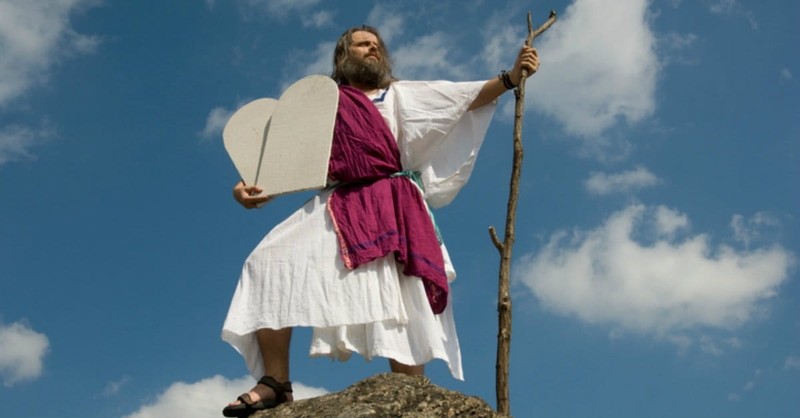










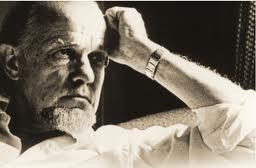








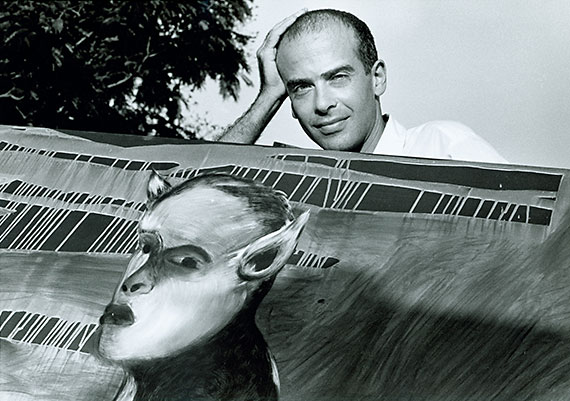





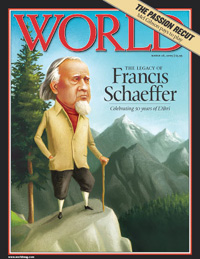
 I was born in 1933 in New York City to Frederick and Eva Weinberg. My early inclination toward science received encouragement from my father, and by the time I was 15 or 16 my interests had focused on theoretical physics.


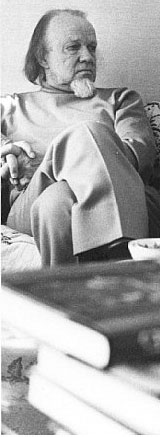






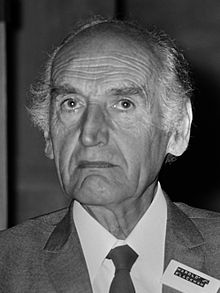
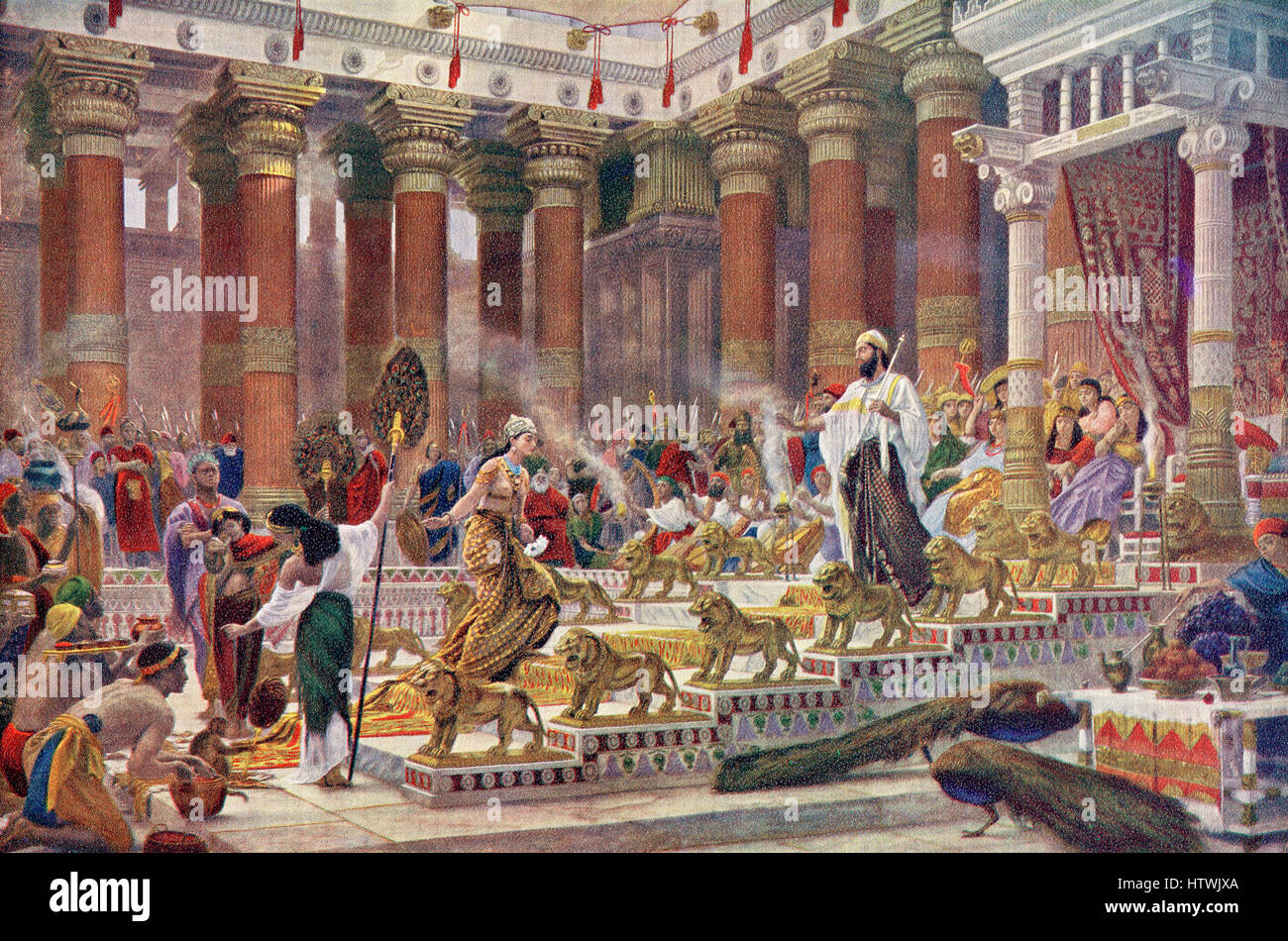
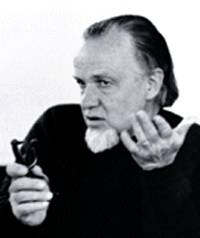




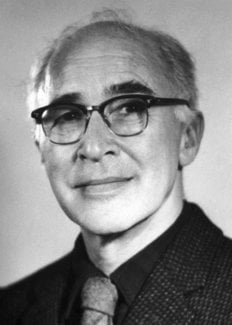
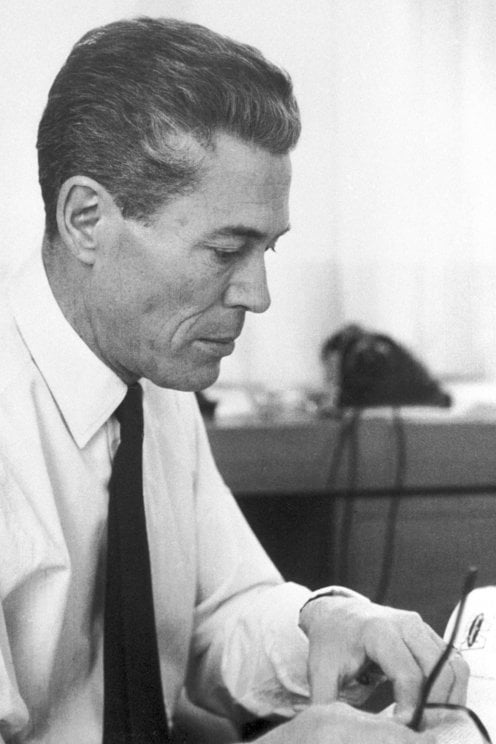


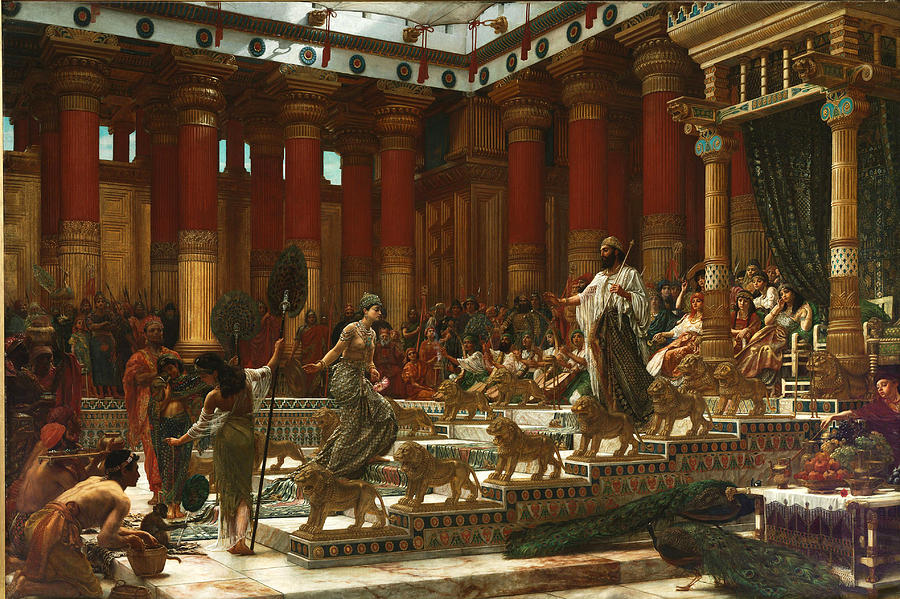





 The Daily Hatch