
—
Scientific Naturalism as Science
SATURDAY, NOVEMBER 01, 1997
Share Email Facebook Twitter Pinterest
The current attitude in the academic and scientific community is that science and religion are completely incompatible. It is believed that science is a system of knowledge based on experimentation, observation, and logic. Religion, on the other hand, is viewed as a system of faith based on myth, culture, and self-delusion. A researcher is allowed to have a personal religion, but he should never permit it to affect his work or he will no longer be considered a legitimate scientist.
In a recent court case involving the right of the ICR Graduate School to teach science from a Biblical perspective, a physics professor from California State University at Long Beach testified that if Isaac Newton were on the school’s faculty today, his position on creation would prevent the school from being recognized by the State of California. This professor objected to statements such as the following in Mathematica Principia where Newton said:
“This most beautiful system of the sun, planets, and comets could only proceed from the counsel and dominion of an intelligent and powerful Being. This Being governs all things, not as the soul of the world, but as Lord over all, and on account of His dominion He is wont to be called Lord God, Universal Ruler.“.1
When questioned how this professor could make such a statement about one who is recognized as possibly the greatest scientist who ever lived, he replied that if Isaac Newton persisted in maintaining a creationist position as he did in Mathematica Principia, knowing what we know today, he would not be recognized as a credible scientist.2
The reason this antagonism has reached such extreme proportions is because science has been redefined to include only naturalistic explanations. All observed and hypothesized processes in the universe must be the result of natural causes. No supernatural explanations are allowed. Phillip Johnson has described this approach well in his recent book when he said:
Theistic or “guided” evolution has to be excluded as a possibility because Darwinists identify science with a philosophical doctrine known as naturalism. Naturalism assumes the entire realm of nature to be a closed system of material causes and effects, which cannot be influenced by anything from “outside.” Naturalism does not explicitly deny the mere existence of God, but it does deny that a supernatural being could in any way influence natural events, such as evolution, or communicate with natural creatures like ourselves. Scientific naturalism makes the same point by starting with the assumption that science, which studies only the natural, is our only reliable path to knowledge.3
When science is defined in this manner and someone violates the rules of investigation by incorporating a supernatural cause or referring to the Bible, he is determined to be unscientific. The rhetoric can become inflammatory when power structures in the government and societies are involved. For example, the governing board of over 20 scientific societies in the United States have released statements or resolutions expressing their opposition to the teaching of creationism and its identification with science. Such position statments have the effect of blocking acceptance of journal articles from “creationists.”
Most scientists tend to shy away from such controversies. They prefer not to become involved in public arguments or major controversies. By their nature, most scientists tend to be withdrawn and prefer to work in a quiet, noncontroversial environment. They generally eschew political posturing and public pronouncements. Although many scientists are religious or are sympathetic to those who are religious, they are unwilling to reveal their positions for fear of ridicule or reprisals. On the other hand, there are some scientists who are very aggressive about promoting a naturalistic worldview and even some who advocate sanctions against those who would conduct science from a supernatural perspective.
Carl Sagan’s Naturalistic Worldview
Carl Sagan was one of the most articulate spokesmen for a naturalistic worldview. Before he died of cancer in 1997, he had written numerous books about the Cosmos and man’s place in it. He was active in many scientific organizations and in at least one which was aggressively antagonistic toward the mixing of the Bible and science. His willingness to express his views on the origin of life openly in his writings and public speaking was unique, to the point of alienating many of his more reserved colleagues who thought he was no longer functioning as a scientist himself. However, his writing talents were well received by the public and the literary community.
Carl Sagan believed that man was the result of natural processes operating over billions of years in a vast ocean of space. He could become highly sentimental over the immensity of time involved in man’s evolution and the incredible improbability that life had occurred by chance. He had one great hope-to find life existing somewhere else in the universe. I believe his rejection of God as Creator produced a void in his worldview which drove him to this search for life elsewhere in the universe. He searched for almost 30 years for some evidence that we are not alone, but he died with his dream unfulfilled. He made an intriguing statement about 25 years into this search when he said: “We’ve been looking for life beyond the Earth for 25 years now, and we haven’t found it anywhere. There must be something unique about the Earth.”4 I don’t believe he ever realized how incredibly true this statement was.
I had the distinct privilege of meeting Carl Sagan personally at the American Geophysical Union meeting in San Francisco in December, 1994. I had been drawn to his session by a sincere respect for his writing and speaking skills over the years, and I believe the Lord led me to speak with him at that time because he didn’t have long to live. He was to be the first speaker following a 30-minute intermission. I introduced myself and expressed my appreciation for his ability to articulate science in a way that could be understood by the public. He knew of the Institute for Creation Research for whom I work, but had not heard of me personally.
He immediately began asking me a series of leading questions about how a well trained scientist such as myself could have confidence in a book written by a bunch of ignorant sheep herders thousands of years before any real science had been discovered. He was so intent on pursuing our conversation, that the session chairman had to come down from the podium and interrupt our conversation to begin the next session. I was puzzled at the time by his aggressiveness in questioning my reasons for confidence in the Bible.
I later found out that he was to speak to the Commonwealth Club of San Franciso later that evening where he introduced his new book, The Pale Blue Dot. In this book and in an article he later wrote for Parade Magazine in 1995 entitled, “Through the Valley of the Shadow of Death,” Carl Sagan was probably more transparent than he had ever been about his search for God and eternal life. I am certain that the nearness of death was forcing him to reexamine some of the presuppositions on which he had based his life.
I exchanged a half dozen letters with Carl Sagan over the next year and a half. We continued the conversation started there in San Francisco, and I came to care for him as a friend. Probably the most poignant interchange was over a statement he had made in his book, The Pale Blue Dot. After several leading comments about the unreliability of the Bible, he said in this book: “The evidence so far at least and from the laws of nature aside, does not require a Designer. Maybe there is one hiding, maddeningly unwilling to be revealed.”5I responded in one of my letters by saying: “Scientists have the greatest opportunity of all to see the evidence of God’s marvelous provision for man in His creation. Yet, by and large, scientists today tend to be almost totally blinded to the evidences. Because of the kinship I feel toward you about the things of science, I request that you reconsider your relationship to God. Ask Him to reveal Himself to you. He is not hiding from you. Rather, He is waiting for you to see Him.”6
The final letter I received from Carl Sagan before his death contained the response: “Asking God to reveal himself to me presupposes his existence. Plainly, this would be an inconsistent approach for someone who sees no evidence for such a God.”7 This response has haunted me ever since. Carl Sagan’s wife, Ann Druyan, asserted in the epilogue to his last book, Billions and Billions, that: “Contrary to the fantasies of the fundamentalists, there was no deathbed conversion, no last-minute refuge taken in a comforting vision of a heaven or an afterlife.”8 I still hold out hope that he made peace with his Maker, and I will see him again someday.
It was evident from his writings as well as his membership in the National Center for Science Education (a California group dedicated almost exclusively to the advocacy of evolution and the removal of scientific creationism from society) that Carl Sagan believed Scripture was unreliable and should not be used as a basis for scientific investigation. Unfortunately, the eloquence of his oratory and that of others like him has brought disfavor upon the use of Scripture in any meaningful way in the conduct of science. Funding of research, peer review, publication of research results, and recognition of scientific accomplishments are strongly affected by attitudes developed by people like Carl Sagan. It is not too much to say that scientists in the twentieth century must fear for their professional lives if they rely upon Scriptural support in any of their work. Yet, research conducted from a Biblical perspective by those willing to forego the usual support and recognition is making significant progress and will eventually be recognized for the contribution it is making.
Conclusions
Recognizing the Bible as a reliable source of information for the conduct of science is essential for an effective use of resources and for correct results. Consider Carl Sagan’s search for extra-terrestrial intelligence (SETI). I believe from several lines of argument using the Bible that the only extra-terrestrial intelligences in the universe are God and the angels. If this is true, then the entire SETI program and a major portion of our space program is a complete waste of money.
More importantly, the general acceptance of the theory that elementary chemicals evolved into complex life forms over billions of years by naturalistic processes has led to a wholesale rejection of the Creator God and a generation that is expecting some superior life form suddenly to make contact with the earth. Our current culture is inundated with books, movies, and videos about people, empires, and monsters on other planets, galaxies, and universes. The impact of this evolutionary myth is incalculable. Undoubtedly the most costly aspect to this delusion will be counted in lost souls at the final judgment.
It is time to reclaim science in the name of God. We need committed Christians to train themselves as scientists and counteract this culture of unbelief. Science based on a proper Biblical foundation can help reverse this slide into apostasy and unbelief. If we don’t take action soon, our world will continue to devolve as described in Romans 1:22: “Professing themselves to be wise, they became fools. . . .”
References
1 Newton, Isaac, 1686. Mathematical Principles of Natural Philosophy. Motte’s translation from the Latin in 1729, University of California Press, Berkeley, California, 1934, 680 pp.
2 Lerner, Lawrence, 1990. Statements made in deposition during preparation for the trial of ICR Graduate School vs. Honig and the State of California.
3 Johnson, Phillip E., 1991. Darwin on Trial. InterVarsity Press, Downers Grove, IL, 220 pp.
4 Sagan, Carl, 1992. Statement in a television interview celebrating the 25th anniversary of the SETI program.
5 Sagan, Carl, 1994. Pale Blue Dot. Random House, New York, 429 pp.
6 Vardiman, Larry, 1995. Personal communication to Carl Sagan.
7 Sagan, Carl, 1995. Personal communication to Larry Vardiman.
8 Sagan, Carl, 1997. Billions and Billions. Random House, New York, 214 pp.
* Dr. Vardiman is Chairman of the Astro/Geophysics Department at ICR.
Below are Francis Schaeffer and his son Franky:
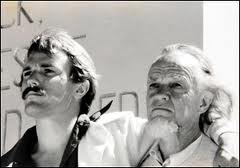
In 1992 I began to write skeptics letters after reading their books and articles and watching their films and I was introduced to Carl Sagan’s name by a book published in 1968 by Francis Schaeffer.
Francis Schaeffer in his book HE IS THERE AND HE IS NOT SILENT (Chapter 4) asserts:
Because men have lost the objective basis for certainty of knowledge in the areas in which they are working, more and more we are going to find them manipulating science according to their own sociological or political desires rather than standing upon concrete objectivity. We are going to find increasingly what I would call sociological science, where men manipulate the scientific facts. Carl Sagan (1934-1996),professor of astronomy and space science at Cornell University, demonstrates that the concept of a manipulated science is not far-fetched. He mixes science and science fiction constantly. He is a true follower of Edgar Rice Burroughs (1875-1950). The media gives him much TV prime time and much space in the press and magazine coverage, and the United State Government spent millions of dollars in the special equipment which was included in the equipment of the Mars probe–at his instigation, to give support to his obsessive certainty that life would be found on Mars, or that even large-sized life would be found there. With Carl Sagan the line concerning objective science is blurred, and the media spreads his mixture of science and science fiction out to the public as exciting fact.

Sagan in 1980
|
Sagan in 1980
|
|
| Born |
Carl Edward Sagan
November 9, 1934 Brooklyn, New York, U.S.
|
| Died | December 20, 1996(aged 62)
Seattle, Washington, U.S.
|
| Resting place | Lake View Cemetery (Ithaca, New York) |
| Alma mater | University of Chicago (BA, BS, MS, PhD) |
| Known for | |
| Spouse(s) |
|
| Children | 5, including Sasha, Dorion and Nick |
| Awards | Klumpke-Roberts Award(1974) NASA Distinguished Public Service Medal(1977) Pulitzer Prize for General Non-Fiction (1978) Oersted Medal (1990) Carl Sagan Award for Public Understanding of Science (1993) National Academy of Sciences Public Welfare Medal (1994) |
On November 21, 2014 I received a letter from Nobel Laureate Harry Kroto and it said:
…Please click on this URL http://vimeo.com/26991975
and you will hear what far smarter people than I have to say on this matter. I agree with them.
Harry Kroto

I have attempted to respond to all of Dr. Kroto’s friends arguments and I have posted my responses one per week for over a year now. Here are some of my earlier posts:
Arif Ahmed, Haroon Ahmed, Jim Al-Khalili, Sir David Attenborough, Mark Balaguer, Horace Barlow, Michael Bate, Sir Patrick Bateson, Simon Blackburn, Colin Blakemore, Ned Block, Pascal Boyer, Patricia Churchland, Aaron Ciechanover, Noam Chomsky, Brian Cox, Partha Dasgupta, Alan Dershowitz, Frank Drake, Hubert Dreyfus, John Dunn, Bart Ehrman, Mark Elvin, Richard Ernst, Stephan Feuchtwang, Robert Foley, David Friend, Riccardo Giacconi, Ivar Giaever , Roy Glauber, Rebecca Goldstein, David J. Gross, Brian Greene, Susan Greenfield, Stephen F Gudeman, Alan Guth, Jonathan Haidt, Theodor W. Hänsch, Brian Harrison, Stephen Hawking, Hermann Hauser, Robert Hinde, Roald Hoffmann, Bruce Hood, Gerard ‘t Hooft, Caroline Humphrey, Nicholas Humphrey, Herbert Huppert, Gareth Stedman Jones, Steve Jones, Shelly Kagan, Michio Kaku, Stuart Kauffman, Masatoshi Koshiba, Lawrence Krauss, Harry Kroto, George Lakoff, Rodolfo Llinas, Elizabeth Loftus, Alan Macfarlane, Dan McKenzie, Mahzarin Banaji, Peter Millican, Marvin Minsky, Leonard Mlodinow, P.Z.Myers, Yujin Nagasawa, Alva Noe, Douglas Osheroff, David Parkin, Jonathan Parry, Roger Penrose, Saul Perlmutter, Herman Philipse, Carolyn Porco, Robert M. Price, VS Ramachandran, Lisa Randall, Lord Martin Rees, Colin Renfrew, Alison Richard, C.J. van Rijsbergen, Oliver Sacks, John Searle, Marcus du Sautoy, Simon Schaffer, J. L. Schellenberg, Lee Silver, Peter Singer, Walter Sinnott-Armstrong, Ronald de Sousa, Victor Stenger, John Sulston, Barry Supple, Leonard Susskind, Raymond Tallis, Max Tegmark, Neil deGrasse Tyson, Martinus J. G. Veltman, Craig Venter, .Alexander Vilenkin, Sir John Walker, James D. Watson, Frank Wilczek, Steven Weinberg, and Lewis Wolpert,
In the 1st video below in the 45th clip in this series are his words and my response is below them.
50 Renowned Academics Speaking About God (Part 1)
Another 50 Renowned Academics Speaking About God (Part 2
A Further 50 Renowned Academics Speaking About God (Part 3)
–
CARL SAGAN interview with Charlie Rose:
“…faith is belief in the absence of evidence. To believe in the absence of evidence, in my opinion, is a mistake. The idea is to hold belief until there is compelling evidence. If the Universe does not comply with our previous propositions, then we have to change…Religion deals with history poetry, great literature, ethics, morals, compassion…where religion gets into trouble is when it pretends to know something about science,”
I would respond that there is evidence that Christianity is true.In 1838 American biblical scholar Edward Robinson shook up the archaeological world by discovering Hezekiah’s Tunnel mentioned in the Bible. There is meaning in life available to anyone who will put their faith in Christ, and peace can’t be found in a Guru. Why not take a few minutes and just read the short chapter of Psalms 22 that was written hundreds of years before the Romans even invented the practice of Crucifixion. 1000 years BC the Jews had the practice of stoning people but we read in this chapter a graphic description of Christ dying on the cross.
Related posts:
FRANCIS SCHAEFFER ANALYZES ART AND CULTURE Part 52 THE BEATLES (Part D, There is evidence that the Beatles may have been exposed to Francis Schaeffer!!!) (Feature on artist Anna Margaret Rose Freeman )
______________ George Harrison Swears & Insults Paul and Yoko Lucy in the Sky with Diamonds- The Beatles The Beatles: I have dedicated several posts to this series on the Beatles and I don’t know when this series will end because Francis Schaeffer spent a lot of time listening to the Beatles and talking […]
FRANCIS SCHAEFFER ANALYZES ART AND CULTURE Part 51 THE BEATLES (Part C, List of those on cover of Stg.Pepper’s ) (Feature on artist Raqib Shaw )
The Beatles in a press conference after their Return from the USA Uploaded on Nov 29, 2010 The Beatles in a press conference after their Return from the USA. The Beatles: I have dedicated several posts to this series on the Beatles and I don’t know when this series will end because Francis […]
FRANCIS SCHAEFFER ANALYZES ART AND CULTURE Part 50 THE BEATLES (Part B, The Psychedelic Music of the Beatles) (Feature on artist Peter Blake )
__________________ Beatles 1966 Last interview I have dedicated several posts to this series on the Beatles and I don’t know when this series will end because Francis Schaeffer spent a lot of time listening to the Beatles and talking and writing about them and their impact on the culture of the 1960’s. In this […]
FRANCIS SCHAEFFER ANALYZES ART AND CULTURE Part 49 THE BEATLES (Part A, The Meaning of Stg. Pepper’s Cover) (Feature on artist Mika Tajima)
_______________ The Beatles documentary || A Long and Winding Road || Episode 5 (This video discusses Stg. Pepper’s creation I have dedicated several posts to this series on the Beatles and I don’t know when this series will end because Francis Schaeffer spent a lot of time listening to the Beatles and talking and writing about […]
FRANCIS SCHAEFFER ANALYZES ART AND CULTURE PART 48 “BLOW UP” by Michelangelo Antonioni makes Philosophic Statement (Feature on artist Nancy Holt)
_______________ Francis Schaeffer pictured below: _____________________ I have included the 27 minute episode THE AGE OF NONREASON by Francis Schaeffer. In that video Schaeffer noted, ” Sergeant Pepper’s Lonely Hearts Club Band…for a time it became the rallying cry for young people throughout the world. It expressed the essence of their lives, thoughts and their feelings.” How Should […]
FRANCIS SCHAEFFER ANALYZES ART AND CULTURE Part 47 Woody Allen and Professor Levy and the death of “Optimistic Humanism” from the movie CRIMES AND MISDEMEANORS Plus Charles Darwin’s comments too!!! (Feature on artist Rodney Graham)
Crimes and Misdemeanors: A Discussion: Part 1 ___________________________________ Today I will answer the simple question: IS IT POSSIBLE TO BE AN OPTIMISTIC SECULAR HUMANIST THAT DOES NOT BELIEVE IN GOD OR AN AFTERLIFE? This question has been around for a long time and you can go back to the 19th century and read this same […]
FRANCIS SCHAEFFER ANALYZES ART AND CULTURE PART 46 Friedrich Nietzsche (Featured artist is Thomas Schütte)
____________________________________ Francis Schaeffer pictured below: __________ Francis Schaeffer has written extensively on art and culture spanning the last 2000years and here are some posts I have done on this subject before : Francis Schaeffer’s “How should we then live?” Video and outline of episode 10 “Final Choices” , episode 9 “The Age of Personal Peace and Affluence”, episode 8 […]
FRANCIS SCHAEFFER ANALYZES ART AND CULTURE Part 45 Woody Allen “Reason is Dead” (Feature on artists Allora & Calzadilla )
Love and Death [Woody Allen] – What if there is no God? [PL] ___________ _______________ How Should We then Live Episode 7 small (Age of Nonreason) #02 How Should We Then Live? (Promo Clip) Dr. Francis Schaeffer 10 Worldview and Truth Two Minute Warning: How Then Should We Live?: Francis Schaeffer at 100 Francis Schaeffer […]
FRANCIS SCHAEFFER ANALYZES ART AND CULTURE Part 44 The Book of Genesis (Featured artist is Trey McCarley )
___________________________________ Francis Schaeffer pictured below: ____________________________ Francis Schaeffer “BASIS FOR HUMAN DIGNITY” Whatever…HTTHR Dr. Francis schaeffer – The flow of Materialism(from Part 4 of Whatever happened to human race?) Dr. Francis Schaeffer – The Biblical flow of Truth & History (intro) Francis Schaeffer – The Biblical Flow of History & Truth (1) Dr. Francis Schaeffer […]
__
__


