Category Archives: Uncategorized

FRIEDMAN FRIDAY Hong Kong and the Miracle of Compounding Long-Run Growth March 11, 2016 by Dan Mitchell (with Milton Fri

Testing Milton Friedman: Free Markets – Full Video

Hong Kong is a truly remarkable jurisdiction.

Can you name, after all, another government in the world that brags about how little it spends on redistribution programs andhow few people are dependent on government?

And how many jurisdictions adopt private Social Security systems to help make sure the burden of government spending doesn’t climb above 20 percent of GDP?

No wonder Hong Kong routinely is at the top of the rankings in both Economic Freedom of the World and the Index of Economic Freedom.

Here is some additional evidence of Hong Kong’s sensible approach. Below is a slide from a presentation by Hong Kong government officials, quoting the current Financial Secretary and all his predecessors, covering both the period of Chinese sovereignty and British sovereignty. As you can see, the one constant theme is free markets and small government.

For additional background, let’s enjoy the insight of one of these men.

In a column for Reason, my Cato Institute colleague Marian Tupy reminisces on his meeting with John Cowperthwaite, one of the British-appointed economic advisers.

…a young Scottish civil servant named John Cowperthwaite arrived in the colony to oversee its economic development. Some 50 years later, I met Cowperthwaite in St Andrews, Scotland, where I was a student and he was enjoying his retirement. As he told me, “I came to Hong Kong and found the economy working just fine. So, I left it that way.” …Of all the policies that we discussed, one stands out in my mind. I asked him to name the one reform that he was most proud of. “I abolished the collection of statistics,” he replied. Cowperthwaite believed that statistics are dangerous, because they enable social engineers of all stripes to justify state intervention in the economy. At some point during our first conversation I managed to irk him by suggesting that he was chiefly known “for doing nothing.” In fact, he pointed out, keeping the British political busy-bodies from interfering in Hong Kong’s economic affairs took up a large portion of his time.

I especially like Cowperthwaite’s insight about the downside risk of letting governments collect a lot of data.

Something that’s worth considering in a world where governments want to engage in massive data collection and data sharing for purposes of imposing and enforcing bad global tax policy.

But let’s not get sidetracked. Economic freedom in Hong Kong is today’s topic. With that in mind, here’s a chart from Marian’s column. It shows that Hong Kong used to be much poorer than the United Kingdom. But after decades of faster growth (thanks to good policy), Hong Kong is now more prosperous than its former colonial master.

In other words, Hong Kong didn’t just converge with one of the world’s richest countries, which by itself would be a remarkable and unusual achievement. It actually became richer.

This is tremendous evidence on the benefits of good policy and the importance of strong, long-run growth.

Let’s close by looking at this issue of growth and development. Here’s a video from Marginal Revolution, narrated by Professor Alex Tabarrok of George Mason University. You should watch it from start to finish, but if you’re pressed for time, make sure to at least watch the first 2:10.

Puzzle of Growth: Rich Countries and Poor Countries

There are two things that are worth emphasizing from the video.

The productivity of workers (and therefore the pay of workers) is dependent on the quantity and quality of capital.

Entrepreneurs play a key role in figuring out the best ways of mixing labor and capital and this innovation boosts productivity.

By the way, there are two sins of omission in the video. If you watch the whole thing, you’ll notice it mentions that strong economic performance is linked to therule of law, property rights, free trade, and sensible regulation.

All that is true. But what about a stable monetary system? And what about areasonable tax regime and a modest burden of government spending?

But I’m nitpicking. Let’s close with another video from Marginal Revolution. You should once again watch the entire video, but for those in a rush, I adjusted the settings so it starts at the most important part.

Growth Rates Are Crucial

The video uses GDP data that is adjusted for both inflation and population, which is a very useful approach. But the key lesson, as Professor Tabarrok explained, is that even small sustained changes in growth have enormous implications for long-run prosperity.

Indeed, that’s why Hong Kong is now richer than the United Kingdom. And it’s also worth noting that Hong Kong (and Singapore) are passing the United States.

Related posts:

FRIEDMAN FRIDAY Milton Friedman’s FREE TO CHOOSE “The Tyranny of Control” Transcript and Video (60 Minutes)

Milton Friedman’s FREE TO CHOOSE “The Tyranny of Control” Transcript and Video (60 Minutes) In 1980 I read the book FREE TO CHOOSE by Milton Friedman and it really enlightened me a tremendous amount.  I suggest checking out these episodes and transcripts of Milton Friedman’s film series FREE TO CHOOSE: “The Failure of Socialism” and […]

FRIEDMAN FRIDAY “The Tyranny of Control” in Milton Friedman’s FREE TO CHOOSE Part 7 of 7 (Transcript and Video) “I’m not pro business, I’m pro free enterprise, which is a very different thing, and the reason I’m pro free enterprise”

In 1980 I read the book FREE TO CHOOSE by Milton Friedman and it really enlightened me a tremendous amount.  I suggest checking out these episodes and transcripts of Milton Friedman’s film series FREE TO CHOOSE: “The Failure of Socialism” and “What is wrong with our schools?”  and “Created Equal”  and  From Cradle to Grave, […]

FRIEDMAN FRIDAY “The Tyranny of Control” in Milton Friedman’s FREE TO CHOOSE Part 6 of 7 (Transcript and Video) “We are the ones who promote freedom, and free enterprise, and individual initiative, And what do we do? We force puny little Hong Kong to impose limits, restrictions on its exports at tariffs, in order to protect our textile workers”

In 1980 I read the book FREE TO CHOOSE by Milton Friedman and it really enlightened me a tremendous amount.  I suggest checking out these episodes and transcripts of Milton Friedman’s film series FREE TO CHOOSE: “The Failure of Socialism” and “What is wrong with our schools?”  and “Created Equal”  and  From Cradle to Grave, […]

FRIEDMAN FRIDAY “The Tyranny of Control” in Milton Friedman’s FREE TO CHOOSE Part 5 of 7 (Transcript and Video) “There is no measure whatsoever that would do more to prevent private monopoly development than complete free trade”

In 1980 I read the book FREE TO CHOOSE by Milton Friedman and it really enlightened me a tremendous amount.  I suggest checking out these episodes and transcripts of Milton Friedman’s film series FREE TO CHOOSE: “The Failure of Socialism” and “What is wrong with our schools?”  and “Created Equal”  and  From Cradle to Grave, […]

FRIEDMAN FRIDAY “The Tyranny of Control” in Milton Friedman’s FREE TO CHOOSE Part 4 of 7 (Transcript and Video) ” What we need are constitutional restraints on the power of government to interfere with free markets in foreign exchange, in foreign trade, and in many other aspects of our lives.”

In 1980 I read the book FREE TO CHOOSE by Milton Friedman and it really enlightened me a tremendous amount.  I suggest checking out these episodes and transcripts of Milton Friedman’s film series FREE TO CHOOSE: “The Failure of Socialism” and “What is wrong with our schools?”  and “Created Equal”  and  From Cradle to Grave, […]

FRIEDMAN FRIDAY “The Tyranny of Control” in Milton Friedman’s FREE TO CHOOSE Part 3 of 7 (Transcript and Video) “When anyone complains about unfair competition, consumers beware, That is really a cry for special privilege always at the expense of the consumer”

In 1980 I read the book FREE TO CHOOSE by Milton Friedman and it really enlightened me a tremendous amount.  I suggest checking out these episodes and transcripts of Milton Friedman’s film series FREE TO CHOOSE: “The Failure of Socialism” and “What is wrong with our schools?”  and “Created Equal”  and  From Cradle to Grave, […]

FRIEDMAN FRIDAY “The Tyranny of Control” in Milton Friedman’s FREE TO CHOOSE Part 2 of 7 (Transcript and Video) “As always, economic freedom promotes human freedom”

In 1980 I read the book FREE TO CHOOSE by Milton Friedman and it really enlightened me a tremendous amount.  I suggest checking out these episodes and transcripts of Milton Friedman’s film series FREE TO CHOOSE: “The Failure of Socialism” and “What is wrong with our schools?”  and “Created Equal”  and  From Cradle to Grave, […]

FRIEDMAN FRIDAY “The Tyranny of Control” Milton Friedman’s FREE TO CHOOSE Part 1 of 7 (Transcript and Video) “Adam Smith’s… key idea was that self-interest could produce an orderly society benefiting everybody, It was as though there were an invisible hand at work”

In 1980 I read the book FREE TO CHOOSE by Milton Friedman and it really enlightened me a tremendous amount.  I suggest checking out these episodes and transcripts of Milton Friedman’s film series FREE TO CHOOSE: “The Failure of Socialism” and “What is wrong with our schools?”  and “Created Equal”  and  From Cradle to Grave, […]

Open letter to President Obama (Part 654) “The Tyranny of Control” in Milton Friedman’s FREE TO CHOOSE Part 7 of 7 (Transcript and Video) “I’m not pro business, I’m pro free enterprise, which is a very different thing, and the reason I’m pro free enterprise”

Open letter to President Obama (Part 654) (Emailed to White House on July 22, 2013) President Obama c/o The White House 1600 Pennsylvania Avenue NW Washington, DC 20500 Dear Mr. President, I know that you receive 20,000 letters a day and that you actually read 10 of them every day. I really do respect you […]

Open letter to President Obama (Part 650) “The Tyranny of Control” in Milton Friedman’s FREE TO CHOOSE Part 6 of 7 (Transcript and Video) “We are the ones who promote freedom, and free enterprise, and individual initiative, And what do we do? We force puny little Hong Kong to impose limits, restrictions on its exports at tariffs, in order to protect our textile workers”

Open letter to President Obama (Part 650) (Emailed to White House on July 22, 2013) President Obama c/o The White House 1600 Pennsylvania Avenue NW Washington, DC 20500 Dear Mr. President, I know that you receive 20,000 letters a day and that you actually read 10 of them every day. I really do respect you […]

_________

RESPONDING TO HARRY KROTO’S BRILLIANT RENOWNED ACADEMICS!! Colin McGinn, British Philosopher “How can God give this moral rule a foundation?  Either the moral rule is, itself, intrinsically a sound moral rule or it can’t be given soundness and legitimacy from an external command”


On November 21, 2014 I received a letter from Nobel Laureate Harry Kroto and it said:

…Please click on this URL http://vimeo.com/26991975

and you will hear what far smarter people than I have to say on this matter. I agree with them.

Harry Kroto

I have attempted to respond to all of Dr. Kroto’s friends arguments and I have posted my responses one per week for over a year now. Here are some of my earlier posts:

Arif AhmedHaroon Ahmed,  Jim Al-Khalili, Sir David AttenboroughMark Balaguer, Horace Barlow, Michael BateSir Patrick BatesonSimon Blackburn, Colin Blakemore, Ned BlockPascal BoyerPatricia ChurchlandAaron CiechanoverNoam Chomsky, Brian CoxPartha Dasgupta,  Alan Dershowitz, Frank DrakeHubert Dreyfus, John DunnBart Ehrman, Mark ElvinRichard Ernst, Stephan Feuchtwang, Robert FoleyDavid Friend,  Riccardo GiacconiIvar Giaever , Roy GlauberRebecca GoldsteinDavid J. Gross,  Brian Greene, Susan GreenfieldStephen F Gudeman,  Alan Guth, Jonathan HaidtTheodor W. Hänsch, Brian Harrison,  Stephen HawkingHermann Hauser, Robert HindeRoald Hoffmann,  Bruce HoodGerard ‘t HooftCaroline HumphreyNicholas Humphrey,  Herbert Huppert,  Gareth Stedman Jones, Steve JonesShelly KaganMichio Kaku,  Stuart KauffmanMasatoshi Koshiba,  Lawrence KraussHarry Kroto, George Lakoff,  Rodolfo LlinasElizabeth Loftus,  Alan MacfarlaneDan McKenzie,  Mahzarin BanajiPeter MillicanMarvin MinskyLeonard Mlodinow,  P.Z.Myers,   Yujin NagasawaAlva NoeDouglas Osheroff, David Parkin,  Jonathan Parry, Roger Penrose,  Saul PerlmutterHerman Philipse,  Carolyn PorcoRobert M. PriceVS RamachandranLisa RandallLord Martin ReesColin RenfrewAlison Richard,  C.J. van Rijsbergen,  Oliver Sacks, John SearleMarcus du SautoySimon SchafferJ. L. Schellenberg,   Lee Silver Peter Singer,  Walter Sinnott-ArmstrongRonald de Sousa, Victor StengerJohn SulstonBarry Supple,   Leonard Susskind, Raymond TallisMax TegmarkNeil deGrasse Tyson,  Martinus J. G. Veltman, Craig Venter.Alexander Vilenkin, Sir John Walker, James D. WatsonFrank WilczekSteven Weinberg, and  Lewis Wolpert,

BBC The Atheism Tapes – Colin McGinn – 1 of 6

Published on Apr 22, 2012

https://www.facebook.com/UkFreeThinki…

__________________________________________

At the 9:30 mark Colin McGinn says:

There was disappointment. I would like for religion to be true. I would like for it to be true because I would like there to be immortality. I would like there to be rewards for those who have been virtuous, and punishments for those who have not been virtuous, especially those punishments to be good. There is no justice in this world and it would be good if there was some cosmic force that distributed justice in the proper way that it should be. It still is for me a constant source of irritation and pain that wicked people prosper and virtuous people don’t.

Colin McGinn

From Wikipedia, the free encyclopedia
Colin McGinn
Born 10 March 1950
West Hartlepool, County Durham, England
Residence Miami, Florida
Education BA (Hons), psychology, University of Manchester (1971)
MA, psychology, University of Manchester (1972)
BPhil, philosophy, University of Oxford (1974)
Known for New mysterianism

Colin McGinn (born 10 March 1950) is a British philosopher. He has held teaching posts and professorships at University College London, the University of Oxford, Rutgers University and the University of Miami.[1]

McGinn is best known for his work in the philosophy of mind, and in particular for what is known as new mysterianism, the idea that the human mind is not equipped to solve the problem of consciousness. He is the author of over 20 books on this and other areas of philosophy, including The Character of Mind (1982), The Problem of Consciousness (1991), Consciousness and Its Objects (2004), and The Meaning of Disgust (2011).[1]

Colin McGinn Why is There Anything At All

Colin McGinn on Consciousness

Uploaded on Dec 6, 2009

This video begins with McGinn briefly listing the range of philosophical approaches that have been taken to the “hard problem of consciousness”. As Michael Dooley points out, there are good reasons for a monist approach to “mind” and “consciousness” — both can be altered by physical agents: drugs, blows to the head, etc. As David Chalmers points out, we each are certain that we are individually conscious: a certainty that Descartes employed in “je pense, donc je suis”, or “cogito ergo sum”.

Contents

Early life and education

McGinn was born in West Hartlepool, a town in County Durham, England. Several of his relatives, including both grandfathers, were miners. His father, Joseph, left school to become a miner, but put himself through night school and became a building manager instead. McGinn was the eldest of three children, all sons. When he was three, the family moved to Gillingham, Kent, and eight years later to Blackpool, Lancashire. Having failed his 11-plus, he attended a technical school in Kent, then a secondary modern in Blackpool, but did well enough in his O-levels to be transferred to the local grammar school for his A-levels.[2]

In 1968 he began a degree in psychology at the University of Manchester, obtaining a first-class honours degree in 1971 and an MA in 1972, also in psychology.[1] He was admitted in 1972 to Jesus College, Oxford, at first to study for a Bachelor of Letters postgraduate degree, but he switched to the Bachelor of Philosophy (BPhil) postgraduate programme on the recommendation of his advisor, Michael R. Ayers. In 1973 he was awarded the university’s prestigious John Locke Prize in Mental Philosophy; one of the examiners was A.J. Ayer.[3] He received his BPhil in 1974, writing a thesis under the supervision of Michael Ayers and P. F. Strawson on the semantics of Donald Davidson.[4]

Colin McGinn Peter Singer – Morality Without God – Euthyphro Dilemma

Published on May 22, 2013

Many theists and nontheists alike are familiar with the “Euthyphro Dilemma,” so-called because a version of it was first formulated in Plato’s Dialogue Euthyphro. In this dialogue, Socrates poses the question: Is something good because it is pleasing to the gods, or is it pleasing to the gods because it is good? While Socrates (and Plato, of course) lived in a polytheistic culture, the question can easily be updated for a predominantly monotheistic culture: Is something good because it is pleasing to God, or is something pleasing to God because it is good?

How one answers this question has profound implications. On the first horn of the dilemma, we end up with Divine Command Theory, the notion that something is good because God commands it. This implies that the good is simply what God says it is. So if today God commands charity, mercy, and forgiveness, those things are good. But if tomorrow God commands rape, murder, and genocide, such atrocities would then become good. If God does not change his mind, we are just lucky.

If we take the other option, then what is good is good inherently, regardless of what God or anyone else happens to think. This would mean that there are standards of conduct according to which even God can be judged.

Some theists have tried to escape from this trap by claiming that God’s own nature is the standard of goodness. Thus God would never command atrocities because it would not conform to his nature, which can properly be described as good.

But this is an obvious confusion. We can simply reformulate the question: Is something good because it is in conformance with God’s nature, or do we say God’s nature is good based on some other standard? If the good simply refers to God’s nature, then again we can say that whatever is in God’s nature happens to be good. Were it in his nature to command atrocities, then the commission of atrocities would be good. If his nature does not condone such things, we are, again, simply lucky.

______________________________________________

Teaching career

Posts

McGinn taught at University College London for 11 years, first as a lecturer in philosophy (1974–1984), then as reader (1984–1985). In 1985 he succeeded Gareth Evans as Wilde Reader in Mental Philosophy at the University of Oxford, a position he held until 1990. He held visiting professorships at the University of California, Los Angeles (1979), University of Bielefeld (1982), University of Southern California (1983), Rutgers University (1984), University of Helsinki (1986), City University of New York (1988) and Princeton University (1992). In 1990 he joined the philosophy department at Rutgers as a full professor, working alongside Jerry Fodor.[1] He stayed at Rutgers until 2005, joining the University of Miami in 2006 as Professor of Philosophy and Cooper Fellow.[1]

In  the first video below in the 21st clip in this series are his words and  my response is below them. 

50 Renowned Academics Speaking About God (Part 1)

Another 50 Renowned Academics Speaking About God (Part 2

A Further 50 Renowned Academics Speaking About God (Part 3)

Below is a letter I wrote to Dr. McGinn and I respond to his quote:

February 12, 2015

Dr. Colin McGinn

Dear Dr. McGinn,

As you can tell from reading this letter I am an evangelical Christian and I have made it a hobby of mine to correspond with scientists or academics like yourself over the last 25 years. Some of those who corresponded back with me have been  Ernest Mayr (1904-2005),, George Wald (1906-1997), Carl Sagan (1934-1996),  Robert Shapiro (1935-2011), Nicolaas Bloembergen (1920-),  Brian Charlesworth (1945-),  Francisco J. Ayala (1934-) Elliott Sober (1948-), Kevin Padian (1951-), Matt Cartmill (1943-) , Milton Fingerman (1928-), John J. Shea (1969-), , Michael A. Crawford (1938-), Paul Kurtz (1925-2012), Sol Gordon (1923-2008), Albert Ellis (1913-2007), Barbara Marie Tabler (1915-1996), Renate Vambery (1916-2005), Archie J. Bahm (1907-1996), Aron S “Gil” Martin ( 1910-1997), Matthew I. Spetter (1921-2012), H. J. Eysenck (1916-1997), Robert L. Erdmann (1929-2006), Mary Morain (1911-1999), Lloyd Morain (1917-2010),  Warren Allen Smith (1921-), Bette Chambers (1930-),  Gordon Stein (1941-1996) , Milton Friedman (1912-2006), John Hospers (1918-2011), Michael Martin (1932-).Harry Kroto (1939-), Marty E. Martin (1928-), Richard Rubenstein (1924-), James Terry McCollum (1936-), Edward O. WIlson (1929-), Lewis Wolpert (1929), Gerald Holton (1922-), Martin Rees (1942-), Alan Macfarlane (1941-),  Roald Hoffmann (1937-), Herbert Kroemer (1928-), Thomas H. Jukes (1906-1999), Glenn BranchGeoff Harcourt (1931-) and  Ray T. Cragun (1976-).  I would consider it an honor to add you to this very distinguished list. 

I just finished reading the online addition of the book Darwin, Francis ed. 1892. Charles Darwin: his life told in an autobiographical chapter, and in a selected series of his published letters [abridged edition]. London: John Murray. There are several points that Charles Darwin makes in this book that were very wise, honest, logical, shocking and some that were not so wise. The Christian Philosopher Francis Schaeffer once said of Darwin’s writings, “Darwin in his autobiography and in his letters showed that all through his life he never really came to a quietness concerning the possibility that chance really explained the situation of the biological world. You will find there is much material on this [from Darwin] extended over many many years that constantly he was wrestling with this problem.”

Recently I ran across the following quote from you::

Suppose you take, as a moral principle, it’s wrong to steal.  People say, “Why is that wrong?  Why is it wrong to steal?”  Answer – because God says it’s wrong to steal.  God commanded that you should not steal.  The point that Socrates makes in that dialogue is to say – how can God give this moral rule a foundation?  Either the moral rule is, itself, intrinsically a sound moral rule or it can’t be given soundness and legitimacy from an external command.

Suppose for example we had the rule, “It’s right to murder.”  Somebody said, “That’s not right!  Murder is wrong!”  And somebody replied, “But God SAYS it’s right to murder.”  That doesn’t convince you that it’s right to murder.  If God says that something is right which isn’t right, God’s wrong.

I got this quote from the You Tube series “Renowned Academics talk about God,” and I noticed that this is not the first time that you have chosen to speak on morality in a large TV platform like this.  Wikipedia noted, “In 2004, Jonathan Miller wrote and presented a TV series on atheism entitled Atheism: A Rough History of Disbelief (more commonly referred to as Jonathan Miller’s Brief History of Disbelief) for BBC Four. I watched that complete series and did not see any reference to Antony Flew which I thought was strange. But more striking was this statement by you:

There was disappointment. I would like for religion to be true. I would like for it to be true because I would like there to be immortality. I would like there to be rewards for those who have been virtuous, and punishments for those who have not been virtuous, especially those punishments to be good. There is no justice in this world and it would be good if there was some cosmic force that distributed justice in the proper way that it should be. It still is for me a constant source of irritation and pain that wicked people prosper and virtuous people don’t.

Francis Schaffer in his book THE GOD WHO IS THERE addresses these same issues:

“[in Christianity] there is a sufficient basis for morals. Nobody has ever discovered a way of having real “morals” without a moral absolute. If there is no moral absolute, we are left with hedonism (doing what I like) or some form of the social contract theory (what is best for society as a a hole is right). However, neither of these alternative corresponds to the moral motions that men have. Talk to people long enough and deeply enough, and you will find that they consider some things are really right and something are really wrong. Without absolutes, morals as morals cease to exist, and humanistic mean starting from himself is unable to find the absolute he needs. But because the God of the Bible is there, real morals exist. Within this framework I can say one action is right and another wrong, without talking nonsense.” 117

Instead of addressing the issue of which morality is right today, I just what to ask you why you think materialist anthropologists are not able to explain why humans always have a sense of moral motions? No tribe of people have ever been found without moral motions!!!!!

When I read the book  Charles Darwin: his life told in an autobiographical chapter, and in a selected series of his published letters, I also read  a commentary on it by Francis Schaeffer and I wanted to both  quote some of Charles Darwin’s own words to you and then include the comments of Francis Schaeffer on those words. I have also enclosed a CD with two messages from Adrian Rogers and Bill Elliff concerning Darwinism. THESE COMMENTS BY SCHAEFFER ON THE MORAL MOTIONS PROMPTED ME TO WRITE YOU TODAY. 

The passages which here follow are extracts, somewhat abbreviated, from a part of the Autobiography, written in 1876, in which my father gives the history of his religious views:—

CHARLES DARWIN’S WORDS:

But now the grandest scenes would not cause any such convictions  and feelings to rise in my mind. It may be truly said that I am like a man who has become colour-blind and the universal belief by men of the existence of redness makes my present loss of perception of not the least value as evidence. This argument would be a valid one if all men of all races had the same inward conviction of the existence of one God; but we know that this is very far from being the case. Therefore I cannot see that such inward convictions and feelings are of any weight as evidence of what really exists. The state of mind which grand scenes formerly excited in me, and which was intimately connected with a belief in God, did not essentially differ from that which is often called the sense of sublimity; and however difficult it may be to explain the genesis of this sense, it can hardly be advanced as an argument for the existence of God, any more than the powerful though vague and similar feelings excited by music.

Francis Schaeffer observed:

You notice that Darwin had already said he had lost his sense of music [appreciation]. However, he brings forth what I think is a false argument. I usually use it in the area of morality. I mention that materialistic anthropologists point out that different people have different moral [systems]  and this is perfectly true, but what the materialist anthropologist can never point out is why man has a sense of moral motion and that is the problem here. Therefore, it is perfectly true that men have different concepts of God and different concepts of moral motion, but Darwin himself is not satisfied in his own position and WHERE DO THEY [MORAL MOTIONS] COME FROM AT ALL? So you are wrestling with the same dilemma here in this reference as you do in the area of all things human. For these men it is not the distinction that raises the problem, but it is the overwhelming factor of the existence of the humanness of man, the mannishness of man. The simple fact is he saw that you are shut up to either God or chance, and he said basically “I don’t see how it could be chance” and at the same time he looks at a mountain or listens to a piece of music it is a testimony that really chance isn’t sufficient enough. So gradually with the sensitivity of his own inborn self conscience he kills it. He deliberately  kills the beauty so it doesn’t argue with his theory. Maybe I am being false to Darwin here. Who can say about Darwin’s subconscious thoughts? It seems to me though this is exactly the case. What you find is a man who can’t stand the argument of the external beauty and the mannishness of man so he just gives it up in this particular place.

I wanted to compliment you for your statement on Jonathan Miller’s series on Atheism. It was very honest and frank. Let me repeat it here again.

There was disappointment. I would like for religion to be true. I would like for it to be true because I would like there to be immortality. I would like there to be rewards for those who have been virtuous, and punishments for those who have not been virtuous, especially those punishments to be good. There is no justice in this world and it would be good if there was some cosmic force that distributed justice in the proper way that it should be. It still is for me a constant source of irritation and pain that wicked people prosper and virtuous people don’t.

Paul also shared your view that if there is no God then it would be very sad indeed. Here are his words:

I Corinthians 15 asserts:

12 But if it is preached that Christ has been raised from the dead, how can some of you say that there is no resurrection of the dead? 13 If there is no resurrection of the dead, then not even Christ has been raised. 14 And if Christ has not been raised, our preaching is useless and so is your faith. 15 More than that, we are then found to be false witnesses about God, for we have testified about God that he raised Christ from the dead. But he did not raise him if in fact the dead are not raised. 16 For if the dead are not raised, then Christ has not been raised either. 17 And if Christ has not been raised, your faith is futile; you are still in your sins. 18 Then those also who have fallen asleep in Christ are lost. 19 If only for this life we have hope in Christ, we are of all people most to be pitied.

I sent you a CD that starts off with the song DUST IN THE WIND by Kerry Livgren of the group KANSAS which was a hit song in 1978 when it rose to #6 on the charts because so many people connected with the message of the song. It included these words, “All we do, crumbles to the ground though we refuse to see, Dust in the Wind, All we are is dust in the wind, Don’t hang on, Nothing lasts forever but the Earth and Sky, It slips away, And all your money won’t another minute buy.”

Kerry Livgren himself said that he wrote the song because he saw where man was without a personal God in the picture. Solomon pointed out in the Book of Ecclesiastes that those who believe that God doesn’t exist must accept three things. FIRST, death is the end and SECOND, chance and time are the only guiding forces in this life.  FINALLY, power reigns in this life and the scales are never balanced. The Christian can  face death and also confront the world knowing that it is not determined by chance and time alone and finally there is a judge who will balance the scales.

Both Kerry Livgren and the bass player Dave Hope of Kansas became Christians eventually. Kerry Livgren first tried Eastern Religions and Dave Hope had to come out of a heavy drug addiction. I was shocked and elated to see their personal testimony on The 700 Club in 1981 and that same  interview can be seen on You Tube today. Livgren lives in Topeka, Kansas today where he teaches “Diggers,” a Sunday school class at Topeka Bible ChurchDAVE HOPE is the head of Worship, Evangelism and Outreach at Immanuel Anglican Church in Destin, Florida.

The answer to find meaning in life is found in putting your faith and trust in Jesus Christ. The Bible is true from cover to cover and can be trusted.

Thank you again for your time and I know how busy you are.

Everette Hatcher, everettehatcher@gmail.com, http://www.thedailyhatch.org, cell ph 501-920-5733, Box 23416, LittleRock, AR 72221, United States

Is the Bible historically accurate? Here are some of the posts I have done in the past on the subject: 1. The Babylonian Chronicleof Nebuchadnezzars Siege of Jerusalem2. Hezekiah’s Siloam Tunnel Inscription. 3. Taylor Prism (Sennacherib Hexagonal Prism)4. Biblical Cities Attested Archaeologically. 5. The Discovery of the Hittites6.Shishak Smiting His Captives7. Moabite Stone8Black Obelisk of Shalmaneser III9A Verification of places in Gospel of John and Book of Acts., 9B Discovery of Ebla Tablets10. Cyrus Cylinder11. Puru “The lot of Yahali” 9th Century B.C.E.12. The Uzziah Tablet Inscription13. The Pilate Inscription14. Caiaphas Ossuary14 B Pontius Pilate Part 214c. Three greatest American Archaeologists moved to accept Bible’s accuracy through archaeology.

You can hear DAVE HOPE and Kerry Livgren’s stories from this youtube link:

(part 1 ten minutes)

(part 2 ten minutes)

Kansas – Dust in the Wind (Official Video)

Uploaded on Nov 7, 2009

Pre-Order Miracles Out of Nowhere now at http://www.miraclesoutofnowhere.com

About the film:
In 1973, six guys in a local band from America’s heartland began a journey that surpassed even their own wildest expectations, by achieving worldwide superstardom… watch the story unfold as the incredible story of the band KANSAS is told for the first time in the DVD Miracles Out of Nowhere.

_____________________________

Adrian Rogers on Darwinism

Related posts:

FRANCIS SCHAEFFER ANALYZES ART AND CULTURE Part 52 THE BEATLES (Part D, There is evidence that the Beatles may have been exposed to Francis Schaeffer!!!) (Feature on artist Anna Margaret Rose Freeman )

______________   George Harrison Swears & Insults Paul and Yoko Lucy in the Sky with Diamonds- The Beatles The Beatles:   I have dedicated several posts to this series on the Beatles and I don’t know when this series will end because Francis Schaeffer spent a lot of time listening to the Beatles and talking […]

FRANCIS SCHAEFFER ANALYZES ART AND CULTURE Part 51 THE BEATLES (Part C, List of those on cover of Stg.Pepper’s ) (Feature on artist Raqib Shaw )

  The Beatles in a press conference after their Return from the USA Uploaded on Nov 29, 2010 The Beatles in a press conference after their Return from the USA. The Beatles:   I have dedicated several posts to this series on the Beatles and I don’t know when this series will end because Francis […]

FRANCIS SCHAEFFER ANALYZES ART AND CULTURE Part 50 THE BEATLES (Part B, The Psychedelic Music of the Beatles) (Feature on artist Peter Blake )

__________________   Beatles 1966 Last interview I have dedicated several posts to this series on the Beatles and I don’t know when this series will end because Francis Schaeffer spent a lot of time listening to the Beatles and talking and writing about them and their impact on the culture of the 1960’s. In this […]

FRANCIS SCHAEFFER ANALYZES ART AND CULTURE Part 49 THE BEATLES (Part A, The Meaning of Stg. Pepper’s Cover) (Feature on artist Mika Tajima)

_______________ The Beatles documentary || A Long and Winding Road || Episode 5 (This video discusses Stg. Pepper’s creation I have dedicated several posts to this series on the Beatles and I don’t know when this series will end because Francis Schaeffer spent a lot of time listening to the Beatles and talking and writing about […]

FRANCIS SCHAEFFER ANALYZES ART AND CULTURE PART 48 “BLOW UP” by Michelangelo Antonioni makes Philosophic Statement (Feature on artist Nancy Holt)

_______________ Francis Schaeffer pictured below: _____________________ I have included the 27 minute  episode THE AGE OF NONREASON by Francis Schaeffer. In that video Schaeffer noted,  ” Sergeant Pepper’s Lonely Hearts Club Band…for a time it became the rallying cry for young people throughout the world. It expressed the essence of their lives, thoughts and their feelings.” How Should […]

FRANCIS SCHAEFFER ANALYZES ART AND CULTURE Part 47 Woody Allen and Professor Levy and the death of “Optimistic Humanism” from the movie CRIMES AND MISDEMEANORS Plus Charles Darwin’s comments too!!! (Feature on artist Rodney Graham)

Crimes and Misdemeanors: A Discussion: Part 1 ___________________________________ Today I will answer the simple question: IS IT POSSIBLE TO BE AN OPTIMISTIC SECULAR HUMANIST THAT DOES NOT BELIEVE IN GOD OR AN AFTERLIFE? This question has been around for a long time and you can go back to the 19th century and read this same […]

FRANCIS SCHAEFFER ANALYZES ART AND CULTURE PART 46 Friedrich Nietzsche (Featured artist is Thomas Schütte)

____________________________________ Francis Schaeffer pictured below: __________ Francis Schaeffer has written extensively on art and culture spanning the last 2000years and here are some posts I have done on this subject before : Francis Schaeffer’s “How should we then live?” Video and outline of episode 10 “Final Choices” , episode 9 “The Age of Personal Peace and Affluence”, episode 8 […]

FRANCIS SCHAEFFER ANALYZES ART AND CULTURE Part 45 Woody Allen “Reason is Dead” (Feature on artists Allora & Calzadilla )

Love and Death [Woody Allen] – What if there is no God? [PL] ___________ _______________ How Should We then Live Episode 7 small (Age of Nonreason) #02 How Should We Then Live? (Promo Clip) Dr. Francis Schaeffer 10 Worldview and Truth Two Minute Warning: How Then Should We Live?: Francis Schaeffer at 100 Francis Schaeffer […]

FRANCIS SCHAEFFER ANALYZES ART AND CULTURE Part 44 The Book of Genesis (Featured artist is Trey McCarley )

___________________________________ Francis Schaeffer pictured below: ____________________________ Francis Schaeffer “BASIS FOR HUMAN DIGNITY” Whatever…HTTHR Dr. Francis schaeffer – The flow of Materialism(from Part 4 of Whatever happened to human race?) Dr. Francis Schaeffer – The Biblical flow of Truth & History (intro) Francis Schaeffer – The Biblical Flow of History & Truth (1) Dr. Francis Schaeffer […]

__

‘Cafe Society’: Cannes Review 5:09 AM PDT 5/11/2016 by Todd McCarthy

Woody Allen on Retiring and Childhood Memories / Cannes 2016 Café Society

Published on Jun 4, 2016

Short clip from an interview with Woody Allen in occasion of the world premiere of his film “Café Society” at the Cannes film festival 2016.


‘Cafe Society’: Cannes Review

Woody Allen’s new film, which opens the Cannes Film Festival, is a bittersweet 1930s-set romance starring Jesse Eisenberg and Kristen Stewart.

Woody Allen’s first significantly Los Angeles-filmed feature since Annie Hall nearly 40 years ago is another bittersweet, lightly comic romance, this one set in the big studio heyday of the 1930s.

Wispy and familiar in its themes and humorous strokes, Cafe Society benefits from an exceptionally adept cast led by Jesse Eisenberg, Kristen Stewart and Steve Carell, as well as from a luminous glow that emphasizes both the old Hollywood nostalgia and the story’s basis in dreams and artifice (it’s the director’s first feature shot digitally, by Vittorio Storaro, no less). After a six-picture run with Sony Classics, this time Allen has chosen to go with Amazon Studios for the film’s domestic release on July 29, which will test the new distributor’s ability to hit the auteur’s target theatrical audience prior to home viewing availability.

Layered with a rich soundtrack of romantic tunes from the period, this is a familiar tale of love yearned for, gained, lost and savored after the fact. In other words, it’s a format Allen has relied upon many times before, but even past the age of 80, the still-fertile writer-director, amazingly sticking to his one-film-per-year rhythm (not to mention his upcoming TV series, also with Amazon), has created a small fiction of amiable appeal and vibrancy which goes down as easily as a fizzy cocktail.

Brooklyn kid Bobby Dorfman (Eisenberg) shows up in mid-1930s Hollywood hoping to get a job with his powerhouse agent uncle Phil (Carell), who makes the newcomer wait a bit before giving him an entry-level position (“We don’t want to emphasize the nepotism,” Phil says in all seriousness). Phil, who bears more than a passing resemblance to legendary agent Charles Feldman (who was Allen’s first Hollywood agent and the producer of What’s New, Pussycat?), can’t utter a sentence without name-dropping and seems in all ways the master of his universe. But he does have an Achilles heel — he’s married, but is nuts about his assistant, the comely young Vonnie (Stewart).

Assigned by Phil to show his nephew around (basically showing him a lot of stars’ homes), Vonnie initially cools Bobby’s amorous enthusiasm by claiming she has a boyfriend, but Allen adroitly pulls the long-reliable levers of classic farce to create complications among the three and build pressure in all of them: Phil keeps vacillating between his wife and Vonnie, Vonnie can’t make up her mind either and Bobby eventually decides he wants to move back to New York (the strongest anti-Hollywood sentiment Allen can manage now is having Bobby say, “It’s really a kind of boring, nasty, dog-eat-dog industry”).

All the same, there’s nothing caustic in Allen’s approach here; as usual, his characters are all wrapped up in their own neuroses, momentary desires and indecision, and they love to verbalize it all. Despite his delirious feelings about Vonnie, Bobby is also hard and hasty to a significant degree, more than is usual for Allen’s partly self-based protagonists, so when circumstances dictate, he has no trouble pulling up stakes and returning to New York to work for his big-shot gangster older brother Ben (Corey Stoll), who puts him in charge of a high-end nightclub (hence the film’s title).

The long final act, nearly 45 minutes, leapfrogs considerably in time and relies significantly on narration that sounds like it’s spoken by Allen himself, despite a stilted quality that gives it the feel of something being read cold from a piece of paper. Jeannie Berlin and Ken Stott (the latter could pass as the late Buddy Hackett’s brother) are comic highlights as the complaining parents of very different sons; that Bobby could marry and have a baby with a shiksa (Blake Lively) is one thing, but it drives them to existential angst that another is a king of the underworld.

Despite the shadow of innumerable bittersweet romances, including Allen’s own, that hangs over the trajectory of this love story, Cafe Society nonetheless generates a genuine, if mild, poignancy at the end for what the central characters have and what they don’t. There’s an entirely visible formula at work here, but Allen still knows how to milk it to reasonable effect.

Eisenberg has no trouble supplying the requisite neurotic quotient as the nominal Allen stand-in, but Stewart is good enough to almost make you wish for another version of The Great Gatsby just so she could play Daisy, and Carell layers his initially stock Hollywood big shot in unexpected ways that pay off rewardingly.

Many of the posh Hollywood scenes are wittily costumed by the resourceful Suzy Benzinger to have all the men suited in shades of tan and brown, and she has a field day with the glamorous women’s outfits throughout. Santo Loquasto’s production design takes you back to the town’s high-glamour days, while the cinematography — Storaro’s first work in the U.S. and on a mainstream feature in more than a decade — bathes everything in the exquisite artificiality of amber light.

Production: Gravier Productions, Perdido Productions
Cast: Jeannie Berlin, Steve Carell, Jesse Eisenberg, Blake Lively, Parker Posey, Kristen Stewart, Corey Stoll, Ken Stott
Director
-screenwriter: Woody Allen
Producers: Lettie Aronson, Stephen Tenenbaum, Edward Walson
Executive producers: Ron Chez, Adam B. Stern
Director of photography: Vittorio Storaro
Production designer: Santo Loquasto
Costume designer: Suzy Benzinger
Editor: Alisa Lepselter
Casting: Patricia Kerrigan DiCerto, Juliet Taylor

Rated PG-13, 96 minutes

Related posts:

Woody Allen: The Stand-Up Years 1964-1968 (Part 5)

___________ Fifty Years Ago, Woody Allen PlottedMidnight in Paris in This Stand-up Routine By Kyle Buchanan Follow @kylebuchanan 341Shares Share254Tweet70Share8EmailPrint When Woody Allen won the Best Original Screenplay Oscar this year for writing Midnight in Paris, he set a record at age 76 as the oldest person to ever triumph in that category. Turns out, […]

Woody Allen: The Stand-Up Years 1964-1968 (Part 4)

_____ _______ Woody Allen Stand Up Comic 1964 1968 09 The Science Fiction Film Woody Allen’s stand-up comedy albums reissued in new box set BY JOSH TERRY ON DECEMBER 16, 2014, 12:10PM 1 COMMENT FACEBOOK TWITTER TUMBLR STUMBLEUPON REDDIT Before Woody Allen became the prolific director responsible for such classics as Manhattan and Annie Hall, he was a […]

WOODY WEDNESDAY Woody Allen: The Stand-Up Years 1964-1968 (Part 3)

Woody Allen Stand Up Comic 1964 1968 15 Brooklyn Separating The Art From the Artist With Woody Allen: The Stand-Up Years By Samantha Allen January 20, 2015  |  11:30am Share Tweet Share In the liner notes for Woody Allen: The Stand-Up Years 1964-1968, longtime director and producer Robert B. Weide (Curb Your Enthusiasm) waxes nostalgic […]

WOODY WEDNESDAY Woody Allen’s Irrational Man: let’s take a rational look at the first film still

_ The first picture from Woody Allen’s new movie confirms that Joaquin Phoenix and Emma Stone are its stars. But what do we know about the bigger picture? Not saying much … Emma Stone and Joaquin Phoenix in Woody Allen’s Irrational Man. Photograph: PR Andrew Pulver @Andrew_Pulver Monday 13 April 2015 08.27 EDTLast modified on Monday […]

Woody Allen: The Stand-Up Years 1964-1968 (Part 2)

I love it when I find someone else who has a love for Woody Allen movies like I do. Evidently Paul Semel is person like that. Below is Paul Semel’s fine review:  Woody Allen Stand Up Comic 1964 1968 01 The Vodka Ad JANUARY 12, 2015 Woody Allen The Stand-Up Years 1964-1968 Review Given that he’s […]

Woody Allen: The Stand-Up Years 1964-1968 (Part 1)

Woody Allen Stand Up Comic 1964 1968 05 Mechanical Objects Standing Up and Floating Out Our favorite things this week include Woody Allen’s “The Stand-Up Years,” “Inherent Vice” by Thomas Pynchon not Paul Thomas Anderson, and “Saga” by Brian K. Vaughan. MILK & HONEY Email this page Posted January 14, 2015 Allen’s Stand-Up Roots: On […]

WOODY WEDNESDAY Woody Allen’s past movies and the subject of the Meaning of Life examined by Kyle Turner

____ Woody Allen’s past movies and the subject of the Meaning of Life examined!!! Out of the Past: Woody Allen, Nostalgia, the Meaning of Life, and Radio Days Kyle Turner Jul 25, 2014 Film, Twilight Time 1 Comment “I firmly believe, and I don’t say this as a criticism, that life is meaningless.” – Woody […]

WOODY WEDNESDAY Woody Allen Should Have Quoted Pascal: “Magic in the Moonlight” January 7, 2015 by Roger E. Olson 9 Comments

Woody Allen Should Have Quoted Pascal: “Magic in the Moonlight” January 7, 2015 by Roger E. Olson 9 Comments Woody Allen Should Have Quoted Pascal: “Magic in the Moonlight”   I am no Roger Ebert and don’t watch that many movies, but in my opinion, for what it’s worth, Woody Allen’s 2014 film “Magic in […]

WOODY WEDNESDAY My letter to Woody Allen’s Sister!!!!

______________ If anyone has read my blog for any length of time they know that I am the biggest Woody Allen fan of all time. No one except maybe Bergman has attacked the big questions in life as well as Woody Allen. Furthermore, Francis Schaeffer is my favorite Christian Philosopher and he spent a lot […]

Woody Allen to make first TV series for Amazon Prime

  ___________ Woody Allen to make first TV series for Amazon Prime ‘I’m not sure where to begin,’ says 79-year-old Oscar-winner about his small screen debut, as streaming TV service seeks to gain march on rivals with exclusive content Comment: in signing Woody Allen, Amazon Prime has delivered a nuclear blast to the competition Woody […]

MUSIC MONDAY My two favorite songs from Harry Nilsson!!!

Harry Nilsson – Everybody’s Talkin’ (1969)

Harry Nilsson – Without You 1972 (HD)

Harry Nilsson

From Wikipedia, the free encyclopedia
For the Swedish footballer, see Harry Nilsson (footballer).
Harry Nilsson
Harry Nilsson (1974) (tall).png

Nilsson in 1974
Background information
Birth name Harry Edward Nilsson III
Also known as Nilsson
Born June 15, 1941
Brooklyn, New York, U.S.
Died January 15, 1994 (aged 52)
Agoura Hills, California, U.S.
Genres Rock, pop[1]
Occupation(s) Singer-songwriter
Instruments Piano, vocals, keyboards,guitar, harmonica
Years active 1958–1994
Labels Tower Records, Musicor,RCA Victor, Mercury Records
Associated acts Perry Botkin, Jr., John Lennon, The Monkees, Van Dyke Parks, Richard Perry,Phil Spector, Ringo Starr,George Tipton, Klaus Voormann

Harry Edward Nilsson III (June 15, 1941 – January 15, 1994[2]), usually credited as Nilsson, was an American singer-songwriter who achieved the peak of his commercial success in the early 1970s. His work is characterized by pioneering overdub experiments, returns to the Great American Songbook, and fusions of Caribbean sounds.[3]

A tenor with a three-and-a-half octave range, Nilsson was one of the few major pop-rock recording artists of his era to achieve significant commercial success without ever performing major public concerts or undertaking regular tours. He is known for the charting singles “Everybody’s Talkin’” (1969), “Without You” (1971), and “Coconut” (1972). Nilsson also wrote the song “One” (1968), made famous by the rock band Three Dog Night.[3]

His honors include Grammy Awards for two of his recordings; Best Contemporary Vocal Performance, Male in 1970 for “Everybody’s Talkin'”, a prominent song in the 1969 film Midnight Cowboy, and Best Pop Vocal Performance, Male in 1973 for “Without You”. In 2015, he was voted No. 62 in Rolling Stone‘s list of “The 100 Greatest Songwriters of All Time”.[4]

Biography[edit]

1941–61: Early life[edit]

Nilsson was born in Bedford Stuyvesant, Brooklyn in 1941. His paternal grandparents were Swedish circus performers and dancers, especially known for their “aerial ballet” (which is the title of one of Nilsson’s albums). His father, Harry Edward Nilsson Jr., abandoned the family when Harry was three years old. An autobiographical reference to this is found in the opening to Nilsson’s song “1941”:

Well, in 1941, the happy father had a son
And in 1944, the father walked right out the door

Nilsson’s “Daddy’s Song” also refers to this period in Nilsson’s childhood.[5] He grew up with his mother Bette and his younger half-sister. His younger half-brother Drake was left with family or friends during their moves betweenCalifornia and New York, sometimes living with a succession of relatives and stepfathers. His uncle, a mechanic in San Bernardino, California, helped Nilsson improve his vocal and musical abilities.[6] As well as his half-brother and a half-sister through his mother he also had three half-sisters and one half-brother through his father.[5]

Because of the poor financial situation of his family, Nilsson worked from an early age, including a job at the Paramount Theatre in Los Angeles. When the theatre closed in 1960, he applied for a job at a bank, falsely claiming he was a high school graduate on his application (he only completed ninth grade).[6] He had an aptitude for computers, which were beginning to be employed by banks at the time. He performed so well the bank retained him even after uncovering his deception regarding being a high school graduate. He worked on bank computers at night, and in the daytime pursued his songwriting and singing career.[6]

1962–66: Musicianship beginnings[edit]

By 1958, Nilsson was intrigued by emerging forms of popular music, especially rhythm and blues artists like Ray Charles. He had made early attempts at performing while he was working at the Paramount, forming a vocal duo with his friend Jerry Smith and singing close harmonies in the style of the Everly Brothers. The manager at a favorite hangout gave Nilsson a plastic ukulele, which he learned to play, and he later learned to play the guitar and piano. In the 2006 documentary Who Is Harry Nilsson (And Why Is Everybody Talkin’ About Him)?, Nilsson recalled that when he could not remember lyrics or parts of the melodies to popular songs, he created his own, which led to writing original songs.

Uncle John’s singing lessons, along with Nilsson’s natural talent, helped when he got a job singing demos for songwriter Scott Turner in 1962. Turner paid Nilsson five dollars for each track they recorded. (When Nilsson became famous, Turner decided to release these early recordings, and contacted Nilsson to work out a fair payment. Nilsson replied that he had already been paid – five dollars a track.).[5]

In 1963, Nilsson began to have some early success as a songwriter, working with John Marascalco on a song for Little Richard. Upon hearing Nilsson sing, Little Richard reportedly remarked: “My! You sing good for a white boy!”[6]Marascalco also financed some independent singles by Nilsson. One, “Baa Baa Blacksheep”, was released under the pseudonym “Bo Pete” to some small local airplay. Another recording, “Donna, I Understand”, convinced Mercury Records to offer Nilsson a contract, and release recordings by him under the name “Johnny Niles.”[6]

In 1964, Nilsson worked with Phil Spector, writing three songs with him. He also established a relationship with songwriter and publisher Perry Botkin, Jr., who began to find a market for Nilsson’s songs. Botkin also gave Nilsson a key to his office, providing another place to write after hours.[5] Through his association with Botkin, Nilsson met and became friends with musician, composer and arranger George Tipton, who was at the time working for Botkin as a music copyist. During 1964 Tipton invested his life savings – $2500 – to finance the recording of four Nilsson songs, which he arranged; they were able to sell the completed recordings to the Tower label, a recently established subsidiary of Capitol Records, and the tracks were subsequently included on Nilsson’s debut album. The fruitful association between Nilsson and Tipton continued after Nilsson signed with RCA Records – Tipton went on to create the arrangements for nearly all of Nilsson’s RCA recordings between 1967 and 1971 but their association ended in the 1970s when the two fell out for unknown reasons. Whatever the cause, it was evidently a source of lingering resentment for Tipton, who was one of the few significant collaborators who refused to participate in the 2010 documentary on Nilsson’s life and career.

Nilsson’s recording contract was picked up by Tower Records, which in 1966 released the first singles actually credited to him by name, as well as the debut album Spotlight on Nilsson. None of Nilsson’s Tower releases charted or gained much critical attention, although his songs were being recorded by Glen Campbell, Fred Astaire, The Shangri-Las, The Yardbirds, and others. Despite his growing success, Nilsson remained on the night shift at the bank.[5]

1967–68: Signing with RCA Records[edit]

Nilsson in 1967

Nilsson signed with RCA Records in 1966 and released an album the following year, Pandemonium Shadow Show, which was a critical (if not commercial) success. Music industry insiders were impressed both with the songwriting and with Nilsson’s pure-toned, multi-octave vocals. One such insider was Beatles press officer Derek Taylor, who bought an entire box of copies of the album to share this new sound with others. With a major-label release, and continued songwriting success (most notably with The Monkees, who had a hit with Nilsson’s “Cuddly Toy”[7] after meeting him through their producer Chip Douglas), Nilsson finally felt secure enough in the music business to quit his job with the bank. Monkees member Micky Dolenz maintained a close friendship until Nilsson’s death in 1994.

Some of the albums from Derek Taylor’s box eventually ended up with the Beatles themselves,[8] who quickly became Nilsson fans. This may have been helped by the track “You Can’t Do That”, in which Nilsson covered one Beatles song but added 22 others in the multi-tracked background vocals. When John Lennon and Paul McCartney held a press conference in 1968 to announce the formation of Apple Corps, Lennon was asked to name his favorite American artist. He replied, “Nilsson”. McCartney was then asked to name his favorite American group. He replied, “Nilsson”.[5]

Aided by the Beatles’ praise, “You Can’t Do That” became a minor hit in the US, and a top 10 hit in Canada.[5]

When RCA had asked if there was anything special he wanted as a signing premium, Nilsson asked for his own office at RCA, being used to working out of one. In the weeks after the Apple press conference, Nilsson’s office phone began ringing constantly, with offers and requests for interviews and inquiries about his performing schedule. Nilsson usually answered the calls himself, surprising the callers, and answered questions candidly. (He recalled years later the flow of a typical conversation: “When did you play last?” “I didn’t.” “Where have you played before?” “I haven’t.” “When will you be playing next?” “I don’t.”) Nilsson acquired a manager, who steered him into a handful of TV guest appearances, and a brief run of stage performances in Europe set up by RCA. He disliked the experiences he had, though, and decided to stick to the recording studio. He later admitted this was a huge mistake on his part.[5]

Once Lennon called and praised Pandemonium Shadow Show, which he had listened to in a 36-hour marathon.[6] McCartney called the following day, also expressing his admiration. Eventually a message came, inviting him to London to meet the Beatles, watch them at work, and possibly sign with Apple Corps.

Pandemonium Shadow Show was followed in 1968 by Aerial Ballet, an album that included Nilsson’s rendition of Fred Neil‘s song “Everybody’s Talkin’“. A minor US hit at the time of release (and a top 40 hit in Canada), the song would become extremely popular a year later when it was featured in the film Midnight Cowboy, and it would earn Nilsson his first Grammy Award.[7] The song would also become Nilsson’s first US top 10 hit, reaching #6, and his first Canadian #1.

Aerial Ballet also contained Nilsson’s version of his own composition “One”, which was later taken to the top 5 of the US charts by Three Dog Night and also successfully covered in Australia by John Farnham. Nilsson was also commissioned at this time to write and perform the theme song for the ABC television series The Courtship of Eddie’s Father. The result, “Best Friend”, was very popular, but Nilsson never released the song on record; the original version of the song (entitled “Girlfriend”) was recorded during the making of Aerial Ballet but not included on that LP, and it eventually appeared on the 1995 Personal Best anthology, and as a bonus track on a later release of Aerial Ballet. Late in 1968, The Monkees‘ notorious experimental film Head premiered, featuring a memorable song-and-dance sequence with Davy Jones and Toni Basil performing Nilsson’s composition “Daddy’s Song.” (This is followed by Frank Zappa‘s cameo as “The Critic,” who dismisses the 1920s-style tune as “pretty white.”)[5]

With the success of Nilsson’s RCA recordings, Tower re-issued or re-packaged many of their early Nilsson recordings in various formats. All of these re-issues failed to chart, including a 1969 single “Good Times”.[5]

1969–72: Chart success[edit]

Nilsson’s next album, Harry (1969), was his first to hit the charts, and also provided a Top 40 single with “I Guess the Lord Must Be in New York City” (written as a contender for the theme to Midnight Cowboy), used in the Sophia Loren movie La Mortadella (1971) (US title: Lady Liberty). While the album still presented Nilsson as primarily a songwriter, his astute choice of cover material included, this time, a song by then-little-known composer Randy Newman, “Simon Smith and the Amazing Dancing Bear“. Nilsson was so impressed with Newman’s talent that he devoted his entire next album to Newman compositions, with Newman himself playing piano behind Nilsson’s multi-tracked vocals.[6] The result, Nilsson Sings Newman (1970), was commercially disappointing but was named Record of the Year by Stereo Review magazine and provided momentum to Newman’s career.[6] The self-produced Nilsson Sings Newman also marked the end of his collaboration with RCA staff producer Rick Jarrard, who recounted in the Nilsson documentary that the partnership was terminated by a telegram from Nilsson, who abruptly informed Jarrard that he wanted to work with other producers, and the two never met or spoke again.[5]

Nilsson’s next project was an animated film, The Point! (aka Oblio), created with animation director Fred Wolf, and broadcast on ABC television on February 2, 1971, as an “ABC Movie of the Week“. Nilsson’s self-produced album of songs from The Point! was well received and it spawned a hit single, “Me and My Arrow”.[5]

Later that year, Nilsson went to England with producer Richard Perry to record what became the most successful album of his career. Nilsson Schmilsson yielded three very stylistically different hit singles. The first was a cover ofBadfinger‘s song “Without You” (by Pete Ham and Tom Evans), featuring a highly emotional arrangement and soaring vocals to match – recorded, according to Perry, in a single take.[5] His superb performance was rewarded with Nilsson’s second Grammy Award.[7]

The second single was “Coconut“, a novelty calypso number featuring four characters (the narrator, the brother, the sister, and the doctor) all sung (at Perry’s suggestion[5]) in different voices by Nilsson. The song is best remembered for its chorus lyric (“Put de lime in de coconut, and drink ’em both up”). Also notable is that the entire song is played using one chord, C7th.

The third single, “Jump into the Fire”, was raucous, screaming rock and roll, including a drum solo by Derek and the DominosJim Gordon and a bass detuning by Herbie Flowers.

Nilsson followed quickly with Son of Schmilsson (1972), released while its predecessor was still in the charts. Besides the problem of competing with himself, Nilsson was by then ignoring most of Perry’s production advice[5] and his decision to give free rein to his bawdiness and bluntness on this release alienated some of his earlier, more conservative fan base. With lyrics like “I sang my balls off for you, baby”, “Roll the world over / And give her a kiss and a feel”, and the notorious “You’re breaking my heart / You’re tearing it apart / So fuck you” (a reference to his ongoing divorce), Nilsson had traveled far afield from his earlier work. The album nevertheless reached #12 on the Billboard200, and the single “Spaceman” was a Top 40 hit in October 1972. The follow-up single “Remember (Christmas)”, however, stalled at #53. A third single, the tongue-in-cheek C&W send up “Joy”, was issued on RCA’s country imprint Green and credited to Buck Earle, but it failed to chart.[5]

1973–79: Maverick[edit]

Nilsson in 1976

Nilsson’s disregard for commercialism in favor of artistic satisfaction showed itself in his next release, A Little Touch of Schmilsson in the Night (1973). Performing a selection of pop standardsby the likes of Berlin, Kalmar and Ruby, Nilsson sang in front of an orchestra arranged and conducted by veteran Gordon Jenkins in sessions produced by Derek Taylor. This musical endeavor did not do well commercially. The session was filmed, and broadcast as a television special by the BBC in the UK.[5]

1973 found Nilsson back in California, and when John Lennon moved there during his separation from Yoko Ono, the two musicians rekindled their earlier friendship. Lennon was intent upon producing Nilsson’s next album, much to Nilsson’s delight. However, their time together in California became known much more for heavy drinking than it did for musical collaboration. In a widely publicized incident, the two were ejected from the Troubadour nightclub in West Hollywood for drunken heckling of the Smothers Brothers.[9] Both men caused property damage during binges, with Lennon trashing a bedroom in Lou Adler‘s house, and Nilsson throwing a bottle through a 30-foot-high hotel window.[citation needed]

To make matters worse, at a late night party and jam session during the recording of the album, attended by Lennon, McCartney, Danny Kortchmar, and other musicians,[10] Nilsson ruptured avocal cord, but he hid the injury for fear that Lennon would call a halt to the production. The resulting album was Pussy Cats. In an effort to clean up, Lennon, Nilsson and Ringo Starr first rented a house together, then Lennon and Nilsson left for New York.[5] After the relative failure of his latest two albums, RCA Records considered dropping Nilsson’s contract. In a show of friendship, Lennon accompanied Nilsson to negotiations, and both intimated to RCA that Lennon and Starr might want to sign with them, once their Apple Records contracts with EMI expired in 1975, but would not be interested if Nilsson were no longer with the label.[6] RCA took the hint and re-signed Nilsson (adding a bonus clause, to apply to each new album completed), but neither Lennon nor Starr signed with RCA.

Nilsson’s voice had mostly recovered by his next release, Duit on Mon Dei (1975), but neither it nor its follow-ups, Sandman and …That’s the Way It Is (both 1976), met with chart success. Finally, Nilsson recorded what he later considered to be his favorite album Knnillssonn (1977). With his voice strong again, and his songs exploring musical territory reminiscent of Harry or The Point!, Nilsson anticipated Knnillssonn to be a comeback album. RCA seemed to agree, and promised Nilsson a substantial marketing campaign for the album. However, the death of Elvis Presley caused RCA to ignore everything except meeting demand for Presley’s back catalog, and the promised marketing push never happened.[11] This, combined with RCA releasing a Nilsson Greatest Hits collection without consulting him, prompted Nilsson to leave the label.[5]

Nilsson’s London flat[edit]

9 Curzon Square, London in 2012; flat on 4th floor, at top right was Nilsson’s, the site of both Cass Elliot‘s and Keith Moon‘s deaths.

Nilsson’s 1970s London flat, at Flat 12, 9 Curzon Street on the edge of Mayfair, was a two-bedroom apartment decorated by the ROR (“Ringo or Robin”) design company owned by Starr and interior designer Robin Cruikshank. Nilsson cumulatively spent several years at the flat, which was located near Apple Records, the Playboy Club, Tramp and the homes of friends and business associates. Nilsson’s work and interests took him to the US for extended periods, and while he was away he lent his place to numerous musician friends. During one of his absences, formerThe Mamas & the Papas singer Cass Elliot and a few members of her tour group stayed at the flat while she performed solo at the London Palladium, headlining with her torch songs and “Don’t Call Me Mama Anymore“. Following a strenuous performance with encores on July 29, 1974, Elliot was discovered in one of the bedrooms, dead of heart failure at 32.[6]

On September 7, 1978, The Who‘s drummer Keith Moon returned to the same room in the flat after a night out, and died at 32 from an overdose of Clomethiazole, a prescribed anti-alcohol drug.[6] Nilsson, distraught over another friend’s death in his flat, and having little need for the property, sold it to Moon’s bandmate Pete Townshend and consolidated his life in Los Angeles.[citation needed]

1980–92: Winding down[edit]

Nilsson’s musical work after leaving RCA Victor was sporadic. He wrote a musical, Zapata, with Perry Botkin Jr. and libretto by Allan Katz, which was produced and directed by longtime friendBert Convy. The show was mounted at the Goodspeed Opera House in East Haddam, Connecticut, but never had another production. He wrote all the songs for Robert Altman‘s movie-musicalPopeye (1980),[6] the score of which met with unfavorable reviews. Nilsson’s Popeye compositions included several songs that were representative of Nilsson’s acclaimed Point era, such as “Everything Is Food” and “Sweethaven”. The song “He Needs Me” featured years later in the film Punch-Drunk Love. Nilsson recorded one more album, Flash Harry, co-produced by Bruce Robb and Steve Cropper, which was released in the UK but not in the US. From this point onward, Nilsson increasingly began referring to himself as a “retired musician”.

Nilsson was profoundly affected by the death of John Lennon on December 8, 1980. He joined the Coalition to Stop Gun Violence and overcame his preference for privacy to make appearances for gun control fundraising. He began to appear at Beatlefest conventions and he would get on stage with the Beatlefest house band “Liverpool” to either sing some of his own songs or “Give Peace a Chance.”[5]

After a long hiatus from the studio, Nilsson started recording sporadically once again in the mid to late 1980s. Most of these recordings were commissioned songs for movies or television shows. One notable exception was his work on a Yoko Ono Lennon tribute album, Every Man Has A Woman (1984) (Polydor); another was a cover of “Zip-A-Dee-Doo-Dah” recorded for Hal Willner‘s 1988 tribute album Stay Awake: Various Interpretations of Music from Vintage Disney Films. Nilsson donated his performance royalties from the song to the Coalition to Stop Gun Violence.[5]

In 1985 Nilsson set up a production company, Hawkeye, to oversee various film, TV and multimedia projects for which he was involved. He appointed his friend, satirist and screenwriter Terry Southern, as one of the principals. They collaborated on a number of screenplays including Obits (a Citizen Kane-style story about a journalist investigating an obituary notice) and The Telephone, a comedy about an unhinged unemployed actor.[5]

The Telephone was virtually the only Hawkeye project that made it to the screen. It had been written with Robin Williams in mind but he turned it down; comedian-actress Whoopi Goldberg then signed on, with Southern’s friend Rip Torn directing, but the project was troubled. Torn battled with Goldberg, who interfered in the production and constantly digressed from the script during shooting, and Torn was forced to plead with her to perform takes that stuck to the screenplay. Torn, Southern and Nilsson put together their own version of the film, which screened at the Sundance Film Festival in early 1988, but it was overtaken by the “official” version from the studio, and this version premiered to poor reviews in late January 1988. The project reportedly had some later success when adapted as a theatre piece in Germany.[12]

In 1990, Hawkeye floundered and Nilsson found himself in a dire financial situation after it was discovered that his financial adviser Cindy Sims had embezzled all the funds he had earned as a recording artist. The Nilssons were left with $300 in the bank and a mountain of debt, while Sims served less than two years and was released from prison in 1994 without making restitution.[13]

In 1991, the Disney CD For Our Children, a compilation of children’s music performed by celebrities to benefit the Elizabeth Glaser Pediatric AIDS Foundation, included Nilsson’s original composition “Blanket for a Sail,” recorded at the Shandaliza Recording Studio in Los Angeles.[5]

Nilsson made his last concert appearance September 1, 1992, when he joined Ringo Starr & His All-Starr Band on stage at Caesar’s Palace in Las Vegas, Nevada to sing “Without You” with Todd Rundgren handling the high notes. Afterwards, an emotional Starr embraced Nilsson on stage.[5]

1993–94: Heart attack and death[edit]

Nilsson suffered a massive heart attack on February 14, 1993.[14] After surviving that, he began pressing his old label, RCA, to release a boxed-set retrospective of his career, and resumed recording, attempting to complete one final album. He finished the vocal tracks for the album with producer Mark Hudson, who has the tapes of that session.[citation needed] Nilsson died of heart failure on January 15, 1994 in his Agoura Hills, California home.[14] In 1995, the 2-CD anthology he worked on with RCA, Personal Best, was released.[5]

Nilsson is interred in Pierce Brothers Valley Oaks Memorial Park.[citation needed]

Personal life[edit]

Nilsson married Sandra McTaggart on October 24, 1964. They divorced in 1966 (one stepson).

Nilsson married Diane Clatworthy on December 31, 1969. They had one son. Nilsson and Clatworthy divorced in 1974.

Nilsson married Una O’Keeffe on August 12, 1976; they remained married until his death on January 15, 1994. They had six children.

Legacy[edit]

Nilsson is the subject of a 2006 documentary, Who Is Harry Nilsson (And Why Is Everybody Talkin’ About Him)? produced by David Leaf and John Schienfeld. The film was screened in 2006 at the Seattle International Film Festivaland the Santa Barbara International Film Festival. In August 2006, the film received its Los Angeles premiere when it was screened at the 7th Annual Mods & Rockers Film Festival followed by a panel discussion about Nilsson featuring the filmmakers and two friends of Nilsson, producer Richard Perry and attorney/executive producer Lee Blackman.[5]

The filmmakers re-edited the film with rare found footage of Nilsson, further interviews, and family photographs, and finally released it on September 17, 2010 at selected theaters in the United States. A DVD, including additional footage not in the theatrical release, was released on October 26, 2010.[5]

Nilsson’s final album, tentatively titled Papa’s Got a Brown New Robe (produced by Mark Hudson) was not released, though several demos from the album were available on promotional CDs and online.[5]

The musical Everyday Rapture features three songs by Nilsson and, similarly, the film A Good Year starring Russell Crowe and Marion Cotillard features “Gotta get up”, “Jump into the fire” and “How can I be sure of you”.

On July 30, 2013, Sony released a definitive box-set of his RCA era albums, The RCA Albums Collection.[15] Each of the albums in the 17-CD set had additional bonus tracks, along with 3 of the 17 discs which contained rarities and outtakes spanning his entire career. Additionally, several weeks later on August 13, Flash Harry was finally issued on CD[16] also featuring additional material. Completing the two CD releases, the first book written about Nilsson was published covering his life story.[17]

Awards and nominations[edit]

Nilsson won two Grammy Awards. He received several more Grammy nominations for the album Nilsson Schmilsson.[18]

The New York Post rated Nilsson’s cover of Fred Neil’s “Everybody’s Talking” #51 on their list of the 100 Best Cover Songs of All Time.[19]

Rolling Stone ranked Nilsson as No. 62 on “The 100 Greatest Songwriters of All Time”.[4]

Discography[edit]

Studio albums

Filmography[edit]

  • I Spy (1965 TV Series) – In 1966 Episode Sparrowhawk “Untitled Composition” sung by Nilsson in background of a conversation scene.
  • Skidoo (1968) songs written and performed, soundtrack music composer, actor (bit role)
  • The Ghost & Mrs. Muir (1969 TV Series) acted and sang – He appeared in the episode “The Music Maker”, and his character name was Tim Seagirt. He sang “Without Her” and “If Only I Could Touch Your Hand.”
  • The Courtship of Eddie’s Father (TV series, 1969–1972) theme song written and performed, incidental music
  • Midnight Cowboy (1969) new version of “Everybody’s Talkin'” performed
  • Jenny (1970) song “Waiting” written and performed
  • The Point! (1971) story, all songs written and performed
  • Son of Dracula (1974) actor (lead role), all songs performed
  • The World’s Greatest Lover (1978) song “Ain’t It Kinda Wonderful” performed
  • In God We Tru$t (1980) new version of “Good For God” performed
  • Popeye (1980) all songs written, except “I’m Popeye the Sailor Man”
  • Handgun (1983) song “Lay Down Your Arms” written and performed
  • First Impressions, (TV series, 1988) theme song co-written, performed
  • Camp Candy (TV series, animated, 1989–1991) theme song written, and performed with John Candy
  • The Fisher King (1991) song “How About You” performed
  • Me, Myself, and I (1992) song “Me, Myself and I” written and performed

When Harry met… John, Paul, George and Ringo: The American Beatle’s 18-month ‘lost weekend’ with Lennon

By ALYN SHIPTON

Read more: http://www.dailymail.co.uk/home/event/article-2382537/The-Beatles-When-Harry-met–John-Paul-George-Ringo-The-American-Beatles-18-month-lost-weekend-Lennon.html#ixzz4B5TCln8C
Follow us: @MailOnline on Twitter | DailyMail on Facebook

Epic brandy binges. Guns in the studio. The famous ‘Lost Weekend’. How Harry Nilsson, the hellraising singer of Without You, befriended and bewitched the Fab Four – and drove himself into an early grave

One long party: During the infamous 'lost weekend' Harry Nilsson with John Lennon and May Pang. Nilsson always slightly hero-worshipped Lennon, and there was a shared love of the outrageous

One long party: During the infamous ‘lost weekend’ Harry Nilsson with John Lennon and May Pang. Nilsson always slightly hero-worshipped Lennon, and there was a shared love of the outrageous

Somewhere between three and four o’clock on a Monday morning in April 1968, the telephone rang in the little office at RCA Records in Los Angeles where an obscure singer-songwriter named Harry Nilsson was keeping his usual nocturnal hours.

‘I was half asleep,’ Nilsson recalled. ‘A voice says: “Hello, Harry. This is John. Man you’re too f***ing much, you’re just great. We’ve got to get together and do something.”

‘I said, “Who is this?”

‘“John Lennon.”

‘I said: “Yeah, right, who is this?”

‘“It’s John Lennon. I’m just trying to say you’re fantastic. Have a good night’s sleep. Speak to you soon. Goodbye.”

‘I thought, “Was that a dream?”’ Not a dream, but the start of an association that would change Nilsson’s life.

The year before, Nilsson recorded The Beatles’ You Can’t Do That, cleverly using quotes from 14 other Beatles songs.

That had led to an invitation to a party at George Harrison’s rented house in the Hollywood Hills.

Harry recalled that the Beatle, ‘in a white windblown robe with a beard and long hair, looking like Christ with a camcorder’, had listened to his songs and been ‘very complimentary’.

Nilsson was described as 'the finest white male singer on the planet', and was an accomplished songwriter who happened to have huge hits with two songs he did not write: Everybody's Talkin' and Without You

Nilsson was described as ‘the finest white male singer on the planet’, and was an accomplished songwriter who happened to have huge hits with two songs he did not write: Everybody’s Talkin’ and Without You

Harrison took Nilsson’s demos away and played them to the other Beatles, who were now calling Harry in the middle of the night.

The Monday after Lennon’s call, Paul McCartney rang. ‘Hello, Harry. Yeah, this is Paul. Just wanted to say you’re great, man! John gave me the album. It’s great; you’re terrific. Look forward to seeing you.’

The next Monday, Nilsson dressed and waited for a four o’clock call from Ringo. It didn’t come. But on May 14, Lennon and McCartney appeared at a press conference in New York.

Asked to name their favourite American artist, Lennon replied ‘Nilsson’. The two gave the same response when asked their favourite group.

Later that day, when a journalist wondered what they thought about American music, Lennon replied, ‘Nilsson! Nilsson for president!’

A unique relationship would form between Nilsson and The Beatles. He would write a song for McCartney, make films and party through the 1970s with Ringo Starr, and record and raise hell with Lennon in the notorious 18-month ‘lost weekend’ period in 1973 and 1974, when John left Yoko Ono for a wild life in Los Angeles.

There was, it should be said, much more to Nilsson than his Beatles associations.

He was described by his producer Richard Perry as ‘the finest white male singer on the planet’, and was an accomplished songwriter who happened to have huge hits with two songs he did not write: Everybody’s Talkin’ and Without You.

Not long after Lennon and McCartney returned from New York, Derek Taylor, The Beatles’ press officer at Apple, made a call to Harry.

‘Derek says: “The lads, the boys, the Fabs would like you to come over and join them at a session,”’ Nilsson remembered. ‘“They’re recording at Abbey Road. They’re dying to see you.”’

Nilsson with Ringo Starr and Lynsey de Paul. 'When he got to make records with John Lennon and be friends with Ringo Starr, his life was complete,' said legendary songwriter Jimmy Webb

Nilsson with Ringo Starr and Lynsey de Paul. ‘When he got to make records with John Lennon and be friends with Ringo Starr, his life was complete,’ said legendary songwriter Jimmy Webb

Within a few days, Nilsson was sitting on a plane crossing the Atlantic.

Arriving at Heathrow, he found that Ringo had kindly left his Daimler limousine at the airport for him.

Suddenly famous, having been endorsed by the world’s biggest band, Nilsson went straight to a reception for his own record, where the other three Beatles were the stars of a guest list that included everybody who was anybody in swinging London.

That afternoon, another limo arrived to take Harry out to Lennon’s home in the Surrey commuter belt.

Nilsson was greeted warmly by Lennon, and a single look between them was the start of a lifelong friendship.

‘We spent the entire night talking until dawn,’ said Nilsson.

‘Yoko ended up like a kitten at John’s feet, curled up. And John and I are on about marriage, life, death, divorce, women. And I’m thinking, “This is it! This is truthful. This is good. This is honest. This is exciting. It’s inspirational.”’

Lennon gave Nilsson an Indian gold braided jacket with fur trim lining he had worn in Magical Mystery Tour.

The following day McCartney announced he was coming over to Nilsson’s hotel, and he ran through rough versions of several of his newly written songs.

Nilsson sent down for a bottle or two of the best wine on the hotel’s room service list, and they carried on singing songs for one another into the small hours, until there was a thunderous banging on the door from the occupants of the room next door: ‘What the hell do you people think you’re doing? Don’t you know some people work for a living? Some people have to get up in the morning!’

Nilsson calmly introduced them to his visitors, and Paul gently apologised. The neighbours were impressed to find that the disturbance had been created by so famous a guest and made no further complaints. The evening ended with McCartney driving Nilsson around London in his Aston Martin.

It laid the groundwork for future collaborations between Nilsson and all four members of the group.

The song Everybody’s Talkin’ had made Nilsson a star in his own right by the time his friendship with Ringo – soon to be one of the cornerstones of Nilsson’s life – blossomed in the early 1970s.

‘Ringo and I spent a thousand hours laughing,’ said Nilsson.

Lennon and Nilsson are thrown out of the Troubador in LA on March 13, 1974, for heckling

Lennon and Nilsson are thrown out of the Troubador in LA on March 13, 1974, for heckling

Ringo, often sporting mirrored sunglasses that disguised the effects of the night before, was at the heart of a social set that enjoyed late nights, exclusive bars, nightclubs and brandy.

Along with Nilsson and Ringo, there would be Marc Bolan of T Rex, Keith Moon, and Graham Chapman of Monty Python.

When in London, they would meet in the afternoon, drinking brandy and swapping yarns, each new arrival dropping in with the catchphrase: ‘I hope I’m not interrupting anything?’

‘We would drink until 9pm,’ Nilsson recalled. ‘That’s six hours of brandy. Then between 9 and 10, we would usually end up at Tramp, the most uproarious, exclusive disco-restaurant in the world.

‘Royalty, movie stars, world champions all frequented the place. It was a ride, meeting luminaries and having blow-outs every night.’

Nilsson was back in Los Angeles by the time of John Lennon’s arrival in the city in the autumn of 1973.

Ever since their time together at Lennon’s home, there had been a strong bond of friendship between the two of them.

However, unlike the camaraderie he enjoyed with Ringo, Nilsson always slightly hero-worshipped Lennon, and there was a shared love of the outrageous. This could, and often did, prove to be a destructive force.

Lennon was at a crossroads. His album Mind Games would be released in October to indifferent reviews, and in June he had split from Yoko. He and Ono’s former personal assistant, May Pang, eloped to the West Coast, where Lennon planned to make an album of rock classics, to be produced by Phil Spector.

Lennon’s drinking was under control in New York, but in Los Angeles, away from Yoko, it increased dramatically as he began socialising with Nilsson.

As she watched Lennon match Nilsson’s intake of brandy and cocaine, May Pang felt powerless: ‘(Nilsson) had charm. We loved him. But he went to extremes.’

Nilsson and Micky Dolenz at the Rainbow

Nilsson and Micky Dolenz at the Rainbow

According to Spector, Nilsson was a hindrance to the sessions, and one of his more extreme pranks involved suggesting holding up a 7-Eleven store.Spector was no less outrageous.

He started arriving at the studio dressed up in various costumes, first as a doctor, then a karate instructor, and finally a cowboy, complete with loaded revolver.

Trying to assert his authority, Spector fired the gun into the air.

Covering his ears, Lennon quipped, ‘Listen Phil, if you’re going to kill me, kill me. But don’t f*** with me ears – I need ’em.’

The sessions broke down, leaving Lennon to spend more time with Nilsson, who introduced him to all his nocturnal haunts.

These included the Rainbow Bar and Grill in Hollywood, where the upstairs room still has a plaque on the wall commemorating their late-night drinking club, ‘the Hollywood Vampires’, which included Micky Dolenz of The Monkees, Keith Moon and Alice Cooper.

On March 13, 1974, Nilsson took his friend to see comedians the Smothers Brothers at the Troubadour club. Lennon proceeded to get seriously drunk on Brandy Alexanders.

The press the next day reported: ‘Customers in the jammed nightclub complained Lennon made sarcastic comments and shouted obscenities during the show.

Said the Smothers’ manager, Ken Fritz: ‘I went over and asked Harry to try to shut up Lennon. Harry said: “I’m trying – don’t blame me!”

‘When Lennon continued, I told him to keep quiet. He swung and hit me in the jaw.’

The bouncers had Lennon out in seconds.

Photographer Brenda Mary Perkins tried to snap him, but the enraged Lennon took a swing and his fist allegedly hit her right eye.

The Nixon administration had tried to have Lennon returned to Britain because of an ancient drug charge. When Perkins filed charges at the sheriff’s office, a Nilsson cover-up and charm campaign quelled an investigation that could have got Lennon deported.

Lennon and Nilsson agreed they had to do something more positive than going out on wild benders. John announced his intention of producing an album for Nilsson, and they decided they and the musicians should rent a beach house close to Santa Monica.

The sessions yielded the disappointing Pussy Cats, but were notable for a rare reunion of the principal Beatles.

Round midnight on the first night, McCartney appeared with Stevie Wonder. Lennon was passing cocaine around, and his offer of a ‘toot’ to Stevie gave the subsequent bootleg album its title: A Toot And A Snore In ’74. It was the last time the two ex-Beatles would ever play together in a studio.

On December 8, 1980, Nilsson was in the studio when he heard Lennon had been shot – it brought his professional life to a complete stop.

He would never make another completed studio album of his own. But by the early 1990s, his weight, his drinking, and the years of cocaine intake had taken a serious toll on his wellbeing.

A business venture resulted in bankruptcy, and Ringo had to step in to provide Harry and his family with a house and spending money. Beset by ill health, Nilsson died on January 15, 1994, aged 52.

In most obituaries, Nilsson’s career was summed up by his two Grammy-winning records, with the suggestion that the rest was an inexorable downturn into self-destruction.

Nilsson seemed to agree: ‘Being relegated to Everybody’s Talkin’ and Without You ain’t exactly what I set out to do.’

‘When he got to make records with John Lennon and be friends with Ringo Starr, his life was complete,’ said close friend and legendary songwriter Jimmy Webb.

‘That’s all he ever wanted. He wanted to know those people, to be admired by them. Everything else was the small print.’

From ‘Nilsson’ by Alyn Shipton,  published by OUP USA, £18.99.

To order at a special price of £14.99 with free p&p, please call the Mail Book Shop on 0844 472 4157 or visit mailbookshop.co.uk

Read more: http://www.dailymail.co.uk/home/event/article-2382537/The-Beatles-When-Harry-met–John-Paul-George-Ringo-The-American-Beatles-18-month-lost-weekend-Lennon.html#ixzz4B5T1h1vJ
Follow us: @MailOnline on Twitter | DailyMail on Facebook

Related posts:

MUSIC MONDAY ‘Apple gave me advice’: Coldplay’s Chris Martin turned to 11-year-old daughter for words of wisdom ahead of Superbowl 50 By DAILYMAIL.COM REPORTER PUBLISHED: 00:58 EST, 2 February 2016

‘Apple gave me advice’: Coldplay’s Chris Martin turned to 11-year-old daughter for words of wisdom ahead of Superbowl 50 By DAILYMAIL.COM REPORTER PUBLISHED: 00:58 EST, 2 February 2016 | UPDATED: 17:20 EST, 2 February 2016 n Facebook They’ve sold 80 million records and been around for 20 years. But Coldplay’s lead singer Chris Martin, 38, […]

MUSIC MONDAY Chris Martin, Lead Singer of Coldplay: 5 Fast Facts You Need to Know Published 3:44 pm EDT, February 7, 2016

__________ Chris Martin, Lead Singer of Coldplay: 5 Fast Facts You Need to Know Published 3:44 pm EDT, February 7, 2016 Updated 3:44 pm EDT, February 7, 2016 Comment By Lauren Weigle 17.6k (Getty) Chris Martin has been the front-man of the band Coldplay for about 20 years, though the band changed its name a […]

MUSIC MONDAY Christian Rock Pioneer Larry Norman’s Songs Part 14

Christian Rock Pioneer Larry Norman’s Songs Part 14 I posted a lot in the past about my favorite Christian musicians such as Keith Green (I enjoyed reading Green’s monthly publications too), and 2nd Chapter of Acts and others. Today I wanted to talk about one of Larry Norman’s songs. David Rogers introduced me to Larry […]

MUSIC MONDAY Christian Rock Pioneer Larry Norman’s Songs Part 13

Christian Rock Pioneer Larry Norman’s Songs Part 13 I posted a lot in the past about my favorite Christian musicians such as Keith Green (I enjoyed reading Green’s monthly publications too), and 2nd Chapter of Acts and others. Today I wanted to talk about one of Larry Norman’s songs. David Rogers introduced me to Larry […]

MUSIC MONDAY Christian Rock Pioneer Larry Norman’s Songs Part 12

Christian Rock Pioneer Larry Norman’s Songs Part 12 I posted a lot in the past about my favorite Christian musicians such as Keith Green (I enjoyed reading Green’s monthly publications too), and 2nd Chapter of Acts and others. Today I wanted to talk about one of Larry Norman’s songs. David Rogers introduced me to Larry […]

MUSIC MONDAY Christian Rock Pioneer Larry Norman’s Songs Part 11

Christian Rock Pioneer Larry Norman’s Songs Part 11 I posted a lot in the past about my favorite Christian musicians such as Keith Green (I enjoyed reading Green’s monthly publications too), and 2nd Chapter of Acts and others. Today I wanted to talk about one of Larry Norman’s songs. David Rogers introduced me to Larry […]

MUSIC MONDAY Christian Rock Pioneer Larry Norman’s Songs Part 10 more on Album “Only Visiting This Planet”

Christian Rock Pioneer Larry Norman’s Songs Part 10 more on Album “Only Visiting This Planet” I posted a lot in the past about my favorite Christian musicians such as Keith Green (I enjoyed reading Green’s monthly publications too), and 2nd Chapter of Acts and others. Today I wanted to talk about one of Larry Norman’s […]

John MacArthur Sermon “The Coming Kingdom of Christ, Part 3” Daniel 7:8-28 27-17 Apr 6, 1980

__________

The Coming Kingdom of Christ, Part 3

  • Sermons
  • Daniel 7:8-28
  • 27-17
  • Apr 6, 1980

Let’s share together in a word of prayer as we come to our study tonight. Father, it’s with great desire in my heart that I approach Your Word, that we might clearly understand the power and the urgency of this message. We’ve been sharing together the principles of the Book of Daniel for several weeks. Even in this very chapter. And, yet, we feel, no matter how long we linger here, we cannot exhaust the great treasures that are in this place. We pray, Father, that You would bring to our minds a new and a fresh things already known, that You would lead us into truth that we have not yet seen. That most of all, we might commit ourselves to being like You, living in obedience to Your will. Thank You for Your love to us. For this incomparable treasure of Your Word. Help us to just, in a small way, understand what it means to know the future of the world and how rich we are, when the rest of the world is groping to find answers for the future. How rich we are to have those answers in Your Word. And may we live in the light of them, and we’ll praise You in Christ’s name. Amen…

If you’ve been with us for the last few weeks, you know that we have been studying the seventh chapter of Daniel. I’d invite you to look with me to that chapter, if you will, and see what the Spirit of God has for us again tonight. We’re moving our way through this thrilling Book of Daniel. Our hearts have been blessed and challenged all the way through. No less as we have reached chapter 7, which is, perhaps, the greatest prophetic panorama in all of the Bible. It causes us to have to stop, pay careful attention to everything that the Lord says here, for none of it is wasted words. And so we have profited so much in the study of this chapter.

It culminates, you will notice, in verses 13 and 14, where Daniel says, “I saw in the night visions, and behold, one like the Son of Man came with the clouds of heaven, and came to the Ancient of Days, and they brought Him near before Him. And there was given Him dominion and glory and a Kingdom, that all people, nations, and languages should serve Him. His dominion is an everlasting dominion, which shall not pass away, and His Kingdom that which shall not be destroyed.”

Now, in those two verses, you have the granting by the Father to the Son of the Kingdom. The eternal Kingdom given from the Father, who is the Ancient of Days, to the Son, who is the Son of Man. We have seen in our study that the Bible teaches very clearly that history culminates in Christ receiving His Kingdom. That Kingdom is an eternal Kingdom. It has a millennial phase. That’s phase one. It has a thousand-year earthly phase, and then it moves into the eternal Kingdom in the new heavens and the new earth. But it is an eternal Kingdom.

So the seventh chapter of Daniel presents to us all of the history of man, from the time of Daniel to the time when the Lord Jesus Christ receives and establishes His own eternal Kingdom. It is a monumental sweep of prophetic history from Daniel’s day forward.

Now, we believe that the Bible tells us that everything in history is moving toward the cataclysmic event of the Kingdom of Christ. And I’m convinced, as I study my Bible, that the Kingdom of Christ is not something that sneaks up on us gradually. It is not something that is going to be almost imperceptible, and we’ll wake up sometime and find it already here. The Kingdom of Christ is not just a matter of some quiet flow of history. I believe that the Kingdom of Christ is a cataclysmic, violent, furious, momentary thing that is established and then flows on forever.

The Bible tells us that, when the Kingdom is granted to the Son, the Son will appear in blazing glory in the sky. There will be fiery judgment. There will be a bloodbath in the earth. We know that this will be a cataclysmic event. It is described for us by the Apostle Paul in 2 Thessalonians chapter 1 verse 7. He says, “And to you who are troubled, rest with us, when the Lord Jesus shall be revealed from Heaven with His mighty angels…in flaming fire, taking vengeance on them that know not God, and that obey not the Gospel of our Lord Jesus Christ. Who shall be punished with everlasting destruction from the presence of the Lord and from the glory of His power. When He shall come to be glorified in His saints and to be admired in all them that believe.”

In other words, Paul is saying there’s going to come a moment of fury, a moment of divine revelation, a moment of utter devastation when Christ returns. Jude says, “He will come with 10,000s of His saints to execute judgment upon all.” In Revelation chapter 19, we find a picture of the coming of Christ. “I saw Heaven opened, and behold, a white horse; and He that sat upon him was called Faithful and True, and in righteousness He doth judge…listen to this…and make war. His eyes are like a flame of fire. On His head were many crowns; and He had a name written that no man knew, but He Himself. And He was clothed with a vesture dipped in blood, and His name is called, The Word of God. And the armies that were in Heaven followed Him upon white horses, clothed in fine linen, white and clean. And out of His mouth goeth a sharp sword that with it He should smite the nations, and He shall rule them with a rod of iron; and He treadeth the wine press of the fierceness and wrath of Almighty God. And He hath on His vesture and on His thigh a name written: ‘King of Kings, and Lord of Lords.’ And I saw an angel standing in the sun, and he cried with a loud voice, saying to all the fowls that fly in the midst of heaven, ‘Come and gather yourselves together to the supper of the great God, that ye may eat the flesh of kings, the flesh of captains, the flesh of mighty men, the flesh of horses and of them that sit on them, the flesh of all men, both free and enslaved, both small and great.’ And I saw the beast, and the kings of the earth, and their armies gathered together to make war against Him that sat on the horse, and against His army. And the beast was taken, and with him the false prophet that wrought miracles before him, which he had deceived that that had received the mark of the beast, and them that worshiped his image. These both were cast alive into a lake of fire, burning with brimstone. And the remnant were slain with the sword of Him that sat on the horse, whose sword proceeded out of His mouth. And all the fowls were filled with their flesh.”

Needless to say, that’s a shocking, fearful, horrifying scene. John is showing us what happens when Christ takes His throne. When Christ establishes Himself as King of Kings and Lord of Lords. We do not mildly, quietly, subtly move to the Kingdom. It is a holocaust of fiery judgment. It is a moment when Christ takes over the earth as its ruler.

Look with me for a moment at Revelation chapter 5. As we prepare to understand Daniel a little better, we need to look to look at some passages in Revelation. In Revelation chapter 5, it says, “I saw Him…verse 1…that sat on the throne, and in His right hand was a scroll written within and on the back and sealed with seven seals.” Now, John sees a vision of the future, a vision of the time when Christ comes to establish His Kingdom. It is preceded by this terrible holocaust known as The Tribulation. But he sees in chapter 4 God sitting on the throne, preparing to give the Kingdom to Christ. And in God’s hand is a scroll, and the scroll is sealed seven times. They would roll it, and then they put a seal. They would roll it further, and seal it again. Roll it further, and seal it again. Sometimes they would do it on the edges. Roll it a little ways and seal it there. The Roman law required that a will or a testament be sealed seven times so that it could not be broken.

What the Father holds in His hand is His will, His testament, His inheritance. It is, if you will, the title deed to the earth. It is the right to rule…”And a strong angel…in verse 2…proclaimed with a loud voice, ‘Who is worthy to open the scroll and loose its seals?’ And no man in Heaven, nor on earth, neither under the earth, was able to open the scroll, neither to look on it. And I wept much, because no man was found worthy to open and read the book, neither to look on it.” Nobody was worthy. “And one of the elders saith unto me, ‘Weep not. Behold, the Lion of the tribe of Judah, the Root of David, hath prevailed to open the scroll and to loose its seven seals.’ And I beheld, and lo, in the midst of the throne and of the four living creatures, and in the midst of the elders, stood a Lamb as though it had been slain, having seven horns and seven eyes, which are the seven Spirits of God, or the sevenfold Spirit of God, sent forth into all the earth. And He came and took the scroll out of the right of Him that sat upon the throne. And when He had taken the scroll, the four living creatures…who are angels…the four and twenty elders…who may be angels or possibly representatives of the church…fell down before the Lamb, having every one of them harps and golden bowls full of incense, which are the prayers of the saints. And they sang a new song, saying, ‘Thou art worthy to take the scroll and to open it’s seals, for Thou wast slain, and hast redeemed to God by Thy blood, out of every kindred and tongue, and people and nation, and hast made us unto our God a kingdom of priests; and we shall reign on the earth.'”

Now, the point is this: they could anticipate their reign on earth. They could anticipate the Kingdom, because the One whose right it was to take the Kingdom, the Lion of the tribe of Judah, the One who had the right to take the scepter, Shiloh. The Root of David, as well as the seed of David. The Lamb slain from the foundation of the earth. The One who had redeemed us to God, Christ Himself, ascended and took the scroll and had the right to open its seals and to establish His reign on earth. And then they sing with a loud voice, “Worthy is the Lamb that was slain, to receive power and riches and wisdom and strength, and honor and glory and blessing.” The scene is the same. The Father giving to the Son the right to reign.

By the way, that’s the way it commonly was done. A sealed scroll was the title deed. If you read the 32nd chapter of Jeremiah, you will find that there was such a scroll used there as the title deed to certain land which was purchased, to be recuperated after the Babylonian captivity. So the scroll represents, then, the title deed to the earth. Revelation chapter 5 indicating to us that the earth is occupied presently by usurpers. Satan, of course, the master usurper, controls the earth. He is the god of this age, the prince of this world, the monarch of this system. But the time is coming when he has to forfeit that to the One who has the right to rule. The One whose right it is, Shiloh, the One who deserves the scepter. The One who earns the crown and shall receive it from the Father. And we see, in chapter 5, the taking of that right.

Then in chapter 6, He begins to unroll the scroll, and you have immediately a series of devastating judgments. They are the breaking of the seals. And out of the seals flow the trumpet judgments, and out of the trumpet flow the vial or the bowl judgments. And in a rapid-fire staccato session of judgments, man’s day is ended in an incredible holocaust which takes the life of far and away the vast majority of the earth. And Christ then establishes His eternal Kingdom.

There is coming, then, beloved, a day when Christ will take back the right to rule in this world. You see, when God created man in the Garden, He gave him dominion over the earth, but Satan usurped that dominion in the Fall, and it will not be until Christ comes back, the second Adam, that that dominion is restored to man, and then we will reign with Jesus Christ. That’s our great and glorious hope.

Now, the message of the Second Coming of Christ dominates the Bible. The message of Christ coming to establish His Kingdom is replete in Scripture. Just to give you an idea, prophecy occupies approximately one-fifth of Scripture, and the Second Coming prophecies occupy approximately one-third of that…There are 660 general prophecies, 333 of them are about Christ. Or about half of them. Of the 333 that are about Christ, 109 were fulfilled in His First Coming, and 224 are yet to be fulfilled in His Second Coming. So there are at least 224 prophecies related to the return of Christ.

Put it another way. There are 7,959 verses in the New Testament; 330 of them are about the Second Coming. That’s one out of every 25. Next to the subject of faith, no subject is more discussed than the Second Coming of Christ. For every time His First Coming is mentioned, His Second Coming is mentioned eight times. Each time the Atonement is mentioned, the Second Coming is mentioned twice. The Lord Himself personally referred to His return 21 times. Over 50 times, we are told to be ready for it…

Some time ago, there was a convocation of church delegates from around the world, and they met in Evanston, Illinois. Sponsored by the World Council of Churches, and it was reported from that meeting that only 10 percent of the American Protestant clergymen questioned at that conference found any significance at all in the doctrine of the Second Coming…Scoffers have always said, “Where is the promise of His coming?” They’ve always wanted to deny it, but that denial doesn’t change the reality. History peaks out at the return of Christ.

Now, Daniel was given this amazing vision at least 2500 years before this time. Amazing. He could perceive this by the inspiration of the Spirit of God, and people who have lived through all of that history and have it here in the Word of God deny it. Now, look back at Daniel 7. As we look at the chapter, we find three themes that I mentioned to you in our last two studies. Number one, the coronation. The coronation. We saw that, didn’t we, in verse 9 when we looked at the thrones and the Ancient of Days. And then in verses 13 and 14, where the Ancient of Days presents the Kingdom to the Son of Man. We saw the coronation.

The second thing that we see in the chapter is not only the coronation of the King, but the character of His Kingdom. The character of His Kingdom is described in verse 14. It was a dominion, a glory, a Kingdom “that all people, nations, and languages should serve Him.” And it is an everlasting Kingdom. It is an indestructible Kingdom. Verse 27 also tells us that it is a great Kingdom. It is “given also to the people of the saints of the Most High.” Whose is also an everlasting Kingdom, “and all dominions shall serve and obey Him.” We went into that in great detail, discussing all those terms and the meaning of the character of His Kingdom.

So we see the coronation of the King and the character. Now that takes care of who: the coronation. And that takes care of what: the character of the Kingdom. The third point is the chronology of the Kingdom, and that takes of when. When is this gonna happen? We see who: the Son of Man. We see what: an everlasting dominion and glory and Kingdom and so forth. But when? And in our last study, we began to examine this, didn’t we? And I’m trying to give you a sequential perspective, so you’ll see. I don’t wanna confuse you with this, so just kinda screw your brain down tight and see if you can get it.

Several key statements show us the sequence of the Kingdom. The disciples asked the question, “Is this the time You’re gonna reveal to us the Kingdom?” It’s always been on the hearts of believers to wonder when is it gonna be. Throughout all the history of the church, there have always been people who said, “Oh, I believe it’s very soon,” and there are people who set dates, and there’s always those groups that climb on a mountain in their pajamas and look up and figure it’ll happen any moment. We always have that.

I believe Paul lived in the immanency of the return of Christ. I believe John lived in it and Peter and James. They all did. And we do, too. But when is it gonna happen? When is Christ gonna come down and establish His Kingdom? When does the times of the Gentiles end? When is man’s day over?

Principle number one we learned in this chapter, the Kingdom of Christ follows the kingdoms of the nations. That’s principle number one. Mark it down. The Kingdom of Christ follows the kingdoms of the nations. In the first seven verses of the chapter, which we went into detail on last time, we noted that there are four great world empires. In verse 4, there is Babylon. In verse 5, Medo-Persia. In verse 6, Greece. In verse 7, Rome. And we saw that these four kingdoms will precede the Kingdom of Christ. So the Kingdom of Christ follows the kingdoms of the nations. We noted also, in verses 15 to 17, that Daniel saw this amazing vision of these four beasts, and he sought the interpretation. And, of course, it was given to him.

Now, a second principle that I want you to hang onto. Very important one. The Kingdom of Christ follows the kingdoms of the nations. That’s principle number one. Principle number two is the Kingdom of Christ follows the final form of the final kingdom of the nations. Okay? It follows the final kingdom of the nations, but also the final form of that final kingdom. And what is that? Well, the final kingdom was the kingdom of what? Rome…You say, “Rome died a long time ago.” Well, not really. We still have vestiges of the Roman system with us, because our law is basically Roman law. Our culture is basically a Roman culture. Our language even has its derivatives, at lease in Western culture, from Roman sources to some extent. Is there coming again, then, a rebirth of that Roman Empire so it can be the last? Yes, we saw that last time at the end of verse 7. The final form has how many horns? Ten horns. That is the final form…of the final kingdom. The Kingdom of Christ, then, follows the final kingdom, but the final form of the final kingdom. And so we looked also at verse 24. We saw ten horns in this kingdom representing ten kings.

Now, listen, what did we say last time? The final form of the Roman Empire would be a ten-king confederacy occupying substantially the territory once dominated by Rome. And we suggested to you last time that there is a very important and significant event in our world today, the coming together of Europe under the European economic community called the Common Market, which, as I said last time, has ten member nations right now. And some of you came to me and said, “No, it only has nine.” So I called the Swedish embassy this week…and I said, “Are you in the Common Market?” And there was a sheepish, “Uhhhhh, yes, we are.” There are ten member nations in the European Common Market. You say, “What happens if there get to be 11?” That’s no problem. If there got to be 26, it wouldn’t be a problem, because by the time the final form comes, there’ll be ten. But it is interesting that there are ten now…Just exactly where that’s gonna go, I don’t know. The Lord may shuffle it a little bit. That’s fine.

There is a final kingdom, Rome. But there is a final form of that kingdom. And if you go into Revelation 13 and following, you will find that the Bible says the final kingdom was dead and came alive again. It had a fatal wound, but it rose again. And that is precisely exactly what Daniel is pointing to. Revelation says that final kingdom will die, but it’ll rise again. That is exactly what’s happening. In fact, as I told you some months back when we studied Daniel 2, one of the key men in the European Common Market made a statement that I read in the LA Times. He said this, “In the European economic community, the world is seeing the revival of the old Roman Empire.” They said it, not me…And they are identifying themselves, and they are coming together in order to preserve themselves from the power to the north and the Islamic power to the east, as we saw last time. A unified Europe is very, very imminent.

There’s a third principle. Now mark it. The Kingdom of Christ follows the final ruler of the final form of the final kingdom of the nations. So you have the final kingdom in its final form, but even in its final form, there is a final ruler, and the Kingdom of Christ will follow him. Now, let’s meet him. Verse 8, Daniel 7, “I considered the horns, and behold, there came up among them another little horn, before which there were three of the first horns plucked up by the roots. And behold, in this horn were eyes like the eyes of a man, and a mouth speaking great things.”

Verse 20, “And of the ten horns that were in its head, and of the other which came up and before whom three fell, even of that horn that had eyes and a mouth that spoke very great things, whose look was more…stout says the authorized…than its fellows.” Again commenting on this little horn that rises. Verse 24, “And the ten horns out of this kingdom are the ten kings that shall arise.” That’s the final form of the final kingdom. “But out of that final form shall arise after them another, diverse from the first, and subdue three kings. And he shall speak great words against the Most High, and shall wear out the saints of the Most High, and think to change the times and the laws; and they shall be given unto his hand until a time, and times, and the dividing of time.”

Now, in those four verses that I’ve read to you, there is a constant comment that there’s going to rise a king out of the ten. He will subdue three others. He will take over and rule, and he will do various and sundry things. Now, this is a prediction of what we call in Daniel 7 “the little horn.” But he is none other than the antichrist…In fact, the Apostle John, writing in the first general epistle, made a remarkable statement. He said to the Christians to whom he wrote, “Little children, listen. Little children, you have heard that antichrist shall come.” That’s what he said. Where did they hear that? Where did they hear that? Somebody must have been teaching them Book of Daniel, for one thing. Paul certainly taught it. In a Thessalonian letter chapter 2 verse 3, he talked about the son of perdition or the man of sin who was going to come and bring a great delusion on the world. But I believe the primary source, even of apostolic teaching about antichrist was Daniel. And they had done their job. And John can say in a very general way, “You have heard that antichrist shall come.” And you’ve already seen previews, because, even now, there are many antichrists. This final ruler is discussed in the Book of Daniel in several ways. In chapter 7, he is called the little horn. In chapter 8, he is called the king of fierce countenance. In chapter 9, he is called a prince that shall come. In chapter 11, he is called the willful king. But it all refers to the same individual. He is the final ruler of the final form of the final kingdom of the Gentiles. And Christ’s Kingdom doesn’t come till after that.

Now, let’s look more specifically. It says in verse 24, “And the ten horns out of this kingdom are the ten kings that shall arise.” That’s the final form of that Roman revival. “And another shall rise after them.” And this is the antichrist. “And he is diverse from the rest.” That is, he is unique. I believe he embodies all the power and all of the treachery of all of those that precede him. “And he shall subdue three kings.” Now, it says that also in verse 20, “Before whom three fell.” And in verse 8, it says the same thing, “Before which there were three of the first horns plucked up by the roots.”

Now, I don’t understand that, but somehow in this conglomerate of members to the final form of the Roman Empire, there’s gonna be some kind of an interplay. And in the middle of that interplay, there will probably be some kind of a triumvirate. Some kind of a dominance. Some of the elements of it will be dominant. But out of the mix of that, he will rise, and he will overthrow those three leading nations or leading elements. Three rivals will be set aside as he surges and rises to the place of prominence and power.

Now, frankly, folks, we can’t really interpret that. We just don’t know what that means. We don’t know how that’s gonna work, but we do know that’s what Daniel said. But let’s face it. Fifty years ago, people didn’t understand the ten horns did they? So there’s a little more for us to look forward to. Look at verse 8. It says that he started out small. He was called a little horn. He starts out small. Apparently becoming larger as you go to verse 20, “His look is more stout,” says the authorized. It means abundant in size, rank. It can mean a captain or a chief or a lord. In other words, he ranked higher. He started little, and he moved to the place where he dominates. Apparently this…this formation has a triumvirate of ruling powers. He rises above them and dominates the whole scene.

Now, how can he do this? Lemme tell you how. First of all, he’s a political genius. He is literally a political genius. Go back to verse 8. “I considered the horns, and behold, there came up among them another little horn…watch…before which there were three of the first horns plucked up by the roots.” Now, the language here sounds violent in the authorized. But in the original text, it is not nearly so violent. It expresses, rather, a pushing out, as if three are growing, and as one comes up, it just gradually squeezes its way through until it becomes prominent. It actually refers to a gradual replacement as the new pushes out the old, and the old gradually fades away. It is not a catastrophe. It is progressive.

Now, what does that mean? That means, to me, that somehow this individual is so subtle in his genius politically that without an upheaval, and without a revolution, he subtly moves himself up the political ladder to dominance. Revelation chapter 6, for example, says that he comes riding on a horse with a bow to conquer. It’s always fascinated me that he had a bow, but no arrows. Apparently, he can do more with a threat than he needs to do with a war. In his subtlety, he conquers without fighting. Look, for example, at Daniel 11:21…”And in his estate…talking again about the antichrist…shall stand up a vile person to whom they shall not give the honor of the kingdom; but he shall come in peaceably, and obtain the kingdom by…what?…flatteries.” That’s politics, folks. The art of flattery. He’s a political genius. That’s the first thing about him.

So when you look to think of one who would be the antichrist, he will be a political mastermind. He is even able to make peace in the Middle East, according to Daniel 9. He even makes a covenant with Israel. Perhaps there is gonna be some protection by this European community of Israel and Israel’s resources, protecting them against invasion from the north of Russia, from the east, the Middle East, and even beyond.

So he’s politically very astute. Secondly, he’s not only a political genius, he’s an intellectual genius. Brilliant. It says in verse 8, “He has eyes like the eyes of a man.” In verse 20, he had eyes. And the eyes refer to insight. They refer to intelligence, mental ability. He will be clever. He will be shrewd. He will be knowledgeable. He will be able to give advice. He will be able to solve problems. Oh, for someone like that today who could solve problems. The world is so set up for somebody who could come in. America can’t even solve the problem we’ve got with Iran. And there are multiple problems. Imagine a man who arrives on the scene who could solve the problems of the world.

Thirdly, he will be an oratorical genius. Not only will he be politically powerful and subtle. Not only will he be a mind perhaps greater than any other. But he will be able to articulate in marvelous ways. At the end of verse 8, it says, “He has a mouth speaking great things.” Verse 20, “He has a mouth that spoke very great things.” And some of them, verse 25, are “great words against the Most High God.” But he has some kind of oratorical ability. In Revelation 13:5, it says, John says the same thing. “He had a mouth speaking great things.”

Fourthly, he’ll be a military genius…Verse 23, it says at the end of the verse, “He’ll devour the whole earth and tread it down and break it in pieces.” Once he rises to his place peaceably, once he obtains his kingdom by flattery, then the holocaust begins. For a while, listen to this, according to Revelation 17, when the church is taken out, I believe the church will be Raptured before all this comes fully to pass. When the church is taken out, the false church flourishes. Right? Revelation 17, called the harlot, the prostitute, mystery, Babylon, the great whore. Once the true bride is gone, all that’s left is the prostitute. And the false church will flourish. And this antichrist will accommodate the false church.

Revelation 17, the false church will linked to him, and he’ll waltz the church along a while, and then all of a sudden, the Bible says, “He will consume that false system and demand the whole world worship him.” So for a while, by flattery and peace, he attains his ends, and then he becomes a military power who devours the earth and smashes it into pieces. So that in Revelation 13:4, they say, “Who is like the beast? Who is able to make war with him?” He is invincible. Revelation 13:7 says he “Makes war and overcomes.” Political, intellectual, oratorical, and military genius.

Number five, he is a commercial genius. He can pull off economic coups. It may be that he’ll solve inflation in the world. Can you imagine that? A guy can do all of this and solve inflation. He will cause deceit to prosper, and he’ll solve some of his problems by lying. He will be cunning. He will be deceitful. And if you read Revelation 18, you will find that he devises a worldwide economic system, which, incidentally, comes crashing down when Christ establishes His Kingdom. But he can pull it off. Worldwide economics.

Finally, he’ll be a religious genius. He’ll have charisma. He’ll pull himself off as an antichrist. That is a pseudochristos as well as an antichristos. He will be a phony Christ. He will come off as a great religious leader. He will want the whole, entire world to worship him, it says in Revelation 13:8. “He will speak great words…verse 25…against the Most High.” In other words, he will boast of superiority or of equality with God. In the 11th chapter of Daniel, it says that he wants to set himself as equal with God. Credible thought.

By the way, it says that he will speak against the Most High. The original text says, “At the side of. He will seek to set himself at the side of the Most High.” To be equal. He will try, for example, verse 25, this is fascinating, “To change…you see it there?…the times and the laws.” What? What is he referring to here?

Well, some people think the times would be the normal religious observances. Some people think he will try to throw over the normal religious observances. Others think he will try to destroy the Sabbath worship or the sacredness of Sunday. Or he will try to twist the times of working and so forth around. Somehow, he will try to obliterate the God-ordained pattern. I don’t know how. But changing the laws, that’s pretty clear. He’ll try to change God’s moral laws. Try to wipe them out. I guess I lean to the fact that he will probably try to change God’s moral laws, and he will try to change the times of worship and the times of religious observance in the society that he’s in. He’ll do everything he can to overturn everything God has established.

Now, look at the end of verse 25. Fortunately, his time will be limited. He shall be given a time and times, and a half a time. Now, that’s kind of interesting. What is that? A time, times, and half a time. A time, one. Times would be two. Half a time would be a half. That’s three-and-a-half. He will have three-and-a-half years. Now, that is a very important note prophetically, because that’s all the time he’ll have. In fact, if you look at chapter 12 of Daniel verse 7, it says it there. “There’ll be a time, times, and half a time.” In verse 11, it draws it down to days, “A thousand two hundred and ninety days.” Or “a thousand three hundred and five and thirty days.” Somewhere around that period of three-and-a-half years is all the time he’ll have.

Now, we’ll see more about that when we get into Daniel chapter 9. He makes a seven-year covenant with Israel, breaks it in the middle, and for the last three-and-a-half years, he literally devastates the earth, along with the judgment of God. Then comes his horrible end. What have I said there? Now, listen. I said this: Principle number one, the Kingdom of Christ follows the kingdoms of the nations. Principle number two, the Kingdom of Christ follows the final form of the kingdoms of the nations. Principle number three, the Kingdom of Christ follows the final ruler of that final form of the kingdoms of the nations.

Now, principle number four. Are you still with me? Here we go. The Kingdom of Chri–I don’t know if I can say it. The Kingdom of Christ follows the final ruler, and the final form, and the final kingdom, only after the final persecution by that final ruler. You’re doing so well, class…

All right? In other words, the kingdom, it’s final form, it’s final ruler, and it’s final ruler’s final persecution. At the very culmination of this, there will be a bloodletting of all the saints…Verse 21, Daniel 7, “And I beheld and the same horn made war with the saints and prevailed against them.” War with the saints. And you can read in the Book of Revelation in the 13th chapter the very same thing. I’ll just read a verse or two, chapter 13. I’m reminded of verse 7, I think it is. “It was given unto him to make war with the saints and to overcome them; and power was given him over all kindred, and tongues, and nations.” The peace ends. The pact is broken in the middle of the week, and he makes a terrible war. And I tell you, it’s effective. Lemme tell you how effective it is. He kills two-thirds of the Jews…Now if you wanna know where that is in Scripture, Zachariah 13:8-9. He kills two-thirds of the Jews. He literally conquers the city of Jerusalem, Zachariah 14:1-2. He slaughters myriad number of Gentiles, according to Revelation 13:7-10. And verse 25 of Daniel 7 says, “He wears out the saints of the Most High.” And the word there is referring to a worn-out garment. He makes them into wretchedness. He shreds them.

Now how’s he gonna do it? I think by injustice, by seizure of their property, by physical punishment, failure to comply in the first place. Revelation 13 says this, if a believer is living in that time, everybody in the human society is gonna have to take a mark, right? A mark of the beast on their hand or forehead. If you don’t take the mark, you can’t buy or sell. If you don’t take the mark, you identify yourself as revolutionary and reactionary. The second phase would be you wouldn’t bow down to the beast and his image. If you fail that…to do that, you lose your life. There will be a slaughter across the earth…of those who are the saints of the Most High.

And, you know, I…I get the feeling in the society in which we live, that that kinda thing could become a reality. I’ve never seen in my lifetime, and I just live in one little tiny slice of time, but I’ve never seen in my lifetime any such concerted, wholesale effort to put the church out of existence as I see today. From every angle. They wanna shut the church down every way you slice it. They wanna shut us down by zoning us out of existence if they can. By taxing us. It’s gonna come to the place, and I think this push will come, where they’re gonna want, because there’s so many religious nuts around, and there’s so many problems in religion today, that the government is gonna wanna license preachers and ministers, just like they license doctors and other people. Once they do that, they’ll have control of everything. They’re already moving rapidly right now to license all Christian school teachers. Once they do that, they’ll control ’em…

We have to be careful about that. We can see what’s happening. We can see the encroachment of humanism on the church of Christ, and I can see the day where they can make life wretched for us. Where we can’t comply with anything. They’re trying to put churches out of existence just on fire codes alone. There are all kinds of things happening in our society that can close in on the church. There’s coming a terrible, terrible persecution. I believe we’ll be removed, and then the wonderful group of saints that are redeemed out of the Tribulation are gonna feel this in their neck. But, oh, they’ll be honored by God. They’ll be lifted up and exalted if they die for His cause.

That leads me to the final point. The Kingdom of Christ follows a divine judgment for the great persecution by the final ruler of the final phase of the final kingdom of the nations. What have we said then? First the kingdoms of the nations. Then the final form. Then the final ruler. Then his final persecution. Then the final judgment. Then the Kingdom of Christ. What a scene. Verse 9, here comes the judgment of that final ruler. “I beheld till the thrones were placed.” In the Orient, when they place a throne, they throw it on the ground. It’s just a pile of pillows. The throne was thrown down, “The Ancient of Days sat. His garment was white as snow, and the hair of Hs head like pure wool. His throne was like the fiery flame, and His wheels as burning fire. A fiery stream issued and came forth from before Him. A thousand thousands ministered to Him, and ten thousand times then thousand stood before Him: the judgment was set, and the books were opened. And I beheld then, because of the voice of the great words which the horn spoke. I beheld even till the beast was slain, and its body destroyed and given to the burning flame. And, as for the rest of the beasts, they had their dominion taken away, yet their lives were prolonged for a season and time.”

Now, what is it saying? First verse 9. The Ancient of Days is God, the Father. We’ve seen that verse. He sits on the thrown of His majesty. Isaiah calls Him, “Him who sits in judgment.” Psalm 9 pictures God sitting in judgment. And there God takes His seat, and the great Judge is described as one “whose garment was white as snow.” That is an emphasis on purity. “Whose hair was like pure wool.” That’s an emphasis on wisdom. The white hairs, the hoary heads. And it says, “Proceeding from Him was a fiery flame.” Says, “His throne was like a fiery flame, and His wheel as burning fire.” That speaks of His authority. On the one, His purity. On the second, His wisdom. On the third, His authority.

And fire, by the way, is often associated with God as He speaks in flaming judgment. Psalm 97:3 says, “A fire goeth before Him and burneth up His enemies round about.” Whenever you see fire, people, it’s judgment. “His wheels are burning fire.” Now that sounds like Ezekiel chapter 1. Ezekiel described God as wheels of flaming fire. And I see the picture as the throne of God just spinning off fire. This is judgment. This is judgment.

There’s one other description in the Bible that’s similar to this. And, interestingly enough, it’s found in Revelation chapter 1. You don’t need to look at it. Just remind yourself. And it is a description, not of God the Father, but of God the Son. And it’s almost identical, which wonderfully, to me, speaks of the fact that the Father and the Son, thought distinct, are one. They are equal in deity, and that is why in John 5, the Father who sits in judgment says, “I have committed all judgment unto…whom?…the Son.” Now I don’t understand the mystery of the inner working of the Trinity. But in one place in Daniel, the Father is thus described. In another place, in Revelation, the Son is thus described, and They are equally described in this flaming, fiery, judgmental way. One time in judgment on antichrist. One time in a chastening purification of the church. But, nonetheless, there is a commonness is how They are described, because Their essence is the same.

And that is why the Father can say in John 5 that He has committed all judgment to the Son. Verse 10 says, “That fiery stream issued and came forth from before Him.” It is a river of fire now. It is a consuming, devastating, destroying, flaming judgment fire, pouring forth as wheels spinning out of the throne of God. What a scene. And standing around God are a thousand thousands, and ten thousand times ten thousand, and what are these? These are angels. Same terms that John uses for them, although he speaks in the Greek rather than the Hebrew or Aramaic.

And the angels are there. By the way, angels are always associated with serving God, and particularly we find them when He is in judgment, as we saw in 2 Thessalonians. He returns in fiery judgment with His angels, and as Jude said. Then it says, “The judgment was set.” This is a court. And it literally means the court sat. The judge took His place. “Judgment was set, and the books were opened.” Sometime we’ll do a Bible study just on the thought of the books were opened. You know, that God keeps books on everybody? God has the record of every life, and that when judgment comes, and it’s the same thing in Revelation chapter 20, God opens the books. You know what He’s looking for? He’s looking for a big cancelled stripe down the middle of the page. Cancelled by the blood of Christ. And if it isn’t there, the evidence is in to damn man to hell. God keeps records in His books. He doesn’t judge whimsically. He is a judge who judges righteous judgment.

Verse 11, in one of the acts of judgment, “I beheld then because of the voice of the great words which the horn spoke; I beheld even till the beast was slain, and its body destroyed and given to the burning flame.” In Daniel’s vision, he sees this antichrist, this little horn who has risen to become a composite beast of all the rest of the nations that were involved. He sees this beast utterly devastated, and I believe verse 12, “The rest of the beasts,” which are still alive in a sense, embodied in Him, who had a little bit of time to last beyond their own boundaries, are ultimately devastated and destroyed, as well…

Babylon, Medo-Persia, Greece, all sort of continued in part in their successors, because all Gentile pattern followed, power rather, followed the same pattern. Finally, all embodied in the final beast, and he is utterly consumed. Now listen. After the final kings of the Gentiles in their final form, and the revelation of the final ruler and the final persecution, comes the destruction of that individual. The nations are judged. That judgment is recorded in Matthew 25. The judgment of the nations. Verse 26 in this text gives us a little insight into it. “But the judgment shall sit, and they shall take away his dominion, to consume and to destroy it unto the end.”

Beloved, that is the utter cessation of man’s day, and then comes the key, verse 27. “And the kingdom and dominion, and the greatness of the kingdom under the whole heaven, shall be given to the people of the saints of the Most High, whose Kingdom is an everlasting Kingdom, and all dominion shall serve and obey Him.” That’s it, folks. Christ’s Kingdom follows that final issue of judgment. That’s quite a vision, isn’t it? Incredible.

Wanna see Daniel’s reaction? Verse 28, “Here is the end of the matter. Here is the end of the matter.” That’s it, folks. I see that at the end of cartoons sometime. That’s all, folks. It’s frivolous there, but it isn’t frivolous here. That’s it. “As for me…you wanna know how I feel about this?…Daniel, my cogitations much troubled me, and my countenance changed in me; but I kept the matter in my heart.” He said, “It just devastated me. My thinking was all mixed up. I was troubled. My whole physical form began to change; but I kept it in my heart.”

You know, when I think about these things, I have the same reaction. You know what John’s reaction was? He said, “I saw myself in the vision, and I saw the Son of Man take that scroll and begin to unroll the title deed to the earth, and I took the scroll and the vision, and I ate it, and I found that it was sweet in my mouth, but it was bitter in my stomach. It was sweet at first, because I thought, ‘Oh, Christ shall reign. Christ shall rule at last.’ But it was bitter because I realized that, when He set up His Kingdom, it would be the damnation of everyone who rejected Him forever without hope. So it’s sweet and bitter.”

And I think Daniel is caught in that same tension, and he’s troubled, and he’s changed, and he ponders in his heart. How does history end? It ends with the coming of Christ. The sum of the story of Easter is this, “He who wept above the grave, He who stilled the raging wave, meek to suffer strong to save, He shall come in glory. He who sorrow’s pathway trod, He that every good bestowed, Son of Man and Son of God, He shall come in glory. He who bled with scourging sore, thorns and scarlet meekly wore. He who every sorrow bore, He shall come in glory. Monarch of the smitten cheek, scorn of Jew and scorn of Greek, priest and king divinely meek, He shall come in glory. He who died to set us free, He who rose and lives for me, He who comes Whom I shall see, Jesus only, only He. He shall reign in glory.”

That’s our great hope, isn’t it? Can you say amen to that? Let’s pray…

Father, thank You for these precious people here tonight. Thank You for the great encouragement they are to my own heart. Thank You for these last several wonderful days. Days of joy to be here on Friday to share in the bread and the cup and remember Your death. This morning, Your resurrection. Tonight, Your soon return. Thank You for the hope in my heart, because…I know You through faith. I thank You for the fellowship of this church that enriches me. I thank You for my precious family, my children and my wife, my dear friends who make life so rich and full. I thank You, but I can enjoy every bit of it because I know it’s forever. And we shall be together in divine presence throughout all of eternity. Father, I thank You for that day yet coming when You shall split the heavens, come to reign as King of Kings and Lord of Lords. I thank You that I’ll be there coming with You, for we shall appear with Christ in glory…Father, in the meantime, may we hear the word of dear, blessed Peter who said, “Seeing you know all these are come to pass, what manner of persons ought you to be?” And then went to say we should be characterized by holy living and godliness. May we remember the words of John who said, “He that hath this hope in him, purifies himself.” And may we, knowing that You shall come, live for that day, a pure life that we may enter into Your presence to hear, “Well done, good and faithful servant.” Enter into the joy of our Lord. Bless every life here. We thank You for this time together in Christ’s name. Amen.


___________

My two favorite songs from Harry Nilsson!!!

_

Harry Nilsson – Everybody’s Talkin’ (1969)

Harry Nilsson – Without You 1972 (HD)

Harry Nilsson

From Wikipedia, the free encyclopedia
For the Swedish footballer, see Harry Nilsson (footballer).
Harry Nilsson
Harry Nilsson (1974) (tall).png

Nilsson in 1974
Background information
Birth name Harry Edward Nilsson III
Also known as Nilsson
Born June 15, 1941
Brooklyn, New York, U.S.
Died January 15, 1994 (aged 52)
Agoura Hills, California, U.S.
Genres Rock, pop[1]
Occupation(s) Singer-songwriter
Instruments Piano, vocals, keyboards,guitar, harmonica
Years active 1958–1994
Labels Tower Records, Musicor,RCA Victor, Mercury Records
Associated acts Perry Botkin, Jr., John Lennon, The Monkees, Van Dyke Parks, Richard Perry,Phil Spector, Ringo Starr,George Tipton, Klaus Voormann

Harry Edward Nilsson III (June 15, 1941 – January 15, 1994[2]), usually credited as Nilsson, was an American singer-songwriter who achieved the peak of his commercial success in the early 1970s. His work is characterized by pioneering overdub experiments, returns to the Great American Songbook, and fusions of Caribbean sounds.[3]

A tenor with a three-and-a-half octave range, Nilsson was one of the few major pop-rock recording artists of his era to achieve significant commercial success without ever performing major public concerts or undertaking regular tours. He is known for the charting singles “Everybody’s Talkin’” (1969), “Without You” (1971), and “Coconut” (1972). Nilsson also wrote the song “One” (1968), made famous by the rock band Three Dog Night.[3]

His honors include Grammy Awards for two of his recordings; Best Contemporary Vocal Performance, Male in 1970 for “Everybody’s Talkin'”, a prominent song in the 1969 film Midnight Cowboy, and Best Pop Vocal Performance, Male in 1973 for “Without You”. In 2015, he was voted No. 62 in Rolling Stone‘s list of “The 100 Greatest Songwriters of All Time”.[4]

Biography[edit]

1941–61: Early life[edit]

Nilsson was born in Bedford Stuyvesant, Brooklyn in 1941. His paternal grandparents were Swedish circus performers and dancers, especially known for their “aerial ballet” (which is the title of one of Nilsson’s albums). His father, Harry Edward Nilsson Jr., abandoned the family when Harry was three years old. An autobiographical reference to this is found in the opening to Nilsson’s song “1941”:

Well, in 1941, the happy father had a son
And in 1944, the father walked right out the door

Nilsson’s “Daddy’s Song” also refers to this period in Nilsson’s childhood.[5] He grew up with his mother Bette and his younger half-sister. His younger half-brother Drake was left with family or friends during their moves betweenCalifornia and New York, sometimes living with a succession of relatives and stepfathers. His uncle, a mechanic in San Bernardino, California, helped Nilsson improve his vocal and musical abilities.[6] As well as his half-brother and a half-sister through his mother he also had three half-sisters and one half-brother through his father.[5]

Because of the poor financial situation of his family, Nilsson worked from an early age, including a job at the Paramount Theatre in Los Angeles. When the theatre closed in 1960, he applied for a job at a bank, falsely claiming he was a high school graduate on his application (he only completed ninth grade).[6] He had an aptitude for computers, which were beginning to be employed by banks at the time. He performed so well the bank retained him even after uncovering his deception regarding being a high school graduate. He worked on bank computers at night, and in the daytime pursued his songwriting and singing career.[6]

1962–66: Musicianship beginnings[edit]

By 1958, Nilsson was intrigued by emerging forms of popular music, especially rhythm and blues artists like Ray Charles. He had made early attempts at performing while he was working at the Paramount, forming a vocal duo with his friend Jerry Smith and singing close harmonies in the style of the Everly Brothers. The manager at a favorite hangout gave Nilsson a plastic ukulele, which he learned to play, and he later learned to play the guitar and piano. In the 2006 documentary Who Is Harry Nilsson (And Why Is Everybody Talkin’ About Him)?, Nilsson recalled that when he could not remember lyrics or parts of the melodies to popular songs, he created his own, which led to writing original songs.

Uncle John’s singing lessons, along with Nilsson’s natural talent, helped when he got a job singing demos for songwriter Scott Turner in 1962. Turner paid Nilsson five dollars for each track they recorded. (When Nilsson became famous, Turner decided to release these early recordings, and contacted Nilsson to work out a fair payment. Nilsson replied that he had already been paid – five dollars a track.).[5]

In 1963, Nilsson began to have some early success as a songwriter, working with John Marascalco on a song for Little Richard. Upon hearing Nilsson sing, Little Richard reportedly remarked: “My! You sing good for a white boy!”[6]Marascalco also financed some independent singles by Nilsson. One, “Baa Baa Blacksheep”, was released under the pseudonym “Bo Pete” to some small local airplay. Another recording, “Donna, I Understand”, convinced Mercury Records to offer Nilsson a contract, and release recordings by him under the name “Johnny Niles.”[6]

In 1964, Nilsson worked with Phil Spector, writing three songs with him. He also established a relationship with songwriter and publisher Perry Botkin, Jr., who began to find a market for Nilsson’s songs. Botkin also gave Nilsson a key to his office, providing another place to write after hours.[5] Through his association with Botkin, Nilsson met and became friends with musician, composer and arranger George Tipton, who was at the time working for Botkin as a music copyist. During 1964 Tipton invested his life savings – $2500 – to finance the recording of four Nilsson songs, which he arranged; they were able to sell the completed recordings to the Tower label, a recently established subsidiary of Capitol Records, and the tracks were subsequently included on Nilsson’s debut album. The fruitful association between Nilsson and Tipton continued after Nilsson signed with RCA Records – Tipton went on to create the arrangements for nearly all of Nilsson’s RCA recordings between 1967 and 1971 but their association ended in the 1970s when the two fell out for unknown reasons. Whatever the cause, it was evidently a source of lingering resentment for Tipton, who was one of the few significant collaborators who refused to participate in the 2010 documentary on Nilsson’s life and career.

Nilsson’s recording contract was picked up by Tower Records, which in 1966 released the first singles actually credited to him by name, as well as the debut album Spotlight on Nilsson. None of Nilsson’s Tower releases charted or gained much critical attention, although his songs were being recorded by Glen Campbell, Fred Astaire, The Shangri-Las, The Yardbirds, and others. Despite his growing success, Nilsson remained on the night shift at the bank.[5]

1967–68: Signing with RCA Records[edit]

Nilsson in 1967

Nilsson signed with RCA Records in 1966 and released an album the following year, Pandemonium Shadow Show, which was a critical (if not commercial) success. Music industry insiders were impressed both with the songwriting and with Nilsson’s pure-toned, multi-octave vocals. One such insider was Beatles press officer Derek Taylor, who bought an entire box of copies of the album to share this new sound with others. With a major-label release, and continued songwriting success (most notably with The Monkees, who had a hit with Nilsson’s “Cuddly Toy”[7] after meeting him through their producer Chip Douglas), Nilsson finally felt secure enough in the music business to quit his job with the bank. Monkees member Micky Dolenz maintained a close friendship until Nilsson’s death in 1994.

Some of the albums from Derek Taylor’s box eventually ended up with the Beatles themselves,[8] who quickly became Nilsson fans. This may have been helped by the track “You Can’t Do That”, in which Nilsson covered one Beatles song but added 22 others in the multi-tracked background vocals. When John Lennon and Paul McCartney held a press conference in 1968 to announce the formation of Apple Corps, Lennon was asked to name his favorite American artist. He replied, “Nilsson”. McCartney was then asked to name his favorite American group. He replied, “Nilsson”.[5]

Aided by the Beatles’ praise, “You Can’t Do That” became a minor hit in the US, and a top 10 hit in Canada.[5]

When RCA had asked if there was anything special he wanted as a signing premium, Nilsson asked for his own office at RCA, being used to working out of one. In the weeks after the Apple press conference, Nilsson’s office phone began ringing constantly, with offers and requests for interviews and inquiries about his performing schedule. Nilsson usually answered the calls himself, surprising the callers, and answered questions candidly. (He recalled years later the flow of a typical conversation: “When did you play last?” “I didn’t.” “Where have you played before?” “I haven’t.” “When will you be playing next?” “I don’t.”) Nilsson acquired a manager, who steered him into a handful of TV guest appearances, and a brief run of stage performances in Europe set up by RCA. He disliked the experiences he had, though, and decided to stick to the recording studio. He later admitted this was a huge mistake on his part.[5]

Once Lennon called and praised Pandemonium Shadow Show, which he had listened to in a 36-hour marathon.[6] McCartney called the following day, also expressing his admiration. Eventually a message came, inviting him to London to meet the Beatles, watch them at work, and possibly sign with Apple Corps.

Pandemonium Shadow Show was followed in 1968 by Aerial Ballet, an album that included Nilsson’s rendition of Fred Neil‘s song “Everybody’s Talkin’“. A minor US hit at the time of release (and a top 40 hit in Canada), the song would become extremely popular a year later when it was featured in the film Midnight Cowboy, and it would earn Nilsson his first Grammy Award.[7] The song would also become Nilsson’s first US top 10 hit, reaching #6, and his first Canadian #1.

Aerial Ballet also contained Nilsson’s version of his own composition “One”, which was later taken to the top 5 of the US charts by Three Dog Night and also successfully covered in Australia by John Farnham. Nilsson was also commissioned at this time to write and perform the theme song for the ABC television series The Courtship of Eddie’s Father. The result, “Best Friend”, was very popular, but Nilsson never released the song on record; the original version of the song (entitled “Girlfriend”) was recorded during the making of Aerial Ballet but not included on that LP, and it eventually appeared on the 1995 Personal Best anthology, and as a bonus track on a later release of Aerial Ballet. Late in 1968, The Monkees‘ notorious experimental film Head premiered, featuring a memorable song-and-dance sequence with Davy Jones and Toni Basil performing Nilsson’s composition “Daddy’s Song.” (This is followed by Frank Zappa‘s cameo as “The Critic,” who dismisses the 1920s-style tune as “pretty white.”)[5]

With the success of Nilsson’s RCA recordings, Tower re-issued or re-packaged many of their early Nilsson recordings in various formats. All of these re-issues failed to chart, including a 1969 single “Good Times”.[5]

1969–72: Chart success[edit]

Nilsson’s next album, Harry (1969), was his first to hit the charts, and also provided a Top 40 single with “I Guess the Lord Must Be in New York City” (written as a contender for the theme to Midnight Cowboy), used in the Sophia Loren movie La Mortadella (1971) (US title: Lady Liberty). While the album still presented Nilsson as primarily a songwriter, his astute choice of cover material included, this time, a song by then-little-known composer Randy Newman, “Simon Smith and the Amazing Dancing Bear“. Nilsson was so impressed with Newman’s talent that he devoted his entire next album to Newman compositions, with Newman himself playing piano behind Nilsson’s multi-tracked vocals.[6] The result, Nilsson Sings Newman (1970), was commercially disappointing but was named Record of the Year by Stereo Review magazine and provided momentum to Newman’s career.[6] The self-produced Nilsson Sings Newman also marked the end of his collaboration with RCA staff producer Rick Jarrard, who recounted in the Nilsson documentary that the partnership was terminated by a telegram from Nilsson, who abruptly informed Jarrard that he wanted to work with other producers, and the two never met or spoke again.[5]

Nilsson’s next project was an animated film, The Point! (aka Oblio), created with animation director Fred Wolf, and broadcast on ABC television on February 2, 1971, as an “ABC Movie of the Week“. Nilsson’s self-produced album of songs from The Point! was well received and it spawned a hit single, “Me and My Arrow”.[5]

Later that year, Nilsson went to England with producer Richard Perry to record what became the most successful album of his career. Nilsson Schmilsson yielded three very stylistically different hit singles. The first was a cover ofBadfinger‘s song “Without You” (by Pete Ham and Tom Evans), featuring a highly emotional arrangement and soaring vocals to match – recorded, according to Perry, in a single take.[5] His superb performance was rewarded with Nilsson’s second Grammy Award.[7]

The second single was “Coconut“, a novelty calypso number featuring four characters (the narrator, the brother, the sister, and the doctor) all sung (at Perry’s suggestion[5]) in different voices by Nilsson. The song is best remembered for its chorus lyric (“Put de lime in de coconut, and drink ’em both up”). Also notable is that the entire song is played using one chord, C7th.

The third single, “Jump into the Fire”, was raucous, screaming rock and roll, including a drum solo by Derek and the DominosJim Gordon and a bass detuning by Herbie Flowers.

Nilsson followed quickly with Son of Schmilsson (1972), released while its predecessor was still in the charts. Besides the problem of competing with himself, Nilsson was by then ignoring most of Perry’s production advice[5] and his decision to give free rein to his bawdiness and bluntness on this release alienated some of his earlier, more conservative fan base. With lyrics like “I sang my balls off for you, baby”, “Roll the world over / And give her a kiss and a feel”, and the notorious “You’re breaking my heart / You’re tearing it apart / So fuck you” (a reference to his ongoing divorce), Nilsson had traveled far afield from his earlier work. The album nevertheless reached #12 on the Billboard200, and the single “Spaceman” was a Top 40 hit in October 1972. The follow-up single “Remember (Christmas)”, however, stalled at #53. A third single, the tongue-in-cheek C&W send up “Joy”, was issued on RCA’s country imprint Green and credited to Buck Earle, but it failed to chart.[5]

1973–79: Maverick[edit]

Nilsson in 1976

Nilsson’s disregard for commercialism in favor of artistic satisfaction showed itself in his next release, A Little Touch of Schmilsson in the Night (1973). Performing a selection of pop standardsby the likes of Berlin, Kalmar and Ruby, Nilsson sang in front of an orchestra arranged and conducted by veteran Gordon Jenkins in sessions produced by Derek Taylor. This musical endeavor did not do well commercially. The session was filmed, and broadcast as a television special by the BBC in the UK.[5]

1973 found Nilsson back in California, and when John Lennon moved there during his separation from Yoko Ono, the two musicians rekindled their earlier friendship. Lennon was intent upon producing Nilsson’s next album, much to Nilsson’s delight. However, their time together in California became known much more for heavy drinking than it did for musical collaboration. In a widely publicized incident, the two were ejected from the Troubadour nightclub in West Hollywood for drunken heckling of the Smothers Brothers.[9] Both men caused property damage during binges, with Lennon trashing a bedroom in Lou Adler‘s house, and Nilsson throwing a bottle through a 30-foot-high hotel window.[citation needed]

To make matters worse, at a late night party and jam session during the recording of the album, attended by Lennon, McCartney, Danny Kortchmar, and other musicians,[10] Nilsson ruptured avocal cord, but he hid the injury for fear that Lennon would call a halt to the production. The resulting album was Pussy Cats. In an effort to clean up, Lennon, Nilsson and Ringo Starr first rented a house together, then Lennon and Nilsson left for New York.[5] After the relative failure of his latest two albums, RCA Records considered dropping Nilsson’s contract. In a show of friendship, Lennon accompanied Nilsson to negotiations, and both intimated to RCA that Lennon and Starr might want to sign with them, once their Apple Records contracts with EMI expired in 1975, but would not be interested if Nilsson were no longer with the label.[6] RCA took the hint and re-signed Nilsson (adding a bonus clause, to apply to each new album completed), but neither Lennon nor Starr signed with RCA.

Nilsson’s voice had mostly recovered by his next release, Duit on Mon Dei (1975), but neither it nor its follow-ups, Sandman and …That’s the Way It Is (both 1976), met with chart success. Finally, Nilsson recorded what he later considered to be his favorite album Knnillssonn (1977). With his voice strong again, and his songs exploring musical territory reminiscent of Harry or The Point!, Nilsson anticipated Knnillssonn to be a comeback album. RCA seemed to agree, and promised Nilsson a substantial marketing campaign for the album. However, the death of Elvis Presley caused RCA to ignore everything except meeting demand for Presley’s back catalog, and the promised marketing push never happened.[11] This, combined with RCA releasing a Nilsson Greatest Hits collection without consulting him, prompted Nilsson to leave the label.[5]

Nilsson’s London flat[edit]

9 Curzon Square, London in 2012; flat on 4th floor, at top right was Nilsson’s, the site of both Cass Elliot‘s and Keith Moon‘s deaths.

Nilsson’s 1970s London flat, at Flat 12, 9 Curzon Street on the edge of Mayfair, was a two-bedroom apartment decorated by the ROR (“Ringo or Robin”) design company owned by Starr and interior designer Robin Cruikshank. Nilsson cumulatively spent several years at the flat, which was located near Apple Records, the Playboy Club, Tramp and the homes of friends and business associates. Nilsson’s work and interests took him to the US for extended periods, and while he was away he lent his place to numerous musician friends. During one of his absences, formerThe Mamas & the Papas singer Cass Elliot and a few members of her tour group stayed at the flat while she performed solo at the London Palladium, headlining with her torch songs and “Don’t Call Me Mama Anymore“. Following a strenuous performance with encores on July 29, 1974, Elliot was discovered in one of the bedrooms, dead of heart failure at 32.[6]

On September 7, 1978, The Who‘s drummer Keith Moon returned to the same room in the flat after a night out, and died at 32 from an overdose of Clomethiazole, a prescribed anti-alcohol drug.[6] Nilsson, distraught over another friend’s death in his flat, and having little need for the property, sold it to Moon’s bandmate Pete Townshend and consolidated his life in Los Angeles.[citation needed]

1980–92: Winding down[edit]

Nilsson’s musical work after leaving RCA Victor was sporadic. He wrote a musical, Zapata, with Perry Botkin Jr. and libretto by Allan Katz, which was produced and directed by longtime friendBert Convy. The show was mounted at the Goodspeed Opera House in East Haddam, Connecticut, but never had another production. He wrote all the songs for Robert Altman‘s movie-musicalPopeye (1980),[6] the score of which met with unfavorable reviews. Nilsson’s Popeye compositions included several songs that were representative of Nilsson’s acclaimed Point era, such as “Everything Is Food” and “Sweethaven”. The song “He Needs Me” featured years later in the film Punch-Drunk Love. Nilsson recorded one more album, Flash Harry, co-produced by Bruce Robb and Steve Cropper, which was released in the UK but not in the US. From this point onward, Nilsson increasingly began referring to himself as a “retired musician”.

Nilsson was profoundly affected by the death of John Lennon on December 8, 1980. He joined the Coalition to Stop Gun Violence and overcame his preference for privacy to make appearances for gun control fundraising. He began to appear at Beatlefest conventions and he would get on stage with the Beatlefest house band “Liverpool” to either sing some of his own songs or “Give Peace a Chance.”[5]

After a long hiatus from the studio, Nilsson started recording sporadically once again in the mid to late 1980s. Most of these recordings were commissioned songs for movies or television shows. One notable exception was his work on a Yoko Ono Lennon tribute album, Every Man Has A Woman (1984) (Polydor); another was a cover of “Zip-A-Dee-Doo-Dah” recorded for Hal Willner‘s 1988 tribute album Stay Awake: Various Interpretations of Music from Vintage Disney Films. Nilsson donated his performance royalties from the song to the Coalition to Stop Gun Violence.[5]

In 1985 Nilsson set up a production company, Hawkeye, to oversee various film, TV and multimedia projects for which he was involved. He appointed his friend, satirist and screenwriter Terry Southern, as one of the principals. They collaborated on a number of screenplays including Obits (a Citizen Kane-style story about a journalist investigating an obituary notice) and The Telephone, a comedy about an unhinged unemployed actor.[5]

The Telephone was virtually the only Hawkeye project that made it to the screen. It had been written with Robin Williams in mind but he turned it down; comedian-actress Whoopi Goldberg then signed on, with Southern’s friend Rip Torn directing, but the project was troubled. Torn battled with Goldberg, who interfered in the production and constantly digressed from the script during shooting, and Torn was forced to plead with her to perform takes that stuck to the screenplay. Torn, Southern and Nilsson put together their own version of the film, which screened at the Sundance Film Festival in early 1988, but it was overtaken by the “official” version from the studio, and this version premiered to poor reviews in late January 1988. The project reportedly had some later success when adapted as a theatre piece in Germany.[12]

In 1990, Hawkeye floundered and Nilsson found himself in a dire financial situation after it was discovered that his financial adviser Cindy Sims had embezzled all the funds he had earned as a recording artist. The Nilssons were left with $300 in the bank and a mountain of debt, while Sims served less than two years and was released from prison in 1994 without making restitution.[13]

In 1991, the Disney CD For Our Children, a compilation of children’s music performed by celebrities to benefit the Elizabeth Glaser Pediatric AIDS Foundation, included Nilsson’s original composition “Blanket for a Sail,” recorded at the Shandaliza Recording Studio in Los Angeles.[5]

Nilsson made his last concert appearance September 1, 1992, when he joined Ringo Starr & His All-Starr Band on stage at Caesar’s Palace in Las Vegas, Nevada to sing “Without You” with Todd Rundgren handling the high notes. Afterwards, an emotional Starr embraced Nilsson on stage.[5]

1993–94: Heart attack and death[edit]

Nilsson suffered a massive heart attack on February 14, 1993.[14] After surviving that, he began pressing his old label, RCA, to release a boxed-set retrospective of his career, and resumed recording, attempting to complete one final album. He finished the vocal tracks for the album with producer Mark Hudson, who has the tapes of that session.[citation needed] Nilsson died of heart failure on January 15, 1994 in his Agoura Hills, California home.[14] In 1995, the 2-CD anthology he worked on with RCA, Personal Best, was released.[5]

Nilsson is interred in Pierce Brothers Valley Oaks Memorial Park.[citation needed]

Personal life[edit]

Nilsson married Sandra McTaggart on October 24, 1964. They divorced in 1966 (one stepson).

Nilsson married Diane Clatworthy on December 31, 1969. They had one son. Nilsson and Clatworthy divorced in 1974.

Nilsson married Una O’Keeffe on August 12, 1976; they remained married until his death on January 15, 1994. They had six children.

Legacy[edit]

Nilsson is the subject of a 2006 documentary, Who Is Harry Nilsson (And Why Is Everybody Talkin’ About Him)? produced by David Leaf and John Schienfeld. The film was screened in 2006 at the Seattle International Film Festivaland the Santa Barbara International Film Festival. In August 2006, the film received its Los Angeles premiere when it was screened at the 7th Annual Mods & Rockers Film Festival followed by a panel discussion about Nilsson featuring the filmmakers and two friends of Nilsson, producer Richard Perry and attorney/executive producer Lee Blackman.[5]

The filmmakers re-edited the film with rare found footage of Nilsson, further interviews, and family photographs, and finally released it on September 17, 2010 at selected theaters in the United States. A DVD, including additional footage not in the theatrical release, was released on October 26, 2010.[5]

Nilsson’s final album, tentatively titled Papa’s Got a Brown New Robe (produced by Mark Hudson) was not released, though several demos from the album were available on promotional CDs and online.[5]

The musical Everyday Rapture features three songs by Nilsson and, similarly, the film A Good Year starring Russell Crowe and Marion Cotillard features “Gotta get up”, “Jump into the fire” and “How can I be sure of you”.

On July 30, 2013, Sony released a definitive box-set of his RCA era albums, The RCA Albums Collection.[15] Each of the albums in the 17-CD set had additional bonus tracks, along with 3 of the 17 discs which contained rarities and outtakes spanning his entire career. Additionally, several weeks later on August 13, Flash Harry was finally issued on CD[16] also featuring additional material. Completing the two CD releases, the first book written about Nilsson was published covering his life story.[17]

Awards and nominations[edit]

Nilsson won two Grammy Awards. He received several more Grammy nominations for the album Nilsson Schmilsson.[18]

The New York Post rated Nilsson’s cover of Fred Neil’s “Everybody’s Talking” #51 on their list of the 100 Best Cover Songs of All Time.[19]

Rolling Stone ranked Nilsson as No. 62 on “The 100 Greatest Songwriters of All Time”.[4]

Discography[edit]

Studio albums

Filmography[edit]

  • I Spy (1965 TV Series) – In 1966 Episode Sparrowhawk “Untitled Composition” sung by Nilsson in background of a conversation scene.
  • Skidoo (1968) songs written and performed, soundtrack music composer, actor (bit role)
  • The Ghost & Mrs. Muir (1969 TV Series) acted and sang – He appeared in the episode “The Music Maker”, and his character name was Tim Seagirt. He sang “Without Her” and “If Only I Could Touch Your Hand.”
  • The Courtship of Eddie’s Father (TV series, 1969–1972) theme song written and performed, incidental music
  • Midnight Cowboy (1969) new version of “Everybody’s Talkin'” performed
  • Jenny (1970) song “Waiting” written and performed
  • The Point! (1971) story, all songs written and performed
  • Son of Dracula (1974) actor (lead role), all songs performed
  • The World’s Greatest Lover (1978) song “Ain’t It Kinda Wonderful” performed
  • In God We Tru$t (1980) new version of “Good For God” performed
  • Popeye (1980) all songs written, except “I’m Popeye the Sailor Man”
  • Handgun (1983) song “Lay Down Your Arms” written and performed
  • First Impressions, (TV series, 1988) theme song co-written, performed
  • Camp Candy (TV series, animated, 1989–1991) theme song written, and performed with John Candy
  • The Fisher King (1991) song “How About You” performed
  • Me, Myself, and I (1992) song “Me, Myself and I” written and performed

When Harry met… John, Paul, George and Ringo: The American Beatle’s 18-month ‘lost weekend’ with Lennon

By ALYN SHIPTON

Read more: http://www.dailymail.co.uk/home/event/article-2382537/The-Beatles-When-Harry-met–John-Paul-George-Ringo-The-American-Beatles-18-month-lost-weekend-Lennon.html#ixzz4B5TCln8C
Follow us: @MailOnline on Twitter | DailyMail on Facebook

Epic brandy binges. Guns in the studio. The famous ‘Lost Weekend’. How Harry Nilsson, the hellraising singer of Without You, befriended and bewitched the Fab Four – and drove himself into an early grave

One long party: During the infamous 'lost weekend' Harry Nilsson with John Lennon and May Pang. Nilsson always slightly hero-worshipped Lennon, and there was a shared love of the outrageous

One long party: During the infamous ‘lost weekend’ Harry Nilsson with John Lennon and May Pang. Nilsson always slightly hero-worshipped Lennon, and there was a shared love of the outrageous

Somewhere between three and four o’clock on a Monday morning in April 1968, the telephone rang in the little office at RCA Records in Los Angeles where an obscure singer-songwriter named Harry Nilsson was keeping his usual nocturnal hours.

‘I was half asleep,’ Nilsson recalled. ‘A voice says: “Hello, Harry. This is John. Man you’re too f***ing much, you’re just great. We’ve got to get together and do something.”

‘I said, “Who is this?”

‘“John Lennon.”

‘I said: “Yeah, right, who is this?”

‘“It’s John Lennon. I’m just trying to say you’re fantastic. Have a good night’s sleep. Speak to you soon. Goodbye.”

‘I thought, “Was that a dream?”’ Not a dream, but the start of an association that would change Nilsson’s life.

The year before, Nilsson recorded The Beatles’ You Can’t Do That, cleverly using quotes from 14 other Beatles songs.

That had led to an invitation to a party at George Harrison’s rented house in the Hollywood Hills.

Harry recalled that the Beatle, ‘in a white windblown robe with a beard and long hair, looking like Christ with a camcorder’, had listened to his songs and been ‘very complimentary’.

Nilsson was described as 'the finest white male singer on the planet', and was an accomplished songwriter who happened to have huge hits with two songs he did not write: Everybody's Talkin' and Without You

Nilsson was described as ‘the finest white male singer on the planet’, and was an accomplished songwriter who happened to have huge hits with two songs he did not write: Everybody’s Talkin’ and Without You

Harrison took Nilsson’s demos away and played them to the other Beatles, who were now calling Harry in the middle of the night.

The Monday after Lennon’s call, Paul McCartney rang. ‘Hello, Harry. Yeah, this is Paul. Just wanted to say you’re great, man! John gave me the album. It’s great; you’re terrific. Look forward to seeing you.’

The next Monday, Nilsson dressed and waited for a four o’clock call from Ringo. It didn’t come. But on May 14, Lennon and McCartney appeared at a press conference in New York.

Asked to name their favourite American artist, Lennon replied ‘Nilsson’. The two gave the same response when asked their favourite group.

Later that day, when a journalist wondered what they thought about American music, Lennon replied, ‘Nilsson! Nilsson for president!’

A unique relationship would form between Nilsson and The Beatles. He would write a song for McCartney, make films and party through the 1970s with Ringo Starr, and record and raise hell with Lennon in the notorious 18-month ‘lost weekend’ period in 1973 and 1974, when John left Yoko Ono for a wild life in Los Angeles.

There was, it should be said, much more to Nilsson than his Beatles associations.

He was described by his producer Richard Perry as ‘the finest white male singer on the planet’, and was an accomplished songwriter who happened to have huge hits with two songs he did not write: Everybody’s Talkin’ and Without You.

Not long after Lennon and McCartney returned from New York, Derek Taylor, The Beatles’ press officer at Apple, made a call to Harry.

‘Derek says: “The lads, the boys, the Fabs would like you to come over and join them at a session,”’ Nilsson remembered. ‘“They’re recording at Abbey Road. They’re dying to see you.”’

Nilsson with Ringo Starr and Lynsey de Paul. 'When he got to make records with John Lennon and be friends with Ringo Starr, his life was complete,' said legendary songwriter Jimmy Webb

Nilsson with Ringo Starr and Lynsey de Paul. ‘When he got to make records with John Lennon and be friends with Ringo Starr, his life was complete,’ said legendary songwriter Jimmy Webb

Within a few days, Nilsson was sitting on a plane crossing the Atlantic.

Arriving at Heathrow, he found that Ringo had kindly left his Daimler limousine at the airport for him.

Suddenly famous, having been endorsed by the world’s biggest band, Nilsson went straight to a reception for his own record, where the other three Beatles were the stars of a guest list that included everybody who was anybody in swinging London.

That afternoon, another limo arrived to take Harry out to Lennon’s home in the Surrey commuter belt.

Nilsson was greeted warmly by Lennon, and a single look between them was the start of a lifelong friendship.

‘We spent the entire night talking until dawn,’ said Nilsson.

‘Yoko ended up like a kitten at John’s feet, curled up. And John and I are on about marriage, life, death, divorce, women. And I’m thinking, “This is it! This is truthful. This is good. This is honest. This is exciting. It’s inspirational.”’

Lennon gave Nilsson an Indian gold braided jacket with fur trim lining he had worn in Magical Mystery Tour.

The following day McCartney announced he was coming over to Nilsson’s hotel, and he ran through rough versions of several of his newly written songs.

Nilsson sent down for a bottle or two of the best wine on the hotel’s room service list, and they carried on singing songs for one another into the small hours, until there was a thunderous banging on the door from the occupants of the room next door: ‘What the hell do you people think you’re doing? Don’t you know some people work for a living? Some people have to get up in the morning!’

Nilsson calmly introduced them to his visitors, and Paul gently apologised. The neighbours were impressed to find that the disturbance had been created by so famous a guest and made no further complaints. The evening ended with McCartney driving Nilsson around London in his Aston Martin.

It laid the groundwork for future collaborations between Nilsson and all four members of the group.

The song Everybody’s Talkin’ had made Nilsson a star in his own right by the time his friendship with Ringo – soon to be one of the cornerstones of Nilsson’s life – blossomed in the early 1970s.

‘Ringo and I spent a thousand hours laughing,’ said Nilsson.

Lennon and Nilsson are thrown out of the Troubador in LA on March 13, 1974, for heckling

Lennon and Nilsson are thrown out of the Troubador in LA on March 13, 1974, for heckling

Ringo, often sporting mirrored sunglasses that disguised the effects of the night before, was at the heart of a social set that enjoyed late nights, exclusive bars, nightclubs and brandy.

Along with Nilsson and Ringo, there would be Marc Bolan of T Rex, Keith Moon, and Graham Chapman of Monty Python.

When in London, they would meet in the afternoon, drinking brandy and swapping yarns, each new arrival dropping in with the catchphrase: ‘I hope I’m not interrupting anything?’

‘We would drink until 9pm,’ Nilsson recalled. ‘That’s six hours of brandy. Then between 9 and 10, we would usually end up at Tramp, the most uproarious, exclusive disco-restaurant in the world.

‘Royalty, movie stars, world champions all frequented the place. It was a ride, meeting luminaries and having blow-outs every night.’

Nilsson was back in Los Angeles by the time of John Lennon’s arrival in the city in the autumn of 1973.

Ever since their time together at Lennon’s home, there had been a strong bond of friendship between the two of them.

However, unlike the camaraderie he enjoyed with Ringo, Nilsson always slightly hero-worshipped Lennon, and there was a shared love of the outrageous. This could, and often did, prove to be a destructive force.

Lennon was at a crossroads. His album Mind Games would be released in October to indifferent reviews, and in June he had split from Yoko. He and Ono’s former personal assistant, May Pang, eloped to the West Coast, where Lennon planned to make an album of rock classics, to be produced by Phil Spector.

Lennon’s drinking was under control in New York, but in Los Angeles, away from Yoko, it increased dramatically as he began socialising with Nilsson.

As she watched Lennon match Nilsson’s intake of brandy and cocaine, May Pang felt powerless: ‘(Nilsson) had charm. We loved him. But he went to extremes.’

Nilsson and Micky Dolenz at the Rainbow

Nilsson and Micky Dolenz at the Rainbow

According to Spector, Nilsson was a hindrance to the sessions, and one of his more extreme pranks involved suggesting holding up a 7-Eleven store.Spector was no less outrageous.

He started arriving at the studio dressed up in various costumes, first as a doctor, then a karate instructor, and finally a cowboy, complete with loaded revolver.

Trying to assert his authority, Spector fired the gun into the air.

Covering his ears, Lennon quipped, ‘Listen Phil, if you’re going to kill me, kill me. But don’t f*** with me ears – I need ’em.’

The sessions broke down, leaving Lennon to spend more time with Nilsson, who introduced him to all his nocturnal haunts.

These included the Rainbow Bar and Grill in Hollywood, where the upstairs room still has a plaque on the wall commemorating their late-night drinking club, ‘the Hollywood Vampires’, which included Micky Dolenz of The Monkees, Keith Moon and Alice Cooper.

On March 13, 1974, Nilsson took his friend to see comedians the Smothers Brothers at the Troubadour club. Lennon proceeded to get seriously drunk on Brandy Alexanders.

The press the next day reported: ‘Customers in the jammed nightclub complained Lennon made sarcastic comments and shouted obscenities during the show.

Said the Smothers’ manager, Ken Fritz: ‘I went over and asked Harry to try to shut up Lennon. Harry said: “I’m trying – don’t blame me!”

‘When Lennon continued, I told him to keep quiet. He swung and hit me in the jaw.’

The bouncers had Lennon out in seconds.

Photographer Brenda Mary Perkins tried to snap him, but the enraged Lennon took a swing and his fist allegedly hit her right eye.

The Nixon administration had tried to have Lennon returned to Britain because of an ancient drug charge. When Perkins filed charges at the sheriff’s office, a Nilsson cover-up and charm campaign quelled an investigation that could have got Lennon deported.

Lennon and Nilsson agreed they had to do something more positive than going out on wild benders. John announced his intention of producing an album for Nilsson, and they decided they and the musicians should rent a beach house close to Santa Monica.

The sessions yielded the disappointing Pussy Cats, but were notable for a rare reunion of the principal Beatles.

Round midnight on the first night, McCartney appeared with Stevie Wonder. Lennon was passing cocaine around, and his offer of a ‘toot’ to Stevie gave the subsequent bootleg album its title: A Toot And A Snore In ’74. It was the last time the two ex-Beatles would ever play together in a studio.

On December 8, 1980, Nilsson was in the studio when he heard Lennon had been shot – it brought his professional life to a complete stop.

He would never make another completed studio album of his own. But by the early 1990s, his weight, his drinking, and the years of cocaine intake had taken a serious toll on his wellbeing.

A business venture resulted in bankruptcy, and Ringo had to step in to provide Harry and his family with a house and spending money. Beset by ill health, Nilsson died on January 15, 1994, aged 52.

In most obituaries, Nilsson’s career was summed up by his two Grammy-winning records, with the suggestion that the rest was an inexorable downturn into self-destruction.

Nilsson seemed to agree: ‘Being relegated to Everybody’s Talkin’ and Without You ain’t exactly what I set out to do.’

‘When he got to make records with John Lennon and be friends with Ringo Starr, his life was complete,’ said close friend and legendary songwriter Jimmy Webb.

‘That’s all he ever wanted. He wanted to know those people, to be admired by them. Everything else was the small print.’

From ‘Nilsson’ by Alyn Shipton,  published by OUP USA, £18.99.

To order at a special price of £14.99 with free p&p, please call the Mail Book Shop on 0844 472 4157 or visit mailbookshop.co.uk

Read more: http://www.dailymail.co.uk/home/event/article-2382537/The-Beatles-When-Harry-met–John-Paul-George-Ringo-The-American-Beatles-18-month-lost-weekend-Lennon.html#ixzz4B5T1h1vJ
Follow us: @MailOnline on Twitter | DailyMail on Facebook

Related posts:

MUSIC MONDAY ‘Apple gave me advice’: Coldplay’s Chris Martin turned to 11-year-old daughter for words of wisdom ahead of Superbowl 50 By DAILYMAIL.COM REPORTER PUBLISHED: 00:58 EST, 2 February 2016

‘Apple gave me advice’: Coldplay’s Chris Martin turned to 11-year-old daughter for words of wisdom ahead of Superbowl 50 By DAILYMAIL.COM REPORTER PUBLISHED: 00:58 EST, 2 February 2016 | UPDATED: 17:20 EST, 2 February 2016 n Facebook They’ve sold 80 million records and been around for 20 years. But Coldplay’s lead singer Chris Martin, 38, […]

MUSIC MONDAY Chris Martin, Lead Singer of Coldplay: 5 Fast Facts You Need to Know Published 3:44 pm EDT, February 7, 2016

__________ Chris Martin, Lead Singer of Coldplay: 5 Fast Facts You Need to Know Published 3:44 pm EDT, February 7, 2016 Updated 3:44 pm EDT, February 7, 2016 Comment By Lauren Weigle 17.6k (Getty) Chris Martin has been the front-man of the band Coldplay for about 20 years, though the band changed its name a […]

MUSIC MONDAY Christian Rock Pioneer Larry Norman’s Songs Part 14

Christian Rock Pioneer Larry Norman’s Songs Part 14 I posted a lot in the past about my favorite Christian musicians such as Keith Green (I enjoyed reading Green’s monthly publications too), and 2nd Chapter of Acts and others. Today I wanted to talk about one of Larry Norman’s songs. David Rogers introduced me to Larry […]

MUSIC MONDAY Christian Rock Pioneer Larry Norman’s Songs Part 13

Christian Rock Pioneer Larry Norman’s Songs Part 13 I posted a lot in the past about my favorite Christian musicians such as Keith Green (I enjoyed reading Green’s monthly publications too), and 2nd Chapter of Acts and others. Today I wanted to talk about one of Larry Norman’s songs. David Rogers introduced me to Larry […]

MUSIC MONDAY Christian Rock Pioneer Larry Norman’s Songs Part 12

Christian Rock Pioneer Larry Norman’s Songs Part 12 I posted a lot in the past about my favorite Christian musicians such as Keith Green (I enjoyed reading Green’s monthly publications too), and 2nd Chapter of Acts and others. Today I wanted to talk about one of Larry Norman’s songs. David Rogers introduced me to Larry […]

MUSIC MONDAY Christian Rock Pioneer Larry Norman’s Songs Part 11

Christian Rock Pioneer Larry Norman’s Songs Part 11 I posted a lot in the past about my favorite Christian musicians such as Keith Green (I enjoyed reading Green’s monthly publications too), and 2nd Chapter of Acts and others. Today I wanted to talk about one of Larry Norman’s songs. David Rogers introduced me to Larry […]

MUSIC MONDAY Christian Rock Pioneer Larry Norman’s Songs Part 10 more on Album “Only Visiting This Planet”

Christian Rock Pioneer Larry Norman’s Songs Part 10 more on Album “Only Visiting This Planet” I posted a lot in the past about my favorite Christian musicians such as Keith Green (I enjoyed reading Green’s monthly publications too), and 2nd Chapter of Acts and others. Today I wanted to talk about one of Larry Norman’s […]

Milton Friedman bragged on Hong Kong’s free economy in 1980 and Dan Mitchell does in 2016!!!

Milton Friedman bragged on  Hong Kong’s free economy in 1980 and Dan Mitchell does in 2016!!!

Milton Friedman PBS Free to Choose 1980 Vol 1 of 10 Power of the Market

Published on May 9, 2012

America’s freedom and prosperity derive from the combination of the idea of human liberty in America’s Declaration of Independence with the idea of economic freedom in Adam Smith’s Wealth of Nations. Friedman explains how markets and voluntary exchange organize activity and enable people to improve their lives. He also explains the price system. Friedman visits Hong Kong, U.S. and Scotland.


Hong Kong is a truly remarkable jurisdiction.

Can you name, after all, another government in the world that brags about how little it spends on redistribution programs andhow few people are dependent on government?
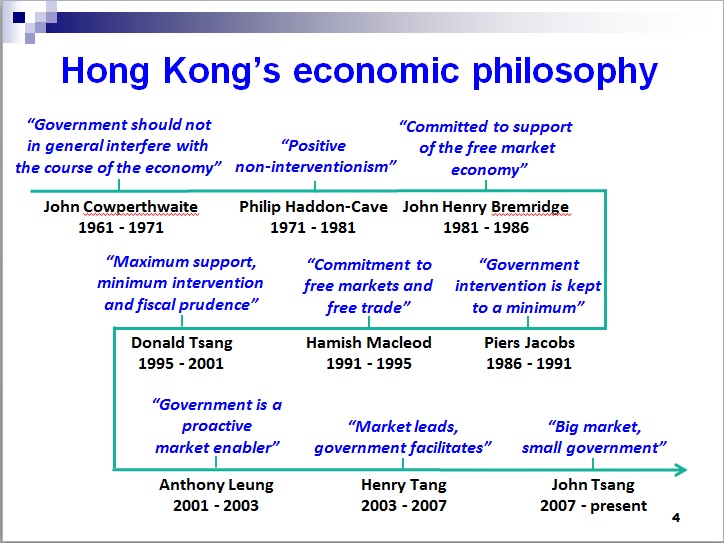
And how many jurisdictions adopt private Social Security systems to help make sure the burden of government spending doesn’t climb above 20 percent of GDP?

No wonder Hong Kong routinely is at the top of the rankings in both Economic Freedom of the World and the Index of Economic Freedom.

Here is some additional evidence of Hong Kong’s sensible approach. Below is a slide from a presentation by Hong Kong government officials, quoting the current Financial Secretary and all his predecessors, covering both the period of Chinese sovereignty and British sovereignty. As you can see, the one constant theme is free markets and small government.

For additional background, let’s enjoy the insight of one of these men.

In a column for Reason, my Cato Institute colleague Marian Tupy reminisces on his meeting with John Cowperthwaite, one of the British-appointed economic advisers.

…a young Scottish civil servant named John Cowperthwaite arrived in the colony to oversee its economic development. Some 50 years later, I met Cowperthwaite in St Andrews, Scotland, where I was a student and he was enjoying his retirement. As he told me, “I came to Hong Kong and found the economy working just fine. So, I left it that way.” …Of all the policies that we discussed, one stands out in my mind. I asked him to name the one reform that he was most proud of. “I abolished the collection of statistics,” he replied. Cowperthwaite believed that statistics are dangerous, because they enable social engineers of all stripes to justify state intervention in the economy. At some point during our first conversation I managed to irk him by suggesting that he was chiefly known “for doing nothing.” In fact, he pointed out, keeping the British political busy-bodies from interfering in Hong Kong’s economic affairs took up a large portion of his time.

I especially like Cowperthwaite’s insight about the downside risk of letting governments collect a lot of data.

Something that’s worth considering in a world where governments want to engage in massive data collection and data sharing for purposes of imposing and enforcing bad global tax policy.

But let’s not get sidetracked. Economic freedom in Hong Kong is today’s topic. With that in mind, here’s a chart from Marian’s column. It shows that Hong Kong used to be much poorer than the United Kingdom. But after decades of faster growth (thanks to good policy), Hong Kong is now more prosperous than its former colonial master.

In other words, Hong Kong didn’t just converge with one of the world’s richest countries, which by itself would be a remarkable and unusual achievement. It actually became richer.

This is tremendous evidence on the benefits of good policy and the importance of strong, long-run growth.

Let’s close by looking at this issue of growth and development. Here’s a video from Marginal Revolution, narrated by Professor Alex Tabarrok of George Mason University. You should watch it from start to finish, but if you’re pressed for time, make sure to at least watch the first 2:10.

Puzzle of Growth: Rich Countries and Poor Countries

There are two things that are worth emphasizing from the video.

The productivity of workers (and therefore the pay of workers) is dependent on the quantity and quality of capital.

Entrepreneurs play a key role in figuring out the best ways of mixing labor and capital and this innovation boosts productivity.

By the way, there are two sins of omission in the video. If you watch the whole thing, you’ll notice it mentions that strong economic performance is linked to therule of law, property rights, free trade, and sensible regulation.

All that is true. But what about a stable monetary system? And what about areasonable tax regime and a modest burden of government spending?

But I’m nitpicking. Let’s close with another video from Marginal Revolution. You should once again watch the entire video, but for those in a rush, I adjusted the settings so it starts at the most important part.

Growth Rates Are Crucial

The video uses GDP data that is adjusted for both inflation and population, which is a very useful approach. But the key lesson, as Professor Tabarrok explained, is that even small sustained changes in growth have enormous implications for long-run prosperity.

Indeed, that’s why Hong Kong is now richer than the United Kingdom. And it’s also worth noting that Hong Kong (and Singapore) are passing the United States.

Related Posts:

FRIEDMAN FRIDAY Milton Friedman – Tyranny of the Status Quo – Part 1 – Beneficiaries

Milton Friedman – Tyranny of the Status Quo – Part 1 – Beneficiarieshttp://www.freetochoose.net/media/broadcast/freetochoose/index.php?type=media#media

FRIEDMAN FRIDAY Milton Friedman videos

________ Milton Friedman – Iceland 1 of 8 Friedman visited Iceland in the autumn of 1984, met with prominent Icelanders and gave a lecture at the University of Iceland on the Tyranny of the Status Quo. He participated in a lively television debate on August 31, 1984 with leading socialist intellectuals, including current President Ólafur […]

FRIEDMAN FRIDAY Milton Friedman’s “Free to Choose” film transcripts and videos here on www.thedailyhatch.org

Volume 1: Power of the Market Volume 2: The Tyranny of Control Volume 3: Anatomy of a Crisis Volume 4: From Cradle to Grave Volume 5: Created Equal Volume 6: What’s Wrong With Our Schools? Volume 7: Who Protects the Consumer? Volume 8: Who Protects the Worker? Volume 9: How to Cure Inflation Volume 10: […]

FRIEDMAN FRIDAY How to Cure Health Care: What We Can Learn from Milton Friedman 2 years ago Kurt Jaros

How to Cure Health Care: What We Can Learn from Milton Friedman 2 years ago Kurt Jaros Blog Economics 3 I recently read about Michael Ciampi, a doctor from Maine who has stopped accepting payments from insurance companies, both private and public. The article states: …the decision to do away with insurance allows Ciampi to […]

FRIEDMAN FRIDAY How to Cure Health Care By Milton Friedman (A paper from 2001)

Milton Friedman on Medical Care (Full Lecture) Published on Feb 2, 2014 Website:http://www.commonsensecapitalism.com Facebook:http://www.facebook.com/pages/Common-… Twitter:https://twitter.com/#!/CommonSenseCap I have written about Obamacare over and over again on this blog. Dan Mitchell has shared many funny cartoons about Obamacare too. Milton Friedman has spoken out about government healthcare many times in the past and his film […]

FRIEDMAN FRIDAY Article by Peter Robinson 6/19/2009 @ 12:01AM Medical Analysis By Milton Friedman

Milton Friedman on Medical Care (Full Lecture) Published on Feb 2, 2014 Website:http://www.commonsensecapitalism.com Facebook:http://www.facebook.com/pages/Common-… Twitter:https://twitter.com/#!/CommonSenseCap I have written about Obamacare over and over again on this blog. Dan Mitchell has shared many funny cartoons about Obamacare too. Milton Friedman has spoken out about government healthcare many times in the past and his film […]

FRIEDMAN FRIDAY Taxmageddon and Obamacare: What Would Milton Friedman Say? Rich Tucker / @RichardBTucker / July 31, 2012

Milton Friedman on Medical Care (Full Lecture) Published on Feb 2, 2014 Website:http://www.commonsensecapitalism.com Facebook:http://www.facebook.com/pages/Common-… Twitter:https://twitter.com/#!/CommonSenseCap Taxmageddon and Obamacare: What Would Milton Friedman Say? Rich Tucker / @RichardBTucker / July 31, 2012 / 3 comments “I am in favor of cutting taxes under any circumstances and for any excuse, for any reason, whenever […]

Transcript of Milton Friedman speech from 1991

Best quote from the speech below: However, the point that impresses me now and that I want to emphasize is that the problem is not only for them but for us. They have as much to teach us as we have to teach them. What was their problem under communism? Too big, too intrusive, too […]

Milton Friedman Videos, Over 50 quotes too!!!!!

Milton Friedman – Public Schools / Voucher System Published on May 9, 2012 by BasicEconomics No description available. Milton Friedman – Public Schools / Voucher System (Q&A) Part 1 Milton Friedman: Why soaking the rich won’t work (Do the rich hoard their money? What are they investing in?) Uploaded by voogru on Apr 10, 2010 […]

FRIEDMAN FRIDAY A Way Out of Soviet-Style Health Care Solzhenitsyn’s prophetic warning about the depersonalization of medicine. By MILTON FRIEDMAN Updated March 20, 2010 12:01 a.m. ET

Milton Friedman – Health Care Reform (1992) pt 1/4 Milton Friedman – Health Care Reform (1992) pt 2/4 A Way Out of Soviet-Style Health Care Solzhenitsyn’s prophetic warning about the depersonalization of medicine. By MILTON FRIEDMAN Updated March 20, 2010 12:01 a.m. ET Editor’s note: The following is excerpted from an article with the same […]

MUSIC MONDAY Christian Rock Pioneer Larry Norman’s Songs Part 8 Album “Only Visiting This Planet”

Christian Rock Pioneer Larry Norman’s Songs Part 8 Album “Only Visiting This Planet”

I posted a lot in the past about my favorite Christian musicians such as Keith Green (I enjoyed reading Green’s monthly publications too), and 2nd Chapter of Acts and others. Today I wanted to talk about one of Larry Norman’s songs. David Rogers introduced me to Larry Norman’s music in the 1970’s and his album IN ANOTHER LAND came out in 1976 and sold an enormous amount of copies for a Christian record back then.

Larry Norman – Only Visiting This Planet – I’ve Got To Learn To Live Without You

Larry Norman – Only Visiting This Planet – The Outlaw

Larry Norman – Only Visiting This Planet – Why Don’t You Look Into Jesus

Larry Norman – Only Visiting This Planet – Righteous Rocker #1


Only Visiting This Planet

From Wikipedia, the free encyclopedia
Only Visiting This Planet
Studio album by Larry Norman
Released 1972
Recorded AIR Studios, London
Genre Christian rock
Label Verve
Producer Rod Edwards, Roger Hand and Jon Miller
Larry Norman chronology
Bootleg
(1972)
Only Visiting This Planet
(1972)
So Long Ago the Garden
(1973)
Professional ratings
Review scores
Source Rating
Allmusic 5/5 stars[1]

Only Visiting This Planet is an album recorded by Larry Norman in 1972. The album was selected as the second album in CCM Magazine‘s The 100 Greatest Albums in Christian Music.[2] In April 2014 the album was announced as one of 25 sound recordings inducted for 2013 into the Library of Congress National Recording Registry, that preserves as “cultural, artistic and/or historical treasures, representing the richness and diversity of the American soundscape”,[3] making it the first Christian rock album chosen for the registry.[4]

History

On 8 September 1972 Norman began recording his second studio album,[5] Only Visiting This Planet,[6] the first album in a projected trilogy,[7][8] in AIR Studios in London.[9] Only Visiting This Planet, often ranked as Norman’s best album,[10] “mixed his Christian message with strong political themes”, and “was meant to reach the flower children disillusioned by the government and the church” with its “abrasive, urban reality of the gospel”.[10] In a 1980 interview, Norman explained its purpose:

Only Visiting This Planet is the first part of the trilogy, and represents the present. On the front cover, I find myself standing in the middle of New York City, with buildings and traffic pressed around me and my hand on my head kind of saying, What is going on in this life? Is this really earth?, and the back cover is me visiting the site of a previous civilisation with its own monoliths, not skyscrapers, but amazing, architecturally sound structures just the same. The Druids apparently constructed Stonehenge to help them observe or worship the sun, and their civilisation is now as dead as will someday be New York. And I’m just standing there, looking around, wondering what happened to kill off this culture and reduce its entire recorded history to a few standing structures.[11]

On 6 January 1973 Norman was one of three named as Best New Male Artist of the year by Cashbox.[12] By February 1973 songs from Only Visiting This Planet had been recommended by Billboard for “heavy Top 40 airplay”,[13] and were being played on WVVS-FM, KSHE-FM, and WKTK-FM.[14] In 1990 CCM magazine voted Only Visiting This Planet as “the greatest Christian album ever recorded”.[15] Only Visiting This Planet was one of 25 sound recordings inducted for 2013 into the Library of Congress National Recording Registry, that preserves as “cultural, artistic and/or historical treasures, representing the richness and diversity of the American soundscape.”[16] A statement by the Library of Congress called the album “the key work in the early history of Christian rock,” describing Norman as one who “commented on the world as he saw it from his position as a passionate, idiosyncratic outsider to mainstream churches.”[17]

After a tour of South Africa in June and the UK in July,[18] and the release in July of his “Why Should the Devil Have All the Good Music?”, a songbook featuring some of Norman’s songs from both Upon This Rock and Only Visiting This Planet.[19]

In the song “Reader’s Digest” Norman sings the following verse: “Dear John, who’s more popular now? I´ve been listening to some of Paul’s new records. Sometimes I think he really is dead.” (see Paul is dead) “Who’s more popular now?” makes reference to John Lennon’s famous claim that the Beatles were more popular than Jesus. The album features King Crimson prog-rock bassist and Asia frontman, John Wetton on bass guitar.

A three-LP boxed set containing the entire trilogy in their originally intended forms and titled The Compleat Trilogy (as mentioned on the insert of the Street Level reissue of Only Visiting This Planet) has never been released.

Tracks

All tracks composed by Larry Norman

Original LP release
Side 1
  1. “I’ve Got to Learn to Live Without You”
  2. “The Outlaw”
  3. “Why Don’t You Look Into Jesus”
  4. “Righteous Rocker #1”
  5. “I Wish We’d All Been Ready”
Side 2
  1. “I Am Six O’Clock News”
  2. “The Great American Novel”
  3. “Pardon Me”
  4. “Why Should the Devil Have All the Good Music”
  5. “Reader’s Digest”
  6. “Oh, How I Love You” (not listed)
Additional tracks on subsequent releases
  1. “PeacePollutionRevolution” (1971 single)
  2. “Righteous Rocker” (rough mix) or (Hard Rock Version) or (Delta Swamp Version)
  3. “The Outlaw” (demo) or (Rock Remake) or (Peace Mix Remake)
  4. “Digest” (rock version) or “Reader’s Digest” (Hard Rock Remake) or (Solid Rock Studio Remake)
Maximum Planet (The Anthology Series)
  1. I’ve Got To Learn To Live Without You – Basic Master Track
  2. Why Don’t You Look Into Jesus – Master Track
  3. I Wish We’d All Been Ready – Basic Master Track
  4. I Am The Six O’Clock News – Basic Master Track
  5. Six O’Clock News – Jet Fade-In with Stewardess
  6. Six O’Clock News – Jet Fade-Out Jam
  7. The Great American Novel – Demo #2 With Faint Vox
  8. Pardon Me – With Vox & No Orchestra
  9. Why Should The Devil Have All The Good Music – Vox 2.0
  10. Uncredited, Unidentified Song – Spiral Out-Groove
  11. The Great American Novel – Warm-Up Demo
  12. I-ve Got To Learn To Live Without You – Basic Track
  13. The Outlaw – With Electric Guitars And Guide Vocal
  14. I Am The Six O’Clock News – Basic Track With Guitars And Guide Vocal
  15. I Wish We’d All Been Ready – With Orchestra & No vox
  16. Why Should The Devil – With Guide Vocal
  17. Why Don’t You Look Into Jesus – On Stage

MaximumPlanet.jpg

Personnel

See also

References

  1. Allender, Mark W. B. “(Review) Only Visiting This Planet. Allmusic. Retrieved 2009-05-10.
  2. Granger, Thom (2001). The 100 Greatest Albums in Christian Music. Harvest House. ISBN 0-7369-0281-3.
  3. “Hallelujah, the 2013 National Recording Registry Reaches 400”, “News from the Library of Congress” (April 2, 2014).
  4. “U2, Linda Ronstadt among 25 albums to be preserved”, The Washington Post (April 2, 2014).
  5. Michel Ruppli and Ed Novitsky, The MGM Labels: A Discography, 1961 – 1982 Vol. 2 (Greenwood Publishing Group, 1998):762.
  6. For comments about each song, see “PLANET: SONG BY SONG”, http://www.onlyvisiting.com/music/discography/Only_Visiting/visiting.songs.html
  7. Only Visiting This Planet, So Long Ago the Garden, and In Another Land are commonly referred to as “The Trilogy.”
  8. Larry Norman – So Long Ago The Garden newmusicplease.com 2006-08-28 retrieved 2007-12-27
  9. “Larry in the UK”, http://www.larrynorman.uk.com/inuk.html
  10. CBNmusic, “Larry Norman”, http://www.cbn.com/cbnmusic/artists/norman_larry.aspx
  11. Larry Norman, in “New Music Interview 1980 Part 3”, http://dagsrule.com/stuff/larry/intvw80c.html To see the cover and its various releases and versions, see Robert Termorshuizen (with updates by Jim Böthel), “Only Visiting This Planet (1972)”, http://www.meetjesushere.com/Only_Visiting_This_Planet.htm
  12. Marc Eliot and Mike Appel, Down Thunder Road: The Making of Bruce Springsteen (Simon & Schuster, 1993):101. The others were Bruce Springsteen and Elliott Murphy.
  13. “Special Merit Picks”, Billboard (10 February 1973):64.
  14. “Billboard FM Action”, Billboard (17 February 1973):18.
  15. Matthew Dickerson, “Home At Last”, in Larry Norman, “Blue Book”, (1989):16; Bob Gersztyn, “Jesus and Larry and Me”, The Wittenburg Door, http://www.wittenburgdoor.com/larry-norman
  16. “Hallelujah, the 2013 National Recording Registry Reaches 400”, “News from the Library of Congress” (April 2, 2014).
  17. “Christian rock pioneer’s album added to National Recording Registry”, The Washington post (April 2, 2014).
  18. “Norman Tour of U.K., S. Africa”, Billboard (26 May 1973):22.
  19. Larry Norman, Why Should The Devil Have All The Good Music Songbook (Los Angeles, CA: One Way, 1972), http://www.meetjesushere.com/songbooks_&_sheet_musics.htm; The songbook was published by One Way Publications (see “Inside Track”, Billboard (7 July 1973):66) and released in 1972 (see Why Should The Devil Have All The Good Music (1972?), http://www.meetjesushere.com/songbooks_&_sheet_musics.htm)

1978 Prolife Pamphlet from Keith Green’s ministry has saved the lives of many babies!!!!

Francis Schaeffer Whatever Happened to the Human Race (Episode 1) ABORTION _____________________________________ 1978 Prolife Pamphlet from Keith Green’s ministry has saved the lives of many babies!!!! Francis Schaeffer “BASIS FOR HUMAN DIGNITY” Whatever…HTTHR Dr. Francis schaeffer – The flow of Materialism(from Part 4 of Whatever happened to human race?) Dr. Francis Schaeffer – The Biblical […]

Tribute to Keith Green who died 32 years ago today!!!

This is a tribute to Keith Green who died 32 years ago today!!! On July 28, 1983 I was sitting by the radio when CBS radio news came on and gave the shocking news that Keith Green had been killed by an airplane crash in Texas with two of his children. 7 months later I […]

“Music Monday” My favorite Christian music artist of all time is Keith Green.

My favorite Christian music artist of all time is Keith Green. Sunday, May 5, 2013 You Are Celled To Go – Keith Green Keith Green – (talks about) Jesus Commands Us To Go! (live) Uploaded on May 26, 2008 Keith Green talks about “Jesus Commands Us To Go!” live at Jesus West Coast ’82 You can find […]

MUSIC MONDAY:Keith Green Story, and the song that sums up his life (Part 10)

To me this song below sums up Keith Green’s life best. 2nd Chapter of Acts – Make My Life A Prayer to You Make my life a prayer to You I want to do what You want me to No empty words and no white lies No token prayers, no compromise I want to shine […]

MUSIC MONDAY:Keith Green Story (Part 9)

Keith Green – Easter Song (live) Uploaded by monum on May 25, 2008 Keith Green performing “Easter Song” live from The Daisy Club — LA (1982) ____________________________ Keith Green was a great song writer and performer.  Here is his story below: The Lord had taken Keith from concerts of 20 or less — to stadiums […]

MUSIC MONDAY:Keith Green Story, includes my favorite song (Part 8)

Keith Green – Asleep In The Light Uploaded by keithyhuntington on Jul 23, 2006 keith green performing Asleep In The Light at Jesus West Coast 1982 __________________________ Keith Green was a great song writer and performer and the video clip above includes my favorite Keith Green song. Here is his story below: “I repent of […]

Keith Green’s article “Grumbling and Complaining–So You Wanna Go Back to Egypt?” (Part 4)

Keith Green – So You Wanna Go Back To Egypt (live) Uploaded by monum on May 25, 2008 Keith Green performing “So You Wanna Go Back To Egypt” live at West Coast 1980 ____________ This song really shows Keith’s humor, but it really has great message. Keith also had a great newsletter that went out […]

Keith Green’s article “Grumbling and Complaining–So You Wanna Go Back to Egypt?” (Part 3)

Keith Green – So You Wanna Go Back To Egypt (live) Uploaded by monum on May 25, 2008 Keith Green performing “So You Wanna Go Back To Egypt” live at West Coast 1980 ____________ This song really shows Keith’s humor, but it really has great message. Keith also had a great newsletter that went out […]

MUSIC MONDAY:Keith Green Story (Part 7)

Keith Green – Your Love Broke Through Here is something I got off the internet and this website has lots of Keith’s great songs: Keith Green: His Music, Ministry, and Legacy My mom hung up the phone and broke into tears. She had just heard the news of Keith Green’s death. I was only ten […]

Keith Green’s article “Grumbling and Complaining–So You Wanna Go Back to Egypt?” (Part 2)

Keith Green – So You Wanna Go Back To Egypt (live) Uploaded by monum on May 25, 2008 Keith Green performing “So You Wanna Go Back To Egypt” live at West Coast 1980 ____________ This song really shows Keith’s humor, but it really has great message. Keith also had a great newsletter that went out […]

MUSIC MONDAY Christian Rock Pioneer Larry Norman’s Songs Part 4

Christian Rock Pioneer Larry Norman’s Songs Part 4

I posted a lot in the past about my favorite Christian musicians such as Keith Green (I enjoyed reading Green’s monthly publications too), and 2nd Chapter of Acts and others. Today I wanted to talk about one of Larry Norman’s songs. David Rogers introduced me to Larry Norman’s music in the 1970’s and his album IN ANOTHER LAND came out in 1976 and sold an enormous amount of copies for a Christian record back then.

Larry Norman – 9 – The Sun Began To Rain – In Another Land (1976)

Larry Norman – 10 – Shot Down – In Another Land (1976)

Larry Norman – 11 – Six Sixty Six – In Another Land (1976)

Larry Norman – 12 – Diamonds – In Another Land (1976)


In Another Land (album)

From Wikipedia, the free encyclopedia
In Another Land
Studio album by Larry Norman
Released 1976
Recorded 1975
Label Solid Rock Records
Producer Larry Norman
Larry Norman chronology
So Long Ago the Garden
(1973)
In Another Land
(1976)
Streams of White Light
(1977)
Professional ratings
Review scores
Source Rating
Allmusic 3/5 stars[1]

In Another Land is an album recorded by Larry Norman and released in 1976. It is the third album in Norman’s “trilogy,” which began with Only Visiting This Planet and continued with So Long Ago the Garden. The album contains some of Norman’s most well-known work.

History[edit]

In 1975 Norman recorded In Another Land, the third album in his trilogy, which was released in 1976 through his own Solid Rock label and distributed through Word Records,[2] making it “the first of his albums to be released on a Christian label”.[3] However, according to Norman, “In Another Land, was executorially censored by the “mother company” which insisted on removing any music they felt was “too negative” or “too controversial.”[4] Commercial pressure from Norman’s “American publisher and American and European distributors”[5] forced Norman to remove four songs from In Another Land: “I Dreamed that I Died”, “Looking for the Footprints”, “Top 40 Survey”, and “You’ll Never Find No One (Who Loves You Like I Do”,[6] as they believed that Norman had included too many songs, and that the deleted songs could be released on his next album.[7]One of the songs included on this album was “The Sun Began to Rain” (The Son Began to Reign),[8] an allegory written by Norman, was “knocked out … in just over a minute” with British comedian Dudley Moore on piano.[9] In a 1980 interview Norman explained the purpose of In Another Land:

In Another Land is the third part of the trilogy It’s about the future, and rather than speculate about what the future might hold, I tried to stick closely to what the Bible says it will hold. I think because the future orientated album was so directly tied to the scriptures, people felt this is Larry’s best album, because this is the one I like best. Or This is the most Christian album. I think that Only Visiting This Planet or So Long Ago The Garden were much better conceptional statements, much better medicine for a non-Christian to swallow. The front cover of In Another Land posed a problem. I couldn’t really go and stand on a hillside in front of The New Jerusalem, so I just put together a lot of photographs of Israel and photographs of mountainous terrain. The front cover shows a painting of me standing on a hill, for the first time smiling at the camera, because in the new age I won’t be troubled as I have always been on my other albums about things like world hunger, and world ignorance, human anger and jealousy and pettiness.[10]

Norman provides a more detailed analysis of In Another Land in the producer notes of the 1991 re-issue.[11] In Another Land was Norman’s best-selling album ever,[12] and had the best reception of any of his albums from the Christian establishment.[13] In 2005 Norman recalled:

The Church finally accepted me in 1976, I think it was, and that’s just because I had so many songs people knew that the records stores said, “Okay, I’ll take a chance.” I did In Another Land, which was such a mellow album. It’s really for Christians (none of the other albums were), but what do you say when the concept of the album is eternal life with God in heaven? … Of course they liked that album and the record stores sold it and it was Album of the Month for Word Record Club and it was the #1 seller for a long time.[14]

By 1985 In Another Land had sold 120,000 copies in the USA alone, compared with average sales of less than ten thousand for other gospel albums,[7] Responding to the better acceptance of In Another Land by many church leaders who had previously opposed him and his music, Norman indicated in 1980: “I realised that the music itself would probably appeal to the middle of the road Christians who are offended by the extremes in my observations. But if they like this album, and if they suddenly decide that I have returned to the fold and I am now one of them, they’re going to hate the next album – it’s all blues.”[15] Norman held several concerts in Australia in October 1976.[16]

A different version of the song “I Love You” was first recorded by Randy Stonehill on the now-rare album Born Twice, which was produced by Larry Norman back in 1969. That album credits Stonehill as the writer of the song. Norman’s version completely changes all the verses, retaining only the first line of the first verse of Stonehill’s original composition.

“Righteous Rocker #3” is a reprise of a song which originally appeared on Only Visiting This Planet.

The album also contains a souped-up version of “Why Don’t You Look Into Jesus,” another song which made its first appearance on Only Visiting This Planet. In the later version the controversial second verse from the original (“Gonorrhea on Valentine’s Day / You’re still looking for the perfect lay,” etc.) is conspicuously absent.

“I Am A Servant” was recorded and popularized as a Christian pop ballad by Christian singer Honeytree.

“Song For A Small Circle Of Friends” was a piece written for Norman’s famous friends in the music industry. The song includes allusions to Randy Stonehill, Eric Clapton, Bob Dylan, Charlie Watts of the Rolling Stones, and Paul McCartney. There has never been any evidence that, other than Stonehill, Norman actually knew any of these people.

Tracks[edit]

Original LP release[edit]

Side 1[edit]

  1. “The Rock That Doesn’t Roll”
  2. “I Love You” (Larry Norman, Randy Stonehill)
  3. “UFO”
  4. “I’ve Searched All Around”
  5. “Righteous Rocker #3”
  6. “Deja Vu (If God Is My Father / Why Don’t You Look Into Jesus)”
  7. “I Am A Servant”

Side 2[edit]

  1. “The Sun Began To Rain”
  2. “Shot Down”
  3. “Six, Sixty, Six”
  4. “Diamonds”
  5. “One Way”
  6. “Song For A Small Circle Of Friends”
  7. “Hymn To The Last Generation”

“The Missing Pieces” reissue[edit]

“This is the running order on the original master tape which was sent to Word U.K.”[citation needed]

  1. “Tuning”
  2. “The Rock That Doesn’t Roll”
  3. “UFO”
  4. “I’ve Searched All Around”
  5. “Shot Down”
  6. “Song For A Small Circle Of Friends”
  7. “The Sun Began To Rain”
  8. “Looking For The Footprints”
  9. “Six Sixty Six”
  10. “Righteous Rocker #3”
  11. “If God Is My Father”
  12. “Why Don’t You Look Into Jesus”
  13. “Diamonds”
  14. “One Way”
  15. “I Am A Servant”
  16. “Hymn To The Last Generation”

Extra tracks on CD releases[edit]

  1. “Looking For The Footprints”
  2. “Dreams On A Grey Afternoon”
  3. “Six Sixty Six” (alternate take)
  4. “Strong Love, Strange Peace”
  5. “Dear Malcolm, Dear Alwyn”
  6. “Joyful Delta Day”
  7. “I Don’t Believe In Miracles”

Covers[edit]

Frank Black, a longtime admirer of Norman who became a friend, covered “Six, Sixty, Six” on his album Frank Black and the Catholics.[citation needed]

Personnel[edit]

Production notes[edit]

  • Produced by Larry Norman
  • Engineered by Andy Johns
  • Assistant engineer Tom Trefethen
  • Pre-production recording at Solid Rock studios
  • Recorded at Mama Jo’s and Sunset SOund
  • Mastered at A&M, Studio 3

See also[edit]

References[edit]

  1. Jump up^ In Another Land at Allmusic
  2. Jump up^ “New Music Interview 1980 Part 3”, http://dagsrule.com/stuff/larry/intvw80c.html
  3. Jump up^ “Larry Norman – 1947-2008”, Cross Rhythms, http://www.crossrhythms.co.uk/articles/news/Larry_Norman__19472008/30703/p1/
  4. Jump up^ “Larry Norman (Part 1)”, http://www.onlyvisiting.com/larry/about/story1.html. This is taken from A Moment In Time and Footprints In The Sand CD booklets. See also linear notes, “Looking For the Footprints”, White Blossoms From Black Roots (1997 CD):4.
  5. Jump up^ Philip F. Mangano, “Linear Notes”, Only Visiting This Planet re-issue (1978):2.
  6. Jump up^ “The Compleat Trilogy” insert in 1978 re-issue of Only Visiting This Planet.
  7. ^ Jump up to:a b “Larry Norman Down Under But Not Out”, On Being (1985/1986):7.
  8. Jump up^ The alternate title, The Son Began to Reign, was registered on 15 January 1976. See http://www.faqs.org/copyright/why-should-the-devil-have-all-the-good-music-one-way-dear/. For lyrics, see “The Sun Began to Rain”,http://www.onlyvisiting.com/gallery/lyrics/songs/sun/sun.html
  9. Jump up^ Larry Norman, liner notes, Rebel Poet, Jukebox Balladeer: The Anthology (September 2007); Linear Notes, “The Sun Began to Rain”,White Blossoms From Black Roots (1997); Mike Rimmer, “A Legend Quizzed”, Cross Rhythms (27 August 2005):2,http://www.crossrhythms.co.uk/articles/music/A_Legend_Quizzed/15761/p2/.
  10. Jump up^ “New Music Interview 1980 Part 3”, http://dagsrule.com/stuff/larry/intvw80c.html
  11. Jump up^ Larry Norman, “Producer’s Notes (Part 1), http://www.onlyvisiting.com/larry/articles/producers_notes1.html; Larry Norman, “Producer’s Notes (Part 2), http://www.onlyvisiting.com/larry/articles/producers_notes2.html; Larry Norman, “Producer’s Notes (Part 3),http://www.onlyvisiting.com/larry/articles/producers_notes3.html
  12. Jump up^ See Robert Termorshuizen, “Notes”, http://www.meetjesushere.com/in_another_land.htm
  13. Jump up^ See Robert Termorshuizen, “Notes”, http://www.meetjesushere.com/in_another_land.htm
  14. Jump up^ David Sanford, “Larry Norman Says Good-Bye” (3 March 2008),http://www.burnsidewriterscollective.com/general/2008/03/larry_norman_says_goodbye.php?page=2
  15. Jump up^ “New Music Interview 1980 Part 3”, http://dagsrule.com/stuff/larry/intvw80c.html
  16. Jump up^ “Larry Rocks Along with Christ”, The Age (21 October 1976):12.


1978 Prolife Pamphlet from Keith Green’s ministry has saved the lives of many babies!!!!

Francis Schaeffer Whatever Happened to the Human Race (Episode 1) ABORTION _____________________________________ 1978 Prolife Pamphlet from Keith Green’s ministry has saved the lives of many babies!!!! Francis Schaeffer “BASIS FOR HUMAN DIGNITY” Whatever…HTTHR Dr. Francis schaeffer – The flow of Materialism(from Part 4 of Whatever happened to human race?) Dr. Francis Schaeffer – The Biblical […]

Tribute to Keith Green who died 32 years ago today!!!

This is a tribute to Keith Green who died 32 years ago today!!! On July 28, 1983 I was sitting by the radio when CBS radio news came on and gave the shocking news that Keith Green had been killed by an airplane crash in Texas with two of his children. 7 months later I […]

“Music Monday” My favorite Christian music artist of all time is Keith Green.

My favorite Christian music artist of all time is Keith Green. Sunday, May 5, 2013 You Are Celled To Go – Keith Green Keith Green – (talks about) Jesus Commands Us To Go! (live) Uploaded on May 26, 2008 Keith Green talks about “Jesus Commands Us To Go!” live at Jesus West Coast ’82 You can find […]

MUSIC MONDAY:Keith Green Story, and the song that sums up his life (Part 10)

To me this song below sums up Keith Green’s life best. 2nd Chapter of Acts – Make My Life A Prayer to You Make my life a prayer to You I want to do what You want me to No empty words and no white lies No token prayers, no compromise I want to shine […]

MUSIC MONDAY:Keith Green Story (Part 9)

Keith Green – Easter Song (live) Uploaded by monum on May 25, 2008 Keith Green performing “Easter Song” live from The Daisy Club — LA (1982) ____________________________ Keith Green was a great song writer and performer.  Here is his story below: The Lord had taken Keith from concerts of 20 or less — to stadiums […]

MUSIC MONDAY:Keith Green Story, includes my favorite song (Part 8)

Keith Green – Asleep In The Light Uploaded by keithyhuntington on Jul 23, 2006 keith green performing Asleep In The Light at Jesus West Coast 1982 __________________________ Keith Green was a great song writer and performer and the video clip above includes my favorite Keith Green song. Here is his story below: “I repent of […]

Keith Green’s article “Grumbling and Complaining–So You Wanna Go Back to Egypt?” (Part 4)

Keith Green – So You Wanna Go Back To Egypt (live) Uploaded by monum on May 25, 2008 Keith Green performing “So You Wanna Go Back To Egypt” live at West Coast 1980 ____________ This song really shows Keith’s humor, but it really has great message. Keith also had a great newsletter that went out […]

Keith Green’s article “Grumbling and Complaining–So You Wanna Go Back to Egypt?” (Part 3)

Keith Green – So You Wanna Go Back To Egypt (live) Uploaded by monum on May 25, 2008 Keith Green performing “So You Wanna Go Back To Egypt” live at West Coast 1980 ____________ This song really shows Keith’s humor, but it really has great message. Keith also had a great newsletter that went out […]

MUSIC MONDAY:Keith Green Story (Part 7)

Keith Green – Your Love Broke Through Here is something I got off the internet and this website has lots of Keith’s great songs: Keith Green: His Music, Ministry, and Legacy My mom hung up the phone and broke into tears. She had just heard the news of Keith Green’s death. I was only ten […]

Keith Green’s article “Grumbling and Complaining–So You Wanna Go Back to Egypt?” (Part 2)

Keith Green – So You Wanna Go Back To Egypt (live) Uploaded by monum on May 25, 2008 Keith Green performing “So You Wanna Go Back To Egypt” live at West Coast 1980 ____________ This song really shows Keith’s humor, but it really has great message. Keith also had a great newsletter that went out […]

RESPONDING TO HARRY KROTO’S BRILLIANT RENOWNED ACADEMICS!! Riccardo Giacconi, Nobel Prize-winning astrophysicist, Johns Hopkins University. ” Irrational thinking of any kind is very dangerous”

On November 21, 2014 I received a letter from Nobel Laureate Harry Kroto and it said:

…Please click on this URL http://vimeo.com/26991975

and you will hear what far smarter people than I have to say on this matter. I agree with them.

Harry Kroto

_________________

Below you have picture of Dr. Harry Kroto:

______________

I have attempted to respond to all of Dr. Kroto’s friends arguments and I have posted my responses one per week for over a year now. Here are some of my earlier posts:

Sir David AttenboroughMark Balaguer, Patricia ChurchlandAaron CiechanoverNoam Chomsky,Alan DershowitzHubert Dreyfus, Bart EhrmanIvar Giaever , Roy GlauberRebecca GoldsteinDavid J. Gross,  Brian Greene, Susan GreenfieldAlan Guth, Jonathan HaidtHermann HauserRoald Hoffmann,  Bruce HoodHerbert Huppert,  Gareth Stedman JonesShelly KaganStuart Kauffman,  Lawrence KraussHarry Kroto, Elizabeth Loftus,  Alan MacfarlanePeter MillicanMarvin MinskyLeonard Mlodinow,  Yujin NagasawaDouglas Osheroff,   Saul PerlmutterHerman Philipse,  Robert M. PriceLisa RandallLord Martin Rees,  Oliver SacksMarcus du SautoySimon SchafferJ. L. Schellenberg,   Lee Silver Peter Singer,  Walter Sinnott-ArmstrongRonald de Sousa, Victor StengerBarry Supple,   Leonard Susskind, Raymond TallisNeil deGrasse Tyson,  .Alexander Vilenkin, Sir John WalkerFrank WilczekSteven Weinberg, and  Lewis Wolpert,

____________________________

Riccardo Giacconi

From Wikipedia, the free encyclopedia
Riccardo Giacconi
RiccardoGiacconi.jpg

National Medal of Science award ceremony, 2003
Born October 6, 1931 (age 83)
Genoa, Italy
Residence United States
Nationality Italy
United States
Fields Physics
Institutions Johns Hopkins University
Chandra X-ray Observatory
Alma mater University of Milan
Doctoral advisor
Doctoral students
Known for Astrophysics
Notable awards Elliott Cresson Medal (1980)
Dannie Heineman Prize for Astrophysics (1981)
Nobel Prize in Physics (2002)

Riccardo Giacconi (born October 6, 1931) is an American Nobel Prize-winning astrophysicist who laid the foundations of X-ray astronomy. He is currently a professor at the Johns Hopkins University.

In  the first video below in the 16th clip in this series are his words and  my response is below them. 

50 Renowned Academics Speaking About God (Part 1)

Another 50 Renowned Academics Speaking About God (Part 2)

A Further 50 Renowned Academics Speaking About God (Part 3)

Quote from Dr. Giacconi:

” Irrational thinking of any kind is very dangerous, …I wish that with the progress of science we could inject a little bit more rationality in the world. But in that sense we have failed. ”

Below is the letter I sent to Dr. Giacconi:

December 25, 2014

Dr. Riccardo Giacconi, c/o Johns Hopkins University,
Department of Physics & Astronomy, Baltimore, MD

Dear Dr. Giacconi,

I love the town of Baltimore. “The Star-Spangled Banner” is the national anthem of the United States. The lyrics come from “Defence of Fort M’Henry”, a poem written in 1814 by the 35-year-old lawyer and amateur poet Francis Scott Key after witnessing the bombardment of Fort McHenry by British ships of the Royal Navy in the Chesapeake Bay during the Battle of Fort McHenry in the War of 1812. My sons and I got to visit Fort McHenry back in 1996 in Baltimore, and we loved our tour.

Also I have done a lot of posts on my blog on William Foxwell Albright (from John Hopkins) who was the greatest biblical archaeologist of all time because of his knowledge of pottery.  One of the posts I did was entitled, “14c. Three greatest American Archaeologists moved to accept Bible’s accuracy through archaeology.” The final reason that I love your town so much is because of the nickname you chose for the NFL team in Baltimore which is tied into Edgar Allan Poe and that of course is the Ravens!!!!

Recently I ran across this quote from you, ” Irrational thinking of any kind is very dangerous, …I wish that with the progress of science we could inject a little bit more rationality in the world. But in that sense we have failed. ”

On November 21, 2014 I received a letter from Nobel Laureate Harry Kroto  who I have been corresponding with and it said:

…Please click on this URL http://vimeo.com/26991975

and you will hear what far smarter people than I have to say on this matter. I agree with them.

Harry Kroto

__________________________

There are 3 videos in this series and they have statements by 150 academics and scientists and I saw that you were featured in this film series. I have been responding to some of the statements concerning God and I plan on responding to what you have said on this issue too.

Now on to the other topics I wanted to discuss with you today. I wanted to write you today for two reasons. First, do you believe that evangelicals should have a place at the table when it comes to science even though we believe in a personal Creator?  Second, I wanted to point out some scientific evidence that caused Antony Flew to switch from an atheist (as you are now) to a theist. Twenty years I had the opportunity to correspond with two individuals that were regarded as two of the most famous atheists of the 20th Century, Antony Flew and Carl Sagan. (I have enclosed some of those letters between us.) I had read the books and seen the films of the Christian philosopher Francis Schaeffer and he had discussed the works of both of these men. I sent both of these gentlemen philosophical arguments from Schaeffer in these letters and in the first letter I sent a cassette tape of my pastor’s sermon IS THE BIBLE TRUE? (CD is enclosed also.) You may have noticed in the news a few years ago that Antony Flew actually became a theist in 2004 and remained one until his death in 2010. Carl Sagan remained a skeptic until his dying day in 1996.

You will notice in the enclosed letter from June 1, 1994 that Dr. Flew commented, “Thank you for sending me the IS THE BIBLE TRUE? tape to which I have just listened with great interest and, I trust, profit.” It would be a great honor for me if you would take time and drop me a note and let me know what your reaction is to this same message.

In 1994 and 1995 I had the opportunity to correspond with the famous evolutionist Dr. Ernst Mayr of Harvard. He stated in his letter of 10-3-94, “Owing to your ideological commitments, it is only natural that you cannot accept the cogency of the scientific evidence. However, to a person such as myself without such commitments, the story of the gradual evolution of life as reconstructed by chemists and molecular biologists is totally convincing.”

I responded by pointing out three points. First, Scientific Naturalism is atheistic by definition. Second, many great scientists of the past were Christians, and that did not disqualify their observations and discoveries. Third, the fact that evolution is true does not rule out God’s existence (Harvard’s own Owen Gingerich and many others such as Francis Collins hold to a Creator and evolution).

Let me just spend some time on my second point. Francis Schaeffer in his book “HOW SHOULD WE THEN LIVE?” stated that according to Alfred North Whitehead and J. Robert Oppenheimer, both renowned philosophers and scientists of our era (but not Christians themselves), modern science was born out of the Christian world view. Whitehead said that Christianity is the “mother of science” because of the insistence on the rationality of God. In the article, “Christianity and Technological Advance – The Astonishing Connection,” by T. V. Varughese, Ph.D, he observed:

Without question, “technology” has now become the new magic word in place of the word “science.” Since technology represents the practical applications of science, it is clearly consumer-oriented. Herein is bright economic promise to all who can provide technology.

In terms of technology, our present world can be divided into at least three groups: countries that are strong providers of technology, both original and improved; countries that are mass producers because of cheaper labor; and countries that are mostly consumers. Without a doubt, being in the position of “originating” superior technology should be a goal for any major country. The difficult question, however, is “how.”

An obvious place to start suggests itself. Why not begin with the countries that have established themselves as strong originators of technology and see if there is a common thread between them? The western nations, after the Renaissance and the Reformation of the 16th century, offer a ready example. Any book on the history of inventions, such as the Guinness Book of Answers, will reveal that the vast majority of scientific inventions have originated in Europe (including Britain) and the USA since the dawn of the 17th century. What led to the fast technological advances in the European countries and North America around that time?

The answer is that something happened which set the stage for science and technology to emerge with full force. Strange as it may seem, that event was the return to Biblical Christianity in these countries.

The Epistemological Foundation of Technology

According to Alfred North Whitehead and J. Robert Oppenheimer, both renowned philosophers and scientists of our era (but not Christians themselves), modern science was born out of the Christian world view. Whitehead said that Christianity is the “mother of science” because of the insistence on the rationality of God.[1] Entomologist Stanley Beck,though not a Christian himself, acknowledged the corner-stone premises of science which the Judeo-Christian world view offers: “The first of the unprovable premises on which science has been based is the belief that the world is real and the human mind is capable of knowing its real nature. The second and best-known postulate underlying the structure of scientific knowledge is that of cause and effect. The third basic scientific premise is that nature is unified.”[2] In other words, the epistemological foundation of technology has been the Judeo-Christian world view presented in the Bible…

Perhaps the most obvious affirmation that Biblical Christianity and science are friends and not foes comes from the fact that most of the early scientists after the Renaissance were also strong believers in the Bible as the authoritative source of knowledge concerning the origin of the universe and man’s place in it.[4] The book of Genesis, the opening book of the Bible, presents the distinctly Judeo-Christian world view of a personal Creator God behind the origin and sustenance of the universe (Genesis 1:1Colossians 1:17; etc.).

Among the early scientists of note who held the Biblical creationist world view are Blaise Pascal (1623-1662), Sir Isaac Newton (1642-1727), and Samuel Morse (1791-1872) – what motivated them was a confidence in the “rationality” behind the universe and the “goodness” of the material world. The creation account in Genesis presents an intelligent, purposeful Creator, who, after completing the creation work, declared it to be very good (Genesis 1:31). That assures us that the physical universe operates under reliable laws which may be discovered by the intelligent mind and used in practical applications. The confidence in the divinely pronounced goodness of the material world removed any reluctance concerning the development of material things for the betterment of life in this world. The spiritual world and the material world can work together in harmony.

 References –

  1. Francis A. Schaeffer: How Should We Then Live (Revell, 1976), p. 132.
  2. Henry M. Morris, Biblical Basis for Modern Science (Baker, 1991), p. 30.
  3. Schaeffer, p. 131.
  4. Henry M. Morris, Men of Science, Men of God (Master Books, CA, 1988), 107 pp.

_____________

Henry Morris pointed out:

Many of these great scientists of the past were before Darwin, but not all of them. However, all of them were acquainted with secular philosophies and some were in fact opponents of Darwinism (Agassiz, Pasteur, Lord Kelvin, Maxwell, Dawson, Virchow, Fabre, Fleming, etc). Many of them believed in the inspiration and authority of the Bible, as well as in the deity and saving work of Jesus Christ. They believed that God had supernaturally created all things, each with its own complex structure for its own unique purpose. They believed that, as scientists, they were “thinking God’s thoughts after Him,” learning to understand and control the laws and processes of nature for God’s glory and man’s good. They believed and practiced science in exactly the same way that modern creationist scientists do.

And somehow this attitude did not hinder them in their commitment to the “scientific method.” In fact one of them, Sir Francis Bacon, is credited with formulating and establishing the scientific method! They seem also to have been able to maintain a proper “scientific attitude,” for it was these men (Newton, Pasteur, Linnaeus, Faraday, Pascal, Lord Kelvin, Maxwell, Kepler, etc.) whose researches and analyses led to the very laws and concepts of science which brought about our modern scientific age…. 

To illustrate the caliber and significance of these great scientists of the past, Tables I and II have been prepared. These tabulations are not complete lists, of course, but at least are representative and they do point up the absurdity of modern assertions that no true scientist can be a creationist and Bible-believing Christian.

Table I lists the creationist “fathers” of many significant branches of modern science. Table II lists the creationist scientists responsible for various vital inventions, discoveries, and other contributions to mankind. These identifications are to some degree oversimplified, of course, for even in the early days of science every new development involved a number of other scientists, before and after. Nevertheless, in each instance, a strong case can be made for attributing the chief responsibility to the creationist scientist indicated. At the very least, his contribution was critically important and thus supports our contention that belief in creation and the Bible helps, rather than hinders, scientific discovery.

_______________

My relatives live 3 miles from Spring Hill, Tennessee. When the new General Motors plant opened there I got to go see it. What if I had said, “The assembly line created a beautiful Saturn automobile!” Hopefully, some would have corrected me by responding, “The assembly line did not create the automobile. It was first designed by the General Motors engineers in Detroit.” ASSUMING EVOLUTION IS TRUE, IT WOULD STILL ONLY BE THE MECHANISM. DOES EVOLUTION ACCOUNT FOR THE DESIGNER?

Thank you again for your time and I know how busy you are.

Everette Hatcher, everettehatcher@gmail.com, http://www.thedailyhatch.org, cell ph 501-920-5733, Box 23416, LittleRock, AR 72221

_________________________________

________

Related posts:

FRANCIS SCHAEFFER ANALYZES ART AND CULTURE Part 53 THE BEATLES (Part E, Stg. Pepper’s and John Lennon’s search in 1967 for truth was through drugs, money, laughter, etc & similar to King Solomon’s, LOTS OF PICTURES OF JOHN AND CYNTHIA) (Feature on artist Yoko Ono)

The John Lennon and the Beatles really were on a long search for meaning and fulfillment in their lives  just like King Solomon did in the Book of Ecclesiastes. Solomon looked into learning (1:12-18, 2:12-17), laughter, ladies, luxuries, and liquor (2:1-2, 8, 10, 11), and labor (2:4-6, 18-20). He fount that without God in the picture all […]

FRANCIS SCHAEFFER ANALYZES ART AND CULTURE Part 52 THE BEATLES (Part D, There is evidence that the Beatles may have been exposed to Francis Schaeffer!!!) (Feature on artist Anna Margaret Rose Freeman )

______________   George Harrison Swears & Insults Paul and Yoko Lucy in the Sky with Diamonds- The Beatles The Beatles:   I have dedicated several posts to this series on the Beatles and I don’t know when this series will end because Francis Schaeffer spent a lot of time listening to the Beatles and talking […]

FRANCIS SCHAEFFER ANALYZES ART AND CULTURE Part 51 THE BEATLES (Part C, List of those on cover of Stg.Pepper’s ) (Feature on artist Raqib Shaw )

  The Beatles in a press conference after their Return from the USA Uploaded on Nov 29, 2010 The Beatles in a press conference after their Return from the USA. The Beatles:   I have dedicated several posts to this series on the Beatles and I don’t know when this series will end because Francis […]

FRANCIS SCHAEFFER ANALYZES ART AND CULTURE Part 50 THE BEATLES (Part B, The Psychedelic Music of the Beatles) (Feature on artist Peter Blake )

__________________   Beatles 1966 Last interview I have dedicated several posts to this series on the Beatles and I don’t know when this series will end because Francis Schaeffer spent a lot of time listening to the Beatles and talking and writing about them and their impact on the culture of the 1960’s. In this […]

FRANCIS SCHAEFFER ANALYZES ART AND CULTURE Part 49 THE BEATLES (Part A, The Meaning of Stg. Pepper’s Cover) (Feature on artist Mika Tajima)

_______________ The Beatles documentary || A Long and Winding Road || Episode 5 (This video discusses Stg. Pepper’s creation I have dedicated several posts to this series on the Beatles and I don’t know when this series will end because Francis Schaeffer spent a lot of time listening to the Beatles and talking and writing about […]

FRANCIS SCHAEFFER ANALYZES ART AND CULTURE PART 48 “BLOW UP” by Michelangelo Antonioni makes Philosophic Statement (Feature on artist Nancy Holt)

_______________ Francis Schaeffer pictured below: _____________________ I have included the 27 minute  episode THE AGE OF NONREASON by Francis Schaeffer. In that video Schaeffer noted,  ” Sergeant Pepper’s Lonely Hearts Club Band…for a time it became the rallying cry for young people throughout the world. It expressed the essence of their lives, thoughts and their feelings.” How Should […]

FRANCIS SCHAEFFER ANALYZES ART AND CULTURE Part 47 Woody Allen and Professor Levy and the death of “Optimistic Humanism” from the movie CRIMES AND MISDEMEANORS Plus Charles Darwin’s comments too!!! (Feature on artist Rodney Graham)

Crimes and Misdemeanors: A Discussion: Part 1 ___________________________________ Today I will answer the simple question: IS IT POSSIBLE TO BE AN OPTIMISTIC SECULAR HUMANIST THAT DOES NOT BELIEVE IN GOD OR AN AFTERLIFE? This question has been around for a long time and you can go back to the 19th century and read this same […]

FRANCIS SCHAEFFER ANALYZES ART AND CULTURE PART 46 Friedrich Nietzsche (Featured artist is Thomas Schütte)

____________________________________ Francis Schaeffer pictured below: __________ Francis Schaeffer has written extensively on art and culture spanning the last 2000years and here are some posts I have done on this subject before : Francis Schaeffer’s “How should we then live?” Video and outline of episode 10 “Final Choices” , episode 9 “The Age of Personal Peace and Affluence”, episode 8 […]

FRANCIS SCHAEFFER ANALYZES ART AND CULTURE Part 45 Woody Allen “Reason is Dead” (Feature on artists Allora & Calzadilla )

Love and Death [Woody Allen] – What if there is no God? [PL] ___________ _______________ How Should We then Live Episode 7 small (Age of Nonreason) #02 How Should We Then Live? (Promo Clip) Dr. Francis Schaeffer 10 Worldview and Truth Two Minute Warning: How Then Should We Live?: Francis Schaeffer at 100 Francis Schaeffer […]

FRANCIS SCHAEFFER ANALYZES ART AND CULTURE Part 44 The Book of Genesis (Featured artist is Trey McCarley )

___________________________________ Francis Schaeffer pictured below: ____________________________ Francis Schaeffer “BASIS FOR HUMAN DIGNITY” Whatever…HTTHR Dr. Francis schaeffer – The flow of Materialism(from Part 4 of Whatever happened to human race?) Dr. Francis Schaeffer – The Biblical flow of Truth & History (intro) Francis Schaeffer – The Biblical Flow of History & Truth (1) Dr. Francis Schaeffer […]

__