If asked to contribute, what would I have suggested?
Being a curmudgeonly libertarian, I would have channeled the spirit of Milton Friedman and pointed out that bad monetary policy by central banks is the cause of inflation. Simply stated, it is appropriate to blame central banks if there are sustained and permanent increases in the overall price level.
And the only way to fix inflation is for central banks to unwind the policy mistakes that caused the problem in the first place.
Some of the respondents did mention the need for Federal Reserve to rectify its mistakes, so I’m not the only one to think monetary policy is important.
But I’m very fixated on assigning blame where it belongs, so I would not have mentioned any other factor.
For instance, in an article just published by the Austrian Economics Center in Vienna, Robert O’Quinn and I explain that bad fiscal policy does not cause inflation.
Are we seeing higher levels of price inflation because of fiscal profligacy? Some Republican U.S. Senators and Representatives have blamed this acceleration of price inflation on Biden’s blowout of federal spending. There are many good reasons to criticize Biden’s spending spree.It is not good for the economy to increase the burden of government spending and push for higher tax rates… But that does not necessarily mean deficit spending is inflationary. …Price inflation occurs when the supply of money exceeds the demand for money… Notably, none of the mechanisms that central banks use for monetary policy (buying and selling government securities, setting interest rates paid on reserves, loans to financial institutions, etc) have anything to do with federal spending or budget deficits. The Fed and other central banks can maintain price stability regardless of whether governments are enacting reckless fiscal policies.
In the article, we cited Japan as an example of a country with huge levels of debt, yet prices are stable.
By contrast, prices are rising in the United States because of Keynesian monetary policies by the Federal Reserve (often with the support of politicians).
What’s causing inflation, if not budget deficits and government debt? …central banks have been pursuing an inflationary policy. But they’ve been pursuing that approach not to finance budget deficits, but instead are motivated by a Keynesian/interventionist viewpoint that it is the role of central banks to “stimulate” the economy and/or prop up the financial market with easy-money policies.
I’ll close by observing that there can be a link between bad fiscal policy and inflation.
In basket-case nations such as Venezuela, Zimbabwe, and Argentina, politicians periodically use central banks to finance some of their excessive spending.
Some governments, particularly in less-developed countries, cannot easily borrow money and they rely on their central banks to finance their budget deficits. And that is clearly inflationary.
But the United States hasn’t yet reached that “tipping point.” There are still plenty of investors willing to buy the federal government’s debt (especially since the dollar is the world’s reserve currency).
The bottom line is that we should pursue good fiscal policy because it makes sense. And we should pursue good monetary policy because it makes sense. But the two are not directly connected.
P.S. On the topic of inflation, Ronald Reagan deserves immense praise for standing firm for good policy in the 1980s.
P.P.S. On the topic of the Federal Reserve, the central bank also should be criticized for interfering with the allocation of credit. And financial repression as well.
P.P.P.S. On the topic of basket-case economies, let’s hope that the American policy makers don’t embrace “modern monetary theory.”
Milton Friedman’s FREE TO CHOOSE “How to cure inflation” Transcript and Video (60 Minutes)
In 1980 I read the book FREE TO CHOOSE by Milton Friedman and it really enlightened me a tremendous amount. I suggest checking out these episodes and transcripts of Milton Friedman’s film series FREE TO CHOOSE: “The Failure of Socialism” and “What is wrong with our schools?” and “Created Equal” and From Cradle to Grave, and – Power of the Market.“If we could just stop the printing presses, we would stop inflation,” Milton Friedman says in “How to Cure Inflation” from the Free To Choose series. Now as then, there is only one cause of inflation, and that is when governments print too much money. Milton explains why it is that politicians like inflation, and why wage and price controls are not solutions to the problem.
http://www.freetochoosemedia.org/freetochoose/detail_ftc1980_transcript.php?page=9While many people have a fairly good grasp of what inflation is, few really understand its fundamental cause. There are many popular scapegoats: labor unions, big business, spendthrift consumers, greed, and international forces. Dr. Friedman explains that the actual cause is a government that has exclusive control of the money supply. Friedman says that the solution to inflation is well known among those who have the power to stop it: simply slow down the rate at which new money is printed. But government is one of the primary beneficiaries of inflation. By inflating the currency, tax revenues rise as families are pushed into higher income tax brackets. Thus, inflation transfers wealth and resources from the private to the public sector. In short, inflation is attractive to government because it is a way of increasing taxes without having to pass new legislation to raise tax rates. Inflation is in fact taxation without representation. Wage and price controls are not the cure for inflation because they treat only the symptom (rising prices) and not the disease (monetary expansion). History records that such controls do not work; instead, they have perverse effects on both prices and economic growth and undermine the fundamental productivity of the economy. There is only one cure for inflation: slow the printing presses. But the cure produces the painful side effects of a temporary increase in unemployment and reduced economic growth. It takes considerable political courage to undergo the cure. Friedman cites the example of Japan, which successfully underwent the cure in the mid-seventies but took five years to squeeze inflation out of the system. Inflation is a social disease that has the potential for destroying a free society if it is unchecked. Prolonged inflation undermines belief in the basic equity of the free market system because it tends to destroy the link between effort and reward. And it tears the social fabric because it divides society into winners and losers and sets group against group.(Taxation without representation: Getting knocked up to higher tax brackets because of inflation pt 1)http://www.youtube.com/watch?v=b1dTWDNKH3c
Volume 9 – How to Cure Inflation
Transcript:
Friedman: The Sierra Nevada’s in California 10,000 feet above sea level, in the winter temperatures drop to 40 below zero, in the summer the place bakes in the thin mountain air. In this unlikely spot the town of Body sprang up. In its day Body was filled with prostitutes, drunkards and gamblers part of a colorful history of the American West.
A century ago, this was a town of 10,000 people. What brought them here? Gold. If this were real gold, people would be scrambling for it. The series of gold strikes throughout the West brought people from all over the world, all kinds of people. They came here for one purpose and one purpose only, to strike it rich, quick. But in the process, they built towns, cities, in places where nobody would otherwise have dreamed of building a city. Gold built these cities and when the gold was exhausted, the cities collapsed and became ghost towns. Many of the people who came here ended up the way they began, broke and unhappy. But a few struck it rich. For them, gold was real wealth. But was it for the world as a whole. People couldn’t eat the gold, they couldn’t wear the gold, they couldn’t live in houses made of gold. Because there was more gold, they had to pay a little more gold to buy goods and services. The prices of things in terms of gold went up.
At tremendous cost, at sacrifice of lives, people dug gold out of the bowels of the earth. What happened to that gold? Eventually, at long last, it was transported to distant places only to be buried again under the ground. This time in the vaults of banks throughout the world. There is hardly anything that hasn’t been used for money; rock salt in Ethiopia, brass rings in West Africa, Calgary shells in Uganda, even a toy cannon. Anything can be used as money. Crocodile money in Malaysia, absurd isn’t it?
That beleaguered minority of the population that still smokes may recognize this stuff as the raw material from which their cigarettes are made. But in the early days of the colonies, long before the U.S. was established, this was money. It was the common money of Virginia, Maryland and the Carolinas. It was used for all sorts of things. The legislature voted that it could be used legally to pay taxes. It was used to buy food, clothing and housing. Indeed, one of the most interesting sites was to see the husky young fellows at that time, lug 100 pounds of it down to the docks to pay the costs of the passage of the beauteous young ladies who had come over from England to be their brides.
Now you know how money is. There’s a tendency for it to grow, for more and more of it to be produced and that’s what happened with this tobacco. As more tobacco was produced, there was more money. And as always when there’s more money, prices went up. Inflation. Indeed, at the very end of the process, prices were 40 times as high in terms of tobacco as they had been at the beginning of the process. And as always when inflation occurs, people complained. And as always, the legislature tried to do something. And as always, to very little avail. They prohibited certain classes of people from growing tobacco. They tried to reduce the total amount of tobacco grown, they required people to destroy part of their tobacco. But it did no good. Finally, many people took it into their own hands and they went around destroying other people’s tobacco fields. That was too much. Then they passed a law making it a capital offense, punishable by death, to destroy somebody else’s tobacco. Grecian’s Law, one of the oldest laws in economics, was well illustrated. That law says that cheap money drives out dear money and so it was with tobacco. Anybody who had a debt to pay, of course, tried to pay it in the worst quality of tobacco he had. He saved the good tobacco to sell overseas for hard money. The result was that bad money drove out good money.
Finally, almost a century after they had started using tobacco as money, they established warehouses in which tobacco was deposited in barrels, certified by an inspector according to his views as to it’s quality and quantity. And they issued warehouse certificates which people gave from one to another to pay for the bills that they accumulated.
These pieces of green printed paper are today’s counterparts of those tobacco certificates. Except that they bear no relation to any commodity. In this program I want to take you to Britain to see how inflation weakens the social fabric of society. Then to Tokyo, where the Japanese have the courage to cure inflation. To Berlin, where there is a lesson to be learned from the West Germans and how so called cures are often worse than the disease. And to Washington where our government keeps these machines working overtime. And I am going to show you how inflation can be cured.
The fact is that most people enjoy the early stages of the inflationary process. Britain, in the swinging 60’s, there was plenty of money around, business was brisk, jobs were plentiful and prices had not yet taken off. Everybody seemed happy at first. But by the early 70’s, as the good times rolled along, prices started to rise more and more rapidly. Soon, some of these people are going to lose their jobs. The party was coming to an end.
The story is much the same in the U.S. Only the process started a little later. We’ve had one inflationary party after another. Yet we still can’t seem to avoid them. How come?
Before every election our representatives would like to make us think we are getting a tax break. When they are able to do it, while at the same time actually raising our taxes because of a bit of magic they have in their kit bag. That magic is inflation. They reduced the tax rates but the taxes we have to pay go up because we are automatically shoved into higher brackets by the effective inflation. A neat trick. Taxation without representation.
_________________________________________
Pt 2 Many a political leader has been tempted to turn to wage and price controls despite their repeated failure in practice. On this subject they never seem to learn. But some lessons may be learned. That happened to British P
Bob Crawford: The more I work, it seems like the more they take off me. I know if I work an extra day or two extra days, what they take in federal income tax alone is almost doubled because apparently it puts you in a higher income tax bracket and it takes more off you.
Friedman: Bob Crawford lives with his wife and three children in a suburb of Pittsburgh. They’re a fairly average American family.
Mrs. Crawford: Don’t slam the door Daphne. Okay. Alright. What are you doing? Making your favorite dish.
Friedman: We went to the Crawford’s home after he had spent a couple of days working out his federal and state income taxes for the year. For our benefit, he tried to estimate all the other taxes he had paid as well. In the end, though, he didn’t discover much that would surprise anybody.
Bob Crawford: Inflation is going up, everything is getting more expensive. No matter what you do, as soon as you walk out of the house, everything went up. Your gas bills keep going up, electric bills, your gasoline, you can name a thousand things that are going up. Everything is going sky high. Your food. My wife goes to the grocery store. We used to live on say, $60 or $50 every two weeks just for our basic food. Now it’s $80 or $90 every two weeks. Things are just going out of sight as far as expense to live on. Like I say it’s getting tough. It seems like every month it gets worse and worse. And I don’t know where it’s going to end. At the end of the day that I spend nearly $6,000 of my earnings on taxes. That leaves me with a total of $12,000 to live on. It might seem like a lot of money, but five, six years ago I was earning $12,000.
Friedman: How does taxation without representation really effect how much the Crawford family has left to spend after it’s paid its income taxes. Well in 1972 Bob Crawford earned $12,000. Some of that income was not subject to income tax. After paying income tax on the rest he had this much left to spend. Six years later he was earning $18,000 a year. By 1978 the amount free from tax was larger. But he was now in a higher tax bracket so his taxes went up by a larger percentage than his income. However, those dollars weren’t worth anything like as much. Even his wages, let alone his income after taxes, hadn’t kept up with inflation. His buying power was lower than before. That is taxation without representation in practice.
Unnamed Individual: We have with us today you brothers that are sitting here today that were with us on that committee and I’d like to tell you….
Friedman: There are many traditional scapegoats blamed for inflation. How often have you heard inflation blamed on labor unions for pushing up wages. Workers, of course, don’t agree.
Unnamed Individual: But fellows this is not true. This is subterfuge. This is a myth. Your wage rates are not creating inflation.
Friedman: And he’s right. Higher wages are mostly a result of inflation rather than a cause of it. Indeed, the impression that unions cause inflation arises partly because union wages are slow to react to inflation and then there is pressure to catch up.
Worker: On a day to day basis, try to represent our own numbers. But that in fact is not the case. Not only can we not play catch up, we can’t even maintain a wage rate commensurate with the cost of living that’s gone up in this country.
Friedman: Another scapegoat for inflation is the cost of goods coming from abroad. Inflation, we’re told, is imported. Higher prices abroad driving up prices at home. It’s another way government can blame someone else for inflation. But this argument, too, is wrong. The prices of imports and the countries from which they come are not in terms of dollars, they are in terms of lira or yen or other foreign currencies. What happens to their prices in dollars depends on exchange rates which in turn reflect inflation in the United States.
Since 1973 some governments have had a field day blaming the Arabs for inflation. But if high oil prices were the cause of inflation, how is it that inflation has been less here in Germany, a country that must import every drop of oil and gas that it uses on the roads and in industry, then for example it is in the U.S. which produces half of its own oil. Japan has no oil of its own at all. Yet at the very time the Arabs were quadrupling oil prices, the Japanese people were bringing inflation down from 30 to less than 5% a year. The fallacy is to confuse particular prices like the price of oil, with prices in general. Back at home, President Nixon understood this.
Nixon: “Now here’s what I will not do. I will not take this nation down the road of wage and price controls however politically expedient that may seem. The pros of rationing may seem like an easy way out, but they are really an easy way in for more trouble. To the explosion that follows when you try to clamp a lid on a rising head of steam without turning down the fire under the pot, wage and price controls only postpone the day of reckoning. And in so doing, they rob every American of a very important part of his freedom.
Friedman: Now listen to this:
Nixon: “The time has come for decisive action. Action that will break the vicious circle of spiraling prices and costs. I am today ordering a freeze on all prices and wages throughout the United States for a period of 90 days. In addition, I call upon corporations to extend the wage price freeze to all dividends.”
Friedman: Many a political leader has been tempted to turn to wage and price controls despite their repeated failure in practice. On this subject they never seem to learn. But some lessons may be learned. That happened to British Prime Minister James Callahan who finally discovered that a very different economic myth was wrong. He told the Labor Party Conference about it in 1976.
James Callahan: “We used to think that you could use, spend your way out of a recession and increase employment by cutting taxes and boosting government spending. I tell you in all candor that option no longer exists. It only works on each occasion since the war by injecting a bigger dose of inflation into the economy followed by a higher level of unemployment as the next step. That’s the history of the last 20 years.”
Friedman: Well, it’s one thing to say it. One reason why inflation does so much harm is because it effects different groups differently. Some benefit and of course they attribute that to their own cleverness. Some are hurt, but of course they attribute that to the evil actions of other people. And the whole problem is made far worse by the false cures which government adopts, particularly wage and price control.
The garbage collectors in London felt justifiably aggrieved because their wages had not been permitted to keep pace with the cost of living. They struck, hurting not the people who impose the controls, but their friends and neighbors who had to live with mounting piles of rat infested garbage. Hospital attendants felt justifiably aggrieved because their wages had not been permitted to keep up with the cost of living. They struck, hurting not the people who impose the controls, but cancer patients who were turned out of hospital beds. The attendants behaved as a group in a way they never would have behaved as individuals. One group is set against another group. The social fabric of society is torn apart inflicting scars that it will take decades to heal and all to no avail because wage and price controls, far from being a cure for inflation, only make inflation worse.
Within the memory of most of our political leaders, there’s one vivid example of how economic ruin can be magnified by controls. And the classic demonstration of what to do when it happens.
_______________________________________________
(Wage and Price Controls don’t work)
Inflation is just like alcoholism. In both cases when you start drinking or when you start printing too much money, the good effects come first. The bad effects only come later.
That’s why in both cases there is a strong temptation to overdo it. To drink too much and to print too much money. When it comes to the cure, it’s the other way around. When you stop drinking or when you stop printing money, the bad effects come first and the good effects only come later.
Pt 3
Germany, 1945, a devastated country. A nation defeated in war. The new governing body was the Allied Control Commission, representing the United States, Britain, France and the Soviet Union. They imposed strict controls on practically every aspect of life including wages and prices. Along with the effects of war, the results were tragic. The basic economic order of the country began to collapse. Money lost its value. People reverted to primitive barter where they used cameras, fountain pens, cigarettes, whiskey as money. That was less than 40 years ago.
This is Germany as we know it today. Transformed into a place a lot of people would like to live in. How did they achieve their miraculous recovery? What did they know that we don’t know?
Early one Sunday morning, it was June 20, 1948, the German Minister of Economics, Ludwig Earhardt, a professional economist, simultaneously introduced a new currency, today’s Deutsche Mark, and in one fell swoop, abolished almost all controls on prices and wages. Why did he do it on a Sunday morning? It wasn’t as you might suppose because the Stock Markets were closed on that day, it was, as he loved to confess, because the offices of the American, the British, and the French occupation authorities were closed that day. He was sure that if he had done it when they open they would have countermanded the order. It worked like a charm. Within days, the shops were full of goods. Within months, the German economy was humming along at full steam. Economists weren’t surprised at the results, after all, that’s what a price system is for. But to the rest of the world it seemed an economic miracle that a defeated and devastated country could in little more than a decade become the strongest economy on the continent of Europe.
In a sense this city, West Berlin, is something of a unique economic test tube. Set as it is deep in Communist East Germany. Two fundamentally different economic systems collide here in Europe. Ours and theirs, separated by political philosophies, definitions of freedom and a steel and concrete wall.
To digress from inflation, economic freedom does not stand alone. It is part of a wider order. I wanted to show you how much difference it makes by letting you see how the people live on the other side of that Berlin Wall. But the East German authorities wouldn’t let us. The people over there speak the same language as the people over here. They have the same culture. They have the same for bearers. They are the same people. Yet you don’t need me to tell you how differently they live. There is one simple explanation. The political system over there cannot tolerate economic freedom. The political system over here could not exist without it.
But political freedom cannot be preserved unless inflation is kept in bounds. That’s the responsibility of government which has a monopoly over places like this. The reason we have inflation in the United States or for that matter anywhere in the world is because these pieces of paper and the accompanying book entry or their counterparts in other nations are growing more rapidly than the quantity of goods and services produced. The truth is inflation is made in one place and in one place only. Here in Washington. This is the only place were there are presses like this that turn out these pieces of paper we call money. This is the place where the power resides to determine how rapidly the amount of money shall increase.
What happened to all that noise? That’s what would happen to inflation if we stop letting the amount of money grow so rapidly. This is not a new idea. It’s not a new cure. It’s not a new problem. It’s happened over and over again in history. Sometimes inflation has been cured this way on purpose. Sometimes it’s happened by accident. During the Civil War the North, late in the Civil War, overran the place in the South where the printing presses were sitting up, where the pieces of paper were being turned out. Prior to that point, the South had a very rapid inflation. If my memory serves me right, something like 4% a month. It took the Confederacy something over two weeks to find a new place where they could set up their printing presses and start them going again. During that two week period, inflation came to a halt. After the two week period, when the presses started running again, inflation started up again. It’s that clear, that straightforward. More recently, there’s another dramatic example of the only effective way to deal with rampant inflation.
In 1973, Japanese housewives going to market were faced with an unpleasant fact. The cash in their purses seemed to be losing its value. Prices were starting to sore as the awful story of inflation began to unfold once again. The Japanese government knew what to do. What’s more, they were prepared to do it. When it was all over, economists were able to record precisely what had happened. In 1971 the quantity of money started to grow more rapidly. As always happens, inflation wasn’t affected for a time. But by late 1972 it started to respond. In early 73 the government reacted. It started to cut monetary growth. But inflation continued to soar for a time. The delayed reaction made 1973 a very tough year of recession. Inflation tumbled only when the government demonstrated its determination to keep monetary growth in check. It took five years to squeeze inflation out of the system. Japan attained relative stability. Unfortunately, there’s no way to avoid the difficult road the Japanese had to follow before they could have both low inflation and a healthy economy. First they had to live through a recession until slow monetary growth had its delayed effect on inflation.
Inflation is just like alcoholism. In both cases when you start drinking or when you start printing too much money, the good effects come first. The bad effects only come later.
That’s why in both cases there is a strong temptation to overdo it. To drink too much and to print too much money. When it comes to the cure, it’s the other way around. When you stop drinking or when you stop printing money, the bad effects come first and the good effects only come later. That’s why it’s so hard to persist with the cure. In the United States, four times in the 20 years after 1957, we undertook the cure. But each time we lacked the will to continue. As a result, we had all the bad effects and none of the good effects. Japan on the other hand, by sticking to a policy of slowing down the printing presses for five years, was by 1978 able to reap all the benefits, low inflation and a recovering economy. But there is nothing special about Japan. Every country that has had the courage to persist in a policy of slow monetary growth has been able to cure inflation and at the same time achieve a healthy economy.
___________________________________
Pt 4
The job of the Federal Reserve is not to run government spending; it’s not to run government taxation. The job of the Federal Reserve is to control the money supply and I believe, frankly, I have always believed as you know, that these are excuses and not reasons for the performance.
DISCUSSION
Participants: Robert McKenzie, Moderator; Milton Friedman; Congressman Clarence J. Brown; William M. Martin, Chairman of Federal Reserve 1951_1970; Beryl W. Sprinkel, Executive Vice President, Harris Bank, Chicago; Otmar Emminger, President, Ieutsche Bundesbank, Frankfurt West Germany
MCKENZIE: And here at the Harper Library of the University of Chicago, our distinguished guests have their own ideas, too. So, lets join them now.
BROWN: If you could control the money supply, you can certainly cut back or control the rate of inflation. I’d have to say that that prescription is a little bit easier to write than it is to fill. I think there are some other ways to do it and I would relate the money supply __ I think inflation is a measure of the relationship between money and the goods and services that money is meant to cover. And so if you can stimulate the goods, the production of goods and services, it’s helpful. It’s a little tougher to control the money supply, although I think it can be done, than just saying that you should control it, because we’ve got the growth of credit cards, which is a form of money; created, in effect, by the free enterprise system. It isn’t all just printed in Washington, but that may sound too defensive. I think he was right in saying that the inflation is Washington based.
MCKENZIE: Mr. Martin, nobody has been in the firing line longer than you, 17 years head of the Fed. Could you briefly comment on that and we’ll go around the group.
MARTIN: I want to say 19 years.
(Laughter)
MARTIN: I wouldn’t be out here if it weren’t for Milton Friedman, today. He came down and gave us advice from time to time.
FRIEDMAN: You’ve never taken it.
(Laughter)
MCKENZIE: He’s going to do some interviewing later, I warn you.
MARTIN: And I’m rather glad we didn’t take it __
(Laughter)
MARTIN: __ all the time.
SPRINKEL: In your 19 years as Chairman of the Federal Reserve, Bill, the average growth in the money supply was 3.1 percent per year. The inflation rate was 2.2 percent. Since you left, the money supply has exactly doubled. The inflation rate is average over 7 percent, and, of course, in recent times the money supply has been growing in double-digit territory as has our inflation rate.
EMMINGER: May I, first of all, confirm two facts which have been so vividly brought out in the film of Professor Friedman; namely, that at the basis of the relatively good performance of Western Germany were really two events. One, the establishment of a new sound money which we try to preserve sound afterwards. And, secondly, the jump overnight into a free market economy without any controls over prices and wages. These are the two fundamental facts. We have tried to preserve monetary stability by just trying to follow this prescription of Professor Friedman; namely, monetary discipline. Keeping monetary growth relatively moderate. I must, however, warn you it’s not so easy as it looks. If you just say, governments have to have the courage to persist in that course.
FRIEDMAN: Nobody does disagree with the proposition that excessive growth in money supply is an essential element in the inflationary process and that the real problem is not what to do, but how to have the courage and the will to do it. And I want to go and start, if I may, on that subject; because I think that’s what we ought to explore. Why is it we haven’t had the courage and don’t, and under what circumstances will we? And I want to start with Bill Martin because his experience is a very interesting experience. His 19 years was divided into different periods. In the first period, that average that Beryl Sprinkel spoke about, averaged two very different periods. An early period of very slow growth and slow inflation; a later period of what at the time was regarded as creeping inflation __ now we’d be delighted to get back to it. People don’t remember that at the time that Mr. Nixon introduced price and wage controls in 1971 to control an outrageous inflation, the rate of inflation was four-and-a-half percent per year. Today we’d regard that as a major achievement; but the part of the period when you were Chairman, was a period when the inflation rate was starting to creep up and money growth rate was also creeping up. Now if I go from your period, you were eloquent in your statements to the public, to the press, to everyone, about the evils of inflation, and about the determination on the Federal Reserve not to be the architect of inflation. Your successor, Arthur Burns, was just as eloquent. Made exactly the same kinds of statements as effectively, and again over and over again said the Federal Reserve will not be the architect of inflation. His successor, Mr. G. William Miller, made the same speeches, and the same statements, and the same protestations. His successor, Paul Volcker, he is making the same statements. Now my question to you is: Why is it that there has been such a striking difference between the excellent pronouncements of all Chairmen of the Fed, therefore it’s not personal on you. You have a lot of company, unfortunately for the country. Why is it that there has been such a wide diversion between the excellent pronouncements on the one hand and what I regard as a very poor performance on the other?
MARTIN: Because monetary policy is not the only element. Fiscal policy is equally important.
FRIEDMAN: You’re shifting the buck to the Treasury.
MARTIN: Yes.
FRIEDMAN: To the Congress. We’ll get to Mr. Brown, don’t worry.
MARTIN: Yeah, that’s right.
(Laughter)
MARTIN: The relationship of fiscal policy to monetary policy is one of the important things.
MCKENZIE: Would you remind us, the general audience, when you say “fiscal policy”, what you mean in distinction to “monetary policy”?
MARTIN: Well, taxation.
MCKENZIE: Yeah.
MARTIN: The raising revenue.
FRIEDMAN: And spending.
MARTIN: And spending.
FRIEDMAN: And deficits.
MARTIN: And deficits, yes, exactly. And I think that you have to realize that when I’ve talked for a long time about the independence of the Federal Reserve. That’s independence within the government, not independence of the government. And I’ve worked consistently with the Treasury to try to see that the government is financed. Now this gets back to spending. The government says they’re gonna spend a certain amount, and then it turns out they don’t spend that amount. It doubles.
FRIEDMAN: The job of the Federal Reserve is not to run government spending; it’s not to run government taxation. The job of the Federal Reserve is to control the money supply and I believe, frankly, I have always believed as you know, that these are excuses and not reasons for the performance.
MARTIN: Well that’s where you and I differ, because I think we would be irresponsible if we didn’t take into account the needs and what the government is saying and doing. I think if we just went on our own, irresponsibly, I say it on this, because I was in the Treasury before I came to this __
FRIEDMAN: I know. I know.
MARTIN: __ go to the Fed; and I know the other side of the picture. I think we’d be rightly condemned by the American people and by the electorate.
FRIEDMAN: Every central bank in this world, including the German Central Bank, including the Federal Reserve System, has the technical capacity to make the money supply do over a period of two or three or four months, not daily, but over a period, has the technical capacity to control it.
(Several people talking at once.)
FRIEDMAN: I cannot explain the kind of excessive money creation that has occurred, in terms of the technical incapacity of the Federal Reserve System or of the German Central Bank, or of the Bank of England, or any other central bank in the world.
EMMINGER: I wouldn’t say technically we are incapable of doing that, although we have never succeeded in controlling the money supply month that way. But I would say we can, technically, control it half yearly, from one half-year period to the next and that would be sufficient __
FRIEDMAN: That would be sufficient.
EMMINGER: __ for controlling inflation. But however I __
VOICE OFF SCREEN: It doesn’t move.
FRIEDMAN: I’m an economic scientist, and I’m trying to observe phenomena, and I observe that every Federal Reserve Chairman says one thing and does another. I don’t mean he does, the system does.
MCKENZIE: Yeah. How different is your setup in Germany? You’ve heard this problem of governments getting committed to spending and the Fed having, one way or the other, to accommodate itself to it. Now what’s your position on this very interesting problem?
EMMINGER: We are very independent of the government, from the government, but, on the other hand, we are an advisor of the government. Also on the budget deficits and they would not easily go before Parliament with a deficit which much of it is openly criticized and disapproved by the same bank. Why because we have a tradition in our country that we can also publicly criticize the government on his account. And second, as if happened in our case too, the government goes beyond what is tolerable for the sake of moral equilibrium. We have let it come through in the capital markets. That is to say they have enough interest rates that has drawn public criticism and that has had some effect on their attitude.
_________________________________________
Pt 5
I think that is a very important point that Dr. Emminger just made because there is not a one-to-one relationship between government deficits and what happens to the money supply at all. The pressure on the Federal Reserve comes indirectly. It comes because large government deficits, if they are financed in the general capital market, will drive up interest rates and then we have the right patents in Congress and their successors pressuring the Federal Reserve to enter in and finance the deficit by printing money as a way of supposedly holding down interest rates. Now before I turn to Mr. Brown and ask him that, I just want to make one point which is very important. The Federal Reserve’s activities in trying to hold down interest rates have put us in a position where we have the highest interest rates in history. It’s another example of how, of the difference between the announced intentions of a policy, and the actual results. But now I want to come to Clarence Brown and ask him, shift the buck to him, and put him on the hot seat for a bit. The government spending has been going up rapidly, Republican administration or Democratic administration. This is a nonpartisan issue, it doesn’t matter. Government deficits have been going up rapidly. Republican administration or Democratic administration. Why is it that here again you have the difference between pronouncements and performance? There is no Congressman, no Senator, who will come out and say, “I am in favor of inflation.” There is not a single one who will say, “I am in favor of big deficits.” They’ll all say we want to balance the budget, we want to hold down spending, we want an economical government. How do you explain the difference between performance and talk on the side of Congress?
BROWN:
FRIEDMAN: I think that is a very important point that Dr. Emminger just made because there is not a one-to-one relationship between government deficits and what happens to the money supply at all. The pressure on the Federal Reserve comes indirectly. It comes because large government deficits, if they are financed in the general capital market, will drive up interest rates and then we have the right patents in Congress and their successors pressuring the Federal Reserve to enter in and finance the deficit by printing money as a way of supposedly holding down interest rates. Now before I turn to Mr. Brown and ask him that, I just want to make one point which is very important. The Federal Reserve’s activities in trying to hold down interest rates have put us in a position where we have the highest interest rates in history. It’s another example of how, of the difference between the announced intentions of a policy, and the actual results. But now I want to come to Clarence Brown and ask him, shift the buck to him, and put him on the hot seat for a bit. The government spending has been going up rapidly, Republican administration or Democratic administration. This is a nonpartisan issue, it doesn’t matter. Government deficits have been going up rapidly. Republican administration or Democratic administration. Why is it that here again you have the difference between pronouncements and performance? There is no Congressman, no Senator, who will come out and say, “I am in favor of inflation.” There is not a single one who will say, “I am in favor of big deficits.” They’ll all say we want to balance the budget, we want to hold down spending, we want an economical government. How do you explain the difference between performance and talk on the side of Congress?
BROWN: Well, first I think we have to make one point. I’m not so much with the government as I am against it.
FRIEDMAN: I understand.
BROWN: As you know, I’m a minority member of Congress.
FRIEDMAN: Again, I’m not __ I’m not directing this at you personally.
BROWN: I understand, of course; and while the administrations, as you’ve mentioned, Republican and Democratic administrations, have both been responsible for increases in spending, at least in terms of their recommendations. It is the Congress and only the Congress that appropriates the funds and determines what the taxes are. The President has no authority to do that and so one must lay it at the feet of the U.S. Congress. Now, I guess we’d have to concede that it’s a little bit more fun to give away things than it is to withhold them. And this is the reason that the Congress responds to a general public that says, “I want you to cut everybody else’s program but the one in which I am most particularly interested. Save money, but incidentally, my wife is taking care of the orphanages and so lets try to help the orphanages,” or whatever it is. Let me try to make a point, if I can, however, on what I think is a new spirit moving within the Congress and that is that inflation, as a national affliction, is beginning to have an impact on the political psychology of many Americans. Now the Germans, the Japanese and others have had this terrific postwar inflation. The Germans have been through it twice, after World War I and World War II, and it’s a part of their national psyche. But we are affected in this country by the depression. Our whole tax structure is built on the depression. The idea of the tax structure in the past has been to get the money out of the mattress where it went after the banks failed in this country and jobs were lost, and out of the woodshed or the tin box in the back yard, get it out of there and put it into circulation. Get it moving, get things going. And one of the ways to do that was to encourage inflation. Because if you held on to it, the money would depreciate; and the other way was to tax it away from people and let the government spend it. Now there’s a reaction to that and people are beginning to say, “Wait just a minute. We’re not afflicted as much as we were by depression. We’re now afflicted by inflation, and we’d like for you to get it under control.” Now you can do that in another way and that without reducing the money supply radically. I think the Joint Economic Committee has recommended that we do it gradually. But the way that you can do it is to reduce taxes and the impact of government, that is the weight of government and increase private savings so that the private savings can finance some of the debt that you have.
FRIEDMAN: There is no way you can do it without reducing, in my opinion, the rate of monetary growth. And I, recognizing the facts, even though they ought not to be that way, I wonder whether you can reduce the rate of monetary growth unless Congress actually does reduce government spending as well as government taxes.
BROWN: The problem is that every time we use demand management, we get into a kind of an iron maiden kind of situation. We twist this way and one of the spikes grabs us here, so we twist that way and a spike over here gets us. And every recession has had higher basic unemployment rates than the previous recession in the last several years and every inflation has had higher inflation. We’ve got to get that tilt out of the society.
MCKENZIE: Wouldn’t it be fair to say, though, that a fundamental difference is the Germans are more deeply fearful of a return to inflation, having had the horrifying experience between the wars, especially. We tend to be more afraid of recession turning into depression.
EMMINGER: I think there is something in it and in particular in Germany the government would have to fear very much in their electoral prospects if they went into such an election period with a high inflation rate. But there is another important difference.
MARTIN: We fear unemployment more than inflation it seems.
EMMINGER: You fear unemployment, but unemployment is feared with us, too, but inflation is just as much feared. But there is another difference; namely, once you have got into that escalating inflation, every time the base, the plateau is higher, it’s extremely difficult to get out of it. You must avoid getting into that, now that’s very cheap advice from me because you are now.
(Laughing)
EMMINGER: But we had, for the last fifteen, twenty years, always studied foreign experiences, and told ourselves we never must get into this vicious circle. Once you are in, it takes a long time to get out of it. That is what I am preaching now, that we should avoid at all costs to get again into this vicious circle as we had it already in ’73_’74. It took us, also, four years to get out of it, although we were only at eight percent inflation. Four years to get down to three percent. So you __
MCKENZIE: Those were __ yes.
EMMINGER: You have, I think, the question of whether you can do if in a gradualist way over many, many years, or whether you don’t need a sort of shock treatment.
____________________________________
her we go into a period of still higher unemployment later on and have it to do all over again. That’s the only choice we face. And when the public at large recognizes that, they will then elect people to Congress, and a President to office who is committed to less government spending and to less government printing of money and until that happens we will not cure inflation
Pt 6
SPRINKEL: The film said it took the Japanese _ what _ four years?
FRIEDMAN: Five years.
SPRINKEL: Five years. But one of my greatest concerns is that we haven’t suffered enough yet. Most of the nations that have finally got their inflations __
BROWN: Bad election speech.
SPRINKEL: __ well, I’m not running for office, Clarence.
(Laughter)
SPRINKEL: Most countries that finally got their inflation under control had 20, 30 percent or worse inflation. Germany had much worse and the public supports them. We live in a Democracy, and we’re getting constituencies that gain from inflation. You look at people that own real estate, they’ve done very well.
MCKENZIE: Yes.
SPRINKEL: And how can we get there without going through even more pain, and I doubt that we will.
FRIEDMAN: If you ask who are the constituencies that have benefited most from inflation there are no doubt, it is the homeowners.
SPRINKEL: Yes.
FRIEDMAN: But it’s also the __ it’s also the Congressmen who have been able to vote higher spending without having to vote higher taxes. They have in fact __
BROWN: That’s right.
FRIEDMAN: __ Congress has in fact voted for inflation. But you have never had a Congressman on record to that effect. It’s the government civil servants who have their own salaries are indexed and tied to inflation. They have a retirement benefit, a retirement pension that’s tied to inflation. They qualify, a large fraction of them, for Social Security as well, which is tied to inflation. So that the beneficial __
BROWN: Labor contracts that are indexed and many pricing things that are tied to it.
FRIEDMAN: But the one thing that isn’t tied to inflation and here I want to come back and ask why Congress has been so __ so bad in this area, is our taxes. It has been impossible to get Congress to index the tax system so that you don’t have the present effect where every one percent increase in inflation pushes people up into higher brackets and forces them to pay higher taxes.
BROWN: Well, as you know, I’m an advocate of that.
FRIEDMAN: I know you are.
MCKENZIE: Some countries do that, of course.
FRIEDMAN: Oh, of course.
MCKENZIE: Canada does that. Indexes the __
BROWN: And I went up to Canada on a little weekend seminar program on indexing and came back an advocate of indexing because I found out that the people who are delighted with indexing are the taxpayers.
FRIEDMAN: Absolutely.
BROWN: Because as the inflation rate goes up their tax level either maintains at the same level or goes down. The people who are least __ well, the people who are very unhappy with it are the people who have to plan government spending because it is reducing the amount of money that the government has rather than watching it go up by ten or twelve billion. You get a little dividend to spend in this country, the bureaucrats do every year, but the politicians are unhappy with it too, as Dr. Friedman points out because, you see, politicians don’t get to vote a tax reduction, it happens automatically.
MCKENZIE: Yeah.
BROWN: And so you can’t go back and in a praiseworthy way tell your constituents that I am for you, I voted a tax reduction. And I think we ought to be able to index the tax system so that tax reduction is automatic, rather than have what we’ve had in the past, and that is an automatic increase in the taxes. And the politicians say, “Well, we’re sorry about inflation, but __”.
FRIEDMAN: You’re right and I want to __ I want to go and make a very different point. I sit here and berate you and you as government officials, and so on, but I understand very well that the real culprits are not the politicians, are not the central bankers, but it’s I and my fellow citizens. I always say to people when I talk about this, “If you want to know who’s responsible for inflation, look in the mirror.” It’s not because of the way you spend you money. Inflation doesn’t arise because you got consumers who are spendthrifts; they’ve always been spendthrifts. It doesn’t arise because you’ve got businessmen who are greedy. They’ve always been greedy. Inflation arises because we as citizens have been asking you as politicians to perform an impossible task. We’ve been asking you to spend somebody else’s money on us, but not to spend our money on anybody else.
BROWN: You don’t want us to cut back those dollars for education, right?
FRIEDMAN: Right. And, therefore, __ well, no, I do.
MCKENZIE: We’ve already had a program on that.
FRIEDMAN: We’ve already had a program on that and there’s no viewer of these programs who will be in any doubt about my position on that. But the public at large has not and this is where we come to the political will that Dr. Emminger quite properly talked about. It is __ everybody talks against inflation, but what he means is that he wants the prices of the things he sells to go up and the prices of the things he buys to go down. But, sooner or later, we come to the point where it will be politically profitable to end inflation. This is the point that __
SPRINKEL: Yes.
FRIEDMAN: __ I think you were making.
SPRINKEL: The suffering idea.
FRIEDMAN: Where do you think the __ you know, what do you think the rate of inflation has to be and judged by the experience of other countries before we will be in that position and when do you think that will happen?
SPRINKEL: Well, the evidence says it’s got to be over 20 percent. Now you would think we could learn from others rather than have to repeat mistakes.
FRIEDMAN: Apparently nobody can learn from history.
SPRINKEL: But at the present time we’re going toward higher and not lower inflation.
MCKENZIE: You said earlier, if you want to see who causes inflation look in the mirror.
FRIEDMAN: Right.
MCKENZIE: Now, for everybody watching and taking part in this, there must be some moral to that. What does need __ what has to be the change of attitude of the man in the mirror you’re looking at before we can effectively implement what you call a tough policy that takes courage?
FRIEDMAN: I think that the man in the mirror has to come to recognize that inflation is the most destructive disease known to modern society. There is nothing which will destroy a society so thoroughly and so fully as letting inflation run riot. He must come to recognize that he doesn’t have any good choices. That there are no easy answers. That once you get in this situation where the economy is sick of this insidious disease, there’s gonna be no miracle drug which will enable them to be well tomorrow. That the only choices he has, do I go through a tough period for four or five years of relatively high unemployment, relatively low growth or do I try to push it off by taking some more of the hair of the dog that bit me and get around it now at the cost of still higher unemployment, as Clarence Brown said, later on. The only choice this country faces, is whether we have temporary unemployment for a short period, as a side effect of curling inflation or whether we go into a period of still higher unemployment later on and have it to do all over again. That’s the only choice we face. And when the public at large recognizes that, they will then elect people to Congress, and a President to office who is committed to less government spending and to less government printing of money and until that happens we will not cure inflation.
____________________________________
FRIEDMAN: And therefore the crucial thing is to cut down total government spending from the point of view of inflation. From the point of view of productivity, some of the other measures you were talking about are far more important.
BROWN
Pt 7
BROWN: But, Dr. Friedman, let me __
(Applause)
BROWN: Let me differ with you to this extent. I think it is important that at the time you are trying to get inflation out of the economy that you also give the man in the street, the common man, the opportunity to have a little bit more of his own resources to spend. And if you can reduce his taxes at that time and then reduce government in that process, you give him his money to spend rather than having to yield up all that money to government. If you cut his taxes in a way to encourage it, to putting that money into savings, you can encourage the additional savings in a private sense to finance the debt that you have to carry, and you can also encourage the stimulation of growth in the society, that is the investment into the capital improvements of modernization of plant, make the U.S. more competitive with other countries. And we can try to do it without as much painful unemployment as we can get by with. Don’t you think that has some merit?
FRIEDMAN: The only way __ I am all in favor, as you know, of cutting government spending. I am all in favor of getting rid of the counterproductive government regulation that reduces productivity and disrupts investment. But __
BROWN: And we do that, we can cut taxes some, can we not?
FRIEDMAN: We should __ taxes __ but you are introducing a confusion that has confused the American people. And that is the confusion between spending and taxes. The real tax on the American people is not what you label taxes. It’s total spending. If Congress spends fifty billion dollars more than it takes in, if government spends fifty billion dollars, who do you suppose pays that fifty billion dollars?
BROWN: Of course, of course.
FRIEDMAN: The Arab Sheiks aren’t paying it. Santa Claus isn’t paying it. The Tooth Fairy isn’t paying it. You and I as taxpayers are paying it indirectly through hidden taxation.
MCKENZIE: Your view __
FRIEDMAN: And therefore the crucial thing is to cut down total government spending from the point of view of inflation. From the point of view of productivity, some of the other measures you were talking about are far more important.
BROWN: But if you concede that inflation and taxes are both part and parcel of the same thing, and if you cut spending __
FRIEDMAN: They’re not part and parcel of the same thing.
BROWN: If you cut spending you __ well, but, you take the money from them in one way or another. The average citizen.
FRIEDMAN: Absolutely.
BROWN: To finance the growth of government.
FRIEDMAN: That’s right.
BROWN: So if you cut back the size of government, you can cut both their inflation and their taxes.
FRIEDMAN: That’s right.
BROWN: If you __
FRIEDMAN: I am all in favor of that.
BROWN: All right.
FRIEDMAN: All I am saying is don’t kid yourself into thinking that there is some painless way to do it. There just is not.
BROWN: One other way is productivity. If you can __ if you can increase production, then the impact of inflation is less because you have more goods chasing __
FRIEDMAN: Absolutely, but you have to have a sense of proportion. From the point of view of the real income of the American people, nothing is more important than increasing productivity. But from the point of view of inflation, it’s a bit actor. It would be a miracle if we could raise our productivity from three to five percent a year, that would reduce inflation by two percent.
BROWN: No question, it won’t happen overnight, but it’s part of the __ it’s part of a long range squeezing out of inflation.
FRIEDMAN: There is only one way to ease the __ in my opinion there is only one way to ease the pains of curing inflation and that way is not available. That way is to make it credible to the American people that you are really going to follow the policy you say you’re going to follow. Unfortunately I don’t see any way we can do that.
(Several people talking at once.)
EMMINGER: Professor Friedman, that’s exactly the point which I wanted to illustrate by our own experience. We also had to squeeze out inflation and there was a painful time of one-and-a-half years, but after that we had a continuous lowering of the inflation rate with a slow upward movement in the economy since 1975. Year by year inflation went down and we had a moderate growth rate which has led us now to full employment.
FRIEDMAN: That’s what __
EMMINGER: So you can shorten this period by just this credibility and by a consensus you must have, also with the trade unions, with the whole population that they acknowledge that policy and also play their part in it. Then the pains will be much less.
SPRINKEL: You see in our case, expectations are that inflation’s going to get worse because it always has. This means we must disappoint in a very painful way those expectations and it’s likely to take longer, at least the first time around. Now our real problem has not been that we haven’t tried. We have tried and brought inflation down. Our real problem was, we didn’t stick to it. And then you have it all to do over.
BROWN: Well I would __ I would concede that psychology plays a great, perhaps even the major part, but I do believe that if you have private savings stimulated by your tax system, rather than discouraged by your tax system, you can finance some of that public debt by private savings rather than by inflation and the result will be to ease to some degree the paint of that heavy unemployment that you seem to suggest is the only way to deal with the problem.
FRIEDMAN: The talk is fine, but the problem is that it’s used to evade the key issue: How do you make it credible to the public that you are really going to stick to a policy? Four times we’ve tried it and four times we’ve stopped before we’ve run the course.
(Several people talking at once.)
MCKENZIE: There we leave the matter for tonight, and next week’s concluding program in this series is not to be missed.
Milton Friedman The Power of the Market 1-5 How can we have personal freedom without economic freedom? That is why I don’t understand why socialists who value individual freedoms want to take away our economic freedoms. I wanted to share this info below with you from Milton Friedman who has influenced me greatly over the […]
Milton Friedman: Free To Choose – The Failure Of Socialism With Ronald Reagan (Full) Published on Mar 19, 2012 by NoNationalityNeeded Milton Friedman’s writings affected me greatly when I first discovered them and I wanted to share with you. We must not head down the path of socialism like Greece has done. Abstract: Ronald Reagan […]
Worse still, America’s depression was to become worldwide because of what lies behind these doors. This is the vault of the Federal Reserve Bank of New York. Inside is the largest horde of gold in the world. Because the world was on a gold standard in 1929, these vaults, where the U.S. gold was stored, […]
George Eccles: Well, then we called all our employees together. And we told them to be at the bank at their place at 8:00 a.m. and just act as if nothing was happening, just have a smile on their face, if they could, and me too. And we have four savings windows and we […]
Milton Friedman’s Free to Choose (1980), episode 3 – Anatomy of a Crisis. part 1 FREE TO CHOOSE: Anatomy of Crisis Friedman Delancy Street in New York’s lower east side, hardly one of the city’s best known sites, yet what happened in this street nearly 50 years ago continues to effect all of us today. […]
Friedman Friday” Free to Choose by Milton Friedman: Episode “What is wrong with our schools?” (Part 3 of transcript and video) Here is the video clip and transcript of the film series FREE TO CHOOSE episode “What is wrong with our schools?” Part 3 of 6. Volume 6 – What’s Wrong with our Schools Transcript: If it […]
Here is the video clip and transcript of the film series FREE TO CHOOSE episode “What is wrong with our schools?” Part 2 of 6. Volume 6 – What’s Wrong with our Schools Transcript: Groups of concerned parents and teachers decided to do something about it. They used private funds to take over empty stores and they […]
Here is the video clip and transcript of the film series FREE TO CHOOSE episode “What is wrong with our schools?” Part 1 of 6. Volume 6 – What’s Wrong with our Schools Transcript: Friedman: These youngsters are beginning another day at one of America’s public schools, Hyde Park High School in Boston. What happens when […]
Friedman Friday” Free to Choose by Milton Friedman: Episode “Created Equal” (Part 3 of transcript and video) Liberals like President Obama want to shoot for an equality of outcome. That system does not work. In fact, our free society allows for the closest gap between the wealthy and the poor. Unlike other countries where free enterprise and other […]
Free to Choose by Milton Friedman: Episode “Created Equal” (Part 2 of transcript and video) Liberals like President Obama want to shoot for an equality of outcome. That system does not work. In fact, our free society allows for the closest gap between the wealthy and the poor. Unlike other countries where free enterprise and other freedoms are […]
Milton Friedman and Ronald Reagan Liberals like President Obama (and John Brummett) want to shoot for an equality of outcome. That system does not work. In fact, our free society allows for the closest gap between the wealthy and the poor. Unlike other countries where free enterprise and other freedoms are not present. This is a seven part series. […]
I am currently going through his film series “Free to Choose” which is one the most powerful film series I have ever seen. PART 3 OF 7 Worse still, America’s depression was to become worldwide because of what lies behind these doors. This is the vault of the Federal Reserve Bank of New York. Inside […]
I am currently going through his film series “Free to Choose” which is one the most powerful film series I have ever seen. For the past 7 years Maureen Ramsey has had to buy food and clothes for her family out of a government handout. For the whole of that time, her husband, Steve, hasn’t […]
Friedman Friday:(“Free to Choose” episode 4 – From Cradle to Grave, Part 1 of 7) Volume 4 – From Cradle to Grave Abstract: Since the Depression years of the 1930s, there has been almost continuous expansion of governmental efforts to provide for people’s welfare. First, there was a tremendous expansion of public works. The Social Security Act […]
_________________________ Pt3 Nowadays there’s a considerable amount of traffic at this border. People cross a little more freely than they use to. Many people from Hong Kong trade in China and the market has helped bring the two countries closer together, but the barriers between them are still very real. On this side […]
Aside from its harbor, the only other important resource of Hong Kong is people __ over 4_ million of them. Like America a century ago, Hong Kong in the past few decades has been a haven for people who sought the freedom to make the most of their own abilities. Many of them are […]
“FREE TO CHOOSE” 1: The Power of the Market (Milton Friedman) Free to Choose ^ | 1980 | Milton Friedman Posted on Monday, July 17, 2006 4:20:46 PM by Choose Ye This Day FREE TO CHOOSE: The Power of the Market Friedman: Once all of this was a swamp, covered with forest. The Canarce Indians […]
Milton Friedman: Free To Choose – The Failure Of Socialism With Ronald Reagan (Full) Published on Mar 19, 2012 by NoNationalityNeeded Milton Friedman’s writings affected me greatly when I first discovered them and I wanted to share with you. We must not head down the path of socialism like Greece has done. Abstract: Ronald Reagan […]
Steve Forbes is 100 percent correct, as was Milton Friedman. Bloated and wasteful government spending is the problem, not inadequate revenue. Deficits are merely a symptom of over-spending:
The late Nobel Prize-winning economist Milton Friedman once famously observed that he would prefer a federal government budget of $1 trillion (this was when a trillion bucks was real money) with a big deficit to a federal budget of $2 trillion that was balanced. His obvious point was that the bigger Washington is, the more of a burden it puts on the economy, whether it finances its spending via taxation, borrowing or printing money. So it’s not President Obama’s mind-numbing, from-here-to-eternity deficits that we should be worrying about but the increasing deadweight put on the rest of us by Washington’s burgeoning budget bloat. Senate Republicans were right to put the kibosh on the formation of a formal bipartisan deficit-fighting commission. Those things always end up increasing taxes while doing little to reduce spending. …One of the biggest economic myths since the Great Depression is that governments can ameliorate or counteract the ebbs and flows of free markets. Government spending has never worked as a trigger for sustained and vibrant economic growth. Ever. Scholarship has demonstrated that the New Deal perpetuated the Depression rather than cured it. On the eve of the Depression the U.S. had the lowest unemployment rate among developed nations. But a decade later, despite six years of FDR’s New Deal, our unemployment rate was one of the highest among developed economies. Japan’s serial stimulus programs over the past two decades have repeatedly underscored this truth. The more the government takes as a proportion of the economy, the worse equity markets do and the higher the unemployment rate.
We’ll start with this video from Kite and Key Media, which correctly observes that entitlement programs are the main cause of red ink.
—
I like that the video pointed out how tax-the-rich schemeswouldn’t work, though it would have been nice if they added some information on how genuine entitlement reform could solve the problem (as you can see here and here, I’ve also nit-picked other debt-themed videos).
But my main message, which I’ve shared over and over again, is that deficits and debt are merely a symptom. The underlying disease is excessive government spending.
Now let’s look at some recent articles on the topic.
We’ll start with Eric Boehm’s column for Reason, which explains how red ink has exploded in recent years.
America’s national debt exceeded $10 trillion for the first time ever in October 2008. By mid-September 2017 the national debt had doubled to $20 trillion. …data released by the U.S. Treasury confirmed that the national debt reached a new milestone: $30 trillion.…Entitlements like Social Security and Medicare are in dire fiscal straits and will become even more costly as the average American gets older. Even without another unexpected crisis, deficits will exceed $1 trillion annually, which means the debt will continue growing, both in real terms and as a percentage of the economy. The Congressional Budget Office estimates that the federal government will add another $12.2 trillion to the debt by 2031.
As already stated, I think the real problem is the spending and the debt is the symptom.
But it is possible, of course, that debt rises so high that investors (the people who buy government bonds) begin to lose faith that they will get repaid.
At that point, governments have to pay higher interest rates to compensate for perceived risk of default, which exacerbates the fiscal burden.
And if there’s not a credible plan to fix the problem, a country can go into a downward spiral. In other words, a debt crisis.
This is what happened to Greece. And I think it’s just a matter of time before it happens to Italy.
Could the United States also be hit by a debt crisis? Will we reach a “tipping point” that leads to the aforementioned loss of faith?
That’s one of the possibilities mentioned in the New York Timescolumn by Peter Coy.
It’s hard to know how much to worry about the federal debt of the United States. …Either the United States can continue to run big deficits and skate along with no harm done or it’s at risk of losing investors’ confidence and having to pay higher interest rates on its debt, which would suppress economic growth. …the huge increase in federal debt incurred during and after the past two recessions — those of 2007-09 and 2020 — has used upa lot of the “fiscal space” the United States once had. In other words, the federal government is closer to the tipping point where big increases in debt finally start to become a real problem. …any given amount of debt becomes easier to sustain as long as the growth rate of the economy (and thus the growth rate of tax revenue) is higher than the interest rate on the debt. In that scenario, interest payments gradually shrink relative to tax revenue. …but it doesn’t explain how much more the debt can grow. …Past a certain point, there’s a double whammy of more dollars of debt plus higher interest costs on each dollar. …sovereign debt crises tend to be self-fulfilling prophecies: Investors get nervous about a government’s ability to pay, so they demand higher interest rates, which raise borrowing costs and produce the bad outcome they feared. It’s a dynamic that Argentines are familiar with — and that Americans had better hope they never experience.
For what it’s worth, I think other major nations will suffer fiscal crisis before the problem becomes acute in the United States.
I really this will make me sound uncharacteristically optimistic, but I’m keeping my fingers crossed that this will finally lead politicians to adopt a spending cap so we don’t become Argentina.
P.S. The Wall Street Journal recently editorialized on the issue of government debt and made a very important point about the difference between the $30 trillion “gross debt” and the “debt held by the public,” which is about $6 trillion lower.
…the debt really isn’t $30 trillion. About $6 trillion of that is debt the government owes to itself in Social Security and other IOUs. …The debt held by the public is some $24 trillion, which is bad enough.
As I’ve noted when writing about Social Security, the IOUs in government trust funds are not real.
Indeed, if you want to know whether some is both honest and knowledgeable about budget matters, ask them which measure of the national debt really matters.
As you can see from this exchange of tweets, competent and careful budget people (regardless of whether they favor big government or small government) focus on “debt held by the public,” which is the term for the money government actually borrows from credit markets.
If you want to know the difference between the various types of government debt – including “unfunded liabilities” – watch this video.
Politicians like to spend money and they don’t particularly care whether that spending is financed by taxes or financed by borrowing (both bad options).
As Milton Friedman sagely observed, that means they will spend every penny they collect in taxes plus as much additional spending financed by borrowing that the political system will allow.
The IMF published a study on this issue about 10 years ago. The authors (Michael Kumhof, Douglas Laxton, and Daniel Leigh) assert that there’s no way of knowing whether Starve the Beast will lead to good or bad results.
…there is no consensus regarding the macroeconomic and welfare consequences of implementing a starve-the-beast approach, henceforth referred to as STB. …it could be beneficial in the ideal case in which it results in cuts in entirely wasteful government spending. In particular, lower spending frees up resources for private consumption, and the associatedlower tax rates reduce distortions in the economy. On the other hand, …lower government spending may itself entail welfare losses…if it augments theproductivity of private factors of production. …the paper examines whether the principal macroeconomic variables such as GDP and consumption, both in the United States and in the rest of the world, respond positively to this policy. …In addition, the paper assesses how the welfare effects depend on the degree to which government spending directly contributes to household welfare or to productivity.
The authors don’t really push any particular conclusion. Instead, they show various economic outcomes depending on with assumptions one adopts.
Since plenty of research shows that government spending is not a net plus for the economy (even IMF economists agree on that point), and because I think a less-punitive tax system is possible (and desirable) if there’s a smaller burden of government spending, I think the findings shown in Figure 4 make the most sense.
Now let’s shift from academic analysis to policy analysis.
In a piece for National Review back in July 2020, Jim Geraghty notes that Starve the Beast has an impact on government finances at the state level.
…we’re probably not going to see a massive expansion of government at the state level in the coming year or two. …Thanks to the pandemic lockdown bringing vast swaths of the economy to a halt, state tax revenues are plummeting.…So states will have much less tax revenue, constitutional balanced-budget requirements that are not easily repealed, and a limited amount of budgetary tricks to work around it. State governments could attempt to raise taxes, but that’s going to be unpopular and hurt state economies when they’re already struggling. Add it all up and it’s a tough set of circumstances for a dramatic expansion of government, no matter how ardently progressive the governor and state legislatures are.
Now let’s look at the most unintentional endorsement of Stave the Beast.
A couple of years ago, Paul Krugman sort of admitted that cutting taxes was a potentially effective strategy for spending restraint.
…the same Republicans now wringing their hands over budget deficits…blew up that same deficit by enacting a huge tax cut for corporations and the wealthy. …this has been the G.O.P.’s budget strategy for decades. First, cut taxes. Then, bemoan the deficit created by those tax cuts and demand cuts in social spending.Lather, rinse, repeat. This strategy, known as “starve the beast,” has been around since the 1970s, when Republican economists like Alan Greenspan and Milton Friedman began declaring that the role of tax cuts in worsening budget deficits was a feature, not a bug. As Greenspan openly put it in 1978, the goal was to rein in spending with tax cuts that reduce revenue, then “trust that there is a political limit to deficit spending.” …voters should realize that the threat to programs… Social Security and Medicare as we know them will be very much in danger.
In other words, Krugman doesn’t like Starve the Beast because he fears it is effective (just like he also acknowledges the Laffer Curve, even though he’s opposed to tax cuts).
Let’s close by looking at some very powerful real-world evidence. Over the past 50 years, there’s been a massive increase in the tax burden in Western Europe.
Did all that additional tax revenue lead to lower deficits and less debt?
Nope, the opposite happened. European politicians spent every penny of the new tax revenue (much of it from value-added taxes). And then they added even more spending financed by additional borrowing.
To be fair, one could argue that this was an argument for the view of “Don’t Feed the Beast” rather than “Starve the Beast,” but it nonetheless shows that more money in the hands of politicians simply means more spending. And more red ink.
P.S. I had a discussion last year with Gene Tunny about the issue of “state capacity libertarianism.”
Friedman & Sowell: Should Our School System Be Privatized?
Regular readers know that the two things that get me most excited are the Georgia Bulldogs and the fight against a bloated public sector that is ineffective in the best of circumstances and more often than not is a threat to our freedoms.
So you will not be surprised to know that I am delighted that former Georgia Bulldog star Fran Tarkenton (who also happened to play in the NFL) has a superb piece in the Wall Street Journal ripping apart the inherent inefficiency of government-run monopoly schools.
Here is the key passage.
Imagine the National Football League in an alternate reality. Each player’s salary is based on how long he’s been in the league. It’s about tenure, not talent. The same scale is used for every player, no matter whether he’s an All-Pro quarterback or the last man on the roster. For every year a player’s been in this NFL, he gets a bump in pay. The only difference between Tom Brady and the worst player in the league is a few years of step increases. And if a player makes it through his third season, he can never be cut from the roster until he chooses to retire, except in the most extreme cases of misconduct. Let’s face the truth about this alternate reality: The on-field product would steadily decline. Why bother playing harder or better and risk getting hurt? No matter how much money was poured into the league, it wouldn’t get better. In fact, in many ways the disincentive to play harder or to try to stand out would be even stronger with more money. Of course, a few wild-eyed reformers might suggest the whole system was broken and needed revamping to reward better results, but the players union would refuse to budge and then demonize the reform advocates: “They hate football. They hate the players. They hate the fans.” The only thing that might get done would be building bigger, more expensive stadiums and installing more state-of-the-art technology. But that just wouldn’t help.
This sounds absurd, of course, but Mr. Tarkenton goes on to explain that this is precisely how government schools operate.
If you haven’t figured it out yet, the NFL in this alternate reality is the real-life American public education system. Teachers’ salaries have no relation to whether teachers are actually good at their job—excellence isn’t rewarded, and neither is extra effort. Pay is almost solely determined by how many years they’ve been teaching. That’s it. After a teacher earns tenure, which is often essentially automatic, firing him or her becomes almost impossible, no matter how bad the performance might be. And if you criticize the system, you’re demonized for hating teachers and not believing in our nation’s children. Inflation-adjusted spending per student in the United States has nearly tripled since 1970. According to the Organization for Economic Cooperation and Development, we spend more per student than any nation except Switzerland, with only middling results to show for it.
Actually, I will disagree with the last sentence of this excerpt. We’re not even getting “middling results.” Here’s a chart from an earlier post showing that we’ve gotten more bureaucracy and more spending but no improvement over the past 40 years.
Milton Friedman’s FREE TO CHOOSE “The Tyranny of Control” Transcript and Video (60 Minutes) In 1980 I read the book FREE TO CHOOSE by Milton Friedman and it really enlightened me a tremendous amount. I suggest checking out these episodes and transcripts of Milton Friedman’s film series FREE TO CHOOSE: “The Failure of Socialism” and […]
In 1980 I read the book FREE TO CHOOSE by Milton Friedman and it really enlightened me a tremendous amount. I suggest checking out these episodes and transcripts of Milton Friedman’s film series FREE TO CHOOSE: “The Failure of Socialism” and “What is wrong with our schools?” and “Created Equal” and From Cradle to Grave, […]
In 1980 I read the book FREE TO CHOOSE by Milton Friedman and it really enlightened me a tremendous amount. I suggest checking out these episodes and transcripts of Milton Friedman’s film series FREE TO CHOOSE: “The Failure of Socialism” and “What is wrong with our schools?” and “Created Equal” and From Cradle to Grave, […]
In 1980 I read the book FREE TO CHOOSE by Milton Friedman and it really enlightened me a tremendous amount. I suggest checking out these episodes and transcripts of Milton Friedman’s film series FREE TO CHOOSE: “The Failure of Socialism” and “What is wrong with our schools?” and “Created Equal” and From Cradle to Grave, […]
In 1980 I read the book FREE TO CHOOSE by Milton Friedman and it really enlightened me a tremendous amount. I suggest checking out these episodes and transcripts of Milton Friedman’s film series FREE TO CHOOSE: “The Failure of Socialism” and “What is wrong with our schools?” and “Created Equal” and From Cradle to Grave, […]
In 1980 I read the book FREE TO CHOOSE by Milton Friedman and it really enlightened me a tremendous amount. I suggest checking out these episodes and transcripts of Milton Friedman’s film series FREE TO CHOOSE: “The Failure of Socialism” and “What is wrong with our schools?” and “Created Equal” and From Cradle to Grave, […]
In 1980 I read the book FREE TO CHOOSE by Milton Friedman and it really enlightened me a tremendous amount. I suggest checking out these episodes and transcripts of Milton Friedman’s film series FREE TO CHOOSE: “The Failure of Socialism” and “What is wrong with our schools?” and “Created Equal” and From Cradle to Grave, […]
In 1980 I read the book FREE TO CHOOSE by Milton Friedman and it really enlightened me a tremendous amount. I suggest checking out these episodes and transcripts of Milton Friedman’s film series FREE TO CHOOSE: “The Failure of Socialism” and “What is wrong with our schools?” and “Created Equal” and From Cradle to Grave, […]
Open letter to President Obama (Part 654) (Emailed to White House on July 22, 2013) President Obama c/o The White House 1600 Pennsylvania Avenue NW Washington, DC 20500 Dear Mr. President, I know that you receive 20,000 letters a day and that you actually read 10 of them every day. I really do respect you […]
Open letter to President Obama (Part 650) (Emailed to White House on July 22, 2013) President Obama c/o The White House 1600 Pennsylvania Avenue NW Washington, DC 20500 Dear Mr. President, I know that you receive 20,000 letters a day and that you actually read 10 of them every day. I really do respect you […]
3 My child,[a] never forget the things I have taught you. Store my commands in your heart. 2 If you do this, you will live many years, and your life will be satisfying. 3 Never let loyalty and kindness leave you! Tie them around your neck as a reminder. Write them deep within your heart. 4 Then you will find favor with both God and people, and you will earn a good reputation.
5 Trust in the Lord with all your heart; do not depend on your own understanding. 6 Seek his will in all you do, and he will show you which path to take.
7 Don’t be impressed with your own wisdom. Instead, fear the Lord and turn away from evil. 8 Then you will have healing for your body and strength for your bones.
9 Honor the Lord with your wealth and with the best part of everything you produce. 10 Then he will fill your barns with grain, and your vats will overflow with good wine.
11 My child, don’t reject the Lord’s discipline, and don’t be upset when he corrects you. 12 For the Lord corrects those he loves, just as a father corrects a child in whom he delights.[b]
13 Joyful is the person who finds wisdom, the one who gains understanding. 14 For wisdom is more profitable than silver, and her wages are better than gold. 15 Wisdom is more precious than rubies; nothing you desire can compare with her. 16 She offers you long life in her right hand, and riches and honor in her left. 17 She will guide you down delightful paths; all her ways are satisfying. 18 Wisdom is a tree of life to those who embrace her; happy are those who hold her tightly.
19 By wisdom the Lord founded the earth; by understanding he created the heavens. 20 By his knowledge the deep fountains of the earth burst forth, and the dew settles beneath the night sky.
21 My child, don’t lose sight of common sense and discernment. Hang on to them, 22 for they will refresh your soul. They are like jewels on a necklace. 23 They keep you safe on your way, and your feet will not stumble. 24 You can go to bed without fear; you will lie down and sleep soundly. 25 You need not be afraid of sudden disaster or the destruction that comes upon the wicked, 26 for the Lord is your security. He will keep your foot from being caught in a trap.
27 Do not withhold good from those who deserve it when it’s in your power to help them. 28 If you can help your neighbor now, don’t say, “Come back tomorrow, and then I’ll help you.”
29 Don’t plot harm against your neighbor, for those who live nearby trust you. 30 Don’t pick a fight without reason, when no one has done you harm.
31 Don’t envy violent people or copy their ways. 32 Such wicked people are detestable to the Lord, but he offers his friendship to the godly.
33 The Lord curses the house of the wicked, but he blesses the home of the upright.
34 The Lord mocks the mockers but is gracious to the humble.[c]
35 The wise inherit honor, but fools are put to shame!
“Trust in the Lord with all thine heart; and lean not unto thine own understanding. In all thy ways acknowledge Him, and He shall direct thy paths.” Proverbs 3:5-6
Most would agree that these are trying and confusing times. And as we look at the year before us, how can we know God’s will? By trusting and acknowledging Him in all our ways. Yes, it’s difficult in uncertain days, but remember: His will is not a “roadmap”—it’s a relationship.
A Plan And A Promise
God has a personal promise for us in Ephesians 2:10: “For we are His workmanship, created in Christ Jesus unto good works, which God hath before ordained that we should walk in them.” God doesn’t just have plans for nations or congregations; He has a plan for you! God wants you to know the answers.
A Trusting Confidence
Proverbs 3:5-6 holds the key to walking confidently and successfully in dark times. These verses tell us to trust with all our hearts. This is complete, trusting confidence. And it is trust in the Lord—not in a purpose or plan, but a Person.
To fully trust God, we must start by knowing Him. As our knowledge of Him deepens, we come to love Him, then trust Him, begin to obey Him and be blessed by Him.
How do you start? Well, how did you come to love your spouse or a good friend? You spent time with them. It’s the same with God—it begins by spending time every day with God. It is the only way to know Him.
Verse five says not to lean on one’s own understanding. Does that mean not to have any understanding in the first place? Of course not. This is not an excuse for sanctified ignorance. Rather, it is a reminder to lean on God’s shoulder.
A Total Commitment
Proverbs 3:6a tells us it has to be total commitment: “In all thy ways acknowledge Him.” How do we “acknowledge” Him? As Lord—the Sovereign God—the rightful Ruler of life. We hand a signed, blank check to God and ask Him to fill it in. Have you ever handed someone a blank check? It takes ultimate trust, a total commitment of our ways to God’s way. Trust and commitment are the only way to find God’s way on a dark day.
A Thrilling Consequence
Out of trusting confidence and total commitment comes a thrilling consequence: He will direct our paths (Proverbs 3:6b). Through what ways will He direct us?
His Word: In a dark day we need a little lamplight, and the Bible shines brilliantly. Many times, God’s will is already revealed through His Word. If you seek to know God’s way, you’d best know God’s Word.
The Heart: God speaks directly to the human heart. We need to understand that prayer is a two-way street, and we must learn to listen to God with our hearts.
His Wisdom: When we lack wisdom, James 1:5 tells us we are to ask God. We need to use our intellect that is on fire with the Holy Spirit.
Providence: God opens and closes certain doors in our lives. There are times when, in our own judgment, we make terrible mistakes, and He intervenes and shuts those doors. This is the way of providence.
Clearing The Path
The Hebrew word for direct in Proverbs 3:6bis yashar.It literally means “to cut a path or clear the way.” The exciting reality is: God will not only lead you, but He will clear the way.
If you will trust God and acknowledge Him in all your ways, He will set an angel on a bulldozer ahead of you to clear the wilderness, level jungles, melt mountains, and fill valleys to make your pathway smooth! The gates of hell cannot prevail against the will of God and the Christian submitted to it.
There is no itinerary for the journey of life. It is filled with surprises. You find God’s will for the rest of your life by finding His will for the next fifteen minutes. Do what you know He wants you to do today. Be faithful in the small things; the greater things will come. He will lead the way through a dark day.
In this video below at 13:00 Anderson talks about John Cage:
–
John Cage – 4’33” by David Tudor
________________________
DESCRIBING THE STORM CHAPTER FOUR
If there is no God, there can be no meaning for man except that which he creates for himself. Modern music
has expressed this concept in a most powerful way. One might well say that the history of modern music is the
story of man’s failure to attain to anything solid or permanent as he has sought to create his own meaning. We
look, then, at
Modern Music
If we ask what the leading difference is between modern music and the music of earlier times, the answer
would surely be the element of the spontaneous. Traditional music—whether of the concert auditorium or of the
parlor—was structured. It was written (and could be written) in musical notation. The musician could play it by
reading what was written there, since the framework was one of order, form, harmony, and plan. The concept
of music, in other words, reflected a biblical view of the world. But what happened when the new framework of
thinking began to dominate music? Man began to think of himself as a part of a big cosmic accident—a universe
that was not created, and which does not have a plan behind it. The only thing that man can do in such a universe is to try to create meaning out of himself. Thus the characteristic element in music reflecting this new framework
of thinking is spontaneity—and the element of chance.
Up to this point we have given our own viewpoint. At this point we will quote from a European writer. He
is discussing the work of a well-known symphonic composer, Mr. John Cage. Here it will become clear that the
new framework of thinking does indeed explain some of the strange “happenings” in great concert halls of the
world.
The power of art to communicate ideas and emotions to organize life into meaningful patterns, and to
realize universal truths through the self-expressed individuality of the artist are only three of the
assumptions that Cage challenges. In place of a self-expressive art created by the imagination, tastes,
and desires of the artist, Cage proposes an art, born of chance and indeterminacy. Back in the Chinese culture long ago the Chinese had worked out a system of tossing coins or yarrow sticks by means of which the spirits would speak. The complicated method which they developed made
sure that the person doing the tossing would not allow his own personality to intervene. Self expression was eliminated so that the spirits could speak.
Cage picks up this same system and uses it. He too seeks to get rid of any individual expression in his
music. But there is a very great difference. As far as Cage is concerned there is nobody there to speak. There is only an impersonal universe speaking through blind chance.
Cage began to compose his music through the tossing of coins. It is said that for some of his pieces lasting
only twenty minutes he has tossed the coin thousands of times. This is pure chance, but apparently not
pure enough, he wanted still more chance. So he devised a mechanical conductor. It was a machine
working on cams, the motion of which cannot be determined ahead of time, and the musicians just
followed this. Or, as an alternative to this, sometimes he employed two conductors who could not see each
other, both conducting simultaneously; anything, in fact, to produce pure chance. But in Cage’s universe
nothing comes through in the music except noise and confusion or total silence.
There is a story that once, after the musicians had played Cage’s total chance music, as he was bowing
to acknowledge the applause, there was a noise behind him. He thought it sounded like steam escaping
from somewhere, but then to his dismay realized it was the musicians behind him who were hissing.
Often his works have been booed. However, when the audience members boo at him they are, if they are
modern men, in reality booing the logical conclusion of their own position as it strikes their ears in music.
We might add that one of the “compositions” of John Cage is called “Silence.” It consists of precisely that: four
and a half minutes of total silence! One could almost laugh, if it were not so sad—and serious. But it is. When
man rejects God, and God’s word revelation to man, he ends up here—doomed to silence. For what can man say
(musically, or in any other way) in a universe that has no meaning? When man refuses to think—and speak —
God’s thoughts after Him, he is consigned to this predicament.
In The God Who Is There, Francis Schaeffer refers to the American composer John Cage who believes that the universe is impersonal by nature and that it originated only through pure chance. In an attempt to live consistently with this personal philosophy, Cage composes all of his music by various chance agencies. He uses, among other things, the tossing of coins and the rolling of dice to make sure that no personal element enters into the final product. The result is music that has no form, no structure and, for the most part, no appeal. Though Cage’s professional life accurately reflects his belief in a universe that has no order, his personal life does not, for his favorite pastime is mycology, the collecting of mushrooms, and because of the potentially lethal results of picking a wrong mushroom, he cannot approach it on a purely by-chance basis. Concerning that, he states: “I became aware that if I approached mushrooms in the spirit of my chance operations, I would die shortly.” John Cage “believes” one thing, but practices another. In doing so, he is an example of the person described in Romans 1:18 who “suppresses the truth of God,” for when faced with the certainty of order in the universe, he still clings to his theory of randomness.
John Cage “Water walk”
[ARTS 315] The Fully Present Object: Minimalism – Jon Anderson
Published on Apr 5, 2012
Clement Greenberg mentioned and then minimalism
September 16, 2011
_____________
[ARTS 315] The Fully Present Object: Minimalism – Jon Anderson
I have gone back and forth and back and forth with many liberals on the Arkansas Times Blog on many issues such as abortion, human rights, welfare, poverty, gun control and issues dealing with popular culture. Here is another exchange I had with them a while back. My username at the Ark Times Blog is Saline […]
I have posted many of the sermons by John MacArthur. He is a great bible teacher and this sermon below is another great message. His series on the Book of Proverbs was outstanding too. I also have posted several of the visits MacArthur made to Larry King’s Show. One of two most popular posts I […]
I have posted many of the sermons by John MacArthur. He is a great bible teacher and this sermon below is another great message. His series on the Book of Proverbs was outstanding too. I also have posted several of the visits MacArthur made to Larry King’s Show. One of two most popular posts I […]
Prophecy–The Biblical Prophesy About Tyre.mp4 Uploaded by TruthIsLife7 on Dec 5, 2010 A short summary of the prophecy about Tyre and it’s precise fulfillment. Go to this link and watch the whole series for the amazing fulfillment from secular sources. http://www.youtube.com/watch?v=qvt4mDZUefo ________________ John MacArthur on the amazing fulfilled prophecy on Tyre and how it was fulfilled […]
John MacArthur on the Bible and Science (Part 2) I have posted many of the sermons by John MacArthur. He is a great bible teacher and this sermon below is another great message. His series on the Book of Proverbs was outstanding too. I also have posted several of the visits MacArthur made to Larry […]
John MacArthur on the Bible and Science (Part 1) I have posted many of the sermons by John MacArthur. He is a great bible teacher and this sermon below is another great message. His series on the Book of Proverbs was outstanding too. I also have posted several of the visits MacArthur made to Larry […]
Adrian Rogers – How you can be certain the Bible is the word of God Great article by Adrian Rogers. What evidence is there that the Bible is in fact God’s Word? I want to give you five reasons to affirm the Bible is the Word of God. First, I believe the Bible is the […]
Is there any evidence the Bible is true? Articles By PleaseConvinceMe Apologetics Radio The Old Testament is Filled with Fulfilled Prophecy Jim Wallace A Simple Litmus Test There are many ways to verify the reliability of scripture from both internal evidences of transmission and agreement, to external confirmation through archeology and science. But perhaps the […]
I have gone back and forth and back and forth with many liberals on the Arkansas Times Blog on many issues such as abortion, human rights, welfare, poverty, gun control and issues dealing with popular culture. Here is another exchange I had with them a while back. My username at the Ark Times Blog is […]
Here is some very convincing evidence that points to the view that the Bible is historically accurate. Archaeological and External Evidence for the Bible Archeology consistently confirms the Bible! Archaeology and the Old Testament Ebla tablets—discovered in 1970s in Northern Syria. Documents written on clay tablets from around 2300 B.C. demonstrate that personal and place […]
The John Lennon and the Beatles really were on a long search for meaning and fulfillment in their lives just like King Solomon did in the Book of Ecclesiastes. Solomon looked into learning (1:12-18, 2:12-17), laughter, ladies, luxuries, and liquor (2:1-2, 8, 10, 11), and labor (2:4-6, 18-20). He fount that without God in the picture all […]
______________ George Harrison Swears & Insults Paul and Yoko Lucy in the Sky with Diamonds- The Beatles The Beatles: I have dedicated several posts to this series on the Beatles and I don’t know when this series will end because Francis Schaeffer spent a lot of time listening to the Beatles and talking […]
The Beatles in a press conference after their Return from the USA Uploaded on Nov 29, 2010 The Beatles in a press conference after their Return from the USA. The Beatles: I have dedicated several posts to this series on the Beatles and I don’t know when this series will end because Francis […]
__________________ Beatles 1966 Last interview I have dedicated several posts to this series on the Beatles and I don’t know when this series will end because Francis Schaeffer spent a lot of time listening to the Beatles and talking and writing about them and their impact on the culture of the 1960’s. In this […]
_______________ The Beatles documentary || A Long and Winding Road || Episode 5 (This video discusses Stg. Pepper’s creation I have dedicated several posts to this series on the Beatles and I don’t know when this series will end because Francis Schaeffer spent a lot of time listening to the Beatles and talking and writing about […]
_______________ Francis Schaeffer pictured below: _____________________ I have included the 27 minute episode THE AGE OF NONREASON by Francis Schaeffer. In that video Schaeffer noted, ” Sergeant Pepper’s Lonely Hearts Club Band…for a time it became the rallying cry for young people throughout the world. It expressed the essence of their lives, thoughts and their feelings.” How Should […]
Crimes and Misdemeanors: A Discussion: Part 1 ___________________________________ Today I will answer the simple question: IS IT POSSIBLE TO BE AN OPTIMISTIC SECULAR HUMANIST THAT DOES NOT BELIEVE IN GOD OR AN AFTERLIFE? This question has been around for a long time and you can go back to the 19th century and read this same […]
____________________________________ Francis Schaeffer pictured below: __________ Francis Schaeffer has written extensively on art and culture spanning the last 2000years and here are some posts I have done on this subject before : Francis Schaeffer’s “How should we then live?” Video and outline of episode 10 “Final Choices” , episode 9 “The Age of Personal Peace and Affluence”, episode 8 […]
As his melancholic Netflix drama draws to a close, the controversial comic tells James McMahon why he’s never been more proud
Behind Ricky Gervais’ desk, in-front of a shelf laden with gleaming awards – Emmys, Golden Globes, BAFTAs – there is a guitar. “I have a little twiddle,” he says. “Unless the cat is asleep. I use the guitar a bit like how other people use fidget spinners. The last time I really got into it was when I was writing songs for [David] Brent. I wish I played more because I’ve got some lovely guitars, but sometimes I just think: ‘I’m not a rockstar. If I play that I’m going to look like an idiot.’
Gervais, the revered (and sometimes reviled) auteur of The Office, Extras, Derek and the melancholic After Life – the third and final series of which lands on Netflix tomorrow (January 14) – lets out a sigh. “I’m mildly embarrassed to be a failed pop star…”
We remind the former singer of Seona Dancing – the new wave group that Gervais briefly performed in alongside university friend Bill Macrae – that things worked out for him, really.
He laughs. More of a shriek actually.
“Yeah, I probably wouldn’t have done as much as a pop star as I have done with this,” he says. “But I met Steven Spielberg once and we were talking about this episode of Columbo he directed that they didn’t use. I said, ‘Still not over it then…’ and he just laughed.”
He tells us he’s excited to be interviewed by the NME. “I got a bit of an adrenaline rush about it,” says the former manager of a little-known indie outfit called Suede. “I used to read the NME, and Sounds, and Melody Maker – all of the British music press, really. Melody Maker was good for finding drummers, but NME was where I found out about what was going on. The NME was my world for a time.”
But we’re not in the company of Gervais today to talk about his salad days in the British music scene, but about the aforementioned After Life, which he writes, directs and stars as the lead – recently bereaved local newspaper journalist Tony Johnson. Tony – often cruel, sometimes bigoted, a man drunk on arrogance – is a character that’s often hard to like. Does Ricky like him?
With Brandy the dog, in ‘After Life’. CREDIT: Netflix
“Yeah, I think I do,” he says. “Because he’s wounded. If you’re rescuing a fox from a snare, and it’s trying to bite you, you can’t hate it. When you first meet Tony, he’s lashing out. If you didn’t know he’d lost his wife (played by Kerry Godliman), and if the show didn’t start with her going through chemotherapy, you’d think he was a sociopath. The show couldn’t have started with him shouting at the child in the playground saying: ‘I’m not a paedo, but if I was, you’d be safe, you tubby little ginger cunt…’” But because of what he’s lost, you’ve got to give him the benefit of the doubt. He’s not well. You can’t hate someone for not being well.”
More than any role he’s undertaken in his career, and certainly owing to his role as the series writer and director, it’s difficult not to view Gervais’ understated portrayal of Tony as the closest depiction of himself we’ve seen on screen. “I think there’s a lot of Ricky in Tony,” we’re told by Kerry Godliman later. “Other than the sadness – outwardly, Ricky doesn’t seemingly get sad, and he isn’t experiencing grief – I think Tony is a character that Ricky is using to express his world view. I would say that their views are probably quite similar.”
But it’s in Ricky’s articulation of Tony that we learn most about a facet core to Gervais’ beliefs. In a world quicker to judge than ever – and with Twitter, the platform to do so instantly – the sometime stand-up believes in the often-forgotten concept of intent. “I’m fascinated in why people do what they do. Why they are how they are. Fascinated by it.”
Kerry Godliman plays Gervais’ recently-departed on-screen wife. CREDIT: Netflix
“I’ve never seen a world that is so judgmental and hypocritical as it is right now,” he says. “I honestly think it’s about controlling the tribe. Once upon a time, if a guy was good at collecting coconuts or they were brave, we’d choose to work with them. It was about achievement and competence. That’s how we got status. But at some point, we worked out that we could obtain status via virtue too. We did it with religion first – like, a person might not be any good at anything, but they believe in God so they’re a good person. Social media is that now. You can show how good a person you are by showing how bad someone else is. There’s no forgiveness. No attempt to understand anybody.”
Other than using his 15 million followers to promote his projects – most recently, and enthusiastically, After Life – Gervais is done with Twitter. “There is an equality to Twitter, which should be a good thing… but you can have a man who shouldn’t be allowed sharp objects, living in a bin saying really horrible, racist, misogynistic things. And then you’ll get Richard Dawkins or someone saying something important. And they’re both in the same font, in the same place. So it’s confusing. If I want to make a point now, I keep it to the art. I’ve explained too much in the past. I’ve found myself explaining jokes within jokes. I want to be more like Larry David. He doesn’t explain anything.”
Few talk about jokes with the zeal of Gervais. He defends the art form like a pilgrim or preacher justifying their religion. “Some people think a joke is the window to a comedian’s true soul. That’s just not true. I’ll take on any view that makes the joke funnier. I might pretend to be right wing. I might pretend to be left wing. I pretend to be clever and I pretend to be stupid. Whatever makes the joke funny without prejudice. I’m all the characters. I wrote all of them. I’m having an argument with myself!”
Gervais’ co-stars Diane Morgan, Mandeep Dhillon and David Earl. CREDIT: Netflix
Set in the fictional southern town of Tambury, actually Hemel Hempstead, After Life is filled with complicated characters – ones that, despite the welcome push for diversity on our screens, aren’t seen often enough. There are compulsive hoarders and the mentally ill (contrary to reports that Gervais shows little interest in people, when this journalist briefly mentions his own battles with Obsessive Compulsive Disorder, Gervais adds an extra five minutes to our interview because he has questions about how the illness manifests). There are sex workers and the lonely, drug dealers and swingers. And none of them are presented as heroes or villains of the piece. After Life might be a show about death, but it’s about the living too.
“I like humanity,” Gervais says, “warts and all. That’s the people I want to represent. The people in After Life, that’s how real people look. The people in After Life aren’t freaks. Brad Pitt, Johnny Depp, George Clooney – they’re freaks! No one looks like that! But you walk around an average British town it’s full of people who look like me. They’re screwed up. The real world is more amazing and crazy and weirder than fiction. And I write about them because winners aren’t funny. There’s nothing remotely amusing about being perfect and winning. Being flawed is funny. Having a bad day is funny. When your neighbours go on holiday, you don’t want to hear about all the great stuff they did. You want to know who got drunk and threw up.
“Clowns, comedians, characters, they fall over for our amusement, but they get up again. And that’s what we want. They’ve got to get up again. That’s the rules. Real life Laurel and Hardy. They keep trying. They keep losing. That’s funny. As long as they try again. As long as they keep going. That’s the message of After Life. You’ve got to keep going. You’ve got to keep trying.”
Gervais might feel disappointed he never became a pop star. He might also feel proud of the trophies and awards that line the walls of his office. But somewhere in between all that, there is an achievement he obviously cherishes as much as anything he’s achieved in his 60 years to date.
“I’ve never had a reaction,” he says, with a quiver in his voice, “emotionally, to anything I’ve done like I have had with After Life. Everyone has lost someone. Everyone knows what that’s like. It’s why I think fiction is so important. We create our own heroes and villains as roleplay for the soul. Bad people get their comeuppance. Hopefully, good people get rewarded. And no one really gets hurt. You might cry watching a show. But you can turn it off. I think we’re so worried, as broadcasters, in asking ourselves if the viewer can take what we’re giving to them.”
Why is that, we ask. “Because real life’s worse and real life is real.”
‘After Life’ season three streams on Netflix from January 14
Banned From The All You Can Eat Buffet – After Life
—-
—-
—-
—
World Exclusive: After Life Season 3: The First few Minutes
After Life | Season 3 Official Trailer | Netflix
—
episodes will be released on January 14th.
Just Three Things. Written for #Afterlife by Ricky Gervais and Andy Burrows
–
Milton Friedman’s ‘Free to Choose’ Proved Capitalism Is Superior to Soci…
—
Free To Choose 1980 – Vol. 01 The Power of the Market – Full Video
Milton Friedman on Donahue – 1979
–
Free To Choose – Milton Friedman on The Welfare System (1978) | Thomas S…
January 31, 2021
Ricky Gervais
London, W1F 0LE UK
Dear Ricky,
Socialism is a laughable matter in many cases such as the one below:
Tony: Tired? A little bit. I won’t take long. Um… So, when did you get banned from the all-you-can-eat buffet?
Ewen: Last month. Still angry about it.
Tony: Sure. And what reason did they give?
Ewen: Oh, they were perfectly honest. They said I was putting them out of business. They’d never seen anything like it. I mean, they’d given me a few warnings for eating too much, but I said, “How can I eat too much if it’s all I can eat’?”
Tony: Mm. Good point. And, uh, how often did you go?
Ewen: Every day. Lunch and dinner.
Tony: You went twice a day?
Ewen: No, just once, from lunch until dinner. Then I was full. And I could hardly walk home some days.
Tony: And so you went every day for, what, six hours?
Ewen: Yeah, six or seven hours. I wasn’t eating the whole time. I mean, I’d fall asleep now and again, but I’d wake up if someone came to clear my plate away.
Tony: Right, and how much did it cost?
Ewen: Ten pounds per person per visit. That’s why I went once and stayed. You know, I was really getting my money’s worth. I mean, most people can manage two or three slices of pizza and a couple of portions of pasta, but pizza’s mostly bread and pasta costs nothing, so that’s how the restaurant makes its profits. I would get 20 or 30 slices of pizza, scrape off the toppings. I’d leave the base. Decoy. Same with the spaghetti Bolognese. I’d make about 15 trips, and I’d pick all the meat out of the spaghetti. Was left with about five pounds of beef. I had all the time in the world.
Tony: You don’t work?
Ewen: No. Took early retirement to get disability benefits.
Tony: Oh, um, if you don’t mind me asking, um, what’s wrong with you?
Ewen: Well, look at me. I’m absolutely [screwed].
Lenny: Where exactly is this place?
Tony: Just take a picture.
Lenny: Yeah? Okay. Smile. ( camera clicks ) Great.
Let’s take a closer look at what happened in the 1600s.
Here’s some of what Helen Raleigh wrote for the Federalist.
Today’s self-identified democratic socialists like to claim real socialism has never been tried in America, but they need to brush up on their history. The Pilgrims did try it — and it failed. …Puritans from the Separatist Church, led by Rev. John Robinson, decided to…secure a land patent in the existing Virginia colony. …The deal stipulated that everything the colonists produced would belong to a “commonwealth,” and at the end of seven years, everything would be equally divided between investors and colonists. …this deal forbade colonists from having any personal time to work on any private business during the seven-year contract term. …Even with the help of the Indians, the colonists had a hard time surviving. Although the word “socialism” hadn’t been invented yet, the Plymouth colony bore many resemblances to a socialist society. Since investors back in England demanded that the colony operate communally, everything was owned by every colonist jointly. No one was allowed to own private land or to work on his private business. The communal social and economic structure proved disastrous. Not all colonists were willing to work hard or at all for the “commonwealth.” …Since not everyone was pulling the same weight, the colony was constantly running out of food, a typical problem in all the socialist countries, from China to Venezuela. …Bradford wisely recognized that a change had to take place…turning the communal property into private property… hardworking and motivated colonists turned Plymouth colony into one of the most successful colonies in North America.
John Stossel authored a piece for Reason on the same sad history.
Tragedy of the Commons nearly killed the Pilgrims. When they landed at Plymouth Rock, they started a society based on sharing. Sharing sounds great. But sharing, basically, is collective or communal farming, which is socialism. Food and supplies were distributed based on need. Pilgrims were forbidden to selfishly produce food for themselves. That collective farming was a disaster. When the first harvest came, there wasn’t much food to go around. The Pilgrims nearly starved. Since no individual owned crops from the farm, no one had an incentive to work harder to produce extra that they might sell to others. Since even slackers got food from the communal supply, there was no penalty for not working. …People eager to provide for their families were less eager to provide for others. Bradford wrote, “young men, that were most able and fit for labour, did repine that they should spend their time and strength to work for other men’s wives and children without any recompense.” …The Pilgrims’ solution: private property. …the collective farm was split up, and every family was given a plot of land. People could grow their own food and keep it or trade it. “It made all hands very industrious, so as much more corn was planted than otherwise would have been.” wrote Bradford. “Women now went willingly into the field, and took their little ones with them to set corn; which before would allege weakness and inability.” The Pilgrims flourished because they turned to private property. So, this Thanksgiving, be grateful for private property, a foundation of capitalism.
Related posts:Milton Friedman’s “Free to Choose” film transcripts and videos here on http://www.thedailyhatch.org
I have many posts on my blog that include both the transcript and videos of Milton Friedman’s film series “Free to Choose” and here are the episodes that I have posted.
_____________
Here are the posts and you can find the links in order below this.
I have gone back and forth and back and forth with many liberals on the Arkansas Times Blog on many issues such as abortion, human rights, welfare, poverty, gun control and issues dealing with popular culture. Here is another exchange I had with them a while back. My username at the Ark Times Blog is Saline […]By Everette Hatcher III | Posted in Biblical Archaeology, Francis Schaeffer, Prolife | Edit|Comments (0)
I have posted many of the sermons by John MacArthur. He is a great bible teacher and this sermon below is another great message. His series on the Book of Proverbs was outstanding too. I also have posted several of the visits MacArthur made to Larry King’s Show. One of two most popular posts I […]By Everette Hatcher III | Posted in Adrian Rogers, Current Events | Edit|Comments (0)
I have posted many of the sermons by John MacArthur. He is a great bible teacher and this sermon below is another great message. His series on the Book of Proverbs was outstanding too. I also have posted several of the visits MacArthur made to Larry King’s Show. One of two most popular posts I […]By Everette Hatcher III | Posted in Adrian Rogers, Current Events |Tagged Bible Prophecy, john macarthur | Edit|Comments (0)
Prophecy–The Biblical Prophesy About Tyre.mp4 Uploaded by TruthIsLife7 on Dec 5, 2010 A short summary of the prophecy about Tyre and it’s precise fulfillment. Go to this link and watch the whole series for the amazing fulfillment from secular sources. http://www.youtube.com/watch?v=qvt4mDZUefo________________ John MacArthur on the amazing fulfilled prophecy on Tyre and how it was fulfilled […]By Everette Hatcher III | Posted in Biblical Archaeology | Edit|Comments (1)
John MacArthur on the Bible and Science (Part 2) I have posted many of the sermons by John MacArthur. He is a great bible teacher and this sermon below is another great message. His series on the Book of Proverbs was outstanding too. I also have posted several of the visits MacArthur made to Larry […]By Everette Hatcher III | Posted in Current Events | Edit|Comments (0)
John MacArthur on the Bible and Science (Part 1) I have posted many of the sermons by John MacArthur. He is a great bible teacher and this sermon below is another great message. His series on the Book of Proverbs was outstanding too. I also have posted several of the visits MacArthur made to Larry […]By Everette Hatcher III | Posted in Current Events | Edit|Comments (0)
Adrian Rogers – How you can be certain the Bible is the word of God Great article by Adrian Rogers. What evidence is there that the Bible is in fact God’s Word? I want to give you five reasons to affirm the Bible is the Word of God. First, I believe the Bible is the […]By Everette Hatcher III | Posted in Adrian Rogers, Biblical Archaeology | Edit|Comments (0)
Is there any evidence the Bible is true? Articles By PleaseConvinceMe Apologetics Radio The Old Testament is Filled with Fulfilled Prophecy Jim Wallace A Simple Litmus Test There are many ways to verify the reliability of scripture from both internal evidences of transmission and agreement, to external confirmation through archeology and science. But perhaps the […]By Everette Hatcher III | Posted in Biblical Archaeology, Current Events | Edit|Comments (0)
I have gone back and forth and back and forth with many liberals on the Arkansas Times Blog on many issues such as abortion, human rights, welfare, poverty, gun control and issues dealing with popular culture. Here is another exchange I had with them a while back. My username at the Ark Times Blog is […]By Everette Hatcher III | Posted in Francis Schaeffer, Prolife | Edit|Comments (0)
Here is some very convincing evidence that points to the view that the Bible is historically accurate. Archaeological and External Evidence for the Bible Archeology consistently confirms the Bible! Archaeology and the Old Testament Ebla tablets—discovered in 1970s in Northern Syria. Documents written on clay tablets from around 2300 B.C. demonstrate that personal and place […]By Everette Hatcher III | Posted in Biblical Archaeology | E
On Saturday April 18, 2020 at 6pm in London and noon in Arkansas, I had a chance to ask Ricky Gervais a question on his Twitter Live broadcast which was “Is Tony a Nihilist?” At the 20:51 mark Ricky answers my question. Below is the video:
—
—
Ricky Gervais 25/07/2021 Facebook Live at 28:29 mark Ricky answers my question about Sam Harris
CRIMES AND MISDEMEANORS was written and directed by Woody Allen
Judah has his mistress eliminated through his brother’s underworld connections
Anjelica Huston
__
__
.
__________
_______________
Rifkin’s Festival scene | Chess with the Death
February 2, 2022
Woody Allen c/o Grove Atlantic, Inc.
154 West 14th Street, 12th Floor
New York, NY 10011
Dear Mr. Woody Allen,
On page 332 of your autobiography you asserted: Like Bertrand Russell, I feel a great sadness for the human race. Unlike Bertrand Russell, I cant do long division. And maybe I can’t transmute my suffering into great art or great philosophy, but I can write good one-liners, which distract momentarily and gives brief relief against the irresponsible consequences of the Big Bang.
Robert Foley quote
In the You Tube video “A Further 50 Renowned Academics Speaking About God (Part 1),” Dr. Foley asserted:
I think that Darwinism is one of the least adaptive beliefs in the world as it is basically saying thatwe are not important in the big scheme of things.
I agree with Dr. Foley and with you WOODY that evolution puts people in their current mindset and that is we are not special in the big scheme of things in life UNDER THE SUN as Solomon puts it in ECCLESIASTES.
Ecclesiastes 3: 18-21
18 I said in my heart with regard to the children of man that God is testing them that they may see that they themselves are but beasts. 19 For what happens to the children of man and what happens to the beasts is the same; as one dies, so dies the other. They all have the same breath, and man has no advantage over the beasts, for all is vanity.[n]20 All go to one place. All are from the dust, and to dust all return.21 Who knows whether the spirit of man goes upward and the spirit of the beast goes down into the earth?
Ricky Gervais plays bereaved husband Tony Johnson in AFTER LIFE
This nihilist point of view found in your life WOODY (and in your autobiography) and in Solomon in ECCLESIASTES is also found in Ricky Gervais new NETFLIX film series AFTER LIFE.
If looking at things with the limited perspective of LIFE UNDER THE SUN then it appears that life will end for good and we will return to the dirt. This is also pictured vividly in the 5th episode of the second season of AFTER LIFE:
Tony: How long have you been posting your mail in a dog waste bin?
Older Gentleman: About a year I would say.
Tony: It says “Dog waste” on it. Older Gentleman: yeah but my eyes are shot. Tony: What did you think the smell was? Wasn’t that a clue?
Older Gentleman: Yeah. I thought it was me. I have no one to be hygienic for. No point is there. No one to wash for. Tony: Yourself maybe?
Older Gentleman: No point is there. No point to anything is there really? Where do they take dog crap? They probably bury it don’t they? That’s where we all are going to end up. We are all just future [dog crap]. I have no self esteem.
Schaeffer noted: One of the most striking developments in the last half-century is the growth of a profound pessimism among both the well-educated and less-educated people. The thinkers in our society have been admitting for a long time that they have no final answers at all. Take Woody Allen, for example. Most people know his as a comedian, but he has thought through where mankind stands after the “religious answers” have been abandoned. In an article in Esquire (May 1977), he says that man is left with: … alienation, loneliness [and] emptiness verging on madness…. The fundamental thing behind all motivation and all activity is the constant struggle against annihilation and against death. It’s absolutely stupefying in its terror, and it renders anyone’s accomplishments meaningless. As Camus wrote, it’s not only that he (the individual) dies, or that man (as a whole) dies, but that you struggle to do a work of art that will last and then you realize that the universe itself is not going to exist after a period of time. Until those issues are resolved within each person – religiously or psychologically or existentially – the social and political issues will never be resolved, except in a slapdash way. Allen sums up his view in his film Annie Hall with these words: “Life is divided into the horrible and the miserable.” Many would like to dismiss this sort of statement as coming from one who is merely a pessimist by temperament, one who sees life without the benefit of a sense of humor. Woody Allen does not allow us that luxury. He speaks as a human being who has simply looked life in the face and has the courage to say what he sees. If there is no personal God, nothing beyond what our eyes can see and our hands can touch, then Woody Allen is right: life is both meaningless and terrifying. As the famous artist Paul Gauguin wrote on his last painting shortly before he tried to commit suicide: “Whence come we? What are we? Whither do we go?” The answers are nowhere, nothing, and nowhere.
Tony and his wife Lisa who died 6 months ago of cancer
(Paul Gauguin’s masterpiece below)
We have a similar situation in Tony Johnson’s life in AFTERLIFE because Paul Gauguin’s three questions are constantly contemplated by Tony:
“Whence come we?
What are we?
Whither do we go?”
Sadly in a atheist point of view the answers are NOWHERE, NOTHING and NOWHERE.
In the last years of his life King Solomon took time to look back and then he wrote the BOOK OF ECCLESIASTES. Solomon did believe in God but in this book he took a look at life “UNDER THE SUN.” Christian scholar Ravi Zacharias has noted, “The key to understanding the Book of Ecclesiastes is the term ‘UNDER THE SUN.’ What that literally means is you lock God out of a closed system, and you are left with only this world of time plus chance plus matter.”
Francis Schaeffer comments on the Book of Ecclesiastes and the subject of death:
Ecclesiastes 9:11
11 Again I saw that under the sun the race is not to the swift, nor the battle to the strong, nor bread to the wise, nor riches to the intelligent, nor favor to those with knowledge, but time and chance happen to them all.
Chance rules. If a man starts out only from himself and works outward it must eventually if he is consistent seem so that only chance rules and naturally in such a setting you can not expect him to have anything else but finally a hate of life.
Ecclesiastes 2:17-18a
17 So I hated life, because what is done under the sun was grievous to me, for all is vanity and a striving after wind. 18 I hated all my toil in which I toil under the sun…
That first great cry “So I hated life.” Naturally if you hate life you long for death and you find him saying this in Ecclesiastes 4:2-3:
2 And I thought the dead who are already dead more fortunate than the living who are still alive. 3 But better than both is he who has not yet been and has not seen the evil deeds that are doneunder the sun.
He lays down an order. It is best never have to been. It is better to be dead, and worse to be alive. But like all men and one could think of the face of Vincent Van Gogh in his final paintings as he came to hate life and you watch something die in his self portraits, the dilemma is double because as one is consistent and one sees life as a game of chance, one must come in a way to hate life. Yet at the same time men never get beyond the fear to die. Solomon didn’t either. So you find him in saying this.
Ecclesiastes 2:14-15
14 The wise person has his eyes in his head, but the fool walks in darkness. And yet I perceived that the same event happens to all of them. 15 Then I said in my heart, “What happens to the fool will happen to me also. Why then have I been so very wise?” And I said in my heart that this also is vanity.
The Hebrew is stronger than this and it says “it happens EVEN TO ME,” Solomon on the throne, Solomon the universal man. EVEN TO ME, even to Solomon.
Ecclesiastes 3:18-21
18 I said in my heart with regard to the children of man that God is testing them that they may see that they themselves are but beasts. 19 For what happens to the children of man and what happens to the beasts is the same; as one dies, so dies the other. They all have the same breath, and man has no advantage over the beasts, for all is vanity.[n]20 All go to one place. All are from the dust, and to dust all return.21 Who knows whether the spirit of man goes upward and the spirit of the beast goes down into the earth?
What he is saying is as far as the eyes are concerned everything grinds to a stop at death.
Ecclesiastes 4:16
16 There was no end of all the people, all of whom he led. Yet those who come later will not rejoice in him. Surely this also is vanity and a striving after wind.
That is true. There is no place better to feel this than here in Switzerland. You can walk over these hills and men have walked over these hills for at least 4000 years and when do you know when you have passed their graves or who cares? It doesn’t have to be 4000 years ago. Visit a cemetery and look at the tombstones from 40 years ago. Just feel it. IS THIS ALL THERE IS? You can almost see Solomon shrugging his shoulders.
Ecclesiastes 8:8
8 There is no man that hath power over the spirit to retain the spirit; neither hath he power in the day of death: and there is no discharge in that war; neither shall wickedness deliver those that are given to it. (King James Version)
A remarkable two phrase. THERE IS NO DISCHARGE IN THAT WAR or you can translate it “no casting of weapons in that war.” Some wars they come to the end. Even the THIRTY YEARS WAR (1618-1648) finally finished, but this is a war where there is no casting of weapons and putting down the shield because all men fight this battle and one day lose. But more than this he adds, WICKEDNESS WON’T DELIVER YOU FROM THAT FIGHT. Wickedness delivers men from many things, from tedium in a strange city for example. But wickedness won’t deliver you from this war. It isn’t that kind of war. More than this he finally casts death in the world of chance.
Ecclesiastes 9:12
12 For man does not know his time. Like fish that are taken in an evil net, and like birds that are caught in a snare, so the children of man are snared at an evil time, when it suddenly falls upon them.
Death can come at anytime. Death seen merely by the eye of man between birth and death and UNDER THE SUN. Death too is a thing of chance. Albert Camus speeding in a car with a pretty girl at his side and then Camus dead. Lawrence of Arabiacoming up over a crest of a hill 100 miles per hour on his motorcycle and some boys are standing in the road and Lawrence turns aside and dies.
Surely between birth and death these things are chance. Modern man adds something on top of this and that is the understanding that as the individual man will dies by chance so one day the human race will die by chance!!! It is the death of the human race that lands in the hand of chance and that is why men grew sad when they read Nevil Shute’s book ON THE BEACH.
__________
By the way, the final chapter of Ecclesiastes finishes with Solomon emphasizing that serving God is the only proper response of man. Solomon looks above the sun and brings God back into the picture. I am hoping that your good friend Woody Allen will also come to that same conclusion that Solomon came to concerning the meaning of life and man’s proper place in the universe in Ecclesiastes 12:13-14: 13 Now all has been heard; here is the conclusion of the matter: Fear God and keep his commandments, for this is the whole duty of man.
14 For God will bring every deed into judgment, including every hidden thing, whether it is good or evil
(PICTURED BELOW in AFTER LIFE Tony Johnson talks regularly with Anne on the bench at the graveyard next to their spouse head-stones)
Francis Schaeffer pictured below:
(King Solomon the author of ECCLESIASTES pictured below)
The mass media turned Picasso into a celebrity, and the public deprived him of privacy and wanted to know his every step, but his later art was given very little attention and was regarded as no more than the hobby of an aging genius who could do nothing but talk about himself in his pictures. Picasso’s late works are an expression of his final refusal to fit into categories. He did whatever he wanted in art and did not arouse a word of criticism.
With his adaptation of “Las Meninas” by Velászquez and his experiments with Manet’s Luncheon on the Grass, was Picasso still trying to discover something new, or was he just laughing at the public, its stupidity and its inability to see the obvious.
A number of elements had become characteristic in his art of this period: Picasso’s use of simplified imagery, the way he let the unpainted canvas shine through, his emphatic use of lines, and the vagueness of the subject. In 1956, the artist would comment, referring to some schoolchildren: “When I was as old as these children, I could draw like Raphael, but it took me a lifetime to learn to draw like them.”
In the last years of his life, painting became an obsession with Picasso, and he would date each picture with absolute precision, thus creating a vast amount of similar paintings — as if attempting to crystallize individual moments of time, but knowing that, in the end, everything would be in vain.
The movie MIDNIGHT IN PARISoffers many of the same themes we see in Ecclesiastes. The second postlooked at the question: WAS THERE EVER A GOLDEN AGE AND DID THE MOST TALENTED UNIVERSAL MEN OF THAT TIME FIND TRUE SATISFACTION DURING IT?
In the third post in this series we discover in Ecclesiastes that man UNDER THE SUN finds himself caught in the never ending cycle of birth and death. The SURREALISTS make a leap into the area of nonreason in order to get out of this cycle and that is why the scene in MIDNIGHT IN PARIS with Salvador Dali, Man Ray, and Luis Bunuel works so well!!!! These surrealists look to the area of their dreams to find a meaning for their lives and their break with reality is only because they know that they can’t find a rational meaning in life without God in the picture.
The fourth post looks at the solution of WINE, WOMEN AND SONG and the fifthandsixth posts look at the solution T.S.Eliotfound in the Christian Faith and how he left his fragmented message of pessimism behind. In theseventh post the SURREALISTS say that time and chance is all we have but how can that explain love or art and the hunger for God? The eighth post looks at the subject of DEATH both in Ecclesiastes and MIDNIGHT IN PARIS. In the ninth post we look at the nihilistic worldview of Woody Allen and why he keeps putting suicides into his films.
In the tenth post I show how Woody Allen pokes fun at the brilliant thinkers of this world and how King Solomon did the same thing 3000 years ago. In theeleventh postI point out how many of Woody Allen’s liberal political views come a lack of understanding of the sinful nature of man and where it originated. In thetwelfth post I look at the mannishness of man and vacuum in his heart that can only be satisfied by a relationship with God.
In the thirteenth postwe look at the life of Ernest Hemingway as pictured in MIDNIGHT AND PARIS and relate it to the change of outlook he had on life as the years passed. In the fourteenth post we look at Hemingway’s idea of Paris being a movable feast. The fifteenth andsixteenth posts both compare Hemingway’s statement, “Happiness in intelligent people is the rarest thing I know…” with Ecclesiastes 2:18 “For in much wisdom is much vexation, and he who increases knowledge increases sorrow.” The seventeenth post looks at these words Woody Allen put into Hemingway’s mouth, “We fear death because we feel that we haven’t loved well enough or loved at all.”
In MIDNIGHT IN PARIS Hemingway and Gil Pender talk about their literary idol Mark Twain and the eighteenth post is summed up nicely by Kris Hemphill‘swords, “Both Twain and [King Solomon in the Book of Ecclesiastes] voice questions our souls long to have answered: Where does one find enduring meaning, life purpose, and sustainable joy, and why do so few seem to find it? The nineteenth postlooks at the tension felt both in the life of Gil Pender (written by Woody Allen) in the movie MIDNIGHT IN PARIS and in Mark Twain’s life and that is when an atheist says he wants to scoff at the idea THAT WE WERE PUT HERE FOR A PURPOSE but he must stay face the reality of Ecclesiastes 3:11 that says “God has planted eternity in the heart of men…” and THAT CHANGES EVERYTHING! Therefore, the secular view that there is no such thing as love or purpose looks implausible. The twentieth post examines how Mark Twain discovered just like King Solomon in the Book of Ecclesiastes that there is no explanation for the suffering and injustice that occurs in life UNDER THE SUN. Solomon actually brought God back into the picture in the last chapter and he looked ABOVE THE SUN for the books to be balanced and for the tears to be wiped away.
The twenty-first post looks at the words of King Solomon, Woody Allen and Mark Twain that without God in the picture our lives UNDER THE SUN will accomplish nothing that lasts. Thetwenty-second postlooks at King Solomon’s experiment 3000 years that proved that luxuries can’t bring satisfaction to one’s life but we have seen this proven over and over through the ages. Mark Twain lampooned the rich in his book “The Gilded Age” and he discussed get rich quick fever, but Sam Clemens loved money and the comfort and luxuries it could buy. Likewise Scott Fitzgerald was very successful in the 1920’s after his publication of THE GREAT GATSBY and lived a lavish lifestyle until his death in 1940 as a result of alcoholism.
In the twenty-third postwe look at Mark Twain’s statement that people should either commit suicide or stay drunk if they are “demonstrably wise” and want to “keep their reasoning faculties.” We actually see this play out in the film MIDNIGHT IN PARIS with the character Zelda Fitzgerald. In the twenty-fourth, twenty-fifth and twenty-sixth posts I look at Mark Twain and the issue of racism. In MIDNIGHT IN PARIS we see the difference between the attitudes concerning race in 1925 Paris and the rest of the world.
The twenty-seventh and twenty-eighth posts are summing up Mark Twain. In the 29th post we ask did MIDNIGHT IN PARIS accurately portray Hemingway’s personality and outlook on life? and in the 30th postthe life and views of Hemingway are summed up.
In the 31st post we will observe that just like Solomon Picasso slept with many women. Solomon actually slept with over 1000 women ( Eccl 2:8, I Kings 11:3), and both men ended their lives bitter against all women and in the 32nd post we look at what happened to these former lovers of Picasso. In the 33rd post we see that Picasso deliberately painted his secular worldview of fragmentation on his canvas but he could not live with the loss of humanness and he reverted back at crucial points and painted those he loved with all his genius and with all their humanness!!! In the 34th post we notice that both Solomon in Ecclesiastes and Picasso in his painting had an obsession with the issue of their impending death!!!
Woody Allen believes that we live in a cold, violent and meaningless universe and it seems that his main character (Gil Pender, played by Owen Wilson) in the movie MIDNIGHT IN PARIS shares that view. Pender’s meeting with the Surrealists is by far the best scene in the movie because they are ones who can […]
In the last post I pointed out how King Solomon in Ecclesiastes painted a dismal situation for modern man in life UNDER THE SUN and that Bertrand Russell, and T.S. Eliot and other modern writers had agreed with Solomon’s view. However, T.S. Eliot had found a solution to this problem and put his faith in […]
In MIDNIGHT IN PARIS Gil Pender ponders the advice he gets from his literary heroes from the 1920’s. King Solomon in Ecclesiastes painted a dismal situation for modern man in life UNDER THE SUN and many modern artists, poets, and philosophers have agreed. In the 1920’s T.S.Eliot and his house guest Bertrand Russell were two of […]
2 My child,[a] listen to what I say, and treasure my commands. 2 Tune your ears to wisdom, and concentrate on understanding. 3 Cry out for insight, and ask for understanding. 4 Search for them as you would for silver; seek them like hidden treasures. 5 Then you will understand what it means to fear the Lord, and you will gain knowledge of God. 6 For the Lord grants wisdom! From his mouth come knowledge and understanding. 7 He grants a treasure of common sense to the honest. He is a shield to those who walk with integrity. 8 He guards the paths of the just and protects those who are faithful to him.
9 Then you will understand what is right, just, and fair, and you will find the right way to go. 10 For wisdom will enter your heart, and knowledge will fill you with joy. 11 Wise choices will watch over you. Understanding will keep you safe.
12 Wisdom will save you from evil people, from those whose words are twisted. 13 These men turn from the right way to walk down dark paths. 14 They take pleasure in doing wrong, and they enjoy the twisted ways of evil. 15 Their actions are crooked, and their ways are wrong.
16 Wisdom will save you from the immoral woman, from the seductive words of the promiscuous woman. 17 She has abandoned her husband and ignores the covenant she made before God. 18 Entering her house leads to death; it is the road to the grave.[b] 19 The man who visits her is doomed. He will never reach the paths of life.
20 So follow the steps of the good, and stay on the paths of the righteous. 21 For only the godly will live in the land, and those with integrity will remain in it. 22 But the wicked will be removed from the land, and the treacherous will be uprooted.
Today the subject is very simple: BE WISE IN SELECTING YOUR COMPANIONS.
We have been members of Fellowship Bible Church in Little Rock since 1997 and during that time Dennis Rainey had taught a six grade Sunday School Class that has had a big impact on lots of kids at Fellowship. I actually had the opportunity to be a teacher in the 6th grade when Wilson took this same course and it was a very powerful illustration that demonstrated how bad company corrupts good morals that many students still remember. We taught the course the way that Dennis had written it. Here are the exact words of Dennis Rainey:
Outside the guidance we continue to have at home, nothing will influence our children as much as the choice of their friends. The Bible speaks pointedly about the power of the people we spend time. Paul wrote: “Do not be deceived: Bad company corrupts good morals'” (1 Corinthians 15:33).
The opposite is also true: Good company guards against the development of bad habits. Many parents are so afraid of peer pressure they seldom use “good” peer pressure to their advantage.
For years I taught a sixth-grade Sunday school class, and one of the highlights was the “bad apples” demonstration. Surprisingly, most youth today have not heard the old saying, “One bad apple can spoil the whole barrel.”
On a Sunday morning early in the nine-month class, I would bring some apples. I called them my “buddies.” I usually had one beautiful, shiny red apple and a couple others that looked nice but had at least one bruise.
“These two apples with the bruises represent a couple of buddies you should not spend time with in junior high,” I would say. “They have a dark side to them, a compromised area of their lives. This good apple represents you, a good Christian teenager. The good apple sees no problem with the bruised apples. He says to himself, these are my buddies. They wouldn’t do anything to hurt me. They’re not that bad.”
Then I’d put the apples together in a plastic bag and say, “These three apples are going to become close buddies for a few months. I’ll put them in a closet, and we’ll check on them in a few months at the end of the class and see what happens to the good apple.”
In the last class of the year, I would read 1 Corinthians 15:33 and then invite a member of the class to come up and pull the plastic bag out of a paper sack.
It never failed—the two bad buddies had really made an impact on the good apple. The identity of all three apples had been lost; the bag now contained discolored, mushy apple soup. This lesson demonstrated how bad company can corrupt and even consume the best young Christian.
____________
John MacArthur
I remember hearing Dr. Adrian Rogers say that if he had to do it over again he would read from Proverbs every day to his kids. They turned out to be great kids and they were raised right. Nevertheless, if he had to do it over again he thought a more emphasis on Proverbs is the way to go. That is why I am spending so much time in Proverbs with my kids today.
John MacArthur does a great job on Proverbs and here is a portion of his sermon on Proverbs.
There’s a fourth principle and this must be taught as well…and very very important. A father must teach his son…select your companions…select your companions. You get on the offensive. A father has the responsibility to teach his children how to choose their friends. What did the Apostle Paul say? Bad company corrupts…what?…good morals. Bad company corrupts good morals. Your children, believe me, cannot rise above their acquaintances. Rarely does a child have the capability to elevate himself beyond the constituent group in which he functions. You have to select and help him learn to select companions and not let them select him.
Go back to chapter 1 for a moment, I’ll give you an illustration of it. Verse 10, a father would say to his son, “My son, if sinners entice you, do not consent.” In other words, don’t get sucked in to the gang. If they say, and they appeal on the basis of excitement and adventure and a thrill, if they say, “Come with us, let us lie in wait for blood, let us ambush the innocence without cause, let us swallow them alive like Sheol, even whole as those who go down to the pit.” Let’s kill somebody and we’ll find all kinds of precious wealth and fill our houses with gold, throw in your lot with us and we’ll all have one purse. Here’s the gang appealing to the kid. And the gang comes along and sucks up one other person for their own wicked purposes.
It’s amazing, isn’t it, this kind of action, for one fleeting moment of pleasure wicked men are willing to take a life or inflict life‑long trauma on someone pointless, senseless, gang‑violence, like those members of that gang that shot Stacy Limb last week with a 357 Magnum because they wanted to take the wheels off her car. It’s an unthinkable thing that people will do for a thrill. And they want to suck the innocent and the naive and the unwitting in to that. Think about that little boy a week ago in the news who wouldn’t take dope with his friends in New York City, so they set him on fire. The enticements can be pretty strong. Fathers, we have a tremendous task. You may not live in an inner city ghetto like New York, or East Los Angeles, but I’ll tell you what, there is tremendous peer pressure coming upon your sons to conform to a standard of conduct that is the standard of conduct of the people around them. You must teach them to select their companions and not be selected and then intimidated into that kind of alliance.
The whole appeal here is to the father to fulfill his responsibility. In chapter 2 verse 11 the father has to teach his son how to be delivered from the way of evil, from the man who speaks perverse things. You don’t want to be around those kinds of people. From those who leave the paths of uprightness to walk in the ways of darkness, you want to make sure your children aren’t around those kinds of people who delight in doing evil and rejoice in the perversity of evil, whose paths are crooked and who are devious in their ways. Don’t let your sons around those kinds of people. You instruct them how to choose their companions, those who lift them up.
Proverbs 18:24 is kind of an interesting verse just jumping outside of our ten chapter fence a little bit. Proverbs 18:24 at first reading looks a little hard to understand in English, “A man of many friends comes to ruin, but there is a friend who sticks closer than a brother.” It’s kind of an interesting verse in the Hebrew. It says a man of many rea comes to ruin, but there is a aheb who sticks closer than a brother. It’s two different words for friend. A man who just wants a lot of acquaintances, who wants to be everybody’s buddy is going to be in trouble. Better you should have a deep friend, an aheb, a loving friend who is loyal and honest and uplifting and holds you accountable, who lifts you up. Better a few of the right kind of friendships than a lot of the wrong kind. Fathers, you have the responsibility to God for the process of your children learning how to choose their companions. This is a father’s duty…son, fear your God, guard your mind, obey your parents, select your companions.
___________
WHAT DOES THIS VERSE MEAN? (I CORINTHIANS 15:33)
33 Do not be so deceived and misled! Evil companionships (communion, associations) corrupt and deprave good manners and morals and character.
Ricky Gervais’s grief-comedy wraps things up without losing the plot.Jamie Johnson·January 19, 2022
The third (and final) season of Ricky Gervais’ After Life again stars Gervais as lead character Tony, as he wanders through an existence of emptiness following the death of his wife, Lisa (Kerry Godliman).
Overwhelmed by grief, we saw Tony reach the depths of despair in the first two seasons – existing, but not living. In Season 3, he remains in a continuum of grief and pain, as he struggles to find reason to live in a world without Lisa, but hope remains a possibility. In After Life we will Tony on to reach happiness, with this being an obvious sentiment in Season 3 more so than in the prior 2 Seasons, because in Season 3 Tony strives towards the culmination of his journey.
The same themes we saw delicately portrayed in the first two seasons remain with the same poise and elegance of writing and acting by the main cast. Grief is not a topic touched by most shows; it’s difficult to do justice in a realistic way that doesn’t end up soul-crushing. However, After Life walks the tightrope beautifully.
Simultaneously heartbreaking and heartwarming, depressing and uplifting, sad and joyous. After Life is the perfect juxtaposition of grief and comedy. The show retained the same tenderness it discussed grief with in the first two seasons, as well as maintaining its comedic edge which allows the show to remain light in between heart wrenching scenes, such as Tony visiting children being treated for cancer in a hospice.
The poignancy that After Life displays is a sheer wonder of television and a commendable example of Gervais’ laugh-out-loud comedy style being mixed with stern, shied-away-from topics. Season 3 manages to complete the process of “stages of grief”, by showing how you can come to terms with a passing – and move on without forgetting.
The new season also explores Tony’s relationship with his brother-in-law Matt (Tom Basden), in a way which brings complexity to both characters. Matt became a character the audience can invest in, in Season 3 as the show brings forth a new side of him, in how the suppression of anger and emotion can affect a person.
Before Season 3 Matt was a character without strong dimensions, as he was under-developed without his emotional suppression being truly described and properly developed. This theme was an interesting wrinkle for the final season, as while the focus certainly remained on Tony, the build-up of side stories (like Matt’s) helped keep the show fresh and gripping.
On paper, colliding grief and comedy shouldn’t work (especially not with the time restraints of British-style six-episode seasons), but the show’s uniqueness is part of its much revered quality. The near binary opposition of grief and comedy are presented in a style which keeps the ever-moving flow to the show because even in a singular scene both aspects can cohabitate in perfect harmony. Nowhere does either the grief or comedy feel out of place, but instead they exist in the same space without feeling misplaced.
However, After Life is not a flawless masterpiece, as there are instances of inconsistency, and unsatisfying space where fans would desire more from the characters. The third season fails to offer an answer to questions such as: Where did Sandy go? Or what happened in Tony and Emma’s relationship between the end of Season 2 and start of Season 3? This is important as this information, especially to the second question, would help better the third season with a more well-rounded, complete view of what has happened to the characters in the established time between series.
Also, the passing mentions of the Coronavirus pandemic, for example, feel starkly out of place in a show Gervais himself has said exists in a post-COVID world. The show either had to outright ignore COVID, in being escapist, or play into it in a worthwhile way – but instead it chose to do neither.
The show was a difficult idea to start, nevermind end, so it’s admirable that Gervais managed to close the show with a seemingly perfect ending. While not wanting to venture into a cavalcade of spoilers, the ending leaves open a possibility for interpretation by the audience. This was exactly the right note to hit. In a show so personal and so soul-touching, the ending being open is exactly what’s needed, allowing each audience member to transport their own personal ideas into the show.
Every person who has watched After Life has had a differing experience, as because of the show’s intensely personal subject matter it is events in your own life that guide how you receive the show. I have my own thoughts on the ending: that it shows life goes on in spite of deep changes, but existence is evidently a non-eternal proposition. There are moments throughout the series where you will laugh unreservedly, but there are also points where you will unstoppably cry at the sadness which is carefully expressed throughout After Life’s concluding soiree.
But not all your tears will be ones of sadness. Some will be of joy. The journey we have already gone on with Tony is furthered in Season 3, as we witness the pained trudge of a grief-ridden life eventually re-generated and revived by the good will of others into the worthwhile life we waited for him to reach. And it can’t help but strike a chord to see him realise the hope that everyone has tried to point out to him really does exist.
World Exclusive: After Life Season 3: The First few Minutes
After Life | Season 3 Official Trailer | Netflix
—
episodes will be released on January 14th.
Just Three Things. Written for #Afterlife by Ricky Gervais and Andy Burrows
January 30, 2022
Ricky Gervais
London, W1F 0LE UK
Dear Ricky,
–
Brian : Come through. There’s a bit more space in here.
June: Ooh. Has one of you pumped?
James: No, that’s the house.
June: Oh.
James: Brian smells the same. You can sniff him. He smells the same.
June: Oh, yeah. That’s your smell, innit?
Brian: Yes.
June: Yeah. Sort of like poo and wee and sweat.
Brian: And fear and shame. ( chuckles ) Mainly [crap].
June: Whatever works for you, mate.
Brian: Cheers.
June: Hmm. Do you mind if I clear all this junk up, Brian?
Brian: Yeah, go for it. Do you mind if I don’t watch? Bit emotional.
June: Right. Let’s get crackin’.
Brian: Yeah
—-
Ricky has done a great job of showing the darker side of humanity in the life of Brian. However, contrast this with the hope found in these following words of William Lane Craig:
Blaise Pascal invites us to look at the world from the Christian point of view and see if these truths are not confirmed. His Apology was evidently to comprise two divisions: in the first part he would display the misery of man without God (that man’s nature is corrupt) and in the second part the happiness of man with God (that there is a Redeemer).2 With regard to the latter, Pascal appeals to the evidences of miracle and especially fulfilled prophecy. In confirming the truth of man’s wretchedness Pascal seeks to unfold the human predicament.
One of the apologetic questions that contemporary Christian theology must treat in its doctrine of man is what has been called “the human predicament,” that is to say, the significance of human life in a post-theistic universe. Logically, this question ought, it seems to me, to be raised prior to and as a prelude to the question of God’s existence.
Historical Background
The apologetic for Christianity based on the human predicament is an extremely recent phenomenon, associated primarily with Francis Schaeffer. Often it is referred to as “cultural apologetics” because of its analysis of post-Christian culture. This approach constitutes an entirely different sort of apologetics than the traditional models, since it is not concerned with epistemological issues of justification and warrant. Indeed, in a sense it does not even attempt to show in any positive sense that Christianity is true; it simply explores the disastrous consequences for human existence, society, and culture if Christianity should be false. In this respect, this approach is somewhat akin to existentialism: the precursors of this approach were also precursors of existentialism, and much of its analysis of the human predicament is drawn from the insights of twentieth-century atheistic existentialism.
Blaise Pascal
One of the earliest examples of a Christian apology appealing to the human predicament is the Pensées of the French mathematician and physicist Blaise Pascal (1623–1662). Having come to a personal faith in Christ in 1654, Pascal had planned to write a defense of the Christian faith entitled L’Apologie de la religion chrétienne, but he died of a debilitating disease at the age of only thirty-nine years, leaving behind hundreds of notes for the work, which were then published posthumously as the Pensées.1
Pascal’s approach is thoroughly Christocentric. The Christian religion, he claims, teaches two truths: that there is a God whom men are capable of knowing, and that there is an element of corruption in men that renders them unworthy of God. Knowledge of God without knowledge of man’s wretchedness begets pride, and knowledge of man’s wretchedness without knowledge of God begets despair, but knowledge of Jesus Christ furnishes man knowledge of both simultaneously. Pascal invites us to look at the world from the Christian point of view and see if these truths are not confirmed. His Apology was evidently to comprise two divisions: in the first part he would display the misery of man without God (that man’s nature is corrupt) and in the second part the happiness of man with God (that there is a Redeemer).2 With regard to the latter, Pascal appeals to the evidences of miracle and especially fulfilled prophecy. In confirming the truth of man’s wretchedness Pascal seeks to unfold the human predicament.
For Pascal the human condition is an enigma. For man is at the same time miserable and yet great. On the one hand, his misery is due principally to his uncertainty and insignificance. Writing in the tradition of the French skeptic Montaigne, Pascal repeatedly emphasizes the uncertainty of conclusions reached via reason and the senses. Apart from intuitive first principles, nothing seems capable of being known with certainty. In particular, reason and nature do not seem to furnish decisive evidence as to whether God exists or not. As man looks around him, all he sees is darkness and obscurity. Moreover, insofar as his scientific knowledge is correct, man learns that he is an infinitesimal speck lost in the immensity of time and space. His brief life is bounded on either side by eternity, his place in the universe is lost in the immeasurable infinity of space, and he finds himself suspended, as it were, between the infinite microcosm within and the infinite macrocosm without. Uncertain and untethered, man flounders in his efforts to lead a meaningful and happy life. His condition is characterized by inconstancy, boredom, and anxiety. His relations with his fellow men are warped by self-love; society is founded on mutual deceit. Man’s justice is fickle and relative, and no fixed standard of value may be found.
Despite their predicament, however, most people, incredibly, refuse to seek an answer or even to think about their dilemma. Instead, they lose themselves in escapisms. Listen to Pascal’s description of the reasoning of such a person:
I know not who sent me into the world, nor what the world is, nor what I myself am. I am terribly ignorant of everything. I know not what my body is, nor my senses, nor my soul and that part of me which thinks what I say, which reflects upon itself as well as upon all external things, and has no more knowledge of itself than of them. I see the terrifying immensity of the universe which surrounds me, and find myself limited to one corner of this vast expanse, without knowing why I am set down here rather than elsewhere, nor why the brief period appointed for my life is assigned to me at this moment rather than another in all the eternity that has gone before and will come after me. On all sides I behold nothing but infinity, in which I am a mere atom, a mere passing shadow that returns no more. All I know is that I must soon die, but what I understand least of all is this very death which I cannot escape. As I know not whence I come, so I know not whither I go. I only know that on leaving this world I fall for ever into nothingness or into the hands of a wrathful God, without knowing to which of these two states I shall be everlastingly consigned. Such is my condition, full of weakness and uncertainty. From all this I conclude that I ought to spend every day of my life without seeking to know my fate. I might perhaps be able to find a solution to my doubts; but I cannot be bothered to do so, I will not take one step towards its discovery.3
Pascal can only regard such indifference as insane. Man’s condition ought to impel him to seek to discover whether there is a God and a solution to his predicament. But people occupy their time and their thoughts with trivialities and distractions, so as to avoid the despair, boredom, and anxiety that would inevitably result if those diversions were removed.
Such is the misery of man. But mention must also be made of the greatness of man. For although man is miserable, he is at least capable of knowing that he is miserable. The greatness of man consists in thought. Man is a mere reed, yes, but he is a thinking reed. The universe might crush him like a gnat; but even so, man is nobler than the universe because he knows that it crushes him, and the universe has no such knowledge. Man’s whole dignity consists, therefore, in thought. “By space the universe encompasses and swallows me up like a mere speck; by thought I comprehend the universe.” Man’s greatness, then, lies not in his having the solution to his predicament, but in the fact that he alone in all the universe is aware of his wretched condition.
What a chimaera then is man, what a novelty, what a monster, what chaos, what a subject of contradiction, what a prodigy! Judge of all things, yet an imbecile earthworm; depositary of truth, yet a sewer of uncertainty and error; pride and refuse of the universe. Who shall resolve this tangle?4
Pascal hopes that by explaining man’s greatness as well as his misery, he might shake people out of their lethargy to think about their condition and to seek a solution.
Pascal’s analysis of the human predicament leads up to his famous Wager argument, by means of which he hopes to tip the scales in favor of theism.5 The founder of probability theory, Pascal argues that when the odds that God exists are even, then the prudent man will gamble that God exists. This is a wager that all men must make—the game is in progress and a bet must be laid. There is no opting out: you have already joined the game. Which then will you choose—that God exists or that he does not? Pascal argues that since the odds are even, reason is not violated in making either choice; so reason cannot determine which bet to make. Therefore, the choice should be made pragmatically in terms of maximizing one’s happiness. If one wagers that God exists and he does, one has gained eternal life and infinite happiness. If he does not exist, one has lost nothing. On the other hand, if one wagers that God does not exist and he does, then one has suffered infinite loss. If he does not in fact exist, then one has gained nothing. Hence, the only prudent choice is to believe that God exists.
Now Pascal does believe that there is a way of getting a look behind the scenes, to speak, to determine rationally how one should bet, namely, the proofs of Scripture of miracle and prophecy, which he discusses in the second half of his work. But for now, he wants to emphasize that even in the absence of such evidence, one still ought to believe in God. For given the human predicament of being cast into existence and facing either eternal annihilation or eternal wrath, the only reasonable course of action is to believe in God: “for if you win, you win all; if you lose, you lose nothing.”6
I have gone back and forth and back and forth with many liberals on the Arkansas Times Blog on many issues such as abortion, human rights, welfare, poverty, gun control and issues dealing with popular culture. Here is another exchange I had with them a while back. My username at the Ark Times Blog is Saline […]By Everette Hatcher III | Posted in Biblical Archaeology, Francis Schaeffer, Prolife | Edit|Comments (0)
I have posted many of the sermons by John MacArthur. He is a great bible teacher and this sermon below is another great message. His series on the Book of Proverbs was outstanding too. I also have posted several of the visits MacArthur made to Larry King’s Show. One of two most popular posts I […]By Everette Hatcher III | Posted in Adrian Rogers, Current Events | Edit|Comments (0)
I have posted many of the sermons by John MacArthur. He is a great bible teacher and this sermon below is another great message. His series on the Book of Proverbs was outstanding too. I also have posted several of the visits MacArthur made to Larry King’s Show. One of two most popular posts I […]By Everette Hatcher III | Posted in Adrian Rogers, Current Events |Tagged Bible Prophecy, john macarthur | Edit|Comments (0)
Prophecy–The Biblical Prophesy About Tyre.mp4 Uploaded by TruthIsLife7 on Dec 5, 2010 A short summary of the prophecy about Tyre and it’s precise fulfillment. Go to this link and watch the whole series for the amazing fulfillment from secular sources. http://www.youtube.com/watch?v=qvt4mDZUefo________________ John MacArthur on the amazing fulfilled prophecy on Tyre and how it was fulfilled […]By Everette Hatcher III | Posted in Biblical Archaeology | Edit|Comments (1)
John MacArthur on the Bible and Science (Part 2) I have posted many of the sermons by John MacArthur. He is a great bible teacher and this sermon below is another great message. His series on the Book of Proverbs was outstanding too. I also have posted several of the visits MacArthur made to Larry […]By Everette Hatcher III | Posted in Current Events | Edit|Comments (0)
John MacArthur on the Bible and Science (Part 1) I have posted many of the sermons by John MacArthur. He is a great bible teacher and this sermon below is another great message. His series on the Book of Proverbs was outstanding too. I also have posted several of the visits MacArthur made to Larry […]By Everette Hatcher III | Posted in Current Events | Edit|Comments (0)
Adrian Rogers – How you can be certain the Bible is the word of God Great article by Adrian Rogers. What evidence is there that the Bible is in fact God’s Word? I want to give you five reasons to affirm the Bible is the Word of God. First, I believe the Bible is the […]By Everette Hatcher III | Posted in Adrian Rogers, Biblical Archaeology | Edit|Comments (0)
Is there any evidence the Bible is true? Articles By PleaseConvinceMe Apologetics Radio The Old Testament is Filled with Fulfilled Prophecy Jim Wallace A Simple Litmus Test There are many ways to verify the reliability of scripture from both internal evidences of transmission and agreement, to external confirmation through archeology and science. But perhaps the […]By Everette Hatcher III | Posted in Biblical Archaeology, Current Events | Edit|Comments (0)
I have gone back and forth and back and forth with many liberals on the Arkansas Times Blog on many issues such as abortion, human rights, welfare, poverty, gun control and issues dealing with popular culture. Here is another exchange I had with them a while back. My username at the Ark Times Blog is […]By Everette Hatcher III | Posted in Francis Schaeffer, Prolife | Edit|Comments (0)
Here is some very convincing evidence that points to the view that the Bible is historically accurate. Archaeological and External Evidence for the Bible Archeology consistently confirms the Bible! Archaeology and the Old Testament Ebla tablets—discovered in 1970s in Northern Syria. Documents written on clay tablets from around 2300 B.C. demonstrate that personal and place […]By Everette Hatcher III | Posted in Biblical Archaeology | E
On Saturday April 18, 2020 at 6pm in London and noon in Arkansas, I had a chance to ask Ricky Gervais a question on his Twitter Live broadcast which was “Is Tony a Nihilist?” At the 20:51 mark Ricky answers my question. Below is the video:
—
—
Ricky Gervais 25/07/2021 Facebook Live at 28:29 mark Ricky answers my question about Sam Harris
1 These are the proverbs of Solomon, David’s son, king of Israel.
2 Their purpose is to teach people wisdom and discipline, to help them understand the insights of the wise. 3 Their purpose is to teach people to live disciplined and successful lives, to help them do what is right, just, and fair. 4 These proverbs will give insight to the simple, knowledge and discernment to the young.
5 Let the wise listen to these proverbs and become even wiser. Let those with understanding receive guidance 6 by exploring the meaning in these proverbs and parables, the words of the wise and their riddles.
7 Fear of the Lord is the foundation of true knowledge, but fools despise wisdom and discipline.
A Father’s Exhortation: Acquire Wisdom
8 My child,[a] listen when your father corrects you. Don’t neglect your mother’s instruction. 9 What you learn from them will crown you with grace and be a chain of honor around your neck.
10 My child, if sinners entice you, turn your back on them! 11 They may say, “Come and join us. Let’s hide and kill someone! Just for fun, let’s ambush the innocent! 12 Let’s swallow them alive, like the grave[b]; let’s swallow them whole, like those who go down to the pit of death. 13 Think of the great things we’ll get! We’ll fill our houses with all the stuff we take. 14 Come, throw in your lot with us; we’ll all share the loot.”
15 My child, don’t go along with them! Stay far away from their paths. 16 They rush to commit evil deeds. They hurry to commit murder. 17 If a bird sees a trap being set, it knows to stay away. 18 But these people set an ambush for themselves; they are trying to get themselves killed. 19 Such is the fate of all who are greedy for money; it robs them of life.
Wisdom Shouts in the Streets
20 Wisdom shouts in the streets. She cries out in the public square. 21 She calls to the crowds along the main street, to those gathered in front of the city gate: 22 “How long, you simpletons, will you insist on being simpleminded? How long will you mockers relish your mocking? How long will you fools hate knowledge? 23 Come and listen to my counsel. I’ll share my heart with you and make you wise.
24 “I called you so often, but you wouldn’t come. I reached out to you, but you paid no attention. 25 You ignored my advice and rejected the correction I offered. 26 So I will laugh when you are in trouble! I will mock you when disaster overtakes you— 27 when calamity overtakes you like a storm, when disaster engulfs you like a cyclone, and anguish and distress overwhelm you.
28 “When they cry for help, I will not answer. Though they anxiously search for me, they will not find me. 29 For they hated knowledge and chose not to fear the Lord. 30 They rejected my advice and paid no attention when I corrected them. 31 Therefore, they must eat the bitter fruit of living their own way, choking on their own schemes. 32 For simpletons turn away from me—to death. Fools are destroyed by their own complacency. 33 But all who listen to me will live in peace, untroubled by fear of harm.”
Over and over in Proverbs you hear the words “fear the Lord.” In fact, some of he references are Proverbs 1:7, 29; 2:5; 8:13; 9:10;14:26,27; 15:16 and many more. Below is a sermon by John MacArthur from the Book of Luke on 3 reasons we should fear the Lord.
In today’s lesson John MacArthur talks about faithfully teaching our sons by example and precept. I know that there were times that I read Bible verses to my children about controlling your temper and then they would see me lose mine. I would tell them what the word of God says but I would fail to live it out in my life. I hope to become more faithful so my kids can both see what I say and what I do and they will know that they both match up.
John MacArthur
I remember hearing Dr. Adrian Rogers say that if he had to do it over again he would read from Proverbs every day to his kids. They turned out to be great kids and they were raised right. Nevertheless, if he had to do it over again he thought a more emphasis on Proverbs is the way to go. That is why I am spending so much time in Proverbs with my kids today.
John MacArthur does a great job on Proverbs and here is a portion of his sermon on Proverbs.
This is Father’s Day and a fitting time to speak to that father that is here in our fellowship in our congregation this morning. As a father myself of four children, these are lessons that I will share with you out of the Word of God that have been very precious to my own heart as well. I don’t get an opportunity very often, nor do I take it, to focus direction on fathers and so I want to do that this morning.
One little boy’s definition of Father’s Day went like this, “Well, it’s just like Mother’s Day only you don’t spend so much.” Well we fathers can concede that. Someone said, “A father is someone who carries pictures where his money used to be.” And the phone company tells us that calls on Father’s Day are not as high in number as calls on Mother’s Day and most of them are collect.
Well Father’s Day is, for those of us who are fathers and who have the privilege of having loving children, a very special time. I know on this particular Father’s Day I’m missing three of mine for the first time that I can recall, they’re all gone but one. It’s still nonetheless a special joy to see what God has wrought in the life of your children and to enjoy some of the sweet fruit of His grace in their lives. Being a father has always been a high priority for me…not only because it was for my father and his father but because of what the Word of God has to say. Unfortunately that high priority role of the father is being systematically attacked and destroyed in our culture.
This particular society in which we live has attacked the male role with such devastating force that I really do believe we have sentenced the next three or four generations to tragic experiences of disastrous proportions because if one thing is clear in Scripture it is this…the sins of the fathers are visited upon the third and the fourth generations. What that means is, where you have wicked men in leadership, where you have a decline in the father’s role, it takes three or four generations to root out the evil that they produce. We are not looking at a situation where because of a sinning father three or four generations of son…of sons will pay the penalty. Not at all. Ezekiel 18 forbids that in advocating individual responsibility. But what we are seeing is that because fathers lead a nation, a wicked generations of fathers will so impact that nation for three or four generations that it takes that long to root out their wicked effect. I believe that the legacy of this generation of fathers is tragedy upon tragedy upon tragedy in the following generations.
In the plan of God, however, that’s not the way it’s supposed to be and certainly in the church we should be following that plan. Whatever may be happening in the society around us, we should be ensuring a righteous generation in the church. We have a responsibility as fathers to our sons particularly…sons who tend to be for the most part more rebellious than daughters because they are the ones given by God leadership roles and capacities. If we will faithfully teach our sons, they will by example and precept lead the women as well. Where you have a plurality in the nation of godly fathers, they will impact the mothers. And where you have godly sons, they will impact the daughters of the next generation. And so the high priority of Scripture then is that fathers teach their sons…and thus raise up a generation of godly leaders.
Because God has ordained this and because God wanted us to be sure that it was followed carefully, God by the inspiration of the Holy Spirit gave a manual for fathers to use on their sons. A basic research book, that book is the book of Proverbs and I want to invite you to turn to it if you will right now and we’re going to be looking at the first ten chapters of Proverbs in a very general sense.
This book is the lesson book on living from which fathers teach their sons. In fact, that is very apparent. If you look at chapter 1 verse 8, “Hear, my son, your father’s instruction. And while at the same time not forsaking your mother’s teaching.” You find again chapter 2 verse 1, “My son, if you will receive my sayings…” Chapter 3 verse 1, “My son, do not forget my teaching.” Chapter 4 verse 1, “Hear, O sons, the instruction of a father…” verse 10, “hear, my son, and accept my sayings.” Verse 20, “My son, give attention to my words.” Chapter 5 verse 1, “My son, give attention to my wisdom.” Chapter 6 verse 1, “My son,” chapter 6 verse 20, “My son, observe the commandment of your father.” Chapter 7 verse 1, “My son, keep my words.”
And so it goes that this entire passage is designed for a father to teach his son. As fathers go, so go nations…so go generations…so goes history. And so God took the principles, the basic principles of spiritual living and packaged them in the 31 chapters that we call Proverbs.
Now a proverb is very simple. It is a principle stated in concise terms. We could say a proverb is wise in content, and concise in form. It is a brief to the point pithy statement for the purpose of instruction…brief to the point that they might be remembered.
What you have in Proverbs then is a compilation of these concise wise statements. This then becomes the basic book of truth that fathers use to teach their children, a book of wisdom. And frankly, if fathers are to raise a generation of godly men who will lead the women to godliness, they must teach the truths that are mandated in this father’s manual.
Frankly, just to depart from that a moment, there’s a lot of instruction available today for fathers to teach their sons, much of it even in a Christian context, that is pretty much trivial. Much of today’s instruction is…to be a friend, listen to your son, go places with your son, take him to a ball game, have fun, follow his interests…etc., etc. What Proverbs has to say is much deeper than that. Teach your son trivial things, you’ll raise a trivial father who will teach his son trivial things. Teach your son deep things, you’ll raise a son who becomes a father who teaches his son deep things.
So the primary duty of a father is not what one little boy said…”The primary duty of my dad is to take out the trash.” The primary duty of a father is not even to bring home the bacon. The primary duty of a father is not to fix what’s broken. The primary of a duty of a father is to teach holy living to his sons…and, of course, to his children as well including the daughters…but primarily the sons.
_____________
FINAL QUESTION: WHAT DOES PROVERBS 3:1 MEAN? “My son, do not forget my teaching.”
I was saddened to learn of the passing of Dr. John Raymond Smythies on January 28, 2019 in La Jolla, CA, and I wanted to spend time on several posts concentrating on him. I have several tributes, but the best I read can be found at this link.
______
___
Larry Joe Speaks, 69, of Cabot, passed Friday, April 7, 2017. He was born August 20, 1947 in Fort Smith, Arkansas to the late Joe and Doris Speaks. H
My good friend Larry Speaks (pictured above) passed away on April 7, 2017 at age 69.
_
__
__
________
___________
June 30, 2017
John Raymond Smythies, Center for Brain and Cognition,
La Jolla, CA 92093-0109
Dear Dr. Smythies,
It has been an honor to have this opportunity to write you these letters. You have been around some of the greatest scientific minds the world has ever known, and as I explained in an earlier letter your accomplishments in the scholastic area have been outstanding as well. On a personal note I wanted to commend you for being married to one woman for 66 years. It is a true love story. I have been married to my wife Jill for about half that time. King Solomon may have had an enormous among of wisdom in many areas, but he missed the boat when it came to finding true love with the wife of his youth (more on that later in this letter).
I started these series of letters on the meaning of it all on April 7, 2017 when my good friend Larry Speaks died. Larry’s favorite sermon was WHO IS JESUS? by Adrian Rogers and he gave hundreds of CD copies of that sermon away. I actually ran the copies off for him and since the sermon was only 37 minutes long and the CD went 60 minutes, I also put on there another sermon by Bill Elliff too called WHAT WILL HAPPEN AT THE END OF TIME? Later in this letter I want to share a portion of that message with you.
All of these letters I have written you have dealt with what Solomon had to say concerning the search for satisfaction in life UNDER THE SUN (without God in the picture.) Probably his most disappointing discovery was that being a ladies man left him unsatisfied.
Ecclesiastes 2:8-10The Message (MSG)
I piled up silver and gold, loot from kings and kingdoms. I gathered a chorus of singers to entertain me with song, and—most exquisite of all pleasures— voluptuous maidens for my bed.
9-10 Oh, how I prospered! I left all my predecessors in Jerusalem far behind, left them behind in the dust. What’s more, I kept a clear head through it all. Everything I wanted I took—I never said no to myself. I gave in to every impulse, held back nothing. I sucked the marrow of pleasure out of every task—my reward to myself for a hard day’s work!
1 Kings 11:1-3 English Standard Version (ESV)
11 Now King Solomon loved many foreign women, along with the daughter of Pharaoh: Moabite, Ammonite, Edomite, Sidonian, and Hittite women,2 from the nations concerning which the Lord had said to the people of Israel, “You shall not enter into marriage with them, neither shall they with you, for surely they will turn away your heart after their gods.” Solomon clung to these in love.3 He had 700 wives, who were princesses, and 300 concubines. And his wives turned away his heart.
Francis Schaeffer observed concerning Solomon, “You can not know woman by knowing 1000 women.”
King Solomon in Ecclesiastes 2:11 sums up his search for meaning in the area of the Sexual Revolution with these words, “…behold, all was vanity and a striving after wind, and there was nothing to be gained under the sun.”
In fact, the Book of Ecclesiastes shows that Solomon came to the conclusion that NOTHING in life gives true satisfaction without God including knowledge (1:16-18), LADIES and liquor (2:1-3, 8, 10, 11), and great building projects (2:4-6, 18-20). You can only find a lasting meaning to your life by looking above the sun and bring God back into the picture.
Solomon’s experiment was a search for meaning to life “under the sun.” Then in last few words in the Book of Ecclesiastes he looks above the sun and brings God back into the picture: “The conclusion, when all has been heard, is: Fear God and keep His commandments, because this applies to every person. For God will bring every act to judgment, everything which is hidden, whether it is good or evil.”
According to the Bible God will bring every act to judgment!!! Below is a portion of Bill Elliff’s message that deals with this:
WHAT WILL HAPPEN AT THE END OF TIME? I want to look at this picture of what will happen to everyone of usat the end of time. Let’s read our scripture passage.
Luke 12:1-10 English Standard Version (ESV)
Beware of the Leaven of the Pharisees
12 In the meantime, when so many thousands of the people had gathered together that they were trampling one another, he began to say to his disciples first, “Beware of the leaven of the Pharisees, which is hypocrisy.2 Nothing is covered up that will not be revealed, or hidden that will not be known.3 Therefore whatever you have said in the dark shall be heard in the light, and what you have whispered in private rooms shall be proclaimed on the housetops.
Have No Fear
4 “I tell you, my friends, do not fear those who kill the body, and after that have nothing more that they can do.5 But I will warn you whom to fear: fear him who, after he has killed, has authority to cast into hell. Yes, I tell you, fear him!6 Are not five sparrows sold for two pennies?[b]And not one of them is forgotten before God.7 Why, even the hairs of your head are all numbered. Fear not; you are of more value than many sparrows.
Acknowledge Christ Before Men
8 “And I tell you, everyone who acknowledges me before men, the Son of Man also will acknowledge before the angels of God,9 but the one who denies me before men will be denied before the angels of God.10 And everyone who speaks a word against the Son of Man will be forgiven, but the one who blasphemes against the Holy Spirit will not be forgiven.
___________
What will happen at the end of time?
FIRST OF ALL, Jesus says it will be a time of the revelation of the secrets of your life.
A great time of revealing and uncovering, when unknown things to some become known to all. There is coming a day when what you really are will be revealed.
There is something inside us that thinks we can hide things from each other and hide things from God. Have you ever played HIDE AND SEEK with a group of young children? They will hide in plain view but in their mind they are hidden. My smallest children will put their hands over their eyes and they think that since they can’t see me that they are hidden from my sight. But the truth of the matter is that I can see them so clearly and sometimes we think that because we can’t see God that He can’t see us. Last week we read Hebrews 4:13 that says, “And not a creature exists that is concealed from His sight, but all things are open and exposed, and revealed to the eyes of Him with whom we have to give account.” One day the secrets of our heart will be revealed. In the brief days of our life, 20, 30, 40, 50, 60, 70 years that God may give you, or maybe a few years beyond that, we may do a good job of hiding those secrets, but one day the secrets of our lives will be revealed before God.
NEXT after the revelation of the secrets of your life there will be a great revelation of God’s authority.
Do you know what a sovereign is? A sovereign is one who has complete authority. He has the authority and he has the authority to carry it out.
There are 3 kinds of authority. First, voluntary authoritysuch as you choosing to work for an employer.Second,seized authority like a murderer. Third, God is an absolute authority and He is the sovereign and He is over everything. It is right for Him to be over everything because He made everything. He is a God of perfect love, a God of perfect mercy, a God of perfect grace, a God of perfect compassion, but He is a God of perfect righteousness. If He was any less than that then He wouldn’t be God. He is a God of perfect holiness and authority. He has wooed us and called us and given us every opportunity to come, but He is a God who one day who will reveal. He has absolute authority over your life.
Look again at verses 4 and 5:
4 “I tell you, my friends, do not fear those who kill the body, and after that have nothing more that they can do.5 But I will warn you whom to fear: fear him who, after he has killed, has authority to cast into hell. Yes, I tell you, fear him!
God has the authority to do that. There is coming a day when there will be a great separation and a great dividing. It is all over the scriptures. God has given us the moment of grace to come and trust in Him and give our lives to Him, but one day the door will be closed and then the division will come. He will say to some come into my kingdom that I have prepared for you and he will say to others you are headed to an eternity separated. You have chosen your fate for all eternity. There will permanent separation from God in hell.
FINALLY, it will be a day of the revelation of the substance of your relationship to God.
Look at verses 8 and 9:8 “And I tell you, everyone who acknowledges me before men, the Son of Man also will acknowledge before the angels of God,9 but the one who denies me before men will be denied before the angels of God.
The Pharisees said they had a relationship with God but they were hypocrites and there was no substance to their relationship. Jesus is saying that when the secrets of your heart are revealed God will determine the substance of your relationship to God and whether it is real or not.
and you will hear what far smarter people than I have to say on this matter. I agree with them.
Harry Kroto
Nick Gathergood, David-Birkett, Harry-Kroto
I have attempted to respond to all of Dr. Kroto’s friends arguments and I have posted my responses one per week for over a year now. Here are some of my earlier posts:
In the second video below in the 95th clip in this series are his words but today I just wanted to pause and look at this life.
Quote from Dr. John Raymond Smythies
I would like to describe how mescaline works. These hallucination drugs have a very specific action in two ways. Number 1 they produce fantastic visual hallucinations. These are described by the people who have them (most of them are down to earth scientists such as MacDonald Critchley) as being more beautiful than anything they have ever seen in normal art. Some of these people have the sort of experience as union with God, mystical experiences and so on.
50 Renowned Academics Speaking About God (Part 1)
Another 50 Renowned Academics Speaking About God (Part 2)
A Further 50 Renowned Academics Speaking About God (Part 3)
The John Lennon and the Beatles really were on a long search for meaning and fulfillment in their lives just like King Solomon did in the Book of Ecclesiastes. Solomon looked into learning (1:12-18, 2:12-17), laughter, ladies, luxuries, and liquor (2:1-2, 8, 10, 11), and labor (2:4-6, 18-20). He fount that without God in the picture all […]
______________ George Harrison Swears & Insults Paul and Yoko Lucy in the Sky with Diamonds- The Beatles The Beatles: I have dedicated several posts to this series on the Beatles and I don’t know when this series will end because Francis Schaeffer spent a lot of time listening to the Beatles and talking […]
The Beatles in a press conference after their Return from the USA Uploaded on Nov 29, 2010 The Beatles in a press conference after their Return from the USA. The Beatles: I have dedicated several posts to this series on the Beatles and I don’t know when this series will end because Francis […]
__________________ Beatles 1966 Last interview I have dedicated several posts to this series on the Beatles and I don’t know when this series will end because Francis Schaeffer spent a lot of time listening to the Beatles and talking and writing about them and their impact on the culture of the 1960’s. In this […]
_______________ The Beatles documentary || A Long and Winding Road || Episode 5 (This video discusses Stg. Pepper’s creation I have dedicated several posts to this series on the Beatles and I don’t know when this series will end because Francis Schaeffer spent a lot of time listening to the Beatles and talking and writing about […]
_______________ Francis Schaeffer pictured below: _____________________ I have included the 27 minute episode THE AGE OF NONREASON by Francis Schaeffer. In that video Schaeffer noted, ” Sergeant Pepper’s Lonely Hearts Club Band…for a time it became the rallying cry for young people throughout the world. It expressed the essence of their lives, thoughts and their feelings.” How Should […]
Crimes and Misdemeanors: A Discussion: Part 1 ___________________________________ Today I will answer the simple question: IS IT POSSIBLE TO BE AN OPTIMISTIC SECULAR HUMANIST THAT DOES NOT BELIEVE IN GOD OR AN AFTERLIFE? This question has been around for a long time and you can go back to the 19th century and read this same […]
____________________________________ Francis Schaeffer pictured below: __________ Francis Schaeffer has written extensively on art and culture spanning the last 2000years and here are some posts I have done on this subject before : Francis Schaeffer’s “How should we then live?” Video and outline of episode 10 “Final Choices” , episode 9 “The Age of Personal Peace and Affluence”, episode 8 […]
Love and Death [Woody Allen] – What if there is no God? [PL] ___________ _______________ How Should We then Live Episode 7 small (Age of Nonreason) #02 How Should We Then Live? (Promo Clip) Dr. Francis Schaeffer 10 Worldview and Truth Two Minute Warning: How Then Should We Live?: Francis Schaeffer at 100 Francis Schaeffer […]
___________________________________ Francis Schaeffer pictured below: ____________________________ Francis Schaeffer “BASIS FOR HUMAN DIGNITY” Whatever…HTTHR Dr. Francis schaeffer – The flow of Materialism(from Part 4 of Whatever happened to human race?) Dr. Francis Schaeffer – The Biblical flow of Truth & History (intro) Francis Schaeffer – The Biblical Flow of History & Truth (1) Dr. Francis Schaeffer […]

 But not just because such policies eventually can lead to price inflation, which now has become a problem in the United States.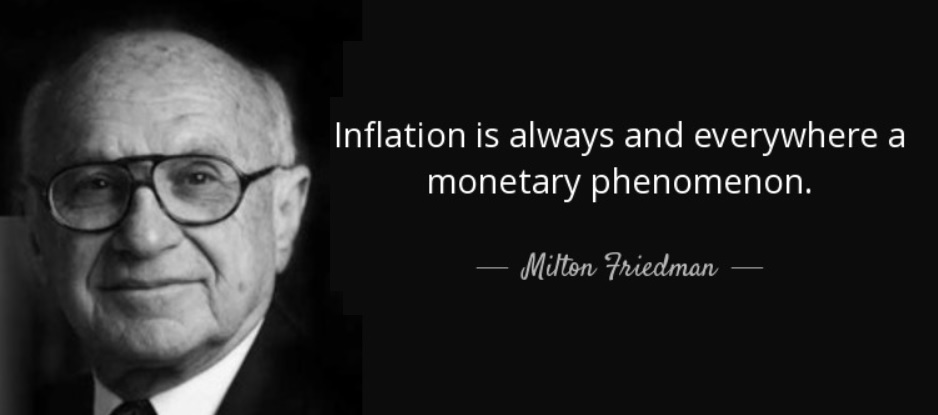
It is not good for the economy to increase the burden of government spending and push for higher tax rates… But that does not necessarily mean deficit spending is inflationary. …Price inflation occurs when the supply of money exceeds the demand for money… Notably, none of the mechanisms that central banks use for monetary policy (buying and selling government securities, setting interest rates paid on reserves, loans to financial institutions, etc) have anything to do with federal spending or budget deficits. The Fed and other central banks can maintain price stability regardless of whether governments are enacting reckless fiscal policies.


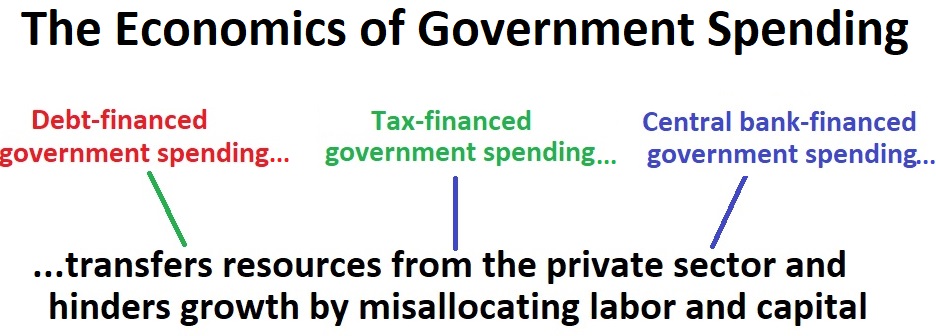


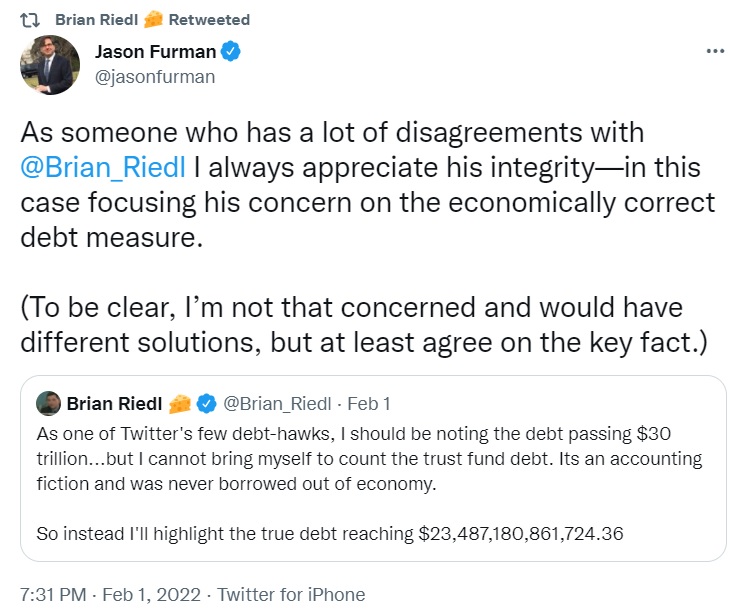
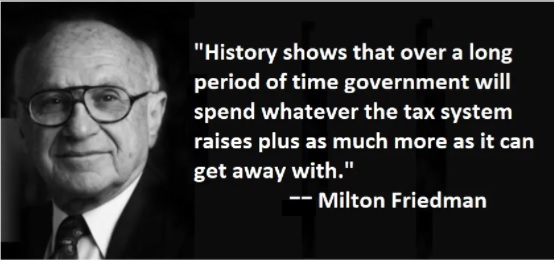
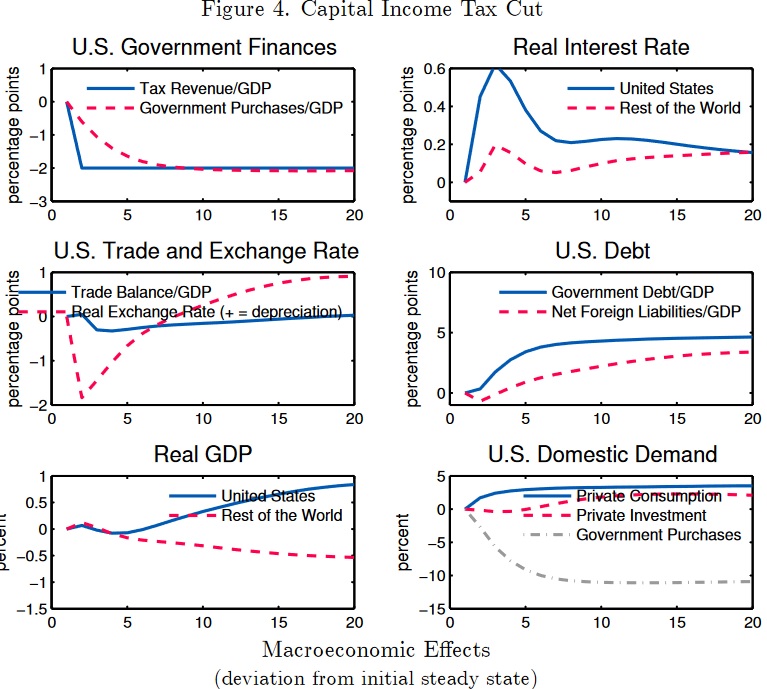


























 The Daily Hatch