
-
Recent Posts
- FRIEDMAN FRIDAY Dan Mitchell: Milton Friedman was advocating what is sometimes referred to as “shareholder capitalism,” which is the notion that a company should strive to earn honest profits for its owners!
- FRANCIS SCHAEFFER ANALYZES ART AND CULTURE Part 557 My March 13, 2016 Letter to Hugh Hefner with quote from Ben Parkinson: There are only two things worth putting your time and life into and that is the WORD OF GOD and the SOULS OF PEOPLE. (Featured artist is Debo Eilers)
- FRANCIS SCHAEFFER ANALYZES ART AND CULTURE Part 556 Third letter I wrote to HUGH HEFNER (Where do we get our morals from?) Featured Artist is Stephanie Syjuco
- FRANCIS SCHAEFFER ANALYZES ART AND CULTURE Part 555 LETTER TO HUGH HEFNER “What does it all mean — if it has any meaning at all? But how can it all exist if it doesn’t have some kind of meaning?” Featured Artist is Assume Vivid Astro Focus
- FRANCIS SCHAEFFER ANALYZES ART AND CULTURE PART 554 My Correspondence with Edward O.Wilson from 1994 to 2021 My 4/21/17 letter to Dr.Wilson I quoted Francis Schaeffer: “Ecclesiastes is the only pessimistic book in the Bible and that is because of the place where Solomon limits himself.He limits himself to the question of human life, life UNDER THE SUN between birth and death and the answers this would give” FEATURED ARTIST IS DALÍ
-
Recent Comments
-
Archives
- December 2024
- November 2024
- October 2024
- September 2024
- August 2024
- July 2024
- June 2024
- May 2024
- April 2024
- March 2024
- February 2024
- January 2024
- December 2023
- November 2023
- October 2023
- September 2023
- August 2023
- July 2023
- June 2023
- May 2023
- April 2023
- March 2023
- February 2023
- January 2023
- December 2022
- November 2022
- October 2022
- September 2022
- August 2022
- July 2022
- June 2022
- May 2022
- April 2022
- March 2022
- February 2022
- January 2022
- December 2021
- November 2021
- October 2021
- September 2021
- August 2021
- July 2021
- June 2021
- May 2021
- April 2021
- March 2021
- February 2021
- January 2021
- December 2020
- November 2020
- October 2020
- September 2020
- August 2020
- July 2020
- June 2020
- May 2020
- April 2020
- March 2020
- February 2020
- January 2020
- December 2019
- November 2019
- October 2019
- September 2019
- August 2019
- July 2019
- June 2019
- May 2019
- April 2019
- March 2019
- February 2019
- January 2019
- December 2018
- November 2018
- October 2018
- September 2018
- August 2018
- July 2018
- June 2018
- May 2018
- April 2018
- March 2018
- February 2018
- January 2018
- December 2017
- November 2017
- October 2017
- September 2017
- August 2017
- July 2017
- June 2017
- May 2017
- April 2017
- March 2017
- February 2017
- January 2017
- December 2016
- November 2016
- October 2016
- September 2016
- August 2016
- July 2016
- June 2016
- May 2016
- April 2016
- March 2016
- February 2016
- January 2016
- December 2015
- November 2015
- October 2015
- September 2015
- August 2015
- July 2015
- June 2015
- May 2015
- April 2015
- March 2015
- February 2015
- January 2015
- December 2014
- November 2014
- October 2014
- September 2014
- August 2014
- July 2014
- June 2014
- May 2014
- April 2014
- March 2014
- February 2014
- January 2014
- December 2013
- November 2013
- October 2013
- September 2013
- August 2013
- July 2013
- June 2013
- May 2013
- April 2013
- March 2013
- February 2013
- January 2013
- December 2012
- November 2012
- October 2012
- September 2012
- August 2012
- July 2012
- June 2012
- May 2012
- April 2012
- March 2012
- February 2012
- January 2012
- December 2011
- November 2011
- October 2011
- September 2011
- August 2011
- July 2011
- June 2011
- May 2011
- April 2011
- March 2011
- February 2011
- January 2011
- December 2010
-
Categories
- Adrian Rogers
- Atheists Confronted
- Biblical Archaeology
- Bill Clinton
- Capital Punishment
- Cato Institute
- Current Events
- David Barton
- Economist Dan Mitchell
- Famous Arkansans
- Founding Fathers
- Francis Schaeffer
- Gun Control
- Healthcare
- Hillary Clinton
- Jason Tolbert
- Mike Huckabee
- Milton Friedman
- President Donald J. Trump
- President Donald Trump
- President Obama
- Prolife
- Ronald Reagan
- Social Security
- spending out of control
- Taxes
- Uncategorized
- Unconfirmed Quotes of Founders
- Vouchers
- War Heroes
- Woody Allen
-
Meta
Tag Archives: Michael Bate
Dan Mitchell article: Spending Restraint Is the Simple Answer to America’s Fiscal Woes (Plus MILTON FRIEDMAN’s “Free to Choose!”)
——

—
I had the opportunity to correspond with Milton Friedman who was my favorite economist
Spending Restraint Is the Simple Answer to America’s Fiscal Woes
Way back in 2010, and then over and over again in subsequent years, I have showed that it is very simple to balance the budget.
All that is necessary is some reasonable spending restraint, sort of like what happened during the Tea Party era in the early part of last decade.
Today, let’s see if that’s still true. The Congressional Budget Office just released its Economic and Budget Outlook, which includes a 10-year forecast of what will happen if spending and revenue are left on autopilot.
As I almost always do when that happens, I calculate what amount of spending restraint would be necessary to balance the budget over 10 years.
As you can see in the chart, limited spending so it grows by 1.4 percent yearly is all that is needed to balance the budget.
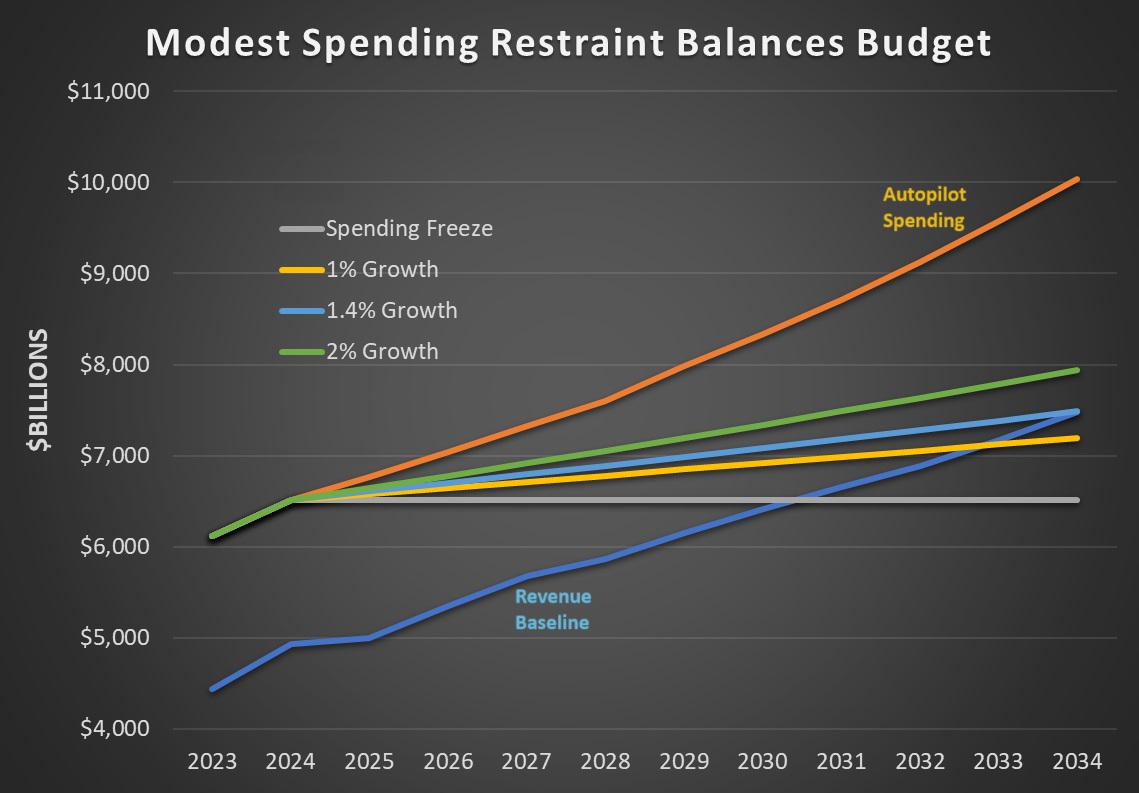
The budget can be balanced much quicker with a spending freeze. And the deficit can be largely eliminated if spending grows by 2 percent annually.
By the way, CBO projects that inflation will average close to 2 percent over the next decade.
So the main takeaway is that we can basically eliminate red ink if the federal budget grows slightly less than the rate of inflation.
There are two points worth mentioning.
- There is no need for any tax increases. Revenues already are projected to grow by 4.2 percent yearly, nearly twice the estimated rate of inflation. Plus, tax increases would surely give politicians an excuse to increase spending.
- Spending restraint is a simple concept, but it would not be politically easy. Interest groups want to leave spending on autopilot, or have it grow even faster. Plus, some entitlement reform almost surely would be necessary.
One further point is that the CBO baseline assumes that the Trump tax cuts expire at the end of 2025. Extending those tax cuts would lower the revenue baseline, thus requiring additional spending restraint to achieve a balanced budget over the 10-year window.
P.S. Balancing the budget is a good idea, but spending restraint should be the main goal of fiscal policy. Fortunately, the evidence shows that spending restraint is the only effective way of achieving fiscal balance (whereas tax increases have a track record of failure).
P.P.S. The ideal long-run policy is a spending cap.
and this video below by John Stossel reminds me of the film serIes FREE TO CHOOSE!!!
Fraudulent Emergency Spending
For decades (literally), I’ve maintained that make-believe budget cuts are the biggest form of budgetary dishonesty in Washington. But this John Stossel video discusses another scam politicians use to squander more money.
————
So-called emergency spending is not a trivial problem.
Here’s a chart from Romina Boccia and Dominik Lett, which documents $12 trillion of supposed emergency spending over the past three decades.

At the risk of understatement, that huge amount of money is a big reason Washington is a fiscal disaster.
Veronique de Rugy of the Mercatus Center wrote about the emergency scam in a column for the New York Sun. Here are some excerpts.
Remember…the debt-ceiling deal… Well, it took less than two months for politicians to start evading the caps with an old trick: emergency spending. …politicians shamelessly abuse the emergency label to push through non-emergency spending that would otherwise violate budget constraints.
…If legislators believe more is needed, they should debate and allocate that money through the regular budget process. …putting the “emergency” label on anything important — or not-so important — but not unforeseen makes a mockery of budget rules and the debt-ceiling caps and, indeed, of the very concept of emergency spending. …There is always an excuse. …It’s time to fix the current process and stop an abuse that only further weakens the government’s fiscal condition. The best option would be to stop exempting emergency spending from budget rules. That would mean that supplemental spending, emergency or otherwise, must be offset with spending cuts on other programs.
Let’s look at a very recent example of the emergency-spending scam.
Kimberley Strassel of the Wall Street Journal opinedtwo months ago about Biden playing this fraudulent game.
Congress is trickling back from summer recess, and Senate Majority Leader Chuck Schumer intends to move swiftly to pass a giant “supplemental aid” package that funds Ukraine assistance, disaster relief and border security (for starters). The goal is to jam House Speaker Kevin McCarthy, forcing him to forgo whatever spending restraint was negotiated in the June debt-ceiling agreement…
The White House bait—or cudgel—is “crisis” disaster-relief funding. The Federal Emergency Management Agency warned in April that its disaster fund could be out of money by July. Yet somehow the administration didn’t make a priority of this “critical” FEMA funding during the May debt ceiling talks, unwilling as it was then to cede any of its other domestic pork, such as green subsidies and its $80 billion IRS blowout. Only after next year’s spending levels were set did it cry poverty, asking for an “emergency” $16 billion for FEMA.
The bottom line is that the misuse of emergency spending is a serious problem. Politicians routinely slap an emergency label on things that are not emergencies. And, when there is an actual emergency, they use that as an excuse to include lots of non-emergency spending (as we saw during the Trump–Biden COVID spending spree).
But is there a solution? There are sometimes real emergencies, so banning supplemental spending bills presumably is not the answer.
The best answer is to adopt an American version of Switzerland’s spending cap.
Having a spending cap is good overall fiscal policy, of course, but a very relevant feature of the Swiss spending cap is that there is a provision for emergency spending, but any extra spending has to be offset by additional spending restraint in the future.
Which helps to explain why American politicians were nearly four times as profligate as Swiss politicians during the pandemic.
———-
Spontaneous Order or Government Planning?
Bad policies (industrial policy, protectionism, rent control, minimum wage laws, etc) have a common feature, which is that politicians are trying to replace the “spontaneous order” of markets with intervention and planning.
In this new video, John Stossel explains why government that governs least governs best.
Price controls are a very obvious example of harmful intervention.
 As explained in my three-part series (here, here, and here), market-determined prices give us the best quality at the best prices.
Just as John explains in the video when talking about bananas.
When politicians interfere by mandating prices too low or too high, however, we get shortages or surpluses (America’s idiotic farm programs being a painful example).
I’ll close with a few comments relating to John’s discussion of how Central Park was a mess before it was quasi-privatized.
Yes, the profit motive is key to a well-functioning private sector, but even private non-profit groups do a much better job than government.
After all, private non-profits generally are created to solve or reduce a problem (such as poverty), whereas government programs are created to maximize votes.
30 Years in Making, Museum Dedicated to Victims of Communism Opens in Washington

A new museum dedicated to the victims of communism worldwide was dedicated on Wednesday in Washington. Pictured: A Cambodian woman on Aug. 6, 2014, examines some of the thousands of skulls on display in Phnom Penh, Cambodia, of those killed during the 1970s “Killing Fields”-era by Pol Pot’s communist regime. (Photo: Omar Havana/Getty Images)
Remember these two numbers: 100 million and 1.5 billion.
Those were the two numbers emphasized at the dedication on Wednesday of the new Victims of Communism Museum in Washington, D.C., which I was privileged to attend along with my family.
An estimated 100 million is the number of human beings slaughtered, massacred, and killed by Marxist, communist regimes in the past 100 years, from the Soviet Union to Red China to Castro’s Cuba. And 1.5 billion is the number of people still suffering under oppressive, tyrannical communist regimes today.
The museum has been more than 30 years in the making, starting with an idea from Anne Edwards, the wife of Lee Edwards, the prolific author, historian, biographer, and scholar at The Heritage Foundation who was the driving force behind the creation of the museum.
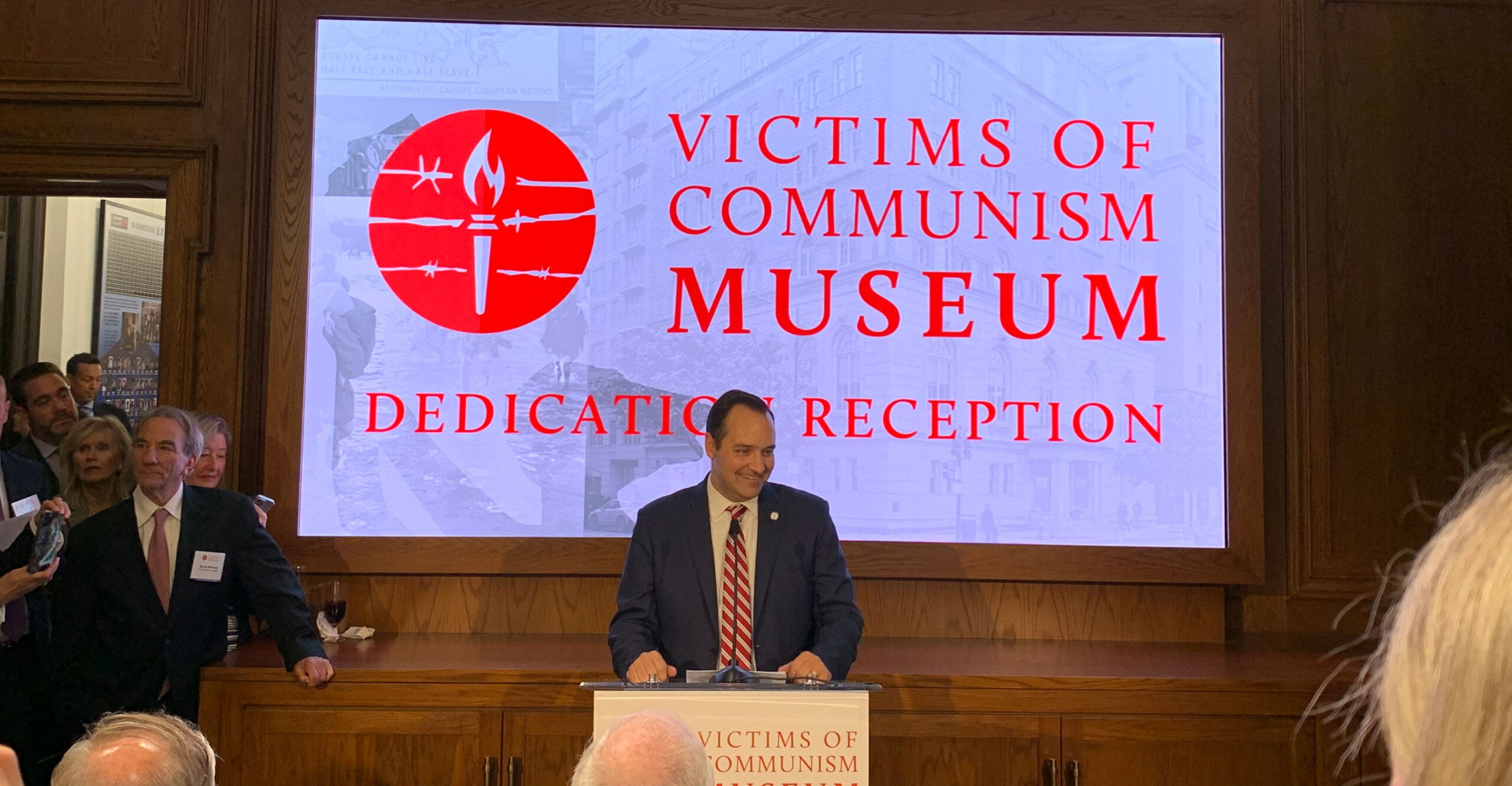
Lee Edwards, the chairman emeritus of the Victims of Communism Memorial Foundation, received the foundation’s annual Truman-Reagan Medal of Freedom at the grand opening for all of the work he has done, not only to bring the museum to fruition, but to help the victims of communism all over the world. The man at the podium is Ambassador Andrew Bremberg, president of the Victims of Communism Museum.
The attendees at the dedication were not the usual Washington crowd. The museum was full of individuals and families who not only fought against those murderous regimes, but helped lead the opposition. It included Wang Dan and Jianli Yang, who were student leaders in Tiananmen Square in 1989, when the Chinese army brutally killed more than 2,000 peaceful protesters who wanted democracy and freedom in China.

There are artifacts from that protest in the museum, including some of the handmade freedom flags of the students.
There were also families of the freedom fighters who staged the first revolt against the Soviet Union in 1956 in Hungary, when NATO and the Allies simply stood by, ignoring their pleas for help as Russian tanks crushed the rebellion and ruthlessly arrested and killed everyone involved.
As I watched a video of the fighting in the streets of Budapest that’s in the museum, all I could think about was what a difference it would have made if those Hungarian patriots had been equipped with Javelin missiles and had destroyed the Soviet tank armadas the way the Ukrainians are doing today.
My own father was a White Russian officer who fought the Bolsheviks in the Russian civil war.
In addition to remarks by Bremberg and Elizabeth Spalding, the president and a director, respectively, of the new museum, there were also speeches by Szabolcs Takacs, the Hungarian ambassador to the U.S., and professor Piotr Glinski, the deputy prime minister of Poland.
The presentations by the ambassador and the deputy prime minister were especially poignant, because they spoke from experience and know vividly and personally the evils of that vicious, deadly ideology. And that is exactly what communism is—an evil—as Glinski said repeatedly, contrary to the ignorant beliefs of the Marxist fools who inhabit too many of our academic institutions today.
Some of the most moving artifacts in the museum are a series of paintings that I first wrote aboutmore than a decade ago, and which finally have a home where they can be permanently displayed.

In 1953, a Ukrainian painter, Nikolai Getman, was released from the Soviet gulag, where he had spent eight years for being present at a meeting where someone had drawn a caricature of Josef Stalin.
The paintings were smuggled out of Russia in 1997 because Getman was afraid the post-Soviet Russian government would destroy them to hide a past it pretends never existed.
The paintings are haunting. They are the only visual counterpart to Aleksandr Solzhenitsyn’s writings, which exposed this terrible system of mass imprisonment that Robert Conquest has rightly called “unexampled coldblooded inhumanity.”
The only difference between the Holocaust and the gulag is that the Soviet communists never got around to using gas to kill their prisoners—just old-fashioned bullets, beatings, starvation, and literally working them to death.
Getman’s stark paintings cover everything from the transportation of prisoners to the camps in unheated trucks and ships to the horrible and almost unspeakable living conditions in the gulag.
We see the routine brutality with which prisoners were treated. The fragile existence they led is captured in Getman’s paintings, which represent an enormous accomplishment, considering that all of the scenes were painted from memory.
One painting shows the despairing faces of a group of men taken from their barracks in the middle of the night and executed by the NKVD (the forerunner of the KGB), the secret police organization that ran the entire gulag system.
These kinds of executions occurred constantly and for no apparent reason. All of the prisoners knew that if you were taken out of your barracks in the middle of the night, you never came back.
And that’s happening today in places such as China, where the communist government has set up a gulag-type concentration camp system for the Uyghurs. There are millions of current victims being repressed, tortured, and killed in a country that big American companies, such as Nike and Apple, routinely do business in with no concern.
Raising money for the museum has been a long, hard task. Yet countries like Poland, Hungary, Estonia, Lithuania, and Latvia all contributed money to help establish this very important museum. And as I noted, there were speakers at the dedication ceremony from some of those countries.
Who was absent, and who hasn’t contributed a single cent? The U.S. government and the current administration. Representatives of the country that has been the leader of the free world, which led the fight against communist dictatorships starting with the hot war in Korea and during the 40 years of the Cold War, were nowhere to be seen on Wednesday.
The Victims of Communism Museum has long been needed. And every student in every college and university who thinks Marxism, communism, and socialism (which is just communism under another name) is a wonderful idea should pay a visit to this museum to understand what that evil ideology has imposed on the world.
So, remember: 100 million and 1.5 billion. We not only have a lot to remember; we still have a lot to do to bring the flame of liberty to the enslaved people of the world.
Have an opinion about this article? To sound off, please email letters@DailySignal.com and we’ll consider publishing your edited remarks in our regular “We Hear You” feature. Remember to include the url or headline of the article plus your name and town and/or state.

On November 21, 2014 I received a letter from Nobel Laureate Harry Kroto and it said:
…Please click on this URL http://vimeo.com/26991975
and you will hear what far smarter people than I have to say on this matter. I agree with them.
Harry Kroto

I have attempted to respond to all of Dr. Kroto’s friends arguments and I have posted my responses one per week for over a year now. Here are some of my earlier posts:
Arif Ahmed, Sir David Attenborough, Mark Balaguer, Horace Barlow, Michael Bate, Patricia Churchland, Aaron Ciechanover, Noam Chomsky,Alan Dershowitz, Hubert Dreyfus, Bart Ehrman, Stephan Feuchtwang, David Friend, Riccardo Giacconi, Ivar Giaever , Roy Glauber, Rebecca Goldstein, David J. Gross, Brian Greene, Susan Greenfield, Stephen F Gudeman, Alan Guth, Jonathan Haidt, Theodor W. Hänsch, Brian Harrison, Hermann Hauser, Roald Hoffmann, Bruce Hood, Herbert Huppert, Gareth Stedman Jones, Steve Jones, Shelly Kagan, Michio Kaku, Stuart Kauffman, Lawrence Krauss, Harry Kroto, George Lakoff, Elizabeth Loftus, Alan Macfarlane, Peter Millican, Marvin Minsky, Leonard Mlodinow, Yujin Nagasawa, Alva Noe, Douglas Osheroff, Jonathan Parry, Saul Perlmutter, Herman Philipse, Carolyn Porco, Robert M. Price, Lisa Randall, Lord Martin Rees, Oliver Sacks, John Searle, Marcus du Sautoy, Simon Schaffer, J. L. Schellenberg, Lee Silver, Peter Singer, Walter Sinnott-Armstrong, Ronald de Sousa, Victor Stenger, Barry Supple, Leonard Susskind, Raymond Tallis, Neil deGrasse Tyson, .Alexander Vilenkin, Sir John Walker, Frank Wilczek, Steven Weinberg, and Lewis Wolpert,
In the first video below in the 14th clip in this series are his words and I will be responding to them in the next few weeks since Sir Bertrand Russell is probably the most quoted skeptic of our time, unless it was someone like Carl Sagan or Antony Flew.
50 Renowned Academics Speaking About God (Part 1)
Another 50 Renowned Academics Speaking About God (Part 2)
A Further 50 Renowned Academics Speaking About God (Part 3)
__
Quote from Bertrand Russell:
Q: Why are you not a Christian?
Russell: Because I see no evidence whatever for any of the Christian dogmas. I’ve examined all the stock arguments in favor of the existence of God, and none of them seem to me to be logically valid.
Q: Do you think there’s a practical reason for having a religious belief, for many people?
Russell: Well, there can’t be a practical reason for believing what isn’t true. That’s quite… at least, I rule it out as impossible. Either the thing is true, or it isn’t. If it is true, you should believe it, and if it isn’t, you shouldn’t. And if you can’t find out whether it’s true or whether it isn’t, you should suspend judgment. But you can’t… it seems to me a fundamental dishonesty and a fundamental treachery to intellectual integrity to hold a belief because you think it’s useful, and not because you think it’s true.
__
Today I am not going to attack this quote above from Russell. I have done that enough in the past. Today I am going to look at Russell’s notes on communism and also examine his personal meeting with Lenin. Lenin just laughed when Lenin said that it was the plan for the poor peasants to hang the peasants that were a little better well off. This comment caught Russell off guard. Russell had already noted that Lenin was a “great man.” However, this embracing of violence caught Russell by surprise.
Then I will look at an examination of communism by Francis Schaeffer who will tell us why Communism ALWAYS fails to give the freedoms that it says it will and why so many young people are caught up in its idealistic promises.
“Why I am Not a Communist”
by Betrand Russell

“I am completely at a loss to understand how it came about that some people who are both humane and intelligent could find something to admire in the vast slave camp produced by Stalin.”
I n relation to any political doctrine there are two questions to be asked: (1) Are its theoretical tenets true? (2) Is its practical policy likely to increase human happiness? For my part, I think the theoretical tenets of Communism are false, and I think its practical maxims are such as to produce an immeasurable increase of human misery.
The theoretical doctrines of Communism are for the most part derived from Marx. My objections to Marx are of two sorts: one, that he was muddle-headed; and the other, that his thinking was almost entirely inspired by hatred. The doctrine of surplus value, which is supposed to demonstrate the exploitation of wage-earners under capitalism, is arrived at: (a) by surreptitiously accepting Malthus’s doctrine of population, which Marx and all his disciples explicitly repudiate; (b) by applying Ricardo’s theory of value to wages, but not to the prices of manufactured articles. He is entirely satisfied with the result, not because it is in accordance with the facts or because it is logically coherent, but because it is calculated to rouse fury in wage-earners. Marx’s doctrine that all historical events have been motivated by class conflicts is a rash and untrue extension to world history of certain features prominent in England and France a hundred years ago. His belief that there is a cosmic force called Dialectical Materialism which governs human history independently of human volitions, is mere mythology. His theoretical errors, however, would not have mattered so much but for the fact that, like Tertullian and Carlyle, his chief desire was to see his enemies punished, and he cared little what happened to his friends in the process.
Marx’s doctrine was bad enough, but the developments which it underwent under Lenin and Stalin made it much worse. Marx had taught that there would be a revolutionary transitional period following the victory of the proletariat in a civil war and that during this period the proletariat, in accordance with the usual practice after a civil war, would deprive its vanquished enemies of political power. This period was to be that of the dictatorship of the proletariat. It should not be forgotten that in Marx’s prophetic vision the victory of the proletariat was to come after it had grown to be the vast majority of the population. The dictatorship of the proletariat therefore as conceived by Marx was not essentially anti-democratic. In the Russia of 1917, however, the proletariat was a small percentage of the population, the great majority being peasants. it was decreed that the Bolshevik party was the class-conscious part of the proletariat, and that a small committee of its leaders was the class-conscious part of the Bolshevik party. The dictatorship of the proletariat thus came to be the dictatorship of a small committee, and ultimately of one man – Stalin. As the sole class-conscious proletarian, Stalin condemned millions of peasants to death by starvation and millions of others to forced labour in concentration camps. He even went so far as to decree that the laws of heredity are henceforth to be different from what they used to be, and that the germ-plasm is to obey Soviet decrees but that that reactionary priest Mendel. I am completely at a loss to understand how it came about that some people who are both humane and intelligent could find something to admire in the vast slave camp produced by Stalin.
I have always disagreed with Marx. My first hostile criticism of him was published in 1896. But my objections to modern Communism go deeper than my objections to Marx. It is the abandonment of democracy that I find particularly disastrous. A minority resting its powers upon the activities of secret police is bound to be cruel, oppressive and obscuarantist. The dangers of the irresponsible power cane to be generally recognized during the eighteenth and nineteenth centuries, but those who have forgotten all that was painfully learnt during the days of absolute monarchy, and have gone back to what was worst in the middle ages under the curious delusion that they were in the vanguard of progress.
There are signs that in course of time the Russian régime will become more liberal. But, although this is possible, it is very far from certain. In the meantime, all those who value not only art and science but a sufficiency of bread and freedom from the fear that a careless word by their children to a schoolteacher may condemn them to forced labour in a Siberian wilderness, must do what lies in their power to preserve in their own countries a less servile and more prosperous manner of life.
There are those who, oppressed by the evils of Communism, are led to the conclusion that the only effective way to combat these evils is by means of a world war. I think this a mistake. At one time such a policy might have been possible, but now war has become so terrible and Communism has become so powerful that no one can tell what would be left after a world war, and whatever might be left would probably be at least as bad as present -day Communism. This forecast does not depend upon the inevitable effects of mass destruction by means of hydrogen and cobalt bombs and perhaps of ingeniously propagated plagues. The way to combat Communism is not war. What is needed in addition to such armaments as will deter Communists from attacking the West, is a diminution of the grounds for discontent in the less prosperous parts of the non-communist world. In most of the countries of Asia, there is abject poverty which the West ought to alleviate as far as it lies in its power to do so. There is also a great bitterness which was caused by the centuries of European insolent domination in Asia. This ought to be dealt with by a combination of patient tact with dramatic announcements renouncing such relics of white domination as survive in Asia. Communism is a doctrine bred of poverty, hatred and strife. Its spread can only be arrested by diminishing the area of poverty and hatred.
from Portraits from Memory published in 1956
http://skepticva.org/excerpt-Lenin.html
Bertrand Russell on Lenin
excerpted from
LENIN, TROTSKY AND GORKY
itself an excerpt from
“The Practice and Theory of Bolshevism” By Bertrand Russell.
Webmaster’s note
The last paragraph (especially) shows that Russell’s atheism has nothing in common with Marxist-Leninism. It refutes the idea that the USSR is a lesson against the rejection of religion, because it had exactly the faults that mar any dogmatic belief.
Soon after my arrival in Moscow I had an hour’s conversation with Lenin in English, which he speaks fairly well. An interpreter was present, but his services were scarcely required. Lenin’s room is very bare; it contains a big desk, some maps on the walls, two book-cases, and one comfortable chair for visitors in addition to two or three hard chairs. It is obvious that he has no love of luxury or even comfort. He is very friendly, and apparently simple, entirely without a trace of hauteur.
If one met him without knowing who he was, one would not guess that he is possessed of great power or even that he is in any way eminent. I have never met a personage so destitute of self-importance. He looks at his visitors very closely, and screws up one eye, which seems to increase alarmingly the penetrating power of the other. He laughs a great deal; at first his laugh seems merely friendly and jolly, but gradually I came to feel it rather grim. He is dictatorial, calm, incapable of fear, extraordinarily devoid of self-seeking, an embodied theory.
The MATERIALIST conception of history, one feels, is his life-blood. He resembles a professor in his desire to have the theory understood and in his fury with those who misunderstand or disagree, as also in his love of expounding, I got the impression that he despises a great many people and is an intellectual aristocrat.
When I suggested that whatever is possible in England can be achieved without bloodshed, he waved aside the suggestion as fantastic. I got little impression of knowledge or psychological imagination as regards Great Britain. Indeed the whole tendency of Marxianism is against psychological imagination, since it attributes everything in politics to purely MATERIAL causes.
I asked him next whether he thought it possible to establish Communism firmly and fully in a country containing such a large majority of peasants. He admitted that it was difficult, and laughed over the exchange the peasant is compelled to make, of food for paper; the worthlessness of Russian paper struck him as comic. But he said—what is no doubt true—that things will right themselves when there are goods to offer to the peasant. For this he looks partly to electrification in industry, which, he says, is a technical necessity in Russia, but will take ten years to complete. He spoke with enthusiasm, as they all do, of the great scheme for generating electrical power by means of peat. Of course he looks to the raising of the blockade as the only radical cure; but he was not very hopeful of this being achieved thoroughly or permanently except through revolutions in other countries. Peace between Bolshevik Russia and capitalist countries, he said, must always be insecure; the Entente might be led by weariness and mutual dissensions to conclude peace, but he felt convinced that the peace would be of brief duration. I found in him, as in almost all leading Communists, much less eagerness than existed in our delegation for peace and the raising of the blockade. He believes that nothing of real value can be achieved except through world revolution and the abolition of capitalism; I felt that he regarded the resumption of trade with capitalist countries as a mere palliative of doubtful value.
He described the division between rich and poor peasants, and the Government propaganda among the latter against the former, leading to acts of violence which he seemed to find amusing. He spoke as though the dictatorship over the peasant would have to continue a long time, because of the peasant’s desire for free trade. He said he knew from statistics (what I can well believe) that the peasants have had more to eat these last two years than they ever had before, “and yet they are against us,” he added a little wistfully. I asked him what to reply to critics who say that in the country he has merely created peasant proprietorship, not Communism; he replied that that is not quite the truth, but he did not say what the truth is.
The last question I asked him was whether resumption of trade with capitalist countries, if it took place, would not create centres of capitalist influence, and make the preservation of Communism more difficult? It had seemed to me that the more ardent Communists might well dread commercial intercourse with the outer world, as leading to an infiltration of heresy, and making the rigidity of the present system almost impossible. I wished to know whether he had such a feeling. He admitted that trade would create difficulties, but said they would be less than those of the war. He said that two years ago neither he nor his colleagues thought they could survive against the hostility of the world. He attributes their survival to the jealousies and divergent interests of the different capitalist nations; also to the power of Bolshevik propaganda. He said the Germans had laughed when the Bolsheviks proposed to combat guns with leaflets, but that the event had proved the leaflets quite as powerful. I do not think he recognizes that the Labour and Socialist parties have had any part in the matter. He does not seem to know that the attitude of British Labour has done a great deal to make a first-class war against Russia impossible, since it has confined the Government to what could be done in a hole-and-corner way, and denied without a too blatant mendacity.
I think if I had met him without knowing who he was, I should not have guessed that he was a great man; he struck me as too opinionated and narrowly orthodox. His strength comes, I imagine, from his honesty, courage, and unwavering faith—religious faith in the Marxian gospel, which takes the place of the Christian martyr’s hopes of Paradise, except that it is less egotistical. He has as little love of liberty as the Christians who suffered under Diocletian, and retaliated when they acquired power. Perhaps love of liberty is incompatible with whole-hearted belief in a panacea for all human ills. If so, I cannot but rejoice in the sceptical temper of the Western world.
I went to Russia a Communist; but contact with those who have no doubts has intensified a thousandfold my own doubts, not as to Communism in itself, but as to the wisdom of holding a creed so firmly that for its sake men are willing to inflict widespread misery.
Almanac: Bertrand Russell on Lenin’s sense of humor
 “When I met Lenin, I had much less impression of a great man than I had expected; my most vivid impressions were of Mongolian cruelty and bigotry. When I put a question to him about socialism in agriculture, he explained with glee how he had incited the poorer peasants against the richer ones, ‘and they soon hanged them from the nearest tree—ha! ha! ha!’ His guffaw at the thought of those massacred made my blood run cold.”
Bertrand Russell, “Eminent Men I Have Known” (courtesy of Richard Brookhiser)
_
_
Communism catches the attention of the young at heart but it has always brought repression wherever it is tried. “True Communism has never been tried” is something I was told just a few months ago by a well meaning young person who was impressed with the ideas of Karl Marx. I responded that there are only 5 communist countries in the world today and they lack political, economic and religious freedom.
Tony Bartolucci noted that Schaeffer has correctly pointed out:
Hope in Marxism-Leninism is a leap in the area of nonreason. From the Russian Revolution until 1959 a total of 66 million prisoners died. This was deemed acceptable to the leaders because internal security was to be gained at any cost. The ends justified the means. The materialism of Marxism gives no basis for human dignity or rights. These hold to their philosophy against all reason and close their eyes to the oppression of the system.
#02 How Should We Then Live? (Promo Clip) Dr. Francis Schaeffer
WHY DOES COMMUNISM FAIL?
Communism has always failed because of its materialist base. Francis Schaeffer does a great job of showing that in this clip below. Also Schaeffer shows that there were lots of similar things about the basis for both the French and Russia revolutions and he exposes the materialist and humanist basis of both revolutions.
Schaeffer compares communism with French Revolution and Napoleon.
1. Lenin took charge in Russia much as Napoleon took charge in France – when people get desperate enough, they’ll take a dictator.
Other examples: Hitler, Julius Caesar. It could happen again.
2. Communism is very repressive, stifling political and artistic freedom. Even allies have to be coerced. (Poland).
Communists say repression is temporary until utopia can be reached – yet there is no evidence of progress in that direction. Dictatorship appears to be permanent.
3. No ultimate basis for morality (right and wrong) – materialist base of communism is just as humanistic as French. Only have “arbitrary absolutes” no final basis for right and wrong.
How is Christianity different from both French Revolution and Communism?
Contrast N.T. Christianity – very positive government reform and great strides against injustice. (especially under Wesleyan revival).
Bible gives absolutes – standards of right and wrong. It shows the problems and why they exist (man’s fall and rebellion against God).
WHY DOES THE IDEA OF COMMUNISM CATCH THE ATTENTION OF SO MANY IDEALISTIC YOUNG PEOPLE? The reason is very simple.
In HOW SHOULD WE THEN LIVE? The Rise and Decline of Western Thought and Culture, the late Francis A. Schaeffer wrote:
Materialism, the philosophic base for Marxist-Leninism, gives no basis for the dignity or rights of man. Where Marxist-Leninism is not in power it attracts and converts by talking much of dignity and rights, but its materialistic base gives no basis for the dignity or rights of man. Yet is attracts by its constant talk of idealism.
To understand this phenomenon we must understand that Marx reached over to that for which Christianity does give a base–the dignity of man–and took the words as words of his own. The only understanding of idealistic sounding Marxist-Leninism is that it is (in this sense) a Christian heresy. Not having the Christian base, until it comes to power it uses the words for which Christianity does give a base. But wherever Marxist-Leninism has had power, it has at no place in history shown where it has not brought forth oppression. As soon as they have had the power, the desire of the majority has become a concept without meaning.
Is Christianity at all like Communism?
Sometimes Communism sounds very “Christian” – desirable goals of equality, justice, etc but these terms are just borrowed from the New Testament. Schaeffer elsewhere explains by saying Marxism is a Christian heresy.
Below is a great article. Free-lance columnist Bradley R. Gitz, who lives and teaches in Batesville, received his Ph.D. in political science from the University of Illinois.
This article was published January 30, 2011 at 2:28 a.m. Here is a portion of that article below:
A final advantage is the mutation of socialism into so many variants over the past century or so. Precisely because Karl Marx was unclear as to how it would work in practice, socialism has always been something of an empty vessel into which would be revolutionaries seeking personal meaning and utopian causes to support can pour pretty much anything.
A desire to increase state power, soak the rich and expand the welfare state is about all that is left of the original vision. Socialism for young lefties these days means “social justice” and compassion for the poor, not the gulag and the NKVD.
In the end, the one argument that will never wash is that communismcan’t be said to have failed because it was never actually tried. This is a transparent intellectual dodge that ignores the fact that “people’s democracies” were established all over the place in the first three decades after World War II.
Such sophistry is resorted to only because communism in all of those places produced hell on earth rather than heaven.
That the attempts to build communism in a remarkable variety of different geographical regions led to only tyranny and mass bloodshed tells us only that it was never feasible in the first place, and that societies built on the socialist principle ironically suffer from the kind of “inner contradictions” that Marx mistakenly predicted would destroy capitalism.
Yes, all economies are mixed in nature, and one could plausibly argue that the socialist impulse took the rough edges off of capitalism by sponsoring the creation of welfare-state programs that command considerable public support.
But the fact remains that no society in history has been able to achieve sustained prosperity without respect for private property and market forces of supply and demand. Nations, therefore, retain their economic dynamism only to the extent that they resist the temptation to travel too far down the socialist road.
#02 How Should We Then Live? (Promo Clip) Dr. Francis Schaeffer
Francis Schaeffer notes:
At Berkeley the Free Speech Movement arose simultaneously with the hippie world of drugs. At first it was politically neither left nor right, but rather a call for the freedom to express any political views on Sproul Plaza. Then soon the Free Speech Movement became the Dirty Speech Movement, in which freedom was seen as shouting four-letter words into a mike. Soon after, it became the platform for the political New Left which followed the teaching of Herbert Marcuse. Marcuse was a German professor of philosophy related to the neo-Marxist teaching of the “Frankfurt School,” along with...Jurgen Habermas (1929-).
Herbert Marcuse, “Liberation from the Affluent Society” (1967)
Brannon Howse talks some about the Frankfurt School in some of his publications too.
During the 1960’s many young people were turning to the New Left fueled by Marcuse and Habermas but something happened to slow many young people’s enthusiasm for that movement.
1970 bombing took away righteous standing of Anti-War movement
Francis Schaeffer mentioned the 1970 bombing in his film series “How should we then live?” and I wanted to give some more history on it. Schaeffer asserted:
In the United States the New Left also slowly ground down,losing favor because of the excesses of the bombings, especially in the bombing of the University of Wisconsin lab in 1970, where a graduate student was killed. This was not the last bomb that was or will be planted in the United States. Hard-core groups of radicals still remain and are active, and could become more active, but the violence which the New Left produced as its natural heritage (as it also had in Europe) caused the majority of young people in the United States no longer to see it as a hope. So some young people began in 1964 to challenge the false values of personal peace and affluence, and we must admire them for this. Humanism, man beginning only from himself, had destroyed the old basis of values, and could find no way to generate with certainty any new values. In the resulting vacuum the impoverished values of personal peace and affluence had comes to stand supreme. And now, for the majority of the young people, after the passing of the false hopes of drugs as an ideology and the fading of the New Left, what remained? Only apathy was left. In the United States by the beginning of the seventies, apathy was almost complete. In contrast to the political activists of the sixties, not many of the young even went to the polls to vote, even though the national voting age was lowered to eighteen. Hope was gone.
After the turmoil of the sixties, many people thought that it was so much the better when the universities quieted down in the early seventies. I could have wept. The young people had been right in their analysis, though wrong in their solutions. How much worse when many gave up hope and simply accepted the same values as their parents–personal peace and affluence. (How Should We Then Live, pp. 209-210
______________________
Sunday, August 28th, 2011, 11:11pm
Aug. 24 marked the 41st anniversary of the Sterling Hall bombing on the University of Wisconsin-Madison campus.
Four men planned the bomb at the height of the student protests over the Vietnam War. Back then, current Madison Mayor Paul Soglin was one of the leaders of those student protests in the capitol city. This weekend, Soglin recalled the unrest felt by UW-Madison students.
“The anti-war movement adopted a lot of its tactics and strategies from the civil rights movement which was about ten years older,” said Soglin. “It was one of picketing, demonstration, and passive resistance.”
The four men who planned the bombing focused on the Army Mathematics Research Center housed in Sterling Hall because it was funded by the U.S. Department of Defense and therefore, worked on weapons technology. Karl Armstrong was one of the four men and he recently spoke with CBS News in his first television interview detailing the moments right before the bomb was set off.
“He asked me, he says, ‘Should we go ahead? Are we gonna do this?’ I think I made a comment to him about something like, ‘Now, I know what war is about,'” remembered Armstrong. “And I told him to light it.”
The bomb killed one researcher and father of three, 33-year-old Robert Fassnacht, although Armstrong maintains they planned the attack thinking no one would get hurt. The four men heard about the death as they were in their getaway car after the bomb went off.
“I felt good about doing the bombing, the bombing per se, but not taking someone’s life,” recalled Armstrong.
The researcher’s wife told CBS News that she harbors no ill will toward Armstrong and the other bombers. Three of the four men were captured and served time in prison. Armstrong served eight years of a 23-year sentence.
The fourth man, Leo Burt, was last seen in the fall of 1970 in Ontario and is to this day, still wanted by the FBI, with a $150,000 reward for his capture.
Related posts:
WOODY WEDNESDAY John Piippo makes the case that Bertrand Russell would have loved Woody Allen because they both were atheists who don’t deny the ramifications of atheism!!!
Top 10 Woody Allen Movies __________ John Piippo makes the case that Bertrand Russell would have loved Woody Allen because they both were atheists who don’t deny the ramifications of atheism!!! Monday, August 06, 2012 (More On) Woody Allen’s Atheism As I wrote in a previous post, I like Woody Allen. I have long admired his […]
John Piippo makes the case that Bertrand Russell would have loved Woody Allen because they both were two atheists who don’t deny the ramifications of atheism!!!
______ Top 10 Woody Allen Movies PBS American Masters – Woody Allen A Documentary 01 PBS American Masters – Woody Allen A Documentary 02 __________ John Piippo makes the case that Bertrand Russell would have loved Woody Allen because they both were two atheists who don’t deny the ramifications of atheism!!! Monday, August 06, 2012 […]
Bertrand Russell v. Frederick Copleston debate transcript (Part 4)
THE MORAL ARGUMENT BERTRAND RUSSELL But aren’t you now saying in effect, I mean by God whatever is good or the sum total of what is good — the system of what is good, and, therefore, when a young man loves anything that is good he is loving God. Is that what you’re […]
Bertrand Russell v. Frederick Copleston debate transcript (Part 3)
Great debate Fr. Frederick C. Copleston vs Bertrand Russell – Part 1 Uploaded by riversonthemoon on Jul 15, 2009 BBC Radio Third Programme Recording January 28, 1948. BBC Recording number T7324W. This is an excerpt from the full broadcast from cassette tape A303/5 Open University Course, Problems of Philosophy Units 7-8. Older than 50 years, […]
Bertrand Russell v. Frederick Copleston debate transcript and audio (Part 2)
Uploaded by riversonthemoon on Jul 15, 2009 BBC Radio Third Programme Recording January 28, 1948. BBC Recording number T7324W. This is an excerpt from the full broadcast from cassette tape A303/5 Open University Course, Problems of Philosophy Units 7-8. Older than 50 years, out of UK/BBC copyright. Pardon the hissy audio. It was recorded 51 […]
Bertrand Russell v. Frederick Copleston debate transcript and audio (Part 1)
Fr. Frederick C. Copleston vs Bertrand Russell – Part 1 Uploaded by riversonthemoon on Jul 15, 2009 BBC Radio Third Programme Recording January 28, 1948. BBC Recording number T7324W. This is an excerpt from the full broadcast from cassette tape A303/5 Open University Course, Problems of Philosophy Units 7-8. Older than 50 years, out of […]
Bertrand Russell v. Frederick Copleston debate transcript (Part 4)
THE MORAL ARGUMENT BERTRAND RUSSELL But aren’t you now saying in effect, I mean by God whatever is good or the sum total of what is good — the system of what is good, and, therefore, when a young man loves anything that is good he is loving God. Is that what you’re […]
Bertrand Russell v. Frederick Copleston debate transcript (Part 3)
Fr. Frederick C. Copleston vs Bertrand Russell – Part 1 Uploaded by riversonthemoon on Jul 15, 2009 BBC Radio Third Programme Recording January 28, 1948. BBC Recording number T7324W. This is an excerpt from the full broadcast from cassette tape A303/5 Open University Course, Problems of Philosophy Units 7-8. Older than 50 years, out of […]
RESPONDING TO HARRY KROTO’S BRILLIANT RENOWNED ACADEMICS!! Carl Sagan Part 59 Carl Sagan feared a nihilistic situation as pictured in Swedish Opera (ANIARA) where humans destroy their own species!
—
Below are Francis Schaeffer and his son Franky:
In 1992 I began to write skeptics letters after reading their books and articles and watching their films and I was introduced to Carl Sagan’s name by a book published in 1968 by Francis Schaeffer.
Francis Schaeffer in his book HE IS THERE AND HE IS NOT SILENT (Chapter 4) asserts:
Because men have lost the objective basis for certainty of knowledge in the areas in which they are working, more and more we are going to find them manipulating science according to their own sociological or political desires rather than standing upon concrete objectivity. We are going to find increasingly what I would call sociological science, where men manipulate the scientific facts. Carl Sagan (1934-1996),professor of astronomy and space science at Cornell University, demonstrates that the concept of a manipulated science is not far-fetched. He mixes science and science fiction constantly. He is a true follower of Edgar Rice Burroughs (1875-1950). The media gives him much TV prime time and much space in the press and magazine coverage, and the United State Government spent millions of dollars in the special equipment which was included in the equipment of the Mars probe–at his instigation, to give support to his obsessive certainty that life would be found on Mars, or that even large-sized life would be found there. With Carl Sagan the line concerning objective science is blurred, and the media spreads his mixture of science and science fiction out to the public as exciting fact.

Sagan in 1980
Contact: A Eulogy to Carl Sagan
Home Contact: A Eulogy to Carl Sagan
The Paradox of the Movie Contact
The Paradox of Sagan’s Views of Religion
Sagan’s Extraterrestrial Hope
In another essay (Are We Alone in the Universe?) I summarized the calculations of Christian astronomer Hugh Ross. Ross estimated the probabilities of all the necessary conditions for life occurring by natural processes. Ross concluded that if all we have to depend on are physical and chemical processes, then we are alone in the universe. Life could have evolved nowhere else. Even the biochemical complexities of living cells are revealing that life requires intelligence (See my review of Darwin’s Black Box.). Sagan’s confidence that life is super-abundant in the universe is grossly out of proportion.
The second reason for Sagan’s hope of other civilizations was expressed well by Ellie Arroway. An international panel, assigned the task of choosing the one individual who would enter the machine and perhaps visit this alien civilization, queried each candidate what one question they would ask. Ellie said she would want to know how they survived their technological adolescence without destroying themselves. Sagan has been a tireless supporter of nuclear disarmament. He truly feared that we would destroy ourselves before we reached our full potential. In the opening scene of his Cosmos television series, he remarked that our species was “young and curious and brave; it showed much promise.”(4) Couple this fear with the conviction that there is no God, and the only source of hope for a salvation from ourselves is another civilization more advanced than us, giving us some pointers for survival.
This confidence that an alien culture that could contact us would be more advanced than us is not unreasonable. If they have the technology to purposefully contact us, and this is something we cannot do, then their technology must be beyond ours. What is never explained, however, even though it is raised in the movie, is why we would expect this alien culture to be benevolent. It is just as likely, if not more so, that an alien civilization would be more of the variety depicted in the movie Independence Day. This hope reflects more on Carl Sagan’s optimistic cosmic humanism that any scientific reality.
Who Will Save Us, God or Aliens?
The movie Contact tells us of a more realistic scenario for a first encounter with an alien civilization, than, say, Men in Black. A radio signal is received from space that is broadcast at a frequency that is equal to the value of hydrogen times pi and gets our attention by counting the prime numbers from 1 to 101 in sequence. The message is authenticated as coming from the star Vega, 26 light years away. The message is eventually decoded and found to contain the plans for constructing a machine for one person to apparently travel out into the galaxy. Ellie Arroway, a young astronomer who discovers the message, eventually boards the machine and travels out into space for a close encounter of a supposedly more realistic kind.
A very tantalizing line is repeated three times in the course of the film. When Ellie Arroway, as a child, asks her father if there are any life forms out in the universe, he says that if there isn’t, it would be an awful waste of space. Palmer Joss repeats the line to an adult Ellie as they engage in a conversation under a starry sky in Puerto Rico. It is a poignant scene as Ellie clearly is stunned as she recalls her father saying the same thing. Ellie, herself, repeats the phrase at the end of the film as she is addressing a group of school children and is asked if there is life out there in space.
Sagan has drawn a bead on the argument for the existence of God from design, or the teleological argument. Waste implies misdirected design. If the universe was created for us and we are alone, why does it have to be so big? Surely we could have survived quite well in a much smaller and economical universe. But if you think about it, Scripture proclaims that the heavens declare the glory of God, not man (Ps. 19:1). Indeed, if the universe was created only for man’s benefit, then it is a waste of space. We don’t deserve it. But if the main purpose of the universe is to glorify the splendid, eternal, all-powerful God, it could never be big enough.
Another interesting theme is the form that the alien takes. After Ellie travels through the galaxy, she arrives at a large docking space station. She is somehow transported to a beach, resembling a picture of Pensacola, Florida she drew as a child. Eventually, a figure approaches. It is her father. The alien appears to her in the form of her father. He tells her that they thought this would make it easier for her.
It’s fascinating that Sagan often complains that if God exists, why doesn’t he make himself plain? Why not a cross in the sky or a mathematical formula in the Bible? Why is everything so obscure? One answer from Philip Yancey’s book, Disappointment with God, is that God did reveal himself plainly to Israel during the Exodus and they still rebelled, and Jesus performed incredible miracles and still most rejected him. The Father does not want to coerce our love. So isn’t it interesting that in Sagan’s own story, when a superior intelligence wants to make contact with us, they put us in familiar surroundings, take on our form, and speak our language?! If they appeared to us in their true form, we would be repulsed. Isn’t that precisely what the Father did for us in sending Jesus to live among us? It appears that Carl Sagan has unwittingly answered his own objection.
The Worldview of Carl Sagan
Carl Sagan began his highly acclaimed public television series Cosmos with a grand overview of the universe and our place within it. With a crashing surf in the background, Sagan declares,
“The cosmos is all that is or ever was or ever will be.”(5)
Sagan eloquently expresses his conviction that matter and energy are all that exist. He goes on to describe his awe and wonder of the universe. He describes a tingling in the spine, a catch in the voice, as the greatest of mysteries is approached. With excitement, Sagan tells us our tiny planetary home the Earth is lost somewhere between immensity and eternity, thus poignantly emphasizing our simultaneous value and insignificance.
In the movie Contact, Dr. Ellie Arroway expresses this awe and wonder at several points in the film. The most dramatic episode occurs during her galactic space flight when she is confronted with the wonders to be seen near the center of the galaxy. She is at a loss for words in the face of such beauty and humbly suggests that a poet may have been a better choice to send on the trip.
While this is all very moving, the great emotion seems strangely misplaced and inappropriate. If the cosmos is indeed all there is or ever was or ever will be, why get excited? If we are lost between immensity and eternity, shouldn’t our reaction be one of existential terror, not awe? Sagan borrows his excitement from a Christian worldview where the heavens declare the glory of God, which should produce a tingle in the spine and a catch in the voice.
In the next to final scene in Contact, Ellie attempts to defend herself by finally admitting that she has no evidence of her trip through the galaxy. But she has been given something wonderful, a vision of the universe that tells us how tiny, insignificant, rare and precious we are. In Cosmos, Sagan reflects that while we are a species that is young and curious and brave, our place in the universe is to be compared to “a mote of dust that floats in the morning sky.”(6)
How can we be tiny and insignificant and rare and precious at the same time? Clearly Sagan cannot live consistently within his own worldview. His view of the universe dictates that all is meaningless chance and we are nothing special, yet he irrationally rejects the despair that logically follows in favor of being curious, brave, rare, and precious.
As Sagan neared death, many around the world were praying for him. Though clearly an enemy of the faith, the closing sentences of the novel Contact indicated a belief, a hope, in an intelligence that antedates the universe. Might he see the whole truth before he passes into eternity? In his final book Billions and Billions, his wife Ann Druyan writes, “Contrary to the fantasies of fundamentalists, there was no deathbed conversion…. Even at this moment when anyone would be forgiven for turning away from the reality of our situation, Carl was unflinching.”(7) In reflecting on the many cards and letters she received upon his death from people telling of the impact Sagan had on their lives, she writes, “These thoughts comfort me and lift me out of my heartache. They allow me to feel, without resorting to the supernatural, that Carl lives.”(8) Sadly, Carl does live, but not as she believes. Remember that enemies of the faith are lost and in need of a Savior. But even though they may be prayed for and witnessed to by colleagues up to the end, many, including Carl Sagan, will still, defiantly, die in their sins. It is a bitter, needless grief.
Notes
1. Carl Sagan, Contact (NY: Pocket Books [Simon and Schuster], 1986).
2. Carl Sagan, The Demon-Haunted World (New York: Ballantine Books, 1996), p. 459.
3. Sagan, Contact, p. 20.
4. Carl Sagan, Cosmos Video, “Episode 1: The Shores of the Cosmic Ocean” (Turner Home Entertainment, 1989).
5. Ibid.
6. Carl Sagan, Cosmos (New York: Random House, 1980), p. 4.
7. Carl Sagan, Billions and Billions (New York: Random House, 1997), p. 225.
8. Ibid., p. 228.
© 1998 Probe Ministries
GREAT OBSERVATION ABOUT SAGAN AND UFO’s!!!
Charles Darwin also tried to put a positive spin on his evolutionary views. Darwin wrote, “Believing as I do that man in the distant future will be a far more perfect creature than he now is…”
Francis Schaeffer commented:
Now you have now the birth of Julian Huxley’s evolutionary optimistic humanism already stated by Darwin. Darwin now has a theory that man is going to be better. If you had lived at 1860 or 1890 and you said to Darwin, “By 1970 will man be better?” He certainly would have the hope that man would be better as Julian Huxley does today. Of course, I wonder what he would say if he lived in our day and saw what has been made of his own views in the direction of (the mass murder) Richard Speck (and deterministic thinking of today’s philosophers). I wonder what he would say. So you have the factor, already the dilemma in Darwin that I pointed out in Julian Huxley and that is evolutionary optimistic humanism rests always on tomorrow. You never have an argument from the present or the past for evolutionary optimistic humanism.
You can have evolutionary nihilism on the basis of the present and the past. Every time you have someone bringing in evolutionary optimistic humanism it is always based on what is going to be produced tomorrow. When is it coming? The years pass and is it coming? Arthur Koestler doesn’t think it is coming. He sees lots of problems here and puts forth for another solution.
Darwin wrote, “…it is an intolerable thought that he and all other sentient beings are doomed to complete annihilation after such long-continued slow progress. To those who fully admit the immortality of the human soul, the destruction of our world will not appear so dreadful…”
Francis Schaeffer commented:
Here you feel Marcel Proust and the dust of death is on everything today because the dust of death is on everything tomorrow. Here you have the dilemma of Nevil Shute’s ON THE BEACH. If it is true that all we have left is biological continuity and biological complexity, which is all we have left in Darwinism here, or in many of the modern philosophies, then you can’t stand Shute’s ON THE BEACH. Maybe tomorrow at noon human life may be wiped out. Darwin already feels the tension, because if human life is going to be wiped out tomorrow, what is it worth today? Darwin can’t stand the thought of death of all men. Charlie Chaplin when he heard there was no life on Mars said, “I’m lonely.”
You think of the Swedish Opera (ANIARA) that is pictured inside a spaceship. There was a group of men and women going into outer space and they had come to another planet and the singing inside the spaceship was normal opera music. Suddenly there was a big explosion and the world had blown up and these were the last people left, the only conscious people left, and the last scene is the spaceship is off course and it will never land, but will just sail out into outer space. They say when it was shown in Stockholm the first time, the tough Swedes with all their modern mannishness, came out (after the opera was over) with hardly a word said, just complete silence.
Darwin already with his own position says he CAN’T STAND IT!! You can say, “Why can’t you stand it?” We would say to Darwin, “You were not made for this kind of thing. Man was made in the image of God. Your CAN’T- STAND- IT- NESS is screaming at you that your position is wrong. Why can’t you listen to yourself?”
You find all he is left here is biological continuity, and thus his feeling as well as his reason now is against his own theory, yet he holds it against the conclusions of his reason. Reason doesn’t make it hard to be a Christian. Darwin shows us the other way. He is holding his position against his reason.
Aniara (opera)
From Wikipedia, the free encyclopedia

Premiere production at the Royal Opera, Stockholm 1959. Set by Sven Erixson.

Kjerstin Dellert and Olle Sivall in the premiere production.
Aniara is an opera in two acts by Karl-Birger Blomdahl, with a libretto by Erik Lindegren based on the poem Aniara by Harry Martinson, that was premiered in 1959.[1] Subtitle of poem and opera is the ambiguous phrase En revy om människan i tid och rum: “A revue/review about Man in Time and Space”.[2]
The score of Aniara is varied and makes full use of a range of musical idioms, including jazz, serial writing and an electronic tape. The narrative is sung primarily by Mimaroben, a bass-baritone, who operates the electronic tape, Mima, the computer, and by the chorus.[1] In essence the opera (and poem) deal with the relationship between the individual and the group through time.
Many representatives of the international press were in Stockholm for the premiere in 1959 at a time when the space age was beginning.[2] Blomdahl said in interview that the opera (in common with his next opera Herr von Hancken) was founded on “modern man’s complexity and his basically impossible situation”; Aniara dealt with “the downfall of the group”.[3] A production was mounted in Gothenburg in 1994.[4]
Contents
[hide]
Roles[edit]
| ROLE | VOICE TYPE | PREMIERE CAST, 31 MAY 1959[5] (CONDUCTOR: SIXTEN EHRLING) |
|---|---|---|
| Mimaroben | baritone | Erik Saedén |
| The blind poetess | high soprano | Margareta Hallin |
| Daisi Doody | soprano | Kjerstin Dellert |
| Libidel | dancer | |
| Three chief technicians | 2 tenors, baritone | Sven-Erik Wikström, Arne Ohlson, Bo Lundborg |
| Comedian, Sandon | high buffo tenor | Olle Sivall |
| Isagel | dancer | Loulou Portefaix |
| Den stenstumt döve | tenor | Ragnar Ulfung |
| Chefone | bass-baritone | Arne Tyrén |
| Chorus: space cadets, passengers |
Synopsis[edit]
Controlled by the computer Mima, the space ship Aniara leaves the poisoned Earth, heading for Mars. Through Mimaroben, who is the operator of Mima, the emigrants learn of the evil of mankind.
During the celebration of midsummer, the vessel is thrown off course, causing panic, and forcing a journey to the constellationLyra which commander Chefone says will last for the rest of the lives of the crew and passengers. When the Earth is destroyed, Mima cannot continue, and Sandon makes jokes about the safety on board, but when the mute describes in signs the end of the world he becomes silent. Chefone blames Mimaroben, who, with the pilot Isagel, is taken away.
The commander deals as best he can with the increased despair and moral deterioration among those aboard, depicted in a scene in a hall of mirrors, where Daisy Dodd, her lesbian partner, and the passengers dance, and the blind poetess speaks of her cult of Light, which has replaced Mima. The body of the dead chief technician is shot into outer space in the direction of the star Rigel. The 20th anniversary of the voyage is celebrated, and the blind poetess ecstatically sees the city of heaven, but is taken away.
The final scene shows the last night onboard where Isagel dances and the blind poetess sings of the joy of death. A light beam sweeps over the dead passengers and Mimaroben prepares for the end. Finally darkness descends over the occupants of the space ship, and the audience in the theatre.
Recordings[edit]
The first performance was broadcast by Swedish Radio; a subsequent recording was conducted by Stig Westerberg, and included Viveka Anderberg, Björn Haugan, Stefan Parkman, Mikael Samuelson, Thomas Sunnegårdh and Jerker Arvidssonin among the cast.
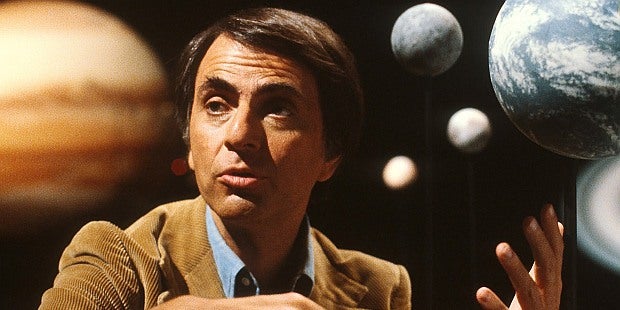
Carl Sagan, in full Carl Edward Sagan, (born November 9, 1934, Brooklyn, New York, U.S.—died December 20, 1996, Seattle, Washington), American astronomer and science writer. A popular and influential figure in the United States, he was controversial in scientific, political, and religious circles for his views on extraterrestrial intelligence, nuclear weapons, and religion. Sagan wrote the article “life” for the 1970 printing of the 14th edition of the Encyclopædia Britannica (1929–73).
Sagan attended the University of Chicago, where he earned a bachelor’s and a master’s degree in physics in 1955 and 1956, respectively, and a doctorate in astronomy and astrophysics in 1960. From 1960 to 1962 he was a fellow in astronomy at the University of California, Berkeley, and from 1962 to 1968 he worked at Harvard University and the Smithsonian Astrophysical Observatory. His early work focused on the physical conditions of the planets, especially the atmospheres of Venus and Jupiter. During that time he became interested in the possibility of lifebeyond Earth and the search for extraterrestrial intelligence (SETI), a controversial research field he did much to advance. For example, building on earlier work by American chemists Stanley Miller and Harold Urey, he demonstrated that amino acids and nucleic acids—the building blocks of life—could be produced by exposing a mixture of simple chemicals to ultraviolet radiation. Some scientists criticized Sagan’s work, arguing that it was unreasonable to use resources for SETI, a fantasy project that was almost certainly doomed to failure.
On November 21, 2014 I received a letter from Nobel Laureate Harry Kroto and it said:
…Please click on this URL http://vimeo.com/26991975
and you will hear what far smarter people than I have to say on this matter. I agree with them.
Harry Kroto

I have attempted to respond to all of Dr. Kroto’s friends arguments and I have posted my responses one per week for over a year now. Here are some of my earlier posts:
Arif Ahmed, Haroon Ahmed, Jim Al-Khalili, Sir David Attenborough, Mark Balaguer, Horace Barlow, Michael Bate, Sir Patrick Bateson, Simon Blackburn, Colin Blakemore, Ned Block, Pascal Boyer, Patricia Churchland, Aaron Ciechanover, Noam Chomsky, Brian Cox, Partha Dasgupta, Alan Dershowitz, Frank Drake, Hubert Dreyfus, John Dunn, Bart Ehrman, Mark Elvin, Richard Ernst, Stephan Feuchtwang, Robert Foley, David Friend, Riccardo Giacconi, Ivar Giaever , Roy Glauber, Rebecca Goldstein, David J. Gross, Brian Greene, Susan Greenfield, Stephen F Gudeman, Alan Guth, Jonathan Haidt, Theodor W. Hänsch, Brian Harrison, Stephen Hawking, Hermann Hauser, Robert Hinde, Roald Hoffmann, Bruce Hood, Gerard ‘t Hooft, Caroline Humphrey, Nicholas Humphrey, Herbert Huppert, Gareth Stedman Jones, Steve Jones, Shelly Kagan, Michio Kaku, Stuart Kauffman, Masatoshi Koshiba, Lawrence Krauss, Harry Kroto, George Lakoff, Rodolfo Llinas, Elizabeth Loftus, Alan Macfarlane, Dan McKenzie, Mahzarin Banaji, Peter Millican, Marvin Minsky, Leonard Mlodinow, P.Z.Myers, Yujin Nagasawa, Alva Noe, Douglas Osheroff, David Parkin, Jonathan Parry, Roger Penrose, Saul Perlmutter, Herman Philipse, Carolyn Porco, Robert M. Price, VS Ramachandran, Lisa Randall, Lord Martin Rees, Colin Renfrew, Alison Richard, C.J. van Rijsbergen, Oliver Sacks, John Searle, Marcus du Sautoy, Simon Schaffer, J. L. Schellenberg, Lee Silver, Peter Singer, Walter Sinnott-Armstrong, Ronald de Sousa, Victor Stenger, John Sulston, Barry Supple, Leonard Susskind, Raymond Tallis, Max Tegmark, Neil deGrasse Tyson, Martinus J. G. Veltman, Craig Venter, .Alexander Vilenkin, Sir John Walker, James D. Watson, Frank Wilczek, Steven Weinberg, and Lewis Wolpert,
In the 1st video below in the 45th clip in this series are his words and my response is below them.
50 Renowned Academics Speaking About God (Part 1)
Another 50 Renowned Academics Speaking About God (Part 2
A Further 50 Renowned Academics Speaking About God (Part 3)
–
CARL SAGAN interview with Charlie Rose:
“…faith is belief in the absence of evidence. To believe in the absence of evidence, in my opinion, is a mistake. The idea is to hold belief until there is compelling evidence. If the Universe does not comply with our previous propositions, then we have to change…Religion deals with history poetry, great literature, ethics, morals, compassion…where religion gets into trouble is when it pretends to know something about science,”
I would respond that there is evidence that Christianity is true. The Bible has fulfilled prophecy in it, and 53 historical notable people in the Bible have been confirmed through archaeological evidence! Also there is compelling evidence that the Bible contains sound medical principles that clearly predate their more recent discovery by thousands of years
Related posts:
FRANCIS SCHAEFFER ANALYZES ART AND CULTURE Part 52 THE BEATLES (Part D, There is evidence that the Beatles may have been exposed to Francis Schaeffer!!!) (Feature on artist Anna Margaret Rose Freeman )
______________ George Harrison Swears & Insults Paul and Yoko Lucy in the Sky with Diamonds- The Beatles The Beatles: I have dedicated several posts to this series on the Beatles and I don’t know when this series will end because Francis Schaeffer spent a lot of time listening to the Beatles and talking […]
FRANCIS SCHAEFFER ANALYZES ART AND CULTURE Part 51 THE BEATLES (Part C, List of those on cover of Stg.Pepper’s ) (Feature on artist Raqib Shaw )
The Beatles in a press conference after their Return from the USA Uploaded on Nov 29, 2010 The Beatles in a press conference after their Return from the USA. The Beatles: I have dedicated several posts to this series on the Beatles and I don’t know when this series will end because Francis […]
FRANCIS SCHAEFFER ANALYZES ART AND CULTURE Part 50 THE BEATLES (Part B, The Psychedelic Music of the Beatles) (Feature on artist Peter Blake )
__________________ Beatles 1966 Last interview I have dedicated several posts to this series on the Beatles and I don’t know when this series will end because Francis Schaeffer spent a lot of time listening to the Beatles and talking and writing about them and their impact on the culture of the 1960’s. In this […]
FRANCIS SCHAEFFER ANALYZES ART AND CULTURE Part 49 THE BEATLES (Part A, The Meaning of Stg. Pepper’s Cover) (Feature on artist Mika Tajima)
_______________ The Beatles documentary || A Long and Winding Road || Episode 5 (This video discusses Stg. Pepper’s creation I have dedicated several posts to this series on the Beatles and I don’t know when this series will end because Francis Schaeffer spent a lot of time listening to the Beatles and talking and writing about […]
FRANCIS SCHAEFFER ANALYZES ART AND CULTURE PART 48 “BLOW UP” by Michelangelo Antonioni makes Philosophic Statement (Feature on artist Nancy Holt)
_______________ Francis Schaeffer pictured below: _____________________ I have included the 27 minute episode THE AGE OF NONREASON by Francis Schaeffer. In that video Schaeffer noted, ” Sergeant Pepper’s Lonely Hearts Club Band…for a time it became the rallying cry for young people throughout the world. It expressed the essence of their lives, thoughts and their feelings.” How Should […]
FRANCIS SCHAEFFER ANALYZES ART AND CULTURE Part 47 Woody Allen and Professor Levy and the death of “Optimistic Humanism” from the movie CRIMES AND MISDEMEANORS Plus Charles Darwin’s comments too!!! (Feature on artist Rodney Graham)
Crimes and Misdemeanors: A Discussion: Part 1 ___________________________________ Today I will answer the simple question: IS IT POSSIBLE TO BE AN OPTIMISTIC SECULAR HUMANIST THAT DOES NOT BELIEVE IN GOD OR AN AFTERLIFE? This question has been around for a long time and you can go back to the 19th century and read this same […]
FRANCIS SCHAEFFER ANALYZES ART AND CULTURE PART 46 Friedrich Nietzsche (Featured artist is Thomas Schütte)
____________________________________ Francis Schaeffer pictured below: __________ Francis Schaeffer has written extensively on art and culture spanning the last 2000years and here are some posts I have done on this subject before : Francis Schaeffer’s “How should we then live?” Video and outline of episode 10 “Final Choices” , episode 9 “The Age of Personal Peace and Affluence”, episode 8 […]
FRANCIS SCHAEFFER ANALYZES ART AND CULTURE Part 45 Woody Allen “Reason is Dead” (Feature on artists Allora & Calzadilla )
Love and Death [Woody Allen] – What if there is no God? [PL] ___________ _______________ How Should We then Live Episode 7 small (Age of Nonreason) #02 How Should We Then Live? (Promo Clip) Dr. Francis Schaeffer 10 Worldview and Truth Two Minute Warning: How Then Should We Live?: Francis Schaeffer at 100 Francis Schaeffer […]
FRANCIS SCHAEFFER ANALYZES ART AND CULTURE Part 44 The Book of Genesis (Featured artist is Trey McCarley )
___________________________________ Francis Schaeffer pictured below: ____________________________ Francis Schaeffer “BASIS FOR HUMAN DIGNITY” Whatever…HTTHR Dr. Francis schaeffer – The flow of Materialism(from Part 4 of Whatever happened to human race?) Dr. Francis Schaeffer – The Biblical flow of Truth & History (intro) Francis Schaeffer – The Biblical Flow of History & Truth (1) Dr. Francis Schaeffer […]
__
__


 The Daily Hatch