WOODY WEDNESDAY The Reel Thing The Reel Thing: Woody Allen Formula Fails With ‘Cafe Society’ By RAY COX

Café Society – Official Movie Review

Café Society Official International Trailer #1 (2016) – Jesse Eisenberg, Kristen Stewart Movie HD

The Reel Thing

The Reel Thing: Woody Allen Formula Fails With ‘Cafe Society’

  • By RAY COX
  • 23 hrs ago


Woody Allen has been making films for more than 50 years but “Cafe Society” is not one of his better efforts. In Woody’s first film, “What’s New Pussycat” in 1965, the studio tampered with it and he resolved to have absolute control over all his projects from then on. Somebody should have been looking over his shoulder on this one as “Cafe” simply lacks energy and vitality, the hallmark of his better work.

The movie, set in the 1930s, features Jesse Eisenberg (“The Social Network”) as Bobby Dorfman, a Bronx native, who decides Hollywood would be a place better suited to his talents. Bobby arrives in Los Angeles and contacts his uncle, Phil Stern, played by Steve Carell (“The Office”), a movie mogul and “agent to the stars,” who Bobby hopes will help get his career off the ground. Carell’s character is supposed to be “larger than life,” a charismatic mover and shaker. In fact, he’s a boring egotist who constantly drops the names of his clients like so many bon mots at a French writers guild. Ginger Rogers, Gary Cooper, Fred Astaire, Bette Davis and Joel McCrae, just to mention a few stars from that era, are relationships that shape and define Phil’s world and are indeed his raison d’etre.

Phil avoids Bobby for weeks but finally takes pity on his nephew and hires him to perform “trivial errands” and Bobby, ingratiating to a fault, makes the most of them. Phil’s secretary, Vonnie (Kirsten Stewart, “Twilight” saga), ends up squiring Bobby around the Hollywood scene and takes a genuine interest in his progress.

Without revealing too much, a love triangle develops with Bobby eventually looking from the outside in, so he returns to New York—alone. Woody’s movies are often set in Manhattan, which he always treats with great affection, and he usually features a nebbish protagonist who plays the roles Woody played when he was younger. Now 80, he finds actors like Eisenberg to fill in as his alter ego, and their personas are almost identical in every picture.

Another common characteristic is his penchant for throwing in gangsters when necessary to flesh out his plots. “Cafe” has one in the person of Bobby’s other uncle, Ben (Corey Stoll), who complicates the proceedings by causing “cranial separation” to people who offend him or his family. Throw in a couple of pregnancies and you have a Woody Allen formula. In this case, however, it turns into a mess.

Besides being so lanquid, Woody miscasts Kirsten Stewart as Bobby’s first love when his second love interest, played by the fetching Blake Lively (“The Shallows”), would have been a much better choice.

Woody serves as the narrator, although he’s not in the movie. Toward the end, he quotes Socrates saying that “an unexamined life is not worth living.” Woody adds: “but an examined one is no bargain.” That’s exactly how I felt about “Cafe”: too much thought went into it for such little result.

Review: ‘Café Society’ is minor, enjoyable Woody Allen

Related posts:

WOODY WEDNESDAY “CAFÉ SOCIETY” AND “LIFE, ANIMATED” REVIEWS Woody Allen’s newest film, and a documentary about how a boy with autism connected with Disney movies. By Anthony Lane

“CAFÉ SOCIETY” AND “LIFE, ANIMATED” REVIEWS Woody Allen’s newest film, and a documentary about how a boy with autism connected with Disney movies. By Anthony Lane Jesse Eisenberg and Kristen Stewart in Woody Allen’s new movie.ILLUSTRATION BY BEN KIRCHNER The new Woody Allen film, “Café Society,” is set in the nineteen-thirties—you know, that far-off land […]

WOODY WEDNESDAY ‘Cafe Society’ review: Kristen Stewart, Jesse Eisenberg enliven otherwise dull nostalgia by Michael PhillipsContact Reporter Chicago Tribune July 7, 2016

‘Cafe Society’ review: Kristen Stewart, Jesse Eisenberg enliven otherwise dull nostalgia  by Michael PhillipsContact Reporter Chicago Tribune July 7, 2016 There’s not much to “Cafe Society,” but for a while now Woody Allen has been getting by with not much happening at the keyboard. Thanks to the warm, glowing light lavished on the film by cinematographer Vittorio […]

WOODY WEDNESDAY ‘Café Society’: Designing 1930s Hollywood for Woody Allen The new film, with Jesse Eisenberg and Kristen Stewart, is full of lavish set designs By DON STEINBERG Updated July 6, 2016

CAFE SOCIETY – Red Carpet – EV – Cannes 2016 ‘Café Society’: Designing 1930s Hollywood for Woody Allen The new film, with Jesse Eisenberg and Kristen Stewart, is full of lavish set designs By DON STEINBERG Updated July 6, 2016 7:11 p.m. ET 3 COMMENTS Re-creating opulent 1930s Hollywood and post-Prohibition New York for Woody […]

WOODY WEDNESDAY ‘Cafe Society’: Cannes Review 5:09 AM PDT 5/11/2016 by Todd McCarthy

Woody Allen on Retiring and Childhood Memories / Cannes 2016 Café Society Published on Jun 4, 2016 Short clip from an interview with Woody Allen in occasion of the world premiere of his film “Café Society” at the Cannes film festival 2016. ‘Cafe Society’: Cannes Review 5:09 AM PDT 5/11/2016 by Todd McCarthy Woody Allen’s […]

WOODY WEDNESDAY Review of Cafe Society Woody Allen’s latest movie

New cast interview Café Society in Cannes Published on May 24, 2016 Subscribe on my Channel :* Cannes Film Review: ‘Café Society’ Owen Gleiberman Chief Film Critic @OwenGleiberman Editions: Subscribe Today! Film TV Digital Contenders Video Dirt Jobs More Sign In Home Film Reviews Cannes Film Review: ‘Café Society’ Owen Gleiberman Chief Film Critic @OwenGleiberman […]

“Woody Wednesday” ECCLESIASTES AND WOODY ALLEN’S FILMS: SOLOMON “WOULD GOT ALONG WELL WITH WOODY!” (Part 34 MIDNIGHT IN PARIS Picasso and Solomon both had an obsession with the issue of their impending death!!) )

Both Solomon in Ecclesiastes and Picasso in his painting had an obsession with the issue of their impending death!!! Picasso in the movie MIDNIGHT IN PARIS   Pablo Picasso: Self-portrait Facing Death (1972) Does anyone not know the name Picasso? Based on sales of his works at auctions, he holds the title of top ranked […]

“Woody Wednesday” ECCLESIASTES AND WOODY ALLEN’S FILMS: SOLOMON “WOULD GOT ALONG WELL WITH WOODY!” (Part 33 MIDNIGHT IN PARIS Picasso painted his worldview but he couldn’t stand the loss of humanness!!! )

Picasso was a genius as a painter but he deliberately painted his secular  worldview of fragmentation on his canvas but he could not live with the loss of humanness and he reverted back at crucial points and painted those he loved with all his genius and with all their humanness!!! Gertrude Stein (Kathy Bates) and […]

“Woody Wednesday” ECCLESIASTES AND WOODY ALLEN’S FILMS: SOLOMON “WOULD GOT ALONG WELL WITH WOODY!” (Part 32 MIDNIGHT IN PARIS Just like Solomon in Ecclesiastes Picasso’s women mostly considered suicide or accepted nihilism )

Just like Solomon in Ecclesiastes Picasso’s women mostly considered suicide or accepted nihilism and  Woody Allen alludes to this in MIDNIGHT IN PARIS when Adriana tells her own story: GIL PENDER: No, you do! How long have you been dating Picasso?My God, did I just say that?Pardon?I don’t mean to…I didn’t meanto pry…. Were you born in […]

“Woody Wednesday” ECCLESIASTES AND WOODY ALLEN’S FILMS: SOLOMON “WOULD GOT ALONG WELL WITH WOODY!” (Part 31 MIDNIGHT IN PARIS Picasso just like Solomon in Ecclesiastes slept with many women but ended his life bitter against all women )

_ Just like Solomon Picasso slept with many women. Solomon actually slept with  over 1000 women ( Eccl 2:8, I Kings 11:3), and both men ended their lives bitter against all women. Pablo Picasso: Midnight in Paris Woody Allen made it known that his pessimistic view on life started at a young age when he […]

“Woody Wednesday” ECCLESIASTES AND WOODY ALLEN’S FILMS: SOLOMON “WOULD GOT ALONG WELL WITH WOODY!” (Part 30 MIDNIGHT IN PARIS Ernest Hemingway 18th part Summing up Hemingway’s life )

_   Summing up Hemingway is not as hard as I thought it was going to be. Hemingway was nihilistic in that he understood the problem of modern man UNDER THE SUN without God in the picture just like Solomon did in the Book of Ecclesiastes. MICHAEL NICHOLSON in the article below does a great job of […]

_________

RESPONDING TO HARRY KROTO’S BRILLIANT RENOWNED ACADEMICS!! Part 94 Mark Elvin professor of  Chinese history,  St. Antony’s College. Oxford, “I was already about age eleven and in some way you could say someone who took as his guide Bertrand Russell’s work that was accessible to me beginning with his popular essays”

On November 21, 2014 I received a letter from Nobel Laureate Harry Kroto and it said:

…Please click on this URL http://vimeo.com/26991975

and you will hear what far smarter people than I have to say on this matter. I agree with them.

Harry Kroto

Nick Gathergood, David-Birkett, Harry-Kroto

I have attempted to respond to all of Dr. Kroto’s friends arguments and I have posted my responses one per week for over a year now. Here are some of my earlier posts:

Arif Ahmed, Sir David AttenboroughMark Balaguer, Horace Barlow, Michael BatePatricia ChurchlandAaron CiechanoverNoam Chomsky,Alan DershowitzHubert Dreyfus, Bart Ehrman, Stephan FeuchtwangDavid Friend,  Riccardo GiacconiIvar Giaever , Roy GlauberRebecca GoldsteinDavid J. Gross,  Brian Greene, Susan GreenfieldStephen F Gudeman,  Alan Guth, Jonathan HaidtTheodor W. Hänsch, Brian Harrison,  Hermann HauserRoald Hoffmann,  Bruce HoodHerbert Huppert,  Gareth Stedman Jones, Steve JonesShelly KaganMichio Kaku,  Stuart Kauffman,  Lawrence KraussHarry Kroto, George LakoffElizabeth Loftus,  Alan MacfarlanePeter MillicanMarvin MinskyLeonard Mlodinow,  Yujin NagasawaAlva NoeDouglas Osheroff,  Jonathan Parry,  Saul PerlmutterHerman Philipse,  Carolyn PorcoRobert M. PriceLisa RandallLord Martin Rees,  Oliver Sacks, John SearleMarcus du SautoySimon SchafferJ. L. Schellenberg,   Lee Silver Peter Singer,  Walter Sinnott-ArmstrongRonald de Sousa, Victor StengerBarry Supple,   Leonard Susskind, Raymond TallisNeil deGrasse Tyson,  .Alexander Vilenkin, Sir John WalkerFrank WilczekSteven Weinberg, and  Lewis Wolpert,

Mark Elvin

From Wikipedia, the free encyclopedia

(John) Mark (Dutton) Elvin (born 1938) is a professor emeritus of Chinese history at Australian National University, specializing in the late imperial period; he is also emeritus fellow of St. Antony’s College. Oxford.

Elvin, the only child of (Herbert) Lionel Elvin and Mona Bedortha Dutton, grew up in Cambridge; attended The Dragon School; and matriculated as an undergraduate at King’s College, Cambridge. He held posts at the University of Glasgow and at St, Antony’s College, Oxford.

He is noted for his high level equilibrium trap theory to explain why an industrial revolution happened in Europe but not in China, despite the fact that the state of scientific knowledge was far more advanced in China much earlier than in Europe. Essentially, Elvin proposed that pre-industrial production methods were extremely efficient in China, which obviated much of the economic pressure for scientific progress. At the same time, a philosophical shift occurred, where Taoism was gradually replaced by Confucianism as the dominant intellectual paradigm, and moral philosophy and the development of rigid social organization became more important than scientific inquiry among intellectuals.

External links[edit]

In  the third video below in the 133rd clip in this series are his words and  my response is below them. 

50 Renowned Academics Speaking About God (Part 1)

Another 50 Renowned Academics Speaking About God (Part 2)

A Further 50 Renowned Academics Speaking About God (Part 3)

_________________________________

Below is my letter in which I respond to Dr. Elvin’s quote:

May 24, 2016

Professor John Mark Elvin,

Dear Dr. Elvin,

I know that your father was active in the  BRITISH HUMANIST ASSOCIATION and that he was longtime friends with H.J. Blackham.  Blackham was the founder of the BRITISH HUMANIST ASSOCIATION and he asserted:

On humanist assumptions, life leads to nothing, and every pretense that it does not is a deceit. If there is a bridge over a gorge which spans only half the distance and ends in mid-air, and if the bridge is crowded with human beings pressing on, one after the other they fall into the abyss. The bridge leads nowhere, and those who are pressing forward to cross it are going nowhere….It does not matter where they think they are going, what preparations for the journey they may have made, how much they may be enjoying it all. The objection merely points out objectively that such a situation is a model of futility“( H. J. Blackham, et al., Objections to Humanism (Riverside, Connecticut: Greenwood Press, 1967).

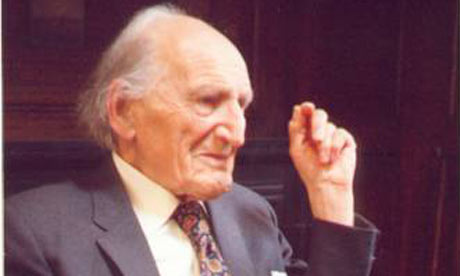
 Lionel Elvin (7 August 1905 in Buckhurst Hill – 14 June 2005 in Cambridge

Harold J. Blackham (1903-2009) pictured above

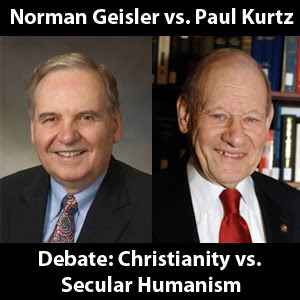
On John Ankerberg’s show in 1986 there was a debate between  Dr. Paul Kurtz, and Dr. Norman Geisler and when part of the above quote was read, Dr. Kurtz responded:

I think you may be quoting Blackham out of context because I’ve heard Blackham speak, and read much of what he said, but Blackham has argued continuously that life is full of meaning;

Since you have such a long history of being around secularists it might interest you to know that I have made it a hobby of mine to correspond with atheists who are scientists or academics like yourself over the last 25 years. Some of those who corresponded back with me have been  Ernest Mayr (1904-2005), George Wald (1906-1997), Carl Sagan (1934-1996),  Robert Shapiro (1935-2011), Nicolaas Bloembergen (1920-),  Brian Charlesworth (1945-),  Francisco J. Ayala (1934-) Elliott Sober (1948-), Kevin Padian (1951-), Matt Cartmill (1943-) , Milton Fingerman (1928-), John J. Shea (1969-), , Michael A. Crawford (1938-), Paul Kurtz (1925-2012), Sol Gordon (1923-2008), Albert Ellis (1913-2007), Barbara Marie Tabler (1915-1996), Renate Vambery (1916-2005), Archie J. Bahm (1907-1996), Aron S “Gil” Martin ( 1910-1997), Matthew I. Spetter (1921-2012), H. J. Eysenck (1916-1997), Robert L. Erdmann (1929-2006), Mary Morain (1911-1999), Lloyd Morain (1917-2010),  Warren Allen Smith (1921-), Bette Chambers (1930-),  Gordon Stein (1941-1996) , Milton Friedman (1912-2006), John Hospers (1918-2011), Michael Martin (1932-).Harry Kroto (1939-), Marty E. Martin (1928-), Richard Rubenstein (1924-), James Terry McCollum (1936-), Edward O. WIlson (1929-), Lewis Wolpert (1929), Gerald Holton (1922-), Martin Rees (1942-), Alan Macfarlane (1941-),  Roald Hoffmann (1937-), Herbert Kroemer (1928-), Thomas H. Jukes (1906-1999), Glenn BranchGeoff Harcourt (1931-) and  Ray T. Cragun (1976-). I would consider it an honor to add you to this very distinguished list. 

I just finished reading the online addition of the book Darwin, Francis ed. 1892. Charles Darwin: his life told in an autobiographical chapter, and in a selected series of his published letters [abridged edition]. London: John Murray. There are several points that Charles Darwin makes in this book that were very wise, honest, logical, shocking and some that were not so wise. The Christian Philosopher Francis Schaeffer once said of Darwin’s writings, “Darwin in his autobiography and in his letters showed that all through his life he never really came to a quietness concerning the possibility that chance really explained the situation of the biological world. You will find there is much material on this [from Darwin] extended over many many years that constantly he was wrestling with this problem.”

In your interview with Alan Macfarlane I saw that your father was involved in Paris with UNESCO. Wikipedia says of Julian Huxley:

Huxley, a lifelong internationalist with a concern for education, got involved in the creation of the United Nations Educational, Scientific and Cultural Organization (UNESCO), and became the organization’s first Director-General in 1946. His term of office, six years in the Charter, was cut down to two years at the behest of the USA delegation.[15] The reasons are not known for sure, but his left-wing tendencies and humanism were likely factors. In a fortnight he dashed off a 60-page booklet on the purpose and philosophy of UNESCO, eventually printed and issued as an official document. There were, however, many conservative opponents of his scientific humanism. His idea of restraining population growth with birth control was anathema to both the Catholic Church and the Comintern/Cominform. In its first few years UNESCO was dynamic and broke new ground; since Huxley it has become larger, more bureaucratic and stable.[16][17] The personal and social side of the years in Paris are well described by his wife.[18]

I was curious if either your father or you got to meet Julian Huxley?

Recently I ran across this quote from you from that excellent in-depth interview you did with Alan Macfarlane :

I was puzzled by the fact that I was told nonsense, not just something I might not agree with, but nonsense. This was nonsense, and the contrast fascinated me and I was already about age eleven and in some way you could say someone who took as his guide Bertrand Russell’s work that was accessible to me beginning with his popular essays. 

You mentioned in your quote the Nobel Prize winner Bertrand Russell.  Like you I have read much of his material concerning the existence of God. One quote really stands out to me and here it is:

That Man is the product of causes which had no prevision of the end they were achieving; that his origin, his growth, his hopes and fears, his loves and his beliefs, are but the outcome of accidental collocations of atoms; …that all the labors of the ages, all the devotion, all the inspiration, all the noonday brightness of human genius, are destined to extinction in the vast death of the solar system, and that the whole temple of Man’s achievement must inevitably be buried beneath the debris of a universe in ruins—all these things, if not quite beyond dispute, are yet so nearly certain, that no philosophy which rejects them can hope to stand. Bertrand Russell

This nihilistic quote seems to go against what he saying at other times in his life and that was he advocated evolutionary optimistic humanism and even in the 19th century Charles Darwin in his autobiography was touting the same product then!!!!!

When I read the book  Charles Darwin: his life told in an autobiographical chapter, and in a selected series of his published letters, I also read  a commentary on it by Francis Schaeffer and I wanted to both  quote some of Charles Darwin’s own words to you and then include the comments of Francis Schaeffer on those words. I have also enclosed a CD with two messages from Adrian Rogers and Bill Elliff concerning Darwinism.

Francis Darwin noted, “passages which here follow are extracts, somewhat abbreviated, from a part of the Autobiography, written in 1876, in which my father gives the history of his religious views:”

“Believing as I do that man in the distant future will be a far more perfect creature than he now is,”

Francis Schaeffer (1912-1984) pictured below

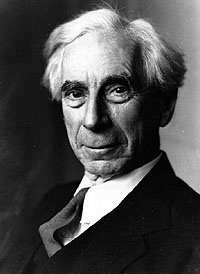
Bertrand Russell (18 May 1872 – 2 February 1970) pictured below

__

__

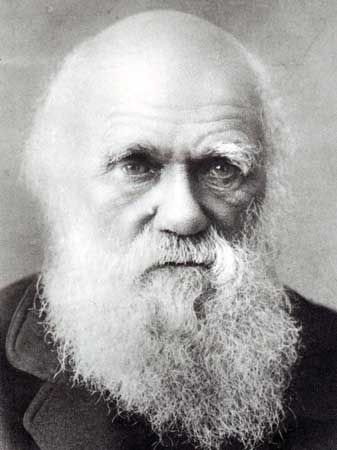
Charles Darwin

T. H. Huxley with Julian in 1893

Julian and Aldous Huxley


FRANCIS SCHAEFFER COMMENTED:

Now you have now the birth of Julian Huxley’s evolutionary optimistic humanism already stated by Darwin. Darwin now has a theory that man is going to be better. If you had lived at 1860 or 1890 and you said to Darwin, “By 1970 will man be better?” He certainly would have the hope that man would be better as Julian Huxley does today. Of course, I wonder what he would say if he lived in our day and saw what has been made of his own views in the direction of (the mass murder) Richard Speck (and deterministic thinking of today’s philosophers). I wonder what he would say. So you have the factor, already the dilemma in Darwin that I pointed out in Julian Huxley and that is evolutionary optimistic humanism rests always on tomorrow. You never have an argument from the present or the past for evolutionary optimistic humanism.

You can have evolutionary nihilism on the basis of the present and the past. Every time you have someone bringing in evolutionary optimistic humanism it is always based on what is going to be produced tomorrow. When is it coming? The years pass and is it coming? Arthur Koestler doesn’t think it is coming. He sees lots of problems here and puts forth for another solution.

In Darwin’s 1876 Autobiography he noted:

“…it is an intolerable thought that he and all other sentient beings are doomed to complete annihilation after such long-continued slow progress. To those who fully admit the immortality of the human soul, the destruction of our world will not appear so dreadful.”

Francis Schaeffer commented:

Here you feel Marcel Proust and the dust of death is on everything today because the dust of death is on everything tomorrow. Here you have the dilemma of Nevil Shute’s ON THE BEACH. If it is true that all we have left is biological continuity and increased biological complexity, which is all we have left in Darwinism here, or with many of the modern philosophers, then you can’t stand Shute’s ON THE BEACH. Maybe tomorrow at noon human life may be wiped out. Darwin already feels the tension, because if human life is going to be wiped out tomorrow, what is it worth today? Darwin can’t stand the thought of death of all men. Charlie Chaplin when he heard there was no life on Mars said, “I’m lonely.”

You think of the Swedish Opera (ANIARA) that is pictured inside a spaceship. There was a group of men and women going into outer space and they had come to another planet and the singing inside the spaceship was normal opera music. Suddenly there was a big explosion and the world had blown up and these were the last people left, the only conscious people left, and the last scene is the spaceship is off course and it will never land, but will just sail out into outer space and that is the end of the plot. They say when it was shown in Stockholm the first time, the tough Swedes with all their modern  mannishness, came out (after the opera was over) with hardly a word said, just complete silence.

Darwin already with his own position says he CAN’T STAND IT!! You can say, “Why can’t you stand it?” We would say to Darwin, “You were not made for this kind of thing. Man was made in the image of God. Your CAN’T- STAND- IT- NESS is screaming at you that your position is wrong. Why can’t you listen to yourself?”

You find all he is left here is biological continuity, and thus his feeling as well as his reason now is against his own theory, yet he holds it against the conclusions of his reason. Reason doesn’t make it hard to be a Christian. Darwin shows us the other way. He is holding his position against his reason.

____________

These words of Darwin ring in my ear, “…it is an intolerable thought that he and all other sentient beings are doomed to complete annihilation after such long-continued slow progress…” . Schaeffer rightly noted, “Maybe tomorrow at noon human life may be wiped out. Darwin already feels the tension, because if human life is going to be wiped out tomorrow, what is it worth today? Darwin can’t stand the thought of death of all men.” IN OTHER WORDS ALL WE ARE IS DUST IN THE WIND.  I sent you a CD that starts off with the song DUST IN THE WIND by Kerry Livgren of the group KANSAS which was a hit song in 1978 when it rose to #6 on the charts because so many people connected with the message of the song. It included these words, “All we do, crumbles to the ground though we refuse to see, Dust in the Wind, All we are is dust in the wind, Don’t hang on, Nothing lasts forever but the Earth and Sky, It slips away, And all your money won’t another minute buy.”

Kerry Livgren himself said that he wrote the song because he saw where man was without a personal God in the picture. Solomon pointed out in the Book of Ecclesiastes that those who believe that God doesn’t exist must accept three things. FIRST, death is the end and SECOND, chance and time are the only guiding forces in this life.  FINALLY, power reigns in this life and the scales are never balanced. The Christian can  face death and also confront the world knowing that it is not determined by chance and time alone and finally there is a judge who will balance the scales.

Both Kerry Livgren and the bass player Dave Hope of Kansas became Christians eventually. Kerry Livgren first tried Eastern Religions and Dave Hope had to come out of a heavy drug addiction. I was shocked and elated to see their personal testimony on The 700 Club in 1981 and that same  interview can be seen on You Tube today. Livgren lives in Topeka, Kansas today where he teaches “Diggers,” a Sunday school class at Topeka Bible ChurchDAVE HOPE is the head of Worship, Evangelism and Outreach at Immanuel Anglican Church in Destin, Florida.

The answer to find meaning in life is found in putting your faith and trust in Jesus Christ. The Bible is true from cover to cover and can be trusted.

Thank you again for your time and I know how busy you are.

Everette Hatcher, everettehatcher@gmail.com, http://www.thedailyhatch.org, cell ph 501-920-5733, Box 23416, LittleRock, AR 72221, United States


You can hear DAVE HOPE and Kerry Livgren’s stories from this youtube link:

(part 1 ten minutes)

(part 2 ten minutes)

Kansas – Dust in the Wind (Official Video)

Uploaded on Nov 7, 2009

Pre-Order Miracles Out of Nowhere now at http://www.miraclesoutofnowhere.com

About the film:
In 1973, six guys in a local band from America’s heartland began a journey that surpassed even their own wildest expectations, by achieving worldwide superstardom… watch the story unfold as the incredible story of the band KANSAS is told for the first time in the DVD Miracles Out of Nowhere.

______________

An interview with Mark Elvin – part 1

Interview of Mark Elvin – part 2

Mark Elvin interviewed by Alan Macfarlane 24th July 2012

________

Related posts:

FRANCIS SCHAEFFER ANALYZES ART AND CULTURE Part 53 THE BEATLES (Part E, Stg. Pepper’s and John Lennon’s search in 1967 for truth was through drugs, money, laughter, etc & similar to King Solomon’s, LOTS OF PICTURES OF JOHN AND CYNTHIA) (Feature on artist Yoko Ono)

The John Lennon and the Beatles really were on a long search for meaning and fulfillment in their lives  just like King Solomon did in the Book of Ecclesiastes. Solomon looked into learning (1:12-18, 2:12-17), laughter, ladies, luxuries, and liquor (2:1-2, 8, 10, 11), and labor (2:4-6, 18-20). He fount that without God in the picture all […]

FRANCIS SCHAEFFER ANALYZES ART AND CULTURE Part 52 THE BEATLES (Part D, There is evidence that the Beatles may have been exposed to Francis Schaeffer!!!) (Feature on artist Anna Margaret Rose Freeman )

______________   George Harrison Swears & Insults Paul and Yoko Lucy in the Sky with Diamonds- The Beatles The Beatles:   I have dedicated several posts to this series on the Beatles and I don’t know when this series will end because Francis Schaeffer spent a lot of time listening to the Beatles and talking […]

FRANCIS SCHAEFFER ANALYZES ART AND CULTURE Part 51 THE BEATLES (Part C, List of those on cover of Stg.Pepper’s ) (Feature on artist Raqib Shaw )

  The Beatles in a press conference after their Return from the USA Uploaded on Nov 29, 2010 The Beatles in a press conference after their Return from the USA. The Beatles:   I have dedicated several posts to this series on the Beatles and I don’t know when this series will end because Francis […]

FRANCIS SCHAEFFER ANALYZES ART AND CULTURE Part 50 THE BEATLES (Part B, The Psychedelic Music of the Beatles) (Feature on artist Peter Blake )

__________________   Beatles 1966 Last interview I have dedicated several posts to this series on the Beatles and I don’t know when this series will end because Francis Schaeffer spent a lot of time listening to the Beatles and talking and writing about them and their impact on the culture of the 1960’s. In this […]

FRANCIS SCHAEFFER ANALYZES ART AND CULTURE Part 49 THE BEATLES (Part A, The Meaning of Stg. Pepper’s Cover) (Feature on artist Mika Tajima)

_______________ The Beatles documentary || A Long and Winding Road || Episode 5 (This video discusses Stg. Pepper’s creation I have dedicated several posts to this series on the Beatles and I don’t know when this series will end because Francis Schaeffer spent a lot of time listening to the Beatles and talking and writing about […]

FRANCIS SCHAEFFER ANALYZES ART AND CULTURE PART 48 “BLOW UP” by Michelangelo Antonioni makes Philosophic Statement (Feature on artist Nancy Holt)

_______________ Francis Schaeffer pictured below: _____________________ I have included the 27 minute  episode THE AGE OF NONREASON by Francis Schaeffer. In that video Schaeffer noted,  ” Sergeant Pepper’s Lonely Hearts Club Band…for a time it became the rallying cry for young people throughout the world. It expressed the essence of their lives, thoughts and their feelings.” How Should […]

FRANCIS SCHAEFFER ANALYZES ART AND CULTURE Part 47 Woody Allen and Professor Levy and the death of “Optimistic Humanism” from the movie CRIMES AND MISDEMEANORS Plus Charles Darwin’s comments too!!! (Feature on artist Rodney Graham)

Crimes and Misdemeanors: A Discussion: Part 1 ___________________________________ Today I will answer the simple question: IS IT POSSIBLE TO BE AN OPTIMISTIC SECULAR HUMANIST THAT DOES NOT BELIEVE IN GOD OR AN AFTERLIFE? This question has been around for a long time and you can go back to the 19th century and read this same […]

FRANCIS SCHAEFFER ANALYZES ART AND CULTURE PART 46 Friedrich Nietzsche (Featured artist is Thomas Schütte)

____________________________________ Francis Schaeffer pictured below: __________ Francis Schaeffer has written extensively on art and culture spanning the last 2000years and here are some posts I have done on this subject before : Francis Schaeffer’s “How should we then live?” Video and outline of episode 10 “Final Choices” , episode 9 “The Age of Personal Peace and Affluence”, episode 8 […]

FRANCIS SCHAEFFER ANALYZES ART AND CULTURE Part 45 Woody Allen “Reason is Dead” (Feature on artists Allora & Calzadilla )

Love and Death [Woody Allen] – What if there is no God? [PL] ___________ _______________ How Should We then Live Episode 7 small (Age of Nonreason) #02 How Should We Then Live? (Promo Clip) Dr. Francis Schaeffer 10 Worldview and Truth Two Minute Warning: How Then Should We Live?: Francis Schaeffer at 100 Francis Schaeffer […]

FRANCIS SCHAEFFER ANALYZES ART AND CULTURE Part 44 The Book of Genesis (Featured artist is Trey McCarley )

___________________________________ Francis Schaeffer pictured below: ____________________________ Francis Schaeffer “BASIS FOR HUMAN DIGNITY” Whatever…HTTHR Dr. Francis schaeffer – The flow of Materialism(from Part 4 of Whatever happened to human race?) Dr. Francis Schaeffer – The Biblical flow of Truth & History (intro) Francis Schaeffer – The Biblical Flow of History & Truth (1) Dr. Francis Schaeffer […]

__

“Truth Tuesday” Liberals at Ark Times can not stand up to Scott Klusendorf’s pro-life arguments (Part 4) Liberal blogger says “…you don’t get to force your beliefs on me (concerning abortion)…”

I just wanted to note that I have spoken on the phone several times and corresponded with Dr. Paul D. Simmons who is very much pro-choice. (He is quoted in the article below.) He actually helped me write an article to submit to Americans United for the Separation of Church and State back in the 1996 when Rob Boston had stepped over the line with his “poetic license.” Boston later admitted to me on the phone he did not think that David Barton had fabricated quotes and then attributed them to the founders although his article “Consumer Alert”  did imply that Barton did. In “Consumer Alert,” these words appeared in bold print: “Mything in action: David Barton’s ‘Questionable Quotes.'” Professor Fritz Detweiler of Adrian College’s religion and philosophy department responded to this controversy in his weekly column stating that Barton “made up quotes and attributed them to James Madison, Patrick Henry, George Washington, Benjamin Franklin, and other leading Americans…. Barton’s fabricating quotes to serve his purpose is particularly disturbing on two fronts. First, Barton was not content to let the record speak for itself because it didn’t say quite what he wanted it to say. Second, the fraudulent construction of quotes poses a particular problem for [historians] seeking to verify their accuracy.” I greatly appreciated the help that Dr. Paul D. Simmons gave me in trying to set the record straight even though he does not agree with me on various other subjects such as abortion. 

Anti Abortion Pro-Life Training Video by Scott Klusendorf Part 4 of 4

Dr Francis Schaeffer – Whatever Happened to the Human Race – Episode 1

_________________

This crucial series is narrated by the late Dr. Francis Schaeffer and former Surgeon General Dr. C. Everett Koop. Today, choices are being made that undermine human rights at their most basic level. Practices once considered unthinkable are now acceptable – abortion, infanticide and euthanasia. The destruction of human life, young and old, is being sanctioned on an ever-increasing scale by the medical profession, by the courts, by parents and by silent Christians. The five episodes in this series examine the sanctity of life as a social, moral and spiritual issue which the Christian must not ignore. The conclusion presents the Christian alternative as the only real solution to man’s problems.

_____________________________

I have gone back and forth with Ark Times liberal bloggers on the issue of abortion, but I am going to try something new. I am going to respond with logical and rational reasons the pro-life view is true. All of this material is from a paper by Scott Klusendorf called FIVE BAD WAYS TO ARGUE ABOUT ABORTION .

On 2-8-13 on the Ark Times Blog the person using the username “Venessa,” wrote, ” Well, Saline, I am NOT A CHRISTIAN and you don’t get to force your beliefs on me.”

____________________

Here is my response:
 

Scott Klusendorf responded to this kind of thinking by stating:

A student at a Southern California college said this to me after I made a case for the pro-life position in her sociology class.  She was in effect saying, “Morality is relative; it’s up to me to decide what is right and wrong.”  We call this moral relativism, the belief that there are no objective standards of right and wrong, only personal preferences.  Therefore, we should tolerate other views as being equal to our own.

But as Greg Koukl and Francis Beckwith point out, relativism is seriously flawed for at least three reasons.8 First, it is self-refuting.  That is to say, it cannot live by its own rules.  Second, relativists cannot reasonably say that anything is wrong, including intolerance.  Third, it is impossible to live as a relativist.

1) Relativism is self-refuting—it commits intellectual suicide.  The student said it was wrong for me to force my views on others, but she could not live with her own rule.  Although our dialogue was pleasant, she clearly tried to force her views on me.9

Student: You made some good points in your talk, but you shouldn’t force your morality on me or anyone else who wants an abortion.  It’s our choice, isn’t it?

Me: Are you saying I’m wrong?

Student: I’m not sure.  What do you mean?

Me: Well, you think I’m wrong, don’t you?  If not, why are you correcting me?  And if so, then you’re forcing your morality on me, aren’t you?

Student: No, I just want to know why you are telling people what they can and cannot do with their lives.

Me: Are you saying I shouldn’t do that?  That it’s wrong?  If so, then why are you telling me what I can and cannot do?  Why are you forcing your morality on me?

Student (regrouping): I’m confused.  Look, the simple fact is that pro-choicers are not forcing women to have abortions, but you want to force women to be mothers.  If you don’t like abortion, don’t have one.  But you shouldn’t force your beliefs on others.  All I am saying is that pro-life people should be tolerant of other views.

Me: Is that your view?

Student: Yes.

Me: Why are you forcing it on me?  That’s not very tolerant, is it?

Student: What do you mean?  I think women should have a choice and you don’t.  It’s your view that’s intolerant, wouldn’t you say?

Me: Okay, so you think I’m wrong.  What is it you want pro-lifers like me to do?

Student: You should let women decide for themselves and tolerate other views.

Me: Tell me, what exactly do pro-choicers believe?

Student: We believe everyone should decide for themselves and tolerate other views.

Me: So you are demanding that pro-lifers become pro-choicers?

Student: What? No way.

Me: With all due respect, here’s what I hear you saying.  Unless I agree with you, you will not tolerate my view.  Privately, you’ll let me think whatever I want, but you don’t want me to act as if my view is true.  It seems you think tolerance is a virtue if and only if people agree with you.

Put succinctly, her argument for tolerance was in fact a patronizing form of intolerance.  She spoke of moral neutrality, but tried to force her own views on me.

I once read an editorial in the Toronto Star that was similarly intolerant of pro-life advocates.  While decrying the “single-minded moral supremacism” of those who call abortion killing, journalist Michele Landsberg writes:

Will no priest or minister publicly resolve to stop the indoctrination of youth to view abortion as murder?  Is none ashamed of the blood-drenched holocaust vocabulary used so cynically (and anti-semitically) to whip up fervor for the crusade?  Where are the outspoken cries of conscience by bishops and cardinals who should be appalled by the evidence of links between anti-abortion fanatics and far-right militias, neo Nazis, and white supremacists?  Is there no religious leader who regrets his church’s role in feeding this blind frenzy?  Will none of them repent of their excesses, will none call a halt to their sickeningly manipulative campaigns of “precious little feet,” their fake “documentaries” about screaming fetuses?  You’d think that the world had enough lessons in the dangers of hate speech.

Like hers?  It doesn’t seem to trouble Ms. Landsberg that her own vitriolic rhetoric could incite abortion advocates to commit acts of violence against pro-lifers.  She continues:

It was the unbridled hate speech of fundamentalist fanatics in Israel who spurred on the “devout” murder of then-Prime Minister Yitzhak Rabin….We’ve seen how homophobic rantings from right-wing American leaders, notably the Senate republican leader, led to escalating gay bashings, culminating in the heart- wrenching death of Matthew Shepherd in Wyoming….Denominational schools [should] begin to teach respect for the laws of our pluralistic society, rather than preaching single-minded moral supremacism.10

Again, like her own?

Notice what is going on here.  She decries “moral supremacism,” but says that anyone who disagrees with her view on abortion is an indoctrinator of youth, a fanatic, an anti-Semite, a neo-Nazi, a white supremacist, a manipulator of facts, a purveyor of hate speech, homophobic, a gay-basher, a religious bully, responsible for the death of Matthew Shepherd, and finally, a fundamentalist fanatic like those who murdered Yitzhak Rabin.

One can hardly imagine a finer piece of self-refuting rhetoric—all, of course, in the name of tolerance.

Sometimes the demand for tolerance is laughable.  While driving my sons to a baseball game at Dodger Stadium, a young woman in a white pickup truck began tailgating me.  Visibly angered by a pro-life sticker on my rear window, she stayed on my bumper for a mile or so.  Finally, she pulled beside me and extended a certain part of her anatomy skyward as she passed.  She then cut in front of me.  At that moment, I noticed a bumper sticker on her truck.  It said, “Celebrate Diversity.”  The message was clear: In a pluralistic society, we should tolerate other views.  Ironically, the driver saw no contradiction between her unwillingness to tolerate (or celebrate) my point of view and her bumper sticker that said we should tolerate all points of view.  That is what I mean when I say that relativism is self-refuting.

Are pro-choice claims for moral neutrality self-refuting?

On a more sophisticated level, we often hear that society should confer a large degree of liberty by not legislating on controversial moral issues for which there is no consensus, especially if those issues incite deep division.  Abortion, the argument goes, is a divisive and controversial issue.  Therefore, it should be left to personal choice.  But this view is itself controversial.  Do we have a consensus that we should not legislate on controversial matters?  Moreover, slavery and racism were controversial and divisive issues.  Are we to conclude that it was wrong to legislate against them?  The fact that people disagree is no reason to suppose that nobody is correct.

Paul D. Simmons, meanwhile, writes that pro-lifers are guilty of “speculative metaphysics” whenever they claim that the unborn are persons from conception.  (Metaphysics has to do with the ultimate grounding or reality of things such as, What makes humans valuable in the first place? And where do rights come from?)  For Simmons, metaphysical claims for the pro-life view are ultimately “religious” in nature and for that reason, they have no place in public policy. If you think the early fetus is a subject of rights, you are entitled to your own religious view, but you can’t force that speculative opinion on others who disagree.  When it comes to religion and metaphysics, the state should remain neutral and allow abortion until the fetus acquires viability (i.e., the ability to live independent of the mother).

Simmons’s view, however, is self-refuting.  As Beckwith points out, the nature of the abortion debate is such that all positions on abortion presuppose a metaphysical view of human value, and for this reason, the pro-choice position Simmons defends is not entitled to a privileged philosophical standing in our legal framework.11 At issue is not which view of abortion has metaphysical underpinnings and which does not, but which metaphysical view of human value is correct, pro-life or abortion-choice?

The pro-life view is that humans are intrinsically valuable in virtue of the kind of thing they are.  True, they differ immensely with respect to talents, accomplishments, and degrees of development, but they are nonetheless equal because they all have the same human nature.  Their right to life comes to be when they come to be (conception).  Simmons’s own abortion-choice view is that humans have value (and hence, rights) not in virtue of the kind of thing they are, but only because of an acquired property such as self-awareness or viability.12  Because the early fetus lacks the immediate capacity for these things, it is not a person with rights.  Notice that Simmons is doing the abstract work of metaphysics.  That is, he is using philosophical reflection to defend a disputed view of human persons.13  Hence, Simmons’s attempt to disqualify the pro-life view from public policy based on its alleged metaphysical underpinnings works equally well to disqualify his own view.

2) It is impossible for a moral relativist to say that anything is wrong, including intolerance.  If morals are relative, then who are you to say that I should be tolerant?  Perhaps my individual morality says intolerance is just fine.  Why, then, should I allow anyone to force tolerance on me as a virtue if my preference is intolerance?

The truth is, a moral relativist cannot legitimately say that anything is wrong or truly evil.  My colleague Greg Koukl once challenged a relativist with this question.  “Do you think it is wrong to torture babies for fun?”  She paused, then replied, “Well, I wouldn’t want to do that to my baby.”  Greg responded, “That’s not what I asked you.  I didn’t ask if you liked torturing babies for fun, I asked if it was wrong to torture babies for fun.”  The relativist was caught and she knew it.  She chuckled and went on to another subject.

If it is up to us to decide right and wrong, then there is no difference between Mother Theresa and Adolph Hitler.  They just had different preferences.  Mother Theresa liked to help people and Hitler liked to kill them.  Who are we to judge?

3) It is impossible to live as a moral relativist.  As C.S. Lewis points out, a person who claims there is no objective morality will complain if you break a promise or cut in line.14  And if you steal his stereo, he will protest loudly.  If I were a crook, I would reply to the relativist, “Do you think stealing stereos is wrong?  Well, that’s just your view.  My morality says it’s perfectly acceptable.  Who are you to force your views on me?”  Simply put, moral relativists inevitably make moral judgements.  They espouse a view they cannot live with.

I think you are starting to get the picture.  Relativism is not tolerant of other views.  In fact, it tries to suppress them.  To cite one more example, during the 2001 winter semester, pro-life students at the University of North Carolina displayed 20 large panels (each 6 feet by 13 feet) depicting the grisly reality of abortion. Known as the Genocide Awareness Project (GAP—see http://www.abortionno.org), these pictures have been displayed at over 100 universities nationwide. Though invited to do so, pro-abortion students at UNC refused to participate in a structured public debate, but demanded instead that campus police forcibly remove the display.  One pro-abortion student, Marcus Harvey, insisted the display was intolerant, ignorant, and must be removed.

I wrote a reply to Mr. Harvey that was posted (in part) on The Daily Tar Heel website:15

Marcus Harvey’s comments about the Genocide Awareness Project are typical of today’s so-called pro-choicers.  Instead of refuting the pro-life argument that it’s wrong to kill members of the human family simply because they are in the way and cannot defend themselves, he chastises the campus police for not suppressing ideas that he personally disagrees with.  This is very intolerant of him.  His message couldn’t be clearer: Agree with me or else.  Unfortunately, Mr. Harvey has no clue about the true meaning of tolerance.  Classical tolerance means that I defend your right to speak even if I disagree with your argument. In fact, the very concept of tolerance presupposes that I think you are wrong.  Otherwise, I am not tolerating you; I am agreeing with you!  For Mr. Harvey, tolerance means something very different.  It means this: Agree with me or I will call upon the police power of the state to suppress your ideas.  There is a name this and it’s not tolerance: It’s called fascism.  Thankfully, the university knew better and the pro-life display went forward despite attempts to censor it. Hey, Mr. Harvey: Please don’t force your morality on the rest of us.

Moral relativism is expressed one other way: “I’m personally opposed to abortion, but I still think it should be legal.”  When people say this, I ask a simple question to clarify things.  I ask why they personally oppose abortion.16 Invariably they reply: “We oppose it because it kills a human baby.”  At that point, I merely repeat back their words. “Let me see if I got this straight.  You oppose abortion because it kills babies, but you think it should be legal to kill babies?”  Would these same people argue that while they personally opposed slavery, they would not protest if a neighbor wanted to own one?  This was precisely what Stephen Douglas did during his debates with Abraham Lincoln.17  That argument did not work with slavery and it will not work with abortion.

Greg Koukl suggests this tactic: The next time somebody says that “you shouldn’t force your morality on me,” respond with only two words: “Why not?”  Any answer given will be an example of that person forcing his morality on you!18

1  See T.W. Sadler, Langman’s Embryology, 5th ed. (Philadelphia: W.B. Saunders, 1993) p. 3; Keith L. Moore, The Developing Human: Clinically Oriented Embryology (Toronto: B.C. Decker, 1988) p. 2; O’Rahilly, Ronand and Muller, Pabiola, Human Embryology and Teratology, 2nd ed. (New York: Wiley-Liss, 1996) pp. 8, 29.  See also Maureen L. Condic, “Life: Defining the Beginning by the End,” First Things, May 2003.

2  A. Guttmacher, Life in the Making: the Story of Human Procreation (New York: Viking Press, 1933) p. 3

3  SLED test initially developed by Stephen Schwarz but modified significantly and explained here by Scott Klusendorf.  Stephen Schwarz, The Moral Question of Abortion (Chicago: Loyola University Press, 1990) pp. 17-18.

4  Conor Liston & Jerome Kagan, “Brain Development: Memory Enhancement in Early Childhood,” Nature 419, 896 (2002).  See also O’Rahilly, Ronand and Muller, Pabiola, Human Embryology and Teratology, 2nd ed. (New York: Wiley-Liss, 1996) p. 8.

5  Correspondence between Scott Klusendorf and Dean Stretton, October 2002.  While I do not share Stretton’s views, I admire his candor.  Stretton goes on to argue that the pro-life view that zygotes have a right to life is equally counterintuitive.  I disagree.  While it’s counterintuitive at first pass, it’s really a naive intuition that easily changes when informed with the facts (like the scientific and philosophic ones noted above).  This isn’t on par with the counterintuitiveness of killing a newborn.

6 Gregory Koukl, Ten Bad Arguments against Religion (audio cassette). Order at 1-800-2-REASON.

7  Illustration is taken from Koukl, “Bad Arguments Against Religion.”  www.str.org

8  For a full refutation of relativism, see Greg Koukl and Francis Beckwith, Relativism: Feet Firmly Planted in Mid-Air (Grand Rapids: Baker, 1998).  The authors discuss relativism’s seven fatal flaws.

9  In this dialogue, I used language and questioning techniques taught by Koukl and Beckwith in Relativism.  Note: The tone you set for these types of exchanges should be polite and calm, never combative.

10 Michele Landsberg, “Words, Actions Can Fight Anti-Choice Violence,” Toronto Star, October 31, 1998.

11  Francis J. Beckwith, “Law, Reigion, and the Metaphysics of Abortion: A Reply to Simmons,” Journal of Church and State, Winter 2001.

12 Simmons argues for one, the other, or both depending on the essay you read.

13 Beckwith, Ibid.

14 C.S. Lewis, Mere Christianity (New York: Touchstone, 1996) p.19.

15 Daily Tar Heel on-line, March 8, 2001, http://nc002.campusmotor.com/read_comments.html?ID=2548

16  Greg Koukl teaches this kind of questioning in Tactics in Defending the Faith (1-800-2-REASON)

17 The Lincoln Douglas Debates, ed. R.W. Johannsen (New York: Oxford University Press, 1965) p. 27.  See also The Collected Works of Abraham Lincoln, ed. Roy P. Basler (New Brunswick: Rutgers University Press, 1953), vol. III, pp. 256-7.  Cited in Hadley Arkes, First Things: An Inquiry into the First Principles of Morals and Justice (Princeton: Princeton University Press, 1986) p. 24.

18  Francis J. Beckwith and Gregory Koukl develop several tactics like this in, Relativism: Feet Firmly Planted in Mid-Air (Grand Rapids: Baker, 1998).  See also Koukl’s “Tactics in Defending the Faith” available from Stand to Reason.

Related posts:

Taking on Ark Times Bloggers on various issues Part T “Abortion is a dirty business” (includes video “Truth and History” and editorial cartoon)

I have gone back and forth and back and forth with many liberals on the Arkansas Times Blog on many issues such as abortion, human rights, welfare, poverty, gun control  and issues dealing with popular culture. Here is another exchange I had with them a while back. My username at the Ark Times Blog is Saline […]

Taking on Ark Times Bloggers on various issues Part S “Who gave the unborn the inalienable right to life?” (includes video “Slaughter of the Innocents” and an editorial cartoon)

I have gone back and forth and back and forth with many liberals on the Arkansas Times Blog on many issues such as abortion, human rights, welfare, poverty, gun control  and issues dealing with popular culture. Here is another exchange I had with them a while back. My username at the Ark Times Blog is Saline […]

Taking on Ark Times Bloggers on various issues Part R “What’s wrong with Roe v. Wade decision?” (includes video “Truth and History” and editorial cartoon)

I have gone back and forth and back and forth with many liberals on the Arkansas Times Blog on many issues such as abortion, human rights, welfare, poverty, gun control  and issues dealing with popular culture. Here is another exchange I had with them a while back. My username at the Ark Times Blog is Saline […]

Taking on Ark Times Bloggers on various issues Part Q “Three Ark Times bloggers take pro-life postion” (includes film DEATH BY SOMEONE’S CHOICE) (editorial cartoon)

  I have gone back and forth and back and forth with many liberals on the Arkansas Times Blog on many issues such as abortion, human rights, welfare, poverty, gun control  and issues dealing with popular culture. Here is another exchange I had with them a while back. My username at the Ark Times Blog is […]

Taking on Ark Times Bloggers on various issues Part P “Freedom of speech lives on Ark Times Blog” (includes the video ABORTION OF THE HUMAN RACE) (editorial cartoon)

I have gone back and forth and back and forth with many liberals on the Arkansas Times Blog on many issues such as abortion, human rights, welfare, poverty, gun control  and issues dealing with popular culture. Here is another exchange I had with them a while back. My username at the Ark Times Blog is Saline […]

Taking on Ark Times Bloggers on various issues Part O “Without God in the picture there can not be lasting meaning to our lives” (includes film ABORTION OF THE HUMAN RACE)

I have gone back and forth and back and forth with many liberals on the Arkansas Times Blog on many issues such as abortion, human rights, welfare, poverty, gun control  and issues dealing with popular culture. Here is another exchange I had with them a while back. My username at the Ark Times Blog is Saline […]

Taking on Ark Times Bloggers on various issues Part N “A discussion of the Woody Allen Movie CRIMES AND MISDEMEANORS”(includes film DEATH BY SOMEONE’S CHOICE)

I have gone back and forth and back and forth with many liberals on the Arkansas Times Blog on many issues such as abortion, human rights, welfare, poverty, gun control  and issues dealing with popular culture. Here is another exchange I had with them a while back. My username at the Ark Times Blog is Saline […]

Taking on Ark Times Bloggers on various issues Part M “Old Testament prophecy fulfilled?”Part 3(includes film DEATH BY SOMEONE’S CHOICE)

  I have gone back and forth and back and forth with many liberals on the Arkansas Times Blog on many issues such as abortion, human rights, welfare, poverty, gun control  and issues dealing with popular culture. Here is another exchange I had with them a while back. My username at the Ark Times Blog is […]

Taking on Ark Times Bloggers on various issues Part L “On what basis do you say murder is wrong?”Part 2 (includes the film THE BASIS FOR HUMAN DIGNITY)

I have gone back and forth and back and forth with many liberals on the Arkansas Times Blog on many issues such as abortion, human rights, welfare, poverty, gun control  and issues dealing with popular culture. Here is another exchange I had with them a while back. My username at the Ark Times Blog is Saline […]

Taking on Ark Times Bloggers on various issues Part K “On what basis do you say murder is wrong?”Part 1 (includes film ABORTION OF THE HUMAN RACE)

I have gone back and forth and back and forth with many liberals on the Arkansas Times Blog on many issues such as abortion, human rights, welfare, poverty, gun control  and issues dealing with popular culture. Here is another exchange I had with them a while back. My username at the Ark Times Blog is Saline […]

Taking on Ark Times Bloggers on various issues Part J “Can atheists find lasting meaning to their lives?” (includes film ABORTION OF THE HUMAN RACE)

I have gone back and forth and back and forth with many liberals on the Arkansas Times Blog on many issues such as abortion, human rights, welfare, poverty, gun control  and issues dealing with popular culture. Here is another exchange I had with them a while back. My username at the Ark Times Blog is Saline […]

Taking on Ark Times Bloggers on various issues Part I “Old Testament Bible Prophecy” includes the film TRUTH AND HISTORY and article ” Jane Roe became pro-life”

I have gone back and forth and back and forth with many liberals on the Arkansas Times Blog on many issues such as abortion, human rights, welfare, poverty, gun control  and issues dealing with popular culture. Here is another exchange I had with them a while back. My username at the Ark Times Blog is Saline […]

Taking on Ark Times Bloggers on various issues Part H “Are humans special?” includes film ABORTION OF THE HUMAN RACE) Reagan: ” To diminish the value of one category of human life is to diminish us all”

I have gone back and forth and back and forth with many liberals on the Arkansas Times Blog on many issues such as abortion, human rights, welfare, poverty, gun control  and issues dealing with popular culture. Here is another exchange I had with them a while back. My username at the Ark Times Blog is Saline […]

Taking on Ark Times Bloggers on various issues Part G “How do moral nonabsolutists come up with what is right?” includes the film “ABORTION OF THE HUMAN RACE”)

I have gone back and forth and back and forth with many liberals on the Arkansas Times Blog on many issues such as abortion, human rights, welfare, poverty, gun control  and issues dealing with popular culture. Here is another exchange I had with them a while back. My username at the Ark Times Blog is Saline […]

Taking on Ark Times Bloggers on various issues Part F “Carl Sagan’s views on how God should try and contact us” includes film “The Basis for Human Dignity”

I have gone back and forth and back and forth with many liberals on the Arkansas Times Blog on many issues such as abortion, human rights, welfare, poverty, gun control  and issues dealing with popular culture. Here is another exchange I had with them a while back. My username at the Ark Times Blog is Saline […]

Taking on Ark Times Bloggers on various issues Part E “Moral absolutes and abortion” Francis Schaeffer Quotes part 5(includes the film SLAUGHTER OF THE INNOCENTS) (editorial cartoon)

I have gone back and forth and back and forth with many liberals on the Arkansas Times Blog on many issues such as abortion, human rights, welfare, poverty, gun control  and issues dealing with popular culture. Here is another exchange I had with them a while back. My username at the Ark Times Blog is Saline […]

Taking on Ark Times Bloggers on various issues Part D “If you can’t afford a child can you abort?”Francis Schaeffer Quotes part 4 includes the film ABORTION OF THE HUMAN RACE) (editorial cartoon)

I have gone back and forth and back and forth with many liberals on the Arkansas Times Blog on many issues such as abortion, human rights, welfare, poverty, gun control  and issues dealing with popular culture. Here is another exchange I had with them a while back. My username at the Ark Times Blog is Saline […]

Taking on Ark Times Bloggers on various issues Part C “Abortion” (Francis Schaeffer Quotes part 3 includes the film SLAUGHTER OF THE INNOCENTS) (editorial cartoon)

I have gone back and forth and back and forth with many liberals on the Arkansas Times Blog on many issues such as abortion, human rights, welfare, poverty, gun control  and issues dealing with popular culture. Here is another exchange I had with them a while back. My username at the Ark Times Blog is Saline […]

Taking on Ark Times Bloggers on various issues Part B “Gendercide” (Francis Schaeffer Quotes Part 2 includes the film ABORTION OF THE HUMAN RACE) (editorial cartoon)

I have gone back and forth and back and forth with many liberals on the Arkansas Times Blog on many issues such as abortion, human rights, welfare, poverty, gun control  and issues dealing with popular culture. Here is another exchange I had with them a while back. My username at the Ark Times Blog is Saline […]

Taking on Ark Times Bloggers on various issues Part A “The Pro-life Issue” (Francis Schaeffer Quotes Part 1 includes the film SLAUGHTER OF THE INNOCENTS) (editorial cartoon)

I have gone back and forth and back and forth with many liberals on the Arkansas Times Blog on many issues such as abortion, human rights, welfare, poverty, gun control  and issues dealing with popular culture. Here is another exchange I had with them a while back. My username at the Ark Times Blog is Saline […]

MUSIC MONDAY “Foreigner Top 10 Songs” Part 1

__

MUSIC MONDAY “Foreigner Top 10 Songs” Part 1

Top 10 Foreigner Songs

Mick Jones
Elsa, Getty Images


Read More: Top 10 Foreigner Songs | http://ultimateclassicrock.com/top-10-foreigner-songs/?trackback=tsmclip

Foreigner‘s lone remaining founding member, guitarist Mick Jones, has been at the helm of the legendary American rock group since 1976. But if you’ve seen the band lately, it seems like they’re just getting started, with Jones putting together a turbo-charged version of the group, which has been fronted by Kelly Hansen since 2005. But even though 2009’s Can’t Slow Down proved that they still had the goods to make a damn fine Foreigner album, it’s their chart-reigning period from 1977-84 with Lou Gramm as the lead singer, that make up the songs on our list of the Top 10 Foreigner Songs.

10

‘Night Life’

From: ‘4’ (1981)

Our list of the Top 10 Foreigner Songs begins with this album track, which drew simple inspiration from the hookers that were hanging out outside New York’s Electric Lady studios where the band was hard at work on ‘4.” Hearing Lou Gramm singing about getting “caught up in the action” suggests that some members of the band just might have taken advantage of “those bad girls hanging around.”


‘Blue Morning, Blue Day’

From: ‘Double Vision’ (1978)

The tangled relationship depicted in “Blue Morning, Blue Day” is very clearly reaching its breaking point and Gramm delivers the final kiss-off to his apparently soon to be ex-lover, telling her “Well, honey don’t telephone / ‘Cause I won’t be alone / I need someone to make me feel better.” Or to put it another way, here’s a quarter, call someone who cares.


‘Head Games’

From: ‘Head Games’ (1979)

“Head Games” remains as one of the best lasting artifacts of the Jones/Gramm partnership, a song that can usually be found in the second slot of Foreigner’s modern-day setlist. A soaring opening riff from Jones leads into urgent lyrical communication from Gramm, who struggles to figure out and face the true mental reality of his fractious relationship.


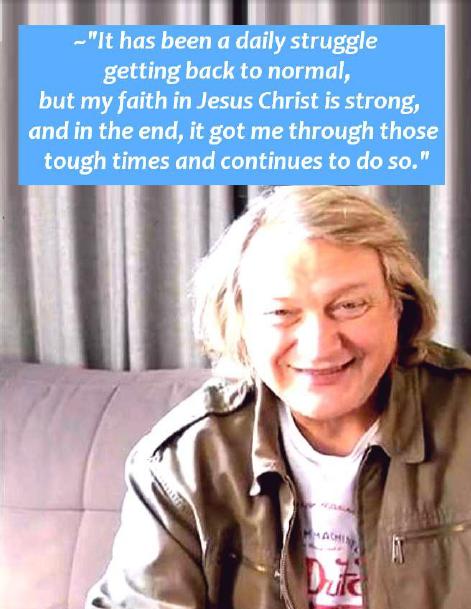
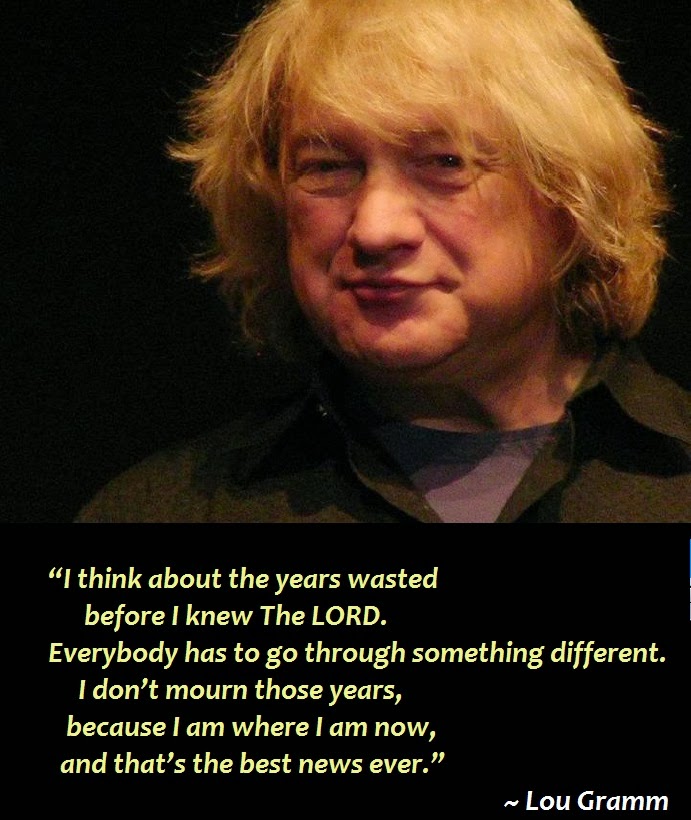
Foreigner’s Lou Gramm; Christianity & Adversity

Let’s talk about the conversion of a rockstar. Lou Gramm spent 26 years as the front man of the famous rock band “Foreigner”. He is the voice behind the great classics “I wanna know what love is” (1984) and “Waiting for a girl like you” (1981), two of the most succesful singles in the 80’s, which respectively ranked the #1 and #2 in the chart music position all around the world.

But there’s more than meets the eye, and not everyhting was sucess for this amazing singer. As years went by, his life would experince ups and downs, but more deeply than many of us. It’s so true that in his life “there’s been heartache and pain“, but there’s also been hope and faith that he eventually found in Christianity.

This time, I’m sharing the transcription of a conversation that Scott Ross from CBN held in an interview with Lou Gramm, in which he shares the experiences that changed him radically. He openly talks about his struggles, and he speaks sincerely about his feelings, telling us how he got this new faith that helped him to overcame the most difficult and troubled times of his life.
::::::::::::::::::::::::::::::::::::::::::::::::::::::::::::::::::::::::::::::::::::::::::::::::::::::::::::
Scott: At a point of your life, when you were extremely succesful, did you bind to the whole rock n’roll scene… you know, sex, drugs and rock n’roll? Were you living that stuff?
Lou Gramm: Yes, I was… all of it. Thought I grew up in a good solid family background, I honestly felt that drugs and alcohol were changing me into a person ― or had changed me into a person ― that I didn’t recognize anymore”.
Scott: How did that happen?
Lou Gramm: “I think it was more like when I came to New York. It was prevalent. And most of the guys of the band kept different hours. I was used to be operating in the morning and in bed by midnight. When we would record, a lot of times we would begin recording at about 5 or near 6 pm, and work until 4 or 5 of the next morning. At that time my sensibilities were not clear anymore, and just would begin to… be one of the guys.”
Scott: How were you feeling?
Lou Gramm: “I could feel myself changing inside in a negative way. It was just party after party and it became very habitual. When I tried to stop, I was very surprised that what was fun before, became something that I absolutely needed, and at that point I knew that it was way past the recreational and I began to really dislike the person that I had become.” 
 
Scott: Did you had all the trappings of success and what you wanted?
Lou Gramm: “What I thought I needed. And I needed more of the same.”
Scott: More success?
Lou Gramm: “And everyhting I was in.”
 
Scott: So how did you finally realize that this reality wasn’t really for you…?

Foreigner performed in the Madison Square Garden,
at the Atlantic Records 40th Anniversary
a 13-hours New York concert on May 14, 1988.
Lou: “I think it was a night after we had played in Madison Square Garden and I lived about sixty miles at north in Manhattan and I was not in the condition to drive myself home.
Scott: You were high?

Lou [nodding his head]: “At the end of an afterparty, after a showparty, and I knew my wife and children would be expecting me, but, at number one, I could’t drive myself, nor did I wanna have them see me like that. So I stayed the night in Manhattan and grappled with the person I had become.” 
Scott: What did you see?
 
Lou: “Something that I didn’t like, I didn’t like and didn’t respect and I saw the possibility of my own demise. It was in this huge, posh hotel room that I got down on my knees asking for God’s help to heal me and help me to get rid myself of this horrible addiction. I just started praying, because I knew there wasn’t anybody in the world that could help me.” 
Scott: Did you know how to pray?
 
Lou: “I think I just started talking to God, it wasn’t necessary a prayer in a pre-fabicated form. It was a conversation.” 
Scott: Saying…?
Lou Gramm: “That I didn’t want to be in this position and that I really believed that that lifestyle had the better of me and that I couldn’t walk away from it on my own, that I needed it, more than it needed me; and I prayed for the strenght and the sense to break the chains.”
The Hazelden Foundation in Minessota
Scott: What happened?
Lou: “The next morning I called a place that a friend have told me about, called ‘Hazelden’ in Minnesota, and went to rehab. I didn’t know for what was it but it was a good facility and there was a pastor as part of the rehab to re-connect with God. That’s where I became a Christian. I received Jesus that moment.”
Scott: Did you prayed, “Jesus Christ, come into my life”?
Lou: “Yes, I was asked if I was sure about it. I definitely did it because that’s what I wanted for a long time and it was an option that He was offering to me.”
Scott: Did you tell your bandmates?
Lou: “Not right away, but when I returned in the next tour months later, nothing in the band had changed. They said they were all thrilled that I had cleaned myself up. After a show, as usual, we were driving on the bus to the next city, and the cocaine lines and the joints came out, and I let them know that I wouldn’t be doing that with them anymore.”
Scott: And the response was?
Lou: “ ‘What in the world’s wrong with you?’
Scott: About your relationship with Jesus, how did your bandmates received that?
 
Lou: “Most of them were pretty angry, because making the desition changed me from the old. It kept for, I’m saying, about another seven or eight years, but there were more and more breaks between tours and the next album, in which I was heavily involved in the melody and the lyrics, started having inferences to God.”
 
::::::::::::::::::::::::::::::::::::::::::::::::::::::::::::::::::::::::::::::::::::::::::::::::::::::::::::
In 1990, Lou had departed from the band (which is one of the “breaks between” tours he talks about). Later he rejoined and in the next Foreigner album, “Mr. Moonlight”, he clearly expressed some glimpses of a new faith who was putting down roots in his music composition:
An excerpt from the song “I Keep Hoping“:

“Now I make my new beginnings

 I’ll start again at any cost
 I’ve learned a lot from losing you
 But I’ve got nothing if I’m lost
 
 And I keep hoping 
and I still believe in love
 If I wait long enough, 
I know I’ll be strong enough
 Yeah, I keep hoping,
I believe in faith and trust
 I’m gonna find a way
there are better days still ahead of us
 I keep hoping
 
 Now this candle burns low it won’t last through the night
 But I’ve found peace and I know it’s all right
 I try to understand what’s been missing in my life
 Between the darkness and the daylight. . .
I keep hoping, hoping and praying
 And I still believe in love
 I keep hoping, I keep hoping, hey hey hey
 I keep hoping”
An excerpt from the song “Rain” :
 Tell me why, oh why?
 Why don’t you open up your heart?
 Let the light from inside
 Show us who you are
An excerpt from the song “Until The End Of Time” :
“When I was young and the world belonged to me
 I thought that love meant pain and jealousy
 It was a cross on my shoulder
 Oh Lord, now I feel so much older
An excerpt from the song “Real World” :
“In the world we were born into, we’re alone, ooh
 And it brings me to my knees our father lay me down to sleep
 Father please, pray the Lord my soul to keep
 Keep us in the real world, keep us in the real world”
::::::::::::::::::::::::::::::::::::::::::::::::::::::::::::::::::::::::::::::::::::::::::::::::::::::::::::
Scott: “Did the song ‘I wanna know what love is‘ take a new meaning for you?
 
Lou: Totally. We had a young girl who was a singer, and whenever we would have shows coming up, we would have at end of each show about one week, and she would find a real talented and soulfull choir; and when we would perform alive, the choir would come on stage and sing that song with us. And it would bring the house down every time. 
 
They were always Christian choirs, baptist, sometimes white, sometimes black, sometimes mixed, but the point is that they would sing the song with a soulfull feeling, to me there was no doubt what the song was about. 
 
I remember when we were recording the song a friend of Mick Jones came in, and he was a representative for a small gospel group of New Jersey. He suggested that we should use a choir for that song, and suggested a choir that he was involved in, the ‘New Jersey Mass Choir‘. They came in, and before they sang, they made a big circle and hold their hands and said the Lord’s prayer while we were in the control room. When they started singing, it was just changed!, it changed the meaning of the song. The song was big enough in its lyrics, that when the choir was put on it, kind of got a double meaning, so that it could be about a person and his God, you know.”
::::::::::::::::::::::::::::::::::::::::::::::::::::::::::::::::::::::::::::::::::::::::::::::::::::::::::::
Just after collaborating in Petra’s album “Petra Praise 2: We Need Jesus”, in 1997, some juncture hit when Gramm was diagnosed with a rare type of brain tumor called a “craniopharyngioma”. Fortunately, it was benign, but the complex surgery to remove it actually threatened, not only the singer’s career, but his very life as well.
::::::::::::::::::::::::::::::::::::::::::::::::::::::::::::::::::::::::::::::::::::::::::::::::::::::::::::
Scott: What were the first signs of your tumor?
Lou: “I got intense headaches when I would wake up in the morning. I didn’t know why that was coming. Also I would call my mom and dad who have had the same phone number over 20 years and I couldn’t remember the last four numbers. That started to really scare me. I would see people at the grocery store who I had known for 10 or 15 years and couldn’t remember their name. The doctor recommended that I would go for an MRI [Magnetic resonance imaging], and they found a tumor in the frontal lobe of my brain about the size of an egg that had tentacles wrapped around my optic nerve and my pituitary glandand. They determined that it had been growing in me since birth. I thought I was in a bad dream, really. I just couldn’t figure out”
Scott: Was it operable?
Lou: “Some told that it was so big that they knew they couldn’t operate, other said that it’d be extremely difficult and they didn’t hope a lot of hope of success. I went back to home, thinking that I was going to die. 
One night I was watching a segment about a doctor in Boston, who is provider of laser surgery that he was using to operate brain tumors that were considered “inappropriate”. They gave a phone number, and I was on the phone early the next morning, I talked to his assistant and told her what my prognostic was and she told me that there was a cancellation on Thursday and that I should come to Boston that very day. It was Tuesday.”
Scott: They didn’t give you so much time to think a lot…
Lou: “And I did. Thursday morning about 4:30 am, they were wheeling me into the operating room and they had the drip in my to put me under. I was praying to God that if He wanted to take me, I was ready. I didn’t pray for Him to let me live; I prayed that He may do His will. The operation took 19 hours but the tumor was successfully removed. I was very happy to be alive.”
::::::::::::::::::::::::::::::::::::::::::::::::::::::::::::::::::::::::::::::::::::::::::::::::::::::::::::
The operation’s effects and the heavy medication caused Lou’s weight to balloon from 145
pounds to 260 in a year. He would lose his train of thought, fall asleep in the middle of conversations and get aptia. He had three car crashes after falling asleep at the wheel.
::::::::::::::::::::::::::::::::::::::::::::::::::::::::::::::::::::::::::::::::::::::::::::::::::::::::::::
Scott: How long did it take you to get back on stage?
Lou: “The operation was in April and I was performing in August. I shouldn’t have been anywhere near a stage, however, I was told by management that Foreigner had commitments and that I needed to get on the road. I knew it was way to early. I couldn’t remember the words to any of the songs. They all had to be written down in big marker pens and taped to the floor because I couldn’t figured out all the words, I lost key words. When the band would take the stage, I could see people gone and the reviews were like ‘what happened to Lou?, it’s like he’s taking too much pasta’”
Scott: In the middle of all that, was there desilutionment?
Lou: “A little bit. I thought that when the operation was over, there would be a recovering, but it took at least 4 and half or 5 years to start feeling any better. I felt that God was testing me. At 2001 and 2002 , I would wake up in the morning feeling more tired that I went to bed at night.”
Scott: What happened to the marriage?
Lou: “Over. Lost. She told I wasn’t the man she fell in love with. When the mariage ended and we went to court, it was really obvious that I was uncapable of seeing my two little twins much, cause I could barely take care of myself.”
Scott: What happened to your brothers and friends?
Lou: “My brothers and friends were good, I had a lot of people visiting me and helping me, cooking for me as a child in bed.” 
Scott: When did it change?
 
Lou: “About 2002, I just noticed that litle by little my conciousness and my thoughts were coming to me more naturally and I was feeling better. I was told that maybe my creativity would have been damaged by the operation, but I realized that I was still able to create and compose music.”
 
Lou’s faith in God, not only has endured after his battle with the brain tumour and his troubled times;
It also has kept him hopeful, and it has been growing as a mustard tree,
even to the extent that he has decided to dedicate an essential part of his carreer
to compose praises to The Lord
::::::::::::::::::::::::::::::::::::::::::::::::::::::::::::::::::::::::::::::::::::::::::::::::::::::::::::
Lou remained with Foreigner for years, but he finally parted ways in 2003. Since leaving Foreigner, Gramm’s health would continue to improve. He has lost half the weight he gained after the operation, and in 2009, he decided to start a new Christian musical project called “The Lou Gramm Band”.
:::::::::::::::::::::::::::::::::::::::::::::::::::::::::::::::::::::
Scott: Tell us about “The Lou Gramm Band
Lou: “I had thought a lot about making a Christian rock album, not a trade back to payback the Lord for letting me live, but I have a God-given talent, and I felt and wanted to honour Him by using it for Him. 
 
Right before my dad passed away in 2002, he had just got the three Gramm brothers in the room, and said that it was mom’s and his hope that someday the boys would do something together. 
 
https://youtube.googleapis.com/v/HzACd1AFhX8&source=udsEven though my brothers and my friends believe in God they were not sure about what I wanted to do. But they jumped on board and as soon as we started writing songs and they heard the lyrics and the powerful music, they were moved. They really loved it now.”
 
Scott: So Lou Gramm is back!?
Lou: “Yes.”
Scott: With the Lou Graham Brothers together?
Lou: “You better believe it.”

::::::::::::::::::::::::::::::::::::::::::::::::::::::::::::::::::::::::::::::::::::::::::::::::::::::::::::
During the late and early decade 2000, Lou has been performing Foreigner songs with his new band.
Though it has not became famous in the market due to the lack of advertising, his Christian music album remains as one of the most powerful testimonies of his commitment and faith.
The God-given talent of this rock-legend is very strong and alive, and his music continues to be promising. With electric guitars, rhythmic drumming, fresh melodies, complex guitar solos, keyboard accompaniment, soothing backing vocals, and sense of conviction in the high-pitched voice behind; the songs in the album “The Lou Gramma Band” is conveys high-quality music, great compositions, and powerful Christian messages. Take the lyrics of this, his latest album, into account:
In “You Saved Me“, Lou recapitulates the moment of his conversion:
With my feet firmly planted on the shores of sin
I was lost, and afraid
For into the sorrow I was livin’ in
I felt down, and I prayed
I found trouble, and sorrow
had taken hold on me
Trouble and anguish
Please deliver me!
YOU saved me!
I was all alone, and the time was right
YOU saved me!
Shine the light of the day in the darkest night
YOU saved me!
I was all alone, and the time was right
YOU saved me!
I can close my eyes, but I still see the light
Free ourselves from who we are
I can’t do it alone
I let you know how I feel
I never lose heart
I pray for, my Lord, to give me hope 
Cos’ dark days and winding roads
It’s all I’ve known
YOU saved me!
I was all alone, and the time was right
YOU saved me!
Shine the light of the day in the darkest night
YOU saved me!
I was all alone, and the time was right
YOU saved me!
I can close my eyes, but I still see the light
and when I lost myself
You took my hand
I found trouble, and sorrow
had taken hold on me
Trouble, and anguish
Please, deliver me!
I live by my faith
my faith
Now I call upon my Lord
To save me
To save me”
In “Willing To Forgive”  (a powerful, precious and inspiring song!), Lou celebrates God’s forviness:
“Called me out from my darkness, to learn the secrets of my soul
Uncertain of my first step, I’ve gotta search until I know
 
In my desperation, it’s the life that I have lived
I can feel my vindication, but You’re willing to forgive!
 
You’re willing to forgive! 
 
Rise up and follow, my faith is not in vain!
In my time of reflection, please be standing in the rain
 
You give understanding!
And I get what I deserve!
Oh LORD!
It’s YOU!
that I serve!
 
You’re willing to forgive! 
In “I Wanna Testify”, Lou raises up his voice saying that “he just want to testify” what God’s love has made in his life:
“Friends, inquisitive friends, are asking what’s come over me
 A change, there’s been a change, it‘s so plain for everyone to see
 
 Love won’t get on me and it took me by surprise
 Happiness is all around me
 You can even see it in my eyes, 
yeah, yeah, yeah
 
 I just wanna testify what Your love has done for me!
 I just wanna testify what Your love has done for me,
 yeah, yeah, yeah!
 
 It might be… a mighty long way 
mighty long way, a mighty long way
 
 Once I was a halo man, and with your lonely heart it dwell
 The love came sneaking up on me, and brought a light to an empty shell
 
 Well, I heard so many times before that love can’t be so bad
 I just got to tell you now!
 That it’s the best LOVE I’ve ever had, 
hey, yeah, yeah!
 
I just wanna testify what Your love has done for me!
 yeah, yeah, yeah!
 
hmmm… Precious!
 sure been precious to me!
hhhhmmm… Precious! 
sure been precious to me,
yeah, yeah, yeah!
 
 I just wanna testify what Your love has done for me!
 I just wanna testify what Your love has done for me!
 yeah, yeah, yeah!
In “Made to be broken” (a very vigorous song), Lou declares
“I’m a man with a mission, in the very heart of darkness
at the edge of existance…

I’ve got a heart, that’s made to be broken
The harder I try, to hold on to my Lord
Oh yeah!…

You gave me resistance…
Can we still make from his to be

at the edge of existance…

I’ve got a heart, that’s made to be broken
The harder I try, to hold on to my Lord

I’ve got a heart, that’s made to be broken
The harder I try, to hold on to my Lord

I cast all my chains
until nothing remains
Only my Faith in You Lord
Now You know where I’ve been

Lost in the every end
But it’s all in Your hands, my Lord…”
The album also includes an excellent and sweet version of Billy Preston’s “That’s The Way God Planned It“, in which Lou sings at the top of his lungs and with a strong voice:
Why can’t we be humble, like the good Lord said?
 He promised to exalt us! for love is the way!
 
 How men be so greedy when there’s so much left?
 All things are God given! and they all have been blessed!
 
 That’s the way!
God planned it!
 That’s the way!
God wants it to be!
Didn’t He?
 
 Well, that’s the way!
God planned it
 That’s the way!
God wants it to be!
for you and me!
 Yeah, yeah, yeah, yeah, yeah!
 
Let not your heart be troubled,
 Let mourning sobbing cease;
Learn to help one another!
 And live in perfect peace!
 
 If we just be humble, like the Good Lord said!
 He promised to exalt us, for LOVE is the way!
 
That’s the way!
God planned it!
 That’s the way!
God wants it to be!
doesn’t He?
 
 You better believe me!: that’s the way!
God planned it!
 That’s the way!
God wants it to be,
for you and me
 
that’s the way, all right, 
come on! come on! come on!
 
I hope you get this message! 
and where you won’t others will
 You don’t understand me, but I’ll love you still!
 
 That’s the way!
God planned it!
 That’s the way!
God wants it to be!
 You better believe me!: that’s the way!
God planned it!
 That’s the way!
God wants it to be!
In “Baptized by Fire” (a very rockish song), Lou sings:
“All the things I cannot see, when no one is watching me
I caught site Heaven, 
and the streets of Gold

It’s gonna take some time, it won’t happen over night;
but the hearts of darkness, will appear in plain sight, plain sight!
The voice of my prayers…!
He can hear me anywhere!

Baptized by fire,
caught up on this high wire
Now feel my blood run cold,
Oh Lord heal my wounded soul!

There will be no dispair!
He can hear me anywhere!”

In “Redeemer” (another rockish song)
I don’t look at things the way I used to
 My whole desires have lost their gains
 Through the doorway of love
 There’s a threshold of pain
 
Redeemer, gotta get it in the light
 Redeemer, now You better put yourself in the fight”
In “Rattle Yer Bones”, he shouts:
“Something’s missing in our day
I’ve got a heart and a spirit
The circumstances out of control
I was a fugitive, a vagabond,
and I walked this salty earth
I’m not a held slave of this world
I’ve got to get the strength that I need
 
Rattle Yer Bones
Walk on stone
 
I‘ve been redeemed,
this new life in me
and you will see The Truth
when You look in His eyes
 
Rattle Yer Bones
Walk on stone…
Rattle Yer Bones
Seven times a day
 
In “Single Vision”, Lou call his nation to turn to God again:
“Is the way of this cold world
I keep my distance
and the days full of darkness
I give my resistance
 
Any kept secret, will come to light
Just because I feel it, It don’t make it right
But I know who’ll be there!
 
In the light of a single vision
One nation under God
In the light of a single vision
In the visible,
Our country will have gone
Turn my eyes from the darkness
and those that seek my soul
Let, my Lord, mighty Truth
Shine, light, more than than gold
 
In my desperation, and the end of my pride
even if it’s painful, it’s always on my side
And I know You’ll be there
In the light of a single vision
One nation under God
In the light of a single vision
In the visible, 
Our country will have gone…
 
Don’t take our Lord from the classrooms
Please let us say our prayers of thanks
And when we pledge to our country
I know that without Him
we will never be free
 
In the light of a single vision
One nation under God
In the light of a single vision
In the visible,
Our country will have gone
 

In the track “Our Lord Never Fails“, Lou sings about God’s fidelity:

“Our Lord never fails,
He heals the broken hearted
Our Lord never fails
now that’s His only way 
Our Lord never fails,
He’s Truth and He’s wisdom,
Our Lord never fails
Lights up our darkest day
 
My heart is wounded withn me,
Love is just beyond my reach
I come out from the darkness
I hear the words that You teach
 
Our Lord never fails,
He heals the broken hearted
Our Lord never fails
now that’s His only way 
Our Lord never fails,
He’s Truth and He’s wisdom,
Our Lord never fails
Lights up our darkest day
 
Our Lord never fails,
He will liberate your soul
Our Lord never fails
If you walk by faith alone,
Our Lord never fails
He’s got this single vision,
Our Lord never fails
 
Lou composed a hard-rock worship song called “So Great!”:
SO great, SO great, is Our LORD!
 
The fire in my heart, is already kindled and burning
I take hold of His words, that God sends me,
His truth and His mercy!
 
SO great, SO great, is Our LORD!
(My faith is my Lord)
 
When there is no way, to satisfy the longing of my soul
Well, it’s then that I pray to my Lord
my rock and my fortress!
 
Well I’ve made my decision
And that’s all I need!
(Just then, after a guitar solo in the same song,
a chorus of children voices retake verses from Foreigner’s song “Real World“):
…lay me down to sleep
I pray the Lord my soul to keep
and If I die before I wakeI pray The LORD my soul to take
I pray The LORD my soul to take!
 
SO great, SO great! SO great is Our LORD!
My LORD!…”
In an interview on july 2013, Lou remembers the time where he passed through health problem. He reflects and says it was a nightmare, but one that “I guess it was in God’s time that he was gonna bring me some glimpse of normalcy and little peace in my llife, you know, and the fog did lifted and I started thinking a lot clear and I actually that I was getting better. ” He discusses how it was an honor to be inducted to the “Songwriters Hall of Fame” in 2013, and the possibility of performing again together with Mick Jones; something that –at this time– have already happened a couple of times. Wearing a cross on his neck, he told with a smile that he is now on his third marriage and his wife is expecting.
May God bless Lou and his family,
We love you much Lou!

Read More: Top 10 Foreigner Songs | http://ultimateclassicrock.com/top-10-foreigner-songs/?trackback=tsmclip


Read More: Top 10 Foreigner Songs | http://ultimateclassicrock.com/top-10-foreigner-songs/?trackback=tsmclip

Read More: Top 10 Foreigner Songs | http://ultimateclassicrock.com/top-10-foreigner-songs/?trackback=tsmclip


Related posts:

MUSIC MONDAY Glen Campbell

__ Glen Campbell’s Greatest Hits Compilation – Complete Set Related posts: MUSIC MONDAY Washed Out: ‘I wish I could have a 9 to 5 life’ Ernest Greene’s debut album confirms his place at the forefront of the chillwave scene. So why is he so worried? August 22, 2016 – 12:36 am _ Washed Out – Life […]

MUSIC MONDAY Washed Out: ‘I wish I could have a 9 to 5 life’ Ernest Greene’s debut album confirms his place at the forefront of the chillwave scene. So why is he so worried?

_ Washed Out – Life Of Leisure (Full Album) | HD   Washed Out: ‘I wish I could have a 9 to 5 life’ Ernest Greene’s debut album confirms his place at the forefront of the chillwave scene. So why is he so worried? Ernest Greene, aka Washed Out: ‘At no point was I actively […]

MUSIC MONDAY Washed Out’s Ernest Greene Finds Fulfillment in 9-to-5 Grind, ‘Portlandia’ Fame Laura Ferreiro Live Nation•August 27, 2014

__ Washed Out – Within and Without (Full Album) Washed Out’s Ernest Greene Finds Fulfillment in 9-to-5 Grind, ‘Portlandia’ Fame Laura Ferreiro Live Nation•August 27, 2014 On Monday, Sept. 1 at 7:45 p.m. PT/10:45 p.m. ET, Yahoo Live will live stream Washed Out’s concert from First Avenue in Minneapolis. Tune in HERE to watch! Anyone […]

MUSIC MONDAY Washed out

__ Washed Out – Feel it all around Washed Out From Wikipedia, the free encyclopedia “Ernest Greene” redirects here. For the member of the Little Rock Nine, see Ernest Green. This article is about the musician. For the film, see Washed Out (film). Washed Out Washed Out performing in October 2009 Background information Birth name […]

MUSIC MONDAY Eric Clapton and Jimi Hendrix were good friends!!

Jimi Hendrix & Cream – Sunshine Of Your Love Jimi Hendrix & Eric Clapton Jimi Hendrix & Mick Jagger Jimi Hendrix & Keith Richards Jimi Hendrix & Brian Jones Jimi Hendrix & Janis Joplin Jimi Hendrix with Cream & Pink Floyd Even “Legends” want to meet a “Legend” Jimi Hendrix: ‘You never told me he […]

MUSIC MONDAY Last interview of Jimi Hendrix

JIMI HENDRIX : FINAL INTERVIEW . Uploaded on Feb 5, 2011 Jimi Hendrix being interviewed in England just seven days before his death . September 11th 1970 Hear Jimi Hendrix’s Final Interview from September 11, 1970 Posted 02/24/2015 by Damian Fanelli On September 11, 1970, NME’s Keith Allston interviewed Jimi Hendrix in England. The interview […]

MUSIC MONDAY Chas Chandler mentored Jimi Hendrix!!!

Chas Chandler mentored Jimi Hendrix!!! The History of Jimi Hendrix and Chas Chandler’s Split By Dave Swanson December 2, 2015 10:24 AM Read More: The History of Jimi Hendrix and Chas Chandler’s Split |http://ultimateclassicrock.com/chas-chandler-leaves-jimi-hendrix/?trackback=tsmclipSHARE TWEET EMAIL EMAIL REDDIT Express, Hulton Archive, Getty Images After leaving the Animals in mid 1966, bassist Chas Chandler […]

MUSIC MONDAY Dan Peek’s life plus OPEN LETTER TO PAUL MCCARTNEY about Dan Peek

  Dan Peek -All Things Are Possible Dan Peek Testimony America – Lonely People Dan Peek From Wikipedia, the free encyclopedia Dan Peek Peek performs on the AVRO show TopPop in 1972. Background information Birth name Daniel Milton Peek Born November 1, 1950 Panama City, Florida Died July 24, 2011 (aged 60) Farmington, Missouri Genres Folk […]

MUSIC MONDAY Chuck Girard

______ Chuck Girard Band “Sometimes Alleluia” 1979 Published on Apr 24, 2015 Recently unearthed video of Chuck Girard Band performing the song “Sometimes Alleluia” from Chuck’s 1977 album, “Chuck Girard”. Performance is at Calvary Chapel, Costa Mesa, CA circa 1979. Personnel: Jon Linn, electric guit., Larry Myers, rhythm guit, , Terry Clark, keyboards, Jay Truax, […]

MUSIC MONDAY Calvin Harris – Feel So Close

Calvin Harris – Feel So Close Related posts: MUSICC MONDAY My two favorite songs from Harry Nilsson!!! June 20, 2016 – 12:09 am Harry Nilsson – Everybody’s Talkin’ (1969) Harry Nilsson – Without You 1972 (HD) Harry Nilsson From Wikipedia, the free encyclopedia For the Swedish footballer, see Harry Nilsson (footballer). Harry Nilsson Nilsson in 1974 […]

Herm Edwards does a great job at Little Rock Touchdown Club on 8-29-16

________

I really enjoyed hearing Edwards speak to our Touchdown Club in Little Rock!!!!

Little Rock Touchdown Club – August 29, 2016

LITTLE ROCK TOUCHDOWN CLUB: Edwards to 49ers QB Kaepernick: Have a solution

0

By Jeremy Muck

This article was published August 30, 2016 at 5:45 a.m.

Herm Edwards has no problem with San Francisco 49ers quarterback Colin Kaepernick refusing to stand for the national anthem.

He does want Kaepernick to be informed if he’s serious about his viewpoint, though.

Kaepernick did not stand for the anthem before Friday’s NFL preseason game against the Green Bay Packers at Levi’s Stadium in Santa Clara, Calif. While he did not stand for the anthem in the 49ers’ two previous exhibition games, Friday was the first time reporters noticed him, as he was in full uniform.

Edwards, a former NFL cornerback with the Philadelphia Eagles, Los Angeles Rams and Atlanta Falcons and head coach with the New York Jets (2001-2005) and Kansas City Chiefs (2006-2008), spoke at the Little Rock Touchdown Club on Monday. He said if he were still coaching and had Kaepernick on his team, he would tell him there are a lot of eyeballs on him.

“The first thing I’d tell him is that it’s not so much the flag,” said Edwards, 62, whose father was a Master Sergeant in the U.S. Army and served in World War II. “If you really understand what the flag represents, it represents all the good in this country. Don’t be mad at the flag, because it has nothing to do with the social issues. If we would live by the credence of what the flag says, we would actually live in a country that’s pretty unique to live in. We wouldn’t have all these social issues.

“But he’s making a stand, which is fine. But I would tell him this: Make sure you’re educated on the situation. Make sure you have solutions when people ask you questions. If you have no solutions, it doesn’t matter if you take a stand. What are the solutions? What are you going to do in your community?”

Kaepernick, 28, explained his reasons for not standing for the anthem to NFL Network reporter Steve Wyche on Friday.

“I am not going to stand up to show pride in a flag for a country that oppresses black people and people of color,” Kaepernick told Wyche. “To me, this is bigger than football and it would be selfish on my part to look the other way. There are bodies in the street and people getting paid leave and getting away with murder.”

Since leaving the coaching ranks, Edwards has been an NFL analyst on ESPN.

One of the biggest storylines this preseason has been the Dallas Cowboys’ quarterback situation. Veteran Tony Romo is reported to be out 6-10 weeks because of a compression fracture to the L1 vertebra in his back. Romo suffered the injury in Thursday’s preseason game against the Seattle Seahawks.

Rookie Dak Prescott, who was drafted from Mississippi State in the fourth round, is expected to start for Dallas. Prescott has completed 39 of 50 passes for 454 yards and 5 touchdowns in 3 preseason games.

Edwards said the Cowboys are comfortable with Prescott.

“They’ve got a young guy who they feel pretty comfortable about,” Edwards said. “You lighten the load on him. You’re going to be limited at what you ask him to do from the line of scrimmage and game-planning. You’re going to play to the strength, where I think it’s on the move some. The offensive line will be a key factor in helping a young guy.

“I think as they continue to watch Tony and what his development is, I think that will tell a lot about where he’s going. Will they have to go get a veteran guy? With Dak, they have a chance. With veteran guys, [Jason] Witten, Dez Bryant, the offensive linemen, they like him. They think he has it. But here’s the critical part: They’re basically giving the ball to two rookies. A runner [Ezekiel Elliott] and a quarterback. That’s unique.”

Other highlights from Monday’s Touchdown Club luncheon:

• Edwards on the popularity of football at the high school, college and professional levels: “I think it’s really taken America by storm, especially over the past five years. It’s the become the passion of America. I grew up in an era where baseball was our game. I think, now, football has done it.”

• On meeting the late Muhammad Ali: “He told me, ‘Bet on yourself.’ From that point, I bet on myself throughout my career.”

• On former Ouachita Baptist and Dallas Cowboys safety Cliff Harris: “He’s a Hall of Famer. There’s no doubt about that.”

• On the state of America in 2016: “People in America don’t huddle up anymore. There are many voices talking and not enough listening.”

• Edwards’ advice on goals: “A goal without a plan is a wish.”

• On children and role models: “The most powerful thing that you can give your kids is your last name. Parents should be a kid’s role model.”

Sports on 08/30/2016

Print Headline: Edwards to 49ers QB Kaepernick: Have a solution

Related posts:

I went to 12 of the Little Rock Touchdown Club Lunches this year and I enjoyed George Schroeder’s talk the most!!!

I went to 12 of the Little Rock Touchdown Club Lunches this year and I enjoyed George Schroeder’s talk the most!!! Coach Kevin Kelley (L) of the Pulaski Academy and USA Today writer Goerge Schroeder FWAA president George Schroeder presents the Grantland Rice Trophy to Florida coach Urban Meyer. (Photo: Alex Gort/Orange Bowl) Little Rock […]

Tony Bua told some funny stories at LITTLE ROCK TOUCHDOWN CLUB!!!!

______   Tony Bua told some funny stories at LITTLE ROCK TOUCHDOWN CLUB!!!! Little Rock Touchdown Club – November 16, 2015 Tony Bua is shown in this photo. Bua definitely enjoyed his ride with Razorbacks Share on facebookShare on twitterMore Sharing Services0 By Jeremy Muck This article was published November 17, 2015 at 3:28 a.m. […]

Mack Brown does great job at Little Rock Touchdown Club!!!

______ Brown: It takes a different kind of coach at Texas Share on facebookShare on twitterMore Sharing Services0 By Jeremy Muck This article was published today at 3:14 a.m. Being the head football coach at the University of Texas is no small task. Ask Mack Brown, who was in charge of the Longhorns’ football program […]

STEPHEN JONES OF DALLAS COWBOYS SPEAKS AT LITTLE ROCK TOUCHDOWN CLUB PART 3

_________ Cowboys VP: Don’t be surprised if we change quarterbacks <p>Cowboys vice president Stephen Jones</p> By SportsDayDFW.com Follow @SportsDayDFW websports@dallasnews.com Staff Published: 12 October 2015 05:33 PM Updated: 12 October 2015 10:46 PM Cowboys vice president Stephen Jones spoke at the Little Rock Touchdown Club on Monday. Some highlights via @LRTouchdownClub and â@chase_shannon : On […]

STEPHEN JONES OF DALLAS COWBOYS SPEAKS AT LITTLE ROCK TOUCHDOWN CLUB PART 2

___________ Jones: Cowboys studying options Share on facebookShare on twitterMore Sharing Services1 By Jeremy Muck This article was published today at 3:03 a.m. PHOTO BY MELISSA GERRITS Dallas Cowboys COO Stephen Jones reacts to comments by Rex Nelson before addressing the Little Rock Touchdown Club October 12, 2015 at Embassy Suites. Comments aAFont Size It […]

STEPHEN JONES OF DALLAS COWBOYS SPEAKS AT LITTLE ROCK TOUCHDOWN CLUB PART 1

___________ Stephen Jones did a great job at the Little Rock Touchdown Club today and he told a lot of stories about his dad and  Father Tribou of Catholic High of Little Rock. Little Rock Touchdown Club – October 12, 2015 Streamed live on Oct 12, 2015 Stephen Jones speaks to the Touchdown Club _______________ […]

Jay Barker speaks to Little Rock Touchdown Club on 10-5-15 PART 4

___________ Jay Barker mentioned his wife Sara Evans several times in his talk at Little Rock Touchdown Club so I have included some of her musical videos and more about their relationship below. Little Rock Touchdown Club – October 5, 2015 Streamed live on Oct 5, 2015 Jay Barker speaks to the Touchdown Club _____________________ […]

Jay Barker speaks to Little Rock Touchdown Club on 10-5-15 PART 3 Jay Barker said that coach Gene Stallings emphasized the THIRD WEEKEND IN OCTOBER series with the Vols

______________ Jay Barker said that coach Gene Stallings emphasized the THIRD WEEKEND IN OCTOBER series with the Vols when he was the coach at Bama and sure enough those 4 games that Barker started in came down to the wire.  Bama tying in 93 and winning the other 3. In 91 Bama won over #8 […]

Jay Barker speaks to Little Rock Touchdown Club on 10-5-15 PART 2

Jay Barker explained at the Little Rock Touchdown Club what the word CHAMPIONS  meant to him and it all started with being Christ-centered and that is the “C” in CHAMPIONS. Barker warned against being self-centered or morality-centered.   Little Rock Touchdown Club – October 5, 2015 Streamed live on Oct 5, 2015 Jay Barker speaks to […]

Jay Barker speaks to Little Rock Touchdown Club on 10-5-15 PART 1 Jay Barker said Sabin will motivate Bama players by saying, “Hogs went into Knoxville and knocked off Vols and now they believe they can come in here and knock us off too!!!!”

Jay Barker said Sabin will motivate Bama players by saying, “Hogs went into Knoxville and knocked off Vols and now they believe they can come in here and knock us off too!!!!” Little Rock trip not first for Barker By Jeremy Muck This article was published today at 3:11 a.m. Comments aAFont Size PHOTO BY […]

_____

Milton Friedman and Dan Mitchell: Subsidies for Higher Education Are the Problem!!!

_

Milton Friedman – Should Higher Education Be Subsidized?

Published on Aug 14, 2013

Professor Friedman leads a roundtable discussion with students. http://www.LibertyPen.com

“So many bad ideas, so little time.”

That’s my attitude about Hillary Clinton. She proposes misguided policies at such a rapid rate that I feel like I’m having to spend too much of each day trying to correct all the economic mistakes that emanate from her and her campaign.

For the fifth time over the last seven days (see other examples here, here, here, and here), I feel obliged to do it again.

Our topic is her proposal to increase handouts, subsidies, and bailouts for colleges and universities.

Here’s a brief interview I just did on the topic. Our discussion had to be abruptly ended because of what the industry calls a “hard break,” but I got out my main points that 1) subsidies benefit college bureaucracies rather than students and 2) that Hillary’s ostensible reforms will make things worse.

By the way, I can’t resist chuckling about the main assertion put forth by Alan Colmes. He thought it would be effective to point out that some of the handouts started under President George W. Bush.

But so what?!? The fact that a bad policy originated under a Republican before being expanded by a Democrat doesn’t somehow turn a pig’s ear into a silk purse.

Also, just in case you’re curious about what I was planning to say when the interview was cut off. I was going to point out that I agreed with Alan about President Bush’s role, but I was going to say that was additional evidence (given Bush’s overall statist record while president) against what Hillary is proposing.

And then, my additional point was going to be that it’s a very bad idea to allow loan forgiveness just for former students who become bureaucrats (i.e., go into “public service”). For Heaven’s sake, people who get government jobs already are getting far higher compensation than taxpayers in the private sector. Needless to say, it’s not a good idea to make a life of bureaucratic indolence even more attractive.

But let’s return to the bigger issue of why it’s misguided to have bailouts, subsidies, and handouts for higher education. If you want the opinions of a real expert on this issue, Charlie Sykes has a column on the topic in the Wall Street Journal.

Hillary Clinton’s plan for higher education is simple: a massive bailout wrapped in the promise of free tuition and relief from student loans. It’s a proposal that seems specifically designed to further inflate the higher-education bubble, while relieving the college-industrial complex of any pressure to reform. …College today costs too much, takes too long and offers dubious value to too many students. For decades, the price of a degree has risen much faster than the rate of inflation. …schools are spending more than ever on administration, promotions, athletics and noninstructional student services. The New England Center for Investigative Reporting and the American Institutes for Research found that between 1987 and 2012, colleges added 517,636 administrators and professional employees, creating a ratio at public colleges of two non-academic staffers for every full-time, tenure-track faculty member.

The current system has been bad news for students, who – thanks to subsidy-induced increases in tuition and fees – have been trapped on a treadmill.

Mr Sykes elaborates.

If the student finances the bill with loans, it’s more like buying a Lamborghini on credit—and then driving it off a cliff. Total student-loan debt has hit $1.3 trillion, according to the Federal Reserve, exceeding both the nation’s credit-card debt and its auto loans. Two-thirds of students now borrow to pay for their education, up from 45% in 1993, according to a New York Times analysis of federal data. At the end of 2014 the average student-loan borrower owed $26,700,according to analysts at the New York Fed, while 4% owed $100,000 or more.

More giveaways from government may seem like a good idea for students, but that’s only made possible by instead hurting taxpayers.

And students almost surely will suffer as well when you consider the indirect effectsof this intervention.

Forgiving student debt or providing “free” tuition, with no new accountability measures, will only worsen today’s problems for future generations. The multibillion-dollar bailout Mrs. Clinton has proposed would only shift the costs of higher education to taxpayers, many of whom have not had the benefit of college. The Democratic nominee’s plan would also encourage more students to make poor educational choices by creating the illusion that college is free.

By the way, it’s very important to note that taxpayers are getting a rotten deal.

We’ve had lots more spending in recent decades, but no actual improvement in education.

Over the past five decades, billions in state and federal subsidies have contributed significantly to the exploding cost of higher education by making it easier for colleges to justify outrageous amenities. “Free” tuition will only further distort the incentives. …there is little evidence that additional spending has enhanced the value of the college degree. In a 2014 academic study of collegiate spending, economists Robert E. Martin and R. Carter Hill noted that research universities had cumulatively spent more than half a trillion dollars from 1987 to 2005. “There should be evidence of higher quality at these investment levels,” they wrote. Instead, “completion rates declined, grade inflation increased, students spend less time studying, adult numeracy/literacy rates declined, and critical thinking skills did not improve.”

Amen.

Indeed, this is exactly what we’ve seen in K-12 education.

Someone (more clever than me) needs to come up with the collegiate equivalent ofthis famous chart from the late Andrew Coulson.

We already know that the United Statesspends more per student on K-12 education than any other nation and gets mediocre results . That’s probably mostly due to the inefficient monopoly structureof elementary and secondary education.

The problems at the collegiate level are third-party payer and the inevitable negative effects of bureaucratic bloat and inefficiency.

The bottom line is that Hillary is right when she says higher-education spending is an investment. The problem is that she likes making investments that generate negative returns.

P.S. You won’t be surprised to learn that Paul Krugman also approves of investments with negative returns.

Related posts:

We won’t solve the problem of rising college costs unless the federal government’s role is abolished!!!!

  Reduce Out-of-Control College Costs by Ending Government Subsidies April 5, 2015 by Dan Mitchell I’ve written many times about the shortcomings of government schools at the K-12 level. We spend more on our kids than any other nation, yet our test scores are comparatively dismal. And one of my points, based on this very sobering […]

Who is to blame for rising college costs?

College costs are soaring higher than inflation ever since 1981 and the government has a lot to do with that. Who Should Be Blamed for the Rising Cost of College? December 11, 2012 by Dan Mitchell Notwithstanding the title of this post, perhaps nobody deserves blame. Sometimes, a good or service rises in price solely as […]

Milton Friedman and Walter Williams have explained, minimum wage laws are especially harmful for blacks!

__

Milton Friedman – A Conversation On Minimum Wage


Published on Oct 4, 2013

A debate on whether the minimum wage hurts or helps the working class. http://www.LibertyPen.com

While economists are famous for their disagreements (and their incompetent forecasts), there is universal consensus in the profession that demand curves slope downward. That may be meaningless jargon to non-economists, but it simply means that people buy less of something when it becomes more expensive.

And this is why it makes no senseto impose minimum wage requirements, or to increase mandated wages where such laws already exist.

If you don’t understand this, just do a thought experiment and imagine what would happen if the minimum wage was $100 per hour. The answer is terrible unemployment, of course, which means it’s a very bad idea.

So why, then, is it okay to throw a “modest” number of people into the unemployment line with a “small” increase in the minimum wage?

Yet some politicians can’t resist pushing such policies because it makes them seem like Santa Claus to low-information voters. Vote for me, they assert, because I’ll get you a pay raise!

All of this sounds good, and it may even be the final result for some workers. But there’s overwhelming evidence that you get more unemployment when politicians boost the minimum wage.

There are no “magic boats.” In the real world, businesses only hire workers when they expect that additional employees will generate more than enough revenue to offset their costs. So when politicians artificially increase the cost of hiring workers, there will be some workers (particularly those with low skills) who become redundant.

And that’s exactly what we’re seeing in cities that have chosen to mandate higher minimum wages.

The Wall Street Journal opines on Seattle’s numbers.

Seattle’s increase last year seems to be reducing employment. That’s the finding of a new report by researchers at the University of Washington. The study compared nine months of 2015 in Seattle, where the wage is ticking up gradually and hit $13 an hour in January, with similar areas elsewhere in Washington. …The researchers found that the ordinance decreased the low-wage employment rate by about one-percentage point. …The ordinance “modestly held back” employment of low-wage earners, and hours worked “lagged behind” regional trends, on average four hours each quarter (or 19 minutes a week). Many such individuals moved to take jobs outside the city at “an elevated rate compared to historical patterns,” says the report. …None of this will surprise anyone who understands that increasing the cost of something will reduce the demand for it. Then again, that concept seems to elude both major presidential candidates, who have floated national minimum-wage increases.

By the way, it’s not just Trump and Clinton supporting this destructive policy. Mitt Romney also was on the wrong side back in 2012.

And it goes without saying that Obama has been a demagogue on the issue.

Sigh.

Let’s examine evidence from another city. Mark Perry of the American Enterprise Institute looks at what has been happening in Washington, DC.

Since the DC minimum wage increased in July 2015 to $10.50 an hour, restaurant employment in the city has increased less than 1% (and by 500 jobs), while restaurant jobs in the surrounding suburbs increased 4.2% (and by 7,300 jobs). An even more dramatic effect has taken place since the start of this year – DC restaurant jobs fell by 1,400 jobs (and by 2.7%) in the first six months of 2016 between January and July – that’s the largest loss of District food jobs during a 6-month period in 15 years. Perhaps some of those job losses were related to the $1 an hour minimum wage hike on July 1, bringing the city’s new minimum wage to $11.50 an hour. In contrast, restaurant employment outside the city grew at a 1.6% rate in the suburbs (and by 2,900 jobs) during the January to July period. …While it might take several more years to assess the full impact, the preliminary evidence so far suggests that DC’s minimum wage law is having a negative effect on staffing levels at the city’s restaurants. At the same time that suburban restaurants have increased employment levels by nearly 3,000 new positions since January, restaurants in the District have shed jobs in five out of the last six months, with a total loss of 1,400 jobs during that period (an average of nearly 8 jobs lost every day). The last time DC experienced restaurant job losses in five out of six consecutive months was 25 years ago in 1991, and the last time 1,400 jobs were lost over any six-month period was 15 years ago during the 2001 recession.

Here’s a chart looking at how restaurant employment in DC and the suburbs used to be closely correlated, but how there’s been a divergence since the city hiked the minimum wage.

As Mark noted, we’ll know even more as time passes, but the net result so far is predictably negative.

For additional background info, this video is a succinct explanation of why minimum-wage mandates are such a bad idea.

Let’s close with something rather amusing. It turns out that the State Department, during Hillary Clinton’s tenure, actually understood that higher minimum wages destroy jobs. Indeed, her people were even willing to fight against such job-killing measures.

But in Haiti rather than America, as Politifact reports.

Memos from 2008 and 2009 obtained by Wikileaks strongly suggest…that the State Department helped block the proposed minimum wage increase. The memos show that U.S. Embassy officials in Haiti clearly opposed the wage hike and met multiple times with factory owners who directly lobbied against it to the Haitian president. …media outlets assessed the cables and found, among many other revelations, that the “U.S. Embassy in Haiti worked closely with factory owners contracted by Levi’s, Hanes, and Fruit of the Loom to aggressively block a paltry minimum wage increase” for workers in apparel factories. …Deputy Chief of Mission David Lindwall put it most bluntly, when he said the minimum wage law “did not take economic reality into account but that appealed to the unemployed and underpaid masses.” …The U.S. Embassy, meanwhile, continued to lament the hike… USAID studies found that a 200 gourdes minimum wage “would make the sector economically unviable and consequently force factories to shut down.”

Hmmm…., I wonder if some of those textile companies made contributions to theClinton Foundation?

P.S. People in Switzerland obviously understand this issue, overwhelmingly voting against a minimum-wage mandate in 2014.

P.P.S. As Walter Williams has explained, minimum wage laws are especially harmful for blacks.

Related posts:

FRIEDMAN FRIDAY February 13, 2013 1:07PM Obama’s Minimum Wage Plan By Chris Edwards

____ February 13, 2013 1:07PM Obama’s Minimum Wage Plan By Chris Edwards Share Economic research has only a tenuous relationship to economic policymaking in Washington. President Obama’s new proposal to raise the federal minimum wage from $7.25 to $9.00 is a case in point. It would bad for workers and the economy, but the administration […]

February 13, 2013 1:07PM Obama’s Minimum Wage Plan By Chris Edwards

_______ February 13, 2013 1:07PM Obama’s Minimum Wage Plan By Chris Edwards Share Economic research has only a tenuous relationship to economic policymaking in Washington. President Obama’s new proposal to raise the federal minimum wage from $7.25 to $9.00 is a case in point. It would bad for workers and the economy, but the administration […]

A Little Café shows the USA the real cost of the Minimum Wage Increase!!!!

________ A Little Café shows the USA the real cost of the Minimum Wage Increase!!!! A Little Cafe That Sparked a Big Minimum Wage Debate Eric Boehm / @Watchdogorg / August 15, 2014 / 0 comments STILLWATER, Minn.—With its waitress and single cook, its retro-style booths with pale green cushions and its stainless steel wrap-around […]

Jerry Brown raised taxes in California and a rise in the minimum wage, but it won’t work like Krugman thinks!!!

___________   Jerry Brown raised taxes in California and a rise in the minimum wage, but it won’t work like Krugman thinks!!!! This cartoon below shows what will eventually happen to California and any other state that keeps raising taxes higher and higher.   Krugman’s “Gotcha” Moment Leaves Something to Be Desired July 25, 2014 by […]

Open letter to President Obama (Part 513) (Minimum Wage, Maximum Foolishness)

Open letter to President Obama (Part 513) (Emailed to White House on 5-4-13.) President Obama c/o The White House 1600 Pennsylvania Avenue NW Washington, DC 20500 Dear Mr. President, I know that you receive 20,000 letters a day and that you actually read 10 of them every day. I really do respect you for trying to get […]

Open letter to President Obama (Part 468) (Minimum Wage Laws includes editorial cartoon)

Open letter to President Obama (Part 468) (Emailed to White House on 4-9-13.) President Obama c/o The White House 1600 Pennsylvania Avenue NW Washington, DC 20500 Dear Mr. President, I know that you receive 20,000 letters a day and that you actually read 10 of them every day. I really do respect you for trying […]

Milton Friedman observed: “The real tragedy of minimum wage laws is that they are supported by well-meaning groups who want to reduce poverty. But the people who are hurt most by higher minimums are the most poverty stricken (includes editorial cartoon)

State of the Union 2013 Published on Feb 13, 2013 Cato Institute scholars Michael Tanner, Alex Nowrasteh, Julian Sanchez, Simon Lester, John Samples, Pat Michaels, Jagadeesh Gokhale, Michael F. Cannon, Jim Harper, Malou Innocent, Juan Carlos Hidalgo, Ilya Shapiro, Trevor Burrus and Neal McCluskey respond to President Obama’s 2013 State of the Union Address. Video […]

Cartoons from Dan Mitchell’s blog that demonstrate what Obama is doing to our economy (Minimum wage humor)

I have put up lots of cartoons from Dan Mitchell’s blog before and they have got lots of hits before. Many of them have dealt with the economy, eternal unemployment benefits, socialism,  Greece,  welfare state or on gun control. Funny…but Sad…Look at How the Minimum Wage Destroys Opportunity July 2, 2011 by Dan Mitchell My Cato colleague, Mark […]

Dan Mitchell on the minimum wage law (includes two editorial cartoons)

  It seems that everything President Obama does to help the economy actually does the opposite. Minimum Wage, Maximum Foolishness March 7, 2013 by Dan Mitchell Should the federal government make life more difficult for low-skilled workers? I hope everyone will emphatically say “NO!” Heck, most people understandably will think you’re crazy for even asking such […]

Why do the liberals want to increase unemployment more by increasing minimum wage?

Williams with Sowell – Minimum Wage Why do the liberals want to increase unemployment more by increasing minimum wage? With Unemployment Already High, Why Are Leftists Pushing for an Increase in the Minimum Wage? September 3, 2012 by Dan Mitchell The unemployment rate has been stuck above 8 percent ever since Obama pushed through his ill-fated […]

Milton Friedman and Dan Mitchell on the Economics of Medical Care!!!

_

Milton Friedman on Medical Care (Full Lecture)

Way back in 2009, some folks on the left shared a chart showing that national expenditures on healthcare compared to life expectancy.

This comparison was not favorable to the United States, which easily spent the most money but didn’t have concomitantly impressive life expectancy.

At the very least, people looking at the chart were supposed to conclude that other nations had better healthcare systems.

And since the chart circulated while Obamacare was being debated, supporters of that initiative clearly wanted people to believe that the U.S. somehow could get better results at lower cost if the government played a bigger role in the healthcare sector.

There were all sorts of reasons to think that chart was misleading (higher average incomes in the United States, more obesity in the United States, different demographics in the United States, etc), but my main gripe was that the chart was being used to advance the cause of bigger government when it actually showed – at least in part – the consequences of government intervention.

The real problem, I argued, was third-party payer. Thanks to programs such asMedicare and Medicaid, government already was paying for nearly 50 percent of all heath spending in the United States (indeed, the U.S. has more government spending for health programs than some nations with single-payer systems!).

But that’s just party of the story. Thanks to a loophole in the tax code for fringe benefits (a.k.a., the healthcare exclusion), there’s a huge incentive for both employers and employees to provide compensation in the form of very generous health insurance policies. And this means a big chunk of health spending is paid by insurance companies.

The combination of these direct and indirect government policies is that consumers pay very little for their healthcare. Or, to be more precise, they may pay a lot in terms of taxes and foregone cash compensation, but their direct out-of-pocket expenditures are relatively modest.

And this is why I said the national health spending vs life expectancy chart was far less important than a chart I put together showing the relentless expansion of third-party payer. And the reason this chart is so important is that it helps to explain why healthcare costs are so high and why there’s so much inefficiency in the health sector.

Simply stated, doctors, hospitals, and other providers have very little market-based incentive to control costs and be efficient because they know that the overwhelming majority of consumers won’t care because they are buying care with other people’s money.

To get this point across, I sometimes ask audiences how their behavior would change if I told them I would pay 89 percent of their dinner bill on Friday night. Would they be more likely to eat at McDonald’s or a fancy steakhouse? The answer is obvious (or should be obvious) since they are in box 2 of Milton Friedman’s matrix.

So why, then, would anybody think that Obamacare – a program that was designed to expand third-party payer – was going to control costs?

Though I guess it doesn’t matter what anybody thought at the time. The sad reality is that Obamacare was enacted. The President famously promised healthcare would be more affordable under his new system, both for consumers and for taxpayers.

So what happened?

Well, the law’s clearly been bad news for taxpayers.

But let’s focus today on households, which haveborne the brunt of the President’s bad policies. The Wall Street Journal had a report a few days ago about what’s been happening to the spending patterns of middle-class households.

The numbers are rather grim, at least for those who thought Obamacare would control health costs.

A June Brookings Institution study found middle-income households now devote the largest share of their spending to health care, 8.9%… By 2014, middle-income households’ health-care spending was 25% higher than what they were spending before the recession that began in 2007, even as spending fell for other “basic needs” such as food, housing, clothing and transportation, according to an analysis for The Wall Street Journal by Brookings senior fellow Diane Schanzenbach. …Workers aren’t the only ones feeling the pain of rising health-care costs. Employers still typically pay roughly 80% of individual health-insurance premiums… In 2015, 8% of Americans’ household spending went toward health care, up from 5.8% in 2007, according to the Labor Department.

Here’s a chart from the story. It looks at data from 2007-2014, so it surely wouldn’t be fair to say Obamacare caused all the increase. But it would be fair to say that the law hasn’t delivered on the empty promise of lower costs.

Let’s close with a few important observations.

First, there’s a very strong case to repeal Obamacare, but nobody should be under the illusion that this will solve the myriad problems in the health sector. It would be a good start, but never forget that the third-party payer problem existed before Obamacare.

Second, undoing third-party payer will be like putting toothpaste back in a tube. Even though there are some powerful examples of how healthcare costs are constrained when genuine market forces are allowed to operate, consumers will be very worried about shifting to a system where they pay directly for a greater share of their healthcare costs.

Third, there’s one part of Obamacare that shouldn’t be repealed. The so-called Cadillac Tax may not be the right way to deal with the distorting impact of the healthcare exclusion, but it’s better than nothing.

Actually, we could add one final observation since the Obama era will soon be ending. When historians write about his presidency, will his main legacy be the Obamacare failure? Or will they focus more on the failed stimulus? Or maybe the economic stagnation that was caused by his policies?


Related posts:

Michael Cannon observed, “The centerpiece of Rubio’s proposal… If you purchase a government-approved health plan, you could save, for example, $2,000 on your taxes. If you don’t, you pay that $2,000 to the government. That is exactly how Obamacare’s individual mandate works.”

  Michael Cannon observed, “The centerpiece of Rubio’s proposal… If you purchase a government-approved health plan, you could save, for example, $2,000 on your taxes. If you don’t, you pay that $2,000 to the government. That is exactly how Obamacare’s individual mandate works.” The Obama-Rubio “Healthcare Mandate” Controversy March 2, 2016 by Dan Mitchell My colleague […]

FRIEDMAN FRIDAY Taxmageddon and Obamacare: What Would Milton Friedman Say? Rich Tucker / @RichardBTucker / July 31, 2012

Milton Friedman on Medical Care (Full Lecture) Published on Feb 2, 2014 Website:http://www.commonsensecapitalism.com Facebook:http://www.facebook.com/pages/Common-&#8230; Twitter:https://twitter.com/#!/CommonSenseCap Taxmageddon and Obamacare: What Would Milton Friedman Say? Rich Tucker / @RichardBTucker / July 31, 2012 / 3 comments “I am in favor of cutting taxes under any circumstances and for any excuse, for any reason, whenever […]

FRIEDMAN FRIDAY Column: Don’t blame Heritage for ObamaCare mandate By Stuart Butler

Milton Friedman on Medical Care (Full Lecture) Published on Feb 2, 2014 Website:http://www.commonsensecapitalism.com Facebook:http://www.facebook.com/pages/Common-&#8230; Twitter:https://twitter.com/#!/CommonSenseCap I have written about Obamacare over and over again on this blog. Dan Mitchell has shared many funny cartoons about Obamacare too. Milton Friedman has spoken out about government healthcare many times in the past and his film […]

FRIEDMAN FRIDAY Milton Friedman on the Energy Crisis (and ObamaCare to come) By Robert Bradley Jr. — July 31, 2013

Milton Friedman – Health Care Reform (1992) pt 1/4 Milton Friedman – Health Care Reform (1992) pt 2/4 Milton Friedman on the Energy Crisis (and ObamaCare to come) By Robert Bradley Jr. — July 31, 2013 July 31st is the birth date of one of the great intellectuals of the freedom philosophy. Milton Friedman (1912–2006) would have […]

FRIEDMAN FRIDAY Milton Friedman And ObamaCare November 4, 2013

Milton Friedman – Health Care Reform (1992) pt 1/4 Milton Friedman – Health Care Reform (1992) pt 2/4 Milton Friedman – Health Care Reform (1992) pt 3/4 Milton Friedman – Health Care Reform (1992) pt 4/4 Milton Friedman And ObamaCare November 4, 2013 Where is Milton Friedman when we need him most? His ability to […]

FRIEDMAN FRIDAY Milton Friedman would oppose bailouts, Obamacare Robert Enlow | Tuesday Jul 31, 2012 6:02 PM

Milton Friedman on Medical Care (Full Lecture) Published on Feb 2, 2014 Website:http://www.commonsensecapitalism.com Facebook:http://www.facebook.com/pages/Common-&#8230; Twitter:https://twitter.com/#!/CommonSenseCap I have written about Obamacare over and over again on this blog. Dan Mitchell has shared many funny cartoons about Obamacare too. Milton Friedman has spoken out about government healthcare many times in the past and his film […]

Taxmageddon and Obamacare: What Would Milton Friedman Say? Rich Tucker / @RichardBTucker / July 31, 2012

Milton Friedman on Medical Care (Full Lecture) Published on Feb 2, 2014 Website:http://www.commonsensecapitalism.com Facebook:http://www.facebook.com/pages/Common-&#8230; Twitter:https://twitter.com/#!/CommonSenseCap Taxmageddon and Obamacare: What Would Milton Friedman Say? Rich Tucker / @RichardBTucker / July 31, 2012 / 3 comments “I am in favor of cutting taxes under any circumstances and for any excuse, for any reason, whenever […]

Column: Don’t blame Heritage for ObamaCare mandate By Stuart Butler

Milton Friedman on Medical Care (Full Lecture) Published on Feb 2, 2014 Website:http://www.commonsensecapitalism.com Facebook:http://www.facebook.com/pages/Common-&#8230; Twitter:https://twitter.com/#!/CommonSenseCap I have written about Obamacare over and over again on this blog. Dan Mitchell has shared many funny cartoons about Obamacare too. Milton Friedman has spoken out about government healthcare many times in the past and his film […]

FRIEDMAN FRIDAY Whining Harvard Professors Discover Obamacare 3225 JAN 5, 2015 4:29 PM EST By Megan McArdle

Milton Friedman on Medical Care (Full Lecture) Published on Feb 2, 2014 Website:http://www.commonsensecapitalism.com Facebook:http://www.facebook.com/pages/Common-&#8230; Twitter:https://twitter.com/#!/CommonSenseCap I have written about Obamacare over and over again on this blog. Dan Mitchell has shared many funny cartoons about Obamacare too. Milton Friedman has spoken out about government healthcare many times in the past and his film […]

Milton Friedman on the Energy Crisis (and ObamaCare to come) By Robert Bradley Jr. — July 31, 2013

Milton Friedman – Health Care Reform (1992) pt 1/4 Milton Friedman – Health Care Reform (1992) pt 2/4 Milton Friedman on the Energy Crisis (and ObamaCare to come) By Robert Bradley Jr. — July 31, 2013 July 31st is the birth date of one of the great intellectuals of the freedom philosophy. Milton Friedman (1912–2006) would have […]


School Choice will improve U.S. Education!!!!

_

Milton Friedman – Public Schools / Voucher System

__

I’ve explained many times that an economy’s wealth and output depend on thequantity and quality of labor and capital and how effectively those two factors of production are combined.

Let’s look today on the labor portion of that formula. And since I’ve alreadyexpressed my concerns about the quantity of labor that is being productively utilized, now let’s focus on the quality of labor. In other words, we’ll look at the degree to which the workforce has the skills, knowledge, and ethics to be productive.

This is why education is very important, but also why we have big reasons to be concerned in the United States. Consider, for instance, the late Andrew Coulson’s famous (and discouraging) chart. It shows that politicians routinely increase the amount of money that’s being spent (on a per-student basis, American schools get more funding than any other nation), yet student test scores are both mediocre and flat.

But that’s just part of the story. We also have the national disgrace of substandard education for minority communities.

Here’s some of what Walter Williams wrote about the scandalous failure of government schools to produce quality education for minority children.

According to the National Assessment of Educational Progress, sometimes called the Nation’s Report Card, nationally, most black 12th-graders’ test scores are either basic or below basic in reading, writing, math and science. “Below basic” is the score received when a student is unable to demonstrate even partial mastery of knowledge and skills fundamental for proficient work at his grade level. “Basic” indicates only partial mastery. Put another way, the average black 12th-grader has the academic achievement level of the average white seventh- or eighth-grader. …In terms of public policy, what to do? …Many black parents want a better education and safer schools for their children. The way to deliver on that desire is to offer parents alternatives to poorly performing and unsafe public schools. Expansion of charter schools is one way to provide choice. The problem is that charter school waiting lists number in the tens of thousands. In Philadelphia, for example, there are 22,000 families on charter school waiting lists. Charter school advocates estimate that nationally, over 1 million parents are on charter school waiting lists.

The above excerpt from Walter’s column is scandalous.

The excerpt that follows is nauseating.

The National Education Association and its political and civil rights organization handmaidens preach that we should improve, not abandon, public schools. Such a position is callous deceit, for many of them have abandoned public schools. Let’s look at it. Nationwide, about 12 percent of parents have their children enrolled in private schools. In Chicago, 44 percent of public-school teachers have their own children enrolled in private schools. In Philadelphia, it’s also 44 percent. In Baltimore, it’s 35 percent, and in San Francisco, it’s 34 percent. That ought to tell us something. …Politicians who fight against school choice behave the way teachers do. Fifty-two percent of the members of the Congressional Black Caucus who have school-age children have them enrolled in private schools.

By the way, what happens when ordinary black children have a chance to escape the government’s monopoly school system?

Thomas Sowell has opined on the amazingly positive results that occur when black children have this opportunity.

We keep hearing that “black lives matter,” but they seem to matter only when that helps politicians to get votes… What about black success? Does that matter? Apparently not so much. We have heard a lot about black students failing to meet academic standards. So you might think that it would be front-page news when…ghetto schools not only meet, but exceed, the academic standards of schools in more upscale communities. …Only 39 percent of all students in New York state schools who were tested recently scored at the “proficient” level in math, but 100 percent of the students at the Crown Heights Success Academy school scored at that level in math. Blacks and Hispanics are 90 percent of the students in the Crown Heights Success Academy. The Success Academy schools in general ranked in the top 2 percent in English and in the top 1 percent in math. …Black students in these Success Academy schools reached the “proficient” level more than twice as often as black students in the regular public schools. What makes this all the more amazing is that these charter schools are typically located in the same ghettos or barrios where other blacks or Hispanics are failing miserably on the same tests. More than that, successful charter schools are often physically housed in the very same buildings as the unsuccessful public schools.

But Prof. Sowell echoes the point Prof. Williams made about poor children being trapped in bad schools because of limits on school choice.

If black success was considered half as newsworthy as black failures, such facts would be headline news — and people who have the real interests of black and other minority students at heart would be asking, “Wow! How can we get more kids into these charter schools?” …minority parents have already taken notice. More than 43,000 families are on waiting lists to get their children into charter schools. But admission is by lottery, and far more have to be turned away than can be admitted. Why? Because the teachers’ unions are opposed to charter schools — and they give big bucks to politicians, who in turn put obstacles and restrictions on the expansion of charter schools. …If you want to understand this crazy and unconscionable situation, just follow the money and follow the votes. Black success is a threat to political empires and to a whole social vision behind those empires. That social vision has politicians like Bill de Blasio and Hillary Clinton cast in the role of rescuers and protectors of blacks.

Notwithstanding everything written up to this point, the purpose of today’s column isn’t to argue in favor of school choice.

Yes, that’s critical for the nation and vitally important for minority advancement.

But I want to focus instead on the question of why school choice hasn’t become the civil rights issue of the 21st century. And to be even more specific, I want to explorethe scandalous decision by some people at the NAACP to betray black children.

The Wall Street Journal opined about this topic today.

The outfit that helped end segregation in public education now works to trap poor and minority kids in dysfunctional schools. Last month the National Association for the Advancement of Colored People introduced a resolution at its national convention in Cincinnati calling for a moratorium on charter schools… The resolution must be formally adopted at a board meeting later this year.

Here’s some very relevant data.

Some 28% of charter-school students are black, which is almost double the figure for traditional public schools. A report last year from Stanford’s Center for Research on Education Outcomes found that across 41 urban areas black students in charters gained on average 36 extra days in math learning a year and 26 in reading… Black students in poverty notched 59 more days in math. This is the definition of “advancement.” …A 2013 poll of black voters in four southern states by the Black Alliance for Educational Options found that at least 85% agreed that “government should provide parents with as many choices as possible.” …Another sign of support is the hundreds of thousands of black students nationwide who sign up for lotteries for a seat at a charter.

The conclusion is very unflattering.

The group’s real motive is following orders from its teacher-union patrons. …The National Education Association dropped $100,000 in 2014 for a partnership with the NAACP.

Jason Russell of the Washington Examiner was similarly scathing about the NAACP’s actions.

One of the few education reforms that has actually succeeded in helping African-American students get a better education is school choice, especially the growth of public charter schools. So it didn’t make much sense, to put it kindly, when the NAACP approved a resolution calling for a moratorium on new charter schools. …Jacqueline Cooper, president of the Black Alliance for Educational Options, told theWashington Examiner that…”The fact that the NAACP wants a national moratorium on charter schools, many of which offer a high-quality education to low-income and working-class black children, is inexplicable,”…Shavar Jeffries, president of Democrats for Education Reform, also criticized the NAACP in a statement. “The public charter school moratorium put forward at this year’s NAACP convention does a disservice to communities of color,” Jeffries said. …Steve Perry, founder and head of Capital Preparatory Schools,…said the national group is “out of touch even with their own chapters … This is more proof that the NAACP has been mortgaged by the teachers union and they keep paying y’all to say what they want to say.”

Since this has been a depressing topic, let’s end with an uplifting video from Reason TV about the success of various models of charter schools.

How To End Poverty in the South Bronx

P.S. Even though I’m not partisan, I understand that coalition politics are important. Reagan, for instance, had his three-legged stool of small-government libertarians, social conservatives, and military/foreign policy hawks. All three groups were united in the belief that their respective goals could be advanced by Reagan, even if they bickered with each other about the relative importance of various issues and occasionally had fights with each other (one of my first battles in Washington was advocating for a sequester during Reagan’s second term over the objections of the hawks, a battle that was repeated back in 2013).

With this in mind (and especially since the teacher unions bring a lot of campaign money to the table), I definitely understand why Democratic politicians are willing to sacrifice the interests of black families and their children by opposing education reform. I even partially understand why the NAACP feels pressure to accommodate the demands of teacher unions (and I fully understand, from the perspective of coalition politics, why the NAACP made absurd accusations against the Tea Party).

But surely there must be a point where coalition politics has to take second place and the interests of black families should be in first place (an issue addressed inanother great video from Reason).

P.P.S. Some folks on the left are willing to break ranks. Jonathan Alter wrote aboutcharter schools for the Daily Beast. Here are some excerpts.

…the backlash against education reform among liberals who should know better has been disheartening. …the top quintile of charters—the highly effective ones run by experienced and widely-respected charter operators—not only beat traditional public schools serving students in the same demographic cohorts, they often outperform them by 20, 30, or even 50 points on many metrics.

He cites New Orleans as an example.

New Orleans is a good example of where charters, which now educate 95 percent of New Orleans public school students, are working. A decade ago, New Orleans had the worst schools in the country…The results in New Orleans are impressive. Over the last decade, graduation rates have surged from 54 percent to 73 percent, and college enrollment after graduation from 37 percent to 59 percent. (There’s also a new emphasis on helping those who attend college to complete it.) Before Katrina, 62 percent of schools were failing. Today, it’s 6 percent. The biggest beneficiaries have been African-American children, who make up 85 percent of New Orleans enrollment. The high school graduation rate nationally for black students is 59 percent. In New Orleans, it’s 65 percent, which is also much higher than the state average. Test scores are still low overall, but thousands more African-American students are taking the ACTs and doing better on them.

And even Newark.

In Newark, where 25 percent of students attend charter schools, the percentage of African-Americans choosing charters is closer to 50 percent in some grade levels. Contrary to the claim that charters succeed only by “skimming” or “creaming” the students from more stable and middle-class families, Newark’s charters enroll a higher percentage of poor students than district schools.CREDO numbers show Newark charter school students gaining the equivalent of more than five months per year in performance in reading and math—a huge advantage over their counterparts in district schools. The percentage of black students in Newark who are doing better than the state average for African-Americans has more than doubled.

I guess this means I’ll have to add Mr. Alter to my collection of honest leftists.

As for the NAACP, I can’t even imagine how the advocates of the resolution can look at themselves in the mirror.

Related posts:

Open letter to President Obama (Part 581) Vouchers help poor kids (Great video by Milton Friedman)

Open letter to President Obama (Part 581) (Emailed to White House on 6-25-13.) President Obama c/o The White House 1600 Pennsylvania Avenue NW Washington, DC 20500 Dear Mr. President, I know that you receive 20,000 letters a day and that you actually read 10 of them every day. I really do respect you for trying to get […]

Public schools need more competition and vouchers is the answer

Public schools need more competition and vouchers is the answer. Related posts: Powerful Evidence for School Choice April 22, 2013 by Dan Mitchell I expressed pessimism a few days ago about the possibility of replacing the corrupt internal revenue code with a flat tax. Either now or in the future. But that’s an exception to my […]

Open letter to President Obama (Part 290) (Vouchers)

Milton Friedman – Public Schools / Voucher System Published on May 9, 2012 by BasicEconomics The Machine: The Truth Behind Teachers Unions Published on Sep 4, 2012 by ReasonTV America’s public education system is failing. We’re spending more money on education but not getting better results for our children. That’s because the machine that runs […]

Open letter to President Obama (Part 287) (on vouchers)

(This letter was mailed before Oct 25, 2012.) President Obama c/o The White House 1600 Pennsylvania Avenue NW Washington, DC 20500 Dear Mr. President, I know that you receive 20,000 letters a day and that you actually read 10 of them every day. I really do respect you for trying to get a pulse on […]

Open letter to President Obama (Part 254) (on vouchers)

The Machine: The Truth Behind Teachers Unions Published on Sep 4, 2012 by ReasonTV America’s public education system is failing. We’re spending more money on education but not getting better results for our children. That’s because the machine that runs the K-12 education system isn’t designed to produce better schools. It’s designed to produce more […]

Open letter to Republican Presidential Candidate Mitt Romney on school vouchers

The Machine: The Truth Behind Teachers Unions Published on Sep 4, 2012 by ReasonTV America’s public education system is failing. We’re spending more money on education but not getting better results for our children. That’s because the machine that runs the K-12 education system isn’t designed to produce better schools. It’s designed to produce more […]

Paul Ryan on vouchers

I have always favored the voucher system to create more competition between schools. Ryan Makes Case for School Choice Lindsey Burke October 25, 2012 at 12:00 pm House Budget Committee chairman Paul Ryan (R–WI) made a strong case yesterday for the need to ensure that every child in America has the opportunity to attend a […]

Obama rule apply to vouchers?

Introducing the ‘Obama Rule’ Posted by Neal McCluskey In his latest weekly radio address, President Obama featured what will no doubt be a mainstay of his reelection campaign: the “Buffett Rule,” which says that rich people should pay at least the same tax rate as middle-class folks. It’s named after mega-investor Warren Buffett, who famously declared […]

Brummett still resistant to vouchers because he wants us to save public schools at all cost

John Brummett in his article, “A new civil rights struggle in Little Rock?” Arkansas News Burea, August 25, 2011, asserted the main role vouchers should have is  “providing new models for regular public schools to emulate, not about replacing regular public schools.” The Heritage Foundation cares nothing about saving the public schools. If the public […]

Milton Friedman’s views on vouchers have not been tried?

On the Arkansas Times Blog the person using the username “Jake da Snake” noted, “Friedman also railed long and hard for school vouchers to be adopted, to little avail…” (June 11, 2011). Milton Friedman firmly believed, “competition is a way in which both public and private schools can be required to satisfy their customers.” Here […]

FRIEDMAN FRIDAY Milton Friedman on Immigration Part 2

_

Milton Friedman on Immigration Part 2

Milton Friedman – Illegal Immigration – PT 1

Milton Friedman – Illegal Immigration – PT 2

_-

My previous post dealing with whether citizenship should be automatic for babies born to illegals generated a lot of commentary, so it is with some trepidation that I wade back into the issue. But the Wall Street Journal column excerpted belowseems to strike exactly the right chord and should (at least I think!) meet with approval from both sides of the immigration debate. And by “both sides,” I’m referring to the debate on the right (with some conservatives and libertarians on both sides of the issue) regarding the benefits of immigration generally and the treatment of illegals specifically.

…a larger welfare state is not conducive to comprehensive immigration reform. If foreigners start coming for handouts instead of economic opportunity, tighter restrictions will be justified. … A 2005 World Values Survey found that 71% of Americans see poverty as a condition that can be overcome by dint of hard work, while only 40% of Europeans share that viewpoint. …Belief in social mobility has informed welfare and immigration policy from colonial times. In 1645 the Massachusetts Bay colony was already barring paupers. And in 1882, when Congress finally passed the country’s first major piece of immigration legislation, it specifically prohibited entry to “any person unable to take care of himself or herself without becoming a public charge.” A problem that immigration reformers face is the public perception—fed by restrictionists and exacerbated during economic downturns—that the U.S. welfare state is already a magnet for poor immigrants in search of government assistance. It’s true that the U.S. attracts poor people, but it’s also true that they come here to work, not to go on the dole. We know this because the data consistently show that foreign nationals in the U.S. are more likely than natives to be employed and less likely than low-income natives to be receiving public benefits.  …While there’s no evidence that immigrants come here for public assistance, that could change as the U.S. welfare state grows. And one consequence could be less-welcoming immigration policies. The European experience is instructive. In countries such as France, Italy and the Netherlands, excessively generous public benefits have lured poor migrants who tend to be heavy users of welfare and less likely than natives to join the work force. Milton Friedman famously remarked, “you can’t have free immigration and a welfare state.” There is a tipping point, even if the U.S. has yet to reach it.

Related posts:

FRIEDMAN FRIDAY Security from CRADLE TO GRAVE never quite works out!!!

 Security from CRADLE TO GRAVE never quite works out!!! Free to Choose Part 4: From Cradle to Grave Featuring Milton Friedman The Entitlement Disaster that Hillary Clinton and Donald Trump Are Ignoring July 8, 2016 by Dan Mitchell I’m like a broken record when it comes to entitlement spending. I’ve explained, ad nauseam, that programs such […]

FRIEDMAN FRIDAY Milton Friedman and Dan Mitchell on the Post Office!!!

Milton Friedman and Dan Mitchell on the Post Office!!! Ep. 10 – How to Stay Free [3/7]. Milton Friedman’s Free to Choose (1980) Pat Brennan became something of a celebrity in 1978 because she was delivering mail in competition with the United States Post Office. With her husband she set up business in a basement […]

FRIEDMAN FRIDAY Hong Kong and the Miracle of Compounding Long-Run Growth March 11, 2016 by Dan Mitchell (with Milton Fri

Testing Milton Friedman: Free Markets – Full Video Hong Kong and the Miracle of Compounding Long-Run Growth March 11, 2016 by Dan Mitchell Hong Kong is a truly remarkable jurisdiction. Can you name, after all, another government in the world that brags about how little it spends on redistribution programs andhow few people are dependent on […]

FRIEDMAN FRIDAY America’s Government School System: Never Have so Many Paid so Much to Achieve so Little March 20, 2015 by Dan Mitchell (with Milton Friedman video)

Friedman & Sowell: Should Our School System Be Privatized? America’s Government School System: Never Have so Many Paid so Much to Achieve so Little March 20, 2015 by Dan Mitchell No other nation in the world spends as much on education as the United States. According to our leftist friends, who prefer to measure inputs rather […]

FRIEDMAN FRIDAY What if the NFL Was Run Like the Government School System? October 4, 2011 by Dan Mitchell (with video from Milton Friedman)

Friedman & Sowell: Should Our School System Be Privatized? What if the NFL Was Run Like the Government School System? October 4, 2011 by Dan Mitchell Regular readers know that the two things that get me most excited are the Georgia Bulldogs and the fight against a bloated public sector that is ineffective in the best […]

FRIEDMAN FRIDAY Excellent Washington Post Editorial (Yes, Really) on School Choice September 3, 2013 by Dan Mitchell (with Milton Friedman video)

_ Friedman & Sowell: Should Our School System Be Privatized? Excellent Washington Post Editorial (Yes, Really) on School Choice September 3, 2013 by Dan Mitchell School choice should be a slam-dunk issue. There’s very powerful evidence that we can provide superior education for lower cost if we shift away from monopoly government schools to a system […]

FRIEDMAN FRIDAY More Great Moments in Federal Government Incompetence April 2, 2016 by Dan Mitchell (with video from Milton Friedman)

The War on Work Testing Milton Friedman: Government Control – Full Video More Great Moments in Federal Government Incompetence April 2, 2016 by Dan Mitchell I used to think the Equal Employment Opportunity Commission was the worst federal bureaucracy. After all, these are the pinheads who are infamous for bone-headed initiatives, such as: The EEOC making […]

FRIEDMAN FRIDAY The Left’s Inequality Fixation Is Economically Foolish and Politically Impotent April 22, 2015 by Dan Mitchell (with videos from Milton Friedman)

Dr. Walter Williams Highlights from – Testing Milton Friedman Milton Friedman PBS Free to Choose 1980 Vol 8 of 10 Who Protects the Worker The Left’s Inequality Fixation Is Economically Foolish and Politically Impotent April 22, 2015 by Dan Mitchell I don’t understand the left’s myopic fixation on income inequality. If they genuinely care about the […]

FRIEDMAN FRIDAY Walter Williams, Freedom Fighter March 23, 2011 by Dan Mitchell (with videos featuring Walter Williams and Milton Friedman)

Dr. Walter Williams Highlights from – Testing Milton Friedman Milton Friedman PBS Free to Choose 1980 Vol 8 of 10 Who Protects the Worker Walter E Williams – A Discussion About Fairness & Redistribution Testing Milton Friedman: Equality of Opportunity – Full Video Walter Williams, Freedom Fighter March 23, 2011 by Dan Mitchell I’ve been fortunate […]

FRIEDMAN FRIDAY Three Cheers for Profits and Free Markets April 7, 2015 by Dan Mitchell (with input from Milton Friedman)

__ Milton Friedman – The Four Ways to Spend Money What establishments are you most unsatisfied with? Probably government organizations like Dept of Motor Vehicles or Public Schools because there is no profit motive and they are not careful in the way they spend our money. Three Cheers for Profits and Free Markets April 7, 2015 […]

____