“Music Monday” (Breaking down the song “When I’m Sixty-Four”Part A) Featured Photographer is Annie Leibovitz

_________

I think it is revolutionary for a 18 year old Paul McCartney to write a song about an old person nearing death. This demonstrates that the Beatles did really think about the process of life and its challenges from birth to day in a  complete way and the possible answer. Solomon does that too in the Book of Ecclesiastes when he looks at life UNDER THE SUN.  I am going to spend two posts looking at this song WHEN I’M SIXTY-FOUR and break it down.

Why did Paul write a song about an old person nearing death called WHEN I’M SIXTY-FOUR in 1961 when he was 18 years old? “When I get older losing my hair…Will you still need me, will you still feed me, When I’m sixty-four?,  You’ll be older too…Yours sincerely, wasting away..” Maybe one reason was that he lost his mother at a young age.

Paul’s friend Johnny Cash in 2001 was filmed by the famous photographer Annie Leibovitz (who I am featuring in today’s post). Below I have posted a portion of the article, “From Annie Leibovitz: Life, and Death, Examined,” by JANNY SCOTT,  October 6, 2006. The ironic thing to me is that Johnny Cash’s last two song video’s pointed out that Christ is the only answer to the problem of death, pain and suffering and that repentance is the only way to get God’s forgiveness for sin or else you are heading toward a sure judgement.  I hope both McCartney and Leibovitz will find that the answer to find meaning in life is found in putting your faith and trust in Jesus Christ. The Bible is true from cover to cover and can be trusted.

King Solomon was the wisest man who ever lived and he said at the end of his life, “The conclusion, when all has been heard, is: fear God and keep His commandments, because this applies to every person. For God will bring every act to judgment, everything which is hidden, whether it is good or evil.”

When I’m Sixty-Four- The Beatles

The song WHEN I’M SIXTY-FOUR appeared on the album SGT. PEPPER’S and that is the reason I have included the 27 minute  episode THE AGE OF NONREASON by Francis Schaeffer. In that video Schaeffer noted,  ” Sergeant Pepper’s Lonely Hearts Club Band…for a time it became the rallying cry for young people throughout the world. It expressed the essence of their lives, thoughts and their feelings.” I think that even in the 1960’s when many young people thought they were indestructible the Beatles touched on the subject of death in their songs A DAY IN THE LIFE  and WHEN I’M SIXTY-FOUR on the album SGT. PEPPER’S where on the cover there is a scene of the Beatles’ own burial.   

How Should We then Live Episode 7 

The Beatles – When I’m Sixty-Four

When I’m Sixty-Four

From Wikipedia, the free encyclopedia
For the 2004 television film, see When I’m 64 (television film).
“When I’m Sixty-Four”
When I'm Sixty-Four - The Beatles.jpeg

The 1996 US jukebox single release of the song, as the B-side to “Lucy in the Sky with Diamonds
Song by the Beatles from the album Sgt. Pepper’s Lonely Hearts Club Band
Released 1 June 1967
Recorded 6–21 December 1966,
EMI Studios, London
Genre
Length 2:37
Label Parlophone
Writer Lennon–McCartney
Producer George Martin
Sgt. Pepper’s Lonely Hearts Club Bandtrack listing

When I’m Sixty-Four” is a song by the Beatles, written by Paul McCartney[3][4] (credited to Lennon–McCartney) and released in 1967 on their album Sgt. Pepper’s Lonely Hearts Club Band.

Composition[edit]

The song is sung by a young man to his lover, and is about his plans of growing old together with her. Although the theme is ageing, it was one of the first songs McCartney wrote, when he was only 16.[3] It was on the Beatles playlist in their early days as a song to perform when the amplifiers broke down or the electricity went off.[5][6] Both George Martin and Mark Lewisohn speculated that McCartney may have thought of the song when recording began for Sgt. Pepper in December 1966 because his father turned 64 earlier that year.[5][6]

Lennon said of the song, “Paul wrote it in the Cavern days. We just stuck a few more words on it like ‘grandchildren on your knee’ and ‘Vera, Chuck and Dave’ … this was just one that was quite a hit with us.”[7] In his 1980 interview for Playboy he said, “I would never even dream of writing a song like that.”[4]

Instrumentation[edit]

A clarinet trio (two B-flat soprano clarinets and a bass clarinet) is featured prominently in the song, unusual in most music genres, but particularly in the context of rock and roll. Scored by Martin, he said they were added at McCartney’s request to “get around the lurking schmaltz factor” by using the clarinets “in a classical way.”[6] In the song’s final verse, the clarinet is played in harmony with McCartney’s vocal: an unusual method of harmonisation, especially in 1967. Supporting instruments include the piano, bass, drum set, tubular bells, and electric guitar.

Recording[edit]

The song was recorded on 6 December 1966, during one of the first sessions for the as-yet-unnamed album that became Sgt. Pepper’s Lonely Hearts Club Band. There were multiple overdub sessions, including the lead vocal by McCartney on 8 December and backing vocals by McCartney, Lennon, and George Harrison on 20 December. The clarinets were recorded on 21 December.[8]

The song is in the key of D-flat major. Recorded in C major, the master take was sped up to raise the key by one semitone at the insistence of McCartney. Martin remembers that McCartney suggested this change to make his voice sound younger.[9] McCartney says, “I wanted to appear younger, but that was just to make it more rooty-tooty; just lift the key because it was starting to sound turgid.”[3]

Release[edit]

The song was nearly released on a single as the B-side of either “Strawberry Fields Forever” or “Penny Lane“, but instead it was decided to put out a double-A-sided-disc of those two and include “When I’m Sixty-Four” on the Sgt. Pepper album.[10]

Cultural references[edit]

  • McCartney’s children recorded a special version of “When I’m Sixty-Four” at Abbey Road Studios as a surprise present for McCartney’s 64th birthday in June 2006, and played it for him at his birthday party. They changed the lyrics to fit the occasion with the help of Giles Martin. At the time, by unfortunate coincidence, McCartney was recently separated from his second wife, Heather Mills; they later divorced. [13][14]

 _____________


Featured Photographer today is Annie Leibovitz

__

___________

John Lennon with a Kodak Instamatic by Annie Leibovitz

____________

Annie Leibovitz and Jann S. Wenner in the Rolling Stone offices at 625 Third Street in San Francisco. 1973. Photograph by Annie Leibovitz.

________

_______________

______________

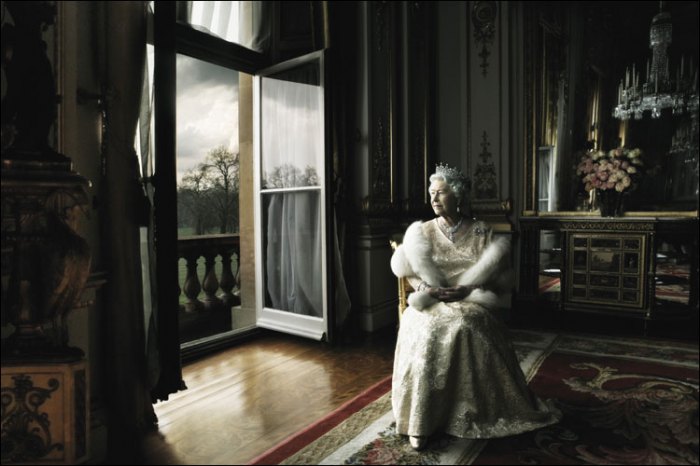
Elizabeth II, Buckingham Palace, London, March 28, 2007. Photograph by Annie Leibovitz.

____________

______________

_____________

Obama Family Portrait Annie Leibovitz

Annie Leibovitz

From Wikipedia, the free encyclopedia
Annie Leibovitz
Annie Leibovitz-SF-1-Crop.jpg

Leibovitz in February 2008
Born Anna-Lou Leibovitz
October 2, 1949 (age 65)
Waterbury, Connecticut, U.S.
Nationality American
Education San Francisco Art Institute
Known for Photography

Anna-Lou “Annie” Leibovitz (/ˈlbəvɪts/; born October 2, 1949) is an Americanportraitphotographer.

Early life[edit]

Born in Waterbury, Connecticut, on October 2, 1949,[1] Anna-Lou Leibovitz is the third of six children of Marilyn Edith (née Heit) and Samuel Leibovitz.[2] She is a third-generation American; her father’s parents were Romanian Jews.[2] Her mother was a modern dance instructor of EstonianJewish heritage. Her father was a lieutenant colonel in the U.S. Air Force. The family moved frequently with her father’s duty assignments, and she took her first pictures when he was stationed in the Philippines during the Vietnam War.[3]

At Northwood High School,[4] she became interested in various artistic endeavors and began to write and play music. She attended the San Francisco Art Institute,[4] where she studied painting. For several years, she continued to develop her photography skills while holding various jobs, including a stint on a kibbutz in Amir, Israel, for several months in 1969.[5]

Career[edit]

Rolling Stone magazine[edit]

When Leibovitz returned to the United States in 1970, she started her career as staff photographer, working for the just launched Rolling Stone magazine. In 1973, publisher Jann Wenner named Leibovitz chief photographer of Rolling Stone, a job she would hold for 10 years. Leibovitz worked for the magazine until 1983, and her intimate photographs of celebrities helped define the Rolling Stone look.[5]

While working for Rolling Stone, Leibovitz became more aware of the other magazines and learned that she could work for magazines and still create personal work, which for her was the most important.[citation needed] She sought intimate moments with her subjects, who “open their hearts and souls and lives to you”. [6]

She was awarded The Royal Photographic Society‘s Centenary Medal and Honorary Fellowship (HonFRPS) in recognition of a sustained, significant contribution to the art of photography in 2009.[citation needed]

Inspirations[edit]

Photographers such as Robert Frank and Henri Cartier-Bresson influenced her during her time at the San Francisco Art Institute. “Their style of personal reportage—taken in a graphic way—was what we were taught to emulate.”[6] Leibovitz has also cited Richard Avedon‘s portraits as an important and powerful example in her life.[citation needed]

The Rolling Stones[edit]

Leibovitz photographed the Rolling Stones in San Francisco in 1971 and 1972, and served as the concert-tour photographer for Rolling Stones Tour of the Americas ’75. Her favorite photo from the tour was a photo of Mick Jagger in an elevator.[7]

Joan Armatrading[edit]

In 1978 Leibovitz became the first woman to photograph Joan Armatrading for an album. She did the photography for Armatrading’s fifth studio album To the Limit, spending four days at her house capturing the images.[8] Liebovitz also did the photography for Armatrading’s live album, Steppin’ Out.[citation needed]

John Lennon[edit]

On December 8, 1980, Leibovitz had a photo shoot with John Lennon for Rolling Stone, and she promised him he would make the cover.[9] She had initially tried to get a picture with just Lennon alone, as Rolling Stone wanted, but Lennon insisted that both he and Yoko Ono be on the cover. Leibovitz then tried to re-create something like the kissing scene from the couple’s Double Fantasy1980 album cover, a picture Liebovitz loved, and she had John remove his clothes and curl up next to Yoko on the floor. Leibovitz recalls, “What is interesting is she said she’d take her top off and I said, ‘Leave everything on’ — not really preconceiving the picture at all. Then he curled up next to her and it was very, very strong. You couldn’t help but feel that he was cold and he looked like he was clinging on to her. I think it was amazing to look at the first Polaroid and they were both very excited. John said, ‘You’ve captured our relationship exactly. Promise me it’ll be on the cover.’ I looked him in the eye and we shook on it.”[10] Leibovitz was the last person to professionally photograph Lennon—he was shot and killed five hours later.[11]

The photograph was subsequently re-created in 2009 by John and Yoko’s son Sean Lennon, posing with his girlfriend Charlotte Kemp Muhl, with male/female roles reversed (Sean clothed, Kemp naked),[12][13] and by Henry Bond and Sam Taylor-Wood in their YBA pastiche October 26, 1993.[14]

In 2011, Leibovitz was nominated alongside Singaporean photographer Dominic Khoo and Wing Shya for Asia Pacific Photographer of the Year.[citation needed]

From Vanity Fair: “For many of New York journalism’s future luminaries—and at least one of Hollywood’s—the strike created an opening for their more literary pursuits. From left to right, Robert Silvers, Calvin Trillin, Nora Ephron, Gay Talese, Pete Hamill, Tom Wolfe, and Jimmy Breslin, photographed by Annie Leibovitz.”

Other projects[edit]

  • In the 1980s, Leibovitz’s new style of lighting and use of bold colors and poses got her a position with Vanity Fair magazine.[15]
  • In 1991, Leibovitz mounted an exhibition at the National Portrait Gallery. She was the second living portraitist and first woman to show there.[11]
  • In 1991, Leibovitz had been made Commandeur de l’Ordre des Arts et des Lettres by the French Government.[11]
  • In 2007, major retrospective of Leibovitz’s work was held at the Brooklyn Museum,[16] The retrospective was based on her book, Annie Leibovitz: A Photographer’s Life, 1990–2005 and included many of her professional (celebrity) photographs as well as numerous personal photographs of her family, children, and partner Susan Sontag. This show, which was expanded to include three of the official portraits of Queen Elizabeth II, then went on the road for seven stops. It was on display at the Corcoran Gallery of Art in Washington, D.C., from October 2007 to January 2008 and at the Palace of the Legion of Honor in San Francisco from March 2008 to May 2008. In February 2009, the exhibition was moved to Berlin, Germany.[17] The show included 200 photographs.[18] At the exhibition, Leibovitz showed that she doesn’t have two lives, career and personal, but has one wherein assignments and personal pictures are all part of her works. This exhibition and her talk focused on her personal photographs and life.[citation needed]
  • In 2007, The BBC misrepresented Leibovitz’s portrait shooting of Queen Elizabeth II, to take the Queen’s official picture for her state visit to Virginia. This was filmed for the BBC documentary A Year with the Queen. A promotional trailer for the film showed the Queen reacting angrily to Leibovitz’s suggestion (“less dressy”) that she remove her tiara, then a scene of the Queen walking down a corridor, telling an aide “I’m not changing anything. I’ve had enough dressing like this, thank you very much.”[19] The BBC later apologized and admitted that the sequence of events had been misrepresented, as the Queen was in fact walking to the sitting in the second scene.[20] This led to a BBC scandal and a shake-up of ethics training.
  • In 2007, The Walt Disney Company hired her to do a series of photographs with celebrities in various roles and scenes for the Walt Disney Parks and ResortsYear of a Million Dreams” campaign.[21][22] Leibovitz claims she never liked the word “celebrity”. “I’ve always been more interested in what they do than who they are, I hope that my photographs reflect that.” She tries to receive a little piece of each subject’s personality in the photos.[6]
  • On April 25, 2008, Entertainment Tonight reported that 15-year-old Miley Cyrus had posed topless for a photo shoot with Vanity Fair.[23][24] The photograph and subsequently released behind-the-scenes photographs show Cyrus topless, her bare back exposed but her front covered with a bedsheet. The photo was taken by Leibovitz.[25] The full photograph was published with an accompanying story on The New York Times website on April 27, 2008. On April 29, 2008,The New York Times clarified: though the pictures left an impression that she was bare-breasted, Cyrus was wrapped in a bedsheet and was actually not topless.[26] Some parents expressed outrage at the nature of the photograph, which a Disney spokesperson described as “a situation [that] was created to deliberately manipulate a 15-year-old in order to sell magazines”.[26]

    In response to the Internet circulation of the photo and ensuing media attention, Cyrus released a statement of apology on April 27:

    “I took part in a photo shoot that was supposed to be ‘artistic’ and now, seeing the photographs and reading the story, I feel so embarrassed. I never intended for any of this to happen and I apologize to my fans who I care so deeply about.”[26]

    Leibovitz also released a statement saying:

    “I’m sorry that my portrait of Miley has been misinterpreted. … The photograph is a simple, classic portrait, shot with very little makeup, and I think it is very beautiful.”[26][27]

  • In October 2011, Leibovitz had an exhibit in Moscow. In an interview with Rossiya 24, she explained her photography style.[28]
  • In 2014, the New-York Historical Society mounted an exhibit of Leibovitz’s work, based on her 2011 book, Pilgrimages.[29]

Archive[edit]

Since 1977, Leibovitz licensing images have been represented by Contact Press Images, a photojournalism agency based in New York City. She ceased to be represented by Jim Moffat at A Corporation for Art & Commerce in 2009.

Personal life[edit]

Children[edit]

Leibovitz has three children. Her daughter Sarah Cameron Leibovitz was born in October 2001 when Leibovitz was 52 years old.[30] Her twins (two girls), Susan and Samuelle, were born to a surrogate mother in May 2005.[31]

Susan Sontag by Annie Leibovitz

Relationships[edit]

Leibovitz had a close relationship with writer and essayist Susan Sontag from 1989 until Sontag’s death in 2004. During Sontag’s lifetime, neither woman publicly disclosed whether the relationship was a platonic friendship or romantic.Newsweek in 2006 made reference to Leibovitz’s decade-plus relationship with Sontag, stating, “The two first met in the late ’80s, when Leibovitz photographed her for a book jacket. They never lived together, though they each had an apartment within view of the other’s.”[32] Leibovitz, when interviewed for her autobiography A Photographer’s Life: 1990-2005 (2006 in literature|2006), said the book told a number of stories, and “with Susan, it was a love story.”[33] While The New York Times in 2009 referred to Sontag as Leibovitz’s “companion”,[34] Leibovitz wrote in A Photographer’s Life that, “Words like ‘companion’ and ‘partner’ were not in our vocabulary. We were two people who helped each other through our lives. The closest word is still ‘friend.'” [35] That same year, Leibovitz said the descriptor “lover” was accurate.[36] She later reiterated, “Call us ‘lovers’. I like ‘lovers.’ You know, ‘lovers’ sounds romantic. I mean, I want to be perfectly clear. I love Susan.”[31]

Religion[edit]

Despite being raised in a Jewish home, Leibovitz no longer practices Judaism. When asked if being Jewish is important to her, Leibovitz replied, “I’m not a practicing Jew, but I feel very Jewish.”[2]

(Image Credit: Merce Cunningham. Photo Annie Leibovitz)

Examples of Leibovitz’s photographs[edit]

Leibovitz in front of her More Demi MooreVanity Fair cover photo, 2008

Johnny Cash & Family by Annie Leibovitz, 2001

___________

Tuesday, October 12, 2010

Annie Leibovitz – Some of my favorites
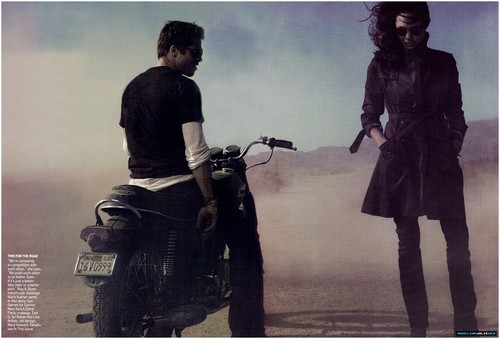
Angelina Jolie and Brad Pitt – just a sexy photo!

The Queen – all she needs is a cup o’ tea and a cucumber sandwich.
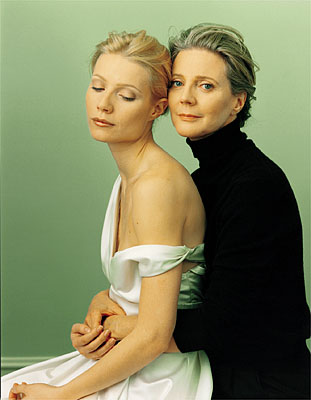
Gwyneth Paltrow and Mother – This little apple did not fall far.

Martina Navratilova

Nicole Kidman

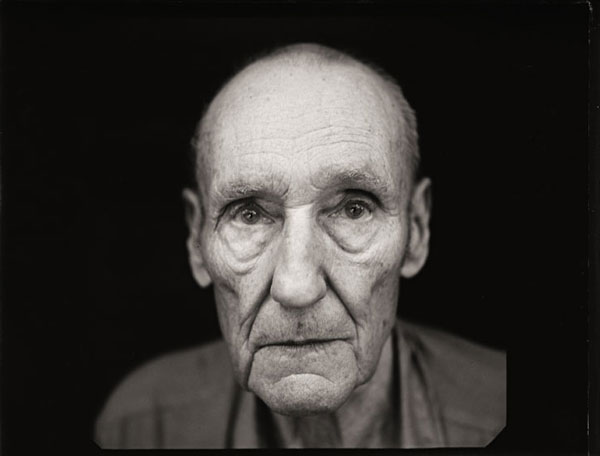
Burroughs

Merce CunninghamEverybody knows Annie and her intriguing photographs of the rich and famous. Her portraiture captures more than just a face – she captures a personality a vision or a way of life with one click of her camera. There are so many inspiring images but these are some of my favorites!
COMMENTS 2

Appreciation Station { Annie Leibovitz }

This weekend I had the absolute pleasure of watching the biography of an incredible photographer, Annie Leibovitz.
It tells her story well, centering around the production of a book of her work(A Photographer’s Life: 1990-2005). So, we get to see her comments on the work as she decides what to put in the book and as she looks back on her past, there are interviews with family and friends, as well as film footage and photos of her youth. It does jump a bit, from current work to old, from childhood to the last few years but this method actually made it even more interesting. It was personal and there are some great candid moments and times where she speaks to her daughter that are really touching.

She has become known as a portrait artist, particularly of celebrities. She tells vivid stories with each picture and expresses parts of the subject’s personality through the theme, story, fashion, pose and expression.

WARNING: This will be a long post as I cannot decide which photos I like best..

She was born in Waterbury, Connecticut and is the third of 6 children. The family travelled a lot because Annie’s father Sam was a lieutenant colonel in the US Air Force. ‘Life Behind a Lens’ shows how family photographs were very important to her mother, Marilyn, and Annie began taking photos when they were stationed in Vietnam. After studying painting at the San Fransico art institute and some time spent in a kibbutz in Israel, she took night classes in photography and began working for (the new at the time) Rolling Stone Magazine. She became chief photographer and was instrumental in the magazine’s style that became iconic.
She says in the movie that she captures the moments between the big events, the things that happen behind the scenes, the thoughtful expressions, the real people behind the media haze. Her inventive and wildly creative images still stand out today in a world saturated with imagery. This in itself is testmament to her greatness.
Annie Leibovitz was the photographer who took the famous picture of Yoko Ono and John Lennon that made the Rolling Stone cover. Five hours after it was taken he was shot and killed.

Due to her mother’s background in dance she was fascinated by movement and how it is captured on camera. Hence she has done work for American Ballet Theatre, the Brooklyn Academy of Music, and the Mark Morris Dance Group, and with Mikhail Baryshnikov.
After Rolling Stone she moved on to Vanity Fair and continues to do great work for them as well as private pieces and photography for Vogue.

Annie’s love, Susan Sontag, a well known writer, passed away in 2004. In ‘Life Through A Lens’ we see how she inspired Annie and gave constructive criticism. They went to Sarajevo as Susan wanted her to capture real life, the despair, the pain, the reality of that place. Preparing her book,A Photographer’s Life: 1990-2005, and compiling her favourite images of Susan was integral to the grieving process after her death.

To quote Vanity Fair: Leibovitz has been designated a Living Legend by the Library of Congress and is the recipient of many other honors, including the Barnard College Medal of Distinction and the Infinity Award in Applied Photography from the International Center of Photography. She was decorated a Commandeur in the Ordre des Arts et des Lettres by the French government. She lives in New York with her three children, Sarah, Susan, and Samuelle.

She is, I agree.. a living legend.

Thanks to Vogue, Rolling Stone and Vanity Fair.

Related posts:

Taking on Ark Times Bloggers on various issues Part I “Old Testament Bible Prophecy” includes the film TRUTH AND HISTORY and article ” Jane Roe became pro-life”

I have gone back and forth and back and forth with many liberals on the Arkansas Times Blog on many issues such as abortion, human rights, welfare, poverty, gun control  and issues dealing with popular culture. Here is another exchange I had with them a while back. My username at the Ark Times Blog is Saline […]

John MacArthur on fulfilled prophecy from the Bible Part 2

I have posted many of the sermons by John MacArthur. He is a great bible teacher and this sermon below is another great message. His series on the Book of Proverbs was outstanding too.  I also have posted several of the visits MacArthur made to Larry King’s Show. One of two most popular posts I […]

John MacArthur on fulfilled prophecy from the Bible Part 1

I have posted many of the sermons by John MacArthur. He is a great bible teacher and this sermon below is another great message. His series on the Book of Proverbs was outstanding too.  I also have posted several of the visits MacArthur made to Larry King’s Show. One of two most popular posts I […]

John MacArthur: Fulfilled prophecy in the Bible? (Ezekiel 26-28 and the story of Tyre, video clips)

Prophecy–The Biblical Prophesy About Tyre.mp4 Uploaded by TruthIsLife7 on Dec 5, 2010 A short summary of the prophecy about Tyre and it’s precise fulfillment. Go to this link and watch the whole series for the amazing fulfillment from secular sources. http://www.youtube.com/watch?v=qvt4mDZUefo ________________ John MacArthur on the amazing fulfilled prophecy on Tyre and how it was fulfilled […]

John MacArthur on the Bible and Science (Part 2)

John MacArthur on the Bible and Science (Part 2) I have posted many of the sermons by John MacArthur. He is a great bible teacher and this sermon below is another great message. His series on the Book of Proverbs was outstanding too.  I also have posted several of the visits MacArthur made to Larry […]

John MacArthur on the Bible and Science (Part 1)

John MacArthur on the Bible and Science (Part 1) I have posted many of the sermons by John MacArthur. He is a great bible teacher and this sermon below is another great message. His series on the Book of Proverbs was outstanding too.  I also have posted several of the visits MacArthur made to Larry […]

Adrian Rogers: “Why I believe the Bible is true”

Adrian Rogers – How you can be certain the Bible is the word of God Great article by Adrian Rogers. What evidence is there that the Bible is in fact God’s Word? I want to give you five reasons to affirm the Bible is the Word of God. First, I believe the Bible is the […]

The Old Testament is Filled with Fulfilled Prophecy by Jim Wallace

Is there any evidence the Bible is true? Articles By PleaseConvinceMe Apologetics Radio The Old Testament is Filled with Fulfilled Prophecy Jim Wallace A Simple Litmus Test There are many ways to verify the reliability of scripture from both internal evidences of transmission and agreement, to external confirmation through archeology and science. But perhaps the […]

Taking on Ark Times Bloggers on various issues Part M “Old Testament prophecy fulfilled?”Part 3(includes film DEATH BY SOMEONE’S CHOICE)

  I have gone back and forth and back and forth with many liberals on the Arkansas Times Blog on many issues such as abortion, human rights, welfare, poverty, gun control  and issues dealing with popular culture. Here is another exchange I had with them a while back. My username at the Ark Times Blog is […]

Evidence for the Bible

Here is some very convincing evidence that points to the view that the Bible is historically accurate. Archaeological and External Evidence for the Bible Archeology consistently confirms the Bible! Archaeology and the Old Testament Ebla tablets—discovered in 1970s in Northern Syria. Documents written on clay tablets from around 2300 B.C. demonstrate that personal and place […]

FRIEDMAN FRIDAY Naomi Klein’s disastrous yet popular polemic against the great free market economist Johan Norberg from the October 2008 issue

_

Defaming Milton Friedman

Naomi Klein’s disastrous yet popular polemic against the great free market economist

Johan Norberg from the October 2008 issue – view article in the Digital Edition

In the future, if you tell a student or a journalist that you favor free markets and limited government, there is a risk that they will ask you why you support dictatorships, torture, and corporate welfare. The reason for the confusion will be Naomi Klein’s book The Shock Doctrine: The Rise of Disaster Capitalism.

In a very short time, the book has become a 21st-century bible for anticapitalists. It has also drawn praise from mainstream reviewers: “There are very few books that really help us understand the present,” gushed The Guardian. “The Shock Doctrine is one of those books.” Writing in The New York Times, the Nobel-winning economist Joseph Stiglitz called it “a rich description of the political machinations required to force unsavory economic policies on resisting countries.”

Klein’s basic argument is that economic liberalization is so unpopular that it can only win through deception or coercion. In particular, it relies on crises. During a natural disaster, a war, or a military coup, people are disoriented, confused, and preoccupied with their own immediate survival, allowing regimes to liberalize trade, to privatize, and to reduce public spending with little opposition. According to Klein, “neoliberal” economists have welcomed Hurricane Katrina, the Southeast Asian tsunami, the Iraq war, and the South American military coups of the 1970s as opportunities to introduce radical free market policies. The chief villain in her story is Milton Friedman, the economist who did more than anyone in the 20th century to popularize free market ideas.

To make her case, Klein exaggerates the market reforms in question, often ignoring central events and rewriting chronologies. She confuses libertarianism with the quite different concepts of corporatism and neoconservatism. And she subjects Milton Friedman to one of the most malevolent distortions of a thinker’s ideas in recent history.

Exhibit A against Friedman is a quote from what Klein calls “one of his most influential essays”: “Only a crisis-actual or perceived-produces real change. When that crisis occurs, the actions that are taken depend on the ideas that are lying around. That, I believe, is our basic function: to develop alternatives to existing policies, to keep them alive and available until the politically impossible becomes politically inevitable.” This, says Klein, is “the shock doctrine.” In a not-very-subtle short film based on the book, the quote appears over images of prisoners being tortured.

Click above to watch Johan Norberg discuss the The Shock Doctrineand the defaming of Milton Friedman.


The quote is not, in fact, from one of Friedman’s most influential essays; it’s from a very brief introduction to a reprint of his book Capitalism and Freedom. And it is not a rationale for welcoming disasters; it’s about the uncontroversial fact that people change their minds when the old ways seem to fail. Friedman provides a telling example, which Klein neglects to quote: Young Americans joined him in opposing the military draft after the Vietnam War forced them to risk their lives on another continent.

She also distorts other Friedman quotes to support her case. She pretends that Friedman’s concept of “the tyranny of the status quo” refers the tyranny of voters, and that he believed crises were needed to bypass the democratic process. But for Friedman, the tyranny was something entirely different: an iron triangle of politicians, bureaucrats, and specialinterest groups (businesses, for example) that deceive voters.

Discussing Friedman’s proposal to reduce inflation through sweeping market reforms, Klein writes, “Friedman predicted that the speed, suddenness and scope of the economic shifts would provoke psychological reactions in the public that ‘facilitate the adjustment.’ ” This gives the impression that Friedman wanted to disorient people through pain in order to push through his reforms. But the quote in its entirety shows that Friedman had something very different in mind. If a government chooses to attack inflation in this way, he wrote, “it should be announced publicly in great detail….The more fully the public is informed, the more will its reactions facilitate the adjustment.” In other words, if voters are not ignorant and not disoriented, but fully informed of the reform steps, they will facilitate the adjustment by changing their saving, consuming, and bargaining behavior. Friedman’s view was the opposite of what Klein claims.

Not content to misrepresent Friedman’s opinions, Klein blames him for various crimes committed around the world. Most notably, she links him to Augusto Pinochet’s brutal military dictatorship in Chile in the 1970s, writing that Friedman acted as “adviser to the Chilean dictator.”

In fact, Friedman never worked as an adviser to, and never accepted a penny from, the Chilean regime. He even turned down two honorary degrees from Chilean universities that received government funding, because he did not want to be seen as endorsing a dictatorship he considered “terrible” and “despicable.” He did spend six days in Chile in March 1975 to give public lectures, at the invitation of a private foundation. When he was there he met with Pinochet for about 45 minutes and wrote him a letter afterward, arguing for a plan to end hyperinflation and liberalize the economy. He gave the same kind of advice to communist dictatorships as well, including the Soviet Union, China, and Yugoslavia.

Klein twists this relationship beyond recognition, claiming Pinochet’s 1973 coup was executed to allow free market economists (“the Chicago Boys,” as the economists from Friedman’s University of Chicago were called) to enact their reforms. This false link is crucial for giving the impression that the Friedmanites have blood on their hands, since the most violent period of the regime came right after the coup. But Friedman’s visit, which Klein claims started the real transformation, came two years later. Klein insists on having it both ways.

The reality was that Chile’s military officials were initially in charge of the economy. They were corporatist and paternalist, and they opposed the Chicago Boys’ ideas. The air force controlled social policy, for example, and it blocked market reforms until 1979. It wasn’t until this approach led to runaway inflation that Pinochet belatedly threw his weight behind liberalization and gave civilians ministerial positions. Their success in fighting inflation impressed Pinochet, so they were given a larger role.

Klein could have used the real chronology to attack Friedman for visiting a dictatorship that tortured its opponents-a commonly heard criticism of the economist-but that’s not enough for her. To find support for her central thesis that economic liberalism requires violence, she has to make it look like torture and violence were the direct outcome of Friedman’s ideas.

Klein also blames Friedmanite economics for the Iraq war, for the International Monetary Fund’s actions during the Asian economic crisis of the late 1990s, and for the Sri Lankan government’s confiscation of fishermen’s property to build luxury hotels after the deadly tsunami of 2005. In a 576-page book about such evils, why wasn’t there room to mention that Milton Friedman opposed the Iraq war, thought the IMF shouldn’t be involved in Asia, and believed governments should be prohibited from expropriating property to give it to private developers? Klein quotes from some interviews in which Friedman voiced these views, but she declines to mention Friedman’s longheld positions that directly undermine her thesis.

Even though Klein is dead wrong about Friedman, she may well be right in her broader thesis that it’s easier to liberalize in times of crisis, and that there is a close connection between economic liberalization and political violence. It’s true that several dictators have liberalized their economies in recent years and that some of them have tortured their opponents.

But how strong is this connection? If we look at the Economic Freedom of the World statistics assembled by the Fraser Institute, a Canadian free market think tank, we find only four economies on the planet that haven’t liberalized at all since 1980, so obviously reform has taken place in all sorts of countries. But the statistics clearly show that most classical liberal reforms happen in democracies, not dictatorships. Klein never talks about such rapidly liberalizing democracies as Iceland, Ireland, Estonia, or Australia, where reforms were given renewed support in several elections. Presumably these countries just aren’t undemocratic and brutal enough. She does discuss Britain under Margaret Thatcher, but only to argue that Thatcher too relied on shocks and violence.

The Iron Lady won re-election in 1983, Klein says, because of the boost she got from the Falklands War. She doesn’t mention another reason for Thatcher’s growing popularity: The British economy was improving rapidly at the time. A 1987 study in the British Journal of Political Science looked in detail at the timing of events and British voters’ perception of them, and made a strong case that the Tories gained only three percentage points from the war; the vast majority of the gain came from improved economic prospects. And the Falklands War certainly cannot explain why Tories won two more elections after that, nor why Tony Blair’s New Labour had to dress itself in Thatcherite clothes to be elected.

__

Naomi Klein usually exaggerates the economic liberalization that has been carried out by brutal dictators. She needs to demonstrate that Pinochet’s interest in market reforms was typical of authoritarian regimes-otherwise, her archvillain Friedman might have been right when he said that the surprising thing in Chile was not that the market worked but that the generals allowed it to work. So Klein ropes in the Argentinean dictatorship of 1976-1983. Based on those two examples, she claims the southern part of Latin America is where “contemporary capitalism was born.” She even calls the countries “Chicago School juntas.”

There were indeed advisers from the University of Chicago in Argentina; since there is strong global demand for Chicago economists, they have visited many countries. But their influence in Argentina was barely noticeable. In the Fraser Institute index of economic freedom, which gives scores from 1 (the least free) to 10 (the most), Argentina moved from 3.25 in 1975 to 3.86 in 1985. Compare this with the countries Klein mentions as superior alternatives to the Chicago Boys’ brutal “neoliberal” models: Sweden went from 5.62 in 1975 to 6.63 in 1985; Malaysia, one of the “mixed, managed economies” Klein prefers, went from 6.43 to 7.13. In 1985, after Argentina allegedly applied Friedman’s ideas, the country’s economy was less marketoriented than all the Eastern European communist economies tracked by Fraser, including Poland, Hungary, and Romania. But Argentina tortured people, so in Klein’s mind it must have been on the fast track to free markets.

By Klein’s account, China is another country that violently imposed Friedmanite reforms. To make this case, she rewrites the history of the Tiananmen Square massacre of 1989, claiming the protesters were primarily opposed to economic liberalization, instead of one-party dictatorship. According to Klein, the Communist Party, led by Deng Xiaoping, attacked them to save its free market program and advance yet more sweeping reforms while people were still in shock.

If the students were indeed protesting economic reform, they seldom expressed that grievance at the time. Instead, they demonstrated in favor of democracy, government transparency, and equality before the law, and against bureaucracy and violence. The protesters first gathered to mourn former Secretary General Hu Yaobang, one of China’s most important economic reformers. The protests soon grew to include everybody who wanted liberal democracy-both those who wanted more economic reform and those who wanted less. Klein equates the second element with the whole protest.

Chinese officials suppressed the demonstrations because they wanted to protect the party’s power, not because they wanted to liberalize the economy. The majority were economic conservatives who were skeptical of markets; some even refused to visit Chinese free trade zones on principle. And the economic reforms did not accelerate after the massacre, as Klein claims. For the first time since their inception, they stalled.

The most consistent free marketeer in the leadership, General Secretary Zhao Ziyang, was purged because he supported the protesters, and he spent the rest of his life under house arrest. (Friedman had met him in Beijing in 1988 and wrote him a letter of advice. For Klein, this is yet another meeting with a tyrant.) Zhao’s rivals-including Premier Li Peng, who was pushing for a violent crackdown on the protesters-then tried to roll the market reforms back and reintroduce economic controls. The conservatives blamed the unrest on the openness associated with economic liberalization, and Deng’s position in the party was weakened. Far from being the start of “shock therapy,” Tiananmen Square was almost the end of China’s economic liberalization. Klein writes that “Tiananmen paved the way for a radical transformation free from fear of rebellion,” but according to the Fraser statistics, China was actually less economically open in 1990 than it was in 1985.

Klein writes that Deng opened the Chinese economy “in the three years immediately following the bloodbath.” This is true only if “immediately” means “three years later.” Reform faltered so much in the years following the crackdown that Deng felt he needed to go outside normal channels and jump-start liberalization in the spring of 1992, even though he was 87 years old and had formally retired. His “southern tour” was a trip filled with speeches and networking aimed at saving the reform program. The tour was not initially reported in the national media, since they were controlled by Deng’s rivals. Deng even found himself forced to write articles supporting his agenda under a pen name to get access. But he was eventually successful in winning local support and building alliances with provincial governors who favored liberalization. Only then did President Jiang Zemin reluctantly support Deng’s reforms.

To show that radical economic liberalization can happen only in dictatorships, Klein compares China to democratic Poland in the late 1980s and early ’90s: “In China, where the state used the gloves-off method of terror, torture and assassination, the result was, from a market perspective, an unqualified success. In Poland, where only the shock of economic crisis and rapid change was harnessed-and there was no overt violence-the effects of the shock eventually wore off, and the results were far more ambiguous.” Once again, the statistics tell a different story. According to the Fraser data, Poland actually took reform farther and faster. In 1985 its economy was much less open, with a score of 3.93 versus China’s 5.11. In 1995, both scored 5.3. In 2005 Poland was way ahead, with 6.83 to China’s 5.9.

Klein also exaggerates the free market elements in anything she can associate with a crisis. She writes that politicians used Hurricane Katrina to introduce “a fundamentalist version of capitalism” in New Orleans. The “fundamentalist” reform in question? The introduction of more charter schools. Not satisfied to exaggerate just the nature of the change, Klein also stretches its extent: She writes that the school board used to run 123 public schools but after the hurricane ran only four, whereas the number of charter schools increased from seven to 31. She doesn’t mention that these figures date to the period immediately after the hurricane, when the school board was much slower to reopen its schools. As of September 2007, ordinary public schools again outnumbered charter schools, 47 to 44.

The strangest thing about Klein’s suggestion that crises benefit free markets and limited government is that there is such a long record of the exact opposite. World War I led to communism in Russia; economic depression gave us Nazi Germany. Wars and other disasters are rarely friends of freedom. On the contrary, politicians and government officials often use crises as an opportunity to increase their budgets and powers. As one prominent economist put it while explaining his opposition to war in Iraq: “War is a friend of the state….In time of war, government will take powers and do things that it would not ordinarily do.” The economist? Milton Friedman.

Friedman was right about the Iraq war: The Bush administration has used that conflict and the larger War on Terror to dramatically expand the federal government’s powers and expenditures. Bizarrely, Klein points to the U.S. after 9/11 as a major illustration of her thesis. She claims the terrorist attacks gave the Bush administration an opportunity to implement Friedman’s ideas by benefiting friends in the defense and security industries with new contracts and unprecedented sums of money. Klein never clearly explains how this could possibly be Friedmanite. In the real world, Friedman “had always emphasized waste in defense spending and the danger to political freedom posed by militarism,” in the words of his biographer Lanny Ebenstein. Somehow, Klein has confused Friedman’s limited-government liberalism with corporatism.

As Klein sees it, in Bush’s America “you have corporatism: big business and big government combining their formidable power to regulate and control the citizenry.” This sounds like a healthy libertarian critique of the administration-something Friedman himself might say. But Klein thinks that Bush-style corporatism is the “pinnacle of the counterrevolution launched by Friedman” and that the team that implemented it is “Friedmanite to the core.”

So even when the U.S. government breaks all the rules in Milton Friedman’s book, Klein blames Friedman. At one point she writes about the lack of openness in the Iraqi economy: “All the…U.S. corporationsthat were in Iraq to take advantage of the reconstruction were part of a vast protectionist racket whereby the U.S. government had created their markets with war, barred their competitors from even entering the race, then paid them to do the work, while guaranteeing them a profit to boot-all at taxpayer expense.” This would be an excellent Friedmanite critique of how governments enrich their friends at the expense of competitors and taxpayers-if it weren’t for the conclusion to the paragraph: “The Chicago School crusade…had finally reached its zenith in this corporate New Deal.”

For Klein, tax-funded corporate welfare is the zenith of Chicago’s free market revolution. The idea seems to be that Milton Friedman likes corporations, so if governments give corporations contracts, subsidies, protection, and privileges, that must be Friedmanite. At times it seems like Klein thinks any policy is Friedmanite if private companies are involved. But you would have a hard time finding an economist more persistent than Friedman in warning how corporations and capitalists conspire against the public to obtain special privileges. As Friedman wrote in reason in 1978: “Business corporations in general are not defenders of free enterprise. On the contrary, they are one of the
chief sources of danger….Every businessman is in favor of freedom for everybody else, but when it comes to himself that’s a different question. We have to have that tariff to protect us against competition from abroad. We have to have that special provision in the tax code. We have to have that subsidy.”

In the absence of serious arguments against free markets, we are left with Klein’s reasonable critiques of torture, dictatorships, corruption, and corporate welfare. In essence, her book says that Milton Friedman’s limitedgovernment ideals are bad because governments are incompetent, corrupt, and cruel. If there is a disaster here, it is not one of Friedman’s making.

Johan Norberg (info@johannorberg.net) is a Swedish historian of ideas and a senior fellow at the Cato Institute, which published another version of this article.

Related posts:

Milton and Rose Friedman “Two Lucky People”

July 31, 2012 – 6:43 am

Milton Friedman on Hayek’s “Road to Serfdom” 1994 Interview 2 of 2 Uploaded by PenguinProseMedia on Oct 26, 2011 2nd half of 1994 interview. ________________ I have a lot of respect for the Friedmans.Two Lucky People by Milton and Rose Friedman reviewed by David Frum — October 1998. However, I liked this review below better. It […] By Everette Hatcher III | Posted in Current EventsMilton Friedman | Edit | Comments (0)

Video clip:Milton Friedman discusses his view of numerous political figures and policy issues in (Part 2)

July 25, 2012 – 2:16 am

Milton Friedman on Hayek’s “Road to Serfdom” 1994 Interview 1 of 2 Uploaded by PenguinProseMedia on Oct 25, 2011 Says Federal Reserve should be abolished, criticizes Keynes. One of Friedman’s best interviews, discussion spans Friedman’s career and his view of numerous political figures and public policy issues. ___________________ Here is a review of “Two Lucky People.” […] By Everette Hatcher III | Posted in Milton Friedman | Edit | Comments (0)

Milton Friedman believed in liberty (Interview by Charlie Rose of Milton Friedman part 1)

July 24, 2012 – 10:01 am

Charlie Rose interview of Milton Friedman My favorite economist: Milton Friedman : A Great Champion of Liberty  by V. Sundaram   Milton Friedman, the Nobel Prize-winning economist who advocated an unfettered free market and had the ear of three US Presidents – Nixon, Ford and Reagan – died last Thursday (16 November, 2006 ) in San Francisco […] By Everette Hatcher III | Posted in Milton Friedman | Edit | Comments (0)

“The Failure of Socialism” episode of Free to Choose in 1990 by Milton Friedman (Part 1)

June 4, 2012 – 1:59 pm

Milton Friedman: Free To Choose – The Failure Of Socialism With Ronald Reagan (Full) Published on Mar 19, 2012 by NoNationalityNeeded Milton Friedman’s writings affected me greatly when I first discovered them and I wanted to share with you. We must not head down the path of socialism like Greece has done. Abstract: Ronald Reagan […] By Everette Hatcher III | Posted in Milton FriedmanRonald Reagan | Edit | Comments (0)

Milton Friedman – The Negative Income Tax

Volume 1: Power of the Market Volume 2: The Tyranny of Control
Volume 3: Anatomy of a Crisis
Volume 4: From Cradle to Grave
Volume 5: Created Equal
Volume 6: What’s Wrong With Our Schools?
Volume 7: Who Protects the Consumer?
Volume 8: Who Protects the Worker?
Volume 9: How to Cure Inflation
Volume 10: How to Stay Free

Updated 1990 Series:
Volume 1: The Power of the Market
Volume 2: The Tyranny of Control
Volume 3: Freedom & Prosperity
Volume 4: The Failure of Socialism
Volume 5: Created Equal

_____________________

___________

FRANCIS SCHAEFFER ANALYZES ART AND CULTURE Part 309 Letter to Richard Dawkins concerning Darwin’s words at the end of his life “I cannot endure to read a line of poetry: I have tried lately to read Shakespeare, and found it so intolerably dull that it nauseated me” Featured Artist is Leonardo da Vinci

_

Image result for richard dawkins outgrowing god

_

Image result for richard dawkins outgrowing god

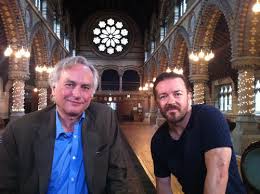
Richard Dawkins and Ricky Gervais

Image result for richard dawkins ricky gervais london

_

August 30, 2019

Richard Dawkins c/o Richard Dawkins Foundation, 
Washington, DC 20005

Dear Mr. Dawkins,

The answer to find meaning in life is found in putting your faith and trust in Jesus Christ. The Bible is true from cover to cover and can be trusted.

On August 28, 2019 you tweeted:

Beethoven’s heiliger Dankgesang: lunchtime listening inspired by Aldous Huxley’s Spandrell who tries to persuade Rampion (the DH Lawrence character) that the music proves God. Rampion demurs, but on spurious aesthetic grounds rather than because art can’t deliver such a proof

I tweeted in response:

Charles Darwin:  formerly [art] gave me considerable, and music very great delight. My mind seems to have become a kind of machine…The loss of these tastes is a loss of happiness 

Just like Darwin you lost what little faith you had not  overnight but it was  over time. Also your love of music made me think of you when I read the book Charles Darwin: his life told in an autobiographical chapter, and in a selected series of his published letters because of what Darwin said about science causing him to lose his aesthetic tastes. I am going to quote some of Charles Darwin’s own words and then include the comments of Francis Schaeffer on those words. 

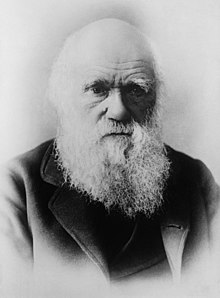
Charles Darwin

 CHARLES DARWIN’S AUTOBIOGRAPHY. Addendum. Written May 1st, 1881 [the year before his death].

“I have said that in one respect my mind has changed during the last twenty or thirty yearsUp to the age of thirty, or beyond it, poetry of many kinds, such as the works of Milton, Gray, Byron, Wordsworth, Coleridge, and Shelley, gave me great pleasure, and even as a schoolboy I took intense delight in Shakespeare, especially in the historical plays. I have also said that formerly pictures gave me considerable, and music very great delight. But now for many years I cannot endure to read a line of poetry: I have tried lately to read Shakespeare, and found it so intolerably dull that it nauseated me. I have also almost lost my taste for pictures or music. Music generally sets me thinking too energetically on what I have been at work on, instead of giving me pleasure. I retain some taste for fine scenery, but it does not cause me the exquisite delight which it formerly did….My mind seems to have become a kind of machine for grinding general laws out of large collections of facts, but why this should have caused the atrophy of that part of the brain alone, on which the higher tastes depend, I cannot conceive….The loss of these tastes is a loss of happiness, and may possibly be injurious to the intellect, and more probably to the moral character, by enfeebling the emotional part of our nature.”

Francis Schaeffer commented:

This is the old man Darwin writing at the end of his life. What he is saying here is the further he has gone on with his studies the more he has seen himself reduced to a machine as far as aesthetic things are concerned. I think this is crucial because as we go through this we find that his struggles and my sincere conviction is that he never came to the logical conclusion of his own position, but he nevertheless in the death of the higher qualities as he calls them, art, music, poetry, and so on, what he had happen to him was his own theory was producing this in his own self just as his theories a hundred years later have produced this in our culture. 

Darwin, C. R. to Fordyce, John, 7 May 1879

“I may state that my judgment often fluctuates . . . In my most extreme fluctuations I have never been an Atheist in the sense of denying the existence of a God. I think that generally (and more and more as I grow older), but not always, that an Agnostic would be the more correct description of my state of mind.”

Francis Schaeffer asserted:

What we find now is that he comes to the place in being agnostic, but as we read through this section on religion what we find is in reality his reason leads him against this position, which is interesting but his theory makes him accept the  position of agnosticism….. I think what you have in Darwin is a magnificent example, although a sad one of what I lecture on in apologetics,  and that is if a man takes a set of nonchristian presuppositions he is forced eventually to be in a place of tension. The more consistent he is with his own nonchristian presuppositions the more he is away from the real world. When he is closer to the real world then he is more illogical to his own presuppositions.

Darwin, C. R. to Doedes, N. D., 2 Apr 1873

“But I  may say that the impossibility of conceiving that this grand and wondrous universe, with our conscious selves, arose through chance, seems to me the chief argument for the existence of God; but whether this is an argument of real value, I have never been able to decide.”

Francis Schaeffer observed:

So he sees here exactly the same that I would labor and what Paul gives in Romans chapter one, and that is first this tremendous universe [and it’s form] and the second thing, the mannishness of man and the concept of this arising from chance is very difficult for him to come to accept and he is forced to leap into this, his own kind of Kierkegaardian leap, but he is forced to leap into this because of his presuppositions but when in reality the real world troubles him. He sees there is no third alternative. If you do not have the existence of God then you only have chance. In my own lectures I am constantly pointing out there are only two possibilities, either a personal God or this concept of the impersonal plus time plus chance and Darwin understood this . You will notice that he divides it into the same exact two points that Paul does in Romans chapter one into and that Carl Gustav Jung (1875-1961) will in the problem of existence, the external universe, and man and his consciousness. Paul points out there are these two steps that man is confronted with…

______________

Here below is the Romans passage that Schaeffer is referring to and verse 19 refers to what Schaeffer calls “the mannishness of man” and verse 20 refers to Schaeffer’s other point which is  “the universe and it’s form.”Romans 1:18-22Amplified Bible (AMP) 18 For God’s [holy] wrath and indignation are revealed from heaven against all ungodliness and unrighteousness of men, who in their wickedness repress and hinder the truth andmake it inoperative. 19 For that which is known about God is evident to them and made plain in their inner consciousness, because God [Himself] has shown it to them. 20 For ever since the creation of the world His invisible nature and attributes, that is, His eternal power and divinity, have been made intelligible andclearly discernible in and through the things that have been made (His handiworks). So [men] are without excuse [altogether without any defense or justification], 21 Because when they knew and recognized Him as God, they did not honor andglorify Him as God or give Him thanks. But instead they became futile andgodless in their thinking [with vain imaginings, foolish reasoning, and stupid speculations] and their senseless minds were darkened. 22 Claiming to be wise, they became fools [professing to be smart, they made simpletons of themselves]

In 1879 Charles Darwin was applied to by a German student, in a similar manner. The letter was answered by a member of my father’s family, who wrote:–

“Mr. Darwin…considers that the theory of Evolution is quite compatible with the belief in a God; but that you must remember that different persons have different definitions of what they mean by God.” 

Francis Schaeffer commented:

You find a great confusion in his writings although there is a general structure in them. Here he says the word “God” is alright but you find later what he doesn’t take is a personal God. Of course, what you open is the whole modern linguistics concerning the word “God.” is God a pantheistic God? What kind of God is God? Darwin says there is nothing incompatible with the word “God.”

This, however, did not satisfy the German youth, who again wrote to my father, and received from him the following reply:—

” Science has nothing to do with Christ, except in so far as the habit of scientific research makes a man cautious in admitting evidence. For myself, I do not believe that there ever has been any revelation.”

Francis Schaeffer observed:

So he has come to the place as an old man that he doesn’t believe there has been any revelation. In his younger years he held a different position.

The passages which here follow are extracts, somewhat abbreviated, from a part of the Autobiography, written in 1876, in which my father gives the history of his religious views:—“During these two years* (ft note *October 1836 to January 1839.) I was led to think much about religion. Whilst on board the Beagle I was quite orthodox, and I remember being heartily laughed at by several of the officers (though themselves orthodox) for quoting the Bible as an unanswerable authority on some point of morality.

Francis Schaeffer noted:

So you find that as a younger man he did accept the Bible. As an older man he has given up revelation but he is not satisfied with his own answers. He is caught in the tension that modern man is caught in. He is a prefiguration  of the modern man and he himself contributed to. Then Darwin goes on and tells us why he gave up the Bible.

Darwin went on to write:

I suppose it was the novelty of the argument that amused them. But I had gradually come by this time, i.e. 1836 to 1836, to see that the Old Testament was no more to be trusted than the sacred books of the Hindoos. The question then continually rose before my mind and would not be banished,—is it credible that if God were now to make a revelation to the Hindoos, he would permit it to be connected with the belief in Vishnu, Siva, &c., as Christianity is connected with the Old Testament? This appeared to me utterly incredible.

Francis Schaeffer asserted:

Darwin is saying that he gave up the New Testament because it was connected to the Old Testament. He gave up the Old Testament because it conflicted with his own theory. Did he have a real answer himself and the answer is no. At the end of his life we see that he is dehumanized by his position and on the other side we see that he never comes to the place of intellectual satisfaction for himself that his answers were sufficient.

Darwin continued:

“BUT I WAS VERY UNWILLING  TO GIVE UP MY BELIEF; I feel sure of this, for I can well remember often and often inventing day-dreams of old letters between distinguished Romans, and manuscripts being discovered at Pompeii or elsewhere, which confirmed in the most striking manner all that was written in the Gospels.

Francis Schaeffer commented:

This is very sad. He lies on his bunk and the Beagle tosses and turns and he makes daydreams, and his dreams and hopes are that someone would find in Pompeii or some place like this, an old manuscript by a distinguished Roman that would put his stamp of authority on it, which would be able to show that Christ existed. This is undoubtedly what he is talking about. Darwin gave up this hope with great difficulty. I think he didn’t want to come to the position where his accepted presuppositions were driving him. He didn’t want to give it up, just as an older man he understood where it would lead…

———–

The area of Biblical Archaeology has advanced so much since Darwin wrote these words in the 19th century!!!!! DR Sulston ASK YOURSELF THIS SIMPLE QUESTION BEFORE YOU PUT YOUR FAITH IN THE ACCURACY OF THE SCRIPTURES: Is the Bible historically accurate and have I taken the time to examine the evidence? Here are some of the posts I have done in the past on the subject and if you like you could just google these subjects: 1. The Babylonian Chronicleof Nebuchadnezzars Siege of Jerusalem2. Hezekiah’s Siloam Tunnel Inscription. 3. Taylor Prism (Sennacherib Hexagonal Prism)4. Biblical Cities Attested Archaeologically. 5. The Discovery of the Hittites6.Shishak Smiting His Captives7. Moabite Stone8Black Obelisk of Shalmaneser III9A Verification of places in Gospel of John and Book of Acts., 9B Discovery of Ebla Tablets10. Cyrus Cylinder11. Puru “The lot of Yahali” 9th Century B.C.E.12. The Uzziah Tablet Inscription13. The Pilate Inscription14. Caiaphas Ossuary14 B Pontius Pilate Part 214c. Three greatest American Archaeologists moved to accept Bible’s accuracy through archaeology.,

Darwin also noted:

“But I found it more and more difficult, with free scope given to my imagination, to invent evidence which would suffice to convince me. Thus disbelief crept over me at a very slow rate, but was at last complete. THE RATE WAS SLOW that I felt no distress. Although I did not think much about the existence of a personal God until a considerably later period of my life,”

Francis Schaeffer commented:

So there is something deficient in his position from the beginning. The word of God if it is going to mean something, must mean a personal God. The word “God” is without much meaning otherwise.

_________________

Francis Schaeffer noted that in Darwin’s 1876 Autobiography that Darwin he is going to set forth two arguments for God in this and again you will find when he comes to the end of this that he is in tremendous tension. Darwin wrote, 

“At the present day the most usual argument for the existence of an intelligent God is drawn from the deep inward conviction and feelings which are experienced by most persons.Formerly I was led by feelings such as those just referred to (although I do not think that the religious sentiment was ever strongly developed in me), to the firm conviction of the existence of God and of the immortality of the soul. In my Journal I wrote that whilst standing in the midst of the grandeur of a Brazilian forest, ‘it is not possible to give an adequate idea of the higher feelings of wonder, admiration, and devotion which fill and elevate the mind.’ I well remember my conviction that there is more in man than the mere breath of his body; but now the grandest scenes would not cause any such convictions and feelings to rise in my mind. It may be truly said that I am like a man who has become COLOUR-BLIND.”

Francis Schaeffer remarked:

Now Darwin says when I look back and when I look at nature I came to the conclusion that man can not be just a fly! But now Darwin has moved from being a younger man to an older man and he has allowed his presuppositions to enter in to block his logic, these things at the end of his life he had no intellectual answer for. To block them out in favor of his theory. Remember the letter of his that said he had lost all aesthetic senses when he had got older and he had become a clod himself. Now interesting he says just the same thing, but not in relation to the arts, namely music, pictures, etc, but to nature itself. Darwin said, “But now the grandest scenes would not cause any such convictions  and feelings to rise in my mind. It may be truly said that I am like a man who has become colour-blind…” So now you see that Darwin’s presuppositions have not only robbed him of the beauty of man’s creation in art, but now the universe. He can’t look at it now and see the beauty. The reason he can’t see the beauty is for a very, very , very simple reason: THE BEAUTY DRIVES HIM TO DISTRACTION. THIS IS WHERE MODERN MAN IS AND IT IS HELL. The art is hell because it reminds him of man and how great man is, and where does it fit in his system? It doesn’t. When he looks at nature and it’s beauty he is driven to the same distraction and so consequently you find what has built up inside him is a real death, not  only the beauty of the artistic but the beauty of nature. He has no answer in his logic and he is left in tension.  He dies and has become less than human because these two great things (such as any kind of art and the beauty of  nature) that would make him human  stand against his theory.

________________

Darwin like you was consistent with his view of the UNIFORMITY OF  NATURAL CAUSES in a closed system and it cost him the love of music, art and the beauty of nature. TWO OTHER ALSO HELD THIS SAME view  of uniformity of natural causes in a closed system in 1978 when their hit song DUST IN THE WIND rose to the top 10 in the music charts.

_______________________________________

IF WE ARE LEFT WITH JUST THE MACHINE THEN WHAT IS THE FINAL CONCLUSION IF THERE WAS NO PERSONAL GOD THAT CREATED US? I sent you a CD that starts off with the song DUST IN THE WIND by Kerry Livgren of the group KANSAS which was a hit song in 1978 when it rose to #6 on the charts because so many people connected with the message of the song. It included these words, “All we do, crumbles to the ground though we refuse to see, Dust in the Wind, All we are is dust in the wind, Don’t hang on, Nothing lasts forever but the Earth and Sky, It slips away, And all your money won’t another minute buy.”

Kerry Livgren himself said that he wrote the song because he saw where man was without a personal God in the picture. Solomon pointed out in the Book of Ecclesiastes that those who believe that God doesn’t exist must accept three things. FIRST, death is the end and SECOND, chance and time are the only guiding forces in this life.  FINALLY, power reigns in this life and the scales are never balanced. The Christian can  face death and also confront the world knowing that it is not determined by chance and time alone and finally there is a judge who will balance the scales.

Both Kerry Livgren and the bass player Dave Hope of Kansas became Christians eventually. Kerry Livgren first tried Eastern Religions and Dave Hope had to come out of a heavy drug addiction. I was shocked and elated to see their personal testimony on The 700 Club in 1981 and that same  interview can be seen on You Tube today. Livgren lives in Topeka, Kansas today where he teaches “Diggers,” a Sunday school class at Topeka Bible ChurchDAVE HOPE is the head of Worship, Evangelism and Outreach at Immanuel Anglican Church in Destin, Florida.

Thank you again for your time and I know how busy you are.

Everette Hatcher, everettehatcher@gmail.comhttp://www.thedailyhatch.org, cell ph 501-920-5733, Box 23416, LittleRock, AR 72221, United States

Francis Schaeffer below:

Image result for richard dawkins francis schaeffer

Richard Dawkins vs John Lennox | The God Delusion Debate

Ben Stein vs. Richard Dawkins Interview


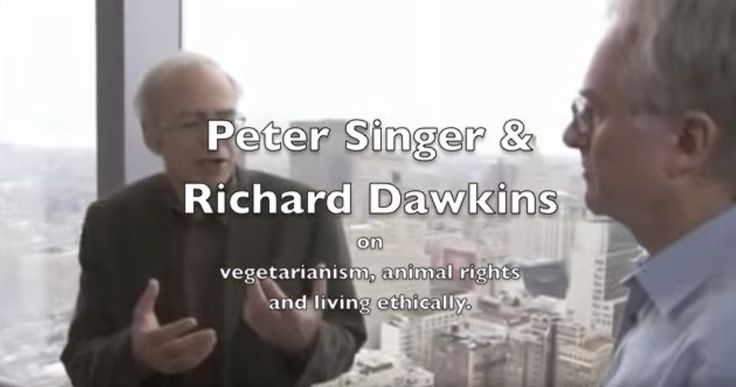
XXXX Peter Singer – The Genius of Darwin: The Uncut Interviews – Richard Dawkins

XXXXXXX

__

Image result for richard dawkins peter singer

__

Science Confirms the Bible with Ken Ham

__

Image result for richard dawkins young

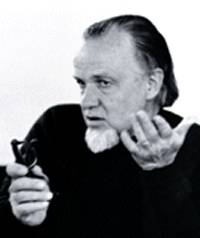
Schaeffer with his wife Edith in Switzerland.


Image result for john lennox and richard dawkins

Richard Dawkins and John Lennox

_

DawkinsWard

_

Francis and Edith Schaeffer seen below:

Image result for francis schaeffer

__

Image result for francis schaeffer c. everett koop whatever happened to human race?

_

Dawkins, Hitchens, Dennett, Harris 

Image result for four horsemen richard dawkins

Canary Islands 2014: Harold Kroto and Richard Dawkins

Image result for harry kroto richard dawkins

__

Francis Schaeffer pictured below:

Image result for francis schaeffer

The Basis of Human Dignity by Francis Schaeffer

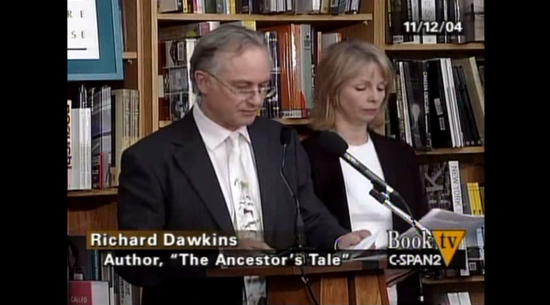
Richard Dawkins, founder of the Richard Dawkins Foundation for Reason and Science. Credit: Don Arnold Getty Images

Francis Schaeffer in 1984

Christian Manifesto by Francis Schaeffer

Francis Schaeffer in 1982

—-

Whatever Happened to the Human Race? Episode 1

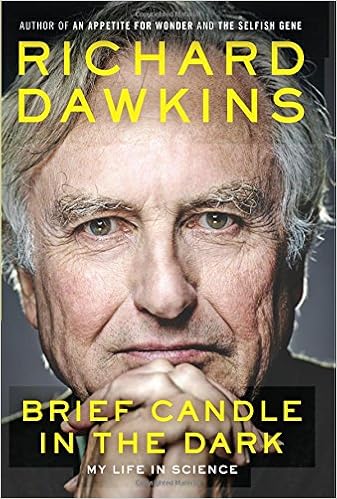
Image result for richard dawkins brief candle in the dark

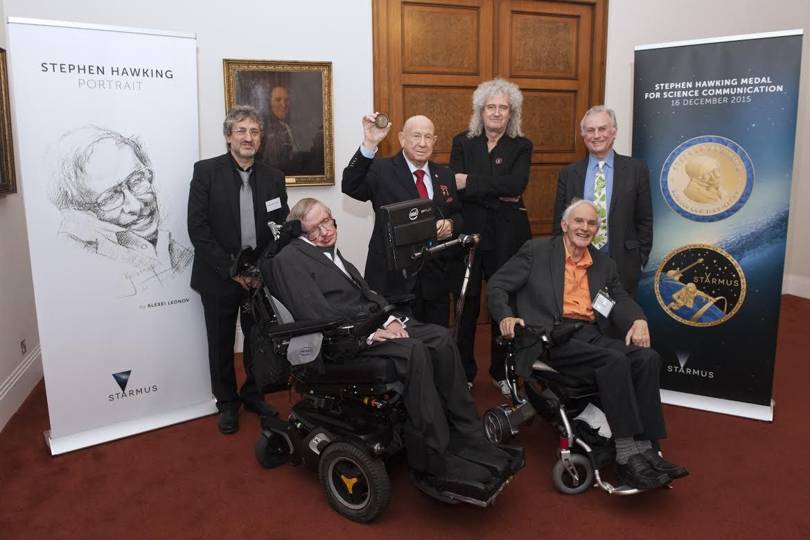
Garik Israelian, Stephen Hawking, Alexey Leonov, Brian May, Richard Dawkins and Harry Kroto

—-

—-

—-

Dark History of Evolution-Henry Morris, Ph.D.

—-

Featured artist is Leonardo da Vinci

Vinci, Leonardo da – by H.R. Rookmaaker

Leonardo da Vinci: brilliant and universalby H.R. Rookmaaker   It’s not easy to summarize the contributions of Leonardo in a short space. For Leonardo was an extraordinarily diverse man: musician, fortress builder, engineer, eminent equestrian, sculptor, painter, architect, anatomist, naturalist, and art theoretician. He was a man with far too diverse interests; as a result many of his ideas remained in their concept stage and he managed to carry out or complete only a fraction of all that his inventive spirit considered or imagined.   Moreover, some of his important works – the fresco of the Battle of Anghiari in Florence and the huge statue of a horseman in Milan – were destroyed during his lifetime, so that his legacy became even more fragmented. Nevertheless, he is and will remain a figure who can only be underrated for it is hardly possible to judge him too highly. Why? Without his influence, Italian painting, especially in Northern Italy during the sixteenth century and into the seventeenth century, would certainly have developed differently.   Yet, this is not the greatest of his contributions. His buildings and designs are not without interest; neither are his writings about art theory. But in these things he was not alone. The talents that earned him such an eminent position in the court at Milan – including horsemanship, musicianship and his work as building engineer – naturally has less significance for later generations. His engineering projects, which included a design for an aeroplane, were so far ahead of his time that their true value is only now fully appreciated, yet we cannot say for sure that without Leonardo’s inventions the course of technology would have developed differently. So, what essentially does give this man such and exceptional position in history? We believe that though Leonardo was and is such a fascinating figure, it is especially in the field of drawing and science – or rather, in connecting the two – that his greatest contribution is to be found. As a student Leonardo worked for years in the studio of Verrocchio and learnt there the art of a very exact representation of reality – a number of drapery studies in the exhibition attest to this. But Leonardo was the first person to go on and make use of his new skills in the service of science. That was his greatest contribution and his greatest service to the world. He was the first one to record his anatomical findings in precise drawings – so exact that they are still of scientific merit.   Leonardo’s observations in the area of the natural sciences were preserved by his never-resting drawing pencil. And in the connection between the exact sciences (in which he also broke new territory) and the art of exact drawing lies a principle upon which modern science (amongst others) is founded: modern medical science could not function without the very precise drawings which allowed Leonardo’s discoveries to be shared with others. Anyone who understands the important role of drawing in engineering will realize that Leonardo’s discovery also made modern applied science and technology possible. All this does not detract from his excellence as a ‘free’ sketcher. It is a feast to submit oneself to Leonardo’s drawings – one may be tempted to say that his lines are flawless.   Originally published in Dutch in Trouw, no date (between 1949 and 1956).   Published in English in M. Hengelaar-Rookmaaker (ed.): H.R. Rookmaaker: The Complete Works 1, Piquant – Carlisle, 2003. Also obtainable as a CD-Rom. piquanteditions.com/product_info.php and piquanteditions.com/product_info.php

_____________

—-

Related posts:

RESPONDING TO HARRY KROTO’S BRILLIANT RENOWNED ACADEMICS!! Part 48 Nobel Prize Winner and Global Warming Denier Ivar Giaever “I think religion is to blame for a lot of the ills in this world!”

October 20, 2015 – 5:20 am

  On November 21, 2014 I received a letter from Nobel Laureate Harry Kroto and it said: …Please click on this URL http://vimeo.com/26991975 and you will hear what far smarter people than I have to say on this matter. I agree with them. Harry Kroto _________________ Below you have picture of 1996 Chemistry Nobel Prize Winner […]

FRANCIS SCHAEFFER ANALYZES ART AND CULTURE PART 78 THE BEATLES (Breaking down the song TOMORROW NEVER KNOWS) Featured musical artist is Stuart Gerber

September 24, 2015 – 5:42 am

The Beatles were “inspired by the musique concrète of German composer and early electronic music pioneer Karlheinz Stockhausen…”  as SCOTT THILL has asserted. Francis Schaeffer noted that ideas of  “Non-resolution” and “Fragmentation” came down German and French streams with the influence of Beethoven’s last Quartets and then the influence of Debussy and later Schoenberg’s non-resolution which is in total contrast […]

RESPONDING TO HARRY KROTO’S BRILLIANT RENOWNED ACADEMICS!! Part 42 Peter Singer, Professor of Bioethics at Princeton University, THE PROBLEM OF EVIL

September 8, 2015 – 5:10 am

  _______ On November 21, 2014 I received a letter from Nobel Laureate Harry Kroto and it said: …Please click on this URL http://vimeo.com/26991975 and you will hear what far smarter people than I have to say on this matter. I agree with them. Harry Kroto _________________ Below you have picture of 1996 Chemistry Nobel Prize […]
RESPONDING TO HARRY KROTO’S BRILLIANT RENOWNED ACADEMICS!! Bart Ehrman “Why should one think that God performed the miracle of inspiring the words in the first place if He didn’t perform the miracle of preserving the words?”

September 2, 2015 – 8:42 am

On November 21, 2014 I received a letter from Nobel Laureate Harry Kroto and it said: …Please click on this URL http://vimeo.com/26991975 and you will hear what far smarter people than I have to say on this matter. I agree with them. Harry Kroto ____________________ Below you have picture of 1996 Chemistry Nobel Prize Winner Dr. […]

WOODY WEDNESDAY Open Letter to Woody Allen Part 14 “I wanted to share with you an article by Adrian Warnock that is about you and Billy Graham. The reason I think you owe it to Billy to read this is because you promised to attend one of his crusades and probably never did”

Woody Allen On Bergman

Woody Allen On Bergman

Woody Allen Show

November 1, 2019

Woody Allen c/o Randon House, 1745 Broadway, New York,NY 10019

Dear Woody,

I wanted to share with you an article by Adrian WARNOCK that is about you and Billy Graham. The reason I think you owe it to Billy to read this is because you promised to attend one of his crusades and probably never did. This way you can read the words from his last crusade!! One commentator noted:

 I think it’s hilarious to hear Woody, in front of one of the most famous religious figures of his day, say that not having premarital sex is like “getting a driver’s license without a learner’s permit.” Or when Woody says that he doesn’t use any type of drug and Graham admits to drinking coffee and says he need’s Woody’s help, Allen can’t resist responding “Yes, if you have faith in me, I will lead you.” It’s one of the strangest pairings in all of television and it makes for some really compelling watching.

Billy Graham’s TED talk, Woody Allen & Larry King

 MARCH 15, 2018 BY ADRIAN WARNOCK

Billy was interviewed on TV over several decades, and even gave a TED talk. One of the many things we would do well to learn from Billy Graham is his winsomeness. This series of TV appearances which span decades, you see a man who doesn’t compromise his faith, but who speaks in such a winsome way that he even had Woody Allen agreeing to attend one of his Revival meetings despite the fact he states he disagrees with much of what Billy said. These videos are good examples of how we can give a witness whilst speaking the truth in love.

Billy Graham’s TED talk (1998)


My Notes:
 King David’s success was in part due to a technological innovation, the introduction of iron…a bit like the impact that the microchip has had on our generation. David found there were many problems technology cannot solve. They are still with us. Nobody has solved them. Here are three problems:

1. Human evil Where does it come from, how do we solve it? Something is wrong. The Bible says the problem is within us. We are separated from our Creator and we need to have our souls restored. David could not free himself from personal failure which included adultery and murder. He sought God to restore his soul.

2. Why do we suffer? I have never met a person in the world who didnt have a problem.


3. Death.
 This is the forbidden subject of our generation. Most people live as though they are never going to die. Death is inevitable. There is one thing that we all have in common: we are all going to die. It’s often difficult for young people to understand that. There is a time to be born and a time to die. I have stood at the death bed of several famous people. I have seen them when they were scared to death. A few years earlier death never crossed their mind. The greatest surprise in my life is the brevity of life. It passes so fast. How should one live in order not to feel regret when one is dying.

King David lived to be 70 yet he too had to face death and he wrote ‘even though I walk through he valley of the shadow of death I will fear no evil for you are with me.” This was David’s answer to the three dilemmas of evil, suffering and death. It can be yours too if you will seek the living God and allow him to fill your live and to give you hope for the future. I am ready when I hear that call to go into the presence of God.

Billy Graham’s 911 Cathedral Message (2001)

“God can be trusted, even when life seems at its darkest . . . I have to accept by faith that God is sovereign, and the God of love and mercy and compassion in the midst of suffering. The Bible says that God is NOT the author of evil . . . One of the things we desperately need is a spiritual renewal . . . As a Christian I have hope not just for this life, but for heaven and the life to come . . . I pray that you will have this hope in your heart . . . This event reminds us of the brevity and uncertainty of life . . . Each of us needs to face his own spiritual need and commit himself to God. . . The cross tells us God understands our sins and our sufferings. . . from the cross God tells us that I love you. . .Easter points beyond the cross to the empty tomb and points us to hope for eternal life. . . The older I get the more I cling to the hope I started with many years ago, which I proclaimed to many countries.”

—-


Francis Schaeffer has correctly argued:

The universe was created by an infinite personal God and He brought it into existence by spoken word and made man in His own image. When man tries to reduce [philosophically in a materialistic point of view] himself to less than this [less than being made in the image of God] he will always fail and he will always be willing to make these impossible leaps into the area of nonreason even though they don’t give an answer simply because that isn’t what he is. He himself testifies that this infinite personal God, the God of the Old and New Testament is there. 

Instead of making a leap into the area of nonreason the better choice would be to investigate the claims that the Bible is a historically accurate book and that God created the universe and reached out to humankind with the Bible. Below is a piece of that evidence given by Francis Schaeffer concerning the accuracy of the Bible.

TRUTH AND HISTORY (chapter 5 of WHATEVER HAPPENED TO THE HUMAN RACE?, under footnote #94)

There is also a confirmation of what the Bible says concerning the Egyptian King Tirhakahwho came up to oppose the Assyrians. Confirmation of his reality is typified by a sphinx-ram in the British Museum (British Museum Ref. B.B.1779). The small figure between the legs of the ram is a representation of King Tirhakah. The Bible says that when Sennacherib heard that  Tirhakah, king of Eqypt, was coming to fight against him, he sent messengers to tell Hezekiah that help from Egypt would be of no use to him.

2 Kings 19:9, 10 Now the king heard concerning Tirhakah king of Cush, “Behold, he has set out to fight against you.” So he sent messengers again to Hezekiah, saying,10 “Thus shall you speak to Hezekiah king of Judah: ‘Do not let your God in whom you trust deceive you by promising that Jerusalem will not be given into the hand of the king of Assyria. (Isaiah 37:9-10 also says about the same thing.)

The date of Sennacherib’s campaign in Palestine is 701 B.C., and something which has often puzzled historians is the role of Tirhakah, who was not king of Egypt and Ethiopia until 690 B.C. But the solution to this problem is simple. In 701 B.C. Tirhakah was only a prince at the side of his military brother, the new Pharaoh Shebitku, who sent Tirhakah with an army to help Hezekiah fend off the Assyrian advance. But the story in Kings and Isaiah does not end in 701 B.C. It carries right through to the death of Sennacherib in 681 B.C., which is nine years after Tirhakah had become king of Egypt and Ethiopia. In other words, the biblical narrative, from the standpoint of 681 B.C., mentions Tirhakah by the title he bore at that time (that is, 681 B.C.), not as he was in 701 B.C. This is still done today, using a man’s title as he is known at the time of writing even it one is speaking of a previous time in his personal history.

Unaware of the the importance of these facts, and falling into wrong interpretations of some of Tirhakah’s inscriptions, some Old Testament scholars have stumbled over each in their eagerness to diagnose historical errors in the Books of the Kings and Isaiah. But as the archaeological confirmation shows, they were quite mistaken. What is striking about these archaeological finds is the way they often converge; there is often not just one line of evidence but several in which the biblical account is confirmed. We do not have confirmation of every single detail in the biblical account, by any means. Nor do we need such total confirmation in view of the amount of evidence there is. To insist on confirmation at every point would be to treat the Bible in a prejudiced way, simply because it is the Bible. The fact that is a religious book does not mean that it cannot also be true when it deals with history.

Not all archaeological finds have a convergence of many different interrelated lines like these around the life of Hezekiah, but they are no less striking. For example, take the “ration tablets” discovered in the ruins of Bablyon. The Bible tells us that after the Assyrians had destroyed the nothern kingdom of Samaria (around 721 B.C.), the southern kingdom, Judah, survived for almost another 150 years until approximately 586 B.C. By this time Assyria, one of the greatest military powers of the ancient world, had been defeated by Bablyon, a neighboring state to the east. That was in 609 B.C. Four years later the Babylonian general, Nebuchadnezzar–then the crown prince–came west and completely defeated Necho II, king of Egypt, at the battle of Carchemish. As a result of this victory he laid claim to Judah, which had previously been in the sphere of influence of Egypt. King Jehoiakim of Judah thus now paid tribute to the Babylonians. The Bible tells us that Jehoiakim rebelled three years later: “During Jehoiakim’s reign Nebuchadnezzar king of Bablyon invaded the land, and Jehoiakim became his vassal for three years. But then he changed his mind and rebelled against Nebuchnezzar” (II Kings 24:1).

The political background for this step can be understood from the Babylonian Chronicles (British Museum, Ref. 21946, records events from 597 B.C. down to 594). These were a compressed chronological summary of the principal events from the Babylonian court. There had been a crucial battle in 601 B.C. between the Egyptians and the Babylonians. This had left both sides weakened, and Jehoiakim took this opportunity to declare his independence of the Babylonian king. His independence, or rather Judah’s independence, did not last long, for Jehoiakim himself died in 598 B.C., leaving his throne and the crisis to his son, Jehoiachin. Second Kings (II Kings 24:10-12, 17) tells us what happened:

10 At that time the servants of Nebuchadnezzar king of Babylon came up to Jerusalem, and the city was besieged. 11 And Nebuchadnezzar king of Babylon came to the city while his servants were besieging it, 12 and Jehoiachin the king of Judah gave himself up to the king of Babylon, himself and his mother and his servants and his officials and his palace officials. The king of Babylon took him prisoner in the eighth year of his reign. 17 And the king of Babylon made Mattaniah, Jehoiachin’s uncle, king in his place, and changed his name to Zedekiah.

The story of Jehoiachin does not end there, however. The royal family were kept at the court of Nebuchadnezzar, and the Bible says that they , like other royal captives, were provided for by the king with rations of grain and oil (II Kings 25:27-30):

27 And in the thirty-seventh year of the exile of Jehoiachin king of Judah, in the twelfth month, on the twenty-seventh day of the month, Evil-merodach king of Babylon, in the year that he began to reign, graciously freed[a]Jehoiachin king of Judah from prison. 28 And he spoke kindly to him and gave him a seat above the seats of the kings who were with him in Babylon. 29 So Jehoiachin put off his prison garments. And every day of his life he dined regularly at the king’s table, 30 and for his allowance, a regular allowance was given him by the king, according to his daily needs, as long as he lived.

The records of these allowances referred to in the Bible were unearthed in excavations in Babylon in basement storerooms of the royal palace (in Staat-Liches Museum, East Berlin, Vorderas Abteilung; Babylon 28122 and 28126). These are known as the “ration tablets” and they record who received such “rations.” In these, Jehoiachin is mentioned by name.

We also have confirmation of the Babylonian advance towards Judah in Nebuchadezzar’s first campaign. Among the ruins of Lachish were discovered a number of ostraca. Ostraca are broken pieces of earthenware called postherds, which were used for writing on in ink. (The Lachish ostraca are in the Palestinian Archaeological Museum, Jerusalem.) These brief letters reveal the increasing tensions within the growing state of Judah and tie in well with the picture given in the Bible by the Book of Jeremiah the Prophet. In Ostracon VI, the princes are accused of “weakening our hands” (that is, discouraging the writers), which is the very phraseology used in the Bible by the Judean princes against Jeremiah. Also, the use of fire beacons for signaling is found in both Ostracon IV and Jeremiah 6:1, each using the same terminology.

These events took place around the year 600 B.C. Events we considered earlier in relation to the capture of Lachish by Sennacherib during the reign of Hezekiah were around the year 700 B.C.

Sincerely,

Everette Hatcher, everettehatcher@gmail.comhttp://www.thedailyhatch.org, cell ph 501-920-5733, Box 23416, LittleRock, AR 72221

XXXXXXXXXXXXX


Essay on Woody Allen films

Match point Trailer

Match point

Crimes and misdemeanors

Part 2

Part 3

Woody commenting on Midnight in Paris

Midnight in Paris trailer

The movie MIDNIGHT IN PARIS offers many of the same themes we see in Ecclesiastes. The second post looked at the question: WAS THERE EVER A GOLDEN AGE AND DID THE MOST TALENTED UNIVERSAL MEN OF THAT TIME FIND TRUE SATISFACTION DURING IT?

In the third post in this series we discover in Ecclesiastes that man UNDER THE SUN finds himself caught in the never ending cycle of birth and death. The SURREALISTS make a leap into the area of nonreason in order to get out of this cycle and that is why the scene in MIDNIGHT IN PARIS with Salvador Dali, Man Ray, and Luis Bunuel works so well!!!! These surrealists look to the area of their dreams to find a meaning for their lives and their break with reality is  only because they know that they can’t find a rational meaning in life without God in the picture.

The fourth post looks at the solution of WINE, WOMEN AND SONG and the fifth and sixth posts look at the solution T.S.Eliotfound in the Christian Faith and how he left his fragmented message of pessimism behind. In the seventh post the SURREALISTS say that time and chance is all we have but how can that explain love or art and the hunger for God? The eighth  post looks at the subject of DEATH both in Ecclesiastes and MIDNIGHT IN PARIS. In the ninth post we look at the nihilistic worldview of Woody Allen and why he keeps putting suicides into his films.

In the tenth post I show how Woody Allen pokes fun at the brilliant thinkers of this world and how King Solomon did the same thing 3000 years ago. In the eleventh post I point out how many of Woody Allen’s liberal political views come a lack of understanding of the sinful nature of man and where it originated. In the twelfth post I look at the mannishness of man and vacuum in his heart that can only be satisfied by a relationship with God.

In the thirteenth post we look at the life of Ernest Hemingway as pictured in MIDNIGHT AND PARIS and relate it to the change of outlook he had on life as the years passed. In the fourteenth post we look at Hemingway’s idea of Paris being a movable  feast. The fifteenth and sixteenth posts both compare Hemingway’s statement, “Happiness in intelligent people is the rarest thing I know…”  with Ecclesiastes 2:18 “For in much wisdom is much vexation, and he who increases knowledge increases sorrow.” The seventeenth post looks at these words Woody Allen put into Hemingway’s mouth,  “We fear death because we feel that we haven’t loved well enough or loved at all.”

In MIDNIGHT IN PARIS Hemingway and Gil Pender talk about their literary idol Mark Twain and the eighteenth post is summed up nicely by Kris Hemphill‘swords, “Both Twain and [King Solomon in the Book of Ecclesiastes] voice questions our souls long to have answered: Where does one find enduring meaning, life purpose, and sustainable joy, and why do so few seem to find it? The nineteenth post looks at the tension felt both in the life of Gil Pender (written by Woody Allen) in the movie MIDNIGHT IN PARIS and in Mark Twain’s life and that is when an atheist says he wants to scoff at the idea THAT WE WERE PUT HERE FOR A PURPOSE but he must stay face the reality of  Ecclesiastes 3:11 that says “God has planted eternity in the heart of men…” and  THAT CHANGES EVERYTHING! Therefore, the secular view that there is no such thing as love or purpose looks implausible. The twentieth post examines how Mark Twain discovered just like King Solomon in the Book of Ecclesiastes that there is no explanation  for the suffering and injustice that occurs in life UNDER THE SUN. Solomon actually brought God back into the picture in the last chapter and he looked  ABOVE THE SUN for the books to be balanced and for the tears to be wiped away.

The twenty-first post looks at the words of King Solomon, Woody Allen and Mark Twain that without God in the picture our lives UNDER THE SUN will accomplish nothing that lasts. Thetwenty-second post looks at King Solomon’s experiment 3000 years that proved that luxuries can’t bring satisfaction to one’s life but we have seen this proven over and over through the ages. Mark Twain lampooned the rich in his book “The Gilded Age” and he discussed  get rich quick fever, but Sam Clemens loved money and the comfort and luxuries it could buy. Likewise Scott Fitzgerald  was very successful in the 1920’s after his publication of THE GREAT GATSBY and lived a lavish lifestyle until his death in 1940 as a result of alcoholism.

In the twenty-third post we look at Mark Twain’s statement that people should either commit suicide or stay drunk if they are “demonstrably wise” and want to “keep their reasoning faculties.” We actually see this play out in the film MIDNIGHT IN PARIS with the character Zelda Fitzgerald. In the twenty-fourthtwenty-fifth and twenty-sixth posts I look at Mark Twain and the issue of racism. In MIDNIGHT IN PARIS we see the difference between the attitudes concerning race in 1925 Paris and the rest of the world.

The twenty-seventh and twenty-eighth posts are summing up Mark Twain. In the 29th post we ask did MIDNIGHT IN PARIS accurately portray Hemingway’s personality and outlook on life? and in the 30th post the life and views of Hemingway are summed up.

In the 31st post we will observe that just like Solomon Picasso slept with many women. Solomon actually slept with  over 1000 women ( Eccl 2:8, I Kings 11:3), and both men ended their lives bitter against all women and in the 32nd post we look at what happened to these former lovers of Picasso. In the 33rd post we see that Picasso  deliberately painted his secular  worldview of fragmentation on his canvas but he could not live with the loss of humanness and he reverted back at crucial points and painted those he loved with all his genius and with all their humanness!!! In the 34th post  we notice that both Solomon in Ecclesiastes and Picasso in his painting had an obsession with the issue of their impending death!!!

___________

Related posts:

“Woody Wednesday” ECCLESIASTES AND WOODY ALLEN’S FILMS: SOLOMON “WOULD GOT ALONG WELL WITH WOODY!” (Part 7 MIDNIGHT IN PARIS Part F, SURREALISTS AND THE IDEA OF ABSURDITY AND CHANCE)

December 23, 2015 – 4:15 am

Woody Allen believes that we live in a cold, violent and meaningless universe and it seems that his main character (Gil Pender, played by Owen Wilson) in the movie MIDNIGHT IN PARIS shares that view. Pender’s meeting with the Surrealists is by far the best scene in the movie because they are ones who can […]
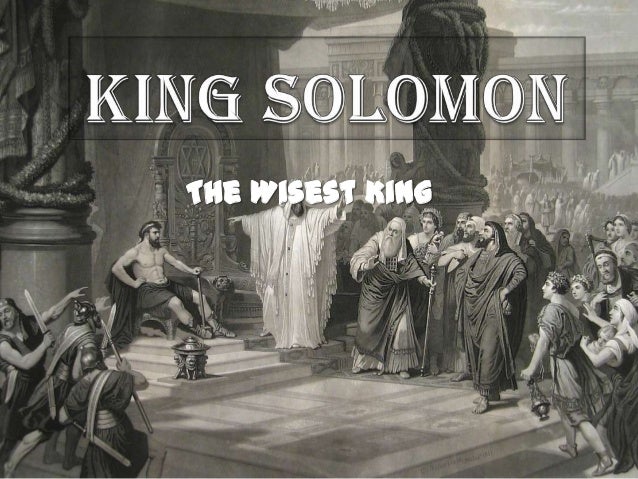
“Woody Wednesday” ECCLESIASTES AND WOODY ALLEN’S FILMS: SOLOMON “WOULD GOT ALONG WELL WITH WOODY!” (Part 6 MIDNIGHT IN PARIS Part E, A FURTHER LOOK AT T.S. Eliot’s DESPAIR AND THEN HIS SOLUTION)

December 16, 2015 – 4:56 am

In the last post I pointed out how King Solomon in Ecclesiastes painted a dismal situation for modern man in life UNDER THE SUN  and that Bertrand Russell, and T.S. Eliot and  other modern writers had agreed with Solomon’s view. However, T.S. Eliot had found a solution to this problem and put his faith in […]

“Woody Wednesday” ECCLESIASTES AND WOODY ALLEN’S FILMS: SOLOMON “WOULD GOT ALONG WELL WITH WOODY!” (Part 5 MIDNIGHT IN PARIS Part D, A LOOK AT T.S. Eliot’s DESPAIR AND THEN HIS SOLUTION)

December 9, 2015 – 4:41 am

In MIDNIGHT IN PARIS Gil Pender ponders the advice he gets from his literary heroes from the 1920’s. King Solomon in Ecclesiastes painted a dismal situation for modern man in life UNDER THE SUN  and many modern artists, poets, and philosophers have agreed. In the 1920’s T.S.Eliot and his  house guest Bertrand Russell were two of […]

“Woody Wednesda

RESPONDING TO HARRY KROTO’S BRILLIANT RENOWNED ACADEMICS!! Part 159 K “Open letter to Harry Kroto’s friend Richard Dawkins” Richard Dawkins once wrote “Faith, being belief that isn’t based on evidence, is the principal vice of any religion”

Canary Islands 2014: Harold Kroto and Richard Dawkins

Image result for harry kroto richard dawkins

_

On November 21, 2014 I received a letter from Nobel Laureate Harry Kroto and it said:

…Please click on this URL http://vimeo.com/26991975

and you will hear what far smarter people than I have to say on this matter. I agree with them.

Harry Kroto

Nick Gathergood, David-Birkett, Harry-Kroto

Image result for harry kroto richard dawkins

I have attempted to respond to all of Dr. Kroto’s friends arguments and I have posted my responses one per week for over a year now. Here are some of my earlier posts:

Arif Ahmed, Sir David AttenboroughMark Balaguer, Horace Barlow, Michael BatePatricia ChurchlandAaron CiechanoverNoam Chomsky,Alan DershowitzHubert DreyfusBart Ehrman, Stephan FeuchtwangDavid Friend,  Riccardo GiacconiIvar Giaever , Roy GlauberRebecca GoldsteinDavid J. Gross Brian Greene, Susan GreenfieldStephen F Gudeman,  Alan Guth, Jonathan HaidtTheodor W. HänschBrian Harrison,  Hermann HauserRoald Hoffmann,  Bruce HoodHerbert Huppert,  Gareth Stedman JonesSteve JonesShelly KaganMichio Kaku,  Stuart Kauffman,  Lawrence KraussHarry KrotoGeorge LakoffElizabeth Loftus,  Alan MacfarlanePeter MillicanMarvin MinskyLeonard Mlodinow Yujin NagasawaAlva NoeDouglas Osheroff,  Jonathan Parry,  Saul PerlmutterHerman PhilipseCarolyn PorcoRobert M. PriceLisa RandallLord Martin Rees,  Oliver SacksJohn SearleMarcus du SautoySimon SchafferJ. L. Schellenberg,   Lee Silver Peter Singer,  Walter Sinnott-ArmstrongRonald de SousaVictor StengerBarry Supple,   Leonard SusskindRaymond TallisNeil deGrasse Tyson,  .Alexander VilenkinSir John WalkerFrank WilczekSteven Weinberg, and  Lewis Wolpert,

In  the second video below in the 67th clip in this series are Richard Dawkins’ words that Harry Kroto wanted me to see. Since then I have read several of Richard Dawkins books and have attempted to respond to the contents of these books directly to Richard Dawkins by mail. In fact, I have been writing Richard Dawkins letters since May 15, 1994 which was the 10th anniversary of the passing of one of my heroes, Francis Schaeffer. Francis Schaeffer spent a lot of time responding to many of Richard Dawkins’ heroes such as Carl Sagan, Jacques Monod, H.J. Blackham, Isaac Newton, Ludwig Wittgenstein, Max Planck, Johann Sebastian Bach, Francis Bacon, Samuel Beckett, Leonardo Da Vinci, Albert Einstein, Michael Faraday, Gerald Horton, Edmund Leach, Louis Pasteur, George Wald, Jacob Bronowski, Steven Weinberg, Charles Darwin, Paul Kurtz, Peter Singer, Jonathan Miller, William B. Provine, Woody Allen, Noam Chomsky, James D. Watson, Francis Crick, Michael Polanyi, The Huxley family, Antony Flew, and Edward O. Wilson (Dawkins has since revised his opinion of Flew and Wilson, but he earlier regarded them very highly). 

Image result for francis schaeffer
Francis Schaeffer 1911-1984

_

Image result for antony flew

_

Both Francis Schaeffer and Richard Dawkins have talked extensively about the life of Charles Darwin.

Image result for charles darwin

_

Sir Harry Kroto with his high school friend Sir Ian McKellan at the FSU National High Field Magnetic Lab on Tuesday, October 27, 2009.

Image result for harry kroto richard dawkins

50 Renowned Academics Speaking About God (Part 1)

_

Another 50 Renowned Academics Speaking About God (Part 2)

_

_

Edit Post ‹ The Daily Hatch — WordPress

A Further 50 Renowned Academics Speaking About God (Part 3)

_

Richard Dawkins Photos Photos – Professor Stephen Hawking Unveils Medal For Science Communication – Zimbio

Professor Stephen Hawking Unveils Medal For Science Communication

Professor Stephen Hawking Unveils Medal For Science Communication In This Photo: Richard Dawkins, Stephen Hawking, Brian May, Harold Kroto, Alexi Leonov, Garik Israelian

__

Richard Dawkins, founder of the Richard Dawkins Foundation for Reason and Science. Credit: Don Arnold Getty Images

16

Image result for richard dawkins brief candle in the dark

Garik Israelian, Stephen Hawking, Alexey Leonov, Brian May, Richard Dawkins and Harry Kroto

—-

—-

—-

—-

September 19,2017

Richard Dawkins
Washington, DC

Dear Mr. Dawkins,

I read the article Is Science a Religion? by Richard Dawkins which  was first published in the Humanist, January/February 1997. Here is a quote from that article:

It is fashionable to wax apocalyptic about the threat to humanity posed by the AIDS virus, “mad cow” disease, and many others, but I think a case can be made that faith is one of the world’s great evils, comparable to the smallpox virus but harder to eradicate.

Faith, being belief that isn’t based on evidence, is the principal vice of any religion

Francis Schaeffer on pages 178 to 179 of volume 1 THE GOD WHO IS THERE asserted:

I do not believe that there is a leap of faith needed; there are good and sufficient reasons to know why Christianity is true–and more than that, that is the Bible’s insistence. The Bible’s emphasis is that there are good and sufficient reasons to know Christianity is true, so much so that we are disobedient and guilty if we do not believe it.

The Christian system (what is taught in the whole Bible) is a unity of thought. Christianity is not just a lot of bits and pieces–there is a beginning and an end, a whole system of truth, and this system is the only system that will stand up to all the questions that are presented to us as we face the reality of existence. Some of the other systems answer some of the questions but leave others unanswered. I believe it is only Christianity that gives the answers to all the crucial questions.

What are those questions? The questions are those which are presented to us as we face the reality of existence. God shuts us up to reality. We cannot escape the reality of what is, no matter what we say we believe or think.

This reality of which I speak falls into two parts: the fact that the universe truly exists and it has form, and then what I would call the “mannishness” of man–which is my own term for meaning that man is unique. People have certain qualities that must be explained.

God has shut up all people to these things, and I always like to go back to the statement of Jean-Paul Sartre, though he had no answer for his own statement, and that is that the basic philosophic question is that something is there. Things do exist, and this demands an explanation for their existence. I would then go beyond Sartre’s statement to one by Albert Einstein. Einstein said that the most amazing thing about the universe is that we can know something truly about it.In other words, it has a form that is comprehensible, even though we cannot exhaust it. And then I would say beyond that–no matter what people say they are, they are what they are, that is, man is unique as made in the image of God. Any system of thought, to be taken seriously, has to at least try to explain these two great phenomena of the universe and man. In other words, we are talking about objective truth related to reality and not just something within our own heads.

Now I would like to add a corollary to this: in WHATEVER HAPPENED TO THE HUMAN RACE?, and especially the extensive notes of the fifth chapter, there is a third thing and that is the way the Bible measures up to history. Once we say that, this is very exciting. It is very exciting because other religions are not founded in history, they are “out there” somewhere, or you can think of them as inside of your own head–whichever way you are looking at it. On the other hand, the Bible claims to be rooted in history. Whether we are considering the history of the Old Testament, whether we are considering the history of Christ, including the resurrection, or Paul’s journeys, it is insisted on as real history. So now we have three interwoven parts. Usually I have dealt with the twentieth-century person, but the third is also there. We have to face the reality of the universe and its having an existence and having a form. We have to face the reality in the uniqueness of man. We are able to discuss the fact that the Bible is rooted in history.

Below is a piece of that evidence given by Francis Schaeffer concerning the accuracy of the Bible.

TRUTH AND HISTORY (chapter 5 of WHATEVER HAPPENED TO THE HUMAN RACE?)

In the previous chapter we saw that the Bible gives us the explanation for the existence of the universe and its form and for the mannishness of man. Or, to reverse this, we came to see that the universe and its form and the mannishness of man are a testimony to the truth of the Bible. In this chapter we will consider a third testimony: the Bible’s openness to verification by historical study.

Christianity involves history. To say only that is already to have said something remarkable, because it separates the Judeo-Christian world-view from almost all other religious thought. It is rooted in history.

The Bible tells us how God communicated with man in history. For example, God revealed Himself to Abraham at a point in time and at a particular geographical place. He did likewise with Moses, David, Isaiah, Daniel and so on. The implications of this are extremely important to us. Because the truth God communicated in the Bible is so tied up with the flow of human events, it is possible by historical study to confirm some of the historical details.

It is remarkable that this possibility exists. Compare the information we have from other continents of that period. We know comparatively little about what happened in Africa or South America or China or Russia or even Europe. We see beautiful remains of temples and burial places, cult figures, utensils, and so forth, but there is not much actual “history” that can be reconstructed, at least not much when compared to that which is possible in the Middle East.

When we look at the material which has been discovered from the Nile to the Euphrates that derives from the 2500-year span before Christ, we are in a completely different situation from that in regard to South America or Asia. The kings of Egypt and Assyria built thousands of monuments commemorating their victories and recounting their different exploits. Whole libraries have been discovered from places like Nuzu and Mari and most recently at Elba, which give hundreds of thousands of texts relating to the historical details of their time. It is within this geographical area that the Bible is set. So it is possible to find material which bears upon what the Bible tells us.

The Bible purports to give us information on history. Is the history accurate? The more we understand about the Middle East between 2500 B.C. and A.D. 100, the more confident we can be that the information in the Bible is reliable, even when it speaks about the simple things of time and place.

The site of the biblical city called Lachish is about thirty miles southwest of Jerusalem. This city is referred to on a number of occasions in the Old Testament. Imagine a busy city with high walls surrounding it, and a gate in front that is the only entrance to the city. We know so much about Lachish from archaeological studies that a reconstruction of the whole city has been made in detail. This can be seen at the British Museum in the Lachish Room in the Assyrian section.

There is also a picture made by artists in the eighth century before Christ, the Lachish Relief, which was discovered in the city of Nineveh in the ancient Assyria. In this picture we can see the Jewish inhabitants of Lachish surrendering to Sennacherib, the king of Assyria. The details in the picture and the Assyrian writing on it give the Assyrian side of what the Bible tells us in Second Kings:

2 Kings 18:13-16

New American Standard Bible (NASB)

13 Now in the fourteenth year of King Hezekiah, Sennacherib king of Assyria came up against all the fortified cities of Judah and seized them. 14 Then Hezekiah king of Judah sent to the king of Assyria at Lachish, saying, “I have done wrong. Withdraw from me; whatever you impose on me I will bear.” So the king of Assyria required of Hezekiah king of Judah three hundred talents of silver and thirty talents of gold. 15 Hezekiah gave him all the silver which was found in the house of the Lord, and in the treasuries of the king’s house. 16 At that time Hezekiah cut off the gold from the doors of the temple of the Lord, and from the doorposts which Hezekiah king of Judah had overlaid, and gave it to the king of Assyria.

________

We should notice two things about this. First, this is a real-life situation–a real siege of a real city with real people on both sides of the war–and it happened at a particular date in history, near the turn of the eighth century B.C. Second, the two accounts of this incident in 701 B.C. (the account from the Bible and the Assyrian account from Nineveh) do not contradict, but rather confirm each other. The history of Lachish itself is not so important for us, but some of its smaller historical details.

The answer to find meaning in life is found in putting your faith and trust in Jesus Christ. The Bible is true from cover to cover and can be trusted.

Thank you again for your time and I know how busy you are.

Everette Hatcher, everettehatcher@gmail.com, http://www.thedailyhatch.org, cell ph 501-920-5733, Box 23416, LittleRock, AR 72221, United States

__

Image result for Lachish Relief

Siege of Lachish Reliefs at the British Museum

Image result for Lachish Relief

Francis and Edith Schaeffer

Image result for francis schaeffer

_

Francis Schaeffer in the film series HOW SHOULD WE THEN LIVE?

Image result for francis schaeffer

300 × 257Images may be subject to copyright

—-

Related posts:

RESPONDING TO HARRY KROTO’S BRILLIANT RENOWNED ACADEMICS!! Part 48 Nobel Prize Winner and Global Warming Denier Ivar Giaever “I think religion is to blame for a lot of the ills in this world!”

October 20, 2015 – 5:20 am

  On November 21, 2014 I received a letter from Nobel Laureate Harry Kroto and it said: …Please click on this URL http://vimeo.com/26991975 and you will hear what far smarter people than I have to say on this matter. I agree with them. Harry Kroto _________________ Below you have picture of 1996 Chemistry Nobel Prize Winner […]

FRANCIS SCHAEFFER ANALYZES ART AND CULTURE PART 78 THE BEATLES (Breaking down the song TOMORROW NEVER KNOWS) Featured musical artist is Stuart Gerber

September 24, 2015 – 5:42 am

The Beatles were “inspired by the musique concrète of German composer and early electronic music pioneer Karlheinz Stockhausen…”  as SCOTT THILL has asserted. Francis Schaeffer noted that ideas of  “Non-resolution” and “Fragmentation” came down German and French streams with the influence of Beethoven’s last Quartets and then the influence of Debussy and later Schoenberg’s non-resolution which is in total contrast […]

RESPONDING TO HARRY KROTO’S BRILLIANT RENOWNED ACADEMICS!! Part 42 Peter Singer, Professor of Bioethics at Princeton University, THE PROBLEM OF EVIL

September 8, 2015 – 5:10 am

  _______ On November 21, 2014 I received a letter from Nobel Laureate Harry Kroto and it said: …Please click on this URL http://vimeo.com/26991975 and you will hear what far smarter people than I have to say on this matter. I agree with them. Harry Kroto _________________ Below you have picture of 1996 Chemistry Nobel Prize […]

RESPONDING TO HARRY KROTO’S BRILLIANT RENOWNED ACADEMICS!! Bart Ehrman “Why should one think that God performed the miracle of inspiring the words in the first place if He didn’t perform the miracle of preserving the words?”

September 2, 2015 – 8:42 am

On November 21, 2014 I received a letter from Nobel Laureate Harry Kroto and it said: …Please click on this URL http://vimeo.com/26991975 and you will hear what far smarter people than I have to say on this matter. I agree with them. Harry Kroto ____________________ Below you have picture of 1996 Chemistry Nobel Prize Winner Dr. […]

“Music Monday” (Lou Reed) I have lots of young people come to us and [they] can’t find any meaning to life. It’s the meaning of the words “punk rock.” SCHAEFFER TAKES LOOK AT ECCLESIASTES AND THE ISSUE OF SEXUAL PROMISCUITY (Last Letter I Wrote To HUGH HEFNER)

__

—-

Lewis Allan Reed (March 2, 1942 – October 27, 2013) was an American musician, singer, songwriter and poet. He was the lead guitarist, singer and principal songwriter for the rock band the Velvet Underground and had a solo career that spanned five decades. The Velvet Underground were not a commercial success during their existence, but are now regarded as one of the most influential bands in the history of underground and alternative rockmusic.

Lou Reed
Lou Reed 1977.JPG

Reed, 1977
Background information
Birth name Lewis Allan Reed
Born March 2, 1942
New York City, U.S.
Origin Freeport, New York, U.S.
Died October 27, 2013(aged 71)
East Hampton, New York, U.S.
Genres
Occupation(s)
  • Musician
  • singer
  • songwriter
  • composer
  • photographer
Instruments
  • Vocals
  • guitar
  • piano
Years active 1958–2013
Labels
Associated acts

After leaving the band in 1970, Reed released twenty solo studio albums. His second, Transformer (1972), was produced by David Bowie and arranged by Mick Ronson, and brought mainstream recognition. After Transformer, the less commercial Berlin reached No. 7 on the UK Albums Chart. Rock n Roll Animal (a live album released in 1974) sold strongly, and Sally Can’t Dance (1974) peaked at No. 10 on the Billboard200; but for a long period after, Reed’s work did not translate into sales, leading him deeper into drug addiction and alcoholism. Reed cleaned up in the early 1980s, and gradually returned to prominence with New Sensations (1984), reaching a critical and commercial career peak with his 1989 album New York.

Reed participated in the reformation of the Velvet Underground in the 1990s, and made several more albums, including a collaboration album with John Cale titled Songs for Drella which was a tribute to their former mentor Andy Warhol. 1992’s Magic and Loss would become Reed’s highest-charting album on the UK Albums Chart, peaking at No. 6.

He contributed music to two theatrical interpretations of 19th century writers, one of which he developed into an album titled The Raven. He married his third wife Laurie Anderson in 2008, and recorded the collaboration album Lulu with Metallica. He died in 2013 of liver disease. Reed’s distinctive deadpan voice, poetic lyrics and experimental guitar playing were trademarks throughout his long career.

__

Lou Reed in this song “Satellite of love” talks  about a girl whose sexual appetite  which couldn’t be satisfied:

Satellite’s gone up to the skies
Things like that drive me out of my mind
I watched it for a little while
I like to watch things on TV
Satellite of love
Satellite of love
Satellite of love
Satellite of
Satellite’s gone way up to Mars
Soon it’ll be filled with parkin’ cars
I watched it for a little while
I love to watch things on TV
Satellite of love
Satellite of love
Satellite of love
Satellite of
I’ve been told that you’ve been bold
With Harry, Mark and John
Monday, Tuesday, Wednesday to Thursday
With Harry, Mark and John
Satellite’s gone up to the skies
Things like that drive me out of my mind
I watched it for a little while
I love to watch things on TV
Satellite of love
Satellite of love
Satellite of love
Satellite of
Satellite of love
Satellite of love
Satellite of love
Satellite of love
Satellite of love
Satellite of love
Satellite of love
Satellite of love
Source: LyricFind
Songwriters: Lou Reed

Looking for the meaning in life through the number of sexual conquests is a dead end!!!

Solomon was searching for meaning in life in what I call the 6 big L words in the Book of Ecclesiastes. He looked into  learning (1:16-18), laughter, LADIES, luxuries,  and liquor (2:1-3, 8, 10, 11), and labor (2:4-6, 18-20). After searching  in area of luxuries Solomon found  them to be  “vanity and a striving after the wind.”

Ecclesiastes 2:7-11 English Standard Version (ESV)

7I had also great possessions of herds and flocks, more than any who had been before me in Jerusalem. 8I also gathered for myself silver and gold and the treasure of kings and provinces. So I became great and surpassed all who were before me in Jerusalem…10 And whatever my eyes desired I did not keep from them. 11 Then I considered all that my hands had done and the toil I had expended in doing it, and behold, all was vanity and a striving after wind, and there was nothing to be gained UNDER THE SUN.

“For what does it profit a man to gain the whole world and forfeit his soul?” Mark 8:36 (Christ’s words)

God put Solomon’s story in Ecclesiastes in the Bible with the sole purpose of telling people like you that without God in the picture you  will find out the emptiness one feels when possessions are trying to fill the void that God can only fill.

Then in the last chapter of Ecclesiastes Solomon returns to looking above the sun and he says that obeying the Lord is the proper way to live your life. The  answer to find meaning in life is found in putting your faith and trust in Jesus Christ. The Bible is true from cover to cover and can be trusted. If you need more evidence then go to You Tube and watch the short videos  “Francis Schaeffer – The Biblical Flow of History & Truth (1),“(3 min, 5 sec) and “Dr. Francis Schaeffer – The Biblical Flow of Truth & History (part 2),” (10 min, 46 sec).

Francis Schaeffer noted:

I have lots of young people and older ones come to us from the ends of the earth. And as they come to us, they have gone to the end of this logically and they are not living in a romantic setting. They realize what the situation is. They can’t find any meaning to life. It’s the meaning to the black poetry. It’s the meaning of the black plays. It’s the meaning of all this. It’s the meaning of the words “punk rock.”

“They are the natural outcome of a change from a Christian World View to a Humanistic one…
The result is a relativistic value system. A lack of a final meaning to life — that’s first. Why does human life have any value at all, if that is all that reality is? Not only are you going to die individually, but the whole human race is going to die, someday. It may not take the falling of the atom bombs, but someday the world will grow too hot, too cold. That’s what we are told on this other final reality, and someday all you people not only will be individually dead, but the whole conscious life on this world will be dead, and nobody will see the birds fly. And there’s no meaning to life.

As you know, I don’t speak academically, shut off in some scholastic cubicle, as it were. I have lots of young people and older ones come to us from the ends of the earth. And as they come to us, they have gone to the end of this logically and they are not living in a romantic setting. They realize what the situation is. They can’t find any meaning to life. It’s the meaning to the black poetry. It’s the meaning of the black plays. It’s the meaning of all this. It’s the meaning of the words “punk rock.” And I must say, that on the basis of what they are being taught in school, that the final reality is only this material thing, they are not wrong. They’re right! On this other basis there is no meaning to life and not only is there no meaning to life, but there is no value system that is fixed, and we find that the law is based then only on a relativistic basis and that law becomes purely arbitrary.

OUTLINE OF ECCLESIATES BY SCHAEFFER

_______

William Lane Craig on Man’s predicament if God doesn’t exist

Read Waiting for Godot by Samuel Beckett. During this entire play two men carry on trivial conversation while waiting for a third man to arrive, who never does. Our lives are like that, Beckett is saying; we just kill time waiting—for what, we don’t know.

Thus, if there is no God, then life itself becomes meaningless. Man and the universe are without ultimate significance.

Francis Schaeffer looks at Nihilism of Solomon and the causes of it!!!

Notes on Ecclesiastes by Francis Schaeffer

Solomon is the author of Ecclesiastes and he is truly an universal man like Leonardo da Vinci.

Two men of the Renaissance stand above all others – Michelangelo and Leonardo da Vinci and it is in them that one can perhaps grasp a view of the ultimate conclusion of humanism for man. Michelangelo was unequaled as a sculptor in the Renaissance and arguably no one has ever matched his talents.

The other giant of the Renaissance period was Leonardo da Vinci – the perfect Renaissance Man, the man who could do almost anything and does it better than most anyone else. As an inventor, an engineer, an anatomist, an architect, an artist, a chemist, a mathematician, he was almost without equal. It was perhaps his mathematics that lead da Vinci to come to his understanding of the ultimate meaning of Humanism. Leonardo is generally accepted as the first modern mathematician. He not only knew mathematics abstractly but applied it in his Notebooks to all manner of engineering problems. He was one of the unique geniuses of history, and in his brilliance he perceived that beginning humanistically with mathematics one only had particulars. He understood that man beginning from himself would never be able to come to meaning on the basis of mathematics. And he knew that having only individual things, particulars, one never could come to universals or meaning and thus one only ends with mechanics. In this he saw ahead to where our generation has come: everything, including man, is the machine.

Leonardo da Vinci compares well to Solomon and they  both were universal men searching for the meaning in life. Solomon was searching for a meaning in the midst of the details of life. His struggle was to find the meaning of life. Not just plans in life. Anybody can find plans in life. A child can fill up his time with plans of building tomorrow’s sand castle when today’s has been washed away. There is  a difference between finding plans in life and purpose in life. Humanism since the Renaissance and onward has never found it and it has never found it since. Modern man has not found it and it has always got worse and darker in a very real way.

We have here the declaration of Solomon’s universality:

1 Kings 4:30-34

English Standard Version (ESV)

30 so that Solomon’s wisdom surpassed the wisdom of all the people of the east and all the wisdom of Egypt. 31 For he was wiser than all other men, wiser than Ethan the Ezrahite, and Heman, Calcol, and Darda, the sons of Mahol, and his fame was in all the surrounding nations. 32 He also spoke 3,000 proverbs, and his songs were 1,005. 33 He spoke of trees, from the cedar that is in Lebanon to the hyssop that grows out of the wall. He spoke also of beasts, and of birds, and of reptiles, and of fish. 34 And people of all nations came to hear the wisdom of Solomon, and from all the kings of the earth, who had heard of his wisdom.

_________________________

Here is the universal man and his genius. Solomon is the universal man with a empire at his disposal. Solomon had it all.

Ecclesiastes 1:3

English Standard Version (ESV)

What does man gain by all the toil
    at which he toils under the sun?

Schaeffer noted that Solomon took a look at the meaning of life on the basis of human life standing alone between birth and death “under the sun.” This phrase UNDER THE SUN appears over and over in Ecclesiastes.

(Added by me:The Christian Scholar Ravi Zacharias noted, “The key to understanding the Book of Ecclesiastes is the term UNDER THE SUN — What that literally means is you lock God out of a closed system and you are left with only this world of Time plus Chance plus matter.” )

Man is caught in the cycle

Ecclesiastes 1:1-7

English Standard Version (ESV)

All Is Vanity

The words of the Preacher, the son of David, king in Jerusalem.

Vanity of vanities, says the Preacher,
    vanity of vanities! All is vanity.
What does man gain by all the toil
    at which he toils under the sun?
A generation goes, and a generation comes,
    but the earth remains forever.
The sun rises, and the sun goes down,
    and hastens to the place where it rises.
The wind blows to the south
    and goes around to the north;
around and around goes the wind,
    and on its circuits the wind returns.
All streams run to the sea,
    but the sea is not full;
to the place where the streams flow,
    there they flow again.

All things are full of weariness;
    a man cannot utter it;
the eye is not satisfied with seeing,
    nor the ear filled with hearing.
What has been is what will be,
    and what has been done is what will be done,
    and there is nothing new under the sun.
10 Is there a thing of which it is said,
    “See, this is new”?
It has been already
    in the ages before us.

_____________

Solomon is showing a high degree of comprehension of evaporation and the results of it. Seeing also in reality nothing changes. There is change but always in a set framework and that is cycle. You can relate this to the concepts of modern man. Ecclesiastes is the only pessimistic book in the Bible and that is because of the place where Solomon limits himself. He limits himself to the question of human life, life under the sun between birth and death and the answers this would give.

Ecclesiastes 1:4

English Standard Version (ESV)

A generation goes, and a generation comes,
    but the earth remains forever.

___________________

Ecclesiastes 4:16

English Standard Version (ESV)

16 There was no end of all the people, all of whom he led. Yet those who come later will not rejoice in him. Surely this also is vanity and a striving after wind.

__________________________

In verses 1:4 and 4:16 Solomon places man in the cycle. He doesn’t place man outside of the cycle. Man doesn’t escape the cycle. Man is only cycle. Birth and death and youth and old age. With this in mind Solomon makes this statement.

Ecclesiastes 6:12

12 For who knows what is good for a man during his lifetime, during the few years of his futile life? He will spend them like a shadow. For who can tell a man what will be after him under the sun?

____________________

There is no doubt in my mind that Solomon had the same experience in his life that I had as a younger man. I remember standing by the sea and the moon arose and it was copper and beauty. Then the moon did not look like a flat dish but a globe or a sphere since it was close to the horizon. One could feel the global shape of the earth too. Then it occurred to me that I could contemplate the interplay of the spheres and I was exalted because I thought I can look upon them with all their power, might, and size, but they could contempt nothing and I felt as man as God. Then came upon me a horror of great darkness because it suddenly occurred to me that although I could contemplate them and they could contemplate nothing yet they would continue to turn in ongoing cycles when I saw no more forever and I was crushed.

THIS IS SOLOMON’S FEELING TOO. The universal man, Solomon, beyond our intelligence with an empire at his disposal with the opportunity of observation so he could recite these words here in Ecclesiastes 6:12, “For who knows what is good for a man during his lifetime, during the few years of his futile life? He will spend them like a shadow. For who can tell a man what will be after him under the sun?”

Lack of Satisfaction in life

In Ecclesiastes 1:8 he drives this home when he states, “All things are wearisome; Man is not able to tell itThe eye is not satisfied with seeing, Nor is the ear filled with hearing.” Solomon is stating here the fact that there is no final satisfaction because you don’t get to the end of the thing. THERE IS NO FINAL SATISFACTION. This is related to Leonardo da Vinci’s similar search for universals and then meaning in life. 

In Ecclesiastes 5:11 Solomon again pursues this theme, When good things increase, those who consume them increase. So what is the advantage to their owners except to look on?”  Doesn’t that sound modern? It is as modern as this evening. Solomon here is stating the fact there is no reaching completion in anything and this is the reason there is no final satisfaction. There is simply no place to stop. It is impossible when laying up wealth for oneself when to stop. It is impossible to have the satisfaction of completion. 

Pursuing Learning

Now let us look down the details of his searching.

In Ecclesiastes 1: 13a we have the details of the universal man’s procedure. “And I set my mind to seek and explore by wisdom concerning all that has been done under heaven.”

So like any sensible man the instrument that is used is INTELLECT, and RAITIONALITY, and LOGIC. It is to be noted that even men who despise these in their theories begin and use them or they could not speak. There is no other way to begin except in the way they which man is and that is rational and intellectual with movements of that is logical within him. As a Christian I must say gently in passing that is the way God made him.

So we find first of all Solomon turned to WISDOM and logic. Wisdom is not to be confused with knowledge. A man may have great knowledge and no wisdom. Wisdom is the use of rationality and logic. A man can be very wise and have limited knowledge. Here he turns to wisdom in all that implies and the total rationality of man.

Works of Men done Under the Sun

After wisdom Solomon comes to the great WORKS of men. Ecclesiastes 1:14,  “I have seen all the works which have been done under the sun, and behold, all is [p]vanity and striving after wind.” Solomon is the man with an empire at this disposal that speaks. This is the man who has the copper refineries in Ezion-geber. This is the man who made the stables across his empire. This is the man who built the temple in Jerusalem. This is the man who stands on the world trade routes. He is not a provincial. He knew what was happening on the Phonetician coast and he knew what was happening in Egypt. There is no doubt he already knew something of building. This is Solomon and he pursues the greatness of his own construction and his conclusion is VANITY AND VEXATION OF SPIRIT.

Ecclesiastes 2:18-20

18 Thus I hated all the fruit of my labor for which I had labored under the sun, for I must leave it to the man who will come after me. 19 And who knows whether he will be a wise man or a fool? Yet he will have control over all the fruit of my labor for which I have labored by acting wisely under the sun. This too is vanity. 20 Therefore I completely despaired of all the fruit of my labor for which I had labored under the sun.

He looked at the works of his hands, great and multiplied by his wealth and his position and he shrugged his shoulders.

Ecclesiastes 2:22-23

22 For what does a man get in all his labor and in his striving with which he labors under the sun? 23 Because all his days his task is painful and grievous; even at night his mind does not rest. This too is vanity.

Man can not rest and yet he is never done and yet the things which he builds will out live him. If one wants an ironical three phrases these are they. There is a Dutch saying, “The tailor makes many suits but one day he will make a suit that will outlast the tailor.”

God has put eternity in our hearts but we can not know the beginning or the end of the thing from a vantage point of UNDER THE SUN

Ecclesiastes 1:16-18

16 I said to myself, “Behold, I have magnified and increased wisdom more than all who were over Jerusalem before me; and my mind has observed a wealth of wisdom and knowledge.” 17 And I set my mind to know wisdom and to know madness and folly; I realized that this also is striving after wind.18 Because in much wisdom there is much grief, and increasing knowledge results in increasing pain.

Solomon points out that you can not know the beginnings or what follows:

Ecclesiastes 3:11

11 He has made everything  appropriate in its time. He has also set eternity in their heart, yet so that man will not find out the work which God has done from the beginning even to the end.

Ecclesiastes 1:11

11 There is no remembrance of earlier things; And also of the later things which will occur, There will be for them no remembrance among those who will come later still.

Ecclesiastes 2:16

16 For there is no lasting remembrance of the wise man as with the fool, inasmuch as in the coming days all will be forgotten. And how the wise man and the fool alike die!

You bring together here the factor of the beginning and you can’t know what immediately follows after your death and of course you can’t know the final ends. What do you do and the answer is to get drunk and this was not thought of in the RUBAIYAT OF OMAR KAHAYYAM:

Ecclesiastes 2:1-3

I said to myself, “Come now, I will test you with pleasure. So enjoy yourself.” And behold, it too was futility. I said of laughter, “It is madness,” and of pleasure, “What does it accomplish?” I explored with my mind how to stimulate my body with wine while my mind was guiding me wisely, and how to take hold of folly, until I could see what good there is for the sons of men to do under heaven the few years of their lives.

The Daughter of the Vine:

You know, my Friends, with what a brave Carouse
I made a Second Marriage in my house;
Divorced old barren Reason from my Bed,
And took the Daughter of the Vine to Spouse.

from the Rubaiyat of Omar Khayyam (Translation by Edward Fitzgerald)

A perfectly good philosophy coming out of Islam, but Solomon is not the first man that thought of it nor the last. In light of what has been presented by Solomon is the solution just to get intoxicated and black the think out? So many people have taken to alcohol and the dope which so often follows in our day. This approach is incomplete, temporary and immature. Papa Hemingway can find the champagne of Paris sufficient for a time, but one he left his youth he never found it sufficient again. He had a lifetime spent looking back to Paris and that champagne and never finding it enough. It is no solution and Solomon says so too.

Ecclesiastes 2:4-11

I enlarged my works: I built houses for myself, I planted vineyards for myself; I made gardens and parks for myself and I planted in them all kinds of fruit trees; I made ponds of water for myself from which to irrigate a forest of growing trees. I bought male and female slaves and I had homeborn slaves. Also I possessed flocks and herds larger than all who preceded me in Jerusalem. Also, I collected for myself silver and gold and the treasure of kings and provinces. I provided for myself MALE AND  FEMALE SINGERS AND THE PLEASURES OF MEN–MANY CONCUBINES.

Then I became great and increased more than all who preceded me in Jerusalem. My wisdom also stood by me. 10 All that my eyes desired I did not refuse them. I did not withhold my heart from any pleasure, for my heart was pleased because of all my labor and this was my reward for all my labor.11 Thus I considered all my activities which my hands had done and the labor which I had exerted, and behold all was vanity and striving after wind and there was no profit under the sun.

He doesn’t mean there is no temporary profit but there is no real profit. Nothing that lasts. The walls crumble if they are as old as the Pyramids. You only see a shell of the Pyramids and not the glory that they were. This is what Solomon is saying. Look upon Solomon’s wonder and consider the Cedars of Lebanon which were not in his domain but at his disposal.

Ecclesiastes 6:2

a man to whom God has given riches and wealth and honor so that his soul lacks nothing of all that he desires; yet God has not empowered him to eat from them, for a foreigner enjoys them. This is vanity and a severe affliction.

Can someone stuff himself with food he can’t digest? Solomon came to this place of strife and confusion when he went on in his search for meaning.

 Oppressed have no comforter

Ecclesiastes 4:1

 Then I looked again at all the acts of oppression which were being done under the sun. And behold I saw the tears of the oppressed and that they had no one to comfort them; and on the side of their oppressors was power, but they had no one to comfort them.

Between birth and death power rules. Solomon looked over his kingdom and also around the world and proclaimed that right does not rule but power rules.

Ecclesiastes 7:14-15

14 In the day of prosperity be happy, but in the day of adversity consider—God has made the one as well as the other so that man will not discover anything that will be after him.

15 I have seen everything during my lifetime of futility; there is a righteous man who perishes in his righteousness and there is a wicked man who prolongs his life in his wickedness.

Ecclesiastes 8:14

14 There is futility which is done on the earth, that is, there are righteous men to whom it happens according to the deeds of the wicked. On the other hand, there are evil men to whom it happens according to the deeds of the righteous. I say that this too is futility.

We could say it in 20th century language, “The books are not balanced in this life.”

Pursuing Ladies

If one would flee to alcohol, then surely one may choose sexual pursuits to flee to. Solomon looks in this area too.

Ecclesiastes 7:25-28

25 I directed my mind to know, to investigate and to seek wisdom and an explanation, and to know the evil of folly and the foolishness of madness. 26 And I discovered more bitter than death the woman whose heart is snares and nets, whose hands are chains. One who is pleasing to God will escape from her, but the sinner will be captured by her.

27 “Behold, I have discovered this,” says the Preacher, “adding one thing to another to find an explanation, 28 I have looked for other answers but have found none. I found one man in a thousand that I could respect, but not one woman. (Good News Translation on verse 28)

One can understand both Solomon’s expertness in this field and his bitterness.

I Kings 11:1-3 (New American Standard Bible) 

11 Now King Solomon loved many foreign women along with the daughter of Pharaoh: Moabite, Ammonite, Edomite, Sidonian, and Hittite women, from the nations concerning which the Lord had said to the sons of Israel, “You shall not associate with them, nor shall they associate with you, for they will surely turn your heart away after their gods.” Solomon held fast to these in love. He had seven hundred wives, princesses, and three hundred concubines, and his wives turned his heart away.

An expert but also the reason for his bitterness. Certainly there have been many men over the centuries who have daydreamed of Solomon’s wealth in this area [of women], but at the end it was sorry, not only sorry but nothing and less than nothing. The simple fact is that one can not know woman in the real sense by pursuing 1000 women. It is not possible. Woman is not found this way. All that is left in this setting if one were to pursue the meaning of life in this direction is this most bitter word found in Ecclesiastes 7:28, “I have looked for other answers but have found none. I found one man in a thousand that I could respect, but not one woman.” (Good News Translation on verse 28) He was searching in the wrong way. He was searching for the answer to life in the limited circle of that which is beautiful in itself but not an answer finally in sexual life. More than that he finally tried to find it in variety and he didn’t even touch one woman at the end.

—-

Last letter I wrote to Hugh Hefner seen below:

Larry Joe Speaks  (August 20, 1947 to April 7, 2017)

Photo of Larry Joe Speaks

__

__

Image result for bill elliff

________

Image result for king solomon

____

Francis Schaeffer pictured above

_______

June 30, 2017

Hugh Hefner

Playboy Mansion16236 Charing Cross RoadLos Angeles, CA 90024

Dear Hugh,

I started these series of letters on the meaning of it all on April 7, 2017 when  my good friend Larry Speaks died. Larry’s favorite sermon was WHO  IS JESUS? by Adrian Rogers and he gave hundreds of CD copies of that sermon away. I actually ran the copies off  for him and since the sermon was only 37 minutes long and the CD went 60 minutes, I also put on there another sermon by Bill Elliff too called WHAT WILL HAPPEN AT THE END OF TIME? Later in this letter I want to share a portion of that message with you. All of these letters I have written you have dealt with what Solomon had to say concerning the search for satisfaction in life UNDER THE SUN (without God in the picture.) Probably his most disappointing discovery was that being a ladies man left him unsatisfied.

Ecclesiastes 2:8-10The Message (MSG)

I piled up silver and gold,
loot from kings and kingdoms.
I gathered a chorus of singers to entertain me with song,
and—most exquisite of all pleasures—
    voluptuous maidens for my bed.

9-10 Oh, how I prospered! I left all my predecessors in Jerusalem far behind, left them behind in the dust. What’s more, I kept a clear head through it all. Everything I wanted I took—I never said no to myself. I gave in to every impulse, held back nothing. I sucked the marrow of pleasure out of every task—my reward to myself for a hard day’s work!

1 Kings 11:1-3 English Standard Version (ESV)

11 Now King Solomon loved many foreign women, along with the daughter of Pharaoh: Moabite, Ammonite, Edomite, Sidonian, and Hittite women, from the nations concerning which the Lord had said to the people of Israel, “You shall not enter into marriage with them, neither shall they with you, for surely they will turn away your heart after their gods.” Solomon clung to these in love. He had 700 wives, who were princesses, and 300 concubines. And his wives turned away his heart.

Francis Schaeffer observed concerning Solomon, “You can not know woman but knowing 1000 women.”

King Solomon in Ecclesiastes 2:11 sums up his search for meaning in the area of the Sexual Revolution with these words, “…behold, all was vanity and a striving after wind, and there was nothing to be gained under the sun.”

__

In fact, the Book of Ecclesiastes shows that Solomon came to the conclusion that NOTHING in life gives true satisfaction without God including knowledge (1:16-18), LADIES and liquor (2:1-3, 8, 10, 11), and great building projects (2:4-6, 18-20). You can only find a lasting meaning to your life by looking above the sun and bring God back into the picture.

Solomon’s experiment was a search for meaning to life “under the sun.” Then in last few words in the Book of Ecclesiastes he looks above the sun and brings God back into the picture: “The conclusion, when all has been heard, is: Fear God and keep His commandments, because this applies to every person. For God will bring every act to judgment, everything which is hidden, whether it is good or evil.”

Keith Hefner and Hugh Hefner

According to the Bible God will bring every act to judgment!!! Below is a portion of Bill Elliff’s message that deals with this:

WHAT WILL HAPPEN AT THE END OF TIME? I want to look at this picture of what will happen to everyone of us at the end of time. Let’s read our scripture passage.

Luke 12:1-10 English Standard Version (ESV)

Beware of the Leaven of the Pharisees

12 In the meantime, when so many thousands of the people had gathered together that they were trampling one another, he began to say to his disciples first, “Beware of the leaven of the Pharisees, which is hypocrisy. Nothing is covered up that will not be revealed, or hidden that will not be known. Therefore whatever you have said in the dark shall be heard in the light, and what you have whispered in private rooms shall be proclaimed on the housetops.

Have No Fear

“I tell you, my friends, do not fear those who kill the body, and after that have nothing more that they can do. But I will warn you whom to fear: fear him who, after he has killed, has authority to cast into hell. Yes, I tell you, fear him! Are not five sparrows sold for two pennies?[b]And not one of them is forgotten before God. Why, even the hairs of your head are all numbered. Fear not; you are of more value than many sparrows.

Acknowledge Christ Before Men

“And I tell you, everyone who acknowledges me before men, the Son of Man also will acknowledge before the angels of God, but the one who denies me before men will be denied before the angels of God. 10 And everyone who speaks a word against the Son of Man will be forgiven, but the one who blasphemes against the Holy Spirit will not be forgiven.

___________

What will happen at the end of time?

FIRST OF ALL, Jesus says it will be a time of the revelation of the secrets of your life.

A great time of revealing and uncovering, when unknown things to some become known to all. There is coming a day when what you really are will be revealed.

There is something inside us that thinks we can hide things from each other and hide things from God. Have you ever played HIDE AND SEEK with a group of young children? They will hide in plain view but in their mind they are hidden. My smallest children will put their hands over their eyes and they think that since they can’t see me that they are hidden from my sight. But the truth of the matter is that I can see them so clearly and sometimes we think that because we can’t see God that He can’t see us. Last week we read Hebrews 4:13 that says, “And not a creature exists that is concealed from His sight, but all things are open and exposed, and revealed to the eyes of Him with whom we have to give account.” One day the secrets of our heart will be revealed. In the brief days of our life, 20, 30, 40, 50, 60, 70 years that God may give you, or maybe a few years beyond that, we may do a good job of hiding those secrets, but one day the secrets of our lives will be revealed before God.

NEXT after the revelation of the secrets of your life there will be a great revelation of God’s authority.

Do you know what a sovereign is? A sovereign is one who has complete authority. He has the authority and he has the authority to carry it out.

There are 3 kinds of authority. First, voluntary authority such as you choosing to work for an employer. Second, seized authority like a murderer. Third, God is an absolute authority and He is the sovereign and He is over everything. It is right for Him to be over everything because He made everything. He is a God of perfect love,  a God of perfect mercy, a God of perfect grace, a God of perfect compassion, but He is a God of perfect righteousness.  If He was any less than that then He wouldn’t be God. He is a God of perfect holiness and authority. He has wooed us and called us and given us every opportunity to come, but He is a God who one day who will reveal. He has absolute authority over your life.

Look again at verses 4 and 5:

“I tell you, my friends, do not fear those who kill the body, and after that have nothing more that they can do. But I will warn you whom to fear: fear him who, after he has killed, has authority to cast into hell. Yes, I tell you, fear him!

God has the authority to do that. There is coming a day when there will be a great separation and a great dividing. It is all over the scriptures. God has given us the moment of grace to come and trust in Him and give our lives to Him, but one day the door will be closed and then the division will come. He will say to some come into my kingdom that I have prepared for you and he will say to others you are headed to an eternity separated. You have chosen your fate for all eternity. There will permanent separation from God in hell.

FINALLY, it will be a day of the revelation of the substance of your relationship to God.

Look at verses 8 and 9: “And I tell you, everyone who acknowledges me before men, the Son of Man also will acknowledge before the angels of God, but the one who denies me before men will be denied before the angels of God.

The Pharisees said they had a relationship with God but they were hypocrites and there was no substance to their relationship. Jesus is saying that when the secrets of your heart are revealed God will determine the substance of your relationship to God and whether it is real or not.

The answer to find meaning in life is found in putting your faith and trust in Jesus Christ. The Bible is true from cover to cover and can be trusted. Below is a piece of that evidence given by Francis Schaeffer concerning the accuracy of the Bible.

Thanks for your time.

Sincerely,

Everette Hatcher, everettehatcher@gmail.com, http://www.thedailyhatch.org, cell ph 501-920-5733, Box 23416, LittleRock, AR 72221

—-

In 1978 I heard the song “Dust in the Wind” by Kansas when it rose to #6 on the charts. That song told me thatKerry Livgren the writer of that song and a member of Kansas had come to the same conclusion that Solomon had. I remember mentioning to my friends at church that we may soon see some members of Kansas become Christians because their search for the meaning of life had obviously come up empty even though they had risen from being an unknown band to the top of the music business and had all the wealth and fame that came with that. Furthermore, like Solomon and Coldplay, they realized death comes to everyone and “there must be something more.”

Livgren wrote:

“All we do, crumbles to the ground though we refuse to see, Dust in the Wind, All we are is dust in the wind, Don’t hang on, Nothing lasts forever but the Earth and Sky, It slips away, And all your money won’t another minute buy.”

Both Kerry Livgren and Dave Hope of Kansas became Christians eventually. Kerry Livgren first tried Eastern Religions and Dave Hope had to come out of a heavy drug addiction. I was shocked and elated to see their personal testimony on The 700 Club in 1981 and that same  interview can be seen on youtube today. Livgren lives in Topeka, Kansas today where he teaches “Diggers,” a Sunday school class at Topeka Bible Church. Hope is the head of Worship, Evangelism and Outreach at Immanuel Anglican Church in Destin, Florida.

The movie maker Woody Allen has embraced the nihilistic message of the song “Dust in the Wind” by Kansas. David Segal in his article, “Things are Looking Up for the Director Woody Allen. No?” (Washington Post, July 26, 2006), wrote, “Allen is evangelically passionate about a few subjects. None more so than the chilling emptiness of life…The 70-year-old writer and director has been musing about life, sex, work, death and his generally futile search for hope…the world according to Woody is so bereft of meaning, so godless and absurd, that the only proper response is to curl up on a sofa and howl for your mommy.”

The song “Dust in the Wind” recommends, “Don’t hang on.” Allen himself says, “It’s just an awful thing and in that context you’ve got to find an answer to the question: ‘Why go on?’ ”  It is ironic that Chris Martin the leader of Coldplay regards Woody Allen as his favorite director.

Lets sum up the final conclusions of these gentlemen:  Coldplay is still searching for that “something more.” Woody Allen has concluded the search is futile. Livgren and Hope of Kansas have become Christians and are involved in fulltime ministry. Solomon’s experiment was a search for meaning to life “under the sun.” Then in last few words in the Book of Ecclesiastes he looks above the sun and brings God back into the picture: “The conclusion, when all has been heard, is: Fear God and keep His commandments, because this applies to every person. For God will bring every act to judgment, everything which is hidden, whether it is good or evil.”

You can hear Kerry Livgren’s story from this youtube link:

(part 1 ten minutes)

(part 2 ten minutes)

Kansas – Dust In The Wind

Ecclesiastes 1

Published on Sep 4, 2012

Calvary Chapel Spring Valley | Sunday Evening | September 2, 2012 | Pastor Derek Neider

_____________________

Related posts

_________

__

FRANCIS SCHAEFFER ANALYZES ART AND CULTURE Part 308 (Letter to Richard Dawkins about Kyle Butt quote “While it is the case that the Bible does not present itself as a scientific or medical textbook, it is only reasonable that if God truly did inspire the books that compose the Bible, they would be completely accurate in every scientific or medical detail found among their pages”) Featured Artist is Mark Rothko

_

Image result for richard dawkins outgrowing god

_

XXXX

November 1, 2019

Richard Dawkins c/o Richard Dawkins Foundation, 
Washington, DC 20005

Dear Mr. Dawkins,

i have enjoyed reading about a dozen of your books and some of the most intriguing were The God DelusionAn Appetite for Wonder: The Making of a Scientist, and Brief Candle in the Dark: My Life in Science.

I enjoyed reading Outgrowing God which is your latest book, and I wanted to respond to something you said on page 36. You quote the gospel of Thomas where it says that Jesus made 12 sparrows from clay. Then you note: “A sparrow is made of more than 100 billion cells…Nobody knew those details in Jesus’s time.”

My first response is the Gospel of Thomas is not part of the Bible. Secondly, the Bible does have some amazing scientific and medical information in it that you need to check out!!!

Scientific Foreknowledge and Medical Acumen of the Bible

byKyle Butt, M.Div.

While it is the case that the Bible does not present itself as a scientific or medical textbook, it is only reasonable that if God truly did inspire the books that compose the Bible, they would be completely accurate in every scientific or medical detail found among their pages. Furthermore, if the omniscient Ruler of the Universe actually did inspire these books, scientific and medical errors that fill the pages of other ancient, non-inspired texts should be entirely absent from the biblical record. Is the Bible infallible when it speaks about scientific fields of discipline, or does it contain the errors that one would expect to find in the writings of fallible men in ancient times?

That the first five books of the Old Testament are a product of Moses is a matter of historical record (Lyons and Staff, 2003). Furthermore, the story of Moses’ education among the Egyptian culture was well understood. In fact, even those Jews who did not convert to Christianity were so familiar with the historic fact that Moses was educated in “all the wisdom of the Egyptians” (Acts 7:22), that Stephen’s statement to that effect went completely undisputed. Moses had been trained under the most advanced Egyptian educational system of his day. With such training, it would have been only natural for Moses to include some of the Egyptian “wisdom” in his writings if he were composing the Pentateuch by using his own prowess and mental faculties.

A look into the medical practices from ancient Egypt and those found in the Pentateuch, however, reveals that Moses did not necessarily rely on “wisdom” of the Egyptians (which, in many cases, consisted of life-threatening malpractice). While some medical practices in the Pentateuch are similar to those found in ancient Egyptian documents, the Pentateuch exhibits a conspicuous absence of those harmful malpractices that plague the writings of the Egyptians. Moses penned the most advanced, flawless medical prescriptions that had ever been recorded. Furthermore, every statement that pertained to the health and medical well-being of the Israelite nation recorded by Moses could theoretically still be implemented and be completely in accord with every fact modern medicine has learned in regard to germ spreading, epidemic disease control, communal sanitation, and a host of other medical and scientific discoveries.

It is the case that the ancient Egyptians were renowned in the ancient world for their progress in the field of medicine. Dr. Massengill noted that “Egypt was the medical center of the ancient world” (1943, p. 13). During the days of in the Medo-Persian Empire, the ancient historian Herodotus recorded that it was king Darius’ practice “to keep in attendance certain Egyptian doctors, who had a reputation for the highest eminence in their profession” (3.129). Thus, while the medical practices of the Bible could be equally compared to those of other ancient cultures and found to be flawlessly superior, comparing them to that of the eminent Egyptian culture should suffice to manifest the Bible’s supernatural superiority in the field.

It Will Cure You—If It Doesn’t Kill You First

Among the ancient documents that detail much of the Egyptian medicinal knowledge, the Ebers Papyrus ranks as one of the foremost sources. This papyrus was discovered in 1872 by a German Egyptologist named Georg Ebers (the name from which the papyrus acquired its moniker) (Ancient Egyptian…, 1930, p. 1). It consists of a host of medical remedies purported to heal, enhance, and prevent. “Altogether 811 prescriptions are set forth in the Papyrus, and they take the form of salves, plasters, and poultices; snuffs, inhalations, and gargles; draughts, confections, and pills; fumigations, suppositories, and enemata” (p. 15). Among the hundreds of prescriptions, disgusting treatments that caused much more harm than good can be found. For instance, under a section titled “What to do to draw out splinters in the flesh,” a remedy is prescribed consisting of worm blood, mole, and donkey dung” (p. 73). [Doctors S.I. McMillen and David Stern note that dung “is loaded with tetanus spores” and “a simple splinter often resulted in a gruesome death from lockjaw (2000, p. 10).] Remedies to help heal skin diseases included such prescriptions as: “A hog’s tooth, cat’s dung, dog’s dung, aau-of-samu-oil, berries-of-the-xet-plant, pound and apply as poultice” (Ancient Egyptian…, 1930, p. 92). Various other ingredients for the plethora of remedies concocted included “dried excrement of a child” (p. 98), “hog dung” (p. 115), and “a farmer’s urine” (p. 131). One recipe to prevent hair growth included lizard dung and the blood from a cow, donkey, pig, dog, and stag (p. 102). While it must be noted that some of the Egyptian medicine actually did include prescriptions and remedies that could be helpful, the harmful remedies and ingredients cast a sickening shadow of untrustworthiness over the entire Egyptian endeavor as viewed by the modern reader.

As medical doctor S.E. Massengill stated:

The early Egyptian physicians made considerable use of drugs. Their drugs were of the kind usually found in early civilizations; a few effective remedies lost in a mass of substances of purely superstitious origin. They used opium, squill, and other vegetable substances, but also excrement and urine. It is said that the urine of a faithful wife was with them effective in the treatment of sore eyes (1943, p. 15).

In addition, it seems that the Egyptians were among the first to present the idea of “good and laudable pus” (McMillen and Stern, 2000, p. 10). Due to the idea that infection was good and the pus that resulted from it was a welcomed effect, “well-meaning doctors killed millions by deliberately infecting their wounds” (p. 10). Needless to say, the modern-day reader would not want to be a patient in an ancient Egyptian clinic!

PRESCRIPTIONS IN THE PENTATEUCH

The first five books of the Old Testament, admittedly, are not devoted entirely to the enumeration of medical prescriptions. They are not ancient medical textbooks. These books do, however, contain numerous regulations for sanitation, quarantine, and other medical procedures that were to govern the daily lives of the Israelite nation. Missing entirely from the pages of these writings are the harmful remedies and ingredients prescribed by other ancient civilizations. In fact, the Pentateuch exhibits an understanding of germs and disease that much “modern” medicine did not grasp for 3,500 years after the books were written.

Blood: The Liquid of Life

Blood always has been a curious substance whose vast mysteries and capabilities have yet to be fully explored. Doctors in the twenty-first century transfuse it, draw it, separate it, package it, store it, ship it, and sell it. And, although modern-day scientists have not uncovered completely all of the wonders of blood, they have discovered that it is the key to life. Without this “liquid of life,” humans and animals would have no way to circulate the necessary oxygen and proteins that their bodies need in order to survive and reproduce. Hemoglobin found in the red blood cells carries oxygen to the brain, which in turn uses that oxygen to control the entire body. A brain without oxygen is like a car without gas or a computer without electricity. Blood makes all of the functions in the body possible.

In the past, ignorance of blood’s value caused some “learned” men to do tragic things. For instance, during the middle ages, and even until the nineteenth century, doctors believed that harmful “vapors” entered the blood and caused sickness. For this reason, leeches were applied to victims of fever and other illnesses in an attempt to draw out blood containing these vapors. Also, the veins and arteries located just above the elbow were opened, and the patient’s arms were bled to expunge the contaminated blood. George Washington, the first President of the United States, died because of such misplaced medical zeal. An eyewitness account of Washington’s death relates that he came down with a chill, and in an effort to cure him, those who attended him resorted to bleeding; “a vein was opened, but no relief afforded” (“The Death of George Washington,” 2001).

Thousands of years before the lethal practice of bloodletting was conceived, mankind had been informed by God that blood was indeed the key to life. In Leviticus 17:11, Moses wrote: “For the life of the flesh is in the blood.”

Today, we understand completely the truthfulness of Moses’ statement that “the life of the flesh is in the blood.” But how did an ancient shepherd like Moses come to know such information? Just a lucky guess? How could Moses have known almost 3,500 years ago that life was in the blood, while it took the rest of the scientific and medical community thousands of years (and thousands of lives!) to grasp this truth? The Old Testament’s conspicuous failure to institute improper medical procedures as they related to blood speaks loudly of its medical accuracy.

Germs, Labor Fever, and Biblical Sanitation

In their book, None of These Diseases, physicians S.I. McMillen and David Stern discussed how many of the hygienic rules established by God for the children of Israel still are applicable today. To illustrate their point, they recounted the story of Ignaz Semmelweis.

In 1847, an obstetrician named Ignaz Semmelweis was the director of a hospital ward in Vienna, Austria. Many pregnant women checked into his ward, but 18% of them never checked out. One out of every six that received treatment in Semmelweis’ ward died of labor fever (Nuland, 2003, p. 31). Autopsies revealed pus under their skin, in their chest cavities, in their eye sockets, etc. Semmelweis was distraught over the mortality rate in his ward, and other hospital wards like it all over Europe. Nuland noted that Australia, the Americas, Britain, Ireland, and practically every other nation that had established a hospital suffered a similar mortality rate (2003, pp. 41-43). If a woman delivered a baby using a midwife, then the death fell to only about 3%. Yet if she chose to use the most advanced medical knowledge and facilities of the day, her chance of dying skyrocketed immensely!

Semmelweis tried everything to curb the carnage. He turned all the women on their sides in hopes that the death rate would drop, but with no results. He thought maybe the bell that the priest rang late in the evenings scared the women, so he made the priest enter silently, yet without any drop in death rates.

As he contemplated his dilemma, he watched young medical students perform their routine tasks. Each day the students would perform autopsies on the dead mothers. Then they would rinse their hands in a bowl of bloody water, wipe them off on a common, shared towel, and immediately begin internal examinations of the still-living women. Nuland commented concerning the practice: “Because there seemed no reason for them to wash their hands, except superficially, or change their clothing before coming to the First Division, they did neither” (2003, p. 100). As a twenty-first-century observer, one is appalled to think that such practices actually took place in institutes of what was at the time “modern technology.” What doctor in his right mind would touch a dead person and then perform examinations on living patients—without first employing some sort of minimal hygienic practices intended to kill germs? But to Europeans in the middle-nineteenth-century, germs were virtually a foreign concept. They never had seen a germ, much less been able to predict its destructive potential. According to many of their most prevalent theories, disease was caused by “atmospheric conditions” or “cosmic telluric influences.”

Semmelweis ordered everyone in his ward to wash his or her hands thoroughly in a chlorine solution after every examination. In three months, the death rate fell from 18% to 1%. Semmelweis had made an amazing discovery. On the inside cover-flap of the book about Semmelweis, written by medical doctor and historian Sherwin Nuland, the text reads:

Ignác Semmelweis is remembered for the now-commonplace notion that doctors must wash their hands before examining patients. In mid-nineteenth-century Vienna, this was a subversive idea. With deaths from childbed fever exploding, Semmelweis discovered that doctors themselves were spreading the disease (2003, inside cover flap).

Had Semmeliweis made a groundbreaking discovery, or is it possible that he simply “rediscovered” what had been known in some circles for many years? Almost 3,300 years before Semmelweis lived, Moses had written: “He who touches the dead body of anyone shall be unclean seven days. He shall purify himself with the water on the third day and on the seventh day; then he will be clean. But if he does not purify himself on the third day and on the seventh day, he will not be clean.” Germs were no new discovery in 1847; the biblical text recorded measures to check their spread as far back as approximately 1500 B.C.

The Water of Purification

Also germane to this discussion is the composition of the “water of purification” listed in Numbers 19. When Old Testament instructions are compared to the New Testament explanations for those actions, it becomes clear that some of the ancient injunctions were primarily symbolic in nature. For instance, when the Passover Lamb was eaten, none of its bones was to be broken. This symbolized the sacrifice of Christ, Whose side was pierced, yet even in death escaped the usual practice of having His legs broken (John 19:31-37).

With the presence of such symbolism in the Old Testament, it is important that we do not overlook the Old Testament instructions that were pragmatic in value and that testify to a Master Mind behind the writing of the Law. One such directive is found in Numbers 19, where the Israelites were instructed to prepare the “water of purification” that was to be used to wash any person who had touched a dead body.

At first glance, the water of purification sounds like a hodge-podge of superstitious potion-making that included the ashes of a red heifer, hyssop, cedar wood, and scarlet. But this formula was the farthest thing from a symbolic potion intended to “ward off evil spirits.” On the contrary, the recipe for the water of purification stands today as a wonderful example of the Bible’s brilliance, since the recipe is nothing less than a procedure to produce an antibacterial soap.

When we look at the ingredients individually, we begin to see the value of each. First, consider the ashes of a red heifer and cedar. As most school children know, the pioneers in this country could not go to the nearest supermarket and buy their favorite personal hygiene products. If they needed soap or shampoo, they made it themselves. Under such situations, they concocted various recipes for soap. One of the most oft’-produced types of soap was lye soap. Practically anyone today can easily obtain a recipe for lye soap via a quick search of the Internet (see “Soapmaking,” n.d.). The various lye-soap recipes reveal that, to obtain lye, water often is poured through ashes. The water retrieved from pouring it through the ashes contains a concentration of lye. Lye, in high concentrations, is very caustic and irritating to the skin. It is, in fact, one of the main ingredients in many modern chemical mixtures used to unclog drains. In more diluted concentrations, it can be used as an excellent exfoliant and cleansing agent. Many companies today still produce lye soaps. Amazingly, Moses instructed the Israelites to prepare a mixture that would have included lye mixed in a diluted solution.

Furthermore, consider that hyssop was also added to the “water of purification.” Hyssop contains the antiseptic thymol, the same ingredient that we find today in some brands of mouthwash (McMillen and Stern, 2000, p. 24). Hyssop oil continues to be a popular “healing oil,” and actually is quite expensive. In listing the benefits of hyssop, one Web site noted: “Once used for purifying temples and cleansing lepers, the leaves contain an antiseptic, antiviral oil. A mold that produces penicillin grows on the leaves. An infusion is taken as a sedative expectorant for flue, bronchitis, and phlegm” (see “Hyssop”).

Other ingredients in the “water of purification” also stand out as having beneficial properties. The oil from the cedar wood in the mixture most likely maintained numerous salutary properties. A Web site dealing with various essential oils noted: “Cedar wood has long been used for storage cabinets because of its ability to repel insects and prevent decay. In oil form, applied to humans, it is an antiseptic, astringent, expectorant (removes mucus from respiratory system), anti-fungal, sedative and insecticide” (“Spa Essential Oils,” 2005). Another site, more specifically dealing with the beneficial properties of cedar, explained:

Cedar leaves and twigs are in fact rich in vitamin C, and it was their effectiveness in preventing or treating scurvy that led to the tree’s being called arbor vitae or tree of life. In addition, recent research has shown that extracts prepared from either Thujaoccidentalis or Thuja plicata [types of oriental cedar—KB] do in fact have antiviral, anti-inflammatory, and antibacterial properties. A group of German researchers reported in 2002 that an extract prepared from cedar leaf, alcohol, and water inhibits the reproduction of influenza virus type A, while a team of researchers in Japan found that an extract of Western red cedar was effective in treating eczema (Frey, n.d).

It is interesting to note that this information about the beneficial properties of the ingredients such as cedar, hyssop, and lye in the water of purification is not coming from Bible-based sources. Most of it is simply coming from studies that have been done through cosmetic and therapeutic research.

Finally, the Israelites were instructed to toss into the mix “scarlet,” which most likely was scarlet wool (see Hebrews 9:19). Adding wool fibers to the concoction would have made the mixture the “ancient equivalent of Lava® soap” (McMillen and Stern, 2000, p. 25).

Thousands of years before any formal studies were done to see what type of cleaning methods were the most effective; millennia before American pioneers concocted their lye solutions; and ages before our most advanced medical students knew a thing about germ theory, Moses instructed the Israelites to concoct an amazingly effective recipe for soap, that, if used properly in medical facilities like hospitals in Vienna, would literally have saved thousands of lives.

Quarantine

Moses detailed measures to prevent the spread of germs from dead bodies to living humans long before such was understood and prescribed in modern medicine. But the Old Testament record added another extremely beneficial practice to the field of medicine in its detailed descriptions of maladies for which living individuals should be quarantined. The book of Leviticus lists a plethora of diseases and ways in which an Israelite would come in contact with germs. Those with such diseases as leprosy were instructed to “dwell alone” “outside the camp” (Leviticus 13:46). If and when a diseased individual did get close to those who were not diseased, he was instructed to “cover his mustache, and cry, ‘Unclean! Unclean!” (13:45). It is of interest that the covering of ones mustache would prevent spit and spray from the mouth of the individual to pass freely through the air, much like the covering of one’s mouth during a cough.

Concerning such quarantine practices, S.E. Massengill wrote in his book A Sketch of Medicine and Pharmacy:

In the prevention of disease, however, the ancient Hebrews made real progress. The teachings of Moses, as embodied in the Priestly Code of the Old Testament, contain two clear conceptions of modern sanitation—the importance of cleanliness and the possibility of controlling epidemic disease by isolation and quarantine (1943, p. 252).

In regard to the understanding of contagion implied in the quarantine rules in the Old Testament, McGrew noted in the Encyclopedia of Medical History: “The idea of contagion was foreign to the classic medical tradition and found no place in the voluminous Hippocratic writings. The Old Testament, however, is a rich source for contagionist sentiment, especially in regard to leprosy and venereal disease” (1985, pp.77-78). Here again, the Old Testament exhibits amazingly accurate medical knowledge that surpasses any known human ingenuity available at the time of its writing.

LAWS OF FOOD CONSUMPTION

Food regulations enumerated in the first five books of the Old Testament have been scrutinized by credentialed professionals in the fields of dietary and pathological research. The regulations have proven to coincide with modern science’s understanding of various aspects of health and disease prevention.

In 1953, an extensive study, performed by David I. Macht and published in the Bulletin of the History of Medicine (a publication of the American Association of the History of Medicine and of The Johns Hopkins Institute of the History of Medicine), tested the toxicity of the meat of animals listed in Leviticus 11 and Deuteronomy 14. Macht’s technique was to place a certain seedling (Lupinus albus) in fresh muscle juices of the various animals noted as clean and unclean in the biblical text. This method was used at the time to study the blood of normal human patients as compared to the blood of cancerous patients (1953, p. 444). Macht noted that his results revealed “data which are of considerable interest not only to the medical investigator but also to the students of ancient Biblical literature” (p. 445).

Some of his results were indeed of interest. For instance, he would take a control group of seedlings that grew in normal solutions and compare that group to seedlings placed in the various meat juices. He would then record the percent of seeds that grew in the meat juices as compared to those that grew under normal circumstances. For example, when placing the seedlings in meat juices from the Ox, the seeds grew 91% as often as they would if placed in a regular growing solution. Seeds in sheep juices grew 94% as often as those in the control group in regular solution. Seedlings in meat juice from a calf—82%; from a goat—90%; and from a deer 90%. Since these animals chew the cud and have a divided hoof, they were listed as clean in Leviticus 11 and Deuteronomy 14:

Now the Lord spoke to Moses and Aaron, saying to them, “Speak to the children of Israel, saying, ‘These are the animals which you may eat among all the animals that are on the earth: Among the animals, whatever divides the hoof, having cloven hooves and chewing the cud—that you may eat’” (Leviticus 11:1-3).

When several unclean animals were studied, however, they showed significantly higher levels of toxicity and much lower levels of seedling growth. Seedlings in meat juice from pigs grew only 54% as often as the control group under normal growing conditions; rabbit—49%; camel—41%; and horse—39%. These results for larger mammals suggested that the biblical division between clean and unclean could have been related to the toxicity of the juices of such animals.

Macht did similar research on birds, in which he found that extracts from biblical clean birds such as the pigeon and quail grew his seedlings 93% and 89%, while those from unclean birds such as the Red-tail hawk (36%) and owl (62%) were much more toxic. As Moses said: “And these you shall regard as an abomination among the birds; they shall not be eaten, they are an abomination: the eagle, the vulture, the buzzard, the kite, and the falcon after its kind; every raven after its kind, the ostrich, the short-eared owl, the sea gull, and the hawk after its kind” (Leviticus 11:13-19). Other studies included several different kinds of fish. The biblical regulation for eating fish was that the Israelites could eat any fish that had fins and scales (Deuteronomy 14:9). Those water-living creatures that did not possess fins and scales were not to be eaten (14:10). In regard to his study on the toxicity of fish, Macht wrote:

Of special interest were experiments made with muscle juices and also blood solutions obtained from many species of fishes. Fifty-four species of fishes were so far studied in regard to toxicity of meat extracts. It was found that the muscle extracts of those fishes which possess scales and fins were practically non-toxic [Herring—100%; Pike—98%; Shad—100%—KB], while muscle extracts from fishes without scales and fins were highly toxic for the growth of Lupinus albus seedlings (pp. 446-448).

Macht’s study, even after more than five decades, continues to remain of great interest. His rigorous research led him to conclude:

The observations described above corroborate the impression repeatedly made on the author in investigations as a physician (M.D. Johns Hopkins, 1906), as an experimental biologist (Member of Society for Experimental Biology and Medicine), and as Doctor of Hebrew Literature (Yeshiva University, 1928) that all allusions of the Book of Books, to nature, natural phenomena, and natural history, whether in the form of factual statements or in the form of metaphors, similes, parables, allegories, or other tropes are correct either literally or figuratively…. Such being the extraordinary concordance between the data of the Scriptures and many of the modern and even most recent discoveries in both the biological and physico-chemical sciences, every serious student of the Bible will, I believe, endorse the assertion of Sir Isaac Newton, that “The Scriptures of God are the most sublime philosophy. I find more such marks of authenticity in the Bible than in profane history anywhere” (p. 449).

Some, however, have questioned Macht’s results. Prior research done by Macht in 1936 and 1949 produced discordant results from his research in 1953. But there are several compelling reasons for accepting Macht’s 1953 research. First, it could be the case that Macht’s 1953 research simply was more refined and the procedure better understood. As one would expect in the scientific field, research generally tends to improve with time. Second, Macht was a high-profile doctor with copious credentials. His research in 1936 and 1949 had been published and was easily accessible. Yet even though his previous research was available, the Johns Hopkins Institute considered it acceptable to publish his 1953 research, which would suggest that the 1953 research included additional methods and/or information that would override the earlier research. Third, Macht’s procedure as described in the 1953 paper was fairly simple and easily reproducible. But those who question the work have failed to produce experimental data after 1953 that would negate Macht’s study. If his 1953 procedures were fraught with error, a few simple experiments could be done to prove that. No such experimental data refuting Macht has been produced.

For these reasons, the findings of Dr. Macht aid in the defense of the Bible’s inspiration and remarkably accurate medical procedures as far back as the time of Moses. But the validity of Old Testament food consumption laws certainly does not rely solely on Macht’s 1953 research. Additional confirmation of the beneficial, protective nature of Mosaic food consumption laws is readily available.

Fins and Scales

As was previously mentioned, the Mosaic criteria for eating water-living creatures was that the creatures have scales and fins (Leviticus 11:12). This injunction was extremely beneficial, since a multitude of problems surround many sea creatures that do not have scales and fins.

The Blowfish

The blowfish has fins but does not have scales. Thus, it would not have been edible under the Old Testament laws—fortunately for the Israelites. The blowfish can contain toxin in its ovaries, liver, and other organs that is highly potent and deadly. This toxin, called tetrodotoxin, is thought to be “1250 times more deadly than cyanide” and 160,000 times more potent than cocaine. A tiny amount of it can kill 30 grown adults (Dilion, 2005). As odd as it sounds, blowfish is served as a delicacy all over the world, especially in Japan and other far eastern countries. As a delicacy, it is called fugu, and is prepared by certified, licensed chefs. The toxins can be removed successfully, making the food edible, but the procedure often goes awry. Some who have researched fugu say that it is a food connoisseur’s version of Russian roulette. Due to the extreme danger involved in eating fugu, it is illegal to serve it to the Emperor of Japan! The Mosaic instructions concerning edible fish would have helped the Israelites avoid the dangerous blowfish, as well as danger posed by eating other toxic sea creatures such as certain jelly fish, sea anemones, and octopi.

Shellfish

Although shellfish are edible today, there are inherent dangers in eating ill-prepared types such as oysters. The U.S. Food and Drug Administration has produced a twelve-page tract warning people about the dangers of eating raw or partially cooked oysters (“Carlos’ Tragic…,” 2003). In the tract, the FDA warns that some raw oysters contain the bacteria Vibrio vulnificus. In regard to this dangerous bacteria, the tract states:

Oysters are sometimes contaminated with the naturally occurring bacteria Vibriovulnificus. Oysters contaminated with Vibriovulnificus can’t be detected by smell or sight; they look like other oysters. Eating raw oysters containing Vibrio vulnificus is very dangerous for those with pre-existing medical conditions such as liver disease, diabetes, hepatitis, cancer and HIV…. 50 percent of people who are infected with Vibrio vulnificus as a result of eating raw contaminated oysters die (2003).

Eating oysters if they are not cooked properly can be potentially fatal, says the FDA. Thus, the wisdom of the Mosaic prohibition is evident to an honest observer. In a time when proper handling and preparation procedures were difficult to achieve, the best course of action simply would have been to avoid the risk of eating potentially contaminated foods, especially since the contamination cannot be detected by smell or sight.

Reptiles and Salmonella

In Leviticus 11, Moses included reptiles in the list of unclean animals. Obviously, they are not cud-chewers that walk on cloven hooves, so they would not classify as clean, edible animals according to Leviticus 11:3. But to make sure that the Israelites understood, Moses specifically mentioned reptiles such as the large lizard, gecko, monitor lizard, sand reptile, sand lizard, and chameleon (Leviticus 11:29-31). Immediately following this listing of reptiles, the text states: “Whoever touches them when they are dead shall be unclean until evening” (11:31).

Interestingly, reptiles have a much higher rate of carrying Salmonella bacteria than do most mammals, especially those listed as clean in the Old Law. The Center for Disease Control has repeatedly warned people about the possibility of being infected with Salmonella passed through reptiles. In summarizing the CDC’s 2003 report, Lianne McLeod noted that the CDC estimates over 70,000 cases of human Salmonella infection a year are related to the handling of reptiles and amphibians (2007). The CDC recommends that homes with children under five should not have reptiles as pets. Furthermore, while other animals such as cats and dogs can pass Salmonella, McLeod noted:

As high as 90% of reptiles are natural carriers of Salmonella bacteria, harboring strains specific to reptiles without any symptoms of disease in the reptile. While it is true that many pets can carry Salmonella, the problem with reptiles (and apparently amphibians) is that they carry Salmonellawith such high frequency. It is prudent to assume that all reptiles and amphibians can be a potential source of Salmonella (2007, emp. added).

In light of such evidence, the prudence of the Mosaic prohibition to eat or handle reptile carcasses is clearly evident.

Of further interest is the fact that reptilian Salmonella contamination can occur without even touching a reptile. If a person touches something that has touched a reptile the bacteria can spread. The ARAV (Association of Reptilian and Amphibian Veterinarians) made this statement: “Salmonella bacteria are easily spread from reptiles to humans. Humans may become infected when they place their hands on objects, including food items, that have been in contact with the stool of reptiles, in their mouths” (“Salmonella Bacteria…,” 2007).

When this statement by the ARAV is compared with the injunctions in Leviticus 11:32-47, the astounding accuracy of the Old Testament regulation is again confirmed.

Anything on which any of them falls, when they are dead shall be unclean, whether it is any item of wood or clothing or skin or sack, whatever item it is, in which any work is done, it must be put in water. And it shall be unclean until evening; then it shall be clean. Any earthen vessel into which any of them falls you shall break; and whatever is in it shall be unclean: in such a vessel, any edible food upon which water falls becomes unclean, and any drink that may be drunk from it becomes unclean (Leviticus 11:32-34).

After reading Leviticus 11:32-34, it seems as though a microbiologist was present with Moses to explain the perfect procedures to avoid spreading Salmonella and other bacteria from reptiles to humans. How could Moses have accurately laid down such precise regulations that belie a superior understanding of bacteria? An honest reader must conclude that he had divine assistance.

Bats and Rabies

Moses specifically forbade the Israelites to eat bats (Leviticus 11:19). The wisdom of this instruction is demonstrated by the fact that bats often carry rabies. While it is true that many animals are susceptible to rabies, bats are especially so. The American College of Emergency Physicians documented that between 1992 and 2002, rabies passed from bats caused 24 of the 26 human deaths from rabies in the United States (“Human Rabies…,” 2002). In the Science Daily article describing this research, “Robert V. Gibbons, MD, MPH, of Walter Reed Army Institute of Research in Silver Spring, MD, reviewed the 24 cases of humans with bat rabies.” From his research, he advised “the public to seek emergency care for preventive treatment for rabies if direct contact with a bat occurs” (“Human Rabies…,” 2002). Moses’ instruction to avoid bats coincides perfectly with modern research. Once again, the super-human wisdom imparted through Moses by God cannot be denied by the conscientious student of the Old Testament. As the eminent archaeologist, W.F. Albright, in comparing the list of clean and unclean animals detailed in the Pentateuch, noted that in other ancient civilizations, “we find no classifications as logical as this in any of the elaborate cuneiform list of fauna or ritual taboos” (1968, p. 180).

Case in Point: Pork Consumption

One of the most well-known Old Testament food regulations is the prohibition of pork consumption (Leviticus 11:7). Under close scrutiny, this prohibition exemplifies the value of the biblical laws regarding clean and unclean animals. During the days of Moses, proper food preparation and cooking conditions did not always exist. In fact, the general knowledge of the need to separate certain uncooked foods, especially meats, during preparation from other foods was virtually non-existent. Certain meats, if contacted raw or under-cooked, have greater potential to carry parasites and other harmful bacteria that can infect the end consumer (in this case, humans).

Due to the fact that pigs are scavengers, and will eat practically anything, they often consume parasites and bacteria when they eat the carcasses of other dead animals. These parasites and bacteria can, and often do, take up residence in the pigs’ muscle tissue. Fully cooking the meat can kill these harmful organisms, but failure to cook the meat completely can cause numerous detrimental effects. R.K. Harrison listed several diseases or other health maladies that can occur due to the ingestion of improperly cooked pork. He noted that pigs often are the host of the tapeworm Taenia solium. Infection by this parasite can cause small tumors to arise throughout the body, including on the skin, eyes, and muscles. Furthermore, these tumors can affect the brain and cause epileptic convulsions. Additionally, humans can develop trichaniasis (trichinosis) infestation from eating undercooked, as well as tape worm known as Echiococcus granulosusfrom water polluted by pigs. Further, pigs can pass on the microorganisms that cause toxoplamosis, a disease affecting the nervous system (Harrison, 1982, p. 644).

Due to a much more exhaustive body of knowledge concerning parasites and pathogens, modern readers are increasingly attune to the dangers of consuming raw or undercooked pork. In fact, most pork bought in grocery stores contains nitrates and nitrites that have been injected into the meat to hinder the growth of harmful microorganisms. But Moses and the Israelites did not have access to such modern knowledge. How is it that the food regulations recorded by Moses over 3,000 years ago contain such an accurate understanding of disease control? Albright noted along these lines, “thanks to the dietary and hygienic regulations of Mosaic law…subsequent history has been marked by a tremendous advantage in this respect held by Jews over all other comparable ethnic and religious groups” (1968, p. 181).

Circumcision

In the book of Genesis, the text relates that God chose Abraham and his descendants to be a “special” people who were set apart from all other nations. The covenant that God made with Abraham included a physical “sign” that was to be implemented in all future generations of Abraham’s descendants. According to the text, God said:

He who is eight days old among you shall be circumcised, every male child in your generations, he who is born in your house or bought with money from any foreigner who is not your descendant. He who is born in your house and he who is bought with your money must be circumcised, and My covenant shall be in your flesh for an everlasting covenant. And the uncircumcised male child, who is not circumcised in the flesh of his foreskin, that person shall be cut off from his people; he has broken My covenant (Genesis 17:12-14).

Thus, the covenant with Abraham and his offspring was to be indelibly marked in the flesh of every male child.

The inclusion of this medical, surgical practice provides another excellent example of the medical acumen of the biblical text. Two significant aspects of biblical circumcision need to be noted. First, from what modern medicine has been able to gather, circumcision can lessen the chances of getting certain diseases and infections. Pediatrician, Dorothy Greenbaum noted in regard to the health benefits of circumcision: “Medically, circumcision is healthful because it substantially reduces the incidence of urinary tract infection in boys, especially those under one year of age. Some studies cited in the pediatric policy statement report 10 to 20 times more urinary tract infection in uncircumcised compared with circumcised boys.” She further noted that sexually transmitted diseases are passed more readily among men who have not been circumcised (2006). In addition, circumcision virtually eliminates the chance of penile cancer. In an article titled “Benefits of Circumcision,” the text stated: “Neonatal circumcision virtually abolishes the risk [of penile cancer—KB]” and “penile cancer occurs almost entirely in uncircumcised men” (Morris, 2006). [NOTE: Morris’ work is of particular interest due to the fact that it has an evolutionary bias and was in no way written to buttress belief in the biblical record.]

Not only can a litany of health benefits be amassed to encourage the practice of infant circumcision, but the day on which the biblical record commands the practice to be implemented is of extreme importance as well. The encyclopedic work Holt Pediatrics remains today one of the most influential works ever written about child care, pediatric disease, and other health concerns as they relate to children. First written in 1896 by L. Emmet Holt, Jr. and going through several revisions until the year 1953, the nearly 1,500-page work is a master compilation of the “modern” medicine of its day. One section, starting on page 125 of the twelfth edition, is titled “Hemorrhagic Disease of the Newborn.” The information included in the section details the occurrence of occasional spontaneous bleeding among newborns that can sometimes cause severe damage to major organs such as the brain, and even death. In the discussion pertaining to the reasons for such bleeding, the authors note that the excessive bleeding is primarily caused by a decreased level of prothrombin, which in turn is caused by insufficient levels of vitamin K. The text also notes that children’s susceptibility is “peculiar” (meaning “higher”) “between the second and fifth days of life” (1953, p. 126).

In chart form, Holt Pediatrics illustrates that the percent of available prothrombin in a newborn dips from about 90% of normal on its day of birth to about 35% on its third day of life outside the womb. After the third day, the available prothrombin begins to climb. By the eighth day of the child’s life, the available prothrombin level is approximately 110% of normal, about 20% higher than it was on the first day, and about 10% more than it will be during of the child’s life. Such data prove that the eighth day is the perfect day on which to perform a major surgery such as circumcision.

How did Moses know such detailed data about newborn hemorrhaging? Some have suggested that the early Hebrews carried out extensive observations on newborns to determine the perfect day for surgery. But such an idea has little merit. McMillen and Stern noted:

Modern medical textbooks sometimes suggest that the Hebrews conducted careful observations of bleeding tendencies. Yet what is the evidence? Severe bleeding occurs at most in only 1 out of 200 babies. Determining the safest day for circumcision would have required careful experiments, observing thousands of circumcisions. Could Abraham (a primitive, desert-dwelling nomad) have done that (2000, p. 84)?

In fact, such amazing medical accuracy cannot be accounted for on the basis of human ingenuity in the ancient world. If circumcision was the only example of such accuracy, and the Hebrew writings were laced with incorrect, detrimental medical prescriptions, such an explanation might be plausible. But the fact that the entire Old Testament contains medical practices that would still be useful in third world countries, without a hint of error in regard to a single prescription; divine oversight remains the only reasonable answer.

CONCLUSION

In reality, entire books could be written on the Old Testament’s amazing medical accuracy. Medical doctors McMillen and Stern have done just that in their extremely interesting volume None of These Diseases. Many physicians who have compared Moses’ medical instructions to effective modern methods have come to realize the astonishing value and insight of the Old Testament text. As Dr. Macht once wrote: “Every word in the Hebrew Scriptures is well chosen and carries valuable knowledge and deep significance” (Macht, 1953, p. 450). Such is certainly the case in regard to the medical practices listed in its pages. Indeed, the accurate medical practices prescribed thousands of years before their significance was completely understood provide excellent evidence for the divine inspiration of the Bible.

REFERENCES

Albright, W.F. (1968), Yahweh and the Gods of Canaan (Garden City, NY: Doubleday).

Bryan, Cyril (1930), Ancient Egyptian Medicine:The Papyrus Ebers (Chicago, IL: Ares Publishers).

“Carlos’ Tragic and Mysterious Illness: How Carlos Almost Died by Eating Contaminated Raw Oysters” (2003), U.S. Food and Drug Administration, [On-line], URL: http://www.cfsan.fda.gov/~acrobat/vvfoto.pdf.

Collins, Anne (2002), “What is Saturated Fat?” [On-line], URL: http://www.annecollins.com/dieting/saturated-fat.htm.

“The Death of George Washington, 1799,” (2001), EyeWitness to History, [On-line], URL: http://www.eyewitnesstohistory.com/washington.htm.

Dilion, Denise (2005), “Fugu: The Deadly Delicacy,” Welcome Magazine, [On-line], URL: http://www.welcome-moldova.com/articles/fugu.shtml.

Frey, Rebecca J. (no date), “Thuja,” [On-line], URL: http://health.enotes.com/alternative-medicine-encyclopedia/thuja.

Greenbaum, Dorothy (2006), “Say ‘Yes’ to Circumcision,” [On-line], URL: http://www.beliefnet.com/story/8/story_813_1.html.

Harrison, R.K. (1982), “Heal,” International Standard Bible Encyclopedia, ed. Geoffrey W. Bromiley (Grand Rapids, MI: Eerdmans), revised edition.

Herodotus, (1972 reprint), The Histories, trans. Aubrey De Sẻlincourt (London: Penguin).

“Historical Chronology of Significant Medical and Sanitary Engineering Discoveries” (no date), from Gerald Friedland and Meyer Friedman (1998), Medicine’s Ten Greatest Discoveries (New Haven, CT: Yale University Press), [On-line], URL: http://bridge.ecn.purdue.edu/~piwc/w3-history/discoveries/med-env-eng-discoveries.html.

Holt, L.E. and R. McIntosh (1953), Holt Pediatrics(New York: Appleton-Century-Crofts), twelfth edition.

“Human Rabies Often Caused by Undetected, Tiny Bat Bites” (2002), Science Daily, [On-line], URL: http://www.sciencedaily.com/releases/2002/05/020506074445.htm.

“Hyssop” (no date), [On-line], URL: http://www.taoherbfarm.com/herbs/herbs/hyssop.htm.

Lyons, Eric and A.P. Staff (2003), “Mosaic Authorship of the Pentateuch—Tried and True” Reason & Revelation, 23:1-7, January.

Macht, David I. (1953), “An Experimental Pharmacological Appreciation of Leviticus XI and Deuteronomy XIV,” Bulletin of the History of Medicine, 27[5]:444-450, September-October.

Massengill, S.E. (1943), A Sketch of Medicine and Pharmacy (Bristol, TN: S.E. Massengill).

McGrew, Roderick (1985), Encyclopedia of Medical History (London: Macmillan).

McLeod, Lianne (2007), “Salmonella and Reptiles,” [On-line], URL: http://exoticpets.about.com/cs/reptiles/a/reptsalmonella.htm.

McMillen, S.I. and David Stern (2000), None of These Diseases (Grand Rapids, MI: Revell), third edition.

Morris, Brian (2006), “Benefits of Circumcision,” [On-line], URL: http://www.circinfo.net/#why.

“New Dietary Guidelines from the American Heart Association,” (2000), [On-line], URL: http://healthlink.mcw.edu/article/972602194.html.

Nuland, Sherwin B. (2003), The Doctor’s Plague(New York, NY: Atlas Books).

“Salmonella Bacteria and Reptiles” (2007), ARAV, [On-line], URL: http://www.arav.org/SalmonellaOwner.htm.

“Soapmaking” (no date), [On-line], URL: http://www.itdg.org/docs/technical_information_service/ soapmaking.pdf.

“Spa Essential Oils” (2005), [On-line], URL: http://www.mysticthai.com/spa/essential_oil.asp.

Francis Schaeffer has correctly argued:

The universe was created by an infinite personal God and He brought it into existence by spoken word and made man in His own image. When man tries to reduce [philosophically in a materialistic point of view] himself to less than this [less than being made in the image of God] he will always fail and he will always be willing to make these impossible leaps into the area of nonreason even though they don’t give an answer simply because that isn’t what he is. He himself testifies that this infinite personal God, the God of the Old and New Testament is there. 

Instead of making a leap into the area of nonreason the better choice would be to investigate the claims that the Bible is a historically accurate book and that God created the universe and reached out to humankind with the Bible. Below is a piece of that evidence given by Francis Schaeffer concerning the accuracy of the Bible.

TRUTH AND HISTORY (chapter 5 of WHATEVER HAPPENED TO THE HUMAN RACE?, under footnote #94)

If we take another hundred-year step backwards in time, we come to King Solomon, son of David. On his death the Jewish Kingdom was divided into two sections as a result of a civil revolt. Israel to the north with Jeroboam as king and Judah (as it was called subsequently) to the south under Rehoboam, Solomon’s son. In both the Book of Kings and Chronicles in the Bible we read how during Rehoboam’s reign: 25 In the fifth year of King Rehoboam, Shishak king of Egypt came up against Jerusalem. (I Kings 14:25; II Chronicles 12:2), and how Shishak stripped Rehoboam of the wealth accumulated by his able father, Solomon. The reality of this event is confirmed by archaeology to a remarkable degree.

Shishak subdued not only Rehoboam but Jeroboam as well. The proof of this comes first from a fragment in a victory monument erected by Shishak and discovered at Megiddo, a city in the land of Israel. So the Egyptian king’s force swept northwards, subdued the two Jewish kings, and then erected a victory monument to that effect. Traces of the destruction have also been discovered in such cities as Hazor, Gezer, and Megiddo. These confirm what was written in Second Chronicles:

And he took the fortified cities of Judah and came as far as Jerusalem. Then Shemaiah the prophet came to Rehoboam and to the princes of Judah, who had gathered at Jerusalem because of Shishak, and said to them, “Thus says theLord, ‘You abandoned me, so I have abandoned you to the hand of Shishak.’”Then the princes of Israel and the king humbled themselves and said, “TheLord is righteous.” When the Lordsaw that they humbled themselves, the word of the Lord came to Shemaiah: “They have humbled themselves. I will not destroy them, but I will grant them some deliverance, and my wrath shall not be poured out on Jerusalem by the hand of Shishak.Nevertheless, they shall be servants to him, that they may know my service and the service of the kingdoms of the countries.”

So Shishak king of Egypt came up against Jerusalem. He took away the treasures of the house of the Lord and the treasures of the king’s house. He took away everything. He also took away the shields of gold that Solomon had made…( II Chronicles 12:4-9)

Further confirmation comes from the huge victory scene engraved on Shishak’s order at the Temple of Karnak in Egypt. The figure of the king is somewhat obscured, but he is clearly named and he is seen smiting Hebrew captives before the god Amon, and there are symbolic rows of names of conquered towns of Israel and Judah.

Solomon’s is remembered also for his great wealth. The Bible tells us:

14 Now the weight of gold that came to Solomon in one year was 666 talents of gold, 15 besides that which came from the explorers and from the business of the merchants, and from all the kings of the west and from the governors of the land. 16 King Solomon made 200 large shields of beaten gold; 600 shekels[a]of gold went into each shield. 17 And he made 300 shields of beaten gold; three minas[b] of gold went into each shield. And the king put them in the House of the Forest of Lebanon. (I Kings 10:14-17)

This wealth that the Bible speaks of has been challenged. Surely, some have said, these figures are an exaggeration. Excavations, however, have confirmed enormous quantities of precious metals, owned and distributed by kings during this period. For example, Shishak’s son Osorkon I (statuette of Osorkon I, Brooklyn Museum, New York), the one who stood to gain from the booty carried off from Rehoboam’s capital, is reported to have made donations to his god Amon totaling 470 tons of precious metal, gold, and silver, during only the first four years of his reign. This, of course, is much more than Solomon’s 66 talents which equals approximately twenty tons of gold per annum. We also have confirmation of the Bible’s reference to Solomon’s gold as coming from Ophir. The location of Ophir is still unknown, but an ostracon dated a little later than Solomon’s time actually mentions that thirty shekels of gold had come from Ophir for Beth-horon.

The answer to find meaning in life is found in putting your faith and trust in Jesus Christ. The Bible is true from cover to cover and can be trusted.

Thank you again for your time and I know how busy you are.

Everette Hatcher, everettehatcher@gmail.comhttp://www.thedailyhatch.org, cell ph 501-920-5733, Box 23416, LittleRock, AR 72221, United States

XXXXXXX

Image result for richard dawkins outgrowing god

Richard Dawkins and Ricky Gervais

Image result for richard dawkins ricky gervais london

_

Francis Schaeffer below:

Image result for richard dawkins francis schaeffer

Richard Dawkins vs John Lennox | The God Delusion Debate

Ben Stein vs. Richard Dawkins Interview


XXXX Peter Singer – The Genius of Darwin: The Uncut Interviews – Richard Dawkins

XXXXXXX

__

Image result for richard dawkins peter singer

__

Science Confirms the Bible with Ken Ham

__

Image result for richard dawkins young

Schaeffer with his wife Edith in Switzerland.


Image result for john lennox and richard dawkins

Richard Dawkins and John Lennox

_

DawkinsWard

_

Francis and Edith Schaeffer seen below:

Image result for francis schaeffer

__

Image result for francis schaeffer c. everett koop whatever happened to human race?

_

Dawkins, Hitchens, Dennett, Harris 

Image result for four horsemen richard dawkins

Canary Islands 2014: Harold Kroto and Richard Dawkins

Image result for harry kroto richard dawkins

__

Francis Schaeffer pictured below:

Image result for francis schaeffer

The Basis of Human Dignity by Francis Schaeffer

Richard Dawkins, founder of the Richard Dawkins Foundation for Reason and Science. Credit: Don Arnold Getty Images

Francis Schaeffer in 1984

Christian Manifesto by Francis Schaeffer

Francis Schaeffer in 1982

—-

Whatever Happened to the Human Race? Episode 1

Image result for richard dawkins brief candle in the dark

Garik Israelian, Stephen Hawking, Alexey Leonov, Brian May, Richard Dawkins and Harry Kroto

—-

—-

—-

Dark History of Evolution-Henry Morris, Ph.D.

—-

Featured artist is Mark Rothko

Rothko, Mark – by Nigel Halliday

Mark Rothko

Tate Modern, September 2008 – February 2009by Nigel Halliday  It is difficult to see these monumental, brooding images without being conscious that they are the product of a large, brooding personality who at the end of the decade would take his own life. And perhaps we should not try to see them in any other way. Walking through this exhibition, you know you are in the presence of something very serious: a profound pondering of the meaning of being and the enticements of not-being. Rothko described his works as being amenable to both sacred and profane readings: they seem to meditate on the mystery of human existence, but offer no metaphysical way out.   Monolithic forms hang in space. They are abstract shapes, so cannot be identified with specific objects in the physical world. And even their identity as forms is deliberately blurred by their rough edges, and they are often painted in a colour so close to the background that it is difficult to distinguish one from another. This is true of the red-on-maroon paintings of the late 1950s, and even more the wonderfully sombre black paintings of 1964.   The story at the heart of this exhibition is Rothko’s commission in 1958 for a series of paintings to decorate the Four Seasons restaurant on the ground-floor of the Seagram Building, New York’s latest modernist icon designed by Mies van der Rohe and Philip Johnson. The following year, however, before the paintings had been installed, he and his wife visited the restaurant and were appalled by its gaudiness. Rothko promptly withdrew from the commission and repaid the advance.   He had already created more than thirty paintings in the series, although the restaurant needed less than ten. These have never been exhibited together, although nine were given to the Tate shortly before the artist’s death and have hung together ever since in the Rothko Room. More have been added from across the world for this show, as well as examples of subsequent series of paintings that he produced.   It is easy to mock Rothko’s work, as if it is simple in its simplicity. But as parts of this exhibition helpfully demonstrate, the works are carefully planned in miniature, and are then built up in layers of mixed media. When you look at them close up, you can how one layer will bleed out under another, how rough the brushstrokes sometimes are, how splashy the paint.   Looking at the works in the subdued, but sadly reflective, lighting of the Tate, you can easily see how inappropriate they would be to a bustling New York restaurant, dedicated to the passing pleasures of the palate and social gossip. A room of Rothkos is quiet and meditative, partly because there is not much in them to talk about, but also because the images seem to direct you towards the silence of nothingness. The indistinctness of the separation between form and background seems to question the very idea of individuation: why do things exist separately from one another?   As with Kandinsky and Mondrian, you don’t have to agree with the theory and worldview to recognise that here are beautiful but weighty meditations on life and meaning. But to me this exhibition highlighted the deep significance of the Christian doctrine of the Trinity. Rothko seems to seek the essence of reality, and the answer to the questions of being, in an undifferentiated oneness, or the nothingness of Nirvana. But the Christian gospel celebrates individuation. In the Trinity, we know that at the heart of reality is plurality: not one person divided into three, but three persons, eternally distinct. In the same way, creation is marked by a series of separations, light from dark, water from land, one species from another species, which God calls ‘good’. Without separation, there is no existence, or at least no self-consciousness. And according to the Creator, individuality and the multiplicity of created things is intrinsically good.   But with the suffering of the world in rebellion against its Creator, we cannot but ache with pity for those who sense the enticements of not-being, grieve with Rothko as he pours out his wordless yearnings on these canvases, and feel the weight of the world in these beautiful, weighty abstract images.   Published in Third Waywww.nigelhalliday.org/rothko-at-tate-modern-2009

—-

Related posts:

RESPONDING TO HARRY KROTO’S BRILLIANT RENOWNED ACADEMICS!! Part 48 Nobel Prize Winner and Global Warming Denier Ivar Giaever “I think religion is to blame for a lot of the ills in this world!”

October 20, 2015 – 5:20 am

  On November 21, 2014 I received a letter from Nobel Laureate Harry Kroto and it said: …Please click on this URL http://vimeo.com/26991975 and you will hear what far smarter people than I have to say on this matter. I agree with them. Harry Kroto _________________ Below you have picture of 1996 Chemistry Nobel Prize Winner […]

FRANCIS SCHAEFFER ANALYZES ART AND CULTURE PART 78 THE BEATLES (Breaking down the song TOMORROW NEVER KNOWS) Featured musical artist is Stuart Gerber

September 24, 2015 – 5:42 am

The Beatles were “inspired by the musique concrète of German composer and early electronic music pioneer Karlheinz Stockhausen…”  as SCOTT THILL has asserted. Francis Schaeffer noted that ideas of  “Non-resolution” and “Fragmentation” came down German and French streams with the influence of Beethoven’s last Quartets and then the influence of Debussy and later Schoenberg’s non-resolution which is in total contrast […]

RESPONDING TO HARRY KROTO’S BRILLIANT RENOWNED ACADEMICS!! Part 42 Peter Singer, Professor of Bioethics at Princeton University, THE PROBLEM OF EVIL

September 8, 2015 – 5:10 am

  _______ On November 21, 2014 I received a letter from Nobel Laureate Harry Kroto and it said: …Please click on this URL http://vimeo.com/26991975 and you will hear what far smarter people than I have to say on this matter. I agree with them. Harry Kroto _________________ Below you have picture of 1996 Chemistry Nobel Prize […]

RESPONDING TO HARRY KROTO’S BRILLIANT RENOWNED ACADEMICS!! Bart Ehrman “Why should one think that God performed the miracle of inspiring the words in the first place if He didn’t perform the miracle of preserving the words?”

September 2, 2015 – 8:42 am

On November 21, 2014 I received a letter from Nobel Laureate Harry Kroto and it said: …Please click on this URL http://vimeo.com/26991975 and you will hear what far smarter people than I have to say on this matter. I agree with them. Harry Kroto ____________________ Below you have picture of 1996 Chemistry Nobel Prize Winner Dr. […]

RESPONDING TO HARRY KROTO’S BRILLIANT RENOWNED ACADEMICS!! Part 159 J “Open letter to Harry Kroto’s friend Richard Dawkins” This is the fourth part of the 5-15-94 letter to Richard Dawkins, but the third part was posted last week on my blog

Canary Islands 2014: Harold Kroto and Richard Dawkins

Image result for harry kroto richard dawkins

_

This is the fourth part of the letter to Richard Dawkins, but the third part was posted last week on my blog.

The 5 Conclusions of Humanism according to King Solomon of Israel in the Book of Ecclesiastes!!!!!

Image result for king solomon

The Humanistic world view tells us there is no afterlife and all we have is this life “under the sun.” 

Image result for francis schaeffer

SECTION 3 A Study in the Book of Ecclesiastes done by Francis Schaeffer (Christian Philosopher). Solomon limits himself to “under the sun” – In other words the meaning of life on the basis of human life standing alone between birth and death. It is indeed the book of modern man. Solomon is the universal man with unlimited resources who says let us see where I go. Ravi Zacharias 

Image result for ravi zacharias

“The key to understanding the Book of Ecclesiastes is the term ‘under the sun.’ What that literally means is you lock God out of a closed system and you are left with only this world of time plus chance plus us (Matter)”

1st Conclusion: Nothing in life truly satisfies and that includes wisdom, great works and pleasure. A) Will wisdom satisfy someone under the sun? We know it is good in its proper place. Take a look at this quote by Mike Malone: “Knowing God is the deepest longing of the human heart. It is knowledge so high and lofty that it transcends language, which can never exhaust the glorious reality of God. The wise man would take you by the hand and lead you to the fountain, where you may drink to your heart’s content, never tasting enough, yet never failing to be satisfied.” But what did Solomon find out about wisdom “under the sun”? Ecclesiastes 1:16-18 (Living Bible): I said to myself, ‘Look, I am better educated than any of the kings before me in Jerusalem. I have greater wisdom and knowledge.’So I worked hard to be wise instead of foolish[c]—but now I realize that even this was like chasing the wind. For the more my wisdom, the more my grief; to increase knowledge only increases distress.”

B) Do great works of men bring satisfaction?Ecclesiastes 2:4-6, 18-20: Then I tried to find fulfillment by inaugurating a great public works program: homes, vineyards, gardens, parks, and orchards for myself, and reservoirs to hold the water to irrigate my plantations.And I am disgusted about this—that I must leave the fruits of all my hard work to others. 19 And who can tell whether my son will be a wise man or a fool? And yet all I have will be given to him—how discouraging!So I turned in despair from hard work as the answer to my search for satisfaction.C) Does pleasure give lasting satisfaction?

Image result for hugh hefner


KJV and Living Bible Ecclesiastes 2:1-3, 8, 10, 11: I said in mine heart, Go to now, I will prove thee with mirth, therefore enjoy pleasure: and, behold, this also is vanity.I said of laughter, It is mad: and of mirth, What doeth it? I sought in mine heart to give myself unto wine, yet acquainting mine heart with wisdom; and to lay hold on folly,And then there were my many beautiful concubines.10 Anything I wanted I took and did not restrain myself from any joy…11 But as I looked at everything I had tried, it was all so useless, a chasing of the wind, and there was nothing really worthwhile anywhere…
2nd Conclusion: Power reigns in this life and the scales are not balanced!!!!!Ecclesiastes 4:1 (King James Version): So I returned, and considered all the oppressions that are done under the sun: and behold the tears of such as were oppressed, and they had no comforter; and on the side of their oppressors there was power; but they had no comforter.
Ecclesiastes 7:15 (King James Version) All things have I seen in the days of my vanity: there is a just man that perisheth in his righteousness, and there is a wicked man that prolongeth his life in his wickedness.If you are a humanist you must admit that men like Hitler will not be punished in the afterlife because you deny there is an afterlife? Right?

Image result for hitler

3rd Conclusion – Death is the great equalizer. Just as the beasts will not be remembered so ultimately brilliant men will not be remembered. Ecclesiastes 3:20 “All go unto one place; All are of the dust, and all turn to dust again.” Here Solomon comes to the same point that Kerry Livgren came to in January of 1978 when he wrote the hit song DUST IN THE WIND. Can you refute the nihilistic claims of this song within the humanistic world view? Solomon couldn’t but maybe you can.

Image result for rock band kansas dust in the wind

4th Conclusion – Chance and time plus matter (us) has determined the past and it will determine the future.By the way, what are the ingredients that make evolution work? George Wald – “Time is the Hero.”

Image result for george wald

 Jacques Monod – “Pure chance, absolutely free but blind, is at the root of the stupendous edifice of evolution.” 

Image result for manod jac nobel prize

496 × 744Images may be subject to copyright. Learn More

Image result for movie on the beach 1959

182 × 268Images may be subject to cop

 I can not think of a better illustration of this in action than the movie ON THE BEACH by Nevil Shute. On May 4, 1994 I watched the movie for the first time and again I thought of the humanist who believes that history is not heading somewhere with a purpose but is guided by pure chance, absolutely free but blind. I thought of the passage Ecclesiastes 9:10-12 Whatsoever thy hand findeth to do, do it with thy might; for there is no work, nor device, nor knowledge, nor wisdom, in the grave, whither thou goest.11 I returned, and saw under the sun, that the race is not to the swift, nor the battle to the strong, neither yet bread to the wise, nor yet riches to men of understanding, nor yet favour to men of skill; but time and chance happeneth to them all.12 For man also knoweth not his time: as the fishes that are taken in an evil net, and as the birds that are caught in the snare; so are the sons of men snared in an evil time, when it falleth suddenly upon them.

5th Conclusion – Life is just a series ofcontinual and unending cycles and man is stuck in the middle of the cycle. Youth, old age, Death.
Does Solomon at this point embrace nihilism? Yes!!! He exclaims that the hates life (Ecclesiastes 2:17), he longs for death (4:2-3) Yet he stills has a fear of death (2:14-16). How do you want your life to go the next million years? The humanist world view has no answer (see H. J. Blackham earlier quote). Ecclesiastes2:15-16: 15 Then said I in my heart, As it happeneth to the fool, so it happeneth even to me; and why was I then more wise? Then I said in my heart, that this also is vanity.16 For there is no remembrance of the wise more than of the fool for ever; seeing that which now is in the days to come shall all be forgotten. And how dieth the wise man? as the fool.(Also refer to the lyrics of the song DUST IN THE WIND by the group KANSAS).Can you refute any of the conclusions of Solomon? Will you ridicule this material. In 1988 in the September-October of the HUMANIST MAGAZINE a 3 page article was devoted to cutting Schaeffer down to size, but even in that article which was called FRANCIS SCHAEFFER: A LOOK AT ONE OF THE FOREMOST FIGURES IN THE CRUSADE AGAINST HUMANISM the writer gave Schaeffer his due by saying “Schaeffer’s books are not the typical hodge-podge of newspaper headlines and obscure  Biblical prophecies, as in Hal Lindsey’s books. Schaeffer demonstrates a familiarity with the major theologians and some understanding of philosophy, art and literature. His books are clearly in a different league from the typical evangelical Christian reading matter…:” Why did I write about the meaning of life in this letter addressed to you?????? The answer is very simple: You have a spiritual need that must be met, and only Christ can meet it!!!! In the introduction of the book A SHATTERED VISAGE, Ravi Zacharias said this “The most telling aspect of the afternoon I spoke to a group of scientists at the Bell Lab in Holmdel, NJ was the nature of the questions that were raised following the address. None had to do with the technical or scientific expertise that the audience represented. They all had to do with the heart searching questions of men and women in pursuit of meaning of life. I have found these same questions asked time and time again in a variety of settings. After the intellectual that comes to the fore.” Ecclesiastes 3:11b “God has planted eternity in the hearts of men.” 

Image result for charles spurgeon


Charles Spurgeon “The soul is insatiable till it finds the savoir.”I want to finish with a prediction: There is coming a time in your life that the most important thing to you will be to get your prayer answered by God. When I was ridden in a hospital many years ago I was told that I may not live. My thoughts turned to spiritual things. Does it take a tragic situation for you to wake up? I will pray that you see the humanistic worldview for what it is, and that you would honestly pursue the Bible. Thank you for your time 

Finally I have enclosed a copy of my letter published in the Arkansas Democrat-Gazette Newspaper on April 22, 1994:

A BANKRUPT WORLDVIEW

Brian Bolton, the ordained humanist minister, asserted that humanism deserves out respect in his March 27 article. Does it really?

Humanism is the belief that we are limited to human life standing alone between birth and death. There is no belief in God and the afterlife. Three thousand years ago, Solomon took a look at this humanistic world view in the Book of Ecclesiastes when he limited himself to examining life “under the sun.”

Humanists will tell you that the world evolved, and just as time and chance have determined the human race’s past, it will also determine the human race’s future. Ecclesiastes says, “I returned and saw under the sun that the race is not to the swift, nor the battle to the strong, neither yet bread to the wise, nor yet riches to men of understanding, nor yet favor to men of skill; but time and chance happeneth to them all.”

Solomon saw that the humanistic world view was bankrupt because without God in the picture man’s future was left up to time and chance.

When I play with my two children, they constantly are saying, “Daddy, watch me!” Their hearts long for my personal attention just as my heart longs for a daily personal relationship with a God who cares about me.

Why respect a religion like humanism that hands your future over to time and chance instead of a God who created you for a purpose? Humanism tells you that you are just a face in the crowd, and 1 million years from now it will be as though you never existed. Is Bolton a naive humanist who has avoided this conclusion?

Everette Hatcher III

—-

On November 21, 2014 I received a letter from Nobel Laureate Harry Kroto and it said:

…Please click on this URL http://vimeo.com/26991975

and you will hear what far smarter people than I have to say on this matter. I agree with them.

Harry Kroto

Nick Gathergood, David-Birkett, Harry-Kroto

Image result for harry kroto richard dawkins

I have attempted to respond to all of Dr. Kroto’s friends arguments and I have posted my responses one per week for over a year now. Here are some of my earlier posts:

Arif Ahmed, Sir David AttenboroughMark Balaguer, Horace Barlow, Michael BatePatricia ChurchlandAaron CiechanoverNoam Chomsky,Alan DershowitzHubert DreyfusBart Ehrman, Stephan FeuchtwangDavid Friend,  Riccardo GiacconiIvar Giaever , Roy GlauberRebecca GoldsteinDavid J. Gross Brian Greene, Susan GreenfieldStephen F Gudeman,  Alan Guth, Jonathan HaidtTheodor W. HänschBrian Harrison,  Hermann HauserRoald Hoffmann,  Bruce HoodHerbert Huppert,  Gareth Stedman JonesSteve JonesShelly KaganMichio Kaku,  Stuart Kauffman,  Lawrence KraussHarry KrotoGeorge LakoffElizabeth Loftus,  Alan MacfarlanePeter MillicanMarvin MinskyLeonard Mlodinow Yujin NagasawaAlva NoeDouglas Osheroff,  Jonathan Parry,  Saul PerlmutterHerman PhilipseCarolyn PorcoRobert M. PriceLisa RandallLord Martin Rees,  Oliver SacksJohn SearleMarcus du SautoySimon SchafferJ. L. Schellenberg,   Lee Silver Peter Singer,  Walter Sinnott-ArmstrongRonald de SousaVictor StengerBarry Supple,   Leonard SusskindRaymond TallisNeil deGrasse Tyson,  .Alexander VilenkinSir John WalkerFrank WilczekSteven Weinberg, and  Lewis Wolpert,

In  the second video below in the 67th clip in this series are Richard Dawkins’ words that Harry Kroto wanted me to see. Since then I have read several of Richard Dawkins books and have attempted to respond to the contents of these books directly to Richard Dawkins by mail. In fact, I have been writing Richard Dawkins letters since May 15, 1994 which was the 10th anniversary of the passing of one of my heroes, Francis Schaeffer. Francis Schaeffer spent a lot of time responding to many of Richard Dawkins’ heroes such as Carl Sagan, Jacques Monod, H.J. Blackham, Isaac Newton, Ludwig Wittgenstein, Max Planck, Johann Sebastian Bach, Francis Bacon, Samuel Beckett, Leonardo Da Vinci, Albert Einstein, Michael Faraday, Gerald Horton, Edmund Leach, Louis Pasteur, George Wald, Jacob Bronowski, Steven Weinberg, Charles Darwin, Paul Kurtz, Peter Singer, Jonathan Miller, William B. Provine, Woody Allen, Noam Chomsky, James D. Watson, Francis Crick, Michael Polanyi, The Huxley family, Antony Flew, and Edward O. Wilson (Dawkins has since revised his opinion of Flew and Wilson, but he earlier regarded them very highly). 

Image result for francis schaeffer
Francis Schaeffer 1911-1984

_

Image result for antony flew

_

Both Francis Schaeffer and Richard Dawkins have talked extensively about the life of Charles Darwin.

Image result for charles darwin

_

Sir Harry Kroto with his high school friend Sir Ian McKellan at the FSU National High Field Magnetic Lab on Tuesday, October 27, 2009.

Image result for harry kroto richard dawkins

50 Renowned Academics Speaking About God (Part 1)

_

Another 50 Renowned Academics Speaking About God (Part 2)

_

_

Edit Post ‹ The Daily Hatch — WordPress

A Further 50 Renowned Academics Speaking About God (Part 3)

_

Richard Dawkins Photos Photos – Professor Stephen Hawking Unveils Medal For Science Communication – Zimbio

Professor Stephen Hawking Unveils Medal For Science Communication

Professor Stephen Hawking Unveils Medal For Science Communication In This Photo: Richard Dawkins, Stephen Hawking, Brian May, Harold Kroto, Alexi Leonov, Garik Israelian

__

Richard Dawkins, founder of the Richard Dawkins Foundation for Reason and Science. Credit: Don Arnold Getty Images

16

Image result for richard dawkins brief candle in the dark

Garik Israelian, Stephen Hawking, Alexey Leonov, Brian May, Richard Dawkins and Harry Kroto

—-

—-

—-

—-

—-

Related posts:

RESPONDING TO HARRY KROTO’S BRILLIANT RENOWNED ACADEMICS!! Part 48 Nobel Prize Winner and Global Warming Denier Ivar Giaever “I think religion is to blame for a lot of the ills in this world!”

October 20, 2015 – 5:20 am

  On November 21, 2014 I received a letter from Nobel Laureate Harry Kroto and it said: …Please click on this URL http://vimeo.com/26991975 and you will hear what far smarter people than I have to say on this matter. I agree with them. Harry Kroto _________________ Below you have picture of 1996 Chemistry Nobel Prize Winner […]

FRANCIS SCHAEFFER ANALYZES ART AND CULTURE PART 78 THE BEATLES (Breaking down the song TOMORROW NEVER KNOWS) Featured musical artist is Stuart Gerber

September 24, 2015 – 5:42 am

The Beatles were “inspired by the musique concrète of German composer and early electronic music pioneer Karlheinz Stockhausen…”  as SCOTT THILL has asserted. Francis Schaeffer noted that ideas of  “Non-resolution” and “Fragmentation” came down German and French streams with the influence of Beethoven’s last Quartets and then the influence of Debussy and later Schoenberg’s non-resolution which is in total contrast […]

RESPONDING TO HARRY KROTO’S BRILLIANT RENOWNED ACADEMICS!! Part 42 Peter Singer, Professor of Bioethics at Princeton University, THE PROBLEM OF EVIL

September 8, 2015 – 5:10 am

  _______ On November 21, 2014 I received a letter from Nobel Laureate Harry Kroto and it said: …Please click on this URL http://vimeo.com/26991975 and you will hear what far smarter people than I have to say on this matter. I agree with them. Harry Kroto _________________ Below you have picture of 1996 Chemistry Nobel Prize […]

RESPONDING TO HARRY KROTO’S BRILLIANT RENOWNED ACADEMICS!! Bart Ehrman “Why should one think that God performed the miracle of inspiring the words in the first place if He didn’t perform the miracle of preserving the words?”

September 2, 2015 – 8:42 am

On November 21, 2014 I received a letter from Nobel Laureate Harry Kroto and it said: …Please click on this URL http://vimeo.com/26991975 and you will hear what far smarter people than I have to say on this matter. I agree with them. Harry Kroto ____________________ Below you have picture of 1996 Chemistry Nobel Prize Winner Dr. […]

“Music Monday” BEATLES, BREAKING DOWN THE SONG “BECAUSE” (Featured artist is Abraham Cruzvillegas)

____ John Lennon sings the lead on BECAUSE

Image result for john lennon

___


It is intriguing to me to compare Francis Schaeffer’s comments on Ecclesiastes chapter one to this song “Because,” and the comments in the song about the observations of the earth, sky and the wind. Schaeffer talks a lot about these following words of Solomon from Ecclesiastes:

What does man gain by all the toil
    at which he toils under the sun?
A generation goes, and a generation comes,
    but the earth remains forever.
The sun rises, and the sun goes down,
    and hastens to the place where it rises.
The wind blows to the south
    and goes around to the north;
around and around goes the wind,
    and on its circuits the wind returns.
All streams run to the sea,
    but the sea is not full;
to the place where the streams flow,
    there they flow again.

All things are full of weariness;
    a man cannot utter it;
the eye is not satisfied with seeing,
    nor the ear filled with hearing.
What has been is what will be,
    and what has been done is what will be done,
    and there is nothing new under the sun.

[Verse 1]
Because the world is round it turns me on
Because the world is round

[Verse 2]
Because the wind is high it blows my mind
Because the wind is high

[Bridge]
Love is old, love is new
Love is all, love is you

[Verse 3]
Because the sky is blue, it makes me cry
Because the sky is blue

Image result for king solomon

Francis Schaeffer said concerning Solomon:

Image result for francis schaeffer

Solomon is the author of Ecclesiastes and he is truly an universal man like Leonardo da Vinci.

Two men of the Renaissance stand above all others – Michelangelo and Leonardo da Vinci and it is in them that one can perhaps grasp a view of the ultimate conclusion of humanism for man. Michelangelo was unequaled as a sculptor in the Renaissance and arguably no one has ever matched his talents.

(Leonardo da Vinci below)

Image result for Leonardo da Vinci

(Michelangelo’s David seen below)

Image result for Michelangelo

The other giant of the Renaissance period was Leonardo da Vinci – the perfect Renaissance Man, the man who could do almost anything and does it better than most anyone else. As an inventor, an engineer, an anatomist, an architect, an artist, a chemist, a mathematician, he was almost without equal. It was perhaps his mathematics that lead da Vinci to come to his understanding of the ultimate meaning of Humanism. Leonardo is generally accepted as the first modern mathematician. He not only knew mathematics abstractly but applied it in his Notebooks to all manner of engineering problems. He was one of the unique geniuses of history, and in his brilliance he perceived that beginning humanistically with mathematics one only had particulars. He understood that man beginning from himself would never be able to come to meaning on the basis of mathematics. And he knew that having only individual things, particulars, one never could come to universals or meaning and thus one only ends with mechanics. In this he saw ahead to where our generation has come: everything, including man, is the machine.

Leonardo da Vinci compares well to Solomon and they  both were universal men searching for the meaning in life. Solomon was searching for a meaning in the midst of the details of life. His struggle was to find the meaning of life. Not just plans in life. Anybody can find plans in life. A child can fill up his time with plans of building tomorrow’s sand castle when today’s has been washed away. There is  a difference between finding plans in life and purpose in life. Humanism since the Renaissance and onward has never found it and it has never found it since. Modern man has not found it and it has always got worse and darker in a very real way.

We have here the declaration of Solomon’s universality:

1 Kings 4:30-34

English Standard Version (ESV)

30 so that Solomon’s wisdom surpassed the wisdom of all the people of the east and all the wisdom of Egypt. 31 For he was wiser than all other men, wiser than Ethan the Ezrahite, and Heman, Calcol, and Darda, the sons of Mahol, and his fame was in all the surrounding nations. 32 He also spoke 3,000 proverbs, and his songs were 1,005. 33 He spoke of trees, from the cedar that is in Lebanon to the hyssop that grows out of the wall. He spoke also of beasts, and of birds, and of reptiles, and of fish. 34 And people of all nations came to hear the wisdom of Solomon, and from all the kings of the earth, who had heard of his wisdom.

_________________________

Here is the universal man and his genius. Solomon is the universal man with a empire at his disposal. Solomon had it all.

Ecclesiastes 1:3

English Standard Version (ESV)

What does man gain by all the toil
    at which he toils under the sun?


Schaeffer noted that Solomon took a look at the meaning of life on the basis of human life standing alone between birth and death “under the sun.” This phrase UNDER THE SUN appears over and over in Ecclesiastes. The Christian Scholar Ravi Zacharias noted, “The key to understanding the Book of Ecclesiastes is the term UNDER THE SUN — What that literally means is you lock God out of a closed system and you are left with only this world of Time plus Chance plus matter.” 

Man is caught in the cycle XXXXXXXXX

Ecclesiastes 1:1-7

English Standard Version (ESV)

All Is Vanity

The words of the Preacher, the son of David, king in Jerusalem.

Vanity of vanities, says the Preacher,
    vanity of vanities! All is vanity.
What does man gain by all the toil
    at which he toils under the sun?
A generation goes, and a generation comes,
    but the earth remains forever.
The sun rises, and the sun goes down,
    and hastens to the place where it rises.
The wind blows to the south
    and goes around to the north;
around and around goes the wind,
    and on its circuits the wind returns.
All streams run to the sea,
    but the sea is not full;
to the place where the streams flow,
    there they flow again.

All things are full of weariness;
    a man cannot utter it;
the eye is not satisfied with seeing,
    nor the ear filled with hearing.
What has been is what will be,
    and what has been done is what will be done,
    and there is nothing new under the sun.
10 Is there a thing of which it is said,
    “See, this is new”?
It has been already
    in the ages before us.

_____________

Solomon is showing a high degree of comprehension of evaporation and the results of it. Seeing also in reality nothing changes. There is change but always in a set framework and that is cycle. You can relate this to the concepts of modern man. Ecclesiastes is the only pessimistic book in the Bible and that is because of the place where Solomon limits himself. He limits himself to the question of human life, life under the sun between birth and death and the answers this would give.

Ecclesiastes 1:4

English Standard Version (ESV)

A generation goes, and a generation comes,
    but the earth remains forever.

___________________

Ecclesiastes 4:16

English Standard Version (ESV)

16 There was no end of all the people, all of whom he led. Yet those who come later will not rejoice in him. Surely this also is vanity and a striving after wind.

__________________________

In verses 1:4 and 4:16 Solomon places man in the cycle. He doesn’t place man outside of the cycle. Man doesn’t escape the cycle. Man is only cycle. Birth and death and youth and old age. With this in mind Solomon makes this statement.

Ecclesiastes 6:12

12 For who knows what is good for a man during his lifetime, during the few years of his futile life? He will spend them like a shadow. For who can tell a man what will be after him under the sun?

____________________

There is no doubt in my mind that Solomon had the same experience in his life that I had as a younger man. I remember standing by the sea and the moon arose and it was copper and beauty. Then the moon did not look like a flat dish but a globe or a sphere since it was close to the horizon. One could feel the global shape of the earth too. Then it occurred to me that I could contemplate the interplay of the spheres and I was exalted because I thought I can look upon them with all their power, might, and size, but they could contempt nothing and I felt as man as God. Then came upon me a horror of great darkness because it suddenly occurred to me that although I could contemplate them and they could contemplate nothing yet they would continue to turn in ongoing cycles when I saw no more forever and I was crushed.

THIS IS SOLOMON’S FEELING TOO. The universal man, Solomon, beyond our intelligence with an empire at his disposal with the opportunity of observation so he could recite these words here in Ecclesiastes 6:12, “For who knows what is good for a man during his lifetime, during the few years of his futile life? He will spend them like a shadow. For who can tell a man what will be after him under the sun?”

Because (Beatles song)

From Wikipedia, the free encyclopedia
“Because”
Song by the Beatles from the album Abbey Road
Released 26 September 1969
Recorded 1–5 August 1969,
EMI Studios, London
Genre Psychedelic rock, progressive rock
Length 2:45
Label Apple Records
Writer Lennon–McCartney
Producer George Martin
Music sample
0:00

Because” is a song written by John Lennon[1] (credited to Lennon–McCartney) and recorded by the Beatles in 1969. It features a prominent three-part vocal harmony by Lennon, Paul McCartney, and George Harrison, overdubbed twice to make nine voices in all. It first appeared on Abbey Road (1969), immediately preceding the extended medley on side two of the record.

Composition[edit]

An electric harpsichord similar to the one used for “Because”

The song begins with a distinctive electric harpsichord intro played by producer George Martin. The harpsichord is joined by Lennon’s guitar (mimicking the harpsichord line) played through aLeslie speaker. Then vocals and bass guitar enter.

“Because” was one of few Beatles recordings to feature a Moog synthesiser, played by George Harrison. It appears in what Alan Pollack refers to as the “mini-bridge”,[2] and then again at the end of the song.

According to Lennon, the song’s close musical resemblance to the first movement of Ludwig van Beethoven‘s Moonlight Sonata was no coincidence: “Yoko was playing Beethoven’s ‘Moonlight Sonata’ on the piano … I said, ‘Can you play those chords backwards?’, and wrote ‘Because’ around them. The lyrics speak for themselves … No imagery, no obscure references.”[1][3]

Musical structure[edit]

With regard to the controversy Lennon initiated by citing Beethoven’s “Moonlight Sonata” as an inspiration, musicologist Walter Everett notes that “both arpeggiate triads and seventh chords inC♯ minor in the baritone range of a keyboard instrument at a slow tempo, move through the submediant to ♭II and approach vii dim7/IV via a common tone.”[4] But while acknowledging the unusual shared harmonies, Dominic Pedler notes that the relationship is not the result of reversing the order of the chords as Lennon suggested.[5]

“Because” concludes with a vocal fade-out on D dim, which keeps listeners in suspense as they wait for the return to the home key of C♯ minor. Mellers states that: “causality is released and there is no before and no after: becausethat flat supertonic is a moment of revelation, it needs no resolution.”[6] The D dim chord (and its accompanying melodic F♮) lingers until they resolve into the opening Am7 chord of “You Never Give Me Your Money“.

Recording[edit]

George Martin on “Because”:[7]

Between us, we also created a backing track with John playing a riff on guitar, me duplicating every note on an electronic harpsichord, and Paul playing bass. Each note between the guitar and harpsichord had to be exactly together, and as I’m not the world’s greatest player in terms of timing, I would make more mistakes than John did, so we had Ringo playing a regular beat on hi-hat to us through our headphones.

The main recording session for “Because” was on 1 August 1969, with vocal overdubs on 4 August, and a double-tracked Moog synthesiser overdub by Harrison on 5 August.[8] As a result, this was the last song on the album to be committed to tape, although there were still overdubs for other incomplete songs. This approach took extensive rehearsal, and more than five hours of extremely focused recording, to capture correctly. McCartney and Harrison both said it was their favourite track on Abbey Road. “They knew they were doing something special,” said engineer Geoff Emerick, “and they were determined to get it right.” [9] Versions of the song without instrumentation can be found on 1996’s Anthology 3 and 2006’s Love. Both versions highlight the three-part harmony by Lennon, McCartney and Harrison, though the Love version is lengthened and includes overdubbed birdsong from “Across the Universe“.

Personnel[edit]

Personnel per Ian MacDonald[10]

Cover versions[edit]

Year Artist Release Notes
1969 Gary McFarland Today
1971 John Williams Changes
1976 Lynsey De Paul All This and World War II
1977 Devo The Truth About De-Evolution (soundtrack) The song is performed (and distorted highly) during the film’s closing credits.
1978 Alice Cooper & The Bee Gees Sgt. Pepper’s Lonely Hearts Club Band (soundtrack)
1981 Shampoo In Naples 1980–81 Lyrics rewritten in Neapolitan.
1982 Pedro Aznar Pedro Aznar
1987 Mike Marshall Gator Strut
1994 The Nylons The Nylons
1998 Vanessa-Mae George Martin‘s In My Life She performed the song on a solo violin with a background choir singing the lyrics.
1999 Elliott Smith American Beauty (soundtrack)
2004 Alejandro Dolina Tangos del Bar del Infierno Also used as the opening theme for his radio show La Venganza Será Terrible.
2005 George Clinton How Late Do U Have 2BB4UR Absent?
2005 Negativland No Business A complete deconstruction of the song on “Old is New” and “New is Old”, adding voice effects and additional track overlaying
2005 Ná Ozzetti & André Mehmari Piano e Voz
2007 Solveig Slettahjell Domestic Songs
2007 Various artists Across the Universe The six main characters and three minor characters in the film combined to perform the nine vocal parts.
2009 Nyoy Volante
2009 Martin John Henry Abbey Road Now!
2009 Gerry Rafferty Life Goes On
2013 Al Di Meola All Your Life
2013 Rachel Zeffira

Notes[edit]

  1. ^ Jump up to:a b Sheff 2000, p. 191.
  2. Jump up^ Pollack.
  3. Jump up^ Snopes.com 2009, pp. 1.
  4. Jump up^ Walter Everett. The Beatles as Musicians: Revolver Through the Anthology Oxford University Press, Oxford 1999. pp. 259–260
  5. Jump up^ Dominic Pedler. The Songwriting Secrets of the Beatles. Music Sales Limited. Omnibus Press. NY. 2003. pp. 428–433
  6. Jump up^ Wilfred Mellers. Twilight of the Gods: The Music of the Beatles. Schirmer/Macmillan 1973. p. 118
  7. Jump up^ Buskin, Richard, insidetracks, p. 64-65
  8. Jump up^ Lewisohn 1988, pp. 184–185.
  9. Jump up^ “77 – ‘Because'”. 100 Greatest Beatles Songs. Rolling Stone. Retrieved 17 June 2012.
  10. Jump up^ MacDonald 2005, p. 365.

References[edit]

External links[edit]

The Beatles are featured in this episode below and Schaeffer noted,  ” Sergeant Pepper’s Lonely Hearts Club Band…for a time it became the rallying cry for young people throughout the world.”

How Should We then Live Episode 7 


The Beatles:

__

Abraham Cruzvillegas: Autoconstrucción | ART21 “Exclusive”

Published on Mar 4, 2016

SUBSCRIBE 65K
Episode #232: Abraham Cruzvillegas discusses his personal and artistic relationship to the concept of autoconstrucción from his childhood home in Mexico City. “Autoconstucción is about self-constructing or constructing your own house,” the artist explains, adding, “I like the term because it leads me to think about the construction of identity.” Cruzvillegas, who is shown assembling his large-scale installation “The Autoconstrucción Suites” at the Walker Art Center, is not illustrating autoconstrucción houses through his work, but instead is activating the method’s dynamic improvisation through the use of found materials. Inspired by the harsh landscape and living conditions of his childhood neighborhood, Abraham Cruzvillegas assembles sculptures and installations from found objects and disparate materials. Expanding on the intellectual investigation of his own paradoxical aesthetic concepts of “autoconstrucción” and “autodestrucción,” he likens his works to self-portraits of contradictory elements, exploring the effects of improvisation, transformation, and decay on his materials and work. In his experiments with video and performance, through the use of academic research and personal and family archives, he reveals the deep connection between his identity—born of the realities of his family’s life in Mexico—and his artistic practice. Learn more about the artist at: http://www.art21.org/artists/abraham-… ART21 “Exclusive” is supported, in part, by 21c Museum Hotel, and by individual contributors. CREDITS: Producer: Ian Forster. Interview: Susan Sollins. Editor: Morgan Riles. Camera: Mark Falstad, Kevin Galligan, David Howe & Joel Shapiro. Sound: Heidi Hesse & Mauricio Rodríguez. Artwork Courtesy: Abraham Cruzvillegas. Special Thanks: Walker Art Center

Featured artist is Abraham Cruzvillegas

Abraham Cruzvillegas

Abraham Cruzvillegas was born in Mexico City in 1968. Inspired by the harsh landscape and living conditions of Colonia Ajusco, his childhood neighborhood in Mexico City where houses were built on inhospitable land in ad hoc improvisations according to personal needs and economic resources, Cruzvillegas assembles sculptures and installations from found objects and disparate materials.

Expanding on the intellectual investigation of his own paradoxical aesthetic concepts of autoconstrucción and autodestrucción*, he likens his works to self-portraits of contradictory elements and explores the effects of improvisation, transformation, and decay on his materials and work. In his experiments with video, performance, personal and family archives, and academic research, he reveals the deep connection between his identity—born of the realities of his family’s life in Mexico—and his artistic practice.

Abraham Cruzvillegas studied at Universidad Nacional Autónoma de México (UNAM). He has been awarded residencies at DAAD (2010); Capp Street (2009); the Smithsonian Institution (2008); Cove Park (2008); Civitella Ranieri Foundation (2007); and Atelier Calder (2005). Other honors include the Yanghyun Prize (2012) and the Prix Altadis d’arts plastiques (2006). His work has appeared in major exhibitions at Haus der Kunst, Munich (2014); Walker Art Center (2013); Tate Modern (2012); Documenta (2012); Modern Art Oxford (2011); Istanbul Biennial (2011); Seoul Biennial (2010); CCA Wattis Institute for Contemporary Arts (2009); Havana Biennial (2009); the Centre for Contemporary Arts, Glasgow (2008); New Museum (2007); Museo de Arte Contemporáneo de Monterrey (2004); Contemporary Arts Museum Houston (2003); Venice Biennale (2003); Bienal de São Paulo (2002); and Museo Universitario de Ciencias y Artes (MUCA), Mexico (2001). Abraham Cruzvillegas lives and works in Mexico City, Mexico.

*The terms autoconstrucción and autodestrucción (translated literally as self-construction and self-destruction) refer to methods of building and eventual destruction that arise from the constraints of poverty, which require scavenging, recycling, and adaptation of materials.

__

Related posts:

FRANCIS SCHAEFFER ANALYZES ART AND CULTURE Part 53 THE BEATLES (Part E, Stg. Pepper’s and John Lennon’s search in 1967 for truth was through drugs, money, laughter, etc & similar to King Solomon’s, LOTS OF PICTURES OF JOHN AND CYNTHIA) (Feature on artist Yoko Ono)

The John Lennon and the Beatles really were on a long search for meaning and fulfillment in their lives  just like King Solomon did in the Book of Ecclesiastes. Solomon looked into learning (1:12-18, 2:12-17), laughter, ladies, luxuries, and liquor (2:1-2, 8, 10, 11), and labor (2:4-6, 18-20). He fount that without God in the picture all […]

FRANCIS SCHAEFFER ANALYZES ART AND CULTURE Part 52 THE BEATLES (Part D, There is evidence that the Beatles may have been exposed to Francis Schaeffer!!!) (Feature on artist Anna Margaret Rose Freeman )

______________   George Harrison Swears & Insults Paul and Yoko Lucy in the Sky with Diamonds- The Beatles The Beatles:   I have dedicated several posts to this series on the Beatles and I don’t know when this series will end because Francis Schaeffer spent a lot of time listening to the Beatles and talking […]

FRANCIS SCHAEFFER ANALYZES ART AND CULTURE Part 51 THE BEATLES (Part C, List of those on cover of Stg.Pepper’s ) (Feature on artist Raqib Shaw )

  The Beatles in a press conference after their Return from the USA Uploaded on Nov 29, 2010 The Beatles in a press conference after their Return from the USA. The Beatles:   I have dedicated several posts to this series on the Beatles and I don’t know when this series will end because Francis […]

FRANCIS SCHAEFFER ANALYZES ART AND CULTURE Part 50 THE BEATLES (Part B, The Psychedelic Music of the Beatles) (Feature on artist Peter Blake )

__________________   Beatles 1966 Last interview I have dedicated several posts to this series on the Beatles and I don’t know when this series will end because Francis Schaeffer spent a lot of time listening to the Beatles and talking and writing about them and their impact on the culture of the 1960’s. In this […]

FRANCIS SCHAEFFER ANALYZES ART AND CULTURE Part 49 THE BEATLES (Part A, The Meaning of Stg. Pepper’s Cover) (Feature on artist Mika Tajima)

_______________ The Beatles documentary || A Long and Winding Road || Episode 5 (This video discusses Stg. Pepper’s creation I have dedicated several posts to this series on the Beatles and I don’t know when this series will end because Francis Schaeffer spent a lot of time listening to the Beatles and talking and writing about […]

FRANCIS SCHAEFFER ANALYZES ART AND CULTURE PART 48 “BLOW UP” by Michelangelo Antonioni makes Philosophic Statement (Feature on artist Nancy Holt)

_______________ Francis Schaeffer pictured below: _____________________ I have included the 27 minute  episode THE AGE OF NONREASON by Francis Schaeffer. In that video Schaeffer noted,  ” Sergeant Pepper’s Lonely Hearts Club Band…for a time it became the rallying cry for young people throughout the world. It expressed the essence of their lives, thoughts and their feelings.” How Should […]

FRANCIS SCHAEFFER ANALYZES ART AND CULTURE Part 47 Woody Allen and Professor Levy and the death of “Optimistic Humanism” from the movie CRIMES AND MISDEMEANORS Plus Charles Darwin’s comments too!!! (Feature on artist Rodney Graham)

Crimes and Misdemeanors: A Discussion: Part 1 ___________________________________ Today I will answer the simple question: IS IT POSSIBLE TO BE AN OPTIMISTIC SECULAR HUMANIST THAT DOES NOT BELIEVE IN GOD OR AN AFTERLIFE? This question has been around for a long time and you can go back to the 19th century and read this same […]

FRANCIS SCHAEFFER ANALYZES ART AND CULTURE PART 46 Friedrich Nietzsche (Featured artist is Thomas Schütte)

____________________________________ Francis Schaeffer pictured below: __________ Francis Schaeffer has written extensively on art and culture spanning the last 2000years and here are some posts I have done on this subject before : Francis Schaeffer’s “How should we then live?” Video and outline of episode 10 “Final Choices” , episode 9 “The Age of Personal Peace and Affluence”, episode 8 […]

FRANCIS SCHAEFFER ANALYZES ART AND CULTURE Part 45 Woody Allen “Reason is Dead” (Feature on artists Allora & Calzadilla )

Love and Death [Woody Allen] – What if there is no God? [PL] ___________ _______________ How Should We then Live Episode 7 small (Age of Nonreason) #02 How Should We Then Live? (Promo Clip) Dr. Francis Schaeffer 10 Worldview and Truth Two Minute Warning: How Then Should We Live?: Francis Schaeffer at 100 Francis Schaeffer […]

FRANCIS SCHAEFFER ANALYZES ART AND CULTURE Part 44 The Book of Genesis (Featured artist is Trey McCarley )

___________________________________ Francis Schaeffer pictured below: ____________________________ Francis Schaeffer “BASIS FOR HUMAN DIGNITY” Whatever…HTTHR Dr. Francis schaeffer – The flow of Materialism(from Part 4 of Whatever happened to human race?) Dr. Francis Schaeffer – The Biblical flow of Truth & History (intro) Francis Schaeffer – The Biblical Flow of History & Truth (1) Dr. Francis Schaeffer […]


_

_______

FRANCIS SCHAEFFER ANALYZES ART AND CULTURE Part 307 Letter to Richard Dawkins about his comments on Ecclesiastes (“Richard, I read about your famous cousin John Raymond Smythies who helped administer drugs to Aldous Huxley and his warning to you to stay away from them! Solomon also talked about mind changing substances and the emptiness that follows!”) Featured Artist is Raphael

_

Image result for richard dawkins outgrowing god

Open Letter to Richard Dawkins

November 28, 2019

Richard Dawkins c/o Richard Dawkins Foundation,  Washington, DC 20005

Dear Mr. Dawkins,

I have enjoyed reading about a dozen of your books and some of the most intriguing were The God DelusionAn Appetite for Wonder: The Making of a Scientist, and Brief Candle in the Dark: My Life in Science.
I have posted in the past showing the false claims made in “Outgrowing God,” and you can reference these by googling “Outgrowing God The Daily Hatch.” Some questions raised by you include “Did Jesus even exist?” One of my favorite posts was FRANCIS SCHAEFFER ANALYZES ART AND CULTURE Part 292 In OUTGROWING GOD Richard Dawkins wrongly notes “Genesis says Abraham owned camels, but archaeological evidence shows that the camel was not domesticated until many centuries after Abraham” Featured Artist is Paul Pfeiffer

I enjoyed your latest book Outgrowing God which is one of my favorite books that you have written. However, there are some some weak parts of the book. For instance, on page 49:

There’s some beautiful English writing in the King James Bible. Ecclesiastes is at least as good as the Song of Songs, although it’s poetry is bleak and world-weary. If you read nothing else in the Bible, I recommend those two books, Ecclesiastes and the Song of Songs.

__

Richard, I read about your famous cousin John Raymond Smythies who helped administer drugs to Aldous Huxley and his warning to you to stay away from them! Solomon also talked about mind changing substances and the emptiness that follows!

It reminded me of these words of yours that I recently read:

Graham Hancock: Dr Dawkins, many traditional hunter-gatherer cultures believe there are other realities, spirit worlds, and so-on and so-forth, and concrete techniques, such as the use of psychoactive plants, to access them. For example, the visionary brew ayahuasca, used for thousands of years by indigenous culture throughout the Amazon basin. As a scientist, have you ever seriously engaged such techniques to have first-hand experience of what they’re talking about [*audience laughter*], and perhaps even to challenge your own concept of what is real? If not, would you consider doing so, and when would you be ready to begin [*audience laughter*]? If you would not consider doing so, then please explain why not.

Richard Dawkins: I would be curious, I must confess. I mean I’ve read some of the accounts of drug-induced trances and things. There’s a lovely one in Redmond O’Hanlon’s book about going up the Amazon [In Trouble Again], which you may have read…and he visits the Yanomami tribe, who are sometimes described as ‘the fierce people’. They have a drug which they take by shooting it up the nostril with a great long blow-pipe, and I think he tries that. 

I would be very curious, I must say, to take, perhaps not that drug, but something like LSD or mescaline. As Aldous Huxley describes it in The Doors of Perception, he felt when taking mescaline that his eyes were opened, the doors of perception were cleansed, and he saw things that were, in some strange way, beyond reality. I would be prepared to do that under proper medical supervision, if I were absolutely convinced that it would do me no lasting harm. And I would actually like to do it.

I want to talk about a subject that is very sad indeed and it is the attempt by many today to find  their meaning in life through drugs and alcohol. Perhaps they are trying to escape the hard realities of life by taking this path. Like everyone around us, I too have many close friends and relatives who have fallen into this trap. I have a great deal of compassion for these individuals. In fact, several times this month I have taken time to drive individuals from a facility that my church sponsors to AA meetings. We want these individuals to overcome their addictions and live in victory.  I can’t do anything to go back and  save those who have passed on in the past, but I can do something to encourage those who have obstacles to overcome today!!!!

Our church FELLOWSHIP BIBLE CHURCH sponsors HIDDEN CREEK REENTRY CENTER,  Assisting incarcerated individuals with a successful transition to their community. I have had the joy of giving some of my time to help these gentlemen. Let me share some posts from their Facebook page:

Hidden Creek Reentry Center January 13 ·

So proud of these guys… They had the honor to go with Mr.Glover yesterday to a school to speak to some children.

August 7, 2016 · Little Rock, AR ·

Well its been a eye jerker today… great tears of joy!! I have watched these guys grow so much… I pray they continue to grow out there… next month they graduate the program!!_______Why do so many individuals today turn to drugs or liquor?  There are various reasons, but let us look at the reason Ernest Hemingway became a drunk.Ernest Hemingway turned to liquor as a device of escapism because he reached the conclusion that life has no lasting meaning.“Some lived in it and never felt it but he knew it all was nada y pues nada y nada y pues nada.” This quote from Hemingway’s short story A Clean Well Lighted Place shows that Ernest Hemingway embraced nihilism. The Spanish word NADA meaning NOTHING. The old man in the story tried the previous week to commit suicide but was saved by his niece, and he saw it as a temporary saving.Hemingway also wrote in his last book THE GARDEN OF EDEN,“Happiness in intelligent people is the rarest thing I know.”A sensational bestseller when it appeared in 1986, The Garden of Eden is the last uncompleted novel of Ernest Hemingway, which he worked on intermittently from 1946 until his death in 1961.In you go to You Tube and watch the video Woody Allen talks ‘Midnight in Paris’ which was posted on January 27, 2017 and runs 43 minutes and 37 seconds, you will notice at the 27 minute mark that Woody Allen says:

I have never gotten to the point where I can give an optimistic view of anything. I have these ideas for stories that I hope are entertaining and I am always criticized for being pessimistic or nihilistic. To me this is just a realistic appraisal of life. What I have learned over the years is that there is no other solution to it. There is no satisfying answer. There is no optimistic answer I can give anybody.

Ernest Hemingway in one of his stories A FAREWELL TO ARMS)is looking at a burning log with ants running on it. This is the kind of thinking that has over powered me over the years and slips into my stories.

Drinking was a large part of Hemingway’s life. Solomon in the Book of Ecclesiastes also takes a long look at liquor and tries to see if it will bring any satisfaction UNDER THE SUN.

In fact, Solomon  filled his home with the best wine (Eccl 2:3).

Concerning the Book of Ecclesiastes Francis Schaeffer noted:

Solomon was searching for a meaning in the midst of the details of life. His struggle was to find the meaning of life.  Humanism since the Renaissance and onward has never found it. Modern man has not found it and it has always got worse and darker in a very real way.

Ecclesiastes is the only pessimistic book in the Bible and that is because of the place where Solomon limits himself. He limits himself to the question of human life, life UNDER THE SUN between birth and death and the answers this would give.

In Ecclesiastes 1:8 he drives this home when he states, “All things are wearisome; Man is not able to tell it. THE EYE IS NOT SATISFIED WITH SEEING. NOR IS THE EAR FILLED WITH HEARING.”  Solomon is stating here the fact that there is no final satisfaction because you don’t get to the end of the thing.

What do you do and the answer is to get drunk and this was not thought of in the RUBAIYAT OF OMAR KAHAYYAM:

Ecclesiastes 2:1-3

I said to myself, “Come now, I will test you with pleasure. So enjoy yourself.” And behold, it too was futility. I said of laughter, “It is madness,” and of pleasure, “What does it accomplish?” I explored with my mind how to stimulate my body with wine while my mind was guiding me wisely, and how to take hold of folly, until I could see what good there is for the sons of men to do under heaventhe few years of their lives.

The Daughter of the Vine (from the RUBAIYAT OF OMAR KAHAYYAM):

You know, my Friends, with what a brave Carouse
I made a Second Marriage in my house;
Divorced old barren Reason from my Bed,
And took the Daughter of the Vine to Spouse.

A perfectly good philosophy coming out of Islam, but Solomon is not the first man that thought of it nor the last. In light of what has been presented by Solomon is the solution just to get intoxicated and black the think out? So many people have taken to alcohol and the dope which so often follows in our day. This approach is incomplete, temporary and immature. PAPA HEMINGWAY CAN FIND THE CHAMPAGNE OF PARIS SUFFICIENT FOR A TIME, BUT ONCE HE LEFT HIS YOUTH HE NEVER FOUND IT SUFFICIENT AGAIN. HE HAD A LIFETIME SPENT LOOKING BACK TO PARIS AND THAT CHAMPAGNE AND NEVER FINDING IT ENOUGH.  It is no solution and Solomon says so too.

______

Both Woody Allen and Ernest Hemingway like Solomon looked for meaning UNDER THE SUN in what I call the 6 big L words in theBook of Ecclesiastes. These areas are  learning (1:16-18), laughter, ladies,luxuries,  and liquor (2:1-3, 8, 10, 11)and labor (2:4-6, 18-20). All three men agree with the conclusion of Ecclesiastes 2:17:

17So I hated life, because what is done under the sun was grievous to me; for all is vanity and a striving after the wind

Then in last few words in the Book of Ecclesiastes Solomon looks above the sun and brings God back into the picture: “The conclusion, when all has been heard, is: Fear God and keep His commandments, because this applies to every person. For God will bring every act to judgment, everything which is hidden, whether it is good or evil.”

Why not take a few minutes and just read the short chapter of Psalms 22 that was written hundreds of years before the Romans even invented the practice of Crucifixion. 1000 years BC the Jews had the practice of stoning people but we read in this chapter a graphic description of Christ dying on the cross. How do you explain that without looking ABOVE THE SUN to God. Ecclesiastes was written to those who wanted to examine life UNDER THE SUN without God in the picture and Solomon’s conclusion in the final chapter was found in Ecclesiastes 12 when he looked at life ABOVE THE SUN:

13 The end of the matter; all has been heard. Fear God and keep his commandments, for this is the whole duty of man. 14 For God will bring every deed into judgment, with every secret thing, whether good or evil.

The answer to find meaning in life is found in putting your faith and trust in Jesus Christ. The Bible is true from cover to cover and can be trusted.

Thank you again for your time and I know how busy you are.

Everette Hatcher, everettehatcher@gmail.comhttp://www.thedailyhatch.org, cell ph 501-920-5733, Box 23416, LittleRock, AR 72221, United States

_

Image result for richard dawkins outgrowing god

Richard Dawkins and Ricky Gervais

Image result for richard dawkins ricky gervais london

_

Francis Schaeffer below:

Image result for richard dawkins francis schaeffer

Richard Dawkins vs John Lennox | The God Delusion Debate

Ben Stein vs. Richard Dawkins Interview


XXXX Peter Singer – The Genius of Darwin: The Uncut Interviews – Richard Dawkins

XXXXXXX

__

Image result for richard dawkins peter singer

__

Science Confirms the Bible with Ken Ham

__

Image result for richard dawkins young

Schaeffer with his wife Edith in Switzerland.


Image result for john lennox and richard dawkins

Richard Dawkins and John Lennox

_

DawkinsWard

_

Francis and Edith Schaeffer seen below:

Image result for francis schaeffer

__

Image result for francis schaeffer c. everett koop whatever happened to human race?

_

Dawkins, Hitchens, Dennett, Harris 

Image result for four horsemen richard dawkins

Canary Islands 2014: Harold Kroto and Richard Dawkins

Image result for harry kroto richard dawkins

__

Francis Schaeffer pictured below:

Image result for francis schaeffer

The Basis of Human Dignity by Francis Schaeffer

Richard Dawkins, founder of the Richard Dawkins Foundation for Reason and Science. Credit: Don Arnold Getty Images

Francis Schaeffer in 1984

Christian Manifesto by Francis Schaeffer

Francis Schaeffer in 1982

—-

Whatever Happened to the Human Race? Episode 1

Image result for richard dawkins brief candle in the dark

Garik Israelian, Stephen Hawking, Alexey Leonov, Brian May, Richard Dawkins and Harry Kroto

—-

—-

—-

Dark History of Evolution-Henry Morris, Ph.D.

—-

Featured artist Raphael

Raphael

From Wikipedia, the free encyclopediaJump to navigationJump to searchThis article is about the Italian Renaissance painter and architect. For other uses, see Raphael (disambiguation).

Raphael
Presumed portrait of Raphael[1]
BornRaffaello Santi (or Sanzio)
March 28 or April 6, 1483
UrbinoDuchy of Urbino
DiedApril 6, 1520 (aged 37)
RomePapal States
Resting placeThe PantheonRome
Known forPaintingArchitecture
Notable worklist
MovementHigh Renaissance

Raffaello Sanzio da Urbino[2] (Italian: [raffaˈɛllo ˈsantsjo da urˈbiːno]; March 28 or April 6, 1483 – April 6, 1520),[3][a] known as Raphael (/ˈræfeɪəl/US/ˈræfiəl, ˈreɪf-, ˌrɑːfaɪˈɛl, ˌrɑːfiˈɛl/), was an Italian painter and architect of the High Renaissance. His work is admired for its clarity of form, ease of composition, and visual achievement of the Neoplatonic ideal of human grandeur.[5] Together with Michelangelo and Leonardo da Vinci, he forms the traditional trinity of great masters of that period.[6]

Raphael was enormously productive, running an unusually large workshop and, despite his early death at 37, leaving a large body of work. Many of his works are found in the Vatican Palace, where the frescoed Raphael Rooms were the central, and the largest, work of his career. The best known work is The School of Athens in the Vatican Stanza della Segnatura. After his early years in Rome, much of his work was executed by his workshop from his drawings, with considerable loss of quality. He was extremely influential in his lifetime, though outside Rome his work was mostly known from his collaborative printmaking.

After his death, the influence of his great rival Michelangelo was more widespread until the 18th and 19th centuries, when Raphael’s more serene and harmonious qualities were again regarded as the highest models. His career falls naturally into three phases and three styles, first described by Giorgio Vasari: his early years in Umbria, then a period of about four years (1504–1508) absorbing the artistic traditions of Florence, followed by his last hectic and triumphant twelve years in Rome, working for two Popes and their close associates.[7]

Contents

Urbino

Giovanni Santi, Raphael’s father; Christ supported by two angels, c.1490

Raphael was born in the small but artistically significant central Italian city of Urbino in the Marche region,[8] where his father Giovanni Santi was court painter to the Duke. The reputation of the court had been established by Federico da Montefeltro, a highly successful condottiere who had been created Duke of Urbino by Pope Sixtus IV – Urbino formed part of the Papal States – and who died the year before Raphael was born. The emphasis of Federico’s court was rather more literary than artistic, but Giovanni Santi was a poet of sorts as well as a painter, and had written a rhymed chronicle of the life of Federico, and both wrote the texts and produced the decor for masque-like court entertainments. His poem to Federico shows him as keen to show awareness of the most advanced North Italian painters, and Early Netherlandish artists as well. In the very small court of Urbino he was probably more integrated into the central circle of the ruling family than most court painters.[9]

Federico was succeeded by his son Guidobaldo da Montefeltro, who married Elisabetta Gonzaga, daughter of the ruler of Mantua, the most brilliant of the smaller Italian courts for both music and the visual arts. Under them, the court continued as a centre for literary culture. Growing up in the circle of this small court gave Raphael the excellent manners and social skills stressed by Vasari.[10] Court life in Urbino at just after this period was to become set as the model of the virtues of the Italian humanist court through Baldassare Castiglione‘s depiction of it in his classic work The Book of the Courtier, published in 1528. Castiglione moved to Urbino in 1504, when Raphael was no longer based there but frequently visited, and they became good friends. He became close to other regular visitors to the court: Pietro Bibbiena and Pietro Bembo, both later cardinals, were already becoming well known as writers, and would be in Rome during Raphael’s period there. Raphael mixed easily in the highest circles throughout his life, one of the factors that tended to give a misleading impression of effortlessness to his career. He did not receive a full humanistic education however; it is unclear how easily he read Latin.[11]

Early life and work

Portrait of Guidobaldo da Montefeltro, Duke of Urbino from 1482 to 1508, c.1507. (Uffizi Gallery)

His mother Màgia died in 1491 when Raphael was eight, followed on August 1, 1494 by his father, who had already remarried. Raphael was thus orphaned at eleven; his formal guardian became his only paternal uncle Bartolomeo, a priest, who subsequently engaged in litigation with his stepmother. He probably continued to live with his stepmother when not staying as an apprentice with a master. He had already shown talent, according to Vasari, who says that Raphael had been “a great help to his father”.[12] A self-portrait drawing from his teenage years shows his precocity.[13] His father’s workshop continued and, probably together with his stepmother, Raphael evidently played a part in managing it from a very early age. In Urbino, he came into contact with the works of Paolo Uccello, previously the court painter (d. 1475), and Luca Signorelli, who until 1498 was based in nearby Città di Castello.[14]

According to Vasari, his father placed him in the workshop of the Umbrian master Pietro Perugino as an apprentice “despite the tears of his mother”.[b] The evidence of an apprenticeship comes only from Vasari and another source,[16] and has been disputed; eight was very early for an apprenticeship to begin. An alternative theory is that he received at least some training from Timoteo Viti, who acted as court painter in Urbino from 1495.[17] Most modern historians agree that Raphael at least worked as an assistant to Perugino from around 1500; the influence of Perugino on Raphael’s early work is very clear: “probably no other pupil of genius has ever absorbed so much of his master’s teaching as Raphael did”, according to Wölfflin.[18] Vasari wrote that it was impossible to distinguish between their hands at this period, but many modern art historians claim to do better and detect his hand in specific areas of works by Perugino or his workshop. Apart from stylistic closeness, their techniques are very similar as well, for example having paint applied thickly, using an oil varnish medium, in shadows and darker garments, but very thinly on flesh areas. An excess of resin in the varnish often causes cracking of areas of paint in the works of both masters.[19] The Perugino workshop was active in both Perugia and Florence, perhaps maintaining two permanent branches.[20] Raphael is described as a “master”, that is to say fully trained, in December 1500.[21]

His first documented work was the Baronci altarpiece for the church of Saint Nicholas of Tolentino in Città di Castello, a town halfway between Perugia and Urbino.[22] Evangelista da Pian di Meleto, who had worked for his father, was also named in the commission. It was commissioned in 1500 and finished in 1501; now only some cut sections and a preparatory drawing remain.[23] In the following years he painted works for other churches there, including the Mond Crucifixion (about 1503) and the Brera Wedding of the Virgin (1504), and for Perugia, such as the Oddi Altarpiece. He very probably also visited Florence in this period. These are large works, some in fresco, where Raphael confidently marshals his compositions in the somewhat static style of Perugino. He also painted many small and exquisite cabinet paintings in these years, probably mostly for the connoisseurs in the Urbino court, like the Three Graces and St. Michael, and he began to paint Madonnas and portraits.[24] In 1502 he went to Siena at the invitation of another pupil of PeruginoPinturicchio, “being a friend of Raphael and knowing him to be a draughtsman of the highest quality” to help with the cartoons, and very likely the designs, for a fresco series in the Piccolomini Library in Siena Cathedral.[25] He was evidently already much in demand even at this early stage in his career.[26]

Influence of Florence

Madonna of the Pinks, c. 1506–7, National Gallery, London

Raphael led a “nomadic” life, working in various centres in Northern Italy, but spent a good deal of time in Florence, perhaps from about 1504. Although there is traditional reference to a “Florentine period” of about 1504–8, he was possibly never a continuous resident there.[27] He may have needed to visit the city to secure materials in any case. There is a letter of recommendation of Raphael, dated October 1504, from the mother of the next Duke of Urbino to the Gonfaloniere of Florence: “The bearer of this will be found to be Raphael, painter of Urbino, who, being greatly gifted in his profession has determined to spend some time in Florence to study. And because his father was most worthy and I was very attached to him, and the son is a sensible and well-mannered young man, on both accounts, I bear him great love…”[28]

As earlier with Perugino and others, Raphael was able to assimilate the influence of Florentine art, whilst keeping his own developing style. Frescos in Perugia of about 1505 show a new monumental quality in the figures which may represent the influence of Fra Bartolomeo, who Vasari says was a friend of Raphael. But the most striking influence in the work of these years is Leonardo da Vinci, who returned to the city from 1500 to 1506. Raphael’s figures begin to take more dynamic and complex positions, and though as yet his painted subjects are still mostly tranquil, he made drawn studies of fighting nude men, one of the obsessions of the period in Florence. Another drawing is a portrait of a young woman that uses the three-quarter length pyramidal composition of the just-completed Mona Lisa, but still looks completely Raphaelesque. Another of Leonardo’s compositional inventions, the pyramidal Holy Family, was repeated in a series of works that remain among his most famous easel paintings. There is a drawing by Raphael in the Royal Collection of Leonardo’s lost Leda and the Swan, from which he adapted the contrapposto pose of his own Saint Catherine of Alexandria.[29] He also perfects his own version of Leonardo’s sfumato modelling, to give subtlety to his painting of flesh, and develops the interplay of glances between his groups, which are much less enigmatic than those of Leonardo. But he keeps the soft clear light of Perugino in his paintings.[30]

Leonardo was more than thirty years older than Raphael, but Michelangelo, who was in Rome for this period, was just eight years his senior. Michelangelo already disliked Leonardo, and in Rome came to dislike Raphael even more, attributing conspiracies against him to the younger man.[31] Raphael would have been aware of his works in Florence, but in his most original work of these years, he strikes out in a different direction. His Deposition of Christ draws on classical sarcophagi to spread the figures across the front of the picture space in a complex and not wholly successful arrangement. Wöllflin detects in the kneeling figure on the right the influence of the Madonna in Michelangelo’s Doni Tondo, but the rest of the composition is far removed from his style, or that of Leonardo. Though highly regarded at the time, and much later forcibly removed from Perugia by the Borghese, it stands rather alone in Raphael’s work. His classicism would later take a less literal direction.[32]

Roman period

Vatican “Stanze”

In 1508, Raphael moved to Rome, where he resided for the rest of his life. He was invited by the new pope, Julius II, perhaps at the suggestion of his architect Donato Bramante, then engaged on St. Peter’s Basilica, who came from just outside Urbino and was distantly related to Raphael.[34] Unlike Michelangelo, who had been kept lingering in Rome for several months after his first summons,[35] Raphael was immediately commissioned by Julius to fresco what was intended to become the Pope’s private library at the Vatican Palace.[36] This was a much larger and more important commission than any he had received before; he had only painted one altarpiece in Florence itself. Several other artists and their teams of assistants were already at work on different rooms, many painting over recently completed paintings commissioned by Julius’s loathed predecessor, Alexander VI, whose contributions, and arms, Julius was determined to efface from the palace.[37] Michelangelo, meanwhile, had been commissioned to paint the Sistine Chapel ceiling.

The Parnassus, 1511, Stanza della Segnatura

This first of the famous “Stanze” or “Raphael Rooms” to be painted, now known as the Stanza della Segnatura after its use in Vasari’s time, was to make a stunning impact on Roman art, and remains generally regarded as his greatest masterpiece, containing The School of AthensThe Parnassus and the Disputa. Raphael was then given further rooms to paint, displacing other artists including Perugino and Signorelli. He completed a sequence of three rooms, each with paintings on each wall and often the ceilings too, increasingly leaving the work of painting from his detailed drawings to the large and skilled workshop team he had acquired, who added a fourth room, probably only including some elements designed by Raphael, after his early death in 1520. The death of Julius in 1513 did not interrupt the work at all, as he was succeeded by Raphael’s last Pope, the Medici Pope Leo X, with whom Raphael formed an even closer relationship, and who continued to commission him.[38] Raphael’s friend Cardinal Bibbiena was also one of Leo’s old tutors, and a close friend and advisor.

Raphael was clearly influenced by Michelangelo’s Sistine Chapel ceiling in the course of painting the room. Vasari said Bramante let him in secretly. The first section was completed in 1511 and the reaction of other artists to the daunting force of Michelangelo was the dominating question in Italian art for the following few decades. Raphael, who had already shown his gift for absorbing influences into his own personal style, rose to the challenge perhaps better than any other artist. One of the first and clearest instances was the portrait in The School of Athens of Michelangelo himself, as Heraclitus, which seems to draw clearly from the Sybils and ignudi of the Sistine ceiling. Other figures in that and later paintings in the room show the same influences, but as still cohesive with a development of Raphael’s own style.[39] Michelangelo accused Raphael of plagiarism and years after Raphael’s death, complained in a letter that “everything he knew about art he got from me”, although other quotations show more generous reactions.[40]

These very large and complex compositions have been regarded ever since as among the supreme works of the grand manner of the High Renaissance, and the “classic art” of the post-antique West. They give a highly idealised depiction of the forms represented, and the compositions, though very carefully conceived in drawings, achieve “sprezzatura”, a term invented by his friend Castiglione, who defined it as “a certain nonchalance which conceals all artistry and makes whatever one says or does seem uncontrived and effortless …”.[41] According to Michael Levey, “Raphael gives his [figures] a superhuman clarity and grace in a universe of Euclidian certainties”.[42] The painting is nearly all of the highest quality in the first two rooms, but the later compositions in the Stanze, especially those involving dramatic action, are not entirely as successful either in conception or their execution by the workshop.

Architecture

Palazzo Branconio dell’Aquila, now destroyed

After Bramante’s death in 1514, Raphael was named architect of the new St Peter’s. Most of his work there was altered or demolished after his death and the acceptance of Michelangelo’s design, but a few drawings have survived. It appears his designs would have made the church a good deal gloomier than the final design, with massive piers all the way down the nave, “like an alley” according to a critical posthumous analysis by Antonio da Sangallo the Younger. It would perhaps have resembled the temple in the background of The Expulsion of Heliodorus from the Temple.[43]

He designed several other buildings, and for a short time was the most important architect in Rome, working for a small circle around the Papacy. Julius had made changes to the street plan of Rome, creating several new thoroughfares, and he wanted them filled with splendid palaces.[44]

An important building, the Palazzo Branconio dell’Aquila for Leo’s Papal Chamberlain Giovanni Battista Branconio, was completely destroyed to make way for Bernini‘s piazza for St. Peter’s, but drawings of the façade and courtyard remain. The façade was an unusually richly decorated one for the period, including both painted panels on the top story (of three), and much sculpture on the middle one.[45]

The main designs for the Villa Farnesina were not by Raphael, but he did design, and decorate with mosaics, the Chigi Chapel for the same patron, Agostino Chigi, the Papal Treasurer. Another building, for Pope Leo’s doctor, the Palazzo di Jacobo da Brescia, was moved in the 1930s but survives; this was designed to complement a palace on the same street by Bramante, where Raphael himself lived for a time.[46]

View of the Chigi Chapel

The Villa Madama, a lavish hillside retreat for Cardinal Giulio de’ Medici, later Pope Clement VII, was never finished, and his full plans have to be reconstructed speculatively. He produced a design from which the final construction plans were completed by Antonio da Sangallo the Younger. Even incomplete, it was the most sophisticated villa design yet seen in Italy, and greatly influenced the later development of the genre; it appears to be the only modern building in Rome of which Palladio made a measured drawing.[47]

Only some floor-plans remain for a large palace planned for himself on the new via Giulia in the rione of Regola, for which he was accumulating the land in his last years. It was on an irregular island block near the river Tiber. It seems all façades were to have a giant order of pilasters rising at least two storeys to the full height of the piano nobile, “a gandiloquent feature unprecedented in private palace design”.[48]

Raphael asked Marco Fabio Calvo to translate Vitruvius‘s Four Books of Architecture into Italian; this he received around the end of August 1514. It is preserved at the Library in Munich with handwritten margin notes by Raphael.[49]

Antiquity

In about 1510, Raphael was asked by Bramante to judge contemporary copies of Laocoön and His Sons.[50] In 1515, he was given powers as Prefect over all antiquities unearthed within, or a mile outside the city.[51] Anyone excavating antiquities was required to inform Raphael within three days, and stonemasons were not allowed to destroy inscriptions without permission.[52] Raphael wrote a letter to Pope Leo suggesting ways of halting the destruction of ancient monuments, and proposed a visual survey of the city to record all antiquities in an organised fashion. The pope intended to continue to re-use ancient masonry in the building of St Peter’s, also wanting to ensure that all ancient inscriptions were recorded, and sculpture preserved, before allowing the stones to be reused.[51]

According to Marino Sanuto the Younger‘s diary, in 1519 Raphael offered to transport an obelisk from the Mausoleum of August to St. Peter’s Square for 90,000 ducats.[53] According to Marcantonio Michiel, Raphael’s “youthful death saddened men of letters because he was not able to furnish the description and the painting of ancient Rome that he was making, which was very beautiful”.[54] Raphael intended to make an archaeological map of ancient Rome but this was never executed.[55] Four archaeological drawings by the artist are preserved.[56]

Other painting projects

The Miraculous Draught of Fishes, 1515, one of the seven remaining Raphael Cartoons for tapestries for the Sistine Chapel (Victoria and Albert Museum)

The Vatican projects took most of his time, although he painted several portraits, including those of his two main patrons, the popes Julius II and his successor Leo X, the former considered one of his finest. Other portraits were of his own friends, like Castiglione, or the immediate Papal circle. Other rulers pressed for work, and King Francis I of France was sent two paintings as diplomatic gifts from the Pope.[57] For Agostino Chigi, the hugely rich banker and papal treasurer, he painted the Triumph of Galatea and designed further decorative frescoes for his Villa Farnesina, a chapel in the church of Santa Maria della Pace and mosaics in the funerary chapel in Santa Maria del Popolo. He also designed some of the decoration for the Villa Madama, the work in both villas being executed by his workshop.

One of his most important papal commissions was the Raphael Cartoons (now in the Victoria and Albert Museum), a series of 10 cartoons, of which seven survive, for tapestries with scenes of the lives of Saint Paul and Saint Peter, for the Sistine Chapel. The cartoons were sent to Brussels to be woven in the workshop of Pier van Aelst. It is possible that Raphael saw the finished series before his death—they were probably completed in 1520.[58] He also designed and painted the Loggie at the Vatican, a long thin gallery then open to a courtyard on one side, decorated with Roman-style grottesche.[59] He produced a number of significant altarpieces, including The Ecstasy of St. Cecilia and the Sistine Madonna. His last work, on which he was working up to his death, was a large Transfiguration, which together with Il Spasimo shows the direction his art was taking in his final years—more proto-Baroque than Mannerist.[60]

Painting materials

Raphael painted several of his works on wood support (Madonna of the Pinks) but he also used canvas (Sistine Madonna) and he was known to employ drying oils such as linseed or walnut oils. His palette was rich and he used almost all of the then available pigments such as ultramarinelead-tin-yellowcarminevermilionmadder lakeverdigris and ochres. In several of his paintings (Ansidei Madonna) he even employed the rare brazilwood lake, metallic powdered gold and even less known metallic powdered bismuth.[61][62]

Workshop

Vasari says that Raphael eventually had a workshop of fifty pupils and assistants, many of whom later became significant artists in their own right. This was arguably the largest workshop team assembled under any single old master painter, and much higher than the norm. They included established masters from other parts of Italy, probably working with their own teams as sub-contractors, as well as pupils and journeymen. We have very little evidence of the internal working arrangements of the workshop, apart from the works of art themselves, which are often very difficult to assign to a particular hand.[63]

The most important figures were Giulio Romano, a young pupil from Rome (only about twenty-one at Raphael’s death), and Gianfrancesco Penni, already a Florentine master. They were left many of Raphael’s drawings and other possessions, and to some extent continued the workshop after Raphael’s death. Penni did not achieve a personal reputation equal to Giulio’s, as after Raphael’s death he became Giulio’s less-than-equal collaborator in turn for much of his subsequent career. Perino del Vaga, already a master, and Polidoro da Caravaggio, who was supposedly promoted from a labourer carrying building materials on the site, also became notable painters in their own right. Polidoro’s partner, Maturino da Firenze, has, like Penni, been overshadowed in subsequent reputation by his partner. Giovanni da Udine had a more independent status, and was responsible for the decorative stucco work and grotesques surrounding the main frescoes.[64] Most of the artists were later scattered, and some killed, by the violent Sack of Rome in 1527.[65] This did however contribute to the diffusion of versions of Raphael’s style around Italy and beyond.

Vasari emphasises that Raphael ran a very harmonious and efficient workshop, and had extraordinary skill in smoothing over troubles and arguments with both patrons and his assistants—a contrast with the stormy pattern of Michelangelo’s relationships with both.[66] However though both Penni and Giulio were sufficiently skilled that distinguishing between their hands and that of Raphael himself is still sometimes difficult,[67] there is no doubt that many of Raphael’s later wall-paintings, and probably some of his easel paintings, are more notable for their design than their execution. Many of his portraits, if in good condition, show his brilliance in the detailed handling of paint right up to the end of his life.[68]

Other pupils or assistants include Raffaellino del ColleAndrea SabbatiniBartolommeo RamenghiPellegrino AretusiVincenzo TamagniBattista DossiTommaso VincidorTimoteo Viti (the Urbino painter), and the sculptor and architect Lorenzetto (Giulio’s brother-in-law).[69] The printmakers and architects in Raphael’s circle are discussed below. It has been claimed the Flemish Bernard van Orley worked for Raphael for a time, and Luca Penni, brother of Gianfrancesco and later a member of the First School of Fontainebleau, may have been a member of the team.[70]

Portraits

Drawings

Lucretia, engraved by Raimondi after a drawing by Raphael.[71]

Raphael was one of the finest draftsmen in the history of Western art, and used drawings extensively to plan his compositions. According to a near-contemporary, when beginning to plan a composition, he would lay out a large number of stock drawings of his on the floor, and begin to draw “rapidly”, borrowing figures from here and there.[72] Over forty sketches survive for the Disputa in the Stanze, and there may well have been many more originally; over four hundred sheets survive altogether.[73] He used different drawings to refine his poses and compositions, apparently to a greater extent than most other painters, to judge by the number of variants that survive: “… This is how Raphael himself, who was so rich in inventiveness, used to work, always coming up with four or six ways to show a narrative, each one different from the rest, and all of them full of grace and well done.” wrote another writer after his death.[74] For John Shearman, Raphael’s art marks “a shift of resources away from production to research and development”.[75]

When a final composition was achieved, scaled-up full-size cartoons were often made, which were then pricked with a pin and “pounced” with a bag of soot to leave dotted lines on the surface as a guide. He also made unusually extensive use, on both paper and plaster, of a “blind stylus”, scratching lines which leave only an indentation, but no mark. These can be seen on the wall in The School of Athens, and in the originals of many drawings.[76] The “Raphael Cartoons”, as tapestry designs, were fully coloured in a glue distemper medium, as they were sent to Brussels to be followed by the weavers.

In later works painted by the workshop, the drawings are often painfully more attractive than the paintings.[77] Most Raphael drawings are rather precise—even initial sketches with naked outline figures are carefully drawn, and later working drawings often have a high degree of finish, with shading and sometimes highlights in white. They lack the freedom and energy of some of Leonardo’s and Michelangelo’s sketches, but are nearly always aesthetically very satisfying. He was one of the last artists to use metalpoint (literally a sharp pointed piece of silver or another metal) extensively, although he also made superb use of the freer medium of red or black chalk.[78] In his final years he was one of the first artists to use female models for preparatory drawings—male pupils (“garzoni”) were normally used for studies of both sexes.[79]

Printmaking

Raphael made no prints himself, but entered into a collaboration with Marcantonio Raimondi to produce engravings to Raphael’s designs, which created many of the most famous Italian prints of the century, and was important in the rise of the reproductive print. His interest was unusual in such a major artist; from his contemporaries it was only shared by Titian, who had worked much less successfully with Raimondi.[80] A total of about fifty prints were made; some were copies of Raphael’s paintings, but other designs were apparently created by Raphael purely to be turned into prints. Raphael made preparatory drawings, many of which survive, for Raimondi to translate into engraving.[81]

The most famous original prints to result from the collaboration were Lucretia, the Judgement of Paris and The Massacre of the Innocents (of which two virtually identical versions were engraved). Among prints of the paintings The Parnassus (with considerable differences)[82] and Galatea were also especially well known. Outside Italy, reproductive prints by Raimondi and others were the main way that Raphael’s art was experienced until the twentieth century. Baviero Carocci, called “Il Baviera” by Vasari, an assistant who Raphael evidently trusted with his money,[83] ended up in control of most of the copper plates after Raphael’s death, and had a successful career in the new occupation of a publisher of prints.[84]

Private life and death

La Fornarina, Raphael’s mistress

From 1517 until his death, Raphael lived in the Palazzo Caprini in the Borgo, in rather grand style in a palace designed by Bramante. He never married, but in 1514 became engaged to Maria Bibbiena, Cardinal Medici Bibbiena’s niece; he seems to have been talked into this by his friend the cardinal, and his lack of enthusiasm seems to be shown by the marriage not having taken place before she died in 1520.[85] He is said to have had many affairs, but a permanent fixture in his life in Rome was “La Fornarina”, Margherita Luti, the daughter of a baker (fornaro) named Francesco Luti from Siena who lived at Via del Governo Vecchio.[86] He was made a “Groom of the Chamber” of the Pope, which gave him status at court and an additional income, and also a knight of the Papal Order of the Golden Spur. Vasari claims that he had toyed with the ambition of becoming a cardinal, perhaps after some encouragement from Leo, which also may account for his delaying his marriage.[85]

Raphael died on Good Friday (April 6, 1520), which was possibly his 37th birthday.[d] Vasari says that Raphael had also been born on a Good Friday, which in 1483 fell on March 28,[e] and that the artist died from exhuastion brought on by unceasing romantic interests while he was working on the Loggia.[88] Several other possibilities have been raised by later historians.[f] In his acute illness, which lasted fifteen days, Raphael was composed enough to confess his sins, receive the last rites, and put his affairs in order. He dictated his will, in which he left sufficient funds for his mistress’s care, entrusted to his loyal servant Baviera, and left most of his studio contents to Giulio Romano and Penni. At his request, Raphael was buried in the Pantheon.[89]

Raphael’s funeral was extremely grand, attended by large crowds. According to a journal by Paris de Grassis,[g] four cardinals dressed in purple carried his body, the hand of which was kissed by the Pope.[90] The inscription in Raphael’s marble sarcophagus, an elegiac distich written by Pietro Bembo, reads: “Here lies that famous Raphael by whom Nature feared to be conquered while he lived, and when he was dying, feared herself to die.”[h]

Critical reception

Sistine Madonna (1512)

Raphael was highly admired by his contemporaries, although his influence on artistic style in his own century was less than that of Michelangelo. Mannerism, beginning at the time of his death, and later the Baroque, took art “in a direction totally opposed” to Raphael’s qualities;[91] “with Raphael’s death, classic art – the High Renaissance – subsided”, as Walter Friedländer put it.[92] He was soon seen as the ideal model by those disliking the excesses of Mannerism:

the opinion …was generally held in the middle of the sixteenth century that Raphael was the ideal balanced painter, universal in his talent, satisfying all the absolute standards, and obeying all the rules which were supposed to govern the arts, whereas Michelangelo was the eccentric genius, more brilliant than any other artists in his particular field, the drawing of the male nude, but unbalanced and lacking in certain qualities, such as grace and restraint, essential to the great artist. Those, like Dolce and Aretino, who held this view were usually the survivors of Renaissance Humanism, unable to follow Michelangelo as he moved on into Mannerism.[93]

Vasari himself, despite his hero remaining Michelangelo, came to see his influence as harmful in some ways, and added passages to the second edition of the Lives expressing similar views.[94]

Raphael and Maria Bibbiena’s tomb in the Pantheon. The Madonna is by Lorenzetto.

Raphael’s sarcophagus

Raphael’s compositions were always admired and studied, and became the cornerstone of the training of the Academies of art. His period of greatest influence was from the late 17th to late 19th centuries, when his perfect decorum and balance were greatly admired. He was seen as the best model for the history painting, regarded as the highest in the hierarchy of genres. Sir Joshua Reynolds in his Discourses praised his “simple, grave, and majestic dignity” and said he “stands in general foremost of the first [i.e., best] painters”, especially for his frescoes (in which he included the “Raphael Cartoons”), whereas “Michael Angelo claims the next attention. He did not possess so many excellences as Raffaelle, but those he had were of the highest kind…” Echoing the sixteenth-century views above, Reynolds goes on to say of Raphael:

The excellency of this extraordinary man lay in the propriety, beauty, and majesty of his characters, his judicious contrivance of his composition, correctness of drawing, purity of taste, and the skilful accommodation of other men’s conceptions to his own purpose. Nobody excelled him in that judgment, with which he united to his own observations on nature the energy of Michael Angelo, and the beauty and simplicity of the antique. To the question, therefore, which ought to hold the first rank, Raffaelle or Michael Angelo, it must be answered, that if it is to be given to him who possessed a greater combination of the higher qualities of the art than any other man, there is no doubt but Raffaelle is the first. But if, according to Longinus, the sublime, being the highest excellence that human composition can attain to, abundantly compensates the absence of every other beauty, and atones for all other deficiencies, then Michael Angelo demands the preference.[95]

Reynolds was less enthusiastic about Raphael’s panel paintings, but the slight sentimentality of these made them enormously popular in the 19th century: “We have been familiar with them from childhood onwards, through a far greater mass of reproductions than any other artist in the world has ever had…” wrote Wölfflin, who was born in 1862, of Raphael’s Madonnas.[96]

In Germany, Raphael had an immense influence on religious art of the Nazarene movement and Düsseldorf school of painting in the 19th century. In contrast, in England the Pre-Raphaelite Brotherhood explicitly reacted against his influence (and that of his admirers such as Joshua Reynolds), seeking to return to styles that pre-dated what they saw as his baneful influence. According to a critic whose ideas greatly influenced them, John Ruskin:

The doom of the arts of Europe went forth from that chamber [the Stanza della Segnatura], and it was brought about in great part by the very excellencies of the man who had thus marked the commencement of decline. The perfection of execution and the beauty of feature which were attained in his works, and in those of his great contemporaries, rendered finish of execution and beauty of form the chief objects of all artists; and thenceforward execution was looked for rather than thought, and beauty rather than veracity.

And as I told you, these are the two secondary causes of the decline of art; the first being the loss of moral purpose. Pray note them clearly. In mediæval art, thought is the first thing, execution the second; in modern art execution is the first thing, and thought the second. And again, in mediæval art, truth is first, beauty second; in modern art, beauty is first, truth second. The mediæval principles led up to Raphael, and the modern principles lead down from him.[97]

By 1900, Raphael’s popularity was surpassed by Michelangelo and Leonardo, perhaps as a reaction against the etiolated Raphaelism of 19th-century academic artists such as Bouguereau.[98] Although art historian Bernard Berenson in 1952 termed Raphael the “most famous and most loved” master of the High Renaissance,[99] art historians Leopold and Helen Ettlinger say that the Raphael’s lesser popularity in the 20th century is made obvious by “the contents of art library shelves … In contrast to volume upon volume that reproduce yet again detailed photographs of the Sistine Ceiling or Leonardo’s drawings, the literature on Raphael, particularly in English, is limited to only a few books”.[100] They conclude, nonetheless, that “of all the great Renaissance masters, Raphael’s influence is the most continuous.”[101]

See also

William Kentridge was born in Johannesburg, South Africa, in 1955. He attended the University of the Witwatersrand, Johannesburg (1973–76), Johannesburg Art Foundation (1976–78), and studied mime and theater at L’École Internationale de Théâtre Jacques Lecoq, Paris (1981–82). Having witnessed first-hand one of the twentieth century’s most contentious struggles—the dissolution of apartheid—Kentridge brings the ambiguity and subtlety of personal experience to public subjects that are most often framed in narrowly defined terms.

Using film, drawing, sculpture, animation, and performance, he transmutes sobering political events into powerful poetic allegories. In a now-signature technique, Kentridge photographs his charcoal drawings and paper collages over time, recording scenes as they evolve. Working without a script or storyboard, he plots out each animated film, preserving every addition and erasure. Aware of myriad ways in which we construct the world by looking, Kentridge uses stereoscopic viewers and creates optical illusions with anamorphic projection, to extend his drawings-in-time into three dimensions.

Kentridge has had major exhibitions at San Francisco Museum of Modern Art (2009); Philadelphia Museum of Art (2008); Moderna Museet, Stockholm, (2007); and the Metropolitan Museum of Art, New York (2004); among others. He has also participated in Prospect.1 New Orleans (2008); the Sydney Biennale (1996, 2008); and Documenta (1997, 2002). His opera and theater works, often produced in collaboration with Handspring Puppet Company, have appeared at Brooklyn Academy of Music (2007); Standard Bank National Arts Festival, Grahamstown, South Africa (1992, 1996, 1998); and Festival d’Avignon, France (1995, 1996).

His production of Dmitri Shostakovich’s opera, The Nose, premiered in 2010 at the Metropolitan Opera, New York, in conjunction with a retrospective organized by San Francisco Museum of Modern Art and the Museum of Modern Art, New York. William Kentridge lives and works in Johannesburg, South Africa.

—-

Related posts:

RESPONDING TO HARRY KROTO’S BRILLIANT RENOWNED ACADEMICS!! Part 48 Nobel Prize Winner and Global Warming Denier Ivar Giaever “I think religion is to blame for a lot of the ills in this world!”

October 20, 2015 – 5:20 am

  On November 21, 2014 I received a letter from Nobel Laureate Harry Kroto and it said: …Please click on this URL http://vimeo.com/26991975 and you will hear what far smarter people than I have to say on this matter. I agree with them. Harry Kroto _________________ Below you have picture of 1996 Chemistry Nobel Prize Winner […]

FRANCIS SCHAEFFER ANALYZES ART AND CULTURE PART 78 THE BEATLES (Breaking down the song TOMORROW NEVER KNOWS) Featured musical artist is Stuart Gerber

September 24, 2015 – 5:42 am

The Beatles were “inspired by the musique concrète of German composer and early electronic music pioneer Karlheinz Stockhausen…”  as SCOTT THILL has asserted. Francis Schaeffer noted that ideas of  “Non-resolution” and “Fragmentation” came down German and French streams with the influence of Beethoven’s last Quartets and then the influence of Debussy and later Schoenberg’s non-resolution which is in total contrast […]

RESPONDING TO HARRY KROTO’S BRILLIANT RENOWNED ACADEMICS!! Part 42 Peter Singer, Professor of Bioethics at Princeton University, THE PROBLEM OF EVIL

September 8, 2015 – 5:10 am

  _______ On November 21, 2014 I received a letter from Nobel Laureate Harry Kroto and it said: …Please click on this URL http://vimeo.com/26991975 and you will hear what far smarter people than I have to say on this matter. I agree with them. Harry Kroto _________________ Below you have picture of 1996 Chemistry Nobel Prize […]

RESPONDING TO HARRY KROTO’S BRILLIANT RENOWNED ACADEMICS!! Bart Ehrman “Why should one think that God performed the miracle of inspiring the words in the first place if He didn’t perform the miracle of preserving the words?”

September 2, 2015 – 8:42 am

On November 21, 2014 I received a letter from Nobel Laureate Harry Kroto and it said: …Please click on this URL http://vimeo.com/26991975 and you will hear what far smarter people than I have to say on this matter. I agree with them. Harry Kroto ____________________ Below you have picture of 1996 Chemistry Nobel Prize Winner Dr. […]