Author Archives: Everette Hatcher III

My name is Everette Hatcher III. I am a businessman in Little Rock and have been living in Bryant since 1993. My wife Jill and I have four kids (Rett 24, Hunter 22, Murphey 16, and Wilson 14).

7 Charts Show Why Congress Must Get Spending Under Control Immediately—If Not Sooner

——-

Dan Mitchell testifies on the debt ceiling in front of the Joint Economi…

REMY: RAISE THE DEBT CEILING RAP

REMY: RAISE THE DEBT CEILING RAP (AGAIN)


TRY BORROWING AT A BANK WITH A FINANCIAL CONDITION LIKE THE USA HAS:

For Sen. Bernie Sanders, I-Vt.—seen here on June 13 in Boston—no amount of federal spending on domestic social programs is ever enough, despite the exploding national debt. (Photo: Matt Stone/MediaNews Group/ Boston Herald/Getty Images)

Millions of American families are reeling from the worst wave of inflation in more than four decades. Reduced purchasing power and shortages of basic goods, such as baby formula, have caused consumer confidence to hit record lows.

Those looking to Washington for real solutions will be left wanting. Both the Biden administration and congressional Democrats are promoting tired, failed policies: more federal micromanagement, red tape, handouts to political allies, and threats of job-killing tax hikes.

When it comes to inflation, the direction elected officials take regarding federal spending is vitally important. Overspending has been a major factor behind inflation, as Capitol Hill and the Federal Reserve have dumped trillions upon trillions of dollars into the economy and sparked the inflationary fire. Yet, astonishingly enough, there are plans to add even more monetary gasoline.

The chart below demonstrates the staggering size of this irresponsibility.
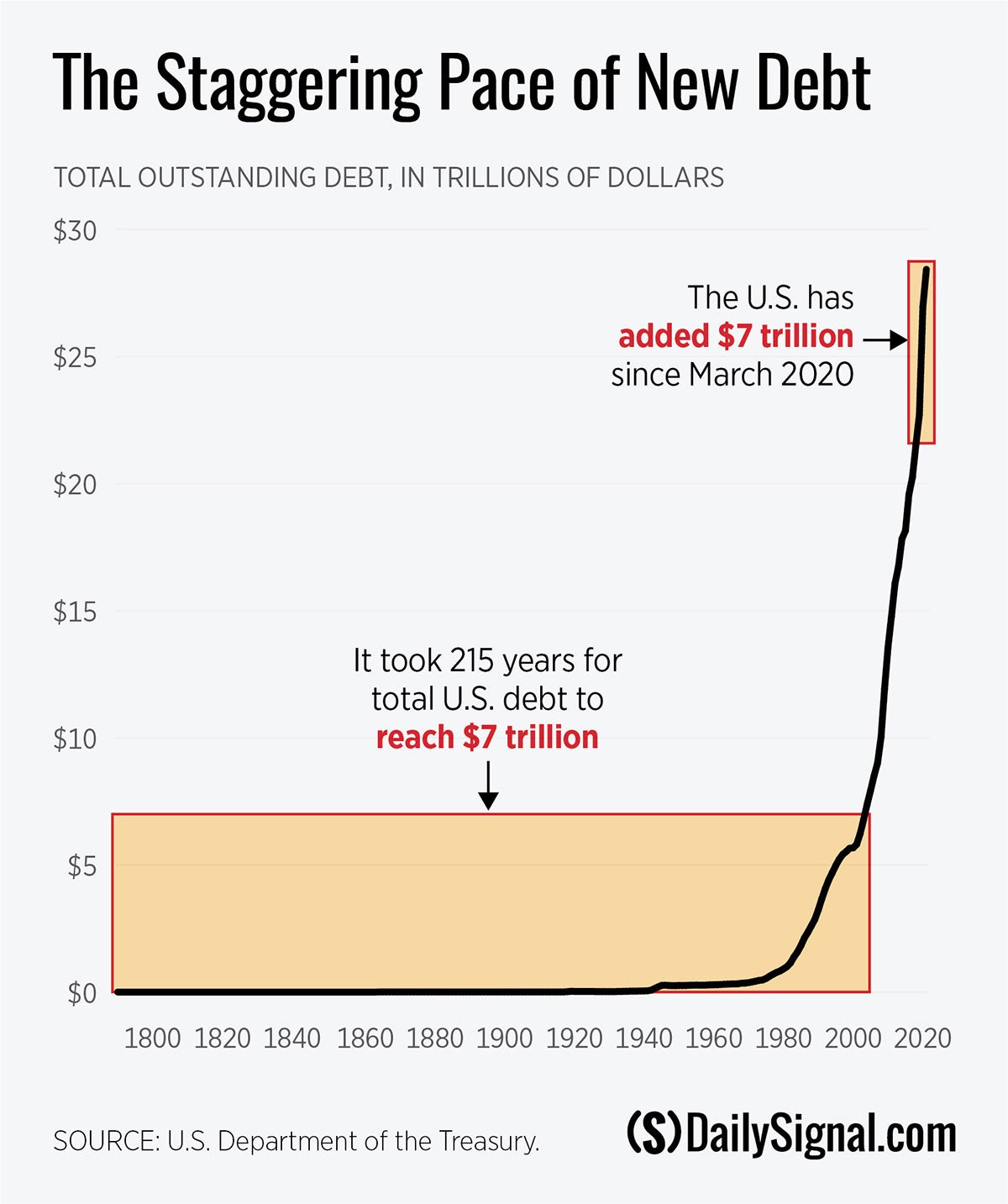
From March 2020 through June 2022, the federal government added $7 trillion in debt.

To put that in perspective, the federal debt reached a total of $7 trillion in 2004, covering a span from George Washington to the first term of George W. Bush.

That means the federal government has racked up 215 years’ worth of debt in just 27 months.

While some amount of deficit spending might have been hard to avoid during the worst of the COVID-19 pandemic, Washington kept breaking out the credit card to continue an unnecessary and wasteful spending spree, oversaturating the economy and making inflation problems inevitable.
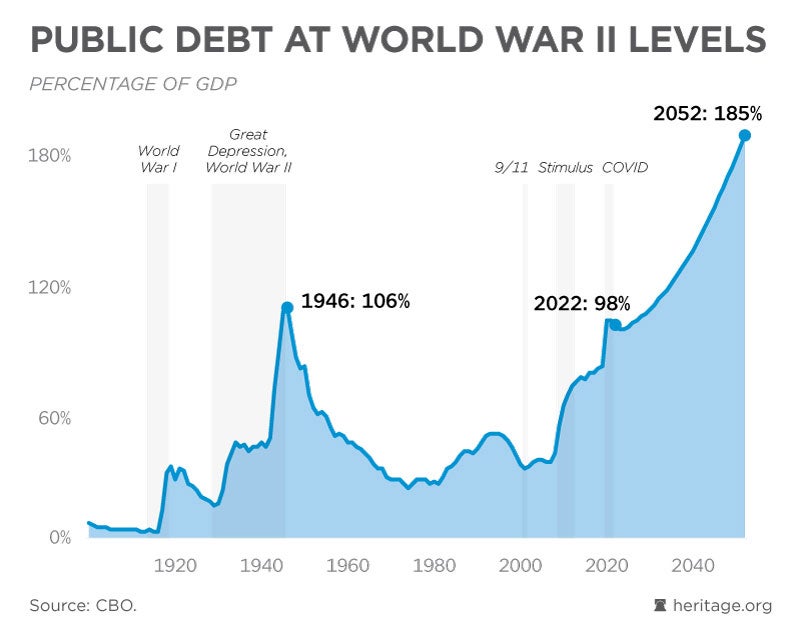
While the absolute amount of debt is important, a more important figure over the long term is the amount of debt relative to the size of the economy. As the chart above shows, that measure is also going in the wrong direction.

The federal government only reached this amount of debt once—following a combination of the longest economic downturn and the greatest military struggle in history.

Though the nation has faced challenges in recent years, none reach the magnitude of World War II or the Great Depression, meaning there’s no excuse for adding so much debt so quickly.

Vitally, in the aftermath of World War II, federal spending as a share of the economy contracted from 41% in 1945 to 11.4% in 1948, making it easier to pay down the debt.

The Biden administration, ignoring this history, is planning just the opposite; namely, more spending, more debt, and more concentrated power for the Washington swamp.

The next chart reveals exactly how reckless Biden’s big government budgeting is.
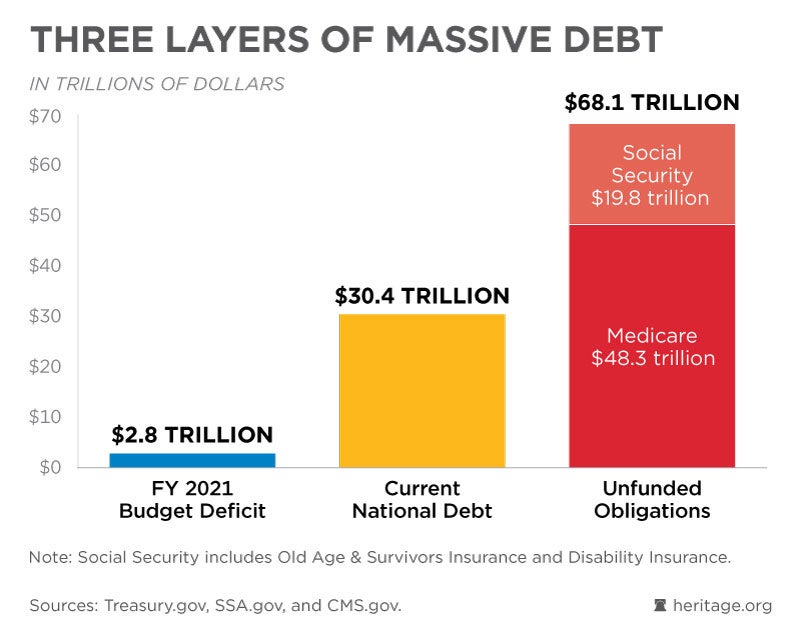
The size of annual deficits and the total accumulated debt is already astronomical. Unfortunately, those massive amounts pale in comparison to unfunded liabilities facing Social Security and Medicare. Spending on both programs has been growing faster than the economy for decades, and is expected to continue to grow indefinitely, making them unsustainable.

There are no easy solutions to addressing these programs. However, one fact is beyond dispute: The longer Congress waits to implement reforms, the harder the choices will become.
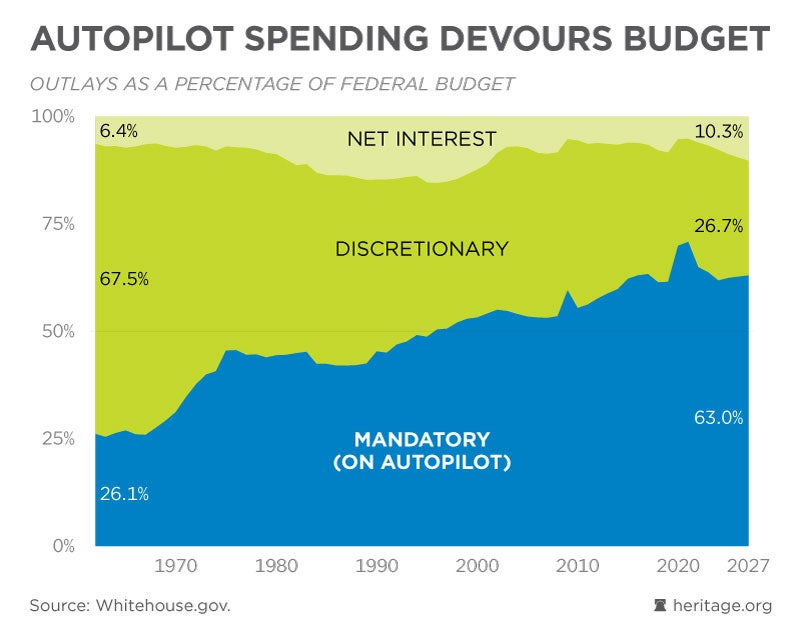
Congress has made it easier for members to ignore the mounting problem of unfunded benefit programs by making them “mandatory,” meaning the spending occurs year after year, regardless of whether legislators pass bills or even bother with budgets. As the chart above shows, mandatory spending is now dominant.

The amount of federal spending that occurs automatically has steadily increased over the past century and is expected to keep growing in the future. Yet this is exactly the spending that’s growing fastest; meaning, it should receive more attention, not less.
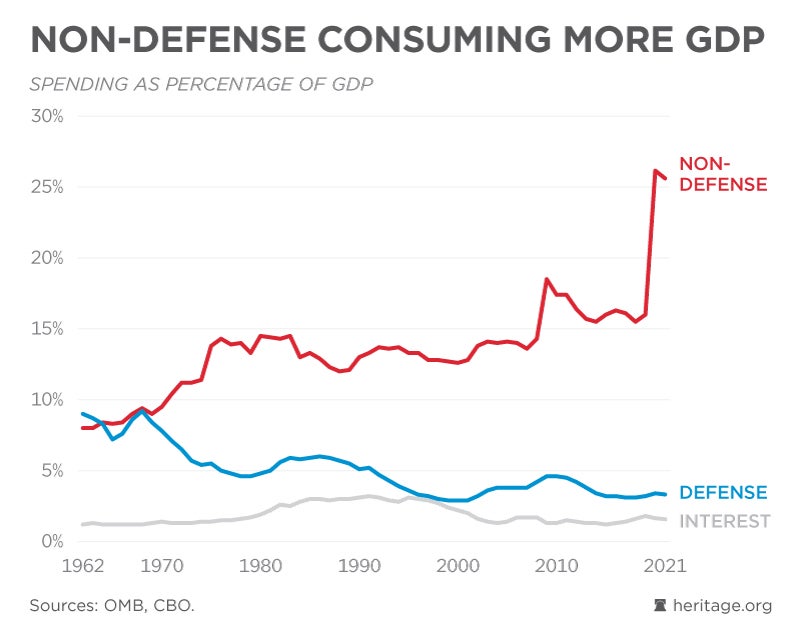
Despite this stark reality, some members of Congress think we need to move even further in this direction. For example, two House Democrats have introduced the People Over Pentagon Act to reduce spending on national defense by $100 billion.

The charts above and below refute the premise behind such messaging. Not only is national defense no longer the dominant aspect of federal spending, but it’s also quickly becoming an afterthought. The idea that Washington is doing too little to redistribute wealth flies in the face of reality.

Viewed in terms of dollars, the rapid growth of nondefense spending becomes even clearer. Congress has added hundreds of programs to the federal ledger over the past century, most of which receive spending increases every year.

Yet the left’s appetite for taxpayer-funded resources shows no sign of being sated. Activists want Medicare For All, a Green New Deal, massive forgiveness of college loans, and monthly checks,even though we can’t afford the bloated federal government we have today.

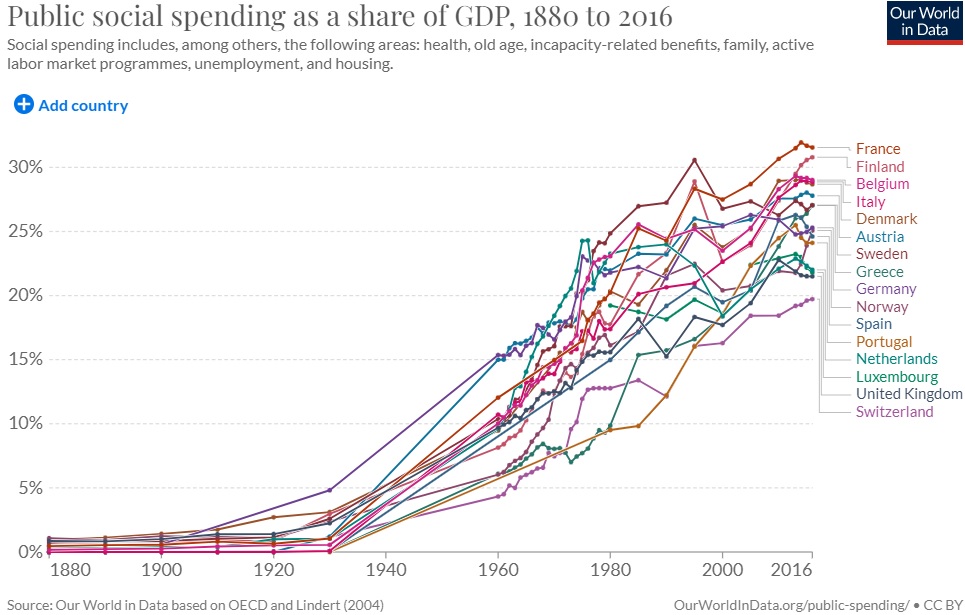
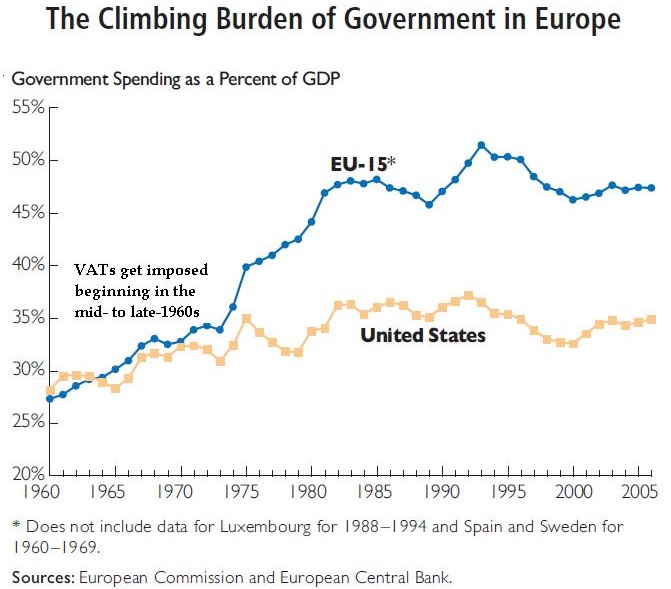
While the likes of socialist independent Sen. Bernie Sanders of Vermont claim that all of this would be possible if Uncle Sam shook down the wealthy, the math simply doesn’t add up. The only way to pay for a substantially larger government would be through substantially higher taxes on the middle class, which is commonplace across Europe.
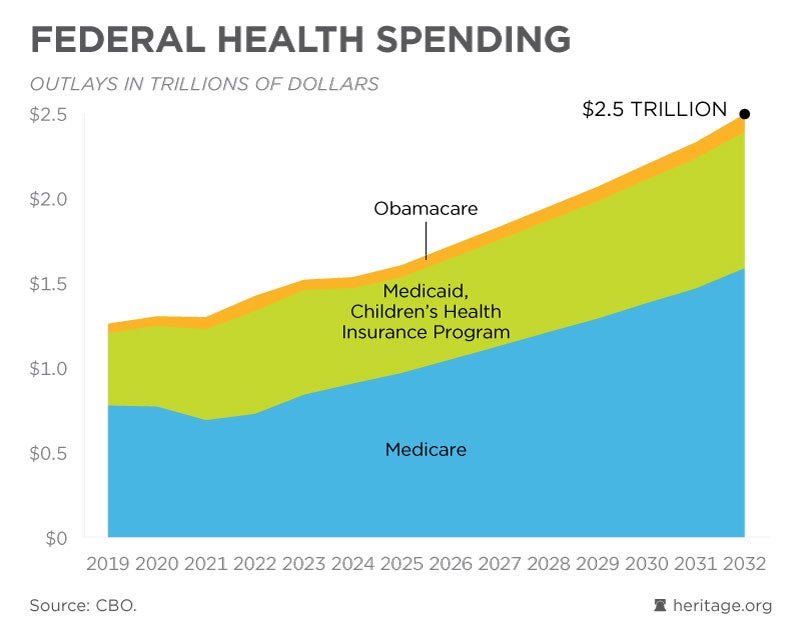
The largest federal spending category is health care. The resources devoted to Medicare, Medicaid, Obamacare subsidies, and more are a driving force behind long-term budget imbalances and are part of the reason why medical costs had above-average inflation before the current crisis.

Congress can prevent health care spending growth from bankrupting the country by reforming Medicare in a way that promotes more choices and lower costs for beneficiaries.

From today’s inflation to tomorrow’s mounting deficits, America faces stiff headwinds. Yet, there’s still time to address these challenges and remain the greatest nation in the world if our citizens and leaders are willing to recognize the problems and make tough decisions.

Not starting next year, or when one side has a firm governing majority. Starting now.

Have an opinion about this article? To sound off, please email letters@DailySignal.com and we’ll consider publishing your edited remarks in our regular “We Hear You” feature. Remember to include the url or headline of the article plus your name and town and/or state.

December 10, 2021

The Honorable Tom Tillis of North Carolina
United States Senate
Washington, D.C. 20510

Dear Senator Tillis

After reading all your views on self-professed conservative economics and cutting spending I was surprised to read your name in this article below that said you made a way for Democrats to raise the debt ceiling even though 72% of your Republican friends in the senate would have no part of it and only 1 out of 201 Republicans in the House voted to do so!!!

Senate clears expedited debt limit process, Medicare cuts delay

Lawmakers still need to pass separate debt ceiling increase by next week to avoid Treasury cash crunch

Senate Minority Leader Mitch McConnell speaks during the a news conference in the Capitol on Tuesday, Nov. 30, 2021. Behind McConnell, from left, are Sens. John Barrasso, R-Wyo., John Thune, R-S.D., and Joni Ernst, R-Iowa. (Bill Clark/CQ Roll Call)

Posted December 9, 2021 at 1:18pm, Updated at 6:27pm

The Senate broke a logjam over the statutory debt limit Thursday, clearing a measure that would allow Democrats to increase the nation’s borrowing capacity on their own without any Republican assistance necessary.

Final passage came after a critical procedural vote, in which 14 Republicans joined all Democrats on a cloture motion to limit debate. That bipartisan cooperation — on a deal brokered by Schumer and Minority Leader Mitch McConnell — cleared the way for Democrats to be able to increase the debt limit on their own and avoid a fiscal crisis.

Schumer thanked McConnell for the agreement in floor remarks Thursday, saying their talks were “fruitful, candid, productive.”

“The proposal I worked on with Leader McConnell will allow Democrats to do precisely what we’ve been seeking to do for months… provide a simple majority vote to fix the debt ceiling without having to resort to a convoluted, lengthy and ultimately risky process,” Schumer said.

McConnell began drawing battle lines over the debt limit this summer, alerting Democrats that Republicans didn’t intend to cooperate on any debt limit bill unless Democrats stopped work on their roughly $2 trillion climate and social spending reconciliation bill. If they continued to work on that package, he said, they should use the same fast-track budget reconciliation process to advance a debt limit bill.

Democrats vowed not to use the reconciliation process for the debt limit or to stop work on their tax and spending package. The intransigence placed Congress in a deadlock over the debt limit as the Treasury Department inched closer to running out of money to pay all of the country’s bills in October.

Nearly all House Republicans — with the exception of retiring Illinois Rep. Adam Kinzinger — voted against the measure Tuesday, railing against the agreement that McConnell brokered with Schumer.

Many Republicans argued that McConnell should have extracted some sort of concession from Democrats to help them advance a debt limit bill outside the reconciliation process, or forced them to use budget reconciliation.

In addition to McConnell, Republican Sens. John Barrasso, Wyo.; Roy Blunt, Mo.; Richard M. Burr, N.C.; Shelley Moore Capito, W.Va.; Susan Collins, Maine; John Cornyn, Texas; Joni Ernst, Iowa; Rob Portman, Ohio; Lisa Murkowski, Alaska; Mitt Romney, Utah; John Thune, S.D.; Thom Tillis, N.C.; and Roger Wicker, Miss., voted for cloture. The final tally was 64-36.

Your vote to help the Democrats jump over the debt ceiling limit hurdle reminded me of this cartoon:

A.F. BRANCO December 10, 2021

DON’T YOU SEE THAT MAKING THE GOVERNMENT LIVE ON WHAT IT BRINGS IN WILL MAKE IT PRIORITIZE AND THE USA WILL NOT END UP AS GREECE? WHY GIVE THE DEMOCRATS A FREE PASS NOW?

I would love to get your reaction to this rap song which was recently written about you enabled the Democrats to do:

Remy: Raise the Debt Ceiling Rap (Again)

Putting America’s depressing fiscal policy to a beat since 2011!

|

Ten years and another $15 trillion added to the debt since his original rap, Remy is back to make it rain.

Written and performed by Remy; video produced by Meredith & Austin Bragg; mastering by Ben Karlstrom.

LYRICS:

Raise the debt ceiling!
Raise the debt ceiling again!

Thirty trillion in debt and yo we’re back again
Still printing lots of money, telling all of your friends
I told you this would happen but you were a doubting Thomas
Thirty is the last trillion I’ll ever need—I swear, I promise

It’s like we’re spending junkies just getting the itch
Can I have another trillion? I promised my district a bridge

It was a crisis before, we took the lesson to heart
By spending so much money now we’re printing pressing the chart
Spending billions and billions on sweet military gear
Did any wind up with the enemy? What do you want to hear?

Raise the debt ceiling!
Raise the debt ceiling again!

Back up in the Fed and we’re still super stoked
Somehow printing lots of money while we’re working remote
Still dropping IOUs in every fund yes sir
Hamilton started this place—that’s why it only goes “BURR!!!”

Prices are rising at every venue it’s bad
And for sure that dollar menu looks especially sad
Gas prices are rising, it’s getting hard for the competent
It costs an arm and a leg—where am I? The Saudi consulate?

Leaving IOUs you should give it a try son
M1 used to sink your battleship, now it’s what you use to buy one
Just say the magic word, I’ll set the printer abuzz
Charmin might run out of paper son, but guess who never does?

Raise the debt ceiling!
Raise the debt ceiling again!

Now if you examine the chart and you look close again
We borrow more than 40 cents of every dollar we spend
Nondiscretionary spending is at terrible paces!
Do you have a response? Yes! You’re racist

We should spend most on children! We should spend most on patients!
Okay—hear me out—why don’t we spend most on interest payments?
We’re playing with fire we know the end of this story!
How do you classify your incompetence? Transitory

Objects in the mirror are closer than they seem
And to a man with a printer each problem looks like a ream
But when I’m looking at the folks that we’ve elected to lead
I’m guessing that it won’t be long till we’re back saying we need to

Raise the debt ceiling!
Raise the debt ceiling again!

SADLY IT WAS JUST 10 YEARS AGO WHEN REMY WROTE ABOUT A 15 TRILLION DEBT:

LYRICS:

Raise da debt ceiling!Raise da debt ceiling!Raise da debt ceiling!Raise da debt ceiling!

14 trillion in debtbut yo we ain’t got no qualmsdroppin $100 billsand million dollar bombs

spending money we don’t havethat’s the name of the gamethey call me cumulo nimbusbecause you KNOW I make it rain

bail out all kind of carsgot all kind of whipsladies ask me how I get emI tell em STIMULUS

Social Security surplus?Oh, guess what? it’s goneI got my hands on everythinglike Dominique Strauss Kahn

ain’t got no Medicare trust fundson, that’s just absurdspending every single penny thatwe see, son, have you heard?

ain’t got no moral objectionsain’t got kind of complaintsain’t got no quantitativestatutory budget restraints

so…[CHORUS]

Yo, we up in the Fedand we living in styleSpending lots of moneywhile we sipping crystal

still making it rainand yeah it be so pleasingwait, not making it rain–we be “Quantitative Easing!”

QE1, QE2QE4, QE3Dropping IOU’sin every fund that I see

printing the cashinflating the moniescallin up China”a-yo we straight out of 20’s!”

in the clubwe be louding outwhile to the market, yeahwe be crowding out

on the beach getting tanand sipping Coronawe got a monetary plan–and it involves a lot of toner…

[CHORUS]

So if you look at the chartand examine the trendwe borrow 40 cents of everysingle dollar we spend

and non-discretionary spendingincreases every daydo you have a comment for Committee?I MAKE IT RAIN

Mr. Speaker, Mr. Speakerwould you beam me up?A Congressperson cutting spending?Couldn’t dream me up

We’re gonna defaultif we follow this road!I should have thought of this14 trillion dollars ago!

I’m the king of the linksI’m a menace at tennisI’m sticking spinnaz on my rimspicking winnaz in business

if you’re looking for some cashit’s about to get heavyI got some big ol’ piles of moneyand guess what–they shovel ready

[CHORUS]

I HAD AN OPPORTUNITY TO CORRESPOND WITH MILTON FRIEDMAN AND READ MANY OF HIS BOOKS AND HERE IS A GREAT ARTICLE I WISH YOU HAD READ EARLIER SO YOU WOULDN’T HAVE VOTED THE WAY YOU DID!!!

Milton Friedman and “Zero Cost” Expanded Government

By:

Richard McKenzie

President Joe Biden has declared that his proposed $3.5 (or is it $5.5?) trillion “Build Back Better” social agenda will have a “zero” cost—as in $0.00! Why?  Because the added expenditures will be covered by increased revenues drawn from businesses and the “rich.”

The President and other progressive Democrats, who have parroted the Biden claim, should reflect on the wisdom of the late Milton Friedman, who had a knack for crystallizing stark economic truths.

During the early 1980s, when supply-side economics was the rage, Reagan Republicans promoted tax-rate cuts as a means of reviving the economy (because the cuts would increase people’s incentives to work, save, and invest), which Friedman believed distracted them from concern about what was happening to government outlays, which continued to rise throughout the decade.

Friedman framed the fiscal issues of the day differently, and with far greater clarity than anyone else. He admonished everyone (including President Reagan’s advisors), to “Keep your eye on one thing and one thing only: how much government is spending, because that’s the true tax. . . If you’re not paying for it in the form of explicit taxes, you’re paying for it indirectly in the form of inflation or in the form of borrowing.”

And make no mistake, government outlays have risen substantially, especially lately, increasing from $3.9 trillion in 2016 to $6.6 trillion in 2020 (including Covid outlays). Even without passage of the reconciliation bill, the White House estimates that federal outlays will continue their upward march through 2026.

Friedman understood that the real taxes on the economy ultimately come in the form of government outlays siphoning off resources for public purposes that would otherwise be used in the private sector. If the government chooses to build a bridge or road, the concrete and steel could have been used to produce houses and office buildings.

How the added government outlays are financed—through taxes, newly printed dollars and inflation, or debt—is of secondary importance, perhaps only marginally affecting people’s incentives. The costs of expanded government outlays will be incurred through the shift of resources from private-directed uses to public-directed uses.

By declaring that his “Build Back Better” agenda has no costs, President Biden must be confused—if he truly means what he has been saying. He may think that the dollars expended for an expanded array of welfare recipients will come only at the expense of the “rich.” Not so at all. Those transferred dollars will enable the recipients to buy goods they could not otherwise buy, which means they can pull resources away from the production of the variety of goods that ordinary Walmart (and Home Depot and Kroger) shoppers, many with far less-than-privileged means, would have bought.


Richard McKenzie is an economics professor (emeritus) in the Merage Business School at the University of California, Irvine. His latest book is The Selfish Brain: A Layman’s Guide to a New Way of Economic Thinking (2021).

HERE ARE SOME SUGGESTIONS YOU HAVE IGNORED:

The Solution to the Debt Ceiling Debacle

Fundamental spending reform needed.

|

Deficits are also going to go up to $544 billion from last year’s $439 billion. Over the coming decade, the size of the federal deficit will double to reach an annual gap of almost 5 percent of GDP. CBO predicts that deficits will total $9.4 trillion. That’s up $1.5 trillion from its August report. It also notes that under the alternative scenario budget projection, spending will increase to 21.9 percent of GDP in 2020, to 25.8 percent in 2030, and to 30.4 percent in 2040.

The expansion of mandatory programs—such as Medicare, Medicaid, Affordable Care Act subsidies, and Social Security—is the driving force behind this spending growth and our exploding debt. These entitlements will trigger even higher levels of debt in the years outside the 10-year budget window.

Unfortunately, as the debt grows, the interest payments on that debt will grow as well. If the United States does not change course, interest on the debt will end up as one of its biggest budget items. Our unfunded liabilities keep going up, too. The net present value of the promises made to the American people for which the United States does not have the money to pay is roughly $75.5 trillion, according to the Treasury Department.

High debt levels are problematic. As CBO explained a few years ago:

Such high and rising debt later in the coming decade would have serious negative consequences: When interest rates return to higher (more typical) levels, federal spending on interest payments would increase substantially. Moreover, because federal borrowing reduces national saving, over time the capital stock would be smaller and total wages would be lower than they would be if the debt was reduced. In addition, lawmakers would have less flexibility than they would have if debt levels were lower to use tax and spending policy to respond to unexpected challenges. Finally, a large debt increases the risk of a fiscal crisis, during which investors would lose so much confidence in the government’s ability to manage its budget that the government would be unable to borrow at affordable rates.[v]

These numbers are important to keep in mind when discussing the next debt ceiling deadline. Indeed, when March 2017 comes around we can expect that Washington will once again have the same debate it has had for the last few years about whether or not to raise the debt ceiling and under what circumstances. On one side you will find those who want to raise the limit without questions asked. On the other side, you will find those who will demand reforms in exchange for yet another increase in the debt ceiling.

Continuing to pass debt ceiling increases without proper spending reforms would be irresponsible. It is also irresponsible to signal to the international community that the US government could possibly default on its debt obligations while Washington works through whether it will raise the debt limit before or after it formulates a plan to reduce government spending.

WHAT’S AT STAKE

To be sure, default should not be an option on the table. However, raising the debt ceiling without a commitment to improve our long-term debt problem has adverse consequences. In 2011, the rating agency Fitch warned the US government that while it supported raising the debt ceiling, it also wanted the government to come up with a credible medium-term deficit-reduction plan.[vi] Other rating agencies at the time also warned the United States of the negative consequences of not dealing with the country’s long-term debt.

If Congress does not address our debt problem before March 2017, the optimal outcome would then be to raise the debt limit while Congress and the president pass a credible plan to reduce near- and long-term spending at the same time.

Fortunately, if an agreement to control spending and raise the debt limit is not reached, the United States need not risk defaulting on its debt. The Treasury Department has the legal authority to prioritize interest payments on the debt above all other obligations, whether that means delaying payments to contractors or managing other obligations. But Congress should not be forced to raise the debt ceiling under false pretenses.

As was the case in 2011, the United States will have enough expected cash flow (tax revenue) and assets on hand to avoid either of these unattractive options. Managing payments in this manner is by no means optimal, and Treasury officials have indicated that this will be difficult owing to payment automation. That said, it is important to recognize the options that are available to prevent a default. While Washington has difficult choices to make, defaulting on its debt obligations should not be part of the discussion about how to handle the debt limit or reduce long-term government spending.

REAL INSTITUTIONAL REFORM

The heated rhetoric coming in March 2017 about whether Congress should raise the debt ceiling will obscure the federal government’s real problem: an unprecedented increase in government spending and the future explosion of entitlement spending has created a fiscal imbalance today and for the years to come. No matter what Congress decides to do about the debt ceiling, the United States must implement institutional reforms that constrain government spending and return the country to a sustainable fiscal position.

Real institutional reforms, as opposed to onetime cuts, would change the trajectory of fiscal policy and put the United States on a more sustainable path. Such reforms could include:

1. A constitutional amendment to limit spending. The inability of lawmakers to constrain their own spending makes spending limits enforced through the US Constitution preferable.[vii]

2. Meaningful budget reforms that limit lawmakers’ tendency to spend. In the absence of constitutional rules, budget rules should have broad scope, few and high-hurdle escape clauses, and minimal accounting discretion.[viii]

3. The end of budget gimmicks. Creative bookkeeping is at the center of many countries’ financial troubles. Congress should institute a transparent budget process and end abuse of the emergency spending rule, reliance on overly rosy scenarios, and all other gimmicks.[ix]

4. A strict cut-as-you-go system. This system should apply to the entire federal budget, not just to a small portion of it. There should be no new spending without offsetting cuts.[x]

5. A BRAC-like commission for discretionary spending. Commissions composed of independent experts often tackle intractable political problems successfully.[xi]

REAL ENTITLEMENT REFORMS

As mentioned earlier, the drivers of our future debt are spending on Medicare, Medicaid, Affordable Care Act subsidies, and Social Security. Without reforms today, vast tax increases will be needed to pay for the unfunded promises made to a steadily growing cohort of seniors.

While economists disagree when it comes to fiscal policy, a consensus has emerged that spending-based fiscal adjustments are not only more likely to reduce the debt-to-GDP ratio than tax-based ones but are also less likely to trigger a recession.[xii] In fact, if accompanied by the right type of policies (especially changes to public employees’ pay and public pension reforms), spending-based adjustments can actually be associated with economic growth.

Fortunately, numerous workable solutions are available to lawmakers, including adding a system of personal savings accounts to Social Security, liberalizing medical savings accounts, and making the latter permanent to reduce healthcare costs by increasing competition between providers and making consumers more responsive to tradeoffs.[xiii]

These options are supposed to encourage families to save more and also to use their money more responsibly and in a manner more consistent with their long-term needs. And since taxpayers remain in control of their cash, they can also pass it along if they don’t use it all before they die—giving the next generation a head start when it comes to building assets.

Better yet, we should free the healthcare supply from the many constraints imposed by federal and state governments and the special interests they serve.[xiv]The stakes are high: Bringing revolutionary innovation to this industry could mean not just bending the healthcare cost curve but breaking it to bits—making the need for health insurance much less important, if not moot, in many cases.

REVENUE AND ASSETS AVAILABLE TO FUND OUR COMMITMENT UNTIL AN AGREEMENT IS REACHED

With that in mind, let’s think about what happens in March 2017. At that time, the government will reach the debt ceiling, and the Treasury will no longer be able to issue federal debt. The federal government could reduce spending, increase federal revenues by a corresponding amount to cover the gap, or find other funding mechanisms. This would allow time for Congress and the president to reach an agreement to change the country’s financial path before raising the debt ceiling.

At that time, the Treasury Department will have several financial management options to continue paying the government’s obligations. These include (1) prioritizing payments;[xv] (2) taking financial steps, including permitting the suspension of investments in, and the redemption of securities held by, certain government trust funds or postponing the sale of nonmarketable debt;[xvi] (3) liquidating some assets to pay government bills;[xvii] and (4) using the Social Security Trust Fund to continue paying Social Security benefits.[xviii]

PRIORITIZING PAYMENTS

The Secretary of the Treasury has long-standing authority to prioritize payments and does not have to pay bills in the order in which they are received. The US Government Accountability Office found that

the Secretary of the Treasury has the authority to determine the order in which obligations are to be paid should the Congress fail to raise the statutory debt ceiling and revenues are inadequate to cover all required payments. There is no statute or other basis for concluding that the Treasury must pay outstanding obligations in the order they are presented for payment. Treasury is free to liquidate obligations in any order it determines will best serve the interests of the United States.[xix]

According to a report by the Treasury Department’s Inspector General (IG), during the 2011 debt ceiling crisis the Treasury “considered a range of options with respect to how Treasury would operate if the debt ceiling was not raised.” Further, the report notes that Treasury officials told the IG that “organizationally they viewed the option of delaying payments as the least harmful among the options under review” and that “the decision of how Treasury would have operated if the U.S. had exhausted its borrowing authority would have been made by the President in consultation with the Secretary of the Treasury.”[xx]

TEMPORARY MEASURES

During the last debt ceiling debate in 2011, my colleague Jason Fichtner and I listed all the assets that Treasury could tap into to avoid a default until an agreement between the president and Congress be reached.[xxi] We updated this report in 2013.[xxii] At the time we explained that Treasury was expected to collect $2.6 trillion in revenue. We wrote:

That alone would be enough to cover interest on the debt ($218 billion), thereby avoiding any technical default of the US government on its debt obligations to Social Security ($809 billion), Medicare ($581 billion), and Medicaid ($267 billion), and it would leave approximately $725 billion for other priorities.

In addition, we noted that the Treasury Department had financial measures at its disposal to fund government operations temporarily without having to issue new debt. To be clear, our list was only meant to present the range of possible options available to Congress. But, as we noted then, those may not be good or desirable options.

These assets totaled $1.9 trillion and included $50.2 billion in nonrestricted cash on hand,[xxiii] $121.1 billion in restricted cash and other monetary assets (gold, international monetary assets, foreign currency),[xxiv] and the redemption of existing investments in other trust funds.[xxv]

We also noted that the government could rely on the determination of a “debt issuance suspension period.” This determination would permit the redemption of existing, and the suspension of new, investments of the Civil Service Retirement and Disability Fund (CSRDF).[xxvi] Right now there is $858.7 billion intergovernmental holdings in the CSRDF.

In March 2017, the numbers will be different, but the same assets may be used to avoid a default. Relying on any of these sources of funds or increasing the debt ceiling without reducing existing budget commitments illustrates the irresponsible path the country is on and the urgent need for institutional spending reform. Nonetheless, these assets could be used as a temporary measure to allow Congress and the administration to negotiate spending reductions and institutional reforms to the budget process to ensure the nation is put back on a sound fiscal path.

Thank you. I am happy to take your questions.

[i] Congressional Research Service, “The Debt Limit: History and Recent Increases,” October 1, 2015, 5.

[ii] Ibid, 11.

[iii] Veronique de Rugy, “Budget Deal Is Business-as-Usual in Washington,” Mercatus Center at George Mason University, November 18, 2015.

[iv] Congressional Budget Office, “The Budget and Economic Outlook: 2016 to 2026,” January 2016, 4.

[v] Congressional Budget Office, “Updated Budget Projections: Fiscal Years 2013 to 2023,” May 2013.

[vi] Veronique de Rugy, “Policy Implications of the S&P Warnings,” The Corner, National Review, July 22, 2011. Also see Jeannette Neumann, “Fitch Unveils Two Possible Routes to Downgrading US Debt Rating,” Wall Street Journal, January 15, 2013.

[vii] David M. Primo, “Constitution Is Only Way to Cut US Deficit,” Bloomberg Business, February 24, 2011.

[viii] David M. Primo, “Making Budget Rules Bite” (Mercatus on Policy, Mercatus Center at George Mason University, Arlington, VA, March 2010).

[ix] Veronique de Rugy, “Budget Gimmicks or the Destructive Art of Creative Accounting” (Mercatus Working Paper, Mercatus Center at George Mason University, Arlington, VA, June 2010).

[x] Veronique de Rugy and David Bieler, “Is PAYGO a No-Go?” (Mercatus on Policy, Mercatus Center at George Mason University, Arlington, VA, April 2010).

xi] Jerry Brito, “The BRAC Model for Spending Reform” (Mercatus on Policy, Mercatus Center at George Mason University, Arlington, VA, February 2010).

[xii] Veronique de Rugy, “The Effect of Tax Increases and Spending Cuts on Economic Growth” (Testimony before the Senate Committee on the Budget, Mercatus Center at George Mason University, Arlington, VA, May 22, 2013).

[xiii] Chris Edwards and Tad DeHaven, “War Between Generations: Federal Spending on the Elderly Set to Explode” (Policy Analysis No. 488, Cato Institute, Washington, DC, September 16, 2003).

[xiv] Robert Graboyes, “Fortress and Frontier in American Health Care” (Mercatus Research, Mercatus Center at George Mason University, Arlington, VA, October 2014).

[xv] Jason J. Fichtner and Veronique de Rugy, “The Debt Ceiling: What Is at Stake?” (Mercatus Research, Mercatus Center at George Mason University, Arlington, VA, April 2011).

[xvi] Veronique de Rugy and Jason J. Fichtner, “The Debt Limit Debate” (Mercatus on Policy, Mercatus Center at George Mason University, Arlington, VA, May 2011).

[xvii] Fichtner and de Rugy, “The Debt Ceiling: What Is at Stake?”

[xviii] The Social Security Trust Funds can only be used to pay Social Security benefits. See Glenn Kessler, “Can President Obama Keep Paying Social Security Benefits Even If the Debt Ceiling Is Reached?,” Washington Post, July 13, 2011; Contract with America Advancement Act of 1996, Pub. L. No. 104-121 (1996).

[xix] US Government Accountability Office, Letter to Senator Bob Packwood, October 9, 1985.

[xx] Department of the Treasury, Office of Inspector General, Letter to Senator Orrin G. Hatch, OIG-CA-12-006, August 24, 2012.

[xxi] Fichtner and de Rugy, “The Debt Ceiling: What Is at Stake?”

[xxii] Jason J. Fichtner and Veronique de Rugy, “The Debt Ceiling: Assets Available to Prevent Default” (Mercatus Research, Mercatus Center at George Mason University, Arlington, VA, January 2013).

[xxiii] Department of the Treasury, “Daily Treasury Statement,” January 14, 2013.

[xxiv] Department of the Treasury, 2012 Financial Report of the US Government, 65. At the time, the Treasury owned approximately 261.4 million ounces of gold and marked the value of its gold holdings at $42 per ounce, giving a reported value of $11.1 billion. At a spot market price of $1,500 per ounce, Treasury’s gold holdings could be valued near $400 billion.

[xxv] Department of the Treasury, “Monthly Statement of the Public Debt of the United States,” December 31, 2015.

[xxvi] In September 1985, the Treasury took the step of disinvesting the Civil Service Retirement and Disability Trust Fund, the Social Security Trust Funds, and several smaller trust funds.

I HAD THE OPPORTUNITY TO CORESPONDENT WITH WALTER WILLIAMS AND I LEARNED MUCH FROM HIM AND HE IS RIGHT THAT CONGRESS IS GOING AGAINST JAMES MADISON’S WARNING:

Walter E. Williams - A MINORITY VIEW
Walter E. Williams is a professor of economics at George Mason University.

The largest threat to our prosperity is government spending that far exceeds the authority enumerated in Article 1, Section 8 of the U.S. Constitution. Federal spending in 2017 will top $4 trillion. Social Security, at $1 trillion, will take up most of it. Medicare ($582 billion) and Medicaid ($404 billion) are the next-largest expenditures. Other federal social spending includes food stamps, unemployment compensation, child nutrition, child tax credits, supplemental security income and student loans, all of which total roughly $550 billion. Social spending by Congress consumes about two-thirds of the federal budget.

Where do you think Congress gets the resources for such spending? It’s not the tooth fairy or Santa Claus. The only way Congress can give one American a dollar is to use threats, intimidation and coercion to confiscate that dollar from another American. Congress forcibly uses one American to serve the purposes of another American. We might ask ourselves: What standard of morality justifies the forcible use of one American to serve the purposes of another American? By the way, the forcible use of one person to serve the purposes of another is a fairly good working definition of slavery.

Today’s Americans have little appreciation for how their values reflect a contempt for those of our Founding Fathers. You ask, “Williams, what do you mean by such a statement?” In 1794, Congress appropriated $15,000 to help French refugees who had fled from insurrection in Saint-Domingue (now Haiti). James Madison, the “Father of the Constitution,” stood on the floor of the House to object, saying, “I cannot undertake to lay my finger on that article in the federal Constitution which granted a right to Congress of expending, on objects of benevolence, the money of their constituents.” Most federal spending today is on “objects of benevolence.” Madison also said, “Charity is no part of the legislative duty of the government.”

No doubt some congressmen, academics, hustlers and ignorant people will argue that the general welfare clause of the U.S. Constitution authorizes today’s spending. That is simply unadulterated nonsense. Thomas Jefferson wrote, “Congress (has) not unlimited powers to provide for the general welfare, but (is) restrained to those specifically enumerated.” Madison wrote that “if Congress can do whatever in their discretion can be done by money, and will promote the general welfare, the Government is no longer a limited one possessing enumerated powers, but an indefinite one.” In other words, the general welfare clause authorized Congress to spend money only to carry out the powers and duties specifically enumerated in Article 1, Section 8 and elsewhere in the Constitution, not to meet the infinite needs of the general welfare.

We cannot blame politicians for the spending that places our nation in peril. Politicians are doing precisely what the American people elect them to office to do — namely, use the power of their office to take the rightful property of other Americans and deliver it to them. It would be political suicide for a president or a congressman to argue as Madison did that Congress has no right to expend “on objects of benevolence” the money of its constituents and that “charity is no part of the legislative duty of the government.” It’s unreasonable of us to expect any politician to sabotage his career by living up to his oath of office to uphold and defend our Constitution. That means that if we are to save our nation from the economic and social chaos that awaits us, we the people must have a moral reawakening and eschew what is no less than legalized theft, the taking from one American for the benefit of another.

I know that some people will say, “Williams, I agree with most of what you say, but not when it comes to Social Security. Social Security is my money I had taken out of my pay for retirement.” If you think that, you’ve been duped. The only way you get a Social Security check is for Congress to take the earnings of a worker. Explanation of your duping can be found on my website, in a 2010 article I wrote titled “Washington’s Lies.”

Walter E. Williams is a professor of economics at George Mason University.

Everette Hatcher III, 13900 Cottontail Lane, Alexander, AR 72002, everettehatcher@gmail.com,

Graham Warns Senators: ‘If You’re Wondering Why There’s A Donald Trump,

Dan Mitchell, Cato Institute, Debt Ceiling

“Raise the Debt Ceiling” rap goes viral

Daniel J. Mitchell – USA: Drowning In Debt?

The problem in Washington is not lack of revenue but our lack of spending restraint. This video below makes that point. WASHINGTON IS A SPENDING ADDICT!!!

——-

I HAVE WRITTEN REPUBLICAN SENATORS AND REPRESENTATIVES ABOUT THE IMPORTANCE OF NOT RAISING THE DEBT CEILING FOR OVER AN DECADE NOW!!!! WHY DO THEY CONTINUE TO DO SO EVEN THOUGH THEY ALL SAY THEY ARE AGAINST BORROWING 40% OF WHAT THE GOVERNMENT SPENDS? Look at some of these previous letters below:

The Honorable Shelley Moore Capito
United States Senate
Washington, D.C. 20510

Dear Senator Capito,

On September 16, 2021 my post “46 REPUBLICAN SENATORS VOW NOT TO HELP DEMOCRATS RAISE THE DEBT CEILING (HERE WE GO AGAIN!!!!!)” and you were one of the 46 Senators who pledged not to raise the debt ceiling but you folded like a wet leaf just like I predicted:

I have written before about those heroes of mine that have resisted raising the debt ceiling but in the end I have always been disappointed and here we go again!

But first let me give you a taste of something I wrote about 10 years ago on this same issue!

Why don’t the Republicans  just vote no on the next increase to the debt ceiling limit. I have praised over and over and overthe 66 House Republicans that voted no on that before. If they did not raise the debt ceiling then we would have a balanced budget instantly.  I agree that the Tea Party has made a difference and I have personally posted 49 posts on my blog on different Tea Party heroes of mine.

What would happen if the debt ceiling was not increased? Yes President Obama would probably cancel White House tours and he would try to stop mail service or something else to get on our nerves but that is what the Republicans need to do.

I have written and emailed Senator Pryor over, and over again with spending cut suggestions but he has ignored all of these good ideas in favor of keeping the printing presses going as we plunge our future generations further in debt. I am convinced if he does not change his liberal voting record that he will no longer be our senator in 2014.

I have written hundreds of letters and emails to President Obama and I must say that I have been impressed that he has had the White House staff answer so many of my letters. The White House answered concerning Social Security (two times), Green Technologies, welfare, small businesses, Obamacare (twice),  federal overspending, expanding unemployment benefits to 99 weeks,  gun control, national debt, abortion, jumpstarting the economy, and various other  issues.   However, his policies have not changed, and by the way the White House after answering over 50 of my letters before November of 2012 has not answered one since.   President Obama is committed to cutting nothing from the budget that I can tell.

A.F. Branco for Oct 21, 2021

 I have praised over and over and over the 66 House Republicans that voted no on that before. If they did not raise the debt ceiling then we would have a balanced budget instantly.  I agree that the Tea Party has made a difference and I have personally posted 49 posts on my blog on different Tea Party heroes of mine.

46 Republican Senators Vow Not to Help Democrats Raise the Debt Ceiling

All but four Republican senators have signed a pledge that they will not vote to raise the debt ceiling, sending another warning to Democrats that they are on their own on the pressing issue.

Sen. Ron Johnson (R-WI) circulated a letter during the chamber’s vote-a-rama on the $3.5 trillion budget resolution Wednesday, signing up a majority of his fellow Republicans in an effort to link the Democrats’ proposed spending package with the statutory debt limit imposed on the federal government by Congress, which covers spending that has already been approved and must be paid by the U.S. Treasury.

In the letter, which is addressed to “Our Fellow Americans,” the Republican signatories claim that Democrats are responsible for increased federal spending and so must be responsible for raising the debt limit. “We will not vote to increase the debt ceiling, whether that increase comes through a stand-alone bill, a continuing resolution, or any other vehicle,” the letter says. “Democrats, at any time, have the power through reconciliation to unilaterally raise the debt ceiling, and they should not be allowed to pretend otherwise.”

The Republicans who didn’t sign the letter are Sens. Susan Collins of Maine, John Kennedy of Louisiana, Lisa Murkowski of Alaska and Richard Shelby of Alabama.

Why now: A two-year suspension of the debt ceiling expired at the end of July, forcing the U.S. Treasury to begin taking “extraordinary measures” to keep paying its bills as it waits for Congress to either raise or suspend the limit before the country is forced to default. Democrats opted not to include an increase in the debt ceiling in their budget resolution, which would have made it possible to raise the limit without Republican support, though they still have the option of revising the resolution to include such a provision.

What Democrats say: Democrats point out that much of the increased debt in recent years was produced during former President Trump’s administration. “I cannot believe that Republicans would let the country default,” Senate Majority Leader Chuck Schumer (D-NY) said Wednesday. “It has always been bipartisan to deal with the debt ceiling. When Trump was president I believe the Democrats joined with him to raise it three times.”

President Biden told reporters Wednesday that trillions in debt were added “on the Republicans’ watch” but said he was confident that the GOP would act in time. “They are not going to let us default,” he said.

The bottom line: No one expects Congress to allow the U.S. to default, but it looks like we could be in for a high-stakes game of chicken in the coming weeks — and the markets are starting to notice. According to Reuters Wednesday, “Some U.S. Treasury bill yields are beginning to reflect concerns that lawmakers may wait until the last minute to increase or suspend the debt ceiling.”

Will you stand up against the Democrats in the future and make the Government ONLY SPEND WHAT IT BRINGS IN? We are becoming an entitlement society and we must stop this trend!!!!

Everette Hatcher III, 13900 Cottontail Lane, Alexander, AR 72002, everettehatcher@gmail.com, http://www.thedailyhatch.org cell 501-920-5733

PS: In 2010 we had a group of conservatives get elected in the House and many of them stood up to President Obama when he wanted to raise the debt limit and I praised these 66 heroes of mine on my blog in 2011 and Representative Andy Harris of Maryland was one of those. Here is what I wrote about him:


Sixty Six who resisted “Sugar-coated Satan Sandwich” Debt Deal (Part 37)

This post today is a part of a series I am doing on the 66 Republican Tea Party favorites that resisted eating the “Sugar-coated Satan Sandwich” Debt Deal. Actually that name did not originate from a representative who agrees with the Tea Party, but from a liberal.

Rep. Emanuel Clever (D-Mo.) called the newly agreed-upon bipartisan compromise deal to raise the  debt limit “a sugar-coated satan sandwich.”

“This deal is a sugar-coated satan sandwich. If you lift the bun, you will not like what you see,” Clever tweeted on August 1, 2011.

August 1, 2011

Rep. Harris Votes Against the Debt Ceiling “Deal” 

Washington, DC – Today, Rep. Andy Harris voted against the debt ceiling increase. The plan did not require passage of a balanced budget amendment, which Rep. Harris feels is essential to bringing permanent common sense accountability to Washington.

“A balanced budget amendment is the only way to make sure the federal government spends what it takes in and lives within its means,” said Rep. Andy Harris.  “Over the past few weeks I have repeatedly voted for reasonable proposals to raise the debt ceiling that included passage of a balanced budget amendment. But I didn’t come to Washington to continue writing blank checks. Maryland’s families and job creators sent me to Congress to permanently change the way Washington does business.  I appreciate Speaker Boehner’s remarkable, historic efforts to craft a proposal to solve the debt ceiling issue.  But today’s debt ceiling deal just doesn’t go far enough to build an environment for job creation by requiring passage of a balanced budget amendment to bring permanent common sense accountability to Washington.”

Currently, the U.S. Government has a national debt of $14.3 trillion and runs an annual deficit of $1.65 trillion.

Andrew Peter Harris (born January 25, 1957) is an American politician and physician who has been the U.S. Representative for Maryland’s 1st congressional district since 2011. The district includes the entire Eastern Shore, as well as several eastern exurbs of Baltimore. He is currently the only Republicanmember of Maryland’s congressional delegation. Harris previously served in the Maryland Senate.

Andy Harris
Andy Harris 115th Congress (cropped).jpg
Member of the U.S. House of Representatives
from Maryland‘s 1st district
Assumed office
January 3, 2011
Preceded by Frank Kratovil
Member of the Maryland Senate
In office
1999 – January 3, 2011
Preceded by Vernon Boozer (9th)
Norman Stone (7th)
Succeeded by Robert Kittleman (9th)
J.B. Jennings (7th)
Constituency 9th district (1999–2003)
7th district (2003–2011)

Related posts:

Sixty Six who resisted “Sugar-coated Satan Sandwich” Debt Deal (Part 49)

Sixty Six who resisted “Sugar-coated Satan Sandwich” Debt Deal (Part 49) This post today is a part of a series I am doing on the 66 Republican Tea Party favorites that resisted eating the “Sugar-coated Satan Sandwich” Debt Deal. Actually that name did not originate from a representative who agrees with the Tea Party, but […]

Sixty Six who resisted “Sugar-coated Satan Sandwich” Debt Deal (Part 48)

Sixty Six who resisted “Sugar-coated Satan Sandwich” Debt Deal (Part 48) This post today is a part of a series I am doing on the 66 Republican Tea Party favorites that resisted eating the “Sugar-coated Satan Sandwich” Debt Deal. Actually that name did not originate from a representative who agrees with the Tea Party, but […]

Sixty Six who resisted “Sugar-coated Satan Sandwich” Debt Deal (Part 47)

Sixty Six who resisted “Sugar-coated Satan Sandwich” Debt Deal (Part 47) This post today is a part of a series I am doing on the 66 Republican Tea Party favorites that resisted eating the “Sugar-coated Satan Sandwich” Debt Deal. Actually that name did not originate from a representative who agrees with the Tea Party, but […]

Sixty Six who resisted “Sugar-coated Satan Sandwich” Debt Deal (Part 46)

  Sixty Six who resisted “Sugar-coated Satan Sandwich” Debt Deal (Part 46) This post today is a part of a series I am doing on the 66 Republican Tea Party favorites that resisted eating the “Sugar-coated Satan Sandwich” Debt Deal. Actually that name did not originate from a representative who agrees with the Tea Party, […]

Sixty Six who resisted “Sugar-coated Satan Sandwich” Debt Deal (Part 45)

Sixty Six who resisted “Sugar-coated Satan Sandwich” Debt Deal (Part 45) This post today is a part of a series I am doing on the 66 Republican Tea Party favorites that resisted eating the “Sugar-coated Satan Sandwich” Debt Deal. Actually that name did not originate from a representative who agrees with the Tea Party, but […]

Sixty Six who resisted “Sugar-coated Satan Sandwich” Debt Deal (Part 44)

Sixty Six who resisted “Sugar-coated Satan Sandwich” Debt Deal (Part 44) This post today is a part of a series I am doing on the 66 Republican Tea Party favorites that resisted eating the “Sugar-coated Satan Sandwich” Debt Deal. Actually that name did not originate from a representative who agrees with the Tea Party, but […]

Sixty Six who resisted “Sugar-coated Satan Sandwich” Debt Deal (Part 43)

Sixty Six who resisted “Sugar-coated Satan Sandwich” Debt Deal (Part 43) This post today is a part of a series I am doing on the 66 Republican Tea Party favorites that resisted eating the “Sugar-coated Satan Sandwich” Debt Deal. Actually that name did not originate from a representative who agrees with the Tea Party, but […]

Sixty Six who resisted “Sugar-coated Satan Sandwich” Debt Deal (Part 42)

Sixty Six who resisted “Sugar-coated Satan Sandwich” Debt Deal (Part 42) This post today is a part of a series I am doing on the 66 Republican Tea Party favorites that resisted eating the “Sugar-coated Satan Sandwich” Debt Deal. Actually that name did not originate from a representative who agrees with the Tea Party, but […]

Sixty Six who resisted “Sugar-coated Satan Sandwich” Debt Deal (Part 41)

Sixty Six who resisted “Sugar-coated Satan Sandwich” Debt Deal (Part 41) This post today is a part of a series I am doing on the 66 Republican Tea Party favorites that resisted eating the “Sugar-coated Satan Sandwich” Debt Deal. Actually that name did not originate from a representative who agrees with the Tea Party, but […]

Sixty Six who resisted “Sugar-coated Satan Sandwich” Debt Deal (Part 40)

Sixty Six who resisted “Sugar-coated Satan Sandwich” Debt Deal (Part 40) This post today is a part of a series I am doing on the 66 Republican Tea Party favorites that resisted eating the “Sugar-coated Satan Sandwich” Debt Deal. Actually that name did not originate from a representative who agrees with the Tea Party, but […]

Sixty Six who resisted “Sugar-coated Satan Sandwich” Debt Deal (Part 39)

Sixty Six who resisted “Sugar-coated Satan Sandwich” Debt Deal (Part 39) This post today is a part of a series I am doing on the 66 Republican Tea Party favorites that resisted eating the “Sugar-coated Satan Sandwich” Debt Deal. Actually that name did not originate from a representative who agrees with the Tea Party, but […]

Sixty Six who resisted “Sugar-coated Satan Sandwich” Debt Deal (Part 38)

Sixty Six who resisted “Sugar-coated Satan Sandwich” Debt Deal (Part 38) This post today is a part of a series I am doing on the 66 Republican Tea Party favorites that resisted eating the “Sugar-coated Satan Sandwich” Debt Deal. Actually that name did not originate from a representative who agrees with the Tea Party, but […]

Sixty Six who resisted “Sugar-coated Satan Sandwich” Debt Deal (Part 37)

Sixty Six who resisted “Sugar-coated Satan Sandwich” Debt Deal (Part 37) This post today is a part of a series I am doing on the 66 Republican Tea Party favorites that resisted eating the “Sugar-coated Satan Sandwich” Debt Deal. Actually that name did not originate from a representative who agrees with the Tea Party, but […]

Sixty Six who resisted “Sugar-coated Satan Sandwich” Debt Deal (Part 36)

Sixty Six who resisted “Sugar-coated Satan Sandwich” Debt Deal (Part 36) This post today is a part of a series I am doing on the 66 Republican Tea Party favorites that resisted eating the “Sugar-coated Satan Sandwich” Debt Deal. Actually that name did not originate from a representative who agrees with the Tea Party, but […]

Sixty Six who resisted “Sugar-coated Satan Sandwich” Debt Deal (Part 35)

Sixty Six who resisted “Sugar-coated Satan Sandwich” Debt Deal (Part 35) This post today is a part of a series I am doing on the 66 Republican Tea Party favorites that resisted eating the “Sugar-coated Satan Sandwich” Debt Deal. Actually that name did not originate from a representative who agrees with the Tea Party, but […]

Sixty Six who resisted “Sugar-coated Satan Sandwich” Debt Deal (Part 34)

Sixty Six who resisted “Sugar-coated Satan Sandwich” Debt Deal (Part 34) This post today is a part of a series I am doing on the 66 Republican Tea Party favorites that resisted eating the “Sugar-coated Satan Sandwich” Debt Deal. Actually that name did not originate from a representative who agrees with the Tea Party, but […]

Sixty Six who resisted “Sugar-coated Satan Sandwich” Debt Deal (Part 33)

Sixty Six who resisted “Sugar-coated Satan Sandwich” Debt Deal (Part 33) This post today is a part of a series I am doing on the 66 Republican Tea Party favorites that resisted eating the “Sugar-coated Satan Sandwich” Debt Deal. Actually that name did not originate from a representative who agrees with the Tea Party, but […]

Sixty Six who resisted “Sugar-coated Satan Sandwich” Debt Deal (Part 32)

Sixty Six who resisted “Sugar-coated Satan Sandwich” Debt Deal (Part 32) This post today is a part of a series I am doing on the 66 Republican Tea Party favorites that resisted eating the “Sugar-coated Satan Sandwich” Debt Deal. Actually that name did not originate from a representative who agrees with the Tea Party, but […]

Sixty Six who resisted “Sugar-coated Satan Sandwich” Debt Deal (Part 31)

Congressmen Tim Huelskamp on the debt ceiling Sixty Six who resisted “Sugar-coated Satan Sandwich” Debt Deal (Part 31) This post today is a part of a series I am doing on the 66 Republican Tea Party favorites that resisted eating the “Sugar-coated Satan Sandwich” Debt Deal. Actually that name did not originate from a representative […]

Sixty Six who resisted “Sugar-coated Satan Sandwich” Debt Deal (Part 30)

Sixty Six who resisted “Sugar-coated Satan Sandwich” Debt Deal (Part 30) This post today is a part of a series I am doing on the 66 Republican Tea Party favorites that resisted eating the “Sugar-coated Satan Sandwich” Debt Deal. Actually that name did not originate from a representative who agrees with the Tea Party, but […]

The Sixty Six who resisted “Sugar-coated Satan Sandwich” Debt Deal (Part 29)

 Sixty Six who resisted “Sugar-coated Satan Sandwich” Debt Deal (Part 29) This post today is a part of a series I am doing on the 66 Republican Tea Party favorites that resisted eating the “Sugar-coated Satan Sandwich” Debt Deal. Actually that name did not originate from a representative who agrees with the Tea Party, but […]

The Sixty Six who resisted “Sugar-coated Satan Sandwich” Debt Deal (Part 28)

The Sixty Six who resisted “Sugar-coated Satan Sandwich” Debt Deal (Part 28) This post today is a part of a series I am doing on the 66 Republican Tea Party favorites that resisted eating the “Sugar-coated Satan Sandwich” Debt Deal. Actually that name did not originate from a representative who agrees with the Tea Party, […]
The Sixty Six who resisted “Sugar-coated Satan Sandwich” Debt Deal (Part 27)

The Sixty Six who resisted “Sugar-coated Satan Sandwich” Debt Deal (Part 27) This post today is a part of a series I am doing on the 66 Republican Tea Party favorites that resisted eating the “Sugar-coated Satan Sandwich” Debt Deal. Actually that name did not originate from a representative who agrees with the Tea Party, […]

The Sixty Six who resisted “Sugar-coated Satan Sandwich” Debt Deal (Part 26)

The Sixty Six who resisted “Sugar-coated Satan Sandwich” Debt Deal (Part 26) This post today is a part of a series I am doing on the 66 Republican Tea Party favorites that resisted eating the “Sugar-coated Satan Sandwich” Debt Deal. Actually that name did not originate from a representative who agrees with the Tea Party, […]

The Sixty Six who resisted “Sugar-coated Satan Sandwich” Debt Deal (Part 25)

Uploaded by RepJoeWalsh on Jun 14, 2011 Our country’s debt continues to grow — it’s eating away at the American Dream. We need to make real cuts now. We need Cut, Cap, and Balance. The Sixty Six who resisted “Sugar-coated Satan Sandwich” Debt Deal (Part 25) This post today is a part of a series […]

The Sixty Six who resisted “Sugar-coated Satan Sandwich” Debt Deal (Part 23)

The Sixty Six who resisted “Sugar-coated Satan Sandwich” Debt Deal (Part 23) This post today is a part of a series I am doing on the 66 Republican Tea Party favorites that resisted eating the “Sugar-coated Satan Sandwich” Debt Deal. Actually that name did not originate from a representative who agrees with the Tea Party, […]

The Sixty Six who resisted “Sugar-coated Satan Sandwich” Debt Deal (Part 22)

The Sixty Six who resisted “Sugar-coated Satan Sandwich” Debt Deal (Part 22) This post today is a part of a series I am doing on the 66 Republican Tea Party favorites that resisted eating the “Sugar-coated Satan Sandwich” Debt Deal. Actually that name did not originate from a representative who agrees with the Tea Party, […]

The Sixty Six who resisted “Sugar-coated Satan Sandwich” Debt Deal (Part 21)

The Sixty Six who resisted “Sugar-coated Satan Sandwich” Debt Deal (Part 21) This post today is a part of a series I am doing on the 66 Republican Tea Party favorites that resisted eating the “Sugar-coated Satan Sandwich” Debt Deal. Actually that name did not originate from a representative who agrees with the Tea Party, […]

The Sixty Six who resisted “Sugar-coated Satan Sandwich” Debt Deal (Part 20)

The Sixty Six who resisted “Sugar-coated Satan Sandwich” Debt Deal (Part 20) This post today is a part of a series I am doing on the 66 Republican Tea Party favorites that resisted eating the “Sugar-coated Satan Sandwich” Debt Deal. Actually that name did not originate from a representative who agrees with the Tea Party, […]

The Sixty Six who resisted “Sugar-coated Satan Sandwich” Debt Deal (Part 19)

The Sixty Six who resisted “Sugar-coated Satan Sandwich” Debt Deal (Part 19) This post today is a part of a series I am doing on the 66 Republican Tea Party favorites that resisted eating the “Sugar-coated Satan Sandwich” Debt Deal. Actually that name did not originate from a representative who agrees with the Tea Party, […]

The Sixty Six who resisted “Sugar-coated Satan Sandwich” Debt Deal (Part 18)

The Sixty Six who resisted “Sugar-coated Satan Sandwich” Debt Deal (Part 18) This post today is a part of a series I am doing on the 66 Republican Tea Party favorites that resisted eating the “Sugar-coated Satan Sandwich” Debt Deal. Actually that name did not originate from a representative who agrees with the Tea Party, […]

The Sixty Six who resisted “Sugar-coated Satan Sandwich” Debt Deal (Part 17)

The Sixty Six who resisted “Sugar-coated Satan Sandwich” Debt Deal (Part 17) This post today is a part of a series I am doing on the 66 Republican Tea Party favorites that resisted eating the “Sugar-coated Satan Sandwich” Debt Deal. Actually that name did not originate from a representative who agrees with the Tea Party, […]

The Sixty Six who resisted “Sugar-coated Satan Sandwich” Debt Deal (Part 16)

The Sixty Six who resisted “Sugar-coated Satan Sandwich” Debt Deal (Part 16) This post today is a part of a series I am doing on the 66 Republican Tea Party favorites that resisted eating the “Sugar-coated Satan Sandwich” Debt Deal. Actually that name did not originate from a representative who agrees with the Tea Party, […]

Dan Mitchell: I don’t know if Biden is clueless or a demagogue. But the net result is the same. We are governed by idiots!

Biden’s Dumbest-Ever Tweet?

I’ve been wondering about Biden’s stupidest-ever tweet. Was it the one about corporate taxes, the one about class warfare, or the one about the deficit?

The answer may be “none of the above.”

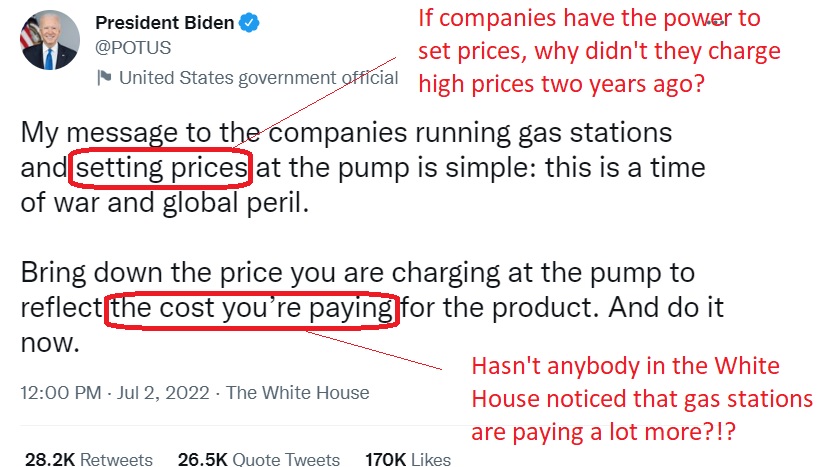
That’s because this tweet about gas prices now may be in first place. I’ve highlighted the most absurd parts.

What’s sad is that Biden may not even know his tweet was laughably wrong.

If we had some decent reporters at the White House, they would ask if he really thinks gas station have the power to set prices. And if Biden said yes, I can only imagine how amusing it would be to ask a follow-up question about why they didn’t use that magical power to raise prices before Biden got elected.

The Wall Street Journal editorialized about Biden’s clueless tweet.

President Biden’s…tweet over the weekend ordering gas stations to lower prices betrayed a willful ignorance about the private economy. …It’s embarrassing for the leader of the free world to sound like he’s channeling Hugo Chávez. A Chinese state media flack praised Mr. Biden’s tweet: “Now US President finally realized that capitalism is all about exploitation. He didn’t believe this before.” Or maybe he did, and nobody wanted to believe it. …The President’s economic ignorance isn’t a one-off. In recent months he has accused oil and gas companies of price gouging and demanded that they increase production even while his Administration threatens to put them out of business.

Kevin Williamson of National Review was similarly dumbfounded by Biden’s statement.

President Biden has been dunning U.S. gas stations to lower their prices in order to help him solve his main immediate political problem. His misunderstanding of how the gasoline business works…paints a portrait of a man out of touch.…contrary to what the Biden brain trust seems to think, wholesale gasoline prices do not move in lockstep with crude oil prices. And retail gasoline prices do not move in lockstep with wholesale gasoline prices. …As anybody who has ever sold anything for a living can tell you, you don’t get to set your own margin. The market does that for you. …The urge to blame retailers for the results of inflationary fiscal policies — and destructive energy policies — in Washington is ugly, demagogic, and, given Biden’s creepy history, maybe even a little bit racist.

I don’t know if Biden is clueless or a demagogue.

But the net result is the same. We are governed by idiots.

P.S. My attack on Biden is not partisan. On the issueof trade, some of Trump’s tweets displayed jaw-dropping stupidity and ignorance.

Dr. Francis schaeffer – The flow of Materialism(from Part 4 of Whatever happened to human race? Co-authored by Francis Schaeffer and Dr. C. Everett Koop)

C. Everett Koop
C. Everett Koop, 1980s.jpg
13th Surgeon General of the United States
In office
January 21, 1982 – October 1, 1989

Whatever Happened To The Human Race? | Episode 1 | Abortion of the Human Race (2010)

Dr. Francis Schaeffer – The Biblical Flow of Truth

Image<img class=”i-amphtml-blurry-placeholder” src=”data:;base64,Edith Schaeffer with her husband, Francis Schaeffer, in 1970 in Switzerland, where they founded L’Abri, a Christian commune.

________________

______________________

President Biden  c/o The White House 1600 Pennsylvania Avenue NW Washington, DC 20500

Dear Mr. President,

I really do respect you for trying to get a pulse on what is going on out here. I know that you don’t agree with my pro-life views but I wanted to challenge you as a fellow Christian to re-examine your pro-choice view.

In the past I have spent most of my time looking at this issue from the spiritual side. In the film series “WHATEVER HAPPENED TO THE HUMAN RACE?” the arguments are presented  against abortion (Episode 1),  infanticide (Episode 2),   euthanasia (Episode 3), and then there is a discussion of the Christian versus Humanist worldview concerning the issue of “the basis for human dignity” in Episode 4 and then in the last episode a close look at the truth claims of the Bible.

Francis Schaeffer

__________________________

I truly believe that many of the problems we have today in the USA are due to the advancement of humanism in the last few decades in our society. Ronald Reagan appointed the evangelical Dr. C. Everett Koop to the position of Surgeon General in his administration. He partnered with Dr. Francis Schaeffer in making the video WHATEVER HAPPENED TO THE HUMAN RACE? which can be found on You Tube. It is very valuable information for Christians to have.

Today I want to respond to your letter to me on July 9, 2021. Here it is below:

THE WHITE HOUSE

WASHINGTON

July 9, 2021

Mr. Everette Hatcher III

Alexander, AR

Dear Mr. Hatcher,

Thank you for taking your time to share your thoughts on abortion. Hearing from passionate individuals like me inspires me every day, and I welcome the opportunity to respond to your letter

Our country faces many challenges, and the road we will travel together will be one of the most difficult in our history. Despite these tough times, I have never been more optimistic for the future of America. I believe we are better positioned than any country in the world to lead in the 21st century not just by the example of our power but by the power of our example.

As we move forward to address the complex issues of our time, I encourage you to remain an active participant in helping write the next great chapter of the American story. We need your courage and dedication at this critical time, and we must meet this moment together as the United States of America. If we do that, I believe that our best days still lie ahead.

Sincerely

Joe Biden

_____________________________________

I agree with the following portion of your letter:

I encourage you to remain an active participant in helping write the next great chapter of the American story. We need your courage and dedication at this critical time, and we must meet this moment together as the United States of America.

I am a proud member of the National Association of Christian Lawmakers and I attended the convention in Dallas in July and we have officially launched a nationwide push against abortion rights.

The article below notes:

At its first annual policy conference last weekend, group members voted to make a controversial new Texas law, the “Texas Heartbeat Bill,” the organization’s first piece of model legislation, meaning that similar bills may soon pop up in state capitols across the country.

Also I am excited to report that the WASHINGTON POST wrote in September 3, 2021:

Announcing he planned to introduce a copycat bill, Arkansas state Sen. Jason Rapert (R), the founder and president of the National Association of Christian Lawmakers, shared a template of legislation lawmakers in other states could fill in the blanks on and reproduce.

At the July 17th session of THE CHRISTIAN LAWMAKERS meeting in Dallas, I really got a lot out of the expert panel moderated by Texas State Senator Bryan Hughes entitled ABOLISHING ABORTION IN AMERICA. Here below is what Wikipedia says about Senator Hughes:

On March 11, 2021, Hughes introduced a fetal heartbeat bill entitled the Texas Heartbeat Bill (SB8) into the Texas Senate and state representative Shelby Slawson of Stephenville, Texas introduced a companion bill (HB1515) into the state house.[22]The bill allows private citizens to sue abortion providers after a fetal heartbeat has been detected.[22] The SB8 version of the bill passed both chambers and was signed into law by Texas Governor Greg Abbott on May 19, 2021.[22] It took effect on September 1, 2021.[22]

These Christian lawmakers are on the offensive against abortion

That National Association of Christian legislators has made the so-called ‘Texas Heartbeat Bill’ the basis for its first piece of model legislation

Arkansas state Sen. Jason Rapert presides over a Senate committee at the state Capitol in Little Rock, Ark. in this March 14, 2018, file photo. Rapert’s National Association of Christian Lawmakers met recently to talk model legislation and pass resolutions. Kelly P. Kissel, Associated Press

The National Association of Christian Lawmakers has officially launched a nationwide push against abortion rights.

At its first annual policy conference last weekend, group members voted to make a controversial new Texas law, the “Texas Heartbeat Bill,” the organization’s first piece of model legislation, meaning that similar bills may soon pop up in state capitols across the country.

The model legislation, called the Heartbeat Model Act, was accepted unanimously by the executive committee during a Saturday meeting.

The Texas bill it is based upon, Senate Bill 8, bans abortions once a fetal heartbeat can be detected, which can occur as early as six weeks into a pregnancy. The legislation also allows for any state resident to bring a civil suit against a doctor who performs an abortion after a heartbeat is detectable. Under the law, a woman who has an abortion would be liable to civil suits, as would anyone who supported her in the act — from family members to the receptionist who checks her in at a clinic.

Not only is the doctor liable, but anyone found aiding and abetting,” said Texas legislator Bryan Hughes, the bill’s author, during the Saturday meeting, which was led by the organization’s founder and president, Arkansas state Sen. Jason Rapert.Texas state Rep. Bryan Hughes speaks during the opening session of the 2015 legislative session on Tuesday, Jan. 13, 2015, in Austin, Texas. Eric Gay, Associated Press

Speaking to the Deseret News on Monday, Rapert said the provision allowing residents to bring civil suits against anyone involved in an abortion is like “putting a SCUD missile on that heartbeat bill — they can’t stop it.”

Rapert was the author of a similar 2013 bill in Arkansas, portions of which were later struck down by a federal judge. At least a dozen states have implemented a variety of abortion restrictions in recent years, leading numerous observers to say that the landmark 1973 Supreme Court abortion ruling, Roe v. Wade, is under threat.

Critics of the legislation have likened the Texas law to putting “a bounty on the head” of anyone involved in an abortion; they have also called it “unconstitutional.” Last week, a group of providers filed a federal lawsuit in an attempt to derail the law, which is supposed to go into effect in September.

Speaking Saturday to the Christian legislators gathered in Dallas, Hughes reminded the legislators that the Heartbeat Model Act is just a starting point and that the legislation will have to be tailored to work within each state’s laws.A anti-abortion supporter argues with those who attended a press conference and rally held by the Planned Parenthood Action Council of Utah outside of the Capitol in Salt Lake City on Aug. 25, 2015. Stacie Scott, Deseret News


The National Association of Christian Lawmakers formed last year with three key goals: to offer conservative, Christian legislators networking opportunities,; to help lawmakers share bills that have been successful in their states so that legislators elsewhere might push through similar legislation; and to support Christians running for local, state or national office.

At the policy conference last week, the organization worked toward meeting these goals in various ways, including by approving the Heartbeat Model Act. The executive committee also passed a resolution supporting Israel’s “right to defend itself from terror attacks” and creating a standing American-Israeli Committee.

Speaking to the executive committee, Rabbi Leonid Feldman, who was born in the Soviet Union and was imprisoned there for his pro-Israel activities, remarked that the Jewish people “remember our friends.”

This conference and this organization will be remembered by the Jewish people,” he said.

The organization also approved a resolution in support of “election integrity.”

The executive committee also approved a second piece of model legislation: the National Motto Display Model Act. Based on bills passed in Arkansas in 2017 and this year in Texas, the legislation requires public schools to display the national motto “In God We Trust” when printed versions of the motto are donated to schools or copies of the national motto are bought with funds from private donors.

“As the Texas House sponsor of the Motto Act, I am proud to see a model put out by the NACL so that legislators from every other state can have a mechanism to ensure our citizens — especially our school-age children — are reminded of our nation’s motto,” said Tom Oliverson, a state representative from Texas and chairman of the National Association of Christian Lawmakers’ national legislative council.

During the executive committee’s meeting on Saturday, Rapert said Hobby Lobby would make frames available for a reduced price if they’ll be used for national motto displays.

Asked Monday what other pieces of legislation the organization might adopt as model legislation in the future, Rapert told the Deseret News that the National Association of Christian Lawmakers is already weighing some options.

Since religious freedom is central to the organization, it could end up adopting model legislation similar to bills promoted in Texas this year by Oliverson. He supported three measures designed to make it harder for the government to force church closures during public emergencies, like the COVID-19 pandemic, and a bill that would ensure homeowners’ associations can’t infringe on homeowners’ rights to display religious symbols.

Supreme Court votes 5-4 to leave Texas abortion law in place

Chief Justice John Roberts dissented along with the court’s three liberal justices

Associated Press

WASHINGTON — A deeply divided Supreme Court is allowing a Texas law that bans most abortions to remain in force, for now stripping most women of the right to an abortion in the nation’s second-largest state.

The court voted 5-4 to deny an emergency appeal from abortion providers and others that sought to block enforcement of the law that went into effect Wednesday. But the justices also suggested that their order likely isn’t the last word on whether the law can stand because other challenges to it can still be brought.

The Texas law, signed by Republican Gov. Greg Abbott in May, prohibits abortions once medical professionals can detect cardiac activity, usually around six weeks and before many women know they’re pregnant.

It is the strictest law against abortion rights in the United States since the high court’s landmark Roe v. Wade decision in 1973 and part of a broader push by Republicans nationwide to impose new restrictions on abortion. At least 12 other states have enacted bans early in pregnancy, but all have been blocked from going into effect.

The high court’s order declining to halt the Texas law came just before midnight Wednesday. The majority said those bringing the case had not met the high burden required for a stay of the law.

“The Court’s order is emphatic in making clear that it cannot be understood as sustaining the constitutionality of the law at issue.”— Chief Justice John Roberts

Chief Justice John Roberts (Supreme Court)

Chief Justice John Roberts (Supreme Court)

“In reaching this conclusion, we stress that we do not purport to resolve definitively any jurisdictional or substantive claim in the applicants’ lawsuit. In particular, this order is not based on any conclusion about the constitutionality of Texas’s law, and in no way limits other procedurally proper challenges to the Texas law, including in Texas state courts,” the unsigned order said.

Chief Justice John Roberts dissented along with the court’s three liberal justices. Each of the four dissenting justices wrote separate statements expressing their disagreement with the majority.

Roberts noted that while the majority denied the request for emergency relief “the Court’s order is emphatic in making clear that it cannot be understood as sustaining the constitutionality of the law at issue.”

The vote in the case underscores the impact of the death of the liberal Justice Ruth Bader Ginsburg last year and then-president Donald Trump’s replacement of her with conservative Justice Amy Coney Barrett. Had Ginsburg remained on the court there would have been five votes to halt the Texas law.

Justice Sonia Sotomayor called her conservative colleagues’ decision “stunning.” “Presented with an application to enjoin a flagrantly unconstitutional law engineered to prohibit women from exercising their constitutional rights and evade judicial scrutiny, a majority of Justices have opted to bury their heads in the sand,” she wrote.

“A majority of Justices have opted to bury their heads in the sand.”— Justice Sonia Sotomayor

Justice Sonia Sotomayor (Supreme Court)

Justice Sonia Sotomayor (Supreme Court)

Texas lawmakers wrote the law to evade federal court review by allowing private citizens to bring civil lawsuits in state court against anyone involved in an abortion, other than the patient. Other abortion laws are enforced by state and local officials, with criminal sanctions possible.

In contrast, Texas’ law allows private citizens to sue abortion providers and anyone involved in facilitating abortions. Among other situations, that would include anyone who drives a woman to a clinic to get an abortion. Under the law, anyone who successfully sues another person would be entitled to at least $10,000.

In her dissent, Justice Elena Kagan called the law “patently unconstitutional,” saying it allows “private parties to carry out unconstitutional restrictions on the State’s behalf.” And Justice Stephen Breyer said a “woman has a federal constitutional right to obtain an abortion during” the first stage of pregnancy.

After a federal appeals court refused to allow a prompt review of the law before it took effect, the measure’s opponents sought Supreme Court review.

In her dissent, Justice Elena Kagan called the law “patently unconstitutional,” saying it allows “private parties to carry out unconstitutional restrictions on the State’s behalf.” And Justice Stephen Breyer said a “woman has a federal constitutional right to obtain an abortion during” the first stage of pregnancy.

After a federal appeals court refused to allow a prompt review of the law before it took effect, the measure’s opponents sought Supreme Court review.

In a statement early Thursday after the high court’s action, Nancy Northup, the head of the Center for Reproductive Rights, which represents abortion providers challenging the law, vowed to “keep fighting this ban until abortion access is restored in Texas.”

“We are devastated that the Supreme Court has refused to block a law that blatantly violates Roe v. Wade. Right now, people seeking abortion across Texas are panicking — they have no idea where or when they will be able to get an abortion, if ever. Texas politicians have succeeded for the moment in making a mockery of the rule of law, upending abortion care in Texas, and forcing patients to leave the state — if they have the means — to get constitutionally protected healthcare. This should send chills down the spine of everyone in this country who cares about the constitution,” she said.

Texas has long had some of the nation’s toughest abortion restrictions, including a sweeping law passed in 2013. The Supreme Court eventually struck down that law, but not before more than half of the state’s 40-plus clinics closed.

Even before the Texas case arrived at the high court the justices had planned to tackle the issue of abortion rights in a major case after the court begins hearing arguments again in the fall. That case involves the state of Mississippi, which is asking to be allowed to enforce an abortion ban after 15 weeks of pregnancy.

Associated Press writer Paul J. Weber in Austin, Texas, contributed to this report.

______________________________________

Thank you so much for your time. I know how valuable it is. I also appreciate the fine family that you have and your commitment as a father and a husband. Now after presenting the secular approach of Nat Hentoff I wanted to make some comments concerning our shared Christian faith.  I  respect you for putting your faith in Christ for your eternal life. I am pleading to you on the basis of the Bible to please review your religious views concerning abortion. It was the Bible that caused the abolition movement of the 1800’s and it also was the basis for Martin Luther King’s movement for civil rights and it also is the basis for recognizing the unborn children.

Sincerely,

Everette Hatcher III, 13900 Cottontail Lane, Alexander, AR 72002, ph 501-920-5733,

Related posts:

Al Mohler on Kermit Gosnell’s abortion practice

Francis Schaeffer: “Whatever Happened to the Human Race” (Episode 1) ABORTION OF THE HUMAN RACE Published on Oct 6, 2012 by AdamMetropolis ________________ Picture of Francis Schaeffer and his wife Edith from the 1930′s above. I was sad to read about Edith passing away on Easter weekend in 2013. I wanted to pass along this fine […]

A man of pro-life convictions: Bernard Nathanson (part4)

ABORTION – THE SILENT SCREAM 1 / Extended, High-Resolution Version (with permission from APF). Republished with Permission from Roy Tidwell of American Portrait Films as long as the following credits are shown: VHS/DVDs Available American Portrait Films Call 1-800-736-4567 http://www.amport.com The Hand of God-Selected Quotes from Bernard N. Nathanson, M.D., Unjust laws exist. Shall we […]

Abortionist Bernard Nathanson turned pro-life activist (part 11)

ABORTION – THE SILENT SCREAM 1 / Extended, High-Resolution Version (with permission from APF). Republished with Permission from Roy Tidwell of American Portrait Films as long as the following credits are shown: VHS/DVDs Available American Portrait Films Call 1-800-736-4567 http://www.amport.com The Hand of God-Selected Quotes from Bernard N. Nathanson, M.D., Unjust laws exist. Shall we […]

Abortionist Bernard Nathanson turned pro-life activist (part 9)(Donald Trump changes to pro-life view)

When I think of the things that make me sad concerning this country, the first thing that pops into my mind is our treatment of unborn children. Donald Trump is probably going to run for president of the United States. Tony Perkins of the Family Research Council recently had a conversation with him concerning the […]

Taking on Ark Times Bloggers on various issues Part U “Do men have a say in the abortion debate?” (includes the film SLAUGHTER OF THE INNOCENTS and editorial cartoon)

I have gone back and forth and back and forth with many liberals on the Arkansas Times Blog on many issues such as abortion, human rights, welfare, poverty, gun control  and issues dealing with popular culture. Here is another exchange I had with them a while back. My username at the Ark Times Blog is Saline […]

Taking on Ark Times Bloggers on various issues Part T “Abortion is a dirty business” (includes video “Truth and History” and editorial cartoon)

I have gone back and forth and back and forth with many liberals on the Arkansas Times Blog on many issues such as abortion, human rights, welfare, poverty, gun control  and issues dealing with popular culture. Here is another exchange I had with them a while back. My username at the Ark Times Blog is Saline […]

“Sanctity of Life Saturday” Abortion supporters lying in order to further their clause? Window to the Womb (includes video ABORTION OF THE HUMAN RACE)

It is truly sad to me that liberals will lie in order to attack good Christian people like state senator Jason Rapert of Conway, Arkansas because he headed a group of pro-life senators that got a pro-life bill through the Arkansas State Senate the last week of January in 2013. I have gone back and […]

Taking on Ark Times Bloggers on various issues Part D “If you can’t afford a child can you abort?”Francis Schaeffer Quotes part 4 includes the film ABORTION OF THE HUMAN RACE) (editorial cartoon)

I have gone back and forth and back and forth with many liberals on the Arkansas Times Blog on many issues such as abortion, human rights, welfare, poverty, gun control  and issues dealing with popular culture. Here is another exchange I had with them a while back. My username at the Ark Times Blog is Saline […]

Taking on Ark Times Bloggers on various issues Part C “Abortion” (Francis Schaeffer Quotes part 3 includes the film SLAUGHTER OF THE INNOCENTS) (editorial cartoon)

I have gone back and forth and back and forth with many liberals on the Arkansas Times Blog on many issues such as abortion, human rights, welfare, poverty, gun control  and issues dealing with popular culture. Here is another exchange I had with them a while back. My username at the Ark Times Blog is Saline […]

Taking on Ark Times Bloggers on various issues Part B “Gendercide” (Francis Schaeffer Quotes Part 2 includes the film ABORTION OF THE HUMAN RACE) (editorial cartoon)

I have gone back and forth and back and forth with many liberals on the Arkansas Times Blog on many issues such as abortion, human rights, welfare, poverty, gun control  and issues dealing with popular culture. Here is another exchange I had with them a while back. My username at the Ark Times Blog is Saline […]

SANCTITY OF LIFE SATURDAY “AngryOldWoman” blogger argues that she has no regrets about past abortion

Sometimes you can see evidences in someone’s life of how content they really are. I saw  something like that on 2-8-13 when I confronted a blogger that goes by the name “AngryOldWoman” on the Arkansas Times Blog. See below. Leadership Crisis in America Published on Jul 11, 2012 Picture of Adrian Rogers above from 1970′s […]

“Sanctity of Life Saturday” The Church Awakens: Whatever Happened to the Human Race? (includes the video ABORTION OF THE HUMAN RACE)

In the film series “WHATEVER HAPPENED TO THE HUMAN RACE?” the arguments are presented  against abortion (Episode 1),  infanticide (Episode 2),   euthenasia (Episode 3), and then there is a discussion of the Christian versus Humanist worldview concerning the issue of “the basis for human dignity” in Episode 4 and then in the last episode a close […]

Taking on Ark Times Bloggers on various issues Part H “Are humans special?” includes film ABORTION OF THE HUMAN RACE) Reagan: ” To diminish the value of one category of human life is to diminish us all”

I have gone back and forth and back and forth with many liberals on the Arkansas Times Blog on many issues such as abortion, human rights, welfare, poverty, gun control  and issues dealing with popular culture. Here is another exchange I had with them a while back. My username at the Ark Times Blog is Saline […]

Taking on Ark Times Bloggers on various issues Part G “How do moral nonabsolutists come up with what is right?” includes the film “ABORTION OF THE HUMAN RACE”)

I have gone back and forth and back and forth with many liberals on the Arkansas Times Blog on many issues such as abortion, human rights, welfare, poverty, gun control  and issues dealing with popular culture. Here is another exchange I had with them a while back. My username at the Ark Times Blog is Saline […]

Taking on Ark Times Bloggers on various issues Part E “Moral absolutes and abortion” Francis Schaeffer Quotes part 5(includes the film SLAUGHTER OF THE INNOCENTS) (editorial cartoon)

I have gone back and forth and back and forth with many liberals on the Arkansas Times Blog on many issues such as abortion, human rights, welfare, poverty, gun control  and issues dealing with popular culture. Here is another exchange I had with them a while back. My username at the Ark Times Blog is Saline […]

Francis Schaeffer’s “How should we then live?” Video and outline of episode 10 “Final Choices” (Schaeffer Sundays)

E P I S O D E 1 0   Dr. Francis Schaeffer – Episode X – Final Choices 27 min FINAL CHOICES I. Authoritarianism the Only Humanistic Social Option One man or an elite giving authoritative arbitrary absolutes. A. Society is sole absolute in absence of other absolutes. B. But society has to be […]

Francis Schaeffer’s “How should we then live?” Video and outline of episode 9 “The Age of Personal Peace and Affluence” (Schaeffer Sundays)

E P I S O D E 9 Dr. Francis Schaeffer – Episode IX – The Age of Personal Peace and Affluence 27 min T h e Age of Personal Peace and Afflunce I. By the Early 1960s People Were Bombarded From Every Side by Modern Man’s Humanistic Thought II. Modern Form of Humanistic Thought Leads […]

Francis Schaeffer’s “How should we then live?” Video and outline of episode 8 “The Age of Fragmentation” (Schaeffer Sundays)

E P I S O D E 8 Dr. Francis Schaeffer – Episode VIII – The Age of Fragmentation 27 min I saw this film series in 1979 and it had a major impact on me. T h e Age of FRAGMENTATION I. Art As a Vehicle Of Modern Thought A. Impressionism (Monet, Renoir, Pissarro, Sisley, […]

Francis Schaeffer’s “How should we then live?” Video and outline of episode 7 “The Age of Non-Reason” (Schaeffer Sundays)

E P I S O D E 7 Dr. Francis Schaeffer – Episode VII – The Age of Non Reason I am thrilled to get this film series with you. I saw it first in 1979 and it had such a big impact on me. Today’s episode is where we see modern humanist man act […]

Francis Schaeffer’s “How should we then live?” Video and outline of episode 6 “The Scientific Age” (Schaeffer Sundays)

E P I S O D E 6 How Should We Then Live 6#1 Uploaded by NoMirrorHDDHrorriMoN on Oct 3, 2011 How Should We Then Live? Episode 6 of 12 ________ I am sharing with you a film series that I saw in 1979. In this film Francis Schaeffer asserted that was a shift in […]

Francis Schaeffer’s “How should we then live?” Video and outline of episode 5 “The Revolutionary Age” (Schaeffer Sundays)

E P I S O D E 5 How Should We Then Live? Episode 5: The Revolutionary Age I was impacted by this film series by Francis Schaeffer back in the 1970′s and I wanted to share it with you. Francis Schaeffer noted, “Reformation Did Not Bring Perfection. But gradually on basis of biblical teaching there […]

Francis Schaeffer’s “How should we then live?” Video and outline of episode 4 “The Reformation” (Schaeffer Sundays)

Dr. Francis Schaeffer – Episode IV – The Reformation 27 min I was impacted by this film series by Francis Schaeffer back in the 1970′s and I wanted to share it with you. Schaeffer makes three key points concerning the Reformation: “1. Erasmian Christian humanism rejected by Farel. 2. Bible gives needed answers not only as to […]

“Schaeffer Sundays” Francis Schaeffer’s “How should we then live?” Video and outline of episode 3 “The Renaissance”

Francis Schaeffer’s “How should we then live?” Video and outline of episode 3 “The Renaissance” Francis Schaeffer: “How Should We Then Live?” (Episode 3) THE RENAISSANCE I was impacted by this film series by Francis Schaeffer back in the 1970′s and I wanted to share it with you. Schaeffer really shows why we have so […]

Francis Schaeffer’s “How should we then live?” Video and outline of episode 2 “The Middle Ages” (Schaeffer Sundays)

  Francis Schaeffer: “How Should We Then Live?” (Episode 2) THE MIDDLE AGES I was impacted by this film series by Francis Schaeffer back in the 1970′s and I wanted to share it with you. Schaeffer points out that during this time period unfortunately we have the “Church’s deviation from early church’s teaching in regard […]

Francis Schaeffer’s “How should we then live?” Video and outline of episode 1 “The Roman Age” (Schaeffer Sundays)

Francis Schaeffer: “How Should We Then Live?” (Episode 1) THE ROMAN AGE   Today I am starting a series that really had a big impact on my life back in the 1970′s when I first saw it. There are ten parts and today is the first. Francis Schaeffer takes a look at Rome and why […]

By Everette Hatcher III | Posted in Francis Schaeffer | Edit | Comments (0)

AFTER LIFE 3 Review and Open Letter to Ricky Gervais Part 43 Kath: Sort of old-fashioned and hopeful. And she’s a fortune teller too. Tony: She said she is, yeah. Kath: Why would she lie? Tony: ‘Cause it’s impossible. Kath: Nothing’s impossible. (TONY NEEDS EVIDENCE BEFORE BELIEVING)

‘After Life’: Gervais Finds Beauty In The Mundane

By

 Matthew Seaman

 – 

19 February, 2022

539

0

Podcast Editor Matthew Seaman reviews Ricky Gervais’ “After Life”.

This winter, writer of “The Office”, “Extras” and “Derek”: Ricky Gervais, returned to our screens with the third and final season of his Netflix hit, “After Life”. The story of a widowed local journalist: Tony (Gervais), living in rural Tambury (filmed across Hemel Hempstead and Hampstead), is brought to a close in this concluding chapter. Its irreverence is somehow heartwarming, and whilst little actually happens in the plot, there is a significant arc for Tony’s character. The series begins with him hurling a potted cactus through a car window (with good reason), and ends with him reassuring a young cancer patient that he would visit him every single day until he is better. Beginning in an environment that infuriates him, Tony blossoms into a man who finds beauty in the world away from his late wife, appreciating that the time they had can live happily in the past.

Ricky Gervais – After Life

We see stand-out performances from Penelope Wilton, who plays a wise Anne, the single parental figure who remains in Tony’s life, and Kerry Godliman, who appears as his wife, Lisa, in flashback moments. Gervais’ on-screen chemistry with both Godliman and Wilton makes his pain and heartache all-the-more believable. Whilst he definitely ‘has it together’ more than he did in the previous series, and there are certainly less tears, it feels right that way. I was disappointed by the absence of Roisin Conaty’s character, Roxy, and later learned that Gervais had told Digital Spy: “We thought there wasn’t quite the story there… it’s a mutual decision, I didn’t write [her] out”. There are moments of hilarity to juxtapose the depth of the ‘bench scenes’, with the friendly feud between Tony and his boss, Matt (Tom Basden), making for some enjoyable screen-time. A must-see moment comes at the start of the fourth episode – I’ll let you see it for yourself! Basden’s role is certainly meatier this time around, and the same can be said for that of Tony Way (Lenny) and Diane Morgan (Cath), who become all-the-more likeable as the series progresses.

The music sets the show apart from others, with the likes of Todd Rundgren, Yusuf/Cat Stevens and Radiohead all featuring. As before, the series is underpinned by the ethereal and delicate sounds of ambient-rock band, Hammock, utilised in the same way as “Unloved” is in “Killing Eve”.

Once again, the star of the show is Brandy (Anti) the dog, who has been making some press appearances with Gervais in recent weeks. Tony (and subsequently Ricky)’s connection to his canine companion is palpable, and at times makes for even stronger on-screen communication than that of other characters. I would much prefer to watch a sequence of him reminiscing on his marriage, accompanied by Brandy, than see a padded-out banal moment with David Earl, whose character quite frankly depresses me (I’m sure that’s the intention).

It really is the perfect example of bitter-sweet television, embedded with sentimental truth. There are occasions where I sensed what was coming next, but predictability is okay. “After Life”, in some ways, is a ‘non-event’, but we are somehow drawn into the beauty of the everyday, mesmerised by the mundane. I won’t spoil the ending, but we hear Joni Mitchell’s “Both Sides Now”, as the story closes in the most apt way possible.

There is no hope for a fourth season, and that’s just the way it should be, but there is certainly hope for Tony. “After Life” has been a pivotal piece of entertainment for me, since I first streamed the first season in March 2019, and I am grateful for the way that Ricky Gervais continues to disregard the system, and represents the misfits in society. After all, I think we can all tell Tony isn’t too far from himself (just maybe without the millions).

Closing Scene – After Life

After Life

—-

After Life TV Show on Netflix: canceled or renewed?

—-

After Life TV Show on Netflix: canceled or renewed?

—-

After Life TV Show on Netflix: canceled or renewed?

World Exclusive: After Life Season 3: The First few Minutes

After Life | Season 3 Official Trailer | Netflix

episodes will be released on January 14th.

Just Three Things. Written for #Afterlife by Ricky Gervais and Andy Burrows

After Life TV Show on Netflix: canceled or renewed?


July 5, 2022

Ricky Gervais

London, W1F 0LE
UK

Dear Ricky,

Tony: No, you read it. 

Valerie: Oh God. “Nurse Cindy starts to slowly undress. She was sexy as hell, and she notices Dr. Barnaby looking at her differently than he would if he was operating on her.” ( laughs ) Valerie: “‘Do I look well, Doctor?’ ‘I’ll say,’ said Dr. Barnaby. ‘Think you’d better check my pulse, Nurse.’”

Valerie: ( laughs ) It’s sort of sweet, really. 

Kath: Sort of old-fashioned and hopeful. And she’s a fortune teller too. 

Tony: She said she is, yeah. 

Kath: Why would she lie?

Tony: ‘Cause it’s impossible.

 Kath: Nothing’s impossible. 

Tony: I’m out. 

Kath: Just ’cause you haven’t seen something doesn’t mean it isn’t real. 

Tony: What if no one’s seen it? 

Kath: Could be invisible. 

Tony: Yeah. 

Kath: Could I visit her? You know, to investigate it? 

Tony: If you want. 

Kath: I’d go in with an open mind. You know, if you go in thinking it isn’t real, then you’ll never believe. 

Lenny: Should I arrange that, then?

Tony: Yeah. Now I wish I was covering the story.

—-
You want some evidence that indicates that the Bible is true? Here is a good place to start and that is taking a closer look at the archaeology of the Old Testament times. Is the Bible historically accurate? Here are some of the posts I have done in the past on the subject: 1. The Babylonian Chronicleof Nebuchadnezzars Siege of Jerusalem, 2. Hezekiah’s Siloam Tunnel Inscription. 3. Taylor Prism (Sennacherib Hexagonal Prism), 4. Biblical Cities Attested Archaeologically. 5. The Discovery of the Hittites, 6.Shishak Smiting His Captives, 7. Moabite Stone, 8. Black Obelisk of Shalmaneser III9A Verification of places in Gospel of John and Book of Acts., 9B Discovery of Ebla Tablets10. Cyrus Cylinder11. Puru “The lot of Yahali” 9th Century B.C.E.12. The Uzziah Tablet Inscription13. The Pilate Inscription14. Caiaphas Ossuary14 B Pontius Pilate Part 214c. Three greatest American Archaeologists moved to accept Bible’s accuracy through archaeology.

The Bible and Archaeology – Is the Bible from God? (Kyle Butt)

The answer to find meaning in life is found in putting your faith and trust in Jesus Christ. The Bible is true from cover to cover and can be trusted.

Thanks for your time.

Sincerely,

Everette Hatcher, everettehatcher@gmail.comhttp://www.thedailyhatch.org, cell ph 501-920-5733, 13900 Cottontail Lane, Alexander, AR 72002


Taking on Ark Times Bloggers on various issues Part I “Old Testament Bible Prophecy” includes the film TRUTH AND HISTORY and article ” Jane Roe became pro-life”

April 12, 2013 – 5:45 am

I have gone back and forth and back and forth with many liberals on the Arkansas Times Blog on many issues such as abortion, human rights, welfare, poverty, gun control  and issues dealing with popular culture. Here is another exchange I had with them a while back. My username at the Ark Times Blog is Saline […]By Everette Hatcher III | Posted in Biblical ArchaeologyFrancis SchaefferProlife | Edit|Comments (0)

John MacArthur on fulfilled prophecy from the Bible Part 2

August 8, 2013 – 1:28 am

I have posted many of the sermons by John MacArthur. He is a great bible teacher and this sermon below is another great message. His series on the Book of Proverbs was outstanding too.  I also have posted several of the visits MacArthur made to Larry King’s Show. One of two most popular posts I […]By Everette Hatcher III | Posted in Adrian RogersCurrent Events | Edit|Comments (0)

John MacArthur on fulfilled prophecy from the Bible Part 1

August 6, 2013 – 1:24 am

I have posted many of the sermons by John MacArthur. He is a great bible teacher and this sermon below is another great message. His series on the Book of Proverbs was outstanding too.  I also have posted several of the visits MacArthur made to Larry King’s Show. One of two most popular posts I […]By Everette Hatcher III | Posted in Adrian RogersCurrent Events |Tagged Bible Prophecyjohn macarthur | Edit|Comments (0)

John MacArthur: Fulfilled prophecy in the Bible? (Ezekiel 26-28 and the story of Tyre, video clips)

April 5, 2012 – 10:39 am

Prophecy–The Biblical Prophesy About Tyre.mp4 Uploaded by TruthIsLife7 on Dec 5, 2010 A short summary of the prophecy about Tyre and it’s precise fulfillment. Go to this link and watch the whole series for the amazing fulfillment from secular sources. http://www.youtube.com/watch?v=qvt4mDZUefo________________ John MacArthur on the amazing fulfilled prophecy on Tyre and how it was fulfilled […]By Everette Hatcher III | Posted in Biblical Archaeology | Edit|Comments (1)

John MacArthur on the Bible and Science (Part 2)

August 1, 2013 – 12:10 am

John MacArthur on the Bible and Science (Part 2) I have posted many of the sermons by John MacArthur. He is a great bible teacher and this sermon below is another great message. His series on the Book of Proverbs was outstanding too.  I also have posted several of the visits MacArthur made to Larry […]By Everette Hatcher III | Posted in Current Events | Edit|Comments (0)

John MacArthur on the Bible and Science (Part 1)

July 30, 2013 – 1:32 am

John MacArthur on the Bible and Science (Part 1) I have posted many of the sermons by John MacArthur. He is a great bible teacher and this sermon below is another great message. His series on the Book of Proverbs was outstanding too.  I also have posted several of the visits MacArthur made to Larry […]By Everette Hatcher III | Posted in Current Events | Edit|Comments (0)

Adrian Rogers: “Why I believe the Bible is true”

July 9, 2013 – 8:38 am

Adrian Rogers – How you can be certain the Bible is the word of God Great article by Adrian Rogers. What evidence is there that the Bible is in fact God’s Word? I want to give you five reasons to affirm the Bible is the Word of God. First, I believe the Bible is the […]By Everette Hatcher III | Posted in Adrian RogersBiblical Archaeology | Edit|Comments (0)

The Old Testament is Filled with Fulfilled Prophecy by Jim Wallace

June 24, 2013 – 9:47 am

Is there any evidence the Bible is true? Articles By PleaseConvinceMe Apologetics Radio The Old Testament is Filled with Fulfilled Prophecy Jim Wallace A Simple Litmus Test There are many ways to verify the reliability of scripture from both internal evidences of transmission and agreement, to external confirmation through archeology and science. But perhaps the […]By Everette Hatcher III | Posted in Biblical ArchaeologyCurrent Events | Edit|Comments (0)

Taking on Ark Times Bloggers on various issues Part M “Old Testament prophecy fulfilled?”Part 3(includes film DEATH BY SOMEONE’S CHOICE)

April 19, 2013 – 1:52 am

  I have gone back and forth and back and forth with many liberals on the Arkansas Times Blog on many issues such as abortion, human rights, welfare, poverty, gun control  and issues dealing with popular culture. Here is another exchange I had with them a while back. My username at the Ark Times Blog is […]By Everette Hatcher III | Posted in Francis SchaefferProlife | Edit|Comments (0)

Evidence for the Bible

March 27, 2013 – 9:43 pm

Here is some very convincing evidence that points to the view that the Bible is historically accurate. Archaeological and External Evidence for the Bible Archeology consistently confirms the Bible! Archaeology and the Old Testament Ebla tablets—discovered in 1970s in Northern Syria. Documents written on clay tablets from around 2300 B.C. demonstrate that personal and place […]By Everette Hatcher III | Posted in Biblical Archaeology | E

On Saturday April 18, 2020 at 6pm in London and noon in Arkansas, I had a chance to ask Ricky Gervais a question on his Twitter Live broadcast which was  “Is Tony a Nihilist?” At the 20:51 mark Ricky answers my question. Below is the video:

Ricky Gervais 25/07/2021 Facebook Live at 28:29 mark Ricky answers my question about Sam Harris

July 5, 2022 READING A PROVERB A DAY (PROVERBS 5) MY POSTCARD IN 2017 FROM NEW ORLEANS TO HUGH HEFNER dated 2-5-17

Listen to me, my son! I know what I am saying; listen! Watch yourself, lest you be indiscreet and betray some vital information. For the lips of a prostitute[a] are as sweet as honey, and smooth flattery is her stock-in-trade. But afterwards only a bitter conscience is left to you,[b] sharp as a double-edged sword. She leads you down to death and hell. For she does not know the path to life. She staggers down a crooked trail and doesn’t even realize where it leads.

Young men, listen to me, and never forget what I’m about to say: Run from her! Don’t go near her house, lest you fall to her temptation and lose your honor, and give the remainder of your life to the cruel and merciless;[c] 10 lest strangers obtain your wealth, and you become a slave of foreigners. 11 Lest afterwards you groan in anguish and in shame when syphilis[d] consumes your body, 12 and you say, “Oh, if only I had listened! If only I had not demanded my own way! 13 Oh, why wouldn’t I take advice? Why was I so stupid? 14 For now I must face public disgrace.”

15 Drink from your own well, my son—be faithful and true to your wife. 16 Why should you beget children with women of the street? 17 Why share your children with those outside your home? 18 Be happy, yes, rejoice in the wife of your youth. 19 Let her breasts and tender embrace[e] satisfy you. Let her love alone fill you with delight. 20 Why delight yourself with prostitutes, embracing what isn’t yours? 21 For God is closely watching you, and he weighs carefully everything you do.

22 The wicked man is doomed by his own sins; they are ropes that catch and hold him. 23 He shall die because he will not listen to the truth; he has let himself be led away into incredible folly.

I started this series on my letters and postcards to Hugh Hefner back in September when I read of the passing of Mr. Hefner. There are many more to come. It is my view that he may have taken time to look at glance at one or two of them since these postcards were short and from one of Hef’s favorite cities!!!!

Image result for HUGH HEFNER NEW ORLEANS

Postcards from New Orleans Feb 5, 2017 Proverbs 5

——–

Image result for new orleans postcards mardi gras
Hugh Hefner
Playboy Mansion

Los Angeles, CA 90024

Feb 5, 2017
Dear Hugh
Reading a Proverb for every day of the month has been a practice of mine for a long time. Today is February 5. 2017 and I’m reading Proverbs 5 which is appropriate since I am spending a week in New Orleans this month. Here are verses 3-14:

The lips of a seductive woman are oh so sweet,
    her soft words are oh so smooth.
But it won’t be long before she’s gravel in your mouth,
    a pain in your gut, a wound in your heart.
She’s dancing down the primrose path to Death;
    she’s headed straight for Hell and taking you with her.
She hasn’t a clue about Real Life,
    about who she is or where she’s going.

7-14 So, my friend, listen closely;
    don’t treat my words casually.
Keep your distance from such a woman;
    absolutely stay out of her neighborhood.
You don’t want to squander your wonderful life,
    to waste your precious life among the hardhearted.
Why should you allow strangers to take advantage of you?
    Why be exploited by those who care nothing for you?
You don’t want to end your life full of regrets,
    nothing but sin and bones,
Saying, “Oh, why didn’t I do what they told me?
    Why did I reject a disciplined life?
Why didn’t I listen to my mentors,
    or take my teachers seriously?
My life is ruined!
    I haven’t one blessed thing to show for my life!”

Never Take Love for Granted

—-
There is hope!!! Check out John 3:16!!!
Best wishes,
Everette Hatcher
Xx

____

Image result for francis schaeffer

These comments below are from Francis Schaeffer’ study on Ecclesiastes and they reminded me of Hugh Hefner who was the closest person to a modern day King Solomon and I was also reminded of a Hefner’s possible bitterness against women that started when he learned of his wife’s sexual betrayal of him in 1949. Below are Schaeffer’s comments followed by an article concerning what Hefner called “the most devastating moment in my life.” 

___________

If one would flee to alcohol, then surely one may choose sexual pursuits to flee to. Solomon looks in this area too.

Ecclesiastes 7:25-28

25 I directed my mind to know, to investigate and to seek wisdom and an explanation, and to know the evil of folly and the foolishness of madness. 26 And I discovered more bitter than death the woman whose heart is snares and nets, whose hands are chains. One who is pleasing to God will escape from her, but the sinner will be captured by her.

27 “Behold, I have discovered this,” says the Preacher, “adding one thing to another to find an explanation, 28 I have looked for other answers but have found none. I found one man in a thousand that I could respect, but not one woman. (Good News Translation on verse 28)

One can understand both Solomon’s expertness in this field and his bitterness.

I Kings 11:1-3 (New American Standard Bible) 

11 Now King Solomon loved many foreign women along with the daughter of Pharaoh: Moabite, Ammonite, Edomite, Sidonian, and Hittite women, from the nations concerning which the Lord had said to the sons of Israel, “You shall not associate with them, nor shall they associate with you, for they will surely turn your heart away after their gods.” Solomon held fast to these in love. He had seven hundred wives, princesses, and three hundred concubines, and his wives turned his heart away.

An expert but also the reason for his bitterness. Certainly there have been many men over the centuries who have daydreamed of Solomon’s wealth in this area [of women], but at the end it was sorry, not only sorry but nothing and less than nothing. The simple fact is that one can not know woman in the real sense by pursuing 1000 women. It is not possible. Woman is not found this way. All that is left in this setting if one were to pursue the meaning of life in this direction is this most bitter word found in Ecclesiastes 7:28, “I have looked for other answers but have found none. I found one man in a thousand that I could respect, but not one woman.” (Good News Translation on verse 28) He was searching in the wrong way. He was searching for the answer to life in the limited circle of that which is beautiful in itself but not an answer finally in sexual life. More than that he finally tried to find it in variety and he didn’t even touch one woman at the end.

The infidelity would forever skew his view on sexuality

A man who became famous for his hedonism, Hugh Hefner claims to have slept with more than 1,000 women with a stable of girlfriends less than a third of his age.

But it turns out that the silk-robed, pipe-smoking Casanova’s Playboy lifestyle may have been sparked by the “devastating” betrayal of his first wife.

Hugh – who died yesterday age 91 – vowed to ‘save himself’ for childhood sweetheart Mildred ‘Millie’ Williams until they got married. But just days before their wedding, Williams revealed that she had slept with someone else.

“I had literally saved myself for my wife, but after we had sex she told me that she’d had an affair. That was the most devastating moment in my life,” Hefner once said.

Despite the revelation, the pair got married in 1949 and went on to have two children – daughter Christie Hefner, born in 1952, and son David, born three years later.

However, the betrayal loomed over their marriage and Williams gave her husband permission to sleep with other women; a decision that would forever skew his views on the institution and sexuality.

Mildred Williams and Hugh Hefner married in 1949

After 10 years the marriage came to an end but with the successful launch of Playboy in 1953, Hefner’s lavish and lecherous lifestyle was only just beginning.

The serial ladies’ man who became famed for hosting decadent parties at his luxurious Playboy Mansion, has dated a parade of high-profile women over the years…

_

Preventing Grace Podcast: Playboy, Pornography, and Jesus

Anne Kennedy:
The children and I are memorizing Ecclesiastes Chapter 12 this fall. I read it out on Thursday September 28th and it was if it was written for Hugh Hefner or for any person who goes throughout their life without thinking about their creator. The description of death is so interesting in Ecclesiastes 12. Solomon wrote the passage and his life looked to be as perfect as Hugh Hefner’s .
Matt Kennedy: 
If you had all the power in the world and all the money in the world what would you do? Solomon did whatever his heart desired. Few of us have the power or the means to do that but Solomon had both.
Anne Kennedy:
But the thing that Solomon regretted was that he wasn’t a peasant in a hut with his one wife. That is what he wished he could have had.

Matt Kennedy: 

What is better in life than to work with your hands and enjoy your food and the wife of your youth? That is what he wishes that he had, not the women, not the kingdom, not the riches, not the building projects. Everything he desired he got, but he was empty at the end, it was dust. It is not an inaccurate comparison to compare Hugh Hefner to King Solomon because at least in his pursuit of women Solomon probably outdid him, yet at the end Solomon came to repentance and not so sure about Hugh Hefner.

Anne Kennedy:

Solomon returned to the wisdom of his youth and it seems that Hugh Hefner never had any wisdom. He had nothing to go back to.

Matt Kennedy: 

Hefner was raised a Methodist though.

Anne Kennedy:

It seems that his parents did not communicate the substance of their faith to their son except to be ridged.

CELEBS

Playboy founder Hugh Hefner has died at the age of 91.

The American icon helped usher in the 1960s sexual revolution with his groundbreaking men’s magazine and built a business empire around his libertine lifestyle.

Hefner, once called the “prophet of pop hedonism”, peacefully passed away at his home, Playboy Enterprises confirmed.

Related posts:

Ecclesiastes 2 — The Quest For Meaning and the failed examples of Howard Hughes and Hugh Hefner

Ecclesiastes 2-3 Published on Sep 19, 2012 Calvary Chapel Spring Valley | Sunday Evening | September 16, 2012 | Derek Neider _____________________________ I have written on the Book of Ecclesiastes and the subject of the meaning of our lives on several occasions on this blog. In this series on Ecclesiastes I hope to show how secular […]

FRANCIS SCHAEFFER ANALYZES ART AND CULTURE PART 162 A look at the BEATLES Breaking down the song ALL WE NEED IS LOVE Part C (Featured artist is Grace Slick)

 Is Love All You Need? Jesus v. Lennon Posted on January 19, 2011 by Jovan Payes 0 On June 25, 1967, the Beatles participated in the first worldwide TV special called “Our World”. During this special, the Beatles introduced “All You Need is Love”; one of their most famous and recognizable songs. In it, John Lennon […]

FRANCIS SCHAEFFER ANALYZES ART AND CULTURE Part 158 THE BEATLES (breaking down the song WHY DON’T WE DO IT IN THE ROAD?) Photographer Bob Gomel featured today!

___________________ Something happened to the Beatles in their journey through the 1960’s and although they started off wanting only to hold their girlfriend’s hand it later evolved into wanting to smash all previous sexual standards. The Beatles: Why Don’t We Do It in the Road? _______ Beatle Ringo Starr, and his girlfriend, later his wife, […]

FRANCIS SCHAEFFER ANALYZES ART AND CULTURE PART 142 Marvin Minsky Part G (Featured artist is Red Grooms)

__________ Marvin Minsky __ I was sorry recently  to learn of the passing of one of the great scholars of our generation. I have written about Marvin Minsky several times before in this series and today I again look at a letter I wrote to him in the last couple of years. It is my […]

FRANCIS SCHAEFFER ANALYZES ART AND CULTURE Part 118 THE BEATLES (Why was Tony Curtis on cover of SGT PEP?) (Feature on artist Jeffrey Gibson )

Why was Tony Curtis on the cover of SGT PEPPERS? I have no idea but if I had to hazard a guess I would say that probably it was because he was in the smash hit SOME LIKE IT HOT.  Above from the  movie SOME LIKE IT HOT __ __ Jojo was a man who […]

FRANCIS SCHAEFFER ANALYZES ART AND CULTURE Part 101 BEATLES,(MANY CHRISTIANS ATTACKED THE BEATLES WHILE FRANCIS SCHAEFFER STUDIED THEIR MUSIC! Part B) Artist featured today is Cartoonist Gahan Wilson

__ Francis Schaeffer did not shy away from appreciating the Beatles. In fact, SERGEANT PEPPER’S LONELY HEARTS CLUB BAND album was his favorite and he listened to it over and over. I am a big fan of Francis Schaeffer but there are detractors that attack him because he did not have all the degrees that they […]

10 YEARS AGO ADRIAN ROGERS WENT TO GLORY BUT HIS SERMONS ARE STILL SHARING CHRIST LOVE TODAY!!!

On 11-15-05 Adrian Rogers passed over to glory and since it is the 10th anniversary of that day I wanted to celebrate his life in two ways. First, I wanted to pass on some of the material from Adrian Rogers’ sermons I have sent to prominent atheists over the last 20 years. Second, I wanted […]

FRANCIS SCHAEFFER ANALYZES ART AND CULTURE Part 65 THE BEATLES ( The 1960’s SEXUAL REVOLUTION was on the cover of Sgt. Pepper’s!) (Featured artist is Pauline Boty)

Looking back on his life as a Beatle Paul  said at a  certain age you start to think “Wow, I have to get serious. I can’t just be a playboy all of my life.” It is true that the Beatles wrote a lot about girls!!!!!! The Beatles – I Want To Hold your Hand [HD] Although […]

RESPONDING TO HARRY KROTO’S BRILLIANT RENOWNED ACADEMICS!! (Pausing to look at the life of Steven Weinberg who was one of my favorite authors!) Part 169S My November 30, 2018 letter to Dr. Weinberg on Darwin loss of love of art and beauty of nature, Prophecy of cross in Psalm 22

The Incredible Steven Weinberg (1933-2021) – Sixty Symbols

On the Shoulders of Giants: Steven Weinberg and the Quest to Explain the…

Steven Weinberg Discussion (1/8) – Richard Dawkins

—-

Whatever Happened To The Human Race? (2010) | Full Movie | Michael Hordern

——

The Bill Moyers Interview – Steven Weinberg

XXXXXXX

XXXXXXX November 30, 2018 Darwin loss of love of art and beauty of nature, Prophecy of cross in Psalm 22

November 30, 2018

Steven Weinberg
The University of Texas at Austin
Department of Physics
2515 Speedway Stop C1600
Austin, TX 78712-1192
Dear Dr. Weinberg,

Did you know that Charles Darwin lost his taste for music, art and the beauty of nature in his old age?

A letter to Sir J. D. Hooker, June 17, 1868, which repeats to some extent what is given in the Autobiography of Darwin:—

“I am glad you were at the Messiah, it is the one thing that I should like to hear again, but I dare say I should find my soul too dried up to appreciate it as in old days; and then I should feel very flat, for it is a horrid bore to feel as I constantly do, that I am a withered leaf for every subject except Science. It sometimes makes me hate Science, though God knows I ought to be thankful for such a perennial interest, which makes me forget for some hours every day my accursed stomach.’

Francis Schaeffer summarized Darwin’s statement:

So he is glad for science because his stomach bothers him, but on the other hand when I think of what it costs me I almost hate science. You can almost hear young Jean-Jacques Rousseau speaking here, he sees what the machine is going to do and he hates the machine and Darwin is constructing the machine and it leads as we have seen to his own loss of human values in the area of aesthetics, the area of art and also in the area of nature. This is what it has cost him. His theory has led him to this place. When you come to this then it seems to me that you understand man’s dilemma very, very well, to think of the origin of the theory of mechanical evolution bringing  Darwin himself to the place of this titanic tension.

Let me challenge you to attend the Messiah performance or at least listen to the words on You Tube of a performance.

Ben Witherington in his blog post Handel’s Messiah— the Story behind the Classic  noted:

Handel came across a libretto composed by Charles Jennens. Composed entirely of Scripture portions, mainly from the OT, Handel was deeply affected when he read this libretto.  It was divided into three parts: 1) prophecies about the coming messiah (largely drawing on Isaiah); 2) the birth, life, ministry, death, resurrection of Christ; 3) the End times with Christ’s final victory over sin and death, largely based in the book of Revelation. Inspired,  Handel decided he must compose an oratorio based on this libretto. 

The Old Testament prophecies that the Messiah refers to were fulfilled in the life, death and resurrection of Christ. If you just look at the verses in Psalm 22 that refer to the piercing of Christ hands and feet then you must admit that when these prophecies were made hundreds of years before the events that they describe that Psalm 22 must have been divinely inspired. In 1000 B. C. the common Jewish way of killing people was stoning and it was the Romans who brought in crucifixion.

Here is Psalm 22:1,7,8,16,17,18:

1 My God, my God, why have you forsaken me? Why are you so far from saving me, so far from the words of my groaning?

7 All who see me mock me; they hurl insults, shaking their heads:

8 “He trusts in the LORD ; let the LORD rescue him. Let him deliver him, since he delights in him.”

16 Dogs have surrounded me; a band of evil men has encircled me, they have pierced my hands and my feet.

17 I can count all my bones; people stare and gloat over me.

18 They divide my garments among them and cast lots for my clothing.

Thanks for your time.

Sincerely,

Everette Hatcher, everettehatcher@gmail.com, http://www.thedailyhatch.org, cell ph 501-920-5733, Box 23416, LittleRock, AR 72221

XXXXXXXXXXXXXXXXXX

How Should We Then Live (1977) | Full Movie | Francis Schaeffer | Edith …

Steven Weinberg Discussion (2/8) – Richard Dawkins

RESPONDING TO HARRY KROTO’S BRILLIANT RENOWNED ACADEMICS!!

Steven Weinberg – Dreams of a Final Theory

Steven Weinberg Discussion (3/8) – Richard Dawkins

Steven Weinberg, Author

How Should We Then Live | Season 1 | Episode 6 | The Scientific Age

—-

Steven Weinberg Discussion (4/8) – Richard Dawkins

I am grieved to hear of the death of Dr. Steven Weinberg who I have been familiar with since reading about him in 1979 in WHATEVER HAPPENED TO THE HUMAN RACE? by Dr. C. Everett Koop and Francis Schaeffer. I have really enjoyed reading his books and DREAMS OF A FINAL REALITY and TO EXPLAIN THE WORLD were two of my favorite!

C. Everett Koop
C. Everett Koop, 1980s.jpg

—-

Steven Weinberg Discussion (5/8) – Richard Dawkins

Francis Schaeffer : Reclaiming the World part 1, 2

The Atheism Tapes – Steven Weinberg [2/6]

The Story of Francis and Edith Schaeffer

Steven Weinberg – What Makes the Universe Fascinating?

On November 21, 2014 I received a letter from Nobel Laureate Harry Kroto and it said:

…Please click on this URL http://vimeo.com/26991975

and you will hear what far smarter people than I have to say on this matter. I agree with them.

Harry Kroto

_________________

Below you have picture of Dr. Harry Kroto:

______________

I have attempted to respond to all of Dr. Kroto’s friends arguments and I have posted my responses one per week for over a year now. Here are some of my earlier posts:

Sir David AttenboroughMark Balaguer, Patricia ChurchlandAaron CiechanoverNoam Chomsky,Alan DershowitzHubert Dreyfus, Bart EhrmanIvar Giaever , Roy GlauberRebecca GoldsteinDavid J. Gross,  Brian Greene, Susan GreenfieldAlan Guth, Jonathan HaidtHermann HauserRoald Hoffmann,  Bruce HoodHerbert Huppert,  Gareth Stedman JonesShelly KaganStuart Kauffman,  Lawrence KraussHarry Kroto, Elizabeth Loftus,  Alan MacfarlanePeter MillicanMarvin MinskyLeonard Mlodinow,  Yujin NagasawaDouglas Osheroff,   Saul PerlmutterHerman Philipse,  Robert M. PriceLisa RandallLord Martin Rees,  Oliver SacksMarcus du SautoySimon SchafferJ. L. Schellenberg,   Lee Silver Peter Singer,  Walter Sinnott-ArmstrongRonald de Sousa, Victor StengerBarry Supple,   Leonard Susskind, Raymond TallisNeil deGrasse Tyson,  .Alexander Vilenkin, Sir John WalkerFrank WilczekSteven Weinberg, and  Lewis Wolpert,

____________________________

In  the 1st video below in the 50th clip in this series are his words. 

50 Renowned Academics Speaking About God (Part 1)

Another 50 Renowned Academics Speaking About God (Part 2)

A Further 50 Renowned Academics Speaking About God (Part 3)

_________________________________

Steven Weinberg: To Explain the World

I have a friend — or had a friend, now dead — Abdus Salam, a very devout Muslim, who was trying to bring science into the universities in the Gulf states and he told me that he had a terrible time because, although they were very receptive to technology, they felt that science would be a corrosive to religious belief, and they were worried about it… and damn it, I think they were right. It is corrosive of religious belief, and it’s a good thing too.

Steven Weinberg

________

Related posts:

FRANCIS SCHAEFFER ANALYZES ART AND CULTURE Part 53 THE BEATLES (Part E, Stg. Pepper’s and John Lennon’s search in 1967 for truth was through drugs, money, laughter, etc & similar to King Solomon’s, LOTS OF PICTURES OF JOHN AND CYNTHIA) (Feature on artist Yoko Ono)

The John Lennon and the Beatles really were on a long search for meaning and fulfillment in their lives  just like King Solomon did in the Book of Ecclesiastes. Solomon looked into learning (1:12-18, 2:12-17), laughter, ladies, luxuries, and liquor (2:1-2, 8, 10, 11), and labor (2:4-6, 18-20). He fount that without God in the picture all […]

FRANCIS SCHAEFFER ANALYZES ART AND CULTURE Part 52 THE BEATLES (Part D, There is evidence that the Beatles may have been exposed to Francis Schaeffer!!!) (Feature on artist Anna Margaret Rose Freeman )

______________   George Harrison Swears & Insults Paul and Yoko Lucy in the Sky with Diamonds- The Beatles The Beatles:   I have dedicated several posts to this series on the Beatles and I don’t know when this series will end because Francis Schaeffer spent a lot of time listening to the Beatles and talking […]

FRANCIS SCHAEFFER ANALYZES ART AND CULTURE Part 51 THE BEATLES (Part C, List of those on cover of Stg.Pepper’s ) (Feature on artist Raqib Shaw )

  The Beatles in a press conference after their Return from the USA Uploaded on Nov 29, 2010 The Beatles in a press conference after their Return from the USA. The Beatles:   I have dedicated several posts to this series on the Beatles and I don’t know when this series will end because Francis […]

FRANCIS SCHAEFFER ANALYZES ART AND CULTURE Part 50 THE BEATLES (Part B, The Psychedelic Music of the Beatles) (Feature on artist Peter Blake )

__________________   Beatles 1966 Last interview I have dedicated several posts to this series on the Beatles and I don’t know when this series will end because Francis Schaeffer spent a lot of time listening to the Beatles and talking and writing about them and their impact on the culture of the 1960’s. In this […]

FRANCIS SCHAEFFER ANALYZES ART AND CULTURE Part 49 THE BEATLES (Part A, The Meaning of Stg. Pepper’s Cover) (Feature on artist Mika Tajima)

_______________ The Beatles documentary || A Long and Winding Road || Episode 5 (This video discusses Stg. Pepper’s creation I have dedicated several posts to this series on the Beatles and I don’t know when this series will end because Francis Schaeffer spent a lot of time listening to the Beatles and talking and writing about […]

FRANCIS SCHAEFFER ANALYZES ART AND CULTURE PART 48 “BLOW UP” by Michelangelo Antonioni makes Philosophic Statement (Feature on artist Nancy Holt)

_______________ Francis Schaeffer pictured below: _____________________ I have included the 27 minute  episode THE AGE OF NONREASON by Francis Schaeffer. In that video Schaeffer noted,  ” Sergeant Pepper’s Lonely Hearts Club Band…for a time it became the rallying cry for young people throughout the world. It expressed the essence of their lives, thoughts and their feelings.” How Should […]

FRANCIS SCHAEFFER ANALYZES ART AND CULTURE Part 47 Woody Allen and Professor Levy and the death of “Optimistic Humanism” from the movie CRIMES AND MISDEMEANORS Plus Charles Darwin’s comments too!!! (Feature on artist Rodney Graham)

Crimes and Misdemeanors: A Discussion: Part 1 ___________________________________ Today I will answer the simple question: IS IT POSSIBLE TO BE AN OPTIMISTIC SECULAR HUMANIST THAT DOES NOT BELIEVE IN GOD OR AN AFTERLIFE? This question has been around for a long time and you can go back to the 19th century and read this same […]

FRANCIS SCHAEFFER ANALYZES ART AND CULTURE PART 46 Friedrich Nietzsche (Featured artist is Thomas Schütte)

____________________________________ Francis Schaeffer pictured below: __________ Francis Schaeffer has written extensively on art and culture spanning the last 2000years and here are some posts I have done on this subject before : Francis Schaeffer’s “How should we then live?” Video and outline of episode 10 “Final Choices” , episode 9 “The Age of Personal Peace and Affluence”, episode 8 […]

FRANCIS SCHAEFFER ANALYZES ART AND CULTURE Part 45 Woody Allen “Reason is Dead” (Feature on artists Allora & Calzadilla )

Love and Death [Woody Allen] – What if there is no God? [PL] ___________ _______________ How Should We then Live Episode 7 small (Age of Nonreason) #02 How Should We Then Live? (Promo Clip) Dr. Francis Schaeffer 10 Worldview and Truth Two Minute Warning: How Then Should We Live?: Francis Schaeffer at 100 Francis Schaeffer […]

FRANCIS SCHAEFFER ANALYZES ART AND CULTURE Part 44 The Book of Genesis (Featured artist is Trey McCarley )

___________________________________ Francis Schaeffer pictured below: ____________________________ Francis Schaeffer “BASIS FOR HUMAN DIGNITY” Whatever…HTTHR Dr. Francis schaeffer – The flow of Materialism(from Part 4 of Whatever happened to human race?) Dr. Francis Schaeffer – The Biblical flow of Truth & History (intro) Francis Schaeffer – The Biblical Flow of History & Truth (1) Dr. Francis Schaeffer […]

__

Dan Mitchell article What Americans Celebrate on July 4

—-

What Americans Celebrate on July 4

One of America’s best presidentsCalvin Coolidge, had a great explanation of Independence Day. But this video from Kite and Key also is worth watching.

There is a lot of material covered in the video.

For instance, the main takeaway is that the United States is uniquely individualistic, which I view as a very valuable form of societal capital (another great president shared that perspective).

Compared to most other nations, we still believe in self-reliance and individual responsibility.

Indeed, there’s even evidence that the people with those values were most likely to emigrate to the United States.

And our superior level of societal capital is related to our lower burden of government, which is related to our higher living standards.

There are other points from the video that merit attention.

We’re told that Americans work more hours than people in other developed nations. That’s generally true, though it almost certainly has something to do with the heavier tax burden on labor in Europe.

Now I’m going to quibble with a few of the points in the video.

We’re told, for instance, that Americans enjoy higher income but don’t get goodies from the government such as paid parental leave.

What should have been noted, though, is that we’re richer in part because we don’t have such programs.

Likewise, the U.S. is probably the leader in developing new drugs and medical technologies in part because we don’t have government-run health care (though, given the pervasive role of MedicareMedicaid, and the healthcare exclusion, it’s not clear whether the U.S. actually has a more market-oriented health system than many European nations).

The video points out that Americans have low voting rates. But why is that a bad thing? I like the idea of having government playing such a small role in people’s lives that many of them figure it’s not important to vote.

Maybe that’s the reason that voting rates are so low in Switzerland, which arguably is the world’s best-governed (meaning least-governed) country.

Last but not least, the video points out that the United States spends less than other nations on redistribution, relative to economic output. That’s true. But because per-capita economic output is much higher in America, per-person spending by government often is depressingly high. If you doubt me, check out these numbers for healthand education.

P.S. Since it is Independence Day, this t-shirt is a reminder of the proper definition of patriotism.

P.P.S. I don’t want my left-leaning friends to feel neglected on this special day, so here’s a Declaration of Dependence to make them feel comfortable. Speaking of Dependence Day, here’s some satire from Babylon Bee.

P.P.P.S. And here’s something for my Republican friends.

P.P.P.S. A few years ago, I noted that red tape makes it more expensive to celebrate Independence Day.

The bad news is that inflation is now adding to the burdens caused by government.

Gee, thanks Federal Reserve.


An Independence Day Message from a Great President

This video I posted in 2011 is my favorite Reagan clip, but here’s a video that also is very much worth watching.

And even though these words weren’t uttered on July 4, what he says is quite appropriate for Independence Day.

If you need more inspiration from one of the two best Presidents of the 20th century, here are some of Reagan’s most memorable moments.

P.S. Here’s the other great President of the last century.

12 Years ago today I got on Twitter and over 2 million views later on THEDAILYHATCH.COM and here are some on my favorite posts!
My name is Everette Hatcher III. Follow me on Twitter @everettehatcher

Email me anytime at everettehatcher@gmail.com

I have been a political junkie since 1972 when I watched my first Democratic and Republican National Conventions. I especially was captivated by the 1976 run by Ronald Reagan.

I found that Milton Friedman’s book and film series “Free to Choose,” (1980) and the book and film series by Francis Schaeffer and C. Everett Koop “Whatever Happened to the Human Race?” (1978) certainly helped mold my social and political views.  Milton Friedman’s views have influenced Republicans’ tax policies today and he had a great impact on Ronald Reagan. A lot of the policies by Reagan were hatched in planning meetings with Milton Friedman.

I love to get feedback through email or comments on the blog.https://thedailyhatch.org/2014/04/14/the-glaring-weakness-of-the-humanist-manifestos-plus-video-of-ricky-gervais-on-the-lack-of-an-afterlife/


The Mondale siblings: Lester, Walter, Mort, Pete, and Clifford and Eleanor Archer (adopted sister); credit: University of Minnesota Law Library ArchivesMy correspondence with the famous evolutionist Ernst Mayr!!!

My correspondence with the famous evolutionist Ernst Ma…________ Ernst Mayr 1904-2005 Bill Gates, John Grisham, James Michener, E. O. Wilson, Ernst Mayr, George Lucas… Published on May 19, 2012 Bill Gates…
View on thedailyhatch.orgPreview by Yahoo

______________________Is there a categorical difference in us and animals?

Is there a categorical difference in us and animals?_____________   John J. Shea Professor Ph.D., Harvard University, 1991 2nd Annual Human Evolution Symposium PART ONE Uploaded on Nov 23, 2010…
View on thedailyhatch.orgPreview by Yahoo

 _____________________https://thedailyhatch.org/2014/05/29/how-richard-dawkins-favorite-book-of-the-bible-ecclesiastes-and-its-message-of-nihilism-can-be-seen-in-the-lives-of-comedian-doug-stanhope-dave-hope-of-kansas-and-king-solomon/

dougstanhope

Picture above of Doug Stanhope._______________________CSICOP experts commented 15 years ago on a lie-detector’s ability to detect one’s repressed belief in God!!!!

CSICOP experts commented 15 years ago on a lie-detector’…In the book, THE DEMON-HAUNTED WORLD: Science as a Candle in the Dark by Carl Sagan.  Sagan writes: The Committee for the Scientific Investigation of…
View on thedailyhatch.orgPreview by Yahoo

__________________________Carl Sagan’s search for the of meaning of life

Carl Sagan’s search for the of meaning of life________________ Frank Drake and Nick Sagan Meet | Alien Encounters Published on Mar 26, 2012 Author Nick Sagan hasn’t seen his godfather, Frank Dr…
View on thedailyhatch.orgPreview by Yahoo

Simon Schama’s lack of faith in Old Testament Prophecy (Plus Gervais and Dawkins on Religion)

Simon Schama’s lack of faith in Old Testament Prophecy (…Richard Dawkins & Ricky Gervais on Religion Trailer | The Story of the Jews | PBS ____________________________ Robert Lewis noted that many orth…
View on thedailyhatch.orgPreview by Yahoo

Answering my Humanist Friends concerning the Problem of Evil (Plus Atheist Ricky Gervais says he embraces the Golden Rule)

Answering my Humanist Friends concerning the Problem …Ricky Gervais: Christians Haven’t Got A Monopoly On Good Josh Wilson – Before The Morning (Official Music Video)   One of my favorite songs  is called “Be…
View on thedailyhatch.orgPreview by Yahoo

The issue of UNCONFIRMED QUOTES has generated a lot of comments on my blog and here are some of those posts:

David Barton pictured below:

I was especially proud of this article MISQUOTES, FAKE QUOTES, AND DISPUTED QUOTES OF THE FOUNDERS that I submitted to CHURCH AND STATE and FREE INQUIRY but it was never published.

The article linked in the previous sentence will take you to the paper I wrote called MISQUOTES, FAKE QUOTES, AND DISPUTED QUOTES OF THE FOUNDERS. You will notice above in the section labeled “Fake Quotes” that I linked a comment by the late Dr. Robert Alley to an article by Rob Boston of Americans United published in 1996. I posted earlier how I was the source for the two articles that Rob Boston wrote on David Barton but unfortunately he implied that Barton made up these quotes. Fortunately I was given the opportunity to set the record straight in The Freedom Writer.

Later I got several board members of Americans United to contact Boston on my behalf and voice their opinion of how unfair Boston had been to Barton in his article  “Consumer Alert”. On March 7, 1997, I spoke with Barry Lynn the executive director of Americans United. Lynn was very gracious on the phone and  promised to consider an article from me in response to the slanted  “Consumer Alert” article Boston had written earlier. Americans United board member Dr. Paul Simmons of Louisville helped me write the aritcle, but ultimately it was never published until my blog did so.)

Rob Boston pictured below:

This post below exposes the extent that Rob Boston went to in order to make it appear that David Barton fabricated quotes and then attributed them to the founders.

Believe it or not some of the quotes on the UNCONFIRMED QUOTE LIST were eventually confirmed. Here is an example below:

—-

Episode #1 of Afterlife: 

  • Tony There’s no advantage to being nice and thoughtful and caring and having integrity. It’s a disadvantage, if anything.
  • Tony Here’s what’s what humanity is a plague. We’re a disgusting, narcissistic, selfish parasite, and the world would be a better place without us. It should be everyone’s moral duty to kill themselves. I could do it now. Quite happily just go upstairs, jump off the roof, and make sure I landed on some cunt from accounts.

Episode #4 Tony meets up with his acquaintance from work Julian who is a heroine addict and while doing drugs together this conversation happens: 

Tony: This must be a habit. You know I know how you feel.

Julian: Every minute of every day that I have my wits all I can think about is getting some [drugs] before I become too conscious…I am already dead inside. I am still in the worst kind of pain. 

Tony: I still can not believe we have so much in common.

Julian: We don’t have anything in common! 

Tony: Why do you say that?

Julian: The big difference is you haven’t given up yet, have you? Me I would quite happily die right now. If I had enough money I would take as much drugs as I possibly could. 

Tony gives Julian lots of money and says “Don’t waste it on food.”

The last scene of episode 5 is Julian injecting an overdose of heroine into his arm and then dying as the song “Youth” by the musical group DAUGHTER sings the words: 

Shadows settle on the place, that you left
Our minds are troubled by the emptiness
Destroy the middle, it’s a waste of time
From the perfect start to the finish lineAnd if you’re still breathing, you’re the lucky ones
‘Cause most of us are heaving through corrupted lungs
Setting fire to our insides for fun

Then in episode 5 there is discussion between Tony and brother-in-law Matt when Tony admits at first that he helped Julian get the overdose on purpose but then he backtracks when Matt threatens to keep Tony’s ten year old nephew from seeing him again: 

Tony: Julian was a heroine addict. That is what he did and it was what he wanted. 

Matt: Tell me that you didn’t know that he was gonna kill himself or I am not gonna let you see George again. 

Tony: I didn’t know. Obviously not. 

Matt: Okay you didn’t know.


I did read something that Ricky said on a taboo subject that troubled me:

Suicide. Heroin. Euthanasia. Ricky Gervais speaks exclusively to Event about his most shocking show ever

By Cole Moreton For Event Magazine22:01 16 Feb 2019, updated 00:30 18 Feb 2019

He won’t mind being challenged about his desire to shock, but then how could he? His character Tony also gives money to his drug supplier in After Life, knowing it will be used for his suicide.

‘I think that’s the much more contentious bit,’ says Gervais. ‘I am in favour of assisted suicide and voluntary euthanasia.’

I tweeted out this reply (seen below) on March 5, 2021 and Ricky Gervais liked it on Twitter a few minutes later:
I have watched the AFTERLIFE series 6 times and I am reminded of the people I have visited with who have overcome alcohol and drug addiction. Why not even attempt to help an able bodied person before handling him poison to kill himself? Check out this film Whatever Happened To The Human Race? | Episode 3 | Death by Someone’s Choice 

In the third episode of AFTERLIFE Matt takes Tony to a comedy club with front row seats and this is what happens:

The comedian is getting huge laughs but Tony never laughs.

Comedian: You are a wonderful crowd. I am glad you are a wonderful crowd. I have had some bad news this week. Friend of mine actually committed suicide last week. He went upstairs and swallowed everything in the bathroom cabinet and choked on a tampon. (Crowd laughs heartily.) This guy in front row absolutely hated that joke. Cheer up mate! What is your name and what is your story?

Tony: My name is Tony. My wife died early this year with breast cancer and it broke me. Not a day goes by that I didn’t think of killing myself. I just don’t see any point in living.

Comedian: (Long pause of silence.) 

Tony and his wife Lisa who died 6 months ago of cancer


After Life on Netflix

After Life on Netflix stars Ricky Gervais as a bereaved husband (Image: Netflix) Roisin Conaty on the left in above picture with the cigarette plays Daphne the sex worker. 

In the beginning of episode 2 Tony is in the bath tub with a razor to his wrist and his hungry dog Brandi walks up and he asks her “Are you hungry?” And she responds with a sad sound.

Tony, “If you could open a tin I would be dead now but you can’t can you because you are useless. Who is useless? You are. You are useless. Good girl.”

Tony quotes from AFTERLIFE:  

I guess a good day is when I don’t go around, wanting to shoot random strangers in the face and then turn the gun to myself.

“Here’s what’s what: humanity is a plague. We’re a disgusting, narcissistic, selfish parasite, and the world would be a better place without us. It should be everyone’s moral duty to kill themselves. I could do it now. Quite happily just go upstairs, jump off the roof, and make sure I landed on some c*** from accounts.”

April 18, 2020, Saturday

Ricky Gervais

Dear Ricky,

I have been a big fan of yours for 20 years now and I have taken an interest especially in your philosophical views concerning atheism and your attacks on Christianity, and since 2016 I have written you 9 letters basically concerning the Book of Ecclesiastes and the subject of nihilism. Then I ran across your series AFTER LIFE and Tony reminded me so much of Solomon in the Book of Ecclesiastes and the nihilism that Solomon embraced.

Today, Saturday April 18, 2020 at 6pm in London and noon in Arkansas, I had a chance to ask you on your Twitter Live broadcast “Is Tony a Nihilist?” At the 20:51 mark you answer my question with the following comments:


Not, I mean he [Tony] dabbles with it [nihilism] but a lot of this stuff is like he is being provocative and he is trying to sort of hurt people. No, It is difficult to say. I don’t. The one thing he wants he can’t have so he is angry. He has to compromise. He had the perfect marriage and he doesn’t know how to act or feel anymore. He is confused. He is in pain. He is ill. He is probably ill you know. If you are not right in your [mind] then you are ill, and you can’t just step out of it. You know. You even know you are not normal or well, but what can you do? You don’t feel good. That will do. Did we get serious then? That won’t happen again!

It seems to me that you would classify Tony as angry and confused but not a nihilist. You are the writer so you should know, but let me ask you if you can philosophically back up the view that Tony is not living the life of a nihilist (one who does think there are no rules for his life and no purpose for his life and no basis for morality).

As a member of the British Humanist Association you are familiar with the view of optimistic humanism. Let me share some views on that:

Paul Kurtz – (writer of Humanist Manifesto 2 in 1973 and Dr. Kurtz was a very kind gentleman who took time to correspond with me.)

Image result for paul kurtz

“The universe is neutral, indifferent to man’s existential yearnings. But we instinctively discover life, experience its throb, its excitement, its attraction. Life is here to be lived, enjoyed, suffered, and endured…Again–one cannot ‘prove’ this normative principle to everyone’s satisfaction. Living beings tend instinctively to maintain themselves and to reproduce beyond ultimate justification. It is a brute fact of our contingent natures; It is an instinctive desire to live.”

Image result for j p moreland

220 × 330Images may be subject to copyright. Learn More


J.P. Moreland – “2 Objections to optimistic humanism: #1 There is no rational justification for choosing it over nihilism. As far as rationality is concerned, it has nothing to offer over nihilism. Therefore, optimistic humanism suffers from some of the same objections we raised against nihilism. Kurtz himself admits that the ultimate values of humanism are incapable of rational justification!!!!!!  #2 Optimistic Humanism really answers the question of the meaning of life in the negative, just as nihilism does. For the optimistic humanist life has no objective value or purpose; It offers only subjective satisfaction, one should think long and hard before embracing such a horrible view. If there is a decent case that life has objective value and purpose, then such a case should be given as good a hearing as possible.  

Image result for r c sproul

R.C. Sproul:Nihilism has two traditional enemies–Theism and Naive Humanism. The theist contradicts the nihilist because the existence of God guarantees that ultimate meaning and significance of personal life and history. Naive Humanism is considered naive by the nihilist because it rhapsodizes–with no rational foundation–the dignity and significance of human life. The humanist declares that man is a cosmic accident whose origin was fortuitous and entrenched in meaningless insignificance. Yet in between the humanist mindlessly crusades for, defends, and celebrates the chimera of human dignity…Herein is the dilemma: Nihilism declares that nothing really matters ultimately…In my judgment, no philosophical treatise has ever surpassed or equaled the penetrating analysis of the ultimate question of meaning versus vanity that is found in the Book of Ecclesiastes

Image result for h. j. blackham

The humanist H. J. Blackham was the founder of the British Humanist Association and he asserted: On humanist assumptions, life leads to nothing, and every pretense that it does not is a deceit. If there is a bridge over a gorge which spans only half the distance and ends in mid-air, and if the bridge is crowded with human beings pressing on, one after the other they fall into the abyss. The bridge leads nowhere, and those who are pressing forward to cross it are going nowhere….It does not matter where they think they are going, what preparations for the journey they may have made, how much they may be enjoying it all. The objection merely points out objectively that such a situation is a model of futility“( H. J. Blackham, et al., Objections to Humanism (Riverside, Connecticut: Greenwood Press, 1967). Francis Schaeffer comments concerning Blackham’s assertion, “One does not have to be highly educated to understand this. It follows directly from the starting point of the humanists’ position, namely, that everything is just matter. That is, that which has exited forever and in ever is only some form of matter or energy, and everything in our world now is this and only this in a more or less complex form.”


The 5 Conclusions of Humanism according to King Solomon of Israel in the Book of Ecclesiastes!!!!!

Image result for king solomon

The Humanistic world view tells us there is no afterlife and all we have is this life “under the sun.” 

Image result for francis schaeffer

Francis Schaeffer (Christian Philosopher) notes Solomon limits himself to “under the sun” – In other words the meaning of life on the basis of human life standing alone between birth and death. It is indeed the book of modern man. Solomon is the universal man with unlimited resources who says let us see where I go. Ravi Zacharias 

Image result for ravi zacharias

“The key to understanding the Book of Ecclesiastes is the term ‘under the sun.’ What that literally means is you lock God out of a closed system and you are left with only this world of time plus chance plus us (Matter)”

1st Conclusion: Nothing in life truly satisfies and that includes wisdom, great works and pleasure. A) Will wisdom satisfy someone under the sun? We know it is good in its proper place. T

But what did Solomon find out about wisdom “under the sun”? Ecclesiastes 1:16-18 (Living Bible): I said to myself, ‘Look, I am better educated than any of the kings before me in Jerusalem. I have greater wisdom and knowledge.’So I worked hard to be wise instead of foolish[c]—but now I realize that even this was like chasing the wind. For the more my wisdom, the more my grief; to increase knowledge only increases distress.” (That is NIHILISM!!!!)

Image result for hugh hefner


KJV and Living Bible Ecclesiastes 2:1-3, 8, 10, 11: I said in mine heart, Go to now, I will prove thee with mirth, therefore enjoy pleasure: and, behold, this also is vanity.I said of laughter, It is mad: and of mirth, What doeth it? I sought in mine heart to give myself unto wine, yet acquainting mine heart with wisdom; and to lay hold on folly,And then there were my many beautiful concubines.10 Anything I wanted I took and did not restrain myself from any joy…11 But as I looked at everything I had tried, it was all so useless, a chasing of the wind, and there was nothing really worthwhile anywhere…


2nd Conclusion: Power reigns in this life and the scales are not balanced!!!!!Ecclesiastes 4:1 (King James Version): So I returned, and considered all the oppressions that are done under the sun: and behold the tears of such as were oppressed, and they had no comforter; and on the side of their oppressors there was power; but they had no comforter.
Ecclesiastes 7:15 (King James Version) All things have I seen in the days of my vanity: there is a just man that perisheth in his righteousness, and there is a wicked man that prolongeth his life in his wickedness.If you are a humanist you must admit that men like Hitler will not be punished in the afterlife because you deny there is an afterlife? Right?

Image result for hitler

3rd Conclusion – Death is the great equalizer. Just as the beasts will not be remembered so ultimately brilliant men will not be remembered. Ecclesiastes 3:20 “All go unto one place; All are of the dust, and all turn to dust again.” Here Solomon comes to the same point that Kerry Livgren came to in January of 1978 when he wrote the hit song DUST IN THE WIND. Can you refute the nihilistic claims of this song within the humanistic world view? Solomon couldn’t but maybe you can.

Image result for rock band kansas dust in the wind

4th Conclusion – Chance and time plus matter (us) has determined the past and it will determine the future.By the way, what are the ingredients that make evolution work? George Wald – “Time is the Hero.”

Image result for george wald

 Jacques Monod – “Pure chance, absolutely free but blind, is at the root of the stupendous edifice of evolution.” 

Image result for manod jac nobel prize

496 × 744Images may be subject to copyright. Learn More

Image result for movie on the beach 1959

 I can not think of a better illustration of this in action than the movie ON THE BEACH by Nevil Shute. On May 4, 1994 I watched the movie for the first time and again I thought of the humanist who believes that history is not heading somewhere with a purpose but is guided by pure chance, absolutely free but blind. I thought of the passage Ecclesiastes 9:10-12 Whatsoever thy hand findeth to do, do it with thy might; for there is no work, nor device, nor knowledge, nor wisdom, in the grave, whither thou goest.11 I returned, and saw under the sun, that the race is not to the swift, nor the battle to the strong, neither yet bread to the wise, nor yet riches to men of understanding, nor yet favour to men of skill; but time and chance happeneth to them all.12 For man also knoweth not his time: as the fishes that are taken in an evil net, and as the birds that are caught in the snare; so are the sons of men snared in an evil time, when it falleth suddenly upon them.

5th Conclusion – Life is just a series ofcontinual and unending cycles and man is stuck in the middle of the cycle. Youth, old age, Death.
Does Solomon at this point embrace nihilism? Yes!!! He exclaims that the hates life (Ecclesiastes 2:17), he longs for death (4:2-3) Yet he stills has a fear of death (2:14-16). 


I first starting studying Ecclesiastes in 1976 when I heard Adrian Rogers give a sermon on the nihilism of King Solomon. These facts in Ecclesiastes inspired the author of the song DUST IN THE WIND. Kerry Livgren of KANSAS, who wrote the song noted, “I happened to be reading a book of American Indian poetry and somewhere in it I came across the line, ‘We’re just dust in the wind.’ I remembered in the BOOK of ECCLESIASTES  where it said, ‘All is vanity,’ ” Livgren said of the passage that it reminds man he came from dust and will return to dust.

Image result for kansas rock band

I remember a visit in 1976 that Adrian Rogers made to our Junior High Chapel service at EVANGELICAL CHRISTIAN SCHOOL, and it was that day that I personally began a lifelong interest in King Solomon’s life, and his search for satisfaction as pictured in the Book of Ecclesiastes.

(Kerry Livgren, Dave Hope in back)

Image result for kerry livgren kansas

Solomon was searching for meaning and satisfaction in life in what Rogers called the 6 big L words in the Book of Ecclesiastes. He looked into Learning (1:16-18), Laughter, Ladies, Luxuries, and Liquor (2:1-3, 8, 10, 11), and Labor (2:4-6, 18-20).

Ecclesiastes 2:8-10The Message (MSG)

I piled up silver and gold,
loot from kings and kingdoms.
I gathered a chorus of singers to entertain me with song,
and—most exquisite of all pleasures—
voluptuous maidens for my bed.

9-10 Oh, how I prospered! I left all my predecessors in Jerusalem far behind, left them behind in the dust. What’s more, I kept a clear head through it all. Everything I wanted I took—I never said no to myself. I gave in to every impulse, held back nothing. I sucked the marrow of pleasure out of every task—my reward to myself for a hard day’s work!

(Edward John Poynter Painting  below of Solomon)

Image result for solomon painting

Francis Schaeffer observed concerning Solomon, “You can not know woman by knowing 1000 women.”

Image result for francis schaeffer

King Solomon in Ecclesiastes 2:11 sums up his search for meaning with these words, “…behold, all was vanity and a striving after wind, and there was nothing to be gained under the sun.”

After hearing the sermon by Adrian Rogers in 1976, I took a special interest in the Book of Ecclesiastes and then the next year I bought the album POINT OF KNOW RETURN by the group rock group KANSAS. On that album was the song “Dust in the Wind”  and it rose to #6 on the charts in 1978. That song told me that Kerry Livgren the writer of that song had come to the same conclusion that Solomon had. I remember mentioning to my friends at church that we may soon see some members of KANSAS become Christians because their search for the meaning of life had obviously come up empty even though they had risen from being an unknown band to the top of the music business and had all the wealth and fame that came with that.


(That is the same reason I am excited about Ricky’s series AFTER LIFE!!!)

_____________________

Furthermore, Solomon realized death comes to everyone and there must be something more. I was hoping the members of KANSAS would keep looking for something more than just material pursuits UNDER THE SUN.

Livgren wrote:

“All we do, crumbles to the ground though we refuse to see, Dust in the Wind, All we are is dust in the wind, Don’t hang on, Nothing lasts forever but the Earth and Sky, It slips away, And all your money won’t another minute buy.”

Both Kerry Livgren and the bass player DAVE HOPE of KANSAS became Christians eventually. Kerry Livgren first tried Eastern Religions and DAVE HOPE had to come out of a heavy drug addiction. I was elated to see their personal testimony on The 700 Club in 1981 and that same interview can be seen on youtube today. Livgren lives in Topeka, Kansas today where he teaches “Diggers,” a Sunday school class at Topeka Bible Church. DAVE HOPE is the head of Worship, Evangelism and Outreach at Immanuel Anglican Church in Destin, Florida.

By the way, the final chapter of Ecclesiastes finishes with Solomon emphasizing that serving God is the only proper response of man. Solomon looks above the sun and brings God back into the picture.  
13 Now all has been heard;
here is the conclusion of the matter:
Fear God and keep his commandments,
for this is the whole duty of man.

14 For God will bring every deed into judgment,
including every hidden thing,
whether it is good or evil

In Steven Weinberg’s Book “Dreams of a Final Theory,” he asserted on page 246:

About a century and a half ago Matthew Arnold found in the withdrawing ocean tide a metaphor for the retreat of religious faith, and heard in the water’s sound “the note of sadness.” It would be wonderful to find in the laws of nature a plan prepared by a concerned creator in which human beings played some special role. I find sadness in doubting that we will.

R


Dr. Weinberg I have enjoyed reading your books and I want to bring you some hope today. Take a look at this amazing fulfilled Old Testament prophecy! Under the point THE PROPHETIC WITNESS OF THE SCRIPTURES Adrian Rogers talks about Psalm 22:

__

The Amazing Prophecy of the Cross

Psalm 22 is an incredible chapter. Perhaps more than any other chapter in the Bible, you cannot read it and come away not loving the Bible and the Lord Jesus Christ.

Turn to Psalm 22. Just below the name of a psalm, often the name of the one who wrote it is given. Who is the human author of Psalm 22?

Through the inspiration of the Holy Spirit, almost half (73) of the Bible’s 150 psalms were written by King David.

One thousand years before Jesus Christ, David prophetically foretold His crucifixion.

Since crucifixion was a Roman, not Jewish, form of execution, how is that possible?  Crucifixion was completely unknown to the Jewish culture. It would be another 800 years before crucifixion came into the Jewish world. But here we find by divine inspiration a portrait of the cross.

The answer to find meaning in life is found in putting your faith and trust in Jesus Christ. The Bible is true from cover to cover and can be trusted.

__

Sincerely,

Everette Hatcher, cell ph 501-920-5733, 13900 Cottontail Lane, Alexander, AR 72002 everettehatcher@gmail.com

PS: Below are links to the previous 16 blog posts I did on AFTER LIFE and summaries of them.

Part 1 “Why have integrity in Godless Darwinian Universe where Might makes Right?”

Part 2 “My April 14, 2016 Letter to Ricky mentioned Book of Ecclesiastes and the Meaninglessness of Life”

Part 3 Letter about Brandon Burlsworth concerning suffering and pain and evil in the world.  “Why didn’t Jesus save her [from cancer]?” (Tony’s 10 year old nephew George in episode 2)

Part 4 Letter on Solomon on Death Tony in episode one, “It should be everyone’s moral duty to kill themselves.”

Part 5 Letter on subject of Learning in Ecclesiastes “I don’t read books of fiction but mainly science and philosophy”

Part 6 Letter on Luxuries in Ecclesiastes Part 6, The Music of AFTERLIFE (Part A)

Part 7 Letter on Labor in Ecclesiastes My Letter to Ricky on Easter in 2017 concerning Book of Ecclesiastes and the legacy of a person’s life work

Part 8 Letter on Liquor in Ecclesiastes Tony’s late wife Lisa told him, “Don’t get drunk all the time alright? It will only make you feel worse in the log run!”

Part 9 Letter on Laughter in Ecclesiastes , I said of laughter, “It is foolishness;” and of mirth, “What does it accomplish?” Ecclesiastes 2:2

Part 10 Final letter to Ricky on Ladies in Ecclesiastes “I gathered a chorus of singers to entertain me with song, and—most exquisite of all pleasures— voluptuous maidens for my bed…behold, all was vanity and a striving after wind, and there was nothing to be gained under the sun” Ecclesiastes 2:8-11.

Part 11 Letter about Daniel Stanhope and optimistic humanism  “If man has been kicked up out of that which is only impersonal by chance , then those things that make him man-hope of purpose and significance, love, motions of morality and rationality, beauty and verbal communication-are ultimately unfulfillable and thus meaningless.” (Francis Schaeffer)

Part 12 Letter on how pursuit of God is only way to get Satisfaction Dan Jarrell “[In Ecclesiastes] if one seeks satisfaction they will never find it. In fact, every pleasure will be fleeting and can not be sustained, BUT IF ONE SEEKS GOD THEN ONE FINDS SATISFACTION”

Part 13 Letter to Stephen Hawking on Solomon realizing he will die just as a dog will die “For men and animals both breathe the same air, and both die. So mankind has no real advantage over the beasts; what an absurdity!” Ecclesiastes

Part 14 Letter to Stephen Hawking on 3 conclusions of humanism and Bertrand Russell destruction of optimistic humanism. “That Man is the product of causes which had no prevision of the end they were achieving; that his origin, his growth, his hopes and fears, his loves and his beliefs, are but the outcome of accidental collocations of atoms—no philosophy which rejects them can hope to stand. Only within the scaffolding of these truths, only on the firm foundation of unyielding despair, can the soul’s habitation henceforth be safely built.”(Bertrand Russell, Free Man’s Worship)

Part 15 Letter to Stephen Hawking on Leonardo da Vinci and Solomon and Meaningless of life “I hate life. As far as I can see, what happens on earth is a bad business. It’s smoke—and spitting into the wind” Ecclesiastes Book of Ecclesiastes Part 15 “I hate life. As far as I can see, what happens on earth is a bad business. It’s smoke—and spitting into the wind” Ecclesiastes 2:17

Part 16 Letter to Stephen Hawking on Solomon’s longing for death but still fear of death and 5 conclusions of humanism on life UNDER THE SUN. Francis Schaeffer “Life is just a series of continual and unending cycles and man is stuck in the middle of the cycle. Youth, old age, Death. Does Solomon at this point embrace nihilism? Yes!!! He exclaims that the hates life (Ecclesiastes 2:17), he longs for death (4:2-3) Yet he stills has a fear of death (2:14-16)”

—-

Summaries of previous blog posts on AFTER LIFE:

Ricky Gervais Show AFTERLIFE in light of the Book of Ecclesiastes Part 1 “Why have integrity in Godless Darwinian Universe where Might makes Right?”

If a person lives life UNDER THE SUN (phrase used 29 times in Book of Ecclesiastes) as if there is no God then it makes sense that the Darwinian principle of survival of the fittest is the rule of the day and there is no afterlife where people will be judged by God. Therefore, lying is not looked down upon by Tony in episode 5 when he lies in order to not be punished by his boss Matt.

No wonder in episode 1 we hear these words from Tony: “There’s no advantage to being nice and thoughtful and caring and having integrity. It’s a disadvantage, if anything.”

—-

Ricky Gervais Show AFTERLIFE in light of the Book of Ecclesiastes Part 2 “My April 14, 2016 Letter to Ricky mentioned Book of Ecclesiastes and the Meaninglessness of Life”

In my first letter to Ricky Gervais on April 4, 2016 I asked Ricky to take 90 minutes and watch the Woody Allen film Crimes and Misdemeanors because that movie challenges the idea that in a Godless universe there is an argument against Might makes Right! (Greg Koukl also makes that same argument below in this post).  I also mentioned the Book of Ecclesiastes to Ricky and pointed out the idea that life is ultimately meaningless if there was no afterlife. T.

—-

Ricky Gervais Show AFTERLIFE in light of the Book of Ecclesiastes Part 3 “Why didn’t Jesus save her [from cancer]?” (Tony’s 10 year old nephew George in episode 2)

Daphne who is a good friend of Tony asserted,  Bad things happen to good people, good things happen to bad people… sometimes it’s just no one’s fault.

Episode # 2 of AFTERLIFE:

Below is a discussion between Tony and his ten year old nephew George concerning the passing of Tony’s wife Lisa.

George: Daddy says you are sad since  Aunt Lisa died.

Tony: Yep.

George: I am sad too. I dream about her sometime.

Tony: Me too.

George: Why didn’t the doctors make her better?

Tony: They tried.

George: Why didn’t Jesus save her?

Tony: Because Jesus is a &@$@$&! Don’t tell your Mum and Dad I said that.

George: I won’t.

On Twitter on May 23, 2013 Ricky Gervais wrote:

God doesn’t prevent terrible things because: A) He can’t B) He doesn’t want to C) He causes them D) He doesn’t exist PLEASE VOTE NOW.


3,000 years ago Solomon looked at the issue of the existence of pain and suffering in his Book of Ecclesiastes.

Ecclesiastes 4:1

 Then I looked again at all the acts of oppression which were being done under the sun. And behold I saw the tears of the oppressed and that they had no one to comfort them; and on the side of their oppressors was power, but they had no one to comfort them.

Francis Schaeffer: Between birth and death power rules. Solomon looked over his kingdom and also around the world and proclaimed that right does not rule but power rules.

Ecclesiastes 7:15

15 I have seen everything during my lifetime of futility; there is a righteous man who perishes in his righteousness and there is a wicked man who prolongs his life in his wickedness.

Ecclesiastes 8:14

14 There is futility which is done on the earth, that is, there are righteous men to whom it happens according to the deeds of the wicked. On the other hand, there are evil men to whom it happens according to the deeds of the righteous. I say that this too is futility.

Francis Schaeffer: We could say it in 20th century language, “The books are not balanced in this life.”

Francis Schaeffer: There is only one reason that viewing life UNDER THE SUN from birth to death causes despair and that is because we live in an abnormal world [since the fall in Genesis 3 when sin entered the world because of rebellion].

—-

Ricky Gervais Show AFTERLIFE in light of the Book of Ecclesiastes Part 4, Tony in episode one, “It should be everyone’s moral duty to kill themselves.”


Francis Schaeffer
 comments on the Book of Ecclesiastes and the subject of death:

Ecclesiastes 9:11

11 Again I saw that under the sun the race is not to the swift, nor the battle to the strong, nor bread to the wise, nor riches to the intelligent, nor favor to those with knowledge, but time and chance happen to them all.

Chance rules. If a man starts out only from himself and works outward it must eventually if he is consistent seem so that only chance rules and naturally in such a setting you can not expect him to have anything else but finally a hate of life.

Ecclesiastes 2:17-18a

17 So I hated life, because what is done under the sun was grievous to me, for all is vanity and a striving after wind. 18 I hated all my toil in which I toil under the sun…

That first great cry “So I hated life.” Naturally if you hate life you long for death and you find him saying this in Ecclesiastes 4:2-3:

And I thought the dead who are already dead more fortunate than the living who are still alive. But better than both is he who has not yet been and has not seen the evil deeds that are doneunder the sun.


AFTERLIFE episode #1:

  • Tony Here’s what’s what humanity is a plague. We’re a disgusting, narcissistic, selfish parasite, and the world would be a better place without us. It should be everyone’s moral duty to kill themselves. I could do it now. Quite happily just go upstairs, jump off the roof, and make sure I landed on some cunt from accounts.

Ricky Gervais Show AFTERLIFE in light of the Book of Ecclesiastes Part 5 “I don’t read books of fiction but mainly science and philosophy”


In the series AFTERLIFE you can obviously see how well read Ricky Gervais is and like many atheists it is obvious that Richard Dawkins is one of his heroes.

I am not an atheist but I have read about a dozen of Dawkins books also. Dawkins’ favorite book in the Bible is Ecclesiastes because of the poetry found in the King James Version and not the spiritual lessons.

Solomon was searching  for meaning in life in what I call the 6 big L words in the Book of Ecclesiastes. He looked into LEARNING (1:12-18, 2:12-17), laughter, ladies, luxuries, and liquor (2:1-2, 8, 10, 11), and labor (2:4-6, 18-20).

Here is his final conclusion concerning LEARNING:

ECCLESIASTES 1:12-18, 2:12-17 LEARNING

12 I the Preacher have been king over Israel in Jerusalem. 13And I applied my heart to seek and to search out by wisdom all that is done under heaven. It is an unhappy business that God has given to the children of man to be busy with. 14 I have seen everything that is done UNDER THE SUN, and behold, all is vanity and a striving after wind.

15 What is crooked cannot be made straight,
and what is lacking cannot be counted.

16 I said in my heart, “I have acquired great wisdom, surpassing all who were over Jerusalem before me, and my heart has had great experience of wisdom and knowledge.17 And I applied my heart to know wisdom and to know madness and folly. I perceived that this also is but a striving after wind.

18For in much wisdom is much vexation,
and he who increases knowledge increases sorrow.

12So I turned to consider wisdom and madness and folly. For what can the man do who comes after the king? Only what has already been done. 13 Then I saw that there is more gain in wisdom than in folly, as there is more gain in light than in darkness. 14 The wise person has his eyes in his head, but the fool walks in darkness. And yet I perceived that the same event happens to all of them. 15 Then I said in my heart, “What happens to the fool will happen to me also. Why then have I been so very wise?” And I said in my heart that this also is vanity. 16 For of the wise as of the fool there is no enduring remembrance, seeing that in the days to come all will have been long forgotten. How the wise dies just like the fool!1So I hated life, because what is done UNDER THE SUN was grievous to me, for all is vanity and a striving after wind.

I watched a replay of Ricky Gervais of his March 28th Twitter Live and he said he doesn’t read a lot of fiction but just mainly books on science and philosophy. This is evident in his dialogue in AFTERLIFE:

You can believe in an afterlife if that makes you feel better, doesn’t mean it’s true, but once you realise you’re not going to be around forever, that’s what makes life so magical…. That’s why you should treasure the few years you’ve got because that’s all there is.

Ricky Gervais Show AFTERLIFE in light of the Book of Ecclesiastes Part 6, The Music of AFTERLIFE (Part A)

I recently watched the replay of the March 25th Twitter Live broadcast by Ricky Gervais and he opened it with the song “Jesus take the wheel” sung by Carrie Underwood. I must say that I have been amazed at the music in the series AFTERLIFE. It is outstanding and the themes of the songs fit the scenes in a special way.

Solomon had it all and especially gold but he said all the fame and fortune is vanity and a chasing of the wind because it will NOT bring satisfaction or even last.

Back in 2001 our friend David Hodges was in a struggling rock band named EVANESCENCE in Little Rock but then they hit it big. Not only did Evanescence sell 20 million records but afterwards David wrote #1 smash singles: Kelly Clarkson’s“Because of You,” Daughtry’s “What About Now,” Carrie Underwood’s “See You Again” and many others. My personal favorite is A THOUSAND YEARS sung by Christina Perri. 

In October of 2016 David Hodges spoke to a meeting I attended in Little Rock. He said the 15 years he lived in Los Angeles had taught him a lot of lessons and the MOST IMPORTANT is the lesson from the BOOK OF ECCLESIASTES that TRUE JOY and HAPPINESS does not come from MONEY and POSSESSIONS.

Solomon was searching for meaning in life in what I call the 6 big L words in the Book of Ecclesiastes. He looked into  learning (1:16-18), laughter, ladies, luxuries,  and liquor (2:1-3, 8, 10, 11), and labor (2:4-6, 18-20). After searching  in area of luxuries Solomon found  them to be  “vanity and a striving after the wind.”

Ecclesiastes 2:7-11 English Standard Version (ESV)

7I had also great possessions of herds and flocks, more than any who had been before me in Jerusalem. 8I also gathered for myself silver and gold and the treasure of kings and provinces. So I became great and surpassed all who were before me in Jerusalem…10 And whatever my eyes desired I did not keep from them. 11 Then I considered all that my hands had done and the toil I had expended in doing it, and behold, all was vanity and a striving after wind, and there was nothing to be gained UNDER THE SUN.

“For what does it profit a man to gain the whole world and forfeit his soul?” Mark 8:36 (Christ’s words)

God put Solomon’s story in Ecclesiastes in the Bible with the sole purpose of telling people like you that without God in the picture you  will find out the emptiness one feels when possessions are trying to fill the void that God can only fill.

—-

Ricky Gervais Show AFTERLIFE in light of the Book of Ecclesiastes Part 7, My Letter to Ricky on Easter in 2017 concerning Book of Ecclesiastes and the legacy of a person’s life work

In the April 2nd Twitter Live broadcast Ricky Gervais said in a humorous way that one day some kid will find a DVD of his movie “Ghost town” and the kid will ask his father what is a DVD and who was Ricky Gervais? Ricky commented, “Sad isn’t it.”

Yes it is sad if you are looking at things at a secular perspective UNDER THE SUN like Solomon was in the Book of Ecclesiastes.

Ecclesiastes 2:18-20

18 Thus I hated all the fruit of my labor for which I had labored under the sun, for I must leave it to the man who will come after me. 19 And who knows whether he will be a wise man or a fool? Yet he will have control over all the fruit of my labor for which I have labored by acting wisely under the sun. This too is vanity. 20 Therefore I completely despaired of all the fruit of my labor for which I had labored under the sun.

Francis Schaeffer: He looked at the works of his hands, great and multiplied by his wealth and his position and he shrugged his shoulders

—-

Ricky Gervais Show AFTERLIFE in light of the Book of Ecclesiastes Part 8, Tony’s late wife Lisa told him, “Don’t get drunk all the time alright? It will only make you feel worse in the log run!”

In episode 1 of AFTERLIFE Tony’s late wife Lisa tells Tony, “Don’t get drunk all the time alright? It will only make you feel worse in the log run.”

Francis Schaeffer discusses the views of Solomon on drinking:

Ecclesiastes 2:1-3

I said to myself, “Come now, I will test you with pleasure. So enjoy yourself.” And behold, it too was futility. I said of laughter, “It is madness,” and of pleasure, “What does it accomplish?” I explored with my mind how to stimulate my body with winewhile my mind was guiding me wisely, and how to take hold of folly, until I could see what good there is for the sons of men to do under heaventhe few years of their lives.

—-

Ricky Gervais Show AFTERLIFE in light of the Book of Ecclesiastes Part 9, I said of laughter, “It is foolishness;” and of mirth, “What does it accomplish?” Ecclesiastes 2:2

In the third episode of AFTERLIFE Matt takes Tony to a comedy club with front row seats and this is what happens:

The comedian is getting huge laughs but Tony never laughs.

Comedian: You are a wonderful crowd. I am glad you are a wonderful crowd. I have had some bad news this week. Friend of mine actually committed suicide last week. He went upstairs and swallowed everything in the bathroom cabinet and choked on a tampon. (Crowd laughs heartily.) This guy in front row absolutely hated that joke. Cheer up mate! What is your name and what is your story?

Tony: My name is Tony. My wife died early this year with breast cancer and it broke me. Not a day goes by that I didn’t think of killing myself. I just don’t see any point in living.

Comedian: (Long pause of silence.) Umbrellas are weird aren’t they?…

Probing the area of LAUGHTER was one of Solomon’s first places to start. In Ecclesiastes 2:2 he starts this quest but he concludes it is not productive to be laughing the whole time and not considering the serious issues of life. “I said of laughter, “It is foolishness;” and of mirth, “What does it accomplish?” (2:2).   Then Solomon  asserted the nihilistic statement in Ecclesiastes 2:17: “So I hated life, because the work that is done under the sun was grievous to me. All of it is meaningless, a chasing after the wind.”

Ricky Gervais Show AFTERLIFE in light of the Book of Ecclesiastes Part 10, “I gathered a chorus of singers to entertain me with song, and—most exquisite of all pleasures— voluptuous maidens for my bed…behold, all was vanity and a striving after wind, and there was nothing to be gained under the sun” Ecclesiastes 2:8-11.

In AFTERLIFE Tony has a warm friendship with the sex worker Daphne (Roisin Conaty) and when he hires her she comes over and he asks her to clean up his kitchen. When Daphne asked if Tony wanted anything sexual he said no. That is when their friendship seemed to deepen. Tony lost a wonderful wife and he passed on a chance for sex without a relationship. Solomon found out long ago that path is just a deadend.

“I gathered a chorus of singers to entertain me with song, and—most exquisite of all pleasures— voluptuous maidens for my bed…behold, all was vanity and a striving after wind, and there was nothing to be gained under the sun” Ecclesiastes 2:8-11.

Ricky Gervais Show AFTERLIFE in light of the Book of Ecclesiastes Part 11 “If man has been kicked up out of that which is only impersonal by chance , then those things that make him man-hope of purpose and significance, love, motions of morality and rationality, beauty and verbal communication-are ultimately unfulfillable and thus meaningless.” (Francis Schaeffer)

In his review of AFTERLIFE Ben Sherlock notes:

When we experience the darkest moments in our lives, it can seem like things will always be that bad and it’ll never get better. So, we have to just hope that there is light at the end of the tunnel.

This is what keeps Tony going throughout the six initial episodes of After Life. He holds out hope that he’ll be able to move on from losing the person he cared about the most in the world and get his life back on track. All he has is hope and he holds onto it for dear life. In many ways, hope really is everything.

Can Ricky pull off restoring hope into life with his Humanist point of view?

“If man has been kicked up out of that which is only impersonal by chance , then those things that make him man-hope of purpose and significance, love, motions of morality and rationality, beauty and verbal communication-are ultimately unfulfillable and thus meaningless.” (Francis Schaeffer in THE GOD WHO IS THERE)

—-

Ricky Gervais Show AFTERLIFE in light of the Book of Ecclesiastes Part 12, Dan Jarrell “[In Ecclesiastes] if one seeks satisfaction they will never find it. In fact, every pleasure will be fleeting and can not be sustained, BUT IF ONE SEEKS GOD THEN ONE FINDS SATISFACTION”

Tony in the film AFTERLIFE keeps thinking about the good ole days with his soulmate and thinks that everything was great then when it wasn’t. Wade Wainio makes this observation in the following article:

There are, however, signs that Tony was disappointed in life even before Lisa’s death. He hates his job at the Tambury Gazette, saying it’s not journalism. He decries what he considers the awful future of online publishing, including click-bait and angry fools in article comment sections.

How does Tony in AFTERLIFE or Solomon in the Book of Ecclesiastes get peace in their lives?

Ecclesiastes 2:24-25 New American Standard Bible (NASB)

24 There is nothing better for a man than to eat and drink and tell himself that his labor is good. This also I have seen that it is from the hand of God. 25 For who can eat and who can have enjoyment without Him?

Dan Jarrell commented on this passage in Ecclesiastes:

Either way you translate it, it says nothing is so good for us other than a satisfied life but nothing is as impossible for us because it is not in us to be satisfied for who can eat and enjoy life without him?  The answer is NOBODY CAN!!!! So you come down to the idea that if one seeks satisfaction they will never find it. In fact, every pleasure will be fleeting and can not be sustained, BUT IF ONE SEEKS GOD THEN ONE FINDS SATISFACTION. That is my sermon in a nutshell. That is the conclusion. 

—-

Ricky Gervais Show AFTERLIFE in light of the Book of Ecclesiastes Part 13 “For men and animals both breathe the same air, and both die. So mankind has no real advantage over the beasts; what an absurdity!” Ecclesiastes

In the beginning of episode 2 Tony is in the bath tub with a razor to his wrist and his hungry dog Brandi walks up and he asks her “Are you hungry?” And she responds with a sad sound.

Tony, “If you could open a tin I would be dead now but you can’t can you because you are useless. Who is useless? You are. You are useless. Good girl.”

Solomon realizes that the earth and moon will go on existing when we are no more and that really we have no advantage over the animals in that respect that we both die. It is ironic that Tony is saved by an animal.

”KING SOLOMON: Ecclesiastes 1:2-11;3:18-19 (Living Bible): 2 In my opinion, nothing is worthwhile; everything is futile. 3-7 For what does a man get for all his hard work?Generations come and go, but it makes no difference.[b] The sun rises and sets and hurries around to rise again. The wind blows south and north, here and there, twisting back and forth, getting nowhere.* The rivers run into the sea, but the sea is never full, and the water returns again to the rivers and flows again to the sea . .everything is unutterably weary and tiresome. No matter how much we see, we are never satisfied; no matter how much we hear, we are not content. History merely repeats itself…For men and animals both breathe the same air, and both die. So mankind has no real advantage over the beasts; what an absurdity!”

FRANCIS SCHAEFFER: There is no doubt in my mind that Solomon had the same experience in his life that I had as a younger man (at the age of 18 in 1930). I remember standing by the sea and the moon arose and it was copper and beauty. Then the moon did not look like a flat dish but a globe or a sphere since it was close to the horizon. One could feel the global shape of the earth too. Then it occurred to me that I could contemplate the interplay of the spheres and I was exalted because I thought I can look upon them with all their power, might, and size, but they could contempt nothing. Then came upon me a horror of great darkness because it suddenly occurred to me that although I could contemplate them and they could contemplate nothing yet they would continue to turn in ongoing cycles when I saw no more forever and I was crushed.

Ricky Gervais Show AFTERLIFE in light of Book of Ecclesiastes Part 14 “That Man is the product of causes which had no prevision of the end they were achieving; that his origin, his growth, his hopes and fears, his loves and his beliefs, are but the outcome of accidental collocations of atoms—no philosophy which rejects them can hope to stand. Only within the scaffolding of these truths, only on the firm foundation of unyielding despair, can the soul’s habitation henceforth be safely built.”(Bertrand Russell, Free Man’s Worship)

Tony: “Here’s what’s what: humanity is a plague. We’re a disgusting, narcissistic, selfish parasite, and the world would be a better place without us. It should be everyone’s moral duty to kill themselves. I could do it now. Quite happily just go upstairs, jump off the roof, and make sure I landed on some c*** from accounts.”

Bertrand Russell – “That Man is the product of causes which had no prevision of the end they were achieving; that his origin, his growth, his hopes and fears, his loves and his beliefs, are but the outcome of accidental collocations of atoms; that no fire, no heroism, no intensity of thought and feeling, can preserve an individual life beyond the grave; that all the labours of the ages, all the devotion, all the inspiration, all the noonday brightness of human genius, are destined to extinction in the vast death of the solar system, and that the whole temple of Man’s achievement must inevitably be buried beneath the débris of a universe in ruins—all these things, if not quite beyond dispute, are yet so nearly certain, that no philosophy which rejects them can hope to stand. Only within the scaffolding of these truths, only on the firm foundation of unyielding despair, can the soul’s habitation henceforth be safely built.”(Bertrand Russell, Free Man’s Worship)

Tony is an atheist and has a naturalistic materialistic worldview, and this short book of Ecclesiastes should interest Tony because the wisest man who ever lived in the position of King of Israel came to THREE CONCLUSIONS that will affect Tony.

FIRST, chance and time have determined the past, and they will determine the future.  (Ecclesiastes 9:11-13)

SECOND, Death is the great equalizer (Eccl 3:20, “All go to the same place; all come from dust, and to dust all return.”)

THIRD, Power reigns in this life, and the scales are not balanced(Eccl 4:1, 8:15)

Ecclesiastes 4:1-2: “Next I turned my attention to all the outrageous violence that takes place on this planet—the tears of the victims, no one to comfort them; the iron grip of oppressors, no one to rescue the victims from them.” 

—-

Ricky Gervais Show AFTERLIFE in light of the Book of Ecclesiastes Part 15 “I hate life. As far as I can see, what happens on earth is a bad business. It’s smoke—and spitting into the wind” Ecclesiastes Book of Ecclesiastes Part 15 “I hate life. As far as I can see, what happens on earth is a bad business. It’s smoke—and spitting into the wind” Ecclesiastes 2:17

Tony quotes from AFTERLIFE:  

I guess a good day is when I don’t go around, wanting to shoot random strangers in the face and then turn the gun to myself.

Ricky Gervais Show AFTERLIFE in light of the Book of Ecclesiastes Part 16 Francis Schaeffer “Life is just a series of continual and unending cycles and man is stuck in the middle of the cycle. Youth, old age, Death. Does Solomon at this point embrace nihilism? Yes!!! He exclaims that the hates life (Ecclesiastes 2:17), he longs for death (4:2-3) Yet he stills has a fear of death (2:14-16)”

In the beginning of episode 2 Tony is in the bath tub with a razor to his wrist and his hungry dog Brandi walks up and he asks her “Are you hungry?” And she responds with a sad sound.

Tony, “If you could open a tin I would be dead now but you can’t can you because you are useless. Who is useless? You are. You are useless. Good girl.”

Tony hates life and longs for death but he still has a fear of death.

Francis Schaeffer, “Life is just a series of continual and unending cycles and man is stuck in the middle of the cycle. Youth, old age, Death.
Does Solomon at this point embrace nihilism? Yes!!! He exclaims that the hates life (Ecclesiastes 2:17), he longs for death (4:2-3) Yet he stills has a fear of death (2:14-16).”

Dan Mitchell: “Yes, welfare states in Western Europe are comparatively rich by world standards. But those  countries became rich when they had relatively small governments. Adopting high taxes and big welfare states has since stunted their economic growth!”

Western Europe, Wagner’s Law, and Economic Growth

In this clip from an interview with Chile’s Axel Kaiser, I discuss “Wagner’s Law” and the lessons to be learned from fiscal policy in Western Europe.

If you don’t want to watch the video, my discussion can be summarized in three sentences.

  • Yes, welfare states in Western Europe are comparatively rich by world standards.
  • But those  countries became rich when they had relatively small governments.
  • Adopting high taxes and big welfare states has since stunted their economic growth.

And here’s a fourth sentence that I should have mentioned.

  • They compensate for bad fiscal policy by having laissez-faire policies in other areas.

I expect that some people won’t accept my argument without some supporting evidence, so I’m going to share some charts.

We’ll start with this chart from Our World in Data. As you can see, nations in Western Europe has almost no welfare states prior to World War II. And it wasn’t until the 1960s and 1970s that big welfare states began to exist.

In other words, all the economic growth and industrial development that occurred in the 1800s and early 1900s took place when the fiscal burden of government was very small.

And if you want to see more charts to confirm this data, click here, here, and here.

Next we have a chart showing how the burden of government spending in the United States and Western Europe used to be similar, but then began to diverge after value-added taxes were adopted in the late 1960s and early 1970s.

Last but not least, let’s consider whether the expansion of the welfare state in Western Europe had negative economic consequences.

The answer is yes. This chart, prepared by Prof. Leszek Balcerowicz (former head of Poland’s central bank) shows that Western Europe was rapidly converging with the United States, but then began to lose ground after big welfare states were imposed (and also after improvements in American economic policy under Presidents Reagan and Clinton).

And if you want to see more charts to confirm this data, click here, here, here, and here.

P.S. Since I added a fourth sentence above, explaining that many European nation have good policies in other areas to compensate for bad fiscal policy, here’s a chart I prepared in 2018 showing how many European nations score very highly for economic freedom once fiscal policy is removed from the equation.

To see overall rankings of economic liberty, you can peruse the data from Economic Freedom of the World and the Index of Economic Freedom.

The bottom line is that Western European nations (with notable exceptions such as Italy, France, and Greece) get good scores, but would be far stronger if they had better fiscal policy.

And that’s the lesson that developing nations should learn.

P.P.S. As part of the interview, Axel and I also talked about California’s grim economic outlook.

In the last few years the number of people receiving Food Stamps has skyrocketed. President Obama has not cut any federal welfare programs but has increased them, and he  has used class warfare over and over the last few months and according to him equality at the finish line is the equality that we should all be talking about. However, socialism has never worked and it has always killed incentive to produce more. Milton Friedman shows in this film series below how so many people get caught in the “Welfare Trap.” Friedman also gives a great solution to this problem in the “negative income tax.” I am glad that I had the chance to be studying his work for over 30 years now.

In 1980 when I first sat down and read the book “Free to Choose” I was involved in Ronald Reagan’s campaign for president and excited about the race. Milton Friedman’s books and film series really helped form my conservative views. Take a look at one of my favorite films of his:

Friedman Friday:(“Free to Choose” episode 4 – From Cradle to Grave, Part 1 of 7)

Volume 4 – From Cradle to Grave
Abstract:

Since the Depression years of the 1930s, there has been almost continuous expansion of governmental efforts to provide for people’s welfare. First, there was a tremendous expansion of public works. The Social Security Act followed close behind. Soon other efforts extended governmental activities in all areas of the welfare sector. Growth of governmental welfare activity continued unabated, and today it has reached truly staggering proportions. Travelling in both Britain and the U.S., Milton Friedman points out that though many government welfare programs are well intentioned, they tend to have pernicious side effects. In Dr. Friedman’s view, perhaps the most serious shortcoming of governmental welfare activities is their tendency to strip away individual independence and dignity. This is because bureaucrats in welfare agencies are placed in positions of tremendous power over welfare recipients, exercising great influence over their lives. Because people never spend someone else’s money as carefully as they spend their own, inefficiency, waste, abuse, theft, and corruption are inevitable. In addition, welfare programs tend to be self-perpetuating because they destroy work incentives. Indeed, it is often in the welfare recipients’ best interests to remain unemployed. Dr. Friedman suggests a negative income tax as a way of helping the poor. The government would pay money to people falling below a certain income level. As they obtained jobs and earned money, they would continue to receive some payments from the government until their outside income reached a certain ceiling. This system would make people better off who sought work and earned income. This contrasts with many of today’s programs where one dollar earned means nearly one dollar lost in welfare payments.

Volume 4 – From Cradle to Grave
Transcript:
Friedman: After the 2nd World War, New York City authorities retained rent control supposedly to help their poorer citizens. The intentions were good. This in the Bronx was one result.
By the 50’s the same authorities were taxing their citizens. Including those who lived in the Bronx and other devastated areas beyond the East River to subsidize public housing. Another idea with good intentions yet poor people are paying for this, subsidized apartments for the well-to-do. When government at city or federal level spends our money to help us, strange things happen.
The idea that government had to protect us came to be accepted during the terrible years of the Depression. Capitalism was said to have failed. And politicians were looking for a new approach.
Franklin Delano Roosevelt was a candidate for the presidency. He was governor of New York State. At the governor’s mansion in Albany, he met repeatedly with friends and colleagues to try to find some way out of the Depression. The problems of the day were to be solved by government action and government spending. The measures that FDR and his associates discussed here derived from a long line of past experience. Some of the roots of these measures go back to Bismark’s Germany at the end of the 19th Century. The first modern state to institute old age pensions and other similar measures on the part of government. In the early 20th Century Great Britain followed suit under Lloyd George and Churchill. It too instituted old age pensions and similar plans.
These precursors of the modern welfare state had little effect on practice in the United States. But they did have a very great effect on the intellectuals on the campus like those who gathered here with FDR. The people who met here had little personal experience of the horrors of the Depression but they were confident that they had the solution. In their long discussions as they sat around this fireplace trying to design programs to meet the problems raised by the worst Depression in the history of the United States, they quite naturally drew upon the ideas that were prevalent at the time. The intellectual climate had become one in which it was taken for granted that government had to play a major role in solving the problems in providing what came later to be called Security from Cradle to Grave.
Roosevelt’s first priority after his election was to deal with massive unemployment. A Public Works program was started. The government financed projects to build highways, bridges and dams. The National Recovery Administration was set up to revitalize industry. Roosevelt wanted to see America move into a new era. The Social Security Act was passed and other measures followed. Unemployment benefits, welfare payments, distribution of surplus food. With these measures, of course, came rules, regulations and red tape as familiar today as they were novel then. The government bureaucracy began to grow and it’s been growing ever since.
This is just a small part of the Social Security empire today. Their headquarters in Baltimore has 16 rooms this size. All these people are dispensing our money with the best possible intentions. But at what cost?
In the 50 years since the Albany meetings, we have given government more and more control over our lives and our income. In New York State alone, these government buildings house 11,000 bureaucrats. Administering government programs that cost New York taxpayers 22 billion dollars. At the federal level, the Department of Health, Education and Welfare alone has a budget larger than any government in the world except only Russia and the United States.
Yet these government measures often do not help the people they are supposed to. Richard Brown’s daughter, Helema, needs constant medical attention. She has a throat defect and has to be connected to a breathing machine so that she’ll survive the nights. It’s expensive treatment and you might expect the family to qualify for a Medicaid grant.
Richard Brown: No, I don’t get it, cause I’m not eligible for it. I make a few dollars too much and the salary that I make I can’t afford to really live and to save anything is out of the question. And I mean, I live, we live from payday to payday. I mean literally from payday to payday.
Friedman: His struggle isn’t made any easier by the fact that Mr. Brown knows that if he gave up his job as an orderly at the Harlem Hospital, he would qualify for a government handout. And he’d be better off financially.
Hospital Worker: Mr. Brown, do me a favor please? There is a section patient.
Friedman: It’s a terrible pressure on him. But he is proud of the work that he does here and he’s strong enough to resist the pressure.
Richard Brown: I’m Mr. Brown. Your fully dilated and I’m here to take you to the delivery. Try not to push, please. We want to have a nice sterile delivery.
Friedman: Mr. Brown has found out the hard way that welfare programs destroy an individual’s independence.
Richard Brown: We’ve considered welfare. We went to see, to apply for welfare but, we were told that we were only eligible for $5.00 a month. And, to receive this $5.00 we would have to cash in our son’s savings bonds. And that’s not even worth it. I don’t believe in something for nothing anyway.
Mrs. Brown: I think a lot of people are capable of working and are willing to work, but it’s just the way it is set up. It, the mother and the children are better off if the husband isn’t working or if the husband isn’t there. And this breaks up so many poor families.
Friedman: One of the saddest things is that many of the children whose parents are on welfare will in their turn end up in the welfare trap when they grow up. In this public housing project in the Bronx, New York, 3/4’s of the families are now receiving welfare payments.
Well Mr. Brown wanted to keep away from this kind of thing for a very good reason. The people who get on welfare lose their human independence and feeling of dignity. They become subject to the dictates and whims of their welfare supervisor who can tell them whether they can live here or there, whether they may put in a telephone, what they may do with their lives. They are treated like children, not like responsible adults and they are trapped in the system. Maybe a job comes up which looks better than welfare but they are afraid to take it because if they lose it after a few months it maybe six months or nine months before they can get back onto welfare. And as a result, this becomes a self-perpetuating cycle rather than simply a temporary state of affairs.
Things have gone even further elsewhere. This is a huge mistake. A public housing project in Manchester, England.
Well we’re 3,000 miles away from the Bronx here but you’d never know it just by looking around. It looks as if we are at the same place. It’s the same kind of flats, the same kind of massive housing units, decrepit even though they were only built 7 or 8 years ago. Vandalism, graffiti, the same feeling about the place. Of people who don’t have a great deal of drive and energy because somebody else is taking care of their day to day needs because the state has deprived them of an incentive to find jobs to become responsible people to be the real support for themselves and their families.

Other segments:

Milton Friedman Friday:(“Free to Choose” episode 4 – From Cradle to Grave, Part 7 of 7)

I am currently going through his film series “Free to Choose” which is one the most powerful film series I have ever seen. TEMIN: We don’t think the big capital arose before the government did? VON HOFFMAN: Listen, what are we doing here? I mean __ defending big government is like defending death and taxes. […]

Milton Friedman Friday:(“Free to Choose” episode 4 – From Cradle to Grave, Part 6 of 7)

I am currently going through his film series “Free to Choose” which is one the most powerful film series I have ever seen worked pretty well for a whole generation. Now anything that works well for a whole generation isn’t entirely bad. From the fact __ from that fact, and the undeniable fact that things […]

Milton Friedman discusses Reagan and Reagan discusses Friedman

Uploaded by YAFTV on Aug 19, 2009 Nobel Laureate Dr. Milton Friedman discusses the principles of Ronald Reagan during this talk for students at Young America’s Foundation’s 25th annual National Conservative Student Conference MILTON FRIEDMAN ON RONALD REAGAN In Friday’s WSJ, Milton Friedman reflectedon Ronald Reagan’s legacy. (The link should work for a few more […]

Milton Friedman Friday:(“Free to Choose” episode 4 – From Cradle to Grave, Part 5 of 7)

 I am currently going through his film series “Free to Choose” which is one the most powerful film series I have ever seen. PART 5 of 7 MCKENZIE: Ah, well, that’s not on our agenda actually. (Laughter) VOICE OFF SCREEN: Why not? MCKENZIE: I boldly repeat the question, though, the expectation having been __ having […]

War on poverty is a failure in USA

Milton Friedman’s solution to limiting poverty Liberals just don’t get it. They should listen to Milton Friedman (who is quoted in this video below concerning the best way to limit poverty). New Video Shows the War on Poverty Is a Failure Posted by Daniel J. Mitchell The Center for Freedom and Prosperity has released another […]

Milton Friedman Friday: (“Free to Choose” episode 4 – From Cradle to Grave, Part 4 of 7)

 I am currently going through his film series “Free to Choose” which is one the most powerful film series I have ever seen. PART 4 of 7 The massive growth of central government that started after the depression has continued ever since. If anything, it has even speeded up in recent years. Each year there […]

Milton Friedman Friday: (“Free to Choose” episode 4 – From Cradle to Grave, Part 3 of 7)

 I am currently going through his film series “Free to Choose” which is one the most powerful film series I have ever seen. PART 3 OF 7 Worse still, America’s depression was to become worldwide because of what lies behind these doors. This is the vault of the Federal Reserve Bank of New York. Inside […]

Milton Friedman Friday:(“Free to Choose” episode 4 – From Cradle to Grave, Part 2 of 7)

 I am currently going through his film series “Free to Choose” which is one the most powerful film series I have ever seen. For the past 7 years Maureen Ramsey has had to buy food and clothes for her family out of a government handout. For the whole of that time, her husband, Steve, hasn’t […]

Friedman Friday:(“Free to Choose” episode 4 – From Cradle to Grave, Part 1 of 7)

Friedman Friday:(“Free to Choose” episode 4 – From Cradle to Grave, Part 1 of 7) Volume 4 – From Cradle to Grave Abstract: Since the Depression years of the 1930s, there has been almost continuous expansion of governmental efforts to provide for people’s welfare. First, there was a tremendous expansion of public works. The Social Security Act […]

Dan Mitchell: I wrote earlier this week about school choice in Arizona, but this is such great news that it merits more attention. Indeed, I made it my “underreported story” in this week’s edition of the Square Circle!

—-

Celebrating Progress on School Choice

wrote earlier this week about school choice in Arizona, but this is such great news that it merits more attention. Indeed, I made it my “underreported story” in this week’s edition of the Square Circle.

What excites me is that school choice will lead to better educational outcomes.

We already have lots of evidence for this proposition, which our friends on the leftfalsely blame of “cream skimming.”

The good news about Arizona is that it will become impossible to make that silly argument when all children are eligible.

What’s really amazing is that opponents of school choice basically admit that private schools do a better job.

Consider this column for Salon by Kathryn Joyce. All the critics basically acknowledge that parents are going to abandon government schools now that they have a choice.

In practice, the law will now give parents who opt out of public schools a debit card for roughly $7,000 per child that can be used to pay for private school tuition, but also for much more: for religious schools, homeschool expenses, tutoring,online classes, education supplies and fees associated with “microschools,” in which small groups of parents pool resources to hire teachers. …Democratic politicians and public education advocates described the law as the potential “nail in the coffin” for public schools in Arizona…by steadily draining funds away from public education. …the money to cover children who leave public schools in coming years will be deducted from public school budgets. …”I think we’re witnessing the dismantling of public education in our state,” said Lewis.

I’m also excited because Arizona lawmakers didn’t try to dictate how the new system will work.

Why is that good news? Well, Max Eden of the American Enterprise Institute writes that Arizona’s program will encourage educational entrepreneurship.

…the Arizona Legislature passed the most expansive school choice initiative in America: the Arizona Empowerment Scholarship Account program. ESAs are the purest version of school choice. …Arizona’s ESA program would give about $6,500 directly to any family that decides a public school isn’t quite the right fit for their child. …the most significant consequence may come from a sector that essentially didn’t exist just a few years ago: “pods” or “microschools.” …If a teacher were to advertise and attract a dozen students, she stands to draw nearly $80,000… More importantly, her students will get far more specialized attention, likely suffer through far fewer distractions, and are less likely to fall behind or slip through the cracks. …The beautiful thing about Arizona’s ESA program is that it can eliminate any mismatch between what parents want for their child’s education and what they can get. Arizona now funds students, not systems. For many independent-minded parents, the idea of taking their child’s education directly into their own hands and partnering with other families to form small educational communities will be deeply attractive.

The bottom line is that there is not a system that is ideal for every kid. Some will thrive in a traditional school setting. Others will benefit from microschooling. And some will do best with homeschooling.

Let a thousand flowers bloom!

P.S. More than 10 years ago, I was very hopeful that states such as Colorado and Pennsylvania would lead the school choice revolution. But that was back when there were a significant number of Republican legislators who wanted to appease teacher unions. Fortunately, Republican voters have learned to punish politicians who put union bosses above children.

EDUCATIONCOMMENTARY

The Tragedy of Black Education Is New

Walter E. Williams @WE_Williams / December 02, 2020 / 25 Comments

Rotten education is not preordained. Black parents need to demand better education for their children. (Photo: Terry Vine/Getty Images)

COMMENTARY BY

Walter E. Williams@WE_Williams

Walter E. Williams, a columnist for The Daily Signal, is a professor of economics at George Mason University.

Several years ago, Project Baltimore began an investigation of Baltimore’s school system. What it found was an utter disgrace.

In 19 of Baltimore’s 39 high schools, out of 3,804 students, only 14 of them, or less than 1%, were proficient in math.

In 13 of Baltimore’s high schools, not a single student scored proficient in math.

In five Baltimore City high schools, not a single student scored proficient in math or reading.

The left is actively working to undermine the integrity of our elections. Read the plan to stop them now. Learn more now >>

Despite these academic deficiencies, about 70% of the students graduate and are conferred a high school diploma—a fraudulent high school diploma.

The Detroit Public Schools Community District scored the lowest in the nation compared to 26 other urban districts for reading and mathematics at the fourth- and eighth-grade levels.

A recent video captures some of this miseducation in Milwaukee high schools: In two city high schools, only one student tested proficient in math and none are proficient in English.

Yet, the schools spent a full week learning about “systemic racism” and “Black Lives Matter activism.” By the way, a Nov. 19 Milwaukee Journal Sentinel article asks: “How many Black teachers did you have? I’ve only had two.” The article concludes, “For future Black students, that number needs to go up.”

New York City is one of many school systems in the United States set to roll out Black Lives Matter-themed lesson plans. According to the New York City Department of Education, teachers will delve into “systemic racism,” police brutality, and white privilege in their classrooms.

Should we blame this education tragedy on racial discrimination or claim that it is a legacy of slavery? Thomas Sowell’s research in “Education: Assumptions Versus History” documents academic excellence at Baltimore’s Frederick Douglass High School and others. This academic excellence occurred during the late 1800s to mid-1900s, an era when blacks were much poorer than today and faced gross racial discrimination.

Frederick Douglass High School of yesteryear produced many distinguished alumni, such as Thurgood Marshall and Cab Calloway, and several judges, congressmen, and civil rights leaders. Frederick Douglass High School was second in the nation in black Ph.D.s among its alumni.

Also in Sowell’s “Education: Assumptions Versus History” is the story of Paul Laurence Dunbar High School, a black public school in Washington, D.C. As early as 1899, its students scored higher on citywide tests than any of the city’s white schools. From its founding in 1870 to 1955, most of its graduates went off to college.

Dunbar’s distinguished alumni include U.S. Sen. Edward Brooke, physician Charles Drew, and, during World War II, nearly a score of majors, nine colonels and lieutenant colonels, and a brigadier general.

Today’s Paul Laurence Dunbar and Frederick Douglass high schools have material resources that would have been unimaginable to their predecessors. However, having those resources have meant absolutely nothing in terms of academic achievement.

If we accept the notion that rotten education is not preordained, then I wonder when the black community will demand an end to an educational environment that condemns so many youngsters to mediocrity. You can bet the rent money that white liberals and high-income blacks would not begin to accept the kind of education for their children that most blacks receive.

The school climate, seldom discussed, plays a very important role in education. During the 2017-18 school year, there were an estimated 962,300 violent incidents and 476,100 nonviolent incidents in U.S. public schools nationwide. Schools with 1,000 or more students had at least one sworn law enforcement officer. About 90% of those law enforcement officers carry firearms.

Aside from violence, there are many instances of outright disrespect for teachers. First- and second-graders telling teachers to “Shut the f— up” and calling teachers “b—h.”

Years ago, much of the behavior of young people that we see today would have never been tolerated. There was the vice principal’s office where corporal punishment would be administered for gross infractions. If the kid was unwise enough to tell his parents what happened, he might get more punishment at home.

Today, unfortunately, we have replaced practices that worked with practices that sound good and caring. And we are witnessing the results.

—-

Education Week, Part II: The Case for School Choice

November 19, 2019 by Dan Mitchell

School choice is based on the simple premise that we’ll get better results if school budgets are distributed to parents so they can pick from schools that compete for their kids (and dollars).

The current system, by contrast, is an inefficient monopoly that largely caters to the interests of teacher unions and school bureaucrats. Which is why more money and more money and more money and more money and more money (you get the point) never translates into better outcomes.

This is why even the Washington Post has editorialized for choice-based reform.

A few years ago, I shared a bunch of data showing that school choice boosts academic results for kids.

As part of our recognition of National Education Week, let’s augment those results with some more-recent findings.

There’s new evidence, for instance, that Florida’s choice system is producing good results.

…new evidence from the Urban Institute, which…examined a larger data set of some 89,000 students. The researchers compared those who used school vouchers to public-school students with comparable math and reading scores, ethnicity, gender and disability status. …High school voucher students attend either two-year or four-year institutions at a rate of 64%, according to the report, compared to 54% for non-voucher students. For four-year colleges only, some 27% of voucher students attend compared to 19% for public-school peers. …About 12% of voucher students attended private universities, double the rate of non-voucher students. …Voucher students who entered the program in elementary or middle school were 11% more likely to get a bachelor’s degree, while students who entered in high school were 20% more likely. …High schoolers who stayed in the voucher program for at least three years “were about 5 percentage points more likely to earn a bachelor’s degree, a 50 percent increase.”

column published by the Foundation for Economic Education notes the positive outcomes in Wisconsin.

Private schools and independent public charter schools are more productive than district public schools, …according to report author Corey DeAngelis… DeAngelis compares the productivity of schools in cities throughout Wisconsin based on per-pupil funding and student achievement. Wisconsin’s four private-school parental choice programs currently enroll over 40,000 students combined, and more than 43,000 students are enrolled in charter schools. …Compared to Wisconsin district public schools, private schools participating in parental choice programs receive 27 percent less per-pupil funding, and charter schools receive 22 percent less. Yet these schools get more bang for every education buck, according to DeAngelis: “I find that private schools produce 2.27 more points on the Accountability Report Card for every $1,000 invested than district-run public schools [across 26 cities], demonstrating a 36 percent cost-effectiveness advantage for private schools. Independent charter schools produce 3.02 more points on the Accountability Report Card for every $1,000 invested than district-run public schools [throughout Milwaukee and Racine], demonstrating a 54 percent cost-effectiveness advantage for independent charter schools.”

A study looking at 11 school choice programs found very positive results.

Today 26 states and the District of Columbia have some private school choice program, and the trend is for more: Half of the programs have been established in the past five years. …a new study from the Department of Education Reform at the University of Arkansas shows…that voucher students show “statistically significant” improvement in math and reading test scores. The researchers found that vouchers on average increase the reading scores of students who get them by about 0.27 standard deviations and their math scores by about 0.15 standard deviations. In laymen’s terms, this means that on average voucher students enjoy the equivalent of several months of additional learning compared to non-voucher students. …“When you do the math, students achieve more when they have access to private school choice,” says Patrick J. Wolf, who conducted the study with M. Danish Shakeel and Kaitlin P. Anderson. …The Arkansas results aren’t likely to change union minds because vouchers are a mortal threat to their public-school monopoly. But for anyone who cares about how much kids learn, especially the poorest kids, the Arkansas study is welcome news that school choice delivers.

Even if choice is just limited to charter schools, there are positive outcomes, as seen from research on Michigan’s program.

Charter students in Detroit on average score 60% more proficient on state tests than kids attending the city’s traditional public schools. Eighteen of the top 25 schools in Detroit are charters while 23 of the bottom 25 are traditional schools. Two studies from Stanford’s Center for Research on Education Outcomes (2013, 2015) found that students attending Michigan charters gained on average an additional two months of learning every year over their traditional school counterparts. Charter school students in Detroit gained three months.

Back in 2016, Jason Riley of the Wall Street Journal shared some evidence about the benefits of choice.

Barack Obama…spent his entire presidency trying to shut down a school voucher program in Washington, D.C., that gives poor black and brown children access to private schools and, according to the Education Department’s own evaluation, improves their chances of graduating by as much as 21 percentage points. …Democrats continue to throw ever-increasing amounts of taxpayer money at the problem in return for political support from the teachers unions that control public education. …Harvard professor Martin West describes some of the more recent school-choice research. Students at Boston charter high schools “are more likely to take and pass Advance Placement courses and to enroll in a four-year rather than a two-year college,” writes Mr. West. Attending a charter middle school in Harlem “sharply reduced the chances of teen pregnancy (for girls) and incarceration (for boys),” and “a Florida charter school increased students’ earnings as adults.” Mr. West concludes that “attending a school of choice, whether private or charter, is especially beneficial for minority students living in urban areas.”

study by the World Bank found big benefits from choice in Washington, D.C., with minorities being the biggest beneficiaries.

This paper develops and estimates an equilibrium model of charter school entry and school choice. In the model, households choose among public, private, and charter schools, and a regulator authorizes charter entry and mandates charter exit. The model is estimated for Washington, D.C. According to the estimates, charters generate net social gains by providing additional school options, and they benefit non-white, low-income, and middle-school students the most. Further, policies that raise the supply of prospective charter entrants in combination with high authorization standards enhance social welfare. …In order to quantify the net social gains generated by charter schools, we run a counterfactual consisting of not having charters at all in 2007. …charter students who switch into public schools outside Ward 3 experience lower proficiency, quality and value added than before. Proficiency losses are quite severe at the middle school level and for poor black students, who on average lose 6.4 and 5.3 percentage points out of their baseline average proficiency… On average all student groups lose welfare due to the loss of school options, but losses are the greatest for those previously most likely to attend charters. Middle school students, who gain much from the quantity and quality of options offered by charters, are particularly hurt. Further, poor blacks in middle school experience a loss of about 15 percent of their baseline welfare. …The 25 percent of students most hurt by charter removal are non-white, have an average household income of $27,000 and experience an average welfare loss equivalent to 19 percent of their income. …total social benefits fall by about $77,000,000 when the 59 charters are removed.

This map from the study is worth some careful attention.

It reveals that the rich and white families who live in northwestern D.C. don’t have any big need for choice. It’s the poor families (mostly black) elsewhere in the city who are anxious for alternatives.

(Which is why the NAACP’s decision to side with unions over black children is so reprehensible.)

The good news is that there’s ongoing movement to expand choice in some states.

The Wall Street Journal opined about significant progress in Florida.

With little fanfare this autumn, another 18,000 young Floridians joined the ranks of Americans who enjoy school choice. More than 100,000 students, all from families of modest means, already attend private schools using the state’s main tax-credit scholarship. But the wait list this spring ran to the thousands, so in May the state created a voucher program to clear the backlog. …This is a huge victory for school choice. The first cohort of voucher recipients is 71% black and Hispanic, according to state data. Eighty-seven percent have household incomes at or below 185% of the poverty line, or $47,638 for a family of four. The law gives priority to these students… Mr. DeSantis’s opponent, Democrat Andrew Gillum, said he would wind down the scholarships. CNN’s exit poll says 18% of black women voted for Mr. DeSantis… That’s decisive, since the Governor won by fewer than 40,000 ballots.

The final passage is worth emphasis. Reformers can attract votes from minority families who are ill-served by the government’s education monopoly,

Parents in low-income communities aren’t stupid. Once they figure out that government schools are run for the benefit of unions rather than children, they will respond accordingly.

And here’s some positive news from Tennessee.

Governor Bill Lee fulfilled a campaign promise on Friday when he signed a school voucher bill into law. …its passage is a big victory for the Governor and even more for Tennessee children trapped in failing public schools. Beginning in the 2021-22 school year, the measure will provide debit cards averaging $7,300 each year for low-income families to use for education-related expenses. The money can pay for private-school tuition, textbooks or a tutor, among other things. The program is capped at a disappointingly low 15,000 students. Participation is also restricted to only two of the state’s 95 counties—Shelby and Davidson… This is where the need is greatest, given that these two counties have the most failing public schools.

To be sure, the union bosses are fighting back.

Over the years, we’ve seen setbacks in states where we hoped for progress, such as Colorado and Pennsylvania.

Let’s close with this very simple message…

…and this very persuasive video.

P.S. There’s also evidence that school choice is better for children’s mental health since it’s associated with lower suicide rates. That’s a nice fringe benefit, much like the data on school choice and jobs.

P.P.S. Getting rid of the Department of Education would be a good idea, but the battle for school choice is largely won and lost on the state and local level.

Milton Friedman

Related posts:


“Friedman Friday” (“Free to Choose” episode 1 – Power of the Market. part 7 of 7)

March 16, 2012 – 12:25 am

  Michael Harrington:  If you don’t have the expertise, the knowledge technology today, you’re out of the debate. And I think that we have to democratize information and government as well as the economy and society. FRIEDMAN: I am sorry to say Michael Harrington’s solution is not a solution to it. He wants minority rule, I […] By Everette Hatcher III | Posted in Current Events, Milton Friedman | Edit | Comments (0)

“Friedman Friday” (“Free to Choose” episode 1 – Power of the Market. part 6 of 7)

March 9, 2012 – 12:29 am

PETERSON: Well, let me ask you how you would cope with this problem, Dr. Friedman. The people decided that they wanted cool air, and there was tremendous need, and so we built a huge industry, the air conditioning industry, hundreds of thousands of jobs, tremendous earnings opportunities and nearly all of us now have air […] By Everette Hatcher III | Posted in Current Events, Milton Friedman | Edit | Comments (0)

“Friedman Friday” (“Free to Choose” episode 1 – Power of the Market. part 5 of 7)

March 2, 2012 – 12:26 am

Part 5 Milton Friedman: I do not believe it’s proper to put the situation in terms of industrialist versus government. On the contrary, one of the reasons why I am in favor of less government is because when you have more government industrialists take it over, and the two together form a coalition against the ordinary […] By Everette Hatcher III | Posted in Current Events, Milton Friedman | Edit | Comments (0)

“Friedman Friday” (“Free to Choose” episode 1 – Power of the Market. part 4 of 7)

February 24, 2012 – 12:21 am

The fundamental principal of the free society is voluntary cooperation. The economic market, buying and selling, is one example. But it’s only one example. Voluntary cooperation is far broader than that. To take an example that at first sight seems about as far away as you can get __ the language we speak; the words […] By Everette Hatcher III | Posted in Current Events, Milton Friedman | Edit | Comments (0)

“Friedman Friday” (“Free to Choose” episode 1 – Power of the Market. part 3 of 7)

February 17, 2012 – 12:12 am

  _________________________   Pt3  Nowadays there’s a considerable amount of traffic at this border. People cross a little more freely than they use to. Many people from Hong Kong trade in China and the market has helped bring the two countries closer together, but the barriers between them are still very real. On this side […] By Everette Hatcher III | Posted in Current Events, Milton Friedman | Edit | Comments (0)

“Friedman Friday” (“Free to Choose” episode 1 – Power of the Market. part 2 of 7)

February 10, 2012 – 12:09 am

  Aside from its harbor, the only other important resource of Hong Kong is people __ over 4_ million of them. Like America a century ago, Hong Kong in the past few decades has been a haven for people who sought the freedom to make the most of their own abilities. Many of them are […] By Everette Hatcher III | Posted in Current Events, Milton Friedman | Edit | Comments (0)

“Friedman Friday” (“Free to Choose” episode 1 – Power of the Market. part 1of 7)

February 3, 2012 – 12:07 am

“FREE TO CHOOSE” 1: The Power of the Market (Milton Friedman) Free to Choose ^ | 1980 | Milton Friedman Posted on Monday, July 17, 2006 4:20:46 PM by Choose Ye This Day FREE TO CHOOSE: The Power of the Market Friedman: Once all of this was a swamp, covered with forest. The Canarce Indians […]

Milton Friedman The Power of the Market 1-5

Debate on Milton Friedman’s cure for inflation

September 29, 2011 – 7:24 am

If you would like to see the first three episodes on inflation in Milton Friedman’s film series “Free to Choose” then go to a previous post I did. Ep. 9 – How to Cure Inflation [4/7]. Milton Friedman’s Free to Choose (1980) Uploaded by investbligurucom on Jun 16, 2010 While many people have a fairly […]

By Everette Hatcher III | Also posted in Current Events | Tagged dr friedman, expansion history, income tax brackets, political courage, www youtube | Edit | Comments (0)

“Friedman Friday” Milton Friedman believed in liberty (Interview by Charlie Rose of Milton Friedman part 1)

April 19, 2013 – 1:14 am

Charlie Rose interview of Milton Friedman My favorite economist: Milton Friedman : A Great Champion of Liberty  by V. Sundaram   Milton Friedman, the Nobel Prize-winning economist who advocated an unfettered free market and had the ear of three US Presidents – Nixon, Ford and Reagan – died last Thursday (16 November, 2006 ) in San Francisco […] By Everette Hatcher III | Posted in Milton Friedman | Edit | Comments (0)

What were the main proposals of Milton Friedman?

February 21, 2013 – 1:01 am

Stearns Speaks on House Floor in Support of Balanced Budget Amendment Uploaded by RepCliffStearns on Nov 18, 2011 Speaking on House floor in support of Balanced Budget Resolution, 11/18/2011 ___________ Below are some of the main proposals of Milton Friedman. I highly respected his work. David J. Theroux said this about Milton Friedman’s view concerning […] By Everette Hatcher III | Posted in Milton Friedman | Edit | Comments (0)

“Friedman Friday,” EPISODE “The Failure of Socialism” of Free to Choose in 1990 by Milton Friedman (Part 1)

December 7, 2012 – 5:55 am

Milton Friedman: Free To Choose – The Failure Of Socialism With Ronald Reagan (Full) Published on Mar 19, 2012 by NoNationalityNeeded Milton Friedman’s writings affected me greatly when I first discovered them and I wanted to share with you. We must not head down the path of socialism like Greece has done. Abstract: Ronald Reagan […] By Everette Hatcher III | Posted in Milton FriedmanPresident Obama | Edit | Comments (1)

Defending Milton Friedman

July 31, 2012 – 6:45 am

What a great defense of Milton Friedman!!!!   Defaming Milton Friedman by Johan Norberg This article appeared in Reason Online on September 26, 2008  PRINT PAGE  CITE THIS      Sans Serif      Serif Share with your friends: ShareThis In the future, if you tell a student or a journalist that you favor free markets and limited government, there is […]

Dan Mitchell article Another Honest Leftist Endorses Private Gun Ownership

Another Honest Leftist Endorses Private Gun Ownership

Back in March, I wrote that the dramatic expansion of concealed-carry laws was the feel-good story of 2022. At least for supporters of the 2nd Amendment.

Of course, that was before the Supreme Court recently ruled against New York’s draconian restrictions on gun owners, so people definitely can make an argument for that being the best gun-related news for 2022.

But allow me to suggest that there is a dark-horse candidate for the year’s feel-good story on the right to keep and bear arms.

Except it’s not a story. Instead, it’s the notion that folks on the left are slowly but surely changing their minds about the right – and desirability – of private gun ownership.

A good example in this column for the New York Times, in which Laura Adkins explains why she wants the right to own a gun for self-protection.

Every month, 70 women on average are shot and killed by an intimate partner. But states like mine make it legally cumbersome to defend yourself with a legally purchased handgun. If my life is ever in danger, I want to be able to protect myself with a gun. And now, thanks to the Supreme Court’s decision in New York State Rifle and Pistol Association v. Bruen, I am one step closer to carrying one. …I…understand why some of my fellow liberals would like to ban guns outright. But guns are already prevalent among those who don’t follow the rules: Despite strong gun laws in my state and city, illegal trafficking abounds. The reality is that in addition to preventing abusers from owning guns, we must empower vulnerable citizens to protect themselves. …New York’s onerous gun licensing requirements deter law-abiding citizens from protecting themselves.

I applaud the New York Times for being willing to publish a differing point of view.

And I certainly hope Ms. Adkins soon will be the proud owner of her M&P Bodyguard.

While recently visiting a state with less restrictive gun laws, I found exactly the gun I would like to buy: a small Smith & Wesson M&P Bodyguard, light enough for me to confidently handle and safely store. It sells for about what a handgun license application in New York City costs. And as soon as I am able to legally buy and carry it without too much hassle, I look forward to sleeping soundly.

At this point, some of you may be wondering whether I’m reading too much into one column.

That’s possible, of course, but allow me to suggest it’s part of a trend. I’ve previously written about other folks on the left who have had epiphanies on gun control and gun ownership.

  • In 2012, I shared some important observations from Jeffrey Goldberg, a left-leaning writer for The Atlantic. In his column, he basically admitted his side was wrong about gun control.
  • Then, in 2013, I wrote about a column by Justin Cronin in the New York Times. He self-identified as a liberal, but explained how real-world events have led him to become a supporter of private gun ownership.
  • In 2015, I shared a column by Jamelle Bouie in Slate, who addressed the left’s fixation on trying to ban so-called assault weapons and explains that such policies are meaningless.
  • More recently, in 2017, Leah Libresco wrote in the Washington Post that advocates of gun control are driven by emotion rather empirical research and evidence.
  • Alex Kingsbury in 2019 acknowledged the futility of gun control in a column for the New York Times.
  • In 2020, Charles Blow of the New York Timeswrote about the value of private gun ownership, particularly for minorities.
  • Last but not least, Danielle King in 2021 wrote forthe Washington Post about her decision to buy a gun for self-protection.

All of these columns were authored by folks on the left side of the ideological spectrum. And all these columns appeared in media outlets that normally cater to folks on the left.

Are most left-leaning people still on the wrong side on this issue? Yes, but I would be very interested to see in-depth polling data on whether there is more acceptance on the left for the right to keep and bear arms today than there was 10 years ago. I think the answer would be yes.

P.S. And we might convince more leftists if we can help them understand that gun control has a very racist history.

Gun Control Humor

It was back in May when I last shared some satire about gun control, so let’s update the collection.

We’ll start with this very important public service announcement about the horrible consequences of drinking and smoking during pregnancy.

Next, we know that Texans have a gun-loving reputation, both nationally and internationally.

Now they’re taking the right to keep and bear arms to the next level.

Our third item is very clever, though won’t be well received by self-described feminists.

I sometimes joke that I’m a lesbian trapped in a man’s body.

Here’s the gun control version of changing one’s identity.

As usual, I’ve saved the best for last.

If I was still doing coronavirus-themed humor, this item would have been very appropriate.

But it also is perfect for mocking gun control.

For what it’s worth, this is both amusing and true.

If you want less crime, make sure there are plenty of law-abiding people with guns.


Gun Control Humor

There are some very serious moralpractical, and constitutionalarguments against gun control.

But I’m a big believer in also using satire to make the case for the 2nd Amendment.

And that’s the purpose of today’s column, which starts with this reminder – as Ron Swanson told us – that bad guys don’t care about laws.

Our second item involves a woman who obviously never studied logic or history.

Makes me wonder if she’s also the woman holding the Trump sign in this column?

Our third item also pokes fun at the logic (or lack thereof) of our leftist friends.

Next, the clever folks at Babylon Bee explain various home-defense strategies for a gun-free world.

Guns are on their way out. And thank goodness! We can’t wait to return to the utopian paradise we lost when guns were invented…Still, once in a great while, you might need to defend yourself against a ne’er-do-well. When those ruffians come kicking your door down, you need to be ready. Here are seven great ways to defend your home against an armed burglar when your guns have all been confiscated.

Here are a few of those options.

Option #3 surely is the best, just as demonstrated in this video.

Yet never forget that there are people who think gun-free zonesare a real answer.

Our next item is for guys, especially libertarian guys.

Reminds me of Barbie for Men.

As usual, I’ve saved the best for last. This meme is a helpful reminder that the Bill of Rights wasn’t limited to the technology of 1787.

By the way, this is an encore appearance for the man and woman in the above meme.

P.S. The full collection of gun control satire is available here.

Communism Humor

I mostly mock socialism, but its authoritarian cousin also is a good target for satire.

So here are some additions to our collection of communism humor.

I’m among the small minority of people who have never watched Game of Thrones, so I don’t know the backstory on these characters, but this meme has a very appropriate message about the nuclear-level naivete needed to believe Marx’s nonsense.

Though maybe the first frame should say “Readers of Teen Vogue.”

Next, we have a contribution from Babylon Bee.

It’s bad news that we’re suffering from a coronavirus that has killed several million people globally, but there’s another virus that has butchered 100 million people.

This next image reminds me of the joke about communism and electricity.

Per my tradition, here’s my favorite item from today’s collection.

I’m always very impressed by the people who are clever enough to create these Venn diagrams, and this one is better than most.

Though I’m tempted to ask who is worse, the soulless Marxist who rambles and can’t be reasoned with, or the people who rationalizeglorify, and justify Marxism?

—-

November 24, 2020

Office of Barack and Michelle Obama
P.O. Box 91000
Washington, DC 20066

Dear President Obama,

I wrote you over 700 letters while you were President and I mailed them to the White House and also published them on my blog http://www.thedailyhatch.org .I received several letters back from your staff and I wanted to thank you for those letters. 

I have been reading your autobiography A PROMISED LAND and I have been enjoying it. 

Let me make a few comments on it, and here is the first quote of yours I want to comment on: Looking back, it’s embarrassing to recognize the degree to which my intellectual curiosity those first two years of college paralleled the interests of various women I was attempting to get to know: Marx and Marcuse so I had something to say to the long-legged socialist who lived in my dorm,”

I noticed you mentioned Herbert Marcuse, and I have read of his influence in Francis Schaeffer’s book How should we then live?:

At Berkeley the Free Speech Movement arose simultaneously with the hippie world of drugs. … but rather a call for the freedom to express any political views on Sproul Plaza. … followed the teaching of Herbert Marcuse (1898-). Marcuse was a German professor of philosophy related to the neo-Marxist.

Bettina Aptheker and Herbert Marcuse  pictured below:

Moral Support: “One Dimensional Man” author Herbert Marcuse accompanies Bettina Aptheker, center, and Angela Davis’ mother, Sallye Davis, to Angela Davis’ 1972 trial in San Jose. Associated Press

_

______________Francis Schaeffer is a hero of mine and I have posted many times in the past using his material. This post below is a result of his material..Communism catches the attention of the young at heart but it has always brought repression wherever it is tried. TrueCommunism has never been tried is something I was told just a few months ago by a well meaning young person who was impressed with the ideas of Karl Marx. I responded that there are only 5 communist countries in the world today and they lack political, economic and religious freedom.WHY DOES COMMUNISM FAIL?Communism has always failed because of its materialist base.  Francis Schaeffer does a great job of showing that in this clip below. Also Schaeffer shows that there were lots of similar things about the basis for both the French and Russia revolutions and he exposes the materialist and humanist basis of both revolutions.

Schaeffer compares communism with French Revolution and Napoleon.

1. Lenin took charge in Russia much as Napoleon took charge in France – when people get desperate enough, they’ll take a dictator.

Other examples: Hitler, Julius Caesar. It could happen again.

2. Communism is very repressive, stifling political and artistic freedom. Even allies have to be coerced. (Poland).

Communists say repression is temporary until utopia can be reached – yet there is no evidence of progress in that direction. Dictatorship appears to be permanent.

3. No ultimate basis for morality (right and wrong) – materialist base of communism is just as humanistic as French. Only have “arbitrary absolutes” no final basis for right and wrong.

How is Christianity different from both French Revolution and Communism?

Contrast N.T. Christianity – very positive government reform and great strides against injustice. (especially under Wesleyan revival).

Bible gives absolutes – standards of right and wrong. It shows the problems and why they exist (man’s fall and rebellion against God).

WHY DOES THE IDEA OF COMMUNISM CATCH THE ATTENTION OF SO MANY IDEALISTIC YOUNG PEOPLE? The reason is very simple. 

In HOW SHOULD WE THEN LIVE? The Rise and Decline of Western Thought and Culture, the late Francis A. Schaeffer wrote:

Materialism, the philosophic base for Marxist-Leninism, gives no basis for the dignity or rights of man.  Where Marxist-Leninism is not in power it attracts and converts by talking much of dignity and rights, but its materialistic base gives no basis for the dignity or rights of man.  Yet is attracts by its constant talk of idealism.

To understand this phenomenon we must understand that Marx reached over to that for which Christianity does give a base–the dignity of man–and took the words as words of his own.  The only understanding of idealistic sounding Marxist-Leninism is that it is (in this sense) a Christian heresy.  Not having the Christian base, until it comes to power it uses the words for which Christianity does give a base.  But wherever Marxist-Leninism has had power, it has at no place in history shown where it has not brought forth oppression.  As soon as they have had the power, the desire of the majority has become a concept without meaning.

Let me share with you the story of Paul Robeson and it demonstrates that he had to lie about how cruel communism was and the killing of his friend Itzik Feffer.

Paul Leroy Robeson (/ˈroʊbsən/ROHB-sən;[2][3] April 9, 1898 – January 23, 1976) was an American bass baritone concert artist and stage and film actor who became famous both for his cultural accomplishments and for his political activism  

Robeson traveled to Moscow in June, and tried to find Itzik Feffer. He let Soviet authorities know that he wanted to see him.[207] Reluctant to lose Robeson as a propagandist for the Soviet Union,[208] the Soviets brought Feffer from prison to him. Feffer told him that Mikhoels had been murdered, and he would be summarily executed.[209] To protect the Soviet Union’s reputation,[210] and to keep the right wing of the United States from gaining the moral high ground, Robeson denied that any persecution existed in the Soviet Union,[211] and kept the meeting secret for the rest of his life, except from his son.[210]

Itzik Feffer (10 September 1900 – 12 August 1952), also Fefer (Yiddish איציק פֿעפֿער, Russian Ицик Фефер, Исаàк Соломòнович Фèфер) was a SovietYiddish poet executed on the Night of the Murdered Poets during Joseph Stalin‘s purges
The American concert singer and actor Paul Robeson met Feffer on 8 July 1943, in New York during a Jewish Anti-Fascist Committee event chaired by Albert Einstein, one of the largest pro-Soviet rallies ever held in the United States. After the rally, Paul Robeson and his wife Eslanda Robeson, befriended Feffer and Mikhoels.  

Itzik Feffer (left), Albert Einstein and Solomon Mikhoels in the United States in 1943.
https://spectator.org/espn-paul-robeson-stalinist-monday-night-football/

DANIEL J. FLYNN tells a few details in this sad story: 
Why Did ESPN Showcase a Stalinist on Monday NightFootball?Stalin Peace Prize laureate Paul Robeson lauded on America’s No. 1 sports network.
 In 1949, Robeson again traveled to the Soviet Union, where he had sent his namesake to school during the 1930s. Robeson had met poet Itzik Feffer and actor Solomon Mikhoels at a Polo Grounds rally of 50,000 people — the largest pro-Soviet event in the history of the United States — that welcomed their Jewish Anti-Fascist Committee in 1943. But by 1949 Stalin wished to kill Jews rather than use them for propaganda purposes. He murdered Mikhoels and later Feffer — but not before Robeson could visit his old friend the poet one last time.  

David Horowitz describes this meeting in Radical Son:

In America, the question “What happened to Itzik Feffer?” entered the currency of political debate. There was talk in intellectual circles that Jews were being killed in a new Soviet purge and that Feffer was one of them. It was to quell such rumors that Robeson asked to see his old friend, but he was told by Soviet officials that he would have to wait. Eventually, he was informed that the poet was vacationing in the Crimea and would see him as soon as he returned. The reality was that Feffer had already been in prison for three years, and his Soviet captors did not want to bring him to Robeson immediately because he had become emaciated from lack of food. While Robeson waited in Moscow, Stalin’s police brought Feffer out of prison, put him the care of doctors, and began fattening him up for the interview. When he looked sufficiently healthy, he was brought to Moscow. The two men met in a room that was under secret surveillance. Feffer knew he could not speak freely. When Robeson asked how he was, he drew his finger nervously across his throat and motioned with his eyes and lips to his American comrade. “They’re going to kill us,” he said. “When you return to America you must speak out and save us.

Instead, Robeson, who later confessed what happened to his son, spoke out in praise of his friends’ murderer.

“Yes, through his deep humanity, by his wise understanding, he leaves us a rich and monumental heritage,” Robeson recalled of Stalin. “Most importantly — he has charted the direction of our present and future struggles. He has pointed the way to peace — to friendly co-existence — to the exchange of mutual scientific and cultural contributions — to the end of war and destruction. How consistently, how patiently, he labored for peace and ever increasing abundance, with what deep kindliness and wisdom. He leaves tens of millions all over the earth bowed in heart-aching grief.”

Sincerely,

Everette Hatcher III, 13900 Cottontail Lane, Alexander, AR 72002, ph 501-920-5733 everettehatcher@gmail.com

Related posts:

Open letter to President Obama (Part 293) (Founding Fathers’ view on Christianity, Elbridge Gerry of MA)

April 10, 2013 – 7:02 am

President Obama c/o The White House 1600 Pennsylvania Avenue NW Washington, DC 20500 Dear Mr. President, I know that you receive 20,000 letters a day and that you actually read 10 of them every day. I really do respect you for trying to get a pulse on what is going on out here. There have […]By Everette Hatcher III | Posted in David BartonFounding FathersPresident Obama | Edit |Comments (0)

The Founding Fathers views concerning Jesus, Christianity and the Bible (Part 5, John Hancock)

May 8, 2012 – 1:48 am

There have been many articles written by evangelicals like me who fear that our founding fathers would not recognize our country today because secular humanism has rid our nation of spiritual roots. I am deeply troubled by the secular agenda of those who are at war with religion in our public life. Lillian Kwon quoted somebody […]By Everette Hatcher III | Posted in David BartonFounding Fathers | Edit | Comments (0)

The Founding Fathers views concerning Jesus, Christianity and the Bible (Part 4, Elbridge Gerry)

May 7, 2012 – 1:46 am

There have been many articles written by evangelicals like me who fear that our founding fathers would not recognize our country today because secular humanism has rid our nation of spiritual roots. I am deeply troubled by the secular agenda of those who are at war with religion in our public life. Lillian Kwon quoted somebody […]By Everette Hatcher III | Posted in David BartonFounding Fathers | Edit | Comments (0)

The Founding Fathers views concerning Jesus, Christianity and the Bible (Part 3, Samuel Adams)

May 4, 2012 – 1:45 am

There have been many articles written by evangelicals like me who fear that our founding fathers would not recognize our country today because secular humanism has rid our nation of spiritual roots. I am deeply troubled by the secular agenda of those who are at war with religion in our public life. Lillian Kwon quoted somebody […]By Everette Hatcher III | Posted in David BartonFounding Fathers | Edit | Comments (0)

The Founding Fathers views concerning Jesus, Christianity and the Bible (Part 2, John Quincy Adams)

May 3, 2012 – 1:42 am

There have been many articles written by evangelicals like me who fear that our founding fathers would not recognize our country today because secular humanism has rid our nation of spiritual roots. I am deeply troubled by the secular agenda of those who are at war with religion in our public life. Lillian Kwon quoted somebody […]By Everette Hatcher III | Posted in David BartonFounding Fathers | Edit | Comments (0)

The Founding Fathers views concerning Jesus, Christianity and the Bible (Part 1, John Adams)

May 2, 2012 – 1:13 am

There have been many articles written by evangelicals like me who fear that our founding fathers would not recognize our country today because secular humanism has rid our nation of spiritual roots. I am deeply troubled by the secular agenda of those who are at war with religion in our public life. Lillian Kwon quoted somebody […]By Everette Hatcher III | Posted in Founding Fathers | Edit | Comments (0)

President Obama and the Founding Fathers

May 8, 2013 – 9:20 am

President Obama Speaks at The Ohio State University Commencement Ceremony Published on May 5, 2013 President Obama delivers the commencement address at The Ohio State University. May 5, 2013. You can learn a lot about what President Obama thinks the founding fathers were all about from his recent speech at Ohio State. May 7, 2013, […]By Everette Hatcher III | Posted in Founding FathersPresident Obama | Edit | Comments (0)

Francis Schaeffer’s own words concerning the founding fathers and their belief in inalienable rights

December 5, 2012 – 12:38 am

Dr. C. Everett Koop with Bill Graham. Francis Schaeffer: “Whatever Happened to the Human Race” (Episode 4) THE BASIS FOR HUMAN DIGNITY Published on Oct 7, 2012 by AdamMetropolis The 45 minute video above is from the film series created from Francis Schaeffer’s book “Whatever Happened to the Human Race?” with Dr. C. Everett Koop. This […]By Everette Hatcher III | Posted in Founding FathersFrancis SchaefferProlife | Edit |Comments (1)

David Barton: In their words, did the Founding Fathers put their faith in Christ? (Part 4)

May 30, 2012 – 1:35 am

America’s Founding Fathers Deist or Christian? – David Barton 4/6 There have been many articles written by evangelicals like me who fear that our founding fathers would not recognize our country today because secular humanism has rid our nation of spiritual roots. I am deeply troubled by the secular agenda of those who are at […]By Everette Hatcher III | Posted in David BartonFounding Fathers | Tagged governor of connecticutjohn witherspoonjonathan trumbull | Edit | Comments (1)

Were the founding fathers christian?

May 23, 2012 – 7:04 am

3 Of 5 / The Bible’s Influence In America / American Heritage Series / David Barton There were 55 gentlemen who put together the constitution and their church affliation is of public record. Greg Koukl notes: Members of the Constitutional Convention, the most influential group of men shaping the political foundations of our nation, were […]By Everette Hatcher III | Posted in Founding Fathers | Edit | Comments (0)

John Quincy Adams a founding father?

June 29, 2011 – 3:58 pm

I do  not think that John Quincy Adams was a founding father in the same sense that his  father was. However, I do think he was involved in the  early days of our government working with many of the founding fathers. Michele Bachmann got into another history-related tussle on ABC’s “Good  Morning America” today, standing […]By Everette Hatcher III | Posted in David BartonFounding Fathers | Edit | Comments (0)

“Sanctity of Life Saturday” Taking on Ark Times Bloggers on various issues Part E “Moral absolutes and abortion” Francis Schaeffer Quotes part 5(includes the film SLAUGHTER OF THE INNOCENTS) (editorial cartoon)

July 6, 2013 – 1:26 am

I have gone back and forth and back and forth with many liberals on the Arkansas Times Blog on many issues such as abortion, human rights, welfare, poverty, gun control  and issues dealing with popular culture. Here is another exchange I had with them a while back. My username at the Ark Times Blog is Saline […]By Everette Hatcher III | Posted in Arkansas TimesFrancis SchaefferProlife | Edit |Comments (0)

Article from Adrian Rogers, “Bring back the glory”

June 11, 2013 – 12:34 am

I truly believe that many of the problems we have today in the USA are due to the advancement of humanism in the last few decades in our society. Ronald Reagan appointed the evangelical Dr. C. Everett Koop to the position of Surgeon General in his administration. He partnered with Dr. Francis Schaeffer in making the […]By Everette Hatcher III | Posted in Adrian RogersFrancis Schaeffer | Edit | Comments (0)

“Schaeffer Sundays” Francis Schaeffer’s own words concerning the possibility that minorities may be mistreated under 51% rule

June 9, 2013 – 1:21 am

Francis Schaeffer: “Whatever Happened to the Human Race” (Episode 4) THE BASIS FOR HUMAN DIGNITY Published on Oct 7, 2012 by AdamMetropolis ____________ The 45 minute video above is from the film series created from Francis Schaeffer’s book “Whatever Happened to the Human Race?” with Dr. C. Everett Koop. This book  really helped develop my political […]By Everette Hatcher III | Posted in Francis Schaeffer | Edit | Comments (0)

—-

MUSIC MONDAY Christian Rock Pioneer Larry Norman’s Songs Part 4

Christian Rock Pioneer Larry Norman’s Songs Part 4

I posted a lot in the past about my favorite Christian musicians such as Keith Green (I enjoyed reading Green’s monthly publications too), and 2nd Chapter of Acts and others. Today I wanted to talk about one of Larry Norman’s songs. David Rogers introduced me to Larry Norman’s music in the 1970’s and his album IN ANOTHER LAND came out in 1976 and sold an enormous amount of copies for a Christian record back then.

Calling Larry Norman a “Christian rock pioneer” is easy, and true enough. But before becoming the personification of the Jesus Movement of the late ’60s and early ’70s, he got his start in the mainstream pop world.

In 1966, he joined San Jose area band People and signed to Capitol Records. They scored a pop hit with their cover of The Zombies’ “I Love You (But the Words Won’t Come),” before disbanding over internal spiritual conflicts and Norman’s frustration with the label’s re-naming of the band’s debut album. Norman stayed with Capitol for the release of his solo debut, Upon This Rock, a wildly eclectic folk/rock record often referred to as the first Christian rock record of any consequence.

He moved to MGM Records for two critically-acclaimed albums, including Only Visiting This Planet (called “The Best Christian Album of All Time” by the editors of CCM Magazine). But sales were few, and by 1972, Norman went underground, starting Solid Rock Records in the U.S. and Europe, beginning a 35-year run of independence that brought about not only more great music of his own, but also introduced other artful, progressive artists including Randy Stonehill, Daniel Amos, Steve Scott, Tom Howard, Mark Heard, Chris Eaton (Lyrix) and others.

Unlike the safe, southern gospel influenced Christian records of the mid-’70s, Norman’s albums were richly layered in the best tradition of acts like The Beatles, the Rolling Stones, Elton John and Crosby, Stills and Nash, with a dark, apocalyptic streak. His message engaged the culture with authenticity and conviction, and his imagination articulated the disconnectedness felt by so many people in the aftermath of the ’60s.

Odd and controversial business practices and broken personal relationships would bring about the end of his Solid Rock Records imprint and cause friction between Norman and some of his closest friends. As Christian music came into its own, he sent himself into a sort of exile. He emerged occasionally, often with surprising stories of personal injuries and even conspiracies. But for the most part, he spent the last two decades of his life communicating directly with his die-hard fans and performing solo acoustic concerts around the world in small venues.

He released a few new projects and re-assembled his classics for release through his website, larrynorman.com. Occasional festival appearances were rare treats for the faithful fans, but he was so far outside the mainstream that most of today’s Christian music fans have absolutely no idea who Larry Norman is.

The fire he fanned continues to burn to this day. Much of the current faith-fueled music scene can trace its existence all the way back to this lanky San Jose kid with the quizzical face, the ripped blue jeans and the simple message that Jesus loves us. His reach extends well into the mainstream where he was admired by artists like U2, John Mellancamp, Bob Dylan and alternative/punk legend Frank Black of Pixies fame. Black, with his ’90s band The Catholics, covered Norman’s song “Six Sixty Six” and frequently went out of his way to laud his impact. In a statement issued the day after Norman’s death, Black called the singer “The most Christ-like man I ever knew.”

In 2002, when U2’s Bono visited Nashville to speak with Christian artists about his DATA campaign, the only artist he specifically asked about was Larry Norman. Norman couldn’t make that trip, so Bono visited him on the road later that year.

His flaws were many, and unfortunately, often kept him at more than arm’s length from the industry he inadvertently helped create. But in time, most of his harshest critics accepted that despite his faults, maybe because of them, he was an amazing person who had given the Church an incredible gift. One-time protégée and best friend Randy Stonehill had distanced himself from Norman for over 20 years following deep personal conflict between the two. In 2001, they reconciled, reuniting onstage at Cornerstone.

Norman struggled with heart disease for most of the last decade. On Sunday, Feb. 24, 2008 his struggle ended. He died peacefully. He was 60. It is certainly no overstatement to say Larry Norman is to Christian music what John Lennon is to rock & roll or Bob Dylan is to folk music. His contributions deserve to be discovered by future generations, and his enduring legacy includes the fantastic truth that despite his personal weakness and frailty, God used him to accomplish amazing things.

John J. Thompson is an artist, author, pastor, music journalist and industry veteran. He founded True Tunes and Gyroscope Arts and currently resides in Nashville. JohnJThompson.com

Larry Norman – 9 – The Sun Began To Rain – In Another Land (1976)

Larry Norman – 10 – Shot Down – In Another Land (1976)

Larry Norman – 11 – Six Sixty Six – In Another Land (1976)

Larry Norman – 12 – Diamonds – In Another Land (1976)

In Another Land (album)

From Wikipedia, the free encyclopedia
In Another Land
Studio album by Larry Norman
Released 1976
Recorded 1975
Label Solid Rock Records
Producer Larry Norman
Larry Norman chronology
So Long Ago the Garden
(1973)
In Another Land
(1976)
Streams of White Light
(1977)
Professional ratings
Review scores
Source Rating
Allmusic 3/5 stars[1]

In Another Land is an album recorded by Larry Norman and released in 1976. It is the third album in Norman’s “trilogy,” which began with Only Visiting This Planet and continued with So Long Ago the Garden. The album contains some of Norman’s most well-known work.

History[edit]

In 1975 Norman recorded In Another Land, the third album in his trilogy, which was released in 1976 through his own Solid Rock label and distributed through Word Records,[2] making it “the first of his albums to be released on a Christian label”.[3] However, according to Norman, “In Another Land, was executorially censored by the “mother company” which insisted on removing any music they felt was “too negative” or “too controversial.”[4] Commercial pressure from Norman’s “American publisher and American and European distributors”[5] forced Norman to remove four songs from In Another Land: “I Dreamed that I Died”, “Looking for the Footprints”, “Top 40 Survey”, and “You’ll Never Find No One (Who Loves You Like I Do”,[6] as they believed that Norman had included too many songs, and that the deleted songs could be released on his next album.[7]One of the songs included on this album was “The Sun Began to Rain” (The Son Began to Reign),[8] an allegory written by Norman, was “knocked out … in just over a minute” with British comedian Dudley Moore on piano.[9] In a 1980 interview Norman explained the purpose of In Another Land:

In Another Land is the third part of the trilogy It’s about the future, and rather than speculate about what the future might hold, I tried to stick closely to what the Bible says it will hold. I think because the future orientated album was so directly tied to the scriptures, people felt this is Larry’s best album, because this is the one I like best. Or This is the most Christian album. I think that Only Visiting This Planet or So Long Ago The Garden were much better conceptional statements, much better medicine for a non-Christian to swallow. The front cover of In Another Land posed a problem. I couldn’t really go and stand on a hillside in front of The New Jerusalem, so I just put together a lot of photographs of Israel and photographs of mountainous terrain. The front cover shows a painting of me standing on a hill, for the first time smiling at the camera, because in the new age I won’t be troubled as I have always been on my other albums about things like world hunger, and world ignorance, human anger and jealousy and pettiness.[10]

Norman provides a more detailed analysis of In Another Land in the producer notes of the 1991 re-issue.[11] In Another Land was Norman’s best-selling album ever,[12] and had the best reception of any of his albums from the Christian establishment.[13] In 2005 Norman recalled:

The Church finally accepted me in 1976, I think it was, and that’s just because I had so many songs people knew that the records stores said, “Okay, I’ll take a chance.” I did In Another Land, which was such a mellow album. It’s really for Christians (none of the other albums were), but what do you say when the concept of the album is eternal life with God in heaven? … Of course they liked that album and the record stores sold it and it was Album of the Month for Word Record Club and it was the #1 seller for a long time.[14]

By 1985 In Another Land had sold 120,000 copies in the USA alone, compared with average sales of less than ten thousand for other gospel albums,[7] Responding to the better acceptance of In Another Land by many church leaders who had previously opposed him and his music, Norman indicated in 1980: “I realised that the music itself would probably appeal to the middle of the road Christians who are offended by the extremes in my observations. But if they like this album, and if they suddenly decide that I have returned to the fold and I am now one of them, they’re going to hate the next album – it’s all blues.”[15] Norman held several concerts in Australia in October 1976.[16]

A different version of the song “I Love You” was first recorded by Randy Stonehill on the now-rare album Born Twice, which was produced by Larry Norman back in 1969. That album credits Stonehill as the writer of the song. Norman’s version completely changes all the verses, retaining only the first line of the first verse of Stonehill’s original composition.

“Righteous Rocker #3” is a reprise of a song which originally appeared on Only Visiting This Planet.

The album also contains a souped-up version of “Why Don’t You Look Into Jesus,” another song which made its first appearance on Only Visiting This Planet. In the later version the controversial second verse from the original (“Gonorrhea on Valentine’s Day / You’re still looking for the perfect lay,” etc.) is conspicuously absent.

“I Am A Servant” was recorded and popularized as a Christian pop ballad by Christian singer Honeytree.

“Song For A Small Circle Of Friends” was a piece written for Norman’s famous friends in the music industry. The song includes allusions to Randy Stonehill, Eric Clapton, Bob Dylan, Charlie Watts of the Rolling Stones, and Paul McCartney. There has never been any evidence that, other than Stonehill, Norman actually knew any of these people.

Tracks[edit]

Original LP release[edit]

Side 1[edit]

  1. “The Rock That Doesn’t Roll”
  2. “I Love You” (Larry Norman, Randy Stonehill)
  3. “UFO”
  4. “I’ve Searched All Around”
  5. “Righteous Rocker #3”
  6. “Deja Vu (If God Is My Father / Why Don’t You Look Into Jesus)”
  7. “I Am A Servant”

Side 2[edit]

  1. “The Sun Began To Rain”
  2. “Shot Down”
  3. “Six, Sixty, Six”
  4. “Diamonds”
  5. “One Way”
  6. “Song For A Small Circle Of Friends”
  7. “Hymn To The Last Generation”

“The Missing Pieces” reissue[edit]

“This is the running order on the original master tape which was sent to Word U.K.”[citation needed]

  1. “Tuning”
  2. “The Rock That Doesn’t Roll”
  3. “UFO”
  4. “I’ve Searched All Around”
  5. “Shot Down”
  6. “Song For A Small Circle Of Friends”
  7. “The Sun Began To Rain”
  8. “Looking For The Footprints”
  9. “Six Sixty Six”
  10. “Righteous Rocker #3”
  11. “If God Is My Father”
  12. “Why Don’t You Look Into Jesus”
  13. “Diamonds”
  14. “One Way”
  15. “I Am A Servant”
  16. “Hymn To The Last Generation”

Extra tracks on CD releases[edit]

  1. “Looking For The Footprints”
  2. “Dreams On A Grey Afternoon”
  3. “Six Sixty Six” (alternate take)
  4. “Strong Love, Strange Peace”
  5. “Dear Malcolm, Dear Alwyn”
  6. “Joyful Delta Day”
  7. “I Don’t Believe In Miracles”

Covers[edit]

Frank Black, a longtime admirer of Norman who became a friend, covered “Six, Sixty, Six” on his album Frank Black and the Catholics.[citation needed]

Personnel[edit]

Production notes[edit]

  • Produced by Larry Norman
  • Engineered by Andy Johns
  • Assistant engineer Tom Trefethen
  • Pre-production recording at Solid Rock studios
  • Recorded at Mama Jo’s and Sunset SOund
  • Mastered at A&M, Studio 3

See also[edit]

References[edit]

  1. Jump up^ In Another Land at Allmusic
  2. Jump up^ “New Music Interview 1980 Part 3”, http://dagsrule.com/stuff/larry/intvw80c.html
  3. Jump up^ “Larry Norman – 1947-2008”, Cross Rhythms, http://www.crossrhythms.co.uk/articles/news/Larry_Norman__19472008/30703/p1/
  4. Jump up^ “Larry Norman (Part 1)”, http://www.onlyvisiting.com/larry/about/story1.html. This is taken from A Moment In Time and Footprints In The Sand CD booklets. See also linear notes, “Looking For the Footprints”, White Blossoms From Black Roots (1997 CD):4.
  5. Jump up^ Philip F. Mangano, “Linear Notes”, Only Visiting This Planet re-issue (1978):2.
  6. Jump up^ “The Compleat Trilogy” insert in 1978 re-issue of Only Visiting This Planet.
  7. ^ Jump up to:a b “Larry Norman Down Under But Not Out”, On Being (1985/1986):7.
  8. Jump up^ The alternate title, The Son Began to Reign, was registered on 15 January 1976. See http://www.faqs.org/copyright/why-should-the-devil-have-all-the-good-music-one-way-dear/. For lyrics, see “The Sun Began to Rain”,http://www.onlyvisiting.com/gallery/lyrics/songs/sun/sun.html
  9. Jump up^ Larry Norman, liner notes, Rebel Poet, Jukebox Balladeer: The Anthology (September 2007); Linear Notes, “The Sun Began to Rain”,White Blossoms From Black Roots (1997); Mike Rimmer, “A Legend Quizzed”, Cross Rhythms (27 August 2005):2,http://www.crossrhythms.co.uk/articles/music/A_Legend_Quizzed/15761/p2/.
  10. Jump up^ “New Music Interview 1980 Part 3”, http://dagsrule.com/stuff/larry/intvw80c.html
  11. Jump up^ Larry Norman, “Producer’s Notes (Part 1), http://www.onlyvisiting.com/larry/articles/producers_notes1.html; Larry Norman, “Producer’s Notes (Part 2), http://www.onlyvisiting.com/larry/articles/producers_notes2.html; Larry Norman, “Producer’s Notes (Part 3),http://www.onlyvisiting.com/larry/articles/producers_notes3.html
  12. Jump up^ See Robert Termorshuizen, “Notes”, http://www.meetjesushere.com/in_another_land.htm
  13. Jump up^ See Robert Termorshuizen, “Notes”, http://www.meetjesushere.com/in_another_land.htm
  14. Jump up^ David Sanford, “Larry Norman Says Good-Bye” (3 March 2008),http://www.burnsidewriterscollective.com/general/2008/03/larry_norman_says_goodbye.php?page=2
  15. Jump up^ “New Music Interview 1980 Part 3”, http://dagsrule.com/stuff/larry/intvw80c.html
  16. Jump up^ “Larry Rocks Along with Christ”, The Age (21 October 1976):12.

1978 Prolife Pamphlet from Keith Green’s ministry has saved the lives of many babies!!!!

Francis Schaeffer Whatever Happened to the Human Race (Episode 1) ABORTION _____________________________________ 1978 Prolife Pamphlet from Keith Green’s ministry has saved the lives of many babies!!!! Francis Schaeffer “BASIS FOR HUMAN DIGNITY” Whatever…HTTHR Dr. Francis schaeffer – The flow of Materialism(from Part 4 of Whatever happened to human race?) Dr. Francis Schaeffer – The Biblical […]

Tribute to Keith Green who died 32 years ago today!!!

This is a tribute to Keith Green who died 32 years ago today!!! On July 28, 1983 I was sitting by the radio when CBS radio news came on and gave the shocking news that Keith Green had been killed by an airplane crash in Texas with two of his children. 7 months later I […]

“Music Monday” My favorite Christian music artist of all time is Keith Green.

My favorite Christian music artist of all time is Keith Green. Sunday, May 5, 2013 You Are Celled To Go – Keith Green Keith Green – (talks about) Jesus Commands Us To Go! (live) Uploaded on May 26, 2008 Keith Green talks about “Jesus Commands Us To Go!” live at Jesus West Coast ’82 You can find […]

MUSIC MONDAY:Keith Green Story, and the song that sums up his life (Part 10)

To me this song below sums up Keith Green’s life best. 2nd Chapter of Acts – Make My Life A Prayer to You Make my life a prayer to You I want to do what You want me to No empty words and no white lies No token prayers, no compromise I want to shine […]

MUSIC MONDAY:Keith Green Story (Part 9)

Keith Green – Easter Song (live) Uploaded by monum on May 25, 2008 Keith Green performing “Easter Song” live from The Daisy Club — LA (1982) ____________________________ Keith Green was a great song writer and performer.  Here is his story below: The Lord had taken Keith from concerts of 20 or less — to stadiums […]

MUSIC MONDAY:Keith Green Story, includes my favorite song (Part 8)

Keith Green – Asleep In The Light Uploaded by keithyhuntington on Jul 23, 2006 keith green performing Asleep In The Light at Jesus West Coast 1982 __________________________ Keith Green was a great song writer and performer and the video clip above includes my favorite Keith Green song. Here is his story below: “I repent of […]

Keith Green’s article “Grumbling and Complaining–So You Wanna Go Back to Egypt?” (Part 4)

Keith Green – So You Wanna Go Back To Egypt (live) Uploaded by monum on May 25, 2008 Keith Green performing “So You Wanna Go Back To Egypt” live at West Coast 1980 ____________ This song really shows Keith’s humor, but it really has great message. Keith also had a great newsletter that went out […]

Keith Green’s article “Grumbling and Complaining–So You Wanna Go Back to Egypt?” (Part 3)

Keith Green – So You Wanna Go Back To Egypt (live) Uploaded by monum on May 25, 2008 Keith Green performing “So You Wanna Go Back To Egypt” live at West Coast 1980 ____________ This song really shows Keith’s humor, but it really has great message. Keith also had a great newsletter that went out […]

MUSIC MONDAY:Keith Green Story (Part 7)

Keith Green – Your Love Broke Through Here is something I got off the internet and this website has lots of Keith’s great songs: Keith Green: His Music, Ministry, and Legacy My mom hung up the phone and broke into tears. She had just heard the news of Keith Green’s death. I was only ten […]

Keith Green’s article “Grumbling and Complaining–So You Wanna Go Back to Egypt?” (Part 2)

Keith Green – So You Wanna Go Back To Egypt (live) Uploaded by monum on May 25, 2008 Keith Green performing “So You Wanna Go Back To Egypt” live at West Coast 1980 ____________ This song really shows Keith’s humor, but it really has great message. Keith also had a great newsletter that went out […]