
—
Below are Francis Schaeffer and his son Franky:
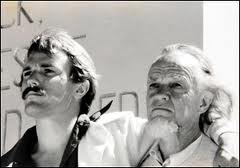
In 1992 I began to write skeptics letters after reading their books and articles and watching their films and I was introduced to Carl Sagan’s name by a book published in 1968 by Francis Schaeffer.
Francis Schaeffer in his book HE IS THERE AND HE IS NOT SILENT (Chapter 4) asserts:
Because men have lost the objective basis for certainty of knowledge in the areas in which they are working, more and more we are going to find them manipulating science according to their own sociological or political desires rather than standing upon concrete objectivity. We are going to find increasingly what I would call sociological science, where men manipulate the scientific facts. Carl Sagan (1934-1996),professor of astronomy and space science at Cornell University, demonstrates that the concept of a manipulated science is not far-fetched. He mixes science and science fiction constantly. He is a true follower of Edgar Rice Burroughs (1875-1950). The media gives him much TV prime time and much space in the press and magazine coverage, and the United State Government spent millions of dollars in the special equipment which was included in the equipment of the Mars probe–at his instigation, to give support to his obsessive certainty that life would be found on Mars, or that even large-sized life would be found there. With Carl Sagan the line concerning objective science is blurred, and the media spreads his mixture of science and science fiction out to the public as exciting fact.

Sagan in 1980
Contact: A Eulogy to Carl Sagan
Home Contact: A Eulogy to Carl Sagan
The Paradox of the Movie Contact
The Paradox of Sagan’s Views of Religion
Sagan’s Extraterrestrial Hope
In another essay (Are We Alone in the Universe?) I summarized the calculations of Christian astronomer Hugh Ross. Ross estimated the probabilities of all the necessary conditions for life occurring by natural processes. Ross concluded that if all we have to depend on are physical and chemical processes, then we are alone in the universe. Life could have evolved nowhere else. Even the biochemical complexities of living cells are revealing that life requires intelligence (See my review of Darwin’s Black Box.). Sagan’s confidence that life is super-abundant in the universe is grossly out of proportion.
The second reason for Sagan’s hope of other civilizations was expressed well by Ellie Arroway. An international panel, assigned the task of choosing the one individual who would enter the machine and perhaps visit this alien civilization, queried each candidate what one question they would ask. Ellie said she would want to know how they survived their technological adolescence without destroying themselves. Sagan has been a tireless supporter of nuclear disarmament. He truly feared that we would destroy ourselves before we reached our full potential. In the opening scene of his Cosmos television series, he remarked that our species was “young and curious and brave; it showed much promise.”(4) Couple this fear with the conviction that there is no God, and the only source of hope for a salvation from ourselves is another civilization more advanced than us, giving us some pointers for survival.
This confidence that an alien culture that could contact us would be more advanced than us is not unreasonable. If they have the technology to purposefully contact us, and this is something we cannot do, then their technology must be beyond ours. What is never explained, however, even though it is raised in the movie, is why we would expect this alien culture to be benevolent. It is just as likely, if not more so, that an alien civilization would be more of the variety depicted in the movie Independence Day. This hope reflects more on Carl Sagan’s optimistic cosmic humanism that any scientific reality.
Who Will Save Us, God or Aliens?
The movie Contact tells us of a more realistic scenario for a first encounter with an alien civilization, than, say, Men in Black. A radio signal is received from space that is broadcast at a frequency that is equal to the value of hydrogen times pi and gets our attention by counting the prime numbers from 1 to 101 in sequence. The message is authenticated as coming from the star Vega, 26 light years away. The message is eventually decoded and found to contain the plans for constructing a machine for one person to apparently travel out into the galaxy. Ellie Arroway, a young astronomer who discovers the message, eventually boards the machine and travels out into space for a close encounter of a supposedly more realistic kind.
A very tantalizing line is repeated three times in the course of the film. When Ellie Arroway, as a child, asks her father if there are any life forms out in the universe, he says that if there isn’t, it would be an awful waste of space. Palmer Joss repeats the line to an adult Ellie as they engage in a conversation under a starry sky in Puerto Rico. It is a poignant scene as Ellie clearly is stunned as she recalls her father saying the same thing. Ellie, herself, repeats the phrase at the end of the film as she is addressing a group of school children and is asked if there is life out there in space.
Sagan has drawn a bead on the argument for the existence of God from design, or the teleological argument. Waste implies misdirected design. If the universe was created for us and we are alone, why does it have to be so big? Surely we could have survived quite well in a much smaller and economical universe. But if you think about it, Scripture proclaims that the heavens declare the glory of God, not man (Ps. 19:1). Indeed, if the universe was created only for man’s benefit, then it is a waste of space. We don’t deserve it. But if the main purpose of the universe is to glorify the splendid, eternal, all-powerful God, it could never be big enough.
Another interesting theme is the form that the alien takes. After Ellie travels through the galaxy, she arrives at a large docking space station. She is somehow transported to a beach, resembling a picture of Pensacola, Florida she drew as a child. Eventually, a figure approaches. It is her father. The alien appears to her in the form of her father. He tells her that they thought this would make it easier for her.
It’s fascinating that Sagan often complains that if God exists, why doesn’t he make himself plain? Why not a cross in the sky or a mathematical formula in the Bible? Why is everything so obscure? One answer from Philip Yancey’s book, Disappointment with God, is that God did reveal himself plainly to Israel during the Exodus and they still rebelled, and Jesus performed incredible miracles and still most rejected him. The Father does not want to coerce our love. So isn’t it interesting that in Sagan’s own story, when a superior intelligence wants to make contact with us, they put us in familiar surroundings, take on our form, and speak our language?! If they appeared to us in their true form, we would be repulsed. Isn’t that precisely what the Father did for us in sending Jesus to live among us? It appears that Carl Sagan has unwittingly answered his own objection.
The Worldview of Carl Sagan
Carl Sagan began his highly acclaimed public television series Cosmos with a grand overview of the universe and our place within it. With a crashing surf in the background, Sagan declares,
“The cosmos is all that is or ever was or ever will be.”(5)
Sagan eloquently expresses his conviction that matter and energy are all that exist. He goes on to describe his awe and wonder of the universe. He describes a tingling in the spine, a catch in the voice, as the greatest of mysteries is approached. With excitement, Sagan tells us our tiny planetary home the Earth is lost somewhere between immensity and eternity, thus poignantly emphasizing our simultaneous value and insignificance.
In the movie Contact, Dr. Ellie Arroway expresses this awe and wonder at several points in the film. The most dramatic episode occurs during her galactic space flight when she is confronted with the wonders to be seen near the center of the galaxy. She is at a loss for words in the face of such beauty and humbly suggests that a poet may have been a better choice to send on the trip.
While this is all very moving, the great emotion seems strangely misplaced and inappropriate. If the cosmos is indeed all there is or ever was or ever will be, why get excited? If we are lost between immensity and eternity, shouldn’t our reaction be one of existential terror, not awe? Sagan borrows his excitement from a Christian worldview where the heavens declare the glory of God, which should produce a tingle in the spine and a catch in the voice.
In the next to final scene in Contact, Ellie attempts to defend herself by finally admitting that she has no evidence of her trip through the galaxy. But she has been given something wonderful, a vision of the universe that tells us how tiny, insignificant, rare and precious we are. In Cosmos, Sagan reflects that while we are a species that is young and curious and brave, our place in the universe is to be compared to “a mote of dust that floats in the morning sky.”(6)
How can we be tiny and insignificant and rare and precious at the same time? Clearly Sagan cannot live consistently within his own worldview. His view of the universe dictates that all is meaningless chance and we are nothing special, yet he irrationally rejects the despair that logically follows in favor of being curious, brave, rare, and precious.
As Sagan neared death, many around the world were praying for him. Though clearly an enemy of the faith, the closing sentences of the novel Contact indicated a belief, a hope, in an intelligence that antedates the universe. Might he see the whole truth before he passes into eternity? In his final book Billions and Billions, his wife Ann Druyan writes, “Contrary to the fantasies of fundamentalists, there was no deathbed conversion…. Even at this moment when anyone would be forgiven for turning away from the reality of our situation, Carl was unflinching.”(7) In reflecting on the many cards and letters she received upon his death from people telling of the impact Sagan had on their lives, she writes, “These thoughts comfort me and lift me out of my heartache. They allow me to feel, without resorting to the supernatural, that Carl lives.”(8) Sadly, Carl does live, but not as she believes. Remember that enemies of the faith are lost and in need of a Savior. But even though they may be prayed for and witnessed to by colleagues up to the end, many, including Carl Sagan, will still, defiantly, die in their sins. It is a bitter, needless grief.
Notes
1. Carl Sagan, Contact (NY: Pocket Books [Simon and Schuster], 1986).
2. Carl Sagan, The Demon-Haunted World (New York: Ballantine Books, 1996), p. 459.
3. Sagan, Contact, p. 20.
4. Carl Sagan, Cosmos Video, “Episode 1: The Shores of the Cosmic Ocean” (Turner Home Entertainment, 1989).
5. Ibid.
6. Carl Sagan, Cosmos (New York: Random House, 1980), p. 4.
7. Carl Sagan, Billions and Billions (New York: Random House, 1997), p. 225.
8. Ibid., p. 228.
© 1998 Probe Ministries
GREAT OBSERVATION ABOUT SAGAN AND UFO’s!!!
Charles Darwin also tried to put a positive spin on his evolutionary views. Darwin wrote, “Believing as I do that man in the distant future will be a far more perfect creature than he now is…”
Francis Schaeffer commented:
Now you have now the birth of Julian Huxley’s evolutionary optimistic humanism already stated by Darwin. Darwin now has a theory that man is going to be better. If you had lived at 1860 or 1890 and you said to Darwin, “By 1970 will man be better?” He certainly would have the hope that man would be better as Julian Huxley does today. Of course, I wonder what he would say if he lived in our day and saw what has been made of his own views in the direction of (the mass murder) Richard Speck (and deterministic thinking of today’s philosophers). I wonder what he would say. So you have the factor, already the dilemma in Darwin that I pointed out in Julian Huxley and that is evolutionary optimistic humanism rests always on tomorrow. You never have an argument from the present or the past for evolutionary optimistic humanism.
You can have evolutionary nihilism on the basis of the present and the past. Every time you have someone bringing in evolutionary optimistic humanism it is always based on what is going to be produced tomorrow. When is it coming? The years pass and is it coming? Arthur Koestler doesn’t think it is coming. He sees lots of problems here and puts forth for another solution.
Darwin wrote, “…it is an intolerable thought that he and all other sentient beings are doomed to complete annihilation after such long-continued slow progress. To those who fully admit the immortality of the human soul, the destruction of our world will not appear so dreadful…”
Francis Schaeffer commented:
Here you feel Marcel Proust and the dust of death is on everything today because the dust of death is on everything tomorrow. Here you have the dilemma of Nevil Shute’s ON THE BEACH. If it is true that all we have left is biological continuity and biological complexity, which is all we have left in Darwinism here, or in many of the modern philosophies, then you can’t stand Shute’s ON THE BEACH. Maybe tomorrow at noon human life may be wiped out. Darwin already feels the tension, because if human life is going to be wiped out tomorrow, what is it worth today? Darwin can’t stand the thought of death of all men. Charlie Chaplin when he heard there was no life on Mars said, “I’m lonely.”
You think of the Swedish Opera (ANIARA) that is pictured inside a spaceship. There was a group of men and women going into outer space and they had come to another planet and the singing inside the spaceship was normal opera music. Suddenly there was a big explosion and the world had blown up and these were the last people left, the only conscious people left, and the last scene is the spaceship is off course and it will never land, but will just sail out into outer space. They say when it was shown in Stockholm the first time, the tough Swedes with all their modern mannishness, came out (after the opera was over) with hardly a word said, just complete silence.
Darwin already with his own position says he CAN’T STAND IT!! You can say, “Why can’t you stand it?” We would say to Darwin, “You were not made for this kind of thing. Man was made in the image of God. Your CAN’T- STAND- IT- NESS is screaming at you that your position is wrong. Why can’t you listen to yourself?”
You find all he is left here is biological continuity, and thus his feeling as well as his reason now is against his own theory, yet he holds it against the conclusions of his reason. Reason doesn’t make it hard to be a Christian. Darwin shows us the other way. He is holding his position against his reason.
Aniara (opera)
From Wikipedia, the free encyclopedia

Premiere production at the Royal Opera, Stockholm 1959. Set by Sven Erixson.

Kjerstin Dellert and Olle Sivall in the premiere production.
Aniara is an opera in two acts by Karl-Birger Blomdahl, with a libretto by Erik Lindegren based on the poem Aniara by Harry Martinson, that was premiered in 1959.[1] Subtitle of poem and opera is the ambiguous phrase En revy om människan i tid och rum: “A revue/review about Man in Time and Space”.[2]
The score of Aniara is varied and makes full use of a range of musical idioms, including jazz, serial writing and an electronic tape. The narrative is sung primarily by Mimaroben, a bass-baritone, who operates the electronic tape, Mima, the computer, and by the chorus.[1] In essence the opera (and poem) deal with the relationship between the individual and the group through time.
Many representatives of the international press were in Stockholm for the premiere in 1959 at a time when the space age was beginning.[2] Blomdahl said in interview that the opera (in common with his next opera Herr von Hancken) was founded on “modern man’s complexity and his basically impossible situation”; Aniara dealt with “the downfall of the group”.[3] A production was mounted in Gothenburg in 1994.[4]
Contents
[hide]
Roles[edit]
| ROLE | VOICE TYPE | PREMIERE CAST, 31 MAY 1959[5] (CONDUCTOR: SIXTEN EHRLING) |
|---|---|---|
| Mimaroben | baritone | Erik Saedén |
| The blind poetess | high soprano | Margareta Hallin |
| Daisi Doody | soprano | Kjerstin Dellert |
| Libidel | dancer | |
| Three chief technicians | 2 tenors, baritone | Sven-Erik Wikström, Arne Ohlson, Bo Lundborg |
| Comedian, Sandon | high buffo tenor | Olle Sivall |
| Isagel | dancer | Loulou Portefaix |
| Den stenstumt döve | tenor | Ragnar Ulfung |
| Chefone | bass-baritone | Arne Tyrén |
| Chorus: space cadets, passengers |
Synopsis[edit]
Controlled by the computer Mima, the space ship Aniara leaves the poisoned Earth, heading for Mars. Through Mimaroben, who is the operator of Mima, the emigrants learn of the evil of mankind.
During the celebration of midsummer, the vessel is thrown off course, causing panic, and forcing a journey to the constellationLyra which commander Chefone says will last for the rest of the lives of the crew and passengers. When the Earth is destroyed, Mima cannot continue, and Sandon makes jokes about the safety on board, but when the mute describes in signs the end of the world he becomes silent. Chefone blames Mimaroben, who, with the pilot Isagel, is taken away.
The commander deals as best he can with the increased despair and moral deterioration among those aboard, depicted in a scene in a hall of mirrors, where Daisy Dodd, her lesbian partner, and the passengers dance, and the blind poetess speaks of her cult of Light, which has replaced Mima. The body of the dead chief technician is shot into outer space in the direction of the star Rigel. The 20th anniversary of the voyage is celebrated, and the blind poetess ecstatically sees the city of heaven, but is taken away.
The final scene shows the last night onboard where Isagel dances and the blind poetess sings of the joy of death. A light beam sweeps over the dead passengers and Mimaroben prepares for the end. Finally darkness descends over the occupants of the space ship, and the audience in the theatre.
Recordings[edit]
The first performance was broadcast by Swedish Radio; a subsequent recording was conducted by Stig Westerberg, and included Viveka Anderberg, Björn Haugan, Stefan Parkman, Mikael Samuelson, Thomas Sunnegårdh and Jerker Arvidssonin among the cast.
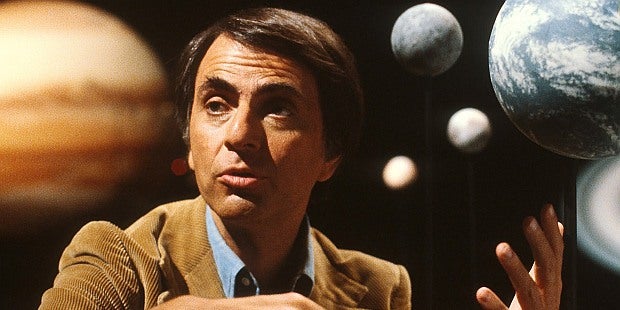
Carl Sagan, in full Carl Edward Sagan, (born November 9, 1934, Brooklyn, New York, U.S.—died December 20, 1996, Seattle, Washington), American astronomer and science writer. A popular and influential figure in the United States, he was controversial in scientific, political, and religious circles for his views on extraterrestrial intelligence, nuclear weapons, and religion. Sagan wrote the article “life” for the 1970 printing of the 14th edition of the Encyclopædia Britannica (1929–73).
Sagan attended the University of Chicago, where he earned a bachelor’s and a master’s degree in physics in 1955 and 1956, respectively, and a doctorate in astronomy and astrophysics in 1960. From 1960 to 1962 he was a fellow in astronomy at the University of California, Berkeley, and from 1962 to 1968 he worked at Harvard University and the Smithsonian Astrophysical Observatory. His early work focused on the physical conditions of the planets, especially the atmospheres of Venus and Jupiter. During that time he became interested in the possibility of lifebeyond Earth and the search for extraterrestrial intelligence (SETI), a controversial research field he did much to advance. For example, building on earlier work by American chemists Stanley Miller and Harold Urey, he demonstrated that amino acids and nucleic acids—the building blocks of life—could be produced by exposing a mixture of simple chemicals to ultraviolet radiation. Some scientists criticized Sagan’s work, arguing that it was unreasonable to use resources for SETI, a fantasy project that was almost certainly doomed to failure.
On November 21, 2014 I received a letter from Nobel Laureate Harry Kroto and it said:
…Please click on this URL http://vimeo.com/26991975
and you will hear what far smarter people than I have to say on this matter. I agree with them.
Harry Kroto

I have attempted to respond to all of Dr. Kroto’s friends arguments and I have posted my responses one per week for over a year now. Here are some of my earlier posts:
Arif Ahmed, Haroon Ahmed, Jim Al-Khalili, Sir David Attenborough, Mark Balaguer, Horace Barlow, Michael Bate, Sir Patrick Bateson, Simon Blackburn, Colin Blakemore, Ned Block, Pascal Boyer, Patricia Churchland, Aaron Ciechanover, Noam Chomsky, Brian Cox, Partha Dasgupta, Alan Dershowitz, Frank Drake, Hubert Dreyfus, John Dunn, Bart Ehrman, Mark Elvin, Richard Ernst, Stephan Feuchtwang, Robert Foley, David Friend, Riccardo Giacconi, Ivar Giaever , Roy Glauber, Rebecca Goldstein, David J. Gross, Brian Greene, Susan Greenfield, Stephen F Gudeman, Alan Guth, Jonathan Haidt, Theodor W. Hänsch, Brian Harrison, Stephen Hawking, Hermann Hauser, Robert Hinde, Roald Hoffmann, Bruce Hood, Gerard ‘t Hooft, Caroline Humphrey, Nicholas Humphrey, Herbert Huppert, Gareth Stedman Jones, Steve Jones, Shelly Kagan, Michio Kaku, Stuart Kauffman, Masatoshi Koshiba, Lawrence Krauss, Harry Kroto, George Lakoff, Rodolfo Llinas, Elizabeth Loftus, Alan Macfarlane, Dan McKenzie, Mahzarin Banaji, Peter Millican, Marvin Minsky, Leonard Mlodinow, P.Z.Myers, Yujin Nagasawa, Alva Noe, Douglas Osheroff, David Parkin, Jonathan Parry, Roger Penrose, Saul Perlmutter, Herman Philipse, Carolyn Porco, Robert M. Price, VS Ramachandran, Lisa Randall, Lord Martin Rees, Colin Renfrew, Alison Richard, C.J. van Rijsbergen, Oliver Sacks, John Searle, Marcus du Sautoy, Simon Schaffer, J. L. Schellenberg, Lee Silver, Peter Singer, Walter Sinnott-Armstrong, Ronald de Sousa, Victor Stenger, John Sulston, Barry Supple, Leonard Susskind, Raymond Tallis, Max Tegmark, Neil deGrasse Tyson, Martinus J. G. Veltman, Craig Venter, .Alexander Vilenkin, Sir John Walker, James D. Watson, Frank Wilczek, Steven Weinberg, and Lewis Wolpert,
In the 1st video below in the 45th clip in this series are his words and my response is below them.
50 Renowned Academics Speaking About God (Part 1)
Another 50 Renowned Academics Speaking About God (Part 2
A Further 50 Renowned Academics Speaking About God (Part 3)
–
CARL SAGAN interview with Charlie Rose:
“…faith is belief in the absence of evidence. To believe in the absence of evidence, in my opinion, is a mistake. The idea is to hold belief until there is compelling evidence. If the Universe does not comply with our previous propositions, then we have to change…Religion deals with history poetry, great literature, ethics, morals, compassion…where religion gets into trouble is when it pretends to know something about science,”
I would respond that there is evidence that Christianity is true. The Bible has fulfilled prophecy in it, and 53 historical notable people in the Bible have been confirmed through archaeological evidence! Also there is compelling evidence that the Bible contains sound medical principles that clearly predate their more recent discovery by thousands of years
Related posts:
FRANCIS SCHAEFFER ANALYZES ART AND CULTURE Part 52 THE BEATLES (Part D, There is evidence that the Beatles may have been exposed to Francis Schaeffer!!!) (Feature on artist Anna Margaret Rose Freeman )
______________ George Harrison Swears & Insults Paul and Yoko Lucy in the Sky with Diamonds- The Beatles The Beatles: I have dedicated several posts to this series on the Beatles and I don’t know when this series will end because Francis Schaeffer spent a lot of time listening to the Beatles and talking […]
FRANCIS SCHAEFFER ANALYZES ART AND CULTURE Part 51 THE BEATLES (Part C, List of those on cover of Stg.Pepper’s ) (Feature on artist Raqib Shaw )
The Beatles in a press conference after their Return from the USA Uploaded on Nov 29, 2010 The Beatles in a press conference after their Return from the USA. The Beatles: I have dedicated several posts to this series on the Beatles and I don’t know when this series will end because Francis […]
FRANCIS SCHAEFFER ANALYZES ART AND CULTURE Part 50 THE BEATLES (Part B, The Psychedelic Music of the Beatles) (Feature on artist Peter Blake )
__________________ Beatles 1966 Last interview I have dedicated several posts to this series on the Beatles and I don’t know when this series will end because Francis Schaeffer spent a lot of time listening to the Beatles and talking and writing about them and their impact on the culture of the 1960’s. In this […]
FRANCIS SCHAEFFER ANALYZES ART AND CULTURE Part 49 THE BEATLES (Part A, The Meaning of Stg. Pepper’s Cover) (Feature on artist Mika Tajima)
_______________ The Beatles documentary || A Long and Winding Road || Episode 5 (This video discusses Stg. Pepper’s creation I have dedicated several posts to this series on the Beatles and I don’t know when this series will end because Francis Schaeffer spent a lot of time listening to the Beatles and talking and writing about […]
FRANCIS SCHAEFFER ANALYZES ART AND CULTURE PART 48 “BLOW UP” by Michelangelo Antonioni makes Philosophic Statement (Feature on artist Nancy Holt)
_______________ Francis Schaeffer pictured below: _____________________ I have included the 27 minute episode THE AGE OF NONREASON by Francis Schaeffer. In that video Schaeffer noted, ” Sergeant Pepper’s Lonely Hearts Club Band…for a time it became the rallying cry for young people throughout the world. It expressed the essence of their lives, thoughts and their feelings.” How Should […]
FRANCIS SCHAEFFER ANALYZES ART AND CULTURE Part 47 Woody Allen and Professor Levy and the death of “Optimistic Humanism” from the movie CRIMES AND MISDEMEANORS Plus Charles Darwin’s comments too!!! (Feature on artist Rodney Graham)
Crimes and Misdemeanors: A Discussion: Part 1 ___________________________________ Today I will answer the simple question: IS IT POSSIBLE TO BE AN OPTIMISTIC SECULAR HUMANIST THAT DOES NOT BELIEVE IN GOD OR AN AFTERLIFE? This question has been around for a long time and you can go back to the 19th century and read this same […]
FRANCIS SCHAEFFER ANALYZES ART AND CULTURE PART 46 Friedrich Nietzsche (Featured artist is Thomas Schütte)
____________________________________ Francis Schaeffer pictured below: __________ Francis Schaeffer has written extensively on art and culture spanning the last 2000years and here are some posts I have done on this subject before : Francis Schaeffer’s “How should we then live?” Video and outline of episode 10 “Final Choices” , episode 9 “The Age of Personal Peace and Affluence”, episode 8 […]
FRANCIS SCHAEFFER ANALYZES ART AND CULTURE Part 45 Woody Allen “Reason is Dead” (Feature on artists Allora & Calzadilla )
Love and Death [Woody Allen] – What if there is no God? [PL] ___________ _______________ How Should We then Live Episode 7 small (Age of Nonreason) #02 How Should We Then Live? (Promo Clip) Dr. Francis Schaeffer 10 Worldview and Truth Two Minute Warning: How Then Should We Live?: Francis Schaeffer at 100 Francis Schaeffer […]
FRANCIS SCHAEFFER ANALYZES ART AND CULTURE Part 44 The Book of Genesis (Featured artist is Trey McCarley )
___________________________________ Francis Schaeffer pictured below: ____________________________ Francis Schaeffer “BASIS FOR HUMAN DIGNITY” Whatever…HTTHR Dr. Francis schaeffer – The flow of Materialism(from Part 4 of Whatever happened to human race?) Dr. Francis Schaeffer – The Biblical flow of Truth & History (intro) Francis Schaeffer – The Biblical Flow of History & Truth (1) Dr. Francis Schaeffer […]
__
__


 The Daily Hatch