
—
Francis Schaeffer wrote in 1981 in CHRISTIAN MANIFESTO chapter 3 The Destruction of Faith and Freedom:
Then there was a shift into materialistic science based on a philosophic change to the materialistic concept of final reality. This shift was based on no addition to the facts known. It was a choice, in faith, to see things that way. No clearer expression of this could be given than Carl Sagan’s arrogant statement on public television–made without any scientific proof for the statement–to 140 million viewers: “The cosmos is all that is or ever was or ever was or ever will be.” He opened the series, COSMOS, with this essentially creedal declaration and went on to build every subsequent conclusion upon it.
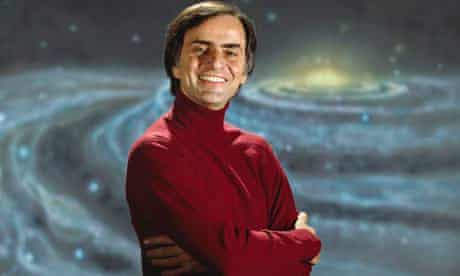 (Carl Sagan brought astronomy into popular culture. Photograph: Tony Korody/Corbis)
I am evangelical but I enjoyed reading Carl Sagan’s books and even had the chance to have my reviews of them published. Sagan’s correspondence with me with me in 1995 on two subjects showed what a gentleman he was.
Recently I have been revisiting my correspondence in 1995 with the famous astronomer Carl Sagan who I had the privilege to correspond with in 1994, 1995 and 1996. In 1996 I had a chance to respond to his December 5, 1995letter on January 10, 1996 and I never heard back from him again since his cancer returned and he passed away later in 1996. Below is what Carl Sagan wrote to me in his December 5, 1995 letter:
Thanks for your recent letter about evolution and abortion. The correlation is hardly one to one; there are evolutionists who are anti-abortion and anti-evolutionists who are pro-abortion.You argue that God exists because otherwise we could not understand the world in our consciousness. But if you think God is necessary to understand the world, then why do you not ask the next question of where God came from? And if you say “God was always here,” why not say that the universe was always here? On abortion, my views are contained in the enclosed article (Sagan, Carl and Ann Druyan {1990}, “The Question of Abortion,” Parade Magazine, April 22.)
I was introduced to when reading a book by Francis Schaeffer called HE IS THERE AND HE IS NOT SILENT written in 1968.
Michael K Lilley
This blog serves to provide the intellectual tools to educate, equip and encourage fellow Christians so that they have the confidence to face the challenges to their faith. This blog stands to build a strong foundation on the case for faith. John 16:1, 1 Corinthians 1:19, 2 Corinthians 10:5, Philippians 3:1, 1 Peter 3:15, Jude 1:3
Friday, 23 April 2010
You’re No One Special
Thursday, April 15, 2010 – Grace to You BlogCarl Sagan, perhaps the best-known scientific celebrity of the past couple of decades. A renowned astronomer and media figure, Sagan was overtly antagonistic to biblical theism. But he became the chief televangelist for the religion of naturalism. He preached a world-view that was based entirely on naturalistic assumptions. Underlying all he taught was the firm conviction that everything in the universe has a natural cause and a natural explanation. That belief—a matter of faith, not a truly scientific observation—governed and shaped every one of his theories about the universe.Sagan’s religion included the belief that the human race is nothing special. Given the incomprehensible vastness of the universe and the impersonality of it all, how could humanity possibly be important? Sagan concluded that our race is not significant at all. In December 1996, less than three weeks before Sagan died, he was interviewed by Ted Koppel on “Nightline.” Sagan knew he was dying, and Koppel asked him, “Dr. Sagan, do you have any pearls of wisdom that you would like to give to the human race?”
Sagan replied,
We live on a hunk of rock and metal that circles a humdrum star that is one of 400 billion other stars that make up the Milky Way Galaxy, which is one of billions of other galaxies, which make up a universe, which may be one of a very large number—perhaps an infinite number—of other universes. That is a perspective on human life and our culture that is well worth pondering. (ABC News Nightline, December 4, 1996)
In a book published posthumously, Sagan wrote, “Our planet is a lonely speck in the great enveloping cosmic dark. In our obscurity, in all this vastness, there is no hint that help will come from elsewhere to save us from ourselves” (Pale Blue Dot, New York: Random House, 1994, p. 9).
Although Sagan resolutely tried to maintain a semblance of optimism to the bitter end, his religion led where all naturalism inevitably leads: to a sense of utter insignificance and despair. According to his word-view, humanity occupies a tiny outpost—a pale blue speck in a vast sea of galaxies. As far as we know, we are unnoticed by the rest of the universe, accountable to no one, and petty and irrelevant in a cosmos so expansive. It is fatuous to talk of outside help or redemption for the human race. No help is forthcoming. It would be nice if we somehow managed to solve some of our problems, but whether we do or not will ultimately be a forgotten bit of cosmic trivia. That, said Sagan, is a perspective well worth pondering.
All of this underscores the spiritual barrenness of naturalism. The naturalist’s religion erases all moral and ethical accountability, and it ultimately abandons all hope for humanity. If the impersonal cosmos is all there is, all there ever was, and all there ever will be, then morality is ultimately moot. If there is no personal Creator to whom humanity is accountable and the survival of the fittest is the governing law of the universe, all the moral principles that normally regulate the human conscience are ultimately groundless—and possibly even deleterious to the survival of our species.
Indeed, the rise of naturalism has meant moral catastrophe for modern society. The most damaging ideologies of the nineteenth and twentieth centuries were all rooted in Darwinism. One of Darwin’s earliest champions, Thomas Huxley, gave a lecture in 1893 in which he argued that evolution and ethics are incompatible. He wrote that “the practice of that which is ethically best—what we call goodness or virtue—involves a course of conduct which, in all respects, is opposed to that which leads to success in the cosmic struggle for existence” (“Evolution and Ethics,” The Romanes Lecture, 1893).
[Note: Huxley nonetheless went on to try to justify ethics as a positive result of humanity’s higher rational functions, and he called upon his audience neither to imitate “the cosmic process” nor to run away from it, but rather to combat it—ostensibly by maintaining some semblance of morality and ethics. But what he could not do—what he and other philosophers of his era did not even bother attempting to do—was offer any justification for assuming the validity of morality and ethics per se on purely naturalistic principles. Huxley and his fellow naturalists could offer no moral compass other than their own personal preferences, and predictably, their philosophies all opened the door wide for complete moral subjectivity and ultimately amorality.]
Philosophers who incorporated Darwin’s ideas were quick to see Huxley’s point, conceiving new philosophies that set the stage for the amorality and genocide that characterized so much of the twentieth century.
Karl Marx, for example, self-consciously followed Darwin in the devising of his economic and social theories. He inscribed a copy of his book Das Kapital to Darwin, “from a devoted admirer.” He referred to Darwin’s The Origin of Species as “the book which contains the basis in natural history for our view” (Stephen Jay Gould, Ever Since Darwin, New York: Norton, 1977, p. 26).
Herbert Spencer’s philosophy of “Social Darwinism” applied the doctrines of evolution and the survival of the fittest to human societies. Spencer argued that if nature itself has determined that the strong survive and the weak perish, this rule should govern society as well. Racial and class distinctions simply reflect nature’s way. There is therefore no transcendent moral reason to be sympathetic to the struggle of the disadvantaged classes. It is, after all, part of the natural evolutionary process—and society would actually be improved by recognizing the superiority of the dominant classes and encouraging their ascendancy. The racialism of writers such as Ernst Haeckel (who believed that the African races were incapable of culture or higher mental development) was also rooted in Darwinism.
Friedrich Nietzsche’s whole philosophy was based on the doctrine of evolution. Nietzsche was bitterly hostile to religion, and particularly Christianity. Christian morality embodied the essence of everything Nietzsche hated; he believed Christ’s teaching glorified human weakness and was detrimental to the development of the human race. He scoffed at Christian moral values such as humility, mercy, modesty, meekness, compassion for the powerless, and service to one another. He believed such ideals had bred weakness in society. Nietzsche saw two types of people—the master-class, an enlightened, dominant minority; and the “herd,” sheeplike followers who were easily led. And he concluded that the only hope for humanity would be when the master-class evolved into a race of Übermenschen (supermen), unencumbered by religious or social mores, who would take power and bring humanity to the next stage of its evolution.
It’s not surprising that Nietzsche’s philosophy laid the foundation for the Nazi movement in Germany. What is surprising is that at the dawn of the twenty-first century, Nietzsche’s reputation has been rehabilitated by philosophical spin-doctors and his writings are once again trendy in the academic world. Indeed, his philosophy—or something very nearly like it—is what naturalism must inevitably return to.
All of these philosophies are based on notions that are diametrically opposed to a biblical view of the nature of man, because they all start by embracing a Darwinian view of the origin of humanity. They are rooted in anti-Christian theories about human origins and the origin of the cosmos, and therefore it is no wonder that they stand in opposition to biblical principles at every level.
The simple fact of the matter is that all the philosophical fruits of Darwinism have been negative, ignoble, and destructive to the very fabric of society. Not one of the major twentieth-century revolutions led by post-Darwinian philosophies ever improved or ennobled any society. Instead, the chief social and political legacy of Darwinian thought is a full spectrum of evil tyranny with Marx-inspired communism at one extreme and Nietzsche-inspired fascism at the other. And the moral catastrophe that has disfigured modern Western society is also directly traceable to Darwinism and the rejection of the early chapters of Genesis.
At this moment in history, even though most of modern society is already fully committed to an evolutionary and naturalistic world view, our society still benefits from the collective memory of a biblical worldview. People in general still believe human life is special. They still hold remnants of biblical morality, such as the notion that love is the greatest virtue (1 Corinthians 13:13); service to one another is better than fighting for personal dominion (Matthew 20:25-27); and humility and submission are superior to arrogance and rebellion (1 Peter 5:5).
But to whatever degree secular society still holds those virtues in esteem, it does so entirely without any philosophical foundation. Having already rejected the God revealed in Scripture and embraced instead pure naturalistic materialism, the modern mind has no grounds whatsoever for holding to any ethical standard; no reason whatsoever for esteeming “virtue” over “vice”; and no justification whatsoever for regarding human life as more valuable than any other form of life. Modern society has already abandoned its moral foundation.
Posted by Michael K. Lilley at 16:33
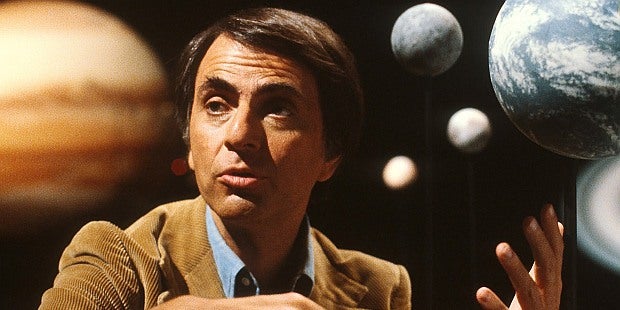
Carl Sagan, in full Carl Edward Sagan, (born November 9, 1934, Brooklyn, New York, U.S.—died December 20, 1996, Seattle, Washington), American astronomer and science writer. A popular and influential figure in the United States, he was controversial in scientific, political, and religious circles for his views on extraterrestrial intelligence, nuclear weapons, and religion. Sagan wrote the article “life” for the 1970 printing of the 14th edition of the Encyclopædia Britannica (1929–73).
Sagan attended the University of Chicago, where he earned a bachelor’s and a master’s degree in physics in 1955 and 1956, respectively, and a doctorate in astronomy and astrophysics in 1960. From 1960 to 1962 he was a fellow in astronomy at the University of California, Berkeley, and from 1962 to 1968 he worked at Harvard University and the Smithsonian Astrophysical Observatory. His early work focused on the physical conditions of the planets, especially the atmospheres of Venus and Jupiter. During that time he became interested in the possibility of lifebeyond Earth and the search for extraterrestrial intelligence (SETI), a controversial research field he did much to advance. For example, building on earlier work by American chemists Stanley Miller and Harold Urey, he demonstrated that amino acids and nucleic acids—the building blocks of life—could be produced by exposing a mixture of simple chemicals to ultraviolet radiation. Some scientists criticized Sagan’s work, arguing that it was unreasonable to use resources for SETI, a fantasy project that was almost certainly doomed to failure.
On November 21, 2014 I received a letter from Nobel Laureate Harry Kroto and it said:
…Please click on this URL http://vimeo.com/26991975
and you will hear what far smarter people than I have to say on this matter. I agree with them.
Harry Kroto

I have attempted to respond to all of Dr. Kroto’s friends arguments and I have posted my responses one per week for over a year now. Here are some of my earlier posts:
Arif Ahmed, Haroon Ahmed, Jim Al-Khalili, Sir David Attenborough, Mark Balaguer, Horace Barlow, Michael Bate, Sir Patrick Bateson, Simon Blackburn, Colin Blakemore, Ned Block, Pascal Boyer, Patricia Churchland, Aaron Ciechanover, Noam Chomsky, Brian Cox, Partha Dasgupta, Alan Dershowitz, Frank Drake, Hubert Dreyfus, John Dunn, Bart Ehrman, Mark Elvin, Richard Ernst, Stephan Feuchtwang, Robert Foley, David Friend, Riccardo Giacconi, Ivar Giaever , Roy Glauber, Rebecca Goldstein, David J. Gross, Brian Greene, Susan Greenfield, Stephen F Gudeman, Alan Guth, Jonathan Haidt, Theodor W. Hänsch, Brian Harrison, Stephen Hawking, Hermann Hauser, Robert Hinde, Roald Hoffmann, Bruce Hood, Gerard ‘t Hooft, Caroline Humphrey, Nicholas Humphrey, Herbert Huppert, Gareth Stedman Jones, Steve Jones, Shelly Kagan, Michio Kaku, Stuart Kauffman, Masatoshi Koshiba, Lawrence Krauss, Harry Kroto, George Lakoff, Rodolfo Llinas, Elizabeth Loftus, Alan Macfarlane, Dan McKenzie, Mahzarin Banaji, Peter Millican, Marvin Minsky, Leonard Mlodinow, P.Z.Myers, Yujin Nagasawa, Alva Noe, Douglas Osheroff, David Parkin, Jonathan Parry, Roger Penrose, Saul Perlmutter, Herman Philipse, Carolyn Porco, Robert M. Price, VS Ramachandran, Lisa Randall, Lord Martin Rees, Colin Renfrew, Alison Richard, C.J. van Rijsbergen, Oliver Sacks, John Searle, Marcus du Sautoy, Simon Schaffer, J. L. Schellenberg, Lee Silver, Peter Singer, Walter Sinnott-Armstrong, Ronald de Sousa, Victor Stenger, John Sulston, Barry Supple, Leonard Susskind, Raymond Tallis, Max Tegmark, Neil deGrasse Tyson, Martinus J. G. Veltman, Craig Venter, .Alexander Vilenkin, Sir John Walker, James D. Watson, Frank Wilczek, Steven Weinberg, and Lewis Wolpert,
In the 1st video below in the 45th clip in this series are his words and my response is below them.
50 Renowned Academics Speaking About God (Part 1)
Another 50 Renowned Academics Speaking About God (Part 2
A Further 50 Renowned Academics Speaking About God (Part 3)
–
CARL SAGAN interview with Charlie Rose:
“…faith is belief in the absence of evidence. To believe in the absence of evidence, in my opinion, is a mistake. The idea is to hold belief until there is compelling evidence. If the Universe does not comply with our previous propositions, then we have to change…Religion deals with history poetry, great literature, ethics, morals, compassion…where religion gets into trouble is when it pretends to know something about science,”
I would respond that there is evidence that Christianity is true. The Bible has fulfilled prophecy in it, and 53 historical notable people in the Bible have been confirmed through archaeological evidence! Also there is compelling evidence that the Bible contains sound medical principles that clearly predate their more recent discovery by thousands of years
Related posts:
FRANCIS SCHAEFFER ANALYZES ART AND CULTURE Part 52 THE BEATLES (Part D, There is evidence that the Beatles may have been exposed to Francis Schaeffer!!!) (Feature on artist Anna Margaret Rose Freeman )
______________ George Harrison Swears & Insults Paul and Yoko Lucy in the Sky with Diamonds- The Beatles The Beatles: I have dedicated several posts to this series on the Beatles and I don’t know when this series will end because Francis Schaeffer spent a lot of time listening to the Beatles and talking […]
FRANCIS SCHAEFFER ANALYZES ART AND CULTURE Part 51 THE BEATLES (Part C, List of those on cover of Stg.Pepper’s ) (Feature on artist Raqib Shaw )
The Beatles in a press conference after their Return from the USA Uploaded on Nov 29, 2010 The Beatles in a press conference after their Return from the USA. The Beatles: I have dedicated several posts to this series on the Beatles and I don’t know when this series will end because Francis […]
FRANCIS SCHAEFFER ANALYZES ART AND CULTURE Part 50 THE BEATLES (Part B, The Psychedelic Music of the Beatles) (Feature on artist Peter Blake )
__________________ Beatles 1966 Last interview I have dedicated several posts to this series on the Beatles and I don’t know when this series will end because Francis Schaeffer spent a lot of time listening to the Beatles and talking and writing about them and their impact on the culture of the 1960’s. In this […]
FRANCIS SCHAEFFER ANALYZES ART AND CULTURE Part 49 THE BEATLES (Part A, The Meaning of Stg. Pepper’s Cover) (Feature on artist Mika Tajima)
_______________ The Beatles documentary || A Long and Winding Road || Episode 5 (This video discusses Stg. Pepper’s creation I have dedicated several posts to this series on the Beatles and I don’t know when this series will end because Francis Schaeffer spent a lot of time listening to the Beatles and talking and writing about […]
FRANCIS SCHAEFFER ANALYZES ART AND CULTURE PART 48 “BLOW UP” by Michelangelo Antonioni makes Philosophic Statement (Feature on artist Nancy Holt)
_______________ Francis Schaeffer pictured below: _____________________ I have included the 27 minute episode THE AGE OF NONREASON by Francis Schaeffer. In that video Schaeffer noted, ” Sergeant Pepper’s Lonely Hearts Club Band…for a time it became the rallying cry for young people throughout the world. It expressed the essence of their lives, thoughts and their feelings.” How Should […]
FRANCIS SCHAEFFER ANALYZES ART AND CULTURE Part 47 Woody Allen and Professor Levy and the death of “Optimistic Humanism” from the movie CRIMES AND MISDEMEANORS Plus Charles Darwin’s comments too!!! (Feature on artist Rodney Graham)
Crimes and Misdemeanors: A Discussion: Part 1 ___________________________________ Today I will answer the simple question: IS IT POSSIBLE TO BE AN OPTIMISTIC SECULAR HUMANIST THAT DOES NOT BELIEVE IN GOD OR AN AFTERLIFE? This question has been around for a long time and you can go back to the 19th century and read this same […]
FRANCIS SCHAEFFER ANALYZES ART AND CULTURE PART 46 Friedrich Nietzsche (Featured artist is Thomas Schütte)
____________________________________ Francis Schaeffer pictured below: __________ Francis Schaeffer has written extensively on art and culture spanning the last 2000years and here are some posts I have done on this subject before : Francis Schaeffer’s “How should we then live?” Video and outline of episode 10 “Final Choices” , episode 9 “The Age of Personal Peace and Affluence”, episode 8 […]
FRANCIS SCHAEFFER ANALYZES ART AND CULTURE Part 45 Woody Allen “Reason is Dead” (Feature on artists Allora & Calzadilla )
Love and Death [Woody Allen] – What if there is no God? [PL] ___________ _______________ How Should We then Live Episode 7 small (Age of Nonreason) #02 How Should We Then Live? (Promo Clip) Dr. Francis Schaeffer 10 Worldview and Truth Two Minute Warning: How Then Should We Live?: Francis Schaeffer at 100 Francis Schaeffer […]
FRANCIS SCHAEFFER ANALYZES ART AND CULTURE Part 44 The Book of Genesis (Featured artist is Trey McCarley )
___________________________________ Francis Schaeffer pictured below: ____________________________ Francis Schaeffer “BASIS FOR HUMAN DIGNITY” Whatever…HTTHR Dr. Francis schaeffer – The flow of Materialism(from Part 4 of Whatever happened to human race?) Dr. Francis Schaeffer – The Biblical flow of Truth & History (intro) Francis Schaeffer – The Biblical Flow of History & Truth (1) Dr. Francis Schaeffer […]
__
__


 The Daily Hatch