Another 50 Renowned Academics Speaking About God (Part 2)
A Further 50 Renowned Academics Speaking About God (Part 3)
__
Quote from Bertrand Russell:
Q: Why are you not a Christian?Russell: Because I see no evidence whatever for any of the Christian dogmas. I’ve examined all the stock arguments in favor of the existence of God, and none of them seem to me to be logically valid.Q: Do you think there’s a practical reason for having a religious belief, for many people?Russell: Well, there can’t be a practical reason for believing what isn’t true. That’s quite… at least, I rule it out as impossible. Either the thing is true, or it isn’t. If it is true, you should believe it, and if it isn’t, you shouldn’t. And if you can’t find out whether it’s true or whether it isn’t, you should suspend judgment. But you can’t… it seems to me a fundamental dishonesty and a fundamental treachery to intellectual integrity to hold a belief because you think it’s useful, and not because you think it’s true._Francis Schaeffer noted concerning the IMPLICIT FAITH of Bertrand Russell:I was lecturing at the University of St. Andrews one night and someone put forth the question, “If Christianity is so clear and reasonable then why doesn’t Bertrand Russell then become a Christian? Is it because he hasn’t discovered theology?”It wasn’t a matter of studying theology that was involved but rather that he had too much faith. I was surrounded by humanists and you could hear the gasps. Bertrand Russell and faith; Isn’t this the man of reason? I pointed out that this is a man of high orthodoxy who will hold his IMPLICIT FAITH on the basis of his presuppositions no matter how many times he has to zig and zag because it doesn’t conform to the facts.You must understand what the term IMPLICIT FAITH means. In the old Roman Catholic Church when someone who became a Roman Catholic they had to promise implicit faith. That meant that you not only had to believe everything that Roman Catholic Church taught then but also everything it would teach in the future. It seems to me this is the kind of faith that these people have in the uniformity of natural causes in a closed system and they have accepted it no matter what it leads them into. I think that these men are men of a high level of IMPLICIT FAITH in their own set of presuppositions. Paul said (in Romans Chapter One) they won’t carry it to it’s logical conclusion even though they hold a great deal of the truth and they have revolted and they have set up a series of universals in themselves which they won’t transgress no matter if they conform to the facts or not.Here below is the Romans passage that Schaeffer is referring to and verse 19 refers to what Schaeffer calls “the mannishness of man” and verse 20 refers to Schaeffer’s other point which is “the universe and it’s form.”Romans 1:18-20 Amplified Bible :18 For God’s [holy] wrath and indignation are revealed from heaven against all ungodliness and unrighteousness of men, who in their wickedness repress and hinder the truth and make it inoperative. 19 For that which is known about God is evident to them and made plain in their inner consciousness, because God [Himself] has shown it to them. 20 For ever since the creation of the world His invisible nature and attributes, that is, His eternal power and divinity, have been made intelligible and clearly discernible in and through the things that have been made (His handiworks). So [men] are without excuse [altogether without any defense or justification].We can actually see the two points makes playing themselves out in Bertrand Russell’s own life.[From a letter dated August 11, 1918 to Miss Rinder when Russell was 46]It is so with all who spend their lives in the quest of something elusive, and yet omnipresent, and at once subtle and infinite. One seeks it in music, and the sea, and sunsets; at times I have seemed very near it in crowds when I have been feeling strongly what they were feeling; one seeks it in love above all. But if one lets oneself imagine one has found it, some cruel irony is sure to come and show one that it is not really found. The outcome is that one is a ghost, floating through the world without any real contact. Even when one feels nearest to other people, something in one seems obstinately to belong to God and to refuse to enter into any earthly communion—at least that is how I should express it if I thought there was a God. It is odd isn’t it? I care passionately for this world, and many things and people in it, and yet…what is it all? There must be something more important, one feels, though I don’t believe there is. I am haunted—some ghost, from some extra-mundane region, seems always trying to tell me something that I am to repeat to the world, but I cannot understand the message.There was evidence during Bertrand Russell’s own life that indicated that the Bible was true and could be trusted.Here is some below:
TRUTH AND HISTORY (chapter 5 of WHATEVER HAPPENED TO THE HUMAN RACE?, under footnotes #97 and #98) written by Francis Schaeffer and C. Everett Koop
A common assumption among liberal scholars is that because the Gospels are theologically motivated writings–which they are–they cannot also be historically accurate. In other words, because Luke, say (when he wrote the Book of Luke and the Book of Acts), was convinced of the deity of Christ, this influenced his work to the point where it ceased to be reliable as a historical account. The assumption that a writing cannot be both historical and theological is false.The experience of the famous classical archaeologist Sir William Ramsay illustrates this well. When he began his pioneer work of exploration in Asia Minor, he accepted the view then current among the Tubingen scholars of his day that the Book of Acts was written long after the events in Paul’s life and was therefore historically inaccurate. However, his travels and discoveries increasingly forced upon his mind a totally different picture, and he became convinced that Acts was minutely accurate in many details which could be checked.
The Book of Acts chronicles the history of the early church from its beginnings on the Day of Pentecost to the Apostle Paul arriving in Rome waiting to appeal to Caesar. Within the Book of Acts are over three hundred references to people, places, events, cities, districts and titles of various officials. The question is, “How do these references match up with known history at the time?” The evidence is that the Book of Acts is a minutely accurate historical work.
The Story Of Sir William Ramsay
The basic reliability of the Book of Acts is illustrated in the story of Sir William Ramsay. In the nineteenth century it was widely believed that the New Testament was an invention of the second-century church. Sir William Ramsay provides us with an example of how an honest scholar of history can change his perspective when faced by incontrovertible evidence from history and archaeology. Ramsay began his historical research toward the end of the nineteenth century. He was taught that the New Testament was not written in the first century and was not historically reliable. Although the New Testament Book of Acts contained a variety of eyewitness historical references, liberal critics rejected its historicity and declared it untrue.
Ramsay Attempted To Develop A Geography Of Asia MinorAs a young historian, Ramsay was determined to develop an independent historical/geographical study of first-century Asia Minor. He assumed the Book of Acts was unreliable and ignored its historical allusions in his studies. The amount of usable historical information concerning first-century Asia Minor, however, was too little for him to proceed very far with his work. That led him, almost in desperation, to consult the Book of Acts for any help possible. Ramsay discovered that it was remarkably accurate and true to first-century history and topography. Ramsay testified to what changed his mind:
I may fairly claim to have entered on this investigation without prejudice in favour of the conclusions which I shall now seek to justify to the reader. On the contrary, I began with a mind unfavourable to it, for the ingenuity and apparent completeness of the Tübingen theory had at one time quite convinced me. It did not then lie in my line of life to investigate the subject minutely, but more recently I found myself brought into contact with the Book of Acts as an authority for the topography, antiquities and society of Asia Minor. It was gradually borne upon me that in various details the narrative showed marvelous truth. In fact, beginning with a fixed idea that the work was essentially a second century composition, and never relying on its evidence as trustworthy for first century conditions, I gradually came to find it a useful ally in some obscure and difficult investigations (Sir William Ramsay, St. PaulThe Traveler and Roman Citizen. Grand Rapids, MI: Baker Book House, 1962, p. 36).
Ramsay’s study led him to conclude that “Luke’s history is unsurpassed in respect to its trustworthiness” (Ramsay, ibid. p. 81) and Luke is a historian of the first rank; not merely are his statements trustworthy . . . this author should be placed along with the very greatest of historians” (Sir William Ramsay, The Bearing of Recent Discoveries on the Trustworthiness of the New Testament. Grand Rapids, MI: Baker Book House, 1953, p. 222).
From the evidence gathered by Ramsay, we discover that Luke, author of the greatest portion of the New Testament (Luke and Acts) and an eyewitness of many events during the growth of the first-century church, was a careful historian.
Since many historical details, national boundaries, and government structures in Asia Minor were different in the second century from what they had been in the first, it is reasonable to conclude that the actual author of Luke and Acts was a first-century author, not a second-century one.
A Supposed Error By Luke
Acts 14:1-7, for example, was in historical dispute for many years. It reads as follows.
At Iconium Paul and Barnabas went as usual into the Jewish synagogue. There they spoke so effectively that a great number of Jews and Gentiles believed. But the Jews who refused to believe stirred up the Gentiles and poisoned their minds against the brothers. So Paul and Barnabas spent considerable time there, speaking boldly for the Lord, who confirmed the message of his grace by enabling them to do miraculous signs and wonders. The people of the city were divided; some sided with the Jews, others with the apostles. There was a plot afoot among the Gentiles and Jews, together with their leaders, to mistreat them and stone them. But they found out about it and fled to the Lycaonian cities of Lystra and Derbe and to the surrounding country, where they continued to preach the good news (Acts 14:1-7).
The passage implies that Lystra and Derbe were cities in the district of Lycaonia but Iconium was in a different district. Paul and Barnabas went to the different district because it was safe. Later Roman writers such as Cicero contradicted the passage, asserting that Iconium was also in Lycaonia. For years this was used to show the historical unreliability of Acts.
Ramsay Discovers That Luke Was Not In ErrorIn 1910, however, Sir William Ramsay discovered an inscription declaring that the first century Iconium was under the authority of Phrygia from A.D. 37 to A.D. 72. It was onlyduring these years that Iconium was not under the authority of Lycaonia. Not only did this discovery confirm the accuracy of the statement in Acts 14, it showed that whoever wrote this passage knew what district Iconium was in at that time. That places the author as an eyewitness to the events.
Examples such as this can be multiplied. The conclusion is that Acts is found to be a reliable work of history that correctly depicts life in the first century A.D
Summary
The New Testament Book of Acts contains some of the historical highlights of the early church. From the evidence that is available we can conclude that the writer of the Book of Acts, Luke, was a meticulous historian. His account fits with what we know of the people, geography, and events of first century Asia Minor. Therefore the history that it records should be trusted.
Today we look at the 3rd letter in the Kroto correspondence and his admiration of Bertrand Russell. (Below The Nobel chemistry laureates Harold Kroto, Robert Curl and Richard Smalley) It is with sadness that I write this post having learned of the death of Sir Harold Kroto on April 30, 2016 at the age of […]
On November 21, 2014 I received a letter from Nobel Laureate Harry Kroto and it said: …Please click on this URL http://vimeo.com/26991975 and you will hear what far smarter people than I have to say on this matter. I agree with them. Harry Kroto _________________ Below you have picture of Dr. Harry Kroto: Gareth Stedman […]
Top 10 Woody Allen Movies __________ John Piippo makes the case that Bertrand Russell would have loved Woody Allen because they both were atheists who don’t deny the ramifications of atheism!!! Monday, August 06, 2012 (More On) Woody Allen’s Atheism As I wrote in a previous post, I like Woody Allen. I have long admired his […]
______ Top 10 Woody Allen Movies PBS American Masters – Woody Allen A Documentary 01 PBS American Masters – Woody Allen A Documentary 02 __________ John Piippo makes the case that Bertrand Russell would have loved Woody Allen because they both were two atheists who don’t deny the ramifications of atheism!!! Monday, August 06, 2012 […]
THE MORAL ARGUMENT BERTRAND RUSSELL But aren’t you now saying in effect, I mean by God whatever is good or the sum total of what is good — the system of what is good, and, therefore, when a young man loves anything that is good he is loving God. Is that what you’re […]
Great debate Fr. Frederick C. Copleston vs Bertrand Russell – Part 1 Uploaded by riversonthemoon on Jul 15, 2009 BBC Radio Third Programme Recording January 28, 1948. BBC Recording number T7324W. This is an excerpt from the full broadcast from cassette tape A303/5 Open University Course, Problems of Philosophy Units 7-8. Older than 50 years, […]
Uploaded by riversonthemoon on Jul 15, 2009 BBC Radio Third Programme Recording January 28, 1948. BBC Recording number T7324W. This is an excerpt from the full broadcast from cassette tape A303/5 Open University Course, Problems of Philosophy Units 7-8. Older than 50 years, out of UK/BBC copyright. Pardon the hissy audio. It was recorded 51 […]
Fr. Frederick C. Copleston vs Bertrand Russell – Part 1 Uploaded by riversonthemoon on Jul 15, 2009 BBC Radio Third Programme Recording January 28, 1948. BBC Recording number T7324W. This is an excerpt from the full broadcast from cassette tape A303/5 Open University Course, Problems of Philosophy Units 7-8. Older than 50 years, out of […]
THE MORAL ARGUMENT BERTRAND RUSSELL But aren’t you now saying in effect, I mean by God whatever is good or the sum total of what is good — the system of what is good, and, therefore, when a young man loves anything that is good he is loving God. Is that what you’re […]
Fr. Frederick C. Copleston vs Bertrand Russell – Part 1 Uploaded by riversonthemoon on Jul 15, 2009 BBC Radio Third Programme Recording January 28, 1948. BBC Recording number T7324W. This is an excerpt from the full broadcast from cassette tape A303/5 Open University Course, Problems of Philosophy Units 7-8. Older than 50 years, out of […]
I have read over 40 autobiographies by ROCKERS and it seems to me that almost every one of those books can be reduced to 4 points. Once fame hit me then I became hooked on drugs. Next I became an alcoholic (or may have been hooked on both at same time). Thirdly, I chased the skirts and thought happiness would be found through more sex with more women. Finally, in my old age I have found being faithful to my wife and getting over addictions has led to happiness like I never knew before. (Almost every autobiography I have read from rockers has these points in it although Steven Tyler is still chasing the skirts!!).
Grace Slick wrote a fine autobiography and my only criticism of it is that it could have been longer. I enjoyed every word of it.
To Grace Slick, From Everette Hatcher, I blogged about your art today on my blog.
Believe it or not I want to talk about you as an artist first! I live in Arkansas and I just can’t get enough of the CRYSTAL BRIDGES MUSEUM in Bentonville. In 1981 I visited 20 European countries on a college trip and I was hooked on art.
Francis Schaeffer is one of my favorite writers and he was constantly talking about modern culture and art in his books and that really got me interested in finding out what it was all about. Actually on my blog http://www.thedailyhatch.org I devote my blog every Thursday to the series called FRANCIS SCHAEFFER ANALYZES ART AND CULTURE and I examine the work of a modern day artist.
You will notice below that your name is in bold type since I took a look at your work in one of my blog post. I would honored if you took time to look it over and let me know what your reaction is to how your life is presented in the blog post. Here is an alphabetical list of those I have featured so far:
I noticed that you knew Andy Warhol. Let me share with you some of what Francis Schaeffer wrote about Andy Warhol’s art and interviews:
The Observer June 12, 1966 does a big spread on Warhol. Andy is a mass communicator. Someone has described pop art as Dada plus Madison Avenue or commercialism and I think that is a good definition. Dada was started in Zurich and came along in modern art. Dada means nothing. The word “Dada” means rocking horse, but it was chosen by chance. The whole concept Dada is everything means nothing. Pop Art has been said to be the Dada concept put forth in modern commercialization.
Everything in his work is being leveled down to an universal monotony which he can always sell for $8000.00.
Andy Warhol says, “It stops you thinking about things. I wish I were a machine. I don’t want to be heard. I don’t want human emotions. I have never been touched by a painting. I don’t want to think. The world would be easier to live in if we all were machines. It is nothing in the end anyway.”
Notice Andy Warhol’s words very closely concerning the time he takes to make his movies:
“It stops you thinking about things. I wish I were a machine. I don’t want to be heard. I don’t want human emotions. I have never been touched by a painting. I don’t want to think. The world would be easier to live in if we all were machines. It is nothing in the end anyway.”
Francis Schaeffer said that modern man may say that we all are the results of chance plus time and there is no life beyond the grave but then people can’t live that way because of the “mannishness of man.” We all have significance and the ability to love and be loved and we have the ability of rational thought that distinguishes us from machines and animals and that indicates that we were man in the image of God.
YOU HAVE LOVED AND DEEP DOWN YOU KNOW THAT GOD PUT YOU ON THIS EARTH FOR A PURPOSE AND THAT IS WHY WE HAVE ART TO BEGIN WITH BECAUSE OF MAN’S CREATIVITY!!
In his book HOW SHOULD WE THEN LIVE? Francis Schaeffer noted:
This emphasis on hallucinogenic drugs brought with it many rock groups–for example, Cream, Jefferson Airplane, Grateful Dead, Incredible String Band, Pink Floyd, and Jimi Hendrix. Most of their work was from 1965-1958. The Beatles’Sergeant Pepper’s Lonely Hearts Club Band (1967) also fits here. This disc is a total unity, not just an isolated series of individual songs, and for a time it became the rallying cry for young people throughout the world. As a whole, this music was the vehicle to carry the drug culture and the mentality which went with it across frontiers which were almost impassible by other means of communication.
Little One – From the Film, “Sarah’s Choice” Rebecca St James on faith and values – theDove.us Sarah’s Choice Trailer Sarah’s Choice – Behind the Scenes Rebecca St. James on Sarah’s Choice – CBN.com Rebecca St James Interview on Real Videos Sarah’s Choice – The Proposal Sarahs Choice Pregnancy Test Sarahs Choice Crossroad Sarah’s Choice […]By Everette Hatcher III | Posted in Current Events | Edit | Comments (0)
Lion – Rebecca St. James I will praise You – Rebecca St James Rebecca St James 1995 TBN – Everything I Do Rebecca St. James & Rachel Scott “Blessed Be Your Name” Rebecca St. James From Wikipedia, the free encyclopedia Rebecca St. James St. James in 2007 Background information Birth name Rebecca Jean Smallbone Also […]By Everette Hatcher III | Posted in Current Events | Edit | Comments (0)
Foster The People – Pumped up Kicks Foster the People From Wikipedia, the free encyclopedia Foster the People Foster the People at the 2011 MuchMusic Video Awards, from left to right: Pontius, Foster, and Fink Background information Origin Los Angeles, California, U.S. Genres Indie pop alternative rock indietronica alternative dance neo-psychedelia[1] Years active 2009–present Labels […]By Everette Hatcher III | Posted in Current Events | Edit | Comments (0)
‘Apple gave me advice’: Coldplay’s Chris Martin turned to 11-year-old daughter for words of wisdom ahead of Superbowl 50 By DAILYMAIL.COM REPORTER PUBLISHED: 00:58 EST, 2 February 2016 | UPDATED: 17:20 EST, 2 February 2016 n Facebook They’ve sold 80 million records and been around for 20 years. But Coldplay’s lead singer Chris Martin, 38, […]By Everette Hatcher III | Posted in Current Events | Edit | Comments (0)
__________ Chris Martin, Lead Singer of Coldplay: 5 Fast Facts You Need to Know Published 3:44 pm EDT, February 7, 2016 Updated 3:44 pm EDT, February 7, 2016 Comment By Lauren Weigle 17.6k (Getty) Chris Martin has been the front-man of the band Coldplay for about 20 years, though the band changed its name a […]By Everette Hatcher III | Posted in Current Events | Edit | Comments (0)
Christian Rock Pioneer Larry Norman’s Songs Part 14 I posted a lot in the past about my favorite Christian musicians such as Keith Green (I enjoyed reading Green’s monthly publications too), and 2nd Chapter of Acts and others. Today I wanted to talk about one of Larry Norman’s songs. David Rogers introduced me to Larry […]By Everette Hatcher III | Posted in Current Events | Edit | Comments (0)
Christian Rock Pioneer Larry Norman’s Songs Part 13 I posted a lot in the past about my favorite Christian musicians such as Keith Green (I enjoyed reading Green’s monthly publications too), and 2nd Chapter of Acts and others. Today I wanted to talk about one of Larry Norman’s songs. David Rogers introduced me to Larry […]By Everette Hatcher III | Posted in Current Events | Edit | Comments (0)
Christian Rock Pioneer Larry Norman’s Songs Part 12 I posted a lot in the past about my favorite Christian musicians such as Keith Green (I enjoyed reading Green’s monthly publications too), and 2nd Chapter of Acts and others. Today I wanted to talk about one of Larry Norman’s songs. David Rogers introduced me to Larry […]By Everette Hatcher III | Posted in Current Events | Edit | Comments (0)
Christian Rock Pioneer Larry Norman’s Songs Part 11 I posted a lot in the past about my favorite Christian musicians such as Keith Green (I enjoyed reading Green’s monthly publications too), and 2nd Chapter of Acts and others. Today I wanted to talk about one of Larry Norman’s songs. David Rogers introduced me to Larry […]By Everette Hatcher III | Posted in Current Events | Edit | Comments (0)
Christian Rock Pioneer Larry Norman’s Songs Part 10 more on Album “Only Visiting This Planet” I posted a lot in the past about my favorite Christian musicians such as Keith Green (I enjoyed reading Green’s monthly publications too), and 2nd Chapter of Acts and others. Today I wanted to talk about one of Larry Norman’s […]By Everette Hatcher III | Posted in Current Events | Edit | Comments (0)
Fascinated by natural history since early childhood, Pantin studied at Tonbridge School and Christ’s College, Cambridge, where he graduated in Zoology and Comparative Anatomy. He then spent seven years working at the Marine Biological Laboratory in Plymouth, where he began his studies of the lower orders of invertebrates. His work on amoeboid movement contained the elements of the later biophysical approach to the structure of cytoplasm; he investigated the effect of ions on and in tissues and made similarly fundamental discoveries about osmoregulation in flatworms. Pantin believed that physiological mechanism is only meaningful when understood in the context of the biology of the animal in nature; he was one of the first zoologists to employ an ecological, rather than morphological, approach. To this end he would call on his encyclopaedic knowledge of the animal kingdom, backed by a sound knowledge of palaeontology and geology.
He became a Fellow of Trinity in 1929 where he lectured and directed studies for the following thirty-five years, while continuing his own research and publications. His most influential work was a series of papers, published in 1933, on the functioning of the nervous system of the sea anemone.
He became reader in invertebrate zoology in 1937 and succeeded Sir James Gray as professor two years later. Despite his failing health, as head of the zoology department Pantin succeeded in obtaining new buildings for the Museum of Zoology, and a modern research wing which today bears his name. Pantin was president of the Linnean Society of London from 1958 to 1960, president of the Marine Biological Association of the United Kingdom (1960-66), and from 1963 until his death, chairman of the board of trustees of the Natural History Museum. He received the royal medal of the Royal Society, and the gold medal of the Linnean Society. He became an honorary member of the Royal Society of New Zealand and was given honorary doctorates of the universities of São Paulo and Durham. He also became an honorary fellow of Christ’s College.
Memorial inscription
Translation
CARL FREDERICK ABEL PANTIN
zoologiae professor et huius collegii per XXXVII
annos socius, qui cum in omnium naturam
animantium praesertim eorum quae semitas
maris perambulant studium fecundum contulit,
tum singulari animi humanitate amicos sibi
adiunxit, a.s. MCMLXVII aetatis suae LXVIII societati
toti deflendus mortem praematuram obiit.
Carl Frederick Abel Pantin was Professor of Zoology, and Fellow of the College for thirty-seven years. He directed his productive researches to the study of all animals, particularly the creatures which wander the paths of the sea [Psalm 8: 9]. His singular kindness made him many firm friends. He died before his time in 1967 at the age of sixty-seven, and he was mourned by the whole Society.
Francis Schaeffer- How Should We Then Live? -6- The Scientific Age
J.I.PACKER WROTE OF SCHAEFFER, “His communicative style was not that of acautious academic who labors for exhaustive coverage and dispassionate objectivity. It was rather that of an impassioned thinker who paints his vision of eternal truth in bold strokes and stark contrasts.Yet it is a fact that MANY YOUNG THINKERS AND ARTISTS…HAVE FOUND SCHAEFFER’S ANALYSES A LIFELINE TO SANITY WITHOUT WHICH THEY COULD NOT HAVE GONE ON LIVING.”
Francis Schaeffer in Art and the Bible noted, “Many modern artists, it seems to me, have forgotten the value that art has in itself. Much modern art is far too intellectual to be great art. Many modern artists seem not to see the distinction between man and non-man, and it is a part of the lostness of modern man that they no longer see value in the work of art as a work of art.”
Many modern artists are left in this point of desperation that Schaeffer points out and it reminds me of the despair that Solomon speaks of in Ecclesiastes. Christian scholar Ravi Zacharias has noted, “The key to understanding the Book of Ecclesiastes is the term ‘under the sun.’ What that literally means is you lock God out of a closed system, and you are left with only this world of time plus chanceplus matter.” THIS IS EXACT POINT SCHAEFFER SAYS SECULAR ARTISTSARE PAINTING FROM TODAY BECAUSE THEY BELIEVED ARE A RESULTOF MINDLESS CHANCE.
Christians try to answer prejudices like these by pointing out that the biblical system does not have to be accepted blindly, any more than the scientific hypotheses have to be accepted blindly. What a scientist does is to examine certain phenomena in the world. He then casts about for an explanation that will make sense of these phenomena. That is the hypothesis. But the hypothesis has to be checked. So a careful checking operation is set up, designed to see if there is, in fact, a correspondence between what has been observed and what has been hypothesized. If it does correspond, a scientist accepts the explanation as correct; if it does not, he rejects it as false and looks for an alternative explanation. Depending on how substantially the statement has been “verified,” it becomes accepted as a “law” within science, such as the law of gravity or the second law of thermodynamics.
What we should notice is the method. It is rather like trying to find the right key to fit a particular lock. We try the first key and then the next and the next until finally, if we are fortunate, one of them fits. The same principle applies, so Christians maintain, when we consider the big questions. Here are the phenomena. What key unlocks their meaning? What explanation is correct? We may consider the materialistic humanist alternative, the Eastern religious alternative, and so on. But each of these leaves at least a part of these most basic questions unanswered. So we turn to examine the Christian alternative. Obviously, Christians do not look on the Bible as simply an alternative. As Christians we consider it to be objectively true, because we have found that it does give the answers both in knowledge and in life. For the purposes of discussion, however, we invite non-Christians to consider it as an alternative – not to be accepted blindly, but for good and sufficient reasons.
____________________________________________ But note this – the physical scientist does something very easy, compared to those who tackle the really important and central questions for mankind. He examines a tiny portion of the real world – a leaf, a cell, an atom, a particle – and, because these things are not personal and obey very precise laws, he is able to arrive at explanations with relative ease. C. F. A. Pantin, who was professor of zoology at Cambridge University, once said: “Very clever men are answering the relatively easy questions of the natural examination paper.” This is not to disparage physical science. It works consistently with its own principles of investigation, looking further and further into the material of the world around us. But it only looks at part of the world. As Professor W. H. Thorpe of Cambridge University says, it is “a deliberate restriction to certain areas of our total experience – a technique for understanding certain parts of that experience and achieving mastery over nature.”
We are not then moving from definite things to indefinite things, when we look at those aspects of our experience which are more central than the study of an individual physical thing such as a leaf, a cell, an atom, or a particle. Rather, we are turning from a small part of reality to a larger part of reality. Picture a scientist for a moment: he is looking at a particular detail and carrying out his scientific investigation according to the recognized procedures. We have already discussed the method he uses to find the answers. Now we need to draw back and consider the whole phenomenon we are looking at, that is, the scientist carrying out his experiment. When the scientist is seated at his desk, he is able to find answers to his questions only because he has made two colossal assumptions about his situation, in fact about the entire world. He is assuming first of all that the things he is looking at do fit together somehow, even if some areas – such as particle physics – cannot at this time be fitted into a simple explanation. If the scientist did not assume that the things he is studying somehow fit together, he would not be trying to find an answer. Second, he is assuming that he as a person is able to find answers. In other words, the big questions constitute the very framework within which the scientist is operating. To quote Thorpe again, “I recently heard one of the most distinguished theoretical scientists state that his own scientific drive was based on two fundamental attitudes: a conviction of his own responsibility and an awe at the beauty and harmony of nature.” So we have to resist any suggestion that to be involved in answering the big questions is somehow to be getting further and further away from “the real world.”
____________________________________ The opposite is the case. It is as we come to these big questions that we approach the real world that every one of us is living in twenty-four hours a day – the world of real persons who can think and so work out problems such as how to get to the other side of town, persons who can love, persons who can make moral decisions. These are, in other words, the phenomena which cry out for an adequate explanation. These are the things we know best about ourselves and the world around us. What world-view can encompass them? C. S. Lewis pointed out that there are only two alternatives to the Christian answer – the humanist philosophy of the West and the pantheist philosophy of the East. We would agree. We agree, too, with his observation that Eastern philosophy is an “opposite” to the Christian system, but we shall look at that later. For the present our attention is directed toward the materialistic world-view of the West. From time to time we read in the press or hear on the radio that an oil tanker has run aground on rocks and that the crude oil is being driven by the wind and currents onto an otherwise beautiful coast. We can picture the problem of humanism in that way. There is a rock on which all humanist philosophy must run aground. It is the problem of relative knowledge and relative morality or, to put it another way, the problem of finiteness or limitation. Even if mankind now had perfect moral integrity regarding the world, people would still be finite. People are limited. This fact, coupled with the rejection of the possibility of having answers from God, leads humanists into the problem of relative knowledge. There has been no alternative to this relativity for the past 200 years, and there can be no alternative within the humanist world-view. That is what we want to show now.
Dr. Francis schaeffer – The flow of Materialism(from Part 4 of Whatever happened to human race?)
Dr. Francis Schaeffer – The Biblical flow of Truth & History (intro)
Francis Schaeffer – The Biblical Flow of History & Truth (1)
Dr. Francis Schaeffer – The Biblical Flow of Truth & History (part 2)
___
______________
Featured artist today is John Baldessari
John BaldessariJohn Baldessari “This Not That” Documentary
As one of the most unusual of all contemporary art forms, conceptual art is an art form that finds the ideas or concepts attached to the work taking on much greater importance than visual concerns. The mode, which frequently overlaps with the concept of artistic installations, took on greatest popularity in the 1960s, and went on to inspire and shape the work of artists over the next several decades. Examples include Fred Forest buying a blank space in the newspaper and inviting readers to contribute their own art, and Robert Rauschenberg sending a short note that claimed to be a portrait as his contribution to a gallery exhibit. Artist John Baldessari (b. 1931) helped launch this movement and thus earned a reputation as one of its true harbingers. As produced by Jan Schmidt-Garre, this release profiles Baldessari, his cutting-edge thought patterns, his contributions to the Conceptual Art movement, and his visions of artistic expression per se. ~ Nathan Southern, Rovi
__________________
Baldessari notes, “I think it is the evolutionary process. You came out of art and art will come out of you. It is part of a continuum in some way. When you think of a parental role you can say I had a tough life so my kids are going to have a tough life but you just can’t do that. I remember years ago my father was planting a palm tree and he was 90 years old and I say why are you doing that and he said someone else will enjoy it. That was a good lesson. You just have to consider yourself a link in the chain and it keeps on going.”
At the 1:26:00 mark John says, “I change my mind. One night I drink Vodka and one night I drink Gin. I get bored. So maybe I get bored of using bad taste and I use good taste. I have no idea. I feel I have earned the right to do whatever I want to do.”
In 1967 John Baldessari exhibited his ‘wrong’ series. He uses a selection of photographic images anchored by text. The most famous of which titled ‘wrong’ shows an image with poor composition juxtaposed by the text ‘wrong’ bellow the photograph. This image references a chapter on composition in a photography techniques book. The irony of the word is what makes the image so appealing, just blatant judgement of the photograph. The message that Baldessari was trying to say in the image is why should we conform to conventional aspects of art or photograph, why does our work have to be judged? The interesting fact is that an idea cannot be wrong or right as it is executed as a personal response. John Baldessari once stated: “You don’t want anyone to say ‘You can’t do that!’ But you do get a lot of that in New York. One of the healthiest things about California is – ‘Why not?’
___________
John Baldessari: “Raised Eyebrows/ Furrowed Foreheads” | Art21 “Exclusive”
Uploaded on Nov 13, 2009
Episode #082: During the installation of his exhibition “Raised Eyebrows/ Furrowed Foreheads” (2009) at Marian Goodman Gallery in New York, artist John Baldessari discusses his life-long obsession with the distinction between parts and wholes, as well as his reductive philosophy of art-making.
Synthesizing photomontage, painting, and language, Baldessari’s deadpan visual juxtapositions equate images with words and illuminate, confound, and challenge meaning. He upends commonly held expectations of how images function, often by drawing the viewers attention to minor details, absences, or the spaces between things.
VIDEO | Producer: Wesley Miller & Nick Ravich . Interview: Susan Sollins . Camera: Bob Elfstrom & Sam Henriques. Sound: Tom Bergin. Ray Day. Editor: Lizzie Don
John Baldessari: Recycling Images | Art21 “Exclusive”
Uploaded on Feb 12, 2010
Episode #093: While sifting through boxes of film stills in his Santa Monica studio, artist John Baldessari talks about being a pack rat and discusses his attitude towards appropriating images.
Synthesizing photomontage, painting, and language, Baldessari’s deadpan visual juxtapositions equate images with words and illuminate, confound, and challenge meaning. He upends commonly held expectations of how images function, often by drawing the viewers attention to minor details, absences, or the spaces between things.
VIDEO | Producer: Wesley Miller & Nick Ravich . Interview: Susan Sollins . Camera: Bob Elfstrom. Sound: Ray Day. Editor: Lizzie Donahue & Paulo Padilha. Artwork Courtesy: John Baldessari.
John Baldessari was born in National City, California, in 1931. He received a BA (1953) and MA (1957) from San Diego State College, continuing his studies at Otis Art Institute (1957–59) and Chouinard Art Institute. Synthesizing photomontage, painting, and language, Baldessari’s deadpan visual juxtapositions equate images with words and illuminate, confound, and challenge meaning. He upends commonly held expectations of how images function, often by drawing the viewer’s attention to minor details, absences, or the spaces between things. By placing colorful dots over faces, obscuring portions of scenes, or juxtaposing stock photographs with quixotic phrases, he injects humor and dissonance into vernacular imagery. For most of his career, John Baldessari has also been a teacher. While some of the strategies he deploys in his work—experimentation, rule-based systems, and working within and against arbitrarily imposed limits to find new solutions to problems—share similarities with pedagogical methods, they are also intrinsic to his particular world view and philosophy. Baldessari has received several honorary doctorates, the most recent from the National University of Ireland, Burren College of Art (2006). He has participated in Documenta (1982, 1978); the Venice Biennale (2003, 1997); and seven Whitney Biennial exhibitions, most recently in 2008. His work has been shown in more than 120 solo exhibitions and 300 group exhibitions. A major retrospective appeared at Tate Modern, London; the Metropolitan Museum of Art, New York; and Los Angeles County Museum of Art in 2009–10. John Baldessari was elected to the American Academy of Arts and Letters in 2007. He lives and works in Santa Monica, California.
E P I S O D E 1 0 Dr. Francis Schaeffer – Episode X – Final Choices 27 min FINAL CHOICES I. Authoritarianism the Only Humanistic Social Option One man or an elite giving authoritative arbitrary absolutes. A. Society is sole absolute in absence of other absolutes. B. But society has to be […]
E P I S O D E 9 Dr. Francis Schaeffer – Episode IX – The Age of Personal Peace and Affluence 27 min T h e Age of Personal Peace and Afflunce I. By the Early 1960s People Were Bombarded From Every Side by Modern Man’s Humanistic Thought II. Modern Form of Humanistic Thought Leads […]
E P I S O D E 8 Dr. Francis Schaeffer – Episode VIII – The Age of Fragmentation 27 min I saw this film series in 1979 and it had a major impact on me. T h e Age of FRAGMENTATION I. Art As a Vehicle Of Modern Thought A. Impressionism (Monet, Renoir, Pissarro, Sisley, […]
E P I S O D E 7 Dr. Francis Schaeffer – Episode VII – The Age of Non Reason I am thrilled to get this film series with you. I saw it first in 1979 and it had such a big impact on me. Today’s episode is where we see modern humanist man act […]
E P I S O D E 6 How Should We Then Live 6#1 Uploaded by NoMirrorHDDHrorriMoN on Oct 3, 2011 How Should We Then Live? Episode 6 of 12 ________ I am sharing with you a film series that I saw in 1979. In this film Francis Schaeffer asserted that was a shift in […]
E P I S O D E 5 How Should We Then Live? Episode 5: The Revolutionary Age I was impacted by this film series by Francis Schaeffer back in the 1970′s and I wanted to share it with you. Francis Schaeffer noted, “Reformation Did Not Bring Perfection. But gradually on basis of biblical teaching there […]
Dr. Francis Schaeffer – Episode IV – The Reformation 27 min I was impacted by this film series by Francis Schaeffer back in the 1970′s and I wanted to share it with you. Schaeffer makes three key points concerning the Reformation: “1. Erasmian Christian humanism rejected by Farel. 2. Bible gives needed answers not only as to […]
Francis Schaeffer’s “How should we then live?” Video and outline of episode 3 “The Renaissance” Francis Schaeffer: “How Should We Then Live?” (Episode 3) THE RENAISSANCE I was impacted by this film series by Francis Schaeffer back in the 1970′s and I wanted to share it with you. Schaeffer really shows why we have so […]
Francis Schaeffer: “How Should We Then Live?” (Episode 2) THE MIDDLE AGES I was impacted by this film series by Francis Schaeffer back in the 1970′s and I wanted to share it with you. Schaeffer points out that during this time period unfortunately we have the “Church’s deviation from early church’s teaching in regard […]
Francis Schaeffer: “How Should We Then Live?” (Episode 1) THE ROMAN AGE Today I am starting a series that really had a big impact on my life back in the 1970′s when I first saw it. There are ten parts and today is the first. Francis Schaeffer takes a look at Rome and why […]
On November 21, 2014 I received a letter from Nobel Laureate Harry Kroto and it said:…Please click on this URL http://vimeo.com/26991975and you will hear what far smarter people than I have to say on this matter. I agree with them.Harry Kroto__
Harold W. Kroto (left) receives the Nobel Prize in chemistry from Swedish King Carl XVI Gustaf in Stockholm, in 1996.
Another 50 Renowned Academics Speaking About God (Part 2)
A Further 50 Renowned Academics Speaking About God (Part 3)
__
Quote from Bertrand Russell:
Q: Why are you not a Christian?Russell: Because I see no evidence whatever for any of the Christian dogmas. I’ve examined all the stock arguments in favor of the existence of God, and none of them seem to me to be logically valid.Q: Do you think there’s a practical reason for having a religious belief, for many people?Russell: Well, there can’t be a practical reason for believing what isn’t true. That’s quite… at least, I rule it out as impossible. Either the thing is true, or it isn’t. If it is true, you should believe it, and if it isn’t, you shouldn’t. And if you can’t find out whether it’s true or whether it isn’t, you should suspend judgment. But you can’t… it seems to me a fundamental dishonesty and a fundamental treachery to intellectual integrity to hold a belief because you think it’s useful, and not because you think it’s true._
C.S. Lewis, in his work, A Grief Observed, writes, “Heaven will solve our problems, but not, I
think, by showing us subtle reconciliations between all our apparently contradictory notions. The
notions will all be knocked from under our feet. We shall see that there never was any problem.”1
When facing the question of whether or not there is a God, and if so, what does that mean for mankind,
can the answer really be that simple? For quandaries such as this, and in the face of skepticism,
“waiting for heaven” might not suffice for a solution. Perhaps a number of of the problems that some
people have in relation to the existence of God truly do lie within their own notions of how this world
was formed, or how life and creation are sustained, but for many Lewis’ answer requires far too much
faith, and far too little reality.
For there to be a definitive answer, there is a logical requirement that there be a pre-existing
problem. As for noted author and philosopher Bertrand Russell, the problem seems to be easily defined
with one word: religion. Seemingly never at a loss for words or desire to defend his positions, Russell
has left us with a wealth of essays and information, including a collection of his essays, entitled, Why I
Am Not a Christian, written to correct what he thinks is the misguided seeking of religious men. Quite
simply he surmises that there is no need to believe that any religion is true, and most certainly “heaven”
will not solve our problems. On the contrary, he seems to think that this faith in heaven only causes
more problems.
Before going any further, I want to make it clear that I am undeniably and unashamedly a
follower of Jesus Christ, my Lord. With that being said, though, as hard as I tried to categorize Bertrand Russell as a fool and a representative of the absurd, I just could not do it. I certainly would not stand
and affirm the truth of his claims in their entirety; nonetheless he makes some interesting points. With
this in mind, I would not classify him as a “friend of the faith”, but rather, as a useful critic to aid in the
examination, strengthening, and sustaining of our Christian faith.
In an effort to better illustrate his apologies of atheism, I would like to take a closer examination
of a two part editorial written by Russell and published in the Stockholm newspaper, Dagens Nyheter, in
1954, entitled, “Can Religion Cure Our Troubles?” Never one for optimism, he begins, “Mankind is in mortal peril, and fear now, as in the past, is inclining men to seek refuge in God.”2
Immediately, one
can see the background logic that underlies Russell’s thinking. In his opinion, in times both past and
present, men seek God out of fear alone. This assertion seems to dismiss the testimonies of those men
and women, like C.S. Lewis, who claim to have been converted by the joy found in God. If fear is the
only road to God, how can one account for those who claim, not merely to serve or even worship God,
but to actually be enraptured with love and adoration, as illustrated in the Christian metaphor of “the
bride of Christ”. This Biblical thought of Christ as a lover of his bride surely cannot be born of fear.
Rather, it seems to be indicative of love, which stands in opposition to fear. This is not to say that
Russell’s point should be dismissed, though. Can we as Christians deny our tendency to prey on the
fears of those who are not of the faith? I could not possibly count the number of times that I have heard
youth pastors use phrases such as, “What if your bus crashes on the way home from camp?”, or “If at
this moment you are having doubts you might not really be saved”, or describe in vivid detail the pains
and horrors of hell, all in an effort to preempt the invitation at the end of a worship service. In many
Christian-circles we generally dismiss such tactics as appropriate means employed in an effort to “save
some”3
, but indeed we do use fear in much of our evangelism. And why not? Even Russell admits its effectiveness, but does that translate to the goodness of that approach? We will return to this question in
a moment.
The main argument that Russell sets out to combat is the popular notion of the day (and perhaps
equally as popular among evangelicals today), “that if the world returned to Christianity, our worldwide
problems would be solved.” He wrote further, “I believe this to be a complete delusion born of terror.
And I think this to be a dangerous delusion because it misleads men whose thinking might otherwise be
fruitful and thus stands in the way of a valid solution.”4
Though these thoughts were penned in a
different era in history, and arguably they were written of a different world, still they are no less
important in our world today. We live in a time where wars are inevitable and always around the corner.
In the face of terrorism worldwide and weapons, the likes of which no one in history has ever seen,
people are crying out for an answer. On this point, I must agree with Russell. For example, on
November 26, 2001, Barna Research Group released some figures on Americans’ religious feelings after
September 11th. “Not surprisingly, there was a significant upturn in people’s concern about the future. In August of that year, 73% of adults said they were concerned about the future; by November, that figure
had increased to 82%.”5
According to Barna, immediately following the attacks, this concern for the
future manifested itself in increased church attendance and exploration of different areas of faith and
religion. The lasting effects of this increased religious interest is still uncertain, but the point seems
justified, that fear causes humans to seek God. But I cannot as easily concede that such seeking is not a
valid solution. I do not think that we can dismiss the benefits of seeking God on account of questionable
reasons for such searching. Let us, therefore, look further into what Russell has to say, examine his
arguments, and find if we can logically deduce that hope justifiably can be found in God, or if religion is
merely an empty answer to an unanswerable question.
What one might call his experiment is quite simple. He seeks to answer the question of whether
or not societies can practice “a sufficient modicum of morality if they are not helped by dogmatic
religion.”6
He begins with the two divisions of moral rules: that there are those, which have no basis
except in a religious creed; and those, which have an obvious social utility.7
Let us begin with religiousmorality.
He writes “that some very important virtues are more likely to be found among those who
reject religious dogmas than those who accept them…especially to the virtue of truthfulness or
intellectual integrity.”8
A scathing indictment to be sure, but is it accurate? In many ways Christians are
under a microscope. For example, instances of pedophilia are always detestable in our society, but how
much louder a public and media outcry when it involves a Catholic priest or a Baptist pastor. Why not?
As professing Christians we make claims of morality, so perhaps it is simply more noticeable when we
act contrary to our claims than it is when a person outside of a faith in God acts immorally. As for
intellectual integrity, Russell defines it as “the habit of deciding vexed questions in accordance with the
evidence, or of leaving them undecided where the evidence is inconclusive.”9
Isn’t it possible that in a
zealous attempt to claim all things under the Lordship of Christ that many of us have overstepped the bounds of our limited knowledge? As an example, we can use the many hundreds of Christians
throughout history who have made claims of knowing the date of Christ’s Second Coming, only to be
thus far disproved. In reality, scripture gives signs of His coming, but there are no dates or specific
times. Any attempt to pinpoint a time with any accuracy is only guesswork. Why have seemingly so
few been willing to swallow their pride in the face of uncertainty and concede that they do not know the
answer to the question, and withheld final judgment on the issue until further evidence might be found?
The remainder of his arguments center on the latter of his division of morality, what we will call
“societal-morality”. This type of morality exists out of a mutual desire on the part of citizens within a
culture to live prosperous lives. This can be undermined, however, by a vice like theft. Obviously, a
society where every person steals is disruptive for everyone. The ideal environment would be a
community in which everyone was honest except one’s self. This inherent egocentrism, if left
unhindered, would lead to chaos. Hence, the solution is found in social institutions that keep humans in
check. These institutions are necessary “if the interest of the individual is to be reconciled with that of
the community.”10 In Russell’s view, these institutions generated societal-morality, and this is where
organized religion has historically begun. He continues, “If people can be persuaded that there is a God
who will punish theft, even when the police fail, it would seem likely that this belief would promote
honesty.” He adds further, “Given a population that already believes in God, it will readily believe that
God has prohibited theft.”11 Unashamedly, Russell denigrates the role of religion as a mere carbon copy
of preexisting ideals placed under the heading of all-knowing God. Obviously earthly judges cannot
catch and punish every immoral act, but an omniscient God can see and punish all wrongful acts, if not
now, then surely in the eternal realm. This assumed-Deity forces those who wish to serve their own
purposes that are contrary to the good of the society into submission to an ultimate authority, which in
the end amounts only to their own fears.
Russell does not completely discount the validity or effectiveness of this strategy in the past,
because it undoubtedly led to conduct that was beneficial to the society at large. In the long run, though,
he believes the effects of such thinking are detrimental. “Now”, he says, “such good as may be done by
imputing theological origin to morals is inextricably bound up with such grave evils that the good becomes insignificant in comparison.”12 You see, in his opinion, God’s hold upon people’s moral lives
has been loosened. No longer are people concerned primarily with heavenly retribution, they are far
more afraid of earthly punishment, as if “Hell is neither so certain nor so hot as it used to be.”13 Perhaps
this stems from the rise of governments and legal systems, which gives the appearance of retribution for
wrongs, and thereby leaving no need for a Heavenly judge. Perhaps it is equally the fault of Christians,
who have so abused the doctrine of salvation-by-grace that God has been reduced to a powerless,
kindly-old-grandfather, incapable of wrath or vengeance, and always waiting for his children to come
back to him. This emptying of God’s supremacy has seemingly turned the Almighty from being the
gracious father of the prodigal son who rejoices at his child’s returning to the family, and more into an
old man gravelling at the feet of his wayward son, begging him to grace the family with his presence.
For whatever reason, I would have to agree that the cross is continually being emptied of its power,
while through advancements of all kinds, this present world’s power is being strengthened with every
passing year.
This leads to a common defense employed by many Christians when faced with the prospect of
defending their faith. One might conclude that surely Christianity does no harm, regardless of any lack
of good that it produces. Russell says that the problem is, “that as soon as men incline to doubt received
theology it comes to be supported by odious and harmful means.”14 What he means by this is,
historically, Christians will not let “sleeping dogs lie”. Christianity, by its evangelical nature will adopt
numerous methods in order to persuade those who do not believe. Consequently, “the young must be
preserved from hearing the arguments…which the authorities dislike.”15 This censorship of opposing
ideas leads to generations of Christians reared inside a proverbial bubble, unable to intelligently respond to arguments made against their faith. Russell concedes that religion when believed on the basis of its
truthfulness is understandably defended, and even adds that such defense is respectable, but he “can only
feel profound moral reprobation for those who say that religion ought to be believed because it is useful,
and that to ask whether it is true is a waste of time.”16 He is here attacking those Christians who
evangelize only on the basis of Christianity’s benefits towards humanity and not on its truth-merits.
It is with great sadness that I am forced by the bounds of logic to agree with Russell. This forces
me, as a Christian man seeking to further both my intellectual and spiritual development, to face the fact
that in many ways our Christian culture conditions followers of Christ to “just believe” when in the face
of doubt or controversy. This has led far too many people into a neglect of actual truth, and into a blind
obedience to a faith that they have no training in or any interest in pursuing further. It seems that it is far
easier to follow a faith without questioning it than to diligently seek after truth.
The culmination of Russell’s first article is the comparing of Christianity with Communism. I
know, in a Christian society, where historically church attendance has been the norm, and especially at
Dallas Baptist University, where Christianity is heralded to be the greatest of all goods, such a claim is
absurd, but I would submit that his argument has some merit. As he puts it, Christian apologists would
like to “regard Communism as something very different from Christianity…(but) The evils of
Communism are the same as those that existed in Christianity during the Ages of Faith.”17 How so, one
might ask? Through cruelties, damage to intellectual and moral life, and the falsifying of history,
Christians have historically, in Russell’s view, engaged in activities that are no less evil than the grave
evils of Communism that Christians have touted so boldly. “The Communist, like the Christian,
believes that his doctrine is essential to salvation, and it is this belief which makes salvation possible for him.”18 Since they are both central to salvation and one’s very existence, they cannot cohabitate.
Scientists, according to Russell, are nothing like this. He seems to imply a background logic that is
superior to that of the Christian and Communist alike. This scientific-logic suggests humility and a
general concession that scientists’ assertions are only theories, and that two scientists can agree to
disagree until the appearance of further proof. Once more proof is available, those in scientific circles
are inclined to back down and give way to the newly proven truth. Not so among Christendom, though.
“When two theologians differ, since there are no criteria to which either can appeal, there is nothing but
mutual hatred and an open or covert appeal to force.”19 In one reductionist-swoop, Russell absolutely
dismisses Theology in favor of the more exact disciplines that constitute real scientific endeavors.
Russell, like many others before and after him, implies that there is nothing truthful or useful in
Theology, and it should be viewed as subjective fancy, not suitable for the wise or learned. I will be the
first to admit that many a Christian has earned us this reputation, with the over-personalization of God.
Simply by our incessant preempting of our every whim with, “God told me…”, or by insisting that
ancient texts of scripture spoke new meaning, unseen by anyone except oneself, and therefore must be
straight from the lips of God. These ideas, among others, have justifiably tarnished the Christian’s claim
of absolute truth and of Theology as a valid science. In his book The Idea of a University, John Henry
Newman addresses skeptics of the validity of Theology in this way, “How can we investigate any part of
any order of Knowledge, and stop short of that which enters into every order? All true principles run
over with it, all phenomena converge to it; it is truly the First and Last.”20 What we are left with is two
opposing arguments, but both sides jump to the conclusion that the burden of proof lies within the other. Atheist Kai Nielsen admits, “To show that an argument is invalid or unsound is not to show that the
conclusion of the argument is false…All the proofs of God’s existence may fail, but it still may be the
case that God exists.”21 Paul Copan, a Christian, explains further, “Absence of evidence is not at all the
same as evidence of absence, which some atheists fail to see.”22 Neither side, in the absence of
verifiable proof, therefore, can dismiss the other.
In the second part of his article, Russell turns his attention to University of Cambridge’s Modern
History Professor, Herbert Butterfield. His destroying of Butterfield’s arguments is harsh and thorough,
but he ends this section with a summary of Butterfield’s remarks,
It would be a good thing if people loved their neighbors, but they do not show much inclination
to do so; Christ said they ought to, and if they believe that Christ was God, they are more likely
to pay attention to his teaching on this point than if he were not; therefore, men who wish people
to love their neighbors will try to persuade them that Christ was God.23
Russell’s disgust with Butterfield is that he is a vocal example of the false-dogma that people employ
only to add weight to their arguments, all in an effort to cause a desired effect within society. Theology,
in other words, is nothing more than the “mere embodiment of superstitious taboos”24 We are once again
at a place where we must examine the “selling points” of our faith. Are we pitching a God whose only
goal is to cause morality and good behavior among His followers, or are those outward manifestations of
morality merely byproducts of a transformed life, resulting from the hope, joy, and love found in our
Creator.
So what indeed does the world need? In Russell’s opinion, “What the world needs is
reasonableness, tolerance, and a realization of the interdependence of the parts of the human
family…and not to return to obscurantist myths.”25 What Russell fails to note, and perhaps to his eternal
20 John Henry Newman. The Idea of a University, 29 21 4
Kai Nielsen. Reason and Practice (1971), 143-44. 22 Paul Copan. “The Presumptuousness of Atheism” (2003) 23 Russell, 201 24 Russell, 201 25 Russell, 204
detriment, is that the teachings of Christianity as found in the Bible, a book he dismisses as copied
works of un-credited original thinkers, embody these very same principles. What can be more
reasonable than the wise teachings found in Proverbs, which herald patience, self-control,
morality…etc? As for tolerance, during his ministry on Earth Jesus discriminated against no one.
Whether through His kind treatment of the woman at the well, His healing of the sick and disabled, or
His prayers of forgiveness for those who were in the act of killing Him, Christ has left us such a clear
picture of tolerance for all people. As for the interdependence of the human family, there is no shortage
of passages and examples of the value of the family within the kingdom of God. Maybe no greater
example is given than that of the church. God instituted his church to rely on one another, and to share
in the glory of Christ and of life together.
In conclusion, I find what Russell has to say interesting and thought provoking, and have used
his writings as a tool to sharpen my own faith in God. At the same time, I feel remorse for his soul,
because it seems to me that in the absence of true Biblical knowledge or a willing heart to seek truth in
God, he settled for the oft believed “obscurantist myths” of atheism. I pray that we will step away from
Russell’s essay, not converted to faithlessness, as he might have desired, but convicted by our own
actions that if unchanged might help to produce other such skeptics.
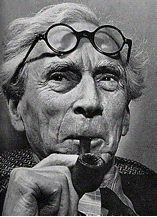
Bertrand Russell pictured above and Francis Schaeffer below:Francis Schaeffer noted in his book HOW SHOULD WE THEN LIVE? (p. 182 in Vol 5 of Complete Works) in the chapter The Breakdown in Philosophy and Science:In his lecture at Acapulco, George Wald finished with only one final value. It was the same one with which English philosopher Bertrand Russell (1872-1970) was left. For Wald and Russell and for many other modern thinkers, the final value is the biological continuity of the human race. If this is the only final value, one is left wondering why this then has importance. Now having traveled from the pride of man in the High Renaissance and the Enlightenment down to the present despair, we can understand where modern people are. They have no place for a personal God. But equally they have no place for man as man, or for love, or for freedom, or for significance. This brings a crucial problem. Beginning only from man himself, people affirm that man is only a machine. But those who hold this position cannot live like machines! If they could, there would have been no tensions in their intellectual position or in their lives. But even people who believe they are machines cannot live like machines, and thus they must “leap upstairs” against their reason and try to find something which gives meaning to life, even though to do so they have to deny their reason. Francis Schaeffer in another place worded it like this:The universe was created by an infinite personal God and He brought it into existence by spoken word and made man in His own image. When man tries to reduce [philosophically in a materialistic point of view] himself to less than this [less than being made in the image of God] he will always fail and he will always be willing to make these impossible leaps into the area of nonreason even though they don’t give an answer simply because that isn’t what he is. He himself testifies that this infinite personal God, the God of the Old and New Testament is there.We all know deep down that God exists and even atheists have to grapple with that knowledge.Solomon wisely noted in Ecclesiastes 3:11 “God has planted eternity in the heart of men…” (Living Bible). No wonder Bertrand Russell wrote in his autobiography, “It is odd, isn’t it? I feel passionately for this world and many things and people in it, and yet…what is it all? There must be something more important, one feels, though I don’t believe there is. I am haunted. Some ghosts, for some extra mundane regions, seem always trying to tell me something that I am to repeat to the world, but I cannot understand that message.”Take a look at this 7th episode from Schaeffer’s series “HOW SHOULD WE THEN LIVE? The Age of Nonreason”:
How Should We Then Live – Episode Seven – 07 – Portuguese Subtitles
_Instead of making a leap into the area of nonreason the better choice would be to investigate the claims that the Bible is a historically accurate book and that God created the universe and reached out to humankind with the Bible.
Schaeffer then points to the historical accuracy of the Bible in Chapter 5 of the book WHATEVER HAPPENED TO THE HUMAN RACE?
The Bible and Archaeology – Is the Bible from God? (Kyle Butt 42 min)
Today we look at the 3rd letter in the Kroto correspondence and his admiration of Bertrand Russell. (Below The Nobel chemistry laureates Harold Kroto, Robert Curl and Richard Smalley) It is with sadness that I write this post having learned of the death of Sir Harold Kroto on April 30, 2016 at the age of […]
On November 21, 2014 I received a letter from Nobel Laureate Harry Kroto and it said: …Please click on this URL http://vimeo.com/26991975 and you will hear what far smarter people than I have to say on this matter. I agree with them. Harry Kroto _________________ Below you have picture of Dr. Harry Kroto: Gareth Stedman […]
Top 10 Woody Allen Movies __________ John Piippo makes the case that Bertrand Russell would have loved Woody Allen because they both were atheists who don’t deny the ramifications of atheism!!! Monday, August 06, 2012 (More On) Woody Allen’s Atheism As I wrote in a previous post, I like Woody Allen. I have long admired his […]
______ Top 10 Woody Allen Movies PBS American Masters – Woody Allen A Documentary 01 PBS American Masters – Woody Allen A Documentary 02 __________ John Piippo makes the case that Bertrand Russell would have loved Woody Allen because they both were two atheists who don’t deny the ramifications of atheism!!! Monday, August 06, 2012 […]
THE MORAL ARGUMENT BERTRAND RUSSELL But aren’t you now saying in effect, I mean by God whatever is good or the sum total of what is good — the system of what is good, and, therefore, when a young man loves anything that is good he is loving God. Is that what you’re […]
Great debate Fr. Frederick C. Copleston vs Bertrand Russell – Part 1 Uploaded by riversonthemoon on Jul 15, 2009 BBC Radio Third Programme Recording January 28, 1948. BBC Recording number T7324W. This is an excerpt from the full broadcast from cassette tape A303/5 Open University Course, Problems of Philosophy Units 7-8. Older than 50 years, […]
Uploaded by riversonthemoon on Jul 15, 2009 BBC Radio Third Programme Recording January 28, 1948. BBC Recording number T7324W. This is an excerpt from the full broadcast from cassette tape A303/5 Open University Course, Problems of Philosophy Units 7-8. Older than 50 years, out of UK/BBC copyright. Pardon the hissy audio. It was recorded 51 […]
Fr. Frederick C. Copleston vs Bertrand Russell – Part 1 Uploaded by riversonthemoon on Jul 15, 2009 BBC Radio Third Programme Recording January 28, 1948. BBC Recording number T7324W. This is an excerpt from the full broadcast from cassette tape A303/5 Open University Course, Problems of Philosophy Units 7-8. Older than 50 years, out of […]
THE MORAL ARGUMENT BERTRAND RUSSELL But aren’t you now saying in effect, I mean by God whatever is good or the sum total of what is good — the system of what is good, and, therefore, when a young man loves anything that is good he is loving God. Is that what you’re […]
Fr. Frederick C. Copleston vs Bertrand Russell – Part 1 Uploaded by riversonthemoon on Jul 15, 2009 BBC Radio Third Programme Recording January 28, 1948. BBC Recording number T7324W. This is an excerpt from the full broadcast from cassette tape A303/5 Open University Course, Problems of Philosophy Units 7-8. Older than 50 years, out of […]
I have read over 40 autobiographies by ROCKERS and it seems to me that almost every one of those books can be reduced to 4 points. Once fame hit me then I became hooked on drugs. Next I became an alcoholic (or may have been hooked on both at same time). Thirdly, I chased the skirts and thought happiness would be found through more sex with more women. Finally, in my old age I have found being faithful to my wife and getting over addictions has led to happiness like I never knew before. (Almost every autobiography I have read from rockers has these points in it although Steven Tyler is still chasing the skirts!!).
Come to think about it I need to add Travis Barker to the category that Steven Tyler is in. I read Travis Barker’s autobiography and it seems he still has a few lessons to learn in life!!!
The Visit of the Queen of Sheba to King Solomon’, oil on canvas painting by Edward Poynter, 1890 (below)
Ravi Zacharias (below)
DUST IN THE WIND went to #6 on the charts in 1978
Rock group KANSAS
Kerry Livgren of KANSAS
Dave Hope of KANSAS below
__
September 1, 2017
Travis Barker,
Dear Travis,
I really enjoyed reading your book CAN I SAY. In it I noticed this part below:
When I was eleven, I went to a party at Ruben’s house—his sister was older, and she liked Jane’s Addiction and listened to KROQ, which was the cool radio station. At this party, I was trying to mack on one of his sister’s friends, who was about five years older than me. I was trying to impress her, so I was drinking beer and smoking weed. And I couldn’t handle it—I turned green. It was terrible. Mom and Pops had to come get me from the party, and when they asked why I was sick, I told them I had too much soda and potato chips.
The first live show I ever went to was at a nearby church: they used to host Christian metal bands like Stryper. My sisters took me along, and it blew my mind. I loved seeing a drummer play live, no matter what kind of music.
I used to go see Christian bands like STRYPER a lot too. That actually was a hobby of mine during the 1970’s and 1980’s. Why don’t you give Michael Sweet (lead vocals, guitar), and Robert Sweet (drums) a call. I am sure the Sweet brothers would love to hear from you!!!
Also in your book you asserted, “I wanted to get the girl, have sex with her, and then be over it and go on to the next one. I don’t know why I did that—maybe I just liked the challenge? Maybe it was like Pringles, where I couldn’t stop after one taste?”
Your story of using women and then leaving them behind reminds me of King Solomon in the Book of Ecclesiastes. I was inspired by the Book of Ecclesiastes and the first exposure I got to the Book of Ecclesiastes was when I was 15. I remember a visit in 1976 that Adrian Rogers made to our Junior High Chapel service at EVANGELICAL CHRISTIAN SCHOOL. He gave a message on Solomon’s search for satisfaction in life in what Rogers called the 6 big L words in the Book of Ecclesiastes. He looked into Learning (1:16-18), Laughter, Ladies, Luxuries, and Liquor (2:1-3, 8, 10, 11), and Labor (2:4-6, 18-20). This outline provided by Rogers probably helped me understand Ecclesiastes better than any other I have ever encountered.
When Rogers got to the issue of LADIES he gave an example about a man who loved oranges and he compared that love of oranges to the way some men treat women sexually:
Solomon happens to be talking to his son; that’s why he’s talking to his son about the girls. But I just want to say a word to some of you girls, also, about some of these guys. You know what a man will do? He’ll come to a girl and date a girl and take her out and wine her and dine her and then he’ll begin to say to her, I love you. I really love you. He’ll tell her that several times. He’ll just pour the sugar in her ear, and then he’ll say to her, Do you love me? And if she says, Yes, then he’ll say, Prove it. And what he means by that is he wants her to show her love, to prove her love by sexual immorality. If there’s one thing that doesn’t prove love, it’s that.
Do you know what proves love? Do you know what really proves love? You are able to appreciate and enjoy a person and that person’s character without having to sully their purity by doing it.
This guy says to this gal, Oh, I just can’t wait. I just can’t wait! I just can’t wait! The Bible says Jacob waited for Rachel seven years because of the love that he had for her, and it seemed as a few days. You see, lust can’t wait. Love can wait. Lust wants to get. Love wants to give. And when that guy says, I love you, I love you, I love you, what he really means is I love me, I love me, I love me. Oh, he loves you, but not with Bible love.
A man goes out here in an orange grove. He gets one of those big succulent oranges. He takes his pin knife and cuts a plug out of it, puts it up to his mouth, and squeezes all of the juice out of it. Then he throws it on the ground like a piece of garbage, wipes his mouth and says, Man, I just love oranges. Young lady, that’s the way he loves you! And when you’re left like a piece of garbage, he says, Boy, that was wonderful. Aren’t oranges good! But what he really means is, I love me.
____________
Ecclesiastes 2:8-10The Message (MSG)
I piled up silver and gold, loot from kings and kingdoms. I gathered a chorus of singers to entertain me with song, and—most exquisite of all pleasures— voluptuous maidens for my bed.
9-10 Oh, how I prospered! I left all my predecessors in Jerusalem far behind, left them behind in the dust. What’s more, I kept a clear head through it all. Everything I wanted I took—I never said no to myself. I gave in to every impulse, held back nothing. I sucked the marrow of pleasure out of every task—my reward to myself for a hard day’s work!
1 Kings 11:1-3 English Standard Version (ESV)
11 Now King Solomon loved many foreign women, along with the daughter of Pharaoh: Moabite, Ammonite, Edomite, Sidonian, and Hittite women, 2 from the nations concerning which the Lord had said to the people of Israel, “You shall not enter into marriage with them, neither shall they with you, for surely they will turn away your heart after their gods.” Solomon clung to these in love. 3 He had 700 wives, who were princesses, and 300 concubines. And his wives turned away his heart.
Francis Schaeffer observed concerning Solomon, “You can not know woman but knowing 1000 women.”
King Solomon in Ecclesiastes 2:11 sums up his search for meaning in the area of the Sexual Revolution with these words, “…behold, all was vanity and a striving after wind, and there was nothing to be gained under the sun.”
After hearing the sermon by Adrian Rogers in 1976 I took a special interest in the Book of Ecclesiastes and then the next year I bought the album POINT OF KNOW RETURN by the group rock group KANSAS. On that album was the song “Dust in the Wind” by Kansas and it rose to #6 on the charts in 1978. That song told me that Kerry Livgren the writer of that song and a member of Kansas had come to the same conclusion that Solomon had. I remember mentioning to my friends at church that we may soon see some members of Kansas become Christians because their search for the meaning of life had obviously come up empty even though they had risen from being an unknown band to the top of the music business and had all the wealth and fame that came with that. Furthermore, Solomon realized death comes to everyone and there must be something more.
Livgren wrote:
“All we do, crumbles to the ground though we refuse to see, Dust in the Wind, All we are is dust in the wind, Don’t hang on, Nothing lasts forever but the Earth and Sky, It slips away, And all your money won’t another minute buy.”
Both Kerry Livgren and the bass player DAVE HOPE of Kansas became Christians eventually. Kerry Livgren first tried Eastern Religions and DAVE HOPE had to come out of a heavy drug addiction. I was shocked and elated to see their personal testimony on The 700 Club in 1981 and that same interview can be seen on youtube today. Livgren lives in Topeka, Kansas today where he teaches “Diggers,” a Sunday school class at Topeka Bible Church. DAVE HOPE is the head of Worship, Evangelism and Outreach at Immanuel Anglican Church in Destin, Florida.
Those who reject God must accept three realities of their life UNDER THE SUN. FIRST, death is the end and SECOND, chance and time are the only guiding forces in this life. FINALLY, power reigns in this life and the scales are never balanced. In contrast, Dave Hope and Kerry Livgren believe death is not the end and the Christian can face death and also confront the world knowing that it is not determined by chance and time alone and finally there is a judge who will balance the scales.
Solomon’s experiment was a search for meaning to life “under the sun.” Then in last few words in the Book of Ecclesiastes he looks above the sun and brings God back into the picture: “The conclusion, when all has been heard, is: Fear God and keep His commandments, because this applies to every person. For God will bring every act to judgment, everything which is hidden, whether it is good or evil.”
The answer to find meaning in life is found in putting your faith and trust in Jesus Christ. The Bible is true from cover to cover and can be trusted.
Milton Friedman’s FREE TO CHOOSE “How to Stay Free,” Transcript and Video (60 Minutes)
In 1980 I read the book FREE TO CHOOSE by Milton Friedman and it really enlightened me a tremendous amount. I suggest checking out these episodes and transcripts of Milton Friedman’s film series FREE TO CHOOSE: “The Failure of Socialism” and “The Anatomy of a Crisis” and “What is wrong with our schools?” and “Created Equal” and From Cradle to Grave, and – Power of the Market. In this episode “How to Stay Free” Friedman makes the statement “What we need is widespread public recognition that the central government should be limited to its basic functions: defending the nation against foreign enemies, preserving order at home, and mediating our disputes. We must come to recognize that voluntary cooperation through the market and in other ways is a far better way to solve our problems than turning them over to the government.”
— On Mon, 12/6/10, Everette Hatcher <lowcostsqueegees@yahoo.com>wrote:
From: Everette Hatcher <lowcostsqueegees@yahoo.com>
Subject: Vol 10 How to stay Free,Videos and Transcript Free to Choose
To:
Date: Monday, December 6, 2010, 8:50 AM
The Great Depression of the 1930s changed the public philosophy regarding the appropriate role of government in American life. Before the Depression, government was not assumed to have special responsibilities for individual or business welfare. The severity of the economic tragedy of the 1930s resulted in a dramatic change in public attitudes. Many believed the Depression represented a “failure of capitalism.” Because of this alleged failure, government has ever since been expanding its power and the scope of its control. Government growth has resulted in waste, inefficiency, and a loss of personal freedom. Intended to serve the interests of the people, many governmental programs have been revealed to serve primarily the interests of the bureaucrats. Many government programs serve at cross purposes. For example, different agencies attempt, on the one hand, to discourage use of tobacco as potentially dangerous to good health and, on the other hand, to encourage production of tobacco through subsidies to tobacco farmers. The list of government inconsistencies and inefficiencies goes on and on. Dr. Friedman, however, says that there is reason for optimism. Today, he notes, the public is better informed about these matters and is increasingly willing to take a stand against further unnecessary expansion of government services. He suggests the most fruitful approach is to remove discretionary budget power from the government. Friedman favors passage of a Constitutional amendment limiting the government’s budget and forcing government to work within that budget. But this is only the first step. As Dr. Friedman points out, “What we need is widespread public recognition that the central government should be limited to its basic functions: defending the nation against foreign enemies, preserving order at home, and mediating our disputes. We must come to recognize that voluntary cooperation through the market and in other ways is a far better way to solve our problems than turning them over to the government.”
_____________________________________________
Milton Friedman makes the point: “If power were really concentrated in monolithic in a few hands, it would be hopeless to reform the system. But because it’s fragmented, because it’s split up, we can see how much waste there is, we can see how inefficient it is, how the left hand seldom knows what the right hand is doing.” IN OTHER WORDS A DICTATOR IS NOT RUNNING THE GOVERNMENT WE HAVE A CHANCE TO CHANGE WHAT IS GOING ON!!!
Volume 10 – How to Stay Free
Transcript:
Friedman: Every day hundreds of people flock to the capital in Washington, D.C. attracted only by power. That power has accumulated here over the past 50 years at the seat of government of the most powerful nation on Earth.
Worker: How do you do? Glad to meet you. How are you? How’s it going? What are you talking about? Guns?
Warren Richardson: Hello, this is Warren Richardson. Oh Mary, yes, what’s on your mind?
Friedman: Warren Richardson makes his living by knowing who has power and influence to trade.
Warren Richardson: I’ll be waiting for you.
Friedman: He’s a lobbyist.
Warren Richardson: Thanks a lot. Bye.
Unidentified Member of the House: The official administration position on this bill, however, is that its consideration would be premature in view of the President’s….
Friedman: He trades with people like these. Members of the House Committee on Agriculture. They make some of the laws and regulations that among other things, control the food we eat. They are elected officials who have the power to spend billions of dollars of our tax money.
Mr. Baldus: It’s all of page two. It takes all of page three.
Friedman: Naturally, lots of people would like to get their hands on that money.
Mr. Baldus: That’s the kind of stuff that ought never go into the statute books. And I think anybody who’s practicing justice court knows it.
Unidentified Member of the House: Bill, the way you get common sense administration is by having common sense administrators. And it seems like there’s more common sense administration in agriculture.
Michael Masterson (Congressional Aide): Access is all important and how you gain access. It used to be there were only a few hundred lobbyists in this town, now we record up to 15,000 lobbyists plus ancillary personnel, secretaries, receptionists and typists and the researchers that go with that. They are calling upon all the law firms imaginable. So there is a tremendous support base out there for the lobbying effort.
Friedman: You don’t have to walk these corridors for very long before you begin to realize that the concentration of power in the hands of a few people, however well intentioned, is a real threat to the freedom of the individual. Of course, Warren Richardson doesn’t see it that way. Over the years he’s successfully lobbied for special interest groups in energy, environment, wages and prices. Today he’s arguing the case for another special interest. The National Action Committee on Labor Law Reform, hoping to swing influence his way.
Warren Richardson: When the bill goes overboard in terms…much, much too far.
Friedman:There’s hardly a time when the corridors of Congressional Office buildings are not peppered with people waiting for their chance to see and influence the elected man at the center of power.
Unidentified Member of the House: Within that legislation for funds for communities of 50,000 and under, the goals of the existing law and certain statutory paperwork requirements are often very unrealistic for smaller communities.
Friedman: The deals made here effect all of us and sometimes in ways we don’t like. But don’t blame the people making the deals. They’re just pursuing their own self-interest which may be as narrow as making a buck or as broad as trying to reform the world. We, the citizens, are to blame because we’ve handed over much of our lives of personal decision making to government. And we now find that was government does severely limits our freedom.
The leather and wood paneled official offices of a Congressman in Washington, D.C. It’s the mecca of those who try for behind the scenes influence. Weaving his way between special interest groups can be tough for a politician. To stay in office he needs votes. To get votes he often has to make deals.
Unidentified Politician: The chances of our party regaining the White House. Republicans. If the President sends the policies to the public …..
Friedman: It’s frequently a frustrating business.
Michael Masterson: When you have people who are coming in not for purposes of debate and dialogue and discussion on something, but merely they demand their special interest or their single issue concern. That’s where it becomes extremely difficult because there might be an equal number on the opposite side of the coin.
Friedman: Every time I come to Washington I’m impressed all over again with how much power is concentrated in this city. But we must understand the character of that power. It is not monolithic power in a few hands like the way it is in countries like the Soviet Union or Red China. It is fragmented into lots of little bits and pieces and with every special group around the country trying to get its hand on whatever bits and pieces it can. The result is that there’s hardly an issue in which you won’t find government on both sides. For example, in one of these massive buildings spread, scattering all through this town filled to the bursting with government employees, so of them are sitting around trying to figure out how to spend our money to discourage us from smoking cigarettes. In another of the massive building, maybe far away from the first, some other employees, equally dedicated, equally hardworking, are sitting around figuring out how to spend our money to subsidize farmers to grow more tobacco. In one building they’re figuring out how to hold down prices, in another building they’ve got schemes for raising prices. The prices the farmers receive or import prices or keeping out cheap foreign goods. We set up an enormous Department of Energy with 20,000 employees to encourage us to save energy. We set up an enormous Department of Environmental Protection to figure out ways to get cleaner air involving our using more energy.
Now, many of these effects cancel out but that doesn’t mean that these programs don’t do a great deal of harm and that there aren’t some very bad things about it. One thing you can be sure of, the costs don’t cancel out, they add together. Each of these programs spends money taken from our pockets that we could be using to buy goods and services to meet our separate needs. All of these programs use very able, very skilled people who could be doing productive things. They, all of them, grind out rules, regulations, red tape, forms to fill-in. I doubt that there’s a person in this country who doesn’t violate one or another of those rules or regulations or laws everyday. Not because he wants to or intends to, but simply because it’s impossible for anybody to know what they all are. Those are the bad things. But there’s something good about this fragmentation of power too. And that is, that it enables us to do something about it.
If power were really concentrated in monolithic in a few hands, it would be hopeless to reform the system. But because it’s fragmented, because it’s split up, we can see how much waste there is, we can see how inefficient it is, how the left hand seldom knows what the right hand is doing.
It wasn’t always like this. The armies of bureaucrats administering our lives making our decisions spending our money, all supposedly for our good. Our nation was founded with something fundamentally different in mind.
___________________________________________
In this episode Milton Friedman makes the point, “From regarding government as a threat to our freedom, we have come more and more to regard government as a benefactor from which all good things flow. We have assigned increasing tasks of great importance to government. We have turned over to government a larger and larger fraction of our income to be spent on our behalf and the results are plain for all the same they are disappointing.”
Pt 2
Almost 200 years ago a remarkable group of men gathered in this room to write a Constitution for the new nation that they had helped to create a few years earlier. They were a wise and learned group of people. They had learned the lesson of history. The great danger to freedom is the concentration of power, especially in the hands of a government. They were determined to protect the citizens of the new United States of America from that danger. And they crafted their Constitution with that in mind. That Constitution has served us well. It has enabled us to preserve our freedom for close on to 200 years. But in the past 50 years, we have been forgetting the lesson that these wise men knew so well. From regarding government as a threat to our freedom, we have come more and more to regard government as a benefactor from which all good things flow. We have assigned increasing tasks of great importance to government. We have turned over to government a larger and larger fraction of our income to be spent on our behalf and the results are plain for all the same they are disappointing. The great expectations have not been achieved and our freedoms have suffered in the process.
Where did it all go wrong? Government began to take an increasing part in our personal affairs nearly 50 years ago. It was 1933, at the lowest point of the worst depression in history. The idea took root that capitalism had failed and that failure was responsible for the human and economic tragedy. In the early 30’s, Franklin Delano Roosevelt and his advisors met here to devise programs to meet the problems of the depression. Their answer was to give central government more power. Out of that beginning came today’s welfare state.
This Empire State Plaza in Albany, NY is a fine example of the difference between public political power and private economic power. It was constructed while Nelson Rockefeller was Governor of the state of New York. The Rockefeller family has spent millions of its private money on good causes. It has endowed universities like my own, at the University of Chicago, financed medical research, reconstructed Williamsburg, yet not all the private money of the Rockefeller family gave them anything like the amount of power that Nelson Rockefeller was able to have as Governor of the State of New York. He constructed monuments like this all over the state, using every expedient he could think of to finance them. When he left office, taxes per persons in New York State were higher than in any other state in the country excepting only Alaska. And there was a monumental debt besides. So much so, that his successor, who had the reputation as a Democratic congressman of being a big spender, had to use his inaugural speech to preach the virtues of austerity and to say the time of wine and roses is over.
Look at this skyline. It’s Chicago and I think it’s very beautiful. Much of it is less than 20 years old. Those tall buildings were built by private enterprise for use by private enterprise. Not by government for use by government bureaucrats. These are productive monuments, not a burden on the taxpayer, a burden that has almost bankrupted New York City. The irony is that for the most part it was good intentions that led us to where we are today, a nation governed by bureaucratic empires. I wonder whether when they built this building, they realized that it was going to come out looking like a fortress. From modest beginnings in 1953, the Department of Health, Education and Welfare has grown into a veritable empire. Only a small part of its total staff is housed in this headquarters building, a mere 2,000 bureaucrats. Its budget is the third largest budget in the whole world exceeded only by the entire budget of the United States and of the Soviet Union. It employs directly 150,000 full time people and the empire it rules employs another million. More than one out of every 100 people in the U.S. works in the HEW empire.
As we have seen in this series, the Department of Health, Education and Welfare is spending increasing amounts of our money each year on health. One effect is simply to raise the fees and prices for medical and hospital services without a corresponding improvement in the quality of medical care that we receive. It is controlling more and more of the food and drugs we buy. In the process, discouraging the development and preventing the marketing of new drugs that could be saving tens of thousands of lives a year. In the field of education the sums being spent are skyrocketing. Yet by common consent, the quality of education is declining. More and more money is being spent and increasingly rigid controls imposed to promote racial integration. Yet our society is becoming more fragmented. In the field of welfare, billions of dollars are being spent each year, yet at a time when the standard of life of the average American is higher than it has ever been in history, the number of people on welfare roles is growing. Social Security, the budget is colossal, yet it is in deep financial trouble. The young complain and with considerable justice about the high taxes they must pay and those taxes are needed to finance the benefits that are going to the old, yet the old complain and also with justice that it is difficult for them to maintain the standard of life that they were led to expect. A system that was enacted to make sure that the old never became objects of charity sees an increasing number of our older folk on the welfare roles. By its own accounting, HEW in one year lost through fraud, abuse and waste and amount of money that would have built well over 100,000 houses costing $50,000 a piece. Little wondered that those initials are increasing coming to stand for “How to encourage waste.”
Martin Anderson: We found in some cities that upwards of 20_25% of all the people currently receiving welfare are either totally ineligible for welfare or are receiving more than they should be receiving. And it appears in looking into this that the main reason for this is not the welfare laws themselves, but the way they are administered. They are administered in a very lax and loose manner. One of the most famous cases, in fact it just happened last week, they arrested a woman in southern California, they referred to her as the Welfare Queen. And over the past six or seven years she has received $300,000 in welfare payments. Which of course is on an after tax basis, so if you put her on a before tax basis, it might be equivalent to over a million dollars in before tax income. And, she and her husband were living in a nice $170,000 home, nice cars, and she used a very simple technique. She just used alias, used false names, and signed up to get countless different welfare agencies and departments and drove around and collected her checks.
Friedman: Something had to be done about this scandalous state of affairs. What better bureaucratic decision than to set up a special department crammed with computers and civil servants all dedicated to tracking down waste using taxpayers money, of course, in the process. $27.5 million in the first year.
When there is a high rate of taxation then you have people cheating on their taxes and you can see that in England today.
Pt 3
As Adam Smith wrote over 200 years ago, in the economic market people who intend to serve only their own private interests are led by an invisible hand to serve public interests where there was no part of their intention to promote. In the political market, there is an invisible hand operating as well. But unfortunately it operates in the opposite direction. People who intend only to serve the public interest are led by an invisible hand to serve private interests that was not part of their intention to promote. The reason is simple, as we have seen in case after case, the general interest is diffused among millions and millions of people with special interest its concentrated. When reformers get a measure through they go on to their next crusade leaving no one behind to protect the public interest. But they do leave behind some money and some power and the special interests that can benefit from that money and from that power are quick to gain it at the expense of most of the rest of us. By now, after 50 years of experience, it is clear that it doesn’t really matter who lives in that house. Government will continue to grow so long as the rest of us believe that the way to solve our problems is to turn them over to government.
Yet there are many people who want to solve their own problems, who want to use their own skills and energy and resources. We found such a person here in southern California.
John McCalm, a fireman, was planning his retirement. He decided to fulfill his life’s ambition, he built his own house with his own hands. He bought a site with a magnificent view, cleared the ground and realized that he was the first man who ever cultivated this land. It made him feel good. He pulled a trailer on to the edge of his plot and moved in with his wife to live there while they worked on the house. He made his own adobe bricks, he planted avocado trees, learned about carpentry and plumbing. It was going well when one day a local official arrived with a warning. It was alright to build a house he said, but it was against regulations to live in the trailer any longer. The McCalms thought that the rules were bureaucratic and foolish and they resented them. They decided to leave the trailer exactly where it was and defy the authorities.
Pat Brennan became something of a celebrity in 1978 because she was delivering mail in competition with the United States Post Office. With her husband she set up business in a basement in Rochester, NY. Soon it was thriving. They charged less than the post office and they guaranteed delivery the same day of parcels and letters in downtown Rochester. There is no doubt now that they were breaking the law as it stood. The post office took them to court. The case against them was simply that they should not be handling letters. The Brennan’s decided to fight and local businessmen provided the financial backing.
Pat Brennan: I think there’s going to be a quiet revolt and perhaps we’re the beginning of it. That you see people bucking the bureaucrats where years ago you wouldn’t dream of doing that because you’d be squelched. Now, with tax revolts and with what we’re doing, people are deciding that their fates are their own and not up to somebody in Washington who has no interest in them whatsoever. So, it’s not a question of anarchy, but it’s a questions of people rethinking the power of the bureaucrats and rejecting it.
Friedman: The Brennan customers were clear about one thing. After all, the Brennan’s service was cheaper than the regular mail.
Thomas O’Donaghue (storekeeper): We’re not sure that they have done anything illegal and I’d like to know more about this and I hope that this gets further into the courts than it has already. And someone will listen to their appeal because when we use the Brennan’s we know for a fact that same day delivery is going to be happening day after day after day, whereas with the other guy, you’re not sure and you’re sure what kind of shape it’s going to get there in. So I am behind the Brennan’s 100% and anything I can do to help them, I will.
Pat Brennan: Well, the questions of freedom comes up in any kind of a business. Whether you have the right to pursue it and the right to decide what you are going to do. There is also the question of the freedom of the consumers to utilize the service that they find is inexpensive and far superior. And according to the federal government and the body of laws called the Private Express Statutes, I don’t have a freedom to start a business and the consumer does not have the freedom to use it. Which seems very strange in a country like this that the entire context of the country is based on freedom and free enterprise.
Friedman: The post office won the case. It went all the way to the State Supreme Court and the Brennan’s were closed down. Put out of the business of delivering mail.
What we’ve been looking at is a natural human reaction to the attempt by other people to control your life when you think it’s none of their business. The first reaction is resentment. The second is to attempt to get around it. And finally there comes a decline in respect for law in general. There’s nothing especially American about this. It happens all over the world whenever some people try to control other people. For example, take a look at what’s happening to the British.
For most of the past century Britain was known throughout the world for the respect which its citizens gave to the law, but no longer. Graham Turner (Author “Business in Britain) Nothing is perfect that we have become in the course of the last ten or fifteen years, a nation of fiddlers. How do they do it? They do it in a colossal variety of ways. Lets take it right at the lowest level. Take a small grocer in a country area, say Devon. Very small turnover. How does he make money? He finds out that by buying through regular wholesalers he’s always got to use invoices. But if he goes to the cash and carry and buys his goods from there, and the profit margin on those goods can be untaxed because the tax inspector simply don’t know he’s had those goods. That’s the way he does it. Then if you take it to the top end, if you take a company director, well there’s all kinds of ways they can do it. They buy their food through the company, they have their holidays on the company, the put their wives as company directors even though they never visit the factory. They build their houses on the company by a very simple device of building a factory at the same time as a house, it goes absolutely right through the range from the ordinary person, the ordinary working class person, doing quite menial jobs right to the top end, businessmen, senior politicians, members of the Cabinet, members of the Shadow Cabinet, they all do it. I think almost everybody now feels the tax system is basically unfair. And, everybody who can tries to find a way around that tax system. Now, once that happens, once there is a consensus that the tax system is unfair, the country in effect becomes a kind of conspiracy. And everybody helps each other to fiddle. You’ve no difficulty fiddling in this country because other people actually want to help you. Now 15 years ago that would have been quite different. People would have said, hey, you know, this is not quite as it should be. So that’s the first reason. A very high level of taxation. But I think personally there’s another fact that comes into it. And that is that over the years we’ve had a huge growth in bureaucracy, government expenditure, cotton wool, if you like, to protect people from the slings and arrow of ordinary life, you know, health service, all kinds of benefits of one sort or another. And I think this comes into the consciousness of people almost a sort of new factor feeling that things don’t quite have the value that they did that money is not a thing of value, if your short you get it from some government body or other
_________________________________________
In this episode Milton Friedman makes the point:
“It will be no easy task to cut government down to size. Today in country after country the strongest special interest has become the entrenched bureaucracy. Whether at the national or at the local level. In addition, each of us gets special benefits from one or another governmental program. The temptation is to try to cut down government at someone else’s expense while retaining our own special privileges. That was a stalemate.”
Ep. 10 – How to Stay Free [4/7]. Milton Friedman’s Free to Choose (1980)
Friedman: Criminal tax evasion in Britain, laws and regulations defied in the U.S. It’s nothing to celebrate. The hopeful thing is that throughout the free world the public is coming to recognize the dangers of big government and is taking steps to control it. But it will be no easy task to cut government down to size. Today in country after country the strongest special interest has become the entrenched bureaucracy. Whether at the national or at the local level. In addition, each of us gets special benefits from one or another governmental program. The temptation is to try to cut down government at someone else’s expense while retaining our own special privileges. That was a stalemate. The right approach is to tackle head on the explosive growth in government spending. Lets give the government a budget the way each of us has a budget. A movement in this direction is already underway in the U.S. with the many proposals for Constitutional Amendments limiting government spending. Several states have already adopted such an amendment. There is strong pressure for a similar amendment at the federal level. Those amendments would force government to operate within a strict budget. Each special interest would have to compete with other special interests for a larger share of a fixed pie instead of all of them being able to join forces at the expense of the taxpayer.
This is an important step, but it is only a first step. No piece of paper by itself can solve our problems for us.
What we need is widespread public recognition that the central government should be limited to its basic functions. Defending the nation against foreign enemies. Preserving order at home. Mediating our dispute. We must come to recognize that voluntary cooperation through the market and in other ways is a far better way to solve our problem than turning them over to the government.
This is where much of the future strength of the United States lies. In places like Utuma, Iowa where ordinary hardworking American people live. People of all economic levels live in Utuma, but there are no extremes of either wealth or poverty. All are part of a community. Each part of which depends on the others for a stable and happy life worth living. This is a kind of community that formed the character of democratic America.
We began this series by stressing two ideas, the idea of human freedom as embodied in Thomas Jefferson’s Declaration of Independence, the idea of economic freedom as embodied in Adam Smith’s Wealth of Nations. Those two ideas working together, came to their greatest fruition here in the heartland of America. But the basic character of the society that they created has been changing as a result of the rise of another set of ideas.
We have forgotten the basic truth that the founders of this country knew so well. That the greatest threat to human freedom is a concentration of power whether in the hands of government or anyone else. Throughout the Western world, more and more of us are coming to recognize the dangers of an over-governed society. But it will take more than a recognition of danger. Freedom is not the natural state of mankind. It is a rare and wonderful achievement. It will take an understanding of what freedom is, of where the dangers to freedom come from. It will take the courage to act on that understanding if we are not only to preserve the freedoms that we have, but to realize the full potential of a truly free society.
Lawrence E. Spivak: Milton, all through your discussions, you hammer away at two things, the theories of Adam Smith on the free market and of Thomas Jefferson on central power. One thing that troubled me a little bit about your discussions is that it seemed to me that you are little bit the way psychoanalysts used to talk about Freud. That you believe they had given us the word and that even thought 200 years have gone by, it was still in the world, that circumstances had not changed the meaning anyway. Are you that fixed about their ideas?
Friedman: There’s a great difference between principles and the application of principles. The application of a principle has to take account of circumstances. But the principles that explain how it is that an automobile operates, are no different from the principles that explain how a horse and buggy operated or how a bow and arrow operated. The principles that Adam Smith enunciated, the philosophy that Thomas Jefferson enunciated, are every bit as valid today as they were then. But the circumstances are different and therefore the applications in many cases are very different. In addition, there has been a great deal of work and study and scholarly activity that has gone on since then. We know a great deal more about the way in which an economy works than Adam Smith knew. He was wrong in many individual details of his theory but his overall vision, his conception of how it was that without any central body planning it, millions of people could coordinate their activities in a way that was mutually beneficial to all of them. That central concept is every bit as valid today as it was then, and indeed, we have more reason to be confident in it now than he had because we’ve had 200 years more experience to observe how it works.
Lawrence E. Spivak: Let’s go back to Jefferson. You say cut the functions of central government to the basic functions advocated by Jefferson which was what? Defense against foreign enemies, preserve order at home, and mediate our disputes. Now, can we do that in the complicated, the complex world we live in today, without getting into very serious trouble.
Friedman: Suppose we look at the activities of government in the complex world of today. And ask to what extent has the growth of government arisen because of those complexities? And the answer is, very little indeed. What is the area of government that has grown most rapidly? The taking of money from some people and the giving of it to others. The transfer area. HEW, a budget 1_1/2 times as large as a whole defense budget. That’s the area where government has grown. Now, in that area, the way in which technology has entered has not been by making certain functions of government necessary, but by making it possible for government to do things they couldn’t have done before. Without the modern computers, without modern methods of communication and transportation, it would be utterly impossible to administer the kind of big government we have now. So I would say that the relation between technology and government has been that technology has made possible big government in many areas, but it’s not required it.
________________________________
In this episode Milton Friedman makes the point, “There was no widespread public demand for Social Security programs… it had to be sold to the American people primarily by the group of reformers, intellectuals, new dealers, the people associated with FDR. The Social Security is one of the most misleading programs. It has been sold as an insurance program. It’s not an insurance program. It’s a program which combines a bad tax, a flat tax on wages up to a maximum with a very inequitable and uneven system of giving benefits under which some people get much, some people get little.”
Pt 5
Lawrence E. Spivak: I know, I believe, I say I know, I think I know, but I’ll say I believe that you felt, you blame the government for the Great Depression of 1929 through 1933 and of course, you had to blame FDR for all he did, but most people feel that he saved this free economy of ours.
Friedman: Given the catastrophe of the Great Depression, there is no doubt in my mind that emergency government measures were necessary. The government had made a mess. Not FDR’s government, it was the government that preceded him. Although it was mainly the Federal Reserve System which really wasn’t subject to election. But once FDR came in he did two very different kinds of things.
Lawrence E. Spivak: Well, had the government made a mess by what it did or but by what it didn’t do.
Friedman: By what it did. By it’s monetary policies which forced and produced a sharp decline in the total quantity of money. It was a mismanagement of the monetary apparatus. If there had been no federal reserve system, in my opinion, there would not have been a Great Depression at that time. But given that the depression had occurred, and it was a catastrophe of almost unimaginable kind, I do not fault at all, indeed on the contrary I commend Roosevelt for some of emergency measures he took. They obviously weren’t of the best, but they were emergency measures and you had an emergency you had to deal with. And the emergency measure such as relief programs, even the WPA which was a make work program, these served a very important function. He also served a very important function by giving people confidence in themselves. His great speech about the only thing we have to fear is fear itself was certainly a very important element in restoring confidence to the public at large. But he went much beyond that, he also started to change, under public pressure, the kind of government system we had. If you go beyond the emergency measures to the, what he regarded as reform measures, things like NRA and AAA, which were declared unconstitutional, but then from there on to the Social Security system, to the …
Lawrence E. Spivak: Take the Social Security System for a minute. The people wanted that, they wanted that protection. They were frightened, they wanted welfare.
Friedman: Not at all.
Lawrence E. Spivak: When you said pressure, who, pressure from whom?
Friedman: Pressure from people who were expressing what they thought the public ought to have. There was no widespread public demand for Social Security programs. The demands…….
Lawrence E. Spivak: No demand for welfare with 13 million people …….
Friedman: There was a demand for welfare and assistance I was separating out the emergency measures from the permanent measures. Social Security in the first 10 years of its existence, helped almost no one. It only took in money. Very few people qualified for benefits. It wasn’t an emergency measure. It was a long term measure. And it had to be sold to the American people primarily by the group of reformers, intellectuals, new dealers, the people associated with FDR. The Social Security is one of the most misleading programs. It has been sold as an insurance program. It’s not an insurance program. It’s a program which combines a bad tax, a flat tax on wages up to a maximum with a very inequitable and uneven system of giving benefits under which some people get much, some people get little. So that Social Security….
Lawrence E. Spivak: Would you now abolish Social Security?
Friedman: I would not go back on any of the commitments that the government has made. But I would certainly reform Social Security in a way that would end in its ultimate elimination.
Lawrence E. Spivak: If you’re not afraid then of the free market under any circumstances, where cooperation which you find necessary which you believe all to come, fails to come, where competition becomes so fierce and becomes very frequently corrupt and where, all where it becomes stupid. Take for example what’s happening in today’s market, the conglomerates. Which have been seizing up all sorts of, we happen to live in a hotel that’s run by a conglomerate. Why should ITT, for example, run a hotel and how are you going to stop that.
Friedman: Well in the first place, once again,
Lawrence E. Spivak: Without government, without…..
Friedman: Once again, it’s government measures that have promoted the conglomerates. The only major reason we have conglomerates is because they are a very effective way to get around a whole batch of tax legislation. Let me ask a different question. Who is more effected by government regulations, by government controls?
Lawrence E Spivak: I thought I was supposed to ask the questions. But I was warned that you might turn these on me.
Friedman: Well tell me, whose more effected the big fellow who can deal with it or that have a separated department to handle the red tape, or the poor fellow?
Lawrence E. Spivak: The big fellow can always take care of himself under any system.
Friedman: Right, and therefore he’ll want a system which gives the big fellow the least advantage. And the system under which he can get government to help him out, gives him the most advantage, not the least. You say am I afraid of greed, of lack of cooperation. Of course. But we always have to compare the real with the real. What are the real alternatives? And if we look at the record of history, if we go back to the 19th century which everybody always points to as the era of the robber baron who strode around the land and ground the poor under his heel, what do we find? The greatest outpouring of voluntary charitable activity in the history of the world. This University, this University of Chicago is an example. It was founded by contributions by John D. Rockefeller and other people. The colleges and universities throughout the Midwest. If you go back and ask when was the Red Cross founded, when was the Salvation Army founded, when were the Boy Scouts founded, you’ll discover all of that came during the 19th century in the era of unregulated rapacious capitalism.
Lawrence E. Spivak: I’d like to go back for a minute to the question of conglomerates. Granted that what you say that the government policies concentration on central government if you will, or whatever you want to call it, are responsible for the growth of conglomerates. What would we, what should we do about them now? Government try to undue them? Or should anybody try to undue them?
Friedman: No.
Lawrence E. Spivak: Or should you just let them fail?
Friedman: You should let them fail, of course. I am strongly opposed to government bailing any of them out. You should let them fail. The best things you can do in my opinion, are first to have complete free trade so you can have conglomerates in other countries compete with conglomerates in this country. We may have only two or three automobile companies, but there’s Toyota, there’s Volkswagen, competition from abroad is effective. But in the second place…
Lawrence E. Spivak: When do you say complete free trade you mean all over the world?
Friedman: No sir. I mean the U.S. all by itself unilaterally should eliminate all trade barriers. We would be better off if all the countries did the same.
Lawrence E. Spivak: What do you think would happen if we just did it though?
Friedman: I think we’d be very much better off and a lot others would then follow our example. That’s what happened in the 19th Century when Great Britain in 1846 completed removed, unilaterally, all trade barriers so that…..
Lawrence E. Spivak: You don’t think this country would be flooded with goods of all kinds from all over the world, maybe cheaper in that we wouldn’t have great unemployment in this country?
Friedman: What would the people who sold us goods do with their money? They’d get dollars, what would they do with the dollars? Eat them. If they want to send us goods and take dollars in return, we’re delighted to have them. No. That’s not a problem as long as you have a free exchange rate. Because we cannot export without importing, we cannot import without exporting. You would not have a reduction in employment, what you’d have would be a different pattern of employment. You’d have more employment in export industries and less employment in those industries that compete with import. But go back to conglomerates, Larry for a moment. I just want to ask a very different kind of a question. Conglomerates are not very attractive, I would much rather have a lot of small enterprises. But there’s all the difference in the world between a private conglomerate and a government conglomerate. In general, the government conglomerate can get money from you without your agreeing to give it to him. You and I pay for Amtrak and for the postal deficit whether we use the services of Amtrak or the postal deficit or not. I don’t pay your conglomerate unless I rent one of their apartments. I get something for my money. So bad as private conglomerates are, they’re less bad than one of the alternatives.
_____________________________________________
Milton Friedman in this episode makes this point, ” If you compare the conditions of people in a place like Singapore with the conditions of people in a place like Red China, or for that matter, Indonesia, you will see that the economic freedom is a very important component of total freedom”
Pt 6
Lawrence E. Spivak: Milton, suppose I agree with almost everything you say and say it would be wonderful if we … starting from scratch
Friedman:….If you agree with everything I say, you are a unique human being.
Lawrence E. Spivak: I don’t say I do agree, but I said suppose I agree for the sake of argument. We can’t start from scratch. How do we undo what we have done? How would you undo it, not me?
Friedman: That’s the hardest problem and I agree that is the real question. How do we get from where we are to where we want to go? And we can’t get there overnight, we cannot get there by simply eliminating the things that should not have been done. As in the case of Social Security, we have it. And we’ve got to live up to our obligations. So we do have to develop a series of policies which will enable us gradually to move from where we are to where we want to be. The first and most important step in my opinion, is to stop moving in the wrong direction.
Lawrence E. Spivak: Milton, you said a few minutes ago that throughout the free world, the public is coming to recognize the danger of big government and is taking steps to control it. But how with the example of what freedom does before them, how do you explain the new countries that have been coming up, all going in the direction of dictatorship?
Friedman: The climate, the intellectual climate of opinion has an enormous influence on what happens and the popular intellectual attitude within the free countries for the poor countries has been that they have to have centralized government. And that has served the interests of small elite groups within those countries. In one backward country after another what has happened is they’ve gotten their freedom supposedly from colonial rule, you’ve had a small elite take over and they have run that country for their own benefit and at the expense of the poor. It’s a tragedy of the modern era. Change the climate of opinion in the major countries. As the climate of opinion is changing, as the philosophy, the attitude what’s being taught at the universities is different, and you will see that these other countries, these backward countries will follow it and there are, there is some evidence that way. If you look at the countries where the backward countries which are doing best for themselves, they are places like Hong Kong, like Singapore, like Taiwan, like Korea, they’re not free countries in our sense of the term but they have much larger elements of freedom. Much greater scope for individual initiative. Many other countries of the world which have gone much further in the Communist centralized controlled direction.
Lawrence E. Spivak: How, for example, Singapore in Taiwan, have had you say very free economies. Now how do there economies, remain free but their politics and their human freedom is still curtailed. And as I understand in many cases, rather severely curtailed. They don’t have any of the freedoms we have. Press, religion,
Friedman: Economic freedom is a necessary condition for a human, all humans, but it is not a sufficient condition. You can have an economy that is largely free with large elements of restrictions. For example, let me take the American experience before the Civil War. We had a mixture of a largely free economy, with a segment of the population, the slaves, held in the condition of involuntary servitude. But even where you don’t have complete political freedom in the case of a Singapore or a Taiwan, human beings are much freer than they are in those societies where there is no economic freedom either. If you compare the conditions of people in a place like Singapore with the conditions of people in a place like Red China, or for that matter, Indonesia, you will see that the economic freedom is a very important component of total freedom. It’s not something different, it’s not something separate. Economic freedom is part of total freedom and for most people it’s the most important part. Freedom doesn’t mean very much to a starving man. And if a free society could not help the starving man, it would be very difficult for, to remain free very long. That’s why the ability of a free society to improve the lot of the ordinary person is a very, very necessary condition for its remaining free but it’s not the fundamental reason why I want a free society. I want a free society for the human and ethically and moral values that you stressed as pertaining to freedom. Freedom really rests, the value of freedom.
Lawrence E. Spivak: But suppose the moral values mean a lot to me. But, again, as I say, they mean nothing to the man who is hungry. It means absolutely nothing to him. What are you going to…. well do you think it does mean something to him.
Friedman: No. At first I think it means something to many of them. Of course, many men have died for their moral values, have put those moral values much above life itself. But I, you and I are citizens of a free society, will not stand the sight of…
Lawrence E. Spivak: … Well let me put it a different way, suppose you turn and you made a speech to all the people on welfare and you said to them, look there are, freedom is much more important than the welfare money that you are getting. Their ethical concepts, their spiritual things about the, men have died for this things. What if you told them all that and then said and we’re going to withdraw welfare now. What do you think would happen now?
Friedman: Would tell them something else. I would tell them.
Lawrence E. Spivak: I know also what you’d do.
Friedman: I tell them both what I would do and what I would tell them. I would tell them welfare has been corrupting you. Look at what it is doing to you. Look at what it’s doing to your children. You would be far better off in every respect….
Lawrence E. Spivak: But suppose they said to you, I don’t see that at all. Without that welfare we’d be in an awful mess.
Friedman: Your wrong, you wouldn’t be in an awful mess, but I understand your feeling and I do not propose to withdraw assistance from you like that all at once. I think it would be intolerable to throw the millions of people who are now depending on welfare on to the streets. We’ve got to go gradually from here to there. That’s why I proposed a negative income tax as a transitional device. That it would enable us to give help to people who really need help while not at the same time having the kind of mess we have now where most of the benefits go to people who are not but look at the way in which the welfare system has been corrupting the very fabric of our society. We have put people in a trap which is of no part of your own making. I don’t blame them, but they’ve been put in a trap where we are inducing them to become dependents, to become children, not to become independent human beings. The virtue and the desire of freedom is for what people can do with their freedom. Freedom is not an individual value, it’s a social value. A Robinson Caruso on an island, freedom is a meaningless concept to him.
_______________________
Milton Friedman says this in the following episode:
I believe that there is a strong enough component of freedom in our society that we will be able to preserve it, that we’re going to turn this trend back, that we are going to cut government down to size, we’re going to lay the ground work for a resurgence for a, a flowering, of that diversity which has been the real product of our free society.
___________________________________________
Pt 7
Lawrence E. Spivak: Milton, how bad is the state of freedom in this country today?
Friedman: It’s a mixed bag. In some areas we have more freedom than we’ve ever had before. In some other areas our freedom has been drastically reduced. Our freedom to spend our own money as we want has been cut sharply. Our freedom to go into whatever occupation we want has been reduced sharply. Our freedom to have various businesses has been reduced sharply. And these restrictions in our economic freedoms have carried over to restrictions on the freedom with which we speak and we talk, the activities we carry on, our attitudes toward governmental officials and all the rest. In those areas, our freedoms have been very seriously restricted.
Lawrence E. Spivak: What about your yourself? You as an individual and we really have to do with, deal with millions of hundreds, two hundred million, two hundred twenty million individuals. What about you? What freedom do you think you’ve lost?
Friedman: Well, I have been a very fortunate individual. I always have…
Lawrence E. Spivak: That sounds like a cop out.
Friedman: No, it’s not a cop out because I’m going to add to it. I’ve always said about the only people who have effective freedom of speech these days in the United States are tenured professors at private universities who are on the verge of retirement or have retired. And that’s been my situation in these recent years. Consider the freedom of, for example, a professor of medicine at any one of our great institutions. He’s almost certainly having his research financed by the Federal Government. Don’t you suppose he’d think two or three times before he gave a lecture on the evils of socialized medicine? Or consider one of my colleagues at the University who happens to be getting grants of money from the National Science Foundation. Do you think he really feels free to speak out on the issue of whether government ought to be financing such research. Of course, you ought not to have freedom without costs. But the costs ought to be reasonable. They ought not to be disproportionate, there’s no businessmen in this country today who can speak out. Why is it, why is it that the businessmen today are so mealy-mouthed in what they say? There are very few of them who are willing to come out and say openly what they believe. Why?
Lawrence E. Spivak: About what?
Friedman: About anything. Take for example the recent attempts by President Carter to impose voluntary wage and price controls. There’s hardly a businessman in this country who doesn’t think it’s terrible. There are only about two or three businessmen who have had the courage to stand up and say something about that. But again, as I say, go to my academic colleagues. Many of them feel as I do that government is devoting altogether too much money. That there’s been altogether too much subsidization of state universities and colleges all along the line. Yet very few of them are willing to speak out.
Lawrence E. Spivak: What about the generation that doesn’t know what freedom is as you knew it, and therefore, doesn’t mind so much what has happened. Just takes for granted what he’s living under now.
Friedman: I think that’s a very real problem. I think we’re living on our inheritance. We have inherited a philosophy and a set of attitudes and they tend to be eroded. People get accustomed to what they know. There’s an enormous tear in the status quote and most people, most of the time, accept the circumstances that are around them. There’s a natural human drive for freedom which always expresses itself. But, its stronger or weaker and I think a great danger in continuing along the path that we’ve been going on is that we will lose still more of our inheritance, still more of our basic values of our basic beliefs in freedom and that we will have still less protest as more and more freedoms are taken away. The real value of freedom is that it provides diversity and diversity is in turn the real protection of freedom. People who like to live in small cities, can live in small cities. People who like the impersonality of the metropolis can live in a metropolis. We have loyalties to our churches, we have loyalties to our universities, to our schools, to our clubs, to our cities, to our states. It’s this diversity. That fact that there isn’t a monolithic conformity imposed on us, that is, the source of protection for our freedom and also the fruit of freedom. It’s because freedom protects diversity, allows, you will remember the phrase when Mao said he was going to allow a 100 flowers to bloom. But of course he didn’t. As soon as people spoke out and 100 flowers bloomed, he cut them off. But it’s the blooming of many flowers, the fact that you have all of these different expressions of people’s individuality and produces the great achievements of civilization and that provides the great hope a protection of our freedom.
Lawrence E. Spivak: Why are you saying that there are pockets of freedom still existing in the countries?
Friedman: As I said before, the picture’s a mixed bag. In certain respects we have more freedom than we’ve ever had, but in other respects we’ve had very much less freedom. Of course there are great pockets of freedom, this is predominantly still a free country. We must not confuse the trend with the situation. We have been moving away from freedom. Our freedom is in jeopardy but by no means has been completely destroyed. I believe that there is a strong enough component of freedom in our society that we will be able to preserve it, that we’re going to turn this trend back, that we are going to cut government down to size, we’re going to lay the ground work for a resurgence for a, a flowering, of that diversity which has been the real product of our free society.
Milton Friedman The Power of the Market 1-5 How can we have personal freedom without economic freedom? That is why I don’t understand why socialists who value individual freedoms want to take away our economic freedoms. I wanted to share this info below with you from Milton Friedman who has influenced me greatly over the […]
Milton Friedman: Free To Choose – The Failure Of Socialism With Ronald Reagan (Full) Published on Mar 19, 2012 by NoNationalityNeeded Milton Friedman’s writings affected me greatly when I first discovered them and I wanted to share with you. We must not head down the path of socialism like Greece has done. Abstract: Ronald Reagan […]
Worse still, America’s depression was to become worldwide because of what lies behind these doors. This is the vault of the Federal Reserve Bank of New York. Inside is the largest horde of gold in the world. Because the world was on a gold standard in 1929, these vaults, where the U.S. gold was stored, […]
George Eccles: Well, then we called all our employees together. And we told them to be at the bank at their place at 8:00 a.m. and just act as if nothing was happening, just have a smile on their face, if they could, and me too. And we have four savings windows and we […]
Milton Friedman’s Free to Choose (1980), episode 3 – Anatomy of a Crisis. part 1 FREE TO CHOOSE: Anatomy of Crisis Friedman Delancy Street in New York’s lower east side, hardly one of the city’s best known sites, yet what happened in this street nearly 50 years ago continues to effect all of us today. […]
Friedman Friday” Free to Choose by Milton Friedman: Episode “What is wrong with our schools?” (Part 3 of transcript and video) Here is the video clip and transcript of the film series FREE TO CHOOSE episode “What is wrong with our schools?” Part 3 of 6. Volume 6 – What’s Wrong with our Schools Transcript: If it […]
Here is the video clip and transcript of the film series FREE TO CHOOSE episode “What is wrong with our schools?” Part 2 of 6. Volume 6 – What’s Wrong with our Schools Transcript: Groups of concerned parents and teachers decided to do something about it. They used private funds to take over empty stores and they […]
Here is the video clip and transcript of the film series FREE TO CHOOSE episode “What is wrong with our schools?” Part 1 of 6. Volume 6 – What’s Wrong with our Schools Transcript: Friedman: These youngsters are beginning another day at one of America’s public schools, Hyde Park High School in Boston. What happens when […]
Friedman Friday” Free to Choose by Milton Friedman: Episode “Created Equal” (Part 3 of transcript and video) Liberals like President Obama want to shoot for an equality of outcome. That system does not work. In fact, our free society allows for the closest gap between the wealthy and the poor. Unlike other countries where free enterprise and other […]
Free to Choose by Milton Friedman: Episode “Created Equal” (Part 2 of transcript and video) Liberals like President Obama want to shoot for an equality of outcome. That system does not work. In fact, our free society allows for the closest gap between the wealthy and the poor. Unlike other countries where free enterprise and other freedoms are […]
Milton Friedman and Ronald Reagan Liberals like President Obama (and John Brummett) want to shoot for an equality of outcome. That system does not work. In fact, our free society allows for the closest gap between the wealthy and the poor. Unlike other countries where free enterprise and other freedoms are not present. This is a seven part series. […]
I am currently going through his film series “Free to Choose” which is one the most powerful film series I have ever seen. PART 3 OF 7 Worse still, America’s depression was to become worldwide because of what lies behind these doors. This is the vault of the Federal Reserve Bank of New York. Inside […]
I am currently going through his film series “Free to Choose” which is one the most powerful film series I have ever seen. For the past 7 years Maureen Ramsey has had to buy food and clothes for her family out of a government handout. For the whole of that time, her husband, Steve, hasn’t […]
Friedman Friday:(“Free to Choose” episode 4 – From Cradle to Grave, Part 1 of 7) Volume 4 – From Cradle to Grave Abstract: Since the Depression years of the 1930s, there has been almost continuous expansion of governmental efforts to provide for people’s welfare. First, there was a tremendous expansion of public works. The Social Security Act […]
_________________________ Pt3 Nowadays there’s a considerable amount of traffic at this border. People cross a little more freely than they use to. Many people from Hong Kong trade in China and the market has helped bring the two countries closer together, but the barriers between them are still very real. On this side […]
Aside from its harbor, the only other important resource of Hong Kong is people __ over 4_ million of them. Like America a century ago, Hong Kong in the past few decades has been a haven for people who sought the freedom to make the most of their own abilities. Many of them are […]
“FREE TO CHOOSE” 1: The Power of the Market (Milton Friedman) Free to Choose ^ | 1980 | Milton Friedman Posted on Monday, July 17, 2006 4:20:46 PM by Choose Ye This Day FREE TO CHOOSE: The Power of the Market Friedman: Once all of this was a swamp, covered with forest. The Canarce Indians […]
Milton Friedman: Free To Choose – The Failure Of Socialism With Ronald Reagan (Full) Published on Mar 19, 2012 by NoNationalityNeeded Milton Friedman’s writings affected me greatly when I first discovered them and I wanted to share with you. We must not head down the path of socialism like Greece has done. Abstract: Ronald Reagan […]
There is a very real sense in which the Christian life itself should be our greatest work of art.
Even for the great artist, the most crucial work of art is his l
distinct perspectives on art
francis schaeffer
All of us are engaged daily with works of art, even if we are neither professional nor amateur artists. We read books, we listen to music, we look at posters, we admire flower arrangements.
Art, as I am using the word, does not include just “high art” — that is, painting, sculpture, poetry, classical music — but also the more popular expressions — the novel, the theater, the cinema and popular music.
In fact, there is a very real sense in which the Christian life itself should be our greatest work of art. Even for the great artist, the most crucial work of art is his life. In what follows, I wish to develop a Christian perspective on art in general.
How should we as creators and enjoyers of beauty comprehend and evaluate it? There are, I believe, at least eleven distinct perspectives from which a Christian can consider and evaluate works of art. These perspectives do not exhaust the various aspects of art. The field of aesthetics is too rich for that. But they do cover a significant portion of what should be a Christian Ìs understanding in this area.
artwork as artwork
The first is the most important: a work of art has a value in itself. For some this principle may seem too obvious to mention, but for many Christians it is unthinkable. And yet if we miss this point, we miss the very essence of art.
Art is not something we merely analyze or value for its intellectual content. It is something to be enjoyed. The Bible says that the art work in the tabernacle and the temple was for beauty. How should an artist begin to do his work as an artist? I would insist that he begin his work as an artist by setting out to make a work of art. What that would mean is different in sculpture and poetry, for example, but in all cases the artist should be setting out to make a work of art.
As a Christian we know why a work of art has value. Why? First, because a work of art is a work of creativity, and creativity has value because God is the Creator. The first sentence in the Bible is the declaration that the Creator created: In the beginning God created the heavens and the earth. So too the first words of the prologue to the Gospel of John: In the beginning was the Word, and the Word was with God, and the Word was God … . All things were made through him; and without him was not anything made that hath been made (John 1:1, 3). Therefore, the first reason that creativity has value is that God is the Creator.
Second, an art work has value as a creation because man is made in the image of God, and therefore man not only can love and think and feel emotion, but also has the capacity to create. Being in the image of the Creator, we are called upon to have creativity. In fact, it is part of the image of God to be creative, or to have creativity. We never find an animal, non-man, making a work of art. On the other hand, we never find men anywhere in the world or in any culture in the world who do not produce art. Creativity is a part of the distinction between man and non-man. All people are to some degree creative. Creativity is intrinsic to our “mannishness.”
But we must be careful not to reverse this. Not everything that man makes is good intellectually or morally. So, while creativity is a good thing in itself, it does not mean that everything that comes out of man’s creativity is good. For while man was made in the image of God, he is fallen. Furthermore, since men have various gifts and talents, everyone cannot create everything equally well. However, the main point is that creativity as creativity is a good thing as such.
When I was younger, I thought it was wrong to use the word create in reference to works of art. I thought it ought to be used solely in relation to what God can do. Later, I saw that I was desperately wrong; I am now convinced that it is important to understand that both God and man create. Both make something. The distinction is this: God, because He is infinite, can create out of nothing by His spoken word. We, because we are finite, must create from something else that has already been created. Yet the word create is appropriate, for it suggests that what man does with what is already there is to make something new. Something that was not there before, something that began as an unmannish part of reality, is transformed by the mannishness of man and now reflects that mannishness.
I am convinced that one of the reasons men spend millions in making art museums is not just so that there will be something “aesthetic,” but because the art works in them are an expression of the mannishness of man himself. When I look at the preColumbian silver or African masks or ancient Chinese bronzes, not only do I see them as works of art, but I see them as expressions of the nature and character of humanity. As a man, in a certain way they are myself, and I see there the outworking of the creativity that is inherent in the nature of man.
Many modern artists, it seems to me, have forgotten the value that art has in itself. Much modern art is far too intellectual to be great art. I am thinking, for example, of such an artist as Jasper Johns. Many modern artists do not see the distinction between man and non-man, and it is a part of the lostness of modern man that they no longer see value in the work of art as a work of art.
I am afraid, however, that as evangelicals we have largely made the same mistake. Too often we think that a work of art has value only if we reduce it to a tract. This too is to view art solely as a message for the intellect.
There are, I believe, three basic possibilities concerning the nature of a work of art. The first view is the relatively recent theory of art for art’s sake. This is the notion that art is just there and that is all there is to it. You can’t talk about a message in it, you can’t analyze it, it doesn’t say anything. This view is, I think, quite misguided. For one thing, no great artist functions on the level of art for art’s sake alone. Think, for example, of the high Renaissance, beginning with Cimabue (c. 1240-1302) and leading through Giotto (1267-1337), Masaccio (1401-28), and all the way up to Michelangelo (1475-1564) and Leonardo da Vinci (1452-1519). All of these artists worked from one of two viewpoints, and sometimes there was a confusion between the two. They worked either from their notion of Christianity (which to us who hold a biblical viewpoint was often deficient) or from a Renaissance form of humanism. Florence, for example, where so many excellent works of art were produced, was a center for the study of Neoplatonism. Some of the artists studied under Ficino (1433-99), perhaps the greatest of the Neoplatonists and influential throughout Europe. These artists showed their viewpoint in their art.
It is true that the great modern artists such as Picasso never worked for only art for art’s sake either. Picasso had a philosophy which showed through in his paintings. It is true that many lesser artists now work, or try to work, in the milieu of art for art’s sake, but the great masters did not.
The second view, which I spoke of above, is that art is only an embodiment of a message, a vehicle for the propagation of a particular message about the world or the artist or man or whatever. This view has been held by Christians as well as non-Christians, the difference between these two versions being the nature of the message which the art embodies. But, as I have said, this view, Christian or non-Christian, reduces art to an intellectual statement, and the work of art as a work of art disappears. The third basic notion of the nature of art — the one I think is right, the one that really produces great art and the possibility of great art — is that the artist makes a work of art, and that then the body of his work shows his world-view. No one, for example, who understands Michelangelo or Leonardo can look at their work without understanding something of their respective worldviews. Nonetheless, these artists began by making works of art, and then their world-views showed through the body of their work. I emphasize the body of an artist’s work because it is impossible ible for any single painting, for example, to reflect the totality of an artist’s view of reality. But when we see a collection of an artist’s paintings or a series of a poet’s poems or a number of a novelist’s novels, both the outline and some of the details of the artistØs conception of life shine through. How then should an artist begin to do his work? I would insist that he begin by setting out to make a work of art. He should say to himself, “I am going to make a work of art.” Perspective number one is that a work Of art is first of all a work of art.
Something happens that she is not entirely in control of and she can’t tell you the meaning of a painting till after it is finished and time goes by.
Laylah Ali: Meaning | Art21 “Exclusive”
Uploaded on Sep 18, 2009
Episode #074: While painting in her Williamstown, Massachusetts studio, artist Laylah Ali discusses the imperative she feels to make things and the nuanced relationship of political and personal events to the work.
Laylah Ali creates gouache-on-paper paintings that take her many months to complete. Ali meticulously plots out in advance every aspect of her work, from subject matter to choice of color, achieving a high level of emotional tension in her paintings as a result of juxtaposing brightly colored scenes with dark, often violent subject matter.
VIDEO | Producer: Wesley Miller & Nick Ravich. Interview: Susan Sollins. Camera: Joel Shapiro. Sound: Tom Bergin. Editor: Mary Ann Toman. Artwork Courtesy: Laylah Ali.
Episode #060: Artist Laylah Ali and graphic designer Nicole Parente work together in the designer’s home office in Cambridge, MA. The artist’s hand-drawn notes are transformed into precise digital illustrations otherwise impossible without a computer.
Laylah Ali creates gouache-on-paper paintings that take her many months to complete. Ali meticulously plots out in advance every aspect of her work, from subject matter to choice of color, achieving a high level of emotional tension in her paintings as a result of juxtaposing brightly colored scenes with dark, often violent subject matter. In style, her paintings resemble comic-book serials, but they also contain stylistic references to hieroglyphics and American folk-art traditions.
VIDEO | Producer: Wesley Miller & Nick Ravich. Interview: Susan Dowling. Camera & Sound: Ken Willinger and Bob Freeman. Editor: Jenny Chiurco. Artwork Courtesy: Laylah Ali. Special Thanks:
__________________
Dean Moss and Laylah Ali “Voluntaries”
Published on Oct 24, 2012
Choreographer Dean Moss with artist Laylah Ali offer a performance (MOMA commissioned) of a work concerning the legacy of an attempted armed slave revolt by John Brown ,abolitionist. (This video shows the second half of the performance).
Laylah Ali was born in Buffalo, New York in 1968, and lives and works in Williamstown, Massachusetts. She received a BA from Williams College and an MFA from Washington University in St. Louis, Missouri. The precision with which Ali creates her small figurative gouache paintings on paper is such that it takes her many months to complete a single work. She meticulously plots out in advance every aspect of her work, from subject matter to choice of color and the brushes that she will use. In style, her paintings resemble comic-book serials, but they also contain stylistic references to hieroglyphics and American folk-art traditions. Ali often achieves a high level of emotional tension in her work as a result of juxtaposing brightly colored scenes with dark, often violent subject matter that speaks of political resistance, social relationships, and betrayal. Although Ali’s interest in representations of socio-political issues and current events drives her work, her finished paintings rarely reveal specific references. Her most famous and longest-running series of paintings depicts the brown-skinned and gender-neutral Greenheads, while her most recent works include portraits as well as more abstract biomorphic images. Ali endows the characters and scenes in her paintings with everyday attributes like dodge balls, sneakers, and band-aids as well as historically- and culturally-loaded signs such as nooses, hoods, robes, masks, and military-style uniforms. Her drawings, to which she refers as ‘automatic’, are looser and more playful than the paintings and are often the source of material that she explores more deeply in her paintings. Laylah Ali has had solo exhibitions at the Museum of Modern Art, New York; ICA, Boston; MCA Chicago; Contemporary Art Museum, St. Louis; and MASS MoCA, among others. Her work was exhibited at the Venice Biennale (2003) and the Whitney Biennial (2004).For additional biographic & bibliographic information: 303 Gallery, New York | Miller Block Gallery, Boston Laylah Ali on the Art21 blog
I want to make two points today. First, Greg Koukl has rightly noted that the nudity of a ten year old girl in the art of Robert Mapplethorpe is not defensible, and it demonstrates where our culture is morally. It the same place morally where Rome was 2000 years ago as Francis Schaeffer has demonstrated […]
E P I S O D E 1 0 Dr. Francis Schaeffer – Episode X – Final Choices 27 min FINAL CHOICES I. Authoritarianism the Only Humanistic Social Option One man or an elite giving authoritative arbitrary absolutes. A. Society is sole absolute in absence of other absolutes. B. But society has to be […]
E P I S O D E 9 Dr. Francis Schaeffer – Episode IX – The Age of Personal Peace and Affluence 27 min T h e Age of Personal Peace and Afflunce I. By the Early 1960s People Were Bombarded From Every Side by Modern Man’s Humanistic Thought II. Modern Form of Humanistic Thought Leads […]
E P I S O D E 8 Dr. Francis Schaeffer – Episode VIII – The Age of Fragmentation 27 min I saw this film series in 1979 and it had a major impact on me. T h e Age of FRAGMENTATION I. Art As a Vehicle Of Modern Thought A. Impressionism (Monet, Renoir, Pissarro, Sisley, […]
E P I S O D E 7 Dr. Francis Schaeffer – Episode VII – The Age of Non Reason I am thrilled to get this film series with you. I saw it first in 1979 and it had such a big impact on me. Today’s episode is where we see modern humanist man act […]
E P I S O D E 6 How Should We Then Live 6#1 Uploaded by NoMirrorHDDHrorriMoN on Oct 3, 2011 How Should We Then Live? Episode 6 of 12 ________ I am sharing with you a film series that I saw in 1979. In this film Francis Schaeffer asserted that was a shift in […]
E P I S O D E 5 How Should We Then Live? Episode 5: The Revolutionary Age I was impacted by this film series by Francis Schaeffer back in the 1970′s and I wanted to share it with you. Francis Schaeffer noted, “Reformation Did Not Bring Perfection. But gradually on basis of biblical teaching there […]
Dr. Francis Schaeffer – Episode IV – The Reformation 27 min I was impacted by this film series by Francis Schaeffer back in the 1970′s and I wanted to share it with you. Schaeffer makes three key points concerning the Reformation: “1. Erasmian Christian humanism rejected by Farel. 2. Bible gives needed answers not only as to […]
Francis Schaeffer’s “How should we then live?” Video and outline of episode 3 “The Renaissance” Francis Schaeffer: “How Should We Then Live?” (Episode 3) THE RENAISSANCE I was impacted by this film series by Francis Schaeffer back in the 1970′s and I wanted to share it with you. Schaeffer really shows why we have so […]
Francis Schaeffer: “How Should We Then Live?” (Episode 2) THE MIDDLE AGES I was impacted by this film series by Francis Schaeffer back in the 1970′s and I wanted to share it with you. Schaeffer points out that during this time period unfortunately we have the “Church’s deviation from early church’s teaching in regard […]
Francis Schaeffer: “How Should We Then Live?” (Episode 1) THE ROMAN AGE Today I am starting a series that really had a big impact on my life back in the 1970′s when I first saw it. There are ten parts and today is the first. Francis Schaeffer takes a look at Rome and why […]
The Woody Allen affair teaches us that one of the great challenges of our time is the need to judge absent the solace of absolute knowledge or the illusions of certitude.
Amidst charges of implanted memories and celebrity arrogance, I have no insight into what occurred between Mr. Allen and the younger Ms. Farrow. One side seems to think that our “rape culture” induces people to disbelieve victims. The other side believes that accusations in the court of public opinion open the door to character assassination. Both are right, which does little to satisfy those seeking a clear path to certainty and moral outrage.
The truth the avalanche of accusations on all sides has brought to light is that factual truth is always contingent and never certain. The drive for certainty leads quickly to ideological simplifications that deny inconvenient facts in the name of coherent narratives. Over and over the facts are being made to fit the theory; such ideological certainty at the expense of reality is the root of fascism and all totalitarian impulses.
This indeed is the point of a wonderful essay mercifully unrelated to the Allen affair and written by Simon Critchley in The New York Times. Critchley is ostensibly writing about the 1973 BBC series “The Ascent of Man,” hosted by Dr. Jacob Bronowski. Specifically, Critchley focuses on one episode titled “Knowledge or Certainty.” Touching on physics and Werner Heisenberg’s uncertainty principle, the show begins with the premise that while science aims to provide an objectively accurate picture of the world, modern science has proven that such objectivity is impossible. In Critchley’s summation, there is “no absolute knowledge and anyone who claims it—whether a scientist, a politician or a religious believer—opens the door to tragedy. All scientific information is imperfect and we have to treat it with humility.”
The lesson of modern science is that “There is no God’s eye view.” Anyone who claims to know the truth about the material world (and even more so about the moral or spiritual worlds) is “not just wrong, they are morally pernicious.” The point is that “[e]rrors are inextricably bound up with pursuit of human knowledge, which requires not just mathematical calculation but insight, interpretation and a personal act of judgment for which we are responsible.” And the result of this, Critchley writes, is that,
For Dr. Bronowski, the moral consequence of knowledge is that we must never judge others on the basis of some absolute, God-like conception of certainty. All knowledge, all information that passes between human beings, can be exchanged only within what we might call “a play of tolerance,” whether in science, literature, politics or religion. As he eloquently put it, “Human knowledge is personal and responsible, an unending adventure at the edge of uncertainty.”
At this point in his essay Critchley inserts a video clip of the end of the episode on “Knowledge or Creativity,” a clip that suddenly shifts the scene “to Auschwitz, where many members of Bronowski’s family were murdered.” We see Dr. Bronowski walking in Auschwitz. He says:
There are two parts to the human dilemma. One is the belief that the end justifies the means. That push button philosophy, that deliberate deafness to suffering has become the monster in the war machine. The other is the betrayal of the human spirit. The assertion of dogma closes the mind and turns a nation, a civilization into a regiment of ghosts. Obedient ghosts. Or Tortured ghosts. It’s said that science will dehumanize people and turn them into numbers. That’s false, tragically false. Look for yourself. This is the concentration camp and crematorium at Auschwitz. This is where people were turned into numbers. Into this pond were flushed the ashes of some 4 million people. And that was not done by gas. It was done by arrogance. It was done by dogma. It was done by ignorance. When people believe that they have absolute knowledge with no test in reality, this is how men behave. This is what men do when they aspire to the knowledge of Gods. Science is a very human form of knowledge. We are always at the brink of the known. We always feel forward for what is to be hoped. Every judgment in science stands on the edge of error and is personal. Science is a tribute to what we can know although we are fallible. In the end the words were said by Oliver Cromwell, ‘I beseech you in the bowels of Christ, think it possible that you may be mistaken.’
In other words, fascism, fundamentalism, and the holocaust are caused by a poor understanding of science, a confusion of necessarily hypothetical scientific knowledge with a push-button philosophy of certainty.
Even as Critchley and Bronowski beseech us to think we may be mistaken, I detect no suggestion that we should harbor doubts about the fact or the evil of the holocaust. Born in arrogance and certainty, the evil of the holocaust stands as an exception, something we all understand and know to be horrifically wrong. It may be true that “[w]e always have to acknowledge that we might be mistaken. When we forget that, then we forget ourselves and the worst can happen.” At the same time, there are times when to equivocate in our judgment is to refuse to do justice and even to be complicit in the justifications of wrong.
Perhaps science does counsel humility and tolerance, but justice in the end requires making judgments. One of the great challenges of our time is the need to judge absent the solace of absolute knowledgeOne of the great challenges of our time is the need to judge absent the solace of absolute knowledge or the illusions of certitude. We must at once admit to the uncertainty of the scientific age and insist that certain truths and certain judgments are beyond meaningful dispute. There are facts—that the holocaust happened and that it was a tragedy—that simply must not be denied. In other words, it matters that the Nazis did not win.
It is, of course, possible that had the Nazis won, our view of antisemitism today would be horrifically different. There is no cosmological truth to Nazi evil; but we humans don’t live disembodied in the cosmos. We live here, on this earth. And on this earth in this world that we have made, certain facts like the evil of the Nazi Final Solution are true. This does not mean that they are written in the stars or revealed by a God or carried by the wind. It does mean that such facts are the foundation of the common world in which we live as humans amidst plurality. In Hannah Arendt’s poetic language, these basic truths are told in stories and they are the basic building blocks of the world we share. This common world is what Arendt calls the “truth… we cannot change; metaphorically, it is the ground on which we stand and the sky that stretches above us.” In the common world, certain facts matter; the victory of common truths is not trivial if we are to live together in a shared world.
That it matters who wins, which facts we embrace, and which stories we tell brings to mind an interview given by Woody Allen and discussed in a thoughtful essay by Damon Linker. Discussing Allen’s film Crimes and Misdemeanors, Allen explicitly defends the main character who kills his lover when she threatens to expose the affair. As Linker elaborates on Allen’s point: “The viewer [of Crimes and Misdemeanors] is left to conclude that Judah got away with his crime scot-free—and that such an outcome is possible for anyone courageous enough to violate accepted moral customs and lucky or clever enough to avoid getting caught by the legal authorities.” Linker then cites this quote from Allen’s interview:
On a lesser level you see it in sports. They create a world of football, for example. You get lost in that world and you care about meaningless things…. People by the thousands watch it, thinking it’s very important who wins. But, in fact, if you step back for a second, it’s utterly unimportant who wins. It means nothing. In the same way we create for ourselves a world that, in fact, means nothing at all, when you step back. It’s meaningless.
The meaninglessness of the world, Allen suggests, means that it doesn’t matter who wins. But that is sports, right? On the cosmic level and as a question of justice, it doesn’t matter if the Seahawks or the Broncos win the Super Bowl. It matters for the players and fans and corporate sponsors, but not in the grand scheme of things.
The problem is that Allen sees the triviality of sports as a metaphor for the meaninglessness of the human world. Here is Allen speaking in another interviewin Commonweal Magazine, also cited by Linker:
Human existence is a brutal experience to me…it’s a brutal, meaningless experience—an agonizing, meaningless experience with some oases, delight, some charm and peace, but these are just small oases. Overall, it is a brutal, brutal, terrible experience, and so it’s what can you do to alleviate the agony of the human condition, the human predicament? That is what interests me the most. I continue to make the films because the problem obsesses me all the time and it’s consistently on my mind and I’m consistently trying to alleviate the problem, and I think by making films as frequently as I do I get a chance to vent the problems.
It is worth asking how sincere we should take Allen to be here. If he really thought the world were meaningless, why would he write about its meaninglessness? Is it simply that he writes for the relief of unbearable urges? Couldn’t he then write about pretty much anything? It does seem that Allen writes not simply to relieve himself but also because he has something to say. That he thinks what he writes matters.
What matters, Allen’s films suggest, is truth. Here is what Allen says later in the same Commonweal interview when asked about the apparent amorality of Crimes and Misdemeanors:
I feel that is true—that one can commit a crime, do unspeakable things, and get away with it. There are people who commit all sorts of crimes and get away with it, and some of them are plagued with all sorts of guilt for the rest of their lives and others aren’t. They commit terrible crimes and they have wonderful lives, wonderful, happy lives, with families and children, and they have done unspeakably terrible things. There is no justice, there is no rational structure to it. That is just the way it is, and each person figures out some way to cope…. Some people cope better than others.
For Allen, his film is about truth, namely the truth that the world has no meaning and that evil can prevail and often does.
Linker labels Allen a nihilist, by which he means the conviction that “there is no justice.” And that seems right insofar as Allen does reject and moral or spiritual meaning. What is missing in Linker’s analysis is an appreciation of the moral significance of nihilism. Nihilism signifies two related but different ideas. First, nihilism is a rejection of all certainty; nihilism comes from nihil, meaning nothing. It is the philosophy of nothing. Second, nihilism as it is associated with thinkers like Friedrich Nietzsche also takes on the sense of re-valuation of all values. It is thus not merely a negative philosophy but also a call for the creation of new and immoral values. In Linker’s essay, nihilism is understood in the first and strict sense to be a negation of what is. In this sense, however, nihilism is inherent in all critical thinking and in thinking itself.
All thinking must negate what is to free itself for the new. Negation, or nihilism, “is but the other side of conventionalism.” That is why Hannah Arendt saw that “what we commonly call ‘nihilism’ is actually a danger in the thinking activity itself.” What nihilism agitates against is certainty, the “desire to find results that would make further thinking unnecessary.” Thinking, Arendt argues, is “equally dangerous to all creeds and, by itself, does not bring forth any new creed.” It is opposed to common sense and all ideologies. Because thinking sets up obstacles to truths and opposes settled certainties, it is dangerous: “There are no dangerous thoughts,” Arendt writes, “Thinking itself is dangerous.”
In a scientific age that, as Critchley reminds us, is allergic to certainty, nihilism understood as a rejection of dogmas and certainties is not an immoral doctrine so much as it is the truthful insistence that we oppose what Critchley calls the “monstrous certainty that is endemic to fascism and, sadly, not just fascism but all the various faces of fundamentalism.” Critchley’s essay touches on the human need for tolerance of meaningful plurality and difference, and so it your weekend read.
“Existential subjects to me are still the only subjects worth dealing with. I don’t think that one can aim more deeply than at the so-called existential themes, the spiritual themes.” WOODY ALLEN
Evangelical Chuck Colson has observed that it used to be true that most Americans knew the Bible. Evangelists could simply call on them to repent and return. But today, most people lack understanding of biblical terms or concepts. Colson recommends that we first attempt to find common ground to engage people’s attention. That then may open a door to discuss spiritual matters.
Woody Allen’s 1989 movie, CRIMES AND MISDEMEANORS , is an excellent icebreaker concerning the need of God while making decisions in the area of personal morality. In this film, Allen attacks his own atheistic view of morality. Martin Landau plays a Jewish eye doctor named Judah Rosenthal raised by a religious father who always told him, “The eyes of God are always upon you.” However, Judah later concludes that God doesn’t exist. He has his mistress (played in the film by Anjelica Huston) murdered because she continually threatened to blow the whistle on his past questionable, probably illegal, business activities. She also attempted to break up Judah ‘s respectable marriage by going public with their two-year affair. Judah struggles with his conscience throughout the remainder of the movie. He continues to be haunted by his father’s words: “The eyes of God are always upon you.” This is a very scary phrase to a young boy, Judah observes. He often wondered how penetrating God’s eyes are.
Later in the film, Judah reflects on the conversation his religious father had with Judah ‘s unbelieving Aunt May at the dinner table many years ago:
“Come on Sol, open your eyes. Six million Jews burned to death by the Nazis, and they got away with it because might makes right,” says aunt May
Sol replies, “May, how did they get away with it?”
Judah asks, “If a man kills, then what?”
Sol responds to his son, “Then in one way or another he will be punished.”
Aunt May comments, “I say if he can do it and get away with it and he chooses not to be bothered by the ethics, then he is home free.”
Judah ‘s final conclusion was that might did make right. He observed that one day, because of this conclusion, he woke up and the cloud of guilt was gone. He was, as his aunt said, “home free.”
Woody Allen has exposed a weakness in his own humanistic view that God is not necessary as a basis for good ethics. There must be an enforcement factor in order to convince Judah not to resort to murder. Otherwise, it is fully to Judah ‘s advantage to remove this troublesome woman from his life.
The Bible tells us, “{God} has also set eternity in the hearts of men…” (Ecclesiastes 3:11 NIV). The secularist calls this an illusion, but the Bible tells us that the idea that we will survive the grave was planted in everyone’s heart by God Himself. Romans 1:19-21 tells us that God has instilled a conscience in everyone that points each of them to Him and tells them what is right and wrong (also Romans 2:14 -15).
It’s no wonder, then, that one of Allen’s fellow humanists would comment, “Certain moral truths — such as do not kill, do not steal, and do not lie — do have a special status of being not just ‘mere opinion’ but bulwarks of humanitarian action. I have no intention of saying, ‘I think Hitler was wrong.’ Hitler WAS wrong.” (Gloria Leitner, “A Perspective on Belief,” THE HUMANIST, May/June 1997, pp. 38-39)
Here Leitner is reasoning from her God-given conscience and not from humanist philosophy. It wasn’t long before she received criticism. Humanist Abigail Ann Martin responded, “Neither am I an advocate of Hitler; however, by whose criteria is he evil?” (THE HUMANIST, September/October 1997, p. 2)
The secularist can only give incomplete answers to these questions: How could you have convinced Judah not to kill? On what basis could you convince Judah it was wrong for him to murder?
As Christians, we would agree with Judah ‘s father that “The eyes of God are always upon us.” Proverbs 5:21 asserts, “For the ways of man are before the eyes of the Lord, and He ponders all his paths.” Revelation 20:12 states, “…And the dead were judged (sentenced) by what they had done (their whole way of feeling and acting, their aims and endeavors) in accordance with what was recorded in the books” (Amplified Version). The Bible is revealed truth from God. It is the basis for our morality. Judah inherited the Jewish ethical values of the Ten Commandments from his father, but, through years of life as a skeptic, his standards had been lowered. Finally, we discover that Judah ‘s secular version of morality does not resemble his father’s biblically-based morality.
Woody Allen’s CRIMES AND MISDEMEANORS forces unbelievers to grapple with the logical conclusions of a purely secular morality. It opens a door for Christians to find common ground with those whom they attempt to share Christ; we all have to deal with personal morality issues. However, the secularist has no basis for asserting that Judah is wrong.
Larry King actually mentioned on his show, LARRY KING LIVE, that Chuck Colson had discussed the movie CRIMES AND MISDEMEANORS with him. Colson asked King if life was just a Darwinian struggle where the ruthless come out on top. Colson continued, “When we do wrong, is that our only choice? Either live tormented by guilt, or else kill our conscience and live like beasts?” (BREAKPOINT COMMENTARY, “Finding Common Ground,” September 14, 1993)
Later, Colson noted that discussing the movie CRIMES AND MISDEMEANORS with King presented the perfect opportunity to tell him about Christ’s atoning work on the cross. Colson believes the Lord is working on Larry King. How about your neighbors? Is there a way you can use a movie to find common ground with your lost friends and then talk to them about spiritual matters?
(Caution: CRIMES AND MISDEMEANORS is rated PG-13. It does include some adult themes.)
I have spent alot of time talking about Woody Allen films on this blog and looking at his worldview. He has a hopeless, meaningless, nihilistic worldview that believes we are going to turn to dust and there is no afterlife. Even though he has this view he has taken the opportunity to look at the weaknesses of his own secular view. I salute him for doing that. That is why I have returned to his work over and over and presented my own Christian worldview as an alternative.
I love the movie “Midnight in Paris” by Woody Allen and I have done over 30 posts on the historical characters mentioned in the film. Take a look below:
I have spent alot of time talking about Woody Allen films on this blog and looking at his worldview. He has a hopeless, meaningless, nihilistic worldview that believes we are going to turn to dust and there is no afterlife. Even though he has this view he has taken the opportunity to look at the weaknesses of […]
I have spent alot of time talking about Woody Allen films on this blog and looking at his worldview. He has a hopeless, meaningless, nihilistic worldview that believes we are going to turn to dust and there is no afterlife. Even though he has this view he has taken the opportunity to look at the weaknesses of […]
Woody Allen video interview in France Related posts: “Woody Wednesdays” Woody Allen on God and Death June 6, 2012 – 6:00 am Good website on Woody Allen How can I believe in God when just last week I got my tongue caught in the roller of an electric typewriter? If Jesus Christ came back today and […]
I have spent alot of time talking about Woody Allen films on this blog and looking at his worldview. He has a hopeless, meaningless, nihilistic worldview that believes we are going to turn to dust and there is no afterlife. Even though he has this view he has taken the opportunity to look at the weaknesses of […]
A surprisingly civil discussion between evangelical Billy Graham and agnostic comedian Woody Allen. Skip to 2:00 in the video to hear Graham discuss premarital sex, to 4:30 to hear him respond to Allen’s question about the worst sin and to 7:55 for the comparison between accepting Christ and taking LSD. ___________________ The Christian Post > […]
Crimes and Misdemeanors: A Discussion: Part 1 If you like Woody Allen films as much as I do then join me every Wednesday for another look the man and his movies. Below are some of the posts from the past: “Woody Wednesday” How Allen’s film “Crimes and Misdemeanors makes the point that hell is necessary […]
I really enjoyed this documentary on Woody Allen from PBS. Woody Allen: A Documentary, Part 1 Published on Mar 26, 2012 by NewVideoDigital Beginning with Allen’s childhood and his first professional gigs as a teen – furnishing jokes for comics and publicists – WOODY ALLEN: A DOCUMENTARY chronicles the trajectory and longevity of Allen’s career: […]
Crimes and Misdemeanors: A Discussion: Part 3 Uploaded by camdiscussion on Sep 23, 2007 Part 3 of 3: ‘Is Woody Allen A Romantic Or A Realist?’ A discussion of Woody Allen’s 1989 movie, Crimes and Misdemeanors, perhaps his finest. By Anton Scamvougeras. http://camdiscussion.blogspot.com/antons@mail.ubc.ca ______________ One of my favorite Woody Allen movies and I reviewed […]
Crimes and Misdemeanors: A Discussion: Part 2 Uploaded by camdiscussion on Sep 23, 2007 Part 2 of 3: ‘What Does The Movie Tell Us About Ourselves?’ A discussion of Woody Allen’s 1989 movie, perhaps his finest. By Anton Scamvougeras. http://camdiscussion.blogspot.com/antons@mail.ubc.ca _________________- One of my favorite Woody Allen movies and I reviewed it earlier but […]
I have spent alot of time talking about Woody Allen films on this blog and looking at his worldview. He has a hopeless, meaningless, nihilistic worldview that believes we are going to turn to dust and there is no afterlife. Even though he has this view he has taken the opportunity to look at the weaknesses of […]
Crimes and Misdemeanors: A Discussion: Part 1 If you like Woody Allen films as much as I do then join me every Wednesday for another look the man and his movies. Below are some of the posts from the past: “Woody Wednesday” How Allen’s film “Crimes and Misdemeanors makes the point that hell is necessary […]
I have spent alot of time talking about Woody Allen films on this blog and looking at his worldview. He has a hopeless, meaningless, nihilistic worldview that believes we are going to turn to dust and there is no afterlife. Even though he has this view he has taken the opportunity to look at the weaknesses of […]
Crimes and Misdemeanors: A Discussion: Part 1 Uploaded by camdiscussion on Sep 23, 2007 Part 1 of 3: ‘What Does Judah Believe?’ A discussion of Woody Allen’s 1989 movie, perhaps his finest. By Anton Scamvougeras. http://camdiscussion.blogspot.com/antons@mail.ubc.ca _____________ One of my favorite films is this gem by Woody Allen “Crimes and Misdemeanors”: Film Review By […]
Crimes and Misdemeanors: A Discussion: Part 3 Uploaded by camdiscussion on Sep 23, 2007 Part 3 of 3: ‘Is Woody Allen A Romantic Or A Realist?’ A discussion of Woody Allen’s 1989 movie, Crimes and Misdemeanors, perhaps his finest. By Anton Scamvougeras. http://camdiscussion.blogspot.com/antons@mail.ubc.ca ______________ One of my favorite Woody Allen movies and I reviewed […]
Crimes and Misdemeanors: A Discussion: Part 2 Uploaded by camdiscussion on Sep 23, 2007 Part 2 of 3: ‘What Does The Movie Tell Us About Ourselves?’ A discussion of Woody Allen’s 1989 movie, perhaps his finest. By Anton Scamvougeras. http://camdiscussion.blogspot.com/antons@mail.ubc.ca _________________- One of my favorite Woody Allen movies and I reviewed it earlier but […]
Crimes and Misdemeanors: A Discussion: Part 1 Uploaded by camdiscussion on Sep 23, 2007 Part 1 of 3: ‘What Does Judah Believe?’ A discussion of Woody Allen’s 1989 movie, perhaps his finest. By Anton Scamvougeras. http://camdiscussion.blogspot.com/antons@mail.ubc.ca _____________ Today I am starting a discusssion of the movie “Crimes and Misdemeanors” by Woody Allen. This 1989 […]
and you will hear what far smarter people than I have to say on this matter. I agree with them.
Harry Kroto
__
Harold W. Kroto (left) receives the Nobel Prize in chemistry from Swedish King Carl XVI Gustaf in Stockholm, in 1996.
Soren Andersson/AP
__
I have attempted to respond to all of Dr. Kroto’s friends arguments and I have posted my responses one per week for over a year now. Here are some of my earlier posts:
In the first video below in the 14th clip in this series are his words and I will be responding to them in the next few weeks since Sir Bertrand Russell is probably the most quoted skeptic of our time, unless it was someone like Carl Sagan or Antony Flew.
50 Renowned Academics Speaking About God (Part 1)
Another 50 Renowned Academics Speaking About God (Part 2)
A Further 50 Renowned Academics Speaking About God (Part 3)
__
Quote from Bertrand Russell:
Q: Why are you not a Christian?
Russell: Because I see no evidence whatever for any of the Christian dogmas. I’ve examined all the stock arguments in favor of the existence of God, and none of them seem to me to be logically valid.
Q: Do you think there’s a practical reason for having a religious belief, for many people?
Russell: Well, there can’t be a practical reason for believing what isn’t true. That’s quite… at least, I rule it out as impossible. Either the thing is true, or it isn’t. If it is true, you should believe it, and if it isn’t, you shouldn’t. And if you can’t find out whether it’s true or whether it isn’t, you should suspend judgment. But you can’t… it seems to me a fundamental dishonesty and a fundamental treachery to intellectual integrity to hold a belief because you think it’s useful, and not because you think it’s true._
From WHATEVER HAPPENED TO THE HUMAN RACE?
The Unveiling of Truth
The famous Hindu writer and statesman Sarvepalli Radhakrishnan once wrote, “The altars erected to the unknown gods in the Graeco-Roman world were but an expression of man’s ignorance of the divine nature. The sense of failure in man’s quest for the unseen is symbolized by them. When asked to define the nature of God, the seer of the Upanishad sat silent, and when pressed to answer claimed that the Absolute is silence.”
By contrast, the Apostle Paul, speaking in the context of the very same altars to unknown gods in Athens, said, “…Now what you worship as something unknown I am going to proclaim to you” (Acts 17:23). And again, writing to the Corinthians not far away, “However, as it is written: `No eye has seen, nor ear has heard, no mind has conceived …’ but God has revealed it to us …” (1 Corinthians 2:9,10). This claim is common to the whole Bible. God has not waited for us to stumble to Him in the dark (which would be impossible anyway), but has revealed Himself to us. The word revelation in Greek is apokalupsis which means literally “unveiling”; so God has “unveiled” to us the things we could not know because of our finiteness and sin.
This revelation or unveiling to finite and sinful people is the Bible as the written Word. This is the claim of the whole Bible. Moreover, through the Bible we learn of the life and teaching of the Second Person of the Trinity, who became man at a point in history and so became the Living Word of the Godhead: “For in Christ all the fullness of the Deity lives in bodily form” (Colossians 2:9).
In this claim the dilemma of all humanistic systems is overcome at a stroke. The infinite God has spoken. None of the many finite attempts to define truth, doomed to failure as we have seen, is necessary. God has communicated to man, the infinite to the finite. God has communicated, in addition, in words that are understandable to us. The One who made man capable of language in the first place has communicated to man in language. Also, God has communicated truth about both spiritual reality and physical reality, about both the nature of God and the nature of man, about both events in past history and events in the future. Where all humanistic systems of thought are unable to give an adequate explanation of things, the Bible as God’s statement is adequate.
It is equally important to note that the Bible’s answer does not have to be believed blindly. There are good and sufficient reasons for seeing that it is true. It is the key that fits into the lock of what we know best about ourselves and the universe around us.
To change the metaphor: Imagine a book which has been mutilated, leaving just one inch of printed matter on each page. Although it would obviously be impossible to piece together and understand the book’s story, few people would imagine that the printing which was left on those one-inch portions had come together by chance. However, if the torn pieces of each page were found in a trunk and were added in the right places, then the story could be read and would make sense.
So it is with Christianity. The ripped pages remaining in the book correspond to the universe and its form and to the mannishness of man. The parts of the pages discovered in the trunk correspond to the Scriptures, which are God’s propositional communication to mankind. Neither the universe nor personality can give the answer to the whole meaning of the created order. Yet both are important as a testimony in helping us know that the Scriptures, God’s communication to man, are what they claim to be. The question is whether the communication given by God completes and explains the portions we had before and especially whether it explains what was open to observation before (though without an explanation), that is, that the existence of the universe and its form and the mannishness of man are not just chance configurations of the printer’s scrambled type.
This illustration is important for several reasons. First, it emphasizes that Christians do not start out from themselves autonomously, as the humanists try to do. God gives the pages, and thus God gives the answers. Second, it helps us see the proper place of man’s reason. Just as a scientist does not create the order in the universe but does recognize it, so reason does not create the answer but simply recognizes it. Of course this does not mean that reason will necessarily receive the answer. Each person has to choose to receive God’s truth. But God’s truth is clear. The individual must acknowledge that he (and mankind) is not autonomous, not the center of all things, and he must acknowledge that he has many times done what he knows to be wrong and thus needs the work of Christ for himself. Those who refuse to back down from the position of autonomy make it impossible for themselves to receive the truth, even though there are good and sufficient reasons for knowing that it is the truth.
_________________
Now to pages 119 to 123 of THE GOD WHO IS THERE in chapter 5 (How Do We Know It Is True?) of section three (How Historic Christianity Differs from the New Theology).
All men on their own level face a problem. Confronted with the existence and form of the external universe and the “mannishness” of man, how does it fit together, and what sense does it make?
(Then Schaeffer goes on and talks about propositional communication from the personal God before us, not only the things of the cosmos and history match up… a moral absolute and morals; the universal point of reference and the particulars, and the emotional and aesthetic realities of man as well.)
The Nature of Proof
In dealing with the question of proof which has been raised by the illustration of the book, I want to suggest that scientific proof, philosophical proof and religious proof follow the same rules. We may have any problem before us which we wish to solve; it may concern a chemical reaction or the meaning of man. After the question has been defined, in each case proof consists of two steps:
A. The theory must be non-contradictory and must give an answer to the phenomenon in question.
B. We must be able to live consistently with our theory.
…Then there is the negative consideration. After a careful definition has weeded out the trivial, the other possible answers that do not involve a mystical leap of faith are of the following nature:
That the impersonal plus time plus chance have produced a personal man. But this theory is against all experience and thus usually the advocates of this theory end with a leap of faith, often hidden by connotation words.
That man is not personal, but dead;that he is in reality a machine, and therefore personality is an illusion. This theory could fit the first criterion of being non-contradictory, but it will not fit the second, for man simply cannot life as though he were a machine. This may be observed as far back in the history of man as we have evidence–for example, from the art and artifacts of the caves or from man’s burial rites….Although man may say that he is no more than a machine, his whole life denies it.
That in the future man will find another reasonable answer. Firstly, this could be said about any answer to anything and would bring all thought and science to an end. It must be seen to be an evasion and an especially weak reply if the person using it applies it only to this one question. Secondly, no one can live with this answer, for it simply is not possible to hold one’s breath and wait until some solution is found in the future. Continually the individual makes moral judgments which affect himself and others, and he must be using some working hypothesis from which to start. Thus, if a person offers this seriously as an alternative theory, he should be prepared to go into deep freeze and stop making judgments which touch on the problem of man. Bertrand Russell, for example, should have stopped making sociological decisions which involved others. This position is only possible if one stops the clock.
That the scientific theory of relativity may in the future prove to be a sufficient answer for human life. But the scientific theory of relativity cannot be applied to human life in this way. The scientific theory is constantly being tested, both as a theory and by measurement. Therefore it does not mean that “anything goes,” as it does when relativity is applied to human values. Moreover, in science the speed of light in a vacuum is considered an absolute standard. Therefore, scientific relativity does not imply that all scientific laws are in a constant state of flux. To use scientific relativity to buttress the concept of relativity in regard to human life and human values is completely invalid.
I mailed this above to a professor that I have a lot of respect for and asked a few questions and he gave me permission to post this response of his:
As to Schaeffer’s comments on Russell, I think what Schaeffer is doing is using Russell as an illustration. He is making the point in these passages in his books that only with help of Scripture can we truly understand anything. It is the torn off section of the page which completes the revelation God has given us, but in fact it is the most important part. Schaeffer’s main point is epistemological namely that we cannot know anything for certain without the Bible – in any sphere of life, spiritual, scientific or moral. On what basis therefore does Russell (who was a prominent atheist as you know), or anyone else for that matter, make the kind of judgements he makes on sociological (or any other) issues? He has no basis for knowing who man is or where he comes from; Schaeffer in ’The God who is There’ sets out what he says are the possible options if one rejects the idea of an infinite personal God. He says none of them really makes sense and so Russell (or whoever) should be silent because they have no basis for making claims purporting to make judgements.
So he is not saying Russell takes ‘the position that we cannot know anything is true unless there is an absolute’ but rather that Russell should take that position if he were consistent. He is inconsistent in making judgements that presuppose he can know things are true – and yes, since Russell does not have an authoritative basis for knowing anything (or ‘ unified field of knowledge’) he should be quiet as you say. Schaeffer is not saying either ‘that Russell has taken the position that we don’t have a unified field of knowledge’ but he operates as if he did have such a field. The argument that ‘one day we will’ have such a field is not Russell’s but one of the hypotheses that Schaeffer puts forward as a possible but flawed alternative to revelation. So ‘Russell should shut up today’ – or any day till he comes up with an adequate epistemology!
I am not sure if this helps! Do remember though that Schaeffer is not making a detailed critique of Russell here but simply using Russell as an example of positivism which Schaeffer argues has a flawed epistemology.
It is so with all who spend their lives in the quest of something elusive, and yet omnipresent, and at once subtle and infinite. One seeks it in music, and the sea, and sunsets; at times I have seemed very near it in crowds when I have been feeling strongly what they were feeling; one seeks it in love above all. But if one lets oneself imagine one has found it, some cruel irony is sure to come and show one that it is not really found. The outcome is that one is a ghost, floating through the world without any real contact. Even when one feels nearest to other people, something in one seems obstinately to belong to God and to refuse to enter into any earthly communion—at least that is how I should express it if I thought there was a God. It is odd isn’t it? I care passionately for this world, and many things and people in it, and yet…what is it all? There must be something more important, one feels, though I don’t believe there is. I am haunted—some ghost, from some extra-mundane region, seems always trying to tell me something that I am to repeat to the world, but I cannot understand the message.
There was evidence during Bertrand Russell’s own life that indicated that the Bible was true and could be trusted.
Here is some below:
TRUTH AND HISTORY (chapter 5 of WHATEVER HAPPENED TO THE HUMAN RACE?, under footnotes #97 and #98) written by Francis Schaeffer and C. Everett Koop
A common assumption among liberal scholars is that because the Gospels are theologically motivated writings–which they are–they cannot also be historically accurate. In other words, because Luke, say (when he wrote the Book of Luke and the Book of Acts), was convinced of the deity of Christ, this influenced his work to the point where it ceased to be reliable as a historical account. The assumption that a writing cannot be both historical and theological is false.
The experience of the famous classical archaeologist Sir William Ramsay illustrates this well. When he began his pioneer work of exploration in Asia Minor, he accepted the view then current among the Tubingen scholars of his day that the Book of Acts was written long after the events in Paul’s life and was therefore historically inaccurate. However, his travels and discoveries increasingly forced upon his mind a totally different picture, and he became convinced that Acts was minutely accurate in many details which could be checked.
Bertrand Russell pictured above and Francis Schaeffer below:
Francis Schaeffer noted in his book HOW SHOULD WE THEN LIVE? (p. 182 in Vol 5 of Complete Works) in the chapter The Breakdown in Philosophy and Science:
In his lecture at Acapulco, George Wald finished with only one final value. It was the same one with which English philosopher Bertrand Russell (1872-1970) was left. For Wald and Russell and for many other modern thinkers, the final value is the biological continuity of the human race. If this is the only final value, one is left wondering why this then has importance.
Now having traveled from the pride of man in the High Renaissance and the Enlightenment down to the present despair, we can understand where modern people are. They have no place for a personal God. But equally they have no place for man as man, or for love, or for freedom, or for significance. This brings a crucial problem. Beginning only from man himself, people affirm that man is only a machine. But those who hold this position cannot live like machines! If they could, there would have been no tensions in their intellectual position or in their lives. But even people who believe they are machines cannot live like machines, and thus they must “leap upstairs” against their reason and try to find something which gives meaning to life, even though to do so they have to deny their reason.
Francis Schaeffer in another place worded it like this:
The universe was created by an infinite personal God and He brought it into existence by spoken word and made man in His own image. When man tries to reduce [philosophically in a materialistic point of view] himself to less than this [less than being made in the image of God] he will always fail and he will always be willing to make these impossible leaps into the area of nonreason even though they don’t give an answer simply because that isn’t what he is. He himself testifies that this infinite personal God, the God of the Old and New Testament is there.
We all know deep down that God exists and even atheists have to grapple with that knowledge.
Solomon wisely noted in Ecclesiastes 3:11 “God has planted eternity in the heart of men…” (Living Bible). No wonder Bertrand Russell wrote in his autobiography, “It is odd, isn’t it? I feel passionately for this world and many things and people in it, and yet…what is it all? There must be something more important, one feels, though I don’t believe there is. I am haunted. Some ghosts, for some extra mundane regions, seem always trying to tell me something that I am to repeat to the world, but I cannot understand that message.”
Take a look at this 7th episode from Schaeffer’s series “HOW SHOULD WE THEN LIVE? The Age of Nonreason”:
How Should We Then Live – Episode Seven – 07 – Portuguese Subtitles
_
Instead of making a leap into the area of nonreason the better choice would be to investigate the claims that the Bible is a historically accurate book and that God created the universe and reached out to humankind with the Bible.
Schaeffer then points to the historical accuracy of the Bible in Chapter 5 of the book WHATEVER HAPPENED TO THE HUMAN RACE?
The Bible and Archaeology – Is the Bible from God? (Kyle Butt 42 min)
Today we look at the 3rd letter in the Kroto correspondence and his admiration of Bertrand Russell. (Below The Nobel chemistry laureates Harold Kroto, Robert Curl and Richard Smalley) It is with sadness that I write this post having learned of the death of Sir Harold Kroto on April 30, 2016 at the age of […]
On November 21, 2014 I received a letter from Nobel Laureate Harry Kroto and it said: …Please click on this URL http://vimeo.com/26991975 and you will hear what far smarter people than I have to say on this matter. I agree with them. Harry Kroto _________________ Below you have picture of Dr. Harry Kroto: Gareth Stedman […]
Top 10 Woody Allen Movies __________ John Piippo makes the case that Bertrand Russell would have loved Woody Allen because they both were atheists who don’t deny the ramifications of atheism!!! Monday, August 06, 2012 (More On) Woody Allen’s Atheism As I wrote in a previous post, I like Woody Allen. I have long admired his […]
______ Top 10 Woody Allen Movies PBS American Masters – Woody Allen A Documentary 01 PBS American Masters – Woody Allen A Documentary 02 __________ John Piippo makes the case that Bertrand Russell would have loved Woody Allen because they both were two atheists who don’t deny the ramifications of atheism!!! Monday, August 06, 2012 […]
THE MORAL ARGUMENT BERTRAND RUSSELL But aren’t you now saying in effect, I mean by God whatever is good or the sum total of what is good — the system of what is good, and, therefore, when a young man loves anything that is good he is loving God. Is that what you’re […]
Great debate Fr. Frederick C. Copleston vs Bertrand Russell – Part 1 Uploaded by riversonthemoon on Jul 15, 2009 BBC Radio Third Programme Recording January 28, 1948. BBC Recording number T7324W. This is an excerpt from the full broadcast from cassette tape A303/5 Open University Course, Problems of Philosophy Units 7-8. Older than 50 years, […]
Uploaded by riversonthemoon on Jul 15, 2009 BBC Radio Third Programme Recording January 28, 1948. BBC Recording number T7324W. This is an excerpt from the full broadcast from cassette tape A303/5 Open University Course, Problems of Philosophy Units 7-8. Older than 50 years, out of UK/BBC copyright. Pardon the hissy audio. It was recorded 51 […]
Fr. Frederick C. Copleston vs Bertrand Russell – Part 1 Uploaded by riversonthemoon on Jul 15, 2009 BBC Radio Third Programme Recording January 28, 1948. BBC Recording number T7324W. This is an excerpt from the full broadcast from cassette tape A303/5 Open University Course, Problems of Philosophy Units 7-8. Older than 50 years, out of […]
THE MORAL ARGUMENT BERTRAND RUSSELL But aren’t you now saying in effect, I mean by God whatever is good or the sum total of what is good — the system of what is good, and, therefore, when a young man loves anything that is good he is loving God. Is that what you’re […]
Fr. Frederick C. Copleston vs Bertrand Russell – Part 1 Uploaded by riversonthemoon on Jul 15, 2009 BBC Radio Third Programme Recording January 28, 1948. BBC Recording number T7324W. This is an excerpt from the full broadcast from cassette tape A303/5 Open University Course, Problems of Philosophy Units 7-8. Older than 50 years, out of […]
I have read over 40 autobiographies by ROCKERS and it seems to me that almost every one of those books can be reduced to 4 points. Once fame hit me then I became hooked on drugs. Next I became an alcoholic (or may have been hooked on both at same time). Thirdly, I chased the skirts and thought happiness would be found through more sex with more women. Finally, in my old age I have found being faithful to my wife and getting over addictions has led to happiness like I never knew before. (Almost every autobiography I have read from rockers has these points in it although Steven Tyler is still chasing the skirts!!).
I haven’t read Ronnie Wood’s autobiography but I have read Rod Stewart’s and since they are best friends, I feel like I have read Ronnie’s!!!
Believe it or not I want to talk about you as an artist first! I live in Arkansas and I just can’t get enough of the CRYSTAL BRIDGES MUSEUM in Bentonville. In 1981 I visited 20 European countries on a college trip and I was hooked on art.
Francis Schaeffer is one of my favorite writers and he was constantly talking about modern culture and art in his books and that really got me interested in finding out what it was all about. Actually on my blog http://www.thedailyhatch.org I devote my blog every Thursday to the series called FRANCIS SCHAEFFER ANALYZES ART AND CULTURE and I examine the work of a modern day artist.
You will notice below that your name is in bold type since I took a look at your work in one of my blog post. I would honored if you took time to look it over and let me know what your reaction is to how your life is presented in the blog post. Here is an alphabetical list of those I have featured so far:
I noticed that you knew Andy Warhol. Let me share with you some of what Francis Schaeffer wrote about Andy Warhol’s art and interviews:
The Observer June 12, 1966 does a big spread on Warhol. Andy is a mass communicator. Someone has described pop art as Dada plus Madison Avenue or commercialism and I think that is a good definition. Dada was started in Zurich and came along in modern art. Dada means nothing. The word “Dada” means rocking horse, but it was chosen by chance. The whole concept Dada is everything means nothing. Pop Art has been said to be the Dada concept put forth in modern commercialization.
Everything in his work is being leveled down to an universal monotony which he can always sell for $8000.00.
Andy Warhol says, “It stops you thinking about things. I wish I were a machine. I don’t want to be heard. I don’t want human emotions. I have never been touched by a painting. I don’t want to think. The world would be easier to live in if we all were machines. It is nothing in the end anyway.”
____________________
___https://www.youtube.com/watch?v=FFDYuO53BUk
________
(Francis Schaeffer pictured below)
Notice Andy Warhol’s words very closely concerning the time he takes to make his movies:
“It stops you thinking about things. I wish I were a machine. I don’t want to be heard. I don’t want human emotions. I have never been touched by a painting. I don’t want to think. The world would be easier to live in if we all were machines. It is nothing in the end anyway.”
Francis Schaeffer said that modern man may say that we all are the results of chance plus time and there is no life beyond the grave but then people can’t live that way because of the “mannishness of man.” We all have significance and the ability to love and be loved and we have the ability of rational thought that distinguishes us from machines and animals and that indicates that we were man in the image of God.
YOU HAVE LOVED AND DEEP DOWN YOU KNOW THAT GOD PUT YOU ON THIS EARTH FOR A PURPOSE AND THAT IS WHY WE HAVE ART TO BEGIN WITH BECAUSE OF MAN’S CREATIVITY!!
Your music reminds me a lot about the Memphis Blues. I thought of your music when I heard the news today, “In 2 days, Mississippi River has risen 10 feet north of St. Louis.”
Everybody is now educating themselves on the great flood of 1927. The 1927 Great Mississippi Flood was the most destructive river flood in the history of the United States, causing over $400million in damages and killing 246 people in seven states and displaced 700,000 people.
My grandfather moved to Memphis in 1927 and he told me about this flood. There was a lady named Memphis Minnie and she wrote about this flood. I always heard that there was lots of great blues music that had come out of Memphis, but I always thought that was overstated and that the Blues was not a significant form of music. (Live and learn, the Blues music out of Memphis had a GREAT AFFECT ON MUSIC WORLDWIDE!!!)
However, at the same time I was listening to groups like Led Zeppelin and the ROLLING STONES, I had no idea that many of their songs were based on old Blues songs out of Memphis.
One of my favorite Led Zeppelin songs was “When the Levee breaks.” It was based on a song by Memphis Minnie.
When I examine the Blues they are really an expression of one’s desperation to deal with the hard realities we face in life. Some seek escapism through alcohol or drugs. In fact, many famous Blues musicians have died from from addictions to drugs or alcohol!!
For some time, young people were fighting against their parents’ impoverished values of personal peace and affluence-whether their way of fighting was through Marcuse’s New Left or through taking drugs as an ideology. The young people wanted more to life than personal peace and affluence. They were right in their analysis of the problem, but they were mistaken in their solutions.
As the sixties drew to a close and the seventies began, probably more people were taking some form of drug, and at an ever-younger age. But taking drugs was no longer an ideology. That was finished. Drugs simply became the escape which they had been traditionally in many places in the past.
Francis Schaeffer concluded though that something happened that involved the ROLLING STONES that changed everything concerning taking drugs as an ideology:
AFTER WOODSTOCK TWO EVENTS "ENDED THE AGE OF INNOCENCE,"
to use the expression of Rolling Stone magazine. The FIRST
occurred at Altamont, California, where the ROLLING STONES put
on a festival and hired the Hell's Angels (for several barrels of
beer) to police the grounds. Instead, the Hell's Angels killed
people without any cause, and it was a bad scene indeed. But
people thought maybe this was a fluke, maybe it was just
California! IT TOOK A SECOND EVENT TO BE CONVINCING.

On the Isle of Wight, 450,000 people assembled, and it was
totally ugly. A number of people from L'Abri were there, and I
know a man closely associated with the rock world who knows
the organizer of this festival. Everyone agrees that the situation
was just plain hideous.

THUS, AFTER THESE TWO ROCK FESTIVALS THE PICTURE CHANGED. IT IS
NOT THAT KIDS HAVE STOPPED TAKING DRUGS, FOR MORE ARE TAKING
DRUGS ALL THE TIME. And what the eventual outcome will be is
certainly unpredictable. I know that in many places, California
for example, drugs are down through the high schools and on
into the heads of ten- and eleven-year-olds. But drugs are not
considered a philosophic expression anymore; among the very
young they are just a peer group thing. It's like permissive
sexuality. You have to sleep with a certain number of boys or
you're not in; you have to take a certain kind of drug or you're
not in. THE OPTIMISTIC IDEOLOGY HAS DIED.
I was curious what you thought of these assertions. Thank you for your time and keep up the good work on your music. I have enjoyed it a great deal .
Little One – From the Film, “Sarah’s Choice” Rebecca St James on faith and values – theDove.us Sarah’s Choice Trailer Sarah’s Choice – Behind the Scenes Rebecca St. James on Sarah’s Choice – CBN.com Rebecca St James Interview on Real Videos Sarah’s Choice – The Proposal Sarahs Choice Pregnancy Test Sarahs Choice Crossroad Sarah’s Choice […]By Everette Hatcher III | Posted in Current Events | Edit | Comments (0)
Lion – Rebecca St. James I will praise You – Rebecca St James Rebecca St James 1995 TBN – Everything I Do Rebecca St. James & Rachel Scott “Blessed Be Your Name” Rebecca St. James From Wikipedia, the free encyclopedia Rebecca St. James St. James in 2007 Background information Birth name Rebecca Jean Smallbone Also […]By Everette Hatcher III | Posted in Current Events | Edit | Comments (0)
Foster The People – Pumped up Kicks Foster the People From Wikipedia, the free encyclopedia Foster the People Foster the People at the 2011 MuchMusic Video Awards, from left to right: Pontius, Foster, and Fink Background information Origin Los Angeles, California, U.S. Genres Indie pop alternative rock indietronica alternative dance neo-psychedelia[1] Years active 2009–present Labels […]By Everette Hatcher III | Posted in Current Events | Edit | Comments (0)
‘Apple gave me advice’: Coldplay’s Chris Martin turned to 11-year-old daughter for words of wisdom ahead of Superbowl 50 By DAILYMAIL.COM REPORTER PUBLISHED: 00:58 EST, 2 February 2016 | UPDATED: 17:20 EST, 2 February 2016 n Facebook They’ve sold 80 million records and been around for 20 years. But Coldplay’s lead singer Chris Martin, 38, […]By Everette Hatcher III | Posted in Current Events | Edit | Comments (0)
__________ Chris Martin, Lead Singer of Coldplay: 5 Fast Facts You Need to Know Published 3:44 pm EDT, February 7, 2016 Updated 3:44 pm EDT, February 7, 2016 Comment By Lauren Weigle 17.6k (Getty) Chris Martin has been the front-man of the band Coldplay for about 20 years, though the band changed its name a […]By Everette Hatcher III | Posted in Current Events | Edit | Comments (0)
Christian Rock Pioneer Larry Norman’s Songs Part 14 I posted a lot in the past about my favorite Christian musicians such as Keith Green (I enjoyed reading Green’s monthly publications too), and 2nd Chapter of Acts and others. Today I wanted to talk about one of Larry Norman’s songs. David Rogers introduced me to Larry […]By Everette Hatcher III | Posted in Current Events | Edit | Comments (0)
Christian Rock Pioneer Larry Norman’s Songs Part 13 I posted a lot in the past about my favorite Christian musicians such as Keith Green (I enjoyed reading Green’s monthly publications too), and 2nd Chapter of Acts and others. Today I wanted to talk about one of Larry Norman’s songs. David Rogers introduced me to Larry […]By Everette Hatcher III | Posted in Current Events | Edit | Comments (0)
Christian Rock Pioneer Larry Norman’s Songs Part 12 I posted a lot in the past about my favorite Christian musicians such as Keith Green (I enjoyed reading Green’s monthly publications too), and 2nd Chapter of Acts and others. Today I wanted to talk about one of Larry Norman’s songs. David Rogers introduced me to Larry […]By Everette Hatcher III | Posted in Current Events | Edit | Comments (0)
Christian Rock Pioneer Larry Norman’s Songs Part 11 I posted a lot in the past about my favorite Christian musicians such as Keith Green (I enjoyed reading Green’s monthly publications too), and 2nd Chapter of Acts and others. Today I wanted to talk about one of Larry Norman’s songs. David Rogers introduced me to Larry […]By Everette Hatcher III | Posted in Current Events | Edit | Comments (0)
Christian Rock Pioneer Larry Norman’s Songs Part 10 more on Album “Only Visiting This Planet” I posted a lot in the past about my favorite Christian musicians such as Keith Green (I enjoyed reading Green’s monthly publications too), and 2nd Chapter of Acts and others. Today I wanted to talk about one of Larry Norman’s […]By Everette Hatcher III | Posted in Current Events | Edit | Comments (0)

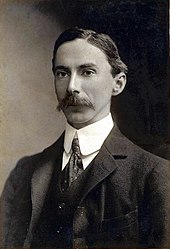 RESPONDING TO HARRY KROTO’S BRILLIANT RENOWNED ACADEMICS!! Part 149 HH Sir Bertrand Russell (SHORT)
 On November 21, 2014 I received a letter from Nobel Laureate Harry Kroto and it said:…Please click on this URL http://vimeo.com/26991975and you will hear what far smarter people than I have to say on this matter. I agree with them.Harry Kroto
 I have attempted to respond to all of Dr. Kroto’s friends arguments and I have posted my responses one per week for over a year now. Here are some of my earlier posts:Arif Ahmed, Sir David Attenborough, Mark Balaguer, Horace Barlow, Michael Bate, Patricia Churchland, Aaron Ciechanover, Noam Chomsky,Alan Dershowitz, Hubert Dreyfus, Bart Ehrman, Stephan Feuchtwang, David Friend, Riccardo Giacconi, Ivar Giaever , Roy Glauber, Rebecca Goldstein, David J. Gross, Brian Greene, Susan Greenfield, Stephen F Gudeman, Alan Guth, Jonathan Haidt, Theodor W. Hänsch, Brian Harrison, Hermann Hauser, Roald Hoffmann, Bruce Hood, Herbert Huppert, Gareth Stedman Jones, Steve Jones, Shelly Kagan, Michio Kaku, Stuart Kauffman, Lawrence Krauss, Harry Kroto, George Lakoff, Elizabeth Loftus, Alan Macfarlane, Peter Millican, Marvin Minsky, Leonard Mlodinow, Yujin Nagasawa, Alva Noe, Douglas Osheroff, Jonathan Parry, Saul Perlmutter, Herman Philipse, Carolyn Porco, Robert M. Price, Lisa Randall, Lord Martin Rees, Oliver Sacks, John Searle, Marcus du Sautoy, Simon Schaffer, J. L. Schellenberg, Lee Silver, Peter Singer, Walter Sinnott-Armstrong, Ronald de Sousa, Victor Stenger, Barry Supple, Leonard Susskind, Raymond Tallis, Neil deGrasse Tyson, .Alexander Vilenkin, Sir John Walker, Frank Wilczek, Steven Weinberg, and Lewis Wolpert,In the first video below in the 14th clip in this series are his words and I will be responding to them in the next few weeks since Sir Bertrand Russell is probably the most quoted skeptic of our time, unless it was someone like Carl Sagan or Antony Flew.
  Francis Schaeffer noted concerning the IMPLICIT FAITH of Bertrand Russell:I was lecturing at the University of St. Andrews one night and someone put forth the question, “If Christianity is so clear and reasonable then why doesn’t Bertrand Russell then become a Christian? Is it because he hasn’t discovered theology?”It wasn’t a matter of studying theology that was involved but rather that he had too much faith. I was surrounded by humanists and you could hear the gasps. Bertrand Russell and faith; Isn’t this the man of reason? I pointed out that this is a man of high orthodoxy who will hold his IMPLICIT FAITH on the basis of his presuppositions no matter how many times he has to zig and zag because it doesn’t conform to the facts.You must understand what the term IMPLICIT FAITH means. In the old Roman Catholic Church when someone who became a Roman Catholic they had to promise implicit faith. That meant that you not only had to believe everything that Roman Catholic Church taught then but also everything it would teach in the future. It seems to me this is the kind of faith that these people have in the uniformity of natural causes in a closed system and they have accepted it no matter what it leads them into. I think that these men are men of a high level of IMPLICIT FAITH in their own set of presuppositions. Paul said (in Romans Chapter One) they won’t carry it to it’s logical conclusion even though they hold a great deal of the truth and they have revolted and they have set up a series of universals in themselves which they won’t transgress no matter if they conform to the facts or not.Here below is the Romans passage that Schaeffer is referring to and verse 19 refers to what Schaeffer calls “the mannishness of man” and verse 20 refers to Schaeffer’s other point which is “the universe and it’s form.”Romans 1:18-20 Amplified Bible :18 For God’s [holy] wrath and indignation are revealed from heaven against all ungodliness and unrighteousness of men, who in their wickedness repress and hinder the truth and make it inoperative. 19 For that which is known about God is evident to them and made plain in their inner consciousness, because God [Himself] has shown it to them. 20 For ever since the creation of the world His invisible nature and attributes, that is, His eternal power and divinity, have been made intelligible and clearly discernible in and through the things that have been made (His handiworks). So [men] are without excuse [altogether without any defense or justification].We can actually see the two points makes playing themselves out in Bertrand Russell’s own life.

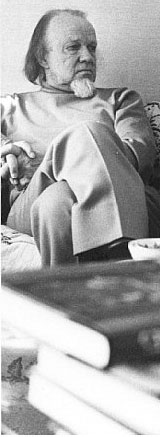
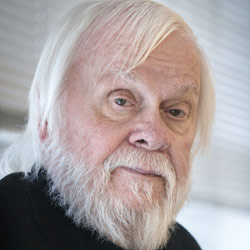


 On November 21, 2014 I received a letter from
 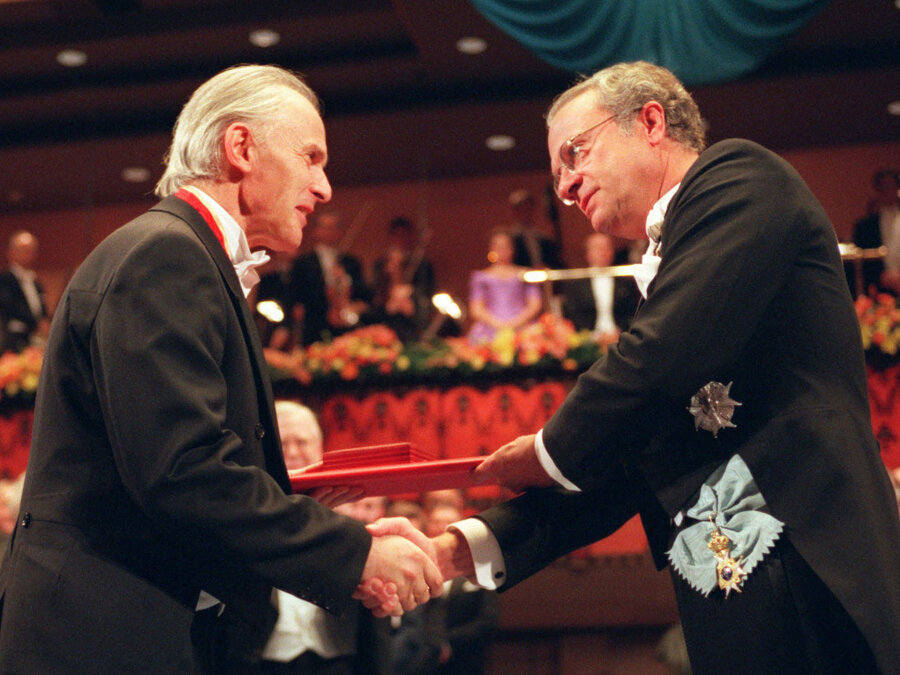 __
__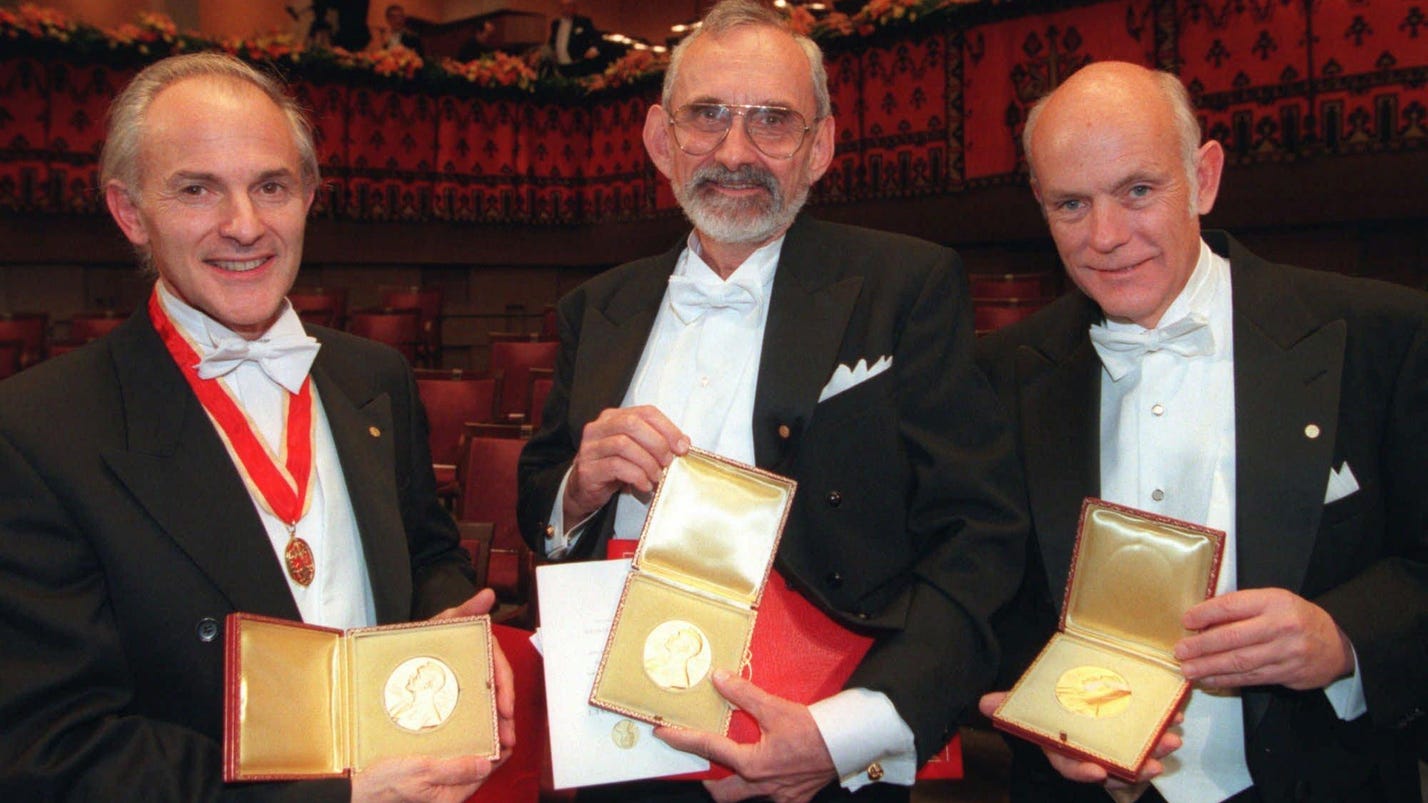 I have attempted to respond to all of Dr. Kroto’s friends arguments and I have posted my responses one per week for over a year now. Here are some of my earlier posts: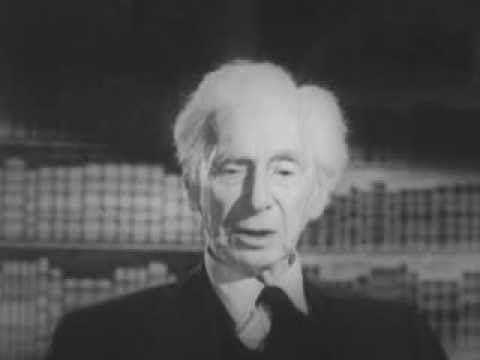
 Francis Schaeffer noted in his book HOW SHOULD WE THEN LIVE? (p. 182 in Vol 5 of Complete Works) in the chapter The Breakdown in Philosophy and Science:In his lecture at Acapulco, George Wald finished with only one final value. It was the same one with which English philosopher Bertrand Russell (1872-1970) was left. For Wald and Russell and for many other modern thinkers, the final value is the biological continuity of the human race. If this is the only final value, one is left wondering why this then has importance. Now having traveled from the pride of man in the High Renaissance and the Enlightenment down to the present despair, we can understand where modern people are. They have no place for a personal God. But equally they have no place for man as man, or for love, or for freedom, or for significance. This brings a crucial problem. Beginning only from man himself, people affirm that man is only a machine. But those who hold this position cannot live like machines! If they could, there would have been no tensions in their intellectual position or in their lives. But even people who believe they are machines cannot live like machines, and thus they must “leap upstairs” against their reason and try to find something which gives meaning to life, even though to do so they have to deny their reason. Francis Schaeffer in another place worded it like this:The universe was created by an infinite personal God and He brought it into existence by spoken word and made man in His own image. When man tries to reduce [philosophically in a materialistic point of view] himself to less than this [less than being made in the image of God] he will always fail and he will always be willing to make these impossible leaps into the area of nonreason even though they don’t give an answer simply because that isn’t what he is. He himself testifies that this infinite personal God, the God of the Old and New Testament is there. We all know deep down that God exists and even atheists have to grapple with that knowledge.Solomon wisely noted in Ecclesiastes 3:11 “God has planted eternity in the heart of men…” (Living Bible). No wonder Bertrand Russell wrote in his autobiography, “It is odd, isn’t it? I feel passionately for this world and many things and people in it, and yet…what is it all? There must be something more important, one feels, though I don’t believe there is. I am haunted. Some ghosts, for some extra mundane regions, seem always trying to tell me something that I am to repeat to the world, but I cannot understand that message.”Take a look at this 7th episode from Schaeffer’s series “HOW SHOULD WE THEN LIVE? The Age of Nonreason”: