FRIEDMAN FRIDAY Friedman and Hayek: How Neoliberal Revolutionaries Took over the World July 2016

_

Friedman and Hayek: How Neoliberal Revolutionaries Took over the World

Economic ideas change the world: Marx, Keynes, Hayek, Friedman, and Reagan

By Rutger Bregman

In the late summer of 1954, a brilliant young psychologist was reading the newspaper when his eye fell on a strange headline on the back page:

PROPHESY FROM PLANET CLARION
CALL TO CITY: FLEE THAT FLOOD.
IT’LL SWAMP US ON DEC 21,
OUTER SPACE TELLS SUBURBANITE.

His interest piqued, the psychologist, whose name was Leon Festinger, read on. “Lake City will be destroyed by a flood from the great lake just before dawn, Dec. 21.” The message came from a homemaker in a Chicago suburb who had received it, she reported, from superior beings on another planet: “These beings have been visiting the earth, she says, in what we call flying saucers.”

It was precisely what Festinger had been waiting for. This was a chance to investigate a simple but thorny question that he had been puzzling over for years: What happens when people experience a severe crisis in their convictions? How would this homemaker respond when no flying saucers came to rescue her? What happens when the great flood doesn’t materialize?

With a little digging, Festinger discovered that the woman, one Dorothy Martin, wasn’t the only one convinced that the world was ending on December 21, 1954. Around a dozen of her followers — all intelligent, upstanding Americans — had quit their jobs, sold their possessions, or left their spouses on the strength of their conviction.

Festinger decided to infiltrate the Chicago sect. Right off, he noticed that its members made little effort to persuade other people that the end was near. Salvation was reserved for them, the chosen few. On the morning of December 20, 1954, Mrs. Martin was beamed a new message from above: “At the hour of midnight you shall be put into parked cars and taken to a place where ye shall be put aboard a porch [flying saucer].”

The excited group settled in to await their ascendency to the heavens.

The Evening of December 20, 1954

11:15 p.m.: Mrs. Martin receives a message telling the group to put on their coats and prepare.

12:00 a.m.: Nothing happens.

12:05 a.m.: One of the believers notices another clock in the room reads 11:55 p.m. The group agrees it is not yet midnight.

12:10 a.m.: Message from aliens: The flying saucers are delayed.

12:15 a.m.: The telephone rings several times: journalists calling to check if the world has ended yet.

2:00 a.m.: One of the younger followers, who expected to be a couple light years away by now, recalls that his mother was planning to call the police if he wasn’t home by 2 a.m. The others assure him that his departure is a worthy sacrifice to save the group, and he leaves.

4:00 a.m.: One of the believers says: “I’ve burned every bridge. I’ve turned my back on the world. I can’t afford to doubt. I have to believe.”

4:45 a.m.: Mrs. Martin gets another message: God has decided to spare the Earth. Together, the small group of believers has spread so much “light” on this night that the Earth is saved.

4:50 a.m.: One last message from above: The aliens want the good news “to be released immediately to the newspapers.” Armed with this new mission, the believers inform all the local papers and radio stations before daybreak.

When Prophecies Fail

“A man with a conviction is a hard man to change.” So opens Leon Festinger’s account of these events in When Prophecy Fails, first published in 1956 and a seminal text in social psychology to this day. “Tell him you disagree and he turns away,” Festinger continues. “Show him facts or figures and he questions your sources. Appeal to logic and he fails to see your point.”

It’s easy to scoff at the story of Mrs. Martin and her believers, but the phenomenon Festinger describes is one that none of us are immune to. “Cognitive dissonance,” he coined it. When reality clashes with our deepest convictions, we’d rather recalibrate reality than amend our worldview. Not only that, we become even more rigid in our beliefs than before.

Mind you, we tend to be quite flexible when it comes to practical matters. Most of us are willing to accept advice on how to remove a grease stain or chop a cucumber. No, it’s when our political, ideological, or religious ideas are at stake that we get the most stubborn. We tend to dig in our heels when someone challenges our opinions about criminal punishment, premarital sex, or global warming. These are ideas to which people tend to get attached, and that makes it difficult to let them go. Doing so affects our sense of identity and position in social groups — in our churches or families or circles of friends.

One factor that certainly is not involved is stupidity. Researchers at Yale University have shown that educated people are more unshakable in their convictions than anybody. After all, an education gives you tools to defend your opinions. Intelligent people are highly practiced in finding arguments, experts, and studies that underpin their preexisting beliefs, and the Internet has made it easier than ever to be consumers of our own opinions, with an- other piece of evidence always just a mouse-click away.

Smart people, concludes the American journalist Ezra Klein, don’t use their intellect to obtain the correct answer; they use it to obtain what they want to be the answer.

When My Clock Struck Midnight

I have something to confess. In the course of writing my defense of a 15-hour workweek, I stumbled across an article titled “Shorter Workweek May Not Increase Well- Being.” It was a piece in The New York Times about a South Korean study which claimed that a 10% shorter workweek had not made employees happier. Additional Googling led me to an article in The Telegraph which suggested that working less might be downright bad for our health.

Suddenly I was Dorothy Martin and my clock had struck midnight. Immediately, I mobilized my defense mechanisms. To begin with, I had my doubts about the source: The Telegraph is a somewhat populist newspaper, so how seriously should I take that article? Plus, there was that “may” in The New York Times headline. How conclusive were the study findings really? Even my stereotypes kicked in: Those South Koreans, they’re such workaholics — they probably kept working off the clock even when they reported fewer hours. Moreover, happiness? How exactly do you measure that?

Satisfied, I pushed the study aside. I’d convinced myself it couldn’t be relevant.

I’ll give you another example. I have elsewhere laid out the arguments in favor of universal basic income. This is a conviction in which I have invested a lot over the past few years. The first article I wrote on the topic garnered nearly a million views and was picked up by The Washington Post. I gave lectures about universal basic income and made a case for it on Dutch television. Enthusiastic emails poured in. Not long ago, I even heard someone refer to me as “Mr. Basic Income.” Slowly but surely, my opinion has come to define my personal and professional identity. I do earnestly believe that a universal basic income is an idea whose time has come. I’ve researched the issue extensively, and that’s the direction the evidence points.

But, if I’m being honest, I sometimes wonder if I’d even let myself notice if the evidence were pointing another way. Would I be observant enough — or brave enough — to have a change of heart?

The Power of an Idea

“Keep building your castles in the sky,” a friend quipped a while back after I sent him a couple of my articles. I could understand where he was coming from. After all, what’s the point of crazy new ideas when politicians can’t even manage to balance a budget?

That’s when I began to ask myself whether new ideas can genuinely change the world.

Now, your (very reasonable) gut response might be: They can’t – people will stubbornly stick to the old ideas that they’re comfortable with. The thing is, we know that ideas have changed over time. Yesterday’s avant-garde is today’s common sense. The question is not can new ideas defeat old ones; the question is how.

Research suggests that sudden shocks can work wonders. James Kuklinski, a political scientist at the University of Illinois, discovered that people are most likely to change their opinions if you confront them with new and disagreeable facts as directly as possible. Take the recent success of right-wing politicians who were already warning of “the Islamic threat” back in the 1990s, but didn’t get much attention until the shocking destruction of the Twin Towers on September 11, 2001. Viewpoints that had once been fringe suddenly became a collective obsession.

If it is true that that ideas don’t change things gradually but in fits and starts — in shocks — then the basic premise of our democracy, our journalism, and our education is all wrong. It would mean, in essence, that the Enlightenment model of how people change their opinions — through information-gathering and reasoned deliberation — is really a buttress for the status quo. It would mean that those who swear by rationality, nuance, and compromise fail to grasp how ideas govern the world. A worldview is not a Lego set where a block is added here, removed there. It’s a fortress that is defended tooth and nail, with all possible reinforcements, until the pressure becomes so overpowering that the walls cave in.

Over the same months that Leon Festinger was infiltrating Mrs. Martin’s sect, the American psychologist Solomon Asch demonstrated that group pressure can even cause us to ignore what we can plainly see with our own eyes. In a now-famous experiment, he showed test subjects three lines on a card and asked them which one was longest. When the other people in the room (all Asch’s coworkers, unbeknownst to the subject) gave the same answer, the subject did, too — even when it was clearly erroneous.

It’s no different in politics. Political scientists have established that how people vote is determined less by their perceptions about their own lives than by their conceptions of society. We’re not particularly interested in what government can do for us personally; we want to know what it can do for us all. When we cast our vote, we do so not just for ourselves, but for the group we want to belong to.

But Solomon Asch made another discovery. A single opposing voice can make all the difference. When just one other person in the group stuck to the truth, the test subjects were more likely to trust the evidence of their own senses. Let this be an encouragement to all those who feel like a lone voice crying out in the wilderness: Keep on building those castles in the sky. Your time will come.

Long Was the Night

In 2008, it seemed as if that time had finally come when we were confronted with the biggest case of cognitive dissonance since the 1930s.

On September 15, the investment bank Lehman Brothers filed for bankruptcy. Suddenly, the whole global banking sector seemed poised to tumble like a row of dominoes. In the months that followed, one free market dogma after another crashed and burned.

Former Federal Reserve Chair Alan Greenspan, once dubbed the “Oracle” and the “Maestro,” was gobsmacked. “Not only have individual financial institutions become less vulnerable to shocks from underlying risk factors,”he had confidently asserted in 2004, “but also the financial system as a whole has become more resilient.” When Greenspan retired in 2006, everyone assumed he would be immortalized in history’s financial hall of fame.

In a House Committee hearing two years later, the broken banker admitted that he was “in a state of shocked disbelief.” Greenspan’s faith in capitalism had taken a severe beating. “I have found a flaw. I don’t know how significant or permanent it is. But I have been very distressed by that fact.” When a congressman asked him if he had been misled by his own ideas, Greenspan replied, “That’s precisely the reason I was shocked because I’d been going for 40 years or so with considerable evidence that it was working exceptionally well.”

The lesson of December 21, 1954, is that everything centers on that one moment of crisis. When the clock strikes midnight, what happens next? A crisis can provide an opening for new ideas, but it can also shore up old convictions.

So what happened after September 15, 2008? The Occupy movement briefly galvanized people, but quickly ebbed. Meanwhile, left-leaning political parties lost elections across most of Europe. Greece and Italy more or less canned democracy altogether and rolled out neoliberal-tinted reforms to please their creditors, trimming government and boosting labor market flexibility. In northern Europe, too, governments proclaimed a new age of austerity.

And Alan Greenspan? When, a few years later, a reporter asked him if there had been any error in his ideas, his reply was resolute: “Not at all. I think that there is no alternative.”

Fast forward to today: Fundamental reform of the banking sector has yet to happen. On Wall Street, bankers are seeing the highest bonus payments since the crash. And the banks’ capital buffers are as minuscule as ever. Joris Luyendijk, a journalist at The Guardian who spent two years looking under the hood of London’s financial sector, summed up the experience in 2013 as follows: “It’s like standing at Chernobyl and seeing they’ve restarted the reactor but still have the same old management.”

You have to wonder: Was the cognitive dissonance from 2008 even big enough? Or was it too big? Had we invested too much in our old convictions? Or were there simply no alternatives?

This last possibility is the most worrying of all.

The word “crisis” comes from ancient Greek and literally means to “separate” or “sieve.” A crisis, then, should be a moment of truth, the juncture at which a fundamental choice is made. But it almost seems that back in 2008 we were unable to make that choice. When we suddenly found ourselves facing the collapse of the entire banking sector, there were no real alternatives available; all we could do was keep plodding down the same path.

Perhaps, then, crisis isn’t really the right word for our current condition. It’s more like we’re in a coma. That’s ancient Greek, too. It means “deep, dreamless sleep.”

Capitalist Resistance Fighters

It’s all deeply ironic, if you think about it.

If there were ever two people who dedicated their lives to building castles in the sky with preternatural certainty that they would someday be proven right, it was the founders of neoliberal thought. I’m an admirer of them both: the slippery philosopher Friedrich Hayek and the public intellectual Milton Friedman.

Nowadays, “neoliberal” is a put-down leveled at anybody who doesn’t agree with the left. Hayek and Friedman, however, were proud neoliberals who saw it as their duty to reinvent liberalism. “We must make the building of a free society once more an intellectual adventure,” Hayek wrote. “What we lack is a liberal Utopia.”

Even if you believe them to be villains who made greed fashionable and are to blame for the financial crisis that left millions of people in dire straits — even then, there’s a lot you can learn from Friedrich Hayek and Milton Friedman.

One was born in Vienna, the other in New York. Both were firm believers in the power of ideas. For many years, both belonged to a small minority, a sect almost, that existed outside the cocoon of mainstream thought. Together, they tore apart that cocoon, upending the world in a way dictators and billionaires can only dream of. They set about shredding the life’s work of their archrival, the British economist John Maynard Keynes. Seemingly the only thing they had in common with Keynes was the belief that the ideas of economists and philosophers are stronger forces than the vested interests of business leaders and politicians.

This particular story begins on April 1, 1947, not quite a year after Keynes’ death, when 40 philosophers, historians, and economists converged in the small village of Mont Pèlerin in Switzerland. Some had traveled for weeks, crossing oceans to get there. In later years, they would be known as the Mont Pèlerin Society.

All 40 thinkers who came to this Swiss village were encouraged to speak their minds, and together they formed a corps of capitalist resistance fighters against socialist supremacy. “There are, of course, very few people left today who are not socialists,” Hayek, the event’s initiator, had once lamented. At a time when the provisions of the New Deal had pushed even the United States toward more socialistic policies, a defense of the free market was still seen as downright revolutionary, and Hayek felt “hopelessly out of tune with his time.”

Milton Friedman was also at the meeting of minds. “Here I was, a young, naive provincial American,” Friedman later recalled, “meeting people from all over the world, all dedicated to the same liberal principles as we were; all beleaguered in their own countries, yet among them scholars, some already internationally famous, others destined to be.” In fact, no fewer than eight members of the Mont Pèlerin Society would go on to win Nobel Prizes.

However, in 1947 no one could have predicted such a star-studded future. Large swaths of Europe lay in ruins. Reconstruction efforts were colored by Keynesian ideals: employment for all, curbing the free market, and regulation of banks. The war state became the welfare state. Yet it was during those same years that neoliberal thought began gaining traction thanks to the efforts of the Mont Pèlerin Society, a group that would go on to become one of the leading think tanks of the 20th century. “Together, they helped precipitate a global policy transformation with implications that will continue to reverberate for decades,” says the historian Angus Burgin.

In the 1970s, Hayek handed the presidency of the Society over to Friedman. Under the leadership of this diminutive, bespectacled American whose energy and enthusiasm surpassed even that of his Austrian predecessor, the society radicalized. Essentially, there wasn’t a problem around that Friedman didn’t blame on government. And the solution, in every case, was the free market. Unemployment? Get rid of the minimum wage. Natural disaster? Get corporations to organize a relief effort. Poor schools? Privatize education. Expensive healthcare? Privatize that, too, and ditch public oversight while we’re at it. Substance abuse? Legalize drugs and let the market work its magic.

Friedman deployed every means possible to spread his ideas, building a repertoire of lectures, op-eds, radio interviews, TV appearances, books, and even a documentary. In the preface to his bestselling Capitalism and Freedom, he wrote that it is the duty of thinkers to keep offering alternatives. Ideas that seem “politically impossible” today may one day become “politically inevitable.”

All that remained was to await the critical moment. “Only a crisis — actual or perceived — produces real change,” Friedman explained. “When that crisis occurs, the actions that are taken depend on the ideas that are lying around.” The crisis came in October 1973, when the Organization of Arab Petroleum Exporting Countries imposed an oil embargo. Inflation went through the roof and the economy spiraled into recession. “Stagflation,” as this effect was called, wasn’t even possible in Keynesian theory. Friedman, however, had predicted it.

For the rest of his life, Friedman never stopped emphasizing that his success would have been inconceivable without the groundwork laid since 1947. The rise of neoliberalism played out like a relay race, with think tanks passing the baton to journalists, who handed it off to politicians. Running the anchor leg were two of the most powerful leaders in the Western world, Ronald Reagan and Margaret Thatcher. When asked what she considered to be her greatest victory, Thatcher’s reply was “New Labour”: Under the leadership of neoliberal Tony Blair, even her social democratic rivals in the Labour Party had come around to her worldview.

In less than 50 years, an idea once dismissed as radical and marginal had come to rule the world.

The Lesson of Neoliberalism

Some argue that these days, it hardly matters anymore who you vote for. Though we still have a right and a left, neither side seems to have a very clear plan for the future. In an ironic twist of fate, the neoliberalist brainchild of two men who devoutly believed in the power of ideas has now put a lockdown on the development of new ones. It would seem that we have arrived at “the end of history,” with liberal democracy as the last stop and the “free consumer” as the terminus of our species.

By the time Friedman was named president of the Mont Pèlerin Society in 1970, most of its philosophers and historians had already decamped, the debates having become overly technical and economic. In hindsight, Friedman’s arrival marked the dawn of an era in which economists would become the leading thinkers of the Western world. We are still in that era today.

We inhabit a world of managers and technocrats. “Let’s just concentrate on solving the problems,” they say. “Let’s just focus on making ends meet.” Political decisions are continually presented as a matter of exigency — as neutral and objective events, as though there were no other choice. Keynes observed this tendency emerging even in his own day. “Practical men, who believe themselves to be quite exempt from any intellectual influences,” he wrote, “are usually the slaves of some defunct economist.”

When Lehman Brothers collapsed on September 15, 2008, and inaugurated the biggest crisis since the 1930s, there were no real alternatives to hand. No one had laid the groundwork. For years, intellectuals, journalists, and politicians had all firmly maintained that we’d reached the end of the age of “big narratives” and that it was time to trade in ideologies for pragmatism.

Naturally, we should still take pride in the liberty that generations before us fought for and won. But the question is, what is the value of free speech when we no longer have anything worthwhile to say? What’s the point of freedom of association when we no longer feel any sense of affiliation? What purpose does freedom of religion serve when we no longer believe in anything?

On the one hand, the world is still getting richer, safer, and healthier. That’s a huge triumph. On the other hand, it’s high time that we stake out a new utopia. Let’s rehoist the sails. “Progress is the realisation of Utopias,” Oscar Wilde wrote many years ago. A 15-hour workweekuniversal basic income, and a world without borders… They’re all crazy dreams — but for how much longer?

People now doubt that “human ideas and beliefs are the main movers of history,” as Hayek argued back when neoliberalism was still in its infancy. “We all find it so difficult to imagine that our belief [sic] might be different from what they in fact are.” It could easily take a generation, he asserted, before new ideas prevail. For this very reason, we need thinkers who not only are patient, but also have “the courage to be ‘utopian.’”

Let this be the lesson of Mont Pèlerin. Let this be the mantra of everyone who dreams of a better world, so that we don’t once again hear the clock strike midnight and find ourselves just sitting around, empty-handed, waiting for an extraterrestrial salvation that will never come.

Ideas, however outrageous, have changed the world, and they will again. “Indeed,” wrote Keynes, “the world is ruled by little else.”

Rutger Bregman is the author of Utopia for Realists: The Case for a Universal Basic Income, Open Borders, and a 15-hour Workweek. You can buy it on Amazon.

2016 July 15

Related posts:

Milton and Rose Friedman “Two Lucky People”

July 31, 2012 – 6:43 am

Milton Friedman on Hayek’s “Road to Serfdom” 1994 Interview 2 of 2 Uploaded by PenguinProseMedia on Oct 26, 2011 2nd half of 1994 interview. ________________ I have a lot of respect for the Friedmans.Two Lucky People by Milton and Rose Friedman reviewed by David Frum — October 1998. However, I liked this review below better. It […] By Everette Hatcher III | Posted in Current EventsMilton Friedman | Edit | Comments (0)

Video clip:Milton Friedman discusses his view of numerous political figures and policy issues in (Part 2)

July 25, 2012 – 2:16 am

Milton Friedman on Hayek’s “Road to Serfdom” 1994 Interview 1 of 2 Uploaded by PenguinProseMedia on Oct 25, 2011 Says Federal Reserve should be abolished, criticizes Keynes. One of Friedman’s best interviews, discussion spans Friedman’s career and his view of numerous political figures and public policy issues. ___________________ Here is a review of “Two Lucky People.” […] By Everette Hatcher III | Posted in Milton Friedman | Edit | Comments (0)

Milton Friedman believed in liberty (Interview by Charlie Rose of Milton Friedman part 1)

July 24, 2012 – 10:01 am

Charlie Rose interview of Milton Friedman My favorite economist: Milton Friedman : A Great Champion of Liberty  by V. Sundaram   Milton Friedman, the Nobel Prize-winning economist who advocated an unfettered free market and had the ear of three US Presidents – Nixon, Ford and Reagan – died last Thursday (16 November, 2006 ) in San Francisco […] By Everette Hatcher III | Posted in Milton Friedman | Edit | Comments (0)

“The Failure of Socialism” episode of Free to Choose in 1990 by Milton Friedman (Part 1)

June 4, 2012 – 1:59 pm

Milton Friedman: Free To Choose – The Failure Of Socialism With Ronald Reagan (Full) Published on Mar 19, 2012 by NoNationalityNeeded Milton Friedman’s writings affected me greatly when I first discovered them and I wanted to share with you. We must not head down the path of socialism like Greece has done. Abstract: Ronald Reagan […] By Everette Hatcher III | Posted in Milton FriedmanRonald Reagan | Edit | Comments (0)

Milton Friedman – The Negative Income Tax

Volume 1: Power of the Market Volume 2: The Tyranny of Control
Volume 3: Anatomy of a Crisis
Volume 4: From Cradle to Grave
Volume 5: Created Equal
Volume 6: What’s Wrong With Our Schools?
Volume 7: Who Protects the Consumer?
Volume 8: Who Protects the Worker?
Volume 9: How to Cure Inflation
Volume 10: How to Stay Free

Updated 1990 Series:
Volume 1: The Power of the Market
Volume 2: The Tyranny of Control
Volume 3: Freedom & Prosperity
Volume 4: The Failure of Socialism
Volume 5: Created Equal

_____________________

___________

FRANCIS SCHAEFFER ANALYZES ART AND CULTURE Part 287 “Darwin never came to a place of satisfaction” (Schaeffer v. Richard Dawkins) Featured Artist is Katharina Grosse

_

Bill Maher and Richard Dawkins

Image result for richard dawkins obama

__

Image result for francis schaeffer

__

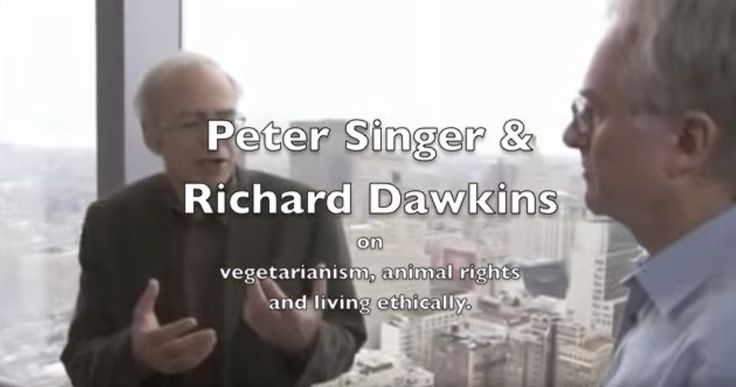
Image result for richard dawkins peter singer

__

Image result for francis schaeffer

Francis and Edith Schaeffer at their home in Switzerland with some visiting friends

__

Image result for richard dawkins young

Schaeffer with his wife Edith in Switzerland.

January 15, 2019

Richard Dawkins c/o Richard Dawkins Foundation, 1012 14th Street NW, Suite 209
Washington, DC 20005

Dear Mr. Dawkins,

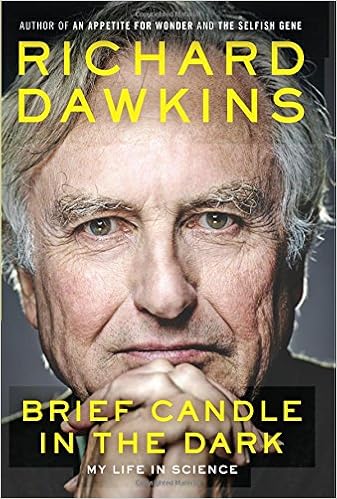
i have enjoyed reading about a dozen of your books and some of the most intriguing were The God DelusionAn Appetite for Wonder: The Making of a Scientist, and Brief Candle in the Dark: My Life in Science.

I wanted to comment on something you wrote in your book Science in the Soul: Selected Writings of a Passionate Rationalist, and here is the quote:  

I have come so far with scarcely a mention of Charles Darwin.His life spanned most of the nineteenth
century, and he died with every right to be satisfied that he had cured humanity of its greatest and grandest
illusion. Darwin brought life itself within the pale of the explicable. No longer a baffling mystery demanding
supernatural explanation, life, with the complexity and elegance that defines it, grows and gradually emerges,
by easily understood rules, from simple beginnings. Darwin’s legacy to the twentieth century was to demystify
the greatest mystery of all.

WAS DARWIN SATISFIED WITH THEORY?

A letter to Sir J. D. Hooker, June 17, 1868, which repeats to some extent what is given in the Autobiography:—

“I am glad you were at the Messiah, it is the one thing that I should like to hear again, but I dare say I should find my soul too dried up to appreciate it as in old days; and then I should feel very flat, for it is a horrid bore to feel as I constantly do, that I am a withered leaf for every subject except Science. It sometimes makes me hate Science, though God knows I ought to be thankful for such a perennial interest, which makes me forget for some hours every day my accursed stomach.’

Francis Schaeffer summarized:

So he is glad for science because his stomach bothers him, but on the other hand when I think of what it costs me I almost hate science. You can almost hear young Jean-Jacques Rousseau speaking here, he sees what the machine is going to do and he hates the machine and Darwin is constructing the machine and it leads as we have seen to his own loss of human values in the area of aesthetics, the area of art and also in the area of nature. This is what it has cost him. His theory has led him to this place. When you come to this then it seems to me that you understand man’s dilemma very, very well, to think of the origin of the theory of mechanical evolution bringing  Darwin himself to the place of this titanic tension.

XXXXXXXXXXXXXXXXXXXXXXXXXX

Summary of Schaeffer Analysis

Darwin in his autobiography ( Darwin, Francis ed. 1892. Charles Darwin: his life told in an autobiographical chapter, and in a selected series of his published letters [abridged edition]. London: John Murray.  ) and in his letters Darwin showed that all through his life he never really came to a quietness concerning the possibility that chance really explained the situation of the biological world. You will find there is much material on this [from Darwin] extended over many many years that constantly he was wrestling with this problem. Darwin never came to a place of satisfaction. You have philosophically only two possible beginnings. The first would be apersonal beginning and the other would be an impersonal beginning plus time plus chance. There is no other possible alternative except the alternative that everything comes out of nothing and that has to be a total nothing and that has to be a total nothing without mass, energy or motion existing. No one holds this last view because it is unthinkable. Darwin understood this and therefore until his death he was uncomfortable with the idea of chance producing the biological variation.

The answer to find meaning in life is found in putting your faith and trust in Jesus Christ. The Bible is true from cover to cover and can be trusted.

Thank you again for your time and I know how busy you are.

Everette Hatcher, everettehatcher@gmail.comhttp://www.thedailyhatch.org, cell ph 501-920-5733, Box 23416, LittleRock, AR 72221, United States


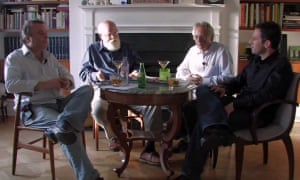
Image result for john lennox and richard dawkins

Richard Dawkins and John Lennox

_

DawkinsWard

_

Image result for francis schaeffer c. everett koop whatever happened to human race?

_

Dawkins, Hitchens, Dennett, Harris 

Image result for four horsemen richard dawkins

Canary Islands 2014: Harold Kroto and Richard Dawkins

Image result for harry kroto richard dawkins

__

Francis Schaeffer pictured below:

The Basis of Human Dignity by Francis Schaeffer

Richard Dawkins, founder of the Richard Dawkins Foundation for Reason and Science. Credit: Don Arnold Getty Images

Francis Schaeffer in 1984

Christian Manifesto by Francis Schaeffer

Francis Schaeffer in 1982

—-

Whatever Happened to the Human Race? Episode 1

Image result for richard dawkins brief candle in the dark

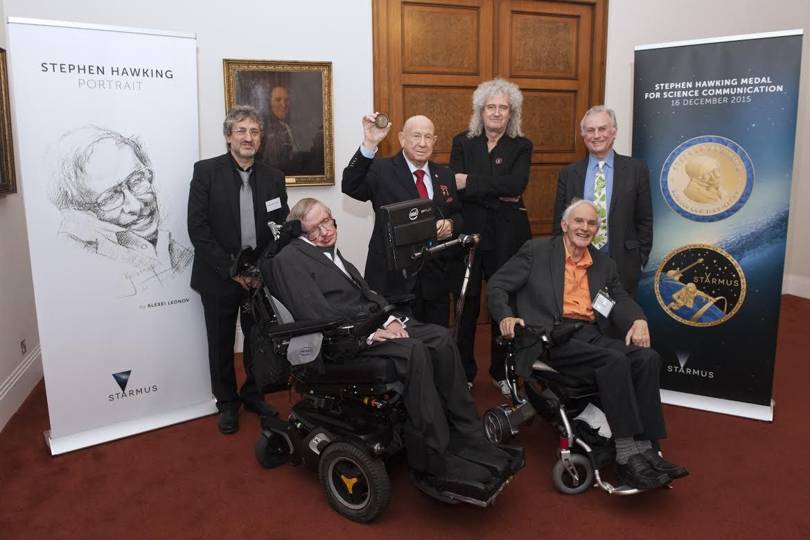
Garik Israelian, Stephen Hawking, Alexey Leonov, Brian May, Richard Dawkins and Harry Kroto

—-

—-

—-

—-

Featured artist is Katharina Grosse

Katharina Grosse: Painting with Color | ART21 “Exclusive”


Katharina Grosse

Katharina Grosse was born in 1961 in Freiburg/Breisgau, Germany. Grosse is a painter who often employs electrifying sprayed acrylic colors to create large-scale sculptural environments and smaller wall works. Interested in the shifts of scale between ‘imagining big’ while being small in relationship to one’s surroundings, she explores the dynamic interplay between observing the world and simply being in it. By uniting a fluid perception of landscape with the ordered hierarchy of painting, Grosse treats both architecture and the natural world as an armature for expressive compositions of dreamy abandon, humorous juxtaposition, and futuristic flair.

Her projects often suggest complex narratives through the inclusion of everyday objects, psychedelic vistas, and evocative titles. By building up layers of color with an expressive immediacy, she enables her work to become a material record of its own making and, perhaps, an inscription of her thoughts. But, Grosse says, “I am the painting trickster. Don’t believe me!”

Katharina Grosse studied at the Kunstakademie Düsseldorf, where she currently teaches, having previously been a professor at Kunsthochschule Berlin-Weissensee (2000–10). Among the honors she has received are the Oskar Schlemmer Prize (2014); Fred-Thieler-Preis (2003); Stipendiaten der Stiftung Kunstfonds (1995); Schmidt-Rottluff-Stipendium (1993); and the Villa-Romana-Stipendium, Florence (1992).

Major exhibitions of Grosse’s work have appeared at Public Art Fund (2013); Nasher Sculpture Center (2013); De Pont Museum of Contemporary Art, Netherlands (2013); MOCA Cleveland (2012); Mass MoCA (2010); Arken—Museum for Moderne Kunst, Copenhagen (2009); Prospect New Orleans (2008); Renaissance Society (2007); De Appel, Amsterdam (2006); Contemporary Art Center, Cincinnati (2006); Taipei Biennial (2006); Bergen Kunsthall (2005); Magasin 3 Stockholm Konsthall (2004); Contemporary Arts Museum Houston (2004); São Paulo Bienal (2002); and the Hammer Museum (2001), among others. Katharina Grosse lives and works in Berlin, Germany.

Links:
Artist’s website
Katharina Grosse: Just Two of Us, Public Art Fund, New York

—-

Related posts:

RESPONDING TO HARRY KROTO’S BRILLIANT RENOWNED ACADEMICS!! Part 48 Nobel Prize Winner and Global Warming Denier Ivar Giaever “I think religion is to blame for a lot of the ills in this world!”

October 20, 2015 – 5:20 am

  On November 21, 2014 I received a letter from Nobel Laureate Harry Kroto and it said: …Please click on this URL http://vimeo.com/26991975 and you will hear what far smarter people than I have to say on this matter. I agree with them. Harry Kroto _________________ Below you have picture of 1996 Chemistry Nobel Prize Winner […]

FRANCIS SCHAEFFER ANALYZES ART AND CULTURE PART 78 THE BEATLES (Breaking down the song TOMORROW NEVER KNOWS) Featured musical artist is Stuart Gerber

September 24, 2015 – 5:42 am

The Beatles were “inspired by the musique concrète of German composer and early electronic music pioneer Karlheinz Stockhausen…”  as SCOTT THILL has asserted. Francis Schaeffer noted that ideas of  “Non-resolution” and “Fragmentation” came down German and French streams with the influence of Beethoven’s last Quartets and then the influence of Debussy and later Schoenberg’s non-resolution which is in total contrast […]

RESPONDING TO HARRY KROTO’S BRILLIANT RENOWNED ACADEMICS!! Part 42 Peter Singer, Professor of Bioethics at Princeton University, THE PROBLEM OF EVIL

September 8, 2015 – 5:10 am

  _______ On November 21, 2014 I received a letter from Nobel Laureate Harry Kroto and it said: …Please click on this URL http://vimeo.com/26991975 and you will hear what far smarter people than I have to say on this matter. I agree with them. Harry Kroto _________________ Below you have picture of 1996 Chemistry Nobel Prize […]

RESPONDING TO HARRY KROTO’S BRILLIANT RENOWNED ACADEMICS!! Bart Ehrman “Why should one think that God performed the miracle of inspiring the words in the first place if He didn’t perform the miracle of preserving the words?”

September 2, 2015 – 8:42 am

On November 21, 2014 I received a letter from Nobel Laureate Harry Kroto and it said: …Please click on this URL http://vimeo.com/26991975 and you will hear what far smarter people than I have to say on this matter. I agree with them. Harry Kroto ____________________ Below you have picture of 1996 Chemistry Nobel Prize Winner Dr. […]

WOODY WEDNESDAY Open Letter to Woody Allen asking if he ever met Joseph T. “Pee Wee” Spitelera Part 9

https://youtu.be/lnOXMSZAubM

-https://youtu.be/lnOXMSZAubM

Woody Allen On Bergman

Pee Wee Spitelera was born on December 21, 1937 in Louisiana, USA as Joseph T. Spitelera Jr. He was an actor, known for The Dinah Shore Chevy Show (1956), Dixieland at Disneyland (1964) and The Lawrence Welk Show (1955). He died in September 1985 in Louisiana.

Woody Allen On Bergman

Woody Allen Show

Essay on Woody Allen films

Match point Trailer

Match point

Crimes and misdemeanors

Part 2

Part 3

Woody commenting on Midnight in Paris

December 16, 2014

Letty Aronson, New York, New York 10001

Dear Mrs. Aronson,

I have just a few questions for you. I know that your brother Woody is very interested in Jazz and especially in meeting great clarinet players and my good friend Sean Michel (who appeared on American Idol in 2007) told me about his uncle who passed away in 1985, Joseph T. “Pee Wee” Spitelera  who played with Al Hirt’s band in New Orleans for about 40 years. If you do a You Tube search for “Dinah Shore Al Hirt” then it will bring up a 24 minute video entitled “Al Hirt on the Dinah Shore Chevy Show 1960,” and at the 4 1/2 minute mark Pee Wee Spirtelera takes off on a Clarinet solo that is out of this world. Also if you type in “Al Hirt Johnny Cash Show” then you will see a 4 min and 21 sec video entitled “Al Hirt on the Johnny Cash Show,” and at the 1 min mark Pee Wee goes crazy there in the  Clarinet on the Dec 16, 1970 Johnny Cash Show.

Below is a picture of Pee Wee and he has several other fine songs on You Tube too such as “Blue Clarinet” which would be perfect for a Woody Allen Movie.

(Pee Wee is the guy in the Middle)

Therefore, my first question is did Woody ever have a chance to meet Pee Wee? SecondlyI wanted to ask you if you have ever had the opportunity to examine the evidence that the Old Testament predicted the return of the Jews to the land of Israel?

I was fascinated with the movie “Magic and in the Moonlight”and not only have I seen it several times, but I have taken many of my friends to see it and I have blogged about it over and over at http://www.thedailyhatch.org. In the past I have spent a lot of time on my blog taking close looks at your brother’s films. For instance, if you do a google search for the words “Characters Midnight in Paris” then you will find that I have done over 40 different posts on that movie taking closer looks at the historical characters mentioned in that movie.

As you know the main point made in “Midnight in Paris” is that there is no “Golden Age” but all time periods were filled with their challenges just like the period we are in now. Solomon discovered this in the first chapter of Ecclesiastes (verses 9-10) and shared his thoughts also on the meaning of life. In fact, many of Solomon’s thoughts from that book apply to many of your brothers’ films. Again if you google the terms “Woody Allen Ecclesiastes” then it will bring you again to several posts I have done on Woody’s films and the answers Solomon gives in Ecclesiastes. 3000 years ago Solomon pursued six “L” words in his search for the meaning of life and probing the area of LAUGHTER was one of his first places to start. In Ecclesiastes 2:2 he starts this quest but he concludes it is not productive to be laughing the whole time and not considering the serious issues of life. Then Solomon also asserted the nihilistic statement in Ecclesiastes 2:17: “So I hated life, because the work that is done under the sun was grievous to me. All of it is meaningless, a chasing after the wind.”

In the Book of Ecclesiastes what are all of the 6 “L” words that Solomon looked into? He looked into  learning (1:16-18), laughter, ladies, luxuries,  and liquor (2:1-3, 8, 10, 11), and labor (2:4-6, 18-20). IRONICALLY, WOODY ALLEN HAS MADE ALL SIX OF THESE BUTTS OF HIS NIHILISTIC JOKES!!!

Schaeffer noted that Solomon took a look at the meaning of life on the basis of human life standing alone between birth and death “under the sun.” This phrase UNDER THE SUN appears over and over in Ecclesiastes. The Christian Scholar Ravi Zacharias noted, “The key to understanding the Book of Ecclesiastes is the term UNDER THE SUN — What that literally means is you lock God out of a closed system and you are left with only this world of Time plus Chance plus matter.” This puts him in the same place that WOODY ALLEN finds himself and this is a center theme of MAGIC IN THE MOONLIGHT too. 

If you are an atheist then you have a naturalistic materialistic worldview, and this short book of Ecclesiastes should interest you because the wisest man who ever lived in the position of King of Israel came to THREE CONCLUSIONS that will affect you.

FIRST, chance and time have determined the past, and they will determine the future.  (Ecclesiastes 9:11-13)

These two verses below  take the 3 elements mentioned in a naturalistic materialistic worldview (time, chance and matter) and so that is all the unbeliever can find “under the sun” without God in the picture. You will notice that these are the three elements that evolutionists point to also.

Ecclesiastes 9:11-12 is following: I have seen something else under the sun: The race is not to the swift or the battle to the strong, nor does food come to the wise or wealth to the brilliant or favor to the learned; but time and chance happen to them all. Moreover, no one knows when their hour will come: As fish are caught in a cruel net, or birds are taken in a snare, so people are trapped by evil times that fall unexpectedly upon them.

SECOND, Death is the great equalizer (Eccl 3:20, “All go to the same place; all come from dust, and to dust all return.”)

THIRD, Power reigns in this life, and the scales are not balanced(Eccl 4:1, 8:15)

Ecclesiastes 4:1-2: “Next I turned my attention to all the outrageous violence that takes place on this planet—the tears of the victims, no one to comfort them; the iron grip of oppressors, no one to rescue the victims from them.” Ecclesiastes 8:14; “Here’s something that happens all the time and makes no sense at all: Good people get what’s coming to the wicked, and bad people get what’s coming to the good. I tell you, this makes no sense. It’s smoke.”

Several times during the movie “Magic in the Moonlight” there are references to Friedrich Nietzsche’s conclusion that we must except a nihilistic worldview if we accept the conclusion that science rules out the possibility of God’s existence. I do agree with part of that statement and that is that nihilism is the proper attitude if there is no afterlife (google “Woody Allen Nihilism” and it will bring you to my blog again). However, there is good and sufficient evidence that shows that God exists. Just take a few minutes and look up the Old Testament Scriptures  Amos 9:14-15, Zechariah 12:3 and Isaiah 11:11-12 and notice that they predict the return of the Jews to their ancient land of Israel. ISN’T THIS EVIDENCE OF THE SUPERNATURAL that is the subject of MAGIC IN THE MOONLIGHT?

In fact, my former pastor Robert Lewis at Fellowship Bible Church in his sermon “Let the Prophets Speak” on 1-31-99 noted that even the great Princeton Theologian Charles Hodge erred in 1871 when he stated:

The argument from the ancient prophecies is proved to be invalid because it would prove too much. If those prophecies foretell a literal restoration, they foretell that the temple is to be rebuilt, the priesthood restored, sacrifices again offered, and that the whole Mosaic ritual is to be observed in all its details, (Systematic Theology. [New York: Charles Scribner & Sons, 1871; reprint Grand Rapids, Michigan: Eerdman’s Publishing Co., 1949], 3:807).__

Robert Lewis went on to point out that the prophet Amos 2700 years ago predicted the destruction of Aram, Philistia, Tyre, Edom, Ammon, Moab and Israel, but at the end of the Book he said Israel would one day be returned to their land and never removed. We saw from Isaiah 11:11-12 that the Lord “will assemble the outcasts of Israel and will gather together the dispersed of Judah from the four corners of the earth.” And that certainly did happen after World War II.  I corresponded with some secular Jewish Scholars on this back in the 1990’s such as Irving Kristol and Daniel Bell but they dismissed these type of Old Testament prophecies. Then on  Friday July 18, 2014 I had the opportunity to visit personally with Bill Kristol who is the founder of THE WEEKLY STANDARD MAGAZINE.  I actually gave him a copy of both letters I received back from his father Irving and their family friend Daniel Bell and he read them both as we stood there. I told him that those copies were his to keep, and he thanked me for that.I went on to explain how the correspondence started.  I had come across several quotes from Daniel Bell when I was reading the books HOW SHOULD WE THEN LIVE?  and WHATEVER HAPPENED TO THE HUMAN RACE? by Francis Schaeffer (and this second book was co-authored by Dr. C. Everett Koop). Dr. Koop’s name caught Mr. Kristol’s attention and he said he found that interesting. I pointed out those quotes by Bell led me to eventually begin a correspondence with both Bell and Kristol’s father Irving on the subject of what the Old Testament scriptures have to say about the Jews being returned from all over the world back to the land of Israel. (By the way, Schaeffer also quoted Woody Allen extensively in his works too.)Let me sum up what the Bible predicts concerning the Jews. First,  the Old Testament predicted that the Jews would regather from all over the world and form a new reborn nation of Israel. Second, it was also predicted that the nation of Israel would become a stumbling block to the whole world. Third, it was predicted that the Hebrew language would be used again as the Jews first language even though we know in 1948 that Hebrew at that time was a dead language!!!Fourth, it was predicted that the Jews would never again be removed from their land.

 Thank you again for your time and I know how busy you are.

Everette Hatcher, everettehatcher@gmail.comhttp://www.thedailyhatch.org, cell ph 501-920-5733, Box 23416, LittleRock, AR 72221

Midnight in Paris trailer

—-


The mass media turned Picasso into a celebrity, and the public deprived him of privacy and wanted to know his every step, but his later art was given very little attention and was regarded as no more than the hobby of an aging genius who could do nothing but talk about himself in his pictures. Picasso’s late works are an expression of his final refusal to fit into categories. He did whatever he wanted in art and did not arouse a word of criticism.

With his adaptation of “Las Meninas” by Velászquez and his experiments with Manet’s Luncheon on the Grass, was Picasso still trying to discover something new, or was he just laughing at the public, its stupidity and its inability to see the obvious.

A number of elements had become characteristic in his art of this period: Picasso’s use of simplified imagery, the way he let the unpainted canvas shine through, his emphatic use of lines, and the vagueness of the subject. In 1956, the artist would comment, referring to some schoolchildren: “When I was as old as these children, I could draw like Raphael, but it took me a lifetime to learn to draw like them.”

In the last years of his life, painting became an obsession with Picasso, and he would date each picture with absolute precision, thus creating a vast amount of similar paintings — as if attempting to crystallize individual moments of time, but knowing that, in the end, everything would be in vain.

The movie MIDNIGHT IN PARIS offers many of the same themes we see in Ecclesiastes. The second post looked at the question: WAS THERE EVER A GOLDEN AGE AND DID THE MOST TALENTED UNIVERSAL MEN OF THAT TIME FIND TRUE SATISFACTION DURING IT?

In the third post in this series we discover in Ecclesiastes that man UNDER THE SUN finds himself caught in the never ending cycle of birth and death. The SURREALISTS make a leap into the area of nonreason in order to get out of this cycle and that is why the scene in MIDNIGHT IN PARIS with Salvador Dali, Man Ray, and Luis Bunuel works so well!!!! These surrealists look to the area of their dreams to find a meaning for their lives and their break with reality is  only because they know that they can’t find a rational meaning in life without God in the picture.

The fourth post looks at the solution of WINE, WOMEN AND SONG and the fifth and sixth posts look at the solution T.S.Eliotfound in the Christian Faith and how he left his fragmented message of pessimism behind. In the seventh post the SURREALISTS say that time and chance is all we have but how can that explain love or art and the hunger for God? The eighth  post looks at the subject of DEATH both in Ecclesiastes and MIDNIGHT IN PARIS. In the ninth post we look at the nihilistic worldview of Woody Allen and why he keeps putting suicides into his films.

In the tenth post I show how Woody Allen pokes fun at the brilliant thinkers of this world and how King Solomon did the same thing 3000 years ago. In the eleventh post I point out how many of Woody Allen’s liberal political views come a lack of understanding of the sinful nature of man and where it originated. In the twelfth post I look at the mannishness of man and vacuum in his heart that can only be satisfied by a relationship with God.

In the thirteenth post we look at the life of Ernest Hemingway as pictured in MIDNIGHT AND PARIS and relate it to the change of outlook he had on life as the years passed. In the fourteenth post we look at Hemingway’s idea of Paris being a movable  feast. The fifteenth and sixteenth posts both compare Hemingway’s statement, “Happiness in intelligent people is the rarest thing I know…”  with Ecclesiastes 2:18 “For in much wisdom is much vexation, and he who increases knowledge increases sorrow.” The seventeenth post looks at these words Woody Allen put into Hemingway’s mouth,  “We fear death because we feel that we haven’t loved well enough or loved at all.”

In MIDNIGHT IN PARIS Hemingway and Gil Pender talk about their literary idol Mark Twain and the eighteenth post is summed up nicely by Kris Hemphill‘swords, “Both Twain and [King Solomon in the Book of Ecclesiastes] voice questions our souls long to have answered: Where does one find enduring meaning, life purpose, and sustainable joy, and why do so few seem to find it? The nineteenth post looks at the tension felt both in the life of Gil Pender (written by Woody Allen) in the movie MIDNIGHT IN PARIS and in Mark Twain’s life and that is when an atheist says he wants to scoff at the idea THAT WE WERE PUT HERE FOR A PURPOSE but he must stay face the reality of  Ecclesiastes 3:11 that says “God has planted eternity in the heart of men…” and  THAT CHANGES EVERYTHING! Therefore, the secular view that there is no such thing as love or purpose looks implausible. The twentieth post examines how Mark Twain discovered just like King Solomon in the Book of Ecclesiastes that there is no explanation  for the suffering and injustice that occurs in life UNDER THE SUN. Solomon actually brought God back into the picture in the last chapter and he looked  ABOVE THE SUN for the books to be balanced and for the tears to be wiped away.

The twenty-first post looks at the words of King Solomon, Woody Allen and Mark Twain that without God in the picture our lives UNDER THE SUN will accomplish nothing that lasts. Thetwenty-second post looks at King Solomon’s experiment 3000 years that proved that luxuries can’t bring satisfaction to one’s life but we have seen this proven over and over through the ages. Mark Twain lampooned the rich in his book “The Gilded Age” and he discussed  get rich quick fever, but Sam Clemens loved money and the comfort and luxuries it could buy. Likewise Scott Fitzgerald  was very successful in the 1920’s after his publication of THE GREAT GATSBY and lived a lavish lifestyle until his death in 1940 as a result of alcoholism.

In the twenty-third post we look at Mark Twain’s statement that people should either commit suicide or stay drunk if they are “demonstrably wise” and want to “keep their reasoning faculties.” We actually see this play out in the film MIDNIGHT IN PARIS with the character Zelda Fitzgerald. In the twenty-fourthtwenty-fifth and twenty-sixth posts I look at Mark Twain and the issue of racism. In MIDNIGHT IN PARIS we see the difference between the attitudes concerning race in 1925 Paris and the rest of the world.

The twenty-seventh and twenty-eighth posts are summing up Mark Twain. In the 29th post we ask did MIDNIGHT IN PARIS accurately portray Hemingway’s personality and outlook on life? and in the 30th post the life and views of Hemingway are summed up.

In the 31st post we will observe that just like Solomon Picasso slept with many women. Solomon actually slept with  over 1000 women ( Eccl 2:8, I Kings 11:3), and both men ended their lives bitter against all women and in the 32nd post we look at what happened to these former lovers of Picasso. In the 33rd post we see that Picasso  deliberately painted his secular  worldview of fragmentation on his canvas but he could not live with the loss of humanness and he reverted back at crucial points and painted those he loved with all his genius and with all their humanness!!! In the 34th post  we notice that both Solomon in Ecclesiastes and Picasso in his painting had an obsession with the issue of their impending death!!!

___________

Related posts:

“Woody Wednesday” ECCLESIASTES AND WOODY ALLEN’S FILMS: SOLOMON “WOULD GOT ALONG WELL WITH WOODY!” (Part 7 MIDNIGHT IN PARIS Part F, SURREALISTS AND THE IDEA OF ABSURDITY AND CHANCE)

December 23, 2015 – 4:15 am

Woody Allen believes that we live in a cold, violent and meaningless universe and it seems that his main character (Gil Pender, played by Owen Wilson) in the movie MIDNIGHT IN PARIS shares that view. Pender’s meeting with the Surrealists is by far the best scene in the movie because they are ones who can […]

“Woody Wednesday” ECCLESIASTES AND WOODY ALLEN’S FILMS: SOLOMON “WOULD GOT ALONG WELL WITH WOODY!” (Part 6 MIDNIGHT IN PARIS Part E, A FURTHER LOOK AT T.S. Eliot’s DESPAIR AND THEN HIS SOLUTION)

December 16, 2015 – 4:56 am

In the last post I pointed out how King Solomon in Ecclesiastes painted a dismal situation for modern man in life UNDER THE SUN  and that Bertrand Russell, and T.S. Eliot and  other modern writers had agreed with Solomon’s view. However, T.S. Eliot had found a solution to this problem and put his faith in […]

“Woody Wednesday” ECCLESIASTES AND WOODY ALLEN’S FILMS: SOLOMON “WOULD GOT ALONG WELL WITH WOODY!” (Part 5 MIDNIGHT IN PARIS Part D, A LOOK AT T.S. Eliot’s DESPAIR AND THEN HIS SOLUTION)

December 9, 2015 – 4:41 am

In MIDNIGHT IN PARIS Gil Pender ponders the advice he gets from his literary heroes from the 1920’s. King Solomon in Ecclesiastes painted a dismal situation for modern man in life UNDER THE SUN  and many modern artists, poets, and philosophers have agreed. In the 1920’s T.S.Eliot and his  house guest Bertrand Russell were two of […]

“Woody Wednesda

RESPONDING TO HARRY KROTO’S BRILLIANT RENOWNED ACADEMICS!! Part 157d Bertrand Russell said “For beliefs based on faith, argument is useless,” yet Russell had a wholehearted faith in an uniformity of natural causes in a closed system

RESPONDING TO HARRY KROTO’S BRILLIANT RENOWNED ACADEMICS!! Part 149 HH Sir Bertrand Russell

Image result for bertrand russell
555 × 409Images may be subject to copyrightLearn More

__Image result for bertrand russellOn November 21, 2014 I received a letter from Nobel Laureate Harry Kroto and it said:…Please click on this URL http://vimeo.com/26991975and you will hear what far smarter people than I have to say on this matter. I agree with them.Harry KrotoImage result for harry krotoI have attempted to respond to all of Dr. Kroto’s friends arguments and I have posted my responses one per week for over a year now. Here are some of my earlier posts:Arif Ahmed, Sir David AttenboroughMark Balaguer, Horace Barlow, Michael BatePatricia ChurchlandAaron CiechanoverNoam Chomsky,Alan DershowitzHubert Dreyfus, Bart Ehrman, Stephan FeuchtwangDavid Friend,  Riccardo GiacconiIvar Giaever , Roy GlauberRebecca GoldsteinDavid J. Gross,  Brian Greene, Susan GreenfieldStephen F Gudeman,  Alan Guth, Jonathan HaidtTheodor W. Hänsch, Brian Harrison,  Hermann HauserRoald Hoffmann,  Bruce HoodHerbert Huppert,  Gareth Stedman Jones, Steve JonesShelly KaganMichio Kaku,  Stuart Kauffman,  Lawrence KraussHarry Kroto, George LakoffElizabeth Loftus,  Alan MacfarlanePeter MillicanMarvin MinskyLeonard Mlodinow,  Yujin NagasawaAlva NoeDouglas Osheroff,  Jonathan Parry,  Saul PerlmutterHerman Philipse,  Carolyn PorcoRobert M. PriceLisa RandallLord Martin Rees,  Oliver Sacks, John SearleMarcus du SautoySimon SchafferJ. L. Schellenberg,   Lee Silver Peter Singer,  Walter Sinnott-ArmstrongRonald de Sousa, Victor StengerBarry Supple,   Leonard Susskind, Raymond TallisNeil deGrasse Tyson,  .Alexander Vilenkin, Sir John WalkerFrank WilczekSteven Weinberg, and  Lewis Wolpert,In  the first video below in the 14th clip in this series are his words and I will be responding to them in the next few weeks since Sir Bertrand Russell is probably the most quoted skeptic of our time, unless it was someone like Carl Sagan or Antony Flew.  
50 Renowned Academics Speaking About God (Part 1)

Another 50 Renowned Academics Speaking About God (Part 2)

A Further 50 Renowned Academics Speaking About God (Part 3)

__

Quote from Bertrand Russell:

Q: Why are you not a Christian?Russell: Because I see no evidence whatever for any of the Christian dogmas. I’ve examined all the stock arguments in favor of the existence of God, and none of them seem to me to be logically valid.Q: Do you think there’s a practical reason for having a religious belief, for many people?Russell: Well, there can’t be a practical reason for believing what isn’t true. That’s quite… at least, I rule it out as impossible. Either the thing is true, or it isn’t. If it is true, you should believe it, and if it isn’t, you shouldn’t. And if you can’t find out whether it’s true or whether it isn’t, you should suspend judgment. But you can’t… it seems to me a fundamental dishonesty and a fundamental treachery to intellectual integrity to hold a belief because you think it’s useful, and not because you think it’s true._Image result for francis schaefferFrancis Schaeffer noted concerning the IMPLICIT FAITH of Bertrand Russell:I was lecturing at the University of St. Andrews one night and someone put forth the question, “If Christianity is so clear and reasonable then why doesn’t Bertrand Russell then become a Christian? Is it because he hasn’t discovered theology?”It wasn’t a matter of studying theology that was involved but rather that he had too much faith. I was surrounded by humanists and you could hear the gasps. Bertrand Russell and faith; Isn’t this the man of reason? I pointed out that this is a man of high orthodoxy who will hold his IMPLICIT FAITH on the basis of his presuppositions no matter how many times he has to zig and zag because it doesn’t conform to the facts.You must understand what the term IMPLICIT FAITH  means. In the old Roman Catholic Church when someone who became a Roman Catholic they had to promise implicit faith. That meant that you not only had to believe everything that Roman Catholic Church taught then but also everything it would teach in the future. It seems to me this is the kind of faith that these people have in the uniformity of natural causes in a closed system and they have accepted it no matter what it leads them into. I think that these men are men of a high level of IMPLICIT FAITH in their own set of presuppositions. Paul said (in Romans Chapter One) they won’t carry it to it’s logical conclusion even though they hold a great deal of the truth and they have revolted and they have set up a series of universals in themselves which they won’t transgress no matter if they conform to the facts or not.Here below is the Romans passage that Schaeffer is referring to and verse 19 refers to what Schaeffer calls “the mannishness of man” and verse 20 refers to Schaeffer’s other point which is “the universe and it’s form.”Romans 1:18-20 Amplified Bible :18 For God’s [holy] wrath and indignation are revealed from heaven against all ungodliness and unrighteousness of men, who in their wickedness repress and hinder the truth and make it inoperative. 19 For that which is known about God is evident to them and made plain in their inner consciousness, because God [Himself] has shown it to them. 20 For ever since the creation of the world His invisible nature and attributes, that is, His eternal power and divinity, have been made intelligible and clearly discernible in and through the things that have been made (His handiworks). So [men] are without excuse [altogether without any defense or justification].We can actually see the two points makes playing themselves out in Bertrand Russell’s own life.Image result for bertrand russell[From a letter dated August 11, 1918 to Miss Rinder when Russell was 46]It is so with all who spend their lives in the quest of something elusive, and yet omnipresent, and at once subtle and infinite. One seeks it in music, and the sea, and sunsets; at times I have seemed very near it in crowds when I have been feeling strongly what they were feeling; one seeks it in love above all. But if one lets oneself imagine one has found it, some cruel irony is sure to come and show one that it is not really found.
The outcome is that one is a ghost, floating through the world without any real contact. Even when one feels nearest to other people, something in one seems obstinately to belong to God and to refuse to enter into any earthly communion—at least that is how I should express it if I thought there was a God. It is odd isn’t it? I care passionately for this world, and many things and people in it, and yet…what is it all? There must be something more important, one feels, though I don’t believe there is. I am haunted—some ghost, from some extra-mundane region, seems always trying to tell me something that I am to repeat to the world, but I cannot understand the message. There was evidence during Bertrand Russell’s own life that indicated that the Bible was true and could be trusted.Francis Schaeffer shares some of that evidence below:

TRUTH AND HISTORY (chapter 5 of WHATEVER HAPPENED TO THE HUMAN RACE?, under footnotes #97 and #98)

A common assumption among liberal scholars is that because the Gospels are theologically motivated writings–which they are–they cannot also be historically accurate. In other words, because Luke, say (when he wrote the Book of Luke and the Book of Acts), was convinced of the deity of Christ, this influenced his work to the point where it ceased to be reliable as a historical account. The assumption that a writing cannot be both historical and theological is false.The experience of the famous classical archaeologist Sir William Ramsay illustrates this well. When he began his pioneer work of exploration in Asia Minor, he accepted the view then current among the Tubingen scholars of his day that the Book of Acts was written long after the events in Paul’s life and was therefore historically inaccurate. However, his travels and discoveries increasingly forced upon his mind a totally different picture, and he became convinced that Acts was minutely accurate in many details which could be checked.…For example, it is now known that Luke’s references to the titles of officials encountered along the way are uniformly accurate. This was no mean achievement in those days, for they varied from place to place and from time to time in the same place. They were proconsuls in Corinth and Cyprus, asiarchs at Ephesus, politarches at Thessalonica, and protos or “first man” in Malta. Back in Palestine, Luke was careful to give Herod Antipas the correct title of tetrarch of Galilee. And so one. The details are precise.Image result for william mitchell ramsay

William Mitchell Ramsay

Sir William Mitchell RamsayFBA (15 March 1851 – 20 April 1939) was a Scottish archaeologist and New Testament scholar. By his death in 1939 he had become the foremost authority of his day on the history of Asia Minor and a leading scholar in the study of the New Testament. Although Ramsay was educated in the Tübingen school of thought (founded by F. C. Baur) which doubted the reliability of the New Testament, his extensive archaeological and historical studies convinced him of the historical accuracy of the New Testament.[1] From the post of Professor of Classical Art and Architectureat Oxford, he was appointed Regius Professor of Humanity (the Latin Professorship) at Aberdeen. Knighted in 1906 to mark his distinguished service to the world of scholarship, Ramsay also gained three honorary fellowships from Oxford colleges, nine honorary doctorates from British, Continental and North American universities and became an honorary member of almost every association devoted to archaeology and historical research. He was one of the original members of the British Academy, was awarded the Gold Medal of Pope Leo XIII in 1893 and the Victorian Medal of the Royal Geographical Society in 1906.Life
Ramsay was born in Glasgow, Scotland, the youngest son of a third-generation lawyer, Thomas Ramsay and his wife Jane Mitchell (daughter of William Mitchell. His father died when he was six years old, and the family moved from the city to the family home in the country district near Alloa. The help of his older brother and maternal uncle, Andrew Mitchell, made it possible for him to have a superior education. He studied at the University of Aberdeen, where he achieved high distinction and later became Professor of Humanity. He won a scholarship to St. John’s College, Oxford, where he obtained a first class in classical moderations (1874) and in literae humaniores (1876). He also studied Sanskrit under scholar Theodor Benfey at Göttingen.In 1880 Ramsay received an Oxford studentship for travel and research in Greece. At Smyrna, he met Sir C. W. Wilson, then British consul-general in Anatolia, who advised him on inland areas suitable for exploration. Ramsay and Wilson made two long journeys during 1881-1882.He traveled widely in Asia Minor and rapidly became the recognized authority on all matters relating to the districts associated with St Paul’s missionary journeys and on Christianity in the early Roman Empire. Greece and Turkey remained the focus of Ramsay’s research for the remainder of his academic career. In 1883, he discovered the world’s oldest complete piece of music, the Seikilos epitaph. He was known for his expertise in the historic geography and topography of Asia Minor and of its political, social, cultural, and religious history. He was Fellow of Exeter College, Oxford, in 1882.From 1885 to 1886 Ramsay held the newly created Lincoln and Merton professorship of classical archaeology and art at Oxford and became a fellow of Lincoln College (honorary fellow 1898). In 1886 Ramsay was appointed Regius Professor of Humanity at the University of Aberdeen. He remained affiliated with Aberdeen until his retirement in 1911. From 1880 onwards he received the honorary degrees of D.C.L. Oxford, LL.D. St Andrews and Glasgow, and D.D. Edinburgh. In 1906, Ramsay was knighted for his scholarly achievements on the 400th anniversary of the founding of the University of Aberdeen. He was elected a member of learned societies in Europe and America and was awarded medals by the Royal Geographical Society and the University of Pennsylvania.Family
His wife, Lady Ramsay, granddaughter of Dr Andrew Marshall of Kirkintilloch, accompanied him in many of his journeys and is the author of Everyday Life in Turkey (1897) and The Romance of Elisavet (1899). He was a grandson of entrepreneur William Mitchell (1781–1854). Other relatives include Mary Ramsay and Agnis Margaret Ramsay who were responsible for contributing several photographs and illustrations in his work on The Letters to the Seven Churches.Contribution to biblical studies
William Ramsay was known for his careful attention to New Testament events, particularly the Book of Acts and Pauline Epistles. When he first went to Asia Minor, many of the cities mentioned in Acts had no known location and almost nothing was known of their detailed history or politics. The Acts of the Apostles was the only record and Ramsay, skeptical, fully expected his own research to prove the author of Acts hopelessly inaccurate since no man could possibly know the details of Asia Minor more than a hundred years after the event—this is, when Acts was then supposed to have been written. He therefore set out to put the writer of Acts on trial. He devoted his life to unearthing the ancient cities and documents of Asia Minor. After a lifetime of study, however, he concluded: ‘Further study … showed that the book could bear the most minute scrutiny as an authority for the facts of the Aegean world, and that it was written with such judgment, skill, art and perception of truth as to be a model of historical statement’ (The Bearing of Recent Discovery, p. 85). On page 89 of the same book, Ramsay accounted, ‘I set out to look for truth on the borderland where Greece and Asia meet, and found it there [in Acts]. You may press the words of Luke in a degree beyond any other historian’s and they stand the keenest scrutiny and the hardest treatment…’When Ramsay turned his attention to Paul’s letters, most of which the critics dismissed as forgeries, he concluded that all thirteen New Testament letters that claimed to have been written by Paul were authentic.Publications

See also

References

  1. “I may fairly claim to have entered on this investigation without any prejudice in favour of the conclusion which I shall now attempt to justify to the reader [i.e., the reliability of the book of Acts]. On the contrary, I began with a mind unfavourable to it, for the ingenuity and apparent completeness of the Tübingen theory had at one time quite convinced me. It did not lie then in my line of life to investigate the subject minutely; but more recently I found myself often brought in contact with the book of Acts as an authority for the topography, antiquities, and society of Asia Minor. It was gradually borne in upon me that in various details the narrative showed marvellous truth. In fact, beginning with the fixed idea that the work was essentially a second-century composition, and never relying on its evidence as trustworthy for first-century conditions, I gradually came to find it a useful ally in some obscure and difficult investigations.” Ramsay, St. Paul the Traveller and the Roman Citizen, 1904, Putnam and Sons, p.8.
  1. “Was Christ Born in Bethlehem?”. ccel.org.
  1. “Philologos – The Letters to the Seven Churches of Asia by W.M. Ramsay”. philologos.org.

External links

Media related to William Mitchell Ramsay at Wikimedia Commons

Related posts:

RESPONDING TO HARRY KROTO’S BRILLIANT RENOWNED ACADEMICS!! Pausing to take a look at the life of HARRY KROTO Part C (Kroto’s admiration of Bertrand Russell examined)

Today we look at the 3rd letter in the Kroto correspondence and his admiration of Bertrand Russell. (Below The Nobel chemistry laureates Harold Kroto, Robert Curl and Richard Smalley) It is with sadness that I write this post having learned of the death of Sir Harold Kroto on April 30, 2016 at the age of […]

RESPONDING TO HARRY KROTO’S BRILLIANT RENOWNED ACADEMICS!! Part 52 The views of Hegel and Bertrand Russell influenced Gareth Stedman Jones of Cambridge!!

On November 21, 2014 I received a letter from Nobel Laureate Harry Kroto and it said: …Please click on this URL http://vimeo.com/26991975 and you will hear what far smarter people than I have to say on this matter. I agree with them. Harry Kroto _________________ Below you have picture of Dr. Harry Kroto:   Gareth Stedman […]

WOODY WEDNESDAY John Piippo makes the case that Bertrand Russell would have loved Woody Allen because they both were atheists who don’t deny the ramifications of atheism!!!

Top 10 Woody Allen Movies __________ John Piippo makes the case that Bertrand Russell would have loved Woody Allen because they both were  atheists who don’t deny the ramifications of atheism!!! Monday, August 06, 2012 (More On) Woody Allen’s Atheism As I wrote in a previous post, I like Woody Allen. I have long admired his […]

John Piippo makes the case that Bertrand Russell would have loved Woody Allen because they both were two atheists who don’t deny the ramifications of atheism!!!

______ Top 10 Woody Allen Movies PBS American Masters – Woody Allen A Documentary 01 PBS American Masters – Woody Allen A Documentary 02 __________ John Piippo makes the case that Bertrand Russell would have loved Woody Allen because they both were two atheists who don’t deny the ramifications of atheism!!! Monday, August 06, 2012 […]

Bertrand Russell v. Frederick Copleston debate transcript (Part 4)

THE MORAL ARGUMENT     BERTRAND RUSSELL But aren’t you now saying in effect, I mean by God whatever is good or the sum total of what is good — the system of what is good, and, therefore, when a young man loves anything that is good he is loving God. Is that what you’re […]

Bertrand Russell v. Frederick Copleston debate transcript (Part 3)

Great debate Fr. Frederick C. Copleston vs Bertrand Russell – Part 1 Uploaded by riversonthemoon on Jul 15, 2009 BBC Radio Third Programme Recording January 28, 1948. BBC Recording number T7324W. This is an excerpt from the full broadcast from cassette tape A303/5 Open University Course, Problems of Philosophy Units 7-8. Older than 50 years, […]

Bertrand Russell v. Frederick Copleston debate transcript and audio (Part 2)

Uploaded by riversonthemoon on Jul 15, 2009 BBC Radio Third Programme Recording January 28, 1948. BBC Recording number T7324W. This is an excerpt from the full broadcast from cassette tape A303/5 Open University Course, Problems of Philosophy Units 7-8. Older than 50 years, out of UK/BBC copyright. Pardon the hissy audio. It was recorded 51 […]

Bertrand Russell v. Frederick Copleston debate transcript and audio (Part 1)

Fr. Frederick C. Copleston vs Bertrand Russell – Part 1 Uploaded by riversonthemoon on Jul 15, 2009 BBC Radio Third Programme Recording January 28, 1948. BBC Recording number T7324W. This is an excerpt from the full broadcast from cassette tape A303/5 Open University Course, Problems of Philosophy Units 7-8. Older than 50 years, out of […]

Bertrand Russell v. Frederick Copleston debate transcript (Part 4)

THE MORAL ARGUMENT     BERTRAND RUSSELL But aren’t you now saying in effect, I mean by God whatever is good or the sum total of what is good — the system of what is good, and, therefore, when a young man loves anything that is good he is loving God. Is that what you’re […]

Bertrand Russell v. Frederick Copleston debate transcript (Part 3)

Fr. Frederick C. Copleston vs Bertrand Russell – Part 1 Uploaded by riversonthemoon on Jul 15, 2009 BBC Radio Third Programme Recording January 28, 1948. BBC Recording number T7324W. This is an excerpt from the full broadcast from cassette tape A303/5 Open University Course, Problems of Philosophy Units 7-8. Older than 50 years, out of […]

“Music Monday” Aldous Huxley and the rock band Pink Floyd


FRANCIS SCHAEFFER ANALYZES ART AND CULTURE

Pink Floyd were an English rock band formed in London in 1965. They achieved international acclaim with their progressive and psychedelicmusic. Distinguished by their philosophical lyrics, sonic experimentation, extended compositions, and elaborate live shows, they are one of the most commercially successfuland influential groups in popular music history.

Pink Floyd
A black-and-white photo of five men standing in front of a brick wall.

Pink Floyd in January 1968, one of the only known photoshoots of all five members. Clockwise from bottom: Gilmour, Mason, Barrett, Waters and Wright.
Background information
Origin London, England
Genres
Years active
  • 1965–1995
  • 2005
  • 2012–2014
Labels
Website pinkfloyd.com
Past members

Pink Floyd were founded by students Syd Barrett on guitar and lead vocals, Nick Masonon drums, Roger Waters on bass and vocals, and Richard Wright on keyboards and vocals. They gained popularity performing in London’s underground music scene during the late 1960s, and under Barrett’s leadership released two charting singles and a successful debut album, The Piper at the Gates of Dawn (1967). Guitarist and vocalist David Gilmour joined in December 1967; Barrett left in April 1968 due to deteriorating mental health. Waters became the primary lyricist and conceptual leader, devising the concepts behind their albums The Dark Side of the Moon (1973), Wish You Were Here (1975), Animals (1977), The Wall (1979) and The Final Cut (1983). The Dark Side of the Moon and The Wall became two of the best-selling albums of all time.

Following creative tensions, Wright left Pink Floyd in 1979, followed by Waters in 1985. Gilmour and Mason continued as Pink Floyd, joined later by Wright. The three produced two more albums—A Momentary Lapse of Reason(1987) and The Division Bell (1994)—and toured through 1994. In 2005, after nearly two decades of enmity, Gilmour, Wright, Mason and Waters reunited as part of the global awareness event Live 8; Gilmour and Waters stated they had no further plans to reunite the band. Barrett died in 2006, and Wright in 2008. The last Pink Floyd studio album, The Endless River (2014), was recorded without Waters and based almost entirely on unreleased material from The Division Bell recording sessions.

Pink Floyd were inducted into the American Rock and Roll Hall of Fame in 1996 and the UK Music Hall of Fame in 2005. By 2013, they had sold more than 250 million records worldwide.

History

Rogers Waters sent letter on 2-10-16

January 31, 2016

Roger Waters c/o Millennium Promise,

Dear Roger,

Back in 1980 I read a book  that mentions your band PINK FLOYD. In his book HOW SHOULD WE THEN LIVE? Francis Schaeffer noted:

This emphasis on hallucinogenic drugs brought with it many rock groups–for example, Cream, Jefferson Airplane, Grateful Dead, Incredible String Band, Pink Floyd, and Jimi Hendrix. Most of their work was from 1965-1958. The Beatles’Sergeant Pepper’s Lonely Hearts Club Band (1967) also fits here. This disc is a total unity, not just an isolated series of individual songs, and for a time it became the rallying cry for young people throughout the world. As a whole, this music was the vehicle to carry the drug culture and the mentality which went with it across frontiers which were almost impassible by other means of communication.

Since then I have become a fan of your music but I wanted to write you today about your most famous song ANOTHER BRICK IN THE WALL. I know that many of the members of your rock band are atheists or agnostics and it may surprise you to know that Solomon wrote the BOOK of ECCLESIASTES from an atheistic point of view.  Solomon did believe in God but in this book he  took a look at life “under the sun.” Christian scholar Ravi Zacharias has noted, “The key to understanding the Book of Ecclesiastes is the term ‘under the sun.’ What that literally means is you lock God out of a closed system, and you are left with only this world of time plus chance plus matter.”

Without God in the picture then aren’t we all just ANOTHER BRICK IN THE WALL?

Francis Schaeffer comments on the Book of Ecclesiastes:

Ecclesiastes 9:11

11 Again I saw that under the sun the race is not to the swift, nor the battle to the strong, nor bread to the wise, nor riches to the intelligent, nor favor to those with knowledge, but time and chance happen to them all.

Chance rules. If a man starts out only from himself and works outward it must eventually if he is consistent seem so that only chance rules and naturally in such a setting you can not expect him to have anything else but finally a hate of life.

Ecclesiastes 2:17-18a

17 So I hated life, because what is done under the sunwas grievous to me, for all is vanity and a striving after wind. 18 I hated all my toil in which I toil under the sun…

That first great cry “So I hated life.” Naturally if you hate life you long for death and you find him saying this in Ecclesiastes 4:2-3:

And I thought the dead who are already dead more fortunate than the living who are still alive. But better than both is he who has not yet been and has not seen the evil deeds that are done under the sun.

He lays down an order. It is best never have to been. It is better to be dead, and worse to be alive. But like all men and one could think of the face of Vincent Van Goghin his final paintings as he came to hate life and you watch something die in his self portraits, the dilemma is double because as one is consistent and one sees life as a game of chance, one must come in a way to hate life. Yet at the same time men never get beyond the fear to die. Solomon didn’t either. So you find him in saying this.

Ecclesiastes 2:14-15

14 The wise person has his eyes in his head, but the fool walks in darkness. And yet I perceived that the same event happens to all of them. 15 Then I said in my heart, “What happens to the fool will happen to me also. Why then have I been so very wise?” And I said in my heart that this also is vanity.

The Hebrew is stronger than this and it says “it happens EVEN TO ME,” Solomon on the throne, Solomon the universal man. EVEN TO ME, even to Solomon.

Ecclesiastes 9:12

12 For man does not know his time. Like fish that are taken in an evil net, and like birds that are caught in a snare, so the children of man are snared at an evil time, when it suddenly falls upon them.

Death can come at anytime. Death seen merely by the eye of man between birth and death and UNDER THE SUN. Death too is a thing of chance. Albert Camus speeding in a car with a pretty girl at his side and then Camus dead. Lawrence of Arabia coming up over a crest of a hill 100 miles per hour on his motorcycle and some boys are standing in the road and Lawrence turns aside and dies.

 Surely between birth and death these things are chance. Modern man adds something on top of this and that is the understanding that as the individual man will dies by chance so one day the human race will die by chance!!! It is the death of the human race that lands in the hand of chance and that is why men grew sad when they readNevil Shute’s book ON THE BEACH. 

By the way, the final chapter of Ecclesiastes finishes with Solomon emphasizing that serving God is the only proper response of man. Solomon looks above the sun and brings God back into the picture.  Here is his final conclusion concerning the meaning of life and man’s proper place in the universe in Ecclesiastes 12:13-14:
13 Now all has been heard;
here is the conclusion of the matter:
Fear God and keep his commandments,
for this is the whole duty of man.

14 For God will bring every deed into judgment,
including every hidden thing,
whether it is good or evil

Thanks for your time.

Sincerely,

Everette Hatcher, everettehatcher@gmail.com, http://www.thedailyhatch.org, cell ph 501-920-5733, Box 23416, LittleRock, AR 72221, United States

XXXXXXXXXXXXXXXXXXXXXXXXXXXXXXXX

_

Image result for francis schaeffer
250 × 318Images may be subject to copyrightLearn More

In his book HOW SHOULD WE THEN LIVE? Francis Schaeffer noted:

The man who followed on from that point was English–Aldous Huxley (1894-1963). He proposed drugs as a solution. We should, he said, give healthy people drugs and they can then find truth inside their own heads. All that was left for Aldous Huxley and those who followed him was truth inside a person’s own head. With Huxley’s idea, what began with the existential philosophers – man’s individual subjectivity attempting to give order as well as meaning, in contrast to order being shaped by what is objective or external to oneself – came to its logical conclusion. Truth is in one’s own head. The ideal of objective truth was gone.

Image result for aldous huxley
250 × 300Images may be subject to copyrightLearn More

This emphasis on hallucinogenic drugs brought with it many rock groups–for example, Cream, Jefferson Airplane, Grateful Dead, Incredible String Band, Pink Floyd, and Jimi Hendrix. Most of their work was from 1965-1958. The Beatles’Sergeant Pepper’s Lonely Hearts Club Band (1967) also fits here. This disc is a total unity, not just an isolated series of individual songs, and for a time it became the rallying cry for young people throughout the world. As a whole, this music was the vehicle to carry the drug culture and the mentality which went with it across frontiers which were almost impassible by other means of communication.

Here is a good review of the episode 016 HSWTL The Age of Non-Reason of HOW SHOULD WE THEN LIVE?, December 23, 2007:

Together with the advent of the “drug Age” was the increased interest in the West in  the religious experience of Hinduism and Buddhism. Schaeffer tells us that: “This grasping for a nonrational meaning to life and values is the central reason that these Eastern religions are so popular in the West today.”  Drugs and Eastern religions came like a flood into the Western world.  They became the way that people chose to find meaning and values in life.  By themselves or together, drugs and Eastern religion became the way that people searched inside themselves for ultimate truth.

Along with drugs and Eastern religions there has been a remarkable increase “of the occult appearing as an upper-story hope.”  As modern man searches for answers it “many moderns would rather have demons than be left with the idea that everything in the universe is only one big machine.”  For many people having the “occult in the upper story of nonreason in the hope of having meaning” is better than leaving the upper story of nonreason empty. For them horror or the macabre are more acceptable than the idea that they are just a machine.

Francis Schaeffer has correctly argued:

The universe was created by an infinite personal God and He brought it into existence by spoken word and made man in His own image. When man tries to reduce [philosophically in a materialistic point of view] himself to less than this [less than being made in the image of God] he will always fail and he will always be willing to make these impossible leaps into the area of nonreason even though they don’t give an answer simply because that isn’t what he is. He himself testifies that this infinite personal God, the God of the Old and New Testament is there. 

Instead of making a leap into the area of nonreason the better choice would be to investigate the claims that the Bible is a historically accurate book and that God created the universe and reached out to humankind with the Bible. Below is a piece of that evidence given by Francis Schaeffer concerning the accuracy of the Bible.

TRUTH AND HISTORY (chapter 5 of WHATEVER HAPPENED TO THE HUMAN RACE?,

Image result for Egyptian King Tirhakah
380 × 550Images may be subject to copyrightLearn More

There is also a confirmation of what the Bible says concerning the Egyptian King Tirhakah who came up to oppose the Assyrians. Confirmation of his reality is typified by a sphinx-ram in the British Museum (British Museum Ref. B.B.1779). The small figure between the legs of the ram is a representation of King Tirhakah. The Bible says that when Sennacherib heard that  Tirhakah, king of Eqypt, was coming to fight against him, he sent messengers to tell Hezekiah that help from Egypt would be of no use to him.

2 Kings 19:9, 10 Now the king heard concerning Tirhakah king of Cush, “Behold, he has set out to fight against you.” So he sent messengers again to Hezekiah, saying,10 “Thus shall you speak to Hezekiah king of Judah: ‘Do not let your God in whom you trust deceive you by promising that Jerusalem will not be given into the hand of the king of Assyria. (Isaiah 37:9-10 also says about the same thing.)

The date of Sennacherib’s campaign in Palestine is 701 B.C., and something which has often puzzled historians is the role of Tirhakah, who was not king of Egypt and Ethiopia until 690 B.C. But the solution to this problem is simple. In 701 B.C. Tirhakah was only a prince at the side of his military brother, the new Pharaoh Shebitku, who sent Tirhakah with an army to help Hezekiah fend off the Assyrian advance. But the story in Kings and Isaiah does not end in 701 B.C. It carries right through to the death of Sennacherib in 681 B.C., which is nine years after Tirhakah had become king of Egypt and Ethiopia. In other words, the biblical narrative, from the standpoint of 681 B.C., mentions Tirhakah by the title he bore at that time (that is, 681 B.C.), not as he was in 701 B.C. This is still done today, using a man’s title as he is known at the time of writing even it one is speaking of a previous time in his personal history.

Unaware of the the importance of these facts, and falling into wrong interpretations of some of Tirhakah’s inscriptions, some Old Testament scholars have stumbled over each in their eagerness to diagnose historical errors in the Books of the Kings and Isaiah. But as the archaeological confirmation shows, they were quite mistaken. What is striking about these archaeological finds is the way they often converge; there is often not just one line of evidence but several in which the biblical account is confirmed. We do not have confirmation of every single detail in the biblical account, by any means. Nor do we need such total confirmation in view of the amount of evidence there is. To insist on confirmation at every point would be to treat the Bible in a prejudiced way, simply because it is the Bible. The fact that is a religious book does not mean that it cannot also be true when it deals with history.

Not all archaeological finds have a convergence of many different interrelated lines like these around the life of Hezekiah, but they are no less striking. For example, take the “ration tablets” discovered in the ruins of Bablyon. The Bible tells us that after the Assyrians had destroyed the nothern kingdom of Samaria (around 721 B.C.), the southern kingdom, Judah, survived for almost another 150 years until approximately 586 B.C. By this time Assyria, one of the greatest military powers of the ancient world, had been defeated by Bablyon, a neighboring state to the east. That was in 609 B.C. Four years later the Babylonian general, Nebuchadnezzar–then the crown prince–came west and completely defeated Necho II, king of Egypt, at the battle of Carchemish. As a result of this victory he laid claim to Judah, which had previously been in the sphere of influence of Egypt. King Jehoiakim of Judah thus now paid tribute to the Babylonians. The Bible tells us that Jehoiakim rebelled three years later: “During Jehoiakim’s reign Nebuchadnezzar king of Bablyon invaded the land, and Jehoiakim became his vassal for three years. But then he changed his mind and rebelled against Nebuchnezzar” (II Kings 24:1).

Image result for Jehoiakim archaeology

The political background for this step can be understood from the Babylonian Chronicles (British Museum, Ref. 21946, records events from 597 B.C. down to 594). These were a compressed chronological summary of the principal events from the Babylonian court. There had been a crucial battle in 601 B.C. between the Egyptians and the Babylonians. This had left both sides weakened, and Jehoiakim took this opportunity to declare his independence of the Babylonian king. His independence, or rather Judah’s independence, did not last long, for Jehoiakim himself died in 598 B.C., leaving his throne and the crisis to his son, Jehoiachin. Second Kings (II Kings 24:10-12, 17) tells us what happened:

10 At that time the servants of Nebuchadnezzar king of Babylon came up to Jerusalem, and the city was besieged. 11 And Nebuchadnezzar king of Babylon came to the city while his servants were besieging it, 12 and Jehoiachin the king of Judah gave himself up to the king of Babylon, himself and his mother and his servants and his officials and his palace officials. The king of Babylon took him prisoner in the eighth year of his reign. 17 And the king of Babylon made Mattaniah, Jehoiachin’s uncle, king in his place, and changed his name to Zedekiah.

The story of Jehoiachin does not end there, however. The royal family were kept at the court of Nebuchadnezzar, and the Bible says that they , like other royal captives, were provided for by the king with rations of grain and oil (II Kings 25:27-30):

27 And in the thirty-seventh year of the exile of Jehoiachin king of Judah, in the twelfth month, on the twenty-seventh day of the month, Evil-merodach king of Babylon, in the year that he began to reign, graciously freed[a] Jehoiachin king of Judah from prison. 28 And he spoke kindly to him and gave him a seat above the seats of the kings who were with him in Babylon. 29 So Jehoiachin put off his prison garments. And every day of his life he dined regularly at the king’s table, 30 and for his allowance, a regular allowance was given him by the king, according to his daily needs, as long as he lived.

The records of these allowances referred to in the Bible were unearthed in excavations in Babylon in basement storerooms of the royal palace (in Staat-Liches Museum, East Berlin, Vorderas Abteilung; Babylon 28122 and 28126). These are known as the “ration tablets” and they record who received such “rations.” In these, Jehoiachin is mentioned by name.

We also have confirmation of the Babylonian advance towards Judah in Nebuchadezzar’s first campaign. Among the ruins of Lachish were discovered a number of ostraca. Ostraca are broken pieces of earthenware called postherds, which were used for writing on in ink. (The Lachish ostraca are in the Palestinian Archaeological Museum, Jerusalem.) These brief letters reveal the increasing tensions within the growing state of Judah and tie in well with the picture given in the Bible by the Book of Jeremiah the Prophet. In Ostracon VI, the princes are accused of “weakening our hands” (that is, discouraging the writers), which is the very phraseology used in the Bible by the Judean princes against Jeremiah. Also, the use of fire beacons for signaling is found in both Ostracon IV and Jeremiah 6:1, each using the same terminology.

Image result for Lachish ostraca
661 × 660Images may be subject to copyrightLearn More

These events took place around the year 600 B.C. Events we considered earlier in relation to the capture of Lachish by Sennacherib during the reign of Hezekiah were around the year 700 B.C.


___

Related posts:

FRANCIS SCHAEFFER ANALYZES ART AND CULTURE Part 53 THE BEATLES (Part E, Stg. Pepper’s and John Lennon’s search in 1967 for truth was through drugs, money, laughter, etc & similar to King Solomon’s, LOTS OF PICTURES OF JOHN AND CYNTHIA) (Feature on artist Yoko Ono)

The John Lennon and the Beatles really were on a long search for meaning and fulfillment in their lives  just like King Solomon did in the Book of Ecclesiastes. Solomon looked into learning (1:12-18, 2:12-17), laughter, ladies, luxuries, and liquor (2:1-2, 8, 10, 11), and labor (2:4-6, 18-20). He fount that without God in the picture all […]

FRANCIS SCHAEFFER ANALYZES ART AND CULTURE Part 52 THE BEATLES (Part D, There is evidence that the Beatles may have been exposed to Francis Schaeffer!!!) (Feature on artist Anna Margaret Rose Freeman )

______________   George Harrison Swears & Insults Paul and Yoko Lucy in the Sky with Diamonds- The Beatles The Beatles:   I have dedicated several posts to this series on the Beatles and I don’t know when this series will end because Francis Schaeffer spent a lot of time listening to the Beatles and talking […]

FRANCIS SCHAEFFER ANALYZES ART AND CULTURE Part 51 THE BEATLES (Part C, List of those on cover of Stg.Pepper’s ) (Feature on artist Raqib Shaw )

  The Beatles in a press conference after their Return from the USA Uploaded on Nov 29, 2010 The Beatles in a press conference after their Return from the USA. The Beatles:   I have dedicated several posts to this series on the Beatles and I don’t know when this series will end because Francis […]

FRANCIS SCHAEFFER ANALYZES ART AND CULTURE Part 50 THE BEATLES (Part B, The Psychedelic Music of the Beatles) (Feature on artist Peter Blake )

__________________   Beatles 1966 Last interview I have dedicated several posts to this series on the Beatles and I don’t know when this series will end because Francis Schaeffer spent a lot of time listening to the Beatles and talking and writing about them and their impact on the culture of the 1960’s. In this […]

FRANCIS SCHAEFFER ANALYZES ART AND CULTURE Part 49 THE BEATLES (Part A, The Meaning of Stg. Pepper’s Cover) (Feature on artist Mika Tajima)

_______________ The Beatles documentary || A Long and Winding Road || Episode 5 (This video discusses Stg. Pepper’s creation I have dedicated several posts to this series on the Beatles and I don’t know when this series will end because Francis Schaeffer spent a lot of time listening to the Beatles and talking and writing about […]

FRANCIS SCHAEFFER ANALYZES ART AND CULTURE PART 48 “BLOW UP” by Michelangelo Antonioni makes Philosophic Statement (Feature on artist Nancy Holt)

_______________ Francis Schaeffer pictured below: _____________________ I have included the 27 minute  episode THE AGE OF NONREASON by Francis Schaeffer. In that video Schaeffer noted,  ” Sergeant Pepper’s Lonely Hearts Club Band…for a time it became the rallying cry for young people throughout the world. It expressed the essence of their lives, thoughts and their feelings.” How Should […]

FRANCIS SCHAEFFER ANALYZES ART AND CULTURE Part 47 Woody Allen and Professor Levy and the death of “Optimistic Humanism” from the movie CRIMES AND MISDEMEANORS Plus Charles Darwin’s comments too!!! (Feature on artist Rodney Graham)

Crimes and Misdemeanors: A Discussion: Part 1 ___________________________________ Today I will answer the simple question: IS IT POSSIBLE TO BE AN OPTIMISTIC SECULAR HUMANIST THAT DOES NOT BELIEVE IN GOD OR AN AFTERLIFE? This question has been around for a long time and you can go back to the 19th century and read this same […]

FRANCIS SCHAEFFER ANALYZES ART AND CULTURE PART 46 Friedrich Nietzsche (Featured artist is Thomas Schütte)

____________________________________ Francis Schaeffer pictured below: __________ Francis Schaeffer has written extensively on art and culture spanning the last 2000years and here are some posts I have done on this subject before : Francis Schaeffer’s “How should we then live?” Video and outline of episode 10 “Final Choices” , episode 9 “The Age of Personal Peace and Affluence”, episode 8 […]

FRANCIS SCHAEFFER ANALYZES ART AND CULTURE Part 45 Woody Allen “Reason is Dead” (Feature on artists Allora & Calzadilla )

Love and Death [Woody Allen] – What if there is no God? [PL] ___________ _______________ How Should We then Live Episode 7 small (Age of Nonreason) #02 How Should We Then Live? (Promo Clip) Dr. Francis Schaeffer 10 Worldview and Truth Two Minute Warning: How Then Should We Live?: Francis Schaeffer at 100 Francis Schaeffer […]

FRANCIS SCHAEFFER ANALYZES ART AND CULTURE Part 44 The Book of Genesis (Featured artist is Trey McCarley )

___________________________________ Francis Schaeffer pictured below: ____________________________ Francis Schaeffer “BASIS FOR HUMAN DIGNITY” Whatever…HTTHR Dr. Francis schaeffer – The flow of Materialism(from Part 4 of Whatever happened to human race?) Dr. Francis Schaeffer – The Biblical flow of Truth & History (intro) Francis Schaeffer – The Biblical Flow of History & Truth (1) Dr. Francis Schaeffer […]

FRANCIS SCHAEFFER ANALYZES ART AND CULTURE Part 286 “Is the Bible scientifically accurate?” (Schaeffer v. Richard Dawkins) Featured Artist is Katy Grannan

_

Bill Maher and Richard Dawkins

Image result for richard dawkins obama

__

Image result for francis schaeffer

January 8, 2019

Richard Dawkins c/o Richard Dawkins Foundation, 
Washington, DC 20005

Dear Mr. Dawkins,

i have enjoyed reading about a dozen of your books and some of the most intriguing were The God DelusionAn Appetite for Wonder: The Making of a Scientist, and Brief Candle in the Dark: My Life in Science.

I wanted to comment on something you wrote in your book Science in the Soul: Selected Writings of a Passionate Rationalist, and here is the quote from the chapter “Science and sensibility”: 

The true poetry of science, especially 20th century science, led the late Carl Sagan to ask the following acute
question.
“How is it that hardly any major religion has looked at science and concluded, ‘This is better than we
thought! The Universe is much bigger than our prophets said, grander, more subtle, more elegant’? Instead
they say, ‘No, no, no! My god is a little god, and I want him to stay that way.’ A religion, old or new, that
stressed the magnificence of the Universe as revealed by modern science might be able to draw forth
reserves of reverence and awe hardly tapped by the conventional faiths.”

Dr. Dawkins you quoted Carl Sagan as stating:

“A religion, old or new, that
stressed the magnificence of the Universe as revealed by modern science might be able to draw forth reserves of reverence and awe hardly tapped by the conventional faiths.”

I am sure that you and Sagan think that Christianity is scientifically backward but Adrian Rogers has noted:

When Ptolemy charted the heavens, he counted 1026 stars in the sky. But with the invention of the telescope man discovered millions and millions of stars, something that Jeremiah 33:22 revealed nearly three thousand years ago: “The host of heaven cannot be numbered.” How did these men of God know the truth of science long before the rest of the world discovered it? They were moved by the Holy Spirit to write the truth. God’s Word is not filled with errors. It is filled with facts, even scientific facts.

Adrian Rogers noted concerning the Bible’s scientific accuracy:

Skeptics seem to think that the Bible is full of scientific errors. However, before an individual can make that assertion, they had better make sure they know both science and Scripture. You see, I have heard unbelievers state that the Bible is not a book of science, but a book of religion, which is basically true. It is not written to teach us about science, but to teach us about God. But the God of salvation and the God of creation are the same. Science doesn’t take God by surprise. A close look at Scripture reveals that it is scientifically accurate.

Every now and then science may disagree with the Bible, but usually science just needs time to catch up. For example, in 1861 a French scientific academy printed a brochure offering 51 incontrovertible facts that proved the Bible in error. Today there is not a single reputable scientist who would support those supposed “facts,” because modern science has disproved them all!

The ancients believed the earth was held up by Atlas, or resting on pillars, or even seated on the backs of elephants. But today we know the earth is suspended in space, a fact the Word of God records in Job 26:7: “He . . . hangeth the earth upon nothing.” God revealed the facts of cosmology long before man had any idea of the truth.

For centuries man believed the earth was flat, but now we know the earth is a globe. The prophet Isaiah, writing 750 years before the birth of Christ, revealed that “God sitteth upon the circle of the earth” (Isaiah 40:22). The word translated here as “circle” was more commonly translated “sphere.” In other words, Isaiah explained that the earth was a globe centuries before science discovered it.

When Ptolemy charted the heavens, he counted 1026 stars in the sky. But with the invention of the telescope man discovered millions and millions of stars, something that Jeremiah 33:22 revealed nearly three thousand years ago: “The host of heaven cannot be numbered.” How did these men of God know the truth of science long before the rest of the world discovered it? They were moved by the Holy Spirit to write the truth. God’s Word is not filled with errors. It is filled with facts, even scientific facts.

When the black plague was killing one quarter of Europe’s population in the fourteenth century, it was the church, not science, that helped overcome the dread disease. The leaders in the church noticed the instructions given by the Lord to Moses in Leviticus 13:46: “All the days wherein the plague shall be in him he shall be defiled; he is unclean: he shall dwell alone; without the camp shall his habitation be.” These early believers did not know microbiology or understand what germs were, but they could understand a clear teaching to quarantine someone who was sick. So they followed the Biblical dictum, quarantined those sick with the plague, and stopped it from spreading. The Bible had its science correct even before man discovered the truth! Don’t accept the charge that the Bible is filled with scientific errors. Modern science seems determined to explain God away, and refuses to acknowledge any evidence of the supernatural. But the science of Scripture is one reason to accept the Bible as God’s Word.

Below is a piece of that evidence given by Francis Schaeffer concerning the accuracy of the Bible.

TRUTH AND HISTORY (chapter 5 of WHATEVER HAPPENED TO THE HUMAN RACE?, under footnote #94)

If we take another hundred-year step backwards in time, we come to King Solomon, son of David. On his death the Jewish Kingdom was divided into two sections as a result of a civil revolt. Israel to the north with Jeroboam as king and Judah (as it was called subsequently) to the south under Rehoboam, Solomon’s son. In both the Book of Kings and Chronicles in the Bible we read how during Rehoboam’s reign: 25 In the fifth year of King Rehoboam, Shishak king of Egypt came up against Jerusalem. (I Kings 14:25; II Chronicles 12:2), and how Shishak stripped Rehoboam of the wealth accumulated by his able father, Solomon. The reality of this event is confirmed by archaeology to a remarkable degree.

Shishak subdued not only Rehoboam but Jeroboam as well. The proof of this comes first from a fragment in a victory monument erected by Shishak and discovered at Megiddo, a city in the land of Israel. So the Egyptian king’s force swept northwards, subdued the two Jewish kings, and then erected a victory monument to that effect. Traces of the destruction have also been discovered in such cities as Hazor, Gezer, and Megiddo. These confirm what was written in Second Chronicles:

And he took the fortified cities of Judah and came as far as Jerusalem. Then Shemaiah the prophet came to Rehoboam and to the princes of Judah, who had gathered at Jerusalem because of Shishak, and said to them, “Thus says theLord, ‘You abandoned me, so I have abandoned you to the hand of Shishak.’”Then the princes of Israel and the king humbled themselves and said, “TheLord is righteous.” When the Lordsaw that they humbled themselves, the word of the Lord came to Shemaiah: “They have humbled themselves. I will not destroy them, but I will grant them some deliverance, and my wrath shall not be poured out on Jerusalem by the hand of Shishak.Nevertheless, they shall be servants to him, that they may know my service and the service of the kingdoms of the countries.”

So Shishak king of Egypt came up against Jerusalem. He took away the treasures of the house of the Lord and the treasures of the king’s house. He took away everything. He also took away the shields of gold that Solomon had made…( II Chronicles 12:4-9)

Further confirmation comes from the huge victory scene engraved on Shishak’s order at the Temple of Karnak in Egypt. The figure of the king is somewhat obscured, but he is clearly named and he is seen smiting Hebrew captives before the god Amon, and there are symbolic rows of names of conquered towns of Israel and Judah.

Solomon’s is remembered also for his great wealth. The Bible tells us:

14 Now the weight of gold that came to Solomon in one year was 666 talents of gold, 15 besides that which came from the explorers and from the business of the merchants, and from all the kings of the west and from the governors of the land. 16 King Solomon made 200 large shields of beaten gold; 600 shekels[a]of gold went into each shield. 17 And he made 300 shields of beaten gold; three minas[b] of gold went into each shield. And the king put them in the House of the Forest of Lebanon. (I Kings 10:14-17)

This wealth that the Bible speaks of has been challenged. Surely, some have said, these figures are an exaggeration. Excavations, however, have confirmed enormous quantities of precious metals, owned and distributed by kings during this period. For example, Shishak’s son Osorkon I (statuette of Osorkon I, Brooklyn Museum, New York), the one who stood to gain from the booty carried off from Rehoboam’s capital, is reported to have made donations to his god Amon totaling 470 tons of precious metal, gold, and silver, during only the first four years of his reign. This, of course, is much more than Solomon’s 66 talents which equals approximately twenty tons of gold per annum. We also have confirmation of the Bible’s reference to Solomon’s gold as coming from Ophir. The location of Ophir is still unknown, but an ostracon dated a little later than Solomon’s time actually mentions that thirty shekels of gold had come from Ophir for Beth-horon.

The answer to find meaning in life is found in putting your faith and trust in Jesus Christ. The Bible is true from cover to cover and can be trusted.

—-

Thank you again for your time and I know how busy you are.

Everette Hatcher, everettehatcher@gmail.comhttp://www.thedailyhatch.org, cell ph 501-920-5733, Box 23416, LittleRock, AR 72221, United States

__

Image result for richard dawkins peter singer

__

Image result for francis schaeffer

Francis and Edith Schaeffer at their home in Switzerland with some visiting friends

__

Image result for richard dawkins young

Schaeffer with his wife Edith in Switzerland.


Image result for john lennox and richard dawkins

Richard Dawkins and John Lennox

_

DawkinsWard

_

Image result for francis schaeffer c. everett koop whatever happened to human race?

_

Dawkins, Hitchens, Dennett, Harris 

Image result for four horsemen richard dawkins

Canary Islands 2014: Harold Kroto and Richard Dawkins

Image result for harry kroto richard dawkins

__

Francis Schaeffer pictured below:

The Basis of Human Dignity by Francis Schaeffer

Richard Dawkins, founder of the Richard Dawkins Foundation for Reason and Science. Credit: Don Arnold Getty Images

Francis Schaeffer in 1984

Christian Manifesto by Francis Schaeffer

Francis Schaeffer in 1982

—-

Whatever Happened to the Human Race? Episode 1

Image result for richard dawkins brief candle in the dark

Garik Israelian, Stephen Hawking, Alexey Leonov, Brian May, Richard Dawkins and Harry Kroto

—-

—-

—-

—-

Featured artist is Katy Grannan

Katy Grannan | The Nine

Katy Grannan

Katy Grannan was born in Arlington, Massachusetts, in 1969. A photographer and filmmaker, Grannan is fascinated by the lives of what she describes as “anonymous people” on the margins of society in the American West. Grannan develops long-term relationships with transient residents, which lead to stunningly beautiful and unsettling portraits.

Grannan’s first feature film, The Nine, is a poetic and emotional study of heartbreak, loss, and euphoria—characteristics of the makeshift community of forgotten and displaced individuals living along the South Nine Street corridor in Modesto, California, where, as Grannan has said, “the American Dream comes to a dead halt.” Working in the lineage of social documentary and pushing at the bounds of cinéma-vérité, Grannan explores the complicated dynamics between an artist and her muses.

Grannan received her MFA at Yale University (1999). Her awards and residencies include an Aperture emerging-artist award (2005); The Baum Award, for emerging American photographers (2004); and a Rema Hort Mann Foundation Grant (1999). She has had major exhibitions at FOAM, Amsterdam (2015); Los Angeles County Museum of Art (2012); CCA Wattis Institute for Contemporary Arts (2011); Museum of Modern Art (2008); International Center for Photography (2005); Whitney Biennial (2004), and Guggenheim Museum Bilbao (2003). Grannan lives and works in Berkeley, California.

—-

Related posts:

RESPONDING TO HARRY KROTO’S BRILLIANT RENOWNED ACADEMICS!! Part 48 Nobel Prize Winner and Global Warming Denier Ivar Giaever “I think religion is to blame for a lot of the ills in this world!”

October 20, 2015 – 5:20 am

  On November 21, 2014 I received a letter from Nobel Laureate Harry Kroto and it said: …Please click on this URL http://vimeo.com/26991975 and you will hear what far smarter people than I have to say on this matter. I agree with them. Harry Kroto _________________ Below you have picture of 1996 Chemistry Nobel Prize Winner […]

FRANCIS SCHAEFFER ANALYZES ART AND CULTURE PART 78 THE BEATLES (Breaking down the song TOMORROW NEVER KNOWS) Featured musical artist is Stuart Gerber

September 24, 2015 – 5:42 am

The Beatles were “inspired by the musique concrète of German composer and early electronic music pioneer Karlheinz Stockhausen…”  as SCOTT THILL has asserted. Francis Schaeffer noted that ideas of  “Non-resolution” and “Fragmentation” came down German and French streams with the influence of Beethoven’s last Quartets and then the influence of Debussy and later Schoenberg’s non-resolution which is in total contrast […]

RESPONDING TO HARRY KROTO’S BRILLIANT RENOWNED ACADEMICS!! Part 42 Peter Singer, Professor of Bioethics at Princeton University, THE PROBLEM OF EVIL

September 8, 2015 – 5:10 am

  _______ On November 21, 2014 I received a letter from Nobel Laureate Harry Kroto and it said: …Please click on this URL http://vimeo.com/26991975 and you will hear what far smarter people than I have to say on this matter. I agree with them. Harry Kroto _________________ Below you have picture of 1996 Chemistry Nobel Prize […]

RESPONDING TO HARRY KROTO’S BRILLIANT RENOWNED ACADEMICS!! Bart Ehrman “Why should one think that God performed the miracle of inspiring the words in the first place if He didn’t perform the miracle of preserving the words?”

September 2, 2015 – 8:42 am

On November 21, 2014 I received a letter from Nobel Laureate Harry Kroto and it said: …Please click on this URL http://vimeo.com/26991975 and you will hear what far smarter people than I have to say on this matter. I agree with them. Harry Kroto ____________________ Below you have picture of 1996 Chemistry Nobel Prize Winner Dr. […]

RESPONDING TO HARRY KROTO’S BRILLIANT RENOWNED ACADEMICS!! Part 157c Bertrand Russell said “For beliefs based on faith, argument is useless,” yet Russell had a firm implicit faith in an uniformity of natural causes in a closed system


RESPONDING TO HARRY KROTO’S BRILLIANT RENOWNED ACADEMICS!! Part 149 SSSS Sir Bertrand Russell

Image result for bertrand russell

Image result for bertrand russell

On November 21, 2014 I received a letter from Nobel Laureate Harry Kroto and it said:

…Please click on this URL http://vimeo.com/26991975

and you will hear what far smarter people than I have to say on this matter. I agree with them.

Harry Kroto

__

(Harry Kroto pictured below)

Image result for harry kroto nobel prize

I have attempted to respond to all of Dr. Kroto’s friends arguments and I have posted my responses one per week for over a year now. Here are some of my earlier posts:

Arif Ahmed, Sir David AttenboroughMark Balaguer, Horace Barlow, Michael BatePatricia ChurchlandAaron CiechanoverNoam Chomsky,Alan DershowitzHubert Dreyfus, Bart Ehrman, Stephan FeuchtwangDavid Friend,  Riccardo GiacconiIvar Giaever , Roy GlauberRebecca GoldsteinDavid J. Gross,  Brian Greene, Susan GreenfieldStephen F Gudeman,  Alan Guth, Jonathan HaidtTheodor W. Hänsch, Brian Harrison,  Hermann HauserRoald Hoffmann,  Bruce HoodHerbert Huppert,  Gareth Stedman Jones, Steve JonesShelly KaganMichio Kaku,  Stuart Kauffman,  Lawrence KraussHarry Kroto, George LakoffElizabeth Loftus,  Alan MacfarlanePeter MillicanMarvin MinskyLeonard Mlodinow,  Yujin NagasawaAlva NoeDouglas Osheroff,  Jonathan Parry,  Saul PerlmutterHerman Philipse,  Carolyn PorcoRobert M. PriceLisa RandallLord Martin Rees,  Oliver Sacks, John SearleMarcus du SautoySimon SchafferJ. L. Schellenberg,   Lee Silver Peter Singer,  Walter Sinnott-ArmstrongRonald de Sousa, Victor StengerBarry Supple,   Leonard Susskind, Raymond TallisNeil deGrasse Tyson,  .Alexander Vilenkin, Sir John WalkerFrank WilczekSteven Weinberg, and  Lewis Wolpert,

_


In  the first video below in the 14th clip in this series are his words and I will be responding to them in the next few weeks since Sir Bertrand Russell is probably the most quoted skeptic of our time, unless it was someone like Carl Sagan or Antony Flew.  

50 Renowned Academics Speaking About God (Part 1)

Another 50 Renowned Academics Speaking About God (Part 2)

A Further 50 Renowned Academics Speaking About God (Part 3)

__

Quote from Bertrand Russell:

Q: Why are you not a Christian?

Russell: Because I see no evidence whatever for any of the Christian dogmas. I’ve examined all the stock arguments in favor of the existence of God, and none of them seem to me to be logically valid.

Q: Do you think there’s a practical reason for having a religious belief, for many people?

Russell: Well, there can’t be a practical reason for believing what isn’t true. That’s quite… at least, I rule it out as impossible. Either the thing is true, or it isn’t. If it is true, you should believe it, and if it isn’t, you shouldn’t. And if you can’t find out whether it’s true or whether it isn’t, you should suspend judgment. But you can’t… it seems to me a fundamental dishonesty and a fundamental treachery to intellectual integrity to hold a belief because you think it’s useful, and not because you think it’s true._

Image result for francis schaeffer

Francis Schaeffer noted concerning the IMPLICIT FAITH of Bertrand Russell:

I was lecturing at the University of St. Andrews one night and someone put forth the question, “If Christianity is so clear and reasonable then why doesn’t Bertrand Russell then become a Christian? Is it because he hasn’t discovered theology?”

It wasn’t a matter of studying theology that was involved but rather that he had too much faith. I was surrounded by humanists and you could hear the gasps. Bertrand Russell and faith; Isn’t this the man of reason? I pointed out that this is a man of high orthodoxy who will hold his IMPLICIT FAITH on the basis of his presuppositions no matter how many times he has to zig and zag because it doesn’t conform to the facts.

You must understand what the term IMPLICIT FAITH  means. In the old Roman Catholic Church when someone who became a Roman Catholic they had to promise implicit faith. That meant that you not only had to believe everything that Roman Catholic Church taught then but also everything it would teach in the future. It seems to me this is the kind of faith that these people have in the uniformity of natural causes in a closed system and they have accepted it no matter what it leads them into. 

I think that these men are men of a high level of IMPLICIT FAITH in their own set of presuppositions. Paul said (in Romans Chapter One) they won’t carry it to it’s logical conclusion even though they hold a great deal of the truth and they have revolted and they have set up a series of universals in themselves which they won’t transgress no matter if they conform to the facts or not.

Here below is the Romans passage that Schaeffer is referring to and verse 19 refers to what Schaeffer calls “the mannishness of man” and verse 20 refers to Schaeffer’s other point which is “the universe and it’s form.”

Romans 1:18-20 Amplified Bible :

18 For God’s [holy] wrath and indignation are revealed from heaven against all ungodliness and unrighteousness of men, who in their wickedness repress and hinder the truth and make it inoperative. 19 For that which is known about God is evident to them and made plain in their inner consciousness, because God [Himself] has shown it to them. 20 For ever since the creation of the world His invisible nature and attributes, that is, His eternal power and divinity, have been made intelligible and clearly discernible in and through the things that have been made (His handiworks). So [men] are without excuse [altogether without any defense or justification].

We can actually see the two points makes playing themselves out in Bertrand Russell’s own life.
Image result for bertrand russell

[From a letter dated August 11, 1918 to Miss Rinder when Russell was 46]

It is so with all who spend their lives in the quest of something elusive, and yet omnipresent, and at once subtle and infinite. One seeks it in music, and the sea, and sunsets; at times I have seemed very near it in crowds when I have been feeling strongly what they were feeling; one seeks it in love above all. But if one lets oneself imagine one has found it, some cruel irony is sure to come and show one that it is not really found.
The outcome is that one is a ghost, floating through the world without any real contact. Even when one feels nearest to other people, something in one seems obstinately to belong to God and to refuse to enter into any earthly communion—at least that is how I should express it if I thought there was a God. It is odd isn’t it? I care passionately for this world, and many things and people in it, and yet…what is it all? There must be something more important, one feels, though I don’t believe there is. I am haunted—some ghost, from some extra-mundane region, seems always trying to tell me something that I am to repeat to the world, but I cannot understand the message. 

There was evidence during Bertrand Russell’s own life that indicated that the Bible was true and could be trusted.

Here is some below:

TRUTH AND HISTORY (chapter 5 of WHATEVER HAPPENED TO THE HUMAN RACE?, under footnotes #97 and #98) written by Francis Schaeffer and C. Everett Koop

A common assumption among liberal scholars is that because the Gospels are theologically motivated writings–which they are–they cannot also be historically accurate. In other words, because Luke, say (when he wrote the Book of Luke and the Book of Acts), was convinced of the deity of Christ, this influenced his work to the point where it ceased to be reliable as a historical account. The assumption that a writing cannot be both historical and theological is false.

The experience of the famous classical archaeologist Sir William Ramsay illustrates this well. When he began his pioneer work of exploration in Asia Minor, he accepted the view then current among the Tubingen scholars of his day that the Book of Acts was written long after the events in Paul’s life and was therefore historically inaccurate. However, his travels and discoveries increasingly forced upon his mind a totally different picture, and he became convinced that Acts was minutely accurate in many details which could be checked.

Sir William Ramsay

Addendum: I would officially like to thank commenter mintz on alerting me to my scholarly mistake: I confused Sir William Ramsay (born October of 1852) with ANOTHER Sir William Ramsay from Glasgow Scotland (born the previous year)! I do apologize and have revised this post. We all make mistakes 😉

William Mitchell Ramsay was born on March 15, 1851 in Glasgow, Scotland. His father was a lawyer, but died when William was just six. Through the hard work of other family members, William attended the University of Aberdeen, achieving honors. Through means of a scholarship, he was then able to go to Oxford University and attend the college there named for St. John. His family resource also allowed him to study abroad, notably in Germany. It was under one of his professors that his love of history began. After receiving a new scholarship from another college at Oxford, he traveled to Asia Minor.

William, however, is most noted for beliefs pertaining to the Bible, not his early life. Originally, he labeled it as a ‘Book of Fables,’ having only third-hand knowledge. He neither read nor studied it, skeptically believing it to be of fiction and not historical fact. His interest in history would lead him on a search that would radically redefine his thoughts on that Ancient Book…

Some argue that Ramsay was originally just a product of his time. For example, the general consensus on the Acts of the Apostles (and its alleged writer Luke) was almost humouress:

“… [A]bout 1880 to 1890 the book of the Acts was regarded as the weakest part of the New Testament. No one that had any regard for his reputation as a scholar cared to say a word in its defence. The most conservative of theological scholars, as a rule, thought the wisest plan of defence for the New Testament as a whole was to say as little as possible about the Acts.”[1]

It was his dislike for Acts that launched him into a Mid-East adventure. With Bible-in-hand, he made a trip to the Holy Land. What William found, however, was not what he expected…

As it turns out, ‘ole Willy’ changed his mind. After his extensive study he concluded that Luke was one of the world’s greatest historians:

The more I have studied the narrative of the Acts, and the more I have learned year after year about Graeco-Roman society and thoughts and fashions, and organization in those provinces, the more I admire and the better I understand. I set out to look for truth on the borderland where Greece and Asia meet, and found it here [in the Book of Acts—KB]. You may press the words of Luke in a degree beyond any other historian’s, and they stand the keenest scrutiny and the hardest treatment, provided always that the critic knows the subject and does not go beyond the limits of science and of justice.[2]

Skeptics were strikingly shocked. In ‘Evidence that Demands a Verdict’ Josh Mcdowell writes,

“The book caused a furor of dismay among the skeptics of the world. Its attitude was utterly unexpected because it was contrary to the announced intention of the author years before…. for twenty years more, book after book from the same author came from the press, each filled with additional evidence of the exact, minute truthfulness of the whole New Testament as tested by the spade on the spot. The evidence was so overwhelming that many infidels announced their repudiation of their former unbelief and accepted Christianity. And these books have stood the test of time, not one having been refuted, nor have I found even any attempt to refute them.”[3]

The Bible has always stood the test of time. Renowned archaeologist Nelson Glueck put it like this:

“It may be stated categorically that no archaeological discovery has ever controverted a Biblical reference. Scores of archaeological findings have been made which conform in clear outline or exact detail historical statements in the Bible.”[4]

1) The Bearing of Recent Discovery on the Trustworthiness of the New Testament (1915)
2) Ibid
3) See page 366
4) See page 31 of: Rivers in the Desert: A History of the Negev (1959)

The Bible and Archaeology – Is the Bible from God? (Kyle Butt 42 min)

You want some evidence that indicates that the Bible is true? Here is a good place to start and that is taking a closer look at the archaeology of the Old Testament times. Is the Bible historically accurate? Here are some of the posts I have done in the past on the subject: 1. The Babylonian Chronicleof Nebuchadnezzars Siege of Jerusalem2. Hezekiah’s Siloam Tunnel Inscription. 3. Taylor Prism (Sennacherib Hexagonal Prism)4. Biblical Cities Attested Archaeologically. 5. The Discovery of the Hittites6.Shishak Smiting His Captives7. Moabite Stone8Black Obelisk of Shalmaneser III9A Verification of places in Gospel of John and Book of Acts., 9B Discovery of Ebla Tablets10. Cyrus Cylinder11. Puru “The lot of Yahali” 9th Century B.C.E.12. The Uzziah Tablet Inscription13. The Pilate Inscription14. Caiaphas Ossuary14 B Pontius Pilate Part 214c. Three greatest American Archaeologists moved to accept Bible’s accuracy through archaeology.

____


Related posts:


RESPONDING TO HARRY KROTO’S BRILLIANT RENOWNED ACADEMICS!! Pausing to take a look at the life of HARRY KROTO Part C (Kroto’s admiration of Bertrand Russell examined)

Today we look at the 3rd letter in the Kroto correspondence and his admiration of Bertrand Russell. (Below The Nobel chemistry laureates Harold Kroto, Robert Curl and Richard Smalley) It is with sadness that I write this post having learned of the death of Sir Harold Kroto on April 30, 2016 at the age of […]

RESPONDING TO HARRY KROTO’S BRILLIANT RENOWNED ACADEMICS!! Part 52 The views of Hegel and Bertrand Russell influenced Gareth Stedman Jones of Cambridge!!

On November 21, 2014 I received a letter from Nobel Laureate Harry Kroto and it said: …Please click on this URL http://vimeo.com/26991975 and you will hear what far smarter people than I have to say on this matter. I agree with them. Harry Kroto _________________ Below you have picture of Dr. Harry Kroto:   Gareth Stedman […]

WOODY WEDNESDAY John Piippo makes the case that Bertrand Russell would have loved Woody Allen because they both were atheists who don’t deny the ramifications of atheism!!!

Top 10 Woody Allen Movies __________ John Piippo makes the case that Bertrand Russell would have loved Woody Allen because they both were  atheists who don’t deny the ramifications of atheism!!! Monday, August 06, 2012 (More On) Woody Allen’s Atheism As I wrote in a previous post, I like Woody Allen. I have long admired his […]

John Piippo makes the case that Bertrand Russell would have loved Woody Allen because they both were two atheists who don’t deny the ramifications of atheism!!!

______ Top 10 Woody Allen Movies PBS American Masters – Woody Allen A Documentary 01 PBS American Masters – Woody Allen A Documentary 02 __________ John Piippo makes the case that Bertrand Russell would have loved Woody Allen because they both were two atheists who don’t deny the ramifications of atheism!!! Monday, August 06, 2012 […]

Bertrand Russell v. Frederick Copleston debate transcript (Part 4)

THE MORAL ARGUMENT     BERTRAND RUSSELL But aren’t you now saying in effect, I mean by God whatever is good or the sum total of what is good — the system of what is good, and, therefore, when a young man loves anything that is good he is loving God. Is that what you’re […]

Bertrand Russell v. Frederick Copleston debate transcript (Part 3)

Great debate Fr. Frederick C. Copleston vs Bertrand Russell – Part 1 Uploaded by riversonthemoon on Jul 15, 2009 BBC Radio Third Programme Recording January 28, 1948. BBC Recording number T7324W. This is an excerpt from the full broadcast from cassette tape A303/5 Open University Course, Problems of Philosophy Units 7-8. Older than 50 years, […]

Bertrand Russell v. Frederick Copleston debate transcript and audio (Part 2)

Uploaded by riversonthemoon on Jul 15, 2009 BBC Radio Third Programme Recording January 28, 1948. BBC Recording number T7324W. This is an excerpt from the full broadcast from cassette tape A303/5 Open University Course, Problems of Philosophy Units 7-8. Older than 50 years, out of UK/BBC copyright. Pardon the hissy audio. It was recorded 51 […]

Bertrand Russell v. Frederick Copleston debate transcript and audio (Part 1)

Fr. Frederick C. Copleston vs Bertrand Russell – Part 1 Uploaded by riversonthemoon on Jul 15, 2009 BBC Radio Third Programme Recording January 28, 1948. BBC Recording number T7324W. This is an excerpt from the full broadcast from cassette tape A303/5 Open University Course, Problems of Philosophy Units 7-8. Older than 50 years, out of […]

Bertrand Russell v. Frederick Copleston debate transcript (Part 4)

THE MORAL ARGUMENT     BERTRAND RUSSELL But aren’t you now saying in effect, I mean by God whatever is good or the sum total of what is good — the system of what is good, and, therefore, when a young man loves anything that is good he is loving God. Is that what you’re […]

Bertrand Russell v. Frederick Copleston debate transcript (Part 3)

Fr. Frederick C. Copleston vs Bertrand Russell – Part 1 Uploaded by riversonthemoon on Jul 15, 2009 BBC Radio Third Programme Recording January 28, 1948. BBC Recording number T7324W. This is an excerpt from the full broadcast from cassette tape A303/5 Open University Course, Problems of Philosophy Units 7-8. Older than 50 years, out of […]

MUSIC MONDAY My Letter to Chris Martin of COLDPLAY who appears in the video “God’s Gonna Cut You Down” by Johnny Cash

____

March 10, 2016

Chris Martin c/o 3 D Management, Music Artist Management Company,

Dear Chris,

I have written a lot about your spiritual views in the past on my blog. I have been heavily influenced by the Christian Philosopher Francis Schaeffer. In fact, if you google “Coldplay Francis Schaeffer” many posts will come up that I did on the spiritual nature of your past songs.

You and I have something in common and it is the song GOD’S GONNA CUT YOU DOWN. You were in the video and my post about that video entitled, People in the Johnny Cash video “God’s Gonna Cut You Down” is the most popular post I have done in recent years. It ranked #1 for all of 2015 and I have over 1,000,000 hits on my http://www.thedailyhatch.org blog site. The ironic thing is that I never knew what a big deal Johnny Cash was until he had died. I grew up in Memphis with his nephew Paul Garrett and we even went to the same school and church. Paul’s mother was Johnny Cash’s sister Margaret Louise Garrett.

Stu Carnall, an early tour manager for Johnny Cash, recalled, “Johnny’s an individualist, and he’s a loner….We’d be on the road for weeks at a time, staying at motels and hotels along the way. While the other members of the troupe would sleep in, Johnny would disappear for a few hours. When he returned, if anyone asked where he’d been, he’d answer straight faced, ‘to church.’”

There were two sides to Johnny Cash and he expressed that best when he said, “There is a spiritual side to me that goes real deep, but I confess right up front that I’m the biggest sinner of them all.”

Have you ever taken the time to read the words of the song?

You can run on for a long time
Run on for a long time
Sooner or later God’ll cut you down
Go tell that long tongue liar
Go and tell that midnight rider
Tell the rambler,
The gambler,
The back biter
Tell ’em that God’s gonna cut ’em down
Well my goodness gracious let me tell you the news
My head’s been wet with the midnight dew
I’ve been down on bended knee talkin’ to the man from Galilee
He spoke to me in the voice so sweet
I thought I heard the shuffle of the angel’s feet
He called my name and my heart stood still
When he said, “John go do My will!”

 Well you may throw your rock and hide your hand

Workin’ in the dark against your fellow man
But as sure as God made black and white
What’s down in the dark will be brought to the light
You can run on for a long time
Run on for a long time
Sooner or later God’ll cut you down
___
Johnny Cash sang this song of Judgment because he knew the Bible says in  Romans 6:23, “For the wages of sin is death; but the GIFT OF GOD IS ETERNAL LIFE THROUGH JESUS CHRIST OUR LORD.” The first part of this verse is about the judgment sinners must face if not pardoned, but the second part is about Christ who paid our sin debt!!! Did you know that Romans 6:23 is part of what we call the Roman Road to Christ. Here is how it goes:
  • Because of our sin, we are separated from God.
    For all have sinned and fall short of the glory of God.  (Romans 3:23)
  • The Penalty for our sin is death.
    For the wages of sin is death, but the gift of God is eternal life in Jesus Christ our Lord. (Romans 6:23)
  • The penalty for our sin was paid by Jesus Christ!
    But God demonstrates His own love toward us, in that while we were yet sinners, Christ died for us. (Romans 5:8)
  • If we repent of our sin, then confess and trust Jesus Christ as our Lord and Savior, we will be saved from our sins!
    For whoever calls on the name of the Lord shall be saved.  (Romans 10:13)
    …if you confess with your mouth the Lord Jesus and believe in your heart that God has raised Him from the dead, you will be saved. For with the heart one believes unto righteousness, and with the mouth confession is made unto salvation. (Romans 10:9,10)

The answer to find meaning in life is found in putting your faith and trust in Jesus Christ. The Bible is true from cover to cover and can be trusted.

Thanks for your time.

Everette Hatcher, everettehatcher@gmail.com, http://www.thedailyhatch.org, cell ph 501-920-5733, Box 23416, LittleRock, AR 72221

PS: I have enclosed a booklet entitled THIS WAS YOUR LIFE! If one repents and puts trust in Christ alone for eternal life then he or she will be forgiven. Francis Schaeffer noted, “If Satan tempts you to worry over it, rebuff him by saying I AM FORGIVEN ON THE BASIS OF THE WORK OF CHRIST AS HE DIED ON THE CROSS!!!”

Johnny Cash – God’s Gonna Cut You Down

Johnny Cash’s version of the traditional God’s Gonna Cut You Down, from the album “American V: A Hundred Highways”, was released as a music video on November 9 2006, just over three years after Cash died. Producer Rick Rubin opens the music video, saying, “You know, Johnny always wore black. He wore black because he identified with the poor and the downtrodden…”. What follows is a collection of black and white clips of well known pop artists wearing black, each interacting with the song in their own way. Some use religious imagery. Howard sits in his limo reading from Ezekiel 34, a Biblical passage warning about impending judgment for false shepherd. Bono leaning on a graffiti-filled wall between angel’s wings and a halo, pointing to the words, “Sinners Make The Best Saints. J.C. R.I.P.” A number of artists wear or hold crosses.

Faces in Johnny Cash God's Gonna Cut You Down music video

Artists appear in this order: Rick Rubin, Iggy Pop, Kanye West, Chris Martin, Kris Kristofferson, Patti Smith, Terence Howard, Flea (Red Hot Chili Peppers), Q-Tip, Adam Levine (Maroon 5), Chris Rock, Justin Timberlake, Kate Moss, Sir Peter Blake (Sgt Peppers Artist), Sheryl Crow, Denis Hopper, Woody Harrelson, Amy Lee of Evanescence, Tommy Lee, Natalie Maines, Emily Robison, Martie Maguire (Dixie Chicks), Mick Jones, Sharon Stone, Bono, Shelby Lynne, Anthony Kiedis, Travis Barker, Lisa Marie Presley, Kid Rock, Jay Z, Keith Richards, Billy Gibbons, Corinne Bailey Rae, Johnny Depp, Graham Nash, Brian Wilson, Rick Rubin and Owen Wilson. The video finishes with Rick Rubin traveling to a seaside cliff with friend Owen Wilson to throw a bouquet of flowers up in the air.

  • American singer and civil rights activist Odetta recorded a traditional version of the song. Musician Sean Michel covered the song during his audition on Season 6 of American Idol. Matchbox Twenty also used the song before playing “How Far We’ve Come” on their “Exile in America” tour.

  • The New Jersey rock band The Gaslight Anthem have also covered the song.[citation needed] Canadian rock band Three Days Grace has used the song in the opening of their live shows, as well as the rock band Staind . Bobbie Gentry recorded a version as “Sermon” on her album The Delta Sweete. Guitarist Bill Leverty recorded a version for his third solo project Deep South, a tribute album of traditional songs. Tom Jones recorded an up-tempo version which appears on his 2010 album Praise & BlamePow woW recorded a version with the Golden Gate Quartet for their 1992 album Regagner les Plaines and performed a live version with the quartet in 2008. A cover of the song by Blues Saraceno was used for the Season 8 trailer of the TV series DexterPedro Costarecorded a neo-blues version for the Discovery channel TV show Weed Country (2013). Virginia based folk rock band Carbon Leaf covered the song many times during their live shows.
  • Chart positions[edit]

    Moby version: “Run On”[edit]

    Chart (1999) Peak
    position
    UK Singles Chart 33

    Johnny Cash version[edit]

    Chart (2006) Peak
    position
    UK Singles Chart 77

  • American Idol contestant ministers in Chile

  • SANTIAGO, Chile (BP)–Sean Michel smiled through his distinctive, foot-long beard as he slid the guitar strap over his shoulder and greeted the crowd at El Huevo nightclub with what little Spanish he knows. The former American Idol contestant and his band then erupted into the sounds of Mississippi Delta blues-rock.But unlike other musicians who played that night, the Sean Michel band sang about every person’s need for God and the salvation that comes only through faith in Jesus Christ.”We came down [to Chile] to open doors that other ministries couldn’t,” said Jay Newman, Michel’s manager. “To get in places that only a rock band could — to create a vision for new church-planting movements among the underground, disenfranchised subcultures of Chile.”The Sean Michel band recently traveled through central Chile playing more than 15 shows in bars, churches, schools and parks. The group consists of Southern Baptists Sean Michel, lead singer; Alvin Rapien, lead guitarist; Seth Atchley, bass guitarist; and Tyler Groves, drummer.”Although we’re a blues rock ‘n’ roll band, we’re an extension of the church,” Michel said. “We’re kind of like ‘musicianaries,’ if you will.”MISSIONS-MINDED MUSICIANSThe band formed after Michel and Newman met as students at Ouachita Baptist University in Arkadelphia, Ark. While there, the two began recording and selling Michel’s music as a way to raise money for mission trips to Africa and Asia.”We were just trying to raise money for a mission trip, but we’d also seen God speaking to people through the music,” Michel said. “So we were like, ‘Well, maybe we need to do something with this,’ and we became a music ministry. But it’s always been rooted in missions and … in the Great Commission.”Michel graduated from Ouachita in 2001, Newman in 2004. In 2007, Newman talked Michel into auditioning for American Idol. The exposure Michel received through the television show gained a wider audience for their ministry.”The whole American Idol thing was so weird,” Michel said. “We just kind of went on a whim. But the Lord used it in a big way.”During his tryout, Michel belted out a soulful rendition of Johnny Cash’s “God’s Gonna Cut You Down.” The video of the audition went viral on the Internet.Soon he was doing radio interviews in which he identified himself as a Christian and directed listeners to the band’s Gospel-laden MySpace page. On their next mission trip to Asia, Michel and Newman found that being recognizable gave them access to venues they couldn’t have entered before.The band is now an official extension of First Southern Baptist Church of Bryant, Ark., where the musicians have long been active members serving in the music and youth ministries. Every mission trip they have taken has involved working with International Mission Board (IMB) missionaries.”We’re Southern Baptist,” Michel said. “That’s who we roll with.”TOUR DE FAITH”With short-term mission trips, you can plan, but you just got to be willing for your plans to change,” said Michel. When the band arrived in Chile, they were surprised to find that their schedule wasn’t nearly as full as expected. Almost no public venues had booked shows, and many rock-wary churches had declined to host the band.”The biggest barrier we had was the pastors,” said Cliff Case, an IMB missionary in Santiago, Chile, and a 1984 graduate of Ouachita Baptist. “The older pastors on two or three different occasions gave excuses for not doing it. It was a real frustration in that sense.”

    Disappointed by the lack of interest, the band prayed for God’s help. They met Jose Campos — or Pépe, as the band came to know him. Campos works with music and youth for the Ministry of the Down and Out, an independent Christian ministry that seeks to reach the often-overlooked demographics of Santiago.

    Campos was able to use his connections to book shows for the band in venues they wouldn’t have known about otherwise.

    “Had we met Pépe (Campos) two or three weeks before the group came, there’s no telling how many shows we might have done,” said Case, who met Newman at Ouachita when Case and his wife, Cinthy, were missionaries-in-residence there.

    Campos booked the show at El Huevo, possibly Chile’s most popular club. Playing there has given the band musical credibility among Chilean rockers. And, one Chilean church reported that a youth accepted Christ after hearing Newman talk before a show. The band already is contemplating a return tour next year.

    OPENING NEW DOORS

    Sharing the Gospel through their songs is only the beginning for the Sean Michel band. Their vision is to be a catalyst to help churches — and missionaries — connect with the lost people of their communities.

    “God is not saving the world through rock bands,” Michel said. “He’s saving the world through the church. And it will always be through the local body.”

    The band wants to see churches take ministry beyond the church doors.

    “If you’re going to want to legitimately reach lost people, you’re going to have to get out,” Michel said. “Go out into the dark places. Those are the places we need to be to reach out.”

    The band’s ministry in Chile opened new doors for IMB missionaries to reach the young, musical subculture of Chilean society.

    “They laid the groundwork for more opportunities,” Case said. “Now we have a network of who to talk to and how to get organized. We can focus on how to use the work they’re doing so we can win people to the Lord and plant some churches.”


    Tristan Taylor is an International Mission Board writer living in the Americas.

  • Related posts:
  • Johnny Cash (Part 4)

    I got to hear Johnny Cash sing in person back in 1978.  Here is a portion of an article about his Christian Testimony. The Man Came Around   “Being a Christian isn’t for sissies,” Cash said once. “It takes a real man to live for God—a lot more man than to live for the devil, […]

  • Johnny Cash a Christian?

    I got to see Johnny Cash perform in Memphis in 1978 and I actually knew his nephew very well. He was an outspoken Christian and evangelical. Here is an article that discusses this. Johnny Cash’s Complicated Faith Dave Urbanski <!– var fbShare = { google_analytics: ‘true’, } tweetmeme_source = ‘RELEVANTMag’; –> Unwrapping the enigma of […]

    Johnny Cash (Part 3)

    I got to hear Johnny Cash sing in person back in 1978.  Here is a portion of an article about his Christian Testimony. The Man Came Around   A Walking Contradiction Cash’s daughter, singer-songwriter Rosanne Cash, once pointed out that “my father was raised a Baptist, but he has the soul of a mystic. He’s […]

    Johnny Cash (Part 2)

    I got to hear Johnny Cash sing in person back in 1978 at a Billy Graham Crusade in Memphis. Here is a portion of an article about his Christian Testimony. The Man Came Around Cash also made major headlines when he shared his faith on The Johnny Cash Show, a popular variety program on ABC […]

    Johnny Cash (Part 1)

    I got to hear Johnny Cash sing in person back in 1978. Here is a portion of an article about his Christian Testimony. The Man Came Around Johnny Cash was not ashamed of his Christian faith—though it was sometimes a messy faith—and even got some encouragement from Billy Graham along the way. Dave Urbanski | […]

  • People in the Johnny Cash video “God’s Gonna Cut You Down”

    Wikipedia noted: Johnny Cash recorded a version of “God’s Gonna Cut You Down” on American V: A Hundred Highways in 2003, with an arrangement quite different from most known gospel versions of the song. A music video, directed by Tony Kaye,[1] was made for this version in late 2006. It featured a number of celebrities, […]

FRANCIS SCHAEFFER ANALYZES ART AND CULTURE Part 285 “Is Optimistic Humanism possible?” (Schaeffer v. Richard Dawkins) Featured Artist is Daniel Gordon

_

Bill Maher and Richard Dawkins

Image result for richard dawkins obama

__

Image result for francis schaeffer

__

Image result for richard dawkins peter singer

__

Image result for francis schaeffer

Francis and Edith Schaeffer at their home in Switzerland with some visiting friends

__

Image result for richard dawkins young

Schaeffer with his wife Edith in Switzerland.


Image result for john lennox and richard dawkins

Richard Dawkins and John Lennox

_

DawkinsWard

_

Image result for francis schaeffer c. everett koop whatever happened to human race?

_

Dawkins, Hitchens, Dennett, Harris 

Image result for four horsemen richard dawkins

Canary Islands 2014: Harold Kroto and Richard Dawkins

Image result for harry kroto richard dawkins

__

Francis Schaeffer pictured below:

The Basis of Human Dignity by Francis Schaeffer

Richard Dawkins, founder of the Richard Dawkins Foundation for Reason and Science. Credit: Don Arnold Getty Images

January 1, 2019

Richard Dawkins c/o Richard Dawkins Foundation, 
Washington, DC 20005

Dear Mr. Dawkins,

i have enjoyed reading about a dozen of your books and some of the most intriguing were The God DelusionAn Appetite for Wonder: The Making of a Scientist, and Brief Candle in the Dark: My Life in Science.

I wanted to comment on something you wrote in your book Science in the Soul: Selected Writings of a Passionate Rationalist, and here is the quote from the chapter “Speaking up for science: an open letter to Prince Charles”:

It may sound paradoxical, but if we want to sustain the planet into the future, the first thing we must do is stop taking advice from nature. Nature is a short-term Darwinian profiteer. Darwin himself said it: ‘What a book a devil’s chaplain might write on the clumsy, wasteful, blundering, low, and horridly cruel works of nature.’

Of course that’s bleak, but there’s no law saying the truth has to be cheerful; no point shooting the messenger – science – and no sense in preferring an alternative world view just because it feels more comfortable.

In any case, SCIENCE ISN’T ALL BLEAK. Nor, by the way, is science an arrogant know-all. Any scientist worthy of the name will warm to your quotation from Socrates: ‘Wisdom is knowing that you don’t know.’ What else drives us to find out?

I would differ with your view that atheistic science isn’t all bleak. I wrote a letter a while back that addressed the Optimistic Humanism that you embrace and here it is: 

May 24, 2016

Professor John Mark Elvin,

Dear Dr. Elvin,

I know that your father was active in the  BRITISH HUMANIST ASSOCIATION and that he was longtime friends with H.J. Blackham.  Blackham was the founder of the BRITISH HUMANIST ASSOCIATION and he asserted:

On humanist assumptions, life leads to nothing, and every pretense that it does not is a deceit. If there is a bridge over a gorge which spans only half the distance and ends in mid-air, and if the bridge is crowded with human beings pressing on, one after the other they fall into the abyss. The bridge leads nowhere, and those who are pressing forward to cross it are going nowhere….It does not matter where they think they are going, what preparations for the journey they may have made, how much they may be enjoying it all. The objection merely points out objectively that such a situation is a model of futility“( H. J. Blackham, et al., Objections to Humanism (Riverside, Connecticut: Greenwood Press, 1967).

 Lionel Elvin (7 August 1905 in Buckhurst Hill – 14 June 2005 in Cambridge

Harold J. Blackham (1903-2009) pictured above

On John Ankerberg’s show in 1986 there was a debate between  Dr. Paul Kurtz, and Dr. Norman Geisler and when part of the above quote was read, Dr. Kurtz responded:

I think you may be quoting Blackham out of context because I’ve heard Blackham speak, and read much of what he said, but Blackham has argued continuously that life is full of meaning;

I just finished reading the online addition of the book Darwin, Francis ed. 1892. Charles Darwin: his life told in an autobiographical chapter, and in a selected series of his published letters [abridged edition]. London: John Murray. There are several points that Charles Darwin makes in this book that were very wise, honest, logical, shocking and some that were not so wise. The Christian Philosopher Francis Schaeffer once said of Darwin’s writings, “Darwin in his autobiography and in his letters showed that all through his life he never really came to a quietness concerning the possibility that chance really explained the situation of the biological world. You will find there is much material on this [from Darwin] extended over many many years that constantly he was wrestling with this problem.”

In your interview with Alan Macfarlane I saw that your father was involved in Paris with UNESCO. Wikipedia says of Julian Huxley:

Huxley, a lifelong internationalist with a concern for education, got involved in the creation of the United Nations Educational, Scientific and Cultural Organization (UNESCO), and became the organization’s first Director-General in 1946. His term of office, six years in the Charter, was cut down to two years at the behest of the USA delegation.[15] The reasons are not known for sure, but his left-wing tendencies and humanism were likely factors. In a fortnight he dashed off a 60-page booklet on the purpose and philosophy of UNESCO, eventually printed and issued as an official document. There were, however, many conservative opponents of his scientific humanism. His idea of restraining population growth with birth control was anathema to both the Catholic Church and the Comintern/Cominform. In its first few years UNESCO was dynamic and broke new ground; since Huxley it has become larger, more bureaucratic and stable.[16][17] The personal and social side of the years in Paris are well described by his wife.[18]

I was curious if either your father or you got to meet Julian Huxley?

Recently I ran across this quote from you from that excellent in-depth interview you did with Alan Macfarlane :

I was puzzled by the fact that I was told nonsense, not just something I might not agree with, but nonsense. This was nonsense, and the contrast fascinated me and I was already about age eleven and in some way you could say someone who took as his guide Bertrand Russell’s work that was accessible to me beginning with his popular essays. 

You mentioned in your quote the Nobel Prize winner Bertrand Russell.  Like you I have read much of his material concerning the existence of God. One quote really stands out to me and here it is:

That Man is the product of causes which had no prevision of the end they were achieving; that his origin, his growth, his hopes and fears, his loves and his beliefs, are but the outcome of accidental collocations of atoms; …that all the labors of the ages, all the devotion, all the inspiration, all the noonday brightness of human genius, are destined to extinction in the vast death of the solar system, and that the whole temple of Man’s achievement must inevitably be buried beneath the debris of a universe in ruins—all these things, if not quite beyond dispute, are yet so nearly certain, that no philosophy which rejects them can hope to stand. Bertrand Russell

This nihilistic quote seems to go against what he saying at other times in his life and that was he advocated evolutionary optimistic humanism and even in the 19th century Charles Darwin in his autobiography was touting the same product then!!!!!

When I read the book  Charles Darwin: his life told in an autobiographical chapter, and in a selected series of his published lettersI also read  a commentary on it by Francis Schaeffer and I wanted to both  quote some of Charles Darwin’s own words to you and then include the comments of Francis Schaeffer on those words. I have also enclosed a CD with two messages from Adrian Rogers and Bill Elliff concerning Darwinism.

Francis Darwin noted, “passages which here follow are extracts, somewhat abbreviated, from a part of the Autobiography, written in 1876, in which my father gives the history of his religious views:”

“Believing as I do that man in the distant future will be a far more perfect creature than he now is,”

Bertrand Russell (18 May 1872 – 2 February 1970) pictured below

__

__

Charles Darwin

T. H. Huxley with Julian in 1893

Julian and Aldous Huxley

FRANCIS SCHAEFFER COMMENTED:

Now you have now the birth of Julian Huxley’s evolutionary optimistic humanism already stated by Darwin. Darwin now has a theory that man is going to be better. If you had lived at 1860 or 1890 and you said to Darwin, “By 1970 will man be better?” He certainly would have the hope that man would be better as Julian Huxley does today. Of course, I wonder what he would say if he lived in our day and saw what has been made of his own views in the direction of (the mass murder) Richard Speck (and deterministic thinking of today’s philosophers). I wonder what he would say. So you have the factor, already the dilemma in Darwin that I pointed out in Julian Huxley and that is evolutionary optimistic humanism rests always on tomorrow. You never have an argument from the present or the past for evolutionary optimistic humanism.

You can have evolutionary nihilism on the basis of the present and the past. Every time you have someone bringing in evolutionary optimistic humanism it is always based on what is going to be produced tomorrow. When is it coming? The years pass and is it coming? Arthur Koestler doesn’t think it is coming. He sees lots of problems here and puts forth for another solution.

In Darwin’s 1876 Autobiography he noted:

“…it is an intolerable thought that he and all other sentient beings are doomed to complete annihilation after such long-continued slow progress. To those who fully admit the immortality of the human soul, the destruction of our world will not appear so dreadful.”

Francis Schaeffer commented:

Here you feel Marcel Proust and the dust of death is on everything today because the dust of death is on everything tomorrow. Here you have the dilemma of Nevil Shute’s ON THE BEACH. If it is true that all we have left is biological continuity and increased biological complexity, which is all we have left in Darwinism here, or with many of the modern philosophers, then you can’t stand Shute’s ON THE BEACH. Maybe tomorrow at noon human life may be wiped out. Darwin already feels the tension, because if human life is going to be wiped out tomorrow, what is it worth today? Darwin can’t stand the thought of death of all men. Charlie Chaplin when he heard there was no life on Mars said, “I’m lonely.”

You think of the Swedish Opera (ANIARA) that is pictured inside a spaceship. There was a group of men and women going into outer space and they had come to another planet and the singing inside the spaceship was normal opera music. Suddenly there was a big explosion and the world had blown up and these were the last people left, the only conscious people left, and the last scene is the spaceship is off course and it will never land, but will just sail out into outer space and that is the end of the plot. They say when it was shown in Stockholm the first time, the tough Swedes with all their modern  mannishness, came out (after the opera was over) with hardly a word said, just complete silence.

Darwin already with his own position says he CAN’T STAND IT!! You can say, “Why can’t you stand it?” We would say to Darwin, “You were not made for this kind of thing. Man was made in the image of God. Your CAN’T- STAND- IT- NESS is screaming at you that your position is wrong. Why can’t you listen to yourself?”

You find all he is left here is biological continuity, and thus his feeling as well as his reason now is against his own theory, yet he holds it against the conclusions of his reason. Reason doesn’t make it hard to be a Christian. Darwin shows us the other way. He is holding his position against his reason.

____________

These words of Darwin ring in my ear, “…it is an intolerable thought that he and all other sentient beings are doomed to complete annihilation after such long-continued slow progress…” . Schaeffer rightly noted, “Maybe tomorrow at noon human life may be wiped out. Darwin already feels the tension, because if human life is going to be wiped out tomorrow, what is it worth today? Darwin can’t stand the thought of death of all men.” IN OTHER WORDS ALL WE ARE IS DUST IN THE WIND.  I sent you a CD that starts off with the song DUST IN THE WIND by Kerry Livgren of the group KANSAS which was a hit song in 1978 when it rose to #6 on the charts because so many people connected with the message of the song. It included these words, “All we do, crumbles to the ground though we refuse to see, Dust in the Wind, All we are is dust in the wind, Don’t hang on, Nothing lasts forever but the Earth and Sky, It slips away, And all your money won’t another minute buy.”

Kerry Livgren himself said that he wrote the song because he saw where man was without a personal God in the picture. Solomon pointed out in the Book of Ecclesiastes that those who believe that God doesn’t exist must accept three things. FIRST, death is the end and SECOND, chance and time are the only guiding forces in this life.  FINALLY, power reigns in this life and the scales are never balanced. The Christian can  face death and also confront the world knowing that it is not determined by chance and time alone and finally there is a judge who will balance the scales.

Both Kerry Livgren and the bass player Dave Hope of Kansas became Christians eventually. Kerry Livgren first tried Eastern Religions and Dave Hope had to come out of a heavy drug addiction. I was shocked and elated to see their personal testimony on The 700 Club in 1981 and that same  interview can be seen on You Tube today. Livgren lives in Topeka, Kansas today where he teaches “Diggers,” a Sunday school class at Topeka Bible ChurchDAVE HOPE is the head of Worship, Evangelism and Outreach at Immanuel Anglican Church in Destin, Florida.

The answer to find meaning in life is found in putting your faith and trust in Jesus Christ. The Bible is true from cover to cover and can be trusted.

Thank you again for your time and I know how busy you are.

Everette Hatcher, everettehatcher@gmail.comhttp://www.thedailyhatch.org, cell ph 501-920-5733, Box 23416, LittleRock, AR 72221, United States

Francis Schaeffer in 1984

Christian Manifesto by Francis Schaeffer

Francis Schaeffer in 1982

—-

Whatever Happened to the Human Race? Episode 1

Image result for richard dawkins brief candle in the dark

Garik Israelian, Stephen Hawking, Alexey Leonov, Brian May, Richard Dawkins and Harry Kroto

—-

—-

—-

—-

Featured artist is Daniel Gordon

Daniel Gordon Gets Physical | “New York Close Up” | Art21

Daniel Gordon

Daniel Gordon was born in 1980 in Boston, Massachusetts, was raised in San Francisco, California, and lives and works in New York. Described in a 2014 New Yorker review as an artist who “makes Matisse look like a minimalist,” Gordon creates works that dissolve distinctions between collage, photography, and sculpture.

His practice involves culling images from the Internet, digitally altering them, and using them to construct tableaus, which he then photographs. Propelled by intuition and Photoshop, Gordon expands the traditional visual repertoire to include the World Wide Web. His ability to integrate digital and analog images creates a joyful disorientation in which fiction and truth are indistinguishable from each other.

Links:
Artist’s website

—-

Related posts:

RESPONDING TO HARRY KROTO’S BRILLIANT RENOWNED ACADEMICS!! Part 48 Nobel Prize Winner and Global Warming Denier Ivar Giaever “I think religion is to blame for a lot of the ills in this world!”

October 20, 2015 – 5:20 am

  On November 21, 2014 I received a letter from Nobel Laureate Harry Kroto and it said: …Please click on this URL http://vimeo.com/26991975 and you will hear what far smarter people than I have to say on this matter. I agree with them. Harry Kroto _________________ Below you have picture of 1996 Chemistry Nobel Prize Winner […]

FRANCIS SCHAEFFER ANALYZES ART AND CULTURE PART 78 THE BEATLES (Breaking down the song TOMORROW NEVER KNOWS) Featured musical artist is Stuart Gerber

September 24, 2015 – 5:42 am

The Beatles were “inspired by the musique concrète of German composer and early electronic music pioneer Karlheinz Stockhausen…”  as SCOTT THILL has asserted. Francis Schaeffer noted that ideas of  “Non-resolution” and “Fragmentation” came down German and French streams with the influence of Beethoven’s last Quartets and then the influence of Debussy and later Schoenberg’s non-resolution which is in total contrast […]

RESPONDING TO HARRY KROTO’S BRILLIANT RENOWNED ACADEMICS!! Part 42 Peter Singer, Professor of Bioethics at Princeton University, THE PROBLEM OF EVIL

September 8, 2015 – 5:10 am

  _______ On November 21, 2014 I received a letter from Nobel Laureate Harry Kroto and it said: …Please click on this URL http://vimeo.com/26991975 and you will hear what far smarter people than I have to say on this matter. I agree with them. Harry Kroto _________________ Below you have picture of 1996 Chemistry Nobel Prize […]

RESPONDING TO HARRY KROTO’S BRILLIANT RENOWNED ACADEMICS!! Bart Ehrman “Why should one think that God performed the miracle of inspiring the words in the first place if He didn’t perform the miracle of preserving the words?”

September 2, 2015 – 8:42 am

On November 21, 2014 I received a letter from Nobel Laureate Harry Kroto and it said: …Please click on this URL http://vimeo.com/26991975 and you will hear what far smarter people than I have to say on this matter. I agree with them. Harry Kroto ____________________ Below you have picture of 1996 Chemistry Nobel Prize Winner Dr. […]

RESPONDING TO HARRY KROTO’S BRILLIANT RENOWNED ACADEMICS!! PART 157b Professor comments on Schaeffer Analysis of Bertrand Russell


_

Image result for bertrand russell
157 × 217Images may be subject to copyrightLearn More

Image result for bertrand russell

On November 21, 2014 I received a letter from Nobel Laureate Harry Kroto and it said:

…Please click on this URL http://vimeo.com/26991975

and you will hear what far smarter people than I have to say on this matter. I agree with them.

Harry Kroto

__


Harold W. Kroto (left) receives the Nobel Prize in chemistry from Swedish King Carl XVI Gustaf in Stockholm, in 1996.

Soren Andersson/AP

Image result for harry kroto nobel prize


__

Image result for harry kroto

I have attempted to respond to all of Dr. Kroto’s friends arguments and I have posted my responses one per week for over a year now. Here are some of my earlier posts:

Arif Ahmed, Sir David AttenboroughMark Balaguer, Horace Barlow, Michael BatePatricia ChurchlandAaron CiechanoverNoam Chomsky,Alan DershowitzHubert Dreyfus, Bart Ehrman, Stephan FeuchtwangDavid Friend,  Riccardo GiacconiIvar Giaever , Roy GlauberRebecca GoldsteinDavid J. Gross,  Brian Greene, Susan GreenfieldStephen F Gudeman,  Alan Guth, Jonathan HaidtTheodor W. Hänsch, Brian Harrison,  Hermann HauserRoald Hoffmann,  Bruce HoodHerbert Huppert,  Gareth Stedman Jones, Steve JonesShelly KaganMichio Kaku,  Stuart Kauffman,  Lawrence KraussHarry Kroto, George LakoffElizabeth Loftus,  Alan MacfarlanePeter MillicanMarvin MinskyLeonard Mlodinow,  Yujin NagasawaAlva NoeDouglas Osheroff,  Jonathan Parry,  Saul PerlmutterHerman Philipse,  Carolyn PorcoRobert M. PriceLisa RandallLord Martin Rees,  Oliver Sacks, John SearleMarcus du SautoySimon SchafferJ. L. Schellenberg,   Lee Silver Peter Singer,  Walter Sinnott-ArmstrongRonald de Sousa, Victor StengerBarry Supple,   Leonard Susskind, Raymond TallisNeil deGrasse Tyson,  .Alexander Vilenkin, Sir John WalkerFrank WilczekSteven Weinberg, and  Lewis Wolpert,

_


In  the first video below in the 14th clip in this series are his words and I will be responding to them in the next few weeks since Sir Bertrand Russell is probably the most quoted skeptic of our time, unless it was someone like Carl Sagan or Antony Flew.  
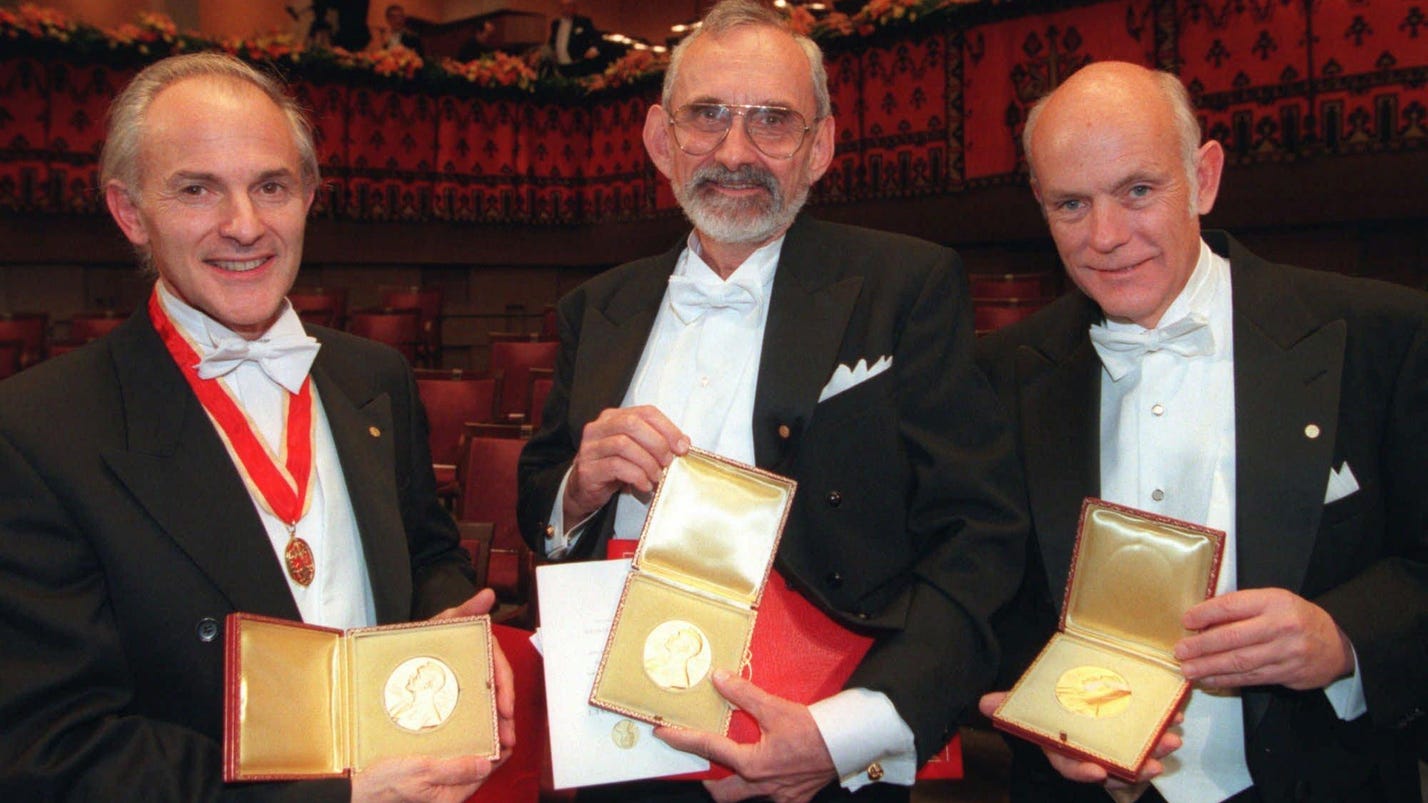
50 Renowned Academics Speaking About God (Part 1)

Another 50 Renowned Academics Speaking About God (Part 2)

A Further 50 Renowned Academics Speaking About God (Part 3)

__

Quote from Bertrand Russell:

Q: Why are you not a Christian?

Russell: Because I see no evidence whatever for any of the Christian dogmas. I’ve examined all the stock arguments in favor of the existence of God, and none of them seem to me to be logically valid.

Q: Do you think there’s a practical reason for having a religious belief, for many people?

Russell: Well, there can’t be a practical reason for believing what isn’t true. That’s quite… at least, I rule it out as impossible. Either the thing is true, or it isn’t. If it is true, you should believe it, and if it isn’t, you shouldn’t. And if you can’t find out whether it’s true or whether it isn’t, you should suspend judgment. But you can’t… it seems to me a fundamental dishonesty and a fundamental treachery to intellectual integrity to hold a belief because you think it’s useful, and not because you think it’s true._


From WHATEVER HAPPENED TO THE HUMAN RACE?

The Unveiling of Truth
The famous Hindu writer and statesman Sarvepalli Radhakrishnan once wrote, “The altars erected to the unknown gods in the Graeco-Roman world were but an expression of man’s ignorance of the divine nature. The sense of failure in man’s quest for the unseen is symbolized by them. When asked to define the nature of God, the seer of the Upanishad sat silent, and when pressed to answer claimed that the Absolute is silence.”
By contrast, the Apostle Paul, speaking in the context of the very same altars to unknown gods in Athens, said, “…Now what you worship as something unknown I am going to proclaim to you” (Acts 17:23). And again, writing to the Corinthians not far away, “However, as it is written: `No eye has seen, nor ear has heard, no mind has conceived …’ but God has revealed it to us …” (1 Corinthians 2:9,10). This claim is common to the whole Bible. God has not waited for us to stumble to Him in the dark (which would be impossible anyway), but has revealed Himself to us. The word revelation in Greek is apokalupsis which means literally “unveiling”; so God has “unveiled” to us the things we could not know because of our finiteness and sin.
This revelation or unveiling to finite and sinful people is the Bible as the written Word. This is the claim of the whole Bible. Moreover, through the Bible we learn of the life and teaching of the Second Person of the Trinity, who became man at a point in history and so became the Living Word of the Godhead: “For in Christ all the fullness of the Deity lives in bodily form” (Colossians 2:9).
In this claim the dilemma of all humanistic systems is overcome at a stroke. The infinite God has spoken. None of the many finite attempts to define truth, doomed to failure as we have seen, is necessary. God has communicated to man, the infinite to the finite. God has communicated, in addition, in words that are understandable to us. The One who made man capable of language in the first place has communicated to man in language. Also, God has communicated truth about both spiritual reality and physical reality, about both the nature of God and the nature of man, about both events in past history and events in the future. Where all humanistic systems of thought are unable to give an adequate explanation of things, the Bible as God’s statement is adequate.
It is equally important to note that the Bible’s answer does not have to be believed blindly. There are good and sufficient reasons for seeing that it is true. It is the key that fits into the lock of what we know best about ourselves and the universe around us.
To change the metaphor: Imagine a book which has been mutilated, leaving just one inch of printed matter on each page. Although it would obviously be impossible to piece together and understand the book’s story, few people would imagine that the printing which was left on those one-inch portions had come together by chance. However, if the torn pieces of each page were found in a trunk and were added in the right places, then the story could be read and would make sense.
So it is with Christianity. The ripped pages remaining in the book correspond to the universe and its form and to the mannishness of man. The parts of the pages discovered in the trunk correspond to the Scriptures, which are God’s propositional communication to mankind. Neither the universe nor personality can give the answer to the whole meaning of the created order. Yet both are important as a testimony in helping us know that the Scriptures, God’s communication to man, are what they claim to be. The question is whether the communication given by God completes and explains the portions we had before and especially whether it explains what was open to observation before (though without an explanation), that is, that the existence of the universe and its form and the mannishness of man are not just chance configurations of the printer’s scrambled type.
This illustration is important for several reasons. First, it emphasizes that Christians do not start out from themselves autonomously, as the humanists try to do. God gives the pages, and thus God gives the answers.
Second, it helps us see the proper place of man’s reason. Just as a scientist does not create the order in the universe but does recognize it, so reason does not create the answer but simply recognizes it. Of course this does not mean that reason will necessarily receive the answer. Each person has to choose to receive God’s truth. But God’s truth is clear. The individual must acknowledge that he (and mankind) is not autonomous, not the center of all things, and he must acknowledge that he has many times done what he knows to be wrong and thus needs the work of Christ for himself. Those who refuse to back down from the position of autonomy make it impossible for themselves to receive the truth, even though there are good and sufficient reasons for knowing that it is the truth.

_________________

Now to pages 119 to 123 of THE GOD WHO IS THERE in chapter 5 (How Do We Know It Is True?) of section three (How Historic Christianity Differs from the New Theology).


All men on their own level face a problem. Confronted with the existence and form of the external universe and the “mannishness” of man, how does it fit together, and what sense does it make?

(Then Schaeffer goes on and talks about propositional communication from the personal God before us, not only the things of the cosmos and history match up… a moral absolute and morals; the universal point of reference and the particulars, and the emotional and aesthetic realities of man as well.)


The Nature of Proof

In dealing with the question of proof which has been raised by the illustration of the book, I want to suggest that scientific proof, philosophical proof and religious proof follow the same rules. We may have any problem before us which we wish to solve; it may concern a chemical reaction or the meaning of man. After the question has been defined, in each case proof consists of two steps:

A. The theory must be non-contradictory and must give an answer to the phenomenon in question.

B. We must be able to live consistently with our theory.

…Then there is the negative consideration. After a careful definition has weeded out the trivial, the other possible answers that do not involve a mystical leap of faith are of the following nature:

  1. That the impersonal plus time plus chance have produced a personal man. But this theory is against all experience and thus usually the advocates of this theory end with a leap of faith, often hidden by connotation words.
  2. That man is not personal, but dead;that he is in reality a machine, and therefore personality is an illusion. This theory could fit the first criterion of being non-contradictory, but it will not fit the second, for man simply cannot life as though he were a machine. This may be observed as far back in the history of man as we have evidence–for example, from the art and artifacts of the caves or from man’s burial rites….Although man may say that he is no more than a machine, his whole life denies it.
  3. That in the future man will find another reasonable answer. Firstly, this could be said about any answer to anything and would bring all thought and science to an end. It must be seen to be an evasion and an especially weak reply if the person using it applies it only to this one question. Secondly, no one can live with this answer, for it simply is not possible to hold one’s breath and wait until some solution is found in the future. Continually the individual makes moral judgments which affect himself and others, and he must be using some working hypothesis from which to start. Thus, if a person offers this seriously as an alternative theory, he should be prepared to go into deep freeze and stop making judgments which touch on the problem of man. Bertrand Russell, for example, should have stopped making sociological decisions which involved others. This position is only possible if one stops the clock.
  4.  That the scientific theory of relativity may in the future prove to be a sufficient answer for human life. But the scientific theory of relativity cannot be applied to human life in this way. The scientific theory is constantly being tested, both as a theory and by measurement. Therefore it does not mean that “anything goes,” as it does when relativity is applied to human values. Moreover, in science the speed of light in a vacuum is considered an absolute standard. Therefore, scientific relativity does not imply that all scientific laws are in a constant state of flux. To use scientific relativity to buttress the concept of relativity in regard to human life and human values is completely invalid.

Image result for francis schaeffer

I mailed this above to a professor that I have a lot of respect for and asked a few questions and he gave me permission to post this response of his:

Dear Everette,

Thanks. I found the quote and I believe what Schaeffer says according to the context is generally as you suggest, namely that


“Bertrand Russell has taken the position that we cannot know anything is true unless there is an absolute and since Russell does not have one then he should be quiet. Or is Schaeffer saying that Russell has taken the position that we don’t have a unified field of knowledge but one day we will so Russell should shut up today?”—so, actually I think it is both, but in this context the focus is on the later.


Schaeffer is dealing with the matter of epistemology and claims that what is accepted under the naturalistic view of things one cannot know what is right or wrong for others and yet he finds himself prone to making such moral judgements. That is, the naturalist has no explanation for the way life is—the way man is, that he has moral motions. Schaeffer points out that: “continually the individual makes moral judgements which affect himself and others, and he must be using some working hypothesis from which to start.” But the naturalists (including Russell) have nothing but a chemically determinism as their starting hypothesis. On this view of things, they have no starting point by which to make moral judgments, and yet they do. If the naturalist agrees that currently their vision of reality denies them any basis on which to make moral judgements of others, but claim that in the future they will have a vision of reality that allows him to make judgements consistently, Schaeffer says he should remain silent until that day comes  (that is what he means by “hold their breath”). So, I think you are right by offering both alternatives as they are not mutually exclusive, but actually the second is entailed in the first. It is both that the vision of reality proposed by the naturalist does not allow him to make moral judgements on others, and if he agrees his present view of reality is inconsistent with the way life is, but in the future he will have an answer, then Schaeffer says that he must remain silent. He puts Russell and Skinner in the same inconsistent circle of thinking.


I think Schaeffer is right on this.


Thanks for the question. I hope this helps.

(End of Professor’s response )


——


Image result for bertrand russell

[From a letter dated August 11, 1918 to Miss Rinder when Russell was 46]

It is so with all who spend their lives in the quest of something elusive, and yet omnipresent, and at once subtle and infinite. One seeks it in music, and the sea, and sunsets; at times I have seemed very near it in crowds when I have been feeling strongly what they were feeling; one seeks it in love above all. But if one lets oneself imagine one has found it, some cruel irony is sure to come and show one that it is not really found.
The outcome is that one is a ghost, floating through the world without any real contact. Even when one feels nearest to other people, something in one seems obstinately to belong to God and to refuse to enter into any earthly communion—at least that is how I should express it if I thought there was a God. It is odd isn’t it? I care passionately for this world, and many things and people in it, and yet…what is it all? There must be something more important, one feels, though I don’t believe there is. I am haunted—some ghost, from some extra-mundane region, seems always trying to tell me something that I am to repeat to the world, but I cannot understand the message. 

There was evidence during Bertrand Russell’s own life that indicated that the Bible was true and could be trusted.

Here is some below:

TRUTH AND HISTORY (chapter 5 of WHATEVER HAPPENED TO THE HUMAN RACE?, under footnotes #97 and #98) written by Francis Schaeffer and C. Everett Koop

A common assumption among liberal scholars is that because the Gospels are theologically motivated writings–which they are–they cannot also be historically accurate. In other words, because Luke, say (when he wrote the Book of Luke and the Book of Acts), was convinced of the deity of Christ, this influenced his work to the point where it ceased to be reliable as a historical account. The assumption that a writing cannot be both historical and theological is false.

The experience of the famous classical archaeologist Sir William Ramsay illustrates this well. When he began his pioneer work of exploration in Asia Minor, he accepted the view then current among the Tubingen scholars of his day that the Book of Acts was written long after the events in Paul’s life and was therefore historically inaccurate. However, his travels and discoveries increasingly forced upon his mind a totally different picture, and he became convinced that Acts was minutely accurate in many details which could be checked.


Image result for bertrand russell

Bertrand Russell pictured above and Francis Schaeffer below:

Image result for francis schaeffer

Francis Schaeffer noted in his book HOW SHOULD WE THEN LIVE? (p. 182 in Vol 5 of Complete Works) in the chapter The Breakdown in Philosophy and Science:

In his lecture at Acapulco, George Wald finished with only one final value. It was the same one with which English philosopher Bertrand Russell (1872-1970) was left. For Wald and Russell and for many other modern thinkers, the final value is the biological continuity of the human race. If this is the only final value, one is left wondering why this then has importance. 

Now having traveled from the pride of man in the High Renaissance and the Enlightenment down to the present despair, we can understand where modern people are. They have no place for a personal God. But equally they have no place for man as man, or for love, or for freedom, or for significance. This brings a crucial problem. Beginning only from man himself, people affirm that man is only a machine. But those who hold this position cannot live like machines! If they could, there would have been no tensions in their intellectual position or in their lives. But even people who believe they are machines cannot live like machines, and thus they must “leap upstairs” against their reason and try to find something which gives meaning to life, even though to do so they have to deny their reason. 

Francis Schaeffer in another place worded it like this:

The universe was created by an infinite personal God and He brought it into existence by spoken word and made man in His own image. When man tries to reduce [philosophically in a materialistic point of view] himself to less than this [less than being made in the image of God] he will always fail and he will always be willing to make these impossible leaps into the area of nonreason even though they don’t give an answer simply because that isn’t what he is. He himself testifies that this infinite personal God, the God of the Old and New Testament is there. 

We all know deep down that God exists and even atheists have to grapple with that knowledge.

Solomon wisely noted in Ecclesiastes 3:11 “God has planted eternity in the heart of men…” (Living Bible). No wonder Bertrand Russell wrote in his autobiography, “It is odd, isn’t it? I feel passionately for this world and many things and people in it, and yet…what is it all? There must be something more important, one feels, though I don’t believe there is. I am haunted. Some ghosts, for some extra mundane regions, seem always trying to tell me something that I am to repeat to the world, but I cannot understand that message.”

Take a look at this 7th episode from Schaeffer’s series “HOW SHOULD WE THEN LIVE? The Age of Nonreason”:

How Should We Then Live – Episode Seven – 07 – Portuguese Subtitles

_

Instead of making a leap into the area of nonreason the better choice would be to investigate the claims that the Bible is a historically accurate book and that God created the universe and reached out to humankind with the Bible.

Schaeffer then points to the historical accuracy of the Bible in Chapter 5 of the book WHATEVER HAPPENED TO THE HUMAN RACE?

The Bible and Archaeology – Is the Bible from God? (Kyle Butt 42 min)

You want some evidence that indicates that the Bible is true? Here is a good place to start and that is taking a closer look at the archaeology of the Old Testament times. Is the Bible historically accurate? Here are some of the posts I have done in the past on the subject: 1. The Babylonian Chronicleof Nebuchadnezzars Siege of Jerusalem2. Hezekiah’s Siloam Tunnel Inscription. 3. Taylor Prism (Sennacherib Hexagonal Prism)4. Biblical Cities Attested Archaeologically. 5. The Discovery of the Hittites6.Shishak Smiting His Captives7. Moabite Stone8Black Obelisk of Shalmaneser III9A Verification of places in Gospel of John and Book of Acts., 9B Discovery of Ebla Tablets10. Cyrus Cylinder11. Puru “The lot of Yahali” 9th Century B.C.E.12. The Uzziah Tablet Inscription13. The Pilate Inscription14. Caiaphas Ossuary14 B Pontius Pilate Part 214c. Three greatest American Archaeologists moved to accept Bible’s accuracy through archaeology.

____


Related posts:


RESPONDING TO HARRY KROTO’S BRILLIANT RENOWNED ACADEMICS!! Pausing to take a look at the life of HARRY KROTO Part C (Kroto’s admiration of Bertrand Russell examined)

Today we look at the 3rd letter in the Kroto correspondence and his admiration of Bertrand Russell. (Below The Nobel chemistry laureates Harold Kroto, Robert Curl and Richard Smalley) It is with sadness that I write this post having learned of the death of Sir Harold Kroto on April 30, 2016 at the age of […]

RESPONDING TO HARRY KROTO’S BRILLIANT RENOWNED ACADEMICS!! Part 52 The views of Hegel and Bertrand Russell influenced Gareth Stedman Jones of Cambridge!!

On November 21, 2014 I received a letter from Nobel Laureate Harry Kroto and it said: …Please click on this URL http://vimeo.com/26991975 and you will hear what far smarter people than I have to say on this matter. I agree with them. Harry Kroto _________________ Below you have picture of Dr. Harry Kroto:   Gareth Stedman […]

WOODY WEDNESDAY John Piippo makes the case that Bertrand Russell would have loved Woody Allen because they both were atheists who don’t deny the ramifications of atheism!!!

Top 10 Woody Allen Movies __________ John Piippo makes the case that Bertrand Russell would have loved Woody Allen because they both were  atheists who don’t deny the ramifications of atheism!!! Monday, August 06, 2012 (More On) Woody Allen’s Atheism As I wrote in a previous post, I like Woody Allen. I have long admired his […]

John Piippo makes the case that Bertrand Russell would have loved Woody Allen because they both were two atheists who don’t deny the ramifications of atheism!!!

______ Top 10 Woody Allen Movies PBS American Masters – Woody Allen A Documentary 01 PBS American Masters – Woody Allen A Documentary 02 __________ John Piippo makes the case that Bertrand Russell would have loved Woody Allen because they both were two atheists who don’t deny the ramifications of atheism!!! Monday, August 06, 2012 […]

Bertrand Russell v. Frederick Copleston debate transcript (Part 4)

THE MORAL ARGUMENT     BERTRAND RUSSELL But aren’t you now saying in effect, I mean by God whatever is good or the sum total of what is good — the system of what is good, and, therefore, when a young man loves anything that is good he is loving God. Is that what you’re […]

Bertrand Russell v. Frederick Copleston debate transcript (Part 3)

Great debate Fr. Frederick C. Copleston vs Bertrand Russell – Part 1 Uploaded by riversonthemoon on Jul 15, 2009 BBC Radio Third Programme Recording January 28, 1948. BBC Recording number T7324W. This is an excerpt from the full broadcast from cassette tape A303/5 Open University Course, Problems of Philosophy Units 7-8. Older than 50 years, […]

Bertrand Russell v. Frederick Copleston debate transcript and audio (Part 2)

Uploaded by riversonthemoon on Jul 15, 2009 BBC Radio Third Programme Recording January 28, 1948. BBC Recording number T7324W. This is an excerpt from the full broadcast from cassette tape A303/5 Open University Course, Problems of Philosophy Units 7-8. Older than 50 years, out of UK/BBC copyright. Pardon the hissy audio. It was recorded 51 […]

Bertrand Russell v. Frederick Copleston debate transcript and audio (Part 1)

Fr. Frederick C. Copleston vs Bertrand Russell – Part 1 Uploaded by riversonthemoon on Jul 15, 2009 BBC Radio Third Programme Recording January 28, 1948. BBC Recording number T7324W. This is an excerpt from the full broadcast from cassette tape A303/5 Open University Course, Problems of Philosophy Units 7-8. Older than 50 years, out of […]

Bertrand Russell v. Frederick Copleston debate transcript (Part 4)

THE MORAL ARGUMENT     BERTRAND RUSSELL But aren’t you now saying in effect, I mean by God whatever is good or the sum total of what is good — the system of what is good, and, therefore, when a young man loves anything that is good he is loving God. Is that what you’re […]

Bertrand Russell v. Frederick Copleston debate transcript (Part 3)

Fr. Frederick C. Copleston vs Bertrand Russell – Part 1 Uploaded by riversonthemoon on Jul 15, 2009 BBC Radio Third Programme Recording January 28, 1948. BBC Recording number T7324W. This is an excerpt from the full broadcast from cassette tape A303/5 Open University Course, Problems of Philosophy Units 7-8. Older than 50 years, out of […]