Category Archives: Francis Schaeffer

“Truth Tuesday” Taking on Ark Times Bloggers on the “Absurdity of Life without God!!” Part 18 (More evidence that indicates the Bible is historically true)

Is the Bible historically accurate? Here are some of the posts I have done in the past on the subject: 1. The Babylonian Chronicleof Nebuchadnezzars Siege of Jerusalem2. Hezekiah’s Siloam Tunnel Inscription. 3. Taylor Prism (Sennacherib Hexagonal Prism)4. Biblical Cities Attested Archaeologically. 5. The Discovery of the Hittites6.Shishak Smiting His Captives7. Moabite Stone8Black Obelisk of Shalmaneser III9A Verification of places in Gospel of John and Book of Acts., 9B Discovery of Ebla Tablets10. Cyrus Cylinder11. Puru “The lot of Yahali” 9th Century B.C.E.12. The Uzziah Tablet Inscription13. The Pilate Inscription14. Caiaphas Ossuary14 B Pontius Pilate Part 214c. Three greatest American Archaeologists moved to accept Bible’s accuracy through archaeology.

The Bible and Archaeology – Is the Bible from God? (Kyle Butt 42 min)

Why Can’t Morals Be Grounded In Society?

Published on Aug 31, 2012

Dr William Lane Craig was invited by the School of Oriental and African Studies (SOAS) Christian Union, London to give a lecture titled “Can we be good without God?” In this video Dr Craig answers a question about the objectivity of morality. Should we consider morals to be objective? If so, why can’t morals be “abiding” and objectively grounded in society?

The lecture formed part of the Reasonable Faith Tour in October 2011. The Tour was sponsored by Damaris Trust, UCCF and Premier Christian Radio.

The entire lecture “Can We Be Good Without God” can be viewed here: http://youtu.be/jzlEnrJfDBc

For more resources visit Dr Craig’s website: http://www.reasonablefaith.org

We welcome your comments in the Reasonable Faith forums:
http://www.reasonablefaith.org/forums/

Be sure to visit both of our Youtube channels for more videos:
youtube.com/reasonablefaithorg and youtube.com/drcraigvideos

More videos from the tour can be viewed at: http://www.youtube.com/user/Reasonabl…

____________________________________

Dr. Francis schaeffer – The flow of Materialism

(Samuel Beckett example: Life is  meaningless, live in tension with reality)

(Modern man sees no hope for the future and has deluded himself by appealing to nonreason to stay sane. Look at the example of the lady tied to the railroad tracks in this above video as a example.)

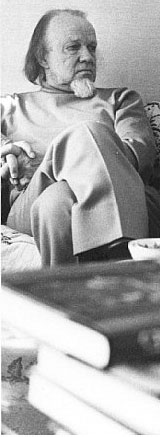
Francis and Edith Schaeffer pictured below:

HOW SHOULD WE THEN LIVE? was both a book and a film series.

______________

_________________

Life without God in the picture is absurdity!!!. That was the view of King Solomon when he wrote the Book of Ecclesiastes 3000 years ago and it is the view of many of the modern philosophers todayModern man has tried to come up with a lasting meaning for life without God in the picture (life under the sun), but it is not possible. Without the infinite-personal God of the Bible to reveal moral absolutes then man is left to embrace moral relativism. In a time plus chance universe man is reduced to a machine and can not find a place for values such as love. Both of Francis Schaeffer’s film series have tackled these subjects and he shows how this is reflected in the arts.

Here are some posts I have done on the series “HOW SHOULD WE THEN LIVE? : Francis Schaeffer’s “How should we then live?” Video and outline of episode 10 “Final Choices” episode 9 “The Age of Personal Peace and Affluence”episode 8 “The Age of Fragmentation”episode 7 “The Age of Non-Reason” episode 6 “The Scientific Age”  episode 5 “The Revolutionary Age” episode 4 “The Reformation” episode 3 “The Renaissance”episode 2 “The Middle Ages,”, and  episode 1 “The Roman Age,” .

In the film series “WHATEVER HAPPENED TO THE HUMAN RACE?” the arguments are presented  against abortion (Episode 1),  infanticide (Episode 2),   euthenasia (Episode 3), and then there is a discussion of the Christian versus Humanist worldview concerning the issue of “the basis for human dignity” in Episode 4 and then in the last episode a close look at the truth claims of the Bible.

I have discussed many subjects with my liberal friends over at the Ark Times Blog in the past and I have taken them on now on the subject of the absurdity of life without God in the picture. Most of my responses included quotes from William Lane Craig’s book THE ABSURDITY OF LIFE WITHOUT GOD.  Here is the result of one of those encounters from June of 2013:

I wrote:

DeathByInches wrote that “there’s zero proof that we do anything except cease living when we die.”

There is plenty of evidence that there is an afterlife. The Bible has lots of evidence showing it is God’s revealed word to us and this has been demonstrated over and over again because of the historical records that show that many of the prophecies of the Bible have already been fulfilled in the past. If it can be shown that the Bible is God’s inerrant word then there is an afterlife. DO WE AGREE ON THAT?

Here is a post that I am quoting from:

https://thedailyhatch.org/2013/06/24/the-ol…

___________

Let’s take a look at a few Bible prophecies that were fulfilled about 2500 years ago when the ancient kingdoms and cities of Babylon, Nineveh, Tyre and Edom were destroyed. The Bible makes the assertion that these entities were destroyed because they had sought to destroy the Holy Land of Israel and the people of Israel (the Jews).

Babylon Will Rule Over Judah for 70 Years
You can read the first such prophecy in Jeremiah 25:11-12. This prophecy was written sometime from 626 to about 586 BC and was not fulfilled until about 609 BC to 539 BC (approximately 50 years later, depending on your calculation)

Babylon’s Gates Will Open for Cyrus
If you read Isaiah 45:1 (written perhaps between 701 and 681 BC), you will find a prophecy that was ultimately fulfilled hundreds of years later in 539 BC.

Babylon’s Kingdom Will Be Permanently Overthrown
In Isaiah 13:19 (written between 701 and 681 BC) there exists yet another prophecy that was not fulfilled until 539 BC.

Isaiah 13:19
Babylon, the jewel of kingdoms, the glory of the Babylonians’ pride, will be overthrown by God like Sodom and Gomorrah.

Babylon Will Be Reduced to Swampland
In Isaiah 14:23 (written between 701 and 681 BC), the prophet makes yet another prediction that does not come true until 539 BC.

Isaiah 14:23
“I will turn her into a place for owls and into swampland; I will sweep her with the broom of destruction,” declares the Lord Almighty.

The Jews Will Survive Babylonian Rule and Return Home
In Jeremiah 32:36-37, (written from about 626 and 586 BC), yet another prophet makes a bold prediction that was ultimately fulfilled in 536 BC.

Nineveh Will Be Destroyed By Fire
Once again, in Nahum 3:15 (written around 614 BC) the prophet makes a prediction which ultimately did come true.

Nahum 3:15
There the fire will devour you; the sword will cut you down and, like grasshoppers, consume you…

Tyre Will Be Attacked By Many Nations
In Ezekiel 26:3 (written between 587-586 BC) the prophet predicts the attacks on Tyre that occurred in 573 BC, 332 BC, and 1291 AD.

Ezekiel 26:3
therefore this is what the Sovereign Lord says: I am against you, O Tyre, and I will bring many nations against you, like the sea casting up its waves.

The prophet said that Tyre, the Phoenician Empire’s most powerful city, would be attacked by many nations, because of its treatment of Israel. At about the time that Ezekiel delivered this prophecy, Babylon had begun a 13-year attack on Tyre’s mainland. Later, in about 332 BC, Alexander the Great conquered the island of Tyre and brought an end to the Phoenician Empire. Then, after that, Tyre later fell again under the rule of the Romans, the Crusaders and the Moslems, who destroyed the city yet again, in 1291!

Tyre’s Stones, Timber and Soil Will Be Cast Into the Sea
In a remarkable prediction, the prophet writes in Ezekiel 26:12 (written between 587-586 BC) that the stone, timber and soil of Tyre will be thrown into the sea! This was fulfilled in 333-332 BC.

Ezekiel 26:12
They will plunder your wealth and loot your merchandise; they will break down your walls and demolish your fine houses and throw your stones, timber and rubble into the sea.

The prophet said that Tyre’s stones, timber and soil would be thrown into the sea. That’s probably a fitting description of how Alexander the Great built a land bridge from the mainland to the island of Tyre when he attacked in 333-332 BC. It is believed that he took the rubble from Tyre’s mainland ruins and tossed it – stones, timber and soil – into the sea, to build the land bridge (which is still there).

The Jews Will Avenge the Edomites
In Ezekiel 25:14 (written between 593-571 BC), the prophet predicts that the Jews will eventually have revenge against the Edomites. This was not fulfilled, however for over 400 years (until approximately 100 BC)

Edom Will Be Toppled and Humbled
In Jeremiah 49:16 (written sometime from 626 to about 586 BC) the prophet predicts that Edom will be toppled. This was fulfilled in approximately 100 BC:

________________

The Old Testament prophecies in Isaiah 53 and Psalms 22 are powerful and as are the ones in Daniel 2, 7-11.

These are researchable. I understand how skeptics love to take pot shots at the Bible, but let us take a look at some of the facts.

Craig L. Blomberg records a number of archaeological finds that coincide with events recorded in the gospel according to John:

Archaeologists have unearthed the five porticoes of the pool of Bethesda by the Sheep Gate (John 5:2), the pool of Siloam (9:1-7), Jacob’s well at Sychar (4:5), the ‘Pavement’ (Gabbatha) where Pilate tried Jesus (19:13), and Solomon’s porch in the temple precincts (10:22-23)… Since then, discovery of an ossuary (bone-box) of a crucified man named Johanan from first-century Palestine confirms that nails were driven in his ankles, as in Christ’s; previously some skeptics thought that the Romans used only ropes to affix the legs of condemned men to their crosses. And less than five years ago, in 1990, the burial grounds of Caiaphas, the Jewish high priest, and his family were uncovered in Jerusalem. These and numerous other details create a favorable impression of the Gospel’s trustworthiness in the areas in which they can be tested.

Sir William Ramsay, famed archaeologist, began a study of Asia Minor with little regard for the book of Acts. He later wrote:

I may fairly claim to have entered on this investigation without prejudice in favor of the conclusion which I shall now seek to justify to the reader. On the contrary, I began with a mind unfavorable to it,… It did not then lie in my line of life to investigate the subject minutely; but more recently I found myself brought into contact with the Book of Acts as an authority for the topography, antiquities and society of Asia Minor. It was gradually borne upon me that in various details the narrative showed marvelous truth.

Related posts:

Francis Schaeffer’s “How should we then live?” Video and outline of episode 10 “Final Choices” (Schaeffer Sundays)

E P I S O D E 1 0   Dr. Francis Schaeffer – Episode X – Final Choices 27 min FINAL CHOICES I. Authoritarianism the Only Humanistic Social Option One man or an elite giving authoritative arbitrary absolutes. A. Society is sole absolute in absence of other absolutes. B. But society has to be […]

Francis Schaeffer’s “How should we then live?” Video and outline of episode 9 “The Age of Personal Peace and Affluence” (Schaeffer Sundays)

E P I S O D E 9 Dr. Francis Schaeffer – Episode IX – The Age of Personal Peace and Affluence 27 min T h e Age of Personal Peace and Afflunce I. By the Early 1960s People Were Bombarded From Every Side by Modern Man’s Humanistic Thought II. Modern Form of Humanistic Thought Leads […]

Francis Schaeffer’s “How should we then live?” Video and outline of episode 8 “The Age of Fragmentation” (Schaeffer Sundays)

E P I S O D E 8 Dr. Francis Schaeffer – Episode VIII – The Age of Fragmentation 27 min I saw this film series in 1979 and it had a major impact on me. T h e Age of FRAGMENTATION I. Art As a Vehicle Of Modern Thought A. Impressionism (Monet, Renoir, Pissarro, Sisley, […]

Francis Schaeffer’s “How should we then live?” Video and outline of episode 7 “The Age of Non-Reason” (Schaeffer Sundays)

E P I S O D E 7 Dr. Francis Schaeffer – Episode VII – The Age of Non Reason I am thrilled to get this film series with you. I saw it first in 1979 and it had such a big impact on me. Today’s episode is where we see modern humanist man act […]

Francis Schaeffer’s “How should we then live?” Video and outline of episode 6 “The Scientific Age” (Schaeffer Sundays)

E P I S O D E 6 How Should We Then Live 6#1 Uploaded by NoMirrorHDDHrorriMoN on Oct 3, 2011 How Should We Then Live? Episode 6 of 12 ________ I am sharing with you a film series that I saw in 1979. In this film Francis Schaeffer asserted that was a shift in […]

Francis Schaeffer’s “How should we then live?” Video and outline of episode 5 “The Revolutionary Age” (Schaeffer Sundays)

E P I S O D E 5 How Should We Then Live? Episode 5: The Revolutionary Age I was impacted by this film series by Francis Schaeffer back in the 1970′s and I wanted to share it with you. Francis Schaeffer noted, “Reformation Did Not Bring Perfection. But gradually on basis of biblical teaching there […]

Francis Schaeffer’s “How should we then live?” Video and outline of episode 4 “The Reformation” (Schaeffer Sundays)

Dr. Francis Schaeffer – Episode IV – The Reformation 27 min I was impacted by this film series by Francis Schaeffer back in the 1970′s and I wanted to share it with you. Schaeffer makes three key points concerning the Reformation: “1. Erasmian Christian humanism rejected by Farel. 2. Bible gives needed answers not only as to […]

“Schaeffer Sundays” Francis Schaeffer’s “How should we then live?” Video and outline of episode 3 “The Renaissance”

Francis Schaeffer’s “How should we then live?” Video and outline of episode 3 “The Renaissance” Francis Schaeffer: “How Should We Then Live?” (Episode 3) THE RENAISSANCE I was impacted by this film series by Francis Schaeffer back in the 1970′s and I wanted to share it with you. Schaeffer really shows why we have so […]

Francis Schaeffer’s “How should we then live?” Video and outline of episode 2 “The Middle Ages” (Schaeffer Sundays)

  Francis Schaeffer: “How Should We Then Live?” (Episode 2) THE MIDDLE AGES I was impacted by this film series by Francis Schaeffer back in the 1970′s and I wanted to share it with you. Schaeffer points out that during this time period unfortunately we have the “Church’s deviation from early church’s teaching in regard […]

Francis Schaeffer’s “How should we then live?” Video and outline of episode 1 “The Roman Age” (Schaeffer Sundays)

Francis Schaeffer: “How Should We Then Live?” (Episode 1) THE ROMAN AGE   Today I am starting a series that really had a big impact on my life back in the 1970′s when I first saw it. There are ten parts and today is the first. Francis Schaeffer takes a look at Rome and why […]

Francis Schaeffer: “Whatever Happened to the Human Race” (Episode 5) TRUTH AND HISTORY

Francis Schaeffer: “Whatever Happened to the Human Race” (Episode 5) TRUTH AND HISTORY Published on Oct 7, 2012 by AdamMetropolis This crucial series is narrated by the late Dr. Francis Schaeffer and former Surgeon General Dr. C. Everett Koop. Today, choices are being made that undermine human rights at their most basic level. Practices once […]

Francis Schaeffer: “Whatever Happened to the Human Race” (Episode 4) THE BASIS FOR HUMAN DIGNITY

The opening song at the beginning of this episode is very insightful. Francis Schaeffer: “Whatever Happened to the Human Race” (Episode 4) THE BASIS FOR HUMAN DIGNITY Published on Oct 7, 2012 by AdamMetropolis This crucial series is narrated by the late Dr. Francis Schaeffer and former Surgeon General Dr. C. Everett Koop. Today, choices […]

Francis Schaeffer: “Whatever Happened to the Human Race” (Episode 3) DEATH BY SOMEONE’S CHOICE

Francis Schaeffer: “Whatever Happened to the Human Race” (Episode 3) DEATH BY SOMEONE’S CHOICE Published on Oct 6, 2012 by AdamMetropolis This crucial series is narrated by the late Dr. Francis Schaeffer and former Surgeon General Dr. C. Everett Koop. Today, choices are being made that undermine human rights at their most basic level. Practices […]

Francis Schaeffer: “Whatever Happened to the Human Race?” (Episode 2) SLAUGHTER OF THE INNOCENTS

Francis Schaeffer: “Whatever Happened to the Human Race?” (Episode 2) SLAUGHTER OF THE INNOCENTS Published on Oct 6, 2012 by AdamMetropolis This crucial series is narrated by the late Dr. Francis Schaeffer and former Surgeon General Dr. C. Everett Koop. Today, choices are being made that undermine human rights at their most basic level. Practices […]

Francis Schaeffer: “Whatever Happened to the Human Race” (Episode 1) ABORTION OF THE HUMAN RACE

It is not possible to know where the pro-life evangelicals are coming from unless you look at the work of the person who inspired them the most. That person was Francis Schaeffer.  I do care about economic issues but the pro-life issue is the most important to me. Several years ago Adrian Rogers (past president of […]

Ecclesiastes, Purpose, Meaning, and the Necessity of God by Suiwen Liang (Quotes Will Durant, Madalyn Murray O’Hair, Stephen Jay Gould,Richard Dawkins, Jean-Paul Sartre,Bertrand Russell, Leo Tolstoy, Loren Eiseley,Aldous Huxley, G.K. Chesterton, Ravi Zacharias, and C.S. Lewis.)

Ecclesiastes 2-3 Published on Sep 19, 2012 Calvary Chapel Spring Valley | Sunday Evening | September 16, 2012 | Derek Neider _____________________________ I have written on the Book of Ecclesiastes and the subject of the meaning of our lives on several occasions on this blog. In this series on Ecclesiastes I hope to show how secular […]

Robert Leroe on Ecclesiastes (Mentions Thomas Aquinas, Princess Diana, Mother Teresa, King Solomon, King Rehoboam, Eugene Peterson, Chuck Swindoll, and John Newton.)

Ecclesiastes 1 Published on Sep 4, 2012 Calvary Chapel Spring Valley | Sunday Evening | September 2, 2012 | Pastor Derek Neider _____________________ I have written on the Book of Ecclesiastes and the subject of the meaning of our lives on several occasions on this blog. In this series on Ecclesiastes I hope to show how […]

Super Bowl, Black Eyed Peas, and the Meaning of Life and Ecclesiastes

Ecclesiastes 8-10 | Still Searching After All These Years Published on Oct 9, 2012 Calvary Chapel Spring Valley | Sunday Evening | October 7, 2012 | Pastor Derek Neider _______________________ Ecclesiastes 11-12 | Solomon Finds His Way Published on Oct 30, 2012 Calvary Chapel Spring Valley | Sunday Evening | October 28, 2012 | Pastor Derek Neider […]

Brian LePort on Ecclesiastes

Ecclesiastes 6-8 | Solomon Turns Over a New Leaf Published on Oct 2, 2012 Calvary Chapel Spring Valley | Sunday Evening | September 30, 2012 | Pastor Derek Neider _____________________ I have written on the Book of Ecclesiastes and the subject of the meaning of our lives on several occasions on this blog. In this series […]

J.W. Wartick on Ecclesiastes

Ecclesiastes 4-6 | Solomon’s Dissatisfaction Published on Sep 24, 2012 Calvary Chapel Spring Valley | Sunday Evening | September 23, 2012 | Pastor Derek Neider ___________________ I have written on the Book of Ecclesiastes and the subject of the meaning of our lives on several occasions on this blog. In this series on Ecclesiastes I hope […]

Overview of the Book of Ecclesiastes

Overview of the Book of Ecclesiastes Overview of the Book of EcclesiastesAuthor: Solomon or an unknown sage in the royal courtPurpose: To demonstrate that life viewed merely from a realistic human perspective must result in pessimism, and to offer hope through humble obedience and faithfulness to God until the final judgment.Date: 930-586 B.C. Ecclesiastes 2-3 Published on Sep 19, […]

Doy Moyer on the Book of Ecclesiastes and Apologetics

Ecclesiastes 1 Published on Sep 4, 2012 Calvary Chapel Spring Valley | Sunday Evening | September 2, 2012 | Pastor Derek Neider _____________________ I have written on the Book of Ecclesiastes and the subject of the meaning of our lives on several occasions on this blog. In this series on Ecclesiastes I hope to show how […]

Solomon was the author of Ecclesiastes

Ecclesiastes 8-10 | Still Searching After All These Years Published on Oct 9, 2012 Calvary Chapel Spring Valley | Sunday Evening | October 7, 2012 | Pastor Derek Neider _______________________ Ecclesiastes 11-12 | Solomon Finds His Way Published on Oct 30, 2012 Calvary Chapel Spring Valley | Sunday Evening | October 28, 2012 | Pastor Derek Neider […]

By Everette Hatcher III | Posted in Current Events | Edit | Comments (0)

“Schaeffer Sunday” Debating Kermit Gosnell Trial, Abortion and infanticide with Ark Times Bloggers Part 9 Owen Strachan: “The Gosnell murders reveal the evil heart that beats in the chest of our society”

C. Everett Koop, 1980s.jpg
Surgeon General of the United States
In office
January 21, 1982 – October 1, 1989
President Ronald Reagan
George H. W. Bush
Francis Schaeffer
Francis Schaeffer.jpg

Founder of the L’Abri community
Born Francis August Schaeffer
January 30, 1912

Died May 15, 1984 (aged 72)

I truly believe that many of the problems we have today in the USA are due to the advancement of humanism in the last few decades in our society. Ronald Reagan appointed the evangelical Dr. C. Everett Koop to the position of Surgeon General in his administration. He partnered with Dr. Francis Schaeffer in making the video below. It is very valuable information for Christians to have.  Actually I have included a video below that includes comments from him on this subject.

Dr. Francis Schaeffer: Whatever Happened to the Human Race Episode 1 ABORTION

Dr. Francis schaeffer – The flow of Materialism(from Part 4 of Whatever happened to human race?)

Dr. Francis Schaeffer – The Biblical flow of Truth & History (intro)

Francis Schaeffer – The Biblical Flow of History & Truth (1)

Dr. Francis Schaeffer – The Biblical Flow of Truth & History (part 2)

Francis Schaeffer “BASIS FOR HUMAN DIGNITY” Whatever…HTTHR

I have gone back and forth and back and forth with many liberals on the Arkansas Times Blog on many issues such as abortionhuman rightswelfarepovertygun control  and issues dealing with popular culture . This time around I have discussed morality with the Ark Times Bloggers and particularly the trial of the abortionist Dr. Kermit Gosnell and through that we discuss infanticide, abortion and even partial birth abortion. Here are some of my favorite past posts on the subject of Gosnell: ,Abby Johnson comments on Dr. Gosnell’s guilty verdict, Does President Obama care about Kermit Gosnell verdict?Dr. Gosnell Trial mostly ignored by mediaKermit Gosnell is guilty of same crimes of abortion clinics are says Jennifer MasonDenny Burk: Is Dr. Gosnell the usual case or not?, Pro-life Groups thrilled with Kermit Gosnell guilty verdict,  Reactions to Dr. Gosnell guilty verdict from pro-life leaders,  Kermit Gosnell and Planned Parenthood supporting infanticide?, Owen Strachan on Dr. Gosnell Trial, Al Mohler on Kermit Gosnell’s abortion practice, Finally we get justice for Dr. Kermit Gosnell .

In July of 2013 I went back and forth with several bloggers from the Ark Times Blog concerning Dr. Kermit Gosnell’s abortion practice and his trial which had finished up in the middle of May:

I don’t doubt you for a minute Olphart when you assert that “The genie will not go back into the bottle because women now enjoy reproductive freedom and they’re not about to give it up.”

You may be right on that but then it is showing how SELFISH AND NARCISSIST OUR COUNTRY HAS BECOME!!!!!

Owen Strachan observed:

If you missed it, the story is basically this: after months of complete inattention to the barbaric narrative of abortionist Kermit Gosnell, pro-life folks–including journalist Mollie Ziegler Hemingway, Lifesite.com leaders, and Eric Metaxas–decided to do their part to raise a ruckus. Gosnell gives us a window into the gruesome world of killing babies…

But here’s the thing to note: even if these abortions had happened in the tidiest manner possible, with swarms of smiling, bright-eyed attendants working in crystal-clean conditions and a long-established doctor with a warm bedside manner, they would be no less barbaric. Abortion, we are reminded, is barbaric. Strong word, this–barbaric. Yet it fits our society perfectly. We’re drunk on the fumes of our supposedly morally advanced society, our technology with its modern advances, our bright and pampered 21st-century world which seems the apotheosis of social Darwinism. We are the ones human history has been waiting for. We’re brighter, living longer, avoiding cataclysmic world wars, spreading democracy through virtual platforms, humane, tolerant, happy, and whole.

It’s this narrative, you see, that the Gosnell murders destroy. The Gosnell murders reveal the evil heart that beats in the chest of our society. They’re unusually sordid, but the practice at their core–abortion–is pure evil, the perfect flowering of an UNBRIDLED NARCISSISM. We’re patting ourselves on our backs, but our elegantly manicured hands have blood on them.

http://www.breakpoint.org/wvc-digest/featu…

A Twin Lives Through an Abortion – CBN.com

Uploaded on Jan 7, 2011

My name is Claire Culwell, and I am an abortion survivor…

__________

“Everyone needs to hear Claire’s story! Often times at pro-life events or banquets we can forget who is at stake in abortion. Claire’s passion reminds the audience that every life lost due to abortion cannot be taken back but every life saved from abortion is a profound witness of God’s hope and love for every human life. Having seen her speak multiple times, I know that Claire’s story captures an audience at a pregnancy center event like no other story because she is living proof of what we stand for, life!” –Shawn Carney, Co-founder 40 Days for Life, Host of Being Human on EWTN

Claire’s Story:

I found out I was affected by abortion about 3 years ago. This changed my life. I had walked into the Coalition For Life wondering what their organization provided and 5 months later I met my birth mother who told me my life is a miracle.

My birth mother was 13 years old at the time she became pregnant with me. Her mother took her straight to an abortion clinic where she had a surgical abortion. After thinking she had “fixed the problem,” a few weeks later she realized her belly was still growing. Her mother took her back to the abortion clinic where she learned that she had been pregnant with twins…One was aborted; One survived.

My life is a miracle and I would be selfish to keep this GIFT of life to myself. I want to tell everyone what a gift I and even they have been given!! I want to encourage them to seek alternatives to abortion because I would never want any woman/man to go through the grief and the pain that my birth mother went through simply because she didn’t know she had any other option. I also want to be a vessel to offer God’s forgiveness to the men and women who have previously had abortions. I know healing is possible and I have been given the gift of surviving an abortion so that I can tell these men and women that they are forgiven…coming from an aborted child, I hope they know the power of forgiveness and healing through meeting me. My involvement in Coalition For Life transformed me, taught me how to stand up for life on the front lines, and how to share my story in a meaningful way. I have the staff at Coalition For Life to thank for encouraging me to get involved and to share my story not only on the sidewalk but in public (my biggest fear) because God is glorified when I publically proclaim that “I am here not because of anything I did, but ONLY because of God’s mercy and love for me.”

My life is a testimony that there are wonderful alternatives to abortion (such as adoption in my case) and an accident/unwanted child still deserves life…even a child with disabilities. I was born 2 1/2 months early, weighed 3 lbs 2 oz, had dislocated hips and club feet. I had to wear casts on my feet, a harness and eventually a body cast. The abortion still affects me today. All that to say, LIFE IS STILL WORTH IT.If my life can touch just one person who has had an abortion or considering an abortion or adoption, then I am fulfilling my purpose in the pro-life movement.

I will not be silent because each mother and child are in the same place my biological mother, my twin and I were in 22 years ago and I am here to say THERE IS HOPE and there are options!

Traveling and sharing my story was not something that I had planned for myself, but God proved to have better plans for me than I had for myself. Sharing my story is as much of a gift to MYSELF as it is to others.

Related posts:

GBCSUMC on Gosnell: What’s abortion got to do with it? #UMC

Many in the world today are taking a long look at the abortion industry because of the May 14, 2013 guilty verdict and life term penalty handed down by a jury (which included 9 out of 12 pro-choice jurors)  to Dr. Kermit Gosnell. During this time of reflection I wanted to put forth some of the […]

Kermit Gosnell and the irony of the coat hanger back alley argument

Many in the world today are taking a long look at the abortion industry because of the May 14, 2013 guilty verdict and life term penalty handed down by a jury (which included 9 out of 12 pro-choice jurors)  to Dr. Kermit Gosnell. During this time of reflection I wanted to put forth some of the […]

History’s Jury Is Out: Has Gosnell Rocked Our Conscience?

Many in the world today are taking a long look at the abortion industry because of the May 14, 2013 guilty verdict and life term penalty handed down by a jury (which included 9 out of 12 pro-choice jurors)  to Dr. Kermit Gosnell. During this time of reflection I wanted to put forth some of the […]

Evangelical Blogger Lists Eight Reasons the Media Are Ignoring the Gosnell Murder Trial

Many in the world today are taking a long look at the abortion industry because of the May 14, 2013 guilty verdict and life term penalty handed down by a jury (which included 9 out of 12 pro-choice jurors)  to Dr. Kermit Gosnell. During this time of reflection I wanted to put forth some of the […]

Cornerstone Executive Ashley Pratte on Gosnell Trial Verdict

Many in the world today are taking a long look at the abortion industry because of the May 14, 2013 guilty verdict and life term penalty handed down by a jury (which included 9 out of 12 pro-choice jurors)  to Dr. Kermit Gosnell. During this time of reflection I wanted to put forth some of the […]

Dr. Gosnell Trial ignored for a while by mainstream media

Many in the world today are taking a long look at the abortion industry because of the May 14, 2013 guilty verdict and life term penalty handed down by a jury (which included 9 out of 12 pro-choice jurors)  to Dr. Kermit Gosnell. During this time of reflection I wanted to put forth some of the […]

ANALYSIS: Will the Kermit Gosnell verdict change the abortion debate?

Many in the world today are taking a long look at the abortion industry because of the May 14, 2013 guilty verdict and life term penalty handed down by a jury (which included 9 out of 12 pro-choice jurors)  to Dr. Kermit Gosnell. During this time of reflection I wanted to put forth some of the […]

What’s So Bad About Kermit Gosnell?

Many in the world today are taking a long look at the abortion industry because of the May 14, 2013 guilty verdict and life term penalty handed down by a jury (which included 9 out of 12 pro-choice jurors)  to Dr. Kermit Gosnell. During this time of reflection I wanted to put forth some of the […]

Kermit Gosnell and the Gospel

Many in the world today are taking a long look at the abortion industry because of the May 14, 2013 guilty verdict and life term penalty handed down by a jury (which included 9 out of 12 pro-choice jurors)  to Dr. Kermit Gosnell. During this time of reflection I wanted to put forth some of the […]

VIDEO: Kermit Gosnell killings like ‘weeding your garden’

Many in the world today are taking a long look at the abortion industry because of the May 14, 2013 guilty verdict and life term penalty handed down by a jury (which included 9 out of 12 pro-choice jurors)  to Dr. Kermit Gosnell. During this time of reflection I wanted to put forth some of the […]

Gosnell: The Silence is Deafening

Many in the world today are taking a long look at the abortion industry because of the May 14, 2013 guilty verdict and life term penalty handed down by a jury (which included 9 out of 12 pro-choice jurors)  to Dr. Kermit Gosnell. During this time of reflection I wanted to put forth some of the […]

Five Thoughts on the Gosnell Conviction

Many in the world today are taking a long look at the abortion industry because of the May 14, 2013 guilty verdict and life term penalty handed down by a jury (which included 9 out of 12 pro-choice jurors)  to Dr. Kermit Gosnell. During this time of reflection I wanted to put forth some of the […]

Implications of the Kermit Gosnell Verdict

Many in the world today are taking a long look at the abortion industry because of the May 14, 2013 guilty verdict and life term penalty handed down by a jury (which included 9 out of 12 pro-choice jurors)  to Dr. Kermit Gosnell. During this time of reflection I wanted to put forth some of the […]

Godly comments on Dr. Kermit Gosnell

Many in the world today are taking a long look at the abortion industry because of the May 14, 2013 guilty verdict and life term penalty handed down by a jury (which included 9 out of 12 pro-choice jurors)  to Dr. Kermit Gosnell. During this time of reflection I wanted to put forth some of the […]

Dr. Gosnell Trial has prompted closer look at Albuquerque abortion clinic

Many in the world today are taking a long look at the abortion industry because of the May 14, 2013 guilty verdict and life term penalty handed down by a jury (which included 9 out of 12 pro-choice jurors)  to Dr. Kermit Gosnell. During this time of reflection I wanted to put forth some of the […]

Why won’t President Obama comment on Dr. Gosnell Trial?

Many in the world today are taking a long look at the abortion industry because of the May 14, 2013 guilty verdict and life term penalty handed down by a jury (which included 9 out of 12 pro-choice jurors)  to Dr. Kermit Gosnell. During this time of reflection I wanted to put forth some of the […]

Dr. Alveda King reacts to guilty verdict of Kermit Gosnell

Francis Schaeffer: “Whatever Happened to the Human Race” (Episode 1) ABORTION OF THE HUMAN RACE Published on Oct 6, 2012 by AdamMetropolis ________________ What a great article below: Dr. Alveda King: Guilty Gosnell Verdict May Spark More Justice for Women and Babies Contact: Eugene Vigil, King for America, 470-244-3302 PHILADELPHIA, May 13, 2013 /Christian Newswire/ […]

Kristen Hatten: Dr. Gosnell guilty verdict, but what about the rest?

Many in the world today are taking a long look at the abortion industry because of the May 14, 2013 guilty verdict and life term penalty handed down by a jury (which included 9 out of 12 pro-choice jurors)  to Dr. Kermit Gosnell. During this time of reflection I wanted to put forth some of the […]

Lila Rose of Live Action comments on Kermit Gosnell guilty verdict

Francis Schaeffer: “Whatever Happened to the Human Race” (Episode 1) ABORTION OF THE HUMAN RACE Published on Oct 6, 2012 by AdamMetropolis ________________ May 14, 2013 Murdered Thousands, Convicted for Three: The Kermit Gosnell Verdict By Drew Belsky Read more: http://www.americanthinker.com/2013/05/murdered_thousands_convicted_for_three_the_kermit_gosnell_verdict.html#ixzz2TMstLk1c Follow us: @AmericanThinker on Twitter | AmericanThinker on FacebookPhiladelphia abortionist Kermit Gosnell was convicted […]

Gerard M. Nadal: Dr. Gosnell Guilty, but now what?

Many in the world today are taking a long look at the abortion industry because of the May 14, 2013 guilty verdict and life term penalty handed down by a jury (which included 9 out of 12 pro-choice jurors)  to Dr. Kermit Gosnell. During this time of reflection I wanted to put forth some of the […]

Reince Priebus on Kermit Gosnell guilty verdict

Francis Schaeffer: “Whatever Happened to the Human Race” (Episode 1) ABORTION OF THE HUMAN RACE Published on Oct 6, 2012 by AdamMetropolis ________________ A Verdict Doesn’t End the Gosnell Story By: Chairman Reince Priebus (Diary)  |  May 13th, 2013 at 03:27 PM  |  28 RESIZE: AAA The horrors that unfolded in the clinic of Dr. […]

Kirsten Powers of USA Today on Dr. Gosnell Trial

Many in the world today are taking a long look at the abortion industry because of the May 14, 2013 guilty verdict and life term penalty handed down by a jury (which included 9 out of 12 pro-choice jurors)  to Dr. Kermit Gosnell. During this time of reflection I wanted to put forth some of the […]

Top 10 Revelations of Kermit Gosnell Trial

Francis Schaeffer: “Whatever Happened to the Human Race” (Episode 1) ABORTION OF THE HUMAN RACE Published on Oct 6, 2012 by AdamMetropolis ________________ All-American Horror Story: Top 10 Kermit Gosnell Trial Revelations by Kristan Hawkins | Washington, DC | LifeNews.com | 4/12/13 3:38 PM Since so many in the media have failed/refused to report on […]

Denny Burk: We have to learn from Dr. Gosnell’s Crimes

Many in the world today are taking a long look at the abortion industry because of the May 14, 2013 guilty verdict and life term penalty handed down by a jury (which included 9 out of 12 pro-choice jurors)  to Dr. Kermit Gosnell. During this time of reflection I wanted to put forth some of the […]

Tony Perkins on Kermit Gosnell Trial

Francis Schaeffer: “Whatever Happened to the Human Race” (Episode 1) ABORTION OF THE HUMAN RACE Published on Oct 6, 2012 by AdamMetropolis _____________ Tony Perkins: Gosnell Trial – FOX News Published on May 13, 2013 Tony Perkins: Gosnell Trial – FOX News ________________ Hey Obama, Kermit Gosnell Is What a Real War on Women Looks Like […]

Ross Douthat of NY Times on Dr. Gosnell

Many in the world today are taking a long look at the abortion industry because of the May 14, 2013 guilty verdict and life term penalty handed down by a jury (which included 9 out of 12 pro-choice jurors)  to Dr. Kermit Gosnell. During this time of reflection I wanted to put forth some of the […]

Family Research Council happy with Kermit Gosnell Guilty Verdict

Francis Schaeffer: “Whatever Happened to the Human Race” (Episode 1) ABORTION OF THE HUMAN RACE Published on Oct 6, 2012 by AdamMetropolis ___ _____________ Tony Perkins: Gosnell Trial – FOX News Published on May 13, 2013 Tony Perkins: Gosnell Trial – FOX News ________________ Family Research Council Praises Jury for Bringing Justice to Victims of Abortionist […]

Peter Jones on Infanticide and Dr. Gosnell

Many in the world today are taking a long look at the abortion industry because of the May 14, 2013 guilty verdict and life term penalty handed down by a jury (which included 9 out of 12 pro-choice jurors)  to Dr. Kermit Gosnell. During this time of reflection I wanted to put forth some of the […]

Is Dr. Gosnell a “one-of-a-kind anomaly”?

Many in the world today are taking a long look at the abortion industry because of the May 14, 2013 guilty verdict and life term penalty handed down by a jury (which included 9 out of 12 pro-choice jurors)  to Dr. Kermit Gosnell. During this time of reflection I wanted to put forth some of the […]

Kermit Gosnell and the Logic of “Pro-Choice”

Francis Schaeffer: “Whatever Happened to the Human Race” (Episode 1) ABORTION OF THE HUMAN RACE Published on Oct 6, 2012 by AdamMetropolis ________________ _____________ Tony Perkins: Gosnell Trial – FOX News Published on May 13, 2013 Tony Perkins: Gosnell Trial – FOX News ________________ Kermit Gosnell and the Logic of “Pro-Choice” by  Matthew J. Franck within […]

______________________

Do New York late term abortionists need more attention like Dr. Gosnell did?

Many in the world today are taking a long look at the abortion industry because of the May 14, 2013 guilty verdict and life term penalty handed down by a jury (which included 9 out of 12 pro-choice jurors)  to Dr. Kermit Gosnell. During this time of reflection I wanted to put forth some of the […]

Dr. Gosnell Trial has prompted Texas authorities to take closer look a Houston abortionist

Many in the world today are taking a long look at the abortion industry because of the May 14, 2013 guilty verdict and life term penalty handed down by a jury (which included 9 out of 12 pro-choice jurors)  to Dr. Kermit Gosnell. During this time of reflection I wanted to put forth some of the […]

Father Frank Pavone reacts to Kermit Gosnell guilty verdict

Francis Schaeffer: “Whatever Happened to the Human Race” (Episode 1) ABORTION OF THE HUMAN RACE Published on Oct 6, 2012 by AdamMetropolis ________________ Fr. Pavone: Right to choose must yield to right to life STATEN ISLAND, NY — Father Frank Pavone, National Director of Priests for Life, had the following comment on the verdict in […]

NAF reacts to Dr. Gosnell guilty verdict

Many in the world today are taking a long look at the abortion industry because of the May 14, 2013 guilty verdict and life term penalty handed down by a jury (which included 9 out of 12 pro-choice jurors)  to Dr. Kermit Gosnell. During this time of reflection I wanted to put forth some of the […]

Hope for Kermit Gosnell’s repentance?

Francis Schaeffer: “Whatever Happened to the Human Race” (Episode 1) ABORTION OF THE HUMAN RACE Published on Oct 6, 2012 by AdamMetropolis ________________ The truth of abortion … the hope for Gosnell’s repentance A conviction in the murder trial of Philadelphia abortionist Kermit Gosnell has boosted the efforts of pro-lifers to demonstrate what abortion really […]

The Selfishness of Chris Evert Part 5 (Includes videos and Pictures)

The Selfishness of Chris Evert Part 2 (Includes videos and Pictures) _________________________________ _____________________ _______________________ __________________________ Tennis – Wimbledon 1974 [ Official Film ] – 05/05 Published on May 1, 2012 John Newcombe, Ken Rosewall, Bjor Borg, Jimmy Connors, Cris Evert… ___________________ Jimmy Connors Reflects Published on May 13, 2013 Jimmy Connors visits “SportsCenter” to discuss his memoir, […]

By Everette Hatcher III | Posted in Current Events, Francis Schaeffer, Prolife | Tagged , | Edit | Comments (0)

SANCTITY OF LIFE SATURDAY Transcript and Video of Francis Schaeffer speech in 1983 on the word “Evangelical”

Transcript and Video of Francis Schaeffer speech in 1983 on the word “Evangelical”

_____________

SOUNDWORD LABRI CONFERENCE VIDEO – Names and Issues – Francis A. Schaeffer

Published on Apr 20, 2014

This video is from the 1983 L’Abri Conference in Atlanta. The full lecture with Q&A time has been included. The lecture was also previously given on May 11, 1983 in Minneapolis at the Evangelical Press Association Convention. A transcript of this lecture is available here: http://edmontonbpc.org/wp/2012/02/nam…

_______________________________

“Names and Issues” by Francis Schaeffer

Home > Pastor’s Blog > “Names and Issues” by Francis Schaeffer

francis schaeffer 11 “Names and Issues” by Francis SchaefferJanuary 30, 2012 marked the 100th anniversary of the birth of Francis A. Schaeffer (1912-1984), the first man to be ordained into the then newly formed Bible Presbyterian Church. Providentially I was following Dr. Schaeffer’s work before I became Presbyterian in doctrine and/or Bible Presbyterian in affiliation. Although he left the BPC in the mid 1950′s, towards the end of his life he became more pronounced and dogmatic in some of his views, especially in his book The Great Evangelical Disaster. Some even accused him of having returned to his Bible Presbyterian roots ;-).


I was involved in some correspondence with Dr. Schaeffer just before he went to be with the Lord. He sent me a copy of the following article entitled “Names and Issues” with permission to reprint it. It was an address given to the Evangelical Press Association Convention on May 11, 1983. It was his view that his message was falling on deaf ears. Although that was almost 30 years ago, I believe the message is still very necessary and relevant. I pray that you will read and understand.


Names and Issues

A speech given at the
Evangelical Press Association Convention
May 11, 1983 in Minneapolis
by Francis A. Schaeffer

Author’s Note: This is a speech – not fully edited

© Francis A. Schaeffer All Rights Reserved


Names are a funny thing, and especially in the connotations they are given, to enhance or to destroy.


In the 1920’s the Liberals who were taking over a number of the seminaries, and many of the major denominations, and many of the Christian publications, put out what they called, “The Auburn Affirmation”. This effectively undercut the position of historic Christianity.


In response, the Bible-believing Christians, under the leadership of such scholars as J. Gresham Machen and Robert Dick Wilson issued what they called, “The Fundamentals of the Faith”. Dr. Machen and the other men never thought of making this an “ism”. They considered these things an expression of the historic Christian faith and position. It was the fundamentals of the faith doctrine which was true to the Bible, Truth, they were interested in and committed to. Dr. Machen, whom I knew as a student, simply called himself a “Bible-believing Christian”. This same thing was true of the publications which were also committed in that day to doctrine and teaching true to the Bible. One can think of the old Sunday School Times under Howard and Trumbull.


Soon, however, the word “Fundamentalist” was in use. As used at first it had nothing problematic with its use, in either definition or in connotation — though I personally preferred Machen’s term: “Bible-believing Christian” because that was what the discussion was all about.
As time passed, however, the term “Fundamentalist” took on, for many people, a connotation which had no necessary relationship to its original meaning. It began to connote a form of pietism which shut Christian interest up to only a very limited view of spirituality, and thus in which all other things were suspect. It also, at times, became overly harsh and lacking in love, while properly saying that the Liberal doctrine which was false to the Bible had to be met with confrontation.


Therefore, a new name was entered, “Evangelical”. This was picked up largely from the British scene. In Britain in those years it largely meant what Machen and the others had stood for in this country — namely, Bible-believing Christianity as opposed to the inroads of various forms and degrees of Liberal theology. It was often used in the United States to have the connotation of being Bible-believing without shutting one’s self off from the interests of life and in trying to bring Christianity into effective contact with the current needs of society, government and culture. It had a connotation of leading people to Christ as Saviour, but then trying to be the salt and light in the culture.


It was in this general period that my lectures and books began to be of some influence from the 1950’s onward. My lectures and early books stressed the Lordship of Christ over all of life in the areas of culture, art, philosophy and so on — while also strongly stressing the need to be Bible-believing with loving but true confrontation against not only false theology but also against the destructive results of the false worldview about us.


While not over emphasizing their importance, for many of that period and especially in the radical 60’s, these books did help to open a new door to a Christianity which was viable in an age of collapsing values and when all the older cultural norms were being turned on their heads by an ethos dominated by the concept that the final reality was material or energy which had existed forever in some form and which had its present form by chance. The young people of the 60’s sensed that this position left all standards in relativistic flux, and life as meaningless, and they began to think and live in this framework. In this setting happily, a certain number did find L’Abri’s presentation of Christianity — as touching all of thought and life, along with a life of prayer, to demonstrate Christianity’s viability and became Bible-believing, consecrated Christians.


But note: This rested upon two things: 1.) Being truly Bible-believing, and 2.) Facing the results of the surrounding wrong worldview that was current with loving, but definite confrontation. By the grace of God this emphasis had some influence in many countries and in many disciplines.


Now, however, we find this matter of names, with their connotations, entering again. Gradually, though there was no need for it from the original use of the word, an appreciable section known as “Evangelical” began a drift toward accommodation. Note: there was no need for this from the original use of the word, nor largely from the stance of the men and women who originally had begun to use the word.


It was a kind of mirror situation of what had occurred previously with the word “Fundamentalism”. Thus, the changing, destructive surrounding culture tended to stand increasingly unchallenged. On one side there were those with a mistaken pietism which saw any such challenge as unspiritual — that the Christian’s job was only to lead people to Christ, and then to know something of a personalized spirituality. On the other side there was a tendency to talk about a wider, richer Christianity, but to accommodate at each crucial point. Thus, the two positions ended up with similar results. It rather reminds me of the young people whom we worked with at Berkeley and other universities, including certain Christian colleges, and those who came to us in large numbers with packs on their backs at L’Abri in the 1960’s.


They were rebels. They knew they were for they wore the rebel’s mark — the worn-out blue jeans. But they did not seem to notice that the blue jeans had become the mark of accommodation; that indeed, everyone was in blue jeans. This does seem to me to be a close parallel to what we see in much of the connotation which grew out of the new meaning of the word “Evangelical”.


Complicating the matter is our own tendency to lack balance. Each issue demands balance under the leadership of the Holy Spirit while carefully living within the circle of that which is taught in Scripture. Each issue must be met with holiness and love simultaneously. And to he really Bible-believing and true to our living Christ, each issue demands a balance which says “no” to two errors. Or to say it another way: The Devil never gives us the luxury of fighting on just one front.


In order to show forth the love and holiness of God, Who does exist, and Who does call upon His people in every generation to be faithful to Him and to stand against accommodation with the world’s values of that day, and to present the Good News to the generation in such a way that the message has viability, we must try in a balanced way not to fall into the “blue jean” mistake of thinking that we are courageous and “with it” when we really are fitting into what is the accepted thought form of the age about us.


We have not done well here and I do not think the publishers have been particularly helpful in these things. All too often, it seems to me, the “being with it” simply has been a dealing with the current popular topics, but really not being in a balanced, but clear, confrontation with them.


The spirit of our age is syncretism because with the prevailing world view that the final reality is a silent universe which gives no value judgements, therefore truth as final truth does not exist and thus there can be various differences of personal opinions but not the confrontation of truth versus error, as not only the Christians, but also the classical philosophers and thinkers of the past believed to be the case. Thus syncretism rules and we are surrounded by the spirit of accommodation.


The matter of human life is a good case in point. When Dr. Koop, Franky, and I began to work on the project Whatever Happened to the Human Race?, the battle was being lost simply by it being called a Roman Catholic issue because so few non-Catholics were doing anything about it. The mistaken pietists thought battles in the area of government were unspiritual, the other stream had acquired the habit of accommodation and it would have meant “rocking the boat” badly to come out with forthrightness on this issue.


“I personally am against abortion, but. . .”, became the mediating phrase not only of Christians in government but also of many in the pulpit and in publications as well. Happily more are committed now, but still the damage has been done. If voices had been clearly raised in confrontation when abortion and the general lowering of the view of human life began to be openly advocated, the widely accepted flood of these concepts in all probability could not have prevailed and the Roe vs Wade ruling by the Supreme Court might easily not have been made. And if the heat had been kept on by the publications, the Christians who are in Congress would not have found it so convenient to say they were personally against abortion, but then, for example, vote against limitations on government funding of abortions.


It is ironic that so many who were opposed to Christianity being shut up to a removed and isolated spirituality by a poor position now have by a process of accommodation ended up just as silently on the issues which go against the current commonly accepted thought forms. It is so easy to be radical in wearing blue jeans when it fits into a general wearing of blue jeans.


Truth really does bring forth confrontation, loving confrontation, but confrontation — whether it is in regard to those who take a lower view of the Scriptures than both the original users of the terms “Fundamentalist” and “Evangelical” took, or in regard to holding a lower view of human life. This lowering of the view of human life may begin with talking about extreme cases in regard to abortion but it flows on to infanticide and on to all of human life being open to arbitrary, sociological judgements of what human life is worthy to be lived, including your human life when you become a burden to society. Last year’s Broadway play Good was most perceptive in showing the development of a Nazi, beginning with his acceptance of euthanasia.


One Christian leader tied the issues of Scripture and abortion together: “I see the emergence of a new sort of fundamentalist legalism. That was the case in the thrust concerning ‘false evangelicals’ in the inerrancy issue and is also the case on the part of some who are now saying that the evangelical cause is betrayed by any who allow exceptions of any sort in government funding of abortions.”


What is involved here is not the health of the mother. I know of no Protestant who does not take into account the health of the mother.
And, of course, the term “fundamentalist legalism” must be examined. If what is meant is the loveless thing some of us have known in the past, we, of course, reject it totally. And if “fundamentalist legalism” means the down-playing of the Humanities (including not just the classics but the interest in the whole scope of human creativity by both Christians and non-Christians) as a reflection of Man being made in the image of the great Creator, then all my books, from the earliest ones, oppose that.


But when we come to the central things of doctrine, (including the Bible’s emphasis that it is without mistake not only when it touches religious things, but also when it gives information concerning history and the cosmos), and in such a matter of human life, then if we understand Truth, we understand it does bring forth confrontation and not just a “with it” interest in the issues which are in vogue at the moment but then an accommodation to the answers being generated by the non-Christian world view about us.


This accommodation has been costly, largely in losing in the last forty years most of the Christian ethos we have had in our culture.
It is comfortable to accommodate that which is in vogue about us as that which flows from the now generally accepted thought forms based on the concept of final reality being material or energy, shaped into it’s present form by chance — therefore, truth as truth becomes absorbed by syncretism and relativism. It is not surprising that the film Gandhi received all of the Oscars. This fits into the religious syncretism of our day, and also into its romantic failing to understand the political realities of a fallen world. One can be thankful for Richard Grenier’s review, “The Gandhi Nobody Knows” in Commentary magazine and now published as a book by Thomas Nelson publishers. One could have wished the Christian press had uniformly shown the same comprehension. And the accommodation comes so easily in failing to see and courageously confront the change of ethos from what has been, to what today is so monolithic about us.


One magazine came out with the conclusion that the concern about the results of the secular humanism about us is only a bogieman. Rightly defined, secular humanism is no bogieman; it is a vicious enemy. Here again balance is important by means of careful definition, as I do in A Christian Manifesto. The word “Humanism” is not to be confused with the word “Humanitarianism” nor the word “Humanities”. But “Humanism”, as man being the measure of all things, because the final reality is material or energy which has existed forever and has its present form only by chance and therefore there is no one but man to then set purely relative values and a purely relativistic base for law and government, is no bogieman. It stands totally against all that original “Fundamentalists” and the original meaning of “Evangelicals” stood for, and it guarantees destruction to the individual in the life to come and in the present life as well.


We do well to remember what the end purpose of those leading the Man-centered crusade is. On a Phil Donahue show concerning voluntary school prayer, one of the Vice-Presidents of the Civil Liberties Union who was opposing voluntary school prayer was asked what he thought of the prayer that has existed in Congress since the beginning, the use of the word “God” in the opening of the Supreme Court sessions, etc. He answered, “I do not think it is appropriate.”


The issue is not voluntary school prayer or the right of the free exercise of forum for religion using school property or any of these things. The goal of these people is to shut out religion, specifically Christianity, from the flow of life. It is instructive that before his death Judge Leon Jaworski, of the Watergate trials, was concerned enough to involve himself in the Lubbock, Texas, case for freedom of forum in the use of public school property. What is involved is religious freedom of speech, this is the issue.


It is intriguing that a Roman Catholic historian like Professor James Hitchock, Professor of History at St Louis University, sees this so clearly that in his book, What is Secular Humanism? he uses the sub-title, “How The West Was Lost”, while our own press so often whistles in the dark rather than facing the realities.


And it is curious that Norman Lear’s group and The Performing Arts Committee for Civil Liberties, and the thinkers on the other side all the way back to the Huxleys understood the profundity of the battle, and many of us still go on and live and write as though it was a cream puff battle, as long as our own boat is not rocked.


And it is curious that there is such a generally accepted accommodation (or confusion) by some who are “Evangelical” in fitting in with a current Christian Century article which says anyone trying to bring Christian principles into play in government is against the position of the separation of Church and State. We can understand The Christian Century doing that — although that is in itself curious when they have been in the forefront of trying to bring to bear their own principles upon government for so many years. But it is more curious that some “Evangelicals” who should know better fit into this.


Here again, of course, there must be balance. Not all the Founding Fathers were Christian, and not all who were Christian were always totally consistent in their political thinking. And, of course, we must not confuse our pariotism with our Christianity. I said that clearly enough in A Christian Manifesto for all to know that I strongly stress this. Incidentally, when I was a pastor in this country I opposed the placing of the country’s flag in the church — that is hardly Constantinianism. And, as I spelled out in A Christian Manifesto, we must stress that we are opposed to a Theocracy in word or in fact. What we want is freedom of speech for all religion, in which Christianity can present what is truth in the free market place of ideas — something we do not possess today in the public schools and in much of the media.


The battle to regain freedom of speech in schools and government, to bring Christian values into contact with government, is not in any way related to an opposition to the separation of State and Church.


It is sheer lack of comprehension to then accommodate by not seeing that one can say all this strongly and then not to forget that there was much Christian knowledge in the early days of our country and that this produced something in total confrontation with what the “Man as the measure of all things” concept produced in the French and Russian revolutions — or what is being produced all about us in our day when that which was the cause of the failure of the French and Russian Revolutions is now the increasing base for our education, culture, and law. Because this is now so much the base of our own day it is producing the chaos and destruction we see all about us, including the family, in the views of sex, including divorce without boundaries (and this includes this view’s infiltration into the Evangelical Church). And this being the case, there must be consistent confrontation with the base which produces these things and many more like them. The confrontation is not incidental but is imperative because we love the God who does exist and because we love our neighbour as our self.


And the accommodation to the acceptable in our culture touches other matters. To love my neighbour as myself means I must stand against tyranny — from whatever side it might come. This includes the tyranny that exists in the Soviet block, and the natural expansionist and thus extended tyranny of that system. That system is totally based on the same view of final reality which under the name “Humanism” (rightly defined) is producing the destruction of our own country and culture.


This, of course, again needs balance: Our country was never perfect. In a fallen world nothing and nobody is perfect — including you and I and including John Calvin who knowing this as a Bible-believer, would not allow himself to be the authoritarian ruler of either the Church or the State in Geneva.


Our country was never perfect, and now it certainly is less perfect. It has been years since I have prayed for justice on our country — I pray only for mercy. With all the light we have had and the results of Biblical influence, for us to have walked on what we had, and that walking includes the Christians not confronting the destruction which has occurred — we deserve God’s judgement. However, that does not cause us not to see that the Soviet position is even further down the road, and loving our neighbour as we should means, on one hand, doing all we can to help those persecuted by that system now (and especially not minimizing the persecution of our Christian brothers and sisters in the Soviet block); and, on the other hand, not assisting the spread of the oppression to other countries. We assist in the spread of oppression to other countries when we fail to remember that we live in a fallen world and then support the contemporary vogue of an utopian position of practical unilateral disarmament which, in a fallen world, and in the light of even recent history, guarantees war (including nuclear war) and the expansion of oppression.


It seems obtuse not to understand this when all of the leaders of the European governments, from the Conservatives to the Socialists (including Willy Brandt) see the only hope of Europe having peace, or not being under blackmail, is to keep a balance of defense. If we accept accommodation at this point, how can we say we love our neighbour as ourselves?


Accommodation, accommodation, how the mind-set of accommodation grows and expands!


Now coming back to names and issues: I used to shift away uncomfortably when I was called a “Fundamentalist”, because of the connotation which had become attached to it. But now it seems that as soon as one stands in confrontation with that which is un-Biblical (instead of accommodation) that this confrontation is given the automatic label of “Fundamentalist”. That is the way Kenneth Woodward used it in Newsweek concerning me. That is, as a put down. And when Bible-believing Christians get taken in by the connotation of words it is much sadder.


Incidentally, for those of you of the Christian press who think we are in a gentleman’s discussion party, you should know that Ken Woodward had a two hour dinner with Franky at the New York Princeton Club just the day before the deadline of that article, and at that time he had never read any of my books. It was also Woodward who personally wrote the later Periscope piece.


Let us also think of the term “The New Right”. It, too, has become a term with a negative connotation, but when one examines this, it, too, is usually not defined and seems often also to mean that one is ready to stand against the slide in our day rather than going along with an accommodation.


I repeat, there must be balance. The country was never fully Christian but it was different from that produced by the world-view of the French and Russian Revolutions, and it was (up to the lifetimes of some of us here) vastly different, with its influence of a Christian consensus or ethos, than it is today.


Certainly what I have stressed many times is correct: Merely being conservative is no better that being non-conservative per se, and that Conservative Humanism is no better than Liberal Humanism. What is wrong is wrong, no matter what tag is placed upon it. But with the term “The New Right” as it is often used today, and too often by Christians, it seems to mean that on all these issues we have spoken of, there is a willingness to have confrontation, (even balanced and loving confrontation) rather than the automatic mentality of accommodation. And, if this is so, then we must not shy away merely because of the weapon of the connotations placed on terms which can have the possibility of meaning something quite different when analyzed. A sensible person must conclude that all such terms can mean different things as used in different ways, and then go on hoping the wrong connotations will not be used by those who as Christian brothers and sisters should know better than to use them without proper definitions rather than with thoughtless connotation. This is the case whether we do, or do not care to use any of these terms in regard to ourselves. We are to reject what is wrong regardless of tags, and not fearing proper confrontation regardless of the tags then applied.


If the Christians in this country (and the Christian publishers) had been in Poland two weeks ago instead of in the United States, would they have been on the side of confrontation or on the side of accommodation? Would they have marched in great personal danger in the Constitution Day protests and two days earlier in the May Day demonstrations, or would they have been in the ranks of acceptable accommodation? The government was great in using terms with adverse connotations as weapons — hooligans, extremists!
I cannot be sure where many Christians in this country would have marched in the light of the extent of the accommodation in our country when there are no bullets, no water cannons, no tear gas, and most rarely, any prison sentences.


It does seem to me that the Christian publishers have a very special responsibility not to just go along with the Blue Jean syndrome of not noticing that their attempts to be “with it” so often take the same forms as those who deny the existence, or deny the holiness of the living God.


Accommodation leads to accommodation, which leads to accommodation.


Copyright by Francis A. Schaeffer, 1983, “Names and Issues”. A speech given in Minneapolis on May 11, 1983 at the Awards Banquet of The Evangelical Press Association. Permission granted to reprint. Formatted and electronically published by Rev. John T. Dyck, Edmonton Bible Presbyterian Church.


Related posts:

FRANCIS SCHAEFFER ANALYZES ART AND CULTURE Part 21 William B. Provine (Feature on artist Andrea Zittel)

_______ Dr Provine is a very honest believer in Darwinism. He rightly draws the right conclusions about the implications of Darwinism. I have attacked optimistic humanism many times in the past and it seems that he has confirmed all I have said about it. Notice the film clip below and the quote that Francis Schaeffer […]

FRANCIS SCHAEFFER ANALYZES ART AND CULTURE Part 20 Woody Allen and Materialistic Humanism: The World-View of Our Era (Feature on artist Ida Applebroog)

___________________________________________________________________________ Francis Schaeffer “BASIS FOR HUMAN DIGNITY” Whatever…HTTHR ___________________ Woody Allen on Ingmar Bergman and the death. Woody Allen et Marshall McLuhan : « If life were only like this! » What Makes Life Worth Living? – Answered by Woody Allen. ______________ Diane Keaton et Woody Allen What Makes Life Worth Living? _____________________________________________________________________________________________________________________________________ Dr. Francis Schaeffer – […]

FRANCIS SCHAEFFER ANALYZES ART AND CULTURE Part 19 Movie Director Luis Bunuel (Feature on artist Oliver Herring)

___________ Francis Schaeffer pictured below: ____ Dr. Francis Schaeffer – Episode 8 – The Age of Fragmentation NoMirrorHDDHrorriMoN In the book HOW SHOULD WE THEN LIVE? Schaeffer notes: Especially in the sixties the major philosophic statements which received a wide hearing were made through films. These philosophic movies reached many more people than philosophic writings […]

FRANCIS SCHAEFFER ANALYZES ART AND CULTURE Part 18 “Michelangelo’s DAVID is the statement of what humanistic man saw himself as being tomorrow” (Feature on artist Paul McCarthy)

In this post we are going to see that through the years  humanist thought has encouraged artists like Michelangelo to think that the future was extremely bright versus the place today where many artist who hold the humanist and secular worldview are very pessimistic.   In contrast to Michelangelo’s DAVID when humanist man thought he […]

FRANCIS SCHAEFFER ANALYZES ART AND CULTURE Part 17 Francis Schaeffer discusses quotes of Andy Warhol from “The Observer June 12, 1966″ Part C (Feature on artist David Hockney plus many pictures of Warhol with famous friends)

________________ Dr. Francis Schaeffer – Episode VII – The Age of Non Reason   Francis Schaeffer- How Should We Then Live? -8- The Age of Fragmentation Joseph Rozak· https://www.youtube.com/watch?v=LEmwy_dI2j0   ___________________________ ___________________________ ___________________ Miles Davis and Andy below: ______________________ Dali and Warhol below: ________- __________________ Francis Schaeffer with his son Franky pictured below. Francis and Edith (who passed away in 2013) opened L’ Abri in 1955 in Switzerland. How Should […]

FRANCIS SCHAEFFER ANALYZES ART AND CULTURE Part 16 Francis Schaeffer discusses quotes of Andy Warhol from “The Observer June 12, 1966″ Part B (Feature on artist James Rosenquist plus many pictures of Warhol with famous friends)

_________ John, Yoko and Warhol pictured below: ________________________ The Clash meets Warhol: ______________________ ________________ ________ Andy Warhol and members of The Factory: Gerard Malanga, poet; Viva, actress; Paul Morrissey, director; Taylor Mead, actor; Brigid Polk, actress; Joe Dallesandro, actor; Andy Warhol, artist, New York, October 9, 1969 (picture below)   _____________________ Francis Schaeffer “BASIS FOR […]

FRANCIS SCHAEFFER ANALYZES ART AND CULTURE Part 15 Francis Schaeffer discusses quotes of Andy Warhol from “The Observer June 12, 1966″ Part A (Feature on artist Robert Indiana plus many pictures of Warhol with famous friends)

    Recently I got to see this piece of art by Andy Warhol of Dolly Parton at Crystal Bridges Museum in Bentonville, Arkansas:   Andy Warhol, Dolly Parton (1985) Synthetic polymer paint and silkscreen ink on canvas 42 x 42 in. (106.7 x 106.7 cm) ___________ Susan Anton, Sylvester Stallone and Andy Warhol pictured […]

FRANCIS SCHAEFFER ANALYZES ART AND CULTURE Part 14 David Friedrich Strauss (Feature on artist Roni Horn )

How Should We Then Live The Age of Non Reason Scott87508   ____________________________________________________________________________________________________ Dr. Francis Schaeffer – Episode 8 – The Age of Fragmentation NoMirrorHDDHrorriMoN Francis Schaeffer pictured below: ___________ Francis Schaeffer has written extensively on art and culture spanning the last 2000 years and here are some posts I have done on this subject before : Francis Schaeffer’s “How should we then live?” Video and outline of episode 10 “Final Choices” , episode 9 […]

FRANCIS SCHAEFFER ANALYZES ART AND CULTURE Part 13 Jacob Bronowski and Materialistic Humanism: The World-View of Our Era (Feature on artist Ellen Gallagher )

    ________ Today I am looking at Jacob Bronowski and his contribution to spreading the thought of Charles Darwin to a modern generation.  The artist Ellen Gallagher is one of those in today’s modern generation that talks about how evolution is pictured in his art works. What are some of the observations that Francis Schaeffer […]

FRANCIS SCHAEFFER ANALYZES ART AND CULTURE Part 12 H.J.Blackham and Materialistic Humanism: The World-View of Our Era (Feature on artist Arturo Herrera)

  Dr. Francis schaeffer – The flow of Materialism(from Part 4 of Whatever happened to human race?)     Dr. Francis Schaeffer – The Biblical flow of Truth & History (intro)     Francis Schaeffer – The Biblical Flow of History & Truth (1)     Dr. Francis Schaeffer – The Biblical Flow of Truth […]

FRANCIS SCHAEFFER ANALYZES ART AND CULTURE Part 83 THE BEATLES (Why was Karlheinz Stockhausen on the cover of Sgt. Pepper’s? ) (Feature on artist Nam June Paik )

_____________

Karlheinz Stockhausen was friends with both Lennon and McCartney and he influenced some of their music. Today we will take a close look at his music and his views and at some of the songs of the Beatles he inspired.

________

John Lennon – Imagine HD

Below a Christmas Card in 1969 from John and Yoko to Karlheinz Stockhausen:

Spin Magazine article

KARLHEINZ STOCKHAUSEN

Christopher R. Weingarten // September 6, 2012

German splatter-composer Karlheinz Stockhausen saw no limits to what you could do (or reasonably should do) with sound, rhythm or texture; so he broke every rule and invented new ones over the course of a career that spanned more than 50 years. He’d make orchestras battle or compose for music boxes; he’d make manipulated tapes ooze into live instruments; he’d bring ring modulators into concert halls. His slurred tapes, synesthesia-inducing sounds, and expressionist bursts of percussion accidentally mirrored the effects of hallucinogenics; so, of course, he influenced everyone from the Beatles to The Who to Zappa to Miles Davis to Kraftwerk (former students!) to Björk to AnCo.

How Should We then Live Episode 7 small (Age of Nonreason)

The Beatles were looking for lasting satisfaction in their lives and their journey took them down many of the same paths that other young people of the 1960’s were taking. No wonder in the video THE AGE OF NON-REASON Schaeffer noted,  ” Sergeant Pepper’s Lonely Hearts Club Band…for a time it became the rallying cry for young people throughout the world. It expressed the essence of their lives, thoughts and their feelings.” 

As everyone knows John Lennon did not believe in a personal God but he looked at life from a secular point of view and Paul McCartney seems to have followed that path too. How then can finite people hope to find a lasting purpose for their lives in an impersonal universe? Many secular people have struggled with this problem for many years and some like Karlheinz Stockhausen have turned to Evolution for the answer. Others such as the composer John Cage (who influenced Stockhausen) have turned to chance for the answers and painters Paul Klee,  and Francis Bacon  truly thought that a word of direction could come forward from an impersonal universe possibly.

It is beyond dispute that Stockhausen had a major impact on Lennon and McCartney and even talked to them many times and certainly that is why he is on the cover of Sgt. Pepper’s!!!! Is it possible that his philosophic ideas on why he believed in FRAGMENTATION also filtered down to them? I don’t have the answer to that question but I do want to look at the ideas of Stockhausen and examine the ideas in the culture that may have influenced him too.

Stockhausen on Human evolution – 1972


Stockhausen and his children, early 1970s:
Back: Markus, Stockhausen, Christel, Suja.
Front: Majella, Simon, Julika

____

_

Image result for beatles

The Beatles – In my Life

Published on Feb 25, 2011

Image result for beatles

Here Comes The Sun – The Beatles Tribute

Francis Schaeffer’s favorite album was SGT. PEPPER”S and he said of the album “Sergeant Pepper’s Lonely Hearts Club Band…for a time it became the rallying cry for young people throughout the world. It expressed the essence of their lives, thoughts and their feelings.”  (at the 14 minute point in episode 7 of HOW SHOULD WE THEN LIVE? ) 

Image result for francis schaeffer how should we then live

How Should We Then Live – Episode Seven – 07 – Portuguese Subtitles

Francis Schaeffer

Image result for francis schaeffer

_

_

Image result for beatles

The Beatles – Revolution

Published on Oct 20, 2015

Image result for beatles
_

__

karlheinz stockhausen GESANG DER JÜNGLINGE


Karlheinz Stockhausen & Robert Moog
enjoying themselves at the Lundberg interview…
(Royal College of Music, Stockholm, 13th May 2001)

Lecture 1 [PARTE 1/4] Stockhausen Karlheinz – English Lectures (1972)

Sgt. Pepper’s footnote: Karlheinz Stockhausen passes
[Posted by Dave Haber on Tuesday, 12/18/07 7:34 am] [Full Blog] [Tweet] [Facebook]

It was announced last week that Karlheinz Stockhausen , one of the most important and controversial postwar composers, passed away on Friday, December 7 at his home in western Germany. He was 79.

So taken were the Beatles by Stockhausen’s music that he was included among the Beatle’s other heroes and idols on the cover of Sgt. Pepper’s Lonely Hearts Club Band in 1967.


See this page on our sister-site, The Internet Beatles Album, for more about the Sgt. Pepper’s cover.

There are at least four songs that   Stockhausen’s influence could be easily seen and here they are below:  

The Beatles – Strawberry Fields Forever – Lyrics

The Layla Story

The Beatles – “Tomorrow Never Knows” Mono

__________

Revolution 9 from The Beatles

____________

Horrific: This is the wreckage of the car belonging to Tara Browne, friend of Beatles

Beatles – A day in the life 

Francis Schaeffer pictured below

_________________

Francis Schaeffer observed in his film series HOW SHOULD WE THEN LIVE?:

The man who perhaps most clearly and consciously showed this understanding of the resulting absurdity for all things was Marcel Duchamp (1887-1969). He carried the concept of fragmentation further in Nude Descending a Staircase (1912), one version of which is now in the Philadelphia Museum of Art–a painting in which the human disappeared completely. The chance and fragmented concept of what is led to the devaluation and absurdity of all things. All one was left with was a fragmented view of a life which is absurd in all its parts. Duchamp realized that the absurdity of all things includes the absurdity of art itself. His “ready-mades” were any object near at hand, which he simply signed. It could be a bicycle wheel or a urinal. Thus art itself was declared absurd.

Marcel Duchamp, 1917.

______________

Francis Schaeffer in his book HOW SHOULD WE THEN LIVE? noted on pages 200-203:

Jackson Pollock (1912-1956) is perhaps the clearest example in the United States of painting deliberately in order to make the statements that all is chance. He placed canvases horizontally on the floor and dripped paint on them from suspended cans swinging over them. Thus, his paintings were a product of chance. But wait a minute! Is there not an order in the lines of paint on his canvases? Yes, because it was not really chance shaping his canvases! The universe is not a random universe; it has order. Therefore, as the dripping paint from the swinging cans moved over the canvases, the lines of paint were following the order of the universe itself. The universe is not what these painters said it is.

The third way the idea spread was through music. This came about first in classical music, though later many of the same elements came into popular music, such as rock. In classical music two streams are involved: the German and the French.

The first shift in German music came with the last Quartets of Beethoven, composed in 1825 and 1826. These certainly were not what we would call “modern,” but they were a shift from the music prior to them. Leonard Bernstein (1918-) speaks of Beethoven as the “new artist–the artist as priest and prophet.” Joseph Machlis (1906-) says in INTRODUCTION TO COMTEMPORARY MUSIC (1961), “Schoenberg took his point of departure from the final Quartets of Beethoven.” And Stravinsky said, “These Quartets are my highest articles of musical belief (which is a longer word for love, whatever else), as indispensable to the ways and meaning of art, as a musician of my era thinks of art and has to learn it, as temperature is to life.”

Schoenberg Variations for Orchestra, Op. 31

Austrian composer Arnold Schoenberg

Austrian composer Arnold Schoenberg Photo: INTERFOTO/ALAMY

Then came Schoenberg (1874-1951), and with him we are into the music which was a vehicle for modern thought. Schoenberg totally rejected the past tradition in music and invented the “12 tone row.” This was “modern” in that there was perpetual variation with NO RESOLUTION. This stands in sharp contrast to Bach who, on his biblical base, had much diversity but always resolution. Bach’s music had resolution because as a Christian he believed that there will be resolution both for eah individual life and for history. As the music which came out of the biblical teaching of the Reformation was shaped by that world-view, so the world-view of modern man shapes modern music.

Charlie Chaplin, Gertrude and Arnold Schoenberg, David Raskin. Photograph by Max Munn Autrey

Among Schoenberg’s pupils were Allen Berg (1885-1935), Anton Webern (1883-1945), and John Cage (1912-). Each of these carried on this line of nonresolution in his own way. Donald Jay Grout (1902-) in A HISTORY OF WESTERN MUSIC speaks of Schoenberg’s and Berg’s subject matter in the modern world: “…isolated, helpless in the grip of forces he does not understand, prey to inner conflict, tension, anxiety and fear.” One can understand that a music of nonresolution is a fitting expression of the place to which modern man has come.

(Stockhausen pictured above)

In INTRODUCTION TO CONTEMPORARY MUSIC Joseph Machlis says of Webern that his way of placing the weightier sounds on the offbeat and perpetually varying the rhythmic phrase imparts to his music its indefinable quality of “hovering suspension.” Machlis adds that Karlheinz Stockhausen (1928-), and the German Cologne school in general, take up from Webern with the formation of electronic  music which “generates, transforms and manipulates sounds electronically.” Stockhausen produced the first published score of electronic music in his ELECTRONIC STUDIES. A part of his concern was with the element of chance in composition. As we shall see, this ties into the work of John Cage, whom we will study in more detail below.

Stockhausen & John Cage 1972 (Photo: Felicitas Timpe)

(Luigi Nono, Nuria Schoenberg, Karlheinz Stockhausen, Bruno Maderna pictured above)

(John Cage pictured above)

John Cage provides perhaps the clearest example of what is involved in the shift of music. Cage believed the universe is a universe of chance. He tried carrying this out with great consistency. For example, at times he flipped coins to decide what the music should be. At other times he erected a machine that led an orchestra by chance motions so that the orchestra would not know what was coming next. Thus there was no order. Or again, he placed two conductors leading the same orchestra, separated from each other by a partition, so that what resulted was utter confusion. There is a close tie-in again to painting; in 1947 Cage made a composition he called MUSIC FOR MARCEL DUCHAMP. But the sound produced by his music was composed only of silence (interrupted only by random environmental sounds), but as soon as he used his chance methods sheer noise was the outcome.

But Cage also showed that one cannot live on such a base, that the chance concept of the universe does not fit the universe as it is. Cage is an expert in mycology, the science of mushrooms. And he himself said, “I became aware that if I approached mushrooms in the spirit of my chance operation, I would die shortly.” Mushroom picking must be carefully discriminative. His theory of the universe does not fit the universe that exists.

All of this music by chance, which results in noise, makes a strange contrast to the airplanes sitting in our airports or slicing through our skies. An airplane is carefully formed; it is orderly (and many would also think it beautiful). This is in sharp contrast to the intellectualized art which states that the universe is chance. Why is the airplane carefully formed and orderly, and what Cage produced utter noise? Simply because an airplane must fit the orderly flow lines of the universe if it is to fly!

Sir Archibald Russel (1905-) was the British designer for the Concorde airliner. In a NEWSWEEK: European Edition interview (February 16, 1976) he was asked : “Many people find that the Concorde is a work of art in its design. Did you consider its aesthetic appearance when you were designing it?” His answer was, “When one designs an airplane, he must stay as close as possible to the laws of nature. You are really playing with the laws of nature and trying not to offend them. It so happens that our ideas of beauty are those of nature. That’s why I doubt that the Russian supersonic airplane is a crib of ours. The Russians have the same basic phenomena imposed on them by nature as we do.”

Cage’s music and the world-view for which it is the vehicle do not fit the universe that is. Someone might here bring in Einstein, Werner Heisenberg’s principle of uncertainty and quantum, but we have considered them on page 162, and so will not repeat the discussion here. The universe is not what Cage in his music and Pollock in his painting say it is. And we must add that Cage’s music does not fit what people are, either. It has had to become increasingly spectacular to keep interest; for example, a nude cellist has played Cage’s music under water.

A further question is: Is this art really art? Is it not rather a bare philosophic, intellectual statement, separated from the fullness of who people are and the fullness of what the universe is? The more it tends to be only an intellectual statement, rather than a work of art, the more it becomes anti-art.

Below Francis Schaeffer discusses below the art of Francis Bacon then he skips over to Paul Klee, Jackson Pollock, and John Cage and compares them to Bacon in their view that possibly that a message break forth  from the impersonal chance universe:

I have an essay on Francis Bacon by John Russell. Methuan published it in London in 1964.

Bacon goes on, “In my case all painting–and the older I get, the more it becomes so–is an accident.” Now this is very important and to think of Jackson Pollock putting on his paint as a pure accident and you may remember my lecture on Paul Klee.

(Paul Klee, Obstbergweg 6, Bern, 1897)

Paul Klee (1879-1940) speaks of some of his paintings as though they were a kind of Ouija board. Klee thinks that the universe can speak through his paintings. Not because he believes there are spirits there to speak, but because he hopes that the universe will push through and cause a kind of automatic writing, this time in painting. It is an automatic writing with no one there, as far as anyone knows, but the hope that the “universe” will speak.We think of John Cage with the universe speaking though chance.

(Painting: Francis Bacon, Self-Portrait, 1969)

Now Bacon continues and he says something very similar to what Pollock, Cage and Klee believed, “I foresee it and yet I hardly ever carry it out as I foresee it. It transforms itself by the actual paint. I don’t in fact know very often what the paint will do, and it does many things that are very much better than I could make it do. Perhaps one could say it’s not an accident, because it becomes a selective process what part of the accident one chooses to preserve.”

Now here from Francis Bacon’s own viewpoint. An absurd universe in a total sense and in some element of the paint taking on its own personality and a message may come through from impersonal source.

(Francis Bacon below)


__________

Head VI (1949, by Francis Bacon)

Lecture 1 [PARTE 2/4] Stockhausen Karlheinz – English Lectures (1972)

Karlheinz Stockhausen

Electronic Music Pioneer

People + Opinion : Artists / Engineers / Producers / Programmers

Karlheinz Stockhausen lectures on <em>Kontakte</em>, one of his most significant works, at the well–known summer school in Darmstadt, Germany, 1961. Karlheinz Stockhausen lectures on Kontakte, one of his most significant works, at the well–known summer school in Darmstadt, Germany, 1961.Photo: Archive of the Stockhausen Foundation for Music, Kuerten

Few individuals have influenced the development of electronic music as much as Karlheinz Stockhausen, who died last December. We look back at his life and celebrate his many achievements.

Tim Whitelaw

As you glance over Peter Blake’s iconic cover artwork for Sergeant Pepper’s Lonely Hearts Club Band, take a closer look at the face fifth from the left on the top row. It is the face of Karlheinz Stockhausen, the German composer of over 350 pieces of classical music, in his mid–30s in this photo, who died on December 5th at the age of 79.

For over 50 years, Stockhausen was a giant of the classical music world: iconoclastic, innovative, and often controversial. He was renowned for his refusal to accept conventional forms and boundaries, and his music was often conceived in outlandishly large terms — his seven–day–long opera Licht, 26 years in the making, will finally receive its first performance in 2008. But his influence and admirers extend far beyond the frontiers of classical music, and artists as diverse as Björk, the Beatles, Kraftwerk, Pink Floyd, Brian Eno, Frank Zappa, David Bowie and Miles Davis have all noted or paid tribute to Stockhausen’s influence on their work.

Post–African Repetitions

At first, this might seem strange; after all, Stockhausen was a fastidious critic of popular music, complaining of its reliance on repetition and consequent predictability. In a memorable exchange published in The Wire in 1995, he recommended that Aphex Twin (aka Richard James) listen to more of his music “because he would then immediately stop with all these post–African repetitions”. Richard James retorted that Stockhausen should listen to more Aphex Twin; “then he’d stop making abstract random patterns you can’t dance to”.

So how did Stockhausen, whose own music could ostensibly not be further from most popular music in its sensibility and scope, end up being admired by popular musicians around the globe — not to mention having a spot on the Sergeant Pepper album cover alongside such pop culture icons as Marilyn Monroe, Marlon Brando and Bob Dylan?

Karlheinz StockhausenThe answer lies in his prodigious output of electronic music. Throughout the course of his 50–year composing career, Stockhausen produced over 140 works employing electronics in some capacity, and many of those works (particularly those from the ’50s and ’60s) played a pivotal role in anticipating and helping to form what might be described as the grammar of electronic music. He was among the first to employ techniques such as sampling, directional sound, the blending of live and electronic performance, the complex analysis of acoustic sounds and the mimicking of their characteristics in electronic music, and much else besides. In the days when electronic music was largely uncharted territory, Stockhausen was one of its boldest and most influential pioneers.

Lecture 1 [PARTE 3/4] Stockhausen Karlheinz – English Lectures (1972)

The Art Of The State

To understand his impact, a little context might be helpful. Although popular music has largely led the way in producing innovative electronic music techniques and developments over the last 30 years or so, it wasn’t always this way. Before the advent of commercial synthesizers, the expense of the equipment required for creating electronic music (not to mention the space needed to accommodate it) was so prohibitive that it largely confined experimentation to universities and state broadcasters — institutions which tended to patronise classical composers. At that stage, the union of electronic music, then based on tape recording techniques, and popular music, then based very much around live performance, seemed to be a far–fetched idea.

Therefore, in the postwar period, Europe’s most technically advanced facilities were often run by state broadcasters: the WDR Electronic Studio in Germany, built in 1951, hosted many of Europe’s electronic composers in the ’50s and ’60s. Later, the BBC’s Radiophonic Workshop, established in London in 1958, would lead the way in British electronic music. In the US, meanwhile, the world’s first programmable electronic music synthesizer — the room–sized RCA Mark II — was built at Columbia University in New York in 1957, funded by a massive grant from the Rockefeller Foundation. Suffice to say, in its infancy, electronic music creation was a serious and expensive business, beyond the reach, and probably the interest, of most pop musicians.

It was onto this landscape that Stockhausen emerged as a young classical composer in the ’50s. Born in the village of Moedrath, near Cologne, in 1928, he became a student of musicology, philosophy and German literature at the University of Cologne in his late teens. Following the completion of his degree, he studied in Paris for a short time, before taking up a position at the then newly established WDR music studio in Cologne. He dabbled, as did most electronic composers at that time, in musique concrète — the art of creating musical pieces from recorded sounds and manipulating them via tape techniques. But the limitations of this approach soon became apparent to Stockhausen, and he began to seek to expand the creative horizons of electronic music.

His first important electronic pieces — Studie I and II of 1952 and 1953 respectively — are sonic explorations using pure sine waves, sometimes reverberated, cut off or reversed. Although the pieces are fascinating artifacts of early electronic music, Stockhausen later admitted that they were constrained by both his command of the technology and the limitations of the technology itself. But they are undoubtedly milestones of a sort, in that they are among the first pieces composed by a musician using electronic sounds created from raw waveforms. The task of creating music in this way was complex enough that up to that time few musicians had attempted it, musique concrète being the preferred medium.

Making Contact

Stockhausen at work on the electronic elements of <em>Hymnen</em> in the WDR Electronic Studio, Cologne, where much of his most important work was completed.Stockhausen at work on the electronic elements of Hymnen in the WDR Electronic Studio, Cologne, where much of his most important work was completed.Stockhausen’s first electronic masterpiece arrived in 1956 with Gesang der Junglinge (Song of the Youths) — apparently, Paul McCartney’s favourite piece of his. Created at the WDR studios, it is a 13–minute work of beguiling complexity. It is built around 11 basic electronic elements (mainly sine waves, filtered and modulated in different ways, and electronic clicks) interacting with recordings of the voice of a boy singing (hence the title), producing some highly intricate and fresh–sounding musical effects. Significantly, it was the first piece that combined synthesized sounds with musique concrète, setting the purity and sterility of one against the familiarity of the other, a dramatic contrast then quite new in electronic music.

The piece also represented one of the first musical experiments with spatial effects: creating the piece for five–channel tape, with each channel played back through a different loudspeaker, allowed Stockhausen to begin exploring the directionality of sound in performance, adding another dimension to electronic music performance, which he would develop further in subsequent works.

In 1960, Stockhausen completed Kontakte (Contacts), which would soon be regarded as a key work in the evolution of electronic music. It was among the first to combine electronics and live performance, employing a four–channel tape recording along with live percussion instruments and piano.

The piece’s innovations are numerous. For example, Stockhausen wanted to be able to imitate the live percussion with his electronic sounds. To do this, he engaged in an incredibly detailed spectral analysis of the acoustic sound sources — drums, bells and the like — using their characteristics to shape the electronic sounds. The result doesn’t attempt to mimic the sounds precisely, but uses their characteristics to come up with electronic doppelgangers for them. His distillation of the character of these timbres of metal, skin, and wood into electronic sounds remains incredibly impressive considering the means at his disposal, and anticipates the sound–shaping techniques that would help form much of the electronic sound palette before the advent of sampling.

Kontakte also further explored the directionality of recorded sound, this time combined with live performers. A four–channel tape with four loudspeakers allowed Stockhausen to pass his sounds around and across the audience in an elaborate and dramatic use of acoustic space that might be seen as an early precursor to surround sound.

The WDR Electronic Studio also housed an EMS Synthi 100 modular synthesizer; this photo shows the composer during the production of his piece <em>Sirius</em>. The WDR Electronic Studio also housed an EMS Synthi 100 modular synthesizer; this photo shows the composer during the production of his piece Sirius.Today, to hear Kontakte, even if only in its stereo reduction, is to marvel at its sonic complexity. The detail and intricacy of its sound world is stunning, even to ears accustomed to the limitless possibilities of modern sampling and synthesis. Try to imagine how the piece might have sounded to young musicians of the late ’50s or early ’60s, and you get some understanding of why Stockhausen began to attract attention from across the wider musical world.

His 1967 work Hymnen (Anthems) was particularly significant in this respect. A nearly two hour–long work for tape, Hymnenbegins with scattered fragments of short–wave radio public broadcasts, which are gradually joined by recordings of various national anthems from around the world, as well as synthesized electronic sounds. The piece slowly evolves in to a sort of hallucinatory collage, with the radio broadcasts, national anthems and electronic sounds weaving in and out of one another. With its trance–like sound world and leftish political overtones, Hymnen cast its spell far outside classical music circles — in fact, of all Stockhausen’s electronic works, it seemed to become the one pop musicians became most often enamoured of. Indeed, by the mid–’60s, many of the innovative popular musicians of the era were beginning to take note of the possibilities that Stockhausen’s work seemed to unveil. And among his admirers were the most popular pop musicians of all: Paul McCartney and John Lennon.

Lecture 1 [PARTE 4/4] Stockhausen Karlheinz – English Lectures (1972)

___

More Helicopter!

Stockhausen retained his interest in electronic composition throughout his life. This photo, again taken in WDR, dates from 1996.Stockhausen retained his interest in electronic composition throughout his life. This photo, again taken in WDR, dates from 1996.Stockhausen continued composing with electronics throughout his life, and in his later years he could often be found at electronic music festivals across Europe, attending performances of his own pieces or overseeing new works. His passion for pushing the envelope never seemed to dim; perhaps the most striking work of his later years is theHelicopter String Quartet of the mid–’90s, a piece which called for four helicopters, a string quartet, and swathes of loudspeakers, televisions and audio processing equipment. Electronically blending the music of the string quartet with the rotor noise of the helicopters, the piece seemed conceived to prove Stockhausen’s theory that “any sound can become music if it is related to other sounds”.

It’s unlikely, of course, that the sampled beats of hip–hop or the studio experiments of rock musicians, or indeed the “post–African repetitions” of Aphex Twin, were what he had in mind in saying this. But whether he intended it or not, his was the path that helped lead the way..

Further Investigation

If you want to find out more about the life, work and opinions of Karlheinz Stockhausen, a good starting point would be a visit to his web site (www.stockhausen.org). This offers a range of resources, including an on–line shop selling CDs, scores, books and videos.

Stockhausen Interview

2 Answers

Jon Pennington

Jon Pennington, Aspiring Beatleologist

In 1961, several years before she met John Lennon, Yoko Ono was the main performer at a concert in Carnegie Hall, which featured experimental and electronic music that could be viewed as a precursor to Revolution 9.  The section of the 1961 concert that most closely resembles Revolution 9 appears to be a performance piece called “Of a Grapefruit in the World of Park.”  I cannot locate a video or recording of this performance (which can be fortunate or unfortunate, depending on your point of view), but a description of the performance piece I found in somebody’s thesis describes it as consisting of “a taped background of mumbled words and wild laughter, musicians playing atonally, and a performer reading the accompanying text with an unemotional voice.”In addition to Yoko Ono’s own experience staging concerts where electronic music was played, she was heavily involved in the Fluxus art movement, which allowed her to develop close relationships with several experimental composers.  First of all, in 1961, Yoko Ono was still married to her first husband, the Japanese electronic composer, Toshi Ichiyanagi.  In addition, while she was living in New York, Ono and her husband took courses in experimental music at the New School for Social Research, where they met another electronic composer, Richard Maxfield.  Maxfield influenced Ono’s early 1960s work, and he’s even listed as “electronic technical assistant” in the poster for Ono’s 1961 Carnegie Hall concert.  Ono’s previous friendship with Richard Maxfield is probably one of the most frequently unacknowledged influences on Revolution 9.

Another influence on the development of Revolution 9 is the friendly competition between Paul McCartney and John Lennon to see who could come up with the most innovative compositional techniques. As early as 1965, Paul McCartney privately began making homemade experimental recordings of tape music that relied heavily on splices from a reel-to-reel tape recorder andmusique concrète sound effects.  In February 1966, Paul McCartney went with his close friend Barry Miles to a concert by the Italian electronic composer, Luciano Berio, after which McCartney and Berio had a little mutual admiration society.  By April 1966, perhaps emboldened by his previous encounter with Berio, McCartney brought one of his homemade experimental tapes to the studio, which was incorporated into the track Tomorrow Never Knows.

Paul McCartney meets Italian electronic composer Luciano Berio.

By the time John Lennon was thinking about releasing his own experimental tape music in 1968, Paul had been experimenting with similar compositional techniques for almost three years.  In his book John Lennon In My Life, Lennon’s close friend Pete Shotton describes how Revolution 9 developed in the spring after the Beatles returned from their trip to India:

Perhaps the most memorable evening I ever spent with John Lennon began routinely enough in the recording studio at the far end of his attic. We shared a piece of LSD, smoked a few joints, and idly amused ourselves with John’s network of Brunell tape recorders. [sic]

Since John had recently become infatuated with the work of Karlheinz Stockhausen, one of our favorite pastimes at that particular juncture—May 1968—was to improvise “music concrete” [sic] by fiddling about with feedback, running our recordings backwards, and constructing tape loops.  This time we opened the windows to the spring air, and were shouting out whatever came into our heads at the uncomprehending trees while the tapes rolled in the room behind us. I, for one, had no inkling that this particular evening’s lark was destined to be captured for posterity on the Beatles’ “White Album,” as part of “Revolution 9.”

This is the point where Yoko steps in.  A day after making his experimental tape with Pete Shotton, John Lennon calls Yoko Ono and encourages her to take a taxi to his home in Weybridge. John plays the experimental tape he made with Pete Shotton, not knowing that Ono had a prior history of making experimental tapes of her own.  According to Pete Shotton,

After they added some touches to “Revolution 9,” Yoko suggested they make a tape of their own. As John twirled his dials with growing abandon, all her inhibitions evaporated, and she let rip with her trademark squawks, shrieks, and other free-form vocal effects. It was then that John suddenly “realized that someone else was as barmy as me,” that Yoko, indeed, was “me in drag!” At sunrise—with the squawks of the birds outside the still-open windows providing counterpoint to Yoko’s—they completed their first “unfinished music” composition, which they titled Two Virgins. Then John and Yoko made love for the first time.

Lennon then took the demo that he made with Shotton and Ono to Abbey Road Studios, where he continued working on it through June 1968.  He incorporated sound effects material from the Abbey Road archives, most notably the sound of a test engineer repeating “Number nine, number nine.”  As for why Lennon wanted to include Revolution 9 on the White Album, one possible answer is that the song is a permanent souvenir of the beginning of John & Yoko’s intimate relationship.  Or to put it another way, it’s a souvenir of the most musically avant-garde first date in the history of all human courtship.

Another reason for including Revolution 9 on the White Album is the possible influence of the Fluxus art movement via Yoko Ono.  The members of Fluxus were generally left-wing or anarchist artists who wanted to see art freed from confines of art galleries and other institutions of high culture.  Instead, they were fascinated with mass-produced consumer products and artworks that engaged with such products, such as the readymades of Marcel Duchamp.  The idea was that by engaging with mass-produced consumer goods you could somehow “reach the masses” in a way that you could not through an art gallery or other highbrow cultural institutions.  In this sense, what could be more consistent with the goals of Fluxus than to sneak in an avant-garde music composition into a mass-produced consumer good made by the most popular music group all time?

Sources:

You can find discussion of Paul McCartney’s early 1965 experiments with tape music in Barry Miles, Paul McCartney: Many Years from Now, pp. 218-221.  The quotes from Pete Shotton are from Pete Shotton and Nicholas Schaffner,John Lennon In My Life, pp. 167-168.

There is evidence that points to the fact that the Bible is historically true as Schaeffer pointed out in episode 5 of WHATEVER HAPPENED TO THE HUMAN RACEThere is a basis then for faith in Christ alone for our eternal hope. This link shows how to do that.

The Bible and Archaeology – Is the Bible from God? (Kyle Butt 42 min)

You want some evidence that indicates that the Bible is true? Here is a good place to start and that is taking a closer look at the archaeology of the Old Testament times. Is the Bible historically accurate? Here are some of the posts I have done in the past on the subject: 1. The Babylonian Chronicleof Nebuchadnezzars Siege of Jerusalem2. Hezekiah’s Siloam Tunnel Inscription. 3. Taylor Prism (Sennacherib Hexagonal Prism)4. Biblical Cities Attested Archaeologically. 5. The Discovery of the Hittites6.Shishak Smiting His Captives7. Moabite Stone8Black Obelisk of Shalmaneser III9A Verification of places in Gospel of John and Book of Acts., 9B Discovery of Ebla Tablets10. Cyrus Cylinder11. Puru “The lot of Yahali” 9th Century B.C.E.12. The Uzziah Tablet Inscription13. The Pilate Inscription14. Caiaphas Ossuary14 B Pontius Pilate Part 214c. Three greatest American Archaeologists moved to accept Bible’s accuracy through archaeology.

By Elvis Costello

My absolute favorite albums are Rubber Soul and Revolver. On both records you can hear references to other music — R&B, Dylan, psychedelia — but it’s not done in a way that is obvious or dates the records. When you picked up Revolver, you knew it was something different. Heck, they are wearing sunglasses indoors in the picture on the back of the cover and not even looking at the camera . . . and the music was so strange and yet so vivid. If I had to pick a favorite song from those albums, it would be “And Your Bird Can Sing” . . . no, “Girl” . . . no, “For No One” . . . and so on, and so on. . . .

Their breakup album, Let It Be, contains songs both gorgeous and jagged. I suppose ambition and human frailty creeps into every group, but they delivered some incredible performances. I remember going to Leicester Square and seeing the film of Let It Be in 1970. I left with a melancholy feeling.

60

‘Sgt. Pepper’s Lonely Hearts Club Band’

the beatles 100 greatest songs
John Downing/Hulton Archive/Getty Images

Main Writer: McCartney
Recorded: February 1 and 2, March 3 and 6, 1967
Released: June 2, 1967
Not released as a single

The Beatles were looking for a way to kill their old Fab Four image altogether by late 1966, and McCartney had an idea: “I thought, ‘Let’s not be ourselves,'” he said, and suggested that they invent a fake band. “Everything about the album,” McCartney said, “will be imagined from the perspective of these people, so it doesn’t have to be the kind of song youwant to write, it could be the song they might want to write.” McCartney proposed the mock-Victorian-era “Sergeant Pepper’s Lonely Hearts Club Band” (the name came from a joke with roadie Mal Evans about salt and pepper packets), and he wrote a title song to introduce the premise at the album’s outset: a fiery piece of psychedelic hard rock. The Beatles were all fans of Jimi Hendrix; McCartney saw Hendrix play two nights before they recorded “Pepper.” Hendrix was paying attention right back: He played “Pepper” to open his live show in London two days after the album’s U.S. release.

Appears On: Sgt. Pepper’s Lonely Hearts Club Band

59

‘I Want You (She’s So Heavy)’

the beatles 100 greatest songs
Simpson/Express/Getty Images

Main Writer: Lennon
Recorded: February 22, April 18 and 20, August 8 and 11, 1969
Released: October 1, 1969
Not released as a single

“I Want You (She’s So Heavy)” was the first track started for Abbey Road and one of the last completed. It’s a mass of overdubbed guitars, with a slow-building wall of white noise generated by Harrison’s brand-new Moog synthesizer (“I had to have mine made specially,” he said, “because Mr. Moog had only just invented it”), supplemented with Starr spinning a wind machine found in the studio’s instrument closet.

Lennon’s lyrics were an experiment in minimalism — for much of the song, he just repeats the lines “I want you/I want you so bad” over and over. “‘She’s So Heavy’ was about Yoko,” he told Rolling Stone. “When you’re drowning, you don’t say, ‘I would be incredibly pleased if someone would have the foresight to notice me drowning and come and help me.’ You just scream.” At the mixing session, Lennon told stunned engineer Geoff Emerick to abruptly cut the tape in the middle of a bar, creating the startling end to the first side of Abbey Road.

Appears On: Abbey Road

_____________

Related posts:

Francis Schaeffer’s “How should we then live?” Video and outline of episode 10 “Final Choices” (Schaeffer Sundays)

E P I S O D E 1 0   Dr. Francis Schaeffer – Episode X – Final Choices 27 min FINAL CHOICES I. Authoritarianism the Only Humanistic Social Option One man or an elite giving authoritative arbitrary absolutes. A. Society is sole absolute in absence of other absolutes. B. But society has to be […]

Francis Schaeffer’s “How should we then live?” Video and outline of episode 9 “The Age of Personal Peace and Affluence” (Schaeffer Sundays)

E P I S O D E 9 Dr. Francis Schaeffer – Episode IX – The Age of Personal Peace and Affluence 27 min T h e Age of Personal Peace and Afflunce I. By the Early 1960s People Were Bombarded From Every Side by Modern Man’s Humanistic Thought II. Modern Form of Humanistic Thought Leads […]

Francis Schaeffer’s “How should we then live?” Video and outline of episode 8 “The Age of Fragmentation” (Schaeffer Sundays)

___________

RESPONDING TO HARRY KROTO’S BRILLIANT RENOWNED ACADEMICS!! Part 49 Bart Ehrman “Why should one think that God performed the miracle of inspiring the words in the first place if He didn’t perform the miracle of preserving the words?”

On November 21, 2014 I received a letter from Nobel Laureate Harry Kroto and it said:

…Please click on this URL http://vimeo.com/26991975

and you will hear what far smarter people than I have to say on this matter. I agree with them.

Harry Kroto

____________________

Below you have picture of 1996 Chemistry Nobel Prize Winner Dr. Harry Kroto:

________________________

Did Jesus Rise From The Dead -Bart Ehrman Vs William Lane Craig

Bart D. Ehrman

From Wikipedia, the free encyclopedia
“Ehrman” redirects here. For another historian, see John Ehrman.
Bart D. Ehrman
Bart-d-ehrman-2012-wikipedia.jpg

Professor Bart D. Ehrman, Ph.D., M.Div.
Born October 5, 1955 (age 59)
Lawrence, Kansas, United States
Nationality American
Education BA (1978), MDiv (1981), PhD (1985)
Alma mater Moody Bible Institute
Wheaton College
Princeton Theological Seminary
Employer The Department of Religious Studies, University of North Carolina at Chapel Hill.
Known for New Testament authenticationand textual variants, historical Jesus, early Christian writings, orthodox corruption of scripture.
Spouse(s) Sarah Beckwith
Children Kelly and Derek
Website www.bartdehrman.com

Bart D. Ehrman /ərmən/ (born October 5, 1955) is an American New Testament scholar, currently the James A. Gray Distinguished Professor of Religious Studies at the University of North Carolina at Chapel Hill. He is a leading scholar in his field, having written and edited over 25 books, including three college textbooks, and has also achieved acclaim at the popular level, authoring five New York Times bestsellers. Ehrman’s work focuses on textual criticism of the New Testament, the historical Jesus, and the development of early Christianity.

Bart Ehrman vs. James White Debate P1

Education[edit]

Ehrman grew up in Lawrence, Kansas, and attended Lawrence High School, where he was on the state champion debate team in 1973. He began studying the Bible and its original languages at Moody Bible Institute, where he earned the school’s three-year diploma in 1976.[1] He is a 1978 graduate of Wheaton College in Illinois, where he received his bachelor’s degree. He received his PhD and M.Div. from Princeton Theological Seminary, where he studied under Bruce Metzger. He received magna cum laude for both his BA in 1978 and PhD in 1985.[2]

Was the New Testament Forged? Darrell Bock vs. Bart D. Ehrman

Career[edit]

Ehrman became an Evangelical Christian as a teenager. In his books, he recounts his youthful enthusiasm as a born-again, fundamentalist Christian, certain that God had inspired the wording of the Bible and protected its texts from all error.[1] His desire to understand the original words of the Bible led him to the study of ancient languages and also textual criticism. During his graduate studies, however, he became convinced that there are contradictions and discrepancies in the biblical manuscripts that could not be harmonized or reconciled. He remained a liberal Christian for 15 years but later became an agnostic after struggling with the philosophical problems of evil and suffering.[1]

Ehrman has taught at the University of North Carolina at Chapel Hill since 1988, after four years of teaching at Rutgers University. At UNC he has served as both the Director of Graduate Studies and the Chair of the Department of Religious Studies. He was the recipient of the 2009 J. W. Pope “Spirit of Inquiry” Teaching Award, the 1993 UNC Undergraduate Student Teaching Award, the 1994 Phillip and Ruth Hettleman Prize for Artistic and Scholarly Achievement, and the Bowman and Gordon Gray Award for excellence in teaching.[2]

Ehrman currently serves as co-editor of the series New Testament Tools, Studies, and Documents (E. J. Brill), co-editor-in-chief for the journal Vigiliae Christianae, and on several other editorial boards for journals and monographs. Ehrman formerly served as President of the Southeast Region of the Society of Biblical Literature, chair of the New Testament textual criticism section of the Society, book review editor of the Journal of Biblical Literature, and editor of the monograph series The New Testament in the Greek Fathers (Scholars Press).[2]

Ehrman speaks extensively throughout the United States and has participated in many public debates, including debates with William Lane Craig, Dinesh D’Souza, Mike Licona, Craig A. Evans, Daniel B. Wallace, Richard Swinburne,Peter J. Williams, James White, Darrell Bock and Michael L. Brown.

In 2006 and 2009 he appeared on The Colbert Report,[3][4] as well as The Daily Show,[5] to promote his books Misquoting Jesus, and Jesus, Interrupted (respectively).

Ehrman has appeared on the History Channel, the National Geographic Channel, Discovery Channel, A&E, Dateline NBC, CNN, and NPR’s Fresh Air and his writings have been featured in TIME, Newsweek, The New York Times,The New Yorker, and The Washington Post.[6]

Bart Ehrman vs. James White Debate P2

_____________________________

In  the second video below in the 86th clip in this series are his words and  my response is below them. 

50 Renowned Academics Speaking About God (Part 1)

Another 50 Renowned Academics Speaking About God (Part 2)

A Further 50 Renowned Academics Speaking About God (Part 3)

___________

Quote from Bart Ehrman:

In the book THE TEXTUAL RELIABILITY OF THE NEW TESTAMENT: A DIALOGUE by Bart Ehrman and Daniel B. Wallace and in the film series RENOWNED ACADEMICS SPEAKING ABOUT GOD, Dr. Ehrman noted:

The Bible is the most widely purchased, most thoroughly read, most broadly misunderstood book in the history of human civilization. One of the things that people misunderstand, of course—especially my nineteen-year-old students from North Carolina—is that when we’re reading the Bible, we’re not actually reading the words of Matthew, Mark, Luke, John, or Paul. We’re reading translations of those words from the Greek of the New Testament. And something is always lost in translation. Not only that, we’re not reading translations of the originals of Matthew, Mark, Luke, John, or Paul, because we don’t have the originals of any of the books of the New Testament. What we have are copies made centuries later—in most instances, many centuries later. These thousands of copies that we have all differ from one another in lots of little ways, and sometimes in big ways. There are places where we don’t know what the authors of the New Testament originally wrote. For some Christians, that’s not a big problem because they don’t have a high view of Scripture. For others, it’s a big problem indeed. What does it mean to say that God inspired the words of the text if we don’t have the words? Moreover, why should one think that God performed the miracle of inspiring the words in the first place if he didn’t perform the miracle of preserving the words? If he meant to give us his very words, why didn’t he make sure we received them?

________

I have two responses to Dr. Ehrman’s assertions. First, the Bible is the most well preserved ancient historical document in the world today and you can look at the Dead Sea Scrolls if you want to see how well the Old Testament was preserved over the centuries or you can look the manuscript evidence that Matt Slick provides in the article below concerning the New Testament. In both cases it is amazing how well God preserved these manuscripts for us. I agree with Slick’s conclusion, “The Christian has substantially superior criteria for affirming the New Testament documents than he does for any other ancient writing.”

Second, I do have a “high view of Scripture” as Dr Ehrman used to when he was an evangelical  and I think that evidence from biblical archaeology backs up my view that the scriptures are historically accurate. I have included some of that evidence below and also a letter of April 14, 2015 written to Dr. Ehrman that included some evidence of that sort.

Manuscript evidence for superior New Testament reliability

by Matt Slick

The New Testament is constantly under attack, and its reliability and accuracy are often contested by critics. If the critics want to disregard the New Testament, then they must also disregard other ancient writings by Plato, Aristotle, and Homer.  This is because the New Testament documents are better preserved and more numerous than any other ancient writings. Because they are so numerous, they can be cross checked for accuracy . . . and they are very consistent.

There are presently 5,686 Greek manuscripts in existence today for the New Testament.1 If we were to compare the number of New Testament manuscripts to other ancient writings, we find that the New Testament manuscripts far outweigh the others in quantity.2

Author Date
Written
Earliest Copy Approximate Time Span between original & copy Number of Copies Accuracy of Copies
Lucretius died 55 or 53 B.C. 1,100 yrs 2 —-
Pliny A.D. 61-113 A.D. 850 750 yrs 7 —-
Plato 427-347 B.C. A.D. 900 1,200 yrs 7 —-
Demosthenes 4th Cent. B.C. A.D. 1100 800 yrs 8 —-
Herodotus 480-425 B.C. A.D. 900 1,300 yrs 8 —-
Suetonius A.D. 75-160 A.D. 950 800 yrs 8 —-
Thucydides 460-400 B.C. A.D. 900 1,300 yrs 8 —-
Euripides 480-406 B.C. A.D. 1100 1,300 yrs 9 —-
Aristophanes 450-385 B.C. A.D. 900 1200 10 —-
Caesar 100-44 B.C. A.D. 900 1,000 10 —-
Livy 59 BC-AD 17 —- ??? 20 —-
Tacitus circa A.D. 100 A.D. 1100 1,000 yrs 20 —-
Aristotle 384-322 B.C. A.D. 1100 1,400 49 —-
Sophocles 496-406 B.C. A.D. 1000 1,400 yrs 193 —-
Homer (Iliad) 900 B.C. 400 B.C. 500 yrs 643 95%
New
Testament
1st Cent. A.D. (A.D. 50-100) 2nd Cent. A.D.
(c. A.D. 130 f.)
less than 100 years 5600 99.5%

As you can see, there are thousands more New Testament Greek manuscripts than any other ancient writing. The internal consistency of the New Testament documents is about 99.5% textually pure. That is an amazing accuracy. In addition, there are over 19,000 copies in the Syriac, Latin, Coptic, and Aramaic languages. The total supporting New Testament manuscript base is over 24,000.

Almost all Biblical scholars agree that the New Testament documents were all written before the close of the First Century. If Jesus was crucified in A.D. 30., then that means the entire New Testament was completed within 70 years. This is important because it means there were plenty of people around when the New Testament documents were penned–people who could have contested the writings. In other words, those who wrote the documents knew that if they were inaccurate, plenty of people would have pointed it out. But, we have absolutely no ancient documents contemporary with the First Century that contest the New Testament texts.

Furthermore, another important aspect of this discussion is the fact that we have a fragment of the Gospel of John that dates back to around 29 years from the original writing (John Rylands Papyri A.D. 125). This is extremely close to the original writing date. This is simply unheard of in any other ancient writing, and it demonstrates that the Gospel of John is a First Century document.

Below is a chart with some of the oldest extant New Testament manuscripts compared to when they were originally penned. Compare these time spans with the next closest, which is Homer’sIliad, where the closest copy from the original is 500 years later. Undoubtedly, that period of time allows for more textual corruption in its transmission. How much less so for the New Testament documents?

Important
Manuscript
Papyri
Contents Date
Original Written
MSS
Date
Approx.
Time Span
Location
p52
(John Rylands
Fragment)3
John 18:31-33, 37-38 circa
A.D. 96
circa
A.D.
125
29 yrs John Rylands Library, Manchester, England
P46
(Chester Beatty Papyrus)
Rom. 5:17-6:3, 5-14, 8:15-25, 27-35,10:1-11, 22, 24-33, 35, 16:1-23, 25-27, Heb., 1 & 2 Cor., Eph., Gal., Phil., Col., 1 Thess. 1:1, 9-10, 2:1-3, 5:5-9, 23-28 50’s-70’s circa
A.D.
200
Approx.
150 yrs
Chester Beatty Museum, Dublin & Ann Arbor, Michigan, University of Michigan library
P66
(Bodmer Papyrus)
John 1:1-6:11, 35-14:26, fragment of 14:29-21:9 70’s circa
A.D.
200
Approx.
130 yrs
Cologne, Geneva
P67 Matt. 3:9, 15, 5:20-22, 25-28 circa
A.D.
200
Approx.
130 yrs
Barcelona, Fundacion San Lucas Evangelista, P. Barc.1

If the critics of the Bible dismiss the New Testament as reliable information, then they must also dismiss the reliability of the writings of Plato, Aristotle, Caesar, Homer, and the other authors mentioned in the chart at the beginning of the paper. On the other hand, if the critics acknowledge the historicity and writings of those other individuals, then they must also retain the historicity and writings of the New Testament authors, after all, the evidence for the New Testament’s reliability is far greater than the others. The Christian has substantially superior criteria for affirming the New Testament documents than he does for any other ancient writing. It is good evidence on which to base the trust in the reliability of the New Testament.

  • 1.Norman Geisler & Peter Bocchino, Unshakeable Foundations, (Minneapolis, MN: Bethany House Publishers, 2001) p. 256.
  • 2.The above chart was adapted from three sources: 1) Christian Apologetics, by Norman Geisler, 1976, p. 307, 2) the article “Archaeology and History attest to the Reliability of the Bible,” by Richard M. Fales, Ph.D., in The Evidence Bible, Compiled by Ray Comfort, Bridge-Logos Publishers, Gainesville, FL, 2001, p. 163, and 3) A Ready Defense, by Josh Mcdowell, 1993, p. 45.
  • 3.“Deissmann was convinced that p52 was written well within the reign of Hadrian (A.D. 117-38) and perhaps even during the time of Trajan (A.D. 98-117)” (Footnote #2 found on pg. 39 of The Text of the New Testament, by Bruce M. Metzger, 2nd Ed. 1968, Oxford University Press, NY, NY). Bruce Metzger has authored more than 50 books. He holds two Masters Degrees, a Ph.D. and has been awarded several honorary doctorates. “He is past president of the Society of Biblical Literature, the International Society for New Testament Studies, and the North American Patristic Society.”–From, The Case for Christ, by Lee Strobel, Zondervan Publishers, 1998, Grand Rapids, MI: pg. 57.

April 14, 2015

Dear Dr. Ehrman,

I have really enjoyed listening to your You Tube videos and I really liked the debate you did with William Lane Craig. In that debate you said you went to Moody Bible Institute and Wheaton College. I WONDER IF YOU GOT TO HEAR MY HERO FRANCIS SCHAEFFER SPEAK IN PERSON?  I know that he visited both locations  both in the 1960’s and 1970’s. I just purchased 88 of his messages given on Moody Bible Radio Broadcasts and I know that his first three books were actually transcripts from his speeches at Wheaton in 1967.

As you can tell from reading this letter I am an evangelical Christian and I have made it a hobby of mine to correspond with scientists or academics like yourself over the last 25 years. Some of those who corresponded back with me have been  Ernest Mayr (1904-2005), George Wald (1906-1997), Carl Sagan (1934-1996),  Robert Shapiro (1935-2011), Nicolaas Bloembergen (1920-),  Brian Charlesworth (1945-),  Francisco J. Ayala (1934-) Elliott Sober (1948-), Kevin Padian (1951-), Matt Cartmill (1943-) , Milton Fingerman (1928-), John J. Shea (1969-), , Michael A. Crawford (1938-), Paul Kurtz (1925-2012), Sol Gordon (1923-2008), Albert Ellis (1913-2007), Barbara Marie Tabler (1915-1996), Renate Vambery (1916-2005), Archie J. Bahm (1907-1996), Aron S “Gil” Martin ( 1910-1997), Matthew I. Spetter (1921-2012), H. J. Eysenck (1916-1997), Robert L. Erdmann (1929-2006), Mary Morain (1911-1999), Lloyd Morain (1917-2010),  Warren Allen Smith (1921-), Bette Chambers (1930-),  Gordon Stein (1941-1996) , Milton Friedman (1912-2006), John Hospers (1918-2011), Michael Martin (1932-).Harry Kroto (1939-), Marty E. Martin (1928-), Richard Rubenstein (1924-), James Terry McCollum (1936-), Edward O. WIlson (1929-), Lewis Wolpert (1929), Gerald Holton (1922-), Martin Rees (1942-), Alan Macfarlane (1941-),  Roald Hoffmann (1937-), Herbert Kroemer (1928-), Thomas H. Jukes (1906-1999), Glenn BranchGeoff Harcourt (1931-) and  Ray T. Cragun (1976-). I would consider it an honor to add you to this very distinguished list. 

I just finished reading the online addition of the book Darwin, Francis ed. 1892. Charles Darwin: his life told in an autobiographical chapter, and in a selected series of his published letters [abridged edition]. London: John Murray. There are several points that Charles Darwin makes in this book that were very wise, honest, logical, shocking and some that were not so wise. The Christian Philosopher Francis Schaeffer once said of Darwin’s writings, “Darwin in his autobiography and in his letters showed that all through his life he never really came to a quietness concerning the possibility that chance really explained the situation of the biological world. You will find there is much material on this [from Darwin] extended over many many years that constantly he was wrestling with this problem.”

I THINK DARWIN OPENED UP ABOUT HIS MOST INNER FEELINGS MUCH MORE THAN HE HAS BEEN GIVEN CREDIT FOR AND THAT IS WHAT I WROTE YOU ABOUT TODAY SINCE YOU ALSO DEALT WITH THIS SAME ISSUE OF LOSING YOUR BECAUSE OF THE PROBLEM OF EVIL!!!!!! Since I wrote you about that issue last time, I am going to just focus on the evolution of his religious views and I thought you could relate to these. By the way there is an article by J. Warner Wallace that discusses some of your views that I thought you may be interested in (Investigating Bart Ehrman’s Top Ten Troublesome Bible Verses).

 Just like Darwin you lost your faith not  overnight but it was  over time. I am sure that you love music like I do and that would make you even more curious about Darwin’s later life.  I read the book Charles Darwin: his life told in an autobiographical chapter, and in a selected series of his published letters  and was surprised because of what Darwin said about science causing him to lose his aesthetic tastes. I am going to quote some of Charles Darwin’s own words and then include the comments of Francis Schaeffer on those words. I have also enclosed a CD with two messages from Adrian Rogers and Bill Elliff concerning Darwinism.

 CHARLES DARWIN’S AUTOBIOGRAPHY. Addendum. Written May 1st, 1881 [the year before his death].

“I have said that in one respect my mind has changed during the last twenty or thirty years. Up to the age of thirty, or beyond it, poetry of many kinds, such as the works of Milton, Gray, Byron, Wordsworth, Coleridge, and Shelley, gave me great pleasure, and even as a schoolboy I took intense delight in Shakespeare, especially in the historical plays. I have also said that formerly pictures gave me considerable, and music very great delight. But now for many years I cannot endure to read a line of poetry: I have tried lately to read Shakespeare, and found it so intolerably dull that it nauseated me. I have also almost lost my taste for pictures or music. Music generally sets me thinking too energetically on what I have been at work on, instead of giving me pleasure. I retain some taste for fine scenery, but it does not cause me the exquisite delight which it formerly did….My mind seems to have become a kind of machine for grinding general laws out of large collections of facts, but why this should have caused the atrophy of that part of the brain alone, on which the higher tastes depend, I cannot conceive….The loss of these tastes is a loss of happiness, and may possibly be injurious to the intellect, and more probably to the moral character, by enfeebling the emotional part of our nature.”

Francis Schaeffer commented:

This is the old man Darwin writing at the end of his life. What he is saying here is the further he has gone on with his studies the more he has seen himself reduced to a machine as far as aesthetic things are concerned. I think this is crucial because as we go through this we find that his struggles and my sincere conviction is that he never came to the logical conclusion of his own position, but he nevertheless in the death of the higher qualities as he calls them, art, music, poetry, and so on, what he had happen to him was his own theory was producing this in his own self just as his theories a hundred years later have produced this in our culture. 

Darwin, C. R. to Fordyce, John7 May 1879

“I may state that my judgment often fluctuates . . . In my most extreme fluctuations I have never been an Atheist in the sense of denying the existence of a God. I think that generally (and more and more as I grow older), but not always, that an Agnostic would be the more correct description of my state of mind.”

Francis Schaeffer asserted:

What we find now is that he comes to the place in being agnostic, but as we read through this section on religion what we find is in reality his reason leads him against this position, which is interesting but his theory makes him accept the  position of agnosticism….. I think what you have in Darwin is a magnificent example, although a sad one of what I lecture on in apologetics,  and that is if a man takes a set of nonchristian presuppositions he is forced eventually to be in a place of tension. The more consistent he is with his own nonchristian presuppositions the more he is away from the real world. When he is closer to the real world then he is more illogical to his own presuppositions.

Darwin, C. R. to Doedes, N. D.2 Apr 1873

“But I  may say that the impossibility of conceiving that this grand and wondrous universe, with our conscious selves, arose through chance, seems to me the chief argument for the existence of God; but whether this is an argument of real value, I have never been able to decide.”

Francis Schaeffer observed:

So he sees here exactly the same that I would labor and what Paul gives in Romans chapter one, and that is first this tremendous universe [and it’s form] and the second thing, the mannishness of man and the concept of this arising from chance is very difficult for him to come to accept and he is forced to leap into this, his own kind of Kierkegaardian leap, but he is forced to leap into this because of his presuppositions but when in reality the real world troubles him. He sees there is no third alternative. If you do not have the existence of God then you only have chance. In my own lectures I am constantly pointing out there are only two possibilities, either a personal God or this concept of the impersonal plus time plus chance and Darwin understood this . You will notice that he divides it into the same exact two points that Paul does in Romans chapter one into and that Carl Gustav Jung (1875-1961) will in the problem of existence, the external universe, and man and his consciousness. Paul points out there are these two steps that man is confronted with…

______________

Here below is the Romans passage that Schaeffer is referring to and verse 19 refers to what Schaeffer calls “the mannishness of man” and verse 20 refers to Schaeffer’s other point which is  “the universe and it’s form.”Romans 1:18-22Amplified Bible (AMP) 18 For God’s [holy] wrath and indignation are revealed from heaven against all ungodliness and unrighteousness of men, who in their wickedness repress and hinder the truth and make it inoperative. 19 For that which is known about God is evident to them and made plain in their inner consciousness, because God [Himself] has shown it to them. 20 For ever since the creation of the world His invisible nature and attributes, that is, His eternal power and divinity, have been made intelligible and clearly discernible in and through the things that have been made (His handiworks). So [men] are without excuse [altogether without any defense or justification], 21 Because when they knew and recognized Him as God, they did not honor andglorify Him as God or give Him thanks. But instead they became futile andgodless in their thinking [with vain imaginings, foolish reasoning, and stupid speculations] and their senseless minds were darkened. 22 Claiming to be wise, they became fools [professing to be smart, they made simpletons of themselves]

In 1879 Charles Darwin was applied to by a German student, in a similar manner. The letter was answered by a member of my father’s family, who wrote:–

“Mr. Darwin…considers that the theory of Evolution is quite compatible with the belief in a God; but that you must remember that different persons have different definitions of what they mean by God.” 

Francis Schaeffer commented:

You find a great confusion in his writings although there is a general structure in them. Here he says the word “God” is alright but you find later what he doesn’t take is a personal God. Of course, what you open is the whole modern linguistics concerning the word “God.” is God a pantheistic God? What kind of God is God? Darwin says there is nothing incompatible with the word “God.”

This, however, did not satisfy the German youth, who again wrote to my father, and received from him the following reply:—

” Science has nothing to do with Christ, except in so far as the habit of scientific research makes a man cautious in admitting evidence. For myself, I do not believe that there ever has been any revelation.”

Francis Schaeffer observed:

So he has come to the place as an old man that he doesn’t believe there has been any revelation. In his younger years he held a different position.

The passages which here follow are extracts, somewhat abbreviated, from a part of the Autobiography, written in 1876, in which my father gives the history of his religious views:—“During these two years* (ft note *October 1836 to January 1839.) I was led to think much about religion. Whilst on board the Beagle I was quite orthodox, and I remember being heartily laughed at by several of the officers (though themselves orthodox) for quoting the Bible as an unanswerable authority on some point of morality.

Francis Schaeffer noted:

So you find that as a younger man he did accept the Bible. As an older man he has given up revelation but he is not satisfied with his own answers. He is caught in the tension that modern man is caught in. He is a prefiguration  of the modern man and he himself contributed to. Then Darwin goes on and tells us why he gave up the Bible.

Darwin went on to write:

I suppose it was the novelty of the argument that amused them. But I had gradually come by this time, i.e. 1836 to 1836, to see that the Old Testament was no more to be trusted than the sacred books of the Hindoos. The question then continually rose before my mind and would not be banished,—is it credible that if God were now to make a revelation to the Hindoos, he would permit it to be connected with the belief in Vishnu, Siva, &c., as Christianity is connected with the Old Testament? This appeared to me utterly incredible.

Francis Schaeffer asserted:

Darwin is saying that he gave up the New Testament because it was connected to the Old Testament. He gave up the Old Testament because it conflicted with his own theory. Did he have a real answer himself and the answer is no. At the end of his life we see that he is dehumanized by his position and on the other side we see that he never comes to the place of intellectual satisfaction for himself that his answers were sufficient.

Darwin continued:

“BUT I WAS VERY UNWILLING  TO GIVE UP MY BELIEF; I feel sure of this, for I can well remember often and often inventing day-dreams of old letters between distinguished Romans, and manuscripts being discovered at Pompeii or elsewhere, which confirmed in the most striking manner all that was written in the Gospels.

Francis Schaeffer commented:

This is very sad. He lies on his bunk and the Beagle tosses and turns and he makes daydreams, and his dreams and hopes are that someone would find in Pompeii or some place like this, an old manuscript by a distinguished Roman that would put his stamp of authority on it, which would be able to show that Christ existed. This is undoubtedly what he is talking about. Darwin gave up this hope with great difficulty. I think he didn’t want to come to the position where his accepted presuppositions were driving him. He didn’t want to give it up, just as an older man he understood where it would lead…

———–

The area of Biblical Archaeology has advanced so much since Darwin wrote these words in the 19th century!!!!! ASK YOURSELF THIS SIMPLE QUESTION BEFORE YOU PUT YOUR FAITH IN THE ACCURACY OF THE SCRIPTURES: Is the Bible historically accurate and have I taken the time to examine the evidence? Here are some of the posts I have done in the past on the subject and if you like you could just google these subjects: 1. The Babylonian Chronicleof Nebuchadnezzars Siege of Jerusalem2. Hezekiah’s Siloam Tunnel Inscription. 3. Taylor Prism (Sennacherib Hexagonal Prism)4. Biblical Cities Attested Archaeologically. 5. The Discovery of the Hittites6.Shishak Smiting His Captives7. Moabite Stone8Black Obelisk of Shalmaneser III9A Verification of places in Gospel of John and Book of Acts., 9B Discovery of Ebla Tablets10. Cyrus Cylinder11. Puru “The lot of Yahali” 9th Century B.C.E.12. The Uzziah Tablet Inscription13. The Pilate Inscription14. Caiaphas Ossuary14 B Pontius Pilate Part 214c. Three greatest American Archaeologists moved to accept Bible’s accuracy through archaeology.,

Darwin also noted:

“But I found it more and more difficult, with free scope given to my imagination, to invent evidence which would suffice to convince me. Thus disbelief crept over me at a very slow rate, but was at last complete. THE RATE WAS SLOW that I felt no distress. Although I did not think much about the existence of a personal God until a considerably later period of my life,”

Francis Schaeffer commented:

So there is something deficient in his position from the beginning. The word of God if it is going to mean something, must mean a personal God. The word “God” is without much meaning otherwise.

_________________

Francis Schaeffer noted that in Darwin’s 1876 Autobiography that Darwin he is going to set forth two arguments for God in this and again you will find when he comes to the end of this that he is in tremendous tension. Darwin wrote, 

“At the present day the most usual argument for the existence of an intelligent God is drawn from the deep inward conviction and feelings which are experienced by most persons.Formerly I was led by feelings such as those just referred to (although I do not think that the religious sentiment was ever strongly developed in me), to the firm conviction of the existence of God and of the immortality of the soul. In my Journal I wrote that whilst standing in the midst of the grandeur of a Brazilian forest, ‘it is not possible to give an adequate idea of the higher feelings of wonder, admiration, and devotion which fill and elevate the mind.’ I well remember my conviction that there is more in man than the mere breath of his body; but now the grandest scenes would not cause any such convictions and feelings to rise in my mind. It may be truly said that I am like a man who has become COLOUR-BLIND.”

Francis Schaeffer remarked:

Now Darwin says when I look back and when I look at nature I came to the conclusion that man can not be just a fly! But now Darwin has moved from being a younger man to an older man and he has allowed his presuppositions to enter in to block his logic, these things at the end of his life he had no intellectual answer for. To block them out in favor of his theory. Remember the letter of his that said he had lost all aesthetic senses when he had got older and he had become a clod himself. Now interesting he says just the same thing, but not in relation to the arts, namely music, pictures, etc, but to nature itself. Darwin said, “But now the grandest scenes would not cause any such convictions  and feelings to rise in my mind. It may be truly said that I am like a man who has become colour-blind…” So now you see that Darwin’s presuppositions have not only robbed him of the beauty of man’s creation in art, but now the universe. He can’t look at it now and see the beauty. The reason he can’t see the beauty is for a very, very , very simple reason: THE BEAUTY DRIVES HIM TO DISTRACTION. THIS IS WHERE MODERN MAN IS AND IT IS HELL. The art is hell because it reminds him of man and how great man is, and where does it fit in his system? It doesn’t. When he looks at nature and it’s beauty he is driven to the same distraction and so consequently you find what has built up inside him is a real death, not  only the beauty of the artistic but the beauty of nature. He has no answer in his logic and he is left in tension.  He dies and has become less than human because these two great things (such as any kind of art and the beauty of  nature) that would make him human  stand against his theory.

________________

Darwin like you was consistent with his view of the UNIFORMITY OF  NATURAL CAUSES in a closed system and it cost him the love of music, art and the beauty of nature. TWO OTHER ALSO HELD THIS SAME view  of uniformity of natural causes in a closed system in 1978 when their hit song DUST IN THE WIND rose to the top 10 in the music charts.

_______________________________________

IF WE ARE LEFT WITH JUST THE MACHINE THEN WHAT IS THE FINAL CONCLUSION IF THERE WAS NO PERSONAL GOD THAT CREATED US? I sent you a CD that starts off with the song DUST IN THE WIND by Kerry Livgren of the group KANSAS which was a hit song in 1978 when it rose to #6 on the charts because so many people connected with the message of the song. It included these words, “All we do, crumbles to the ground though we refuse to see, Dust in the Wind, All we are is dust in the wind, Don’t hang on, Nothing lasts forever but the Earth and Sky, It slips away, And all your money won’t another minute buy.”

Kerry Livgren himself said that he wrote the song because he saw where man was without a personal God in the picture. Solomon pointed out in the Book of Ecclesiastes that those who believe that God doesn’t exist must accept three things. FIRST, death is the end and SECOND, chance and time are the only guiding forces in this life.  FINALLY, power reigns in this life and the scales are never balanced. The Christian can  face death and also confront the world knowing that it is not determined by chance and time alone and finally there is a judge who will balance the scales.

Both Kerry Livgren and the bass player Dave Hope of Kansas became Christians eventually. Kerry Livgren first tried Eastern Religions and Dave Hope had to come out of a heavy drug addiction. I was shocked and elated to see their personal testimony on The 700 Club in 1981 and that same  interview can be seen on You Tube today. Livgren lives in Topeka, Kansas today where he teaches “Diggers,” a Sunday school class at Topeka Bible ChurchDAVE HOPE is the head of Worship, Evangelism and Outreach at Immanuel Anglican Church in Destin, Florida.

The answer to find meaning in life is found in putting your faith and trust in Jesus Christ. The Bible is true from cover to cover and can be trusted.

Thank you again for your time and I know how busy you are.

Everette Hatcher, everettehatcher@gmail.com, http://www.thedailyhatch.org, cell ph 501-920-5733, Box 23416, LittleRock, AR 72221, United States

You can hear DAVE HOPE and Kerry Livgren’s stories from this youtube link:

(part 1 ten minutes)

(part 2 ten minutes)

Kansas – Dust in the Wind (Official Video)

Uploaded on Nov 7, 2009

Pre-Order Miracles Out of Nowhere now at http://www.miraclesoutofnowhere.com

About the film:
In 1973, six guys in a local band from America’s heartland began a journey that surpassed even their own wildest expectations, by achieving worldwide superstardom… watch the story unfold as the incredible story of the band KANSAS is told for the first time in the DVD Miracles Out of Nowhere.

_____________________________

Adrian Rogers on Darwinism

The Bible and Archaeology – Is the Bible from God? (Kyle Butt 42 min)

Below is a piece of that evidence given by Francis Schaeffer concerning the accuracy of the Bible.

TRUTH AND HISTORY (chapter 5 of WHATEVER HAPPENED TO THE HUMAN RACE?, under footnote #96)


We should take one last step back into the history of the Old Testament. In the previous note we looked first at the Dead Sea Scrolls, dating to around 100 B.C. Then we went back to the period of the Late Monarchy and looked first at the siege of Hezekiah in Jerusalem by Sennacherib in 701 B.C. and also at the last years of Judah down to about 600 B.C. Then we went further back to about 850 B.C., to Ahab and Jezebel, the ivory house, the Black Obelisk, the Moabite Stone and so on–then back again to about 950 B.C., to the time of Solomon and his son Rehoboam and the campaign by Shishak, the Egyptian pharaoh.

This should have built up in our minds a vivid impression of the historic reliability of the biblical text, including even the seemingly obscure details such as the ration tablets in Babylon. We saw, in other words, not only that the Bible gives us a marvelous world view that ties in with the nature of reality and answers the basic problems which philosophers have asked down through the centuries, but also that the Bible is completely reliable, EVEN ON THE HISTORICAL LEVEL.

The previous notes looked back to the time of Moses and Joshua, the escape from Egypt, and the settlement in Canaan. Now we will go back further–back as far as Genesis 12, near the beginning of the Bible.

Do we find that the narrative fades away to a never-never land of myths and legends? By no means. For we have to remind ourselves that although Genesis 12 deals with events a long time ago from our moment of history (about 2000 B.C. or a bit later), the civilized world was already not just old but ancient when Abram/Abraham left “Ur of the Chaldeans” (see Genesis 11:31).

Ur itself was excavated some fifty years ago. In the British Museum, for example, one can see the magnificent contents of a royal burial chamber from Ur. This includes a gold headdress still in position about the head of a queen who died in Ur about 2500 B.C. It has also been possible to reconstruct from archaeological remains what the streets and buildings must have been like at the time.

Like Ur, the rest of the world of the patriarchs (that is, of Abraham, Isaac, and Jacob) was firm reality. Such places as Haran, where Abraham went first, have been discovered. So has Shechem from this time, with its Canaanite stone walls, which are still standing, and its temple.

Genesis 12:5-9New American Standard Bible (NASB)

Abram took Sarai his wife and Lot his nephew, and all their possessions which they had accumulated, and the [a]persons which they had acquired in Haran, and they [b]set out for the land of Canaan; thus they came to the land of Canaan. Abram passed through the land as far as the site of Shechem, to the[c]oak of Moreh. Now the Canaanite was then in the land. The Lord appeared to Abram and said, “To your [d]descendants I will give this land.” So he built an altar there to the Lord who had appeared to him. Then he proceeded from there to the mountain on the east of Bethel, and pitched his tent, with Bethel on the west and Ai on the east; and there he built an altar to the Lord andcalled upon the name of the Lord. Abram journeyed on, continuing toward the[e]Negev.

Haran and Shechem may be unfamiliar names to us but the Negrev (or Negeb) is a name we have all read frequently in the news accounts of our own day. 

Negev Nuclear Research Center – Israel

The Negev – Israel’s Desert

This article was first published in the Spring 2005 issue of Bible and Spade.
“If the full meaning of a passage [in the Bible] is to be grasped, the context of the passage needs to be appropriately developed” (Greenwold 2004: 72). In his pithy study of Luke’s Gospel account of Elizabeth and Zachariah, Greenwold gives an example of what he means: “All too often in our church lifetime, we end up being given many theological and doctrinal factual ornaments, but seldom are we shown the tree upon which to hang them. It’s as if we have been handed dozens of pieces to a puzzle, but have never seen what the finished picture on the top of the puzzle box looks like” (2004: 73). I think that Greenwold has it right.
Jesus and the woman at Jacob’s well in John 4 is an excellent case in point. The story takes place near the Old Testament city of Shechem. Shechem is mentioned 60 times in the Old Testament. The city had been abandoned by New Testament times, but Stephen reiterates its importance in his speech in Acts 7:16. A small village, Sychar, was near the ruins of Shechem in New Testament times and is mentioned in the John 4 account (Jn 4:5). Unfortunately, most Bible studies of events at or near Shechem, and commentaries on the Book of John, omit Shechem’s pivotal role in Bible history and how it fit into God’s salvation plan.
 
The narrow pass where ancient Shechem is located at the modern city of Nablus, view west. Mt. Gerizim is on the left and Mt. Ebal on the right. Dr. James C. Martin.
Archaeological investigations have corroborated much of what the Bible has to say about Shechem’s physical and cultural aspects. Archaeology has confirmed Shechem’s location, its history, and many Biblical details. In this article I will integrate what archaeology has illuminated about this important place and its geographical importance with a macro look at Shechem’s place in revealing God’s promise and plan to restore believers to Him.1
Map of Shechem area showing the location of Tell Balata (ancient Shechem), Joseph’s tomb and Jacob’s Well. ASOR, 2002.
Location and Exploration
About 30 mi (49 km) north of Jerusalem is a low, 15-acre mound, known as Tell Balata. This nondescript ruin covers what was ancient Shechem. The tell rests in a long, narrow, east-west valley with the two highest mountains in central Palestine towering over it, Mt. Ebal on the north and Mt. Gerizim on the south. The Hebrew word shekemmeans “back” or “shoulder,” which probably refers to Shechem’s placement between the two mountains. Coming from the south, the major road from Beersheba, Hebron and Jerusalem splits here. One branch goes east, around Mt. Ebal, and provides access to the Jordan Valley and cities like Beth Shan. The western arm leads to the coastal plain and cities to the north such as Samaria and Dothan. Thus, ancient Shechem and its modern counterpart, Nablus, are in a very strategic location along the watershed road between Judah, the Jordan Valley, Transjordan, and the Galilee.2
In 1903, a group of German scholars under the direction of H. Tiersch examined Tell Balata and concluded it was ancient Shechem. Until that time there had been controversy over whether Tell Balata, or the modern city of Nablus nearby, was the location of ancient Shechem. Tiersch’s identification has never been seriously questioned.
E. Sellin led an Austro-German excavation team to Tell Balata in 1913 and 1914. His work was interrupted by World War I. Sellin began work again in 1926 and continued until 1936. Work was resumed in 1956 by an American team under the direction of G. E. Wright and B. W. Anderson. The latest season of excavations at Tell Balata was in 1973 under the direction of W. G. Dever (Campbell 1993: 1347; Seger 1997:21).
Aerial view of the ruins of Shechem. On the right is the Middle Bronze fortification wall and in the upper center the “Migdal,” or fortress, temple. Holy Land Satellite Atlas, 1999, p. 100.
Abram at Shechem
The first mention of Shechem in the Bible is Genesis 12:6, when Abram first entered Canaan. It is succinctly described: “Abram traveled through the land as far as the site of the great tree of Moreh at Shechem.” At that time, God promised Abram, “To your offspring I will give this land” (Gn 12:7). The next mention of Shechem is 11 chapters, and about 200 years, later, when the Bible records that Jacob, Abram’s grandson, “camped within sight of the city” (Gn 33:18).
Assuming a conservative dating for the Patriarchal events in the Bible,3 note that Abram camped in Canaan about 2090 BC and there is no mention of a city. However, when Jacob arrived 200 hundred years later, around 1890 BC, the Bible notes that he “camped within sight of the city [Shechem].” In the original Hebrew, the word translated in our English Bible as “city” meant a permanent, walled settlement (Hansen 2003:81, Wood 1999:23). Genesis 34:20 and 24 report that Shechem had a city gate; therefore it was fortified.
Can archaeology clarify if there was or was not a city? Yes. The absence of a “city” and walls at Tell Balata when Abram came through and the existence of a city in the time of Jacob is in complete agreement with what the Bible indicates is Shechem’s early history.
Excavations have revealed that the earliest urbanization at Tell Balata was in MB I (Levels XXII-XXI), about 1900–1750 BC. MB I was when Jacob lived by the city of Shechem. Prior to MB I, in the time of Abram’s visit, archaeology has demonstrated that there was a gap in settlement and an absence of fortification walls. Thus, there was no “city” for Abram to reference, as the Bible correctly infers (Campbell 1993: 1347).
Jacob and Joseph at Shechem
What was the city like when Jacob settled there? Archaeologists have revealed that Tell Balata in MB I had structures with mudbrick walls on stone foundations and they have found an abundance of artifacts typical of domestic living (Toombs 1992: 1179). The Bible records that during Jacob’s stay he purchased land near Shechem. This parcel would become the place where his son, Joseph, would later be entombed (Jos 24:32). The tumultuous Dinah affair also occurred during Jacob’s stay at Shechem. Its aftermath resulted in the murder of Shechem’s male population by two of Jacob’s sons (Gn 33–34). Subsequently, God told Jacob to move to Bethel (Gn 35:1) and then on to Hebron (Gn 35:7).
The next Biblical mention of Shechem is in connection with the story of 17-year-old Joseph, Jacob’s son, who was sold into slavery by his jealous brothers (Gn 37). In the account, Joseph’s brothers were grazing the family’s flocks near Shechem when Jacob sent Joseph to inquire of them. After looking for them at Shechem, he found them a short distance north at Dothan. There, the brothers conspired to sell Joseph into slavery, setting the stage for the subsequent accounts of Joseph’s rise to power, Jacob and his family moving to Egypt and, later, Israel’s oppression by Egyptian Pharaohs.
The earliest known extra-Biblical written record of Shechem comes from the Middle Bronze period. It is an inscription on a stele (an upright standing stone) of an Egyptian, Khu-Sebek, who was a nobleman in the court of Sesostris III (ca. 1880–1840 BC). It was found in 1901 by the renowned archaeologist J. Garstang at Abydos, Egypt. King Sesostris III became ruler shortly after Jacob was at Shechem, and he was probably the king when Jacob died in Egypt. Khu-Sebek’s stele describes how the king’s army campaigned in a foreign country named Sekmem (Shechem) and how “Sekmem fell” (Toombs 1992: 1179). W. Shea believes that the campaign on Khu-Sebek’s stele is none other than the Egyptians’ account of the military encounters experienced by the entourage accompanying Joseph when Jacob’s embalmed body was brought to Canaan for entombment at Machpelah (Gn 50:12–14) (Shea 1992: 38 ff.).
Khu-Sebek’s stele reveals that as early as the 19th century BC, Shechem was an important strategic location and a place worthy of mention in a notable Egyptian’s biography.
Stela of Khu-Sebek. He is shown seated, accompanied by members of his family, his nurse, and the superintendent of the cabinet. Discovered by British archaeologist John Garstang at Abydos, Egypt, in 1901, the stela is now on display in the museum of the University of Manchester, England. Mike Luddeni.
Joshua at Shechem
A little over 400 years later, God rescued the Israelites from Egyptian bondage and led them through the desert wilderness for 40 years. Near the end of this sojourn, their leader Moses said that once they entered the land God had promised them (at Shechem, see Gn 12:7!), they were to erect an altar on Mt. Ebal (Dt 27:4) and read portions of the Law while the people were assembled before Mounts Ebal and Gerizim (Dt 11:26–30; 27:12, 13).
As I noted above, the mountains of Ebal and Gerizim overlook the valley wherein lay Shechem. The mountains form a natural amphitheater in which the recitation of the Law could easily be heard. Despite the mountains’ heights (Ebal is 3,083 ft [940 m] and Gerizim is 2,890 ft [881 m]), there are many contemporary accounts of people speaking from the slopes of the mountains and being heard in the valley below. Even with the noise of the busy modern city of Nablus, I myself have been in the park at the top of Gerizim and clearly heard the voices of children playing in the Balata refugee camp at Gerizim’s base.
Joshua fulfilled Moses’ instructions and led the people directly to Gerizim and Ebal after defeating the stronghold at Ai (Jos 7–8). Assuming an “early Exodus” date (1446 BC), the Israelite entry into Canaan, after 40 years in the wilderness, was approximately 1406 BC, in the Late Bronze (LB) IB period.4 LB IB corresponds with Tell Balata’s Level XIV (Campbell 1993: 1347; Toombs 1992: 1178). During the 350 years of the previous MB period, the city had been fortified with earthen embankments and cyclopean wall fortifications. However, Shechem was destroyed around 1540 BC. The ferocity of the destruction resulted in debris covering the city up to a depth of 5.25 ft (1.6 m). It is surmised that the Egyptian armies of Ahmose I or Amenhotep I were the aggressors (Toombs 1992: 1182).
About 90 years after that catastrophe the city was rebuilt early in the LB I period, around 1450 BC. Level XIV corresponds to this date and is noted for the reconstruction of the city’s defensive walls, homes, and a well built, fortress-type, temple. This Level XIV occupation was the city at which Joshua and the Israelites arrived to fulfill Moses’ orders to read the Law before Ebal and Gerizim around 1406 BC.
The Book of Joshua makes an interesting observation about that visit:
All Israel, aliens and citizens alike…. were standing on both sides of the ark of the covenant of the LORD, facing those who carried it…. There was not a word of all that Moses had commanded that Joshua did not read to the whole assembly of Israel, including the women and children, and the aliens who lived among them (Jos 8:33, 35).
It appears that the crowd who heard the words of the Law that day was composed of both Israelites and native Shechemites (aliens)! The Bible implies that both Shechemites and Israelites co-existed at Shechem. This unusual situation can be further confirmed by the fact that Shechem became one of only three Israelite Cities of Refuge on the west side of the Jordan River, as well as being a city of the Levitical priesthood (Jos 20:7; 21:21). All this occurred even though there is no record in the Bible of it being taken in battle.5
Years later, Joshua again gathered the Israelites at Shechem (Jos 24). He reminded them of God’s promises and how He had fulfilled those promises and delivered them from diversities. Joshua then challenged the people to say whom they would serve and they promised to serve God (Jos 24:14–20). The renewal ceremony between the Israelites and God recognized the promises God made to Abraham (Gn 12:7; 17:7, 8), Jacob, and the people at Sinai through Moses (Ex 24:8).
The next event at Shechem in the Bible was the fulfillment of another promise: the burial of the Patriarch Joseph. Just before his death in Egypt, Joseph asked his brothers to bring his body back to the land “promised to Abraham, Isaac and Jacob” when God delivered them from Egypt (Gn 50:24–25).
And Joseph’s bones, which the Israelites had brought up from Egypt, were buried at Shechem in the tract of land that Jacob bought for a hundred pieces of silver from the sons of Hamor, the father of Shechem. This became the inheritance of Joseph’s descendants (Jos 24:32).
Today, there is a place near Tell Balata venerated by the Jewish and Samaritan faiths as the traditional location of Joseph’s tomb. The shrine marking the tomb, and an associated Jewish school, were reduced to rubble in October 2000 in the wake of the most recent hostilities between the Palestinian Arabs and the State of Israel. Conflicting views have abounded as to whether this was, in fact, Joseph’s final resting place. Unfortunately, no archaeological excavations are known to have taken place at this site that could verify that this was the true location of the tomb of Joseph. Several ancient texts mention the site, but the exact location of Joseph’s tomb is still in question.
The discovery of a LB Egyptian library at Amarna has provided additional insights on the LB period. Letters in the library reveal Egypt’s relationship with Canaan’s rulers in the mid-14th century BC. Some of the letters disclose that the kings of Shechem were independent of Egypt. Further, Shechem’s rulers were criticized by other Canaanite rulers for cooperating with an invading group of desert people called the Habiru. Many conservative evangelical scholars (e.g., Wood 1997; 2003: 269–71) believe the Habiru were the Israelites of the early Judges period.
Letter from Labayu, king of Shechem, to the king of Egypt, probably Amenhotep III. It is defiant in tone, suggesting Labayu had a measure of independence from Egypt (Hess 1993). The letter, numbered El Amarna 252, is written in Akkadian cuneiform, albeit with Canaanite grammar and syntax, and is on display in the British Museum. Mike Luddeni.
Abimelech at Shechem
Later in Bible history, Abimelech, the son of Gideon’s Shechemite concubine (Jgs 8:31), colluded with some Shechemites to kill 70 of Abimelech’s brothers (Jgs 8:30–31; 9). However, Abimelech’s youngest brother Jotham survived (Jgs 9:5). Jotham climbed to the top of Mt. Gerizim and shouted to the Shechemites below. He foretold the destruction of the men of Shechem by fire (Jgs 9:7–21). Later in the same chapter we read that the people of Shechem rose against Abimelech’s leadership. In response, Abimelech fought against the city and razed it. During the attack the leaders of Shechem tried to save themselves in “the stronghold of the temple of El-berith” (Jgs 9:46). The story continues:
He [Abimelech] took an ax and cut off some branches, which he lifted to his shoulders. He ordered the men with him, “Quick! Do what you have seen me do!” So all the men cut branches and followed Abimelech. They piled them against the stronghold and set it on fire over the people inside. So all the people in the tower of Shechem, about a thousand men and women, also died (Jgs 9:48–49).
Archaeologists (e.g., E. Campbell, B. Mazar, G. E. Wright and L. Stager) refer to the “tower of Shechem” as “the Tower (migdal) Temple or Fortress-Temple” of Shechem (Campbell 1993: 1348, Stager 2003: 26 and 68 note 1). Stager recently reexamined the work of Wright who, in 1926, excavated a large building that has been reported to be this Fortress-Temple (Stager 2003). Stager’s conclusions are that this Temple, “Temple 1, ” was, in fact, the migdal referred to in Judges 9. It is the largest such Canaanite structure found in Israel and was 70 ft (21 m) wide, 86 ft (26 m) long with stone foundation walls 17 ft (5.1 m) thick. The foundation supported a multistory mudbrick and timber temple with an entrance flanked by two large towers. Stager hypothesized that the courtyard of this temple could have been where Joshua “took a large stone and set it up there under the oak near the holy place of the LORD” (Jos 24:26).
Stager (2003: 68) places the destruction of the Fortress-Temple around 1100 BC. So does Seger (1997: 22), who correlates the destruction debris found at Level XI as being from the Iron IA period. Campbell (1993: 1347) states that there was a “significant” destruction “around 1100 BCE” and guardedly concludes, “connecting Level XI with the story underlying Judges 9 is plausible” (1993: 1352).
Dating Shechem’s destruction to 1100 BC helps confirm the Biblical date of 1406 BC as the beginning of the Conquest in Canaan. To do this, it is necessary to know that immediately after we read in the Bible of Abimelech’s destruction of Shechem, Jephthah, the ninth Judge, appears (Jgs 11, 12). Jephthah was hired by Israelites who lived in Gilead, east of the Jordan River, to confront the Ammonites who had made war on them for 18 years. Jephthah first attempted diplomacy with the Ammonite king. He reminded the Ammonite king that the Israelites had been in the land east of the Jordan River for “300 years” (Jgs 11:21–26). Jephthah, of course, was referring to the time when Moses led the Israelites through that region and defeated numerous kings (Nm 21:21–31).
Thus, if Abimelech destroyed Shechem ca. 1125–1100 BC (Jgs 9), and Abimelech was a contemporary of Jephthah, the Conquest would have occurred about 300 years earlier, in ca. 1400 BC (1100 BC + 300 years = 1400 BC).
Shechem in the Time of the Divided Monarchy
The Bible sheds little light on Shechem’s role during the reigns of Saul, David or Solomon. Rehoboam, Solomon’s son, was next in line for the throne. All the Israelites assembled at Shechem to anoint Rehoboam king. Rehoboam, however, acted foolishly by chiding the northern tribes and telling them he would tax them heavily. In defense, the northern tribes retaliated by separating themselves from Rehoboam and the southern kingdom. The northern tribes made Jeroboam I king of their region. The country, formerly unified under David and Solomon, became divided. The northern region and tribes, led by Jeroboam I, was known as Israel. The southern area and tribes, first led by Rehoboam, is referred to as Judah in the Bible.
Levels X and IX at Tell Balata represent the Jeroboam I period and are noted for carefully built houses of selected stones. The discovery of stone foundations for stairs suggests two-story, four-room houses, typical homes of that period (Dever 1994: 80–81). Campbell concludes that Level IX (920–810 BC) has “tangible evidence of Jeroboam I’s rebuilding (1 Kg 12:25) and a return to city status” (1993: 1352–53).
The Assyrian invasion of Israel in 724 BC (2 Kgs 17:5–6) brought another destruction to Shechem. The evidence is in Level VII. Toombs noted that in Level VII the city was “reduced to a heap of ruins, completely covered by debris of fallen brickwork, burned beams and tumbled building stones,” typical examples of Assyrian thoroughness (1992: 1185). In addition to the destruction, the Assyrians placed exiled peoples from other nations into the region around Shechem, a common Assyrian practice (2 Kgs 17:23–24).
These new peoples added Yahweh to their own beliefs (2 Kgs 17:25–30). The new religion mimicked Judaism in many respects and Mt. Gerizim was made the center of its worship. New Testament practitioners of the cult are called “Samaritans,” which also referred to the people who lived in the vicinity (Mt 10:5; Lk 9:52, 10:53; 17:16; Jn 4:7, 9, 22, 39, 40; 8:48; Acts 8:25). A remnant of the ancient Samaritans still lives on Mt. Gerizim and they practice sacrifices there just as they did 2,700 years ago.7
Shechem in the Intertestamental Period
Between the Old and New Testaments, Shechem had a modest recovery and there is an abundance of evidence that excellent buildings were constructed in this, the Hellenistic, period (ca. 330–107 BC). It was during this time that the Samaritans built a large temple and sacrificial platform on Mt. Gerizim, the remains of which were still visible in Jesus’ day (Jn 4:20).
As fighting between the Ptolemies and Seleucids swirled around the country in the intertestamental period, physical decline again took place at Shechem. This decline culminated when the Jewish leader, John Hyrcanus, took advantage of the temporary absence of outside armies and destroyed the Samaritan temple on Mt. Gerizim (ca. 126 BC). He leveled the city in 107 BC. Shechem never recovered from this destruction and lay in ruins until identified by Tierschin 1901.
Shechem in the New Testament Period
Samaritans continued to live in the area during the following years, the Roman period. This is confirmed by the discovery of human burials from the period on the lower slopes of Mt. Ebal (Magen 1993: 1358–59). It is known that Samaritans also made several attempts to renew their cult worship on Mt. Gerizim. The Romans suppressed their efforts and in AD 72 constructed a new city, Flavia-Neapolis, about 1 mi (1.6 km) west of Tell Balata (Magen 2001: 40). This new city is now Nablus, a modern Arab city of about 120,000 people8 whose name is probably a corruption of Roman city, Neapolis.
About 500 yd (460 m) southeast of Tell Balata is an ancient well, venerated to be a well that Jacob, the Patriarch, dug when he lived there. Such a well is not mentioned in the Old Testament. There is a small Arab village, Askar, just north of the well. Most scholars associate Askar with Sychar, the village in John 4 near “Jacob’s well” (Jn 4:6). The authenticity of the well is not only based on its physical identification in John 4, but also on “the fact that all traditions-—Jewish, Samaritan, Christian and Muslim-—support it” (Stefanovic 1992: 608). Several churches in Christian history have been built on the site of the well and today it is located under a recently constructed Greek Orthodox church. Access to the well is gained by going down steps from the apse of the new church.
Jacob’s well as it appeared in the 1870s. In the right background is Mt. Gerizim with the tomb of the Arab sheikh, where the ruins of the Samaritan temple were located in New Testament times, visible at the peak.Todd Bolen.
Jacob’s well, at the base of Mt. Gerizim, is at the junction of the main road leading from Jerusalem in the south. Here, the road splits with the eastern branch going toward the Jordan Valley and the western branch leading to Nablus, and in NT times, Samaria and the Galilee. It is an excellent setting for one of the most important passages in the Bible-—the account of Jesus’ verbal Messianic announcement in the fourth chapter of John. In this passage Jesus meets a Samaritan woman at Jacob’s well, dialogues with her, and tells her He is the long-awaited Messiah.
Mt. Gerizim (left peak) as seen from Jacob’s well. When the Samaritan woman said to Jesus, “Our fathers worshipped on this mountain,” she was no doubt referring to the ruins of the Samaritan temple on top of Mt. Gerizim. The small structure on the peak marks the location of the ruins of the Samaritan temple that easily could have been seen from Jacob’s well in Jesus’ day. Bryant Wood.
Significance of Shechem in Understanding John 4
This article began by stating that context in reading the Bible was important to full understanding of what the original writers wanted the original hearers/listeners to know. In the case of Shechem, it is clear that the writer of John’s Gospel was appealing to the hearer/reader’s understanding of Shechem’s unique historical and theological context.
First, the author established that the event took place at Sychar (Jn 4:6). By making reference to Jacob he reminded his readers/hearers that this is where Jacob first settled when he returned to the Promised Land from Paddan Aram (Gn 33:18). At this spot Abram received God’s promise that “To your offspring I will give this land” (Gn 12:7). In addition to God’s promise given here to Abram, the writer wanted the hearer/reader to remember that many human agreements were made at Shechem in Bible history. Unfortunately, most were corrupted because of man’s sin. For example, Jacob made a promise to spare Hamor and the Shechemites after Dinah was sexually violated. Jacob’s use of circumcision to confirm the agreement with the Shechemites was the same symbol God had ordained as “the sign of the covenant between Me and you” (Gn 17:11). To seal a human agreement in this manner and have it subsequently abrogated as Jacob’s sons had done (Gn 34), could not have escaped the attention of the original hearers/reader.
Later, we read in the Bible that Jacob did not destroy family idols: rather he simply placed them under a tree near Shechem (Gn 35). This whole account is a testimony to the human condition and our willful tendency not to obey God. Jacob, who even had the privilege of a personal revelation from God, still could not totally eliminate idol worship; he played on the edge and placed the idols under a tree rather than destroying them.
The reader/hearer also should have been reminded that Shechem was near the place where Joseph’s brothers sold him into slavery and then concocted a lie to explain Joseph’s absence to their father Jacob (Gn 37)—another example of man’s deceit and deception.
All of these accounts are, in themselves, mini-stories that illustrate the human condition and how incapable we are of making a lasting promise to God. As a result, we are in need of rescue and restoration and only God, with His patience, could develop and execute a plan, seen throughout Bible history, for accomplishing a restoration that did not rely on man’s fallible nature.
Juxtaposed against the human failings, lies and deceits, the hearer/reader’s attention was brought to the fact that Shechem was where God reminded the people that He is faithful. Having given Abram the promise of the land, the Israelites were to remember that promise by going to Shechem, building an altar worshipping and re-reading God’s Law. This would refresh in the minds of the Israelites how God had led them out of bondage as He had promised and into a land He had promised. The rededication ceremony was accomplished and is described in Joshua 8. Following the conquest, Joshua again assembled the people at Shechem where he reviewed God’s promises and Israel’s obligations, eliciting from the people an agreement that they would “serve the Lord our God and obey Him” (Jos 24:24). This promise was another one that was repeatedly broken as revealed in the succeeding books of the Old Testament.
Earlier in Israel’s history Joseph, as he lay dying in Egypt, reminded the people that God would lead them to the land He had promised to Abraham, Isaac and his father Jacob. He asked that when they did return, they “carry my bones up from this place” (Gn 50:25). This was fulfilled in Joshua 24:32 when the body of Joseph was placed in a tomb in Shechem.
The Hebrew hearer/reader would also remember that Shechem became the center for the idolatrous worship practices that occurred following Israel’s capture by the Assyrians. Importing peoples from other lands and exporting Jewish believers, syncretism of pagan beliefs and Jewish practices resulted in a corrupted form of worship that became centered at Shechem and on Mt. Gerizim by people who were known as Samaritans. They chose to be worshippers of other gods despite their earlier promise in Joshua 24.

Ruins of a fifth century AD octagonal church on Mt. Gerizim, view north. The church, dedicated to Mary, was built on top of a temple built by the Samaritans in the late fifth century BC. John Hyrcanus destroyed the temple in the late second century BC. The small domed building at the northeast corner, the tomb of an Arab sheikh, is the structure visible from Jacob’s well in the valley below. IAA.
I believe the author of John wanted the reader and hearer to recognize and associate Shechem with God’s eternal unbroken promises, man’s corrupted state, the need for a Rescuer and how a Rescuer had been promised throughout history. In John 4 the Rescuer is revealed. The Samaritan woman makes known the promise: “I know that Messiah is coming (He who is called Christ); when that One comes, He will declare all things to us.” And the Rescuer, Jesus, replied that the Messiah was at hand: “I Who speak to you am He” (Jn 4:26)!
The Samaritan woman’s response was to immediately run into the village, leaving her water jar behind, and tell everyone that the Rescuer was there. What glorious news! The Samaritans rushed to the well, welcomed Him and exclaimed that Jesus was the Rescuer, “the Savior of the world” (Jn 4:42).
It should challenge us to remember that shortly after Jesus’ declaration that He was Messiah, He would complete the promise and achieve the rescue through His death, burial and ascension. As He prepared His disciples for their duties, He told them that they would be His “witnesses in Jerusalem, and in all Judea and Samaria, and to the ends of the earth” (Acts 1:8). The story of Shechem and the Samaritan region had come full circle—from the promises to the Patriarchs to fulfillment of salvation as heard by the woman at the well and declared to the disciples.
Now we have the contextual history of Shechem. It is apparent that the original hearer/reader of John’s Gospel fully understood how Shechem had been a focal point of God’s unbroken promises and man’s fallibility. Hopefully, for the reader of this essay, all pieces of the puzzle of Shechem can now be understood and assembled so one can see the finished picture. And what a wonderful picture it is!
Footnotes
1. The author wishes to express his appreciation to Dr. James C. Martin for permission to use the photographs credited to him in this article.
2. For a discussion of geographical criteria that make for strategic locations in ancient Israel, see Hansen 1991.
3. For these dates, see Davis 1975: 29.
4. For a brief discussion of how this date is derived, see Hansen 2003: 80.
5. See Wood 1997 for his explanation of this unusual situation.
6. For a more thorough discussion of the Amarna tablets and the identity of the Habiru, see Archer 1994: 288–95; Wood 1995 and 2003: 269–71.
7. For a description of the modern Samaritans and how they practice Passover, see Bolen 2001.
Bibliography
Archer, Gleason L.
1994 A Survey of Old Testament Introduction, new and revised ed. Chicago: Moody.
Bolen, Todd
2001 Samaritan Passover. Bible and Spade 14: 41–42.
Campbell, Edward F.
1993 Shechem. Pp. 1345–54 in The New Encyclopedia of Archaeological Excavations in the Holy Land4, ed. Ephraim Stern. New York: Simon & Schuster.
Davis, John J.
1975 Paradise to Prison: Studies in Genesis. Grand Rapids MI: Baker.
Dever, William G.
1994 Monumental Architecture in Ancient Israel in the Period of the United Monarchy. Bible and Spade 7: 68–87.
Greenwold, Douglas
2004 Zechariah & Elizabeth: Persistent Faith in a Faithful God. Rockville MD: Bible-in-Context Ministries.
Hansen, David G.
1991 The Case of Meggido [sic]. Archaeology and Biblical Research 4: 84–93.
2003 Large Cities that Have Walls up to the Sky: Canaanite Fortifications in the Late Bronze I Period.Bible and Spade 16: 78–88.
Hess, Richard S.
1993 Smitten Ant Bites Back: Rhetorical Forms in the Amarna Correspondence from Shechem. Pp. 95–111 in Verses in Ancient Near Eastern Prose, eds. Johannes C. de Moor and Wilfred G.E. Watson, Alter Orient und Altes Testament 42. Kevelaer, Germany: Butzon & Bercker.
Magen, Itzhak
1993 Neapolis. Pp. 1354–59 in The New Encyclopedia of Archaeological Excavations in the Holy Land4, ed. Ephraim Stern. New York: Simon & Schuster.
2001 The Sacred Precinct on Mount Gerizim. Bible and Spade 14:37–40.
Seger, Joe D.
1997 Shechem. Pp. 19–23 in The Oxford Encyclopedia of Archaeology in the Near East 5, ed. Eric M. Myers. New York: Oxford University Press.
Shea, William H.
1992 The Burial of Jacob: A New Correlation Between Genesis 50 and an Egyptian Inscription.Archaeology and Biblical Research 5:33–44.
Stager, Lawrence E.
2003 The Shechem Temple where Abimelech Massacred a Thousand. Biblical Archaeological Review28.4:26–35, 68–69.
Stefanovic, Zdravko
1992 Jacob’s Well. Pp. 608–609 in The Anchor Bible Dictionary 3, ed. David N. Freedman. New York: Doubleday.
Toombs, Lawrence E.
1992 Shechem. Pp. 1174–86 in The Anchor Bible Dictionary 5, ed, David N. Freedman. New York: Doubleday.
Wood, Bryant G.
1995 Reexamining The Late Bronze Era: An Interview with Bryant Wood by Gordon Govier. Bible and Spade 8: 47–53.
1997 The Role of Shechem in the Conquest of Canaan. Pp 245–56 in To Understand the Scriptures: Essays in Honor of William H. Shea, ed. David Merling. Berrien Springs MI: Institute of Archaeology/Siegfried H. Horn Archaeological Museum.
1999 The Search for Joshua’s Ai: Excavations at Kh. el-Maqatir. Bible and Spade 12:21–30.
21
FEB

Investigating Bart Ehrman’s Top Ten Troublesome Bible Verses

120On the final page of the paperback edition of Misquoting Jesus, Bart Ehrman famously listed the “Top Ten Verses That Were Not Originally in the New Testament.” In an effort to discredit the reliability of the New Testament text, Ehrman offered this list to demonstrate the existence of many late insertions in the text. He found this reality troubling as a young man, and eventually walked away from his Christian faith as a result:

“The Bible began to appear to me as a very human book. Just as human scribes had copied, and changed, the texts of scripture, so too had human authors originally written the texts of scripture. This was a human book from beginning to end.”  (from Misquoting Jesus)

Let’s take a look at Ehrman’s list of troublesome verses and examine how they impact the reliability of the New Testament text:

1 John 5:7
There are three that bear witness in heaven, the Father, the Word, and the Holy Spirit, and these three are one.

John 8:7
Let the one who is without sin among you be the first to cast a stone at her.

John 8:11
Neither do I condemn you. Go and sin no more.

Luke 22:44
In his anguish Jesus began to pray more earnestly, and his sweat became like great drops of blood falling to the ground.

Luke 22:20
And in the same way after supper Jesus took the cup and said, “This cup that is poured out for you is the new covenant in my blood.“

Mark 16:17
These signs will accompany those who believe: in my name they will cast out demons and they will speak with new tongues.

Mark 16:18
And they will take up snakes in their hands, and if they drink poison it will not harm them, and they will lay their hands on the sick and they will become well.

John 5:4
For an angel of the Lord went down at certain times into the pool and disturbed the waters; and whoever was the first to step in when the water was disturbed was healed of whatever disease he had.

Luke 24:12
But Peter rose up and ran to the tomb, and stooping down to look in, he saw the linen clothes by themselves. And he went away to his own home, marveling at what had happened.

Luke 24:51
And when Jesus blessed them he departed from them and he was taken up into heaven

While this list may seem large (and even surprising for those of us who haven’t examined the presence of textual variants in the New Testament), I think this list does little to impact the reliability of the text. In fact, I think Ehrman is profiting from the unfamiliarity that most Christians have with the presence of textual variants. The list does seem shocking and daunting if you’ve never taken the time to examine matters such as these. But if you stop and think about it and examine each verse listed here, the impact is actually very minimal. I recognize four truths about these verses:

The Verses are Designated Earlier
Seven of these passages (John 8:7, John 8:11, Luke 22:44, Luke 22:20, Mark 16:17, Mark 16:18 and John 5:4) are already clearly designated in my Bible (I’m using the ESV for this blog post). It’s not as though these specious verses are hidden; most modern translations do an excellent job of including everything, then identifying those verses that are variants. Check it out for yourself. You’ll see that these verses, like many others in the text, have been clearly marked.

The Verses are Described Elsewhere
Three of these passages (Luke 22:20, Luke 24:12 and Luke 24:51) are simply reiterations of information that is given to us in other gospels. So, although these verses could be removed from Luke, their claims are found elsewhere in passages that are uncontested (see Matthew 26:28, Mark 14:24, John 20:3-7, Acts 1:9-11).

The Verses are Decidedly Extraneous
That leaves only one verse on Ehrman’s list (1 John 5:7) that begs for explanation. But even if this verse can’t be reconciled, it’s clearly extraneous. The doctrine of the Trinity it addresses is found elsewhere in the scripture. Like other scribal variants, it may have been included by a scribe to make the doctrine clearer, but with all the other Biblical evidence for the triune nature of God, this verse has no impact on our understanding of the Trinity. The superfluous nature of this verse is similar to the vast majority of all Biblical textual variants; they have no impact on the theological or historical claims of the text.

The Verses are Detected Easily
Perhaps most importantly, these late entries were easy to detect, given the large number of ancient Biblical manuscripts we possess. By comparing these texts, we are able to determine which verses should not be in our Bible today, and the same discipline that allows us to determine what is specious, allows us to determine what is special. The skill set that allows us to identify what doesn’t belong is the very same skill set that allows us to identify what does belong.

I’ve written a lot more about this issue in a chapter in my book entitled, “Separating Artifacts from Evidence.” It turns out that Ehrman has the ability to complain about the existence of these passages only because we happen to possess the accurate methodology to remove them from consideration in the first place. As a result, we ought to have even more confidence that we possess documents today that are a reliable reflection of what was originally written thousands of years ago.

J. Warner Wallace is a Cold-Case Detective, a Christian Case Maker, and the author of Cold-Case Christianity

Comment or Subscribe to J. Warner’s Daily Email

Related posts:

FRANCIS SCHAEFFER ANALYZES ART AND CULTURE Part 53 THE BEATLES (Part E, Stg. Pepper’s and John Lennon’s search in 1967 for truth was through drugs, money, laughter, etc & similar to King Solomon’s, LOTS OF PICTURES OF JOHN AND CYNTHIA) (Feature on artist Yoko Ono)

The John Lennon and the Beatles really were on a long search for meaning and fulfillment in their lives  just like King Solomon did in the Book of Ecclesiastes. Solomon looked into learning (1:12-18, 2:12-17), laughter, ladies, luxuries, and liquor (2:1-2, 8, 10, 11), and labor (2:4-6, 18-20). He fount that without God in the picture all […]

FRANCIS SCHAEFFER ANALYZES ART AND CULTURE Part 52 THE BEATLES (Part D, There is evidence that the Beatles may have been exposed to Francis Schaeffer!!!) (Feature on artist Anna Margaret Rose Freeman )

______________   George Harrison Swears & Insults Paul and Yoko Lucy in the Sky with Diamonds- The Beatles The Beatles:   I have dedicated several posts to this series on the Beatles and I don’t know when this series will end because Francis Schaeffer spent a lot of time listening to the Beatles and talking […]

FRANCIS SCHAEFFER ANALYZES ART AND CULTURE Part 51 THE BEATLES (Part C, List of those on cover of Stg.Pepper’s ) (Feature on artist Raqib Shaw )

  The Beatles in a press conference after their Return from the USA Uploaded on Nov 29, 2010 The Beatles in a press conference after their Return from the USA. The Beatles:   I have dedicated several posts to this series on the Beatles and I don’t know when this series will end because Francis […]

FRANCIS SCHAEFFER ANALYZES ART AND CULTURE Part 50 THE BEATLES (Part B, The Psychedelic Music of the Beatles) (Feature on artist Peter Blake )

__________________   Beatles 1966 Last interview I have dedicated several posts to this series on the Beatles and I don’t know when this series will end because Francis Schaeffer spent a lot of time listening to the Beatles and talking and writing about them and their impact on the culture of the 1960’s. In this […]

FRANCIS SCHAEFFER ANALYZES ART AND CULTURE Part 49 THE BEATLES (Part A, The Meaning of Stg. Pepper’s Cover) (Feature on artist Mika Tajima)

_______________ The Beatles documentary || A Long and Winding Road || Episode 5 (This video discusses Stg. Pepper’s creation I have dedicated several posts to this series on the Beatles and I don’t know when this series will end because Francis Schaeffer spent a lot of time listening to the Beatles and talking and writing about […]

FRANCIS SCHAEFFER ANALYZES ART AND CULTURE PART 48 “BLOW UP” by Michelangelo Antonioni makes Philosophic Statement (Feature on artist Nancy Holt)

_______________ Francis Schaeffer pictured below: _____________________ I have included the 27 minute  episode THE AGE OF NONREASON by Francis Schaeffer. In that video Schaeffer noted,  ” Sergeant Pepper’s Lonely Hearts Club Band…for a time it became the rallying cry for young people throughout the world. It expressed the essence of their lives, thoughts and their feelings.” How Should […]

FRANCIS SCHAEFFER ANALYZES ART AND CULTURE Part 47 Woody Allen and Professor Levy and the death of “Optimistic Humanism” from the movie CRIMES AND MISDEMEANORS Plus Charles Darwin’s comments too!!! (Feature on artist Rodney Graham)

Crimes and Misdemeanors: A Discussion: Part 1 ___________________________________ Today I will answer the simple question: IS IT POSSIBLE TO BE AN OPTIMISTIC SECULAR HUMANIST THAT DOES NOT BELIEVE IN GOD OR AN AFTERLIFE? This question has been around for a long time and you can go back to the 19th century and read this same […]

FRANCIS SCHAEFFER ANALYZES ART AND CULTURE PART 46 Friedrich Nietzsche (Featured artist is Thomas Schütte)

____________________________________ Francis Schaeffer pictured below: __________ Francis Schaeffer has written extensively on art and culture spanning the last 2000years and here are some posts I have done on this subject before : Francis Schaeffer’s “How should we then live?” Video and outline of episode 10 “Final Choices” , episode 9 “The Age of Personal Peace and Affluence”, episode 8 […]

FRANCIS SCHAEFFER ANALYZES ART AND CULTURE Part 45 Woody Allen “Reason is Dead” (Feature on artists Allora & Calzadilla )

Love and Death [Woody Allen] – What if there is no God? [PL] ___________ _______________ How Should We then Live Episode 7 small (Age of Nonreason) #02 How Should We Then Live? (Promo Clip) Dr. Francis Schaeffer 10 Worldview and Truth Two Minute Warning: How Then Should We Live?: Francis Schaeffer at 100 Francis Schaeffer […]

FRANCIS SCHAEFFER ANALYZES ART AND CULTURE Part 44 The Book of Genesis (Featured artist is Trey McCarley )

___________________________________ Francis Schaeffer pictured below: ____________________________ Francis Schaeffer “BASIS FOR HUMAN DIGNITY” Whatever…HTTHR Dr. Francis schaeffer – The flow of Materialism(from Part 4 of Whatever happened to human race?) Dr. Francis Schaeffer – The Biblical flow of Truth & History (intro) Francis Schaeffer – The Biblical Flow of History & Truth (1) Dr. Francis Schaeffer […]

“Truth Tuesday” Taking on Ark Times Bloggers on the “Absurdity of Life without God!!” Part 17 (Kerry Livgren of rock band Kansas wrote the song “Carry On Wayward Son” in his journey to finding peace)

Is the Bible historically accurate? Here are some of the posts I have done in the past on the subject: 1. The Babylonian Chronicleof Nebuchadnezzars Siege of Jerusalem2. Hezekiah’s Siloam Tunnel Inscription. 3. Taylor Prism (Sennacherib Hexagonal Prism)4. Biblical Cities Attested Archaeologically. 5. The Discovery of the Hittites6.Shishak Smiting His Captives7. Moabite Stone8Black Obelisk of Shalmaneser III9A Verification of places in Gospel of John and Book of Acts., 9B Discovery of Ebla Tablets10. Cyrus Cylinder11. Puru “The lot of Yahali” 9th Century B.C.E.12. The Uzziah Tablet Inscription13. The Pilate Inscription14. Caiaphas Ossuary14 B Pontius Pilate Part 214c. Three greatest American Archaeologists moved to accept Bible’s accuracy through archaeology.

The Bible and Archaeology – Is the Bible from God? (Kyle Butt 42 min)

Why Can’t Morals Be Grounded In Society?

Published on Aug 31, 2012

Dr William Lane Craig was invited by the School of Oriental and African Studies (SOAS) Christian Union, London to give a lecture titled “Can we be good without God?” In this video Dr Craig answers a question about the objectivity of morality. Should we consider morals to be objective? If so, why can’t morals be “abiding” and objectively grounded in society?

The lecture formed part of the Reasonable Faith Tour in October 2011. The Tour was sponsored by Damaris Trust, UCCF and Premier Christian Radio.

The entire lecture “Can We Be Good Without God” can be viewed here: http://youtu.be/jzlEnrJfDBc

For more resources visit Dr Craig’s website: http://www.reasonablefaith.org

We welcome your comments in the Reasonable Faith forums:
http://www.reasonablefaith.org/forums/

Be sure to visit both of our Youtube channels for more videos:
youtube.com/reasonablefaithorg and youtube.com/drcraigvideos

More videos from the tour can be viewed at: http://www.youtube.com/user/Reasonabl…

____________________________________

Dr. Francis schaeffer – The flow of Materialism

(Samuel Beckett example: Life is  meaningless, live in tension with reality)

(Modern man sees no hope for the future and has deluded himself by appealing to nonreason to stay sane. Look at the example of the lady tied to the railroad tracks in this above video as a example.)

Francis and Edith Schaeffer pictured below:

HOW SHOULD WE THEN LIVE? was both a book and a film series.

______________

_________________

Life without God in the picture is absurdity!!!. That was the view of King Solomon when he wrote the Book of Ecclesiastes 3000 years ago and it is the view of many of the modern philosophers todayModern man has tried to come up with a lasting meaning for life without God in the picture (life under the sun), but it is not possible. Without the infinite-personal God of the Bible to reveal moral absolutes then man is left to embrace moral relativism. In a time plus chance universe man is reduced to a machine and can not find a place for values such as love. Both of Francis Schaeffer’s film series have tackled these subjects and he shows how this is reflected in the arts.

Here are some posts I have done on the series “HOW SHOULD WE THEN LIVE? : Francis Schaeffer’s “How should we then live?” Video and outline of episode 10 “Final Choices” episode 9 “The Age of Personal Peace and Affluence”episode 8 “The Age of Fragmentation”episode 7 “The Age of Non-Reason” episode 6 “The Scientific Age”  episode 5 “The Revolutionary Age” episode 4 “The Reformation” episode 3 “The Renaissance”episode 2 “The Middle Ages,”, and  episode 1 “The Roman Age,” .

In the film series “WHATEVER HAPPENED TO THE HUMAN RACE?” the arguments are presented  against abortion (Episode 1),  infanticide (Episode 2),   euthenasia (Episode 3), and then there is a discussion of the Christian versus Humanist worldview concerning the issue of “the basis for human dignity” in Episode 4 and then in the last episode a close look at the truth claims of the Bible.

I have discussed many subjects with my liberal friends over at the Ark Times Blog in the past and I have taken them on now on the subject of the absurdity of life without God in the picture. Most of my responses included quotes from William Lane Craig’s book THE ABSURDITY OF LIFE WITHOUT GOD.  Here is the result of one of those encounters from June of 2013:

I wrote:

DeathByInches you contend that we can live a satisfying life with “hard work and great pleasure” without God in the picture and find full satisfaction in our lives. However, the Book of Ecclesiastes tells us that King Solomon found that to be like “chasing the wind.”

Solomon went to the extreme in his searching in the Book of Ecclesiastes for this satisfaction that you are talking about DBI, but he did not find any satisfaction in pleasure (2:1), education (2:3), work (2:4), wealth (2:8) or fame (2:9). All of his accomplishments would not be remembered (1:11) and who is to say that they had not already been done before by others (1:10)?

Kerry Livgren of Kansas wrote a song called “Carry On Wayward Son” and in that song he talks about searching for heaven and “there will be peace when you are done.” Livgren said, “I didn’t know how to get there. How to find it, but I knew I had to keep being a pilgrim.”

Livgren also was searching for satisfaction in fame, girls, work, pleasure and wealth but he said that bubble quickly popped when he got to the top of his field and still did not find satisfaction in all of those things.

Here is several video clips of Kerry Livgren discussing his search and the clips are from 1981 and 2009:

https://thedailyhatch.org/2011/09/08/dave-h…

William Lane Craig has observed that without God in the picture our lives will add up to nothing:

If each individual person passes out of existence when he dies, then what ultimate meaning can be given to his life? Does it really matter whether he ever existed at all? It might be said that his life was important because it influenced others or affected the course of history. But this shows only a relative significance to his life, not an ultimate significance. His life may be important relative to certain other events, but what is the ultimate significance of any of those events? If all the events are meaningless, then what can be the ultimate significance of influencing any of them? Ultimately it makes no difference.

Look at it from another perspective: Scientists say that the universe originated in an explosion called the “Big Bang” about thirteen billion years ago. Suppose the Big Bang had never occurred. Suppose the universe had never existed. What ultimate difference would it make? The universe is doomed to die anyway. In the end it makes no difference whether the universe ever existed or not. Therefore, it is without ultimate significance.

The same is true of the human race. Mankind is a doomed race in a dying universe. Because the human race will eventually cease to exist, it makes no ultimate difference whether it ever did exist. Mankind is thus no more significant than a swarm of mosquitoes or a barnyard of pigs, for their end is all the same. The same blind cosmic process that coughed them up in the first place will eventually swallow them all again.

And the same is true of each individual person. The contributions of the scientist to the advance of human knowledge, the researches of the doctor to alleviate pain and suffering, the efforts of the diplomat to secure peace in the world, the sacrifices of good people everywhere to better the lot of the human race—all these come to nothing. In the end they don’t make one bit of difference, not one bit. Each person’s life is therefore without ultimate significance. And because our lives are ultimately meaningless, the activities we fill our lives with are also meaningless. The long hours spent in study at the university, our jobs, our interests, our friendships—all these are, in the final analysis, utterly meaningless.

In his poem “The End of the World” Archibald MacLeish portrays life as an idiotic circus, until one day the show is over:

Quite unexpectedly, as Vasserot
The armless ambidextrian was lighting
A match between his great and second toe,
And Ralph the lion was engaged in biting
The neck of Madame Sossman while the drum
Pointed, and Teeny was about to cough
In waltz-time swinging Jocko by the thumb
Quite unexpectedly the top blew off:
And there, there overhead, there, there hung over
Those thousands of white faces, those dazed eyes,
There in the starless dark, the poise, the hover,
There with vast wings across the cancelled skies,
There in the sudden blackness the black pall
Of nothing, nothing, nothing—nothing at all.7

This is the horror of modern man: because he ends in nothing, he is nothing.

But it’s important to see that it is not just immortality that man needs if life is to be meaningful. Mere duration of existence does not make that existence meaningful. If man and the universe could exist forever, but if there were no God, their existence would still have no ultimate significance. I once read a science-fiction story in which an astronaut was marooned on a barren chunk of rock lost in outer space. He had with him two vials: one containing poison and the other a potion that would make him live forever. Realizing his predicament, he gulped down the poison. But then to his horror, he discovered he had swallowed the wrong vial—he had drunk the potion for immortality. And that meant that he was cursed to exist forever—a meaningless, unending life. Now if God does not exist, our lives are just like that. They could go on and on and still be utterly without meaning. We could still ask of life, “So what?” So it’s not just immortality man needs if life is to be ultimately significant; he needs God and immortality. And if God does not exist, then he has neither.

Twentieth-century man came to understand this. Read Waiting for Godot by Samuel Beckett. During this entire play two men carry on trivial conversation while waiting for a third man to arrive, who never does. Our lives are like that, Beckett is saying; we just kill time waiting—for what, we don’t know. In a tragic portrayal of man, Beckett wrote another play in which the curtain opens revealing a stage littered with junk. For thirty long seconds, the audience sits and stares in silence at that junk. Then the curtain closes. That’s all.

French existentialists Jean-Paul Sartre and Albert Camus understood this, too. Sartre portrayed life in his play No Exit as hell—the final line of the play are the words of resignation, “Well, let’s get on with it.” Hence, Sartre writes elsewhere of the “nausea” of existence. Man, he says, is adrift in a boat without a rudder on an endless sea. Camus, too, saw life as absurd. At the end of his brief novel The Stranger, Camus’s hero discovers in a flash of insight that the universe has no meaning and there is no God to give it one. The French biochemist Jacques Monod seemed to echo those sentiments when he wrote in his work Chance and Necessity, “Man finally knows he is alone in the indifferent immensity of the universe.”

Thus, if there is no God, then life itself becomes meaningless. Man and the universe are without ultimate significance.

Related posts:

Francis Schaeffer’s “How should we then live?” Video and outline of episode 10 “Final Choices” (Schaeffer Sundays)

E P I S O D E 1 0   Dr. Francis Schaeffer – Episode X – Final Choices 27 min FINAL CHOICES I. Authoritarianism the Only Humanistic Social Option One man or an elite giving authoritative arbitrary absolutes. A. Society is sole absolute in absence of other absolutes. B. But society has to be […]

Francis Schaeffer’s “How should we then live?” Video and outline of episode 9 “The Age of Personal Peace and Affluence” (Schaeffer Sundays)

E P I S O D E 9 Dr. Francis Schaeffer – Episode IX – The Age of Personal Peace and Affluence 27 min T h e Age of Personal Peace and Afflunce I. By the Early 1960s People Were Bombarded From Every Side by Modern Man’s Humanistic Thought II. Modern Form of Humanistic Thought Leads […]

Francis Schaeffer’s “How should we then live?” Video and outline of episode 8 “The Age of Fragmentation” (Schaeffer Sundays)

E P I S O D E 8 Dr. Francis Schaeffer – Episode VIII – The Age of Fragmentation 27 min I saw this film series in 1979 and it had a major impact on me. T h e Age of FRAGMENTATION I. Art As a Vehicle Of Modern Thought A. Impressionism (Monet, Renoir, Pissarro, Sisley, […]

Francis Schaeffer’s “How should we then live?” Video and outline of episode 7 “The Age of Non-Reason” (Schaeffer Sundays)

E P I S O D E 7 Dr. Francis Schaeffer – Episode VII – The Age of Non Reason I am thrilled to get this film series with you. I saw it first in 1979 and it had such a big impact on me. Today’s episode is where we see modern humanist man act […]

Francis Schaeffer’s “How should we then live?” Video and outline of episode 6 “The Scientific Age” (Schaeffer Sundays)

E P I S O D E 6 How Should We Then Live 6#1 Uploaded by NoMirrorHDDHrorriMoN on Oct 3, 2011 How Should We Then Live? Episode 6 of 12 ________ I am sharing with you a film series that I saw in 1979. In this film Francis Schaeffer asserted that was a shift in […]

Francis Schaeffer’s “How should we then live?” Video and outline of episode 5 “The Revolutionary Age” (Schaeffer Sundays)

E P I S O D E 5 How Should We Then Live? Episode 5: The Revolutionary Age I was impacted by this film series by Francis Schaeffer back in the 1970′s and I wanted to share it with you. Francis Schaeffer noted, “Reformation Did Not Bring Perfection. But gradually on basis of biblical teaching there […]

Francis Schaeffer’s “How should we then live?” Video and outline of episode 4 “The Reformation” (Schaeffer Sundays)

Dr. Francis Schaeffer – Episode IV – The Reformation 27 min I was impacted by this film series by Francis Schaeffer back in the 1970′s and I wanted to share it with you. Schaeffer makes three key points concerning the Reformation: “1. Erasmian Christian humanism rejected by Farel. 2. Bible gives needed answers not only as to […]

“Schaeffer Sundays” Francis Schaeffer’s “How should we then live?” Video and outline of episode 3 “The Renaissance”

Francis Schaeffer’s “How should we then live?” Video and outline of episode 3 “The Renaissance” Francis Schaeffer: “How Should We Then Live?” (Episode 3) THE RENAISSANCE I was impacted by this film series by Francis Schaeffer back in the 1970′s and I wanted to share it with you. Schaeffer really shows why we have so […]

By Everette Hatcher III | Posted in Francis Schaeffer | Edit | Comments (0)

“Schaeffer Sunday” Debating Kermit Gosnell Trial, Abortion and infanticide with Ark Times Bloggers Part 8

C. Everett Koop, 1980s.jpg
Surgeon General of the United States
In office
January 21, 1982 – October 1, 1989
President Ronald Reagan
George H. W. Bush
Francis Schaeffer
Francis Schaeffer.jpg

Founder of the L’Abri community
Born Francis August Schaeffer
January 30, 1912

Died May 15, 1984 (aged 72)

I truly believe that many of the problems we have today in the USA are due to the advancement of humanism in the last few decades in our society. Ronald Reagan appointed the evangelical Dr. C. Everett Koop to the position of Surgeon General in his administration. He partnered with Dr. Francis Schaeffer in making the video below. It is very valuable information for Christians to have.  Actually I have included a video below that includes comments from him on this subject.

Dr. Francis Schaeffer: Whatever Happened to the Human Race Episode 1 ABORTION

Dr. Francis schaeffer – The flow of Materialism(from Part 4 of Whatever happened to human race?)

Dr. Francis Schaeffer – The Biblical flow of Truth & History (intro)

Francis Schaeffer – The Biblical Flow of History & Truth (1)

Dr. Francis Schaeffer – The Biblical Flow of Truth & History (part 2)

Francis Schaeffer “BASIS FOR HUMAN DIGNITY” Whatever…HTTHR

I have gone back and forth and back and forth with many liberals on the Arkansas Times Blog on many issues such as abortionhuman rightswelfarepovertygun control  and issues dealing with popular culture . This time around I have discussed morality with the Ark Times Bloggers and particularly the trial of the abortionist Dr. Kermit Gosnell and through that we discuss infanticide, abortion and even partial birth abortion. Here are some of my favorite past posts on the subject of Gosnell: ,Abby Johnson comments on Dr. Gosnell’s guilty verdict, Does President Obama care about Kermit Gosnell verdict?Dr. Gosnell Trial mostly ignored by mediaKermit Gosnell is guilty of same crimes of abortion clinics are says Jennifer MasonDenny Burk: Is Dr. Gosnell the usual case or not?, Pro-life Groups thrilled with Kermit Gosnell guilty verdict,  Reactions to Dr. Gosnell guilty verdict from pro-life leaders,  Kermit Gosnell and Planned Parenthood supporting infanticide?, Owen Strachan on Dr. Gosnell Trial, Al Mohler on Kermit Gosnell’s abortion practice, Finally we get justice for Dr. Kermit Gosnell .

In July of 2013 I went back and forth with several bloggers from the Ark Times Blog concerning Dr. Kermit Gosnell’s abortion practice and his trial which had finished up in the middle of May:

Sound Policy you call me a “forced-Birther,” but I would rather be on my side of the fence which is the pro-life side. Your side is the pro-choice side and it looks pretty messy on that side.

____________

“Kermit Gosnell was convicted of murder for severing the necks of just-born babies, but those babies would have died just as painfully if he had killed them inside the womb, as most late-term abortionists do,” commented National Right to Life President Carol Tobias. “The result is the same for the baby whether it meets its end in a shabby clinic like Gosnell’s or a brand new Planned Parenthood facility — a painful death.”

_____________

“We are ecstatic about these verdicts. Justice was done. This could spell the end of Roe v. Wade,” said Troy Newman, President of Operation Rescue. “For the first time, America has gotten a long hard look at the horrors that go on inside abortion clinics. We see documentation of similar shoddy practices in other abortion clinics across our country. Gosnell is not alone by any means. Now it is time for America to do some real soul searching and decide whether the abortion cartel’s unaccountable and out-of-control abuses of vulnerable women are really how we want to treat each other. There are better ways to help women than to subject them to the kind of horrors found at abortion clinics in our nation. It’s time to end the inhumane and barbaric practice of abortion for good.

____________________

Bryan Kemper of Stand True: While this may be a small victory in the grand scheme of the abortion holocaust, it is an important victory for every baby who has ever been killed under the GUISE OF CHOICE. I wept as I realized that after 20 years of fighting abortion full time there is finally some legal justice for these precious babies and an abortionist is found guilty if killing children.

_____________

Charmaine Yoest of Americans United for Life: “I applaud the vedict and thank all those who worked so hard to bring Gosnell to justice. We must now protect women and infants from an abortion industry that steadfastly refuses to police itself. How many women, girls, and infants must die before the abortion industry is held accountable?”

____________

Father Frank Pavone, National Director of Priests for Life: “The guilty verdict on charges of killing babies following abortion shows that the law recognizes a point at which the ‘right to CHOOSE’ must yield to the right to life, and also shows that abortionists don’t know where that point is. Such laws must be strengthened in every state.
_____________

http://www.lifenews.com/2013/05/13/pro-lif…

Related posts:

GBCSUMC on Gosnell: What’s abortion got to do with it? #UMC

Many in the world today are taking a long look at the abortion industry because of the May 14, 2013 guilty verdict and life term penalty handed down by a jury (which included 9 out of 12 pro-choice jurors)  to Dr. Kermit Gosnell. During this time of reflection I wanted to put forth some of the […]

Kermit Gosnell and the irony of the coat hanger back alley argument

Many in the world today are taking a long look at the abortion industry because of the May 14, 2013 guilty verdict and life term penalty handed down by a jury (which included 9 out of 12 pro-choice jurors)  to Dr. Kermit Gosnell. During this time of reflection I wanted to put forth some of the […]

History’s Jury Is Out: Has Gosnell Rocked Our Conscience?

Many in the world today are taking a long look at the abortion industry because of the May 14, 2013 guilty verdict and life term penalty handed down by a jury (which included 9 out of 12 pro-choice jurors)  to Dr. Kermit Gosnell. During this time of reflection I wanted to put forth some of the […]

Evangelical Blogger Lists Eight Reasons the Media Are Ignoring the Gosnell Murder Trial

Many in the world today are taking a long look at the abortion industry because of the May 14, 2013 guilty verdict and life term penalty handed down by a jury (which included 9 out of 12 pro-choice jurors)  to Dr. Kermit Gosnell. During this time of reflection I wanted to put forth some of the […]

Cornerstone Executive Ashley Pratte on Gosnell Trial Verdict

Many in the world today are taking a long look at the abortion industry because of the May 14, 2013 guilty verdict and life term penalty handed down by a jury (which included 9 out of 12 pro-choice jurors)  to Dr. Kermit Gosnell. During this time of reflection I wanted to put forth some of the […]

Dr. Gosnell Trial ignored for a while by mainstream media

Many in the world today are taking a long look at the abortion industry because of the May 14, 2013 guilty verdict and life term penalty handed down by a jury (which included 9 out of 12 pro-choice jurors)  to Dr. Kermit Gosnell. During this time of reflection I wanted to put forth some of the […]

ANALYSIS: Will the Kermit Gosnell verdict change the abortion debate?

Many in the world today are taking a long look at the abortion industry because of the May 14, 2013 guilty verdict and life term penalty handed down by a jury (which included 9 out of 12 pro-choice jurors)  to Dr. Kermit Gosnell. During this time of reflection I wanted to put forth some of the […]

What’s So Bad About Kermit Gosnell?

Many in the world today are taking a long look at the abortion industry because of the May 14, 2013 guilty verdict and life term penalty handed down by a jury (which included 9 out of 12 pro-choice jurors)  to Dr. Kermit Gosnell. During this time of reflection I wanted to put forth some of the […]

Kermit Gosnell and the Gospel

Many in the world today are taking a long look at the abortion industry because of the May 14, 2013 guilty verdict and life term penalty handed down by a jury (which included 9 out of 12 pro-choice jurors)  to Dr. Kermit Gosnell. During this time of reflection I wanted to put forth some of the […]

VIDEO: Kermit Gosnell killings like ‘weeding your garden’

Many in the world today are taking a long look at the abortion industry because of the May 14, 2013 guilty verdict and life term penalty handed down by a jury (which included 9 out of 12 pro-choice jurors)  to Dr. Kermit Gosnell. During this time of reflection I wanted to put forth some of the […]

Gosnell: The Silence is Deafening

Many in the world today are taking a long look at the abortion industry because of the May 14, 2013 guilty verdict and life term penalty handed down by a jury (which included 9 out of 12 pro-choice jurors)  to Dr. Kermit Gosnell. During this time of reflection I wanted to put forth some of the […]

Five Thoughts on the Gosnell Conviction

Many in the world today are taking a long look at the abortion industry because of the May 14, 2013 guilty verdict and life term penalty handed down by a jury (which included 9 out of 12 pro-choice jurors)  to Dr. Kermit Gosnell. During this time of reflection I wanted to put forth some of the […]

Implications of the Kermit Gosnell Verdict

Many in the world today are taking a long look at the abortion industry because of the May 14, 2013 guilty verdict and life term penalty handed down by a jury (which included 9 out of 12 pro-choice jurors)  to Dr. Kermit Gosnell. During this time of reflection I wanted to put forth some of the […]

Godly comments on Dr. Kermit Gosnell

Many in the world today are taking a long look at the abortion industry because of the May 14, 2013 guilty verdict and life term penalty handed down by a jury (which included 9 out of 12 pro-choice jurors)  to Dr. Kermit Gosnell. During this time of reflection I wanted to put forth some of the […]

Dr. Gosnell Trial has prompted closer look at Albuquerque abortion clinic

Many in the world today are taking a long look at the abortion industry because of the May 14, 2013 guilty verdict and life term penalty handed down by a jury (which included 9 out of 12 pro-choice jurors)  to Dr. Kermit Gosnell. During this time of reflection I wanted to put forth some of the […]

Why won’t President Obama comment on Dr. Gosnell Trial?

Many in the world today are taking a long look at the abortion industry because of the May 14, 2013 guilty verdict and life term penalty handed down by a jury (which included 9 out of 12 pro-choice jurors)  to Dr. Kermit Gosnell. During this time of reflection I wanted to put forth some of the […]

Dr. Alveda King reacts to guilty verdict of Kermit Gosnell

Francis Schaeffer: “Whatever Happened to the Human Race” (Episode 1) ABORTION OF THE HUMAN RACE Published on Oct 6, 2012 by AdamMetropolis ________________ What a great article below: Dr. Alveda King: Guilty Gosnell Verdict May Spark More Justice for Women and Babies Contact: Eugene Vigil, King for America, 470-244-3302 PHILADELPHIA, May 13, 2013 /Christian Newswire/ […]

Kristen Hatten: Dr. Gosnell guilty verdict, but what about the rest?

Many in the world today are taking a long look at the abortion industry because of the May 14, 2013 guilty verdict and life term penalty handed down by a jury (which included 9 out of 12 pro-choice jurors)  to Dr. Kermit Gosnell. During this time of reflection I wanted to put forth some of the […]

Lila Rose of Live Action comments on Kermit Gosnell guilty verdict

Francis Schaeffer: “Whatever Happened to the Human Race” (Episode 1) ABORTION OF THE HUMAN RACE Published on Oct 6, 2012 by AdamMetropolis ________________ May 14, 2013 Murdered Thousands, Convicted for Three: The Kermit Gosnell Verdict By Drew Belsky Read more: http://www.americanthinker.com/2013/05/murdered_thousands_convicted_for_three_the_kermit_gosnell_verdict.html#ixzz2TMstLk1c Follow us: @AmericanThinker on Twitter | AmericanThinker on FacebookPhiladelphia abortionist Kermit Gosnell was convicted […]

Gerard M. Nadal: Dr. Gosnell Guilty, but now what?

Many in the world today are taking a long look at the abortion industry because of the May 14, 2013 guilty verdict and life term penalty handed down by a jury (which included 9 out of 12 pro-choice jurors)  to Dr. Kermit Gosnell. During this time of reflection I wanted to put forth some of the […]

Reince Priebus on Kermit Gosnell guilty verdict

Francis Schaeffer: “Whatever Happened to the Human Race” (Episode 1) ABORTION OF THE HUMAN RACE Published on Oct 6, 2012 by AdamMetropolis ________________ A Verdict Doesn’t End the Gosnell Story By: Chairman Reince Priebus (Diary)  |  May 13th, 2013 at 03:27 PM  |  28 RESIZE: AAA The horrors that unfolded in the clinic of Dr. […]

Kirsten Powers of USA Today on Dr. Gosnell Trial

Many in the world today are taking a long look at the abortion industry because of the May 14, 2013 guilty verdict and life term penalty handed down by a jury (which included 9 out of 12 pro-choice jurors)  to Dr. Kermit Gosnell. During this time of reflection I wanted to put forth some of the […]

Top 10 Revelations of Kermit Gosnell Trial

Francis Schaeffer: “Whatever Happened to the Human Race” (Episode 1) ABORTION OF THE HUMAN RACE Published on Oct 6, 2012 by AdamMetropolis ________________ All-American Horror Story: Top 10 Kermit Gosnell Trial Revelations by Kristan Hawkins | Washington, DC | LifeNews.com | 4/12/13 3:38 PM Since so many in the media have failed/refused to report on […]

Denny Burk: We have to learn from Dr. Gosnell’s Crimes

Many in the world today are taking a long look at the abortion industry because of the May 14, 2013 guilty verdict and life term penalty handed down by a jury (which included 9 out of 12 pro-choice jurors)  to Dr. Kermit Gosnell. During this time of reflection I wanted to put forth some of the […]

Tony Perkins on Kermit Gosnell Trial

Francis Schaeffer: “Whatever Happened to the Human Race” (Episode 1) ABORTION OF THE HUMAN RACE Published on Oct 6, 2012 by AdamMetropolis _____________ Tony Perkins: Gosnell Trial – FOX News Published on May 13, 2013 Tony Perkins: Gosnell Trial – FOX News ________________ Hey Obama, Kermit Gosnell Is What a Real War on Women Looks Like […]

Ross Douthat of NY Times on Dr. Gosnell

Many in the world today are taking a long look at the abortion industry because of the May 14, 2013 guilty verdict and life term penalty handed down by a jury (which included 9 out of 12 pro-choice jurors)  to Dr. Kermit Gosnell. During this time of reflection I wanted to put forth some of the […]

Family Research Council happy with Kermit Gosnell Guilty Verdict

Francis Schaeffer: “Whatever Happened to the Human Race” (Episode 1) ABORTION OF THE HUMAN RACE Published on Oct 6, 2012 by AdamMetropolis ___ _____________ Tony Perkins: Gosnell Trial – FOX News Published on May 13, 2013 Tony Perkins: Gosnell Trial – FOX News ________________ Family Research Council Praises Jury for Bringing Justice to Victims of Abortionist […]

Peter Jones on Infanticide and Dr. Gosnell

Many in the world today are taking a long look at the abortion industry because of the May 14, 2013 guilty verdict and life term penalty handed down by a jury (which included 9 out of 12 pro-choice jurors)  to Dr. Kermit Gosnell. During this time of reflection I wanted to put forth some of the […]

Is Dr. Gosnell a “one-of-a-kind anomaly”?

Many in the world today are taking a long look at the abortion industry because of the May 14, 2013 guilty verdict and life term penalty handed down by a jury (which included 9 out of 12 pro-choice jurors)  to Dr. Kermit Gosnell. During this time of reflection I wanted to put forth some of the […]

Kermit Gosnell and the Logic of “Pro-Choice”

Francis Schaeffer: “Whatever Happened to the Human Race” (Episode 1) ABORTION OF THE HUMAN RACE Published on Oct 6, 2012 by AdamMetropolis ________________ _____________ Tony Perkins: Gosnell Trial – FOX News Published on May 13, 2013 Tony Perkins: Gosnell Trial – FOX News ________________ Kermit Gosnell and the Logic of “Pro-Choice” by  Matthew J. Franck within […]

______________________

Do New York late term abortionists need more attention like Dr. Gosnell did?

Many in the world today are taking a long look at the abortion industry because of the May 14, 2013 guilty verdict and life term penalty handed down by a jury (which included 9 out of 12 pro-choice jurors)  to Dr. Kermit Gosnell. During this time of reflection I wanted to put forth some of the […]

Dr. Gosnell Trial has prompted Texas authorities to take closer look a Houston abortionist

Many in the world today are taking a long look at the abortion industry because of the May 14, 2013 guilty verdict and life term penalty handed down by a jury (which included 9 out of 12 pro-choice jurors)  to Dr. Kermit Gosnell. During this time of reflection I wanted to put forth some of the […]

Father Frank Pavone reacts to Kermit Gosnell guilty verdict

Francis Schaeffer: “Whatever Happened to the Human Race” (Episode 1) ABORTION OF THE HUMAN RACE Published on Oct 6, 2012 by AdamMetropolis ________________ Fr. Pavone: Right to choose must yield to right to life STATEN ISLAND, NY — Father Frank Pavone, National Director of Priests for Life, had the following comment on the verdict in […]

NAF reacts to Dr. Gosnell guilty verdict

Many in the world today are taking a long look at the abortion industry because of the May 14, 2013 guilty verdict and life term penalty handed down by a jury (which included 9 out of 12 pro-choice jurors)  to Dr. Kermit Gosnell. During this time of reflection I wanted to put forth some of the […]

Hope for Kermit Gosnell’s repentance?

Francis Schaeffer: “Whatever Happened to the Human Race” (Episode 1) ABORTION OF THE HUMAN RACE Published on Oct 6, 2012 by AdamMetropolis ________________ The truth of abortion … the hope for Gosnell’s repentance A conviction in the murder trial of Philadelphia abortionist Kermit Gosnell has boosted the efforts of pro-lifers to demonstrate what abortion really […]

The Selfishness of Chris Evert Part 5 (Includes videos and Pictures)

The Selfishness of Chris Evert Part 2 (Includes videos and Pictures) _________________________________ _____________________ _______________________ __________________________ Tennis – Wimbledon 1974 [ Official Film ] – 05/05 Published on May 1, 2012 John Newcombe, Ken Rosewall, Bjor Borg, Jimmy Connors, Cris Evert… ___________________ Jimmy Connors Reflects Published on May 13, 2013 Jimmy Connors visits “SportsCenter” to discuss his memoir, […]

By Everette Hatcher III | Posted in Current Events, Francis Schaeffer, Prolife | Tagged , | Edit | Comments (0)

“Truth Tuesday” Taking on Ark Times Bloggers on the “Absurdity of Life without God!!” Part 16 (If God does not exist then there is no objective purpose to human life and none of our pursuits has any objective significance)

Is the Bible historically accurate? Here are some of the posts I have done in the past on the subject: 1. The Babylonian Chronicleof Nebuchadnezzars Siege of Jerusalem2. Hezekiah’s Siloam Tunnel Inscription. 3. Taylor Prism (Sennacherib Hexagonal Prism)4. Biblical Cities Attested Archaeologically. 5. The Discovery of the Hittites6.Shishak Smiting His Captives7. Moabite Stone8Black Obelisk of Shalmaneser III9A Verification of places in Gospel of John and Book of Acts., 9B Discovery of Ebla Tablets10. Cyrus Cylinder11. Puru “The lot of Yahali” 9th Century B.C.E.12. The Uzziah Tablet Inscription13. The Pilate Inscription14. Caiaphas Ossuary14 B Pontius Pilate Part 214c. Three greatest American Archaeologists moved to accept Bible’s accuracy through archaeology.

The Bible and Archaeology – Is the Bible from God? (Kyle Butt 42 min)

Eastwooding Richard Dawkins’ Moral Argument Objections

Published on Oct 20, 2012

For more information and resources visit: http://www.reasonablefaith.org

On September 29th, 2012, William Lane Craig participated in the Contending with Christianity’s Critics Conference held at Watermark Community Church in Dallas, TX. In this short clip, Dr. Craig uses the technique of Eastwooding to deal with Richard Dawkins’ attempted refutations of the moral argument for God’s existence.

To view the entire video: http://youtu.be/_XZb8m7p8ng

The statements ascribed to Richard Dawkins in this presentation are statements actually made by Prof. Dawkins. The following is a list of the sources of such statements:

Dawkins, Richard. “Afterword.” In Lawrence Krauss, A Universe from Nothing. New York: Free Press, 2012.

_____. “Comment.” http://old.richarddawkins.net/comment….

_____. The God Delusion. New York: Houghton-Mifflin, 2006.

_____. River out of Eden: a Darwinian View of Life. New York: Basic Books, 1996.

_____. “The Ultraviolet Garden,” Lecture 4 of 7 Royal Institution Christmas Lectures (1992), http://physicshead.blogspot.com/2007/….

_____. “Why I Refuse to Debate William Lane Craig.” The Guardian 20 October 2011 http://old.richarddawkins.net/comment…

Citations of these statements with references may be found in:

“Richard Dawkins on Arguments for God.” In God Is Great, God Is Good, pp. 13-31. Ed. Wm. L Craig and Chad Meister. Downers Grove, Ill.: Inter-Varsity, 2009.

Citations in lecture format may be found at:

http://youtu.be/9HLmow850iE

We welcome your comments in the Reasonable Faith forums:
http://www.reasonablefaith.org/forums/

Be sure to also visit Reasonable Faith’s other channel: http://www.youtube.com/drcraigvideos

Follow Reasonable Faith On Twitter: http://twitter.com/rfupdates

Add Reasonable Faith On Facebook: http://www.facebook.com/reasonablefaith

Francis Schaeffer and  Gospel of Christ in the pages of the Bible

(The Bible is the key in understanding the universe in its form)

Francis and Edith Schaeffer pictured below:

_________________

Life without God in the picture is absurdity!!!. That was the view of King Solomon when he wrote the Book of Ecclesiastes 3000 years ago and it is the view of many of the modern philosophers todayModern man has tried to come up with a lasting meaning for life without God in the picture (life under the sun), but it is not possible. Without the infinite-personal God of the Bible to reveal moral absolutes then man is left to embrace moral relativism. In a time plus chance universe man is reduced to a machine and can not find a place for values such as love. Both of Francis Schaeffer’s film series have tackled these subjects and he shows how this is reflected in the arts.

Here are some posts I have done on the series “HOW SHOULD WE THEN LIVE? : Francis Schaeffer’s “How should we then live?” Video and outline of episode 10 “Final Choices” episode 9 “The Age of Personal Peace and Affluence”episode 8 “The Age of Fragmentation”episode 7 “The Age of Non-Reason” episode 6 “The Scientific Age”  episode 5 “The Revolutionary Age” episode 4 “The Reformation” episode 3 “The Renaissance”episode 2 “The Middle Ages,”, and  episode 1 “The Roman Age,” .

In the film series “WHATEVER HAPPENED TO THE HUMAN RACE?” the arguments are presented  against abortion (Episode 1),  infanticide (Episode 2),   euthenasia (Episode 3), and then there is a discussion of the Christian versus Humanist worldview concerning the issue of “the basis for human dignity” in Episode 4 and then in the last episode a close look at the truth claims of the Bible.

I have discussed many subjects with my liberal friends over at the Ark Times Blog in the past and I have taken them on now on the subject of the absurdity of life without God in the picture. Most of my responses included quotes from William Lane Craig’s book THE ABSURDITY OF LIFE WITHOUT GOD.  Here is the result of one of those encounters from June of 2013:

I wrote:

DeathByInches you do have a sense of humor when you stated, “Mankind will live forever if we can manage to shut down Monsanto and Exxon.”

If you seeking to be funny then you were successful but if you seriously do think that humankind will live forever in this universe then you are out there by yourself.

William Lane Craig rightly stated:

The outspoken atheist and Nobel Prize–winning physicist Steven Weinberg at the close of his much acclaimed popularization of contemporary cosmology The First Three Minutes, writes:

However all these problems may be solved, and whichever cosmological model proves correct, there is not much comfort in any of this. It is almost irresistible for humans to believe that we have some special relation to the universe, that human life is not just a more-or-less farcical outcome of a chain of accidents reaching back to the first three minutes, but that somehow we were built in from the beginning…. It is very hard to realize that this is all just a tiny part of an overwhelmingly hostile universe. It is even harder to realize that this present universe has evolved from an unspeakably unfamiliar early condition, and FACES A FUTURE EXTINCTION OF ENDLESS COLD OR INTOLERABLE HEAT. THE MORE THE UNIVERSE SEEMS COMPREHENSIBLE, THE MORE IT ALSO SEEMS POINTLESS.

But if there is no solace in the fruits of our research, there is at least some consolation in the research itself. Men and women are not content to comfort themselves with tales of gods and giants, or to confine their thoughts to the daily affairs of life; they also build telescopes and satellites and accelerators and sit at their desks for endless hours working out the meaning of the data they gather. The effort to understand the universe is one of the very few things that lifts human life a little above the level of farce, and gives it some of the grace of tragedy.27

There is something strange about Weinberg’s moving description of the human predicament: tragedy is an evaluative term. Weinberg sees the pursuit of scientific research as raising human life above the level of farce to the level of tragedy. But on naturalism, what is the basis for such an evaluative differentiation? Weinberg evidently sees a life devoted to scientific pursuits as truly meaningful, and therefore it’s too bad that so noble a pursuit should be extinguished. But why on naturalism should the pursuit of science be any different from slouching about doing nothing? Since there is no objective purpose to human life, none of our pursuits has any objective significance, however important and dear they may seem to us subjectively.

Related posts:

Francis Schaeffer’s “How should we then live?” Video and outline of episode 10 “Final Choices” (Schaeffer Sundays)

E P I S O D E 1 0   Dr. Francis Schaeffer – Episode X – Final Choices 27 min FINAL CHOICES I. Authoritarianism the Only Humanistic Social Option One man or an elite giving authoritative arbitrary absolutes. A. Society is sole absolute in absence of other absolutes. B. But society has to be […]

Francis Schaeffer’s “How should we then live?” Video and outline of episode 9 “The Age of Personal Peace and Affluence” (Schaeffer Sundays)

E P I S O D E 9 Dr. Francis Schaeffer – Episode IX – The Age of Personal Peace and Affluence 27 min T h e Age of Personal Peace and Afflunce I. By the Early 1960s People Were Bombarded From Every Side by Modern Man’s Humanistic Thought II. Modern Form of Humanistic Thought Leads […]

Francis Schaeffer’s “How should we then live?” Video and outline of episode 8 “The Age of Fragmentation” (Schaeffer Sundays)

E P I S O D E 8 Dr. Francis Schaeffer – Episode VIII – The Age of Fragmentation 27 min I saw this film series in 1979 and it had a major impact on me. T h e Age of FRAGMENTATION I. Art As a Vehicle Of Modern Thought A. Impressionism (Monet, Renoir, Pissarro, Sisley, […]

Francis Schaeffer’s “How should we then live?” Video and outline of episode 7 “The Age of Non-Reason” (Schaeffer Sundays)

E P I S O D E 7 Dr. Francis Schaeffer – Episode VII – The Age of Non Reason I am thrilled to get this film series with you. I saw it first in 1979 and it had such a big impact on me. Today’s episode is where we see modern humanist man act […]

Francis Schaeffer’s “How should we then live?” Video and outline of episode 6 “The Scientific Age” (Schaeffer Sundays)

E P I S O D E 6 How Should We Then Live 6#1 Uploaded by NoMirrorHDDHrorriMoN on Oct 3, 2011 How Should We Then Live? Episode 6 of 12 ________ I am sharing with you a film series that I saw in 1979. In this film Francis Schaeffer asserted that was a shift in […]

Francis Schaeffer’s “How should we then live?” Video and outline of episode 5 “The Revolutionary Age” (Schaeffer Sundays)

E P I S O D E 5 How Should We Then Live? Episode 5: The Revolutionary Age I was impacted by this film series by Francis Schaeffer back in the 1970′s and I wanted to share it with you. Francis Schaeffer noted, “Reformation Did Not Bring Perfection. But gradually on basis of biblical teaching there […]

Francis Schaeffer’s “How should we then live?” Video and outline of episode 4 “The Reformation” (Schaeffer Sundays)

Dr. Francis Schaeffer – Episode IV – The Reformation 27 min I was impacted by this film series by Francis Schaeffer back in the 1970′s and I wanted to share it with you. Schaeffer makes three key points concerning the Reformation: “1. Erasmian Christian humanism rejected by Farel. 2. Bible gives needed answers not only as to […]

“Schaeffer Sundays” Francis Schaeffer’s “How should we then live?” Video and outline of episode 3 “The Renaissance”

Francis Schaeffer’s “How should we then live?” Video and outline of episode 3 “The Renaissance” Francis Schaeffer: “How Should We Then Live?” (Episode 3) THE RENAISSANCE I was impacted by this film series by Francis Schaeffer back in the 1970′s and I wanted to share it with you. Schaeffer really shows why we have so […]

Francis Schaeffer’s “How should we then live?” Video and outline of episode 2 “The Middle Ages” (Schaeffer Sundays)

  Francis Schaeffer: “How Should We Then Live?” (Episode 2) THE MIDDLE AGES I was impacted by this film series by Francis Schaeffer back in the 1970′s and I wanted to share it with you. Schaeffer points out that during this time period unfortunately we have the “Church’s deviation from early church’s teaching in regard […]

Francis Schaeffer’s “How should we then live?” Video and outline of episode 1 “The Roman Age” (Schaeffer Sundays)

Francis Schaeffer: “How Should We Then Live?” (Episode 1) THE ROMAN AGE   Today I am starting a series that really had a big impact on my life back in the 1970′s when I first saw it. There are ten parts and today is the first. Francis Schaeffer takes a look at Rome and why […]

Francis Schaeffer: “Whatever Happened to the Human Race” (Episode 5) TRUTH AND HISTORY

Francis Schaeffer: “Whatever Happened to the Human Race” (Episode 5) TRUTH AND HISTORY Published on Oct 7, 2012 by AdamMetropolis This crucial series is narrated by the late Dr. Francis Schaeffer and former Surgeon General Dr. C. Everett Koop. Today, choices are being made that undermine human rights at their most basic level. Practices once […]

Francis Schaeffer: “Whatever Happened to the Human Race” (Episode 4) THE BASIS FOR HUMAN DIGNITY

The opening song at the beginning of this episode is very insightful. Francis Schaeffer: “Whatever Happened to the Human Race” (Episode 4) THE BASIS FOR HUMAN DIGNITY Published on Oct 7, 2012 by AdamMetropolis This crucial series is narrated by the late Dr. Francis Schaeffer and former Surgeon General Dr. C. Everett Koop. Today, choices […]

Francis Schaeffer: “Whatever Happened to the Human Race” (Episode 3) DEATH BY SOMEONE’S CHOICE

Francis Schaeffer: “Whatever Happened to the Human Race” (Episode 3) DEATH BY SOMEONE’S CHOICE Published on Oct 6, 2012 by AdamMetropolis This crucial series is narrated by the late Dr. Francis Schaeffer and former Surgeon General Dr. C. Everett Koop. Today, choices are being made that undermine human rights at their most basic level. Practices […]

Francis Schaeffer: “Whatever Happened to the Human Race?” (Episode 2) SLAUGHTER OF THE INNOCENTS

Francis Schaeffer: “Whatever Happened to the Human Race?” (Episode 2) SLAUGHTER OF THE INNOCENTS Published on Oct 6, 2012 by AdamMetropolis This crucial series is narrated by the late Dr. Francis Schaeffer and former Surgeon General Dr. C. Everett Koop. Today, choices are being made that undermine human rights at their most basic level. Practices […]

Francis Schaeffer: “Whatever Happened to the Human Race” (Episode 1) ABORTION OF THE HUMAN RACE

It is not possible to know where the pro-life evangelicals are coming from unless you look at the work of the person who inspired them the most. That person was Francis Schaeffer.  I do care about economic issues but the pro-life issue is the most important to me. Several years ago Adrian Rogers (past president of […]

Ecclesiastes, Purpose, Meaning, and the Necessity of God by Suiwen Liang (Quotes Will Durant, Madalyn Murray O’Hair, Stephen Jay Gould,Richard Dawkins, Jean-Paul Sartre,Bertrand Russell, Leo Tolstoy, Loren Eiseley,Aldous Huxley, G.K. Chesterton, Ravi Zacharias, and C.S. Lewis.)

Ecclesiastes 2-3 Published on Sep 19, 2012 Calvary Chapel Spring Valley | Sunday Evening | September 16, 2012 | Derek Neider _____________________________ I have written on the Book of Ecclesiastes and the subject of the meaning of our lives on several occasions on this blog. In this series on Ecclesiastes I hope to show how secular […]

Robert Leroe on Ecclesiastes (Mentions Thomas Aquinas, Princess Diana, Mother Teresa, King Solomon, King Rehoboam, Eugene Peterson, Chuck Swindoll, and John Newton.)

Ecclesiastes 1 Published on Sep 4, 2012 Calvary Chapel Spring Valley | Sunday Evening | September 2, 2012 | Pastor Derek Neider _____________________ I have written on the Book of Ecclesiastes and the subject of the meaning of our lives on several occasions on this blog. In this series on Ecclesiastes I hope to show how […]

Super Bowl, Black Eyed Peas, and the Meaning of Life and Ecclesiastes

Ecclesiastes 8-10 | Still Searching After All These Years Published on Oct 9, 2012 Calvary Chapel Spring Valley | Sunday Evening | October 7, 2012 | Pastor Derek Neider _______________________ Ecclesiastes 11-12 | Solomon Finds His Way Published on Oct 30, 2012 Calvary Chapel Spring Valley | Sunday Evening | October 28, 2012 | Pastor Derek Neider […]

Brian LePort on Ecclesiastes

Ecclesiastes 6-8 | Solomon Turns Over a New Leaf Published on Oct 2, 2012 Calvary Chapel Spring Valley | Sunday Evening | September 30, 2012 | Pastor Derek Neider _____________________ I have written on the Book of Ecclesiastes and the subject of the meaning of our lives on several occasions on this blog. In this series […]

J.W. Wartick on Ecclesiastes

Ecclesiastes 4-6 | Solomon’s Dissatisfaction Published on Sep 24, 2012 Calvary Chapel Spring Valley | Sunday Evening | September 23, 2012 | Pastor Derek Neider ___________________ I have written on the Book of Ecclesiastes and the subject of the meaning of our lives on several occasions on this blog. In this series on Ecclesiastes I hope […]

Overview of the Book of Ecclesiastes

Overview of the Book of Ecclesiastes Overview of the Book of EcclesiastesAuthor: Solomon or an unknown sage in the royal courtPurpose: To demonstrate that life viewed merely from a realistic human perspective must result in pessimism, and to offer hope through humble obedience and faithfulness to God until the final judgment.Date: 930-586 B.C. Ecclesiastes 2-3 Published on Sep 19, […]

Doy Moyer on the Book of Ecclesiastes and Apologetics

Ecclesiastes 1 Published on Sep 4, 2012 Calvary Chapel Spring Valley | Sunday Evening | September 2, 2012 | Pastor Derek Neider _____________________ I have written on the Book of Ecclesiastes and the subject of the meaning of our lives on several occasions on this blog. In this series on Ecclesiastes I hope to show how […]

Solomon was the author of Ecclesiastes

Ecclesiastes 8-10 | Still Searching After All These Years Published on Oct 9, 2012 Calvary Chapel Spring Valley | Sunday Evening | October 7, 2012 | Pastor Derek Neider _______________________ Ecclesiastes 11-12 | Solomon Finds His Way Published on Oct 30, 2012 Calvary Chapel Spring Valley | Sunday Evening | October 28, 2012 | Pastor Derek Neider […]

By Everette Hatcher III | Posted in Current Events | Edit | Comments (0)

 “FRANCIS SCHAEFFER ANALYZES ART AND CULTURE” can be found weekly on www.thedailyhatch.org !  John Cage noted,  “I became aware that if I approached mushrooms in the spirit of my chance operations, I would die shortly!” 

__________

This series of posts entitled  “FRANCIS SCHAEFFER ANALYZES ART AND CULTURE” touches things that affect our culture today. The first post took a look at the foundations of our modern society today that were set by the Roman Democracy 2000 years ago and then it related it to the art we see today.

The second post took a  look at how modern art was born by discussing Monet, Renoir, Pissaro, Sisley, Degas,Cezanne, Van Gogh, Gauguin, Seurat, and Picasso.” The third post took a look at PAUL GAUGUIN’S 3 QUESTIONS: “Where do we come from? What art we? Where are we going? and his conclusion was a suicide attempt,” and also featured the art work of  Mike Kelley. The fourth post took a look at the work of H.R. Rookmaaker and his close relationship to Schaeffer.

__________

Francis Schaeffer pictured above

________________

The fifth post discussed the work of John Cage and how his work influenced the artist  Gerhard Richter of Germany. The sixth post took a look at the famous painting “The Adoration of the Lamb” by Jan Van Eyck which was saved by MONUMENT MEN IN WW2 and also took a look at the evangelical artist Makoto Fujimura. The seventh post discussed the philosophical work of Jean Paul Sartre and took a look at the artwork of  David Hooker.

Here is an example of how insightful Schaeffer can be:

NOWHERE ELSE TO TURN

CHANCE VERSUS DESIGN

In The God Who Is There, Francis Schaeffer refers to the American composer John Cage who believes that the universe is impersonal by nature and that it originated only through pure chance.  In an attempt to live consistently with this personal philosophy, Cage composes all of his music by various chance agencies.  He uses, among other things, the tossing of coins and the rolling of dice to make sure that no personal element enters into the final product.  The result is music that has no form, no structure and, for the most part, no appeal.  Though Cage’s professional life accurately reflects his belief in a universe that has no order, his personal life does not, for his favorite pastime is mycology, the collecting of mushrooms, and because of the potentially lethal results of picking a wrong mushroom, he cannot approach it on a purely by-chance basis.  Concerning that, he states: “I became aware that if I approached mushrooms in the spirit of my chance operations, I would die shortly.”  John Cage “believes” one thing, but practices another.  In doing so, he is an example of the person described in Romans 1:18 who “suppresses the truth of God,” for when faced with the certainty of order in the universe, he still clings to his theory of randomness.

Francis Schaeffer pictured below:

___________

The eighth post showed and discussed the film “The Last Year at Marienbad” by Alain Resnais and featured the artwork of  Richard Tuttle and looked into his return to the faith of his youth. The ninth post noted the comments of Francis Schaeffer on the artwork of Jasper Johns and also featured the artwork of  Cai Guo-Qiang.

Francis Schaeffer pictured below:

______

The tenth post was about the art historian David Douglas Duncan and it also featured the artwork of  Georges Rouault. The eleventh post  discussed Thomas Aquinas and his Effect on Art and then episode 2 of HOW SHOULD WE THEN LIVE? on the  THE MIDDLES AGES was profiled and also the artwork of  Tony Oursler.

The twelfth post took a close work at the philosophical work of the humanist H.J.Blackham and  the Materialistic Humanism Worldview that he represented and also the artwork of Arturo Herrera and remarkably Herrera claims also his artwork comes about by chance!!! The thirteenth post looks at  Jacob Bronowski  and his materialistic humanism worldview and his film series on evolution and also the  artist Ellen Gallagher who believes her work is influenced by chance is featured.

The fourteenth post takes a close look at the 19th century writer David Friedrich Strauss  and features the work of the artist Roni Horn. The fifteenth, sixteenth and seventeenth posts discuss Francis Schaeffer’s comments concerning the interview of Andy Warhol from “The Observer June 12, 1966″ and feature the artists  Robert Indiana,  and James Rosenquist,  and David Hockney.

The eighteenth post takes a look at the fact that “Michelangelo’s DAVID is the statement of what humanistic man saw himself as being tomorrow,” and features the artist Paul McCarthy. The nineteenth post discusses the work of the movie director Luis Bunuel and features the artist Oliver Herring.

The twentieth post takes a look at Woody Allen and his materialistic humanism worldview and the artwork of  Ida Applebroog. The twenty-first post is on the evolutionist William B. Provine and features the artwork of  Andrea Zittel.

The twenty-second post discusses the painting “The School of Athens by Raphael” and features the artwork of  Sally Mann. The twenty-third post deals with BOB DYLAN  and includes the comments of Francis Schaeffer on the proper place of rebellion with comments by Bob Dylan and Samuel Rutherford and also includes the artwork of  Josiah McElheny.

The twenty-fourth post talks about BOB DYLAN and includes Francis Schaeffer’s comments on Bob Dylan’s words from HIGHWAY 61 REVISITED and it features artwork by  Susan Rothenberg. The twenty-fifth post deals with BOB DYLAN, and  Francis Schaeffer comments on Bob Dylan’s song “Ballad of a Thin Man” and the disconnect between the young generation of the 60’s and their parents’ generation and it includes the artwork of  Fred Wilson.

How Should We Then Live The Age of Non Reason

Scott87508

Related posts:

FRANCIS SCHAEFFER ANALYZES ART AND CULTURE Part 27 Jurgen Habermas (Featured artist is Hiroshi Sugimoto)

_____________ Jürgen Habermas Interview Uploaded on Feb 1, 2007 Rare video footage of Jurgen Habermas discussing some of his theories.http://soundcloud.com/st-hanshaugen Francis Schaeffer pictured below: ______________ Francis Schaeffer notes: At Berkeley the Free Speech Movement arose simultaneously with the hippie world of drugs. At first it was politically neither left nor right, but rather a […]

FRANCIS SCHAEFFER ANALYZES ART AND CULTURE Part 26 Bettina Aptheker (Featured artist is Krzysztof Wodiczko)

Bettina Aptheker pictured below: Moral Support: “One Dimensional Man” author Herbert Marcuse accompanies Bettina Aptheker, center, and Angela Davis’ mother, Sallye Davis, to Angela Davis’ 1972 trial in San Jose. Associated Press ___________________________________________________________________________ Francis Schaeffer has written extensively on art and culture spanning the last 2000years and here are some posts I have done on […]

FRANCIS SCHAEFFER ANALYZES ART AND CULTURE Part 25 BOB DYLAN (Part C) Francis Schaeffer comments on Bob Dylan’s song “Ballad of a Thin Man” and the disconnect between the young generation of the 60’s and their parents’ generation (Feature on artist Fred Wilson)

_____________________ Francis Schaeffer pictured below: ____ Elston Gunn- Ballad of A Thin Man, Live Sheffield 1966 Francis Schaeffer has written extensively on art and culture spanning the last 2000 years and here are some posts I have done on this subject before : Francis Schaeffer’s “How should we then live?” Video and outline of episode 10 […]

FRANCIS SCHAEFFER ANALYZES ART AND CULTURE Part 24 BOB DYLAN (Part B) Francis Schaeffer comments on Bob Dylan’s words from HIGHWAY 61 REVISITED!! (Feature on artist Susan Rothenberg)

______________ Just like tom thumb´s blues (no direction home) Francis Schaeffer has written extensively on art and culture spanning the last 2000 years and here are some posts I have done on this subject before : Francis Schaeffer’s “How should we then live?” Video and outline of episode 10 “Final Choices” , episode 9 “The Age of Personal […]

FRANCIS SCHAEFFER ANALYZES ART AND CULTURE Part 23 BOB DYLAN (Part A) (Feature on artist Josiah McElheny)Francis Schaeffer on the proper place of rebellion with comments by Bob Dylan and Samuel Rutherford

Bob Dylan – When You Gonna Wake Up Sermon – Tempe 1979 Published on Apr 28, 2012 Probably the most contentious show in Dylan’s long history of live performance. The between-song “raps” were a fixture of Dylan’s performances during his “Christian” period, but early during the Slow Train Coming tour, Dylan and his band encountered […]

FRANCIS SCHAEFFER ANALYZES ART AND CULTURE Part 22 “The School of Athens by Raphael” (Feature on the artist Sally Mann)

How Should We Then Live? Episode 2 Part 2/2 RebelShutze· __________ Episode III – The Renaissance JasonUellCrank How Should We Then Live? Episode 3 Part 1/2 RebelShutze Published on Jun 4, 2012 The third part of Dr. Francis Schaeffer’s ten-part series based off of his book “How Should We Then Live?” This is Episode 3, […]

FRANCIS SCHAEFFER ANALYZES ART AND CULTURE Part 21 William B. Provine (Feature on artist Andrea Zittel)

_______ Dr Provine is a very honest believer in Darwinism. He rightly draws the right conclusions about the implications of Darwinism. I have attacked optimistic humanism many times in the past and it seems that he has confirmed all I have said about it. Notice the film clip below and the quote that Francis Schaeffer […]

FRANCIS SCHAEFFER ANALYZES ART AND CULTURE Part 20 Woody Allen and Materialistic Humanism: The World-View of Our Era (Feature on artist Ida Applebroog)

___________________________________________________________________________ Francis Schaeffer “BASIS FOR HUMAN DIGNITY” Whatever…HTTHR ___________________ Woody Allen on Ingmar Bergman and the death. Woody Allen et Marshall McLuhan : « If life were only like this! » What Makes Life Worth Living? – Answered by Woody Allen. ______________ Diane Keaton et Woody Allen What Makes Life Worth Living? _____________________________________________________________________________________________________________________________________ Dr. Francis Schaeffer – […]

FRANCIS SCHAEFFER ANALYZES ART AND CULTURE Part 19 Movie Director Luis Bunuel (Feature on artist Oliver Herring)

___________ Francis Schaeffer pictured below: ____ Dr. Francis Schaeffer – Episode 8 – The Age of Fragmentation NoMirrorHDDHrorriMoN In the book HOW SHOULD WE THEN LIVE? Schaeffer notes: Especially in the sixties the major philosophic statements which received a wide hearing were made through films. These philosophic movies reached many more people than philosophic writings […]

FRANCIS SCHAEFFER ANALYZES ART AND CULTURE Part 18 “Michelangelo’s DAVID is the statement of what humanistic man saw himself as being tomorrow” (Feature on artist Paul McCarthy)

In this post we are going to see that through the years  humanist thought has encouraged artists like Michelangelo to think that the future was extremely bright versus the place today where many artist who hold the humanist and secular worldview are very pessimistic.   In contrast to Michelangelo’s DAVID when humanist man thought he […]

“Schaeffer Sunday” Debating Kermit Gosnell Trial, Abortion and infanticide with Ark Times Bloggers Part 7

C. Everett Koop, 1980s.jpg
Surgeon General of the United States
In office
January 21, 1982 – October 1, 1989
President Ronald Reagan
George H. W. Bush
Francis Schaeffer
Francis Schaeffer.jpg

Founder of the L’Abri community
Born Francis August Schaeffer
January 30, 1912

Died May 15, 1984 (aged 72)

I truly believe that many of the problems we have today in the USA are due to the advancement of humanism in the last few decades in our society. Ronald Reagan appointed the evangelical Dr. C. Everett Koop to the position of Surgeon General in his administration. He partnered with Dr. Francis Schaeffer in making the video below. It is very valuable information for Christians to have.  Actually I have included a video below that includes comments from him on this subject.

Dr. Francis Schaeffer: Whatever Happened to the Human Race Episode 1 ABORTION

Dr. Francis schaeffer – The flow of Materialism(from Part 4 of Whatever happened to human race?)

Dr. Francis Schaeffer – The Biblical flow of Truth & History (intro)

Francis Schaeffer – The Biblical Flow of History & Truth (1)

Dr. Francis Schaeffer – The Biblical Flow of Truth & History (part 2)

Francis Schaeffer “BASIS FOR HUMAN DIGNITY” Whatever…HTTHR

I have gone back and forth and back and forth with many liberals on the Arkansas Times Blog on many issues such as abortionhuman rightswelfarepovertygun control  and issues dealing with popular culture . This time around I have discussed morality with the Ark Times Bloggers and particularly the trial of the abortionist Dr. Kermit Gosnell and through that we discuss infanticide, abortion and even partial birth abortion. Here are some of my favorite past posts on the subject of Gosnell: ,Abby Johnson comments on Dr. Gosnell’s guilty verdict, Does President Obama care about Kermit Gosnell verdict?Dr. Gosnell Trial mostly ignored by mediaKermit Gosnell is guilty of same crimes of abortion clinics are says Jennifer MasonDenny Burk: Is Dr. Gosnell the usual case or not?, Pro-life Groups thrilled with Kermit Gosnell guilty verdict,  Reactions to Dr. Gosnell guilty verdict from pro-life leaders,  Kermit Gosnell and Planned Parenthood supporting infanticide?, Owen Strachan on Dr. Gosnell Trial, Al Mohler on Kermit Gosnell’s abortion practice, Finally we get justice for Dr. Kermit Gosnell .

In July of 2013 I went back and forth with several bloggers from the Ark Times Blog concerning Dr. Kermit Gosnell’s abortion practice and his trial which had finished up in the middle of May:

Olphart you are right when you stated, “…I do think most people are uncomfortable with abortion…”

KATHRYN JEAN LOPEZ wrote on 05/14/2013:

The right to a dead baby. That’s not pretty. That’s not a euphemism. That’s not how we talk about abortion in the United States of America. But that is the reality of abortion in the United States of America.

When a woman walks into an abortion facility, that’s what she expects from the doctor and that’s what the doctor is expected to provide.

That’s what the Kermit Gosnell trial exposed.

Now that he has been convicted of at least some of the deaths of women and babies under his care, history records this as a hinge moment. We cannot pretend to not understand the logic of legal abortion: Human dignity is not inherent; a child is not a human life unless its mother wills it to be. We choose to continue to tolerate this or we make it stop.

Kermit Gosnell provided the service expected of him, in his filthy, torturous practice, as officials looked away at complaints about conditions and crimes within.

In the shadow of his trial, Lila Rose’s Live Action released a series of undercover videos, raising grave questions about just what doctors are doing inside top-of-the-line abortion businesses, too. Dr. LeRoy Carhart tells the actress in her 26th week of pregnancy who approached him to schedule an elective late-term abortion: “I think you’ll be affected for the positive. I think you have — I think you can make very difficult, hard decisions that help shape the life — the rest of your future and [that will] make you work harder for the things, you know, that are important.”

He goes on to say, “I think out of respect and love and honor for this baby that you’ve lost, you will find yourself being a better person.” He tells her that “postpartum depression is really very common, but post-abortion depression? I can honestly tell you that I haven’t seen one — one person that way.”

To do what he does, to tolerate what we have, we cling to delusions of the sanctification of evil as a drug to numb the conscience.

Kirsten Powers, a formerly pro-abortion-rights Democrat who led a campaign to shame the mainstream media into covering the Gosnell trial, reflected: “Medical advances since Roe v. Wade have made it clear to me that late-term abortion is not a moral gray area, and we need to stop pretending it is. NO SIX-MONTHS-PREGNANT WOMAN IS PICKING OUT NAMES FOR HER ‘FETUS.’ IT’S A BABY!!!! Let’s stop playing Orwellian word games. We are talking about human beings here.”

http://www.ncregister.com/daily-news/histo…

Related posts:

GBCSUMC on Gosnell: What’s abortion got to do with it? #UMC

Many in the world today are taking a long look at the abortion industry because of the May 14, 2013 guilty verdict and life term penalty handed down by a jury (which included 9 out of 12 pro-choice jurors)  to Dr. Kermit Gosnell. During this time of reflection I wanted to put forth some of the […]

Kermit Gosnell and the irony of the coat hanger back alley argument

Many in the world today are taking a long look at the abortion industry because of the May 14, 2013 guilty verdict and life term penalty handed down by a jury (which included 9 out of 12 pro-choice jurors)  to Dr. Kermit Gosnell. During this time of reflection I wanted to put forth some of the […]

History’s Jury Is Out: Has Gosnell Rocked Our Conscience?

Many in the world today are taking a long look at the abortion industry because of the May 14, 2013 guilty verdict and life term penalty handed down by a jury (which included 9 out of 12 pro-choice jurors)  to Dr. Kermit Gosnell. During this time of reflection I wanted to put forth some of the […]

Evangelical Blogger Lists Eight Reasons the Media Are Ignoring the Gosnell Murder Trial

Many in the world today are taking a long look at the abortion industry because of the May 14, 2013 guilty verdict and life term penalty handed down by a jury (which included 9 out of 12 pro-choice jurors)  to Dr. Kermit Gosnell. During this time of reflection I wanted to put forth some of the […]

Cornerstone Executive Ashley Pratte on Gosnell Trial Verdict

Many in the world today are taking a long look at the abortion industry because of the May 14, 2013 guilty verdict and life term penalty handed down by a jury (which included 9 out of 12 pro-choice jurors)  to Dr. Kermit Gosnell. During this time of reflection I wanted to put forth some of the […]

Dr. Gosnell Trial ignored for a while by mainstream media

Many in the world today are taking a long look at the abortion industry because of the May 14, 2013 guilty verdict and life term penalty handed down by a jury (which included 9 out of 12 pro-choice jurors)  to Dr. Kermit Gosnell. During this time of reflection I wanted to put forth some of the […]

ANALYSIS: Will the Kermit Gosnell verdict change the abortion debate?

Many in the world today are taking a long look at the abortion industry because of the May 14, 2013 guilty verdict and life term penalty handed down by a jury (which included 9 out of 12 pro-choice jurors)  to Dr. Kermit Gosnell. During this time of reflection I wanted to put forth some of the […]

What’s So Bad About Kermit Gosnell?

Many in the world today are taking a long look at the abortion industry because of the May 14, 2013 guilty verdict and life term penalty handed down by a jury (which included 9 out of 12 pro-choice jurors)  to Dr. Kermit Gosnell. During this time of reflection I wanted to put forth some of the […]

Kermit Gosnell and the Gospel

Many in the world today are taking a long look at the abortion industry because of the May 14, 2013 guilty verdict and life term penalty handed down by a jury (which included 9 out of 12 pro-choice jurors)  to Dr. Kermit Gosnell. During this time of reflection I wanted to put forth some of the […]

VIDEO: Kermit Gosnell killings like ‘weeding your garden’

Many in the world today are taking a long look at the abortion industry because of the May 14, 2013 guilty verdict and life term penalty handed down by a jury (which included 9 out of 12 pro-choice jurors)  to Dr. Kermit Gosnell. During this time of reflection I wanted to put forth some of the […]

Gosnell: The Silence is Deafening

Many in the world today are taking a long look at the abortion industry because of the May 14, 2013 guilty verdict and life term penalty handed down by a jury (which included 9 out of 12 pro-choice jurors)  to Dr. Kermit Gosnell. During this time of reflection I wanted to put forth some of the […]

Five Thoughts on the Gosnell Conviction

Many in the world today are taking a long look at the abortion industry because of the May 14, 2013 guilty verdict and life term penalty handed down by a jury (which included 9 out of 12 pro-choice jurors)  to Dr. Kermit Gosnell. During this time of reflection I wanted to put forth some of the […]

Implications of the Kermit Gosnell Verdict

Many in the world today are taking a long look at the abortion industry because of the May 14, 2013 guilty verdict and life term penalty handed down by a jury (which included 9 out of 12 pro-choice jurors)  to Dr. Kermit Gosnell. During this time of reflection I wanted to put forth some of the […]

Godly comments on Dr. Kermit Gosnell

Many in the world today are taking a long look at the abortion industry because of the May 14, 2013 guilty verdict and life term penalty handed down by a jury (which included 9 out of 12 pro-choice jurors)  to Dr. Kermit Gosnell. During this time of reflection I wanted to put forth some of the […]

Dr. Gosnell Trial has prompted closer look at Albuquerque abortion clinic

Many in the world today are taking a long look at the abortion industry because of the May 14, 2013 guilty verdict and life term penalty handed down by a jury (which included 9 out of 12 pro-choice jurors)  to Dr. Kermit Gosnell. During this time of reflection I wanted to put forth some of the […]

Why won’t President Obama comment on Dr. Gosnell Trial?

Many in the world today are taking a long look at the abortion industry because of the May 14, 2013 guilty verdict and life term penalty handed down by a jury (which included 9 out of 12 pro-choice jurors)  to Dr. Kermit Gosnell. During this time of reflection I wanted to put forth some of the […]

Dr. Alveda King reacts to guilty verdict of Kermit Gosnell

Francis Schaeffer: “Whatever Happened to the Human Race” (Episode 1) ABORTION OF THE HUMAN RACE Published on Oct 6, 2012 by AdamMetropolis ________________ What a great article below: Dr. Alveda King: Guilty Gosnell Verdict May Spark More Justice for Women and Babies Contact: Eugene Vigil, King for America, 470-244-3302 PHILADELPHIA, May 13, 2013 /Christian Newswire/ […]

Kristen Hatten: Dr. Gosnell guilty verdict, but what about the rest?

Many in the world today are taking a long look at the abortion industry because of the May 14, 2013 guilty verdict and life term penalty handed down by a jury (which included 9 out of 12 pro-choice jurors)  to Dr. Kermit Gosnell. During this time of reflection I wanted to put forth some of the […]

Lila Rose of Live Action comments on Kermit Gosnell guilty verdict

Francis Schaeffer: “Whatever Happened to the Human Race” (Episode 1) ABORTION OF THE HUMAN RACE Published on Oct 6, 2012 by AdamMetropolis ________________ May 14, 2013 Murdered Thousands, Convicted for Three: The Kermit Gosnell Verdict By Drew Belsky Read more: http://www.americanthinker.com/2013/05/murdered_thousands_convicted_for_three_the_kermit_gosnell_verdict.html#ixzz2TMstLk1c Follow us: @AmericanThinker on Twitter | AmericanThinker on FacebookPhiladelphia abortionist Kermit Gosnell was convicted […]

Gerard M. Nadal: Dr. Gosnell Guilty, but now what?

Many in the world today are taking a long look at the abortion industry because of the May 14, 2013 guilty verdict and life term penalty handed down by a jury (which included 9 out of 12 pro-choice jurors)  to Dr. Kermit Gosnell. During this time of reflection I wanted to put forth some of the […]

Reince Priebus on Kermit Gosnell guilty verdict

Francis Schaeffer: “Whatever Happened to the Human Race” (Episode 1) ABORTION OF THE HUMAN RACE Published on Oct 6, 2012 by AdamMetropolis ________________ A Verdict Doesn’t End the Gosnell Story By: Chairman Reince Priebus (Diary)  |  May 13th, 2013 at 03:27 PM  |  28 RESIZE: AAA The horrors that unfolded in the clinic of Dr. […]

Kirsten Powers of USA Today on Dr. Gosnell Trial

Many in the world today are taking a long look at the abortion industry because of the May 14, 2013 guilty verdict and life term penalty handed down by a jury (which included 9 out of 12 pro-choice jurors)  to Dr. Kermit Gosnell. During this time of reflection I wanted to put forth some of the […]

Top 10 Revelations of Kermit Gosnell Trial

Francis Schaeffer: “Whatever Happened to the Human Race” (Episode 1) ABORTION OF THE HUMAN RACE Published on Oct 6, 2012 by AdamMetropolis ________________ All-American Horror Story: Top 10 Kermit Gosnell Trial Revelations by Kristan Hawkins | Washington, DC | LifeNews.com | 4/12/13 3:38 PM Since so many in the media have failed/refused to report on […]

Denny Burk: We have to learn from Dr. Gosnell’s Crimes

Many in the world today are taking a long look at the abortion industry because of the May 14, 2013 guilty verdict and life term penalty handed down by a jury (which included 9 out of 12 pro-choice jurors)  to Dr. Kermit Gosnell. During this time of reflection I wanted to put forth some of the […]

Tony Perkins on Kermit Gosnell Trial

Francis Schaeffer: “Whatever Happened to the Human Race” (Episode 1) ABORTION OF THE HUMAN RACE Published on Oct 6, 2012 by AdamMetropolis _____________ Tony Perkins: Gosnell Trial – FOX News Published on May 13, 2013 Tony Perkins: Gosnell Trial – FOX News ________________ Hey Obama, Kermit Gosnell Is What a Real War on Women Looks Like […]

Ross Douthat of NY Times on Dr. Gosnell

Many in the world today are taking a long look at the abortion industry because of the May 14, 2013 guilty verdict and life term penalty handed down by a jury (which included 9 out of 12 pro-choice jurors)  to Dr. Kermit Gosnell. During this time of reflection I wanted to put forth some of the […]

Family Research Council happy with Kermit Gosnell Guilty Verdict

Francis Schaeffer: “Whatever Happened to the Human Race” (Episode 1) ABORTION OF THE HUMAN RACE Published on Oct 6, 2012 by AdamMetropolis ___ _____________ Tony Perkins: Gosnell Trial – FOX News Published on May 13, 2013 Tony Perkins: Gosnell Trial – FOX News ________________ Family Research Council Praises Jury for Bringing Justice to Victims of Abortionist […]

Peter Jones on Infanticide and Dr. Gosnell

Many in the world today are taking a long look at the abortion industry because of the May 14, 2013 guilty verdict and life term penalty handed down by a jury (which included 9 out of 12 pro-choice jurors)  to Dr. Kermit Gosnell. During this time of reflection I wanted to put forth some of the […]

Is Dr. Gosnell a “one-of-a-kind anomaly”?

Many in the world today are taking a long look at the abortion industry because of the May 14, 2013 guilty verdict and life term penalty handed down by a jury (which included 9 out of 12 pro-choice jurors)  to Dr. Kermit Gosnell. During this time of reflection I wanted to put forth some of the […]

Kermit Gosnell and the Logic of “Pro-Choice”

Francis Schaeffer: “Whatever Happened to the Human Race” (Episode 1) ABORTION OF THE HUMAN RACE Published on Oct 6, 2012 by AdamMetropolis ________________ _____________ Tony Perkins: Gosnell Trial – FOX News Published on May 13, 2013 Tony Perkins: Gosnell Trial – FOX News ________________ Kermit Gosnell and the Logic of “Pro-Choice” by  Matthew J. Franck within […]

______________________

Do New York late term abortionists need more attention like Dr. Gosnell did?

Many in the world today are taking a long look at the abortion industry because of the May 14, 2013 guilty verdict and life term penalty handed down by a jury (which included 9 out of 12 pro-choice jurors)  to Dr. Kermit Gosnell. During this time of reflection I wanted to put forth some of the […]

Dr. Gosnell Trial has prompted Texas authorities to take closer look a Houston abortionist

Many in the world today are taking a long look at the abortion industry because of the May 14, 2013 guilty verdict and life term penalty handed down by a jury (which included 9 out of 12 pro-choice jurors)  to Dr. Kermit Gosnell. During this time of reflection I wanted to put forth some of the […]

Father Frank Pavone reacts to Kermit Gosnell guilty verdict

Francis Schaeffer: “Whatever Happened to the Human Race” (Episode 1) ABORTION OF THE HUMAN RACE Published on Oct 6, 2012 by AdamMetropolis ________________ Fr. Pavone: Right to choose must yield to right to life STATEN ISLAND, NY — Father Frank Pavone, National Director of Priests for Life, had the following comment on the verdict in […]

NAF reacts to Dr. Gosnell guilty verdict

Many in the world today are taking a long look at the abortion industry because of the May 14, 2013 guilty verdict and life term penalty handed down by a jury (which included 9 out of 12 pro-choice jurors)  to Dr. Kermit Gosnell. During this time of reflection I wanted to put forth some of the […]

Hope for Kermit Gosnell’s repentance?

Francis Schaeffer: “Whatever Happened to the Human Race” (Episode 1) ABORTION OF THE HUMAN RACE Published on Oct 6, 2012 by AdamMetropolis ________________ The truth of abortion … the hope for Gosnell’s repentance A conviction in the murder trial of Philadelphia abortionist Kermit Gosnell has boosted the efforts of pro-lifers to demonstrate what abortion really […]

The Selfishness of Chris Evert Part 5 (Includes videos and Pictures)

The Selfishness of Chris Evert Part 2 (Includes videos and Pictures) _________________________________ _____________________ _______________________ __________________________ Tennis – Wimbledon 1974 [ Official Film ] – 05/05 Published on May 1, 2012 John Newcombe, Ken Rosewall, Bjor Borg, Jimmy Connors, Cris Evert… ___________________ Jimmy Connors Reflects Published on May 13, 2013 Jimmy Connors visits “SportsCenter” to discuss his memoir, […]

By Everette Hatcher III | Posted in Current Events, Francis Schaeffer, Prolife | Tagged , | Edit | Comments (0)