icon The Daily Hatch

www.TheDailyHatch.org with Everette Hatcher

Tag Archives: Lewis Wolpert

« Older posts
Newer posts »

RESPONDING TO HARRY KROTO’S BRILLIANT RENOWNED ACADEMICS!! Part 158 D PAUSING to look at the life of Riccardo Giacconi and my June 11, 2016 letter to him about the passing of his good friend Harry Kroto

November 26, 2019 – 2:56 am

I was saddened to learn of the passing of Dr. Riccardo Giacconi on 16 December 16, 2018, in La Jolla, CA,  and I wanted to spend time on several posts concentrating on him.

______

On November 21, 2014 I received a letter from Nobel Laureate Harry Kroto and it said:

…Please click on this URL http://vimeo.com/26991975

and you will hear what far smarter people than I have to say on this matter. I agree with them.

Harry Kroto

Nick Gathergood, David-Birkett, Harry-Kroto

I have attempted to respond to all of Dr. Kroto’s friends arguments and I have posted my responses one per week for over a year now. Here are some of my earlier posts:

Arif Ahmed, Sir David Attenborough, Mark Balaguer, Horace Barlow, Michael Bate, Patricia Churchland, Aaron Ciechanover, Noam Chomsky,Alan Dershowitz, Hubert Dreyfus, Bart Ehrman, Stephan Feuchtwang, David Friend,  Riccardo Giacconi, Ivar Giaever , Roy Glauber, Rebecca Goldstein, David J. Gross,  Brian Greene, Susan Greenfield, Stephen F Gudeman,  Alan Guth, Jonathan Haidt, Theodor W. Hänsch, Brian Harrison,  Hermann Hauser, Roald Hoffmann,  Bruce Hood, Herbert Huppert,  Gareth Stedman Jones, Steve Jones, Shelly Kagan, Michio Kaku,  Stuart Kauffman,  Lawrence Krauss, Harry Kroto, George Lakoff, Elizabeth Loftus,  Alan Macfarlane, Peter Millican, Marvin Minsky, Leonard Mlodinow,  Yujin Nagasawa, Alva Noe, Douglas Osheroff,  Jonathan Parry,  Saul Perlmutter, Herman Philipse,  Carolyn Porco, Robert M. Price, Lisa Randall, Lord Martin Rees,  Oliver Sacks, John Searle, Marcus du Sautoy, Simon Schaffer, J. L. Schellenberg,   Lee Silver,  Peter Singer,  Walter Sinnott-Armstrong, Ronald de Sousa, Victor Stenger, Barry Supple,   Leonard Susskind, Raymond Tallis, Neil deGrasse Tyson,  .Alexander Vilenkin, Sir John Walker, Frank Wilczek, Steven Weinberg, and  Lewis Wolpert,

In  the first video below in the 47th clip in this series are his words and will be responding to them in the next few weeks, but today I just wanted to pause and look at this life. 

50 Renowned Academics Speaking About God (Part 1)

Another 50 Renowned Academics Speaking About God (Part 2)

A Further 50 Renowned Academics Speaking About God (Part 3)

__

_

‘Father of X-ray astronomy’ Riccardo Giacconi dies at 87

13 Dec 2018 Michael Banks
Riccardo Giacconi

The Italian astrophysicist Riccardo Giacconi, who shared the 2002 Nobel Prize for Physics with Raymond Davis Jr and Masatoshi Koshiba, has died at the age of 87. He pioneered the field of X-ray astronomy working on a mission that lead to the first detection of a cosmic X-ray source outside our solar system.

Giacconi was born in Genoa, Italy, on 6 October 1931 and obtained a PhD in physics from the University of Milan. After working as an assistant professor at the University of Milan in 1956 he moved to the US first working at Indiana University and then Princeton University.

In 1959 Giacconi began work at the start-up firm American Science and Engineering (AS&E) in Cambridge, Massachusetts, which at the time was mostly involved with military research. At AS&E, Giacconi started work on an X-ray astronomy programme. Since X-rays from the Sun and other sources are absorbed by the atmosphere, X-ray astronomy can only be carried out from space. In the late 1940s Herbert Friedman from the Naval Research Laboratory in the US had observed X-rays from the Sun using a rocket. But given the strength of the solar X-rays, it was thought that X-rays could not be detected from more distant stars.

That was overturned in 1962 when Giacconi and his team began producing scientific payloads for rockets. One such rocket took off on 12 June 1962 and managed to detect the first cosmic X-ray source outside our solar system as well as proving that the universe contains an X-ray background. This discovery opened a new window on the universe and resulted in a burgeoning programme of X-ray astronomy. Indeed, in 1970, Giacconi’s group launched the first X-ray satellite – Uhuru – that led to the discovery of black holes.

Pioneering contributions

In 1973 Giacconi’s group moved to the Harvard-Smithsonian Center for Astrophysics (CfA) in Cambridge, Massachusetts. It was there that they worked on the Einstein X-ray Observatory — the first imaging X-ray telescope – that launched in 1978. The probe, which ended in 1982, discovered that all types of astronomical objects and systems emit X-rays. Giacconi was also instrumental in Einstein’s successor — NASA’s Chandra X-ray Observatory – that was launched in 1999 and is now in its 20th year or operation.

READ MORE

Nobel Prize rewards neutrino astrophysics and X-ray astronomy

Giacconi moved from the CfA to the Space Telescope Science Institute in Baltimore in 1981, becoming its first permanent director. In 1993 he then became director general of the European Southern Observatory, in Garching, Germany; a position he held until 1999. Giacconi then moved back to the US to become president of Associated Universities where he worked on the Atacama Large Millimeter Array before retiring in 2004.

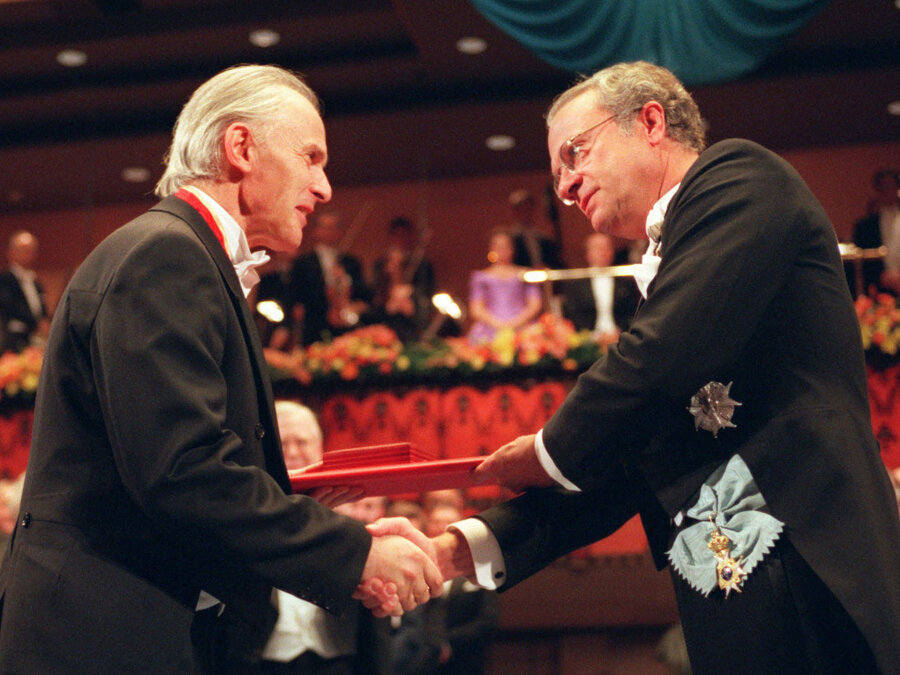
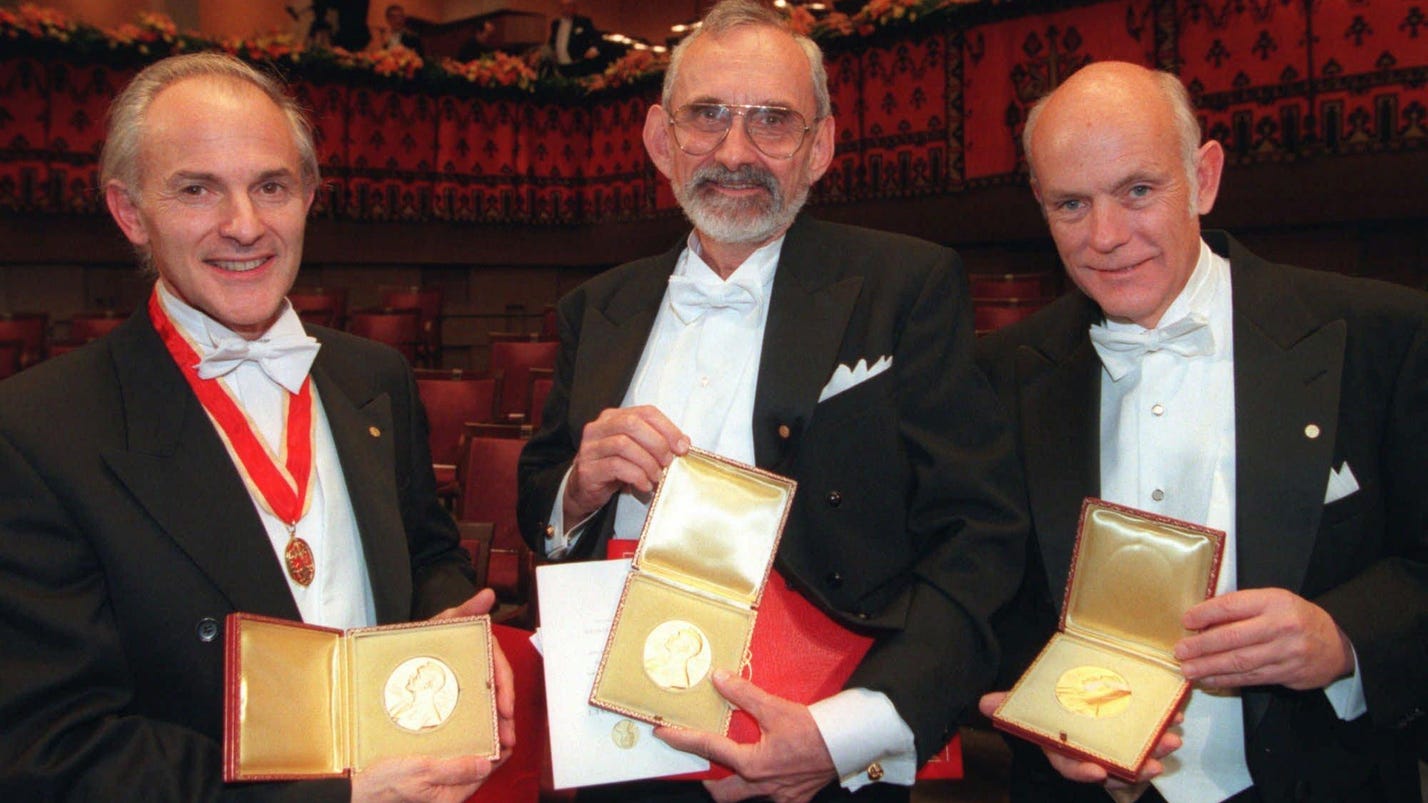
Giacconi was awarded one half of the 2002 Nobel Prize for Physics for his “pioneering contributions to astrophysics, which have led to the discovery of cosmic X-ray sources”. The other half was divided between Davis and Koshiba for discovering cosmic neutrinos.

https://www.youtube.com/watch?v=afa6daZvnAw

_

June 11, 2016

Dr. Riccardo Giacconi, c/o Johns Hopkins University, Zanvyl Krieger School of Arts & Sciences
Department of Physics & Astronomy, Bloomberg Center for Physics and Astronomy, Room 366
3400 N. Charles Street, Baltimore, MD 21218

Dear Dr. Giacconi,

I was very sad to learn of the passing of the great scientist Harry Kroto. Judging from comments of his close friends, Kroto was not only a great scientist but an even better man personally.

Tim Logan, chair of Chemistry and Biochemistry at Florida State: “What always brought out the best in Harry was his wife, Margaret. Margaret and Harry were always together, until the end of Harry’s life. She served as his business manager, scheduling his many speaking engagements around the world, organizing the travel, and supporting him in many, many ways. What I found so remarkable is that even after 57 years together, they were so obviously in love. Harry would include photos and sketches he made of her in his lectures, and he always acknowledged her as his moral compass.” 

HAVE YOU EVER WONDERED WHY I WAS PROMPTED ORIGINALLY TO WRITE YOU? It was because Harry Kroto took the time in 2014 to correspond with me. After I wrote him in  the spring and summer of 2014 he emailed me twice and then sent me a letter in November of 2014. In that letter he referred me to a film series  Renowned Academics talk about God that featured your comments. 

Furthermore, your full interview appears on the VEGA website which Kroto founded, and he was so proud of your interview that he featured a clip from it during his speech at  a BEYOND BELIEF CONFERENCE (he actually spoke there in 2006, 2007 and 2008 and all those speeches are on You Tube). I have always been fascinated by brilliant individuals and recently I had the opportunity to come across a very interesting article by Michael Polanyi, LIFE TRANSCENDING PHYSICS AND CHEMISTRY, in the magazine CHEMICAL AND ENGINEERING NEWS, August 21, 1967, and I also got hold of a 1968 talk by Francis Schaeffer based on this article. ISN’T IT AMAZING THAT JUST LIKE KROTO’S FAMILY POLANYI HAD TO FLEE EUROPE BECAUSE OF HITLER’S INSANE GRUDGE AGAINST THE JEWS!!!!I know you don’t believe in God or the Devil but if anyone was demon-possessed it had to be Hitler.

Polanyi’s son John actually won the 1986 Nobel Prize for Chemistry. This article by Michael Polanyi concerns Francis Crick and James Watson and their discovery of DNA in 1953. Polanyi noted:

Mechanisms, whether man-made or morphological, are boundary conditions harnessing the laws of in
animate nature, being themselves irreducible to those laws. The pattern of organic bases in DNA which functions as a genetic code is a boundary condition irreducible to physics and chemistry. Further controlling principles of life may be represented as a hierarchy of boundary conditions extending, in the case of man, to consciousness and responsibility.

I am sending you this two CD’s of this talk because I thought you may find it very interesting. It includes references to not only James D. Watson, and Francis Crick but also  Maurice Wilkins, Erwin Schrodinger, J.S. Haldane (his son was the famous J.B.S. Haldane), Peter Medawar, and Barry Commoner.

Thank you for your time. I know how busy you are and I want to thank you for taking the time to read this letter.

Sincerely,

Everette Hatcher,

P.O. Box 23416, Little Rock, AR 72221, United States, cell ph 501-920-5733, everettehatcher@gmail.comFrom

_

_

_

Related posts:

FRANCIS SCHAEFFER ANALYZES ART AND CULTURE Part 53 THE BEATLES (Part E, Stg. Pepper’s and John Lennon’s search in 1967 for truth was through drugs, money, laughter, etc & similar to King Solomon’s, LOTS OF PICTURES OF JOHN AND CYNTHIA) (Feature on artist Yoko Ono)

April 2, 2015 – 7:05 am

The John Lennon and the Beatles really were on a long search for meaning and fulfillment in their lives  just like King Solomon did in the Book of Ecclesiastes. Solomon looked into learning (1:12-18, 2:12-17), laughter, ladies, luxuries, and liquor (2:1-2, 8, 10, 11), and labor (2:4-6, 18-20). He fount that without God in the picture all […]

By Everette Hatcher III | Posted in Current Events, Francis Schaeffer | Edit | Comments (0)

FRANCIS SCHAEFFER ANALYZES ART AND CULTURE Part 52 THE BEATLES (Part D, There is evidence that the Beatles may have been exposed to Francis Schaeffer!!!) (Feature on artist Anna Margaret Rose Freeman )

March 22, 2015 – 12:30 am

______________   George Harrison Swears & Insults Paul and Yoko Lucy in the Sky with Diamonds- The Beatles The Beatles:   I have dedicated several posts to this series on the Beatles and I don’t know when this series will end because Francis Schaeffer spent a lot of time listening to the Beatles and talking […]

By Everette Hatcher III | Posted in Francis Schaeffer | Tagged Anna Margaret Rose Freeman, George Harrison, John Lennon, Paul MacCartney, Ringo Starr, Stg. Pepper’s Lonely Hearts Club Band | Edit| Comments (0)

FRANCIS SCHAEFFER ANALYZES ART AND CULTURE Part 51 THE BEATLES (Part C, List of those on cover of Stg.Pepper’s ) (Feature on artist Raqib Shaw )

March 19, 2015 – 12:21 am

  The Beatles in a press conference after their Return from the USA Uploaded on Nov 29, 2010 The Beatles in a press conference after their Return from the USA. The Beatles:   I have dedicated several posts to this series on the Beatles and I don’t know when this series will end because Francis […]

By Everette Hatcher III | Posted in Francis Schaeffer | Tagged George Harrison, John Lennon, Paul MacCartney, Raqib Shaw, Ringo Starr | Edit | Comments (0)

FRANCIS SCHAEFFER ANALYZES ART AND CULTURE Part 50 THE BEATLES (Part B, The Psychedelic Music of the Beatles) (Feature on artist Peter Blake )

March 12, 2015 – 12:16 am

__________________   Beatles 1966 Last interview I have dedicated several posts to this series on the Beatles and I don’t know when this series will end because Francis Schaeffer spent a lot of time listening to the Beatles and talking and writing about them and their impact on the culture of the 1960’s. In this […]

By Everette Hatcher III | Posted in Francis Schaeffer | Tagged George Harrison, John Lennon, Paul MacCartney, Peter Blake, Ringo Starr | Edit | Comments (1)

FRANCIS SCHAEFFER ANALYZES ART AND CULTURE Part 49 THE BEATLES (Part A, The Meaning of Stg. Pepper’s Cover) (Feature on artist Mika Tajima)

March 5, 2015 – 4:47 am

_______________ The Beatles documentary || A Long and Winding Road || Episode 5 (This video discusses Stg. Pepper’s creation I have dedicated several posts to this series on the Beatles and I don’t know when this series will end because Francis Schaeffer spent a lot of time listening to the Beatles and talking and writing about […]

By Everette Hatcher III | Posted in Francis Schaeffer | Tagged Beatles, Mika Tajima | Edit |Comments (0)

FRANCIS SCHAEFFER ANALYZES ART AND CULTURE PART 48 “BLOW UP” by Michelangelo Antonioni makes Philosophic Statement (Feature on artist Nancy Holt)

February 26, 2015 – 4:57 am

_______________ Francis Schaeffer pictured below: _____________________ I have included the 27 minute  episode THE AGE OF NONREASON by Francis Schaeffer. In that video Schaeffer noted,  ” Sergeant Pepper’s Lonely Hearts Club Band…for a time it became the rallying cry for young people throughout the world. It expressed the essence of their lives, thoughts and their feelings.” How Should […]

By Everette Hatcher III | Posted in Francis Schaeffer | Tagged Blow Up, David Hemmings,Michelangelo Antonioni, Nancy Holt, Sarah Miles., Vanessa Redgrave | Edit | Comments (0)

FRANCIS SCHAEFFER ANALYZES ART AND CULTURE Part 47 Woody Allen and Professor Levy and the death of “Optimistic Humanism” from the movie CRIMES AND MISDEMEANORS Plus Charles Darwin’s comments too!!! (Feature on artist Rodney Graham)

February 19, 2015 – 5:33 am

Crimes and Misdemeanors: A Discussion: Part 1 ___________________________________ Today I will answer the simple question: IS IT POSSIBLE TO BE AN OPTIMISTIC SECULAR HUMANIST THAT DOES NOT BELIEVE IN GOD OR AN AFTERLIFE? This question has been around for a long time and you can go back to the 19th century and read this same […]

By Everette Hatcher III | Posted in Francis Schaeffer, Woody Allen | Tagged alan alda, Anjelica Huston, mia farrow, Sam Waterston | Edit | Comments (0)

FRANCIS SCHAEFFER ANALYZES ART AND CULTURE PART 46 Friedrich Nietzsche (Featured artist is Thomas Schütte)

February 12, 2015 – 5:00 am

____________________________________ Francis Schaeffer pictured below: __________ Francis Schaeffer has written extensively on art and culture spanning the last 2000years and here are some posts I have done on this subject before : Francis Schaeffer’s “How should we then live?” Video and outline of episode 10 “Final Choices” , episode 9 “The Age of Personal Peace and Affluence”, episode 8 […]

By Everette Hatcher III | Posted in Francis Schaeffer | Tagged Bertrand Russell, Friedrich Nietzsche,H.G. Wells, jean paul sartre, Kai Nielsen, Richard Taylor, Richard Wurmbrand, Thomas Schütte | Edit| Comments (0)

FRANCIS SCHAEFFER ANALYZES ART AND CULTURE Part 45 Woody Allen “Reason is Dead” (Feature on artists Allora & Calzadilla )

February 5, 2015 – 4:31 am

Love and Death [Woody Allen] – What if there is no God? [PL] ___________ _______________ How Should We then Live Episode 7 small (Age of Nonreason) #02 How Should We Then Live? (Promo Clip) Dr. Francis Schaeffer 10 Worldview and Truth Two Minute Warning: How Then Should We Live?: Francis Schaeffer at 100 Francis Schaeffer […]

By Everette Hatcher III | Posted in Francis Schaeffer, Woody Allen | Tagged Allora & Calzadilla | Edit| Comments (0)

FRANCIS SCHAEFFER ANALYZES ART AND CULTURE Part 44 The Book of Genesis (Featured artist is Trey McCarley )

January 29, 2015 – 5:01 am

___________________________________ Francis Schaeffer pictured below: ____________________________ Francis Schaeffer “BASIS FOR HUMAN DIGNITY” Whatever…HTTHR Dr. Francis schaeffer – The flow of Materialism(from Part 4 of Whatever happened to human race?) Dr. Francis Schaeffer – The Biblical flow of Truth & History (intro) Francis Schaeffer – The Biblical Flow of History & Truth (1) Dr. Francis Schaeffer […]

By Everette Hatcher III | Posted in Francis Schaeffer | Tagged Trey McCarley | Edit | Comments (0)

____________

____

__

By Everette Hatcher III | Posted in Current Events | Also tagged .Alexander Vilenkin, Aaron Ciechanover, Alan Dershowitz, Alan Guth, Alan Macfarlane, Alva Noe, Arif Ahmed, Barry Supple, Bart Ehrman, Brian Greene, Brian Harrison, Bruce Hood, Carolyn Porco, David Friend, David J. Gross, Douglas Osheroff, Elizabeth Loftus, Frank Wilczek, Gareth Stedman Jones, George Lakoff, Harry Kroto, Herbert Huppert, Herman Philipse, Hermann Hauser, Horace Barlow, Hubert Dreyfus, Ivar Giaever, J. L. Schellenberg, John Searle, Jonathan Haidt, Jonathan Parry, Lawrence Krauss, Lee Silver, Leonard Mlodinow, Leonard Susskind, Lisa Randall, Lord Martin Rees, Marcus du Sautoy, Mark Balaguer, Marvin Minsky, Michael Bate, Michio Kaku, Neil deGrasse Tyson, Noam Chomsky, Oliver Sacks, Patricia Churchland, Peter Millican, Peter Singer, Raymond Tallis, Rebecca Goldstein, Riccardo Giacconi, Roald Hoffmann, Robert M. Price, Ronald de Sousa, Roy Glauber, Saul Perlmutter, Shelly Kagan, Simon Schaffer, Sir David Attenborough, Sir John Walker, Stephan Feuchtwang, Stephen F Gudeman, Steve Jones, Steven Weinberg, Stuart Kauffman, Susan Greenfield, Theodor W. Hänsch, Victor Stenger, Walter Sinnott-Armstrong, Yujin Nagasawa | Comments (0)

RESPONDING TO HARRY KROTO’S BRILLIANT RENOWNED ACADEMICS!! Part 158 C PAUSING to look at the life of Riccardo Giacconi and my September 28, 2015 letter to him about Michael Polanyi

November 19, 2019 – 1:12 am

I was saddened to learn of the passing of Dr. Riccardo Giacconi on 16 December 16, 2018, in La Jolla, CA,  and I wanted to spend time on several posts concentrating on him.

The Smithsonian Archives is saddened to learn of the death of 2002 Nobel laureate in Physics, astrophysicist Riccardo Giacconi. Among Giacconi’s numerous accomplishments is his creation of X-ray astronomy.

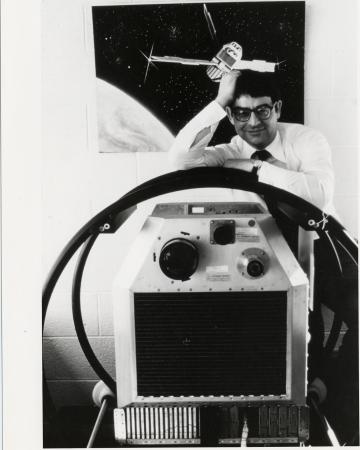
A man leans against a machine. A poster of space is in the background.Zoom

Riccardo Giacconi and the Uhuru satellite, undated. Courtesy of Harvard-Smithsonian Center for Astrophysics.

While at the Harvard-Smithsonian Center for Astrophysics, Giacconi served as Director of the High Energy Astrophysics Division from 1973 to 1981. He oversaw the conception, fabrication, and design of the Einstein Observatory, preparation of the software and hardware for data reduction for the Einstein, and the establishment and implementation of the Guest Observer Program.

The Smithsonian Institution Archives is the official repository for Riccardo Giacconi’s personal papers. These papers document Giacconi’s scientific career and illustrate his scientific work and administrative records relating to the institutions at which he worked. There is extensive documentation of Giacconi’s professional activities, including meetings attended, papers presented (and published), his services as officer or board member of professional societies; grants, proposals, and contracts, mainly with NASA; correspondence with colleagues; slides and photographs of many facilities with which Giacconi was associated; news clippings and press releases; and appointment books and journals.

The Archives also holds an oral history of Giacconi. David H. DeVorkin, a curator in the Department of Astronautics at National Air and Space Museum, conducted a videotaped interview of Dr. Giacconi after a symposium in Giacconi’s honor, held at the Smithsonian’s National Museum of American History and sponsored by its Lemelson Center, on January 22, 2004. In the interview, he discussed his education, research, and career in astrophysics, including his work at the Smithsonian, Project Starfish, and the Hubble Space Telescope.

______

On November 21, 2014 I received a letter from Nobel Laureate Harry Kroto and it said:

…Please click on this URL http://vimeo.com/26991975

and you will hear what far smarter people than I have to say on this matter. I agree with them.

Harry Kroto

Nick Gathergood, David-Birkett, Harry-Kroto

I have attempted to respond to all of Dr. Kroto’s friends arguments and I have posted my responses one per week for over a year now. Here are some of my earlier posts:

Arif Ahmed, Sir David Attenborough, Mark Balaguer, Horace Barlow, Michael Bate, Patricia Churchland, Aaron Ciechanover, Noam Chomsky,Alan Dershowitz, Hubert Dreyfus, Bart Ehrman, Stephan Feuchtwang, David Friend,  Riccardo Giacconi, Ivar Giaever , Roy Glauber, Rebecca Goldstein, David J. Gross,  Brian Greene, Susan Greenfield, Stephen F Gudeman,  Alan Guth, Jonathan Haidt, Theodor W. Hänsch, Brian Harrison,  Hermann Hauser, Roald Hoffmann,  Bruce Hood, Herbert Huppert,  Gareth Stedman Jones, Steve Jones, Shelly Kagan, Michio Kaku,  Stuart Kauffman,  Lawrence Krauss, Harry Kroto, George Lakoff, Elizabeth Loftus,  Alan Macfarlane, Peter Millican, Marvin Minsky, Leonard Mlodinow,  Yujin Nagasawa, Alva Noe, Douglas Osheroff,  Jonathan Parry,  Saul Perlmutter, Herman Philipse,  Carolyn Porco, Robert M. Price, Lisa Randall, Lord Martin Rees,  Oliver Sacks, John Searle, Marcus du Sautoy, Simon Schaffer, J. L. Schellenberg,   Lee Silver,  Peter Singer,  Walter Sinnott-Armstrong, Ronald de Sousa, Victor Stenger, Barry Supple,   Leonard Susskind, Raymond Tallis, Neil deGrasse Tyson,  .Alexander Vilenkin, Sir John Walker, Frank Wilczek, Steven Weinberg, and  Lewis Wolpert,

In  the first video below in the 47th clip in this series are his words and will be responding to them in the next few weeks, but today I just wanted to pause and look at this life. 

50 Renowned Academics Speaking About God (Part 1)

Another 50 Renowned Academics Speaking About God (Part 2)

A Further 50 Renowned Academics Speaking About God (Part 3)

__

_

_

September 28, 2015

Dr. Riccardo Giacconi, c/o Johns Hopkins University, Zanvyl Krieger School of Arts & Sciences
Department of Physics & Astronomy, Bloomberg Center for Physics and Astronomy, Room 366
3400 N. Charles Street, Baltimore, MD 21218

Dear Dr. Giacconi,

Recently I had the opportunity to come across a very interesting article by Michael Polanyi, LIFE TRANSCENDING PHYSICS AND CHEMISTRY, in the magazine CHEMICAL AND ENGINEERING NEWS, August 21, 1967, and I also got hold of a 1968 talk by Francis Schaeffer based on this article. Polanyi’s son John actually won the 1986 Nobel Prize for Chemistry.This article by Michael Polanyi concerns Francis Crick and James Watson and their discovery of DNA in 1953. Polanyi noted:

Mechanisms, whether man-made or morphological, are boundary conditions harnessing the laws of in
animate nature, being themselves irreducible to those laws. The pattern of organic bases in DNA which functions as a genetic code is a boundary condition irreducible to physics and chemistry. Further controlling principles of life may be represented as a hierarchy of boundary conditions extending, in the case of man, to consciousness and responsibility.

I would like to send you a CD copy of this talk because I thought you may find it very interesting. It includes references to not only James D. Watson, and Francis Crick but also Maurice Wilkins, Erwin Schrodinger, J.S. Haldane (his son was the famous J.B.S. Haldane), Peter Medawar, and Barry Commoner. I WONDER IF YOU EVER HAD THE OPPORTUNITY TO RUN ACROSS THESE MEN OR ANY OF THEIR FORMER STUDENTS?

Below is a portion of the transcript from the CD and Michael Polanyi’s words are in italics while Francis Schaeffer’s words are not:

During the past 15 years, I have worked on these questions, achieving gradually stages of the argument presented in this paper. These are:

  1. Machines are not formed by physical and chemical equilibration. 
  2. The functional terms needed for characterizing a machine cannot for defined in terms of physics and chemistry. 

Polanyi is talking about specific machines but I would include the great cause and effect machine of the external universe that functions on a cause and effect basis. So if this is true of the watch,  then you have to ask the same question about the total machine that Sartre points out that is there, and that is the cause and effect universe. Polanyi doesn’t touch on this and he doesn’t have an answer, and I know people who know him. Yet nevertheless he sees the situation exactly as it is. And I would point out what  Alfred North Whitehead (1861–1947) and J. Robert Oppenheimer (1904–1967) said and that it needed a Christian consensus to produce modern science because it was the Christian consensus that gave the concept that the world being created by a reasonable God and that it could be found out and discovered by reason. So the modern science when it began with Copernicus and Galileo and all these men conceived that the cause and effect system of the universe would be there on the basis that it was created by a reasonable God, and that is Einstein’s big dilemma and that is why he became a mystic at the end of life…What Polanyi says here can be extended to the watch, and the bridge and the automobile but also to the big cause and effect universe. You have to give some kind of answer to this too and I would say this to Michael Polanyi if I ever have a chance to talk to him.You need another explanation too Polanyi.

3. No physical chemical topography will tell us that we have a machine before us and what its functions are. 

In other words, if you only know the chemicals and the physics you don’t know if you have a machine. It may just be junk. So nobody in the world could tell if it was a machine from merely the “physical chemical-topography.” You have to look at the machineness of the machine to say it is a machine. You could take an automobile and smash it into a small piece of metal with a giant press and it would have the same properties of the automobile, but the automobile would have disappeared. The automobile-ness of the automobile is something else than the physical chemical-topography.

4. Such a topography can completely identify one particular specimen of a machine, but can tell us nothing about a class of machines. 

5. And if we are asked how the same solid system can be subject to control by two independent principles, the answer is: The boundary conditions of the system are free of control by physics and can be controlled therefore by nonphysical, purely technical, principles. 

In other words you have to explain the engineering by something other than merely physical principles and of course it is. You can’t explain the watchness of the watch merely by this. You can explain it on the basis of engineering principles in which the human mind conceives of a use for the machine and produces the machine. But notice where Polanyi is and that is in our argument of a need of personality in the universethough Polanyi doesn’t draw this final conclusion, though I thought that is the only explanation.

If you look at the watch a man has made it for the purpose of telling time. When you see the automobile a man has made it for the purpose of locomotion and the explanation of the difference is not in the chemical and physical properties but in the personality of a man to make these two different machines for two different purposes out of the same material. So what you are left here is the need of personality in the universe.

____

Thank you for your time. I know how busy you are and I want to thank you for taking the time to read this letter.

Sincerely,

Everette Hatcher,

P.O. Box 23416, Little Rock, AR 72221, United States, cell ph 501-920-5733, everettehatcher@gmail.com

_

_

_

Related posts:

FRANCIS SCHAEFFER ANALYZES ART AND CULTURE Part 53 THE BEATLES (Part E, Stg. Pepper’s and John Lennon’s search in 1967 for truth was through drugs, money, laughter, etc & similar to King Solomon’s, LOTS OF PICTURES OF JOHN AND CYNTHIA) (Feature on artist Yoko Ono)

April 2, 2015 – 7:05 am

The John Lennon and the Beatles really were on a long search for meaning and fulfillment in their lives  just like King Solomon did in the Book of Ecclesiastes. Solomon looked into learning (1:12-18, 2:12-17), laughter, ladies, luxuries, and liquor (2:1-2, 8, 10, 11), and labor (2:4-6, 18-20). He fount that without God in the picture all […]

By Everette Hatcher III | Posted in Current Events, Francis Schaeffer | Edit | Comments (0)

FRANCIS SCHAEFFER ANALYZES ART AND CULTURE Part 52 THE BEATLES (Part D, There is evidence that the Beatles may have been exposed to Francis Schaeffer!!!) (Feature on artist Anna Margaret Rose Freeman )

March 22, 2015 – 12:30 am

______________   George Harrison Swears & Insults Paul and Yoko Lucy in the Sky with Diamonds- The Beatles The Beatles:   I have dedicated several posts to this series on the Beatles and I don’t know when this series will end because Francis Schaeffer spent a lot of time listening to the Beatles and talking […]

By Everette Hatcher III | Posted in Francis Schaeffer | Tagged Anna Margaret Rose Freeman, George Harrison, John Lennon, Paul MacCartney, Ringo Starr, Stg. Pepper’s Lonely Hearts Club Band | Edit| Comments (0)

FRANCIS SCHAEFFER ANALYZES ART AND CULTURE Part 51 THE BEATLES (Part C, List of those on cover of Stg.Pepper’s ) (Feature on artist Raqib Shaw )

March 19, 2015 – 12:21 am

  The Beatles in a press conference after their Return from the USA Uploaded on Nov 29, 2010 The Beatles in a press conference after their Return from the USA. The Beatles:   I have dedicated several posts to this series on the Beatles and I don’t know when this series will end because Francis […]

By Everette Hatcher III | Posted in Francis Schaeffer | Tagged George Harrison, John Lennon, Paul MacCartney, Raqib Shaw, Ringo Starr | Edit | Comments (0)

FRANCIS SCHAEFFER ANALYZES ART AND CULTURE Part 50 THE BEATLES (Part B, The Psychedelic Music of the Beatles) (Feature on artist Peter Blake )

March 12, 2015 – 12:16 am

__________________   Beatles 1966 Last interview I have dedicated several posts to this series on the Beatles and I don’t know when this series will end because Francis Schaeffer spent a lot of time listening to the Beatles and talking and writing about them and their impact on the culture of the 1960’s. In this […]

By Everette Hatcher III | Posted in Francis Schaeffer | Tagged George Harrison, John Lennon, Paul MacCartney, Peter Blake, Ringo Starr | Edit | Comments (1)

FRANCIS SCHAEFFER ANALYZES ART AND CULTURE Part 49 THE BEATLES (Part A, The Meaning of Stg. Pepper’s Cover) (Feature on artist Mika Tajima)

March 5, 2015 – 4:47 am

_______________ The Beatles documentary || A Long and Winding Road || Episode 5 (This video discusses Stg. Pepper’s creation I have dedicated several posts to this series on the Beatles and I don’t know when this series will end because Francis Schaeffer spent a lot of time listening to the Beatles and talking and writing about […]

By Everette Hatcher III | Posted in Francis Schaeffer | Tagged Beatles, Mika Tajima | Edit |Comments (0)

FRANCIS SCHAEFFER ANALYZES ART AND CULTURE PART 48 “BLOW UP” by Michelangelo Antonioni makes Philosophic Statement (Feature on artist Nancy Holt)

February 26, 2015 – 4:57 am

_______________ Francis Schaeffer pictured below: _____________________ I have included the 27 minute  episode THE AGE OF NONREASON by Francis Schaeffer. In that video Schaeffer noted,  ” Sergeant Pepper’s Lonely Hearts Club Band…for a time it became the rallying cry for young people throughout the world. It expressed the essence of their lives, thoughts and their feelings.” How Should […]

By Everette Hatcher III | Posted in Francis Schaeffer | Tagged Blow Up, David Hemmings,Michelangelo Antonioni, Nancy Holt, Sarah Miles., Vanessa Redgrave | Edit | Comments (0)

FRANCIS SCHAEFFER ANALYZES ART AND CULTURE Part 47 Woody Allen and Professor Levy and the death of “Optimistic Humanism” from the movie CRIMES AND MISDEMEANORS Plus Charles Darwin’s comments too!!! (Feature on artist Rodney Graham)

February 19, 2015 – 5:33 am

Crimes and Misdemeanors: A Discussion: Part 1 ___________________________________ Today I will answer the simple question: IS IT POSSIBLE TO BE AN OPTIMISTIC SECULAR HUMANIST THAT DOES NOT BELIEVE IN GOD OR AN AFTERLIFE? This question has been around for a long time and you can go back to the 19th century and read this same […]

By Everette Hatcher III | Posted in Francis Schaeffer, Woody Allen | Tagged alan alda, Anjelica Huston, mia farrow, Sam Waterston | Edit | Comments (0)

FRANCIS SCHAEFFER ANALYZES ART AND CULTURE PART 46 Friedrich Nietzsche (Featured artist is Thomas Schütte)

February 12, 2015 – 5:00 am

____________________________________ Francis Schaeffer pictured below: __________ Francis Schaeffer has written extensively on art and culture spanning the last 2000years and here are some posts I have done on this subject before : Francis Schaeffer’s “How should we then live?” Video and outline of episode 10 “Final Choices” , episode 9 “The Age of Personal Peace and Affluence”, episode 8 […]

By Everette Hatcher III | Posted in Francis Schaeffer | Tagged Bertrand Russell, Friedrich Nietzsche,H.G. Wells, jean paul sartre, Kai Nielsen, Richard Taylor, Richard Wurmbrand, Thomas Schütte | Edit| Comments (0)

FRANCIS SCHAEFFER ANALYZES ART AND CULTURE Part 45 Woody Allen “Reason is Dead” (Feature on artists Allora & Calzadilla )

February 5, 2015 – 4:31 am

Love and Death [Woody Allen] – What if there is no God? [PL] ___________ _______________ How Should We then Live Episode 7 small (Age of Nonreason) #02 How Should We Then Live? (Promo Clip) Dr. Francis Schaeffer 10 Worldview and Truth Two Minute Warning: How Then Should We Live?: Francis Schaeffer at 100 Francis Schaeffer […]

By Everette Hatcher III | Posted in Francis Schaeffer, Woody Allen | Tagged Allora & Calzadilla | Edit| Comments (0)

FRANCIS SCHAEFFER ANALYZES ART AND CULTURE Part 44 The Book of Genesis (Featured artist is Trey McCarley )

January 29, 2015 – 5:01 am

___________________________________ Francis Schaeffer pictured below: ____________________________ Francis Schaeffer “BASIS FOR HUMAN DIGNITY” Whatever…HTTHR Dr. Francis schaeffer – The flow of Materialism(from Part 4 of Whatever happened to human race?) Dr. Francis Schaeffer – The Biblical flow of Truth & History (intro) Francis Schaeffer – The Biblical Flow of History & Truth (1) Dr. Francis Schaeffer […]

By Everette Hatcher III | Posted in Francis Schaeffer | Tagged Trey McCarley | Edit | Comments (0)

____________

____

__

By Everette Hatcher III | Posted in Current Events | Also tagged .Alexander Vilenkin, Aaron Ciechanover, Alan Dershowitz, Alan Guth, Alan Macfarlane, Alva Noe, Arif Ahmed, Barry Supple, Bart Ehrman, Brian Greene, Brian Harrison, Bruce Hood, Carolyn Porco, David Friend, David J. Gross, Douglas Osheroff, Elizabeth Loftus, Frank Wilczek, Gareth Stedman Jones, George Lakoff, Harry Kroto, Herbert Huppert, Herman Philipse, Hermann Hauser, Horace Barlow, Hubert Dreyfus, Ivar Giaever, J. L. Schellenberg, John Searle, Jonathan Haidt, Jonathan Parry, Lawrence Krauss, Lee Silver, Leonard Mlodinow, Leonard Susskind, Lisa Randall, Lord Martin Rees, Marcus du Sautoy, Mark Balaguer, Marvin Minsky, Michael Bate, Michio Kaku, Neil deGrasse Tyson, Noam Chomsky, Oliver Sacks, Patricia Churchland, Peter Millican, Peter Singer, Raymond Tallis, Rebecca Goldstein, Riccardo Giacconi, Roald Hoffmann, Robert M. Price, Ronald de Sousa, Roy Glauber, Saul Perlmutter, Shelly Kagan, Simon Schaffer, Sir David Attenborough, Sir John Walker, Stephan Feuchtwang, Stephen F Gudeman, Steve Jones, Steven Weinberg, Stuart Kauffman, Susan Greenfield, Theodor W. Hänsch, Victor Stenger, Walter Sinnott-Armstrong, Yujin Nagasawa | Comments (0)

RESPONDING TO HARRY KROTO’S BRILLIANT RENOWNED ACADEMICS!! Part 158 B PAUSING to look at the life of Riccardo Giacconi and my 1-17-15 email to him

November 12, 2019 – 1:59 am

I was saddened to learn of the passing of Dr. Riccardo Giacconi on 16 December 16, 2018, in La Jolla, CA,  and I wanted to spend time on several posts concentrating on him.

______

R.I.P. Riccardo Giacconi

Massimo Luciani December 11, 2018 0
Riccardo Giacconi receiving the 2003 National Medal of Science

On Sunday, December 9 Riccardo Giacconi passed away. He was the father of X-ray astronomy and Nobel Prize in physics in 2002 for his contributions in that field.

Riccardo Giacconi was born on October 6, 1931 in Genoa, Italy. He obtained a degree in physics at the University of Milan with a specialization in the research on cosmic rays. In 1956 he moved to the USA, where he carried out research first with the University of Princeton and then at AS&E (American Science and Engineering), where he started developing the first instruments to detect cosmic X-rays.

In 1962 Riccardo Giacconi discovered the first extraterrestrial X-ray source, named Scorpius X-1. In 1970 he oversaw the launch of NASA’s Uhuru satellite, the first specialized in X-ray astronomy, followed in the following decades by increasingly sophisticated stellites such as the Einstein Observatory (HEAO-2) in 1978, designed while Giacconi was director of the Harvard Smithsonian Center for Astrophysics, to NASA’s Chandra X-ray Observatory in 1999.

Although Riccardo Giacconi is remembered above all for the development of X-ray astronomy, he also worked in other specializations. In particular, in 1981 he became the first director of the Space Telescope Science Institute, the center of scientific operations for what was then another pioneering project, the Hubble Space Telescope. Giacconi kept that office until 1993 and directed the search for a solution to correct the primary mirror flaw discovered after Hubble’s activation in space.

After that experience, between 1993 and 1999 Riccardo Giacconi was general director of ESO, directing among other things the construction of the Very Large Telescope (VLT), an observatory on which various instruments were installed over the following years making it one of the best ground-based telescpes in the world.

In 2002 Riccardo Giacconi was awarded the Nobel prize for his pioneering contributions to astrophysics, which led to the discovery of cosmic X-ray sources. It’s the most famous among the awards he received but there were several others in Italy, in the USA and in other countries. In Italy he also received the honor of Order of Merit of the Italian Republic (Cavaliere di gran croce dell’Ordine al merito della Repubblica italiana) in 2002 and the Italian Medal of Merit for Culture and Art (Medaglia d’oro ai benemeriti della scuola, della cultura e dell’arte) in 2005.

Riccardo Giacconi returned to work with NASA as principal investigator in the Chandra Deep Field-South project of the Chandra X-ray observatory. He leaves a huge legacy as today X-ray astronomy means studying a part of the universe full of violent events that generate those strong electromagnetic emissions such as neutron stars and black holes

Emailed on 1-17-15

To Dr. Riccardo Giacconi, From Everette Hatcher, I thought you would  like to see this movie Monday night in a theater near you!!

Dear Dr. Giacconi,

I am in the process of posting a  response on my blog to your comments on the film series RENOWNED ACADEMICS SPEAKING ABOUT GOD (which received over 300,000 hits on You Tube). I have already finished responding to some of your other fellow academics  who also appear on the same film series such as David J. Gross,  Frank Wilczek,  .Alexander Vilenkin,  Roy Glauber, Roald Hoffmann,  Rebecca Goldstein, Noam Chomsky, Brian Greene, Marvin Minsky,  Shelly Kagan, Hubert Dreyfus,  Simon Schaffer,  Marcus du Sautoy,  Steven Weinberg, Barry Supple,  Lawrence Krauss, Lord Martin Rees,  Alan Dershowitz, Lewis Wolpert, Aaron Ciechanover, Leonard Mlodinow,  Herbert Huppert,  Leonard Susskind,  Alan Macfarlane,  Saul Perlmutter,  Stuart Kauffman,  Douglas Osheroff,   Alan Guth,  Sir David Attenborough, and  Harry Kroto who started it all by promoting this video series in the first place.  However, it has taken me a little longer to respond to your comments.

I thought of you when I heard about this film PATTERNS OF EVIDENCE: THE EXODUS, which is only showing one time this Monday night January 19, 2015 at 7 pm at a theater near you. You have contended you don’t believe in the Bible because you don’t have the scientific type evidence that you require.This film contains the findings of over a dozen academics who are experts in archaeology and here it is at a nearby theater to you.

You can get a ticket by going to this website at this link and putting in your zip code to find a theater near you. It stars Israel Finkelstein, Benjamin Netanyahu,  Shimon Peres,  and many more and they will be discussing if the Exodus took place or not with only scientific facts.  I have posted several very good reviews of the major motion picture on my blog.

Here are some theaters near you that are showing the film:

1. CINEMARK TOWSON AND XD,  111 East Joppa Road, Towson, MD 21286, 2. AMC OWINGS MILLS 17, 10100 Mill Run Circle, Owings Mills, MD 21117, 3. CINEMARK EGYPTIAN 24 AND XD,  7000 Arundel Mills Circle, Hanover, MD 21076

Everette Hatcher, cell ph 501-920-733, everettehatcher@gmail.com, P.O. Box 23416, Little Rock, AR 72221

On November 21, 2014 I received a letter from Nobel Laureate Harry Kroto and it said:

…Please click on this URL http://vimeo.com/26991975

and you will hear what far smarter people than I have to say on this matter. I agree with them.

Harry Kroto

Nick Gathergood, David-Birkett, Harry-Kroto

I have attempted to respond to all of Dr. Kroto’s friends arguments and I have posted my responses one per week for over a year now. Here are some of my earlier posts:

Arif Ahmed, Sir David Attenborough, Mark Balaguer, Horace Barlow, Michael Bate, Patricia Churchland, Aaron Ciechanover, Noam Chomsky,Alan Dershowitz, Hubert Dreyfus, Bart Ehrman, Stephan Feuchtwang, David Friend,  Riccardo Giacconi, Ivar Giaever , Roy Glauber, Rebecca Goldstein, David J. Gross,  Brian Greene, Susan Greenfield, Stephen F Gudeman,  Alan Guth, Jonathan Haidt, Theodor W. Hänsch, Brian Harrison,  Hermann Hauser, Roald Hoffmann,  Bruce Hood, Herbert Huppert,  Gareth Stedman Jones, Steve Jones, Shelly Kagan, Michio Kaku,  Stuart Kauffman,  Lawrence Krauss, Harry Kroto, George Lakoff, Elizabeth Loftus,  Alan Macfarlane, Peter Millican, Marvin Minsky, Leonard Mlodinow,  Yujin Nagasawa, Alva Noe, Douglas Osheroff,  Jonathan Parry,  Saul Perlmutter, Herman Philipse,  Carolyn Porco, Robert M. Price, Lisa Randall, Lord Martin Rees,  Oliver Sacks, John Searle, Marcus du Sautoy, Simon Schaffer, J. L. Schellenberg,   Lee Silver,  Peter Singer,  Walter Sinnott-Armstrong, Ronald de Sousa, Victor Stenger, Barry Supple,   Leonard Susskind, Raymond Tallis, Neil deGrasse Tyson,  .Alexander Vilenkin, Sir John Walker, Frank Wilczek, Steven Weinberg, and  Lewis Wolpert,

In  the first video below in the 47th clip in this series are his words and will be responding to them in the next few weeks, but today I just wanted to pause and look at this life. 

50 Renowned Academics Speaking About God (Part 1)

Another 50 Renowned Academics Speaking About God (Part 2)

A Further 50 Renowned Academics Speaking About God (Part 3)

__

_

_

_

_

_

Related posts:

FRANCIS SCHAEFFER ANALYZES ART AND CULTURE Part 53 THE BEATLES (Part E, Stg. Pepper’s and John Lennon’s search in 1967 for truth was through drugs, money, laughter, etc & similar to King Solomon’s, LOTS OF PICTURES OF JOHN AND CYNTHIA) (Feature on artist Yoko Ono)

April 2, 2015 – 7:05 am

The John Lennon and the Beatles really were on a long search for meaning and fulfillment in their lives  just like King Solomon did in the Book of Ecclesiastes. Solomon looked into learning (1:12-18, 2:12-17), laughter, ladies, luxuries, and liquor (2:1-2, 8, 10, 11), and labor (2:4-6, 18-20). He fount that without God in the picture all […]

By Everette Hatcher III | Posted in Current Events, Francis Schaeffer | Edit | Comments (0)

FRANCIS SCHAEFFER ANALYZES ART AND CULTURE Part 52 THE BEATLES (Part D, There is evidence that the Beatles may have been exposed to Francis Schaeffer!!!) (Feature on artist Anna Margaret Rose Freeman )

March 22, 2015 – 12:30 am

______________   George Harrison Swears & Insults Paul and Yoko Lucy in the Sky with Diamonds- The Beatles The Beatles:   I have dedicated several posts to this series on the Beatles and I don’t know when this series will end because Francis Schaeffer spent a lot of time listening to the Beatles and talking […]

By Everette Hatcher III | Posted in Francis Schaeffer | Tagged Anna Margaret Rose Freeman, George Harrison, John Lennon, Paul MacCartney, Ringo Starr, Stg. Pepper’s Lonely Hearts Club Band | Edit| Comments (0)

FRANCIS SCHAEFFER ANALYZES ART AND CULTURE Part 51 THE BEATLES (Part C, List of those on cover of Stg.Pepper’s ) (Feature on artist Raqib Shaw )

March 19, 2015 – 12:21 am

  The Beatles in a press conference after their Return from the USA Uploaded on Nov 29, 2010 The Beatles in a press conference after their Return from the USA. The Beatles:   I have dedicated several posts to this series on the Beatles and I don’t know when this series will end because Francis […]

By Everette Hatcher III | Posted in Francis Schaeffer | Tagged George Harrison, John Lennon, Paul MacCartney, Raqib Shaw, Ringo Starr | Edit | Comments (0)

FRANCIS SCHAEFFER ANALYZES ART AND CULTURE Part 50 THE BEATLES (Part B, The Psychedelic Music of the Beatles) (Feature on artist Peter Blake )

March 12, 2015 – 12:16 am

__________________   Beatles 1966 Last interview I have dedicated several posts to this series on the Beatles and I don’t know when this series will end because Francis Schaeffer spent a lot of time listening to the Beatles and talking and writing about them and their impact on the culture of the 1960’s. In this […]

By Everette Hatcher III | Posted in Francis Schaeffer | Tagged George Harrison, John Lennon, Paul MacCartney, Peter Blake, Ringo Starr | Edit | Comments (1)

FRANCIS SCHAEFFER ANALYZES ART AND CULTURE Part 49 THE BEATLES (Part A, The Meaning of Stg. Pepper’s Cover) (Feature on artist Mika Tajima)

March 5, 2015 – 4:47 am

_______________ The Beatles documentary || A Long and Winding Road || Episode 5 (This video discusses Stg. Pepper’s creation I have dedicated several posts to this series on the Beatles and I don’t know when this series will end because Francis Schaeffer spent a lot of time listening to the Beatles and talking and writing about […]

By Everette Hatcher III | Posted in Francis Schaeffer | Tagged Beatles, Mika Tajima | Edit |Comments (0)

FRANCIS SCHAEFFER ANALYZES ART AND CULTURE PART 48 “BLOW UP” by Michelangelo Antonioni makes Philosophic Statement (Feature on artist Nancy Holt)

February 26, 2015 – 4:57 am

_______________ Francis Schaeffer pictured below: _____________________ I have included the 27 minute  episode THE AGE OF NONREASON by Francis Schaeffer. In that video Schaeffer noted,  ” Sergeant Pepper’s Lonely Hearts Club Band…for a time it became the rallying cry for young people throughout the world. It expressed the essence of their lives, thoughts and their feelings.” How Should […]

By Everette Hatcher III | Posted in Francis Schaeffer | Tagged Blow Up, David Hemmings,Michelangelo Antonioni, Nancy Holt, Sarah Miles., Vanessa Redgrave | Edit | Comments (0)

FRANCIS SCHAEFFER ANALYZES ART AND CULTURE Part 47 Woody Allen and Professor Levy and the death of “Optimistic Humanism” from the movie CRIMES AND MISDEMEANORS Plus Charles Darwin’s comments too!!! (Feature on artist Rodney Graham)

February 19, 2015 – 5:33 am

Crimes and Misdemeanors: A Discussion: Part 1 ___________________________________ Today I will answer the simple question: IS IT POSSIBLE TO BE AN OPTIMISTIC SECULAR HUMANIST THAT DOES NOT BELIEVE IN GOD OR AN AFTERLIFE? This question has been around for a long time and you can go back to the 19th century and read this same […]

By Everette Hatcher III | Posted in Francis Schaeffer, Woody Allen | Tagged alan alda, Anjelica Huston, mia farrow, Sam Waterston | Edit | Comments (0)

FRANCIS SCHAEFFER ANALYZES ART AND CULTURE PART 46 Friedrich Nietzsche (Featured artist is Thomas Schütte)

February 12, 2015 – 5:00 am

____________________________________ Francis Schaeffer pictured below: __________ Francis Schaeffer has written extensively on art and culture spanning the last 2000years and here are some posts I have done on this subject before : Francis Schaeffer’s “How should we then live?” Video and outline of episode 10 “Final Choices” , episode 9 “The Age of Personal Peace and Affluence”, episode 8 […]

By Everette Hatcher III | Posted in Francis Schaeffer | Tagged Bertrand Russell, Friedrich Nietzsche,H.G. Wells, jean paul sartre, Kai Nielsen, Richard Taylor, Richard Wurmbrand, Thomas Schütte | Edit| Comments (0)

FRANCIS SCHAEFFER ANALYZES ART AND CULTURE Part 45 Woody Allen “Reason is Dead” (Feature on artists Allora & Calzadilla )

February 5, 2015 – 4:31 am

Love and Death [Woody Allen] – What if there is no God? [PL] ___________ _______________ How Should We then Live Episode 7 small (Age of Nonreason) #02 How Should We Then Live? (Promo Clip) Dr. Francis Schaeffer 10 Worldview and Truth Two Minute Warning: How Then Should We Live?: Francis Schaeffer at 100 Francis Schaeffer […]

By Everette Hatcher III | Posted in Francis Schaeffer, Woody Allen | Tagged Allora & Calzadilla | Edit| Comments (0)

FRANCIS SCHAEFFER ANALYZES ART AND CULTURE Part 44 The Book of Genesis (Featured artist is Trey McCarley )

January 29, 2015 – 5:01 am

___________________________________ Francis Schaeffer pictured below: ____________________________ Francis Schaeffer “BASIS FOR HUMAN DIGNITY” Whatever…HTTHR Dr. Francis schaeffer – The flow of Materialism(from Part 4 of Whatever happened to human race?) Dr. Francis Schaeffer – The Biblical flow of Truth & History (intro) Francis Schaeffer – The Biblical Flow of History & Truth (1) Dr. Francis Schaeffer […]

By Everette Hatcher III | Posted in Francis Schaeffer | Tagged Trey McCarley | Edit | Comments (0)

____________

____

__

By Everette Hatcher III | Posted in Current Events | Also tagged .Alexander Vilenkin, Aaron Ciechanover, Alan Dershowitz, Alan Guth, Alan Macfarlane, Alva Noe, Arif Ahmed, Barry Supple, Bart Ehrman, Brian Greene, Brian Harrison, Bruce Hood, Carolyn Porco, David Friend, David J. Gross, Douglas Osheroff, Elizabeth Loftus, Frank Wilczek, Gareth Stedman Jones, George Lakoff, Harry Kroto, Herbert Huppert, Herman Philipse, Hermann Hauser, Horace Barlow, Hubert Dreyfus, Ivar Giaever, J. L. Schellenberg, John Searle, Jonathan Haidt, Jonathan Parry, Lawrence Krauss, Lee Silver, Leonard Mlodinow, Leonard Susskind, Lisa Randall, Lord Martin Rees, Marcus du Sautoy, Mark Balaguer, Marvin Minsky, Michael Bate, Michio Kaku, Neil deGrasse Tyson, Noam Chomsky, Oliver Sacks, Patricia Churchland, Peter Millican, Peter Singer, Raymond Tallis, Rebecca Goldstein, Riccardo Giacconi, Roald Hoffmann, Robert M. Price, Ronald de Sousa, Roy Glauber, Saul Perlmutter, Shelly Kagan, Simon Schaffer, Sir David Attenborough, Sir John Walker, Stephan Feuchtwang, Stephen F Gudeman, Steve Jones, Steven Weinberg, Stuart Kauffman, Susan Greenfield, Theodor W. Hänsch, Victor Stenger, Walter Sinnott-Armstrong, Yujin Nagasawa | Comments (0)

RESPONDING TO HARRY KROTO’S BRILLIANT RENOWNED ACADEMICS!! Part 158 A PAUSING to look at the life of Riccardo Giacconi and his quote “Irrational thinking of any kind is very dangerous, …I wish that with the progress of science we could inject a little bit more rationality in the world. But in that sense we have failed. ”

November 5, 2019 – 3:01 am

I was saddened to learn of the passing of Dr. Riccardo Giacconi on 16 December 16, 2018, in La Jolla, CA,  and I wanted to spend time on several posts concentrating on him.

ann18090 — Announcement

Riccardo Giacconi (1931–2018)

“Father of X-ray astronomy” and former ESO Director General key to the success of ESO’s Very Large Telescope has passed away

11 December 2018

ESO’s fifth Director General, Riccardo Giacconi, passed away on Sunday 9 December 2018 at the age of 87.

Riccardo Giacconi led ESO from 1993 to 1999, at a crucial time in the organisation’s history. ESO was constructing what is now its flagship facility, the Very Large Telescope (VLT), on Cerro Paranal, and starting the partnership that would become the Atacama Large Millimeter/submillimeter Array(ALMA). The successes of these years, and in particular the construction of the VLT, put ESO on the path to being the world-leading astronomical organisation that it is today.

Riccardo Giacconi was born in Genova, Italy on 6 October 1931. He obtained both a degree in Physics and his PhD from the University of Milan. In 1956, two years after receiving his PhD, Giacconi moved to Indiana University, USA and then on to Princeton University, USA to work at the Princeton Cosmic Ray Laboratory.

Following his time at Princeton, Giacconi began the work that earned him the title of “father of X-ray astronomy”. He was contracted by American Science and Engineering to initiate a space science programme, and Giacconi decided that the programme should focus on observations at X-ray wavelengths. This decision effectively marked the beginning of X-ray astronomy. In 1962, he and his group discovered Scorpius X-1, the first known X-ray source outside the Solar System, and the cosmic X-ray background.

“As an X-ray astronomer myself, Riccardo Giacconi and his work illuminated more than three decades of my career, long before I came to ESO,” commented Xavier Barcons, ESO’s current Director General. “I consider it a great honour to be one of his successors as Director General, at the organisation that he did so much to shape,”

During Giacconi’s time as ESO’s Director General he made significant changes to the organisation of ESO which were instrumental in making the VLT a success. In particular, his modern management techniques were well-suited to large programmes, and fostered greater collaboration between ESO and Chile. Thanks to his leadership, ESO was able to overcome significant technological and financial difficulties in building the VLT, and two of the four Unit Telescopes saw first light toward the end of his term.

During his tenure as Director General, he also oversaw further developments at La Silla — through his support, the New Technology Telescope (NTT) was improved. The NTT broke new ground for telescope engineering and design and was the first in the world to have a computer-controlled main mirror.

Upon leaving ESO, he returned to the United States to take up a post as President of Associated Universities Incorporated(AUI) in 2002. He was awarded a share of the Nobel Prize in Physics in 2002 “for pioneering contributions to astrophysics, which have led to the discovery of cosmic X-ray sources.”

Riccardo Giacconi’s contributions as Director General helped shape ESO into the world-leading organisation it has become, and his leadership will be remembered as instrumental for ESO’s enduring success.

A fuller obituary has been published in ESO’s quarterly journal The Messenger.

______

On November 21, 2014 I received a letter from Nobel Laureate Harry Kroto and it said:

…Please click on this URL http://vimeo.com/26991975

and you will hear what far smarter people than I have to say on this matter. I agree with them.

Harry Kroto

Nick Gathergood, David-Birkett, Harry-Kroto

I have attempted to respond to all of Dr. Kroto’s friends arguments and I have posted my responses one per week for over a year now. Here are some of my earlier posts:

Arif Ahmed, Sir David Attenborough, Mark Balaguer, Horace Barlow, Michael Bate, Patricia Churchland, Aaron Ciechanover, Noam Chomsky,Alan Dershowitz, Hubert Dreyfus, Bart Ehrman, Stephan Feuchtwang, David Friend,  Riccardo Giacconi, Ivar Giaever , Roy Glauber, Rebecca Goldstein, David J. Gross,  Brian Greene, Susan Greenfield, Stephen F Gudeman,  Alan Guth, Jonathan Haidt, Theodor W. Hänsch, Brian Harrison,  Hermann Hauser, Roald Hoffmann,  Bruce Hood, Herbert Huppert,  Gareth Stedman Jones, Steve Jones, Shelly Kagan, Michio Kaku,  Stuart Kauffman,  Lawrence Krauss, Harry Kroto, George Lakoff, Elizabeth Loftus,  Alan Macfarlane, Peter Millican, Marvin Minsky, Leonard Mlodinow,  Yujin Nagasawa, Alva Noe, Douglas Osheroff,  Jonathan Parry,  Saul Perlmutter, Herman Philipse,  Carolyn Porco, Robert M. Price, Lisa Randall, Lord Martin Rees,  Oliver Sacks, John Searle, Marcus du Sautoy, Simon Schaffer, J. L. Schellenberg,   Lee Silver,  Peter Singer,  Walter Sinnott-Armstrong, Ronald de Sousa, Victor Stenger, Barry Supple,   Leonard Susskind, Raymond Tallis, Neil deGrasse Tyson,  .Alexander Vilenkin, Sir John Walker, Frank Wilczek, Steven Weinberg, and  Lewis Wolpert,

In  the first video below in the 47th clip in this series are his words and will be responding to them in the next few weeks, but today I just wanted to pause and look at this life. 

50 Renowned Academics Speaking About God (Part 1)

Another 50 Renowned Academics Speaking About God (Part 2)

A Further 50 Renowned Academics Speaking About God (Part 3)

__

_

_

_

_

December 25, 2014

Dr. Riccardo Giacconi, c/o Johns Hopkins University, Zanvyl Krieger School of Arts & Sciences
Department of Physics & Astronomy, Bloomberg Center for Physics and Astronomy, Room 366
3400 N. Charles Street, Baltimore, MD 21218

Dear Dr. Giacconi,

I love the town of Baltimore. “The Star-Spangled Banner” is the national anthem of the United States. The lyrics come from “Defence of Fort M’Henry”, a poem written in 1814 by the 35-year-old lawyer and amateur poet Francis Scott Key after witnessing the bombardment of Fort McHenry by British ships of the Royal Navy in the Chesapeake Bay during the Battle of Fort McHenry in the War of 1812. My sons and I got to visit Fort McHenry back in 1996 in Baltimore, and we loved our tour.

Also I have done a lot of posts on my blog on William Foxwell Albright (from John Hopkins) who was the greatest biblical archaeologist of all time because of his knowledge of pottery.  One of the posts I did was entitled, “14c. Three greatest American Archaeologists moved to accept Bible’s accuracy through archaeology.” The final reason that I love your town so much is because of the nickname you chose for the NFL team in Baltimore which is tied into Edgar Allan Poe and that of course is the Ravens!!!!

Recently I ran across this quote from you, ” Irrational thinking of any kind is very dangerous, …I wish that with the progress of science we could inject a little bit more rationality in the world. But in that sense we have failed. ”

On November 21, 2014 I received a letter from Nobel Laureate Harry Kroto  who I have been corresponding with and it said:

…Please click on this URL http://vimeo.com/26991975

and you will hear what far smarter people than I have to say on this matter. I agree with them.

Harry Kroto

__________________________

There are 3 videos in this series and they have statements by 150 academics and scientists and I saw that you were featured in this film series. I have been responding to some of thestatements concerning God and I plan on responding to what you have said on this issue too.

Now on to the other topics I wanted to discuss with you today. I wanted to write you today for two reasons. First, do you believe that evangelicals should have a place at the table when it comes to science even though we believe in a personal Creator?  Second, I wanted to point out some scientific evidence that caused Antony Flew to switch from an atheist (as you are now) to a theist. Twenty years I had the opportunity to correspond with two individuals that were regarded as two of the most famous atheists of the 20th Century, Antony Flew and Carl Sagan. (I have enclosed some of those letters between us.) I had read the books and seen the films of the Christian philosopher Francis Schaeffer and he had discussed the works of both of these men. I sent both of these gentlemen philosophical arguments from Schaeffer in these letters and in the first letter I sent a cassette tape of my pastor’s sermon IS THE BIBLE TRUE? (CD is enclosed also.) You may have noticed in the news a few years ago that Antony Flew actually became a theist in 2004 and remained one until his death in 2010. Carl Sagan remained a skeptic until his dying day in 1996.

You will notice in the enclosed letter from June 1, 1994 that Dr. Flew commented, “Thank you for sending me the IS THE BIBLE TRUE? tape to which I have just listened with great interest and, I trust, profit.” It would be a great honor for me if you would take time and drop me a note and let me know what your reaction is to this same message.

In 1994 and 1995 I had the opportunity to correspond with the famous evolutionist Dr. Ernst Mayr of Harvard. He stated in his letter of 10-3-94, “Owing to your ideological commitments, it is only natural that you cannot accept the cogency of the scientific evidence. However, to a person such as myself without such commitments, the story of the gradual evolution of life as reconstructed by chemists and molecular biologists is totally convincing.”

I responded by pointing out three points. First, Scientific Naturalism is atheistic by definition. Second, many great scientists of the past were Christians, and that did not disqualify their observations and discoveries. Third, the fact that evolution is true does not rule out God’s existence (Harvard’s own Owen Gingerich and many others such as Francis Collins hold to a Creator and evolution).

Let me just spend some time on my second point. Francis Schaeffer in his book “HOW SHOULD WE THEN LIVE?” stated that according to Alfred North Whitehead and J. Robert Oppenheimer, both renowned philosophers and scientists of our era (but not Christians themselves), modern science was born out of the Christian world view. Whitehead said that Christianity is the “mother of science” because of the insistence on the rationality of God. In the article, “Christianity and Technological Advance – The Astonishing Connection,” by T. V. Varughese, Ph.D, he observed:

Without question, “technology” has now become the new magic word in place of the word “science.” Since technology represents the practical applications of science, it is clearly consumer-oriented. Herein is bright economic promise to all who can provide technology.

In terms of technology, our present world can be divided into at least three groups: countries that are strong providers of technology, both original and improved; countries that are mass producers because of cheaper labor; and countries that are mostly consumers. Without a doubt, being in the position of “originating” superior technology should be a goal for any major country. The difficult question, however, is “how.”

An obvious place to start suggests itself. Why not begin with the countries that have established themselves as strong originators of technology and see if there is a common thread between them? The western nations, after the Renaissance and the Reformation of the 16th century, offer a ready example. Any book on the history of inventions, such as the Guinness Book of Answers, will reveal that the vast majority of scientific inventions have originated in Europe (including Britain) and the USA since the dawn of the 17th century. What led to the fast technological advances in the European countries and North America around that time?

The answer is that something happened which set the stage for science and technology to emerge with full force. Strange as it may seem, that event was the return to Biblical Christianity in these countries.

The Epistemological Foundation of Technology

According to Alfred North Whitehead and J. Robert Oppenheimer, both renowned philosophers and scientists of our era (but not Christians themselves), modern science was born out of the Christian world view. Whitehead said that Christianity is the “mother of science” because of the insistence on the rationality of God.[1] Entomologist Stanley Beck,though not a Christian himself, acknowledged the corner-stone premises of science which the Judeo-Christian world view offers: “The first of the unprovable premises on which science has been based is the belief that the world is real and the human mind is capable of knowing its real nature. The second and best-known postulate underlying the structure of scientific knowledge is that of cause and effect. The third basic scientific premise is that nature is unified.”[2] In other words, the epistemological foundation of technology has been the Judeo-Christian world view presented in the Bible…

Perhaps the most obvious affirmation that Biblical Christianity and science are friends and not foes comes from the fact that most of the early scientists after the Renaissance were also strong believers in the Bible as the authoritative source of knowledge concerning the origin of the universe and man’s place in it.[4] The book of Genesis, the opening book of the Bible, presents the distinctly Judeo-Christian world view of a personal Creator God behind the origin and sustenance of the universe (Genesis 1:1; Colossians 1:17; etc.).

Among the early scientists of note who held the Biblical creationist world view are Blaise Pascal (1623-1662), Sir Isaac Newton (1642-1727), and Samuel Morse (1791-1872) – what motivated them was a confidence in the “rationality” behind the universe and the “goodness” of the material world. The creation account in Genesis presents an intelligent, purposeful Creator, who, after completing the creation work, declared it to be very good (Genesis 1:31). That assures us that the physical universe operates under reliable laws which may be discovered by the intelligent mind and used in practical applications. The confidence in the divinely pronounced goodness of the material world removed any reluctance concerning the development of material things for the betterment of life in this world. The spiritual world and the material world can work together in harmony.

 References –

  1. Francis A. Schaeffer: How Should We Then Live (Revell, 1976), p. 132.
  2. Henry M. Morris, Biblical Basis for Modern Science (Baker, 1991), p. 30.
  3. Schaeffer, p. 131.
  4. Henry M. Morris, Men of Science, Men of God (Master Books, CA, 1988), 107 pp.

_____________

Henry Morris pointed out:

Many of these great scientists of the past were before Darwin, but not all of them. However, all of them were acquainted with secular philosophies and some were in fact opponents of Darwinism (Agassiz, Pasteur, Lord Kelvin, Maxwell, Dawson, Virchow, Fabre, Fleming, etc). Many of them believed in the inspiration and authority of the Bible, as well as in the deity and saving work of Jesus Christ. They believed that God had supernaturally created all things, each with its own complex structure for its own unique purpose. They believed that, as scientists, they were “thinking God’s thoughts after Him,” learning to understand and control the laws and processes of nature for God’s glory and man’s good. They believed and practiced science in exactly the same way that modern creationist scientists do.

And somehow this attitude did not hinder them in their commitment to the “scientific method.” In fact one of them, Sir Francis Bacon, is credited with formulating and establishing the scientific method! They seem also to have been able to maintain a proper “scientific attitude,” for it was these men (Newton, Pasteur, Linnaeus, Faraday, Pascal, Lord Kelvin, Maxwell, Kepler, etc.) whose researches and analyses led to the very laws and concepts of science which brought about our modern scientific age…. 

To illustrate the caliber and significance of these great scientists of the past, Tables I and II have been prepared. These tabulations are not complete lists, of course, but at least are representative and they do point up the absurdity of modern assertions that no true scientist can be a creationist and Bible-believing Christian.

Table I lists the creationist “fathers” of many significant branches of modern science. Table II lists the creationist scientists responsible for various vital inventions, discoveries, and other contributions to mankind. These identifications are to some degree oversimplified, of course, for even in the early days of science every new development involved a number of other scientists, before and after. Nevertheless, in each instance, a strong case can be made for attributing the chief responsibility to the creationist scientist indicated. At the very least, his contribution was critically important and thus supports our contention that belief in creation and the Bible helps, rather than hinders, scientific discovery.

_______________

My relatives live 3 miles from Spring Hill, Tennessee. When the new General Motors plant opened there I got to go see it. What if I had said, “The assembly line created a beautiful Saturn automobile!” Hopefully, some would have corrected me by responding, “The assembly line did not create the automobile. It was first designed by the General Motors engineers in Detroit.” ASSUMING EVOLUTION IS TRUE, IT WOULD STILL ONLY BE THE MECHANISM. DOES EVOLUTION ACCOUNT FOR THE DESIGNER?

Thank you again for your time and I know how busy you are.

Everette Hatcher, everettehatcher@gmail.com, http://www.thedailyhatch.org, cell ph 501-920-5733, Box 23416, LittleRock, AR 72221

___________________

Critics – Part 1
By Dr

In my ongoing debate with other bloggers on the Arkansas Times Blog, I had an interesting response from Dobert:

You can’t have it both ways. If the Gospel writers were allowed to adapt their message to a particular audience then it can’t be claimed that God literally took their hand and wrote the scriptures. If we allow the Gospel writers to adapt their message, then we had better get ready to accept the fact that Paul interjected his own opinion about so many matters that he was personally opposed to or were culturally dominant at the time he wrote it. God would not have written inconsistencies in His Scriptures unless we want to admit that God has a sense of humor.

I responded with this:

Hank Hanegraaff the director of CRI has noted:

 “Can anything involving human beings contain the inerrant Word of God”? 

The short answer to that question is “yes.” It’s true that humans are fallible vessels that they’re prone to error, but that in no way precludes the inerrancy of the Bible. All Scripture is God breathed. All Scripture is useful for teaching, rebuking, correcting, training in righteousness, so that the man of God may be thoroughly equipped for every good work (2 Tim. 3:16-17). The Apostle Paul there puts a very significant premium of the accuracy of all Scripture. 

The Apostle Peter does essentially the same thing. He says that prophecy never had its origin in the will of man, but men spoke from God as they were carried along by the Holy Spirit.  

The doctrine of inspiration tells us that God did something miraculous in inspiration. He worked through fallible human prophets, He utilized their individual personalities, all to pen what is authoritative, infallible, and sacred as Scripture. In fact we can demonstrate that the Bible is divine as opposed to human in origin. If you look just at archeology, you find what is concealed in the soil, corresponds to what is revealed in the Scriptures, and that with minute precision. I’m talking about people, and places, even particulars. So we know, we have evidence that the Bible corresponds to reality, and therefore it is truth, and a miracle—the miracle of infallible inspiration, the inspiration that comes from the Holy Spirit. 

Now we don’t suppose that the disciples walked around with tape recorders, or we’re programmed automatons, but what we do suppose is that the believers who are used by God to pen the Scriptures captured the essential voice of God in the Scripture. Not the exact words they heard. For example, if you look at the Sermon on the Mount, you’ll see that there are various versions of the Sermon on the Mount given by Mark, Matthew, and Luke. And you see that the Sermon on the Mount is given in a different way but is essentially the same, because through their own personalities Matthew and Luke capture the essential voice of Jesus not the exact verbiage that Jesus used, and that’s why there can be differences and yet complete agreement because there’s no difference in the message that is being communicated in either case.

_________________________________

I remember listening to a 90 minute lecture by Francis Schaeffer on the conclusions the great American archaeologist (William F. Albright) who changed his views over the years because of the archaeological evidence. Below is some of that evidence. (You can access some of the evidence that convinced William Ramsey concerning the Book of Luke and Acts here.)

I went and secured a copy of the interview and read it myself. In a 1963 interview with Christianity Today magazine, William F. Albright (1891-1971) stated:

In my opinion, every book of the New Testament was written by a baptized Jew between the forties and eighties of the first century A.D. (very probably sometime between about 50 and 75 A.D.)(CHRISTIANITY TODAY, VII, 359, January 18, 1963, “Toward a More Conservative View,” interview with William F. Albright.)

. ohn Ankerberg, Dr. John Weldon

Biblical Archaeology, Silencing the critics (Part 1)Significantly, even liberal theologians, secular academics, and critics generally cannot deny that archaeology has confirmed the biblical record at many points. Rationalistic detractors of the Bible can attack it all day long, but they cannot dispute archaeological facts. Consider the weekly PBS series “Mysteries of the Bible.” Despite some shortcomings, such as the theologically liberal experts and non-Christian commentators, this program has offered example after example, week after week, of the archaeological reliability of the Bible.To further illustrate, probably the three greatest American archaeologists of the twentieth century each had their liberal training modified by their archaeological work. W. F. Albright, Nelson Glueck, and George Ernest Wright all “received training in the liberal scholarship of the day, which had resulted from the earlier and continuing critical study of the Bible, predominantly by German scholars.”1 Despite their liberal training, it was archaeological research that bolstered their confidence in the biblical text:Albright said of himself, “I must admit that I tried to be rational and empirical in my approach [but] we all have presuppositions of a philosophical order.” The same statement could be applied as easily to Gleuck and Wright, for all three were deeply imbued with the theological perceptions which infused their work. Albright, the son of a Methodist missionary, came to see that much of German critical thought was established upon a philosophical base that could not be sustained in the light of archaeological discoveries…. Nelson Glueck was Albright’s student. In his own explorations in Trans-Jordan and the Negev and in his excavations, Glueck worked with the Bible in hand. He trusted what he called “the remarkable phenomenon of historical memory in the Bible.” He was the president of the prestigious Hebrew Union College-Jewish Institute of Religion and an ordained Rabbi. Wright went from the faculty of the McCormick Theological Seminary in Chicago to a position in the Harvard Divinity School which he retained until his death. He, too, was a student of Albright.2Glueck forthrightly declared, “As a matter of fact, however, it may be clearly stated categorically that no archaeological discovery has ever controverted a single biblical reference. Scores of archaeological findings have been made which confirm in clear outline or exact details historical statements in the Bible.”3In fact, “Much of the credit for this relatively new assessment of the patriarchal tradition must go to the ‘Albright school.’ Albright himself pointed out years ago that apart from ‘a few diehards among older scholars’ there is hardly a single biblical historian who is not at least impressed with the rapid accumulation of data supporting the ‘substantial historicity’ of patriarchal tradition.”4And, in fact, this is true not just for the patriarchal tradition but the Bible generally. The earlier statement by assyriologist A. H. Sayce continues to hold true today: “Time after time the most positive assertions of a skeptical criticism have been disproved by archaeological discovery, events and personages that were confidently pronounced to be mythical have been shown to be historical, and the older [i.e., biblical] writers have turned out to have been better acquainted with what they were describing than the modern critics who has flouted them.”5Millar Burrows of Yale points out that, “Archaeology has in many cases refuted the views of modern critics. It has been shown in a number of instances that these views rest on false assumptions and unreal, artificial schemes of historical development….” And, “The excessive skepticism of many liberal theologians stems not from a careful evaluation of the available data, but from an enormous predisposition against the supernatural.”6Many other examples could be given of how firsthand archaeological work changed the view of a critic. One of the most prominent is that of Sir William Ramsay. Ramsey’s own archaeological findings convinced him of the reliability of the Bible and the truth of what it taught. In his The Bearing of Recent Discovery on the Trustworthiness of the New Testament and other books, he shows why he came to conclude that “Luke’s history is unsurpassed in respect of its trustworthiness” and that “Luke is a historian of the first rank … In short, this author should be placed along with the very greatest of historians.”7As part of his secular academic duties, Dr. Clifford Wilson was for some years required to research and teach higher critical approaches to the Bible. This gave him a great deal of firsthand exposure and insight to the assumptions and methodologies that go into these approaches. Yet his own archaeological research was found to continually refute such skeptical theories, so much so that he finally concluded, “It is the steady conviction of this writer that the Bible is … the ancient world’s most reliable history textbook….”8In a personal communication he added the following,I was not always the “literalist” I am today. I’ve always had a profound respect for the Bible, but accepted that the use of poetic forms meant that the record could often be interpreted symbolically where now I take it literally—though of course there are times when symbolism is clearly utilized. Thus in later Scriptures “Egypt” can be a geographic country or a symbolic term. That liberalism is especially true in relation to Genesis chapters 1 through 11, often considered allegorical or mythical, where my researches have led me to the conclusion that this is profound writing, meant to be taken literally. There was a real Adam, creation that was contemporaneous for the various life forms as shown in Genesis chapter 1, and a consistent style of history writing—such as the outlines given in Genesis one, then zeroing in on the specifics relating to mankind in Genesis chapter 2; the history of all the early peoples in Genesis chapter 10, then the concentration on Abraham and his descendants from Genesis chapter 11 onwards. Early man, “the birth of the lady of the rib,” long-living man, giants in the earth (animals, birds, and men), the flood, the Tower of Babel—and much more—point to factual, accurate recording of history in these early chapters of Genesis. Over 40 years have passed since I first became professionally involved in biblical archaeology and my commitment to the Bible as the world’s greatest history book is firmly settled. As Psalm 119:89 states, “Forever O Lord, your word is established in heaven.”Indeed one of the most valuable contributions of modern archaeology has been its reputation of higher critical views toward scripture. Consider for example the discovery of the Dead Sea scrolls.J. Randall Price (Ph.D., Middle Eastern Studies) currently working on a forthcoming apologetic text on biblical archaeology writes, “Those who expect the [Dead Sea] scrolls to produce a radical revision of the Bible have been disappointed, for these texts have only verified the reliability and stability of the Old Testament as it appears in our modern translations.”9

He further points out how the Daniel fragments of the Dead Sea Scrolls should require scholars to abandon a Maccabean date. The same kind of evidence forced scholars to abandon Maccabean dates for Chronicles, Ecclesiastes, and many of the Psalms. But so far, most scholars refuse to do this for Daniel: “Unfortunately, critical scholars have not arrived at a similar conclusion for the Book of Daniel, even though the evidence is identical.”10 In fact, according to Old Testament scholar Gerhard Hasel, a date for Daniel in the sixth or fifth century BC “has more in its favor today from the point of view of language alone than ever before.”11 The Dead Sea Scrolls also provide significant evidence for the unity and single authorship of the Book of Isaiah. Dr. Price concludes, “The discovery of the Dead Sea Scrolls, then, has made a contribution toward confirming the integrity of the biblical text and its own claim to predictive prophecy. Rather than support the recent theories of documentary disunity, the Scrolls have returned scholars to a time when the Bible’s internal witness to its own consistency and veracity was fully accepted by its adherents.”12

(to be continued)

Notes:

1 Keith N. Scoville, Biblical Archeology in Focus (Grand Rapids, MI: Baker, 1978), p. 163.

2 Ibid., p. 163.

3 Norman L. Geisler and Ron Brooks, When Skeptics Ask: A Handbook on Christian Evidences (Wheaton, IL: Victor, 1990), p. 179.

4 Eugene H. Merrill, Professor of Old Testament Studies, Dallas Theological Seminary, “Ebla and Biblical Historical Inerrancy” in Roy B. Zuck (Genesis ed.), Vital Apologetic Issues: Examining Reasons and Revelation in Biblical Perspective (Grand Rapids, MI: Kregel, 1995), p. 180.

5 A. H. Sayce, Monument Facts and Higher Critical Fancies (London: The Religious Tract Society, 1904), p. 23, Cited in Josh McDowell, More Evidence That Demands a Verdict (Arrowhead Springs, CA: Campus Crusade for Christ, 1975), p. 53.

6 As cited in Josh McDowell, Evidence that Demands a Verdict (Arrowhead Springs, CA: Campus Crusade for Christ, 1972) p. 66.

7 William M. Ramsay, The Bearing of Recent Discovery on the Trustworthiness of the New Testament (Grand Rapids, MI: Baker Bookhouse, 1959), p. 91; cf. William M. Ramsay, Luke the Physician, pp. 177-79, 222 from F. F. Bruce, The New Testament Documents: Are They Reliable? (Downers Grove, IL: InterVarsity Press, 1971), pp. 90-91.

8 Clifford Wilson, Rocks, Relics and Biblical Reliability (Grand Rapids, MI: Zondervan/Richardson, TX: Probe, 1977), p. 126

9 J. Randall Price, Secrets of the Dead Sea Scrolls (Eugene, OR: Harvest House, 1996), p. 146.

10 Ibid., p. 159.

11 Ibid., p. 163.

12 Ibid., p. 164; cf. p. 157.

_

Related posts:

FRANCIS SCHAEFFER ANALYZES ART AND CULTURE Part 53 THE BEATLES (Part E, Stg. Pepper’s and John Lennon’s search in 1967 for truth was through drugs, money, laughter, etc & similar to King Solomon’s, LOTS OF PICTURES OF JOHN AND CYNTHIA) (Feature on artist Yoko Ono)

April 2, 2015 – 7:05 am

The John Lennon and the Beatles really were on a long search for meaning and fulfillment in their lives  just like King Solomon did in the Book of Ecclesiastes. Solomon looked into learning (1:12-18, 2:12-17), laughter, ladies, luxuries, and liquor (2:1-2, 8, 10, 11), and labor (2:4-6, 18-20). He fount that without God in the picture all […]

By Everette Hatcher III | Posted in Current Events, Francis Schaeffer | Edit | Comments (0)

FRANCIS SCHAEFFER ANALYZES ART AND CULTURE Part 52 THE BEATLES (Part D, There is evidence that the Beatles may have been exposed to Francis Schaeffer!!!) (Feature on artist Anna Margaret Rose Freeman )

March 22, 2015 – 12:30 am

______________   George Harrison Swears & Insults Paul and Yoko Lucy in the Sky with Diamonds- The Beatles The Beatles:   I have dedicated several posts to this series on the Beatles and I don’t know when this series will end because Francis Schaeffer spent a lot of time listening to the Beatles and talking […]

By Everette Hatcher III | Posted in Francis Schaeffer | Tagged Anna Margaret Rose Freeman, George Harrison, John Lennon, Paul MacCartney, Ringo Starr, Stg. Pepper’s Lonely Hearts Club Band | Edit| Comments (0)

FRANCIS SCHAEFFER ANALYZES ART AND CULTURE Part 51 THE BEATLES (Part C, List of those on cover of Stg.Pepper’s ) (Feature on artist Raqib Shaw )

March 19, 2015 – 12:21 am

  The Beatles in a press conference after their Return from the USA Uploaded on Nov 29, 2010 The Beatles in a press conference after their Return from the USA. The Beatles:   I have dedicated several posts to this series on the Beatles and I don’t know when this series will end because Francis […]

By Everette Hatcher III | Posted in Francis Schaeffer | Tagged George Harrison, John Lennon, Paul MacCartney, Raqib Shaw, Ringo Starr | Edit | Comments (0)

FRANCIS SCHAEFFER ANALYZES ART AND CULTURE Part 50 THE BEATLES (Part B, The Psychedelic Music of the Beatles) (Feature on artist Peter Blake )

March 12, 2015 – 12:16 am

__________________   Beatles 1966 Last interview I have dedicated several posts to this series on the Beatles and I don’t know when this series will end because Francis Schaeffer spent a lot of time listening to the Beatles and talking and writing about them and their impact on the culture of the 1960’s. In this […]

By Everette Hatcher III | Posted in Francis Schaeffer | Tagged George Harrison, John Lennon, Paul MacCartney, Peter Blake, Ringo Starr | Edit | Comments (1)

FRANCIS SCHAEFFER ANALYZES ART AND CULTURE Part 49 THE BEATLES (Part A, The Meaning of Stg. Pepper’s Cover) (Feature on artist Mika Tajima)

March 5, 2015 – 4:47 am

_______________ The Beatles documentary || A Long and Winding Road || Episode 5 (This video discusses Stg. Pepper’s creation I have dedicated several posts to this series on the Beatles and I don’t know when this series will end because Francis Schaeffer spent a lot of time listening to the Beatles and talking and writing about […]

By Everette Hatcher III | Posted in Francis Schaeffer | Tagged Beatles, Mika Tajima | Edit |Comments (0)

FRANCIS SCHAEFFER ANALYZES ART AND CULTURE PART 48 “BLOW UP” by Michelangelo Antonioni makes Philosophic Statement (Feature on artist Nancy Holt)

February 26, 2015 – 4:57 am

_______________ Francis Schaeffer pictured below: _____________________ I have included the 27 minute  episode THE AGE OF NONREASON by Francis Schaeffer. In that video Schaeffer noted,  ” Sergeant Pepper’s Lonely Hearts Club Band…for a time it became the rallying cry for young people throughout the world. It expressed the essence of their lives, thoughts and their feelings.” How Should […]

By Everette Hatcher III | Posted in Francis Schaeffer | Tagged Blow Up, David Hemmings,Michelangelo Antonioni, Nancy Holt, Sarah Miles., Vanessa Redgrave | Edit | Comments (0)

FRANCIS SCHAEFFER ANALYZES ART AND CULTURE Part 47 Woody Allen and Professor Levy and the death of “Optimistic Humanism” from the movie CRIMES AND MISDEMEANORS Plus Charles Darwin’s comments too!!! (Feature on artist Rodney Graham)

February 19, 2015 – 5:33 am

Crimes and Misdemeanors: A Discussion: Part 1 ___________________________________ Today I will answer the simple question: IS IT POSSIBLE TO BE AN OPTIMISTIC SECULAR HUMANIST THAT DOES NOT BELIEVE IN GOD OR AN AFTERLIFE? This question has been around for a long time and you can go back to the 19th century and read this same […]

By Everette Hatcher III | Posted in Francis Schaeffer, Woody Allen | Tagged alan alda, Anjelica Huston, mia farrow, Sam Waterston | Edit | Comments (0)

FRANCIS SCHAEFFER ANALYZES ART AND CULTURE PART 46 Friedrich Nietzsche (Featured artist is Thomas Schütte)

February 12, 2015 – 5:00 am

____________________________________ Francis Schaeffer pictured below: __________ Francis Schaeffer has written extensively on art and culture spanning the last 2000years and here are some posts I have done on this subject before : Francis Schaeffer’s “How should we then live?” Video and outline of episode 10 “Final Choices” , episode 9 “The Age of Personal Peace and Affluence”, episode 8 […]

By Everette Hatcher III | Posted in Francis Schaeffer | Tagged Bertrand Russell, Friedrich Nietzsche,H.G. Wells, jean paul sartre, Kai Nielsen, Richard Taylor, Richard Wurmbrand, Thomas Schütte | Edit| Comments (0)

FRANCIS SCHAEFFER ANALYZES ART AND CULTURE Part 45 Woody Allen “Reason is Dead” (Feature on artists Allora & Calzadilla )

February 5, 2015 – 4:31 am

Love and Death [Woody Allen] – What if there is no God? [PL] ___________ _______________ How Should We then Live Episode 7 small (Age of Nonreason) #02 How Should We Then Live? (Promo Clip) Dr. Francis Schaeffer 10 Worldview and Truth Two Minute Warning: How Then Should We Live?: Francis Schaeffer at 100 Francis Schaeffer […]

By Everette Hatcher III | Posted in Francis Schaeffer, Woody Allen | Tagged Allora & Calzadilla | Edit| Comments (0)

FRANCIS SCHAEFFER ANALYZES ART AND CULTURE Part 44 The Book of Genesis (Featured artist is Trey McCarley )

January 29, 2015 – 5:01 am

___________________________________ Francis Schaeffer pictured below: ____________________________ Francis Schaeffer “BASIS FOR HUMAN DIGNITY” Whatever…HTTHR Dr. Francis schaeffer – The flow of Materialism(from Part 4 of Whatever happened to human race?) Dr. Francis Schaeffer – The Biblical flow of Truth & History (intro) Francis Schaeffer – The Biblical Flow of History & Truth (1) Dr. Francis Schaeffer […]

By Everette Hatcher III | Posted in Francis Schaeffer | Tagged Trey McCarley | Edit | Comments (0)

____________

____

__

By Everette Hatcher III | Posted in Current Events | Also tagged .Alexander Vilenkin, Aaron Ciechanover, Alan Dershowitz, Alan Guth, Alan Macfarlane, Alva Noe, Arif Ahmed, Barry Supple, Bart Ehrman, Brian Greene, Brian Harrison, Bruce Hood, Carolyn Porco, David Friend, David J. Gross, Douglas Osheroff, Elizabeth Loftus, Frank Wilczek, Gareth Stedman Jones, George Lakoff, Harry Kroto, Herbert Huppert, Herman Philipse, Hermann Hauser, Horace Barlow, Hubert Dreyfus, Ivar Giaever, J. L. Schellenberg, John Searle, Jonathan Haidt, Jonathan Parry, Lawrence Krauss, Lee Silver, Leonard Mlodinow, Leonard Susskind, Lisa Randall, Lord Martin Rees, Marcus du Sautoy, Mark Balaguer, Marvin Minsky, Michael Bate, Michio Kaku, Neil deGrasse Tyson, Noam Chomsky, Oliver Sacks, Patricia Churchland, Peter Millican, Peter Singer, Raymond Tallis, Rebecca Goldstein, Riccardo Giacconi, Roald Hoffmann, Robert M. Price, Ronald de Sousa, Roy Glauber, Saul Perlmutter, Shelly Kagan, Simon Schaffer, Sir David Attenborough, Sir John Walker, Stephan Feuchtwang, Stephen F Gudeman, Steve Jones, Steven Weinberg, Stuart Kauffman, Susan Greenfield, Theodor W. Hänsch, Victor Stenger, Walter Sinnott-Armstrong, Yujin Nagasawa | Comments (0)

RESPONDING TO HARRY KROTO’S BRILLIANT RENOWNED ACADEMICS!! Part 157g Sir Bertrand Russell in 1918 went to prison for his opposition to the war and when Russell told a jailer he was agnostic the jailer responded,’I guess it’s all right. We worship the same God, don’t we?’

October 23, 2019 – 1:42 am
Image result for bertrand russell
1080 × 630Images may be subject to copyright. Learn More

Bertrand Russell as a child.Image result for bertrand russellOn November 21, 2014 I received a letter from Nobel Laureate Harry Kroto and it said:…Please click on this URL http://vimeo.com/26991975and you will hear what far smarter people than I have to say on this matter. I agree with them.Harry Kroto

Image result for harry kroto
600 × 602Images may be subject to copyright. Learn More

I have attempted to respond to all of Dr. Kroto’s friends arguments and I have posted my responses one per week for over a year now. Here are some of my earlier posts:Arif Ahmed, Sir David Attenborough, Mark Balaguer, Horace Barlow, Michael Bate, Patricia Churchland, Aaron Ciechanover, Noam Chomsky,Alan Dershowitz, Hubert Dreyfus, Bart Ehrman, Stephan Feuchtwang, David Friend,  Riccardo Giacconi, Ivar Giaever , Roy Glauber, Rebecca Goldstein, David J. Gross,  Brian Greene, Susan Greenfield, Stephen F Gudeman,  Alan Guth, Jonathan Haidt, Theodor W. Hänsch, Brian Harrison,  Hermann Hauser, Roald Hoffmann,  Bruce Hood, Herbert Huppert,  Gareth Stedman Jones, Steve Jones, Shelly Kagan, Michio Kaku,  Stuart Kauffman,  Lawrence Krauss, Harry Kroto, George Lakoff, Elizabeth Loftus,  Alan Macfarlane, Peter Millican, Marvin Minsky, Leonard Mlodinow,  Yujin Nagasawa, Alva Noe, Douglas Osheroff,  Jonathan Parry,  Saul Perlmutter, Herman Philipse,  Carolyn Porco, Robert M. Price, Lisa Randall, Lord Martin Rees,  Oliver Sacks, John Searle, Marcus du Sautoy, Simon Schaffer, J. L. Schellenberg,   Lee Silver,  Peter Singer,  Walter Sinnott-Armstrong, Ronald de Sousa, Victor Stenger, Barry Supple,   Leonard Susskind, Raymond Tallis, Neil deGrasse Tyson,  .Alexander Vilenkin, Sir John Walker, Frank Wilczek, Steven Weinberg, and  Lewis Wolpert,In  the first video below in the 14th clip in this series are his words and I will be responding to them in the next few weeks since Sir Bertrand Russell is probably the most quoted skeptic of our time, unless it was someone like Carl Sagan or Antony Flew.  

50 Renowned Academics Speaking About God (Part 1)

Another 50 Renowned Academics Speaking About God (Part 2)

A Further 50 Renowned Academics Speaking About God (Part 3)

__

Quote from Bertrand Russell:

Q: Why are you not a Christian?Russell: Because I see no evidence whatever for any of the Christian dogmas. I’ve examined all the stock arguments in favor of the existence of God, and none of them seem to me to be logically valid.Q: Do you think there’s a practical reason for having a religious belief, for many people?Russell: Well, there can’t be a practical reason for believing what isn’t true. That’s quite… at least, I rule it out as impossible. Either the thing is true, or it isn’t. If it is true, you should believe it, and if it isn’t, you shouldn’t. And if you can’t find out whether it’s true or whether it isn’t, you should suspend judgment. But you can’t… it seems to me a fundamental dishonesty and a fundamental treachery to intellectual integrity to hold a belief because you think it’s useful, and not because you think it’s true.__ Image result for bertrand russell__

Image result for francis schaeffer

Letter to Steven Weinberg on 9-30-18

Francis Schaeffer

Image result for francis schaeffer
H. L. Mencken below
Image result for H.L. Mencken 
J.Gresham Machen below
Image result for j. gresham machen
Bertrand Russell
Image result for bertrand russell
Belshazzar’s Feast is a painting by Rembrandt housed in the National Gallery, London.[1]The painting is Rembrandt’s attempt to establish himself as a painter of large, baroque history paintings.[2][3] The date of the painting is unknown, but most sources give a date between 1635 and 1638.[4][1]
Image result for belshazzar's feast writing on the wall
Image result for adrian rogers
Richard Dawkins interviews Steven Weinberg is this picture below:
Image result for steven weinberg richard dawkins

September 30, 2018

Steven Weinberg
The University of Texas at Austin

Dear Dr. Weinberg,

In this letter I just want to do two things.

First, I agree with you that scientists are closer to conservative Christians in comparison to liberals because the liberals actually believe that something can be “true for you.” Christians like me believe that if the Bible said that Moses received the 10 commandments and did all those miracles that it historically happened. It reminds of a story that Francis Schaeffer once told:

H.L. Mencken died when I was a young man and I read some of the stuff he wrote and he came at just the point of the total collapse of the American consensus back in the 1930’s or a little before. H.L.Mencken was very destructive to the American consensus and he was way out. It is he who said the famous thing about Dr. J. Gresham Machen. Dr. Machen was the man who was fighting the battle for historic Christianity against the liberals in the big denominations and expressly the Presbyterian denomination and the liberals were trying to laugh Machen out of court. But H.L. Mencken said a remarkable thing, “Well, if you really want to be a Christian there is only one kind of Christian to be and that is the Machen kind.” This is wonderful. This is exactly where the battlefield is. When you take Christianity and chip away at it like the liberals wanted to do then you don’t have anything left. This is no halfway war. If you are going to be a Christian you have to be a biblical Christian. Machen and Mencken understood this and this is my position too.  

Second, I wanted to give you an amazing piece of evidence that confirms some accuracy concerning the story of the “handwriting on the wall.” I know you like me have used that phrase many times in the past. It comes from Daniel chapter 5!

Lubos Motl’s recent posting about Steven Weinberg’s recent BBC interview [transcript] on the relation between religion and science mentioned the chapter about God in Weinberg’s book: Dreams of a Final Theory.

The following is from chapter 11, titled “What About God?”. In the middle of that chapter, Weinberg refers to the problem of religious “liberals”, as follows:

“Religious liberals are in one sense even farther in spirit from scientists than are fundamentalists and other religious conservatives.

“At least the conservatives, like the scientists, tell you that they believe in what they believe because it is true, rather than because it makes them good or happy.

“Many religious liberals today seem to think that different people can believe in different mutually exclusive things without any of them being wrong, as long as their beliefs ‘work for them’.

“This one believes in reincarnation, that one in heaven and hell; a third believes in the extinction of the soul at death, but no one can be said to be wrong as long as everyone gets a satisfying spiritual rush from what they believe.

“To borrow a phrase from Susan Sontag, we are surrounded by ‘piety without content’.

Image result for bertrand russell

“It all reminds me of a story that is told about an experience of Bertrand Russell, when in 1918 he was committed to prison for his opposition to the war. Following prison routine, a jailer asked Russell his religion, and Russell said that he was an agnostic. The jailer looked puzzled for a moment, and then brightened, with the observation that ‘I guess it’s all right. We worship the same God, don’t we?’

Image result for bertrand russell
900 × 889Images may be subject to copyright. Learn More

Returning to the role of the religious conservatives, Weinberg later continues:

“Many of the great world religions teach that God demands a particular faith and form of worship. It should not be surprising that some of the people who take these teachings seriously should sincerely regard these divine commands as incomparably more important than any merely secular virtues like tolerance or compassion or reason.”

In the middle of Weinberg’s BBC interview we have the remarks by Weinberg:

“…I once wrote something [apparently referring to the above quote from his Dreams of a Final Theory] rather disparaging about ultra-liberal Christianity and that I found myself more … in some ways more akin to a fundamentalist because at least they haven’t forgotten what it [is] to believe something. And I got a copy of a fundamentalist newspaper from, I think from New Mexico that praised me! Because what they really … I think what their real concern was, was not odd atheist physicists, that wasn’t what they were worried about, what they were worried about was the liberal Christians. … I think they [the fundamentalists] just found a surprising ally in the battle that they really cared about – their battle with the liberal wing of Christianity.

——

It really comes down to the fact that the Bible is a book filled with historical facts (many that can investigated), and also it is filled with many prophecies (many in the Old Testament that have already been fulfilled). Let me give a you an amazing historical fact that has been verified. A couple of years ago I sent you the CD “Dust, Darwin and Disbelief,” by Adrian Rogers and Bill Elliff. On that CD you will find this story below:

The Bible is affirmed through historical accuracy. Do you remember the story about the handwriting on the wall that is found in the fifth chapter of Daniel? Belshazzar hosted a feast with a thousand of his lords and ladies. Suddenly, a gruesome hand appeared out of nowhere and began to write on a wall. The king was disturbed and asked for someone to interpret the writing. Daniel was found and gave the interpretation. After the interpretation, “Then commanded Belshazzar, and they clothed Daniel with scarlet, and put a chain of gold about his neck, and made a proclamation concerning him, that he should be the third ruler in the kingdom.” (Daniel 5:29). Basing their opinion on Babylonian records, the historians claim this never happened. According to the records, the last king of Babylon was not Belshazzar, but a man named Nabonidas. And so, they said, the Bible is in error. There wasn’t a record of a king named Belshazzar. Well, the spades of archeologists continued to do their work. In 1853, an inscription was found on a cornerstone of a temple built by Nabonidas, to the god Ur, which read: “May I, Nabonidas, king of Babylon, not sin against thee. And may reverence for thee dwell in the heart of Belshazzar, my first-born favorite son.” From other inscriptions, it was learned that Belshazzar and Nabonidas were co-regents. Nabonidas traveled while Belshazzar stayed home to run the kingdom. Now that we know that Belshazzar and Nabonidas were co-regents, it makes sense that Belshazzar would say that Daniel would be the third ruler. What a marvelous nugget of truth tucked away in the Word of God!

Francis Schaeffer rightly noted:
From the Bible’s viewpoint, all truth finally rests upon the fact that the infinite-personal God exists in contrast to His not existing. This means that God exists objectively. He exists whether or not people say He does. The Bible also teaches that God is personal.
Much of the Bible is in the sphere of normal existence and is observable. God communicated himself in language. This is not surprising for He  was the creator of people who use language in communicating with other people.
In the Hebrew (and biblical) view, truth is grounded ultimately in the existence and character of God and what has been given us by God in creation and revelation. Because people are finite, reality cannot be exhausted by human reason.
It is within this Judeo-Christian view of truth that, by its own insistence, we must understand the Bible. Moses could appeal to real historical events as the basis for Israel’s confidence and obedience into the future. He could even pass down to subsequent generations physical reminders of what God had done, so that the people could see them and remember.

Thank you again for taking time to read this letter. 

Sincerely,


Everette Hatcher, everettehatcher@gmail.com, http://www.thedailyhatch.org, cell ph 501-920-5733, Box 23416, LittleRock, AR 72221, United States

 Related posts:

RESPONDING TO HARRY KROTO’S BRILLIANT RENOWNED ACADEMICS!! Pausing to take a look at the life of HARRY KROTO Part C (Kroto’s admiration of Bertrand Russell examined)

June 21, 2016 – 1:12 am

Today we look at the 3rd letter in the Kroto correspondence and his admiration of Bertrand Russell. (Below The Nobel chemistry laureates Harold Kroto, Robert Curl and Richard Smalley) It is with sadness that I write this post having learned of the death of Sir Harold Kroto on April 30, 2016 at the age of […]

By Everette Hatcher III | Posted in Atheists Confronted | Tagged .Alexander Vilenkin, Aaron Ciechanover, Alan Dershowitz, Alan Guth, Alan Macfarlane, Alison Richard, Alva Noe, Arif Ahmed, Barry Supple, Bart Ehrman, Brian Greene, Brian Harrison, Bruce Hood, C.J. van Rijsbergen, Carolyn Porco, David Friend, David J. Gross, Douglas Osheroff, Elizabeth Loftus, Frank Wilczek, Gareth Stedman Jones, George Lakoff, Haroon Ahmed, Harry Kroto, Herbert Huppert, Herman Philipse, Hermann Hauser, Horace Barlow, Hubert Dreyfus, Ivar Giaever, J. L. Schellenberg, John Searle, John Sulston, Jonathan Haidt, Jonathan Parry, Lawrence Krauss, Lee Silver, Leonard Mlodinow, Leonard Susskind, Lewis Wolpert, Lisa Randall, Lord Martin Rees, Marcus du Sautoy, Mark Balaguer, Marvin Minsky, Michael Bate, Michio Kaku, Neil deGrasse Tyson, Noam Chomsky, Oliver Sacks, Patricia Churchland, Peter Millican, Peter Singer, Raymond Tallis, Rebecca Goldstein, Riccardo Giacconi, Roald Hoffmann, Robert M. Price, Ronald de Sousa, Roy Glauber, Saul Perlmutter, Shelly Kagan, Simon Schaffer, Sir David Attenborough, Sir John Walker, Sir Patrick Bateson, Stephan Feuchtwang, Stephen F Gudeman, Steve Jones, Steven Weinberg, Stuart Kauffman, Susan Greenfield, Theodor W. Hänsch, Victor Stenger, Walter Sinnott-Armstrong, Yujin Nagasawa | Edit | Comments (0)

RESPONDING TO HARRY KROTO’S BRILLIANT RENOWNED ACADEMICS!! Part 52 The views of Hegel and Bertrand Russell influenced Gareth Stedman Jones of Cambridge!!

November 17, 2015 – 5:37 am

On November 21, 2014 I received a letter from Nobel Laureate Harry Kroto and it said: …Please click on this URL http://vimeo.com/26991975 and you will hear what far smarter people than I have to say on this matter. I agree with them. Harry Kroto _________________ Below you have picture of Dr. Harry Kroto:   Gareth Stedman […]

By Everette Hatcher III | Posted in Atheists Confronted | Tagged (Paul Kurtz (1925-2012), Alan Macfarlane (1941-), Albert Ellis (1913-2007), Archie J. Bahm (1907-1996), Aron S “Gil” Martin ( 1910-1997), Barbara Marie Tabler (1915-1996), Bette Chambers (1930-), Brian Charlesworth (1945-), Carl Sagan (1934-1996), Christopher C. French (1956-) Walter R. Rowe, Edward O. WIlson (1929-), Ernest Mayr (1904-2005), Francisco J. Ayala (1934-) Elliott Sober (1948-), Geoff Harcourt (1931-), George Wald (1906-1997), Gerald Holton (1922-), Glenn Branch, Gordon Stein (1941-1996), H. J. Eysenck (1916-1997), Harry Kroto (1939-), Herbert Kroemer (1928-), James Terry McCollum (1936-), John Hospers (1918-2011), John J. Shea (1969-), John R. Cole (1942-), Kevin Padian (1951-), Lewis Wolpert (1929), Lloyd Morain (1917-2010), Martin Rees (1942-), Marty E. Martin (1928-), Mary Morain (1911-1999), Matt Cartmill (1943-), Matthew I. Spetter (1921-2012), Michael A. Crawford (1938-), Michael Martin (1932-)., Milton Fingerman (1928-), Milton Friedman (1912-2006), Nicolaas Bloembergen (1920-), Paul Quincey, Ray T. Cragun (1976-)., Renate Vambery (1916-2005), Richard Rubenstein (1924-), Roald Hoffmann (1937-), Robert L. Erdmann (1929-2006), Robert Shapiro (1935-2011), Sol Gordon (1923-2008), Susan Blackmore (1951-), Thomas Gilovich (1954-), Thomas H. Jukes (1906-1999), Warren Allen Smith (1921-), Wolf Roder |Edit | Comments (0)

WOODY WEDNESDAY John Piippo makes the case that Bertrand Russell would have loved Woody Allen because they both were atheists who don’t deny the ramifications of atheism!!!

October 28, 2015 – 12:00 am

Top 10 Woody Allen Movies __________ John Piippo makes the case that Bertrand Russell would have loved Woody Allen because they both were  atheists who don’t deny the ramifications of atheism!!! Monday, August 06, 2012 (More On) Woody Allen’s Atheism As I wrote in a previous post, I like Woody Allen. I have long admired his […]

By Everette Hatcher III | Posted in Atheists Confronted, Woody Allen | Edit | Comments (0)

John Piippo makes the case that Bertrand Russell would have loved Woody Allen because they both were two atheists who don’t deny the ramifications of atheism!!!

September 24, 2015 – 12:55 am

______ Top 10 Woody Allen Movies PBS American Masters – Woody Allen A Documentary 01 PBS American Masters – Woody Allen A Documentary 02 __________ John Piippo makes the case that Bertrand Russell would have loved Woody Allen because they both were two atheists who don’t deny the ramifications of atheism!!! Monday, August 06, 2012 […]

By Everette Hatcher III | Posted in Woody Allen | Edit | Comments (0)

Bertrand Russell v. Frederick Copleston debate transcript (Part 4)

January 7, 2013 – 4:55 am

THE MORAL ARGUMENT     BERTRAND RUSSELL But aren’t you now saying in effect, I mean by God whatever is good or the sum total of what is good — the system of what is good, and, therefore, when a young man loves anything that is good he is loving God. Is that what you’re […]

By Everette Hatcher III | Posted in Current Events | Edit | Comments (0)

Bertrand Russell v. Frederick Copleston debate transcript (Part 3)

January 5, 2013 – 4:52 am

Great debate Fr. Frederick C. Copleston vs Bertrand Russell – Part 1 Uploaded by riversonthemoon on Jul 15, 2009 BBC Radio Third Programme Recording January 28, 1948. BBC Recording number T7324W. This is an excerpt from the full broadcast from cassette tape A303/5 Open University Course, Problems of Philosophy Units 7-8. Older than 50 years, […]

By Everette Hatcher III | Posted in Atheists Confronted, Current Events | Edit | Comments (0)

Bertrand Russell v. Frederick Copleston debate transcript and audio (Part 2)

January 3, 2013 – 4:48 am

Uploaded by riversonthemoon on Jul 15, 2009 BBC Radio Third Programme Recording January 28, 1948. BBC Recording number T7324W. This is an excerpt from the full broadcast from cassette tape A303/5 Open University Course, Problems of Philosophy Units 7-8. Older than 50 years, out of UK/BBC copyright. Pardon the hissy audio. It was recorded 51 […]

By Everette Hatcher III | Posted in Atheists Confronted, Current Events | Edit | Comments (0)

Bertrand Russell v. Frederick Copleston debate transcript and audio (Part 1)

January 1, 2013 – 4:43 am

Fr. Frederick C. Copleston vs Bertrand Russell – Part 1 Uploaded by riversonthemoon on Jul 15, 2009 BBC Radio Third Programme Recording January 28, 1948. BBC Recording number T7324W. This is an excerpt from the full broadcast from cassette tape A303/5 Open University Course, Problems of Philosophy Units 7-8. Older than 50 years, out of […]

By Everette Hatcher III | Posted in Atheists Confronted, Current Events | Edit | Comments (0)

Bertrand Russell v. Frederick Copleston debate transcript (Part 4)

June 21, 2012 – 7:12 am

THE MORAL ARGUMENT     BERTRAND RUSSELL But aren’t you now saying in effect, I mean by God whatever is good or the sum total of what is good — the system of what is good, and, therefore, when a young man loves anything that is good he is loving God. Is that what you’re […]

By Everette Hatcher III | Posted in Atheists Confronted, Current Events | Edit | Comments (0)

Bertrand Russell v. Frederick Copleston debate transcript (Part 3)

June 20, 2012 – 6:48 am

Fr. Frederick C. Copleston vs Bertrand Russell – Part 1 Uploaded by riversonthemoon on Jul 15, 2009 BBC Radio Third Programme Recording January 28, 1948. BBC Recording number T7324W. This is an excerpt from the full broadcast from cassette tape A303/5 Open University Course, Problems of Philosophy Units 7-8. Older than 50 years, out of […]

By Everette Hatcher III | Posted in Atheists Confronted, Current Events | Edit | Comments (0)
By Everette Hatcher III | Posted in Adrian Rogers, Atheists Confronted, Francis Schaeffer | Also tagged .Alexander Vilenkin, Aaron Ciechanover, Alan Dershowitz, Alan Guth, Alan Macfarlane, Alva Noe, Arif Ahmed, Barry Supple, Bart Ehrman, Brian Greene, Brian Harrison, Bruce Hood, Carolyn Porco, David Friend, David J. Gross, Douglas Osheroff, Elizabeth Loftus, Frank Wilczek, Gareth Stedman Jones, George Lakoff, Harry Kroto, Herbert Huppert, Herman Philipse, Hermann Hauser, Horace Barlow, Hubert Dreyfus, Ivar Giaever, J. L. Schellenberg, John Searle, Jonathan Haidt, Jonathan Parry, Lawrence Krauss, Lee Silver, Leonard Mlodinow, Leonard Susskind, Lisa Randall, Lord Martin Rees, Marcus du Sautoy, Mark Balaguer, Marvin Minsky, Michael Bate, Michio Kaku, Neil deGrasse Tyson, Noam Chomsky, Oliver Sacks, Patricia Churchland, Peter Millican, Peter Singer, Raymond Tallis, Rebecca Goldstein, Riccardo Giacconi, Roald Hoffmann, Robert M. Price, Ronald de Sousa, Roy Glauber, Saul Perlmutter, Shelly Kagan, Simon Schaffer, Sir David Attenborough, Sir John Walker, Stephan Feuchtwang, Stephen F Gudeman, Steve Jones, Steven Weinberg, Stuart Kauffman, Susan Greenfield, Theodor W. Hänsch, Victor Stenger, Walter Sinnott-Armstrong, Yujin Nagasawa | Comments (0)

RESPONDING TO HARRY KROTO’S BRILLIANT RENOWNED ACADEMICS!! The best tribute I have read on the life of John Raymond Smythies

August 25, 2019 – 8:39 am

I was saddened to learn of the passing of Dr. John Raymond Smythies on January 28, 2019 in La Jolla, CA, and this tribute below is the best I have read.

______

John Raymond Smythies, a Pioneer in Psychiatry, Passed Away – a Tribute

Prof. Ashoka Jahnavi PrasadProf. Ashoka Jahnavi Prasad 0 752

Well into his 80’s, John decided to join the world-famous neuroscience team lead by Dr. Ramachandran, in California and remained active until a few months before his demise in January this year. A tribute by Prof. Ashoka, exclusively in Different Truths. 

I have always harboured the belief that psychiatry over the years has lost a large part of its sheen because of its reluctance to encompass the entire scope of the discipline. Many if not most of its dimensions are completely ignored in the training process, which suffocates the specialty to a large extent.

One of the foremost pioneers to challenge this status quo was John Raymond Smythies. As he had deviated from the mainstream, he is not as widely known as his contribution merits.

John was born in Nainital where his father was a philatelist in 1922. His more than fluent Hindi had its provenance to his various interactions with his playmates and father’s colleagues with whom he retained lifelong contact. Following his relocation to the United Kingdom, he completed his medical training in Cambridge and then worked with the Royal Navy in Bermuda, which is where he developed an interest in psychiatry.
But he was very clear that he did not wish to step into his discipline unless he had what he regarded as ‘proper grounding.’ He therefore decided to train as a neuroscientist under the Nobel Laureate, Sir John Eccles. While still a neuroscience researcher, he appreciated the philosophico-anthropological contribution to the understanding of mental health and developed a deep friendship with Aldous Huxley. He then moved to the United States where he formally trained and obtained a masters’ in philosophy and submitted his dissertation to the University of Cambridge, which earned him an M.D.

Only then did he consider himself ready to undergo psychiatric training at the Maudsley Hospital under Sir Aubrey Lewis. He then felt he needed some grounding in biochemistry and worked with John Osmond for two years before taking up a clinical assignment. He spent 12 years in Edinburgh at the Royal Edinburgh Hospital (where I trained).

His orientation quite frequently put him at odds with his colleagues, but he persisted, nevertheless. He noticed that mescaline could produce schizophrenia like symptoms and published a hypothesis that came to be the first biological explanation for schizophrenia and was popularised as ‘transmethylation hypothesis’. This created quite a lot of excitement in those days. But he firmly believed that in order to fully comprehend schizophrenia, one needed a philosophical orientation along with a neurobiological.

He moved to Alabama to take up an endowed chair in psychiatry and remained there for over 20 years continuing with his neurobiological-philosophical research in psychiatric disorders. He was an absolute delight to listen to and a regular at both neuroscience and philosophical conclaves. Well into his 80’s, he decided to join the world-famous neuroscience team lead by Dr. Ramachandran, in California, and remained active until a few months before his demise in January this year.

Somehow the sad news took its time to reach me. There are many, me included, who looked to him for inspiration and were always rewarded with effusive hospitality over meals at his place, where he lived with his Italian wife.

I mourn the passing away of a pioneer. We shall not see the likes of him again!

©Prof. Ashoka Jahnavi Prasad

Prof. Ashoka Jahnavi Prasad

Ashoka Jahnavi Prasad is a physician /psychiatrist holding doctorates in pharmacology, history and philosophy plus a higher doctorate. He is also a qualified barrister and geneticist. He is a regular columnist in several newspapers, has published over 100 books and has been described by the Cambridge News as the ‘most educationally qualified in the world’.

—

On November 21, 2014 I received a letter from Nobel Laureate Harry Kroto and it said:

…Please click on this URL http://vimeo.com/26991975

and you will hear what far smarter people than I have to say on this matter. I agree with them.

Harry Kroto

Nick Gathergood, David-Birkett, Harry-Kroto

I have attempted to respond to all of Dr. Kroto’s friends arguments and I have posted my responses one per week for over a year now. Here are some of my earlier posts:

Arif Ahmed, Sir David Attenborough, Mark Balaguer, Horace Barlow, Michael Bate, Patricia Churchland, Aaron Ciechanover, Noam Chomsky,Alan Dershowitz, Hubert Dreyfus, Bart Ehrman, Stephan Feuchtwang, David Friend,  Riccardo Giacconi, Ivar Giaever , Roy Glauber, Rebecca Goldstein, David J. Gross,  Brian Greene, Susan Greenfield, Stephen F Gudeman,  Alan Guth, Jonathan Haidt, Theodor W. Hänsch, Brian Harrison,  Hermann Hauser, Roald Hoffmann,  Bruce Hood, Herbert Huppert,  Gareth Stedman Jones, Steve Jones, Shelly Kagan, Michio Kaku,  Stuart Kauffman,  Lawrence Krauss, Harry Kroto, George Lakoff, Elizabeth Loftus,  Alan Macfarlane, Peter Millican, Marvin Minsky, Leonard Mlodinow,  Yujin Nagasawa, Alva Noe, Douglas Osheroff,  Jonathan Parry,  Saul Perlmutter, Herman Philipse,  Carolyn Porco, Robert M. Price, Lisa Randall, Lord Martin Rees,  Oliver Sacks, John Searle, Marcus du Sautoy, Simon Schaffer, J. L. Schellenberg,   Lee Silver,  Peter Singer,  Walter Sinnott-Armstrong, Ronald de Sousa, Victor Stenger, Barry Supple,   Leonard Susskind, Raymond Tallis, Neil deGrasse Tyson,  .Alexander Vilenkin, Sir John Walker, Frank Wilczek, Steven Weinberg, and  Lewis Wolpert,

In  the second video below in the 95th clip in this series are his words but today I just wanted to pause and look at this life. 

Quote from Dr. John Raymond Smythies

I would like to describe how mescaline works. These hallucination drugs have a very specific action in two ways. Number 1 they produce fantastic visual hallucinations. These are described by the people who have them (most of them are down to earth scientists such as MacDonald Critchley) as being more beautiful than anything they have ever seen in normal art. Some of these people have the sort of experience as union with God, mystical experiences and so on.

50 Renowned Academics Speaking About God (Part 1)

Another 50 Renowned Academics Speaking About God (Part 2)

A Further 50 Renowned Academics Speaking About God (Part 3)

__

—

Related posts:

FRANCIS SCHAEFFER ANALYZES ART AND CULTURE Part 53 THE BEATLES (Part E, Stg. Pepper’s and John Lennon’s search in 1967 for truth was through drugs, money, laughter, etc & similar to King Solomon’s, LOTS OF PICTURES OF JOHN AND CYNTHIA) (Feature on artist Yoko Ono)

April 2, 2015 – 7:05 am

The John Lennon and the Beatles really were on a long search for meaning and fulfillment in their lives  just like King Solomon did in the Book of Ecclesiastes. Solomon looked into learning (1:12-18, 2:12-17), laughter, ladies, luxuries, and liquor (2:1-2, 8, 10, 11), and labor (2:4-6, 18-20). He fount that without God in the picture all […]

By Everette Hatcher III | Posted in Current Events, Francis Schaeffer | Edit | Comments (0)

FRANCIS SCHAEFFER ANALYZES ART AND CULTURE Part 52 THE BEATLES (Part D, There is evidence that the Beatles may have been exposed to Francis Schaeffer!!!) (Feature on artist Anna Margaret Rose Freeman )

March 22, 2015 – 12:30 am

______________   George Harrison Swears & Insults Paul and Yoko Lucy in the Sky with Diamonds- The Beatles The Beatles:   I have dedicated several posts to this series on the Beatles and I don’t know when this series will end because Francis Schaeffer spent a lot of time listening to the Beatles and talking […]

By Everette Hatcher III | Posted in Francis Schaeffer | Tagged Anna Margaret Rose Freeman, George Harrison, John Lennon, Paul MacCartney, Ringo Starr, Stg. Pepper’s Lonely Hearts Club Band | Edit| Comments (0)

FRANCIS SCHAEFFER ANALYZES ART AND CULTURE Part 51 THE BEATLES (Part C, List of those on cover of Stg.Pepper’s ) (Feature on artist Raqib Shaw )

March 19, 2015 – 12:21 am

  The Beatles in a press conference after their Return from the USA Uploaded on Nov 29, 2010 The Beatles in a press conference after their Return from the USA. The Beatles:   I have dedicated several posts to this series on the Beatles and I don’t know when this series will end because Francis […]

By Everette Hatcher III | Posted in Francis Schaeffer | Tagged George Harrison, John Lennon, Paul MacCartney, Raqib Shaw, Ringo Starr | Edit | Comments (0)

FRANCIS SCHAEFFER ANALYZES ART AND CULTURE Part 50 THE BEATLES (Part B, The Psychedelic Music of the Beatles) (Feature on artist Peter Blake )

March 12, 2015 – 12:16 am

__________________   Beatles 1966 Last interview I have dedicated several posts to this series on the Beatles and I don’t know when this series will end because Francis Schaeffer spent a lot of time listening to the Beatles and talking and writing about them and their impact on the culture of the 1960’s. In this […]

By Everette Hatcher III | Posted in Francis Schaeffer | Tagged George Harrison, John Lennon, Paul MacCartney, Peter Blake, Ringo Starr | Edit | Comments (1)

FRANCIS SCHAEFFER ANALYZES ART AND CULTURE Part 49 THE BEATLES (Part A, The Meaning of Stg. Pepper’s Cover) (Feature on artist Mika Tajima)

March 5, 2015 – 4:47 am

_______________ The Beatles documentary || A Long and Winding Road || Episode 5 (This video discusses Stg. Pepper’s creation I have dedicated several posts to this series on the Beatles and I don’t know when this series will end because Francis Schaeffer spent a lot of time listening to the Beatles and talking and writing about […]

By Everette Hatcher III | Posted in Francis Schaeffer | Tagged Beatles, Mika Tajima | Edit |Comments (0)

FRANCIS SCHAEFFER ANALYZES ART AND CULTURE PART 48 “BLOW UP” by Michelangelo Antonioni makes Philosophic Statement (Feature on artist Nancy Holt)

February 26, 2015 – 4:57 am

_______________ Francis Schaeffer pictured below: _____________________ I have included the 27 minute  episode THE AGE OF NONREASON by Francis Schaeffer. In that video Schaeffer noted,  ” Sergeant Pepper’s Lonely Hearts Club Band…for a time it became the rallying cry for young people throughout the world. It expressed the essence of their lives, thoughts and their feelings.” How Should […]

By Everette Hatcher III | Posted in Francis Schaeffer | Tagged Blow Up, David Hemmings,Michelangelo Antonioni, Nancy Holt, Sarah Miles., Vanessa Redgrave | Edit | Comments (0)

FRANCIS SCHAEFFER ANALYZES ART AND CULTURE Part 47 Woody Allen and Professor Levy and the death of “Optimistic Humanism” from the movie CRIMES AND MISDEMEANORS Plus Charles Darwin’s comments too!!! (Feature on artist Rodney Graham)

February 19, 2015 – 5:33 am

Crimes and Misdemeanors: A Discussion: Part 1 ___________________________________ Today I will answer the simple question: IS IT POSSIBLE TO BE AN OPTIMISTIC SECULAR HUMANIST THAT DOES NOT BELIEVE IN GOD OR AN AFTERLIFE? This question has been around for a long time and you can go back to the 19th century and read this same […]

By Everette Hatcher III | Posted in Francis Schaeffer, Woody Allen | Tagged alan alda, Anjelica Huston, mia farrow, Sam Waterston | Edit | Comments (0)

FRANCIS SCHAEFFER ANALYZES ART AND CULTURE PART 46 Friedrich Nietzsche (Featured artist is Thomas Schütte)

February 12, 2015 – 5:00 am

____________________________________ Francis Schaeffer pictured below: __________ Francis Schaeffer has written extensively on art and culture spanning the last 2000years and here are some posts I have done on this subject before : Francis Schaeffer’s “How should we then live?” Video and outline of episode 10 “Final Choices” , episode 9 “The Age of Personal Peace and Affluence”, episode 8 […]

By Everette Hatcher III | Posted in Francis Schaeffer | Tagged Bertrand Russell, Friedrich Nietzsche,H.G. Wells, jean paul sartre, Kai Nielsen, Richard Taylor, Richard Wurmbrand, Thomas Schütte | Edit| Comments (0)

FRANCIS SCHAEFFER ANALYZES ART AND CULTURE Part 45 Woody Allen “Reason is Dead” (Feature on artists Allora & Calzadilla )

February 5, 2015 – 4:31 am

Love and Death [Woody Allen] – What if there is no God? [PL] ___________ _______________ How Should We then Live Episode 7 small (Age of Nonreason) #02 How Should We Then Live? (Promo Clip) Dr. Francis Schaeffer 10 Worldview and Truth Two Minute Warning: How Then Should We Live?: Francis Schaeffer at 100 Francis Schaeffer […]

By Everette Hatcher III | Posted in Francis Schaeffer, Woody Allen | Tagged Allora & Calzadilla | Edit| Comments (0)

FRANCIS SCHAEFFER ANALYZES ART AND CULTURE Part 44 The Book of Genesis (Featured artist is Trey McCarley )

January 29, 2015 – 5:01 am

___________________________________ Francis Schaeffer pictured below: ____________________________ Francis Schaeffer “BASIS FOR HUMAN DIGNITY” Whatever…HTTHR Dr. Francis schaeffer – The flow of Materialism(from Part 4 of Whatever happened to human race?) Dr. Francis Schaeffer – The Biblical flow of Truth & History (intro) Francis Schaeffer – The Biblical Flow of History & Truth (1) Dr. Francis Schaeffer […]

By Everette Hatcher III | Posted in Francis Schaeffer | Tagged Trey McCarley | Edit | Comments (0)

____________

____

__

By Everette Hatcher III | Posted in Current Events | Also tagged .Alexander Vilenkin, Aaron Ciechanover, Alan Dershowitz, Alan Guth, Alan Macfarlane, Alva Noe, Arif Ahmed, Barry Supple, Bart Ehrman, Brian Greene, Brian Harrison, Bruce Hood, Carolyn Porco, David Friend, David J. Gross, Douglas Osheroff, Elizabeth Loftus, Frank Wilczek, Gareth Stedman Jones, George Lakoff, Harry Kroto, Herbert Huppert, Herman Philipse, Hermann Hauser, Horace Barlow, Hubert Dreyfus, Ivar Giaever, J. L. Schellenberg, John Searle, Jonathan Haidt, Jonathan Parry, Lawrence Krauss, Lee Silver, Leonard Mlodinow, Leonard Susskind, Lisa Randall, Lord Martin Rees, Marcus du Sautoy, Mark Balaguer, Marvin Minsky, Michael Bate, Michio Kaku, Neil deGrasse Tyson, Noam Chomsky, Oliver Sacks, Patricia Churchland, Peter Millican, Peter Singer, Raymond Tallis, Rebecca Goldstein, Riccardo Giacconi, Roald Hoffmann, Robert M. Price, Ronald de Sousa, Roy Glauber, Saul Perlmutter, Shelly Kagan, Simon Schaffer, Sir David Attenborough, Sir John Walker, Stephan Feuchtwang, Stephen F Gudeman, Steve Jones, Steven Weinberg, Stuart Kauffman, Susan Greenfield, Theodor W. Hänsch, Victor Stenger, Walter Sinnott-Armstrong, Yujin Nagasawa | Comments (0)

RESPONDING TO HARRY KROTO’S BRILLIANT RENOWNED ACADEMICS!! Part 155 Sir John Bertrand Gurdon, biologist, 2012 Nobel Prize for Physiology or Medicine “I am actually agnostic on the grounds of I don’t know; there is no scientific proof either way”

August 6, 2019 – 1:44 am

On November 21, 2014 I received a letter from Nobel Laureate Harry Kroto and it said:

…Please click on this URL http://vimeo.com/26991975

and you will hear what far smarter people than I have to say on this matter. I agree with them.

Harry Kroto

Nick Gathergood, David-Birkett, Harry-Kroto

I have attempted to respond to all of Dr. Kroto’s friends arguments and I have posted my responses one per week for over a year now. Here are some of my earlier posts:

Arif Ahmed, Sir David Attenborough, Mark Balaguer, Horace Barlow, Michael Bate, Patricia Churchland, Aaron Ciechanover, Noam Chomsky,Alan Dershowitz, Hubert Dreyfus, Bart Ehrman, Stephan Feuchtwang, David Friend,  Riccardo Giacconi, Ivar Giaever , Roy Glauber, Rebecca Goldstein, David J. Gross,  Brian Greene, Susan Greenfield, Stephen F Gudeman,  Alan Guth, Jonathan Haidt, Theodor W. Hänsch, Brian Harrison,  Hermann Hauser, Roald Hoffmann,  Bruce Hood, Herbert Huppert,  Gareth Stedman Jones, Steve Jones, Shelly Kagan, Michio Kaku,  Stuart Kauffman,  Lawrence Krauss, Harry Kroto, George Lakoff, Elizabeth Loftus,  Alan Macfarlane, Peter Millican, Marvin Minsky, Leonard Mlodinow,  Yujin Nagasawa, Alva Noe, Douglas Osheroff,  Jonathan Parry,  Saul Perlmutter, Herman Philipse,  Carolyn Porco, Robert M. Price, Lisa Randall, Lord Martin Rees,  Oliver Sacks, John Searle, Marcus du Sautoy, Simon Schaffer, J. L. Schellenberg,   Lee Silver,  Peter Singer,  Walter Sinnott-Armstrong, Ronald de Sousa, Victor Stenger, Barry Supple,   Leonard Susskind, Raymond Tallis, Neil deGrasse Tyson,  .Alexander Vilenkin, Sir John Walker, Frank Wilczek, Steven Weinberg, and  Lewis Wolpert,

John Gurdon

From Wikipedia, the free encyclopedia
This article is about the Nobel-winning biologist. For the English politician, see John Gurdon (MP). For the English politician, see John Gurdon (died 1623). For the British flying ace, see John Everard Gurdon.
Sir
John Gurdon
FRS FMedSci
John Gurdon Cambridge 2012.JPG
Born John Bertrand Gurdon
2 October 1933 (age 83)
Dippenhall, Surrey, England
Citizenship British
Nationality English
Fields Biology and Developmental Biology
Institutions University of Oxford
University of Cambridge
California Institute of Technology
Alma mater Christ Church, Oxford
Thesis Nuclear transplantation in Xenopus (1960)
Doctoral advisor Michael Fischberg[1]
Doctoral students Douglas A. Melton
Vincent Pasque
Known for Nuclear transfer, cloning
Notable awards William Bate Hardy Prize (1984)
Royal Medal (1985)
International Prize for Biology(1987)
Wolf Prize in Medicine (1989)
Edwin Grant Conklin Medal (2001)
Albert Lasker Basic Medical Research Award (2009)
Nobel Prize in Physiology or Medicine (2012)
Website
www.zoo.cam.ac.uk/zoostaff/gurdon.htm

Sir John Bertrand Gurdon FRS FMedSci (born 2 October 1933), is an English developmental biologist. He is best known for his pioneering research in nuclear transplantation[2][3][4] and cloning.[1][5][6][7] He was awarded the Lasker Award in 2009. In 2012, he and Shinya Yamanaka were awarded the Nobel Prize for Physiology or Medicine for the discovery that mature cells can be converted to stem cells.[8]

Early days[edit]

Gurdon attended Edgeborough and then Eton College, where he ranked last out of the 250 boys in his year group at biology, and was in the bottom set in every other science subject. A schoolmaster wrote a report stating “I believe he has ideas about becoming a scientist; on his present showing this is quite ridiculous.”[9][10][11] Gurdon explains it is the only document he ever framed; Gurdon also told a reporter “When you have problems like an experiment doesn’t work, which often happens, it’s nice to remind yourself that perhaps after all you are not so good at this job and the schoolmaster may have been right.”[12]

Gurdon went to Christ Church, Oxford, to study classics but switched to zoology. For his DPhil degree he studied nuclear transplantation in a frog species of the genus Xenopus[13][14] with Michael Fischberg at Oxford. Following postdoctoral work at Caltech,[15] he returned to England and his early posts were at the Department of Zoology of the University of Oxford (1962–71).

Gurdon has spent much of his research career at the University of Cambridge, first at the MRC Laboratory of Molecular Biology (1971–83) and then at the Department of Zoology (1983–present). In 1989, he was a founding member of the Wellcome/CRC Institute for Cell Biology and Cancer (later Wellcome/CR UK) in Cambridge, and was its Chair until 2001. He was a member of the Nuffield Council on Bioethics 1991–1995, and Master of Magdalene College, Cambridge, from 1995 to 2002.

Research[edit]

File:Xenopus-Nucleocytoplasmic-Hybrid.ogv

A video from an open-access article co-authored by Gurdon:[16] Animalview of different embryos developing in Xenopus laevis eggs: a diploidlaevis x laevis is shown on the top, cleaving and entering gastrulationabout 50 min earlier than haploid [laevis] x laevis(middle) and [laevis] x tropicalis cybrid (bottom) embryos.

Nuclear transfer[edit]

In 1958, Gurdon, then at the University of Oxford, successfully cloned a frog using intact nuclei from the somatic cells of a Xenopus tadpole.[17][18] This work was an important extension of work of Briggs and King in 1952 on transplanting nuclei from embryonic blastula cells[19] and the successful induction of polyploidy in the stickleback, Gasterosteus aculatus, in 1956 by Har Swarup reported in Nature.[20] At that time he could not conclusively show that the transplanted nuclei derived from a fully differentiated cell. This was finally shown in 1975 by a group working at the Basel Institute for Immunology in Switzerland.[21] They transplanted a nucleus from an antibody-producing lymphocyte (proof that it was fully differentiated) into an enucleated egg and obtained living tadpoles.

Gurdon’s experiments captured the attention of the scientific community and the tools and techniques he developed for nuclear transfer are still used today. The term clone[22] (from the ancient Greek word κλών (klōn, “twig”)) had already been in use since the beginning of the 20th century in reference to plants. In 1963 the British biologist J. B. S. Haldane, in describing Gurdon’s results, became one of the first to use the word “clone” in reference to animals.

Messenger RNA expression[edit]

Gurdon and colleagues also pioneered the use of Xenopus (genus of highly aquatic frog) eggs and oocytes to translate microinjected messenger RNA molecules,[23] a technique which has been widely used to identify the proteins encoded and to study their function.

Recent research[edit]

Gurdon’s recent research has focused on analysing intercellular signalling factors involved in cell differentiation, and on elucidating the mechanisms involved in reprogramming the nucleus in transplantation experiments, including the role of histone variants,[24][25] and demethylation of the transplanted DNA.[26]

Politics and religion[edit]

Gurdon has stated that he is politically “middle of the road”, and religiously agnostic because “there is no scientific proof either way”. During his tenure as Master of Magdalene College, Gurdon created some controversy when he suggested that fellows should occasionally be allowed to deliver “an address on anything they would like to talk about” in college chapel services.[27] In an interview with EWTN.com, Gurdon reports that “I’m what you might call liberal minded. I’m not a Roman Catholic. I’m a Christian, of the Church of England.” [28]

Honours and awards[edit]

Gurdon was made a Fellow of the Royal Society (FRS) in 1971, and was knighted in 1995. In 2004, the Wellcome Trust/Cancer Research UK Institute for Cell Biology and Cancer was renamed the Gurdon Institute[29] in his honour. He has also received numerous awards, medals and honorary degrees.[15] In 2005, he was elected as an Honorary Member of the American Association of Anatomists. He was awarded the 2009 Albert Lasker Basic Medical Research award and in 2014 delivered the Harveian Oration at the Royal College of Physicians.[30]

Nobel Prize[edit]

In 2012 Gurdon was awarded, jointly with Shinya Yamanaka, the Nobel Prize for Physiology or Medicine “for the discovery that mature cells can be reprogrammed to become pluripotent“.[31] His Nobel Lecture was called “The Egg and the Nucleus: A Battle for Supremacy”.

Categories:

  • 1933 births
  • Alumni of Christ Church, Oxford
  • British biologists
  • British Nobel laureates
  • English Nobel laureates
  • Fellows of Churchill College, Cambridge
  • Fellows of the Royal Society
  • Fullerian Professors of Physiology
  • British Anglicans
  • British agnostics
  • Knights Bachelor
  • Living people
  • Masters of Magdalene College, Cambridge
  • Members of the French Academy of Sciences
  • Members of the United States National Academy of Sciences
  • Nobel laureates in Physiology or Medicine
  • Recipients of the Copley Medal
  • Royal Medal winners
  • Wolf Prize in Medicine laureates
  • Recipients of the Albert Lasker Award for Basic Medical Research

In  the first video below in the 13th clip in this series are his words and  my response is below them. 

50 Renowned Academics Speaking About God (Part 1)

Another 50 Renowned Academics Speaking About God (Part 2)

A Further 50 Renowned Academics Speaking About God (Part 3)

______

Interview of Sir John Gurdon, part 1

Interview of Sir John Gurdon, part 2

Uploaded on Dec 15, 2008
Below is a portion of a letter I wrote to Professor Gurdon:

In the You Tube video “A Further 50 Renowned Academics Speaking About God (Part 1),” you asserted:

in terms of religious views I would say I am actually agnostic on the grounds of I don’t know; there is no scientific proof either way

Here is the fuller QUOTE taken from your interview with Alan MacFarlane:

I have respect for people who put a lot into life and contribute; on religion, my father took us to church every Sunday morning; I support the church; in terms of religious views I would say I am agnostic on the grounds of I don’t know; there is no scientific proof either way; I support the ethics of the Church of England; I am anti-Roman Catholic as I think they should  let people decide for themselves on contraception; I find myself giving lectures to theology students from time to time; this happened because when Master of Magdalene College I thought the sermons were boring; I suggested to the Chaplain at Magdalene that he occasionally asked Fellows to give an address on anything they would like to talk about; the letter was not responded to but the Bishop of Coventry, Simon Barrington-Ward, came back to Magdalene and I mentioned the idea to him; he thought it a good idea and I was asked to give an address; I chose to  take as a theme that you should not be prevented from trying to relieve human suffering by your religious views; rather controversial, and the Chaplain didn’t like it at all,  (by this time I was Master of the College), he got preferment at Windsor and decided  that it was interesting and invited me to give it to the theology students in Windsor Castle; I did so and he was very supportive; we disagree on a number of things but I continue do it; these are priests in service who come for revision classes, sent by their Bishop; after the talk I get them to vote; the first time they voted against the line I was taking; the Chaplain suggested that the next time we have a secret vote and then it came out in favour; I like talking on to what extent religion should interfere in the relief of suffering; a classic case is cystic fibrosis and should you get rid of embryos that are going to have it by in vitro-fertilization, and avoid enormous suffering; as Master of Magdalene never found any difficulty in presiding in Chapel; I don’t think an agnostic position is inappropriate; I support what the church does very strongly, but the fact that I can’t prove what we believe is a good reason to be called agnostic; Richard Dawkins’ views are rather too aggressive but make him good as a television presenter; he was a graduate student shortly after me and worked underTinbergen; he does interest people in science and that is good though I wouldn’t agree with his views on religion (he knew Richard Dawkins as a graduate student) 

One of my favorite messages by Adrian Rogers is called  “WHO IS JESUS?”and he goes through the Old Testament and looks at the scriptures that describe the Messiah.  I want to encourage you to listen to this audio message which I will send to anyone anywhere anytime. I have given thousands of these CD’s away over the years that contain this message and they all contain the following story from Adrian Rogers.  Here is how the story goes:

Years ago Adrian Rogers counseled with a NASA scientist and his severely depressed wife. The wife pointed to her husband and said, “My problem is him.” She went on to explain that her husband was a drinker, a liar, and an adulterer. Dr. Rogers asked the man if he were a Christian. “No!” the man laughed. “I’m an atheist.”

“Really?” Dr. Rogers replied. “That means you’re someone who knows that God does not exist.”

“That’s right,” said the man.

“Would it be fair to say that you don’t know all there is to know in the universe?”

“Of course.”

“Would it be generous to say you know half of all there is to know?”

“Yes.”

“Wouldn’t it be possible that God’s existence might be in the half you don’t know?”

“Okay, but I don’t think He exists.”

“Well then, you’re not an atheist; you’re an agnostic. You’re a doubter.”

“Yes, and I’m a big one.”

“It doesn’t matter what size you are. I want to know what kind you are.”

“What kinds are there?”

“There are honest doubters and dishonest doubters. An honest doubter is willing to search out the truth and live by the results; a dishonest doubter doesn’t want to know the truth. He can’t find God for the same reason a thief can’t find a policeman.”

“I want to know the truth.”

“Would you like to prove that God exists?”

“It can’t be done.”

“It can be done. You’ve just been in the wrong laboratory. Jesus said, ‘If any man’s will is to do His will, he will know whether my teaching is from God or whether I am speaking on my own authority’ (John 7:17). I suggest you read one chapter of the book of John each day, but before you do, pray something like this, ‘God, I don’t know if You’re there, I don’t know if the Bible is true, I don’t know if Jesus is Your Son. But if You show me that You are there, that the Bible is true, and that Jesus is Your Son, then I will follow You. My will is to do your will.”

The man agreed. About three weeks later he returned to Dr. Rogers’s office and invited Jesus Christ to be his Savior and Lord.

__

By your own statement you are an agnostic. The only question left is if you really want to know or not. A while back on  Easter we had a special service at our church, Fellowship Bible Church or Little Rock, Arkansas. On that day I heard a song that I wanted to discuss with you.  It is  called MAN OF SORROWS and it can be found on You Tube Man Of Sorrows – Hillsong Live (2013 Album Glorious Ruins) Worship Song with Lyrics and here are the lyrics:

“Man Of Sorrows”

Man of sorrows Lamb of God
By His own betrayed
The sin of man and wrath of God
Has been on Jesus laid

Silent as He stood accused
Beaten mocked and scorned
Bowing to the Father’s will
He took a crown of thorns

Oh that rugged cross
My salvation
Where Your love poured out over me
Now my soul cries out
Hallelujah
Praise and honour unto Thee

Sent of heaven God’s own Son
To purchase and redeem
And reconcile the very ones
Who nailed Him to that tree

Now my debt is paid
It is paid in full
By the precious blood
That my Jesus spilled

Now the curse of sin
Has no hold on me
Whom the Son sets free
Oh is free indeed

See the stone is rolled away
Behold the empty tomb
Hallelujah God be praised
He’s risen from the grave

We sang that song at our Easter service.

On Easter morning March 27, 2016 at FELLOWSHIP BIBLE CHURCH our teaching pastor Brandon Barnard delivered the message THIS CHANGES EVERYTHING based on I Corinthians chapter 15 and I wanted to share a portion of that sermon with you today.

This day is the day that changes everything. The resurrection changes everything and that is why we are gathered here today to celebrate the resurrection of our Lord Jesus Christ because it changes everything.

Some of you are going to be blown away by the opportunity before you this Easter morning because the resurrection of Jesus Christ stands at the very heart of Christianity. If what we we are gathered here to celebrate did not happen then people need to pity us as believers.  They need to feel sorry for you and me more than anyone on earth because we have set our hopes firmly on a lie.

But if the resurrection really did happen, then we need to repent and we need to believe in Jesus and we need to rejoice that we have hope in this life and the life to come. 

Paul wrote this to the believers in Corinth.

1 Corinthians 15:3-6, 13-21 English Standard Version (ESV)

3 For I delivered to you as of first importance what I also received: that Christ died for our sins in accordance with the Scriptures, 4 that he was buried, that he was raised on the third day in accordance with the Scriptures, 5 and that he appeared to Cephas, then to the twelve. 6 Then he appeared to more than five hundred brothers at one time, most of whom are still alive, though some have fallen asleep.

13 But if there is no resurrection of the dead, then not even Christ has been raised. 14 And if Christ has not been raised, then our preaching is in vain and your faith is in vain. 15 We are even found to be misrepresenting God, because we testified about God that he raised Christ, whom he did not raise if it is true that the dead are not raised.16 For if the dead are not raised, not even Christ has been raised. 17 And if Christ has not been raised, your faith is futile and you are still in your sins. 18 Then those also who have fallen asleep in Christ have perished.19 If in Christ we have hope[a] in this life only, we are of all people most to be pitied.

20 But in fact Christ has been raised from the dead, the firstfruits of those who have fallen asleep. 21 For as by a man came death, by a man has come also the resurrection of the dead.

_____

If Christ hasn’t been raised then these facts are true:

  1. PREACHING AND FAITH ARE IN VAIN.
  2. WE ARE FALSE WITNESSES
  3. WE ARE STILL IN OUR SINS.
  4. THOSE WHO DIED IN FAITH ARE STILL DEAD
  5. WE ARE TO BE PITIED MORE THAN ANYONE ELSE IN THE WORLD.

Verse 20 says, “but Christ has been raised!!! Therefore, these things are true:

  1. Our faith is significant, valuable and eternal.
  2. we are truth tellers!!
  3. we are forgiven of our sins.
  4. death is not our final stop.
  5. don’t pity us but join us in believing in Jesus Christ.

You said above that you are an agnostic. However, would you agree that if the Bible is correct in regards to history then Jesus did rise from the grave? Let’s take a closer look at evidence concerning the accuracy of the Bible.

I know that you highly respected Surgeon General C. Everett Koop and he co-authored with Francis Schaeffer the book WHATEVER HAPPENED TO THE HUMAN RACE? Below is a piece of evidence from that book.

Francis Schaeffer (30 January 1912 – 15 May 1984[1])  and his wife Edith  (November 3, 1914 – March 30, 2013)

C. Everett Koop, MD (October 14, 1916 – February 25, 2013) 13th Surgeon General of the United States


__

Two things should be mentioned about the time of Moses in Old Testament history.

First, consider the archaeological evidence that relates to the period. True, it is not of the same explicitness that we have found, say, in relation to the existence of Ahab or Jehu or Jehoiakim. We have no inscription from Egypt which refers to Moses being taken out of the bulrushes and removed from the waterproof basket his mother had made him. But this does not mean that the Book of Exodus is a fictitious account, as some critics has suggested. Some say it is simply an idealized reading-back into history by the Jews under the later monarchy. There is not a reason why these “books of Moses,” as they are called, should not be treated as history, just as we have been forced to treat the Books of Kings and Chronicles dating 500 years later.

There is ample evidence about the building projects of the Egyptian kings, and the evidence we have fits well with Exodus. There are scenes of brick-making (for example, Theban Tomb 100 of Rekhmire). Contemporary parchments and papyri tell of production targets which had to be met. One speaks of a satisfied official report of his men as “making their quota of bricks daily” (Papyrus Anastasi III vso, p.3, in the British Museum. Also Louvre Leather Roll in the Louvre, Paris, col ii, mentions quotes of bricks and “taskmasters”). Actual bricks found show signs of straw which had to be mixed in with the clay, just as Exodus says. This matter of bricks and straw is further affirmed by the record that one despairing official complained, “There are no men to make bricks nor straw in my area.”

We know from contemporary discoveries that Semites were found at all levels of Egypt’s cosmopolitan society. (Brooklyn Museum, New York, no. 35, 1446. Papyrus Brooklyn). There is nothing strange therefore about Joseph’s becoming so important in the pharaoh’s court.

The store cities of Pithom and Raamses (Rameses) mentioned in Exodus 1:11 are well known in Egyptian inscriptions. Raamses was actually in the east-Delta capital, Pi-Ramses (near Goshen), where the Israelites would have had ample experience of agriculture. Thus, the references to agriculture found in the law of Moses would not have been strange to the Israelites even though they were in the desert at the time the law was given. Certainly there is no reason to say, as some critics do, that these sections on agriculture were an indication of a reading-back from a latter period when the Jews were settled in Canaan.

The form of the covenant made at Sinai has remarkable parallels with the covenant forms of other people at that time. (On covenants and parties to a treaty, the Louvre; and Treaty Tablet from Boghaz Koi (i.e., Hittite) in Turkey, Museum of Archaeology in Istanbul.) The covenant form at Sinai resembles just as the forms of letter writings of the first century after Christ (the types of introductions and greetings) are reflected in the letters of the apostles in the New Testament, it is not surprising to find the covenant form of the second millennium before Christ reflected in what occurred at Mount Sinai. God has always spoken to people within the culture of their time, which does not mean that God’s communication is limited by that culture. It is God’s communication but within the forms appropriate to the time.

The Pentateuch tells us that Moses led the Israelites up the east side of the Dead Sea after their long stay in the desert. There they encountered the hostile kingdom of Moab. We have firsthand evidence for the existence of this kingdom of Moab–contrary to what has been said by critical scholars who have denied the existence of Moab at this time. It can be found in a war scene from a temple at Luxor (Al Uqsor). This commemorates a victory by Ramses II over the Moabite nation at Batora (Luxor Temple, Egypt).

Also the definite presence of the Israelites in west Palestine (Canaan) no later than the end of the thirteenth century B.C. is attested by a victory stela of Pharaoh Merenptah (son and successor of Ramses II) to commemorate his victory over Libya (Israel Stela, Cairo Museum, no. 34025). In it he mentions his previous success in Canaan against Aschalon, Gize, Yenom, and Israel; hence there can be no doubt the nation of Israel was in existence at the latest by this time of approximately 1220 B.C. This is not to say it could not have been earlier, but it cannot be later than this date.

Christ came and laid his life down to die for our sins and there is evidence that indicates the Bible is true!!!!! Some 400 years before crucifixion was invented, both Israel’s King David and the prophet Zechariah described the Messiah’s death in words that perfectly depict that mode of execution. Further, they said that the body would be pierced and that none of the bones would be broken, contrary to customary procedure in cases of crucifixion (Psalm 22 and 34:20; Zechariah 12:10). Again, historians and New Testament writers confirm the fulfillment: Jesus of Nazareth died on a Roman cross, and his extraordinarily quick death eliminated the need for the usual breaking of bones. A spear was thrust into his side to verify that he was, indeed, dead.

Psalm 22 New American Standard Bible (NASB)

A Cry of Anguish and a Song of Praise.

For the choir director; upon [a]Aijeleth Hashshahar. A Psalm of David.

22 My God, my God, why have You forsaken me?
[b]Far from my deliverance are the words of my [c]groaning.
2 O my God, I cry by day, but You do not answer;
And by night, but [d]I have no rest.
6 But I am a worm and not a man,

A reproach of men and despised by the people.
7 All who see me [g]sneer at me;
They [h]separate with the lip, they wag the head, saying,
8 “[i]Commit yourself to the Lord; let Him deliver him;
Let Him rescue him, because He delights in him.”

12 Many bulls have surrounded me;
Strong bulls of Bashan have encircled me.
13 They open wide their mouth at me,
As a ravening and a roaring lion.
14 I am poured out like water,
And all my bones are out of joint;
My heart is like wax;
It is melted within [l]me.
15 My strength is dried up like a potsherd,
And my tongue cleaves to my jaws;
And You lay me [m]in the dust of death.
16 For dogs have surrounded me;
[n]A band of evildoers has encompassed me;
[o]They pierced my hands and my feet.
17 I can count all my bones.
They look, they stare at me;
18 They divide my garments among them,
And for my clothing they cast lots.

Francis Schaeffer ended HOW SHOULD WE THEN LIVE? Episode 7 with these words:

When we think of Christ of course we think of his substitutionary death upon the cross when he who claimed to be God died in a substitutionary way and as such his death had infinite value and as we accept  that gift raising the empty hands of faith with no humanistic elements we have that which is real life and that is being in relationship to the infinite personal God who is there and being in a personal relationship to Him. But Christ brings life in another way that is not as often clearly thought about perhaps. He connects himself with what the Bible teaches in his teaching and as such he is a prophet as well as a savior. It is upon the basis of what he taught  and the Bible teaches because he himself wraps these together that we have life instead of death in the sense of having some knowledge that is more than men can have from himself, beginning from himself alone. Both of these elements are the place where Christ gives us life.  

The answer to find meaning in life is found in putting your faith and trust in Jesus Christ. The Bible is true from cover to cover and can be trusted.

Thanks for your time.

Sincerely,

Everette Hatcher, everettehatcher@gmail.com, http://www.thedailyhatch.org, cell ph 501-920-5733, Box 23416, LittleRock, AR 72221

____________

Related posts:

FRANCIS SCHAEFFER ANALYZES ART AND CULTURE Part 53 THE BEATLES (Part E, Stg. Pepper’s and John Lennon’s search in 1967 for truth was through drugs, money, laughter, etc & similar to King Solomon’s, LOTS OF PICTURES OF JOHN AND CYNTHIA) (Feature on artist Yoko Ono)

April 2, 2015 – 7:05 am

The John Lennon and the Beatles really were on a long search for meaning and fulfillment in their lives  just like King Solomon did in the Book of Ecclesiastes. Solomon looked into learning (1:12-18, 2:12-17), laughter, ladies, luxuries, and liquor (2:1-2, 8, 10, 11), and labor (2:4-6, 18-20). He fount that without God in the picture all […]

By Everette Hatcher III | Posted in Current Events, Francis Schaeffer | Edit | Comments (0)

FRANCIS SCHAEFFER ANALYZES ART AND CULTURE Part 52 THE BEATLES (Part D, There is evidence that the Beatles may have been exposed to Francis Schaeffer!!!) (Feature on artist Anna Margaret Rose Freeman )

March 22, 2015 – 12:30 am

______________   George Harrison Swears & Insults Paul and Yoko Lucy in the Sky with Diamonds- The Beatles The Beatles:   I have dedicated several posts to this series on the Beatles and I don’t know when this series will end because Francis Schaeffer spent a lot of time listening to the Beatles and talking […]

By Everette Hatcher III | Posted in Francis Schaeffer | Tagged Anna Margaret Rose Freeman, George Harrison, John Lennon, Paul MacCartney, Ringo Starr, Stg. Pepper’s Lonely Hearts Club Band | Edit| Comments (0)

FRANCIS SCHAEFFER ANALYZES ART AND CULTURE Part 51 THE BEATLES (Part C, List of those on cover of Stg.Pepper’s ) (Feature on artist Raqib Shaw )

March 19, 2015 – 12:21 am

  The Beatles in a press conference after their Return from the USA Uploaded on Nov 29, 2010 The Beatles in a press conference after their Return from the USA. The Beatles:   I have dedicated several posts to this series on the Beatles and I don’t know when this series will end because Francis […]

By Everette Hatcher III | Posted in Francis Schaeffer | Tagged George Harrison, John Lennon, Paul MacCartney, Raqib Shaw, Ringo Starr | Edit | Comments (0)

FRANCIS SCHAEFFER ANALYZES ART AND CULTURE Part 50 THE BEATLES (Part B, The Psychedelic Music of the Beatles) (Feature on artist Peter Blake )

March 12, 2015 – 12:16 am

__________________   Beatles 1966 Last interview I have dedicated several posts to this series on the Beatles and I don’t know when this series will end because Francis Schaeffer spent a lot of time listening to the Beatles and talking and writing about them and their impact on the culture of the 1960’s. In this […]

By Everette Hatcher III | Posted in Francis Schaeffer | Tagged George Harrison, John Lennon, Paul MacCartney, Peter Blake, Ringo Starr | Edit | Comments (1)

FRANCIS SCHAEFFER ANALYZES ART AND CULTURE Part 49 THE BEATLES (Part A, The Meaning of Stg. Pepper’s Cover) (Feature on artist Mika Tajima)

March 5, 2015 – 4:47 am

_______________ The Beatles documentary || A Long and Winding Road || Episode 5 (This video discusses Stg. Pepper’s creation I have dedicated several posts to this series on the Beatles and I don’t know when this series will end because Francis Schaeffer spent a lot of time listening to the Beatles and talking and writing about […]

By Everette Hatcher III | Posted in Francis Schaeffer | Tagged Beatles, Mika Tajima | Edit |Comments (0)

FRANCIS SCHAEFFER ANALYZES ART AND CULTURE PART 48 “BLOW UP” by Michelangelo Antonioni makes Philosophic Statement (Feature on artist Nancy Holt)

February 26, 2015 – 4:57 am

_______________ Francis Schaeffer pictured below: _____________________ I have included the 27 minute  episode THE AGE OF NONREASON by Francis Schaeffer. In that video Schaeffer noted,  ” Sergeant Pepper’s Lonely Hearts Club Band…for a time it became the rallying cry for young people throughout the world. It expressed the essence of their lives, thoughts and their feelings.” How Should […]

By Everette Hatcher III | Posted in Francis Schaeffer | Tagged Blow Up, David Hemmings,Michelangelo Antonioni, Nancy Holt, Sarah Miles., Vanessa Redgrave | Edit | Comments (0)

FRANCIS SCHAEFFER ANALYZES ART AND CULTURE Part 47 Woody Allen and Professor Levy and the death of “Optimistic Humanism” from the movie CRIMES AND MISDEMEANORS Plus Charles Darwin’s comments too!!! (Feature on artist Rodney Graham)

February 19, 2015 – 5:33 am

Crimes and Misdemeanors: A Discussion: Part 1 ___________________________________ Today I will answer the simple question: IS IT POSSIBLE TO BE AN OPTIMISTIC SECULAR HUMANIST THAT DOES NOT BELIEVE IN GOD OR AN AFTERLIFE? This question has been around for a long time and you can go back to the 19th century and read this same […]

By Everette Hatcher III | Posted in Francis Schaeffer, Woody Allen | Tagged alan alda, Anjelica Huston, mia farrow, Sam Waterston | Edit | Comments (0)

FRANCIS SCHAEFFER ANALYZES ART AND CULTURE PART 46 Friedrich Nietzsche (Featured artist is Thomas Schütte)

February 12, 2015 – 5:00 am

____________________________________ Francis Schaeffer pictured below: __________ Francis Schaeffer has written extensively on art and culture spanning the last 2000years and here are some posts I have done on this subject before : Francis Schaeffer’s “How should we then live?” Video and outline of episode 10 “Final Choices” , episode 9 “The Age of Personal Peace and Affluence”, episode 8 […]

By Everette Hatcher III | Posted in Francis Schaeffer | Tagged Bertrand Russell, Friedrich Nietzsche,H.G. Wells, jean paul sartre, Kai Nielsen, Richard Taylor, Richard Wurmbrand, Thomas Schütte | Edit| Comments (0)

FRANCIS SCHAEFFER ANALYZES ART AND CULTURE Part 45 Woody Allen “Reason is Dead” (Feature on artists Allora & Calzadilla )

February 5, 2015 – 4:31 am

Love and Death [Woody Allen] – What if there is no God? [PL] ___________ _______________ How Should We then Live Episode 7 small (Age of Nonreason) #02 How Should We Then Live? (Promo Clip) Dr. Francis Schaeffer 10 Worldview and Truth Two Minute Warning: How Then Should We Live?: Francis Schaeffer at 100 Francis Schaeffer […]

By Everette Hatcher III | Posted in Francis Schaeffer, Woody Allen | Tagged Allora & Calzadilla | Edit| Comments (0)

FRANCIS SCHAEFFER ANALYZES ART AND CULTURE Part 44 The Book of Genesis (Featured artist is Trey McCarley )

January 29, 2015 – 5:01 am

___________________________________ Francis Schaeffer pictured below: ____________________________ Francis Schaeffer “BASIS FOR HUMAN DIGNITY” Whatever…HTTHR Dr. Francis schaeffer – The flow of Materialism(from Part 4 of Whatever happened to human race?) Dr. Francis Schaeffer – The Biblical flow of Truth & History (intro) Francis Schaeffer – The Biblical Flow of History & Truth (1) Dr. Francis Schaeffer […]

By Everette Hatcher III | Posted in Francis Schaeffer | Tagged Trey McCarley | Edit | Comments (0)

_______________

By Everette Hatcher III | Posted in Atheists Confronted, Francis Schaeffer | Also tagged .Alexander Vilenkin, Aaron Ciechanover, Alan Dershowitz, Alan Guth, Alan Macfarlane, Alva Noe, Arif Ahmed, Barry Supple, Bart Ehrman, Brian Greene, Brian Harrison, Bruce Hood, Carolyn Porco, David Friend, David J. Gross, Douglas Osheroff, Elizabeth Loftus, Frank Wilczek, Gareth Stedman Jones, George Lakoff, Harry Kroto, Herbert Huppert, Herman Philipse, Hermann Hauser, Horace Barlow, Hubert Dreyfus, Ivar Giaever, J. L. Schellenberg, John Searle, Jonathan Haidt, Jonathan Parry, Lawrence Krauss, Lee Silver, Leonard Mlodinow, Leonard Susskind, Lisa Randall, Lord Martin Rees, Marcus du Sautoy, Mark Balaguer, Marvin Minsky, Michael Bate, Michio Kaku, Neil deGrasse Tyson, Noam Chomsky, Oliver Sacks, Patricia Churchland, Peter Millican, Peter Singer, Raymond Tallis, Rebecca Goldstein, Riccardo Giacconi, Roald Hoffmann, Robert M. Price, Ronald de Sousa, Roy Glauber, Saul Perlmutter, Shelly Kagan, Simon Schaffer, Sir David Attenborough, Sir John Walker, Stephan Feuchtwang, Stephen F Gudeman, Steve Jones, Steven Weinberg, Stuart Kauffman, Susan Greenfield, Theodor W. Hänsch, Victor Stenger, Walter Sinnott-Armstrong, Yujin Nagasawa | Comments (0)

RESPONDING TO HARRY KROTO’S BRILLIANT RENOWNED ACADEMICS!! Part 153a Sir Bertrand Russell and the Cosmological Argument

April 16, 2019 – 1:00 am

_

Image result for bertrand russell

On November 21, 2014 I received a letter from Nobel Laureate Harry Kroto and it said:

…Please click on this URL http://vimeo.com/26991975

and you will hear what far smarter people than I have to say on this matter. I agree with them.

Harry Kroto

__


Harold W. Kroto (left) receives the Nobel Prize in chemistry from Swedish King Carl XVI Gustaf in Stockholm, in 1996.

Soren Andersson/AP

Image result for harry kroto nobel prize


__

Image result for harry kroto

I have attempted to respond to all of Dr. Kroto’s friends arguments and I have posted my responses one per week for over a year now. Here are some of my earlier posts:

Arif Ahmed, Sir David Attenborough, Mark Balaguer, Horace Barlow, Michael Bate, Patricia Churchland, Aaron Ciechanover, Noam Chomsky,Alan Dershowitz, Hubert Dreyfus, Bart Ehrman, Stephan Feuchtwang, David Friend,  Riccardo Giacconi, Ivar Giaever , Roy Glauber, Rebecca Goldstein, David J. Gross,  Brian Greene, Susan Greenfield, Stephen F Gudeman,  Alan Guth, Jonathan Haidt, Theodor W. Hänsch, Brian Harrison,  Hermann Hauser, Roald Hoffmann,  Bruce Hood, Herbert Huppert,  Gareth Stedman Jones, Steve Jones, Shelly Kagan, Michio Kaku,  Stuart Kauffman,  Lawrence Krauss, Harry Kroto, George Lakoff, Elizabeth Loftus,  Alan Macfarlane, Peter Millican, Marvin Minsky, Leonard Mlodinow,  Yujin Nagasawa, Alva Noe, Douglas Osheroff,  Jonathan Parry,  Saul Perlmutter, Herman Philipse,  Carolyn Porco, Robert M. Price, Lisa Randall, Lord Martin Rees,  Oliver Sacks, John Searle, Marcus du Sautoy, Simon Schaffer, J. L. Schellenberg,   Lee Silver,  Peter Singer,  Walter Sinnott-Armstrong, Ronald de Sousa, Victor Stenger, Barry Supple,   Leonard Susskind, Raymond Tallis, Neil deGrasse Tyson,  .Alexander Vilenkin, Sir John Walker, Frank Wilczek, Steven Weinberg, and  Lewis Wolpert,

_


In  the first video below in the 14th clip in this series are his words and I will be responding to them in the next few weeks since Sir Bertrand Russell is probably the most quoted skeptic of our time, unless it was someone like Carl Sagan or Antony Flew.  

50 Renowned Academics Speaking About God (Part 1)

Another 50 Renowned Academics Speaking About God (Part 2)

A Further 50 Renowned Academics Speaking About God (Part 3)

__

Quote from Bertrand Russell:

Q: Why are you not a Christian?

Russell: Because I see no evidence whatever for any of the Christian dogmas. I’ve examined all the stock arguments in favor of the existence of God, and none of them seem to me to be logically valid.

Q: Do you think there’s a practical reason for having a religious belief, for many people?

Russell: Well, there can’t be a practical reason for believing what isn’t true. That’s quite… at least, I rule it out as impossible. Either the thing is true, or it isn’t. If it is true, you should believe it, and if it isn’t, you shouldn’t. And if you can’t find out whether it’s true or whether it isn’t, you should suspend judgment. But you can’t… it seems to me a fundamental dishonesty and a fundamental treachery to intellectual integrity to hold a belief because you think it’s useful, and not because you think it’s true._

___

This is a fine review I got off the internet:

TUESDAY, NOVEMBER 08, 2005

Why I’m not Bertrand Russell

Along with Hume’s attack on natural theology, Bertrand Russell’s famous essay, Why I am not a Christian, has probably been the most successful piece of popular atheology. And its influence continues up until our own day. So it is worth our while going back over this essay to weigh its logical merits, or the lack thereof.

I. Cosmological Argument

His attack on the cosmological proof is a strawman argument. He starts out by saying that the category of causality isn’t what it used to be. I assume that this is a then-fashionable allusion to quantum mechanics. To begin with, this is a very counterintuitive theory, the interpretation of which remains highly controversial and quite resistant to a realist construction. But even if we accepted that theory, it only applies at the subatomic level.

He misstates the cosmological argument as saying that everything has a cause: ego, God must also have a cause. But the cosmological argument doesn’t say that every thing has a cause; rather, it says that every event has a cause. Everything that comes into being or passes out of being has a cause. That’s the premise.

The remainder of his denials consists in bare assertions without any argumentation to back them up. Conversely, he doesn’t bother to engage the detailed arguments offered by philosophers and scientists and theologians against the eternity of the world or the spontaneous origin of life on earth.

He then claims that to suppose otherwise betrays a poverty of imagination. But doesn’t that ignore a rather important distinction between reality and imagination? There are a number of versions of the cosmological argument. He engages none of them.

II. Nomological Argument

His attack on the nomological proof is fallacious. As he frames the issue, if God had a reason for legislating nature in one way rather than another, then that reason legislates God’s own action. But this formulation falters on an equivocation of terms. Whether we define a law of nature as a statistical mean or the inevitable effect of meeting certain necessary and sufficient physical conditions, that is not the same as a reason. A reason is a mental, and not an extramental entity, and so it doesn’t imply something outside and anterior to the agent—something which thereby constrains the agent. There is no dualism between a reason and a faculty for reason. Reasons inhere in the mind of a personal agent.

On the face of it, it is also a false analogy to equate physical causality with statistical probabilities—like a game of chance. The whole point is that certain natural phenomena are generally predicable in a way that a throw of the dice is not.

Moreover, it would be possible to predict the throw of the dice if we knew all the variables in advance. I’m not saying that that applies to everything (e.g., the weather). But his chosen illustration is really subversive of his point.

III. Teleological Argument

His attack on the teleological proof is another strawman argument. First of all, he identifies the teleological argument with the anthropic principle. But while that is one version of the teleological proof, the evidence of teleology doesn’t depend on this anthropocentric orientation. A universe just like ours, but without intelligent life, or life of any kind, would still be subject to the design argument. So his statement of the principle is a considerable overgeneralization.

He then comes up with flippant illustrations about white-tailed rabbits and glasses that no serious Christian apologist would ever offer or entertain. And his appeal to the Darwinian alternative invites the same criticism.

To begin with, evolution is another quite controversial theory. But even if we waive that issue, it is very difficult to eliminate teleological categories from the theory of evolution (e.g., natural selection). Darwinists are constantly concocting Just-So stories to explain the survival value of a given adaptation.”

Russell doesn’t bother to ask any of the hard questions. How did the organism survive before it had “grown to be suitable to” its environment? Why is it that an organism should have this in-built adaptability to begin with? It sounds suspiciously like preadaptation. And before we account for the survival of various life-forms, we must account for the origin of life itself.

There is, however, an even deeper and more trying irony. In order to enthrone natural selection by dethroning nature’s God, the Darwinist must covertly assume a God’s-eye view of the proceedings. Natural selection is blind to the survival value of adaptive strategies. Only an intelligent observer can appreciate this problem-solving strategy. Thus the naturalist must step outside of nature and look back at nature with a godlike detachment. A hidden homunculus is always peering over the shoulder of the blind watchmaker.

Russell’s appeal to seemingly dysteleological features disregards the distinction between ends and means. Natural or moral evils may be a means to a higher good. Moreover, to brand the world as “defective” presupposes an ideal standard of reference. And this, once again, assumes a standpoint superior to nature. Something is only defective if it falls short of the mark. So Russell must resort to goal-oriented norms to eliminate teleology from nature. Seems like an exercise in self-rebuttal.

IV. Moral Argument

His attack on the moral argument is a variation on his critique of the nomological argument. If the former traded on an equivocation between law and reason, the latter plays on an equivocation between divine goodness and divine fiat. If God commands something because it’s good, then this “fiat” is logically anterior to God himself. There is considerable confusion in this objection.

To begin with, the first party may well have a different reason for prescribing or prohibiting certain behavior on the part of the second party than the second party has for compliance. If I tell my four-year-old not to cross the street on his own, my reason is not his reason. His reason is that I told me so, and I told him so for his own safety. But that is hard a reason for me not to cross the street.

It is not enough to ask, Did God will it because it is good? The question must be broken down. What is the “it”? Good for whom? Good for what? God didn’t will things for his own good. And, in the nature of the case, natural goods are relative goods. What is good for one natural kind is not necessarily good for another. It is not merely God’s command that makes something right or wrong, but his command in conjunction with his creation. His commands are suited to the nature of his creatures, and he has suited his creatures to the nature of his commands.

Hovering in the background of Russell’s discussion is the Euthyphro dilemma. But this dilemma is generated by two Platonic assumptions: (i) goodness is an impersonal universal; (ii) goodness is a generic universal, of which any given good is only a rough approximation. But according to Scripture, goodness is a personal attribute of God. In addition, the Euthyphro dilemma is structurally similar to the Third Man argument. But according, again, to Scripture, creatures to not merely approximate the decree, but exactly answer to the decree down to the very last detail.

The logic of Russell’s backtracking objection would apply, not only to God, but man. It would entail that no agent could ever have a reason for what he does, because, in that event, he has too many reasons, for he cannot have a reason without having a reason for the reason for the reason. By that logic, Russell didn’t have a reason for writing his essay, seeing as every reason demands another reason, ad infinitum.

But, as I said before, what a reason assumes is not another reason, but a faculty for reason. A reason assumes a reasoner—no more, no less. Russell is substituting a verbal paradox for a serious argument. Reasons don’t exist outside the mind.

To say it’s quite doubtful that Christ ever existed is irresponsible even coming from an unbeliever. First of all, there is extrabiblical evidence for Christ (e.g., Tacitus; Josephus; the Talmud). Moreover, we have 27 primary sources dating from the 1C (=the NT) that witness to the historicity of Christ. Russell cites the example of Socrates. Yet we only have three witnesses to the historicity of Socrates (Plato; Xenophon; Aristophanes).

Perhaps Russell would object that the NT is a biased source. Why is a disciple of Christ unreliable, but a disciple of Socrates is not?

V. Christology

Russell says that Jesus was mistaken in his timetable for the Second Coming. Russell is referring to such verses as Mt 10:23; 16:28; 24:34 (cf. Rev 1:1,7). Because Russell was not a student of Scripture, he engages in simplistic prooftexting by lifting isolated verses out of context. Regarding the “imminent” return of Christ, a few things need to be said:
(i) According to Scripture, the kingdom of God doesn’t come all at once. It has a past, present and future dimension. The OT theocracy was an instance of God’s kingdom on earth (e.g., Exod 19:6), but localized in time and space. The first advent of Christ was another instance of God’s kingdom on earth (e.g., Mt 12:28-29). This advances the OT vision, but is still limited in time and space. And there is, finally, a global and lasting advent of the kingdom of God in the Second Coming of Christ the King.
(ii) The prophecies of Christ (Mt 10:23; 16:28; 24:34; Rev 1:1,7) pick up from where the prophecies of Daniel left off (Dan 2:28-30,44-45; 7:13-14). It is important remember that Daniel was a seer. Visionary revelation is not a chronicle or photograph of the future, and Russell commits a level-confusion when he equates a visionary sequence with a historical sequence. Events imminent within a vision are not necessarily imminent in real time and space. Such visions envision a public event, but they do not assume a one-to-one correspondence between promise and fulfillment.
(iii) To attribute false prophecies to Christ logically commits you to the early dating of the Gospels, for no writer would invent or report prophecies which falsified his own case. But that would bring the Gospels back down to the lifetime of the eyewitnesses.

He belittles the cursing of the fig tree (cf. Mt 21:18-19). Because Russell doesn’t know his way around the OT, he is ignorant of the fact that a fig tree is a type of divine judgment on apostate Israel (e.g. Jer 8:13; Hos 9:10,16-17; Joel 1:7,12; Mic 7:1).

Russell’s aristocratic heart also goes out to the sorry fate of the Gadarene swine. His advocacy swine rights is touching, and I trust that his Lordship’s high principles hindered him from forming any excessive familiarity with a plate of pork-links. When, however, Russell shows more sympathy for the swine than the demoniac, one feels that a certain sense of moral disproportion has invaded his ethical system.

But Russell is just warming up for his ringing denunciation of hell. It is hard to know how to respond because Russell offers so little by way of argument. One can only rebut a reason. But a couple of comments are in order:
(i) It is counterintuitive, to say the least, to say that God is unjust in punishing the unjust. Isn’t that what a just God is supposed to do? Wouldn’t we think him unjust for not punishing the unjust?

To be sure, some critics would object to the duration of hell or the standard of judgment. But there’s no obligation to parry objections which Russell never raises or elaborates.
(ii) If Russell doesn’t like Christian ethics, what is his alternative? Is secular ethics possible? In his debate with Fr. Copleston, Russell could never bring himself to condemn the Holocaust. (Cf. F. Copleston, Memoirs [Sheed & Ward, 1993], 136-37.) So how is he in any position to be so judgmental about Christian ethics? How can Russell be such a moralizing moral relativist?

He then makes the perfectly ridiculous and patently false statement that the doctrine of hell put cruelty into the world. Really? What about the Assyrians—to take just one of many examples?

He also draws a causal connection between faith and persecution. But this correlation is very cloudy. The Wars of Religion took place, not during the Middle Ages, but the Enlightenment. The witch-craze took place, not during the Middle Ages, but the Enlightenment. And isn’t the time past due for the humanist community to give an accounting of all the atrocities committed under its watch, viz., Baathism, Jacobinism, Maoism, Nazism, Stalinism, Roe v. Wade, the Khmer Rouge, &c. The body count racked up by secular ideologies is quite unrivalled in human history.

VI. Freudian Critique

He then resorts to a psychogenic explanation of faith. It’s all based on fear, period. But it never seems to have occurred to Russell that a reductive analysis cut both ways. For psychogenic explanations may be as applied easily to unbelief as to belief. By his own admission, Russell’s formative years were steeped in the literature of infidelity (e.g. Carlyle, Comte, Gibbon, Ibsen, McTaggart, Mill, and Shelley). If Russell had any capacity for self-criticism, it would occur to him that such exposure at an impressionable age was a highly prejudicial influence on his receptivity to the Gospel. And his emotionally-starved upbringing fits a familiar profile among many famous infidels. (Cf. O. Guinness, Long Journey Home [Doubleday, 2001]; P. Vitz, Faith of the Fatherless: The Psychology of Atheism [Spence, 1999].)

In any event, psychogenic explanations of the faith commit the genetic fallacy. Even if someone’s faith amounts to make-believe or wishful thinking, that sort of subjective analysis completely fails to address the issue of objective (e.g., historical) evidence for the faith.

Russell then rounds out with a little pep-talk to rally the troops. But Russell has done nothing to lay a foundation for this dutiful optimism, and the track record of secular regimes augurs ill for the cause.

POSTED BY STEVE AT 7:24 AM


Image result for bertrand russell

Bertrand Russell pictured above and Francis Schaeffer below:

Image result for francis schaeffer

Francis Schaeffer noted in his book HOW SHOULD WE THEN LIVE? (p. 182 in Vol 5 of Complete Works) in the chapter The Breakdown in Philosophy and Science:

In his lecture at Acapulco, George Wald finished with only one final value. It was the same one with which English philosopher Bertrand Russell (1872-1970) was left. For Wald and Russell and for many other modern thinkers, the final value is the biological continuity of the human race. If this is the only final value, one is left wondering why this then has importance. 

Now having traveled from the pride of man in the High Renaissance and the Enlightenment down to the present despair, we can understand where modern people are. They have no place for a personal God. But equally they have no place for man as man, or for love, or for freedom, or for significance. This brings a crucial problem. Beginning only from man himself, people affirm that man is only a machine. But those who hold this position cannot live like machines! If they could, there would have been no tensions in their intellectual position or in their lives. But even people who believe they are machines cannot live like machines, and thus they must “leap upstairs” against their reason and try to find something which gives meaning to life, even though to do so they have to deny their reason. 

Francis Schaeffer in another place worded it like this:

The universe was created by an infinite personal God and He brought it into existence by spoken word and made man in His own image. When man tries to reduce [philosophically in a materialistic point of view] himself to less than this [less than being made in the image of God] he will always fail and he will always be willing to make these impossible leaps into the area of nonreason even though they don’t give an answer simply because that isn’t what he is. He himself testifies that this infinite personal God, the God of the Old and New Testament is there. 

We all know deep down that God exists and even atheists have to grapple with that knowledge.

Solomon wisely noted in Ecclesiastes 3:11 “God has planted eternity in the heart of men…” (Living Bible). No wonder Bertrand Russell wrote in his autobiography, “It is odd, isn’t it? I feel passionately for this world and many things and people in it, and yet…what is it all? There must be something more important, one feels, though I don’t believe there is. I am haunted. Some ghosts, for some extra mundane regions, seem always trying to tell me something that I am to repeat to the world, but I cannot understand that message.”

Take a look at this 7th episode from Schaeffer’s series “HOW SHOULD WE THEN LIVE? The Age of Nonreason”:

How Should We Then Live – Episode Seven – 07 – Portuguese Subtitles

_

Instead of making a leap into the area of nonreason the better choice would be to investigate the claims that the Bible is a historically accurate book and that God created the universe and reached out to humankind with the Bible.

Schaeffer then points to the historical accuracy of the Bible in Chapter 5 of the book WHATEVER HAPPENED TO THE HUMAN RACE?

The Bible and Archaeology – Is the Bible from God? (Kyle Butt 42 min)

You want some evidence that indicates that the Bible is true? Here is a good place to start and that is taking a closer look at the archaeology of the Old Testament times. Is the Bible historically accurate? Here are some of the posts I have done in the past on the subject: 1. The Babylonian Chronicle, of Nebuchadnezzars Siege of Jerusalem, 2. Hezekiah’s Siloam Tunnel Inscription. 3. Taylor Prism (Sennacherib Hexagonal Prism), 4. Biblical Cities Attested Archaeologically. 5. The Discovery of the Hittites, 6.Shishak Smiting His Captives, 7. Moabite Stone, 8. Black Obelisk of Shalmaneser III, 9A Verification of places in Gospel of John and Book of Acts., 9B Discovery of Ebla Tablets. 10. Cyrus Cylinder, 11. Puru “The lot of Yahali” 9th Century B.C.E., 12. The Uzziah Tablet Inscription, 13. The Pilate Inscription, 14. Caiaphas Ossuary, 14 B Pontius Pilate Part 2, 14c. Three greatest American Archaeologists moved to accept Bible’s accuracy through archaeology., 

____


Related posts:


RESPONDING TO HARRY KROTO’S BRILLIANT RENOWNED ACADEMICS!! Pausing to take a look at the life of HARRY KROTO Part C (Kroto’s admiration of Bertrand Russell examined)

June 21, 2016 – 1:12 am

Today we look at the 3rd letter in the Kroto correspondence and his admiration of Bertrand Russell. (Below The Nobel chemistry laureates Harold Kroto, Robert Curl and Richard Smalley) It is with sadness that I write this post having learned of the death of Sir Harold Kroto on April 30, 2016 at the age of […]

By Everette Hatcher III | Posted in Atheists Confronted | Tagged .Alexander Vilenkin, Aaron Ciechanover, Alan Dershowitz, Alan Guth, Alan Macfarlane, Alison Richard, Alva Noe, Arif Ahmed, Barry Supple, Bart Ehrman, Brian Greene, Brian Harrison, Bruce Hood, C.J. van Rijsbergen, Carolyn Porco, David Friend, David J. Gross, Douglas Osheroff, Elizabeth Loftus, Frank Wilczek, Gareth Stedman Jones, George Lakoff, Haroon Ahmed, Harry Kroto, Herbert Huppert, Herman Philipse, Hermann Hauser, Horace Barlow, Hubert Dreyfus, Ivar Giaever, J. L. Schellenberg, John Searle, John Sulston, Jonathan Haidt, Jonathan Parry, Lawrence Krauss, Lee Silver, Leonard Mlodinow, Leonard Susskind, Lewis Wolpert, Lisa Randall, Lord Martin Rees, Marcus du Sautoy, Mark Balaguer, Marvin Minsky, Michael Bate, Michio Kaku, Neil deGrasse Tyson, Noam Chomsky, Oliver Sacks, Patricia Churchland, Peter Millican, Peter Singer, Raymond Tallis, Rebecca Goldstein, Riccardo Giacconi, Roald Hoffmann, Robert M. Price, Ronald de Sousa, Roy Glauber, Saul Perlmutter, Shelly Kagan, Simon Schaffer, Sir David Attenborough, Sir John Walker, Sir Patrick Bateson, Stephan Feuchtwang, Stephen F Gudeman, Steve Jones, Steven Weinberg, Stuart Kauffman, Susan Greenfield, Theodor W. Hänsch, Victor Stenger, Walter Sinnott-Armstrong, Yujin Nagasawa | Edit | Comments (0)

RESPONDING TO HARRY KROTO’S BRILLIANT RENOWNED ACADEMICS!! Part 52 The views of Hegel and Bertrand Russell influenced Gareth Stedman Jones of Cambridge!!

November 17, 2015 – 5:37 am

On November 21, 2014 I received a letter from Nobel Laureate Harry Kroto and it said: …Please click on this URL http://vimeo.com/26991975 and you will hear what far smarter people than I have to say on this matter. I agree with them. Harry Kroto _________________ Below you have picture of Dr. Harry Kroto:   Gareth Stedman […]

By Everette Hatcher III | Posted in Atheists Confronted | Tagged (Paul Kurtz (1925-2012), Alan Macfarlane (1941-), Albert Ellis (1913-2007), Archie J. Bahm (1907-1996), Aron S “Gil” Martin ( 1910-1997), Barbara Marie Tabler (1915-1996), Bette Chambers (1930-), Brian Charlesworth (1945-), Carl Sagan (1934-1996), Christopher C. French (1956-) Walter R. Rowe, Edward O. WIlson (1929-), Ernest Mayr (1904-2005), Francisco J. Ayala (1934-) Elliott Sober (1948-), Geoff Harcourt (1931-), George Wald (1906-1997), Gerald Holton (1922-), Glenn Branch, Gordon Stein (1941-1996), H. J. Eysenck (1916-1997), Harry Kroto (1939-), Herbert Kroemer (1928-), James Terry McCollum (1936-), John Hospers (1918-2011), John J. Shea (1969-), John R. Cole (1942-), Kevin Padian (1951-), Lewis Wolpert (1929), Lloyd Morain (1917-2010), Martin Rees (1942-), Marty E. Martin (1928-), Mary Morain (1911-1999), Matt Cartmill (1943-), Matthew I. Spetter (1921-2012), Michael A. Crawford (1938-), Michael Martin (1932-)., Milton Fingerman (1928-), Milton Friedman (1912-2006), Nicolaas Bloembergen (1920-), Paul Quincey, Ray T. Cragun (1976-)., Renate Vambery (1916-2005), Richard Rubenstein (1924-), Roald Hoffmann (1937-), Robert L. Erdmann (1929-2006), Robert Shapiro (1935-2011), Sol Gordon (1923-2008), Susan Blackmore (1951-), Thomas Gilovich (1954-), Thomas H. Jukes (1906-1999), Warren Allen Smith (1921-), Wolf Roder |Edit | Comments (0)

WOODY WEDNESDAY John Piippo makes the case that Bertrand Russell would have loved Woody Allen because they both were atheists who don’t deny the ramifications of atheism!!!

October 28, 2015 – 12:00 am

Top 10 Woody Allen Movies __________ John Piippo makes the case that Bertrand Russell would have loved Woody Allen because they both were  atheists who don’t deny the ramifications of atheism!!! Monday, August 06, 2012 (More On) Woody Allen’s Atheism As I wrote in a previous post, I like Woody Allen. I have long admired his […]

By Everette Hatcher III | Posted in Atheists Confronted, Woody Allen | Edit | Comments (0)

John Piippo makes the case that Bertrand Russell would have loved Woody Allen because they both were two atheists who don’t deny the ramifications of atheism!!!

September 24, 2015 – 12:55 am

______ Top 10 Woody Allen Movies PBS American Masters – Woody Allen A Documentary 01 PBS American Masters – Woody Allen A Documentary 02 __________ John Piippo makes the case that Bertrand Russell would have loved Woody Allen because they both were two atheists who don’t deny the ramifications of atheism!!! Monday, August 06, 2012 […]

By Everette Hatcher III | Posted in Woody Allen | Edit | Comments (0)

Bertrand Russell v. Frederick Copleston debate transcript (Part 4)

January 7, 2013 – 4:55 am

THE MORAL ARGUMENT     BERTRAND RUSSELL But aren’t you now saying in effect, I mean by God whatever is good or the sum total of what is good — the system of what is good, and, therefore, when a young man loves anything that is good he is loving God. Is that what you’re […]

By Everette Hatcher III | Posted in Current Events | Edit | Comments (0)

Bertrand Russell v. Frederick Copleston debate transcript (Part 3)

January 5, 2013 – 4:52 am

Great debate Fr. Frederick C. Copleston vs Bertrand Russell – Part 1 Uploaded by riversonthemoon on Jul 15, 2009 BBC Radio Third Programme Recording January 28, 1948. BBC Recording number T7324W. This is an excerpt from the full broadcast from cassette tape A303/5 Open University Course, Problems of Philosophy Units 7-8. Older than 50 years, […]

By Everette Hatcher III | Posted in Atheists Confronted, Current Events | Edit | Comments (0)

Bertrand Russell v. Frederick Copleston debate transcript and audio (Part 2)

January 3, 2013 – 4:48 am

Uploaded by riversonthemoon on Jul 15, 2009 BBC Radio Third Programme Recording January 28, 1948. BBC Recording number T7324W. This is an excerpt from the full broadcast from cassette tape A303/5 Open University Course, Problems of Philosophy Units 7-8. Older than 50 years, out of UK/BBC copyright. Pardon the hissy audio. It was recorded 51 […]

By Everette Hatcher III | Posted in Atheists Confronted, Current Events | Edit | Comments (0)

Bertrand Russell v. Frederick Copleston debate transcript and audio (Part 1)

January 1, 2013 – 4:43 am

Fr. Frederick C. Copleston vs Bertrand Russell – Part 1 Uploaded by riversonthemoon on Jul 15, 2009 BBC Radio Third Programme Recording January 28, 1948. BBC Recording number T7324W. This is an excerpt from the full broadcast from cassette tape A303/5 Open University Course, Problems of Philosophy Units 7-8. Older than 50 years, out of […]

By Everette Hatcher III | Posted in Atheists Confronted, Current Events | Edit | Comments (0)

Bertrand Russell v. Frederick Copleston debate transcript (Part 4)

June 21, 2012 – 7:12 am

THE MORAL ARGUMENT     BERTRAND RUSSELL But aren’t you now saying in effect, I mean by God whatever is good or the sum total of what is good — the system of what is good, and, therefore, when a young man loves anything that is good he is loving God. Is that what you’re […]

By Everette Hatcher III | Posted in Atheists Confronted, Current Events | Edit | Comments (0)

Bertrand Russell v. Frederick Copleston debate transcript (Part 3)

June 20, 2012 – 6:48 am

Fr. Frederick C. Copleston vs Bertrand Russell – Part 1 Uploaded by riversonthemoon on Jul 15, 2009 BBC Radio Third Programme Recording January 28, 1948. BBC Recording number T7324W. This is an excerpt from the full broadcast from cassette tape A303/5 Open University Course, Problems of Philosophy Units 7-8. Older than 50 years, out of […]

By Everette Hatcher III | Posted in Atheists Confronted, Current Events | Edit | Comments (0)
By Everette Hatcher III | Posted in Atheists Confronted | Also tagged .Alexander Vilenkin, Aaron Ciechanover, Alan Dershowitz, Alan Guth, Alan Macfarlane, Alva Noe, Arif Ahmed, Barry Supple, Bart Ehrman, Brian Greene, Brian Harrison, Bruce Hood, Carolyn Porco, David Friend, David J. Gross, Douglas Osheroff, Elizabeth Loftus, Frank Wilczek, Gareth Stedman Jones, George Lakoff, Harry Kroto, Herbert Huppert, Herman Philipse, Hermann Hauser, Horace Barlow, Hubert Dreyfus, Ivar Giaever, J. L. Schellenberg, John Searle, Jonathan Haidt, Jonathan Parry, Lawrence Krauss, Lee Silver, Leonard Mlodinow, Leonard Susskind, Lisa Randall, Lord Martin Rees, Marcus du Sautoy, Mark Balaguer, Marvin Minsky, Michael Bate, Michio Kaku, Neil deGrasse Tyson, Noam Chomsky, Oliver Sacks, Patricia Churchland, Peter Millican, Peter Singer, Raymond Tallis, Rebecca Goldstein, Riccardo Giacconi, Roald Hoffmann, Robert M. Price, Ronald de Sousa, Roy Glauber, Saul Perlmutter, Shelly Kagan, Simon Schaffer, Sir David Attenborough, Sir John Walker, Stephan Feuchtwang, Stephen F Gudeman, Steve Jones, Steven Weinberg, Stuart Kauffman, Susan Greenfield, Theodor W. Hänsch, Victor Stenger, Walter Sinnott-Armstrong, Yujin Nagasawa | Comments (0)

RESPONDING TO HARRY KROTO’S BRILLIANT RENOWNED ACADEMICS!! Part 149 FFF Sir Bertrand Russell and first-cause argument

January 1, 2019 – 1:26 am

_

Image result for bertrand russell

Bertrand Russell as a child.

Image result for bertrand russell

On November 21, 2014 I received a letter from Nobel Laureate Harry Kroto and it said:

…Please click on this URL http://vimeo.com/26991975

and you will hear what far smarter people than I have to say on this matter. I agree with them.

Harry Kroto

Image result for harry kroto

I have attempted to respond to all of Dr. Kroto’s friends arguments and I have posted my responses one per week for over a year now. Here are some of my earlier posts:

Arif Ahmed, Sir David Attenborough, Mark Balaguer, Horace Barlow, Michael Bate, Patricia Churchland, Aaron Ciechanover, Noam Chomsky,Alan Dershowitz, Hubert Dreyfus, Bart Ehrman, Stephan Feuchtwang, David Friend,  Riccardo Giacconi, Ivar Giaever , Roy Glauber, Rebecca Goldstein, David J. Gross,  Brian Greene, Susan Greenfield, Stephen F Gudeman,  Alan Guth, Jonathan Haidt, Theodor W. Hänsch, Brian Harrison,  Hermann Hauser, Roald Hoffmann,  Bruce Hood, Herbert Huppert,  Gareth Stedman Jones, Steve Jones, Shelly Kagan, Michio Kaku,  Stuart Kauffman,  Lawrence Krauss, Harry Kroto, George Lakoff, Elizabeth Loftus,  Alan Macfarlane, Peter Millican, Marvin Minsky, Leonard Mlodinow,  Yujin Nagasawa, Alva Noe, Douglas Osheroff,  Jonathan Parry,  Saul Perlmutter, Herman Philipse,  Carolyn Porco, Robert M. Price, Lisa Randall, Lord Martin Rees,  Oliver Sacks, John Searle, Marcus du Sautoy, Simon Schaffer, J. L. Schellenberg,   Lee Silver,  Peter Singer,  Walter Sinnott-Armstrong, Ronald de Sousa, Victor Stenger, Barry Supple,   Leonard Susskind, Raymond Tallis, Neil deGrasse Tyson,  .Alexander Vilenkin, Sir John Walker, Frank Wilczek, Steven Weinberg, and  Lewis Wolpert,

In  the first video below in the 14th clip in this series are his words and I will be responding to them in the next few weeks since Sir Bertrand Russell is probably the most quoted skeptic of our time, unless it was someone like Carl Sagan or Antony Flew.  

50 Renowned Academics Speaking About God (Part 1)

Another 50 Renowned Academics Speaking About God (Part 2)

A Further 50 Renowned Academics Speaking About God (Part 3)

__

Quote from Bertrand Russell:

Q: Why are you not a Christian?

Russell: Because I see no evidence whatever for any of the Christian dogmas. I’ve examined all the stock arguments in favor of the existence of God, and none of them seem to me to be logically valid.

Q: Do you think there’s a practical reason for having a religious belief, for many people?

Russell: Well, there can’t be a practical reason for believing what isn’t true. That’s quite… at least, I rule it out as impossible. Either the thing is true, or it isn’t. If it is true, you should believe it, and if it isn’t, you shouldn’t. And if you can’t find out whether it’s true or whether it isn’t, you should suspend judgment. But you can’t… it seems to me a fundamental dishonesty and a fundamental treachery to intellectual integrity to hold a belief because you think it’s useful, and not because you think it’s true.

__

On Russell’s ‘Why I Am Not A Christian’

Emanuel Rutten

I In 1927 Russell delivered a famous lecture to the National Secular Society in which he explains why he is not a Christian [1]. His lecture is divided in two parts. In the first part he explains why he does not believe in God, and in the second part he explains why he does not think that Christ was the best and wisest of man. In this paper I shall first evaluate the reasons Russell gives for refuting the claim that there is a God. After that I assess Russell’s reasons for rejecting the claim that Christ was the best and wisest of man.

II Regarding the first claim, the existence of God, Russell considers five arguments: the firstcause argument, the natural-law argument, the argument from design, the moral argument and the argument for the remedying of injustice.

Let us start with the first-cause argument. Russell states that the first-cause argument “does not carry very much weight nowadays, because, in the first place, cause is not quite what it used to be. The philosophers and the men of science have got going on cause, and it has not anything like the vitality it used to have […]”. Now, this might be the case for Russell’s own time, during which logical positivism triumphed, but since the collapse of logical positivism in the second part of the 20th Century the dialectical situation has changed dramatically. Philosophy has witnessed a total rehabilitation of the concept of causality. As Koons points out: “[…] Russell announced the demise of the concept of causality […]. Subsequent developments in science and analytic philosophy have not supported Russell’s contention. Far from withering away, the notions of cause and effect have never held a more central position.

2

The notion of causality is absolutely central to recent philosophical work in semantics, the philosophy of mind and intentionality, epistemology, and philosophy of science. […] Attempts to explain away causation or to replace it with some purely statistical regularity (whether or not supplemented by some kind of psychologistic decoration) have proved to be catastrophic failures” [2].

Secondly, Russell maintains that “[…] you can see that the argument that there must be a First Cause is one that cannot have any validity”. Now, to say that the first cause argument “cannot have any validity” is, at the very least, a gross exaggeration. For, it is surely intuitively reasonable to hold that the whole of reality is ultimately grounded in some absolute origin. Maintaining that there must be some ‘metaphysical ultimate’ from which all that exists eventually originates is definitely not just some irrational belief. Indeed, “The cosmos sinks into the abyss of nothingness, unless, beyond this infinite chain of contingencies, something supports it” (Kant, Critique of Pure Reason, A622/B550).

So, why does Russell think that the idea that there must be some first cause has no validity at all? He writes: “If everything must have a cause, then God must have a cause. If there can be anything without a cause, it may just as well be the world as God, so there cannot be any validity in that argument”. Now, this dilemma is false. The first horn of the dilemma is avoided by making a distinction, properly grounded in modern formal ontology, between contingently existing and necessarily existing objects. One might then say that all contingent objects have a cause, but from this it does not follow at all that all necessary objects must have a cause as well. Moreover, the Leibnizian version of the first cause argument clearly shows that the first cause of the universe, entailed by the premises of the argument, is a proper example of a necessarily existing object, not a continent one. Further, the second horn of the dilemma is avoided by providing a clear and adequate definition of the universe. By definition, the universe is the sum of all contingent objects, and therefore the universe must be contingent as well, and thus caused.

Russell however also says that “there is no reason why the world could not have come into being without a cause”. Well, it seems to me that the idea that the universe could have come

3
into being entirely uncaused, without any reason whatsoever, from literally nothing at all, is wholly against our most basic intuitions. Surely, it is more than reasonable to hold that from nothing nothing comes: being cannot originate from non-being. So, to suddenly appeal to this option in order to avoid a cause of the universe seems desperate.

But then Russell points out: “There is no reason to suppose that the world had a beginning at all”. However, since the development and general acceptance of the Big Bang theory in the 20th Century it has become the proper scientific view that the universe began to exist some finite time ago, contra a beginningless universe. It would be quite unreasonable, not to say irrational, nowadays to simply ignore the Big Bang theory.

The second argument for the existence of God that Russell discusses is the so-called naturallaw argument. Following Russell, the argument seems to be that the origin of the fundamental laws of nature need a lawgiver, and that lawgiver would be God. Now, I do not think this is a good argument at all, since, on the Aristotelian view, the natural laws are properly understood as being grounded in the properties of the world’s fundamental objects, which brings us back again to the existence of those objects and properties on which we can apply a cogent contemporary first-cause argument. So, I shall not further discuss Russell’s rejection of the natural-law argument.

The third argument considered by Russell is the well-known argument from design. Now here Russell solely attacks the biological argument from design, which derives God from the irreducible or specified complexity of organic life forms. Now, I take it that Darwin’s evolution theory, which I entirely accept, clearly shows that this argument is wholly untenable. For, according to the Darwinian theory of evolution, complex life forms developed gradually over time through natural selection.

However, in the second part of the 20th century a cosmological design argument arose due to the totally unexpected discovery that our universe appears to be ‘fine-tuned’. The fine-tuning of our universe is the observation that the intelligent life permitting universe we inhabit is extremely unlikely from a statistical point of view. If the value of one of the cosmological constants as discovered by physics would have been only inappreciably different, then our

4
universe would have evolved into a universe that does not permit intelligent life. Thus we live on a razors edge. It is so incomprehensibly improbable that our universe is intelligent-lifepermitting that it would be unreasonable to explain this state of affairs by a mere appeal to change. Hence, some other rational explanation for the fine-tuning is needed, and the explanation that the values of the cosmological constants are in some sense necessary is totally unsupported as well. Therefore, the phenomenon of the fine-tuning of the universe, provides, contrary to the phenomenon of complex biological life forms, adequate support for theism over naturalism. So, in this respect Russell’s comments on the design argument are simply out-of-date.

The moral argument for the existence of God, following Russell’s lecture, is that “there would be no right or wrong unless God existed”. In a sense this is indeed obvious, since, on naturalism, reality just consists of matter, energy, time and space. So, on the naturalistic view, there simply is no ontological candidate whatsoever to ground objective moral values. Therefore, if God does not exist, naturalism would be true, and morality would be just a matter of subjective, personal opinion. On naturalism, if somebody would say that torturing an innocent young child merely for fun is wrong, one could always rebut by simply saying: ‘Who says so? That’s just your own personal subjective opinion, and I happen to have quite another one’.

Now, Russell tries to refute the moral argument by an appeal to Euthyphro’s dilemma. Is something right because God commands it, or does God command it because it is right? According to Russell both horns of this dilemma are problematic for theism. Since, either God could command things we take to be obviously evil, or God is not the ultimate sovereign, since good and evil would be external to God himself. But, again, this dilemma is false. As Koukl points out: “There are not two options, but three. The Christian rejects the first option, that morality is an arbitrary function of God’s power. And he rejects the second option, that God is responsible to a higher law. There is no law over God. The third option is that an objective standard exists (this avoids the first horn of the dilemma). However, the standard is not external to God, but internal (avoiding the second horn).

5

Morality is grounded in the immutable character of God […]. Could God simply decree that torturing babies was moral? “No”, the Christian answers, “God would never do that”. It’s not a matter of command. It’s a matter of character. So the Christian avoids the dilemma entirely. Morality is not anterior to God – logically prior to Him – as Bertrand Russell suggests, but rooted in his nature” [3].

The fifth, and final argument, that Russell considers is the so-called argument for the remedying of injustice. The argument would be that the existence of God is required in order to bring justice into the world: “[I]f you are going to have justice in the universe as a whole you have to suppose a future life to redress the balance of life here on earth. So they say that there must be a God, and there must be Heaven and Hell, in order that in the long run there may be justice”. Now, Russell objects to this argument by holding that “this world is a fair sample, and if there is injustice here the odds are that there is injustice elsewhere also”. This objection however entirely fails, since it begs the question against theism. Surely, on naturalism, it would be correct to say that, most likely, there is injustice in other natural worlds as well. But, that is not the point of the argument. For the argument is that, if you are going to have justice in reality as a whole, then there must be some realm outside our natural world to redress the balance of earthly life. Hence, to attack this argument, Russell would have to argue that its premise is untenable, which he does not do in his lecture.

Further, I personally think that, under naturalism, there is in fact no reason at all to think that, ultimately, justice for humanity will prevail. But, I take it that, under theism, this premise is quite tenable (See [4]).

III Let us now continue with the second part of Russell’s lecture, in which he attempts to show that one cannot grant superlative wisdom and superlative goodness of Christ.

Russell starts by saying: “I think that there are a good many points upon which I agree with

6
Christ a great deal more than the professing Christians so. I do not know that I could go with Him all the way, but I could go with Him much further than most professing Christians can.”. Russell provides examples of teachings of Christ that he endorses, all from the Gospel of Matthew: “But I say to you, Do not resist the one who is evil. But if anyone slaps you on the right cheek, turn to him the other also”, “Judge not, that you be not judged”, “Give to the one who begs from you, and do not refuse the one who would borrow from you” and “If you would be perfect, go, sell what you possess and give to the poor, and you will have treasure in heaven”.

Russell readily admits that these are all very good, even excellent, principles. Yet, he points out that many Christians do not live up to them. Now, I surely agree that these maxims are not much practised, neither by Christians nor non-Christians, but that does of course nothing at all to show that Christ himself is in any sense less great or good. I take this to be a quite selfevident point.

Subsequently Russell contends that “[h]istorically it is quite doubtful whether Christ ever existed at all, and if He did we do not know anything about him”. Now, this statement has become entirely outdated. During the second half of the 20th century biblical historians started to realize themselves that historical skepticism towards Jesus is in fact unwarranted. As a result many critical scholars began a new quest of the historical Jesus. And nowadays, the vast majority of biblical scholars hold that Jesus of Nazareth did in fact exist. Moreover, most contemporary critical historians agree on many aspects of Jesus’ biography, such as being regarded as eschatological prophet and autonomous ethical teacher, telling original parables, many about the coming Kingdom of God, being baptized by John the Baptist, and being crucified in Jerusalem on the orders of the Roman Prefect Pontius Pilate. In fact, even the historicity of Jesus’ tomb found empty after the crucifixion is now argued for [5]. In any case, Jesus is nowadays undeniably considered as being a part of recorded history. If we today would doubt whether Jesus ever existed, we could as well start doubting the historicity of many other well-known historical figures.

In his lecture Russell further points out that Jesus cannot be that wise, since “he certainly thought that His second coming would occur […] before the death of all the people who were

7
living at that time”. To substantiate this claim Russell cites two statements of Jesus from Matthew: “You will not have gone through all the towns of Israel before the Son of Man comes” and “Truly, I say to you, there are some standing here who will not taste death until they see the Son of Man coming in his kingdom”. Now, these statements were uttered by Jesus before the crucifixion, and thus, for all we know, Jesus speaks here about the upcoming appearances of Jesus to the disciples (and others) after the resurrection.

The last tangible argument of Russell1 against the superlative goodness of Chris is that “Christ certainly as depicted in the Gospels did believe in everlasting punishment”. Now, I agree that this argument has some force. However, in the beginning of his lecture Russell admits that the belief in eternal punishment is not essential to Christianity, for he states: “I shall not insist that a Christian must believe in hell”. I entirely agree with Russell on this point, and therefore I do not take this last argument as being a real problem for Christianity at all.

Nevertheless, if God exists, and if there is an afterlife, and if some monstrous evils are infinite, then it seems to me that it is not entirely inconceivable to think that wickedly performing such evils could result in being separated from God forever after death, or in not receiving eternal life. And, more importantly, if this would be the case, it would still do nothing to show that Jesus has pleasure in this, or that Jesus does not passionately desire every single human to be saved. In short, it does nothing to disprove Jesus’ goodness.

Literature 1. Why I Am Not A Christian, lecture to the National Secular Society (http://bit.ly/2Fho), B. Russell 2. A New Look at the Cosmological Argument, American Philosophical Quarterly (slightly different online version: http://bit.ly/jLuCKY), R. Koons 3. Euthyphro’s Dilemma, Stand to Reason (http://bit.ly/hVK5Ll), G. Koukl 1 Russell concludes his lecture with some further remarks, such as that religion is based primarily and mainly on fear, that people who have held to Christianity have been for the most part extremely wicked, that Christianity is the principal enemy of moral progress in the world, and so forth. I take these remarks not to be serious objections, and thus I shall not spend time to refute them.

8
4. Does the existence of a good omnipotent God imply the existence of supernatural post mortem human states? (http://bit.ly/iYv4Sl), E. Rutten 5. Historical Jesus (http://bit.ly/5I7dtJ), Wikipedia

Image result for bertrand russell

__

Francis Schaeffer below:

Image result for francis schaeffer

Francis Schaeffer noted in his book HOW SHOULD WE THEN LIVE? (p. 182 in Vol 5 of Complete Works) in the chapter The Breakdown in Philosophy and Science:

In his lecture at Acapulco, George Wald finished with only one final value. It was the same one with which English philosopher Bertrand Russell (1872-1970) was left. For Wald and Russell and for many other modern thinkers, the final value is the biological continuity of the human race. If this is the only final value, one is left wondering why this then has importance. 

Now having traveled from the pride of man in the High Renaissance and the Enlightenment down to the present despair, we can understand where modern people are. They have no place for a personal God. But equally they have no place for man as man, or for love, or for freedom, or for significance. This brings a crucial problem. Beginning only from man himself, people affirm that man is only a machine. But those who hold this position cannot live like machines! If they could, there would have been no tensions in their intellectual position or in their lives. But even people who believe they are machines cannot live like machines, and thus they must “leap upstairs” against their reason and try to find something which gives meaning to life, even though to do so they have to deny their reason. 

Francis Schaeffer in another place worded it like this:

The universe was created by an infinite personal God and He brought it into existence by spoken word and made man in His own image. When man tries to reduce [philosophically in a materialistic point of view] himself to less than this [less than being made in the image of God] he will always fail and he will always be willing to make these impossible leaps into the area of nonreason even though they don’t give an answer simply because that isn’t what he is. He himself testifies that this infinite personal God, the God of the Old and New Testament is there. 

We all know deep down that God exists and even atheists have to grapple with that knowledge.

Solomon wisely noted in Ecclesiastes 3:11 “God has planted eternity in the heart of men…” (Living Bible). No wonder Bertrand Russell wrote in his autobiography, “It is odd, isn’t it? I feel passionately for this world and many things and people in it, and yet…what is it all? There must be something more important, one feels, though I don’t believe there is. I am haunted. Some ghosts, for some extra mundane regions, seem always trying to tell me something that I am to repeat to the world, but I cannot understand that message.”

Take a look at this 7th episode from Schaeffer’s series “HOW SHOULD WE THEN LIVE? The Age of Nonreason”:

How Should We Then Live – Episode Seven – 07 – Portuguese Subtitles

_

Instead of making a leap into the area of nonreason the better choice would be to investigate the claims that the Bible is a historically accurate book and that God created the universe and reached out to humankind with the Bible.

Schaeffer then points to the historical accuracy of the Bible in Chapter 5 of the book WHATEVER HAPPENED TO THE HUMAN RACE?

The Bible and Archaeology – Is the Bible from God? (Kyle Butt 42 min)

You want some evidence that indicates that the Bible is true? Here is a good place to start and that is taking a closer look at the archaeology of the Old Testament times. Is the Bible historically accurate? Here are some of the posts I have done in the past on the subject: 1. The Babylonian Chronicle, of Nebuchadnezzars Siege of Jerusalem, 2. Hezekiah’s Siloam Tunnel Inscription. 3. Taylor Prism (Sennacherib Hexagonal Prism), 4. Biblical Cities Attested Archaeologically. 5. The Discovery of the Hittites, 6.Shishak Smiting His Captives, 7. Moabite Stone, 8. Black Obelisk of Shalmaneser III, 9A Verification of places in Gospel of John and Book of Acts., 9B Discovery of Ebla Tablets. 10. Cyrus Cylinder, 11. Puru “The lot of Yahali” 9th Century B.C.E., 12. The Uzziah Tablet Inscription, 13. The Pilate Inscription, 14. Caiaphas Ossuary, 14 B Pontius Pilate Part 2, 14c. Three greatest American Archaeologists moved to accept Bible’s accuracy through archaeology., 

___


Related posts:


RESPONDING TO HARRY KROTO’S BRILLIANT RENOWNED ACADEMICS!! Pausing to take a look at the life of HARRY KROTO Part C (Kroto’s admiration of Bertrand Russell examined)

June 21, 2016 – 1:12 am

Today we look at the 3rd letter in the Kroto correspondence and his admiration of Bertrand Russell. (Below The Nobel chemistry laureates Harold Kroto, Robert Curl and Richard Smalley) It is with sadness that I write this post having learned of the death of Sir Harold Kroto on April 30, 2016 at the age of […]

By Everette Hatcher III | Posted in Atheists Confronted | Tagged .Alexander Vilenkin, Aaron Ciechanover, Alan Dershowitz, Alan Guth, Alan Macfarlane, Alison Richard, Alva Noe, Arif Ahmed, Barry Supple, Bart Ehrman, Brian Greene, Brian Harrison, Bruce Hood, C.J. van Rijsbergen, Carolyn Porco, David Friend, David J. Gross, Douglas Osheroff, Elizabeth Loftus, Frank Wilczek, Gareth Stedman Jones, George Lakoff, Haroon Ahmed, Harry Kroto, Herbert Huppert, Herman Philipse, Hermann Hauser, Horace Barlow, Hubert Dreyfus, Ivar Giaever, J. L. Schellenberg, John Searle, John Sulston, Jonathan Haidt, Jonathan Parry, Lawrence Krauss, Lee Silver, Leonard Mlodinow, Leonard Susskind, Lewis Wolpert, Lisa Randall, Lord Martin Rees, Marcus du Sautoy, Mark Balaguer, Marvin Minsky, Michael Bate, Michio Kaku, Neil deGrasse Tyson, Noam Chomsky, Oliver Sacks, Patricia Churchland, Peter Millican, Peter Singer, Raymond Tallis, Rebecca Goldstein, Riccardo Giacconi, Roald Hoffmann, Robert M. Price, Ronald de Sousa, Roy Glauber, Saul Perlmutter, Shelly Kagan, Simon Schaffer, Sir David Attenborough, Sir John Walker, Sir Patrick Bateson, Stephan Feuchtwang, Stephen F Gudeman, Steve Jones, Steven Weinberg, Stuart Kauffman, Susan Greenfield, Theodor W. Hänsch, Victor Stenger, Walter Sinnott-Armstrong, Yujin Nagasawa | Edit | Comments (0)

RESPONDING TO HARRY KROTO’S BRILLIANT RENOWNED ACADEMICS!! Part 52 The views of Hegel and Bertrand Russell influenced Gareth Stedman Jones of Cambridge!!

November 17, 2015 – 5:37 am

On November 21, 2014 I received a letter from Nobel Laureate Harry Kroto and it said: …Please click on this URL http://vimeo.com/26991975 and you will hear what far smarter people than I have to say on this matter. I agree with them. Harry Kroto _________________ Below you have picture of Dr. Harry Kroto:   Gareth Stedman […]

By Everette Hatcher III | Posted in Atheists Confronted | Tagged (Paul Kurtz (1925-2012), Alan Macfarlane (1941-), Albert Ellis (1913-2007), Archie J. Bahm (1907-1996), Aron S “Gil” Martin ( 1910-1997), Barbara Marie Tabler (1915-1996), Bette Chambers (1930-), Brian Charlesworth (1945-), Carl Sagan (1934-1996), Christopher C. French (1956-) Walter R. Rowe, Edward O. WIlson (1929-), Ernest Mayr (1904-2005), Francisco J. Ayala (1934-) Elliott Sober (1948-), Geoff Harcourt (1931-), George Wald (1906-1997), Gerald Holton (1922-), Glenn Branch, Gordon Stein (1941-1996), H. J. Eysenck (1916-1997), Harry Kroto (1939-), Herbert Kroemer (1928-), James Terry McCollum (1936-), John Hospers (1918-2011), John J. Shea (1969-), John R. Cole (1942-), Kevin Padian (1951-), Lewis Wolpert (1929), Lloyd Morain (1917-2010), Martin Rees (1942-), Marty E. Martin (1928-), Mary Morain (1911-1999), Matt Cartmill (1943-), Matthew I. Spetter (1921-2012), Michael A. Crawford (1938-), Michael Martin (1932-)., Milton Fingerman (1928-), Milton Friedman (1912-2006), Nicolaas Bloembergen (1920-), Paul Quincey, Ray T. Cragun (1976-)., Renate Vambery (1916-2005), Richard Rubenstein (1924-), Roald Hoffmann (1937-), Robert L. Erdmann (1929-2006), Robert Shapiro (1935-2011), Sol Gordon (1923-2008), Susan Blackmore (1951-), Thomas Gilovich (1954-), Thomas H. Jukes (1906-1999), Warren Allen Smith (1921-), Wolf Roder |Edit | Comments (0)

WOODY WEDNESDAY John Piippo makes the case that Bertrand Russell would have loved Woody Allen because they both were atheists who don’t deny the ramifications of atheism!!!

October 28, 2015 – 12:00 am

Top 10 Woody Allen Movies __________ John Piippo makes the case that Bertrand Russell would have loved Woody Allen because they both were  atheists who don’t deny the ramifications of atheism!!! Monday, August 06, 2012 (More On) Woody Allen’s Atheism As I wrote in a previous post, I like Woody Allen. I have long admired his […]

By Everette Hatcher III | Posted in Atheists Confronted, Woody Allen | Edit | Comments (0)

John Piippo makes the case that Bertrand Russell would have loved Woody Allen because they both were two atheists who don’t deny the ramifications of atheism!!!

September 24, 2015 – 12:55 am

______ Top 10 Woody Allen Movies PBS American Masters – Woody Allen A Documentary 01 PBS American Masters – Woody Allen A Documentary 02 __________ John Piippo makes the case that Bertrand Russell would have loved Woody Allen because they both were two atheists who don’t deny the ramifications of atheism!!! Monday, August 06, 2012 […]

By Everette Hatcher III | Posted in Woody Allen | Edit | Comments (0)

Bertrand Russell v. Frederick Copleston debate transcript (Part 4)

January 7, 2013 – 4:55 am

THE MORAL ARGUMENT     BERTRAND RUSSELL But aren’t you now saying in effect, I mean by God whatever is good or the sum total of what is good — the system of what is good, and, therefore, when a young man loves anything that is good he is loving God. Is that what you’re […]

By Everette Hatcher III | Posted in Current Events | Edit | Comments (0)

Bertrand Russell v. Frederick Copleston debate transcript (Part 3)

January 5, 2013 – 4:52 am

Great debate Fr. Frederick C. Copleston vs Bertrand Russell – Part 1 Uploaded by riversonthemoon on Jul 15, 2009 BBC Radio Third Programme Recording January 28, 1948. BBC Recording number T7324W. This is an excerpt from the full broadcast from cassette tape A303/5 Open University Course, Problems of Philosophy Units 7-8. Older than 50 years, […]

By Everette Hatcher III | Posted in Atheists Confronted, Current Events | Edit | Comments (0)

Bertrand Russell v. Frederick Copleston debate transcript and audio (Part 2)

January 3, 2013 – 4:48 am

Uploaded by riversonthemoon on Jul 15, 2009 BBC Radio Third Programme Recording January 28, 1948. BBC Recording number T7324W. This is an excerpt from the full broadcast from cassette tape A303/5 Open University Course, Problems of Philosophy Units 7-8. Older than 50 years, out of UK/BBC copyright. Pardon the hissy audio. It was recorded 51 […]

By Everette Hatcher III | Posted in Atheists Confronted, Current Events | Edit | Comments (0)

Bertrand Russell v. Frederick Copleston debate transcript and audio (Part 1)

January 1, 2013 – 4:43 am

Fr. Frederick C. Copleston vs Bertrand Russell – Part 1 Uploaded by riversonthemoon on Jul 15, 2009 BBC Radio Third Programme Recording January 28, 1948. BBC Recording number T7324W. This is an excerpt from the full broadcast from cassette tape A303/5 Open University Course, Problems of Philosophy Units 7-8. Older than 50 years, out of […]

By Everette Hatcher III | Posted in Atheists Confronted, Current Events | Edit | Comments (0)

Bertrand Russell v. Frederick Copleston debate transcript (Part 4)

June 21, 2012 – 7:12 am

THE MORAL ARGUMENT     BERTRAND RUSSELL But aren’t you now saying in effect, I mean by God whatever is good or the sum total of what is good — the system of what is good, and, therefore, when a young man loves anything that is good he is loving God. Is that what you’re […]

By Everette Hatcher III | Posted in Atheists Confronted, Current Events | Edit | Comments (0)

Bertrand Russell v. Frederick Copleston debate transcript (Part 3)

June 20, 2012 – 6:48 am

Fr. Frederick C. Copleston vs Bertrand Russell – Part 1 Uploaded by riversonthemoon on Jul 15, 2009 BBC Radio Third Programme Recording January 28, 1948. BBC Recording number T7324W. This is an excerpt from the full broadcast from cassette tape A303/5 Open University Course, Problems of Philosophy Units 7-8. Older than 50 years, out of […]

By Everette Hatcher III | Posted in Atheists Confronted, Current Events | Edit | Comments (0)
By Everette Hatcher III | Posted in Atheists Confronted | Also tagged .Alexander Vilenkin, Aaron Ciechanover, Alan Dershowitz, Alan Guth, Alan Macfarlane, Alva Noe, Arif Ahmed, Barry Supple, Bart Ehrman, Brian Greene, Brian Harrison, Bruce Hood, Carolyn Porco, David Friend, David J. Gross, Douglas Osheroff, Elizabeth Loftus, Frank Wilczek, Gareth Stedman Jones, George Lakoff, Harry Kroto, Herbert Huppert, Herman Philipse, Hermann Hauser, Horace Barlow, Hubert Dreyfus, Ivar Giaever, J. L. Schellenberg, John Searle, Jonathan Haidt, Jonathan Parry, Lawrence Krauss, Lee Silver, Leonard Mlodinow, Leonard Susskind, Lisa Randall, Lord Martin Rees, Marcus du Sautoy, Mark Balaguer, Marvin Minsky, Michael Bate, Michio Kaku, Neil deGrasse Tyson, Noam Chomsky, Oliver Sacks, Patricia Churchland, Peter Millican, Peter Singer, Raymond Tallis, Rebecca Goldstein, Riccardo Giacconi, Roald Hoffmann, Robert M. Price, Ronald de Sousa, Roy Glauber, Saul Perlmutter, Shelly Kagan, Simon Schaffer, Sir David Attenborough, Sir John Walker, Stephan Feuchtwang, Stephen F Gudeman, Steve Jones, Steven Weinberg, Stuart Kauffman, Susan Greenfield, Theodor W. Hänsch, Victor Stenger, Walter Sinnott-Armstrong, Yujin Nagasawa | Comments (0)

RESPONDING TO HARRY KROTO’S BRILLIANT RENOWNED ACADEMICS!! Part 149 EEE Sir Bertrand Russell attacks the Natural Law argument and the Argument from Design!

December 25, 2018 – 1:31 am

_

Image result for bertrand russell


__

Image result for bertrand russell

On November 21, 2014 I received a letter from Nobel Laureate Harry Kroto and it said:

…Please click on this URL http://vimeo.com/26991975

and you will hear what far smarter people than I have to say on this matter. I agree with them.

Harry Kroto

Image result for harry kroto

I have attempted to respond to all of Dr. Kroto’s friends arguments and I have posted my responses one per week for over a year now. Here are some of my earlier posts:

Arif Ahmed, Sir David Attenborough, Mark Balaguer, Horace Barlow, Michael Bate, Patricia Churchland, Aaron Ciechanover, Noam Chomsky,Alan Dershowitz, Hubert Dreyfus, Bart Ehrman, Stephan Feuchtwang, David Friend,  Riccardo Giacconi, Ivar Giaever , Roy Glauber, Rebecca Goldstein, David J. Gross,  Brian Greene, Susan Greenfield, Stephen F Gudeman,  Alan Guth, Jonathan Haidt, Theodor W. Hänsch, Brian Harrison,  Hermann Hauser, Roald Hoffmann,  Bruce Hood, Herbert Huppert,  Gareth Stedman Jones, Steve Jones, Shelly Kagan, Michio Kaku,  Stuart Kauffman,  Lawrence Krauss, Harry Kroto, George Lakoff, Elizabeth Loftus,  Alan Macfarlane, Peter Millican, Marvin Minsky, Leonard Mlodinow,  Yujin Nagasawa, Alva Noe, Douglas Osheroff,  Jonathan Parry,  Saul Perlmutter, Herman Philipse,  Carolyn Porco, Robert M. Price, Lisa Randall, Lord Martin Rees,  Oliver Sacks, John Searle, Marcus du Sautoy, Simon Schaffer, J. L. Schellenberg,   Lee Silver,  Peter Singer,  Walter Sinnott-Armstrong, Ronald de Sousa, Victor Stenger, Barry Supple,   Leonard Susskind, Raymond Tallis, Neil deGrasse Tyson,  .Alexander Vilenkin, Sir John Walker, Frank Wilczek, Steven Weinberg, and  Lewis Wolpert,

In  the first video below in the 14th clip in this series are his words and I will be responding to them in the next few weeks since Sir Bertrand Russell is probably the most quoted skeptic of our time, unless it was someone like Carl Sagan or Antony Flew.  

50 Renowned Academics Speaking About God (Part 1)

Another 50 Renowned Academics Speaking About God (Part 2)

A Further 50 Renowned Academics Speaking About God (Part 3)

__

Quote from Bertrand Russell:

Q: Why are you not a Christian?

Russell: Because I see no evidence whatever for any of the Christian dogmas. I’ve examined all the stock arguments in favor of the existence of God, and none of them seem to me to be logically valid.

Q: Do you think there’s a practical reason for having a religious belief, for many people?

Russell: Well, there can’t be a practical reason for believing what isn’t true. That’s quite… at least, I rule it out as impossible. Either the thing is true, or it isn’t. If it is true, you should believe it, and if it isn’t, you shouldn’t. And if you can’t find out whether it’s true or whether it isn’t, you should suspend judgment. But you can’t… it seems to me a fundamental dishonesty and a fundamental treachery to intellectual integrity to hold a belief because you think it’s useful, and not because you think it’s true.

_

I got this excellent interview off the internet.

A Critical Response to Bertrand Russell’s Why I Am Not a Christian
By Warren Rachele
admin@worshipcraft.com

Bertrand Russell’s essay Why I Am Not a Christian is a popular touch-point for the community of Atheist writers and thinkers. It is a source of quotations as well as offering a comforting substantiation of their shared beliefs. Some portray the writing as definitive in nature while others comment happily on the enjoyment they find in rereading it from time to time. Lord Russell’s life and philosophy are extolled for the commitment to reason that they exhibit and there is little doubt that one is expected to read this volume [of the same name] of essays in this light; that this is as well-reasoned commentary on the deceitful and harmful nature of religious belief and activity that is almost beyond the reach of contrary argument.
Having not read Russell in any form since my undergraduate days, I endeavored to read Why I Am Not from a neutral perspective. As a Christian and a theologically lettered man, this was not an easy view to take since it was obviously quite contrary to my worldview. As I read I took copious notes so that the structure of the philosopher’s arguments could take shape and I would be able to determine if, from the evidence that he would present in favor of his positions, his conclusions were true or subject to challenge. If one were to summarize the main conclusion that Russell is arguing in favor of, it is this: people believe in religion and God strictly out of emotion rather than reason. As a further subtext, the pre-eminent emotion that Lord Russell makes accountable for this belief is fear. Perhaps as closing statement meant to encourage the reader to similarly proclaim themselves to be free thinkers prepared to stare down the reality of the world around us, Russell issues this challenge in the final paragraph,
‚We want to stand upon our own feet and look fair and square at the world—its good facts, its bad facts, its beauties, and its ugliness; see the world as it is and be not afraid of it. Conquer the world by intelligence and not merely by being slavishly subdued by the terror that comes from it. The whole conception of God

Page 2

is a conception derived from the ancient Oriental despotisms. It is a conception quite unworthy of free men.‛ (pg 23)
I. What is a Christian?
Russell begins his essay by stressing the importance of defining terms and by declaring what he means by a Christian. There are two standards which must be met in order for him to refer to a person as a follower of Christ. One, that person must have a belief in God and in immortality and on this point, he is quite adamant. I concur, Christianity without God and the notion of eternal life is something else altogether beyond even ecumenical charity and must be given some other label. Second, Russell states that a person must have some kind of belief about Jesus Christ (emphasis mine.) It is here that the careful reader begins to see that the unassailable arguments that they have been led to expect may be more couched and nuanced than originally thought. If one must have some thought about Christ, what is the spectrum of permissible thought? Can one accept some essential doctrinal point but not others? What is couched in this adjective?
Russell answers these questions with this requirement, ‚you must have at the very lowest the belief that Christ was, if not divine, at least the best and wisest of men.‛ (pg. 4) Immediately, the reader should pull up short and demand correction of this proposal for the minimum standard of membership. The divinity of Christ in all sects and doctrinal statements is non-negotiable. One cannot simply accept Jesus as just ‘the best and brightest’ minus his essential nature as God. As C.S. Lewis cleverly argued, this is not an option that has been left to you. We must conclude then that the logician has spoken his categorization to life and that he is not going to successfully argue against Christianity but rather, against his personal notion of Christianity. In other words, Russell is not basing his denial of Christianity on the God and Jesus Christ of the Christian church but rather, a Christ of his own making. He clarifies this with the following sentences,
‚Therefore I take it that when I tell you why I am not a Christian I have tell you two different things: first, why I do not believe in God and in immortality; and, secondly, why I do not think that Christ was the best and wisest of men, although I grant him a very high degree of moral goodness.‛ (pp 4-5)
I am left to wonder at this very early stage of the essay whether or not it is fruitful to continue. Russell is not basing the fundamental arguments that support his conclusion

Page 3

on fact but rather, on his incorrect assertions (assumptions?) about what makes one a Christian. If I consider this false ‘christian’ that he portrays a straw man, all that follows will simply knock down that creation rather than present a valid, reasoned argument with evidence that can be evaluated independently of the essay. I suppose that I must now be prepared to read further prepared to confront additional falsehoods and unwarranted liberties with the essentials of Christian belief.
The Existence of God Having created a false Christ on which to build his arguments, Russell addresses the validity of belief in his first requirement: that one must believe in the existence of God. Though he alludes to a large number of possible arguments for God’s existence, he narrows his discussion to five. He attributes these to the Catholic Church and her desire to utilize them as support for the proposition that the existence of God can be proven by reason alone. He begins by addressing the Argument from First Cause. Midway through the single paragraph he devotes to it however, he simply dismisses the concept as unworthy of consideration saying ‚you can see that the argument that there must be a First Cause is one that cannot have any validity.‛ (pg. 6) Russell alludes to John Stuart Mills and a statement Mills made as formative of his thinking when he read ‘My father taught me that the question ‘Who made me?’ cannot be answered, since it immediately suggests the further question ‘Who made God?’’. Russell further states,
‚There is no reason why the world could not have come into being without first cause; nor, on the other hand, is there any reason why it should not have always existed.‛ (pg. 7)
I imagine, given the date of this essay in 1927, that we should not be too harsh in our assessment of Russell’s ability to confirm this statement since the science that points to the creation of the world at a specific point in time was just becoming available to him (Einstein 1916, Hubble 1927). What it should cause us to evaluate however, is his confidence in his conclusions given the possibility that additional information may come to light at some future point which affect the plausibility of his arguments? Pascal might have something to say to this.
With the preponderance of evidence pointing to a universe with a distinct beginning any proper consideration must come to a position on the first cause of this beginning. The universe cannot have been self caused as that would require something to pre-exist

Page 4

outside of itself prior to its creative act. To simply state that ‚there is no reason why the world could not have come into being without first cause‛ without defending this assertion is an inadequate argument against the notion of the Prime Mover. As I consider the careless foundation upon which Russell begins to build the remainder of his arguments I’m hesitant to place any confidence in a construction this rickety.
The Atheist will point to this argument as an example of ad-hoc reasoning as the question of who created God creates an apparent dilemma for the first cause discussion. The nuance of the Law of Causality that is often overlooked by the atheistic contingent in proposing this ‘chicken and egg’ question is that the principle states that everything that comes to be needs a cause. God does not come to be nor was He created. He is and always was – an eternal being. Is this a ‘just so’ story that cannot be supported? In examining the requirements that scientists would demand of a Prime Mover, we find this brief schedule:
 The First Cause must be self-existent, eternal, and immaterial (because He/It creates time, space, and material and the First Cause must be outside of time, space, and matter.)  The First Cause must be powerful beyond comprehension to be able to create ex nihilo.  The First Cause must possess extraordinary intelligence in order to design a universe with such precision and complexity.  The First Cause must be personal in order to make the choice (impersonal forces such as the wind do not make choices) to create the universe out of nothing.
Such a First Cause precisely matches the characteristics that Christians attribute to God. Shall we follow Russell’s lead and simply dismiss this as coincidence?
The next two arguments that Russell wants to dispense with are the Natural Law argument and the Argument from Design. In addressing both of these, the philosopher takes a similar approach along the lines of this, things are the way they are because that’s the way they are. Well then, it’s settled isn’t it? I don’t think that Russell is intentionally so casually dismissive of these positions but that’s the tone that his words convey. I will credit the brevity of his approach to the fact that this essay is sourced from a lecture that Russell delivered to an audience (The National Secular Society) that

Page 5

was favorably predisposed to his positions and his assumption may have been that they were already familiar with arguments and quite possibly in agreement with them.
While I am willing to overlook the paucity of evidence in support of his positions, I am unwilling to so easily dismiss the false dilemma that he creates in order to put aside God’s omnipotence and omniscience and their role in the Argument from Design. Russell issues the belittling challenge to believers in Design by saying ‚it is a most astonishing thing that people can believe that this world, with all things that are in it, with all its defects, should be the best that omnipotence and omniscience have been able to produce in millions of years.‛ (pg 10) In an attempt to drive the stake further into the heart of the Design argument, Russell asks that we assumes the role of Creator and asks if you, given the same twin powers, would create a world that contains nothing better than the Ku Klux Klan or the Fascists. The answer that a person would give will depend on whom you ask. The free-will racist will certainly answer yes to the creation of the Klan while I would personally answer no. Why does he resort to such an outlandish argument when his own reason should have been sufficient to put the proposition of a Designer to rest? Russell’s failure to address the theological at all (a very common tactic as we shall see) is troubling. He fails to offer and dispute the idea that the original creation was in a state of perfection and then filled with creatures in possession of free will. That the created choose for ill instead of good is the risk that an omnipotent and omniscient God was willing to take in order for love to be present rather than simply basking in the worship of a planet full of automatons.
I shall not address the section on the Moral Arguments for Deity since Russell himself obviously thought them unworthy, describing the whole mess as ‚one stage further in what I shall call the intellectual descent that the Theists have made in their argumentations.‛ (pg. 11) To follow this, the speaker then amuses himself with the final of the five arguments that he attempts to prove false and that is the belief of the Theists (why has he dropped the Christian label?) that ‚the existence of God is required in order to bring justice into the world.‛ It may be the way in which he forms the sentence but the very presence of injustice seems to run contrary to what he states as a Christian belief. To Russell, heaven and hell are strictly functional. One is to serve as reward and the other as punishment so that there can be eschatological justice. Without God and his final destinations, there can be no justice. On the face of the argument and our own experience we can see that this is incorrect. Justice and injustice certainly cohabitate this

Page 6

plane of existence; wrongs are righted and penalties meted out while at the same time, injustices are seen to continue to exist. Again, the free will nature of God’s creatures is not in sight, only the failure of the heavenly Jailer to instantly address wrongs is.
Russell concludes this set of arguments with two additional reasons that he concludes people believe in God. First, they are taught from infancy to do so and second, people who believe in God have an innate desire for a ‘big brother’ God who will lurk about and watch over them. If I have followed the construction of the essay thus far, Russell has attempted to knock down a handful of the standard arguments for the existence of God and, rather than show how his dismissal of these arguments supports his overall conclusions, he then offers two non sequiturs instead. How this makes his case I am at a loss to explain. To critique the essay to this point is difficult as the philosopher has given nothing in the way evidence for his belief in the correctness of his positions. Shall I propose counter arguments and provide evidence in the face of his dismissive tenor?
At the midpoint of his essay, Russell seems to have done little but affirm the assertion that he makes about people subscribing to their religious worldviews out of emotion. This certainly seems to be the case with his faith in the Atheistic worldview. The few arguments that he addressed have simply been dismissed in the most cursory fashion because he feels that they are undeserving of support. Would the Christian be allowed similar liberty? To say that one believes in God and, when asked to give a reason, to simply say that any position to the contrary is silly and beneath address would be to open oneself up to ridicule and scorn. I am led to consider what fear drives the Atheist to such argumentative tactics. Is it that something inside of them continually rehearses thoughts of doubts contrary to their ‘settled’ positions?
Is Christ the Best and the Brightest?
After this insubstantial beginning, Russell turns his attention to Christ and his second standard of Christianity, Jesus’ divinity and His status as a wise man. We must make note that the author does not address the divinity of Jesus directly. His aim is to undermine any possible consideration of this issue by focusing the discussion on the quality of Christ’s character. If Russell can successfully argue that the character of Jesus in not up to the perfect goodness of God, the divinity question need not even be brought into the dialog. Logically this conclusion makes sense. The trouble we encounter in this essay is that Russell approaches the discussion in a fallacious and

Page 7

deceptive manner which causes us to question any trust we might develop in his positions.
Russell presents a quartet of bible verses in which he makes an interesting argument against Christians and therefore, Christianity. It goes like this; if Christians do not live up to each jot and title of Christ’s words then there must be some defect in the character of the Christ himself. (As an aside, Russell gleefully finds himself agreeing with Christ more than Christians do. To what end he makes this statement we can only guess. If forced to come to a conclusion, I would surmise that it is for differentiation purposes.) Let us examine each of the verses in turn to determine how they reflect on the Lord’s character. It is important to note that hermeneutical principles appear to be foreign to Russell as he plucks individual verses out of their context and then expects fealty to the literal reading of the sentence(s). Any Christian that did this would be admonished by the larger community of believers but it appears that there may be a different standard for Atheist use of the scriptures.
“But I tell you, Do not resist an evil person. If someone strikes you on the right cheek, turn to him the other also.” (Matthew 5:39; Luke 6:29) Russell asserts that not many Christians accept this verse as demonstrated by their behavior. His example of asking whether or not the Prime Minister would allow himself to be beaten in respect of Christ’s maxim demonstrates an inferior (or purposely deceptive) interpretation of the verse in its context. I defer to D.A. Carson for an explanation of the fallacy of this approach,
‚…we must agree that absolutizing any text, without due respect for the context and flow of the argument, as well as for other things Jesus says elsewhere, is bound to lead to distortion and misrepresentation of what Jesus means.‛ ( Jesus’ Sermon on the Mount, pg 54)
Jesus is speaking in the larger passage of 5:38-42 of personal self-sacrifice. The Greek text describes a strike on the cheek commonly associate with an insult rather than grave bodily danger, something not conveyed in its English translation. Jesus is stating here that the Christian is to not retaliate for insults. He is not proposing that the Christian subject themself to injury without ever putting up an effort at self preservation. To conclude otherwise is a disingenuous utilization of Christ’s words. Russell also pulls another verse from this passage as evidence of Christian hypocrisy; “Give to the one

Page 8

who asks you, and do not turn away from the one who wants to borrow from you.” (Matthew 5:42) Jesus directs our charity to poor but this would be unreasonably generalized to include all people who demand something of us. Cross referencing this verse against the whole of scripture finds no further support for Russell’s use of the verse.
In the second example, “Do not judge, or you too will be judged. For in the same way you judge others, you will be judged, and with the measure you use, it will be measured to you.” (Matthew 7:1; Luke 6:37), Russell again resorts to his literalist tendency. By his logic, a Christian who is a Judge by profession is guilty of hypocrisy. Again, we must turn back to the scriptures and the context to determine if Jesus indeed voices a prohibition against Christians sitting on the bench. Jesus is addressing the practice of being critical of others (not jurisprudence) while you yourself are guilty of the same or worse. Had Russell bothered to consider the next verse regarding the speck in the eye of another contrasting with the plank in your own he might have been clearer in his interpretation. I wonder if he would have also been favorably disposed to ramming a stick into his eye before looking to the faults of another.
Finally, Russell restrains his criticism only to note that there is little obedience to Christ’s maxim “You still lack one thing. Sell everything you have and give to the poor, and you will have treasure in heaven.” (Luke 18:22) This verse comes from a longer conversation that Jesus is having at the behest of a man who has come to be known as the Rich Young Ruler. Proper reading would first lead us to the conclusion that Jesus is not making a general application of principle, contra Russell’s use of the verse. More importantly, Jesus is not commending an asceticism as the philosopher would like to propose (in order to criticize the Christ). Jesus perceives that in the case of the Ruler, his wealth would be an impediment to deeper relationship with God. In our modern world, Jesus might point that our playing of video games, possession of collector cars, or a devotion to reading might threaten to overwhelm the primacy of our relationship with God. He would recommend to us that we dispense with these activities or possessions as well.
Has Russell succeeded in commenting on the character of Christ? His interpretation of the evidence of Christian lives not being aligned to his interpretation of a selection of biblical verses certainly fails to comment on the wisdom or character of Christ. He has engaged in the worst sort of biblical abridgement, conveniently ignoring both general

Page 9

context and the immediate verses which serve to clarify the appropriate meaning of the verse in question. It is difficult to state Russell’s reason for doing so and to declare to know his heart would be unfair. I will say that, in no way has Russell impugned the character of Christ through the evidence he has utilized.
Having stated how much he likes the maxims previously discussed, Russell then proposes to give evidence of the deficient teaching of Jesus. He prefaces the list with a quick, derisive statement of doubt as to whether or not Jesus ever existed but given the evidence in support of His existence, I will not address that proposition here. The core charge against the wisdom of Jesus centers for Russell around the statements that Jesus made regarding the imminence of His return and the reality that it did not occur. Christians are mindful that Jesus said that no one knows the hour of future events (Matthew 24:32), including Jesus himself. Russell then demands an accuracy of Jesus which He did not demand of himself. He offers a selection of verses in which Jesus says that various events will not transpire prior to his return (Matthew 10:23; Matthew 6:34; Luke 9:27). Again, context provides us with the clear meaning of Jesus’ words and we discover, unsurprisingly that Russell again demands a literalist interpretation that favors his disdain of Christ’s wisdom. For example, in Matthew 10:23, Jesus says ‚When you are persecuted in one place, flee to another. I tell you the truth, you will not finish going through the cities of Israel before the Son of Man comes.‛ Does Jesus propose a specific deadline for His return? Certainly not in this verse as it refers to the incomplete nature of the Jewish mission, understandable in Matthew who tends to focus on the obstinacy of Israel. Perhaps Russell would have been better off to reserve his judgment of Christ’s wisdom (based on his flawed reading) in light of his earlier appreciation for Jesus’ maxims in the Sermon on the Mount.
In his final attempt to diminish the person and character of Christ, Russell turns to presenting his argument in support of a defect in the moral character of Jesus. He roots this evaluation solely in Christ’s belief in Hell. Why this was not an issue with God (the Father) earlier in the essay is not mentioned. Russell makes this interesting statement,
‚I do not myself feel that any person who is really profoundly humane can believe in everlasting punishment.‛ (pg. 17)
This belief, combined with a supposedly ‚vindictive fury against these people who would not listen to His preaching‛ combine for Russell to bring Christ’s morality into

Page 10

question. As evidence of this assertion, Russell points to Jesus saying ‚You snakes! You brood of vipers! How will you escape being condemned to hell?‛ (Matthew 23:33) This verse is yet another example of a single verse being pulled from its larger context because it has the right combination of words to make the philosopher’s point. In the whole of chapter 23, Jesus is condemning the leaders of Israel because their intransigence has led their people astray. This is not an example of Jesus being personally insulted. The leaders of Israel had been given the Law and the Prophets and in the mind of Jesus, they had no excuse for their continued disobedience other than their own stubborn hearts. Condemnation is a consequence of decision, not a capricious punishment by Jesus.
The author rehearses a further litany of disconnected instances which support Jesus’ lack of morality: putting the demons into the swine, cursing the fig tree, encouraging the amputation of the hand that steals and leads you into sin. Properly handled, none of these verses even comes within a hair of evidencing the immorality of Christ. Russell would like the reader to accept these vignettes at face value but what he ends up doing is putting his own lack of ethics on display. To have the ability to read and research the theology and biblical context of the verses that he abuses for his own ends and to not do it appears to make one purposely ignorant. To further use this mishandling of scripture to mislead others into believing a false worldview is an example of the type of leadership that led Jesus to issue such vehement epithets. Russell failed to see the irony.
Conclusion Bertrand Russell is described as a fine logician and philosopher. His essay, which became the title of a collection of related pieces, Why I Am Not a Christian makes his case based on two premises:
P1 The Existence of God is Dispute
P2 Christ is not the wisest and best man
C Christianity is false and therefore I am not a Christian
Unfortunately, this essay provides supporting evidence for neither of these premises, and because of this the conclusion proposed cannot be evaluated as true. Given the minimal research that would be necessary to properly place the bible verses in their proper context and to address the supporting arguments against God’s existence, one

Page 11

must wonder why a more honest treatment was not given. I understand why the Atheists are so enamored with the essay. It is quotable and the gravitas of the senior philosopher lends it an air of unassailability. On the other hand, the unethical approach that omits rather than substantiates leads me to question the intention of the author. I suppose I will be able to make a better judgment after digging further into the other essays contained in this volume. More damaging than my lack of confidence is that he has established a baseline which the current Atheist writers have elected to follow in the breezy style with which they toss arguments of eternal importance around.

END OF REVIEW

________________________

Francis Schaeffer below:

Image result for francis schaeffer

Francis Schaeffer noted in his book HOW SHOULD WE THEN LIVE? (p. 182 in Vol 5 of Complete Works) in the chapter The Breakdown in Philosophy and Science:

In his lecture at Acapulco, George Wald finished with only one final value. It was the same one with which English philosopher Bertrand Russell (1872-1970) was left. For Wald and Russell and for many other modern thinkers, the final value is the biological continuity of the human race. If this is the only final value, one is left wondering why this then has importance. 

Now having traveled from the pride of man in the High Renaissance and the Enlightenment down to the present despair, we can understand where modern people are. They have no place for a personal God. But equally they have no place for man as man, or for love, or for freedom, or for significance. This brings a crucial problem. Beginning only from man himself, people affirm that man is only a machine. But those who hold this position cannot live like machines! If they could, there would have been no tensions in their intellectual position or in their lives. But even people who believe they are machines cannot live like machines, and thus they must “leap upstairs” against their reason and try to find something which gives meaning to life, even though to do so they have to deny their reason. 

Francis Schaeffer in another place worded it like this:

The universe was created by an infinite personal God and He brought it into existence by spoken word and made man in His own image. When man tries to reduce [philosophically in a materialistic point of view] himself to less than this [less than being made in the image of God] he will always fail and he will always be willing to make these impossible leaps into the area of nonreason even though they don’t give an answer simply because that isn’t what he is. He himself testifies that this infinite personal God, the God of the Old and New Testament is there. 

We all know deep down that God exists and even atheists have to grapple with that knowledge.

Solomon wisely noted in Ecclesiastes 3:11 “God has planted eternity in the heart of men…” (Living Bible). No wonder Bertrand Russell wrote in his autobiography, “It is odd, isn’t it? I feel passionately for this world and many things and people in it, and yet…what is it all? There must be something more important, one feels, though I don’t believe there is. I am haunted. Some ghosts, for some extra mundane regions, seem always trying to tell me something that I am to repeat to the world, but I cannot understand that message.”

Take a look at this 7th episode from Schaeffer’s series “HOW SHOULD WE THEN LIVE? The Age of Nonreason”:

How Should We Then Live – Episode Seven – 07 – Portuguese Subtitles

_

Instead of making a leap into the area of nonreason the better choice would be to investigate the claims that the Bible is a historically accurate book and that God created the universe and reached out to humankind with the Bible.

Schaeffer then points to the historical accuracy of the Bible in Chapter 5 of the book WHATEVER HAPPENED TO THE HUMAN RACE?

The Bible and Archaeology – Is the Bible from God? (Kyle Butt 42 min)

You want some evidence that indicates that the Bible is true? Here is a good place to start and that is taking a closer look at the archaeology of the Old Testament times. Is the Bible historically accurate? Here are some of the posts I have done in the past on the subject: 1. The Babylonian Chronicle, of Nebuchadnezzars Siege of Jerusalem, 2. Hezekiah’s Siloam Tunnel Inscription. 3. Taylor Prism (Sennacherib Hexagonal Prism), 4. Biblical Cities Attested Archaeologically. 5. The Discovery of the Hittites, 6.Shishak Smiting His Captives, 7. Moabite Stone, 8. Black Obelisk of Shalmaneser III, 9A Verification of places in Gospel of John and Book of Acts., 9B Discovery of Ebla Tablets. 10. Cyrus Cylinder, 11. Puru “The lot of Yahali” 9th Century B.C.E., 12. The Uzziah Tablet Inscription, 13. The Pilate Inscription, 14. Caiaphas Ossuary, 14 B Pontius Pilate Part 2, 14c. Three greatest American Archaeologists moved to accept Bible’s accuracy through archaeology., 

Related posts:


RESPONDING TO HARRY KROTO’S BRILLIANT RENOWNED ACADEMICS!! Pausing to take a look at the life of HARRY KROTO Part C (Kroto’s admiration of Bertrand Russell examined)

June 21, 2016 – 1:12 am

Today we look at the 3rd letter in the Kroto correspondence and his admiration of Bertrand Russell. (Below The Nobel chemistry laureates Harold Kroto, Robert Curl and Richard Smalley) It is with sadness that I write this post having learned of the death of Sir Harold Kroto on April 30, 2016 at the age of […]

By Everette Hatcher III | Posted in Atheists Confronted | Tagged .Alexander Vilenkin, Aaron Ciechanover, Alan Dershowitz, Alan Guth, Alan Macfarlane, Alison Richard, Alva Noe, Arif Ahmed, Barry Supple, Bart Ehrman, Brian Greene, Brian Harrison, Bruce Hood, C.J. van Rijsbergen, Carolyn Porco, David Friend, David J. Gross, Douglas Osheroff, Elizabeth Loftus, Frank Wilczek, Gareth Stedman Jones, George Lakoff, Haroon Ahmed, Harry Kroto, Herbert Huppert, Herman Philipse, Hermann Hauser, Horace Barlow, Hubert Dreyfus, Ivar Giaever, J. L. Schellenberg, John Searle, John Sulston, Jonathan Haidt, Jonathan Parry, Lawrence Krauss, Lee Silver, Leonard Mlodinow, Leonard Susskind, Lewis Wolpert, Lisa Randall, Lord Martin Rees, Marcus du Sautoy, Mark Balaguer, Marvin Minsky, Michael Bate, Michio Kaku, Neil deGrasse Tyson, Noam Chomsky, Oliver Sacks, Patricia Churchland, Peter Millican, Peter Singer, Raymond Tallis, Rebecca Goldstein, Riccardo Giacconi, Roald Hoffmann, Robert M. Price, Ronald de Sousa, Roy Glauber, Saul Perlmutter, Shelly Kagan, Simon Schaffer, Sir David Attenborough, Sir John Walker, Sir Patrick Bateson, Stephan Feuchtwang, Stephen F Gudeman, Steve Jones, Steven Weinberg, Stuart Kauffman, Susan Greenfield, Theodor W. Hänsch, Victor Stenger, Walter Sinnott-Armstrong, Yujin Nagasawa | Edit | Comments (0)

RESPONDING TO HARRY KROTO’S BRILLIANT RENOWNED ACADEMICS!! Part 52 The views of Hegel and Bertrand Russell influenced Gareth Stedman Jones of Cambridge!!

November 17, 2015 – 5:37 am

On November 21, 2014 I received a letter from Nobel Laureate Harry Kroto and it said: …Please click on this URL http://vimeo.com/26991975 and you will hear what far smarter people than I have to say on this matter. I agree with them. Harry Kroto _________________ Below you have picture of Dr. Harry Kroto:   Gareth Stedman […]

By Everette Hatcher III | Posted in Atheists Confronted | Tagged (Paul Kurtz (1925-2012), Alan Macfarlane (1941-), Albert Ellis (1913-2007), Archie J. Bahm (1907-1996), Aron S “Gil” Martin ( 1910-1997), Barbara Marie Tabler (1915-1996), Bette Chambers (1930-), Brian Charlesworth (1945-), Carl Sagan (1934-1996), Christopher C. French (1956-) Walter R. Rowe, Edward O. WIlson (1929-), Ernest Mayr (1904-2005), Francisco J. Ayala (1934-) Elliott Sober (1948-), Geoff Harcourt (1931-), George Wald (1906-1997), Gerald Holton (1922-), Glenn Branch, Gordon Stein (1941-1996), H. J. Eysenck (1916-1997), Harry Kroto (1939-), Herbert Kroemer (1928-), James Terry McCollum (1936-), John Hospers (1918-2011), John J. Shea (1969-), John R. Cole (1942-), Kevin Padian (1951-), Lewis Wolpert (1929), Lloyd Morain (1917-2010), Martin Rees (1942-), Marty E. Martin (1928-), Mary Morain (1911-1999), Matt Cartmill (1943-), Matthew I. Spetter (1921-2012), Michael A. Crawford (1938-), Michael Martin (1932-)., Milton Fingerman (1928-), Milton Friedman (1912-2006), Nicolaas Bloembergen (1920-), Paul Quincey, Ray T. Cragun (1976-)., Renate Vambery (1916-2005), Richard Rubenstein (1924-), Roald Hoffmann (1937-), Robert L. Erdmann (1929-2006), Robert Shapiro (1935-2011), Sol Gordon (1923-2008), Susan Blackmore (1951-), Thomas Gilovich (1954-), Thomas H. Jukes (1906-1999), Warren Allen Smith (1921-), Wolf Roder |Edit | Comments (0)

WOODY WEDNESDAY John Piippo makes the case that Bertrand Russell would have loved Woody Allen because they both were atheists who don’t deny the ramifications of atheism!!!

October 28, 2015 – 12:00 am

Top 10 Woody Allen Movies __________ John Piippo makes the case that Bertrand Russell would have loved Woody Allen because they both were  atheists who don’t deny the ramifications of atheism!!! Monday, August 06, 2012 (More On) Woody Allen’s Atheism As I wrote in a previous post, I like Woody Allen. I have long admired his […]

By Everette Hatcher III | Posted in Atheists Confronted, Woody Allen | Edit | Comments (0)

John Piippo makes the case that Bertrand Russell would have loved Woody Allen because they both were two atheists who don’t deny the ramifications of atheism!!!

September 24, 2015 – 12:55 am

______ Top 10 Woody Allen Movies PBS American Masters – Woody Allen A Documentary 01 PBS American Masters – Woody Allen A Documentary 02 __________ John Piippo makes the case that Bertrand Russell would have loved Woody Allen because they both were two atheists who don’t deny the ramifications of atheism!!! Monday, August 06, 2012 […]

By Everette Hatcher III | Posted in Woody Allen | Edit | Comments (0)

Bertrand Russell v. Frederick Copleston debate transcript (Part 4)

January 7, 2013 – 4:55 am

THE MORAL ARGUMENT     BERTRAND RUSSELL But aren’t you now saying in effect, I mean by God whatever is good or the sum total of what is good — the system of what is good, and, therefore, when a young man loves anything that is good he is loving God. Is that what you’re […]

By Everette Hatcher III | Posted in Current Events | Edit | Comments (0)

Bertrand Russell v. Frederick Copleston debate transcript (Part 3)

January 5, 2013 – 4:52 am

Great debate Fr. Frederick C. Copleston vs Bertrand Russell – Part 1 Uploaded by riversonthemoon on Jul 15, 2009 BBC Radio Third Programme Recording January 28, 1948. BBC Recording number T7324W. This is an excerpt from the full broadcast from cassette tape A303/5 Open University Course, Problems of Philosophy Units 7-8. Older than 50 years, […]

By Everette Hatcher III | Posted in Atheists Confronted, Current Events | Edit | Comments (0)

Bertrand Russell v. Frederick Copleston debate transcript and audio (Part 2)

January 3, 2013 – 4:48 am

Uploaded by riversonthemoon on Jul 15, 2009 BBC Radio Third Programme Recording January 28, 1948. BBC Recording number T7324W. This is an excerpt from the full broadcast from cassette tape A303/5 Open University Course, Problems of Philosophy Units 7-8. Older than 50 years, out of UK/BBC copyright. Pardon the hissy audio. It was recorded 51 […]

By Everette Hatcher III | Posted in Atheists Confronted, Current Events | Edit | Comments (0)

Bertrand Russell v. Frederick Copleston debate transcript and audio (Part 1)

January 1, 2013 – 4:43 am

Fr. Frederick C. Copleston vs Bertrand Russell – Part 1 Uploaded by riversonthemoon on Jul 15, 2009 BBC Radio Third Programme Recording January 28, 1948. BBC Recording number T7324W. This is an excerpt from the full broadcast from cassette tape A303/5 Open University Course, Problems of Philosophy Units 7-8. Older than 50 years, out of […]

By Everette Hatcher III | Posted in Atheists Confronted, Current Events | Edit | Comments (0)

Bertrand Russell v. Frederick Copleston debate transcript (Part 4)

June 21, 2012 – 7:12 am

THE MORAL ARGUMENT     BERTRAND RUSSELL But aren’t you now saying in effect, I mean by God whatever is good or the sum total of what is good — the system of what is good, and, therefore, when a young man loves anything that is good he is loving God. Is that what you’re […]

By Everette Hatcher III | Posted in Atheists Confronted, Current Events | Edit | Comments (0)

Bertrand Russell v. Frederick Copleston debate transcript (Part 3)

June 20, 2012 – 6:48 am

Fr. Frederick C. Copleston vs Bertrand Russell – Part 1 Uploaded by riversonthemoon on Jul 15, 2009 BBC Radio Third Programme Recording January 28, 1948. BBC Recording number T7324W. This is an excerpt from the full broadcast from cassette tape A303/5 Open University Course, Problems of Philosophy Units 7-8. Older than 50 years, out of […]

By Everette Hatcher III | Posted in Atheists Confronted, Current Events | Edit | Comments (0)
By Everette Hatcher III | Posted in Atheists Confronted | Also tagged .Alexander Vilenkin, Aaron Ciechanover, Alan Dershowitz, Alan Guth, Alan Macfarlane, Alva Noe, Arif Ahmed, Barry Supple, Bart Ehrman, Brian Greene, Brian Harrison, Bruce Hood, Carolyn Porco, David Friend, David J. Gross, Douglas Osheroff, Elizabeth Loftus, Frank Wilczek, Gareth Stedman Jones, George Lakoff, Harry Kroto, Herbert Huppert, Herman Philipse, Hermann Hauser, Horace Barlow, Hubert Dreyfus, Ivar Giaever, J. L. Schellenberg, John Searle, Jonathan Haidt, Jonathan Parry, Lawrence Krauss, Lee Silver, Leonard Mlodinow, Leonard Susskind, Lisa Randall, Lord Martin Rees, Marcus du Sautoy, Mark Balaguer, Marvin Minsky, Michael Bate, Michio Kaku, Neil deGrasse Tyson, Noam Chomsky, Oliver Sacks, Patricia Churchland, Peter Millican, Peter Singer, Raymond Tallis, Rebecca Goldstein, Riccardo Giacconi, Roald Hoffmann, Robert M. Price, Ronald de Sousa, Roy Glauber, Saul Perlmutter, Shelly Kagan, Simon Schaffer, Sir David Attenborough, Sir John Walker, Stephan Feuchtwang, Stephen F Gudeman, Steve Jones, Steven Weinberg, Stuart Kauffman, Susan Greenfield, Theodor W. Hänsch, Victor Stenger, Walter Sinnott-Armstrong, Yujin Nagasawa | Comments (0)
« Older posts
Newer posts »
  • Recent Posts

    • FRIEDMAN FRIDAY Dan Mitchell: Milton Friedman was advocating what is sometimes referred to as “shareholder capitalism,” which is the notion that a company should strive to earn honest profits for its owners!
    • FRANCIS SCHAEFFER ANALYZES ART AND CULTURE Part 557 My March 13, 2016 Letter to Hugh Hefner with quote from Ben Parkinson: There are only two things worth putting your time and life into and that is the WORD OF GOD and the SOULS OF PEOPLE. (Featured artist is Debo Eilers)
    • FRANCIS SCHAEFFER ANALYZES ART AND CULTURE Part 556 Third letter I wrote to HUGH HEFNER (Where do we get our morals from?) Featured Artist is Stephanie Syjuco
    • FRANCIS SCHAEFFER ANALYZES ART AND CULTURE Part 555 LETTER TO HUGH HEFNER “What does it all mean — if it has any meaning at all? But how can it all exist if it doesn’t have some kind of meaning?” Featured Artist is Assume Vivid Astro Focus
    • FRANCIS SCHAEFFER ANALYZES ART AND CULTURE PART 554 My Correspondence with Edward O.Wilson from 1994 to 2021 My 4/21/17 letter to Dr.Wilson I quoted Francis Schaeffer: “Ecclesiastes is the only pessimistic book in the Bible and that is because of the place where Solomon limits himself.He limits himself to the question of human life, life UNDER THE SUN between birth and death and the answers this would give” FEATURED ARTIST IS DALÍ
  • Recent Comments

    SLIMJIM's avatarSLIMJIM on FRANCIS SCHAEFFER ANALYZES ART…
    mosckerr's avatarmosckerr on RFK Jr: “If Trump is kep…
    mosckerr's avatarmosckerr on “Now whether the 14th Am…
    Everette Hatcher III's avatarEverette Hatcher III on “Now whether the 14th Am…
    Everette Hatcher III's avatarEverette Hatcher III on RFK Jr: “If Trump is kep…
  • Archives

    • December 2024
    • November 2024
    • October 2024
    • September 2024
    • August 2024
    • July 2024
    • June 2024
    • May 2024
    • April 2024
    • March 2024
    • February 2024
    • January 2024
    • December 2023
    • November 2023
    • October 2023
    • September 2023
    • August 2023
    • July 2023
    • June 2023
    • May 2023
    • April 2023
    • March 2023
    • February 2023
    • January 2023
    • December 2022
    • November 2022
    • October 2022
    • September 2022
    • August 2022
    • July 2022
    • June 2022
    • May 2022
    • April 2022
    • March 2022
    • February 2022
    • January 2022
    • December 2021
    • November 2021
    • October 2021
    • September 2021
    • August 2021
    • July 2021
    • June 2021
    • May 2021
    • April 2021
    • March 2021
    • February 2021
    • January 2021
    • December 2020
    • November 2020
    • October 2020
    • September 2020
    • August 2020
    • July 2020
    • June 2020
    • May 2020
    • April 2020
    • March 2020
    • February 2020
    • January 2020
    • December 2019
    • November 2019
    • October 2019
    • September 2019
    • August 2019
    • July 2019
    • June 2019
    • May 2019
    • April 2019
    • March 2019
    • February 2019
    • January 2019
    • December 2018
    • November 2018
    • October 2018
    • September 2018
    • August 2018
    • July 2018
    • June 2018
    • May 2018
    • April 2018
    • March 2018
    • February 2018
    • January 2018
    • December 2017
    • November 2017
    • October 2017
    • September 2017
    • August 2017
    • July 2017
    • June 2017
    • May 2017
    • April 2017
    • March 2017
    • February 2017
    • January 2017
    • December 2016
    • November 2016
    • October 2016
    • September 2016
    • August 2016
    • July 2016
    • June 2016
    • May 2016
    • April 2016
    • March 2016
    • February 2016
    • January 2016
    • December 2015
    • November 2015
    • October 2015
    • September 2015
    • August 2015
    • July 2015
    • June 2015
    • May 2015
    • April 2015
    • March 2015
    • February 2015
    • January 2015
    • December 2014
    • November 2014
    • October 2014
    • September 2014
    • August 2014
    • July 2014
    • June 2014
    • May 2014
    • April 2014
    • March 2014
    • February 2014
    • January 2014
    • December 2013
    • November 2013
    • October 2013
    • September 2013
    • August 2013
    • July 2013
    • June 2013
    • May 2013
    • April 2013
    • March 2013
    • February 2013
    • January 2013
    • December 2012
    • November 2012
    • October 2012
    • September 2012
    • August 2012
    • July 2012
    • June 2012
    • May 2012
    • April 2012
    • March 2012
    • February 2012
    • January 2012
    • December 2011
    • November 2011
    • October 2011
    • September 2011
    • August 2011
    • July 2011
    • June 2011
    • May 2011
    • April 2011
    • March 2011
    • February 2011
    • January 2011
    • December 2010
  • Categories

    • Adrian Rogers
    • Atheists Confronted
    • Biblical Archaeology
    • Bill Clinton
    • Capital Punishment
    • Cato Institute
    • Current Events
    • David Barton
    • Economist Dan Mitchell
    • Famous Arkansans
    • Founding Fathers
    • Francis Schaeffer
    • Gun Control
    • Healthcare
    • Hillary Clinton
    • Jason Tolbert
    • Mike Huckabee
    • Milton Friedman
    • President Donald J. Trump
    • President Donald Trump
    • President Obama
    • Prolife
    • Ronald Reagan
    • Social Security
    • spending out of control
    • Taxes
    • Uncategorized
    • Unconfirmed Quotes of Founders
    • Vouchers
    • War Heroes
    • Woody Allen
  • Meta

    • Create account
    • Log in
    • Entries feed
    • Comments feed
    • WordPress.com
Blog at WordPress.com. | .
Privacy & Cookies: This site uses cookies. By continuing to use this website, you agree to their use.
To find out more, including how to control cookies, see here: Cookie Policy
  • Subscribe Subscribed
    • The Daily Hatch
    • Join 613 other subscribers
    • Already have a WordPress.com account? Log in now.
    • The Daily Hatch
    • Subscribe Subscribed
    • Sign up
    • Log in
    • Report this content
    • View site in Reader
    • Manage subscriptions
    • Collapse this bar
 

Loading Comments...