Tag Archives: Lawrence Krauss

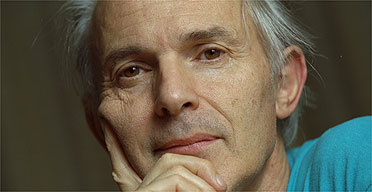
RESPONDING TO HARRY KROTO’S BRILLIANT RENOWNED ACADEMICS!! Dan McKenzie, Professor of Geophysics, Cambridge, “I have never been religious, my parents weren’t either. I have never been able to connect with the religious way of thought”

On November 21, 2014 I received a letter from Nobel Laureate Harry Kroto and it said:

…Please click on this URL http://vimeo.com/26991975

and you will hear what far smarter people than I have to say on this matter. I agree with them.

Harry Kroto

Nick Gathergood, David-Birkett, Harry-Kroto

I have attempted to respond to all of Dr. Kroto’s friends arguments and I have posted my responses one per week for over a year now. Here are some of my earlier posts:

Arif Ahmed, Sir David AttenboroughMark Balaguer, Horace Barlow, Michael BatePatricia ChurchlandAaron CiechanoverNoam Chomsky,Alan DershowitzHubert Dreyfus, Bart Ehrman, Stephan FeuchtwangDavid Friend,  Riccardo GiacconiIvar Giaever , Roy GlauberRebecca GoldsteinDavid J. Gross,  Brian Greene, Susan GreenfieldStephen F Gudeman,  Alan Guth, Jonathan HaidtTheodor W. Hänsch, Brian Harrison,  Hermann HauserRoald Hoffmann,  Bruce HoodHerbert Huppert,  Gareth Stedman Jones, Steve JonesShelly KaganMichio Kaku,  Stuart Kauffman,  Lawrence KraussHarry Kroto, George LakoffElizabeth Loftus,  Alan MacfarlanePeter MillicanMarvin MinskyLeonard Mlodinow,  Yujin NagasawaAlva NoeDouglas Osheroff,  Jonathan Parry,  Saul PerlmutterHerman Philipse,  Carolyn PorcoRobert M. PriceLisa RandallLord Martin Rees,  Oliver Sacks, John SearleMarcus du SautoySimon SchafferJ. L. Schellenberg,   Lee Silver Peter Singer,  Walter Sinnott-ArmstrongRonald de Sousa, Victor StengerBarry Supple,   Leonard Susskind, Raymond TallisNeil deGrasse Tyson,  .Alexander Vilenkin, Sir John WalkerFrank WilczekSteven Weinberg, and  Lewis Wolpert,

Dan McKenzie (geophysicist)

From Wikipedia, the free encyclopedia
For other people of the same name, see Daniel McKenzie (disambiguation).
Dan McKenzie
Born 21 February 1942 (age 72)
Cheltenham
Nationality British
Fields Geophysics
Institutions University of Cambridge
Thesis The shape of the earth (1967)
Doctoral advisor Teddy Bullard
Influences Walter Munk, Don L. Anderson
Notable awards Balzan Prize (1981)
Wollaston Medal (1983)
Japan Prize (1990)
Royal Medal (1991)
Copley Medal
William Bowie Medal (2001)
Crafoord Prize (2002)

Dan Peter McKenzie, CH, FRS is a Professor of Geophysics at the University of Cambridge, and one-time head of the Bullard Laboratories of the Cambridge Department of Earth Sciences. He wrote the first paper defining the principles of plate tectonics, and his early work on mantle convection created the modern discussion of planetary interiors.

In  the second video below in the 79th clip in this series are his words and  my response is below them. 

50 Renowned Academics Speaking About God (Part 1)

Another 50 Renowned Academics Speaking About God (Part 2)

A Further 50 Renowned Academics Speaking About God (Part 3)

Interview with Dan McKenzie – May 2007 – part 2

Uploaded on Nov 7, 2007

_________________________________

Below in the letter I wrote to Dr. Mckenzie I responded to his quote:

March 13, 2015

Professor Dan Mckenzie, c/o Dept. of Earth Sciences – Bullard Laboratories,
University of Cambridge,

Dear Dr. McKenzie,

I just finished reading the online addition of the book Darwin, Francis ed. 1892. Charles Darwin: his life told in an autobiographical chapter, and in a selected series of his published letters [abridged edition]. London: John Murray. There are several points that Charles Darwin makes in this book that were very wise, honest, logical, shocking and some that were not so wise. The Christian Philosopher Francis Schaeffer once said of Darwin’s writings, “Darwin in his autobiography and in his letters showed that all through his life he never really came to a quietness concerning the possibility that chance really explained the situation of the biological world. You will find there is much material on this [from Darwin] extended over many many years that constantly he was wrestling with this problem.”

I really enjoyed listening to your interview by Alan Macfarlane. Dr. Macfarlane has done so many wonderful in-depth interviews and yours with him was very good too. I noticed that you were educated under Fred Hoyle at Cambridge and that you also were interested in Dostoyevsky at one time.

I have written several times in the past about  Dostoyevsky and have many posts about his works. William Lane Craig in his article, “The Absurdity of Life without God,” wrote:

Another apologetic based on the human predicament may be found in the magnificent novels of the great nineteenth-century Russian writer Fyodor Dostoyevsky (1821–1881). (May I add that I think the obsession of contemporary evangelicals with the writings of authors like C. S. Lewis to the neglect of writers like Dostoyevsky is a great shame? Dostoyevsky is a far, far grander writer.) The problem that tortured Dostoyevsky was the problem of evil: how can a good and loving God exist when the world is filled with so much suffering and evil? Dostoyevsky presented this problem in his works so persuasively, so poignantly, that certain passages of his, notably “The Grand Inquisitor” section from his Brothers Karamazov, are often reprinted in anthologies as classic statements of the problem of evil. As a result, some people are under the impression that Dostoyevsky was himself an atheist and that the viewpoint of the Grand Inquisitor is his own.

Actually, he sought to carry through a two-pronged defense of theism in the face of the problem of evil. Positively, he argued that innocent suffering may perfect character and bring one into a closer relation with God. Negatively, he tried to show that if the existence of God is denied, then one is landed in complete moral relativism, so that no act, regardless how dreadful or heinous, can be condemned by the atheist. To live consistently with such a view of life is unthinkable and impossible. Hence, atheism is destructive of life and ends logically in suicide.

Dostoyevsky’s magnificent novels Crime and Punishment and The Brothers Karamazov powerfully illustrate these themes. In the former a young atheist, convinced of moral relativism, brutally murders an old woman. Though he knows that on his presuppositions he should not feel guilty, nevertheless he is consumed with guilt until he confesses his crime and gives his life to God. The latter novel is the story of four brothers, one of whom murders their father because his atheist brother Ivan had told him that moral absolutes do not exist. Unable to live with the consequences of his own philosophical system, Ivan suffers a mental collapse. The remaining two brothers, one of whom is unjustly accused of the parricide and the other a young Russian orthodox priest, find in what they suffer the perfection of their character and a nearness to God.

Dostoyevsky recognizes that his response to atheism constitutes no positive proof of Christianity. Indeed, he rejects that there could be such. Men demand of Christ that he furnish them “bread and circuses,” but he refuses to do so. The decision to follow Christ must be made in loneliness and anxiety. Each person must face for himself the anguish of a world without God and in the solitude of his own heart give himself to God in faith….Finally, let’s look at the problem of purpose in life. Unable to live in an impersonal universe in which everything is the product of blind chance, atheists sometimes begin to ascribe personality and motives to the physical processes themselves. It is a bizarre way of speaking and represents a leap from the lower to the upper story. For example, the brilliant Russian physicists Zeldovich and Novikov, in contemplating the properties of the universe, ask, why did “Nature”

instead of another? “Nature” has obviously become a sort of God-substitute, filling the role and function of God. Francis Crick halfway through his book The Origin of the Genetic Code begins to spell nature with a capital N and elsewhere speaks of natural selection as being “clever” and as “thinking” of what it will do. Sir Fred Hoyle, the English astronomer, attributes to the universe itself the qualities of God. For Carl Sagan the “Cosmos,” which he always spelled with a capital letter, obviously fills the role of a God-substitute. Though these men profess not to believe in God, they smuggle in a God-substitute through the back door because they cannot bear to live in a universe in which everything is the chance result of impersonal forces…Modern man no longer has any right to that support, since he rejects God. But in order to live purposefully, he makes a leap of faith to affirm a reason for living. 

___________

Here are a couple of more quotes from  -Sir Fred Hoyle, atheist, and a prominent astrophysicist of the 20th century.

“If you stir up simple nonorganic molecules like water, ammonia, methane, carbon dioxide and hydrogen cyanide with almost any form of intense energy … some of the molecules reassemble themselves into amino acids … demonstrated … byStanley Miller and Harold Urey. The … building blocks of proteins can therefore be produced by natural means. But this is far from proving that life could have evolved in this way. No one has shown that the correct arrangements of amino acids, like the orderings in enzymes, can be produced by this method. …. A junkyard contains all the bits and pieces of a Boeing 747, dismembered and in disarray. A whirlwind happens to blow through the yard. What is the chance that after its passage a fully assembled 747, ready to fly, will be found standing there? So small as to be negligible, even if a tornado were to blow through enough junkyards to fill the whole Universe.” (Hoyle, F., “The Intelligent Universe,” Michael Joseph: London, 1983, pp.18-19).

“If one proceeds directly…in this matter, without being deflected by a fear of incurring the wrath of scientific opinion, one arrives at the conclusion that biomaterialists (life forms) with their amazing measure of order must be the outcome of intelligent design.”

Recently I noticed this comment by you:

I have never been religious, my parents weren’t either. I have never been able to connect with the religious way of thought.

There is such a contrast between you and Charles Darwin who had a hard time indeed breaking away from his Christian beliefs to accept his own theory evolution basically because the one passage in Romans Chapter One. That chapter teaches that each person is confronted both with the testimony of the beauty of God’s Creation and the fact that God has put a conscience in every person’s heart that testifies of His existence.

I know you accept evolution but I wondered if you ever struggled with some of the same issues that Darwin did? This exact quote from you made me think of you when I read the book Charles Darwin: his life told in an autobiographical chapter, and in a selected series of his published letters because of what Darwin said on this same issue of intelligent design. I am going to quote some of Charles Darwin’s own words and then include the comments of Francis Schaeffer on those words. I have also enclosed a CD with two messages from Adrian Rogers and Bill Elliff concerning Darwinism.

Darwin, C. R. to Doedes, N. D.2 Apr 1873

“It is impossible to answer your question briefly; and I am not sure that I could do so, even if I wrote at some length. But I may say that the impossibility of conceiving that this grand and wondrous universe, with our conscious selves, arose through chance, seems to me the chief argument for the existence of God; but whether this is an argument of real value, I have never been able to decide…Nor can I overlook the difficulty from the immense amount of suffering through the world. I am aware that if we admit a First Cause, the mind still craves to know whence it came, and how it arose.”

Francis Schaeffer noted:

What he is saying is if you say there is a first cause, then the mind says, “Where did this come from?” I think this is a bit old fashioned, with some of the modern thinkers, this would not have carry as much weight today as it did when Darwin expressed it. Jean Paul Sartre said it as well as anyone could possibly say it. The philosophic problem is that something is there and not nothing being there. No one has the luxury of beginning with nothing. Nobody I have ever read has put forth that everything came from nothing. I have never met such a person in all my reading,or all my discussion. If you are going to begin with nothing being there, it has to be nothing nothing, and it can’t be something nothing. When someone says they believe nothing is there, in reality they have already built in something there. The only question is do you begin with an impersonal something or a personal something. All human thought is shut up to these two possibilities. Either you begin with an impersonal and then have Darwin’s own dilemma which impersonal plus chance, now he didn’t bring in the amount of time that modern man would though. Modern man has brought in huge amounts of time into the equation as though that would make a difference because I have said many times that time can’t make a qualitative difference but only a quantitative difference. The dilemma is it is either God or chance. Now you find this intriguing thing in Darwin’s own situation, he can’t understand how chance could have produced these two great factors of the universe and its form and the mannishness of man.

From Charles Darwin, Autobiography (1876), in The Life and Letters of Charles Darwin, ed. Francis Darwin, vol. 1 (London: John Murray, 1888), pp. 307 to 313.

“Another source of conviction in the existence of God, connected with the reason and not with the feelings, impresses me as having much more weight. This follows from the extreme difficulty or rather impossibility of conceiving this immense and wonderful universe, including man with his capacity of looking far backwards and far into futurity, as the result of blind chance or necessity. When thus reflecting, I feel compelled to look to a First Cause having an intelligent mind in some degree analogous to that of man; and I deserve to be called a Theist. This conclusion was strong in my mind about the time, as far as I can remember, when I wrote the Origin of Species, and it is since that time that it has very gradually, with many fluctuations, become weaker. But then arises the doubt…”

Francis Schaeffer commented:

On the basis of his reason he has to say there must be an intelligent mind, someone analogous to man. You couldn’t describe the God of the Bible better. That is man is made in God’s image  and therefore, you know a great deal about God when you know something about man. What he is really saying here is that everything in my experience tells me it must be so, and my mind demands it is so. Not just these feelings he talked about earlier but his MIND demands it is so, but now how does he counter this? How does he escape this? Here is how he does it!!!

Charles Darwin went on to observe:  —can the mind of man, which has, as I fully believe, been developed from a mind as low as that possessed by the lowest animals, be trusted when it draws such grand conclusions?”

Francis Schaeffer asserted:

So he says my mind can only come to one conclusion, and that is there is a mind behind it all. However, the doubt comes because his mind has come from the lowest form of earthworm, so how can I trust my mind. But this is a joker isn’t it?  Then how can you trust his mind to support such a theory as this? He proved too much. The fact that Darwin found it necessary to take such an escape shows the tremendous weight of Romans 1, that the only escape he can make is to say how can I trust my mind when I come from the lowest animal the earthworm? Obviously think of the grandeur of his concept, I don’t think it is true, but the grandeur of his concept, so what you find is that Darwin is presenting something here that is wrong I feel, but it is not nothing. It is a tremendously grand concept that he has put forward. So he is accepting the dictates of his mind to put forth a grand concept which he later can’t accept in this basic area with his reason, but he rejects what he could accept with his reason on this escape. It really doesn’t make sense. This is a tremendous demonstration of the weakness of his own position.

Darwin also noted, “I cannot pretend to throw the least light on such abstruse problems. The mystery of the beginning of all things is insoluble by us, and I for one must be content to remain an Agnostic.”

Francis Schaeffer remarked:

What a stupid reply and I didn’t say wicked. It just seems to me that here is 2 plus 2 equals 36 at this particular place.

Darwin, C. R. to Graham, William 3 July 1881

Nevertheless you have expressed my inward conviction, though far more vividly and clearly than I could have done, that the Universe is not the result of chance.* But then with me the horrid doubt always arises whether the convictions of man’s mind, which has been developed from the mind of the lower animals, are of any value or at all trustworthy. Would any one trust in the convictions of a monkey’s mind, if there are any convictions in such a mind?

Francis Schaeffer observed:

Can you feel this man? He is in real agony. You can feel the whole of modern man in this tension with Darwin. My mind can’t accept that ultimate of chance, that the universe is a result of chance. He has said 3 or 4 times now that he can’t accept that it all happened by chance and then he will write someone else and say something different. How does he say this (about the mind of a monkey) and then put forth this grand theory? Wrong theory I feel but great just the same. Grand in the same way as when I look at many of the paintings today and I differ with their message but you must say the mark of the mannishness of man are one those paintings titanic-ally even though the message is wrong and this is the same with Darwin.  But how can he say you can’t think, you come from a monkey’s mind, and you can’t trust a monkey’s mind, and you can’t trust a monkey’s conviction, so how can you trust me? Trust me here, but not there is what Darwin is saying. In other words it is very selective. 

Now we are down to the last  year of Darwin’s life.

* The Duke of Argyll (Good Words, April 1885, p. 244) has recorded a few words on this subject, spoken by my father in the last year of his life. “. . . in the course of that conversation I said to Mr. Darwin, with reference to some of his own remarkable works on the Fertilisation of Orchids, and upon The Earthworms,and various other observations he made of the wonderful contrivances for certain purposes in nature—I said it was impossible to look at these without seeing that they were the effect and the expression of mind. I shall never forget Mr. Darwin’s answer. He looked at me very hard and said, ‘Well, that often comes over me with overwhelming force; but at other times,’ and he shook his head vaguely, adding, ‘it seems to go away.'”

Francis Schaeffer summarized :

And this is the great Darwin, and it makes you cry inside. This is the great Darwin and he ends as a man in total tension.

Francis Schaeffer noted that in Darwin’s 1876 Autobiography that Darwin he is going to set forth two arguments for God in this and again you will find when he comes to the end of this that he is in tremendous tension. Darwin wrote, 

At the present day the most usual argument for the existence of an intelligent God is drawn from the deep inward conviction and feelings which are experienced by most persons.Formerly I was led by feelings such as those just referred to (although I do not think that the religious sentiment was ever strongly developed in me), to the firm conviction of the existence of God and of the immortality of the soul. In my Journal I wrote that whilst standing in the midst of the grandeur of a Brazilian forest, ‘it is not possible to give an adequate idea of the higher feelings of wonder, admiration, and devotion which fill and elevate the mind.’ I well remember my conviction that there is more in man than the mere breath of his body; but now the grandest scenes would not cause any such convictions and feelings to rise in my mind. It may be truly said that I am like a man who has become colour-blind.

Francis Schaeffer remarked:

Now Darwin says when I look back and when I look at nature I came to the conclusion that man can not be just a fly! But now Darwin has moved from being a younger man to an older man and he has allowed his presuppositions to enter in to block his logic. These things at the end of his life he had no intellectual answer for. To block them out in favor of his theory. Remember the letter of his that said he had lost all aesthetic senses when he had got older and he had become a clod himself. Now interesting he says just the same thing, but not in relation to the arts, namely music, pictures, etc, but to nature itself. Darwin said, “But now the grandest scenes would not cause any such convictions  and feelings to rise in my mind. It may be truly said that I am like a man who has become colour-blind…” So now you see that Darwin’s presuppositions have not only robbed him of the beauty of man’s creation in art, but now the universe. He can’t look at it now and see the beauty. The reason he can’t see the beauty is for a very, very , very simple reason: THE BEAUTY DRIVES HIM TO DISTRACTION. THIS IS WHERE MODERN MAN IS AND IT IS HELL. The art is hell because it reminds him of man and how great man is, and where does it fit in his system? It doesn’t. When he looks at nature and it’s beauty he is driven to the same distraction and so consequently you find what has built up inside him is a real death, not  only the beauty of the artistic but the beauty of nature. He has no answer in his logic and he is left in tension.  He dies and has become less than human because these two great things (such as any kind of art and the beauty of  nature) that would make him human  stand against his theory.

DO THESE WORDS OF DARWIN APPLY TO YOU TODAY? “I am like a man who has become colour-blind.”

ADRIAN ROGERS NOTED IN HIS SERMON “The Cradle that Rocked the World“:

Sir Fred Hoyle, at the British Academy of Science—a leading mathematician, a leading astronomer—shook up a lot of people in the scientific community, when he said this—listen: “We must now admit to ourselves that the probability of life arising by chance, by evolution, is the same probability as throwing six on a die 5 million consecutive times.” Now, get a die, and begin to throw it; and, if you can throw six, it’ll land on six 5 million times in a row—that’s the probability that life could arise by spontaneous generation. He went on to say—this is Sir Fred Hoyle: “Let us be scientifically honest with ourselves. The probability of having life arise to greater and greater complexity in organization by chance is the same probability of having a tornado tear through a junkyard and form a 747 on the other end.” What is this great scientist saying? That random and impersonal chance does not create complexity in design— that’s what he’s saying.

IF WE ARE LEFT WITH JUST THE MACHINE THEN WHAT IS THE FINAL CONCLUSION IF THERE WAS NO PERSONAL GOD THAT CREATED US? I sent you a CD that starts off with the song DUST IN THE WIND by Kerry Livgren of the group KANSAS which was a hit song in 1978 when it rose to #6 on the charts because so many people connected with the message of the song. It included these words, “All we do, crumbles to the ground though we refuse to see, Dust in the Wind, All we are is dust in the wind, Don’t hang on, Nothing lasts forever but the Earth and Sky, It slips away, And all your money won’t another minute buy.”

Kerry Livgren himself said that he wrote the song because he saw where man was without a personal God in the picture. Solomon pointed out in the Book of Ecclesiastes that those who believe that God doesn’t exist must accept three things. FIRST, death is the end and SECOND, chance and time are the only guiding forces in this life.  FINALLY, power reigns in this life and the scales are never balanced. The Christian can  face death and also confront the world knowing that it is not determined by chance and time alone and finally there is a judge who will balance the scales.

Both Kerry Livgren and the bass player Dave Hope of Kansas became Christians eventually. Kerry Livgren first tried Eastern Religions and Dave Hope had to come out of a heavy drug addiction. I was shocked and elated to see their personal testimony on The 700 Club in 1981 and that same  interview can be seen on You Tube today. Livgren lives in Topeka, Kansas today where he teaches “Diggers,” a Sunday school class at Topeka Bible ChurchDAVE HOPE is the head of Worship, Evangelism and Outreach at Immanuel Anglican Church in Destin, Florida.

The answer to find meaning in life is found in putting your faith and trust in Jesus Christ. The Bible is true from cover to cover and can be trusted.

Thank you again for your time and I know how busy you are.

Everette Hatcher, everettehatcher@gmail.com, http://www.thedailyhatch.org, cell ph 501-920-5733, Box 23416, LittleRock, AR 72221, United States

Is the Bible historically accurate?

Here are some of the posts I have done in the past on the subject: 1. The Babylonian Chronicleof Nebuchadnezzars Siege of Jerusalem2. Hezekiah’s Siloam Tunnel Inscription. 3. Taylor Prism (Sennacherib Hexagonal Prism)4. Biblical Cities Attested Archaeologically. 5. The Discovery of the Hittites6.Shishak Smiting His Captives7. Moabite Stone8Black Obelisk of Shalmaneser III9A Verification of places in Gospel of John and Book of Acts., 9B Discovery of Ebla Tablets10. Cyrus Cylinder11. Puru “The lot of Yahali” 9th Century B.C.E.12. The Uzziah Tablet Inscription13. The Pilate Inscription14. Caiaphas Ossuary14 B Pontius Pilate Part 214c. Three greatest American Archaeologists moved to accept Bible’s accuracy through archaeology.

You can hear DAVE HOPE and Kerry Livgren’s stories from this youtube link:

(part 1 ten minutes)

(part 2 ten minutes)

Kansas – Dust in the Wind (Official Video)

Uploaded on Nov 7, 2009

Pre-Order Miracles Out of Nowhere now at http://www.miraclesoutofnowhere.com

About the film:
In 1973, six guys in a local band from America’s heartland began a journey that surpassed even their own wildest expectations, by achieving worldwide superstardom… watch the story unfold as the incredible story of the band KANSAS is told for the first time in the DVD Miracles Out of Nowhere.

_____________________________

Adrian Rogers on Darwinism

________

Related posts:

FRANCIS SCHAEFFER ANALYZES ART AND CULTURE Part 53 THE BEATLES (Part E, Stg. Pepper’s and John Lennon’s search in 1967 for truth was through drugs, money, laughter, etc & similar to King Solomon’s, LOTS OF PICTURES OF JOHN AND CYNTHIA) (Feature on artist Yoko Ono)

The John Lennon and the Beatles really were on a long search for meaning and fulfillment in their lives  just like King Solomon did in the Book of Ecclesiastes. Solomon looked into learning (1:12-18, 2:12-17), laughter, ladies, luxuries, and liquor (2:1-2, 8, 10, 11), and labor (2:4-6, 18-20). He fount that without God in the picture all […]

FRANCIS SCHAEFFER ANALYZES ART AND CULTURE Part 52 THE BEATLES (Part D, There is evidence that the Beatles may have been exposed to Francis Schaeffer!!!) (Feature on artist Anna Margaret Rose Freeman )

______________   George Harrison Swears & Insults Paul and Yoko Lucy in the Sky with Diamonds- The Beatles The Beatles:   I have dedicated several posts to this series on the Beatles and I don’t know when this series will end because Francis Schaeffer spent a lot of time listening to the Beatles and talking […]

FRANCIS SCHAEFFER ANALYZES ART AND CULTURE Part 51 THE BEATLES (Part C, List of those on cover of Stg.Pepper’s ) (Feature on artist Raqib Shaw )

  The Beatles in a press conference after their Return from the USA Uploaded on Nov 29, 2010 The Beatles in a press conference after their Return from the USA. The Beatles:   I have dedicated several posts to this series on the Beatles and I don’t know when this series will end because Francis […]

FRANCIS SCHAEFFER ANALYZES ART AND CULTURE Part 50 THE BEATLES (Part B, The Psychedelic Music of the Beatles) (Feature on artist Peter Blake )

__________________   Beatles 1966 Last interview I have dedicated several posts to this series on the Beatles and I don’t know when this series will end because Francis Schaeffer spent a lot of time listening to the Beatles and talking and writing about them and their impact on the culture of the 1960’s. In this […]

FRANCIS SCHAEFFER ANALYZES ART AND CULTURE Part 49 THE BEATLES (Part A, The Meaning of Stg. Pepper’s Cover) (Feature on artist Mika Tajima)

_______________ The Beatles documentary || A Long and Winding Road || Episode 5 (This video discusses Stg. Pepper’s creation I have dedicated several posts to this series on the Beatles and I don’t know when this series will end because Francis Schaeffer spent a lot of time listening to the Beatles and talking and writing about […]

FRANCIS SCHAEFFER ANALYZES ART AND CULTURE PART 48 “BLOW UP” by Michelangelo Antonioni makes Philosophic Statement (Feature on artist Nancy Holt)

_______________ Francis Schaeffer pictured below: _____________________ I have included the 27 minute  episode THE AGE OF NONREASON by Francis Schaeffer. In that video Schaeffer noted,  ” Sergeant Pepper’s Lonely Hearts Club Band…for a time it became the rallying cry for young people throughout the world. It expressed the essence of their lives, thoughts and their feelings.” How Should […]

FRANCIS SCHAEFFER ANALYZES ART AND CULTURE Part 47 Woody Allen and Professor Levy and the death of “Optimistic Humanism” from the movie CRIMES AND MISDEMEANORS Plus Charles Darwin’s comments too!!! (Feature on artist Rodney Graham)

Crimes and Misdemeanors: A Discussion: Part 1 ___________________________________ Today I will answer the simple question: IS IT POSSIBLE TO BE AN OPTIMISTIC SECULAR HUMANIST THAT DOES NOT BELIEVE IN GOD OR AN AFTERLIFE? This question has been around for a long time and you can go back to the 19th century and read this same […]

FRANCIS SCHAEFFER ANALYZES ART AND CULTURE PART 46 Friedrich Nietzsche (Featured artist is Thomas Schütte)

____________________________________ Francis Schaeffer pictured below: __________ Francis Schaeffer has written extensively on art and culture spanning the last 2000years and here are some posts I have done on this subject before : Francis Schaeffer’s “How should we then live?” Video and outline of episode 10 “Final Choices” , episode 9 “The Age of Personal Peace and Affluence”, episode 8 […]

FRANCIS SCHAEFFER ANALYZES ART AND CULTURE Part 45 Woody Allen “Reason is Dead” (Feature on artists Allora & Calzadilla )

Love and Death [Woody Allen] – What if there is no God? [PL] ___________ _______________ How Should We then Live Episode 7 small (Age of Nonreason) #02 How Should We Then Live? (Promo Clip) Dr. Francis Schaeffer 10 Worldview and Truth Two Minute Warning: How Then Should We Live?: Francis Schaeffer at 100 Francis Schaeffer […]

FRANCIS SCHAEFFER ANALYZES ART AND CULTURE Part 44 The Book of Genesis (Featured artist is Trey McCarley )

___________________________________ Francis Schaeffer pictured below: ____________________________ Francis Schaeffer “BASIS FOR HUMAN DIGNITY” Whatever…HTTHR Dr. Francis schaeffer – The flow of Materialism(from Part 4 of Whatever happened to human race?) Dr. Francis Schaeffer – The Biblical flow of Truth & History (intro) Francis Schaeffer – The Biblical Flow of History & Truth (1) Dr. Francis Schaeffer […]

__

RESPONDING TO HARRY KROTO’S BRILLIANT RENOWNED ACADEMICS!! Pausing to take a look at the life of HARRY KROTO Part D (Kroto’s emails to me on 9-18-14)

Today in this tribute to Dr. Kroto I include some of his emails to me.

It is with sadness that I write this post having learned of the death of Sir Harold Kroto on April 30, 2016 at the age of 76. He was a scientist of remarkable abilities and a man of great humor too. In this series  I posted the Memorial by Richard Dawkins for Dr. Kroto and I also looked at Kroto’s membership in CSICOP and his admiration for Bertrand Russell and his 2 emails he sent to me on 9-18-14.  Peter Coles, Head of the School of Mathematical and Physical Sciences at the University of Sussex gave an excellent tribute Dr. Kroto which I posted too.

I did not know Harry Kroto personally but I did have the opportunity to correspond with him in 2014. I sent him a letter in the spring and two in the summer and he responded with an email on 9-18-14 and I thanked him for responding in an email and then he emailed me again and even sent me a letter on 11-21-14. In that 11-21-14 letter he referred me to the You Tube film series Renowned Academics Speaking About God which has over 300,000 views on You Tube and that prompted me on 11-29-14 to start my blog series RESPONDING TO HARRY KROTO’S BRILLIANT RENOWNED ACADEMICS!! Below are the links to the posts I have already done on previous Tuesdays in this series:

Arif AhmedHaroon Ahmed,Sir David AttenboroughMark Balaguer, Horace Barlow, Michael BateSir Patrick Bateson,Patricia ChurchlandAaron CiechanoverNoam Chomsky,Alan DershowitzHubert Dreyfus, Bart Ehrman, Stephan FeuchtwangDavid Friend,  Riccardo GiacconiIvar Giaever , Roy GlauberRebecca GoldsteinDavid J. Gross,  Brian Greene, Susan GreenfieldStephen F Gudeman,  Alan Guth, Jonathan HaidtTheodor W. Hänsch, Brian Harrison,  Hermann HauserRoald Hoffmann,  Bruce HoodHerbert Huppert,  Gareth Stedman Jones, Steve JonesShelly KaganMichio Kaku,  Stuart Kauffman,  Lawrence KraussHarry Kroto, George LakoffElizabeth Loftus,  Alan MacfarlanePeter MillicanMarvin MinskyLeonard Mlodinow,  Yujin NagasawaAlva NoeDouglas Osheroff,  Jonathan Parry,  Saul PerlmutterHerman Philipse,  Carolyn PorcoRobert M. PriceLisa RandallLord Martin ReesAlison Richard,  Oliver Sacks, John SearleMarcus du SautoySimon SchafferJ. L. Schellenberg,   Lee Silver Peter Singer,  Walter Sinnott-ArmstrongRonald de Sousa, Victor StengerJohn SulstonBarry Supple,   Leonard Susskind, Raymond TallisNeil deGrasse Tyson,  C.J. van RijsbergenAlexander Vilenkin, Sir John WalkerFrank WilczekSteven Weinberg, and  Lewis Wolpert,

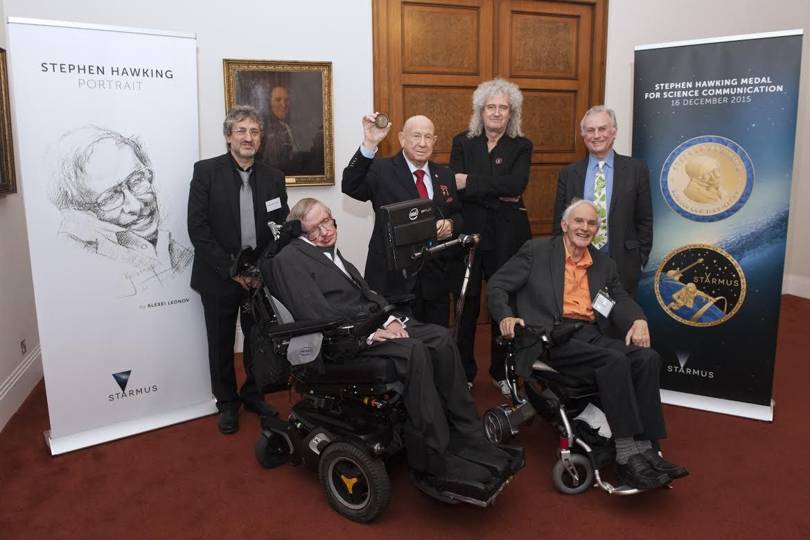
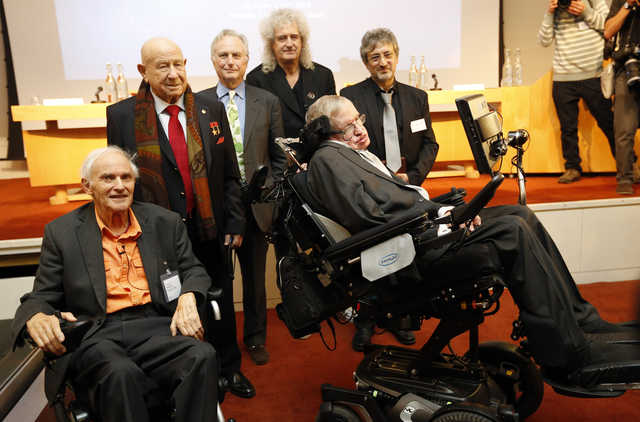
Garik Israelian, Stephen Hawking, Alexey Leonov, Brian May, Richard Dawkins and Harry Kroto

First RESPONSE BY KROTO an email ON 9-18-14 on ultimate meaning

Dear Everette
Thank you for your letter
re your question
“How does our life have any ultimate meaning”
I have no idea how others deal with this question
and do not even know whether it “means” anything
to ask such a question…I do not ask it of myself

re “ultimate meaning”
I give my own life “personal meaning” by doing “what I do”
that is all that matters to me

David Hume whom I consider to be a great philosopher said
“The life of man is of no greater importance to the universe than that of an oyster.”
….other good quotes for you here:
http://www.goodreads.com/author/quotes/45726.David_Hume

The simple words of Dust in the wind…seems to makes sense to me
I do not need to analyse the words any more deeply

as I have said above…yes I agree with Myers re “my significance”

harry
PS  NB
Thank you for writing to me but note that
I really am sorry that I have nothing more to say on any of the matters
which seem to interest you…

My email response  on 9-18-16 thanking him for responding and mentioned recent visit by Jim McCollum

I responded on 9-18-14 with this email:

I really appreciate the fact that you took time to respond. I know that we don’t see the world the same but I wanted to share a feel good story that happened to one of our customers back in September of 2013. Melvin Pickens is now 81 years old and he has been selling our brooms here from Little Rock Broom Works since 1950. The amazing thing is that Melvin is partially blind and he is a cancer survivor and he had a stroke a couple of years ago. However, with the help of a caregiver he still meets up with his customers and sells them our Airlight Broom. Steve Hartman of CBS News found out about it and did a story on him. Here is the clip from CBS and an article about Melvin too at this link:

https://thedailyhatch.org/2013/09/20/melvin-pickens-the-broom-man-of-little-rock-does-a-great-job-on-the-cbs-evening-news-interview-with-steve-hartman/

I got a good trivia question for you? I wondered why my friend Melvin had been a LA Dodger fan the last 30 years I knew  he had always lived in Arkansas and most fans around here are St. Louis, Atlanta or maybe Ranger fans. Why was Melvin a LA Dodger fan?   He told me that in 1947 when he was at Henry Clay Yerger High School in Hope, Arkansas, Branch Rickey (the general manager of the Brooklyn Dodgers) stood up for Jackie Robinson and made him the first black baseball player to play professional baseball with the whites. Every person he knew at Henry Clay Yerger High School became a Dodger fan that year, and he has been a faithful fan ever since!!! I found that out back when the movie “42” came out about Jackie Robinson and when I saw the movie I knew how much Robinson had impacted one of my good friends.

Melvin Pickens,

Thanks again for taking time to respond.

Everette Hatcher, cell ph 501-920-5733, everettehatcher@gmail.com

MelvinPickens pictured below:

_____________

_____

http://talkbusiness.net/2013/09/arkansas-broom-man-makes-national-news/Tolbert: Arkansas ‘Broom Man’ Makes National News

______________

Brian Chilson

  • ON THE JOB: Melvin Pickens strolls Kavanaugh in a 2011 photo.
Thanks again for taking time to respond. Jim McCollum of the famous Supreme Court case agrees with your philosophical positions but he got a kick out of coming to Little Rock and touring our plant. Here is picture of myself and my son Wilson and Jim and his wife together at this link. https://thedailyhatch.org/2014/08/08/chance-to-visit-with-jim-mccollum-of-supreme-court-famed-case/
It is nice when people from two opposing views can discuss things in a civil matter.

Everette Hatcher, everettehatcher@gmail.com, cell ph 501-920-5733

Kroto’s 2nd email response on 9-18-14 with comment on Melvin CBS story and with  a couple of quotes

Thank you
great story

I think we may see the good things the same way
but I do not gloss over the bad aspects of religiosity
but …some of the bad…cf ISIS

“With or without religion, you would have good people doing good things and evil people doing evil things. But for good people to do evil things, that takes religion.”
― Steven Weinberg
“Religion is an insult to human dignity. Without it you would have good people doing good things and evil people doing evil things.
But for good people to do evil things, that takes religion.”
― Steven Weinberg

https://www.goodreads.com/author/quotes/86758.Steven_Weinberg

Sir Harold Kroto – Biographical

Bolton is a once prosperous but then (the fifties) decaying northern English town which is rightfully proud of its legendary contributions to the industrial revolution – the likes of Samuel Crompton and Richard Arkwright were Boltonians. Indeed we lived in Arkwright St. and I shall always remember walking to school each morning past the windows of cotton mills through which I could see the vast rows of massive looms and spinning frames operated by women who had been working from at least six o’clock in the morning, if not earlier.

My efforts to merge into the background meant, among other things such as fighting (literally) for survival, speaking only English (all real Englishmen expect others to speak English) – though I allowed myself to absorb just enough German to understand what my parents were saying about me when they spoke German. One specific memory was that when I did particularly poorly at French one year my Father gave me a very large French dictionary for my birthday – was I pleased!!!

My name seems to have its origins in Silesia where my father’s family originated and there is a town in Poland now called Krotoszyn (then Krotoschin). My father’s family came from Bojanowo and set up a shop in Berlin where my father was born in 1900. The original family house, which was then a shop, still exists in the main square in Bojanowo. I have an old photograph which shows the sign “I. Krotoschiner” in gothic characters emblazened over the window. I visited the town recently and, apart from cars rather than horsedrawn carts and the sign, little has changed – the Hotel Centralny is now the Restauracja Centralny and the aerials on the roofs are still there!

My father, who originally wanted to be a dress designer but somehow ended up running a small business printing faces and other images on toy balloons, had to leave Berlin in 1937 and my mother (who was not Jewish) followed a few months later. I always felt that my parents had a really raw deal, as did almost everyone born in Europe at the turn of the Century. The First World War took place while they were teenagers, then the Depression struck and Hitler came to power while they were young adults. They had to leave their home country and then the Second World War broke out and they had to leave their home again. When my father was 45 he had to find a new profession, when he was 55 he set up his business again and when he was 65 he realised I was not going to take it over. He sold the business and retired in his early 70’s.

I do not know how my father managed to catch the train to take him over the border into Holland in 1937. For as long as I knew him he was always late for everything; he invariably missed every train or bus he was supposed to catch. He told me that this was because he was called up in 1917 to go to the Front but arrived at the station just as the train was pulling out. When he asked the station master what he should do, he was told to go home. From then on he decided to make a point of missing trains and buses, but seems to have made one exception, in 1937. My parents managed to set up their small business again in London but the effort was, of course, short lived due to the outbreak of the War in September 1939. I was born in Wisbech (a very small town in Cambridgeshire to which my mother was evacuated) on Oct 7th 1939 in the first month of the War so I was a war baby. My father was interned on the Isle of Man because he was considered to be an enemy alien; my mother (who was also an alien, but presumably assumed not to be an enemy one) was moved (with me – when I was about one year old) from London to Bolton in 1940. After the war my father became an apprentice engineer and because he was so good with his hands he managed to get a job as a fully qualified toolmaker at an engineering company in months rather than years.

In 1955, with help from friends in England and Germany from before the war, he set up his own small factory again, this time to make balloons as well as print them. I spent much of my school holidays working at the factory. I was called upon to fill in everywhere, from mixing latex dyes to repairing the machinery and replacing workers on the production line. I only now realise what an outstanding training ground this had been for the development of the problem solving skills needed by a research scientist. I am also sure that what I was doing then would contravene present-day health and safety at work regulations. I would have been considered too young and inexperienced to do the sort of maintenance work that I was often called upon to do. I did the stocktaking twice-a-year using a set of old scales with sets of individual gram weights (weighing balloons 10 at-a-time to obtain their average weights), my head, log tables and a slide rule to determine total numbers of various types of balloons. No paradise of microprocessor controlled balances then. After each stocktaking session I invariably felt that I never wanted to see another balloon as long as I lived.

My parents had lost almost everything and we lived in a very poor part of Bolton. However they did everything they could to get me the best education they could. As far as they were concerned this meant getting me into Bolton School, a school with exceptional facilities and teachers. As a consequence of misguided politically motivated educational policies this school has become an independent school and it bothers me that, were I today in the same financial position as my parents had been when I was a child, I would not be able to send my children to this school. Though I did not like exams or homework anymore than other kids, I did like school and spent as much time as I could there. At first I particularly enjoyed art, geography, gymnastics and woodwork. At home I spent much of the time by myself in a large front room which was my private world. As time went by it filled up with junk and in particular I had a Meccano set with which I “played” endlessly. Meccano which was invented by Frank Hornby around 1900, is called Erector Set in the US. New toys (mainly Lego) have led to the extinction of Meccano and this has been a major disaster as far as the education of our young engineers and scientists is concerned. Lego is a technically trivial plaything and kids love it partly because it is so simple and partly because it is seductively coloured. However it is only a toy, whereas Meccano is a real engineering kit and it teaches one skill which I consider to be the most important that anyone can acquire: This is the sensitive touch needed to thread a nut on a bolt and tighten them with a screwdriver and spanner just enough that they stay locked, but not so tightly that the thread is stripped or they cannot be unscrewed. On those occasions (usually during a party at your house) when the handbasin tap is closed so tightly that you cannot turn it back on, you know the last person to use the washroom never had a Meccano set.

At no point do I ever remember taking religion very seriously or even feeling that the biblical stories were any different from fairy stories. Certainly none of it made any sense. By comparison the world in which I lived, though I might not always understand it in all aspects, always made a lot of sense. Nor did it make much sense that my friends were having a good time in a coffee bar on Saturday mornings while I was in schul singing in a language I could not understand. Once while my father and I were fasting, I remember my mother having some warm croissants – and did they smell good! I decided to have one too – ostensibly a heinous crime. I waited for a 10 ton “Monty Python” weight to fall on my head! It didn’t. Some would see this lack of retribution as proof of a merciful God (or that I was not really Jewish because my mother wasn’t), but I drew the logical (Occam’s razor) conclusion that there was “nothing” there. There are serious problems confronting society and a “humanitarian” God would not have allowed the unaccountable atrocities carried out in the name of any philosophy, religious or otherwise, to happen to anyone let alone to his/her/its chosen people. The desperate need we have for such organisations as Amnesty International has become, for me, one of the pieces of incontrovertible evidence that no divine (mystical) creator (other than the simple Laws of Nature) exists.

The illogical excuses, involving concepts such as free will(!), convoluted into confusing arguments by clerics and other self-appointed guardians of universal morality, have always seemed to me to be just so much fancy (or actually clumsy) footwork devised to explain why the fascinating and beautifully elegant world I live in operates exactly the way one would expect it to in the absence of a mystical power. Of course the excuses have been honed and polished over millennia to retain a hold over those unwilling or unable to accept that, as a Croatian friend of mine once neatly put it, “When you’ve had it you’ve had it”.

The humanitarian philosophies that have been developed (sometimes under some religious banner and invariably in the face of religious opposition) are human inventions, as the name implies – and our species deserves the credit. I am a devout atheist – nothing else makes any sense to me and I must admit to being bewildered by those, who in the face of what appears so obvious, still believe in a mystical creator. However I can see that the promise of infinite immortality is a more palatable proposition than the absolute certainty of finite mortality which those of us who are subject to free thought (as opposed to free will) have to look forward to and many may not have the strength of character to accept it.

[After all this, I have ended up a supporter of ideologies which advocate the right of the individual to speak, think and write in freedom and safety (surely the bedrock of a civilised society). I have very serious personal problems when confronted by individuals, organisations and regimes which do not accept that these freedoms are fundamental human rights. I feel one must oppose those who claim that the “good” of the community must come before that of the individual – this claim is invariably used to justify oppression by the state. Furthermore there has never been any consensus on what the “good” of the community actually consists of, whereas for individuals there is little difficulty. Thus I am a supporter of Amnesty International, a humanist and an atheist. I believe in a secular, democratic society in which women and men have total equality, and individuals can pursue their lives as they wish, free of constraints – religious or otherwise. I feel that the difficult ethical and social problems which invariably arise must be solved, as best they can, by discussion and am opposed to the crude simplistic application of dogmatic rules invented in past millennia and ascribed to a plethora of mystical creators – or the latest invention; a single creator masquerading under a plethora of pseudonyms. Organisations which seek political influence by co-ordinated effort disturb me and thus I believe religious and related pressure groups which operate in this way are acting antidemocratically and should play no part in politics. I also have problems with those who preach racist and related ideologies which seem almost indistinguishable from nationalism, patriotism and religious conviction.]

My art teacher, Mr Higginson, would give me special tuition at lunch times or after school was over. My father made me finish all my homework and I had to stay up until it was not only complete but passed his inspection – midnight if necessary. As time progressed, for reasons which I am not sure I understand, I gravitated towards chemistry, physics and maths (in that order) and these became my specialist subjects in the 6th form. I was keen on sport, and in school I concentrated on gymnastics whilst outside school I played as much tennis as I could. I patterned my backhand (and my haircut) on that of Dick Savitt and my service on that of Neil Fraser. At one time I remember wanting to be Wimbledon champion but decided that this goal was going to be a bit hard to achieve as I seemed to be having too much difficulty winning.

I started to develop an unhealthy interest in chemistry during enjoyable lessons with Dr. Wilf Jary who fascinated me most with his ability, when using a gas blowpipe to melt lead, to blow continuously without apparently stopping to breath in. I, like almost all chemists I know, was also attracted by the smells and bangs that endowed chemistry with that slight but charismatic element of danger which is now banned from the classroom. I agree with those of us who feel that the wimpish chemistry training that schools are now forced to adopt is one possible reason that chemistry is no longer attracting as many talented and adventurous youngsters as it once did. If the decline in hands-on science education is not redressed, I doubt that we shall survive the 21st century. I became ever more fascinated by chemistry – particularly organic chemistry – and was encouraged by the sixth form chemistry teacher (Harry Heaney, now Professor at Loughborough) to go to. Sheffield University because he reckoned it had, at the time, the best chemistry department in the UK (and perhaps anywhere) – a friendly interview with the amazing Tommy Stephens (compared with a most forbidding experience at Nottingham) settled it.

I was born during the war so I just escaped military service. As all the normal places at Oxbridge were already assigned for the next two years to reemerging national servicemen, I needed to achieve scholarship level to get to Cambridge. This turned out to be a bit difficult as I had been assigned a college with an examination syllabus orthogonal to the one that I had studied. Ian McKellen, the actor, who was in the same year at school, only seems to have needed to remember his lines from his part as Henry V in the school play!

The first day that I arrived in Sheffield, I walked past a building which had a nameplate saying it was the Department of Architecture and was bemused – did people do that at University? I had somehow missed this possibility because general careers advice was non-existent at that time. With hindsight I am sure that with the advice available today I would have done something like architecture which would have conflated my art and technology interests. At Sheffield I did as much as I could. Initially I lived with a family in Hillsborough, near to the Sheffield Wednesday football ground and occasionally watched them – very occasionally as I am a Bolton Wanderers supporter. I played as much tennis as I could which helped to get me a room in a hall of residence (Crewe Hall). I played for the university tennis team and we got to the UAU (Universities Athletics Union) final twice – the team would probably have been champions without me – which they were in 1964. I wanted to continue with some form of art, which was really my passion, and became art editor of “Arrows” (the student magazine which we published each term), specialising in designing the magazine’s covers and the screenprinted advertising posters. Whilst a research student I won a Sunday Times bookjacket design competition – the first important (national) prize I was to get for a very long time. Later my cover design for the departmental teaching and research brochure “Chemistry at Sussex” was featured in “Modern Publicity” (an international annual of the best in professional graphic design) – I consider this to be one of my best publications.

In the 1960s almost everybody could play the guitar well enough to play and sing two or three songs at a party so I had a go at that too and learned just enough chords (about half-a-dozen) to play some simple songs at local student folk clubs. I also decided that I should do some administration in the Students’ Union and from secretary of the tennis team I somehow ended up as President of the Athletics Council. During my last year at University (1963-64) I spent some 2-3 hours of each day attending to administration in the sports office in the Union. That year’s involvement in embryonic politics was enough to last a lifetime. I managed to do enough chemistry in between the tennis, some snooker and football, designing covers and posters for “Arrows”, painting murals as backdrops for balls and trying to play the guitar, to get a first class honours BSc degree (1958-61) and a PhD (1961-64) as well as some job offers. I also got married.

I had been keen on organic chemistry when I arrived at Sussex (at the behest of Harry Heaney I had bought Fieser and Fieser’s Organic Chemistry and read much of it while at school – it was a good read), but as the university course progressed I started to get interested in quantum mechanics and when I was introduced to spectroscopy (by Richard Dixon, who was to become Professor at Bristol) I was hooked. It was fascinating to see spectroscopic band patterns which showed that molecules could count. I had a problem as I really liked organic chemistry (I guess I really liked drawing hexagons) but in the end I decided to do a PhD in the Spectroscopy of Free Radicals produced by Flash Photolysis – with Richard Dixon. George Porter was Professor of Physical Chemistry at that time so there was a lot of flashing going on at Sheffield.

In 1964 I had several job offers but Marg(aret) and I decided that we wanted to live abroad for a while and Richard Dixon had inveigled an attractive offer of a postdoctoral position for me from Don Ramsay at the National Research Council in Ottawa. In 1964 Marg and I left Liverpool, on the Empress of Canada, for Montreal and then went on to Ottawa by train. I arrived at the famous No. 100, Sussex Drive, NRC, Ottawa, where Gerhard Herzberg (GH) had created the mecca of spectroscopy with his colleagues Alec Douglas, Cec Costain, Don Ramsay, Boris Stoicheff and others. At the time NRC was the only national research facility worldwide that was recognised as a genuine success. I suspect that this was because the legendary Steacie had left researchers to do the science they wanted; now unfortunately – as almost everywhere else – administrators decide what should be done. I remember easily making friends with all the other postdocs who congregated each morning and afternoon in the historical room 1057 – the spectroscopy tea/coffee area. The atmosphere was, in retrospect, quite exhilarating and many there, including: Reg Colin, Cec Costain, Fokke Creutzberg, Alec Douglas, Werner Goetz, Jon Hougen, Takeshi Oka and Jim Watson and their families became our lifelong close friends. As I look back I realise that Cec Costain, Jon Hougen, Takeshi Oka and Jim Watson were to exert enormous direct and indirect influence on my scientific development. I gradually learned to recognise who was good at what and what (if anything) I was good at. To paraphrase Clint Eastwood “A (scientist’s) gotta know his limitations”- and in this somewhat daunting company I learned mine. Although I knew that my level of knowledge and understanding was limited when I arrived, I was never made to feel inferior. This encouraging atmosphere was, in my opinion, the most important quality of the laboratory and permeated down directly from GH, Alec and Cec – it was a fantastic, free environment. The philosophy seemed to be to make state-of-the-art equipment available and let budding young scientists loose to do almost whatever they wanted. Present research funding policies appear to me to be opposed to this type of intellectual environment. I have severe doubts about policies (in the UK and elsewhere) which concentrate on “relevance” and fund only those with foresight when it is obvious that many (including me) haven’t got much. There are as many ways to do science as there are scientists and thus when funds are scarce good scientists have to be supported even if they do not know where their studies are leading. Though it seems obvious (at least to me) that unexpected discoveries must be intrinsically more important than predictable (applied) advances it is now more difficult than ever before to obtain support for more non-strategic research.

In 1965 after a further year of flash photolysis/spectroscopy in Don Ramsay’s laboratory, where I discovered a singlet-singlet electronic transition of the NCN radical and worked on pyridine which turned out to have a nonplanar excited state (still to be fully published!), I transferred to Cec Costain’s laboratory because I had developed a fascination for microwave spectroscopy. There I worked on the rotational spectrum of NCN3. Sometimes Takeshi Oka would be on the next spectrometer-working next to someone with such an exceptional blend of theoretical and experimental expertise did not help to alleviate the occasional sense of inadequacy. I really learned quantum mechanics (as did we all) from an intensive course that Jon Hougen gave at Carleton University. Whenever I was in difficulty theoretically (which was most of the time) Jim Watson helped me out – when he was not busy helping everyone else out. Gradually I realised that many in the field were stronger at physics than chemistry and in retrospect I subconsciously recognised that there might be a niche for me in spectroscopy research if I could exploit my relatively strong chemistry background.

In 1966, after two years at NRC, John Murrell (who had taught me quantum chemistry at Sheffield) offered me a postdoctoral position at Sussex. We were quite keen to live in the US, however, and I managed to get a postdoctoral position at Bell Labs (Murray Hill) with Yoh Han Pao (later Professor at Case Western) to carry out studies of liquid phase interactions by laser Raman spectroscopy. David Santry (now Professor at McMaster) was also working with Yoh Han at that time and each evening Dave and I carried out CNDO theoretical calculations on the electronic transitions of small molecules and radicals. I learned programming (Fortran) from Dave who threw me in at the deep end by showing me how to modify and correct the programs and then left me to see if I could do it myself.

During the year I received another letter from John Murrell to say that the position that had been available at Sussex the previous year was still available but would not be so for much longer. Thus Marg, Stephen (who had been born in Ottawa) and I came back to the UK- my annual salary dropped from $14000 to 1400 pounds, ouch! Marg had to find part-time employment as soon as possible although pregnant with our second son, David (we were poorer – but we were happier …. ! ! ! ). I was just about to start writing off for some positions back in the US and had just located the address of Buckminster Fuller’s research group (I was interested in the way that predesigned urban sub-structures might be welded into an efficient large urban complex) when John Murrell offered me a permanent lectureship at Sussex which I accepted.

I remember thinking I would give myself five years to make a go of research and teaching and if it was not working out I would re-train to do graphic design (my first love) or go into scientific educational TV (I had had an interview with the BBC before we went to Canada). I started to build up a microwave laboratory to probe unstable molecules and Michael Lappert encouraged me to use his photoelectron spectrometer to carry out work independently.

By 1970 I had carried out research in the electronic spectroscopy of gas phase free radicals and rotational microwave spectroscopy, I had built He-Ne and argon ion lasers to study intermolecular interactions in liquids, carried out theoretical calculations and learned to write programs. At Sussex I carried on liquid phase Raman studies, rebuilt a flash photolysis machine and built a microwave spectrometer and started to do photoelectron spectroscopy. I had applied for a Hewlett Packard microwave spectrometer and SERC, in its infinite wisdom, decided to place the equipment at Reading (where my co-applicant, a theoretician (!), worked) so requiring me and my group (the experimentalists) to travel each month to Reading to make our measurements! However by 1974, after three further attempts to get my own spectrometer (with help in consolidating my proposal from David Whiffen), the SERC finally gave in and I got one of my own at Sussex. The first molecule we studied was the carbon chain species HC5N – to which the start of my role in the discovery of C60 can be traced directly.

The discovery of C60 in 1985 caused me to shelve my dream of setting up a studio specialising in scientific graphic design (I had been doing graphics semiprofessionally for years and it was clear that the computer was starting to develop real potential as an artistically creative device). That was the downside of our discovery. I decided to probe the consequences of the C60 concept. In 1990 when the material was finally extracted by Krätschmer, Lamb, Fostiropoulos and Huffman, I and my colleagues Roger Taylor and David Walton, decided to exploit the synthetic chemistry and materials science implications. I began to realise that I might never fulfill my graphics aspirations. In 1991 I was fortunate enough to be awarded a Royal Society Research Professorship which enables me to concentrate on research by allowing me to do essentially no teaching. However I like teaching so I continue to do some. I have discovered that since I stopped teaching 1st and 2nd-year students, home-grown graduate students are few and far between.

In 1995, together with Patrick Reams a BBC producer, I inaugurated the Vega Science Trust to create science films of sufficiently high quality for network television broadcast (BBC2 and BBC Prime). Our films not only reflect the excitement of scientific discovery but also the intrinsic concepts and principles without which fundamental understanding is impossible. The Trust also seeks to preserve our scientific cultural heritage by recording scientists who have not only made outstanding contributions but also are outstanding communicators. The trust, whose activities are coordinated by Gill Watson, has now made some 20 films of Royal Institution (London) Discourses archival programmes and interviews.

I have been asked many questions about our Nobel Prize and have many conflicting thoughts about it. I have particular regrets about the fact that the contributions of our student co-workers Jim Heath, and Sean O’Brien as well as Yuan Liu receive such disparate recognition relative to that accorded to ours (e.g. Bob, Rick and me). I also have regrets with regard to the general recognition accorded to the amazing breakthrough that Wolfgang Krätschmer and Don Huffman made with their students Kostas Fostiropoulos and Lowell Lamb in extracting C60 using the carbon arc technique and which did so much to ignite the explosive growth of Fullerene Science. I have heard some scientists say that young scientists need prizes such as the Nobel Prize as an incentive. Maybe some do, but I don’t. I never dreamed of winning the Nobel Prize – indeed I was very happy with my scientific work prior to the discovery of C60 in 1985. The creation of the first molecules with carbon/phosphorus double bonds and the discovery of the carbon chains in space seemed (to me) like nice contributions and even if I did not do anything else as significant I would have felt quite successful as a scientist. A youngster recently asked what advice I would give to a child who wanted to be where I am now. One thing I would not advise is to do science with the aim of winning any prizes let alone the Nobel Prize that seems like a recipe for eventual disillusionment for a lot of people. [Over the years I have given many lectures for public understanding of science and some of my greatest satisfaction has come in conversations with school children, teachers, lay people, retired research workers who have often exhibited a fascination for science as a cultural activity and a deep and understanding of the way nature works.] I believe competition is to be avoided as much as possible. In fact this view applies to any interest – I thus have a problem with sport which is inherently competitive. My advice is to do something which interests you or which you enjoy (though I am not sure about the definition of enjoyment) and do it to the absolute best of your ability. If it interests you, however mundane it might seem on the surface, still explore it because something unexpected often turns up just when you least expect it. With this recipe, whatever your limitations, you will almost certainly still do better than anyone else. Having chosen something worth doing, never give up and try not to let anyone down.

From Les Prix Nobel. The Nobel Prizes 1996, Editor Tore Frängsmyr, [Nobel Foundation], Stockholm, 1997

This autobiography/biography was written at the time of the award and later published in the book series Les Prix Nobel/Nobel Lectures/The Nobel Prizes. The information is sometimes updated with an addendum submitted by the Laureate.

Copyright © The Nobel Foundation 1996

Addendum, July 2012

Introduction
After the “eventful” two week period in September 1985 at Rice my whole research strategy changed essentially overnight. Instead of spending my weekends on graphics as I had always intended, I started working even harder on science than before. At my request Rick agreed that I must come back to work with his group to try to prove our conjecture. In the event I returned some nine or ten times over the next 1½ year period from September 1985 to April 1987, each time for a period of 2-3 weeks. The original structural conjecture was probed exhaustively during this period by joint Rice/Sussex experiments, by the independent Rice studies and also independent experimental and theoretical work by our group at Sussex.

Scientific Attitudes
It is important to realize that there are occasional moments in the life of a scientist when one has to be bold and I and the Rice team were conscious that this was one of those moments. We had proposed a possible structure to explain our discovery of a stable molecule with sixty carbon atoms but really had only this number to go on – and our intuition. I had the strong gut feeling that it was so beautiful a solution that it just had to be right. I do not remember during this early period thinking it could be wrong. I am sure that the other members of the team who had also lived through the exciting period of discovery had the same feeling. I decided however that I certainly must be ethical about this. I had a strong desire to work as hard as I could to prove the conjecture was right, but more importantly if it were not correct I definitely wanted to falsify the conjecture myself – I really did not want anyone else to prove that we were wrong. During the five-year period 1985, when we discovered C60, and 1990 when the Krätschmer and Huffman team extracted it, I worked with the Rice team, the Rice team worked independently and we worked independently at Sussex to assemble as much experimental and theoretical evidence as possible for the veracity of our original structural proposal. Indeed at Sussex we were only just pipped-at-the-post in confirming the structure unequivocally by the beautiful paper of Krätschmer and colleagues.

My attitude over this was strongly coloured by some earlier interactions that I had had with (Sir) Fred Hoyle over his claim that he had found evidence for bacteria in interstellar space. In earlier times Hoyle had been a well-known and well-respected scientist, especially in the UK, and had often been on radio and TV pontificating on scientific and other issues. It has been argued that his original prediction of the reasons that there is enough carbon in the Universe for Life to exist was worthy of a Nobel Prize – arguably (and I would argue it) the only so-called “Anthropic” conjecture of any value whatsoever. However as time evolved he had, over many years, published some highly contentious conjectures which had received widespread publicity because of his reputation based on the excellent early work on the synthesis of the chemical elements in stars by nuclear fusion.

At least three of his conjectures were surprising, to say the least, and ran counter to arguments based on highly reliable scientific understanding. One of his proposals was that the archaeopteryx fossils were fakes and a second was that some epidemics were caused by bacteria which had been injected into the Earth’s atmosphere from outer space. Both proposals were strongly criticised by leading paleontologists and epidemiologists respectively. I had noted this from the sidelines and not taken a particularly strong interest in Hoyle’s odd proposals until he ventured into my own field, spectroscopy, and published a claim, with a colleague Chandra Wickramasinghe who was a professor of mathematics, that a single broad and almost featureless infrared band was evidence for bacteria in space! It seemed to me at the time that he was trying to find evidence to support the fundamental idea behind a very popular science fiction book he had written many years before entitled “The Black Cloud” which I had read as a student and enjoyed. I studied the claim which was also published in a book entitled “Proofs that Life is Cosmic” carefully and found that it was based on fit between a bone fide astrophysical observation, which consisted of a stellar spectrum published with a linear wavelength scale, and Hoyle’s laboratory data on freeze dried bacteria with an original scale linear in cm-1. In correlating the two spectra, which differed mainly in the fact that wavelength is proportional to 1/cm-1, an error had somehow occurred. Furthermore the error bars on the astrophysical data indicated that the fit in the comparison plot was some 1000 or more times better than could be expected, even if bacteria were responsible for the astrophysically observed data! When I carried out the comparison analysis I found the fit was statistical and that comparison only supported the existence of some mix of C/N/O/H-containing species, as conventional wisdom based on copious radioastronomical data suggested. The errors unequivocally falsified the claim and my attempts to publish my findings were not accepted for publication and curiously vanished.

At some stage Hoyle and co-workers presented their “Bacteria in Space” claim at a Royal Society meeting on Halley’s Comet and in the ensuing discussion after I presented my analysis of their data Hoyle suggested that the shift that I and others had found must have been due to a “Draughtsman’s Error”! The organisers of this meeting refused to include this part of the discussion in the Proceedings Volume of the meeting. I felt this was not right and could only help to propagate unproven claims in the popular press as having scientific validity when they had not. I feel this sort of thing is starting to be a serious general problem at the interface between the scientific community and society as the pressure to justify scientific results and funding by highlighting results with “hyperflated” application claims in radio and TV science programmes, magazines, newspaper articles, interviews and research reports becomes more and more common. I must point out that I did not criticise the concept of bacteria in space, I criticised only the claim that there was evidence to support the claim. From then on I felt that if one ventured a hypothesis, one was bound by ethical principles, as a scientist, to do everything possible to prove or disprove the hypothesis oneself, and not suggest falsification is for the critics, especially in the case of highly contentious proposals. Of course this is a much more general issue as scientists are in the vanguard of the champions of natural philosophy who must face the onslaught of the purveyors of mystical concepts who claim revelation as the basis of truth.

The 4 out of 5 Rule Days
A few days after the C60 discovery paper was sent off to Nature, the first experiments yielding confirmatory evidence started to arrive. Within another two weeks Martyn Poliakoff sent me an article by David Jones in which I found some simple and highly convincing theoretical supporting evidence for the cage structure. Very soon, and even before the paper was published, we had enough evidence to consider the structure not just plausible but, using one of Rick’s favourite adjectives, “compelling”. Within a few months we had assembled sufficient circumstantial, experimental and theoretical, evidence to indicate that we must be correct and our structure became highly convincing to any scientists “disinterested” enough to carefully scrutinise all our evidence. A number of groups did not seem to fit into the “disinterested” category and published papers suggesting that not only was our structural conjecture wrong but even that our experiment was in error – in particular that our result that C60 was special was an experimental artefact.

My view was that if C60 were not a cage then the conjecture would have fallen at the first (conjectural and/or experimental) hurdle. During this period I developed what I call my “4 out of 5 rule”:

If one makes a new observation, then develop a hypothesis to explain it. Then carry out several further experiments – five would be a good number – to check it out. If 4-out-of-5 confirm your hypothesis then you are almost certainly right; if only 1-out-of-5 fits, you are almost certainly wrong – in both cases the accent is on almost.

In fact statistical analysis suggests that if only one experiment doesn’t fit, there is a ca 99.98% probability that you are correct. Within about a year the amount of evidence that indicated we were right was overwhelming, at least to the discovery team whose reputation depended on it, and also to many other groups who contributed supporting theory and measurements. Contrary to the claims made by some, our proposal of the Buckminsterfullerene structure was fully justified. I am sure that anyone who had as we had, carried out such an exhaustive set of exciting experiments and then alighted on, to our complete amazement, the soccer ball structure as a possibility, would also have been similarly bowled over by the idea and proposed it as a possibility in the original paper. Had any of our numerous studies either experimental or theoretical, during the next five years, falsified the conjecture, we would have withdrawn it – all in fact supported the proposed structure. Perhaps one might argue that the title of our paper, “C60: Buckminsterfullerene”, was a bold act, if so I take full responsibility.

Experiments at Sussex between Sept 1985 and Sept 1990 Based on the Work of Hintenberger et al
Several interesting and important developments took place at the University of Sussex between September 1985, when C60 was discovered with the Rice Group, and September 1990 when the brilliant paper on its extraction was submitted to Nature by Wolfgang Krätschmer, Lowell Lamb, Kostas Fostiropoulos and Donald Huffman. During this period a parallel series of experiments to those of Krätschmer et al was carried out at Sussex.

A key reason for carrying out the experiment at Rice in the first place was an intriguing set of results obtained by Hintenberger and colleagues between 1958 and 1963 that showed, by mass spectrometry, that carbon species with as many as 33 carbon atoms were produced in a carbon arc discharge. At Sussex, after the initial C60 discovery in 1985, I had a hole drilled in an old carbon-arc evapourator we had, so that we could deposit carbon on a silica wafer at various argon pressures. The idea was to follow up the Hintenberger et al experiments by recreating roughly the same conditions, that we had achieved with the Rice nozzle as cheaply, as simply as possible with an electric arc discharge. At this point I conjectured that as the argon pressure was increased we might be able to use the electron microscope that was available at Sussex to see the formation of roundish carbon particles which I conjectured might provide some circumstantial evidence for C60 formation. I thought that the assembly processes that created C60 might also lead to the formation of large spheroidal soot-like carbon particles. What we found was that the smooth carbon coating obtained under very low pressure changed, more-or-less suddenly, at ca 70-80 µm pressure of argon creating an undulating blistered rough surface of the kind I vaguely expected.

Scanning Electron Microscope Image

This observation was encouraging as it seemed to be some sort of confirmation the idea might be valid and that C60 might be forming. Here I made a fundamental mistake – and not for the first time! I assumed that C60would only be formed in minuscule amounts and only detectable, if at all, by the most sensitive analytical technique available i.e. mass spectrometry. After all, how could C60 be easily made when it had avoided detection until nearly the end of the 20th century, and then only fleetingly, when its two more famous siblings, diamond and graphite, had been known since time immemorial. It is now hard, more than twenty five years later, when C60 is in every school science textbooks to realize that C60 was, prior to 1990, considered by some to be highly suspicious character and indeed by some (see above) even an imposter. Indeed some still claim to this day that we had no right to make the claims contained in the Nature paper (see “Candid Science” by Istvan Hargittai).

A Funding Problem
During this period together with my Sussex colleague Geoff Cloke, an expert in metal vapour deposition, I tried to obtain funds for an in-situ quadrupole mass spectrometer to monitor the electric discharge process directly and see if C60could be detected. Having already obtained significant support from EPSRC to build a Rice-type cluster beam system with another Sussex colleague Tony Stace, I had to go elsewhere for the £12k I needed for the mass spectrometer. (NB: I had by the way tried to get Rick to buy one to monitor alternative possible C60 creation experiments that Jim Heath and I had been probing – but to no avail). In the event this modest proposal was turned down by Shell, BP and also the Royal Society. All indicated it was an interesting proposal but none was prepared to cough up £12k.

Copy of an overhead made for a presentation for a Royal Society

The Royal Society committee was so impressed it suggested we apply to EPSRC! We did have some funding from “British Gas” that a former student Steve Wood had managed to obtain for us to probe the idea I had that C60must be a key constituent in a sooting flame. It is interesting to point out in this context that Mitsubishi now makes C60 in bulk quantities commercially by combustion of methane! Our small group had a lot of work on its hands! Unfortunately we did not get the quadruple MS which had unfortunate consequences for us at Sussex.

Krätschmer et al Enter the Scene
Then at some point a photocopy of a conference presentation abstract was sent to me by the astrophysicist Michael Jura a friend and colleague at UCLA. Michael had been to a conference in Capri where Wolfgang Krätschmer had presented a paper in which he and his colleagues presented intriguing evidence that they had detected four vibrational infrared bands of C60. At the top of the copy Mike had written, in his inimitable scrawl, “Harry, do you believe this?”.

Copy of the amazing first paper published by Krätschmer et al

I must admit I found it very hard to believe. If Krätschmer and colleagues were correct I had “screwed up big time”. Instead of the minute amounts, needing the mass spectrometric sensitivity, that I had assumed were being formed in our evaporator, we must have already been making samples in which ca 1% of the deposit was C60; enough to detect by infrared spectroscopy! At just this moment, as luck would have it, Jonathan Hare was working for a DPhil with me. He had come to work on astrophysically related experimental problems. We immediately wheeled out the old modified evapourator and Jon started to make carbon films in an attempt to repeat the Krätschmer-Huffman experiments. On 22nd November 1989 we saw the first IR spectrum of C60 in his films at Sussex. Unfortunately then Jon had to spend time rebuilding the ancient apparatus. By the 5th March with UG project student Amit Sarkar he had worked out how to reproduce the IR spectrum reliably and we realized we must have some C­60 in our hands!

Jon Hare's infrared spectrum confirming the claims of Krätschmer et al

Then Jon wrote to Krätschmer to tell him that we had reproduced his results. I felt we were honour-bound that Wolfgang should be made aware that we were working on the problem. Although we had gone back to it because of their results it did not seem unethical as I had already been exploring this avenue and had been thwarted by being turned down for funding as indicated above and furthermore they had published their preliminary observations.

Fleeting Sightings of C60, the Orson Welles Character of the Third Form of Carbon Story
The dream I had always had was to prove our C60 conjecture by detecting thesingle 13C line NMR spectrum that C60 should exhibit as all sixty carbon atoms are equivalent. I had a quite a consistent track record in one-line assignments: In the 1970’s we had identified CH2=PH on the basis of one microwave line, then also HC5N, HC7N and HC9N all on the basis of single radio lines and of course C60 on the basis of one mass spectrometric line. I understand that these breakthroughs had led to my being called “One-Line Kroto” by the Monash microwave group! I took it as a complement, but I am not sure that that was the way it was meant! In July 1990 Jon gave a sample to Alla’a Abdul-Sada to check the mass spectrum and he obtained a 720 mass signal so we knew that we were on the right track. In discussion with Jon my thought was that as C60looked like benzene from 20 angles (with its 20 hexagons) maybe it would be soluble in this solvent – not thinking of course that maybe the benzene line might overlap the C60 signal!

Extracts from Jon Hare's Laboratory Notebook

Extracts from Jon Hare's Laboratory Notebook

Extracts from Jon Hare's Laboratory Notebook

Extracts from Jon Hare's Laboratory Notebook

In the event one Monday morning (6th August 1990) Jon placed a small phial containing benzene in which his soot sample had been washed. It was a deep burgundy red.

Red solution extracted by Jon Hare

I was apprehensive and wondered whether a suspension of essentially invisible tiny microscopic particles might scatter and give the appearance of a red solution. On the following Thursday (9th) we tried to obtain a mass spectrum of the extract but our sampling procedure needed to be refined.

Black (and Red!) Friday
The next day – Friday August 10th, (Black Friday) I had a call from Nature – that’s the journal – Philip Ball asked me if I would referee a paper by Wolfgang Krätschmer and colleagues on C60. Without really thinking I said of course I would as I felt I was as expert as anybody else on this issue. One never realizes that a hurricane is coming: A fax arrived at 12.10 and as I read the title “Fullerite, a New Form of Carbon” my heart sank, then as I read further down the abstract – it got worse – I saw the words a “wine red solution” glaring at me from the fax and there in front of me on my desk was the Jon’s phial with the wine-red solution staring me in the face. They also had a fantastic photograph of C60 crystals together with some all-important X-ray data that showed that they had obtained crystals consisting 1nm diameter spheroidal molecules – it was all totally convincing. I knew instinctively that it was correct.

I wondered whether to commit suicide or go for lunch. What the hell – as any student knows – there is not a lot of difference between lunch in a university canteen and suicide – so I went for lunch. After lunch on returning to my office I called Philip at Nature to tell him that this was proof positive that they definitely had C60 and asked him to call Krätschmer and say I waived anonymity and congratulate him and his colleagues. Philip asked who else did I recommend as a referee and I suggested that Bob Curl, the Rice Group’s consilieri, would be the best. I consider this paper one of classic chemistry papers of the 20th century in that they had conjectured they might have C60from earlier electronic spectroscopy studies of carbon particles and then had used the four infrared vibrational modes that Group Theory indicated would be fingerprint bands as the key step in tracking it down. I think their study should be used in all chemistry courses as an iconic example of the way Group Theory can be a powerful tool in science – indeed I doubt there has ever been a more important or perfect example. One might think that the Group Theoretical derivation would be difficult but it turns out to be fairly straight-forward as almost all terms cancel out.

The Single NMR Line
Anyway, what to do now – if anything? We had been so close and I felt that we had really been thwarted by the funding system. It would have certainly been unfair to Krätschmer and colleagues had we won this race but I felt it had certainly been unfair to us too in the circumstances of not getting the support I needed to probe the electric arc avenue. However, as I carefully re-read the paper I thought about the fact that there was no mass spectrum in the manuscript and we had a 720 signal and in particular there was no NMR line – my dream-line! I subsequently learned that Krätschmer et al did have the crucial mass spectrometric data but there had been some understandable problems associated with presenting it. My friend and former Sussex colleague Ken Seddon had encouraged me long before to just go all out for the nmr line – if only I had heeded his advice! In the event after all the trials and tribulations, especially failing to get the financial support I needed for essentially the same experiment as Krätschmer et al., I felt that we were justified in continuing. I decided we must drive on to obtain my coveted NMR line – after all coming in second to Krätschmer et al’s brilliant work was not that bad especially as Jon had made the most important breakthrough ever made in my laboratory by extracting C60, one week prior to the arrival of that fateful fax from Nature.

One Line to Prove it All beyond Reasonable Doubt
Jon gave all of his precious sample to my Sussex colleague Roger Taylor who, with the help of Jim Hanson, developed the chromatographic technique that is now the standard procedure for separating members of the fullerene family. Roger found that Jon’s red solution contained at least two molecules; C60 and C70. The sample was red because of C70, though present at significantly lower concentration, had a stronger spectrum and its colour masked the stunningly beautiful delicate magenta of C60.

Images of the first samples of C60 and C70 chromatographically separated

The precious single line nmr spectrum of C60 and the confirmatory five lines of C70 were detected by Tony Avent – who should have been a co-author of the resulting paper.

The first detection by Tony Avent of the 13C nmr line of C60 was the tiny but beautiful little blip

In our preliminary manuscript one of C70‘s five lines had not been identified correctly as it lay very close to the benzene line; this was however corrected in the final manuscript that was published.

The Third Key Paper in the Buckyball Saga
As “luck” would have it at just this moment I happened to be travelling to a conference in Freiburg and then was to go on to another conference on Brioni. With the preliminary manuscript in my hand, I felt I must stop off in Heidelberg to see Wolfgang Krätschmer and show him the manuscript as I wanted to make sure that he was comfortable with the wording in our manuscript. After all the trials and tribulations I of course wanted to claim as much credit as possible for our Sussex team without taking anything away from the Krätschmer-Huffman work: In particular we had obtained a 720 mass signal and solvent extracted C60 independently prior to the arrival of the heartbreaking fax. Furthermore we had chromatographically separated C60and C70 and confirmed both the structures by NMR. Wolfgang was most gracious and said he was happy with the manuscript. In the event our preliminary unpublished manuscript, which gave full details of how to separate C60 and C70, as well as nmr data on C60 and our preliminary data on C70propagated like wildfire. It found its way into the hands of others such as Robert Whetton and Francois Diederich, both of whom had in earlier times been critical of our Buckminsterfullerene structure proposal. They followed our recipe and, not surprisingly, confirmed our results.

The Sussex team from left: Ala'a Abdul Sada and Jon Hare HK, Roger Taylor and David Walton

The Aftermath … 1990 onwards
After the Krätschmer-Huffman breakthrough I decided to delay my aim of doing graphics more seriously and spend about five years researching the implications of the discovery. With Roger Taylor and David Walton I set up an intensive research initiative, the Sussex Nanoscience and Nanotechnology Centre, and proceeded to explore the chemistry and chemical physics of the Fullerenes. Of course as is well known Sumio Iijima explored the material produced in the K-H soot generator and found nanotubes were being created. These structures had been observed by Morinobu Endo and coworkers several years previously in 1976 but here suddenly was a way to make them in sufficient quantities to study them in detail. The Fullerene breakthrough had not only opened up a whole new area of chemistry, presently averaging ca 1000 papers per year, but a vast new area of nanoscience and nanotechnology as the nanotubes turned out to have fascinating electrical and mechanical properties promising new materials with exceptional strength and outstanding electromagnetic behaviour. At Sussex we played quite an important part as our group succeeded in making important contributions to the use of C60 and C70as synthons. We also explored the ramifications of the nanotube breakthrough and made contributions to our understanding of how they were formed, especially in the presence of a catalyst and in condensed phase.

At the beginning of 1996 much to my total amazement I was offered a knighthood which I duly accepted and later that year in October it was announced that Bob Curl, Rick Smalley and I were to be awarded the Nobel Prize. From then onwards many things changed. I had always been heavily involved in educational initiatives but now the knighthood and the prize made it a bit easier to get the funding needed to explore the way new educational technologies involving the Internet might improve the general understanding of science. It also gave me an opportunity to represent the views of many in the scientific community more widely. I set up the Vega Science Trust which created science programmes – at first for TV and then to stream on the internet at www.vega.org.uk. Numerous great programmes can be found there including numerous interviews with Nobel Laureates.

In 2004 I retired from my position at the University of Sussex and took up a position at Florida State University. This was something that I had never thought about but of course one seldom makes relatively momentous decisions such as emigrating to another country unless one has to. In this case FSU was not only keen for me to continue research but also to explore new ways of using the Internet for educational outreach. This led to the creation of the GEOSET project (www.geoset.info and www.geoset.fsu.edu) which aims to create a globally distributed cache of educational material accessible free worldwide and created by the best teachers on the planet. As this project started, a wonderful bonus surfaced; this was the fact that our students are a great source of imaginative educational material. Not only that, their presentations have become part of their resumés and in particular the use of the URLs of their presentations, when inserted into references and applications, ensure that their individual abilities in presentation and what they find interesting and how they think become much more transparent than is possible when reading through a pile of arid paperwork. I suspect that these sorts of presentations will soon become “de rigeur” requirements – even just to make the shortlist for jobs, fellowships, awards and scholarships.

Ever since I had carried out radioastronomy research in the mid 1970s and had started to give relatively popular general lectures on astrophysical chemistry I had found that I had received quite a lot of invitations to lecture around the world. The conflation of astronomy with chemistry turns out to be an excellent recipe for teaching chemical physics in particular my research speciality spectroscopy. After the prize in 1996 the number of invitations multiplied until now they arrive at a rate of almost one a day. Particularly important are the Lindau Nobel Symposia where I always go when invited as I feel that many of the young people there will in the future attain positions of significant social responsibility and I always aim in some part of my presentations to make the audience think!

Lecturing at Lindau

In general we try to accommodate as many student events as possible as I think it is important that young people realize that Nobel Laureates are no different from other people and in general no smarter and Lindau is one of the best places for this.

Margaret and Harry Kroto with students at Lindau 2005

The response of young people in India, China, Japan and Korea when a Nobel Laureate is to give a lecture is often phenomenal and certainly should be a lesson to the West. At one venue in China the students stood 5 abreast all the way down the aisles of the lecture theatre during the whole presentation and some told me they had arrived at 7 am to get a seat for my lecture at 10 am! I also present Buckyball Workshops for very young children. Earlier ones were carried at British Association meetings in the UK with Jon Hare but many have been held all over the world: Florida, Texas, California, Sweden, Malaysia, India, Japan, China and even by Internet to Iceland and to 2000 kids across the whole of Australia.

A buckyball workshop in Malaysia

Schoolchildren in Sussex constructing a giant buckyball out of plastic strips

Buckyball workshop for small children in the US

I decided to do as many lectures as possible especially for schools as I gradually have felt it necessary to communicate with a significant group of young people who, on arriving at our Universities – which I consider oases of intelligence in a sea of ignorance – develop an astute analytical approach to all aspects of life.Richard Feynman in his small and interesting book “The Meaning of it All” discusses this group of students. When I first read this chapter I did not think it was as large a number as Feynman suggested, but latterly I have found it to be very large. Especially in my general science lectures I highlight the fact that Natural Philosophy (the basic cultural concept that subsumes science) “is the only philosophical construct we have devised to determine truth with any degree of reliability”. I point out that the ethical purpose of education must be the schooling of young people in the ways of deciding what they are being told or what they believe is actually true. Without knowledge-based on evidence, anything goes. Indeed almost anything does go and as Bertrand Russell says “man is a credulous creature and without good reason to believe he is satisfied with bad” In fact I would suggest man is highly susceptible to being convinced that comforting mystical concepts, for which there is no adequate foundation, are true – even though a moment’s rational deliberation indicates that they must be palpably false. As President Kennedy once said: “The great enemy of the truth is very often not the lie, deliberate, contrived and dishonest, but the myth, persistent, persuasive, and unrealistic. Belief in myths allows the comfort of opinion without the discomfort of thought.”

The complexity of living 9 months in the US and the 3 summer months based in the UK together with the feeling that I should speak to this constituency of young people has made life so complicated that my wife Margaret has shouldered the arduous burden of managing the logistical issues as well as the day-to-day problems of survival. Hardly a week goes past when we do not have to travel to a venue somewhere in the world. For several years now I have averaged some 70-80 lectures per year away from our home town and often in another country. I try to go to as many student events as possible because I feel able to give a measure of support to many students disconcerted by the way that analytical thought undermines the unsubstantiated, and unsubstantiatable, mystical dogmas that many have been brought up to accept before they have developed the analytical skills to ask questions about their veracity. As Abelard said “By doubting we come to enquire and by enquiry we arrive at truth”. There is almost no widespread infrastructure available for freethinking young person commensurate with the plethora of churches, mosques synagogues, temples and shrines populated by the purveyors of mystical dogma. When disconcerting questions arise as they do quite naturally in the doubting mind it may cause complex problems both at an intellectual level for sensitive students and also on a day-to-day personal level especially within families for whom mystical issues may be very important.

I still find a bit of time to do what I feel most comfortable and able to do which is art and graphics – not as much as I would like and I really only have time to do the odd poster and logo when commissioned such as these recent ones for the Alliance Française Tallahassee, the Kroto Research Institute in Sheffield and an Internet Buckyball Workshop for 2000 small children across the whole Continent of Australia – earlier ones are at www.kroto.info.

Logos for) The Vega Science Trust, Alliance Française de Tallahassee, Kroto Research Institute, Sheffield, Internet Buckyball workshop to 2000 schoolchildren across Australia, GEOSET logo</em><p class=” width=”515″ > Fig 15. Logos for: i) The Vega Science Trust, ii) Alliance Française de Tallahassee, iii) Kroto Research Institute, Sheffield, iv) Internet Buckyball workshop to 2000 schoolchildren across Australia, v) GEOSET logo

In response to a request by Fuzambo, a Japanese publisher, we have produced a children’s science book in Japanese entitled “Benjy and Bruno in Nanoland” (English translation), cover Fig 15 (translated into Japanese by Toru Maekawa).

Cover and a page from the Japanese version of a Children’s Science Book “Benjy and Bruno in NanoLand”

Our younger son David created the characters of the little boy Benjy and his dog Bruno, my wife Margaret and our older son Stephen refined the storyline and I pulled the graphics together for publishing. The little boy and his dog become smaller by a factor of ten every time they encounter an object or animal that has a geodesic polyhedral structure in which pentagonal and hexagonal domains are involved such as in the case of a soccer ball, the eyes of a fly, viruses etc. They finally become so small that they end up swimming along the veins of one of Benji’s friends. It is a book which attempts to give small children an idea of the scale in a similar way to various “Powers of Ten” efforts. It is to appear in English in due course.

At FSU where I have been since 2004-2005 I have been able to carry out interesting research in metal organic framework (MOF) materials and cluster science. I have also been able to plant GEOSET seeds in several institutions around the world. The gateway site is at www.geoset.info. Fortunately my new colleagues at FSU, in particular Naresh Dalal and Alan Marshall, have been great co-workers and Tony Cheetham now at Cambridge has also helped me in the daunting task of starting research off again. It is pretty difficult getting a research programme up-and-running the first time when one is young, but doing it a second time from scratch when you have the knowledge of how difficult it was the first time, makes it seem twice as hard.

Copyright © The Nobel Foundation 2012

_____

dadnmeinboat jpg

Related posts:

RESPONDING TO HARRY KROTO’S BRILLIANT RENOWNED ACADEMICS!! John Dunn, political theorist, Cambridge, “I am interested in how religious belief works and what it has meant but it is not [my] belief”

On November 21, 2014 I received a letter from Nobel Laureate Harry Kroto and it said: …Please click on this URL http://vimeo.com/26991975 and you will hear what far smarter people than I have to say on this matter. I agree with them. Harry Kroto I have attempted to respond to all of Dr. Kroto’s friends arguments […]

RESPONDING TO HARRY KROTO’S BRILLIANT RENOWNED ACADEMICS!! Pausing to take a look at the life of HARRY KROTO Part A

Communication at the The Royal Society Featuring: Professor Sir Harry Kroto, Alexei Leonov, Dr Richard Dawkins, Dr Brian May, Professor Stephen Hawking   It is with sadness that I write this post having learned of the death of Sir Harold Kroto on April 30, 2016 at the age of 76. He was a scientist of […]

RESPONDING TO HARRY KROTO’S BRILLIANT RENOWNED ACADEMICS!! Haroon Ahmed, Physics Dept, Cambridge “I decided then as a thinking child that religion was not good for one”

On November 21, 2014 I received a letter from Nobel Laureate Harry Kroto and it said: …Please click on this URL http://vimeo.com/26991975 and you will hear what far smarter people than I have to say on this matter. I agree with them. Harry Kroto Nick Gathergood, David-Birkett, Harry-Kroto I have attempted to respond to all of […]

(The Nobel chemistry laureates Harold Kroto, Robert Curl and Richard Smalley)

RESPONDING TO HARRY KROTO’S RENOWNED ACADEMICS!! C.J. van Rijsbergen, Dept of Computing Science, University of Glasgow, “Martin Rees said, ‘I am a non-believing Christian.’ I thought yeah that is exactly quite close to what I am. In other words, I understand and I accept the culture that we have has come out of Christianity, but just because I accept it and go along with it and admire it actually, doesn’t mean to say that I have to also believe in God”  

On November 21, 2014 I received a letter from Nobel Laureate Harry Kroto and it said: …Please click on this URL http://vimeo.com/26991975 and you will hear what far smarter people than I have to say on this matter. I agree with them. Harry Kroto I have attempted to respond to all of Dr. Kroto’s friends arguments […]

RESPONDING TO HARRY KROTO’S BRILLIANT RENOWNED ACADEMICS!! Part 80 Alison Richard, Yale University, Professor of Anthropology, “I would classify myself as an agnostic. You can not  know enough to know that there is nothing you don’t understand…To sign up to a fully elaborated religious system of beliefs is something I can’t do.” 

On November 21, 2014 I received a letter from Nobel Laureate Harry Kroto and it said: …Please click on this URL http://vimeo.com/26991975 and you will hear what far smarter people than I have to say on this matter. I agree with them. Harry Kroto I have attempted to respond to all of Dr. Kroto’s friends arguments […]

(Kroto and his wife, Margaret)

RESPONDING TO HARRY KROTO’S BRILLIANT RENOWNED ACADEMICS!! Part 79 Sir Patrick Bateson, biologist and science writer, emeritus professor of ethology at Cambridge “Darwin’s response when he was asked whether he was an atheist was …I think agnostic, I’m actually an atheist when all is said and done, I really don’t believe in a God!”

On November 21, 2014 I received a letter from Nobel Laureate Harry Kroto and it said: …Please click on this URL http://vimeo.com/26991975 and you will hear what far smarter people than I have to say on this matter. I agree with them. Harry Kroto Nick Gathergood, David-Birkett, Harry-Kroto I have attempted to respond to all of […]

RESPONDING TO HARRY KROTO’S BRILLIANT RENOWNED ACADEMICS!! Part 78 John Sulston, University of Manchester, “All the religions are in conflict with each other”

On November 21, 2014 I received a letter from Nobel Laureate Harry Kroto and it said: …Please click on this URL http://vimeo.com/26991975 and you will hear what far smarter people than I have to say on this matter. I agree with them. Harry Kroto I have attempted to respond to all of Dr. Kroto’s friends arguments […]

(Margaret and Harry Kroto with students at Lindau 2005)

RESPONDING TO HARRY KROTO’S BRILLIANT RENOWNED ACADEMICS!! Part 77 Gareth Stedman Jones, Centre for History and Economics, Magdalene College, “I quite like the rituals of the Church of England, but I don’t believe in God and all that; my position was reinforced by reading Hegel, at school I did read Bertrand Russell’s explanation of why he was not a Christian”

On November 21, 2014 I received a letter from Nobel Laureate Harry Kroto and it said: …Please click on this URL http://vimeo.com/26991975 and you will hear what far smarter people than I have to say on this matter. I agree with them. Harry Kroto Nick Gathergood, David-Birkett, Harry-Kroto I have attempted to respond to all of […]

RESPONDING TO HARRY KROTO’S BRILLIANT RENOWNED ACADEMICS!! Part 76 Lisa Jardine, Historian, University of London, “I received no religious training of any sort from my family… we are a secular family…”

On November 21, 2014 I received a letter from Nobel Laureate Harry Kroto and it said: …Please click on this URL http://vimeo.com/26991975 and you will hear what far smarter people than I have to say on this matter. I agree with them. Harry Kroto Nick Gathergood, David-Birkett, Harry-Kroto I have attempted to respond to all of […]

RESPONDING TO HARRY KROTO’S BRILLIANT RENOWNED ACADEMICS!! Part 75 Roger Penrose, Oxford University, mathematical physicist, “I tend to call myself an atheist versus agnostic but that doesn’t mean that I don’t have doubts…[though I don’t think religions are correct]…particularly the Christian religion”

On November 21, 2014 I received a letter from Nobel Laureate Harry Kroto and it said: …Please click on this URL http://vimeo.com/26991975 and you will hear what far smarter people than I have to say on this matter. I agree with them. Harry Kroto I have attempted to respond to all of Dr. Kroto’s friends arguments […]

RESPONDING TO HARRY KROTO’S BRILLIANT RENOWNED ACADEMICS!! Steven Pinker, Professor of Psychology, Harvard, and proponent of DETERMINISM, “THE MIND IS THE PRODUCT OF THE BRAIN, THE BRAIN IS THE PRODUCT OF EVOLUTION, THERE IS NO NEED TO INVOKE AN IMMATERIAL SOUL in understanding how the mind works”

On November 21, 2014 I received a letter from Nobel Laureate Harry Kroto and it said: …Please click on this URL http://vimeo.com/26991975 and you will hear what far smarter people than I have to say on this matter. I agree with them. Harry Kroto I have attempted to respond to all of Dr. Kroto’s friends arguments […]

(With his son Stephen in Joshua Tree)

DSC00653

RESPONDING TO HARRY KROTO’S BRILLIANT RENOWNED ACADEMICS!! John Sulston, University of Manchester, “All the religions are in conflict with each other”

__ On November 21, 2014 I received a letter from Nobel Laureate Harry Kroto and it said: …Please click on this URL http://vimeo.com/26991975 and you will hear what far smarter people than I have to say on this matter. I agree with them. Harry Kroto I have attempted to respond to all of Dr. Kroto’s friends […]

RESPONDING TO HARRY KROTO’S BRILLIANT RENOWNED ACADEMICS!! Part 74 VS Ramachandran, neuroscientist UC San Diego, “Things like creativity may go up to a certain point in explaining (the brain) or you have to start saying the divine sparkle or something that we scientists don’t believe in, eventually the answer is yes, we are going to explain many different aspects by brain function”

  On November 21, 2014 I received a letter from Nobel Laureate Harry Kroto and it said: …Please click on this URL http://vimeo.com/26991975 and you will hear what far smarter people than I have to say on this matter. I agree with them. Harry Kroto Sir Harry Kroto, FSU’s Francis Eppes Professor of Chemistry   I […]

(Marg Kroto with two sons Stephen and David)

Marg and Steve and David

RESPONDING TO HARRY KROTO’S BRILLIANT RENOWNED ACADEMICS!! Roger Penrose, Oxford University, mathematical physicist, “I tend to call myself an atheist versus agnostic but that doesn’t mean that I don’t have doubts…[though I don’t think religions are correct]…particularly the Christian religion”

On November 21, 2014 I received a letter from Nobel Laureate Harry Kroto and it said: …Please click on this URL http://vimeo.com/26991975 and you will hear what far smarter people than I have to say on this matter. I agree with them. Harry Kroto I have attempted to respond to all of Dr. Kroto’s friends arguments […]

RESPONDING TO HARRY KROTO’S BRILLIANT RENOWNED ACADEMICS!! Part 73 Mahzarin Banaji, Harvard, “I was born into a Zoroastrian family, and I stopped believing roughly around the age of 8!”

On November 21, 2014 I received a letter from Nobel Laureate Harry Kroto and it said: …Please click on this URL http://vimeo.com/26991975 and you will hear what far smarter people than I have to say on this matter. I agree with them. Harry Kroto Wikipedia notes: Mahzarin Banaji From Wikipedia, the free encyclopedia [hide]This article has […]

(With Marg in 1964)

Image21 (2)

RESPONDING TO HARRY KROTO’S BRILLIANT RENOWNED ACADEMICS!! A.C.Grayling, Philosopher, “If you think that the reasons you have for believing in fairies are very poor reasons; that it is irrational to think that there are such things, then the belief in supernatural agencies in general is equally as irrational”

On November 21, 2014 I received a letter from Nobel Laureate Harry Kroto and it said: …Please click on this URL http://vimeo.com/26991975 and you will hear what far smarter people than I have to say on this matter. I agree with them. Harry Kroto Wikipedia notes: Anthony Clifford “A. C.” Grayling (/ˈɡreɪlɪŋ/; born 3 April 1949) […]

RESPONDING TO HARRY KROTO’S BRILLIANT RENOWNED ACADEMICS!! Part 72 Riccardo Giacconi, Nobel Prize-winning astrophysicist, Johns Hopkins University. ” Irrational thinking of any kind is very dangerous”

On November 21, 2014 I received a letter from Nobel Laureate Harry Kroto and it said: …Please click on this URL http://vimeo.com/26991975 and you will hear what far smarter people than I have to say on this matter. I agree with them. Harry Kroto _________________ Below you have picture of Dr. Harry Kroto: ______________ I have […]

RESPONDING TO HARRY KROTO’S BRILLIANT RENOWNED ACADEMICS!! Part 71 David Friend, Physics Dept, Cambridge, “If you believe that the truth lies in strange scrolls dug up from somewhere or another written by someone then there is no logical counter to that”

  On November 21, 2014 I received a letter from Nobel Laureate Harry Kroto and it said: …Please click on this URL http://vimeo.com/26991975 and you will hear what far smarter people than I have to say on this matter. I agree with them. Harry Kroto _________________ Below you have picture of Dr. Harry Kroto: ______________ I […]

RESPONDING TO HARRY KROTO’S BRILLIANT RENOWNED ACADEMICS!! Part 70 John Searle, Phil Dept, Berkeley, “I think religion is here to stay because it does satisfy [our] needs, but intellectually I don’t think you can justify it!”

  On November 21, 2014 I received a letter from Nobel Laureate Harry Kroto and it said: …Please click on this URL http://vimeo.com/26991975 and you will hear what far smarter people than I have to say on this matter. I agree with them. Harry Kroto _________________ Below you have picture of Dr. Harry Kroto: ______________ I […]

RESPONDING TO HARRY KROTO’S BRILLIANT RENOWNED ACADEMICS!! Part 69 George Lakoff, Cognitive Linguist, Berkeley, “So the soul doesn’t see, doesn’t think, doesn’t hear, doesn’t have emotions, or a personality. Okay, whose soul is it and what good is it?”

_____ RESPONDING TO HARRY KROTO’S BRILLIANT RENOWNED ACADEMICS!! Part 69 On November 21, 2014 I received a letter from Nobel Laureate Harry Kroto and it said: …Please click on this URLhttp://vimeo.com/26991975 and you will hear what far smarter people than I have to say on this matter. I agree with them. Harry Kroto _________________ Below […]

RESPONDING TO HARRY KROTO’S BRILLIANT RENOWNED ACADEMICS!! Part 68 Stephen F Gudeman, Anthropologist, MN “I say I am an agnostic…I don’t know how the universe started period!”

_____ RESPONDING TO HARRY KROTO’S BRILLIANT RENOWNED ACADEMICS!! Part 68 On November 21, 2014 I received a letter from Nobel Laureate Harry Kroto and it said: …Please click on this URLhttp://vimeo.com/26991975 and you will hear what far smarter people than I have to say on this matter. I agree with them. Harry Kroto _________________ Below […]

RESPONDING TO HARRY KROTO’S BRILLIANT RENOWNED ACADEMICS!! Part 67 Michio Kaku, Physics Dept, City College of New York, “Remarkable claims require remarkable proof”

___ On November 21, 2014 I received a letter from Nobel Laureate Harry Kroto and it said: …Please click on this URL http://vimeo.com/26991975 and you will hear what far smarter people than I have to say on this matter. I agree with them. Harry Kroto _________________ Below you have picture of Dr. Harry Kroto: ______________ I […]

RESPONDING TO HARRY KROTO’S BRILLIANT RENOWNED ACADEMICS!! Part 66 Stephan Feuchtwang, London School of Economics, “I am deeply respectful, as well as utterly sceptical, of what people say they have as their spiritual experience including what they say about God”

_______ On November 21, 2014 I received a letter from Nobel Laureate Harry Kroto and it said: …Please click on this URL http://vimeo.com/26991975 and you will hear what far smarter people than I have to say on this matter. I agree with them. Harry Kroto _________________ Below you have picture of Dr. Harry Kroto: Professor Stephan […]

RESPONDING TO HARRY KROTO’S BRILLIANT RENOWNED ACADEMICS!! Part 65 Alva Noe, Phil Dept, Berkeley, “It is certainly true that there is nothing that science is teaching us about how we are that supports different religious fables”

___ On November 21, 2014 I received a letter from Nobel Laureate Harry Kroto and it said: …Please click on this URL http://vimeo.com/26991975 and you will hear what far smarter people than I have to say on this matter. I agree with them. Harry Kroto _________________ Below you have picture of Dr. Harry Kroto: ______________ I […]

RESPONDING TO HARRY KROTO’S BRILLIANT RENOWNED ACADEMICS!! Part 64 Arif Ahmed Cambridge, “There are other examples in life where committing oneself means staking your life like flying on a plane to France tomorrow…These are precisely not cases where you should make a leap in the absence of evidence!”

__ On November 21, 2014 I received a letter from Nobel Laureate Harry Kroto and it said: …Please click on this URL http://vimeo.com/26991975 and you will hear what far smarter people than I have to say on this matter. I agree with them. Harry Kroto _________________ Below you have picture of Dr. Harry Kroto: I have […]

RESPONDING TO HARRY KROTO’S BRILLIANT RENOWNED ACADEMICS!! Part 63 Robert M. Price “The burden of proof is on the person who says that there was [a historical Jesus]”

  On November 21, 2014 I received a letter from Nobel Laureate Harry Kroto and it said: …Please click on this URL http://vimeo.com/26991975 and you will hear what far smarter people than I have to say on this matter. I agree with them. Harry Kroto _________________ Below you have picture of Dr. Harry Kroto: ______________ I […]

RESPONDING TO HARRY KROTO’S BRILLIANT RENOWNED ACADEMICS!! Part 62 Dr.Yujin Nagasawa of Birmingham “…why we don’t live in this kind of environment where we are not tempted to perform morally wrong?”

  On November 21, 2014 I received a letter from Nobel Laureate Harry Kroto and it said: …Please click on this URL http://vimeo.com/26991975 and you will hear what far smarter people than I have to say on this matter. I agree with them. Harry Kroto _________________ Below you have picture of Dr. Harry Kroto: ______________ Yujin […]

RESPONDING TO HARRY KROTO’S BRILLIANT RENOWNED ACADEMICS!! Riccardo Giacconi, Nobel Prize-winning astrophysicist, Johns Hopkins University. ” Irrational thinking of any kind is very dangerous”

On November 21, 2014 I received a letter from Nobel Laureate Harry Kroto and it said: …Please click on this URL http://vimeo.com/26991975 and you will hear what far smarter people than I have to say on this matter. I agree with them. Harry Kroto _________________ Below you have picture of Dr. Harry Kroto: ______________ I have […]

RESPONDING TO HARRY KROTO’S BRILLIANT RENOWNED ACADEMICS!! David Friend, Physics Dept, Cambridge, “If you believe that the truth lies in strange scrolls dug up from somewhere or another written by someone then there is no logical counter to that”

On November 21, 2014 I received a letter from Nobel Laureate Harry Kroto and it said: …Please click on this URL http://vimeo.com/26991975 and you will hear what far smarter people than I have to say on this matter. I agree with them. Harry Kroto _________________ Below you have picture of Dr. Harry Kroto: ______________ I have […]

RESPONDING TO HARRY KROTO’S BRILLIANT RENOWNED ACADEMICS!! John Searle, Phil Dept, Berkeley, “I think religion is here to stay because it does satisfy [our] needs, but intellectually I don’t think you can justify it!”

On November 21, 2014 I received a letter from Nobel Laureate Harry Kroto and it said: …Please click on this URL http://vimeo.com/26991975 and you will hear what far smarter people than I have to say on this matter. I agree with them. Harry Kroto _________________ Below you have picture of Dr. Harry Kroto: ______________ I have […]

__________

RESPONDING TO HARRY KROTO’S BRILLIANT RENOWNED ACADEMICS!! Partha Dasgupta,  Economics,  Cambridge  “I am certainly not religious in any conventional sense of the term”

On November 21, 2014 I received a letter from Nobel Laureate Harry Kroto and it said:

…Please click on this URL http://vimeo.com/26991975

and you will hear what far smarter people than I have to say on this matter. I agree with them.

Harry Kroto

Nick Gathergood, David-Birkett, Harry-Kroto

I have attempted to respond to all of Dr. Kroto’s friends arguments and I have posted my responses one per week for over a year now. Here are some of my earlier posts:

Arif Ahmed, Sir David AttenboroughMark Balaguer, Horace Barlow, Michael BatePatricia ChurchlandAaron CiechanoverNoam Chomsky,Alan DershowitzHubert Dreyfus, Bart Ehrman, Stephan FeuchtwangDavid Friend,  Riccardo GiacconiIvar Giaever , Roy GlauberRebecca GoldsteinDavid J. Gross,  Brian Greene, Susan GreenfieldStephen F Gudeman,  Alan Guth, Jonathan HaidtTheodor W. Hänsch, Brian Harrison,  Hermann HauserRoald Hoffmann,  Bruce HoodHerbert Huppert,  Gareth Stedman Jones, Steve JonesShelly KaganMichio Kaku,  Stuart Kauffman,  Lawrence KraussHarry Kroto, George LakoffElizabeth Loftus,  Alan MacfarlanePeter MillicanMarvin MinskyLeonard Mlodinow,  Yujin NagasawaAlva NoeDouglas Osheroff,  Jonathan Parry,  Saul PerlmutterHerman Philipse,  Carolyn PorcoRobert M. PriceLisa RandallLord Martin Rees,  Oliver Sacks, John SearleMarcus du SautoySimon SchafferJ. L. Schellenberg,   Lee Silver Peter Singer,  Walter Sinnott-ArmstrongRonald de Sousa, Victor StengerBarry Supple,   Leonard Susskind, Raymond TallisNeil deGrasse Tyson,  .Alexander Vilenkin, Sir John WalkerFrank WilczekSteven Weinberg, and  Lewis Wolpert,

Partha Dasgupta

From Wikipedia, the free encyclopedia
Partha Dasgupta
Partha Dasgupta - Trento 2013 02.JPG
Born Partha Sarathi Dasgupta
17 November 1942
Dhaka, British India (present-dayBangladesh)
Alma mater
Occupation Fellow St John’s College,Cambridge
Spouse(s) Carol Dasgupta
Parent(s) A. K. Dasgupta, Shanti Dasgupta

Sir Partha Sarathi Dasgupta, FRS, FBA (born 17 November 1942),[1] is the Frank Ramsey Professor Emeritus of Economics at the University of Cambridge, United Kingdom;[1] Fellow of St John’s College, Cambridge, and Visiting Professor at the New College of the Humanities, London. He was born in Dhaka, present-day Bangladesh, then moved to present-day India, and is the son of the noted economist A. K. Dasgupta. He is married to Carol Dasgupta, who is a psychotherapist. His father-in-law was the Nobel Laureate James Meade. Partha and Carol Dasgupta have three children, Zubeida Dasgupta-Clark (an educational psychologist), Shamik (a philosophy professor at Princeton) and Aisha (who works on reproductive health in poor countries).

Education[edit]

Dasgupta was educated in Rajghat Besant School in Varanasi, India, obtaining his Matriculation Degree in 1958, and pursued undergraduate studies in Physics at the Hans Raj College, India, graduating in 1962 and in Mathematics at Trinity College Cambridge, graduating in 1965. He obtained a PhD in Economics at Cambridge in 1968 with thesis titled Population, growth and non-transferable capital (investigations in the theory of optimum economic growth). His PhD supervisor was Sir James Mirrlees. At Cambridge he was a member of the Cambridge Apostles, a distinguished intellectual society.[citation needed]

Career[edit]

Research[edit]

Research interests have covered welfare and development economics; the economics of technological change; population, environmental, and resource economics; social capital; the theory of games; the economics of global warming,[2] and the economics of malnutrition.

Appointments[edit]

Dasgupta taught at the London School of Economics (Lecturer 1971–1975; Reader 1975–1978; Professor 1978–1985)[1] and moved to the University of Cambridge in January 1985 as Professor of Economics (and Professorial Fellow of St John’s College),[1] where he served as Chairman of the Faculty of Economics in 1997–2001. During 1989–92 he was on leave from the University of Cambridge and served as Professor of Economics, Professor of Philosophy, and Director of the Program in Ethics in Society at Stanford University.[1] In October 1991 he returned to Cambridge, on leave from Stanford University, to re-assume his Chair at Cambridge. He resigned from Stanford in 1992 and has remained in Cambridge since then.

Academic Activities

During 1991–97 Dasgupta was Chairman of the (Scientific Advisory) Board of the Beijer International Institute of Ecological Economics of the Royal Swedish Academy of Sciences, Stockholm. During 1999–2009 he served as a Founder Member of the Management and Advisory Committee of the South Asian Network for Development and Environmental Economics (SANDEE),[1] based in Kathmandu. In 1996 he helped to establish the journal Environment and Development Economics,[1] published by Cambridge University Press, whose purpose has been not only to publish original research at the interface of poverty and the environmental-resource base, but also to provide an opportunity to scholars in poor countries to publish their findings in an international journal.

During 2008-2013 he was a Professorial Research Fellow at the University of Manchester‘s Sustainable Consumption Institute (SCI). He was also an Andrew D. White Professor-at-Large (2007–2013) at Cornell University and was (2010–2011) President of the European Association of Environmental and Resource Economists (EAERE)European Association of Environmental and Resource Economists (EAERE). He is a patron of population concern charity Population Matters(formerly the Optimum Population Trust) (2008–). During 2011-2014 he was Chairman of the Scientific Advisory Board of the International Human Dimensions Programme (IHDP) on Global Environmental Change, Bonn. Since 2011 he has been Chairman of the Advisory Board of the Wittgenstein Centre, Vienna. He served as Chairman of the Central Government Expert Group on Green National Accounting for India which submitted its Report in 2013. He is a cofounder of theCentre for the Study of Existential Risk at the University of Cambridge.[3][4]

In  the first video below in the 26th clip in this series are his words and  my response is below them. 

50 Renowned Academics Speaking About God (Part 1)

Another 50 Renowned Academics Speaking About God (Part 2)

A Further 50 Renowned Academics Speaking About God (Part 3)

_________________________________

Interview of Partha Dasgupta – part one

_-

Interview of Partha Dasgupta – part two

Partha Dasgupta interviewed by Alan Macfarlane 6th April 2010

Below is a letter I sent to Dr. Dasgupta and I responded to his quote:

June 1, 2016

Dr. Partha Dasgupta,  University of Cambridge

Dear Dr. Dasgupta,

I had a chance back in the 1990’s to correspond with the famous economist Milton Freidman. I wonder if you ever crossed paths with him?

In the popular You Tube video “Renowned Academics Speaking About God” you made the following statement:

In the response to the question by Alan MacFarlane, “Has religion been important to you,” your answer was as follows:

No, not a bit. I am certainly not religious in any conventional sense of the term, but I have never had a hostility to religion except in the obvious sens when it turns ugly which it so often does.

It is true that you up to this point have not taken an interest in spiritual things but have you taken time to really look at the historical claims of the Bible and if they are really accurate or not?

Let me respond  with the words of Francis Schaeffer from his book HE IS THERE AND HE IS NOT SILENT (the chapter is entitled, “Is Propositional Revelation Nonsense?”

Of course, if the infinite uncreated Personal communicated to the finite created personal, he would not exhaust himself in his communication; but two things are clear here:
 
1. Even communication between once created person and another is not exhaustive, but that does not mean that for that reason it is not true. 
 
2. If the uncreated Personal really cared for the created personal, it could not be thought unexpected for him to tell the created personal things of a propositional nature; otherwise as a finite being the created personal would have numerous things he could not know if he just began with himself as a limited, finite reference point. In such a case, there is no intrinsic reason why the uncreated Personal could communicate some vaguely true things, but could not communicate propositional truth concerning the world surrounding the created personal – for fun, let’s call that science. Or why he could not communicate propositional truth to the created personal concerning the sequence that followed the uncreated Personal making everything he made – let’s call that history. There is no reason we could think of why he could not tell these two types of propositional things truly. They would not be exhaustive; but could we think of any reason why they would not be true? The above is, of course, what the Bible claims for itself in regard to propositional revelation.
DOES THE BIBLE ERR IN THE AREA OF SCIENCE AND HISTORY? The Bible is true from cover to cover and can be trusted. Charles Darwin himself longed for evidence to come forward from the area of  Biblical Archaeology  but so much has  advanced  since Darwin wrote these words in the 19th century! Here are some of the posts I have done in the past on the subject and if you like you could just google these subjects: 1. The Babylonian Chronicleof Nebuchadnezzars Siege of Jerusalem, 2. Hezekiah’s Siloam Tunnel Inscription.13. The Pilate Inscription14. Caiaphas Ossuary14 B Pontius Pilate Part 214c. Three greatest American Archaeologists moved to accept Bible’s accuracy through archaeology.

Below is a piece of that evidence given by Francis Schaeffer concerning the accuracy of the Bible.TRUTH AND HISTORY (chapter 5 of WHATEVER HAPPENED TO THE HUMAN RACE?, under footnote #95)Two things should be mentioned about the time of Moses in Old Testament history.

The form of the covenant made at Sinai has remarkable parallels with the covenant forms of other people at that time. (On covenants and parties to a treaty, the Louvre; and Treaty Tablet from Boghaz Koi (i.e., Hittite) in Turkey, Museum of Archaeology in Istanbul.) The covenant form at Sinai resembles just as the forms of letter writings of the first century after Christ (the types of introductions and greetings) are reflected in the letters of the apostles in the New Testament, it is not surprising to find the covenant form of the second millennium before Christ reflected in what occurred at Mount Sinai. God has always spoken to people within the culture of their time, which does not mean that God’s communication is limited by that culture. It is God’s communication but within the forms appropriate to the time.

The Pentateuch tells us that Moses led the Israelites up the east side of the Dead Sea after their long stay in the desert. There they encountered the hostile kingdom of Moab. We have firsthand evidence for the existence of this kingdom of Moab–contrary to what has been said by critical scholars who have denied the existence of Moab at this time. It can be found in a war scene from a temple at Luxor (Al Uqsor). This commemorates a victory by Ramses II over the Moabite nation at Batora (Luxor Temple, Egypt).

Also the definite presence of the Israelites in west Palestine (Canaan) no later than the end of the thirteenth century B.C. is attested by a victory stela of Pharaoh Merenptah (son and successor of Ramses II) to commemorate his victory over Libya (Israel Stela, Cairo Museum, no. 34025). In it he mentions his previous success in Canaan against Aschalon, Gize, Yenom, and Israel; hence there can be no doubt the nation of Israel was in existence at the latest by this time of approximately 1220 B.C. This is not to say it could not have been earlier, but it cannot be later than this date.

Thank you again for your time and I know how busy you are.

Everette Hatcher, everettehatcher@gmail.com, http://www.thedailyhatch.org, cell ph 501-920-5733, Box 23416, LittleRock, AR 72221

________

Related posts:

FRANCIS SCHAEFFER ANALYZES ART AND CULTURE Part 53 THE BEATLES (Part E, Stg. Pepper’s and John Lennon’s search in 1967 for truth was through drugs, money, laughter, etc & similar to King Solomon’s, LOTS OF PICTURES OF JOHN AND CYNTHIA) (Feature on artist Yoko Ono)

The John Lennon and the Beatles really were on a long search for meaning and fulfillment in their lives  just like King Solomon did in the Book of Ecclesiastes. Solomon looked into learning (1:12-18, 2:12-17), laughter, ladies, luxuries, and liquor (2:1-2, 8, 10, 11), and labor (2:4-6, 18-20). He fount that without God in the picture all […]

FRANCIS SCHAEFFER ANALYZES ART AND CULTURE Part 52 THE BEATLES (Part D, There is evidence that the Beatles may have been exposed to Francis Schaeffer!!!) (Feature on artist Anna Margaret Rose Freeman )

______________   George Harrison Swears & Insults Paul and Yoko Lucy in the Sky with Diamonds- The Beatles The Beatles:   I have dedicated several posts to this series on the Beatles and I don’t know when this series will end because Francis Schaeffer spent a lot of time listening to the Beatles and talking […]

FRANCIS SCHAEFFER ANALYZES ART AND CULTURE Part 51 THE BEATLES (Part C, List of those on cover of Stg.Pepper’s ) (Feature on artist Raqib Shaw )

  The Beatles in a press conference after their Return from the USA Uploaded on Nov 29, 2010 The Beatles in a press conference after their Return from the USA. The Beatles:   I have dedicated several posts to this series on the Beatles and I don’t know when this series will end because Francis […]

FRANCIS SCHAEFFER ANALYZES ART AND CULTURE Part 50 THE BEATLES (Part B, The Psychedelic Music of the Beatles) (Feature on artist Peter Blake )

__________________   Beatles 1966 Last interview I have dedicated several posts to this series on the Beatles and I don’t know when this series will end because Francis Schaeffer spent a lot of time listening to the Beatles and talking and writing about them and their impact on the culture of the 1960’s. In this […]

FRANCIS SCHAEFFER ANALYZES ART AND CULTURE Part 49 THE BEATLES (Part A, The Meaning of Stg. Pepper’s Cover) (Feature on artist Mika Tajima)

_______________ The Beatles documentary || A Long and Winding Road || Episode 5 (This video discusses Stg. Pepper’s creation I have dedicated several posts to this series on the Beatles and I don’t know when this series will end because Francis Schaeffer spent a lot of time listening to the Beatles and talking and writing about […]

FRANCIS SCHAEFFER ANALYZES ART AND CULTURE PART 48 “BLOW UP” by Michelangelo Antonioni makes Philosophic Statement (Feature on artist Nancy Holt)

_______________ Francis Schaeffer pictured below: _____________________ I have included the 27 minute  episode THE AGE OF NONREASON by Francis Schaeffer. In that video Schaeffer noted,  ” Sergeant Pepper’s Lonely Hearts Club Band…for a time it became the rallying cry for young people throughout the world. It expressed the essence of their lives, thoughts and their feelings.” How Should […]

FRANCIS SCHAEFFER ANALYZES ART AND CULTURE Part 47 Woody Allen and Professor Levy and the death of “Optimistic Humanism” from the movie CRIMES AND MISDEMEANORS Plus Charles Darwin’s comments too!!! (Feature on artist Rodney Graham)

Crimes and Misdemeanors: A Discussion: Part 1 ___________________________________ Today I will answer the simple question: IS IT POSSIBLE TO BE AN OPTIMISTIC SECULAR HUMANIST THAT DOES NOT BELIEVE IN GOD OR AN AFTERLIFE? This question has been around for a long time and you can go back to the 19th century and read this same […]

FRANCIS SCHAEFFER ANALYZES ART AND CULTURE PART 46 Friedrich Nietzsche (Featured artist is Thomas Schütte)

____________________________________ Francis Schaeffer pictured below: __________ Francis Schaeffer has written extensively on art and culture spanning the last 2000years and here are some posts I have done on this subject before : Francis Schaeffer’s “How should we then live?” Video and outline of episode 10 “Final Choices” , episode 9 “The Age of Personal Peace and Affluence”, episode 8 […]

FRANCIS SCHAEFFER ANALYZES ART AND CULTURE Part 45 Woody Allen “Reason is Dead” (Feature on artists Allora & Calzadilla )

Love and Death [Woody Allen] – What if there is no God? [PL] ___________ _______________ How Should We then Live Episode 7 small (Age of Nonreason) #02 How Should We Then Live? (Promo Clip) Dr. Francis Schaeffer 10 Worldview and Truth Two Minute Warning: How Then Should We Live?: Francis Schaeffer at 100 Francis Schaeffer […]

FRANCIS SCHAEFFER ANALYZES ART AND CULTURE Part 44 The Book of Genesis (Featured artist is Trey McCarley )

___________________________________ Francis Schaeffer pictured below: ____________________________ Francis Schaeffer “BASIS FOR HUMAN DIGNITY” Whatever…HTTHR Dr. Francis schaeffer – The flow of Materialism(from Part 4 of Whatever happened to human race?) Dr. Francis Schaeffer – The Biblical flow of Truth & History (intro) Francis Schaeffer – The Biblical Flow of History & Truth (1) Dr. Francis Schaeffer […]

__

RESPONDING TO HARRY KROTO’S BRILLIANT RENOWNED ACADEMICS!! Colin Renfrew British archaeologist, Cambridge, “I have never really found that the concept of the divinity helped answer any of those questions”

On November 21, 2014 I received a letter from Nobel Laureate Harry Kroto and it said:

…Please click on this URL http://vimeo.com/26991975

and you will hear what far smarter people than I have to say on this matter. I agree with them.

Harry Kroto

Nick Gathergood, David-Birkett, Harry-Kroto

I have attempted to respond to all of Dr. Kroto’s friends arguments and I have posted my responses one per week for over a year now. Here are some of my earlier posts:

Arif Ahmed, Sir David AttenboroughMark Balaguer, Horace Barlow, Michael BatePatricia ChurchlandAaron CiechanoverNoam Chomsky,Alan DershowitzHubert Dreyfus, Bart Ehrman, Stephan FeuchtwangDavid Friend,  Riccardo GiacconiIvar Giaever , Roy GlauberRebecca GoldsteinDavid J. Gross,  Brian Greene, Susan GreenfieldStephen F Gudeman,  Alan Guth, Jonathan HaidtTheodor W. Hänsch, Brian Harrison,  Hermann HauserRoald Hoffmann,  Bruce HoodHerbert Huppert,  Gareth Stedman Jones, Steve JonesShelly KaganMichio Kaku,  Stuart Kauffman,  Lawrence KraussHarry Kroto, George LakoffElizabeth Loftus,  Alan MacfarlanePeter MillicanMarvin MinskyLeonard Mlodinow,  Yujin NagasawaAlva NoeDouglas Osheroff,  Jonathan Parry,  Saul PerlmutterHerman Philipse,  Carolyn PorcoRobert M. PriceLisa RandallLord Martin Rees,  Oliver Sacks, John SearleMarcus du SautoySimon SchafferJ. L. Schellenberg,   Lee Silver Peter Singer,  Walter Sinnott-ArmstrongRonald de Sousa, Victor StengerBarry Supple,   Leonard Susskind, Raymond TallisNeil deGrasse Tyson,  .Alexander Vilenkin, Sir John WalkerFrank WilczekSteven Weinberg, and  Lewis Wolpert,

Colin Renfrew, Baron Renfrew of Kaimsthorn

From Wikipedia, the free encyclopedia

Andrew Colin Renfrew, Baron Renfrew of Kaimsthorn, FBA, FSA, Hon FSA Scot (born 25 July 1937 in Stockton-on-Tees) is a British archaeologist, paleolinguist and Conservative peer noted for his work on radiocarbon dating, theprehistory of languages, archaeogenetics, and the prevention of looting at archaeological sites. He developed the Anatolian hypothesis, which argues that Proto-Indo-European, the reconstructed ancestor of the Indo-European languages, originated approximately 9,000 years ago in Anatolia and moved with the spread of farming throughout the Mediterranean and into Central and Northern Europe. This hypothesis contradicted Marija Gimbutas‘s Kurgan hypothesis, which states that Proto-Indo-European was spread by a migration of peoples from the Pontic-Caspian steppe approximately 6,000 years ago.

Renfrew was formerly the Disney Professor of Archaeology at the University of Cambridge and Director of the McDonald Institute for Archaeological Research and is now a Senior Fellow of the McDonald Institute for Archaeological Research.

He is a fellow of the British Academy and a foreign member of the National Academy of Sciences.

Renfrew was educated at St Albans School, Hertfordshire (where one of the houses is named after him) and from 1956 to 1958 did National Service in the Royal Air Force. He then went up to St John’s College, Cambridge where he read Natural Sciences then Archaeology and Anthropology, graduating in 1962. In 1965 he completed his PhD thesis Neolithic and Bronze Age cultures of the Cyclades and their external relations” and in the same year married Jane M. Ewbank.

In 1965 he was appointed to the post of lecturer in the Department of Prehistory and Archaeology at the University of Sheffield. Between 1968 and 1970, Renfrew directed excavations at Sitagroi, Greece. In 1968 he unsuccessfully contested the Sheffield Brightside parliamentary constituency on behalf of the Conservative Party. In that year he was elected a Fellow of the Society of Antiquaries, in 1970 was elected Fellow of the Society of Antiquaries of Scotland and in 2000 elected an Honorary Fellow of the Society of Antiquaries of Scotland.

In 1972 Renfrew became Professor of Archaeology at the University of Southampton succeeding Barry Cunliffe. During his time at Southampton he directed excavations at Quanterness in Orkney and Phylakopi on the island of Milos,Greece. In 1973 Renfrew published Before Civilisation: The Radiocarbon Revolution and Prehistoric Europe in which he challenged the assumption that prehistoric cultural innovation originated in the Near East and then spread to Europe. He also excavated with Marija Gimbutas at Sitagroi in Greece.

In 1980 Renfrew was elected a Fellow of the British Academy. In 1981 he was elected to the Disney Professorship of Archaeology in the University of Cambridge, a post he held until his retirement. In 1990 Renfrew was appointed as the founding Director of the McDonald Institute for Archaeological Research. In 1987, he published Archaeology and Language: The Puzzle of the Indo-European Origins, a book on the Proto-Indo-Europeans. His “Anatolian hypothesis” posited that this group lived 2,000 years before the Kurgans, in Anatolia, later diffusing to Greece, then Italy, Sicily, Corsica, the Mediterranean coast of France, Spain, and Portugal. Another branch migrated along the fertile river valleys of the Danube and Rhine into Central and North Europe. From 1987–1991 he co-directed excavations at Markiani on Amorgos and at Dhaskalio Kavos, Keros, Greece.

Renfrew served as Master of Jesus College from 1986 until 1997. In 2004 he retired from the Disney Professorship and is now a Senior Fellow at the McDonald Institute. From 2006–2008 he directed new excavations on the Cycladic Island of Keros and is currently co-director of the Keros Island Survey.

In  the first video below in the 44th clip in this series are his words and  my response is below them. 

50 Renowned Academics Speaking About God (Part 1)

Another 50 Renowned Academics Speaking About God (Part 2)

A Further 50 Renowned Academics Speaking About God (Part 3)

_________________________________

Interview of Colin Renfrew, part one

Uploaded on Apr 3, 2009

Interview of Colin Renfrew, part two

Uploaded on Apr 3, 2009

Interview of the archaeologist and sometime Master of Jesus College, Cambridge, Colin Renfrew, interviewed by alan Macfarlane on 23 October 2008. For a full, downloadable, version with a summary, please see http://www.alanmacfarlane.com

All revenues donated to World Oral Literature Project

Below is my letter that responds to Dr. Renfrew’s comment on You Tube:

June 6, 2016

Dear Dr. Renfrew,

I have seen several of your interviews on You Tube  and that prompted me to write you today. Let me start off by saying that this is not the first time that I have written you. Earlier I shared several letters of correspondence I had with Carl Sagan, and Antony Flew. Both men were strong believers in evolution as you are today. Instead of talking to you about their views today I wanted to discuss the views of you and Charles Darwin. 

Charles Robert Darwin, (12 February 1809 – 19 April 1882)

TWO THINGS MADE ME THINK OF YOU. On April 5, 2015 at the Fellowship Bible Church Easter morning service in Little Rock, Arkansas our pastor Mark Henry described DOUBTING THOMAS and that description made me think of you.  Moreover, your skeptical view towards  Christianity reminds me of CHARLES DARWIN’S growing doubts throughout his life on these same theological issues such as skepticism in reaction to the claims of the Bible!!!

I’m an evangelical Christian and you are a secularist but I am sure we can both agree with the apostle Paul when he said in First Corinthians 15 that if Christ did not rise from the dead then Christians are to be most pited!!!! I attended Easter services this week and this issue came up and Mark Henry asserted that there is plenty of evidence that indicates that the Bible is historically accurate. Did you know that CHARLES DARWIN thought about this very subject quite a lot?

I just finished reading the online addition of the book Darwin, Francis ed. 1892. Charles Darwin: his life told in an autobiographical chapter, and in a selected series of his published letters [abridged edition]. London: John Murray. There are several points that Charles Darwin makes in this book that were very wise, honest, logical, shocking and some that were not so wise. The Christian Philosopher Francis Schaeffer once said of Darwin’s writings, “Darwin in his autobiography and in his letters showed that all through his life he never really came to a quietness concerning the possibility that chance really explained the situation of the biological world. You will find there is much material on this [from Darwin] extended over many manufacturers years that constantly he was wrestling with this problem.”

Your quote from the You Tube series RENOWNED ACADEMICS SPEAKING ABOUT GOD:

Stephen Hawking was also there, but younger than me; an exact contemporary is Joe Cann, a distinguished geologist, also Ansel Dunham, another geologist; I was baptised into the Church of England but never confirmed; I never felt the urge and nobody particularly encouraged me in the school; neither of my parents was inclined towards divinity; I remember being interested and asking questions as a child; I had an uncle, George, who was a Catholic and quite clear about being one; I used to ask him questions but was never very satisfied by the answers; I have always had a sceptical streak about anything, which developed while I was at school, so I have never found it possible to be a profound believer in the Trinity, or the Christian concept of God and Christ; it is a fascinating story and I find many beautiful things in the church service; I have not got provoked into the position of some to excoriate all religious thinking and activity, but not the central concept that this explains things; my approach has always been to try to understand how things work and I went up to university to do natural sciences; I have never really found that the concept of the divinity helped answer any of those questions; as Master of Jesus I did not find any difficulties; perhaps if I had taken a more rigorous analysis I would have found some inconsistencies; I think there is an inconsistency in pronouncing the ‘Apostles Creed’ when I can’t say that I utter those words with a full and devout heart;

You can see why I compare you to DOUBTING THOMAS  when considering the accuracy of the Bible. YOU MAY FIND IT INTERESTING THAT CHARLES DARWIN WAS ALSO INTERESTED IN THE HISTORICAL ASPECT OF THE BIBLE. When I read the book  Charles Darwin: his life told in an autobiographical chapter, and in a selected series of his published letters, I also read  a commentary on it by Francis Schaeffer and I wanted to both  quote some of Charles Darwin’s own words to you and then include the comments of Francis Schaeffer on those words. I have also enclosed a CD with two messages from Adrian Rogers and Bill Elliff concerning Darwinism.

Charles Darwin observed:

“But I was very unwilling to give up my belief; I feel sure of this, for I can well remember often and often inventing day-dreams of old letters between distinguished Romans, and manuscripts being discovered at Pompeii or elsewhere, which confirmed in the most striking manner all that was written in the Gospels.

Francis Schaeffer (30 January 1912 – 15 May 1984)

Francis Schaeffer commented:

This is very sad. He lies on his bunk and the Beagle tosses and turns and he makes daydreams, and his dreams and hopes are that someone would find in Pompeii or some place like this, an old manuscript by a distinguished Roman that would put his stamp of authority on it, which would be able to show that Christ existed. This is undoubtedly what he is talking about. Darwin gave up this hope with great difficulty. I think he didn’t want to come to the position where his accepted presuppositions were driving him. He didn’t want to give it up, just as an older man he understood where it would lead and “man can do his duty.” Instinctively this of brains understood where this whole thing was going to eventually go…

SINCE CHARLES DARWIN’S DEATH WE NOW HAVE LOTS OF HISTORICAL RECORDS AND MUCH EVIDENCE FROM THE FIELD OF ARCHAEOLOGY THAT SHOW THE BIBLE IS HISTORICALLY ACCURATE.

**************TAKE TIME TO CONSIDER THIS EVIDENCE BELOW********************

I  have been amazed at the prophecies in the Bible that have been fulfilled in history, and also many of the historical details in the Bible have been confirmed by archaeology too. One of the most amazing is the prediction that the Jews would be brought back and settle in Jerusalem again. Another prophecy in Psalms 22 describes the Messiah dying on a cross  almost 1000 years before the Romans came up with this type of punishment.

Many times it has been alleged that the author of the Book of Daniel was from a later period but how did a later author know these 5 HISTORICAL FACTS? How did he know [1] that Belshazzar was ruling during the last few years of the Babylonian Empire when the name “Belshazzar” was lost to history until 1853 when it was uncovered in the monuments? [2] The author also knew that the Babylonians executed individuals by casting them into fire, and that the Persians threw the condemned to the lions. [3] He knew  the practice in the 6th Century was to mention first the Medes, then the Persians and not the other way around. [4] Plus he knew the laws made by Persian kings could not be revoked and [5] he knew that in the sixth century B.C., Susa was in the province of Elam (Dan. 8:2). Of course, the Book of Daniel (2:37-42) clearly predicted the rise of the 4 world empires in the correct order of Babylon, Medo-Persia, Greece, and Rome.

One of the top 10 posts on my blog on this next subject concerning Tyre.   John MacArthur went through every detail of the prophecy concerning Tyre and how history shows the Bible prophecy was correct.  Sagan said he had taken a look at Old Testament prophecy and it did not impress him because it was too vague.

HOW CAN ANYONE SAY THAT THIS FOLLOWING PROPHECY CONCERNING TYRE IS “TOO VAGUE?”

Below is an outline from a sermon from Dr. John MacArthur

Photo of John MacArthur

________________

John MacArthur on the amazing fulfilled prophecy on Tyre and how it was fulfilled by historical events.

LESSON

I. BIBLICAL PROPHECY CONCERNING TYRE (Ezekiel 26:1–28:19)

A. The Forecast

1. The specifics

a) That King Nebuchadnezzar of Babylon would destroy the mainland city of Tyre (26:7-8).

b) That many nations would rise up against Tyre. These nations would come like waves of the sea, one after another (26:3- 4).

c) That Tyre will be made like a flat rock (26:4, 14).

d) That fisherman will dry their nets there (26:5, 14).

e) That the rubble of the city would be cast into the sea (26:12).

f) That Tyre would never be rebuilt (26:14).

2. The setting

Tyre was a great city. It was one of the largest and most powerful cities of Phoenicia, which is modern day Lebanon.

It was well fortified. A great wall protected the city from land attacks while their world-renowned fleet protected them from attack by sea.

Tyre was a flourishing city during the time when Joshua led Israel into the Promised Land. King Hiram, who began his reign during the rule of David, offered David cedars from Tyre to build his palace. He also loaned David his artisans to craft parts of the great palace (1 Chron. 14:1). Hiram also helped Solomon build the Temple by floating cedars down the shoreline to be picked up and hauled to Jerusalem (2 Chron. 2:16). So Tyre was a great city, and both David and Solomon looked to it for aid.

B. The Fulfillment

1. The prophetic call

a) To Nebuchadnezzar

Not long after the prophecy given by Ezekiel, Nebuchadnezzar did exactly what had been predicted–he laid siege against the city in 585 B.C. For thirteen years Nebuchadnezzar cut off the flow of supplies into the city. In 537 B.C. he finally succeeded in breaking the gates down, but found the city almost empty.

During the thirteen-year siege, the people of Tyre moved all their possessions by ship to an island one-half mile offshore. So Nebuchadnezzar gained no plunder (Ezek. 29:17- 20). Although he destroyed the mainland city (Ezek. 26:8), the new city offshore continued to flourish for 250 years. The prophecy of Ezekiel 26:12–“they shall lay thy stones and thy timber and thy dust in the midst of the water”–remained unfulfilled.

b) To Alexander the Great

At age twenty-two, Alexander the Great came east conquering the known world with an army of between thirty and forty thousand men. Having defeated the Persians under Darius III, Alexander was on the march toward Egypt.

(1) The dilemma

Alexander arrived in the Phoenician territory and demanded that the cities open their gates to him. The citizens of Tyre refused, feeling they were secure on their island with their superior fleet.

(2) The decision

Realizing he did not have a fleet that could match Tyre’s, Alexander decided to build a causeway to the island using the ruins from the mainland city. It was about two hundred feet wide. The prophet said that the city would be thrown into the water, and that’s exactly what happened.

(3) The details

Arrian, a Greek historian, wrote about the overthrow of Tyre and how it was accomplished (The Campaigns of Alexander [New York: Penquin, 1958], pp. 132-43). The fortification of Tyre resembled Alcatraz. The city sat offshore like a rock with walls that came down to the edge of the water. Alexander set out to build the only means to approach the city–a land peninsula. Soldiers started pitching rubble into the water, leveling it off as they went so they could march on it. The water got deeper as they approached the island, and to make their task even more difficult, the people of Tyre bombarded them with missiles.

Werner Keller in The Bible as History tells us that to safeguard the operation, Alexander built mobile shields called “tortoises” (New York: Bantam, 1956], p. 361). Knowing that when they reached the city they would have to scale the walls, Alexander built “Hele-poleis,” which were mobile siege towers 160 foot high. The idea was to roll these structures across the causeway and push them up against the walls. A drawbridge on the front of the towers enabled the soldiers to march across the top of the walls and into the city.

Alexander’s men were under constant attack from people within the city and from the Tyrian navy. Realizing that he needed ships to defend his flanks, Alexander returned to the cities he had conquered and demanded their assistance. That fulfilled the prophecy that God “will cause many nations to come up against thee, as the sea causeth its waves to come up” (Ezek. 26:3).

(4) The destruction

Alexander’s plan succeeded. Eight thousand people were slain and thirty thousand were sold into slavery. It took Alexander seven months to conquer Tyre. The causeway he built can be seen to this day.

2. The prophetic result

How did Ezekiel know all those things would happen? The only explanation is he expressed the mind of God. Historian Philip Myers said, “Alexander the Great reduced it [Tyre] to ruins (332 B.C.). She recovered in a measure from this blow, but never regained the place she had previously held in the world. The larger part of the site … is now as bare as the top of a rock–a place where the fishermen that still frequent the spot spread their nets to dry” (General History for Colleges and High Schools [Boston: Ginn and Co., 1889], p. 55). That fulfills the prophecies of Ezekiel 26:4-5, 14. The island city was repopulated, later to be destroyed by the Moslems in A.D. 1281. However, God said the mainland city would never be rebuilt–and it never has. Jerusalem has been rebuilt many times but Tyre will never be rebuilt because a prophet in Babylon said twenty-five centuries ago, “Thou shalt be built no more” (Ezek. 26:14).

___________________

ANY HISTORIAN CAN HAVE ACCESS TO ALL OF THESE RECORDS. WHY NOT TAKE A FEW MOMENTS AND CHECK OUT THESE FACTS YOURSELF? As a secularist you believe that it is sad indeed that millions of Christians are hoping for heaven but no heaven is waiting for them. Paul took a close look at this issue too:

I Corinthians 15 asserts:

12 But if it is preached that Christ has been raised from the dead, how can some of you say that there is no resurrection of the dead? 13 If there is no resurrection of the dead, then not even Christ has been raised. 14 And if Christ has not been raised, our preaching is useless and so is your faith. 15 More than that, we are then found to be false witnesses about God, for we have testified about God that he raised Christ from the dead. But he did not raise him if in fact the dead are not raised. 16 For if the dead are not raised, then Christ has not been raised either. 17 And if Christ has not been raised, your faith is futile; you are still in your sins. 18 Then those also who have fallen asleep in Christ are lost. 19 If only for this life we have hope in Christ, we are of all people most to be pitied.

I sent you a CD that starts off with the song DUST IN THE WIND by Kerry Livgren of the group KANSAS which was a hit song in 1978 when it rose to #6 on the charts because so many people connected with the message of the song. It included these words, “All we do, crumbles to the ground though we refuse to see, Dust in the Wind, All we are is dust in the wind, Don’t hang on, Nothing lasts forever but the Earth and Sky, It slips away, And all your money won’t another minute buy.”

Kerry Livgren himself said that he wrote the song because he saw where man was without a personal God in the picture. Solomon pointed out in the Book of Ecclesiastes that those who believe that God doesn’t exist must accept three things. FIRST, death is the end and SECOND, chance and time are the only guiding forces in this life.  FINALLY, power reigns in this life and the scales are never balanced. The Christian can  face death and also confront the world knowing that it is not determined by chance and time alone and finally there is a judge who will balance the scales.

Both Kerry Livgren and the bass player Dave Hope of Kansas became Christians eventually. Kerry Livgren first tried Eastern Religions and Dave Hope had to come out of a heavy drug addiction. I was shocked and elated to see their personal testimony on The 700 Club in 1981 and that same  interview can be seen on You Tube today. Livgren lives in Topeka, Kansas today where he teaches “Diggers,” a Sunday school class at Topeka Bible ChurchDAVE HOPE is the head of Worship, Evangelism and Outreach at Immanuel Anglican Church in Destin, Florida.

The answer to find meaning in life is found in putting your faith and trust in Jesus Christ. The Bible is true from cover to cover and can be trusted.

Thank you again for your time and I know how busy you are.

Everette Hatcher, everettehatcher@gmail.com, http://www.thedailyhatch.org, cell ph 501-920-5733, Box 23416, LittleRock, AR 72221, United States

________

Related posts:

FRANCIS SCHAEFFER ANALYZES ART AND CULTURE Part 53 THE BEATLES (Part E, Stg. Pepper’s and John Lennon’s search in 1967 for truth was through drugs, money, laughter, etc & similar to King Solomon’s, LOTS OF PICTURES OF JOHN AND CYNTHIA) (Feature on artist Yoko Ono)

The John Lennon and the Beatles really were on a long search for meaning and fulfillment in their lives  just like King Solomon did in the Book of Ecclesiastes. Solomon looked into learning (1:12-18, 2:12-17), laughter, ladies, luxuries, and liquor (2:1-2, 8, 10, 11), and labor (2:4-6, 18-20). He fount that without God in the picture all […]

FRANCIS SCHAEFFER ANALYZES ART AND CULTURE Part 52 THE BEATLES (Part D, There is evidence that the Beatles may have been exposed to Francis Schaeffer!!!) (Feature on artist Anna Margaret Rose Freeman )

______________   George Harrison Swears & Insults Paul and Yoko Lucy in the Sky with Diamonds- The Beatles The Beatles:   I have dedicated several posts to this series on the Beatles and I don’t know when this series will end because Francis Schaeffer spent a lot of time listening to the Beatles and talking […]

FRANCIS SCHAEFFER ANALYZES ART AND CULTURE Part 51 THE BEATLES (Part C, List of those on cover of Stg.Pepper’s ) (Feature on artist Raqib Shaw )

  The Beatles in a press conference after their Return from the USA Uploaded on Nov 29, 2010 The Beatles in a press conference after their Return from the USA. The Beatles:   I have dedicated several posts to this series on the Beatles and I don’t know when this series will end because Francis […]

FRANCIS SCHAEFFER ANALYZES ART AND CULTURE Part 50 THE BEATLES (Part B, The Psychedelic Music of the Beatles) (Feature on artist Peter Blake )

__________________   Beatles 1966 Last interview I have dedicated several posts to this series on the Beatles and I don’t know when this series will end because Francis Schaeffer spent a lot of time listening to the Beatles and talking and writing about them and their impact on the culture of the 1960’s. In this […]

FRANCIS SCHAEFFER ANALYZES ART AND CULTURE Part 49 THE BEATLES (Part A, The Meaning of Stg. Pepper’s Cover) (Feature on artist Mika Tajima)

_______________ The Beatles documentary || A Long and Winding Road || Episode 5 (This video discusses Stg. Pepper’s creation I have dedicated several posts to this series on the Beatles and I don’t know when this series will end because Francis Schaeffer spent a lot of time listening to the Beatles and talking and writing about […]

FRANCIS SCHAEFFER ANALYZES ART AND CULTURE PART 48 “BLOW UP” by Michelangelo Antonioni makes Philosophic Statement (Feature on artist Nancy Holt)

_______________ Francis Schaeffer pictured below: _____________________ I have included the 27 minute  episode THE AGE OF NONREASON by Francis Schaeffer. In that video Schaeffer noted,  ” Sergeant Pepper’s Lonely Hearts Club Band…for a time it became the rallying cry for young people throughout the world. It expressed the essence of their lives, thoughts and their feelings.” How Should […]

FRANCIS SCHAEFFER ANALYZES ART AND CULTURE Part 47 Woody Allen and Professor Levy and the death of “Optimistic Humanism” from the movie CRIMES AND MISDEMEANORS Plus Charles Darwin’s comments too!!! (Feature on artist Rodney Graham)

Crimes and Misdemeanors: A Discussion: Part 1 ___________________________________ Today I will answer the simple question: IS IT POSSIBLE TO BE AN OPTIMISTIC SECULAR HUMANIST THAT DOES NOT BELIEVE IN GOD OR AN AFTERLIFE? This question has been around for a long time and you can go back to the 19th century and read this same […]

FRANCIS SCHAEFFER ANALYZES ART AND CULTURE PART 46 Friedrich Nietzsche (Featured artist is Thomas Schütte)

____________________________________ Francis Schaeffer pictured below: __________ Francis Schaeffer has written extensively on art and culture spanning the last 2000years and here are some posts I have done on this subject before : Francis Schaeffer’s “How should we then live?” Video and outline of episode 10 “Final Choices” , episode 9 “The Age of Personal Peace and Affluence”, episode 8 […]

FRANCIS SCHAEFFER ANALYZES ART AND CULTURE Part 45 Woody Allen “Reason is Dead” (Feature on artists Allora & Calzadilla )

Love and Death [Woody Allen] – What if there is no God? [PL] ___________ _______________ How Should We then Live Episode 7 small (Age of Nonreason) #02 How Should We Then Live? (Promo Clip) Dr. Francis Schaeffer 10 Worldview and Truth Two Minute Warning: How Then Should We Live?: Francis Schaeffer at 100 Francis Schaeffer […]

FRANCIS SCHAEFFER ANALYZES ART AND CULTURE Part 44 The Book of Genesis (Featured artist is Trey McCarley )

___________________________________ Francis Schaeffer pictured below: ____________________________ Francis Schaeffer “BASIS FOR HUMAN DIGNITY” Whatever…HTTHR Dr. Francis schaeffer – The flow of Materialism(from Part 4 of Whatever happened to human race?) Dr. Francis Schaeffer – The Biblical flow of Truth & History (intro) Francis Schaeffer – The Biblical Flow of History & Truth (1) Dr. Francis Schaeffer […]

__

RESPONDING TO HARRY KROTO’S BRILLIANT RENOWNED ACADEMICS!! P.Z.Myers, associate professor of biology at the University of Minnesota Morris, ‘Until somebody defines what they mean by “God” and what they mean by “exist” then the question “Does God exist?” is nonsensical’

On November 21, 2014 I received a letter from Nobel Laureate Harry Kroto and it said:

…Please click on this URL http://vimeo.com/26991975

and you will hear what far smarter people than I have to say on this matter. I agree with them.

Harry Kroto

I have attempted to respond to all of Dr. Kroto’s friends arguments and I have posted my responses one per week for over a year now. Here are some of my earlier posts:

Arif Ahmed, Sir David AttenboroughMark Balaguer, Horace Barlow, Michael BatePatricia ChurchlandAaron CiechanoverNoam Chomsky,Alan DershowitzHubert Dreyfus, Bart Ehrman, Stephan FeuchtwangDavid Friend,  Riccardo GiacconiIvar Giaever , Roy GlauberRebecca GoldsteinDavid J. Gross,  Brian Greene, Susan GreenfieldStephen F Gudeman,  Alan Guth, Jonathan HaidtTheodor W. Hänsch, Brian Harrison,  Hermann HauserRoald Hoffmann,  Bruce HoodHerbert Huppert,  Gareth Stedman Jones, Steve JonesShelly KaganMichio Kaku,  Stuart Kauffman,  Lawrence KraussHarry Kroto, George LakoffElizabeth Loftus,  Alan MacfarlanePeter MillicanMarvin MinskyLeonard Mlodinow,  Yujin NagasawaAlva NoeDouglas Osheroff,  Jonathan Parry,  Saul PerlmutterHerman Philipse,  Carolyn PorcoRobert M. PriceLisa RandallLord Martin Rees,  Oliver Sacks, John SearleMarcus du SautoySimon SchafferJ. L. Schellenberg,   Lee Silver Peter Singer,  Walter Sinnott-ArmstrongRonald de Sousa, Victor StengerBarry Supple,   Leonard Susskind, Raymond TallisNeil deGrasse Tyson,  .Alexander Vilenkin, Sir John WalkerFrank WilczekSteven Weinberg, and  Lewis Wolpert,

PZ Myers

From Wikipedia, the free encyclopedia
Jump to: navigation, search
PZ Myers
Pzm london lg.jpg

PZ Myers in London in 2006
Born Paul Zachary Myers
(1957-03-09) March 9, 1957 (age 57)
Residence United States
Fields Evolutionary developmental biology
Institutions University of Minnesota Morris
Alma mater University of Washington
University of Oregon
Known for Pharyngula (blog)

Paul Zachary “PZ” Myers (born March 9, 1957) is an American scientist and associate professor of biology at the University of Minnesota Morris (UMM).[1] He is founder and co-author of the Pharyngula science blog, hosted on both the Science Blogs and Freethought Blogs networks. He currently works with zebrafish in the field of evolutionary developmental biology and cultivates an interest in cephalopods.

He is an outspoken critic of intelligent design (ID) and the creationist movement, and is active in the American creation–evolution controversy. He is widely regarded as a confrontationalist.[2]

In 2006, the journal Nature listed his Pharyngula as the top-ranked blog by a scientist.[3]

Myers received the American Humanist Association‘s 2009 Humanist of the Year award and International Humanist Award in 2011. Asteroid 153298 Paulmyers is named in his honor.[4]

In  the second video below in the 83rd clip in this series are his words and  my response is below them. 

50 Renowned Academics Speaking About God (Part 1)

Another 50 Renowned Academics Speaking About God (Part 2)

A Further 50 Renowned Academics Speaking About God (Part 3)

_________________________________

Dr. Fuz Rana and Dr. PZ Myers Debate

Below is a letter where I respond to the quote by Dr. Myers:

September 29, 2015

Dr. P. Z. Myers, c/o University of Minnesota, Morris, Minnesota

Dear Dr. Myers,

In the popular You Tube video “Renowned Academics Speaking About God” you made the following statement:

Until somebody defines what they mean by “God” and what they mean by “exist” then the question “Does God exist?” is nonsensical. It gets you nowhere but I have to also agree with T.J.on the absence of evidence question. If you have something that is invisible, then it is indistinguishable from something that is nonexistent. Why should we accept that? In addition to being able to do experiments and observe and measure another thing a good scientist has to do is clearly state where he got his information from and if you are just daydreaming it out into existence that doesn’t count. That is not a good reason to believe in something. Maybe wishful thinking is a reason to believe in it but it is not a good or skeptical reason.

I WILL BE VERY CLEAR WHERE THE EVIDENCE I AM ABOUT TO PRESENT COMES FROM AND IT COMES FROM THE HISTORICAL RECORDS OF OUR ANCIENT MIDDLE EASTERN COUNTRIES AND THEY CONFIRM THAT THE BIBLE CAN BE TRUSTED TO BE ACCURATE. Let me further respond with the words of Francis Schaeffer from his book HE IS THERE AND HE IS NOT SILENT (the chapter is entitled, “Is Propositional Revelation Nonsense?”

Of course, if the infinite uncreated Personal communicated to the finite created personal, he would not exhaust himself in his communication; but two things are clear here:
 
1. Even communication between once created person and another is not exhaustive, but that does not mean that for that reason it is not true. 
 
2. If the uncreated Personal really cared for the created personal, it could not be thought unexpected for him to tell the created personal things of a propositional nature; otherwise as a finite being the created personal would have numerous things he could not know if he just began with himself as a limited, finite reference point. In such a case, there is no intrinsic reason why the uncreated Personal could communicate some vaguely true things, but could not communicate propositional truth concerning the world surrounding the created personal – for fun, let’s call that science. Or why he could not communicate propositional truth to the created personal concerning the sequence that followed the uncreated Personal making everything he made – let’s call that history. There is no reason we could think of why he could not tell these two types of propositional things truly. They would not be exhaustive; but could we think of any reason why they would not be true? The above is, of course, what the Bible claims for itself in regard to propositional revelation.
DOES THE BIBLE ERR IN THE AREA OF SCIENCE AND HISTORY? The Bible is true from cover to cover and can be trusted. Charles Darwin himself longed for evidence to come forward from the area of  Biblical Archaeology  but so much has  advanced  since Darwin wrote these words in the 19th century! Here are some of the posts I have done in the past on the subject and if you like you could just google these subjects: 1. The Babylonian Chronicleof Nebuchadnezzars Siege of Jerusalem, 2. Hezekiah’s Siloam Tunnel Inscription.13. The Pilate Inscription14. Caiaphas Ossuary14 B Pontius Pilate Part 214c. Three greatest American Archaeologists moved to accept Bible’s accuracy through archaeology.

Recently I had the opportunity to come across a very interesting article by Michael Polanyi, LIFE TRANSCENDING PHYSICS AND CHEMISTRY, in the magazine CHEMICAL AND ENGINEERING NEWS, August 21, 1967, and I also got hold of a 1968 talk by Francis Schaeffer based on this article. Polanyi’s son John actually won the 1986 Nobel Prize for Chemistry. This article by Michael Polanyi concerns Francis Crick and James Watson and their discovery of DNA in 1953. Polanyi noted:

Mechanisms, whether man-made or morphological, are boundary conditions harnessing the laws of in
animate nature, being themselves irreducible to those laws. The pattern of organic bases in DNA which functions as a genetic code is a boundary condition irreducible to physics and chemistry. Further controlling principles of life may be represented as a hierarchy of boundary conditions extending, in the case of man, to consciousness and responsibility.

I would like to send you a CD copy of this talk because I thought you may find it very interesting. It includes references to not only James D. Watson, and Francis Crick but also  Maurice Wilkins, Erwin Schrodinger, J.S. Haldane (his son was the famous J.B.S. Haldane), Peter Medawar, and Barry Commoner. I WONDER IF YOU EVER HAD THE OPPORTUNITY TO RUN ACROSS THESE MEN OR ANY OF THEIR FORMER STUDENTS?

Below is a portion of the transcript from the CD and Michael Polanyi’s words are in italics while Francis Schaeffer’s words are not:

During the past 15 years, I have worked on these questions, achieving gradually stages of the argument presented in this paper. These are:

  1. Machines are not formed by physical and chemical equilibration. 
  2. The functional terms needed for characterizing a machine cannot for defined in terms of physics and chemistry. 

Polanyi is talking about specific machines but I would include the great cause and effect machine of the external universe that functions on a cause and effect basis. So if this is true of the watch,  then you have to ask the same question about the total machine that Sartre points out that is there, and that is the cause and effect universe. Polanyi doesn’t touch on this and he doesn’t have an answer, and I know people who know him. Yet nevertheless he sees the situation exactly as it is. And I would point out what  Alfred North Whitehead (1861–1947) and J. Robert Oppenheimer (1904–1967) said and that it needed a Christian consensus to produce modern science because it was the Christian consensus that gave the concept that the world being created by a reasonable God and that it could be found out and discovered by reason. So the modern science when it began with Copernicus and Galileo and all these men conceived that the cause and effect system of the universe would be there on the basis that it was created by a reasonable God, and that is Einstein’s big dilemma and that is why he became a mystic at the end of life…What Polanyi says here can be extended to the watch, and the bridge and the automobile but also to the big cause and effect universe. You have to give some kind of answer to this too and I would say this to Michael Polanyi if I ever have a chance to talk to him. You need another explanation too Polanyi.

3. No physical chemical topography will tell us that we have a machine before us and what its functions are. 

In other words, if you only know the chemicals and the physics you don’t know if you have a machine. It may just be junk. So nobody in the world could tell if it was a machine from merely the “physical chemical-topography.” You have to look at the machineness of the machine to say it is a machine. You could take an automobile and smash it into a small piece of metal with a giant press and it would have the same properties of the automobile, but the automobile would have disappeared. The automobile-ness of the automobile is something else than the physical chemical-topography.

4. Such a topography can completely identify one particular specimen of a machine, but can tell us nothing about a class of machines. 

5. And if we are asked how the same solid system can be subject to control by two independent principles, the answer is: The boundary conditions of the system are free of control by physics and can be controlled therefore by nonphysical, purely technical, principles. 

In other words you have to explain the engineering by something other than merely physical principles and of course it is. You can’t explain the watchness of the watch merely by this. You can explain it on the basis of engineering principles in which the human mind conceives of a use for the machine and produces the machine. But notice where Polanyi is and that is in our argument of a need of personality in the universe though Polanyi doesn’t draw this final conclusion, though I thought that is the only explanation.

If you look at the watch a man has made it for the purpose of telling time. When you see the automobile a man has made it for the purpose of locomotion and the explanation of the difference is not in the chemical and physical properties but in the personality of a man to make these two different machines for two different purposes out of the same material. So what you are left here is the need of personality in the universe.

____

Thank you for your time. I know how busy you are and I want to thank you for taking the time to read this letter.

Sincerely,

Everette Hatcher,

P.O. Box 23416, Little Rock, AR 72221, United States, cell ph 501-920-5733, everettehatcher@gmail.com

________

Related posts:

FRANCIS SCHAEFFER ANALYZES ART AND CULTURE Part 53 THE BEATLES (Part E, Stg. Pepper’s and John Lennon’s search in 1967 for truth was through drugs, money, laughter, etc & similar to King Solomon’s, LOTS OF PICTURES OF JOHN AND CYNTHIA) (Feature on artist Yoko Ono)

The John Lennon and the Beatles really were on a long search for meaning and fulfillment in their lives  just like King Solomon did in the Book of Ecclesiastes. Solomon looked into learning (1:12-18, 2:12-17), laughter, ladies, luxuries, and liquor (2:1-2, 8, 10, 11), and labor (2:4-6, 18-20). He fount that without God in the picture all […]

FRANCIS SCHAEFFER ANALYZES ART AND CULTURE Part 52 THE BEATLES (Part D, There is evidence that the Beatles may have been exposed to Francis Schaeffer!!!) (Feature on artist Anna Margaret Rose Freeman )

______________   George Harrison Swears & Insults Paul and Yoko Lucy in the Sky with Diamonds- The Beatles The Beatles:   I have dedicated several posts to this series on the Beatles and I don’t know when this series will end because Francis Schaeffer spent a lot of time listening to the Beatles and talking […]

FRANCIS SCHAEFFER ANALYZES ART AND CULTURE Part 51 THE BEATLES (Part C, List of those on cover of Stg.Pepper’s ) (Feature on artist Raqib Shaw )

  The Beatles in a press conference after their Return from the USA Uploaded on Nov 29, 2010 The Beatles in a press conference after their Return from the USA. The Beatles:   I have dedicated several posts to this series on the Beatles and I don’t know when this series will end because Francis […]

FRANCIS SCHAEFFER ANALYZES ART AND CULTURE Part 50 THE BEATLES (Part B, The Psychedelic Music of the Beatles) (Feature on artist Peter Blake )

__________________   Beatles 1966 Last interview I have dedicated several posts to this series on the Beatles and I don’t know when this series will end because Francis Schaeffer spent a lot of time listening to the Beatles and talking and writing about them and their impact on the culture of the 1960’s. In this […]

FRANCIS SCHAEFFER ANALYZES ART AND CULTURE Part 49 THE BEATLES (Part A, The Meaning of Stg. Pepper’s Cover) (Feature on artist Mika Tajima)

_______________ The Beatles documentary || A Long and Winding Road || Episode 5 (This video discusses Stg. Pepper’s creation I have dedicated several posts to this series on the Beatles and I don’t know when this series will end because Francis Schaeffer spent a lot of time listening to the Beatles and talking and writing about […]

FRANCIS SCHAEFFER ANALYZES ART AND CULTURE PART 48 “BLOW UP” by Michelangelo Antonioni makes Philosophic Statement (Feature on artist Nancy Holt)

_______________ Francis Schaeffer pictured below: _____________________ I have included the 27 minute  episode THE AGE OF NONREASON by Francis Schaeffer. In that video Schaeffer noted,  ” Sergeant Pepper’s Lonely Hearts Club Band…for a time it became the rallying cry for young people throughout the world. It expressed the essence of their lives, thoughts and their feelings.” How Should […]

FRANCIS SCHAEFFER ANALYZES ART AND CULTURE Part 47 Woody Allen and Professor Levy and the death of “Optimistic Humanism” from the movie CRIMES AND MISDEMEANORS Plus Charles Darwin’s comments too!!! (Feature on artist Rodney Graham)

Crimes and Misdemeanors: A Discussion: Part 1 ___________________________________ Today I will answer the simple question: IS IT POSSIBLE TO BE AN OPTIMISTIC SECULAR HUMANIST THAT DOES NOT BELIEVE IN GOD OR AN AFTERLIFE? This question has been around for a long time and you can go back to the 19th century and read this same […]

FRANCIS SCHAEFFER ANALYZES ART AND CULTURE PART 46 Friedrich Nietzsche (Featured artist is Thomas Schütte)

____________________________________ Francis Schaeffer pictured below: __________ Francis Schaeffer has written extensively on art and culture spanning the last 2000years and here are some posts I have done on this subject before : Francis Schaeffer’s “How should we then live?” Video and outline of episode 10 “Final Choices” , episode 9 “The Age of Personal Peace and Affluence”, episode 8 […]

FRANCIS SCHAEFFER ANALYZES ART AND CULTURE Part 45 Woody Allen “Reason is Dead” (Feature on artists Allora & Calzadilla )

Love and Death [Woody Allen] – What if there is no God? [PL] ___________ _______________ How Should We then Live Episode 7 small (Age of Nonreason) #02 How Should We Then Live? (Promo Clip) Dr. Francis Schaeffer 10 Worldview and Truth Two Minute Warning: How Then Should We Live?: Francis Schaeffer at 100 Francis Schaeffer […]

FRANCIS SCHAEFFER ANALYZES ART AND CULTURE Part 44 The Book of Genesis (Featured artist is Trey McCarley )

___________________________________ Francis Schaeffer pictured below: ____________________________ Francis Schaeffer “BASIS FOR HUMAN DIGNITY” Whatever…HTTHR Dr. Francis schaeffer – The flow of Materialism(from Part 4 of Whatever happened to human race?) Dr. Francis Schaeffer – The Biblical flow of Truth & History (intro) Francis Schaeffer – The Biblical Flow of History & Truth (1) Dr. Francis Schaeffer […]

__

RESPONDING TO HARRY KROTO’S BRILLIANT RENOWNED ACADEMICS!! Caroline Humphrey , Asian Anthropology, King’s College, “Though I am not very active now;  I think the culture of religion or what religious people have done in our history is so huge and enormous, I mean it is so much the background of being an European person that you can’t ignore it”

On November 21, 2014 I received a letter from Nobel Laureate Harry Kroto and it said:

…Please click on this URL http://vimeo.com/26991975

and you will hear what far smarter people than I have to say on this matter. I agree with them.

Harry Kroto

Nick Gathergood, David-Birkett, Harry-Kroto

I have attempted to respond to all of Dr. Kroto’s friends arguments and I have posted my responses one per week for over a year now. Here are some of my earlier posts:

Arif Ahmed, Sir David AttenboroughMark Balaguer, Horace Barlow, Michael BatePatricia ChurchlandAaron CiechanoverNoam Chomsky,Alan DershowitzHubert Dreyfus, Bart Ehrman, Stephan FeuchtwangDavid Friend,  Riccardo GiacconiIvar Giaever , Roy GlauberRebecca GoldsteinDavid J. Gross,  Brian Greene, Susan GreenfieldStephen F Gudeman,  Alan Guth, Jonathan HaidtTheodor W. Hänsch, Brian Harrison,  Hermann HauserRoald Hoffmann,  Bruce HoodHerbert Huppert,  Gareth Stedman Jones, Steve JonesShelly KaganMichio Kaku,  Stuart Kauffman,  Lawrence KraussHarry Kroto, George LakoffElizabeth Loftus,  Alan MacfarlanePeter MillicanMarvin MinskyLeonard Mlodinow,  Yujin NagasawaAlva NoeDouglas Osheroff,  Jonathan Parry,  Saul PerlmutterHerman Philipse,  Carolyn PorcoRobert M. PriceLisa RandallLord Martin Rees,  Oliver Sacks, John SearleMarcus du SautoySimon SchafferJ. L. Schellenberg,   Lee Silver Peter Singer,  Walter Sinnott-ArmstrongRonald de Sousa, Victor StengerBarry Supple,   Leonard Susskind, Raymond TallisNeil deGrasse Tyson,  .Alexander Vilenkin, Sir John WalkerFrank WilczekSteven Weinberg, and  Lewis Wolpert,

Interview with Caroline Humphrey

Published on Sep 4, 2012

Caroline Humphrey interviewed by Alan Macfarlane 5th August 2010.

All revenues are donated to the World Oral Literature Project: http://www.oralliterature.org/

For a full, higher quality, downloadable version, please see http://www.alanmacfarlane.co

Wikipedia notes:

Caroline Humphrey

From Wikipedia, the free encyclopedia

Dame Caroline Humphrey, Lady Rees of Ludlow, DBE, FBA (née Waddington, born 1 September 1943) is a British anthropologist and academic.

Biography[edit]

Humphrey’s father was the biologist Conrad H. Waddington.[1]

Humphrey received her BA in Social Anthropology from Girton College, Cambridge. Her PhD, completed in 1973, was entitled Magical Drawings in the Religion of the Buryat. She received the Rivers Memorial Medal in 1999,[2] and, in 2003, an Honorary Doctorate from the National University of Mongolia.[3]

Personal life[edit]

In 1967, Caroline Waddington married Nicholas Humphrey; they had no children and divorced in 1977. In 1986, she married Martin Rees, and became Lady Rees after her husband was appointed a Knight Bachelor in 1992.[4]

Research and Positions[edit]

Humphrey has conducted extensive research in Siberia, Nepal, India, Mongolia, China (Inner Mongolia), Uzbekistan and Ukraine. In 1966, she was one of the first anthropologists from a western country to be allowed to do fieldwork in the USSR. Her PhD (1973) focussed on Buryat religious iconography, and ensuing research topics have included Soviet collective farms, the farming economy in India and Tibet, Jainist culture in India, and environmental and cultural conservation in Inner Asia.[5]

Between 1971 and 1978, she undertook research and official fellowships at Girton College, Cambridge and at the Scott Polar Research Institute. From 1978 to 1983 she lectured at the Department of Social Anthropology at the University of Cambridge, before becoming a Director of Studies in Archaeology and Anthropology in 1984-89, and 1992-96. Humphrey has held the posts of University Reader in Asian Anthropology, University of Cambridge, 1995-98; University Professor of Asian Anthropology, 1998–2006; Visiting Professor at the University of Michigan, 2000; and Rausing Professorship of Collaborative Anthropology, 2006–10.

She co-founded the Mongolia and Inner Asia Studies Unit (MIASU) in 1986 at Cambridge. She retired from her post as Sigrid Rausing Professor of Collaborative Anthropology at the University of Cambridge to become Voluntary Research Director of MIASU in October 2010.[6]

She has been a Fellow of King’s College, Cambridge since 1978. In 2010, she completed the manuscript of a monograph, jointly authored with Hurelbaatar Ujeed, entitled A Monastery in Time: the Making of Mongolian Buddhism. The book was the culmination of much fieldwork and visits, from 1995, to Mergen Monastery in the Urad region of Inner Mongolia (China), where a distinctive form of Mongolian-language Buddhism has been upheld since the 18th century.

In  the second video below in the 72nd clip in this series are her words and  my response is below them. 

50 Renowned Academics Speaking About God (Part 1)

Another 50 Renowned Academics Speaking About God (Part 2)

A Further 50 Renowned Academics Speaking About God (Part 3)

Below is a letter I wrote to her responding to the quote:

March 17, 2015

Professor Caroline Humphrey, Asian Anthropology, King’s College,

Dear Dr. Humphrey,

I was very honored on the 13th day January of 2015 to get this email back from your husband:

Your letter and its attachments has arrived. Sincerest thanks for getting in touch. Yes, I have had the privilege of knowing Owen Gingerich for many years and have recently read his excellent new book. I share emotions of mystery and wonder with religious people, but don’t have any ‘beliefs’ — and indeed wouldn’t expect human brains to be capable of more than a very incomplete and metaphorical understanding of deep reality – even a single atom is hard for most people to understand! Regards and thanks Martin Rees

Your husband was very gracious to take the time to get back to me and he is a classy guy!!!! I actually sent him a  CD called IS THE BIBLE TRUE? that discusses the historical accuracy of the Bible and it is the same exact message  that I sent in cassette tape form to Antony Flew in 1994 and Dr. Flew said he enjoyed it and we corresponded several times in the 1990’s. It is truly ironic to me that the same Bellevue Baptist Church in Memphis, Tennessee where I bought that original cassette tape in 1994 is the same church in 2007 where I bought Antony Flew’s book THERE IS A GOD.

I just finished reading the online addition of the book Darwin, Francis ed. 1892. Charles Darwin: his life told in an autobiographical chapter, and in a selected series of his published letters [abridged edition]. London: John Murray. There are several points that Charles Darwin makes in this book that were very wise, honest, logical, shocking and some that were not so wise. The Christian Philosopher Francis Schaeffer once said of Darwin’s writings, “Darwin in his autobiography and in his letters showed that all through his life he never really came to a quietness concerning the possibility that chance really explained the situation of the biological world. You will find there is much material on this [from Darwin] extended over many many years that constantly he was wrestling with this problem.”

Recently I noticed these comments by you in that wonderful in-depth interview by Dr. Alan Macfarlane:

(FIRST PARAGRAPH) My grandmother was a Fabian and quite an  intellectual – Amber Pember Reeves; she read moral sciences at Newnham and she  was a big influence on my life: she had an affair with H.G. Wells when she was  a student which was a big scandal at the time; she became pregnant so my aunt  is her daughter by H.G. Wells; as he was not going to marry her, to her rescue  came a nice young lawyer, my grandfather, who made her respectable; his name  was Blanco-White…

(SECOND PARAGRAPH) …I do remember in my teens thinking  I ought to sneak out and actually go to churches to see what went on in them; I  did try to look inside some churches in Edinburgh, but it was a pretty frosty  city and the churches were not places you could drop into; I suppose I was  rather ignorant of all that and remain so to some extent; when, here in  Cambridge, people go to chapel, and I have to do so now for various reasons,  everybody lustily sings hymns that they all know, but I don’t know them; I  think perhaps this thwarted early interest was why I became interested in  shamanism and other religious faiths; I also did become interested in  Christianity, and for a period was quite religious; I did get Confirmed in the  Church of England in middle-age,so it is a dimension of life that I have some  feeling for, though I am not very active now;  I think the culture of religion or what religious people have done in our history is so huge and enormous, I mean it is so much the background of being an European person that you can’t ignore it, and to understand it you have to know what it is to be religious….

(THIRD PARAGRAPH) …I think science can disprove many of  the claims of people who are religious – the absurdity of particular dates of  creation, or miracles – but I don’t think science could do anything about what  people feel about essential mysteries which we don’t understand and may never  understand, yet we have intimations that there are things that maybe our brains  are not capable of appreciating; at any rate there does seem to be some order  behind things that we don’t have an explanation for; all of that kind of thing  is part of being human, and I don’t think that science is going to disprove it  or prove it;

___________

You will notice I actually took three different quotes from your lengthy interview from Alan Macfarlane because I wanted to comment on all three parts.

In the second paragraph you noted that you used to involved in the Christian faith but like Darwin you now consider yourself an agnostic. I wondered if you have struggled with the same issues that Darwin did while losing his faith? In the first  paragraph you noted your family’s connection to the historian H.G.Wells and in the third paragraph you asserted that some claims of the Bible can be disproved by science. I totally agree that could be the cause. Take a look at this quote below.

ADRIAN ROGERS FROM HIS MESSAGE ON “DARWINISM” (which I sent to you today):

H. G. Wells, the brilliant historian who wrote The Outlines of History, said this—and I quote: “If all animals and man evolved, then there were no first parents, and no Paradise, and no Fall. If there had been no Fall, then the entire historic fabric of Christianity, the story of the first sin, and the reason for the atonement, collapses like a house of cards.” H. G. Wells says—and, by the way, I don’t believe that he did believe in creation—but he said, “If there’s no creation, then you’ve ripped away the foundation of Christianity.”

Now, the Bible teaches that man was created by God and that he fell into sin. The evolutionist believes that he started in some primordial soup and has been coming up and up. And, these two ideas are diametrically opposed. What we call sin the evolutionist would just call a stumble up. And so, the evolutionist believes that all a man needs—he’s just going up and up, and better and better—he needs a boost from beneath. The Bible teaches he’s a sinner and needs a birth from above. And, these are both at heads, in collision.

__________

You should realize that if there was no Garden of Eden then all the historicity of the Bible crumbles with it. Therefore, I wanted to challenge you to google some of these historical events and see what you find:  1. The Babylonian Chronicleof Nebuchadnezzars Siege of Jerusalem2. Hezekiah’s Siloam Tunnel Inscription. 3. Taylor Prism (Sennacherib Hexagonal Prism)4. Biblical Cities Attested Archaeologically. 5. The Discovery of the Hittites6.Shishak Smiting His Captives7. Moabite Stone8Black Obelisk of Shalmaneser III9A Verification of places in Gospel of John and Book of Acts., 9B Discovery of Ebla Tablets10. Cyrus Cylinder11. Puru “The lot of Yahali” 9th Century B.C.E.12. The Uzziah Tablet Inscription13. The Pilate Inscription14. Caiaphas Ossuary14 B Pontius Pilate Part 214c. Three greatest American Archaeologists moved to accept Bible’s accuracy through archaeology.

Now lets move on to two passions of your father and they are  art and science. Does the world fit the chance universe that your famous father C.H. Waddington envisioned? As you know John Cage and him tried to combine them!!!!!

Recently I read that John Cage was invited by C.H. Waddington to speak at a symposium back in the 1970’s entitled, “Biology and the History of the Future” sponsored by the International Union of Biological Sciences in an attempt to “promote reciprocity between the arts and sciences.” His contributions to the symposium were edited by Waddington and published by Edinburgh University Press in 1972.

I wanted to share a paragraph I read in the article “NOWHERE ELSE TO TURN:CHANCE VERSUS DESIGN:” 

In THE GOD WHO IS THERE, Francis Schaeffer refers to the American composer John Cage who believes that the universe is impersonal by nature and that it originated only through pure chance.  In an attempt to live consistently with this personal philosophy, Cage composes all of his music by various chance agencies.  He uses, among other things, the tossing of coins and the rolling of dice to make sure that no personal element enters into the final product.  The result is music that has no form, no structure and, for the most part, no appeal.  Though Cage’s professional life accurately reflects his belief in a universe that has no order, his personal life does not, for his favorite pastime is mycology, the collecting of mushrooms, and because of the potentially lethal results of picking a wrong mushroom, he cannot approach it on a purely by-chance basis.  Concerning that, he states: “I became aware that if I approached mushrooms in the spirit of my chance operations, I would die shortly.”  John Cage “believes” one thing, but practices another.  In doing so, he is an example of the person described in Romans 1:18 who “suppresses the truth of God,” for when faced with the certainty of order in the universe, he still clings to his theory of randomness.

This  from  John Cage made me think of you and your father  when I read the book Charles Darwin: his life told in an autobiographical chapter, and in a selected series of his published letters  because of what Darwin said on this same issue of intelligent design. IS THIS WORLD A RESULT OF TIME AND CHANCE OR WAS IS CREATED BY A DESIGNER? I am going to quote some of Charles Darwin’s own words and then include the comments of Francis Schaeffer on those words. I have also enclosed a CD with two messages from Adrian Rogers and Bill Elliff concerning Darwinism.

Darwin, C. R. to Doedes, N. D.2 Apr 1873

“It is impossible to answer your question briefly; and I am not sure that I could do so, even if I wrote at some length. But I may say that the impossibility of conceiving that this grand and wondrous universe, with our conscious selves, arose through chance, seems to me the chief argument for the existence of God; but whether this is an argument of real value, I have never been able to decide…Nor can I overlook the difficulty from the immense amount of suffering through the world. I am aware that if we admit a First Cause, the mind still craves to know whence it came, and how it arose.”

Francis Schaeffer noted:

What he is saying is if you say there is a first cause, then the mind says, “Where did this come from?” I think this is a bit old fashioned, with some of the modern thinkers, this would not have carry as much weight today as it did when Darwin expressed it. Jean Paul Sartre said it as well as anyone could possibly say it. The philosophic problem is that something is there and not nothing being there. No one has the luxury of beginning with nothing. Nobody I have ever read has put forth that everything came from nothing. I have never met such a person in all my reading,or all my discussion. If you are going to begin with nothing being there, it has to be nothing nothing, and it can’t be something nothing. When someone says they believe nothing is there, in reality they have already built in something there. The only question is do you begin with an impersonal something or a personal something. All human thought is shut up to these two possibilities. Either you begin with an impersonal and then have Darwin’s own dilemma which impersonal plus chance, now he didn’t bring in the amount of time that modern man would though. Modern man has brought in huge amounts of time into the equation as though that would make a difference because I have said many times that time can’t make a qualitative difference but only a quantitative difference. The dilemma is it is either God or chance. Now you find this intriguing thing in Darwin’s own situation, he can’t understand how chance could have produced these two great factors of the universe and its form and the mannishness of man.

From Charles Darwin, Autobiography (1876), in The Life and Letters of Charles Darwin, ed. Francis Darwin, vol. 1 (London: John Murray, 1888), pp. 307 to 313.

“Another source of conviction in the existence of God, connected with the reason and not with the feelings, impresses me as having much more weight. This follows from the extreme difficulty or rather impossibility of conceiving this immense and wonderful universe, including man with his capacity of looking far backwards and far into futurity, as the result of blind chance or necessity. When thus reflecting, I feel compelled to look to a First Cause having an intelligent mind in some degree analogous to that of man; and I deserve to be called a Theist. This conclusion was strong in my mind about the time, as far as I can remember, when I wrote the Origin of Species, and it is since that time that it has very gradually, with many fluctuations, become weaker. But then arises the doubt…”

Francis Schaeffer commented:

On the basis of his reason he has to say there must be an intelligent mind, someone analogous to man. You couldn’t describe the God of the Bible better. That is man is made in God’s image  and therefore, you know a great deal about God when you know something about man. What he is really saying here is that everything in my experience tells me it must be so, and my mind demands it is so. Not just these feelings he talked about earlier but his MIND demands it is so, but now how does he counter this? How does he escape this? Here is how he does it!!!

Charles Darwin went on to observe:  —can the mind of man, which has, as I fully believe, been developed from a mind as low as that possessed by the lowest animals, be trusted when it draws such grand conclusions?”

Francis Schaeffer asserted:

So he says my mind can only come to one conclusion, and that is there is a mind behind it all. However, the doubt comes because his mind has come from the lowest form of earthworm, so how can I trust my mind. But this is a joker isn’t it?  Then how can you trust his mind to support such a theory as this? He proved too much. The fact that Darwin found it necessary to take such an escape shows the tremendous weight of Romans 1, that the only escape he can make is to say how can I trust my mind when I come from the lowest animal the earthworm? Obviously think of the grandeur of his concept, I don’t think it is true, but the grandeur of his concept, so what you find is that Darwin is presenting something here that is wrong I feel, but it is not nothing. It is a tremendously grand concept that he has put forward. So he is accepting the dictates of his mind to put forth a grand concept which he later can’t accept in this basic area with his reason, but he rejects what he could accept with his reason on this escape. It really doesn’t make sense. This is a tremendous demonstration of the weakness of his own position.

Darwin also noted, “I cannot pretend to throw the least light on such abstruse problems. The mystery of the beginning of all things is insoluble by us, and I for one must be content to remain an Agnostic.”

Francis Schaeffer remarked:

What a stupid reply and I didn’t say wicked. It just seems to me that here is 2 plus 2 equals 36 at this particular place.

Darwin, C. R. to Graham, William 3 July 1881

Nevertheless you have expressed my inward conviction, though far more vividly and clearly than I could have done, that the Universe is not the result of chance.* But then with me the horrid doubt always arises whether the convictions of man’s mind, which has been developed from the mind of the lower animals, are of any value or at all trustworthy. Would any one trust in the convictions of a monkey’s mind, if there are any convictions in such a mind?

Francis Schaeffer observed:

Can you feel this man? He is in real agony. You can feel the whole of modern man in this tension with Darwin. My mind can’t accept that ultimate of chance, that the universe is a result of chance. He has said 3 or 4 times now that he can’t accept that it all happened by chance and then he will write someone else and say something different. How does he say this (about the mind of a monkey) and then put forth this grand theory? Wrong theory I feel but great just the same. Grand in the same way as when I look at many of the paintings today and I differ with their message but you must say the mark of the mannishness of man are one those paintings titanic-ally even though the message is wrong and this is the same with Darwin.  But how can he say you can’t think, you come from a monkey’s mind, and you can’t trust a monkey’s mind, and you can’t trust a monkey’s conviction, so how can you trust me? Trust me here, but not there is what Darwin is saying. In other words it is very selective. 

Now we are down to the last year of Darwin’s life.

* The Duke of Argyll (Good Words, April 1885, p. 244) has recorded a few words on this subject, spoken by my father in the last year of his life. “. . . in the course of that conversation I said to Mr. Darwin, with reference to some of his own remarkable works on the Fertilisation of Orchids, and upon The Earthworms,and various other observations he made of the wonderful contrivances for certain purposes in nature—I said it was impossible to look at these without seeing that they were the effect and the expression of mind. I shall never forget Mr. Darwin’s answer. He looked at me very hard and said, ‘Well, that often comes over me with overwhelming force; but at other times,’ and he shook his head vaguely, adding, ‘it seems to go away.'”

Francis Schaeffer summarized :

And this is the great Darwin, and it makes you cry inside. This is the great Darwin and he ends as a man in total tension.

Francis Schaeffer noted that in Darwin’s 1876 Autobiography that Darwin he is going to set forth two arguments for God in this and again you will find when he comes to the end of this that he is in tremendous tension. Darwin wrote, 

At the present day the most usual argument for the existence of an intelligent God is drawn from the deep inward conviction and feelings which are experienced by most persons.Formerly I was led by feelings such as those just referred to (although I do not think that the religious sentiment was ever strongly developed in me), to the firm conviction of the existence of God and of the immortality of the soul. In my Journal I wrote that whilst standing in the midst of the grandeur of a Brazilian forest, ‘it is not possible to give an adequate idea of the higher feelings of wonder, admiration, and devotion which fill and elevate the mind.’ I well remember my conviction that there is more in man than the mere breath of his body; but now the grandest scenes would not cause any such convictions and feelings to rise in my mind. It may be truly said that I am like a man who has become colour-blind.

Francis Schaeffer remarked:

Now Darwin says when I look back and when I look at nature I came to the conclusion that man can not be just a fly! But now Darwin has moved from being a younger man to an older man and he has allowed his presuppositions to enter in to block his logic. These things at the end of his life he had no intellectual answer for. To block them out in favor of his theory. Remember the letter of his that said he had lost all aesthetic senses when he had got older and he had become a clod himself. Now interesting he says just the same thing, but not in relation to the arts, namely music, pictures, etc, but to nature itself. Darwin said, “But now the grandest scenes would not cause any such convictions  and feelings to rise in my mind. It may be truly said that I am like a man who has become colour-blind…” So now you see that Darwin’s presuppositions have not only robbed him of the beauty of man’s creation in art, but now the universe. He can’t look at it now and see the beauty. The reason he can’t see the beauty is for a very, very , very simple reason: THE BEAUTY DRIVES HIM TO DISTRACTION. THIS IS WHERE MODERN MAN IS AND IT IS HELL. The art is hell because it reminds him of man and how great man is, and where does it fit in his system? It doesn’t. When he looks at nature and it’s beauty he is driven to the same distraction and so consequently you find what has built up inside him is a real death, not  only the beauty of the artistic but the beauty of nature. He has no answer in his logic and he is left in tension.  He dies and has become less than human because these two great things (such as any kind of art and the beauty of  nature) that would make him human  stand against his theory.

________________________

DO THESE WORDS OF DARWIN APPLY TO YOU TODAY? “I am like a man who has become colour-blind.”

_______________________________________

IF WE ARE LEFT WITH JUST THE MACHINE THEN WHAT IS THE FINAL CONCLUSION IF THERE WAS NO PERSONAL GOD THAT CREATED US? I sent you a CD that starts off with the song DUST IN THE WIND by Kerry Livgren of the group KANSAS which was a hit song in 1978 when it rose to #6 on the charts because so many people connected with the message of the song. It included these words, “All we do, crumbles to the ground though we refuse to see, Dust in the Wind, All we are is dust in the wind, Don’t hang on, Nothing lasts forever but the Earth and Sky, It slips away, And all your money won’t another minute buy.”

Kerry Livgren himself said that he wrote the song because he saw where man was without a personal God in the picture. Solomon pointed out in the Book of Ecclesiastes that those who believe that God doesn’t exist must accept three things. FIRST, death is the end and SECOND, chance and time are the only guiding forces in this life.  FINALLY, power reigns in this life and the scales are never balanced. The Christian can  face death and also confront the world knowing that it is not determined by chance and time alone and finally there is a judge who will balance the scales.

Both Kerry Livgren and the bass player Dave Hope of Kansas became Christians eventually. Kerry Livgren first tried Eastern Religions and Dave Hope had to come out of a heavy drug addiction. I was shocked and elated to see their personal testimony on The 700 Club in 1981 and that same  interview can be seen on You Tube today. Livgren lives in Topeka, Kansas today where he teaches “Diggers,” a Sunday school class at Topeka Bible ChurchDAVE HOPE is the head of Worship, Evangelism and Outreach at Immanuel Anglican Church in Destin, Florida.

The answer to find meaning in life is found in putting your faith and trust in Jesus Christ. The Bible is true from cover to cover and can be trusted.

Thank you again for your time and I know how busy you are.

Everette Hatcher, everettehatcher@gmail.com, http://www.thedailyhatch.org, cell ph 501-920-5733, Box 23416, LittleRock, AR 72221, United States

PS: I understand that you studied under the famous professor Edmund Leach. Some have said that he was a poor lecturer but I understand you liked his lectures. 

You can hear DAVE HOPE and Kerry Livgren’s stories from this youtube link:

(part 1 ten minutes)

(part 2 ten minutes)

Kansas – Dust in the Wind (Official Video)

Uploaded on Nov 7, 2009

Pre-Order Miracles Out of Nowhere now at http://www.miraclesoutofnowhere.com

About the film:
In 1973, six guys in a local band from America’s heartland began a journey that surpassed even their own wildest expectations, by achieving worldwide superstardom… watch the story unfold as the incredible story of the band KANSAS is told for the first time in the DVD Miracles Out of Nowhere.

_____________________________

Adrian Rogers on Darwinism

XXXXXXXXXXXXXXXXXXXXXXXX

________________

American Masters John Cage- I Have Nothing to Say and I Am Saying It

John Cage – 4’33”

Uploaded on Oct 1, 2010

John Cage’s most famous musical composition is called 4’33”.

It consists of the pianist going to the piano, and not hitting any keys for four minutes and thirty-three seconds (he uses a stopwatch to time this). In other words, the entire piece consists of silences — silences of different lengths, they say…

(c) John Cage

________

Related posts:

FRANCIS SCHAEFFER ANALYZES ART AND CULTURE Part 53 THE BEATLES (Part E, Stg. Pepper’s and John Lennon’s search in 1967 for truth was through drugs, money, laughter, etc & similar to King Solomon’s, LOTS OF PICTURES OF JOHN AND CYNTHIA) (Feature on artist Yoko Ono)

The John Lennon and the Beatles really were on a long search for meaning and fulfillment in their lives  just like King Solomon did in the Book of Ecclesiastes. Solomon looked into learning (1:12-18, 2:12-17), laughter, ladies, luxuries, and liquor (2:1-2, 8, 10, 11), and labor (2:4-6, 18-20). He fount that without God in the picture all […]

FRANCIS SCHAEFFER ANALYZES ART AND CULTURE Part 52 THE BEATLES (Part D, There is evidence that the Beatles may have been exposed to Francis Schaeffer!!!) (Feature on artist Anna Margaret Rose Freeman )

______________   George Harrison Swears & Insults Paul and Yoko Lucy in the Sky with Diamonds- The Beatles The Beatles:   I have dedicated several posts to this series on the Beatles and I don’t know when this series will end because Francis Schaeffer spent a lot of time listening to the Beatles and talking […]

FRANCIS SCHAEFFER ANALYZES ART AND CULTURE Part 51 THE BEATLES (Part C, List of those on cover of Stg.Pepper’s ) (Feature on artist Raqib Shaw )

  The Beatles in a press conference after their Return from the USA Uploaded on Nov 29, 2010 The Beatles in a press conference after their Return from the USA. The Beatles:   I have dedicated several posts to this series on the Beatles and I don’t know when this series will end because Francis […]

FRANCIS SCHAEFFER ANALYZES ART AND CULTURE Part 50 THE BEATLES (Part B, The Psychedelic Music of the Beatles) (Feature on artist Peter Blake )

__________________   Beatles 1966 Last interview I have dedicated several posts to this series on the Beatles and I don’t know when this series will end because Francis Schaeffer spent a lot of time listening to the Beatles and talking and writing about them and their impact on the culture of the 1960’s. In this […]

FRANCIS SCHAEFFER ANALYZES ART AND CULTURE Part 49 THE BEATLES (Part A, The Meaning of Stg. Pepper’s Cover) (Feature on artist Mika Tajima)

_______________ The Beatles documentary || A Long and Winding Road || Episode 5 (This video discusses Stg. Pepper’s creation I have dedicated several posts to this series on the Beatles and I don’t know when this series will end because Francis Schaeffer spent a lot of time listening to the Beatles and talking and writing about […]

FRANCIS SCHAEFFER ANALYZES ART AND CULTURE PART 48 “BLOW UP” by Michelangelo Antonioni makes Philosophic Statement (Feature on artist Nancy Holt)

_______________ Francis Schaeffer pictured below: _____________________ I have included the 27 minute  episode THE AGE OF NONREASON by Francis Schaeffer. In that video Schaeffer noted,  ” Sergeant Pepper’s Lonely Hearts Club Band…for a time it became the rallying cry for young people throughout the world. It expressed the essence of their lives, thoughts and their feelings.” How Should […]

FRANCIS SCHAEFFER ANALYZES ART AND CULTURE Part 47 Woody Allen and Professor Levy and the death of “Optimistic Humanism” from the movie CRIMES AND MISDEMEANORS Plus Charles Darwin’s comments too!!! (Feature on artist Rodney Graham)

Crimes and Misdemeanors: A Discussion: Part 1 ___________________________________ Today I will answer the simple question: IS IT POSSIBLE TO BE AN OPTIMISTIC SECULAR HUMANIST THAT DOES NOT BELIEVE IN GOD OR AN AFTERLIFE? This question has been around for a long time and you can go back to the 19th century and read this same […]

FRANCIS SCHAEFFER ANALYZES ART AND CULTURE PART 46 Friedrich Nietzsche (Featured artist is Thomas Schütte)

____________________________________ Francis Schaeffer pictured below: __________ Francis Schaeffer has written extensively on art and culture spanning the last 2000years and here are some posts I have done on this subject before : Francis Schaeffer’s “How should we then live?” Video and outline of episode 10 “Final Choices” , episode 9 “The Age of Personal Peace and Affluence”, episode 8 […]

FRANCIS SCHAEFFER ANALYZES ART AND CULTURE Part 45 Woody Allen “Reason is Dead” (Feature on artists Allora & Calzadilla )

Love and Death [Woody Allen] – What if there is no God? [PL] ___________ _______________ How Should We then Live Episode 7 small (Age of Nonreason) #02 How Should We Then Live? (Promo Clip) Dr. Francis Schaeffer 10 Worldview and Truth Two Minute Warning: How Then Should We Live?: Francis Schaeffer at 100 Francis Schaeffer […]

FRANCIS SCHAEFFER ANALYZES ART AND CULTURE Part 44 The Book of Genesis (Featured artist is Trey McCarley )

___________________________________ Francis Schaeffer pictured below: ____________________________ Francis Schaeffer “BASIS FOR HUMAN DIGNITY” Whatever…HTTHR Dr. Francis schaeffer – The flow of Materialism(from Part 4 of Whatever happened to human race?) Dr. Francis Schaeffer – The Biblical flow of Truth & History (intro) Francis Schaeffer – The Biblical Flow of History & Truth (1) Dr. Francis Schaeffer […]

__

RESPONDING TO HARRY KROTO’S BRILLIANT RENOWNED ACADEMICS!! Stephen Hawking theoretical physicist, Cambridge, “M-Theory doesn’t disprove God, but it does make him unnecessary. It predicts that the universe will be spontaneously created out of nothing without the need for a creator.”

On November 21, 2014 I received a letter from Nobel Laureate Harry Kroto and it said:

…Please click on this URL http://vimeo.com/26991975

and you will hear what far smarter people than I have to say on this matter. I agree with them.

Harry Kroto

Nick Gathergood, David-Birkett, Harry-Kroto

I have attempted to respond to all of Dr. Kroto’s friends arguments and I have posted my responses one per week for over a year now. Here are some of my earlier posts:

Arif Ahmed, Sir David AttenboroughMark Balaguer, Horace Barlow, Michael BatePatricia ChurchlandAaron CiechanoverNoam Chomsky,Alan DershowitzHubert Dreyfus, Bart Ehrman, Stephan FeuchtwangDavid Friend,  Riccardo GiacconiIvar Giaever , Roy GlauberRebecca GoldsteinDavid J. Gross,  Brian Greene, Susan GreenfieldStephen F Gudeman,  Alan Guth, Jonathan HaidtTheodor W. Hänsch, Brian Harrison,  Hermann HauserRoald Hoffmann,  Bruce HoodHerbert Huppert,  Gareth Stedman Jones, Steve JonesShelly KaganMichio Kaku,  Stuart Kauffman,  Lawrence KraussHarry Kroto, George LakoffElizabeth Loftus,  Alan MacfarlanePeter MillicanMarvin MinskyLeonard Mlodinow,  Yujin NagasawaAlva NoeDouglas Osheroff,  Jonathan Parry,  Saul PerlmutterHerman Philipse,  Carolyn PorcoRobert M. PriceLisa RandallLord Martin Rees,  Oliver Sacks, John SearleMarcus du SautoySimon SchafferJ. L. Schellenberg,   Lee Silver Peter Singer,  Walter Sinnott-ArmstrongRonald de Sousa, Victor StengerBarry Supple,   Leonard Susskind, Raymond TallisNeil deGrasse Tyson,  .Alexander Vilenkin, Sir John WalkerFrank WilczekSteven Weinberg, and  Lewis Wolpert,

Stephen William Hawking, CH, CBE, FRS, FRSA (Listeni/ˈstvən ˈhɔːkɪŋ/; born 8 January 1942) is an English theoretical physicist, cosmologist, author and Director of Research at the Centre for Theoretical Cosmology within the University of Cambridge.[16][17] His scientific works include a collaboration with Roger Penrose on gravitational singularity theorems in the framework of general relativity, and the theoretical prediction that black holes emit radiation, often called Hawking radiation. Hawking was the first to set forth a theory of cosmology explained by a union of the general theory of relativity and quantum mechanics. He is a vigorous supporter of the many-worlds interpretation of quantum mechanics.[18][19]

He is an Honorary Fellow of the Royal Society of Arts, a lifetime member of the Pontifical Academy of Sciences, and a recipient of the Presidential Medal of Freedom, the highest civilian award in the United States. Hawking was the Lucasian Professor of Mathematics at the University of Cambridge between 1979 and 2009 and has achieved commercial success with works of popular science in which he discusses his own theories and cosmology in general; his book A Brief History of Time appeared on the British Sunday Times best-seller list for a record-breaking 237 weeks.

Hawking has a rare early-onset, slow-progressing form of amyotrophic lateral sclerosis (ALS), commonly known as motor neurone disease in the UK, that has gradually paralysed him over the decades.[20][21] He now communicates using a single cheek muscle attached to a speech-generating device. Hawking married twice and has three children.

Stephen Hawking
Black & White photo of Hawking at NASA.

Hawking at NASA, 1980s
Born Stephen William Hawking
8 January 1942 (age 74)
Oxford, England
Residence United Kingdom
Nationality British
Fields
Institutions
Alma mater
Thesis Properties of Expanding Universes (1965[1])
Doctoral advisor Dennis Sciama[2]
Other academic advisors Robert Berman[3]
Doctoral students
Known for
Spouse
  • Jane Hawking (m. 1965; div. 1995)
  • Elaine Mason (m. 1995; div. 2006)
Children
  • Robert (b. 1967)
  • Lucy (b. 1970)
  • Timothy (b. 1979)
Website
hawking.org.uk

Categories:

In  the first video below in the 15th clip in this series are his words and  my response is below them. 

50 Renowned Academics Speaking About God (Part 1)

Another 50 Renowned Academics Speaking About God (Part 2)

A Further 50 Renowned Academics Speaking About God (Part 3)

_________________________________

Below is a letter I sent to Dr. Hawking and my response to his quote.

February 29, 2016

Dr. Stephen Hawking,

Cambridge

Dear Dr. Hawking,

In an earlier letter I told you how much I enjoyed the fine movie THE THEORY OF EVERYTHING. I really got some great insights into your life from that movie and it renewed my interest in your books and also You Tube clips.

In the popular You Tube video “Renowned Academics Speaking About God” you made the following statement:

“M-Theory doesn’t disprove God, but it does make him unnecessary. It predicts that the universe will be spontaneously created out of nothing without the need for a creator.” –Stephen Hawking, Cambridge theoretical physicist

Let me first respond with a portion of the article, “Why Stephen Hawking is Wrong About God Not Creating the Universe,”
by Rich Deem

So, Stephen Hawking wants us to believe that a nebulous set of theories, which cannot be confirmed through observational data, absolutely establishes that an infinite number of diverse universes exist, having been created from laws of physics that just happen to allow this. John Horgan, a fellow atheist, says that the popularity of M-theory is the result of “stubborn refusal of enthusiasts to abandon their faith.”(Cosmic Clowning: Stephen Hawking’s “new” theory of everything is the same old CRAP by John Horgan (Scientific American). ibid. “For more than two decades string theory has been the most popular candidate for the unified theory that Hawking envisioned 30 years ago. Yet this popularity stems not from the theory’s actual merits but rather from the lack of decent alternatives and the stubborn refusal of enthusiasts to abandon their faith.” )   Is it not more likely that a super-intelligent, powerful Being invented the laws of physics that produced the universe? Skeptics always ask, “Who created God?” Maybe they already have the answer to that question—Nothing! After all, they seem to think that nothing is a powerful force for creating things!

As a scientist you emphasis the need to have things confirmed through observational data. Have you taken time to really look at the historical claims of the Bible and if they are really accurate or not?

Let me respond further with the words of Francis Schaeffer from his book HE IS THERE AND HE IS NOT SILENT (the chapter is entitled, “Is Propositional Revelation Nonsense?”

Of course, if the infinite uncreated Personal communicated to the finite created personal, he would not exhaust himself in his communication; but two things are clear here:
 
1. Even communication between once created person and another is not exhaustive, but that does not mean that for that reason it is not true. 
 
2. If the uncreated Personal really cared for the created personal, it could not be thought unexpected for him to tell the created personal things of a propositional nature; otherwise as a finite being the created personal would have numerous things he could not know if he just began with himself as a limited, finite reference point. In such a case, there is no intrinsic reason why the uncreated Personal could communicate some vaguely true things, but could not communicate propositional truth concerning the world surrounding the created personal – for fun, let’s call that science. Or why he could not communicate propositional truth to the created personal concerning the sequence that followed the uncreated Personal making everything he made – let’s call that history. There is no reason we could think of why he could not tell these two types of propositional things truly. They would not be exhaustive; but could we think of any reason why they would not be true? The above is, of course, what the Bible claims for itself in regard to propositional revelation.
DOES THE BIBLE ERR IN THE AREA OF SCIENCE AND HISTORY? The Bible is true from cover to cover and can be trusted. Charles Darwin himself longed for evidence to come forward from the area of  Biblical Archaeology  but so much has  advanced  since Darwin wrote these words in the 19th century! Here are some of the posts I have done in the past on the subject and if you like you could just google these subjects: 1. The Babylonian Chronicleof Nebuchadnezzars Siege of Jerusalem, 2. Hezekiah’s Siloam Tunnel Inscription.13. The Pilate Inscription14. Caiaphas Ossuary14 B Pontius Pilate Part 214c. Three greatest American Archaeologists moved to accept Bible’s accuracy through archaeology.

Below is a piece of that evidence given by Francis Schaeffer concerning the accuracy of the Bible.TRUTH AND HISTORY (chapter 5 of WHATEVER HAPPENED TO THE HUMAN RACE?, under footnote #95)Two things should be mentioned about the time of Moses in Old Testament history.

The form of the covenant made at Sinai has remarkable parallels with the covenant forms of other people at that time. (On covenants and parties to a treaty, the Louvre; and Treaty Tablet from Boghaz Koi (i.e., Hittite) in Turkey, Museum of Archaeology in Istanbul.) The covenant form at Sinai resembles just as the forms of letter writings of the first century after Christ (the types of introductions and greetings) are reflected in the letters of the apostles in the New Testament, it is not surprising to find the covenant form of the second millennium before Christ reflected in what occurred at Mount Sinai. God has always spoken to people within the culture of their time, which does not mean that God’s communication is limited by that culture. It is God’s communication but within the forms appropriate to the time.

The Pentateuch tells us that Moses led the Israelites up the east side of the Dead Sea after their long stay in the desert. There they encountered the hostile kingdom of Moab. We have firsthand evidence for the existence of this kingdom of Moab–contrary to what has been said by critical scholars who have denied the existence of Moab at this time. It can be found in a war scene from a temple at Luxor (Al Uqsor). This commemorates a victory by Ramses II over the Moabite nation at Batora (Luxor Temple, Egypt).

Also the definite presence of the Israelites in west Palestine (Canaan) no later than the end of the thirteenth century B.C. is attested by a victory stela of Pharaoh Merenptah (son and successor of Ramses II) to commemorate his victory over Libya (Israel Stela, Cairo Museum, no. 34025). In it he mentions his previous success in Canaan against Aschalon, Gize, Yenom, and Israel; hence there can be no doubt the nation of Israel was in existence at the latest by this time of approximately 1220 B.C. This is not to say it could not have been earlier, but it cannot be later than this date.

Thank you again for your time and I know how busy you are.

Everette Hatcher, everettehatcher@gmail.com, http://www.thedailyhatch.org, cell ph 501-920-5733, Box 23416, LittleRock, AR 72221

________

Related posts:

FRANCIS SCHAEFFER ANALYZES ART AND CULTURE Part 53 THE BEATLES (Part E, Stg. Pepper’s and John Lennon’s search in 1967 for truth was through drugs, money, laughter, etc & similar to King Solomon’s, LOTS OF PICTURES OF JOHN AND CYNTHIA) (Feature on artist Yoko Ono)

The John Lennon and the Beatles really were on a long search for meaning and fulfillment in their lives  just like King Solomon did in the Book of Ecclesiastes. Solomon looked into learning (1:12-18, 2:12-17), laughter, ladies, luxuries, and liquor (2:1-2, 8, 10, 11), and labor (2:4-6, 18-20). He fount that without God in the picture all […]

FRANCIS SCHAEFFER ANALYZES ART AND CULTURE Part 52 THE BEATLES (Part D, There is evidence that the Beatles may have been exposed to Francis Schaeffer!!!) (Feature on artist Anna Margaret Rose Freeman )

______________   George Harrison Swears & Insults Paul and Yoko Lucy in the Sky with Diamonds- The Beatles The Beatles:   I have dedicated several posts to this series on the Beatles and I don’t know when this series will end because Francis Schaeffer spent a lot of time listening to the Beatles and talking […]

FRANCIS SCHAEFFER ANALYZES ART AND CULTURE Part 51 THE BEATLES (Part C, List of those on cover of Stg.Pepper’s ) (Feature on artist Raqib Shaw )

  The Beatles in a press conference after their Return from the USA Uploaded on Nov 29, 2010 The Beatles in a press conference after their Return from the USA. The Beatles:   I have dedicated several posts to this series on the Beatles and I don’t know when this series will end because Francis […]

FRANCIS SCHAEFFER ANALYZES ART AND CULTURE Part 50 THE BEATLES (Part B, The Psychedelic Music of the Beatles) (Feature on artist Peter Blake )

__________________   Beatles 1966 Last interview I have dedicated several posts to this series on the Beatles and I don’t know when this series will end because Francis Schaeffer spent a lot of time listening to the Beatles and talking and writing about them and their impact on the culture of the 1960’s. In this […]

FRANCIS SCHAEFFER ANALYZES ART AND CULTURE Part 49 THE BEATLES (Part A, The Meaning of Stg. Pepper’s Cover) (Feature on artist Mika Tajima)

_______________ The Beatles documentary || A Long and Winding Road || Episode 5 (This video discusses Stg. Pepper’s creation I have dedicated several posts to this series on the Beatles and I don’t know when this series will end because Francis Schaeffer spent a lot of time listening to the Beatles and talking and writing about […]

FRANCIS SCHAEFFER ANALYZES ART AND CULTURE PART 48 “BLOW UP” by Michelangelo Antonioni makes Philosophic Statement (Feature on artist Nancy Holt)

_______________ Francis Schaeffer pictured below: _____________________ I have included the 27 minute  episode THE AGE OF NONREASON by Francis Schaeffer. In that video Schaeffer noted,  ” Sergeant Pepper’s Lonely Hearts Club Band…for a time it became the rallying cry for young people throughout the world. It expressed the essence of their lives, thoughts and their feelings.” How Should […]

FRANCIS SCHAEFFER ANALYZES ART AND CULTURE Part 47 Woody Allen and Professor Levy and the death of “Optimistic Humanism” from the movie CRIMES AND MISDEMEANORS Plus Charles Darwin’s comments too!!! (Feature on artist Rodney Graham)

Crimes and Misdemeanors: A Discussion: Part 1 ___________________________________ Today I will answer the simple question: IS IT POSSIBLE TO BE AN OPTIMISTIC SECULAR HUMANIST THAT DOES NOT BELIEVE IN GOD OR AN AFTERLIFE? This question has been around for a long time and you can go back to the 19th century and read this same […]

FRANCIS SCHAEFFER ANALYZES ART AND CULTURE PART 46 Friedrich Nietzsche (Featured artist is Thomas Schütte)

____________________________________ Francis Schaeffer pictured below: __________ Francis Schaeffer has written extensively on art and culture spanning the last 2000years and here are some posts I have done on this subject before : Francis Schaeffer’s “How should we then live?” Video and outline of episode 10 “Final Choices” , episode 9 “The Age of Personal Peace and Affluence”, episode 8 […]

FRANCIS SCHAEFFER ANALYZES ART AND CULTURE Part 45 Woody Allen “Reason is Dead” (Feature on artists Allora & Calzadilla )

Love and Death [Woody Allen] – What if there is no God? [PL] ___________ _______________ How Should We then Live Episode 7 small (Age of Nonreason) #02 How Should We Then Live? (Promo Clip) Dr. Francis Schaeffer 10 Worldview and Truth Two Minute Warning: How Then Should We Live?: Francis Schaeffer at 100 Francis Schaeffer […]

FRANCIS SCHAEFFER ANALYZES ART AND CULTURE Part 44 The Book of Genesis (Featured artist is Trey McCarley )

___________________________________ Francis Schaeffer pictured below: ____________________________ Francis Schaeffer “BASIS FOR HUMAN DIGNITY” Whatever…HTTHR Dr. Francis schaeffer – The flow of Materialism(from Part 4 of Whatever happened to human race?) Dr. Francis Schaeffer – The Biblical flow of Truth & History (intro) Francis Schaeffer – The Biblical Flow of History & Truth (1) Dr. Francis Schaeffer […]

__

RESPONDING TO HARRY KROTO’S BRILLIANT RENOWNED ACADEMICS!! Masatoshi Koshiba, Nobel Prize Winning Physicist “SCIENCE DEALS WITH ONLY THOSE THINGS WHICH YOU CAN CONFIRM BY OBSERVATION OR EXPERIMENT. GOD DOES NOT COME INTO THAT”

On November 21, 2014 I received a letter from Nobel Laureate Harry Kroto and it said:

…Please click on this URL http://vimeo.com/26991975

and you will hear what far smarter people than I have to say on this matter. I agree with them.

Harry Kroto

Nick Gathergood, David-Birkett, Harry-Kroto

I have attempted to respond to all of Dr. Kroto’s friends arguments and I have posted my responses one per week for over a year now. Here are some of my earlier posts:

Arif Ahmed, Sir David AttenboroughMark Balaguer, Patricia ChurchlandAaron CiechanoverNoam Chomsky,Alan DershowitzHubert Dreyfus, Bart Ehrman, Stephan FeuchtwangDavid Friend,  Riccardo GiacconiIvar Giaever , Roy GlauberRebecca GoldsteinDavid J. Gross,  Brian Greene, Susan GreenfieldStephen F Gudeman,  Alan Guth, Jonathan HaidtHermann HauserRoald Hoffmann,  Bruce HoodHerbert Huppert,  Gareth Stedman JonesShelly KaganMichio Kaku,  Stuart Kauffman, George Lakoff,  Lawrence KraussHarry Kroto, Elizabeth Loftus,  Alan MacfarlanePeter MillicanMarvin MinskyLeonard Mlodinow,  Yujin NagasawaAlva NoeDouglas Osheroff,   Saul PerlmutterHerman Philipse,  Robert M. PriceLisa RandallLord Martin Rees,  Oliver Sacks, John SearleMarcus du SautoySimon SchafferJ. L. Schellenberg,   Lee Silver Peter Singer,  Walter Sinnott-ArmstrongRonald de Sousa, Victor StengerBarry Supple,   Leonard Susskind, Raymond TallisNeil deGrasse Tyson,  .Alexander Vilenkin, Sir John WalkerFrank WilczekSteven Weinberg, and  Lewis Wolpert,

Wikipedia notes:

Masatoshi Koshiba

From Wikipedia, the free encyclopedia
Jump to: navigation, search
Masatoshi Koshiba
Born (1926-09-19) September 19, 1926 (age 88)
Toyohashi, Aichi, Japan
Nationality Japan
Fields Physics
Institutions University of Chicago
University of Tokyo
Tokai University
Alma mater University of Tokyo
University of Rochester
Doctoral advisor Morton F. Kaplon
Other academic advisors Takahiko Yamanouchi
Doctoral students Yoji Totsuka
Known for Astrophysics, neutrinos
Notable awards Humboldt Prize (1997)
Wolf Prize in Physics (2000)
Nobel Prize in Physics (2002)

Masatoshi Koshiba (小柴 昌俊, Koshiba Masatoshi?, born on September 19, 1926 in Toyohashi, Aichi) is a Japanese physicist. He jointly won the Nobel Prize in Physics in 2002.

He graduated from the University of Tokyo in 1951 and received a Ph.D. in physics at the University of Rochester, New York, in 1955. From July 1955 to February 1958 he was Research Associate, Department of Physics, University of Chicago; from March 1958 to October 1963, he was Associate Professor, Institute of Nuclear Study, University of Tokyo, although from November 1959 to August 1962 he was on leave from the above as Senior Research Associate with the honorary rank of Associate Professor and as the Acting Director, Laboratory of High Energy Physics and Cosmic Radiation, Department of Physics, University of Chicago. At the University of Tokyo he became Associate Professor in March 1963 and then Professor in March 1970 in the Department of Physics, Faculty of Science, and Emeritus Professor there in 1987. From 1987 to 1997, Koshiba taught at Tokai University. In 2002, he jointly won the Nobel Prize in Physics “for pioneering contributions to astrophysics, in particular for the detection of cosmic neutrinos“. (The other shares of that year’s Prize were awarded to Raymond Davis Jr. & Riccardo Giacconi of the U.S.A.)[1]

He is now Senior Counselor of International Center for Elementary Particle Physics (ICEPP) and Emeritus Professor of University of Tokyo.

Koshiba’s award-winning work centred on neutrinos, subatomic particles that had long perplexed scientists. Since the 1920s it had been suspected that the Sun shines because of nuclear fusion reactions that transform hydrogen into helium and release energy. Later, theoretical calculations indicated that countless neutrinos must be released in these reactions and, consequently, that Earth must be exposed to a constant flood of solar neutrinos. Because neutrinos interact weakly with matter, however, only one in a trillion is stopped on its way to Earth. Neutrinos thus developed a reputation as being undetectable.

In the 1980s, Koshiba, drawing on the work done by Raymond Davis Jr, constructed an underground neutrino detector in a zinc mine in Japan. Called Kamiokande II, it was an enormous water tank surrounded by electronic detectors to sense flashes of light produced when neutrinos interacted with atomic nuclei in water molecules. Koshiba was able to confirm Davis’s results—that the Sun produces neutrinos and that fewer neutrinos were found than had been expected (a deficit that became known as the solar neutrino problem). In 1987 Kamiokande also detected neutrinos from a supernova explosion outside the Milky Way. After building a larger, more sensitive detector named Super-Kamiokande, which became operational in 1996, Koshiba found strong evidence for what scientists had already suspected—that neutrinos, of which three types are known, change from one type into another in flight; this resolves the solar neutrino problem, since early experiments could only detect one type, not all three.

In 2003, he was awarded the Benjamin Franklin Medal in Physics.

Koshiba is a member of the Board of Sponsors of The Bulletin of the Atomic Scientists.

He is a foreign fellow of Bangladesh Academy of Sciences [2]

In commemoration of the Nobel Prize-winning by Masatoshi Koshiba, Koshiba hall was established at the University of Tokyo.[3]

In  the third video below in the 123rd clip in this series are his words and  my response is below them. 

50 Renowned Academics Speaking About God (Part 1)

Another 50 Renowned Academics Speaking About God (Part 2)

A Further 50 Renowned Academics Speaking About God (Part 3)

_________________________________

Below is the quote from Dr. Masatoshi Koshiba  and below it are TWO letters I wrote to him to response to it:

Interviewer: Is it fair for me to ask you what you believe about the supernatural? Your response: IT MEANS GOD? Interviewer: Yes. Your response: I DON’T KNOW. SCIENCE DEALS WITH ONLY THOSE THINGS WHICH YOU CAN CONFIRM BY OBSERVATION OR EXPERIMENT. GOD DOES NOT COME INTO THAT.

In this first letter below the most powerful quote is from Robert Etheridge:

Robert Etheridge of the British Museum noted,  “In all this great museum there is not a particle of evidence of transmutation of species. Nine-tenths of the talk of evolutionists is sheer nonsense, not founded on observation and wholly unsupported by fact. This museum is full of proofs of the utter falsity of their views.”

March 12,  2015

Dr. Masatoshi Koshiba 

International Center for Elementary Particle Physics, The University of Tokyo, Japan
Dear Dr. Koshiba,

As you can tell from reading this letter I am an evangelical Christian and I have made it a hobby of mine to correspond with scientists or academics like yourself over the last 25 years. Some of those who corresponded back with me have been  Ernest Mayr (1904-2005), George Wald (1906-1997), Carl Sagan (1934-1996),  Robert Shapiro (1935-2011), Nicolaas Bloembergen (1920-),  Brian Charlesworth (1945-),  Francisco J. Ayala (1934-) Elliott Sober (1948-), Kevin Padian (1951-), Matt Cartmill (1943-) , Milton Fingerman (1928-), John J. Shea (1969-), , Michael A. Crawford (1938-), Paul Kurtz (1925-2012), Sol Gordon (1923-2008), Albert Ellis (1913-2007), Barbara Marie Tabler (1915-1996), Renate Vambery (1916-2005), Archie J. Bahm (1907-1996), Aron S “Gil” Martin ( 1910-1997), Matthew I. Spetter (1921-2012), H. J. Eysenck (1916-1997), Robert L. Erdmann (1929-2006), Mary Morain (1911-1999), Lloyd Morain (1917-2010),  Warren Allen Smith (1921-), Bette Chambers (1930-),  Gordon Stein (1941-1996) , Milton Friedman (1912-2006), John Hospers (1918-2011), Michael Martin (1932-), John R. Cole  (1942-),   Wolf Roder,  Susan Blackmore (1951-),  Christopher C. French (1956-)  Walter R. Rowe Thomas Gilovich (1954-), Paul QuinceyHarry Kroto (1939-), Marty E. Martin (1928-), Richard Rubenstein (1924-), James Terry McCollum (1936-), Edward O. WIlson (1929-), Lewis Wolpert (1929), Gerald Holton (1922-), Martin Rees (1942-), Alan Macfarlane (1941-),  Roald Hoffmann (1937-), Herbert Kroemer (1928-), Thomas H. Jukes (1906-1999), Glenn BranchGeoff Harcourt (1931-) and  Ray T. Cragun (1976-). I would consider it an honor to add you to this very distinguished list. 

I just finished reading the online addition of the book Darwin, Francis ed. 1892. Charles Darwin: his life told in an autobiographical chapter, and in a selected series of his published letters [abridged edition]. London: John Murray. There are several points that Charles Darwin makes in this book that were very wise, honest, logical, shocking and some that were not so wise. The Christian Philosopher Francis Schaeffer once said of Darwin’s writings, “Darwin in his autobiography and in his letters showed that all through his life he never really came to a quietness concerning the possibility that chance really explained the situation of the biological world. You will find there is much material on this [from Darwin] extended over many many years that constantly he was wrestling with this problem.”

Recently I noticed this comment by you:

Interviewer: Is it fair for me to ask you what you believe about the supernatural? Your response: IT MEANS GOD? Interviewer: Yes. Your response: I DON’T KNOW. SCIENCE DEALS WITH ONLY THOSE THINGS WHICH YOU CAN CONFIRM BY OBSERVATION OR EXPERIMENT. GOD DOES NOT COME INTO THAT.

This exact quote made me think of you when I read the book Charles Darwin: his life told in an autobiographical chapter, and in a selected series of his published letters because of what Darwin said on this same issue of intelligent design. I am going to quote some of Charles Darwin’s own words and then include the comments of Francis Schaeffer on those words. I have also enclosed a CD with two messages from Adrian Rogers and Bill Elliff concerning Darwinism.

Darwin, C. R. to Doedes, N. D.2 Apr 1873

“It is impossible to answer your question briefly; and I am not sure that I could do so, even if I wrote at some length. But I may say that the impossibility of conceiving that this grand and wondrous universe, with our conscious selves, arose through chance, seems to me the chief argument for the existence of God; but whether this is an argument of real value, I have never been able to decide…Nor can I overlook the difficulty from the immense amount of suffering through the world. I am aware that if we admit a First Cause, the mind still craves to know whence it came, and how it arose.”

Francis Schaeffer noted:

What he is saying is if you say there is a first cause, then the mind says, “Where did this come from?” I think this is a bit old fashioned, with some of the modern thinkers, this would not have carry as much weight today as it did when Darwin expressed it. Jean Paul Sartre said it as well as anyone could possibly say it. The philosophic problem is that something is there and not nothing being there. No one has the luxury of beginning with nothing. Nobody I have ever read has put forth that everything came from nothing. I have never met such a person in all my reading,or all my discussion. If you are going to begin with nothing being there, it has to be nothing nothing, and it can’t be something nothing. When someone says they believe nothing is there, in reality they have already built in something there. The only question is do you begin with an impersonal something or a personal something. All human thought is shut up to these two possibilities. Either you begin with an impersonal and then have Darwin’s own dilemma which impersonal plus chance, now he didn’t bring in the amount of time that modern man would though. Modern man has brought in huge amounts of time into the equation as though that would make a difference because I have said many times that time can’t make a qualitative difference but only a quantitative difference. The dilemma is it is either God or chance. Now you find this intriguing thing in Darwin’s own situation, he can’t understand how chance could have produced these two great factors of the universe and its form and the mannishness of man.

From Charles Darwin, Autobiography (1876), in The Life and Letters of Charles Darwin, ed. Francis Darwin, vol. 1 (London: John Murray, 1888), pp. 307 to 313.

“Another source of conviction in the existence of God, connected with the reason and not with the feelings, impresses me as having much more weight. This follows from the extreme difficulty or rather impossibility of conceiving this immense and wonderful universe, including man with his capacity of looking far backwards and far into futurity, as the result of blind chance or necessity. When thus reflecting, I feel compelled to look to a First Cause having an intelligent mind in some degree analogous to that of man; and I deserve to be called a Theist. This conclusion was strong in my mind about the time, as far as I can remember, when I wrote the Origin of Species, and it is since that time that it has very gradually, with many fluctuations, become weaker. But then arises the doubt…”

Francis Schaeffer commented:

On the basis of his reason he has to say there must be an intelligent mind, someone analogous to man. You couldn’t describe the God of the Bible better. That is man is made in God’s image  and therefore, you know a great deal about God when you know something about man. What he is really saying here is that everything in my experience tells me it must be so, and my mind demands it is so. Not just these feelings he talked about earlier but his MIND demands it is so, but now how does he counter this? How does he escape this? Here is how he does it!!!

Charles Darwin went on to observe:  —can the mind of man, which has, as I fully believe, been developed from a mind as low as that possessed by the lowest animals, be trusted when it draws such grand conclusions?”

Francis Schaeffer asserted:

So he says my mind can only come to one conclusion, and that is there is a mind behind it all. However, the doubt comes because his mind has come from the lowest form of earthworm, so how can I trust my mind. But this is a joker isn’t it?  Then how can you trust his mind to support such a theory as this? He proved too much. The fact that Darwin found it necessary to take such an escape shows the tremendous weight of Romans 1, that the only escape he can make is to say how can I trust my mind when I come from the lowest animal the earthworm? Obviously think of the grandeur of his concept, I don’t think it is true, but the grandeur of his concept, so what you find is that Darwin is presenting something here that is wrong I feel, but it is not nothing. It is a tremendously grand concept that he has put forward. So he is accepting the dictates of his mind to put forth a grand concept which he later can’t accept in this basic area with his reason, but he rejects what he could accept with his reason on this escape. It really doesn’t make sense. This is a tremendous demonstration of the weakness of his own position.

Darwin also noted, “I cannot pretend to throw the least light on such abstruse problems. The mystery of the beginning of all things is insoluble by us, and I for one must be content to remain an Agnostic.”

Francis Schaeffer remarked:

What a stupid reply and I didn’t say wicked. It just seems to me that here is 2 plus 2 equals 36 at this particular place.

Darwin, C. R. to Graham, William 3 July 1881

Nevertheless you have expressed my inward conviction, though far more vividly and clearly than I could have done, that the Universe is not the result of chance.* But then with me the horrid doubt always arises whether the convictions of man’s mind, which has been developed from the mind of the lower animals, are of any value or at all trustworthy. Would any one trust in the convictions of a monkey’s mind, if there are any convictions in such a mind?

Francis Schaeffer observed:

Can you feel this man? He is in real agony. You can feel the whole of modern man in this tension with Darwin. My mind can’t accept that ultimate of chance, that the universe is a result of chance. He has said 3 or 4 times now that he can’t accept that it all happened by chance and then he will write someone else and say something different. How does he say this (about the mind of a monkey) and then put forth this grand theory? Wrong theory I feel but great just the same. Grand in the same way as when I look at many of the paintings today and I differ with their message but you must say the mark of the mannishness of man are one those paintings titanic-ally even though the message is wrong and this is the same with Darwin.  But how can he say you can’t think, you come from a monkey’s mind, and you can’t trust a monkey’s mind, and you can’t trust a monkey’s conviction, so how can you trust me? Trust me here, but not there is what Darwin is saying. In other words it is very selective. 

Now we are down to the last year of Darwin’s life.

* The Duke of Argyll (Good Words, April 1885, p. 244) has recorded a few words on this subject, spoken by my father in the last year of his life. “. . . in the course of that conversation I said to Mr. Darwin, with reference to some of his own remarkable works on the Fertilisation of Orchids, and upon The Earthworms,and various other observations he made of the wonderful contrivances for certain purposes in nature—I said it was impossible to look at these without seeing that they were the effect and the expression of mind. I shall never forget Mr. Darwin’s answer. He looked at me very hard and said, ‘Well, that often comes over me with overwhelming force; but at other times,’ and he shook his head vaguely, adding, ‘it seems to go away.'”

Francis Schaeffer summarized :

And this is the great Darwin, and it makes you cry inside. This is the great Darwin and he ends as a man in total tension.

Francis Schaeffer noted that in Darwin’s 1876 Autobiography that Darwin he is going to set forth two arguments for God in this and again you will find when he comes to the end of this that he is in tremendous tension. Darwin wrote, 

At the present day the most usual argument for the existence of an intelligent God is drawn from the deep inward conviction and feelings which are experienced by most persons.Formerly I was led by feelings such as those just referred to (although I do not think that the religious sentiment was ever strongly developed in me), to the firm conviction of the existence of God and of the immortality of the soul. In my Journal I wrote that whilst standing in the midst of the grandeur of a Brazilian forest, ‘it is not possible to give an adequate idea of the higher feelings of wonder, admiration, and devotion which fill and elevate the mind.’ I well remember my conviction that there is more in man than the mere breath of his body; but now the grandest scenes would not cause any such convictions and feelings to rise in my mind. It may be truly said that I am like a man who has become colour-blind.

Francis Schaeffer remarked:

Now Darwin says when I look back and when I look at nature I came to the conclusion that man can not be just a fly! But now Darwin has moved from being a younger man to an older man and he has allowed his presuppositions to enter in to block his logic. These things at the end of his life he had no intellectual answer for. To block them out in favor of his theory. Remember the letter of his that said he had lost all aesthetic senses when he had got older and he had become a clod himself. Now interesting he says just the same thing, but not in relation to the arts, namely music, pictures, etc, but to nature itself. Darwin said, “But now the grandest scenes would not cause any such convictions  and feelings to rise in my mind. It may be truly said that I am like a man who has become colour-blind…” So now you see that Darwin’s presuppositions have not only robbed him of the beauty of man’s creation in art, but now the universe. He can’t look at it now and see the beauty. The reason he can’t see the beauty is for a very, very , very simple reason: THE BEAUTY DRIVES HIM TO DISTRACTION. THIS IS WHERE MODERN MAN IS AND IT IS HELL. The art is hell because it reminds him of man and how great man is, and where does it fit in his system? It doesn’t. When he looks at nature and it’s beauty he is driven to the same distraction and so consequently you find what has built up inside him is a real death, not  only the beauty of the artistic but the beauty of nature. He has no answer in his logic and he is left in tension.  He dies and has become less than human because these two great things (such as any kind of art and the beauty of  nature) that would make him human  stand against his theory.

________________________

DO THESE WORDS OF DARWIN APPLY TO YOU TODAY? “I am like a man who has become colour-blind.”

Adrian Rogers in his message on Darwinism on the CD I sent you noted:

Colossians chapter 1—before I tell you what I don’t believe, let me tell you what I do believe. I can give it to you in a few verses, with gratefulness. I want to join the Apostle Paul in saying, “Giving thanks unto the Father, which hath made us meet to be partakers of the inheritance of the saints in light: who hath delivered us from the power of darkness, and hath translated us into the kingdom of his dear Son: in whom we have redemption through his blood, even the forgiveness of sins: who”—this is Jesus—“is the image of the invisible God, the firstborn of every creature: for by him”—that is, “by Jesus”—“were all things created, that are in heaven, and that are in earth, visible and invisible, whether they be thrones, or dominions, or principalities, or powers: all things were created by him, and for him: and he is before all things, and by him all things consist” (Colossians 1:12–17). Can you say amen to that? Friend, that’s my faith. Without any stutter, stammer, apology, or fear of contradiction from above, that is what I believe.

The big question is this: Did God make man, or did man make God? That is, is man in the image of God, or is God in the imagination of man? Is man just an animal, just a clever creature? Did mankind come up here, somehow accidentally, and spontaneously? Did we all arrive from prehistoric slime? Well, if you go to public schools, that’s what you’re going to learn.

Time Magazine carried an ad for the Time-Life Book Series. Now, the Time-Life Book Series is called The Emergence of Man. I want to read that advertisement to you. And, by the way, this book, The Emergence of Man, is found in almost all public libraries, and it’s found in most of our public schools—elementary and junior high schools, that is. So, let me read from the ad that is common fare in the public libraries and public schools. Here’s the ad—and I quote: “Today, that creature who first began to raise himself above other animals no longer exists. He has become unique, set apart from the two million other species living on the planet by a thumb that makes your hand a precision tool, by a means that locks you into a comfortable upright position, and by your capacity for abstract thought and speech.” You see, that’s what they say differentiates you from an ape or some other creature. And then, they go on to say: “All of this and more has enabled your species to dominate the earth and let you share with every other creature that ever lived the same origin.”

Now, listen to this: “The same accident that led to the spontaneous generation of the first-celled slimy algae, 3½ billion years ago.” It’s always interesting to me how they know these dates—“3½ billion years ago.” Then, they ask, in this advertisement: “How did it all happen? What was the evolutionary process that led man and his conquest of a harsh and hostile environment? You will find the amazing story in Time-Life Books’ new series, The Emergence of Man. You will feel a sense of immediacy, invisible adventure, in incredible lifelike, pictorial, technical photo painting.”

Now, I want you to listen to that phrase, “You will feel a sense of immediacy, invisible adventure, in incredible lifelike, pictorial, technical photo painting.” I mean, you look at it; you say, “Wow, here are the pictures. Just look at that! They all have pictures. Here are the ape-men. We can see them progressing. And, there’s the lifelike, technical photo painting of these creatures.”
Well, just what is evolution, anyway? Darwin wrote his book, The Origin of the Species. And, he was a famous evolutionist—the father of evolution. And, he says this, on page 23—Darwin says this: “Analogy would lead me to the belief that all animals and plants are descended from some one prototype. All organisms start from a common origin. From some low and intermediate forms both animals and plants have been developed. All organic things which have ever lived on Earth may be descended from some one primordial form.”

Now, what is the primary tool of evolution? Well, the primary tools of the evolutionary process, according to Darwin, are two things: One is mutation—that things keep changing; and then, next, natural selection, which has led to the survival of the fittest. And so, over billions of years, we see man—who starts out as some primordial ooze, slime—and, he becomes primitive protozoa. Somehow—magically, accidentally, mysteriously—non-organic matter, nonliving matter, gains a spark of life; and, you get a one-celled organism, a protozoa. And, given a few billion years, that becomes an un¬segmented worm. You didn’t know you were once a worm? And then, that un¬segmented worm becomes a fish. And then, that fish becomes an amphibian. And then, that amphibian becomes a reptile. And then, that reptile becomes a bird. And then, that, bird becomes a mammal. And, somehow, that mammal turns into man.

Now, here’s what they were asked to believe, and here’s what, in public schools, you must be taught: that nothing plus time plus chance changes amoebas to astronauts, molecules to monkeys, and then to man. Now, friend, I submit to you—and I’m not really trying to be funny—that is a fairy tale for adults. They believe that time plus chance can turn frogs into princes. The late great Dr. W. A. Criswell used to quote a little poem: Once I was a tadpole beginning to begin.

Then I was a frog with my tail tucked in.
Then I was a monkey in a banyan tree.
And now I am a professor with a Ph.D. (author unknown) That’s what they believe.

Why I Reject Evolution

Now, I want to say again, that I wholeheartedly reject this monkey mythology. And, I don’t want to be convoluted; I want to be very simple. I want to give you three basic reasons why I reject evolution.

First of all, I reject evolution for logical reasons—I reject it for logical reasons. Now, don’t get the idea that you have to check your brain behind the door not to believe in evolution. Many intelligent and well-trained scientists—listen to me—are moving away from this theory, and it is not necessarily because they are Bible believers; it is because of the lack of evidence for evolution. And, many of our kids are only hearing one side of the story.

Let me tell you what some scientists,not Baptist preachers, are saying—but some well-known, respected scientists like Dr. Newton Tahmisian, a physiologist for the Atomic Energy Commission. Here’s what he stated—and I’m quoting him: “Scientists who go about teaching that evolution is a fact of life are great con-men, and the story they are telling may be the greatest hoax ever. In explaining evolution, we do not have one iota of fact”—“In explaining evolution, we do not have one iota of fact.” That’s an eminent scientist who says that.

Robert Etheridge of the British Museum noted,  “In all this great museum there is not a particle of evidence of transmutation of species. Nine-tenths of the talk of evolutionists is sheer nonsense, not founded on observation and wholly unsupported by fact. This museum is full of proofs of the utter falsity of their views.”

(In my effort to look up Robert Etheridge I found that according to Wikipedia Robert Etheridge Jr (23 May 1847 – 4 January 1920)  was educated at the Royal School of Mines, London, under Thomas Huxley, and was trained as a palaeontologist by his father.)

Let me quote you another. Sir Ambrose Fleming (1849-1949), president of the Philosophical Society of Great Britain, explained this—again, I quote: “The evolutional theory is purely the product of the imagination.” Now, this is a scientist—not an ordinary scientist, an extraordinary one—the president—the president—of the Philosophical Society of Great Britain.

_______________________________________

IF WE ARE LEFT WITH JUST THE MACHINE THEN WHAT IS THE FINAL CONCLUSION IF THERE WAS NO PERSONAL GOD THAT CREATED US? I sent you a CD that starts off with the song DUST IN THE WIND by Kerry Livgren of the group KANSAS which was a hit song in 1978 when it rose to #6 on the charts because so many people connected with the message of the song. It included these words, “All we do, crumbles to the ground though we refuse to see, Dust in the Wind, All we are is dust in the wind, Don’t hang on, Nothing lasts forever but the Earth and Sky, It slips away, And all your money won’t another minute buy.”

Kerry Livgren himself said that he wrote the song because he saw where man was without a personal God in the picture. Solomon pointed out in the Book of Ecclesiastes that those who believe that God doesn’t exist must accept three things. FIRST, death is the end and SECOND, chance and time are the only guiding forces in this life.  FINALLY, power reigns in this life and the scales are never balanced. The Christian can  face death and also confront the world knowing that it is not determined by chance and time alone and finally there is a judge who will balance the scales.

Both Kerry Livgren and the bass player Dave Hope of Kansas became Christians eventually. Kerry Livgren first tried Eastern Religions and Dave Hope had to come out of a heavy drug addiction. I was shocked and elated to see their personal testimony on The 700 Club in 1981 and that same  interview can be seen on You Tube today. Livgren lives in Topeka, Kansas today where he teaches “Diggers,” a Sunday school class at Topeka Bible ChurchDAVE HOPE is the head of Worship, Evangelism and Outreach at Immanuel Anglican Church in Destin, Florida.

The answer to find meaning in life is found in putting your faith and trust in Jesus Christ. The Bible is true from cover to cover and can be trusted.

Thank you again for your time and I know how busy you are.

Everette Hatcher, everettehatcher@gmail.com, http://www.thedailyhatch.org, cell ph 501-920-5733, Box 23416, LittleRock, AR 72221, United States

Is the Bible historically accurate? Here are some of the posts I have done in the past on the subject: 1. The Babylonian Chronicleof Nebuchadnezzars Siege of Jerusalem2. Hezekiah’s Siloam Tunnel Inscription. 3. Taylor Prism (Sennacherib Hexagonal Prism)4. Biblical Cities Attested Archaeologically. 5. The Discovery of the Hittites6.Shishak Smiting His Captives7. Moabite Stone8Black Obelisk of Shalmaneser III9A Verification of places in Gospel of John and Book of Acts., 9B Discovery of Ebla Tablets10. Cyrus Cylinder11. Puru “The lot of Yahali” 9th Century B.C.E.12. The Uzziah Tablet Inscription13. The Pilate Inscription14. Caiaphas Ossuary14 B Pontius Pilate Part 214c. Three greatest American Archaeologists moved to accept Bible’s accuracy through archaeology.

You can hear DAVE HOPE and Kerry Livgren’s stories from this youtube link:

(part 1 ten minutes)

(part 2 ten minutes)

Kansas – Dust in the Wind (Official Video)

Uploaded on Nov 7, 2009

Pre-Order Miracles Out of Nowhere now at http://www.miraclesoutofnowhere.com

About the film:
In 1973, six guys in a local band from America’s heartland began a journey that surpassed even their own wildest expectations, by achieving worldwide superstardom… watch the story unfold as the incredible story of the band KANSAS is told for the first time in the DVD Miracles Out of Nowhere.

_____________________________

Adrian Rogers on Darwinism

April 8, 2016

Dr. Masatoshi Koshiba 

Dear Dr. Koshiba,

In the popular You Tube video “Renowned Academics Speaking About God” you made the following statement:

Interviewer: Is it fair for me to ask you what you believe about the supernatural? Your response: IT MEANS GOD? Interviewer: Yes. Your response: I DON’T KNOW. SCIENCE DEALS WITH ONLY THOSE THINGS WHICH YOU CAN CONFIRM BY OBSERVATION OR EXPERIMENT. GOD DOES NOT COME INTO THAT.

Why is God excluded from a possible explanation of how the universe got here? Look at this quote below from  Alvin Plantinga  (b. 1932)  Professor of Philosophy at Notre Dame :

We aren’t just given that the Lord has arranged the universe for the comfort and convenience of the National Academy of Science. To think otherwise is to be like the drunk who insisted on looking for his lost car keys under the streetlight, on the grounds that the light was better there. (In fact it would go the drunk one better: it would be to insist that because the keys would be hard to find in the dark, they must be under the light.)     Warranted Christian Belief (2000) p. 406

I am sure you are familiar with the scientist Michael Ruse who agrees with you concerning God not coming into science.  Here below is a further explanation of his view:

Ruse here proposes three properties that he says are by definition characteristic of any bit of science: that bit deals with things that (a) are repeatable, (b) are merely natural, and (c) are governed by natural law. But take repeatability, and consider this passage from the article by Andrei Linde referred to in footnote 32 (see O & D 18:1, p. 27). Speaking of the Big Bang, he says, “One might think it very difficult to extract useful and reliable information from the unique experiment carried out about 10,000,000,000 years ago. According to Linde, the Big Bang is unique and therefore, presumably, unrepeatable — at any rate it might turn out to be unrepeatable. If so, would we be obliged to conclude that contemporary cosmological inquiries into the nature of the Big Bang and into the early development of the universe are not really part of science?     Methodological Naturalism? Part 2  Origins & Design  January  1998

It is hard to see how anything like a reasonably serious dispute about what is and isn’t science could be settled just by appealing to a definition. One thinks this would work only if the original query were really a verbal question — a question like: Is the English word ‘science’ properly applicable to a hypothesis that makes reference to God? But that wasn’t the question. The question is instead: Could a hypothesis that makes reference to God be part of science? That question can’t be answered just by citing a definition.     Methodological Naturalism? Part 2  January  1998 

But even if it were true by definition that a scientific hypothesis could involve no reference to God, nothing of much interest would follow. The Augustines and Kuypers of this world would then be obliged to concede that they had made a mistake: but the mistake would be no more than a verbal mistake. They would have to concede that they can’t properly use the term ‘science’ in stating their view or asking their question; they would have to use some other term, such as ‘sience’ (pronounced like ‘science’); the definition of ‘sience’ results from that of ‘science’ by deleting from the latter the clause proscribing hypotheses that include reference to God (i.e., by removing from the definition of ‘science’ Ruse seems to be endorsing, the clause according to which science deals only with what is natural). Their mistake would not be in what they proposed to say, but rather in how they proposed to say it.    Methodological Naturalism? Part 2  January  1998 

Of course the argument form 

If X were true, it would be inconvenient for science; therefore, X is false 

is at best moderately compelling. We aren’t just given that the Lord has arranged the universe for the comfort and convenience of the National Academy of Science. To think otherwise is to be like the drunk who insisted on looking for his lost car keys under the streetlight, on the grounds that the light was better there. (In fact it would go the drunk one better: it would be to insist that because the keys would be hard to find in the dark, they must be under the light.)     Warranted Christian Belief (2000) p. 406

If you exclude the supernatural from science, then if the world or some phenomena within it are supernaturally caused — as most of the world’s people believe — you won’t be able to reach that truth scientifically.

Observing methodological naturalism thus hamstrings science by precluding science from reaching what would be an enormously important truth about the world. It might be that, just as a result of this constraint, even the best science in the long run will wind up with false conclusions.    Whether ID is Science  Science and Theology News  March 7  2006

Here there is much to say, but I’ll say only a bit of it. First, suppose we land on an alien planet orbiting a distant star and discover machine-like objects that look and work just like tractors; our leader says “there must be intelligent beings on this planet who built those tractors.” A first-year philosophy student on our expedition objects: “Hey, hold on a minute! You have explained nothing at all! Any intelligent life that designed those tractors would have to be at least as complex as they are.” No doubt we’d tell him that a little learning is a dangerous thing and advise him to take the next rocket ship home and enroll in another philosophy course or two. For of course it is perfectly sensible, in that context, to explain the existence of those tractors in terms of intelligent life, even though (as we can concede for the moment) that intelligent life would have to be at least as complex as the tractors. The point is we aren’t trying to give an ultimate explanation of organized complexity, and we aren’t trying to explain organized complexity in general; we are only trying to explain one particular manifestation of it (those tractors). And (unless you are trying to give an ultimate explanation of organized complexity) it is perfectly proper to explain one manifestation of organized complexity in terms of another. Similarly, in invoking God as the original creator of life, we aren’t trying to explain organized complexity in general, but only a particular kind of it, i.e., terrestrial life. So even if (contrary to fact, as I see it) God himself displays organized complexity, we would be perfectly sensible in explaining the existence of terrestrial life in terms of divine activity.    The Dawkins Confusion  Christianity Today  March 2007

Explanations come to an end; for theism they come to an end in God. Of course the same goes for any other view; on any view explanations come to an end. The materialist or physicalist, for example, doesn’t have an explanation for the existence of elementary particles: they just are.     The Dawkins Confusion  Christianity Today  March 2007

____

Thank you for your time. I know how busy you are and I want to thank you for taking the time to read this letter.

Sincerely,

Everette Hatcher,

P.O. Box 23416, Little Rock, AR 72221, United States, cell ph 501-920-5733, everettehatcher@gmail.com

PS: I have enclosed the booklet THIS WAS YOUR LIFE. 

____

Page 2

Page 3

Page 4

Page 5

Page 6

Page 7

Page 8

Page 9

Page 10

Page 11

Page 12

Page 13

Page 14

Page 15

Page 16

Page 17

Page 18

Page 19

Page 20

Page 21

Page 22

Page 23

_________

________

Related posts:

FRANCIS SCHAEFFER ANALYZES ART AND CULTURE Part 53 THE BEATLES (Part E, Stg. Pepper’s and John Lennon’s search in 1967 for truth was through drugs, money, laughter, etc & similar to King Solomon’s, LOTS OF PICTURES OF JOHN AND CYNTHIA) (Feature on artist Yoko Ono)

The John Lennon and the Beatles really were on a long search for meaning and fulfillment in their lives  just like King Solomon did in the Book of Ecclesiastes. Solomon looked into learning (1:12-18, 2:12-17), laughter, ladies, luxuries, and liquor (2:1-2, 8, 10, 11), and labor (2:4-6, 18-20). He fount that without God in the picture all […]

FRANCIS SCHAEFFER ANALYZES ART AND CULTURE Part 52 THE BEATLES (Part D, There is evidence that the Beatles may have been exposed to Francis Schaeffer!!!) (Feature on artist Anna Margaret Rose Freeman )

______________   George Harrison Swears & Insults Paul and Yoko Lucy in the Sky with Diamonds- The Beatles The Beatles:   I have dedicated several posts to this series on the Beatles and I don’t know when this series will end because Francis Schaeffer spent a lot of time listening to the Beatles and talking […]

FRANCIS SCHAEFFER ANALYZES ART AND CULTURE Part 51 THE BEATLES (Part C, List of those on cover of Stg.Pepper’s ) (Feature on artist Raqib Shaw )

  The Beatles in a press conference after their Return from the USA Uploaded on Nov 29, 2010 The Beatles in a press conference after their Return from the USA. The Beatles:   I have dedicated several posts to this series on the Beatles and I don’t know when this series will end because Francis […]

FRANCIS SCHAEFFER ANALYZES ART AND CULTURE Part 50 THE BEATLES (Part B, The Psychedelic Music of the Beatles) (Feature on artist Peter Blake )

__________________   Beatles 1966 Last interview I have dedicated several posts to this series on the Beatles and I don’t know when this series will end because Francis Schaeffer spent a lot of time listening to the Beatles and talking and writing about them and their impact on the culture of the 1960’s. In this […]

FRANCIS SCHAEFFER ANALYZES ART AND CULTURE Part 49 THE BEATLES (Part A, The Meaning of Stg. Pepper’s Cover) (Feature on artist Mika Tajima)

_______________ The Beatles documentary || A Long and Winding Road || Episode 5 (This video discusses Stg. Pepper’s creation I have dedicated several posts to this series on the Beatles and I don’t know when this series will end because Francis Schaeffer spent a lot of time listening to the Beatles and talking and writing about […]

FRANCIS SCHAEFFER ANALYZES ART AND CULTURE PART 48 “BLOW UP” by Michelangelo Antonioni makes Philosophic Statement (Feature on artist Nancy Holt)

_______________ Francis Schaeffer pictured below: _____________________ I have included the 27 minute  episode THE AGE OF NONREASON by Francis Schaeffer. In that video Schaeffer noted,  ” Sergeant Pepper’s Lonely Hearts Club Band…for a time it became the rallying cry for young people throughout the world. It expressed the essence of their lives, thoughts and their feelings.” How Should […]

FRANCIS SCHAEFFER ANALYZES ART AND CULTURE Part 47 Woody Allen and Professor Levy and the death of “Optimistic Humanism” from the movie CRIMES AND MISDEMEANORS Plus Charles Darwin’s comments too!!! (Feature on artist Rodney Graham)

Crimes and Misdemeanors: A Discussion: Part 1 ___________________________________ Today I will answer the simple question: IS IT POSSIBLE TO BE AN OPTIMISTIC SECULAR HUMANIST THAT DOES NOT BELIEVE IN GOD OR AN AFTERLIFE? This question has been around for a long time and you can go back to the 19th century and read this same […]

FRANCIS SCHAEFFER ANALYZES ART AND CULTURE PART 46 Friedrich Nietzsche (Featured artist is Thomas Schütte)

____________________________________ Francis Schaeffer pictured below: __________ Francis Schaeffer has written extensively on art and culture spanning the last 2000years and here are some posts I have done on this subject before : Francis Schaeffer’s “How should we then live?” Video and outline of episode 10 “Final Choices” , episode 9 “The Age of Personal Peace and Affluence”, episode 8 […]

FRANCIS SCHAEFFER ANALYZES ART AND CULTURE Part 45 Woody Allen “Reason is Dead” (Feature on artists Allora & Calzadilla )

Love and Death [Woody Allen] – What if there is no God? [PL] ___________ _______________ How Should We then Live Episode 7 small (Age of Nonreason) #02 How Should We Then Live? (Promo Clip) Dr. Francis Schaeffer 10 Worldview and Truth Two Minute Warning: How Then Should We Live?: Francis Schaeffer at 100 Francis Schaeffer […]

FRANCIS SCHAEFFER ANALYZES ART AND CULTURE Part 44 The Book of Genesis (Featured artist is Trey McCarley )

___________________________________ Francis Schaeffer pictured below: ____________________________ Francis Schaeffer “BASIS FOR HUMAN DIGNITY” Whatever…HTTHR Dr. Francis schaeffer – The flow of Materialism(from Part 4 of Whatever happened to human race?) Dr. Francis Schaeffer – The Biblical flow of Truth & History (intro) Francis Schaeffer – The Biblical Flow of History & Truth (1) Dr. Francis Schaeffer […]

__

RESPONDING TO HARRY KROTO’S BRILLIANT RENOWNED ACADEMICS!! Pausing to take a look at the life of HARRY KROTO Part C (Kroto’s admiration of Bertrand Russell examined)

Today we look at the 3rd letter in the Kroto correspondence and his admiration of Bertrand Russell.

(Below The Nobel chemistry laureates Harold Kroto, Robert Curl and Richard Smalley)

It is with sadness that I write this post having learned of the death of Sir Harold Kroto on April 30, 2016 at the age of 76. He was a scientist of remarkable abilities and a man of great humor too. In this series  I posted the Memorial by Richard Dawkins for Dr. Kroto and I also looked at Kroto’s membership in CSICOP and his admiration for Bertrand Russell and his 2 emails he sent to me on 9-18-14.  Peter Coles, Head of the School of Mathematical and Physical Sciences at the University of Sussex gave an excellent tribute Dr. Kroto which I posted too.

I did not know Harry Kroto personally but I did have the opportunity to correspond with him in 2014. I sent him a letter in the spring and two in the summer and he responded with an email on 9-18-14  and I thanked him for responding in an email and then he emailed me again and even sent me a letter on 11-21-14. In that 11-21-14 letter he referred me to the You Tube film series Renowned Academics Speaking About God which has over 300,000 views on You Tube and that prompted me on 11-29-14 to start my blog series RESPONDING TO HARRY KROTO’S BRILLIANT RENOWNED ACADEMICS!! Below are the links to the posts I have already done on previous Tuesdays in this series:

Arif AhmedHaroon Ahmed,Sir David AttenboroughMark Balaguer, Horace Barlow, Michael BateSir Patrick Bateson,Patricia ChurchlandAaron CiechanoverNoam Chomsky,Alan DershowitzHubert Dreyfus, Bart Ehrman, Stephan FeuchtwangDavid Friend,  Riccardo GiacconiIvar Giaever , Roy GlauberRebecca GoldsteinDavid J. Gross,  Brian Greene, Susan GreenfieldStephen F Gudeman,  Alan Guth, Jonathan HaidtTheodor W. Hänsch, Brian Harrison,  Hermann HauserRoald Hoffmann,  Bruce HoodHerbert Huppert,  Gareth Stedman Jones, Steve JonesShelly KaganMichio Kaku,  Stuart Kauffman,  Lawrence KraussHarry Kroto, George LakoffElizabeth Loftus,  Alan MacfarlanePeter MillicanMarvin MinskyLeonard Mlodinow,  Yujin NagasawaAlva NoeDouglas Osheroff,  Jonathan Parry,  Saul PerlmutterHerman Philipse,  Carolyn PorcoRobert M. PriceLisa RandallLord Martin ReesAlison Richard,  Oliver Sacks, John SearleMarcus du SautoySimon SchafferJ. L. Schellenberg,   Lee Silver Peter Singer,  Walter Sinnott-ArmstrongRonald de Sousa, Victor StengerJohn SulstonBarry Supple,   Leonard Susskind, Raymond TallisNeil deGrasse Tyson,  C.J. van RijsbergenAlexander Vilenkin, Sir John WalkerFrank WilczekSteven Weinberg, and  Lewis Wolpert,

39. Sir Harold Kroto – Beyond Belief 2008

At the 14:35 mark in the above video Harry Kroto said, “As Bertrand Russell and really of course anytime I read anything [of his] I think it is fantastic and he said this about INTELLECTUAL INTEGRITY:

I mean by intellectual integrity the habit of deciding vexed questions in accordance with the evidence, or of leaving them undecided where the evidence is inconclusive.
Bertrand Russell, “Can Religion Cure Our Troubles?” (1954)

To Harry Kroto, Dept of Chemistry and Biochemistry, c/o Florida State Univ,

6-26-14

Just the other day I sent you the CD called “Dust in the Wind, Darwin and Disbelief.” I know you may not have time to listen to the CD but on the first 2 1/2 minutes of that CD is the hit song “Dust in the Wind” by the rock group KANSAS and was written by Kerry Livgren in 1978. Would you be kind enough to read these words of that song given below and refute the idea that accepting naturalistic evolution with the exclusion of God must lead to the nihilistic message of the song! Or maybe you agree with Richard Dawkins and other scholars below?

DUST IN THE WIND:

I close my eyes only for a moment, and the moment’s gone

All my dreams pass before my eyes, a curiosity

Dust in the wind, all they are is dust in the wind

Same old song, just a drop of water in an endless sea

All we do crumbles to the ground, though we refuse to see

Dust in the wind, all we are is dust in the wind

Now, don’t hang on, nothing lasts forever but the earth and sky

It slips away, and all your money won’t another minute buy

_________________________________

Humans have always wondered about the meaning of life…life has no higher purpose than to perpetuate the survival of DNA…life has no design, no purpose, no evil and no good, nothing but blind pitiless indifference. —Richard Dawkins

______________

The vast majority of people believe there is a design or force in the universe; that it works outside the ordinary mechanics of cause and effect; that it is somehow responsible for both the visible and the moral order of the world. Modern biology has undermined this assumption…But beginning with Darwin, biology has undermined that tradition. Darwin in effect asserted that all living organisms had been created by a combination of chance and necessity–natural selection… First, God has no role in the physical world…Second, except for the laws of probability and cause and effect, there is no organizing principle in the world, and no purpose.  (William B. Provine, “The End of Ethics?” in HARD CHOICES ( a magazine companion to the television series HARD CHOICES, Seattle: KCTS-TV, channel 9, University of Washington, 1980, pp. 2-3).

That Man is the product of causes which had no prevision of the end they were achieving; that his origin, his growth, his hopes and fears, his loves and his beliefs, are but the outcome of accidental collocations of atoms; …that all the labors of the ages, all the devotion, all the inspiration, all the noonday brightness of human genius, are destined to extinction in the vast death of the solar system, and that the whole temple of Man’s achievement must inevitably be buried beneath the debris of a universe in ruins—all these things, if not quite beyond dispute, are yet so nearly certain, that no philosophy which rejects them can hope to stand. Bertrand Russell

The British humanist H. J. Blackham (1903-2009) put it very plainly: On humanist assumptions, life leads to nothing, and every pretense that it does not is a deceit. If there is a bridge over a gorge which spans only half the distance and ends in mid-air, and if the bridge is crowded with human beings pressing on, one after the other they fall into the abyss. The bridge leads nowhere, and those who are pressing forward to cross it are going nowhere….It does not matter where they think they are going, what preparations for the journey they may have made, how much they may be enjoying it all. The objection merely points out objectively that such a situation is a model of futility“( H. J. Blackham, et al., Objections to Humanism (Riverside, Connecticut: Greenwood Press, 1967).

In the 1986 debate on the John Ankerberg show between Paul Kurtz (1925-2012) and Norman Geisler, Kurtz reacted to the point Blackham was making by asserting:

I think you may be quoting Blackham out of context because I’ve heard Blackham speak, and read much of what he said, but Blackham has argued continuously that life is full of meaning; that there are points. The fact that one doesn’t believe in God does not deaden the appetite or the lust for living. On the contrary; great artists and scientists and poets and writers have affirmed the opposite.

I read the book FORBIDDEN FRUIT by Paul Kurtz and I had the opportunity to correspond with him but I still reject his view that optimistic humanism withstand the view of nihilism if one accepts there is no God. Christian philosopher R.C. Sproul put it best:

Nihilism has two traditional enemies–Theism and Naive Humanism. The theist contradicts the nihilist because the existence of God guarantees that ultimate meaning and significance of personal life and history. Naive Humanism is considered naive by the nihilist because it rhapsodizes–with no rational foundation–the dignity and significance of human life. The humanist declares that man is a cosmic accident whose origin was fortuitous and entrenched in meaningless insignificance. Yet in between the humanist mindlessly crusades for, defends, and celebrates the chimera of human dignity…Herein is the dilemma: Nihilism declares that nothing really matters ultimately…In my judgment, no philosophical treatise has ever surpassed or equaled the penetrating analysis of the ultimate question of meaning versus vanity that is found in the Book of Ecclesiastes. 

________________

Kerry Livgren is the writer of the song “Dust in the Wind” and he said concerning that song in 1981 and then in 2006:

 1981: “When I wrote “Dust in the Wind” I was  writing about a yearning emptiness that I felt which millions of people identified with because the song was very popular.” 2006:“Dust In the Wind” was certainly the most well-known song, and the message was out of Ecclesiastes. I never ceased to be amazed at how the message resonates with people, from the time it came out through now. The message is true and we have to deal with it, plus the melody is memorable and very powerful. It disturbs me that there’s only part of the [Christian] story told in that song. It’s about someone yearning for some solution, but if you look at the entire body of my work, there’s a solution to the dilemma.”

Ecclesiastes reasons that chance and time have determined the past and will determine the future (9:11-13), and power reigns in this life and the scales are not balanced(4:1). Is that how you see the world? Solomon’s experiment was a search for meaning to life “under the sun.” Then in last few words in Ecclesiastes he looks above the sun and brings God back into the picture: “The conclusion, when all has been heard, is: Fear God and keep His commandments, because this applies to every person. For God will bring every act to judgment.”

END OF LETTER NUMBER 3

(Kerry Livgren)

In 2006 in the publication CROSSWALK Livgren noted:

Dust In the Wind” was certainly the most well-known song, and the message was out of Ecclesiastes. I never ceased to be amazed at how the message resonates with people, from the time it came out through now. The message is true and we have to deal with it, plus the melody is memorable and very powerful. It disturbs me that there’s only part of the [Christian] story told in that song. It’s about someone yearning for some solution, but if you look at the entire body of my work, there’s a solution to the dilemma.


Sir Harold W. Kroto

Francis Eppes Professor
Department of Chemistry and Biochemistry

Dr. Sir Harold “Harry” W. Kroto, one of the co-recipients of the 1996 Nobel Prize in Chemistry, now teaches at FSU. Dr. Kroto is a Francis Eppes Professor in the Department of Chemistry and Biochemistry.

Kroto gives a highly popular series of public lectures, visiting area schools to promote science education and has taught a graduate class on interstellar chemistry. He comes to FSU from the University of Sussex in England, where he taught for 37 years.

Kroto said his move to FSU allows him to “not only open up some new research avenues” but “also maintain the considerable momentum that (his research has) built up over the past 10 years in my international educational outreach work.” Dr. Kroto, through the Vega Trust website, aims to create a broadcast platform for the science, engineering and technology (SET) communities, so enabling them to communicate on all aspects of their fields of expertise using the exciting new TV and Internet opportunities.

An ardent advocate for science education, Kroto devotes much of his time and energy to promoting careers in science among young people. “He’ll be a very visible guy” on campus, said Alan G. Marshall, a professor of chemistry, in an interview with Chemical & Engineering News. “The plan is for him to give at least one lecture to every freshman at Florida State during their career, so they’ll get a chance to see him.”

Kroto’s Nobel Prize was based on his co-discovery of buckminsterfullerene, a form of pure carbon better known as “buckyballs.” The extraordinary molecule consists of 60 carbon atoms arranged as a spheroid, in a pattern exactly matching the stitching on soccer balls. The configuration reminded Kroto of the geodesic domes designed by the late inventor/architect Buckminster Fuller, hence the name “buckminsterfullerines.”

Kroto is the second Nobelist (with J. Robert Schrieffer of the National Magnetic Field Laboratory) now serving on the FSU faculty. Others to serve at FSU were Konrad Bloch, human sciences; James Buchanan, economics; Paul Dirac, physics; and Robert Sanderson Mulliken, chemical physics.

In 2001, Kroto won the Royal Society’s prestigious Michael Faraday Award. The award is given annually to a scientist who has done the most to further public communication of science, engineering or technology in the United Kingdom.

Sir Harry Kroto (1939–2016)

Harry KrotoThe British Humanist Association (BHA) reacted with sadness this weekend to news that its patron of many years, Professor Sir Harry Kroto, had died.

Harry began life in Cambridge in 1939, the child of German refugees fleeing the horrors of war. He spent his childhood further north, in Bolton, before deciding to study chemistry at the University of Sheffield, in 1961. By the 1990s, Harry was a distinguished chemist whose work had won him international recognition. In 1996, he was given a knighthood, and later that year he also won the Nobel Prize for Chemistry for his role in the discovery of C60 Buckminsterfullerene, a new form of carbon.

Harry was an ardent supporter of the humanist cause, and he dedicated a great deal of effort to campaigns to see a secular state in Britain. As a patron of the BHA, he supported numerous campaigns for a fairer society, particularly in education. He was a robust critic of ‘faith’ schools in particular, which he saw as corrosive to community cohesion and inimical to the aims of education.

In 2011, Harry helped to launch the BHA’s successful ‘Teach evolution, not creationism!’ campaign. In 2014, Harry was among the famous names who called out the Prime Minister for his divisive ‘Christian country’ rhetoric, and later wrote to the Department for Education in the midst of the Birmingham schools controversy to call for a review of the place of religion in schools. Outside education, he also championed ethical causes such as the right to die, and was among those figures urging the Scottish Parliament to legalise assisted dying in 2015.

Discussing his reasons for supporting the BHA, Harry said:

‘I fully support the aims of the Association and am happy to do what I can to further them as I feel they focus on some of the serious issues that confront us now and will continue to confront us in the 21st century.

‘In these disturbing times in which the political leaders of the USA, UK, and Germany (Blair, Bush and Merkel) as well as countless organisations, using massive financial resources, strive to drag us all back towards the mind-set in which the Dark Ages were mired, the Champions of the Enlightenment are the freethinking Humanists. The challenge is however to maintain our democratic secular values, firmly set in doubt and rational argument, but still remain tolerant and steadfast in interactions with those who seek to undermine these values.’

BHA Chief Executive Andrew Copson commented:

‘Harry Kroto was someone who helped to change the face of science, but here at the BHA we knew him as a friend, and as someone who brought laughter and inspiration to our trustees and staff, with whom he was in regular contact. Harry Kroto’s legacy is one which will stand the test of time and I am confident that future generations will be able to look back on him as one of the greats, and as a standard-bearer for the values of the Enlightenment. We will all miss him dearly.’

Notes

The British Humanist Association is the national charity working on behalf of non-religious people who seek to live ethical and fulfilling lives on the basis of reason and humanity. It promotes a secular state and equal treatment in law and policy of everyone, regardless of religion or belief.

The BHA has well over 150 patrons who support its work in various ways through their expertise and prominence in various fields. Existing patrons include significant figures from the spheres of science, philosophy, human rights activism, politics, the arts, and broadcasting. The BHA’s President is the writer and comedian Shappi Khorsandi, who is supported by Vice Presidents Professor Jim Al-Khalili, Professor A C Grayling, and Polly Toynbee. For a full list of patrons, see https://humanism.org.uk/about/our-people/patrons.

dadnmeinboat jpg

Related posts:

RESPONDING TO HARRY KROTO’S BRILLIANT RENOWNED ACADEMICS!! John Dunn, political theorist, Cambridge, “I am interested in how religious belief works and what it has meant but it is not [my] belief”

On November 21, 2014 I received a letter from Nobel Laureate Harry Kroto and it said: …Please click on this URL http://vimeo.com/26991975 and you will hear what far smarter people than I have to say on this matter. I agree with them. Harry Kroto I have attempted to respond to all of Dr. Kroto’s friends arguments […]

RESPONDING TO HARRY KROTO’S BRILLIANT RENOWNED ACADEMICS!! Pausing to take a look at the life of HARRY KROTO Part A

Communication at the The Royal Society Featuring: Professor Sir Harry Kroto, Alexei Leonov, Dr Richard Dawkins, Dr Brian May, Professor Stephen Hawking   It is with sadness that I write this post having learned of the death of Sir Harold Kroto on April 30, 2016 at the age of 76. He was a scientist of […]

RESPONDING TO HARRY KROTO’S BRILLIANT RENOWNED ACADEMICS!! Haroon Ahmed, Physics Dept, Cambridge “I decided then as a thinking child that religion was not good for one”

On November 21, 2014 I received a letter from Nobel Laureate Harry Kroto and it said: …Please click on this URL http://vimeo.com/26991975 and you will hear what far smarter people than I have to say on this matter. I agree with them. Harry Kroto Nick Gathergood, David-Birkett, Harry-Kroto I have attempted to respond to all of […]

(The Nobel chemistry laureates Harold Kroto, Robert Curl and Richard Smalley)

RESPONDING TO HARRY KROTO’S RENOWNED ACADEMICS!! C.J. van Rijsbergen, Dept of Computing Science, University of Glasgow, “Martin Rees said, ‘I am a non-believing Christian.’ I thought yeah that is exactly quite close to what I am. In other words, I understand and I accept the culture that we have has come out of Christianity, but just because I accept it and go along with it and admire it actually, doesn’t mean to say that I have to also believe in God”  

On November 21, 2014 I received a letter from Nobel Laureate Harry Kroto and it said: …Please click on this URL http://vimeo.com/26991975 and you will hear what far smarter people than I have to say on this matter. I agree with them. Harry Kroto I have attempted to respond to all of Dr. Kroto’s friends arguments […]

RESPONDING TO HARRY KROTO’S BRILLIANT RENOWNED ACADEMICS!! Part 80 Alison Richard, Yale University, Professor of Anthropology, “I would classify myself as an agnostic. You can not  know enough to know that there is nothing you don’t understand…To sign up to a fully elaborated religious system of beliefs is something I can’t do.” 

On November 21, 2014 I received a letter from Nobel Laureate Harry Kroto and it said: …Please click on this URL http://vimeo.com/26991975 and you will hear what far smarter people than I have to say on this matter. I agree with them. Harry Kroto I have attempted to respond to all of Dr. Kroto’s friends arguments […]

(Kroto and his wife, Margaret)

RESPONDING TO HARRY KROTO’S BRILLIANT RENOWNED ACADEMICS!! Part 79 Sir Patrick Bateson, biologist and science writer, emeritus professor of ethology at Cambridge “Darwin’s response when he was asked whether he was an atheist was …I think agnostic, I’m actually an atheist when all is said and done, I really don’t believe in a God!”

On November 21, 2014 I received a letter from Nobel Laureate Harry Kroto and it said: …Please click on this URL http://vimeo.com/26991975 and you will hear what far smarter people than I have to say on this matter. I agree with them. Harry Kroto Nick Gathergood, David-Birkett, Harry-Kroto I have attempted to respond to all of […]

RESPONDING TO HARRY KROTO’S BRILLIANT RENOWNED ACADEMICS!! Part 78 John Sulston, University of Manchester, “All the religions are in conflict with each other”

On November 21, 2014 I received a letter from Nobel Laureate Harry Kroto and it said: …Please click on this URL http://vimeo.com/26991975 and you will hear what far smarter people than I have to say on this matter. I agree with them. Harry Kroto I have attempted to respond to all of Dr. Kroto’s friends arguments […]

(Margaret and Harry Kroto with students at Lindau 2005)

RESPONDING TO HARRY KROTO’S BRILLIANT RENOWNED ACADEMICS!! Part 77 Gareth Stedman Jones, Centre for History and Economics, Magdalene College, “I quite like the rituals of the Church of England, but I don’t believe in God and all that; my position was reinforced by reading Hegel, at school I did read Bertrand Russell’s explanation of why he was not a Christian”

On November 21, 2014 I received a letter from Nobel Laureate Harry Kroto and it said: …Please click on this URL http://vimeo.com/26991975 and you will hear what far smarter people than I have to say on this matter. I agree with them. Harry Kroto Nick Gathergood, David-Birkett, Harry-Kroto I have attempted to respond to all of […]

RESPONDING TO HARRY KROTO’S BRILLIANT RENOWNED ACADEMICS!! Part 76 Lisa Jardine, Historian, University of London, “I received no religious training of any sort from my family… we are a secular family…”

On November 21, 2014 I received a letter from Nobel Laureate Harry Kroto and it said: …Please click on this URL http://vimeo.com/26991975 and you will hear what far smarter people than I have to say on this matter. I agree with them. Harry Kroto Nick Gathergood, David-Birkett, Harry-Kroto I have attempted to respond to all of […]

RESPONDING TO HARRY KROTO’S BRILLIANT RENOWNED ACADEMICS!! Part 75 Roger Penrose, Oxford University, mathematical physicist, “I tend to call myself an atheist versus agnostic but that doesn’t mean that I don’t have doubts…[though I don’t think religions are correct]…particularly the Christian religion”

On November 21, 2014 I received a letter from Nobel Laureate Harry Kroto and it said: …Please click on this URL http://vimeo.com/26991975 and you will hear what far smarter people than I have to say on this matter. I agree with them. Harry Kroto I have attempted to respond to all of Dr. Kroto’s friends arguments […]

RESPONDING TO HARRY KROTO’S BRILLIANT RENOWNED ACADEMICS!! Steven Pinker, Professor of Psychology, Harvard, and proponent of DETERMINISM, “THE MIND IS THE PRODUCT OF THE BRAIN, THE BRAIN IS THE PRODUCT OF EVOLUTION, THERE IS NO NEED TO INVOKE AN IMMATERIAL SOUL in understanding how the mind works”

On November 21, 2014 I received a letter from Nobel Laureate Harry Kroto and it said: …Please click on this URL http://vimeo.com/26991975 and you will hear what far smarter people than I have to say on this matter. I agree with them. Harry Kroto I have attempted to respond to all of Dr. Kroto’s friends arguments […]

(With his son Stephen in Joshua Tree)

DSC00653

RESPONDING TO HARRY KROTO’S BRILLIANT RENOWNED ACADEMICS!! John Sulston, University of Manchester, “All the religions are in conflict with each other”

__ On November 21, 2014 I received a letter from Nobel Laureate Harry Kroto and it said: …Please click on this URL http://vimeo.com/26991975 and you will hear what far smarter people than I have to say on this matter. I agree with them. Harry Kroto I have attempted to respond to all of Dr. Kroto’s friends […]

RESPONDING TO HARRY KROTO’S BRILLIANT RENOWNED ACADEMICS!! Part 74 VS Ramachandran, neuroscientist UC San Diego, “Things like creativity may go up to a certain point in explaining (the brain) or you have to start saying the divine sparkle or something that we scientists don’t believe in, eventually the answer is yes, we are going to explain many different aspects by brain function”

  On November 21, 2014 I received a letter from Nobel Laureate Harry Kroto and it said: …Please click on this URL http://vimeo.com/26991975 and you will hear what far smarter people than I have to say on this matter. I agree with them. Harry Kroto Sir Harry Kroto, FSU’s Francis Eppes Professor of Chemistry   I […]

(Marg Kroto with two sons Stephen and David)

Marg and Steve and David

RESPONDING TO HARRY KROTO’S BRILLIANT RENOWNED ACADEMICS!! Roger Penrose, Oxford University, mathematical physicist, “I tend to call myself an atheist versus agnostic but that doesn’t mean that I don’t have doubts…[though I don’t think religions are correct]…particularly the Christian religion”

On November 21, 2014 I received a letter from Nobel Laureate Harry Kroto and it said: …Please click on this URL http://vimeo.com/26991975 and you will hear what far smarter people than I have to say on this matter. I agree with them. Harry Kroto I have attempted to respond to all of Dr. Kroto’s friends arguments […]

RESPONDING TO HARRY KROTO’S BRILLIANT RENOWNED ACADEMICS!! Part 73 Mahzarin Banaji, Harvard, “I was born into a Zoroastrian family, and I stopped believing roughly around the age of 8!”

On November 21, 2014 I received a letter from Nobel Laureate Harry Kroto and it said: …Please click on this URL http://vimeo.com/26991975 and you will hear what far smarter people than I have to say on this matter. I agree with them. Harry Kroto Wikipedia notes: Mahzarin Banaji From Wikipedia, the free encyclopedia [hide]This article has […]

(With Marg in 1964)

Image21 (2)

RESPONDING TO HARRY KROTO’S BRILLIANT RENOWNED ACADEMICS!! A.C.Grayling, Philosopher, “If you think that the reasons you have for believing in fairies are very poor reasons; that it is irrational to think that there are such things, then the belief in supernatural agencies in general is equally as irrational”

On November 21, 2014 I received a letter from Nobel Laureate Harry Kroto and it said: …Please click on this URL http://vimeo.com/26991975 and you will hear what far smarter people than I have to say on this matter. I agree with them. Harry Kroto Wikipedia notes: Anthony Clifford “A. C.” Grayling (/ˈɡreɪlɪŋ/; born 3 April 1949) […]

RESPONDING TO HARRY KROTO’S BRILLIANT RENOWNED ACADEMICS!! Part 72 Riccardo Giacconi, Nobel Prize-winning astrophysicist, Johns Hopkins University. ” Irrational thinking of any kind is very dangerous”

On November 21, 2014 I received a letter from Nobel Laureate Harry Kroto and it said: …Please click on this URL http://vimeo.com/26991975 and you will hear what far smarter people than I have to say on this matter. I agree with them. Harry Kroto _________________ Below you have picture of Dr. Harry Kroto: ______________ I have […]

RESPONDING TO HARRY KROTO’S BRILLIANT RENOWNED ACADEMICS!! Part 71 David Friend, Physics Dept, Cambridge, “If you believe that the truth lies in strange scrolls dug up from somewhere or another written by someone then there is no logical counter to that”

  On November 21, 2014 I received a letter from Nobel Laureate Harry Kroto and it said: …Please click on this URL http://vimeo.com/26991975 and you will hear what far smarter people than I have to say on this matter. I agree with them. Harry Kroto _________________ Below you have picture of Dr. Harry Kroto: ______________ I […]

RESPONDING TO HARRY KROTO’S BRILLIANT RENOWNED ACADEMICS!! Part 70 John Searle, Phil Dept, Berkeley, “I think religion is here to stay because it does satisfy [our] needs, but intellectually I don’t think you can justify it!”

  On November 21, 2014 I received a letter from Nobel Laureate Harry Kroto and it said: …Please click on this URL http://vimeo.com/26991975 and you will hear what far smarter people than I have to say on this matter. I agree with them. Harry Kroto _________________ Below you have picture of Dr. Harry Kroto: ______________ I […]

RESPONDING TO HARRY KROTO’S BRILLIANT RENOWNED ACADEMICS!! Part 69 George Lakoff, Cognitive Linguist, Berkeley, “So the soul doesn’t see, doesn’t think, doesn’t hear, doesn’t have emotions, or a personality. Okay, whose soul is it and what good is it?”

_____ RESPONDING TO HARRY KROTO’S BRILLIANT RENOWNED ACADEMICS!! Part 69 On November 21, 2014 I received a letter from Nobel Laureate Harry Kroto and it said: …Please click on this URLhttp://vimeo.com/26991975 and you will hear what far smarter people than I have to say on this matter. I agree with them. Harry Kroto _________________ Below […]

RESPONDING TO HARRY KROTO’S BRILLIANT RENOWNED ACADEMICS!! Part 68 Stephen F Gudeman, Anthropologist, MN “I say I am an agnostic…I don’t know how the universe started period!”

_____ RESPONDING TO HARRY KROTO’S BRILLIANT RENOWNED ACADEMICS!! Part 68 On November 21, 2014 I received a letter from Nobel Laureate Harry Kroto and it said: …Please click on this URLhttp://vimeo.com/26991975 and you will hear what far smarter people than I have to say on this matter. I agree with them. Harry Kroto _________________ Below […]

RESPONDING TO HARRY KROTO’S BRILLIANT RENOWNED ACADEMICS!! Part 67 Michio Kaku, Physics Dept, City College of New York, “Remarkable claims require remarkable proof”

___ On November 21, 2014 I received a letter from Nobel Laureate Harry Kroto and it said: …Please click on this URL http://vimeo.com/26991975 and you will hear what far smarter people than I have to say on this matter. I agree with them. Harry Kroto _________________ Below you have picture of Dr. Harry Kroto: ______________ I […]

RESPONDING TO HARRY KROTO’S BRILLIANT RENOWNED ACADEMICS!! Part 66 Stephan Feuchtwang, London School of Economics, “I am deeply respectful, as well as utterly sceptical, of what people say they have as their spiritual experience including what they say about God”

_______ On November 21, 2014 I received a letter from Nobel Laureate Harry Kroto and it said: …Please click on this URL http://vimeo.com/26991975 and you will hear what far smarter people than I have to say on this matter. I agree with them. Harry Kroto _________________ Below you have picture of Dr. Harry Kroto: Professor Stephan […]

RESPONDING TO HARRY KROTO’S BRILLIANT RENOWNED ACADEMICS!! Part 65 Alva Noe, Phil Dept, Berkeley, “It is certainly true that there is nothing that science is teaching us about how we are that supports different religious fables”

___ On November 21, 2014 I received a letter from Nobel Laureate Harry Kroto and it said: …Please click on this URL http://vimeo.com/26991975 and you will hear what far smarter people than I have to say on this matter. I agree with them. Harry Kroto _________________ Below you have picture of Dr. Harry Kroto: ______________ I […]

RESPONDING TO HARRY KROTO’S BRILLIANT RENOWNED ACADEMICS!! Part 64 Arif Ahmed Cambridge, “There are other examples in life where committing oneself means staking your life like flying on a plane to France tomorrow…These are precisely not cases where you should make a leap in the absence of evidence!”

__ On November 21, 2014 I received a letter from Nobel Laureate Harry Kroto and it said: …Please click on this URL http://vimeo.com/26991975 and you will hear what far smarter people than I have to say on this matter. I agree with them. Harry Kroto _________________ Below you have picture of Dr. Harry Kroto: I have […]

RESPONDING TO HARRY KROTO’S BRILLIANT RENOWNED ACADEMICS!! Part 63 Robert M. Price “The burden of proof is on the person who says that there was [a historical Jesus]”

  On November 21, 2014 I received a letter from Nobel Laureate Harry Kroto and it said: …Please click on this URL http://vimeo.com/26991975 and you will hear what far smarter people than I have to say on this matter. I agree with them. Harry Kroto _________________ Below you have picture of Dr. Harry Kroto: ______________ I […]

RESPONDING TO HARRY KROTO’S BRILLIANT RENOWNED ACADEMICS!! Part 62 Dr.Yujin Nagasawa of Birmingham “…why we don’t live in this kind of environment where we are not tempted to perform morally wrong?”

  On November 21, 2014 I received a letter from Nobel Laureate Harry Kroto and it said: …Please click on this URL http://vimeo.com/26991975 and you will hear what far smarter people than I have to say on this matter. I agree with them. Harry Kroto _________________ Below you have picture of Dr. Harry Kroto: ______________ Yujin […]

RESPONDING TO HARRY KROTO’S BRILLIANT RENOWNED ACADEMICS!! Riccardo Giacconi, Nobel Prize-winning astrophysicist, Johns Hopkins University. ” Irrational thinking of any kind is very dangerous”

On November 21, 2014 I received a letter from Nobel Laureate Harry Kroto and it said: …Please click on this URL http://vimeo.com/26991975 and you will hear what far smarter people than I have to say on this matter. I agree with them. Harry Kroto _________________ Below you have picture of Dr. Harry Kroto: ______________ I have […]

RESPONDING TO HARRY KROTO’S BRILLIANT RENOWNED ACADEMICS!! David Friend, Physics Dept, Cambridge, “If you believe that the truth lies in strange scrolls dug up from somewhere or another written by someone then there is no logical counter to that”

On November 21, 2014 I received a letter from Nobel Laureate Harry Kroto and it said: …Please click on this URL http://vimeo.com/26991975 and you will hear what far smarter people than I have to say on this matter. I agree with them. Harry Kroto _________________ Below you have picture of Dr. Harry Kroto: ______________ I have […]

RESPONDING TO HARRY KROTO’S BRILLIANT RENOWNED ACADEMICS!! John Searle, Phil Dept, Berkeley, “I think religion is here to stay because it does satisfy [our] needs, but intellectually I don’t think you can justify it!”

On November 21, 2014 I received a letter from Nobel Laureate Harry Kroto and it said: …Please click on this URL http://vimeo.com/26991975 and you will hear what far smarter people than I have to say on this matter. I agree with them. Harry Kroto _________________ Below you have picture of Dr. Harry Kroto: ______________ I have […]

__________

RESPONDING TO HARRY KROTO’S BRILLIANT RENOWNED ACADEMICS!! Brian Cox, physicist, Manchester University, “I think if you’re not comfortable with the unknown, then it’s difficult to be a scientist…I don’t need answers to everything”

On November 21, 2014 I received a letter from Nobel Laureate Harry Kroto and it said:

…Please click on this URL http://vimeo.com/26991975

and you will hear what far smarter people than I have to say on this matter. I agree with them.

Harry Kroto

I have attempted to respond to all of Dr. Kroto’s friends arguments and I have posted my responses one per week for over a year now. Here are some of my earlier posts:

Arif Ahmed, Sir David AttenboroughMark Balaguer, Horace Barlow, Michael BatePatricia ChurchlandAaron CiechanoverNoam Chomsky,Alan DershowitzHubert Dreyfus, Bart Ehrman, Stephan FeuchtwangDavid Friend,  Riccardo GiacconiIvar Giaever , Roy GlauberRebecca GoldsteinDavid J. Gross,  Brian Greene, Susan GreenfieldStephen F Gudeman,  Alan Guth, Jonathan HaidtTheodor W. Hänsch, Brian Harrison,  Hermann HauserRoald Hoffmann,  Bruce HoodHerbert Huppert,  Gareth Stedman Jones, Steve JonesShelly KaganMichio Kaku,  Stuart Kauffman,  Lawrence KraussHarry Kroto, George LakoffElizabeth Loftus,  Alan MacfarlanePeter MillicanMarvin MinskyLeonard Mlodinow,  Yujin NagasawaAlva NoeDouglas Osheroff,  Jonathan Parry,  Saul PerlmutterHerman Philipse,  Carolyn PorcoRobert M. PriceLisa RandallLord Martin Rees,  Oliver Sacks, John SearleMarcus du SautoySimon SchafferJ. L. Schellenberg,   Lee Silver Peter Singer,  Walter Sinnott-ArmstrongRonald de Sousa, Victor StengerBarry Supple,   Leonard Susskind, Raymond TallisNeil deGrasse Tyson,  .Alexander Vilenkin, Sir John WalkerFrank WilczekSteven Weinberg, and  Lewis Wolpert,

Brian Cox (physicist)

From Wikipedia, the free encyclopedia
For other uses, see Brian Cox (disambiguation).
Brian Cox
Prof Brian Cox.jpg

Cox in October 2013
Born Brian Edward Cox
3 March 1968 (age 46)[1]
The Royal Oldham Hospital,Greater Manchester, England,UK
Residence Battersea[2][3]
Citizenship United Kingdom
Nationality British
Fields Particle physics
Institutions
Influences
Notable awards
Spouse Gia Milinovich (m. 2003)
Children Moki, George
Website
twitter.com/ProfBrianCox
www.apolloschildren.com/brian
www.manchester.ac.uk/research/brian.cox

Brian Edward Cox OBE (born 3 March 1968)[1] is an English physicist and former musician, professor, a Royal Society university research fellow, PPARC advanced fellow at the University of Manchester.[14][15]He is a member of the High Energy Physics group at the University of Manchester, and works on the ATLAS experiment at the Large Hadron Collider (LHC)[16][17] at CERN, near Geneva, Switzerland. He is working on the research and development project of the FP420 experiment in an international collaboration to upgrade the ATLAS and the CMS experiment by installing additional, smaller detectors at a distance of 420 metres from the interaction points of the main experiments.[18][19][20][21]

Born in the Royal Oldham Hospital, later living at the family home in Chadderton, Oldham from 1971,[22] Cox is best known to the public as the presenter of a number of science programmes for the BBC, boosting the popularity of subjects such as astronomy and physics.[23] He has been described as the natural successor for BBC’s scientific programming by both David Attenborough and the late Patrick Moore.[24][25] He also had some fame in the 1990s as the keyboard player for the pop band D:Ream.

Music career[edit]

In the 1980s he was keyboard player with the rock band Dare.[33] He studied physics at the University of Manchester, where he joined D:Ream,[34] a group that had several hits in the UK charts, including the number one, “Things Can Only Get Better“,[35] later used as a New Labour election anthem.

Broadcasting career[edit]

A Brian Cox

Brian Cox at Science Foo Camp in 2008

Cox has appeared in many science programmes for BBC radio and television,[12] including In Einstein’s Shadow,[36] the BBC Horizon series,[37] (“The Six Billion Dollar Experiment”, “What on Earth is Wrong with Gravity?”, “Do You Know What Time It Is?”, and “Can we Make a Star on Earth?”) and as a voice-over for the BBC’s Bitesize revision programmes. Cox presented the five-part BBC Two television seriesWonders of the Solar System in early 2010 and a follow up four-part series, Wonders of the Universe, which began on 6 March 2011.[38] A new series, Wonders of Life, completed filming in June 2012,[39] which Cox describes as “a physicist’s take on life / natural history”.[40]

He co-presents Space Hoppers and has also featured in Dani’s House on CBBC.[41]

Brian Cox also presented a three part BBC series called ‘Science Britannica’ which sees him explore the contribution of British scientists over the last 350 years, as well as the relationship between British science and the public perception thereof.[42]

BBC Two commissioned Cox to copresent Stargazing Live, a three-day live astronomy series in January 2011 – co-presented with physicist-turned-comedian Dara Ó Briain and featuring chat show hostJonathan Ross[43] – linked to events across the United Kingdom. A second and a third series featuring a variety of guests ran in January 2012 and January 2013.[44]

Since November 2009 Cox has co-presented a BBC Radio 4 “comedy science magazine programme”, The Infinite Monkey Cage with comedian Robin Ince.[45] Guests have included comedians Tim Minchin,Alexei Sayle, Dara Ó Briain, and scientists including Dr Alice Roberts of the BBC show The Incredible Human Journey. Cox also appeared in Ince’s Nine Lessons and Carols for Godless People. Cox is a regular contributor to the BBC 6 Music Breakfast Show with Shaun Keaveny, with a weekly feature. Cox appeared on the 24 July 2009 episode of Robert Llewellyn’s CarPool podcast series.[46]

Cox has also appeared numerous times at TED, giving talks on the LHC and particle physics.[47][48] In 2009 he appeared in People magazine‘s Sexiest Men Alive.[49] In 2010 he was featured in The Case for Mars by Symphony of Science. In November 2010 he made a promotional appearance in the Covent Garden Apple Store, talking about his new e-book set to accompany his new television series as well as answering audience questions.[50]

Cox gave the Royal Television Society’s 2010 Huw Wheldon Memorial Lecture on “Science, a Challenge to TV Orthodoxy”, in which he examined problems in media coverage of science and news about science. It was subsequently broadcast on BBC Two. On 4 March, Frankenstein’s Science featured Cox in discussion with biographer Richard Holmes on Mary Shelley’s exploration of humanity’s desire to bring life to an inanimate object and whether the notion is possible, in both the 19th century and today.

On 6 March 2011, Cox appeared as a guest at Patrick Moore’s 700th episode anniversary of The Sky At Night. He has said that he is a lifelong fan of the programme, and that it helped inspire him to become a physicist. On 10 March 2011, Cox gave the Ninth Douglas Adams Memorial Lecture.

Cox has co-authored several books on physics including Why does E=mc2?[51] with Jeff Forshaw, and The Quantum Universe, also with Jeff Forshaw.[52]

Cox was the science advisor for the science fiction film Sunshine. On the DVD release, he provides an audio commentary where he discusses scientific accuracies (and inaccuracies) depicted in the film. He also was featured on the Discovery Channel special Megaworld: Switzerland. In 2013, he presented another series of “Wonders of Life”.

On 14 November 2013, BBC Two broadcast The Science of Doctor Who in celebration of Doctor Who’s 50th anniversary, in which Cox tackles the mysteries of time travel. The lecture was recorded at the Royal Institution Faraday Lecture Theatre. In November 2013, the BBC announced that Cox will present Human Universe on BBC Two.

Honours and awards[edit]

Cox has received many awards for his efforts to publicise science. In 2002 he was elected an International Fellow of The Explorers Club and in 2006 Cox received the British Association’s Lord Kelvin Award for this work.

Also in 2006 he was awarded a Royal Society University Research Fellowship (an early-career research fellowship scheme). A frequent lecturer, he was keynote speaker at the Australian Science Festival in 2006, and in 2010 won the Institute of PhysicsKelvin Prize for his work in communicating the appeal and excitement of physics to the general public.[53] Cox was appointed Officer of the Order of the British Empire (OBE) in the Queen’s 2010 Birthday Honours for services to science.[13][54]

On 15 March 2011, Cox won Best Presenter and Best Science / Natural History programme by the Royal Television Society for Wonders of the Universe. On 25 March 2011, Cox won twice at the Broadcasting Press Guild Awards for ‘Best Performer’ in a non-acting role, while Wonders of the Solar System was named best documentary series of 2010.[55][56]

In July 2012, Cox was awarded an honorary doctorate from the University of Huddersfield.[57] Later that year, he was awarded the Institute of Physics President’s medal by Sir Patrick Stewart, following which he gave a speech on the value of education in science and the need to invest more in future generations of scientists.[58] On 5 October 2012 Cox was awarded an honorary doctorate by the Open University for his “Exceptional contribution to Education and Culture”.[59] In 2012 he also was awarded theMichael Faraday Prize of the Royal Society “for his excellent work in science communication”[60]

Brian Cox is a humanist, and is a “Distinguished Supporter” of the British Humanist Association.[63] He is a lifelong Oldham Athletic fan, and held a season ticket at the club.[1]

In  the first video below in the 30th clip in this series are his words and  my response is below them. 

50 Renowned Academics Speaking About God (Part 1)

Another 50 Renowned Academics Speaking About God (Part 2)

A Further 50 Renowned Academics Speaking About God (Part 3)

Below is my letter responding to Dr. Cox’s quote.

April 13, 2016

Dr. Brian Cox, c/o The School of Physics and Astronomy, The University of Manchester,

Dear Brian,

I have been following your career for sometime both as a musician and a scientist.

In the You Tube video “A Further 50 Renowned Academics Speaking About God (Part 3),” you asserted: 

“I’m comfortable with the unknown — that’s the point of science. There are places out there, billions of places out there, that we know nothing about. And the fact that we know nothing about them excites me, and I want to go out and find out about them.  And that’s what science is. So I think if you’re not comfortable with the unknown, then it’s difficult to be a scientist… I don’t need an answer. I don’t need answers to everything. I want to have answers to find.”
Brian Cox

The above quote from you was given when you were asked if SCIENCE WAS YOUR GOD and judging from the answer you gave it obvious is. If you are an atheist and a humanist then what do you have to  say about the negative view that many humanists have about the ultimate meaningless of life?

I know that you are active in the  BRITISH HUMANIST ASSOCIATION so I thought this short letter may interest you.

H. J. Blackham was the founder of the BRITISH HUMANIST ASSOCIATION and he asserted:

On humanist assumptions, life leads to nothing, and every pretense that it does not is a deceit. If there is a bridge over a gorge which spans only half the distance and ends in mid-air, and if the bridge is crowded with human beings pressing on, one after the other they fall into the abyss. The bridge leads nowhere, and those who are pressing forward to cross it are going nowhere….It does not matter where they think they are going, what preparations for the journey they may have made, how much they may be enjoying it all. The objection merely points out objectively that such a situation is a model of futility“( H. J. Blackham, et al., Objections to Humanism (Riverside, Connecticut: Greenwood Press, 1967).

On John Ankerberg’s show in 1986 there was a debate between  Dr. Paul Kurtz, and Dr. Norman Geisler and when part of the above quote was read, Dr. Kurtz responded:

I think you may be quoting Blackham out of context because I’ve heard Blackham speak, and read much of what he said, but Blackham has argued continuously that life is full of meaning;

Harold J. Blackham (1903-2009)

With that in mind I wanted to ask you what  does the BRITISH HUMANIST ASSOCIATION have to offer in the area of meaning and values? Francis Schaeffer two months before he died said if he was talking to a gentleman he was sitting next to on an airplane about Christ he wouldn’t start off quoting Bible verses. Schaeffer asserted:

I would go back rather to their dilemma if they hold the modern worldview of the final reality only being energy, etc., I would start with that. I would begin as I stress in the book THE GOD WHO IS THERE about their own [humanist] prophets who really show where their view goes. For instance, Jacques Monod, Nobel Prize winner from France, in his book NECESSITY AND CHANCE said there is no way to tell the OUGHT from the IS. In other words, you live in a totally silent universe. 

The men like Monod and Sartre or whoever the man might know that is his [humanist] prophet and they point out quite properly and conclusively what life is like, not just that there is no meaningfulness in life but everyone according to modern man is just living out some kind of game plan. It may be knocking 1/10th of a second off a downhill ski run or making one more million dollars. But all you are doing is making a game plan within the mix of a meaningless situation. WOODY ALLEN exploits this very strongly in his films. He really lives it. I feel for that man, and he has expressed it so thoroughly in ANNIE HALL and MANHATTAN and so on.

According to the Humanist worldview Jacques Monod the universe is silent about values and therefore his good friend Woody Allendemonstrated this very fact so well in his 1989 movie CRIMES AND MISDEMEANORS. In other words, if we can’t get our values from the Bible then  the answer is MIGHT MAKES RIGHT!!!!

I CHALLENGE YOU TO TAKE 90 MINUTES AND WATCH THE MOVIE “CRIMES AND MISDEMEANORS” AND THEN ANSWER THE QUESTION: “What reason is there that Judah should not have his mistress eliminated if there is no God and afterlife of judgment and rewards?”

Francis Schaeffer (1912-1984)

Jacques Monod (1910-1976), Nobel Prize in Physiology or Medicine (1965)

CRIMES AND MISDEMEANORS was written and directed by Woody Allen

Judah has his mistress eliminated through his brother’s underworld connections

Anjelica Huston

__

King Solomon closed the Book of Ecclesiastes (Richard Dawkins’ favorite Book of the Bible) with these words, “The end of the matter; all has been heard. Fear God and keep his commandments, for this is the whole duty of man. For God will bring every deed into judgment, with[d] every secret thing, whether good or evil.” With that in mind I have enclosed a short booklet called THIS WAS YOUR LIFE!

Thank you again for your time. I know how busy you are. 

Everette Hatcher, everettehatcher@gmail.com, http://www.thedailyhatch.org, cell ph 501-920-5733, Box 23416, LittleRock, AR 72221

PS: Dr. Cox you say that you are sure that Christianity is not true but have you investigated adequately? If  someone is truly interested in investigating the Old Testament Scriptures then all they have to do is google some of the following posts I have featured and click on these links and the evidence is there showing that Christ is the Messiah predicted in the Old Testament. Here are some of my past posts on this subject, My correspondence with Daniel Bell and Irving Kristol about the rebirth of Israel!!!!My personal visit with Bill Kristol on 7-18-14 in Hot Springs, Arkansas!!!!Simon Schama’s lack of faith in Old Testament ProphecyWho are the good guys: Hamas or Israel?“A Jewish Doctor Speaks Out: Why I Believe that Jesus is the Jewish Messiah” written by Dr. Jack Sternberg (author of the book CHRISTIANITY: THE JEWISH ROOTS), and  Jesus Christ in the Old Testament by Adrian Rogers,

Link 

Page 2

Page 3

Page 4

Page 5

Page 6

Page 7

Page 8

Page 9

Page 10

Page 11

Page 12

Page 13

Page 14

Page 15

Page 16

Page 17

Page 18

Page 19

Page 20

Page 21

Page 22

Page 23

______

________

Related posts:

FRANCIS SCHAEFFER ANALYZES ART AND CULTURE Part 53 THE BEATLES (Part E, Stg. Pepper’s and John Lennon’s search in 1967 for truth was through drugs, money, laughter, etc & similar to King Solomon’s, LOTS OF PICTURES OF JOHN AND CYNTHIA) (Feature on artist Yoko Ono)

The John Lennon and the Beatles really were on a long search for meaning and fulfillment in their lives  just like King Solomon did in the Book of Ecclesiastes. Solomon looked into learning (1:12-18, 2:12-17), laughter, ladies, luxuries, and liquor (2:1-2, 8, 10, 11), and labor (2:4-6, 18-20). He fount that without God in the picture all […]

FRANCIS SCHAEFFER ANALYZES ART AND CULTURE Part 52 THE BEATLES (Part D, There is evidence that the Beatles may have been exposed to Francis Schaeffer!!!) (Feature on artist Anna Margaret Rose Freeman )

______________   George Harrison Swears & Insults Paul and Yoko Lucy in the Sky with Diamonds- The Beatles The Beatles:   I have dedicated several posts to this series on the Beatles and I don’t know when this series will end because Francis Schaeffer spent a lot of time listening to the Beatles and talking […]

FRANCIS SCHAEFFER ANALYZES ART AND CULTURE Part 51 THE BEATLES (Part C, List of those on cover of Stg.Pepper’s ) (Feature on artist Raqib Shaw )

  The Beatles in a press conference after their Return from the USA Uploaded on Nov 29, 2010 The Beatles in a press conference after their Return from the USA. The Beatles:   I have dedicated several posts to this series on the Beatles and I don’t know when this series will end because Francis […]

FRANCIS SCHAEFFER ANALYZES ART AND CULTURE Part 50 THE BEATLES (Part B, The Psychedelic Music of the Beatles) (Feature on artist Peter Blake )

__________________   Beatles 1966 Last interview I have dedicated several posts to this series on the Beatles and I don’t know when this series will end because Francis Schaeffer spent a lot of time listening to the Beatles and talking and writing about them and their impact on the culture of the 1960’s. In this […]

FRANCIS SCHAEFFER ANALYZES ART AND CULTURE Part 49 THE BEATLES (Part A, The Meaning of Stg. Pepper’s Cover) (Feature on artist Mika Tajima)

_______________ The Beatles documentary || A Long and Winding Road || Episode 5 (This video discusses Stg. Pepper’s creation I have dedicated several posts to this series on the Beatles and I don’t know when this series will end because Francis Schaeffer spent a lot of time listening to the Beatles and talking and writing about […]

FRANCIS SCHAEFFER ANALYZES ART AND CULTURE PART 48 “BLOW UP” by Michelangelo Antonioni makes Philosophic Statement (Feature on artist Nancy Holt)

_______________ Francis Schaeffer pictured below: _____________________ I have included the 27 minute  episode THE AGE OF NONREASON by Francis Schaeffer. In that video Schaeffer noted,  ” Sergeant Pepper’s Lonely Hearts Club Band…for a time it became the rallying cry for young people throughout the world. It expressed the essence of their lives, thoughts and their feelings.” How Should […]

FRANCIS SCHAEFFER ANALYZES ART AND CULTURE Part 47 Woody Allen and Professor Levy and the death of “Optimistic Humanism” from the movie CRIMES AND MISDEMEANORS Plus Charles Darwin’s comments too!!! (Feature on artist Rodney Graham)

Crimes and Misdemeanors: A Discussion: Part 1 ___________________________________ Today I will answer the simple question: IS IT POSSIBLE TO BE AN OPTIMISTIC SECULAR HUMANIST THAT DOES NOT BELIEVE IN GOD OR AN AFTERLIFE? This question has been around for a long time and you can go back to the 19th century and read this same […]

FRANCIS SCHAEFFER ANALYZES ART AND CULTURE PART 46 Friedrich Nietzsche (Featured artist is Thomas Schütte)

____________________________________ Francis Schaeffer pictured below: __________ Francis Schaeffer has written extensively on art and culture spanning the last 2000years and here are some posts I have done on this subject before : Francis Schaeffer’s “How should we then live?” Video and outline of episode 10 “Final Choices” , episode 9 “The Age of Personal Peace and Affluence”, episode 8 […]

FRANCIS SCHAEFFER ANALYZES ART AND CULTURE Part 45 Woody Allen “Reason is Dead” (Feature on artists Allora & Calzadilla )

Love and Death [Woody Allen] – What if there is no God? [PL] ___________ _______________ How Should We then Live Episode 7 small (Age of Nonreason) #02 How Should We Then Live? (Promo Clip) Dr. Francis Schaeffer 10 Worldview and Truth Two Minute Warning: How Then Should We Live?: Francis Schaeffer at 100 Francis Schaeffer […]

FRANCIS SCHAEFFER ANALYZES ART AND CULTURE Part 44 The Book of Genesis (Featured artist is Trey McCarley )

___________________________________ Francis Schaeffer pictured below: ____________________________ Francis Schaeffer “BASIS FOR HUMAN DIGNITY” Whatever…HTTHR Dr. Francis schaeffer – The flow of Materialism(from Part 4 of Whatever happened to human race?) Dr. Francis Schaeffer – The Biblical flow of Truth & History (intro) Francis Schaeffer – The Biblical Flow of History & Truth (1) Dr. Francis Schaeffer […]