And one of my points, based on this very sobering chart from one of my Cato colleagues, is that America’s educational performance took a turn in the wrong direction when the federal government became more involved starting about 40-50 years ago.
Well, the same unhappy story exists in the higher-education sector. Simply stated, there’s been an explosion of spending, much of it from Washington, yet the rate of return appears to be negative.
Let’s take a closer look at this issue.
Writing for the New York Times, Professor Paul Campos of the University of Colorado begins his column by giving the conventional-wisdom explanation of why it costs so much to go to college.
Once upon a time in America, baby boomers paid for college with the money they made from their summer jobs. Then, over the course of the next few decades, public funding for higher education was slashed. These radical cuts forced universities to raise tuition year after year, which in turn forced the millennial generation to take on crushing educational debt loads, and everyone lived unhappily ever after. This is the story college administrators like to tell when they’re asked to explain why, over the past 35 years, college tuition at public universities has nearly quadrupled, to $9,139 in 2014 dollars.
That’s a compelling story, and it surely has convinced a lot of people, but it has one tiny little problem. It’s utter nonsense.
It is a fairy tale in the worst sense, in that it is not merely false, but rather almost the inverse of the truth. …In fact, public investment in higher education in America is vastly larger today, in inflation-adjusted dollars, than it was during the supposed golden age of public funding in the 1960s. Such spending has increased at a much faster rate than government spending in general. For example, the military’s budget is about 1.8 times higher today than it was in 1960, while legislative appropriations to higher education are more than 10 times higher. In other words, far from being caused by funding cuts, the astonishing rise in college tuition correlates closely with a huge increase in public subsidies for higher education. If over the past three decades car prices had gone up as fast as tuition, the average new car would cost more than $80,000.
Unfortunately, little of this money is being used for education.
…a major factor driving increasing costs is the constant expansion of university administration. According to the Department of Education data, administrative positions at colleges and universities grew by 60 percent between 1993 and 2009, which Bloomberg reported was 10 times the rate of growth of tenured faculty positions. Even more strikingly, an analysis by a professor at California Polytechnic University, Pomona, found that, while the total number of full-time faculty members in the C.S.U. system grew from 11,614 to 12,019 between 1975 and 2008, the total number of administrators grew from 3,800 to 12,183 — a 221 percent increase.
This is great news, but only if you’re a bureaucrat.
But if you think education dollars should be used to educate, it’s not very encouraging.
Now let’s zoom back out to the bigger issue. Professor Richard Vedder from Ohio University is even more critical of handouts for the higher-education sector. Here’s some of what he wrote for National Review.
America’s colleges and universities are terribly inefficient and excessively expensive, foster relatively little learning and ability to think critically, and turn out too many graduates who end up underemployed. These and related problems have grown sharply in the half century since the Higher Education Act of 1965 heralded a major expansion of the federal role in higher education.
Rich correctly points out that the federal government has made matters worse.
Washington is far more the problem than the solution to the current afflictions of American higher education. …Tuition has skyrocketed in the era since federal student-loan and grant programs started to become large in the late 1970s. Colleges have effectively confiscated federal loan and grant money designated for students and used it to help fund an academic arms race that has given us climbing walls, lazy rivers, and million-dollar university presidents — but declining literacy among college students and a massive mismatch between students’ labor-market expectations and the realities of the job market.
And you won’t be surprised to learn that federal handouts have backfired against low-income students.
…the primary goal of the federal student-aid programs was to improve access to college for lower-income persons. Here, the record is one of total failure: A smaller percentage of recent college graduates come from the bottom quartile of the income distribution today than was the case in 1970, when federal student-assistance programs were in their infancy.
To close on a semi-optimistic note, Prof. Vedder highlights some intriguing incremental reforms advanced by Senator Lamar Alexander of Tennessee, including the notion that handouts should be linked to performance.
…he seems to embrace the idea that colleges should have “skin in the game”: They should face financial consequences for admitting, and then failing to graduate, students who default on loans and have marginal educational backgrounds indicating that they were clearly ill prepared for truly higher education. …Users and providers of university services need to feel the pain associated with academic non-performance. Growing federal involvement in higher education has brought rising prices, falling quality, and student underemployment. While it is perhaps politically impossible to radically change the federal student financial-aid programs now, the Alexander move is an important first step to rethinking how we finance higher education.
Ultimately, though, we won’t solve the problem unless the federal government’s role is abolished, which is yet another reason to shut down the Department of Education in Washington.
P.P.S. Some people have their fingers crossed that there’s a “tuition bubble” that’s about to pop. I hope that’s true, and it may be happening in a few sectors such as law, but I don’t think the overall higher-education bubble will pop until and unless we end government subsidies and handouts.
________ Dan Mitchell quotes from Milton Friedman video on his blog!!! Wise Words on Regulation and Consumer Freedom from Milton Friedman December 26, 2014 by Dan Mitchell It’s time to correct a sin of omission. In five-plus years of blogging, I haven’t given nearly enough attention to the wisdom of the late (and great) Milton Friedman. […]
Open letter to President Obama (Part 687) Milton Friedman (Emailed to White House on 6-25-13.) President Obama c/o The White House 1600 Pennsylvania Avenue NW Washington, DC 20500 Dear Mr. President, I know that you receive 20,000 letters a day and that you actually read 10 of them every day. I really do respect you for trying to […]
___________ Milton Friedman rightly pointed out that the crisis of the Great Depression was not a failure of the free market system but of government and Dan Mitchell concurs!!! Statist Policy and the Great Depression September 17, 2014 by Dan Mitchell It’s difficult to promote good economic policy when some policy makers have a deeply flawed […]
Open letter to President Obama (Part 558) (Emailed to White House on 6-10-13.) President Obama c/o The White House 1600 Pennsylvania Avenue NW Washington, DC 20500 Dear Mr. President, I know that you receive 20,000 letters a day and that you actually read 10 of them every day. I really do respect you for trying to get […]
Dan Mitchell on privatizing the post office!!! Time for a Free-Market Postal System March 25, 2014 by Dan Mitchell It’s not often that I agree with the Washington Post, but a government-run monopoly is not the best way to get mail delivered. Moreover, it’s not often that I agree with the timid (and sometimes reprehensible) […]
________ Dan Mitchell is right and we must reduce the size and power of Government!!!! Thanks to Obamacare and the IRS, You’re at Risk of Having Your Identity Stolen and Your Bank Account Emptied December 3, 2013 by Dan Mitchell There are many reason I don’t like Obamacare, including its punitive impact on taxpayers and the […]
________ Dan Mitchell of the Cato Institute has noted, “I’m all in favor of bringing federal government spending back down to about 18 percent of GDP, which is where it was when Bill Clinton left office.” The Rise (and Upcoming Fall) of the Welfare State in the Western World November 12, 2013 by Dan Mitchell I […]
I have put up lots of cartoons from Dan Mitchell’s blog before and they have got lots of hits before. Many of them have dealt with the economy, eternal unemployment benefits, socialism, Greece, welfare state or on gun control. It is sad to see our federal government spend away our children’s future but when some of the states are doing that […]
I have put up lots of cartoons from Dan Mitchell’s blog before and they have got lots of hits before. Many of them have dealt with the economy, eternal unemployment benefits, socialism, Greece, welfare state or on gun control. Government Stupidity Defies Satire When a $50 Light Bulb Wins an Affordability Prize March 16, 2012 by Dan Mitchell I’ve written about the […]
I have put up lots of cartoons from Dan Mitchell’s blog before and they have got lots of hits before. Many of them have dealt with the economy, eternal unemployment benefits, socialism, Greece, welfare state or on gun control. Two More Excellent Political Cartoons April 26, 2011 by Dan Mitchell I praised Michael Ramirez a few days ago for his clever political cartoons, […]
Music video by Bill & Gloria Gaither performing Victory in Jesus (feat. Cynthia Clawson, Reggie Smith, Joy Gardner and Mike Allen) [Live]. (P) (C) 2012 Spring House Music Group. All rights reserved. Unauthorized reproduction is a violation of applicable laws. Manufactured by EMI Christian Music Group,
I love researching the history or origins of many things, and yesterday the idea came to me to find out the history of some of my old favorite songs. I am posting this blog, because in my search I found that others have this same passion and were having a hard time finding the answers. I hope this blog helps everyone in the search of answers for their questions as well. If you have any information not listed and would like to contribute you may contact me at charlottemae2000@yahoo.com.
Thursday, August 1, 2013
“Victory in Jesus”
Eugene Monroe Bartlett, Sr. is considered one of the founding fathers of Southern Gospel Music. He was born on Christmas Eve in 1885 near Waynesville, Missouri. Bartlett relocated to Sebastian County, Arkansas with his parents. Bartlett dedicated his life to Jesus at an early age. Bartlett attended the Hall-Moody Institute in Martin, Tennessee, and William Jewell College, Liberty, Missouri. Bartlett lived in the south and enjoyed a reputation as a fine music teacher. Based in Arkansas, he traveled the entire southern portion of the country holding singing schools for anyone interested. These and similar schools trained aspiring musicians in vocal technique, sight reading, and conducting and were influential in the development of church music as a whole for much of the remainder of the century.
Eugene M. Bartlett, Sr. meet and married Joan Tatum in 1917. They were parents to two sons, Gene Bartlett, Jr., a nationally known writer of contemporary church music and Charles Bartlett Minister of Music in a large Texas church.
Eugene M. Bartlett, Sr. was a very successful business man, and decided to invest his money in which he founded the Hartford Music Company in Hartford, Arkansas sometime in 1918. Within the first year of business he sold more than 15, 000 copies of his hymnbook. Many writers, singers and musicians received their first opportunity in gospel music at Hartford Music Company including Albert E. Brumley who wrote “I’ll Fly Away” and “Turn Your Radio On.” Bartlett’s mission was to publish hymns and teach singers to sight read. He hired instructors to teach voice, piano, piano tuning, rudiments, harmony and stringed instruments. He also was editor of the music magazine, Herald of Song. His son Eugene, Jr. was also a hymnist and composer. When he was not instructing, Bartlett was an avid composer of hymns and gospel songs.
Though almost all of his songs have sunk into oblivion among the Christian body today, “Victory In Jesus” remains one of the most popular and widely known songs of the church. In 1939, a stroke rendered Bartlett partially paralyzed and unable to perform or travel. He spent the last two years of his life bedridden. Amid such bleak circumstances, he wrote his final and most beloved song, “Victory in Jesus,” an optimistic number that has been sung by millions in worship services and recorded by gospel’s biggest names. The three verses and refrain enthusiastically tell of one’s own personal salvation experience from beginning to end. It’s said that Bartlett missed traveling and teaching, but he could still study the Bible, a study from which he gave us this wonderful song during a time when much of the earth sat on the brink of World War II. The song first appeared that year in “Gospel Choruses,” a paperback songbook published by James Vaughan in Lawrenceburg, Tenn.
Only two years after his stroke, Bartlett died January 25, 1941. He is buried at the Oak Hill Cemetery in Siloam Springs in Benton County. Throughout his 56 years of his life, Bartlett composed more than 800 songs. Since the early 1960s, “Victory in Jesus” has become popular among evangelical congregations, Quartets, and many hymnals have included it within their published pages. Bartlett was inducted into the Gospel Music Association’s Hall of Fame in Nashville, Tennessee, in 1973.
Victory in Jesus Lyrics
I heard an old, old story,
how a Savior came from glory,
How He gave His life on Calvary,
to save a wretch like me;
I heard about His groaning,
of His precious blood’s atoning,
Then I repented of my sins
and won the victory.
Oh victory in Jesus, my Savior, forever!
He sought me and bought me
with His redeeming blood;
He loved me ere I knew Him,
and all my love is due Him-
He plunged me to victory
beneath the cleansing flood.
I heard about His healing,
of His cleansing pow’r revealing,
How He made the lame
to walk again and caused the blind to see;
And then I cried, “Dear Jesus,
come and heal my broken spirit,”
And somehow Jesus came
and brought to me the victory.
Oh victory in Jesus, my Savior, forever!
He sought me and bought me
with His redeeming blood;
He loved me ere I knew Him,
and all my love is due Him-
He plunged me to victory
beneath the cleansing flood.
I heard about a mansion
He has built for me in glory,
And I heard about the streets of gold
beyond the crystal sea;
About the angels singing
and the old redemption story-
And some sweet day I’ll sing up there
the song of victory.
Oh victory in Jesus, my Savior, forever!
He sought me and bought me
with His redeeming blood;
He loved me ere I knew Him,
and all my love is due Him-
He plunged me to victory
beneath the cleansing flood.
Other songs:
Everybody Will Be Happy Over There
Camping in Canaan’s Land
Just a Little While
sources:
Find A Grave Memorial# 13737445
Encyclopedia of American Gospel Music edited by W. K. McNeil
Livros – 25 Most Treasured Gospel Hymn Stories – Kenneth W. Osbeck
Anderson p. 200
Baxter, pp. 82-84
Sing Unto the Lord p. 116
Everybody Will Be Happy Over There (Live)
Published on Nov 22, 2012
Music video by Bill & Gloria Gaither performing Everybody Will Be Happy Over There (Live). (P) (C) 2012 Spring House Music Group. All rights reserved. Unauthorized reproduction is a violation of applicable laws. Manufactured by EMI Christian Music Group,
Camping in Canaan’s Land [Live]
Published on Jun 22, 2012
Music video by Dailey & Vincent performing Camping in Canaan’s Land (feat. Bill & Gloria Gaither) [Live]. (P) (C) 2012 Spring House Music Group. All rights reserved. Unauthorized reproduction is a violation of applicable laws. Manufactured by EMI Christian Music Group,
Just a Little While [Live]
Published on Dec 21, 2012
Music video by Bill & Gloria Gaither performing Just a Little While (feat. Guy Penrod, Rex Nelon, J.D. Sumner and Brock Speer) [Live]. (P) (C) 2012 Spring House Music Group. All rights reserved. Unauthorized reproduction is a violation of applicable laws. Manufactured by EMI Christian Music Group,
The Poison – The All-American Rejects Avril Lavigne and Tyson Ritter from All American Rejects Talk Almost Alice The All-American Rejects – Dirty Little Secret Tyson Ritter, the leadsinger of the All-American Rejects has admitted that he was a jerk for the last couple of years when he lived a sexually impure life by sleeping […]
The Poison – The All-American Rejects Avril Lavigne and Tyson Ritter from All American Rejects Talk Almost Alice The All-American Rejects – Dirty Little Secret I got to see the All-American Rejects in concert on 12-13-12 in Little Rock and I have written about it several times already. Tyson Ritter, the leadsinger of the All-American […]
Katy Perry and the material from the Prism Album!!!! Part 4 Katy Perry On Bonnie McKee, John Mayer & New Album, “Prism” in 92.3 NOW Interview Published on Aug 13, 2013 Katy Perry talks to 92.3 NOW’s Ty Bentli in NYC about her new music, working with Bonnie McKee and not dating Robert Pattinson. __________________________ […]
Katy Perry and the material from the Prism Album!!!! Part 3 Katy Perry – Roar (Official) Last Friday Katy Perry and Russell Brand’s divorce rumors came true when Brand reportedly filed for divorce in Los Angeles citing, “irreconcilable differences.” TMZ met up with Perry’s father, Keith Hudson, as he was out shopping and when they […]
APOLOGETICS, THEN AND NOW Episode VII – The Age of Non Reason Dr. Schaeffer’s sweeping epic on the rise and decline of Western thought and Culture _______________________ I love the works of Francis Schaeffer and I have been on the internet reading several blogs that talk about Schaeffer’s work and the work below was […]
Katy Perry and the material from the Prism Album!!!! Part 2 Katy Perry, Britney Spears, Neil Patrick Harris Interviewed at ‘The Smurfs 2′ World premiere From Wikipedia: Katy Perry From Wikipedia, the free encyclopedia Jump to: navigation, search “Katy Hudson” redirects here. For the album, see Katy Hudson (album). For the Australian fashion designer, see […]
Katy Perry and the material from the Prism Album!!!! Part 1 Katy Perry – Roar (Official) Katy Perry on Her Strict Evangelical Upbringing: ‘I Didn’t Have a Childhood’ By Alison Matheson, Christian Post Correspondent May 5, 2011|2:37 am Pop star Katy Perry isn’t shy when it comes to flaunting her body and strutting her […]
GRACE UNPLUGGED Add To My Top 10 Prodigal Daughter Content +4 Quality None Light Moderate Heavy Language Violence Sex Nudity What the Ratings Mean 24 Release Date: October 04, 2013 Starring: AJ Michalka, James Denton, Kevin Pollak, Michael […]
Beyond Belief: Carolyn Porco On Science & Religion, Part 1
Uploaded on Dec 4, 2006
At the Beyond Belief conference, astronomer Carolyn Porco describes the spirituality inherent in the scientific view of the Universe.
________________
Dr. Carolyn Porco is the leader of the Cassini Imaging Science team and the Director of the Cassini Imaging Central Laboratory for Operations (CICLOPS) at the Space Science Institute in Boulder,
and you will hear what far smarter people than I have to say on this matter. I agree with them.
Harry Kroto
__________________________
There are 3 videos in this series and they have statements by 150 academics and scientists and I hope to respond to all of them. Wikipedia notes Carolyn C. Porco (born March 6, 1953) is an American planetary scientist known for her work in the exploration of the outer solar system, beginning with her imaging work on the Voyager missions to Jupiter,Saturn, Uranus, and Neptune in the 1980s. She leads the imaging science team on the Cassini mission currently in orbit around Saturn.[1] She is also an imaging scientist on the New Horizons[2] mission launched to Pluto on January 19, 2006. She is an expert on planetary rings and the Saturnian moon, Enceladus.
She has co-authored more than 110 scientific papers on subjects ranging from the spectroscopy of Uranus and Neptune, the interstellar medium, the photometry of planetary rings, satellite/ring interactions, computer simulations of planetary rings, the thermal balance of Triton’s polar caps, heat flow in the interior of Jupiter, and a suite of results on the atmosphere, satellites, and rings of Saturn from the Cassini imaging experiment.[3] In 2013, Cassini data[4] confirmed a 1993 prediction[5] by Porco and Mark Marley that acoustic oscillations within the body of Saturn are responsible for creating particular features in the rings of Saturn.
A frequent public speaker, Porco has given two popular lectures at TED[8][9] as well as the opening speech for Pangea Day, a May 2008 global broadcast coordinated from six cities around the world, in which she described the cosmic context for human existence.[10] Porco has also won a number of awards and honors for her contributions to science and the public sphere; for instance, in 2009, New Statesman named her as one of ‘The 50 People Who Matter Today.’[11] In 2010 she was awarded the Carl Sagan Medal, presented by the American Astronomical Society for Excellence in the Communication of Science to the Public.[12] And in 2012, she was named one of the 25 most influential people in space by Time magazine.[13]
Porco speaks frequently on the Cassini mission and planetary exploration in general, and has appeared at renowned conferences such as PopTech 2005[32] and TED (2007, 2009).[8][9] She attended and was a speaker at the Beyond Belief symposium on November 2006.[33][34]
Porco’s 2007 TED talk, “The Human Journey,” detailed two major areas of discovery made by the Cassini mission: the exploration of the Saturnian moons Titan and Enceladus. In her introductory remarks, Porco explained:
So the journey back to Saturn is really part of, and is also a metaphor for, a much larger human voyage.
In describing the environment of Titan, with its molecular nitrogen atmosphere suffused with organic compounds, Porco invited her audience to imagine the scene on the moon’s surface:
Stop and think for a minute. Try to imagine what the surface of Titan might look like. It’s dark: high noon on Titan is as dark as deep Earth twilight on the Earth. It’s cold, it’s eerie, it’s misty, it might be raining, and you are standing on the shores of Lake Michigan brimming with paint thinner.
That is the view that we had of the surface of Titan before we got there with Cassini. And I can tell you that what we have found on Titan, though not the same in detail, is every bit as fascinating as that story is, and for us, for Cassini people, it has been like a Jules Verne adventure come true.
After describing various features discovered on Titan by Cassini, and presenting the historic first photograph of Titan’s surface by the Huygens lander, Porco went on to describe Enceladus and the jets of “fine icy particles” which erupt from the moon’s southern pole:
…we have arrived at the conclusion that these jets may, they may, be erupting from pockets of liquid water near, under the surface of Enceladus. So we have, possibly, liquid water, organic materials and excess heat. In other words we have possibly stumbled upon the holy grail of modern-day planetary exploration, or in other words an environment that is potentially suitable for living organisms. And I don’t think I need to tell you that the discovery of life elsewhere in our Solar system, whether it be on Enceladus or elsewhere, would have enormous cultural and scientific implications. Because if we could demonstrate that genesis had occurred – not once but twice, independently, in our Solar system – then that means by inference it has occurred a staggering number of times throughout our Universe in its 13.7 billion year history.
_______________
Porco is fascinated by the 1960s and The Beatles and has, at times, incorporated references to The Beatles and their music into her presentations, writings, and press releases. The first color image released by Cassini to the public was an image of Jupiter, taken during Cassini’s approach to the giant planet and released on October 9, 2000 to honor John Lennon’s 60th birthday.[59] In 2006, she produced and directed a brief 8-minute movie of 64 of Cassini’s most spectacular images,[60] put to the music of the Beatles, in honor of Paul McCartney’s 64th birthday. And in 2007, she produced a poster showing 64 scenes from Saturn.[61][62]
Porco is also interested in dance and fascinated with Michael Jackson. In August 2010, she won a Michael Jackson costume/dance contest held in Boulder, Colorado.[63]
Quotes of Porco’s were used in the production of “The Poetry of Reality (An Anthem for Science)”, “A Wave of Reason”, “Children of Africa (The Story of Us)”, and “Onward to the Edge!” by Symphony of Science.
Carolyn (at right) re-enacting the famous Beatles photograph at Abbey Road with the other members of the Cassini Imaging Team.
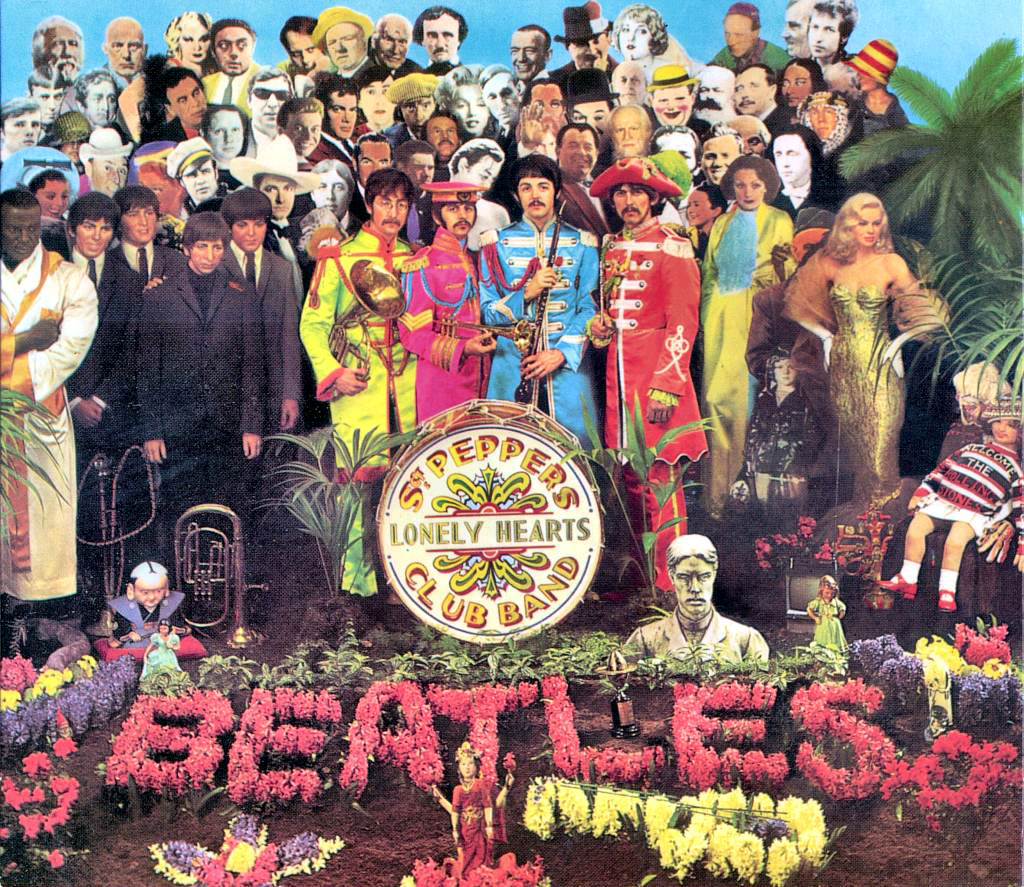
The Beatles are featured in this episode below and Schaeffer noted, ” Sergeant Pepper’s Lonely Hearts Club Band…for a time it became the rallying cry for young people throughout the world.”
How Should We then Live Episode 7 small (Age of Nonreason)
________________
Her comments can be found on the 2nd video and the 100th clip in this series. Below the videos you will find her words.
50 Renowned Academics Speaking About God (Part 1)
Another 50 Renowned Academics Speaking About God (Part 2)
A Further 50 Renowned Academics Speaking About God (Part 3)
“It seemed to me, if there were any answers to be found at all, they were going to be found in the facts, and understanding the greater theater in which human life has unfolded. And I was right about that. Being a scientist, and staring immensity and eternity in the face every day is about as meaningful I think, and grand and awe-inspiring as it gets. We, especially we astronomers, confront the big questions of wonder every day and the answers to these questions in the aggregate have produced, and this is absolutely with no hype,…the greatest story every told. And there isn’t a religion, I think, that can offer anything better. And as Jules Verne said, reality provides us with facts so romantic that imagination itself could add nothing to them.”
Below is a letter I recently wrote to Dr. Porco challenging her views on evolution while including a lot of details about her favorite rock group.
________________________________
Francis Schaeffer 1912-1984
__________
March 26, 2015
Dear Dr. Porco,
YOU HAVE SAID that religions use the conceptional device “that people need to feel connected to something greater than they are and this is the idea that God is omnipotent, omniscient and immortal and He made me in his image and through that connection to find meaning and purpose and ultimately to find they too will be immortal and the issue is that people fear death. I THINK THE SAME SPIRITUAL FULFILLMENT THAT PEOPLE FIND IN RELIGION CAN BE FOUND IN SCIENCE.”
There are many ways to respond to that but I am going to do it in a very lengthy but entertainingly way I hope. I read a lot of your material and wanted to talk to about two passions in your life. Francis Schaeffer talked about the views of the Beatles and Charles Darwin a lot and since you have taken an interest in music and science I thought you would be interested in these thoughts of Schaeffer. Another interesting thing about Charles Darwin is that he left the Christian faith of his youth just like you did.
“Sgt. Pepper’s” became my personal sound track of liberation back then…Genie, my wife of 44 years… grew up in the Bay Area and as a teen had the distinction of seeing the Beatles three times (!) live and the Rolling Stones four times (!) live.
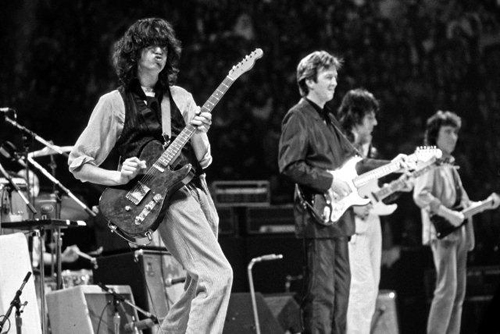
Meanwhile, I was growing up in Switzerland in a mission(L’Abri Fellowship), and my “almost famous” rock-n-roll high point came when I got a job helping with theLed Zeppelin’slight show at the Montreux Jazz/rock festival.I met Jimmy Page and noticed he was reading one of my dad’s first books, ESCAPE FROM REASON. (No kidding.)
This was back in the days when Dad was a sort of hippie guru for Jesus catering to Beats, hippies and dropouts hitching across Europe.Eric Claptonhad given Page the book as it turned out. I was trying to be “cool” that day on the light show crew… and I wasn’t too pleased to find my brief escape into the rock world from the world of my Dad’s evangelical mission was no escape from my God-world at all. He’d been giving lectures on Bob Dylan, and drug guru Timothy Leary had been a guest at L’Abri. And now I got to briefly “hang out with the band” and Dad got there first, or at least one of his books did! Sheesh! It’s hard to be cool!
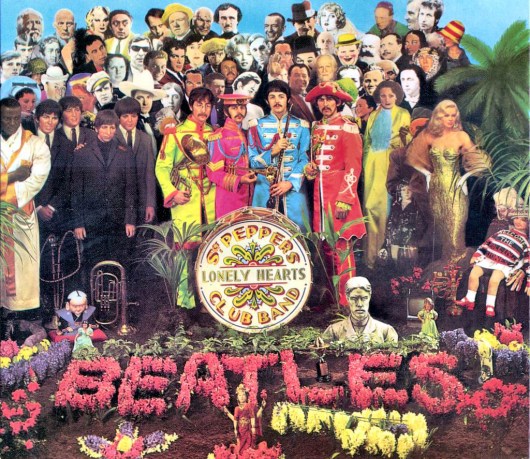
On the front cover are all the famous “Lonely Hearts” of the world who also could not find answers to life with reason and rationality, resorting to the existential leap into the dark (e.g ., Marlene Dietrich, Carl Jung, W.C. Fields, Bob Dylan, Marilyn Monroe, Sigmund Freud, Aleister Crowley, Edgar Allan Poe, Karl Marx, Oscar Wilde, Marlon Brando, Stan Laurel and Oliver Hardy, Lenny Bruce). They are all viewing the burial scene of the Beatles, which, in the framework we are using here, represents the passing of idealistic innocence and the failure to find a rational answer and meaning to life, an answer to love, purpose, significance and morals.They instead were leaping into the irrational, whether it was by drugs, the occult, suicide, or the bizarre.
William Lane Craig observed that BERTRAND RUSSELL wrotethat we must build our lives upon “the firm foundation of unyielding despair.” and also that Francis Schaeffer noted:
Modern man resides in a two-story universe. In the lower story is the finite world without God; here life is absurd, as we have seen. In the upper story are meaning, value, and purpose. Now modern man lives in the lower story because he believes there is no God.But he cannot live happily in such an absurd world; therefore, he continually makes leaps of faith into the upper story to affirm meaning, value, and purpose, even though he has no right to, since he does not believe in God. Modern man is totally inconsistent when he makes this leap, because these values cannot exist without God, and man in his lower story does not have God.
Charles Darwin had a very interesting reaction late in his life to the possibility that we live in an absurd universe and that was he blamed science for causing him to lose his aesthetic tastes and I read that in his biography ( Charles Darwin: his life told in an autobiographical chapter, and in a selected series of his published letters.). I am going to quote some of Charles Darwin’s own words and then include the comments of Francis Schaeffer on those words. I have also enclosed a CD with two messages from Adrian Rogers and Bill Elliff concerning Darwinism.
“I have said that in one respect my mind has changed during the last twenty or thirty years. Up to the age of thirty, or beyond it, poetry of many kinds, such as the works of Milton, Gray, Byron, Wordsworth, Coleridge, and Shelley, gave me great pleasure, I have also said that formerly pictures gave me considerable, and music very great delight. But now for many years I cannot endure to read a line of poetry: I have tried lately to read Shakespeare, and found it so intolerably dull that it nauseated me. I have also almost lost my taste for pictures or music. Music generally sets me thinking too energetically on what I have been at work on, instead of giving me pleasure. I retain some taste for fine scenery, but it does not cause me the exquisite delight which it formerly did….My mind seems to have become a kind of machine for grinding general laws out of large collections of facts, but why this should have caused the atrophy of that part of the brain alone, on which the higher tastes depend, I cannot conceive….The loss of these tastes is a loss of happiness, and may possibly be injurious to the intellect, and more probably to the moral character, by enfeebling the emotional part of our nature.”
Francis Schaeffer commented:
This is the old man Darwin writing at the end of his life.What he is saying here is the further he has gone on with his studies the more he has seen himself reduced to a machine as far as aesthetic things are concerned.I think this is crucial because as we go through this we find that his struggles and my sincere conviction is that he never came to the logical conclusion of his own position, but he nevertheless in the death of the higher qualities as he calls them, art, music, poetry, and so on, what he had happen to him was his own theory was producing this in his own self just as his theories a hundred years later have produced this in our culture.
Unlike Darwin many people today still hang on to their love of music and the arts. Schaeffer points out in his book The God Who Is There, pages 68-69, “The very ‘mannishness’ of man refuses to live in the logic of the position to which his humanism and rationalism have brought him. To say that I am only a machine is one thing; to live consistently as if this were true is quite another…Every truly modern man is forced to accept some sort of leap in theory or practice, because the pressure of his own humanity demands it. He can say what he will concerning what he himself is; but no matter what he says he is, he is still a man.”
YOU SAID that “I think we can replace the God concept…it is just a matter of developing a socially appealing way to get the word out to everybody. That brings me to religion and whether or not if anything doing with scientific inquiry could ever offer the social embrace that religious organizations do.” At this point you suggested showing the young people what “Awe and Wonder” knowledge of the universe can give. That reminds me of this next letter from Charles Darwin.
Francis Schaeffer noted thatin Darwin’s 1876 Autobiography that Darwin he is going to set forth two arguments for God in this and again you will find when he comes to the end of this that he is in tremendous tension. Darwin wrote,
“At the present day the most usual argument for the existence of an intelligent God is drawn from the deep inward conviction and feelings which are experienced by most persons.Formerly I was led by feelings such as those just referred to, …to the firm conviction of the existence of God and of the immortality of the soul. In my Journal I wrote that whilst standing in the midst of the grandeur of a Brazilian forest, ‘it is not possible to give an adequate idea of the higher feelings of wonder, admiration, and devotion which fill and elevate the mind.’ I well remember my conviction that there is more in man than the mere breath of his body; but now the grandest scenes would not cause any such convictions and feelings to rise in my mind. It may be truly said that I am like a man who has become COLOUR-BLIND.”
Francis Schaeffer remarked:
Now Darwin says when I look back andwhen I look at nature I came to the conclusion that man can not be just a fly!But now Darwin has moved from being a younger man to an older man and he has allowed his presuppositions to enter in to block his logic, these things at the end of his life he had no intellectual answer for. To block them out in favor of his theory. Remember the letter of his that said he had lost all aesthetic senses when he had got older and he had become a clod himself. Now interesting he says just the same thing, but not in relation to the arts, namely music, pictures, etc, but to nature itself. Darwin said,“But now the grandest scenes would not cause any such convictions and feelings to rise in my mind. It may be truly said that I am like a man who has become colour-blind…”So now you see that Darwin‘s presuppositions have not only robbed him of the beauty of man’s creation in art, but now the universe. He can’t look at it now and see the beauty.The reason he can’t see the beauty is for a very, very , very simple reason:THE BEAUTY DRIVES HIM TO DISTRACTION. THIS IS WHERE MODERN MAN IS AND IT IS HELL. The art is hell because it reminds him of man and how great man is, and where does it fit in his system? It doesn’t. When he looks at nature and it’s beauty he is driven to the same distraction and so consequently you find what has built up inside him is a real death, not only the beauty of the artistic but the beauty of nature. He has no answer in his logic and he is left in tension. He dies and has become less than human because thesetwo great things (such as any kind of art and the beauty of nature)that would make him human stand against his theory.
Schaeffer later asserted, “We cannot deal with people like human beings, we cannot deal with them on the high level of true humanity, unless we really know their origin-who they are. God tells man who he is. God tells us that He created man in His image. So man is something wonderful.” (Escape from Reason: A Penetrating Analysis of Trends in Modern Thought)
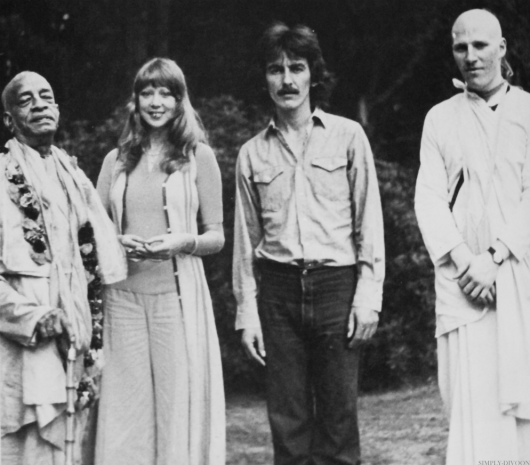
Many young people turned to Eastern Religions in the 1960’s and 1970’s. Francis Schaeffer asserted, “But this finally brings them to the place where the word GOD merely becomes the word GOD, and no certain content can be put into it. In this many of the established theologians are in the same position asGeorge Harrison (1943-) (the former Beatles guitarist)when he wrote MY SWEET LORD (1970). Many people thought he had come to Christianity. But listen to the words in the background: “Krishna, Krishna, Krishna.” Krishna is one Hindu name for God. This song expressed no content, just a feeling of religious experience. To Harrison, the words were equal: Christ or Krishna. Actually, neither the word used nor its content was of importance,” HOW SHOULD WE THEN LIVE? (page 191 Vol 5).
________
In the film series HOW SHOULD WE THEN LIVE? Francis Schaeffer shows the Beatles visiting Maharishi Mahesh Yogi in India.
“Mr. Darwin…considers that the theory of Evolution is quite compatible with the belief in a God; but that you must remember that different persons have different definitions of what they mean by God.”
Francis Schaeffer commented:
You find a great confusion in Darwin‘s writings although there is a general structure in them. Here he says the word “God” is alright but you find later what he doesn’t take is a personal God. Of course, what you open is the whole modern linguistics concerning the word “God.” is God a pantheistic God? What kind of God is God? Darwin says there is nothing incompatible with the word “God.”
Besides looking to Eastern Religions the Beatles tried to escape from reason by turning to drugs.In the book HOW SHOULD WE THEN LIVE?, Schaeffer observed,“This emphasis onhallucinogenic drugsbrought with it many rock groups–for example, Cream, Jefferson Airplane, Grateful Dead, Incredible String Band, Pink Floyd, and Jimi Hendrix. Most of their work was from 1965-1968.The Beatles’ SERGEANT PEPPER’S LONELY HEART S CLUB BAND (1967) also fits here.This disc is a total unity, not just an isolated series of individual songs, and for a time it became the rallying cry for young people throughout the world. As a whole, this music was the vehicle to carry the drug culture and the mentality which went with it across frontiers which were almost impassible by other means of communication.”
When the Beatles released their album Sgt. Pepper’s Lonely Hearts Club Band in the late spring of 1967,fans and critics alike were quick to find references to drugs throughout the LP. The album’s deliriously decorated jacket featured marijuana plants in the garden behind which the Beatles stood. The lyrics of With a Little Help from My Friends, Lovely Rita, and A Day in the Life all referred to marijuana, mentioning getting “high” and taking “some tea,” as well a desire to “turn you on.” And tuned-in listeners easily connected the feelings, sensations, and visions people typically experience while on hallucinogenic drugs to the dreamlike imagery of Lucy in the Sky with Diamonds. Some clever listeners even pointed out that the song’s title shares the initials of the hallucinogen LSD (lysergic acid diethylamide).
The Beatles had no doubt contributed to the perception that Sgt. Pepper was indeed a piece of hippie propaganda for hallucinogenic partying. Around the time the album was released, Paul McCartney revealed in a Life magazine interview that he had been using marijuana and LSD. McCartney even went on to extol the virtues of LSD, claiming that it had brought him closer to God and would yield world peace if only politicians would try it. Soon after, John Lennon, George Harrison, and the Beatles’ manager Brian Epstein also admitted that they had used LSD. Later that summer, the Beatles endorsed the legalization of marijuana by signing their names to a full-page advertisement in the London Times.
Despite these public proclamations about his drug use, John Lennon steadfastly denied that Lucy in the Sky with Diamonds was about drugs. Lennon instead consistently claimed that the song was a response to a picture painted by his almost four-year-old son Julian. The oft-repeated story goes that Julian had brought the picture home from school and told his father that it was of his friend, Lucy, who was up in the sky with diamonds. Lennon’s mind had then wandered toward the Lewis Carroll books Alice in Wonderland and Through the Looking-Glass that he had long admired and recently been re-reading. Lucy in the Sky with Diamonds was born when Lennon took images from Julian’s picture and combined them with elements of Carroll’s stories and poems.
A third explanation for the song’s meaning and origin was provided by Lennon many years after it was written, just a few weeks before he was killed. While reflecting on each of the songs in his discography, Lennon said this about Lucy in the Sky with Diamonds:
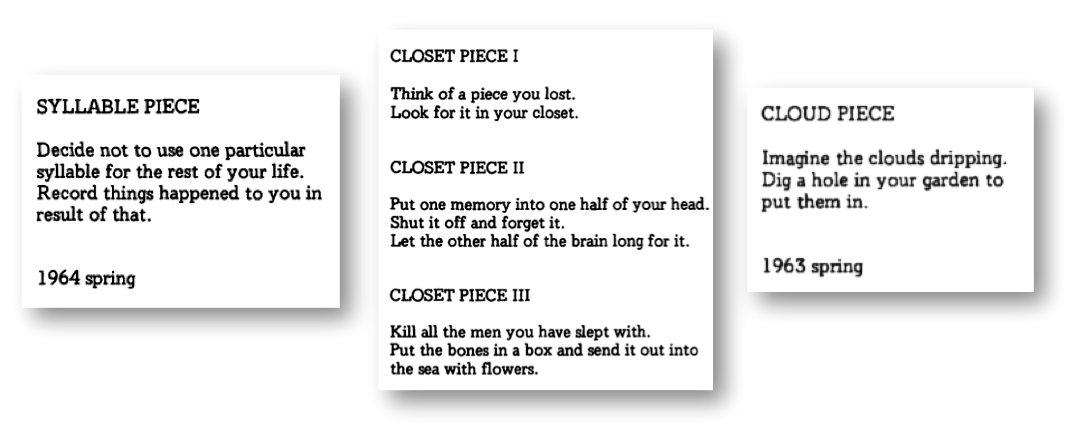
“There was also the image of the female who would someday come save me—a “girl with kaleidoscope eyes” who would come out of the sky. It turned out to be Yoko, though I hadn’t met Yoko yet. . . . The imagery was Alice in the boat. And also the image of this female who would come and save me—this secret love that was going to come one day. So it turned out to be Yoko, though, and I hadn’t met Yoko then. But she was my imaginary girl that we all have.”
Despite the fact that some people do not think that LUCY IN THE SKY WITH DIAMONDS was about drugs, the fact remains that it was probably considered so through the years by most drug users!!!!!!
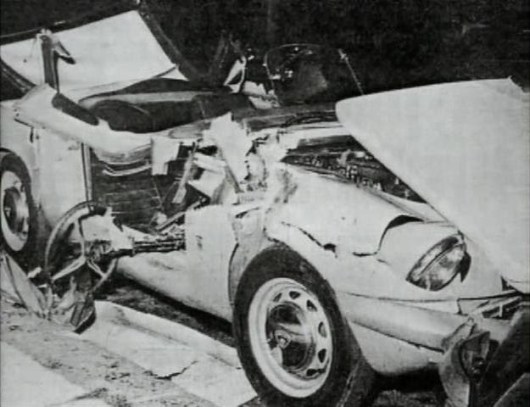
SERGEANT PEPPER’S LONELY HEART S CLUB BAND not only dealt with drugs but also with death. In the TELEGRAPH in Nicky Browne’s obit it was noted that “Paul McCartney told interviewers that he took LSD for the first time with Tara Browne.” Wikipedia records, “The HonourableTara Browne (4 March 1945 – 18 December 1966) was a young Londonsocialite and heir to the Guinness fortune and was the son of Dominick Browne, 4th Baron Oranmore and Browne, a member of the House of Lords since 1927 who later became famous for having served in that house longer than any other peer…According to some sources, Tara was the inspiration for the Beatles song “A Day in the Life“. He sat in on the making of the Beatles record ‘Revolver’.
On 17 January 1967 John Lennon, a friend of Browne’s, was composing music at his piano whilst idly reading London’s Daily Mail and happened upon the news of the coroner’s verdict into Browne’s death. He worked the story into the song “A Day in the Life“, later released on the album Sgt. Pepper’s Lonely Hearts Club Band. The second verse features the following lines:
He blew his mind out in a car, He didn’t notice that the lights had changed, A crowd of people stood and stared, They’d seen his face before, Nobody was really sure, If he was from the House of Lords.
According to Lennon, in his 1980 interview with Playboy magazine, “I was reading the paper one day and I noticed two stories. One was the Guinness heir who killed himself in a car. That was the main headline story. He died in London in a car crash.”
A side note about Tara Browne is that in Paris his social circle was the likes of Samuel Beckett, Salvador Dali, and Jean Cocteau. Samuel Beckett had a lot to say on this issue of man’s significance as William Lane Craig has noted:
If each individual person passes out of existence when he dies, then what ultimate meaning can be given to his life? Does it really matter whether he ever existed at all? It might be said that his life was important because it influenced others or affected the course of history. But this shows only a relative significance to his life, not an ultimate significance. His life may be important relative to certain other events, but what is the ultimate significance of any of those events? If all the events are meaningless, then what can be the ultimate significance of influencing any of them? Ultimately it makes no difference.
This is the horror of modern man: because he ends in nothing, he is nothing.
Twentieth-century man came to understand this. Read WAITING FOR GODOT bySamuel Beckett. During this entire play two men carry on trivial conversation while waiting for a third man to arrive, who never does. Our lives are like that, BECKETT IS SAYING: WE JUST KILL TIME WAITING–FOR WHAT, WE DON’T KNOW. In a tragic portrayal of man, Beckett wrote another play in which the curtain opens revealing a stage littered with junk. For thirty long seconds, the audience sits and stares in silence at that junk. Then the curtain closes. That’s all.
French existentialistsJean-Paul SartreandAlbert Camusunderstood this, too. Sartre portrayed life in his play No Exit as hell—the final line of the play are the words of resignation, “Well, let’s get on with it.” Hence, Sartre writes elsewhere of the “nausea” of existence. Man, he says, is adrift in a boat without a rudder on an endless sea. Camus, too, saw life as absurd. At the end of his brief novel The Stranger, Camus’s hero discovers in a flash of insight that the universe has no meaning and there is no God to give it one. The French biochemistJacques Monodseemed to echo those sentiments when he wrote in his work Chance and Necessity, “Man finally knows he is alone in the indifferent immensity of the universe.”
Thus, if there is no God, then life itself becomes meaningless. Man and the universe are without ultimate significance.
IN LIGHT OF THESE STATEMENTS BY SARTRE, CAMUS, BECKETT, and MONAD HOW CAN YOU STILL ASSERT THE FOLLOWING:
“It is possible to regard death as a natural event and even perhaps a wondrous state that takes place in the wonderful story in what we see around us in the universe. That can be taught to be a comforting thought. We know exactly what it is like to be dead because it is exactly the same state we were in before we were born.”
IN SPITE OF ALL THIS MANY SECULARISTS HAVE ADOPTED WHAT I CALL “EVOLUTIONARY OPTIMISTIC HUMANISM” and even in the 19th century Charles Darwin in his autobiography was touting THE SAME PRODUCT AS I SEE YOU ARE TODAY!!!
“It seemed to me, if there were any answers to be found at all, they were going to be found in the facts, and understanding the greater theater in which human life has unfolded. And I was right about that. Being a scientist, and staring immensity and eternity in the face every day is about as meaningful I think, and grand and awe-inspiring as it gets. We, especially we astronomers, confront the big questions of wonder every day and the answers to these questions in the aggregate have produced, and this is absolutely with no hype,…the greatest story every told. And there isn’t a religion, I think, that can offer anything better. And as Jules Verne said, reality provides us with facts so romantic that imagination itself could add nothing to them.”
YOUR QUOTE DEMONSTRATES WHAT I CALL “OPTIMISTIC HUMANISM.” It is truly a “romantic” point of view of secularism.
“Believing as I do that man in the distant future will be a far more perfect creature than he now is,”
FRANCIS SCHAEFFER COMMENTED:
Now you have now the birth of Julian Huxley’s evolutionary optimistic humanism already stated by Darwin. Darwin now has a theory that man is going to be better. If you had lived at 1860 or 1890 and you said to Darwin, “By 1970 will man be better?” He certainly would have the hope that man would be better as Julian Huxley does today. Of course, I wonder what he would say if he lived in our day and saw what has been made of his own views in the direction of (the mass murder) Richard Speck (and deterministic thinking of today’s philosophers). I wonder what he would say. So you have the factor, already the dilemma in Darwin that I pointed out in Julian Huxley and that is evolutionary optimistic humanism rests always on tomorrow. You never have an argument from the present or the past for evolutionary optimistic humanism.
You can have evolutionary nihilism on the basis of the present and the past. Every time you have someone bringing in evolutionary optimistic humanism it is always based on what is going to be produced tomorrow. When is it coming? The years pass and is it coming? Arthur Koestler doesn’t think it is coming. He sees lots of problems here and puts forth for another solution.
WHAT EVOLUTIONISTS LIKE YOURSELF ARE LEFT WITH IS ONLY THE HOPE OF “biological continuity and increased biological complexity” AS DARWIN AND SCHAEFFER POINT OUT BELOW. YOU HAVE SAID CONCERNING “Enceladus, “That was tremendously exciting to find, because not only do we think there’s liquid water there, not only is there an enormous amount of excess heat, but we also have organic materials. That, I mean, that is the trifecta that we’re looking for, the three main ingredients for a habitable zone.”
Why are you searching so hard for intelligent life? The answer is pretty clear. We were created in God’s image and we will feel empty until we reunite with him. YOU SAID IT YOURSELF AND I QUOTED IT IN THIS LETTER ALREADY and that is you as a secularist are competing with this view that God created in his own image for a special purpose. The message of the movie CONTACT is basically about mankind trying to reach out to other beings so we can ask them the big questions. The scientist Blaise Pascal summarized it up best when he said, “There is a God shaped vacuum in the heart of every man which cannot be filled by any created thing, but only by God, the Creator, made known through Jesus.” Just today I heard this radio commentary from Eric Metaxas on the SETI PROGRAM.
It’s been fifty years and E.T. still hasn’t called. So maybe it’s time we give him a call? Although some don’t think that’s such a great idea.
When we step out at night and look up at the stars, we can’t help wondering: Is there someone else out there? And if there is, would these extraterrestrials be benign and curious like the musical aliens in “Close Encounters of the Third Kind,” or would they be malicious and hostile like the Klingons of “Star Trek”?
Well, ever since stargazer Frank Drake conducted his first scan of the heavens in 1960, that’s the question he and other scientists have been asking. Drake, the chairman emeritus of the Search for Extraterrestrial Intelligence or SETI, was one of the first to point a radio telescope toward space and listen for the tell-tale signals of intelligent life.
Like astronomer and “Cosmos” host Carl Sagan, Drake developed an equation for estimating the number of civilizations on other planets in our galaxy. And like Sagan’s estimates, his were astronomical: Billions of planets should have life, he reasoned, and of those, millions ought to have evolved intelligent beings. And so the researchers at SETI turned their radio dishes skyward, and listened.
Of course, as I write in my book “Miracles,”Carl Sagan (and hence Drake) got it wrong. The probability for life is astronomical all right—astronomically IM-probable, since we now know there are more than 150 absolutely-necessary and rare conditions that must be met to sustain life. So it’s no wonder that instead of a cacophony of radio signals from intelligent life somewhere out there, all we’re hearing is the silence of the stars.
But some scientists insist that just because we haven’t heard from E.T. doesn’t mean he’s not out there. So now they’re proposing a radical new strategy. It’s called “Active SETI,” and as Joel Achenbach explains in The Washington Post, its goal would be to “boldly announce our presence and try to get the conversation started.”
Rather than just listening for signals from space, scientists would beam messages at stars that they considered good candidates for life and they’d wait for potential civilizations orbiting those stars to respond. Maybe within a few hundred years, we would finally discover we aren’t alone in the universe.
But not everyone likes that idea. A petition signed by 28 influential scientists warns of the potential danger of Active SETI. They’ve seen the movie, or the movies, I should say, and they know it doesn’t end well for us earthlings. Their concern is whether these ETI’s will be benign or hostile: good point.
Frank Drake himself thinks Active SETI is a waste of time. We’ve been leaking radio signals into space since before the days of “I Love Lucy,” he points out. Anyone in our galactic neighborhood with an antenna already knows we’re here.
Hearing all of this talk of aliens, I can’t help but think of Walker Percey’s brilliant book, “Lost in the Cosmos.” In it, he observes that the more we learn about the universe, the lonelier we become. And he’s right. Even the most rational scientists have poured untold treasure, time, and talent into the hunt for extraterrestrial neighbors—with nothing to reward their efforts.
One thing we do know, we humans long to know we’re not alone. And the good news, as Christians know, is that we’re not! We aren’t “lost in the cosmos,” but we are the centerpiece of a grand plan that culminated in a visitation by Someone from beyond our universe.
“…it is an intolerable thought that he and all other sentient beings are doomed to complete annihilation after such long-continued slow progress. To those who fully admit the immortality of the human soul, the destruction of our world will not appear so dreadful.”
Francis Schaeffer commented:
Here you feel Marcel Proust and the dust of death is on everything today because the dust of death is on everything tomorrow. Here you have the dilemma of Nevil Shute’sON THE BEACH.If it is true that all we have left is biological continuity and increased biological complexity, which is all we have left in Darwinism here, or with many of the modern philosophers, then you can’t stand Shute’sON THE BEACH.Maybe tomorrow at noon human life may be wiped out. Darwin already feels the tension, because if human life is going to be wiped out tomorrow, what is it worth today? Darwin can’t stand the thought of death of all men.Charlie Chaplinwhen he heard there was no life on Mars said, “I’m lonely.”
You think of the Swedish Opera (ANIARA) that is pictured inside a spaceship. There was a group of men and women going into outer space and they had come to another planet and the singing inside the spaceship was normal opera music. Suddenly there was a big explosion and the world had blown up and these were the last people left, the only conscious people left, and the last scene is the spaceship is off course and it will never land, but will just sail out into outer space and that is the end of the plot. They say when it was shown in Stockholm the first time, the tough Swedes with all their modern mannishness, came out (after the opera was over) with hardly a word said, just complete silence.
Darwin already with his own position says he CAN’T STAND IT!! You can say, “Why can’t you stand it?” We would say to Darwin, “You were not made for this kind of thing. Man was made in the image of God. Your CAN’T- STAND- IT- NESS is screaming at you that your position is wrong. Why can’t you listen to yourself?”
You find all he is left here is biological continuity, and thus his feeling as well as his reason now is against his own theory, yet he holds it against the conclusions of his reason. Reason doesn’t make it hard to be a Christian. Darwin shows us the other way. He is holding his position against his reason.
These words of Darwin ring in my ear, “…it is an intolerable thought that he and all other sentient beings are doomed to complete annihilation after such long-continued slow progress…” . Schaeffer rightly noted, “Maybe tomorrow at noon human life may be wiped out. Darwin already feels the tension, because if human life is going to be wiped out tomorrow, what is it worth today? Darwin can’t stand the thought of death of all men.”IN OTHER WORDS ALL WE ARE IS DUST IN THE WIND. I sent you a CD that starts off with the song DUST IN THE WIND by Kerry Livgren of the group KANSAS which was a hit song in 1978 when it rose to #6 on the charts because so many people connected with the message of the song. It included these words, “All we do, crumbles to the ground though we refuse to see, Dust in the Wind, All we are is dust in the wind, Don’t hang on, Nothing lasts forever but the Earth and Sky, It slips away, And all your money won’t another minute buy.”
Kerry Livgren himself said that he wrote the song because he saw where man was without a personal God in the picture. Solomon pointed out in the Book of Ecclesiastes that those who believe that God doesn’t exist must accept three things. FIRST, death is the end. SECOND, chance and time are the only guiding forces in this life. FINALLY, power reigns in this life and the scales are never balanced. The Christian can face death and also confront the world knowing that it is not determined by chance and time alone and finally there is a judge who will balance the scales.
_____________
Kansas, circa 1973 (Phil Ehart, Kerry Livgren, Steve Walsh, Rich Williams, Robby Steinhardt, Dave Hope) (photo credit: DON HUNSTEIN)
____________________________________________
BothKerry Livgren and the bass player Dave Hope of Kansas became Christians eventually. Kerry Livgren first tried Eastern Religions and Dave Hope had to come out of a heavy drug addiction. I was shocked and elated to see their personal testimony on The 700 Club in 1981 and that same interview can be seen on You Tube today. Livgren lives in Topeka, Kansas today where he teaches “Diggers,” a Sunday school class at Topeka Bible Church. DAVE HOPE is the head of Worship, Evangelism and Outreach at Immanuel Anglican Church in Destin, Florida.
(Aldous Huxley, pictured above, was an English literary author who is renowned for his novel,Brave New World, which was published in 1931. Apart from writing novels, he also wrote a few travel books, poems, plays and several essays on religion, art and sociology)
HOW DID THE BEATLES SEARCH END UP AND WHY WAS ALDOUS HUXLEY PUT ON THE COVER OF “SERGEANT PEPPER’S LONELY HEART S CLUB BAND”? Below is an excerpt from Francis A. Schaeffer‘s 1972 paper on the trends seen in secular society concerning drug use:
The philosophic basis for the drug scene came from ALDOUS HUXLEY'S
concept that, since, for the rationalist, reason is not
taking us anywhere, we should look for a final experience, one
that can be produced "on call," one that we do not need to
wait for. The drug scene, in other words, was at first an ideol-
ogy, an ideology that had very practical consequences. Some of
us at L'Abri have cried over the young people who have blown
their minds. But many of them thought, like Alan Watts, Gary
Snyder, Alan Ginsberg and Timothy Leary, that if you could
simply turn everyone on, there would be an answer to man's
longings. It wasn't just the far-out freaks who suggested that
you could put drugs in the drinking water and turn on a whole
city so that the "pigs" and the kids would all have flowers in
their hair. In those days it really was an optimistic ideological
concept...
The Beatles are a sort of test case.First they were just a
rock group, then they took to drugs and expressed that in such
songs as Sergeant Pepper's Lonely Hearts Club Band. When
drugs didn't pan out, when they saw what was happening in
Haight-Ashbury, they turned to the psychedelic sounds of
Straivberry Fields, and then went further into Eastern religiousexperiences. But that, too, did not work out, and they wound
up their career as a group by making The Yellow Submarine.
When they made this movie, some people said, "The Beatles
are coming back." But of course that was not the case. It was
really 'the sad end of their ideological search as a group. It's
interesting that Erich Segal, the man who wrote the film script
for THE YELLOW SUBMARINE, then wrote LOVE STORY.
About the film:
In 1973, six guys in a local band from America’s heartland began a journey that surpassed even their own wildest expectations, by achieving worldwide superstardom… watch the story unfold as the incredible story of the band KANSAS is told for the first time in the DVD Miracles Out of Nowhere.
_____________________________ Crimes and Misdemeanors: A Discussion: Part 3 Uploaded by camdiscussion on Sep 23, 2007 Part 3 of 3: ‘Is Woody Allen A Romantic Or A Realist?’ A discussion of Woody Allen’s 1989 movie, Crimes and Misdemeanors, perhaps his finest. By Anton Scamvougeras.http://camdiscussion.blogspot.com/antons@mail.ubc.ca ______________ I have gone back and forth and back and forth with many liberals on the Arkansas Times […]
Friendly Fire with John Whitehead—Rob Boston (Part 1) Uploaded by RutherfordInstitute on Aug 20, 2007 An interview with Rob Boston, Assistant Director of Communications, Americans United for Separation of Church and State, Part 1. ____________ Above you see Rob Boston discuss the teaching of intelligent design in the class room. He was against it. Obama’s […]
_____________________________ Crimes and Misdemeanors: A Discussion: Part 3 Uploaded by camdiscussion on Sep 23, 2007 Part 3 of 3: ‘Is Woody Allen A Romantic Or A Realist?’ A discussion of Woody Allen’s 1989 movie, Crimes and Misdemeanors, perhaps his finest. By Anton Scamvougeras.http://camdiscussion.blogspot.com/antons@mail.ubc.ca ______________ I have gone back and forth and back and forth with many liberals on the Arkansas Times […]
________________ Kansas – Dust In The Wind “Live” HD Rolling Stones: “Satisfaction!” U2 Still Haven’t Found (with lyrics) Carl Sagan appears on CBC to discuss the importance of SETI [Carl Sagan Archives] __________________________________________________ On December 5, 1995, I got a letter back from Carl Sagan and I was very impressed that he took time to answer […]
I have gone back and forth and back and forth with many liberals on the Arkansas Times Blog on many issues such as abortion, human rights, welfare, poverty, gun control and issues dealing with popular culture. Here is another exchange I had with them a while back. My username at the Ark Times Blog is Saline […]
On March 17, 2013 at our worship service at Fellowship Bible Church, Ben Parkinson who is one of our teaching pastors spoke on Genesis 1. He spoke about an issue that I was very interested in. Ben started the sermon by reading the following scripture: Genesis 1-2:3 English Standard Version (ESV) The Creation of the […]
At the end of this post is a message by RC Sproul in which he discusses Sagan. Over the years I have confronted many atheists. Here is one story below: I really believe Hebrews 4:12 when it asserts: For the word of God is living and active and sharper than any two-edged sword, and piercing as far as the […]
In today’s news you will read about Kirk Cameron taking on the atheist Stephen Hawking over some recent assertions he made concerning the existence of heaven. Back in December of 1995 I had the opportunity to correspond with Carl Sagan about a year before his untimely death. Sarah Anne Hughes in her article,”Kirk Cameron criticizes […]
Nancy Pearcey is professor of apologetics at Houston Baptist University, where she directs the Center for Christian Worldview. Her books include Total Truth,Saving Leonardo, The Soul of Science (with Charles Thaxton), and several she authored with Chuck Colson. On March 1, David C. Cook published her new book, Finding Truth: 5 Principles for Unmasking Atheism, Secularism, and Other God Substitutes.
You studied the violin in Germany and went to Iowa State on a music scholarship. How did playing the violin help you to find truth? People think apologetics is for a stereotypical, intellectually oriented person, but Francis Schaeffer showed that ideas permeate culture through art, literature, movies, and music. Cultural apologetics appeals to the whole person.
Did you have a teenage rebellion? I gave up my Christian background when I was in high school. We were regular churchgoers, but I wanted to know whether Christianity is true. None of the adults in my life could answer that question. A Christian professor told me, “It works for me!” A seminary dean said, “Don’t worry, we all have doubts sometimes.”
Your rebellion was going to the library and reading widely. I literally started pulling books off the philosophy shelf—because I thought if Christians can’t answer my questions, maybe the philosophers can. Because I had a strong Christian background, when I gave it up I understood immediately there is no purpose to life, no foundation for ethics or knowledge. I even fell into skepticism, moral relativism: I was the one in my group of friends in high school arguing there is no right or wrong.
I’ve read that when you were in college, your parents were visiting Francis Schaeffer’s haven in Switzerland, L’Abri, and you went there just to meet them. It was very clear from the questions I asked that I was not a Christian, and for L’Abri staffers that was an appeal, so they invited me to stay. The form of Christianity I had known was anti-intellectual, anti-cultural, cold, and impersonal. L’Abri was the opposite. After a month I fled because I was afraid I would make a decision out of less than genuine conviction. I continued reading on my own and eventually became intellectually convinced that Christianity is true. A year and a half later I went back and got grounded in my understanding of the Christian worldview. It’s where I got the more personal/practical side of being a Christian.
How would students today have an experience like that? It’s hard. In Finding Truth I cite a survey done at evangelical schools: Only half of the professors said they could give a Christian perspective in their field. Most of them get their higher degrees at secular graduate schools where they don’t have a realistic opportunity to develop a Christian worldview. They probably had to fly under the radar screen because if they did express a Christian perspective, they might be penalized.
Where should students start? The first step is find the idol: What’s in place of God as the ultimate reality? In Romans, Paul says we all have evidence of God from the created order, but we suppress that evidence by creating God substitutes. Our personal idols might be things like success or relationships, but reason can also be an idol. The philosophy of materialism says matter is the ultimate reality, the source and cause of everything else.
‘An idol is something in creation, something lower than God, it will always lead to a lower view of the human person.’
Once we identify the idol, what then? Spell out some of the negative consequences—because an idol is something in creation, something lower than God, it will always lead to a lower view of the human person. For example, MIT robotics professor emeritus Rodney Brooks calls a human being “a big bag of skin full of biomolecules” interacting by the laws of physics and chemistry. He is a materialist. Can Rodney Brooks live with that? He doesn’t treat his children as machines. He says, “They have my unconditional love, the furthest one might be able to get from rational analysis.” If rationality is defined by a materialist worldview, then it is irrational to love your own children—so Brooks is admitting that his own worldview is too small.
But couldn’t an evolutionist say Rodney Brooks’ love for his daughter makes enormous sense in terms of the genetic imperative: He’ll protect his daughter, and his genes will advance through the millennia. Many thinkers don’t take that step. Francis Schaeffer used the metaphor of two stories in a building; materialists say the lower story is real, but they have an upper story where they put things they can’t deny in their personal experience: free will, their love for their children, consciousness.
Compartmentalizing? Steven Pinker said when he’s in the laboratory he treats people as complex data processing machines, but when he goes home “we go back to talking about each other as free and dignified human beings.”
After we find the idol, what then? Test the idol against the real world. A low view of humanity is a form of reductionism, which means reducing something from a higher level of complexity and value to a lower level of complexity, like saying religion is just an expression of emotional need, or love is just a chemical reaction, or human beings are just complex biochemical machines—some things won’t fit in its box.
Let me ask about a current idol: How would you respond if you were running for president and a reporter asked, “Do you believe in evolution?” I’d say sure I do—depending on what you mean by evolution. Most textbooks define it as “change over time.” Who doesn’t believe living things change over time? Where people disagree is the cause of the change—is all of it due to natural processes, like natural selection? In public schools you should teach the scientific reasons for and against, and critical thinking: To be truly liberal would be to teach all of the potential answers so students can think critically.
The BioLogos Foundation is the new kid on the block in the Darwinist debate. What do you think of its work? When people accept evolution, it almost always ends up affecting their theology, their view of the human person. Generally they end up giving up the Fall and the reality of sin, because after all we are moving upward, we are advancing. Sin means we just aren’t evolved enough and haven’t quite transcended the biological instincts that drive us. And what happens then? How do you define salvation? If we are not truly fallen and if our sin is redefined as “just not evolved enough,” is it a matter of moral evil or just metaphysical limitation?
Any reason for hope? Those who are truly Christian are becoming much more committed. In most of America, you can no longer sit on the fence. More people are saying, If I’m a Christian then I’m going to be a committed Christian. I’ll know what I believe and why I believe it.
Marvin Olasky
Marvin is editor in chief of WORLD News Group and the author of more than 20 books, including The Tragedy of American Compassion. Follow Marvin on Twitter @MarvinOlasky.
_________________
Interview with Nancy Pearcey; 23 February 2015
Published on Feb 23, 2015
In conjunction with WORLD Magazine, Patrick Henry College presents its interview with Nancy Pearcey as a part of the Newsmaker Interview Series with Marvin Olasky, editor-in-chief at WORLD and Distinguished Chair of Journalism and Public Policy at PHC. For more information on Patrick Henry College, visit our website here http://www.phc.edu.
______________ I have dedicated several posts to this series on the Beatles and I don’t know when this series will end because Francis Schaeffer spent a lot of time talking and writing about them and their impact on the culture of the 1960’s. Lucy in the Sky with Diamonds- The Beatles The Beatles: The Beatles […]
________________ I have dedicated several posts to this series on the Beatles and I don’t know when this series will end because Francis Schaeffer spent a lot of time talking and writing about them and their impact on the culture of the 1960’s. The Beatles: The Beatles and their album St. Pepper’s Lonely Hearts Club […]
__________________ I have dedicated several posts to this series on the Beatles and I don’t know when this series will end because Francis Schaeffer spent a lot of time talking and writing about them and their impact on the culture of the 1960’s. The Beatles are featured in this episode below and Schaeffer noted, ” Sergeant Pepper’s […]
_______________ I have dedicated several posts to this series on the Beatles and I don’t know when this series will end because Francis Schaeffer spent a lot of time talking and writing about them and their impact on the culture of the 1960’s. Great Album The Beatles are featured in this episode below and Schaeffer […]
_______________ Francis Schaeffer pictured below: _____________________ Why am I doing this series FRANCIS SCHAEFFER ANALYZES ART AND CULTURE? John Fischer probably expressed it best when he noted: Schaeffer was the closest thing to a “man of sorrows” I have seen. He could not allow himself to be happy when most of the world was desperately lost […]
Crimes and Misdemeanors: A Discussion: Part 1 ___________________________________ Today I will answer the simple question: IS IT POSSIBLE TO BE AN OPTIMISTIC SECULAR HUMANIST THAT DOES NOT BELIEVE IN GOD OR AN AFTERLIFE? This question has been around for a long time and you can go back to the 19th century and read this same […]
____________________________________ Francis Schaeffer pictured below: ______________ Francis Schaeffer has written extensively on art and culture spanning the last 2000years and here are some posts I have done on this subject before : Francis Schaeffer’s “How should we then live?” Video and outline of episode 10 “Final Choices” , episode 9 “The Age of Personal Peace and Affluence”, episode 8 […]
Love and Death [Woody Allen] – What if there is no God? [PL] ___________ _______________ How Should We then Live Episode 7 small (Age of Nonreason) #02 How Should We Then Live? (Promo Clip) Dr. Francis Schaeffer 10 Worldview and Truth Two Minute Warning: How Then Should We Live?: Francis Schaeffer at 100 Francis […]
___________________________________ Francis Schaeffer pictured below: ____________________________ Francis Schaeffer “BASIS FOR HUMAN DIGNITY” Whatever…HTTHR Dr. Francis schaeffer – The flow of Materialism(from Part 4 of Whatever happened to human race?) Dr. Francis Schaeffer – The Biblical flow of Truth & History (intro) Francis Schaeffer – The Biblical Flow of History & Truth (1) Dr. Francis Schaeffer […]
________________ Francis Schaeffer “BASIS FOR HUMAN DIGNITY” Whatever…HTTHR Dr. Francis schaeffer – The flow of Materialism(from Part 4 of Whatever happened to human race?) Dr. Francis Schaeffer – The Biblical flow of Truth & History (intro) Francis Schaeffer – The Biblical Flow of History & Truth (1) Dr. Francis Schaeffer – The Biblical Flow of […]
I want to hold out for a great love. I want to go to my wedding night knowing that he’s the only man that I’ve every been with.
Rebecca St. James is one of the most powerful and beloved figures in Christian music, and is well known for her decision to wait until marriage for sex. She’s written books about waiting, hit songs about waiting, and even a book about married life after waiting.
With a career that started when she was only 13 years old, she’s been belting out mega-hit songs and inspiring young people for over twenty years. Few people are this consistently talented and admirable over such a long period; she’s a star by any measure.
Mini Biography
Born: July 26, 1977 to father David (a concert promoter) and mother Helen. Her birth name is Rebecca Jean Smallbone.
Age 8: While attending a children’s church group meeting in Australia, she makes a conscious decision to give her heart to God, a moment that she will remember clearly for the rest of her life as “the best decision I ever made.”
Age 9-11: Attends Pacific Hills Christian School in Australia.
Age 12: Writes her first song while still in the eighth grade. Her father, well equipped as a concert promoter to showcase her talent, gets her a gig as the opening act for contemporary Christian music artist Carmen.
Age 13: Releases independent album Refresh My Heart in Australia under the stage name “Rebecca Jean.” Soon after, her father receives a job offer in the US and moves her family to the United States.
Age 15: Signs a contract with with ForeFront Records, who wants her to adopt a stage name. The suggest “Rebecca St. John” but she doesn’t like it (because she has a relative named John). She likes the idea of “St. James,” since James was the name of her grandfather who recently passed away. She calls her grandmother and asks for advice on stage names. Her grandmother immediately suggests “James,” confirming Rebecca’s impulse.
Age 16: Releases her first major label album, the self-titled Rebecca St. James.
Age 17: Releases a secondary EP titled Extended Play Remixes
Age 18: Releases second major album (God). Unlike her previous albums, this one focuses more on rock. Critics like it, and it peaks at #168 on the Billboard 200 and #6 on Billboard’s Contemporary Christian chart.
Age 19: Nominated for Grammy for Best Rock Gospel Album. To promote her new album, she releases a devotional book called 40 Days with God: A Devotional Journey. Her album God will go on to sell 500,000 copies.
Age 20: Releases a holiday album called Christmas which hits #14 on Billboard’s Contemporary Christian chart.
Age 21: Releases third studio album, Pray. Album hits #168 on teh Billboard 200 and #5 on the Contemporary Christian Chart.
Age 22: Pray wins the Grammy for Best Rock/Gospel Album (the album will eventually sell over 500k copies). Releases song titled “Yes, I believe in God” in memory of the Columbine shooting.
Age 23: Releases fourth album Transform, which hits #14 on the Contemporary Christian Chart. Includes the hits Wait for Me and Reborn. Makes a cameo in Left Behind: the Movie. Re-releases her original devotional book with new layout and five new devotions.
Age 24: Releases new album Worship God to rave reviews. It hits #94 on the overall Billboard 200 (her highest rank yet). Also records a DVD full of interviews that she includes with the album.
Age 25: Writes a book called Wait for Me: Rediscovering the Joy of Purity in Romance, which promotes waiting until marriage for sex, cementing her as a key spokesperson for abstinence. Her book goes on to sell 100,000 copies and spawn a journal and study guide. Releases her first compilation project titled Wait For Me: the Best From Rebecca St. James. includes two new songs including “I Thank You” which peaks at #2 on Billboard’s Hot Christian Songs chart, but fails to make the overall Billboard 200.
Age 27: Releases her first live album, Live Worship: Blessed Be Your Name which features 7 new songs and 2 studio recorded songs. Writes and releases new book, SHE: Safe, Healthy, Empowered: The Woman You’re Made to Be. Stars in the stage musical Hero! as a modern-day Mary Magdalene. Also participates in the pop/prock VeggieTales album (by covering the VeggiTales Theme Song).
Age 28: After a break from recording music, returns to studio to record new album If I Had One Chance to Tell You Something. New single “Alive” hits #3 on the Christian Billboard Chart. Goes on Tour with fellow Christian superstars BarlowGirl. Also records the official theme song for the National Day of Prayer. Her longtime label ForeFront Records releases album titled The Early Years that covered ten songs from her early releases. Makes her major film role debut as Colleen in Unidentified.
Age 29: Takes a musical hiatus, while her record company releases lots of successful remixes and compilations.
Age 31: Releases a new devotional book, Pure: A 90-Day Devotional for the Mind, Body, & Spirit.
Age 32: Stars in the film Sarah’s Choice, which was praised by Christian movie critics. Releases a new song titled You’re Alive and a new book, Loved: Stories of Forgiveness. Also wraps up filming on a new movie titled Rising Stars.
Age 33: Boyfriend Jacob Fink proposes on Christmas Day 2010 at her family farm. Parts ways with ForeFront records and releases a ninth album I Will Praise You. She and Jacob Fink are married at the Juniperro Serra museum in San Diego, California just 3 months before her 34th birthday. While he personal life is soaring to new heights, she also stars in two movies: The Frontier Boys and Suing the Devil.
Age 34: Writes and releases new book, “What Is He Thinking?” that is declared a “must-read for every girl who is wondering where all the good guys have gone” by radio host Sean Hannity.
Video: Rebecca St. James explains why she waits
Note: She’s about 31 years old in this video, a year or so before she meets, falls in love with, and marries Jacob Fink.
The Poison – The All-American Rejects Avril Lavigne and Tyson Ritter from All American Rejects Talk Almost Alice The All-American Rejects – Dirty Little Secret Tyson Ritter, the leadsinger of the All-American Rejects has admitted that he was a jerk for the last couple of years when he lived a sexually impure life by sleeping […]
The Poison – The All-American Rejects Avril Lavigne and Tyson Ritter from All American Rejects Talk Almost Alice The All-American Rejects – Dirty Little Secret I got to see the All-American Rejects in concert on 12-13-12 in Little Rock and I have written about it several times already. Tyson Ritter, the leadsinger of the All-American […]
Katy Perry and the material from the Prism Album!!!! Part 4 Katy Perry On Bonnie McKee, John Mayer & New Album, “Prism” in 92.3 NOW Interview Published on Aug 13, 2013 Katy Perry talks to 92.3 NOW’s Ty Bentli in NYC about her new music, working with Bonnie McKee and not dating Robert Pattinson. __________________________ […]
Katy Perry and the material from the Prism Album!!!! Part 3 Katy Perry – Roar (Official) Last Friday Katy Perry and Russell Brand’s divorce rumors came true when Brand reportedly filed for divorce in Los Angeles citing, “irreconcilable differences.” TMZ met up with Perry’s father, Keith Hudson, as he was out shopping and when they […]
APOLOGETICS, THEN AND NOW Episode VII – The Age of Non Reason Dr. Schaeffer’s sweeping epic on the rise and decline of Western thought and Culture _______________________ I love the works of Francis Schaeffer and I have been on the internet reading several blogs that talk about Schaeffer’s work and the work below was […]
Katy Perry and the material from the Prism Album!!!! Part 2 Katy Perry, Britney Spears, Neil Patrick Harris Interviewed at ‘The Smurfs 2′ World premiere From Wikipedia: Katy Perry From Wikipedia, the free encyclopedia Jump to: navigation, search “Katy Hudson” redirects here. For the album, see Katy Hudson (album). For the Australian fashion designer, see […]
Katy Perry and the material from the Prism Album!!!! Part 1 Katy Perry – Roar (Official) Katy Perry on Her Strict Evangelical Upbringing: ‘I Didn’t Have a Childhood’ By Alison Matheson, Christian Post Correspondent May 5, 2011|2:37 am Pop star Katy Perry isn’t shy when it comes to flaunting her body and strutting her […]
GRACE UNPLUGGED Add To My Top 10 Prodigal Daughter Content +4 Quality None Light Moderate Heavy Language Violence Sex Nudity What the Ratings Mean 24 Release Date: October 04, 2013 Starring: AJ Michalka, James Denton, Kevin Pollak, Michael […]
“We don’t have forever” by Francis Schaeffer from 1980 The Scientific Age Uploaded by NoMirrorHDDHrorriMoN on Oct 3, 2011 Dr. Francis Schaeffer – Episode 8 – The Age of Fragmentation NoMirrorHDDHrorriMoN Francis Schaeffer- How Should We Then Live? -8- The Age of Fragmentation Joseph Rozak· https://www.youtube.com/watch?v=LEmwy_dI2j0_______________________ I love the works of Francis Schaeffer and […]
_____________ Francis Schaeffer’s Double-Edged Ethic by Peggy J. Haslar The Scientific Age Uploaded by NoMirrorHDDHrorriMoN on Oct 3, 2011 _______________ Episode VII – The Age of Non Reason Dr. Schaeffer’s sweeping epic on the rise and decline of Western thought and Culture _______________________ I love the works of Francis Schaeffer and I have been on the […]
Music video by Bill & Gloria Gaither performing Everybody Will Be Happy Over There (Live). (P) (C) 2012 Spring House Music Group. All rights reserved. Unauthorized reproduction is a violation of applicable laws. Manufactured by EMI Christian Music Group,
Camping in Canaan’s Land [Live]
Published on Jun 22, 2012
Music video by Dailey & Vincent performing Camping in Canaan’s Land (feat. Bill & Gloria Gaither) [Live]. (P) (C) 2012 Spring House Music Group. All rights reserved. Unauthorized reproduction is a violation of applicable laws. Manufactured by EMI Christian Music Group,
Just a Little While [Live]
Published on Dec 21, 2012
Music video by Bill & Gloria Gaither performing Just a Little While (feat. Guy Penrod, Rex Nelon, J.D. Sumner and Brock Speer) [Live]. (P) (C) 2012 Spring House Music Group. All rights reserved. Unauthorized reproduction is a violation of applicable laws. Manufactured by EMI Christian Music Group,
______________
Victory in Jesus [Live]
Published on Aug 2, 2012
Music video by Bill & Gloria Gaither performing Victory in Jesus (feat. Cynthia Clawson, Reggie Smith, Joy Gardner and Mike Allen) [Live]. (P) (C) 2012 Spring House Music Group. All rights reserved. Unauthorized reproduction is a violation of applicable laws. Manufactured by EMI Christian Music Group,
With the exception of his protégé, Albert E. Brumley, no other Arkansas figure contributed more to the development of the Southern gospel music genre than singer, songwriter, and publisher Eugene Monroe Bartlett Sr.
E. M. Bartlett was born on December 24, 1885, in the small community of Waynesville, Missouri, but he and his parents eventually relocated to Sebastian County, Arkansas. Educated at the Hall-Moody Institute in Martin, Tennessee, and William Jewell College in Liberty, Missouri, Bartlett received training as a music teacher.
In 1917, Bartlett married Joan Tatum; they had two children.
As an aspiring songwriter, Bartlett became an employee of the Central Music Company, a publisher of shape-note singing convention books based in Hartford (Sebastian County), which was owned by shape-note singing school instructor David Moore and songwriter Will M. Ramsey. Following Ramsey’s move to Little Rock (Pulaski County), Bartlett persuaded Moore and John A. McClung to partner with him in 1918 to establish the Hartford Music Company, one of Southern gospel’s first significant publishing companies. The company published some of Bartlett’s first compositions as well as other early Southern gospel songs, including McClung’s popular “Just a Rose Will Do.” From Hartford Music’s inception to 1935, Bartlett served as the company’s president, facilitating its expansion to include branch offices in other cities and states.
In addition to the Hartford Music Company’s music publishing interests, Bartlett established the Hartford Music Institute, a shape-note school, in 1921, and began publishing The Herald of Song, a monthly magazine covering the quartets Hartford sponsored to promote its products. Albert E. Brumley, the best-known Southern gospel songwriter of all time, attended the Hartford school in 1926 courtesy of Bartlett’s financial generosity. Bartlett mentored Brumley, published his first songs, and eventually employed him at Hartford Music.
A diverse songwriter, Bartlett penned singing convention favorites such as “Everybody Will Be Happy Over There” and “Just a Little While,” songs that were popularized by the leading gospel music quartets of the day, including Hovie Lister & the Statesmen, the Stamps Quartet, the Blackwood Brothers, and the Blue Ridge Quartet. In an era in which the exchange of music between white and black recording artists and writers generally benefitted white artists and black writers the most, Bartlett’s song “He Will Remember Me” was recorded by at least two important African-American gospel groups, the Sensational Nightingales and the Staple Singers, as well as black gospel legend Albertina Walker. Revealing his sense of humor, Bartlett also produced light-hearted fare such as “You Can’t Keep a Good Man Down” and “Take an Old Cold Tater and Wait,” a country music hit for Grand Ole Opry star Little Jimmy Dickens.
In 1939, a stroke rendered Bartlett partially paralyzed and unable to perform or travel. Amid such bleak circumstances, he wrote his final and most beloved song, “Victory in Jesus,” an optimistic number that has been sung by millions in worship services and recorded by gospel’s biggest names.
Bartlett died on January 25, 1941. He is buried at the Oak Hill Cemetery in Siloam Springs (Benton County). Posthumously, Bartlett was inducted into the Gospel Music Association’s Gospel Music Hall of Fame in Nashville, Tennessee, in 1973.
For additional information: Collins, Ace. Turn Your Radio On: The Stories Behind Gospel Music’s All-time Greatest Songs. Grand Rapids, MI: Zondervan, 1999.
Deller, David. “The Songbook Gospel Movement in Arkansas: E. M. Bartlett and the Hartford Music Company.” Arkansas Historical Quarterly 60 (Autumn 2001): 284–300.
Goff, James R., Jr. Close Harmony: A History of Southern Gospel. Chapel Hill: University of North Carolina Press, 2002.
The Poison – The All-American Rejects Avril Lavigne and Tyson Ritter from All American Rejects Talk Almost Alice The All-American Rejects – Dirty Little Secret Tyson Ritter, the leadsinger of the All-American Rejects has admitted that he was a jerk for the last couple of years when he lived a sexually impure life by sleeping […]
The Poison – The All-American Rejects Avril Lavigne and Tyson Ritter from All American Rejects Talk Almost Alice The All-American Rejects – Dirty Little Secret I got to see the All-American Rejects in concert on 12-13-12 in Little Rock and I have written about it several times already. Tyson Ritter, the leadsinger of the All-American […]
Katy Perry and the material from the Prism Album!!!! Part 4 Katy Perry On Bonnie McKee, John Mayer & New Album, “Prism” in 92.3 NOW Interview Published on Aug 13, 2013 Katy Perry talks to 92.3 NOW’s Ty Bentli in NYC about her new music, working with Bonnie McKee and not dating Robert Pattinson. __________________________ […]
Katy Perry and the material from the Prism Album!!!! Part 3 Katy Perry – Roar (Official) Last Friday Katy Perry and Russell Brand’s divorce rumors came true when Brand reportedly filed for divorce in Los Angeles citing, “irreconcilable differences.” TMZ met up with Perry’s father, Keith Hudson, as he was out shopping and when they […]
APOLOGETICS, THEN AND NOW Episode VII – The Age of Non Reason Dr. Schaeffer’s sweeping epic on the rise and decline of Western thought and Culture _______________________ I love the works of Francis Schaeffer and I have been on the internet reading several blogs that talk about Schaeffer’s work and the work below was […]
Katy Perry and the material from the Prism Album!!!! Part 2 Katy Perry, Britney Spears, Neil Patrick Harris Interviewed at ‘The Smurfs 2′ World premiere From Wikipedia: Katy Perry From Wikipedia, the free encyclopedia Jump to: navigation, search “Katy Hudson” redirects here. For the album, see Katy Hudson (album). For the Australian fashion designer, see […]
Katy Perry and the material from the Prism Album!!!! Part 1 Katy Perry – Roar (Official) Katy Perry on Her Strict Evangelical Upbringing: ‘I Didn’t Have a Childhood’ By Alison Matheson, Christian Post Correspondent May 5, 2011|2:37 am Pop star Katy Perry isn’t shy when it comes to flaunting her body and strutting her […]
GRACE UNPLUGGED Add To My Top 10 Prodigal Daughter Content +4 Quality None Light Moderate Heavy Language Violence Sex Nudity What the Ratings Mean 24 Release Date: October 04, 2013 Starring: AJ Michalka, James Denton, Kevin Pollak, Michael […]
“The present chasm between the generations has been brought about almost entirely by a change in the concept of truth. Wherever you look today the new concept holds the field. The consensus about us is almost monolithic, whether you review the arts, literature or just simply read the newspapers and magazines…. On every side you can feel the stranglehold of this new methodology—and by ‘methodology’ we mean the way we approach truth and knowing. … And just as fog cannot be kept out by walls or doors, so this consensus comes in around us, till the room we live in is no longer distinct, and yet we hardly realise what has happened….
“Young people from Christian homes are brought up in the old framework of truth. Then they are subjected to the modern framework. In time they become confused because they do not understand the alternatives with which they are being presented. Confusion becomes bewilderment, and before long they are overwhelmed. This is unhappily true not only of young people, but of many pastors, Christian educators, evangelists and missionaries as well. So this change in the concept of the way we come to knowledge and truth is the most crucial problem, as I understand it, facing Christianity today.”13
If you had lived in … the United States before about 1935, you would not have had to spend much time, in practice, in thinking about your presuppositions. … What were these presuppositions? The basic one was that there really are such things as absolutes. They accepted the possibility of an absolute in the area of Being (or knowledge), and in the area of morals. Therefore, because they accepted the possibility of absolutes, though men might disagree as to what these were, nevertheless they could reason together…. So if anything was true, the opposite was false. In morality, if one thing was right, its opposite was wrong…. 14
The shift has been tremendous. Thirty or more years ago you could have said such things as ‘This is true’ or ‘This is right’, and you would have been on everybody’s wavelength. …Thus in evangelism, in spiritual matters and in Christian education, you could have begun with the certainty that your audience understood you.”14
TENDENCY TOWARDS A UNIFORM CULTURE
…the world-spirit does not always take the same form. So the Christian must resist the spirit of the world in the form it takes in his own generation. If he does not do this he is not resisting the spirit of the world at all. … It is our generation of Christians more than any other who need to heed these words which are attributed to Martin Luther:
“If I profess with the loudest voice and clearest exposition every portion of the truth of God except precisely that little point which the world and the devil are at that moment attacking, I am not confessing Christ, however boldly I may be professing Christ. Where the battle rages, there the loyalty of the soldier is proved, and to be steady on all the battlefield besides, is mere fight and disgrace if he flinches at that point.”18
HEGEL, THE DOORWAY
It was the German philosopher Hegel (1770—1831) who became the first man to open the door into the line of despair. Before his time truth was conceived on the basis of antithesis, not for any adequate reason but because man romantically acted upon it. Truth, in the sense of antithesis, is related to the idea of cause and effect. Cause and effect produces a chain reaction which goes straight on in a horizontal line. With the coming of Hegel all this changed….
What Hegel taught arrived at just the right moment of history for his thinking to have its maximum effect.’ Imagine that Hegel … said, ‘I have a new idea. From now on let us think in this way; instead of thinking in terms of cause and effect, what we really have is a thesis, and opposite is an antithesis, and the answer to their relationship is not in the horizontal movement of cause and effect, but the answer is always synthesis.’ … It has never been the same since. If one understands the development of philosophy, or morals, or political thought from that day to this, one knows that Hegel and synthesis have won. In other words, Hegel has removed the straight line of previous thought and in its place he has substituted a triangle. Instead of antithesis we have, as modem man’s approach to truth, synthesis.20
KIERKEGAARD, THE FIRST MAN BELOW
“It is often said that Søren Kierkegaard, the Dane (1813-55)… is the father of modern secular thinking and of the new theological thinking…. Why is it that Kierkegaard can so aptly be thought of as the father of both? What proposition did he add to Hegel’s thought that made the difference? Kierkegaard came to the conclusion that you could notarrive at synthesis by reason. Instead, you achieved everything of real importance by a leap of faith. So he separated absolutely the rational and logical from faith…. 21
“…from that time on, if rationalistic man wants to deal with the real things of human life (such as purpose, significance, the validity of love) he must discard rational thought about them and make a gigantic, non-rational leap of faith. The rationalistic framework had failed to produce an answer on the basis of reason, and so all hope of a uniform field of knowledge had to be abandoned.”22
[C. S. Lewis illustrates this new thinking: Truth + myth = understanding of evolving truths. See Surprised by Joy]
“…the evolutionary humanism as a whole, which is current today, is in the same plight. Anyone can assert with all the persuasion at his command that man is due for a rosy future. But this again is a leap of faith, if there is no point of observation, either clinically or sociologically, to demonstrate that man will be better tomorrow than he was yesterday or is today.
“Sir Julian Huxley has taken such a purely optimistic answer one step further by stating that man will only be improved by accepting a new mystique. Thus he suggests that society will function better if it has a religion, even though no god really exists. For example, he says:
“From the specifically religious point of view, the desirable direction of evolution might be defined as the divinisation of existence—but for this to have operative significance we must frame a new definition of ‘the divine’ free from all connotations of external supernatural beings.
“Religion today is imprisoned in a theistic frame of ideas, compelled to operate in the unrealities of the dualistic world. In the unitary humanist frame it acquires a new look and new freedom. With the aid of our new vision it has the opportunity of escaping from the theistic impasse and of playing its proper role in the real world of unitary existence.”26-27
“Now it may be true that it can be shown by observation that society copes better with life through believing that there is a god. But, in that case, surely optimistic humanism … shows exactly the same irrational leap of faith… if in order to be optimistic, it rests upon the necessity of mankind believing and functioning on a lie.”27
THEOLOGY AND SEMANTIC MYSTICISM
“Neo-orthodoxy at first glance seems to have an advantage over secular existentialism, in that it appears to have more substance in its optimistic expressions than its secular counterpart. … But in the new theology, use is made of certain religious words which have a connotation of… meaning to those who hear them. Real communication is not in fact established, but an illusion of communication is given by employing words rich in connotations.”56
THE USE OF WORDS AND SYMBOLS
“Every word has two parts. There is the dictionary definition and there is the connotation. Words may be synonymous by definition but have completely different connotations. Therefore we find that when such a symbol as the cross is used, whether in writing or painting, a certain connotation stirs the mind of people brought up in a Christian culture, even if they have rejected Christianity. So when the new theology uses such words, without definition, an illusion of meaning is given which is pragmatically useful in arousing deep motivations….
“An illusion of communication and content is given so that, when a word is used in this deliberately undefined way, the hearer ‘thinks’ he knows what it means.” 57
“To the new theology, the usefulness of a symbol is in direct proportion to its obscurity. There is connotation, as in the word god, but there is no definition. The secret of the strength of neo-orthodoxy is that these religious symbols… give an illusion of meaning. …
“At first acquaintance this concept gives the feeling of spirituality. ‘I do not ask for answers, I just believe.’ This sounds sharply spiritual and it deceives many fine people….. The new theology sounds spiritual and vibrant and they are trapped….
“Whenever men say they are looking for greater reality, we must show them at once the reality of true Christianity. This is real because it is concerned with the God who is there and who has spoken to us about Himself, not just the use of the symbol ‘god’ or ‘christ’ which sounds spiritual but is not. The men who merely use the symbol ought to be pessimists, for the mere word god or the idea god is not a sufficient base for the optimism they display….
“This is the kind of ‘beievism’ which is demanded by this theology…. It is no more than a jump into an undefinable, irrational, semantic mysticism.”58
TODAY’S OPPORTUNITY FOR THE NEW THEOLOGY
“Men are facing a society without structure and they want to fill the void that has appeared. For a long time Reformation ideas formed the basis of North European culture, and this extended to include that of America and English-speaking Canada, etc. But today that has been destroyed by the relativism both inside [82] and outside the churches. Hence historic Christianity is now a minority group…. “Society cannot function without form and motivation. As the old sociological forms have been swept away, new ones must be found or society breaks down altogether. Sir Julian Huxley has stepped in at this point with his suggestion that religion has a real place in modern society. But, he would contend, it must be understood that religion is always evolving and that it needs to come under the control of society.
“This suggestion is not as ridiculous as it sounds, even coming from a convinced humanist, if one understands the mentality of our age. The prevailing dialectical methodology fits itself easily into religious forms…. “Teilhard de Chardin… illustrates that the progressive Roman Catholic theologians are further away from historic Reformation Christianity than classical Roman Catholicism, because they are also dialectical thinkers.
“The orthodox Roman Catholic would tell me that I am bound for hell because I reject the true Church. He is dealing with a concept of absolute truth. But the new Roman Catholic who sits at my fireside says, ‘You are all right, Dr. Schaeffer, because you are so sincere.’ In the new Roman Catholicism such a statement usually means that the dialectical method has taken over.
Therefore we are not surprised to find that … others such as Hans KUng have been strongly influenced by neo-orthodoxy. It is important to note that the position on Scripture by the Vatican Council has shifted in the same-direction and men such as Raymond Panikkar, Dom Bede Griffiths[close friend of C. S. Lewis]… are proclaiming a synthesis between Roman Catholicism and Hinduism.” 83
“The time, therefore, does seem right for this new theology to give the needed sociological forms and motivations. It is true, of course, that society could look elsewhere amongst the secular mysticisms for a new evolving religion, but the new theology has some strong advantages. “Firstly, the undefined connotation words that they are using are deeply rooted in our Western culture. This is much easier and more powerful than using new and untraditional words. “Secondly, these men control almost every large denomination in Protestantism…. This gives them the advantage of functioning within the organisational stream of the Church, and thus both its organisation and linguistic continuity is at their disposal. “Thirdly, people in our culture in general are already in process of being accustomed to accept non-defined, contentless religious words and symbols, without any rational or historical control. Such words and symbols are ready to be filled with the content of the moment. The words ‘Jesus’ or ‘Christ’ are the most ready for the manipulator. The phrase ‘Jesus Christ’ has become a contentless banner which can be carried in any direction for sociological purposes.
“…because the phrase ‘Jesus Christ’ has been separated from true history and the content of Scripture, it can be used to trigger religiously motivated sociological actions directly contrary to the teaching of Christ…. It is against such manipulated semantic mysticism that we do very well to prepare ourselves, our children and our spiritual children.” 84
E P I S O D E 1 0 Dr. Francis Schaeffer – Episode X – Final Choices 27 min FINAL CHOICES I. Authoritarianism the Only Humanistic Social Option One man or an elite giving authoritative arbitrary absolutes. A. Society is sole absolute in absence of other absolutes. B. But society has to be […]
E P I S O D E 9 Dr. Francis Schaeffer – Episode IX – The Age of Personal Peace and Affluence 27 min T h e Age of Personal Peace and Afflunce I. By the Early 1960s People Were Bombarded From Every Side by Modern Man’s Humanistic Thought II. Modern Form of Humanistic Thought Leads […]
E P I S O D E 8 Dr. Francis Schaeffer – Episode VIII – The Age of Fragmentation 27 min I saw this film series in 1979 and it had a major impact on me. T h e Age of FRAGMENTATION I. Art As a Vehicle Of Modern Thought A. Impressionism (Monet, Renoir, Pissarro, Sisley, […]
E P I S O D E 7 Dr. Francis Schaeffer – Episode VII – The Age of Non Reason I am thrilled to get this film series with you. I saw it first in 1979 and it had such a big impact on me. Today’s episode is where we see modern humanist man act […]
E P I S O D E 6 How Should We Then Live 6#1 Uploaded by NoMirrorHDDHrorriMoN on Oct 3, 2011 How Should We Then Live? Episode 6 of 12 ________ I am sharing with you a film series that I saw in 1979. In this film Francis Schaeffer asserted that was a shift in […]
E P I S O D E 5 How Should We Then Live? Episode 5: The Revolutionary Age I was impacted by this film series by Francis Schaeffer back in the 1970′s and I wanted to share it with you. Francis Schaeffer noted, “Reformation Did Not Bring Perfection. But gradually on basis of biblical teaching there […]
Dr. Francis Schaeffer – Episode IV – The Reformation 27 min I was impacted by this film series by Francis Schaeffer back in the 1970′s and I wanted to share it with you. Schaeffer makes three key points concerning the Reformation: “1. Erasmian Christian humanism rejected by Farel. 2. Bible gives needed answers not only as to […]
Francis Schaeffer’s “How should we then live?” Video and outline of episode 3 “The Renaissance” Francis Schaeffer: “How Should We Then Live?” (Episode 3) THE RENAISSANCE I was impacted by this film series by Francis Schaeffer back in the 1970′s and I wanted to share it with you. Schaeffer really shows why we have so […]
Francis Schaeffer: “How Should We Then Live?” (Episode 2) THE MIDDLE AGES I was impacted by this film series by Francis Schaeffer back in the 1970′s and I wanted to share it with you. Schaeffer points out that during this time period unfortunately we have the “Church’s deviation from early church’s teaching in regard […]
Francis Schaeffer: “How Should We Then Live?” (Episode 1) THE ROMAN AGE Today I am starting a series that really had a big impact on my life back in the 1970′s when I first saw it. There are ten parts and today is the first. Francis Schaeffer takes a look at Rome and why […]
Francis Schaeffer: “Whatever Happened to the Human Race” (Episode 5) TRUTH AND HISTORY Published on Oct 7, 2012 by AdamMetropolis This crucial series is narrated by the late Dr. Francis Schaeffer and former Surgeon General Dr. C. Everett Koop. Today, choices are being made that undermine human rights at their most basic level. Practices once […]
The opening song at the beginning of this episode is very insightful. Francis Schaeffer: “Whatever Happened to the Human Race” (Episode 4) THE BASIS FOR HUMAN DIGNITY Published on Oct 7, 2012 by AdamMetropolis This crucial series is narrated by the late Dr. Francis Schaeffer and former Surgeon General Dr. C. Everett Koop. Today, choices […]
Francis Schaeffer: “Whatever Happened to the Human Race” (Episode 3) DEATH BY SOMEONE’S CHOICE Published on Oct 6, 2012 by AdamMetropolis This crucial series is narrated by the late Dr. Francis Schaeffer and former Surgeon General Dr. C. Everett Koop. Today, choices are being made that undermine human rights at their most basic level. Practices […]
Francis Schaeffer: “Whatever Happened to the Human Race?” (Episode 2) SLAUGHTER OF THE INNOCENTS Published on Oct 6, 2012 by AdamMetropolis This crucial series is narrated by the late Dr. Francis Schaeffer and former Surgeon General Dr. C. Everett Koop. Today, choices are being made that undermine human rights at their most basic level. Practices […]
It is not possible to know where the pro-life evangelicals are coming from unless you look at the work of the person who inspired them the most. That person was Francis Schaeffer. I do care about economic issues but the pro-life issue is the most important to me. Several years ago Adrian Rogers (past president of […]
This essay below is worth the read. Schaeffer, Francis – “Francis Schaeffer and the Pro-Life Movement” [How Should We Then Live?, Whatever Happened to the Human Race?, A Christian Manifesto] Editor note: <p> </p> [The following essay explores the role that Francis Schaeffer played in the rise of the pro-life movement. It examines the place of […]
I truly believe that many of the problems we have today in the USA are due to the advancement of humanism in the last few decades in our society. Ronald Reagan appointed the evangelical Dr. C. Everett Koop to the position of Surgeon General in his administration. He partnered with Dr. Francis Schaeffer in making the video below. It is very valuable information for Christians to have. Actually I have included a video below that includes comments from him on this subject.
Francis Schaeffer Whatever Happened to the Human Race (Episode 1) ABORTION
Olphart asserted, “You, obviously, have an intense hatred for Obama, comparing him to slave traders and murderers.”
I personally have good relationships with some of the most liberal people in the USA. We enjoy each others’ company and have always respected each other. I don’t know of anyone that I hate. I would like to sit down and have a meal with you Olphart. You have always struck me as a very learned person and have made some of the best points I have read for the liberal view.
Now do I disagree with President Obama? Yes, and I disagreed with President Clinton when he came out in favor of partial birth abortion. I deeply respect Clinton for being wise enough to realize that in order to get things accomplished the last 6 years he had to meant Newt halfway. President Obama does not share that same view.
Let’s see if Obama can be linked to Dr. Gosnell’s views in any way.
Murray Vasser noted:
Now it is true that what Gosnell did was technically illegal in America. Despite the efforts of Barack Obama and Planned Parenthood, abortion doctors are not supposed to kill babies outside of their mothers. However, there is absolutely nothing illegal or unusual about decapitating babies or cutting off their hands and feet. Furthermore, while the nurses and doctors cannot usually hear them screaming, there is nothing unusual about babies writhing and struggling during these procedures.
My name is Claire Culwell, and I am an abortion survivor…
__________
“Everyone needs to hear Claire’s story! Often times at pro-life events or banquets we can forget who is at stake in abortion. Claire’s passion reminds the audience that every life lost due to abortion cannot be taken back but every life saved from abortion is a profound witness of God’s hope and love for every human life. Having seen her speak multiple times, I know that Claire’s story captures an audience at a pregnancy center event like no other story because she is living proof of what we stand for, life!”–Shawn Carney, Co-founder 40 Days for Life, Host ofBeing Humanon EWTN
I found out I was affected by abortion about 3 years ago. This changed my life. I had walked into theCoalition For Lifewondering what their organization provided and 5 months later I met my birth mother who told me my life is a miracle.
My birth mother was 13 years old at the time she became pregnant with me. Her mother took her straight to an abortion clinic where she had a surgical abortion. After thinking she had “fixed the problem,” a few weeks later she realized her belly was still growing. Her mother took her back to the abortion clinic where she learned that she had been pregnant with twins…One was aborted; One survived.
My life is a miracle and I would be selfish to keep this GIFT of life to myself. I want to tell everyone what a gift I and even they have been given!! I want to encourage them to seek alternatives to abortion because I would never want any woman/man to go through the grief and the pain that my birth mother went through simply because she didn’t know she had any other option. I also want to be a vessel to offer God’s forgiveness to the men and women who have previously had abortions. I know healing is possible and I have been given the gift of surviving an abortion so that I can tell these men and women that they are forgiven…coming from an aborted child, I hope they know the power of forgiveness and healing through meeting me. My involvement in Coalition For Life transformed me, taught me how to stand up for life on the front lines, and how to share my story in a meaningful way. I have the staff at Coalition For Life to thank for encouraging me to get involved and to share my story not only on the sidewalk but in public (my biggest fear) because God is glorified when I publically proclaim that“I am here not because of anything I did, but ONLY because of God’s mercy and love for me.”
My life is a testimony that there are wonderful alternatives to abortion (such as adoption in my case) and an accident/unwanted child still deserves life…even a child with disabilities. I was born 2 1/2 months early, weighed 3 lbs 2 oz, had dislocated hips and club feet. I had to wear casts on my feet, a harness and eventually a body cast. The abortion still affects me today. All that to say,LIFE IS STILL WORTH IT.If my life can touch just one person who has had an abortion or considering an abortion or adoption, then I am fulfilling my purpose in the pro-life movement.
I will not be silent because each mother and child are in the same place my biological mother, my twin and I were in 22 years ago and I am here to sayTHERE IS HOPEandthere are options!
Traveling and sharing my story was not something that I had planned for myself, but God proved to have better plans for me than I had for myself.Sharing my story is as much of a gift to MYSELF as it is to others.
Many in the world today are taking a long look at the abortion industry because of the May 14, 2013 guilty verdict and life term penalty handed down by a jury (which included 9 out of 12 pro-choice jurors) to Dr. Kermit Gosnell. During this time of reflection I wanted to put forth some of the […]
Many in the world today are taking a long look at the abortion industry because of the May 14, 2013 guilty verdict and life term penalty handed down by a jury (which included 9 out of 12 pro-choice jurors) to Dr. Kermit Gosnell. During this time of reflection I wanted to put forth some of the […]
Many in the world today are taking a long look at the abortion industry because of the May 14, 2013 guilty verdict and life term penalty handed down by a jury (which included 9 out of 12 pro-choice jurors) to Dr. Kermit Gosnell. During this time of reflection I wanted to put forth some of the […]
Many in the world today are taking a long look at the abortion industry because of the May 14, 2013 guilty verdict and life term penalty handed down by a jury (which included 9 out of 12 pro-choice jurors) to Dr. Kermit Gosnell. During this time of reflection I wanted to put forth some of the […]
Many in the world today are taking a long look at the abortion industry because of the May 14, 2013 guilty verdict and life term penalty handed down by a jury (which included 9 out of 12 pro-choice jurors) to Dr. Kermit Gosnell. During this time of reflection I wanted to put forth some of the […]
Many in the world today are taking a long look at the abortion industry because of the May 14, 2013 guilty verdict and life term penalty handed down by a jury (which included 9 out of 12 pro-choice jurors) to Dr. Kermit Gosnell. During this time of reflection I wanted to put forth some of the […]
Many in the world today are taking a long look at the abortion industry because of the May 14, 2013 guilty verdict and life term penalty handed down by a jury (which included 9 out of 12 pro-choice jurors) to Dr. Kermit Gosnell. During this time of reflection I wanted to put forth some of the […]
Many in the world today are taking a long look at the abortion industry because of the May 14, 2013 guilty verdict and life term penalty handed down by a jury (which included 9 out of 12 pro-choice jurors) to Dr. Kermit Gosnell. During this time of reflection I wanted to put forth some of the […]
Many in the world today are taking a long look at the abortion industry because of the May 14, 2013 guilty verdict and life term penalty handed down by a jury (which included 9 out of 12 pro-choice jurors) to Dr. Kermit Gosnell. During this time of reflection I wanted to put forth some of the […]
Many in the world today are taking a long look at the abortion industry because of the May 14, 2013 guilty verdict and life term penalty handed down by a jury (which included 9 out of 12 pro-choice jurors) to Dr. Kermit Gosnell. During this time of reflection I wanted to put forth some of the […]
Many in the world today are taking a long look at the abortion industry because of the May 14, 2013 guilty verdict and life term penalty handed down by a jury (which included 9 out of 12 pro-choice jurors) to Dr. Kermit Gosnell. During this time of reflection I wanted to put forth some of the […]
Many in the world today are taking a long look at the abortion industry because of the May 14, 2013 guilty verdict and life term penalty handed down by a jury (which included 9 out of 12 pro-choice jurors) to Dr. Kermit Gosnell. During this time of reflection I wanted to put forth some of the […]
Many in the world today are taking a long look at the abortion industry because of the May 14, 2013 guilty verdict and life term penalty handed down by a jury (which included 9 out of 12 pro-choice jurors) to Dr. Kermit Gosnell. During this time of reflection I wanted to put forth some of the […]
Many in the world today are taking a long look at the abortion industry because of the May 14, 2013 guilty verdict and life term penalty handed down by a jury (which included 9 out of 12 pro-choice jurors) to Dr. Kermit Gosnell. During this time of reflection I wanted to put forth some of the […]
Many in the world today are taking a long look at the abortion industry because of the May 14, 2013 guilty verdict and life term penalty handed down by a jury (which included 9 out of 12 pro-choice jurors) to Dr. Kermit Gosnell. During this time of reflection I wanted to put forth some of the […]
Many in the world today are taking a long look at the abortion industry because of the May 14, 2013 guilty verdict and life term penalty handed down by a jury (which included 9 out of 12 pro-choice jurors) to Dr. Kermit Gosnell. During this time of reflection I wanted to put forth some of the […]
Francis Schaeffer: “Whatever Happened to the Human Race” (Episode 1) ABORTION OF THE HUMAN RACE Published on Oct 6, 2012 by AdamMetropolis ________________ What a great article below: Dr. Alveda King: Guilty Gosnell Verdict May Spark More Justice for Women and Babies Contact: Eugene Vigil, King for America, 470-244-3302 PHILADELPHIA, May 13, 2013 /Christian Newswire/ […]
Many in the world today are taking a long look at the abortion industry because of the May 14, 2013 guilty verdict and life term penalty handed down by a jury (which included 9 out of 12 pro-choice jurors) to Dr. Kermit Gosnell. During this time of reflection I wanted to put forth some of the […]
Francis Schaeffer: “Whatever Happened to the Human Race” (Episode 1) ABORTION OF THE HUMAN RACE Published on Oct 6, 2012 by AdamMetropolis ________________ May 14, 2013 Murdered Thousands, Convicted for Three: The Kermit Gosnell Verdict By Drew Belsky Read more: http://www.americanthinker.com/2013/05/murdered_thousands_convicted_for_three_the_kermit_gosnell_verdict.html#ixzz2TMstLk1c Follow us: @AmericanThinker on Twitter | AmericanThinker on FacebookPhiladelphia abortionist Kermit Gosnell was convicted […]
Many in the world today are taking a long look at the abortion industry because of the May 14, 2013 guilty verdict and life term penalty handed down by a jury (which included 9 out of 12 pro-choice jurors) to Dr. Kermit Gosnell. During this time of reflection I wanted to put forth some of the […]
Francis Schaeffer: “Whatever Happened to the Human Race” (Episode 1) ABORTION OF THE HUMAN RACE Published on Oct 6, 2012 by AdamMetropolis ________________ A Verdict Doesn’t End the Gosnell Story By: Chairman Reince Priebus (Diary) | May 13th, 2013 at 03:27 PM | 28 RESIZE: AAA The horrors that unfolded in the clinic of Dr. […]
Many in the world today are taking a long look at the abortion industry because of the May 14, 2013 guilty verdict and life term penalty handed down by a jury (which included 9 out of 12 pro-choice jurors) to Dr. Kermit Gosnell. During this time of reflection I wanted to put forth some of the […]
Francis Schaeffer: “Whatever Happened to the Human Race” (Episode 1) ABORTION OF THE HUMAN RACE Published on Oct 6, 2012 by AdamMetropolis ________________ All-American Horror Story: Top 10 Kermit Gosnell Trial Revelations by Kristan Hawkins | Washington, DC | LifeNews.com | 4/12/13 3:38 PM Since so many in the media have failed/refused to report on […]
Many in the world today are taking a long look at the abortion industry because of the May 14, 2013 guilty verdict and life term penalty handed down by a jury (which included 9 out of 12 pro-choice jurors) to Dr. Kermit Gosnell. During this time of reflection I wanted to put forth some of the […]
Francis Schaeffer: “Whatever Happened to the Human Race” (Episode 1) ABORTION OF THE HUMAN RACE Published on Oct 6, 2012 by AdamMetropolis _____________ Tony Perkins: Gosnell Trial – FOX News Published on May 13, 2013 Tony Perkins: Gosnell Trial – FOX News ________________ Hey Obama, Kermit Gosnell Is What a Real War on Women Looks Like […]
Many in the world today are taking a long look at the abortion industry because of the May 14, 2013 guilty verdict and life term penalty handed down by a jury (which included 9 out of 12 pro-choice jurors) to Dr. Kermit Gosnell. During this time of reflection I wanted to put forth some of the […]
Francis Schaeffer: “Whatever Happened to the Human Race” (Episode 1) ABORTION OF THE HUMAN RACE Published on Oct 6, 2012 by AdamMetropolis ___ _____________ Tony Perkins: Gosnell Trial – FOX News Published on May 13, 2013 Tony Perkins: Gosnell Trial – FOX News ________________ Family Research Council Praises Jury for Bringing Justice to Victims of Abortionist […]
Many in the world today are taking a long look at the abortion industry because of the May 14, 2013 guilty verdict and life term penalty handed down by a jury (which included 9 out of 12 pro-choice jurors) to Dr. Kermit Gosnell. During this time of reflection I wanted to put forth some of the […]
Many in the world today are taking a long look at the abortion industry because of the May 14, 2013 guilty verdict and life term penalty handed down by a jury (which included 9 out of 12 pro-choice jurors) to Dr. Kermit Gosnell. During this time of reflection I wanted to put forth some of the […]
Francis Schaeffer: “Whatever Happened to the Human Race” (Episode 1) ABORTION OF THE HUMAN RACE Published on Oct 6, 2012 by AdamMetropolis ________________ _____________ Tony Perkins: Gosnell Trial – FOX News Published on May 13, 2013 Tony Perkins: Gosnell Trial – FOX News ________________ Kermit Gosnell and the Logic of “Pro-Choice” by Matthew J. Franck within […]
Many in the world today are taking a long look at the abortion industry because of the May 14, 2013 guilty verdict and life term penalty handed down by a jury (which included 9 out of 12 pro-choice jurors) to Dr. Kermit Gosnell. During this time of reflection I wanted to put forth some of the […]
Many in the world today are taking a long look at the abortion industry because of the May 14, 2013 guilty verdict and life term penalty handed down by a jury (which included 9 out of 12 pro-choice jurors) to Dr. Kermit Gosnell. During this time of reflection I wanted to put forth some of the […]
Francis Schaeffer: “Whatever Happened to the Human Race” (Episode 1) ABORTION OF THE HUMAN RACE Published on Oct 6, 2012 by AdamMetropolis ________________ Fr. Pavone: Right to choose must yield to right to life STATEN ISLAND, NY — Father Frank Pavone, National Director of Priests for Life, had the following comment on the verdict in […]
Many in the world today are taking a long look at the abortion industry because of the May 14, 2013 guilty verdict and life term penalty handed down by a jury (which included 9 out of 12 pro-choice jurors) to Dr. Kermit Gosnell. During this time of reflection I wanted to put forth some of the […]
Francis Schaeffer: “Whatever Happened to the Human Race” (Episode 1) ABORTION OF THE HUMAN RACE Published on Oct 6, 2012 by AdamMetropolis ________________ The truth of abortion … the hope for Gosnell’s repentance A conviction in the murder trial of Philadelphia abortionist Kermit Gosnell has boosted the efforts of pro-lifers to demonstrate what abortion really […]
The Selfishness of Chris Evert Part 2 (Includes videos and Pictures) _________________________________ _____________________ _______________________ __________________________ Tennis – Wimbledon 1974 [ Official Film ] – 05/05 Published on May 1, 2012 John Newcombe, Ken Rosewall, Bjor Borg, Jimmy Connors, Cris Evert… ___________________ Jimmy Connors Reflects Published on May 13, 2013 Jimmy Connors visits “SportsCenter” to discuss his memoir, […]
Milton Friedman’s FREE TO CHOOSE “How to cure inflation” Transcript and Video (60 Minutes)
In 1980 I read the book FREE TO CHOOSE by Milton Friedman and it really enlightened me a tremendous amount. I suggest checking out these episodes and transcripts of Milton Friedman’s film series FREE TO CHOOSE: “The Failure of Socialism” and “What is wrong with our schools?” and “Created Equal” and From Cradle to Grave, and – Power of the Market.“If we could just stop the printing presses, we would stop inflation,” Milton Friedman says in “How to Cure Inflation” from the Free To Choose series. Now as then, there is only one cause of inflation, and that is when governments print too much money. Milton explains why it is that politicians like inflation, and why wage and price controls are not solutions to the problem.
http://www.freetochoosemedia.org/freetochoose/detail_ftc1980_transcript.php?page=9While many people have a fairly good grasp of what inflation is, few really understand its fundamental cause. There are many popular scapegoats: labor unions, big business, spendthrift consumers, greed, and international forces. Dr. Friedman explains that the actual cause is a government that has exclusive control of the money supply. Friedman says that the solution to inflation is well known among those who have the power to stop it: simply slow down the rate at which new money is printed. But government is one of the primary beneficiaries of inflation. By inflating the currency, tax revenues rise as families are pushed into higher income tax brackets. Thus, inflation transfers wealth and resources from the private to the public sector. In short, inflation is attractive to government because it is a way of increasing taxes without having to pass new legislation to raise tax rates. Inflation is in fact taxation without representation. Wage and price controls are not the cure for inflation because they treat only the symptom (rising prices) and not the disease (monetary expansion). History records that such controls do not work; instead, they have perverse effects on both prices and economic growth and undermine the fundamental productivity of the economy. There is only one cure for inflation: slow the printing presses. But the cure produces the painful side effects of a temporary increase in unemployment and reduced economic growth. It takes considerable political courage to undergo the cure. Friedman cites the example of Japan, which successfully underwent the cure in the mid-seventies but took five years to squeeze inflation out of the system. Inflation is a social disease that has the potential for destroying a free society if it is unchecked. Prolonged inflation undermines belief in the basic equity of the free market system because it tends to destroy the link between effort and reward. And it tears the social fabric because it divides society into winners and losers and sets group against group.(Taxation without representation: Getting knocked up to higher tax brackets because of inflation pt 1)http://www.youtube.com/watch?v=b1dTWDNKH3c
Volume 9 – How to Cure Inflation
Transcript:
Friedman: The Sierra Nevada’s in California 10,000 feet above sea level, in the winter temperatures drop to 40 below zero, in the summer the place bakes in the thin mountain air. In this unlikely spot the town of Body sprang up. In its day Body was filled with prostitutes, drunkards and gamblers part of a colorful history of the American West.
A century ago, this was a town of 10,000 people. What brought them here? Gold. If this were real gold, people would be scrambling for it. The series of gold strikes throughout the West brought people from all over the world, all kinds of people. They came here for one purpose and one purpose only, to strike it rich, quick. But in the process, they built towns, cities, in places where nobody would otherwise have dreamed of building a city. Gold built these cities and when the gold was exhausted, the cities collapsed and became ghost towns. Many of the people who came here ended up the way they began, broke and unhappy. But a few struck it rich. For them, gold was real wealth. But was it for the world as a whole. People couldn’t eat the gold, they couldn’t wear the gold, they couldn’t live in houses made of gold. Because there was more gold, they had to pay a little more gold to buy goods and services. The prices of things in terms of gold went up.
At tremendous cost, at sacrifice of lives, people dug gold out of the bowels of the earth. What happened to that gold? Eventually, at long last, it was transported to distant places only to be buried again under the ground. This time in the vaults of banks throughout the world. There is hardly anything that hasn’t been used for money; rock salt in Ethiopia, brass rings in West Africa, Calgary shells in Uganda, even a toy cannon. Anything can be used as money. Crocodile money in Malaysia, absurd isn’t it?
That beleaguered minority of the population that still smokes may recognize this stuff as the raw material from which their cigarettes are made. But in the early days of the colonies, long before the U.S. was established, this was money. It was the common money of Virginia, Maryland and the Carolinas. It was used for all sorts of things. The legislature voted that it could be used legally to pay taxes. It was used to buy food, clothing and housing. Indeed, one of the most interesting sites was to see the husky young fellows at that time, lug 100 pounds of it down to the docks to pay the costs of the passage of the beauteous young ladies who had come over from England to be their brides.
Now you know how money is. There’s a tendency for it to grow, for more and more of it to be produced and that’s what happened with this tobacco. As more tobacco was produced, there was more money. And as always when there’s more money, prices went up. Inflation. Indeed, at the very end of the process, prices were 40 times as high in terms of tobacco as they had been at the beginning of the process. And as always when inflation occurs, people complained. And as always, the legislature tried to do something. And as always, to very little avail. They prohibited certain classes of people from growing tobacco. They tried to reduce the total amount of tobacco grown, they required people to destroy part of their tobacco. But it did no good. Finally, many people took it into their own hands and they went around destroying other people’s tobacco fields. That was too much. Then they passed a law making it a capital offense, punishable by death, to destroy somebody else’s tobacco. Grecian’s Law, one of the oldest laws in economics, was well illustrated. That law says that cheap money drives out dear money and so it was with tobacco. Anybody who had a debt to pay, of course, tried to pay it in the worst quality of tobacco he had. He saved the good tobacco to sell overseas for hard money. The result was that bad money drove out good money.
Finally, almost a century after they had started using tobacco as money, they established warehouses in which tobacco was deposited in barrels, certified by an inspector according to his views as to it’s quality and quantity. And they issued warehouse certificates which people gave from one to another to pay for the bills that they accumulated.
These pieces of green printed paper are today’s counterparts of those tobacco certificates. Except that they bear no relation to any commodity. In this program I want to take you to Britain to see how inflation weakens the social fabric of society. Then to Tokyo, where the Japanese have the courage to cure inflation. To Berlin, where there is a lesson to be learned from the West Germans and how so called cures are often worse than the disease. And to Washington where our government keeps these machines working overtime. And I am going to show you how inflation can be cured.
The fact is that most people enjoy the early stages of the inflationary process. Britain, in the swinging 60’s, there was plenty of money around, business was brisk, jobs were plentiful and prices had not yet taken off. Everybody seemed happy at first. But by the early 70’s, as the good times rolled along, prices started to rise more and more rapidly. Soon, some of these people are going to lose their jobs. The party was coming to an end.
The story is much the same in the U.S. Only the process started a little later. We’ve had one inflationary party after another. Yet we still can’t seem to avoid them. How come?
Before every election our representatives would like to make us think we are getting a tax break. When they are able to do it, while at the same time actually raising our taxes because of a bit of magic they have in their kit bag. That magic is inflation. They reduced the tax rates but the taxes we have to pay go up because we are automatically shoved into higher brackets by the effective inflation. A neat trick. Taxation without representation.
_________________________________________
Pt 2 Many a political leader has been tempted to turn to wage and price controls despite their repeated failure in practice. On this subject they never seem to learn. But some lessons may be learned. That happened to British P
Bob Crawford: The more I work, it seems like the more they take off me. I know if I work an extra day or two extra days, what they take in federal income tax alone is almost doubled because apparently it puts you in a higher income tax bracket and it takes more off you.
Friedman: Bob Crawford lives with his wife and three children in a suburb of Pittsburgh. They’re a fairly average American family.
Mrs. Crawford: Don’t slam the door Daphne. Okay. Alright. What are you doing? Making your favorite dish.
Friedman: We went to the Crawford’s home after he had spent a couple of days working out his federal and state income taxes for the year. For our benefit, he tried to estimate all the other taxes he had paid as well. In the end, though, he didn’t discover much that would surprise anybody.
Bob Crawford: Inflation is going up, everything is getting more expensive. No matter what you do, as soon as you walk out of the house, everything went up. Your gas bills keep going up, electric bills, your gasoline, you can name a thousand things that are going up. Everything is going sky high. Your food. My wife goes to the grocery store. We used to live on say, $60 or $50 every two weeks just for our basic food. Now it’s $80 or $90 every two weeks. Things are just going out of sight as far as expense to live on. Like I say it’s getting tough. It seems like every month it gets worse and worse. And I don’t know where it’s going to end. At the end of the day that I spend nearly $6,000 of my earnings on taxes. That leaves me with a total of $12,000 to live on. It might seem like a lot of money, but five, six years ago I was earning $12,000.
Friedman: How does taxation without representation really effect how much the Crawford family has left to spend after it’s paid its income taxes. Well in 1972 Bob Crawford earned $12,000. Some of that income was not subject to income tax. After paying income tax on the rest he had this much left to spend. Six years later he was earning $18,000 a year. By 1978 the amount free from tax was larger. But he was now in a higher tax bracket so his taxes went up by a larger percentage than his income. However, those dollars weren’t worth anything like as much. Even his wages, let alone his income after taxes, hadn’t kept up with inflation. His buying power was lower than before. That is taxation without representation in practice.
Unnamed Individual: We have with us today you brothers that are sitting here today that were with us on that committee and I’d like to tell you….
Friedman: There are many traditional scapegoats blamed for inflation. How often have you heard inflation blamed on labor unions for pushing up wages. Workers, of course, don’t agree.
Unnamed Individual: But fellows this is not true. This is subterfuge. This is a myth. Your wage rates are not creating inflation.
Friedman: And he’s right. Higher wages are mostly a result of inflation rather than a cause of it. Indeed, the impression that unions cause inflation arises partly because union wages are slow to react to inflation and then there is pressure to catch up.
Worker: On a day to day basis, try to represent our own numbers. But that in fact is not the case. Not only can we not play catch up, we can’t even maintain a wage rate commensurate with the cost of living that’s gone up in this country.
Friedman: Another scapegoat for inflation is the cost of goods coming from abroad. Inflation, we’re told, is imported. Higher prices abroad driving up prices at home. It’s another way government can blame someone else for inflation. But this argument, too, is wrong. The prices of imports and the countries from which they come are not in terms of dollars, they are in terms of lira or yen or other foreign currencies. What happens to their prices in dollars depends on exchange rates which in turn reflect inflation in the United States.
Since 1973 some governments have had a field day blaming the Arabs for inflation. But if high oil prices were the cause of inflation, how is it that inflation has been less here in Germany, a country that must import every drop of oil and gas that it uses on the roads and in industry, then for example it is in the U.S. which produces half of its own oil. Japan has no oil of its own at all. Yet at the very time the Arabs were quadrupling oil prices, the Japanese people were bringing inflation down from 30 to less than 5% a year. The fallacy is to confuse particular prices like the price of oil, with prices in general. Back at home, President Nixon understood this.
Nixon: “Now here’s what I will not do. I will not take this nation down the road of wage and price controls however politically expedient that may seem. The pros of rationing may seem like an easy way out, but they are really an easy way in for more trouble. To the explosion that follows when you try to clamp a lid on a rising head of steam without turning down the fire under the pot, wage and price controls only postpone the day of reckoning. And in so doing, they rob every American of a very important part of his freedom.
Friedman: Now listen to this:
Nixon: “The time has come for decisive action. Action that will break the vicious circle of spiraling prices and costs. I am today ordering a freeze on all prices and wages throughout the United States for a period of 90 days. In addition, I call upon corporations to extend the wage price freeze to all dividends.”
Friedman: Many a political leader has been tempted to turn to wage and price controls despite their repeated failure in practice. On this subject they never seem to learn. But some lessons may be learned. That happened to British Prime Minister James Callahan who finally discovered that a very different economic myth was wrong. He told the Labor Party Conference about it in 1976.
James Callahan: “We used to think that you could use, spend your way out of a recession and increase employment by cutting taxes and boosting government spending. I tell you in all candor that option no longer exists. It only works on each occasion since the war by injecting a bigger dose of inflation into the economy followed by a higher level of unemployment as the next step. That’s the history of the last 20 years.”
Friedman: Well, it’s one thing to say it. One reason why inflation does so much harm is because it effects different groups differently. Some benefit and of course they attribute that to their own cleverness. Some are hurt, but of course they attribute that to the evil actions of other people. And the whole problem is made far worse by the false cures which government adopts, particularly wage and price control.
The garbage collectors in London felt justifiably aggrieved because their wages had not been permitted to keep pace with the cost of living. They struck, hurting not the people who impose the controls, but their friends and neighbors who had to live with mounting piles of rat infested garbage. Hospital attendants felt justifiably aggrieved because their wages had not been permitted to keep up with the cost of living. They struck, hurting not the people who impose the controls, but cancer patients who were turned out of hospital beds. The attendants behaved as a group in a way they never would have behaved as individuals. One group is set against another group. The social fabric of society is torn apart inflicting scars that it will take decades to heal and all to no avail because wage and price controls, far from being a cure for inflation, only make inflation worse.
Within the memory of most of our political leaders, there’s one vivid example of how economic ruin can be magnified by controls. And the classic demonstration of what to do when it happens.
_______________________________________________
(Wage and Price Controls don’t work)
Inflation is just like alcoholism. In both cases when you start drinking or when you start printing too much money, the good effects come first. The bad effects only come later.
That’s why in both cases there is a strong temptation to overdo it. To drink too much and to print too much money. When it comes to the cure, it’s the other way around. When you stop drinking or when you stop printing money, the bad effects come first and the good effects only come later.
Pt 3
Germany, 1945, a devastated country. A nation defeated in war. The new governing body was the Allied Control Commission, representing the United States, Britain, France and the Soviet Union. They imposed strict controls on practically every aspect of life including wages and prices. Along with the effects of war, the results were tragic. The basic economic order of the country began to collapse. Money lost its value. People reverted to primitive barter where they used cameras, fountain pens, cigarettes, whiskey as money. That was less than 40 years ago.
This is Germany as we know it today. Transformed into a place a lot of people would like to live in. How did they achieve their miraculous recovery? What did they know that we don’t know?
Early one Sunday morning, it was June 20, 1948, the German Minister of Economics, Ludwig Earhardt, a professional economist, simultaneously introduced a new currency, today’s Deutsche Mark, and in one fell swoop, abolished almost all controls on prices and wages. Why did he do it on a Sunday morning? It wasn’t as you might suppose because the Stock Markets were closed on that day, it was, as he loved to confess, because the offices of the American, the British, and the French occupation authorities were closed that day. He was sure that if he had done it when they open they would have countermanded the order. It worked like a charm. Within days, the shops were full of goods. Within months, the German economy was humming along at full steam. Economists weren’t surprised at the results, after all, that’s what a price system is for. But to the rest of the world it seemed an economic miracle that a defeated and devastated country could in little more than a decade become the strongest economy on the continent of Europe.
In a sense this city, West Berlin, is something of a unique economic test tube. Set as it is deep in Communist East Germany. Two fundamentally different economic systems collide here in Europe. Ours and theirs, separated by political philosophies, definitions of freedom and a steel and concrete wall.
To digress from inflation, economic freedom does not stand alone. It is part of a wider order. I wanted to show you how much difference it makes by letting you see how the people live on the other side of that Berlin Wall. But the East German authorities wouldn’t let us. The people over there speak the same language as the people over here. They have the same culture. They have the same for bearers. They are the same people. Yet you don’t need me to tell you how differently they live. There is one simple explanation. The political system over there cannot tolerate economic freedom. The political system over here could not exist without it.
But political freedom cannot be preserved unless inflation is kept in bounds. That’s the responsibility of government which has a monopoly over places like this. The reason we have inflation in the United States or for that matter anywhere in the world is because these pieces of paper and the accompanying book entry or their counterparts in other nations are growing more rapidly than the quantity of goods and services produced. The truth is inflation is made in one place and in one place only. Here in Washington. This is the only place were there are presses like this that turn out these pieces of paper we call money. This is the place where the power resides to determine how rapidly the amount of money shall increase.
What happened to all that noise? That’s what would happen to inflation if we stop letting the amount of money grow so rapidly. This is not a new idea. It’s not a new cure. It’s not a new problem. It’s happened over and over again in history. Sometimes inflation has been cured this way on purpose. Sometimes it’s happened by accident. During the Civil War the North, late in the Civil War, overran the place in the South where the printing presses were sitting up, where the pieces of paper were being turned out. Prior to that point, the South had a very rapid inflation. If my memory serves me right, something like 4% a month. It took the Confederacy something over two weeks to find a new place where they could set up their printing presses and start them going again. During that two week period, inflation came to a halt. After the two week period, when the presses started running again, inflation started up again. It’s that clear, that straightforward. More recently, there’s another dramatic example of the only effective way to deal with rampant inflation.
In 1973, Japanese housewives going to market were faced with an unpleasant fact. The cash in their purses seemed to be losing its value. Prices were starting to sore as the awful story of inflation began to unfold once again. The Japanese government knew what to do. What’s more, they were prepared to do it. When it was all over, economists were able to record precisely what had happened. In 1971 the quantity of money started to grow more rapidly. As always happens, inflation wasn’t affected for a time. But by late 1972 it started to respond. In early 73 the government reacted. It started to cut monetary growth. But inflation continued to soar for a time. The delayed reaction made 1973 a very tough year of recession. Inflation tumbled only when the government demonstrated its determination to keep monetary growth in check. It took five years to squeeze inflation out of the system. Japan attained relative stability. Unfortunately, there’s no way to avoid the difficult road the Japanese had to follow before they could have both low inflation and a healthy economy. First they had to live through a recession until slow monetary growth had its delayed effect on inflation.
Inflation is just like alcoholism. In both cases when you start drinking or when you start printing too much money, the good effects come first. The bad effects only come later.
That’s why in both cases there is a strong temptation to overdo it. To drink too much and to print too much money. When it comes to the cure, it’s the other way around. When you stop drinking or when you stop printing money, the bad effects come first and the good effects only come later. That’s why it’s so hard to persist with the cure. In the United States, four times in the 20 years after 1957, we undertook the cure. But each time we lacked the will to continue. As a result, we had all the bad effects and none of the good effects. Japan on the other hand, by sticking to a policy of slowing down the printing presses for five years, was by 1978 able to reap all the benefits, low inflation and a recovering economy. But there is nothing special about Japan. Every country that has had the courage to persist in a policy of slow monetary growth has been able to cure inflation and at the same time achieve a healthy economy.
___________________________________
Pt 4
The job of the Federal Reserve is not to run government spending; it’s not to run government taxation. The job of the Federal Reserve is to control the money supply and I believe, frankly, I have always believed as you know, that these are excuses and not reasons for the performance.
DISCUSSION
Participants: Robert McKenzie, Moderator; Milton Friedman; Congressman Clarence J. Brown; William M. Martin, Chairman of Federal Reserve 1951_1970; Beryl W. Sprinkel, Executive Vice President, Harris Bank, Chicago; Otmar Emminger, President, Ieutsche Bundesbank, Frankfurt West Germany
MCKENZIE: And here at the Harper Library of the University of Chicago, our distinguished guests have their own ideas, too. So, lets join them now.
BROWN: If you could control the money supply, you can certainly cut back or control the rate of inflation. I’d have to say that that prescription is a little bit easier to write than it is to fill. I think there are some other ways to do it and I would relate the money supply __ I think inflation is a measure of the relationship between money and the goods and services that money is meant to cover. And so if you can stimulate the goods, the production of goods and services, it’s helpful. It’s a little tougher to control the money supply, although I think it can be done, than just saying that you should control it, because we’ve got the growth of credit cards, which is a form of money; created, in effect, by the free enterprise system. It isn’t all just printed in Washington, but that may sound too defensive. I think he was right in saying that the inflation is Washington based.
MCKENZIE: Mr. Martin, nobody has been in the firing line longer than you, 17 years head of the Fed. Could you briefly comment on that and we’ll go around the group.
MARTIN: I want to say 19 years.
(Laughter)
MARTIN: I wouldn’t be out here if it weren’t for Milton Friedman, today. He came down and gave us advice from time to time.
FRIEDMAN: You’ve never taken it.
(Laughter)
MCKENZIE: He’s going to do some interviewing later, I warn you.
MARTIN: And I’m rather glad we didn’t take it __
(Laughter)
MARTIN: __ all the time.
SPRINKEL: In your 19 years as Chairman of the Federal Reserve, Bill, the average growth in the money supply was 3.1 percent per year. The inflation rate was 2.2 percent. Since you left, the money supply has exactly doubled. The inflation rate is average over 7 percent, and, of course, in recent times the money supply has been growing in double-digit territory as has our inflation rate.
EMMINGER: May I, first of all, confirm two facts which have been so vividly brought out in the film of Professor Friedman; namely, that at the basis of the relatively good performance of Western Germany were really two events. One, the establishment of a new sound money which we try to preserve sound afterwards. And, secondly, the jump overnight into a free market economy without any controls over prices and wages. These are the two fundamental facts. We have tried to preserve monetary stability by just trying to follow this prescription of Professor Friedman; namely, monetary discipline. Keeping monetary growth relatively moderate. I must, however, warn you it’s not so easy as it looks. If you just say, governments have to have the courage to persist in that course.
FRIEDMAN: Nobody does disagree with the proposition that excessive growth in money supply is an essential element in the inflationary process and that the real problem is not what to do, but how to have the courage and the will to do it. And I want to go and start, if I may, on that subject; because I think that’s what we ought to explore. Why is it we haven’t had the courage and don’t, and under what circumstances will we? And I want to start with Bill Martin because his experience is a very interesting experience. His 19 years was divided into different periods. In the first period, that average that Beryl Sprinkel spoke about, averaged two very different periods. An early period of very slow growth and slow inflation; a later period of what at the time was regarded as creeping inflation __ now we’d be delighted to get back to it. People don’t remember that at the time that Mr. Nixon introduced price and wage controls in 1971 to control an outrageous inflation, the rate of inflation was four-and-a-half percent per year. Today we’d regard that as a major achievement; but the part of the period when you were Chairman, was a period when the inflation rate was starting to creep up and money growth rate was also creeping up. Now if I go from your period, you were eloquent in your statements to the public, to the press, to everyone, about the evils of inflation, and about the determination on the Federal Reserve not to be the architect of inflation. Your successor, Arthur Burns, was just as eloquent. Made exactly the same kinds of statements as effectively, and again over and over again said the Federal Reserve will not be the architect of inflation. His successor, Mr. G. William Miller, made the same speeches, and the same statements, and the same protestations. His successor, Paul Volcker, he is making the same statements. Now my question to you is: Why is it that there has been such a striking difference between the excellent pronouncements of all Chairmen of the Fed, therefore it’s not personal on you. You have a lot of company, unfortunately for the country. Why is it that there has been such a wide diversion between the excellent pronouncements on the one hand and what I regard as a very poor performance on the other?
MARTIN: Because monetary policy is not the only element. Fiscal policy is equally important.
FRIEDMAN: You’re shifting the buck to the Treasury.
MARTIN: Yes.
FRIEDMAN: To the Congress. We’ll get to Mr. Brown, don’t worry.
MARTIN: Yeah, that’s right.
(Laughter)
MARTIN: The relationship of fiscal policy to monetary policy is one of the important things.
MCKENZIE: Would you remind us, the general audience, when you say “fiscal policy”, what you mean in distinction to “monetary policy”?
MARTIN: Well, taxation.
MCKENZIE: Yeah.
MARTIN: The raising revenue.
FRIEDMAN: And spending.
MARTIN: And spending.
FRIEDMAN: And deficits.
MARTIN: And deficits, yes, exactly. And I think that you have to realize that when I’ve talked for a long time about the independence of the Federal Reserve. That’s independence within the government, not independence of the government. And I’ve worked consistently with the Treasury to try to see that the government is financed. Now this gets back to spending. The government says they’re gonna spend a certain amount, and then it turns out they don’t spend that amount. It doubles.
FRIEDMAN: The job of the Federal Reserve is not to run government spending; it’s not to run government taxation. The job of the Federal Reserve is to control the money supply and I believe, frankly, I have always believed as you know, that these are excuses and not reasons for the performance.
MARTIN: Well that’s where you and I differ, because I think we would be irresponsible if we didn’t take into account the needs and what the government is saying and doing. I think if we just went on our own, irresponsibly, I say it on this, because I was in the Treasury before I came to this __
FRIEDMAN: I know. I know.
MARTIN: __ go to the Fed; and I know the other side of the picture. I think we’d be rightly condemned by the American people and by the electorate.
FRIEDMAN: Every central bank in this world, including the German Central Bank, including the Federal Reserve System, has the technical capacity to make the money supply do over a period of two or three or four months, not daily, but over a period, has the technical capacity to control it.
(Several people talking at once.)
FRIEDMAN: I cannot explain the kind of excessive money creation that has occurred, in terms of the technical incapacity of the Federal Reserve System or of the German Central Bank, or of the Bank of England, or any other central bank in the world.
EMMINGER: I wouldn’t say technically we are incapable of doing that, although we have never succeeded in controlling the money supply month that way. But I would say we can, technically, control it half yearly, from one half-year period to the next and that would be sufficient __
FRIEDMAN: That would be sufficient.
EMMINGER: __ for controlling inflation. But however I __
VOICE OFF SCREEN: It doesn’t move.
FRIEDMAN: I’m an economic scientist, and I’m trying to observe phenomena, and I observe that every Federal Reserve Chairman says one thing and does another. I don’t mean he does, the system does.
MCKENZIE: Yeah. How different is your setup in Germany? You’ve heard this problem of governments getting committed to spending and the Fed having, one way or the other, to accommodate itself to it. Now what’s your position on this very interesting problem?
EMMINGER: We are very independent of the government, from the government, but, on the other hand, we are an advisor of the government. Also on the budget deficits and they would not easily go before Parliament with a deficit which much of it is openly criticized and disapproved by the same bank. Why because we have a tradition in our country that we can also publicly criticize the government on his account. And second, as if happened in our case too, the government goes beyond what is tolerable for the sake of moral equilibrium. We have let it come through in the capital markets. That is to say they have enough interest rates that has drawn public criticism and that has had some effect on their attitude.
_________________________________________
Pt 5
I think that is a very important point that Dr. Emminger just made because there is not a one-to-one relationship between government deficits and what happens to the money supply at all. The pressure on the Federal Reserve comes indirectly. It comes because large government deficits, if they are financed in the general capital market, will drive up interest rates and then we have the right patents in Congress and their successors pressuring the Federal Reserve to enter in and finance the deficit by printing money as a way of supposedly holding down interest rates. Now before I turn to Mr. Brown and ask him that, I just want to make one point which is very important. The Federal Reserve’s activities in trying to hold down interest rates have put us in a position where we have the highest interest rates in history. It’s another example of how, of the difference between the announced intentions of a policy, and the actual results. But now I want to come to Clarence Brown and ask him, shift the buck to him, and put him on the hot seat for a bit. The government spending has been going up rapidly, Republican administration or Democratic administration. This is a nonpartisan issue, it doesn’t matter. Government deficits have been going up rapidly. Republican administration or Democratic administration. Why is it that here again you have the difference between pronouncements and performance? There is no Congressman, no Senator, who will come out and say, “I am in favor of inflation.” There is not a single one who will say, “I am in favor of big deficits.” They’ll all say we want to balance the budget, we want to hold down spending, we want an economical government. How do you explain the difference between performance and talk on the side of Congress?
BROWN:
FRIEDMAN: I think that is a very important point that Dr. Emminger just made because there is not a one-to-one relationship between government deficits and what happens to the money supply at all. The pressure on the Federal Reserve comes indirectly. It comes because large government deficits, if they are financed in the general capital market, will drive up interest rates and then we have the right patents in Congress and their successors pressuring the Federal Reserve to enter in and finance the deficit by printing money as a way of supposedly holding down interest rates. Now before I turn to Mr. Brown and ask him that, I just want to make one point which is very important. The Federal Reserve’s activities in trying to hold down interest rates have put us in a position where we have the highest interest rates in history. It’s another example of how, of the difference between the announced intentions of a policy, and the actual results. But now I want to come to Clarence Brown and ask him, shift the buck to him, and put him on the hot seat for a bit. The government spending has been going up rapidly, Republican administration or Democratic administration. This is a nonpartisan issue, it doesn’t matter. Government deficits have been going up rapidly. Republican administration or Democratic administration. Why is it that here again you have the difference between pronouncements and performance? There is no Congressman, no Senator, who will come out and say, “I am in favor of inflation.” There is not a single one who will say, “I am in favor of big deficits.” They’ll all say we want to balance the budget, we want to hold down spending, we want an economical government. How do you explain the difference between performance and talk on the side of Congress?
BROWN: Well, first I think we have to make one point. I’m not so much with the government as I am against it.
FRIEDMAN: I understand.
BROWN: As you know, I’m a minority member of Congress.
FRIEDMAN: Again, I’m not __ I’m not directing this at you personally.
BROWN: I understand, of course; and while the administrations, as you’ve mentioned, Republican and Democratic administrations, have both been responsible for increases in spending, at least in terms of their recommendations. It is the Congress and only the Congress that appropriates the funds and determines what the taxes are. The President has no authority to do that and so one must lay it at the feet of the U.S. Congress. Now, I guess we’d have to concede that it’s a little bit more fun to give away things than it is to withhold them. And this is the reason that the Congress responds to a general public that says, “I want you to cut everybody else’s program but the one in which I am most particularly interested. Save money, but incidentally, my wife is taking care of the orphanages and so lets try to help the orphanages,” or whatever it is. Let me try to make a point, if I can, however, on what I think is a new spirit moving within the Congress and that is that inflation, as a national affliction, is beginning to have an impact on the political psychology of many Americans. Now the Germans, the Japanese and others have had this terrific postwar inflation. The Germans have been through it twice, after World War I and World War II, and it’s a part of their national psyche. But we are affected in this country by the depression. Our whole tax structure is built on the depression. The idea of the tax structure in the past has been to get the money out of the mattress where it went after the banks failed in this country and jobs were lost, and out of the woodshed or the tin box in the back yard, get it out of there and put it into circulation. Get it moving, get things going. And one of the ways to do that was to encourage inflation. Because if you held on to it, the money would depreciate; and the other way was to tax it away from people and let the government spend it. Now there’s a reaction to that and people are beginning to say, “Wait just a minute. We’re not afflicted as much as we were by depression. We’re now afflicted by inflation, and we’d like for you to get it under control.” Now you can do that in another way and that without reducing the money supply radically. I think the Joint Economic Committee has recommended that we do it gradually. But the way that you can do it is to reduce taxes and the impact of government, that is the weight of government and increase private savings so that the private savings can finance some of the debt that you have.
FRIEDMAN: There is no way you can do it without reducing, in my opinion, the rate of monetary growth. And I, recognizing the facts, even though they ought not to be that way, I wonder whether you can reduce the rate of monetary growth unless Congress actually does reduce government spending as well as government taxes.
BROWN: The problem is that every time we use demand management, we get into a kind of an iron maiden kind of situation. We twist this way and one of the spikes grabs us here, so we twist that way and a spike over here gets us. And every recession has had higher basic unemployment rates than the previous recession in the last several years and every inflation has had higher inflation. We’ve got to get that tilt out of the society.
MCKENZIE: Wouldn’t it be fair to say, though, that a fundamental difference is the Germans are more deeply fearful of a return to inflation, having had the horrifying experience between the wars, especially. We tend to be more afraid of recession turning into depression.
EMMINGER: I think there is something in it and in particular in Germany the government would have to fear very much in their electoral prospects if they went into such an election period with a high inflation rate. But there is another important difference.
MARTIN: We fear unemployment more than inflation it seems.
EMMINGER: You fear unemployment, but unemployment is feared with us, too, but inflation is just as much feared. But there is another difference; namely, once you have got into that escalating inflation, every time the base, the plateau is higher, it’s extremely difficult to get out of it. You must avoid getting into that, now that’s very cheap advice from me because you are now.
(Laughing)
EMMINGER: But we had, for the last fifteen, twenty years, always studied foreign experiences, and told ourselves we never must get into this vicious circle. Once you are in, it takes a long time to get out of it. That is what I am preaching now, that we should avoid at all costs to get again into this vicious circle as we had it already in ’73_’74. It took us, also, four years to get out of it, although we were only at eight percent inflation. Four years to get down to three percent. So you __
MCKENZIE: Those were __ yes.
EMMINGER: You have, I think, the question of whether you can do if in a gradualist way over many, many years, or whether you don’t need a sort of shock treatment.
____________________________________
her we go into a period of still higher unemployment later on and have it to do all over again. That’s the only choice we face. And when the public at large recognizes that, they will then elect people to Congress, and a President to office who is committed to less government spending and to less government printing of money and until that happens we will not cure inflation
Pt 6
SPRINKEL: The film said it took the Japanese _ what _ four years?
FRIEDMAN: Five years.
SPRINKEL: Five years. But one of my greatest concerns is that we haven’t suffered enough yet. Most of the nations that have finally got their inflations __
BROWN: Bad election speech.
SPRINKEL: __ well, I’m not running for office, Clarence.
(Laughter)
SPRINKEL: Most countries that finally got their inflation under control had 20, 30 percent or worse inflation. Germany had much worse and the public supports them. We live in a Democracy, and we’re getting constituencies that gain from inflation. You look at people that own real estate, they’ve done very well.
MCKENZIE: Yes.
SPRINKEL: And how can we get there without going through even more pain, and I doubt that we will.
FRIEDMAN: If you ask who are the constituencies that have benefited most from inflation there are no doubt, it is the homeowners.
SPRINKEL: Yes.
FRIEDMAN: But it’s also the __ it’s also the Congressmen who have been able to vote higher spending without having to vote higher taxes. They have in fact __
BROWN: That’s right.
FRIEDMAN: __ Congress has in fact voted for inflation. But you have never had a Congressman on record to that effect. It’s the government civil servants who have their own salaries are indexed and tied to inflation. They have a retirement benefit, a retirement pension that’s tied to inflation. They qualify, a large fraction of them, for Social Security as well, which is tied to inflation. So that the beneficial __
BROWN: Labor contracts that are indexed and many pricing things that are tied to it.
FRIEDMAN: But the one thing that isn’t tied to inflation and here I want to come back and ask why Congress has been so __ so bad in this area, is our taxes. It has been impossible to get Congress to index the tax system so that you don’t have the present effect where every one percent increase in inflation pushes people up into higher brackets and forces them to pay higher taxes.
BROWN: Well, as you know, I’m an advocate of that.
FRIEDMAN: I know you are.
MCKENZIE: Some countries do that, of course.
FRIEDMAN: Oh, of course.
MCKENZIE: Canada does that. Indexes the __
BROWN: And I went up to Canada on a little weekend seminar program on indexing and came back an advocate of indexing because I found out that the people who are delighted with indexing are the taxpayers.
FRIEDMAN: Absolutely.
BROWN: Because as the inflation rate goes up their tax level either maintains at the same level or goes down. The people who are least __ well, the people who are very unhappy with it are the people who have to plan government spending because it is reducing the amount of money that the government has rather than watching it go up by ten or twelve billion. You get a little dividend to spend in this country, the bureaucrats do every year, but the politicians are unhappy with it too, as Dr. Friedman points out because, you see, politicians don’t get to vote a tax reduction, it happens automatically.
MCKENZIE: Yeah.
BROWN: And so you can’t go back and in a praiseworthy way tell your constituents that I am for you, I voted a tax reduction. And I think we ought to be able to index the tax system so that tax reduction is automatic, rather than have what we’ve had in the past, and that is an automatic increase in the taxes. And the politicians say, “Well, we’re sorry about inflation, but __”.
FRIEDMAN: You’re right and I want to __ I want to go and make a very different point. I sit here and berate you and you as government officials, and so on, but I understand very well that the real culprits are not the politicians, are not the central bankers, but it’s I and my fellow citizens. I always say to people when I talk about this, “If you want to know who’s responsible for inflation, look in the mirror.” It’s not because of the way you spend you money. Inflation doesn’t arise because you got consumers who are spendthrifts; they’ve always been spendthrifts. It doesn’t arise because you’ve got businessmen who are greedy. They’ve always been greedy. Inflation arises because we as citizens have been asking you as politicians to perform an impossible task. We’ve been asking you to spend somebody else’s money on us, but not to spend our money on anybody else.
BROWN: You don’t want us to cut back those dollars for education, right?
FRIEDMAN: Right. And, therefore, __ well, no, I do.
MCKENZIE: We’ve already had a program on that.
FRIEDMAN: We’ve already had a program on that and there’s no viewer of these programs who will be in any doubt about my position on that. But the public at large has not and this is where we come to the political will that Dr. Emminger quite properly talked about. It is __ everybody talks against inflation, but what he means is that he wants the prices of the things he sells to go up and the prices of the things he buys to go down. But, sooner or later, we come to the point where it will be politically profitable to end inflation. This is the point that __
SPRINKEL: Yes.
FRIEDMAN: __ I think you were making.
SPRINKEL: The suffering idea.
FRIEDMAN: Where do you think the __ you know, what do you think the rate of inflation has to be and judged by the experience of other countries before we will be in that position and when do you think that will happen?
SPRINKEL: Well, the evidence says it’s got to be over 20 percent. Now you would think we could learn from others rather than have to repeat mistakes.
FRIEDMAN: Apparently nobody can learn from history.
SPRINKEL: But at the present time we’re going toward higher and not lower inflation.
MCKENZIE: You said earlier, if you want to see who causes inflation look in the mirror.
FRIEDMAN: Right.
MCKENZIE: Now, for everybody watching and taking part in this, there must be some moral to that. What does need __ what has to be the change of attitude of the man in the mirror you’re looking at before we can effectively implement what you call a tough policy that takes courage?
FRIEDMAN: I think that the man in the mirror has to come to recognize that inflation is the most destructive disease known to modern society. There is nothing which will destroy a society so thoroughly and so fully as letting inflation run riot. He must come to recognize that he doesn’t have any good choices. That there are no easy answers. That once you get in this situation where the economy is sick of this insidious disease, there’s gonna be no miracle drug which will enable them to be well tomorrow. That the only choices he has, do I go through a tough period for four or five years of relatively high unemployment, relatively low growth or do I try to push it off by taking some more of the hair of the dog that bit me and get around it now at the cost of still higher unemployment, as Clarence Brown said, later on. The only choice this country faces, is whether we have temporary unemployment for a short period, as a side effect of curling inflation or whether we go into a period of still higher unemployment later on and have it to do all over again. That’s the only choice we face. And when the public at large recognizes that, they will then elect people to Congress, and a President to office who is committed to less government spending and to less government printing of money and until that happens we will not cure inflation.
____________________________________
FRIEDMAN: And therefore the crucial thing is to cut down total government spending from the point of view of inflation. From the point of view of productivity, some of the other measures you were talking about are far more important.
BROWN
Pt 7
BROWN: But, Dr. Friedman, let me __
(Applause)
BROWN: Let me differ with you to this extent. I think it is important that at the time you are trying to get inflation out of the economy that you also give the man in the street, the common man, the opportunity to have a little bit more of his own resources to spend. And if you can reduce his taxes at that time and then reduce government in that process, you give him his money to spend rather than having to yield up all that money to government. If you cut his taxes in a way to encourage it, to putting that money into savings, you can encourage the additional savings in a private sense to finance the debt that you have to carry, and you can also encourage the stimulation of growth in the society, that is the investment into the capital improvements of modernization of plant, make the U.S. more competitive with other countries. And we can try to do it without as much painful unemployment as we can get by with. Don’t you think that has some merit?
FRIEDMAN: The only way __ I am all in favor, as you know, of cutting government spending. I am all in favor of getting rid of the counterproductive government regulation that reduces productivity and disrupts investment. But __
BROWN: And we do that, we can cut taxes some, can we not?
FRIEDMAN: We should __ taxes __ but you are introducing a confusion that has confused the American people. And that is the confusion between spending and taxes. The real tax on the American people is not what you label taxes. It’s total spending. If Congress spends fifty billion dollars more than it takes in, if government spends fifty billion dollars, who do you suppose pays that fifty billion dollars?
BROWN: Of course, of course.
FRIEDMAN: The Arab Sheiks aren’t paying it. Santa Claus isn’t paying it. The Tooth Fairy isn’t paying it. You and I as taxpayers are paying it indirectly through hidden taxation.
MCKENZIE: Your view __
FRIEDMAN: And therefore the crucial thing is to cut down total government spending from the point of view of inflation. From the point of view of productivity, some of the other measures you were talking about are far more important.
BROWN: But if you concede that inflation and taxes are both part and parcel of the same thing, and if you cut spending __
FRIEDMAN: They’re not part and parcel of the same thing.
BROWN: If you cut spending you __ well, but, you take the money from them in one way or another. The average citizen.
FRIEDMAN: Absolutely.
BROWN: To finance the growth of government.
FRIEDMAN: That’s right.
BROWN: So if you cut back the size of government, you can cut both their inflation and their taxes.
FRIEDMAN: That’s right.
BROWN: If you __
FRIEDMAN: I am all in favor of that.
BROWN: All right.
FRIEDMAN: All I am saying is don’t kid yourself into thinking that there is some painless way to do it. There just is not.
BROWN: One other way is productivity. If you can __ if you can increase production, then the impact of inflation is less because you have more goods chasing __
FRIEDMAN: Absolutely, but you have to have a sense of proportion. From the point of view of the real income of the American people, nothing is more important than increasing productivity. But from the point of view of inflation, it’s a bit actor. It would be a miracle if we could raise our productivity from three to five percent a year, that would reduce inflation by two percent.
BROWN: No question, it won’t happen overnight, but it’s part of the __ it’s part of a long range squeezing out of inflation.
FRIEDMAN: There is only one way to ease the __ in my opinion there is only one way to ease the pains of curing inflation and that way is not available. That way is to make it credible to the American people that you are really going to follow the policy you say you’re going to follow. Unfortunately I don’t see any way we can do that.
(Several people talking at once.)
EMMINGER: Professor Friedman, that’s exactly the point which I wanted to illustrate by our own experience. We also had to squeeze out inflation and there was a painful time of one-and-a-half years, but after that we had a continuous lowering of the inflation rate with a slow upward movement in the economy since 1975. Year by year inflation went down and we had a moderate growth rate which has led us now to full employment.
FRIEDMAN: That’s what __
EMMINGER: So you can shorten this period by just this credibility and by a consensus you must have, also with the trade unions, with the whole population that they acknowledge that policy and also play their part in it. Then the pains will be much less.
SPRINKEL: You see in our case, expectations are that inflation’s going to get worse because it always has. This means we must disappoint in a very painful way those expectations and it’s likely to take longer, at least the first time around. Now our real problem has not been that we haven’t tried. We have tried and brought inflation down. Our real problem was, we didn’t stick to it. And then you have it all to do over.
BROWN: Well I would __ I would concede that psychology plays a great, perhaps even the major part, but I do believe that if you have private savings stimulated by your tax system, rather than discouraged by your tax system, you can finance some of that public debt by private savings rather than by inflation and the result will be to ease to some degree the paint of that heavy unemployment that you seem to suggest is the only way to deal with the problem.
FRIEDMAN: The talk is fine, but the problem is that it’s used to evade the key issue: How do you make it credible to the public that you are really going to stick to a policy? Four times we’ve tried it and four times we’ve stopped before we’ve run the course.
(Several people talking at once.)
MCKENZIE: There we leave the matter for tonight, and next week’s concluding program in this series is not to be missed.
Milton Friedman The Power of the Market 1-5 How can we have personal freedom without economic freedom? That is why I don’t understand why socialists who value individual freedoms want to take away our economic freedoms. I wanted to share this info below with you from Milton Friedman who has influenced me greatly over the […]
Milton Friedman: Free To Choose – The Failure Of Socialism With Ronald Reagan (Full) Published on Mar 19, 2012 by NoNationalityNeeded Milton Friedman’s writings affected me greatly when I first discovered them and I wanted to share with you. We must not head down the path of socialism like Greece has done. Abstract: Ronald Reagan […]
Worse still, America’s depression was to become worldwide because of what lies behind these doors. This is the vault of the Federal Reserve Bank of New York. Inside is the largest horde of gold in the world. Because the world was on a gold standard in 1929, these vaults, where the U.S. gold was stored, […]
George Eccles: Well, then we called all our employees together. And we told them to be at the bank at their place at 8:00 a.m. and just act as if nothing was happening, just have a smile on their face, if they could, and me too. And we have four savings windows and we […]
Milton Friedman’s Free to Choose (1980), episode 3 – Anatomy of a Crisis. part 1 FREE TO CHOOSE: Anatomy of Crisis Friedman Delancy Street in New York’s lower east side, hardly one of the city’s best known sites, yet what happened in this street nearly 50 years ago continues to effect all of us today. […]
Friedman Friday” Free to Choose by Milton Friedman: Episode “What is wrong with our schools?” (Part 3 of transcript and video) Here is the video clip and transcript of the film series FREE TO CHOOSE episode “What is wrong with our schools?” Part 3 of 6. Volume 6 – What’s Wrong with our Schools Transcript: If it […]
Here is the video clip and transcript of the film series FREE TO CHOOSE episode “What is wrong with our schools?” Part 2 of 6. Volume 6 – What’s Wrong with our Schools Transcript: Groups of concerned parents and teachers decided to do something about it. They used private funds to take over empty stores and they […]
Here is the video clip and transcript of the film series FREE TO CHOOSE episode “What is wrong with our schools?” Part 1 of 6. Volume 6 – What’s Wrong with our Schools Transcript: Friedman: These youngsters are beginning another day at one of America’s public schools, Hyde Park High School in Boston. What happens when […]
Friedman Friday” Free to Choose by Milton Friedman: Episode “Created Equal” (Part 3 of transcript and video) Liberals like President Obama want to shoot for an equality of outcome. That system does not work. In fact, our free society allows for the closest gap between the wealthy and the poor. Unlike other countries where free enterprise and other […]
Free to Choose by Milton Friedman: Episode “Created Equal” (Part 2 of transcript and video) Liberals like President Obama want to shoot for an equality of outcome. That system does not work. In fact, our free society allows for the closest gap between the wealthy and the poor. Unlike other countries where free enterprise and other freedoms are […]
Milton Friedman and Ronald Reagan Liberals like President Obama (and John Brummett) want to shoot for an equality of outcome. That system does not work. In fact, our free society allows for the closest gap between the wealthy and the poor. Unlike other countries where free enterprise and other freedoms are not present. This is a seven part series. […]
I am currently going through his film series “Free to Choose” which is one the most powerful film series I have ever seen. PART 3 OF 7 Worse still, America’s depression was to become worldwide because of what lies behind these doors. This is the vault of the Federal Reserve Bank of New York. Inside […]
I am currently going through his film series “Free to Choose” which is one the most powerful film series I have ever seen. For the past 7 years Maureen Ramsey has had to buy food and clothes for her family out of a government handout. For the whole of that time, her husband, Steve, hasn’t […]
Friedman Friday:(“Free to Choose” episode 4 – From Cradle to Grave, Part 1 of 7) Volume 4 – From Cradle to Grave Abstract: Since the Depression years of the 1930s, there has been almost continuous expansion of governmental efforts to provide for people’s welfare. First, there was a tremendous expansion of public works. The Social Security Act […]
_________________________ Pt3 Nowadays there’s a considerable amount of traffic at this border. People cross a little more freely than they use to. Many people from Hong Kong trade in China and the market has helped bring the two countries closer together, but the barriers between them are still very real. On this side […]
Aside from its harbor, the only other important resource of Hong Kong is people __ over 4_ million of them. Like America a century ago, Hong Kong in the past few decades has been a haven for people who sought the freedom to make the most of their own abilities. Many of them are […]
“FREE TO CHOOSE” 1: The Power of the Market (Milton Friedman) Free to Choose ^ | 1980 | Milton Friedman Posted on Monday, July 17, 2006 4:20:46 PM by Choose Ye This Day FREE TO CHOOSE: The Power of the Market Friedman: Once all of this was a swamp, covered with forest. The Canarce Indians […]
Milton Friedman: Free To Choose – The Failure Of Socialism With Ronald Reagan (Full) Published on Mar 19, 2012 by NoNationalityNeeded Milton Friedman’s writings affected me greatly when I first discovered them and I wanted to share with you. We must not head down the path of socialism like Greece has done. Abstract: Ronald Reagan […]
John Lennon and the Beatles really were on a long search for meaning and fulfillment in their lives just like King Solomondid in the Book of Ecclesiastes. Solomon looked into learning (1:12-18, 2:12-17), laughter, ladies, luxuries, and liquor (2:1-2, 8, 10, 11), and labor (2:4-6, 18-20). Solomon found that without God in the picture all these pursuits were a “chasing of the wind.”
John Lennon – Imagine HD
I have dedicated several posts to this series on the Beatles and I don’t know when this series will end because Francis Schaeffer spent a lot of time listening to the Beatles and talking and writing about them and their impact on the culture of the 1960’s. In this series we have looked at several areas in life where the Beatles looked for meaning and hope but also we have examined some of the lives of those writers, artists, poets, painters, scientists, athletes, models, actors, religious leaders, musicians, comedians, and philosophers that were put on the cover of Sergeant Pepper’s Lonely Hearts Club Band album. We have discovered that many of these individuals on the cover have even taken a Kierkegaardian leap into the area of nonreason in order to find meaning for their lives and that is the reason I have included the 27 minute episode THE AGE OF NONREASON by Francis Schaeffer. In that video Schaeffer noted, ” Sergeant Pepper’s Lonely Hearts Club Band…for a time it became the rallying cry for young people throughout the world. It expressed the essence of their lives, thoughts and their feelings.”
Sergeant Pepper’s Lonely Hearts Club Band Albumreally did look at every potential answer to meaning in life and to as many people as the Beatles could imagine had the answers to life’s big questions. One of the persons on the cover did have access to those answers and I am saving that person for last in this series on the Beatles.
How Should We then Live Episode 7 small (Age of Nonreason)
When we were very happy together (John Lennon’s two wives and two sons pictured above.
________________
Beatle John Lennon, lights up a cigarette as he and his wife Cynthia arrive at London Airport Feb. 8, 1965 after their skiing holiday in St. Moritz, Switzerland.
John Lennon’s former wife dies following battle with cancer
The Beatles‘ Ringo Starr has taken to twitter to pay tribute to Cynthia Lennon.
The former wife of The Beatles’ John Lennon passed away today (April 1) at her home in Mallorca, Spain following what is described as “a short but brave battle with cancer.” She was 75.
Ringo tweeted, “Peace and love to Julian Lennon God bless Cynthia love Ringo and Barbaraxx”
______________
I had planned to put in another blog post today about the Beatles but I decided to focus on John today and what was going on in his life in 1967 when Sgt Pepper’s was coming out. I heard on the CBS radio news on 4-1-15 at 11 am that Cynthia Lennon had died at age 75 and an audio clip from the below interview given on the program “60 Minutes” was played and this is what was said between Cynthia and Mike Wallace:
MW: He said that he changed, and you didn’t. And that that is what eventually led to the breakup.
CL: [Nods] I think we both changed. But I did not want to go down the road that John was going.
MW: Which road?
CL: WHICH WAS THE ROAD OF “ENLIGHTENMENT” AS FAR AS DRUGS WAS CONCERNED. John was in a more trapped situation than I was.
___________
Later in this interview:
MW: And LSD was his road to self-discovery?
CL: That was the beginning. HE WAS ALWAYS SEARCHING. JOHN ALWAYS LOOKING FOR THE TRUTH, AN IDEAL, A DREAM. And I suppose once he’d got hooked on that situation and the mental state, he thought he’d found something new in life that nobody else had.
____________
No truer words were ever spoken. John in 1967 when the album Sergeant Pepper’s Lonely Hearts Club Band was about to come out was in the middle of some big changes in his life. He was searching for meaning in life in what I call the 6 big L words just like King Solomon did in the Book of Ecclesiastes. He looked into learning (1:16-18), laughter, ladies, luxuries, and liquor (2:1-3, 8, 10, 11), and labor (2:4-6, 18-20).
ECCLESIASTES 1:16-18 LEARNING
16 I said in my heart, “I have acquired great wisdom, surpassing all who were over Jerusalem before me, and my heart has had great experience of wisdom and knowledge.”17 And I applied my heart to know wisdom and to knowmadness and folly. I perceived that this also is but a striving after wind.
18 For in much wisdom is much vexation, and he who increases knowledge increases sorrow.
v. 1 I said in my heart, “Come now, I will test you with pleasure; enjoy yourself.” But behold, this also was vanity.[i]2I said of laughter, “It is mad,” and of pleasure, “What use is it?”3 I searched with my heart how to cheer my body with wine—my heart still guiding me with wisdom—and how to lay hold on folly, till I might see what was good for the children of man to do under heaven during the few days of their life.
v. 8 I also gathered for myself silver and gold and the treasure of kings and provinces. I got singers, both men and women, and many concubines,[j] the delight of the sons of man. v 10-11 And whatever my eyes desired I did not keep from them. I kept my heart from no pleasure, for my heart found pleasure in all my toil, and this was my reward for all my toil.11 Then I considered all that my hands had done and the toil I had expended in doing it, and behold, all was vanity and a striving after wind, and there was nothing to be gained under the sun.
ECCLESIASTES 2:4-6, 18-20 LABOR
4I made great works. I built houses and planted vineyards for myself.5 I made myself gardens and parks, and planted in them all kinds of fruit trees.6 I made myself pools from which to water the forest of growing trees. 18 I hated all my toil in which I toil under the sun, seeing that I must leave it to the man who will come after me,19 and who knows whether he will be wise or a fool? Yet he will be master of all for which I toiled and used my wisdom under the sun. This also is vanity.20 So I turned about and gave my heart up to despair over all the toil of my labors under the sun,
YOU CAN SEE JOHN LENNON’S EFFORTS IN THESE SAME AREAS OF HIS LIFE TOO. In the first part of his career he put almost all of his time into his music (his labor), and when he achieved fame and fortune (luxuries) he turned to laughter (the movie Hard Days Night demonstrated this well), and then to drugs (Solomon only had liquor to turn to since LSD had not been invented yet). Next when he was unsatisfied with his first marriage he married another woman and then in 1974 actually left Yoko and lived in LA getting drunk continually and having sex with many woman (ladies).
Finally Cynthia and Yoko noted something else about John’s journey:
CL: HE BECAME LESS INTERESTED IN THE ORIGINAL DREAM OF BECOMING FAMOUS AND BECOMING WEALTHY, and that didn’t matter to him anymore. He had that, he had it all….
MW: He seemed to be always searching, whether it was drugs — a lot of them — or vegetarianism, or the Maharishi.
YO: I know, HE WAS ALWAYS SEARCHING. WE WERE ALWAYS SEARCHING. Together we went through macrobiotic, we went through vegetarian. And, um…we went…we went into all sorts, actually. Primal therapy.
_____
John also tried searching into learning about religions and other things that may bring him a meaning in life, but he never found it. (Actually I found Steve Turner’s article “John Lennon’s Born-Again Phase,” very enlightening. Turner noted that Lennon “enjoyed watching some of America’s best-known evangelists—Pat Robertson, Billy Graham, Jim Bakker, and Oral Roberts. In 1972 he had written a desperate letter to Roberts confessing his dependence on drugs and his fear of facing up to ‘the problems of life.’ ” Sadly, after a short period of investigating Christianity Lennon turned back into a strong critic of Christianity.) NONE OF THESE 6 “L” WORDS CAN BRING SATISFACTION IN LIFE IF GOD IS NOT IN THE PICTURE.
Francis Schaeffer noted that Solomon took a look at the meaning of life on the basis of human life standing alone between birth and death “under the sun.” This phrase UNDER THE SUN appears over and over in Ecclesiastes. The Christian Scholar Ravi Zacharias noted, “The key to understanding the Book of Ecclesiastes is the term UNDER THE SUN — What that literally means is you lock God out of a closed system and you are left with only this world of Time plus Chance plus matter.”
If you are an atheist then you have a naturalistic materialistic worldview, and this short book of Ecclesiastes should interest you because the wisest man who ever lived in the position of King of Israel came to THREE CONCLUSIONS that will affect you.
FIRST, chance and time have determined the past, and they will determine the future. (Ecclesiastes 9:11-13)
These two verses below take the 3 elements mentioned in a naturalistic materialistic worldview (time, chance and matter) and so that is all the unbeliever can find “under the sun” without God in the picture. You will notice that these are the three elements that evolutionists point to also.
Ecclesiastes 9:11-12 is following: I have seen something else under the sun: The race is not to the swift or the battle to the strong, nor does food come to the wise or wealth to the brilliant or favor to the learned; but time and chance happen to them all. Moreover, no one knows when their hour will come: As fish are caught in a cruel net, or birds are taken in a snare, so people are trapped by evil times that fall unexpectedly upon them.
SECOND, Death is the great equalizer (Eccl 3:20, “All go to the same place; all come from dust, and to dust all return.”)
THIRD, Power reigns in this life, and the scales are not balanced(Eccl 4:1, 8:15)
Ecclesiastes 4:1-2: “Next I turned my attention to all the outrageous violence that takes place on this planet—the tears of the victims, no one to comfort them; the iron grip of oppressors, no one to rescue the victims from them.” Ecclesiastes 8:14; “Here’s something that happens all the time and makes no sense at all: Good people get what’s coming to the wicked, and bad people get what’s coming to the good. I tell you, this makes no sense. It’s smoke.”
Solomon had all the resources in the world and he found himself searching for meaning in life and trying to come up with answers concerning the afterlife. However, it seems every door he tries to open is locked. Today men try to find satisfaction in learning, liquor, ladies, luxuries, laughter, and labor and that is exactly what Solomon tried to do too. None of those were able to “fill the God-sized vacuum in his heart” (quote from famous mathematician and philosopher Blaise Pascal). You have to wait to the last chapter in Ecclesiastes to find what Solomon’s final conclusion is.
In 1978 I heard the song “Dust in the Wind” by Kansas when it rose to #6 on the charts. That song told me that Kerry Livgren the writer of that song and a member of Kansas had come to the same conclusion that Solomon had. I remember mentioning to my friends at church that we may soon see some members of Kansas become Christians because their search for the meaning of life had obviously come up empty even though they had risen from being an unknown band to the top of the music business and had all the wealth and fame that came with that. Furthermore, Solomon realized death comes to everyone and there must be something more.
Livgren wrote:
“All we do, crumbles to the ground though we refuse to see, Dust in the Wind, All we are is dust in the wind, Don’t hang on, Nothing lasts forever but the Earth and Sky, It slips away, And all your money won’t another minute buy.”
Take a minute and compare Kerry Livgren’s words to that of the late British humanist H.J. Blackham:
“On humanist assumptions, life leads to nothing, and every pretense that it does not is a deceit. If there is a bridge over a gorge which spans only half the distance and ends in mid-air, and if the bridge is crowded with human beings pressing on, one after the other they fall into the abyss. The bridge leads nowhere, and those who are pressing forward to cross it are going nowhere….It does not matter where they think they are going, what preparations for the journey they may have made, how much they may be enjoying it all. The objection merely points out objectively that such a situation is a model of futility“( H. J. Blackham, et al., Objections to Humanism (Riverside, Connecticut: Greenwood Press, 1967).
_____________________________________
Both Kerry Livgren and the bass player DAVE HOPE of Kansas became Christians eventually. Kerry Livgren first tried Eastern Religions and DAVE HOPE had to come out of a heavy drug addiction. I was shocked and elated to see their personal testimony on The 700 Club in 1981 and that same interview can be seen on youtube today. Livgren lives in Topeka, Kansas today where he teaches “Diggers,” a Sunday school class at Topeka Bible Church. DAVE HOPE is the head of Worship, Evangelism and Outreach at Immanuel Anglican Church in Destin, Florida.
Those who reject God must accept three realities of their life UNDER THE SUN. FIRST, death is the end and SECOND, chance and time are the only guiding forces in this life. FINALLY, power reigns in this life and the scales are never balanced. In contrast, Dave Hope and Kerry Livgren believe death is not the end and the Christian can face death and also confront the world knowing that it is not determined by chance and time alone and finally there is a judge who will balance the scales.
Solomon’s experiment was a search for meaning to life “under the sun.” Then in last few words in the Book of Ecclesiastes he looks above the sun and brings God back into the picture: “The conclusion, when all has been heard, is: Fear God and keep His commandments, because this applies to every person. For God will bring every act to judgment, everything which is hidden, whether it is good or evil.”
Cynthia Lennon & Yoko Ono @ 60 Minutes
_
Cynthia Lennon 1939 – 2015
A diligent search to find and approach the copyright holders of the photographs appearing in this video has taken place but in some cases without success. If you hold the copyright for any of the photographs used please email contact@julianlennon.com
The Two Mrs. LennonsWhat Was It Like To Have Been Married To John Lennon?Courtesy of 60 MinutesMike Wallace Talks to Cynthia Lennon and Yoko Ono About the Man They Both at One Time Called “Husband.”
The following interviews are from the 1987 60 Minutes feature ”The Two Mrs. Lennons.” The interviews were conducted by Mike Wallace. (This isn’t the whole transcript, so there is some missing text in certain sections.) ~ladyjeanMike Wallace & Cynthia LennonCynthia Lennon: He’s [John Lennon] made his mistakes on the front pages of newspapers all over the world. He’s no saint, never was.Mike Wallace: What is it that…it’s his music? It’s his persona?CL: It’s everything about the man that…it’s his vulnerability, it’s his cheek. It’s the fact that he bared his soul. Foolishly, stupidly, but he bared his soul — for everybody else to see.MW: He said that he changed, and you didn’t. And that that is what eventually led to the breakup.CL: [Nods] I think we both changed. But I did not want to go down the road that John was going.MW: Which road?CL: Which was the road of ”enlightenment” as far as drugs were concerned. John was in a more trapped situation than I was.MW: Trapped?CL: Trapped in his own mind, and in the Beatles’ situation and the pressure of the music and the pop world. And I think he’d had enough and wanted to escape that. I had nothing to escape. I wasn’t looking for anything else. I wasn’t searching in my mind for new experiences on a mental state.MW: And he was?CL: Yeah.MW: And LSD was his road to self-discovery?CL: That was the beginning. He was always searching, John. Always looking for the truth, an ideal, a dream. And I suppose once he’d got hooked on that situation and the mental state, he thought he’d found something new in life that nobody else had.MW: Was it very destructive of your marriage?CL: Well, yes. I think that any drugs are destructive of anything and everyone. But the reality of life was slipping by John. He wasn’t aware anymore. He became less interested in the original dream of becoming famous and becoming wealthy, and that didn’t matter to him anymore. He had that, he had it all.MW: Was he writing music at this time?
CL: No, no. It was a period of great, great change in John’s life. He didn’t know which direction he was going to take. The direction was chosen for him, anyway.
MW: By?
CL: Well, by his meeting with Yoko. That was it.
Wallace voice-over: Cynthia says it was after an acid trip that John first met Yoko Ono at a London art gallery and became intrigued with Yoko’s avant-garde art.
CL: That was the first contact. And then we had a few letters from Yoko asking for help, you know, with her cause and her art, and then it just…
MW: And you were not suspicious?
CL: [Sighs] It’s very hard to be suspicious under those circumstances. John was just surrounded at the time by very weird people.
MW: So she was just another nutty person?
CL: Well, at the time, yes. [Smiles]
MW: And then the time came when she threw herself into the back seat of the limousine in between the two of you?
CL: Well, that was an occasion, it was something to do with the Maharishi. We went to a meeting, and Yoko happened to be at the meeting. And she asked for a lift to wherever it was she was living and she got in the car. I said to John, ”Why?” He said, ”I don’t know.” And that was it.
MW: She was “determined.”
CL: Well, only Yoko can say that, not me. It happened, these things happen in life. I knew at the time there was nothing I could do to stop what was happening. He was hell-bent on something. And it happened to end up he was hell-bent on Yoko.
MW: What was her appeal? What was it he found in her that was so compelling? She seemed to cast a kind of spell.
CL: What he was looking for was a woman and a man combined. Someone he could call a pal, someone who was a woman, someone who encompassed everything in his life. He wanted to thin down his life with one person that he could put his trust in and believe in.
MW: When you saw the two of them doing their bed-ins for peace in Amsterdam and Canada, what did you think?
CL: I was sad. I was truly sad. Because I saw a man that I knew in the early days…I had seen a boy change into a man…and had suddenly become a laughingstock. Seeing this man, who wasn’t John anymore, doing the wildest things. But then again, it was in the name of peace, so everybody sort of tried to understand. Mike Wallace & Yoko Ono
Mike Wallace: What attracted you to John, John to you?
Yoko Ono: Well, it’s very difficult. You can write a book about that. But um, and then again, maybe you can’t. Because it’s the kind of magic that you can’t express in words maybe. But we didn’t know it was going to be like this.
MW: You sent him letters. You sent him flowers. And finally you even put yourself into the limousine in between him and Cynthia.
YO: [Shifts] Well, that’s not how it happened.
Wallace voice-over: Yoko insists that she did not pursue John Lennon. But she does acknowledge their affair began in earnest when Cynthia was off in Italy and Yoko’s husband was in France.
MW: The bed-ins for peace, first in Amsterdam and then in Montreal, what did they accomplish, aside from making you look…
YO: Ridiculous?
MW: Oh. Ridiculous. Yeah.
YO: Well, we were just clowns. And we knew about that. That we were clowns. And through clowning, we thought maybe we could communicate to the people about uh…importance of world peace. Give peace a chance.
[Footage of John and Yoko staging a bed-in is shown.]
YO: We went through some very tough times because, um, the press was not very kind to us. Especially to me. And I think they were…
MW: Why? Why were they so angry at you? Because they were
not kind to you.
YO: Oh, I know! Well, ask them. I mean, I don’t know why they weren’t kind to me.
MW: You were an intruder…
YO: Well, um…
MW: That was the perception, I think.
YO: [Nods] Probably. I mean, I didn’t really think that I was such an intruder.
Wallace voice-over: But the Beatles’ record producer and other members of the band found her presence irritating and she sat in on their studio sessions.
YO: But to me it was nothing for me to be sitting there. In fact, I think that there were moments that, um…uh…I felt that, um, I was repressing my own creative instincts, and…by just sitting there.
MW: Really?
YO: But there was something that, um…I felt that we were doing it because we loved each other.
MW: He seemed to be always searching, whether it was drugs — a lot of them — or vegetarianism, or the Maharishi.
YO: I know, he was always searching. We were always searching. Together we went through macrobiotic, we went through vegetarian. And, um…we went…we went into all sorts, actually. Primal therapy.
MW: In the search for what? And what did you find?
YO: In the search for truth and health and…
MW: Health through LSD? Health through drugs? Vegetarianism I can understand.
YO: Well, health can be mental health as well. I mean, we wanted to find the true wisdom of…uh…life.
MW: John admitted he had a problem with violence. He said, ”I was a hitter. I couldn’t express myself and I hit. I fought men and I hit women. That is why I’m always on about peace. You see, it’s the most violent of people who go for love and peace.”
Cynthia Lennon’s Love Story With the Beatles Singer4:36
Published on Apr 1, 2015
Oct. 5, 2005: John Lennon’s first wife details how the pair first met and what led to the split after 10 years together.
________________________
Paul McCartney and Yoko Ono both paid tribute to Cynthia Lennon today.
Lennon, who was married the Beatles great John Lennon from 1962 to 1968, died today at her home in Spain. She was 75.
“The news of Cynthia’s passing is very sad. She was a lovely lady who I’ve known since our early days together in Liverpool,” McCartney said in a statement to ABC News. “She was a good mother to Julian and will be missed by us all, but I will always have great memories of our times together.”
Ono added, I’m very saddened by Cynthia’s death. She was a great person and a wonderful mother to Julian. She had such a strong zest for life and I felt proud how we two women stood firm in the Beatles family. Please join me in sending love and support to Julian at this very sad time.”
The British native “passed away today at her home in Mallorca, Spain, following a short but brave battle with cancer,” a representative told ABC News in a statement. “Her son Julian Lennon was at her bedside throughout. The family are thankful for your prayers. Please respect their privacy at this difficult time.”
As stated in the announcement, Cynthia and John had one child together — Julian, 51.
Cynthia met the legendary musician while the two were both studying at the Liverpool College of Art in the late 1950’s. Lennon eventually married Yoko Ono in 1969 after the couple’s split.
David Munn/WireImage/Getty Images
PHOTO: Julian Lennon and Cynthia Lennon, the son and first wife of John Lennon, attend the unveiling of the John Lennon monument ‘Peace & Harmony’ at Chavasse Park, Oct. 9, 2010, in Liverpool, England.
After Lennon was murdered in 1980, Cynthia and Ono both spoke to “60 Minutes” about the singer.
“He’s made his mistakes, on the front pages of newspapers, all over the world,” Cynthia Lennon said. “But he bared his soul for everybody else to see.”
When asked what led to the famed split, Cynthia said, “I think we both changed. It was natural that we both change. But I did not want to go down the road John was going … I had nothing to escape. I wasn’t looking for anything else. I wasn’t searching in my mind for new experiences on a mental state.”
Cynthia Lennon was married three more times after the 1968 split, most recently being widowed in 2013 when her husband Noel Charles died.
She is survived by her son Julian, who posted an “In Loving Memory” video on YouTube that starts with the lyrics, “You gave your life for me. You gave your life for love.” The video is coupled with intimate pictures of the Lennon family from the 1960’s.
John Lennon, Mick Jagger and May Pang attend the 2nd Annual AFI Lifetime Achievement Awards honoring James Cagney at the Beverly Hilton Hotel
March 13, 1974
David Bowie and John Lennon attend the 17th Annual Grammy Awards at Uris Theater, New York, March 1
1975
_____________
The Beatles are featured in this episode below and Schaeffer noted, ” Sergeant Pepper’s Lonely Hearts Club Band…for a time it became the rallying cry for young people throughout the world.”
How Should We then Live Episode 7 small (Age of Nonreason)
J.I.PACKER WROTE OF SCHAEFFER, “His communicative style wasnot that of a cautious academic who labors for exhaustive coverage and dispassionate objectivity. It was rather that of an impassioned thinker who paints his vision of eternal truth in bold strokes and stark contrasts.Yet it is a fact that MANY YOUNG THINKERS AND ARTISTS…HAVE FOUND SCHAEFFER’S ANALYSES A LIFELINE TO SANITY WITHOUT WHICH THEY COULD NOT HAVE GONE ON LIVING.”
Francis Schaeffer in Art and the Bible noted, “Many modern artists, it seems to me, have forgotten the value that art has in itself. Much modern art is far too intellectual to be great art. Many modern artists seem not to see the distinction between man and non-man, and it is a part of the lostness of modern man that they no longer see value in the work of art as a work of art.”
Many modern artists are left in this point of desperation that Schaeffer points out and it reminds me of the despair that Solomon speaks of in Ecclesiastes. Christian scholar Ravi Zacharias has noted, “The key to understanding the Book of Ecclesiastes is the term ‘under the sun.’ What that literally means is you lock God out of a closed system, and you are left with only this world of time plus chance plus matter.” THIS IS EXACT POINT SCHAEFFER SAYS SECULAR ARTISTS ARE PAINTING FROM TODAY BECAUSE THEY BELIEVED ARE A RESULT OF MINDLESS CHANCE.
The Beatles are featured in this episode below by Francis Schaeffer:
How Should We then Live Episode 7 small (Age of Nonreason)
_______________
Francis Schaeffer noted that the Beatles’s album Seargent Pepper’s Lonely Hearts Club Band communicated “psychedelic music, with open statements concerning drug-taking, [and] was knowingly presented as a religious answer”.
Here is the song that is probably the most influenced by drugs:
Lucy in the Sky with Diamonds- The Beatles
Uploaded on Jan 18, 2009
Lucy in the Sky with Diamonds
The Beatles
Sgt Peppers Lonely Hearts Club Band
Lyrics
Picture yourself in a boat on a river,
With tangerine trees and marmalade skies
Somebody calls you, you answer quite slowly,
A girl with kaleidoscope eyes.
Cellophane flowers of yellow and green,
Towering over your head.
Look for the girl with the sun in her eyes,
And she’s gone.
Lucy in the sky with diamonds.
Follow her down to a bridge by a fountain
Where rocking horse people eat marshmellow pies,
Everyone smiles as you drift past the flowers,
That grow so incredibly high.
Newspaper taxis appear on the shore,
Waiting to take you away.
Climb in the back with your head in the clouds,
And you’re gone.
Lucy in the sky with diamonds,
Picture yourself on a train in a station,
With plasticine porters with looking glass ties,
Suddenly someone is there at the turnstyle,
The girl with the kaleidoscope eyes.
Yoko Ono’s activities as an artist span a truly broad variety of genres: art, music, film, and performance. Her work over the past four decades has taken her around the world, in which process she has come to influence a great number of people, starting with John Lennon.
Back in November 1966, she exhibited her “Ceiling Painting” (or the “YES Painting”) at the Indica Gallery of London. Viewers had to climb up a white ladder in the center of the room, from where a magnifying glass hanging from the ceiling allowed them to view the word “YES” written in tiny letters on a framed piece of paper affixed to the ceiling. In fact, the work brought Ono and John Lennon together for the first time – some say that she used the work to seduce the already-married Lennon. There is a famous episode in which Lennon, having climbed up the ladder and read what was written, said, “I would have been quite disappointed if it had said ‘NO,’ but was saved by the fact it said ‘YES’,” The two married in 1969.
The “YES” in the title of the exhibition symbolizes the way that Yoko Ono emphasizes the positive in her works and activities. The following quote illustrates that attitude: “‘YES’ was my work and John encountered it and he went up the stairs and he looked at this word that said ‘Yes.’ At the time I didn’t really think it would be taken so personally. But I don’t really connect it with John as much as I connect it with my view of life. My view of life is the fact that there were many incredible negative elements in my life, and in the world, and because of that I had to conjure up a positive attitude within me in balance to the most chaotic … and I had to balance that by activating the ‘Yes’ element. ‘Yes’ is an expression that I always carried and that I’m carrying.”
The “YES Yoko Ono” Exhibition was originally organized in 2000 by the Japan Society (New York), with Alexandra Munroe serving as curator, assisted by Jon Hendricks as consulting curator. The exhibition won raves after touring around America, and has since moved to destinations overseas. In 2001, it won first prize for best museum show originating in New York by the International Association of Art Critics, the highest accolade in the museum profession. Munroe will be visiting at ATM at the beginning of the exhibition on October 25 to give a press conference and an opening talk.
Surprisingly, the ATM exhibition is the first full-fledged Yoko Ono retrospective ever to be held in Japan. It will feature 130 of her works – some from as far back as the 1960s, continuing down to the present – including 60 objects, 50 photographs and documents, five films, and 15 installations. Many of her works become “complete” only with participation by viewers, and some of the pieces on exhibit at Mito this time encourage an active connection by those viewing them. One of those will be her installation of 100 coffins, suggesting life and death. The “YES Yoko Ono” exhibition, a true compendium of this artist’s body of work, argues for the importance of coexistence, imagination, and communication, and contains many messages that need to be relayed to the contemporary world, replete with uncertainty as it is.
Yoko Ono’s Grapefruit original manuscript on view for the first time, Stendhal Gallery, 2009
150 pieces comprise the original manuscript of Yoko Ono’s pivotal 1964 work Grapefruit. Assembled into an artist’s book and originally published in Tokyo in a limited edition of 500 (Simon and Schuster would release a mass market edition in 1970), the small, rectilinear cards each contain simple, hand-typed instructions, such as “Imagine the clouds dripping. Dig a hole in your garden to put them in.” (Cloud Piece, 1963) This format, which became a crucial precursor to conceptualism, emerged from the event scores by artists attending John Cage’s Experimental Music Composition classes at the New School in New York—in particular, George Brecht and La Monte Young.
Event scores, invented by George Brecht, are simple directives to complete mundane tasks. To perform Brecht’s 1961 piece EXIT for instance, one would simply exit a doorway. The idea, which recall Happenings with less theatricality, was to highlight facets of everyday life—and more conceptually, critique traditional artistic representation. Similar to a musical score, event scores could be performed and reinterpreted by anyone. These event scores became a key artistic praxis of Fluxus, with numerous artists offering their own interpretations of the medium, including the likes of Ken Friedman and Allison Knowles.
By the end of 1960, Yoko Ono and La Monte Young had begun to host performances featuring emerging avant-garde artists in Yoko Ono’s Chambers St. loft. It was these performances that drew the attention of George Maciunas, who offered Yoko Ono a solo exhibition of her “Instruction Paintings” at his short-lived AG Gallery, located at 925 Madison Avenue, in the summer of 1961. Shortly thereafter, Fluxus was born.
Although Yoko Ono’s instruction pieces—some of which were assembled during a brief stay in a sanatorium in Japan following the dissolution of her first marriage—reflect the same format as the Fluxus event scores pioneered by George Brecht, they occupy a separate poetic and imaginative dimension. Brecht’s scores confound the boundaries between text and physical performance, while Yoko Ono’s provoke a more cerebral, illusory performance.
An introductory card from original manuscript reads, “Some of my pieces were dedicated to the following people. Sometimes they were informed of it but mostly not.” The list that follows contains the names of fellow artists, friends, and Fluxus components, from George Maciunas to Robert Rauschenberg, to Isamu Noguchi, to Peggy Guggenheim, revealing the array of individuals who inspired Yoko and consorted within her closest social circle.
The original Grapefruit manuscript is further bestrewn with handwritten notes, reflecting Ono’s whimsy. It is this imaginative use of language that paved the way for the first wave of conceptual artists, including Lawrence Weiner and Sol LeWitt, to materialize in the 1960s. Perhaps then, Grapefruit can be regarded not only as a seminal Fluxus work and Yoko Ono’s magnum opus, but also the crown jewel of Conceptualism—and accordingly, on a broader level, a paragon of Postwar contemporary art.
Grapefruit second edition on display with other Fluxus research materials at Stendhal Gallery, 2009
Yoko Ono: Grapefruit, 1964/1971 (back cover); New York: Simon & Schuster; 5 1/4 x 5 1/4 in.; gift of Jacquelynn Baas.
“My paintings, which are all instruction paintings (and meant for others to do), come after collage and assemblage (1915) and happening (1950) came into the art world. Considering the nature of my painting, any of the above three words or a new word can be used instead of the word painting. But I like the old word painting because it immediately connects with “wall painting” painting, and it is nice and funny.”—Yoko Ono
It was in 1966 at the Indica Gallery in London that Yoko Ono first met her future husband John Lennon, and later that year, she presented him with a copy of her book of instruction pieces, Grapefruit. Years afterward, Lennon cited the powerful effect the book had on him, inspiring him to write his lyrical masterpiece and hymn to peace “Imagine.”
The Berkeley Art Museum is delighted to present an exhibition of Yoko Ono’s instruction paintings selected from that groundbreaking publication. Gracefully expressive, enchanting, and original, the paintings are presented as wall texts that fill the gallery in the same way that paintings on canvas do. However, the conceptual nature of the art offers the beholder a means of taking the paintings home in the form of a do-it-yourself idea.
In the spirit of imagination, and as a kind of homage, we have included among the instruction paintings on view all those in which the word “imagine” appears, including spring 1963’s Cloud Piece (“Imagine the clouds dripping. Dig a hole in your garden to put them in“), which also appears on Lennon’s Imagine album sleeve.
In addition to the instruction paintings, a few ephemeral works from the museum’s collection, such as an edition of Grapefruit and a brochure from the exhibition Yoko at Indica, will be shown, as will a copy of Lennon’s Imagine LP. Sparingly interspersed among the instruction paintings, like puffy clouds in a clear sky, will be a few watercolors—images of sky—by Ono’s fellow Fluxus artist Geoffrey Hendricks.
Born in Japan in 1933, Ono, a pioneer of Conceptual art, has lived her life combining her talents as artist and poet, musician, and tireless advocate for peace and love. Grapefruitwas originally published in Japan in 1964 in an edition of 500 copies. It has since been reprinted in many languages and editions. Yoko Ono has generously donated IMAGINE PEACE buttons to be distributed free to viewers throughout the course of the exhibition. Special thanks for her support of the exhibition, and for permission to reproduce the texts in this fashion.
In January and February, the exhibition is complemented by a PFA series, Yoko Ono: Imagine Film.
One of the art making aspect that Gutai experimented was giving up control over the art making process. Shozo Shimamoto was one of the early member of Gutai, some claimed that perhaps he should be considered as Guitai’s co-founder as Yoshihara but nontheless, Shimamoto was one of the prominent figure of Gutai and his works reflects the philosophy of Gutai.
One of Shimamoto’s work was Sakuhin in 1962. This piece was created by filling bottles with paint and hurling the bottles at the canvas. In a way, this method of creating a painting was very similar to Jackson Pollock’s splash painting technique. However, Shimamoto used unconventional material, which is the bottle filled with paint, as the brush. Both Pollock and Shimamoto had little control over the outcome of the painting due to the fact that they used whole body movements to paint instead of only using hand and wrist as would a traditional painter. Shimamoto utilized materials in a such an unconventional way that the artwork itself became less meaningful compare to the creation process or the concept. The painting in this case was not intended to have a subject matter nor composition. In other words, it was more about the performance and the finished work was merely a record of the process.
As a Fluxus artist, Yoko Ono’s performance “Cut Piece” also touched on the idea of control over the artwork. In Yoko Ono’s Cut Piece, she set up the performance stage and allowed the users to participate and take control of the act. The entire piece consist of different audience cutting off pieces of Yoko Ono’s clothing as she sat in the same place for the entire duration of the performance. The Cut Piece emphasized on the experience aspect of the artwork for both the artist herself and the audience. The one of the most intriguing part of Yoko Ono’s piece is the repeatable aspect and the variation between the repeated performance. Since the piece only required a group of audience with cutting abilities, the work can be re-enacted without much difficulties. In addition, due to the fact that the audience are the art-marking process in the Cut Piece, the cutting experience and the final result will be different each time. Therefore, the artist had basically no control over the outcome of the piece and this fact begs the question of whether the piece should be consider entirely the artist’s work.
Like many people, I first heard of Yoko Ono as the woman who broke up the Beatles. I also vividly recall people snickering about her records, saying she howled instead of singing. In reality, Yoko Ono was a major figure in the 60s art scene, whose work contributed to conceptualism, happenings, fluxus, and video art. She was also a musical pioneer, making recordings that forecast subsequent currents in punk, riot grrl feminism, lo-fi, art rock, and noise pop. A grand retrospective at the Louisiana museum outside of Copenhagen offers an opportunity to appreciate her contributions to art.
John Lennon apparently met Ono in 1966, at a London gallery, where she was installing a show. He asked if he could hammer a nail into the hammer piece (top): a plane piece of wood, which gallery visitors could modify by hammering provided nails. She said no. Lennon also reports adoring Ono’s ceiling piece (above,source): a ladder with a magnifying glass hanging above it, and the word “yes” in tiny letters on the ceiling. The Lennon legacy has made the pieces so legendary that their artistic significance is almost forgotten. That is a shame. The hammer piece was a clever innovation. Kurt Schwitters had hammered art together decades earlier, but this piece helped to re-write the relationship between artist and view. The idea of artist as grand master is replaced with the idea of artist as someone who invites viewers to create. The ceiling piece raises questions about the ontology of art. Where is the piece? Is it the ladder? The word? The activity of climbing and looking? Are artworks beautiful things? Do they have fixed meanings?
Like other pioneers of conceptualism (Weiner and Kosuth, for example), words have been a central part of Ono’s practice. Among her most celebrated works, are the pieces described in her book Grapefruit. Each page contains an instruction, like the ones above, to engage in an activity. Some of these activities are impossible to carry out. They vary from charming, silly, and absurd, to poetic and profound. Grapefruit is a monument in conceptual art. They perfectly exemplify Sol Lewitt’s precept that artworks are ideas, and that it doesn’t matter whether they are (or can be) physically instantiated. Lewitt’s own works never realized that vision as well as Ono’s. Like her, he often created works in the form of instructions, but the products created by following these instructions remain fairly traditional, or, in Duchamp’s phrase, retinal.
Ono’s interest in the intersection of art and language is well represented in the Danish retrospective. We find word pieces, mail art, and instructions of various kinds. Words were important conceptualists because they moved beyond the the focus on the visual in art. Ono goes beyond the visual in other ways as well. There is for example, “touch poem” consisting of a lock of hair (above). In another piece, visitors are invited to feel the air inside an plexiglass podium. There is also a charm machine containing plastic containers containing nothing. Emptiness is a preoccupation in Ono’s work, and also in traditional Japanese aesthetics (consider the negative space of a Zen rock garden). We are invited to ask, Is air really nothing? Can something invisible be art? Are concrete objects more valuable or meaningful than the ether that surrounds us?
It is noteworthy, in this context, that Ono was a philosophy student, indeed the first woman in the philosophy department at her prestigious Japanese university. She ended up dropping out, but her art can certainly be regarded as philosophy. It is also political at times as well.
Behind the charm machine, in the photograph, there are a series of uniform images, and below each is an inscription describing a traumatic biographical event, such as a time when Ono was fondled by a doctor. Ono also lived through the bombing of Tokyo at the end of WWII, and she was active in the peace movement and woman’s movement of the late 1960s. The exhibition is punctuated by political works, such as a suspended constellation of critic cages made to commemorate massacres (above).
The exhibit focusses more, however, on Ono’s Zen-infused conceptual works. The image above is a detail of a long shelf containing water jars with the names of famous personages. The list ranges from Picasso to Hitler. Here we can see Camus next to Madonna. The piece is a great equalizer. For Ono, everyone is really just made of the same transparent ubiquitous stuff. It is a political statement, but also a philosophical one.
The piece on the right is a clear panel, proportioned like a painting, engraved with the words, “Paining to let the evening light go through.” It asks, as Duchamp had done, about whether art is a window onto reality. But it is also a celebration of natural beauty, and not just an intellectual joke.
The exhibit also does a good job highlighting Ono’s work as a performance artist and video artist. It includes her piece Four (a minimal fluxus name), which shows how buttocks move as people walk. The image on the screen pays homage, in a witty way, to formal abstractionists, like Malevich. The photo below captures the film in production.
Even more famous is Ono’s Cut Piece, in which spectators are invited to snip off her clothing. This concept anticipates Abramavic among others, and is a landmark in the history of performance art. It is also an important feminist work, drawing attention well before the Guerrilla Girls, to the sexualization of women in Western visual culture.
Another interesting example, which also deals with the female body, is Fly: here a fly, which became Ono’s alter ego, moves along a naked woman’s body. It brings to mind the custom of including flies in Dutch still like paintings, to represent the impermanence of beauty.
The fly film also related to Ono’s musical work. Around the same time, she began making musical records. She had been involved in music for a decade already, and John Cage was an early mentor as she broke into the art scenes. But, after joining forces with Lennon, Ono began producing commercial pop records. Her first two were overtly, even aggressively avant garde — more challenging than almost any other mass marketed music of the time. The second record was called Fly, and an excerpt can be heard below.
The Louisiana show does not aim to present Ono’s musical works, but this is an important omission. In a way, Ono’s visual art died when she met Lennon. People blame her for destroying the Beatles, but the Beatles were already done. Much more more profound was the effect that the Beatles had on Ono. She was a major figure in the underground art scene before she met Lennon, but she later became redefined (and reviled) as Lennon’s wife, and latter as his widow, rather than as a significant artist in her own right. Ono has continued to make visual art in the decades since meeting Lennon, much of which is on display in the show. Some this work is excellent (including the crickets and water pieces mentioned above), but her most important artworks precede her marriage, and her later work is often parasitic on earlier ideas. Being married to rock’s biggest celebrity may have altered her artistic trajectory, or, worse still, stifled artistic progress. But she did continue to innovate in other ways, after marrying Lennon, and her greatest achievements were in music.
After Ono’s two avant garde records, she records some material that was more accessible. Her crowing achievement is the uneven but excellent double album, Approximately Infinite Universe. The album varies stylistically, with a lot of blues, funk, and rock coming through with Lennon’s (and occasionally Mick Jagger’s) guitars. But there is also a lot of experimentation here, and overtly feminist lyrics. Some of the songs have a punk rock sensibility, like the stripped down number above. Hearing this record, it is impossible not to think of Patti Smith, the X-Ray Spex (note the saxophone), Bikini Kill, and Deerhoof. Decades of musical innovation are anticipated in these tracks, and hindsight has shown that Ono was well ahead of the curve. She can be seen, in this light, as one of the major figures in recent music. The Louisiana exhibition also properly confirms Ono’s place as an important figure in the recent history of art.
E P I S O D E 1 0 Dr. Francis Schaeffer – Episode X – Final Choices 27 min FINAL CHOICES I. Authoritarianism the Only Humanistic Social Option One man or an elite giving authoritative arbitrary absolutes. A. Society is sole absolute in absence of other absolutes. B. But society has to be […]
E P I S O D E 9 Dr. Francis Schaeffer – Episode IX – The Age of Personal Peace and Affluence 27 min T h e Age of Personal Peace and Afflunce I. By the Early 1960s People Were Bombarded From Every Side by Modern Man’s Humanistic Thought II. Modern Form of Humanistic Thought Leads […]
E P I S O D E 8 Dr. Francis Schaeffer – Episode VIII – The Age of Fragmentation 27 min I saw this film series in 1979 and it had a major impact on me. T h e Age of FRAGMENTATION I. Art As a Vehicle Of Modern Thought A. Impressionism (Monet, Renoir, Pissarro, Sisley, […]
E P I S O D E 7 Dr. Francis Schaeffer – Episode VII – The Age of Non Reason I am thrilled to get this film series with you. I saw it first in 1979 and it had such a big impact on me. Today’s episode is where we see modern humanist man act […]
E P I S O D E 6 How Should We Then Live 6#1 Uploaded by NoMirrorHDDHrorriMoN on Oct 3, 2011 How Should We Then Live? Episode 6 of 12 ________ I am sharing with you a film series that I saw in 1979. In this film Francis Schaeffer asserted that was a shift in […]
E P I S O D E 5 How Should We Then Live? Episode 5: The Revolutionary Age I was impacted by this film series by Francis Schaeffer back in the 1970′s and I wanted to share it with you. Francis Schaeffer noted, “Reformation Did Not Bring Perfection. But gradually on basis of biblical teaching there […]
Dr. Francis Schaeffer – Episode IV – The Reformation 27 min I was impacted by this film series by Francis Schaeffer back in the 1970′s and I wanted to share it with you. Schaeffer makes three key points concerning the Reformation: “1. Erasmian Christian humanism rejected by Farel. 2. Bible gives needed answers not only as to […]
Francis Schaeffer’s “How should we then live?” Video and outline of episode 3 “The Renaissance” Francis Schaeffer: “How Should We Then Live?” (Episode 3) THE RENAISSANCE I was impacted by this film series by Francis Schaeffer back in the 1970′s and I wanted to share it with you. Schaeffer really shows why we have so […]
Francis Schaeffer: “How Should We Then Live?” (Episode 2) THE MIDDLE AGES I was impacted by this film series by Francis Schaeffer back in the 1970′s and I wanted to share it with you. Schaeffer points out that during this time period unfortunately we have the “Church’s deviation from early church’s teaching in regard […]
Francis Schaeffer: “How Should We Then Live?” (Episode 1) THE ROMAN AGE Today I am starting a series that really had a big impact on my life back in the 1970′s when I first saw it. There are ten parts and today is the first. Francis Schaeffer takes a look at Rome and why […]

 is that America’s educational performance took a turn in the wrong direction when the federal government became more involved starting about 40-50 years ago.
 That’s a compelling story, and it surely has convinced a lot of people, but it has one tiny little problem. It’s utter nonsense.
 Rich correctly points out that the federal government has made matters worse.