RESPONDING TO HARRY KROTO’S BRILLIANT RENOWNED ACADEMICS PART 161 Part F SUMMING UP MY CORRESPONDENCE from 2015-2020 with Darwin’s great grandson (Horace Barlow) about Francis Schaeffer’s 1968 critique of Darwinism! Part 6 (Darwin: “My judgment often fluctuates . . . In my most extreme fluctuations I have never been an Atheist in the sense of denying the existence of a God. I think that generally, but not always, that an Agnostic would be the more correct description of my state of mind.”

—-

TRIBUTES PAID TO PROFESSOR HORACE BARLOW

PUBLISHED DATE: July 07, 2020

Professor Horace Barlow (8 December 1921 – 5 July 2020) was a neuroscientist and Fellow of Trinity College Cambridge.

Professor Horace Barlow by Louise Riley-Smith, 2003

Horace Barlow was born into a scientific family: his mother was Nora Darwin, the granddaughter of Charles Darwin, who worked in the field of genetics with William Bateson at Cambridge and his paternal grandfather was physician to Queen Victoria’s household.

He studied Natural Sciences at Cambridge University and then completed medical training at Harvard Medical School and University College Hospital, London before returning to Cambridge to study neurophysiology under the tutelage of Lord Adrian. He was awarded an Sc.D in 1943.

His research investigated the visual system at the level of single neurons and their interactions in both humans and animals. His emphasis was on understanding the act of seeing through the underlying machinery of vision.

After holding various positions at Cambridge University he became Professor of Physiological Optics and Physiology at the University of California, Berkeley. He later returned to Cambridge, where he was Royal Society Research Professor of Physiology.

Professor Barlow was elected Fellow of the Royal Society in 1969 and was awarded the Society’s Royal Medal in 1993. In the same year (1993) he received the Australia Prize for research into the mechanisms of visual perception. His other awards include Swartz Prize for Theoretical and Computational Neuroscience (2009) and Ken Nakayama Prize from the Vision Sciences Society (2016).

Trinity Fellow, Professor Roger Keynes, of the Department of Physiology, Development and Neuroscience at the University of Cambridge, said:

Horace Barlow made seminal discoveries in brain physiology. After medical qualification he began research in the Cambridge Physiological Laboratory, recording electrical signals from single nerve cells in the frog’s eye. These showed that nerve cells are wired to detect essential features of the frog’s visual world, such as a small moving insect, and its direction. His approach paved the way for major advances in understanding how visual information in mammals is processed and stored in the brain. He also initiated psychophysical studies of human visual perception and wrote cogently on the brain in all its aspects, working in his departmental office and visiting Trinity well into his 90s.

Priyamvada Natarajan, Professor in the Departments of Astronomy and Physics at Yale University, and a Trinity alumna, said:

Deeply sad to hear the news of his passing. I fondly remember many wonderful conversations with Horace Barlow during my time at Trinity as a junior research fellow in 1997-2003. We chatted about science – in particular, about optics, and how the various wavelengths of light revealed disparate aspects of the cosmos and about the achromatic bending of light (gravitational lensing) that I worked on and its analogy to geometric optics. He patiently answered many of my naive questions about neuroscience and we were both ardent fans of Ramon Cajal’s drawings of neurons. Horace was soft-spoken, utterly curious about the natural world, and remarkably insightful –  it was a privilege to know him.

Horace Barlow at ECVP 2003 in Paris

15 AUG HORACE BARLOW (1921-2020)

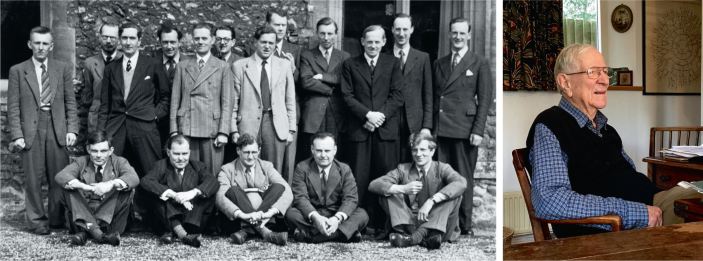
Credit: Left: the Ratio Club in Cambridge, May 1952. Back row: Harold Shipton, John Bates, William Hick, John Pringle, Donald Sholl, John Westcott, Donald Mackay. Middle row: Giles Brindley, Turner McLardy, Ross Ashby, Tommy Gold, Albert Uttley. Front row: Alan Turing, Gurney Sutton, William Rushton, George Dawson, Horace Barlow. (Photo: Wellcome Collection, archive reference GC/179/B.25, used under CC BY / Cropped). Right: Horace Barlow at home in Cambridge, March 2016 (Photo: Ida Barlow).

In December of 2017, I received a two page typed letter from Dr. Barlow reacting to several of the points made in the previous letters and emails. From August of 2020 to June of 2021 I posted these 32 letters I wrote to Dr. Barlow from February 11, 2015 to April 18, 2020 and below is a list of those letters. Sadly Dr. Barlow passed away on July 5, 2020 at age 98. However, I want to summarize some the issues we discussed in a series of 10 posts. 

Francis Schaeffer discusses Darwin’s own words concerning moral motions in Schaeffer’s 1968 sermon at this link.

Here are the links to my letters to Dr. Barlow: 

first weeksecond week,

third week4th letterFifth Letter,

6th letter7th letter8th letter9th letter10th letter11th letter12th letter13th letter14th letter15th letter16th Letter17th letter18th letter19th letter

20th letter21st letter22nd letter

23rd postcard24th letter25th letter

26th letter27th letter28th letter29th letter, and 30th letter.

Image result for francis schaeffer

Francis Schaeffer

Below is a portion of my February 11, 2015 letter to Dr. Barlow followed by his response in his November 22, 2017 letter:
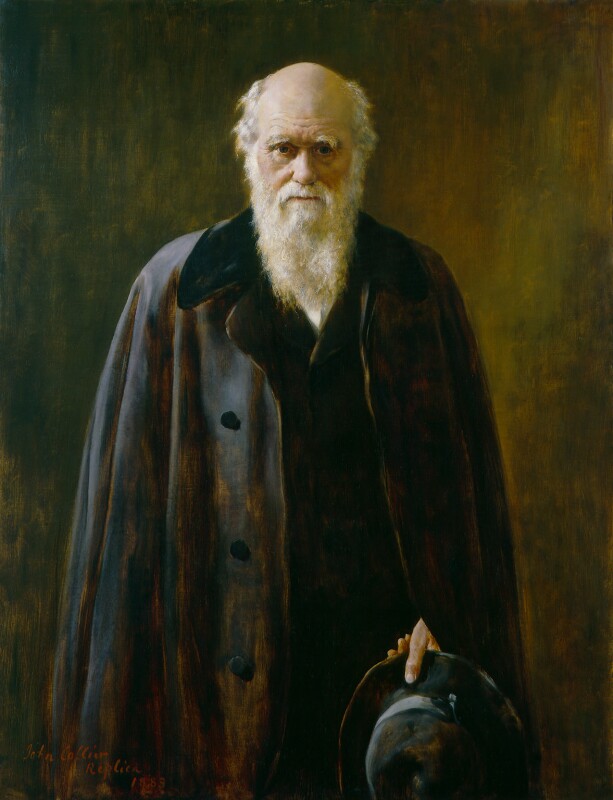
Darwin, C. R. to Fordyce, John, 7 May 1879

“What my own views may be is a question of no consequence to any one but myself. But, as you ask, I may state that my judgment often fluctuates . . . In my most extreme fluctuations I have never been an Atheist in the sense of denying the existence of a God. I think that generally (and more and more as I grow older), but not always, that an Agnostic would be the more correct description of my state of mind.”
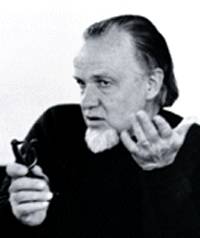
Francis Schaeffer asserted:

What we find now is that he comes to the place in being agnostic, but as we read through this section on religion what we find is in reality his reason leads him against this position, which is interesting but his theory makes him accept the  position of agnosticism. You will notice as we go on, on the basis of his intellect he can’t stand the thought of his own position, of there not being an answer. Nevertheless, he is increasingly forced to this because it wouldn’t conform to his own theory, man being shoved against his own will because of presuppositions. I think what you have in Darwin is a magnificent example, although a sad one of what I lecture on in apologetics,  and that is if a man takes a set of nonchristian presuppositions he is forced eventually to be in a place of tension. The more consistent he is with his own nonchristian presuppositions the more he is away from the real world. When he is closer to the real world then he is more illogical to his own presuppositions. Darwin shows this in his own writings in his own lifetime. So the things in his human nature he is sorry to lose, but he loses them, at the same time he finds that couldn’t explain things on the basis of his reason.  Yet he was driven to certain conclusions which were away from what he himself felt were the real world on the basis of his own presuppositions. He was never satisfied. Just as I very often use Sartre and Camus to point out this dilemma of nonchristian presuppositions, in actuality these sections from Darwin are a perfect example of the same thing.
Darwin’s words:

From Charles Darwin, Autobiography (1876), in The Life and Letters of Charles Darwin, ed. Francis Darwin, vol. 1 (London: John Murray, 1888), pp. 307 to 313.

“Another source of conviction in the existence of God, connected with the reason and not with the feelings, impresses me as having much more weight. This follows from the extreme difficulty or rather impossibility of conceiving this immense and wonderful universe, including man with his capacity of looking far backwards and far into futurity, as the result of blind chance or necessity. When thus reflecting, I feel compelled to look to a First Cause having an intelligent mind in some degree analogous to that of man; and I deserve to be called a Theist. This conclusion was strong in my mind about the time, as far as I can remember, when I wrote the Origin of Species, and it is since that time that it has very gradually, with many fluctuations, become weaker. But then arises the doubt
Francis Schaeffer commented:

On the basis of his reason he has to say there must be an intelligent mind, someone analogous to man. You couldn’t describe the God of the Bible better. That is man is made in God’s image  and therefore, you know a great deal about God when you know something about man. What he is really saying here is that everything in my experience tells me it must be so, and my mind demands it is so. Not just these feelings he talked about earlier but his MIND demands it is so, but now how does he counter this? How does he escape this? Here is how he does it!!!
Darwin’s words:

—can the mind of man, which has, as I fully believe, been developed from a mind as low as that possessed by the lowest animals, be trusted when it draws such grand conclusions?
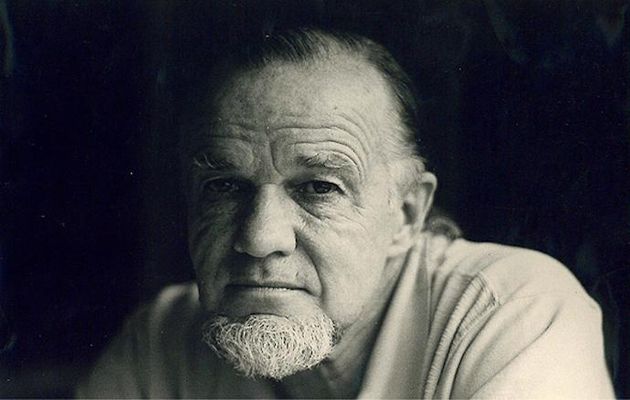
Francis Schaeffer commented:

So he says my mind can only come to one conclusion, and that is there is a mind behind it all. However, the doubt comes because his mind has come from the lowest form of earthworm, so how can I trust my mind. But this is a joker isn’t it?  Then how can you trust his mind to support such a theory as this? He proved too much. The fact that Darwin found it necessary to take such an escape shows the tremendous weight of Romans 1, that the only escape he can make is to say how can I trust my mind when I come from the lowest animal the earthworm? Obviously think of the grandeur of his concept, I don’t think it is true, but the grandeur of his concept, so what you find is that Darwin is presenting something here that is wrong I feel, but it is not nothing. It is a tremendously grand concept that he has put forward. So he is accepting the dictates of his mind to put forth a grand concept which he later can’t accept in this basic area with his reason, but he rejects what he could accept with his reason on this escape. It really doesn’t make sense. This is a tremendous demonstration of the weakness of his own position.
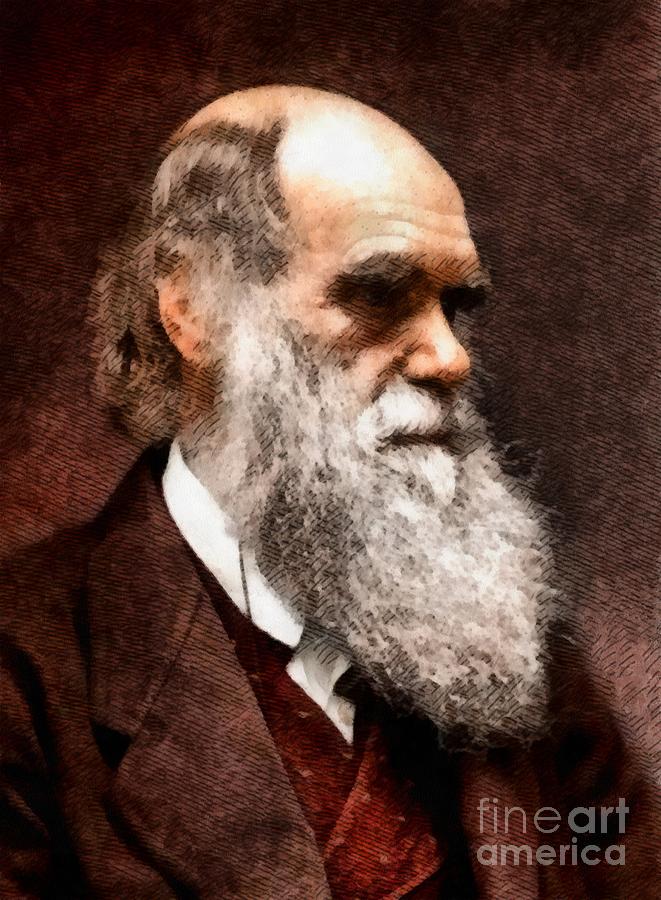
Darwin clings to agnosticism:

“I cannot pretend to throw the least light on such abstruse problems. The mystery of the beginning of all things is insoluble by us, and I for one must be content to remain an Agnostic.”
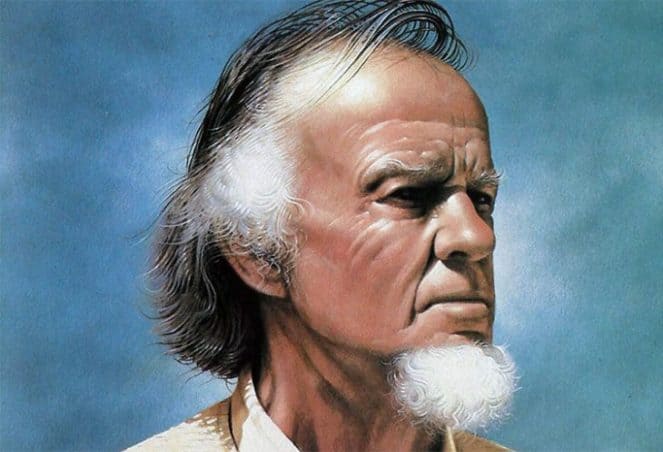
Francis Schaeffer commented:

What a stupid reply and I didn’t say wicked. It just seems to me that here is 2 plus 2 equals 36 at this particular place.

 

Here is Dr. Barlow’s response in his November 22, 2017 letter:

——

Saying you don’t believe in God is a very foolish thing to say as it doesn’t explain why so many people talk about it, there has got to be more to it than that; also I think one has to respect what some godly people say and some of the things they do; I wish one could make more sense of it but I don’t think the godly people have done a very good job;

This reminds me of a story that Adrian Rogers told about his interaction with an agnostic:
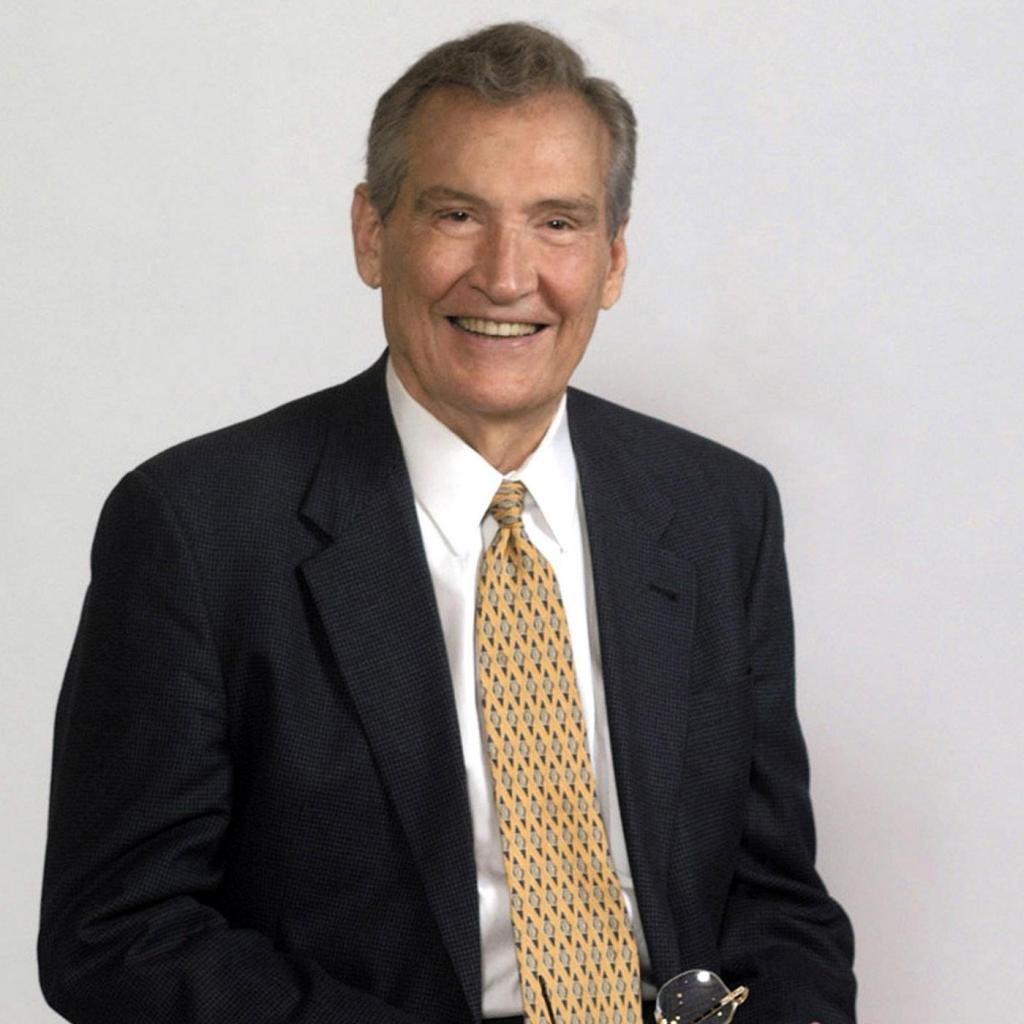
Here we must observe that many people don’t want to find the truth just like a thief doesn’t want to find a policeman. I now want to share a portion of the sermon WHO IS JESUS? by Adrian Rogers because this very point is made:

Here is how the story goes:

Years ago Adrian Rogers counseled with a NASA scientist and his severely depressed wife. The wife pointed to her husband and said, “My problem is him.” She went on to explain that her husband was a drinker, a liar, and an adulterer.

Dr. Rogers asked the man if he were a Christian. “No!” the man laughed. “I’m an atheist.” “Really?” Dr. Rogers replied. “That means you’re someone who knows that God does not exist.” “That’s right,” said the man. “Would it be fair to say that you don’t know all there is to know in the universe?” “Of course,” the man admitted. Dr. Rogers asked, “Would it be generous to say you know half of all there is to know?” “Yes!” Then Dr. Rogers inquired,“Wouldn’t it be possible that God’s existence might be in the half you don’t know?” The man acknowledged, “Okay, but I don’t think He exists.” Dr. Rogers replied, “Well then, you’re not an atheist; you’re an agnostic.You’re a doubter.” The man asserted, “Yes, and I’m a big one.” Then Dr. Rogers popped the question, “It doesn’t matter what size you are. I want to know what kind [of doubter] you are.” 

“What kinds are there?”

“There are honest doubters and dishonest doubters. An honest doubter is willing to search out the truth and live by the results; a dishonest doubter doesn’t want to know the truth. He can’t find God for the same reason a thief can’t find a policeman.”

“I want to know the truth.”

“Would you like to prove that God exists?”

“It can’t be done.”

“It can be done. You’ve just been in the wrong laboratory. Jesus said, ‘If any man’s will is to do His will, he will know whether my teaching is from God or whether I am speaking on my own authority’ (John 7:17). I suggest you read one chapter of the book of John each day, but before you do, pray something like this, ‘God, I don’t know if You’re there, I don’t know if the Bible is true, I don’t know if Jesus is Your Son. But if You show me that You are there, that the Bible is true, and that Jesus is Your Son, then I will follow You. My will is to do your will.”

The man agreed. About three weeks later he returned to Dr. Rogers’s office and invited Jesus Christ to be his Savior and Lord.
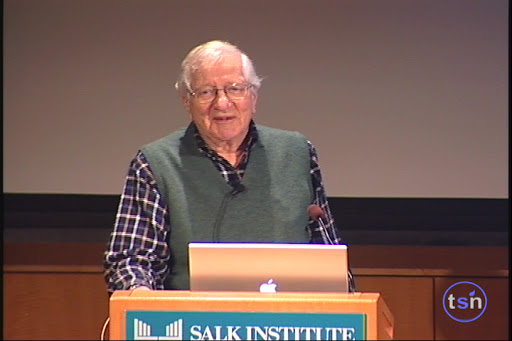
 

Another quote from Dr. Barlow’s November 22, 2017 letter:

 After acknowledging that Charles Darwin did lose his aesthetic tastes for art, poetry, and for fine scenery which he attributed to his study of evolution, Dr. Barlow came back and asserted, “Notice, however, that he clearly did not lose his sense of the value of truth, and of the importance of forever searching it out. “ 
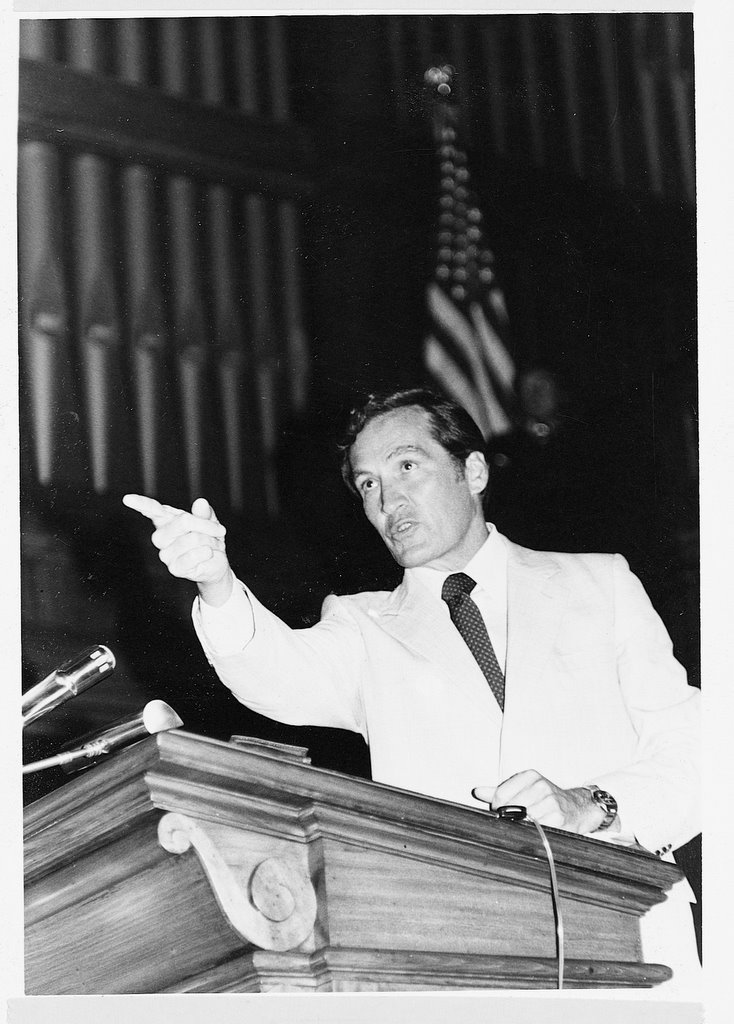
 

Here is some evidence:

—-

Let me quote from my former pastor Adrian Rogers:

Skeptics seem to think that the Bible is full of scientific errors. However, before an individual can make that assertion, they had better make sure they know both science and Scripture. You see, I have heard unbelievers state that the Bible is not a book of science, but a book of religion, which is basically true. It is not written to teach us about science, but to teach us about God. But the God of salvation and the God of creation are the same. Science doesn’t take God by surprise. A close look at Scripture reveals that it is scientifically accurate.

Every now and then science may disagree with the Bible, but usually science just needs time to catch up. For example, in 1861 a French scientific academy printed a brochure offering 51 incontrovertible facts that proved the Bible in error. Today there is not a single reputable scientist who would support those supposed “facts,” because modern science has disproved them all!

The ancients believed the earth was held up by Atlas, or resting on pillars, or even seated on the backs of elephants. But today we know the earth is suspended in space, a fact the Word of God records in Job 26:7: “He . . . hangeth the earth upon nothing.” God revealed the facts of cosmology long before man had any idea of the truth.

For centuries man believed the earth was flat, but now we know the earth is a globe. The prophet Isaiah, writing 750 years before the birth of Christ, revealed that “God sitteth upon the circle of the earth” (Isaiah 40:22). The word translated here as “circle” was more commonly translated “sphere.” In other words, Isaiah explained that the earth was a globe centuries before science discovered it.

When Ptolemy charted the heavens, he counted 1026 stars in the sky. But with the invention of the telescope man discovered millions and millions of stars, something that Jeremiah 33:22 revealed nearly three thousand years ago: “The host of heaven cannot be numbered.” How did these men of God know the truth of science long before the rest of the world discovered it? They were moved by the Holy Spirit to write the truth. God’s Word is not filled with errors. It is filled with facts, even scientific facts.

When the black plague was killing one quarter of Europe’s population in the fourteenth century, it was the church, not science, that helped overcome the dread disease. The leaders in the church noticed the instructions given by the Lord to Moses in Leviticus 13:46: “All the days wherein the plague shall be in him he shall be defiled; he is unclean: he shall dwell alone; without the camp shall his habitation be.” These early believers did not know microbiology or understand what germs were, but they could understand a clear teaching to quarantine someone who was sick. So they followed the Biblical dictum, quarantined those sick with the plague, and stopped it from spreading. The Bible had its science correct even before man discovered the truth! Don’t accept the charge that the Bible is filled with scientific errors. Modern science seems determined to explain God away, and refuses to acknowledge any evidence of the supernatural. But the science of Scripture is one reason to accept the Bible as God’s Word.

Debating from 2015-2020 Darwin’s great grandson (Horace Barlow) about Francis Schaeffer’s 1968 critique of Darwinism!

Image result for Emma Nora Barlow, Lady Barlow

The autobiography of Charles Darwin read by Francis Schaeffer in 1968 was not the same one originally released in 1892 because that one omitted the religious statements of Charles Darwin. 

pictured below with his eldest child William: 

Image result for Horace Barlow charles darwin

Notice this statement below from the Freedom from Religion Foundation: 

(Nora Barlow pictured below)

Charles Darwin wrote the Rev. J. Fordyce on July 7, 1879, that “an agnostic would be the most correct description of my state of mind.” Darwin penned his memoirs between the ages of 67 and 73, finishing the main text in 1876. These memoirs were published posthumously in 1887 by his family under the title Life and Letters of Charles Darwin, with his hardest-hitting views on religion excised. Only in 1958 did Darwin’s granddaughter Nora Barlow publish his Autobiography with original omissions restored  D. 1882.
——-

Charles Robert Darwin  (1809 – 1882) had 10 children and 7 of them survived to adulthood.

Sir Horace DarwinKBEFRS (13 May 1851 – 22 September 1928), the fifth son and ninth child of the British naturalist Charles Darwin and his wife Emma, the youngest of their seven children who survived to adulthood.

(Horace Darwin pictured below)

Horace Darwin.jpg

Emma Nora Barlow, Lady Barlow (née Darwin; 22 December 1885 – 29 May 1989) Nora, as she was known, was the daughter of the civil engineer Sir Horace Darwin and his wife The Hon. Lady Ida Darwin (née Farrer),

Horace Basil Barlow FRS (1921-) Barlow is the son of the civil servant Sir Alan Barlow and his wife Lady Nora (née Darwin). Barlow is the great-grandson of Charles Darwin

XXXXXXXXXXXXXXX

Horace Darwin married Emma Cecilia “Ida” Farrer (1854–1946) pictured below.

Image result for Ida Darwin hoRACE

—-

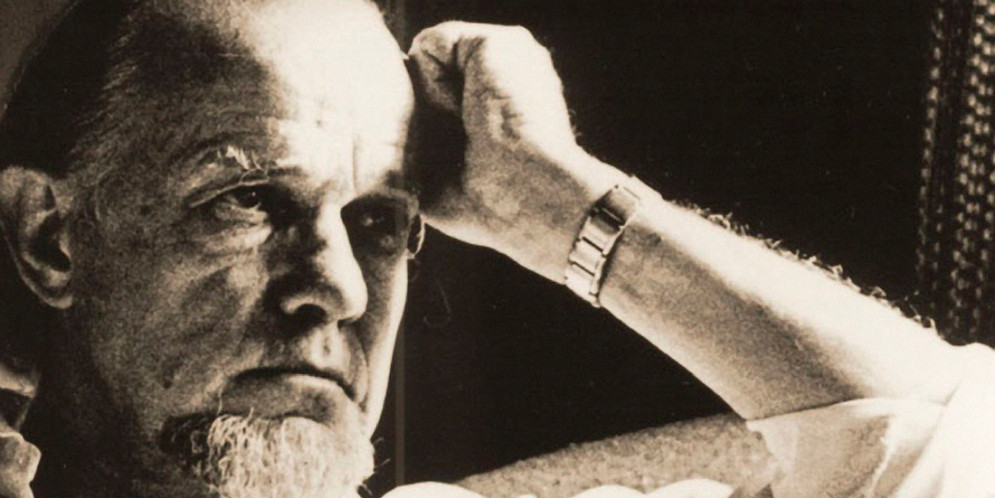
Image result for francis schaeffer

Francis Schaeffer

Horace Barlow was the son of Nora Barlow. From February 11, 2015 to July 1, 2017, I wrote 7 letters to Dr. Horace Barlow because I wanted to discuss primarily the views of his grandfather Charles Darwin and Francis Schaeffer’s 1968 critique of Darwinism!
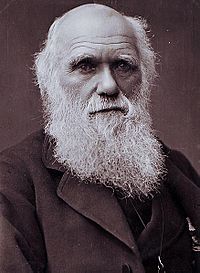
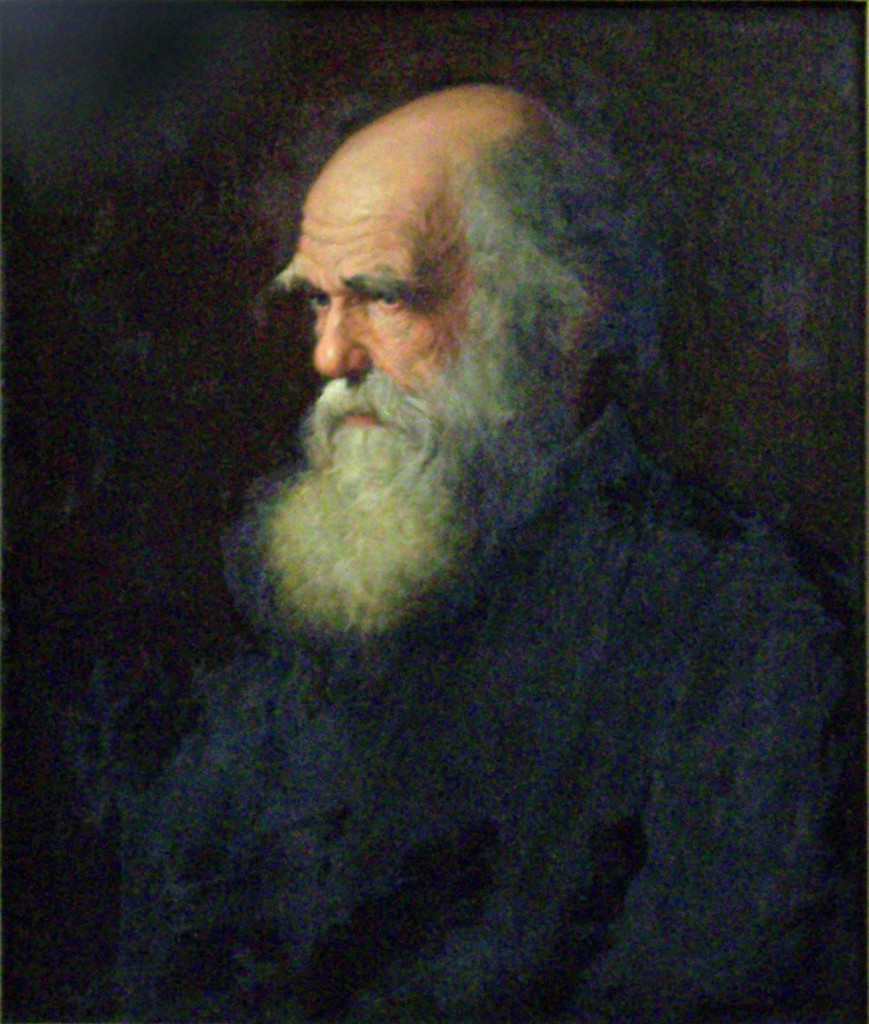
Image result for charles darwin

Horace seen below in 2017 

Image result for francis schaeffer

Franicis Schaeffer

If you wish to hear Francis Schaeffer’s 1968 talk on Darwin’s autobiography then you can access part 1 at this link and part 2 at this link.

—-

—-

—-

Horace Barlow pictured below:

_____________

I found Dr. Barlow to be a true gentleman and he was very kind to take the time to answer the questions that I submitted to him. In the upcoming months I will take time once a week to pay tribute to his life and reveal our correspondence. In the first week I noted:

 Today I am posting my first letter to him in February of 2015 which discussed Charles Darwin lamenting his loss of aesthetic tastes which he blamed on Darwin’s own dedication to the study of evolution. In a later return letter, Dr. Barlow agreed that Darwin did in fact lose his aesthetic tastes at the end of his life.

In the second week I look at the views of Michael Polanyi and share the comments of Francis Schaeffer concerning Polanyi’s views.

In the third week, I look at the life of Brandon Burlsworth in the November 28, 2016 letter and the movie GREATER and the problem of evil which Charles Darwin definitely had a problem with once his daughter died.

On the 4th letter to Dr. Barlow looks at Darwin’s admission that he at times thinks that creation appears to look like the expression of a mind. Francis Schaeffer discusses Darwin’s own words in 1968 sermon at this link.

My Fifth Letter concerning Charles Darwin’s views on MORAL MOTIONS Which was mailed on March 1, 2017. Francis Schaeffer discusses Darwin’s own words concerning moral motions in Schaeffer’s 1968 sermon at this link.

6th letter on May 1, 2017 in which Charles Darwin’s hopes are that someone would find in Pompeii an old manuscript by a distinguished Roman that would show that Christ existed! Francis Schaeffer discusses Darwin’s own words concerning the possible manuscript finds in Schaeffer’s 1968 sermon at this link.

7th letter on Darwin discussing DETERMINISM  dated 7-1-17 . Francis Schaeffer discusses Darwin’s own words concerning determinism in Schaeffer’s 1968 sermon at this link.

Thanks 8th letter responds to Dr. Barlow’s letter to me concerning the Francis Schaeffer discusses Darwin’s own words concerning chance in Schaeffer’s 1968 sermon at this link.

Thanks 9th letter in response to 11-22-17 letter I received from Professor Horace Barlow was mailed on 1-2-18 and included Charles Darwin’s comments on William Paley. Francis Schaeffer discusses Darwin’s own words concerning William Paley in Schaeffer’s 1968 sermon at this link.

10th letter in response to 11-22-17 letter I received from Professor Horace Barlow was mailed on 2-2-18 and includes Darwin’s comments asking for archaeological evidence for the Bible! Francis Schaeffer discusses Darwin’s own words concerning His desire to see archaeological evidence supporting the Bible’s accuracy  in Schaeffer’s 1968 sermon at this link.

11th letter I mailed on 3-2-18  in response to 11-22-17 letter from Barlow that asserted: It is also sometimes asked whether chance, even together with selection, can define a “MORAL CODE,” which the religiously inclined say is defined by their God. I think the answer is “Yes, it certainly can…” Francis Schaeffer discusses Darwin’s own words concerning A MORAL CODE in Schaeffer’s 1968 sermon at this link.

12th letter on March 26, 2018 breaks down song DUST IN THE WIND “All we do, crumbles to the ground though we refuse to see, Dust in the Wind, All we are is dust in the wind, Don’t hang on, Nothing lasts forever but the Earth and Sky, It slips away, And all your money won’t another minute buy.”

In 13th letter I respond to Barlow’s November 22, 2017 letter and assertion “He {Darwin} clearly did not lose his sense of the VALUE of TRUTH, and of the importance of FOREVER SEARCHING it out.”

In 14th letter to Dr. Barlow on 10-2-18, I assert: “Let me demonstrate how the Bible’s view of the origin of life fits better with the evidence we have from archaeology than that of gradual evolution.”In 15th letter in November 2, 2018 to Dr. Barlow I quote his relative Randal Keynes Who in the Richard Dawkins special “The Genius of Darwin” makes this point concerning Darwin, “he was, at different times, enormously confident in it,and at other times, he was utterly uncertain.”In 16th Letter on 12-2-18 to Dr. Barlow I respond to his letter that stated, If I am pressed to say whether I think belief in God helps people to make wise and beneficial decisions I am bound to say (and I fear this will cause you pain) “No, it is often very disastrous, leading to violence, death and vile behaviour…Muslim terrorists…violence within the Christian church itself”17th letter sent on January 2, 2019 shows the great advantage we have over Charles Darwin when examining the archaeological record concerning the accuracy of the Bible!In the 18th letter I respond to the comment by Charles Darwin: “My mind seems to have become a kind of machine for grinding general laws out of large collections of facts, but why this should have caused the atrophy of that part of the brain alone, on which the higher tastes depend, I cannot conceive….The loss of these tastes is a loss of happiness.” Francis Schaeffer discusses Darwin’s own words on his loss of aesthetic tastes  in Schaeffer’s 1968 sermon at this link.In 19th letter on 2-2-19  I discuss Steven Weinberg’s words,  But if language is to be of any use to us, we ought to try to preserve the meanings of words, and “God” historically has not meant the laws of nature. It has meant an interested personality.

In the 20th letter on 3-2-19 I respond to Charles Darwin’s comment, “At the present day the most usual argument for the existence of an intelligent God is drawn from the deep [#1] inward conviction and feelings which are experienced by most persons...Formerly I was led by feelings such as those…to the firm conviction of the existence of God, and of the immortality of the soul. In my Journal I wrote that [#2] whilst standing in the midst of the grandeur of a Brazilian forest, ‘it is not possible to give an adequate idea of the higher feelings of wonder, admiration, and devotion which fill and elevate the mind.’ I well remember my conviction that there is more in man than the mere breath of his body. [#3] But now the grandest scenes would not cause any such convictions and feelings to rise in my mind. It may be truly said that I am like a man who has become colour-blind.” Francis Schaeffer discusses Darwin’s own words concerning his former belief in God in Schaeffer’s 1968 sermon at this link.

In the 21st letter on May 15, 2019 to Dr Barlow I discuss the writings of Francis Schaeffer who passed away the 35 years earlier on May 15, 1985. Francis Schaeffer discusses Darwin’s own words at length in Schaeffer’s 1968 sermon at this link.

In the 22nd letter I respond to Charles Darwin’s words, “I can indeed hardly see how anyone ought to wish Christianity to be true; for if so the plain language of the text seems to show that the men who do not believe…will be everlastingly punished. And this is a damnable doctrine.” Francis Schaeffer discusses Darwin’s own words about hell  in Schaeffer’s 1968 sermon at this link

In 23rd postcard sent on 7-2-19 I asked Dr Barlow if he was a humanist. Sir Julian Huxley, founder of the American Humanist Association noted, “I use the word ‘humanist’ to mean someone who believes that man is just as much a natural phenomenon as an animal or plant; that his body, mind and soul were not supernaturally created but are products of evolution, and that he is not under the control or guidance of any supernatural being.”

In my 24th letter on 8-2-19 I quote Jerry  Bergman who noted Jean Louis Agassiz (1807-1873) is regarded as one of the greatest scientists of the 19th century. A founding father of the modern American scientific establishment, Agassiz was also a lifelong opponent of Charles Darwin’s theory of evolution. Agassiz “ruled in professorial majesty at Harvard’s Museum of Comparative Zoology.”

In my 25th letter on 9-2-19 I respond to Charles Darwin’s assertion,  “This argument would be a valid one if all men of ALL RACES had the SAME INWARD CONVICTION of the existence of one God; but we know that this is very far from being the case.” Francis Schaeffer discusses Darwin’s own words concerning MORAL MOTIONS in Schaeffer’s 1968 sermon at this link.

In my 26th letter on 10-2-19 I quoted Bertrand Russell’s daughter’s statement, “I believe myself that his whole life was a search for God…. Indeed, he had first taken up philosophy in hope of finding proof of the evidence of the existence of God … Somewhere at the back of my father’s mind, at the bottom of his heart, in the depths of his soul  there was an empty space that had once been filled by God, and he never found anything else to put in it”

In my 27th letter on 11-2-19 I disproved Richard Dawkins’ assertion, “Genesis says Abraham owned camels, but archaeological evidence shows that the camel was not domesticated until many centuries after Abraham.” Furthermore, I gave more evidence indicating the Bible is historically accurate.

In my 28th letter on 12-2-19 I respond to Charles Darwin’s statement, “I am glad you were at the Messiah, it is the one thing that I should like to hear again, but I dare say I should find my soul too dried up to appreciate it as in old days; and then I should feel very flat, for it is a horrid bore to feel as I constantly do, that I am a withered leaf for every subject except Science. It sometimes makes me hate Science.” Francis Schaeffer discusses Darwin’s own words concerning MORAL MOTIONS in Schaeffer’s 1968 sermon at this link. 

In my 29th letter on 12-25-19 I responded to Charles Darwin’s statement, “I have said that in one respect my mind has changed during the last twenty or thirty years. Up to the age of thirty, or beyond it, poetry of many kinds…gave me great pleasure, and even as a schoolboy I took intense delight in Shakespeare, especially in the historical plays. I have also said that formerly pictures gave me considerable, and music very great delight. But now for many years I cannot endure to read a line of poetry: I have tried lately to read Shakespeare, and found it so intolerably dullthat it nauseated me…. My mind seems to have become a kind of machine for grinding general laws out of large collections of facts, but why this should have caused the atrophy of that part of the brain alone, on which the higher tastes depend, I cannot conceive… The loss of these tastes is a loss of happiness…” Francis Schaeffer discusses Darwin’s own words concerning his loss of aesthetic tastes in Schaeffer’s 1968 sermon at this link.

In my 30th letter on 2-2-20 I quote Dustin Shramek who asserted, “Without God the universe is the result of a cosmic accident, a chance explosion. There is no reason for which it exist. As for man, he is a freak of nature–a blind product of matter plus time plus chance. Man is just a lump of slime that evolved into rationality. There is no more purpose in life for the human race than for a species of insect; for both are the result of the blind interaction of chance and necessity.”

In my 31st letter on 3-18-20 I quote Francis Schaeffer who noted, “Darwin is saying that he gave up the New Testament because it was connected to the Old Testament. He gave up the Old Testament because it conflicted with his own theory. Did he have a real answer himself and the answer is no. At the end of his life we see that he is dehumanized by his position and on the other side we see that he never comes to the place of intellectual satisfaction for himself that his answers were sufficient.” Francis Schaeffer discusses Darwin’s own words concerning his loss of his Christian faith in Schaeffer’s 1968 sermon at this link.

In my 32nd letter on 4-18-20 quoted H.J. Blackham on where humanism leads On humanist assumptions, life leads to nothing, and every pretense that it does not is a deceit. If there is a bridge over a gorge which spans only half the distance and ends in mid-air, and if the bridge is crowded with human beings pressing on, one after the other they fall into the abyss. The bridge leads nowhere, and those who are pressing forward to cross it are going nowhere….It does not matter where they think they are going, what preparations for the journey they may have made, how much they may be enjoying it all. The objection merely points out objectively that such a situation is a model of futility

TRIBUTE TO HORACE BARLOW:

Paul Linton @LintonVision
Nice (and very informative) obituary of Horace Barlow. Only minor quibble is that it slightly downplays the extent to which the psychophysics of 3D vision (Julesz, 1960) inspired the neuroscience (Barlow et al. 1967; Nikara et al. 1968):


Figure thumbnail gr1
Horace Barlow.View Large ImageDownload Hi-res imageHorace Barlow was one of the truly great neuroscientists of his time, in the Cambridge tradition of quantitative neurophysiology and psychophysics. His fundamental theoretical and empirical contributions to our understanding of brain function have inspired and influenced generations of neurophysiologists, psychologists and computational neuroscientists and are certain to endure for generations to come.Horace Basil Barlow, FRS, was born in 1921 in Chesham Bois, Buckinghamshire, son of Sir Alan Barlow and Lady Nora Barlow (née Darwin). He was educated at Winchester College and studied medicine during the war years, first at Cambridge and then at Harvard Medical School, which awarded him an MD in 1946. He completed medical training at University College Hospital, London, before commencing research in neurophysiology with E.D. Adrian at the Cambridge Physiology Laboratory. After various positions at Cambridge University, he became Professor of Physiological Optics and Physiology at UC Berkeley. In 1974, he returned to Trinity College and the Cambridge Physiology Department to take the Royal Society Research Chair of Physiology, where he continued to make important contributions to neuroscience well after his formal retirement. Horace was elected a Fellow of the Royal Society in 1969 and won their Royal Medal in 1993. He was awarded the Australia Prize in the latter year and several others, including the Ferrier Medal in 1980 and the Ken Nakayama Prize from the Vision Sciences Society in 2016.Many interesting and charismatic people impacted on the young Horace. The first — and arguably most important — was his mother, granddaughter of Charles Darwin. She held no formal degree but worked as a biologist and later, as Darwin’s biographer, founded scholarly research into his life and achievements. Her example, together with his abilities and preference for maths over the humanities, veered Horace towards science. His contemporaries at Winchester College, Christopher Longuet-Higgins, Freeman Dyson and James Lighthill, all of whom became prominent scientists, played an influential role. During his university years there was no shortage of creative minds: his supervisor, the eminent Lord Adrian, and his tutor William Rushton, as well as Pat Merton and Tommy Gold. These latter three were part of the Ratio Club, a London-based club of about 20 carefully selected young neurobiologists, neurologists, psychologists, engineers, mathematicians and physicists, who periodically met in Queen’s Square to discuss cybernetics, information theory and brain function (see group photo). Cybernetics and information theory were central planks in Horace’s conceptual framework throughout his lifetime.Horace started his scientific career early, publishing three papers before he completed his MD: one (in Nature) with Rushton during his Cambridge undergraduate days and two with fellow students at Harvard. His next project, assigned to him by Adrian, was to investigate the proposal of Marshall and Talbot that small scanning eye-movements serve a fundamental role in vision. Horace devised a novel method for measuring eye position precisely (photographing a small spot of mercury placed on the cornea) and found that, between rapid gaze shifts, the eyes were essentially still. He concluded that the fixations rather than scanning eye-movements were fundamental to vision, dismissed Marshall and Talbot’s idea and moved on. However, the importance of the dynamics of perception, including ‘temporal interpolation’ of moving stimuli, remained central to his thinking, emerging clearly in his Ferrier lecture in 1980.Adrian’s supervision style was quite liberal, in the Cambridge tradition, described by Horace as “incisive, but economical, guidance”. Thus, Horace was free to pursue his own scientific curiosities, such as how neurons integrate information. He observed that Sherrington’s classic preparations used artificial stimuli, electric shocks applied to spinal roots, whereas applying light to the retina allows for behaviourally relevant natural stimuli. He developed a preparation for recording spikes from single ganglion cells in frog retina — no mean feat at the time — to study the most basic element of integration, signal summation. Inspired by Rushton, Horace took a quantitative approach and, by measuring thresholds as a function of stimulus area, discovered that integration was not uniform over the receptive field but that there were clear inhibitory surrounds forming separate ‘on’ and ‘off’ regions. More surprisingly, one type of ganglion cell could be a feature detector whose spike discharge anticipates the future position of a fly.This study initiated 30 years of ground-breaking collaborative work on retinal ganglion cells. Horace joined Stephen Kuffler, who had independently described the inhibitory surround in cat retina. Together with Fitzgerald, they discovered that ganglion cells adapt their receptive fields to cover the full range of light levels, switching from cones to rods at low light levels and losing the inhibitory surround. In 1963, Horace and Richard Hill discovered motion-sensitive cells in rabbit retina. Working with the most exacting of retinal physiologists, Bill Levick, Horace revealed further hidden complexities in retinal processing: a motion-sensitive ganglion cell is driven by an array of subunits. Then, in classic experiments, they established the first physiologically informed model of the underlying mechanism: the Barlow and Levick model of elementary motion detection.In 1964, Horace accepted a professorship at the Berkeley School of Optometry, where he continued his neurophysiological experiments, investigating integration by neurons in primary visual cortex (V1). One particularly influential study was conducted with former student Colin Blakemore (in Berkeley on a Harkness Fellowship) and the enthusiastic and charismatic young Australian Jack Pettigrew. Following leads from Jack’s undergraduate work in Sydney, they demonstrated that cells in cat primary visual cortex were selective to binocular disparity, the signals that support binocular depth perception. This was important and unexpected, as stereoscopic depth was thought to be a high-level perceptual property emerging late in processing. However, the results meshed well with Béla Julesz’s demonstrations in the early 1960s of ‘random-dot stereograms’, showing that depth can emerge from point-by-point disparities in otherwise random patterns. The discovery reinforced Horace’s conviction that single sensory neurons coded meaningful information.His work on retinal and cortical neurons brought home to Horace the fundamental realisation that physiological experiments could answer questions of psychological interest. Much of the sensory apparatus for complex behavioural patterns (like detecting and catching flies) may lie in the retina rather than ‘mysterious centres’ too difficult to study by physiological means. Furthermore, the lateral inhibition mechanism that he discovered in frog retina had been postulated by Ernst Mach and others to account for perceptual phenomena, such as simultaneous contrast and Mach Bands. This line of thought culminated in ‘A neural doctrine for perceptual psychology’, published in the fledgling journal Perception in 1972. The provocative formulation of ‘dogmas’ stimulated much important debate, theorising and experimental work, and the central idea of that paper, that perception corresponds to the activity of specific cells, has been hugely influential to physiologists and psychologists alike. Indeed, Horace’s doctrine is still relevant, as it goes far beyond ‘lock and key’ feature detectors. His doctrine incorporates the concepts of statistical inference, efficiency and redundancy that he formulated earlier in his career and suggests the far-reaching idea that he subsequently pursued: single neurons use synaptic plasticity to capture the redundancy that is knowledge.Horace started thinking about signals, noise and perceptual judgements when as an undergraduate he presented a new paper to a discussion group. The landmark study of Hecht, Shlaer and Pirenne demonstrated that the absolute threshold of human vision is limited by noise: quantal fluctuations whose effects can be determined psychophysically by testing the predictions of statistical models. Horace also discussed the problem of signal and noise in the Ratio Club (it was one of their chosen topics), especially with his Cambridge colleague Tommy Gold (later Professor of Astronomy at Cornell University). After his experiments on frog retina, Horace revisited Hecht et al. with a penetrating statistical analysis of published data. He found that the number of quantal events required to reach threshold is elevated by the presence of background noise that he attributed to the thermal activation of visual pigment molecules. This novel conclusion was confirmed a quarter of a century later by recording from rods. His theoretical findings prompted Horace to consider that “thresholds are efficient statistical judgements of constant fallibility”, and he quickly confirmed this more general principle with new psychophysical experiments.Figure thumbnail gr2The young Horace Barlow (bottom right) in May 1952, together with members and guests of the Ratio Club, outside Peterhouse College, Cambridge: Back row (partly obscured): H. Shipton, J. Bates, W.E. Hick, J. Pringle, D. Sholl, J. Westcott and D. Mackay. Middle row: G. Brindley, T. McLardy. W.R. Ashby, T. Gold and A. Uttley. Front row: A. Turing, G. Sutton, W. Rushton, G. Dawson and H. Barlow.View Large ImageDownload Hi-res imageHorace’s scientific approach, to try to understand the principles guiding brain function, was uncommon among physiologists. His 1961 paper on ‘Possible principles underlying the transmission of sensory messages’ (in Sensory Communication, W.D. Keidel, U.O. Keidel, M.E. Wigand and W.A. Rosenblith, eds) opens with, “a wing would be a most mystifying structure if one did not know that birds flew”. Horace argued that we need first to understand the goals of the system to avoid being buried in a mass of irrelevant neurophysiological and neuroanatomical details while missing crucial observations. He reasoned that, because neurons have limited representational capacity, they should economise on impulses by forming efficient representations. According to information theory, this can be achieved by eliminating redundancy using lateral inhibition and adaptation, and because both are observed in retina this must be a goal of early sensory processing. Two decades later, Barlow’s efficient coding hypothesis was validated. This prompted a new round of theory, measurements and experiments, which explained the function of mechanisms in the earlier stages of vision, olfaction and audition. Efficiency and ‘the economy of impulses’ continue to guide our understanding of neural codes at all levels.Horace’s approach was intrinsically interdisciplinary, a popular buzzword in modern grant writing but less usual in his day. He looked for guiding principles of brain function without undue concern whether his supporting data came from psychophysics or physiology, humans or animals, vertebrates or invertebrates. He was always trying — and usually succeeding — to merge detailed observations into the big picture of brain function, following the example of his famous great-grandfather. He was very much a ‘hands-on’ scientist, in the Cambridge mould: he never led a large research group nor took on many graduate students. That was not his style. He led by example, and his example was highly influential. There are very few sensory neuroscientists who would claim not to have been influenced by Horace’s work, one way or the other.Horace never stopped trying to understand the brain. During his own Festschrift in 1987 he gave the most interesting and original talk of the workshop. Following his major theme of how the brain maximises efficiency, he advanced a novel explanation for ‘adaptation’ (the fact that cells reduce firing rate after repeated excitation), suggesting that it is a complex phenomenon serving to ‘decorrelate’ sensory input, reducing inherent redundancy to take full advantage of the limited dynamic range of neurons. This changed the way many people thought about adaptation and again led to new lines of research.The ideas of redundancy and correlated activity of sensory pathways also underlie his highly influential paper on ‘Unsupervised learning’ (Neural Comput. (1989) 1, 295–311). This paper was one of the first to draw attention to the importance of unsupervised learning as opposed to supervised or reinforced learning. Unsupervised learning is about how a nervous system (or indeed artificial intelligence) recognises ‘statistical regularities’, or patterns in its inputs, and is of fundamental importance for understanding the cortex. Horace connected old ideas, such as Tolman’s ‘cognitive maps’ and Craik’s ‘working models’, with modern concepts of entropy, concluding that redundancy in sensory signals provides the knowledge incorporated in those maps. Such knowledge enables unexpected discrepancies to be immediately identified and dealt with. Horace’s information theory-based approach underlies many modern approaches to unsupervised learning in neural networks and Bayesian learning.In the 30-odd years after his formal ‘retirement’, Horace continued to make highly original and creative contributions to the field. He published 56 articles during this period, many as the single author. His interests were very varied, including information redundancy, predictive coding, Bayesian inference, unsupervised learning, development and many others, but all were motivated by the common themes of information theory and neural efficiency. A recent example of his creative thinking was his talk at the symposium on ‘Turing Enduring: Information Processing by Brains and Machines’ (Rockefeller University, December 2012), published in the journal Visual Neuroscience. There, Horace challenged the traditional (and still prevalent) wisdom that orientation-tuned simple and complex cells in primary visual cortex act as ‘edge-detectors’. Looking for more general guiding principles of brain function, he claimed that “the prime role of V1 is to search for regularity or redundancy in the input”, leading to the hypothesis that simple cells perform cross-correlations between the retinal input and internal templates, while complex cells calculate auto-correlations in the retinal input. Characteristically, he did not leave this as a simple hypothesis but provided solid quantitative psychophysical data in favour of his theory.Horace was renowned for his intelligence and quick-wittedness. Neuroscientists presented their research to the Cambridge ‘Craik Club’ with some trepidation. But this was unwarranted, for besides being smart Horace was kind, especially to young researchers. He quickly understood the message of the talk and gave many useful suggestions, absolutely on point, and never intended to humiliate. But his clever quips could also be fun. At a dinner that he gave for a bunch of graduate students, he invited his friend Francis Crick, who held forth on several topics throughout the evening. At one stage, Francis brought up his lineage, lamenting that he could trace it back only to Elizabethan times. With a disarming smile, Horace instantly retorted, “oh yes Francis, and which Elizabeth is that?”Most of Horace’s ideas have survived the test of time, stimulating and motivating generations of neuroscientists and leading to a cascade of advancements far too extensive to summarise here. But if we are to apply his cherished information theory, we know that there is more information in the rare and unexpected event: so did he get anything wrong? Probably not seriously. One idea that clearly evolved over time was his intuition about information redundancy in the image. Initially, he emphasised the role of reducing redundancy for efficient neural coding and economy of neuron numbers as well as impulses, but later he realised the importance of redundancy in identifying structure and statistical regularities in the environment, as sensory redundancy is the main source of knowledge. But this was not a mistake, merely a change of emphasis. If we go right back to the beginning, to his experiments that led him to dismiss the importance of eye drift, perhaps we might say that his assessment was premature, as recent work is showing how the small eye-movements serve an important functional role, conditioning the spatio-temporal frequency spectrum of the image. But while he did not exactly predict this, his intuitions about the importance of temporal dynamics and interpolations, prominent in his Ferrier lecture, were not too far off the mark.The last scientific gathering with Horace was for his 95th birthday, in December 2016. This was a fun occasion for his scientific family, some 100-odd people whose professional lives had been touched by Horace and who had passed the legacy down to their students and students’ students. The celebrations were followed by a workshop, which Horace concluded with a first-rate scientific talk, highlighting the role of information processing in the brain and urging us to consider the importance of information and entropy. His scientific curiosity never escaped him.Horace leaves his wife Miranda, 7 children and 13 grandchildren. His extended scientific family will miss him dearly.Article InfoPublication HistoryPublished online: July 31, 2020

Related posts:

Taking on Ark Times Bloggers on various issues Part F “Carl Sagan’s views on how God should try and contact us” includes film “The Basis for Human Dignity”

April 8, 2013 – 7:07 am

I have gone back and forth and back and forth with many liberals on the Arkansas Times Blog on many issues such as abortion, human rights, welfare, poverty, gun control  and issues dealing with popular culture. Here is another exchange I had with them a while back. My username at the Ark Times Blog is Saline […]By Everette Hatcher III | Posted in Francis SchaefferProlife | Edit | Comments (0)

Carl Sagan v. Nancy Pearcey

March 18, 2013 – 9:11 am

On March 17, 2013 at our worship service at Fellowship Bible Church, Ben Parkinson who is one of our teaching pastors spoke on Genesis 1. He spoke about an issue that I was very interested in. Ben started the sermon by reading the following scripture: Genesis 1-2:3 English Standard Version (ESV) The Creation of the […]By Everette Hatcher III | Posted in Adrian RogersAtheists ConfrontedCurrent Events | TaggedBen ParkinsonCarl Sagan | Edit | Comments (0)

Review of Carl Sagan book (Part 4 of series on Evolution)

May 24, 2012 – 1:47 am

Review of Carl Sagan book (Part 4 of series on Evolution) The Long War against God-Henry Morris, part 5 of 6 Uploaded by FLIPWORLDUPSIDEDOWN3 on Aug 30, 2010 http://www.icr.org/ http://store.icr.org/prodinfo.asp?number=BLOWA2http://store.icr.org/prodinfo.asp?number=BLOWASGhttp://www.fliptheworldupsidedown.com/blog _______________________ I got this from a blogger in April of 2008 concerning candidate Obama’s view on evolution: Q: York County was recently in the news […]By Everette Hatcher III | Posted in Atheists ConfrontedCurrent EventsPresident Obama | EditComments (0)

Review of Carl Sagan book (Part 3 of series on Evolution)

May 23, 2012 – 1:43 am

Review of Carl Sagan book (Part 3 of series on Evolution) The Long War against God-Henry Morris, part 4 of 6 Uploaded by FLIPWORLDUPSIDEDOWN3 on Aug 30, 2010 http://www.icr.org/ http://store.icr.org/prodinfo.asp?number=BLOWA2http://store.icr.org/prodinfo.asp?number=BLOWASGhttp://www.fliptheworldupsidedown.com/blog______________________________________ I got this from a blogger in April of 2008 concerning candidate Obama’s view on evolution: Q: York County was recently in the news […]By Everette Hatcher III | Posted in Atheists ConfrontedCurrent EventsPresident Obama | EditComments (0)

Carl Sagan versus RC Sproul

January 9, 2012 – 2:44 pm

At the end of this post is a message by RC Sproul in which he discusses Sagan. Over the years I have confronted many atheists. Here is one story below: I really believe Hebrews 4:12 when it asserts: For the word of God is living and active and sharper than any two-edged sword, and piercing as far as the […]By Everette Hatcher III | Posted in Adrian RogersAtheists ConfrontedCurrent EventsFrancis Schaeffer | Tagged Bill ElliffCarl SaganJodie FosterRC Sproul | Edit | Comments (0)

Review of Carl Sagan book (Part 4 of series on Evolution)jh68

November 8, 2011 – 12:01 am

Review of Carl Sagan book (Part 4 of series on Evolution) The Long War against God-Henry Morris, part 5 of 6 Uploaded by FLIPWORLDUPSIDEDOWN3 on Aug 30, 2010 http://www.icr.org/ http://store.icr.org/prodinfo.asp?number=BLOWA2http://store.icr.org/prodinfo.asp?number=BLOWASGhttp://www.fliptheworldupsidedown.com/blog _______________________ This is a review I did a few years ago. THE DEMON-HAUNTED WORLD: Science as a Candle in the Dark by Carl […]By Everette Hatcher III | Posted in Atheists ConfrontedCurrent Events | Edit | Comments (0)

Review of Carl Sagan book (Part 3 of series on Evolution)

November 4, 2011 – 12:57 am

Review of Carl Sagan book (Part 3 of series on Evolution) The Long War against God-Henry Morris, part 4 of 6 Uploaded by FLIPWORLDUPSIDEDOWN3 on Aug 30, 2010 http://www.icr.org/ http://store.icr.org/prodinfo.asp?number=BLOWA2http://store.icr.org/prodinfo.asp?number=BLOWASGhttp://www.fliptheworldupsidedown.com/blog______________________________________ I was really enjoyed this review of Carl Sagan’s book “Pale Blue Dot.” Carl Sagan’s Pale Blue Dot by Larry Vardiman, Ph.D. […]By Everette Hatcher III | Posted in Atheists ConfrontedCurrent Events | Edit | Comments (0)

Atheists confronted: How I confronted Carl Sagan the year before he died jh47

May 19, 2011 – 10:30 am

In today’s news you will read about Kirk Cameron taking on the atheist Stephen Hawking over some recent assertions he made concerning the existence of heaven. Back in December of 1995 I had the opportunity to correspond with Carl Sagan about a year before his untimely death. Sarah Anne Hughes in her article,”Kirk Cameron criticizes […]By Everette Hatcher III | Posted in Atheists Confronted | Edit | Comments (2)

My correspondence with George Wald and Antony Flew!!!

May 12, 2014 – 1:14 am

FRANCIS SCHAEFFER ANALYZES ART AND CULTURE Part 41 Sarvepalli Radhakrishnan (Featured artist is Marina Abramović)

January 8, 2015 – 5:23 am

FRANCIS SCHAEFFER ANALYZES ART AND CULTURE Part 40 Timothy Leary (Featured artist is Margaret Keane)

January 1, 2015 – 4:14 am

FRANCIS SCHAEFFER ANALYZES ART AND CULTURE Part 39 Tom Wolfe (Featured artist is Richard Serra)

December 25, 2014 – 5:04 am

FRANCIS SCHAEFFER ANALYZES ART AND CULTURE Part 38 Woody Allen and Albert Camus “There is but one truly serious philosophical problem, and that is suicide” (Feature on artist Hamish Fulton Photographer )

December 18, 2014 – 4:30 am

FRANCIS SCHAEFFER ANALYZES ART AND CULTURE Part 37 Mahatma Gandhi and “Relieving the Tension in the East” (Feature on artist Luc Tuymans)

December 11, 2014 – 4:19 am

FRANCIS SCHAEFFER ANALYZES ART AND CULTURE Part 36 Julian Huxley:”God does not in fact exist, but act as if He does!” (Feature on artist Barry McGee)

December 4, 2014 – 4:10 am

FRANCIS SCHAEFFER ANALYZES ART AND CULTURE Part 35 Robert M. Pirsig (Feature on artist Kerry James Marshall)

November 27, 2014 – 4:43 am

FRANCIS SCHAEFFER ANALYZES ART AND CULTURE Part 34 Aleksandr Solzhenitsyn (Feature on artist Shahzia Sikander)

November 20, 2014 – 4:28 am

FRANCIS SCHAEFFER ANALYZES ART AND CULTURE Part 33 Aldous Huxley (Feature on artist Matthew Barney )

November 13, 2014 – 4:39 am

FRANCIS SCHAEFFER ANALYZES ART AND CULTURE Part 32 Steven Weinberg and Woody Allen and “The Meaningless of All Things” (Feature on photographer Martin Karplus )

November 6, 2014 – 4:42 am

FRANCIS SCHAEFFER ANALYZES ART AND CULTURE Part 31 David Hume and “How do we know we know?” (Feature on artist William Pope L. )

October 30, 2014 – 5:34 am

FRANCIS SCHAEFFER ANALYZES ART AND CULTURE Part 30 Rene Descartes and “How do we know we know?” (Feature on artist Olafur Eliasson)

October 23, 2014 – 5:01 am

FRANCIS SCHAEFFER ANALYZES ART AND CULTURE Part 29 W.H. Thorpe and “The Search for an Adequate World-View: A Question of Method” (Feature on artist Jeff Koons)

October 16, 2014 – 5:06 am

FRANCIS SCHAEFFER ANALYZES ART AND CULTURE Part 28 Woody Allen and “The Mannishness of Man” (Feature on artist Ryan Gander)

October 9, 2014 – 5:10 am

FRANCIS SCHAEFFER ANALYZES ART AND CULTURE Part 27 Jurgen Habermas (Featured artist is Hiroshi Sugimoto)

September 25, 2014 – 1:01 pm

FRANCIS SCHAEFFER ANALYZES ART AND CULTURE Part 26 Bettina Aptheker (Featured artist is Krzysztof Wodiczko)

September 25, 2014 – 4:00 am

FRANCIS SCHAEFFER ANALYZES ART AND CULTURE Part 25 BOB DYLAN (Part C) Francis Schaeffer comments on Bob Dylan’s song “Ballad of a Thin Man” and the disconnect between the young generation of the 60’s and their parents’ generation (Feature on artist Fred Wilson)

September 18, 2014 – 3:57 am

FRANCIS SCHAEFFER ANALYZES ART AND CULTURE Part 24 BOB DYLAN (Part B) Francis Schaeffer comments on Bob Dylan’s words from HIGHWAY 61 REVISITED!! (Feature on artist Susan Rothenberg)

September 11, 2014 – 4:18 am

FRANCIS SCHAEFFER ANALYZES ART AND CULTURE Part 23 BOB DYLAN (Part A) (Feature on artist Josiah McElheny)Francis Schaeffer on the proper place of rebellion with comments by Bob Dylan and Samuel Rutherford

September 2, 2014 – 8:42 am

FRANCIS SCHAEFFER ANALYZES ART AND CULTURE Part 22 “The School of Athens by Raphael” (Feature on the artist Sally Mann)

August 11, 2014 – 2:19 pm

FRANCIS SCHAEFFER ANALYZES ART AND CULTURE Part 21 William B. Provine (Feature on artist Andrea Zittel)

June 12, 2014 – 2:52 pm

FRANCIS SCHAEFFER ANALYZES ART AND CULTURE Part 20 Woody Allen and Materialistic Humanism: The World-View of Our Era (Feature on artist Ida Applebroog)

May 12, 2014 – 4:35 am

FRANCIS SCHAEFFER ANALYZES ART AND CULTURE Part 19 Movie Director Luis Bunuel (Feature on artist Oliver Herring)

May 1, 2014 – 11:53 am

FRANCIS SCHAEFFER ANALYZES ART AND CULTURE Part 18 “Michelangelo’s DAVID is the statement of what humanistic man saw himself as being tomorrow” (Feature on artist Paul McCarthy)

April 25, 2014 – 8:26 am

FRANCIS SCHAEFFER ANALYZES ART AND CULTURE Part 17 Francis Schaeffer discusses quotes of Andy Warhol from “The Observer June 12, 1966″ Part C (Feature on artist David Hockney plus many pictures of Warhol with famous friends)

April 18, 2014 – 7:37 am

FRANCIS SCHAEFFER ANALYZES ART AND CULTURE Part 16 Francis Schaeffer discusses quotes of Andy Warhol from “The Observer June 12, 1966″ Part B (Feature on artist James Rosenquist plus many pictures of Warhol with famous friends)

April 11, 2014 – 6:14 am

FRANCIS SCHAEFFER ANALYZES ART AND CULTURE Part 15 Francis Schaeffer discusses quotes of Andy Warhol from “The Observer June 12, 1966″ Part A (Feature on artist Robert Indiana plus many pictures of Warhol with famous friends)

April 4, 2014 – 5:58 am

FRANCIS SCHAEFFER ANALYZES ART AND CULTURE Part 14 David Friedrich Strauss (Feature on artist Roni Horn )

March 28, 2014 – 2:50 pm

FRANCIS SCHAEFFER ANALYZES ART AND CULTURE Part 13 Jacob Bronowski and Materialistic Humanism: The World-View of Our Era (Feature on artist Ellen Gallagher )

March 21, 2014 – 7:18 am

FRANCIS SCHAEFFER ANALYZES ART AND CULTURE Part 12 H.J.Blackham and Materialistic Humanism: The World-View of Our Era (Feature on artist Arturo Herrera)

March 14, 2014 – 9:07 am

FRANCIS SCHAEFFER ANALYZES ART AND CULTURE Part 11 Thomas Aquinas and his Effect on Art and HOW SHOULD WE THEN LIVE? Episode 2: THE MIDDLES AGES (Feature on artist Tony Oursler )

March 4, 2014 – 9:04 pm

FRANCIS SCHAEFFER ANALYZES ART AND CULTURE Part 10 David Douglas Duncan (Feature on artist Georges Rouault )

February 28, 2014 – 5:16 am

FRANCIS SCHAEFFER ANALYZES ART AND CULTURE Part 9 Jasper Johns (Feature on artist Cai Guo-Qiang )

February 21, 2014 – 6:51 am

FRANCIS SCHAEFFER ANALYZES ART AND CULTURE Part 8 “The Last Year at Marienbad” by Alain Resnais (Feature on artist Richard Tuttle and his return to the faith of his youth)

February 13, 2014 – 7:59 am

FRANCIS SCHAEFFER ANALYZES ART AND CULTURE Part 7 Jean Paul Sartre (Feature on artist David Hooker )

February 4, 2014 – 2:00 pm

FRANCIS SCHAEFFER ANALYZES ART AND CULTURE Part 6 The Adoration of the Lamb by Jan Van Eyck which was saved by MONUMENT MEN IN WW2 (Feature on artist Makoto Fujimura)

January 31, 2014 – 5:43 am

FRANCIS SCHAEFFER ANALYZES ART AND CULTURE Part 5 John Cage (Feature on artist Gerhard Richter)

January 21, 2014 – 8:07 am

FRANCIS SCHAEFFER ANALYZES ART AND CULTURE Part 4 ( Schaeffer and H.R. Rookmaaker worked together well!!! (Feature on artist Mike Kelley Part B )

January 14, 2014 – 8:52 am

FRANCIS SCHAEFFER ANALYZES ART AND CULTURE Part 3 PAUL GAUGUIN’S 3 QUESTIONS: “Where do we come from? What art we? Where are we going? and his conclusion was a suicide attempt” (Feature on artist Mike Kelley Part A)

January 7, 2014 – 11:06 pm

FRANCIS SCHAEFFER ANALYZES ART AND CULTURE Part 2 “A look at how modern art was born by discussing Monet, Renoir, Pissaro, Sisley, Degas,Cezanne, Van Gogh, Gauguin, Seurat, and Picasso” (Feature on artist Peter Howson)

January 1, 2014 – 4:27 am

FRANCIS SCHAEFFER ANALYZES ART AND CULTURE Part 1 HOW SHOULD WE THEN LIVE? “The Roman Age” (Feature on artist Tracey Emin)

December 10, 2013 – 2:38 pm

“Music Monday” My favorite Christian music artist of all time is Keith Green.

My favorite Christian music artist of all time is Keith Green.

Keith Green passed away on July 28th, 1982 almost 39 years ago to the day!!! I want to remember him with a series of posts!!!

Sunday, May 5, 2013

Keith Green – (talks about) Jesus Commands Us To Go! (live)

Uploaded on May 26, 2008

Keith Green talks about “Jesus Commands Us To Go!” live at Jesus West Coast ’82

You can find more info on http://www.keithgreen.com

If you want to buy this DVD go to the online shop on his website.

And if you want to know more about this man and why he followed Jesus look at my profile for the video about his life.

______________________________________________________

You are called to go
Keith’s concerts were evangelistic and exhortational. He was the Lecrae of the 70’s. Here is what he has to say about the great commission:

“The world isn’t being won today because we’re not doing it. It’s our fault. This generation of Christians is responsible for this generation of souls on the earth. And no where in the world is the gospel so plentiful as here in the United States. No where. And I don’t want to see us stand before God on that day ans say, ‘but God I didn’t hear you call me.’ Here is something for all you to chew on, you don’t need to hear a call, you’re already called. In fact, if you stay home from going into all nations you had better be able to say to God, ‘You called me to stay home God, I know that as a fact.'”

Keith Green – Asleep In The Light (live)

Uploaded on May 26, 2008

Keith Green performing “Asleep In The Light” live at Jesus West Coast ’82

You can find more info on http://www.keithgreen.com

_________________________

Keith wasn’t messing around, watch his biography and see how he backed up what he said with his life:

The Keith Green Story (FULL)

Uploaded on May 14, 2009

Keith Green was an intense and radical man of God. He was taken from this Earth at a relatively young age. His legacy lives on through his music and his sermons. This video is about his life.

Related posts:

My favorite Christian music artist of all time is Keith Green.

My favorite Christian music artist of all time is Keith Green. Sunday, May 5, 2013 You Are Celled To Go – Keith Green Keith Green – (talks about) Jesus Commands Us To Go! (live) Uploaded on May 26, 2008 Keith Green talks about “Jesus Commands Us To Go!” live at Jesus West Coast ’82 You can find […]

Keith Green’s article “Grumbling and Complaining–So You Wanna Go Back to Egypt?” (Part 4)

Keith Green – So You Wanna Go Back To Egypt (live) Uploaded by monum on May 25, 2008 Keith Green performing “So You Wanna Go Back To Egypt” live at West Coast 1980 ____________ This song really shows Keith’s humor, but it really has great message. Keith also had a great newsletter that went out […]

Keith Green’s article “Grumbling and Complaining–So You Wanna Go Back to Egypt?” (Part 3)

Keith Green – So You Wanna Go Back To Egypt (live) Uploaded by monum on May 25, 2008 Keith Green performing “So You Wanna Go Back To Egypt” live at West Coast 1980 ____________ This song really shows Keith’s humor, but it really has great message. Keith also had a great newsletter that went out […]

Keith Green’s article “Grumbling and Complaining–So You Wanna Go Back to Egypt?” (Part 2)

Keith Green – So You Wanna Go Back To Egypt (live) Uploaded by monum on May 25, 2008 Keith Green performing “So You Wanna Go Back To Egypt” live at West Coast 1980 ____________ This song really shows Keith’s humor, but it really has great message. Keith also had a great newsletter that went out […]

Keith Green’s article “Grumbling and Complaining–So You Wanna Go Back to Egypt?” (Part 1)

Keith Green – So You Wanna Go Back To Egypt (live) Uploaded by monum on May 25, 2008 Keith Green performing “So You Wanna Go Back To Egypt” live at West Coast 1980 ____________ This song really shows Keith’s humor, but it really has great message. Keith also had a great newsletter that went out […]

Keith Green Story (Part 9)

Keith Green – Easter Song (live) Uploaded by monum on May 25, 2008 Keith Green performing “Easter Song” live from The Daisy Club — LA (1982) ____________________________ Keith Green was a great song writer and performer.  Here is his story below: The Lord had taken Keith from concerts of 20 or less — to stadiums […]

Keith Green Story, includes my favorite song (Part 8)

Keith Green – Asleep In The Light Uploaded by keithyhuntington on Jul 23, 2006 keith green performing Asleep In The Light at Jesus West Coast 1982 __________________________ Keith Green was a great song writer and performer and the video clip above includes my favorite Keith Green song. Here is his story below: “I repent of […]

Keith Green Story (Part 7)

Keith Green – Your Love Broke Through Here is something I got off the internet and this website has lots of Keith’s great songs: Keith Green: His Music, Ministry, and Legacy My mom hung up the phone and broke into tears. She had just heard the news of Keith Green’s death. I was only ten […]

Keith Green Story (Part 6)

The Keith Green Story pt 7/7 I remember when I first Keith Green. He had a great impact on me. Below are some quotes on Keith: Quotes   “It’s time to quit playing church and start being the Church (Matt. 18:20)” — Keith Green, as quoted by Melody Green in the introduction to A Cry […]

Keith Green Story (Part 5)

The Keith Green Story pt 6/7 When I first heard Keith Green in 1978 it had a major impact on my life. Below is his story: LEGEND   Keith Green CBN.com – When musician Keith Green died in a plane crash on July 28, 1982, the world lost a special man whose heart was aflame […]

The Fed should pay attention to Milton Friedman’s wisdom.

Too Much Money Portends High Inflation

The Fed should pay attention to Milton Friedman’s wisdom.

June’s inflation index jumped 5.4% from a year ago, the highest reading since August 2008. The experts were surprised. Clearly, Federal Reserve watchers never bothered to consult Milton Friedman. Lost is a core Friedman dictum: “Inflation is always and everywhere a monetary phenomenon.”

In his Feb. 23 testimony to Congress, Fed Chairman Jerome Powell said that the growth in the money supply, specifically M2, “doesn’t really have important implications.” The experts, the press and the bond vigilantes were as quick to unlearn monetarism, if they ever had learned it, as Mr. Powell. Reporting about U.S. inflation rarely contains the words “money supply.” We are repeatedly told that the most recent upticks in inflation are anomalous and “transitory.”

Wrong. The inflation upticks aren’t temporary and were predictable, driven by an extraordinary explosion in the money supply. Since March 2020, the M2 has been growing at an average annualized rate of 23.9%—the fastest since World War II. There is so much money out there that banks don’t know what to do with it. Via reverse repurchase agreements, banks and money-market funds are lending money to the Fed to the tune of $860 billion. That’s unprecedented.

According to monetarism, asset-price inflation should have occurred with a lag of one to nine months. Then, with a lag of six to 18 months, economic activity should have started to pick up. Lastly, after a lag of 12 to 24 months, generalized inflation should have set in. That’s the standard monetarist sequence, and it’s been followed to a T.

To get a handle on what the recent money supply explosion implies for inflation, consider a monetarist model for determining national income. That famous model was displayed on Milton Friedman’s California license plates. It’s compact: MV=Py, where M is the money supply, V is the velocity of money (the speed at which it circulates), P is the price level, and y is real gross domestic product.

Plug numbers into the model and solve for M, and money supply (M2) should be growing at around 6% a year for the Fed to hit its inflation target of 2%. With M2 growing at nearly four times the “ideal” rate since March 2020, inflation is baked into the cake, and it’s likely to persist. By the end of the year, the year-over-year inflation rate will be at least 6% and possibly as high as 9%.

Some who like to throw cold water on monetarism argue that the velocity of money has collapsed and will mitigate the inflationary impact of the rapid growth of the money supply. While velocity did collapse with the onset of Covid, it’s on track to pick up until the end of 2024. Consequently, velocity will grease the monetary wheels. That’s why inflation might hit the high end of our forecast range.

Mr. Powell and his colleagues should start paying attention to the money supply. Money matters. Indeed, it dominates.

Mr. Greenwood is chief economist at Invesco in London. Mr. Hanke is a professor of applied economics at Johns Hopkins University.

In 1980 I read the book FREE TO CHOOSE by Milton Friedman and it really enlightened me a tremendous amount.  I suggest checking out these episodes and transcripts of Milton Friedman’s film series FREE TO CHOOSE: “The Failure of Socialism” and “What is wrong with our schools?”  and “Created Equal”  and  From Cradle to Grave, and – Power of the Market.“If we could just stop the printing presses, we would stop inflation,” Milton Friedman says in “How to Cure Inflation” from the Free To Choose series. Now as then, there is only one cause of inflation, and that is when governments print too much money. Milton explains why it is that politicians like inflation, and why wage and price controls are not solutions to the problem.

In this episode Friedman notes, “Inflation is just like alcoholism. In both cases when you start drinking or when you start printing too much money, the good effects come first. The bad effects only come later.

That’s why in both cases there is a strong temptation to overdo it. To drink too much and to print too much money. When it comes to the cure, it’s the other way around. When you stop drinking or when you stop printing money, the bad effects come first and the good effects only come later.”
Pt 3
Germany, 1945, a devastated country. A nation defeated in war. The new governing body was the Allied Control Commission, representing the United States, Britain, France and the Soviet Union. They imposed strict controls on practically every aspect of life including wages and prices. Along with the effects of war, the results were tragic. The basic economic order of the country began to collapse. Money lost its value. People reverted to primitive barter where they used cameras, fountain pens, cigarettes, whiskey as money. That was less than 40 years ago.
This is Germany as we know it today. Transformed into a place a lot of people would like to live in. How did they achieve their miraculous recovery? What did they know that we don’t know?
Early one Sunday morning, it was June 20, 1948, the German Minister of Economics, Ludwig Earhardt, a professional economist, simultaneously introduced a new currency, today’s Deutsche Mark, and in one fell swoop, abolished almost all controls on prices and wages. Why did he do it on a Sunday morning? It wasn’t as you might suppose because the Stock Markets were closed on that day, it was, as he loved to confess, because the offices of the American, the British, and the French occupation authorities were closed that day. He was sure that if he had done it when they open they would have countermanded the order. It worked like a charm. Within days, the shops were full of goods. Within months, the German economy was humming along at full steam. Economists weren’t surprised at the results, after all, that’s what a price system is for. But to the rest of the world it seemed an economic miracle that a defeated and devastated country could in little more than a decade become the strongest economy on the continent of Europe.
In a sense this city, West Berlin, is something of a unique economic test tube. Set as it is deep in Communist East Germany. Two fundamentally different economic systems collide here in Europe. Ours and theirs, separated by political philosophies, definitions of freedom and a steel and concrete wall.
To digress from inflation, economic freedom does not stand alone. It is part of a wider order. I wanted to show you how much difference it makes by letting you see how the people live on the other side of that Berlin Wall. But the East German authorities wouldn’t let us. The people over there speak the same language as the people over here. They have the same culture. They have the same for bearers. They are the same people. Yet you don’t need me to tell you how differently they live. There is one simple explanation. The political system over there cannot tolerate economic freedom. The political system over here could not exist without it.
But political freedom cannot be preserved unless inflation is kept in bounds. That’s the responsibility of government which has a monopoly over places like this. The reason we have inflation in the United States or for that matter anywhere in the world is because these pieces of paper and the accompanying book entry or their counterparts in other nations are growing more rapidly than the quantity of goods and services produced. The truth is inflation is made in one place and in one place only. Here in Washington. This is the only place were there are presses like this that turn out these pieces of paper we call money. This is the place where the power resides to determine how rapidly the amount of money shall increase.
What happened to all that noise? That’s what would happen to inflation if we stop letting the amount of money grow so rapidly. This is not a new idea. It’s not a new cure. It’s not a new problem. It’s happened over and over again in history. Sometimes inflation has been cured this way on purpose. Sometimes it’s happened by accident. During the Civil War the North, late in the Civil War, overran the place in the South where the printing presses were sitting up, where the pieces of paper were being turned out. Prior to that point, the South had a very rapid inflation. If my memory serves me right, something like 4% a month. It took the Confederacy something over two weeks to find a new place where they could set up their printing presses and start them going again. During that two week period, inflation came to a halt. After the two week period, when the presses started running again, inflation started up again. It’s that clear, that straightforward. More recently, there’s another dramatic example of the only effective way to deal with rampant inflation.
In 1973, Japanese housewives going to market were faced with an unpleasant fact. The cash in their purses seemed to be losing its value. Prices were starting to sore as the awful story of inflation began to unfold once again. The Japanese government knew what to do. What’s more, they were prepared to do it. When it was all over, economists were able to record precisely what had happened. In 1971 the quantity of money started to grow more rapidly. As always happens, inflation wasn’t affected for a time. But by late 1972 it started to respond. In early 73 the government reacted. It started to cut monetary growth. But inflation continued to soar for a time. The delayed reaction made 1973 a very tough year of recession. Inflation tumbled only when the government demonstrated its determination to keep monetary growth in check. It took five years to squeeze inflation out of the system. Japan attained relative stability. Unfortunately, there’s no way to avoid the difficult road the Japanese had to follow before they could have both low inflation and a healthy economy. First they had to live through a recession until slow monetary growth had its delayed effect on inflation.
Inflation is just like alcoholism. In both cases when you start drinking or when you start printing too much money, the good effects come first. The bad effects only come later.
That’s why in both cases there is a strong temptation to overdo it. To drink too much and to print too much money. When it comes to the cure, it’s the other way around. When you stop drinking or when you stop printing money, the bad effects come first and the good effects only come later. That’s why it’s so hard to persist with the cure. In the United States, four times in the 20 years after 1957, we undertook the cure. But each time we lacked the will to continue. As a result, we had all the bad effects and none of the good effects. Japan on the other hand, by sticking to a policy of slowing down the printing presses for five years, was by 1978 able to reap all the benefits, low inflation and a recovering economy. But there is nothing special about Japan. Every country that has had the courage to persist in a policy of slow monetary growth has been able to cure inflation and at the same time achieve a healthy economy.

Related posts:

“The Power of the Market” episode of Free to Choose in 1990 by Milton Friedman (Part 1)

Milton Friedman The Power of the Market 1-5 How can we have personal freedom without economic freedom? That is why I don’t understand why socialists who value individual freedoms want to take away our economic freedoms.  I wanted to share this info below with you from Milton Friedman who has influenced me greatly over the […]

“Friedman Friday,” EPISODE “The Failure of Socialism” of Free to Choose in 1990 by Milton Friedman (Part 1)

Milton Friedman: Free To Choose – The Failure Of Socialism With Ronald Reagan (Full) Published on Mar 19, 2012 by NoNationalityNeeded Milton Friedman’s writings affected me greatly when I first discovered them and I wanted to share with you. We must not head down the path of socialism like Greece has done. Abstract: Ronald Reagan […]

________________

“Friedman Friday” (“Free to Choose” episode 3 – Anatomy of a Crisis. part 3 of 7)

Worse still, America’s depression was to become worldwide because of what lies behind these doors. This is the vault of the Federal Reserve Bank of New York. Inside is the largest horde of gold in the world. Because the world was on a gold standard in 1929, these vaults, where the U.S. gold was stored, […]

“Friedman Friday” (Part 16) (“Free to Choose” episode 3 – Anatomy of a Crisis. part 2 of 7)

  George Eccles: Well, then we called all our employees together. And we told them to be at the bank at their place at 8:00 a.m. and just act as if nothing was happening, just have a smile on their face, if they could, and me too. And we have four savings windows and we […]

“Friedman Friday” (“Free to Choose” episode 3 – Anatomy of a Crisis. part 1of 7)

Milton Friedman’s Free to Choose (1980), episode 3 – Anatomy of a Crisis. part 1 FREE TO CHOOSE: Anatomy of Crisis Friedman Delancy Street in New York’s lower east side, hardly one of the city’s best known sites, yet what happened in this street nearly 50 years ago continues to effect all of us today. […]

By Everette Hatcher III | Also posted in Current Events | Edit | Comments (0)

____________________________

_____________


________________________________________________

_____________________________________________

Friedman Friday” Free to Choose by Milton Friedman: Episode “What is wrong with our schools?” (Part 3 of transcript and video)

Friedman Friday” Free to Choose by Milton Friedman: Episode “What is wrong with our schools?” (Part 3 of transcript and video) Here is the video clip and transcript of the film series FREE TO CHOOSE episode “What is wrong with our schools?” Part 3 of 6.   Volume 6 – What’s Wrong with our Schools Transcript: If it […]

Friedman Friday” Free to Choose by Milton Friedman: Episode “What is wrong with our schools?” (Part 2 of transcript and video)

Here is the video clip and transcript of the film series FREE TO CHOOSE episode “What is wrong with our schools?” Part 2 of 6.   Volume 6 – What’s Wrong with our Schools Transcript: Groups of concerned parents and teachers decided to do something about it. They used private funds to take over empty stores and they […]

By Everette Hatcher III | Also posted in Vouchers | Edit | Comments (1)

Friedman Friday” Free to Choose by Milton Friedman: Episode “What is wrong with our schools?” (Part 1 of transcript and video)

Here is the video clip and transcript of the film series FREE TO CHOOSE episode “What is wrong with our schools?” Part 1 of 6.   Volume 6 – What’s Wrong with our Schools Transcript: Friedman: These youngsters are beginning another day at one of America’s public schools, Hyde Park High School in Boston. What happens when […]

By Everette Hatcher III | Also posted in Vouchers | Tagged , , , , | Edit | Comments (0)

Friedman Friday” Free to Choose by Milton Friedman: Episode “Created Equal” (Part 3 of transcript and video)

Friedman Friday” Free to Choose by Milton Friedman: Episode “Created Equal” (Part 3 of transcript and video) Liberals like President Obama want to shoot for an equality of outcome. That system does not work. In fact, our free society allows for the closest gap between the wealthy and the poor. Unlike other countries where free enterprise and other […]

Free to Choose by Milton Friedman: Episode “Created Equal” (Part 2 of transcript and video)

Free to Choose by Milton Friedman: Episode “Created Equal” (Part 2 of transcript and video) Liberals like President Obama want to shoot for an equality of outcome. That system does not work. In fact, our free society allows for the closest gap between the wealthy and the poor. Unlike other countries where free enterprise and other freedoms are […]

Free to Choose by Milton Friedman: Episode “Created Equal” (Part 1 of transcript and video)

 Milton Friedman and Ronald Reagan Liberals like President Obama (and John Brummett) want to shoot for an equality of outcome. That system does not work. In fact, our free society allows for the closest gap between the wealthy and the poor. Unlike other countries where free enterprise and other freedoms are not present.  This is a seven part series. […]

Milton Friedman Friday: (“Free to Choose” episode 4 – From Cradle to Grave, Part 3 of 7)

 I am currently going through his film series “Free to Choose” which is one the most powerful film series I have ever seen. PART 3 OF 7 Worse still, America’s depression was to become worldwide because of what lies behind these doors. This is the vault of the Federal Reserve Bank of New York. Inside […]

By Everette Hatcher III | Edit | Comments (0)

Milton Friedman Friday:(“Free to Choose” episode 4 – From Cradle to Grave, Part 2 of 7)

 I am currently going through his film series “Free to Choose” which is one the most powerful film series I have ever seen. For the past 7 years Maureen Ramsey has had to buy food and clothes for her family out of a government handout. For the whole of that time, her husband, Steve, hasn’t […]

Friedman Friday:(“Free to Choose” episode 4 – From Cradle to Grave, Part 1 of 7)

Friedman Friday:(“Free to Choose” episode 4 – From Cradle to Grave, Part 1 of 7) Volume 4 – From Cradle to Grave Abstract: Since the Depression years of the 1930s, there has been almost continuous expansion of governmental efforts to provide for people’s welfare. First, there was a tremendous expansion of public works. The Social Security Act […]

By Everette Hatcher III | Edit | Comments (0)

“Friedman Friday” (“Free to Choose” episode 1 – Power of the Market. part 3 of 7)

  _________________________   Pt3  Nowadays there’s a considerable amount of traffic at this border. People cross a little more freely than they use to. Many people from Hong Kong trade in China and the market has helped bring the two countries closer together, but the barriers between them are still very real. On this side […]

“Friedman Friday” (“Free to Choose” episode 1 – Power of the Market. part 2 of 7)

  Aside from its harbor, the only other important resource of Hong Kong is people __ over 4_ million of them. Like America a century ago, Hong Kong in the past few decades has been a haven for people who sought the freedom to make the most of their own abilities. Many of them are […]

“Friedman Friday” (“Free to Choose” episode 1 – Power of the Market. part 1of 7)

“FREE TO CHOOSE” 1: The Power of the Market (Milton Friedman) Free to Choose ^ | 1980 | Milton Friedman Posted on Monday, July 17, 2006 4:20:46 PM by Choose Ye This Day FREE TO CHOOSE: The Power of the Market Friedman: Once all of this was a swamp, covered with forest. The Canarce Indians […]

By Everette Hatcher III | Posted in Current Events, Milton Friedman | Edit | Comments (0)

“Friedman Friday,” EPISODE “The Failure of Socialism” of Free to Choose in 1990 by Milton Friedman (Part 1)

Milton Friedman: Free To Choose – The Failure Of Socialism With Ronald Reagan (Full) Published on Mar 19, 2012 by NoNationalityNeeded Milton Friedman’s writings affected me greatly when I first discovered them and I wanted to share with you. We must not head down the path of socialism like Greece has done. Abstract: Ronald Reagan […]

By Everette Hatcher III | Posted in Milton FriedmanPresident Obama | Edit | Comments (1)

Daniel Mitchell article Fiscal Policy 101 for Politicians and other Dummies

Fiscal Policy 101 for Politicians and other Dummies

Our friends on the left who want more government spendinggenerally have a short-run argument and a long-run argument.

  • In the short run, they assert that more government spending can stimulate a weak economy. This is typically known as Keynesian economics and it means temporary borrowing and spending.
  • In the long run, they claim that big government is an investment that leads to better economic performance. This is the “Nordic Model” and it means permanent increases in taxes and spending.

In many ways, the debate about short-run Keynesianism is different than the debate about the appropriate long-run size of government.

But there is one common thread, which is that proponents of more government pay too much attention to consumption and too little attention to production.

I wrote a somewhat wonky column about this topic back in April, but let’s take another look at this issue.

In a column last month for the Wall Street Journal, Andy Kessler shared some economic fundamentals.

Here’s how capitalism works—pay attention if you took the social-justice version of Econ 101. SIPPC: Save. Invest. Produce. Profit. Consume. Save means postponing consumption, money and time. Only then you can invest,especially your human capital, in something productive. Usually this means doing more with less, being efficient and effective. This is when innovation happens. Wealth comes only from productivity, not from giving away money. …Supply first and then consume…, creating incentives to put money into the hands of entrepreneurs and clearing a path for them to innovate by getting government out of the way.

In some sense, this is simply the common-sense observation that you can’t consume (or redistribute) unless someone first produces.

But it’s also a deeper message about what actually drives production.

There are no shortcuts. You can’t induce demand without supply. Didn’t the lockdowns prove that? Stimulus checks did little good given that there were few places to spend them until businesses were allowed to reopen. We’re now perversely sitting on almost $3 trillion in excess savings and even more new government debt. Yet the government stimulus mentality continues in Congress. …Through taxes and currency depreciation, demand-side spending steals savings needed to invest in future supply, which is why it never works. It is why the Great Depression lasted so long, why Japan lost two decades, and why 2009-16 saw subpar U.S. economic growth. When demand drops, government spending and giveaways make things worse. The only solution to kickstart production is to increase investment and make jobs more plentiful by cutting taxes and easing regulation. ..Price signals tell entrepreneurs what to supply. But price signals are only as good as their inputs. Minimum-wage laws mess up labor price signals. Tariffs mess up trade price signals. The Federal Reserve’s bond-buying blowouts mess up interest-rate price signals.

Amen. We know the policies that lead to more prosperity, but politicians constantly throw sand in the gears.

Simply stated, bigger government diverts resources from the productive sector of the economy. And that makes it more difficult to get the innovation and investment that are necessaryfor rising wages.

To be sure, there are some types of government spending that arguably help a private economy function.

But that’s not what we get from much of the federal government (Department of Housing and Urban DevelopmentDepartment of EducationDepartment of EnergyDepartment of AgricultureDepartment of Transportation, etc).

Which is why the growth-maximizing size of government is far smaller than what we are burdened with today.

P.S. I can’t resist sharing this additional segment of Mr. Kessler’s column.

Modern Monetary Theory, known as MMT—what economist John Christensen called the “Magic Money Tree”—is the worst of demand-side nonsense. MMT believers think that to boost aggregate demand we can have government print money and spend, spend, spend. We tried this in the 1960s and ’70s with Great Society programs

At the risk of understatement, I agree with his concerns.

P.P.S. It’s worth noting that the World BankOECD, and IMF have all published research showing the benefits of smaller government.

Another cartoon I got from Dan Mitchell’s blog below.

Here’s a Lisa Benson cartoon that makes a similar point, but it focuses on Obama’s class-warfare tax policy.

Cartoon Grinch Spending

What makes the cartoon especially effective is that it not only shows that higher tax burden is designed to finance more spending, but also it makes clear that soaking-the-rich won’t be enough.

I thought taxes were not going up “by one cent,” but the truth is that they are going up a lot more that one cent.

Rob Bluey

February 27, 2013 at 10:32 am

President Obama is crisscrossing the country to scare Americans about sequestration. But what’s really frightening are the 13 Obama tax hikes that took effect in 2013.

These tax increases, which range from new Obamacare taxes to a payroll tax hike on workers, will slow the economy. Heritage Foundation President-Elect Jim DeMint warned on Fox News last night these tax hikes have the potential to cause more harm than the budget cuts that will happen as a result of sequestration:

Most of the media is so sold out to Obama that they’re missing the obvious. The policies the President has in place, especially the tax increases that just got in, are going to hurt our economy, probably actually bring it down. The President is desperate to blame it on Republicans. He wants to blame it on a reduction in government spending. But the taxes are taking almost two-and-a-half times more out of the economy than this sequester will.

So how do the Obama tax hikes compare to sequestration? It’s a whopping $149.7 billion in taxes vs. $85 billion in spending cuts.

Heritage’s Romina Boccia explains the consequences: Tax increases take money out of the economy that could have been spent on hiring workers and they change the incentives against productive work and investment, which slows growth over the long term.

We don’t expect Obama to mention these tax increases as he campaigns against the sequester. But we do encourage YOU to share our new video and the list of Obama’s 13 tax hikes, which that was put together by Curtis Dubay, a senior policy analyst at Heritage:

Tax increases the fiscal cliff deal allowed:

1. Payroll tax: increase in the Social Security portion of the payroll tax from 4.2 percent to 6.2 percent for workers. This hits all Americans earning a paycheck—not just the “wealthy.” For example, The Wall Street Journal calculated that the “typical U.S. family earning $50,000 a year” will lose “an annual income boost of $1,000.”

2. Top marginal tax rate: increase from 35 percent to 39.6 percent for taxable incomes over $450,000 ($400,000 for single filers).

3. Phase out of personal exemptions for adjusted gross income (AGI) over $300,000 ($250,000 for single filers).

4. Phase down of itemized deductions for AGI over $300,000 ($250,000 for single filers).

5. Tax rates on investment: increase in the rate on dividends and capital gains from 15 percent to 20 percent for taxable incomes over $450,000 ($400,000 for single filers).

6. Death tax: increase in the rate (on estates larger than $5 million) from 35 percent to 40 percent.

7. Taxes on business investment: expiration of full expensing—the immediate deduction of capital purchases by businesses.

Obamacare tax increases that took effect:

8. Another investment tax increase: 3.8 percent surtax on investment income for taxpayers with taxable income exceeding $250,000 ($200,000 for singles).

9. Another payroll tax hike: 0.9 percent increase in the Hospital Insurance portion of the payroll tax for incomes over $250,000 ($200,000 for single filers).

10. Medical device tax: 2.3 percent excise tax paid by medical device manufacturers and importers on all their sales.

11. Reducing the income tax deduction for individuals’ medical expenses.

12. Elimination of the corporate income tax deduction for expenses related to theMedicare Part D subsidy.

13. Limitation of the corporate income tax deduction for compensation that health insurance companies pay to their executives.

IN MEMORY OF COACH BOWDEN Bobby Bowden named to Broyles Award Selection Committee jh25

The Broyles Award Trophy, made out of solid bronze, depicts Broyles (kneeling) and longtime University of Arkansas assistant coach Wilson Matthews (standing), watching over a Razorback football game or practice. Matthews was the coach of Little Rock Central High School before joining Broyles on the Razorback’s staff.

______________

Today at the Little Rock Touchdown Club Luncheon, Bobby Bowden spoke, but before he spoke, David Bazell announced that Bowden is the newest member of the Broyles Award Selection Committee. The committee includes Frank Broyles, Don James, Vince Dooley, Haden Fry, Dick MacPherson, Grant Teaff, and LaVell Edwards.

The Broyles Award is an annual award given to honor the best assistant coach in college football. First awarded in 1996, it was named after former University of Arkansas men’s athletic director Frank Broyles. The award is presented in Little Rock, Arkansas.

Bowden told a funny story about the 1980 victory at Nebraska. He pointed out that Nebraska was ranked #3 and was expected to possibly win the national championship. At that time Florida State had not won a game against a top 5 team yet, and FSU went into the game as big underdogs. In fact, the week before FSU had lost 10-9 in a game where they had been heavily favored because of the 10 fumbles they had because their first and second team centers had season ending injuries.

In practice the next week Bowden got several players together to compete for the starting center position and it was won by a walk-on player. The next game against Nebraska, Florida State had no turnovers while Nebraska had 4 and Florida State came away with a 18-14 victory.

Bowden noted that the walk-on center was horrible at blocking, but he was very dependable at providing good snaps. Bowden uses this illustration when he talks to business people to encourage them to seek dependable employees.

Bowden asserted, “That will always go down in my book not neccessarily my favorite win, but probably the most important win in Florida State’s modern day history.”

Below you will see a clip that discusses that 1980 matchup and you will notice that former Arkansas defensive coordinator Reggie Herring is interviewed twice in the 4 minute clip. Herring played on the FSU defense.

In 2006 I went to the Shiloh Christian at Bauxite playoff game in Saline County. It was a cold night, and I noticed Gus Malzahn and several other notable persons at the game. Arkansas had played LSU earlier in the day in Little Rock. During the second half I saw a monster hit by a linebacker from Shiloh, and I exclaimed, “Who was that guy?” The gentleman next to me who was wearing a ski mask responded, “That is my son Adam Herring.” I had been standing next to Reggie Herring for 2 hours and did not even know it.

Bobby Bowden Head coach Bobby Bowden of the Florida State Seminoles watches his team while taking on the Florida Gators at Ben Hill Griffin Stadium November 24, 2007 in Gainesville, Florida.

In This Photo: Bobby Bowden

IN MEMORY OF COACH BOWDEN Bobby Bowden’s Christian Faith (Part 5) jh28

Bobby Bowden was probably the best speaker I have ever heard at the Little Rock Touchdown Club. Here is an article about his Christian faith:

Football and faith are big business for Bobby Bowden
Tuesday, Jun 12, 2001
By Sandra Vidak
TALLAHASSEE, Fla. (BP)–Whether it’s leading his team to a national championship on the gridiron, or carefully tending his flock of football players, Florida State’s Bobby Bowden is on-mission for the Lord — 24 hours a day.During 46 years of coaching, Bowden has concerned himself with the salvation of nearly 5,000 young men who have providentially found themselves at his coaching door. Sitting at his desk — family photographs to his right and a picture-window view of the football playing field at Doak Campbell Stadium on his left — the larger-than-life personality becomes the down-to-earth mentor to players and coaches alike. He is just as concerned about his players “getting saved” as he is about them learning playbooks.In fact, when a student athlete signs to play football at Florida State University, one of the first things the coach does is send a letter to the parents asking for permission to take the student to church.Bowden takes the players, as a team, to church twice each season. The churches selected are not necessarily Baptist; typically one is predominantly Anglo and the other predominantly African-American.

“I make all my boys, black or white, go because I want them to see that they are welcomed here in this church no matter what the color of their skin. I want them to understand that.”

He also tells the parents, “I want them to carry on the way that you have trained them in your home because I know how it is when kids get away to college — the first thing they do is quit going to church.”

And while Bowden may be a man of character and integrity, don’t under estimate him as an opponent. Firm coaching principles are as important to him as winning the game.

Tangible evidence of the success of this football legend’s program is on display in the Coyle Moore Athletic Center. The football wing is a museum that houses two Waterford crystal national championship trophies (1993 and 1999), along with hundreds of other awards, rings, trophies, outstanding player portraits and memorabilia from 24 years of winning football games.

Sure, Bowden is proud of winning but it’s mainly others — boosters, media and fans — who bring up the impressive, record-breaking statistics. Bowden unequivocally gives God the glory for his success.

“God hasn’t blessed many coaches more than He has me. He sure has blessed me” and for that “I am very thankful,” Bowden said. Specifically, he mentioned that, “God has given me a great family. We’ve all been very fortunate.”

Bobby and Ann Bowden have been married 51 years and their family includes six children — all married — and 21 grandchildren, all healthy.

Bowden truly loves people. Just to watch him walk around the athletic complex is a lesson in people skills as he speaks and nods to every person he sees. Colleagues say he “never walks past an admiring child without a wink and a smile.”

The Birmingham, Ala., native evidences a God-given talent to motivate others. The genteel charm, quick wit and Southern drawl, mixed with a friendly and outgoing man who loves life and lives it to the fullest, makes people just want to be around him.

“I just love to coach,” he affirmed. “That may sound simple, but I think sometimes people like the things that go around coaching and not the actual job.”

Colleagues use words like “respect, sincerity, class, honesty, charisma, charm and humor” to describe Bowden. His faith in God, commitment to Christ and “rock-solid character” are the things that define this man — not wins, losses or coaching records.

“Our mission on earth is to glorify God, in whatever [situation] He’s put us.” So if you’re doing it to the glory of God, he added, then it better be good.

“I’ve always felt like He put me in coaching to try to reach young men through coaching, through playing ball, you know? It opens a lot of doors for them.”

Startling numbers of Bowden’s players become first-round NFL draft picks, but Bowden encourages them to seek God’s will in planning their futures.

“God is going to find a way for you to make a living,” he said. “He is going to find a profession for you. And to me that’s what all these college students should be doing — searching for the profession into which God wants them to go. Now most of them are going to be led into it by their abilities. Some of them just feel like they want to go into medicine, law, teaching, coaching or criminology. In other words there’s something that just leads you in there, and I feel like if people will ask and seek, that God will lead them where He wants them to go.”

Reflecting on his career and what God has taught him through coaching, Bowden said, “If you love Him and serve Him and try to be loyal to Him and obedient to Him, He’s not going to let you fail. That’s the thing that has happened to me.”

Ever mindful of his Christian testimony, Bowden has “always tried to put God first — I’ve tried. I don’t want people to think that ‘Bobby really thinks he’s a good boy.’ No, I don’t think I’m good. I try to be good. But the thing about it is that God has taught me that if you try to be obedient and try to follow the rules and try to do what He asks you to, you still can be a success.”

Win, lose or draw, Bowden’s first order of business at the end of a game is to immediately shake the other coach’s hand. He is acutely aware of the constant audience of players, coaches, fans and media watching for his reaction, particularly during turbulent times.

Bowden was “raised in a very good Christian home” under the care of “great” parents. They took him to church all of his life, had prayer in the home and read Scripture.

Bowden made a public profession of faith when he was around age 10, but said it wasn’t until he was 23 he really “got the picture” and rededicated his life to the Lord.

He recalled, “As I came up, I thought that being good was being a Christian. I knew you had to join the church. I joined the church. I knew you had to be baptized. I was baptized. I thought that — plus being good — makes you a Christian.

“I finally realized that you are saved by grace.” It’s “nothing that you did and nothing that you earned. Once I understood that, it made life simpler to me. Because, with understanding grace, it makes you want to do better. Nobody’s perfect. I make mistakes every day and do things that are wrong, though I try not to. But that’s the thing about being a Christian and really believing: You try not to.”

He added, “The older I get the stronger I get about my Christian beliefs and faith.”

Ever since his 1953 rededication experience, Bowden has accepted invitations to speak whenever and wherever he can, particularly to church groups, and particularly when he is on the road with the team. Whether the media is watching or not, he minces no words when speaking of eternal salvation.

Comparing his role as a coach and that of ministers, who he admires because “they have got the toughest job in the world,” Bowden acknowledged, “In coaching I can’t make everybody happy. There’s no way. If you win, you didn’t win by a big enough score. … If you are a minister and you are preaching” the responsibility is greater. “You can’t make everybody happy there; don’t water it down so that these people who don’t believe don’t get their feelings hurt,” he admonished. “I think you’ve got to say it like it is, in the best loving way that you can say it now. But, again, preach the Bible and what the Bible teaches and I think your church will flourish.”
–30–

IN MEMORY OF COACH BOWDEN Little Rock Touchdown Club speaker Bobby Bowden’s testimony (Part 4) jh27

Uploaded by on Feb 7, 2010

2010 exciting Idlewild baptist church Bobby Bowden guest speaker FSU head coach speaking sermon pastor ken whiten talks about faith in Jesus Christ, God. small story about his mom.

__________________________________

When I attended the Little Rock Touchdown Club on September 12, 2011 I thought that I  something may have to do with Bobby Bowden’s testimony and sure enough he started off with a story about him being a Southern Baptist. However, he did not go into details about his faith in Christ. Here I am posting those details:

CBN.com – Bobby Bowden is a coaching legend. His name is synonymous with success. He’s the all-time winningest coach in Division One history, and he’s directed the Florida State University Seminoles to two national championships.

But he says the defining moment in his life came before his coaching career even began, when he rededicated his life to Jesus Christ.

“When I recommitted my life, my whole thinking was…God I’m making myself available to You. I think You’ve led me into coaching. I think this is what You want me to do, God,” he remembers.

And unashamedly, Coach Bowden has been using football at the stadium as a pulpit to witness to young men for the last 53 years.

“You know, that’s all I’ve done over the last 50 years is make it available, and you can’t believe the boys that have called me 20 to 30 years later.”

According to Bowden, his former players have said, “Coach I’m so glad you did this. I’m so glad you said that.”

“You can’t imagine how many boys I’ve coached here that become ministers. That has to be just as satisfying as winning a football game,” he says. “All we got to do is present it. We ain’t gonna save nobody. But He will, and all He asks us to do is to present it.”

Talk to players, coaches, and the people who work most closely with Bobby Bowden over the years, and the thing you hear over and over again is how much he genuinely cares for people.

“As a coach, he’s had a big influence on my life. He hired me because I was a player here. Bobby showed a lot to me by example as a leader — dependability and accountability,” says defensive line coach, Odell Haggins.

“He’s like a second father to me. He’s been so gracious to my family and I forever,” adds former assistant coach, Chuck Amato. “I’ve often said Coach Bowden is a sermon in shoes. What he says and what he preaches, he follows up. He treats the custodian that cleans the commode in his office just as well as he treats the president of the university. He sees no class in people. He sees no difference in race. He treats everybody kind and with respect.”

He’s fair, but tough — much like a general. In fact, had he not gone into coaching, Bowden said he probably would’ve chosen the military as a career.

“I was raised during World War II. So I became very interested in the military.”

“A lot of those skills and strategies carry over. I get a lot of sayings out of it. Some things that General Patton or Stonewall Jackson said, I can use and you’d be amazed at how much the strategy is alike,” says Coach Bowden.

Coach says one attribute that should carry over whether it’s the battlefield or the football field is character — a trait that he instills in his players.

“I’m one of those guys that thinks if you don’t have adversity, forget about character. Because your character is going to be developed by how well you handle adversity,” he says. “Now if you never have adversity, how are you going to develop character?”

And it’s through his own adversity Coach Bowden’s character shines. He’s been criticized for giving second chances to players who break team rules.  But Coach says God extended grace to him and when given the opportunity, he’ll do the same.

“I was a boy myself one time. If someone had not forgiven me for some of the things I had done, I would never have made it. So I’m coaching these young men, and I know what they go through and the temptations they’re faced with.”

“They’re going to make mistakes. I made them! I still do! But if it’s up to me, and I’ve got a chance to save someone, and it’s the first time they’ve done something like this … I’m going to give them a second chance.”

And he uses those opportunities to be a positive influence in his players’ lives.

“I believe young men need a male in the home. Young boys raised need a male figure in the home. It’s not what most of them got … somebody to discipline them,” he believes. “I take them to church, have bible reading with them, and pray at supper. I think that myself and the staff add a lot.”

The landscape of college football has changed since Bowden arrived on the scene. A lot of coaches have come and gone. But Coach Bowden has had success with a simple philosophy.

“When I put everything in God’s hands, I don’t have to worry about anything. I don’t have to worry about winning ballgames. I want to. I want to win as much as anybody does, but I don’t have to worry about this. I know that when I die, I live eternally with my God, so the pressure’s off!”

_____________________

IN MEMORY OF COACH BOWDEN Bobby Bowden at Little Rock Touchdown Club (Part 3) jh24

I really enjoyed hearing Bobby Bowden speak at the Little Rock Touchdown Club on September 12th and I wanted to put one more post up about it.

Below is an article by Harry King on the Bowden talk.

Punch lines on cue from Bowden

Posted on 13 September 2011

By Harry King

LITTLE ROCK — Some of his material could use an update, but Bobby Bowden’s timing and inflection are good enough for an opening act at a comedy club.

The 81-year-old former Florida State football coach evoked lots of yucks at the Little Rock Touchdown Club on Monday, although a couple of punch lines were familiar and his story about autographed pictures would have worked just as well in Alabama by subbing Nick Saban’s name for that of Bobby Petrino.

Bowden left me wanting more inside football. He talked briefly about how college realignment is driven by money, how winning football attracts students, and how the 25-scholarship limit plays a big role in the number of upsets. He said he could live without a playoff in college football — “It’s not going to get much better than Oregon-Auburn” — and that he didn’t think it would happen because a large majority of college presidents are against it.

Although Missouri and West Virginia are mentioned most often as possible partners with Texas A&M in a move to the Southeastern Conference, Florida State is often in the speculation. They could have joined Arkansas in the SEC 20 years ago, but chose the Atlantic Coast Conference where Bowden believes they will remain.

“People older like I am like tradition,” he said.

Bowden mentioned how he harped on enthusiasm when he was hired at Florida State in 1976 and how persistence might be the most valuable asset in football. He recalled losing two centers in one game early in the 1980 season and losing to Miami the next week when the snap was fumbled 10 times. A week later, the Seminoles were going to play at No. 3 Nebraska and the only two candidates at center had originally been scheduled to be redshirted.

A 185-pound walk-on won the job over a 235-pound scholarship player. At Nebraska, the Seminoles couldn’t do anything in the first half and trailed 14-3. In the second half, the FSU quarterback rolled out regularly to escape the noseman.

The center, he said, hasn’t blocked the Nebraska noseman yet, but the Seminoles did not have a turnover and the Cornhuskers had four in a loss that put FSU on the map.

His message, often delivered to business owners, is to get dependable people.

Bowden opened the comedy with a story about him speaking to a group of Methodists in Georgia. A Southern Baptist, Bowden was asked by a Methodist minister if he was comfortable addressing the audience.

Sure, Bowden said, adding that the two groups worship a bit differently. Asked again, Bowden said he explained, “Y’all continue to do it your way; we’ll continue to do it His.”

The one about trying to get rid of his 10 complimentary game tickets the first year he was at FSU was more predictable. He accommodated family and neighbors and still had two left. Even the school janitor turned him down so he drove to a mall in Tallahassee, put the tickets on the car windshield, and went for a haircut.

An hour later, he came out and there were six tickets on the windshield.

During the three years prior to Bowden’s arrival, the Seminoles won four games. From 1987 to 2000, FSU finished in the top five in The Associated Press poll.

Under Bowden, Florida State won two national championships. Given my druthers, he would have expounded on those teams and some of his others.

——-
Harry King is sports columnist for Stephens Media’s Arkansas News Bureau. His e-mail address is hking@arkansasnews.com.

Related posts:

Bobby Bowden’s health announcement Sept 13, 2011

Former Florida State coach Bobby Bowden By Coley Harvey, Orlando Sentinel7:13 a.m. EDT, September 13, 2011   TALLAHASSEE – According to USA Today, former Florida State coach Bobby Bowden is expected to tell ABC’s “Good Morning America” Tuesday morning that he had prostate cancerwhile he was coaching in 2007, and that he kept his medical […]

Bobby Bowden at Little Rock Touchdown Club (Part 2)

I went to the Little Rock Touchdown Club and heard Bobby Bowden of Florida State speak. It was outstanding. Here is an article below on his visit from the Arkansas Democrat-Gazette: LITTLE ROCK — Former Florida State Coach Bobby Bowden is familiar with pressure brought on by high expectations. Two years ago, after the Seminoles […]

Bobby Bowden named to Broyles Award Selection Committee

    The Broyles Award Trophy, made out of solid bronze, depicts Broyles (kneeling) and longtime University of Arkansas assistant coach Wilson Matthews (standing), watching over a Razorback football game or practice. Matthews was the coach of Little Rock Central High School before joining Broyles on the Razorback’s staff. ______________ Today at the Little Rock […]

IN MEMORY OF COACH BOWDEN: Bobby Bowden at Little Rock Touchdown Club (Part 2)jh25

I went to the Little Rock Touchdown Club and heard Bobby Bowden of Florida State speak. It was outstanding. Here is an article below on his visit from the Arkansas Democrat-Gazette:

LITTLE ROCK — Former Florida State Coach Bobby Bowden is familiar with pressure brought on by high expectations.

Two years ago, after the Seminoles finished the season 7-6, Bowden, 81, wanted to coach one more season. But he was not given that opportunity.

Florida State President T.K. Wetherell asked him to step aside as coach and stay with the team in the diminished role of university ambassador — which would have given him little input on the day-to-day operations of the football team.

Bowden declined. He announced his retirement, and Jimbo Fisher, who had been appointed as the school’s coachin-waiting two years earlier, was given the head-coaching position for the 2010 season.

“That’s just the way it is now,” Bowden told members of the media after speaking to the Little Rock Touchdown Club at the Peabody Hotel in Little Rock on Monday. “I had wanted to coach one more year and try and get to 400 wins.”

Bowden retired with a career record of 377-129-4 after the NCAA forced Florida State to vacate 12 victories from the 2006-2007 seasons for academic problems with his former players.

“They are paying the head coach so much money now that they demand you to win,” Bowden said. “The thing is, head coaches make so much money now that you can retire. There aren’t going to be a lot of coaches who last as long as Joe [Paterno] and I did.”

Paterno has coached 46 years at Penn State with a 402-136-3 record.

Bowden said he made approximately $40,000 per year when he was hired at Florida State in 1976; he was making $2.5 million when he retired two years ago.

His Florida State team won 10 or more games from 1987-2000, never finished lower than fourth in the final AP poll, and won national championships in 1993 and 1999.

But during his last five seasons as coach, the Seminoles went 38-27 and only won 1 ACC championship.

“Those last few years, we didn’t do a good job evaluating players like we once did,” Bowden said. “We would see a kid we wanted, and he wasn’t as good as advertised.”

Failing to live up to expectations also cost Bowden’s sons, Terry and Tommy, their coaching jobs.

Terry Bowden posted a 47-17-1 record from 1993-1998 at Auburn, but he stepped down in 1998 with the Tigers at 1-5 and his job security up in the air.

Tommy Bowden went 72-45 at Clemson from 1999-2008, but resigned when the Tigers started the season 3-3 after being ranked ninth in the preseason Associated Press poll in 2008.

Terry Bowden is now coaching at NCAA Division II North Alabama, while Tommy Bowden is out of coaching.

Bobby Bowden still cares about Florida State football, despite not being able to retire on his own terms. The Seminoles, 2-0 and ranked fifth in this week’s AP poll, host No. 1 Oklahoma Saturday night.

Bowden also acknowledged many of other changes in college coaching, but he remains a traditionalist:

Bowden does not approve of conference realignment, but said it is inevitable.

“Texas A&M is going to leave the Big 12, and if a bunch of schools from the Big 12 leave, then it’s going to change everything,” Bowden said.

On the lack of a playoff in college football: “I don’t think we’ll have a playoff, and it won’t happen because the presidents don’t want it.”

On the coach-in-waiting concept that Florida State, Texas, Maryland and Oregon have used with mixed results: “I think it’s good for the coach-in-waiting,” Bowden said, acknowledging that the coach-in-waiting usually gets promoted or a pay raise if the school doesn’t promote him by a certain date. “The president and athletic council came up with it, and I went along with it because I was at the end of my career.”

On the value a good college football team brings to a university: “When I first came to Florida State in 1976, when I would go recruiting, the president would say, ‘When you go to Tampa, please visit this girl because she’s a straight-A student and we want her,’” Bowden said. “Four years later, we went undefeated, played in our first major bowl game and were on national television. We would take about 2,500 students every year, but were getting 5,000-6,000 applicants because a successful football team attracts students.”

This article was published today at 4:28 a.m.Sports, Pages 19 on 09/13/2011

Sports 19

Former Florida State coach Bobby Bowden

Dan Mitchell article “Promoting Upward Mobility Is a Better Goal than Pushing Class Warfare in Hopes of Reducing Inequality”

Promoting Upward Mobility Is a Better Goal than Pushing Class Warfare in Hopes of Reducing Inequality

There are divisions of the right between small-government conservatives, reform conservatives, common-good capitalists, nationalist conservatives, and compassionate conservatives.

There are also divisions on the left, as illustrated by this flowchart, which shows the Nordic Model (a pro-free marketwelfare state) on one end, and then different versions of hard-core leftism on the other end.

I’m showing these different strains on the left because it will help decipher the editorial position of the Washington Post.

I cited one of their editorials a couple of weeks ago that had some very sensible criticisms of a wealth tax. But it also embraced other class-warfare taxes (higher capital gains taxesand more onerous death taxes).

In other words, the Washington Post is on the left, but not as crazy as Bernie Sanders or Elizabeth Warren.

Now we have another editorial from the Post that illustrates this distinction.

The bad news is that the editorial (once again) endorses class-warfare tax policy.

…inequality of wealth is a serious problem in the United States. …to an unhealthy degree, wealth in the United States is being gained through unproductive activity — “rent-seeking”… Well-designed government interventions can reduce inequality from the top down, through more aggressive taxation of capital gains and estates… …everyone, poor and rich, has a lot to gain from curbing wealth inequality. The policies that can achieve that goal are neither radical nor complicated.

The good news is that the Post understands that there are serious consequences of going too far.

What remains to be considered are the counterarguments. …could a more aggressive attack on wealth inequality undermine incentives and result in an economic pie that is smaller and, inevitably, more difficult to distribute? If too aggressive, of course, at the bottom of that slippery slope lies Venezuela’s bankrupt socialism.

I suppose I should be happy that the editorial acknowledges the danger of hard-core leftism.

But my concern is that going in the wrong direction at 60 miles per hour still gets a nation to the wrong destination.

Yes, going in the wrong direction at 90 miles per hour gets to Venezuela even sooner, so I’d rather delay a very bad outcome.

That being said, it would be nice if the Washington Post (or any other rational leftists) drew some lines in the sand about limiting the size and scope of government.

Both numbers are far too high, of course, but setting some sort of limit would at least show that there is some long-run difference between the rational left and the AOC crowd.

Let’s conclude with some extracts that show why I’m worried that the Post will always be on the wrong side. After acknowledging that there are risks of going too far to the left, the editorial tell us we shouldn’t worry about going that direction.

In fact, too much inequality can undermine growth, too. …the perpetuation of steep inequalities, over generations, can turn into a drag on output…by wasting the potential of those who might have acquired skills or started businesses if not consigned by poverty to society’s margins. …extreme inequality fosters demands for populist policies, which, in turn, damage growth.

To be fair, the Washington Post is at least semi-good on the issue of school choice, so I take somewhat seriously their concerns about not wasting potential.

And it’s also worth noting that the editorial understands that populist policies (which presumably includes lots of anti-market nonsense such as protectionism) would be misguided. Though I’d feel much better about that part if the editorial recognized the difference between moral and immoral inequality.

P.S. The core problem is that our friends on the left don’t appreciate that low-income people will be better off if the focus is on growth rather than inequality.

Walter Williams and America’s Founding

I’ve only excerpted three paragraphs, but you should read his entire column. It is very tragic that the vision of liberty put forth by the Founders has been so undermined by modern politicians who swear an oath to the Constitution without having any idea what the document actually says.
In 1794, when Congress appropriated $15,000 to assist some French refugees, James Madison, the acknowledged father of our Constitution, stood on the floor of the House to object, saying, “I cannot undertake to lay my finger on that article of the Constitution which granted a right to Congress of expending, on objects of benevolence, the money of their constituents.” He later added, “(T)he government of the United States is a definite government, confined to specified objects. It is not like the state governments, whose powers are more general. Charity is no part of the legislative duty of the government.” Two hundred years later, at least two-thirds of a multi-trillion-dollar federal budget is spent on charity or “objects of benevolence.” What would the founders think about our respect for democracy and majority rule? Here’s what Thomas Jefferson said: “The majority, oppressing an individual, is guilty of a crime, abuses its strength, and by acting on the law of the strongest breaks up the foundations of society.” John Adams advised, “Remember democracy never lasts long. It soon wastes, exhausts, and murders itself. There never was a democracy yet that did not commit suicide.” The founders envisioned a republican form of government, but as Benjamin Franklin warned, “When the people find they can vote themselves money, that will herald the end of the republic.” What would the founders think about the U.S. Supreme Court’s 2005 Kelo v. City of New London decision where the court sanctioned the taking of private property of one American to hand over to another American? John Adams explained: “The moment the idea is admitted into society that property is not as sacred as the laws of God, and that there is not a force of law and public justice to protect it, anarchy and tyranny commence. If ‘Thou shalt not covet’ and ‘Thou shalt not steal’ were not commandments of Heaven, they must be made inviolable precepts in every society before it can be civilized or made free.”

New Leak of Taxpayer Info Is (More) Evidence of IRS Corruption

I sometimes try to go easy on the IRS. After all, our wretched tax system is largely the fault of politicians, who have spent the past 108 years creating a punitive and corrupt set of tax laws.

But there is still plenty of IRS behavior to criticize. Most notably, the tax agency allowed itself to be weaponized by the Obama White House,using its power to persecute and harass organizations associated with the “Tea Party.”

That grotesque abuse of power largely was designed to weaken opposition to Obama’s statist agenda and make it easier for him to win re-election.

Now there’s a new IRS scandal. In hopes of advancing President Biden’s class-warfare agenda, the bureaucrats have leaked confidential taxpayer information to ProPublica, a left-wing website.

Here’s some of what that group posted.

ProPublica has obtained a vast trove of Internal Revenue Service data on the tax returns of thousands of the nation’s wealthiest people, covering more than 15 years. …ProPublica undertook an analysis that has never been done before.We compared how much in taxes the 25 richest Americans paid each year to how much Forbes estimated their wealth grew in that same time period. We’re going to call this their true tax rate. …those 25 people saw their worth rise a collective $401 billion from 2014 to 2018. They paid a total of $13.6 billion in federal income taxes in those five years, the IRS data shows. That’s a staggering sum, but it amounts to a true tax rate of only 3.4%.

Since I’m a policy wonk, I’ll first point out that ProPublicacreated a make-believe number. We (thankfully) don’t tax wealth in the United States.

So Elon Musk’s income is completely unrelated to what happened to the value of his Tesla shares. The same is true for Jeff Bezos’ income and the value of his Amazon stock.*

And the same thing is true for the rest of us. If our IRA or 401(k) rises in value, that doesn’t mean our taxable income has increased. If our home becomes more valuable, that also doesn’t count as taxable income.

The Wall Street Journal opined on this topic today and made a similar point.

There is no evidence of illegality in the ProPublica story. …ProPublica knows this, so its story tries to invent a scandal by calculatingwhat it calls the “true tax rate” these fellows are paying. This is a phony construct that exists nowhere in the law and compares how much the “wealth” of these individuals increased from 2014 to 2018 compared to how much income tax they paid. …what Americans pay is a tax on income, not wealth.

Some journalists don’t understand this distinction between income and wealth.

Or perhaps they do understand, but pretend otherwise because they see their role as being handmaidens of the Biden Administration.

Consider these excerpts from a column by Binyamin Appelbaum of the New York Times.

Jeff Bezos…added an estimated $99 billion in wealth between 2014 and 2018 but reported only $4.22 billion in taxable income during that period.Warren Buffett, who amassed $24.3 billion in new wealth over those years, reported $125 million in taxable income. …some of the wealthiest people in the United States essentially live under a different system of income taxation from the rest of us.

Mr. Appelbaum is wrong. The rich have a lot more assets than the rest of us, but they operate under the same rules.

If I have an asset that increases in value, that doesn’t count as taxable income. And it isn’t income. It’s merely a change in net wealth.

And the same is true if Bill Gates has an asset that increases in value.

Now that we’ve addressed the policy mistakes, let’s turn our attention to the scandal of IRS misbehavior.

The WSJ‘s editorial addresses the agency’s grotesque actions.

Less than half a year into the Biden Presidency, the Internal Revenue Service is already at the center of an abuse-of-power scandal. …ProPublica, a website whose journalism promotes progressive causes, published information from what it said are 15 years of the tax returns of Jeff Bezos, Warren Buffett and other rich Americans. …The story arrives amid the Biden Administration’s effort to pass the largest tax increase as a share of the economy since 1968. …The timing here is no coincidence, comrade. …someone leaked confidential IRS information about individuals to serve a political agenda. This is the same tax agency that pursued a vendetta against conservative nonprofit groups during the Obama Administration. Remember Lois Lerner? This is also the same IRS that Democrats now want to infuse with $80 billion more… As part of this effort, Mr. Biden wants the IRS to collect “gross inflows and outflows on all business and personal accounts from financial institutions.” Why? So the information can be leaked to ProPublica? …Congress should also not trust the IRS with any more power and money than it already has.

And Charles Cooke of National Review also weighs in on the implications of a weaponized and partisan IRS.

We cannot trust the IRS. “Oh, who cares?” you might ask. “The victims are billionaires!” And indeed, they are. But I care. For a start, they’re American citizens, and they’re entitled to the same rights — and protected by the same laws — as everyone else. …Besides, even if one wants to be entirely amoral about it, one should consider that if their information can be spilled onto the Internet, anyone’s can.…A government that is this reckless or sinister with the information of men who are lawyered to the eyeballs is unlikely to worry too much about being reckless or sinister with your information. …The IRS wields an extraordinary amount of power, and there will always be somebody somewhere who thinks that it should be used to advance their favorite political cause. Our refusal to indulge their calls is one of the many things that prevents us from descending into the caprice and chaos of your average banana republic. …Does that bother you? It should.

What’s especially disgusting is that the Biden Administration wants to reward IRS corruption with giant budget increases, bolstered by utterly fraudulent numbers.

Needless to say, that would be a terrible idea (sadly, Republicans in the past have been sympathetic to expanding the size of the tax bureaucracy).

*Financial assets such as stocks generally increase in value because of an expectation of bigger streams of income in the future (such as dividends). Those income streams are taxed (often multiple times) when (and if) they actually materialize.

Open letter to President Obama (Part 644)

(Emailed to White House on 6-10-13.)

President Obama c/o The White House 1600 Pennsylvania Avenue NW Washington, DC 20500

Dear Mr. President,

I know that you receive 20,000 letters a day and that you actually read 10 of them every day. I really do respect you for trying to get a pulse on what is going on out here.

The federal government debt is growing so much that it is endangering us because if things keep going like they are now we will not have any money left for the national defense because we are so far in debt as a nation. We have been spending so much on our welfare state through food stamps and other programs that I am worrying that many of our citizens are becoming more dependent on government and in many cases they are losing their incentive to work hard because of the welfare trap the government has put in place. Other nations in Europe have gone down this road and we see what mess this has gotten them in. People really are losing their faith in big government and they want more liberty back. It seems to me we have to get back to the founding  principles that made our country great.  We also need to realize that a big government will encourage waste and corruption. The recent scandals in our government have proved my point. In fact, the jokes you made at Ohio State about possibly auditing them are not so funny now that reality shows how the IRS was acting more like a monster out of control. Also raising taxes on the job creators is a very bad idea too. The Laffer Curve clearly demonstrates that when the tax rates are raised many individuals will move their investments to places where they will not get taxed as much.

______________________

We can fix the IRS problem by going to the flat tax and lowering the size of government.

Did President Obama and his team of Chicago cronies deliberately target the Tea Party in hopes of thwarting free speech and political participation?

Was this part of a campaign to win the 2012 election by suppressing Republican votes?

Perhaps, but I’ve warned that it’s never a good idea to assume top-down conspiracies when corruption, incompetence, politics, ideology, greed, and self-interest are better explanations for what happens in Washington.

Writing for the Washington Examiner, Tim Carney has a much more sober and realistic explanation of what happened at the IRS.

If you take a group of Democrats who are also unionized government employees, and put them in charge of policing political speech, it doesn’t matter how professional and well-intentioned they are. The result will be much like the debacle in the Cincinnati office of the IRS. …there’s no reason to even posit evil intent by the IRS officials who formulated, approved or executed the inappropriate guidelines for picking groups to scrutinize most closely. …The public servants figuring out which groups qualified for 501(c)4 “social welfare” non-profit status were mostly Democrats surrounded by mostly Democrats. …In the 2012 election, every donation traceable to this office went to President Obama or liberal Sen. Sherrod Brown. This is an environment where even those trying to be fair could develop a disproportionate distrust of the Tea Party. One IRS worker — a member of NTEU and contributor to its PAC, which gives 96 percent of its money to Democratic candidates — explained it this way: “The reason NTEU mostly supports Democratic candidates for office is because Democratic candidates are mostly more supportive of civil servants/government employees.”

Tim concludes with a wise observation.

As long as we have a civil service workforce that leans Left, and as long as we have an income tax system that requires the IRS to police political speech, conservative groups can always expect special IRS scrutiny.

And my colleague Doug Bandow, in an article for the American Spectator, adds his sage analysis.

The real issue is the expansive, expensive bureaucratic state and its inherent threat to any system of limited government, rule of law, and individual liberty. …the broader the government’s authority, the greater its need for revenue, the wider its enforcement power, the more expansive the bureaucracy’s discretion, the increasingly important the battle for political control, and the more bitter the partisan fight, the more likely government officials will abuse their positions, violate rules, laws, and Constitution, and sacrifice people’s liberties. The blame falls squarely on Congress, not the IRS.

I actually think he is letting the IRS off the hook too easily.

But Doug’s overall point obviously is true.

…the denizens of Capitol Hill also have created a tax code marked by outrageous complexity, special interest electioneering, and systematic social engineering. Legislators have intentionally created avenues for tax avoidance to win votes, and then complained about widespread tax avoidance to win votes.

So what’s the answer?

The most obvious response to the scandal — beyond punishing anyone who violated the law — is tax reform. Implement a flat tax and you’d still have an IRS, but the income tax would be less complex, there would be fewer “preferences” for the agency to police, and rates would be lower, leaving taxpayers with less incentive for aggressive tax avoidance. …Failing to address the broader underlying factors also would merely set the stage for a repeat performance in some form a few years hence. …More fundamentally, government, and especially the national government, should do less. Efficient social engineering may be slightly better than inefficient social engineering, but no social engineering would be far better.

Amen. Let’s rip out the internal revenue code and replace it with a simple and fair flat tax.

But here’s the challenge. We know the solution, but it will be almost impossible to implement good policy unless we figure out some way to restrain the spending side of the fiscal ledger.

___________________________

At the risk of over-simplifying, we will never get tax reform unless we figure out how to implement entitlement reform.

Here’s another Foden cartoon, which I like because it has the same theme asthis Jerry Holbert cartoon, showing big government as a destructive and malicious force.

IRS Cartoon 5

_____________

Thank you so much for your time. I know how valuable it is. I also appreciate the fine family that you have and your commitment as a father and a husband.

Sincerely,

Everette Hatcher III, 13900 Cottontail Lane, Alexander, AR 72002, ph 501-920-5733, lowcostsqueegees@yahoo.com

Related Posts:

We know the IRS commissioner wasn’t telling the truth in March 2012, when he testified: “There’s absolutely no targeting.”

We know the IRS commissioner wasn’t telling the truth in March 2012, when he testified: “There’s absolutely no targeting.”However, Lois Lerner knew different when she misled people with those words. Two important points made by Noonan in the Wall Street Journal in the article below: First, only conservative groups were targeted in this scandal by […]

A great cartoonist takes on the IRS!!!!

Ohio Liberty Coalition versus the I.R.S. (Tom Zawistowski) Published on May 20, 2013 The Ohio Liberty Coalition was among tea party groups that received special scrutiny from the I.R.S. Tom Zawistowski says his story is not unique. He argues the kinds of questions the I.R.S. asked his group amounts to little more than “opposition research.” Video […]

“Schaeffer Sundays” Francis Schaeffer’s own words concerning what the First Amendment means

Francis Schaeffer: “Whatever Happened to the Human Race?” (Episode 2) SLAUGHTER OF THE INNOCENTS Published on Oct 6, 2012 by AdamMetropolis The 45 minute video above is from the film series created from Francis Schaeffer’s book “Whatever Happened to the Human Race?” with Dr. C. Everett Koop. This book  really helped develop my political views concerning […]

Cartoonists show how stupid the IRS is acting!!!

We got to lower the size of government so we don’t have these abuses like this in the IRS. Cartoonists v. the IRS May 23, 2013 by Dan Mitchell Call me perverse, but I’m enjoying this IRS scandal. It’s good to see them suffer a tiny fraction of the agony they impose on the American people. I’ve already […]

Dear Senator Pryor, why not pass the Balanced Budget Amendment? (“Thirsty Thursday”, Open letter to Senator Pryor)

Dear Senator Pryor, Why not pass the Balanced  Budget Amendment? As you know that federal deficit is at all time high (1.6 trillion deficit with revenues of 2.2 trillion and spending at 3.8 trillion). On my blog http://www.HaltingArkansasLiberalswithTruth.com I took you at your word and sent you over 100 emails with specific spending cut ideas. However, […]

Video from Cato Institute on IRS Scandal

Is the irs out of control? Here is the link from cato: MAY 22, 2013 8:47AM Can You Vague That Up for Me? By TREVOR BURRUS SHARE As the IRS scandal thickens, targeted groups are coming out to describe their ordeals in dealing with that most-reviled of government agencies. The Ohio Liberty Coalition was one of […]

IRS cartoons from Dan Mitchell’s blog

Get Ready to Be Reamed May 17, 2013 by Dan Mitchell With so many scandals percolating, there are lots of good cartoons being produced. But I think this Chip Bok gem deserves special praise. It manages to weave together both the costly Obamacare boondoggle with the reprehensible politicization of the IRS. So BOHICA, my friends. If […]

Obama jokes about audit of Ohio St by IRS then IRS scandal breaks!!!!!

You want to talk about irony then look at President Obama’s speech a few days ago when he joked about a potential audit of Ohio St by the IRS then a few days later the IRS scandal breaks!!!! The I.R.S. Abusing Americans Is Nothing New Published on May 15, 2013 The I.R.S. targeting of tea party […]

Dear Senator Pryor, why not pass the Balanced Budget Amendment? (“Thirsty Thursday”, Open letter to Senator Pryor)

Dear Senator Pryor, Why not pass the Balanced  Budget Amendment? As you know that federal deficit is at all time high (1.6 trillion deficit with revenues of 2.2 trillion and spending at 3.8 trillion). On my blog http://www.HaltingArkansasLiberalswithTruth.com I took you at your word and sent you over 100 emails with specific spending cut ideas. However, […]

We could put in a flat tax and it would enable us to cut billions out of the IRS budget!!!!

We could put in a flat tax and it would enable us to cut billions out of the IRS budget!!!! May 14, 2013 2:34PM IRS Budget Soars By Chris Edwards Share The revelations of IRS officials targeting conservative and libertarian groups suggest that now is a good time for lawmakers to review a broad range […]

By Everette Hatcher III | Posted in Taxes | Edit | Comments (0)