Category Archives: Uncategorized

PAUSING to look at the life of Patrick Bateson (1938-2017)

——

I was saddened by the passing of Patrick Bateson  on August 1, 2017. Below is the finest tribute I read on his life followed by the best interview I ever seen done of him by Alan Macfarlane

Patrick Bateson (1938–2017)

  • Kevin N. Laland

    Nature volume548, page394 (24 August 2017) | Download Citation

    Biologist who unravelled how animal behaviour develops.

    Image: Royal Society

    Rarely a day goes by without extravagant claims being made about whether some human characteristic — be it intelligence, violence or sporting prowess — is explained by genes or environment, biology or upbringing, ‘nature or nurture’. Patrick Bateson exposed the folly of such false dichotomies. In a 50-year career, he made seminal contributions to almost every topic in the science of animal behaviour, becoming a leading authority on behavioural development.

    Bateson, born on 31 March 1938, decided at an early age to be a biologist. He was influenced by the legacy of his grandfather’s famous cousin, the geneticist William Bateson, and by a keen interest in birdwatching. Bateson was educated at Westminster School in London before beginning an undergraduate degree in natural sciences at the University of Cambridge, UK, in 1957. In 1963, he married Dusha Matthews, with whom he had two daughters. Apart from a two-year fellowship working with neuroscientist Karl Pribram at Stanford University in California, Bateson spent his whole career at the University of Cambridge in the Sub-Department of Animal Behaviour.

    Bateson’s early research was influenced by two luminaries of ethology, Niko Tinbergen and Robert Hinde. Hinde supervised Bateson’s PhD on behavioural imprinting — the tendency of young birds, such as goslings, to latch on to and follow the first moving stimulus they see, typically their mothers. At the time, the mechanisms underlying imprinting were a mystery and hotly disputed.

    Bateson defused the contention through decades of pioneering experimentation into the underlying genetic, neural, physiological and experiential bases of the phenomenon, largely in collaboration with neuroscientists Gabriel Horn and Steven Rose. As psychologists had argued, imprinting is a form of perceptual learning, whereas, as ethologists had maintained, it involves an unlearned predisposition to attend to the physical characteristics of the mother.

    Bateson also studied mate choice, animal welfare, play, learning and memory, and the role of behaviour in evolution. He had an eloquent writing style and published influential books. These included Measuring Behaviour(Cambridge University Press, 1986), an introduction to the methodology of the field co-authored with ethologist Paul Martin, and Design for a Life: How Behaviour Develops(Jonathan Cape, 1999), also written with Martin. Some of the volumes edited or co-edited by Bateson, notably Growing Points in Ethology in 1976 and Mate Choice in 1983 (both Cambridge University Press), shaped thinking in these fields. He edited the influential Perspectives in Ethology series for 20 years, and for 5 years was editor of Animal Behaviour, the leading journal in ethology.

    Bateson held exalted positions in British science, including provost of King’s College at the University of Cambridge (1988–2003), president of the Zoological Society of London (2004–14) and biological secretary and vice-president of the Royal Society (1998–2003). He proved a leader in other ways too, showing courage, integrity and sensitivity in tackling emotive topics, including dog breeding and the use of animals in medical research. Bateson was also commissioned by the National Trust, a UK conservation and heritage charity, to lead a review into the physiological effects of hunting in deer, which resulted in the trust banning the practice on its land.

    Bateson was adept at helping others to develop a more nuanced understanding of tricky issues, such as overly simplistic adaptationism at a time when ‘gene for X’ language was rife. His calm and reasoned writings ensured that the whole organism and a systems perspective remained in sight during the heyday of genetic determinism.

    Bateson maintained a keen interest in evolutionary biology, but envisaged a broader conception of evolutionary causation, one that eschewed gene-centricism and placed the organism centre stage. This led some biologists to view him as a maverick. Nonetheless, Bateson was ahead of the curve in recognizing the evolutionary significance of mate choice, sympatric speciation (when populations of a species in one habitat become reproductively isolated from each other) and developmental plasticity, which have since become mainstream concepts.

    He also recognized the importance of ideas such as epigenetic inheritance and niche construction, which are now garnering increased attention. Behind the scenes, by organizing conferences and workshops and by promoting the work of progressive thinkers, Bateson helped to incubate ideas that are central to the emerging extended evolutionary synthesis.

    An approachable and affectionate scientist, he insisted on being called Pat by everyone. He was open-minded, a good listener and curious about science. Bateson was dedicated to his students and collaborators, and made time for anyone who wanted to discuss their research. He was a loyal colleague, mentor and friend. Pat and Dusha were excellent hosts in their lodge at King’s College. They would warmly welcome all guests, whether graduate students or international dignitaries, introducing them to their collection of cats.

    Patrick Bateson died on 1 August, aged 79. His death marks the end of a glorious era of behavioural research. His legacy will long be appreciated.

    Author information

    Affiliations

    1. Kevin N. Laland is professor of behavioural and evolutionary biology at the University of St Andrews, UK. He worked closely with Pat Bateson for 25 years.

      • Kevin N. Laland

    Corresponding author

    Correspondence to Kevin N. Laland.

Patrick Bateson interviewed by Alan Macfarlane 13th December 2007

0:09:07 Born in 1938 on the Chiltern Hills; father designed the house where I was born; had a brother five years older; William Bateson, the biologist, was a cousin of my grandfather; he coined the term ‘genetics’; he had been working on inheritance for a long time and then Mendel’s book became available and he suddenly realized how important his work was and became a champion of Mendel; although I never knew him he was a figure in the family; he was Professor of Biology in Cambridge for a while and then became Director of the John Innes Institute which was in London at the time; he was prolific and got the whole subject of genetics going; fiercely opposed by group of biometricians; he was to some extent a role model for me; remember being fascinated by natural history lessons as a small boy;  the local school had a very good teacher called Mrs Truscott; had a number of people in our house during the war as mother was Norwegian and as a result had Norwegian refugees, including Karen Spärck Jones; had a very happy childhood

5:59:07 Mother was extraordinarily vivacious and everybody loved her; I hardly knew my father who was wounded and captured at Dunkirk; I used to write to him in the Prisoner of War camp; he was not very well when he came back after the war and only lived for another ten years; he had been an expert in timber drying before the war and during the war took a degree in architecture in the Prisoner of War camp; he had great charm; he had a brother, F.W. Bateson, who was a don at Oxford, an English literary critic; Gregory Bateson, the anthropologist, was a son of William Bateson; I did not meet him until I was a graduate student; I was taken to a conference in U.S. by Robert Hinde as his student and through an error Gregory was also invited; he was astonishingly like my father even though they were second cousins; we still don’t understand why these likenesses occur even though the genetic relationship is not very great; he was a powerful, curiously inarticulate man though acoiner of terms; had a cult following in California though think his book ‘Steps to an Ecology of Mind’ is a dreadful book; I did meet Margaret Mead at a conference who flirted with me as a seemingly younger version of Gregory

13:11:10 After my first school I went to a Prep school in Sussex for five years; I didn’t like being sent off as a boarder at eight and to begin with was unhappy; eventually settled down and had a happy time; from there went to Westminster, initially as a day boy as my parents were living with William Bateson’s brother in Chelsea, looking after him; became a weekly boarder in my second year; initially I didn’t do too well but rose steadily up and by the end was in top sets and had started to do biology, which I loved; also rowing and spent two years in the first eight; hard training and chemistry master was furious at time lost; there was a status advantage in sport that gave me confidence; at fourteen had started going to a bird observatory on the Northumberland coast in my holidays where we caught birds and ringed them to study their migration; we had a neighbour on the Chilterns called Richard Fitter who was a well-known naturalist who had suggested I go there; I had already made up my mind that I wanted to do zoology and wanted to go to Cambridge; there met a schoolmaster who described doing a Ph.D. which sounded like heaven

19:33:06 At school had a very good biology master who had also taught Andrew Huxley; I read ‘Apes, Angels and Victorians’  which I looked at again recently and it is a very good biography of both Darwin and Huxley; reading it at school was the first time I realized how important Darwin was; Westminster had a liberated feel about it; the then headmaster, Walter Hamilton, used to run an essay society which I wrote for and was very helpful in learning to write well; made some good intellectual contacts there, some of which have persisted; I played the cello though not very well

24:06:18 Came to Cambridge for the scholarship exam; should mention that uncle Ned Bateson had been at King’s and keen that I come here; earlier he had take me to see Cambridge and he wanted to take me to his father’s house (father had been Master of St John’s) to show me a little chestnut he had planted; found an enormous chestnut tree had grown; failed to get a scholarship at that point but got a place at King’s in December 1955 and then went to Norway; had a wonderful grandfather who had been Chief Justice when the Germans invaded; the King and Government left but because he stayed he became officially the Government of Norway; he went undercover and ran the resistance; he was never caught by the Nazis and became a hero after the war; I went to live with him and he got me a place in the Natural History Museum in Oslo where I worked every day, learning systematics and how to skin birds; when summer came he introduced me to the NorskPolarinstitut where I got a place as a deckhand doing hydrographical work and went on an expedition to the north of Spitsbergen where I had masses of time for bird watching; came back and started at King’s in October 1957; that winter I went to a conference organised by David Lack at St Hugh’s Oxford for undergraduates; he started as a schoolmaster but then wrote a famous book on the life of a robin and then got a place at Oxford; Niko Tinbergen gave a talk about gulls; I met a fellow Cambridge undergraduate called Chris Plowright who had been toSpitsbergen as a geologist; he was also an ornithologist and we wanted to go there to look at the Ivory Gull; talked to Tinbergen who was very enthusiastic as nothing was know about it; a student of his, Esther Cullen, had just published a brilliant paper on the adaptations of the kittiwake, a cliff-nesting gull, and he was very keen that other cliff-nesting gulls should be looked at; Tinbergen had spent a year in Greenland as a young man and was very keen to go back to the Arctic; the plan was that he should lead this expedition but a few months before we left he developed an ulcer which meant he couldn’t come; I exploited my contacts with the Norwegian Polar Institute and they took us round to the north-east part of the archipelago where we were dumped on an island with all our provisions and two boats; we couldn’t get into the fjord as it was still full of ice but eventually the ice cleared and we could get in and found these pure white gulls nesting on a cliff about 1000 feet up; very exciting to see them; lugged our stuff to the top of the cliff and had five weeks to work on them; found they did not have the adaptations of the kittiwake but it was the first description that had ever been done of them; we nearly got stuck in a blizzard when the boat that was coming to collect us warned us that we were in danger of being iced up in the fjord; Tinbergen was delighted with our results, including very good film; I spent next six months writing up our results

35:47:13 This did conflict with my undergraduate work and only got a 2.2 and feared I’d never be able to do research; George Salt was my supervisor in my first year; he really inspired me, rather severe, but with a formidable mind; after second year did final year zoology which  I loved; taught by Donald Parry and John Pringle; Donald Parry was a kind man but not a very good teacher; at the end of my third year got a first and a University prize; George Salt then suggested I aim at a research fellowship at King’s; by that time I had met Robert Hinde who was willing to supervise me but didn’t want to risk his friendship with Tinbergen by poaching me; did stay in Cambridge; Hinde was Steward at St John’s but soon after got a Royal Society research fellowship; he had come back from Oxford to look after the field station which Bill Thorpe had set up at Madingley; in my first year as a graduate student a Lab was built there and it was renamed as Sub-Department of Animal Behaviour which it still is; Robert has a very sharp mind and reads at an astonishing rate; he was a fantastically good supervisor but very critical; he was like that in seminars where he would tear eminent speakers to pieces; he was unrelenting and people who had experienced this remembered it for years after; as students it taught us to be very critical; do remember that Tinbergen was treated very differently as Robert had a very high respect for him; his paper was on the sorts of questions you can ask about behaviour; question of why gulls removed egg shells from their nests; experimented by putting shells at varying distances from dummy nests and found that the greater the distance from the nest the lower the chance that it would be preyed upon by crows and hedgehogs; suggested this was the reason for the gulls action; this was one of the first attempts to look at the functional significance of a behaviour pattern; he made the point that if you know what the current function of something is it doesn’t tell you why it evolved; it could be that when this habit evolved they were then nesting in marshes where the presence of an egg might have actually encouraged disease; possible that this behaviour pattern evolved for one reason but was co-opted for another later in evolution; he was clear about this but many people still muddle it; Robert a marvellous supervisor and had a number of distinguished student such as JaneGoodall and Dian Fossey, Tim Clutton-Brock and many others

47:38:22 I applied for a Harkness Fellowship and got one to go to California and wanted to work on the mechanisms of behaviour; went to the Lab of a man called Karl Pribram who was a neuro-surgeon andneuro-psychologist; quite different from Robert Hinde; he just loved ideas and was constantly coming up with wild theories; I wanted to work on the neural basis of behaviour and spent two years there; got a rather liberating way of thinking about theory whereas Robert was rather anti-theoretical; an interesting thing to come out of that was an experiment that I did which was to put illuminated panels of letters in monkeys cages which they were exposed to for some time; later they were taken to some apparatus where if they pressed panels letter came up and if they got the right one they got a peanut; discovered that if the monkey had seen one of the letters before then it learnt very quickly; if it had seen two of them then they took much longer to learn to discriminate them than animals that had never seen them before; in a sense they had classified them together and when they had to discriminate between them they had to unlearn the categorisation; this was a new observation and that became the work of one of my graduate students when I came back to Cambridge; I resumed work on behavioural imprinting which I’d done for a Ph.D.; while I was in California I submitted a dissertation to King’s and got a junior research fellowship; an important moment as it changed the course of my life; got this in 1964 and that summer had to interrupt the work I was doing as the Harknessinsisted that we spent three months travelling round the States; they gave us a car to travel to all the main regions; at the time I was a bit fed up as I wanted to get on with my experiment; of course we had a wonderful trip; then continued working there for a final year; had just married before leaving for California

53:29:20 On coming back to Cambridge had a job lined up for me at Madingley as well where I became senior assistant in research and had the responsibility of looking after day to day administration; Bill Thorpe was my boss and Robert had by that time got a Royal Society research fellowship and fairly soon after became director of an MRC unit within the Sub Department; decided to resume the work I had been doing on behavioural imprinting; about that time came into King’s for dinner and sat next to a delightful neuro-scientist working in the Anatomy Department and discovered that he was very interested in the neural basis of learning; that was Gabriel Horn and we started on a long period of collaboration; we think quite differently in many ways but at the same time complemented each other in a really important way and got a great deal out of it, including a long friendship; think that  dining together is a very important way for intellectual ideas to flow; to get this coming together between different disciplines is much more difficult in universities where departments have little opportunity to meet; in Oxford and Cambridge we have this fantastic opportunity to meet people; often in the interstices between disciplines that exciting things happen

57:46:24 At that point Gabriel went on sabbatical to Uganda but when he came back we started working together; we didn’t know what to measure at that time and teamed up with a pharmacologist called LesIversen; he left after a while as he thought we were getting nowhere; Gabriel and I went down to give seminars to a group that Steven Rose ran in London; we wanted to find a biochemist who was keen to collaborate and Steven had been interested in the effects of experience on the nervous system; started an important collaboration between the three of us; then designed increasingly complicated experiments which I think were very important; when you try to look for changes in the brain associated with experience there are all sorts of things that can be going on – the animals can become more active, stressed, attentive, stimulated; if you want to know whether the things you are measuring are specifically related to the laying down of the memory you have to do a whole set of experiments, each of which includes a sub-set of possibilities; devised a kind of triangulation approach which I still think was intellectually very important; sometimes when I see people doing work on the neural basis of behaviour they have not gone through the rigour of excluding alternative explanations; famous example is all the imaging that people do; took us several years but finally able to say pretty confidently that there was an area in the brain which was necessary for the laying down of a memory and specifically related to that; we then needed to identify it much more precisely and at that point Gabriel was moving to; still needed to identify the precise point and developed a technique whereby you take two groups of chicks one of which had learnt as much as it will learn about the imprinting object and a group that has just started to learn; you wait a day and then train both groups for the same amount of time; one group has learnt everything and the other has a lot to learn; they are both stimulated in the same way and at that point you introduce your biochemical marker; then you kill them, slice their brain and see where the activity is occurring; using this technique of under-training or over-training then re-training them next day we were able to find an area of the brain which was particularly related to the laying down of memory; very important as once found the area could belesioned before imprinting or after when memory of the imprinting object would be destroyed; that became the basis for a lot of work, some of which I was involved with, which Gabriel built on which became a very important starting point for a whole programme of research

_______________

Second Part

0:09:07 Experience with Tinbergen and his interest in function still going on in the back of my mind so asking myself what is the function of imprinting; the usual answer is that animals imprint in order to know what their species looks like; I developed the thought that it enables you to know what your mother or father looks like so you can avoid the hazards of responding in a filial way to someone who is not your parent; if you look at ducks you will see that a female will attack a baby that is not her own; sexual imprinting takes place later in development; developed argument that this enables you to identify close kin and when adult you chose a mate who is a bit different but not too different; strikes a balance between inbreeding and outbreeding too much; followed with experiments on a quail colony atMadingley and found they had a very strong preference for individuals who were their first cousins that they had never seen before; whether this goes on in the wild is another matter but it indicated that imprinting provided a standard to offset mating preference against; echoes the preference for cross-cousins in human societies throughout the world; did not like the suggestion that these findings explained the incest taboo which I see as conformist behaviour; another thing I was interested in was the development of mother-offspring relationships in cats and also play in cats as little good systematic work had been done on play; love cats and breed them at home; two interesting things came out of this work, one is that play is heterogeneous i.e. play with each other before play with objects; secondly, there had been idea of parent-offspring conflict which was particularly marked at the time of weaning but I felt this was wrong; found that if the mother was in bad shape the offspring pick this up and wean themselves and go onto solid food; conversely the mother has to be sensitive to the condition of her offspring and if they are in poor shape she will spend much longer looking after them if able to do so; now interested in the ways in which cats develop depending on conditions in the environment; David Barker’s work on the life histories of babies recorded in a midwife’s notes from the early part of the twentieth century; found that small babies were much more likely to get heart disease as adults; association of a mismatch between the environmental conditions at birth and the subsequent change which meant they were not adapted to deal with them; problem acute in places like India where heart disease and diabetes are at epidemic levels; conversely, big babies are poorly adapted for famine conditions; reflections from demography; effects on subsequent generations spawned whole new field of research, epigenetics, where the mechanisms of transgenerationaladaptation are explored; no actual change in the DNA but suppression of some parts of the genome and activation of others which are appropriate for the lived in environment and for their offspring; human migration and adaptation subjects of great interest now because of the health implications

15:00:11 Was critical of Richard Dawkin’s selfish gene hypothesis as it misled people into thinking genes actively determined development although he himself did not actually think that; he went on to argue that communication did not involve the transmission of useful information but was merely manipulation; still people who believe in the selfish gene rather than cooperative behaviour but they has been a shift toward the latter

17:29:16 By the mid-eighties I had been in Cambridge for a long time and had seen how refreshed colleagues were by going elsewhere; then it was suggested that I should be a candidate for Provostshipwhen Bernard Williams retired; I was a bit reluctant but agreed; odd election as a lot of the younger fellows wanted a Provost from outside and had I been one I would have agreed with them; found the campaigning uncomfortable and feared it would divide the college; I was just elected by a few votes; there was a lot of ill-feeling afterwards and I quite often had a really difficult time on the governing body which persisted for quite a few years; about halfway through things changed and it became much easier; that said, it was a very interesting period for me as it allowed Dusha, my wife, and I to work together because the job requires a lot of entertaining; she was a marvellous hostess; it also allowed us to meet people we would otherwise never have met; the most startling of these was Princess Margaret; shortly I took up residence in the Lodge, Jack Plumb, the historian, asked me to invite her to the Advent Carol service; when she accepted, Plumb said she would stay for the weekend; she came with entourage; we had to treat her as royalty and she was a little awkward about coming into an academic household; it went well and having done it once, Plumb again asked us to host her; she came about seven times in all; over the years we got rather fond of her and it became quite a nice relationship; on another occasion the Dalai Lama stayed; he was wonderful, with an extraordinary warmth about him; he brought two monks with him and we were told he would not have any food after midday though he did join us when we ate; was very interested in science and quizzed me about my work; talked about Tibet and the Lama system; was not very keen on the latter though thought the culture of Tibet was important; the Lama system was, in fact, fairly recent; interesting that when the Chinese moved up to Tibet their the women had to move down to lower altitudes to have their babies; set me wondering whether there could have been selection over the centuries to allow Tibetans to survive at high altitude; we had a question and answer session with him and our students and he was asked who did he most admire in the world and he said Gorbachev; by that time (c1991) Gorbachev was very unpopular in Russia, but the Dalai Lama thought he had done more for world peace than anybody; later on John Barber invited Gorbachev to come to a conference in King’s and he stayed with us; whenBukovsky who had been persecuted in the Brezhnev era and had got out, he became a student here, stayed on in Cambridge and became involved in extreme right-wing movement; he wrote to me saying it was intolerable that I was going to host Gorbachev in the Lodge; told him that what was good enough for the Dalai Lama was good enough for me; found Gorbachev fascinating

30:19:19 Another visitor was Salman Rushdie who was then in hiding but we heard that he wanted to give an address in the Chapel; we agreed; incredible police procedure as they feared for his life; they minutely inspected the Chapel and the Lodge garden;Dadie Rylands complained about rough looking types with dogs in the garden; Salman came for lunch and all the guests were carefully vetted; behind every curtain was an armed Special Branch man; sitting in Provosts stall in the chapel, looking up at ceiling bosses which are Tudor roses, seen from the side, look like the face of an angry man; not sure how intentional it was but once you see it you see it all the time; notion that God scowling at me as a non-believer; think I am an atheist as I really don’t believe in a god; was brought up in Church of England tradition and I love a lot of the ceremony; music in the Chapel is wonderful and am a great supporter of the choir and Stephen Cleobury; thought that this was one of the truly great things about this college; I had no compunction about taking part in ceremonies though could have been accused of hypocrisy; predecessor were of similar opinions; coaching for bible reading from Dadie Rylands was just to breath deeply

38:49:47 When I had to take on role of fund raiser that meant quite a lot of travel in the US and meeting absolutely delightful people; there were aspects of the job which I liked very much; also in the second part of my Provostship I instituted the Provost Seminars which were also very good; brought students and fellows together and we had some marvellous speakers; also Dusha and I used to have musical evenings in the Lodge; students would organise the music and we would give them a meal afterwards

40:57:16 One of the changes that occurred during my career as a behavioural biologist was the increasing rigour in the way people worked; had a very bright graduate student, Paul Martin, who came back to Cambridge as a post-graduate for a while; wrote ‘Measuring Behaviour’ with him which has been very successful; marked a change in the subject where people were getting increasingly careful about how they measured and did experiments; downside was that it is very easy to measure things in a trivial way and stop focussing on the big questions; at the same time I was also editing a series with a man called Peter Klapfer where we were trying to encourage people not to be constrained by tight methodology; we invited essays for this series and sometimes got pieces that were incomprehensible so had to strike a balance; many good students at Madingley, particularly in the 1970’s, like Tim Clutton-Brock and Richard Wrangham; also some very good research assistants, one of whom was Pril Barrett now wife of Gabriel Horn and she worked with me on play in cats; Nick Humphrey had been a student of LarryWeiskrantz and gone with him to Oxford; applied for a job at Madingley and he was a delightful and stimulating man, doing interesting work; however he felt increasingly that very few people would actually read his papers and wanted to get at a much wider audience; decided to get involved in television and mistakenly, I thought, gave up his job to make films; in the end the films were not very well done and he had a difficult time getting back into the academic world; in a book that Robert Hinde and I edited celebrating twenty-five years since Madingley was established, Nick wrote a wonderful chapter on the social function of intellects, the most cited chapter in the book which started to become a whole new field on brain development

46:38:23 I had been doing a study for the National Trust on the hunting of red deer by hounds; suspect they thought I would do a whitewash but I decided it was to be done properly; reported to the Trust in great secrecy and on the strength of my report they banned such hunting immediately; I became the object of hatred to hunting people and they did their utmost to ruin my reputation; just at that time I was elected to become Biological Secretary of the Royal Society; I enjoyed the role as it enabled me to encourage the Royal Society to be much more positive in getting science across to the public; AaronKlug was President when I joined and in his quiet way did a lot; he is a shy man  who doesn’t relish a public profile, but a wonderful man; his successor, Bob May, was quite different and very good at projecting science; as Biological Secretary I had to sit on all the sectional committees which deal with biological candidates for the Royal Society; was worried about tactical voting and decided to institute a new procedure which made the voting records transparent and encouraged honesty

51:37:07 When Gabriel Horn retired from the headship of the Zoology Department to become head of Sydney Sussex I agreed to take it over; thought it would not be for very long as we had a candidate from the US, Jared Diamond, who everybody wanted; he wanted to come but the pension arrangements are so much worse here and after a long period of indecision he decided not to; the next candidate also failed to come so my period of headship extended; at the same time I was Provost of King’s; the difference between the department and King’s was striking; department meetings were businesslike and efficient; at King’s there would be long discussions which appeared to be reaching a consensus when someone who had been quiet until that point suddenly lobbed in a hand grenade and shattered the consensus and you would have to start again

54:47:04 Noel Annan was Provost when I was an undergraduate and later became a good friend; an important Provost who got the Research Centre going; Edmund Leach, his successor, was also interesting and we had good discussions on the whole business of nature and nurture; towards the end of hisProvostship he was torn about whether he should give up so he appointed a committee of three to give him advice on when he should retire – Bernard Williams, myself and Ross Harrison – three future Provosts; Bernard Williams was totally different in style; very quick and intelligent but could lose patience with people; it was he who persuaded me to take over as Provost

59:45:06 Advice to a young scientist is to enjoy it

_____________________

On November 21, 2014 I received a letter from Nobel Laureate Harry Kroto and it said:

…Please click on this URL http://vimeo.com/26991975

and you will hear what far smarter people than I have to say on this matter. I agree with them.

Harry Kroto

Nick Gathergood, David-Birkett, Harry-Kroto

I have attempted to respond to all of Dr. Kroto’s friends arguments and I have posted my responses one per week for over a year now. Here are some of my earlier posts:

Arif Ahmed, Sir David AttenboroughMark Balaguer, Horace Barlow, Michael BatePatricia ChurchlandAaron CiechanoverNoam Chomsky,Alan DershowitzHubert Dreyfus, Bart Ehrman, Stephan FeuchtwangDavid Friend,  Riccardo GiacconiIvar Giaever , Roy GlauberRebecca GoldsteinDavid J. Gross,  Brian Greene, Susan GreenfieldStephen F Gudeman,  Alan Guth, Jonathan HaidtTheodor W. Hänsch, Brian Harrison,  Hermann HauserRoald Hoffmann,  Bruce HoodHerbert Huppert,  Gareth Stedman Jones, Steve JonesShelly KaganMichio Kaku,  Stuart Kauffman,  Lawrence KraussHarry Kroto, George LakoffElizabeth Loftus,  Alan MacfarlanePeter MillicanMarvin MinskyLeonard Mlodinow,  Yujin NagasawaAlva NoeDouglas Osheroff,  Jonathan Parry,  Saul PerlmutterHerman Philipse,  Carolyn PorcoRobert M. PriceLisa RandallLord Martin Rees,  Oliver Sacks, John SearleMarcus du SautoySimon SchafferJ. L. Schellenberg,   Lee Silver Peter Singer,  Walter Sinnott-ArmstrongRonald de Sousa, Victor StengerBarry Supple,   Leonard Susskind, Raymond TallisNeil deGrasse Tyson,  .Alexander Vilenkin, Sir John WalkerFrank WilczekSteven Weinberg, and  Lewis Wolpert,

Related posts:

FRANCIS SCHAEFFER ANALYZES ART AND CULTURE Part 53 THE BEATLES (Part E, Stg. Pepper’s and John Lennon’s search in 1967 for truth was through drugs, money, laughter, etc & similar to King Solomon’s, LOTS OF PICTURES OF JOHN AND CYNTHIA) (Feature on artist Yoko Ono)

The John Lennon and the Beatles really were on a long search for meaning and fulfillment in their lives  just like King Solomon did in the Book of Ecclesiastes. Solomon looked into learning (1:12-18, 2:12-17), laughter, ladies, luxuries, and liquor (2:1-2, 8, 10, 11), and labor (2:4-6, 18-20). He fount that without God in the picture all […]

FRANCIS SCHAEFFER ANALYZES ART AND CULTURE Part 52 THE BEATLES (Part D, There is evidence that the Beatles may have been exposed to Francis Schaeffer!!!) (Feature on artist Anna Margaret Rose Freeman )

______________   George Harrison Swears & Insults Paul and Yoko Lucy in the Sky with Diamonds- The Beatles The Beatles:   I have dedicated several posts to this series on the Beatles and I don’t know when this series will end because Francis Schaeffer spent a lot of time listening to the Beatles and talking […]

FRANCIS SCHAEFFER ANALYZES ART AND CULTURE Part 51 THE BEATLES (Part C, List of those on cover of Stg.Pepper’s ) (Feature on artist Raqib Shaw )

  The Beatles in a press conference after their Return from the USA Uploaded on Nov 29, 2010 The Beatles in a press conference after their Return from the USA. The Beatles:   I have dedicated several posts to this series on the Beatles and I don’t know when this series will end because Francis […]

FRANCIS SCHAEFFER ANALYZES ART AND CULTURE Part 50 THE BEATLES (Part B, The Psychedelic Music of the Beatles) (Feature on artist Peter Blake )

__________________   Beatles 1966 Last interview I have dedicated several posts to this series on the Beatles and I don’t know when this series will end because Francis Schaeffer spent a lot of time listening to the Beatles and talking and writing about them and their impact on the culture of the 1960’s. In this […]

FRANCIS SCHAEFFER ANALYZES ART AND CULTURE Part 49 THE BEATLES (Part A, The Meaning of Stg. Pepper’s Cover) (Feature on artist Mika Tajima)

_______________ The Beatles documentary || A Long and Winding Road || Episode 5 (This video discusses Stg. Pepper’s creation I have dedicated several posts to this series on the Beatles and I don’t know when this series will end because Francis Schaeffer spent a lot of time listening to the Beatles and talking and writing about […]

FRANCIS SCHAEFFER ANALYZES ART AND CULTURE PART 48 “BLOW UP” by Michelangelo Antonioni makes Philosophic Statement (Feature on artist Nancy Holt)

_______________ Francis Schaeffer pictured below: _____________________ I have included the 27 minute  episode THE AGE OF NONREASON by Francis Schaeffer. In that video Schaeffer noted,  ” Sergeant Pepper’s Lonely Hearts Club Band…for a time it became the rallying cry for young people throughout the world. It expressed the essence of their lives, thoughts and their feelings.” How Should […]

FRANCIS SCHAEFFER ANALYZES ART AND CULTURE Part 47 Woody Allen and Professor Levy and the death of “Optimistic Humanism” from the movie CRIMES AND MISDEMEANORS Plus Charles Darwin’s comments too!!! (Feature on artist Rodney Graham)

Crimes and Misdemeanors: A Discussion: Part 1 ___________________________________ Today I will answer the simple question: IS IT POSSIBLE TO BE AN OPTIMISTIC SECULAR HUMANIST THAT DOES NOT BELIEVE IN GOD OR AN AFTERLIFE? This question has been around for a long time and you can go back to the 19th century and read this same […]

FRANCIS SCHAEFFER ANALYZES ART AND CULTURE PART 46 Friedrich Nietzsche (Featured artist is Thomas Schütte)

____________________________________ Francis Schaeffer pictured below: __________ Francis Schaeffer has written extensively on art and culture spanning the last 2000years and here are some posts I have done on this subject before : Francis Schaeffer’s “How should we then live?” Video and outline of episode 10 “Final Choices” , episode 9 “The Age of Personal Peace and Affluence”, episode 8 […]

FRANCIS SCHAEFFER ANALYZES ART AND CULTURE Part 45 Woody Allen “Reason is Dead” (Feature on artists Allora & Calzadilla )

Love and Death [Woody Allen] – What if there is no God? [PL] ___________ _______________ How Should We then Live Episode 7 small (Age of Nonreason) #02 How Should We Then Live? (Promo Clip) Dr. Francis Schaeffer 10 Worldview and Truth Two Minute Warning: How Then Should We Live?: Francis Schaeffer at 100 Francis Schaeffer […]

FRANCIS SCHAEFFER ANALYZES ART AND CULTURE Part 44 The Book of Genesis (Featured artist is Trey McCarley )

___________________________________ Francis Schaeffer pictured below: ____________________________ Francis Schaeffer “BASIS FOR HUMAN DIGNITY” Whatever…HTTHR Dr. Francis schaeffer – The flow of Materialism(from Part 4 of Whatever happened to human race?) Dr. Francis Schaeffer – The Biblical flow of Truth & History (intro) Francis Schaeffer – The Biblical Flow of History & Truth (1) Dr. Francis Schaeffer […]

____________

____

__
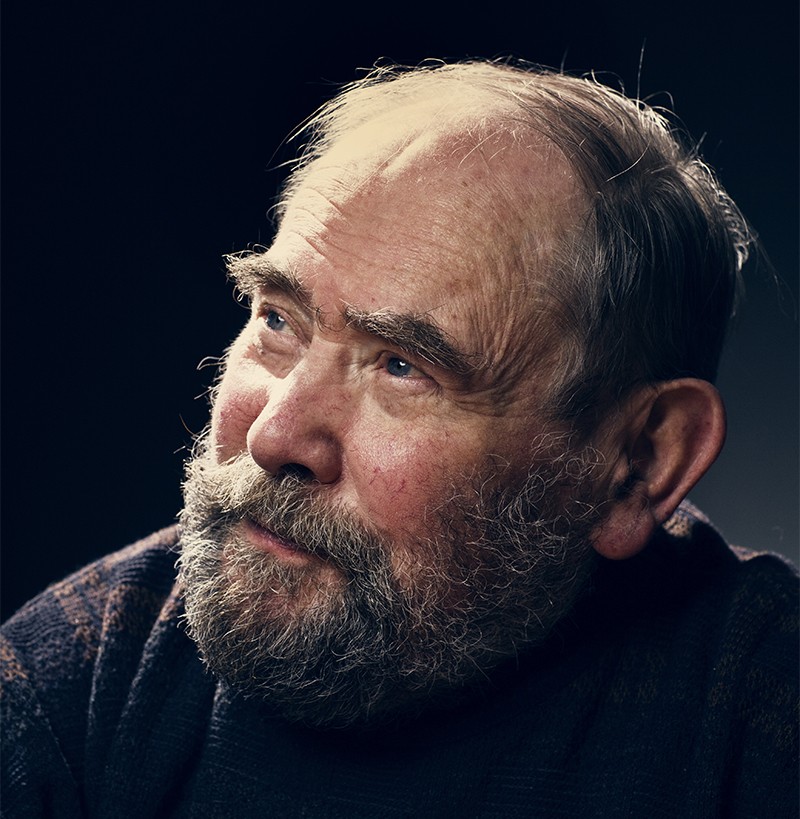
PAUSING to look at the life of Sydney Brenner (1927-2019)

——

I was saddened by the passing of Sydney Brenner on April 5, 2019, Below is the finest tribute I read on his life followed by the best interview I ever seen done of him by Alan Macfarlane.

OBITUARY

Sydney Brenner (1927-2019)

Mischievous steward of molecular biology’s golden age.
South African biologist Sydney Brenner in 2002.

Credit: Andrew Cutraro/Redux/eyevine

Sydney Brenner was one of the first to view James Watson and Francis Crick’s double helix model of DNA in April 1953. The 26-year-old biologist from South Africa was then a graduate student at the University of Oxford, UK. So enthralled was he by the insights from the structure that he determined on the spot to devote his life to understanding genes.

Iconoclastic and provocative, he became one of the leading biologists of the twentieth century. Brenner shared in the 2002 Nobel Prize in Physiology or Medicine for deciphering the genetics of programmed cell death and animal development, including how the nervous system forms. He was at the forefront of the 1975 Asilomar meeting to discuss the appropriate use of emerging abilities to alter DNA, was a key proponent of the Human Genome Project, and much more. He died on 5 April.

Brenner was born in 1927 in Germiston, South Africa, to poor immigrant parents. Bored by school, he preferred to read books borrowed (sometimes permanently) from the public library, or to dabble with a self-assembled chemistry set. His extraordinary intellect — he was reading newspapers by the age of four — did not go unnoticed. His teachers secured an award from the town council to send him to medical school.

Brenner entered the University of the Witwatersrand in Johannesburg at the age of 15 (alongside Aaron Klug, another science-giant-in-training). Here, certain faculty members, notably the anatomist Raymond Dart, and fellow research-oriented medical students enriched his interest in science. On finishing his six-year course, his youth legally precluded him from practising medicine, so he devoted two years to learning cell biology at the bench. His passion for research was such that he rarely set foot on the wards — and he initially failed his final examination in internal medicine.

Nobel Prize winners, Sir John Sulston, and Dr. Sydney Brenner, in 2002.

Sydney Brenner (right) with John Sulston, who both shared the Nobel Prize in Physiology or Medicine with Robert Horvitz in 2002.Credit: Steve Russell/Toronto Star/Getty

In 1952 Brenner won a scholarship to the Department of Physical Chemistry at Oxford. His adviser, Cyril Hinshelwood, wanted to pursue the idea that the environment altered observable characteristics of bacteria. Brenner tried to convince him of the role of genetic mutation. Two years later, with doctorate in hand, Brenner spent the summer of 1954 in the United States visiting labs, including Cold Spring Harbor in New York state. Here he caught up with Watson and Crick again.

Impressed, Crick recruited the young South African to the University of Cambridge, UK, in 1956. In the early 1960s, using just bacteria and bacteriophages, Crick and Brenner deciphered many of the essentials of gene function in a breathtaking series of studies.

Brenner had proved theoretically in the mid-1950s that the genetic code is ‘non-overlapping’ — each nucleotide is part of only one triplet (three nucleotides specify each amino acid in a protein) and successive ‘triplet codons’ are read in order. In 1961, Brenner and Crick confirmed this in the lab. The same year, Brenner, with François Jacob and Matthew Meselson, published their demonstration of the existence of messenger RNA. Over the next two years, often with Crick, Brenner showed how the synthesis of proteins encoded by DNA sequences is terminated.

This intellectual partnership dissolved when Brenner began to focus on whole organisms in the mid-1960s. He finally alighted on Caenorhabditis elegans. Studies of this tiny worm in Brenner’s arm of the legendary Laboratory of Molecular Biology (LMB) in Cambridge led to the Nobel for Brenner, Robert Horvitz and John Sulston.

Maxine Singer, Norton Zinder, Sydney Brenner and Paul Berg in 1975.

Maxine Singer, Norton Zinder, Sydney Brenner and Paul Berg (left to right) at the 1975 meeting on recombinant DNA technology in Asilomar, California.Credit: NAS

And his contributions went well beyond the lab. In 1975, with Paul Berg and others, he organized a meeting at Asilomar, California, to draft a position paper on the United States’ use of recombinant DNA technology — introducing genes from one species into another, usually bacteria. Brenner was influential in persuading attendees to treat ethical and societal concerns seriously. He stressed the importance of thoughtful guidelines for deploying the technology to avoid overly restrictive regulation.

He served as director of the LMB for about a decade. Despite describing the experience as the biggest mistake in his life, he took the lab (with its stable of Nobel laureates and distinguished staff) to unprecedented prominence. In 1986, he moved to a new Medical Research Council (MRC) unit of molecular genetics at the city’s Addenbrooke’s Hospital, and began work in the emerging discipline of evolutionary genomics. Brenner also orchestrated Britain’s involvement in the Human Genome Project in the early 1990s.

From the late 1980s, Brenner steered the development of biomedical research in Singapore. Here he masterminded Biopolis, a spectacular conglomerate of chrome and glass buildings dedicated to biomedical research. He also helped to guide the Janelia Farm campus of the Howard Hughes Medical Institute in Ashburn, Virginia, and to restructure molecular biology in Japan.

Brenner dazzled, amused and sometimes offended audiences with his humour, irony and disdain of authority and dogma — prompting someone to describe him as “one of biology’s mischievous children; the witty trickster who delights in stirring things up.” His popular columns in Current Biology (titled ‘Loose Ends’ and, later, ‘False Starts’) in the mid-1990s led some seminar hosts to introduce him as Uncle Syd, a pen name he ultimately adopted.

Sydney was aware of the debt he owed to being in the right place at the right time. He attributed his successes to having to learn scientific independence in a remote part of the world, with few role models and even fewer mentors. He recounted the importance of arriving in Oxford with few scientific biases, and leaving with the conviction that seeing the double helix model one chilly April morning would be a defining moment in his life.

The Brenner laboratories (he often operated more than one) spawned a generation of outstanding protégés, including five Nobel laureates. Those who dedicated their careers to understanding the workings of C. elegans now number in the thousands. Science will be considerably poorer without Sydney. But his name will live forever in the annals of biology.

Nature 568, 459 (2019)

doi: 10.1038/d41586-019-01192-9

Interview with Sydney Brenner – August 2007 – part 1

Full interview with Sydney Brenner, 2007 – part 2

Transcript:

0:09:07 Born in Germiston near Johannesburg 13th January 1927; father emigrated from Lithuania to South Africa where he had a brother in about 1911; mother came from Latvia and she emigrated in 1922 and had lived through the revolution; father repaired shoes and we lived initially in rooms at the back of his shop; mother has ambitions for her children; father was illiterate but had a gift for languages; mother encouraged me to read which I learnt to do from newspapers; went to a kindergarten run by a customer of my father’s who had found me there reading a newspaper on the floor; did first three years of primary school in one year; went directly into standard 2 at the government primary school aged six; meant I was always about two years younger than the rest of the class which was not helpful

5:12:10 After High School matriculated when under fifteen; had won a scholarship to

university to study medicine; had a lab of my own in a garage; can’t remember being influenced by any teacher at the school and got most of my education in the public library; as a child interested in nature and took flies apart and wondered how you could put them back together again; went to University of Witwatersrand aged fifteen; commuted every day, by bicycle, train, then walking; tough regime with lectures or laboratory sessions every day including Saturday morning from 8am; enjoyed it as there did meet interesting people; a man in the botany department working on chromatography let me work in his lab; we did four subject – botany, zoology, chemistry and physics; after the first year moved to the medical school where I did anatomy and physiology; discovered that I couldn’t qualify as a doctor as I would be under twenty-one so I was able to take a year out to do a Bachelor of Science degree in anatomy and physiology; took out three years and did a B.Sc., B.Sc. Hons. then Master of Science by which time I was already doing scientific research; realized I was not a good medical student but did complete another four years to qualify for the sake of a safe job; finished at the end of 1950 and I did go abroad in 1952; had been at Witwatersrand for almost nine years; had become a lecturer while still a medical student teaching physiology; became an expert on calorie intake

13:58:22 At Witwatersrand a most important influence was Raymond Dart the Professor of Anatomy but more so was a man called Joseph Gillman who was a lecturer in histology and later Professor of Physiology; working in the laboratory was a tremendous experience; nothing there so had to make amino acid for an experiment, for example; also built an ultracentrifuge and used it; parents supportive throughout although mother would have been much happier to see me as a specialist doctor; was interested in molecular biology which had not yet been invented; Waddington came out to South Africa for a time and encouraged me to apply to Cambridge which I did; they never replied to my letter; I won a rare scholarship linked to the 1851 exhibition in 1950; Principal recommended me to go to work with Cyril Hinshelwood, Professor of Physical Chemistry at Oxford; accepted to do a DPhil in physical chemistry and went in 1952

19:06:04 In South Africa made films with a group and had made one on Dylan Thomas; had to imagine what England was like from reading but it was a shock when I came here; arrived during the time of food rationing and for two years just dreamt of food; married after a term in Oxford; May was in London doing a PhD; settled in Oxford and both finished in two years; I won a travelling scholarship from the Carnegie Foundation to go to America for four months; had a very good friend in Oxford called Jack Dunitz; had come to Oxford with the idea that I could determine the structure of DNA; heard about Crick and Watson and went to Cambridge to see them in April 1953 with Jack and Leslie Orgel; they had already discovered the structure of DNA which we saw and the implications were just blindingly clear; immediately saw the problems or coding and copying and the work that needed to be done

25:00:21 On that day Francis wouldn’t stop talking but Jim gave me the impression of an irritated bird; they had made a breakthrough but no notice was taken of it for quite a time except for a tiny band of people who saw that this had reformulated major questions in biology; at Oxford there was a club called the Alembic Club of chemists and Fred Sanger came to talk in 1953 as he had just assembled insulin; Robert Robinson said it was remarkable because Sanger had proved that proteins actually had a chemical structure; Sanger was an unique scientist as he saw that determining how the sequence was arranged is important; he devised simple techniques to achieve this; he liked to work in the lab and when he retired he put down his pipette and said “That’s it” and walked out

33:47:19 John Griffith’s role in the discovery of DNA; after D.Phil went to America for four months but in the meantime started to discuss with Francis about coming back to join him in the MRC unit; had to go back to South Africa to fulfil obligations attached to my scholarship but two years later, at the end of 1956, I came to Cambridge; had a three year job at £1100 a year and three children; beginning of an incredibly exciting time in science; Francis read all the time and when he left Cambridge the entire room was full of books on the brain; value of conversation with Crick resulting in productive thoughts; I would try them out in the lab to see if they were right; value of guessing; correct theories and true theories; science similar to a medieval guild with a very good journeymen and apprentices; blinding flashes of illumination; work with Francois Jacob.

SECOND PART

0:09:07 Became a fellow of King’s in 1959; Noel Annan had wanted to get Crick as a fellow earlier but not successful; wanted someone from molecular biology and John Kendrew suggested me; was offered a fellowship at Churchill but preferred to try for King’s and was elected; quite often had tea with Morgan Foster as a benefit of the college was to have friends outside science; other friends at King’s included Francis Haskell, Michael Jaffe, and Dadie Rylands; Bernard Williams and Robert Bolgar; Edmund Leach, Meyer Fortes – always been fascinated by anthropology; did archaeology and palaeontology as a hobby; interested in creating a new anthropology which would include biology and the place of man in the animal world, the natural world and the world of our own creation; we may have the genome of Neanderthal man pretty soon

11:57:10 Originally we were housed in the Cavendish Laboratory; Crick very good at getting extra space and at the end of our time there we were in seven buildings on the site; prior to this the MRC had decided they might have a building somewhere but we did not want to be in a large place with everyone; got agreement for an MRC laboratory of molecular biology and joined up with Fred Sanger who was in urgent need of space; Hugh Huxley and Aaron Klug joined us; I officially became the director in 1979 before which Max Perutz was chairman; retired from the directorship at sixty and got my own small unit to return to science; on final retirement from the MRC managed to raise enough money to continue the lab for some time

19:54:22 Work on nematode worms; genes build the nervous system which then performs the behaviour; needed to determine the structure of the nervous system, it should be a small nervous system so could be finite and that we could make mutations and see how it altered behaviour; then we would hope to see what changes in the nervous system the mutations would produce and then would be able to map those onto the altered behaviour; that program has been partly carried out but effectively it involved doing the anatomy, the full embryology; big advantage of nematodes is according to the literature they had stereotype nervous system, constant number of cells and, it was thought, the same for every nematode of the same genetic composition; could ask under what conditions do you build a nervous system with the same genetic program; nematode ideal as easy to keep in the lab and easy for anyone to work on

29:48:12 Nobel prize awarded to me with John Sulston and Robert Horvitz; “don’t worry” hypothesis described; the virtue of ignorance

38:20:05 Went to Singapore in 1984 and encouraged them to set up a graduate department of molecular biology; from 1999 a huge surge forward and I have been involved in setting up a gigantic operation there but have just retired; advice to a young scientist would be to go to a lab where there is a good mentor; big challenge that interests me is how to reconstruct the past from what we now know; science is a way of solving problems and for a young person, find a good problem and try to solve it though getting into the whole apparatus of science, which is difficult

On November 21, 2014 I received a letter from Nobel Laureate Harry Kroto and it said:

…Please click on this URL http://vimeo.com/26991975

and you will hear what far smarter people than I have to say on this matter. I agree with them.

Harry Kroto

Nick Gathergood, David-Birkett, Harry-Kroto

I have attempted to respond to all of Dr. Kroto’s friends arguments and I have posted my responses one per week for over a year now. Here are some of my earlier posts:

Arif Ahmed, Sir David AttenboroughMark Balaguer, Horace Barlow, Michael BatePatricia ChurchlandAaron CiechanoverNoam Chomsky,Alan DershowitzHubert Dreyfus, Bart Ehrman, Stephan FeuchtwangDavid Friend,  Riccardo GiacconiIvar Giaever , Roy GlauberRebecca GoldsteinDavid J. Gross,  Brian Greene, Susan GreenfieldStephen F Gudeman,  Alan Guth, Jonathan HaidtTheodor W. Hänsch, Brian Harrison,  Hermann HauserRoald Hoffmann,  Bruce HoodHerbert Huppert,  Gareth Stedman Jones, Steve JonesShelly KaganMichio Kaku,  Stuart Kauffman,  Lawrence KraussHarry Kroto, George LakoffElizabeth Loftus,  Alan MacfarlanePeter MillicanMarvin MinskyLeonard Mlodinow,  Yujin NagasawaAlva NoeDouglas Osheroff,  Jonathan Parry,  Saul PerlmutterHerman Philipse,  Carolyn PorcoRobert M. PriceLisa RandallLord Martin Rees,  Oliver Sacks, John SearleMarcus du SautoySimon SchafferJ. L. Schellenberg,   Lee Silver Peter Singer,  Walter Sinnott-ArmstrongRonald de Sousa, Victor StengerBarry Supple,   Leonard Susskind, Raymond TallisNeil deGrasse Tyson,  .Alexander Vilenkin, Sir John WalkerFrank WilczekSteven Weinberg, and  Lewis Wolpert,

Related posts:

FRANCIS SCHAEFFER ANALYZES ART AND CULTURE Part 53 THE BEATLES (Part E, Stg. Pepper’s and John Lennon’s search in 1967 for truth was through drugs, money, laughter, etc & similar to King Solomon’s, LOTS OF PICTURES OF JOHN AND CYNTHIA) (Feature on artist Yoko Ono)

The John Lennon and the Beatles really were on a long search for meaning and fulfillment in their lives  just like King Solomon did in the Book of Ecclesiastes. Solomon looked into learning (1:12-18, 2:12-17), laughter, ladies, luxuries, and liquor (2:1-2, 8, 10, 11), and labor (2:4-6, 18-20). He fount that without God in the picture all […]

FRANCIS SCHAEFFER ANALYZES ART AND CULTURE Part 52 THE BEATLES (Part D, There is evidence that the Beatles may have been exposed to Francis Schaeffer!!!) (Feature on artist Anna Margaret Rose Freeman )

______________   George Harrison Swears & Insults Paul and Yoko Lucy in the Sky with Diamonds- The Beatles The Beatles:   I have dedicated several posts to this series on the Beatles and I don’t know when this series will end because Francis Schaeffer spent a lot of time listening to the Beatles and talking […]

FRANCIS SCHAEFFER ANALYZES ART AND CULTURE Part 51 THE BEATLES (Part C, List of those on cover of Stg.Pepper’s ) (Feature on artist Raqib Shaw )

  The Beatles in a press conference after their Return from the USA Uploaded on Nov 29, 2010 The Beatles in a press conference after their Return from the USA. The Beatles:   I have dedicated several posts to this series on the Beatles and I don’t know when this series will end because Francis […]

FRANCIS SCHAEFFER ANALYZES ART AND CULTURE Part 50 THE BEATLES (Part B, The Psychedelic Music of the Beatles) (Feature on artist Peter Blake )

__________________   Beatles 1966 Last interview I have dedicated several posts to this series on the Beatles and I don’t know when this series will end because Francis Schaeffer spent a lot of time listening to the Beatles and talking and writing about them and their impact on the culture of the 1960’s. In this […]

FRANCIS SCHAEFFER ANALYZES ART AND CULTURE Part 49 THE BEATLES (Part A, The Meaning of Stg. Pepper’s Cover) (Feature on artist Mika Tajima)

_______________ The Beatles documentary || A Long and Winding Road || Episode 5 (This video discusses Stg. Pepper’s creation I have dedicated several posts to this series on the Beatles and I don’t know when this series will end because Francis Schaeffer spent a lot of time listening to the Beatles and talking and writing about […]

FRANCIS SCHAEFFER ANALYZES ART AND CULTURE PART 48 “BLOW UP” by Michelangelo Antonioni makes Philosophic Statement (Feature on artist Nancy Holt)

_______________ Francis Schaeffer pictured below: _____________________ I have included the 27 minute  episode THE AGE OF NONREASON by Francis Schaeffer. In that video Schaeffer noted,  ” Sergeant Pepper’s Lonely Hearts Club Band…for a time it became the rallying cry for young people throughout the world. It expressed the essence of their lives, thoughts and their feelings.” How Should […]

FRANCIS SCHAEFFER ANALYZES ART AND CULTURE Part 47 Woody Allen and Professor Levy and the death of “Optimistic Humanism” from the movie CRIMES AND MISDEMEANORS Plus Charles Darwin’s comments too!!! (Feature on artist Rodney Graham)

Crimes and Misdemeanors: A Discussion: Part 1 ___________________________________ Today I will answer the simple question: IS IT POSSIBLE TO BE AN OPTIMISTIC SECULAR HUMANIST THAT DOES NOT BELIEVE IN GOD OR AN AFTERLIFE? This question has been around for a long time and you can go back to the 19th century and read this same […]

FRANCIS SCHAEFFER ANALYZES ART AND CULTURE PART 46 Friedrich Nietzsche (Featured artist is Thomas Schütte)

____________________________________ Francis Schaeffer pictured below: __________ Francis Schaeffer has written extensively on art and culture spanning the last 2000years and here are some posts I have done on this subject before : Francis Schaeffer’s “How should we then live?” Video and outline of episode 10 “Final Choices” , episode 9 “The Age of Personal Peace and Affluence”, episode 8 […]

FRANCIS SCHAEFFER ANALYZES ART AND CULTURE Part 45 Woody Allen “Reason is Dead” (Feature on artists Allora & Calzadilla )

Love and Death [Woody Allen] – What if there is no God? [PL] ___________ _______________ How Should We then Live Episode 7 small (Age of Nonreason) #02 How Should We Then Live? (Promo Clip) Dr. Francis Schaeffer 10 Worldview and Truth Two Minute Warning: How Then Should We Live?: Francis Schaeffer at 100 Francis Schaeffer […]

FRANCIS SCHAEFFER ANALYZES ART AND CULTURE Part 44 The Book of Genesis (Featured artist is Trey McCarley )

___________________________________ Francis Schaeffer pictured below: ____________________________ Francis Schaeffer “BASIS FOR HUMAN DIGNITY” Whatever…HTTHR Dr. Francis schaeffer – The flow of Materialism(from Part 4 of Whatever happened to human race?) Dr. Francis Schaeffer – The Biblical flow of Truth & History (intro) Francis Schaeffer – The Biblical Flow of History & Truth (1) Dr. Francis Schaeffer […]

____________

____

__
PAUSING to look at the life of Aaron Klug

——

I was saddened by the passing of Aaron Klug on November 20, 2018. Below is the finest tribute I read on his life followed by the best interview I ever seen done of him by Alan Macfarlane.

Aaron Klug credited the scientist Rosalind Franklin with showing him ‘that you have to tackle long and difficult problems rather than publishing clever papers’.Show captionScience

Sir Aaron Klug obituary

Chemist and biophysicist who won the Nobel prize for developing crystallographic electron microscopy
Mon 26 Nov 2018 08.10 EST

One of the mildest, most broad-minded and most cultured of scientists, Aaron Klug was once seen as a radical too dangerous to be permitted access to the US. The state department’s denial of his visa not only ensured he would make his research career in Britain, but also set the stage for his meeting with the X-ray crystallographer Rosalind Franklin that would define his scientific future.

Klug, who has died aged 92, won a Nobel prize in chemistry for his inventive approach to understanding how some of the key components of the living body assemble into its working parts. He was never a headline-grabber; his understated leadership of two of Britain’s foremost scientific institutions, the Medical Research Council’s (MRC) Laboratory of Molecular Biology (LMB) in Cambridge and the Royal Society, steered the scientific community’s response to major upheavals such as the Human Genome Project (HGP), the BSE crisis and the row over genetically modified food.

As a young South African with a Cambridge PhD, in 1952 Klug was on the point of taking up a post in the US. The South African government told the US authorities that his membership of a youth group meant that he was a communist. Offered the chance to “renounce” communism, he indignantly refused, never having taken it up in the first place. No visa being forthcoming, he returned to the UK.

From 1954, at Birkbeck College in London, he began to collaborate with Franklin on her studies of tobacco mosaic virus. They faced the immense challenge of solving the structure, not of a single molecule, but of the complex assemblies of proteins and nucleic acids that make up virus particles.

Franklin’s exquisite technical skill in producing X-ray diffraction images, combined with Klug’s deep theoretical understanding of matter, eventually enabled them to solve the general outline of the structure just before Franklin’s early death from cancer in 1958. He credited her not only with introducing him to viruses, but with showing him “that you have to tackle long and difficult problems rather than publishing clever papers”.

Klug’s fascination with assemblies of molecules and biological complexes led him to develop a new technique. Such assemblies fall in size between individual molecules that can be explored with X-ray crystallography, and structures that are large enough to see with a light microscope.

Electron microscopy covers this gap, but produces two-dimensional images that do not reveal detailed structural information. During the 1960s, working at the newly founded LMB, Klug showed how electron micrographs taken from different angles could be combined to reconstruct the whole structure in 3D. The inventors of X-ray CT scans later developed them from his methods.

He went on to use the technique to unravel complexes of protein and nucleic acid in viruses and in the chromosomes that carry genetic information. It was this work that brought him his Nobel prize in 1982, as the sole recipient.

In 1986 he was appointed the third head of the LMB, an institution that famously had “a Nobel fellow on every floor”. He was notably supportive of female colleagues, and of researchers with projects that were almost recklessly ambitious.

When the biologist John Sulston began to show that sequencing the whole genome of the nematode worm might be possible, he promoted him to head a new division of genome studies. He later negotiated with the MRC and the Wellcome Trust for Sulston to head the separate Sanger Centre (now the Wellcome Trust Sanger Institute), which successfully completed not only the worm genome but also one third of the international Human Genome Project.

He went on to use the technique to unravel complexes of protein and nucleic acid in viruses and in the chromosomes that carry genetic information. It was this work that brought him his Nobel prize in 1982, as the sole recipient.

In 1986 he was appointed the third head of the LMB, an institution that famously had “a Nobel fellow on every floor”. He was notably supportive of female colleagues, and of researchers with projects that were almost recklessly ambitious.

When the biologist John Sulston began to show that sequencing the whole genome of the nematode worm might be possible, he promoted him to head a new division of genome studies. He later negotiated with the MRC and the Wellcome Trust for Sulston to head the separate Sanger Centre (now the Wellcome Trust Sanger Institute), which successfully completed not only the worm genome but also one third of the international Human Genome Project.

Klug was knighted in 1988, and appointed to the Order of Merit in 1995. The same year he became president of the Royal Society, the UK’s premier scientific academy. On his watch it produced an authoritative report into bovine spongiform encephalopathy (BSE) and its transmission to humans.

This was the first of several that provided a basis for public discussion and policymaking. Responding to the GM food crisis of the late 90s, another report acknowledged that GM technology could not be deployed without winning the confidence of consumers. Klug recognised the importance of engagement between scientists and the public, and developed the Royal Society’s resources for working with the media.

Klug was born into a Yiddish-speaking family in Zelva, Lithuania, the second of two sons of Lazar, a cattle drover, and his wife, Bella (nee Silin). Lazar occasionally reported for newspapers in Kaunas, then the capital city. When Aaron was two years old and his brother Bennie four, the family migrated to Durban, South Africa, where Bella had relatives. After Bella died in 1932, her sister Rose took her place as the boys’ mother; in due course she married their father and had two more children.

This turbulent start to his life left Klug remarkably unscathed. A voracious reader, he breezed through Durban high school at the top of a class of boys two years older than himself (including his brother). After reading Microbe Hunters by Paul de Kruif, a classic work of popular medicine published in 1926, he decided to study medicine, and entered the University of Witwatersrand on a scholarship at the age of 15. In the same class was Sydney Brenner, also from a Lithuanian Jewish family, also 15, and also a future head of the LMB and Nobel prizewinner.

During his studies Krug’s interests shifted to pure science, and he graduated in physics, chemistry and biology. He followed this with a master’s degree in physics at the University of Cape Town. There his supervisor was Reginald James, who had survived Ernest Shackleton’s ill-fated Antarctic expedition in 1914-16. James was an X-ray crystallographer who had worked alongside one of the subject’s founders, Lawrence Bragg, at the University of Manchester.

Crystallography appealed strongly to Klug’s polymathic instincts, combining physics and chemistry and requiring both mathematical insight and experimental creativity to explore the atomic structure of molecules in three dimensions. It was at Cape Town, as he later recalled in his Nobel biography, that he developed “a strong interest … in the structure of matter, and how it was organised.”

With James’s recommendation, Klug obtained an 1851 scholarship to go to the Cavendish Laboratory at Cambridge, now headed by Bragg, for his PhD. He arrived there in 1949 with his new wife, Liebe (nee Bobrow), a dancer and musician. He hoped to join the new MRC unit at the Cavendish, led by Max Perutz, which was exploring the structure of proteins. But Bragg assigned him to work on a theoretical project on how transitions occur in the microstructure of steel when it cools.

What many might have seen as a dead end, Klug approached as an opportunity: he later said that the work had assisted his thinking about the assembly of virus structures. He advised younger scientists to “equip yourself to do a wider range of things than you are actually interested in immediately. You never know what might pay off.”

The Klugs had two sons, Adam and David. As a family they retained a strong connection to their Jewish cultural roots, attending synagogue and observing festivals. They made many visits to Israel, being particularly attached to the city of Be’er-Sheva and Ben Gurion University, where a research centre is named in Klug’s honour.

Liebe and David survive him. Adam died in 2000.

• Aaron Klug, biophysicist, born 11 August 1926; died 20 November 2018

• This article was amended on 27 November 2018. Adam Klug, rather than his brother David, died in 2000.

Interview of Aaron Klug, part one

Uploaded on Mar 12, 2010

An interview of the Cambridge biologist, physicist and chemist Lord Aaron Klug, nobel laureate, talking about his life and work including that with Rosalind Franklin. Interviews on 11 December 2007 by Alan Macfarlane. For a higher quality, downloadable version with detailed summary, please see http://www.alanmacfarlane.com

Interview of Aaron Klug – part two

Aaron Klug interviewed by Alan Macfarlane 11th December 2007

0:09:07 Born in Lithuania in 1926; father’s father was a cattle dealer and had a farm which was unusual for a Jew; father was trained as a saddler but went back to the farm to help his father as a cattle dealer; realized there was not much future in Lithuania and moved to South Africa in 1929; mother’s family had emigrated there in 1900 (her family name wasGevisser) and had established a business in Durban so that is where we went; learnt English early; have an elder brother; father employed in the Gevisser firm as a hide merchant; he had gone ahead to Durban and found a place to live and the family followed; father’s brother later emigrated to Johannesburg; father much concerned with making a good living and had been regarded as clever; he would go to the synagogue and was interested in the Talmud and when he retired he went for weekly study; when I married in England he sent extracts by post; mother died when I was about six of pneumonia; mother’s younger sister had come with us and later married my father; told that one of the older Gevisser cousins had said it was her duty to marry my father and help bring us up; we still continued to call her aunt though later realized she was our mother and changed to mum

8:36:12 Went to a primary school; lived near the bush; Durban had a white population of 100,000, mainly of English origin who thought of England as home; Britain had taken Natal from the Dutch and in 1870 there was a large emigration to Durban; on our first holiday in England we went to Swanage and noticed that the beach huts there had been copied in Durban, so had the post boxes; as a child knew a lot about England so when I came here knew exactly where I was; later moved to Durban High School where the philosophy was that if you were bright you went into the Latin class (Greek had been abandoned as we had to do Afrikaans as a second language); if you were middling you went into the science class, and the rest made do with geography; I was very good at school and always came first and my brother, second; he was in the same class although two years older; I had been pushed up but he was my protector; we did do one science subject; was very good at Latin; also brother and I went to Hebrew classes and I was pretty fluent in Afrikaans; later when I began collecting ancient coins could read the inscriptions; later when one of my sons started doing Latin at school got an interlingua text but found the Latin word order had been changed to fit the English so threw it away in disgust

15:56:08 Thing that mattered most at Durban High School was sport which occupied four afternoons a week; had cadets on the fifth day; brother was a good cricketer; I was not good at sport and later when undergoing an army medical found that I had an optic atrophy in my right eye; brother keen on music and I began to listen to serious music in last few years at school; in primary school I couldn’t sing in tune; my wife is musical so I do listen; she ran the Cambridge University modern dance group at some time and experimented with Stockhausen and electronic music

19:46:13 No particular inspirational teacher at school; was good at all subjects; at one time became seriously interested in Egyptology and tried to teach myself hieroglyphics and learnt a good deal on the origins of the alphabet; at school read a book by Paul de Kruif called ‘Microbe Hunters’ which turns out to have influenced many people; he was a Dutch science writer and in this book he told the stories of Pasteur and Koch; made me think I should become a microbiologist; at fifteen went to university to do medicine (as did Sidney Brenner) as two years ahead of my age group; no medical school in Durban so went to University of Witwatersrand in Johannesburg; sailed through my first year; stayed in my father’s brother’s house; had won a scholarship so did not have any fees; in my second year started doing anatomy, physiology and physiological chemistry; enjoyed dissection to begin with and found physiology and biochemistry much more interesting so decided I should learn some chemistry and give up medicine; went to see the Dean of Science who agreed that I should do a range of subjects – chemistry, physiology, histology, physics and maths; did a four year course instead of three; got firsts in every subject

25:56:05 No particularly inspiring teachers but a man who gave a popular talk on the Schrödinger wave equation had inspired me to do physics; I had intellectual curiosity and found everything interesting; always read history and have continued to do so; where I got inspired was in Cape Town where they were offering a master’s degree in physics; kept myself by teaching practical classes which gave me enough to live on; lived simply in a room in the old slave quarters; parents sent me money but I returned it as wanted to be independent; the Professor was R.W. James and he was an inspiration, not only because of himself but where he had been; he had gone with Shackleton on his polar expedition and been marooned on Elephant Island; he was recruited byShackleton when just out of Cambridge; was a contemporary of Lawrence Bragg; Shackleton asked him if he could sing as they had to supply their own entertainment; I did apply to the South African Antarctic Survey but they wouldn’t take me as I wore glasses; met my future wife, Liebe, in Cape Town; she was a music student at the University and later went to modern dance school; fell in love and was absorbed in the wider culture of a beautiful old city; Durban was provincial in comparison although it had a good library

31:56:03 James had worked with Bragg and in 1937 emigrated to Cape Town to take the Chair; Bragg moved to Cambridge in 1938 when Rutherford died; it is possible that when I came to Cambridge they wanted me to do crystallography as I’d started in X-ray crystallography in Cape Town as James had done; James represented to me the modern Cambridge position; I did the two year M.Sc. course in one year and actually solved the crystal structure of an organic molecule by a new method using Fourier transforms; on the strength of this James thought I should go to Cambridge; I had toyed with the idea of going to London as the crystal structure I had solved was rather unusual and I had taught myself quantum chemistry so when I came to Cambridge I wanted to do something unusual in X-ray crystallography; had heard of the MRC unit doing work on haemoglobin andmyoglobin; went to see Bragg on arrival who told me the unit was full; don’t believe that was true but one of my predecessors from Cape Town had been a lady, Virginia Martin, who proved to be very clever but hopeless at research; asked Bragg what I should do who said there was an interesting problem in order disorder in silicates; I now find them fascinating but didn’t think so at the time; boat took two weeks from Cape Town and for the first two months in Cambridge still had no supervisor; was at Trinity where my tutor was William Hamilton who was not much help; originally thought I might do a Part II but he thought I knew enough for a PhD; finally taken on by D.R.Hartree, Professor of Mathematical Physics, to work on a problem left over from the war on the cooling of steel; in the end I had learnt a lot of metallurgy and worked out a model of phase transition to account for the dissipation of heat; I modelled this on a computer; never published my PhD thesis; Hartreewas not a good supervisor; he was a train addict, but not inspiring; enjoyed my time going to mathematical lectures and learnt group theory, which later stood me in good stead

40:53:01 Married very young and wife went off to live in London to study at the Joos-Leeder School of Modern Dance; the school had been housed by AliceRoughton in Adams Road, Cambridge, during the war but had moved by the time we arrived in Cambridge; my wife kept herself by teaching in a Secondary Modern school; never worked with Bragg; now realize that he may have thought me odd as I only wanted to do things that interested me; however, when I worked on the assembly of tobacco mosaic virus people were trying to understand how the virus assembled and they mixed protein and the RNA and waited twenty-four hours; I managed to do it in two to three hours using the model of nucleational growth that I had developed for my Ph.D. thesis to understand my experiments on tobacco mosaic virus (description)

46:05:14 Spent a year with F.J.W. Roughton, the husband of Alice; worked with him solving the mathematics required for the problem of the combination of oxygen with haemoglobin where both simultaneous diffusion and chemical reaction occur at the same time; used the mathematics developed for PhD; went back to crystallography in London but continued doing things for Roughton; memory ofRoughton household in Adams Road; saw advertisement for a Nuffield Fellowship at BirkbeckCollege where J.D. Bernal was; he was an amazing man who never carried anything through to completion as always interested in the next problem; went to work on protein crystallography with Harry Carlisle who Bernal had recruited from Dorothy Hodgkin; he was trying to solve a protein by some method that didn’t work and he refused to see it; I was banished but still had my Nuffield Fellowship and I found myself in a room next to Rosalind Franklin; I had been there for four months already but had not met her before; she showed me her pictures of tobacco mosaic virus; she changed my life as she introduced me to an important and difficult problem that would take years; I worked with her from 1955 to 1958 when she died; she had come from King’s College to work on the tobacco mosaic virus, work which Bernal had started in the 1930’s but which was interrupted by the war; as a person she was brisk, to the point, and not at all the person painted in Watson’s book ‘The Double Helix’; she was a rationalist; I got on with her quite well and she treated me as an equal; when she died I took over her three post-graduate assistants including Kenneth  Holmes and John Finch who later moved with me to Cambridge; we managed to get a grant from the United States National Institute for Health as we were the only group working on virus structure; in 1958 after her death I took up the problem of polio virus structure which she had started; through the introduction of a new kind of glass managed to solve polio in 1959; showed Bernal the first X-ray picture of polio virus crystals and he said that the picture was worth £10,000; I had not realized that Bernal had to keep raising money to fund his lab; Rosalind Franklin had been hired to work on coals and carbons not on plant viruses; Bernal’s idea was to raise money from applied research to fund pure research; [shows the model of RNA on the staircase of the MRC unit in Cambridge]

Second part

0:09:07 Bernal was a Communist in those days and I didn’t get on with him; in 1956 when the Soviet Union invaded Hungary there was a meeting of University College, Birkbeck and the Fabian Society; Bernal spoke about knowledge of the purges only since Khrushchev’s speech in June that year; later got to understand him and to realize that he looked with  the long eye of history where revolutions move things on; Rosalind Franklin never complained about not having recognition for the important part she played in Crick and Watson’s discovery; blamed herself for not noticing the two fold axis of symmetry in her photograph; she did not know enough crystallography; when at King’s she had worked out the A and B forms of crystal symmetry of DNA; she knew the B form was helical and said so but the A form eluded her; Watson recognised the relationship between the two forms and they got hold of her report which had been sent to all MRC units and he and Crick used her data; had she lived, she should have shared their Nobel prize but there was also Wilkins; he was shy and he and Franklin would never have got on; he was clever and had chosen DNA as a problem but had no punch to go ahead; Franklin had been brought in by Randall, the Professor at King’s, to put more muscle into the DNA effort; irony was that Wilkins, Stokes and Franklin had all attended Bernal’s courses in Cambridge in the 1930’s in crystallography and had all learnt about space groups; none of them twigged to it except Crick; only came out later when he and Watson wrote their paper in 1954, on their route to the discovery of the double helix

6:55:14 John Griffiths’ part in the DNA saga not relevant but Franklin’s work was the key but she had nobody to talk to; if I had been there a bit earlier I would have seen it; [article: ‘The Discovery of the DNA Double Helix’ amended and signed]; Maurice Wilkins was slow and careful whereas Rosalind was quick and decisive, sometimes brusque, so they would never have got on, it was not because she was a woman; worked at Birkbeck 1954-58 and during that time worked out the overall structure of the tobacco mosaic virus and I also developed analytical methods for turning the X-ray data into a map; wrote papers, one with Crick, on how you do this; after Franklin died her students, Finch and Holmes, came with me to Cambridge in 1962 and continued the work; Holmes went off to be Professor of Crystallography at Heidelberg and John Finch stayed with me; Holmes gradually worked out the three-dimensional structure of tobacco mosaic virue but we had an outline of the structure as early as 1958 which is the model on the stairs [see end of film]

13:03:12 In October 1962 I came to Peterhouse as a teaching fellow; John Kendrew was the Director of Studies and I later succeeded him; at Peterhouse I taught a number of subjects as there were not many teaching fellows including crystallography, microspectroscopy and chemistry, and always taught physics; I was later a Nobel prize winner in chemistry, worked in a biological lab. and taught physics; I enjoyed physics and was quite a good teacher; Ken Holmes had been taught by Fred Hoyle and Abdus Salam but never learnt anything as they would just dash off a problem; I was a good teacher as I had to work my way through it; physics stood me in good stead as before I developed three-dimensional image reconstruction I did various optical experiments which I wouldn’t have done if I had not been teaching optics; I occasionally lectured for the University in place of Perutz; later when I introduced three-dimension electron microscopy I was asked to give some lectures; awarded a Nobel prize in 1982 but went on teaching until about 1984 when Hugh Dacre, the Master, said I should become a supernumerary fellow with no teaching duties; accepted but still continued teaching for a few years until I became more involved with the zinc finger work; in 1986 became head of the lab after becoming President of the Royal Society in 1985

16:34:10 Was President for five years; had turned it down five years before and found that I was the only person to have refused it since Faraday, but I had just started a new division at the Lab and I thought that being head of the MRC Lab was just as prestigious; I introduced a department of neuroscience here which we had not had before; as President of the Royal Society had to deal with a lot of issues such as genetically modified organisms which, by the way, with zinc fingers we can do much better now; this is producing what has been called a game change in plant agriculture; zinc fingers are used to modify genes and you can put genes into a specified place; had to deal with privatization from Mrs Thatcher as she wanted to sell off all our laboratories; also started on global warming; every year in my anniversary address I, like the elder Cato, would bring up the subject; started work here with John Sulston on the human genome; Sydney Brenner and others were going round the world creating the Human Genome Organization; John Sulston started out using any sequencing facilities that there were and made huge progress; Brenner had wanted him to work on the products of the genes, the proteins produced by the genes, and to sequence those, or rather to sequence the RNA which is the intermediate between the DNA; I, in contrast, encouraged Sulston to do the whole genome because there you get not just the products of the genes but, probably equally important, the DNA sequences for binding the regulatory machinery; now, ironically, I am working on zinc fingers which are the most powerful weapon for intervening in gene regulation; after turning down the Presidency I did not think they would ask me again at the age of sixty-nine but Alex Todd had been the same age so there was a precedent; my wife enjoyed the challenge and we opened up the place by having lunches and improving the menu; we had a flat in London and I had thought we’d go to theatres and galleries, but was too busy as it also overlapped with being head of the lab

23:10:20 Started in the Lab in 1962 and had my own group, but did spend time working with Crick on chromatin; we published very few things together; had a very good post-doc., Roger Kornberg, who got a Nobel prize last year, and together investigated the sub-structure of chromatin; he discovered working on the chemical analysis of chromatin samples that the histones which are used for packaging the DNA on their own form aggregates; the psychological breakthrough was that the proteins form a globular aggregate like haemoglobin and here could not be sitting in the grooves of the DNA as people like Wilkins had assumed; Kornberg discovered the nucleosome; I did not put my name on the paper though might have done; got him to see not “beads on a string” but string of DNA on beads; I also started work on tRNA; also started an Alzheimer group which is flourishing as I thought we should be doing something that is relevant to medical research; had not realized that Alzheimer’s disease was specific to certain areas of the brain; realized that it must be caused by a malfunction; work had been in the hands of neurophysiologists and they had been cutting sections of Alzheimer brains; I said we must get the material out as had been done with chromatin; introduced chemical separation methods which we’d used on chromatin, chopping up the material with enzymes etc. so we discovered the filaments; work continues but I moved on to zinc fingers

27:43:04 Max Perutz

was head of the Lab when I came here as a group leader; John Kendrew was the head of one of the divisions in the lab called Protein Crystallography; Hugh Huxley was working on the structure of muscle; I was working on viruses; Perutz and Kendrew were working on single proteins; we worked on biological assemblies using both X-rays and electron microscopy; Hugh Huxley was the best electron microscopist of his time, a mystery why he did not get a Nobel prize for his work on muscle; Max was single-minded and determined; wasn’t very learned but as he went along he learnt; not highly imaginative but solved, over a period of years, the structures of haemoglobin both in the oxygenated form and the deoxygenated form and shown the structural transition between them; John Kendrew was very different; a marvellous staff officer, very well organized with a meticulous filing system using a form of punch card; when I told Max how tobacco mosaic virus assembles [shows figures from Nobel Prize lecture] he didn’t believe it; own work on spherical viruses described; collaboration with Donald Caspar [shows model of a spherical virus]; in 1966 Max gave an interview for ‘Science’ and spoke about all the successes of the lab – Nobel prize for Crick and Watson in 1962, and himself and Kendrew, Sydney Brenner’s work on the messenger RNA, and “Klug’s work is very satisfying” but was “very far fetched”; his gift as Director was to let me get on with my work without believing in it; Crick understood it immediately and I know that he put me up for the Nobel Prize; spherical viruses and Buckminster Fuller geodesic domes

40:06:05 Electron microscopy takes a two-dimensional image; 3D image construction allows you to combine all the 2D views mathematically using a computer and producing and three-dimensional image which is the basis of the X-ray CAT scanner; some thought I should have got a Nobel Prize for this work but Hounsfield patented the machine not the technique; felt a bit sore in 1979 when he got the Nobel Prize because he knew my papers and referred to them and I’d exhibited with him at the Royal Society [shows images of electron micrographs of virus particles and describes use of tilting experiments using computer methods leading on to the method for the CAT scanner]; my paper came out in January 1968 and in August Hounsfield took out a patent for building a machine at EMI; to begin with it produced nonsense as he did not collect enough views for the detail he was looking for; however, in 1982 I got the Nobel Prize on my own for chemistry; earlier tried to interest radiologists to take up computer automated tomography based on image construction techniques but they thought it would be too harmful to take a series of X-ray photographs

51:22:18 Work on zinc fingers; became interested in active chromatin which has become susceptible to enzymes which will attack the “open” DNA which correlated with genes which were going to be activated; began looking for a source of active chromatin in large quantities; found that the gene of ‘Xenopus Leavis’, the South African frog or toad, which was present in large amounts; colleague Hugh Pelham had actually worked on it; decided to work on the 5S RNA genes which in this case gets incorporated into ribosomes which are protein synthesis factories; had a new post-doc, Jonathan Miller, and uncovered by purely biochemical experiments over a number of years that this had a repeating structure [shows diagram and the amino acid sequence that came out]; went on from strength to strength [shows number of zinc finger genes from simple forms to human] a marvellous modular system where each finger has a different amino acid sequence which can recognise a short sequence of DNA; so suggested to me a tool for making synthetic fingers having access to genes; now a big technology; with my colleague Yen Choo who formed a company call Gendaq; MRC hold the patents; in the lab started to make libraries of zinc fingers and began to work out the rules of recognition; Gendaq was bought out by an astute American who created a biotech business called Sangamo which may be successful and make some money; now the method of choice, ‘game-changing’ technology; know I’ve been noted for another Nobel Prize for it; I didn’t set out to be a benefactor of mankind but just out of curiosity which is the driving force; its not only thinking but also doing; we used to make fingers in the lab chemically so I had to learn how to synthesise these things; the first paper on zinc fingers appeared 1985; when I wrote it, I thought it was unlikely to be confined to a lowly gene in a lowly animal; needs not just intelligence but also imaginative powers of the “what if” kind; also need some technical expertise unlike Linus Pauling who often proposed things that were unrealizable as he didn’t have enough technical understanding; the truth is in the detail…

—On November 21, 2014 I received a letter from Nobel Laureate Harry Kroto and it said:

…Please click on this URL http://vimeo.com/26991975

and you will hear what far smarter people than I have to say on this matter. I agree with them.

Harry Kroto

Nick Gathergood, David-Birkett, Harry-Kroto

I have attempted to respond to all of Dr. Kroto’s friends arguments and I have posted my responses one per week for over a year now. Here are some of my earlier posts:

Arif Ahmed, Sir David AttenboroughMark Balaguer, Horace Barlow, Michael BatePatricia ChurchlandAaron CiechanoverNoam Chomsky,Alan DershowitzHubert Dreyfus, Bart Ehrman, Stephan FeuchtwangDavid Friend,  Riccardo GiacconiIvar Giaever , Roy GlauberRebecca GoldsteinDavid J. Gross,  Brian Greene, Susan GreenfieldStephen F Gudeman,  Alan Guth, Jonathan HaidtTheodor W. Hänsch, Brian Harrison,  Hermann HauserRoald Hoffmann,  Bruce HoodHerbert Huppert,  Gareth Stedman Jones, Steve JonesShelly KaganMichio Kaku,  Stuart Kauffman,  Lawrence KraussHarry Kroto, George LakoffElizabeth Loftus,  Alan MacfarlanePeter MillicanMarvin MinskyLeonard Mlodinow,  Yujin NagasawaAlva NoeDouglas Osheroff,  Jonathan Parry,  Saul PerlmutterHerman Philipse,  Carolyn PorcoRobert M. PriceLisa RandallLord Martin Rees,  Oliver Sacks, John SearleMarcus du SautoySimon SchafferJ. L. Schellenberg,   Lee Silver Peter Singer,  Walter Sinnott-ArmstrongRonald de Sousa, Victor StengerBarry Supple,   Leonard Susskind, Raymond TallisNeil deGrasse Tyson,  .Alexander Vilenkin, Sir John WalkerFrank WilczekSteven Weinberg, and  Lewis Wolpert,

Related posts:

FRANCIS SCHAEFFER ANALYZES ART AND CULTURE Part 53 THE BEATLES (Part E, Stg. Pepper’s and John Lennon’s search in 1967 for truth was through drugs, money, laughter, etc & similar to King Solomon’s, LOTS OF PICTURES OF JOHN AND CYNTHIA) (Feature on artist Yoko Ono)

The John Lennon and the Beatles really were on a long search for meaning and fulfillment in their lives  just like King Solomon did in the Book of Ecclesiastes. Solomon looked into learning (1:12-18, 2:12-17), laughter, ladies, luxuries, and liquor (2:1-2, 8, 10, 11), and labor (2:4-6, 18-20). He fount that without God in the picture all […]

FRANCIS SCHAEFFER ANALYZES ART AND CULTURE Part 52 THE BEATLES (Part D, There is evidence that the Beatles may have been exposed to Francis Schaeffer!!!) (Feature on artist Anna Margaret Rose Freeman )

______________   George Harrison Swears & Insults Paul and Yoko Lucy in the Sky with Diamonds- The Beatles The Beatles:   I have dedicated several posts to this series on the Beatles and I don’t know when this series will end because Francis Schaeffer spent a lot of time listening to the Beatles and talking […]

FRANCIS SCHAEFFER ANALYZES ART AND CULTURE Part 51 THE BEATLES (Part C, List of those on cover of Stg.Pepper’s ) (Feature on artist Raqib Shaw )

  The Beatles in a press conference after their Return from the USA Uploaded on Nov 29, 2010 The Beatles in a press conference after their Return from the USA. The Beatles:   I have dedicated several posts to this series on the Beatles and I don’t know when this series will end because Francis […]

FRANCIS SCHAEFFER ANALYZES ART AND CULTURE Part 50 THE BEATLES (Part B, The Psychedelic Music of the Beatles) (Feature on artist Peter Blake )

__________________   Beatles 1966 Last interview I have dedicated several posts to this series on the Beatles and I don’t know when this series will end because Francis Schaeffer spent a lot of time listening to the Beatles and talking and writing about them and their impact on the culture of the 1960’s. In this […]

FRANCIS SCHAEFFER ANALYZES ART AND CULTURE Part 49 THE BEATLES (Part A, The Meaning of Stg. Pepper’s Cover) (Feature on artist Mika Tajima)

_______________ The Beatles documentary || A Long and Winding Road || Episode 5 (This video discusses Stg. Pepper’s creation I have dedicated several posts to this series on the Beatles and I don’t know when this series will end because Francis Schaeffer spent a lot of time listening to the Beatles and talking and writing about […]

FRANCIS SCHAEFFER ANALYZES ART AND CULTURE PART 48 “BLOW UP” by Michelangelo Antonioni makes Philosophic Statement (Feature on artist Nancy Holt)

_______________ Francis Schaeffer pictured below: _____________________ I have included the 27 minute  episode THE AGE OF NONREASON by Francis Schaeffer. In that video Schaeffer noted,  ” Sergeant Pepper’s Lonely Hearts Club Band…for a time it became the rallying cry for young people throughout the world. It expressed the essence of their lives, thoughts and their feelings.” How Should […]

FRANCIS SCHAEFFER ANALYZES ART AND CULTURE Part 47 Woody Allen and Professor Levy and the death of “Optimistic Humanism” from the movie CRIMES AND MISDEMEANORS Plus Charles Darwin’s comments too!!! (Feature on artist Rodney Graham)

Crimes and Misdemeanors: A Discussion: Part 1 ___________________________________ Today I will answer the simple question: IS IT POSSIBLE TO BE AN OPTIMISTIC SECULAR HUMANIST THAT DOES NOT BELIEVE IN GOD OR AN AFTERLIFE? This question has been around for a long time and you can go back to the 19th century and read this same […]

FRANCIS SCHAEFFER ANALYZES ART AND CULTURE PART 46 Friedrich Nietzsche (Featured artist is Thomas Schütte)

____________________________________ Francis Schaeffer pictured below: __________ Francis Schaeffer has written extensively on art and culture spanning the last 2000years and here are some posts I have done on this subject before : Francis Schaeffer’s “How should we then live?” Video and outline of episode 10 “Final Choices” , episode 9 “The Age of Personal Peace and Affluence”, episode 8 […]

FRANCIS SCHAEFFER ANALYZES ART AND CULTURE Part 45 Woody Allen “Reason is Dead” (Feature on artists Allora & Calzadilla )

Love and Death [Woody Allen] – What if there is no God? [PL] ___________ _______________ How Should We then Live Episode 7 small (Age of Nonreason) #02 How Should We Then Live? (Promo Clip) Dr. Francis Schaeffer 10 Worldview and Truth Two Minute Warning: How Then Should We Live?: Francis Schaeffer at 100 Francis Schaeffer […]

FRANCIS SCHAEFFER ANALYZES ART AND CULTURE Part 44 The Book of Genesis (Featured artist is Trey McCarley )

___________________________________ Francis Schaeffer pictured below: ____________________________ Francis Schaeffer “BASIS FOR HUMAN DIGNITY” Whatever…HTTHR Dr. Francis schaeffer – The flow of Materialism(from Part 4 of Whatever happened to human race?) Dr. Francis Schaeffer – The Biblical flow of Truth & History (intro) Francis Schaeffer – The Biblical Flow of History & Truth (1) Dr. Francis Schaeffer […]

____________

____

__
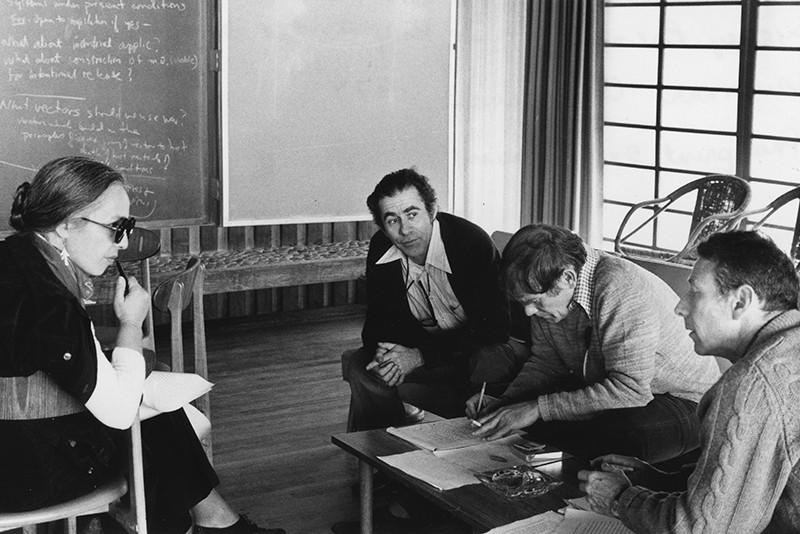
PAUSING to look at the life of Roy J. Glauber 1925–2018

Nobel laureate and quantum optics pioneer dies at 93

January 9, 2019 | Leah Poffenberger

Roy J. Glauber, Nobel Laureate, longtime Harvard professor, and quantum optics pioneer, passed away on December 26, 2018. He was 93.

In 2005, Glauber was awarded one half of the Nobel Prize for Physics, with John L. Hall and Theodore W. Hänsch sharing the other half, for his “contributions to the quantum theory of optical coherence.” He was also the recipient of the 1996 APS/AIP Dannie Heineman Prize for Mathematical Physics from APS, among others.

“Professor Glauber always brought new and interesting viewpoints to complex issues, whether the topic was the wave and particle nature of light as manifested in his seminal description of quantum optics and coherence of photons, the correlations of particles involved in high energy collisions, or the thrill of engaging in Nobel Prize ceremonies while also being a Nobel Prize winner,” said APS Past President Roger Falcone.

Glauber received both a bachelor’s degree, in 1946, and a Ph.D., in 1949, from Harvard University. While pursuing his doctoral degree, Glauber was recruited to work on the Manhattan Project becoming one of their youngest staff members. His postdoctoral work took him to the Institute for Advanced Study in Princeton and the Swiss Federal Polytechnic Institute in Zurich. Glauber returned to Harvard in 1952, later becoming the Mallinckrodt Professor of Physics there, as well as an Adjunct Professor of Optical Sciences at the University of Arizona.

Roy Glauber

Roy J. Glauber

Glauber’s contributions to physics include pioneering work in quantum optics, studying the interactions of laser light and matter, and contributions to theories of high-energy collisions, including analysis of hadron collisions. In addition to the Nobel Prize and the Heineman Prize, Glauber also received the Albert A. Michelson Medal from the Franklin Institute in Philadelphia (1985), the Max Born Award from the Optical Society (1985), and the Alexander von Humboldt Foundation Research Award (1989).

—-

On November 21, 2014 I received a letter from Nobel Laureate Harry Kroto and it said:

…Please click on this URL http://vimeo.com/26991975

and you will hear what far smarter people than I have to say on this matter. I agree with them.

Harry Kroto

Nick Gathergood, David-Birkett, Harry-Kroto

I have attempted to respond to all of Dr. Kroto’s friends arguments and I have posted my responses one per week for over a year now. Here are some of my earlier posts:

Arif Ahmed, Sir David AttenboroughMark Balaguer, Horace Barlow, Michael BatePatricia ChurchlandAaron CiechanoverNoam Chomsky,Alan DershowitzHubert Dreyfus, Bart Ehrman, Stephan FeuchtwangDavid Friend,  Riccardo GiacconiIvar Giaever , Roy GlauberRebecca GoldsteinDavid J. Gross,  Brian Greene, Susan GreenfieldStephen F Gudeman,  Alan Guth, Jonathan HaidtTheodor W. Hänsch, Brian Harrison,  Hermann HauserRoald Hoffmann,  Bruce HoodHerbert Huppert,  Gareth Stedman Jones, Steve JonesShelly KaganMichio Kaku,  Stuart Kauffman,  Lawrence KraussHarry Kroto, George LakoffElizabeth Loftus,  Alan MacfarlanePeter MillicanMarvin MinskyLeonard Mlodinow,  Yujin NagasawaAlva NoeDouglas Osheroff,  Jonathan Parry,  Saul PerlmutterHerman Philipse,  Carolyn PorcoRobert M. PriceLisa RandallLord Martin Rees,  Oliver Sacks, John SearleMarcus du SautoySimon SchafferJ. L. Schellenberg,   Lee Silver Peter Singer,  Walter Sinnott-ArmstrongRonald de Sousa, Victor StengerBarry Supple,   Leonard Susskind, Raymond TallisNeil deGrasse Tyson,  .Alexander Vilenkin, Sir John WalkerFrank WilczekSteven Weinberg, and  Lewis Wolpert,

Related posts:

FRANCIS SCHAEFFER ANALYZES ART AND CULTURE Part 53 THE BEATLES (Part E, Stg. Pepper’s and John Lennon’s search in 1967 for truth was through drugs, money, laughter, etc & similar to King Solomon’s, LOTS OF PICTURES OF JOHN AND CYNTHIA) (Feature on artist Yoko Ono)

The John Lennon and the Beatles really were on a long search for meaning and fulfillment in their lives  just like King Solomon did in the Book of Ecclesiastes. Solomon looked into learning (1:12-18, 2:12-17), laughter, ladies, luxuries, and liquor (2:1-2, 8, 10, 11), and labor (2:4-6, 18-20). He fount that without God in the picture all […]

FRANCIS SCHAEFFER ANALYZES ART AND CULTURE Part 52 THE BEATLES (Part D, There is evidence that the Beatles may have been exposed to Francis Schaeffer!!!) (Feature on artist Anna Margaret Rose Freeman )

______________   George Harrison Swears & Insults Paul and Yoko Lucy in the Sky with Diamonds- The Beatles The Beatles:   I have dedicated several posts to this series on the Beatles and I don’t know when this series will end because Francis Schaeffer spent a lot of time listening to the Beatles and talking […]

FRANCIS SCHAEFFER ANALYZES ART AND CULTURE Part 51 THE BEATLES (Part C, List of those on cover of Stg.Pepper’s ) (Feature on artist Raqib Shaw )

  The Beatles in a press conference after their Return from the USA Uploaded on Nov 29, 2010 The Beatles in a press conference after their Return from the USA. The Beatles:   I have dedicated several posts to this series on the Beatles and I don’t know when this series will end because Francis […]

FRANCIS SCHAEFFER ANALYZES ART AND CULTURE Part 50 THE BEATLES (Part B, The Psychedelic Music of the Beatles) (Feature on artist Peter Blake )

__________________   Beatles 1966 Last interview I have dedicated several posts to this series on the Beatles and I don’t know when this series will end because Francis Schaeffer spent a lot of time listening to the Beatles and talking and writing about them and their impact on the culture of the 1960’s. In this […]

FRANCIS SCHAEFFER ANALYZES ART AND CULTURE Part 49 THE BEATLES (Part A, The Meaning of Stg. Pepper’s Cover) (Feature on artist Mika Tajima)

_______________ The Beatles documentary || A Long and Winding Road || Episode 5 (This video discusses Stg. Pepper’s creation I have dedicated several posts to this series on the Beatles and I don’t know when this series will end because Francis Schaeffer spent a lot of time listening to the Beatles and talking and writing about […]

FRANCIS SCHAEFFER ANALYZES ART AND CULTURE PART 48 “BLOW UP” by Michelangelo Antonioni makes Philosophic Statement (Feature on artist Nancy Holt)

_______________ Francis Schaeffer pictured below: _____________________ I have included the 27 minute  episode THE AGE OF NONREASON by Francis Schaeffer. In that video Schaeffer noted,  ” Sergeant Pepper’s Lonely Hearts Club Band…for a time it became the rallying cry for young people throughout the world. It expressed the essence of their lives, thoughts and their feelings.” How Should […]

FRANCIS SCHAEFFER ANALYZES ART AND CULTURE Part 47 Woody Allen and Professor Levy and the death of “Optimistic Humanism” from the movie CRIMES AND MISDEMEANORS Plus Charles Darwin’s comments too!!! (Feature on artist Rodney Graham)

Crimes and Misdemeanors: A Discussion: Part 1 ___________________________________ Today I will answer the simple question: IS IT POSSIBLE TO BE AN OPTIMISTIC SECULAR HUMANIST THAT DOES NOT BELIEVE IN GOD OR AN AFTERLIFE? This question has been around for a long time and you can go back to the 19th century and read this same […]

FRANCIS SCHAEFFER ANALYZES ART AND CULTURE PART 46 Friedrich Nietzsche (Featured artist is Thomas Schütte)

____________________________________ Francis Schaeffer pictured below: __________ Francis Schaeffer has written extensively on art and culture spanning the last 2000years and here are some posts I have done on this subject before : Francis Schaeffer’s “How should we then live?” Video and outline of episode 10 “Final Choices” , episode 9 “The Age of Personal Peace and Affluence”, episode 8 […]

FRANCIS SCHAEFFER ANALYZES ART AND CULTURE Part 45 Woody Allen “Reason is Dead” (Feature on artists Allora & Calzadilla )

Love and Death [Woody Allen] – What if there is no God? [PL] ___________ _______________ How Should We then Live Episode 7 small (Age of Nonreason) #02 How Should We Then Live? (Promo Clip) Dr. Francis Schaeffer 10 Worldview and Truth Two Minute Warning: How Then Should We Live?: Francis Schaeffer at 100 Francis Schaeffer […]

FRANCIS SCHAEFFER ANALYZES ART AND CULTURE Part 44 The Book of Genesis (Featured artist is Trey McCarley )

___________________________________ Francis Schaeffer pictured below: ____________________________ Francis Schaeffer “BASIS FOR HUMAN DIGNITY” Whatever…HTTHR Dr. Francis schaeffer – The flow of Materialism(from Part 4 of Whatever happened to human race?) Dr. Francis Schaeffer – The Biblical flow of Truth & History (intro) Francis Schaeffer – The Biblical Flow of History & Truth (1) Dr. Francis Schaeffer […]

____________

____

__

RESPONDING TO HARRY KROTO’S BRILLIANT RENOWNED ACADEMICS!! PAUSING to look at the life of Sir John Sulston (My 7-9-17 Letter to Dr. Sulston about book A LIFE DECODED by J. Craig Venter which mentions him and many of his friends)

I was saddened to learn of the passing of Sir John Sulston on March 6, 2018  and I wanted to spend time on several posts concentrating on him. Probably the best video tribute to him I have found is this video below, but the best interview of Dr. Sulston ever done was by Alan Macfarlane and it is below too.

______

Interview of Sir John Sulston – part one

Uploaded on Jun 24, 2010

An Interview on the life and work of Sir John Sulston, Nobel Prize winner, who organized the team which sequenced the human genome for the first time. For a higher quality, downloadable, version, with a detailed summary please see http://www.alanmacfarlane.com

Interview of Sir John Sulston – part two

Uploaded on Jun 24, 2010

An Interview on the life and work of Sir John Sulston, Nobel Prize winner, who organized the team which sequenced the human genome for the first time. For a higher quality, downloadable, version, with a detailed summary please see http://www.alanmacfarlane.com

_________

QUOTE from Dr. Sulston:

I see that we have enormous amounts to discover as a strategy for going forward as human beings; I believe atheism makes coherent sense; all the religions are in conflict with each other; they have different stories, based on insubstantial records, but justify them with saying that there was some direct communication with a deity in the past which has led them to this belief; I find those unconvincing, particularly because of the conflict; this was my main argument in discussions with my father and he found it hard to answer that.

John Sulston death: Tributes paid to ‘unsung hero who made modern genetics possible’

Colleagues and experts hail a man who was pioneering in his discoveries – and generous in the ways he allowed people to share them

British scientist John Sulston, the spearhead of Britain's part in mapping mankind's genetic blueprint, gives a press conference 12 February 2001 in London about the Human Genome Project (HGP) at The Wellcome Trust

Sir John Sulston, a pioneering geneticist who helped found his discipline, has died aged 75.

Colleagues and admirers praised a man whose pioneering and innovative work wasn’t always recognised for what it was. Sir John wasn’t only remarkable for the work he did, they said, but also the sometimes unacknowledged work he did in making sure that both his and others’ discoveries were shared and made available.

“Sad news that the humble unsung hero of the Human Genome Project who made modern genetics possible has died,” said Tim Spector, professor of genetic epidemiology at Kings College London.

Sir John headed Britain’s contribution to the first working draft of the human genome, the publication of which marked a milestone in science.

He was awarded the Nobel Prize for medicine or physiology in 2002, along with two of his former colleagues, for work aiding the understanding of how genes control cell division and cell death in organisms.

Sir John founded the Sanger Institute – then called the Sanger Centre – at Hinxton, near Cambridge, and was director between 1992 to 2000.

It has gone on to become one of the leading centres for genome research in the world.

Professor Sir Mike Stratton, director of the Wellcome Sanger Institute, said: “He had a burning and unrelenting commitment to making genome data open to all without restriction and his leadership in this regard is in large part responsible for the free access now enjoyed.

“We all feel the loss today of a great scientific visionary and leader who made historic, landmark contributions to knowledge of the living world, and established a mission and agenda that defines 21st century science.”

Sir John led the 500-strong Sanger Centre team which, as part of the international Human Genome Project, sequenced a third of the human genome – the complex pattern of chemicals that makes up our DNA.

Part of the genome consists of genes which contain all the coded instructions for creating a human being.

Jeremy Farrar, director of biomedical research charity Wellcome, said: “John was a brilliant scientist and a wonderful, kind and principled man.

“His leadership was critical to the establishment of the Wellcome Sanger Institute and the Human Genome Project, one of the most important scientific endeavours of the past century.”

Sir John was born on March 17 1942 and showed an interest in the workings of organisms from an early age.

He completed his undergraduate degree in organic chemistry at Pembroke College at the University of Cambridge in 1963, and went on to join the department of Chemistry to carry out a PhD.

At the time of his death, he was professor and chairman of the Institute of Science, Ethics and Innovation at the University of Manchester.

Additional reporting by agencies

CRAIG VENTER, JOHN SULSTON, FRANCIS COLLINS, HAMILTON SMITH AND JEAN WEISSENBACH

Image result for john sulston craig venter

XXXXXXXXXXX

Image result for francis schaeffer

Francis Schaeffer above

Image result for charles darwin

Charles Darwin

Image result for adrian rogers

Adrian Rogers

Image result for hamilton smith

Hamilton Smith above, and Craig Venter with Smith below

Image result for Craig venter hamilton smith

__

July 6, 2017

Professor John Sulston, Wellcome Trust Sanger Institute

Dear Dr. John Sulston,

I have also really enjoyed reading about you in others’ books. For instance, I just read the book A LIFE DECODED BY J. Craig Venter and he talks a lot about you. I noticed in the beginning of that book he started off with a quote from someone you like to talk about a lot and that is Charles Darwin:

We must, however, acknowledge, as it seems to me, that man with
all his noble qualities . . . still bears in his bodily frame the indelible
stamp of his lowly origin.
—Charles Darwin

Did you know that Charles Darwin struggled his whole life attempting to get to a place where he was at peace with the idea that all this was a result of just time and chance, but he never was satisfied on that point.

Another person mentioned in that book is Ham Smith and I actually had the opportunity to correspond with him back in 1994 when I sent him a recorded message. Did you know that Ham Smith’s son is an evangelical? On the tenth anniversary of Francis Schaeffer’s passing, May 15, 1994, I sent out to several hundred prominent skeptics an evangelistic letter that told about Schaeffer’s life. This same letter included the audio recording entitled “Dust, Darwin, and Disbelief,” by Adrian Rogers and Bill Elliff. That recording started off with the song DUST IN THE WIND by the group KANSAS for the simple reason that if we  accept that we are the result of chance then all we are is DUST IN THE WIND.

Let start off by quoting Francis Schaeffer from his talk In the spring of 1968 which centered on the Autobiography of Charles Darwin:

Darwin in his autobiography  Darwin, Francis ed. 1892. Charles Darwin: his life told in an autobiographical chapter, and in a selected series of his published letters [abridged edition]. London: John Murray, and in his letters showed that all through his life he NEVER really came to a QUIETNESS concerning the possibility that chance really explained the situation of the biological world. You will find there is much material on this [from Darwin] extended over many many years that constantly he was wrestling with this problem. Darwin never came to a place of satisfaction. You have philosophically ONLY TWO possible beginnings. The first would be a PERSONAL beginning and the other would be an IMPERSONEL beginning plus time plus CHANCE. There is no other possible alternative except the alternative that everything comes out of nothing and that has to be a total nothing and that has to be a total nothing without mass, energy or motion existing. No one holds this last view because it is unthinkable. Darwin understood this and therefore until his death he was uncomfortable with the idea of CHANCE producing the biological variation. 

  Darwin, C. R. to Graham, William 3 July 1881 (letter written less than a year before Darwin’s death and less than 40 years before your birth, Dr Barlow):

Nevertheless you have EXPRESSED MY INWARD CONVICTION, though far more vividly and clearly than I could have done, that the Universe is NOT THE RESULT OF CHANCE.* But THEN with me the HORRID DOUBT ALWAYS ARISES whether the convictions of man’s mind, which has been developed from the mind of the lower animals, are of any value or at all trustworthy. Would any one trust in the convictions of a monkey’s mind, if there are any convictions in such a mind?

Francis Schaeffer comments:

Can you feel this man? He is in real agony. You can feel the whole of modern man in this tension with Darwin. My mind can’t accept that ultimate of chance, that the universe is a result of chance. He has said 3 or 4 times now that he can’t accept that it all happened by chance and then he will write someone else and say something different. How does he say this (about the mind of a monkey) and then put forth this grand theory? Wrong theory I feel but great just the same. Grand in the same way as when I look at many of the paintings today and I differ with their message but you must say the mark of the mannishness of man are one those paintings titanic-ally even though the message is wrong and this is the same with Darwin.  But how can he say you can’t think, you come from a monkey’s mind, and you can’t trust a monkey’s mind, and you can’t trust a monkey’s conviction, so how can you trust me? Trust me here, but not there is what Darwin is saying. In other words it is very selective. 

Evidently Darwin was telling his friends that he was an agnostic and that he did not think that God had anything to do with it but it was all left to the hands of chance. Is that the way you are reading this?

The answer to find meaning in life is found in putting your faith and trust in Jesus Christ. The Bible is true from cover to cover and can be trusted. The world is not a result of blind chance, but we all were put here for a purpose by God. If you want to investigate the evidence concerning the accuracy of the Bible then I suggest you read Psalms 22 which was written about a thousand years before the crucifixion events it described. Furthermore, when King David wrote those words the practice of stoning was the primary way of executing someone in Israel.

Sincerely,

Everette Hatcher, everettehatcher@gmail.com, http://www.thedailyhatch.org, cell ph 501-920-5733, Box 23416, LittleRock, AR 72221, United States

On November 21, 2014 I received a letter from Nobel Laureate Harry Kroto and it said:

…Please click on this URL http://vimeo.com/26991975

and you will hear what far smarter people than I have to say on this matter. I agree with them.

Harry Kroto

Nick Gathergood, David-Birkett, Harry-Kroto

I have attempted to respond to all of Dr. Kroto’s friends arguments and I have posted my responses one per week for over a year now. Here are some of my earlier posts:

Arif Ahmed, Sir David AttenboroughMark Balaguer, Horace Barlow, Michael BatePatricia ChurchlandAaron CiechanoverNoam Chomsky,Alan DershowitzHubert Dreyfus, Bart Ehrman, Stephan FeuchtwangDavid Friend,  Riccardo GiacconiIvar Giaever , Roy GlauberRebecca GoldsteinDavid J. Gross,  Brian Greene, Susan GreenfieldStephen F Gudeman,  Alan Guth, Jonathan HaidtTheodor W. Hänsch, Brian Harrison,  Hermann HauserRoald Hoffmann,  Bruce HoodHerbert Huppert,  Gareth Stedman Jones, Steve JonesShelly KaganMichio Kaku,  Stuart Kauffman,  Lawrence KraussHarry Kroto, George LakoffElizabeth Loftus,  Alan MacfarlanePeter MillicanMarvin MinskyLeonard Mlodinow,  Yujin NagasawaAlva NoeDouglas Osheroff,  Jonathan Parry,  Saul PerlmutterHerman Philipse,  Carolyn PorcoRobert M. PriceLisa RandallLord Martin Rees,  Oliver Sacks, John SearleMarcus du SautoySimon SchafferJ. L. Schellenberg,   Lee Silver Peter Singer,  Walter Sinnott-ArmstrongRonald de Sousa, Victor StengerBarry Supple,   Leonard Susskind, Raymond TallisNeil deGrasse Tyson,  .Alexander Vilenkin, Sir John WalkerFrank WilczekSteven Weinberg, and  Lewis Wolpert,

In  the second video below in the 61st clip in this series are his words but today I just wanted to pause and look at this life. 

50 Renowned Academics Speaking About God (Part 1)

Another 50 Renowned Academics Speaking About God (Part 2)

A Further 50 Renowned Academics Speaking About God (Part 3)

__

Related posts:

FRANCIS SCHAEFFER ANALYZES ART AND CULTURE Part 53 THE BEATLES (Part E, Stg. Pepper’s and John Lennon’s search in 1967 for truth was through drugs, money, laughter, etc & similar to King Solomon’s, LOTS OF PICTURES OF JOHN AND CYNTHIA) (Feature on artist Yoko Ono)

The John Lennon and the Beatles really were on a long search for meaning and fulfillment in their lives  just like King Solomon did in the Book of Ecclesiastes. Solomon looked into learning (1:12-18, 2:12-17), laughter, ladies, luxuries, and liquor (2:1-2, 8, 10, 11), and labor (2:4-6, 18-20). He fount that without God in the picture all […]

FRANCIS SCHAEFFER ANALYZES ART AND CULTURE Part 52 THE BEATLES (Part D, There is evidence that the Beatles may have been exposed to Francis Schaeffer!!!) (Feature on artist Anna Margaret Rose Freeman )

______________   George Harrison Swears & Insults Paul and Yoko Lucy in the Sky with Diamonds- The Beatles The Beatles:   I have dedicated several posts to this series on the Beatles and I don’t know when this series will end because Francis Schaeffer spent a lot of time listening to the Beatles and talking […]

FRANCIS SCHAEFFER ANALYZES ART AND CULTURE Part 51 THE BEATLES (Part C, List of those on cover of Stg.Pepper’s ) (Feature on artist Raqib Shaw )

  The Beatles in a press conference after their Return from the USA Uploaded on Nov 29, 2010 The Beatles in a press conference after their Return from the USA. The Beatles:   I have dedicated several posts to this series on the Beatles and I don’t know when this series will end because Francis […]

FRANCIS SCHAEFFER ANALYZES ART AND CULTURE Part 50 THE BEATLES (Part B, The Psychedelic Music of the Beatles) (Feature on artist Peter Blake )

__________________   Beatles 1966 Last interview I have dedicated several posts to this series on the Beatles and I don’t know when this series will end because Francis Schaeffer spent a lot of time listening to the Beatles and talking and writing about them and their impact on the culture of the 1960’s. In this […]

FRANCIS SCHAEFFER ANALYZES ART AND CULTURE Part 49 THE BEATLES (Part A, The Meaning of Stg. Pepper’s Cover) (Feature on artist Mika Tajima)

_______________ The Beatles documentary || A Long and Winding Road || Episode 5 (This video discusses Stg. Pepper’s creation I have dedicated several posts to this series on the Beatles and I don’t know when this series will end because Francis Schaeffer spent a lot of time listening to the Beatles and talking and writing about […]

FRANCIS SCHAEFFER ANALYZES ART AND CULTURE PART 48 “BLOW UP” by Michelangelo Antonioni makes Philosophic Statement (Feature on artist Nancy Holt)

_______________ Francis Schaeffer pictured below: _____________________ I have included the 27 minute  episode THE AGE OF NONREASON by Francis Schaeffer. In that video Schaeffer noted,  ” Sergeant Pepper’s Lonely Hearts Club Band…for a time it became the rallying cry for young people throughout the world. It expressed the essence of their lives, thoughts and their feelings.” How Should […]

FRANCIS SCHAEFFER ANALYZES ART AND CULTURE Part 47 Woody Allen and Professor Levy and the death of “Optimistic Humanism” from the movie CRIMES AND MISDEMEANORS Plus Charles Darwin’s comments too!!! (Feature on artist Rodney Graham)

Crimes and Misdemeanors: A Discussion: Part 1 ___________________________________ Today I will answer the simple question: IS IT POSSIBLE TO BE AN OPTIMISTIC SECULAR HUMANIST THAT DOES NOT BELIEVE IN GOD OR AN AFTERLIFE? This question has been around for a long time and you can go back to the 19th century and read this same […]

FRANCIS SCHAEFFER ANALYZES ART AND CULTURE PART 46 Friedrich Nietzsche (Featured artist is Thomas Schütte)

____________________________________ Francis Schaeffer pictured below: __________ Francis Schaeffer has written extensively on art and culture spanning the last 2000years and here are some posts I have done on this subject before : Francis Schaeffer’s “How should we then live?” Video and outline of episode 10 “Final Choices” , episode 9 “The Age of Personal Peace and Affluence”, episode 8 […]

FRANCIS SCHAEFFER ANALYZES ART AND CULTURE Part 45 Woody Allen “Reason is Dead” (Feature on artists Allora & Calzadilla )

Love and Death [Woody Allen] – What if there is no God? [PL] ___________ _______________ How Should We then Live Episode 7 small (Age of Nonreason) #02 How Should We Then Live? (Promo Clip) Dr. Francis Schaeffer 10 Worldview and Truth Two Minute Warning: How Then Should We Live?: Francis Schaeffer at 100 Francis Schaeffer […]

FRANCIS SCHAEFFER ANALYZES ART AND CULTURE Part 44 The Book of Genesis (Featured artist is Trey McCarley )

___________________________________ Francis Schaeffer pictured below: ____________________________ Francis Schaeffer “BASIS FOR HUMAN DIGNITY” Whatever…HTTHR Dr. Francis schaeffer – The flow of Materialism(from Part 4 of Whatever happened to human race?) Dr. Francis Schaeffer – The Biblical flow of Truth & History (intro) Francis Schaeffer – The Biblical Flow of History & Truth (1) Dr. Francis Schaeffer […]

____________

____

__

RESPONDING TO HARRY KROTO’S BRILLIANT RENOWNED ACADEMICS!! Part “Open letter to Harry Kroto’s friend Richard Dawkins” Reacting to tweet of Dawkins!!


August 28, 2019

Richard Dawkins c/o Richard Dawkins Foundation, 
Washington, DC 20005

Dear Mr. Dawkins,

i have enjoyed reading about a dozen of your books and some of the most intriguing were The God DelusionAn Appetite for Wonder: The Making of a Scientist, and Brief Candle in the Dark: My Life in Science.

In The NY Times article by Charles Blow that you tweeted on August 28, 2019 quoted this passage from George Washington’s 1796 Farewell Address: 

“The nation which indulges towards another a habitual hatred or a habitual fondness is in some degree a slave. It is a slave to its animosity or to its affection, either of which is sufficient to lead it astray from its duty and its interest.”

Link is here

Here is more context of that quote:

[…] nothing is more essential than that permanent, inveterate antipathies against particular nations, and passionate attachments for others, should be excluded […]. The nation which indulges towards another a habitual hatred or a habitual fondness is in some degree a slave. It is a slave to its animosity or to its affection, either of which is sufficient to lead it astray from its duty and its interest. (32.1-3)

Another of Washington’s big ideas in the farewell address is “don’t make alliances with other countries.” The big reason, as he mentions here, is that when you do that, you bind yourself to that other country and ruin relationships with others. It takes away from your ability to make your own decisions. In other words, it takes away a country’s freedom to act in its own interest.

That probably is that the point that Charles Blow was trying to make. It is also of interest to me that he omitted this portion of Washington’s speech: 

Of all the dispositions and habits which lead to political prosperity,
religion and morality are indispensable supports. In vain would that man claim
the tribute of patriotism who should labor to subvert these great pillars of
human happiness – these firmest props of the duties of men and citizens. The mere
politician, equally with the pious man, ought to respect and to cherish them. A
volume could not trace all their connections with private and public felicity.
Let it simply be asked, “where is the security for property, for
reputation, for life, if the sense of religious obligation desert the oaths
which are the instruments of investigation in courts of justice?” And let
us with caution indulge the supposition that morality can be maintained without
religion. Whatever may be conceded to the influence of refined education on
minds of peculiar structure, reason and experience both forbid us to expect
that national morality can prevail in exclusion of religious principle.

It is substantially true that virtue or morality is a necessary spring of
popular government. The rule indeed extends with more or less force to every
species of free government. Who that is a sincere friend to it can look with
indifference upon attempts to shake the foundation of the fabric?

Trump’s Paradigm of the Personal

The answer to find meaning in life is found in putting your faith and trust in Jesus Christ. The Bible is true from cover to cover and can be trusted.

Thank you again for your time and I know how busy you are.

Everette Hatcher, everettehatcher@gmail.comhttp://www.thedailyhatch.org, cell ph 501-920-5733, Box 23416, LittleRock, AR 72221, United States

Canary Islands 2014: Harold Kroto and Richard Dawkins

Image result for harry kroto richard dawkins

_

May 8, 2016

Richard Dawkins
Washington, DC

Dear Mr. Dawkins,

In the You Tube video SOMETHING FROM NOTHING ? [OFFICIAL] Richard Dawkins & Lawrence Krauss [HD] 02-04-12 I noticed at the 3 minute mark that Lawrence Krauss said walking around campus with you generated interesting responses: 

I saw people fainting. People came up and shook our hands and were nervous and Richard produces that. I was going to say it was like walking around campus with Moses, but the difference is that I am absolutely certain that Richard Dawkins exists. (loud applause from audience). 

Below is a piece of that evidence given by Francis Schaeffer concerning the accuracy of the Bible and believe it or not it deals with the time of Moses.

TRUTH AND HISTORY (chapter 5 of WHATEVER HAPPENED TO THE HUMAN RACE?, under footnote #96)

We should take one last step back into the history of the Old Testament. In the previous note we looked first at the Dead Sea Scrolls, dating to around 100 B.C. Then we went back to the period of the Late Monarchy and looked first at the siege of Hezekiah in Jerusalem by Sennacherib in 701 B.C. and also at the last years of Judah down to about 600 B.C. Then we went further back to about 850 B.C., to Ahab and Jezebel, the ivory house, the Black Obelisk, the Moabite Stone and so on–then back again to about 950 B.C., to the time of Solomon and his son Rehoboam and the campaign by Shishak, the Egyptian pharaoh.

This should have built up in our minds a vivid impression of the historic reliability of the biblical text, including even the seemingly obscure details such as the ration tablets in Babylon. We saw, in other words, not only that the Bible gives us a marvelous world view that ties in with the nature of reality and answers the basic problems which philosophers have asked down through the centuries, but also that the Bible is completely reliable, EVEN ON THE HISTORICAL LEVEL.

The previous notes looked back to the time of Moses and Joshua, the escape from Egypt, and the settlement in Canaan. Now we will go back further–back as far as Genesis 12, near the beginning of the Bible.

Do we find that the narrative fades away to a never-never land of myths and legends? By no means. For we have to remind ourselves that although Genesis 12 deals with events a long time ago from our moment of history (about 2000 B.C. or a bit later), the civilized world was already not just old but ancient when Abram/Abraham left “Ur of the Chaldeans” (see Genesis 11:31).

Ur itself was excavated some fifty years ago. In the British Museum, for example, one can see the magnificent contents of a royal burial chamber from Ur. This includes a gold headdress still in position about the head of a queen who died in Ur about 2500 B.C. It has also been possible to reconstruct from archaeological remains what the streets and buildings must have been like at the time.

Like Ur, the rest of the world of the patriarchs (that is, of Abraham, Isaac, and Jacob) was firm reality. Such places as Haran, where Abraham went first, have been discovered. So has Shechem from this time, with its Canaanite stone walls, which are still standing, and its temple.

Genesis 12:5-9New American Standard Bible (NASB)

Abram took Sarai his wife and Lot his nephew, and all their possessions which they had accumulated, and the [a]persons which they had acquired in Haran, and they [b]set out for the land of Canaan; thus they came to the land of Canaan. Abram passed through the land as far as the site of Shechem, to the[c]oak of Moreh. Now the Canaanite was then in the land.The Lord appeared to Abram and said, “To your [d]descendants I will give this land.” So he built an altar there to the Lord who had appeared to him. Then he proceeded from there to the mountain on the east of Bethel, and pitched his tent, with Bethel on the west and Ai on the east; and there he built an altar to the Lord andcalled upon the name of the Lord. Abram journeyed on, continuing toward the[e]Negev.

Haran and Shechem may be unfamiliar names to us but the Negrev (or Negeb) is a name we have all read frequently in the news accounts of our own day. 

The answer to find meaning in life is found in putting your faith and trust in Jesus Christ. The Bible is true from cover to cover and can be trusted.

Thanks for your time.

Sincerely,

Everette Hatcher, everettehatcher@gmail.comhttp://www.thedailyhatch.org, cell ph 501-920-5733, Box 23416, LittleRock, AR 72221

On November 21, 2014 I received a letter from Nobel Laureate Harry Kroto and it said:

…Please click on this URL http://vimeo.com/26991975

and you will hear what far smarter people than I have to say on this matter. I agree with them.

Harry Kroto

Nick Gathergood, David-Birkett, Harry-Kroto

Image result for harry kroto richard dawkins

I have attempted to respond to all of Dr. Kroto’s friends arguments and I have posted my responses one per week for over a year now. Here are some of my earlier posts:

Arif Ahmed, Sir David AttenboroughMark Balaguer, Horace Barlow, Michael BatePatricia ChurchlandAaron CiechanoverNoam Chomsky,Alan DershowitzHubert DreyfusBart Ehrman, Stephan FeuchtwangDavid Friend,  Riccardo GiacconiIvar Giaever , Roy GlauberRebecca GoldsteinDavid J. Gross Brian Greene, Susan GreenfieldStephen F Gudeman,  Alan Guth, Jonathan HaidtTheodor W. HänschBrian Harrison,  Hermann HauserRoald Hoffmann,  Bruce HoodHerbert Huppert,  Gareth Stedman JonesSteve JonesShelly KaganMichio Kaku,  Stuart Kauffman,  Lawrence KraussHarry KrotoGeorge LakoffElizabeth Loftus,  Alan MacfarlanePeter MillicanMarvin MinskyLeonard Mlodinow Yujin NagasawaAlva NoeDouglas Osheroff,  Jonathan Parry,  Saul PerlmutterHerman PhilipseCarolyn PorcoRobert M. PriceLisa RandallLord Martin Rees,  Oliver SacksJohn SearleMarcus du SautoySimon SchafferJ. L. Schellenberg,   Lee Silver Peter Singer,  Walter Sinnott-ArmstrongRonald de SousaVictor StengerBarry Supple,   Leonard SusskindRaymond TallisNeil deGrasse Tyson,  .Alexander VilenkinSir John WalkerFrank WilczekSteven Weinberg, and  Lewis Wolpert,

In  the second video below in the 67th clip in this series are Richard Dawkins’ words that Harry Kroto wanted me to see. Since then I have read several of Richard Dawkins books and have attempted to respond to the contents of these books directly to Richard Dawkins by mail. In fact, I have been writing Richard Dawkins letters since May 15, 1994 which was the 10th anniversary of the passing of one of my heroes, Francis Schaeffer. Francis Schaeffer spent a lot of time responding to many of Richard Dawkins’ heroes such as Carl Sagan, Jacques Monod, H.J. Blackham, Isaac Newton, Ludwig Wittgenstein, Max Planck, Johann Sebastian Bach, Francis Bacon, Samuel Beckett, Leonardo Da Vinci, Albert Einstein, Michael Faraday, Gerald Horton, Edmund Leach, Louis Pasteur, George Wald, Jacob Bronowski, Steven Weinberg, Charles Darwin, Paul Kurtz, Peter Singer, Jonathan Miller, William B. Provine, Woody Allen, Noam Chomsky, James D. Watson, Francis Crick, Michael Polanyi, The Huxley family, Antony Flew, and Edward O. Wilson (Dawkins has since revised his opinion of Flew and Wilson, but he earlier regarded them very highly). 

Image result for francis schaeffer
Francis Schaeffer 1911-1984

_

Image result for antony flew

_

Both Francis Schaeffer and Richard Dawkins have talked extensively about the life of Charles Darwin.

Image result for charles darwin

_

Sir Harry Kroto with his high school friend Sir Ian McKellan at the FSU National High Field Magnetic Lab on Tuesday, October 27, 2009.

Image result for harry kroto richard dawkins

50 Renowned Academics Speaking About God (Part 1)

_

Another 50 Renowned Academics Speaking About God (Part 2)

_

_

Edit Post ‹ The Daily Hatch — WordPress

A Further 50 Renowned Academics Speaking About God (Part 3)

_

Richard Dawkins Photos Photos – Professor Stephen Hawking Unveils Medal For Science Communication – Zimbio

Professor Stephen Hawking Unveils Medal For Science Communication

Professor Stephen Hawking Unveils Medal For Science Communication In This Photo: Richard Dawkins, Stephen Hawking, Brian May, Harold Kroto, Alexi Leonov, Garik Israelian

__

Richard Dawkins, founder of the Richard Dawkins Foundation for Reason and Science. Credit: Don Arnold Getty Images

16

Image result for richard dawkins brief candle in the dark

Garik Israelian, Stephen Hawking, Alexey Leonov, Brian May, Richard Dawkins and Harry Kroto

—-

—-

—-

—-

—-

Related posts:

RESPONDING TO HARRY KROTO’S BRILLIANT RENOWNED ACADEMICS!! Part 48 Nobel Prize Winner and Global Warming Denier Ivar Giaever “I think religion is to blame for a lot of the ills in this world!”

October 20, 2015 – 5:20 am

  On November 21, 2014 I received a letter from Nobel Laureate Harry Kroto and it said: …Please click on this URL http://vimeo.com/26991975 and you will hear what far smarter people than I have to say on this matter. I agree with them. Harry Kroto _________________ Below you have picture of 1996 Chemistry Nobel Prize Winner […]

FRANCIS SCHAEFFER ANALYZES ART AND CULTURE PART 78 THE BEATLES (Breaking down the song TOMORROW NEVER KNOWS) Featured musical artist is Stuart Gerber

September 24, 2015 – 5:42 am

The Beatles were “inspired by the musique concrète of German composer and early electronic music pioneer Karlheinz Stockhausen…”  as SCOTT THILL has asserted. Francis Schaeffer noted that ideas of  “Non-resolution” and “Fragmentation” came down German and French streams with the influence of Beethoven’s last Quartets and then the influence of Debussy and later Schoenberg’s non-resolution which is in total contrast […]

RESPONDING TO HARRY KROTO’S BRILLIANT RENOWNED ACADEMICS!! Part 42 Peter Singer, Professor of Bioethics at Princeton University, THE PROBLEM OF EVIL

September 8, 2015 – 5:10 am

  _______ On November 21, 2014 I received a letter from Nobel Laureate Harry Kroto and it said: …Please click on this URL http://vimeo.com/26991975 and you will hear what far smarter people than I have to say on this matter. I agree with them. Harry Kroto _________________ Below you have picture of 1996 Chemistry Nobel Prize […]

RESPONDING TO HARRY KROTO’S BRILLIANT RENOWNED ACADEMICS!! Bart Ehrman “Why should one think that God performed the miracle of inspiring the words in the first place if He didn’t perform the miracle of preserving the words?”

September 2, 2015 – 8:42 am

On November 21, 2014 I received a letter from Nobel Laureate Harry Kroto and it said: …Please click on this URL http://vimeo.com/26991975 and you will hear what far smarter people than I have to say on this matter. I agree with them. Harry Kroto ____________________ Below you have picture of 1996 Chemistry Nobel Prize Winner Dr. […]

RESPONDING TO HARRY KROTO’S BRILLIANT RENOWNED ACADEMICS!! Part 156c My May 28, 2017 letter to Stephen Hawking

__

Image result for stephen hawking harry kroto

_

Image result for stephen hawking movie


Image result for stephen hawking

On November 21, 2014 I received a letter from Nobel Laureate Harry Kroto and it said:

…Please click on this URL http://vimeo.com/26991975

and you will hear what far smarter people than I have to say on this matter. I agree with them.

Harry Kroto

Nick Gathergood, David-Birkett, Harry-Kroto

I have attempted to respond to all of Dr. Kroto’s friends arguments and I have posted my responses one per week for over a year now. Here are some of my earlier posts:

Arif Ahmed, Sir David AttenboroughMark Balaguer, Horace Barlow, Michael BatePatricia ChurchlandAaron CiechanoverNoam Chomsky,Alan DershowitzHubert Dreyfus, Bart Ehrman, Stephan FeuchtwangDavid Friend,  Riccardo GiacconiIvar Giaever , Roy GlauberRebecca GoldsteinDavid J. Gross,  Brian Greene, Susan GreenfieldStephen F Gudeman,  Alan Guth, Jonathan HaidtTheodor W. Hänsch, Brian Harrison,  Hermann HauserRoald Hoffmann,  Bruce HoodHerbert Huppert,  Gareth Stedman Jones, Steve JonesShelly KaganMichio Kaku,  Stuart Kauffman,  Lawrence KraussHarry Kroto, George LakoffElizabeth Loftus,  Alan MacfarlanePeter MillicanMarvin MinskyLeonard Mlodinow,  Yujin NagasawaAlva NoeDouglas Osheroff,  Jonathan Parry,  Saul PerlmutterHerman PhilipseCarolyn PorcoRobert M. PriceLisa RandallLord Martin Rees,  Oliver Sacks, John SearleMarcus du SautoySimon SchafferJ. L. Schellenberg,   Lee Silver Peter Singer,  Walter Sinnott-ArmstrongRonald de Sousa, Victor StengerBarry Supple,   Leonard Susskind, Raymond TallisNeil deGrasse Tyson,  .Alexander Vilenkin, Sir John WalkerFrank WilczekSteven Weinberg, and  Lewis Wolpert,

In  the first video below in the 15th clip in this series are his words and  my response is below them. 

50 Renowned Academics Speaking About God (Part 1)

Another 50 Renowned Academics Speaking About God (Part 2)

A Further 50 Renowned Academics Speaking About God (Part 3)

_________________________________

In the popular You Tube video “Renowned Academics Speaking About God” you made the following statement:

“M-Theory doesn’t disprove God, but it does make him unnecessary. It predicts that the universe will be spontaneously created out of nothing without the need for a creator.” –Stephen Hawking, Cambridge theoretical physicist

Earlier I responded to Dr. Hawking’s assertion.

My May 28, 2017 letter to Stephen Hawking

__

__________

The sermon WHO IS JESUS? was preached by Adrian Rogers (pictured below)  and my good friend Larry Speaks (pictured above) gave out hundreds of CD copies of it before he died on April 7, 2017 at the age of 69.

Image result for adrian rogers jesus

Dr Keith Krell and his family pictured below:

Image result for Keith Krell

Woody Allen  and Mariel Hemingway pictured below: 

Image result for woody allen

__

Image result for francis schaeffer c. everett koop

__

Image result for francis schaeffer c. everett koop

__

The Visit of the Queen of Sheba to King Solomon’, oil on canvas painting by Edward Poynter, 1890

Related image

____

Image result for adrian rogers family

On the left are David and Kelly Rogers and their sons Jonathan and Stephen Rogers. During the sermon illustration in WHO IS JESUS? Adrian Rogers told of calling little Jonathan when his family was missionaries in Madrid, Spain.

The band Big Daddy Weave pictured below:

Image result for Big Daddy Weave:

__

Your friend Richard Dawkins with comedian Ricky Gervais

Image result for Ricky Gervais richard dawkins

_

May 28, 2017

Dr. Stephen Hawking, c/o Centre for Theoretical Cosmology
Department of Applied Mathematics and Theoretical Physics
Centre for Mathematical Sciences
Wilberforce Road, Cambridge
CB3 0WA, UK

Dear Dr. Hawking, I have had some time to reflect on Larry Speaks’ funeral service and I wanted to share a few thoughts with you. When I think of the 34 years I knew Larry it reminds me of all the laughs we had together. Larry’s funeral was a happy occasion as we laughed at the many stories about Larry’s life. There was the occasion that Larry gave a  neighbor of his a chance to work at Larry’s SOUTHERN FRUIT AND GROCERY STORE  because his neighbor had nothing to do and that would keep him busy. We will call him Barry. Barry was a little strange but tried to be very helpful. There was the time Barry was trying to kill a fly with a fly swatter and accidentally busted the electric OPEN sign near the front window. Also Barry would ignore Larry’s instructions not  to talk politics with the customers and  get into arguments with the customers. Eventually Larry had to tell Barry that his help was no longer needed after a while. Larry said probably the first hint he got that Barry couldn’t handle the job was when Barry filled up his car tank with gas and he shook his car because Barry said that allowed more gas to get into the tank!!!   LAUGHTER is something you have been around. Your friend Ricky Gervais loves to joke about your brilliance. “Greatest mind on the planet. He’s not a genius, he’s pretentious. Born in Oxford and talks with that fake American accent”   I have seen the YouTube videos of BEYOND THE FRINGE with your British friends Jonathan Miller, Peter Cook, Dudley Moore and Alan Bennett. I have got a lot of laughs by watching those clips. Peter Cook once said, “Hitler was a very peculiar person wasn’t he? He was another dominator you know — Hitler. And he was a wonderful ballroom dancer. Not many people know that.”

Image result for david attenborough Jonathan miller

  As you know I am writing you a series of letters on Solomon’s efforts to find a meaning and purpose to life. In the Book of Ecclesiastes what are all of the 6 “L” words that Solomon looked into? He looked into  learning (1:16-18), laughter, ladies, luxuries,  and liquor (2:1-3, 8, 10, 11), and labor (2:4-6, 18-20). Probing the area of LAUGHTER was one of Solomon’s first places to start. In Ecclesiastes 2:2 he starts this quest but he concludes it is not productive to be laughing the whole time and not considering the serious issues of life. “I said of laughter, “It is foolishness;” and of mirth, “What does it accomplish?” (2:2).   Then Solomon  asserted the nihilistic statement in Ecclesiastes 2:17: “So I hated life, because the work that is done under the sun was grievous to me. All of it is meaningless, a chasing after the wind.” Keith Krell in his article, 3. Trivial Pursuits (Ecclesiastes 1:12-2:26), notes:

What would it take to make you happy? What if you had the wealth of Bill Gates or Donald Trump? Would this make you happy? What if you had the success of Oprah or Martha Stewart? Do you think you could be happy? What if you had the brains of Carl Sagan or Stephen Hawking? Do you think you could be happy? Let me guess. Your answer is, “I don’t know, but I’d sure like to give it a try.”

A few people have been able to possess wealth, success, and intelligence just as I described. Solomon, the third king of Israel, was one of them. In some ways he had everything. He had a thousand wives and concubines, enormous wealth, international respect, and unparalleled wisdom. What he didn’t always have, however, was a reason for living. He didn’t always have happiness. He fits the pattern of the highly gifted, extremely ambitious person who climbs the ladder of success—only to contemplate jumping off once he’s reached the top.39

In the first eleven verses of Ecclesiastes chapter one, Solomon examined three broad categories in his search for the key to life: human history, physical nature, and human nature. Now in 1:12-2:26, he narrows his search to his own personal experience.40 In a sense he takes us on his own spiritual sojourn as he searches for satisfaction in life. In the memoirs that follow Solomon informs us that he sought satisfaction in four broad categories, but wound up empty-handed.

  • Humor (2:2). Solomon writes, “I said to myself, ‘Come now, I will test you with pleasure. So enjoy yourself.’ And behold, it too was futility. I said of laughter, ‘It is madness,’ and of pleasure, ‘What does it accomplish?’”57 Solomon mocks “laughter” as “madness.” I’m not surprised he labeled it “madness.” Do you really think the leading comedians of our day are sincerely satisfied with life? Has humor given them an inside track on human happiness? Hardly.58 It is easy to seek to lose ourselves in comedy and entertainment whether it is in a theater, in front of our TV, or on-line. Although it can seem like a great escape, it leaves us empty in the end.

_____ Francis Schaeffer quoted Woody Allen in his book WHATEVER HAPPENED TO THE HUMAN RACE? (co-authored by Dr. C. Everett Koop): One of the most striking developments in the last half-century is the growth of a profound pessimism among both the well-educated and less-educated people. The thinkers in our society have been admitting for a long time that they have no final answers at all.
Take Woody Allen, for example. Most people know his as a comedian, but he has thought through where mankind stands after the “religious answers” have been abandoned. In an article in Esquire (May 1977), he says that man is left with:
… alienation, loneliness [and] emptiness verging on madness…. The fundamental thing behind all motivation and all activity is the constant struggle against annihilation and against death. It’s absolutely stupefying in its terror, and it renders anyone’s accomplishments meaningless.
Allen sums up his view in his film Annie Hall with these words: “Life is divided into the horrible and the miserable.”
Many would like to dismiss this sort of statement as coming from one who is merely a pessimist by temperament, one who sees life without the benefit of a sense of humor. Woody Allen does not allow us that luxury. He speaks as a human being who has simply looked life in the face and has the courage to say what he sees. If there is no personal God, nothing beyond what our eyes can see and our hands can touch, then Woody Allen is right: life is both meaningless and terrifying. __ Solomon’s experiment was a search for meaning to life “under the sun.” Then in last few words in the Book of Ecclesiastes he looks above the sun and brings God back into the picture: “The conclusion, when all has been heard, is: Fear God and keep His commandments, because this applies to every person. For God will bring every act to judgment, everything which is hidden, whether it is good or evil.” _____

As you know the sermon WHO IS JESUS? was Larry’s favorite sermon and he gave hundreds of that CD copies away.  Let me share a little from that message but first let me give you some background information.

In 1979 I went  on a mission trip to Toronto and  then to Europe  with my good friend David Rogers. We were involved with the group  Operation Mobilization (OM). After the OM Mission Conference in Belgium,  David went to Austria and I went to England. In Manchester, England our group went to the homes of Muslims and Hindus and shared  the gospel.

Fast forward several years later, I  got involved in my family business, but David continued in  missions and  moved to Spain.

Now the illustration from the sermon WHO IS JESUS? by Adrian Rogers:

The other day we called our son David in Madrid, Spain. Momma Bear is burning up our telephone and our bill is going to be big, talking to David and Kelly and little Jonathan. It is an amazing thing that in Memphis,  Tennessee when she picks up a phone  she eliminates everyone that doesn’t have a phone. And then when she dials the first digit that deals with the country Spain she eliminates all other countries. And then when she dials a couple more digits she eliminates all the other cities in Spain except Madrid. And then when she dials a couple more digits she eliminates a lot of people in a particular city in Spain. And then when she dials that last digit it eliminates every home except the very last home which belongs to our son David. 

That is amazing that there are billions of people in the world and  with a phone you can start closing the focus. My friend that is what the Old Testament does.

In Genesis 3, we read about the One who will bruise the head of the serpent. In Genesis 12, He is going to come from the seed of Abraham. In Genesis 22, we read about the sacrifice of Isaac on the very mountain where Jesus was later crucified! The entire book of Leviticus is filled with pictures of blood-atoning sacrifices for sin. You’ll read about the prophetic crucifixion of Jesus in Psalm 22. In Micah 5:2, it is told clearly that Jesus will be born in Bethlehem. There is only one person on the end of the line and his name is Jesus. 

__

No wonder Larry chose the song YOURS WILL BE to be sung at his funeral. It blessed me tremendously today when I heard it sung. Look it up on You Tube “Yours will Be (The Only Name)”  by Big Daddy Weave:

Yours will be
The only name that matters to me
The only one whose favor I seek
The only name that matters to me

Yours will be
The friendship and affection I need
To feel my Father smiling on me
The only name that matters to me

And Yours is the name, the name that has saved me
Mercy and grace, the power that forgave me and Your love
Is all I’ve ever needed

When I wake up in the Land of Glory
With the saints I will tell my story
There will be one name that I proclaim, Jesus, Jesus, Jesus, just that Name

The answer to find meaning in life is found in putting your faith and trust in Jesus Christ. Just two days ago I attended a U2 concert in Dallas and I heard them sing the song I STILL HAVEN’T FOUND WHAT I’M LOOKING FOR. That  song was perplexing to me because in the song they claim to be believers in Christ, but they are still looking for satisfaction and meaning to their lives outside of Christ. This morning in his sermon, Brandon Barnard, one of our teaching pastors at FELLOWSHIP BIBLE CHURCH noted concerning Hebrews 12:1-3:

We have to look to Jesus , the Founder and Perfecter of our faith. Jesus is the one who completes us. The problem is that many of us are looking to other things to give us joy, peace, hope, meaning and purpose in life. We are looking to relationships, leisure, hobbies and all these other places to fulfill us, but we should look to Jesus. 

Thanks for your time.

Sincerely,

Everette Hatcher, everettehatcher@gmail.com, http://www.thedailyhatch.org, cell ph 501-920-5733, Box 23416, LittleRock, AR 72221

________

Related posts:

FRANCIS SCHAEFFER ANALYZES ART AND CULTURE Part 53 THE BEATLES (Part E, Stg. Pepper’s and John Lennon’s search in 1967 for truth was through drugs, money, laughter, etc & similar to King Solomon’s, LOTS OF PICTURES OF JOHN AND CYNTHIA) (Feature on artist Yoko Ono)

April 2, 2015 – 7:05 am

The John Lennon and the Beatles really were on a long search for meaning and fulfillment in their lives  just like King Solomon did in the Book of Ecclesiastes. Solomon looked into learning (1:12-18, 2:12-17), laughter, ladies, luxuries, and liquor (2:1-2, 8, 10, 11), and labor (2:4-6, 18-20). He fount that without God in the picture all […] By Everette Hatcher III | Posted in Current Events, Francis Schaeffer | Edit | Comments (0)

FRANCIS SCHAEFFER ANALYZES ART AND CULTURE Part 52 THE BEATLES (Part D, There is evidence that the Beatles may have been exposed to Francis Schaeffer!!!) (Feature on artist Anna Margaret Rose Freeman )

March 22, 2015 – 12:30 am

______________   George Harrison Swears & Insults Paul and Yoko Lucy in the Sky with Diamonds- The Beatles The Beatles:   I have dedicated several posts to this series on the Beatles and I don’t know when this series will end because Francis Schaeffer spent a lot of time listening to the Beatles and talking […] By Everette Hatcher III | Posted in Francis Schaeffer | Tagged Anna Margaret Rose Freeman, George Harrison, John Lennon, Paul MacCartney, Ringo Starr, Stg. Pepper’s Lonely Hearts Club Band | Edit| Comments (0)

FRANCIS SCHAEFFER ANALYZES ART AND CULTURE Part 51 THE BEATLES (Part C, List of those on cover of Stg.Pepper’s ) (Feature on artist Raqib Shaw )

March 19, 2015 – 12:21 am

  The Beatles in a press conference after their Return from the USA Uploaded on Nov 29, 2010 The Beatles in a press conference after their Return from the USA. The Beatles:   I have dedicated several posts to this series on the Beatles and I don’t know when this series will end because Francis […] By Everette Hatcher III | Posted in Francis Schaeffer | Tagged George Harrison, John Lennon, Paul MacCartney, Raqib Shaw, Ringo Starr | Edit | Comments (0)

FRANCIS SCHAEFFER ANALYZES ART AND CULTURE Part 50 THE BEATLES (Part B, The Psychedelic Music of the Beatles) (Feature on artist Peter Blake )

March 12, 2015 – 12:16 am

__________________   Beatles 1966 Last interview I have dedicated several posts to this series on the Beatles and I don’t know when this series will end because Francis Schaeffer spent a lot of time listening to the Beatles and talking and writing about them and their impact on the culture of the 1960’s. In this […] By Everette Hatcher III | Posted in Francis Schaeffer | Tagged George Harrison, John Lennon, Paul MacCartney, Peter Blake, Ringo Starr | Edit | Comments (1)

FRANCIS SCHAEFFER ANALYZES ART AND CULTURE Part 49 THE BEATLES (Part A, The Meaning of Stg. Pepper’s Cover) (Feature on artist Mika Tajima)

March 5, 2015 – 4:47 am

MUSIC MONDAY The Clash Song LONDON CALLING is about the Bomb, FRANCIS SCHAEFFER TAKES LOOK AT NIHILISM AND THE THREAT OF NUCLEAR ANNIHILATION

__

London calling to the faraway towns
Now war is declared and battle come down
London calling to the underworld
Come out of the cupboard, you boys and girls
London calling, now don’t look to us
Phony Beatlemania has bitten the dust
London calling, see we ain’t got no swing
Except for the ring of that truncheon thingThe ice age is coming, the sun is zooming in
Meltdown expected, the wheat is growin’ thin
Engines stop running, but I have no fear
‘Cause London is drowning, and I, I live by the riverLondon calling to the imitation zone
Forget it, brother, you can go it alone
London calling to the zombies of death
Quit holding out and draw another breath
London calling and I don’t want to shout
But when we were talking I saw you nodding out

London calling,… Source: LyricFind

 4 minutes read

Why the Hell is ‘London Calling’ so Controversial?

December 31, 2011


A lot of people confuse punk rockers to only be a green, spiky, mohawked, tattooed, nihilistic bunch of rebels, screaming nonsensically into their mikes, tearing their instruments apart and spitting on people. Well, they should actually be compared to the artsy Bohemians of the Moulin rouge days. Their music is orchestrated and their politically-charged lyrics should be compared to modern-day poetry. What mattered in punk weren’t the clothes or the music, but the DIY attitude behind them.  And, one of the bands who pioneered this attitude was The Clash.

They were one of the earliest  British punk rock bands and have been a major influence for the alternative rock genre for bands such as U2, The Ramones, Green Day, The Hives and even M.I.A of ‘Paper Planes’ fame. Despite their rebellious attitude and their leftist ideologies, they achieved mainstream success and critical acclaim, which was an unheard phenomenon for a punk band at the time.

‘London Calling’ is considered the band’s finest hit even though most mainstream labels received at the post-apocalyptic lyrics with apprehension. The song was the band’s first overseas hit, making it to the top music charts in the US and Australia. The song is reminiscent of the good old disco days. With its swinging rhythms and powerful bass lines, it would make anyone want to dance. But after you are done doing your beer-induced jig, do pay attention to the lyrics.

The Clash manages to critique just about everything under the sun.  The title ‘London Calling’ is with reference to how the BBC radio identified themselves during WWII in British-occupied countries.  The band goes on to talk about how mainstream bands like The Beatles make it difficult for the Punk Movement to thrive.  Frontman Joe Strummer sings about the brutality of the police officers with their ‘truncheon’ (or ‘batons’ as they are better known), about the growing concerns of global warming, starvation, nuclear warfare and even the rising water level of the Thames. At the very end of this song, the Morse code for S-O-S can be heard, reflecting the idea of how Strummer wanted the ‘boys’ and girls’ to come out their ‘closet’ and be a part of their fictional revolution.

So, why is this song so controversial? Maybe it’s because it talks about British misery, injustice and the coldness of London towards the concerns of its citizens. In an interview in 2002, Joe Strummer revealed that the reason why people are terrified of ‘London Calling’ is because it talks about the troubles of the common man and the looming threat of censorship.  It is a song about terrorism but it’s got nothing to do with the kind of terrorism we know today.  However, this did not stop the London police from detaining Harraj Mann, a mobile phone salesman who was humming ‘London Calling’ on the way to the airport. A paranoid taxi driver called the authorities on Harraj after he requested the cabbie to turn up the volume when the song was playing. After being detained for several hours, Harraj missed his flight because of his taste in music.

This wasn’t the first time someone was harassed by the police over a Clash song. In 2004, Mike Devine was questioned by a ‘special task force’ after he texted the lyrics of another song called ‘Tommy Gun’ because they included the words ‘gun’ and jetliner’.  Another one of their songs ‘Rock the Casbah’ was banned from being played on the radio after 9/11. The British did the same during The Gulf War.

Much of The Clash’s ethos can be found in the way the band treated the fans.  It was truly a ‘people’s band’, pricing their tickets and souvenirs at a reasonable fee even at the peak of their popularity. Bono has famously commented that The Clashwrote the rulebook for U2.

What is most ironic about ‘London Calling’ is that, it is now set to be the anthem of the 2012 Olympic Games for their publicity campaign. This is a perfect example of how a song becomes so familiar that its original meaning is lost. The same can be said for Bruce Springsteen’s ‘Born in the USA’ which was originally meant to be an anti-Vietnam ballad but is now misinterpreted to follow patriotic and nationalistic themes.  While the song is meant to be a cry for help for Springsteen because of his loss in national pride, the song was used extensively for Ronald Reagan’s reelection campaign. Sigh. The heights of stupidity never cease to amaze me.

—-

__

—-

Francis Schaeffer noted:

I have lots of young people and older ones come to us from the ends of the earth. And as they come to us, they have gone to the end of this logically and they are not living in a romantic setting. They realize what the situation is. They can’t find any meaning to life. It’s the meaning to the black poetry. It’s the meaning of the black plays. It’s the meaning of all this. It’s the meaning of the words “punk rock.”

“They are the natural outcome of a change from a Christian World View to a Humanistic one…
The result is a relativistic value system. A lack of a final meaning to life — that’s first. Why does human life have any value at all, if that is all that reality is? Not only are you going to die individually, but the whole human race is going to die, someday. It may not take the falling of the atom bombs, but someday the world will grow too hot, too cold. That’s what we are told on this other final reality, and someday all you people not only will be individually dead, but the whole conscious life on this world will be dead, and nobody will see the birds fly. And there’s no meaning to life.

As you know, I don’t speak academically, shut off in some scholastic cubicle, as it were. I have lots of young people and older ones come to us from the ends of the earth. And as they come to us, they have gone to the end of this logically and they are not living in a romantic setting. They realize what the situation is. They can’t find any meaning to life. It’s the meaning to the black poetry. It’s the meaning of the black plays. It’s the meaning of all this. It’s the meaning of the words “punk rock.” And I must say, that on the basis of what they are being taught in school, that the final reality is only this material thing, they are not wrong. They’re right! On this other basis there is no meaning to life and not only is there no meaning to life, but there is no value system that is fixed, and we find that the law is based then only on a relativistic basis and that law becomes purely arbitrary.

OUTLINE OF ECCLESIATES BY SCHAEFFER

_______

William Lane Craig on Man’s predicament if God doesn’t exist

Read Waiting for Godot by Samuel Beckett. During this entire play two men carry on trivial conversation while waiting for a third man to arrive, who never does. Our lives are like that, Beckett is saying; we just kill time waiting—for what, we don’t know.

Thus, if there is no God, then life itself becomes meaningless. Man and the universe are without ultimate significance.

Francis Schaeffer looks at Nihilism of Solomon and the causes of it!!!

Notes on Ecclesiastes by Francis Schaeffer

Solomon is the author of Ecclesiastes and he is truly an universal man like Leonardo da Vinci.

Two men of the Renaissance stand above all others – Michelangelo and Leonardo da Vinci and it is in them that one can perhaps grasp a view of the ultimate conclusion of humanism for man. Michelangelo was unequaled as a sculptor in the Renaissance and arguably no one has ever matched his talents.

The other giant of the Renaissance period was Leonardo da Vinci – the perfect Renaissance Man, the man who could do almost anything and does it better than most anyone else. As an inventor, an engineer, an anatomist, an architect, an artist, a chemist, a mathematician, he was almost without equal. It was perhaps his mathematics that lead da Vinci to come to his understanding of the ultimate meaning of Humanism. Leonardo is generally accepted as the first modern mathematician. He not only knew mathematics abstractly but applied it in his Notebooks to all manner of engineering problems. He was one of the unique geniuses of history, and in his brilliance he perceived that beginning humanistically with mathematics one only had particulars. He understood that man beginning from himself would never be able to come to meaning on the basis of mathematics. And he knew that having only individual things, particulars, one never could come to universals or meaning and thus one only ends with mechanics. In this he saw ahead to where our generation has come: everything, including man, is the machine.

Leonardo da Vinci compares well to Solomon and they  both were universal men searching for the meaning in life. Solomon was searching for a meaning in the midst of the details of life. His struggle was to find the meaning of life. Not just plans in life. Anybody can find plans in life. A child can fill up his time with plans of building tomorrow’s sand castle when today’s has been washed away. There is  a difference between finding plans in life and purpose in life. Humanism since the Renaissance and onward has never found it and it has never found it since. Modern man has not found it and it has always got worse and darker in a very real way.

We have here the declaration of Solomon’s universality:

1 Kings 4:30-34

English Standard Version (ESV)

30 so that Solomon’s wisdom surpassed the wisdom of all the people of the east and all the wisdom of Egypt. 31 For he was wiser than all other men, wiser than Ethan the Ezrahite, and Heman, Calcol, and Darda, the sons of Mahol, and his fame was in all the surrounding nations. 32 He also spoke 3,000 proverbs, and his songs were 1,005. 33 He spoke of trees, from the cedar that is in Lebanon to the hyssop that grows out of the wall. He spoke also of beasts, and of birds, and of reptiles, and of fish. 34 And people of all nations came to hear the wisdom of Solomon, and from all the kings of the earth, who had heard of his wisdom.

_________________________

Here is the universal man and his genius. Solomon is the universal man with a empire at his disposal. Solomon had it all.

Ecclesiastes 1:3

English Standard Version (ESV)

What does man gain by all the toil
    at which he toils under the sun?

Schaeffer noted that Solomon took a look at the meaning of life on the basis of human life standing alone between birth and death “under the sun.” This phrase UNDER THE SUN appears over and over in Ecclesiastes.

(Added by me:The Christian Scholar Ravi Zacharias noted, “The key to understanding the Book of Ecclesiastes is the term UNDER THE SUN — What that literally means is you lock God out of a closed system and you are left with only this world of Time plus Chance plus matter.” )

Man is caught in the cycle

Ecclesiastes 1:1-7

English Standard Version (ESV)

All Is Vanity

The words of the Preacher, the son of David, king in Jerusalem.

Vanity of vanities, says the Preacher,
    vanity of vanities! All is vanity.
What does man gain by all the toil
    at which he toils under the sun?
A generation goes, and a generation comes,
    but the earth remains forever.
The sun rises, and the sun goes down,
    and hastens to the place where it rises.
The wind blows to the south
    and goes around to the north;
around and around goes the wind,
    and on its circuits the wind returns.
All streams run to the sea,
    but the sea is not full;
to the place where the streams flow,
    there they flow again.

All things are full of weariness;
    a man cannot utter it;
the eye is not satisfied with seeing,
    nor the ear filled with hearing.
What has been is what will be,
    and what has been done is what will be done,
    and there is nothing new under the sun.
10 Is there a thing of which it is said,
    “See, this is new”?
It has been already
    in the ages before us.

_____________

Solomon is showing a high degree of comprehension of evaporation and the results of it. Seeing also in reality nothing changes. There is change but always in a set framework and that is cycle. You can relate this to the concepts of modern man. Ecclesiastes is the only pessimistic book in the Bible and that is because of the place where Solomon limits himself. He limits himself to the question of human life, life under the sun between birth and death and the answers this would give.

Ecclesiastes 1:4

English Standard Version (ESV)

A generation goes, and a generation comes,
    but the earth remains forever.

___________________

Ecclesiastes 4:16

English Standard Version (ESV)

16 There was no end of all the people, all of whom he led. Yet those who come later will not rejoice in him. Surely this also is vanity and a striving after wind.

__________________________

In verses 1:4 and 4:16 Solomon places man in the cycle. He doesn’t place man outside of the cycle. Man doesn’t escape the cycle. Man is only cycle. Birth and death and youth and old age. With this in mind Solomon makes this statement.

Ecclesiastes 6:12

12 For who knows what is good for a man during his lifetime, during the few years of his futile life? He will spend them like a shadow. For who can tell a man what will be after him under the sun?

____________________

There is no doubt in my mind that Solomon had the same experience in his life that I had as a younger man. I remember standing by the sea and the moon arose and it was copper and beauty. Then the moon did not look like a flat dish but a globe or a sphere since it was close to the horizon. One could feel the global shape of the earth too. Then it occurred to me that I could contemplate the interplay of the spheres and I was exalted because I thought I can look upon them with all their power, might, and size, but they could contempt nothing and I felt as man as God. Then came upon me a horror of great darkness because it suddenly occurred to me that although I could contemplate them and they could contemplate nothing yet they would continue to turn in ongoing cycles when I saw no more forever and I was crushed.

THIS IS SOLOMON’S FEELING TOO. The universal man, Solomon, beyond our intelligence with an empire at his disposal with the opportunity of observation so he could recite these words here in Ecclesiastes 6:12, “For who knows what is good for a man during his lifetime, during the few years of his futile life? He will spend them like a shadow. For who can tell a man what will be after him under the sun?”

Lack of Satisfaction in life

In Ecclesiastes 1:8 he drives this home when he states, “All things are wearisome; Man is not able to tell itThe eye is not satisfied with seeing, Nor is the ear filled with hearing.” Solomon is stating here the fact that there is no final satisfaction because you don’t get to the end of the thing. THERE IS NO FINAL SATISFACTION. This is related to Leonardo da Vinci’s similar search for universals and then meaning in life. 

In Ecclesiastes 5:11 Solomon again pursues this theme, When good things increase, those who consume them increase. So what is the advantage to their owners except to look on?”  Doesn’t that sound modern? It is as modern as this evening. Solomon here is stating the fact there is no reaching completion in anything and this is the reason there is no final satisfaction. There is simply no place to stop. It is impossible when laying up wealth for oneself when to stop. It is impossible to have the satisfaction of completion. 

Pursuing Learning

Now let us look down the details of his searching.

In Ecclesiastes 1: 13a we have the details of the universal man’s procedure. “And I set my mind to seek and explore by wisdom concerning all that has been done under heaven.”

So like any sensible man the instrument that is used is INTELLECT, and RAITIONALITY, and LOGIC. It is to be noted that even men who despise these in their theories begin and use them or they could not speak. There is no other way to begin except in the way they which man is and that is rational and intellectual with movements of that is logical within him. As a Christian I must say gently in passing that is the way God made him.

So we find first of all Solomon turned to WISDOM and logic. Wisdom is not to be confused with knowledge. A man may have great knowledge and no wisdom. Wisdom is the use of rationality and logic. A man can be very wise and have limited knowledge. Here he turns to wisdom in all that implies and the total rationality of man.

Works of Men done Under the Sun

After wisdom Solomon comes to the great WORKS of men. Ecclesiastes 1:14,  “I have seen all the works which have been done under the sun, and behold, all is [p]vanity and striving after wind.” Solomon is the man with an empire at this disposal that speaks. This is the man who has the copper refineries in Ezion-geber. This is the man who made the stables across his empire. This is the man who built the temple in Jerusalem. This is the man who stands on the world trade routes. He is not a provincial. He knew what was happening on the Phonetician coast and he knew what was happening in Egypt. There is no doubt he already knew something of building. This is Solomon and he pursues the greatness of his own construction and his conclusion is VANITY AND VEXATION OF SPIRIT.

Ecclesiastes 2:18-20

18 Thus I hated all the fruit of my labor for which I had labored under the sun, for I must leave it to the man who will come after me. 19 And who knows whether he will be a wise man or a fool? Yet he will have control over all the fruit of my labor for which I have labored by acting wisely under the sun. This too is vanity. 20 Therefore I completely despaired of all the fruit of my labor for which I had labored under the sun.

He looked at the works of his hands, great and multiplied by his wealth and his position and he shrugged his shoulders.

Ecclesiastes 2:22-23

22 For what does a man get in all his labor and in his striving with which he labors under the sun? 23 Because all his days his task is painful and grievous; even at night his mind does not rest. This too is vanity.

Man can not rest and yet he is never done and yet the things which he builds will out live him. If one wants an ironical three phrases these are they. There is a Dutch saying, “The tailor makes many suits but one day he will make a suit that will outlast the tailor.”

God has put eternity in our hearts but we can not know the beginning or the end of the thing from a vantage point of UNDER THE SUN

Ecclesiastes 1:16-18

16 I said to myself, “Behold, I have magnified and increased wisdom more than all who were over Jerusalem before me; and my mind has observed a wealth of wisdom and knowledge.” 17 And I set my mind to know wisdom and to know madness and folly; I realized that this also is striving after wind.18 Because in much wisdom there is much grief, and increasing knowledge results in increasing pain.

Solomon points out that you can not know the beginnings or what follows:

Ecclesiastes 3:11

11 He has made everything  appropriate in its time. He has also set eternity in their heart, yet so that man will not find out the work which God has done from the beginning even to the end.

Ecclesiastes 1:11

11 There is no remembrance of earlier things; And also of the later things which will occur, There will be for them no remembrance among those who will come later still.

Ecclesiastes 2:16

16 For there is no lasting remembrance of the wise man as with the fool, inasmuch as in the coming days all will be forgotten. And how the wise man and the fool alike die!

You bring together here the factor of the beginning and you can’t know what immediately follows after your death and of course you can’t know the final ends. What do you do and the answer is to get drunk and this was not thought of in the RUBAIYAT OF OMAR KAHAYYAM:

Ecclesiastes 2:1-3

I said to myself, “Come now, I will test you with pleasure. So enjoy yourself.” And behold, it too was futility. I said of laughter, “It is madness,” and of pleasure, “What does it accomplish?” I explored with my mind how to stimulate my body with wine while my mind was guiding me wisely, and how to take hold of folly, until I could see what good there is for the sons of men to do under heaven the few years of their lives.

The Daughter of the Vine:

You know, my Friends, with what a brave Carouse
I made a Second Marriage in my house;
Divorced old barren Reason from my Bed,
And took the Daughter of the Vine to Spouse.

from the Rubaiyat of Omar Khayyam (Translation by Edward Fitzgerald)

A perfectly good philosophy coming out of Islam, but Solomon is not the first man that thought of it nor the last. In light of what has been presented by Solomon is the solution just to get intoxicated and black the think out? So many people have taken to alcohol and the dope which so often follows in our day. This approach is incomplete, temporary and immature. Papa Hemingway can find the champagne of Paris sufficient for a time, but one he left his youth he never found it sufficient again. He had a lifetime spent looking back to Paris and that champagne and never finding it enough. It is no solution and Solomon says so too.

Ecclesiastes 2:4-11

I enlarged my works: I built houses for myself, I planted vineyards for myself; I made gardens and parks for myself and I planted in them all kinds of fruit trees; I made ponds of water for myself from which to irrigate a forest of growing trees. I bought male and female slaves and I had homeborn slaves. Also I possessed flocks and herds larger than all who preceded me in Jerusalem. Also, I collected for myself silver and gold and the treasure of kings and provinces. I provided for myself MALE AND  FEMALE SINGERS AND THE PLEASURES OF MEN–MANY CONCUBINES.

Then I became great and increased more than all who preceded me in Jerusalem. My wisdom also stood by me. 10 All that my eyes desired I did not refuse them. I did not withhold my heart from any pleasure, for my heart was pleased because of all my labor and this was my reward for all my labor.11 Thus I considered all my activities which my hands had done and the labor which I had exerted, and behold all was vanity and striving after wind and there was no profit under the sun.

He doesn’t mean there is no temporary profit but there is no real profit. Nothing that lasts. The walls crumble if they are as old as the Pyramids. You only see a shell of the Pyramids and not the glory that they were. This is what Solomon is saying. Look upon Solomon’s wonder and consider the Cedars of Lebanon which were not in his domain but at his disposal.

Ecclesiastes 6:2

a man to whom God has given riches and wealth and honor so that his soul lacks nothing of all that he desires; yet God has not empowered him to eat from them, for a foreigner enjoys them. This is vanity and a severe affliction.

Can someone stuff himself with food he can’t digest? Solomon came to this place of strife and confusion when he went on in his search for meaning.

 Oppressed have no comforter

Ecclesiastes 4:1

 Then I looked again at all the acts of oppression which were being done under the sun. And behold I saw the tears of the oppressed and that they had no one to comfort them; and on the side of their oppressors was power, but they had no one to comfort them.

Between birth and death power rules. Solomon looked over his kingdom and also around the world and proclaimed that right does not rule but power rules.

Ecclesiastes 7:14-15

14 In the day of prosperity be happy, but in the day of adversity consider—God has made the one as well as the other so that man will not discover anything that will be after him.

15 I have seen everything during my lifetime of futility; there is a righteous man who perishes in his righteousness and there is a wicked man who prolongs his life in his wickedness.

Ecclesiastes 8:14

14 There is futility which is done on the earth, that is, there are righteous men to whom it happens according to the deeds of the wicked. On the other hand, there are evil men to whom it happens according to the deeds of the righteous. I say that this too is futility.

We could say it in 20th century language, “The books are not balanced in this life.”

Pursuing Ladies

If one would flee to alcohol, then surely one may choose sexual pursuits to flee to. Solomon looks in this area too.

Ecclesiastes 7:25-28

25 I directed my mind to know, to investigate and to seek wisdom and an explanation, and to know the evil of folly and the foolishness of madness. 26 And I discovered more bitter than death the woman whose heart is snares and nets, whose hands are chains. One who is pleasing to God will escape from her, but the sinner will be captured by her.

27 “Behold, I have discovered this,” says the Preacher, “adding one thing to another to find an explanation, 28 I have looked for other answers but have found none. I found one man in a thousand that I could respect, but not one woman. (Good News Translation on verse 28)

One can understand both Solomon’s expertness in this field and his bitterness.

I Kings 11:1-3 (New American Standard Bible) 

11 Now King Solomon loved many foreign women along with the daughter of Pharaoh: Moabite, Ammonite, Edomite, Sidonian, and Hittite women, from the nations concerning which the Lord had said to the sons of Israel, “You shall not associate with them, nor shall they associate with you, for they will surely turn your heart away after their gods.” Solomon held fast to these in love. He had seven hundred wives, princesses, and three hundred concubines, and his wives turned his heart away.

An expert but also the reason for his bitterness. Certainly there have been many men over the centuries who have daydreamed of Solomon’s wealth in this area [of women], but at the end it was sorry, not only sorry but nothing and less than nothing. The simple fact is that one can not know woman in the real sense by pursuing 1000 women. It is not possible. Woman is not found this way. All that is left in this setting if one were to pursue the meaning of life in this direction is this most bitter word found in Ecclesiastes 7:28, “I have looked for other answers but have found none. I found one man in a thousand that I could respect, but not one woman.” (Good News Translation on verse 28) He was searching in the wrong way. He was searching for the answer to life in the limited circle of that which is beautiful in itself but not an answer finally in sexual life. More than that he finally tried to find it in variety and he didn’t even touch one woman at the end.

Relative truth/ Chance and time/ death comes to fool and wiseman/ tried pagan religions

He plunged in such a scientific procedure finally into the thought of final relative truth.

Ecclesiastes 8:6-7

For there is a time and a way for everything, although man’s trouble lies heavy on him. For he does not know what is to be, for who can tell him how it will be?

In such a setting he is led into misery. Relative truth is also expressed in Ecclesiastes 3:1, “For everything there is a season, and a time for every matter under heaven…” He is not saying this in a positive sense, but it is in a negative sense here. Relative truth in light of Ecclesiastes 8:6-7. When you come to the concept of relative truth only one more step remains and that is that chance rules. Chance is king.

__

Ecclesiastes 9:11

11 Again I saw that under the sun the race is not to the swift, nor the battle to the strong, nor bread to the wise, nor riches to the intelligent, nor favor to those with knowledge, but time and chance happen to them all.

Chance rules. If a man starts out only from himself and works outward it must eventually if he is consistent seem so that only chance rules and naturally in such a setting you can not expect him to have anything else but finally a hate of life.

Ecclesiastes 2:17-18a

17 So I hated life, because what is done under the sun was grievous to me, for all is vanity and a striving after wind. 18 I hated all my toil in which I toil under the sun…

That first great cry “So I hated life.” Naturally if you hate life you long for death and you find him saying this in Ecclesiastes 4:2-3:

And I thought the dead who are already dead more fortunate than the living who are still alive. But better than both is he who has not yet been and has not seen the evil deeds that are done under the sun.

He lays down an order. It is best never have to been. It is better to be dead, and worse to be alive. But like all men and one could think of the face of Vincent Van Gogh in his final paintings as he came to hate life and you watch something die in his self portraits, the dilemma is double because as one is consistent and one sees life as a game of chance, one must come in a way to hate life. Yet at the same time men never get beyond the fear to die. Solomon didn’t either. So you find him in saying this.

Ecclesiastes 2:14-15

14 The wise person has his eyes in his head, but the fool walks in darkness. And yet I perceived that the same event happens to all of them. 15 Then I said in my heart, “What happens to the fool will happen to me also. Why then have I been so very wise?” And I said in my heart that this also is vanity.

The Hebrew is stronger than this and it says “it happens EVEN TO ME,” Solomon on the throne, Solomon the universal man. EVEN TO ME, even to Solomon.

Ecclesiastes 3:18-21

18 I said in my heart with regard to the children of man that God is testing them that they may see that they themselves are but beasts. 19 For what happens to the children of man and what happens to the beasts is the same; as one dies, so dies the other. They all have the same breath, and man has no advantage over the beasts, for all is vanity.[n] 20 All go to one place. All are from the dust, and to dust all return.21 Who knows whether the spirit of man goes upward and the spirit of the beast goes down into the earth?

What he is saying is as far as the eyes are concerned everything grinds to a stop at death.

Ecclesiastes 4:16

16 There was no end of all the people, all of whom he led. Yet those who come later will not rejoice in him. Surely this also is vanity and a striving after wind.

That is true. There is no place better to feel this than here in Switzerland. You can walk over these hills and men have walked over these hills for at least 4000 years and when do you know when you have passed their graves or who cares? It doesn’t have to be 4000 years ago. Visit a cemetery and look at the tombstones from 40 years ago. Just feel it. IS THIS ALL THERE IS? You can almost see Solomon shrugging his shoulders.

Ecclesiastes 8:8

There is no man that hath power over the spirit to retain the spirit; neither hath he power in the day of death: and there is no discharge in that war; neither shall wickedness deliver those that are given to it. (King James Version)

A remarkable two phrase. THERE IS NO DISCHARGE IN THAT WAR or you can translate it “no casting of weapons in that war.” Some wars they come to the end. Even the THIRTY YEARS WAR (1618-1648) finally finished, but this is a war where there is no casting of weapons and putting down the shield because all men fight this battle and one day lose. But more than this he adds, WICKEDNESS WON’T DELIVER YOU FROM THAT FIGHT. Wickedness delivers men from many things, from tedium in a strange city for example. But wickedness won’t deliver you from this war. It isn’t that kind of war. More than this he finally casts death in the world of chance.

Ecclesiastes 9:12

12 For man does not know his time. Like fish that are taken in an evil net, and like birds that are caught in a snare, so the children of man are snared at an evil time, when it suddenly falls upon them.

Death can come at anytime. Death seen merely by the eye of man between birth and death and UNDER THE SUN. Death too is a thing of chance. Albert Camus speeding in a car with a pretty girl at his side and then Camus dead. Lawrence of Arabia coming up over a crest of a hill 100 miles per hour on his motorcycle and some boys are standing in the road and Lawrence turns aside and dies.

 Surely between birth and death these things are chance. Modern man adds something on top of this and that is the understanding that as the individual man will dies by chance so one day the human race will die by chance!!! It is the death of the human race that lands in the hand of chance and that is why men grew sad when they read Nevil Shute’s book ON THE BEACH. 

————

In 1978 I heard the song “Dust in the Wind” by Kansas when it rose to #6 on the charts. That song told me thatKerry Livgren the writer of that song and a member of Kansas had come to the same conclusion that Solomon had. I remember mentioning to my friends at church that we may soon see some members of Kansas become Christians because their search for the meaning of life had obviously come up empty even though they had risen from being an unknown band to the top of the music business and had all the wealth and fame that came with that. Furthermore, like Solomon and Coldplay, they realized death comes to everyone and “there must be something more.”

Livgren wrote:

“All we do, crumbles to the ground though we refuse to see, Dust in the Wind, All we are is dust in the wind, Don’t hang on, Nothing lasts forever but the Earth and Sky, It slips away, And all your money won’t another minute buy.”

Both Kerry Livgren and Dave Hope of Kansas became Christians eventually. Kerry Livgren first tried Eastern Religions and Dave Hope had to come out of a heavy drug addiction. I was shocked and elated to see their personal testimony on The 700 Club in 1981 and that same  interview can be seen on youtube today. Livgren lives in Topeka, Kansas today where he teaches “Diggers,” a Sunday school class at Topeka Bible Church. Hope is the head of Worship, Evangelism and Outreach at Immanuel Anglican Church in Destin, Florida.

The movie maker Woody Allen has embraced the nihilistic message of the song “Dust in the Wind” by Kansas. David Segal in his article, “Things are Looking Up for the Director Woody Allen. No?” (Washington Post, July 26, 2006), wrote, “Allen is evangelically passionate about a few subjects. None more so than the chilling emptiness of life…The 70-year-old writer and director has been musing about life, sex, work, death and his generally futile search for hope…the world according to Woody is so bereft of meaning, so godless and absurd, that the only proper response is to curl up on a sofa and howl for your mommy.”

The song “Dust in the Wind” recommends, “Don’t hang on.” Allen himself says, “It’s just an awful thing and in that context you’ve got to find an answer to the question: ‘Why go on?’ ”  It is ironic that Chris Martin the leader of Coldplay regards Woody Allen as his favorite director.

Lets sum up the final conclusions of these gentlemen:  Coldplay is still searching for that “something more.” Woody Allen has concluded the search is futile. Livgren and Hope of Kansas have become Christians and are involved in fulltime ministry. Solomon’s experiment was a search for meaning to life “under the sun.” Then in last few words in the Book of Ecclesiastes he looks above the sun and brings God back into the picture: “The conclusion, when all has been heard, is: Fear God and keep His commandments, because this applies to every person. For God will bring every act to judgment, everything which is hidden, whether it is good or evil.”

You can hear Kerry Livgren’s story from this youtube link:

(part 1 ten minutes)

(part 2 ten minutes)

Kansas – Dust In The Wind

Ecclesiastes 1

Published on Sep 4, 2012

Calvary Chapel Spring Valley | Sunday Evening | September 2, 2012 | Pastor Derek Neider

_____________________

Related posts

_________

__
FRANCIS SCHAEFFER ANALYZES ART AND CULTURE Part 281 My January 10, 2016 Letter to Hugh Hefner on the subject of the worth of pursuing wisdom in the Book of Ecclesiastes based on a message by Ben Parkinson of Fellowship Bible Church of Little Rock (Featured artist is Eddie Martinez)

_

Image result for hugh hefner

500 × 281Images may be subject to copyright. Learn More

__

Over and over I have read that Hugh Hefner was a modern day King Solomon and Hefner’s search for satisfaction was attempted by adding to the number of his sexual experiences, and you can see that said again in the article, “Godliness is Soul-Satisfying.”

In the next few weeks I will be posting some letters that I sent to Hugh Hefner that were based primarily on the sermon series BETTER THAN which is a study in the BOOK OF ECCLESIASTES done by our pastors at FELLOWSHIP BIBLE CHURCH in Little Rock in 2016.  Our teaching pastors here are Mark Henry,

Image result for fellowship bible church mark henry

Ben Parkinson

Image result for fellowship bible church mark henry

and Brandon Barnard.

Image result for fellowship bible church mark henry

Today’s letter is based on a sermon by Ben Parkinson.

__

January 10, 2016

Dear Mr. Hefner,

I THOUGHT OF YOU TODAY HUGH WHEN OUR TEACHING PASTOR Ben Parkinson delivered his message  on ECCLESIASTES on the subject of WISDOM at our church FELLOWSHIP BIBLE CHURCH.

HUGH, You are an intellectual person who graduated from the University of Illinois in 1949 with a degree in Psychology. I read on CNN’S website that you also attended the ART INSTITUTE OF CHICAGO in 1946. My niece is now in her third year at Columbia College in Chicago finishing up an art degree.

CNN also said:

The Playboy message appears in the 1953 premiere issue: “We like our apartment. We enjoy mixing up cocktails and an hors d’oeuvre or two, putting a little mood music on the phonograph and inviting in a female acquaintance for a quiet discussion on Picasso, Nietzsche, jazz, sex…”

You have always tried to emphasize the intellectual aspect of your life. In your discussion with William F. Buckley on FIRING LINE you demonstrated your intellectual abilities and I am glad that you do not shy away from doing so. Today I want to ask you to match your wit with King Solomon’s words from 3000 years ago. Here are some of the points that Ben made in his sermon this morning:

SEEING EARTHLY WISDOM AS THE ANSWER TO EVERYTHING ULTIMATELY LETS US DOWN.

  1. Wisdom can’t give us eternal life. 

 Ecclesiastes 2:14-16

14 The wise person has his eyes in his head, but the fool walks in darkness. And yet I perceived that the same event happens to all of them.  16 B How the wise dies just like the fool!

Ecclesiastes 9:1-6

Death Comes to All

9 But all this I laid to heart, examining it all, how the righteous and the wise and their deeds are in the hand of God. Whether it is love or hate, man does not know; both are before him. It is the same for all, since the same event happens to the righteous and the wicked, to the good and the evil,[a] to the clean and the unclean, to him who sacrifices and him who does not sacrifice. As the good one is, so is the sinner, and he who swears is as he who shuns an oath. This is an evil in all that is done under the sun, that the same event happens to all. Also, the hearts of the children of man are full of evil, andmadness is in their hearts while they live, and after that they go to the dead.But he who is joined with all the living has hope, for a living dog is better than a dead lion. For the living know that they will die, but the dead know nothing, and they have no more reward, for the memory of them is forgotten. Their love and their hate and their envy have already perished, and forever they have no more share in all that is done under the sun.

2. Wisdom can’t guarantee us a better life.

Ecclesiastes 2:15

15 Then I said in my heart, “What happens to the fool will happen to me also. Why then have I been so very wise?” And I said in my heart that this also is vanity.

Ecclesiastes 9:11-12

11 Again I saw that under the sun the race is not to the swift, nor the battle to the strong, nor bread to the wise, nor riches to the intelligent, nor favor to those with knowledge, but time and chance happen to them all. 12 For mandoes not know his time. Like fish that are taken in an evil net, and like birds that are caught in a snare, so the children of man are snared at an evil time, when it suddenly falls upon them.

3. Wisdom can’t secure us a lasting legacy.

Ecclesiastes 2:16 A

16 For of the wise as of the fool there is no enduring remembrance, seeing that in the days to come all will have been long forgotten.

4. Wisdom can’t be mastered.

Ecclesiastes 12:11-12

11 The words of the wise are like goads, and like nails firmly fixed are the collected sayings; they are given by one Shepherd. 12 My son, beware of anything beyond these. Of making many books there is no end, and much study is a weariness of the flesh.

SO WHAT DO WE DO?

Pursue wisdom and knowledge, because it’s better than living without it. 

Submit your wisdom to God because heavenly wisdom is greater then earthly wisdom. 

Ecclesiastes 12:11-12

11 The words of the wise are like goads, and like nails firmly fixed are the collected sayings; they are given by one Shepherd. 12 My son, beware of anything beyond these. Of making many books there is no end, and much study is a weariness of the flesh.

Let wisdom point us to the ultimate wisdom….JESUS! (Solomon points to God and life ABOVE THE SUN in Ecclesiastes 12:13-14)

1 Corinthians 1:18-25

Christ the Wisdom and Power of God

18 For the word of the cross is folly to those who are perishing, but to us who are being saved it is the power of God. 19 For it is written,

“I will destroy the wisdom of the wise,
    and the discernment of the discerning I will thwart.”

20 Where is the one who is wise? Where is the scribe? Where is the debater of this age? Has not God made foolish the wisdom of the world? 21 For since, in the wisdom of God, the world did not know God through wisdom, it pleased God through the folly of what we preach[a] to save those who believe. 22 For Jews demand signs and Greeks seek wisdom, 23 but we preach Christ crucified, a stumbling block to Jews and folly to Gentiles, 24 but to those who are called, both Jews and Greeks, Christ the power of God and the wisdom of God. 25 For the foolishness of God is wiser than men, and the weakness of God is stronger than men.

1 Corinthians 2:6-9

Wisdom from the Spirit

Yet among the mature we do impart wisdom, although it is not a wisdom of this age or of the rulers of this age, who are doomed to pass away. But we impart a secret and hidden wisdom of God, which God decreed before the ages for our glory. None of the rulers of this age understood this, for if they had, they would not have crucified the Lord of glory. But, as it is written,

“What no eye has seen, nor ear heard,
    nor the heart of man imagined,
what God has prepared for those who love him”—

 _____

Francis Schaeffer noted that Solomon took a look at the meaning of life on the basis of human life standing alone between birth and death “under the sun.” This phrase UNDER THE SUN appears over and over in Ecclesiastes. The Christian Scholar Ravi Zacharias noted, “The key to understanding the Book of Ecclesiastes is the term UNDER THE SUN — What that literally means is you lock God out of a closed system and you are left with only this world of Time plus Chance plus matter.” THIS IS EXACTLY WHAT MODERN DAY EVOLUTIONISTS TELL US WHAT HAS DETERMINED THE PAST AND WILL DETERMINE THE FUTURE AND THAT IS “Time plus Chance plus Matter.”

As you know Solomon was searching for  for meaning in life in what I call the 6 big L words in the Book of Ecclesiastes. He looked into LEARNING (1:12-18, 2:12-17), laughter, ladies, luxuries, and liquor (2:1-2, 8, 10, 11), and labor (2:4-6, 18-20).

Here is his final conclusion concerning LEARNING:

ECCLESIASTES 1:12-18, 2:12-17 LEARNING

12 I the Preacher have been king over Israel in Jerusalem. 13And I applied my heart to seek and to search out by wisdom all that is done under heaven. It is an unhappy business that God has given to the children of man to be busy with. 14 I have seen everything that is done UNDER THE SUN, and behold, all is vanity[g] and a striving after wind.[h]

15 What is crooked cannot be made straight,
    and what is lacking cannot be counted.

16 I said in my heart, “I have acquired great wisdom, surpassing all who were over Jerusalem before me, and my heart has had great experience of wisdom and knowledge.17 And I applied my heart to know wisdom and to know madness and folly. I perceived that this also is but a striving after wind.

18For in much wisdom is much vexation,
    and he who increases knowledge increases sorrow.

12So I turned to consider wisdom and madness and folly. For what can the man do who comes after the king? Only what has already been done. 13 Then I saw that there is more gain in wisdom than in folly, as there is more gain in light than in darkness. 14 The wise person has his eyes in his head, but the fool walks in darkness. And yet I perceived that the same event happens to all of them. 15 Then I said in my heart, “What happens to the fool will happen to me also. Why then have I been so very wise?” And I said in my heart that this also is vanity. 16 For of the wise as of the fool there is no enduring remembrance, seeing that in the days to come all will have been long forgotten. How the wise dies just like the fool! 1So I hated life, because what is done UNDER THE SUN was grievous to me, for all is vanity and a striving after wind.

HUGH why not take a few minutes and just read the short chapter of Psalms 22 that was written hundreds of years before the Romans even invented the practice of Crucifixion. 1000 years BC the Jews had the practice of stoning people but we read in this chapter a graphic description of Christ dying on the cross. How do you explain that without looking ABOVE THE SUN to God. Ecclesiastes was written to those who wanted to examine life UNDER THE SUN without God in the picture and Solomon’s conclusion in the final chapter was found in Ecclesiastes 12 when he looked at life ABOVE THE SUN:

13 The end of the matter; all has been heard. Fear God and keep his commandments, for this is the whole duty of man. 14 For God will bring every deed into judgment, with every secret thing, whether good or evil.

Thanks for your time.

Sincerely,

Everette Hatcher, everettehatcher@gmail.com, http://www.thedailyhatch.org, cell ph 501-920-5733, Box 23416, LittleRock, AR 72221

PS: This is the 13th letter I have written to you and again I have taken an aspect of your life and responded with what the Bible has to say on that subject. Your intellectual side is obviously very important to you and the sermon I heard today was on that subject so I thought I would pass it on to you. If you go to http://www.fellowshiponline.com you can click on resources and watch the actual sermon preached by Ben Parkinson on Ecclesiastes. Our pastors will be in this series on Ecclesiastes for several Sundays. Watching our church services may remind you of your childhood when you grew up in the church!!!

___________

Featured artist is Eddie Martinez

Eddie Martinez Whistles While He Works | ART21 “New York Close Up”

Published on Jun 15, 2012

How does it feel to start a new painting? Filmed in his Greenpoint, Brooklyn studio, artist Eddie Martinez starts a large new painting while taking a break to walk his French bulldog Franny in his graffiti-clad neighborhood. Surrounded by an abundance of recently completed paintings, Martinez refers to these compositions while working on a new seven-by-ten foot canvas. Martinez uses black spray paint to make a quick sketch before introducing larger fields of saturated color and developing a densely textured surface. Constantly moving and filling the studio’s silence with his own whistling, he impatiently makes marks and scrapes off paint before it’s had a chance to dry. Equating his very physical practice to that of a boxing ring, Martinez approaches his canvas like a fighter, rhythmically coming into contact and then stepping back from his opponent. Under his pet Franny’s affectionate gaze, Martinez is satisfied by the painting’s rapid progress at the end of the day, a testament to his ability to productively harness his anxiety and aggression in the studio.

Eddie Martinez (b. 1977, Groton, Connecticut) lives and works in Brooklyn, New York.

CREDITS | “New York Close Up” Created & Produced by: Wesley Miller & Nick Ravich. Editor: Brad Kimbrough. Cinematography: John Marton & Rafael Moreno Salazar. Sound: Nick Ravich. Associate Producer: Ian Forster. Production Assistant: Amanda Long. Design & Graphics: Crux Studio & Open. Artwork: Eddie Martinez. Thanks: Sam Moyer & Franny. An Art21 Workshop Production. © Art21, Inc. 2012. All rights reserved.

“New York Close Up” is supported, in part, by the New York City Department of Cultural Affairs in partnership with the City Council; Toby Devan Lewis; the Dedalus Foundation, Inc.; and the Lily Auchincloss Foundation, Inc. Additional support provided by The 1896 Studios & Stages, and by individual contributors.

For more info: art21.org/newyorkcloseup

Thanks to the following volunteers for providing subtitles:

ENGLISH
Amy Vazquez
http://www.amara.org/en/profiles/prof…

BENGALI
s_baner
http://www.amara.org/en/profiles/prof…

FRENCH
Frenchie4ever
http://www.amara.org/en/profiles/prof…

GREEK
Mary Keramida
http://www.amara.org/en/profiles/prof…

HEBREW
Elinoar Almagor
http://www.amara.org/en/profiles/prof…

INDONESIAN
Indrie Agustina
http://www.amara.org/en/profiles/prof…

ITALIAN
Giulia Di Pietro
http://www.amara.org/en/profiles/prof…

POLISH
Marta Lomza
http://www.amara.org/en/profiles/prof…

SPANISH
David Campos
http://www.amara.org/en/profiles/prof…

Image result for Eddie Martinez

TURKISH
adeptgunes
http://www.amara.org/en/profiles/prof…

Become a volunteer translator by joining the Art21 Translation Project team:
http://www.amara.org/en/teams/art21/

Image result for Eddie Martinez

______

Related posts:

MY 4 POSTCARDS IN 2017 FROM NEW ORLEANS  TO HUGH HEFNER (PART 4)

October 18, 2017 – 4:16 am

I started this series on my letters and postcards to Hugh Hefner back in September when I read of the passing of Mr. Hefner. There are many more to come. It is my view that he may have taken time to look at glance at one or two of them since these postcards were short and from one of Hef’s favorite […] By Everette Hatcher III | Posted in Atheists Confronted | Edit | Comments (0)

MY 8 POSTCARDS IN 2017 FROM NEW ORLEANS TO HUGH HEFNER (PART 3)

October 17, 2017 – 4:15 am

I started this series on my letters and postcards to Hugh Hefner back in September when I read of the passing of Mr. Hefner. There are many more to come. It is my view that he may have taken time to look at glance at one or two of them since these postcards were short and from one of Hef’s favorite […] By Everette Hatcher III | Posted in Atheists Confronted | Edit | Comments (0)

MY 8 POSTCARDS IN 2017 FROM NEW ORLEANS TO HUGH HEFNER (PART 2)

October 16, 2017 – 4:08 am

I started this series on my letters and postcards to Hugh Hefner back in September when I read of the passing of Mr. Hefner. There are many more to come. It is my view that he may have taken time to look at glance at one or two of them since these postcards were short and from one of Hef’s favorite […] By Everette Hatcher III | Posted in Atheists Confronted | Edit | Comments (0)

MY 8 POSTCARDS IN 2017 FROM NEW ORLEANS  TO HUGH HEFNER (PART 1)

October 13, 2017 – 4:07 am

  I started this series on my letters and postcards to Hugh Hefner back in September when I read of the passing of Mr. Hefner. There are many more to come. It is my view that he may have taken time to look at glance at one or two of them since these postcards were short and from one of Hef’s […] By Everette Hatcher III | Posted in Francis Schaeffer | Edit | Comments (0)

MY 4 POSTCARDS IN 2016 FROM VEGAS TO HUGH HEFNER (PART 4)

October 12, 2017 – 1:05 am

_   I started this series on my letters and postcards to Hugh Hefner back in September when I read of the passing of Mr. Hefner. There are many more to come. It is my view that he may have taken time to look at glance at one or two of them since these postcards were short and from one of […] By Everette Hatcher III | Posted in Atheists Confronted | Edit | Comments (0)

MY 4 POSTCARDS IN 2016 FROM VEGAS TO HUGH HEFNER (PART 3)

October 11, 2017 – 4:54 am

_____ I started this series on my letters and postcards to Hugh Hefner back in September when I read of the passing of Mr. Hefner. There are many more to come. It is my view that he may have taken time to look at glance at one or two of them since these postcards were short and from one of Hef’s […] By Everette Hatcher III | Posted in Atheists Confronted | Edit | Comments (0)

MY 4 POSTCARDS IN 2016 FROM VEGAS TO HUGH HEFNER (PART 2)

October 10, 2017 – 4:48 am

_____ I started this series on my letters and postcards to Hugh Hefner back in September when I read of the passing of Mr. Hefner. There are many more to come. It is my view that he may have taken time to look at glance at one or two of them since these postcards were […] By Everette Hatcher III | Posted in Atheists Confronted | Edit | Comments (0)

MY 4 POSTCARDS IN 2016 FROM VEGAS TO HUGH HEFNER (PART 1)

October 9, 2017 – 3:29 am

_____ I started this series on my letters and postcards to Hugh Hefner back in September when I read of the passing of Mr. Hefner. There are many more to come. It is my view that he may have taken time to look at glance at one or two of them since these postcards were […] By Everette Hatcher III | Posted in Adrian RogersAtheists Confronted | Edit | Comments (0)

The last 3 letters I wrote to Hugh Hefner compared him to King Solomon in Ecclesiastes and his search for the meaning of it all!!! (Part 3)

September 29, 2017 – 10:30 am

|I saw this on the internet on  June 20, 2017   _   Playboy’s Hugh Hefner on board a boat with Barbi Benton and friends sporting a striped navy shirt and a pipe in mouth and a real catch in hand during the 70s. ____________________________________ Below is the last letter I ever wrote to Hugh Hefner. […] By Everette Hatcher III | Posted in Adrian RogersAtheists ConfrontedFrancis Schaeffer | Edit |Comments (0)

The last 3 letters I wrote to Hugh Hefner compared him to King Solomon in Ecclesiastes and his search for the meaning of it all!!! (Part 2)

September 28, 2017 – 7:33 pm

I learned yesterday that Hugh Hefner had passed away. Just last year I visited Chicago and drove by his Chicago Playboy Mansion pictured below. ___   Playboy after dark filmed in Chicago Playboy Mansion   During the 1990′s I actually made it a practice to write famous atheists and scientists that were mentioned by Adrian […] By Everette Hatcher III | Posted in Atheists ConfrontedFrancis SchaefferMilton Friedman | EditComments (0)

_

RESPONDING TO HARRY KROTO’S BRILLIANT RENOWNED ACADEMICS!! Part 156b My April 21, 2017 letter to Stephen Hawking

__

Image result for stephen hawking harry kroto

STARMUS panel announces ground-breaking Stephen Hawking Medals for Science Communication at the The Royal Society Featuring: Professor Sir Harry Kroto, Alexei Leonov, Dr Richard Dawkins, Dr Brian May, Professor Stephen Hawking, Professor Garik Israelian 

_

Image result for stephen hawking movie


Image result for stephen hawking

On November 21, 2014 I received a letter from Nobel Laureate Harry Kroto and it said:

…Please click on this URL http://vimeo.com/26991975

and you will hear what far smarter people than I have to say on this matter. I agree with them.

Harry Kroto

Nick Gathergood, David-Birkett, Harry-Kroto

I have attempted to respond to all of Dr. Kroto’s friends arguments and I have posted my responses one per week for over a year now. Here are some of my earlier posts:

Arif Ahmed, Sir David AttenboroughMark Balaguer, Horace Barlow, Michael BatePatricia ChurchlandAaron CiechanoverNoam Chomsky,Alan DershowitzHubert Dreyfus, Bart Ehrman, Stephan FeuchtwangDavid Friend,  Riccardo GiacconiIvar Giaever , Roy GlauberRebecca GoldsteinDavid J. Gross,  Brian Greene, Susan GreenfieldStephen F Gudeman,  Alan Guth, Jonathan HaidtTheodor W. Hänsch, Brian Harrison,  Hermann HauserRoald Hoffmann,  Bruce HoodHerbert Huppert,  Gareth Stedman Jones, Steve JonesShelly KaganMichio Kaku,  Stuart Kauffman,  Lawrence KraussHarry Kroto, George LakoffElizabeth Loftus,  Alan MacfarlanePeter MillicanMarvin MinskyLeonard Mlodinow,  Yujin NagasawaAlva NoeDouglas Osheroff,  Jonathan Parry,  Saul PerlmutterHerman PhilipseCarolyn PorcoRobert M. PriceLisa RandallLord Martin Rees,  Oliver Sacks, John SearleMarcus du SautoySimon SchafferJ. L. Schellenberg,   Lee Silver Peter Singer,  Walter Sinnott-ArmstrongRonald de Sousa, Victor StengerBarry Supple,   Leonard Susskind, Raymond TallisNeil deGrasse Tyson,  .Alexander Vilenkin, Sir John WalkerFrank WilczekSteven Weinberg, and  Lewis Wolpert,

In  the first video below in the 15th clip in this series are his words and  my response is below them. 

50 Renowned Academics Speaking About God (Part 1)

Another 50 Renowned Academics Speaking About God (Part 2)

A Further 50 Renowned Academics Speaking About God (Part 3)

_________________________________

In the popular You Tube video “Renowned Academics Speaking About God” you made the following statement:

“M-Theory doesn’t disprove God, but it does make him unnecessary. It predicts that the universe will be spontaneously created out of nothing without the need for a creator.” –Stephen Hawking, Cambridge theoretical physicist

Earlier I responded to Dr. Hawking’s assertion.

My April 21, 2017 letter to Stephen Hawking

Hidden Creek, Adam Brown Ernest Hemingway

Woody Allen: “I have never gotten to the point where I can give an optimistic view of anything. Ernest Hemingway is looking at a burning log with ants running on it. This is the kind of thinking that has over powered me over the years and slips into my stories.

Ecclesiastes 2:3

 I explored with my mind how to stimulate my body with wine

THE PROPHETIC WITNESS OF THE SCRIPTURES  (Acts 10:43)

ECCL 12 Conclusion

Happy Hour

Image result for adam brown fearless

__

This picture below is the cover picture of the Facebook page for the ministry HIDDEN CREEK REENTRY CENTER, and this ministry has the purpose of assisting incarcerated individuals with a successful transition to their community. I have had the joy of giving some of my time to help these gentlemen.

Hidden Creek Reentry Center in Little Rock, Arkansas
Image result for prison second chance

__

Image result for woody allen girlfriends

__

Image result for Ernest Hemingway Alec Guinness

__

FILE – In this May 12, 1959, American novelist Ernest Hemingway, left, speaks with actors Alec Guinness, center, and Noel Coward in Sloppy Joe’s Bar during the making of Sir Carol Reed’s film version of “Our Man in Havana,” based on Graham Greene’s best seller, in Havana, Cuba. Sloppy Joe’s will be reopened in February 2013 by the state-owned tourism company Habaguanex, part of an ambitious revitalization project by the Havana City Historian’s Office, which since the 1990’s has transformed block after block of crumbling ruins into rehabilitated buildings along vibrant cobblestone streets, giving residents and tourists from all over the chance to belly up to the same bar that served thirsty celebrities like Rock Hudson, Babe Ruth and Ernest Hemingway. (AP Photo, File)

Image result for peter stoner

________

________________  April 21, 2017

Dr. Stephen Hawking, c/o Centre for Theoretical Cosmology
Department of Applied Mathematics and Theoretical Physics
Centre for Mathematical Sciences
Wilberforce Road, Cambridge
CB3 0WA, UK

Dear Dr. Hawking,

In your autobiography you wrote, “When I was twenty-one and contracted ALS . . . I thought my life was over and that I would never realize the potential I felt I had.” I tip my hat to you because many people faced with those same circumstances would have given up or even worse and turned to liquor or drugs. I am simply amazed at how much you have overcome to get where you are now.   As I have promised I am writing you over and over until I go through all 6 things that Solomon pursued to try to finding a lasting meaning in his life UNDER THE SUN in the Book of Ecclesiastes. Today we will look at LIQUOR.   In this letter I am looking at two things. FIRST, I want to look the problem of escapism and what Solomon had to say about it concerning the path of liquor.   SECOND, I want to look at a portion of the sermon WHO IS JESUS? by Adrian Rogers. (This is the sermon that my good friend Larry Speaks gave to hundreds of people during the last 20 years of his life. Larry put his faith alone in Christ in the mid 1990’s and he passed away on April 7, 2017 at age 69.)   I want to talk about a subject that is very sad indeed and it is the attempt by many today to find  their meaning in life through drugs and alcohol. Perhaps they are trying to escape the hard realities of life by taking this path. Like everyone around us, I too have many close friends and relatives who have fallen into this trap. I have a great deal of compassion for these individuals. In fact, several times this month I have taken time to drive individuals from a facility that my church sponsors to AA meetings. We want these individuals to overcome their addictions and live in victory.  I can’t do anything to go back and  save those who have passed on in the past, but I can do something to encourage those who have obstacles to overcome today!!!!

Our church FELLOWSHIP BIBLE CHURCH sponsors HIDDEN CREEK REENTRY CENTER,  Assisting incarcerated individuals with a successful transition to their community. I have had the joy of giving some of my time to help these gentlemen. Let me share some posts from their Facebook page:

Hidden Creek Reentry Center January 13 ·

So proud of these guys… They had the honor to go with Mr.Glover yesterday to a school to speak to some children.

August 7, 2016 · Little Rock, AR ·

Well its been a eye jerker today… great tears of joy!! I have watched these guys grow so much… I pray they continue to grow out there… next month they graduate the program!! _______ I have just finished a book about a man who had a tough time breaking drug addition and the it is entitled,  FEARLESS: The undaunted courage and ultimate sacrifice of Navy Seal Team Six Operator Adam Brown by Eric Blehm.This is how the book opens:

When Adam Brown woke up on March 17, 2010, he didn’t know he would die that night in the Hindu Kush mountains of Afghanistan—but he was ready….Adam Brown did understand what it meant to disappoint, to feel the shame he’d experienced on a hot, humid August afternoon years earlier when his parents had him arrested. “It’s time for you to face what you’ve done,” his father had told him in 1996, just before Adam was handcuffed and escorted to the backseat of the Garland County sheriff’s cruiser. When the deputy slammed the car door shut, Adam watched his mother’s legs buckle, and as she collapsed, his dad caught her and held her tightly against him. She began to cry, and Adam knew he had broken her heart.That vision—of his mother sobbing into his father’s chest—would haunt him for the rest of his life, but it also sparked the journey that defined who he would become. Officially known as a Chief Special Warfare Operator (SEAL), Adam Brown was one of the most respected Special Operations warriors in the U.S. Navy. ____ Why do so many individuals today turn to drugs or liquor?  There are various reasons, but let us look at the reason Ernest Hemingway became a drunk.   Ernest Hemingway turned to liquor as a device of escapism because he reached the conclusion that life has no lasting meaning.   “Some lived in it and never felt it but he knew it all was nada y pues nada y nada y pues nada.” This quote from Hemingway’s short story A Clean Well Lighted Place shows that Ernest Hemingway embraced nihilism. The Spanish word NADA meaning NOTHING. The old man in the story tried the previous week to commit suicide but was saved by his niece, and he saw it as a temporary saving. Hemingway also wrote in his last book THE GARDEN OF EDEN, “Happiness in intelligent people is the rarest thing I know.”A sensational bestseller when it appeared in 1986, The Garden of Eden is the last uncompleted novel of Ernest Hemingway, which he worked on intermittently from 1946 until his death in 1961.   In you go to You Tube and watch the video Woody Allen talks ‘Midnight in Paris’ which was posted on January 27, 2017 and runs 43 minutes and 37 seconds, you will notice at the 27 minute mark that Woody Allen says:

I have never gotten to the point where I can give an optimistic view of anything. I have these ideas for stories that I hope are entertaining and I am always criticized for being pessimistic or nihilistic. To me this is just a realistic appraisal of life. What I have learned over the years is that there is no other solution to it. There is no satisfying answer. There is no optimistic answer I can give anybody.

Ernest Hemingway in one of his stories ( A FAREWELL TO ARMS) is looking at a burning log with ants running on it. This is the kind of thinking that has over powered me over the years and slips into my stories.

Drinking was a large part of Hemingway’s life. Solomon in the Book of Ecclesiastes also takes a long look at liquor and tries to see if it will bring any satisfaction UNDER THE SUN.

In fact, Solomon  filled his home with the best wine (Eccl 2:3).

Concerning the Book of Ecclesiastes Francis Schaeffer noted:

Solomon was searching for a meaning in the midst of the details of life. His struggle was to find the meaning of life.  Humanism since the Renaissance and onward has never found it and it has never found it. Modern man has not found it and it has always got worse and darker in a very real way.

Ecclesiastes is the only pessimistic book in the Bible and that is because of the place where Solomon limits himself. He limits himself to the question of human life, life UNDER THE SUN between birth and death and the answers this would give.

In Ecclesiastes 1:8 he drives this home when he states, “All things are wearisome; Man is not able to tell it. THE EYE IS NOT SATISFIED WITH SEEING. NOR IS THE EAR FILLED WITH HEARING.”  Solomon is stating here the fact that there is no final satisfaction because you don’t get to the end of the thing.

What do you do and the answer is to get drunk and this was not thought of in the RUBAIYAT OF OMAR KAHAYYAM:

Ecclesiastes 2:1-3

I said to myself, “Come now, I will test you with pleasure. So enjoy yourself.” And behold, it too was futility. I said of laughter, “It is madness,” and of pleasure, “What does it accomplish?” I explored with my mind how to stimulate my body with wine while my mind was guiding me wisely, and how to take hold of folly, until I could see what good there is for the sons of men to do under heaventhe few years of their lives.

The Daughter of the Vine (from the RUBAIYAT OF OMAR KAHAYYAM):

You know, my Friends, with what a brave Carouse
I made a Second Marriage in my house;
Divorced old barren Reason from my Bed,
And took the Daughter of the Vine to Spouse.

A perfectly good philosophy coming out of Islam, but Solomon is not the first man that thought of it nor the last. In light of what has been presented by Solomon is the solution just to get intoxicated and black the think out? So many people have taken to alcohol and the dope which so often follows in our day. This approach is incomplete, temporary and immature. PAPA HEMINGWAY CAN FIND THE CHAMPAGNE OF PARIS SUFFICIENT FOR A TIME, BUT ONCE HE LEFT HIS YOUTH HE NEVER FOUND IT SUFFICIENT AGAIN. HE HAD A LIFETIME SPENT LOOKING BACK TO PARIS AND THAT CHAMPAGNE AND NEVER FINDING IT ENOUGH.  It is no solution and Solomon says so too.

______

Both Woody Allen and Ernest Hemingway like Solomon looked for meaning UNDER THE SUN in what I call the 6 big L words in the Book of Ecclesiastes. These areas are  learning (1:16-18), laughter, ladies,luxuries,  and liquor (2:1-3, 8, 10, 11), and labor (2:4-6, 18-20). All three men agree with the conclusion of Ecclesiastes 2:17:

17So I hated life, because what is done under the sun was grievous to me; for all is vanity and a striving after the wind

Then in last few words in the Book of Ecclesiastes Solomon looks above the sun and brings God back into the picture: “The conclusion, when all has been heard, is: Fear God and keep His commandments, because this applies to every person. For God will bring every act to judgment, everything which is hidden, whether it is good or evil.” The answer to find meaning in life is found in putting your faith and trust in Jesus Christ. The Bible is true from cover to cover and can be trusted.   Now I just want to provide you with the outline of the 3rd point that Adrian Rogers makes in his sermon WHO IS JESUS? I remember discussing this sermon with Larry Speaks. He was so excited that the Bible gave us so much evidence that Christ was who he said he was.   If you take the time to look up these verses you will see that Christ fulfilled the prophecies in the Old Testament that had been written hundreds of years before he even existed. Some may doubt that these scriptures were written in advance, but after the discovery of the Dead Sea Scrolls that interpretation is no longer feasible. Contained in the Dead Sea Scrolls and dated back to approximately 200 years before Christ we have copies of portions of manuscripts from EVERY OLD TESTAMENT BOOK IN THE BIBLE (except Esther). Plus we have a complete copy of the Book of Isaiah. With that in mind please take time to read both Old Testament prophecies and the New Testament fulfillment listed below or just google the name PETER STONER.  

THE PROPHETIC WITNESS OF THE SCRIPTURES  (Acts 10:43)

  1. The theme of the Old Testament is the Lord Jesus Christ.
  2. Fulfilled prophecy is one of the greatest proofs that Jesus Christ is the Son of God.
  3. All of the prophets speak in unanimity that Jesus is Lord.
    1. It is estimated that there are more than 300 direct Old Testament prophecies that prophesy the miracle birth and earthly life of our Lord and Savior Jesus Christ.
    2. Micah 5:2
    3. Matthew 2:1
    4. Isaiah 7:14
    5. Isaiah 53:4-5
    6. Isaiah 53:9
    7. Matthew 27:57
    8. Matthew 27:38
    9. Zechariah 11:12
    10. Matthew 26:15
    11. Psalm 22

Thanks for your time.

Sincerely,

Everette Hatcher, everettehatcher@gmail.com, http://www.thedailyhatch.org, cell ph 501-920-5733, Box 23416, LittleRock, AR 72221

PS: I have been so blessed to be a part of a ministry such as Hidden Creek Reentry Center. When I think of the pain and suffering that alcoholism and drugs have caused it makes me think of the Christian track HAPPY HOUR that describes such a case and how Christ can turn someone around. I personally have attended a funeral of a dear friend who went to the grave prematurely. It is true that I can do nothing to bring him back, but I do something about the people who are here now who need help. 

XXXXXXXXXXXXXXXXX

________

Related posts:

FRANCIS SCHAEFFER ANALYZES ART AND CULTURE Part 53 THE BEATLES (Part E, Stg. Pepper’s and John Lennon’s search in 1967 for truth was through drugs, money, laughter, etc & similar to King Solomon’s, LOTS OF PICTURES OF JOHN AND CYNTHIA) (Feature on artist Yoko Ono)

April 2, 2015 – 7:05 am

The John Lennon and the Beatles really were on a long search for meaning and fulfillment in their lives  just like King Solomon did in the Book of Ecclesiastes. Solomon looked into learning (1:12-18, 2:12-17), laughter, ladies, luxuries, and liquor (2:1-2, 8, 10, 11), and labor (2:4-6, 18-20). He fount that without God in the picture all […] By Everette Hatcher III | Posted in Current Events, Francis Schaeffer | Edit | Comments (0)

FRANCIS SCHAEFFER ANALYZES ART AND CULTURE Part 52 THE BEATLES (Part D, There is evidence that the Beatles may have been exposed to Francis Schaeffer!!!) (Feature on artist Anna Margaret Rose Freeman )

March 22, 2015 – 12:30 am

______________   George Harrison Swears & Insults Paul and Yoko Lucy in the Sky with Diamonds- The Beatles The Beatles:   I have dedicated several posts to this series on the Beatles and I don’t know when this series will end because Francis Schaeffer spent a lot of time listening to the Beatles and talking […] By Everette Hatcher III | Posted in Francis Schaeffer | Tagged Anna Margaret Rose Freeman, George Harrison, John Lennon, Paul MacCartney, Ringo Starr, Stg. Pepper’s Lonely Hearts Club Band | Edit| Comments (0)

FRANCIS SCHAEFFER ANALYZES ART AND CULTURE Part 51 THE BEATLES (Part C, List of those on cover of Stg.Pepper’s ) (Feature on artist Raqib Shaw )

March 19, 2015 – 12:21 am

  The Beatles in a press conference after their Return from the USA Uploaded on Nov 29, 2010 The Beatles in a press conference after their Return from the USA. The Beatles:   I have dedicated several posts to this series on the Beatles and I don’t know when this series will end because Francis […] By Everette Hatcher III | Posted in Francis Schaeffer | Tagged George Harrison, John Lennon, Paul MacCartney, Raqib Shaw, Ringo Starr | Edit | Comments (0)

FRANCIS SCHAEFFER ANALYZES ART AND CULTURE Part 50 THE BEATLES (Part B, The Psychedelic Music of the Beatles) (Feature on artist Peter Blake )

March 12, 2015 – 12:16 am

__________________   Beatles 1966 Last interview I have dedicated several posts to this series on the Beatles and I don’t know when this series will end because Francis Schaeffer spent a lot of time listening to the Beatles and talking and writing about them and their impact on the culture of the 1960’s. In this […] By Everette Hatcher III | Posted in Francis Schaeffer | Tagged George Harrison, John Lennon, Paul MacCartney, Peter Blake, Ringo Starr | Edit | Comments (1)

FRANCIS SCHAEFFER ANALYZES ART AND CULTURE Part 49 THE BEATLES (Part A, The Meaning of Stg. Pepper’s Cover) (Feature on artist Mika Tajima)

March 5, 2015 – 4:47 am