Category Archives: Uncategorized

MUSIC MONDAY The Stooges and Punk Music

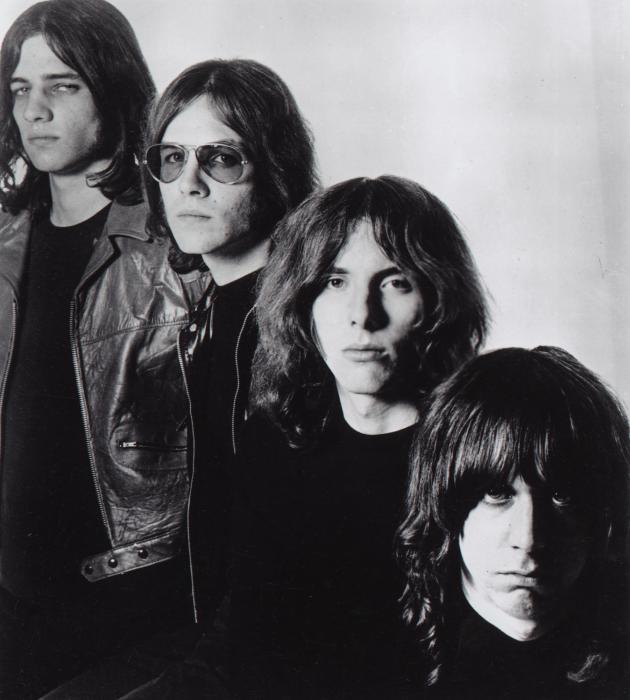
The Stooges

The Stooges, also known as Iggy and the Stooges, were an American rock band formed in Ann ArborMichigan in 1967 by singer Iggy Pop, guitarist Ron Asheton, drummer Scott Asheton, and bassist Dave Alexander. Playing a raw, primitive style of rock and roll, the band sold few records in their original incarnation and gained a reputation for their confrontational performances, which often involved acts of self-mutilation by Iggy Pop.[6]

The Stooges
The Stooges performing at the Hammersmith Apollo(2010)
Background information
Also known asIggy and the Stooges, Iggy Pop and the Stooges, the Psychedelic Stooges
OriginAnn ArborMichiganUnited States
GenresProto-punk garage rock[1] hard rock[2] punk rock[3] avant-punk[4]
Years active1967–1971 1972–1974 2003–2016[5]
LabelsElektra Columbia Virgin
Associated actsMC5 The Iguanas The New Order Minutemen Sonic’s Rendezvous BandDestroy All Monsters
Websitewww.iggyandthestoogesmusic.com
Past membersIggy PopScott AshetonRon AshetonDave AlexanderJames WilliamsonBill CheathamZeke ZettnerJimmy ReccaBob SheffScott ThurstonTornado TurnerSteve MackayMike WattToby Dammit

After releasing two albums—The Stooges (1969) and Fun House (1970)—the group disbanded briefly, and reformed with a different lineup to release Raw Power (1973) before breaking up again in 1974. The band reunited in 2003 until dissolving in 2016 following the deaths of Scott Asheton and saxophonist Steve Mackay. Ron Asheton participated in the reunion until his death in 2009.

The Stooges are widely regarded as a seminal proto-punk act.[6][7][8] The band was inducted into the Rock and Roll Hall of Fame in 2010.[9] In 2004, Rolling Stone ranked them 78th on their list of the 100 greatest artists of all time.

HistoryEdit

Formation (1967–68)Edit

Iggy Pop (born James Newell Osterberg) played drums in several Ann Arbor-area bands as a teenager, including the Iguanas and, later, the Prime Movers. The Prime Movers nicknamed Osterberg “Iggy” in reference to his earlier band.[10]

Osterberg was first inspired to form the Stooges after meeting blues drummer Sam Lay during a visit to Chicago. Upon returning to Detroit, Osterberg sought to create a new form of blues music that was not derivative of historical precedents.  Ron Asheton(guitar) and Scott Asheton (drums) and Dave Alexander (bass guitar) composed the rest of the band, with Osterberg as main singer. Osterberg became interested in Ron Asheton after seeing him perform in the Chosen Few (a covers band), believing “I’ve never met a convincing musician that didn’t look kind of ill and kind of dirty, and Ron had those two things covered!”[11] The three nicknamed Osterberg “Pop” after a local character whom Osterberg resembled.[12] Shortly after witnessing an MC5 concert in Ann Arbor, Osterberg began using the stage name Iggy Pop, a name that he has used ever since.

Though the Stooges had formed, Iggy Pop attributes two key motivating influences to move the band forward. The first was seeing the Doors perform at a homecoming dance for the University of Michigan. The second was seeing an all-girls rock band from Princeton, New Jersey called the Untouchable perform. In a 1995 interview with Bust Magazine, he relates:

The band’s 1967 debut was at their communal State Street house on Halloween night, followed by their next live gig, January 1968.[13] During this early period, the Stooges were originally billed as the “Psychedelic Stooges” at the Grande Ballroom in Detroit, Michigan, and other venues, where they played with the band MC5 and others. At one of their early Grande Ballroom performances, Asheton’s guitar neck separated from the body forcing the band to stop playing during the opening song, “I Wanna Be Your Dog“.

The group’s early sound differed from their later music; critic Edwin Pouncey writes:

First two albums and first breakup (1968–71)Edit

The Stooges soon gained a reputation for their wild, primitive live performances. Pop, especially, became known for his outrageous onstage behavior—smearing his bare chest with hamburger meat and peanut butter, cutting himself with shards of glass, and flashing his genitalia to the audience. Pop is sometimes credited with the invention or popularization of stage diving.

In 1968  Elektra Records sent DJ/publicist Danny Fields to scout the MC5, resulting in contracts for both that band and the Stooges. The contracts were at different pay rates: MC5 $20,000, the Stooges $5,000, as revealed in the 2016 Jim Jarmusch film, Gimme Danger. In 1969, the band released their self-titled debut album; sales were low and it was not well-received by critics at the time.

In 1970, their second album, Fun House, was released, featuring the addition of saxophonist Steve Mackay. On June 13 of that year, television recorded the band at the Cincinnati Pop Festival. While performing the songs “T.V. Eye” and “1970”, Pop leapt into the crowd, where he was hoisted up on people’s hands, and proceeded to smear peanut butter all over his chest. In a broadcast interview at WNUR Northwestern University radio station in Evanston, Illinois in 1984, Stiv Bators of the Lords of the New Church and the Dead Boys confirmed the long-standing rumor that it was he who had provided the peanut butter, having carried a large tub from his home in Youngstown, OH and handing it up to Iggy from the audience.

Fun House was also poorly received by critics and the general public. Alexander was dismissed in August 1970 after arriving at the Goose Lake International Music Festival too drunk to play.[15] He was replaced by a succession of new bass players, including former roadie Zeke Zettner[16] and James Recca. Around this time, the band expanded their line-up by adding a second guitar player, roadie Bill Cheatham,[10] who was eventually replaced by James Williamson, a childhood friend of the Ashetons and Alexander.

By this time, the Stooges, with the notable exception of Ron Asheton,[10][17] had all become serious heroinusers. The drug was introduced to the band by new manager John Adams.[10] Their performances became even more unpredictable, and Pop often had trouble standing up on stage due to his extreme drug abuse. Elektra soon eliminated the Stooges from its roster, and the band had a hiatus for several months. The final line-up was Pop, the Asheton brothers, Recca and Williamson.[10]

The breakup of the Stooges was formally announced on 9 July 1971.[18]

Raw Power and second breakup (1972–74)Edit

With the band having broken up, Pop met David Bowie on 7 September 1971 at Max’s Kansas City,[17][18] and the pair instantly became good friends. The next day, on the advice of Bowie, Pop signed a recording contract with pop music manager Tony DeFries‘ company, MainMan. A few months later, Tony DeFries and Pop met Clive Davis from CBS/Columbia Records and got a two-album recording deal.[18] In March 1972, DeFries brought Pop and Williamson to the UK,[18] and the pair attempted to reconstitute the Stooges with British musicians, but finding no suitable additions, brought the Asheton brothers back into the band (this “second choice” decision rankled Ron Asheton, as did his change from guitar to bass). This line-up, billed as Iggy & the Stooges, recorded their third album, the influential Raw Power, which was released in 1973.

At the time, the album (which showcased Williamson’s intensely melodic solos and chromatic riffs, in contrast to Asheton’s minimalistic, groove-oriented approach) was criticized by diehard fans who said that Bowie had mixed it poorly (in subsequent years, various unofficial fan recordings were assembled and released as the album Rough Power; in 1997, the album was re-mixed by Iggy Pop and re-released). Although the album sold rather poorly and was regarded as a commercial failure at the time of its release, Raw Power would go on to become one of the cornerstones of early punk rock.

With the addition of a piano player (briefly Bob Sheffand then Scott Thurston[10]), the Stooges toured for several months, starting in February 1973. Around this time they also made a number of recordings that became known as the Detroit Rehearsal Tapes, including a number of new songs that might have been included on a fourth studio album had the band not been dropped by Columbia soon after the release of Raw Power. In 1973, James Williamson was briefly dismissed due to criticism from the band’s management company (likely pertaining to his tempestuous relationship with Cyrinda Foxe, a close friend of road manager Leee Black Childers); guitarist Tornado Turner replaced him for a single gig (on 15 June 1973 at the Aragon Ballroom, ChicagoIllinois[19]), but Williamson soon returned to the group.[13]

The Stooges disbanded in February 1974 as a result of dwindling professional opportunities; this factor was compounded by Pop’s ever-present heroin addiction and erratic off-stage behavior.[13] The last half of the band’s last performance of this era (on 9 February 1974 in Detroit, Michigan) was captured and was released later (in 1976) as the live album Metallic K.O. (along with the first half of an earlier show on 6 October 1973 at the same venue). A 1988 expanded release of the album with the title Metallic 2X K.O. included the two halves of each show. In 1998, the album was re-released under the original title with the order of the shows reversed, (mostly) expanded tracks and more complete set-lists.

Members:

  • Iggy Pop
  • Ron Ashton
  • Scott Ashton
  • James Williamson
  • Dave Alexander

—-

—-

So messed up, I want you here
In my room, I want you here
Now we’re gonna be face-to-face
And I’ll lay right down in my favorite placeAnd now I want to be your dog
Now I want to be your dog
Well, come onNow I’m ready to close my eyes
And now I’m ready to close my mind
And now I’m ready to feel your hand
And lose my heart on the burning sandsAnd now I want to be your dog
And now I wanna be your dog
Now I want to be your dog
Well, come onSource: LyricFindSongwriters: Dave Alexander / Iggy Pop / Ron Asheton / Scott AshetonI Wanna Be Your Dog lyrics © Warner/Chappell Music, Inc, BMG Rights Management

Francis Schaeffer taught young people at L Abri in Switzerland in the 1950’s till the 1980’s (pictured below)

Image result for francis schaeffer labri

Francis Schaeffer noted:

They have gone to the end of this logically and they are not living in a romantic setting. They can’t find any meaning to life. It’s the meaning of the black plays. It’s the meaning of the words “punk rock.”

Francis Schaeffer pictured

—-

 “They are the natural outcome of a change from a Christian World View to a Humanistic one…
The result is a relativistic value system. A lack of a final meaning to life — that’s first. Why does human life have any value at all, if that is all that reality is? Not only are you going to die individually, but the whole human race is going to die, someday. It may not take the falling of the atom bombs, but someday the world will grow too hot, too cold. That’s what we are told on this other final reality, and someday all you people not only will be individually dead, but the whole conscious life on this world will be dead, and nobody will see the birds fly. And there’s no meaning to life.

As you know, I don’t speak academically, shut off in some scholastic cubicle, as it were. I have lots of young people and older ones come to us from the ends of the earth. And as they come to us, they have gone to the end of this logically and they are not living in a romantic setting. They realize what the situation is. They can’t find any meaning to life. It’s the meaning to the black poetry. It’s the meaning of the black plays. It’s the meaning of all this. It’s the meaning of the words “punk rock.” And I must say, that on the basis of what they are being taught in school, that the final reality is only this material thing, they are not wrong. They’re right! On this other basis there is no meaning to life and not only is there no meaning to life, but there is no value system that is fixed, and we find that the law is based then only on a relativistic basis and that law becomes purely arbitrary.

—-

Francis Schaeffer also observed:

The peak of the drug culture of the hippie movement was well symbolized by the movie Woodstock. Woodstock was a rock festival held in northeastern United States in the summer of 1969. The movie about that rock festival was released in the spring of 1970Many young people thought that Woodstock was the beginning of a newand wonderful age.

Jimi Hendrix (1942–1970himself was soon to become a symbol of the endBlackextremely talented, inhumanly exploited, he overdosed in September 1970 and drowned in his own vomit, soon after the claim that the culture of which he was a symbol was a new beginning. In the late sixties the ideological hopes based on drug-taking died.

After Woodstock two events “ended the age of innocence,” to use the expression of Rolling Stone magazine. The first occurred at Altamont, California, where the Rolling Stones put on a festival and hired the Hell’s Angels (for several barrels of beer) to police the grounds. Instead, the Hell’s Angels killed people without any cause, and it was a bad scene indeed. But people thought maybe this was a fluke, maybe it was just California! It took a second event to be convincing. On the Isle of Wight, 450,000 people assembled, and it was totally ugly. A number of people from L’Abri were there, and I know a man closely associated with the rock world who knows the organizer of this festival. Everyone agrees that the situation was just plain hideous.

(How Should We Then Live, pp. 209-210)

 In his book HOW SHOULD WE THEN LIVE? Francis Schaeffer noted:

This emphasis on hallucinogenic drugs brought with it many rock groups–for example, Cream, Jefferson Airplane, Grateful Dead, Incredible String Band, Pink Floyd, and Jimi Hendrix. Most of their work was from 1965-1958. The Beatles’Sergeant Pepper’s Lonely Hearts Club Band (1967) also fits here. This disc is a total unity, not just an isolated series of individual songs, and for a time it became the rallying cry for young people throughout the world. As a whole, this music was the vehicle to carry the drug culture and the mentality which went with it across frontiers which were almost impassible by other means of communication.

Here is a good review of the episode 016 HSWTL The Age of Non-Reason of HOW SHOULD WE THEN LIVE?, December 23, 2007:

Together with the advent of the “drug Age” was the increased interest in the West in  the religious experience of Hinduism and Buddhism. Schaeffer tells us that: “This grasping for a nonrational meaning to life and values is the central reason that these Eastern religions are so popular in the West today.”  Drugs and Eastern religions came like a flood into the Western world.  They became the way that people chose to find meaning and values in life.  By themselves or together, drugs and Eastern religion became the way that people searched inside themselves for ultimate truth.

Along with drugs and Eastern religions there has been a remarkable increase “of the occult appearing as an upper-story hope.”  As modern man searches for answers it “many moderns would rather have demons than be left with the idea that everything in the universe is only one big machine.”  For many people having the “occult in the upper story of nonreason in the hope of having meaning” is better than leaving the upper story of nonreason empty. For them horror or the macabre are more acceptable than the idea that they are just a machine.

Francis Schaeffer has correctly argued:

The universe was created by an infinite personal God and He brought it into existence by spoken word and made man in His own image. When man tries to reduce [philosophically in a materialistic point of view] himself to less than this [less than being made in the image of God] he will always fail and he will always be willing to make these impossible leaps into the area of nonreason even though they don’t give an answer simply because that isn’t what he is. He himself testifies that this infinite personal God, the God of the Old and New Testament is there. 

The Stooges sang:

Now I’m ready to close my eyes
And now I’m ready to close my mind

Instead of making a leap into the area of nonreason the better choice would be to investigate the claims that the Bible is a historically accurate book and that God created the universe and reached out to humankind with the Bible. Below is a piece of that evidence given by Francis Schaeffer concerning the accuracy of the Bible.

TRUTH AND HISTORY (chapter 5 of WHATEVER HAPPENED TO THE HUMAN RACE?, under footnotes #97 and #98)

A common assumption among liberal scholars is that because the Gospels are theologically motivated writings–which they are–they cannot also be historically accurate. In other words, because Luke, say (when he wrote the Book of Luke and the Book of Acts), was convinced of the deity of Christ, this influenced his work to the point where it ceased to be reliable as a historical account. The assumption that a writing cannot be both historical and theological is false.

The experience of the famous classical archaeologist Sir William Ramsay illustrates this well. When he began his pioneer work of exploration in Asia Minor, he accepted the view then current among the Tubingen scholars of his day that the Book of Acts was written long after the events in Paul’s life and was therefore historically inaccurate. However, his travels and discoveries increasingly forced upon his mind a totally different picture, and he became convinced that Acts was minutely accurate in many details which could be checked.

What is even more interesting is the way “liberal” modern scholars today deal with Ramsay’s discoveries and others like them. In the NEW TESTAMENT : THE HISTORY OF THE INVESTIGATION OF ITS PROBLEMS, the German scholar Werner G. Kummel made no reference at all to Ramsay. This provoked a protest from British and American scholars, whereupon in a subsequent edition Kummel responded. His response was revealing. He made it clear that it was his deliberate intention to leave Ramsay out of his work, since “Ramsay’s apologetic analysis of archaeology [in other words, relating it to the New Testament in a positive way] signified no methodologically essential advance for New Testament research.” This is a quite amazing assertion. Statements like these reveal the philosophic assumptions involved in much liberal scholarship.

A modern classical scholar, A.N.Sherwin-White, says about the Book of Acts: “For Acts the confirmation of historicity is overwhelming…Any attempt to reject its basic historicity, even in matters of detail, must not appear absurd. Roman historians have long taken this for granted.”

When we consider the pages of the New Testament, therefore, we must remember what it is we are looking at. The New Testament writers themselves make abundantly clear that they are giving an account of objectively true events.

(Under footnote #98)

Acts is a fairly full account of Paul’s journeys, starting in Pisidian Antioch and ending in Rome itself. The record is quite evidently that of an eyewitness of the events, in part at least. Throughout, however, it is the report of a meticulous historian. The narrative in the Book of Acts takes us back behind the missionary journeys to Paul’s famous conversion on the Damascus Road, and back further through the Day of Pentecost to the time when Jesus finally left His disciples and ascended to be with the Father.

But we must understand that the story begins earlier still, for Acts is quite explicitly the second part of a continuous narrative by the same author, Luke, which reaches back to the birth of Jesus.

Luke 2:1-7 New American Standard Bible (NASB)

2 Now in those days a decree went out from Caesar Augustus, that a census be taken of all [a]the inhabited earth. [b]This was the first census taken while[c]Quirinius was governor of Syria. And everyone was on his way to register for the census, each to his own city. Joseph also went up from Galilee, from the city of Nazareth, to Judea, to the city of David which is called Bethlehem, because he was of the house and family of David, in order to register along with Mary, who was engaged to him, and was with child. While they were there, the days were completed for her to give birth. And she gave birth to her firstborn son; and she wrapped Him in cloths, and laid Him in a [d]manger, because there was no room for them in the inn.

In the opening sentences of his Gospel, Luke states his reason for writing:

Luke 1:1-4 New American Standard Bible (NASB)

1 Inasmuch as many have undertaken to compile an account of the things[a]accomplished among us, just as they were handed down to us by those whofrom the beginning [b]were eyewitnesses and [c]servants of the [d]word, it seemed fitting for me as well, having [e]investigated everything carefully from the beginning, to write it out for you in consecutive order, most excellentTheophilus; so that you may know the exact truth about the things you have been [f]taught.

In Luke and Acts, therefore, we have something which purports to be an adequate history, something which Theophilus (or anyone) can rely on as its pages are read. This is not the language of “myths and fables,” and archaeological discoveries serve only to confirm this.

For example, it is now known that Luke’s references to the titles of officials encountered along the way are uniformly accurate. This was no mean achievement in those days, for they varied from place to place and from time to time in the same place. They were proconsuls in Corinth and Cyprus, asiarchs at Ephesus, politarches at Thessalonica, and protos or “first man” in Malta. Back in Palestine, Luke was careful to give Herod Antipas the correct title of tetrarch of Galilee. And so one. The details are precise.

The mention of Pontius Pilate as Roman governor of Judea has been confirmed recently by an inscription discovered at Caesarea, which was the Roman capital of that part of the Roman Empire. Although Pilate’s existence has been well known for the past 2000 years by those who have read the Bible, now his governorship has been clearly attested outside the Bible.

Related posts

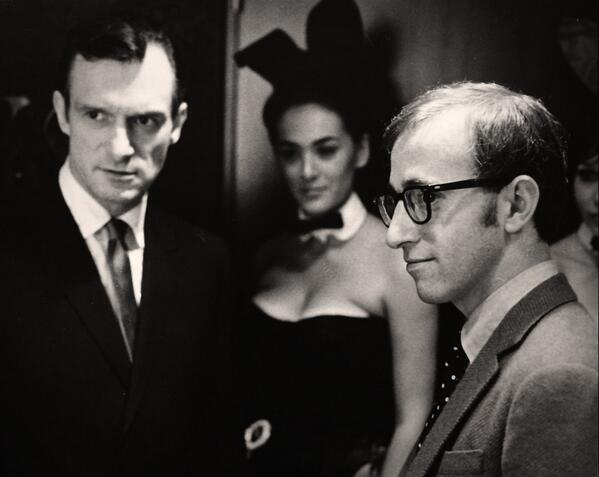
FRANCIS SCHAEFFER ANALYZES ART AND CULTURE Part 280 My April 29, 2016 Letter to Hugh Hefner commenting on his quote “I don’t know if I am very good at marriage or not. I never have been in a situation where I had a chance to find out, but I am certainly good at romance and it is love I am looking for” (Featured artist is Robert Mangold)

_

—-

Image result for hugh hefner younger days

Over and over I have read that Hugh Hefner was a modern day King Solomon and Hefner’s search for satisfaction was attempted by adding to the number of his sexual experiences.

Pastor Jamie Smedsrud noted:
King Solomon had more money than Bill Gates, more girls than Hugh Hefner, more power than any other person. He tried it all and had it all. But near the end of his life he said that it was all like “chasing the wind.”

Many of the sermons that I heard or read that inspired me to write Hugh Hefner were from this list of gentlemen:  Daniel Akin, Brandon Barnard, Alistair Begg, Matt Chandler, George Critchley,  Darryl Dash, Steve DeWitt, Steve Gaines, Norman L. Geisler, Greg Gillbert, Billy Graham, Mark Henry, Dan Jarrell, Walter C. Kaiser, Jr., R. G. Lee, C.S. Lewis Chris Lewis, Kerry Livgren, Robert Lewis,    Bill Parkinson, Ben Parkinson,Vance Pitman, Nelson Price, Ethan Renoe, Adrian Rogers, Philip Graham Ryken, Francis Schaeffer, Lee Strobel, Bill Wellons, Kirk Wetsell,  Ken Whitten, Ed Young ,  Ravi Zacharias, Tom Zobrist, and Richard Zowie.

_

Image result for adrian rogers

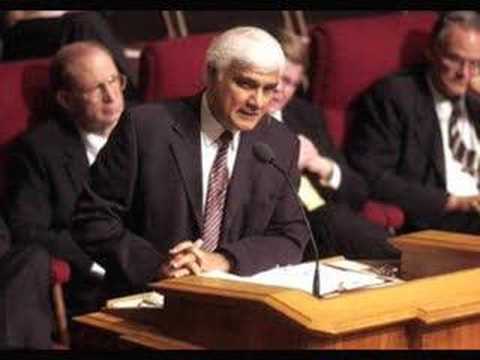
In this letter below I quoted the sermon outline from Adrian Rogers when I wrote, “Hugh you remind me of Solomon because you are looking for  lasting meaning in your life and you are looking in the same  6 areas that King Solomon did in what I call the 6 big L words. He looked into  learning (1:16-18), laughter, ladies,luxuries,  and liquor (2:1-3, 8, 10, 11), and labor (2:4-6, 18-20).” I also quoted Ravi Zacharias when I wrote, “The key to understanding the Book of Ecclesiastes is the term UNDER THE SUN — What that literally means is you lock God out of a closed system and you are left with only this world of Time plus Chance plus matter.”

Image result for ravi zacharias ecclesiastes

_

Dan Jarrell pictured below:

Image result for FELLOWSHIP BIBLE CHURCH DAN JARRELL

________

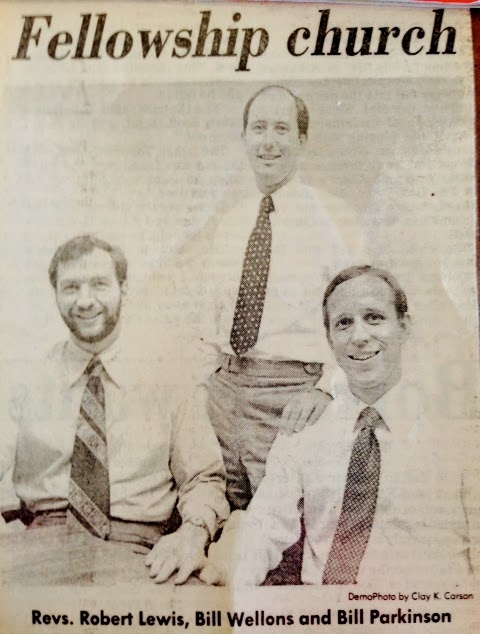
Image result for robert lewis bill parkinson

__

Robert Lewis pictured below:

Image result for robert lewis fellowship bible church

Bill Wellons pictured below:

Image result for bill wellons fellowship bible church

Bill Parkinson pictured below

Image result for bill parkinson fellowship bible church

_

Much of the material for the 2 letters below was taken from a 1996 sermon on the Book of Ecclesiastes by Robert Lewis at FELLOWSHIP BIBLE CHURCH in Little Rock.

April 29, 2016

Hugh Hefner
Playboy Mansion  
10236 Charing Cross Road
Los Angeles, CA 90024-1815

Dear Mr. Hefner,

I know that you are a big fan of the Beatles and they have been big fans of yours over the years. In fact, I was told that both Ringo and John were visitors to your Playboy Mansion. Looking back at the Beatles’ lives it is obvious that they all went through a time in the 1960’s when they tried the playboy lifestyle but they all chose later to be in committed marriages.

On You Tube in the video Paul McCartney (1/9) – Wingspan at 5:18 mark Paul said At a  a certain age you start to think “Wow, I have to get serious. I can’t just be a playboy all of my life.”  Paul went on to marry Linda Eastman and they stayed together until her death April 17, 1998. They were married almost 30 years and had three children together ( Mary Anna, Stella Nina, and James Louis) plus Paul adopted Heather Louise who had been born earlier.

The difference in the hard work it takes to make a  marriage work with one lady versus the laziness involved with just trying to maximize the amount of sex you get with various women is very real. Both you and King Solomon can say that you both have bedded over 1000 women but Francis Schaeffer rightly noted, “You can not know woman by knowing 1000 women.”

In the You Tube video Ask Hef Anything: Breakup with Holly you asserted: “We (Holly and I) had just celebrated our 7th anniversary together and maybe the natural cycle of relationships is they wear out at the end of 7 years. They talk about a 7 year itch….Kimberly is a wonderful mother but she is not very good at marriage. I don’t know if I am very good at marriage or not. I never have been in a situation where I had a chance to find out, but I am certainly good at romance and it is love I am looking for.”

I SEE SO MANY SIMILARITIES BETWEEN YOU AND KING SOLOMON WITH THAT COMMENT.

Ecclesiastes 2:8-9The Message (MSG)

I piled up silver and gold,
        loot from kings and kingdoms.
I gathered a chorus of singers to entertain me with song,
    and—most exquisite of all pleasures—
    voluptuous maidens for my bed.

1 Kings 11:1-3 English Standard Version (ESV)

11 Now King Solomon loved many foreign women, He had 700 wives, who were princesses, and 300 concubines. And his wives turned away his heart.

King Solomon in Ecclesiastes 2:11 sums up his search for meaning in the area of the Sexual Revolution with these words, “…behold, all was vanity and a striving after wind, and there was nothing to be gained UNDER THE SUN.”

You like Solomon have defined your life by the volume of sex that you have had and you both have entered your last years with regrets.

A while back I sent you the sermon THE PLAYBOY’S PAYDAY  by Adrian Rogers and that  sermon was based on the fifth chapter of Proverbs which I want to encourage you to read today. Rogers went on to say that the playboy lifestyle was bankrupt of lasting satisfaction and that God’s plan of marriage was best. In fact, the Book of Ecclesiastes shows that Solomon came to the conclusion that nothing in life gives true satisfaction without God including knowledge (1:16-18), ladies and liquor (2:1-3, 8, 10, 11), and great building projects (2:4-6, 18-20)

HUGH, I have just got finished writing a letter to Paul McCartney since he is coming to Little Rock this week to do a concert that I will attending. In this letter I did refer to you several times and I have enclosed a copy for you to see.

The answer to find meaning in life is found in putting your faith and trust in Jesus Christ. The Bible is true from cover to cover and can be trusted.

Thanks for your time.

Sincerely,

Everette Hatcher, everettehatcher@gmail.com, http://www.thedailyhatch.org, cell ph 501-920-5733, Box 23416, LittleRock, AR 72221

PS: This is the 33rd letter I have written to you and I have again responded to a quote that you had made earlier.

RINGO, HEF AND BARBIE:

__

Art attack ... (l-r) tycoon Hefner, a Matisse and Lennon

Art attack … (l-r) tycoon Hefner, a Matisse and Lennon put his cigarette out in the Matisse picture while visiting the Playboy Mansion
Lennon picture: REX

Paul McCartney  Wingspan – talking with Mary on You Tube

Below Francis Schaeffer holds up Beatles SGT PEPPER album during the film HOW SHOULD WE THEN LIVE? Episode 7

Francis Schaeffer below in HOW SHOULD WE THEN LIVE? film series

Marilyn Monroe was featured on cover of SGT PEP, just one of the 6 sex symbols who made it on the cover

Hugh Hefner makes cameo appearance in Mel Brooks movie THE HISTORY OF THE WORLD PART ONE and he says, “I am very excited about it. It is a new concept. It is called a centerfold.”

King Solomon wrote the Book of Ecclesiates

__

April 25, 2016

Paul McCartney
MPL Music Publishing, Inc.
41 West 54th Street
New York, NY 10019-5404

Dear Paul,

My family and I are really thrilled that you are performing in Little Rock on April 30th and we will be the first to be seated that day when the doors are open. I wanted to say how much we respect you as a family man, but we were starting to wonder in the 1960’s how you would eventually live your life. This letter today was taken mostly from my recent blog post at http://www.thedailyhatch.org on the Beatles and the 1960’s sexual revolution. 

Something happened to the Beatles in their journey through the 1960’s and although they started off wanting only to hold their girlfriend’s hand it later evolved into wanting to smash all previous sexual standards. This sounds like what Hugh Hefner set out to do also with his Playboy Clubs. Francis Schaeffer has rightly noted  that Hefner’s goal  with the “playboy mentality is just to smash the puritanical ethnic.”No wonder Ringo Starr and John Lennon were later visitors at the Playboy Mansion. 

This climaxed in 1968 with these words: Why don’t we do it in the road?, No one will be watching us, Why don’t we do it in the road?

On You Tube in the video Paul McCartney (1/9) – Wingspan at 5:18 mark you said At a  a certain age you start to think “Wow, I have to get serious. I can’t just be a playboy all of my life.” HERE YOU ARE SHOWING HOW EMPTY YOU FOUND THE PLAYBOY EXPERIENCE AND HOW YOU WANTED SOMETHING MORE MEANINGFUL!!!!!!!!

During the 1960’s the Beatles were searching for a lasting meaning for their lives and they wanted to see if the Sexual Revolution of the 1960’s was a piece of the puzzle that was missing for them.  No wonder in the video THE AGE OF NON-REASON (Episode 7 of HOW SHOULD WE THEN LIVE?) Francis Schaeffer noted,  ” Sergeant Pepper’s Lonely Hearts Club Band…for a time it became the rallying cry for young people throughout the world. It expressed the essence of their lives, thoughts and their feelings.” 

Paul I want to encourage you to go to You Tube and look up the video How Should We then Live Episode 7 small which is only 28:35 long and watch it. 

When I think of the Beatles’ efforts to find meaning for the lives in the 1960’s it reminds me of King Solomon in the Book of Ecclesiastes.  Three thousand years ago, Solomon took a look at life “UNDER THE SUN” in his book of Ecclesiastes. Christian scholar Ravi Zacharias has noted, “The key to understanding the Book of Ecclesiastes is the term ‘UNDER THE SUN.’ What that literally means is you lock God out of a closed system, and you are left with only this world of time plus chance plus matter.” 

HERE BELOW IS SOLOMON’S SEARCH IN THE AREA OF THE 6 “L” WORDS. He looked into  learning (1:16-18), laughter, ladies, luxuries,  and liquor (2:1-3, 8, 10, 11), and labor (2:4-6, 18-20). TODAY WE WANT TO LOOK AT SOLOMON’S SEARCH INTO THE WORD “LADIES.”

Ecclesiastes 2:8-10The Message (MSG)

I piled up silver and gold,
        loot from kings and kingdoms.
I gathered a chorus of singers to entertain me with song,
    and—most exquisite of all pleasures—
    voluptuous maidens for my bed.

9-10 Oh, how I prospered! I left all my predecessors in Jerusalem far behind, left them behind in the dust. What’s more, I kept a clear head through it all. Everything I wanted I took—I never said no to myself. I gave in to every impulse, held back nothing. I sucked the marrow of pleasure out of every task—my reward to myself for a hard day’s work!

1 Kings 11:1-3 English Standard Version (ESV)

11 Now King Solomon loved many foreign women, along with the daughter of Pharaoh: Moabite, Ammonite, Edomite, Sidonian, and Hittite women, from the nations concerning which the Lord had said to the people of Israel, “You shall not enter into marriage with them, neither shall they with you, for surely they will turn away your heart after their gods.” Solomon clung to these in love. He had 700 wives, who were princesses, and 300 concubines. And his wives turned away his heart.

Francis Schaeffer observed concerning Solomon, “You can not know woman by knowing 1000 women.”

King Solomon in Ecclesiastes 2:11 sums up his search for meaning in the area of the Sexual Revolution with these words, “…behold, all was vanity and a striving after wind, and there was nothing to be gained UNDER THE SUN.”

 Adrian Rogers said in sermon, “Playboy’s Payday,” these words:

Do you know what Hugh Hefner said on another occasion? He was reminiscing. Here is this guy who has all of these girls around  him, all of this booze, all of these casinos and presumably can have any   sensual pleasure he wants. He said, You know, in the next ten years I would rather meet a girl and fall in love and have her fall in love with me than to make another one hundred million dollars.   But I fear the man doesn’t know what love is.  I feel that he’s missed it.  What he’s saying is, I’ve got it all, but I don’t have satisfaction!  There’s something that’s worth more than a hundred million dollars to me, and I don’t have it!

Marilyn Monroe, the sex goddess who took her own life, said, “I hate sex.”  Everybody says, “Oh, look at the pleasure that she’s having.” 

Adrian Rogers’ sermon was based on the fifth chapter of Proverbs which I want to encourage you to read today. Rogers went on to say that the playboy lifestyle was bankrupt of lasting satisfaction and that God’s plan of marriage was best. In fact, the Book of Ecclesiastes shows that Solomon came to the conclusion that nothing in life gives true satisfaction without God including knowledge (1:16-18), ladies and liquor (2:1-3, 8, 10, 11), and great building projects (2:4-6, 18-20). You can only find a lasting meaning to your life by looking above the sun and bring God back into the picture.

Solomon’s experiment was a search for meaning to life “under the sun.” Then in last few words in the Book of Ecclesiastes he looks above the sun and brings God back into the picture: “The conclusion, when all has been heard, is: Fear God and keep His commandments, because this applies to every person. For God will bring every act to judgment, everything which is hidden, whether it is good or evil.”

In the History Channel TV Special (about Hugh Hefner’s Playboy Lifestyle)  “HOW PLAYBOY CHANGED THE WORLD” at the 49 min mark the narrator says “The so-called WAGES OF SIN were now paying off.” This was referring to the growth in profits at  PLAYBOY MAGAZINE. The narrator turned  Romans 6:23 totally around when it really says, “FOR THE WAGES OF SIN IS DEATH; but the gift of God is eternal life through Jesus Christ our Lord.” However, Galatians 6:7 asserts, “Be not deceived, for God is not mocked. Whatsoever man soweth, that shall he also reap.”

Robert Lewis pictured below:

Image result for robert lewis fellowship bible church

Robert Lewis on 4-14-96 as a teaching pastor at FELLOWSHIP BIBLE CHURCH in Little Rock delivered a sermon entitled LIFE UNDER THE SUN which was based on Ecclesiastes chapters 1 and 2. Here is a portion of that sermon below:

Solomon wanted to know the meaning of life beyond God in this world. So he tried to live life at the edge or the extreme so to report not like a philosopher in a ivory tower, but he wanted to do that by putting himself personally into these pursuits to see IS THERE ANY OTHER MEANING IN LIFE BESIDES GOD. This is really what he tries to do. Ecclesiastes 1:13, “And I set my mind to seek and explore by wisdom concerning all that has been done under heaven.” The word SEEK means to do rigorous research and that is what he has done. 

The word EXPLORE means to examine all sides of things and he didn’t do that just as Lab Technician, but Solomon did it the old fashion way. He got personally involved. He researched every category as far as it could go in order to know everything about life. So he didn’t talk about materialism but he became the ultimate materialist...He became the ultimate hedonist. You want to know about sex? Solomon can tell you everything about it….UNDER THE SUN there is no real meaning in any of it. The best life can do is keep delivering to you the empty promise that if you have something else then you will be happy, but the curse is when you get it. Ecclesiastes 2:17, “So I hated life, for the work which had been done under the sun was grievous to me; because everything is futility and striving after wind.”

I befriended a man several years ago who was a kind of real Little Rock PLAYBOY. In fact, his lifestyle and sexual escapades were legendary around the city. He was rich, single, hansom and very sophisticated. He told me, “A woman any night and anything your mind can imagine.” Where did it lead him? Ultimately it led him to a hotel in Little Rock where he put a gun in his mouth because to have it all is to find out it is empty.  

Image result for robert lewis men's fraternity

Let’s go back to Romans 6:23, “For the wages of sin is death; but the GIFT OF GOD IS ETERNAL LIFE THROUGH JESUS CHRIST OUR LORD.” The meaning of this verse was distorted in the film “HOW PLAYBOY CHANGED THE WORLD” about Hugh Hefner’s life. Did you know that Romans 6:23 is part of what we call the Roman Road to Christ. Here is how it goes:

  • Because of our sin, we are separated from God.
    For all have sinned and fall short of the glory of God.  (Romans 3:23)
  • The Penalty for our sin is death.
    For the wages of sin is death, but the gift of God is eternal life in Jesus Christ our Lord. (Romans 6:23)
  • The penalty for our sin was paid by Jesus Christ!
    But God demonstrates His own love toward us, in that while we were yet sinners, Christ died for us. (Romans 5:8)
  • If we repent of our sin, then confess and trust Jesus Christ as our Lord and Savior, we will be saved from our sins!
    For whoever calls on the name of the Lord shall be saved.  (Romans 10:13)
    …if you confess with your mouth the Lord Jesus and believe in your heart that God has raised Him from the dead, you will be saved. For with the heart one believes unto righteousness, and with the mouth confession is made unto salvation. (Romans 10:9,10)

The answer to find meaning in life is found in putting your faith and trust in Jesus Christ. The Bible is true from cover to cover and can be trusted.

Thanks for your time.

Sincerely,

Everette Hatcher, everettehatcher@gmail.com, http://www.thedailyhatch.org, cell ph 501-920-5733, Box 23416, LittleRock, AR 72221

Featured artist is Robert Mangold

Robert Mangold was born in North Tonawanda, New York in 1937. With classical restraint, Mangold translates the most basic of formal elements—shape, line, and color—into paintings, prints, and drawings whose simplicity of form expresses complex ideas. He renders the surface of each canvas with subtle color modulations and sinewy, hand-drawn graphite lines. While his focus on formal considerations may seem paramount, he also delights in thwarting those considerations—setting up problems for the viewer.

Over the course of years and in multiple series of shaped canvases that explore variations on rings, columns, trapezoids, arches, and crosses, he has also provoked viewers to consider the idea of paintings without centers. In addition to works on paper, and canvases whose physicality relates to the scale of the human body, Mangold has also worked in stained glass for architectural projects.

Robert Mangold received a BFA and MFA from Yale University (1963). He has been inducted into the National Academy (2005) and American Academy of Arts and Letters (2001), and has received many awards including the Jawlensky-Preis der Stadt Wiesbaden Award (1998); the Skowhegan Medal for Painting (1993); and a National Endowment for the Arts Grant (1967).

His work has appeared in major exhibitions at Documenta (1972, 1977, 1982); the Whitney Biennial (1979, 1983, 1985, 2004); and the Venice Biennale (1993). His works are in the public collections of the Art Institute of Chicago; J. Paul Getty Trust; Solomon R. Guggenheim Museum; Hirshhorn Museum and Sculpture Garden; Museum of Contemporary Art, Los Angeles; Museum of Modern Art, New York; National Gallery of Art, Washington, D.C.; and Whitney Museum of American Art, among many others. Robert Mangold lives and works in Washingtonville, New York.

Related posts:

MY 4 POSTCARDS IN 2017 FROM NEW ORLEANS  TO HUGH HEFNER (PART 4)

October 18, 2017 – 4:16 am

I started this series on my letters and postcards to Hugh Hefner back in September when I read of the passing of Mr. Hefner. There are many more to come. It is my view that he may have taken time to look at glance at one or two of them since these postcards were short and from one of Hef’s favorite […] By Everette Hatcher III | Posted in Atheists Confronted | Edit | Comments (0)

MY 8 POSTCARDS IN 2017 FROM NEW ORLEANS TO HUGH HEFNER (PART 3)

October 17, 2017 – 4:15 am

I started this series on my letters and postcards to Hugh Hefner back in September when I read of the passing of Mr. Hefner. There are many more to come. It is my view that he may have taken time to look at glance at one or two of them since these postcards were short and from one of Hef’s favorite […] By Everette Hatcher III | Posted in Atheists Confronted | Edit | Comments (0)

MY 8 POSTCARDS IN 2017 FROM NEW ORLEANS TO HUGH HEFNER (PART 2)

October 16, 2017 – 4:08 am

I started this series on my letters and postcards to Hugh Hefner back in September when I read of the passing of Mr. Hefner. There are many more to come. It is my view that he may have taken time to look at glance at one or two of them since these postcards were short and from one of Hef’s favorite […] By Everette Hatcher III | Posted in Atheists Confronted | Edit | Comments (0)

MY 8 POSTCARDS IN 2017 FROM NEW ORLEANS  TO HUGH HEFNER (PART 1)

October 13, 2017 – 4:07 am

  I started this series on my letters and postcards to Hugh Hefner back in September when I read of the passing of Mr. Hefner. There are many more to come. It is my view that he may have taken time to look at glance at one or two of them since these postcards were short and from one of Hef’s […] By Everette Hatcher III | Posted in Francis Schaeffer | Edit | Comments (0)

MY 4 POSTCARDS IN 2016 FROM VEGAS TO HUGH HEFNER (PART 4)

October 12, 2017 – 1:05 am

_   I started this series on my letters and postcards to Hugh Hefner back in September when I read of the passing of Mr. Hefner. There are many more to come. It is my view that he may have taken time to look at glance at one or two of them since these postcards were short and from one of […] By Everette Hatcher III | Posted in Atheists Confronted | Edit | Comments (0)

MY 4 POSTCARDS IN 2016 FROM VEGAS TO HUGH HEFNER (PART 3)

October 11, 2017 – 4:54 am

_____ I started this series on my letters and postcards to Hugh Hefner back in September when I read of the passing of Mr. Hefner. There are many more to come. It is my view that he may have taken time to look at glance at one or two of them since these postcards were short and from one of Hef’s […] By Everette Hatcher III | Posted in Atheists Confronted | Edit | Comments (0)

MY 4 POSTCARDS IN 2016 FROM VEGAS TO HUGH HEFNER (PART 2)

October 10, 2017 – 4:48 am

_____ I started this series on my letters and postcards to Hugh Hefner back in September when I read of the passing of Mr. Hefner. There are many more to come. It is my view that he may have taken time to look at glance at one or two of them since these postcards were […] By Everette Hatcher III | Posted in Atheists Confronted | Edit | Comments (0)

MY 4 POSTCARDS IN 2016 FROM VEGAS TO HUGH HEFNER (PART 1)

October 9, 2017 – 3:29 am

_____ I started this series on my letters and postcards to Hugh Hefner back in September when I read of the passing of Mr. Hefner. There are many more to come. It is my view that he may have taken time to look at glance at one or two of them since these postcards were […] By Everette Hatcher III | Posted in Adrian RogersAtheists Confronted | Edit | Comments (0)

The last 3 letters I wrote to Hugh Hefner compared him to King Solomon in Ecclesiastes and his search for the meaning of it all!!! (Part 3)

September 29, 2017 – 10:30 am

|I saw this on the internet on  June 20, 2017   _   Playboy’s Hugh Hefner on board a boat with Barbi Benton and friends sporting a striped navy shirt and a pipe in mouth and a real catch in hand during the 70s. ____________________________________ Below is the last letter I ever wrote to Hugh Hefner. […] By Everette Hatcher III | Posted in Adrian RogersAtheists ConfrontedFrancis Schaeffer | Edit |Comments (0)

The last 3 letters I wrote to Hugh Hefner compared him to King Solomon in Ecclesiastes and his search for the meaning of it all!!! (Part 2)

September 28, 2017 – 7:33 pm

I learned yesterday that Hugh Hefner had passed away. Just last year I visited Chicago and drove by his Chicago Playboy Mansion pictured below. ___   Playboy after dark filmed in Chicago Playboy Mansion   During the 1990′s I actually made it a practice to write famous atheists and scientists that were mentioned by Adrian […] By Everette Hatcher III | Posted in Atheists ConfrontedFrancis SchaefferMilton Friedman | EditComments (0)

_

Church and State: The Separation Illusion By Greg Koukl

—-

Church and State: The Separation Illusion

Greg Koukl

The goal of First Amendment was to protect religious expression, not restrict it. In the last 50 years, though, “non-establishment” has been redefined as “separation,” effectively amending the Constitution and isolating Christians from the political process.

“Will You Be a Casualty in Their Religious War?” read the headline of an advertisement that almost covered an entire page of the L.A. Times. Underneath were pictures of Jerry Falwell, Pat Robertson, and Lou Sheldon, along with condemning quotes substantiating their apparent jihad against irreligious secularists.

The text of the advertisement read:

“The radical religious right has declared war on America. It is a war of ideas. A war of conscience. It’s a religious war. This war strikes at the very heart of our Constitution and threatens the freedoms we hold most dear. Freedom to worship as we please and to believe what we want to believe. The freedom to determine for ourselves what religious and moral views our own children are exposed to. The freedom to conduct our lives as we see fit without having our privacy violated. For some time now, the radical religious right has claimed that there is no such thing as church/state separation in our Constitution. They are wrong. Find out why.”

It goes on to promote a book by Robert Boston entitled Why the Religious Right Is Wrong About Separation of Church and State. [Robert Boston, Why the Religious Right Is Wrong About Separation of Church and State, (Buffalo, NY: Prometheus Books, 1993).]

The ad is correct on a couple of points. There is a sense in which the “religious right” is at war, but the battle is not against America, it’s about America. And it is a war of ideas: Is there a legitimate separation of church and state, and what does that mean?

The current understanding of “separation of church and state”–the view that the state is thoroughly secular and not influenced by religious values, especially Christian–was completely foreign to the first 150 years of American political thought. Clearly the Fathers did not try to excise every vestige of Christian religion, Christian thought, and Christian values from all facets of public life. They were friendly to Christianity and encouraged its public practice and expression.

It wasn’t until 1947 that the United States Supreme Court first used the concept of “separation” to isolate government from religion.[The phrase was mentioned once before in the discourse of the Court in the 1878 case of Reynolds v. The United States when Mormons attempted an unsuccessful defense of polygamy based on the non-establishment clause of the First Amendment. The non-establishment clause protected Mormon beliefs, not Mormon practices (e.g., polygamy). This conduct was still proscribed by prevailing morality, specifically Christian morality.] In Everson v. Board of Education, the court lifted a phrase from a letter Thomas Jefferson wrote to a Baptist church in Danbury, Connecticut. The Court ruled, “Neither a state nor the Federal Government can set up a church. Neither can pass laws which aid one religion, aid all religions, or prefer one religion over another….In the words of Jefferson, the clause against establishment of religion by law was intended to erect ‘a wall of separation between church and state.’” [Everson v. Board of Education, 330 U.S at 15-16 (1947).]

The Infamous Danbury Letter

In the Everson v. Board of Education decision, the Supreme Court quoted Jefferson’s separation language as a normative guideline for understanding the First Amendment. As David Barton points out, “There’s probably no other instance in America’s history where words spoken by an individual have become the law of the land. Jefferson’s remark now carries more weight in judicial circles than does the writing of any other Founder.” [David Barton, The Myth of Separation, (Aledo, TX: WallBuilder Press), p. 44.]

Thomas Jefferson wasn’t a member of the Constitutional Convention, and the phrase “separation of church and state” does not appear anywhere in the Constitution or the Bill of Rights. Where did it come from?

On January 1, 1802, Jefferson wrote a letter to the Danbury Baptist Association of Danbury, Connecticut, in which he used the phrase “a wall of separation between church and state.” His note was meant to quell the fears of the Danbury congregation who were concerned that a national denomination would be established. Here is the text in question:

I contemplate with solemn reverence that act of the whole American people which declared that their legislature should ‘make no law respecting an establishment of religion, or prohibiting the free exercise thereof,’ thus building a wall of separation between church and state. [Thomas Jefferson, Jefferson Writings, Merrill D. Peterson, ed. (NY: Literary Classics of the United States, Inc., 1984), p. 510, January 1, 1802.]

What did Jefferson have in mind here? Is there an impregnable barrier erected by the founders [Note that the word “founders” is not capitalized here because I’m not referring to the 55 members of the Constitutional Convention, but to the broader group responsible for the passage of the Bill of Rights.] that excludes religious-minded people from the political process, an ideological enmity between church and state?

The First Amendment

In contrast to the present confusion about separation, the First Amendment is startling in its clarity, offering no limit to the impact of religious and moral conviction of individual citizens on public policy. It is worth reading often. Here it is:

Congress shall make no law respecting an establishment of religion, or prohibiting the free exercise thereof; or abridging the freedom of speech, or of the press; or the right of the people peaceably to assemble, and to petition the Government for a redress of grievances.

Please forgive me for stating the obvious: The First Amendment restricts the government, not the people. Jefferson’s wall is a one-way wall. Any religious person, any religious organization, any religious conviction has its place in the public debate. It’s called pluralism in the classic sense.

Notice there are not two distinct provisions here, but one. Non-establishment has no purpose by itself. Freedom of religion is the goal, and non-establishment is the means. The only way to have true freedom of religion is to keep government out of religion’s affairs. This provides for what Steven Monsma calls “positive neutrality.” This view “defines religious freedom in terms of a governmental neutrality toward religion in which no religion is favored over any other, and neither religion nor secularism is favored over each other.” [Stephen Monsma, Positive Neutrality–Letting Religious Freedom Ring, (Grand Rapids: Baker, 1993), p. 203.]

The First Amendment was rewritten twelve times to make clear its intent. The concept set forth in the Bill of Rights is “non-establishment,” not isolation. We should strike the “separation” language from our vocabulary.

A Fatal Flaw

The constant appeal to Jefferson’s Danbury letter by hard core separationists reveals a fatal flaw in their approach. Quoting Jefferson’s opinion only matters if Jefferson’s original intent still applies today. If it doesn’t, then the Danbury citation is irrelevant. If it does, then Jefferson’s full views on the issue have merit in this discussion.

It’s clear, though, that the Everson Court used Jefferson’s words, not his ideas. The separation language itself was not in common use at the time. It does not show up in any notes of the Constitutional Convention or of the Congress responsible for the Bill of Rights or the First Amendment.

What was Jefferson’s intent? To show that the Federal government couldn’t establish a national denomination. That’s all. In another letter, this one to Samuel Miller in 1808, Jefferson expanded on his view:

Certainly, no power to prescribe any religious exercise, or to assume authority in religious discipline, has been delegated to the General Government. It must then rest with the States, as far is it can be in any human authority. [Thomas Jefferson, The Writings of Thomas Jefferson, Albert Bergh, ed. (Washington D.C.: The Thomas Jefferson Memorial Association, 1904), vol. XI, p. 428, letter on January 23, 1808, quoted in Barton, p. 42.]

This is a stunning revelation for advocates of a Jeffersonian model of separation. According to Jefferson, the Federal Government couldn’t prescribe religious exercise or discipline, but the states could. It wasn’t until 1947 that the Everson Court made the federal provision binding on the states, expressly contrary to Jefferson, though they quoted him for support.

For nearly two centuries state and federal governments have had such a benevolent attitude towards religion in general and Christianity in particular–including the almost universal practice of school prayer–that it would make a 1990s fundamentalist blush.

The Northwest Ordinance of 1787, passed by the very same Congress which enacted the First Amendment, stated the following in Article III: “Religion, morality, and knowledge being necessary to good government and the happiness of mankind, schools and the means of education shall forever be encouraged.” Notice that religion and morality were equal with knowledge as proper subjects of public education.

All but three states invoke the name of the almighty God in the preambles to their constitutions. Note these examples:

We the people of the State of California, grateful to Almighty God for our freedom, in order to secure and perpetuate its blessings, do establish this Constitution.

We the people of Alabama…invoking the favor and guidance of Almighty God, do ordain and establish…

The people of Connecticut, acknowledging with gratitude the good providence of God, in having permitted them to enjoy a free government…

If Jefferson’s view of non-establishment mattered today, then dozens of court decisions restricting religious freedom would be annulled. The present notion of separation is not conservative, seeking to return to earlier principles, but activist, seeking to redefine–and liberalize–the past.

Separationists’ Achilles Heel

Separationists attempt to take the Constitutional high ground by quoting Jefferson and others like him. They claim that the founders envisioned a high wall of separation. Recent court decisions simply enforce those original intentions.

Is the “religious right” imposing a new standard favoring religion that undermines our basic Constitutional freedoms, as the L.A. Times ad claimed? You can get to the heart of the matter by asking another question: Do these recent legal actions stop something from being added, or do they remove things already there? They remove them.

Courts have removed prayer from school, crèches from the lawns of city halls, and crosses from public parks. Separationists have managed to get personal Bibles off of teachers’ desks, the Ten Commandments out of school rooms, and references to God eliminated from students’ graduation speeches.

This is their Achilles’ heel: Things can only be removed that were already there to begin with. How did they get there? They were allowed by citizens, legislatures, and courts who saw no harm in them, no intolerance, no danger, and no breech of any Constitutional principle for almost 175 years.

This observation tells us two things. First, from the beginning, religious symbols and religious thought were woven into the fabric of government and society with no sense of Constitutional impropriety. This proves that the new court actions are revisionist, an attempt to change the traditional practice, not a return to our historical and Constitutional roots.

Second, conservatives are in a defensive posture, not an offensive one. The “religious right” has not declared war. The war has been declared on an American way of life held dear to many, and they won’t surrender it without a fight.

Separating the Church Right Out of the State

In 1976, I and three others ventured behind the iron curtain in a clandestine operation bringing aid to persecuted Christians in Soviet Bloc countries. On Friday, July 23, we were detained at the border station of Leushen, Moldavia, USSR, because we had Russian Bibles in our possession.

After ransacking our car and personal belongings and strip-searching one of our group, border officials took us inside for questioning by a female interpreter. Where did we get the Bibles? Who were they for? Didn’t we know that such trafficking was illegal? The questions went on for hours.

When we explained the Bibles were for believers in the Soviet Union, she wanted to know their names.

“We planned to look the churches up in the phone directory.”

“We don’t have churches listed in our phone directories.”

We pointed out that in the United States, where there is freedom of religion, all of the churches are listed. Didn’t they have freedom of religion in the Soviet Union?

“Yes,” she assured us, “of course we have freedom of religion, but we have separation of church and state.” This was not the first time we were to hear this cryptic phrase.

The interpreter explained that the government printed all the Bibles needed for Soviet Christians. “We have our department of atheism and spend a large amount of money each year teaching them these things. We don’t allow any other propaganda.”

“But you print Bibles in the USSR?”

“Yes, our believers get all the Bibles they need, but they are given out only through the church and we must have all their names.”

“But you do have religious freedom?”

“Yes, we have religious freedom.”

“And we can’t bring in Bibles?”

“No, we don’t allow that propaganda in our country.”

“The Bible is propaganda?”

“Yes.”

“But you print Bibles in your own country.”

“Yes.”

I was surprised she couldn’t see what was coming. “Then that means you are printing anti-communist propaganda right in your own country.”

Her immediate reply was the cryptic, “But we have separation of church and state.”

This mantra was her blanket reply justifying all government interference with our activities. How were we interfering with separation? What did it actually mean? My partner’s definition was probably the most accurate. “They’re separating the church right out of the state,” he quipped.

As I look back on that incident 20 years ago, I’m struck by the contrast. Today there is more de facto religious liberty in former communist countries than we experience here in the United States. Now it is American courts that chant the mantra of separation to prohibit religious conduct in the public square.

The ACLU, in a letter to California State Senator Newton Russell, objected that “teaching that monogamous, heterosexual intercourse within marriage is a traditional American value is unconstitutional establishment of a religious doctrine in public schools.” [Majorie C. Swartz, Francisco Lobaco, American Civil Liberties Union Legislative Office, April 18, 1988. Copy on file. Note: The courts have not agreed with the ACLU on this point.]

The Supreme Court opens each session with the words, “God save this honorable court.” Yet in June, 1994, the same Supreme Court let stand a lower court ruling removing the Ten Commandments from a courtroom. This is rather ironic, considering a bas-relief of Moses holding the tablets of the Old Testament Law broods over the Chief Justice’s seat. Engraved upon the lower half of each entrance door is the same Ten Commandments banished by the court.

Twisted logic like this is “separating the church right out of the state.”

Amending the Constitution is an arduous process. Changes require an appeal by two-thirds of both Houses or by the Legislatures of two-thirds of the states to even get started. Ratification requires a three-fourths majority of either the states’ legislatures or special Constitutional conventions.

That’s what the founders intended. The Constitution’s provisions–including the Bill of Rights–were considered so weighty that only the most united and energetic efforts of the nation could alter it.

Shell Game

Today, de facto Constitutional amendments only require five non-elected citizens–a simple majority of the nine-member Supreme Court.

The High Court wouldn’t dream of simply deleting the Bill of Rights. That would be despotism. Yet they don’t balk at so redefining its meaning that the original disappears, though the words remain the same. Like dupes in a magician’s shell game, the citizens miss the sleight of hand and don’t even know they’ve been robbed.

If the responsibility of all branches of government is to preserve, protect, and defend the Constitution of the United States, ought not those branches preserve, protect, and defend the Constitution that was actually delivered, rather than some fanciful remake? If our Republic is guarded by the Constitution, then we are left defenseless when the words of the Constitution are redefined at will.

The authors of the First Amendment did not seek to expunge every shred of religious sentiment from the public arena. They did just the opposite, decorating their buildings with biblical imagery, punctuating their public discourses with biblical quotes, and grounding their laws on biblical morality.

Christian religion was the cement holding the very foundation stones of the Republic together. That cement is being chipped out, piece by piece, leaving a building without mortar, a stack of bricks ready to topple at the slightest quake.

An “Unconstitutional” President Lincoln

To show how far we’ve declined, I close with the words of President Lincoln in his Proclamation for a National Day of Fasting, Humiliation, and Prayer, March 30, 1863:

We have been the recipients of the choicest bounties of heaven. We have been preserved, these many years, in peace and prosperity. We have grown in numbers, wealth and power, as no other nation has ever grown. But we have forgotten God. We have forgotten the gracious hand which preserved us in peace, and multiplied and enriched and strengthened us; and we have vainly imagined, in the deceitfulness of our hearts, that all these blessings were produced by some superior wisdom and virtue of our own. Intoxicated with unbroken success, we have become too self-sufficient to feel the necessity of redeeming and preserving grace, too proud to pray to the God that made us! It behooves us, then to humble ourselves before the offended Power, to confess our national sins, and to pray for clemency and forgiveness.*

A hundred years and sixteen Presidents had passed, yet our country’s chief executive could still call his nation to humble repentance without the slightest hint of embarrassment, impropriety, or apology.

By today’s standards, though, the words of one of our greatest Presidents could not be spoken at certain government functions. The very same advice could not be given by a teacher to his junior high class. This alone is enough to show that the popular understanding of separation of church and state is foreign to the Constitution and to the world view that gave it birth.

*Source: The Collected Works of Abraham Lincoln, edited by Roy P. Basler. Full text can be viewed here.ARTICLE | TOPICSCHRISTIANITY & CULTUREGreg Koukl

—-

RESPONDING TO HARRY KROTO’S BRILLIANT RENOWNED ACADEMICS!! Part 156a My April 16, 217 letter to Stephen Hawking:

_

Image result for stephen hawking

Image result for stephen hawking movie
464 × 329Images may be subject to copyright. Learn More
Image result for stephen hawking harry kroto
STARMUS panel announces ground-breaking Stephen Hawking Medals for Science Communication at the The Royal Society Featuring: Professor Sir Harry Kroto, Alexei Leonov, Dr Richard Dawkins, Dr Brian May, Professor Stephen Hawking, Professor Garik Israelian 

__

On November 21, 2014 I received a letter from Nobel Laureate Harry Kroto and it said:

…Please click on this URL http://vimeo.com/26991975

and you will hear what far smarter people than I have to say on this matter. I agree with them.

Harry Kroto

Nick Gathergood, David-Birkett, Harry-Kroto

I have attempted to respond to all of Dr. Kroto’s friends arguments and I have posted my responses one per week for over a year now. Here are some of my earlier posts:

Arif Ahmed, Sir David AttenboroughMark Balaguer, Horace Barlow, Michael BatePatricia ChurchlandAaron CiechanoverNoam Chomsky,Alan DershowitzHubert Dreyfus, Bart Ehrman, Stephan FeuchtwangDavid Friend,  Riccardo GiacconiIvar Giaever , Roy GlauberRebecca GoldsteinDavid J. Gross,  Brian Greene, Susan GreenfieldStephen F Gudeman,  Alan Guth, Jonathan HaidtTheodor W. Hänsch, Brian Harrison,  Hermann HauserRoald Hoffmann,  Bruce HoodHerbert Huppert,  Gareth Stedman Jones, Steve JonesShelly KaganMichio Kaku,  Stuart Kauffman,  Lawrence KraussHarry Kroto, George LakoffElizabeth Loftus,  Alan MacfarlanePeter MillicanMarvin MinskyLeonard Mlodinow,  Yujin NagasawaAlva NoeDouglas Osheroff,  Jonathan Parry,  Saul PerlmutterHerman PhilipseCarolyn PorcoRobert M. PriceLisa RandallLord Martin Rees,  Oliver Sacks, John SearleMarcus du SautoySimon SchafferJ. L. Schellenberg,   Lee Silver Peter Singer,  Walter Sinnott-ArmstrongRonald de Sousa, Victor StengerBarry Supple,   Leonard Susskind, Raymond TallisNeil deGrasse Tyson,  .Alexander Vilenkin, Sir John WalkerFrank WilczekSteven Weinberg, and  Lewis Wolpert,

In  the first video below in the 15th clip in this series are his words and  my response is below them. 

50 Renowned Academics Speaking About God (Part 1)

Another 50 Renowned Academics Speaking About God (Part 2)

A Further 50 Renowned Academics Speaking About God (Part 3)

_________________________________

In the popular You Tube video “Renowned Academics Speaking About God” you made the following statement:

“M-Theory doesn’t disprove God, but it does make him unnecessary. It predicts that the universe will be spontaneously created out of nothing without the need for a creator.” –Stephen Hawking, Cambridge theoretical physicist

Earlier I responded to Dr. Hawking’s assertion.

April 16, 217 letter to Stephen Hawking:

_______________

Image result for francis schaeffer

Francis August Schaeffer (January 30, 1912 – May 15, 1984[1])

Image result for king solomon temple

building of king solomon’s temple

Salomons dom.jpg

The Judgment of Solomon, 1617 by Peter Paul Rubens (1577–1640)

Image result for king solomon paintings

Steel mezzotint engraving by John Sartain
of the 1863 painting by Christian Schussele

__

Image result for adrian rogers

Adrian Pierce Rogers (September 12, 1931 – November 15, 2005)

___

Larry Joe Speaks  (August 20, 1947 to April 7, 2017)

On April 16, 2017 is the day we celebrate Easter which is about Christ’s resurrection from the dead!!!

__

Image result for o praise the name hillsong

_

April 16, 2017

Dr. Stephen Hawking, c/o Centre for Theoretical Cosmology
Department of Applied Mathematics and Theoretical Physics
Centre for Mathematical Sciences
Wilberforce Road, Cambridge
CB3 0WA, UK

Dear Dr. Hawking,

Today I want to start off talking about your life’s work and your accomplishments.

You have been tremendously blessed in your talents and your life work has brought you much in financial rewards and notoriety in your field. With that in mind in today’s letter I want to compare you to King Solomon and look at what both you and Solomon have accomplished in the area of LABOR (or his life’s work).

Wikipedia notes:

About this sound

Stephen William HawkingCH CBE FRS FRSA (/ˈstiːvən ˈhɔːkɪŋ/ ( listen); born 8 January 1942) is an English theoretical physicistcosmologist, author and Director of Research at the Centre for Theoretical Cosmology within the University of Cambridge.[15][16] His scientific works include a collaboration with Roger Penrose on gravitational singularity theorems in the framework of general relativity and the theoretical prediction that black holes emit radiation, often called Hawking radiation. Hawking was the first to set out a theory of cosmology explained by a union of the general theory of relativity and quantum mechanics. He is a vigorous supporter of the many-worlds interpretation of quantum mechanics.[17][18]

Hawking is an Honorary Fellow of the Royal Society of Arts, a lifetime member of the Pontifical Academy of Sciences, and a recipient of the Presidential Medal of Freedom, the highest civilian award in the US. In 2002, Hawking was ranked number 25 in the BBC’s poll of the 100 Greatest Britons. He was the Lucasian Professor of Mathematics at the University of Cambridge between 1979 and 2009 and has achieved commercial success with works of popular science in which he discusses his own theories and cosmology in general; his book A Brief History of Time appeared on the British Sunday Times best-seller list for a record-breaking 237 weeks.

What is amazing to me is that you kept on going at the pace you have with all the physical obstacles that you have had. It is truly an amazing story.

As  you know in these series of letters I am looking at  the 6 L words that  Solomon pursued in the Book  of Ecclesiastes and today I am looking at LABOR (Solomon’s life work). Now that we have looked at some of your accomplishments, let us take a look at SOLOMON. I consider you a very successful man in your field and in that sense you are similar to SOLOMON, and by comparing you two I am in no way trying to belittle your accomplishments. However, I do want to point out some of SOLOMON’s own words of analysis concerning his legacy from Ecclesiastes (which is Richard Dawkins favorite book in the Bible).

SOLOMON was remembered for his WISDOM and his success with the LADIES, but he was also remembered for his LABOR (his life work). For Solomon that basically came down to the labor he commissioned in his building campaigns through out his kingdom plus the effort he put forth building his own palace and the temple in Jerusalem.

Below are the comments of Francis Schaeffer on SOLOMON and the Book of Ecclesiastes:

Leonardo da Vinci and Solomon both were universal men searching for the meaning in life. Solomon was searching for a meaning in the midst of the details of life. His struggle was to find the MEANING OF LIFE. Not just plans in life. Anybody can find plans in life. A child can fill up his time with plans of building tomorrow’s sand castle when today’s has been washed away. There is a difference between finding plans in life and purpose in life. Humanism since the Renaissance and onward has never found it. Modern man has not found it and it has always got worse and darker in a very real way.

We have here the declaration of Solomon’s universality:

1 Kings 4:30-34

English Standard Version (ESV)

30 so that Solomon’s wisdom surpassed the wisdom of all the people of the east and all the wisdom of Egypt. 31 For he was wiser than all other men…and his fame was in all the surrounding nations. 32 He also spoke 3,000 proverbs, and his songs were 1,005. 33 He spoke of trees, from the cedar that is in Lebanon to the hyssop that grows out of the wall. He spoke also of beasts, and of birds, and of reptiles, and of fish. 34 And people of all nations came to hear the wisdom of Solomon, and from all the kings of the earth, who had heard of his wisdom.

_________________________

Here is the universal man and his genius. Solomon is the universal man with a empire at his disposal. Solomon had it all.

Ecclesiastes 1:3

English Standard Version (ESV)

3 What does man gain by all the toil
at which he toils under the sun?

Solomon took a look at the meaning of life on the basis of human life standing alone between birth and death “under the sun.”
After wisdom Solomon comes to the great WORKS of men. Ecclesiastes 1:14, “I have seen all the works which have been done under the sun, and behold, all is [p]vanity and striving after wind.” Solomon is the man with an empire at this disposal that speaks. This is the man who has the copper refineries in Ezion-geber. This is the man who made the stables across his empire. This is the man who built the temple in Jerusalem. This is the man who stands on the world trade routes. He is not a provincial. He knew what was happening on the Phonetician coast and he knew what was happening in Egypt. There is no doubt he already knew something of building. This is Solomon and he pursues the greatness of his own construction and his conclusion is VANITY AND VEXATION OF SPIRIT.

Ecclesiastes 2:18-20

18 Thus I hated all the fruit of my labor for which I had labored under the sun, for I must leave it to the man who will come after me. 19 And who knows whether he will be a wise man or a fool? Yet he will have control over all the fruit of my labor for which I have labored by acting wisely under the sun. This too is vanity. 20 Therefore I completely despaired of all the fruit of my labor for which I had labored under the sun.

He looked at the works of his hands, great and multiplied by his wealth and his position and he shrugged his shoulders.

Ecclesiastes 2:22-23

22 For what does a man get in all his labor and in his striving with which he labors under the sun? 23 Because all his days his task is painful and grievous; even at night his mind does not rest. This too is vanity.

Man can not rest and yet he is never done and yet the things which he builds will out live him. If one wants an ironical three phrases these are they. There is a Dutch saying, “The tailor makes many suits but one day he will make a suit that will outlast the tailor.”

———

Many have tried sexual exploits just like Solomon did, and many have thrown their efforts into business too. Sadly Solomon also found the pursuit of great works in his LABOR just as empty. In Ecclesiastes 2:11 he asserted, “THEN I CONSIDERED ALL THAT MY HANDS HAD DONE AND THE TOLL I HAD EXPENDED IN DOING IT, AND BEHOLD, ALL WAS VANITY AND A STRIVING AFTER WIND, and there was nothing to be gained under the sun.”

Many people through history have reminded me of Solomon because they are looking for lasting meaning in their life and they are looking in the same 6 areas that King Solomon did in what I call the 6 big L words. He looked into learning (1:16-18), laughter, ladies, luxuries, and liquor (2:1-3, 8, 10, 11), and LABOR (2:4-6, 18-20).

Then in last few words in the Book of Ecclesiastes he looks above the sun and brings God back into the picture: “The conclusion, when all has been heard, is: Fear God and keep His commandments, because this applies to every person. For God will bring every act to judgment, everything which is hidden, whether it is good or evil.”

I started writing this series of 7 letters to you concerning Solomon and the meaning of life after the death of my good friend LARRY SPEAKS. During the last 20 years of his life Larry would hand out CD’s of Adrian Rogers’ message WHO IS JESUS? and I wanted to share one of the points that is made in that sermon that particularly applies today since it is EASTER:

Simon Peter gave THREE LINES OF EVIDENCE, three witnesses; and we use these same three witnesses when we share Jesus today. Let’s look at Acts chapter 10:

39 And we are witnesses of all that he did both in the country of the Jews and in Jerusalem. They put him to death by hanging him on a tree, 40 but God raised him on the third day and made him to appear, 41 not to all the people but to us who had been chosen by God as witnesses, who ate and drank with him after he rose from the dead. 42 And he commanded us to preach to the people and to testify that he is the one appointed by God to be judge of the living and the dead. 43 To him all the prophets bear witness that everyone who believes in him receives forgiveness of sins through his name.”

I THE PERSONAL WITNESS OF THE SAINTS (Acts 10:39)

The apostles were a diverse group, yet they were united in their witness. Among them:
John was young, observant and sensitive.
Peter was a rough, hard-working fisherman.
Simon the Zealot was a political activist.
Nathaniel and Thomas both tended to be skeptical and inquiring.
Matthew was a hardened, political businessman.
Andrew was gentle and compassionate.
Philip was a calculating thinker.
James was a straight shooter.
They were eyewitnesses of the virtuous life of Jesus.
Acts 10:34 & 38
Matthew 17:1-5
They were eyewitnesses of His vicarious death.
Acts 10:39
Deuteronomy 21:23
They were eyewitnesses of His victorious resurrection.
Acts 10:40-41
II THE PROPHETIC WITNESS OF THE SCRIPTURES (Acts 10:43) (We looked at this in a previous letter.)

III THE PERSUASIVE WITNESS OF THE SPIRIT (Acts 10:44)

____________

Today is Easter and I listened to one one my favorite Easter Songs “O Praise the Name.” Let me encourage you to look it up on You Tube.  Christ died NOT for his own sins because he was sinless, but for ours (Romans 10:9) so we could receive the free gift of grace (Ephesians 2:8). Through your LABOR you can NOT earn salvation.

Romans 10:8-13 English Standard Version (ESV)

8 But what does it say? “The word is near you, in your mouth and in your heart” (that is, the word of faith that we proclaim); 9 because, if you confess with your mouth that Jesus is Lord and believe in your heart that God raised him from the dead, you will be saved. 10 For with the heart one believes and is justified, and with the mouth one confesses and is saved. 11 For the Scripture says, “Everyone who believes in him will not be put to shame.” 12 For there is no distinction between Jew and Greek; for the same Lord is Lord of all, bestowing his riches on all who call on him. 13 For “everyone who calls on the name of the Lord will be saved.”

The answer to find meaning in life is found in putting your faith and trust in Jesus Christ. The Bible is true from cover to cover and can be trusted.

Thanks for your time.

Sincerely,

Everette Hatcher, everettehatcher@gmail.com, http://www.thedailyhatch.org, cell ph 501-920-5733, Box 23416, Little Rock, AR 72221

XXXXXXXXXXXXX

________

Related posts:

FRANCIS SCHAEFFER ANALYZES ART AND CULTURE Part 53 THE BEATLES (Part E, Stg. Pepper’s and John Lennon’s search in 1967 for truth was through drugs, money, laughter, etc & similar to King Solomon’s, LOTS OF PICTURES OF JOHN AND CYNTHIA) (Feature on artist Yoko Ono)

April 2, 2015 – 7:05 am

The John Lennon and the Beatles really were on a long search for meaning and fulfillment in their lives  just like King Solomon did in the Book of Ecclesiastes. Solomon looked into learning (1:12-18, 2:12-17), laughter, ladies, luxuries, and liquor (2:1-2, 8, 10, 11), and labor (2:4-6, 18-20). He fount that without God in the picture all […] By Everette Hatcher III | Posted in Current Events, Francis Schaeffer | Edit | Comments (0)

FRANCIS SCHAEFFER ANALYZES ART AND CULTURE Part 52 THE BEATLES (Part D, There is evidence that the Beatles may have been exposed to Francis Schaeffer!!!) (Feature on artist Anna Margaret Rose Freeman )

March 22, 2015 – 12:30 am

______________   George Harrison Swears & Insults Paul and Yoko Lucy in the Sky with Diamonds- The Beatles The Beatles:   I have dedicated several posts to this series on the Beatles and I don’t know when this series will end because Francis Schaeffer spent a lot of time listening to the Beatles and talking […] By Everette Hatcher III | Posted in Francis Schaeffer | Tagged Anna Margaret Rose Freeman, George Harrison, John Lennon, Paul MacCartney, Ringo Starr, Stg. Pepper’s Lonely Hearts Club Band | Edit| Comments (0)

FRANCIS SCHAEFFER ANALYZES ART AND CULTURE Part 51 THE BEATLES (Part C, List of those on cover of Stg.Pepper’s ) (Feature on artist Raqib Shaw )

March 19, 2015 – 12:21 am

  The Beatles in a press conference after their Return from the USA Uploaded on Nov 29, 2010 The Beatles in a press conference after their Return from the USA. The Beatles:   I have dedicated several posts to this series on the Beatles and I don’t know when this series will end because Francis […] By Everette Hatcher III | Posted in Francis Schaeffer | Tagged George Harrison, John Lennon, Paul MacCartney, Raqib Shaw, Ringo Starr | Edit | Comments (0)

FRANCIS SCHAEFFER ANALYZES ART AND CULTURE Part 50 THE BEATLES (Part B, The Psychedelic Music of the Beatles) (Feature on artist Peter Blake )

March 12, 2015 – 12:16 am

__________________   Beatles 1966 Last interview I have dedicated several posts to this series on the Beatles and I don’t know when this series will end because Francis Schaeffer spent a lot of time listening to the Beatles and talking and writing about them and their impact on the culture of the 1960’s. In this […] By Everette Hatcher III | Posted in Francis Schaeffer | Tagged George Harrison, John Lennon, Paul MacCartney, Peter Blake, Ringo Starr | Edit | Comments (1)

FRANCIS SCHAEFFER ANALYZES ART AND CULTURE Part 49 THE BEATLES (Part A, The Meaning of Stg. Pepper’s Cover) (Feature on artist Mika Tajima)

March 5, 2015 – 4:47 am

MUSIC MONDAY Punk Rock ( Tuxedomoon Band)

—-

on Apple Music 

Here comes loneliness
Here comes the onliness
Here comes his holiness
Here comes loneliness
Here comes another day
Here comes the only way
Here comes loneliness
Here comes the onliness
Here comes loneliness
Here comes the onliness
Here comes another day
Here comes the only way
Here comes the morning sun
Here comes another one
Here comes loneliness
Here comes the onliness
Here comes loneliness
Here comes your history

—-

1 of 42 of 4In a Manner of speaking
I just want to say
That I could never forget the way
You told me everythingBy saying nothing
In a manner of speaking
I don’t understand
How love in silence becomes reprimandBut the way that i feel about you
Is beyond words
O give me the words
Give me the wordsThat tell me nothing
O give me the words
Give me the words
That tell me everythingIn a manner of speaking
Semantics won’t do
In this life that we live we live we only make do
And the way that we feelMight have to be sacrified
So in a manner of speaking
I just want to say
That just like you I should find a wayTo tell you everything
By saying nothing.
O give me the words
Give me the wordsThat tell me nothing
O give me the words
Give me the words
Give me the wordsSource: LyricFindSongwriters: Winston TongIn a Manner of Speaking lyrics © Universal Music Publishing Group

I was born today
There were strangers there
Cut me off
And left me in a chloroformed cellI yelled and I yelled
But nobody cared
First day of school
I lost my front teethBoys beat me up cause
I wasn’t one of them
I fought til I bled
And everyone was scaredYeah everyone was scared
It isn’t my fault
That I’m strange
I wasn’t good at kickballI wasn’t good at girls
I used to make a habit of peeing in my pants
Cause I was scared and I couldn’t dance
And nobody cared but I learnedToday I’m glad to say
I’m just like to rest
Anonyme is best
Anonyme is bestAnd life grows stranger every day
Has anybody dared to be more that dead
It isn’t my faul
That I’m strangeMother died today
Or maybe yesterday
I don’t know I don’t know I don’t know
Got to ask my boss to let me goAt the funeral they expected me to cry
Well I didn’t
I don’t know
I don’t knowEverybody’s staring at me now
What’s gone to their heads
It isn’t my fault
That I’m strangeI’m strange I’m strange I’m strange
I’m the strangerSource: LyricFind

—-

—-

No tears for the creatures of the night
No tears
No tears for the creatures of the night
No tearsMy eyes are dry
Goodbye
My eyes are dry
GoodbyeI feel so hollow I just don’t understand
Nothing’s turned out like I– like I planned
My head’s exploding

My mouth is dry
I can’t help it if I’ve forgotten how to– cryNo tears for the creatures of the night
No tears
Uh oh, oh no, uh oh, oh no, uh oh, oh no
No tears for the creatures of the night
Uh oh, oh no, uh oh, no tears
Uh oh, oh no, uh oh, oh no, uh ohMy eyes are dry
Goodbye
My eyes are dry
Goodbye
Goodbye
Goodbye
Goodbye
Goodbye
Goodbye
Goodbye
My eyes are drySource: Musixmatch

Ten musicians fueled by existentialism

JESSE LIVINGSTON | MAY 22, 2013 | 7:30AM

Music is filled with surprises. For every good-looking rebel working diligently to bring sexy back, there’s a bookish nerd sitting in a dim corner furiously scribbling esoteric poetry in a lyrics journal. Referencing literature is a surefire way to show the world that you’re a sensitive soul with important thoughts. Existentialism is clearly the most badass school of thought because it pits the individual (wearing black) against the absurdity of the uncaring cosmos (also wearing black). Keep reading for a look at ten existential musicians.

5. As I Lay Dying This San Diego Christian metalcore band took their name from William Faulkner’s existential novel of Southern life gone horribly wrong. Considering that Faulkner won the Nobel Prize in Literature for his work, it’s somewhat distressing that As I Lay Dying’s lyrics sound like they came straight out of an online Goth poetry generator: “Emptiness running through me/Taking all that I am/Leaving me this blinding mask/Grasping for the wind/Everything I’ve done/Everything I’ve gained/It all means nothing.” On the other hand, frontman Tim Lambesis was recently arrested in an alleged murder-for-hire plot, and that’s something the characters in Faulkner’s novel could really get behind.

4. Tuxedomoon This experimental post-punk band from San Francisco prided themselves on their unique sound that Seattle Weeklydescribed as radiating “a discomfort that hints of existential hives.” The 1970s were chock-full of existential hives. Everyone knows that. The band’s song “Stranger” makes another reference to Camus’ landmark novel with the lines “Mother died today/Or maybe yesterday.” It also ends with the lines “I’m strange/I’m the stranger.” That’s the subtlety of poetic discourse that your high school English teacher used to tell you about.

3. The Yawpers Denver’s own Yawpers are deep into some existentialist reading. In a recent interview, the Yawpers told us about their album Capon Crusade and its not-infrequent references to Sartre and Camus. “They’re depressing as fuck,” said frontman Nate Cook, cutting to the heart of the philosophy. He then added, “Sartre and Camus are really poignant in pointing out just how flawed existence is in general, and sometimes that can be comforting when you’re trying to write some shitty song about getting fucked up because a girl left you.” That’s actually pretty astute. When misfortune befalls you, is it more or less reassuring to imagine that you deserve it? The great gift of the existentialist thinkers may be showing us that sometimes a lack of intrinsic meaning in the universe isn’t such a bad thing.

2. The Cure Robert Smith and company have made a career out of existential dread and despair — so much so that the early effort “Killing an Arab” now seems a little on-the-nose in its description of the pivotal scene from The Stranger. In fact, the song’s matter-of-fact lyrics have caused the band a good deal of grief over the years, as certain parties have tried to co-opt them as some kind of anti-Arab anthem. Re-releases have sported a sticker explaining that the song “decries the existence of all prejudice and consequent violence,” and Smith has taken to changing the lyrics in live performances to “killing another.” One shy English boy against a world of dull-witted savagery: what could be more existential than that?

1. The Eagles Don Henley’s vision of 1970s California as a fiendish hotel filled with earthly temptations takes its tone and setup from Jean-Paul Sartre’s No Exit. “Hell is other people,” says Sartre. Henley adds, “This could be Heaven, or this could be Hell,” implying that maybe they’re one and the same. “Hotel California” is one of those classic songs that deserves every bit of its fame. Listening to it, you feel a palpable desire to be somewhere warm and tropical where the livin’ is easy. You also feel a chill of recognition that you’d soon become bored, listless and depressed playing games with the wealthy and beautiful. “And still those voices are calling from far away.” Thanks, Henley. What an insightful, elegant bummer, man.

Francis Schaeffer taught young people at L Abri in Switzerland in the 1950’s till the 1980’s (pictured below)

Image result for francis schaeffer labri

Francis Schaeffer noted:

I have lots of young people and older ones come to us from the ends of the earth. And as they come to us, they have gone to the end of this logically and they are not living in a romantic setting. They realize what the situation is. They can’t find any meaning to life. It’s the meaning to the black poetry. It’s the meaning of the black plays. It’s the meaning of all this. It’s the meaning of the words “punk rock.”

Francis Schaeffer pictured

Francis Schaeffer pictured below in 1971 at L Abri

Image result for francis schaeffer labri

_

Image result for francis schaeffer labri

_

Image result for francis schaeffer labri

Dr. Francis Schaeffer at L’Abri Conference, Urbana, 1981

Image result for francis schaeffer labri

_

Tuxedomoon

Tuxedomoon is an experimentalpost-punknew wave band from San Francisco, CaliforniaUnited States. The band formed in the late 1970s at the beginning of the punk rock movement. Pulling influence from punk and electronic music, the group, originally consisting of Steven Brown (born Steven Allan Brown on August 23, 1952, in ChicagoIllinois) and Blaine L. Reininger, used electronic violins, guitars, screaming vocals and synthesizers to develop a unique “cabaret no-wave” sound. Bassist Peter Principle (Peter Dachert, 1954–2017) joined the band and in 1979 they released the single “No Tears”, which remains a post-punk cult classic. That year they signed to Ralph Records and released their first album, Half-Mute. Eventually, Reininger left the group and Tuxedomoon relocated to Europe, signing to Crammed Discs and releasing Holy Warsin 1985. The band separated in the early 1990s, only to reunite later that decade. They all have remained together since releasing the album Cabin in the Skyin 2004.

Tuxedomoon
Tuxedomoon live in 2007
Background information
OriginSan Francisco, California, United States
GenresExperimentalpost-punknew wavesynth-punk
Years active1977–present
LabelsRalphCrammed Discs
Websitewww.tuxedomoon.co
MembersBlaine L. ReiningerSteven BrownLuc Van LieshoutDavid Haneke
Past membersPeter DachertBruce GeduldigWinston TongGregory CruikshankVictoria LoweMichael BelferPaul ZahlIvan GeorgievNikolas KlauGeorge KakanakisMarcia Barcellos

HistoryEdit

In 1977, Tuxedomoon formed out of The Angels of Light, an artist collective and commune, a group in which Steven Brown was involved.[1][2][3] He met Blaine L. Reininger in an electronic music class at San Francisco City College. Brown worked with Tommy Tadlock, of the Angels of Light, to create the final project of the class.[2] Tadlock would go on to be Tuxedomoon’s manager. Reininger and Brown started playing music together at Tadlock’s house. Reininger played electronic violin and guitar. Tadlock assisted with the sound and audio. He also created tools for the band, including a “Treatment Mountain”, which was a pyramid made of plywood which held all of Reininger’s effects pedals.[4]

They started playing music together in the mid-1970s, when punk rock became popular in the underground music scene. “The only rule was the tacit understanding that anything that sounded like anyone else was taboo”, stated Brown on the band aiming the create music that sounded unlike anything else before.[2] The vocals were screaming and inspired by punk rock, and the band used any instruments they had around, including saxophonesand a polymoog synthesizer. The band had no drummer. Bassist Peter Principle, performance artistWinston Tong and Bruce Geduldig, a filmmaker, joined the band during concerts. The band created new performances for each concert, creating theatrical performances and being described as “theatrical electronic cabaret”.[4][5] The band performed frequently with Pere UbuThe ResidentsDevo, and Cabaret Voltaire.[1]

In 1979 they released the EP No Tears with the single “No Tears”. The title-track is described as “one of the best electro-punk hymns of all times”.[6]That year they also signed to Ralph Records and released their debut album, Half-Mute, in 1980.[1]

CareerEdit

1980sEdit

In 1980 the band released their first album, Half-Mute, on Ralph Records. The band toured Europe in 1980 and moved to New York City.[1][3][7] While in New York, they performed in, and were featured on the soundtrack for the film Downtown 81.[3] They gained popularity in the Netherlands and Belgium.[8]They eventually relocated to Brussels.[3]after spending some months in Rotterdam, playing in Arena, Hal 4 and returned in 1988 to Lantaren/Venster, where they contributed to the Bob Visser movie Plan DeltaTrumpet player Luc van Lieshout joined the band, followed shortly after by Ivan Georgiev.[3] In 1987, the band performed on the soundtrack for the Wim Wenders film Wings of Desire.[9] Tuxedomoon played in Athens, Greece, for the first time on December 1987, selling out the Pallas Theatre twice in one night.[6]

—-

 “They are the natural outcome of a change from a Christian World View to a Humanistic one…
The result is a relativistic value system. A lack of a final meaning to life — that’s first. Why does human life have any value at all, if that is all that reality is? Not only are you going to die individually, but the whole human race is going to die, someday. It may not take the falling of the atom bombs, but someday the world will grow too hot, too cold. That’s what we are told on this other final reality, and someday all you people not only will be individually dead, but the whole conscious life on this world will be dead, and nobody will see the birds fly. And there’s no meaning to life.

As you know, I don’t speak academically, shut off in some scholastic cubicle, as it were. I have lots of young people and older ones come to us from the ends of the earth. And as they come to us, they have gone to the end of this logically and they are not living in a romantic setting. They realize what the situation is. They can’t find any meaning to life. It’s the meaning to the black poetry. It’s the meaning of the black plays. It’s the meaning of all this. It’s the meaning of the words “punk rock.” And I must say, that on the basis of what they are being taught in school, that the final reality is only this material thing, they are not wrong. They’re right! On this other basis there is no meaning to life and not only is there no meaning to life, but there is no value system that is fixed, and we find that the law is based then only on a relativistic basis and that law becomes purely arbitrary.

—-

Here is a good review of the episode 016 HSWTL The Age of Non-Reason of HOW SHOULD WE THEN LIVE?, December 23, 2007:

Together with the advent of the “drug Age” was the increased interest in the West in  the religious experience of Hinduism and Buddhism. Schaeffer tells us that: “This grasping for a nonrational meaning to life and values is the central reason that these Eastern religions are so popular in the West today.”  Drugs and Eastern religions came like a flood into the Western world.  They became the way that people chose to find meaning and values in life.  By themselves or together, drugs and Eastern religion became the way that people searched inside themselves for ultimate truth.

Along with drugs and Eastern religions there has been a remarkable increase “of the occult appearing as an upper-story hope.”  As modern man searches for answers it “many moderns would rather have demons than be left with the idea that everything in the universe is only one big machine.”  For many people having the “occult in the upper story of nonreason in the hope of having meaning” is better than leaving the upper story of nonreason empty. For them horror or the macabre are more acceptable than the idea that they are just a machine.

Francis Schaeffer has correctly argued:

The universe was created by an infinite personal God and He brought it into existence by spoken word and made man in His own image. When man tries to reduce [philosophically in a materialistic point of view] himself to less than this [less than being made in the image of God] he will always fail and he will always be willing to make these impossible leaps into the area of nonreason even though they don’t give an answer simply because that isn’t what he is. He himself testifies that this infinite personal God, the God of the Old and New Testament is there. 

Instead of making a leap into the area of nonreason the better choice would be to investigate the claims that the Bible is a historically accurate book and that God created the universe and reached out to humankind with the Bible. Below is a piece of that evidence given by Francis Schaeffer concerning the accuracy of the Bible.


TRUTH AND HISTORY (chapter 5 of WHATEVER HAPPENED TO THE HUMAN RACE?, under footnote #94)

We now take a jump back in time to the middle of the ninth century before Christ, that is, about 850 B.C. Most people have heard of Jezebel. She was the wife of Ahab, the king of the northern kingdom of Israel. Her wickedness has become so proverbial that we talk about someone as a “Jezebel.” She urged her husband to have Naboth killed, simply because Ahab had expressed his liking for a piece of land owned by Naboth, who would not sell it. The Bible tells us also that she introduced into Israel the worship of her homeland, the Baal worship of Tyre. This led to the opposition of Elijah the Prophet and to the famous conflict on Mount Carmel between Elijah and the priests of Baal.

Here again one finds archaeological confirmations of what the Bible says. Take for example: “As for the other events of Ahab’s reign, including all he did, the palace he built and inlaid with ivory, and the cities he fortified, are they not written in the book of the annals of the kings of Israel?” (I Kings 22:39).

This is a very brief reference in the Bible to events which must have taken a long time: building projects which probably spanned decades. Archaeological excavations at the site of Samaria, the capital, reveal something of the former splendor of the royal citadel. Remnants of the “ivory house” were found and attracted special attention (Palestinian Archaeological Museum, Jerusalem). This appears to have been a treasure pavilion in which the walls and furnishings had been adorned with colored ivory work set with inlays giving a brilliant too, with the denunciations revealed by the prophet Amos:

“I will tear down the winter house along with the summer house; the houses adorned with ivory will be destroyed and the mansions will be demolished,” declares the Lord. (Amos 3:15)

Other archaeological confirmation exists for the time of Ahab. Excavations at Hazor and Megiddo have given evidence of the the extent of fortifications carried out by Ahab. At Megiddo, in particular, Ahab’s works were very extensive including a large series of stables formerly assigned to Solomon’s time.

On the political front, Ahab had to contend with danger from the Aramacaus king of Syria who besieged Samaria, Ahab’s capital. Ben-hadad’s existence is attested by a stela (a column with writing on it) which has been discovered with his name written on it (Melquart Stela, Aleppo Museum, Syria). Again, a detail of history given in the Bible is shown to be correct.

Related posts

FRANCIS SCHAEFFER ANALYZES ART AND CULTURE Part 279 My October 10, 2016 Letter to Hugh Hefner on Ecclesiastes Chapter 3 (Featured artist is Iñigo Manglano-Ovalle)

_

Image result for hugh hefner younger days

Over and over I have read that Hugh Hefner was a modern day King Solomon and Hefner’s search for satisfaction was attempted by adding to the number of his sexual experiences.

Why Learn from Solomon?

by Chris Priestley | Sep 11, 2014 | Blog | 0 comments

Although Solomon tragically became the Hugh Hefner of his day, we have much to learn from his writing because of three reasons.

Straight Lines from Crooked Sticks

The Reformer Martin Luther rightly said, “God can draw a straight line with a crooked stick.” Outside of Jesus, all of our teachers are deeply flawed. The Apostle Paul was once a terrorist who imprisoned and murdered Christians, but by the grace of God, he was transformed into the one of the greatest church planters of all time and the author of half of the books of the New Testament. Likewise, God chose to depict His intent for marriage through a man who would also experience the folly of forsaking God.

All Scripture is God-Breathed

Paul writes of the Old Testament, “All Scripture is God-breathed.”[1] Though the life of Solomon was deeply flawed, by the inspiration and grace of God, his writing of the Song of Solomon was not.

A Wise Warning to All Who Hear

Thirdly, Solomon’s future tragedy paints a haunting backdrop over the beauty of his pure passion experienced in the Song of Solomon. Anecdotally, we receive great warning when marriage is in a season of bliss and grace, that apart from vigilance, repentance, and the pursuit of God, we—like Solomon—are prone to wander and can wreck our marriages or future relationships with our sin and folly.

[1] 2 Timothy 3:16a.

Many of the sermons that I heard or read that inspired me to write Hugh Hefner were from this list of gentlemen:  Daniel Akin, Brandon Barnard, Alistair Begg, Matt Chandler, George Critchley,  Darryl Dash, Mark Driscoll, Steve DeWitt, Steve Gaines, Norman L. Geisler, Greg Gillbert, Billy Graham, Mark Henry, Dan Jarrell, Walter C. Kaiser, Jr., R. G. Lee, C.S. Lewis Chris Lewis, Kerry Livgren, Robert Lewis,    Bill Parkinson, Ben Parkinson,Vance Pitman, Nelson Price, Ethan Renoe, Adrian Rogers, Philip Graham Ryken, Francis Schaeffer, Lee Strobel, Bill Wellons, Kirk Wetsell,  Ken Whitten, Ed Young ,  Ravi Zacharias, Tom Zobrist, and Richard Zowie.

This letter below was based on a sermon by Bill Wellons delivered in 1996 at FELLOWSHIP BIBLE CHURCH in Little Rock.

Dan Jarrell pictured below:

Image result for FELLOWSHIP BIBLE CHURCH DAN JARRELL

________

Image result for robert lewis bill parkinson

__

Robert Lewis pictured below:

Image result for robert lewis fellowship bible church

Bill Wellons pictured below:

Image result for bill wellons fellowship bible church

Bill Parkinson pictured below

Image result for bill parkinson fellowship bible church

_

(Francis Schaeffer pictured below)

__

_

October 10, 2016

Hugh Hefner
Playboy Mansion  
10236 Charing Cross Road
Los Angeles, CA 90024-1815

Dear Mr. Hefner,

Today we are caught in the most divisive political race in a century between Donald Trump and Hillary Clinton. Even though we don’t agree politically we probably can agree on that. I understand that you have had some interaction in the past with Ronald Reagan. Ronald Reagan was my  political hero for 2 more reasons also.  First, Reagan cut taxes in a big way during his time as president. Secondly, he appointed C. Everett Koop at Surgeon General and appointed many PRO-LIFE JUDGES.

I understand you support financially NARAL. Did you know that the founder of NARAL left the abortion business because as technology advanced he discovered that the unborn baby experienced pain? His name was Dr. Bernard Nathanson. 

(Bill Wellons pictured above)

Bill Wellons (teaching pastor at FELLOWSHIP BIBLE CHURCH in Little Rock from 1977 to 2009) in his sermon on Ecclesiastes MAKING THE MOST OF YOUR TIME (04-28-96) made these comments:

Ecclesiastes 3:7 says, “There is a time to be silent and a time to speak.” I wish I had learned this a long time ago.

James 1:19   “Know this, my beloved brothers: let every person be quick to hear, slow to speak, slow to anger…”

Proverbs 10:19 “When words are many, transgression is not lacking,  but whoever restrains his lips is prudent.” 

__

(The Byrds rock band below)

 __

My interpretation of this verse is “a closed mouth gathers no feet.” THERE IS A TIME TO SPEAK TOO. Those in attendance at the 1994 National Prayer Breakfast held in conjunction with the National Religious Broadcasters witnessed a time for speaking. Mother Teresa took the podium and pleaded for the lives of unborn children. This tiny nun  began her address by reading a portion of scripture. Then she stunned the assembled dignitaries which included President Clinton and the first lady and the Vice President and his wife by saying “The greatest destroyer of peace today is abortion.” Then she asked a great question. “For if we accept that a mother can kill even her own child how can we tell people they can’t kill each other?”

Chuck Colson wrote that Mother Teresa was polite and respectful yet she did not flinch in speaking the truth. She demonstrated civility wedded to bold conviction confronting world leaders with the message of biblical righteousness. Clearly she viewed the breakfast as a time to speak.

She continued, “Please don’t kill the child. I want the child. Please give me the child.” After her speech she approached President Bill Clinton and pointed her finger at him and said, “Stop killing babies.”

__

__

Former US President Bill Clinton talks to a nun from Mother Teresa’s Missionaries of Charity in Kolkata on Saturday.
— Reuters photo

_

_________

Woody Allen’s liberal political views come out in his films and his solution for peace is not realistic since he doesn’t recognize the Bible’s view of mankind’s fallen nature.

Image result for francis schaeffer

Mother Teresa said, “For if we accept that a mother can kill even her own child how can we tell people they can’t kill each other?” This demonstrated Mother Teresa’s understanding of what the Bible has to say about our sin nature since the fall in Genesis Chapter 3. Francis Schaeffer in his fine book about modern man ESCAPE FROM REASON  states,

“the True Christian position is that, in space and time and history, there was an unprogrammed man who made a choice, and actually rebelled against God…without Christianity’s answer that God made a significant man in a significant history with evil being the result of Satan’s and then man’s historic space-time revolt, there is no answer but to accept Baudelaire’s answer [‘If there is a God, He is the devil’] with tears. Once the historic Christian answer is put away, all we can do is to leap upstairs and say that against all reason God is good.”(pg. 81)

Ecclesiastes 3: 1-8 English Standard Version (ESV)

A Time for Everything

3 For everything there is a season, and a time for every matter under heaven:

a time to be born, and a time to die;
a time to plant, and a time to pluck up what is planted;
a time to kill, and a time to heal;
a time to break down, and a time to build up;
a time to weep, and a time to laugh;
a time to mourn, and a time to dance;
a time to cast away stones, and a time to gather stones together;
a time to embrace, and a time to refrain from embracing;
a time to seek, and a time to lose;
a time to keep, and a time to cast away;
a time to tear, and a time to sew;
a time to keep silence, and a time to speak;
a time to love, and a time to hate;
a time for war, and a time for peace.

The Byrds – Turn! Turn! Turn! Lyrics

To everything, turn, turn, turn.
There is a season, turn, turn, turn.
And a time to every purpose under heaven.
A time to be born, a time to die.
A time to plant, a time to reap.
A time to kill, a time to heal.
A time to laugh, a time to weep.To everything, turn, turn, turn.
There is a season, turn, turn, turn.
And a time to every purpose under heaven.
A time to build up, a time to break down.
A time to dance, a time to mourn.
A time to cast away stones.
A time to gather stones together.To everything, turn, turn, turn.
There is a season, turn, turn, turn.
And a time to every purpose under heaven.
A time of love, a time of hate.
A time of war, a time of peace.
A time you may embrace.
A time to refrain from embracing.To everything, turn, turn, turn.
There is a season, turn, turn, turn.
And a time to every purpose under heaven.
A time to gain, a time to lose.
A time to rend, a time to sew.
A time for love, a time for hate.
A time for peace, I swear it’s not too late.

By the way, the final chapter of Ecclesiastes finishes with Solomon emphasizing that serving God is the only proper response of man. Solomon looks above the sun and brings God back into the picture.  Here is his final conclusion concerning the meaning of life and man’s proper place in the universe in Ecclesiastes 12:13-14:
13 Now all has been heard;
here is the conclusion of the matter:
Fear God and keep his commandments,
for this is the whole duty of man.

14 For God will bring every deed into judgment,
including every hidden thing,
whether it is good or evil This letter started off talking about  politics but then I moved over to the spiritual. The spiritual answers your heart is seeking can be  found in putting your faith and trust in Jesus Christ. The Bible is true from cover to cover and can be trusted.

Thanks for your time.

Sincerely,

Everette Hatcher, everettehatcher@gmail.com, http://www.thedailyhatch.org, cell ph 501-920-5733, Box 23416, LittleRock, AR 72221

PS:This was the 51st letter that I have written to you on the subject of Ecclesiastes and comparing you to King Solomon. I hope you have a chance to google HUGH HEFNER ECCLESIASTES and you will see that you are compared to Solomon over and over. Mark Driscoll asserted, “If Bill Gates, Stephen Hawking and Hugh Hefner somehow morphed into one man who was also simultaneously Pope and President that person might be named Solomon.

Featured artist is Iñigo Manglano-Ovalle

Iñigo Manglano-Ovalle was born in Madrid, Spain, in 1961, and was raised in Bogotá, Colombia, and Chicago, Illinois. He earned a BA in art and art history, and a BA in Latin American and Spanish literature, from Williams College (1983), and an MFA from the School of the Art Institute of Chicago (1989). Manglano-Ovalle’s technologically sophisticated sculptures and video installations use natural forms such as clouds, icebergs, and DNA as metaphors for understanding social issues such as immigration, gun violence, and human cloning.

In collaboration with astrophysicists, meteorologists, and medical ethicists, Manglano-Ovalle harnesses extraterrestrial radio signals, weather patterns, and biological code, transforming pure data into digital video projections and sculptures realized through computer rendering. His strategy of representing nature through information leads to an investigation of the underlying forces that shape the planet, as well as points of human interaction and interference with the environment. Manglano-Ovalle’s work is attentive to points of intersection between local and global communities, emphasizing the intricate nature of ecosystems.

He has received many awards, including a John D. and Catherine T. MacArthur Foundation Award (2001) and a Media Arts Award from the Wexner Center for the Arts, Columbus, Ohio (1997–2001), as well as a fellowship from the National Endowment for the Arts (1995). He has had major exhibitions at the Rochester Art Center, Minnesota (2006); the Art Institute of Chicago (2005); Museo de Arte Contemporáneo de Monterrey, Mexico (2003); Cleveland Center for Contemporary Art (2002); and Museum of Contemporary Art, Chicago (1997). Manglano-Ovalle lives and works in Chicago, Illinois.

Links:
Artist’s website

Related posts:

MY 4 POSTCARDS IN 2017 FROM NEW ORLEANS  TO HUGH HEFNER (PART 4)

October 18, 2017 – 4:16 am

I started this series on my letters and postcards to Hugh Hefner back in September when I read of the passing of Mr. Hefner. There are many more to come. It is my view that he may have taken time to look at glance at one or two of them since these postcards were short and from one of Hef’s favorite […] By Everette Hatcher III | Posted in Atheists Confronted | Edit | Comments (0)

MY 8 POSTCARDS IN 2017 FROM NEW ORLEANS TO HUGH HEFNER (PART 3)

October 17, 2017 – 4:15 am

I started this series on my letters and postcards to Hugh Hefner back in September when I read of the passing of Mr. Hefner. There are many more to come. It is my view that he may have taken time to look at glance at one or two of them since these postcards were short and from one of Hef’s favorite […] By Everette Hatcher III | Posted in Atheists Confronted | Edit | Comments (0)

MY 8 POSTCARDS IN 2017 FROM NEW ORLEANS TO HUGH HEFNER (PART 2)

October 16, 2017 – 4:08 am

I started this series on my letters and postcards to Hugh Hefner back in September when I read of the passing of Mr. Hefner. There are many more to come. It is my view that he may have taken time to look at glance at one or two of them since these postcards were short and from one of Hef’s favorite […] By Everette Hatcher III | Posted in Atheists Confronted | Edit | Comments (0)

MY 8 POSTCARDS IN 2017 FROM NEW ORLEANS  TO HUGH HEFNER (PART 1)

October 13, 2017 – 4:07 am

  I started this series on my letters and postcards to Hugh Hefner back in September when I read of the passing of Mr. Hefner. There are many more to come. It is my view that he may have taken time to look at glance at one or two of them since these postcards were short and from one of Hef’s […] By Everette Hatcher III | Posted in Francis Schaeffer | Edit | Comments (0)

MY 4 POSTCARDS IN 2016 FROM VEGAS TO HUGH HEFNER (PART 4)

October 12, 2017 – 1:05 am

_   I started this series on my letters and postcards to Hugh Hefner back in September when I read of the passing of Mr. Hefner. There are many more to come. It is my view that he may have taken time to look at glance at one or two of them since these postcards were short and from one of […] By Everette Hatcher III | Posted in Atheists Confronted | Edit | Comments (0)

MY 4 POSTCARDS IN 2016 FROM VEGAS TO HUGH HEFNER (PART 3)

October 11, 2017 – 4:54 am

_____ I started this series on my letters and postcards to Hugh Hefner back in September when I read of the passing of Mr. Hefner. There are many more to come. It is my view that he may have taken time to look at glance at one or two of them since these postcards were short and from one of Hef’s […] By Everette Hatcher III | Posted in Atheists Confronted | Edit | Comments (0)

MY 4 POSTCARDS IN 2016 FROM VEGAS TO HUGH HEFNER (PART 2)

October 10, 2017 – 4:48 am

_____ I started this series on my letters and postcards to Hugh Hefner back in September when I read of the passing of Mr. Hefner. There are many more to come. It is my view that he may have taken time to look at glance at one or two of them since these postcards were […] By Everette Hatcher III | Posted in Atheists Confronted | Edit | Comments (0)

MY 4 POSTCARDS IN 2016 FROM VEGAS TO HUGH HEFNER (PART 1)

October 9, 2017 – 3:29 am

_____ I started this series on my letters and postcards to Hugh Hefner back in September when I read of the passing of Mr. Hefner. There are many more to come. It is my view that he may have taken time to look at glance at one or two of them since these postcards were […] By Everette Hatcher III | Posted in Adrian RogersAtheists Confronted | Edit | Comments (0)

The last 3 letters I wrote to Hugh Hefner compared him to King Solomon in Ecclesiastes and his search for the meaning of it all!!! (Part 3)

September 29, 2017 – 10:30 am

|I saw this on the internet on  June 20, 2017   _   Playboy’s Hugh Hefner on board a boat with Barbi Benton and friends sporting a striped navy shirt and a pipe in mouth and a real catch in hand during the 70s. ____________________________________ Below is the last letter I ever wrote to Hugh Hefner. […] By Everette Hatcher III | Posted in Adrian RogersAtheists ConfrontedFrancis Schaeffer | Edit |Comments (0)

The last 3 letters I wrote to Hugh Hefner compared him to King Solomon in Ecclesiastes and his search for the meaning of it all!!! (Part 2)

September 28, 2017 – 7:33 pm

I learned yesterday that Hugh Hefner had passed away. Just last year I visited Chicago and drove by his Chicago Playboy Mansion pictured below. ___   Playboy after dark filmed in Chicago Playboy Mansion   During the 1990′s I actually made it a practice to write famous atheists and scientists that were mentioned by Adrian […] By Everette Hatcher III | Posted in Atheists ConfrontedFrancis SchaefferMilton Friedman | EditComments (0)

_

WOODY WEDNESDAY Open Letter to Woody Allen on Mark Twain Part 7

Woody Allen On Bergman

Woody Allen On Bergman

Woody Allen Show

Essay on Woody Allen films

Match point Trailer

Match point

Crimes and misdemeanors

Part 2

Part 3

Woody commenting on Midnight in Paris

ebruary 14, 2016

Letty Aronson, c/o New York, New York 10001

Dear Mrs. Aronson,

Today is VALENTINE’S DAY and after watching several Woody Allen movies that deal with the issue of love I was prompted to write you. Last month my blog http://www.thedailyhatch.orgwent over  1,000,000 views. When I look back I noticed that over 1/3 of that total came from my top 8 posts and half of them were on the film MIDNIGHT IN PARIS. As you know Gil Pender is caught in this cold Godless world but he finds himself falling in love with Adriana and it causes a tension in the film as he looks for a “golden age.”I have asked myself many times why the movie MIDNIGHT IN PARIS is generating so many hits on my blog several years after it came out in Theaters? I believe the answer is because it touches on some very deep issues that everyone feels. Woody doesn’t  believe in the Bible or in the idea that we were created by God and put here for a purpose, but  Ecclesiastes 3:11 says “God has planted eternity in the heart of men…” and  that changes everything. Mark Twain himself felt this tension too.

Mark Twain with family in Bermuda.

MIDNIGHT IN PARIS  has a plot line that shows this tension in Gil Pender’s life because he believes the universe is “cold,violent, and meaningless,” but then he falls in love!!!

You may remember some of this dialogue from MIDNIGHT IN PARIS:

HEMINGWAY:You like Mark Twain?

GIL PENDER: I’m actually a huge Mark Twain fan. I think you can even make the case that all modern American literature comes from Huckleberry Finn.-

Ernest Hemingway actually lived in Piggott, Arkansas when he wrote some of his best works and Mark Twain was from neighboring Missouri.

Also in the film we find this exchange:

ADRIANA: I can never decide whether Paris is more beautiful by day or by night.

GIL PENDER: No, you can’t. You couldn’t pick one. I mean,I can give you a checkmate argument for each side.You know, I sometimes think,”How’s anyone gonna come up with a book, or a painting, or a symphony or a sculpture that can compete with a great city?”You can’t, ’cause, like,you look around, every…every street, every boulevard is its own special art form.And when you think that in the cold,violent, meaningless universe,that Paris exists, these lights…I mean, come on, there’s nothing happening on Jupiter or Neptune,but from way out in space you can see these lights, the cafe’s, people drinking, and singing…I mean, for all we know, Paris is the hottest spot in the universe.

(You got to remember that the character Gil Pender that Owen Wilson was playing was speaking the words that Woody Allen wrote!!!)

God created us so we can’t deny that we are created for a purpose and when a person falls truly in love with another person then they have a hard time maintaining  this we are only just a product of evolution and our lives have no lasting significance.

Solomon wisely noted in Ecclesiastes 3:11 “God has planted eternity in the heart of men…” (Living Bible). No wonder Bertrand Russell wrote in his autobiography, “It is odd, isn’t it? I feel passionately for this world and many things and people in it, and yet…what is it all? There must be something more important, one feels, though I don’t believe there is. I am haunted. Some ghosts, for some extra mundane regions, seem always trying to tell me something that I am to repeat to the world, but I cannot understand that message.”

Mark Twain admitted:

It is the strangest thing, that the world is not full of books that scoff at the pitiful world, and the useless universe and the vile and contemptible race–books that laugh at the whole paltry scheme and deride it…Why don’t I write such a book? Because I have a family. There is no other reason.
– Notebook #29, 10 November 1895

The Clemens family from left to right: Clara, Livy, Jean, Sam, and Susy. Photo courtesy of the The Mark Twain House

Francis Schaeffer noted in his book HE IS THERE AND HE IS NOT SILENT:

So just as all men love even if they say love does not exist, and all men have moral motions even though they say moral motions do not exit, so all men act as though they there is a correlation between the external and the internal world, even if they have no basis for that correlation…Let me draw the parallel again. Modern men say there is no love, there is only sex, but they fall in love. Men say there are no moral motions, everything is behavioristic, but they all have moral motions. Even in the more profound area of epistemology, no matter what a man says he believes, actually–every moment of his life–he is acting as though Christianity were true, and it is only the Christian system that tells him why he can, must, and does act the way he does (Chapter 4, HE IS THERE AND HE IS NOT SILENT ).

In his book CHRISTIAN APOLOGETICS Norman L. Geisler commented on the above Schaeffer quote by observing:

So, if a view is true, it should be livable [as Schaeffer pointed out].

Our concept of worldview comes from the German word WELTANSHAUUNG, which means a WORLD and LIFE view. So a comprehensive worldview in this sense should be something that not only accords with good reasons and fits the facts, but it should be one that fulfills our spiritual need as well. In short, it should SATISFY both the head and the heart. Of course, one should not bypass the head on the way to the heart. Hence, we have an extended discussion of the rational and factual basis for one’s acceptance of a worldview. But once we do this, then we should not stop at the head and never reach the heart. As Pascal said, “What else does this craving, and this helplessness, proclaim but that there was once in man a true happiness, of which all that now remains is the empty print and trace? This he tries in vain to fill with everything around him, seeking in things that are not there the help he cannot find in those that are, though none can help, since this infinite abyss can be filled only with an infinite and immutable object; in other words by God himself.”  (Emphasis mine in this paragraph) (Taken from Chapter 10)

If one accepts Christianity as truth is it because that person is going with the heart feelings and left his head behind? Mark Twain wrote, “Faith is believing what you know ain’t so.” Twain was convinced the Bible was filled with errors. I give Twain credit for choosing the right issue. It really does come down to if the Bible is historically and scientifically accurate or not. There is evidence indicating that the Bible is true from cover to cover and can be trustedCharles Darwin himself longed for evidence to come forward from the area of  Biblical Archaeology  but so much has  advanced  since Darwin wrote these words in the 19th century! Here are some of the posts I have done in the past on the subject and if you like you could just google these subjects: 1. The Babylonian Chronicleof Nebuchadnezzars Siege of Jerusalem, 2. Hezekiah’s Siloam Tunnel Inscription.13. The Pilate Inscription14. Caiaphas Ossuary14 B Pontius Pilate Part 214c. Three greatest American Archaeologists moved to accept Bible’s accuracy through archaeology.

I want to thank you and Woody for tackling the big issues in life and without you both my blog would have never existed!!!! Thank you again for your time and I know how busy you are.

Everette Hatcher, everettehatcher@gmail.comhttp://www.thedailyhatch.org, cell ph 501-920-5733, Box 23416, LittleRock, AR 72221

Francis and Edith Schaeffer pictured above

__

Big time director Woody Allen and wife Soon-Yi Previn along with daughters Bechet and Manzie Tio were at the Beverly Wilshire hotel in Beverly Hills, CA on June 15th, 2012.

__

__

Adriana and Gil Pender in MIDNIGHT IN PARIS

Pauline and Ernest on their wedding day. Hemingway

Hemingway-Pfeiffer Museum in Piggott, Arkansas

____

__

Hemingway and his three sons pictured above.

___

__

Big time director Woody Allen and wife Soon-Yi Previn along with daughters Bechet and Manzie Tio were at the Beverly Wilshire hotel in Beverly Hills, CA on June 15th, 2012.

Midnight in Paris trailer

—-


The mass media turned Picasso into a celebrity, and the public deprived him of privacy and wanted to know his every step, but his later art was given very little attention and was regarded as no more than the hobby of an aging genius who could do nothing but talk about himself in his pictures. Picasso’s late works are an expression of his final refusal to fit into categories. He did whatever he wanted in art and did not arouse a word of criticism.

With his adaptation of “Las Meninas” by Velászquez and his experiments with Manet’s Luncheon on the Grass, was Picasso still trying to discover something new, or was he just laughing at the public, its stupidity and its inability to see the obvious.

A number of elements had become characteristic in his art of this period: Picasso’s use of simplified imagery, the way he let the unpainted canvas shine through, his emphatic use of lines, and the vagueness of the subject. In 1956, the artist would comment, referring to some schoolchildren: “When I was as old as these children, I could draw like Raphael, but it took me a lifetime to learn to draw like them.”

In the last years of his life, painting became an obsession with Picasso, and he would date each picture with absolute precision, thus creating a vast amount of similar paintings — as if attempting to crystallize individual moments of time, but knowing that, in the end, everything would be in vain.

The movie MIDNIGHT IN PARIS offers many of the same themes we see in Ecclesiastes. The second post looked at the question: WAS THERE EVER A GOLDEN AGE AND DID THE MOST TALENTED UNIVERSAL MEN OF THAT TIME FIND TRUE SATISFACTION DURING IT?

In the third post in this series we discover in Ecclesiastes that man UNDER THE SUN finds himself caught in the never ending cycle of birth and death. The SURREALISTS make a leap into the area of nonreason in order to get out of this cycle and that is why the scene in MIDNIGHT IN PARIS with Salvador Dali, Man Ray, and Luis Bunuel works so well!!!! These surrealists look to the area of their dreams to find a meaning for their lives and their break with reality is  only because they know that they can’t find a rational meaning in life without God in the picture.

The fourth post looks at the solution of WINE, WOMEN AND SONG and the fifth and sixth posts look at the solution T.S.Eliotfound in the Christian Faith and how he left his fragmented message of pessimism behind. In the seventh post the SURREALISTS say that time and chance is all we have but how can that explain love or art and the hunger for God? The eighth  post looks at the subject of DEATH both in Ecclesiastes and MIDNIGHT IN PARIS. In the ninth post we look at the nihilistic worldview of Woody Allen and why he keeps putting suicides into his films.

In the tenth post I show how Woody Allen pokes fun at the brilliant thinkers of this world and how King Solomon did the same thing 3000 years ago. In the eleventh post I point out how many of Woody Allen’s liberal political views come a lack of understanding of the sinful nature of man and where it originated. In the twelfth post I look at the mannishness of man and vacuum in his heart that can only be satisfied by a relationship with God.

In the thirteenth post we look at the life of Ernest Hemingway as pictured in MIDNIGHT AND PARIS and relate it to the change of outlook he had on life as the years passed. In the fourteenth post we look at Hemingway’s idea of Paris being a movable  feast. The fifteenth and sixteenth posts both compare Hemingway’s statement, “Happiness in intelligent people is the rarest thing I know…”  with Ecclesiastes 2:18 “For in much wisdom is much vexation, and he who increases knowledge increases sorrow.” The seventeenth post looks at these words Woody Allen put into Hemingway’s mouth,  “We fear death because we feel that we haven’t loved well enough or loved at all.”

In MIDNIGHT IN PARIS Hemingway and Gil Pender talk about their literary idol Mark Twain and the eighteenth post is summed up nicely by Kris Hemphill‘swords, “Both Twain and [King Solomon in the Book of Ecclesiastes] voice questions our souls long to have answered: Where does one find enduring meaning, life purpose, and sustainable joy, and why do so few seem to find it? The nineteenth post looks at the tension felt both in the life of Gil Pender (written by Woody Allen) in the movie MIDNIGHT IN PARIS and in Mark Twain’s life and that is when an atheist says he wants to scoff at the idea THAT WE WERE PUT HERE FOR A PURPOSE but he must stay face the reality of  Ecclesiastes 3:11 that says “God has planted eternity in the heart of men…” and  THAT CHANGES EVERYTHING! Therefore, the secular view that there is no such thing as love or purpose looks implausible. The twentieth post examines how Mark Twain discovered just like King Solomon in the Book of Ecclesiastes that there is no explanation  for the suffering and injustice that occurs in life UNDER THE SUN. Solomon actually brought God back into the picture in the last chapter and he looked  ABOVE THE SUN for the books to be balanced and for the tears to be wiped away.

The twenty-first post looks at the words of King Solomon, Woody Allen and Mark Twain that without God in the picture our lives UNDER THE SUN will accomplish nothing that lasts. Thetwenty-second post looks at King Solomon’s experiment 3000 years that proved that luxuries can’t bring satisfaction to one’s life but we have seen this proven over and over through the ages. Mark Twain lampooned the rich in his book “The Gilded Age” and he discussed  get rich quick fever, but Sam Clemens loved money and the comfort and luxuries it could buy. Likewise Scott Fitzgerald  was very successful in the 1920’s after his publication of THE GREAT GATSBY and lived a lavish lifestyle until his death in 1940 as a result of alcoholism.

In the twenty-third post we look at Mark Twain’s statement that people should either commit suicide or stay drunk if they are “demonstrably wise” and want to “keep their reasoning faculties.” We actually see this play out in the film MIDNIGHT IN PARIS with the character Zelda Fitzgerald. In the twenty-fourthtwenty-fifth and twenty-sixth posts I look at Mark Twain and the issue of racism. In MIDNIGHT IN PARIS we see the difference between the attitudes concerning race in 1925 Paris and the rest of the world.

The twenty-seventh and twenty-eighth posts are summing up Mark Twain. In the 29th post we ask did MIDNIGHT IN PARIS accurately portray Hemingway’s personality and outlook on life? and in the 30th post the life and views of Hemingway are summed up.

In the 31st post we will observe that just like Solomon Picasso slept with many women. Solomon actually slept with  over 1000 women ( Eccl 2:8, I Kings 11:3), and both men ended their lives bitter against all women and in the 32nd post we look at what happened to these former lovers of Picasso. In the 33rd post we see that Picasso  deliberately painted his secular  worldview of fragmentation on his canvas but he could not live with the loss of humanness and he reverted back at crucial points and painted those he loved with all his genius and with all their humanness!!! In the 34th post  we notice that both Solomon in Ecclesiastes and Picasso in his painting had an obsession with the issue of their impending death!!!

___________

Related posts:

“Woody Wednesday” ECCLESIASTES AND WOODY ALLEN’S FILMS: SOLOMON “WOULD GOT ALONG WELL WITH WOODY!” (Part 7 MIDNIGHT IN PARIS Part F, SURREALISTS AND THE IDEA OF ABSURDITY AND CHANCE)

December 23, 2015 – 4:15 am

Woody Allen believes that we live in a cold, violent and meaningless universe and it seems that his main character (Gil Pender, played by Owen Wilson) in the movie MIDNIGHT IN PARIS shares that view. Pender’s meeting with the Surrealists is by far the best scene in the movie because they are ones who can […]

“Woody Wednesday” ECCLESIASTES AND WOODY ALLEN’S FILMS: SOLOMON “WOULD GOT ALONG WELL WITH WOODY!” (Part 6 MIDNIGHT IN PARIS Part E, A FURTHER LOOK AT T.S. Eliot’s DESPAIR AND THEN HIS SOLUTION)

December 16, 2015 – 4:56 am

In the last post I pointed out how King Solomon in Ecclesiastes painted a dismal situation for modern man in life UNDER THE SUN  and that Bertrand Russell, and T.S. Eliot and  other modern writers had agreed with Solomon’s view. However, T.S. Eliot had found a solution to this problem and put his faith in […]

“Woody Wednesday” ECCLESIASTES AND WOODY ALLEN’S FILMS: SOLOMON “WOULD GOT ALONG WELL WITH WOODY!” (Part 5 MIDNIGHT IN PARIS Part D, A LOOK AT T.S. Eliot’s DESPAIR AND THEN HIS SOLUTION)

December 9, 2015 – 4:41 am

In MIDNIGHT IN PARIS Gil Pender ponders the advice he gets from his literary heroes from the 1920’s. King Solomon in Ecclesiastes painted a dismal situation for modern man in life UNDER THE SUN  and many modern artists, poets, and philosophers have agreed. In the 1920’s T.S.Eliot and his  house guest Bertrand Russell were two of […]

“Woody Wednesda

MUSIC MONDAY The Cure and Punk Music

It doesn’t matter if we all die 
Ambition in the back of a black car 
In a high building there is so much to do 
Going home time 
A story on the radio 
Something small falls out of your mouth 
And we laugh 
A prayer for something better 
A prayer 
For something better Please love me 
Meet my mother 
But the fear takes hold 
Creeping up the stairs in the dark Waiting for the death blow 
Waiting for the death blow 
Stroking your hair as the patriots are shot 
Fighting for freedom on the television 
Sharing the world with slaughtered pigs 
Have we got everything? 
She struggles to get awayThe pain 
And the creeping feeling 
A little black haired girl 
Waiting for Saturday 
The death of her father pushing her 
Pushing her white face into the mirror 
Aching inside me 
And turn me round 
Just like the old days 
Just like the old days Caressing an old man 
And painting a lifeless face 
Just a piece of new meat in a clean room 
The soldiers close in under a yellow moon 
All shadows and deliverance 
Under a black flag 
A hundred years of blood 
Crimson 
The ribbon tightens round my throat 
I open my mouth 
And my head bursts open 
A sound like a tiger thrashing in the water 
Thrashing in the water 
Over and over 
We die one after the other 
Over and over 
We die one after the other 
One after the other 
One after the other 
One after the other 
One after the other It feels like a hundred years 
A hundred years 
A hundred years 
A hundred years 
A hundred years 
One hundred yearsSource: LyricFindSongwriters: Laurence Andrew Tolhurst / Robert James Smith / Simon Gallup

The Cure

The Cure are an English rock band formed in Crawley in 1976. The group has experienced continuous line-up changes over its lifespan, with vocalist, guitarist and principal songwriter Robert Smith being the only constant member. The band’s debut album was Three Imaginary Boys (1979) and this, along with several early singles, placed the band in the post-punk and new wave movements that had sprung up in the wake of the punk rockrevolution in the United Kingdom. During the early 1980s the band’s increasingly dark and tormented music, as well as Smith’s stage look, was a staple of the emerging style of music known as gothic rock.

—-

Ten musicians fueled by existentialism

JESSE LIVINGSTON | MAY 22, 2013 | 7:30AM

Music is filled with surprises. For every good-looking rebel working diligently to bring sexy back, there’s a bookish nerd sitting in a dim corner furiously scribbling esoteric poetry in a lyrics journal. Referencing literature is a surefire way to show the world that you’re a sensitive soul with important thoughts. Existentialism is clearly the most badass school of thought because it pits the individual (wearing black) against the absurdity of the uncaring cosmos (also wearing black). Keep reading for a look at ten existential musicians.

See also: – The Yawpers’ deep thoughts come through on Capon Crusade – The ten most noteworthy music publicity stunts – Review: They Might Be Giants at the Gothic Theatre, 11/5/09

10. The Classic Crime Nihilism and existentialism are certainly not the same, and the Classic Crime’s “The Happy Nihilist” illustrates the difference impeccably with its description of a lost soul who “used to read everything,” “used to need nothing” and now “can’t sleep ’cause I’m not happy.” Nihilism isn’t doing it for him; he needs something more. Existentialist thinkers would argue that it’s perfectly possible to be happy in a meaningless world, as long as you assign your own meaning to things (good news for the narrator of the song, and all of us). Speaking of nihilism, have you ever thought about just how brilliant the line “No, Donny. These men are nihilists. There’s nothing to be afraid of.” really is? Nothing to be afraid of. I see what you did there.

9. Cake Cake’s deliciously cryptic “Sheep Go to Heaven” is packed with obscure references. The chorus “Sheep go to Heaven, goats go to Hell” is an allusion to the Bible (often cited as the definitive record of who goes where). The line “And the gravedigger puts on the forceps” is a bit more perplexing. It’s taken directly from Samuel Beckett’s Waiting for Godot, widely considered a staple of existentialist theater: “Down in the hole, lingeringly, the grave digger puts on the forceps. We have time to grow old. The air is full of our cries. But habit is a great deadener.”


8. Janina Gavankar
 Speaking of Waiting for Godot, Janina Gavankar references the play in her 2012 single of the same name. Who is Janina Gavankar, you ask? She’s the actress who plays the mighty Shiva on The League and shapeshifting Luna Garza on True Blood. The video for her song shows two versions of her waiting together in a featureless white expanse. The song asks, “Friends may come, and friends may go/But if I wait for love, am I waiting for Godot?” The imagery is so over-the-top, it’s hard to tell if she’s serious. And isn’t that what existentialism is all about?

7. They Might Be Giants The godfathers of geek rock are no strangers to literary allusions. Perhaps the most existential of their songs is Apollo 18‘s “I Palindrome I.” It contains one of the best lines of all time: “Someday mother will die and I’ll get the money/Mom leans down and says ‘My sentiments exactly/You son of a bitch.” It’s a clear reference to the opening lines of Camus’ The Stranger: “Mother died today, or maybe yesterday; I can’t be sure.” We’re all snakes eating our own tails, but TMBG show us every day that the bleak wilderness of existence can be both fun and educational.

6. Tom “T-Bone” Stankus T-Bone’s “Existential Blues” — often mis-attributed to They Might Be Giants — was a big hit on the Dr. Dementoshow. A former public schoolteacher turned full-time entertainer, Stankus penned this rambling riff on philosophy and The Wizard of Oz while in the grip of a monumental opium/helium bender… at least that’s how it sounds. He was probably stone sober and just really weird. “Is it Plato’s heebie-jeebies or just existential blues?” he asks penetratingly. It’s both, T-Bone. It’s both.

5. As I Lay Dying This San Diego Christian metalcore band took their name from William Faulkner’s existential novel of Southern life gone horribly wrong. Considering that Faulkner won the Nobel Prize in Literature for his work, it’s somewhat distressing that As I Lay Dying’s lyrics sound like they came straight out of an online Goth poetry generator: “Emptiness running through me/Taking all that I am/Leaving me this blinding mask/Grasping for the wind/Everything I’ve done/Everything I’ve gained/It all means nothing.” On the other hand, frontman Tim Lambesis was recently arrested in an alleged murder-for-hire plot, and that’s something the characters in Faulkner’s novel could really get behind.

4. Tuxedomoon This experimental post-punk band from San Francisco prided themselves on their unique sound that Seattle Weeklydescribed as radiating “a discomfort that hints of existential hives.” The 1970s were chock-full of existential hives. Everyone knows that. The band’s song “Stranger” makes another reference to Camus’ landmark novel with the lines “Mother died today/Or maybe yesterday.” It also ends with the lines “I’m strange/I’m the stranger.” That’s the subtlety of poetic discourse that your high school English teacher used to tell you about.

3. The Yawpers Denver’s own Yawpers are deep into some existentialist reading. In a recent interview, the Yawpers told us about their album Capon Crusade and its not-infrequent references to Sartre and Camus. “They’re depressing as fuck,” said frontman Nate Cook, cutting to the heart of the philosophy. He then added, “Sartre and Camus are really poignant in pointing out just how flawed existence is in general, and sometimes that can be comforting when you’re trying to write some shitty song about getting fucked up because a girl left you.” That’s actually pretty astute. When misfortune befalls you, is it more or less reassuring to imagine that you deserve it? The great gift of the existentialist thinkers may be showing us that sometimes a lack of intrinsic meaning in the universe isn’t such a bad thing.

2. The Cure Robert Smith and company have made a career out of existential dread and despair — so much so that the early effort “Killing an Arab” now seems a little on-the-nose in its description of the pivotal scene from The Stranger. In fact, the song’s matter-of-fact lyrics have caused the band a good deal of grief over the years, as certain parties have tried to co-opt them as some kind of anti-Arab anthem. Re-releases have sported a sticker explaining that the song “decries the existence of all prejudice and consequent violence,” and Smith has taken to changing the lyrics in live performances to “killing another.” One shy English boy against a world of dull-witted savagery: what could be more existential than that?

1. The Eagles Don Henley’s vision of 1970s California as a fiendish hotel filled with earthly temptations takes its tone and setup from Jean-Paul Sartre’s No Exit. “Hell is other people,” says Sartre. Henley adds, “This could be Heaven, or this could be Hell,” implying that maybe they’re one and the same. “Hotel California” is one of those classic songs that deserves every bit of its fame. Listening to it, you feel a palpable desire to be somewhere warm and tropical where the livin’ is easy. You also feel a chill of recognition that you’d soon become bored, listless and depressed playing games with the wealthy and beautiful. “And still those voices are calling from far away.” Thanks, Henley. What an insightful, elegant bummer, man.

Robert Smith at the Southbank Centre: ‘I couldn’t understand how we could be so successful and still be honest.’

Show captionThe Cure

The Cure’s Robert Smith: ‘I was very optimistic when I was young – now I’m the opposite’

The singer and songwriter has been curating the Meltdown festival, and is planning to record the first Cure album in 10 years. But will it be fuelled by magic mushroom tea?Dorian LynskeyThu 7 Jun 2018 08.00 EDT

The first thing Robert Smith does is apologise for the makeup. He hasn’t worn it since his last concert with the Cure, in December 2016, but he has a photoshoot today at the Royal Festival Hall and thinks his features are too indistinct without it. To be honest, I would be disappointed if he wasn’t wearing it, along with his regulation baggy black clothes and silver jewellery. Since 1983, the sooty eyeliner, blood-smear lipstick and cobwebbed forest of hair have made him a human logo, transmuted, through the work of people such as Tim Burton and Neil Gaiman, into visual shorthand for the morbidly romantic. He looks like the Cure sound.

Even without the warpaint, Smith finds it hard to blend in. In 1989, at the height of his fame, he moved to the quiet south-coast village where he still lives with his wife, Mary, and gamely attended a meeting in the village hall. “It was pretty chaotic,” he sighs. “I was asked to leave, for no reason other than I wasn’t welcome. I thought, ‘I’ve made a terrible mistake.’” He clasps his hands over his face, just like he does in photographs.

For someone who once sang “It doesn’t matter if we all die”, Smith has an endearing relish for the bathetic comedy of life. Like the time, during the first Gulf war, when he held a press conference to explain that the Cure’s 1979 debut single Killing an Arab was a reference to L’Etranger and not, as some US radio DJs thought, an Islamophobic anthem. “It was totally surreal, explaining Camus to a sea of utterly bemused faces.” Or the time that he interviewed David Bowie for Xfm and arrived so drunk that he proceeded to talk over his hero for two hours. “I think my opening gambit was, ‘We can both agree you’ve never done anything good since 1982,’” he says, wincing.

For all his easy, blokeish charm, Smith means as much to millions of people as Bowie meant to him. This year, the Cure are marking the 40th anniversary of their first concert under that name (they started in 1976 as Malice) with a flurry of activity. Smith has been rummaging through boxes for a documentary directed by regular collaborator Tim Pope. “I knew a few people wanted to – what’s a nice way of saying exploit? – celebrate the 40th anniversary with projects,” he says. “I said no, but I knew that they would probably go ahead anyway unless I made it very obvious that we were doing something.” The Cure may even make their first album since 2008, but we will get to that.

The Cure in 1987.
The Cure in 1987.Photograph: Dave Hogan/Getty Images

First up, Smith is curating the Meltdown festivalat London’s Southbank Centre: a walloping 90 artists over 10 days. Smith will close the event under the name Cureation 25 – which promises a lineup of previous bandmates and more – shortly before the Cure headline a sold-out Hyde Park. “Meltdown’s going to be doom and gloom and Hyde Park’s going to be hands in the air,” he says. He sent a handwritten letter to each name on his wishlist and almost all of them said yes. It’s striking that everyone on the lineup, from the Manic Street Preachers to Mogwai, Nine Inch Nails to the Twilight Sad, has been influenced by the Cure in one way or another. Does Smith only like bands who like the Cure?

“I think you’d be hard-pressed to find many artists who don’t like the Cure,” he says. “I think people admire us, even if they don’t particularly get the music. It sounds very conceited, but it’s not about me, it’s about the band. We’ve stayed true to ourselves. If you’re in a band, you realise how hard that is. I think people admire our tenacity.”

The Cure’s position is certainly enviable: loved with cult-like fervour yet mainstream enough to be covered by Adele (Lovesong) and featured in Ant-Man (Plainsong). There’s even a Reese Witherspoon romcom named after their 1987 hit Just Like Heaven, not that Smith has seen it. They are the only band, Smith notes, who are routinely perceived as both suicidal and whimsical. And they have maintained their integrity. Currently without a record label, manager or publicist, they tour (often) or record (not so much) only when Smith feels like it. It’s not true that he’s the only Cure member who matters (if bassist Simon Gallup left, then “it wouldn’t be called the Cure”), but he has always been in the driving seat. When was the last time he did something he didn’t want to do? He points at my Dictaphone and laughs. “Sitting here.”

The Cure tore through the 80s the way the Beatles rushed through the 60s, or Bowie the 70s: wildly prolific, constantly changing. “It is weird looking back,” Smith says. “Everything was done at an incredibly fast pace. Life was whizzing by.” For a 19-year-old neophyte from the suburban West Sussex no-man’s land of Crawley, Smith seemed uncannily self-assured. “Where did that grotesque confidence come from?” he says drily. “Probably punk. Most of the punk bands were fucking awful. I thought we were all right and we were getting better. A lot of it was bluff and bluster at that age.”

Within a couple of years, the punk boy wonders had evolved into avatars of doom: 1981’s Faith sounded like inching through a chilly fog. “I thought, ‘How much bleaker can we get? Either we make very, very tiny noises at the end of a concrete bunker and I whisper over them, or we do something different.’” Hence 1982’s Pornography, a churning inferno of rage, nausea and despair. “There was a lot of tension in our personal lives,” he says. “The music’s always reflected, to a very large degree, how I am mentally.” Our drummer used to make a huge pot of magic mushroom tea at the start of every day and it just went on from there

The strain of playing emotionally crushing songs every night, in various states of narcotic disrepair, broke the band. Smith joined Siouxsie and the Banshees and planned to use the Cure as a vehicle for “sort of stupid” pop songs such as The Lovecats – until the stupid songs became hits. “I suddenly thought, ‘Well, actually, this is more attractive than slogging my way round the world with the Banshees!’ So I was never quite comfortable with my reasons.” Then again, he says, a cynical careerist would not have followed up with the queasy psychedelic splurge of The Top. Drummer Andy Anderson, he says, “used to make a huge pot of magic mushroom tea at the start of every day and it just went on from there”.

Only with 1985’s The Head on the Door did Smith decide to get “professional”, rearranging the studio for each song and pinning guidelines to the wall. “For the first time we were creating sounds as well as songs,” he says. The instructions for the desolate Sinking, for example, were: “We must cry by 6pm tonight.” The Cure became so big internationally that promoters began calling them the Pink Floyd of the 80s. Smith considered 1989’s exquisitely morose Disintegration his masterpiece; the record label thought it was commercial suicide – it sold 3m copies.

Whether in or out of the charts, the Cure occupied a bubble of their own, regularly anointing a symbolic nemesis. “It was generally Duran Duran,” Smith says, “which is really sad because they loved us and they used to come to our shows. But they represented everything we hated: the whole glamorous 80s, consumer bullshit; this horrorshow that we were up against.” Smith also had a long-running feud with Morrissey (“I never really understood it”), in which he has proven to be on the right side of history.

Robert Smith playing live in Santiago, Chile, in 2013.
Robert Smith playing live in Santiago, Chile, in 2013.Photograph: Zuma/Rex

The hothouse of success drove Smith to escape from the capital. “I survived; a lot of people that I left in London didn’t.” By the time of 1992’s Wish, with its jaunty hit Friday I’m in Love, the novelty of being huge had evaporated. “I was coping in a slightly disturbed way with what was going on,” he says. “I felt it was at odds with what I’d started out doing. I couldn’t understand how we could be so successful and still be honest. With hindsight we were, but I couldn’t see it.” So when the Cure were elbowed aside by Britpop, he was relieved. “I felt more comfortable being slightly outside of what was going on, because that’s how I’d felt from the very start. Had we kept pushing it, I don’t think I’d have survived it – not in one piece, anyway.”

These days, the Cure are predominately a live act, renowned for their epic, multi-encore shows. In Mexico City, as a 53rd-birthday treat, Smith tried to break Bruce Springsteen’s record of 4hr 6min, but miscalculated and fell three minutes short. “I was a bit crushed,” he says, “because we could have honestly kept going for another half an hour.” Friends, bandmates and critics have all suggested he leave the audience wanting more, but he keeps going because he enjoys it so much, and because he thinks he owes it to the fans. “I still think of that person who’s there thinking, ‘I wish they wouldn’t stop. I wish they wouldn’t stop.’” Hyde Park, he warns (or promises), will be a relatively brisk two hours.In Between Days: Robert Smith and the Cure – in pictures

It has been a decade since the last Cure album, 4:13 Dream. “I’ve hardly written any words since then,” Smith says glumly. “I think there’s only so many times you can sing certain emotions. I have tried to write songs about something other than how I felt but they’re dry, they’re intellectual, and that’s not me.” He wistfully quotes a line from the Cure’s The Last Day of Summer: “It used to be to so easy.” Would he be disappointed if he never made another album? “I would now, yeah. Because I’ve committed myself to going into the studio and creating songs for the band, which I haven’t done for 10 years. Meltdown has inspired me to do something new because I’m listening to new bands. I’m enthused by their enthusiasm. So if it doesn’t work, I’ll be pretty upset, because it will mean that the songs aren’t good enough.”

He has been revisiting old unused lyrics to see if he can repurpose any, but “some of them don’t make any sense to me any more. It would be weird if I felt the same as I did when I was in my 20s. I’d be mental!”

How has his outlook changed? “It’s slightly more cynical and slightly less optimistic, which is strange. I was very optimistic when I was young, even though I wrote very dismal songs, but now I’m kind of the opposite. I have a very dismal outlook on life.” I hate how things have ended up in the last 20 years – there’s a tone to this country that’s changed for the worse

Smith worries that, at 59, he has become a reactionary who scorns social media, smartphones and the like. “I’m at war with a lot of the modern world,” he says. “I really hate how things have ended up in the last 20 years. I don’t know how it’s happened. There’s a certain tone to this country that’s really changed for the worse.” He’s building a rant, but a melancholy one. “It’s weird how the 70s is often referred to as a period of great unrest and the three-day week, blah, blah. It’s bollocks. The period from the second world war to the 70s, we were on a great trajectory for equality and so forth. It’s only since the end of the 70s, Maggie and Ronnie, that things have inexorably gone wrong. It’s insane, people’s lust for technology and new things.” He sighs. “I’m just turning into a grumpy old man.”

Smith is feeling his age in other ways. He notes that Tom Petty’s last UK show before his death last year was also a 40th-anniversary concert in Hyde Park. “Last time we sold out places in America that we’d never sold out, even in the 80s,” he says. “A darker part of me thinks they like watching us because they think I’m going to fall over and they’re not going to get to see us again.” He shakes off the joke. “I’m just being silly. It will stop, of course it will. I do wake up on a day like today and think, ‘Am I really talking about this band, still?’ I’m honestly astonished at how much love there is for the band. If you’d told me when we started, I would have been quite shocked.” One more encore, then. Maybe two.

Meltdown festival runs from 15-24 June. The Cure play Hyde Park, London, on 7 July.

—-

Francis Schaeffer taught young people at L Abri in Switzerland in the 1950’s till the 1980’s (pictured below)

Image result for francis schaeffer labri

Francis Schaeffer noted:

I have lots of young people and older ones come to us from the ends of the earth. And as they come to us, they have gone to the end of this logically and they are not living in a romantic setting. They realize what the situation is. They can’t find any meaning to life. It’s the meaning to the black poetry. It’s the meaning of the black plays. It’s the meaning of all this. It’s the meaning of the words “punk rock.”
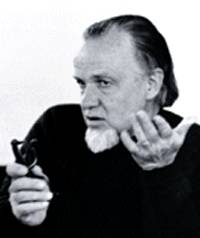
Francis Schaeffer pictured below in 1971 at L Abri

Image result for francis schaeffer labri

_

Image result for francis schaeffer labri

_

Image result for francis schaeffer labri

Dr. Francis Schaeffer at L’Abri Conference, Urbana, 1981

Image result for francis schaeffer labri

_

—-

 “They are the natural outcome of a change from a Christian World View to a Humanistic one…
The result is a relativistic value system. A lack of a final meaning to life — that’s first. Why does human life have any value at all, if that is all that reality is? Not only are you going to die individually, but the whole human race is going to die, someday. It may not take the falling of the atom bombs, but someday the world will grow too hot, too cold. That’s what we are told on this other final reality, and someday all you people not only will be individually dead, but the whole conscious life on this world will be dead, and nobody will see the birds fly. And there’s no meaning to life.

As you know, I don’t speak academically, shut off in some scholastic cubicle, as it were. I have lots of young people and older ones come to us from the ends of the earth. And as they come to us, they have gone to the end of this logically and they are not living in a romantic setting. They realize what the situation is. They can’t find any meaning to life. It’s the meaning to the black poetry. It’s the meaning of the black plays. It’s the meaning of all this. It’s the meaning of the words “punk rock.” And I must say, that on the basis of what they are being taught in school, that the final reality is only this material thing, they are not wrong. They’re right! On this other basis there is no meaning to life and not only is there no meaning to life, but there is no value system that is fixed, and we find that the law is based then only on a relativistic basis and that law becomes purely arbitrary.

—-

Here is a good review of the episode 016 HSWTL The Age of Non-Reason of HOW SHOULD WE THEN LIVE?, December 23, 2007:

Together with the advent of the “drug Age” was the increased interest in the West in  the religious experience of Hinduism and Buddhism. Schaeffer tells us that: “This grasping for a nonrational meaning to life and values is the central reason that these Eastern religions are so popular in the West today.”  Drugs and Eastern religions came like a flood into the Western world.  They became the way that people chose to find meaning and values in life.  By themselves or together, drugs and Eastern religion became the way that people searched inside themselves for ultimate truth.

Along with drugs and Eastern religions there has been a remarkable increase “of the occult appearing as an upper-story hope.”  As modern man searches for answers it “many moderns would rather have demons than be left with the idea that everything in the universe is only one big machine.”  For many people having the “occult in the upper story of nonreason in the hope of having meaning” is better than leaving the upper story of nonreason empty. For them horror or the macabre are more acceptable than the idea that they are just a machine.

Francis Schaeffer has correctly argued:

The universe was created by an infinite personal God and He brought it into existence by spoken word and made man in His own image. When man tries to reduce [philosophically in a materialistic point of view] himself to less than this [less than being made in the image of God] he will always fail and he will always be willing to make these impossible leaps into the area of nonreason even though they don’t give an answer simply because that isn’t what he is. He himself testifies that this infinite personal God, the God of the Old and New Testament is there. 
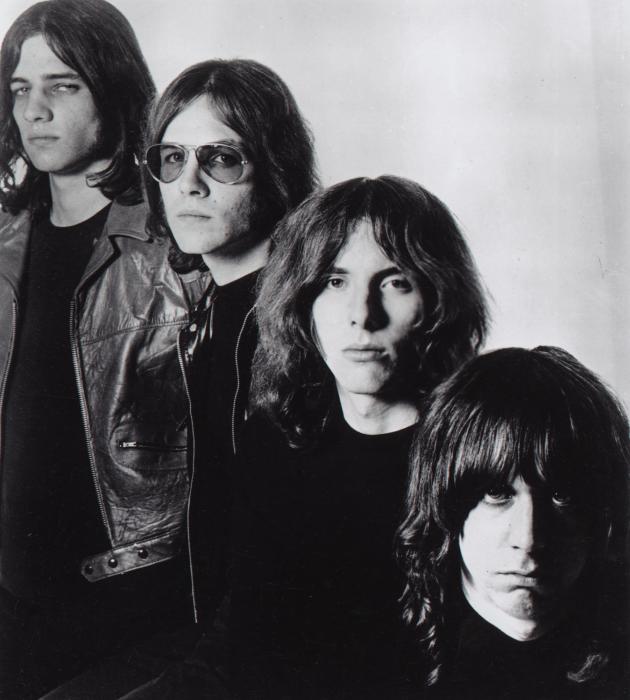
Instead of making a leap into the area of nonreason the better choice would be to investigate the claims that the Bible is a historically accurate book and that God created the universe and reached out to humankind with the Bible. Below is a piece of that evidence given by Francis Schaeffer concerning the accuracy of the Bible.

TRUTH AND HISTORY (chapter 5 of WHATEVER HAPPENED TO THE HUMAN RACE?, under footnote #94)

So the story goes on. We have stopped at only a few incidents in the sweep back to the year 1000 B.C. What we hope has emerged from this is a sense of the historical reliability of the Bible’s text. When the Bible refers to historical incidents, it is speaking about the same sort of “history” that historians examine elsewhere in other cultures and periods. This borne out by the fact that some of the incidents, some of the individuals, and some of the places have been confirmed by archaeological discoveries in the past hundred years has swept away the possibility of a naive skepticism about the Bible’s history. And what is particularly striking is that the tide has built up concerning the time before the year 1000 B.C. Our knowledge about the years 2500 B.C. to 1000 B.C. has vastly increased through discoveries sometimes of whole libraries and even of hitherto unknown people and languages.

There was a time, for example, when the Hittite people, referred to in the early parts of the Bible, were treated as fictitious by critical scholars. Then came the discoveries after 1906 at Boghaz Koi (Boghaz-koy) which not only gave us the certainty of their existence but stacks of details from their own archives!

Related posts

FRIEDMAN FRIDAY Best of Both Worlds: An Interview with Milton Friedman Milton Friedman reminisces about his career as an economist and his lifetime “avocation” as a spokesman for freedom. Brian Doherty from the June 1995 issue

Best of Both Worlds: An Interview with Milton Friedman

Milton Friedman reminisces about his career as an economist and his lifetime “avocation” as a spokesman for freedom.

Brian Doherty from the June 1995 issue – view article in the Digital Edition

Milton Friedman needs little introduction. His career as one of the world’s preeminent economists and advocates of freedom has won him many accolades, best-selling books, and a Nobel Prize.

It has also brought him much satisfaction. Now, in what he is acutely conscious are probably the last years of his life, he and his wife and longtime writing partner Rose Friedman are working on their memoirs.

I met Friedman in January in his elegant high-rise San Francisco condo, with an absorbing view of both the Pacific Ocean and the San Francisco Bay. His study is filled, but not cluttered, with his own books and economics reference works. While some Great Men in his position in life might refuse nuisances like interviewers entirely, Friedman is friendly and mostly forthcoming, speaking with the slow assurance of a lifelong professor and teacher very comfortable with explaining things. He welcomed me cordially but with a distinct set of limits, both in time and in subject matter. He has a large project to finish, and not much time to finish it in; and he refuses to psychoanalyze himself, largely avoids indulging in discussion of personalities, and wants to save some stories for his memoirs.

Friedman is used to discussing policy, but except for his assessment of the new Congress’s potential, we wandered far afield into reminiscence; assessment of his intellectual development; and his thoughts on the history, significance, and successes of the intellectual movement for freedom that he has served so staunchly.

Reason: You’ve long advocated many of the ideas the new Congress is pushing, such as balanced budget amendments and flat taxes. Do you think Congress will make your dreams come true?

Milton Friedman: I’m skeptical. The talk is good. But I expected so much out of the Reagan administration and was disappointed. I’m a great admirer of Ronald Reagan himself, and I suspect he would have gotten much more done if it hadn’t been for the Cold War and the problem of Nicaragua and El Salvador.

But nonetheless, there’s no doubt that while he talked about cutting down the size of government, he did not succeed. He did slow it down—you’ve got to give him credit for some achievements. But not the massive reduction that he hoped for and planned for. That makes me hesitant now.

Congress wants to talk in this direction. Would they really want to move in that direction? The most important reform would be term limits, six-year limits. Because from an economic point of view, one of the worst features of our system is that you have a new tax law every year or every two years. However bad the tax law is, if you didn’t change it for five years it would do less harm. Why do you keep changing it? Because that’s the most effective way to raise campaign funds. Lobbyists will pay you to put loopholes in; they will pay you to take them out.

If you can get a flat tax with no exemptions or deductions—the Armey plan I suppose would be fine—its main advantage would not be the greater equity of a flat tax or less interference in private incentives. It would be to end this business of changing the whole tax system every few years and keeping prosperous these hordes of tax lawyers.

Reason: You were involved in the development of the withholding tax when you were doing tax work for the government in 1941–43?

Friedman: I was an employee at the Treasury Department. We were in a wartime situation. How do you raise the enormous amount of taxes you need for wartime? We were all in favor of cutting inflation. I wasn’t as sophisticated about how to do it then as I would be now, but there’s no doubt that one of the ways to avoid inflation was to finance as large a fraction of current spending with tax money as possible.

In World War I, a very small fraction of the total war expenditure was financed by taxes, so we had a doubling of prices during the war and after the war. At the outbreak of World War II, the Treasury was determined not to make the same mistake again.

You could not do that during wartime or peacetime without withholding. And so people at the Treasury tax research department, where I was working, investigated various methods of withholding. I was one of the small technical group that worked on developing it.

One of the major opponents of the idea was the IRS. Because every organization knows that the only way you can do anything is the way they’ve always been doing it. This was something new, and they kept telling us how impossible it was. It was a very interesting and very challenging intellectual task. I played a significant role, no question about it, in introducing withholding. I think it’s a great mistake for peacetime, but in 1941–43, all of us were concentrating on the war.

I have no apologies for it, but I really wish we hadn’t found it necessary and I wish there were some way of abolishing withholding now.

Reason: You’ve also had some history of advising candidates and presidents. How did you get involved in the Goldwater campaign?

Friedman: Through Bill Baroody at the American Enterprise Institute. The American Enterprise Institute was originally the American Enterprise Association, and had established a board of academic advisers to advise them on their publications. I had been a member of that I think since its inception, and Baroody arranged sometime in the early ’60s a number of dinners at his house at which Goldwater was present. Baroody was the brain trust for Goldwater. I was also at some of those dinners, so I got to meet Goldwater. And then when the campaign came along, Baroody asked me to serve as economic adviser. I didn’t go on the campaign trail. I sat at home and wrote memos.

Reason: Were you impressed with Goldwater’s acumen?

Friedman: It depends on what you mean by acumen. There’s no doubt whatsoever that he’s a man of principle and strong character. His IQ is perfectly reasonable but it’s not outstanding among the various politicians I’ve met, and that shows why IQ is not a good measure. The highest IQ was Richard Nixon’s and he was a terrible president

While I was never a governmental official, I was a member of an economic advisory group that Nixon appointed of which Arthur Burns was chairman. I saw Nixon from time to time when he was president, until he imposed price controls. I saw him only once after that.

Reason: Did you stop giving him advice?

Friedman: I kept giving him advice from Newsweek, but not personally.

Reason: Do you have a clear memory of how your political philosophy formed? Was it any specific teacher you encountered, book you read, or experience?

Friedman: I’m sure it was a combination of all of those. I was exposed as an undergraduate at Rutgers to two very strong influences: Homer Jones, who was a student of Frank Knight’s from Chicago, and Arthur Burns. They both had a considerable influence on me as an undergraduate in my thinking and my writing.

But it would be hard to say what philosophy that left me with. One of the things I regretted all my life is that when I graduated from Rutgers and came home, I wrote out a statement of my beliefs. I put that away in a drawer somewhere in my mother’s home and I’ve never been able to find the damn thing! I’d love to have it! So I can’t really tell you what I believed at that time.

But obviously my ideas were not very well formed. I was an innocent youngster and what I was impressed by, of course, was the Great Depression, and the belief that somehow or another there ought to be something that can prevent any such thing from happening.

Thanks to Homer, I was offered a scholarship at the University of Chicago and I went to Chicago and studied with Frank Knight, Jacob Viner, Henry Schultz, and so on. The atmosphere in Chicago in 1932 was very lively and active and encouraging. Of course, I got a very good grounding in economic theory and statistics as well.

Next year, I managed to get a fellowship to Columbia. I spent a year at Columbia mainly to study with Harold Hotelling, who was a mathematical economist and statistician.

Then I went back to Chicago for one year and was a research assistant to Henry Schultz. There were a group of students in Chicago who were very, very important. George Stigler, Allen Wallis, Rose Director, and myself. We ate almost every lunch and dinner together. We spent all the time discussing economics, both economic theory and economic policy. And we were very close for the rest of our lives. George died about two years ago. Allen, I’m glad to say, is still alive.

In the 1930s, both Rose and I at separate times went to Washington and worked on the New Deal, but we were technical statisticians and economists, not anything that had any policy role.

Throughout my career, I spent most of my time on technical economics. This policy stuff has been a strict avocation. If you really want to engage in policy activity, don’t make that your vocation. Make it your avocation. Get a job. Get a secure base of income. Otherwise, you’re going to get corrupted and destroyed. How are you going to get support? You’re only going to get support from people who are ideologically motivated. And you’re not going to be as free as you think you’re going to be.

One of the most important things in my career is that I always had a major vocation which was not policy. I don’t regard what I’ve done in the field of monetary policy as on the same level as what I’ve done about trying to get rid of the draft or legalizing drugs. One is a technical byproduct of scientific work, and so that’s the only sense in which my vocation has affected my policy. But by having a good firm position in the academic world, I was perfectly free to be my own person in the world of policy. I didn’t have to worry about losing my job. I didn’t have to worry about being persecuted.

I think you’ll make a mistake if you’re going to spend your life as a policy wonk. I’ve seen some of my students who have done this. And some of them are fine, and some of them, especially those who have gone to Washington and stayed, are not.

Reason: How did you come to enter the world of policy writing?

Friedman: What really got me started in policy and what led to Capitalism and Freedom was, in an indirect way, the Mont Pelerin Society. The first Mont Pelerin Society meeting was in 1947 in Switzerland. Hayek arranged it. It was his idea.

Mont Pelerin was the first time that I came into contact with people like Hayek, Lionel Robbins, and the European contingent of that time. That widened my perspective about issues and policy.

The Mont Pelerin Society was people who were deeply concerned about issues. It was people with whom you shared a basic common belief, who at home were isolated. Its great contribution was that it provided a week when people like that could get together and open their hearts and minds and not have to worry about whether somebody was going to stick a knife in their back—especially for people in countries where they were isolated.

The reason the Society ever happened was that Hayek had written The Road to Serfdom, which attracted the attention of the Volker Foundation, and it was the Volker Foundation that financed the American participation in the Mont Pelerin Society. A Swiss group financed the Swiss and European participation.

In the middle ’50s, the Volker Foundation undertook a program of summer institutes for junior academics who were favorably inclined toward a free-market point of view or were interested in such issues. Capitalism and Freedom was based on a series of lectures that I gave at one of those seminars. Those seminars forced me to systematize my thoughts and present them in a coherent way. And they also provided a very good audience because the people who were there were lively, outspoken, didn’t hesitate to criticize. It was a very good audience. There was a lot of free time as well for discussions outside of the formal seminar. And I learned a great deal, not only from the students who were there, but also the fellow lecturers.

And then my wife, Rose, took the transcribed tapes of the lectures and reworked them and that’s what became Capitalism and Freedom.

Reason: Did you have any hesitation about publishing that book?

Friedman: None whatsoever. Why should I have had any hesitation? Remember, I was a tenured professor.

Another thing that helped form my policy orientation was when Hayek came to Chicago in 1950. He attracted quite a number of very able students, Sam Peltzman, Ron Hamowy, Ralph Raico, Shirley Letwin. There were quite a group of them. Hayek drew very high quality people. I was an adviser to their New Individualist Review and contributed articles to it. They were a very lively group that had organized discussion sessions and so on, which was part of the atmosphere.

I was persuaded at that time in the early 1960s that we were on the verge of developing a strong libertarian movement. These were libertarians, all of them, though Hayek would not have labeled himself a libertarian. As you know, he always avoided the termconservative, too. He would call himself an Old Whig. The others would have called themselves libertarians.

That’s how I was able to develop my own ideas. What shaped them was the interaction with all these other people at lunches and dinners and lectures.

Ayn Rand was receiving increasing attention at that time. I believed a big upsurge in the libertarian philosophy and views was pending. And to some extent it was. You had the Randian group, and the Murray Rothbard group. But the developing libertarian movement was repressed by the Vietnam War and what it led to. You’ve only got room for one big movement at a time.

Reason: Why do you think you had more initial success as a public proselytizer—you had a regular column inNewsweek—than other prominent libertarians?

Friedman: I really don’t know how to answer that. I was basically trained in economic science. I was interested in the history of thought and where it came from. I thought I was going back to some fundamentals rather than creating anything new. Ayn Rand had no use for the past. She was going to invent the world anew. She was an utterly intolerant and dogmatic person who did a great deal of good. But I could never feel comfortable with her. I don’t mean with her personally—I never met her personally. I’m only talking about her writings.

Rothbard was a very different character. I had some contact with Murray early on, but very little contact with him overall. That’s primarily because I deliberately kept from getting involved in the Libertarian Party affairs; partly because I always thought Murray, like Rand, was a cult builder, and a dogmatist. Partly because whenever he’s had the chance he’s been nasty to me and my work. I don’t mind that but I didn’t have to mix with him. And so there is no ideological reason why I kept separate from him, really a personal reason.

Reason: In seeing yourself as harkening back to 19th-century liberalism, you never became a system-builder like Rand or Rothbard….

Friedman: Exactly. I’d rather use the term liberal than libertarian.

Reason: I see you occasionally use the word libertarian.

Friedman: Oh, I do.

Reason: As a concession to accepted usage?

Friedman: That’s right. Because now liberal is so misinterpreted. So I am a Republican with a capital “r” and a libertarian with a small “l.” I have a party membership as a Republican, not because they have any principles, but because that’s the way I am the most useful and have most influence. My philosophy is clearly libertarian.

However, libertarian is not a self-defining term. There are many varieties of libertarians. There’s a zero-government libertarian, an anarchist. There’s a limited-government libertarianism. They share a lot in terms of their fundamental values. If you trace them to their ultimate roots, they are different. It doesn’t matter in practice, because we both want to work in the same direction.

I would like to be a zero-government libertarian.

Reason: Why aren’t you?

Friedman: Because I don’t think it’s a feasible social structure. I look over history, and outside of perhaps Iceland, where else can you find any historical examples of that kind of a system developing?

Reason: One could argue the same thing about minimal-state libertarianism: that historically it seems to not be stable.

Friedman: I agree. I wrote an article once arguing that a free society is an unstable equilibrium. Fundamentally, I’m of the opinion that it is. Though we want to try to keep that unstable equilibrium as long as we can! The United States from 1780 to 1929 is not a bad example of a limited-government libertarianism that lasted for a long time.

Reason: Is feeling like part of a larger movement important to you? Would you have been able to do the work you did had you not felt part of a community of like-minded scholars?

Friedman: I’ve been very fortunate in being part of two communities of scholars: the community of economists on the one hand, and the community of libertarians on the other. And that combination has been very productive so far as I’m concerned, but I can’t really tell you why. One thing is that it’s very hard for somebody on his own to be sure that he’s thought of all the angles. Discussion among people helps an enormous amount. And particularly able, good people.

If you have a person isolated in an environment unfriendly to his ideas and thoughts, he tends to turn bitter and self-directed. But the same person with three or four other people around—it doesn’t have to be a lot of people—will be in a wholly different position since he will receive support from the others.

You remind me of one incident where in a sense the two worlds interacted. Back in the 1960s, my daughter was an undergraduate at Bryn Mawr, and I was invited by Haverford, I think it was, to spend three days giving talks on mathematical economics. Absolutely no policy involved, pure mathematical economics. And because my daughter was at Bryn Mawr, I agreed.

After I had agreed, they asked if I would also be willing to give a chapel talk on political matters. I said sure and I gave a title, something having to do with freedom. Then I discovered that chapel at Haverford was compulsory. I wrote to the president and said that I was very much disturbed at giving a talk on freedom to a compulsory audience.

When it was time to go to the chapel, I asked the president, “How do they count attendance?” And he said, “At the beginning of the hour there are people going around in the balcony and looking down. Everybody has an assigned seat, and they count.”

When I got up to talk, I spoke up to the people in the balcony and said that those who were counting attendance, please let me know when they’re through because I don’t like the idea of speaking about freedom to a compulsory audience. I’m going to sit down and give the people who want to leave the chance to leave. And I did. Now, the students hadn’t really thought that I was going to do it and when I did, about one or two people got up to leave and the rest of them booed them because obviously, I was talking on their level. As a result, I’ve seldom had a student audience who were so completely on my side as that group, even though the political atmosphere at Haverford was very much to the left. That’s one of the greatest coups I’ve ever had as a public speaker.

Reason: Do you think you’ve become more radically libertarian in your political views over the years?

Friedman: The difference between me and people like Murray Rothbard is that, though I want to know what my ideal is, I think I also have to be willing to discuss changes that are less than ideal so long as they point me in that direction. So while I’d like to abolish the Fed, I’ve written many pages on how the Fed, if it does exist, should be run.

Murray used to berate me for my stand on education vouchers. I would like to see the government out of the education business entirely. In that area, I have become more extreme, not because of any change of philosophy, but because of a change in my knowledge of the factual situation and history.

I used to argue that I could justify compulsory schooling on the ground of external effects. But then I discovered from work that E.G. West and others did, that before compulsory schooling something over 90 percent of people got schooled. The big distinction you have to make is between marginal benefit and average benefit. The marginal benefit from having 91 percent of people in school rather than 90 percent does not justify making it compulsory. But if in the absence of compulsory education, only 50 percent would be literate, then I can regard it as appropriate.

Some issues are open and shut. Tariffs, property rights. No, not property rights, because you have to define property rights. But education is not open and shut. In Capitalism and Freedom we came out on the side of favoring compulsory schooling and in Free To Choose we came out against it. So I have become more radical in that sense. Murray used to call me a statist because I was willing to have government money involved. But I see the voucher as a step in moving away from a government system to a private system. Now maybe I’m wrong, maybe it wouldn’t have that effect, but that’s the reason I favor it.

Reason: Would you agree with the proposition that you have been the most successful and important proselytizer for libertarianism?

Friedman: I don’t think that I’ve had the most influence. I think the most influential person was Hayek. The effect of The Road to Serfdom was really critical. In another area, Bill Buckley has certainly been very important on national policy.

Buckley’s not a libertarian. But he’s also not a socialist. And if you look at the political scene, his National Review has had a tremendous influence in providing a base for collaboration between the libertarians on the one side and the free-market conservatives on the other. That was epitomized in its most obvious form by Frank Meyer when he was with National Review. They’ve helped that coalition to form and hold together and have influence; Bill Buckley played an enormously important role.

I might have more public influence than ideologues like Rand or Murray Rothbard, the libertarians in that strict sense. And I believe that the reason is because they have been so intolerant.

Reason: You wrote an essay in Liberty about the intolerance of Rand and Ludwig von Mises. You say you never met Rand….

Friedman: I was never to my knowledge in the same place as she was; I was in Chicago, she was in New York. I’m sure if I had been in New York, I would have met her. It was not because of any objection on my part. I think she was a fascinating woman and had a great influence. As I always have said, she had an extremely good influence on all those who did not become Randians. But if they became Randians, they were hopeless.

Reason: But you knew Mises personally. Did you see the intolerance that you find in his method also in his personal behavior?

Friedman: No question. The story I remember best happened at the initial Mont Pelerin meeting when he got up and said, “You’re all a bunch of socialists.” We were discussing the distribution of income, and whether you should have progressive income taxes. Some of the people there were expressing the view that there could be a justification for it.

Another occasion which is equally telling: Fritz Machlup was a student of Mises’s, one of his most faithful disciples. At one of the Mont Pelerin meetings, Fritz gave a talk in which I think he questioned the idea of a gold standard; he came out in favor of floating exchange rates. Mises was so mad he wouldn’t speak to him for three years. Some people had to come around and bring them together again. It’s hard to understand; you can get some understanding of it by taking into account how people like Mises were persecuted in their lives.

Reason: You don’t link yourself openly to certain aspects of the libertarian political movement….

Friedman: Well, you have to be more specific. Being very specific, I have not wanted to join the Libertarian Party simply because I have accumulated good working relationships with people in the Republican Party, and I think I can be more effective by being a Republican. That’s the only reason. There are no other cases in which I have had any problem with the libertarian movement.

Reason: You certainly have a respectability and presence that most people and organizations labeled libertarian don’t have….

Friedman: That’s because of one thing only: I won the Nobel Prize. What, are you kidding yourself?

Reason: Your status preceded your winning the Nobel.

Friedman: I did have some of it, yes. It’s because I have a firm root in something other than ideology. Because I was firmly based in a scientific academic discipline. I wasn’t simply a preacher or an ideologue or an unconnected philosopher.

But I think the libertarian movement is doing fine. I think that REASON magazine has been remarkably good; it has been very effective. It takes many kinds of people to make a movement. And one of the most important things are publications. In any activity you have manufacturers, wholesalers, and retailers; and all three are essential and necessary. There are only a relatively small number of manufacturers of ideas. But there can be a very large number of wholesalers and retailers.

As I look around me I’m impressed by the fact that there’s increasing attention paid to libertarian ideas. If you look at the picture now, compared with 30 years ago, there’s no comparison. Now you’ve got much more. As far as journals are concerned, then we had the Foundation for Economic Education’s Freeman; for a while we had the New Individualist Review in Chicago, but that was about it. Bill Buckley established National Review, which is in a different corner.

(Page 6 of 7)

But look at the situation today. You have REASON magazine, you have Liberty magazine. You’ve got all of this stuff that spouts out from the Cato Institute and the Competitive Enterprise Institute and a half dozen other think tanks. In fact, I think there are too damn many think tanks now.

Reason: Why do you say there are too many?

Friedman: You don’t have the talent for it.

Reason: Do you consider yourself in the libertarian mainstream on foreign policy issues?

Friedman: I don’t believe that the libertarian philosophy dictates a foreign policy. In particular I don’t think you can derive isolationism from libertarianism. I’m anti-interventionist, but I’m not an isolationist. I don’t believe we ought to go without armaments. I’m sure we spend more money on armaments than we need to; that’s a different question.

I don’t believe that you can derive from libertarian views the notion that a nation has to bare itself to the outside without defense, or that a strong volunteer force would arise and defend the nation.

Reason: What did you think about the Gulf War?

Friedman: I always had misgivings about the Gulf War, but I never came to a firm decision. It was more nearly justified than other recent foreign interventions, and yet I was persuaded that the major argument used to support it was fallacious.

After all, if Iraq took over the oil, it would have to do something with it. If they don’t want to eat it, they’d have to sell it. I don’t think the price of oil would have been much affected. The more important consideration was the balance of power with Iran and Iraq. I have mixed feelings about that war; I wouldn’t be willing to write a brief on either side.

Reason: What would you regard as your most important accomplishment?

Friedman: It depends on what you mean. I wrote an essay on methodology in 1953. It was published in my book Essays on Positive Economics. I had been working on it for years before that, so it goes way back to the middle ’40s. It started to generate a lot of comments, but I decided I would rather do economics than talk about how economics are done. So I made a distinct point of not replying to any criticism of that essay. And I think that’s why it’s so commented on.

That methodology article has probably been reprinted more often and referred to more often than anything else I’ve written, though I would by no means regard it as the most important thing I’ve ever done.

In terms of sheer technical quality there’s no doubt in my mind that the best thing I ever did was The Theory of the Consumption Function which, from a scientific point of view, is a carry on from the methodology article. I regard the theory of the consumption function as a demonstration of applying the methodology I explained there. But also it has a neatness about it and a specific theorem which has generated an enormous amount of work since then. When things like that originally come out, the status quo says, “Oh, that’s a bunch of nonsense, we can’t possibly work with that,” but give it time. And by now it’s part of conventional economics.

In the realm of policy, I regard eliminating the draft as my most important accomplishment.

Reason: Have you retired from economics?

Friedman: Well, not from economics, but from that kind of work. There’s been a tremendous advance in specialization in economics, particularly in the econometrics area. I was just looking at recent working papers published by the Federal Reserve Bank of Chicago. These are clearly built on work of mine, going back to the 1970s. But there’s been a new development in econometrics that I haven’t kept up with. The techniques they’ve adopted here are all different from ours. I’m not an expert in them anymore; I really couldn’t deal with this material on the level on which they are dealing with it, although I can understand the thrust of what they’re doing.

I’m not making any pretense of trying to do any more basic, fundamental economics work. I believe that almost all important contributions of a scientist are made in the first 10 years after he enters the discipline. Not the first 10 years of his professional life; he may shift from one discipline to another. And I’ve been impressed as I’ve been going over my memoirs, that my basic contributions all have their roots in the early years of my work. I was reading over some preliminary professional papers in the 1950s, and I could see there the whole future of the next 30 years of work that I did; it was all outlined in there.

You add things to it, you change it, but the fundamental ideas come early. The 1940s–’60s was when I did my most important economic work, even though it wasn’t all published then.

(Page 7 of 7)

Reason: I read an article recently in the Washington Monthly that repeated all the silly ideas about inflation that you’ve been fighting your whole career. Are battles like this ever won?

Friedman: No. All battles are perpetual. You go back in the literature of economics, and you’ll find the same kind of silly statements 100 years ago, 200 years ago. And you’ll find the same sensible statements the other way.

Reason: Are those kind of mistakes still made among professional economists?

Friedman: If you look at the views of the profession as a whole, no. There’s a great deal of agreement among economists, contrary to what people may think. You won’t find much difference of opinion on the proposition that raising the minimum wage will cost jobs. You won’t find much difference of opinion on the desirability of free trade. And you won’t find any difference of opinion on the idea that you cannot have inflation without monetary expansion. There’s no doubt that there’s very widespread agreement about those simple ideas.

Reason: How do you make that consensus spread to the general public?

Friedman: You just have to keep on trying to do it. There’s no short cut. There’s no way in which you’re going to end the discussion, because new generations arise; every group has the same crazy ideas. I get a great many letters from people who think that the way to solve budget problems and fiscal problems is to simply print money and pay off the debt. And there’s almost no way of making those people realize just what a bunch of nonsense that is.

I’m inclined to think that there’s no field so rife with cranks as currency and money, but I’m sure there are other fields that are just as bad. I’m just ignorant of them.


Related posts:


“Friedman Friday” (“Free to Choose” episode 1 – Power of the Market. part 7 of 7)

March 16, 2012 – 12:25 am

  Michael Harrington:  If you don’t have the expertise, the knowledge technology today, you’re out of the debate. And I think that we have to democratize information and government as well as the economy and society. FRIEDMAN: I am sorry to say Michael Harrington’s solution is not a solution to it. He wants minority rule, I […] By Everette Hatcher III | Posted in Current Events, Milton Friedman | Edit | Comments (0)

“Friedman Friday” (“Free to Choose” episode 1 – Power of the Market. part 6 of 7)

March 9, 2012 – 12:29 am

PETERSON: Well, let me ask you how you would cope with this problem, Dr. Friedman. The people decided that they wanted cool air, and there was tremendous need, and so we built a huge industry, the air conditioning industry, hundreds of thousands of jobs, tremendous earnings opportunities and nearly all of us now have air […] By Everette Hatcher III | Posted in Current Events, Milton Friedman | Edit | Comments (0)

“Friedman Friday” (“Free to Choose” episode 1 – Power of the Market. part 5 of 7)

March 2, 2012 – 12:26 am

Part 5 Milton Friedman: I do not believe it’s proper to put the situation in terms of industrialist versus government. On the contrary, one of the reasons why I am in favor of less government is because when you have more government industrialists take it over, and the two together form a coalition against the ordinary […] By Everette Hatcher III | Posted in Current Events, Milton Friedman | Edit | Comments (0)

“Friedman Friday” (“Free to Choose” episode 1 – Power of the Market. part 4 of 7)

February 24, 2012 – 12:21 am

The fundamental principal of the free society is voluntary cooperation. The economic market, buying and selling, is one example. But it’s only one example. Voluntary cooperation is far broader than that. To take an example that at first sight seems about as far away as you can get __ the language we speak; the words […] By Everette Hatcher III | Posted in Current Events, Milton Friedman | Edit | Comments (0)

“Friedman Friday” (“Free to Choose” episode 1 – Power of the Market. part 3 of 7)

February 17, 2012 – 12:12 am

  _________________________   Pt3  Nowadays there’s a considerable amount of traffic at this border. People cross a little more freely than they use to. Many people from Hong Kong trade in China and the market has helped bring the two countries closer together, but the barriers between them are still very real. On this side […] By Everette Hatcher III | Posted in Current Events, Milton Friedman | Edit | Comments (0)
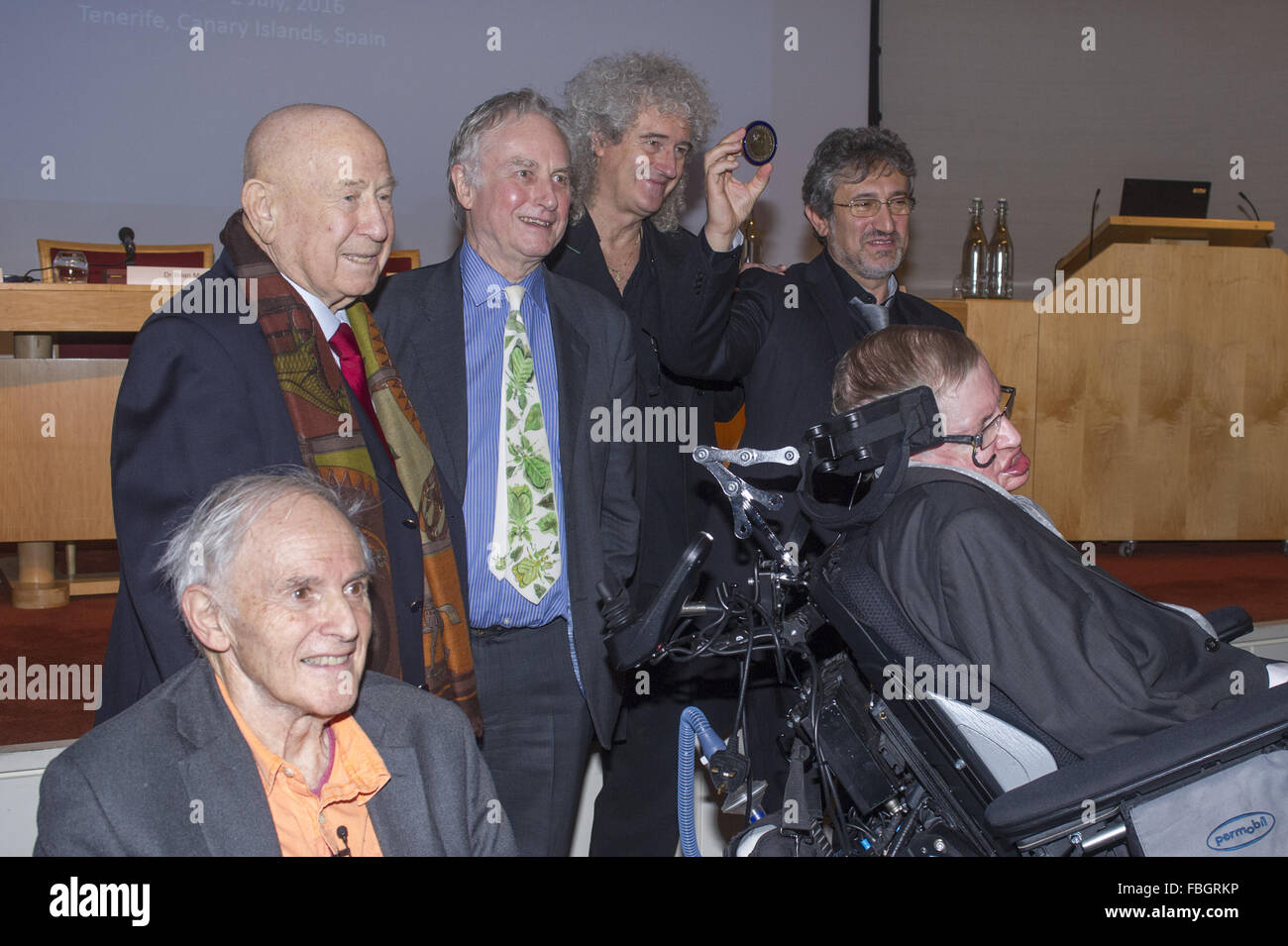
“Friedman Friday” (“Free to Choose” episode 1 – Power of the Market. part 2 of 7)

February 10, 2012 – 12:09 am

  Aside from its harbor, the only other important resource of Hong Kong is people __ over 4_ million of them. Like America a century ago, Hong Kong in the past few decades has been a haven for people who sought the freedom to make the most of their own abilities. Many of them are […] By Everette Hatcher III | Posted in Current Events, Milton Friedman | Edit | Comments (0)

“Friedman Friday” (“Free to Choose” episode 1 – Power of the Market. part 1of 7)

February 3, 2012 – 12:07 am

“FREE TO CHOOSE” 1: The Power of the Market (Milton Friedman) Free to Choose ^ | 1980 | Milton Friedman Posted on Monday, July 17, 2006 4:20:46 PM by Choose Ye This Day FREE TO CHOOSE: The Power of the Market Friedman: Once all of this was a swamp, covered with forest. The Canarce Indians […]

Milton Friedman The Power of the Market 1-5

Debate on Milton Friedman’s cure for inflation

September 29, 2011 – 7:24 am

If you would like to see the first three episodes on inflation in Milton Friedman’s film series “Free to Choose” then go to a previous post I did. Ep. 9 – How to Cure Inflation [4/7]. Milton Friedman’s Free to Choose (1980) Uploaded by investbligurucom on Jun 16, 2010 While many people have a fairly […]

By Everette Hatcher III | Also posted in Current Events | Tagged dr friedman, expansion history, income tax brackets, political courage, www youtube | Edit | Comments (0)

“Friedman Friday” Milton Friedman believed in liberty (Interview by Charlie Rose of Milton Friedman part 1)

April 19, 2013 – 1:14 am

Charlie Rose interview of Milton Friedman My favorite economist: Milton Friedman : A Great Champion of Liberty  by V. Sundaram   Milton Friedman, the Nobel Prize-winning economist who advocated an unfettered free market and had the ear of three US Presidents – Nixon, Ford and Reagan – died last Thursday (16 November, 2006 ) in San Francisco […] By Everette Hatcher III | Posted in Milton Friedman | Edit | Comments (0)

What were the main proposals of Milton Friedman?

February 21, 2013 – 1:01 am

Stearns Speaks on House Floor in Support of Balanced Budget Amendment Uploaded by RepCliffStearns on Nov 18, 2011 Speaking on House floor in support of Balanced Budget Resolution, 11/18/2011 ___________ Below are some of the main proposals of Milton Friedman. I highly respected his work. David J. Theroux said this about Milton Friedman’s view concerning […] By Everette Hatcher III | Posted in Milton Friedman | Edit | Comments (0)

“Friedman Friday,” EPISODE “The Failure of Socialism” of Free to Choose in 1990 by Milton Friedman (Part 1)

December 7, 2012 – 5:55 am

Milton Friedman: Free To Choose – The Failure Of Socialism With Ronald Reagan (Full) Published on Mar 19, 2012 by NoNationalityNeeded Milton Friedman’s writings affected me greatly when I first discovered them and I wanted to share with you. We must not head down the path of socialism like Greece has done. Abstract: Ronald Reagan […] By Everette Hatcher III | Posted in Milton FriedmanPresident Obama | Edit | Comments (1)

Defending Milton Friedman

July 31, 2012 – 6:45 am

What a great defense of Milton Friedman!!!!   Defaming Milton Friedman by Johan Norberg This article appeared in Reason Online on September 26, 2008  PRINT PAGE  CITE THIS      Sans Serif      Serif Share with your friends: ShareThis In the future, if you tell a student or a journalist that you favor free markets and limited government, there is […]

FRANCIS SCHAEFFER ANALYZES ART AND CULTURE Part 278 My July 25, 2016 Letter to Hugh Hefner on Ecclesiastes which is based on 1996 message by Dan Jarrell of Fellowship Bible Church on the subject of “I can’t get no Satisfaction and I tried and I tried” (Featured artist is Mark Manders )

Image result for hugh hefner younger days

Over and over I have read that Hugh Hefner was a modern day King Solomon and Hefner’s search for satisfaction was attempted by adding to the number of his sexual experiences.

What if you had 1 wish?

By Ryan Ervin

Besides Jesus (of course), King Solomon is my favorite character in Scripture. It’s the train-wreck I can’t look away from. No person in history, including Jesus, had been handed a bigger platform. The new kingdom was all his.

After Solomon was given the throne, God decides to personally visit Solomon one night and says, “Ask from me anything.”

Anything. God gave Solomon the biggest blank check in history. For one night, God was Solomon’s genie.

“Wisdom to lead your great people” was his immediate response.

God was so pleased with Solomon’s answer, he gave him more wisdom than anyone ever, and even gave him what he didn’t ask for: riches, long life, and peace with his enemies. (Driscoll rightly said, “Solomon was smarter than Albert Einstein, had more money than Bill Gates, and more women than Hugh Hefner.”)

With all Solomon had and the wisdom he possessed, he set the course for Israel’s unfaithfulness and eventual fall. His vast wisdom wasn’t enough. He drifted from the God who’d given him everything.

This troubles me because I love the subject and pursuit of wisdom. It may be my favorite prayer request. (Don’t forget, God was very pleased with Solomon’s answer.)

Wisdom wasn’t enough for Solomon, and that’s a lesson for me. There is no reason to think that wisdom is enough for me either, though I want it to be.

But what is? What if God came to me, and asked, “Ryan, ask anything from me.” What would I ask for? What would you ask for?

This puzzled me for months. I had no idea. Friends and colleagues would ask me, “Ryan, how can I pray for you?” and I would honestly respond with, “I don’t know.”

Has this ever bothered you? Have you ever wondered, “If God is really going to answer my prayer for me, what should I ask for?”

Maybe you think I’m being dramatic. You’re probably right, but this was a real issue for me.  As a husband, father, and leader in a church, I’ve committed to wrestling with God in prayer so I can be of better service. Solomon’s downfall has been serving me as a warning since I first read it.

So, I started asking around. I reminded people of Solomon’s story, then asked, “What’s the greatest prayer request? What’s the best thing you can ask for yourself?”

After I asked a friend, he wisely reminded me that “We’ve been given Solomon’s blank check. Jesus invites us to, ‘ask, seek, knock.’ Jesus also ends this invitation with, ‘How much more will God give the Holy Spirit to those who ask him?’”

I felt like a dunce.We, like King Solomon, have been invited to ask for anything. Within that generous invitation we’re specifically encouraged to ask for more of God. He is not our genie, nor does he want to be. He’s more. He wants to be our dad who gives us good things.

More than just an invitation to ask for things, we’re invited to be in relationship with Solomon’s Genie. We can know him. We can talk with him.

To keep with the Genie metaphor, he’s so much more than a granter of wishes. He wishes for us. He’s committed to intercede for me, while the Holy Spirit is asking for things I don’t even know to ask for. That means two-thirds of the Trinity is praying for me right now. He makes up for where I’m lacking, filling in the crevices of my weaknesses. This is true for you too, of course.

One of the lessons from this story is that wisdom isn’t everything. Perhaps another is that Solomon’s downfall was that after the fantastic answer he gave to God, he quit pursuing him.

Two things are certain, though.

  1. God loves to give wisdom, so ask for it.
  2. Wisdom is not enough, but he is.

______

Ryan Ervin is the Married Life Pastor at CTK Bellingham. He’s married to Nicole, and together they’re raising their 3 children, Hannah, Tess, and Finn.

Many of the sermons that I heard or read that inspired me to write Hugh Hefner were from this list of gentlemen:  Daniel Akin, Brandon Barnard, Alistair Begg, Matt Chandler, George Critchley,  Darryl Dash, Steve DeWitt, Steve Gaines, Norman L. Geisler, Greg Gillbert, Billy Graham, Mark Henry, Dan Jarrell, Walter C. Kaiser, Jr., R. G. Lee, C.S. Lewis Chris Lewis, Kerry Livgren, Robert Lewis,    Bill Parkinson, Ben Parkinson,Vance Pitman, Nelson Price, Ethan Renoe, Adrian Rogers, Philip Graham Ryken, Francis Schaeffer, Lee Strobel, Bill Wellons, Kirk Wetsell,  Ken Whitten, Ed Young ,  Ravi Zacharias, Tom Zobrist, and Richard Zowie.

In this post today and several posts that follow this will be based on a sermon series I heard at FELLOWSHIP BIBLE CHURCH in Little Rock in 1996 on the Book of Ecclesiastes. The pastors back then were Robert Lewis, Bill Wellons, Bill Parkinson and Dan Jarrell. Below is the letter I wrote based both on Dan Jarrell’s sermon from the same series.

Dan Jarrell pictured below:

DAN JARRELL
Image result for FELLOWSHIP BIBLE CHURCH DAN JARRELL

________

Image result for robert lewis bill parkinson

__

Robert Lewis pictured below:

Image result for robert lewis fellowship bible church

Bill Wellons pictured below:

Image result for bill wellons fellowship bible church

Bill Parkinson pictured below

Image result for bill parkinson fellowship bible church

_

I also quoted Ravi Zacharias when I wrote, “The key to understanding the Book of Ecclesiastes is the term UNDER THE SUN — What that literally means is you lock God out of a closed system and you are left with only this world of Time plus Chance plus matter.”

Image result for ravi zacharias ecclesiastes

____________

July 25,  2016

Hugh Hefner
Playboy Mansion  
10236 Charing Cross Road
Los Angeles, CA 90024-1815

Dear Mr. Hefner,

Everytime I come to Chicago I love to visit the comedy club THE SECOND CITY. It is an interesting fact how many have got their start there and went on to have great careers on SATURDAY NIGHT LIVE. In fact, when I saw you host the 10-15-77 SNL show there starring with you were SECOND CITY ALUMNI John Belushi (1971), Bill Murray (1973), Dan Aykroyd (1974) and Gilda Radner (1974).

_

Image result for chicago the second city

___

Image result for chicago the second city alumni

___

Image result for chicago the second city

_____________

Image result for chicago the second city

__________

2. Monologue (2:57)

Hef sports the bathrobe and pipe of course and seemingly takes a rather straight-forward approach to his monologue while cracking a couple of jokes here and there. However, he quickly segueways into a somewhat-creepy rendition of “Thank Heaven For Little Girls” while some text scrolls by on the screen describing Hefner’s fascination with girls in general. Not bad. C+

4. Planet of the Men vs. Planet of the Women (4:14)
-Hefner, Aykroyd, Belushi, Curtin, Morris, Newman, Radner

Well, this kind of sketch was expected. In the distant future, Captain Macho (Hefner), Corporal Hardin (Aykroyd), Lieutenant Testosterone (Belushi), and another corporal (Morris) take aim when they plan to collide with the ship containg the planet of the women and Captain Estrogena (Curtin), Lieutenant Areola (Newman), and Corporal Fellopia (Radner) . I guess this is just a guilty pleasure sketch. B+

13. The Story Of H (3:05)
-Hefner

Our host narrates his life story through a quick succession of pictures and clips from his child and adulthood. The tone of it is playful and it seems like Hefner is being a bit sarcastic with his “woe is me” type comments. It’s a well-made piece and the style of which that is never seen on the show. B+

14. The Playboy Philosophy (3:09)
-Hefner, Belushi, Morris

Hef is thrust into a scene from over a thousand years ago as several philosophers ask him of his theories on life. This sketch drags more than the 3 R’s sketch despite its short runtime. It’s just a series of questions that set up some very obvious jokes. D

17. The Farbers at the Playboy Club (4:47)
-Hefner, Aykroyd, Belushi, Newman, Radner

America’s favourite conservative couple, Bobbi (Radner) and Larry Farber (Belushi) meet with a keyholder (Aykroyd) at the Playboy Club in the hopes to meet the founder of Playboy itself. Despite how uncomfortable Bobbi gets, Larry is only too anxious to pile on the questions for their inside guy, who offers incredulous answers. Of course, Hugh eventually shows up and in an ironic twist, he ends up courting Bobbi and walking her out of the club. It’s another amusing piece from the Farbers. B+

One of my favorite comedians on SNL was John Belushi. Sadly after reaching the top of his profession Belushi was still searching for something that would satisfy him. He turned to drugs and  they killed him as he went further and further down that road. When the subject of satisfaction comes up in sermons across this country your name is referenced quite often along with all those others who have sought in vain to achieve satisfaction by pursuing things UNDER THE SUN without God in the picture.

I thought of you recently when I listened to a cassette tape of a sermon by Dan Jarrell of FELLOWSHIP BIBLE CHURCH in Little Rock entitled THE PLEASURE IS MINE on ECCLESIASTES 2:1-26 (4-21-96). It was hard for me to obtain a cassette tape player but I searched through my attic and found one hidden away.

As you know the Book of Ecclesiastes was written by King Solomon at the end of his life and he was discussing LIFE UNDER THE SUN. I think it is easy to compare your life to Solomon since you both are pursuing satisfaction in this life UNDER THE SUN without God in the picture. 

Image result for francis schaeffer

Francis Schaeffer noted that Solomon took a look at the meaning of life on the basis of human life standing alone between birth and death “under the sun.” This phrase UNDER THE SUN appears over and over in Ecclesiastes. The Christian Scholar Ravi Zacharias noted, “The key to understanding the Book of Ecclesiastes is the term UNDER THE SUN — What that literally means is you lock God out of a closed system and you are left with only this world of Time plus Chance plus matter.”

Here is a portion of the sermon by Dan Jarrell below:

You and I grew up with Mick Jagger singing “I CAN’T GET NO SATISFACTION.” You think of the lyrics of that song and what Jagger and the ROLLING STONES did. They summarized this philosophy that no matter how hard I tried, no matter how hard I seek it, no matter what I attempt to do, no matter which avenue I go down, there is no personal satisfaction in it for me. Personal satisfaction eludes me because I try and I try and I try but I can’t get no, no, no, no, hey, hey , hey. I just can’t get no satisfaction.

That is the idea  Mick Jagger and the rest of the ROLLING STONES and an entire generation that cut it’s teeth on rock and roll never got past the frustration of that song. We tried, and we tried and we tried. We tried DRUGS, and ALCOHOL. We tried SEX in a permissive moral society. We tried EDUCATION. We tried CORPORATE ACHIEVEMENT. We tried MATERIAL DECADENCE. We tried EMPIRE BUILDING. We have even tried HUMANISTIC SPIRITUALITY. We tried anything that would move us toward satisfaction, but the result of it all is no lasting satisfaction. Even our greatest pleasures lose their luster. Life is a vapor!!!! GONE WITH THE WIND!!!

I suppose the wisdom of ECCLESIASTES could have been the inspiration for the ROLLING STONES song that marked our generation if it were not for one significant detail. You see Solomon tried and he tried and he tried but the conclusion of his song was I FOUND THE KEY TO SATISFACTION. All the things he tried didn’t get him there but those experiences led him full circle to a conclusion that he began his reign with and apparently he ended with as well.

I really believe if MICK JAGGER or if any of us for that matter would listen to Solomon’s wisdom he will teach us a different song to sing, a new chorus that will mark a new generation.  Solomon will show us the key to satisfaction and he warns us of counterfeits. This is the way to go but beware of this that the vapors of life are there and pursue that and you will be CHASING THE WIND.

WHAT WAS SOLOMON’S ANSWER?  Ecclesiastes chapter 2 gives us that answer. This chapter is a discussion of life’s frustrations. Let me start with the conclusion of chapter 2 and then we will go back and look at life’s frustrating moves toward that conclusion. 

Ecclesiastes 2:24-25 New American Standard Bible (NASB)

24 There is nothing better for a man than to eat and drink and tell himself that his labor is good. This also I have seen that it is from the hand of God. 25 For who can eat and who can have enjoyment without Him?

There is some disagreement on the translation of this particular phrase “There is nothing better for a man” The NEW AMERICAN STANDARD BIBLE translates it as a comparison. The idea is if you think of all the good things that a man could enjoy there is nothing better for a man or a woman than to eat or to drink and tell themselves their labor is good. In other words, it is good for us. 

The Hebrew seems to indicate we may want to translate it this way. “There is nothing in a man to eat and drink and tell himself his labor is good.” In other words, IT IS IMPOSSIBLE FOR US, FOR THAT IS FROM THE HAND OF GOD. In other words, it is either a comparison or a simple statement. Either way this is the sense of the passage. 

Either way you translate it, it says nothing is so good for us other than a satisfied life but nothing is as impossible for us because it is not in us to be satisfied for who can eat and enjoy life without him?  The answer is NOBODY CAN!!!! So you come down to the idea that if one seeks satisfaction they will never find it. In fact, every pleasure will be fleeting and can not be sustained, BUT IF ONE SEEKS GOD THEN ONE FINDS SATISFACTION. That is my sermon in a nutshell. That is the conclusion. 

__

Just like Dan Jarrell I also loved the song I CAN’T GET NO SATISFACTION by the Rolling Stones.  Then in  1978 I heard the song “Dust in the Wind” by Kansas when it rose to #6 on the charts. That song told me that Kerry Livgren the writer of that song and a member of Kansas had come to the same conclusion that both Solomon and the ROLLING STONES had. I remember mentioning to my friends at church that we may soon see some members of Kansas become Christians because their search for the meaning of life had obviously come up empty even though they had risen from being an unknown band to the top of the music business and had all the wealth and fame that came with that. Furthermore, Solomon realized death comes to everyone and there must be something more.

Livgren wrote:

All we do, crumbles to the ground though we refuse to see, Dust in the Wind, All we are is dust in the wind, Don’t hang on, Nothing lasts forever but the Earth and Sky, It slips away, And all your money won’t another minute buy.”

Take a minute and compare Kerry Livgren’s words to that of the late British humanist H.J. Blackham:

On humanist assumptions, life leads to nothing, and every pretense that it does not is a deceit. If there is a bridge over a gorge which spans only half the distance and ends in mid-air, and if the bridge is crowded with human beings pressing on, one after the other they fall into the abyss. The bridge leads nowhere, and those who are pressing forward to cross it are going nowhere….It does not matter where they think they are going, what preparations for the journey they may have made, how much they may be enjoying it all. The objection merely points out objectively that such a situation is a model of futility“( H. J. Blackham, et al., Objections to Humanism (Riverside, Connecticut: Greenwood Press, 1967).

_____________________________________

Both Kerry Livgren and the bass player DAVE HOPE of Kansas became Christians eventually. Kerry Livgren first tried Eastern Religions and DAVE HOPE had to come out of a heavy drug addiction. I was shocked and elated to see their personal testimony on The 700 Club in 1981 and that same  interview can be seen on youtube today. Livgren lives in Topeka, Kansas today where he teaches “Diggers,” a Sunday school class at Topeka Bible Church. DAVE HOPE is the head of Worship, Evangelism and Outreach at Immanuel Anglican Church in Destin, Florida.

Those who reject God must accept three realities of their life UNDER THE SUN according to Solomon.  FIRST, death is the end and SECOND, chance and time are the only guiding forces in this life.  FINALLY, power reigns in this life and the scales are never balanced. In contrast, Dave Hope and Kerry Livgren believe death is not the end and the Christian can  face death and also confront the world knowing that it is not determined by chance and time alone and finally there is a judge who will balance the scales.

Solomon’s experiment was a search for meaning to life “UNDER THE SUN.” Then in last few words in the Book of Ecclesiastes he looks above the sun and brings God back into the picture: “The conclusion, when all has been heard, is: Fear God and keep His commandments, because this applies to every person. For God will bring every act to judgment, everything which is hidden, whether it is good or evil.”

Actually the answer to find meaning in life is found in putting your faith and trust in Jesus Christ. The Bible is true from cover to cover and can be trusted.

Thanks for your time.

Sincerely,

Everette Hatcher, everettehatcher@gmail.com, http://www.thedailyhatch.org, cell ph 501-920-5733, Box 23416, LittleRock, AR 72221

PS: This is the 50th letter I have written to you and again I have taken an aspect of your life and responded with what the Bible has to say on that subject.

Mark Manders

Mark Manders was born in 1968 in Volkel, the Netherlands. He now lives and works in Ronse, Belgium. Manders’ works in sculpture and installation are often described as surreal, haunting, and enigmatic.

A highly conceptual artist, Manders has been developing his Self-portrait as a Building since 1986. The work—a fictional building plan filled with objects representing a fictional artist named “Mark Manders,” who is similar to but distinct from the actual Manders—is constantly shifting, with new elements regularly conceived and added while others are removed. Manders startedSelf-portrait as a Building as a literary undertaking and transitioned to making it a sculpture, to be free of the constraints of chronology inherent to language.

For his monumental sculptures, Manders employs an intensive process that begins with research and drawings; he then uses an ancient lost-wax technique to cast the works in bronze before they undergo seven stages of painting, after which they appear like clay.

Links:
Artist’s website

Related posts:

MY 4 POSTCARDS IN 2017 FROM NEW ORLEANS  TO HUGH HEFNER (PART 4)

October 18, 2017 – 4:16 am

I started this series on my letters and postcards to Hugh Hefner back in September when I read of the passing of Mr. Hefner. There are many more to come. It is my view that he may have taken time to look at glance at one or two of them since these postcards were short and from one of Hef’s favorite […] By Everette Hatcher III | Posted in Atheists Confronted | Edit | Comments (0)

MY 8 POSTCARDS IN 2017 FROM NEW ORLEANS TO HUGH HEFNER (PART 3)

October 17, 2017 – 4:15 am

I started this series on my letters and postcards to Hugh Hefner back in September when I read of the passing of Mr. Hefner. There are many more to come. It is my view that he may have taken time to look at glance at one or two of them since these postcards were short and from one of Hef’s favorite […] By Everette Hatcher III | Posted in Atheists Confronted | Edit | Comments (0)

MY 8 POSTCARDS IN 2017 FROM NEW ORLEANS TO HUGH HEFNER (PART 2)

October 16, 2017 – 4:08 am

I started this series on my letters and postcards to Hugh Hefner back in September when I read of the passing of Mr. Hefner. There are many more to come. It is my view that he may have taken time to look at glance at one or two of them since these postcards were short and from one of Hef’s favorite […] By Everette Hatcher III | Posted in Atheists Confronted | Edit | Comments (0)

MY 8 POSTCARDS IN 2017 FROM NEW ORLEANS  TO HUGH HEFNER (PART 1)

October 13, 2017 – 4:07 am

  I started this series on my letters and postcards to Hugh Hefner back in September when I read of the passing of Mr. Hefner. There are many more to come. It is my view that he may have taken time to look at glance at one or two of them since these postcards were short and from one of Hef’s […] By Everette Hatcher III | Posted in Francis Schaeffer | Edit | Comments (0)

MY 4 POSTCARDS IN 2016 FROM VEGAS TO HUGH HEFNER (PART 4)

October 12, 2017 – 1:05 am

_   I started this series on my letters and postcards to Hugh Hefner back in September when I read of the passing of Mr. Hefner. There are many more to come. It is my view that he may have taken time to look at glance at one or two of them since these postcards were short and from one of […] By Everette Hatcher III | Posted in Atheists Confronted | Edit | Comments (0)

MY 4 POSTCARDS IN 2016 FROM VEGAS TO HUGH HEFNER (PART 3)

October 11, 2017 – 4:54 am

_____ I started this series on my letters and postcards to Hugh Hefner back in September when I read of the passing of Mr. Hefner. There are many more to come. It is my view that he may have taken time to look at glance at one or two of them since these postcards were short and from one of Hef’s […] By Everette Hatcher III | Posted in Atheists Confronted | Edit | Comments (0)
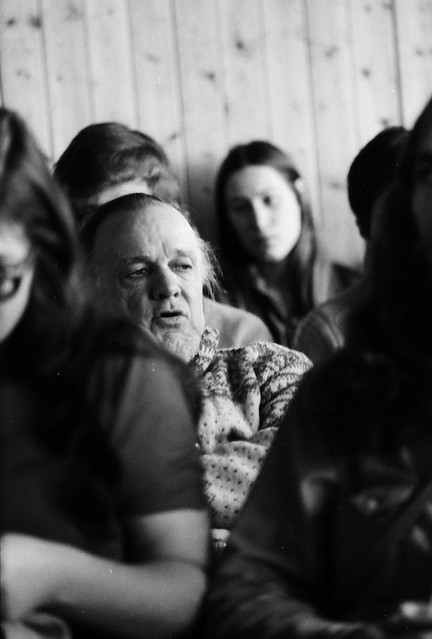
MY 4 POSTCARDS IN 2016 FROM VEGAS TO HUGH HEFNER (PART 2)

October 10, 2017 – 4:48 am

_____ I started this series on my letters and postcards to Hugh Hefner back in September when I read of the passing of Mr. Hefner. There are many more to come. It is my view that he may have taken time to look at glance at one or two of them since these postcards were […] By Everette Hatcher III | Posted in Atheists Confronted | Edit | Comments (0)
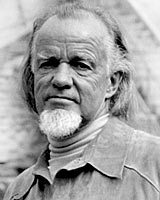
MY 4 POSTCARDS IN 2016 FROM VEGAS TO HUGH HEFNER (PART 1)

October 9, 2017 – 3:29 am

_____ I started this series on my letters and postcards to Hugh Hefner back in September when I read of the passing of Mr. Hefner. There are many more to come. It is my view that he may have taken time to look at glance at one or two of them since these postcards were […] By Everette Hatcher III | Posted in Adrian RogersAtheists Confronted | Edit | Comments (0)
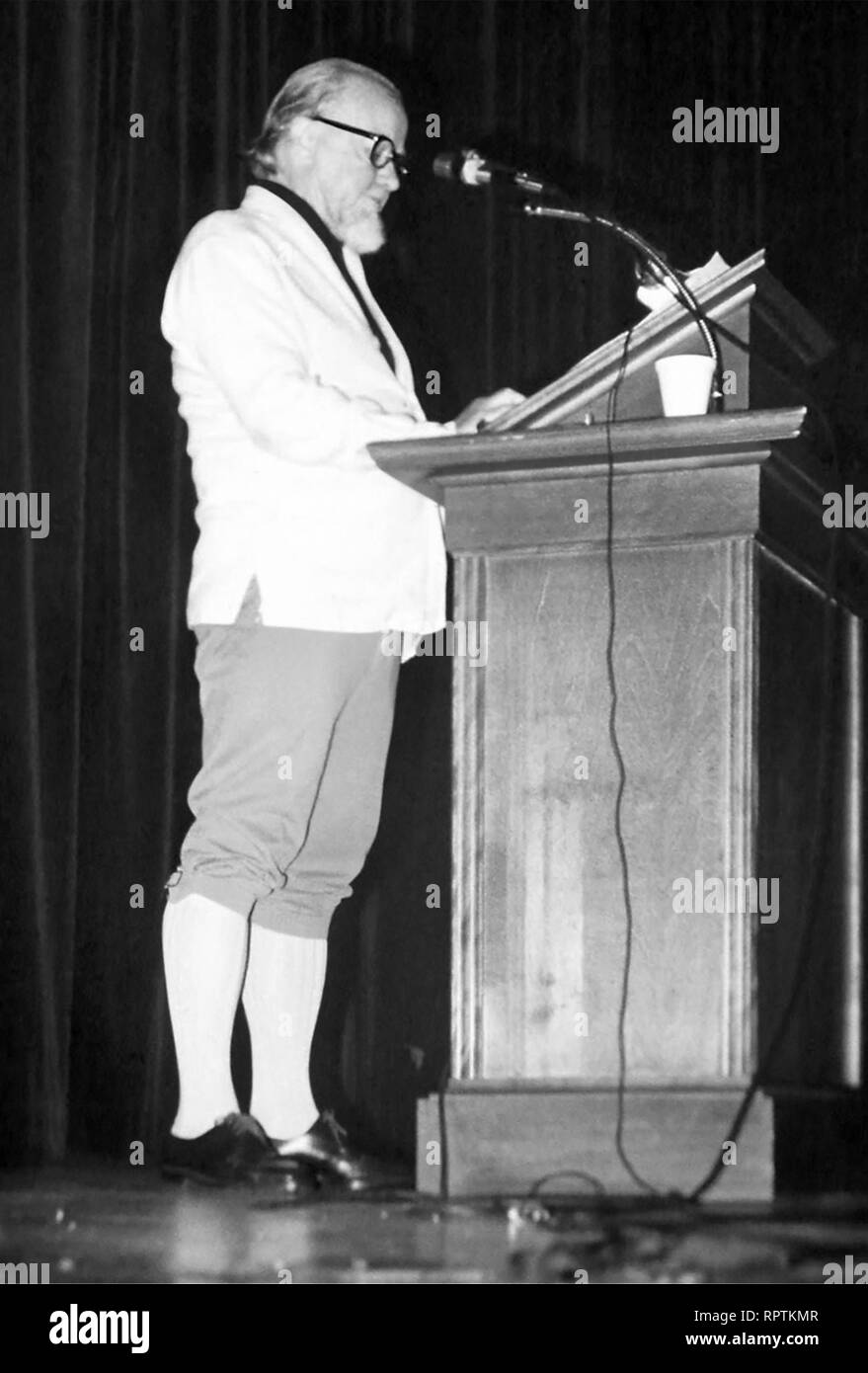
The last 3 letters I wrote to Hugh Hefner compared him to King Solomon in Ecclesiastes and his search for the meaning of it all!!! (Part 3)

September 29, 2017 – 10:30 am

|I saw this on the internet on  June 20, 2017   _   Playboy’s Hugh Hefner on board a boat with Barbi Benton and friends sporting a striped navy shirt and a pipe in mouth and a real catch in hand during the 70s. ____________________________________ Below is the last letter I ever wrote to Hugh Hefner. […] By Everette Hatcher III | Posted in Adrian RogersAtheists ConfrontedFrancis Schaeffer | Edit |Comments (0)
The last 3 letters I wrote to Hugh Hefner compared him to King Solomon in Ecclesiastes and his search for the meaning of it all!!! (Part 2)

September 28, 2017 – 7:33 pm

I learned yesterday that Hugh Hefner had passed away. Just last year I visited Chicago and drove by his Chicago Playboy Mansion pictured below. ___   Playboy after dark filmed in Chicago Playboy Mansion   During the 1990′s I actually made it a practice to write famous atheists and scientists that were mentioned by Adrian […] By Everette Hatcher III | Posted in Atheists ConfrontedFrancis SchaefferMilton Friedman | EditComments (0)
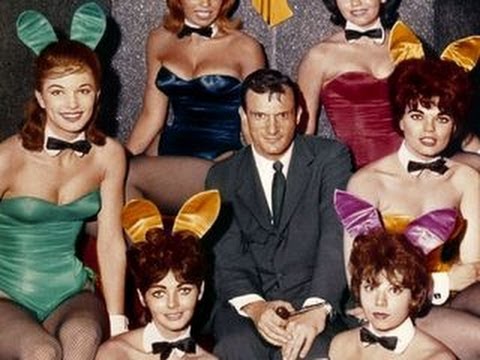
_