Author Archives: Everette Hatcher III

My name is Everette Hatcher III. I am a businessman in Little Rock and have been living in Bryant since 1993. My wife Jill and I have four kids (Rett 24, Hunter 22, Murphey 16, and Wilson 14).

Dan Mitchell article about school choice! Best Political News of 2022

—-

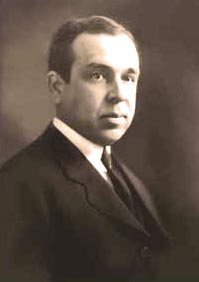
Portrait of Milton Friedman.jpg

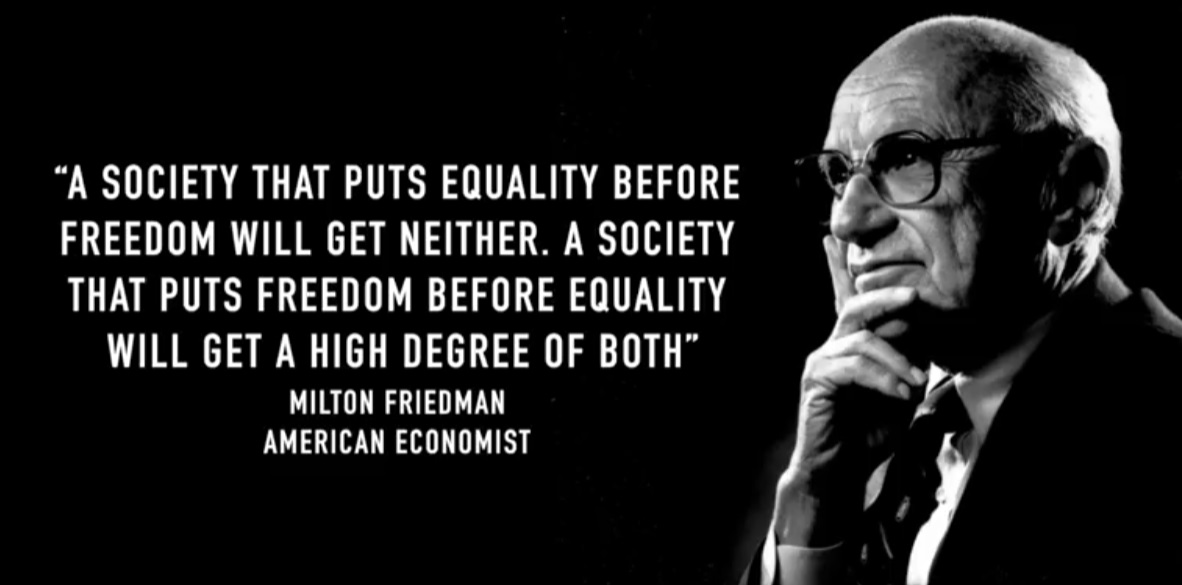
Milton Friedman chose the emphasis on school choice and school vouchers as his greatest legacy and hopefully the Supreme Court will help that dream see a chance!

Best Political News of 2022

When I shared the best and worst news of 2021, I expressed happiness about how school choice is spreading across the nation.

But it’s not spreading as fast as it should because some establishment Republican state legislators would rather kowtow to teacher unions rather than promote better educational opportunities for the kids in their districts.

But parents are beginning to notice.
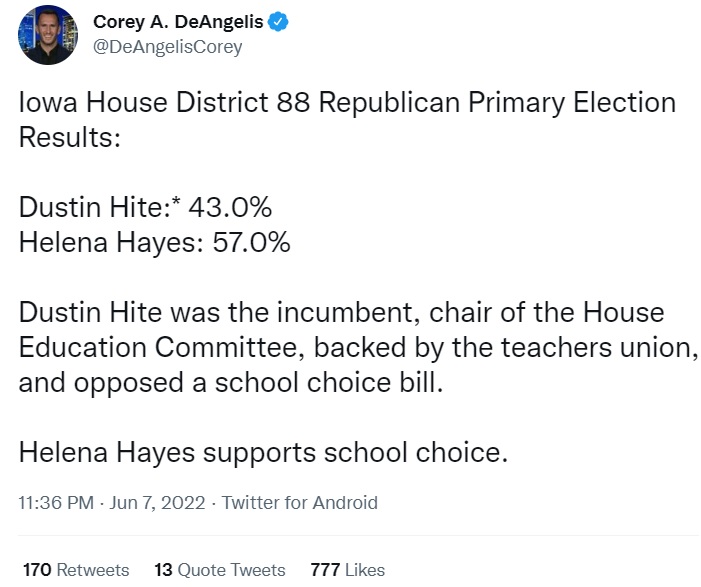
In a closely watched primary contest yesterday in Iowa, the Republican Chairmen of the House Education Committee (and a lackey of the teacher unions)was being challenged by a supporter of school choice.

Needless to say, it’s very difficult to defeat an incumbent politician. But, as Corey DeAngelis shared in a tweet, the challenger prevailed in a stunning outcome.

And if you peruse the press release from the American Federation for Children, that was just one of many victories in the Hawkeye State.

Indeed, it’s just one of many victories in primaries across the country.

Corey wrote an article last week for National Review, co-authored by Jason Bedrick, that analyzed primary results in other states this year.

They start with some good news.

DeSantis made school choice a centerpiece of his campaign, and voters rewarded him. In a race decided by fewer than 40,000 votes, his unusually high level of support among black women (18 percent, or about 100,000 votes), who chose him over an anti–school choice black Democrat, Andrew Gillum, proved decisive. …Republicans began wrapping themselves in the mantle of parental rights and school choice, but the fulfillment of their promises has been mixed. States such as West Virginia and New Hampshire enacted bold new education-choice policies in 2021, while Florida, Indiana, and more than a dozen other states expanded existing choice policies.

They then share some bad news.

Nevertheless, choice initiatives stalled this year in Georgia, Idaho, Iowa, Oklahoma, and Utah, with some Republicans casting the deciding votes.

But they close with the best news of all.

In recent primaries, GOP voters threw their support to candidates who supported choice, even if it meant tossing out otherwise conservative incumbents. …Representative Phil Stephenson, an incumbent backed by the teachers’ union, lost to school-choice supporter Stan Kitzman, who secured 58 percent of the vote despite spending less than half of what his opponent spent… Likewise, school-choice champions Ellen Troxclair and Carrie Isaac both defeated candidates who were endorsed by the Texas affiliate of Randi Weingarten’s American Federation of Teachers. In all, eleven of 14 Texas House of Representatives candidates endorsed by the pro-school choice Texas Federation for Children PAC won their primary runoffs. …in Kentucky, an incumbent known to be the leading opposition to school choice in the Republican caucus, Representative Ed Massey, suffered a devastating primary defeat by school-choice champion Steve Rawlings, who garnered 69 percent of the vote despite being significantly outspent. Candidates endorsed by American Federation for Children Action Fund and its affiliates won their primaries or advanced to runoffs in 38 of 48 races in Texas, Arkansas, Idaho, Georgia, and Nebraska so far this year.

Actually, the best news of all is not what happens in elections. Instead, the best news is when legislation is approved that expands school choice. Like we saw last year in West Virginia and other states.

I’ll close with some political analysis.

I’m a big fan of the no-tax-pledge organized by Americans for Tax Reform.

Why? Because it is a way of targeting politicians who are sympathetic to tax increases.

Signing the pledge does not guarantee that a candidate is good (they can vote for debt-financed spending without violating the pledge).

But a candidate who does not sign the pledge almost certainly is bad. And voters now have a way of identifying – and rejecting – those politicians.

We need something similar for school choice. Maybe that’s a pledge. Maye it’s simply endorsements by the American Federation for Children.

All that matters is that politicians learn that there are negative consequences if they side with teacher unions instead of children.

P.S. Politicians who oppose school choice often are reprehensible hypocrites, as noted by Democratic state senator Justin Wayne of Nebraska.

Educational Choice, the Supreme Court, and a Level Playing Field for Religious Schools

The case for school choice is very straightforward.

The good news is that there was a lot of pro-choice reform in 2021.

West Virginia adopted a statewide system that is based on parental choice. And many other states expanded choice-based programs.

But 2022 may be a good year as well. That’s because the Supreme Court is considering whether to strike down state laws that restrict choice by discriminating against religious schools.

Michael Bindas of the Institute for Justice and Walter Womack of the Southern Christian Leadership Conference make the case for a level playing field in a column for the New York Times.

In 2002, the Supreme Court held that the Constitution allows school choice programs to include schools that provide religious instruction, so long as the voucher program also offers secular options. The question now before the court is whether a state may nevertheless exclude schools that provide religious instruction. The case, Carson v. Makin, …concerns Maine’s tuition assistance program. In that large and sparsely populated state, over half of the school districts have no public high schools. If a student lives in such a district, and it does not contract with another high school to educate its students, then the district must pay tuition for the student to attend the school of her or his parents’ choice. …But one type of school is off limits: a school that provides religious instruction. That may seem unconstitutional, and we argue that it is. Only last year, the Supreme Court, citing the free exercise clause of the Constitution, held that states cannot bar students in a school choice program from selecting religious schools when it allows them to choose other private schools. …The outcome will be enormously consequential for families in public schools that are failing them and will go a long way toward determining whether the most disadvantaged families can exercise the same control over the education of their children as wealthier citizens.

The Wall Street Journal editorialized on this issue earlier this week.

Maine has one of the country’s oldest educational choice systems, a tuition program for students who live in areas that don’t run schools of their own. Instead these families get to pick a school, and public funds go toward enrollment. Religious schools are excluded, however, and on Wednesday the Supreme Court will hear from parents who have closely read the First Amendment.…Maine argues it isn’t denying funds based on the religious “status” of any school… The state claims, rather, that it is merely refusing to allocate money for a “religious use,” specifically, “an education designed to proselytize and inculcate children with a particular faith.” In practice, this distinction between “status” and “use” falls apart. Think about it: Maine is happy to fund tuition at an evangelical school, as long as nothing evangelical is taught. Hmmm. …A state can’t subsidize tuition only for private schools with government-approved values, and trying to define the product as “secular education” gives away the game. …America’s Founders knew what they were doing when they wrote the First Amendment to protect religious “free exercise.”

What does the other side say?

Rachel Laser, head of Americans United for Separation of Church and State, doesn’t want religious schools to be treated equally under school choice programs.

Here’s some of her column in the Washington Post.
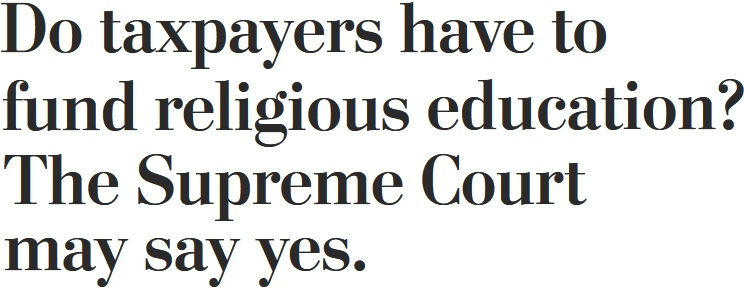
…two sets of parents in Maine claim that the Constitution’s promise of religious freedom actually requires the state to fund religious education at private schools with taxpayer dollars — as a substitute for public education. This interpretation flips the meaning of religious freedom on its head and threatens both true religious freedom and public education.…The problem here is even bigger than public funds paying for praying, as wrong as that is. Unlike public schools, private religious schools often do not honor civil rights protections, especially for LGBTQ people, women, students with disabilities, religious minorities and the nonreligious. …If the court were to agree with the parents, it would also be rejecting the will of three-quarters of the states, which long ago enacted clauses in their state constitutions and passed statutes specifically prohibiting public funding of religious education. …It is up to parents and religious communities to educate their children in their faith. Publicly funded schools should never serve that purpose.

These arguments are not persuasive.

The fact that many state constitutions include so-called Blaine amendments actually undermines her argument since those provisions were motivated by a desire to discriminate against parochial schools that provided education to Catholic immigrants.

And it’s definitely not clear why school choice shouldn’t include religious schools that follow religious teachings, unless she also wants to argue that student grants and loans shouldn’t go to students at Notre Dame, Brigham Young, Liberty, and other religiously affiliated colleges.

The good news is that Ms. Laser’s arguments don’t seem to be winning. Based on this report from yesterday’s Washington Post, authored by Robert Barnes, there are reasons to believe the Justices will make the right decision.
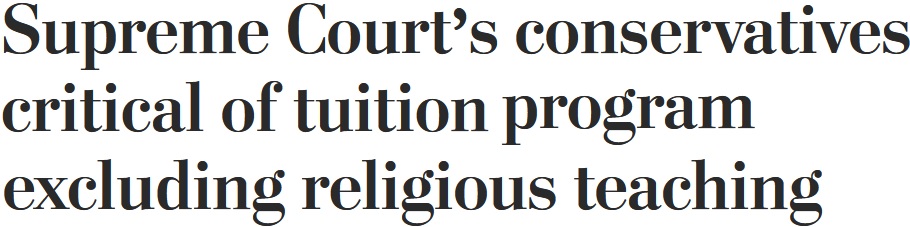
Conservatives on the Supreme Court seemed…critical of a Maine tuition program that does not allow public funds to go to schools that promote religious instruction. The case involves an unusual program in a small state that affects only a few thousand students. But it could have greater implications… The oral argument went on for nearly two hours and featured an array of hypotheticals. …But the session ended as most suspected it would, with the three liberal justices expressing support for Maine and the six conservatives skeptical that it protected religious parents from unconstitutional discrimination.

I can’t resist sharing this additional excerpt about President Biden deciding to side with teacher unions instead of students.

The Justice Department switched its position in the case after President Biden was inaugurated and now supports Maine.

But let’s not dwell on Biden’s hackery (especially since that’s a common affliction on the left).

Instead, let’s close with some uplifting thoughts about what might happen if we get a good decision from the Supreme Court when decisions are announced next year.

Maybe I’m overly optimistic, but I think we’re getting close to a tipping point. As more and more states and communities shift to choice, we will have more and more evidence that it’s a win-win for both families and taxpayers.

Which will lead to more choice programs, which will produce more helpful data.

Lather, rinse, repeat. No wonder the (hypocriticalteacher unionsare so desperate to stop progress.

P.S. There’s strong evidence for school choice from nations such as SwedenChile, and the Netherlands.

Free To Choose 1980 – Vol. 06 What’s Wrong with Our Schools? – Full Video
https://youtu.be/tA9jALkw9_Q


Why Milton Friedman Saw School Choice as a First Step, Not a Final One

On his birthday, let’s celebrate Milton Friedman’s vision of enabling parents, not government, to be in control of a child’s education.

Wednesday, July 31, 2019
Kerry McDonald
Kerry McDonald

EducationMilton FriedmanSchool ChoiceSchooling

Libertarians and others are often torn about school choice. They may wish to see the government schooling monopoly weakened, but they may resist supporting choice mechanisms, like vouchers and education savings accounts, because they don’t go far enough. Indeed, most current choice programs continue to rely on taxpayer funding of education and don’t address the underlying compulsory nature of elementary and secondary schooling.

Skeptics may also have legitimate fears that taxpayer-funded education choice programs will lead to over-regulation of previously independent and parochial schooling options, making all schooling mirror compulsory mass schooling, with no substantive variation.

Milton Friedman had these same concerns. The Nobel prize-winning economist is widely considered to be the one to popularize the idea of vouchers and school choice beginning with his 1955 paper, “The Role of Government in Education.” His vision continues to be realized through the important work of EdChoice, formerly the Friedman Foundation for Education Choice, that Friedman and his economist wife, Rose, founded in 1996.

July 31 is Milton Friedman’s birthday. He died in 2006 at the age of 94, but his ideas continue to have an impact, particularly in education policy.

Friedman saw vouchers and other choice programs as half-measures. He recognized the larger problems of taxpayer funding and compulsion, but saw vouchers as an important starting point in allowing parents to regain control of their children’s education. In their popular book, Free To Choose, first published in 1980, the Friedmans wrote:

We regard the voucher plan as a partial solution because it affects neither the financing of schooling nor the compulsory attendance laws. We favor going much farther. (p.161)

They continued:

The compulsory attendance laws are the justification for government control over the standards of private schools. But it is far from clear that there is any justification for the compulsory attendance laws themselves. (p. 162)

The Friedmans admitted that their “own views on this have changed over time,” as they realized that “compulsory attendance at schools is not necessary to achieve that minimum standard of literacy and knowledge,” and that “schooling was well-nigh universal in the United States before either compulsory attendance or government financing of schooling existed. Like most laws, compulsory attendance laws have costs as well as benefits. We no longer believe the benefits justify the costs.” (pp. 162-3)

Still, they felt that vouchers would be the essential starting point toward chipping away at monopoly mass schooling by putting parents back in charge. School choice, in other words, would be a necessary but not sufficient policy approach toward addressing the underlying issue of government control of education.

In their book, the Friedmans presented the potential outcomes of their proposed voucher plan, which would give parents access to some or all of the average per-pupil expenditures of a child enrolled in public school. They believed that vouchers would help create a more competitive education market, encouraging education entrepreneurship. They felt that parents would be more empowered with greater control over their children’s education and have a stronger desire to contribute some of their own money toward education. They asserted that in many places “the public school has fostered residential stratification, by tying the kind and cost of schooling to residential location” and suggested that voucher programs would lead to increased integration and heterogeneity. (pp. 166-7)

To the critics who said, and still say, that school choice programs would destroy the public schools, the Friedmans replied that these critics fail to

explain why, if the public school system is doing such a splendid job, it needs to fear competition from nongovernmental, competitive schools or, if it isn’t, why anyone should object to its “destruction.” (p. 170)

What I appreciate most about the Friedmans discussion of vouchers and the promise of school choice is their unrelenting support of parents. They believed that parents, not government bureaucrats and intellectuals, know what is best for their children’s education and well-being and are fully capable of choosing wisely for their children—when they have the opportunity to do so.

They wrote:

Parents generally have both greater interest in their children’s schooling and more intimate knowledge of their capacities and needs than anyone else. Social reformers, and educational reformers in particular, often self-righteously take for granted that parents, especially those who are poor and have little education themselves, have little interest in their children’s education and no competence to choose for them. That is a gratuitous insult. Such parents have frequently had limited opportunity to choose. However, U.S. history has demonstrated that, given the opportunity, they have often been willing to sacrifice a great deal, and have done so wisely, for their children’s welfare. (p. 160).

Sign-Up: Receive Kerry’s Weekly Parenting and Education Newsletter!

Today, school voucher programs exist in 15 states plus the District of Columbia. These programs have consistently shown that when parents are given the choice to opt-out of an assigned district school, many will take advantage of the opportunity. In Washington, D.C., low-income parents who win a voucher lottery send their children to private schools.

The most recent three-year federal evaluationof voucher program participants found that while student academic achievement was comparable to achievement for non-voucher students remaining in public schools, there were statistically significant improvements in other important areas. For instance, voucher participants had lower rates of chronic absenteeism than the control groups, as well as higher student satisfaction scores. There were also tremendous cost-savings.

In Wisconsin, the Milwaukee Parental Choice Program has served over 28,000 low-income students attending 129 participating private schools.

According to Corey DeAngelis, Director of School Choice at the Reason Foundation and a prolific researcher on the topic, the recent analysis of the D.C. voucher program “reveals that private schools produce the same academic outcomes for only a third of the cost of the public schools. In other words, school choice is a great investment.”

In Wisconsin, the Milwaukee Parental Choice Program was created in 1990 and is the nation’s oldest voucher program. It currently serves over 28,000 low-income students attending 129 participating private schools. Like the D.C. voucher program, data on test scores of Milwaukee voucher students show similar results to public school students, but non-academic results are promising.

Recent research found voucher recipients had lower crime rates and lower incidences of unplanned pregnancies in young adulthood. On his birthday, let’s celebrate Milton Friedman’s vision of enabling parents, not government, to be in control of a child’s education.

According to Howard Fuller, an education professor at Marquette University, founder of the Black Alliance for Educational Options, and one of the developers of the Milwaukee voucher program, the key is parent empowerment—particularly for low-income minority families.

In an interview with NPR, Fuller said: “What I’m saying to you is that there are thousands of black children whose lives are much better today because of the Milwaukee parental choice program,” he says. 
“They were able to access better schools than they would have without a voucher.”

Putting parents back in charge of their child’s education through school choice measures was Milton Friedman’s goal. It was not his ultimate goal, as it would not fully address the funding and compulsion components of government schooling; but it was, and remains, an important first step. As the Friedmans wrote in Free To Choose:

The strong American tradition of voluntary action has provided many excellent examples that demonstrate what can be done when parents have greater choice. (p. 159).

On his birthday, let’s celebrate Milton Friedman’s vision of enabling parents, not government, to be in control of a child’s education.

Kerry McDonald

Related posts:


“Friedman Friday” (“Free to Choose” episode 1 – Power of the Market. part 7 of 7)

March 16, 2012 – 12:25 am

  Michael Harrington:  If you don’t have the expertise, the knowledge technology today, you’re out of the debate. And I think that we have to democratize information and government as well as the economy and society. FRIEDMAN: I am sorry to say Michael Harrington’s solution is not a solution to it. He wants minority rule, I […] By Everette Hatcher III | Posted in Current Events, Milton Friedman | Edit | Comments (0)

“Friedman Friday” (“Free to Choose” episode 1 – Power of the Market. part 6 of 7)

March 9, 2012 – 12:29 am

PETERSON: Well, let me ask you how you would cope with this problem, Dr. Friedman. The people decided that they wanted cool air, and there was tremendous need, and so we built a huge industry, the air conditioning industry, hundreds of thousands of jobs, tremendous earnings opportunities and nearly all of us now have air […] By Everette Hatcher III | Posted in Current Events, Milton Friedman | Edit | Comments (0)

“Friedman Friday” (“Free to Choose” episode 1 – Power of the Market. part 5 of 7)

March 2, 2012 – 12:26 am

Part 5 Milton Friedman: I do not believe it’s proper to put the situation in terms of industrialist versus government. On the contrary, one of the reasons why I am in favor of less government is because when you have more government industrialists take it over, and the two together form a coalition against the ordinary […] By Everette Hatcher III | Posted in Current Events, Milton Friedman | Edit | Comments (0)

“Friedman Friday” (“Free to Choose” episode 1 – Power of the Market. part 4 of 7)

February 24, 2012 – 12:21 am

The fundamental principal of the free society is voluntary cooperation. The economic market, buying and selling, is one example. But it’s only one example. Voluntary cooperation is far broader than that. To take an example that at first sight seems about as far away as you can get __ the language we speak; the words […] By Everette Hatcher III | Posted in Current Events, Milton Friedman | Edit | Comments (0)

“Friedman Friday” (“Free to Choose” episode 1 – Power of the Market. part 3 of 7)

February 17, 2012 – 12:12 am

  _________________________   Pt3  Nowadays there’s a considerable amount of traffic at this border. People cross a little more freely than they use to. Many people from Hong Kong trade in China and the market has helped bring the two countries closer together, but the barriers between them are still very real. On this side […] By Everette Hatcher III | Posted in Current Events, Milton Friedman | Edit | Comments (0)

“Friedman Friday” (“Free to Choose” episode 1 – Power of the Market. part 2 of 7)

February 10, 2012 – 12:09 am

  Aside from its harbor, the only other important resource of Hong Kong is people __ over 4_ million of them. Like America a century ago, Hong Kong in the past few decades has been a haven for people who sought the freedom to make the most of their own abilities. Many of them are […] By Everette Hatcher III | Posted in Current Events, Milton Friedman | Edit | Comments (0)

“Friedman Friday” (“Free to Choose” episode 1 – Power of the Market. part 1of 7)

February 3, 2012 – 12:07 am

“FREE TO CHOOSE” 1: The Power of the Market (Milton Friedman) Free to Choose ^ | 1980 | Milton Friedman Posted on Monday, July 17, 2006 4:20:46 PM by Choose Ye This Day FREE TO CHOOSE: The Power of the Market Friedman: Once all of this was a swamp, covered with forest. The Canarce Indians […]

Milton Friedman The Power of the Market 1-5

Debate on Milton Friedman’s cure for inflation

September 29, 2011 – 7:24 am

If you would like to see the first three episodes on inflation in Milton Friedman’s film series “Free to Choose” then go to a previous post I did. Ep. 9 – How to Cure Inflation [4/7]. Milton Friedman’s Free to Choose (1980) Uploaded by investbligurucom on Jun 16, 2010 While many people have a fairly […]

By Everette Hatcher III | Also posted in Current Events | Tagged dr friedman, expansion history, income tax brackets, political courage, www youtube | Edit | Comments (0)

“Friedman Friday” Milton Friedman believed in liberty (Interview by Charlie Rose of Milton Friedman part 1)

April 19, 2013 – 1:14 am

Charlie Rose interview of Milton Friedman My favorite economist: Milton Friedman : A Great Champion of Liberty  by V. Sundaram   Milton Friedman, the Nobel Prize-winning economist who advocated an unfettered free market and had the ear of three US Presidents – Nixon, Ford and Reagan – died last Thursday (16 November, 2006 ) in San Francisco […] By Everette Hatcher III | Posted in Milton Friedman | Edit | Comments (0)

What were the main proposals of Milton Friedman?

February 21, 2013 – 1:01 am

Stearns Speaks on House Floor in Support of Balanced Budget Amendment Uploaded by RepCliffStearns on Nov 18, 2011 Speaking on House floor in support of Balanced Budget Resolution, 11/18/2011 ___________ Below are some of the main proposals of Milton Friedman. I highly respected his work. David J. Theroux said this about Milton Friedman’s view concerning […] By Everette Hatcher III | Posted in Milton Friedman | Edit | Comments (0)

“Friedman Friday,” EPISODE “The Failure of Socialism” of Free to Choose in 1990 by Milton Friedman (Part 1)

December 7, 2012 – 5:55 am

Milton Friedman: Free To Choose – The Failure Of Socialism With Ronald Reagan (Full) Published on Mar 19, 2012 by NoNationalityNeeded Milton Friedman’s writings affected me greatly when I first discovered them and I wanted to share with you. We must not head down the path of socialism like Greece has done. Abstract: Ronald Reagan […] By Everette Hatcher III | Posted in Milton FriedmanPresident Obama | Edit | Comments (1)

Defending Milton Friedman

July 31, 2012 – 6:45 am

What a great defense of Milton Friedman!!!!   Defaming Milton Friedman by Johan Norberg This article appeared in Reason Online on September 26, 2008  PRINT PAGE  CITE THIS      Sans Serif      Serif Share with your friends: ShareThis In the future, if you tell a student or a journalist that you favor free markets and limited government, there is […]

June 8, 2022 READING A PROVERB A DAY (PROVERBS 8) King Solomon on Wisdom (Verses listed by Adrian Warnock) series on King Solomon’s words Proverbs chapters 8, 13, 15 and 16

Proverbs 8 New Living Translation

Wisdom has built her house;
    she has carved its seven columns.
She has prepared a great banquet,
    mixed the wines, and set the table.
She has sent her servants to invite everyone to come.
    She calls out from the heights overlooking the city.
“Come in with me,” she urges the simple.
    To those who lack good judgment, she says,
“Come, eat my food,
    and drink the wine I have mixed.
Leave your simple ways behind, and begin to live;
    learn to use good judgment.”

Anyone who rebukes a mocker will get an insult in return.
    Anyone who corrects the wicked will get hurt.
So don’t bother correcting mockers;
    they will only hate you.
But correct the wise,
    and they will love you.
Instruct the wise,
    and they will be even wiser.
Teach the righteous,
    and they will learn even more.

10 Fear of the Lord is the foundation of wisdom.
    Knowledge of the Holy One results in good judgment.

11 Wisdom will multiply your days
    and add years to your life.
12 If you become wise, you will be the one to benefit.
    If you scorn wisdom, you will be the one to suffer.

Folly Calls for a Hearing

13 The woman named Folly is brash.
    She is ignorant and doesn’t know it.
14 She sits in her doorway
    on the heights overlooking the city.
15 She calls out to men going by
    who are minding their own business.
16 “Come in with me,” she urges the simple.
    To those who lack good judgment, she says,
17 “Stolen water is refreshing;
    food eaten in secret tastes the best!”
18 But little do they know that the dead are there.
    Her guests are in the depths of the grave.[a]

Book of Proverbs: Part I, Pastor Bob Rice (Northeast Bible Church) 10.21.12 (Proverbs 1)

Published on Oct 30, 2012

Part I in Sermon Series the “Book of Proverbs”. Delivered by Sr. Pastor Bob Rice.
Northeast Bible Church, Plano TX
http://www.northeastbiblechurch.com

___________________________

King Solomon on Wisdom (Verses listed by Adrian Warnock)

Read below and these answer these easy questions with the scripture reference and answer:

1.Is it hard for people to hear the voice of wisdom?

2. What healthy fear leads to wisdom?

3. What are some of the advantages of wisdom?

___________

If a person was paid $10,000.00 every morning to wake up and read a chapter in the Book of Proverbs then would the money or the wisdom you receive from God’s word be worth more?

Prov 8:11
for wisdom is better than jewels, and all that you may desire cannot compare with her.

Prov 16:16
How much better to get wisdom than gold! To get understanding is to be chosen rather than silver.

_______________________

WHO DO YOU HANG OUT WITH? ARE THEY VERY WISE?

Prov 13:20
Whoever walks with the wise becomes wise, but the companion of fools will suffer harm.

Prov 15:12
A scoffer does not like to be reproved; he will not go to the wise.

____________________

Where do you get wisdom from?

Prov 1:7
The fear of the Lord is the beginning of knowledge; fools despise wisdom and instruction.

________________________________________________________________________________________

Is it hard for people to hear the voice of wisdom? Apparently it is very hard because many people do not want to listen to the voice of wisdom.  It may be because these fools think they are wise already or maybe they don’t want to submit to God’s leadership in their lives and they love their sin? However, the wise person will be glad to be reproved.

Prov 1:20
Wisdom cries aloud in the street, in the markets she raises her voice;

Prov 3:7
Be not wise in your own eyes; fear the Lord, and turn away from evil.

Prov 9:8
Do not reprove a scoffer, or he will hate you; reprove a wise man, and he will love you.

Prov 10:8
The wise of heart will receive commandments, but a babbling fool will come to ruin.

Prov 13:10
By insolence comes nothing but strife, but with those who take advice is wisdom.

____________________

Once a person becomes wise then they should be willing to tell other souls about the source of wisdom. How many of your friends need wisdom?

Prov 11:30
The fruit of the righteous is a tree of life, and whoever captures souls is wise.

Prov 13:14
The teaching of the wise is a fountain of life, that one may turn away from the snares of death.

_____________________________

What are some of the advantages of walking in wisdom?

Prov 2:7
he stores up sound wisdom for the upright; he is a shield to those who walk in integrity,

Prov 3:35
The wise will inherit honor, but fools get disgrace.

Prov 24:14
Know that wisdom is such to your soul; if you find it, there will be a future, and your hope will not be cut off.

_________________________

Rejecting wisdom will take a person down a very hard road.

Prov 10:13
On the lips of him who has understanding, wisdom is found, but a rod is for the back of him who lacks sense.

______________________

PROVERBS – Get wisdom! Get Understanding!

People often say that common sense is not common. Last Sunday Tope began a sermon series at my church. His sermon is available online and forms a fantastic introduction to this amazing book of the Bible. The audio of this sermon is available online.To me, it seems that as well as simply reading the book through, this book lends itself well to collecting verses together by subject. I have had some fun using my Logos Bible Software to do just this with the book of Proverbs, and thought I would share some of the results of my searches here. So to begin with, here is what Proverbs says about wisdom . . .Wisdom in ProverbsProv 1:2
To know wisdom and instruction, to understand words of insight,Prov 1:3
to receive instruction in wise dealing, in righteousness, justice, and equity;Prov 1:5
Let the wise hear and increase in learning, and the one who understands obtain guidance,Prov 1:6
to understand a proverb and a saying, the words of the wise and their riddles.Prov 1:7
The fear of the Lord is the beginning of knowledge; fools despise wisdom and instruction.Prov 1:20
Wisdom cries aloud in the street, in the markets she raises her voice;

Prov 2:2
making your ear attentive to wisdom and inclining your heart to understanding;

Prov 2:6
For the Lord gives wisdom; from his mouth come knowledge and understanding;

Prov 2:7
he stores up sound wisdom for the upright; he is a shield to those who walk in integrity,

Prov 2:10
for wisdom will come into your heart, and knowledge will be pleasant to your soul;

Prov 3:7
Be not wise in your own eyes; fear the Lord, and turn away from evil.

Prov 3:13
Blessed is the one who finds wisdom, and the one who gets understanding,

Prov 3:19
The Lord by wisdom founded the earth; by understanding he established the heavens;

Prov 3:21
My son, do not lose sight of these— keep sound wisdom and discretion,

Prov 3:35
The wise will inherit honor, but fools get disgrace.

Prov 4:5
Get wisdom; get insight; do not forget, and do not turn away from the words of my mouth.

Prov 4:7
The beginning of wisdom is this: Get wisdom, and whatever you get, get insight.

Prov 4:11
I have taught you the way of wisdom; I have led you in the paths of uprightness.

Prov 5:1
My son, be attentive to my wisdom; incline your ear to my understanding,

Prov 6:6
Go to the ant, O sluggard; consider her ways, and be wise.

Prov 7:4
Say to wisdom, “You are my sister,” and call insight your intimate friend,

Prov 8:1
Does not wisdom call ? Does not understanding raise her voice?

Prov 8:11
for wisdom is better than jewels, and all that you may desire cannot compare with her.

Prov 8:12
“I, wisdom, dwell with prudence, and I find knowledge and discretion.

Prov 8:14
I have counsel and sound wisdom; I have insight; I have strength.

Prov 8:33
Hear instruction and be wise, and do not neglect it.

Prov 9:1
Wisdom has built her house; she has hewn her seven pillars.

Prov 9:8
Do not reprove a scoffer, or he will hate you; reprove a wise man, and he will love you.

Prov 9:9
Give instruction to a wise man, and he will be still wiser; teach a righteous man, and he will increase in learning.

Prov 9:10
The fear of the Lord is the beginning of wisdom, and the knowledge of the Holy One is insight.

Prov 9:12
If you are wise, you are wise for yourself; if you scoff, you alone will bear it.

Prov 10:1
The proverbs of Solomon. A wise son makes a glad father, but a foolish son is a sorrow to his mother.

Prov 10:8
The wise of heart will receive commandments, but a babbling fool will come to ruin.

Prov 10:13
On the lips of him who has understanding, wisdom is found, but a rod is for the back of him who lacks sense.

Prov 10:14
The wise lay up knowledge, but the mouth of a fool brings ruin near.

Prov 10:23
Doing wrong is like a joke to a fool, but wisdom is pleasure to a man of understanding.

Prov 10:31
The mouth of the righteous brings forth wisdom, but the perverse tongue will be cut off.

Prov 11:2
When pride comes, then comes disgrace, but with the humble is wisdom.

Prov 11:29
Whoever troubles his own household will inherit the wind, and the fool will be servant to the wise of heart.

Prov 11:30
The fruit of the righteous is a tree of life, and whoever captures souls is wise.

Prov 12:15
The way of a fool is right in his own eyes, but a wise man listens to advice.

Prov 12:18
There is one whose rash words are like sword thrusts, but the tongue of the wise brings healing.

Prov 13:1
A wise son hears his father’s instruction, but a scoffer does not listen to rebuke.

Prov 13:10
By insolence comes nothing but strife, but with those who take advice is wisdom.

Prov 13:14
The teaching of the wise is a fountain of life, that one may turn away from the snares of death.

Prov 13:20
Whoever walks with the wise becomes wise, but the companion of fools will suffer harm.

Prov 14:3
By the mouth of a fool comes a rod for his back, but the lips of the wise will preserve them.

Prov 14:6
A scoffer seeks wisdom in vain, but knowledge is easy for a man of understanding.

Prov 14:8
The wisdom of the prudent is to discern his way, but the folly of fools is deceiving.

Prov 14:16
One who is wise is cautious and turns away from evil, but a fool is reckless and careless.

Prov 14:24
The crown of the wise is their wealth, but the folly of fools brings folly.

Prov 14:33
Wisdom rests in the heart of a man of understanding, but it makes itself known even in the midst of fools.

Prov 14:35
A servant who deals wisely has the king’s favor, but his wrath falls on one who acts shamefully.

Prov 15:2
The tongue of the wise commends knowledge, but the mouths of fools pour out folly.

Prov 15:7
The lips of the wise spread knowledge; not so the hearts of fools.

Prov 15:12
A scoffer does not like to be reproved; he will not go to the wise.

Prov 15:20
A wise son makes a glad father, but a foolish man despises his mother.

Prov 15:31
The ear that listens to life-giving reproof will dwell among the wise.

Prov 15:33
The fear of the Lord is instruction in wisdom, and humility comes before honor.

Prov 16:14
A king’s wrath is a messenger of death, and a wise man will appease it.

Prov 16:16
How much better to get wisdom than gold! To get understanding is to be chosen rather than silver.

Prov 16:21
The wise of heart is called discerning, and sweetness of speech increases persuasiveness.

Prov 16:23
The heart of the wise makes his speech judicious and adds persuasiveness to his lips.

Prov 17:2
A servant who deals wisely will rule over a son who acts shamefully and will share the inheritance as one of the brothers.

Prov 17:16
Why should a fool have money in his hand to buy wisdom when he has no sense?

Prov 17:24
The discerning sets his face toward wisdom, but the eyes of a fool are on the ends of the earth.

Prov 17:28
Even a fool who keeps silent is considered wise; when he closes his lips, he is deem
ed intelligent.

Prov 18:4
The words of a man’s mouth are deep waters; the fountain of wisdom is a bubbling brook.

Prov 18:15
An intelligent heart acquires knowledge, and the ear of the wise seeks knowledge.

Prov 19:20
Listen to advice and accept instruction, that you may gain wisdom in the future.

Prov 20:1
Wine is a mocker, strong drink a brawler, and whoever is led astray by it is not wise.

Prov 20:18
Plans are established by counsel; by wise guidance wage war.

Prov 20:26
A wise king winnows the wicked and drives the wheel over them.

Prov 21:11
When a scoffer is punished, the simple becomes wise; when a wise man is instructed, he gains knowledge.

Prov 21:20
Precious treasure and oil are in a wise man’s dwelling, but a foolish man devours it.

Prov 21:22
A wise man scales the city of the mighty and brings down the stronghold in which they trust.

Prov 21:30
No wisdom, no understanding, no counsel can avail against the Lord.

Prov 22:17
Incline your ear, and hear the words of the wise, and apply your heart to my knowledge,

Prov 23:15
My son, if your heart is wise, my heart too will be glad.

Prov 23:19
Hear, my son, and be wise, and direct your heart in the way.

Prov 23:23
Buy truth, and do not sell it; buy wisdom, instruction, and understanding.

Prov 23:24
The father of the righteous will greatly rejoice; he who fathers a wise son will be glad in him.

Prov 24:3
By wisdom a house is built, and by understanding it is established;

Prov 24:5
A wise man is full of strength, and a man of knowledge enhances his might,

Prov 24:6
for by wise guidance you can wage your war, and in abundance of counselors there is victory.

Prov 24:7
Wisdom is too high for a fool; in the gate he does not open his mouth.

Prov 24:14
Know that wisdom is such to your soul; if you find it, there will be a future, and your hope will not be cut off.

Prov 24:23
These also are sayings of the wise. Partiality in judging is not good.

Prov 25:12
Like a gold ring or an ornament of gold is a wise reprover to a listening ear.

Prov 26:5
Answer a fool according to his folly, lest he be wise in his own eyes.

Prov 26:12
Do you see a man who is wise in his own eyes? There is more hope for a fool than for him.

Prov 27:11
Be wise, my son, and make my heart glad, that I may answer him who reproaches me.

Prov 28:11
A rich man is wise in his own eyes, but a poor man who has understanding will find him out.

Prov 28:26
Whoever trusts in his own mind is a fool, but he who walks in wisdom will be delivered.

Prov 29:3
He who loves wisdom makes his father glad, but a companion of prostitutes squanders his wealth.

Prov 29:8
Scoffers set a city aflame, but the wise turn away wrath.

Prov 29:9
If a wise man has an argument with a fool, the fool only rages and laughs, and there is no quiet.

Prov 29:11
A fool gives full vent to his spirit, but a wise man quietly holds it back.

Prov 29:15
The rod and reproof give wisdom, but a child left to himself brings shame to his mother.

Prov 30:3
I have not learned wisdom, nor have I knowledge of the Holy One.

Prov 30:24
Four things on earth are small, but they are exceedingly wise:

Prov 31:26
She opens her mouth with wisdom, and the teaching of kindness is on her tongue.

You may also like –

Related posts:

Seeing Jesus in Proverbs, Ecclesiastes, and Job

Ecclesiastes 8-10 | Still Searching After All These Years Published on Oct 9, 2012 Calvary Chapel Spring Valley | Sunday Evening | October 7, 2012 | Pastor Derek Neider _______________________ Ecclesiastes 11-12 | Solomon Finds His Way Published on Oct 30, 2012 Calvary Chapel Spring Valley | Sunday Evening | October 28, 2012 | Pastor Derek Neider […]

John MacArthur on Proverbs (Part 10) Summing up Proverbs study

Over and over in Proverbs you hear the words “fear the Lord.” In fact, some of he references are Proverbs 1:7, 29; 2:5; 8:13; 9:10;14:26,27; 15:16 and many more. Below is a sermon by John MacArthur from the Book of Luke on 3 reasons we should fear the Lord. (I have posted John MacArthur’s amazing […]

John MacArthur on Proverbs (Part 9) “Love your neighbor”

Over and over in Proverbs you hear the words “fear the Lord.” In fact, some of he references are Proverbs 1:7, 29; 2:5; 8:13; 9:10;14:26,27; 15:16 and many more. Below is a sermon by John MacArthur from the Book of Luke on 3 reasons we should fear the Lord. (I have posted John MacArthur’s amazing […]

John MacArthur on Proverbs (Part 8) “Manage your money”

Over and over in Proverbs you hear the words “fear the Lord.” In fact, some of he references are Proverbs 1:7, 29; 2:5; 8:13; 9:10;14:26,27; 15:16 and many more. Below is a sermon by John MacArthur from the Book of Luke on 3 reasons we should fear the Lord. (I have posted John MacArthur’s amazing […]

John MacArthur on Proverbs (Part 7) “Pursue your work”

Over and over in Proverbs you hear the words “fear the Lord.” In fact, some of he references are Proverbs 1:7, 29; 2:5; 8:13; 9:10;14:26,27; 15:16 and many more. Below is a sermon by John MacArthur from the Book of Luke on 3 reasons we should fear the Lord. (I have posted John MacArthur’s amazing […]

John MacArthur on Proverbs (Part 6) “Enjoy your wife and watch your words”

Over and over in Proverbs you hear the words “fear the Lord.” In fact, some of he references are Proverbs 1:7, 29; 2:5; 8:13; 9:10;14:26,27; 15:16 and many more. Below is a sermon by John MacArthur from the Book of Luke on 3 reasons we should fear the Lord. (I have posted John MacArthur’s amazing […]

John MacArthur on Proverbs (Part 5) “Control your body”

Over and over in Proverbs you hear the words “fear the Lord.” In fact, some of he references are Proverbs 1:7, 29; 2:5; 8:13; 9:10;14:26,27; 15:16 and many more. Below is a sermon by John MacArthur from the Book of Luke on 3 reasons we should fear the Lord. (I have posted John MacArthur’s amazing […]

John MacArthur on Proverbs (Part 4) “Bad company corrupts…”

Over and over in Proverbs you hear the words “fear the Lord.” In fact, some of he references are Proverbs 1:7, 29; 2:5; 8:13; 9:10;14:26,27; 15:16 and many more. Below is a sermon by John MacArthur from the Book of Luke on 3 reasons we should fear the Lord. (I have posted John MacArthur’s amazing […]

John MacArthur on Proverbs (Part 3) “Guard your mind and obey your parents!!”

Over and over in Proverbs you hear the words “fear the Lord.” In fact, some of he references are Proverbs 1:7, 29; 2:5; 8:13; 9:10;14:26,27; 15:16 and many more. Below is a sermon by John MacArthur from the Book of Luke on 3 reasons we should fear the Lord. It is tough to guard your […]

John MacArthur on Proverbs (Part 2) What does it mean to fear the Lord?

Over and over in Proverbs you hear the words “fear the Lord.” In fact, some of he references are Proverbs 1:7, 29; 2:5; 8:13; 9:10;14:26,27; 15:16 and many more. Below is a sermon by John MacArthur from the Book of Luke on 3 reasons we should fear the Lord. What does it mean to fear […]

The Wisdom of Solomon and the Book of Ecclesiastes

Ecclesiastes 6-8 | Solomon Turns Over a New Leaf Published on Oct 2, 2012 Calvary Chapel Spring Valley | Sunday Evening | September 30, 2012 | Pastor Derek Neider _____________________ I have written on the Book of Ecclesiastes and the subject of the meaning of our lives on several occasions on this blog. In this series on Ecclesiastes I […]

Why is Solomon so depressed in Ecclesiastes? by Brent Cunningham

Ecclesiastes 1 Published on Sep 4, 2012 Calvary Chapel Spring Valley | Sunday Evening | September 2, 2012 | Pastor Derek Neider _____________________ I have written on the Book of Ecclesiastes and the subject of the meaning of our lives on several occasions on this blog. In this series on Ecclesiastes I hope to show how […]

Robert Leroe on Ecclesiastes (Mentions Thomas Aquinas, Princess Diana, Mother Teresa, King Solomon, King Rehoboam, Eugene Peterson, Chuck Swindoll, and John Newton.)

Ecclesiastes 1 Published on Sep 4, 2012 Calvary Chapel Spring Valley | Sunday Evening | September 2, 2012 | Pastor Derek Neider _____________________ I have written on the Book of Ecclesiastes and the subject of the meaning of our lives on several occasions on this blog. In this series on Ecclesiastes I hope to show how […]

Solomon was the author of Ecclesiastes

Ecclesiastes 8-10 | Still Searching After All These Years Published on Oct 9, 2012 Calvary Chapel Spring Valley | Sunday Evening | October 7, 2012 | Pastor Derek Neider _______________________ Ecclesiastes 11-12 | Solomon Finds His Way Published on Oct 30, 2012 Calvary Chapel Spring Valley | Sunday Evening | October 28, 2012 | Pastor Derek Neider […]

Ecclesiastes: Solomon with Life in the Fast Lane

Ecclesiastes 6-8 | Solomon Turns Over a New Leaf Published on Oct 2, 2012 Calvary Chapel Spring Valley | Sunday Evening | September 30, 2012 | Pastor Derek Neider _____________________ I have written on the Book of Ecclesiastes and the subject of the meaning of our lives on several occasions on this blog. In this series […]

Ecclesiastes a scathing and self-deprecating attack on hedonism and secular humanism by Solomon

Ecclesiastes 4-6 | Solomon’s Dissatisfaction Published on Sep 24, 2012 Calvary Chapel Spring Valley | Sunday Evening | September 23, 2012 | Pastor Derek Neider ___________________ I have written on the Book of Ecclesiastes and the subject of the meaning of our lives on several occasions on this blog. In this series on Ecclesiastes I hope […]

Solomon was right in his cynicism–unless……unless there is a God who created us and cares about us

Ecclesiastes 8-10 | Still Searching After All These Years Published on Oct 9, 2012 Calvary Chapel Spring Valley | Sunday Evening | October 7, 2012 | Pastor Derek Neider _______________________ Ecclesiastes 11-12 | Solomon Finds His Way Published on Oct 30, 2012 Calvary Chapel Spring Valley | Sunday Evening | October 28, 2012 | Pastor Derek Neider […]

The Humanist takes on Solomon and the Book of Ecclesiastes

Ecclesiastes 8-10 | Still Searching After All These Years Published on Oct 9, 2012 Calvary Chapel Spring Valley | Sunday Evening | October 7, 2012 | Pastor Derek Neider _______________________ Ecclesiastes 11-12 | Solomon Finds His Way Published on Oct 30, 2012 Calvary Chapel Spring Valley | Sunday Evening | October 28, 2012 | Pastor Derek Neider […]

Tom Brady , Coldplay, Kansas, Solomon and the search for satisfaction (part 3)

Tom Brady “More than this…” Uploaded by EdenWorshipCenter on Jan 22, 2008 EWC sermon illustration showing a clip from the 2005 Tom Brady 60 minutes interview. _______________________ Tom Brady ESPN Interview Tom Brady has famous wife earned over 76 million dollars last year. However, has Brady found lasting satifaction in his life? It does not […]

Tom Brady, Coldplay, Kansas, Solomon and the search for satisfaction (part 2)

Tom Brady “More than this…” Uploaded by EdenWorshipCenter on Jan 22, 2008 EWC sermon illustration showing a clip from the 2005 Tom Brady 60 minutes interview. To Download this video copy the URL to http://www.vixy.net ________________ Obviously from the video clip above, Tom Brady has realized that even though he has won many Super Bowls […]

By Everette Hatcher III | Posted in Current Events | Edit | Comments (0)

6 Points to Know Before Jan. 6 Panel’s Prime-Time Hearing

—-


6 Points to Know Before Jan. 6 Panel’s Prime-Time Hearing

The House committee investigating the Capitol riot hired a former ABC News executive to mount a multimedia presentation for TV viewers boasting top production values. Pictured from left during a March 28 meeting of the panel: Chairman Bennie Thompson, D-Miss.; Vice Chairman Liz Cheney, R-Wyo.; and Rep. Jamie Raskin, D-Md. (Photo: Jabin Botsford/The Washington Post/Getty Images)


The House panel investigating the Capitol riot is going prime time Thursday night with a nationally televised hearing packaged as if it were a slick network special. 

It’s been about 500 days since the riot on Jan. 6, 2021, that saw hundreds enter the Capitol building after others forced their way in. Some intruders apparently aimed to stop a joint session of Congress from certifying the Electoral College votes showing Joe Biden defeated incumbent Donald Trump in the 2020 presidential election. 

Many Democrats say that what unfolded that day was “an insurrection” designed to undo the election results and install Trump for a second term.

The partisan House panel, officially called the Select Committee to Investigate the January 6th Attack on the United States Capitol, is made up of seven Democrats and two Republicans. House Speaker Nancy Pelosi, D-Calif., solidified the panel’s membership after blocking the choices of House Minority Leader Kevin McCarthy, R-Calif. 


The committee hired former ABC News President James Goldston to mount a multimedia presentation for TV viewers with top production values. All three major TV networks—CBS, ABC, and NBC—announced that they will preempt at least one hour of prime-time programming to air the hearing. 

CNN and MSNBC both said they will air the hearing, as did Fox Business, but Fox News Channel announced that it won’t preempt its regular schedule. Newsmax said it also would air at least one hour. 

After holding two public meetings, the select committee has done most of its work behind closed doors.

Here are six points to anticipate ahead of the hearing Thursday night, which reportedly will include video excerpts of previous testimony as well as previously unseen photos and video. 

1. ‘Conspiracy’ or ‘Trump Operation’

Some members of the committee as well as journalists have hinted that the hearing will spotlight stunning revelations linking the organizing of the Capitol riot directly to Trump, who spoke at a nearby rally earlier in the day. 

Famed Watergate reporters Bob Woodward and Carl Bernstein wrote a piece published Sunday in The Washington Post that suggests evidence of Trump’s involvement.

“[T]he House Select Committee on the January 6 Attack was far along in its investigation: It had issued 86 subpoenas, interviewed more than 500 witnesses and obtained 60,000 pages of records,” Woodward and Bernstein wrote in a piece published 12 days before the 50th anniversary of the Watergate break-in. 

“As of this writing, the committee had an abundance of evidence that the insurrection was a Trump operation—and committee members have vowed to push further,” they wrote.

In an interview that aired Sunday on CBS News’ “Face the Nation,” committee Vice Chairwoman Rep. Liz Cheney, R-Wyo., was asked whether the Jan. 6 riot was part of a conspiracy. 

“I think, certainly, I mean, look, if you look at the court filings,” Cheney began to say, before CBS reporter Robert Costa, previously with The Washington Post, pressed again: “But do you believe it was a conspiracy?” 

“I do. It is extremely broad. It’s extremely well organized. It’s really chilling,” Cheney responded.

Rep. David Cicilline, D-R.I. told CNN that he expected the committee to present evidence of planning for an attack on the Capitol. 

“There will be, I think, substantial evidence that really demonstrates the coordination and the planning and the effort,” Cicilline said, “despite the fact that they understood that Donald Trump lost the election and even once the insurrection began and the violence began, there were ongoing efforts to persuade the former president to stop the violence and call on folks to go home, and he refused to do it.”

Trump, however, has said he authorized 10,000 National Guard troops to be deployed to the Capitol grounds before his Jan. 6 rally challenging the election results, which was held on the Ellipse, a park south of the White House. Critics of Pelosi have said the House speaker refused the presence of troops.

D.C. Mayor Muriel Bowser, a Democrat, wrote a letter to the Trump administration’s then-acting defense secretary, Chris Miller, in which she also rejected the presence of federal troops that day. 

Previously, many congressional Democrats and media outlets spent almost two years asserting that evidence was right around the corner to demonstrate that a conspiracy existed between the Trump campaign and the Russian government to influence the 2016 election in Trump’s favor. 

After an 18-month investigation, a final report by special counsel Robert Mueller determined that there was no evidence of collusion between the Trump campaign and Moscow. 

2. Fate of the Electoral College

Cheney and another committee member, Rep. Jamie Raskin, D-Md., are clashing over whether the panel should suggest abolishing the Electoral College as part of a legislative package, Axios reported Sunday. 

Some Democrats also want to use the Jan. 6 committee as a pretext for pushing same-day voter registration, which congressional Democrats have promoted before, Axios reported. 

According to Axios, Raskin argues that “if presidents were elected by a popular vote, this would protect future presidential elections against the subversion that Trump and his allies tried to pull off in 2020.”

But, the outlet reported, Cheney counters by saying “the committee will burn its credibility if it pushes for radical changes like abolishing the Electoral College.”

On other fronts, committee members back either reforming or scrapping the Electoral Count Act, the law that Trump and his legal team tried to use to reverse the outcome of the 2020 election through Congress. 

3. Trump Staffers and Contempt Charges

U.S. Attorney Matthew Graves of the District of Columbia last week informed the Jan. 6 committee that he would not charge either former Trump White House chief of staff Mark Meadows or former social media director Dan Scavino with criminal contempt of Congress. 

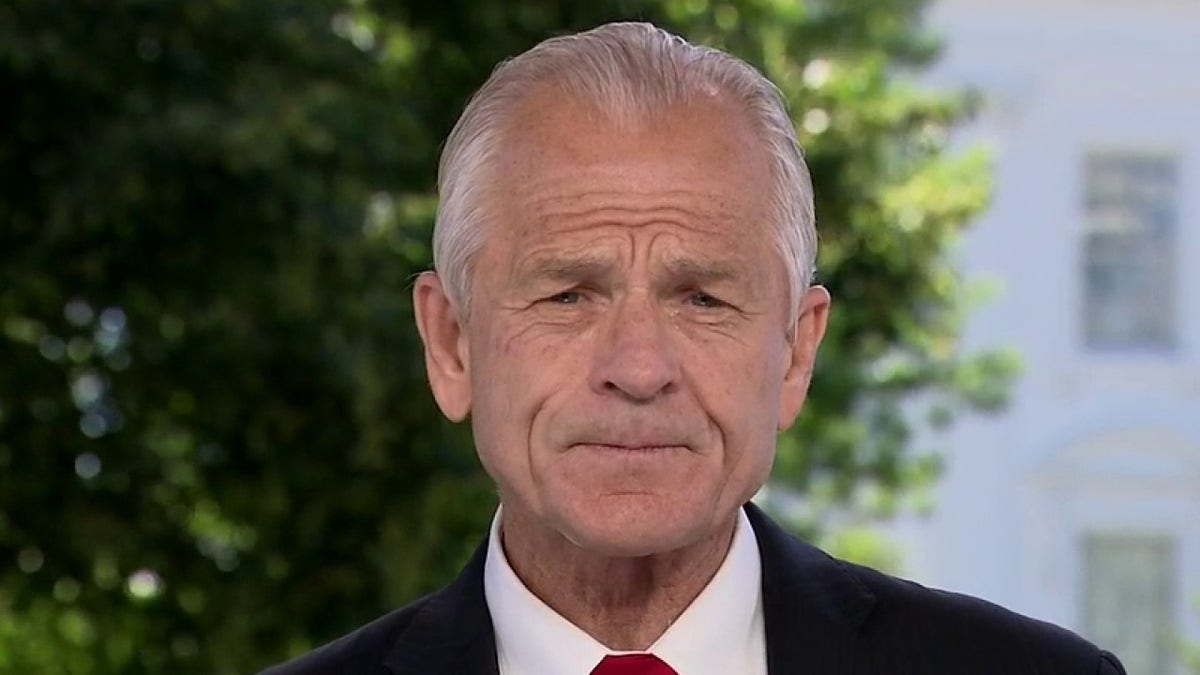
The Justice Department did, however, charge former Trump trade adviser Peter Navarro with contempt of Congress. Federal agents arrested Navarro at an airport where he planned to board a flight to Nashville. The agents put him in leg irons and “strip-searched” him, Navarro said

Committee Chairman Bennie Thompson, D-Miss., issued a joint statement with Cheney on Friday that addresses the Justice Department’s decisions. 

“While today’s indictment of Peter Navarro was the correct decision by the Justice Department, we find the decision to reward Mark Meadows and Dan Scavino for their continued attack on the rule of law puzzling,” their statement says, adding:

Mr. Meadows and Mr. Scavino unquestionably have relevant knowledge about President Trump’s role in the efforts to overturn the 2020 election and the events of Jan 6. We hope the department provides greater clarity on this matter. 

If the department’s position is that either or both of these men have absolute immunity from appearing before Congress because of their former positions in the Trump administration, that question is the focus of pending litigation. 

4. Trump Family Cooperates 

Although former White House staff have clashed with the committee, several Trump family members have cooperated voluntarily with the Jan. 6 committee.

Donald Trump Jr. reportedly met with the panel for more than three hours in May. The committee made texts available from the day of the riot in which the former president’s son asks Meadows, as chief of staff, to persuade his father to make a statement condemning the riot. 

Trump Jr.’s girlfriend, former Fox News personality Kimberly Guilfoyle, granted the panel a voluntary interview that reportedly became heated, particularly in a confrontation with Rep. Adam Schiff, D-Calif.

Ivanka Trump, the former president’s elder daughter, spoke to the committee in April at its request. Her husband, Jared Kushner, met with the committee voluntarily in March. 

5. Participation of Pence Staffers 

CNN reported last week that the panel had contacted three former staffers for former Vice President Mike Pence: former chief of staff Marc Short, former chief counsel Greg Jacob, and legal adviser J. Michael Luttig, a former federal judge. 

The New York Times reported that Short had warned Pence’s chief Secret Service agent, Tim Giebels, that Trump was likely to publicly turn on Pence, which could put the vice president in physical danger. (Some participants shouted “Hang Mike Pence” during the riot.)

Peril,” a 2021 book by Woodward and Costa, recounts a conversation between Trump and Pence the day before the riot in which Pence said that, as vice president, he did not have the constitutional authority to decline to count Electoral College votes. 

“I wouldn’t want any one person to have that authority,” Pence reportedly told the president. 

“But wouldn’t it almost be cool to have that power?” Trump asked, according to the book. 

“No. I’m just there to open the envelopes,” Pence answered. 

“You don’t understand, Mike, you can do this,” Trump told his vice president, according to the book. “I don’t want to be your friend anymore if you don’t do this.” 

6. Republicans to Release Findings

Although blocked from the select committee appointed by Pelosi as House speaker, a group of House Republicans—some of whom McCarthy attempted to appoint to the select committee—also will release findings about the Jan. 6 riot at the Capitol. 

Republicans hope to release a report in “a matter of weeks,” and likely would preempt a final report from the Pelosi-appointed committee, Politico reported

Reps. Jim Banks, R-Ind., and Rodney Davis, R-Ill., are leading the GOP investigation. 

Ken McIntyre contributed to this report.

Have an opinion about this article? To sound off, please email letters@DailySignal.com and we’ll consider publishing your edited remarks in our regular “We Hear You” feature. Remember to include the URL or headline of the article plus your name and town and/or state.


left undermines America width=

The left praises democracy when elected but claims the right will destroy democracy when it loses. Pictured: Former presidential candidate Hillary Clinton discusses the 2016 election during her 2017 book tour. (Photo: Bastiaan Slabbers, NurPhoto/Getty Images)


Recently, Democrats have been despondent over President Joe Biden’s sinking poll numbers. His policies on the economy, energy, foreign policy, the border, and COVID-19 all have lost majority support.

As a result, the left now variously alleges that either in 2022, when it expects to lose the Congress, or in 2024, when it fears losing the presidency, Republicans will “destroy democracy” or stage a coup.

A cynic might suggest that those on the left praise democracy when they get elected, only to claim it is broken when they lose. Or they hope to avoid their defeat by trying to terrify the electorate. Or they mask their own revolutionary propensities by projecting them onto their opponents.

After all, who is trying to federalize election laws in national elections contrary to the spirit of the Constitution? Who wishes to repeal or circumvent the Electoral College? Who wishes to destroy the more than 180-year-old Senate filibuster, the over 150-year-old nine-justice Supreme Court, and the more than 60-year-old 50-state union?

Who is attacking the founding constitutional idea of two senators per state?

The Constitution also clearly states that “When the President of the United States is tried, the Chief Justice shall preside.” Who slammed through the impeachment of former President Donald Trump without a presiding chief justice?

Never had a president been either impeached twice or tried in the Senate as a private citizen. Who did both?

The left further broke prior precedent by impeaching Trump without a special counsel’s report, formal hearings, witnesses, and cross-examinations.

Who exactly is violating federal civil rights legislation?

New York City’s Department of Health and Mental Hygiene in December decided to ration new potentially lifesaving COVID-19 medicines, partially on the basis of race, in the name of “equity.”

The agency also allegedly used racial preferences to determine who would be first tested for COVID-19. Yet such racial discrimination seems in direct violation of various title clauses of the 1964 Civil Rights Act.

That law makes it clear that no public agency can use race to deny “equal utilization of any public facility which is owned, operated, or managed by or on behalf of any State or subdivision thereof.” Who is behind the new racial discrimination?

In summer 2020, many local- and state-mandated quarantines and bans on public assemblies were simply ignored with impunity—if demonstrators were associated with Black Lives Matter or protesting the police.

Currently, the Biden administration is also flagrantly embracing the neo-Confederate idea of nullifying federal law.

The Biden administration has allowed nearly 2 million foreign nationals to enter the United States illegally across the southern border—in hopes they will soon be loyal constituents.

The administration has not asked illegal entrants either to be tested for or vaccinated against COVID-19. Yet all U.S. citizens in the military and employed by the federal government are threatened with dismissal if they fail to become vaccinated.

Such selective exemption of lawbreaking non-U.S. citizens, but not millions of U.S. citizens, seems in conflict with the equal protection clause of the 14th Amendment.

After entering the United States illegally, millions of immigrants are protected by some 550 “sanctuary city” jurisdictions. These revolutionary areas all brazenly nullify immigration law by refusing to allow federal immigration authorities to deport illegal immigrant lawbreakers.

At various times in our nation’s history—1832, 1861-65, and 1961-63—America was either racked by internal violence or fought a civil war over similar state nullification of federal laws.

In the last five years, we have indeed seen many internal threats to democracy.

Hillary Clinton hired a foreign national to concoct a dossier of dirt against her presidential opponent. She disguised her own role by projecting her efforts to use Russian sources onto Trump. She used her contacts in government and media to seed the dossier to create a national hysteria about “Russian collusion.” Clinton urged Biden not to accept the 2020 result if he lost, and herself claimed Trump was not a legitimately elected president.

The chairman of the Joint Chiefs of Staff has violated laws governing the chain of command. Some retired officers violated Article 88 of the Uniform Code of Military Justice by slandering their commander in chief. Others publicly were on record calling for the military to intervene to remove an elected president.

Some of the nation’s top officials in the FBI and intelligence committee have misled or lied under oath either to federal investigators or the U.S. Congress, again, mostly with impunity.

All these sustained revolutionary activities were justified as necessary to achieve the supposedly noble ends of removing Trump.

The result is Third World-like jurisprudence in America aimed at rewarding friends and punishing enemies, masked by service to social justice.

We are in a dangerous revolutionary cycle. But the threat is not so much from loud, buffoonish, one-day rioters on Jan. 6. Such clownish characters did not for 120 days loot, burn, attack courthouses and police precincts, cause over 30 deaths, injure 2,000 policemen, and destroy at least $2 billion in property—all under the banner of revolutionary justice.

Even more ominously, stone-cold sober elites are systematically waging an insidious revolution in the shadows that seeks to dismantle America’s institutions and the rule of law as we have known them.


(C)2022 Tribune Content Agency, LLC.

The Daily Signal publishes a variety of perspectives. Nothing written here is to be construed as representing the views of The Heritage Foundation. 


Have an opinion about this article? To sound off, please email letters@DailySignal.com and we’ll consider publishing your edited remarks in our regular “We Hear You” feature. Remember to include the URL or headline of the article plus your name and town and/or state.


The Honorable Representative Adam Kinzinger of Illinois, Washington D.C.

Dear Representative Adam Kinzinger, 

I noticed that you are a pro-life representative that has a long record of standing up for unborn babies! It was in the 1970’s when I was first introduced to the works of Francis Schaeffer and Dr. C. Everett Koop and I wanted to commend their writings and films to you.

I recently read about your impressive pro-life record:

Washington, DC – Today, Congressman Adam Kinzinger (IL-16) joined his House Republican colleagues in a press conference urging Democratic leadership to allow a vote on the Born Alive protections. The proposal would protect babies who survive abortion and provide them with the same medical care that any other premature baby would receive. Yesterday, the Democrats blocked the proposed legislation—for the 17th time—from coming before the House for a vote.

Joining the Congressman and House Republican leaders at the press conference this morning was Jill Stanek, an Illinois nurse and pro-life advocate who has witnessed the devastating realities of these pro-abortion laws. The Illinois legislature is currently debating two abortion bills, similar to the extreme pro-abortion agendas in New York and Virginia. 

It seems you have a grudge against President Trump while our freedoms under President Biden are being taken away. I recommend to you the article below:

The January 6 Insurrection Hoax

 • Volume 50, Number 9 • Roger Kimball

Roger Kimball
Editor and Publisher, The New Criterion

Mr. Kimball concludes his article with these words: 

That’s one melancholy lesson of the January 6 insurrection hoax: that America is fast mutating from a republic, in which individual liberty is paramount, into an oligarchy, in which conformity is increasingly demanded and enforced.

Another lesson was perfectly expressed by Donald Trump when he reflected on the unremitting tsunami of hostility that he faced as President. “They’re after you,” he more than once told his supporters. “I’m just in the way.”


Bingo.

You can google and get Roger Kimball article “The January 6 Insurrection Hoax”

NOW WHAT DID YOU DO TO TURN YOUR BACK ON OUR LIBERTY AND PERPETUATE THE HOAX THAT JANUARY 6TH WAS AN INSURRECTION? Read below!! 

9 Republicans voted to hold Trump aide Bannon in contempt of Congress


There were a few Republicans Thursday who surprised observers when they voted in support of holding former Trump adviser Steve Bannon in contempt of Congress and referring him to the Justice Department for criminal prosecution.

Prior to the vote, four Republicans were considered a lock to approve the criminal referral, according to Capitol Hill sources: Reps. Liz Cheney of Wyoming, Adam Kinzinger of Illinois, Fred Upton of Michigan and Anthony Gonzalez of Ohio.


Cheney and Kinzinger are on the House select committee investigating the Jan. 6 insurrection at the U.S. Capitol, and have for months stood alone as the only two House Republicans willing to speak out against former President Donald Trump’s continued lies about the 2020 election. They were the only two House Republicans to vote for the formation of the select committee on June 30.

House Speaker Nancy Pelosi formed the select committee after Republicans rejected a bipartisan commission that would have been evenly split between five Democrats and five Republicans. Only 35 Republicans voted for that measure when itpassed the House of Representatives, and it was defeated by a GOP filibuster in the Senate.

WASHINGTON, DC - JULY 27:  (L-R) Rep. Jamie Raskin (D-MD), Rep. Liz Cheney (R-WY) and Rep. Adam Kinzinger (R-IL) arrive for the House Select Committee hearing investigating the January 6 attack on the U.S. Capitol on July 27, 2021 at the Canon House Office Building in Washington, DC. Members of law enforcement will testify about the attack by supporters of former President Donald Trump on the U.S. Capitol. According to authorities, about 140 police officers were injured when they were trampled, had objects thrown at them, and sprayed with chemical irritants during the insurrection. (Photo by Drew Angerer/Getty Images)


More

Upton has served in the House for more than three decades, since 1987, and will face a primary challenge next year because of his willingness to stand up to Trump.

Gonzalez is retiring from Congress next year, after only four years in the House. “While my desire to build a fuller family life is at the heart of my decision, it is also true that the current state of our politics, especially many of the toxic dynamics inside our own party, is a significant factor in my decision,” Gonzalez said in September when heannounced he would not seek another term.


The remaining five Republicans included three who voted for impeachment — Peter Meijer of Michigan, John Katko of New York and Jaime Herrera Beutler of Washington — and two House Republicans who did not vote to impeach Trump: Nancy Mace of South Carolina and Brian Fitzpatrick of Pennsylvania.

Do you realize that Americans rights are being taken away from them and would you like an example? I am going to quote Mr. Kimball again.  You can google and get Roger Kimball article “The January 6 Insurrection Hoax”

Trump seems never to have discerned what a viper’s nest our politics has become for anyone who is not a paid-up member of The Club. 

Maybe Trump understands this now. I have no insight into that question. I am pretty confident, though, that the 74 plus million people who voted for him understand it deeply. It’s another reason that The Club should be wary of celebrating its victory too expansively. 

Friedrich Hayek took one of the two epigraphs for his book, The Road to Serfdom, from the philosopher David Hume. “It is seldom,” Hume wrote, “that liberty of any kind is lost all at once.” Much as I admire Hume, I wonder whether he got this quite right. Sometimes, I would argue, liberty is erased almost instantaneously.

I’d be willing to wager that Joseph Hackett, confronted with Hume’s observation, would express similar doubts. I would be happy to ask Mr. Hackett myself, but he is inaccessible. If the ironically titled “Department of Justice” has its way, he will be inaccessible for a long, long time—perhaps as long as 20 years. 

Joseph Hackett, you see, is a 51-year-old Trump supporter and member of an organization called the Oath Keepers, a group whose members have pledged to “defend the Constitution against all enemies foreign and domestic.” The FBI does not like the Oath Keepers—agents arrested its leader in January and have picked up many other members in the months since. Hackett traveled to Washington from his home in Florida to join the January 6 rally. According to court documents, he entered the Capitol at 2:45 that afternoon and left some nine minutes later, at 2:54. The next day, he went home. On May 28, he was apprehended by the FBI and indicted on a long list of charges, including conspiracy, obstruction of an official proceeding, destruction of government property, and illegally entering a restricted building. 

As far as I have been able to determine, no evidence of Hackett destroying property has come to light. According to his wife, it is not even clear that he entered the Capitol. But he certainly was in the environs. He was a member of the Oath Keepers. He was a supporter of Donald Trump. Therefore, he must be neutralized.

Joseph Hackett is only one of hundreds of citizens who have beenbranded as “domestic terrorists” trying to “overthrow the government” and who are now languishing, in appalling conditions, jailed as political prisoners of an angry state apparat.

Let me recommend that you read this letter below from Senator Ron Johnson and his colleagues:

Sen. Johnson and Colleagues Request Answers from DOJ on Unequal Application of Justice to Protestors


WASHINGTON — U.S. Sen. Ron Johnson (R-Wis.), along with senators Tommy Tuberville (R-Ala.), Mike Lee (R-Utah), Rick Scott (R-Fla.), and Ted Cruz (R-Texas), sent a letter on Monday to Attorney General Merrick Garland requesting information on the unequal application of justice between the individuals who breached the Capitol on Jan. 6, and those involved in the unrest during the spring and summer of 2020. The senators sent 18 questions to the attorney general on what steps the DOJ has taken to prosecute individuals who committed crimes during both events, and requested a response by June 21.

“Americans have the constitutional right to peaceably assemble and petition the government for a redress of grievances,” the senators wrote. “This constitutional right should be cherished and protected. Violence, property damage, and vandalism of any kind should not be tolerated and individuals that break the law should be prosecuted. However, the potential unequal administration of justice with respect to certain protestors is particularly concerning.”


The full text of the letter can be found here and below.


June 7, 2021 

The Honorable Merrick B. Garland

Attorney General

U.S. Department of Justice

950 Pennsylvania Avenue, NW

Washington, DC 20530


Dear Attorney General Garland:

The U.S. Department of Justice (DOJ) is currently dedicating enormous resources and manpower to investigating and prosecuting the criminals who breached the U.S. Capitol on January 6, 2021. We fully support and appreciate the efforts by the DOJ and its federal, state and local law enforcement partners to hold those responsible fully accountable.

We join all Americans in the expectation that the DOJ’s response to the events of January 6 will result in rightful criminal prosecutions and accountability.  As you are aware, the mission of the DOJ is, among other things, to ensure fair and impartial administration of justice for all Americans.  Today, we write to request information about our concerns regarding potential unequal justice administered in response to other recent instances of mass unrest, destruction, and loss of life throughout the United States. 

During the spring and summer of 2020, individuals used peaceful protests across the country to engage in rioting and other crimes that resulted in loss of life, injuries to law enforcement officers, and significant property damage.[1]  A federal court house in Portland, Oregon, has been effectively under siege for months.[2]  Property destruction stemming from the 2020 social justice protests throughout the country will reportedly result in at least $1 billion to $2 billion in paid insurance claims.[3] 

                In June 2020, the DOJ reportedly compiled the following information regarding last year’s unrest:

  • “One federal officer [was] killed, 147 federal officers [were] injured and 600 local officers [were] injured around the country during the protests, frequently from projectiles.”[4]
  • According to the Bureau of Alcohol, Tobacco, Firearms and Explosives (ATF), “since the start of the unrest there has been 81 Federal Firearms License burglaries of an estimated loss of 1,116 firearms; 876 reported arsons; 76 explosive incidents; and 46 ATF arrests[.]”[5]

Despite these numerous examples of violence occurring during these protests, it appears that individuals charged with committing crimes at these events may benefit from infrequent prosecutions and minimal, if any, penalties.  According to a recent article, “prosecutors have approved deals in at least half a dozen federal felony cases arising from clashes between protesters and law enforcement in Oregon last summer. The arrangements — known as deferred resolution agreements — will leave the defendants with a clean criminal record if they stay out of trouble for a period of time and complete a modest amount of community service, according to defense attorneys and court records.”[6]       

                DOJ’s apparent unwillingness to punish these individuals who allegedly committed crimes during the spring and summer 2020 protests stands in stark contrast to the harsher treatment of the individuals charged in connection with the January 6, 2021 breach of the U.S. Capitol Building in Washington, D.C.  To date, DOJ has charged 510 individuals stemming from Capitol breach.[7]  DOJ maintains and updates a webpage that lists the defendants charged with crimes committed at the Capitol.  This database includes information such as the defendant’s name, charge(s), case number, case documents, location of arrest, case status, and informs readers when the entry was last updated.[8]  No such database exists for alleged perpetrators of crimes associated with the spring and summer 2020 protests.  It is unclear whether any defendants charged with crimes in connection with the Capitol breach have received deferred resolution agreements.

Americans have the constitutional right to peaceably assemble and petition the government for a redress of grievances.  This constitutional right should be cherished and protected.  Violence, property damage, and vandalism of any kind should not be tolerated and individuals that break the law should be prosecuted.  However, the potential unequal administration of justice with respect to certain protestors is particularly concerning.  In order to assist Congress in conducting its oversight work, we respectfully request answers to the following questions by June 21, 2021:  

Spring and Summer 2020 Unrest:

  1. Did federal law enforcement utilize geolocation data from defendants’ cell phones to track protestors associated with the unrest in the spring and summer of 2020?  If so, how many times and for which locations/riots?  
  1. How many individuals who may have committed crimes associated with protests in the spring and summer of 2020 were arrested by law enforcement using pre-dawn raids and SWAT teams?
  1. How many individuals were incarcerated for allegedly committing crimes associated with protests in the spring and summer of 2020? 
  1. How many of these individuals are or were placed in solitary confinement?  What was the average amount of consecutive days such individuals were in solitary confinement?
  1. How many of these individuals have been released on bail?
  1. How many of these individuals were released on their own recognizance or without being required to post bond?
  1. How many of these individuals were offered deferred resolution agreements?[9]
  1. How many DOJ prosecutors were assigned to work on cases involving defendants who allegedly committed crimes associated with protests in the spring and summer of 2020?
  1. How many FBI personnel were assigned to work on cases involving defendants who allegedly committed crimes associated with protests in the spring and summer of 2020?

January 6, 2021 U.S. Capitol Breach:

  1. Did federal law enforcement utilize geolocation data from defendants’ cell phones to track protestors associated with the January 6, 2021 protests and Capitol breach?  If so, how many times and how many additional arrests resulted from law enforcement utilizing geolocation information?
  2. How many individuals who may have committed crimes associated with the Capitol breach were arrested by law enforcement using pre-dawn raids and SWAT teams?
  1. How many individuals are incarcerated for allegedly committing crimes associated with the Capitol breach?
  1. How many of these individuals are or were placed in solitary confinement?  What was the average amount of consecutive days such individuals were in solitary confinement?
  1. How many of these individuals have been released on bail?
  1. How many of these individuals have been released on their own recognizance or without being required to post bond?
  1. How many of these individuals were offered deferred resolution agreements?
  1. How many DOJ prosecutors have been assigned to work on cases involving defendants who allegedly committed crimes associated with the Capitol breach?
  1. How many FBI personnel were assigned to work on cases involving defendants who allegedly committed crimes associated with the Capitol breach?

Sincerely,


Ron Johnson

United States Senator


Tommy Tuberville

United States Senator


Mike Lee                                                            

United States Senator


Rick Scott

United States Senator


Ted Cruz

United States Senator


###


[1] Jennifer Kingson, Exclusive: $1 billion-plus riot damage is most expensive in insurance history, Axios, Sept. 16, 2020, https://www.axios.com/riots-cost-property-damage-276c9bcc-a455-4067-b06a-66f9db4cea9c.html.

[2] Conrad Wilson and Jonathan Levinson, Protesters, federal officers clash outside Portland’s courthouse Thursday, OPB, Mar. 12, 2021, https://www.opb.org/article/2021/03/12/protesters-vandalize-portlands-federal-courthouse-again/.

[3] Jennifer Kingson, Exclusive: $1 billion-plus riot damage is most expensive in insurance history, Axios, Sept. 16, 2020, https://www.axios.com/riots-cost-property-damage-276c9bcc-a455-4067-b06a-66f9db4cea9c.html.

[5] Id.

[6] Josh Gerstein, Leniency for defendants in Portland clashes could affect Capitol riot cases, Politico, Apr. 14, 2021, https://www.politico.com/news/2021/04/14/portland-capitol-riot-cases-481346.

[7] Madison Hall et al., 493 people have been charged in the Capitol insurrection so far. This searchable table shows them all., Insider, accessed June 4, 2021, https://www.insider.com/all-the-us-capitol-pro-trump-riot-arrests-charges-names-2021-1.

[8] Capitol Breach Cases, U.S. Dep’t of Justice, accessed May 21, 2021, https://www.justice.gov/usao-dc/capitol-breach-cases?combine=&order=title&sort=asc.

[9] Josh Gerstein, Leniency for defendants in Portland clashes could affect Capitol riot cases, Politico, Apr. 14, 2021, https://www.politico.com/news/2021/04/14/portland-capitol-riot-cases-481346.

—-

I want to recommend to you a video on YOU TUBE that runs 28 minutes and 39 seconds by Francis Schaeffer entitled because it discusses the founding of our nation and what the FOUNDERS believed: 

How Should We Then Live | Season 1 | Episode 5 | The Revolutionary Age


Thank you for your time, and again I want to thank you for your support of the unborn little babies!

Sincerely,

Everette Hatcher, 13900 Cottontail Lane, AR 72002, cell 501-920-5733, everettehatcher@gmail.com, http://www.thedailyhatch.org

——————————————————————————————

——

Dr. Francis schaeffer How Should We Then Live | Season 1 | Episode 5 | The Revolutionary Age


– Whatever happened to human race? PART 1 Co-authored by Francis Schaeffer and Dr. C. Everett Koop)

C. Everett Koop
C. Everett Koop, 1980s.jpg
 
13th Surgeon General of the United States
In office
January 21, 1982 – October 1, 1989

Dr. Francis Schaeffer – Whatever Happened To The Human Race? | Episode 2 | Slaughter of the Innocents

Francis Schaeffer – Whatever Happened To The Human Race? | Episode 3 | Death by Someone’s Choice

Mr. Hentoff with the clarinetist Edmond Hall in 1948 at the Savoy, a club in Boston.

Dr. Francis Schaeffer – Whatever Happened To The Human Race? | Episode 4 | The Basis for Human Dignity 

Image<img class=”i-amphtml-blurry-placeholder” src=”data:;base64,Edith Schaeffer with her husband, Francis Schaeffer, in 1970 in Switzerland, where they founded L’Abri, a Christian commune.

________________

______________________

March 23, 2021

President Biden c/o The White House 1600 Pennsylvania Avenue NW Washington, DC 20500

Dear Mr. President,

I really do respect you for trying to get a pulse on what is going on out here. I know that you don’t agree with my pro-life views but I wanted to challenge you as a fellow Christian to re-examine your pro-choice view. Although we are both Christians and have the Bible as the basis for our moral views, I did want you to take a close look at the views of the pro-life atheist Nat Hentoff too.  Hentoff became convinced of the pro-life view because of secular evidence that shows that the unborn child is human. I would ask you to consider his evidence and then of course reverse your views on abortion.

___________________

The pro-life atheist Nat Hentoff wrote a fine article below I wanted to share with you.

Nat Hentoff is an atheist, but he became a pro-life activist because of the scientific evidence that shows that the unborn child is a distinct and separate human being and even has a separate DNA. His perspective is a very intriguing one that I thought you would be interested in. I have shared before many   cases (Bernard Nathanson, Donald Trump, Paul Greenberg, Kathy Ireland)    when other high profile pro-choice leaders have changed their views and this is just another case like those. I have contacted the White House over and over concerning this issue and have even received responses. I am hopeful that people will stop and look even in a secular way (if they are not believers) at this abortion debate and see that the unborn child is deserving of our protection.That is why the writings of Nat Hentoff of the Cato Institute are so crucial.

In the film series “WHATEVER HAPPENED TO THE HUMAN RACE?” the arguments are presented  against abortion (Episode 1),  infanticide (Episode 2),   euthanasia (Episode 3), and then there is a discussion of the Christian versus Humanist worldview concerning the issue of “the basis for human dignity” in Episode 4 and then in the last episode a close look at the truth claims of the Bible.

Francis Schaeffer

__________________________

I truly believe that many of the problems we have today in the USA are due to the advancement of humanism in the last few decades in our society. Ronald Reagan appointed the evangelical Dr. C. Everett Koop to the position of Surgeon General in his administration. He partnered with Dr. Francis Schaeffer in making the video below. It is very valuable information for Christians to have.  Actually I have included a video below that includes comments from him on this subject.

Francis Schaeffer Whatever Happened to the Human Race (Episode 1) ABORTION

_____________________________________


Dr. Francis schaeffer – from Part 5 of Whatever happened to human race?) Whatever Happened To The Human Race? | Episode 5 | Truth and History

Dr. Francis Schaeffer – A Christian Manifesto – Dr. Francis Schaeffer Lecture

Francis Schaeffer – A 700 Club Special! ~ Francis Schaeffer 1982

Dr. Francis Schaeffer – 1984 SOUNDWORD LABRI CONFERENCE VIDEO – Q&A With Francis & Edith Schaeffer

________________

Jewish World Review June 12, 2006/ 16 Sivan, 5766


Insisting on life

http://www.NewsandOpinion.com | A longtime friend of mine is married to a doctor who also performs abortions. At the dinner table one recent evening, their 9-year-old son — having heard a word whose meaning he didn’t know — asked, “What is an abortion?” His mother, choosing her words carefully, described the procedure in simple terms.

“But,” said her son, “that means killing the baby.” The mother then explained that there are certain months during which an abortion cannot be performed, with very few exceptions. The 9-year-old shook his head. “But,” he said, “it doesn’t matter what month. It still means killing the babies.”

Hearing the story, I wished it could be repeated to the justices of the Supreme Court, in the hope that at least five of them might act on this 9-year-old’s clarity of thought and vision.

The boy’s spontaneous insistence on the primacy of life also reminded me of a powerful pro-life speaker and writer who, many years ago, helped me become a pro-lifer. He was a preacher, a black preacher. He said: “There are those who argue that the right to privacy is of a higher order than the right to life.

“That,” he continued, “was the premise of slavery. You could not protest the existence or treatment of slaves on the plantation because that was private and therefore out of your right to be concerned.”

This passionate reverend used to warn: “Don’t let the pro-choicers convince you that a fetus isn’t a human being. That’s how the whites dehumanized us … The first step was to distort the image of us as human beings in order to justify what they wanted to do — and not even feel they’d done anything wrong.”

That preacher was Jesse Jackson. Later, he decided to run for the presidency — and it was a credible campaign that many found inspiring in its focus on what still had to be done on civil rights. But Jackson had by now become “pro-choice” — much to the appreciation of most of those in the liberal base.

The last time I saw Jackson was years later, on a train from Washington to New York. I told him of a man nominated, but not yet confirmed, to a seat on a federal circuit court of appeals. This candidate was a strong supporter of capital punishment — which both the Rev. Jackson and I oppose, since it involves the irreversible taking of a human life by the state.

I asked Jackson if he would hold a press conference in Washington, criticizing the nomination, and he said he would. The reverend was true to his word; the press conference took place; but that nominee was confirmed to the federal circuit court. However, I appreciated Jackson’s effort.

On that train, I also told Jackson that I’d been quoting — in articles, and in talks with various groups — from his compelling pro-life statements. I asked him if he’d had any second thoughts on his reversal of those views.

Usually quick to respond to any challenge that he is not consistent in his positions, Jackson paused, and seemed somewhat disquieted at my question. Then he said to me, “I’ll get back to you on that.” I still patiently await what he has to say.

As time goes on, my deepening concern with the consequences of abortion is that its validation by the Supreme Court, as a constitutional practice, helps support the convictions of those who, in other controversies — euthanasia, assisted suicide and the “futility doctrine” by certain hospital ethics committees — believe that there are lives not worth continuing.

Around the time of my conversation with Jackson on the train, I attended a conference on euthanasia at Clark College in Worcester, Mass. There, I met Derek Humphry, the founder of the Hemlock Society, and already known internationally as a key proponent of the “death with dignity” movement.

He told me that for some years in this country, he had considerable difficulty getting his views about assisted suicide and, as he sees it, compassionate euthanasia into the American press.

“But then,” Humphry told me, “a wonderful thing happened. It opened all the doors for me.”

“What was that wonderful thing?” I asked.

“Roe v. Wade,” he answered.

The devaluing of human life — as the 9-year-old at the dinner table put it more vividly — did not end with making abortion legal, and therefore, to some people, moral. The word “baby” does not appear in Roe v. Wade — let alone the word “killing.”

And so, the termination of “lives not worth living” goes on.


______________________

Thank you so much for your time. I know how valuable it is. I also appreciate the fine family that you have and your commitment as a father and a husband. Now after presenting the secular approach of Nat Hentoff I wanted to make some comments concerning our shared Christian faith.  I  respect you for putting your faith in Christ for your eternal life. I am pleading to you on the basis of the Bible to please review your religious views concerning abortion. It was the Bible that caused the abolition movement of the 1800’s and it also was the basis for Martin Luther King’s movement for civil rights and it also is the basis for recognizing the unborn children.

Sincerely,

Everette Hatcher III, 13900 Cottontail Lane, Alexander, AR 72002, ph 501-920-5733,

Related posts:

Al Mohler on Kermit Gosnell’s abortion practice

Francis Schaeffer: “Whatever Happened to the Human Race” (Episode 1) ABORTION OF THE HUMAN RACE Published on Oct 6, 2012 by AdamMetropolis ________________ Picture of Francis Schaeffer and his wife Edith from the 1930′s above. I was sad to read about Edith passing away on Easter weekend in 2013. I wanted to pass along this fine […]

Taking on Ark Times Bloggers on various issues Part U “Do men have a say in the abortion debate?” (includes the film SLAUGHTER OF THE INNOCENTS and editorial cartoon)

I have gone back and forth and back and forth with many liberals on the Arkansas Times Blog on many issues such as abortion, human rights, welfare, poverty, gun control  and issues dealing with popular culture. Here is another exchange I had with them a while back. My username at the Ark Times Blog is Saline […]

Taking on Ark Times Bloggers on various issues Part T “Abortion is a dirty business” (includes video “Truth and History” and editorial cartoon)

I have gone back and forth and back and forth with many liberals on the Arkansas Times Blog on many issues such as abortion, human rights, welfare, poverty, gun control  and issues dealing with popular culture. Here is another exchange I had with them a while back. My username at the Ark Times Blog is Saline […]

“Sanctity of Life Saturday” Abortion supporters lying in order to further their clause? Window to the Womb (includes video ABORTION OF THE HUMAN RACE)

It is truly sad to me that liberals will lie in order to attack good Christian people like state senator Jason Rapert of Conway, Arkansas because he headed a group of pro-life senators that got a pro-life bill through the Arkansas State Senate the last week of January in 2013. I have gone back and […]

Taking on Ark Times Bloggers on various issues Part D “If you can’t afford a child can you abort?”Francis Schaeffer Quotes part 4 includes the film ABORTION OF THE HUMAN RACE) (editorial cartoon)

I have gone back and forth and back and forth with many liberals on the Arkansas Times Blog on many issues such as abortion, human rights, welfare, poverty, gun control  and issues dealing with popular culture. Here is another exchange I had with them a while back. My username at the Ark Times Blog is Saline […]

Taking on Ark Times Bloggers on various issues Part C “Abortion” (Francis Schaeffer Quotes part 3 includes the film SLAUGHTER OF THE INNOCENTS) (editorial cartoon)

I have gone back and forth and back and forth with many liberals on the Arkansas Times Blog on many issues such as abortion, human rights, welfare, poverty, gun control  and issues dealing with popular culture. Here is another exchange I had with them a while back. My username at the Ark Times Blog is Saline […]

Taking on Ark Times Bloggers on various issues Part B “Gendercide” (Francis Schaeffer Quotes Part 2 includes the film ABORTION OF THE HUMAN RACE) (editorial cartoon)

I have gone back and forth and back and forth with many liberals on the Arkansas Times Blog on many issues such as abortion, human rights, welfare, poverty, gun control  and issues dealing with popular culture. Here is another exchange I had with them a while back. My username at the Ark Times Blog is Saline […]


SANCTITY OF LIFE SATURDAY “AngryOldWoman” blogger argues that she has no regrets about past abortion

Sometimes you can see evidences in someone’s life of how content they really are. I saw  something like that on 2-8-13 when I confronted a blogger that goes by the name “AngryOldWoman” on the Arkansas Times Blog. See below. Leadership Crisis in America Published on Jul 11, 2012 Picture of Adrian Rogers above from 1970′s […]


“Sanctity of Life Saturday” The Church Awakens: Whatever Happened to the Human Race? (includes the video ABORTION OF THE HUMAN RACE)

In the film series “WHATEVER HAPPENED TO THE HUMAN RACE?” the arguments are presented  against abortion (Episode 1),  infanticide (Episode 2),   euthenasia (Episode 3), and then there is a discussion of the Christian versus Humanist worldview concerning the issue of “the basis for human dignity” in Episode 4 and then in the last episode a close […]

Taking on Ark Times Bloggers on various issues Part H “Are humans special?” includes film ABORTION OF THE HUMAN RACE) Reagan: ” To diminish the value of one category of human life is to diminish us all”

I have gone back and forth and back and forth with many liberals on the Arkansas Times Blog on many issues such as abortion, human rights, welfare, poverty, gun control  and issues dealing with popular culture. Here is another exchange I had with them a while back. My username at the Ark Times Blog is Saline […]

Taking on Ark Times Bloggers on various issues Part G “How do moral nonabsolutists come up with what is right?” includes the film “ABORTION OF THE HUMAN RACE”)

I have gone back and forth and back and forth with many liberals on the Arkansas Times Blog on many issues such as abortion, human rights, welfare, poverty, gun control  and issues dealing with popular culture. Here is another exchange I had with them a while back. My username at the Ark Times Blog is Saline […]

Taking on Ark Times Bloggers on various issues Part E “Moral absolutes and abortion” Francis Schaeffer Quotes part 5(includes the film SLAUGHTER OF THE INNOCENTS) (editorial cartoon)

I have gone back and forth and back and forth with many liberals on the Arkansas Times Blog on many issues such as abortion, human rights, welfare, poverty, gun control  and issues dealing with popular culture. Here is another exchange I had with them a while back. My username at the Ark Times Blog is Saline […]

Francis Schaeffer’s “How should we then live?” Video and outline of episode 10 “Final Choices” (Schaeffer Sundays)

E P I S O D E 1 0   Dr. Francis Schaeffer – Episode X – Final Choices 27 min FINAL CHOICES I. Authoritarianism the Only Humanistic Social Option One man or an elite giving authoritative arbitrary absolutes. A. Society is sole absolute in absence of other absolutes. B. But society has to be […]

Francis Schaeffer’s “How should we then live?” Video and outline of episode 9 “The Age of Personal Peace and Affluence” (Schaeffer Sundays)

E P I S O D E 9 Dr. Francis Schaeffer – Episode IX – The Age of Personal Peace and Affluence 27 min T h e Age of Personal Peace and Afflunce I. By the Early 1960s People Were Bombarded From Every Side by Modern Man’s Humanistic Thought II. Modern Form of Humanistic Thought Leads […]

Francis Schaeffer’s “How should we then live?” Video and outline of episode 8 “The Age of Fragmentation” (Schaeffer Sundays)

E P I S O D E 8 Dr. Francis Schaeffer – Episode VIII – The Age of Fragmentation 27 min I saw this film series in 1979 and it had a major impact on me. T h e Age of FRAGMENTATION I. Art As a Vehicle Of Modern Thought A. Impressionism (Monet, Renoir, Pissarro, Sisley, […]

Francis Schaeffer’s “How should we then live?” Video and outline of episode 7 “The Age of Non-Reason” (Schaeffer Sundays)

E P I S O D E 7 Dr. Francis Schaeffer – Episode VII – The Age of Non Reason I am thrilled to get this film series with you. I saw it first in 1979 and it had such a big impact on me. Today’s episode is where we see modern humanist man act […]

Francis Schaeffer’s “How should we then live?” Video and outline of episode 6 “The Scientific Age” (Schaeffer Sundays)

E P I S O D E 6 How Should We Then Live 6#1 Uploaded by NoMirrorHDDHrorriMoN on Oct 3, 2011 How Should We Then Live? Episode 6 of 12 ________ I am sharing with you a film series that I saw in 1979. In this film Francis Schaeffer asserted that was a shift in […]

Francis Schaeffer’s “How should we then live?” Video and outline of episode 5 “The Revolutionary Age” (Schaeffer Sundays)

E P I S O D E 5 How Should We Then Live? Episode 5: The Revolutionary Age I was impacted by this film series by Francis Schaeffer back in the 1970′s and I wanted to share it with you. Francis Schaeffer noted, “Reformation Did Not Bring Perfection. But gradually on basis of biblical teaching there […]

Francis Schaeffer’s “How should we then live?” Video and outline of episode 4 “The Reformation” (Schaeffer Sundays)

Dr. Francis Schaeffer – Episode IV – The Reformation 27 min I was impacted by this film series by Francis Schaeffer back in the 1970′s and I wanted to share it with you. Schaeffer makes three key points concerning the Reformation: “1. Erasmian Christian humanism rejected by Farel. 2. Bible gives needed answers not only as to […]

“Schaeffer Sundays” Francis Schaeffer’s “How should we then live?” Video and outline of episode 3 “The Renaissance”

Francis Schaeffer’s “How should we then live?” Video and outline of episode 3 “The Renaissance” Francis Schaeffer: “How Should We Then Live?” (Episode 3) THE RENAISSANCE I was impacted by this film series by Francis Schaeffer back in the 1970′s and I wanted to share it with you. Schaeffer really shows why we have so […]

Francis Schaeffer’s “How should we then live?” Video and outline of episode 2 “The Middle Ages” (Schaeffer Sundays)

  Francis Schaeffer: “How Should We Then Live?” (Episode 2) THE MIDDLE AGES I was impacted by this film series by Francis Schaeffer back in the 1970′s and I wanted to share it with you. Schaeffer points out that during this time period unfortunately we have the “Church’s deviation from early church’s teaching in regard […]

Francis Schaeffer’s “How should we then live?” Video and outline of episode 1 “The Roman Age” (Schaeffer Sundays)

Francis Schaeffer: “How Should We Then Live?” (Episode 1) THE ROMAN AGE   Today I am starting a series that really had a big impact on my life back in the 1970′s when I first saw it. There are ten parts and today is the first. Francis Schaeffer takes a look at Rome and why […]

By Everette Hatcher III | Posted in Francis Schaeffer | Edit | Comments (0)

Dan Mitchell in his article notes: Socialist political commentator Ian Kochinski, who goes by the pseudonym Vaush, has said that, “One of the unfortunate truths of being a socialist is you have to accept that your nation will not get to enjoy the skyrocket GDP growth that capitalist nations get to enjoy!”

—-

The Case for Economic Growth

As far as I’m concerned, the huge reductions in global poverty in recent decades are the only evidence we need about the benefits of economic growth.

This chart I shared in 2014 shows that output doubles much faster when annual economic growth goes from low levels (1 percent or 2 percent)to high levels (4 percent or above).

I call this the miracle of compounding.

Needless to say, I also argue that nations experience high levels of growth with the right policies and the right perspective.

But not everyone thinks policy makers should focus on getting more economic growth. Some of them (the “Okunites“) are willing to sacrifice some prosperity to achieve more equality, while others dislike growth because of the environment.

In a column for the Foundation for Economic Education, Saul Zimet points out that the people who downplay growth are no friends of the poor.

Economic degrowth is terrible for almost everyone, but it endangers the poor most of all. Therefore, it is remarkable that the problems with degrowth are appreciated least by those who claim to be most focused on the interests of the lower classes. …Socialist political commentator Ian Kochinski, who goes by the pseudonym Vaush, has said that, “One of the unfortunate truths of being a socialist is you have to accept that your nation will not get to enjoy the skyrocket GDP growth that capitalist nations get to enjoy. There is going to be a sacrifice of some economic efficiency, to the benefit of hopefully making life better for everybody.” Some growth critics go even further than to question the importance of growth as a policy target. …Naomi Klein calls economic growth “reckless and dirty” and advocates a policy of “radical and immediate degrowth”.

Zimet explains how this agenda is bad news for those on the lower rungs of the economic ladder.

… those brought out of extreme poverty, which have mostly been in places like China and India, were largely not helped by massive social programs but by a growing global market for their labor. …George Mason University economist Tyler Cowen explains…that, “In the medium to long term, even small changes in growth rates have significant consequences for living standards. An economy that grows at one percent doubles its average income approximately every 70 years, whereas an economy that grows at three percent doubles its average income about every 23 years—which, over time, makes a big difference in people’s lives.”

Professor Glenn Hubbard, an economist at Columbia University, makes the case for growth in an articlefor National Review.

A slightly higher rate of economic growth, sustained over time, can make the difference between a big increase in living standards and relative stagnation. …Nobel Prize–winning economist Robert Lucas famously observed that once economists think of long-term growth, it is hard to think of anything else.A pro-growth policy agenda is a good idea because growth is a good idea. …Higher output can come from growth in inputs such as labor and capital, but what determines their growth? Today’s economists highlight population growth and society’s willingness to work, save, and invest. Still more important is growth in productivity, or the efficiency with which inputs are used to produce goods and services. …McCloskey, an economic historian, has similarly identified the continuous, large-scale, voluntary, and unfocused search for betterment as the source of new ideas that can produce economic growth. She sees this “innovism” as primarily a cultural force, preferring the term to the more familiar “capitalism,” and connects innovism to economic liberalism.

Prof. Hubbard notes that economic growth requires creative destruction, but also acknowledges that this process causes pain.

And that politicians often respond to pain with bad ideas.

Forces that propel growth invariably leave a wake of economic disruption for people in many places… A serious discussion of pro-growth policy must account for that disruption. …growth is messy. It can push some individuals, firms, and even industries off well-worn and comfortable paths. …A gentle industrial policy devised by social scientists who are worried about jobs is not the answer. It results in state tinkering for special interests…it risks a vicious cycle: A little bit of tinkering becomes a lot of tinkering.

Instead of industrial policy, Hubbard suggests a couple of policies, most notably a better system of community colleges.

That would be a good outcome, of course.

From a big-picture perspective, though, I think net job creation is the best way to mitigate the political downsides of creative destruction.

It is not good news if 15 million jobs are destroyed in a particular year (especially for the people and communities that are directly harmed).

But if more than 15 million jobs are created the same year, that surely makes it easier for people to find new opportunities.

President Joe Biden Will Be Bad, but a President Kamala Harris Would Be Worse

Joe Biden has a very misguided economic agenda. I’m especially disturbed by his class-warfare tax agenda, which will be bad news for American workers and American competitiveness.

The good news, as I wrote earlier this year, is that he probably isn’t serious about some of his worst ideas.

Biden is a statist, but not overly ideological. His support for bigger government is largely a strategy of catering to the various interest groups that dominate the Democratic Party. The good news is that he’s an incrementalist and won’t aggressively push for a horrifying FDR-style agenda if he gets to the White House.

But what if Joe Biden’s health deteriorates and Kamala Harris – sooner or later – winds up in charge?

That’s rather troubling since her agenda was far to the left of Biden’s when they were competing for the Democratic nomination.

And it doesn’t appear that being Biden’s choice for Vice President has led her to moderate her views. Consider this campaign ad, where she openly asserted that “equitable treatment means we all end up at the same place.”

The notion that we should strive for equality of outcomes rather than equality of opportunity is horrifying.

For all intents and purposes,Harris has embraced a harsh version of redistributionism where everyone above average is punished and everyone below average is rewarded.

This goes way beyond a safety net and it’s definitely a recipe for economic misery since people on both sides of the equationhave less incentive to be productive.

I’m not the only one to be taken aback by Harris’ dogmatic leftism.

Robby Soave, writing for Reason, is very critical of her radical outlook.

Harris gives voice to a leftist-progressive narrative about the importance of equity—equal outcomes—rather than mere equality before the law. …Harris contrasted equal treatment—all people getting the same thing—with equitable treatment,which means “we all end up at the same place.” …This may seem like a trivial difference, but when it comes to public policy, the difference matters. A government shouldbe obligated to treat all citizens equally, giving them the same access to civil rights and liberties like voting, marriage, religious freedom, and gun ownership. …A mandate to foster equity, though, would give the government power to violate these rights in order to achieve identical social results for all people. 

And, in a column for National Review, Brad Polumbo expresses similar reservations about her views.

Whether she embraces the label “socialist” or not, Harris’s stated agenda and Senate record both reveal her to be positioned a long way to the left on matters of economic policy. From health care to the environment to housing, Harris thinks the answer to almost every problem we face is simply more government and more taxpayer money — raising taxes and further indebting future generations in the process.…Harris…supports an astounding $40 trillion in new spending over the next decade. In a sign of just how far left the Democratic Party has shifted on economics, Harris backs more than 20 times as much spending as Hillary Clinton proposed in 2016. …And this is not just a matter of spending. During her failed presidential campaign, Harris supported a federal-government takeover of health care… The senator jumped on the “Green New Deal” bandwagon as well. She co-sponsored the Green New Deal resolution in the Senate that called for a “new national, social, industrial, and economic mobilization on a scale not seen since World War II and the New Deal era.” …she supports enacting price controls on housing across the country. …The left-wing group Progressive Punch analyzed Harris’s voting record and found that she is the fourth-most liberal senator, more liberal even than Massachusetts senator Elizabeth Warren. Similarly, the nonpartisan organization GovTrack.us deemed Harris the furthest-left member of the Senate for the 2019 legislative year. (Spoiler alert: If your voting record is to the left of Bernie Sanders, you might be a socialist.)

To be fair, Harris is simply a politician, so we have no idea what she really believes. Her hard-left agenda might simply be her way of appealing to Democratic voters, much as Republicans who run for president suddenly decide they support big tax cuts and sweeping tax reform.

But whether she’s sincere or insincere, it’s troubling that she actually says it’s the role of government to make sure we all “end up at the same place.”

Let’s close with a video clip from Milton Friedman. At the risk of understatement, he has a different perspective than Ms. Harris.

Since we highlighted Harris’ key quote, let’s also highlight the key quote from Friedman.

Amen.

P.S. It appears Republicans will hold the Senate, which presumably (hopefully?) means that any radical proposals would be dead on arrival, regardless of whether they’re proposed by Biden or Harris.

P.P.S. Harris may win the prize for the most economically illiterate proposal of the 2020 campaign.

——

Will Biden’s Class-Warfare Tax Plan Lead to an Exodus of Job Creators?

After Barack Obama took office (and especially after he was reelected), there was a big uptick in the number of rich people who chose to emigrate from the United States. 

There are many reasons wealthy people choose to move from one nation to another, but Obama’s embrace of class-warfare tax policy (including FATCA) was seen as a big factor.

Joe Biden’s tax agenda is significantly more punitive than Obama’s, so we may see something similar happen if he wins the 2020 election.

Given the economic importance of innovatorsentrepreneurs, and inventors, this would be not be good news for the American economy.

The New York Times reported late last year that the United States could be shooting itself in the foot by discouraging wealthy residents.

…a different group of Americans say they are considering leaving — people of both parties who would be hit by the wealth tax… Wealthy Americans often leave high-tax states like New York and California for lower-tax ones like Florida and Texas. But renouncing citizenship is a far more permanent, costly and complicated proposition. …“America’s the most attractive destination for capital, entrepreneurs and people wanting to get a great education,” said Reaz H. Jafri, a partner and head of the immigration practice at Withers, an international law firm. “But in today’s world, when you have other economic centers of excellence — like Singapore, Switzerland and London — people don’t view the U.S. as the only place to be.” …now, the price may be right to leave. While the cost of expatriating varies depending on a person’s assets, the wealthiest are betting that if a Democrat wins…, leaving now means a lower exit tax. …The wealthy who are considering renouncing their citizenship fear a wealth tax less than the possibility that the tax on capital gains could be raised to the ordinary income tax rate, effectively doubling what a wealthy person would pay… When Eduardo Saverin, a founder of Facebook…renounced his United States citizenship shortly before the social network went public, …several estimates said that renouncing his citizenship…saved him $700 million in taxes.

The migratory habits of rich people make a difference in the global economy.

Here are some excerpts from a 2017 Bloomberg story.

Australia is luring increasing numbers of global millionaires, helping make it one of the fastest growing wealthy nations in the world… Over the past decade, total wealth held in Australia has risen by 85 percent compared to 30 percent in the U.S. and 28 percent in the U.K… As a result, the average Australian is now significantly wealthier than the average American or Briton. …Given its relatively small population, Australia also makes an appearance on a list of average wealth per person. This one is, however, dominated by small tax havens.

Here’s one of the charts from the story.

As you can see, Australia is doing very well, though the small tax havens like Monaco are world leaders.

I’m mystified, however, that the Cayman Islands isn’t listed.

But I’m digressing.

Let’s get back to our main topic. It’s worth noting that even Greece is seeking to attract rich foreigners.

The new tax law is aimed at attracting fresh revenues into the country’s state coffers – mainly from foreigners as well as Greeks who are taxed abroad – by relocating their tax domicile to Greece, as it tries to woo “high-net-worth individuals” to the Greek tax register.The non-dom model provides for revenues obtained abroad to be taxed at a flat amount… Having these foreigners stay in Greece for at least 183 days a year, as the law requires, will also entail expenditure on accommodation and everyday costs that will be added to the Greek economy. …most eligible foreigners will be able to considerably lighten their tax burden if they relocate to Greece…nevertheless, the amount of 500,000 euros’ worth of investment in Greece required of foreigners and the annual flat tax of 100,000 euros demanded (plus 20,000 euros per family member) may keep many of them away.

The system is too restrictive, but it will make the beleaguered nation an attractive destination for some rich people. After all, they don’t even have to pay a flat tax, just a flat fee.

Italy has enjoyed some success with a similar regime to entice millionaires.

Last but not least, an article published last year has some fascinating details on the where rich people move and why they move.

The world’s wealthiest people are also the most mobile. High net worth individuals (HNWIs) – persons with wealth over US$1 million – may decide to pick up and move for a number of reasons. In some cases they are attracted by jurisdictions with more favorable tax laws… Unlike the middle class, wealthy citizens have the means to pick up and leave when things start to sideways in their home country. An uptick in HNWI migration from a country can often be a signal of negative economic or societal factors influencing a country. …Time-honored locations – such as Switzerland and the Cayman Islands – continue to attract the world’s wealthy, but no country is experiencing HNWI inflows quite like Australia. …The country has a robust economy, and is perceived as being a safe place to raise a family. Even better, Australia has no inheritance tax

Here’s a map from the article.

The good news is that the United States is attracting more millionaires than it’s losing (perhaps because of the EB-5 program).

The bad news is that this ratio could flip after the election. Indeed, it may already be happening even though recent data on expatriation paints a rosy picture.

The bottom line is that the United States should be competing to attract millionaires, not repel them. Assuming, of course, politicians care about jobs and prosperity for the rest of the population.

P.S. American politicians, copying laws normally imposed by the world’s most loathsome regimes, have imposed an “exit tax” so they can grab extra cash from rich people who choose to become citizens elsewhere.

P.P.S. I’ve argued that Australia is a good place to emigrate even for those of us who aren’t rich.

—-


Question of the Week: Which Department of the Federal Government Should Be the First to Be Abolished?

I was asked last week which entitlement program is most deserving of reform.

While acknowledging that Social Security and Medicare also are in desperate need of modernization, I wrote that Medicaid reformshould be the first priority.

But I’d be happy if we made progress on any type of entitlement reform, so I don’t think there are right or wrong answers to this kind of question.

We have the same type of question this week. A reader sent an email to ask “Which federal department should be abolished first?”

I guess this is what is meant when people talk about a target-rich environment. We have an abundance of candidates:

But if I have to choose, I think the Department of Housing and Urban Development should be first on the chopping block.

Raze the building and put a layer of salt over the earth to make sure it can never spring back to life

I’ve already argued that there should be no federal government involvement in the housing sector and made the same argument on TV. And I’ve also shared some horror stories about HUD waste and incompetence.

Heck, I even made HUD the background image for my video on the bloated and overpaid bureaucracy in Washington.

It’s also worth noting that there’s nothing about housing in Article I, Section VIII, of the Constitution. For those of us who have old-fashioned values about playing by the rules, that means much of what takes place in Washington – including housing handouts – is unconstitutional.

Simply stated, there is no legitimate argument for HUD. And I think there would be the least political resistance.

As with the answer to the question about entitlements, this is a judgment call. I’d be happy to be proven wrong if it meant that politicians were aggressively going after another department. Anything that reduces the burden of government spending is a step in the right direction


Milton Friedman on Spending

October 3, 2020 by Dan Mitchell

I identified four heroes from the “Battle of Ideas” video I shared in late August – Friedrich Hayek, Milton Friedman, Ronald Reagan, and Margaret Thatcher. Here’s one of those heroes, Milton Friedman, explaining what’s needed to control big government.

Why Milton Friedman Saw School Choice as a First Step, Not a Final One

On his birthday, let’s celebrate Milton Friedman’s vision of enabling parents, not government, to be in control of a child’s education.

Wednesday, July 31, 2019
Kerry McDonald
Kerry McDonald

EducationMilton FriedmanSchool ChoiceSchooling

Libertarians and others are often torn about school choice. They may wish to see the government schooling monopoly weakened, but they may resist supporting choice mechanisms, like vouchers and education savings accounts, because they don’t go far enough. Indeed, most current choice programs continue to rely on taxpayer funding of education and don’t address the underlying compulsory nature of elementary and secondary schooling.

Skeptics may also have legitimate fears that taxpayer-funded education choice programs will lead to over-regulation of previously independent and parochial schooling options, making all schooling mirror compulsory mass schooling, with no substantive variation.

Milton Friedman had these same concerns. The Nobel prize-winning economist is widely considered to be the one to popularize the idea of vouchers and school choice beginning with his 1955 paper, “The Role of Government in Education.” His vision continues to be realized through the important work of EdChoice, formerly the Friedman Foundation for Education Choice, that Friedman and his economist wife, Rose, founded in 1996.

July 31 is Milton Friedman’s birthday. He died in 2006 at the age of 94, but his ideas continue to have an impact, particularly in education policy.

Friedman saw vouchers and other choice programs as half-measures. He recognized the larger problems of taxpayer funding and compulsion, but saw vouchers as an important starting point in allowing parents to regain control of their children’s education. In their popular book, Free To Choose, first published in 1980, the Friedmans wrote:

We regard the voucher plan as a partial solution because it affects neither the financing of schooling nor the compulsory attendance laws. We favor going much farther. (p.161)

They continued:

The compulsory attendance laws are the justification for government control over the standards of private schools. But it is far from clear that there is any justification for the compulsory attendance laws themselves. (p. 162)

The Friedmans admitted that their “own views on this have changed over time,” as they realized that “compulsory attendance at schools is not necessary to achieve that minimum standard of literacy and knowledge,” and that “schooling was well-nigh universal in the United States before either compulsory attendance or government financing of schooling existed. Like most laws, compulsory attendance laws have costs as well as benefits. We no longer believe the benefits justify the costs.” (pp. 162-3)

Still, they felt that vouchers would be the essential starting point toward chipping away at monopoly mass schooling by putting parents back in charge. School choice, in other words, would be a necessary but not sufficient policy approach toward addressing the underlying issue of government control of education.

In their book, the Friedmans presented the potential outcomes of their proposed voucher plan, which would give parents access to some or all of the average per-pupil expenditures of a child enrolled in public school. They believed that vouchers would help create a more competitive education market, encouraging education entrepreneurship. They felt that parents would be more empowered with greater control over their children’s education and have a stronger desire to contribute some of their own money toward education. They asserted that in many places “the public school has fostered residential stratification, by tying the kind and cost of schooling to residential location” and suggested that voucher programs would lead to increased integration and heterogeneity. (pp. 166-7)

To the critics who said, and still say, that school choice programs would destroy the public schools, the Friedmans replied that these critics fail to

explain why, if the public school system is doing such a splendid job, it needs to fear competition from nongovernmental, competitive schools or, if it isn’t, why anyone should object to its “destruction.” (p. 170)

What I appreciate most about the Friedmans discussion of vouchers and the promise of school choice is their unrelenting support of parents. They believed that parents, not government bureaucrats and intellectuals, know what is best for their children’s education and well-being and are fully capable of choosing wisely for their children—when they have the opportunity to do so.

They wrote:

Parents generally have both greater interest in their children’s schooling and more intimate knowledge of their capacities and needs than anyone else. Social reformers, and educational reformers in particular, often self-righteously take for granted that parents, especially those who are poor and have little education themselves, have little interest in their children’s education and no competence to choose for them. That is a gratuitous insult. Such parents have frequently had limited opportunity to choose. However, U.S. history has demonstrated that, given the opportunity, they have often been willing to sacrifice a great deal, and have done so wisely, for their children’s welfare. (p. 160).

Sign-Up: Receive Kerry’s Weekly Parenting and Education Newsletter!

Today, school voucher programs exist in 15 states plus the District of Columbia. These programs have consistently shown that when parents are given the choice to opt-out of an assigned district school, many will take advantage of the opportunity. In Washington, D.C., low-income parents who win a voucher lottery send their children to private schools.

The most recent three-year federal evaluationof voucher program participants found that while student academic achievement was comparable to achievement for non-voucher students remaining in public schools, there were statistically significant improvements in other important areas. For instance, voucher participants had lower rates of chronic absenteeism than the control groups, as well as higher student satisfaction scores. There were also tremendous cost-savings.

In Wisconsin, the Milwaukee Parental Choice Program has served over 28,000 low-income students attending 129 participating private schools.

According to Corey DeAngelis, Director of School Choice at the Reason Foundation and a prolific researcher on the topic, the recent analysis of the D.C. voucher program “reveals that private schools produce the same academic outcomes for only a third of the cost of the public schools. In other words, school choice is a great investment.”

In Wisconsin, the Milwaukee Parental Choice Program was created in 1990 and is the nation’s oldest voucher program. It currently serves over 28,000 low-income students attending 129 participating private schools. Like the D.C. voucher program, data on test scores of Milwaukee voucher students show similar results to public school students, but non-academic results are promising.

Recent research found voucher recipients had lower crime rates and lower incidences of unplanned pregnancies in young adulthood. On his birthday, let’s celebrate Milton Friedman’s vision of enabling parents, not government, to be in control of a child’s education.

According to Howard Fuller, an education professor at Marquette University, founder of the Black Alliance for Educational Options, and one of the developers of the Milwaukee voucher program, the key is parent empowerment—particularly for low-income minority families.

In an interview with NPR, Fuller said: “What I’m saying to you is that there are thousands of black children whose lives are much better today because of the Milwaukee parental choice program,” he says. 
“They were able to access better schools than they would have without a voucher.”

Putting parents back in charge of their child’s education through school choice measures was Milton Friedman’s goal. It was not his ultimate goal, as it would not fully address the funding and compulsion components of government schooling; but it was, and remains, an important first step. As the Friedmans wrote in Free To Choose:

The strong American tradition of voluntary action has provided many excellent examples that demonstrate what can be done when parents have greater choice. (p. 159).

On his birthday, let’s celebrate Milton Friedman’s vision of enabling parents, not government, to be in control of a child’s education.

Kerry McDonald

Related posts:


“Friedman Friday” (“Free to Choose” episode 1 – Power of the Market. part 7 of 7)

March 16, 2012 – 12:25 am

  Michael Harrington:  If you don’t have the expertise, the knowledge technology today, you’re out of the debate. And I think that we have to democratize information and government as well as the economy and society. FRIEDMAN: I am sorry to say Michael Harrington’s solution is not a solution to it. He wants minority rule, I […] By Everette Hatcher III | Posted in Current Events, Milton Friedman | Edit | Comments (0)

“Friedman Friday” (“Free to Choose” episode 1 – Power of the Market. part 6 of 7)

March 9, 2012 – 12:29 am

PETERSON: Well, let me ask you how you would cope with this problem, Dr. Friedman. The people decided that they wanted cool air, and there was tremendous need, and so we built a huge industry, the air conditioning industry, hundreds of thousands of jobs, tremendous earnings opportunities and nearly all of us now have air […] By Everette Hatcher III | Posted in Current Events, Milton Friedman | Edit | Comments (0)

“Friedman Friday” (“Free to Choose” episode 1 – Power of the Market. part 5 of 7)

March 2, 2012 – 12:26 am

Part 5 Milton Friedman: I do not believe it’s proper to put the situation in terms of industrialist versus government. On the contrary, one of the reasons why I am in favor of less government is because when you have more government industrialists take it over, and the two together form a coalition against the ordinary […] By Everette Hatcher III | Posted in Current Events, Milton Friedman | Edit | Comments (0)

“Friedman Friday” (“Free to Choose” episode 1 – Power of the Market. part 4 of 7)

February 24, 2012 – 12:21 am

The fundamental principal of the free society is voluntary cooperation. The economic market, buying and selling, is one example. But it’s only one example. Voluntary cooperation is far broader than that. To take an example that at first sight seems about as far away as you can get __ the language we speak; the words […] By Everette Hatcher III | Posted in Current Events, Milton Friedman | Edit | Comments (0)

“Friedman Friday” (“Free to Choose” episode 1 – Power of the Market. part 3 of 7)

February 17, 2012 – 12:12 am

  _________________________   Pt3  Nowadays there’s a considerable amount of traffic at this border. People cross a little more freely than they use to. Many people from Hong Kong trade in China and the market has helped bring the two countries closer together, but the barriers between them are still very real. On this side […] By Everette Hatcher III | Posted in Current Events, Milton Friedman | Edit | Comments (0)

“Friedman Friday” (“Free to Choose” episode 1 – Power of the Market. part 2 of 7)

February 10, 2012 – 12:09 am

  Aside from its harbor, the only other important resource of Hong Kong is people __ over 4_ million of them. Like America a century ago, Hong Kong in the past few decades has been a haven for people who sought the freedom to make the most of their own abilities. Many of them are […] By Everette Hatcher III | Posted in Current Events, Milton Friedman | Edit | Comments (0)

“Friedman Friday” (“Free to Choose” episode 1 – Power of the Market. part 1of 7)

February 3, 2012 – 12:07 am

“FREE TO CHOOSE” 1: The Power of the Market (Milton Friedman) Free to Choose ^ | 1980 | Milton Friedman Posted on Monday, July 17, 2006 4:20:46 PM by Choose Ye This Day FREE TO CHOOSE: The Power of the Market Friedman: Once all of this was a swamp, covered with forest. The Canarce Indians […]

Milton Friedman The Power of the Market 1-5

Debate on Milton Friedman’s cure for inflation

September 29, 2011 – 7:24 am

If you would like to see the first three episodes on inflation in Milton Friedman’s film series “Free to Choose” then go to a previous post I did. Ep. 9 – How to Cure Inflation [4/7]. Milton Friedman’s Free to Choose (1980) Uploaded by investbligurucom on Jun 16, 2010 While many people have a fairly […]

By Everette Hatcher III | Also posted in Current Events | Tagged dr friedman, expansion history, income tax brackets, political courage, www youtube | Edit | Comments (0)

“Friedman Friday” Milton Friedman believed in liberty (Interview by Charlie Rose of Milton Friedman part 1)

April 19, 2013 – 1:14 am

Charlie Rose interview of Milton Friedman My favorite economist: Milton Friedman : A Great Champion of Liberty  by V. Sundaram   Milton Friedman, the Nobel Prize-winning economist who advocated an unfettered free market and had the ear of three US Presidents – Nixon, Ford and Reagan – died last Thursday (16 November, 2006 ) in San Francisco […] By Everette Hatcher III | Posted in Milton Friedman | Edit | Comments (0)

What were the main proposals of Milton Friedman?

February 21, 2013 – 1:01 am

Stearns Speaks on House Floor in Support of Balanced Budget Amendment Uploaded by RepCliffStearns on Nov 18, 2011 Speaking on House floor in support of Balanced Budget Resolution, 11/18/2011 ___________ Below are some of the main proposals of Milton Friedman. I highly respected his work. David J. Theroux said this about Milton Friedman’s view concerning […] By Everette Hatcher III | Posted in Milton Friedman | Edit | Comments (0)

“Friedman Friday,” EPISODE “The Failure of Socialism” of Free to Choose in 1990 by Milton Friedman (Part 1)

December 7, 2012 – 5:55 am

Milton Friedman: Free To Choose – The Failure Of Socialism With Ronald Reagan (Full) Published on Mar 19, 2012 by NoNationalityNeeded Milton Friedman’s writings affected me greatly when I first discovered them and I wanted to share with you. We must not head down the path of socialism like Greece has done. Abstract: Ronald Reagan […] By Everette Hatcher III | Posted in Milton FriedmanPresident Obama | Edit | Comments (1)

Defending Milton Friedman

July 31, 2012 – 6:45 am

What a great defense of Milton Friedman!!!!   Defaming Milton Friedman by Johan Norberg This article appeared in Reason Online on September 26, 2008  PRINT PAGE  CITE THIS      Sans Serif      Serif Share with your friends: ShareThis In the future, if you tell a student or a journalist that you favor free markets and limited government, there is […]

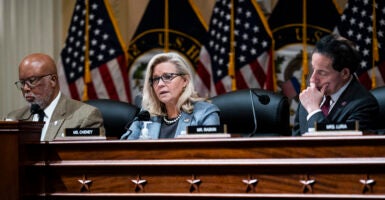
RESPONDING TO HARRY KROTO’S BRILLIANT RENOWNED ACADEMICS!! (Pausing to look at the life of Steven Weinberg who was one of my favorite authors!) Part 169 O My 9/30/18 letter to Dr. Weinberg discussing his quote on Religious liberals being farther from the truth in one sense than conservatives!

The Incredible Steven Weinberg (1933-2021) – Sixty Symbols

Letter 9-30-18 Daniel 5 Machen

Francis Schaeffer

Image result for francis schaeffer
H. L. Mencken below
Image result for H.L. Mencken 
J.Gresham Machen below
Image result for j. gresham machen
Bertrand Russell
Image result for bertrand russell
Belshazzar’s Feast is a painting by Rembrandt housed in the National Gallery, London.[1]The painting is Rembrandt’s attempt to establish himself as a painter of large, baroque history paintings.[2][3] The date of the painting is unknown, but most sources give a date between 1635 and 1638.[4][1]
Image result for belshazzar's feast writing on the wall
823 × 408Images may be subject to copyrightLearn More
Image result for adrian rogers
512 × 288Images may be subject to copyrightLearn More

September 30, 2018

Steven Weinberg
The University of Texas at Austin
Department of Physics
2515 Speedway Stop C1600
Austin, TX 78712-1192

Dear Dr. Weinberg,

In this letter I just want to do two things.

First, I agree with you that scientists are closer to conservative Christians in comparison to liberals because the liberals actually believe that something can be “true for you.” Christians like me believe that if the Bible said that Moses received the 10 commandments and did all those miracles that it historically happened. It reminds of a story that Francis Schaeffer once told:

H.L. Mencken died when I was a young man and I read some of the stuff he wrote and he came at just the point of the total collapse of the American consensus back in the 1930’s or a little before. H.L.Mencken was very destructive to the American consensus and he was way out. It is he who said the famous thing about Dr. J. Gresham Machen. Dr. Machen was the man who was fighting the battle for historic Christianity against the liberals in the big denominations and expressly the Presbyterian denomination and the liberals were trying to laugh Machen out of court. But H.L. Mencken said a remarkable thing, “Well, if you really want to be a Christian there is only one kind of Christian to be and that is the Machen kind.” This is wonderful. This is exactly where the battlefield is. When you take Christianity and chip away at it like the liberals wanted to do then you don’t have anything left. This is no halfway war. If you are going to be a Christian you have to be a biblical Christian. Machen and Mencken understood this and this is my position too.  

Second, I wanted to give you an amazing piece of evidence that confirms some accuracy concerning the story of the “handwriting on the wall.” I know you like me have used that phrase many times in the past. It comes from Daniel chapter 5!

Lubos Motl’s recent posting about Steven Weinberg’s recent BBC interview [transcript] on the relation between religion and science mentioned the chapter about God in Weinberg’s book: Dreams of a Final Theory.

The following is from chapter 11, titled “What About God?”. In the middle of that chapter, Weinberg refers to the problem of religious “liberals”, as follows:

“Religious liberals are in one sense even farther in spirit from scientists than are fundamentalists and other religious conservatives.

“At least the conservatives, like the scientists, tell you that they believe in what they believe because it is true, rather than because it makes them good or happy.

“Many religious liberals today seem to think that different people can believe in different mutually exclusive things without any of them being wrong, as long as their beliefs ‘work for them’.

“This one believes in reincarnation, that one in heaven and hell; a third believes in the extinction of the soul at death, but no one can be said to be wrong as long as everyone gets a satisfying spiritual rush from what they believe.

“To borrow a phrase from Susan Sontag, we are surrounded by ‘piety without content’.

“It all reminds me of a story that is told about an experience of Bertrand Russell, when in 1918 he was committed to prison for his opposition to the war. Following prison routine, a jailer asked Russell his religion, and Russell said that he was an agnostic. The jailer looked puzzled for a moment, and then brightened, with the observation that ‘I guess it’s all right. We worship the same God, don’t we?’

Returning to the role of the religious conservatives, Weinberg later continues:

“Many of the great world religions teach that God demands a particular faith and form of worship. It should not be surprising that some of the people who take these teachings seriously should sincerely regard these divine commands as incomparably more important than any merely secular virtues like tolerance or compassion or reason.”

In the middle of Weinberg’s BBC interview we have the remarks by Weinberg:

“…I once wrote something [apparently referring to the above quote from his Dreams of a Final Theory] rather disparaging about ultra-liberal Christianity and that I found myself more … in some ways more akin to a fundamentalist because at least they haven’t forgotten what it [is] to believe something. And I got a copy of a fundamentalist newspaper from, I think from New Mexico that praised me! Because what they really … I think what their real concern was, was not odd atheist physicists, that wasn’t what they were worried about, what they were worried about was the liberal Christians. … I think they [the fundamentalists] just found a surprising ally in the battle that they really cared about – their battle with the liberal wing of Christianity.

——

It really comes down to the fact that the Bible is a book filled with historical facts (many that can investigated), and also it is filled with many prophecies (many in the Old Testament that have already been fulfilled). Let me give a you an amazing historical fact that has been verified. A couple of years ago I sent you the CD “Dust, Darwin and Disbelief,” by Adrian Rogers and Bill Elliff. On that CD you will find this story below:

The Bible is affirmed through historical accuracy. Do you remember the story about the handwriting on the wall that is found in the fifth chapter of Daniel? Belshazzar hosted a feast with a thousand of his lords and ladies. Suddenly, a gruesome hand appeared out of nowhere and began to write on a wall. The king was disturbed and asked for someone to interpret the writing. Daniel was found and gave the interpretation. After the interpretation, “Then commanded Belshazzar, and they clothed Daniel with scarlet, and put a chain of gold about his neck, and made a proclamation concerning him, that he should be the third ruler in the kingdom.” (Daniel 5:29). Basing their opinion on Babylonian records, the historians claim this never happened. According to the records, the last king of Babylon was not Belshazzar, but a man named Nabonidas. And so, they said, the Bible is in error. There wasn’t a record of a king named Belshazzar. Well, the spades of archeologists continued to do their work. In 1853, an inscription was found on a cornerstone of a temple built by Nabonidas, to the god Ur, which read: “May I, Nabonidas, king of Babylon, not sin against thee. And may reverence for thee dwell in the heart of Belshazzar, my first-born favorite son.” From other inscriptions, it was learned that Belshazzar and Nabonidas were co-regents. Nabonidas traveled while Belshazzar stayed home to run the kingdom. Now that we know that Belshazzar and Nabonidas were co-regents, it makes sense that Belshazzar would say that Daniel would be the third ruler. What a marvelous nugget of truth tucked away in the Word of God!

Francis Schaeffer rightly noted:
From the Bible’s viewpoint, all truth finally rests upon the fact that the infinite-personal God exists in contrast to His not existing. This means that God exists objectively. He exists whether or not people say He does. The Bible also teaches that God is personal.
Much of the Bible is in the sphere of normal existence and is observable. God communicated himself in language. This is not surprising for He  was the creator of people who use language in communicating with other people.
In the Hebrew (and biblical) view, truth is grounded ultimately in the existence and character of God and what has been given us by God in creation and revelation. Because people are finite, reality cannot be exhausted by human reason.
It is within this Judeo-Christian view of truth that, by its own insistence, we must understand the Bible. Moses could appeal to real historical events as the basis for Israel’s confidence and obedience into the future. He could even pass down to subsequent generations physical reminders of what God had done, so that the people could see them and remember.

Thank you again for taking time to read this letter. It was been a thrill to get the chance to correspond with you!

Sincerely,

Everette Hatcher, everettehatcher@gmail.com, http://www.thedailyhatch.org, cell ph 501-920-5733, Box 23416, LittleRock, AR 72221, United States

On the Shoulders of Giants: Steven Weinberg and the Quest to Explain the…

Steven Weinberg Discussion (1/8) – Richard Dawkins

—-

Whatever Happened To The Human Race? (2010) | Full Movie | Michael Hordern

——

The Bill Moyers Interview – Steven Weinberg

How Should We Then Live (1977) | Full Movie | Francis Schaeffer | Edith …

Steven Weinberg Discussion (2/8) – Richard Dawkins

RESPONDING TO HARRY KROTO’S BRILLIANT RENOWNED ACADEMICS!!

Steven Weinberg – Dreams of a Final Theory

Steven Weinberg Discussion (3/8) – Richard Dawkins

Steven Weinberg, Author

How Should We Then Live | Season 1 | Episode 6 | The Scientific Age

—-

Steven Weinberg Discussion (4/8) – Richard Dawkins

I am grieved to hear of the death of Dr. Steven Weinberg who I have been familiar with since reading about him in 1979 in WHATEVER HAPPENED TO THE HUMAN RACE? by Dr. C. Everett Koop and Francis Schaeffer. I have really enjoyed reading his books and DREAMS OF A FINAL REALITY and TO EXPLAIN THE WORLD were two of my favorite!

C. Everett Koop
C. Everett Koop, 1980s.jpg

—-

Steven Weinberg Discussion (5/8) – Richard Dawkins

Steven Weinberg 1933-2021

I heard this morning the news that Steven Weinberg passed away yesterday at the age of 88.  He was arguably the dominant figure in theoretical particle physics during its period of great success from the late sixties to the early eighties.  In particular, his 1967 work on unification of the weak and electromagnetic interactions was a huge breakthrough, and remains to this day at the center of the Standard Model, our best understanding of fundamental physics.

During the years 1975-79 when I was a student at Harvard,  I believe the hallway where Weinberg, Glashow and Coleman had offices close together  was the greatest concentration of the world’s major figures driving the field of particle theory, with Weinberg seen as the most prominent of the three.  From what I recall, in a meeting one of the graduate students (Eddie Farhi?) referred to “Shelly, Sidney and Weinberg”, indicating the way Weinberg was a special case even in that group.   I had the great fortune to attend not only Coleman’s QFT course, but also a course by Weinberg on the quantization of gauge theory.

Weinberg was the author of an influential text on general relativity, as well as a masterful three-volume set of textbooks on QFT.  The second volume roughly corresponds to the course I took from him, and the third is about supersymmetry.   While most QFT books cover the basics in much the same way, Weinberg’s first volume is a quite different, original and highly influential take on the subject. It’s not easy going, but the details are all there and his point of view is an important one.  When you hear Nima Arkani-Hamed preaching about the right way to understand how QFT comes out uniquely as the only sensible way to combine special relativity and quantum mechanics, he’s often referring specifically to what you’ll find in that first volume.

Besides his technical work, Weinberg also did a huge amount of writing of the highest quality about physics and science in general for wider audiences.  An early example is his 1977 The Search for Unity: Notes for a History of Quantum Field Theory (a copy is here). His 1992 Dreams of a Final Theory is perhaps the best statement anywhere of the goal of fundamental physical theory during the 20th century. His large collection of pieces written for the The New York Review of Books covers a wide variety of topics and all are well worth reading.

At the time of the 1984 “First Superstring Revolution”, Weinberg joined in and worked on string theory for a while, but after a few years turned to cosmology. In early 2002 he was one of several people I wrote to about the current state of string theory, and here’s what I heard back from him:

I share your disappointment about the lack of contact so far of string theory with nature, but I can’t see that anyone else (including those studying topological nontrivialities in gauge theories) is doing much better. I thinks that some theorists should go on pushing as hard as they can on string theory, and others should do something else, but it is not easy to see what. I have myself voted with my feet (if that is the appropriate organ here) and switched entirely to work in cosmology, which is as exciting now as particle physics was in the 1960s and 1970s. I wouldn’t criticize anyone for their choices: it’s a tough time for fundamental physics.

A couple years after that time, Weinberg’s 1987 “prediction” of the cosmological constant became the main argument for the string theory multiverse. This “prediction” was essentially the observation that if you have a theory in which all values of the cosmological constant are equally likely, and put this together with the “anthropic” constraint that only for some range will galaxy formation give what seem to be the conditions for life, then you expect a non-zero CC of very roughly the size later found. I’ve argued ad nauseam here that this can’t be used as a significant argument for string theory in its landscape incarnation. One way to see the problem is to notice that my own theory of the CC (which is that I have no idea what determines it, so any value is as likely as any other) is exactly equivalent to the string landscape theory of the CC (in which you don’t know either the measure on the space of possible vacua, or even what this space is, so you assume all CC equally likely). One place where Weinberg wrote about this issue is his essay Living in the Multiverse, which I wrote about here (the sad story of misinterpretation of a comment of mine there is told here).

Weinberg’s death yesterday, taking away from us the dominant figure of the period of particle theory’s greatest success is both a significant loss and marks the end of an era. His 2002 remark that “it’s a tough time” is even more true today.

Update: Scott Aaronson writes about Weinberg here, especially about getting to know him during the last part of his life.

Update: For Arkani-Hamed on Weinberg, see here.

Update: Glashow writes about Weinberg here.

This entry was posted in Obituaries. Bookmark the permalink.

18 Responses to Steven Weinberg 1933-2021

  1. Alessandro Strumia says:

    Weinberg was the last of the physics giants who produced fundamental theories validated by experiments. After half a century his Standard Model still holds, so maybe now is the fist time in physics history without scientific giants.

  2. Shantanu says:

    A tribute to him from one Astrophysics colleague who had recently joined UT Austin
    https://twitter.com/MBKplus/status/1418972769509855236

  3. Pingback: #Virasoro-Algebren und das Standardmodell [Mathlog] – BuradaBiliyorum.Com
  4. Ricardo says:

    His last book “Foundations of Modern Physics came out a few months ago. From the preface:
    “This book treats such a broad range of topics that it is impossible to go very far into any of them. Certainly its treatment of quantum mechanics, statistical mechanics, transport theory, nuclear physics, and quantum field theory is no substitute for graduate-level courses on these topics, any one of which would occupy at least a whole year. This book presents what I think, in an ideal world, the ambitious physics student would already know when he or she enters graduate school. At least, it is what I wish that I had known when I entered graduate school.”
    Does anybody have an opinion about how well he succeeded?

  5. Wei Liu says:

    It is sad news that Weinberg is not with us anymore but I cannot agree with Alessandro Strumia that “Weinberg was the last of the physics giants who produced fundamental theories validated by experiments…so maybe now is the fi(r)st time in physics history without scientific giants.” Please be reminded that C. N. Yang and T. D. Lee still are healthily living.

  6. Mark Weitzman says:

    @Ricardo: I wrote the following review on one of my piazza sites a few weeks ago. I am currently half way through the book, and I am enjoying the book, although I am familiar with most of the content already. As I indicated below it is more of a review book, than a teaching book.

    Steven Weinberg had come out with a new book: Foundations of Modern Physics.  I have read the first 2 chapters, and scanned the rest of the book – the book is a short 300 pages and the hardcover is about $40.  The level of the book is intermediate to advanced undergraduate.

    I often encounter online students who have taken several of the MIT physics MOOC’s but often feel that they either lack some background, or don’t see what they have learned (especially in the QM sequence) and how it will be applied.  To many of these students my advice is usually to read the Feynman Lectures on physics, to get the big picture and for more background in QM prerequisite physics, and/or find a good textbook on modern physics.

    When I was in college almost half a century ago, I remember using Leighton’s classic book Principles of Modern Physics 1959 (about 700 pages in length), and suggest students try and find a more recent book covering roughly the same material – I haven’t seen one, so let me know if you have. There seem to be many freshman/sophomore level books covering modern physics, but I don’t think these are sufficient.

    Weinberg’s book is less of a textbook (while there are 25 problems at the end of the book, there are no exercises at the end of chapters, and no worked out examples).  It is written in Weinberg style, few pictures or diagrams, unusual symbols ( for the atomic mass unit, usual notation is u), nice but sometimes terse arguments, and excellent content with interesting historical asides.  The math level is low at the beginning (algebra – elementary calculus), and rises a little with the level of the material, but not nearly as difficult as his graduate level books.

    There are seven chapters in the book:

    Early Atomic Theory
    Thermodynamics and Kinetic Theory
    Early Quantum Theory
    Relativity
    Quantum Mechanics
    Nuclear Physics
    Quantum Field Theory
    So the coverage is exactly what a student should be looking for in a modern physics book (perhaps astrophysics and cosmology are left out, because Weinberg just published a set of lectures on astrophysics, and has a whole book on Cosmology). The book seems more of a review or plug holes in background, and less of a teaching masterpiece.

    I recommend that students looking for a book on this type of material take a look at the book and see if it is for them.  I think students who are taking or have finished the MITx 8.04-8.06 sequence might find the book worthwhile as a review and also as filling out some material, and get a preview of quantum field theory as well.

  7. Ralf Hofmann says:

    Steven Weinberg – a great, highly creative physicist and wonderfully involved teacher of fundamental physics who shaped my own education in quantum field theory and cosmology during essential steps. I’ll miss him and his sober views very much.

  8. Alessandro Strumia says:

    Dear Wei, thank you, let me try to explain better. Historians like to choose a somehow arbitrary moment to symbolise a gradual change. If the change I mentioned will really happen, I expect they will choose this moment.

  9. Thomas Larsson says:

    Alessandro, Glashow is still around, isn’t he? So not quite the last. As a sophomore, I attended a talk by GSW when they were here in Stockholm to collect their Nobel prize, and I understood absolutely nothing.

    Btw. I learned from Lubos that Miguel Virasoro has passed away as well.

  10. Pingback: Shtetl-Optimized » Blog Archive » Steven Weinberg (1933-2021): a personal view
  11. Sebastian Thaler says:

    I was working at Cambridge University Press in 1995 when the first volume of his “Quantum Theory of Fields” was released. I recall speaking briefly with him on the phone about something trivial like distributing review copies, and picking up a copy of the book that had been delivered to our office. I read the first page and then put it back down—it was just a *bit* over my head…

  12. My PhD thesis was a measurement of the Weinberg angle (sin^2\theta_W) using polarized electrons at the SLAC linear collider. Some people insisted the W stood for Weak but I always held it is W for Weinberg. I read and reread his paper A Model of Leptons many times until I could reproduce it at my defense. I wish all theory papers were as clear and understandable.

  13. Severin Pappadeux says:

    Miguel Virasoro died the same day

  14. Shantanu says:

    Amitabha: From what I understand the “Weinberg” angle was first introduced by Glashow.

  15. Shantanu, that is funny because I was told to call it Weak Mixing Angle (and not Weinberg angle) after I gave this talk at Harvard. Glashow was in the room but he was not the one who made that comment. I made the correction with a marker on my transparencies right there. This was a while ago, but I also vaguely remember some chatter about “well if this is right it means the higgs is light”. We were, and it was.

  16. Shantanu says:

    Amitabha: This is also mentioned on Peter’s blog https://www.math.columbia.edu/~woit/wordpress/?p=17
    I have also heard this mentioned in many HEP seminars I attended as a grad student.

  17. Robinson says:

    Dreams of a Final Theory is available on Audible. It’s read by Weinberg himself. It’s written for a general audience, so even untutored but interested readers like me can understand it.

  18. D R Lunsford says:

    That is sad news, but it was a long life well-lived. He was an authentic giant. His book on GR is still my favorite (tied with that of Fock) and I was lucky to learn the subject in detail mostly from that. Agree also about QTF II. I wish we had made more progress in his last years for him to enjoy and contribute to. RIP.

Francis Schaeffer : Reclaiming the World part 1, 2

The Atheism Tapes – Steven Weinberg [2/6]

The Story of Francis and Edith Schaeffer

Steven Weinberg – What Makes the Universe Fascinating?

On November 21, 2014 I received a letter from Nobel Laureate Harry Kroto and it said:

…Please click on this URL http://vimeo.com/26991975

and you will hear what far smarter people than I have to say on this matter. I agree with them.

Harry Kroto

_________________

Below you have picture of Dr. Harry Kroto:

______________

I have attempted to respond to all of Dr. Kroto’s friends arguments and I have posted my responses one per week for over a year now. Here are some of my earlier posts:

Sir David AttenboroughMark Balaguer, Patricia ChurchlandAaron CiechanoverNoam Chomsky,Alan DershowitzHubert Dreyfus, Bart EhrmanIvar Giaever , Roy GlauberRebecca GoldsteinDavid J. Gross,  Brian Greene, Susan GreenfieldAlan Guth, Jonathan HaidtHermann HauserRoald Hoffmann,  Bruce HoodHerbert Huppert,  Gareth Stedman JonesShelly KaganStuart Kauffman,  Lawrence KraussHarry Kroto, Elizabeth Loftus,  Alan MacfarlanePeter MillicanMarvin MinskyLeonard Mlodinow,  Yujin NagasawaDouglas Osheroff,   Saul PerlmutterHerman Philipse,  Robert M. PriceLisa RandallLord Martin Rees,  Oliver SacksMarcus du SautoySimon SchafferJ. L. Schellenberg,   Lee Silver Peter Singer,  Walter Sinnott-ArmstrongRonald de Sousa, Victor StengerBarry Supple,   Leonard Susskind, Raymond TallisNeil deGrasse Tyson,  .Alexander Vilenkin, Sir John WalkerFrank WilczekSteven Weinberg, and  Lewis Wolpert,

____________________________

In  the 1st video below in the 50th clip in this series are his words. 

50 Renowned Academics Speaking About God (Part 1)

Another 50 Renowned Academics Speaking About God (Part 2)

A Further 50 Renowned Academics Speaking About God (Part 3)

_________________________________

Steven Weinberg: To Explain the World

I have a friend — or had a friend, now dead — Abdus Salam, a very devout Muslim, who was trying to bring science into the universities in the Gulf states and he told me that he had a terrible time because, although they were very receptive to technology, they felt that science would be a corrosive to religious belief, and they were worried about it… and damn it, I think they were right. It is corrosive of religious belief, and it’s a good thing too.

Steven Weinberg

________

Related posts:

FRANCIS SCHAEFFER ANALYZES ART AND CULTURE Part 53 THE BEATLES (Part E, Stg. Pepper’s and John Lennon’s search in 1967 for truth was through drugs, money, laughter, etc & similar to King Solomon’s, LOTS OF PICTURES OF JOHN AND CYNTHIA) (Feature on artist Yoko Ono)

The John Lennon and the Beatles really were on a long search for meaning and fulfillment in their lives  just like King Solomon did in the Book of Ecclesiastes. Solomon looked into learning (1:12-18, 2:12-17), laughter, ladies, luxuries, and liquor (2:1-2, 8, 10, 11), and labor (2:4-6, 18-20). He fount that without God in the picture all […]

FRANCIS SCHAEFFER ANALYZES ART AND CULTURE Part 52 THE BEATLES (Part D, There is evidence that the Beatles may have been exposed to Francis Schaeffer!!!) (Feature on artist Anna Margaret Rose Freeman )

______________   George Harrison Swears & Insults Paul and Yoko Lucy in the Sky with Diamonds- The Beatles The Beatles:   I have dedicated several posts to this series on the Beatles and I don’t know when this series will end because Francis Schaeffer spent a lot of time listening to the Beatles and talking […]

FRANCIS SCHAEFFER ANALYZES ART AND CULTURE Part 51 THE BEATLES (Part C, List of those on cover of Stg.Pepper’s ) (Feature on artist Raqib Shaw )

  The Beatles in a press conference after their Return from the USA Uploaded on Nov 29, 2010 The Beatles in a press conference after their Return from the USA. The Beatles:   I have dedicated several posts to this series on the Beatles and I don’t know when this series will end because Francis […]

FRANCIS SCHAEFFER ANALYZES ART AND CULTURE Part 50 THE BEATLES (Part B, The Psychedelic Music of the Beatles) (Feature on artist Peter Blake )

__________________   Beatles 1966 Last interview I have dedicated several posts to this series on the Beatles and I don’t know when this series will end because Francis Schaeffer spent a lot of time listening to the Beatles and talking and writing about them and their impact on the culture of the 1960’s. In this […]
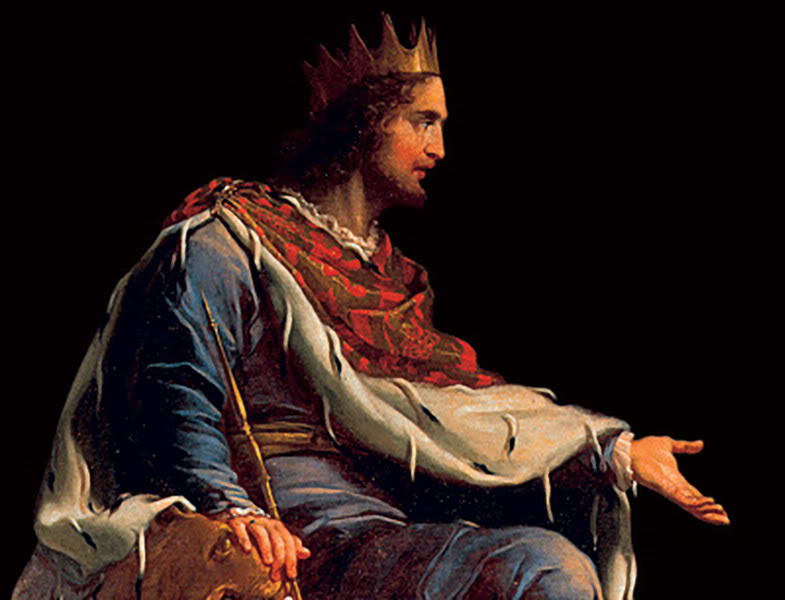
FRANCIS SCHAEFFER ANALYZES ART AND CULTURE Part 49 THE BEATLES (Part A, The Meaning of Stg. Pepper’s Cover) (Feature on artist Mika Tajima)

_______________ The Beatles documentary || A Long and Winding Road || Episode 5 (This video discusses Stg. Pepper’s creation I have dedicated several posts to this series on the Beatles and I don’t know when this series will end because Francis Schaeffer spent a lot of time listening to the Beatles and talking and writing about […]

FRANCIS SCHAEFFER ANALYZES ART AND CULTURE PART 48 “BLOW UP” by Michelangelo Antonioni makes Philosophic Statement (Feature on artist Nancy Holt)

_______________ Francis Schaeffer pictured below: _____________________ I have included the 27 minute  episode THE AGE OF NONREASON by Francis Schaeffer. In that video Schaeffer noted,  ” Sergeant Pepper’s Lonely Hearts Club Band…for a time it became the rallying cry for young people throughout the world. It expressed the essence of their lives, thoughts and their feelings.” How Should […]

FRANCIS SCHAEFFER ANALYZES ART AND CULTURE Part 47 Woody Allen and Professor Levy and the death of “Optimistic Humanism” from the movie CRIMES AND MISDEMEANORS Plus Charles Darwin’s comments too!!! (Feature on artist Rodney Graham)

Crimes and Misdemeanors: A Discussion: Part 1 ___________________________________ Today I will answer the simple question: IS IT POSSIBLE TO BE AN OPTIMISTIC SECULAR HUMANIST THAT DOES NOT BELIEVE IN GOD OR AN AFTERLIFE? This question has been around for a long time and you can go back to the 19th century and read this same […]

FRANCIS SCHAEFFER ANALYZES ART AND CULTURE PART 46 Friedrich Nietzsche (Featured artist is Thomas Schütte)

____________________________________ Francis Schaeffer pictured below: __________ Francis Schaeffer has written extensively on art and culture spanning the last 2000years and here are some posts I have done on this subject before : Francis Schaeffer’s “How should we then live?” Video and outline of episode 10 “Final Choices” , episode 9 “The Age of Personal Peace and Affluence”, episode 8 […]

FRANCIS SCHAEFFER ANALYZES ART AND CULTURE Part 45 Woody Allen “Reason is Dead” (Feature on artists Allora & Calzadilla )

Love and Death [Woody Allen] – What if there is no God? [PL] ___________ _______________ How Should We then Live Episode 7 small (Age of Nonreason) #02 How Should We Then Live? (Promo Clip) Dr. Francis Schaeffer 10 Worldview and Truth Two Minute Warning: How Then Should We Live?: Francis Schaeffer at 100 Francis Schaeffer […]

FRANCIS SCHAEFFER ANALYZES ART AND CULTURE Part 44 The Book of Genesis (Featured artist is Trey McCarley )

___________________________________ Francis Schaeffer pictured below: ____________________________ Francis Schaeffer “BASIS FOR HUMAN DIGNITY” Whatever…HTTHR Dr. Francis schaeffer – The flow of Materialism(from Part 4 of Whatever happened to human race?) Dr. Francis Schaeffer – The Biblical flow of Truth & History (intro) Francis Schaeffer – The Biblical Flow of History & Truth (1) Dr. Francis Schaeffer […]

__

June 7, 2022 READING A PROVERB A DAY (PROVERBS 7) MY POSTCARD IN 2017 FROM NEW ORLEANS  TO HUGH HEFNER

Follow my advice, my son; always keep it in mind and stick to it. Obey me and live! Guard my words as your most precious possession. Write them down,[a] and also keep them deep within your heart. Love wisdom like a sweetheart; make her a beloved member of your family. Let her hold you back from affairs with other women—from listening to their flattery.

I was looking out the window of my house one day and saw a simpleminded lad, a young man lacking common sense, 8-9 walking at twilight down the street to the house of this wayward girl, a prostitute. 10 She approached him, saucy and pert, and dressed seductively. 11-12 She was the brash, coarse type, seen often in the streets and markets, soliciting at every corner for men to be her lovers.

13 She put her arms around him and kissed him, and with a saucy look she said, “I was just coming to look for you and here you are! 14-17 Come home with me, and I’ll fix you a wonderful dinner,[b] and after that—well, my bed is spread with lovely, colored sheets of finest linen imported from Egypt, perfumed with myrrh, aloes, and cinnamon. 18 Come on, let’s take our fill of love until morning, 19 for my husband is away on a long trip. 20 He has taken a wallet full of money with him and won’t return for several days.”

21 So she seduced him with her pretty speech, her coaxing and her wheedling, until he yielded to her. He couldn’t resist her flattery. 22 He followed her as an ox going to the butcher or as a stag that is trapped, 23 waiting to be killed with an arrow through its heart. He was as a bird flying into a snare, not knowing the fate awaiting it there.

24 Listen to me, young men, and not only listen but obey; 25 don’t let your desires get out of hand; don’t let yourself think about her. Don’t go near her; stay away from where she walks, lest she tempt you and seduce you. 26 For she has been the ruin of multitudes—a vast host of men have been her victims. 27 If you want to find the road to hell, look for her house.

I started this series on my letters and postcards to Hugh Hefner back in September when I read of the passing of Mr. Hefner. There are many more to come. It is my view that he may have taken time to look at glance at one or two of them since these postcards were short and from one of Hef’s favorite cities!!!!

Feb 7, 2017 letter B Proverbs 7

Image result for new orleans postcards river
February 7 letter B
Hugh Hefner
Playboy Mansion
Dear Hugh,
Second letter for today!!!
Today is Feb 7 so I want to quote from Proverbs 7. Good advice today from anyone in New Orleans like me.
This chapter 7 of Proverbs is so sad and it plays out everyday here in New Orleans when a young man is seduced.

12 As I stood at the window of my house
    looking out through the shutters,
Watching the mindless crowd stroll by,
    I spotted a young man without any sense
Arriving at the corner of the street where she lived,
    then turning up the path to her house.
It was dusk, the evening coming on,
    the darkness thickening into night.
Just then, a woman met him—
    she’d been lying in wait for him, dressed to seduce him.
Brazen and brash she was,
    restless and roaming, never at home,
Walking the streets, loitering in the mall,
    hanging out at every corner in town.

13-20 She threw her arms around him and kissed him,
    boldly took his arm and said,
“I’ve got all the makings for a feast—
    today I made my offerings, my vows are all paid,
So now I’ve come to find you,
    hoping to catch sight of your face—and here you are!
I’ve spread fresh, clean sheets on my bed,
    colorful imported linens.
My bed is aromatic with spices
    and exotic fragrances.
Come, let’s make love all night,
    spend the night in ecstatic lovemaking!
My husband’s not home; he’s away on business,
    and he won’t be back for a month.”

With much seductive speech she persuades him;
    with her smooth talk she compels him.
22 All at once he follows her,
    as an ox goes to the slaughter,
or as a stag is caught fast[e]
23     till an arrow pierces its liver;
as a bird rushes into a snare;
    he does not know that it will cost him his life.

—-
How many homes have been wrecked by young men’s trips to New Orleans?
There is hope!!! Check out John 3:16!!!
Best wishes,
Everette Hatcher
Xxx

___________

I wrote to Hefner in an earlier letter these words:

Don’t you see that Solomon was right  when he observed life UNDER THE SUN without God in the picture and he then concluded  in Ecclesiastes 2:11:

“All was vanity and a striving after wind, and there was nothing to be gained UNDER THE SUN.”

Notice this phrase UNDER THE SUN since it appears about 30 times in Ecclesiastes. Francis Schaeffer noted that Solomon took a look at the meaning of life on the basis of human life standing alone between birth and death “under the sun.” This phrase UNDER THE SUN appears over and over in Ecclesiastes. The Christian Scholar Ravi Zacharias noted, “The key to understanding the Book of Ecclesiastes is the term UNDER THE SUN — What that literally means is you lock God out of a closed system and you are left with only this world of Time plus Chance plus matter.”

The answer to find meaning in life is found in putting your faith and trust in Jesus Christ. The Bible is true from cover to cover and can be trusted.

Image result for king solomon

Article below is from Tom Beaman

About

??????My name is Tom Beaman.  When I was 38, as a confirmed skeptic of all things religious, I had a life-changing encounter with Jesus.  Within a couple of years I sold my concert sound company and enrolled in Denver Seminary, preparing for a new career as a pastor and preacher.  One of the biggest surprises for me was how rich and fascinating the study of the  Bible can be when you strip away all the stuffiness and formality.  It is astonishing that this collection of  – individual writings, written by dozens of authors from differing cultural situations, over a span of hundreds of years, fits together with such precision.  Recently retired, I’ve begun this blog as a way of continuing to share my love and amazement for God’s Word.

I live in Longmont, Colorado, am recently single, after the death of my wife of 47 years in 2015.  We raised two kids and now have four grand-kids.  My hobbies include camping, playing guitar, woodworking and baking bread.

PS – When I quote from the Bible, most of the time it will be from: The Holy Bible : New International Version. 1996, c1984, Grand Rapids: Zondervan.

Very good below

The Quest for Meaning – Part 3

Being Elvis was not enough.  He needed more.  Why?  You might think singing for a living would be satisfying.  Throw in vast wealth, Graceland, being known as “the King” and worshiped around the world would pretty much cover all your needs.  But all that was not enough.  Why not?  Solomon (introduced in Part 1) never met Elvis (so far as we know…. wink, wink…) but he applied himself to figure it out.  There must be a reason we humans work so hard to achieve money, fame, power, pleasure, success – you name it – and when we do, we discover those things don’t satisfy.

He didn’t just read up on the topic; Solomon held his nose and cannon-balled into the quest.  But nothing he tried was enough.  Wisdom didn’t satisfy:

I said to myself, “Look, I have increased in wisdom more than anyone who has ruled over Jerusalem before me; I have experienced much of wisdom and knowledge.” 17 Then I applied myself to the understanding of wisdom, and also of madness and folly, but I learned that this, too, is a chasing after the wind.
18 For with much wisdom comes much sorrow;
the more knowledge, the more grief  (Ecclesiastes 1:16-18)

Carnal pleasure didn’t satisfy.  His life that would have been the envy of Donald Trump, HUGH  HEFNER and Bill Gates:

1 I said to myself, “Come now, I will test you with pleasure to find out what is good.” But that also proved to be meaningless. 2 “Laughter,” I said, “is madness. And what does pleasure accomplish?” 3 I tried cheering myself with wine, and embracing folly—my mind still guiding me with wisdom. I wanted to see what was good for people to do under the heavens during the few days of their lives. I undertook great projects: I built houses for myself and planted vineyards. 5 I made gardens and parks and planted all kinds of fruit trees in them. 6 I made reservoirs to water groves of flourishing trees. 7 I bought male and female slaves and had other slaves who were born in my house. I also owned more herds and flocks than anyone in Jerusalem before me. 8 I amassed silver and gold for myself, and the treasure of kings and provinces. I acquired male and female singers, and a harem as well—the delights of a man’s heart. 9 I became greater by far than anyone in Jerusalem before me. In all this my wisdom stayed with me.
10 I denied myself nothing my eyes desired;
I refused my heart no pleasure.
My heart took delight in all my labor,
and this was the reward for all my toil.  (Ecclesiastes 2:1-10)

And yet, none of that was enough:

11 Yet when I surveyed all that my hands had done
and what I had toiled to achieve,
everything was meaningless, a chasing after the wind;
nothing was gained under the sun.  (Ecclesiastes 2:11)

Why is it that none of these things we strive for pay off in a lasting, satisfying way?  You can read ahead in Ecclesiastes to discover what Solomon concluded.  Hint: One is the “D word,” the great equalizer that awaits us all.  The second thing is a matter of having the wrong perspective.  There is a solution.

See you next time…

21 Pictures That Show Just How Crazy Hugh Hefner’s Life Really Was

“Life is too short to be living someone else’s dream.” —Hugh Hefner

Posted on 

Millionaire publisher of Playboy magazine Hugh Hefner poses with Playmate Bunnies at one of his clubs in 1962.

Helmut Kretz / Getty Images

Millionaire publisher of Playboy magazine Hugh Hefner poses with Playmate Bunnies at one of his clubs in 1962.

Exterior of Hefner's Playboy Club in midtown Manhattan, circa 1966.

Keystone Features / Getty Images

Exterior of Hefner’s Playboy Club in midtown Manhattan, circa 1966.

Hefner inspects new and improved fabric for the Playboy Bunny costumes in the main room of the Playboy Mansion in Chicago, circa 1966.

Bettmann / Bettmann Archive

Hefner inspects new and improved fabric for the Playboy Bunny costumes in the main room of the Playboy Mansion in Chicago, circa 1966.

Hugh Hefner "rescues" one of the swimmers in the indoor pool of his Chicago apartment in 1961.

Edward Kitch / Edward Kitch / AP/REX/Shutterstock

Hugh Hefner “rescues” one of the swimmers in the indoor pool of his Chicago apartment in 1961.

A crowd of partygoers inspect Hefner's stereo system at his Playboy Mansion in Chicago, circa 1966.

Bettmann / Bettmann Archive

A crowd of partygoers inspect Hefner’s stereo system at his Playboy Mansion in Chicago, circa 1966.

The "badge of the bunnies" on a Rolls-Royce picks up Hefner after arriving from the US in 1966.

Pa Images / Getty Images

The “badge of the bunnies” on a Rolls-Royce picks up Hefner after arriving from the US in 1966.

Hefner makes a telephone call aboard his private plane in 1970.

Anonymous / Anonymous / AP/REX/Shutterstock

Hefner makes a telephone call aboard his private plane in 1970.

Playboy Bunnies welcome Hugh Hefner on the inaugural flight of his new DC-9 jetliner, The Big Bunny, on March 17, 1970.

George Brich / AP

Playboy Bunnies welcome Hugh Hefner on the inaugural flight of his new DC-9 jetliner, The Big Bunny, on March 17, 1970.

Hefner arrives with an entourage of Bunnies at London Heathrow Airport on June 25, 1966. During this trip to Britain, he opened his 16th Playboy Club, located in Park Lane, London.

Mirrorpix / Getty Images

Hefner arrives with an entourage of Bunnies at London Heathrow Airport on June 25, 1966. During this trip to Britain, he opened his 16th Playboy Club, located in Park Lane, London.

During a press conference, a little "Bunny" offers sweets to Hugh Hefner and his girlfriend Barbara Benton after they arrived in West Berlin to shoot the film What Is A Nice Girl Like You Doing In This Business, in 1969.

Herrmann / AP / REX / Shutterstock

During a press conference, a little “Bunny” offers sweets to Hugh Hefner and his girlfriend Barbara Benton after they arrived in West Berlin to shoot the film What Is A Nice Girl Like You Doing In This Business, in 1969.

Hefner speaks to an audience during the release party for the Playboy 25th anniversary issue in 1979.

Araldo Di Crollalanza / ARALDO DI CROLLALANZA/REX/Shutterstock

Hefner speaks to an audience during the release party for the Playboy 25th anniversary issue in 1979.

Hefner dances with playmate Sandra Theodore, alongside actress Rita Hayworth and her former choreographer Hermes Pan, during a fundraising party to save the Hollywood sign in Los Angeles in 1978.

Lennox Mclendon / Lennox McLendon / AP/REX/Shutterstock

Hefner dances with playmate Sandra Theodore, alongside actress Rita Hayworth and her former choreographer Hermes Pan, during a fundraising party to save the Hollywood sign in Los Angeles in 1978.

Hefner and Playboy Bunnies celebrate as he receives a star on the Hollywood Walk of Fame in 1980 for his achievements in television.

Ron Galella / WireImage

Hefner and Playboy Bunnies celebrate as he receives a star on the Hollywood Walk of Fame in 1980 for his achievements in television.

Hefner poses with a group of current and former Playboy Bunnies at the Los Angeles Playboy Club in 1986.

Anonymous / AP / REX/ Shutterstock

Hefner poses with a group of current and former Playboy Bunnies at the Los Angeles Playboy Club in 1986.

Luxury and high-end sports cars line the driveway of Hefner's Playboy Mansion during a party in 1991.

Kip Rano / REX / Shutterstock

Luxury and high-end sports cars line the driveway of Hefner’s Playboy Mansion during a party in 1991.

Hefner sits with his wife Kimberley and two children during an event at the Playboy Mansion in April 1994.

Brad Elterman / Getty Images

Hefner sits with his wife Kimberley and two children during an event at the Playboy Mansion in April 1994.

Hefner poses next to a laser-generated image of his head on a computer screen following a laser scanning session on Sept. 26, 2000, at the Playboy Mansion in Los Angeles. The resulting image was used to create an exact wax model of his head for a figure at the Hollywood Wax Museum.

Reed Saxon / ASSOCIATED PRESS

Hefner poses next to a laser-generated image of his head on a computer screen following a laser scanning session on Sept. 26, 2000, at the Playboy Mansion in Los Angeles. The resulting image was used to create an exact wax model of his head for a figure at the Hollywood Wax Museum.

Hefner and model Crystal Harris, later Crystal Hefner, attend a signing in Los Angeles on Dec. 10, 2009.

Michael Bezjian / WireImage

Hefner and model Crystal Harris, later Crystal Hefner, attend a signing in Los Angeles on Dec. 10, 2009.

Hugh Hefner shares a moment with Pamela Anderson during the launch party for Spike TV at The Playboy Mansion in 2003.

Jeff Kravitz / FilmMagic, Inc

Hugh Hefner shares a moment with Pamela Anderson during the launch party for Spike TV at The Playboy Mansion in 2003.

Hefner looks at past Playboy covers during a Las Vegas party celebrating Playboy's 50th anniversary in 2009.

Denise Truscello / WireImage

Hefner looks at past Playboy covers during a Las Vegas party celebrating Playboy’s 50th anniversary in 2009.

Hefner arrives at the 2011 Playboy Jazz Festival at the Playboy Mansion on Feb. 10, 2011, in Beverly Hills.

Michael Kovac / FilmMagic

Hefner arrives at the 2011 Playboy Jazz Festival at the Playboy Mansion on Feb. 10, 2011, in Beverly Hills.

__

Related posts:

Ecclesiastes 2 — The Quest For Meaning and the failed examples of Howard Hughes and Hugh Hefner

Ecclesiastes 2-3 Published on Sep 19, 2012 Calvary Chapel Spring Valley | Sunday Evening | September 16, 2012 | Derek Neider _____________________________ I have written on the Book of Ecclesiastes and the subject of the meaning of our lives on several occasions on this blog. In this series on Ecclesiastes I hope to show how secular […]

FRANCIS SCHAEFFER ANALYZES ART AND CULTURE PART 162 A look at the BEATLES Breaking down the song ALL WE NEED IS LOVE Part C (Featured artist is Grace Slick)

 Is Love All You Need? Jesus v. Lennon Posted on January 19, 2011 by Jovan Payes 0 On June 25, 1967, the Beatles participated in the first worldwide TV special called “Our World”. During this special, the Beatles introduced “All You Need is Love”; one of their most famous and recognizable songs. In it, John Lennon […]

FRANCIS SCHAEFFER ANALYZES ART AND CULTURE Part 158 THE BEATLES (breaking down the song WHY DON’T WE DO IT IN THE ROAD?) Photographer Bob Gomel featured today!

___________________ Something happened to the Beatles in their journey through the 1960’s and although they started off wanting only to hold their girlfriend’s hand it later evolved into wanting to smash all previous sexual standards. The Beatles: Why Don’t We Do It in the Road? _______ Beatle Ringo Starr, and his girlfriend, later his wife, […]

FRANCIS SCHAEFFER ANALYZES ART AND CULTURE PART 142 Marvin Minsky Part G (Featured artist is Red Grooms)

__________ Marvin Minsky __ I was sorry recently  to learn of the passing of one of the great scholars of our generation. I have written about Marvin Minsky several times before in this series and today I again look at a letter I wrote to him in the last couple of years. It is my […]

FRANCIS SCHAEFFER ANALYZES ART AND CULTURE Part 118 THE BEATLES (Why was Tony Curtis on cover of SGT PEP?) (Feature on artist Jeffrey Gibson )

Why was Tony Curtis on the cover of SGT PEPPERS? I have no idea but if I had to hazard a guess I would say that probably it was because he was in the smash hit SOME LIKE IT HOT.  Above from the  movie SOME LIKE IT HOT __ __ Jojo was a man who […]

FRANCIS SCHAEFFER ANALYZES ART AND CULTURE Part 101 BEATLES,(MANY CHRISTIANS ATTACKED THE BEATLES WHILE FRANCIS SCHAEFFER STUDIED THEIR MUSIC! Part B) Artist featured today is Cartoonist Gahan Wilson

__ Francis Schaeffer did not shy away from appreciating the Beatles. In fact, SERGEANT PEPPER’S LONELY HEARTS CLUB BAND album was his favorite and he listened to it over and over. I am a big fan of Francis Schaeffer but there are detractors that attack him because he did not have all the degrees that they […]

10 YEARS AGO ADRIAN ROGERS WENT TO GLORY BUT HIS SERMONS ARE STILL SHARING CHRIST LOVE TODAY!!!

On 11-15-05 Adrian Rogers passed over to glory and since it is the 10th anniversary of that day I wanted to celebrate his life in two ways. First, I wanted to pass on some of the material from Adrian Rogers’ sermons I have sent to prominent atheists over the last 20 years. Second, I wanted […]

FRANCIS SCHAEFFER ANALYZES ART AND CULTURE Part 65 THE BEATLES ( The 1960’s SEXUAL REVOLUTION was on the cover of Sgt. Pepper’s!) (Featured artist is Pauline Boty)

Looking back on his life as a Beatle Paul  said at a  certain age you start to think “Wow, I have to get serious. I can’t just be a playboy all of my life.” It is true that the Beatles wrote a lot about girls!!!!!! The Beatles – I Want To Hold your Hand [HD] Although […]

__

Navarro responds to Jan. 6 committee after FBI treated him ‘like an Al Qaeda terrorist’ during airport arrest

—-

Navarro responds to Jan. 6 committee after FBI treated him ‘like an Al Qaeda terrorist’ during airport arrest

The committee hired a former ABC News president ahead of this week’s primetime hearings.

Former Trump adviser Peter Navarro responded Monday to his recent arrest for defying a subpoena from Mississippi Congressman Bennie Thompsonand the House January 6 committee, telling Fox News he made numerous overtures to the Justice Department in hopes of avoiding a spectacle.

In remarks last week, Navarro said he was arrested by FBI agents at an undisclosed airport while attempting to fly to Nashville to meet with former Arkansas Gov. Mike Huckabee.

On Monday, Navarro said on “Tucker Carlson Tonight” that federal agents put him in leg irons and strip-searched him. He noted he lives within feet of the FBI in Penn Quarter, D.C., adding he even gave agents his attorney’s contact beforehand.

“On Wednesday night, I sent an email to Patricia, the deputy attorney, and said, look, I’m seeking a modus vivendi here. I’m stuck between a rock and a hard place. Let’s see what we can do,” Navarro said.

BIDEN BLASTED FOR CONTINUING TO SHIFT BLAME

Peter Navarro spoke exclusively to "Tucker Carlson Tonight" on Monday.

Peter Navarro spoke exclusively to “Tucker Carlson Tonight” on Monday. (Fox)

Prior to his arrest, Navarro also reached out to an FBI agent he named as Walter Giordano — whom he said had been “banging on my door” a week before – in hopes of seeking a détente while his civil suit against Thompson’s committee made its way through the legal process.

“They chose a different route. They didn’t call my attorney. Instead, they went with this shock-and-awe terror strategy – They let me go to the airport and then take me with five agents, like I’m an Al Qaeda terrorist,” he said, adding he was allegedly unconstitutionally deprived of food, water and counsel during his time in custody.

Navarro had accused the government of “preemptively” filing criminal charges against him before his civil suit against the Thompson-Cheney committee is heard.

He told Tucker Carlson the January 6 committee“subpoenaed me illegally” in that it is allegedly not a legitimate committee under the standing rules of the House.

House 1/6 Committee Chairman Bennie Thompson of Mississippi is shown.

House 1/6 Committee Chairman Bennie Thompson of Mississippi is shown. (Fox)

“I was faced with the untenable choice of upholding executive privilege, which was not my privilege to waive – that’s Donald Trump’s privilege to waive – so I did my duty to the president. I did my duty to this country. And here we sit,” he said.

Navarro’s civil suit focuses on two constitutional issues, which he called the weaponization of Congress and the committee’s purported affront to the separation of Powers – as a legislative panel usurping powers of the judiciary.

“[The DOJ and committee] went into this fanciful and absurd notion that Biden, a sitting incumbent president, could strip his immediate predecessor of executive privilege in me, a staff member to the president of what the Justice Department itself, as you pointed out, has absolute testimonial immunity,” he said.

The January 6 Committee is also discussing further issues including abolishing the electoral college, which Axios reported has been argued for by “outspoken” member Jamie Raskin of Maryland.

Michael Sussmann Free And Peter Navarro In Shackles Epitomize America’s Two-Tier Justice

What do you do when your every institution has been weaponized against you? What do you do when there is a two-tier, no-justice system?

The split-screen of a smug and triumphant Hillary Clinton 2016 campaign lawyer Michael Sussmann walking free from D.C. federal court, and a harried and bewildered former Donald Trump trade adviser Peter Navarro being hauled before it, following his account of a harrowing arrest and detainment, ought to be ingrained indelibly in the American mind.

It sends an unmistakable message: We can get you anytime, anywhere, on any grounds we choose. You can’t touch even a single one of ours.

If by some strange occurrence one of ours is brought before a court, the judge and jury will be rigged against you. “I dare you to ask me to recuse with an acquaintance on the stand,” the judge will say. “What’s a lie to our FBI among friends,” the jury will say. Especially when the lie is a useful one.

The institutions Democrats’ comrade colluded with will be absolved of blame by the putatively adversarial prosecutor representing you, the people. That prosecutor will be plodding, and hew to process crimes against bit players, while the statutes of limitations for the most serious crimes committed by the biggest fish lapse.

You won’t be able to discern whether he is building a masterful case to take us all down, or insulating the very institutions he has served for and with for years, and to which he ultimately answers. That’s the point.

Real conspiracies to concoct fake ones aimed at destroying your singular representative against us will neither be fully revealed nor prosecuted. You will be made to accept it, hanging on every unredacted morsel and revelation, yet waiting in vain for justice.

Conversely, if anyone who can even be remotely affiliated with you ever lashes out in any way — say, over an election in which rules were changed on the fly by non-legislators; an election in which those altered rules created an unprecedented opportunity for fraud that could never be audited because of its remote nature; an election that the most powerful institutions in the country colluded to “fortify” on behalf of their man; an election in which not a court in the land would hear the cases on their merits — it will be cast as an insurrection undertaken by terrorists. (If you raise these points, of course, you too may be cast as a potential terrorist, and at minimum censored.)

Never mind your universal condemnation of the worst acts among the small percentage of the tens of thousands of peaceful, which opponents use to smear your entire movement; that the Democrat narrative is fraudulent: that the only fatalities were found among the putative terrorists. Leftists lie about that point and won’t release the thousands of hours of footage of what transpired. They won’t tell you what their assets were doing on the ground and won’t actually charge anyone with insurrection while they equate them with 9/11 hijackers, kamikaze pilots, and Confederates.

They’ll hold some of the “insurrectionists,” even those slapped with trumped-up trespassing charges, in jail for months on end, and make their lives a living hell. They’ll argue to similarly disposed judges that political wrongthink makes Americans a danger to society, demanding they be kept in jail. They’ll argue for giving the accused terrorism enhancements in their sentences. Some will be pushed to suicide.

When their allies burn down cities, they’ll release them en masse, and if absolutely unavoidable, ensure their sentences are minimized. You won’t mind.

They’ll smear your entire political movement as terroristic in the court of Congress when they can’t do it in the court of law. They’ll pursue again your singular representative, his colleagues, allies, and on down to the most remotely related activists with a congressional probe consisting entirely of us — kind of like the juries you’ll be up in front of.

The probe will be of dubious constitutionality. It will break their own rules. It will abuse targets with the most awesome and chilling powers they have, and seek to break and bankrupt them. They won’t be able to do a thing about it. The process, at minimum, will be the punishment. If they refuse to participate in their own self-immolation, the ruling class will sic their friends in law enforcement on them to hold them criminally liable.

They’ll wreck executive privilege and destroy a whole host of norms in the process while claiming we’re defending them. Do you think your leader will hold us to account?

And then they’ll engage in a society-widewar on wrongthink aimed at smearing and toxifying anyone who dares hold your views, censoring them, hounding them out of public life, and threatening to treat them as terrorists too. They’ll begin the work of building a social credit system with American characteristics where your every wrong thought can and will be used against you.

If you question the ruling class’s authority or the legitimacy of their rule, well, they have a domestic counterterrorism plan for that. This is our democracy, you see. And in our democracy, we win, and you lose.

What do you do when your every institution has been weaponized against you? What do you do when there is a two-tier, no-justice system? What do you do when all the foundations of the system you thought we had have been eroded?

These are the questions those who ask our vote must answer. If they cannot, or will not do so — if they refuse to even recognize the magnitude and gravity of the rampant injustices we are facing as a people — they are simply unfit to lead.

Ben Weingarten is a Federalist Senior Contributor, senior fellow at the London Center for Policy Research and fellow at the Claremont Institute. He was selected as a 2019 Robert Novak Journalism Fellow of the Fund for American Studies, under which he is currently working on a book on U.S.-China policy. Ben writes on national security and foreign policy, economics, and politics for publications including City Journal, Conservative Review and PJ Media. He is the founder and CEO of ChangeUp Media, a media consulting and production company dedicated to advancing conservative principles. Ben is also a 2015 Publius Fellow of the Claremont Institute. You can find his work at benweingarten.com, and follow him on Twitter @bhweingarten.

Open letter to President Obama (Part 644)

(Emailed to White House on 6-10-13.)

President Obama c/o The White House 1600 Pennsylvania Avenue NW Washington, DC 20500

Dear Mr. President,

I know that you receive 20,000 letters a day and that you actually read 10 of them every day. I really do respect you for trying to get a pulse on what is going on out here.

The federal government debt is growing so much that it is endangering us because if things keep going like they are now we will not have any money left for the national defense because we are so far in debt as a nation. We have been spending so much on our welfare state through food stamps and other programs that I am worrying that many of our citizens are becoming more dependent on government and in many cases they are losing their incentive to work hard because of the welfare trap the government has put in place. Other nations in Europe have gone down this road and we see what mess this has gotten them in. People really are losing their faith in big government and they want more liberty back. It seems to me we have to get back to the founding  principles that made our country great.  We also need to realize that a big government will encourage waste and corruption. The recent scandals in our government have proved my point. In fact, the jokes you made at Ohio State about possibly auditing them are not so funny now that reality shows how the IRS was acting more like a monster out of control. Also raising taxes on the job creators is a very bad idea too. The Laffer Curve clearly demonstrates that when the tax rates are raised many individuals will move their investments to places where they will not get taxed as much.

______________________

We can fix the IRS problem by going to the flat tax and lowering the size of government.

Did President Obama and his team of Chicago cronies deliberately target the Tea Party in hopes of thwarting free speech and political participation?

Was this part of a campaign to win the 2012 election by suppressing Republican votes?

Perhaps, but I’ve warned that it’s never a good idea to assume top-down conspiracies when corruption, incompetence, politics, ideology, greed, and self-interest are better explanations for what happens in Washington.

Writing for the Washington Examiner, Tim Carney has a much more sober and realistic explanation of what happened at the IRS.

If you take a group of Democrats who are also unionized government employees, and put them in charge of policing political speech, it doesn’t matter how professional and well-intentioned they are. The result will be much like the debacle in the Cincinnati office of the IRS. …there’s no reason to even posit evil intent by the IRS officials who formulated, approved or executed the inappropriate guidelines for picking groups to scrutinize most closely. …The public servants figuring out which groups qualified for 501(c)4 “social welfare” non-profit status were mostly Democrats surrounded by mostly Democrats. …In the 2012 election, every donation traceable to this office went to President Obama or liberal Sen. Sherrod Brown. This is an environment where even those trying to be fair could develop a disproportionate distrust of the Tea Party. One IRS worker — a member of NTEU and contributor to its PAC, which gives 96 percent of its money to Democratic candidates — explained it this way: “The reason NTEU mostly supports Democratic candidates for office is because Democratic candidates are mostly more supportive of civil servants/government employees.”

Tim concludes with a wise observation.

As long as we have a civil service workforce that leans Left, and as long as we have an income tax system that requires the IRS to police political speech, conservative groups can always expect special IRS scrutiny.

And my colleague Doug Bandow, in an article for the American Spectator, adds his sage analysis.

The real issue is the expansive, expensive bureaucratic state and its inherent threat to any system of limited government, rule of law, and individual liberty. …the broader the government’s authority, the greater its need for revenue, the wider its enforcement power, the more expansive the bureaucracy’s discretion, the increasingly important the battle for political control, and the more bitter the partisan fight, the more likely government officials will abuse their positions, violate rules, laws, and Constitution, and sacrifice people’s liberties. The blame falls squarely on Congress, not the IRS.

I actually think he is letting the IRS off the hook too easily.

But Doug’s overall point obviously is true.

…the denizens of Capitol Hill also have created a tax code marked by outrageous complexity, special interest electioneering, and systematic social engineering. Legislators have intentionally created avenues for tax avoidance to win votes, and then complained about widespread tax avoidance to win votes.

So what’s the answer?

The most obvious response to the scandal — beyond punishing anyone who violated the law — is tax reform. Implement a flat tax and you’d still have an IRS, but the income tax would be less complex, there would be fewer “preferences” for the agency to police, and rates would be lower, leaving taxpayers with less incentive for aggressive tax avoidance. …Failing to address the broader underlying factors also would merely set the stage for a repeat performance in some form a few years hence. …More fundamentally, government, and especially the national government, should do less. Efficient social engineering may be slightly better than inefficient social engineering, but no social engineering would be far better.

Amen. Let’s rip out the internal revenue code and replace it with a simple and fair flat tax.

But here’s the challenge. We know the solution, but it will be almost impossible to implement good policy unless we figure out some way to restrain the spending side of the fiscal ledger.

___________________________

At the risk of over-simplifying, we will never get tax reform unless we figure out how to implement entitlement reform.

Here’s another Foden cartoon, which I like because it has the same theme asthis Jerry Holbert cartoon, showing big government as a destructive and malicious force.

IRS Cartoon 5

_____________

Thank you so much for your time. I know how valuable it is. I also appreciate the fine family that you have and your commitment as a father and a husband.

Sincerely,

Everette Hatcher III, 13900 Cottontail Lane, Alexander, AR 72002, ph 501-920-5733, lowcostsqueegees@yahoo.com

Related Posts:

We know the IRS commissioner wasn’t telling the truth in March 2012, when he testified: “There’s absolutely no targeting.”

We know the IRS commissioner wasn’t telling the truth in March 2012, when he testified: “There’s absolutely no targeting.”However, Lois Lerner knew different when she misled people with those words. Two important points made by Noonan in the Wall Street Journal in the article below: First, only conservative groups were targeted in this scandal by […]

A great cartoonist takes on the IRS!!!!

Ohio Liberty Coalition versus the I.R.S. (Tom Zawistowski) Published on May 20, 2013 The Ohio Liberty Coalition was among tea party groups that received special scrutiny from the I.R.S. Tom Zawistowski says his story is not unique. He argues the kinds of questions the I.R.S. asked his group amounts to little more than “opposition research.” Video […]

“Schaeffer Sundays” Francis Schaeffer’s own words concerning what the First Amendment means

Francis Schaeffer: “Whatever Happened to the Human Race?” (Episode 2) SLAUGHTER OF THE INNOCENTS Published on Oct 6, 2012 by AdamMetropolis The 45 minute video above is from the film series created from Francis Schaeffer’s book “Whatever Happened to the Human Race?” with Dr. C. Everett Koop. This book  really helped develop my political views concerning […]

Cartoonists show how stupid the IRS is acting!!!

We got to lower the size of government so we don’t have these abuses like this in the IRS. Cartoonists v. the IRS May 23, 2013 by Dan Mitchell Call me perverse, but I’m enjoying this IRS scandal. It’s good to see them suffer a tiny fraction of the agony they impose on the American people. I’ve already […]

Dear Senator Pryor, why not pass the Balanced Budget Amendment? (“Thirsty Thursday”, Open letter to Senator Pryor)

Dear Senator Pryor, Why not pass the Balanced  Budget Amendment? As you know that federal deficit is at all time high (1.6 trillion deficit with revenues of 2.2 trillion and spending at 3.8 trillion). On my blog http://www.HaltingArkansasLiberalswithTruth.com I took you at your word and sent you over 100 emails with specific spending cut ideas. However, […]

Video from Cato Institute on IRS Scandal

Is the irs out of control? Here is the link from cato: MAY 22, 2013 8:47AM Can You Vague That Up for Me? By TREVOR BURRUS SHARE As the IRS scandal thickens, targeted groups are coming out to describe their ordeals in dealing with that most-reviled of government agencies. The Ohio Liberty Coalition was one of […]

IRS cartoons from Dan Mitchell’s blog

Get Ready to Be Reamed May 17, 2013 by Dan Mitchell With so many scandals percolating, there are lots of good cartoons being produced. But I think this Chip Bok gem deserves special praise. It manages to weave together both the costly Obamacare boondoggle with the reprehensible politicization of the IRS. So BOHICA, my friends. If […]

Obama jokes about audit of Ohio St by IRS then IRS scandal breaks!!!!!

You want to talk about irony then look at President Obama’s speech a few days ago when he joked about a potential audit of Ohio St by the IRS then a few days later the IRS scandal breaks!!!! The I.R.S. Abusing Americans Is Nothing New Published on May 15, 2013 The I.R.S. targeting of tea party […]

Dear Senator Pryor, why not pass the Balanced Budget Amendment? (“Thirsty Thursday”, Open letter to Senator Pryor)

Dear Senator Pryor, Why not pass the Balanced  Budget Amendment? As you know that federal deficit is at all time high (1.6 trillion deficit with revenues of 2.2 trillion and spending at 3.8 trillion). On my blog http://www.HaltingArkansasLiberalswithTruth.com I took you at your word and sent you over 100 emails with specific spending cut ideas. However, […]

We could put in a flat tax and it would enable us to cut billions out of the IRS budget!!!!

We could put in a flat tax and it would enable us to cut billions out of the IRS budget!!!! May 14, 2013 2:34PM IRS Budget Soars By Chris Edwards Share The revelations of IRS officials targeting conservative and libertarian groups suggest that now is a good time for lawmakers to review a broad range […]

By Everette Hatcher III | Posted in Taxes | Edit | Comments (0)

Michael Sussmann Free And Peter Navarro In Shackles Epitomize America’s Two-Tier Justice

Michael Sussmann Free And Peter Navarro In Shackles Epitomize America’s Two-Tier Justice

What do you do when your every institution has been weaponized against you? What do you do when there is a two-tier, no-justice system?

The split-screen of a smug and triumphant Hillary Clinton 2016 campaign lawyer Michael Sussmann walking free from D.C. federal court, and a harried and bewildered former Donald Trump trade adviser Peter Navarro being hauled before it, following his account of a harrowing arrest and detainment, ought to be ingrained indelibly in the American mind.

It sends an unmistakable message: We can get you anytime, anywhere, on any grounds we choose. You can’t touch even a single one of ours.

If by some strange occurrence one of ours is brought before a court, the judge and jury will be rigged against you. “I dare you to ask me to recuse with an acquaintance on the stand,” the judge will say. “What’s a lie to our FBI among friends,” the jury will say. Especially when the lie is a useful one.

The institutions Democrats’ comrade colluded with will be absolved of blame by the putatively adversarial prosecutor representing you, the people. That prosecutor will be plodding, and hew to process crimes against bit players, while the statutes of limitations for the most serious crimes committed by the biggest fish lapse.

You won’t be able to discern whether he is building a masterful case to take us all down, or insulating the very institutions he has served for and with for years, and to which he ultimately answers. That’s the point.

Real conspiracies to concoct fake ones aimed at destroying your singular representative against us will neither be fully revealed nor prosecuted. You will be made to accept it, hanging on every unredacted morsel and revelation, yet waiting in vain for justice.

Conversely, if anyone who can even be remotely affiliated with you ever lashes out in any way — say, over an election in which rules were changed on the fly by non-legislators; an election in which those altered rules created an unprecedented opportunity for fraud that could never be audited because of its remote nature; an election that the most powerful institutions in the country colluded to “fortify” on behalf of their man; an election in which not a court in the land would hear the cases on their merits — it will be cast as an insurrection undertaken by terrorists. (If you raise these points, of course, you too may be cast as a potential terrorist, and at minimum censored.)

Never mind your universal condemnation of the worst acts among the small percentage of the tens of thousands of peaceful, which opponents use to smear your entire movement; that the Democrat narrative is fraudulent: that the only fatalities were found among the putative terrorists. Leftists lie about that point and won’t release the thousands of hours of footage of what transpired. They won’t tell you what their assets were doing on the ground and won’t actually charge anyone with insurrection while they equate them with 9/11 hijackers, kamikaze pilots, and Confederates.

They’ll hold some of the “insurrectionists,” even those slapped with trumped-up trespassing charges, in jail for months on end, and make their lives a living hell. They’ll argue to similarly disposed judges that political wrongthink makes Americans a danger to society, demanding they be kept in jail. They’ll argue for giving the accused terrorism enhancements in their sentences. Some will be pushed to suicide.

When their allies burn down cities, they’ll release them en masse, and if absolutely unavoidable, ensure their sentences are minimized. You won’t mind.

They’ll smear your entire political movement as terroristic in the court of Congress when they can’t do it in the court of law. They’ll pursue again your singular representative, his colleagues, allies, and on down to the most remotely related activists with a congressional probe consisting entirely of us — kind of like the juries you’ll be up in front of.

The probe will be of dubious constitutionality. It will break their own rules. It will abuse targets with the most awesome and chilling powers they have, and seek to break and bankrupt them. They won’t be able to do a thing about it. The process, at minimum, will be the punishment. If they refuse to participate in their own self-immolation, the ruling class will sic their friends in law enforcement on them to hold them criminally liable.

They’ll wreck executive privilege and destroy a whole host of norms in the process while claiming we’re defending them. Do you think your leader will hold us to account?

And then they’ll engage in a society-widewar on wrongthink aimed at smearing and toxifying anyone who dares hold your views, censoring them, hounding them out of public life, and threatening to treat them as terrorists too. They’ll begin the work of building a social credit system with American characteristics where your every wrong thought can and will be used against you.

If you question the ruling class’s authority or the legitimacy of their rule, well, they have a domestic counterterrorism plan for that. This is our democracy, you see. And in our democracy, we win, and you lose.

What do you do when your every institution has been weaponized against you? What do you do when there is a two-tier, no-justice system? What do you do when all the foundations of the system you thought we had have been eroded?

These are the questions those who ask our vote must answer. If they cannot, or will not do so — if they refuse to even recognize the magnitude and gravity of the rampant injustices we are facing as a people — they are simply unfit to lead.

Ben Weingarten is a Federalist Senior Contributor, senior fellow at the London Center for Policy Research and fellow at the Claremont Institute. He was selected as a 2019 Robert Novak Journalism Fellow of the Fund for American Studies, under which he is currently working on a book on U.S.-China policy. Ben writes on national security and foreign policy, economics, and politics for publications including City Journal, Conservative Review and PJ Media. He is the founder and CEO of ChangeUp Media, a media consulting and production company dedicated to advancing conservative principles. Ben is also a 2015 Publius Fellow of the Claremont Institute. You can find his work at benweingarten.com, and follow him on Twitter @bhweingarten.

Open letter to President Obama (Part 644)

(Emailed to White House on 6-10-13.)

President Obama c/o The White House 1600 Pennsylvania Avenue NW Washington, DC 20500

Dear Mr. President,

I know that you receive 20,000 letters a day and that you actually read 10 of them every day. I really do respect you for trying to get a pulse on what is going on out here.

The federal government debt is growing so much that it is endangering us because if things keep going like they are now we will not have any money left for the national defense because we are so far in debt as a nation. We have been spending so much on our welfare state through food stamps and other programs that I am worrying that many of our citizens are becoming more dependent on government and in many cases they are losing their incentive to work hard because of the welfare trap the government has put in place. Other nations in Europe have gone down this road and we see what mess this has gotten them in. People really are losing their faith in big government and they want more liberty back. It seems to me we have to get back to the founding  principles that made our country great.  We also need to realize that a big government will encourage waste and corruption. The recent scandals in our government have proved my point. In fact, the jokes you made at Ohio State about possibly auditing them are not so funny now that reality shows how the IRS was acting more like a monster out of control. Also raising taxes on the job creators is a very bad idea too. The Laffer Curve clearly demonstrates that when the tax rates are raised many individuals will move their investments to places where they will not get taxed as much.

______________________

We can fix the IRS problem by going to the flat tax and lowering the size of government.

Did President Obama and his team of Chicago cronies deliberately target the Tea Party in hopes of thwarting free speech and political participation?

Was this part of a campaign to win the 2012 election by suppressing Republican votes?

Perhaps, but I’ve warned that it’s never a good idea to assume top-down conspiracies when corruption, incompetence, politics, ideology, greed, and self-interest are better explanations for what happens in Washington.

Writing for the Washington Examiner, Tim Carney has a much more sober and realistic explanation of what happened at the IRS.

If you take a group of Democrats who are also unionized government employees, and put them in charge of policing political speech, it doesn’t matter how professional and well-intentioned they are. The result will be much like the debacle in the Cincinnati office of the IRS. …there’s no reason to even posit evil intent by the IRS officials who formulated, approved or executed the inappropriate guidelines for picking groups to scrutinize most closely. …The public servants figuring out which groups qualified for 501(c)4 “social welfare” non-profit status were mostly Democrats surrounded by mostly Democrats. …In the 2012 election, every donation traceable to this office went to President Obama or liberal Sen. Sherrod Brown. This is an environment where even those trying to be fair could develop a disproportionate distrust of the Tea Party. One IRS worker — a member of NTEU and contributor to its PAC, which gives 96 percent of its money to Democratic candidates — explained it this way: “The reason NTEU mostly supports Democratic candidates for office is because Democratic candidates are mostly more supportive of civil servants/government employees.”

Tim concludes with a wise observation.

As long as we have a civil service workforce that leans Left, and as long as we have an income tax system that requires the IRS to police political speech, conservative groups can always expect special IRS scrutiny.

And my colleague Doug Bandow, in an article for the American Spectator, adds his sage analysis.

The real issue is the expansive, expensive bureaucratic state and its inherent threat to any system of limited government, rule of law, and individual liberty. …the broader the government’s authority, the greater its need for revenue, the wider its enforcement power, the more expansive the bureaucracy’s discretion, the increasingly important the battle for political control, and the more bitter the partisan fight, the more likely government officials will abuse their positions, violate rules, laws, and Constitution, and sacrifice people’s liberties. The blame falls squarely on Congress, not the IRS.

I actually think he is letting the IRS off the hook too easily.

But Doug’s overall point obviously is true.

…the denizens of Capitol Hill also have created a tax code marked by outrageous complexity, special interest electioneering, and systematic social engineering. Legislators have intentionally created avenues for tax avoidance to win votes, and then complained about widespread tax avoidance to win votes.

So what’s the answer?

The most obvious response to the scandal — beyond punishing anyone who violated the law — is tax reform. Implement a flat tax and you’d still have an IRS, but the income tax would be less complex, there would be fewer “preferences” for the agency to police, and rates would be lower, leaving taxpayers with less incentive for aggressive tax avoidance. …Failing to address the broader underlying factors also would merely set the stage for a repeat performance in some form a few years hence. …More fundamentally, government, and especially the national government, should do less. Efficient social engineering may be slightly better than inefficient social engineering, but no social engineering would be far better.

Amen. Let’s rip out the internal revenue code and replace it with a simple and fair flat tax.

But here’s the challenge. We know the solution, but it will be almost impossible to implement good policy unless we figure out some way to restrain the spending side of the fiscal ledger.

___________________________

At the risk of over-simplifying, we will never get tax reform unless we figure out how to implement entitlement reform.

Here’s another Foden cartoon, which I like because it has the same theme asthis Jerry Holbert cartoon, showing big government as a destructive and malicious force.

IRS Cartoon 5

_____________

Thank you so much for your time. I know how valuable it is. I also appreciate the fine family that you have and your commitment as a father and a husband.

Sincerely,

Everette Hatcher III, 13900 Cottontail Lane, Alexander, AR 72002, ph 501-920-5733, lowcostsqueegees@yahoo.com

Related Posts:

We know the IRS commissioner wasn’t telling the truth in March 2012, when he testified: “There’s absolutely no targeting.”

We know the IRS commissioner wasn’t telling the truth in March 2012, when he testified: “There’s absolutely no targeting.”However, Lois Lerner knew different when she misled people with those words. Two important points made by Noonan in the Wall Street Journal in the article below: First, only conservative groups were targeted in this scandal by […]

A great cartoonist takes on the IRS!!!!

Ohio Liberty Coalition versus the I.R.S. (Tom Zawistowski) Published on May 20, 2013 The Ohio Liberty Coalition was among tea party groups that received special scrutiny from the I.R.S. Tom Zawistowski says his story is not unique. He argues the kinds of questions the I.R.S. asked his group amounts to little more than “opposition research.” Video […]

“Schaeffer Sundays” Francis Schaeffer’s own words concerning what the First Amendment means

Francis Schaeffer: “Whatever Happened to the Human Race?” (Episode 2) SLAUGHTER OF THE INNOCENTS Published on Oct 6, 2012 by AdamMetropolis The 45 minute video above is from the film series created from Francis Schaeffer’s book “Whatever Happened to the Human Race?” with Dr. C. Everett Koop. This book  really helped develop my political views concerning […]

Cartoonists show how stupid the IRS is acting!!!

We got to lower the size of government so we don’t have these abuses like this in the IRS. Cartoonists v. the IRS May 23, 2013 by Dan Mitchell Call me perverse, but I’m enjoying this IRS scandal. It’s good to see them suffer a tiny fraction of the agony they impose on the American people. I’ve already […]

Dear Senator Pryor, why not pass the Balanced Budget Amendment? (“Thirsty Thursday”, Open letter to Senator Pryor)

Dear Senator Pryor, Why not pass the Balanced  Budget Amendment? As you know that federal deficit is at all time high (1.6 trillion deficit with revenues of 2.2 trillion and spending at 3.8 trillion). On my blog http://www.HaltingArkansasLiberalswithTruth.com I took you at your word and sent you over 100 emails with specific spending cut ideas. However, […]

Video from Cato Institute on IRS Scandal

Is the irs out of control? Here is the link from cato: MAY 22, 2013 8:47AM Can You Vague That Up for Me? By TREVOR BURRUS SHARE As the IRS scandal thickens, targeted groups are coming out to describe their ordeals in dealing with that most-reviled of government agencies. The Ohio Liberty Coalition was one of […]

IRS cartoons from Dan Mitchell’s blog

Get Ready to Be Reamed May 17, 2013 by Dan Mitchell With so many scandals percolating, there are lots of good cartoons being produced. But I think this Chip Bok gem deserves special praise. It manages to weave together both the costly Obamacare boondoggle with the reprehensible politicization of the IRS. So BOHICA, my friends. If […]

Obama jokes about audit of Ohio St by IRS then IRS scandal breaks!!!!!

You want to talk about irony then look at President Obama’s speech a few days ago when he joked about a potential audit of Ohio St by the IRS then a few days later the IRS scandal breaks!!!! The I.R.S. Abusing Americans Is Nothing New Published on May 15, 2013 The I.R.S. targeting of tea party […]

Dear Senator Pryor, why not pass the Balanced Budget Amendment? (“Thirsty Thursday”, Open letter to Senator Pryor)

Dear Senator Pryor, Why not pass the Balanced  Budget Amendment? As you know that federal deficit is at all time high (1.6 trillion deficit with revenues of 2.2 trillion and spending at 3.8 trillion). On my blog http://www.HaltingArkansasLiberalswithTruth.com I took you at your word and sent you over 100 emails with specific spending cut ideas. However, […]

We could put in a flat tax and it would enable us to cut billions out of the IRS budget!!!!

We could put in a flat tax and it would enable us to cut billions out of the IRS budget!!!! May 14, 2013 2:34PM IRS Budget Soars By Chris Edwards Share The revelations of IRS officials targeting conservative and libertarian groups suggest that now is a good time for lawmakers to review a broad range […]

By Everette Hatcher III | Posted in Taxes | Edit | Comments (0)

78th D-Day anniversary serves as a reminder of American greatness

________

Saving Private Ryan D-Day Scene

77th D-Day anniversary serves as a reminder of American greatness

Those who made ultimate sacrifice paid for freedoms we enjoy, memorial president says

This Sunday marks the 77th anniversary of D-Day, a pivotal moment in World War II, when thousands of American, British and Canadian soldiers selflessly stormed the beaches of Normandy to help liberate Europe from the grip of the German-led Axis forces.

To discuss the importance of the anniversary, April Cheek-Messier, president of the National D-Day Memorial Foundation, sat down with Fox News to talk about D-Day and the lessons the events of June 6, 1944, can teach all Americans.

MEMORIAL DAY: THE MEANING AND HISTORY OF THE HOLIDAY

“This memorial pays tribute to all of our, truly our D-Day veterans, our World War II veterans, to any veteran, I think, who served our country, this memorial is a powerful reminder of service and sacrifice,” said Cheek-Messier, who counts several family members among those who served during World War II. “But what’s really important is that we pass on those lessons to the next generation. That’s really what our veterans want to make sure is happening.”

The National D-Day Memorial, which opened in 2001 and was dedicated by President George W. Bush that same year, has never received any federal or state funding. Instead, Cheek-Messier says, the memorial was the result of a grassroots effort led by those who were there on June 6 to honor their fallen comrades.

“[The memorial] truly was a grassroots effort among veterans to start a national monument to recognize those who served, and those who sacrificed on June 6, 1944,” Cheek-Messier said.

Nearly eight decades after the battle, Cheek-Messier says it’s hard to know how many D-Day veterans remain but they likely only numbers in the hundreds.

“If you think about the fact that there are 16 million who served during World War II, there are only around 325,000 World War II veterans still living today, and of that a very small percentage would be D-Day veterans, and we don’t know the exact number, but you can imagine they would probably only be in a few hundred,” said Cheek-Messier.

Cheek-Messier says the COVID pandemic has hit the D-Day veteran community especially hard.

“It’s been pretty devastating,” she said. “We lost many of them. Many out of just, I think, not being able to see their loved ones and things like that. COVID certainly had an impact in many ways.”

Despite the pain brought on by the COVID pandemic over the last year, and the deep cultural and political divisions among many Americans today, Cheek-Messier believes that D-Day and the memorial can again show Americans what the country can be when it unites.

“I think when people walk around the memorial you get a real sense of that, it’s a good feeling. It’s a good feeling of what we can do as a nation, what we can do as a people when we come together,” said Cheek-Messier.

Unlike during World War II, when nearly everyone knew someone serving the American cause, Cheek-Messier says many aren’t aware of the sacrifices made by veterans and their families. “We’ve kind of lost touch a little bit, I think, with our military and the sacrifices that not only our military men and women make, but their families.”

Cheek-Messier noted that Americans should never forget that the freedoms enjoyed by all citizens today came at the expense of those who served before them, including the thousands who perished 77 years ago defending American ideals along the French shoreline.

“We are here and free today to say the things we want and do the things we want because so many have given the ultimate sacrifice, and I don’t think that we should ever forget that.”

Saving Private Ryan opening cemetery scene

HD – Saving Private Ryan – Death of Captain John H. Miller and Final Speech

The Good Life

by Chuck Colson

Learn More | Meet Chuck Colson

An old man walks down a wide path through a colonnade of evergreens. He has a full head of gray hair, combed from a wavy peak to one side. His eyebrows spike with a grandfatherly flourish toward his temples. He wears a light blue Windbreaker over a golf shirt with a horizontal stripe, Sansabelt slacks, and the crepe-soled shoes his doctor recommended. His gait is quick but stiff – stiff like someone who has just gotten himself up. He marches forward with great intent and purpose, as if he’s hunting out something or someone.Behind him trail his family. His wife is closest, his son and daughter-in- law a step or two farther behind, bracketing their children.

The man’s eyes show that for the moment he’s not thinking of his family, although he seems to be dragging them in his wake. His eyes are at once wide-open yet fixed, poached by what can only be dread. His mouth works in a way that shows his stomach is in his throat. Off to the left his family can see the curve of a long shore, hear the soughing of the waves, and nearly breathe in the scent of the brine. But the man looks neither to his right nor to his left. He keeps stumbling forward, his body tense yet determined.

When he finally turns to his right, he steps onto a vast lawn striped with thousands of white crosses that extend toward the horizon. Here and there a Jewish star adds to the procession of markers that contrast starkly against the green sward. The old man’s pace speeds as he makes his way through this vast cemetery. His family struggles to keep up.

James Ryan’s determined march finally halts in front of a particular cross. The rims of his eyes show red. He wipes at them with a shaking hand, sniffs hard, tries again to breathe. Here it is, his captain’s cross, the name, the date: Captain John W. Miller, June 13, 1944.

He takes another sniff against his watering eyes, bites his lip. He’s almost choking as he struggles to breathe in the heavy air. His knees give way, and he kneels before the cross, his shoulders heaving. His wife is suddenly at one shoulder, his son at the other. He’s glad they are there, but they cannot help with what needs to be done.

He mumbles that he’s all right, and they retreat several steps, leaving him to the thoughts that press so hard he can’t bear the weight.

Not until this moment does he realize that what he has been looking forward to yet dreading is a transaction. An exchange of some kind. For him this visit to the Normandy American Cemetery is no sightseeing tour. It’s a profound action. Even now he cannot say why he believes this to be the case. The emotion that’s seized him declares it to be so, however.

Whatever must happen involves the question that’s dogged him his whole life. The unspoken question that’s brought him here. He feels its presence in every memory, and not only the good ones.

Now that he’s looking at his captain’s grave, Ryan has to ask the question.

Decades earlier, on June 6, 1944, Captain Miller and his men had landed at Omaha Beach, a horror James Ryan had been spared as part of the 101st Airborne. His unit had been dropped into Normandy the night before the sea assault. He later learned from the tales of his buddies and from seeing newsreel footage what D-day had been like. Although Germany had not been expecting the assault at the place Eisenhower chose, the air assault hadn’t softened their positions one whit, and when the armored front of the Higgins boats opened onto the beach, the men were ducks on a pond to the enemy’s machine guns. Many of those sitting forward in the landing craft never had a chance to move from their seats as the Germans opened fire. Those who jumped over the craft’s sides to swim and crawl ashore could only cling to the Belgian gates and iron hedgehogs – the jack-shaped defensive works strewn in rows all along the shingle that prevented tanks from making the initial assault.

The army rangers humped forward in waves, men falling to the right and left every few feet. They were getting hit not only by machinegun fire but by artillery as well. Bodies flew with the explosions. The wounded picked up their severed arms and stumbled a few more feet to their deaths. The waves washing onto the beaches ran red with blood, lapping at the dead, who lay scattered and senseless.

Captain Miller and a few of his company made it to the seawall. Although 50 percent of the men in the first waves to hit Omaha Beach were killed in action, the others broke the first line of German defenses.

Soon after the hell of D-Day, Captain Miller and a squad of seven men were assigned to find paratrooper James Ryan and bring him home – alive. The army’s chief of staff, General George C. Marshall, had personally issued the order for Private James Ryan to be taken out of the war. Ryan’s two older brothers had died in the great assault, and a third brother had been killed in action in New Guinea. Marshall thought that three sons were enough for any mother to contribute to the war.

Captain Miller and his squad found Ryan with remnants of the 506, Baker Company, which had orders to secure a bridge on the far side of a river. The company had been ordered to hold the bridge at all costs – or, as a final defense, to blow it up. When Captain Miller and his squad arrived to take Ryan home, Ryan refused to leave. Miller asked him what he was supposed to say to Ryan’s mother when she got another folded American flag. Ryan replied, “You can tell her that when you found me, I was with the only brothers I had left. And that there was no way I was deserting them. I think she’d understand that.”

Captain Miller and his squad told Ryan angrily that they had already lost two men in the search to find him. Miller finally decided that they’d make Ryan’s battle their own as well and save him in the process.

The Germans soon came at them – nearly a full company of men, two Panzer tanks, two Tigers. The Americans lured the Panzers down the village’s main street, where they staged an effective ambush. The only thing Ryan had been allowed to do was pitch mortar shells like hand grenades. Captain Miller never let Ryan leave his side, protecting the private every step of the way.

Still, one tank blew their sharpshooter to eternity. Another soldier died in hand-to-hand combat with a knife to his heart. No matter their ingenuity, the squad couldn’t hold off such an overpowering force, and the men made a strategic retreat to the other side of the bridge. In the retreat one of the sergeants was hit and collapsed.

Captain Miller took a shot beneath his ribs as he struggled to fix the wiring on a detonation device. Then an artillery blast knocked him nearly unconscious. All hope lost, Captain Miller began shooting at a tank coming straight at him.

Suddenly, Tankbuster aircraft shrieked down on them, blowing the enemy’s tanks to smithereens and routing their foot soldiers. The Allies’ own armored reinforcements rolled up minutes later.

Of the squad that had come to save Ryan, only two men escaped relatively unscathed. The others were dead or dying.

Captain Miller lay close by where he had been hit, his back slumped against the bridge’s wall. Ryan, in anguish, was alone with his rescuer in the final moments before Miller died. Ryan watched as the captain struggled in his last moments, shot clean through one lung. The captain wouldn’t take another breath, except to grunt, “James. Earn this . . . earn it.”

Were these dying words a final order or charge?

These memories rivet the aged James Ryan, who now finds himself staring at the grave marker and mumbling to his dead commander. He tells Captain Miller that his family is with him. He confesses that he wasn’t sure how he would feel about coming to the cemetery today. He wants Captain Miller to know that every day of his life he’s thought of their conversation at the bridge, of Miller’s dying words. Ryan has tried to live a good life, and he hopes he has. At least in the captain’s eyes, he hopes he’s “earned it,” that his life has been worthy of the sacrifice Captain Miller and the other men made of giving their lives for his.

As Ryan mutters these thoughts, he cannot help wondering how any life, however well lived, could be worthy of his friends’ sacrifice. The old man stands up, but he doesn’t feel released. The question remains unanswered.

His wife comes to his side again. He looks at her and pleads, “Tell me I’ve led a good life.”

Confused by his request, she responds with a question: “What?”

He has to know the answer. He tries to articulate it again: “Tell me I’m a good man.”

The request flusters her, but his earnestness makes her think better of putting it off. With great dignity, she says, “You are.”

His wife turns back to the other family members, whose stirring says they are ready to leave.

Before James Ryan joins them, he comes to attention and salutes his fallen comrade. What a gallant old soldier he is.

Who of us can see this scene from Steven Spielberg’s magnificent film Saving Private Ryan and not ask ourselves the same question: Have I lived a good life?

Does there exist an exact way of calculating the answer to this question? How do we define living a good life? What makes the good we do good enough? Is our life worthy of the sacrifice of others? The unavoidable question of whether we have lived a good life searches our hearts.

Not everyone experiences what Ryan did in such a dramatic way. Yet this question of the good life – and others like it – haunts every human being from the earliest years of our consciousness. Something stirs us at the very core of our being, demanding answers to so many questions: Is there some purpose in life? Are we alone in this universe, or does some force – call it fate, destiny, or providence – guide our lives?

These questions don’t often occur to us so neatly of course. Usually the hardest questions hit us at the hardest times. In the midst of tragedy or serious illness, when confronting violence and injustice, or after seeing our personal hopes shattered, we cry out, “Why is the world such a mess? Is there anything I can do about it?”

There’s a mystery at work in these perennial questions of human existence. I doubt anyone who has ever seen Saving Private Ryan or read great works of literature like Dostoyevsky’s The Brothers Karamazov or Camus’s The Plague has ever doubted the relevance of such questions. Neither does anyone who has ever marveled at the beauty of the Milky Way or sat weeping at the bedside of a dying loved one.

What distinguishes humans from all other creatures is our selfconsciousness: We know we are alive and that we will die, and we cannot keep from asking ourselves questions about why life is the way it is and what it all means.

And isn’t it odd that we all understand immediately why Private Ryan would feel compelled to live an honorable life? Does he believe that in doing so he can make his comrades’ sacrifice worthwhile? Evidently, he does, and we sense the rightness of this. But why does he feel in their debt? Why does he feel that their actions have to be recompensed by his own, as if blind justice with a sword in one hand and balancing scales in the other really existed? And why should goodness be the means of repaying this debt? Why not revenge? Why should he not set about killing as many former Nazis as possible? Somehow that does not satisfy, though. If sacrifice can be repaid at all, it can be done only by sacrifice, not by slaughter. We know this. But why do we know this?

A broad answer lies in our humanity. Because we are human, we ask questions about meaning and purpose. We have an innate sense of justice and our own need to meet the demands of justice. Moral attitudes differ from culture to culture, but take people from a Stone Age culture in a remote village in Papua New Guinea, sit them down in front of Saving Private Ryan, and they will immediately understand the issues involved. They will understand Ryan’s questions and his sense of gratitude.

The word should in the questions that arise from Private Ryan’s life immediately grounds us in ethical considerations. It implies there must be a variety of answers to these questions. It suggests that some answers are better than others – some are right while others are wrong. So, where does this should come from? What does it mean that we possess an innate sense of these things?

At the very least it points to the notion that we all live in a moral universe, which is one of the reasons human beings, regardless of background or economics or place of birth, are irresistibly religious. If nothing else, we know there is someone or something to which we owe a debt for our existence.

Our questions also presume that we can choose our answers to these questions and act on these choices. The freedom of the human will, even if circumscribed, is built into the way the human mind works.

Commenting on life’s questions, U.S. Supreme Court Justice Anthony M. Kennedy, in the case Planned Parenthood v. Casey, said, “At the heart of liberty is the right to define one’s own concept of existence, of meaning, of the universe, and of the mystery of human life.” Kennedy asserted that beliefs about these matters define the attributes of personhood. We are who we are, we are the type of creatures we are, because we are obliged to come to our own conclusions about the great questions. Although I disagree profoundly with the legal conclusion Justice Kennedy drew from this observation, I must admit his summary captures what makes us human.3

I can remember when I first began asking questions early in life. I have particularly vivid memories of the Sunday morning in December 1941 when our family was riveted to the radio, listening with growing anxiety to the reports of the Japanese attacks on Pearl Harbor. I was certain we’d be fighting Japanese soldiers or German SS officers in the streets of our sleepy Boston suburb. I remember asking my father, “Why does there have to be war and bloodshed and death?” He replied – mistakenly, as I now think – that it was all part of the natural process, like famines and plagues that prevented overpopulation.

During the war, I organized fund-raising campaigns in my school, even auctioned off my treasured model airplane collection to raise funds for the war effort. Instinctively I knew I was meant to do my part to protect our freedoms. I wanted my life – even at age twelve – to matter.

I also remember standing in our yard many nights, the world around me in darkness, blackout shades covering every window in the neighborhood, protecting us against the expected air raids. I would stare into the dazzling array of stars above me and wonder where the universe began, where it ended, and what I was doing here. As a student, I struggled to grasp the concept of infinity – what was beyond those stars.

I’ve continued to ask these kinds of questions, especially during times of stress. I’ve asked them in my life as a government official, as a husband and father, as a convicted felon, and then as a Christian leader. Many times in the inner recesses of my conscience I’ve asked Ryan’s questions: Have I been a good man? Have I lived a good life? Sometimes I’ve been unsure; other times I’ve been sure that I have failed. But where do we go to answer these questions? Whom do we ask? Who can tell us the truth about the value of our lives?

While the quest to find answers to such questions can be arduous at times, even heartbreaking, the search for the truth about life is the one thing that makes life worthwhile, exhilarating. The ability to pursue such a search makes us human. Emmanuel Mounier, the founder of the French “personalist” philosophical movement, writes that human life is characterized by a “divine restlessness.” The lack of peace within our hearts spurs us on a quest for the meaning of life – a command imprinted on “unextinguished souls.”4 Pope John Paul II sums up the matter elegantly: “One may define the human being, therefore, as the one who seeks the truth.”5

What will be the truth of our lives and our destinies? Most people want to arrive at Captain Miller’s cemetery cross – or whatever judgment seat they envision – with some confidence that they have lived a good life.

But what is a good life? How does such a life incorporate answers to the great questions? How can such a life be lived?

Have I lived one?

Have you?

(This scene includes violence and bad language) Saving Private Ryan Omaha Beach

________

MUSIC MONDAY Bach – Greatest Hits

Bach – Greatest Hits

December 02, 2007

013 HSWTL The Reformation

The men in the south of Europe, the men of the Renaissance, struggled with themselves trying to find what “could give unity to life.”  They were looking for some universal that “could give meaning to life and to morals.”  In the north of Europe there was the beginning of another great movement that would come to be known as the Reformation that was emerging from the shadow of the Renaissance.  This movement in the north of Europe was a reaction “against the distortions which had gradually appeared in both a religious and a secular form.”  Too often the Renaissance and the Reformation are seen as two distinct and separate periods of history.  In reality there is such overlap between the periods that it would be better to study them as different sides of the same coin.  Francis Schaeffer suggests that: “The High Renaissance in the south and the Reformation in the north must always be considered side by side.  They dealt with the same basic problems, but they gave completely opposite answers and brought forth completely opposite results.”

There are two important forerunners to the Reformation that we have mentioned in an earlier class – these were John Wycliffe(1320-1384) and John Huss(1369-1415). Their lives overlapped much of the Renaissance period. For example, their lives overlapped Giotto’s, Dante’s, Petrarch’s, and Boccaccio’s (Wycliffe) and Brunnelleschi’s, Masaccio’s and van Eyck’s (Huss).

John Wycliffe emphasized the Bible as the supreme authority, and he produced an English translation of the Bible that gained great acceptance throughout Europe.  John Huss’ importance is explained by Schaeffer as that he “returned to the teachings of the Bible and of the early church and stressed that the Bible is the only source of final authority and that salvation comes only through Christ and His work.  He further developed Wycliffe’s views on the priesthood of all believers.”

The beliefs of these early reformers were in opposition to the humanistic elements which had crept into the church.  These elements had “led to the authority of the church being accepted as equal to, or greater than, the authority of the Bible and . . . emphasized human work as a basis for meriting the merit of Christ.”

Wycliffe and Huss set the footers upon which the coming Reformation would be built. Yet like much of Christian history these footers were set in blood.  Huss was invited to attend the Council of Constance 1414-1418 which was convened to bring an end to the “Great Schism” in which the church had become divided by the creation of two and then three popes. In addition, the council addressed the issue of two great reforms: 1) To reform the corrupt morals of the church and 2) To eradicate heresies, especially those of Wycliffe and Huss. As Schaeffer tells us Huss “promised safe conduct to speak at the Council of Constance, . . . was betrayed and burned at the stake there on July 6, 1415.”  Hussites, followers of John Huss, founded what was called the Bohemian  Brethren, which were the roots for what came to be the Moravian Church.

Many people have mistakenly categorized the Reformation as an attempt to overthrow the Roman Catholic Church. This is wrong. The Reformation movement began as a reaction to the humanistic elements that had infiltrated the church.  It  was a reaction against the idea that the authority of the church was equal to or in some quarters even greater than that of the Bible.  It was a reaction against the concepts that man could “earn” the merit of Christ, which stood in sharp contrast to what Luther recognized as the “grace” of Christ. The Reformation was about returning to the Bible as the final authority and that an individual’s salvation came only through grace and was based only on Christ and His works, not man’s. It is also worth remembering that there was no Roman Catholic Church at this time – there was just the church.

Humanism did not just suddenly appear in the church during the time of the Renaissance but rather it was the culmination of a slow infiltration process that had been growing over time. By 1500 A.D. it was threatening to strangle the church.  Let’s briefly look at the impact of humanism on the church of the Renaissance. First, we see that the authority of the church was now equal to or greater than the authority of the Bible. When we speak of the authority of the church, we are speaking of man and man’s decisions being on par with the revealed word of God. It is a small jump from here to where man supercedes an authority which is not understood for being dominant. Second, was the perversion that man’s works were of greater importance for his salvation than Christ’s grace.  We are still influenced by this today when people think that they will go to heaven because of their good deeds, ignoring the fact that it is only because of Christ’s work, His grace and His blood that any man can stand before God and be “saved.” Third, was the  increasing blending of pagan thinking with biblical thinking. This is readily apparent in the art of the Renaissance, in the paintings of Raphael, Michelangelo and the writings of Dante to name a few.

The goal of Reformers, while certainly not entirely successful, was to make the Bible their standard, their rule, for living not just church. While there where many areas of life that the Reformers didn’t do well in, they did bring about a movement back to the Bible as the rule for all live and a return to the example of set by the early church.

It has been said that the while the Renaissance and the Reformation dealt with the same questions, they arrived at completely different answers.  This is true and even though the question from which both the Renaissance and the Reformation began was the same, their eventual answers were very different. Schaeffer points to Thomas Aquinas as the primary reason that the Renaissance went off in the direction that it did. Remember Aquinas thought that while the will of man was fallen after the events in the Garden of Eden, man’s mind was not affected. This led people to think that man was quite capable of learning the answers to the great questions by looking only to themselves and human reason.

However the Reformers understood that man was completely corrupted in the “fall” and that if one was to find the answers to the great questions of life, man would have to look outside of himself and that the proper starting point for any inquiry was not man but God. “. . . in contrast to the Renaissance humanists, they refused to accept the autonomy of human reason, which acts as though the human mind is infinite, with all knowledge within its realm.  Rather, they took seriously the Bible’s own claim for itself – that it is the only final authority.  And they took seriously that man needs the answers given by God in the Bible to have adequate answers not only for how to be in an open relationship with God, but also for how to know the present meaning of life and how to have final answers in distinguishing between right and wrong.  That is, man needs not only a God who exists, but a God who has spoken in a way that can be understood.”

Schaeffer gives us a concise statement of the difference between the Renaissance and the Reformation when he says: “Because the Reformers did not mix humanism with their position, but took instead a serious view of the Bible, they had no problem of meaning for the individual things, the particulars; they had no nature-versus-grace problem.  One could say that the Renaissance centered in autonomous man, while the Reformation centered in the infinite-personal God who had spoken in the Bible.  In the answer the Reformation gave, the problem of meaning for individual things, including man, was so completely answered that the problem – as a problem – did not exist. The reason for this is that the Bible gives a unity to the universal and the particulars.”

For the Reformers the Bible was the foundation of what they believed. They believed that the Bible tells us true things about God and that one can “know true things about God because God has revealed Himself” – to man in the Bible. While man cannot know all about God, he can know the truth about God. For Schaeffer and the Reformers, they can know the “truth about that which is the ultimate universal.”  The Bible tells us the truth about “meaning, morals, and values.”  The Bible also tells the truth about our world, about nature and the people in it. It is not the Bible’s purpose to provide us with “exhaustive truth” about nature, man and the universe but what it does give us is true. And it is this truth which is ultimately important, as Schaeffer tells us. “So one can know many true things about nature, especially why things exist and why they have the form they have.  Yet, because the Bible does not give exhaustive truth about history and the cosmos, historians and scientists have a job to do, and their work is not meaningless.  To be sure, there is a total break between God and His creation, that is, between God and created things; God is infinite – and created things are finite.  But man can know both truth about God and truth about the things of creation because in the Bible God has revealed Himself and has given man the key to understanding God’s world.”

The importance of the truth that the Bible gives us about man cannot be ignored.  The Bible tells us that man is made in the image of God. It is for this reason that man as an individual and as society can be great. But here we start first with God.  Humanism, whose starting and ending point is man has, ultimately, no sense of meaning or worth to give man, except what each man decides to give himself.

The Bible explains that man is also a “fallen” being and that he has separated himself from God. Because man is not in the proper relationship with God, all of men are sinners and have fallen short of the glory of God. It is the Bible and its truth about man that allowed the Reformers to “could understand both their greatness and their cruelty.”

Over the passing centuries, the church, rather than being a guide to lead man to God had become a wall between man and God. Schaeffer gives us a great example of this in his discussion about the “Rood Screen.”  The rood screen was used to separate the people from the altar. The Reformation with the return to the Bible, taught that man “could come to God directly by faith through the finished work of Christ. That is, Christ’s sacrifice on the cross was of infinite value, and people cannot do and need not do anything to earn or add to Christ’s work.  But this can be accepted as an unearned gift.  It was sola gratia, grace only.”  This and the Bible, and the Bible only, sola scriptura, is what enabled the Reformers understanding of God and provided them with the “intellectual and practical answers needed in this present life.”

One of the “raps” against the Reformation that one hears way too frequently is that the Reformation was “antagonistic” to the arts. The reason for this accusation is that the Reformers, in trying to purify their religion by removing certain “inappropriate images,” did in fact destroy what others looked at as works of art. But for the Reformer it was the inappropriateness of the image and the fact that it was leading people astray that was being destroyed not the destruction of art for art’s sake. Schaeffer tells us: “The men of the Reformation saw that the Bible stressed that there is only one mediator between God and man, Christ Jesus.  Thus, in the pressure of that historic moment, they sometimes destroyed the images – not as works of art but as religious images which were contrary to the Bible’s emphasis on Jesus as the only mediator.”

It is critical for a proper understanding of the Reformation period to remember for the people of that period “art was an intimate part of life.” If art was destroyed, it was not as art but rather for its “anti-Christian religious significance. Art for the people of this period was not looked upon just for its aesthetic value but rather they looked upon art from the view point of its “truth and religious significance.”  If one considers the artistic achievements of the Reformation, especially in music and painting, it is easy to see why those who insist that the Reformation was against the arts are wrong.

A significant moment in history occurred in the Reformation when the congregations in many of the churches as part of the direct approach to God were allowed to sing. In 1562 a hymn book of comprising the Psalms set to music was published. Luther, a fine singer and musician in his own right, wrote the words and music for more than a few hymns – the best known probably being “A Mighty Fortress Is Our God.”  Do not underestimate the impact of these hymns and others like them on the culture. Luther’s inscription to a hymn book published by his choir director, Johann Walther, provides us   an insight into both Luther and the culture’s understanding of the importance of art and especially music in the life of the people. “I wish that the young men might have something to rid them of their love ditties and wanton songs and might instead of these learn wholesome things and thus yield willingly to the good; also, because I am not of the opinion that all the arts shall be crushed to earth and perish through the Gospel, as some bigoted persons pretend, but would willingly see them all, and especially music, servants of Him who gave and created them.”

Music became the favored mode of expression of the Reformation. Of the many great composers of the time, none surpassed the music of Johann Sebastian Bach (1658-1750). He and his music were true products of the Reformation. “His music was a direct result of the Reformation culture and the biblical Christianity of the time, which was so much a part of Bach himself.  There would have been no Bach had there been no Luther.  Bach wrote on his score initials representing such phrases as: “With the help of Jesus”  – “To God alone be the glory” – “In the name of Jesus.”  It was appropriate that the last thing Bach the Christian wrote was “Before Thy Throne I Now Appear.”  Bach consciously related both the form and the words of his music to biblical truth.

Another composer deserving mention is Handel, the author of what has become known simply as Handel’s Messiah, written in 1741. As Schaeffer comments, “Even the order of the selections follows with extreme accuracy the Bible’s teaching about the Christ as the Messiah.  For example, Handel did not put the “Hallelujah Chorus” at the end, but in its proper place in the flow of the past and future history of Christ. Many modern performances often place it at the end as a musical climax, but Handel followed the Bible’s teaching exactly and placed it at that future historic moment when the Bible says Christ will come back to rule upon the earth – at that point where the Bible prophetically (in the Book of Revelation) puts the cry of “King of kings and Lord of lords!”

Painting of the Reformation was equally significant.  The German painter Albrecht Dürer was a man of the Reformation. His famous woodcuts of the Apocalypse and his copperplate engravings of The Knight, Death, and the Devil, and St. Jerome in His Cell are not only compelling works of art but they clearly mark him as a man, as a painter, of the Reformation.

Dürer, Bach, and Handel, are clearly examples of the impact of the Reformation on the arts. It also follows that a man’s world view is reflected in his art or “creative output.” Schaeffer explains it this way: “A person’s world-view almost always shows through in his creative output, however, and thus the marks on the things he creates will be different.  This is so in all fields –  for example, in the art of the Renaissance compared to that of the Reformation, or in the direction man’s creative stirrings in science will assume, and whether and how the stirring will continue.  In the case of the Reformation the art showed the good marks of its biblical base.”

The clearest example of this is in the life of the Reformation painter Rembrandt (1606 – 1669). For whatever reasons the fact that Rembrandt was a Christian and the influence of his beliefs as a Christian on his art is all but forgotten today.  Rembrandt understood that Christ died on the cross for his sins and this is captured in his famous work Raising of the Cross. “A man in a blue painter’s beret raises Christ upon the cross.  That man is Rembrandt himself – a self-portrait.  He thus stated for all the world to see that his sins had sent Christ to the cross.”

Like Dürer, Bach, and Handel, Rembrandt was clearly a man and a product of the Reformation. His Christian world view is plainly depicted in all of his art. “Rembrandt shows in all his work that he was a man of the Reformation; he neither idealized nature nor demeaned it.  Moreover, Rembrandt’s biblical base enabled him to excel in painting people with psychological depth.  Man was great, but man was also cruel and broken, for he had revolted against God.  Rembrandt’s painting was thus lofty, yet down to earth.”
Schaeffer summarizes this study by drawing upon the conclusions of Jacob Burckhardt (1818-1897) from his history: The Civilization of the Renaissance in Italy.  Speaking of Burckhardt Schaeffer says: “He indicated that freedom was introduced both in the north by the Reformation and in the south by the Renaissance.  But in the south it went to license; in the north it did not.  The reason was that in Renaissance humanism man had no way to bring forth a meaning to the particulars of life and no place from which to get absolutes in morals.  But in the north, the people of the Reformation, standing under the teaching of Scripture, had freedom and yet at the same time compelling absolute values.”

God please once again bless Your people with a sense of “compelling absolute values.” Amen!

Posted at 08:06 AM in Classes | Permalink | Comments (0) |TrackBack (0)

Related posts:

MUSIC MONDAY Rolling Stones New Album Part 8 Blue & Lonesome is the album any Rolling Stones fan would have wished for – review Neil McCormick, music critic

January 23, 2017 – 12:05 am

MUSIC MONDAY Rolling Stones New Album Part 8 Rolling Stones – Hoo Doo Blues Blue & Lonesome is the album any Rolling Stones fan would have wished for – review 9 Comments Evergreen: The Rolling Stones perform in Cuba earlier this year CREDIT: REX FEATURES Neil McCormick, music critic 22 NOVEMBER 2016 • 12:19PM The Rolling […]By Everette Hatcher III | Posted in Current Events | Edit|Comments (0)

MUSIC MONDAY Rolling Stones New Album Part 7 The Rolling Stones Alexis Petridis’s album of the week The Rolling Stones: Blue & Lonesome review – more alive than they’ve sounded for years

January 16, 2017 – 12:01 am

MUSIC MONDAY Rolling Stones New Album Part 7 Rolling Stones – Everybody Knows About My Good Thing The Rolling Stones Alexis Petridis’s album of the week The Rolling Stones: Blue & Lonesome review – more alive than they’ve sounded for years 4/5stars Mick Jagger’s voice and harmonica drive an album of blues covers that returns […]By Everette Hatcher III | Posted in Current Events | Edit|Comments (0)

MUSIC MONDAY Rolling Stones New Album Part 6 Music Review: ‘Blue & Lonesome’ by the Rolling Stones By Gregory Katz | AP November 29

January 9, 2017 – 12:59 am

MUSIC MONDAY Rolling Stones New Album Part 6 Rolling Stones – Just Like I Treat You   Music Review: ‘Blue & Lonesome’ by the Rolling Stones By Gregory Katz | AP November 29 The Rolling Stones, “Blue & Lonesome” (Interscope) It shouldn’t be a surprise, really, but still it’s a bit startling to hear just how well […]By Everette Hatcher III | Posted in Current Events | Edit|Comments (0)

MUSIC MONDAY Rolling Stones New Album Part 5 Review: The Rolling Stones make blues magic on ‘Blue & Lonesome’ Maeve McDermott , USATODAY6:07 p.m. EST November 30, 2016

January 2, 2017 – 12:56 am

MUSIC MONDAY Rolling Stones New Album Part 5 Rolling Stones – Everybody Knows About My Good Thing Review: The Rolling Stones make blues magic on ‘Blue & Lonesome’ Maeve McDermott , USATODAY6:07 p.m. EST November 30, 2016 (Photo: Frazer Harrison, Getty Images) Before the Rolling Stones were rock icons, before its members turned into sex […]By Everette Hatcher III | Posted in Current Events | Edit|Comments (0)

MUSIC MONDAY Rolling Stones New Album Part 4 Rolling Stones, ‘Blue & Lonesome’: Album Review By Michael Gallucci November 30, 2016 1:34 PM

December 26, 2016 – 12:51 am

MUSIC MONDAY Rolling Stones New Album Part 4 Rolling Stones – Little Rain       Rolling Stones, ‘Blue & Lonesome’: Album Review By Michael Gallucci November 30, 2016 1:34 PM Read More: Rolling Stones, ‘Blue & Lonesome’: Album Review | http://ultimateclassicrock.com/rolling-stones-blue-lonesome-review/?trackback=tsmclip The Rolling Stones were never really a thinking band. A shrewd one, for sure, […]By Everette Hatcher III | Posted in Current Events | Edit|Comments (0)

MUSIC MONDAY Rolling Stones New Album Part 3 Rolling Stones – ‘Blue & Lonesome’ Review Barry Nicolson 12:52 pm – Dec 2, 2016

December 19, 2016 – 12:48 am

MUSIC MONDAY Rolling Stones New Album Part 3 The Rolling Stones Mick Jagger chats about new album “Blue & Lonesome” on BBC Breakfast 02 Dec 2016 Rolling Stones – I Gotta Go     Rolling Stones – ‘Blue & Lonesome’ Review Barry Nicolson 12:52 pm – Dec 2, 2016 57shares The Stones sound their youngest […]By Everette Hatcher III | Posted in Current Events | Edit|Comments (0)

MUSIC MONDAY Rolling Stones New Album Part 2 Review The Rolling Stones’ new blues album is an amplified death wheeze. And it rules

December 12, 2016 – 12:45 amBy Everette Hatcher III | Posted in Current Events | Edit|Comments (0)

MUSIC MONDAY Rolling Stones New Album Part 1 Review: The Rolling Stones Reinvigorate the Blues on ‘Blue and Lonesome’ Our take on rock legends’ first LP since 2005

December 5, 2016 – 12:36 am

MUSIC MONDAY Rolling Stones New Album Part 1 The Rolling Stones – Ride ‘Em On Down Published on Dec 1, 2016 Taken from Blue & Lonesome, the brand new album out now. Buy it at http://www.rollingstones.com/blueandl&#8230;. Directed by François Rousselet http://www.riffrafffilms.tv/video/dir&#8230; Produced by Natalie Arnett Riff Raff Films http://www.riffrafffilms.tvhttp://www.rollingstones.com/http://www.facebook.com/therollingstoneshttp://twitter.com/RollingStoneshttp://www.rollingstones.com/newsletter Rolling Stones […]By Everette Hatcher III | Posted in Current Events | Edit|Comments (0)

MUSIC MONDAY Karen Carpenter’s tragic story

November 28, 2016 – 12:16 am

_____________ Carpenters Close To You Karen Carpenter’s tragic story Karen Carpenter’s velvet voice charmed millions in the 70s… but behind the wholesome image she was in turmoil. Desperate to look slim on stage – and above all desperate to please the domineering mother who preferred her brother – she became the first celebrity victim of […]By Everette Hatcher III | Posted in Current Events | Edit|Comments (0)

MUSIC MONDAY The Carpenters!!!

November 21, 2016 – 6:29 am

carpenters -We’ve Only Just Begun The Carpenters – Yesterday Once More (INCLUDES LYRICS) The Carpenters – There’s a kind of hush The Carpenters – Greatest Hits Related posts: MUSIC MONDAY Paul McCartney Mull Of Kintyre November 13, 2016 – 10:29 am Paul McCartney Mull Of Kintyre-Original Video-HQ Uploaded on Nov 25, 2011 Paul McCartney Mull Of […]By Everette Hatcher III | Posted in Current Events | Edit|