Monthly Archives: February 2014

SANCTITY OF LIFE SATURDAY Review of Francis Schaeffer’s work by Robbie Grayson

Review of Francis Schaeffer’s work by Robbie Grayson

_______________

In the film series “WHATEVER HAPPENED TO THE HUMAN RACE?” the arguments are presented  against abortion (Episode 1),  infanticide (Episode 2),   euthanasia (Episode 3), and then there is a discussion of the Christian versus Humanist worldview concerning the issue of “the basis for human dignity” in Episode 4 and then in the last episode a close look at the truth claims of the Bible.

Francis Schaeffer: How Should We Then Live? (Full-Length Documentary)

Francis Schaeffer Whatever Happened to the Human Race (Episode 1) ABORTION

Francis Schaeffer: What Ever Happened to the Human Race? (Full-Length Documentary)


Part 1 on abortion runs from 00:00 to 39:50, Part 2 on Infanticide runs from 39:50 to 1:21:30, Part 3 on Youth Euthanasia runs from 1:21:30 to 1:45:40, Part 4 on the basis of human dignity runs from 1:45:40 to 2:24:45 and Part 5 on the basis of truth runs from 2:24:45 to 3:00:04

Tuesday, August 30, 2011

INTERPRETING FRANCIS SCHAEFFER FOR THE POMO


My first encounter with Francis Schaeffer was in the bathroom at a fundamentalist college. Inspecting the cleanliness of rooms on my hall one Saturday morning (a daily job that sophomore year), I came across a seditious-looking, oversized hardback, lying on the back of a bathroom toilet. In ridiculously large Courier font on the front cover of the white dust jacket it read Whatever Happened to the Human Race?


Feeling the aesthetic sensation that I was being shouted at, I picked up the book and turned it over. On the back were photos of two, interesting-looking characters (Amish versions of the founding fathers, I thought) whom I learned to be C. Everitt Koop (U.S. Surgeon General under Ronald Reagan) and an intriguing character simply named Francis A. Schaeffer. 
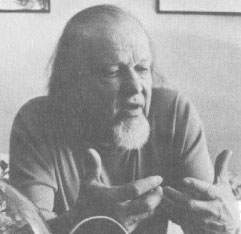
 

Not sure whether or not I would find history or nudity between its covers, I opened it to find the continuation of Courier font. I forgot about room inspections.


A theological argument that read like a Modern history book, I inquired of the owner to explain the meaning of it to me. In short order I left his room with a copy of an antiquated paperback of Schaeffer’s He is There and He Is Not Silent, spending the rest of that morning in my dorm room, lying on my back, trying to cipher his complicated arguments, tears streaming down my face.


Having read most of Schaeffer’s written work (and many of his books several times), having watched his popular documentary series dozens of times, and having listened to the high-pitched whine of his voice on cassette lectures for literally hundreds of hours over the past twenty years, I have developed a basic familiarity with Francis Schaeffer’s theological mindset and cultural perspective, albeit a basic one.


I later learned that the Calvinism I had been taught in Europe had been filtered through the influence of Francis Schaeffer and that some of his ideas for which I immediately felt a powerful affinity during my first readings had been taught to me in the little village of Mehlingen, Germany. However, years later I have learned that I learned about Francis Schaeffer in a backwards fashion. While many people were light years ahead of me in his documentary series How Should We Then Live (what I like to term “Commercial Schaeffer”), I wrestled with the abstraction of his thoughts before I ever knew about the motion flicksThat has resulted in my own emphasis on Schaeffer.


I am struck by how many times Schaeffer’s name comes up among evangelicals and the politically conservative, a group largely influenced by a smattering of Schaeffer. Usually citing Schaeffer’s political concerns in How Should We Then Live, I find discussion with many from these groups to be generic (they focus on the anti-Christian sentiment from American government) and short-lived (“Schaeffer was the greatest evangelical figure of the 20th century.” Period.) as well as disappointing (“Mmm, yes, Francis Schaeffer was a GREAT man of God.”). I have often wondered if we have been reading the same books. 


Much of Schaeffer’s overt legacy is his intellectual contribution to the anti-abortion movement and the consequent rallying together of the Moral Majority under his ideas. He is also known for the popular Schaefferism “All truth is God’s truth” which has in practice meant that playing John Lennon in church is allowable or that creating cheap, Christian facsimiles of “secular” originals is obligatory (I was recently in both a fundamentalist and a charismatic church, respectively, which parodied Schaeffer’s ideology, complete with a coffee shop, skate park, and a Border’s bookstore look-alike). Francis Schaeffer’s name is a talisman, a relic, a stamp of approval for religious, political action. His ideas have not changed much in the almost 30 years since his passing.


Were Schaeffer present in 2011, I am sure he would have already re-framed or rebranded himself in light of the new dominant world spirit (Call it what you may. Just don’t wrongly associate it with the Old Modernism). I would like to highlight a few ideas of Schaeffer’s (in no particular order) that I think relevant to the POMO (aka, post-modern).
Francis Schaeffer “BASIS FOR HUMAN DIGNITY” Whatever…HTTHR


1. Schaeffer was not a professional theologian; Schaeffer was an evangelist. Each of his works are best understood with this truth in mind. While Schaeffer used a theological framework and theological ideas, he did not see his main contribution to the world to be a theological one. He saw his main contribution to be cultural, aka, conversational. Schaeffer created a language unique to describing the anomaly of “Modern man.” That is one of the reasons Schaeffer’s influence (pre-Religious Right) was widely influential in the Woodstock community as well as in the university (each on either extreme spectrum of the “Evangelical” Schaeffer helped to shape). 


Using orthodox, theological constructs, Schaeffer created new categories that were culturally-specific and language-specific for the Modern. For example, Schaeffer describes Adam as an “unprogrammed man.” Elsewhere he describes the distinction between existential and orthodox theological expressions to hinge upon whether or not that individual believed in “Adam’s bones” (belief in the Bible’s Adam demanded a belief that the remains of his bones lay somewhere on or in the earth). 


Schaeffer even uses Einstein’s relativity language when he speaks of a literal creation “in space and time.” To distinguish Adam as human without the modern connotation of determinism, Schaeffer used the term “mannishness”, the sum of all that it means to be human.


Schaeffer did not create language for ivory tower enjoyment. He sought to encapsulate the ideas of a scientifically-infatuated culture in imagery that correlated to ancient Biblical truths and he tried to represent them in as Modern a way as possible. In The Church at the End of the 20th century, Schaeffer explains the schizophrenia of the Modern’s intellectual touting of an ideology the consequences of which he or she revolts against in areas of actual meaning. “Cage directed some of his own chance music and when it was over he thought he heard steam escaping from the steam pipes. Then he realized that the musicians were hissing…. They were hissing because they did not like the results of their own teaching when they heard it in the medium to which they were sensitive. They were hissing themselves.” (italics added) 
Dr. Francis schaeffer – The flow of Materialism(from Part 4 of Whatever happened to human race?)


2. Schaeffer did not parrot the traditional expression of a harsh Calvinism, and this caused him problems with his mentors. One need only to read of Van Til’s reprimanding Schaeffer’s cultural approach to Modern man to understand that while Schaeffer borrowed heavily from the Calvinistic greats, he made a distinction between what he considered a Modern, Calvinistic view of determinism (variants on fatalism at least in expression) and the “dynamic equivalence” of a true freedom of the will. 


Schaeffer makes it clear that God gave Adam the “unprogrammed man” an unprogrammed choice. The Old Calvinists flinched at this expression because they had no category to which they could popularly appeal save for the Modern concept of determinism: that man is “predestined” (read “determined”) to “this” or “that.” Schaeffer revolted against the modern concept of man’s will as robotic because man was made in the image of God and God is not programmed. Man is not a “machine.”


In his book How Should We Then Live, Schaeffer uses the analogy of ripples (as in ripples caused by a stone dropped into water). He says that the ripples are “real” and that these ripples move in ever-widening, concentric circles, referencing real causes and having real effects in the world around us.  Schaeffer’s emphasis on this latent Calvinistic view severed a great many relationships he had. For some, Schaeffer was seen to have crossed over to the very Aristotelian side against which he was speaking (Thomas Aquinas’ view of grace and nature).
Dr. Francis Schaeffer – The Biblical flow of Truth & History (intro)


3. Schaeffer advocated a serious “earthy” consideration of matter versus the exclusive “Platonic” idealization of the soul. In Pollution and the Death of Man, Schaeffer explains a critical aspect of his theology upon which the development of his entire cultural conversation hinged, explaining a lot of the reasons behind his interest in and commendation of the study of pop culture and other contemporary interests deemed useless by most of his peers. Schaeffer calls this idea the “covenant of creation.”


In this view Schaeffer says that all “covenants” (aka, relationships) are “fixed” because God entered into a relationship or a covenant with the “stuff’ (actual matter) that He created. In other words God swore to respect the material integrity of the things he created. So God will always deal with a tree like the tree that it is and not like, say, a man. Schaeffer uses the example of Moses and the burning bush. God suspended the normal, relational combination of a bush (wood) + fire = smoke for a specific reason: God was relating to Moses on the basis of his humanity. 


In other words, God, having created Moses as a man who aspires to reason, created an anomaly (a miracle) that He designed would lure Moses to the burning bush because Moses as a man had the aspiration that a bush on fire would result in smoke and ash. And this bush didn’t. Further, Schaeffer tells us that God kept the integrity of the bush and the fire because they were both recognizable as such to Moses.


We can go on further to say that when Moses threw down his staff in the pharaoh’s palace and it turned into a snake that it was a miracle (because snakes are not wood). However, when Moses picked it back up, it became wood once more. Had it remained a snake and slithered into the desert and died, that would have been magic and a breach of the material integrity. Further yet, Moses’ snake eats up the other magicians’ snakes when they performed the same miracle that Moses did. 


But there is no contradiction here either, because Moses’ snake ate up the other snakes (staffs) which became wood once more. Though Schaeffer does not say it, I guarantee you that he would argue that Moses’ staff was much larger after it “ate up” the magicians’ snakes than before simply because the material that now made up Moses’s staff was quantitatively larger. In this covenant of creation, Schaeffer was very careful to consider the minutest of details of the physical world around him as well as the details of historical events expressed through ideas.

Francis Schaeffer – The Biblical Flow of History & Truth (1)


4. In all of Schaeffer’s works, he mainly gave us a model for how to communicate to a culture. His focus was not merely on the facts of his generation. He taught us a cultural method of how to arrange facts. Schaeffer self-consciously lived in a transient world where things change, says he, because they are not the Infinite-Personal God Who does not change. So the more that the body of scientific knowledge grows, certain facts will “change.”


This “Infinite-finite” distinction led Schaeffer to believe in the fraternity of created things or matter. That is to say, Schaeffer believed that on the basis of ontology (the area of being) there is no qualitative differentiation of matter. On the basis of ontology you have the Infinite-Creator God and then you have everything else.  


In other words, he really believed that on the basis of ontology man was related to every other created thing. However, as man being made in the image of God (at God’s prerogative), Schaeffer believed that man was arbitrarily special and different than all other matter (Schaeffer calls this the “arbitrary” will of God because God chose to do so because He wanted to do it and not because he Had to do it. God is not programmed and did not have to refer to that which was greater than Himself). 


As touching man being made in the image of God, Schaeffer held no qualitative distinction between the genders, races, or even popular, modern cultural preferences like sexuality or religion. None whatsoever. You can read Schaeffer’s letters to members of the homosexual community, and you are amazed at the dignity with which he treated them and the seriousness with which he treated their emotions.

In Schaeffer’s Whatever Happened to the Human Race he clearly links the plight of the unborn child to the plight of the African-American slave. He speaks of how slavery and the sub-human view of race eventually morphed into the lawful extermination of unborn children of every race. Actually, one of the last things for which he was remembered was his becoming the apologist for the Religious Right and intellectual father of the anti-abortion movement.

Dr. Francis Schaeffer – The Biblical Flow of Truth & History (part 2)


It has been almost thirty years since Schaeffer passed, and still there is no significant reinterpretation of Schaeffer’s ideas to address the framework of our very own post-Cold War or post-modern era (or whatever you may wish to call it). What you often hear from the evangelical corner are the sound-bytes of Schaeffer from the early 1980’s largely leveled to bolster political interests. Schaeffer-loving is often times merely an addendum to the political resume.


I have the sneaking suspicion that, perhaps, many who use Schaeffer on their resume are probably a little confused about his fundamental beliefs that long preceded the abortion issue. For example, few people understand that Schaeffer’s theology drastically developed when he was sent abroad to study the state of the Christian Church in Europe following World War II. Europe was already despairing of Modernism and entering into the European post-modern blahs. Schaeffer’s ideology, then, can be understood to be the cultural differential of his trying to reconcile what was happening on both the European and American continents. But the simplistic analysis we hear in the States is the same intransigent idea of Schaeffer that offers no fresh perspective and no enlightening guidance about present times.


I am certain that Schaeffer would, were he alive, empathize with the POMO, ciphering his hard core, gangsta rap, and world music, sobbing at the hopelessness of Indie films, walking the aisles of Bonnaroo chatting with drifters. I cannot imagine him ridiculing the documentaries of Michael Moore (not that he would necessarily agree with him), or encouraging the disparagement of Ellen Degeneres (not that he would necessarily agree with her). 


He would have wept over the death of Kurt Cobain, rallied all Americans with steely resolve at 9/11, been an honorary member of the U.N, and been present at the inauguration of President Barack Obama. He would have taken time to fall asleep on the beach, babysit his grandchildren, and watch old reruns of The Cosby Show. He would have a smartphone (probably the iphone 4 and researching the iphone 5). I think he would have even had the Mac Air versus a Dell.


What is for certain is that he would not be lobbying in the ranks of the neo-cons, libertarians or progressives. He would not appreciate his name being used as political endorsement. He probably would not be writing political books, and he probably would not be taking interviews from neo-Christian radio personalities. For all I know he might have retreated to the hills of Switzerland once more (if they would have him) to a quiet chalet, reading the Harry Potter series for the fifth time, savoring tea, or snoring in his rocking chair. 


In only the way Schaeffer could, he would have created one hundred new conceptual amalgamations, one hundred new terms, and sixteen new perspectives about our current world situation that would allow us fresh enlightenment and even give us an edge on our ability to problem-solve new problems we don’t yet recognize because we are in love with the old ones.

7 comments:

  1. Insighful, practical reliving of a titan, who was unpackaged and committed to being the best Bible-believing Christian he could be. One concerned with making the big things, big things if you would. I’ve been shaped in many ways by his influence and stand committed to having a relevant, impactful faith as he lived.

    Reply

  2. Robbie….funny you thot u would find nudies in the book…HA. I have wrestled with Schaeffer for a long time. Part because I disagreed with him and God forbid you did that…it’s down right sacrilegious… like not liking C.S. Lewis’s writings. I am not a big fan of Tolkien either. Is there any hope for me?? The other reason I struggle is because of my peanut brain. I am glad you pointed out he was an evangelist. He has allot to say, allot to ponder and meditate on. I like writer that make you think. May you reason why you believe this or that…why you follow him or her. What you believe and why. I think you have challenged me to pick up the books again….no nudies in mine…and give him another opportunity to help me think. Well written my friend. I look forward to more insight.

    Reply

  3. @Dave What I like about Schaeffer is that he considered himself to be Modern, too. He wrestled with depression for a good part of his life, even considering suicide while a missionary. But he came through.

    @Pege Haha, both men looked like eclectic artists for which I had no reference. I remember browsing through second-hand bookstores in Europe with odd-looking books like Schaeffer’s, only to open them up to “surprises.” The way people speak about Schaeffer nowadays, he is criticized as a political figure. He realized well before he passed that he was being used. One of his last works THE GREAT EVANGELICAL DISASTER demonstrated his understanding that the people he helped to create got him all wrong. On the front cover the artist has drawn a picture of a traditional church with only a slither of an earthy foundation below it. Schaeffer speaks of such an ideology as having your feet planted firmly in midair. He is a good read!

    Reply

  4. Robbie, just read this… great synopsis. Helped my understanding of him more.

    Love the Muggeridge / Schaeffer sketch at the top. I first saw that on the over of Touchstone when I was working on Muggeridge for my graduate work.

    Reply

  5. Dale, thanks. Send me a brief on Muggeridge. I am curious.

    Reply

  6. Thanks for the analysis of Schaeffer and his work. I do somewhat disagree with your finishing paragraphs (perhaps because I am in my 70’s and have little regard for this age and its proclivities.) I consider Schaeffer my main mentor, having set under his teaching when first I became a Christian. Before my conversion, I was a militant atheist and Schaeffer’s historical sketch on how Western Society emerged into the “modern modern” helped me immensely. Thanks again for your work, I found it intriguing.

    Reply

  7. @JackLawrence Thank you, sir. I think my conclusion was somewhat cynical of the current political sentiment of Schaeffer (“commercial Schaeffer”, as I like to call it). I am surprised at times to hear Schaeffer’s ideas reduced to sound-bytes for political action. One part of Schaeffer’s intrigue to me is that he created a niche for theological conversation unlike any other figure of his day and that he displayed a toleration for long-term conversations he anticipated would take years to develop. I just turned 40, and no one like Schaeffer has ever caught my philosophical attention… ever.

____________

Dr. Francis Schaeffer – The Biblical Flow of Truth & History (part 2)

Related posts:.

Taking on Ark Times bloggers about abortion on the 40th anniversary date of Roe v. Wade (Part 7) “Poverty not good reason for abortion, why not give up for adoption?”

Dr Richard Land discusses abortion and slavery – 10/14/2004 – part 3 The best pro-life film I have ever seen below by Francis Schaeffer and Dr. C. Everett Koop “Whatever happened to the human race?” Over the years I have taken on the Ark Times liberal bloggers over and over and over concerning the issue […]

Taking on Ark Times bloggers about abortion on the 40th anniversary date of Roe v. Wade (Part 6) For many pro-abortionists ” …the problem is not determining when actual human life begins, but when the value of that life begins to out weigh other considerations”

The best pro-life film I have ever seen below by Francis Schaeffer and Dr. C. Everett Koop “Whatever happened to the human race?” Francis Schaeffer pictured above._________ The 45 minute video above is from the film series created from Francis Schaeffer’s book “Whatever Happened to the Human Race?” with Dr. C. Everett Koop. This book  really […]

Taking on Ark Times bloggers about abortion on the 40th anniversary date of Roe v. Wade (Part 5) “Slavery issue compared to rights of unborn child”

The best pro-life film I have ever seen below by Francis Schaeffer and Dr. C. Everett Koop “Whatever happened to the human race?” Over the years I have taken on the Ark Times liberal bloggers over and over and over concerning the issue of abortion. I asked over and over again for one liberal blogger […]

Taking on Ark Times bloggers about abortion on the 40th anniversary date of Roe v. Wade (Part 4) “How do pro-lifers react to the movie THE CIDER HOUSE RULES?”

Francis Schaeffer pictured above._________ The best pro-life film I have ever seen below by Francis Schaeffer and Dr. C. Everett Koop “Whatever happened to the human race?” Over the years I have taken on the Ark Times liberal bloggers over and over and over concerning the issue of abortion. I asked over and over again […]

Taking on Ark Times bloggers about abortion on the 40th anniversary date of Roe v. Wade (Part 3) “What should be the punishment for abortion doctors?”

The best pro-life film I have ever seen below by Francis Schaeffer and Dr. C. Everett Koop “Whatever happened to the human race?” On 1-24-13 I took on the child abuse argument put forth by Ark Times Blogger “Deathbyinches,” and the day before I pointed out that because the unborn baby has all the genetic code […]

Taking on Ark Times bloggers about abortion on the 40th anniversary date of Roe v. Wade (Part 2) “The pro-abortion child abuse argument destroyed here”

PHOTO BY STATON BREIDENTHAL from Pro-life march in Little Rock on 1-20-13. Tim Tebow on pro-life super bowl commercial. Over the years I have taken on the Ark Times liberal bloggers over and over and over concerning the issue of abortion. Here is another encounter below. On January 22, 2013 (on the 40th anniversary of the […]

Taking on Ark Times bloggers about abortion on the 40th anniversary date of Roe v. Wade (Part 1)

Dr Richard Land discusses abortion and slavery – 10/14/2004 – part 3 The best pro-life film I have ever seen below by Francis Schaeffer and Dr. C. Everett Koop “Whatever happened to the human race?” Over the years I have taken on the Ark Times liberal bloggers over and over and over concerning the issue […]

By Everette Hatcher III | Posted in Arkansas Times, Francis Schaeffer, Prolife | Edit | Comments (0)
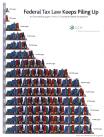
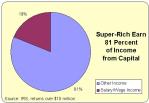
Higher taxes on the rich don’t always bring in more money!!!

Higher taxes on the rich don’t always bring in more money!!!

My main goal for fiscal policy is shrinking the size and scope of the federal government and lowering the burden of government spending.

But I’m also motivated by a desire for better tax policy, which means lower tax rates, less double taxation, and fewer corrupting loopholes and other distortions.

One of the big obstacles to good tax policy is that many statists think that higher tax rates on the rich are a simple and easy way of financing bigger government.

I’ve tried to explain that soak-the-rich tax policies won’t work because upper-income taxpayers have considerable ability to change the timing, level, and composition of their income. Simply stated, when the tax rate goes up, their taxable income goes down.

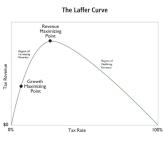
And that means it’s not clear whether higher tax rates lead to more revenue or less revenue. This is the underlying principle of the Laffer Curve.

For more information, here’s a video from Prager University, narrated by UCLA Professor of Economics Tim Groseclose.

Lower Taxes, Higher Revenue

Published on Feb 3, 2014

Should Taxes Be Higher? It’s the million dollar question! Up? Down? No change? Where in the world should taxes go? In election years, the question of tax rates fills the airwaves. In non-election years, the question of tax rates, again, fills the airwaves. So what’s the answer? UCLA Professor of Economics Tim Groseclose explains his research on the topic. Basically, there’s a certain point at which higher tax rates actually reduce the amount of revenue the government collects. What’s that point? When are tax rates too high? Learn a valuable lesson in economics, and public policy.

You can support Prager University at https://www.prageruniversity.com/dona…. Free videos are great, but to continue producing high-quality content, even small contributions are great.

Visit us directly!
http://www.prageruniversity.com/

LIKE us!
https://www.facebook.com/prageru

Follow us!
https://twitter.com/prageru

If you are an educator and are interested in using material like this in your classroom, visit http://www.prageruniversity.com/educa…

____________________

An excellent job, and I particularly like the data showing that the rich paid more to the IRS following Reagan’s tax cuts.

But I do have one minor complaint.

The video would have been even better if it emphasized that the tax rate shouldn’t be at the top of the “hump.”

Why? Because as tax rates get closer and closer to the revenue-maximizing point, the economic damage becomes very significant. Here’s some of what I wrote about that topic back in 2012.

…labor taxes could be approximately doubled before getting to the downward-sloping portion of the curve. But notice that this means that tax revenues only increase by about 10 percent. …this study implies that the government would reduce private-sector taxable income by about $20 for every $1 of new tax revenue. Does that seem like good public policy? Ask yourself what sort of politicians are willing to destroy so much private sector output to get their greedy paws on a bit more revenue.

The key point to remember is that we want to be at the growth-maximizing point of the Laffer Curve, not the revenue-maximizing point.

P.S. Here’s my video on the Laffer Curve.

Since it was basically a do-it-yourself production, the graphics aren’t as fancy as the ones you find in the Prager University video, but I’m pleased that I emphasized on more than one occasion that it’s bad to be at the revenue-maximizing point on the Laffer Curve.

Not as bad as putting rates even higher, as some envy-motivated leftists would prefer, but still an example of bad tax policy.

The Laffer Curve, Part I: Understanding the Theory

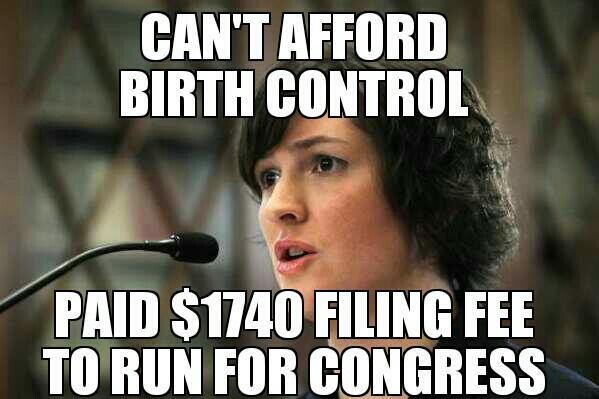
P.P.S. Switching to a different topic, it’s been a while since I’ve mocked Sandra Fluke, a real-life Julia.

To fix this oversight, here’s an amusing image based on Ms. Fluke’s apparent interest in becoming a politician.

Fluke Filing Fee

But she’s apparently reconsidered her plans to run for Congress and instead now intends to seek a seat in the California state legislature.

She’ll fit in perfectly.

If you want to see previous examples of Fluke mockery, check out this great Reason video, this funny cartoon, and four more jokes here.

P.P.P.S. And since I’m making one of left-wing women, we may as well include some humor about Wendy Davis.

Check out this excerpt from a story in the Daily Caller.

A dating service that pairs wealthy “sugar daddies” with “sugar babies” for “mutually beneficial dating arrangements” has endorsed Texas Democratic gubernatorial candidate Wendy Davis. SeekingArrangement.com’s Friday announcement followed a recent report in the Dallas Morning News which detailed a number of discrepancies in Davis’ personal narrative, including that she left a man 13 years her senior the day after he made the last payment for her Harvard Law School education. “Wendy Davis is proof that the sugar lifestyle is empowering,” seeking arrangements founder and CEO Brandon Wade said in his endorsement.

Mr. Wade obviously is a clever marketer, but he may also be a closet libertarian.

After all, he also mocked Obamacare with an ad telling young women to join his site so they could find a sugar daddy to pay for the higher premiums caused by government-run healthcare.

Then again, I’ve also speculated that Jay Leno and Bill Maher may be closet libertarians, so I may be guilty of bending over backwards to find allies.

Related posts:

Dan Mitchell’s blog has great cartoon that demonstrates what President Obama has been doing the last 4 years!!!

I have put up lots of cartoons from Dan Mitchell’s blog before and they have got lots of hits before. Many of them have dealt with the economy, eternal unemployment benefits, socialism,  Greece,  welfare state or on gun control.     I’ve Obtained a Secret Pre-Release Copy of Obama’s Budget April 9, 2013 by Dan Mitchell The President is supposed to release […]

Dan Mitchell’s blog tells the story of the little red hen and President Obama

Uploaded by ForaTv on May 29, 2009 Complete video at:http://fora.tv/2009/05/18/James_Bartholomew_The_Welfare_State_Were_In Author James Bartholomew argues that welfare benefits actually increase government handouts by ‘ruining’ ambition. He compares welfare to a humane mousetrap. —– In the controversial book The Welfare State We’re In, James Bartholomew argues that the welfare state in Britain has resulted in a […]

Dan Mitchell of the Cato Institute on President Obama’s “Social Darwinism speech”

Dan Mitchell of the Cato Institute rightly has pointed out that President Obama is off base to be critical of Paul Ryan’s budget since it allows the government to grow by over 3% each year and he wished that the Republicans would taking a sharper knife to the budget cuts!!!! Appearing on PBS to Debate […]

Open letter to President Obama (Part 514) (Why We Should Be Optimistic about Repealing Obamacare and Fixing the Healthcare System)

Open letter to President Obama (Part 514) (Emailed to White House on 4-15-13.) President Obama c/o The White House 1600 Pennsylvania Avenue NW Washington, DC 20500 Dear Mr. President, I know that you receive 20,000 letters a day and that you actually read 10 of them every day. I really do respect you for trying to get […]

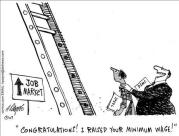
Open letter to President Obama (Part 513) (Minimum Wage, Maximum Foolishness)

Open letter to President Obama (Part 513) (Emailed to White House on 5-4-13.) President Obama c/o The White House 1600 Pennsylvania Avenue NW Washington, DC 20500 Dear Mr. President, I know that you receive 20,000 letters a day and that you actually read 10 of them every day. I really do respect you for trying to get […]

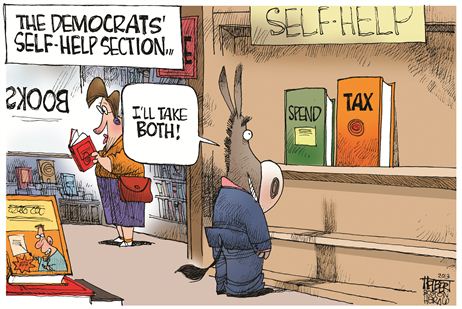
Open letter to President Obama (Part 512) (Cartoonists React to the Senate Democratic Budget)

Open letter to President Obama (Part 512) (Emailed to White House on 4-15-13.) President Obama c/o The White House 1600 Pennsylvania Avenue NW Washington, DC 20500 Dear Mr. President, I know that you receive 20,000 letters a day and that you actually read 10 of them every day. I really do respect you for trying to get […]

Open letter to President Obama (Part 510) (What Can We Cut to Balance the Budget)

Open letter to President Obama (Part 510) (Emailed to White House on 4-15-13.) President Obama c/o The White House 1600 Pennsylvania Avenue NW Washington, DC 20500 Dear Mr. President, I know that you receive 20,000 letters a day and that you actually read 10 of them every day. I really do respect you for trying to get […]

Open letter to President Obama (Part 508) (Margaret Thatcher and the Battle of the 364 Keynesians)

Open letter to President Obama (Part 508) (Emailed to White House on 4-15-13.) President Obama c/o The White House 1600 Pennsylvania Avenue NW Washington, DC 20500 Dear Mr. President, I know that you receive 20,000 letters a day and that you actually read 10 of them every day. I really do respect you for trying to get […]

Open letter to President Obama (Part 506) (Obama Administration Wants to Subsidize Banks to Make More Dodgy Loans)

Open letter to President Obama (Part 506) (Emailed to White House on 4-15-13.) President Obama c/o The White House 1600 Pennsylvania Avenue NW Washington, DC 20500 Dear Mr. President, I know that you receive 20,000 letters a day and that you actually read 10 of them every day. I really do respect you for trying to get […]

Obamacare’s sinking ship is sad to watch!!!

______ Oklahoma Doctors vs. Obamacare Obamacare’s sinking ship is sad to watch!!! Drilling More Holes in Obamacare’s Sinking Ship January 23, 2014 by Dan Mitchell The President’s main “accomplishment” has been such a disaster that I wonder whether it’s time to feel sorry for Obama. And if you looked in the dictionary for a definition of Schadenfreude, you might […]

Open letter to President Obama (Part 514) (Why We Should Be Optimistic about Repealing Obamacare and Fixing the Healthcare System)

Open letter to President Obama (Part 514)

(Emailed to White House on 4-15-13.)

President Obama c/o The White House 1600 Pennsylvania Avenue NW Washington, DC 20500

Dear Mr. President,

I know that you receive 20,000 letters a day and that you actually read 10 of them every day. I really do respect you for trying to get a pulse on what is going on out here.

___________________

Some very good points by Dan Mitchell of the Cato Institute on Obamacare:

I’m going to make an assertion that seems utterly absurd.

The enactment of Obamacare may have been good news.

Before sending a team of medical attendants to cart me off to a sanitarium, allow me to elaborate. I’m not saying Obamacare is good policy. After all, I’ve written over and over again that it is a budget-busting boondoggle that will exacerbate our real healthcare crisis of third-party payer.

What I am saying, though, is that Obamacare may turn out to be a major political mistake for the left, one that sets the stage for sweeping free market reforms.

Here’s my six-part hypothesis.

  1. Our healthcare system as a mess before Obamacare. Normal market forces were crippled by government programs such as Medicare and Medicaid and also undermined by government intervention in the tax code that resulted in pervasive over-insurance that exacerbated the third-party payer problem.
  2. These various forms of intervention led to all sorts of problems, such as rising prices and indecipherable complexity, and most people blamed that the “free market” and “private” healthcare.Health Freedom Meter before Obamacare
  3. Obamacare was enacted in 2010, and it was perceived to be a paradigm-shifting change in the healthcare system, even though it was just another layer of bad policy on top of lots of other bad policy. Immediately after the legislation was approved, I offered a rough estimate that we went from a system that was 68 percent dictated by government to one that was 79 percent dictated by government.Health Freedom Meter after Obamacare
  4. Not surprisingly, all of the same problems still exist, but now they’re exacerbated by the mistakes in Obamacare.
  5. But because people think we’ve had a paradigm shift and government now is in charge (pay attention, since this is my key argument), they will be much more likely to blame “Obamacare” and “government” for all the warts and inefficiencies of the healthcare system.
  6. This means the public will be more receptive to pro-market policies, such as Obamacare repeal, tax reforms to reduce over-insurance, as well as the Medicaid and Medicare reforms in the Ryan budget.

All this will be much easier said than done, of course, and it is disconcerting that we’ll probably have to rely on feckless Republicans to implement these reforms.

But at least there’s a plausible scenario for systemic reform, and that wasn’t the case before Obamacare was enacted. In other words, the President’s signature achievement may turn out to be a Pyrrhic victory for the left.

P.S. Watch this excellent video from Reason TV to see how a genuine free market could deliver health care at lower cost and with greater efficiency. For another example, here’s a report from North Carolina on free-market healthcare in action.

P.P.S. This post is part of my let’s-be-optimistic series. Previous editions include:

Third-Party Payer is the Biggest Economic Problem With America’s Health Care System

Published on Jul 10, 2012

This mini-documentary from the Center for Freedom and Prosperity Foundation explains that “third-party payer” is the main problem with America’s health care system. This is why undoing Obamacare, while desirable, is just a small first step if we want to reduce costs and boost efficiency

____________________

I have put up lots of cartoons from Dan Mitchell’s blog before and they have got lots of hits before. Many of them have dealt with the economy, eternal unemployment benefits, socialism,  Greece,  welfare state or on gun control.

These cartoons are sad but true.

I’m not sure why political cartoonists have been revisiting the issue of Obamacare in recent days, but I’ve been enjoying their humor.

I shared three funny cartoons a couple of days ago, adding to my collection of Obamacare humor (see here, here, here, here, here, here, here, and here).

Now let’s enjoy three more, beginning with this gem from Lisa Benson.

Obamacare Cartoon 4

Though we shouldn’t laugh at this cartoon. As we saw with both Medicaid and Medicare, entitlement programs routinely cost far more than original projections.

If you somehow think Obamacare might be different, watch this video.

Gary Varvel hits a different part of Obamacare, noting that the President’s promise of lower premiums is an utter fantasy.

Obamacare Cartoon 5

And Michael Ramirez looks at the big picture.

Obamacare Cartoon 6

I want to close with an optimistic point about the prospect of changing this terrible law.

Thanks to government programs and other forms of regulation and intervention, we had a bad healthcare system before Obamacare.

And even though it was government that was causing the system to malfunction, many people blamed the free market. And the President took advantage of that misunderstanding to push he legislation.

So now we have Obamacare, which has made the system a bit more statist.

But most people think Obamacare was much bigger than it actually was, with some actually thinking we used to have a free market!

Anyway, this flawed perception works to our advantage since it will now be possible to blame any bad news in the healthcare world on  Obamacare.

As such, I expect that Obamacare will remain unpopular.

The real question will be whether reformers will rally behind proposals to not just repeal Obamacare, but to actually restore a free market.

If you want to understand what needs to happen, I encourage you to watch two short videos, one from Reason TV and the other from the Center for Freedom and Prosperity.

______________________

Thank you so much for your time. I know how valuable it is. I also appreciate the fine family that you have and your commitment as a father and a husband.

Sincerely,

Everette Hatcher III, 13900 Cottontail Lane, Alexander, AR 72002, ph 501-920-5733, lowcostsqueegees@yahoo.com

Related posts:

Obama up to his Chicago style politics and tricks with Obamacare

Nic Horton Medicaid Expansion will “Cost Almost Double than Doing Nothing” part I It is amazing to me that Repubican lawmakers are considering taking President Obama’s advice on anything in light of this article below. March 25, 2013 4:26PM Here’s Your Free Health Care. Would You Care to Vote? By Michael F. Cannon Share Tweet […]

Will President Obama keep his word concerning Obamacare?

A Red-Ink Train Wreck: The Real Fiscal Cost of Government-Run Healthcare Uploaded on Nov 9, 2009 This CF&P Foundation video explains why healthcare proposals in Washington will result in bloated government and higher deficits. This mini-documentary exposes the pervasive inaccuracy of congressional forecasts and succinctly lists 12 reasons why Obamacare will be a budget buster. […]

Republicans in Arkansas messing up by endorsing Obamacare

  Enlarge image Credit Nathan Vandiver / KUAR Michael Cannon of the Cato Institute told lawmakers March 19, 2013 that abandoning plans to partner with the federal government on a health insurance exchange would both benefit the state and reduce the power of the Affordable Care Act. __________________ I am very pleased with the Republican lawmakers in […]

Cartoons from Dan Mitchell’s blog on Obamacare

Third-Party Payer is the Biggest Economic Problem With America’s Health Care System Published on Jul 10, 2012 This mini-documentary from the Center for Freedom and Prosperity Foundation explains that “third-party payer” is the main problem with America’s health care system. This is why undoing Obamacare, while desirable, is just a small first step if we […]

Obamacare cartoons from Dan Mitchell’s blog

I have put up lots of cartoons from Dan Mitchell’s blog before and they have got lots of hits before. Many of them have dealt with the economy, eternal unemployment benefits, socialism,  Greece,  welfare state or on gun control. The funniest cartoon is the one with “Nurse Sebelius” stuffing the huge capsule down the kid’s throat!!! Obamacare […]

Lots of reasons to still oppose Obamacare (includes editorial cartoon)

Here is a great article I read on November9, 2012 in the National Review: November 9, 2012 4:00 A.M. Obamacare Is Still Vulnerable Now is not the time to go wobbly. By Michael F. Cannon President Obama has won reelection, and his administration has asked state officials to decide by Friday, November 16, whether their state […]

Michael Cannon on Obamacare (editorial cartoons on Judge Roberts and Obamacare)

Representative Bollinger asks CATO Institute Michael Cannon about Obamacare Published on Mar 19, 2013 The CATO Institute’s Michael Cannon spoke at the Arkansas Conservative Caucus on Tuesday March 19th. Several conservatives were present. Cannon talked about how to defeat Obamacare in Arkansas & how the states can stop Obamacare on a national level. Representative Bollinger […]

An ObamaCare Debate Challenge by Michael F. Cannon (editorial cartoon)

Obamacare is a poorly written and because of that the majority of states may never have to put into practice.   February 28, 2013 2:13PM ObamaCare Debate Challenge: Lawrence Wasden Edition By Michael F. Cannon Share Tweet Like Google+1 Congress empowered states to block major provisions of ObamaCare, including its subsidies and employer mandate. All […]

States response to Obamacare and Medicaid expansion

Great article from Heritage Foundation: Chart of the Week: The States That Have Expanded Medicaid T. Elliot Gaiser March 13, 2013 at 5:30 pm         «Expanding Medicaid will be costly for most states. The authors of The Patient Protection and Affordable Care Act of 2010 (Obamacare) threatened to strip all federal funding […]

I hope Arkansas follows the lead from other southern states and flees from Obamacare (includes editorial cartoon)

I hope Arkansas follows the lead from other southern states and flees from Obamacare. Morning Bell: Obamacare’s Medicaid Trap Amy Payne March 13, 2013 at 7:07 am While Members of Congress are arguing about defunding parts of Obamacare, the rubber is meeting the road in the states. Governors and state legislatures are sweating decisions about […]

“Friedman Friday” What were the main proposals of Milton Friedman?

Stearns Speaks on House Floor in Support of Balanced Budget Amendment

Uploaded by on Nov 18, 2011

Speaking on House floor in support of Balanced Budget Resolution, 11/18/2011

___________

Below are some of the main proposals of Milton Friedman. I highly respected his work.

David J. Theroux said this about Milton Friedman’s view concerning the Balanced Budget Amendment:

Balancing the Budget: Since deficit spending is simply a device for hiding tax increases, thereby lowering taxpayer resistance to government spending and impairing economic growth, all government spending should be handled according to the merits of each specific proposal in a pay-as-you-go basis. Fiscal policy should never be used to affect business cycles, and the Balanced Budget Amendment should be adopted.

Here is some more about Friedman’s life:

Milton Friedman (1912-2006)
By David J. Theroux  |  Posted: Sat. November 18, 2006

“Milton Friedman is a scholar of first rank whose original contributions to economic science have made him one of the greatest thinkers in modern history.”
President Ronald Reagan

“How grateful I have been over the years for the cogency of Friedman’s ideas which have influenced me. Cherishers of freedom will be indebted to him for generations to come.”
Alan Greenspan, former Chairman, Federal Reserve System

“Right at this moment there are people all over the land, I could put dots on the map, who are trying to prove Milton wrong. At some point, somebody else is trying to prove he’s right That’s what I call influence.”
Paul Samuelson, Nobel Laureate in Economic Science

“Friedman’s influence reaches far beyond the academic community and the world of economics. Rather than lock himself in an ivory tower, he has joined the fray to fight for the survival of this great country of ours.”
William E. Simon, former Secretary of the Treasury

“Milton Friedman is the most original social thinker of the era.”
John Kenneth Galbraith, former Professor of Economics, Harvard University

“There are various ways to describe Friedman’s influence. But one way is to ask, ‘Has he helped many people—poor people in the world?’ And I would just take India and China, 37% of the world’s population. Hundreds of millions of people in these two countries, who used to live on less than one dollar a day or two dollars a day, are now able to live at a much more decent standard of living as a result of the reform of their economic policies toward more free-market policies, less regulation, less government and the like. There was one person who they are more indebted to than anybody else for their great improvement in their situation. In my judgment, that person is Milton Friedman.”
Gary S. Becker, Nobel Laureate in Economic Science

Economist and former Newsweek columnist Henry Wallich has credited Milton Friedman with having “almost single-handedly” changed economic thinking on the subject of money.1 Indeed, Milton Friedman, the 1976 Nobel Laureate in Economic Science, was a world-renowned economist and an academician of the finest caliber. But he was much more. He was an articulate and persuasive advocate of individual freedom, and the private property, voluntary exchange economy, which is based upon and sustains that freedom. British Prime Minister Margaret Thatcher has stated, “Professor Friedman is usually referred to as a monetarist, but his basic belief is not in money. It’s in people’s inherent right and ability to choose how they will live.”

Among his proposals were the following:

Negative Income Tax: To eliminate the massive welfare system’s disincentives and enormous waste, abolish all welfare programs and replace them with a program of direct cash payments to those actually in need simply by adding a new income tax bracket (one for negative values of taxable income) to the tax code.

Educational Vouchers: To provide a competitive climate for public and private education, all parents of primary and secondary school children would be issued government vouchers to be spent at the school of their choice. Government’s only role would be to provide the vouchers; competition for clients would assure quality and innovation.

Flat Income Tax: To streamline the tax system and to lower its enormous direct costs to the general public and the indirect inefficiencies imposed on the economy, abolish the corporate income tax. In addition, tax individuals only at a non-progressive, low, flat rate, raising personal exemptions to some minimum income level, and ending all loopholes.

Stable Money Growth: To eliminate the recurring problems of inflation, unemployment, and decreased productivity, abolish the Federal Reserve System, legalize private monies, and peg the increase of the government money supply to the growth in GNP, perhaps 0 to 3 percent per year.

Floating Exchange Rates: To solve the nation’s balance-of-payments problems and to open the possibility of unilaterally eliminating anti-consumer protectionist measures, abolish exchange controls and let national and private currencies seek their own price levels in the market.

Balancing the Budget: Since deficit spending is simply a device for hiding tax increases, thereby lowering taxpayer resistance to government spending and impairing economic growth, all government spending should be handled according to the merits of each specific proposal in a pay-as-you-go basis. Fiscal policy should never be used to affect business cycles, and the Balanced Budget Amendment should be adopted.

Volunteer Army: To create a more efficient, better motivated, and morally tenable defense system, abolish the compulsory servitude of the draft and draft registration and maintain a voluntary system of enlistment based on competitive benefits and professional, career-oriented training.

No Victimless Crime Laws: To direct limited police and legal resources to the problems of violent crime, eliminate all laws creating “crimes with no victims.” More specifically, where consent is present between two or more adults no criminal injustice can be possible; hence, for Friedman government has no place in proscribing or regulating such areas as prostitution, profanity, pornography, drugs, and so forth. In this regard, Friedman was not condoning any such behavior, but instead noting that these and all non-invasive matters are best regulated by property owners via private-property agreements and institutions, as opposed to government command-and-control. Moreover, Friedman agreed with the late Harvard philosopher Robert Nozick’s position that such practices should be equally legal along with all “capitalist acts between consenting adults.”13

As a result of his devotion to individual freedom, Friedman was an early and vocal supporter of California’s Proposition 13 to reduce property taxes across-the-board, as well as President Ronald Reagan’s original proposal to cut individual and corporate income tax rates. He was opposed to price controls, farm subsidies, securities and exchange controls, tariffs, and, in fact, all government interventions into the peaceful pursuits of individuals. To Friedman, government’s role should be stringently restricted to defending the nation from foreign enemies, defending persons from force and fraud, providing a forum for decisions of the general rules determining property and similar rights, and providing a means to mediate disputes about the rules.

Perhaps Friedman’s greatest success began in 1979 when he and his wife Rose authored the book, Free to Choose, based on the famous ten-part TV series for PBS by the same title. Both the TV program and the book were drawn from an earlier series of lectures presented by Friedman. Because it aired during a period of critical economic distress during the Carter Administration and in the aftermath of the Vietnam War, Watergate scandal, and Richard Nixon’s resignation as President, the program is widely regarded as being a major factor in shifting American public opinion toward appreciating the need to dismantle government largess. The series was shown in England, Japan, Italy, Australia, Germany, Canada, and many other countries, and the book was translated for distribution around the world, selling more than one million copies.

As a result of his impact on academic and public opinion, Friedman was an economic advisor to 1964 Republican presidential candidate Barry Goldwater; Presidents Ronald Reagan, Gerald Ford, and Richard Nixon; as well as British Prime Minister Margaret Thatcher. But throughout this time, he consistently turned down full-time positions in government, preferring to continue his scientific work and leave public activities to full-time policymakers.

In addition, Friedman’s ideas were critically influential in the economic liberalization reforms in such countries as Estonia, Chile, Ireland, China, New Zealand, Czech Republic, and India. In the process, he was accused of complicity in the repressive regimes of Chilean dictator Augusto Pinochet and in Communist China. However, Friedman maintained that in advising any government, in no way was he supporting any policies that run counter to the principles of individual liberty. Indeed, he indicated that he instead sought to end all policies of oppression.

In short, Friedman believed that government’s sole functions should be to provide civil policing and justice plus national defense. For the latter however, he went further than merely supporting the protection of national borders from invaders. In the aftermath of World War II, Friedman became a supporter of the Cold War and the Wilsonian legacy of U.S. military interventionism around the world. This led him to support the Vietnam War and other overt and covert U.S. policies. However, in the process, he noted that, “I’m anti-interventionist, but I’m not an isolationist,”14 and upon reading the 1987 landmark book by Independent Institute Senior Fellow Robert Higgs, Crisis and Leviathan, which shows that war “crises” are the major engine of the very neo-mercantilism and Big Government he long opposed, Friedman became an increasing critic of “wars of choice,” including the war in Iraq.

The Friedman’s were married for 68 years and had two children: David, who teaches law and economics at Santa Clara University, and Janet, who practices law in California.

To recognize the enormous contributions of this man, I had the distinct pleasure and privilege to organize the gala National Dinner to Honor Milton Friedman on October 4, 1983, at the Fairmont Hotel in San Francisco, at which then struggling actor Arnold Schwarzenegger, who had been inspired by the “Free to Choose” TV series, first met Friedman in person.

In addition to the Nobel Prize, Friedman was the recipient of the Grand Cordon of the First Class Order of the Sacred Treasure of Japan (1987), National Medal of Science (1988), and Presidential Medal of Freedom (1988), and he was a member of the American Philosophical Society and the National Academy of Sciences.

In 1998, Milton and Rose Friedman penned their autobiography, Two Lucky People: Memoirs, which traces their remarkable personal journey and life experiences, and they both spent recent years working together pursuing their dream of educational choice for all parents throughout the U.S.

Milton Friedman died on November 16, 2006, from heart failure, in San Francisco. Unlike any other intellectual figure of the twentieth century, he transformed public debate away from the suicidal path of command economies and toward economies based on individual choice, free markets, and personal responsibility. Friedman was brilliant, creative, resilient, and effective. In his career, including the thirty years that I had the pleasure of knowing him, he was a champion who sought to facilitate greater opportunity for all, especially those most in need. In economics, education, finance, business, civil liberties, welfare, and a host of other areas, he has left a powerful legacy for the benefit of humanity.

Notes

1. John Davenport. “The Radical Economics of Milton Friedman,” Fortune, 1 June 1967, p. 131.

2. “Milton Friedman,” Current Biography 1969 (Bronx, NY: H.W. Wilson Company), p. 151.

3. “Milton Friedman,” Les Prix Nobel en 1976 (Stockholm: The Nobel Foundation, 1977), p. 239.

4. Karl Brunner. “The 1976 Nobel Prize in Economics,” Science 194 (November 5, 1976), p. 595.

5. Current Biography, p. 152.

6. Les Prix Nobel en 1976, pp. 240-41.

7. Current Biography, p. 152.

8. Les Prix Nobel en 1976, p. 241.

9. Ibid.

10. Current Biography, p. 152.

11. Milton Friedman. “He Has Set a Standard.” Wall Street Journal (June 31, 2006).

12. Milton Friedman. “Introduction.” New Individualist Review (Indianapolis: Liberty Press, 1981), pp. ix-xiv.

13. “Portrait: Milton Friedman,” Challenge (May-June 1978), p. 69; Milton Friedman, Capitalism and Freedom (Chicago: University of Chicago Press, 1962); and Milton and Rose Friedman, Free to Choose (New York: Harcourt Brace Jovanovich, 1980).

14. “Best of Both Worlds: Milton Friedman reminisces about his career as an economist and his lifetime ‘avocation’ as a spokesman for freedom,” Reason (June 1995).


David J. Theroux is the Founder, President and Chief Executive Officer of The Independent Institute and Publisher of The Independent Review.

Over 50 reviews of modern artists given on www.thedailyhatch.org in 2014

______________

In 2014 I hope to post over 50 reviews of modern artists and at the same time post the work of Francis Schaeffer’s on art and culture in the same posts.

Francis Schaeffer: How Should We Then Live? (Full-Length Documentary)

I have been to Europe three times and got to visit museums to see art and the reason I had a hunger to start analyzing art was because of my exposure to Francis Schaeffer’s film series HOW SHOULD WE THEN LIVE?

Some art scholars dismiss Schaeffer out of hand but everyone knows how arrogant they can be. Here is the summary of HOW SHOULD WE THEN LIVE? by Douglas Groothuis, Ph.D.:

One can take issue with Schaeffer at some points. One who paints with a broad bush may blur some themes and obscure others, but the strengths of this book greatly outnumber its weaknesses. How Should We Then Live remains an incisive and prophetic work that should not be ignored. We need big-picture thinkers (or generalists) to help us orient ourselves historically, theologically, and ethically. Francis Schaeffer was such a thinker. Let us give him the last word. “This book is written in the hope that this generation may turn from the greatest wickedness, the placing of any created thing in the place of the Creator, and that this generation may get its feet out of the paths of death and may live” (258).

________________

The first episode in this series included a feature on Tracey Emin of England and the second post featured Peter Howson of Scotland, and the third and fourth posts were  extensive pieces on the art and writings of Mike Kelley of LA (sadly Kelley committed suicide in 2012). The fifth post featured the German artist Gerhard Richter who uses a squeegee with many of his paintings. The sixth post featured Makoto Fujimura who was born in Boston  to Japanese parents, but now lives in New York City. The seventh post featured David Hooker of Wheaton College

_______________________________

Tracey Emin pictured below.

Tracey Emin

Born in 1963, London
Lives and works in London

_____________

Peter Howson pictured below:

________________

Mike Kelley pictured below:

____________

Gerhard richter 02 2005 düsseldorf.jpg

Gerhard Richter, 2005 as seen above
____________

Makoto Fujimura pictured below

_______________________

_____________________________

David Hooker pictured below:

_____________

Here are some upcoming artists:

Ida Applebroog is pictured below she was born in the Bronx, New York in 1929 and still lives in the state today.

____________________________

Paul McCarthy pictured below:
__________________________
Robert Indiana

__________
__________
Trey McCarley pictured below:

_____________________________

Matthew Ritchie is pictured below:

__________
Francis Alys pictured below:
____________
Andy Warhol, Henry Geldzahler, David Hockney, and David Goodman, 1963 (Pictured below) and both Andy Warhol and David Hockney are featured.
__________
Olga Lah pictured below:
_________
John Baldessari pictured below:
___________

Jennifer Bartlett pictured below:

_________________________________________

Tony Oursler pictured below:
__________________________
Cai Gou-Qiang pictured below:
_____________

______________
Arturo Herrera pictured below:
_______________________________
Ellen Gallagher pictured below:

_____________

File:Van Gogh Self-Portrait with Straw Hat 1887-Metropolitan.jpg

Size of this preview: 474 × 599 pixels. Other resolutions: 190 × 240 
Related posts:

FRANCIS SCHAEFFER ANALYZES ART AND CULTURE Part 7 Jean Paul Sartre (Feature on artist David Hooker )

__________________ Today we are going to look at the philosopher Jean Paul Sartre and will feature the work of the artist David Hooker. Francis Schaeffer pictured below: _________________________________ Sunday, November 24, 2013 A Star to Steer By – Revised! The beautiful Portland Head Lighthouse on the Maine coast. It was the flash from this lighthouse I […]

FRANCIS SCHAEFFER ANALYZES ART AND CULTURE Part 6 The Adoration of the Lamb by Jan Van Eyck (Feature on artist Makoto Fujimura)

________________ How Should We Then Live? Episode 3: The Renaissance Published on Jul 24, 2012 Dr. Schaeffer’s sweeping epic on the rise and decline of Western thought and Culture _________________________ The Gospel of John Chapter 1 verse 29: The next day John saw Jesus coming toward him and said, “Look, the Lamb of God, who […]

FRANCIS SCHAEFFER ANALYZES ART AND CULTURE Part 5 John Cage (Feature on artist Gerhard Richter)

_________________ Francis Schaeffer has written extensively on art and culture spanning the last 2000 years and here are some posts I have done on this subject before : Francis Schaeffer’s “How should we then live?” Video and outline of episode 10 “Final Choices” , episode 9 “The Age of Personal Peace and Affluence”, episode 8 “The Age of Fragmentation”, episode 7 “The Age of Non-Reason” , episode 6 “The Scientific Age” , episode 5 “The Revolutionary Age” ,  episode 4 “The Reformation”,  episode 3 […]

FRANCIS SCHAEFFER ANALYZES ART AND CULTURE Part 4 ( Schaeffer and H.R. Rookmaaker worked together well!!! (Feature on artist Mike Kelley Part B )

FRANCIS SCHAEFFER ANALYZES ART AND CULTURE Part 4 ( Schaeffer and H.R. Rookmaaker worked together well!!! (Feature on artist Mike Kelley Part B ) [ARTS 410] William Dyrness: The Relationship of Art and Theology Published on Sep 14, 2013 Guest lecture in ARTS 410: Arts and the Bible. At the 30:00 mark William Dyrness talks […]


FRANCIS SCHAEFFER ANALYZES ART AND CULTURE Part 3 PAUL GAUGUIN’S 3 QUESTIONS: “Where do we come from? What art we? Where are we going? and his conclusion was a suicide attempt” (Feature on artist Mike Kelley Part A)

___________________ How Should we then live Part 7 Dr. Francis Schaeffer examines the Age of Non-Reason and he mentions the work of Paul Gauguin. Paul Gauguin October 12, 2012 by theempireoffilms Paul Gauguin was born in Paris, France, on June 7, 1848, to a French father, a journalist from Orléans, and a mother of Spanish Peruvian descent. When […]

FRANCIS SCHAEFFER ANALYZES ART AND CULTURE Part 2 “A look at how modern art was born by discussing Monet, Renoir, Pissaro, Sisley, Degas,Cezanne, Van Gogh, Gauguin, Seurat, and Picasso” (Feature on artist Peter Howson)

__________________________ Today I am posting my second post in this series that includes over 50 modern artists that have made a splash. Last time it was Tracey Emin of England and today it is Peter Howson of Scotland. Howson has overcome alcoholism in order to continue his painting. Many times in the past great painters […]

FRANCIS SCHAEFFER ANALYZES ART AND CULTURE Part 1 HOW SHOULD WE THEN LIVE? “The Roman Age” (Feature on artist Tracey Emin)

__________________ Francis Schaeffer pictured below: _________________ I want to make two points today. First, Greg Koukl has rightly noted that the nudity of a ten year old girl in the art of Robert Mapplethorpe is not defensible, and it demonstrates where our culture is  morally. It the same place morally where  Rome was 2000 years […]


Francis Schaeffer’s “How should we then live?” Video and outline of episode 10 “Final Choices” (Schaeffer Sundays)

E P I S O D E 1 0   Dr. Francis Schaeffer – Episode X – Final Choices 27 min FINAL CHOICES I. Authoritarianism the Only Humanistic Social Option One man or an elite giving authoritative arbitrary absolutes. A. Society is sole absolute in absence of other absolutes. B. But society has to be […]

Francis Schaeffer’s “How should we then live?” Video and outline of episode 9 “The Age of Personal Peace and Affluence” (Schaeffer Sundays)

E P I S O D E 9 Dr. Francis Schaeffer – Episode IX – The Age of Personal Peace and Affluence 27 min T h e Age of Personal Peace and Afflunce I. By the Early 1960s People Were Bombarded From Every Side by Modern Man’s Humanistic Thought II. Modern Form of Humanistic Thought Leads […]

Francis Schaeffer’s “How should we then live?” Video and outline of episode 8 “The Age of Fragmentation” (Schaeffer Sundays)

E P I S O D E 8 Dr. Francis Schaeffer – Episode VIII – The Age of Fragmentation 27 min I saw this film series in 1979 and it had a major impact on me. T h e Age of FRAGMENTATION I. Art As a Vehicle Of Modern Thought A. Impressionism (Monet, Renoir, Pissarro, Sisley, […]

Francis Schaeffer’s “How should we then live?” Video and outline of episode 7 “The Age of Non-Reason” (Schaeffer Sundays)

E P I S O D E 7 Dr. Francis Schaeffer – Episode VII – The Age of Non Reason I am thrilled to get this film series with you. I saw it first in 1979 and it had such a big impact on me. Today’s episode is where we see modern humanist man act […]

Francis Schaeffer’s “How should we then live?” Video and outline of episode 6 “The Scientific Age” (Schaeffer Sundays)

E P I S O D E 6 How Should We Then Live 6#1 Uploaded by NoMirrorHDDHrorriMoN on Oct 3, 2011 How Should We Then Live? Episode 6 of 12 ________ I am sharing with you a film series that I saw in 1979. In this film Francis Schaeffer asserted that was a shift in […]

Francis Schaeffer’s “How should we then live?” Video and outline of episode 5 “The Revolutionary Age” (Schaeffer Sundays)

E P I S O D E 5 How Should We Then Live? Episode 5: The Revolutionary Age I was impacted by this film series by Francis Schaeffer back in the 1970′s and I wanted to share it with you. Francis Schaeffer noted, “Reformation Did Not Bring Perfection. But gradually on basis of biblical teaching there […]

Francis Schaeffer’s “How should we then live?” Video and outline of episode 4 “The Reformation” (Schaeffer Sundays)

Dr. Francis Schaeffer – Episode IV – The Reformation 27 min I was impacted by this film series by Francis Schaeffer back in the 1970′s and I wanted to share it with you. Schaeffer makes three key points concerning the Reformation: “1. Erasmian Christian humanism rejected by Farel. 2. Bible gives needed answers not only as to […]

“Schaeffer Sundays” Francis Schaeffer’s “How should we then live?” Video and outline of episode 3 “The Renaissance”

Francis Schaeffer’s “How should we then live?” Video and outline of episode 3 “The Renaissance” Francis Schaeffer: “How Should We Then Live?” (Episode 3) THE RENAISSANCE I was impacted by this film series by Francis Schaeffer back in the 1970′s and I wanted to share it with you. Schaeffer really shows why we have so […]

Francis Schaeffer’s “How should we then live?” Video and outline of episode 2 “The Middle Ages” (Schaeffer Sundays)

  Francis Schaeffer: “How Should We Then Live?” (Episode 2) THE MIDDLE AGES I was impacted by this film series by Francis Schaeffer back in the 1970′s and I wanted to share it with you. Schaeffer points out that during this time period unfortunately we have the “Church’s deviation from early church’s teaching in regard […]

Francis Schaeffer’s “How should we then live?” Video and outline of episode 1 “The Roman Age” (Schaeffer Sundays)

Francis Schaeffer: “How Should We Then Live?” (Episode 1) THE ROMAN AGE   Today I am starting a series that really had a big impact on my life back in the 1970′s when I first saw it. There are ten parts and today is the first. Francis Schaeffer takes a look at Rome and why […]

By Everette Hatcher III | Posted in Francis Schaeffer | Edit | Comments (0)

____________

How is Arkansas going to compete when they only got 3 four star players and Tennessee got 16 four star and 2 five star players?

_________

It is plain to me that Arkansas (29), Missouri (35), Miss St (41) and Vandy (50) were the biggest disappointments in SEC recruiting and Tennessee was the biggest surprise in SEC recruiting. Alabama was number 1 and  No. 2 LSU, No. 5 Texas A&M, No. 6 Auburn, No. 7 Tennessee, No. 8 Georgia and No. 9 Florida. How is Arkansas going to compete when they only got 3 four star players and Tennessee got 16 four star and 2 five star players?

The Southeastern Conference dominates recruiting as thoroughly as it rules the rest of college football.

As signing day came to a close Wednesday, SEC schools filled seven of the top nine spots in the 247Sports Composite recruiting rankings, which equally weigh the ratings of all the major recruiting services. Last year, seven SEC programs ranked among the top 13 teams.

Alabama led the way by finishing atop the team standings for a fourth consecutive year. Other SEC teams in the top 10 included No. 2 LSU, No. 5 Texas A&M, No. 6 Auburn, No. 7 Tennessee, No. 8 Georgia and No. 9 Florida.

“It’s the nature of our conference,” Tennessee coach Butch Jones said. “That’s why it’s the most competitive conference in the country.”

The SEC landed most of the top talent in its own territory and made an impact across the country.

According to the 247Sports Composite, SEC schools landed the No. 1 prospect in the state in such non-SEC areas as Arizona (Texas A&M quarterback Kyle Allen), Iowa (Alabama offensive tackle Ross Pierschbacher), Illinois (LSU linebacker Clifton Garrett), Oklahoma (Alabama quarterback David Cornwell), Virginia (Alabama defensive end Da’Shawn Hand) and Wyoming (Florida offensive tackle Taven Bryan).

“The country is getting smaller,” LSU coach Les Miles said. “It is smaller with the technology. Phones are computer devices. Planes fly more efficiently and you can travel more efficiently. That’s what’s going on. Guys want the opportunity to play at the best programs. They want to go to places where they can play as freshmen. They want to go to places where they can show their skills to the NFL. Those schools have those advantages and that’s where the players want to go.”

And even though the SEC must replace departing star quarterbacks Johnny Manziel, A.J. McCarron, Aaron Murray and Zach Mettenberger, it’s reloading quite well. Six of the top eight pro-style quarterbacks in the 247Sports Composite signed with SEC schools: Allen, Will Grier (Florida), Cornwell, Jacob Park (Georgia), Drew Barker (Kentucky) and Sean White (Auburn).

Best class: Alabama’s class was ranked first in the nation by all the major recruiting services and included seven players rated as five-star prospects by at least one service. Alabama’s collection of five-star prospects includes defensive back Tony Brown, linebacker Rashaan Evans, Hand, defensive back Marlon Humphrey, offensive lineman Dominick Jackson, offensive lineman Cam Robinson and all-purpose athlete Bo Scarbrough.

Impact player: LSU’s Leonard Fournette should step in and help the Tigers replace 1,400-yard rusher Jeremy Hill. Georgia’s Todd Gurley and Keith Marshall and Alabama’s T.J. Yeldon have shown recently that SEC running backs can make major impacts as freshmen. Fournette is rated as the nation’s No. 1 overall prospect in the 247Sports Composite.

Players to watch: Texas A&M has a couple of them in Allen and defensive end Myles Garrett. Allen already has enrolled and will participate in spring practice with a legitimate shot at replacing Manziel, the 2012 Heisman Trophy winner. Defensive end Myles Garrett, the nation’s No. 2 overall prospect in the 247Sports Composite, should boost the pass rush of a Texas A&M defense that allowed the most points and yards per game of any SEC team last season.

Biggest surprises: Tennessee had its fourth straight losing season last fall and Kentucky went 2-10, yet both teams signed their top classes in recent memory. Tennessee kept the state’s top players at home, something that had been a problem in recent years. Kentucky signed a prize quarterback prospect in Barker – a home-state product – and also made plenty of inroads in nearby Ohio.

Biggest dud: A potential top-25 class at Vanderbilt was decimated after former Commodores coach James Franklin left for Penn State. New coach Derek Mason needed a flurry of commitments in the last 72 hours just to get Vanderbilt back in the top 50.


Related posts:

Alabama last year had to play Tennessee and Kentucky from the East and their conference record was 1-15 while LSU had to play Florida and Georgia and their record was 14-2. Doesn’t seem fair does it? In the old days Tennessee would have been a top 10 team almost every year and playing them as […]

David Climer: Titles can’t erase SEC football’s weaknesses

SEC has proved how good we are, but it doesn’t mean every team in the SEC could win a national title in 2013. David Climer: Titles can’t erase SEC football’s weaknesses Alabama players celebrates after their 32-28 win in the Southeastern Conference championship NCAA college football game against Georgia, Saturday, Dec. 1, 2012, in Atlanta. (AP […]

SEC football recruiting Part 1

ESPN’s final recruiting rankings are not as good as others as I have seen. I do have a hard time with Missouri (38) having such a good ranking when other services had the tigers tanking their class this year compared to other SEC schools. However, Kentucky (36) is almost as bad when there is vast […]

SEC football recruiting roundup 2013

Nick Saban Streeter Lecka We finally found a Top 25 in which the SEC is more dominant than the USA Today Coaches’ Poll: the post-Signing Day recruiting class rankings. ________   I have to say the SEC is really doing well these days. Everyone expects Alabama is going to be on top on most years […]

SEC Football Recruiting

I am not so mad anymore about Arkansas being ranked number 64 in recruiting this year while Auburn is #20 and Tennessee is #30 and even Kentucky is doing better than us. That is because they racked up lots of players when they had coaches during the year while we had John L. Smith. What […]

SEC football coaches on the hot seat

It is no surprise that John L. Smith and Derek Dooley may be heading out the door at the end of this season. That was expected by most people that watch SEC football. However, could Gene Chizik of Auburn being out the door too? If that happens then I must admit that I did not […]

SEC Football Schedules for 2013 Part 1

I am very happy with the new football schedules that the SEC released for next year. It is a stand alone schedule that will not affect the final decision that make concerning the rotation in the 2014 schedule and beyond. 2013 Georgia Bulldogs Football Schedule Date   Opponent Time/TV Tickets Saturday 04/06/13 G-Day Spring Game […]

SEC Football roundup for Sept 29, 2012

Tour of SEC Football Sept 22, 2012 (Lester McClain honored)

Photo by Michael Patrick, copyright © 2012 Tennessee’s A.J. Johnson (45) takes down Arkron’s Jawon Chisholm (7) during during first half action against Akron Saturday, Sep. 22, 2012. (MICHAEL PATRICK/NEWS SENTINEL) Photo by Michael Patrick, copyright © 2012 Akron head coach Terry Bowden during second half of their 47-26 loss to Tennessee Saturday, Sep. 22, […]

SEC football as strong as ever

Arkansas defensive tackle Jared Green (57) and linebackers Alonzo Highsmith (45), and Tenarius Wright (43) attempt to tackle Alabama running back Eddie Lacy (42) as offensive lineman Barrett Jones (75) looks on during second quarter action of an NCAA college football game in Fayetteville, Ark., Saturday, Sept. 15, 2012. (AP Photo/David Quinn) ___________ When you […]

Dear Senator Pryor, here are some spending cut suggestions (“Thirsty Thursday”, Open letter to Senator Pryor)

Senator Pryor pictured below:

Why do I keep writing and email Senator Pryor suggestions on how to cut our budget? I gave him hundreds of ideas about how to cut spending and as far as I can tell he has taken none of my suggestions. You can find some of my suggestions herehereherehere, hereherehereherehere, herehereherehereherehereherehereherehere,  here, and  here, and they all were emailed to him. In fact, I have written 13 posts pointing out reasons why I believe Senator Pryor’s re-election attempt will be unsuccessful. HERE I GO AGAIN WITH ANOTHER EMAIL I JUST SENT TO SENATOR PRYOR!!!

Dear Senator Pryor,

Why not pass the Balanced  Budget amendment? As you know that federal deficit is at all time high (1.6 trillion deficit with revenues of 2.2 trillion and spending at 3.8 trillion).

On my blog www.thedailyhatch.org . I took you at your word and sent you over 100 emails with specific spending cut ideas. (Actually there were over 160 emails with specific spending cut suggestions.) However, I did not see any of them in the recent debt deal that Congress adopted although you did respond to me several times. Now I am trying another approach. Every week from now on I will send you an email explaining different reasons why we need the Balanced Budget Amendment. It will appear on my blog on “Thirsty Thursday” because the government is always thirsty for more money to spend. Today I actually have included a great article below from the Heritage Foundation concerning an area of our federal budget that needs to be cut down to size. The funny thing about the Sequester and the 2.4% of cuts in future increases is that President Obama set these up and then he acted like the sky was falling in as the cartoons indicate in the newspapers.

IF YOU TRULY WANT TO CUT THE BUDGET AND BALANCE THE BUDGET THEN SUBMIT THESE POTENTIAL BUDGET CUTS PRESENTED BELOW!!

___________

We got to cut spending and this farm bill is the perfect place to start!!!

May 29, 2013 12:33PM

Farm Bill Would Increase Spending 47%

House and Senate farm subsidy supporters are pushing to enact the first big farm bill since 2008. Democratic and Republican supporters say that this year’s legislation will be a reform bill that cuts spending. Hogwash.

Last year, House farm subsidy supporters proposed a bill that would spend $950 billion over the next 10 years, while the Senate proposed a bill that would spend $963 billion. By contrast, when the 2008 farm bill passed, it was projected to spend $640 billion over 10 years. Thus, the proposed House bill would represent a 48 percent spending increase over the last farm bill, while the Senate bill would represent a 50 percent increase.

A new estimate of the House bill finds that it would spend $940 billion over 10 years, which would be a 47 percent increase over the 2008 farm bill. This new estimate is shown in the chart alongside the estimate of the 2008 farm bill.

The CBO score of the 2008 farm bill is here. Scores for the 2012 farm bill proposals are reported in this CRS report. And the new score of the House bill is here.

Since the 2008 farm bill, we’ve had five years of moderate inflation, which has eroded the value of dollars by about 8 percent. Thus, the 2013 House farm bill would increase real spending by 39 percent compared to the 2008 farm bill.

The Republican-controlled House Agriculture Committee says that its bill “saves taxpayer’s money,” “reduces deficit spending,” and “repeals outdated government programs.” That sounds good, and the GOP bill is officially scored to “save” $33 billion over 10 years. But that savings is against the CBO baseline of $973 billion in farm bill spending over 10 years, so the House bill can be said to “cut” spending by 3 percent.

Given today’s huge federal deficits, a 3 percent “cut” by Republicans is a joke in itself. But that’s only a cut against baseline, and since baseline spending has soared in recent years it’s no cut at all.

Consider, for example, that in 2008 CBO estimated that farm bill spending in 2014 would be $67 billion. But CBO is now estimating that farm bill spending in 2014 will be $99 billion. Thus, spending in this single year is $32 billion or 48 percent higher than the politicians promised it would be back in 2008. So you can see that the proposed GOP “cut” of $33 billion over 10 years is incredibly lame.

Despite the fact that politicians are claiming that the proposed new farm bill cuts spending, it’s just a mirage created by rising baselines. The truth is that the House farm bill would spend 47 percent more over 10 years than the last farm bill, or 39 percent more in inflation-adjusted dollars.

For background, see this new study by Sallie James and this essay on the history and failures of farm subsidies. Also note that three-quarters of “farm bill” spending is for food subsidies, which you can read about here. And if you’re in D.C., come and hear about the farm bill at our Capitol Hill event at noon Thursday.


_______________

The Balanced Budget Amendment is the only thing I can think of that would force Washington to cut spending. We have only a handful of balanced budgets in the last 60 years, so obviously what we are doing is not working. We are passing along this debt to the next generation. YOUR APPROACH HAS BEEN TO REJECT THE BALANCED BUDGET “BECAUSE WE SHOULD CUT THE BUDGET OURSELF,” WELL THEN HERE IS YOUR CHANCE!!!! SUBMIT THESE CUTS!!!!

Thank you for this opportunity to share my ideas with you.

Sincerely,

Everette Hatcher, lowcostsqueegees@yahoo.com www.thedailyhatch.org, 13900 Cottontail Lane, Alexander, AR 72002, ph 501-920-5733

Related posts:

States should vote down federal spending on farm bill and return more control to states!!!!

States should vote down federal spending on farm bill and return more control to states!!!! Some say here in Arkansas that we have to do whatever it takes to support Riceland Foods, but in other states they try to protect federal government handouts to their biggest companies. We need politicians to stop looking out for […]

Congress needs to remove subsidies from the farm bill, not expand them

Congress needs to remove subsidies from the farm bill, not expand them Farm Bill Wastes More Taxpayer Money on Green Subsidies Nicolas Loris May 13, 2013 at 11:27 am Design Pics / Dave Reede/Dave Reede/Newscom Slapping the word rural in front of a bunch of green subsidies does not mean they’re not subsidies. But that’s […]

If increase in food stamps was just because of recession then why spending go from $19.8 billion in 2000 to $37.9 billion in 2007?

If the increase in food stamps was just because of the recession then why did the spending go from $19.8 billion in 2000 to $37.9 billion in 2007? The Facts about Food Stamps Everyone Should Hear Rachel Sheffield and T. Elliot Gaiser May 27, 2013 at 12:00 pm (7) Newscom A recent US News & […]

John Calipari versus Bill Self for National Title Act 2 (part 3)

Memphis Tigers John Calipari Interview 2008 Basketball Final Kansas vs. Memphis – 2008 NCAA Title Game Highlights (HD) Knoxnews.com reported: Calipari (and Kentucky) get Kansas again for title NANCY ARMOUR – AP National Writer (AP) Posted April 1, 2012 at 12:18 a.m., updated April 1, 2012 at 3:04 a.m NEW ORLEANS (AP) — Well, this […]

Alternatives to Fayetteville Finger out there? (part 16)(Billy Bob Thornton)

I certainly hope there are some alternatives to the Fayetteville Finger out there. Jason Tolbert reported that there seems to be an impasse. As predicted, the House State Agencies rejected both the Senate compromise map (linked here) passed yesterday with 20 votes and the so called “Luker Amendment” (linked here) named after its author Sen. […]

Food stamp spending has doubled under the Obama Administration

The sad fact is that Food stamp spending has doubled under the Obama Administration. A Bumper Crop of Food Stamps Amy Payne May 21, 2013 at 7:01 am Tweet this Where do food stamps come from? They come from taxpayers—certainly not from family farms. Yet the “farm” bill, a recurring subsidy-fest in Congress, is actually […]

Agriculture Dept is bloated

Agriculture: Downsizing The Federal Government Uploaded on Dec 19, 2008 Agriculture is easily the most distorted sector, with high tariffs and, in developed countries at least, large amounts of government subsidies through price supports and direct payments. On the other hand, developing countries, who have a comparative advantage in these products, cannot afford to subsidize […]

Which states are the leaders in food stamp consumption?

I am glad that my state of Arkansas is not the leader in food stamps!!! Mirror, Mirror, on the Wall, Which State Has the Highest Food Stamp Usage of All? March 19, 2013 by Dan Mitchell The food stamp program seems to be a breeding ground of waste, fraud, and abuse. Some of the horror stories […]

Open letter to President Obama (Part 255)

Government Must Cut Spending Uploaded by HeritageFoundation on Dec 2, 2010 The government can cut roughly $343 billion from the federal budget and they can do so immediately. __________   President Obama c/o The White House 1600 Pennsylvania Avenue NW Washington, DC 20500 Dear Mr. President, I know that you receive 20,000 letters a day […]

Mark Pryor responds to me concerning Debt Ceiling email (Part 1)

The problem with the debt ceiling is very clear to me. We need to get serious about cutting federal spending. I am so upset about it that I have emailed over 100 emails to Senator Pryor concerning specific spending suggestions. I get emails from back from Senator Pryor like the one below. This means that […]

Senator Pryor asks for Spending Cut Suggestions! Here are a few!(Part 164)

Senator Pryor asks for Spending Cut Suggestions! Here are a few!(Part 164) Senator Mark Pryor wants our ideas on how to cut federal spending. Take a look at this video clip below: Senator Pryor has asked us to send our ideas to him at cutspending@pryor.senate.gov and I have done so in the past and will continue to […]

Senator Pryor asks for Spending Cut Suggestions! Here are a few!(Part 163)

Senator Pryor asks for Spending Cut Suggestions! Here are a few!(Part 163) Senator Mark Pryor wants our ideas on how to cut federal spending. Take a look at this video clip below: Senator Pryor has asked us to send our ideas to him at cutspending@pryor.senate.gov and I have done so in the past and will continue to […]

Senator Pryor asks for Spending Cut Suggestions! Here are a few!(Part 162)

Senator Pryor asks for Spending Cut Suggestions! Here are a few!(Part 162) Senator Mark Pryor wants our ideas on how to cut federal spending. Take a look at this video clip below: Senator Pryor has asked us to send our ideas to him at cutspending@pryor.senate.gov and I have done so in the past and will continue to […]

Capitol Tours with Senator Mark Pryor

Three very good video tours below from Senator Mark Pryor. Published on Jun 13, 2012 by SenatorPryor Episode 1: Arkansans in the Capitol Published on Jul 9, 2012 by SenatorPryor Episode 2: The Crypt and the Old Supreme Court Published on Aug 20, 2012 by SenatorPryor Episode 3: The Senate Chamber If you want to […]

Senator Pryor asks for Spending Cut Suggestions! Here are a few!(Part 161)

Senator Pryor asks for Spending Cut Suggestions! Here are a few!(Part 161) Senator Mark Pryor wants our ideas on how to cut federal spending. Take a look at this video clip below: Senator Pryor has asked us to send our ideas to him at cutspending@pryor.senate.gov and I have done so in the past and will continue to […]

Senator Mark Pryor responds to my email

Senator Mark Pryor wants our ideas on how to cut federal spending and I sent them to him but he didn’t take any of my suggestions. However, he did take time to get back to me today, but I am not too impressed with Senator Pryor’s response. I gave him hundreds of ideas about how […]

Senator Pryor asks for Spending Cut Suggestions! Here are a few!(Part 160)

Senator Pryor asks for Spending Cut Suggestions! Here are a few!(Part 160) Senator Mark Pryor wants our ideas on how to cut federal spending. Take a look at this video clip below: Senator Pryor has asked us to send our ideas to him at cutspending@pryor.senate.gov and I have done so in the past and will continue to […]

Senator Pryor asks for Spending Cut Suggestions! Here are a few!(Part 159)

Senator Pryor asks for Spending Cut Suggestions! Here are a few!(Part 159) Senator Mark Pryor wants our ideas on how to cut federal spending. Take a look at this video clip below: Senator Pryor has asked us to send our ideas to him at cutspending@pryor.senate.gov and I have done so in the past and will continue to […]

Senator Pryor asks for Spending Cut Suggestions! Here are a few!(Part 158)

Senator Mark Pryor wants our ideas on how to cut federal spending. Take a look at this video clip below: Senator Pryor has asked us to send our ideas to him at cutspending@pryor.senate.gov and I have done so in the past and will continue to do so in the future. On May 11, 2011,  I emailed to […]

Dear Senator Pryor, why not pass the Balanced Budget Amendment? (“Thirsty Thursday”, Open letter to Senator Pryor)

Office of the Majority Whip | Balanced Budget Amendment Video In 1995, Congress nearly passed a constitutional amendment mandating a balanced budget. The Balanced Budget Amendment would have forced the federal government to live within its means. This Balanced Budget Amendment failed by one vote. 16 years later, Congress has the chance to get it […]

Dear Senator Pryor, why not pass the Balanced Budget Amendment? (“Thirsty Thursday”, Open letter to Senator Pryor)

Sadly Senator Pryor has voted against the Balanced Budget Amendment over and over in his long time in the Senate. Senator Pryor: “There are a lot of people who think a balanced-budget amendment solves all the fiscal problems. I completely disagree.” (Peter Urban, Pryor Tilts Balanced Budget, Southwest Times Record, 11/17/11) Dear Senator Pryor, Why […]

Dear Senator Pryor, why not pass the Balanced Budget Amendment? (“Thirsty Thursday”, Open letter to Senator Pryor)

Mark Levin and Senator Hatch discuss the balanced budget amendment and it’s importance. Uploaded by loveconstitution on Jan 28, 2011 Mark Levin interviews Senator Hatch 1/27/2011 about the balanced budget amendment. Mark is very excited about the balanced budget amendment being proposed by Senator Orin Hatch and John Cornyn and he discusses the amendment with […]

Will Senator Pryor be re-elected in 2014? (Part 4)(Royal Wedding Part 5)

Dr. Jay Barth with Hendrix College comments on our latest poll results on Arkansas politics (clip from Talkbusiness) Talk Business reported today in the article “Poll Shows Beebe Strength, Pryor Shaky,” the following: A new Talk Business-Hendrix College Poll shows Gov. Mike Beebe (D) maintaining his high job approval rating, while Sen. Mark Pryor (D) […]

Will Senator Pryor be re-elected in 2014? Part 3 (The Conspirator Part 16)

U.S. Sen. Mark Pryor at the 2009 Democratic Party Jefferson Jackson Dinner, Arkansas’s largest annual political event. Mark Pryor is up for re-election to the Senate in 2014. It is my opinion that the only reason he did not have an opponent in 2008 was because the Republicans in Arkansas did not want to go […]

Will Senator Pryor be re-elected or not? (Part 3)

Michael Tanner, a senior fellow at the CATO institute, explains that the rate of return on social security will be much lower for todays youth. Steve Brawner wrote in his article “Tiptoeing toward the third rail,” (Arkansas News Bureau, Jan 9,): Social Security has long been considered the “third rail” for American politicians, meaning it’s […]

Will Senator Pryor be re-elected or not? Part 2

HALT:HaltingArkansasLiberalswithTruth.com   CBS — October 19, 2010 — New York Times’ Jeff Zeleny talks to Jan Crawford about the state of Democrats in the South… Are they a dying species? In the article “Southern Democrat much closer to extinction after GOP wave,” (Washington Times, Nov 4, 2010), Ben Evans notes: After this week’s elections, the […]

Will Senator Pryor be re-elected or not? Part 1

HALT:HaltingArkansasLiberalswithTruth.com Roland Martin appears on Rick’s List with Rick Sanchez and the Best Political Team on television (Candy Crowley, John King, Jeffery Toobin, Ed Rollins, Gloria Borger and Victoria Toensing) to discuss day two of the Elena Kagan Supreme Court confirmation hearings. During the analysis, Senator Graham and Elena Kagan had an interesting exchange over […]

By Everette Hatcher III | Posted in Arkansas TimesMark PryorMax Brantley | Edit | Comments (0)
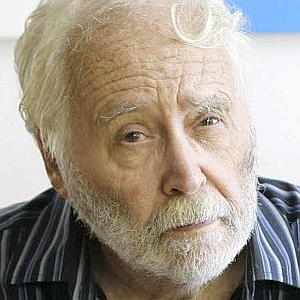
Open letter to President Obama (Part 513) (Minimum Wage, Maximum Foolishness)

Open letter to President Obama (Part 513)

(Emailed to White House on 5-4-13.)

President Obama c/o The White House 1600 Pennsylvania Avenue NW Washington, DC 20500

Dear Mr. President,

I know that you receive 20,000 letters a day and that you actually read 10 of them every day. I really do respect you for trying to get a pulse on what is going on out here.

______________

It seems that everything that you do to help the economy actually does the opposite.

Should the federal government make life more difficult for low-skilled workers?

I hope everyone will emphatically say “NO!”

Heck, most people understandably will think you’re crazy for even asking such a preposterous question.

Minimum Wage Cartoon 2But some of those people will also think that it’s a good idea for politicians in Washington to make low-skilled workers less attractive to employers by raising the minimum wage.

I often ask such people whether they are more likely to buy a Big Mac if McDonald’s raises the price by 24 percent. They say they are less likely.

I then ask them if they are more likely to buy a car if GM increases the price of a Buick by 24 percent. They say less likely, of course.

But they seem to have a blind spot when I ask them whether employers will be more likely or less likely to hire low-skilled workers when the government increases the cost of those workers by 24 percent.

I explain further in this interview for Yahoo! Finance.

The interviewer, by the way, seems to be economically illiterate.

He apparently believes that we can reduce inequality by pricing poor people out of the job market. He also blames companies for sitting on piles of cash, presumably unaware that firms only will invest if there are profitable opportunities.

Minimum Wage CartoonAt one point, I delicately state that one of his questions “betrays a certain lack of historical knowledge,” which is a polite way of saying “you’re either lying or you have no idea what you’re talking about.”

Ultimately, I try to help him understand by comparing fast-growing economies such Hong Kong and Singapore, which have relatively low burdens of government, with slow-growth economies such as France and Italy, where politicians ostensibly seek to “help” people with various forms of intervention.

I’m not sure I made any progress, so feel free to suggest other ways of convincing skeptics that freedom is better than statism.

Anyway, for those who want more information, this video explains the underlying economics of the minimum wage. We also have plenty of evidence (see here and here) that unemployment rose following the most recent hike in the minimum wage.

_______________________

Thank you so much for your time. I know how valuable it is. I also appreciate the fine family that you have and your commitment as a father and a husband.

Sincerely,

Everette Hatcher III, 13900 Cottontail Lane, Alexander, AR 72002, ph 501-920-5733, lowcostsqueegees@yahoo.com

Related posts:

Why do the liberals want to increase unemployment more by increasing minimum wage?

Williams with Sowell – Minimum Wage Why do the liberals want to increase unemployment more by increasing minimum wage? With Unemployment Already High, Why Are Leftists Pushing for an Increase in the Minimum Wage? September 3, 2012 by Dan Mitchell The unemployment rate has been stuck above 8 percent ever since Obama pushed through his ill-fated […]

Minimum wage could be eliminating jobs

Minimum wage could be eliminating jobs Liberals just don’t have a clue. The Job-Killing Impact of Minimum Wage Laws Uploaded by CFPEcon101 on Jun 14, 2010 Minimum wage laws seem like a good idea, but arbitrarily mandating a certain wage can have terrible consequences. This CF&P Foundation mini-documentary reveals that business are not charities, so if the […]

Minimum wage could be eliminating jobs

Minimum wage could be eliminating jobs Liberals just don’t have a clue. The Job-Killing Impact of Minimum Wage Laws Uploaded by CFPEcon101 on Jun 14, 2010 Minimum wage laws seem like a good idea, but arbitrarily mandating a certain wage can have terrible consequences. This CF&P Foundation mini-documentary reveals that business are not charities, so […]

President Obama and Alternative Minimum Tax

President Obama and Alternative Minimum Tax Dan Mitchell does it again. He is always right on the mark. CPAs Celebrate as Obama Proposes to Create a Turbo-Charged Alternative Minimum Tax Posted by Daniel J. Mitchell Wow, this is remarkable. The alternative minimum tax (AMT) is one of the most-hated features of the tax code. It […]

President Obama and Alternative Minimum Tax

President Obama and Alternative Minimum Tax Dan Mitchell does it again. He is always right on the mark. CPAs Celebrate as Obama Proposes to Create a Turbo-Charged Alternative Minimum Tax Posted by Daniel J. Mitchell Wow, this is remarkable. The alternative minimum tax (AMT) is one of the most-hated features of the tax code. It […]

Video clips of Jonah Goldberg and an interview about his book “Liberal Fascism” (Part 3)

Liberal Fascism (5) – Jonah Goldberg ** UNEDITED **   Uploaded by TylerNull on Feb 17, 2008 PLAYLIST: http://www.youtube.com/view_play_list?p=C20E954A7632DCFD Jonah Goldberg discusses his new book, “Liberal Fascism: The Secret History of the American Left, From Mussolini to the Politics of Meaning”, at The Heritage Foundation on C-SPAN2. 09 JAN 08. ____ Below is  a portion […]

Open letter to President Obama (Part 245)

Williams with Sowell – Minimum Wage President Obama c/o The White House 1600 Pennsylvania Avenue NW Washington, DC 20500 Dear Mr. President, I know that you receive 20,000 letters a day and that you actually read 10 of them every day. I really do respect you for trying to get a pulse on what is […]

Ark Times blogger claims California is better than Texas but facts don’t bear that out (3 great political cartoons)

I got on the Arkansas Times Blog and noticed that a person on there was bragging about the high minimum wage law in San Francisco and how everything was going so well there. On 2-15-13 on the Arkansas Times Blog I posted: Couldn’t be better (the person using the username “Couldn’t be better)  is bragging […]

WOODY WEDNESDAY Review of Woody Allen’s latest movie “Blue Jasmine” Part 7


I have spent alot of time talking about Woody Allen films on this blog and looking at his worldview. He has a hopelessmeaningless, nihilistic worldview that believes we are going to turn to dust and there is no afterlife. Even though he has this view he has taken the opportunity to look at the weaknesses of his own secular view. I salute him for doing that. That is why I have returned to his work over and over and presented my own Christian worldview as an alternative.

My interest in Woody Allen is so great that I have a “Woody Wednesday” on my blog www.thedailyhatch.org every week. Also I have done over 30 posts on the historical characters mentioned in his film “Midnight in Paris.” (Salvador Dali, Ernest Hemingway,T.S.Elliot,  Cole Porter,Paul Gauguin,  Luis Bunuel, and Pablo Picasso were just a few of the characters.)

Today we are looking at a review of Woody Allen’s latest movie Blue Jasmine.

Movie Bytes : Blue Jasmine Official Trailer 2013 + Trailer Review – Cate Blanchett, Woody Allen : HD PLUS

Published on Jun 13, 2013

Blue Jasmine debuts its first official trailer for 2013, and you can see it here today plus get a trailer review! Beyond The Trailer host Grace Randolph gives you her reaction to this trailer for Blue Jasmine starring Cate Blanchett, Sally Hawkins, Bobby Cannavale, Louis CK and Andrew Dice Clay, from Woody Allen! Plus with Beyond The Trailer’s Trailer Plus, you’ll get a link to other movie news, reviews, and trailers! Enjoy this official HD trailer and trailer review for Blue Jasmine before you see the full movie in 2013! And make Beyond The Trailer your first stop for entertainment news on YouTube today!

__________________________________

________________

Movie Review

Pride Stays, Even After the Fall

Cate Blanchett Stars in Woody Allen’s ‘Blue Jasmine’

Jessica Miglio/Sony Pictures Classics

Cate Blanchett in “Blue Jasmine.” More Photos »

  • Facebook
  • Twitter
  • Google+
  • Save
  • E-mail
  • Share
  • Print
  • Reprints

When Cate Blanchett first cruises into Woody Allen’s “Blue Jasmine,” playing a Park Avenue matron fallen on hard times, she looks like a million bucks. She’s wearing pearls and a white Chanel jacket, with an Hermès bag as big as a Shetland pony hanging off one arm. It’s the sort of important accessory worn by women accustomed to being chauffeured around town. Soon after, though, as she stands with her monogrammed luggage on a nondescript San Francisco sidewalk, she looks frightened, alone — like someone who could benefit from some kindness. Instead, she waves off a stranger and, posing a question that’s as existential as it is practical, demands, “Where am I, exactly?”

She’s in the Mission, for starters, but Jasmine French — this lost, lonely woman brilliantly brought to quivering life by Ms. Blanchett — is more properly in a Woody Allen movie, his most sustained, satisfying and resonant film since “Match Point.” A moral fable about greed and comeuppance, crimes and misdemeanors, “Blue Jasmine” begins with a socialite brought low and evolves into a tragedy that becomes far greater than her own. It’s a familiar story with a few of the usual suspects, starting with the husband, Hal (a perfect Alec Baldwin, all smile and no soul), an investment type who has talked high yields all the way to prison. The government took him, and then it took the rest, leaving Jasmine with little more than her designer threads and luggage.

Blanchett, Blanche — the names seem fated for each. Mr. Allen has said that he didn’t see Ms. Blanchett play Tennessee Williams’s most famous creation in Liv Ullmann’s celebrated 2009 production of “A Streetcar Named Desire” at the Brooklyn Academy of Music. (Jasmine’s appalled aside about being forced to move to Brooklyn after being priced out of Manhattan amusingly suggests why he didn’t.) Whatever his inspiration, he has been rummaging around in the classics for decades, so his appropriation of “Streetcar” doesn’t surprise. What does is his reimagining Blanche by way of another figure who changes depending on how you hold her up to the light, Ruth Madoff, the wife of Bernard L. Madoff, the investor turned avatar of a fallen world. It’s a masterly stroke that puts Jasmine’s dissembling into fresh, chilling perspective.

From the moment Jasmine appears on screen she’s broken, and her contradictions — along with the vodka she guzzles and the Xanax she pops — keep her in pieces. She’s pathetic, absurd, complaining about being broke one minute and explaining why she flew first class the next. As she slips from tremulous flirtations to soused meltdowns, she elicits gasps of compassion and snorts of derision. Jasmine, née Jeanette, having reinvented herself, had risen to become a member of New York’s elite but, with everything gone, has come to San Francisco to move in with her sister, Ginger (played with anxious sincerity by Sally Hawkins). For Jasmine this isn’t a comedown, it’s a catastrophe — everything is. When she first walks into Ginger’s apartment, she stops dead, as if paralyzed by its unspeakable ordinariness.

It’s hard to know if Mr. Allen shares Jasmine’s shock at Ginger’s place. (Mere mortals will note the ample square footage, natural light and fireplace.) With a series of sharp contrapuntal flashbacks that move forward in time — Hal and Jasmine in their empty new Park Avenue apartment and then later presiding over a dinner bathed in light so burnished golden calf must have been on the menu — Mr. Allen illustrates just how drastically she’s been humbled. The flashbacks tell part of the story, as does Jasmine’s faraway stare, her mood swings and the patter that telegraphs her privilege (“I don’t know how anyone can breathe with low ceilings”) and which, over time, will sound like the ravings of a homeless woman you might see in certain neighborhoods, the one in ratty furs pushing a cart.

Once moved in with Ginger, Jasmine flutters about, cementing her resemblance to the mothlike Blanche. The allusions to “Streetcar” are copious and obvious, and spotting the quotations initially feels like a kind of humorous parlor game, from the French connection that links Blanche and Jasmine’s names to Mr. Allen’s staging of a violent skirmish, which echoes a similar one in Elia Kazan’s film adaptation. Underscoring the resemblances, Jasmine repeatedly explains that “Blue Moon” was playing when she met Hal, memories that evoke the blue piano that, as Williams wrote in “Streetcar,” expresses “the spirit of the life which goes on here.” In the play, Blanche also says that Stanley isn’t the type who goes for jasmine perfume, an aside that carries an accusation.

The specter of Stanley and his white undershirt lives on, if with critical differences, in the figures of Ginger’s ex-husband, Augie (Andrew Dice Clay), and her current lover, Chili (Bobby Cannavale). Each registers as a caricature, with a broad accent and performance, and a swagger that implies a threat. But Mr. Allen isn’t making a case against them, and neither descends into cliché partly because, for all their macho bluster, the two are openly feminized, as if their libidinal energies were being put to better use. Augie and Chili take issue with Jasmine, but they don’t brutalize her, much less set out to destroy her. She has, Mr. Allen suggests, already done the job herself.

That’s harsh and also conveniently reductive: Jasmine may be guilty of a great deal, including blinkered entitlement, but the world of big money in which she moved played its role. So, too, did Hal, perhaps the story’s only real villain, but who, like Augie and Chili, never emerges as a serious countervailing force to Jasmine as Stanley is to Blanche. As if to make up for this missing piece, Mr. Allen himself advances the strongest argument against Jasmine. If he never succeeds in diminishing her appeal, it’s both because Ms. Blanchett maintains a vise grip on the character’s humanity and because it becomes inexorably clear that, while losing her money helped push Jasmine over the edge, it was also the dirty, easy money, what it promised and delivered, that drove her nuts to begin with.

What did Jasmine know, and when did she know it? These questions come to haunt “Blue Jasmine,” and as the past catches up with the present, they help drive this moving, sometimes funny film toward its shattering end. If at times Mr. Allen seems to be answering those questions by pulling the film in one direction even as Ms. Blanchett pulls it in another, this productive dissonance deepens the tension and stakes and, as with a climactic confrontation between Jasmine and Hal, can turn a raw scene into a revelation. This particular battle takes place in their living room, a mausoleumlike shrine to their wealth, painted green, where, against the color of money, they fight for their lives, frantically taking swings at each other without a thought to everyone else they are about to take down.

“Blue Jasmine” is rated PG-13 (Parents strongly cautioned). Adult behavior and language.

Blue Jasmine

Opens on Friday in New York and Los Angeles.

Written and directed by Woody Allen; director of photography, Javier Aguirresarobe; edited by Alisa Lepselter; production design by Santo Loquasto; costumes by Suzy Benzinger; produced by Letty Aronson, Stephen Tenenbaum and Edward Walson; released by Sony Pictures Classics. Running time: 1 hour 36 minutes.

WITH: Alec Baldwin (Hal), Cate Blanchett (Jasmine), Louis C. K. (Al), Bobby Cannavale (Chili), Andrew Dice Clay (Augie), Sally Hawkins (Ginger), Peter Sarsgaard (Dwight) and Michael Stuhlbarg (Dr. Flicker).

Related posts:

I love the movie “Midnight in Paris” by Woody Allen and I have done over 30 posts on the historical characters mentioned in the film. Take a look below:

“Midnight in Paris” one of Woody Allen’s biggest movie hits in recent years, July 18, 2011 – 6:00 am

(Part 32, Jean-Paul Sartre)July 10, 2011 – 5:53 am

 (Part 29, Pablo Picasso) July 7, 2011 – 4:33 am

(Part 28,Van Gogh) July 6, 2011 – 4:03 am

(Part 27, Man Ray) July 5, 2011 – 4:49 am

(Part 26,James Joyce) July 4, 2011 – 5:55 am

(Part 25, T.S.Elliot) July 3, 2011 – 4:46 am

(Part 24, Djuna Barnes) July 2, 2011 – 7:28 am

(Part 23,Adriana, fictional mistress of Picasso) July 1, 2011 – 12:28 am

(Part 22, Silvia Beach and the Shakespeare and Company Bookstore) June 30, 2011 – 12:58 am

(Part 21,Versailles and the French Revolution) June 29, 2011 – 5:34 am

(Part 16, Josephine Baker) June 24, 2011 – 5:18 am

(Part 15, Luis Bunuel) June 23, 2011 – 5:37 am

“Woody Wednesday” A 2010 review of Woody Allen’s Annie Hall

I have spent alot of time talking about Woody Allen films on this blog and looking at his worldview. He has a hopeless, meaningless, nihilistic worldview that believes we are going to turn to dust and there is no afterlife. Even though he has this view he has taken the opportunity to look at the weaknesses of […]

“Woody Wednesday” In 2009 interview Woody Allen talks about the lack of meaning of life and the allure of younger women

I have spent alot of time talking about Woody Allen films on this blog and looking at his worldview. He has a hopeless, meaningless, nihilistic worldview that believes we are going to turn to dust and there is no afterlife. Even though he has this view he has taken the opportunity to look at the weaknesses of […]

Woody Allen video interview in France talk about making movies in Paris vs NY and other subjects like God, etc

Woody Allen video interview in France Related posts: “Woody Wednesdays” Woody Allen on God and Death June 6, 2012 – 6:00 am Good website on Woody Allen How can I believe in God when just last week I got my tongue caught in the roller of an electric typewriter? If Jesus Christ came back today and […]

“Woody Wednesday” Woody Allen on the Emptiness of Life by Toby Simmons

I have spent alot of time talking about Woody Allen films on this blog and looking at his worldview. He has a hopeless, meaningless, nihilistic worldview that believes we are going to turn to dust and there is no afterlife. Even though he has this view he has taken the opportunity to look at the weaknesses of […]

Woody Allen interviews Billy Graham (Woody Wednesday)

A surprisingly civil discussion between evangelical Billy Graham and agnostic comedian Woody Allen. Skip to 2:00 in the video to hear Graham discuss premarital sex, to 4:30 to hear him respond to Allen’s question about the worst sin and to 7:55 for the comparison between accepting Christ and taking LSD. ___________________ The Christian Post > […]

“Woody Allen Wednesdays” can be seen on the www.thedailyhatch.org

Crimes and Misdemeanors: A Discussion: Part 1 If you like Woody Allen films as much as I do then join me every Wednesday for another look the man and his movies. Below are some of the posts from the past: “Woody Wednesday” How Allen’s film “Crimes and Misdemeanors makes the point that hell is necessary […]

“Woody Wednesday” Great Documentary on Woody Allen

I really enjoyed this documentary on Woody Allen from PBS. Woody Allen: A Documentary, Part 1 Published on Mar 26, 2012 by NewVideoDigital Beginning with Allen’s childhood and his first professional gigs as a teen – furnishing jokes for comics and publicists – WOODY ALLEN: A DOCUMENTARY chronicles the trajectory and longevity of Allen’s career: […]

“Woody Wednesday” Discussion of Woody Allen’s 1989 movie “Crimes and Misdemeanors” (Part 6)

Crimes and Misdemeanors: A Discussion: Part 3 Uploaded by camdiscussion on Sep 23, 2007 Part 3 of 3: ‘Is Woody Allen A Romantic Or A Realist?’ A discussion of Woody Allen’s 1989 movie, Crimes and Misdemeanors, perhaps his finest. By Anton Scamvougeras. http://camdiscussion.blogspot.com/ antons@mail.ubc.ca ______________ One of my favorite Woody Allen movies and I reviewed […]

“Woody Wednesday” Discussion of Woody Allen’s 1989 movie “Crimes and Misdemeanors” (Part 5)

Crimes and Misdemeanors: A Discussion: Part 2 Uploaded by camdiscussion on Sep 23, 2007 Part 2 of 3: ‘What Does The Movie Tell Us About Ourselves?’ A discussion of Woody Allen’s 1989 movie, perhaps his finest. By Anton Scamvougeras. http://camdiscussion.blogspot.com/ antons@mail.ubc.ca _________________- One of my favorite Woody Allen movies and I reviewed it earlier but […]

In 2009 interview Woody Allen talks about the lack of meaning of life and the allure of younger women

I have spent alot of time talking about Woody Allen films on this blog and looking at his worldview. He has a hopeless, meaningless, nihilistic worldview that believes we are going to turn to dust and there is no afterlife. Even though he has this view he has taken the opportunity to look at the weaknesses of […]

“Woody Allen Wednesdays” can be seen on the www.thedailyhatch.org

Crimes and Misdemeanors: A Discussion: Part 1 If you like Woody Allen films as much as I do then join me every Wednesday for another look the man and his movies. Below are some of the posts from the past: “Woody Wednesday” How Allen’s film “Crimes and Misdemeanors makes the point that hell is necessary […]

Woody Allen on the Emptiness of Life by Toby Simmons

I have spent alot of time talking about Woody Allen films on this blog and looking at his worldview. He has a hopeless, meaningless, nihilistic worldview that believes we are going to turn to dust and there is no afterlife. Even though he has this view he has taken the opportunity to look at the weaknesses of […]

“Woody Wednesday” Discussion of Woody Allen’s 1989 movie “Crimes and Misdemeanors” (Part 4)

Crimes and Misdemeanors: A Discussion: Part 1 Uploaded by camdiscussion on Sep 23, 2007 Part 1 of 3: ‘What Does Judah Believe?’ A discussion of Woody Allen’s 1989 movie, perhaps his finest. By Anton Scamvougeras. http://camdiscussion.blogspot.com/ antons@mail.ubc.ca _____________ One of my favorite films is this gem by Woody Allen “Crimes and Misdemeanors”: Film Review By […]

“Woody Wednesday” Discussion of Woody Allen’s 1989 movie “Crimes and Misdemeanors” (Part 3)

Crimes and Misdemeanors: A Discussion: Part 3 Uploaded by camdiscussion on Sep 23, 2007 Part 3 of 3: ‘Is Woody Allen A Romantic Or A Realist?’ A discussion of Woody Allen’s 1989 movie, Crimes and Misdemeanors, perhaps his finest. By Anton Scamvougeras. http://camdiscussion.blogspot.com/ antons@mail.ubc.ca ______________ One of my favorite Woody Allen movies and I reviewed […]

“Woody Wednesday” Discussion of Woody Allen’s 1989 movie “Crimes and Misdemeanors” (Part 2)

Crimes and Misdemeanors: A Discussion: Part 2 Uploaded by camdiscussion on Sep 23, 2007 Part 2 of 3: ‘What Does The Movie Tell Us About Ourselves?’ A discussion of Woody Allen’s 1989 movie, perhaps his finest. By Anton Scamvougeras. http://camdiscussion.blogspot.com/ antons@mail.ubc.ca _________________- One of my favorite Woody Allen movies and I reviewed it earlier but […]

“Woody Wednesday” Discussion of Woody Allen’s 1989 movie “Crimes and Misdemeanors” (Part 1)

Crimes and Misdemeanors: A Discussion: Part 1 Uploaded by camdiscussion on Sep 23, 2007 Part 1 of 3: ‘What Does Judah Believe?’ A discussion of Woody Allen’s 1989 movie, perhaps his finest. By Anton Scamvougeras. http://camdiscussion.blogspot.com/ antons@mail.ubc.ca _____________ Today I am starting a discusssion of the movie “Crimes and Misdemeanors” by Woody Allen. This 1989 […]

By Everette Hatcher III | Posted in Current Events | Edit | Comments (0)

Open letter to President Obama (Part 512) (Cartoonists React to the Senate Democratic Budget)

Open letter to President Obama (Part 512)

(Emailed to White House on 4-15-13.)

President Obama c/o The White House 1600 Pennsylvania Avenue NW Washington, DC 20500

Dear Mr. President,

I know that you receive 20,000 letters a day and that you actually read 10 of them every day. I really do respect you for trying to get a pulse on what is going on out here.

___________________

Is it true that in your  meetings with the Republicans you  would not even say that a balanced budget was a goal. According to the budget presented by the Democratic Senate  they are  in agreement with this approach. Cartoonists have taken the opportunity to poke fun at that below.

I  have put up lots of cartoons from Dan Mitchell’s blog before and they have got lots of hits before. Many of them have dealt with the sequester, economy, eternal unemployment benefits, socialism,  minimum wage laws, tax increasessocial security, high taxes in California, Obamacare,  Greece,  welfare state or on gun control. Here is another one.

I didn’t take Patty Murray’s budget very seriously. Indeed, I would have completely ignored the plan by Senate Democrats if it wasn’t for the fact that I felt compelled to debunk her mythology about the 1990s.

America’s political cartoonists are similarly underwhelmed.

Here’s Lisa Benson’s analysis.

Murray Budget 1

A great cartoon because it recognizes that the problem is bloated government, not red ink.

Steve Breen also is not impressed.

Murray Budget 2

As you can imagine, this might be my favorite of the group because I’m a sucker for cartoons portraying government as an obese slob (see here, here, here, and here).

Last but not least, thisJerry Holbert cartoon also is worth sharing.

Murray Budget 3

Again, this cartoon correctly focuses on the main problems of punitive taxation and excessive spending, not the lesser symptom of too much borrowing.

It will be very interesting to see what we get (from both a substance perspective and humor perspective) when the White House finally decides to issue its budget.

That budget was legally required back on the first Monday in February. Based on what we saw last year and the year before that, I’m not holding my breath expecting anything more than another tax-and-spend blueprint.

And as this Michael Ramirez cartoon illustrates, we know where that will lead. Or take a look at this Glenn Foden cartoon. Different theme, but same restult.

Does Government Have a Revenue or Spending Problem?

People say the government has a debt problem. Debt is caused by deficits, which is the difference between what the government collects in tax revenue and the amount of government spending. Every time the government runs a deficit, the government debt increases. So what’s to blame: too much spending, or too little tax revenue? Economics professor Antony Davies examines the data and concludes that the root cause of the debt is too much government spending.

______________________

Thank you so much for your time. I know how valuable it is. I also appreciate the fine family that you have and your commitment as a father and a husband.

Sincerely,

Everette Hatcher III, 13900 Cottontail Lane, Alexander, AR 72002, ph 501-920-5733, lowcostsqueegees@yahoo.comRelated posts:

Cartoons from Dan Mitchell’s blog that demonstrate what Obama is doing to our economy Part 2

Max Brantley is wrong about Tom Cotton’s accusation concerning the rise of welfare spending under President Obama. Actually welfare spending has been increasing for the last 12 years and Obama did nothing during his first four years to slow down the rate of increase of welfare spending. Rachel Sheffield of the Heritage Foundation has noted: […]

Cartoons from Dan Mitchell’s blog that demonstrate what Obama is doing to our economy Part 1

  I have put up lots of cartoons from Dan Mitchell’s blog before and they have got lots of hits before. Many of them have dealt with the economy, eternal unemployment benefits, socialism,  Greece,  welfare state or on gun control. I think Max Brantley of the Arkansas Times Blog was right to point out on 2-6-13 that Hillary […]

Great cartoon from Dan Mitchell’s blog on government moochers

I thought it was great when the Republican Congress and Bill Clinton put in welfare reform but now that has been done away with and no one has to work anymore it seems. In fact, over 40% of the USA is now on the government dole. What is going to happen when that figure gets over […]

Gun Control cartoon hits the internet

Again we have another shooting and the gun control bloggers are out again calling for more laws. I have written about this subject below  and on May 23, 2012, I even got a letter back from President Obama on the subject. Now some very interesting statistics below and a cartoon follows. (Since this just hit the […]

“You-Didn’t-Build-That” comment pictured in cartoons!!!

watch?v=llQUrko0Gqw] The federal government spends about 10% on roads and public goods but with the other money in the budget a lot of harm is done including excessive regulations on business. That makes Obama’s comment the other day look very silly. A Funny Look at Obama’s You-Didn’t-Build-That Comment July 28, 2012 by Dan Mitchell I made […]

Cartoons about Obama’s class warfare

I have written a lot about this in the past and sometimes you just have to sit back and laugh. Laughing at Obama’s Bumbling Class Warfare Agenda July 13, 2012 by Dan Mitchell We know that President Obama’s class-warfare agenda is bad economic policy. We know high tax rates undermine competitiveness. And we know tax increases […]

Cartoons on Obama’s budget math

Dan Mitchell Discussing Dishonest Budget Numbers with John Stossel Uploaded by danmitchellcato on Feb 11, 2012 No description available. ______________ Dan Mitchell of the Cato Institute has shown before how excessive spending at the federal level has increased in recent years. A Humorous Look at Obama’s Screwy Budget Math May 31, 2012 by Dan Mitchell I’ve […]

Funny cartoon from Dan Mitchell’s blog on Greece

Sometimes it is so crazy that you just have to laugh a little. The European Mess, Captured by a Cartoon June 22, 2012 by Dan Mitchell The self-inflicted economic crisis in Europe has generated some good humor, as you can see from these cartoons by Michael Ramirez and Chuck Asay. But for pure laughter, I don’t […]

Obama on creating jobs!!!!(Funny Cartoon)

Another great cartoon on President Obama’s efforts to create jobs!!! A Simple Lesson about Job Creation for Barack Obama December 7, 2011 by Dan Mitchell Even though leftist economists such as Paul Krugman and Larry Summers have admitted that unemployment insurance benefits are a recipe for more joblessness, the White House is arguing that Congress should […]

Get people off of government support and get them in the private market place!!!!(great cartoon too)

Dan Mitchell hits the nail on the head and sometimes it gets so sad that you just have to laugh at it like Conan does. In order to correct this mess we got to get people off of government support and get them in the private market place!!!! Chuck Asay’s New Cartoon Nicely Captures Mentality […]

2 cartoons illustrate the fate of socialism from the Cato Institute

Cato Institute scholar Dan Mitchell is right about Greece and the fate of socialism: Two Pictures that Perfectly Capture the Rise and Fall of the Welfare State July 15, 2011 by Dan Mitchell In my speeches, especially when talking about the fiscal crisis in Europe (or the future fiscal crisis in America), I often warn that […]

Cartoon demonstrates that guns deter criminals

John Stossel report “Myth: Gun Control Reduces Crime Sheriff Tommy Robinson tried what he called “Robinson roulette” from 1980 to 1984 in Central Arkansas where he would put some of his men in some stores in the back room with guns and the number of robberies in stores sank. I got this from Dan Mitchell’s […]

Gun control posters from Dan Mitchell’s blog Part 2

I have put up lots of cartons and posters from Dan Mitchell’s blog before and they have got lots of hits before. Many of them have dealt with the economy, eternal unemployment benefits, socialism,  Greece,  welfare state or on gun control. Amusing Gun Control Picture – Circa 1999 April 3, 2010 by Dan Mitchell Dug this gem out […]

We got to cut spending and stop raising the debt ceiling!!!

  We got to cut spending and stop raising the debt ceiling!!! When Governments Cut Spending Uploaded on Sep 28, 2011 Do governments ever cut spending? According to Dr. Stephen Davies, there are historical examples of government spending cuts in Canada, New Zealand, Sweden, and America. In these cases, despite popular belief, the government spending […]

Gun control posters from Dan Mitchell’s blog Part 1

I have put up lots of cartons and posters from Dan Mitchell’s blog before and they have got lots of hits before. Many of them have dealt with the economy, eternal unemployment benefits, socialism,  Greece,  welfare state or on gun control. On 2-6-13 the Arkansas Times Blogger “Sound Policy” suggested,  “All churches that wish to allow concealed […]

Taking on Ark Times bloggers on the issue of “gun control” (Part 3) “Did Hitler advocate gun control?”

Gun Free Zones???? Stalin and gun control On 1-31-13 ”Arkie” on the Arkansas Times Blog the following: “Remember that the biggest gun control advocate was Hitler and every other tyrant that every lived.” Except that under Hitler, Germany liberalized its gun control laws. __________ After reading the link  from Wikipedia that Arkie provided then I responded: […]

Taking on Ark Times bloggers on the issue of “gun control” (Part 2) “Did Hitler advocate gun control?”

On 1-31-13 I posted on the Arkansas Times Blog the following: I like the poster of the lady holding the rifle and next to her are these words: I am compensating for being smaller and weaker than more violent criminals. __________ Then I gave a link to this poster below: On 1-31-13 also I posted […]