Between 1988 and 2011, the amount of the U.S. population that receives assistance from the federal government grew by 62 percent (includes cartoon)

Big government will destroy the human spirit.

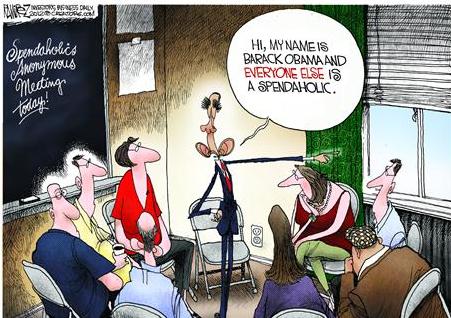
After the poll I shared the other day, this cartoon seems appropriate.

Maybe the better lesson to be learned, thought, isn’t that we should fear big government (though we should, as this t-shirt makes clear), but that statism destroys the human spirit.

If we don’t have entitlement reform soon then we will see the programs go bankrupt in the next couple of decades. Here is a first step that we can take below. Watch this great video below:

Social Security vs. Private Retirement

Is Social Security a good retirement plan? Economics professor Antony Davies shows that Americans stand to earn significantly less and assume more risk with Social Security than other investment options. According to Davies, taxpayers would be better off both in terms of financial security and return on investment by investing their money privately. Social security is extremely expensive, soon to be insolvent, and doesn’t even offer taxpayers the most bang for their buck. For those reasons, Prof. Davies argues that it is time for the government to phase out Social Security. Davies’ solution: the government should honor its obligations to current retirees while giving Americans the freedom to invest their money as they see fit.

_____________________________

U.S. Government Increases National Debt—and Keeps 128 Million People on Government Programs

By and
January 8, 2013

Abstract: Between 1988 and 2011, the amount of the U.S. population that receives assistance from the federal government grew by 62 percent. That means that more than 41 percent of the U.S. population is enrolled in at least one federal assistance program. To make matters worse, per capita expenditures on recipients are rising as well. In 2010, over 70 percent of all federal spending went to dependence-creating programs. That growth is unsustainable, as baby boomers are now retiring every day and their entitlements cost more each year. The publicly held federal debt will exceed 100 percent of GDP in 2024. Such a high level of debt always hurts an economy—and the people who live in it. The time for Congress to reform dependence-creating government programs is now.

The number of people receiving benefits from the federal government in the United States has grown from under 94 million people in 2000 to more than 128 million people in 2011. That means that 41.3 percent of the U.S. population is now on a federal government program. The 128 million is an estimate based on the recently released March 2011 U.S. Census Bureau Current Population Survey (CPS), which, due to the survey methodology, most likely undercounts the actual number.

Heritage Foundation calculations using the March 2011 CPS found the number of people who receive assistance from at least one federal program to be 128.8 million. Using the Census Bureau number for the U.S. population in July 2011, which was 311,591,917, at least 41.34 percent are federal government program beneficiaries.[1] While very few Americans would deny that the federal government should play a role in aiding those in need, this number doubtless qualifies as far too large, indicating that taxpayer dollars are going to those not in need as well.

Many of those who receive benefits from the federal government could live well without them, so they do not count as truly dependent on the federal government.[2] Warren Buffett is the beneficiary of a federal program—Social Security—but, since he does not rely on that income for his livelihood, he should not be considered dependent on government programs. Others depend on the programs for nearly all of their income, housing, health care, food, and other needs and so fall under the classification of truly dependent on the government. Still others are somewhere in between, depending on government financing for, say, college, but little else. Consequently, it is important to note that stating that 128.8 million people receive benefits from a government program does not mean that all of them are dependent on the government.

The Numbers

In the CPS, the Census Bureau surveys thousands of U.S. citizens and non-citizens living in the U.S. in randomly drawn monthly phone surveys. Together, the roughly 60,000 households surveyed are a representative cross section of the U.S. population. While the CPS is conducted each month, the March survey has the most detailed questions. Only the March CPS survey format contains a sufficient level of detail to count federal government program participants.

The responses to the March 2011 CPS have now been released, and these individual responses were sorted for this report. All of the data were examined for responses by individuals who answered affirmatively that they were receiving benefits at the time of the survey. Based on their responses, Heritage created a new dataset from those who responded that they receive financial or in-kind benefits from at least one government program. By counting the individuals in that dataset, and using a weight assigned by the Census Bureau to each individual, the weighted number of people who depend on government programs was found.

The new dataset of people on government programs can then be further sorted to find out how many people say they are on a particular program. Here are some of the resulting numbers:

  • 128,818,142 people are enrolled in at least one government program.
  • 48,580,105 people are on Medicaid.
  • 35,770,301 people receive their retirement income from Social Security.
  • 43,834,566 people are on Medicare.
  • 39,030,579 people are living in a household where at least one person accepts food stamps.
  • 6,984,783 people are living in subsidized rental housing.
  • 2,047,149 people are receiving a higher-education subsidy.

It is important to note that the above categories overlap; for example an individual may receive both subsidized rental housing and food stamps. The total number—128,818,142 people on at least one government program does not double count individuals, however.

The 128,818,142 figure for people enrolled in at least one program is surely an undercount: The CPS responses are well known to undercount those receiving Medicaid, Medicare, Social Security, State Children’s Health Insurance, higher-education support, and Temporary Assistance for Needy Families.[3]

The undercount in higher-education subsidies may be the most important, because recipients of education subsidies are generally younger and not likely to be enrolled in other programs. Sorting the March 2011 CPS data shows that, of the two million people in the survey who responded that they receive higher-education subsidies, fewer than one half of 1 percent relied on Social Security retirement income; only 1.5 percent were also on Medicare; and only 16 percent received food stamps. The 2 million people who stated they receive higher-education subsidies are assuredly much fewer than the actual number, since the number of people receiving Pell Grants alone in 2011 was 9.7 million.[4] It is not known why the undercount in education subsidies is so large, but it is likely related to the weights the CPS uses to represent college students. Therefore, even counting only Pell Grant recipients would add millions to the lowball estimate of 128.8 million total people who receive assistance from a government program.

Housing subsidies are also most likely undercounted. According to the March 2011 CPS, only 6,984,783 individuals live in subsidized rental housing. Other government data puts the number at 4,952,191 households in 2010, not individuals.[5] Again, the weights used in the survey may contribute to the shortfall.

Growth in Number of People on Government Programs Over Time

The rate of growth in the number of people who are enrolled in a federal program far outpaces general population growth. (See chart.) In fact, an analysis of the March 2011 CPS responses going back to 1988 reveals that the number in March 2011 (128,818,142) is 62 percent higher than it was in March 1988 (79,592,924). Meanwhile, the U.S. population has grown only 27 percent since that year. In other words, the number of people who are enrolled in at least one federal program has grown more than two times faster than has the U.S. population. That growth is unsustainable as baby boomers are now retiring every day, and their entitlements cost more each year. The publicly held federal debt will exceed 100 percent of gross domestic product (GDP) by 2024.[6] Such a high level of debt always slows an economy.[7] One need look no further than the current situations in Greece, Italy, or Spain to see what high levels of national debt do to a country’s economic health. The European Union now faces a recession because of the debt its members owe. Shrinking economies are bad for everyone who lives in them, but they especially hurt the young, who have much higher rates of unemployment than older workers.[8] Shrinking economies make it even harder for young workers to find jobs. Their very futures are the ones in peril because of that debt.

While the number of people on a federal program has grown too fast, the average amount spent per capita has greatly outpaced even that level. (See chart.) The Heritage Foundation’s Index of Dependence on Government has been released annually since 2002. It tracks the amount of money that is spent on federal-assistance programs.[9] The data is in constant 2005 dollars, meaning that the amount spent increases or decreases due to government policies, not inflation. Between 1988 and 2011, spending on dependence-creating federal government programs has increased 180 percent.[10] versus “only” a 62 percent increase in the number of people who are enrolled in federal government programs, and a 27 percent increase in the population. Not only are more people enrolled in government programs than ever before, but more U.S. taxpayer dollars are being spent on each recipient every year.

What the Numbers Mean

What these alarming numbers mean is that a large proportion of the people in the United States have two kinds of income: (1) money that they or their family have earned, and (2) money transferred to them from U.S. taxpayers through the vehicle of a federal government program. Those consuming the second kind count for over 128.8 million individuals—41.3 percent of the population. According to Wall Street Journal research, when counting the number of people who live in a household where at least one person is on a government program, the dangerous tipping point of half of all Americans is nearly reached.[11] at 49.1 percent.

If one person in a household receives federal assistance, it is often the case that all members of that household do. This is certainly the case for food stamps: If a family shares meals and one of the relatives accepts food stamps, all members of that household are using those food stamps for part of their food.[12] If one person in a household receives a rent subsidy, everyone who lives in the home is a recipient.

The Clock is Ticking

The time to reform dependence-creating government programs is now. In 2010, over 70 percent of all federal spending went to dependence-creating programs.[13] It went to subsidize the living expenses of over 128.8 million individuals in the U.S. in 2011, which was more than 41 percent of the U.S. population. When the percentage of those living in a household where at least one person is subsidized is calculated, the number tops 49 percent. The problem is too much government subsidizing, and too much transfer of wealth from taxpayers to those who pay fewer and fewer taxes. After all, government does not create wealth by spreading it around.

Congress would do well to remember that there are no free subsidies and benefits. The government today is borrowing from future taxpayers to pay the current government program enrollees. The game will soon be up as debt approaches 100 percent of GDP. The United States should not owe 100 percent of all the goods and services produced in a year to its debtors. It is time for across-the-board entitlement reform so that the red ink does not drown America’s babies as they grow older and seek out their vision of the American dream. It is time for elected officials to restore America’s future for kids today who deserve to live in the great land of opportunity that America has been for the generations that came before them—instead of being bound to pay off a mountain of debt that they had no part in creating and that they should not have to face.[14]

—Patrick D. Tyrrell is Research Coordinator in the Center for Data Analysis, and William W. Beach is Director of the Center for Data Analysis, and Lazof Family Fellow in Economics, at The Heritage Foundation.

As I predicted Lane Kiffin is fired by USC!!!

USC Fires Lane Kiffin


Lane Kiffin is not so bright after all. I have written about Kiffin several times before, and I predicted that his team would flop this year and that the arrogant Kiffin that we saw at Tennessee would be coming back and sure enough he didn’t let us down. He even said that the honor of being ranked #1 in the preseason proved that his Trojans had weathered the NCAA sanctions and would do fine from now on. There is only one problem with that: Kiffin had USC appeal the sanctions for two years which means the recruiting sanctions actually take place in 2012-2014!!!!!

I predicted he would be going getting kicked out the door soon enough and sure enough he did early this morning at 3 am.

_____________

Posted September 29, 2013

USC fires Lane Kiffin after 3-2 start, names Ed Orgeron interim coach

Lane Kiffin, USC Trojans

USC fired head football coach Lane Kiffin early Sunday morning following the Trojans’ 62-41 loss to Arizona State on Saturday, the team announced.


USC athletic director Pat Haden informed Kiffin of his termination after the team’s flight back to Los Angeles from Tempe, Ariz. In his afternoon press conference, Haden announced that former Ole Miss coach and current USC defensive line coach Ed Orgeron has been named the interim coach.


The Trojans’ loss to the Sun Devils on Saturday tied the mark for most points given up by the program in a loss (62 points). The result dropped the Trojans to 3-2 on the year, with both losses coming against Pac-12 foes. In all, USC has lost seven of its last 11 games under Kiffin, including four against ranked opponents. Kiffin’s overall record in four seasons at USC was 28-15.


Kiffin arrived at USC in 2010 after two short stints with the NFL’s Oakland Raiders and the Tennessee Volunteers. The Trojans were hit with NCAA sanctions stemming from the previous era under Pete Carroll, which included the loss of 30 scholarships over three years and a two-year postseason ban. Nevertheless, Kiffin finished 8-5 in his first season at the helm, jumped to 10-2 in 2011 — a mark that included a win over No. 4 Oregon — and headed into the 2012 campaign with the preseason No. 1 team in the AP Poll.


FARRAR: Several NFL names could in play for USC


The 2012 season didn’t pan out as expected. After a 6-1 start, USC dropped five of its final six games, including a loss to crosstown rival UCLA for the first time in five years, to finish 7-6. The Trojans capped their 2012 effort with a 21-7 Sun Bowl loss to Georgia Tech.


Heading into 2013, pressured on Kiffin mounted. Still, just before the season, Haden released a video statement in which he reiterated that Kiffin was not on the hot seat.


I anticipate the media will ask me if our football coach is on the hot seat this year. Here is my answer, and it will be my answer whenever I’m asked: He is not. I’m behind Lane Kiffin 100 percent. I have great confidence in him. He’s a very hard-working, detail-oriented coach. He’s a dynamic play-caller in my estimation, and he’s an exceptional recruiter. He knows USC and he knows what it takes to be successful here.


After USC’s Week 2 loss to Washington State, reports surfaced that the Trojans held a players-only meeting, a report which Kiffin denied. USC wide receiver Marqise Lee told reporters that the meeting did happen, saying, “Kiffin didn’t know.”


To many, the 2013 season was to be Kiffin’s true test of adversity as a head coach. The son of NFL coaching legend Monte Kiffin, the younger Kiffin rose in the coaching profession at a meteoric pace, something often attributed to his family name. After six seasons as an assistant at USC under Carroll, Kiffin became an NFL head coach with the Raiders at 31, a head coach in the SEC with Tennessee at 33 and the headman at USC at 34.

The question now is where USC goes from here. The Trojans’ job is regarded as one of the most coveted positions in the country, and many names have popped up as potential candidates for the job, including Vanderbilt coach James Franklin, Washington coach Steve Sarkisian — a former USC assistant — and Northwestern coach Pat Fitzgerald

Related posts:

Lane Kiffin is in deep trouble at USC and you heard it first here!!!!

_________________ Back in January of 2013 I posted this: ___________________ Lane Kiffin is not so bright after all. I have written about Kiffin several times before, and I predicted that his team would flop this year and that the arrogant Kiffin that we saw at Tennessee would be coming back and sure enough he didn’t […]


Hogs mentioned in national football recruiting article (Lane Kiffin is an idiot by the way)


Lane Kiffin a great coach? I doubt it but he will stretch the rules!!!


Lane Kiffin has put off Judgement Day

It is true that USC’s Lane Kiffin has had two great recruiting classes at USC, but that was because he signed 25 players both in 2010 and 2011. He delayed “Judgement Day” by getting permission to avoid the 15 scholarship limits (imposed for 3 years) while the school appealed the NCAA’s decision. Therefore, all these […]


USC Football and Lane Kiffin Slammed by NCAA as appeal is shot down

By David Daniels in his Bleacher Report noted today:  Use your ← → (arrow) keys to browse the slideshow & more articlesNext Stephen Dunn/Getty ImagesLane Kiffin Gets What He Deserves As NCAA Rejects USC Football AppealTennessee Volunteer fans all over the nation are smiling.  It could be a “I love life” smile or a “I’m having such […]


Kiffin’s boasting comes back on him again

What should we make from USC’s shocking 21-14 loss to Stanford? Lou Holtz rightly said concerning USC, “They were not number 2 in the  country.The writers voted them there and they made a mistake. They were not the number two team.” Earlier I mentioned that Kiffin looked silly for implying that USC had overcome the […]


Arkansas born Bear Bryant had some wise words that USC’s Kiffin should heed

Southern California head coach Lane Kiffin gestures during NCAA college football practice in Los Angeles, Friday, Aug. 17, 2012. Grant Hindsley, Associated Press ________________________ When I opened my newspaper recently I saw this headline, “USC brushes off sanctions to be No. 1 in AP Top 25.” My first thought was Kiffin has brushed off nothing yet. USC […]


Prediction for 2014 Basketball Hogs!!!

__________ Last year I got to go to the Kentucky at Arkansas basketball game and I loved every minute of our 73-60 victory in March of 2013. Marshawn Powell had 15 points and B.J.Young added 13 and Archie Goodwin who I saw play in high school for Sylvan Hills had 14 points for Kentucky.  My […]


“Sanctity of Life Saturday” Remembering Dr. C. Everett Koop with pictures and quotes Part 25 (includes editorial cartoon)

Newsmaker Interview with Surgeon General C. Everett Koop

Published on Feb 25, 2013

The PBS NewsHour interviewed former Surgeon General, Dr. C. Everett Koop, on the anniversary of the first surgeon general’s report on smoking. Jim Lehrer interviewed Koop for a newsmaker conversation for the The MacNeil/Lehrer NewsHour from the surgeon general’s office in Washington on Jan. 11, 1989. Koop died Monday at the age of 96.

Dr. C. Everett Koop was appointed to the Reagan administration but was held up in the Senate in his confirmation hearings by Ted Kennedy because of his work in pro-life causes.

Memorial Tribute Former Surgeon General C.Everett Koop © A Genuine G-Shot.wmv

On 2-25-13 we lost a great man when we lost Dr. C. Everett Koop. I have written over and over the last few years quoting Dr. C. Everett Koop and his good friend Francis Schaeffer. They both came together for the first time in 1973 when Dr. Koop operated on Schaeffer’s daughter and as a result they became close friends. That led to their involvement together in the book and film series “WHATEVER HAPPENED TO THE HUMAN RACE?” in 1979.

The C. Everett Koop Papers

Biographical Information

[The C. Everett Koop family]. 1960.
Documents Jump to Chronology Visuals

After a 35-year career as an internationally acclaimed pediatric surgeon, during the 1980s C. Everett Koop turned a federal office with a minimal budget and staff, the office of the U.S. Surgeon General, into the most authoritative platform from which to educate the nation on matters of health promotion, disease prevention, and emerging health threats. Guided by his evangelical Christian faith and his professional commitment to saving the lives of newborns, Koop became an outspoken opponent of abortion and, as such, a favorite of political conservatives; yet the positions he took as U.S. Surgeon General on smoking, domestic violence, disability rights, and, most urgently, AIDS, alienated him from his conservative supporters and demonstrated that the politics of public health in the 1980s followed a long-standing pattern of controversy over government authority and individual liberty.

In the fall of 1933, Koop left home for Dartmouth College on a football scholarship, majoring in zoology. He developed a life-long affection for the institution, not least because he met there the woman who would be his wife of over six decades, Betty Flanagan. There, he also acquired his nickname, “Chick.” He soon decided to forego football after sustaining an eye injury and receiving a warning from the school ophthalmologist that he was endangering his future as a surgeon.

Koop returned to New York City in 1937 to enter Cornell University Medical College. A year later Betty and he married, in defiance of a prevailing prejudice against married students among medical school faculty. Betty, a doctor’s daughter herself, was the couple’s main breadwinner as a hospital secretary until Koop graduated from medical school in 1941. They eventually had four children, Allen, born in 1944, Norman, born in 1945, David, born in 1947, and Betsy, born in 1951.

In the summer of 1941 Koop took up a year-long internship at the Pennsylvania Hospital in Philadelphia, the city that became his home for the next forty years. In 1942 he began his surgical residency at the University of Pennsylvania Hospital. Taking account both of the demand for surgeons created by World War II and of Koop’s natural operating skills, his adviser, Isidor S. Ravdin, allowed him to complete his surgical training in half the allotted nine years. Koop spent days at a time at the hospital. “[M]y happiest hours were those in the operating room,” he recalled. “I love surgery because I have an abiding reverence for the human body, reverence for the ways in which its anatomical details allow it to function.”

At the end of Koop’s residency in 1945 Ravdin suggested that he accept an appointment as the first surgeon-in-chief at Children’s Hospital of Philadelphia, an honor for the 29-year-old and a recognition of his surgical skills, but also a challenge at a time when pediatric surgery was not yet a recognized medical specialty. Moreover, like most physicians he had received very little training in pediatrics: only six classes in medical school and none during his abbreviated internship, followed by an occasional operation on a child–but never on a newborn–during his residency. Yet he felt drawn to the field because it promised the opportunity to perform a wide range of surgeries on patients who were particularly vulnerable and underserved by specialized surgeons. He made up for his deficit in pediatric training during a one-year internship with the founders of pediatric surgery in the United States, William E. Ladd and Robert E. Gross, at Children’s Hospital in Boston. When he returned to Philadelphia late in 1946, he faced initial resistance from some pediatricians and general surgeons at his new institution who did not agree that the hospital needed a specialist in pediatric surgery. He soon convinced them of his skills, and over the next three decades helped to establish the field of pediatric surgery on the basis that children’s bodies are not adult bodies in miniature, but are anatomically and physiologically different and so require special surgical procedures.

This approach allowed Koop to greatly improve the surgical care of children, especially infants. In addition to his invention in anesthesia, Koop made the single most common operation on children, the correction of a hernia, less painful and disfiguring by using a shorter incision and by placing stitches in, not through, the skin. He developed a technique to correct esophageal atresia, a congenital birth defect where the esophagus is detached from the stomach. Over the course of his career he saved nearly 500 such patients. He showed that other once-terminal conditions were correctable, including hydrocephalus–the accumulation of cerebrospinal fluid within the skull–and diaphragmatic hernias, in which the abdominal organs push up into the chest through a hole in the child’s diaphragm. In 1977 he gained international attention when he became the first surgeon to separate Siamese twins joined at the heart, and saved the life of one of them. To perform these operations that he pioneered, Koop established the nation’s first neonatal surgical intensive care unit in 1956.

Operating on newborns with life-threatening birth defects, spending nights at the bedside of a sick or dying child, and consoling bereaved parents gained Koop acclaim as a pioneering surgeon and empathic healer, and led him to reexamine his Christian faith and the ethical implications of medical procedures, above all abortion and euthanasia. Raised in a church-going family but initially not overtly devout himself, Koop underwent a spiritual awakening in 1948 after he joined the Tenth Presbyterian Church of Philadelphia. “As a person whose training and experience put full faith in science, I came to see an even higher truth. From then on, I saw a coexistence between science and God,” he wrote in his autobiography, Koop: The Memoirs of America’s Family Doctor, published in 1991. Betty and he found solace in their faith when their son David died in a climbing accident in 1968, a loss they grappled with in a jointly-written book, Sometimes Mountains Move. In the wake of the U.S. Supreme Court’s 1973 decision in Roe v. Wade legalizing abortion, Koop began to speak publicly about his fears that abortion devalued human life and would help loosen the moral strictures against the infanticide and euthanasia of other care-dependent members of society, from newborns with birth defects, to persons with disabilities, to the elderly. He expressed his concerns in The Right to Live, The Right to Die, published in 1976, and in Whatever Happened to the Human Race?, a multimedia project, produced in cooperation with the noted theologian Francis Schaeffer in 1978, that included five films and accompanying lectures and seminars.

Through his speeches, publications, and films Koop rose to prominence among anti-abortion activists, and eventually came to the attention of newly-elected president and abortion foe Ronald Reagan, who nominated Koop as U.S. Surgeon General in March 1981. During eight months of controversy and congressional hearings, critics and supporters debated his stance on abortion as well as the question whether Koop, who had devoted his career to treating individual patients, was qualified to address the health needs of the nation as a whole. He was confirmed as U.S. Surgeon General in November 1981.

During his two terms as Surgeon General, Koop made himself the most prominent government spokesman on issues affecting the health of the American public, despite having little statutory authority and a small budget. He infused a renewed sense of confidence and purpose into the Commissioned Corps of the U.S. Public Health Service (PHS), a federal service of public health professionals that the Surgeon General commands and that had been suffering from low morale after the closing of PHS hospitals and the cut-back in personnel in the early 1980s. He examined medical ethics, health care costs, and the problem of the uninsured in a health care system that faced financial challenges at a time of inflation followed by recession in the early 1980s. Koop warned tirelessly against the health hazards of smoking for both active and passive smokers, and launched a campaign for a smoke-free America by the year 2000. He championed the rights of infants with birth defects to receive medical treatment, and the rights of persons with disabilities to have access to public facilities and to employment. He recast issues of law and private morality, namely domestic violence and pornography, as matters of public health, emphasizing their long-term psychological and health effects.

Above all, Koop helped the nation face the most fearsome new pandemic of the century, AIDS. He educated the public on prevention and protection, argued against mandatory testing and quarantine of the infected, and denounced discrimination against AIDS sufferers in schools, the workplace, and housing. He represented the United States at World Health Organization meetings and other international health forums, which during the 1980s became increasingly concerned with the AIDS epidemic. On this and other issues he often surprised supporters and critics alike. He distanced himself from conservatives by declaring that abortion was a moral issue, not one of public health, and thus lay outside the responsibilities of his office. At the same time he found common ground with liberals in stressing the importance of freely available health information, taking on the tobacco industry, and calling for a larger government role in fighting AIDS. Throughout these controversies, Koop saw himself as faithful to the professional principles and religious beliefs that had guided him throughout his career.

Koop resigned in October 1989, a month before the official end of his second term, to become chairman of the National Safe Kids Campaign, an effort to reduce accidents among children, which carried on his final initiative as Surgeon General. During the 1990s Koop continued to speak widely on health care reform, and promoted the use of the Internet for disseminating health information. On April 17, 2010, Dr. Koop married Cora Hogue from Philadelphia. Dr. Koop died at the age of 96 on February 25, 2013 at his home in Hanover, New Hampshire.

Brief Chronology

  • 1916 –Born in Brooklyn, New York (October 14)
  • 1937 –Receives BS degree in zoology from Dartmouth College
  • 1938 –Marries Elizabeth “Betty” Flanagan (d. 2007); they eventually have four children
  • 1941 –Receives MD degree from Cornell Medical College
  • 1941-42 –Medical internship at the Pennsylvania Hospital in Philadelphia
  • 1942-47 –Harrison Fellow in General Surgery and Research Surgery, University of Pennsylvania University School of Medicine
  • 1945-46 –Internship in pediatric surgery with William E. Ladd and Robert E. Gross at Children’s Hospital in Boston
  • 1947 –Receives the Doctor of Science degree from the University of Pennsylvania School of Medicine
  • 1948-81 –Surgeon-in-Chief, Children’s Hospital of Philadelphia
  • 1948 –Joins the Tenth Street Presbyterian Church in Philadelphia
  • 1949 –Assistant professor of surgery, University of Pennsylvania School of Medicine; associate professor of pediatric surgery, 1952; professor of pediatric surgery, 1959
  • 1956 –Establishes the nation’s first neonatal surgical intensive care unit
  • 1971-72 –President of the American Pediatric Surgical Association
  • 1976 –Publishes The Right to Live, The Right to Die, an exposition of his antiabortion views
  • 1977 –Gains international attention when he becomes the first surgeon to separate Siamese twins joined at the heart, saving the life of one of them
  • 1981 –Confirmed as the thirteenth U.S. Surgeon General
  • 1981 –The Centers for Disease Control report the first cases of a new infectious immune disease, named AIDS two years later
  • 1982-83 –Becomes involved in the “Baby Doe” controversy over the medical rights of newborns with congenital birth defects
  • 1984 –Launches Campaign for a Smoke-Free America by the Year 2000, emphasizing the health effects of second-hand smoke and the rights of non-smokers
  • 1986 –Publishes Surgeon General’s Report on Acquired Immune Deficiency Syndrome, becoming the first federal authority to provide explicit advice to Americans on how to protect themselves from AIDS
  • 1989 –Resigns as U.S. Surgeon General; becomes chairman of the National Safe Kids Campaign
  • 1990s –Lectures widely on health care reform and medical informatics, especially the dissemination of health information through digital media
  • 1991 –Publishes Koop: The Memoirs of America’s Family Doctor
  • 1991-2013 –Senior Scholar at the C. Everett Koop Institute at Dartmouth College, an educational and outreach facility devoted to health promotion and preventive medicine, and Elizabeth DeCamp McInerny Professor of Surgery at Dartmouth Medical School
  • 2013 –Dies at home in Hanover, New Hampshire at the age of 96 (February 25)

In the film series “WHATEVER HAPPENED TO THE HUMAN RACE?” the arguments are presented  against abortion (Episode 1),  infanticide (Episode 2),   euthenasia (Episode 3), and then there is a discussion of the Christian versus Humanist worldview concerning the issue of “the basis for human dignity” in Episode 4 and then in the last episode a close look at the truth claims of the Bible.

In this 1979 film series they dealt with the big social issues and predicted what social problems we have in the future because of humanism. For instance, they knew that the Jack Kevorkians of the world would be coming down the pike. They predicted that there was a slippery slope from abortion to infanticide to youth euthanasia brought on by the materialistic worldview.

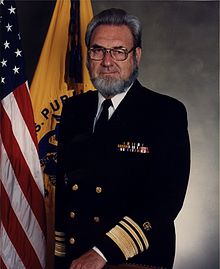
Dr. C. Everett Koop is pictured above.

In the film series “WHATEVER HAPPENED TO THE HUMAN RACE?” the arguments are presented  against abortion (Episode 1),  infanticide (Episode 2),   euthanasia (Episode 3), and then there is a discussion of the Christian versus Humanist worldview concerning the issue of “the basis for human dignity” in Episode 4 and then in the last episode a close look at the truth claims of the Bible.

Francis Schaeffer: How Should We Then Live? (Full-Length Documentary)

Francis Schaeffer Whatever Happened to the Human Race (Episode 1) ABORTION

Francis Schaeffer: What Ever Happened to the Human Race? (Full-Length Documentary)

Part 1 on abortion runs from 00:00 to 39:50, Part 2 on Infanticide runs from 39:50 to 1:21:30, Part 3 on Youth Euthanasia runs from 1:21:30 to 1:45:40, Part 4 on the basis of human dignity runs from 1:45:40 to 2:24:45 and Part 5 on the basis of truth runs from 2:24:45 to 3:00:04

Dr. Francis schaeffer – The flow of Materialism(from Part 4 of Whatever happened to human race?)

Dr. Francis Schaeffer – The Biblical flow of Truth & History (intro)

Francis Schaeffer – The Biblical Flow of History & Truth (1)

Dr. Francis Schaeffer – The Biblical Flow of Truth & History (part 2)

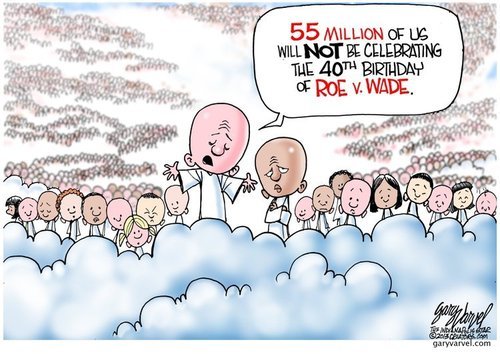
Many in the press made a big deal about the 40th birthday of Roe v Wade but there are over 55 million aborted unborn babies in heaven wishing they had at least one birthday as this wonderful editorial cartoon illustrates.

Dr. Koop

Christianity and Scientific Concerns

AP

C. Everett Koop

Related posts:

Remembering Dr. C. Everett Koop with pictures and quotes Part 12 (with editorial cartoon)

Dr. C. Everett Koop on Baby Doe, euthanasia, abortion Uploaded on Nov 3, 2008 Dr. Koop answers questions on Baby Doe, euthanasia and abortion during interview at Wheaton College, Wheaton, IL http://www.christianethics.org Dr. Koop   On 2-25-13 we lost a great man when we lost Dr. C. Everett Koop. I have written over and over […]

Remembering Dr. C. Everett Koop with pictures and quotes Part 11 (including editorial cartoon on abortion)

Dr. Koop Memorial Tribute Former Surgeon General C.Everett Koop © A Genuine G-Shot.wmv On 2-25-13 we lost a great man when we lost Dr. C. Everett Koop. I have written over and over the last few years quoting Dr. C. Everett Koop and his good friend Francis Schaeffer. They both came together for the first […]

Remembering Dr. C. Everett Koop with pictures and quotes Part 10 (includes editorial cartoon about abortion)

Newsmaker Interview with Surgeon General C. Everett Koop Published on Feb 25, 2013 The PBS NewsHour interviewed former Surgeon General, Dr. C. Everett Koop, on the anniversary of the first surgeon general’s report on smoking. Jim Lehrer interviewed Koop for a newsmaker conversation for the The MacNeil/Lehrer NewsHour from the surgeon general’s office in Washington […]

Remembering Dr. C. Everett Koop with pictures and quotes Part 9 (Picture of Joycelyn Elders with Koop)

Dr. C. Everett Koop on Baby Doe, euthanasia, abortion Uploaded on Nov 3, 2008 Dr. Koop answers questions on Baby Doe, euthanasia and abortion during interview at Wheaton College, Wheaton, IL http://www.christianethics.org Dr. Koop   Joycelyn Elders was the first black Surgeon General of the USA and I have a picture of her with Dr. C. […]

Remembering Dr. C. Everett Koop with pictures and quotes Part 8 (editorial picture about Surgeon General)

Memorial Tribute Former Surgeon General C.Everett Koop © A Genuine G-Shot.wmv Dr. Koop. C. Everett Koop Before Dr. C. Everett Koop arrived in 1981 as Surgeon General could anybody ever name who the Surgeon General was? Koop also caused lots of editorial cartoons to be drawn about him because of his positions he took on […]

Remembering Dr. C. Everett Koop with pictures and quotes Part 7 (Public Health poster)

Newsmaker Interview with Surgeon General C. Everett Koop Published on Feb 25, 2013 The PBS NewsHour interviewed former Surgeon General, Dr. C. Everett Koop, on the anniversary of the first surgeon general’s report on smoking. Jim Lehrer interviewed Koop for a newsmaker conversation for the The MacNeil/Lehrer NewsHour from the surgeon general’s office in Washington […]

Remembering Dr. C. Everett Koop with pictures and quotes Part 6 (includes funniest cartoon ever during Koop’s tenure)

Dr. C. Everett Koop on Baby Doe, euthanasia, abortion Uploaded on Nov 3, 2008 Dr. Koop answers questions on Baby Doe, euthanasia and abortion during interview at Wheaton College, Wheaton, IL http://www.christianethics.org Dr. Koop. C. Everett Koop On June 8, 1988 Ralph Dunagin of the LA Times came out with the funniest editorial cartoon I […]

Remembering Dr. C. Everett Koop with pictures and quotes Part 5 (Public Health poster developed under Koop)

Memorial Tribute Former Surgeon General C.Everett Koop © A Genuine G-Shot.wmv Dr. C. Everett Koop was active on getting the word out about how people could catch AIDS. Public Health officials during the second half of the 1980s became concerned about the spread of AIDS particularly among minorities, a disproportionate number of whom were intravenous […]

Remembering Dr. C. Everett Koop with pictures and quotes Part 4 (funny editorial cartoon too)

Dr. Koop Gary Brookings of the Richmond Times Dispatch did a very funny editorial cartoon about the time in 1988 when Dr. C. Everett Koop sent the unapproved mail  piece out to millions of homes about AIDS. There were many such cartoons at the time since everyone knew Dr. Koop got the mail piece out […]

Remembering Dr. C. Everett Koop with pictures and quotes Part 3 ( three more editorial cartoons too)

Dr. Koop with Hillary Clinton In 1980 I really was influenced at my highschool by a teacher of mine named Mark Brink. He introduced me to the film series “Whatever happened to the human race?” by Francis Schaeffer and Dr. C. Everett Koop. In this  film series that came out in 1979 they dealt with […]

Remembering Dr. C. Everett Koop with pictures and quotes Part 2 (Doonesbury cartoon by Gary Trudeau included)

Dr. Koop On 2-25-13 we lost a great man when we lost Dr. C. Everett Koop. I have written over and over the last few years quoting Dr. C. Everett Koop and his good friend Francis Schaeffer. They both came together for the first time in 1973 when Dr. Koop operated on Schaeffer’s daughter and […]

Remembering Dr. C. Everett Koop with pictures and quotes Part 1

Dr. C. Everett Koop is pictured above. Francis Schaeffer: “Whatever Happened to the Human Race” (Episode 1) ABORTION OF THE HUMAN RACE Published on Oct 6, 2012 by AdamMetropolis Dr. Koop On 2-25-13 we lost a great man when we lost Dr. C. Everett Koop. I have written over and over the last few years […]

Open letter to President Obama (Part 232 B) Dr. C. Everett Koop and Reagan pictured together

Dr. C. Everett Koop with Ronald Reagan. Dr. Koop was delayed in his confirmation by Ted Kennedy because of his film Whatever Happened to the Human Race? President Obama c/o The White House 1600 Pennsylvania Avenue NW Washington, DC 20500 Dear Mr. President, I know that you receive 20,000 letters a day and that you […]

“Sanctity of Life Saturday” Francis Schaeffer and Dr. C. Everett Koop asked Reagan to issue pro-life proclamation in 1983 (includes video ABORTION OF THE HUMAN RACE)

In the film series “WHATEVER HAPPENED TO THE HUMAN RACE?” the arguments are presented  against abortion (Episode 1),  infanticide (Episode 2),   euthenasia (Episode 3), and then there is a discussion of the Christian versus Humanist worldview concerning the issue of “the basis for human dignity” in Episode 4 and then in the last episode a close […]

Dr. C. Everett Koop on abortion’s 1973 Roe v. Wade impact on child abuse

Dr. C. Everett Koop with Ronald Reagan. Dr. Koop was delayed in his confirmation by Ted Kennedy because of his film Whatever Happened to the Human Race? Watch the film below starting at the 19 minute mark and that will lead into a powerful question from Dr. C. Everett Koop. This 1979 film is WHATEVER […]

Open letter to President Obama (Part 221 B) Dr. C. Everett Koop and Francis Schaeffer rightly called abortion “the watershed issue of our era”

 Dr. Koop was delayed in his confirmation by Ted Kennedy because of his film Whatever Happened to the Human Race? Francis Schaeffer February 21, 1982 (Part 1) Uploaded by DeBunker7 on Feb 21, 2008 READ THIS FIRST: In decline of all civilizations we first see a war against the freedom of ideas. Discussion is limited […]

Francis Schaeffer and C. Everette Koop on the Hippocratic oath (March for Life January 20, 2013)

Dr. C. Everett Koop was appointed to the Reagan administration but was held up in the Senate in his confirmation hearings by Ted Kennedy because of his work in pro-life causes. I was thinking about the March for Life that is coming up on Jan 20, 2013  and that is why I posted this today […]

Ronald Wilson Reagan pictured with Dr. C. Everett Koop

High resolution version (11,426,583 Bytes) Description: The photograph is signed by President Ronald Reagan with the inscription “To Chick Koop, With Best Wishes.” Chick, from chicken coop, was the nickname Koop gained will attending Dartmouth College in the mid-1930s. Koop maintained a cordial relationship with President Reagan, despite his disappointment over Reagan’s refusal to address […]

Francis Schaeffer and C. Everett Koop were prophetic (jh29)

Francis Schaeffer and C. Everett Koop were prophetic (jh29) What Ever Happened to the Human Race? I recently heard this Breakpoint Commentary by Chuck Colson and it just reminded me of how prophetic Francis Schaeffer and C. Everett Koop were in the late 1970′s with their book and film series “Whatever happened to the human […]

Should Michele Bachmann be punished for taking pro-life views from Schaeffer and Koop? (March for Life January 20, 2013)

  Dr. C. Everett Koop I was thinking about the March for Life that is coming up on Jan 20, 2013  and that is why I posted this today Secular leaps of faith 39 Comments Written by Janie B. Cheaney August 15, 2011, 2:17 PM I’m willing to cut Ryan Lizza some slack. His profile […]

“Schaeffer Sundays” Francis Schaeffer’s own words concerning humanism and its bad results

Francis Schaeffer: “Whatever Happened to the Human Race?” (Episode 2) SLAUGHTER OF THE INNOCENTS Published on Oct 6, 2012 by AdamMetropolis The 45 minute video above is from the film series created from Francis Schaeffer’s book “Whatever Happened to the Human Race?” with Dr. C. Everett Koop. This book  really helped develop my political views concerning […]

“Sanctity of Life Saturday”:Derek Melleby’s review of the book “Francis Schaeffer: An Authentic Life” (includes film THE BASIS FOR HUMAN DIGNITY)

  I truly believe that many of the problems we have today in the USA are due to the advancement of humanism in the last few decades in our society. Ronald Reagan appointed the evangelical Dr. C. Everett Koop to the position of Surgeon General in his administration. He partnered with Dr. Francis Schaeffer in making […]

Taking on Ark Times bloggers about abortion on the 40th anniversary date of Roe v. Wade (Part 5) “Slavery issue compared to rights of unborn child”

The best pro-life film I have ever seen below by Francis Schaeffer and Dr. C. Everett Koop “Whatever happened to the human race?” Over the years I have taken on the Ark Times liberal bloggers over and over and over concerning the issue of abortion. I asked over and over again for one liberal blogger […]

Taking on Ark Times bloggers about abortion on the 40th anniversary date of Roe v. Wade (Part 4) “How do pro-lifers react to the movie THE CIDER HOUSE RULES?”

Francis Schaeffer pictured above._________ The best pro-life film I have ever seen below by Francis Schaeffer and Dr. C. Everett Koop “Whatever happened to the human race?” Over the years I have taken on the Ark Times liberal bloggers over and over and over concerning the issue of abortion. I asked over and over again […]

Taking on Ark Times bloggers about abortion on the 40th anniversary date of Roe v. Wade (Part 3) “What should be the punishment for abortion doctors?”

The best pro-life film I have ever seen below by Francis Schaeffer and Dr. C. Everett Koop “Whatever happened to the human race?” On 1-24-13 I took on the child abuse argument put forth by Ark Times Blogger “Deathbyinches,” and the day before I pointed out that because the unborn baby has all the genetic code […]

Taking on Ark Times bloggers about abortion on the 40th anniversary date of Roe v. Wade (Part 2) “The pro-abortion child abuse argument destroyed here”

PHOTO BY STATON BREIDENTHAL from Pro-life march in Little Rock on 1-20-13. Tim Tebow on pro-life super bowl commercial. Over the years I have taken on the Ark Times liberal bloggers over and over and over concerning the issue of abortion. Here is another encounter below. On January 22, 2013 (on the 40th anniversary of the […]

Taking on Ark Times bloggers about abortion on the 40th anniversary date of Roe v. Wade (Part 6) For many pro-abortionists ” …the problem is not determining when actual human life begins, but when the value of that life begins to out weigh other considerations”

The best pro-life film I have ever seen below by Francis Schaeffer and Dr. C. Everett Koop “Whatever happened to the human race?” Francis Schaeffer pictured above._________ The 45 minute video above is from the film series created from Francis Schaeffer’s book “Whatever Happened to the Human Race?” with Dr. C. Everett Koop. This book  really […]

Taking on Ark Times bloggers about abortion on the 40th anniversary date of Roe v. Wade (Part 7) “Poverty not good reason for abortion, why not give up for adoption?”

Dr Richard Land discusses abortion and slavery – 10/14/2004 – part 3 The best pro-life film I have ever seen below by Francis Schaeffer and Dr. C. Everett Koop “Whatever happened to the human race?” Over the years I have taken on the Ark Times liberal bloggers over and over and over concerning the issue […]

Taking on Ark Times bloggers about abortion on the 40th anniversary date of Roe v. Wade (Part 1)

Dr Richard Land discusses abortion and slavery – 10/14/2004 – part 3 The best pro-life film I have ever seen below by Francis Schaeffer and Dr. C. Everett Koop “Whatever happened to the human race?” Over the years I have taken on the Ark Times liberal bloggers over and over and over concerning the issue […]

Paul Greenberg became pro-life because we are all “endowed with certain unalienable rights”

On January 20, 2013 I heard Paul Greenberg talk about the words of Thomas Jefferson that we are all “endowed with certain unalienable rights” and the most important one is the right to life. He mentioned this also in this speech below from 2011: Paul Greenberg Dinner Speech 2011 Fall 2011 Issue Some of you […]

How Pulitzer Prize-winning Paul Greenberg, one of the most respected and honored commentators in America, changed his mind about abortion and endorses now the pro-life view

It is not possible to know where the pro-life evangelicals are coming from unless you look at the work of the person who inspired them the most. That person was Francis Schaeffer.  I do care about economic issues but the pro-life issue is the most important to me. Several years ago Adrian Rogers (past president of […]

Earning your way through the Free Enterprise is the best way to financial success!!!!

Don’t Eat Your Dog: The Surprising Moral Case for Free Enterprise

Published on Jul 10, 2012

http://arthurbrooks.aei.org Government keeps growing — and freedom keeps shrinking — because we fail to make the moral case for free enterprise. Based on his best-selling book “The Road to Freedom,” AEI President Arthur C. Brooks explains how we can win the fight for free enterprise by articulating what’s written on our hearts. “We have to see that we’re not in an economic battle for the future of America,” Arthur says. “We’re in a moral battle.”

____________________

Earning your way through the Free Enterprise is the best way to financial success!!!!

Sometimes you find support for capitalism and small government in some rather unexpected places.

I was surprised, for instance, when I found out that Gene Simmons, the lead singer for Kiss, stated that, “Capitalism is the best thing that ever happened to human beings. The welfare state sounds wonderful but it doesn’t work.”

That’s pretty hard core.

Bad news for Denmark’s Lazy Robert?

Or what about the Finance Minister of Denmark’s left-wing government, who admitted that, “We live in a world of global competition for jobs… That requires a modernization of the welfare state.”

That’s not hard core, to be sure, but it certainly suggests that he understands the need to reduce the burden of government spending.

And my jaw hit the floor when I read that former KGB bigwig Vladimir Putin remarked that, “Many European countries are witnessing a rise of [the] dependency mentality when not working is often much more beneficial than working. This type of mentality endangers not only the economy but also the moral basics of the society.”

I’m not about to take lessons in societal morality from a strongman like Putin, but it’s nonetheless surprising that he recognizes that handouts can turn people into supplicants.

So after reading all these examples, perhaps you won’t be overly shocked to learn that Bono, head of the famous U2 band, is a supporter of capitalism. He’s no Milton Friedman, as you’ll see, but check out this quote from an interview in the Guardian.

My father was Labour, classic Dublin Northside household. And I still carry that with me. And though I believe that capitalism has been the most effective ideology we have known in taking people out of extreme poverty, I don’t think it is the only thing that can do it, and in some ways I wish it wasn’t.

Even with his caveats, it’s big news when one of the world’s leading anti-poverty campaigners acknowledges that free markets are the best tool for improving the lives of poor people.

“Please don’t use naughty words like capitalism in my presence”

Bono’s comments sort of remind me of when the former leftist president of Brazil remarked that, “…it was necessary to first build capitalism, then make socialism, we must have something to distribute before doing so.”

Neither Lula nor Bono are libertarians, of course, but at least their views are rooted in reality. Which is more than can be said for many of the people in Washington who have never produced anything and have no idea how markets actually work.

Perhaps even more stunning is the fact that Bono defends tax competition and fiscal sovereignty.

…at the heart of the Irish economy has always been the philosophy of tax competitiveness. Tax competitiveness has taken our country out of poverty. People in the revenue accept that if you engage in that policy then some people are going to go out, and some people are coming in. It has been a successful policy. On the cranky left that is very annoying, I can see that. But tax competitiveness is why Ireland has stayed afloat.

Wow, there’s no ambiguity to that statement. I’d like to think he’s knowledgeable about the benefits of tax competition because he’s watched my videos or read my writings, but the real story is that he lived through and personally experienced the Irish miracle.

He saw his relatively poor country become very successful, in large part because of big improvements in tax policy. And he obviously understands the importance of maintaining Ireland’s low corporate tax rate (which I’ve also argued is very important to keep Ireland from sinking further into statist stagnation).

Let’s close with a couple of additional examples of folks on the left who have confessed some very un-PC thoughts, such as the New York Times columnist who bravely wrote that, “This is painful for a liberal to admit, but conservatives have a point when they suggest that America’s safety net can sometimes entangle people in a soul-crushing dependency. …Most wrenching of all are the parents who think it’s best if a child stays illiterate, because then the family may be able to claim a disability check each month.”

“We’ve learned from you that communism doesn’t work”

Perhaps most amazing is that a high-ranking official from China’s communist government stated that, “If you look at the troubles which happened in European countries, this is purely because of the accumulated troubles of the worn out welfare society. I think the labour laws are outdated. The labour laws induce sloth, indolence, rather than hardworking. The incentive system, is totally out of whack.”

Last but not least, surely it’s big news that even Fidel Casto confessed that, “The Cuban model doesn’t even work for us anymore.”

P.S. Sometimes even Obama says reasonable things, such as the time he remarked that “No business wants to invest in a place where the government skims 20 percent off the top.” Or the time he said that it was best to ““let the market work on its own.” Unfortunately, when you read the fine print and look at the context, there’s no indication that the President actually has learned anything about economics.

P.P.S. My favorite examples of liberals crossing the ideological aisle are Justin Cronin and Jeffrey Goldberg, both of whom wrote very powerful anti-gun control columns.


Related posts:

Open letter to President Obama (Part 281)

Ronald Reagan – States’ Rights Published on Sep 12, 2012 by LibertyPen In 1967, newly elected California governor Ronald Reagan sat down with William F. Buckley Jr to discuss states’ rights. ___________   President Obama c/o The White House 1600 Pennsylvania Avenue NW Washington, DC 20500 Dear Mr. President, I know that you receive 20,000 […]

Open letter to President Obama (Part 279)

Ronald Reagan Describes Milton Friedman Uploaded by CommonSenseCap on Oct 2, 2011 _________   President Obama c/o The White House 1600 Pennsylvania Avenue NW Washington, DC 20500 Dear Mr. President, I know that you receive 20,000 letters a day and that you actually read 10 of them every day. I really do respect you for […]

Video: The Moral Case for Free Enterprise

The Moral Case for Free Enterprise July 10, 2012 by Dan Mitchell A couple of months ago, I discussed a column by Arthur Brooks, in which he explained that libertarians and conservatives need to make a moral argument for capitalism and not just rely on statistics and economic analysis. This is correct, I believe, and I […]

“Friedman Friday” Milton Friedman on the issues of poverty and equality

Milton Friedman with his good friend Ronald Reagan. Milton Friedman – Poverty and Equality Uploaded by LibertyPen on Feb 18, 2011 In response to questions, Professor Friedman explains how capitalism is a more effective approach to the alleviation of poverty than is socialism. _________________ Milton Friedman had to put up with someone yelling during his […]

Romney: “Milton Friedman understood…Government does not create prosperity. Free markets and free people create prosperity.”

Ronald Reagan – States’ Rights Published on Sep 12, 2012 by LibertyPen In 1967, newly elected California governor Ronald Reagan sat down with William F. Buckley Jr to discuss states’ rights. ___________ People should pay attention to the writings of Milton Friedman did. Ronald Reagan owes a lot of his success to the beliefs of […]

Milton Friedman was the man behind Reagan’s success

Ronald Reagan Describes Milton Friedman Uploaded by CommonSenseCap on Oct 2, 2011 _________ Stephen Moore in the Wall Street Journal rightly noted: In the 1960s, Friedman famously explained that “there’s no such thing as a free lunch.” If the government spends a dollar, that dollar has to come from producers and workers in the private […]

Open letter to President Obama (Part 145)

Milton Friedman – Poverty and Equality Uploaded by LibertyPen on Feb 18, 2011 In response to questions, Professor Friedman explains how capitalism is a more effective approach to the alleviation of poverty than is socialism. _________________ Milton Friedman had to put up with someone yelling during his speech in the clip above but he handles […]

Evangelical review of the question: “Was Ayn Rand right?” (Part 4)

Ayn Rand on the Purpose of Life In this short clip below you will hear that Rand Paul read several books by Ayn Rand and later read several books that she liked. Take a look below as Ayn Rand answers a religious question about meaning in life. I have written on Milton Friedman’s religious views earlier […]

Evangelical review of the question: “Was Ayn Rand right?” (Part 2)

  Ayn Rand Mike Wallace Interview 1959 part 2 Was Ayn Rand Right? Article ID: JAF1324 By: Jay W. Richards Synopsis In response to the critics of capitalism, many conservative Christians turn to philosopher Ayn Rand for ammunition. Rand was a staunch defender of capitalism, but also an anti-Christian atheist who argued that capitalism was […]

Reason Magazine’s rightly praises Milton Friedman but makes foolish claim along the way

I must say that I have lots of respect for Reason Magazine and for their admiration of Milton Friedman. However, I do disagree with one phrase below. At the end of this post I will tell you what sentence it is. Uploaded by ReasonTV on Jul 28, 2011 There’s no way to appreciate fully the […]

Stephen Davies on cutting government spending (includes cartoons)

When Governments Cut Spending

Uploaded on Sep 28, 2011

Do governments ever cut spending? According to Dr. Stephen Davies, there are historical examples of government spending cuts in Canada, New Zealand, Sweden, and America. In these cases, despite popular belief, the government spending cuts did not cause economic stagnation. In fact, the spending cuts often accelerated economic growth by freeing up resources for the private sector.

________________

We got to cut our spending or we will end up in Greece. Why can’t we look at successful examples of controlling spending and learn from them and stay away from the examples like Greece.

Let me start this post by stating that George W. Bush was a bigger spender than Barack Obama (though the numbers are somewhat distorted by TARP, which caused a big increase in the burden of spending during Bush’s last fiscal year and artificially dampened outlays in Obama’s first fiscal year since repayments from the banks counted as negative spending).

So I’m not trying to make a partisan point by sharing these cartoons. I don’t like it when Democrats increase the burden of government spending and I’m equally dismayed when Republicans engage in same type of profligacy.

That being said, I was a big dumbfounded when President Obama recently claimed that there’s not a spending problem in Washington.

We know that the United States has a huge long-run problem with deficits and debt according to both the Bank for International Settlements and the Organization for Economic Cooperation and Development.

We also know that tax revenues, measured as a share of GDP, will soon be above their post-World War II average and that the tax burden is expected to increase in coming decades.

So a person would have to be in serious denial to claim that spending isn’t a problem.

Which is the point Eric Allie makes in this cartoon.

Spending Problem Cartoon 1

And the point Robert Ariail makes in this cartoon.

Spending Problem Cartoon 2

Ditto for Bob Gorrell.

Spending Problem Cartoon 3

And Gary Varvel.

Spending Problem Cartoon 4

Last but not least, the great Michael Ramirez.

Spending Problem Cartoon 5.jpg

Gee, it’s almost like we’re seeing a pattern.

And if you like this spendaholic-in-denial theme, you can click here and here for further amusement.

P.S. Oh, by the way, if anybody’s actually interested in how to solve the spending problem (you know, the one that doesn’t exist), we do know the answer.

P.P.S. Remember when Obama claimed the private sector was doing fine? Well, here’s how cartoonists mocked him for that absurd comment.

“Friedman Friday” Thomas Sowell remembers his former teacher Milton Friedman 100 years later

I was impacted in 1980 by the film series “Free to Choose” and I was very impressed by the performance by Thomas Sowell. Today he remembers his former teacher Milton Friedman.  

Friedman could be a help today


    By  Thomas Sowell Creators Syndicate Tuesday July 31, 2012 7:00 AM

    If Milton Friedman were alive today — and there was never a time when he was more needed — he would be 100 years old. He was born on July 31, 1912. But professor Friedman’s death at age 94 deprived the nation of one of those rare thinkers who had both genius and common sense.

    Most people would not be able to understand the complex economic analysis that won him a Nobel Prize, but people with no knowledge of economics had no trouble understanding his books such as Free to Choose or the TV series of the same name.

    In being able to express himself at the highest level of his profession but also at a level that the average person could readily understand, Milton Friedman was like the economist whose theories and persona were most different from his own — John Maynard Keynes.

    Like many, if not most, people who became prominent as opponents of the left, professor Friedman began on the left. Decades later, looking back at a statement of his own from his early years, he said, “The most striking feature of this statement is how thoroughly Keynesian it is.”

    No one converted Milton Friedman, either in economics or in his views on social policy. His own research, analysis and experience converted him.

    As a professor, he did not attempt to convert students to his political views. I made no secret of the fact that I was a Marxist when I was a student in professor Friedman’s course, but he made no effort to change my views. He once said that anybody who was easily converted was not worth converting.

    I was still a Marxist after taking professor Friedman’s class. Working as an economist in the government converted me.

    What Milton Friedman is best known for as an economist was his opposition to Keynesian economics, which had largely swept the economics profession on both sides of the Atlantic, with the notable exception of the University of Chicago, where Friedman was trained as a student and later taught.

    In the heyday of Keynesian economics, many economists believed that inflationary government policies could reduce unemployment, and early empirical data seemed to support that view. The inference was that the government could make careful trade-offs between inflation and unemployment, and thus “fine-tune” the economy.

    Milton Friedman challenged this view with both facts and analysis. He showed that the relationship between inflation and unemployment held only in the short run, when the inflation was unexpected. But, after everyone got used to inflation, unemployment could be just as high with high inflation as it had been with low inflation.

    When both unemployment and inflation rose at the same time in the 1970s — “stagflation,” as it was called — the idea of the government “fine-tuning” the economy faded away. There still are some die-hard Keynesians today who keep insisting that the government’s stimulus spending would have worked, if only it was bigger and lasted longer.

    This is one of those heads-I-win-and-tails-you-lose arguments. Even if the government spends itself into bankruptcy and the economy still does not recover, Keynesians can always say that it would have worked if only the government had spent more.

    Although Milton Friedman became a conservative icon, he considered himself a liberal in the original sense of the word — someone who believes in the liberty of the individual, free of government intrusions. Far from trying to conserve things as they are, he wrote a book titled Tyranny of the Status Quo.

    Milton Friedman proposed radical changes in policies and institutions ranging from the public schools to the Federal Reserve. It is liberals who want to conserve and expand the welfare state.

    As a student of Friedman back in 1960, I was struck by two things — his tough grading standards and the fact that he had a black secretary. This was years before affirmative action. People on the left exhibit blacks as mascots. But I never heard Milton Friedman say that he had a black secretary, though she was with him for decades. Both his grading standards and his refusal to try to be politically correct increased my respect for him.

    Thomas Sowell is a senior fellow at Stanford University’s Hoover Institution

    Open letter to President Obama (Part 416) How Pulitzer Prize-winning Paul Greenberg, one of the most respected and honored commentators in America, changed his mind about abortion and endorses now the pro-life view

    (Emailed to White House on 1-14-13.)

    President Obama c/o The White House
    1600 Pennsylvania Avenue NW
    Washington, DC 20500

    Dear Mr. President,

    I know that you receive 20,000 letters a day and that you actually read 10 of them every day. I really do respect you for trying to get a pulse on what is going on out here.

    It is not possible to know where the pro-life evangelicals are coming from unless you look at the work of the person who inspired them the most. That person was Francis Schaeffer.  I do care about economic issues but the pro-life issue is the most important to me.

    Several years ago Adrian Rogers (past president of the Southern Baptist Convention) had a chance to meet with George Bush back in 1992 and he told him that the pro-life vote may not have enough votes to elect him on their own but if he turned his back on them then they could cost him the election for sure.

    Francis Schaeffer: “Whatever Happened to the Human Race” (Episode 1) ABORTION OF THE HUMAN RACE

    Published on Oct 6, 2012 by

    This crucial series is narrated by the late Dr. Francis Schaeffer and former Surgeon General Dr. C. Everett Koop. Today, choices are being made that undermine human rights at their most basic level. Practices once considered unthinkable are now acceptable – abortion, infanticide and euthanasia. The destruction of human life, young and old, is being sanctioned on an ever-increasing scale by the medical profession, by the courts, by parents and by silent Christians. The five episodes in this series examine the sanctity of life as a social, moral and spiritual issue which the Christian must not ignore. The conclusion presents the Christian alternative as the only real solution to man’s problems.

    ___________

    How Pulitzer Prize-winning Paul Greenberg, one of the most respected and honored commentators in America, changed his mind about abortion and endorses now the pro-life view. Paul is the editorial page editor of the Arkansas Democrat-Gazette. This article below is from April 11, 2011.

    The Doctor Who Saw What He Did

    The good doctor could have stepped out of a Louis Auchincloss short story. A fashionable but conscientious professional on the Upper West Side, his ideas, like his Brooks Brothers suits, were tailored to fit in. His ideals were those of the enlightened, modern urban America of his time, which was the mid- to late 20th century. And he was always doing what he could to further them.

    The doctor’s political, medical and social convictions were much what one would have expected of a New York liberal, as clear as his curriculum vitae. The son of a secular Jewish ob/gyn, he would follow his prominent father’s footsteps, graduate from McGill Medical College in Montreal, and start his practice in Manhattan. He was a quick study, whether absorbing the latest medical knowledge or political trend. Especially when it came to abortion.

    Having no convictions about the sacredness of human life, he was defenseless against its growing and increasingly legal appeal. Indeed, he was soon a leader in Pro-Choice ranks.

    By his own count, Bernard Nathanson, M.D., was responsible for some 75,000 abortions — without a twinge of conscience intervening. Not back then. Not when he picketed a New York City hospital in his campaign for the legalization of abortion in New York state. Preaching what he practiced, Dr. Nathanson became a tireless spokesman for NARAL, the National Association for the Repeal of Abortion Laws.

    As director of the Center for Reproductive and Sexual Health in Manhattan, where he routinely performed abortions and taught others to do the same, Dr. Nathanson knew of what he spoke. And never grew tired of rationalizing it. He wasn’t destroying human life but just “an undifferentiated mass of cells.” He was performing a social service, really. He was on a humanitarian mission.

    Then something happened. The something was quite specific — the newest EKG and ultrasound imagery. Always a follower of the latest scientific evidence, he couldn’t deny what he was seeing. Political theory is one thing, but facts are facts.

    By 1974, soon after Roe v. Wade had opened the way to his dream of abortion-on-demand, his eyes were opened. Literally. As he put it, “There is no longer any serious doubt in my mind that human life exists within the womb from the very onset of pregnancy.” He changed his beliefs and his ways — and sides.

    I can identify. When Roe v. Wade was first pronounced, I welcomed it. As a young editorial writer in Pine Bluff, Ark., I believed the court’s assurances that its ruling was not blanket permission for abortion, but a carefully crafted, limited decision applicable only in some exceptional cases. Which was all a lot of hooey, but I swallowed it, and regurgitated it in editorials.

    The right to life need not be fully respected from conception on, I explained, but grew with each stage of fetal development until a full human being was formed. I went into all this in an extended debate in the columns of the Pine Bluff Commercial with a young Baptist minister in town named Mike Huckabee.

    Yes, I’d been taught by Mary Warters in her biology and genetics courses at Centenary that human life was one unbroken cycle from life to death, and the code to its development was present from its microscopic origins. But I wanted to believe human rights developed differently, especially the right to life. My reasons were compassionate. Who would not want to spare mothers carrying the deformed? Why not just allow physicians to eliminate the deformity? I hadn’t yet come across Flannery O’Connor’s warning that tenderness leads to the gas chambers.

    Then something happened. I noticed that the number of abortions in the country had begun to mount year by year — into the millions. Perfectly healthy babies were being aborted for socio-economic reasons. Among ethnic groups, the highest proportions of abortions were being performed on black women. (Last I checked, 37 percent of American abortions were being done on African-American women, though they make up less than 13 percent of the U.S. population.)

    Eugenics was showing its true face again. And it wasn’t pretty.

    Abortion was even being touted as a preventative for poverty. All you had to do, after all, was eliminate the poor. They were, in the phrase of the advanced, Darwinian thinkers of the last century, surplus population.

    With a little verbal manipulation, any crime can be rationalized, even promoted. Verbicide precedes homicide. The trick is to speak of fetuses, not unborn children. So long as the victims are a faceless abstraction, anything can be done to them. Just don’t look too closely at those sonograms. We are indeed strangely and wondrously made.

    By now the toll has reached some 50 million aborted babies in America since 1973. That is not an abstract theory. It is fact, and facts are stubborn things. Some carry their own imperatives with them. And so, like Dr. Nathanson, I changed my mind, and changed sides.

    There is something about simple human dignity, whether the issue is civil rights in the 1960s or abortion and euthanasia today, that in the end will not be denied. And it keeps asking: Whose side are you on? Life or death?

    Long before he died the other day at 84, Bernard Nathanson had chosen life. He became as ardent an advocate for life as he had once been for death. He wrote books and produced a film, “The Silent Scream,” laying out the case for the unborn, and for humanity. He would join the Catholic Church in 1996 and continue to practice medicine as chief of obstetrical services at Saint Luke’s-Roosevelt hospital in Manhattan.

    “I have such heavy moral baggage to drag into the next world,” he told the Washington Times in 1996. But he also had sought to redeem himself. He could not have been expected to do other than he did in his younger years, given his appetite for fashionable ideas. He was, after all, only human. Which is no small or simple thing.

    _________

    Thank you so much for your time. I know how valuable it is. I also appreciate the fine family that you have and your commitment as a father and a husband.

    Sincerely,

    Everette Hatcher III, 13900 Cottontail Lane, Alexander, AR 72002, ph 501-920-5733, lowcostsqueegees@yahoo.com

    Related posts:

    A man of pro-life convictions: Bernard Nathanson (part4)

    ABORTION – THE SILENT SCREAM 1 / Extended, High-Resolution Version (with permission from APF). Republished with Permission from Roy Tidwell of American Portrait Films as long as the following credits are shown: VHS/DVDs Available American Portrait Films Call 1-800-736-4567 http://www.amport.com The Hand of God-Selected Quotes from Bernard N. Nathanson, M.D., Unjust laws exist. Shall we […]

    A man of pro-life convictions: Bernard Nathanson (part 3)

    The Hand of God-Selected Quotes from Bernard N. Nathanson, M.D., Chapter 12 is titled To The Thanatoriums, an allusion the Walker Percy’s terrific book Thanatos. Nathanson explains the reason for the acrimonious debate continuing still over abortion: It was decided by the courts and not through the public opinion in a public vote. Judges were […]

    A man of pro-life convictions: Bernard Nathanson (part 2)

    “Jane Roe” or Roe v Wade is now a prolife Christian. She’s recently has done a commercial about it. _______________________________ I have often wondered why we got to this point in our country’s life and we allow abortion. The answer is found in the words of Schaffer. Philosopher and Theologian, Francis A. Schaeffer has argued, […]

    A man of pro-life convictions: Bernard Nathanson (part 1)

    This is such a great video series “The Silent Scream.” I have never seen it until now and I wish I had seen it 30 years ago.  Take a look at the video clip below. I wanted to pass along a portion of the excellent article “Bernard Nathanson: A Life Transformed by the Truth about […]

    Abortionist Bernard Nathanson turned pro-life activist (part 11)

    ABORTION – THE SILENT SCREAM 1 / Extended, High-Resolution Version (with permission from APF). Republished with Permission from Roy Tidwell of American Portrait Films as long as the following credits are shown: VHS/DVDs Available American Portrait Films Call 1-800-736-4567 http://www.amport.com The Hand of God-Selected Quotes from Bernard N. Nathanson, M.D., Unjust laws exist. Shall we […]

    Abortionist Bernard Nathanson turned pro-life activist (part 10)

    Dr. Bernard N. Nathanson, a leading pro-life advocate and convert to Catholicism, died at the age of 84 on Monday a week ago in his New York home, after a long struggle with cancer. The Hand of God-Selected Quotes from Bernard N. Nathanson, M.D., Chapter 12 is titled To The Thanatoriums, an allusion the Walker […]

    Abortionist Bernard Nathanson turned pro-life activist (part 9)(Donald Trump changes to pro-life view)

    When I think of the things that make me sad concerning this country, the first thing that pops into my mind is our treatment of unborn children. Donald Trump is probably going to run for president of the United States. Tony Perkins of the Family Research Council recently had a conversation with him concerning the […]

    Abortionist Bernard Nathanson turned pro-life activist (part 8)

    My sons Wilson (on left) and Hunter (on right) went to California and visited Yosemite National Park with our friend Sherwood Haisty Jr. March 21-27. Here they are standing in front of the tallest waterfall in North America. The only surviving founding member of NARAL, Dr. Bernard Nathanson gives his testimony of NARAL’s foundation of […]

    Abortionist Bernard Nathanson turned pro-life activist (part 7) Have you wondered why we have abortion in the USA?

    “Jane Roe” or Roe v Wade is now a prolife Christian. She’s recently has done a commercial about it.   _______________________________ I have often wondered why we got to this point in our country’s life and we allow abortion. The answer is found in the words of Schaffer. Philosopher and Theologian, Francis A. Schaeffer has […]

    Abortionist Bernard Nathanson turned pro-life activist (part 6)

    Modern man’s humanist thought has brought us to the point now that many people realize that they could not find final answers and that would lead to despair. Many people then took leaps into the area of non-reason to find some kind of meaning in life. Some people actually tried to look at communism and […]

    FREE TO CHOOSE “Who protects the consumer?” Video and Transcript Part 5 of 7 “The most anti-consumer measures on our statute books are restrictions on foreign trade.”


    In 1980 I read the book FREE TO CHOOSE by Milton Friedman and it really enlightened me a tremendous amount.  I suggest checking out these episodes and transcripts of Milton Friedman’s film series FREE TO CHOOSE: “The Failure of Socialism” and “What is wrong with our schools?”  and “Created Equal”  and  From Cradle to Grave, and – Power of the Market.

    From the original Free To Choose series Milton asks: “Who Protects the Consumer?”. Many government agencies have been created for this purpose, yet they do so by restricting freedom and stifling beneficial innovation, and eventually become agents for the groups they have been created to regulate.

    Milton Friedman rightly noted, “The most anti-consumer measures on our statute books are restrictions on foreign trade.”
    Pt 5
    MCKENZIE: Milton, I don’t quite understand your position on this. Are you saying, though, that there’s no place for government to test consumer product safety at all?
    FRIEDMAN: I am saying, lets separate issues. I am saying there is no place for government to prohibit consumers from buying products, the effect of which will be to harm themselves. There is, of course, a place __
    MCKENZIE: But how do they know that effect?
    FRIEDMAN: Well, for a moment I’m trying to separate the issues. There is a place for government to protect third parties. If we go to your automobile case __
    CLAYBROOK: Well, how about children? Children don’t __ aren’t choosers.
    FRIEDMAN: No, no.
    CLAYBROOK: They don’t make choices because they ride in the cars.
    FRIEDMAN: The parents make their choices. But let’s go __
    O’REILLY: But if the industry has it there’s no choice.
    FRIEDMAN: We can only take one issue at a time. We’re a little difficult to take them all at once. Let’s take one at a time. I say there is no place for government to require me to do something to protect myself.
    (Applause)
    FRIEDMAN: Now if government has information __
    MCKENZIE: Has of obtains?
    FRIEDMAN: __ for a moment, suppose it has information, then it should make that public and available. The next question is: are there circumstances under which it’s appropriate for government to collect information? There may be some such circumstances. They have to be considered one at a time. Sometimes there is and sometimes there isn’t. But you see, I want to get back. Take your area Miss Claybrook, you are now involved on the airbag problem.
    CLAYBROOK: That’s right.
    FRIEDMAN: If I understand the situation, I don’t know anything about the technical aspects of it, but the airbag, in a car, is there to protect me as a driver. It doesn’t prevent me from having an accident, hurting somebody else because it’s only activated by an accident. All right then, why shouldn’t I make that decision? Who are you to tell me that I have to spend whatever it is, two hundred, three hundred, four hundred dollars on that airbag.
    CLAYBROOK: Well we don’t tell you that. What we say is that when a car crashes into a brick wall at 30 miles an hour, the front seat occupants have to have automatic protection built into that car.
    FRIEDMAN: Have to, why have to?
    CLAYBROOK: And it’s a very __ it’s a very minimal __
    FRIEDMAN: Why have to? I don’t care whether it’s an airbag or a seatbelt.
    CLAYBROOK: The reason why __ well, there are two reasons why. One is that the sanctity of life is a fairly precious entity in this country.
    FRIEDMAN: It’s more precious to me than it is to you. My life is more precious to me than to you.
    MCKENZIE: Well, you know.
    CLAYBROOK: Do you wear you seatbelt?
    FRIEDMAN: Sometimes I do and sometimes I don’t.
    CLAYBROOK: I see. Well then it couldn’t be too precious to you because if it were you’d wear it all the time.
    FRIEDMAN: I beg you pardon.
    CLAYBROOK: Yes.
    FRIEDMAN: Other things are precious too.
    CLAYBROOK: Yes. Okay, but wearing your seatbelt is a relatively simple thing to go into.
    FRIEDMAN: But now my question is __ but I want an answer, a direct answer.
    CLAYBROOK: But there is a very __ there’s a very basic reason why.
    FRIEDMAN: Yes.
    CLAYBROOK: And it’s because a person does not know when they buy a car what that car is gonna do when it performs in various and sundry different ways. That’s number one. Number two, there’s a basic minimum standard, it’s performance standard. It’s not a requirement that you have certain pieces of products in your cars, but it’s a basic performance standard built into your car that when you buy it no one’s going to have less than that. So that you don’t have people needlessly injured on the highway, the cost to society, the cost to the individuals, the trauma to their families and so on. You’re suggesting theoretically that it’s much better to let people go out and kill themselves even though they really don’t know that that’s what’s gonna happen to them when they have that crash.
    FRIEDMAN: Excuse me. You’re evading the fundamental issue. If you have the information, give it to them. The question is not a question of giving them the information. The question is what is your right to force somebody to spend money to protect his own life, not anybody else, but only himself and the next question I’m gonna ask you: do you doubt for a moment that prohibiting alcohol would save far more lives on the highways than an airbag, seatbelts and everything else, and on what grounds are you opposed to prohibition on grounds of principle or only because you don’t think you can get it by the legislature?
    CLAYBROOK: I’m opposed to prohibition because I don’t think it’s gonna work. That’s the reason I’m opposed to it.
    FRIEDMAN: But suppose it would work? I want to get to the __ I want to get to the principle.
    CLAYBROOK: Can I answer you __ sure.
    FRIEDMAN: I want to __ suppose you could believe it would work. Suppose you could believe__
    MCKENZIE: Prohibition?
    FRIEDMAN: Prohibition could work. Would you be in favor of it?
    CLAYBROOK: No. What I am in favor of is building products __ I am in favor of building products so that at least they service the public.
    FRIEDMAN: I was fascinated by some of the initial comments. Everybody agrees that the old agencies are bad, but the new agencies that we haven’t had a chance ___
    MCKENZIE: No. You’re trying to sweep them into your net. They didn’t agree to that. But anyway __ hole on to your point.
    O’REILLY: When you talk about __ the basic principle is: give me the information. Let me choose for myself. If that’s the ultimate goal, why is it that in any hearings that you’ve every gone to and I beg anyone to find me an exception, whether it’s airbags or DES, saccharine, whatever, you never; you never have the victims of the injury who lost their arm because of a lawnmower, standing up and saying “thank God that you gave me the right to become incapacitated.” Never do you hear a victim thanking the government for backing off. Never do you hear the victim of an anti-competitive action thanking the Justice Department for not bring a suit.
    MCKENZIE: Dr. Landau, I promised you could make an observation on that without going into great detail.
    LANDAU: Now, when DES was used to preserve pregnancies in women 25 and 30 years ago, there was absolutely zero evidence that it would cause cancer in anybody, certainly not in the children of the women who were pregnant and for you to say that it is __
    O’REILLY: Then you’re ignoring the 1941 studies that show just that.
    LANDAU: There is no 1941 study. This happens to be my area of expertise, I’m an endocrinologist. There was nothing.
    O’REILLY: Well, there are a lot __
    MCKENZIE: Now let’s not go any further down that road.
    CRANDALL: Let me ask you __ yeah, let me ask Miss O’Reilly a question. I don’t see __ if the problem in drugs is that there is a lack of competition, there are a number of drug companies in the United States __
    O’REILLY: That’s one of them.
    CRANDALL: __ and around the world; and a lack of innovation, how regulation, which is designed to keep products off the market, that is further restrict the supply of drugs is going to enhance either competition or innovation; as a matter of fact, everything that I have learned in economics would tell me that that is likely to reduce innovation and reduce competition. And one of the great benefits of drug regulation is that if I’m a pharmaceutical company with an old tried and true drug on the market, I really want the FDA to keep new drugs off the market. It will enhance the market value of that drug. I think that’s the lesson that you learn from government regulation, whether it’s National Highway Traffic Safety Administration regulation of fuel economy standards, be it drugs, be it pollution controls, their effect is anti-competitive, it’s not pro-competitve at all.
    FRIEDMAN: It I go on with Bob’s point for just a moment. He and I, I’m sure, and all economists would agree that the most effective way to stimulate competition would be to have complete free trade and eliminate tariffs. The most anti-consumer measures on our statute books are restrictions on foreign trade.
    MCKENZIE: Milton __
    FRIEDMAN: Has the Consumer Federation of America testified against tariffs?
    O’REILLY: We haven’t even been asked to.
    (Laughter)

    Related posts:

    “The Power of the Market” episode of Free to Choose in 1990 by Milton Friedman (Part 1)

    Milton Friedman The Power of the Market 1-5 How can we have personal freedom without economic freedom? That is why I don’t understand why socialists who value individual freedoms want to take away our economic freedoms.  I wanted to share this info below with you from Milton Friedman who has influenced me greatly over the […]

    “Friedman Friday,” EPISODE “The Failure of Socialism” of Free to Choose in 1990 by Milton Friedman (Part 1)

    Milton Friedman: Free To Choose – The Failure Of Socialism With Ronald Reagan (Full) Published on Mar 19, 2012 by NoNationalityNeeded Milton Friedman’s writings affected me greatly when I first discovered them and I wanted to share with you. We must not head down the path of socialism like Greece has done. Abstract: Ronald Reagan […]

    ________________

    “Friedman Friday” (“Free to Choose” episode 3 – Anatomy of a Crisis. part 3 of 7)

    Worse still, America’s depression was to become worldwide because of what lies behind these doors. This is the vault of the Federal Reserve Bank of New York. Inside is the largest horde of gold in the world. Because the world was on a gold standard in 1929, these vaults, where the U.S. gold was stored, […]

    “Friedman Friday” (Part 16) (“Free to Choose” episode 3 – Anatomy of a Crisis. part 2 of 7)

      George Eccles: Well, then we called all our employees together. And we told them to be at the bank at their place at 8:00 a.m. and just act as if nothing was happening, just have a smile on their face, if they could, and me too. And we have four savings windows and we […]

    “Friedman Friday” (“Free to Choose” episode 3 – Anatomy of a Crisis. part 1of 7)

    Milton Friedman’s Free to Choose (1980), episode 3 – Anatomy of a Crisis. part 1 FREE TO CHOOSE: Anatomy of Crisis Friedman Delancy Street in New York’s lower east side, hardly one of the city’s best known sites, yet what happened in this street nearly 50 years ago continues to effect all of us today. […]

    By Everette Hatcher III | Also posted in Current Events | Edit | Comments (0)

    ____________________________

    _____________


    ________________________________________________

    _____________________________________________

    Friedman Friday” Free to Choose by Milton Friedman: Episode “What is wrong with our schools?” (Part 3 of transcript and video)

    Friedman Friday” Free to Choose by Milton Friedman: Episode “What is wrong with our schools?” (Part 3 of transcript and video) Here is the video clip and transcript of the film series FREE TO CHOOSE episode “What is wrong with our schools?” Part 3 of 6.   Volume 6 – What’s Wrong with our Schools Transcript: If it […]

    Friedman Friday” Free to Choose by Milton Friedman: Episode “What is wrong with our schools?” (Part 2 of transcript and video)

    Here is the video clip and transcript of the film series FREE TO CHOOSE episode “What is wrong with our schools?” Part 2 of 6.   Volume 6 – What’s Wrong with our Schools Transcript: Groups of concerned parents and teachers decided to do something about it. They used private funds to take over empty stores and they […]

    By Everette Hatcher III | Also posted in Vouchers | Edit | Comments (1)

    Friedman Friday” Free to Choose by Milton Friedman: Episode “What is wrong with our schools?” (Part 1 of transcript and video)

    Here is the video clip and transcript of the film series FREE TO CHOOSE episode “What is wrong with our schools?” Part 1 of 6.   Volume 6 – What’s Wrong with our Schools Transcript: Friedman: These youngsters are beginning another day at one of America’s public schools, Hyde Park High School in Boston. What happens when […]

    By Everette Hatcher III | Also posted in Vouchers | Tagged , , , , | Edit | Comments (0)

    Friedman Friday” Free to Choose by Milton Friedman: Episode “Created Equal” (Part 3 of transcript and video)

    Friedman Friday” Free to Choose by Milton Friedman: Episode “Created Equal” (Part 3 of transcript and video) Liberals like President Obama want to shoot for an equality of outcome. That system does not work. In fact, our free society allows for the closest gap between the wealthy and the poor. Unlike other countries where free enterprise and other […]

    Free to Choose by Milton Friedman: Episode “Created Equal” (Part 2 of transcript and video)

    Free to Choose by Milton Friedman: Episode “Created Equal” (Part 2 of transcript and video) Liberals like President Obama want to shoot for an equality of outcome. That system does not work. In fact, our free society allows for the closest gap between the wealthy and the poor. Unlike other countries where free enterprise and other freedoms are […]

    Free to Choose by Milton Friedman: Episode “Created Equal” (Part 1 of transcript and video)

     Milton Friedman and Ronald Reagan Liberals like President Obama (and John Brummett) want to shoot for an equality of outcome. That system does not work. In fact, our free society allows for the closest gap between the wealthy and the poor. Unlike other countries where free enterprise and other freedoms are not present.  This is a seven part series. […]

    Milton Friedman Friday: (“Free to Choose” episode 4 – From Cradle to Grave, Part 3 of 7)

     I am currently going through his film series “Free to Choose” which is one the most powerful film series I have ever seen. PART 3 OF 7 Worse still, America’s depression was to become worldwide because of what lies behind these doors. This is the vault of the Federal Reserve Bank of New York. Inside […]

    By Everette Hatcher III | Edit | Comments (0)

    Milton Friedman Friday:(“Free to Choose” episode 4 – From Cradle to Grave, Part 2 of 7)

     I am currently going through his film series “Free to Choose” which is one the most powerful film series I have ever seen. For the past 7 years Maureen Ramsey has had to buy food and clothes for her family out of a government handout. For the whole of that time, her husband, Steve, hasn’t […]

    Friedman Friday:(“Free to Choose” episode 4 – From Cradle to Grave, Part 1 of 7)

    Friedman Friday:(“Free to Choose” episode 4 – From Cradle to Grave, Part 1 of 7) Volume 4 – From Cradle to Grave Abstract: Since the Depression years of the 1930s, there has been almost continuous expansion of governmental efforts to provide for people’s welfare. First, there was a tremendous expansion of public works. The Social Security Act […]

    By Everette Hatcher III | Edit | Comments (0)

    “Friedman Friday” (“Free to Choose” episode 1 – Power of the Market. part 3 of 7)

      _________________________   Pt3  Nowadays there’s a considerable amount of traffic at this border. People cross a little more freely than they use to. Many people from Hong Kong trade in China and the market has helped bring the two countries closer together, but the barriers between them are still very real. On this side […]

    “Friedman Friday” (“Free to Choose” episode 1 – Power of the Market. part 2 of 7)

      Aside from its harbor, the only other important resource of Hong Kong is people __ over 4_ million of them. Like America a century ago, Hong Kong in the past few decades has been a haven for people who sought the freedom to make the most of their own abilities. Many of them are […]

    “Friedman Friday” (“Free to Choose” episode 1 – Power of the Market. part 1of 7)

    “FREE TO CHOOSE” 1: The Power of the Market (Milton Friedman) Free to Choose ^ | 1980 | Milton Friedman Posted on Monday, July 17, 2006 4:20:46 PM by Choose Ye This Day FREE TO CHOOSE: The Power of the Market Friedman: Once all of this was a swamp, covered with forest. The Canarce Indians […]

    By Everette Hatcher III | Posted in Current Events, Milton Friedman | Edit | Comments (0)

    “Friedman Friday,” EPISODE “The Failure of Socialism” of Free to Choose in 1990 by Milton Friedman (Part 1)

    Milton Friedman: Free To Choose – The Failure Of Socialism With Ronald Reagan (Full) Published on Mar 19, 2012 by NoNationalityNeeded Milton Friedman’s writings affected me greatly when I first discovered them and I wanted to share with you. We must not head down the path of socialism like Greece has done. Abstract: Ronald Reagan […]

    By Everette Hatcher III | Posted in Milton Friedman, President Obama | Edit | Comments (1)

    “The Failure of Socialism” episode of Free to Choose in 1990 by Milton Friedman (Part 1)

    Milton Friedman: Free To Choose – The Failure Of Socialism With Ronald Reagan (Full) Published on Mar 19, 2012 by NoNationalityNeeded Milton Friedman’s writings affected me greatly when I first discovered them and I wanted to share with you. We must not head down the path of socialism like Greece has done. Abstract: Ronald Reagan […]

    Dear Senator Pryor, here are some spending cut suggestions (“Thirsty Thursday”, Open letter to Senator Pryor)

    Senator Pryor pictured below:

     Why do I keep writing and email Senator Pryor suggestions on how to cut our budget? I gave him hundreds of ideas about how to cut spending and as far as I can tell he has taken none of my suggestions. You can find some of my suggestions here, here, here, here, here, here, here, here, here, here, here, here, here, here, here, here, here, here, here,  here, and  here, and they all were emailed to him. In fact, I have written 13 posts pointing out reasons why I believe Senator Pryor’s re-election attempt will be unsuccessful. HERE I GO AGAIN WITH ANOTHER EMAIL I JUST SENT TO SENATOR PRYOR!!!

    Dear Senator Pryor,

    Why not pass the Balanced  Budget amendment? As you know that federal deficit is at all time high (1.6 trillion deficit with revenues of 2.2 trillion and spending at 3.8 trillion).

    On my blog www.thedailyhatch.org . I took you at your word and sent you over 100 emails with specific spending cut ideas. (Actually there were over 160 emails with specific spending cut suggestions.) However, I did not see any of them in the recent debt deal that Congress adopted although you did respond to me several times. Now I am trying another approach. Every week from now on I will send you an email explaining different reasons why we need the Balanced Budget Amendment or I send you specific spending cut suggestions. It will appear on my blog on “Thirsty Thursday” because the government is always thirsty for more money to spend.

    IF YOU TRULY WANT TO CUT THE BUDGET AND BALANCE THE BUDGET THEN SUBMIT THESE POTENTIAL BUDGET CUTS PRESENTED BELOW!!

    _______________

    When Governments Cut Spending

    Uploaded on Sep 28, 2011

    Do governments ever cut spending? According to Dr. Stephen Davies, there are historical examples of government spending cuts in Canada, New Zealand, Sweden, and America. In these cases, despite popular belief, the government spending cuts did not cause economic stagnation. In fact, the spending cuts often accelerated economic growth by freeing up resources for the private sector.

    _______________

    APRIL 11, 2013 4:38PM

    Duplicative Government Programs Are a Symptom of the Problem

    The Government Accountability Office has released its third annual report on fragmented, overlapping, or duplicative federal programs and activities. Proponents of making the government more efficient view the findings as an opportunity to achieve cost savings. While there’s obviously nothing wrong with the government spending less money than it has to, the goal should be to permanently shut the trains down – not just try to get them to run on time.

    Some examples:

    • The GAO says “Enhanced collaboration between the Small Business Administration and two other agencies could help to limit overlapping export-related services for small businesses.” The federal government shouldn’t be subsidizing export promotion for commercial interests, period. (See here and here.)
    • The GAO says “Federal agencies providing assistance for higher education should better coordinate to improve program administration and help reduce fragmentation.” The federal government should not be subsidizing higher education, period. (See here.)
    • The GAO says, “To achieve up to $1.2 billion per year in cost savings in the Federal Crop Insurance program, Congress could consider limiting the subsidy for premiums that an individual farmer can receive each year, reducing the subsidy for all or high-income farmers participating in the program, or some combination of limiting and reducing these subsidies.” Federal crop insurance subsidies and all farm subsidies should be abolished, period. (See here and here.)
    • The GAO says, “Federal support for wind and solar energy, biofuels, and other renewable energy sources, which has been estimated at several billion dollars per year, is fragmented because 23 agencies implemented hundreds of renewable energy initiatives in fiscal year 2010—the latest year for which GAO developed these original data.” The federal government shouldn’t subsidize renewable energy (or traditional sources of energy), period. (See here.)

    There have been numerous attempts to “reinvent government,” “streamline the bureaucracy,” etc, over the decades as the government has expanded in size and scope. Perhaps the GAO report will spur another. But while the initiatives change, the result is always the same: we still end up stuck with a bloated Leviathan that continues to have its snotty nose in every facet of our lives.

    As I often point out, waste always comes with government the same way a Happy Meal always comes with a toy and drink. There is duplication and waste in the federal government because it has become massive and there are virtually no limits on what politicians can spend money on.

    I’m not suggesting that government waste should be ignored. Indeed, examples of waste should be held up as reasons to terminate entire government agencies and programs. But I believe that a myopic fixation on “eliminating duplication and waste” is itself a waste. That’s because duplication and waste are merely symptoms of the real problem of big government.

    The Balanced Budget Amendment is the only thing I can think of that would force Washington to cut spending. We have only a handful of balanced budgets in the last 60 years, so obviously what we are doing is not working. We are passing along this debt to the next generation. YOUR APPROACH HAS BEEN TO REJECT THE BALANCED BUDGET “BECAUSE WE SHOULD CUT THE BUDGET OURSELF,” WELL THEN HERE IS YOUR CHANCE!!!! SUBMIT THESE CUTS!!!!

    Thank you for this opportunity to share my ideas with you.

    Sincerely,

    Everette Hatcher, lowcostsqueegees@yahoo.com www.thedailyhatch.org, 13900 Cottontail Lane, Alexander, AR 72002, ph 501-920-5733

    Related posts:

    Mark Pryor responds to me concerning Debt Ceiling email (Part 1)

    The problem with the debt ceiling is very clear to me. We need to get serious about cutting federal spending. I am so upset about it that I have emailed over 100 emails to Senator Pryor concerning specific spending suggestions. I get emails from back from Senator Pryor like the one below. This means that […]

    Senator Pryor asks for Spending Cut Suggestions! Here are a few!(Part 164)

    Senator Pryor asks for Spending Cut Suggestions! Here are a few!(Part 164) Senator Mark Pryor wants our ideas on how to cut federal spending. Take a look at this video clip below: Senator Pryor has asked us to send our ideas to him at cutspending@pryor.senate.gov and I have done so in the past and will continue to […]

    Senator Pryor asks for Spending Cut Suggestions! Here are a few!(Part 163)

    Senator Pryor asks for Spending Cut Suggestions! Here are a few!(Part 163) Senator Mark Pryor wants our ideas on how to cut federal spending. Take a look at this video clip below: Senator Pryor has asked us to send our ideas to him at cutspending@pryor.senate.gov and I have done so in the past and will continue to […]

    Senator Pryor asks for Spending Cut Suggestions! Here are a few!(Part 162)

    Senator Pryor asks for Spending Cut Suggestions! Here are a few!(Part 162) Senator Mark Pryor wants our ideas on how to cut federal spending. Take a look at this video clip below: Senator Pryor has asked us to send our ideas to him at cutspending@pryor.senate.gov and I have done so in the past and will continue to […]

    Capitol Tours with Senator Mark Pryor

    Three very good video tours below from Senator Mark Pryor. Published on Jun 13, 2012 by SenatorPryor Episode 1: Arkansans in the Capitol Published on Jul 9, 2012 by SenatorPryor Episode 2: The Crypt and the Old Supreme Court Published on Aug 20, 2012 by SenatorPryor Episode 3: The Senate Chamber If you want to […]

    Senator Pryor asks for Spending Cut Suggestions! Here are a few!(Part 161)

    Senator Pryor asks for Spending Cut Suggestions! Here are a few!(Part 161) Senator Mark Pryor wants our ideas on how to cut federal spending. Take a look at this video clip below: Senator Pryor has asked us to send our ideas to him at cutspending@pryor.senate.gov and I have done so in the past and will continue to […]

    Senator Mark Pryor responds to my email

    Senator Mark Pryor wants our ideas on how to cut federal spending and I sent them to him but he didn’t take any of my suggestions. However, he did take time to get back to me today, but I am not too impressed with Senator Pryor’s response. I gave him hundreds of ideas about how […]

    Senator Pryor asks for Spending Cut Suggestions! Here are a few!(Part 160)

    Senator Pryor asks for Spending Cut Suggestions! Here are a few!(Part 160) Senator Mark Pryor wants our ideas on how to cut federal spending. Take a look at this video clip below: Senator Pryor has asked us to send our ideas to him at cutspending@pryor.senate.gov and I have done so in the past and will continue to […]

    Senator Pryor asks for Spending Cut Suggestions! Here are a few!(Part 159)

    Senator Pryor asks for Spending Cut Suggestions! Here are a few!(Part 159) Senator Mark Pryor wants our ideas on how to cut federal spending. Take a look at this video clip below: Senator Pryor has asked us to send our ideas to him at cutspending@pryor.senate.gov and I have done so in the past and will continue to […]

    Senator Pryor asks for Spending Cut Suggestions! Here are a few!(Part 158)

    Senator Mark Pryor wants our ideas on how to cut federal spending. Take a look at this video clip below: Senator Pryor has asked us to send our ideas to him at cutspending@pryor.senate.gov and I have done so in the past and will continue to do so in the future. On May 11, 2011,  I emailed to […]

    Dear Senator Pryor, why not pass the Balanced Budget Amendment? (“Thirsty Thursday”, Open letter to Senator Pryor)

    Office of the Majority Whip | Balanced Budget Amendment Video In 1995, Congress nearly passed a constitutional amendment mandating a balanced budget. The Balanced Budget Amendment would have forced the federal government to live within its means. This Balanced Budget Amendment failed by one vote. 16 years later, Congress has the chance to get it […]

    Dear Senator Pryor, why not pass the Balanced Budget Amendment? (“Thirsty Thursday”, Open letter to Senator Pryor)

    Sadly Senator Pryor has voted against the Balanced Budget Amendment over and over in his long time in the Senate. Senator Pryor: “There are a lot of people who think a balanced-budget amendment solves all the fiscal problems. I completely disagree.” (Peter Urban, Pryor Tilts Balanced Budget, Southwest Times Record, 11/17/11) Dear Senator Pryor, Why […]

    Dear Senator Pryor, why not pass the Balanced Budget Amendment? (“Thirsty Thursday”, Open letter to Senator Pryor)

    Mark Levin and Senator Hatch discuss the balanced budget amendment and it’s importance. Uploaded by loveconstitution on Jan 28, 2011 Mark Levin interviews Senator Hatch 1/27/2011 about the balanced budget amendment. Mark is very excited about the balanced budget amendment being proposed by Senator Orin Hatch and John Cornyn and he discusses the amendment with […]

    Will Senator Pryor be re-elected in 2014? (Part 4)(Royal Wedding Part 5)

    Dr. Jay Barth with Hendrix College comments on our latest poll results on Arkansas politics (clip from Talkbusiness) Talk Business reported today in the article “Poll Shows Beebe Strength, Pryor Shaky,” the following: A new Talk Business-Hendrix College Poll shows Gov. Mike Beebe (D) maintaining his high job approval rating, while Sen. Mark Pryor (D) […]

    Will Senator Pryor be re-elected in 2014? Part 3 (The Conspirator Part 16)

    U.S. Sen. Mark Pryor at the 2009 Democratic Party Jefferson Jackson Dinner, Arkansas’s largest annual political event. Mark Pryor is up for re-election to the Senate in 2014. It is my opinion that the only reason he did not have an opponent in 2008 was because the Republicans in Arkansas did not want to go […]

    Will Senator Pryor be re-elected or not? (Part 3)

    Michael Tanner, a senior fellow at the CATO institute, explains that the rate of return on social security will be much lower for todays youth. Steve Brawner wrote in his article “Tiptoeing toward the third rail,” (Arkansas News Bureau, Jan 9,): Social Security has long been considered the “third rail” for American politicians, meaning it’s […]

    Will Senator Pryor be re-elected or not? Part 2

    HALT:HaltingArkansasLiberalswithTruth.com   CBS — October 19, 2010 — New York Times’ Jeff Zeleny talks to Jan Crawford about the state of Democrats in the South… Are they a dying species? In the article “Southern Democrat much closer to extinction after GOP wave,” (Washington Times, Nov 4, 2010), Ben Evans notes: After this week’s elections, the […]

    Will Senator Pryor be re-elected or not? Part 1

    HALT:HaltingArkansasLiberalswithTruth.com Roland Martin appears on Rick’s List with Rick Sanchez and the Best Political Team on television (Candy Crowley, John King, Jeffery Toobin, Ed Rollins, Gloria Borger and Victoria Toensing) to discuss day two of the Elena Kagan Supreme Court confirmation hearings. During the analysis, Senator Graham and Elena Kagan had an interesting exchange over […]

    Cartoons from Dan Mitchell’s blog that demonstrate what Obama is doing to our economy (When Government Replaces Santa Claus)

    I have put up lots of cartoons from Dan Mitchell’s blog before and they have got lots of hits before. Many of them have dealt with the economy, eternal unemployment benefits, socialism,  Greece,  welfare state or on gun control.

    Chuck Asay is a superb cartoonist, and he produced one of my all-time favorites, capturing the negative impact of big government.

    But this one is quite appropriate for today.

    Related posts:

    Cartoons from Dan Mitchell’s blog that demonstrate what Obama is doing to our economy Part 2

    Max Brantley is wrong about Tom Cotton’s accusation concerning the rise of welfare spending under President Obama. Actually welfare spending has been increasing for the last 12 years and Obama did nothing during his first four years to slow down the rate of increase of welfare spending. Rachel Sheffield of the Heritage Foundation has noted: […]

    Cartoons from Dan Mitchell’s blog that demonstrate what Obama is doing to our economy Part 1

      I have put up lots of cartoons from Dan Mitchell’s blog before and they have got lots of hits before. Many of them have dealt with the economy, eternal unemployment benefits, socialism,  Greece,  welfare state or on gun control. I think Max Brantley of the Arkansas Times Blog was right to point out on 2-6-13 that Hillary […]

    Great cartoon from Dan Mitchell’s blog on government moochers

    I thought it was great when the Republican Congress and Bill Clinton put in welfare reform but now that has been done away with and no one has to work anymore it seems. In fact, over 40% of the USA is now on the government dole. What is going to happen when that figure gets over […]

    Gun Control cartoon hits the internet

    Again we have another shooting and the gun control bloggers are out again calling for more laws. I have written about this subject below  and on May 23, 2012, I even got a letter back from President Obama on the subject. Now some very interesting statistics below and a cartoon follows. (Since this just hit the […]

    “You-Didn’t-Build-That” comment pictured in cartoons!!!

    watch?v=llQUrko0Gqw] The federal government spends about 10% on roads and public goods but with the other money in the budget a lot of harm is done including excessive regulations on business. That makes Obama’s comment the other day look very silly. A Funny Look at Obama’s You-Didn’t-Build-That Comment July 28, 2012 by Dan Mitchell I made […]

    Cartoons about Obama’s class warfare

    I have written a lot about this in the past and sometimes you just have to sit back and laugh. Laughing at Obama’s Bumbling Class Warfare Agenda July 13, 2012 by Dan Mitchell We know that President Obama’s class-warfare agenda is bad economic policy. We know high tax rates undermine competitiveness. And we know tax increases […]

    Cartoons on Obama’s budget math

    Dan Mitchell Discussing Dishonest Budget Numbers with John Stossel Uploaded by danmitchellcato on Feb 11, 2012 No description available. ______________ Dan Mitchell of the Cato Institute has shown before how excessive spending at the federal level has increased in recent years. A Humorous Look at Obama’s Screwy Budget Math May 31, 2012 by Dan Mitchell I’ve […]

    Funny cartoon from Dan Mitchell’s blog on Greece

    Sometimes it is so crazy that you just have to laugh a little. The European Mess, Captured by a Cartoon June 22, 2012 by Dan Mitchell The self-inflicted economic crisis in Europe has generated some good humor, as you can see from these cartoons by Michael Ramirez and Chuck Asay. But for pure laughter, I don’t […]

    Obama on creating jobs!!!!(Funny Cartoon)

    Another great cartoon on President Obama’s efforts to create jobs!!! A Simple Lesson about Job Creation for Barack Obama December 7, 2011 by Dan Mitchell Even though leftist economists such as Paul Krugman and Larry Summers have admitted that unemployment insurance benefits are a recipe for more joblessness, the White House is arguing that Congress should […]

    Get people off of government support and get them in the private market place!!!!(great cartoon too)

    Dan Mitchell hits the nail on the head and sometimes it gets so sad that you just have to laugh at it like Conan does. In order to correct this mess we got to get people off of government support and get them in the private market place!!!! Chuck Asay’s New Cartoon Nicely Captures Mentality […]

    2 cartoons illustrate the fate of socialism from the Cato Institute

    Cato Institute scholar Dan Mitchell is right about Greece and the fate of socialism: Two Pictures that Perfectly Capture the Rise and Fall of the Welfare State July 15, 2011 by Dan Mitchell In my speeches, especially when talking about the fiscal crisis in Europe (or the future fiscal crisis in America), I often warn that […]

    Cartoon demonstrates that guns deter criminals

    John Stossel report “Myth: Gun Control Reduces Crime Sheriff Tommy Robinson tried what he called “Robinson roulette” from 1980 to 1984 in Central Arkansas where he would put some of his men in some stores in the back room with guns and the number of robberies in stores sank. I got this from Dan Mitchell’s […]

    Gun control posters from Dan Mitchell’s blog Part 2

    I have put up lots of cartons and posters from Dan Mitchell’s blog before and they have got lots of hits before. Many of them have dealt with the economy, eternal unemployment benefits, socialism,  Greece,  welfare state or on gun control. Amusing Gun Control Picture – Circa 1999 April 3, 2010 by Dan Mitchell Dug this gem out […]

    We got to cut spending and stop raising the debt ceiling!!!

      We got to cut spending and stop raising the debt ceiling!!! When Governments Cut Spending Uploaded on Sep 28, 2011 Do governments ever cut spending? According to Dr. Stephen Davies, there are historical examples of government spending cuts in Canada, New Zealand, Sweden, and America. In these cases, despite popular belief, the government spending […]

    Gun control posters from Dan Mitchell’s blog Part 1

    I have put up lots of cartons and posters from Dan Mitchell’s blog before and they have got lots of hits before. Many of them have dealt with the economy, eternal unemployment benefits, socialism,  Greece,  welfare state or on gun control. On 2-6-13 the Arkansas Times Blogger “Sound Policy” suggested,  “All churches that wish to allow concealed […]

    Taking on Ark Times bloggers on the issue of “gun control” (Part 3) “Did Hitler advocate gun control?”

    Gun Free Zones???? Stalin and gun control On 1-31-13 ”Arkie” on the Arkansas Times Blog the following: “Remember that the biggest gun control advocate was Hitler and every other tyrant that every lived.” Except that under Hitler, Germany liberalized its gun control laws. __________ After reading the link  from Wikipedia that Arkie provided then I responded: […]

    Taking on Ark Times bloggers on the issue of “gun control” (Part 2) “Did Hitler advocate gun control?”

    On 1-31-13 I posted on the Arkansas Times Blog the following: I like the poster of the lady holding the rifle and next to her are these words: I am compensating for being smaller and weaker than more violent criminals. __________ Then I gave a link to this poster below: On 1-31-13 also I posted […]