THE ARTISTS, POETS and PROFESSORS of BLACK MOUNTAIN COLLEGE (the college featured in the film THE LONGEST RIDE) Part 1 John Cage

______________________

The Longest Ride Official Trailer #1 (2015) – Britt Robertson Movie HD

John Cage on Silence

Nicholas Sparks wrote concerning his film THE LONGEST RIDE:

The story for The Longest Ride really began when I learned about Black Mountain College. I had been struggling to find something that excited me for my next novel when I came across a reference to the college online. I was, to understate it, greatly captivated: that an isolated college in my home state of North Carolina was so influential to the American art scene seemed so unlikely that I began researching the school immediately.  Thinking about all that happened during the school’s 25-odd years in operation—World War II included—seemed so ripe with possibility. Soon enough, Ira’s character came into my mind and The Longest Ride began coming together.

Then, because Ira and his wife, Ruth, were such a wonderful example of enduring love, I wanted to find a perfect counterpoint as an example of new love.  And that’s how I came up with Luke and Sophia.  Sophia was created to resonate with my college-aged fans, and Luke is really the quintessential All-American guy.  I had never been to a Professional Bull Riding event, but there are so many ranches throughout North Carolina, it just seemed to make sense that he would be a bullrider.

Fully Awake: Black Mountain College-John Cage Excerpt

Black Mountain College

Uploaded on Apr 18, 2011

Class Project on Black Mountain College for American Literature

Movie Review: “The Longest Ride” turns corn into corn syrup

rideThe pretty coed doesn’t want to go, doesn’t see herself “as a rodeo gal.” But her sorority sisters insist she ogle the “easy on the eyes” cowboys with them.
He rides a bull, falls off and loses his hat. She picks it up as he dusts himself off. Her blue eyes lock with his blue eyes.
“Keep it,” he grins, and she pokes the dirt and sawdust with the toe of her cowgirl boot to show she’s interested.
Welcome to Nicholas Sparks world. Welcome to “The Longest Ride.”
Clint Eastwood’s son Scott stars as laconic Luke, an archetypal Sparks hero — quiet, brave, courtly. Britt Robertson, earning “next big thing” buzz thanks to her role in the upcoming “Tomorrowland,” is Sophia Danko, the Wake Forest University art history major about to graduate, but about to find herself distracted by the handsome, fatalistic rodeo cowboy.
It’s not a question of if he’ll get hurt, he drawls, “it’s when, and how hard.”
Their old-fashioned first date ends with him rescuing an old man (Alan Alda) from a car wreck. She recovers the men’s precious box of mementos — a Purple Heart, old love letters. And in reading those to the old man in the hospital, she and Luke learn of a great love of the past and what it takes to achieve such a love — in Nicholas Sparks world.
It does no good to over-think the corn served up in this fantasy land, but when you flash back to 1940, you’re telling us the man in the hospital is 93-95 years old. And driving. And he’s not living in Florida. Alan Alda, who as aged-Ira twinkles and pretty much steals the picture, doesn’t suggest that. Luke is bull-riding to save the family ranch in “Walkerton, N.C.” Walkertown, N.C., between Winston-Salem, where Wake Forest is located, and Greensboro, where the World War II love story of Ruth (Oona Chaplin) and Ira (Jack Huston) is set, is not exactly known as cattle country, ranch country or a bull-riding training ground.
But if it’s not set in N.C., how is Sparks going to get his young lovers to the beaches of Carolina? Without the beach, there is no “beach novel.”
Director George Tillman Jr., who did the very fine “Notorious” Biggy Smalls bio-pic, manages stunningly real bull riding scenes, and gives his winsome young stars plenty of room to shine, though neither rises above dull. Chaplin and Huston set off a few sparks in the flashbacks, which touch on North Carolina’s exalted place in the world of contemporary art, thanks to famed Black Mountain College.
But the moment that first letter is opened and its trite, moony expressions of love and pointless (in a love letter) pages of exposition are narrated, the movie turns Sparks insipid.
Consistent? The man’s a broken record, an LP on a crackly old record player in the high fructose corn syrup corner of Carolina. Near the beach. Bulls are optional.

In this video below at 13:00 Anderson talks about John Cage:

[ARTS 315] Robert Rauschenberg and Jasper Johns – Jon Anderson

Published on Apr 5, 2012

Contemporary Art Trends [ARTS 315], Jon Anderson

Working in the Gap Between Art and Life: Robert Rauschenberg and Jasper John

September 23, 2011

In The Ocean – A Film About The Classical Avant Garde

Published on Feb 2, 2013

Philip Glass, Frank Zappa, John Cage, Steve Reich and others

____________________________________

It has been my practice on this blog to cover some of the top artists of the past and today and that is why I am doing  this current series on Black Mountain College (1933-1955). Here are some links to some to some of the past posts I have done on other artists: Marina Abramovic, Ida Applebroog,  Matthew Barney,  Allora & Calzadilla,   Christo and Jeanne-Claude,  Olafur Eliasson, Tracey Emin, Jan Fabre, Makoto Fujimura, Hamish Fulton, Ellen Gallaugher, Ryan Gander, John Giorno,  Cai Guo-Qiang, Arturo Herrera, Oliver Herring, David Hockney, David Hooker, Roni Horn, Peter Howson, Robert Indiana, Jasper Johns, Martin Karplus, Margaret Keane, Mike Kelley, Jeff Koons, Sally Mann, Kerry James Marshall, Trey McCarley,   Paul McCarthy, Josiah McElheny, Barry McGee, Tony Oursler, William Pope L., Gerhard Richter, James Rosenquist, Susan Rothenberg, Georges Rouault, Richard Serra, Shahzia Sikander, Hiroshi Sugimoto, Richard Tuttle, Luc Tuymans, Banks Violett, Fred Wilson, Krzysztof Wodiczko, Andrea Zittel,

Friday, January 31, 2014

Art and Literature Go Mystic

By 

Pastor Stephen Feinstein

In today’s post, I will be summarizing Francis Schaeffer’s discussion on mysticism as it affected music and art. Recall that mysticism is the third level below the line of despair. The line of despair refers to the rejection of the existence of absolutes, such as truth. This way of thinking is the natural byproduct of atheism. If the universe is not God’s universe, but instead it is random material happenings, then there can be no absolutes. Truth would be relative, right and wrong would be concepts of nonsense, and all existence would be without meaning and purpose. Many people bought into this, but it proved impossible to live out. As humans made in the image of God, we live according to absolutes, we cannot separate ourselves from them, and we intrinsically know that everything has meaning and purpose. We know things are not random. Our very lives depend on the universe being stable and predictable rather than random and chaotic. So those who still chose to embrace the irrationality of their atheism had to find a way to live with absolutes even though they believed such absolutes were not real.

Nihilism gave way to dichotomy, which allowed people to pick whatever truth they wanted to believe in, while at the same time understanding that it is nothing more than a preference based on one’s leap of faith. Well, this dichotomy was not good enough for some, and so mysticism was the next result. Mysticism was this idea that there is some sort of absolute, but it is unknowable. All attempts to define and explain it are inadequate and therefore are equally valid expressions of the truth. Mysticism became necessary because most people could not deal with the idea of reality being meaningless.

By this point of reading my posts, I hope you can see that each major thinker that has been introduced has a different explanation of what this mystical absolute is. It is no different with music. Schaeffer focuses in on John Cage (1912-1992). He was so committed to the idea that the universe is random, that he saw that randomness as the mystical absolute. He did whatever he could to make his music random too. He would compose his music after flipping coins thousands of times. Eventually the methods became more sophisticated than this, but the result was the same – music that made little sense to the ears. Cage believed that the “truth” of chance can best be communicated through chance methods coming forth in his music. Well, sometimes when his music was played, rather than offering applause, the audience hissed and booed. Why? It is rather simple. In our heart of hearts, we know that the universe is not meaningless and it is not random. It is designed with intelligent purpose. We were designed with intelligent purpose, and given that we ourselves are designed along with everything else in nature, anything we create must be intelligently designed too. Cage’s randomly designed music was not pleasing to our ears. If chance is the true mystical reality, then chance should be able to communicate to us, but it cannot. Why? Because the ultimate reality is not chance! The fact that his music was aesthetically worthless should have caused him to reject his own presuppositions of randomness, but instead he pressed on and continued to produce utter nonsense. Consider this one more example of an atheist claiming to believe the evidence, but then ignores the largest pieces of evidence that stare him right in the face.

An interesting point to note about Cage is that like all other atheists that claimed there are no absolutes, he could not apply this belief consistently. To his credit, he did apply his philosophy to his craft of music. In that sense, he was consistent. However, he eventually became a mushroom enthusiast. He would wander the forest and study mushrooms diligently to where he became a very well informed amateur mycologist. He had a large library just on mushrooms, and knew that many were deadly and poisonous. He is quoted as saying, “I became aware that if I approached mushrooms in the spirit of my chance operations, I would die shortly. So I decided that I would not approach them in this way.” In other words, he could not apply what he believed to be the truth of the universe to the simple hobby of picking mushrooms. If he picked mushrooms randomly, he would be dead in a few days. With his life on the line, he practiced mycology as though there were absolutes, meaning is real, and intelligent care must be taken with each mushroom. This is just one more proof that that Cage’s atheistic assumptions were wrong. The fact that people booed his music because it was random, and the fact that he would not randomly pick mushrooms because his life was at stake both demonstrate the impossibility of living according to his assumptions. These were two screaming realities that should have caused him to reject his folly, and seek the real truth.

The painter Jackson Pollock (1912-1956) also decided to use the “mystical absolute” of chance to direct his painting. He is famous for laying canvases on the floor, and allowing paint to randomly drip on them. Because of the atheistic philosophical message that lied behind the ugly drip paintings, many saw this as brilliant. But at the end of the day, very few people’s eyes actually crave to stare at random drops of paint on a canvas. When artists buy into thought below the line of despair, this is the type of thing that happens. The artists of the Renaissance painted their worldview, which was fairly biblical. Painting, sculpture, and architecture were ways to communicate the biblical stories and truth to the masses. Well, these atheist artists that live below the line of despair choose to communicate their belief and story with these bizarre paintings that are sore on the eyes.

Perhaps it is noteworthy that we can stare for hours at paintings that reflect the biblical worldview. We can appreciate their beauty and we intrinsically appreciate the order and design behind them. Yet, when it comes to the “religious/philosophical” message of the atheist artists, we can only bare to look for a short time. We cannot appreciate disjointed chaotic expressions. Maybe this is simply one more reality screaming in the face of such artists, and yet it is a reality they choose to suppress. We are what the Bible says we are, and this is why we appreciate art and music consistent with the biblical worldview of order and design. If we were really products of chance, then we should be able to enjoy these “chance-based” artistic productions. Since we are made in the image of God, we cannot enjoy these things. Instead, we can only mourn for the tortured souls that put such chaos on canvas. Sadly, Jackson Pollock became entirely hopeless after he exhausted what could be done in art with his “chance” method. In 1956, he committed suicide. This is the frustration that comes from trying to consistently live as though the Bible is not true. Most forms of mysticism falsely help people avoid the despair, but Pollock was able to find no such relief.

In terms of literature, we can return to Henry Miller (1891-1980) of whom I wrote of before. He originally intended to use his gift of writing to destroying meaning in general, especially with regard to sex. So he wrote extremely dirty things meant to defile the mind and trivialize meaning where it mattered greatly. Yet, later in life, he changed his position. In fact, if one were not a careful reader, they might assume he became a Christian. He started using Christian words, biblical imagery, and he certainly became focused on spiritual matters. He even quoted Scripture. Like Salvador Dali, he saw spiritual significance in the dematerialization of matter into energy. He began to believe the ultimate reality was certainly spiritual, and that meaning does in fact exist. However, his faith was in pantheism. He believed the universe itself is the divine reality, and we are just part of it. Individual man does not matter, but we are just one small part of the whole. As I said in previous posts, this is not too far off from Eastern Hinduism. Francsis Schaeffer sums up Miller by writing, “He is doing the same as Salvador Dali and the new theologians—namely, using Christians symbols to give an illusion of meaning to an impersonal world which has no real place for man.”

Sadly, this mysticism did not spare theology. Just like dichotomy infiltrated theology after it captured the other disciplines, so too did mysticism. Next time I will focus on what Schaeffer calls the new theology.

Posted by Stephen Feinstein at 12:46 PM

Labels: Apologetics, Arminianism, Atheism, Bible, Calvinism, Christianity, Debate,Epistemology, Grace, Presuppositionalism, Salvation, Scripture, Theology

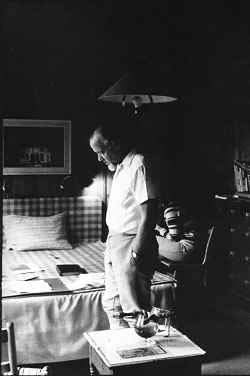
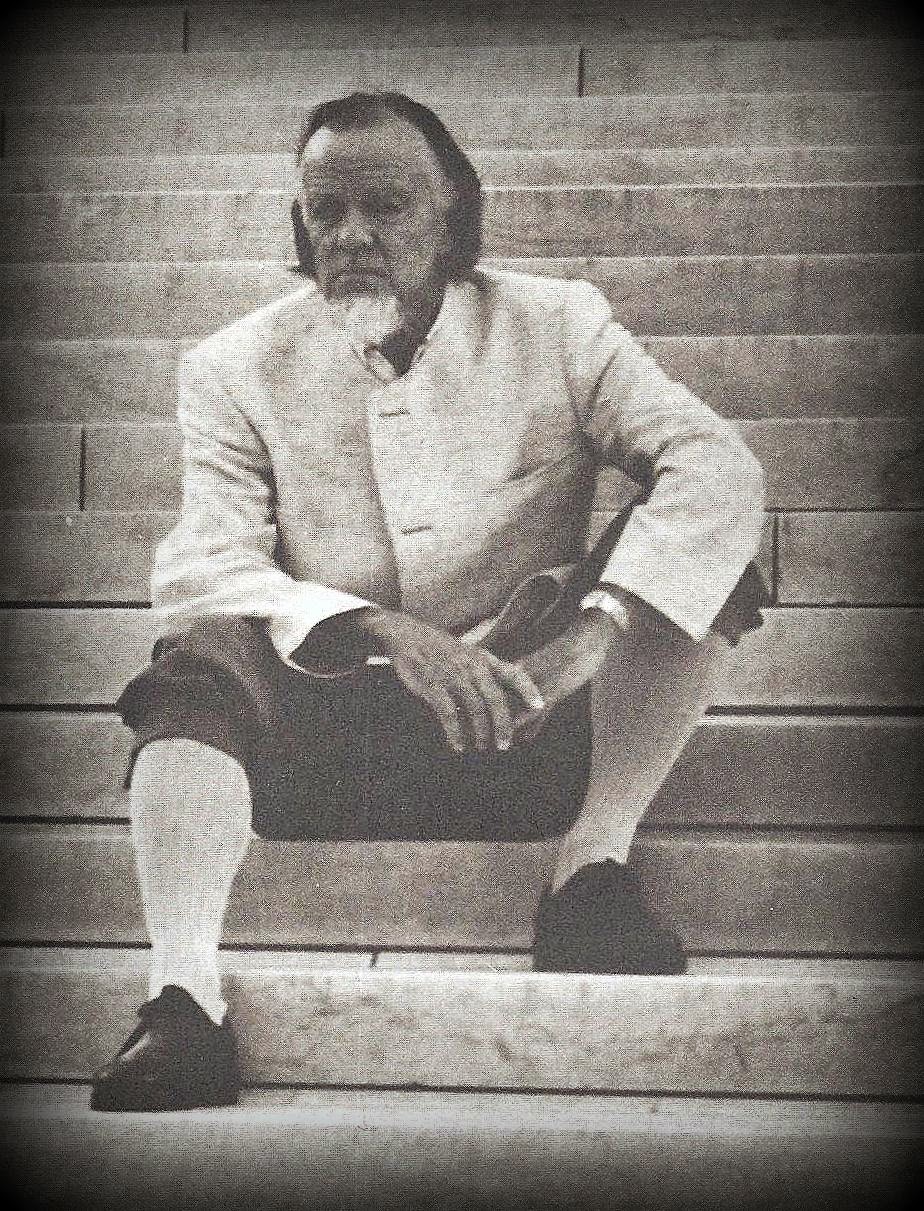
Francis Schaeffer pictured below:
 John Cage at Black Mountain College

_____________

_______

John Cage and Merce Cunningham pictured below:

__________________________________________

__________

__________

When John Cage met Robert Rauschenberg

How the artist’s seemingly simple paintings inspired one of the most challenging compositions of the 20th century

White Painting (seven panel) (1951) by Robert Rauschenberg

Artistic influence tends to travel down the generations, from senior practitioner to novice. Yet, on occasions, it can run the other way, such as when the American painter and sculptor Robert Rauschenberg met the avant-garde composer John Cage.

As author Catherine Craft explains in our Phaidon Focus title dedicated to Rauschenberg, Cage first met the painter and sculptor in May 1951, during the artist’s debut solo exhibition, at the Betty Parsons Gallery in New York. Cage was in his late thirties, and well established within the field of avant-garde music; Rauschenberg, thirteen years his junior, was just starting out.

Nevertheless, it was the spirited innovation of the painter that most closely influenced the composer. In particular, Cage was taken with Rauschenberg’s White Paintings. In our survey of post-war art, Painting Beyond Pollock, author Morgan Falconer describes this seminal series of five, paneled works, which date from 1951, as being “painted on canvas in a smooth, unmodulated white, and structured in a sequence that includes one, two, three, four and seven panels.”


John Cage in his Model A car at Black Mountain College. Photo by Robert Rauschenberg


John Cage in his Model A car at Black Mountain College. Photo by Robert Rauschenberg

In Falconer’s mind, the abstract works should be seen less as works in the high, spiritrual register of Abstract Expressionism, and more as simple communication tools – an idea developed by Josef Albers, Rauschenberg’s tutor at the innovative, interdisciplinary arts institution, the Black Mountain College, where Rauschenberg studied 1948 – 49.

Whatever the influence, it was on returning to Black Mountain College in the spring and summer of 1952, that Cage and Rauschenberg’s creative relationship, which developed around these White Paintings, truly flourished. The remote college already had a reputation for artistic freedom and the breaking down of boundaries, having had Albert Einstein serve on its board of directors, and Buckminster Fuller teach classes.


Robert Rauscenberg, self portrait of the artist with his work


Robert Rauscenberg, self portrait of the artist with his work

In Black Mountain’s liberal campus during the balmier months of 1952, Cage looked to Rauschenberg’s canvases to inform his ideas about how art should engage with the intrusions of the natural world. As Craft explains, “Cage was astonished by the White Paintings, which showed him how artists could work with, rather than against, the ever-changing nature of their surroundings.”


The score for John Cage's 4'33


The score for John Cage’s 4’33

Falconer picks up the point in his book, where he writes: “Cage used the White Paintings as a backdrop for one of his concerts Theater Piece #1 (1952), and he later said that they were an important inspiration for his most famous composition, 4’33” (1952), an entirely silent piece in which the sound comes not from the pianist, but principally from the ambient noise of the concert auditorium.”

This idea of an artwork as a kind of backdrop for the world, was something Cage first recognized in Rauschenberg’s paintings.

“Cage viewed the White Paintings less as images that projected the artist’s expression, than backdrops against which the flux of the world might stand out, an understanding that he arrived at through his appreciation of Henri Bergson and Zen Buddhism. ‘The White Paintings were airports for the lights, shadows, and [dust] particles,’ Cage said. Rauschenberg would never immerse himself in these ideas with the same enthusiasm as his mentor, but Cage was important in shaping his outlook in these early years.”

Indeed, Falconer suggests that one of Rauschenberg’s best-known forms, his ‘combines’ – or hybrids of painting, sculpture and college, were first developed for Cage, in response to a prop request to accompanying the performance of the composer’s 1954 work, Minutiae.


Canyon (1959) by Robert Rauschenberg, one of the artist's famous combines


Canyon (1959) by Robert Rauschenberg, one of the artist’s famous combines

Even if this debt can’t be firmly established, the pair certainly collaborated on another notable, fine art work. In Automobile Tire Print (1953), Rauschenberg got Cage to drive a car, its tyre covered in black house paint, over sheets of paper Rauschenberg had glued together.

Rauschenberg said that Cage was the only driver in Manhattan willing to collaborate on such an unusual scheme. Perhaps this is a suitably flip comment to accompany so brisk a work. When asked if the work is a little like a musical stave, the artist demurred, preferring to compare it to a Tibetan prayer scroll. Yet, Cage drove over Rauschenberg’s scroll in the very same Model A Ford that he had carried him to Black Mountain College in a few years earlier; and doesn’t this single track bring to mind a little something of Cage’s featureless score for 4’33” – the silent work that’s never quite rid of the world’s noise?


Automobile Tire Print (1953) by Robert Rauschenberg


Automobile Tire Print (1953) by Robert Rauschenberg

For more on Rauschenberg’s work, consider our Phaidon Focus monograph; meanwhile for more on how his and Cage’s relationship helped influence the development of painting in the 20th Century, buy a copy of our overview, Painting Beyond Pollock.

POETRY NEWS

Cabinet Posts Audio From Launch of Eva Díaz’sThe Experimenters: Chance and Design at Black Mountain College

BY HARRIET STAFFFuller_dome_web

Lucky us: Thanks to Cabinet Magazine, if you missed the launch for The Experimenters: Chance and Design at Black Mountain College(University of Chicago Press 2015), art historian Eva Díaz’s new book onBlack Mountain College, a terrific audio recording of the event is now up on their site. The recording includes a performance by musician Nick Hallett, a reading by poet Jeremy Sigler, and a conversation between Díaz and art historian Judith Rodenbeck about the book.

Listen up here.

More on the book from the press:

Díaz’s focus is on experimentation. [Josef] Albers, [John] Cage, and [Buckminster] Fuller, she shows, taught new models of art making that favored testing procedures rather than personal expression. These methodologies represented incipient directions for postwar art practice, elements of which would be sampled, and often wholly adopted, by Black Mountain students and subsequent practitioners. The resulting works, which interrelate art and life in a way that imbues these projects with crucial relevance, not only reconfigured the relationships among chance, order, and design—they helped redefine what artistic practice was, and could be, for future generations.

At top: Kenneth Snelson, R. Buckminster Fuller’s Dome, Demonstration of Strength, Black Mountain College, 1949. More on the event, which took place on February 12, at Cabinet.

Tags: , , , ,
Posted in Poetry News on Friday, February 20th, 2015 by Harriet Staff.

Chance Conversations: An Interview with Merce Cunningham and John Cage

Uploaded on Jul 27, 2009

In the spring of 1981, during a residency at the Walker Art Center in Minneapolis, Minnesota, choreographer Merce Cunningham and composer John Cage sat down to discuss their work and artistic process. As frequent collaborators, Cage and Cunningham pioneered a new framework of performance. Their novel approach allowed for mediums to exist independently, or rather cohabitate, within a performance, thus abandoning the co-dependent model of dance and music. Cage and Cunningham go on to discuss the methodology and motivations behind chance operations, a term used to describe artistic decisions based on unpredictability. Wanting to free himself of his likes and dislikes, Cage describes how Zen Buddhism influenced his work, leading him to use tools of chance. These new methods, adopted by both Cunningham and Cage, overturned a whole foundation of thought around music, movement, and the process of creating art.

What is John Cage trying to demonstrate with his music? Here are comments from two bloggers that take a look at what Cage is trying to put forth.

____________________________

DESCRIBING THE STORM
CHAPTER FOUR
If there is no God, there can be no meaning for man except that which he creates for himself. Modern music
has expressed this concept in a most powerful way. One might well say that the history of modern music is the
story of man’s failure to attain to anything solid or permanent as he has sought to create his own meaning. We
look, then, at Modern Music…At this point we will quote from a European writer. He
is discussing the work of a well-known symphonic composer, Mr. John Cage. Here it will become clear that the
new framework of thinking does indeed explain some of the strange “happenings” in great concert halls of the
world.
The power of art to communicate ideas and emotions to organize life into meaningful patterns, and to
realize universal truths through the self-expressed individuality of the artist are only three of the
assumptions that Cage challenges. In place of a self-expressive art created by the imagination, tastes,
and desires of the artist, Cage proposes an art, born of chance and indeterminacy.
Back in the Chinese culture long ago the Chinese had worked out a system of tossing coins or yarrow
sticks by means of which the spirits would speak. The complicated method which they developed made
sure that the person doing the tossing would not allow his own personality to intervene. Self expression
was eliminated so that the spirits could speak.
Cage picks up this same system and uses it. He too seeks to get rid of any individual expression in his
music. But there is a very great difference. As far as Cage is concerned there is nobody there to speak.
There is only an impersonal universe speaking through blind chance.
Cage began to compose his music through the tossing of coins. It is said that for some of his pieces lasting
only twenty minutes he has tossed the coin thousands of times. This is pure chance, but apparently not pure enough, he wanted still more chance. So he devised a mechanical conductor. It was a machine working on cams, the motion of which cannot be determined ahead of time, and the musicians just followed this. Or, as an alternative to this, sometimes he employed two conductors who could not see each

other, both conducting simultaneously; anything, in fact, to produce pure chance. But in Cage’s universe
nothing comes through in the music except noise and confusion or total silence.
There is a story that once, after the musicians had played Cage’s total chance music, as he was bowing
to acknowledge the applause, there was a noise behind him. He thought it sounded like steam escaping
from somewhere, but then to his dismay realized it was the musicians behind him who were hissing.
Often his works have been booed. However, when the audience members boo at him they are, if they are
modern men, in reality booing the logical conclusion of their own position as it strikes their ears in music.
We might add that one of the “compositions” of John Cage is called “Silence.” It consists of precisely that: four
and a half minutes of total silence! One could almost laugh, if it were not so sad—and serious. But it is. When
man rejects God, and God’s word revelation to man, he ends up here—doomed to silence. For what can man say
(musically, or in any other way) in a universe that has no meaning? When man refuses to think—and speak —
God’s thoughts after Him, he is consigned to this predicament.

_____________

John Cage at Black Mountain College pictured on right.

______________________

NOWHERE ELSE TO TURN

CHANCE VERSUS DESIGN

In The God Who Is There, Francis Schaeffer refers to the American composer John Cage who believes that the universe is impersonal by nature and that it originated only through pure chance.  In an attempt to live consistently with this personal philosophy, Cage composes all of his music by various chance agencies.  He uses, among other things, the tossing of coins and the rolling of dice to make sure that no personal element enters into the final product.  The result is music that has no form, no structure and, for the most part, no appeal.  Though Cage’s professional life accurately reflects his belief in a universe that has no order, his personal life does not, for his favorite pastime is mycology, the collecting of mushrooms, and because of the potentially lethal results of picking a wrong mushroom, he cannot approach it on a purely by-chance basis.  Concerning that, he states: “I became aware that if I approached mushrooms in the spirit of my chance operations, I would die shortly.”  John Cage “believes” one thing, but practices another.  In doing so, he is an example of the person described in Romans 1:18 who “suppresses the truth of God,” for when faced with the certainty of order in the universe, he still clings to his theory of randomness.

______________

How Should We then Live Episode 7 small (Age of Nonreason)

#02 How Should We Then Live? (Promo Clip) Dr. Francis Schaeffer

10 Worldview and Truth

Two Minute Warning: How Then Should We Live?: Francis Schaeffer at 100

Francis Schaeffer “BASIS FOR HUMAN DIGNITY” Whatever…HTTHR

JOHN CAGE AT BLACK MOUNTAIN BY MARY EMMA HARRIS

A Preliminary Thinking
Mary Emma Harris

The occasion of the 2011 ReVIEWING BMC 3 conference sponsored by the Black Mountain College Museum + Arts Center and the University of North Carolina at Asheville was an opportunity for a first-thinking specifically about John Cage and Black Mountain College. This initial effort is to bring together basic information: when was he there, what did he accomplish while there, and the nature of his influence on the college and vice versa.

The extensive Black Mountain collections of  the North Carolina Department of Cultural Resources, North Carolina State Archives, Western Regional Branch at Oteen, North Carolina are referenced as NCSA and the title of the individual collection. 


At Black Mountain College in the summer of 1948, there was a rare coming together of kindred spirits in an environment receptive to interaction, experimentation, and a lively, imaginative exchange of ideas. The associations formed that summer were to be the catalyst for an expanding community of artists whose lives were inextricably interwoven through personal relationships, shared ideals and interests, and collaborations. The summer was to alter not only the artists’ lives but also the course of the arts in the United States in the Twentieth Century and beyond. This community of artists was not so much a circle as it was a magnetic field of forces within which there were many interlocking centers of energy. There were interactions, conflicts, connections, disconnections, attractions and repulsions.

Albers1

Josef Albers critiquing student work. Left to right: Frances Kuntz,
Hope Stephens (Foote), Lisa Jalowetz (Aronson), Bela Martin, Elizabeth Brett (Hamlin).
Courtesy NCSA, Black Mountain College Papers.

To understand the dynamics of the Black Mountain community in the summer of 1948, one must look back to the college’s founding ideals and the evolution of the community over time. The college founders knew from the beginning that the arts would be at the center of college life and the curriculum. They could not, however, have imagined when they brought Josef and Anni Albers from Germany in November 1933 that this single action would alter the history and influence of the college. A dynamic fusion of American Progressivism, as represented by the founders, and European Modernism, as represented by the refugee artists, was to be the catalyst for the evolution of a unique community. From American Progressivism, there was a sense of pioneering and naiveté, respect for manual work, and the integration of living and learning through community; from European Modernism, experimentation in the arts and a dynamic relationship to the past as it informs the present. In addition, the Alberses, along with the other refugee teachers, reinforced the founders’ idea that the practice of the arts should be central to the learning process. They brought an acceptance of the arts as an integral and necessary part of a culture, a respect for disciplined study, and a high professional standard. Their presence was a corrective to the emphasis on self-expression as an end in itself which so often characterized the Progressive Education movement.

The Black Mountain community as it evolved integrated studies with work on the farm and grounds maintenance, concerts and drama performances, parties, hikes in the mountains and other activities. The college was owned and administered by the faculty, and students and faculty served on the many committees that ran the college. Energies that might otherwise have been dispersed had the college been close to a major cultural center were concentrated and focused inward. Through the special summer sessions in the arts, the first of which was held in 1944, the college became known as a community-based learning environment receptive to exploration of new ideas and art forms.

John Cage and Merce Cunningham first visited Black Mountain in the spring of 1948. At the time there were eighty-six students. The G.I.s, who were older and more mature, were less willing to submit to authority than the younger students and eager to get on with their education. Their presence had re-energized the college. Josef Albers had returned reluctantly to teach and organize the summer session after a year-and- a-half’s sabbatical during which he had been able to concentrate on his painting. Ilya Bolotowsky, who had taught when Albers was away, remained for the 1948 spring term. Music was taught by two European refugees, Charlotte Schlesinger, composer and pianist, and Erwin Bodky, harpsichordist and clavichordist. Arthur Penn was student-teacher in drama. M.C. Richards taught reading and writing. There were workshops in printing, woodworking, weaving and bookbinding as well as classes in history, Latin, German, French, Russian, economics, business, social sciences, mathematics, chemistry, physics and farming.

In 1948, John Cage was experiencing a period of critical acceptance, if not one of financial success. On the West Coast he had been able to make a living composing music for dance using both conventional instruments and ones of his own devising. In the spring of 1942, he moved to New York. There his immersion into Eastern music and philosophies had led him to texts such as those of Ananda K. Coomaraswamy and the lectures of Dr. D.T. Suzuki at Columbia University. In Virgil Thomson he had found a sympathetic critic for performances of his music. His composition The Seasons, commissioned by Lincoln Kirstein and performed at the Ziegfield Theatre in New York on May 23, 1947, had been well-received as had a 1946 performance by Maro Ajemian of sections of his incomplete Sonatas and Interludes for prepared piano. Cage’s marriage had ended, and he and Merce Cunningham had formed their life-long partnership. In 1946 he had moved into an apartment at 326 Monroe Street which was to house other colleagues including members of the expanding Black Mountain community.

In the spring of 1948, Cunningham’s situation was more tenuous than that of Cage. After six years as a soloist with the Martha Graham Dance Company, he had left to focus on his own choreography and independent dance. He had worked with different dancers including Katherine Litz and Jean Erdman and had begun to explore unconventional concepts. A review of the April 1948 visit noted that Cunningham and Cage worked together yet separately, having determined that dance and the rhythm of accompanying music are not interdependent.[i] 

 Albers2

Josef Albers, Merce Cunningham and John Cage at a community reception, April 1948. Felix Krowinski, photographer. © Black Mountain College Project.

In April 1948, Black Mountain College was the first stop on a two-person tour. Cunningham danced and gave classes; Cage gave the first complete performance of his Sonatas and Interludes for prepared piano. As he prepared the piano in the dining hall, students and faculty stopped to watch the process and discuss what he was doing.  After the performance, everyone gathered in the community house for coffee and questions with the artists.  The review concluded: “The current of creative energy since their visit has illuminated the college both in creation and response.”[ii]

Att 1 BMC Bulletin, May 1948

In lieu of an honorarium which the college could not afford, faculty and students, enchanted by their performances and by their persona, filled their car with gifts of food and art work. From Chicago Cage wrote to Josef and Anni Albers:

“You were so friendly and Black Mountain was so good to be at, and the last minute gestures and gifts brought us a kind of ecstasy (the heads among the eggs were discovered near the summit of the Smokies where the mists made everything gently awe-inspiring. – you were as generous as they)….

“[F]or the most part this trip seems tending always toward what is beautiful and meaningful, and I can only say that we feel we were profoundly lucky to spend some days with you…. Being in New York without leaving it for so long had made me believe that only within each one of us singly can what we require come about, but now at Black Mountain and again with the Trappists I see that people can work still together. We have only ‘to imitate nature in her manner of operation’….

“We love the gifts you gave us, but especially loved being with you….’”[iii]

Cage and Cunningham were invited back for the summer session.

The now-legendary 1948 summer session organized by Josef Albers was the result of both careful planning and fortuitous circumstance. Cage and Cunningham arrived as planned. Their friend Richard Lippold, not wanting to be left out, volunteered to live with his family in their hearse, if only he could be there. The college found housing and offered an appointment as sculptor-in-residence. Peter Grippe was the official sculpture teacher. Mark Tobey, possibly recommended to Albers by Cage, cancelled at the last minute as did architect Bertrand Goldberg. Willem de Kooning, discouraged by his first one-person show at Egan Gallery at which nothing sold, agreed to replace Tobey. Goldberg recommended Buckminster Fuller. Other summer faculty and lecturers included Beatrice Pitney Lamb, Isaac Rosenfeld, Beaumont Newhall, Winslow Ames, and Edgar Kaufmann, Jr. Students included Hazel Larsen Archer, Ruth Asawa, Lili Blumenau, Etta Mandelbaum (Deikman), Gustave Falk, James Leo Herlihy, Warren Jennerjahn, Elizabeth Schmitt Jennerjahn, Ray Johnson, Albert Lanier, Lore Kadden (Lindenfeld), Harry Noland, Kenneth Noland, Mary Phelan Outten, Warren Outten, Pat Passlof, Arthur Penn, Oli Sihvonen, Sewell Sillman, Kenneth Snelson, Paul Williams, and Vera Baker Williams.

Elaine de Kooning recalled Willem de Kooning’s first reaction on entering the rustic unkempt grounds: “‘I feel like turning around and going home’.” Reassured by Albers’ warm welcome: “Ach so, the de Koonings,” they remained. “The school activities engulfed us like a warm breeze.” [iv] Guest faculty were not told what or how to teach. For some the freedom was disconcerting; others saw it as an opportunity to undertake projects which in a different setting would have required scrutiny by sponsors, advance publicity and extensive funding. They taught their current passion, projects on which they were working at that time. Thus, the students had the benefit of the excitement and uncertainty that comes with new learning.

Fuller

Buckminster Fuller and students.
Supine Dome with model in foreground. Summer 1948.
Beaumont Newhall, photographer. Courtesy Scheinbaum & Russek Ltd.

Buckminster Fuller, described by Kenneth Snelson as “a summer substitute for a legitimate architect,”[v] arrived a couple of weeks after the session started with his trailer of intriguing models. He captivated and confounded the audience with his first very long lecture. Snelson recalled that he was “absolutely hypnotized and electrified”,[vi] and Lippold that it was “like meeting Zoroaster speaking Islamic.”[vii] Fuller’s project for the summer was to construct his first geodesic dome of Venetian blind strips, christened in good humor the “Supine Dome” when it failed to rise.

CageJohn Cage playing for the Satie Festival. Clemens Kalischer, photographer. Courtesy Kalischer.

RuseofMedusaErik Satie’s Ruse of Medusa (Le piège de Mĕduse) with Buckminster Fuller as the Baron Meduse, William Shrauger as Astolfo, Elaine de Kooning as Frisette and Merce Cunningham as Jonas, a costly Mechanical Monkey. Clemens Kalischer, photographer. Courtesy Kalischer.

Cage conducted an Amateur Festival of the Music of Erik Satie. He gave twenty-five half-hour after-dinner concerts performed at times on the grand piano in the dining hall and at times on the upright in his house while the audience sat outside in the grass. The culmination was a performance of Satie’s Ruse of Medusa (Le piège de Mĕduse).

Att 2 RUSE OF MEDUSA  PROGRAM

The Satie concerts might have been experienced simply as a delightful after-dinner entertainment had Cage not stated in his lecture “Defense of Satie” “immediately and unequivocally [that] Beethoven was in error [in his definition of harmony as the basic structural element of music composition], and his influence, which has been as extensive as it is lamentable, has been deadening to the art of music.”[viii] He offered as remedy Webern and Satie’s perception of time lengths as the basic structural component. Erwin Bodky, who was concurrent with the Satie Festival sponsoring a series of concerts of the music of Beethoven, took exception, and soon the entire community was lined up on one side or the other. The crisis was finally resolved by a duel with one side armed with Wiener schnitzel and the other with crêpe suzette (certainly only semblances thereof).

Cage played the piano for a dance concert by Merce Cunningham, Louise Lippold and Sara Hamill on August 20. Three of the pieces by Cage were composed that summer: In a Landscape, choreographed and danced by Louise Lippold; Suite for Toy Piano with a dance A Diversion choreographed and danced by Cunningham, Sara Hamill and Louise Lippold; and Orestes with choreography by Merce Cunningham. Dream, composed in New York, was choreographed and performed by Cunningham. Also included in the concert wereTotem Ancestor (1942) and Root of an Unfocus (1944).[ix]

Att 3 CUNNINGHAM DANCE PROGRAM (371)

For Cage the friendships forged in the summer of 1948 were to be the fulcrum of a community of artists who were to be critical to his career. Between Fuller and Cage, both “inventors of genius,”[x] an immediate bond was forged, one that was not dependent on physical presence or collaboration. It was enough for each to know that the other was out there somewhere. Ray Johnson and Richard Lippold fell in love, and both moved into the Monroe Street building.

TudorRichards

David Tudor and M.C. Richards at Black Mountain College.
Mary Ann Fretz Giusti, photographer.

Although it has been suggested that the three-year interval between 1948 and Cage’s return to the college in the summer of 1952 was a consequence of lingering hostility over the Beethoven-Satie controversy, there was, in fact, a close relationship between Cage and Black Mountain during this period. At the end of the summer, Albers wrote to Cage, “How can we thank you appropriately for all you did for us this summer? Therefore I say only, God Bless you.”[xi] Bodky resigned at the end of the 1949 summer session. In 1950 Cage dedicated his Six Melodies for Violin and Keyboard to Josef and Anni Albers. On August 12, 1950 Cage’sString Quartet in Four Parts received its first performance by the Summer Session String Quartet led by Vollmer Hetherington, who replaced Bodky on the faculty. On August 18, 1951, David Tudor performed Cage’s Music of Changes, Part 1.

Att 4 TUDOR PROGAM 18 AUGUST (905)

On the recommendation of Cunningham, Katherine Litz taught dance, and Cage recommended the composer Lou Harrison. After M.C. Richards left in 1951 to live with David Tudor in New York, she returned for summer sessions and retained close contact with both the college and Charles Olson, the commanding personality there after his return in the summer of 1951.

Cage’s three-year absence from Black Mountain was undoubtedly a consequence of other obligations and activities. His Sonatas and Interludes had its New York premiere in 1949. It resulted in a Guggenheim Fellowship for Cage and a trip to Europe where he completed his collection of Satie scores. In New York he had formed a friendship with Morton Feldman and had discovered the I Chingwhich led to his use of chance operations as a method of composition. Whereas in 1948 Cage was enjoying a period of critical acceptance, by 1952 when he returned to Black Mountain for a second summer, he was receiving scathing reviews and had been abandoned by many of his peers.

After the 1948 summer there were essentially two parallel Black Mountains, the North Carolina community whose members often spent their long winter break in New York and those who lived in New York and who were at the college for shorter teaching assignments or as visitors. Many had never been at Black Mountain at the same time. They met at parties, events such as concerts and exhibition openings, at The Club, and in passing on the street. Between 1948 and Cage’s return in 1952, his Black Mountain community had expanded to include other Black Mountain students: lighting director Nick Cernovich, psychologist and artist Irwin Kremin, and artists Robert Rauschenberg and Susan Weil, who had enrolled at Black Mountain in the fall of 1948. Although it often is assumed that Rauschenberg and Cage met at Black Mountain, it was probably on the 1948-49 winter break in New York that they first met.

Cage returned to Black Mountain for the 1952 summer session. Guest faculty included Franz Kline and Jack Tworkov in art, Cunningham in dance, and, of course, Cage in music. Sewell ‘Si’ Sillman, a former Albers student, returned to teach color. Drawing was taught by Charles Oscar, Katherine Litz’s husband. Karen Karnes and David Weinrib taught ceramics.  Lou Harrison, who had received a Guggenheim fellowship to work on his opera Rapunzel,was resident composer, and Stefan Wolpe, who was to replace Harrison in the fall, taught music. David Tudor gave concerts.

Cage’s proposed curriculum was to have students work on hisWilliams Mix, a composition of electronic music for which former Black Mountain student Paul Williams had provided funding. The composition required the tedious cutting and splicing of tape according to a score created by Cage from chance operations. The students were not interested, and Cage subsequently recalled that the most significant teaching at Black Mountain took place in the animated and extended conversations in the dining hall.

diningandauditorium

College dining hall and auditorium.
NCSA, Black Mountain College Papers.

Despite his lack of students, for Cage the summer was significant. Robert Rauschenberg had returned in the summer of 1951 with Cy Twombly and remained through the 1952 summer.  His all-white paintings which Cage first viewed that summer were inspiration for his reputation-breaking silent piece 4’33” which is dedicated to Black Mountain student Irwin Kremin and which was first performed by David Tudor on August 29, 1952 at the Maverick Concert Hall in Woodstock. New York. In addition, one of Cage’sHaiku was published by Lou Harrison’s Black Mountain College Music Press on September 1, 1952.[xii]

Att 5 JOHN CAGE HAIKU

On August 9, David Tudor performed Cage’s Music of Changes, and on August 12, his Two Pastorales and Water Music (August 12, 1952). A small program printed on tissue paper and glued to a program for the August 9 performance announces a second Black Mountain performance of the Sonatas and Interludes.

Att 6 1952 AUGUST 9 11 TUDORAtt 7 TUDOR PROGRAM 12 AUG 1952) (908)
Att 8 1952 AUGUST 16 SONATAS AND INTERLUDES

In August Cage staged Theater Piece #1 (Black Mountain Piece), which subsequently came to be known as the first “happening.” Undoubtedly the Light Sound Movement Workshop taught by Warren ‘Pete’ Jennerjahn from 1949-51, theater performances directed by Wesley Huss, and Charles Olson’s interest in ritual as an alternative to conventional theater had created an environment receptive to Cage’s ideas. Another influence was Antonin Artaud’sThe Theatre and Its Double (Grove Press, 1958) which M.C. Richards was translating in New York and reading to the community as she worked. Cage recalled that it was from Artaud that he determined that action and text need not be interdependent. The seats were placed in four triangles with wide aisles between. Cage noted that, unlike the theater-in-the-round where action takes place only in the center, in the “happening” action occurred in the center, the aisles and around the audience.[xiii] The “script” for the performance assigned time slots determined by chance operations to different participants including Cage, Cunningham, M.C. Richards, Charles Olson, Robert Rauschenberg, and David Tudor. As has been noted in numerous sources, memories vary according to just who did what and where it occurred. This disparity in accounts is a reflection both of the fact that each person had a different view of the event and of an assumed-insignificance of the performance at that time.

Cunningham taught both at Black Mountain and at the Burnsville School of Fine Arts, a project of The Woman’s College of the University of North Carolina (University of North Carolina at Greensboro) in nearby Burnsville, North Carolina. Among his Black Mountain students that summer were Viola Farber, who was to become a principal dancer with the Merce Cunningham Dance Company; Timothy LaFarge, who danced briefly with the company; and Harvey Lichtenstein. As executive director of the Brooklyn Academy of Music from 1967-99, Lichtenstein invited emerging and experimental artists including Cage and Cunningham for performances. At Burnsville, Cunningham choreographed a performance of Brigadoon and performed the role of Harry Beaton. The musical was performed at The Parkway Playhouse on August 15-16,18-19. Cage was listed as faculty in publications, but it is not clear whether or what he taught. On July 28 he performed hisSonatas and Interludes there.

The 1953 summer was the last big summer program at Black Mountain.  Cage visited although he did not teach. The focus for the summer was on ceramics with Peter Voulkos, Warren Mackenzie and Daniel Rhodes as teachers. Painting was taught by Esteban Vicente. Stefan Wolpe organized a series of concerts with Irma Wolpe, Josef Marx, Seymour Barab, Rudolph Benetsky, and Abraham Miskind. Merce Cunningham returned for a third summer with a group of dancers with whom he had been working in New York. He designates that summer of intense choreography, rehearsal and performance as the founding of the Merce Cunningham Dance Company. Tudor performed Cages’s Music for Piano 4-19 (May 1953) in July at the “Waterfront Auditorium.”

In the fall, faced with a diminishing faculty, student body and income, the college abandoned the lower campus including the Studies Building, the dining hall, and the dormitories and moved into faculty cottages. In New York the Monroe Street “Bozza Mansion” which had provided Cage and friends and collaborators with cheap rent in the company of friends and peers was being demolished.  He along with other Black Mountain students and faculty needed inexpensive housing and craved the sense of community they had experienced both at Black Mountain and in the Monroe Street building.  Paul Williams, who had received an inheritance from his father, and his wife Vera Baker Williams suggested they form a Black-Mountain-like community within commuting distance of New York City in a natural environment similar to that of the college. The Gatehill Cooperative Community — “The Land” — was formed in 1954 with John Cage, David Tudor, M.C. Richards, David Weinrib, Karen Karnes, Vera Baker Wiliams and Paul Williams as founding members. Musician Patsy Lynch Wood, who was married to LaNoue Davenport, and Betsy Weinrib Williams, Paul Williams second wife and David Weinrib’s sister, were part of the community. Stanley VanDerBeek had a dome studio there.

Vanderbeek

Stan Vanderbeek studio at The Land.
Mary Emma Harris, photographer.

Cage’s influence on Black Mountain was significant. It was his recommendation of Lou Harrison in 1952 that assured a role for the most vanguard music at the college. On his visits David Tudor performed music by Arnold Schoenberg, Morton Feldman, Stefan Wolpe, Anton Webern, Henry Cowell, Pierre Boulez, Christian Wolff, Lou Harrison, and, of course, John Cage. Although Cage had few students, his comment that the most important teaching took place in the dining hall captures the essential Black Mountain. One can only imagine the lively and challenging exchange of ideas and the undocumented impact of these conversations on the work of the participants.

The influence of Black Mountain College on John Cage was profound. At the college he came into contact with individuals who were to be his physical, intellectual and spiritual community for the remainder of his life.  Some were to be close friends and collaborators; with others he was to have more peripheral associations. The Land, where he lived from 1954 until he moved back into New York City, provided him with an extended family celebrating holidays, birthdays and other occasions. At a point in his career when he became increasing alienated from his peers, this community of kindred spirits was a critical support. Black Mountain College was for Cage and others a touchstone, a shared bond, and an instant act of recognition and inclusion.


[i] Black Mountain College Bulletin, Vol. 6, No. 4 (May 1948).

[ii] Ibid.

[iii] John Cage to Josef and Anni Albers, Spring 1948. Courtesy of the Josef & Anni Albers Foundation, Bethany, Connecticut and the John Cage Trust. Cage and Cunningham visited a Trappist monastery, probably The Abbey of Gethsemani near Bardston, Kentucky, after leaving Black Mountain.

[iv] Elaine de Kooning, “De Kooning Memories: Starting Out in the 1940s, a Personal Account,” Vogue, No. 3921 (December 1983):352,394.

[v] Snelson interview by Mary Emma Harris, 25 May 1972, NCSA, Black Mountain College Research Project Papers.

[vi] Ibid.

[vii] Richard Lippold interview by Mary Emma Harris, NCSA, Black Mountain College Research Project Papers.

[viii] John Cage, “Defense of Satie,” in John Cage, ed. Richard Kostelanetz (New York: Praeger, 1970):81.

[ix] The website www.johncageinfo.com (which no longer is online (2013)) noted that the score for Experiences II has a mention of Black Mountain. There is no known record of its having been performed there.

[x] “Inventor of genius” was the phrase used by Arnold Schoenberg to describe Cage’s musical gifts.

[xi] Josef Albers to John Cage, 7 September 1948, NCSA, Black Mountain College Papers.

[xii] The text for the Haiku reads “Autography by the composer. Editor, Lou Harrison. Designer and / printer, Carroll Williams. Printed with Bauer Futura types / and a zink [sic] line cut on Omi-V for the envelopes and Kochi / for the mnsic [sic] at the Black Mountain College Music Press,  Black / Mountain College, Black Mountain, North Carolina, in the / first edition of three-hundred on the first of September, 1952.”

____________

Related posts:

FRANCIS SCHAEFFER ANALYZES ART AND CULTURE Part 55 THE BEATLES (Part G, The Beatles and Rebellion) (Feature on artist Wallace Berman )

FRANCIS SCHAEFFER ANALYZES ART AND CULTURE Part 54 THE BEATLES (Part F, Sgt Pepper’s & Eastern Religion) (Feature on artist Richard Lindner )

FRANCIS SCHAEFFER ANALYZES ART AND CULTURE Part 53 THE BEATLES (Part E, Stg. Pepper’s and John Lennon’s search in 1967 for truth was through drugs, money, laughter, etc & similar to King Solomon’s, LOTS OF PICTURES OF JOHN AND CYNTHIA) (Feature on artist Yoko Ono)

FRANCIS SCHAEFFER ANALYZES ART AND CULTURE Part 52 THE BEATLES (Part D, There is evidence that the Beatles may have been exposed to Francis Schaeffer!!!) (Feature on artist Anna Margaret Rose Freeman )

FRANCIS SCHAEFFER ANALYZES ART AND CULTURE Part 51 THE BEATLES (Part C, List of those on cover of Stg.Pepper’s ) (Feature on artist Raqib Shaw )

FRANCIS SCHAEFFER ANALYZES ART AND CULTURE Part 50 THE BEATLES (Part B, The Psychedelic Music of the Beatles) (Feature on artist Peter Blake )

FRANCIS SCHAEFFER ANALYZES ART AND CULTURE Part 49 THE BEATLES (Part A, The Meaning of Stg. Pepper’s Cover) (Feature on artist Mika Tajima)

FRANCIS SCHAEFFER ANALYZES ART AND CULTURE PART 48 “BLOW UP” by Michelangelo Antonioni makes Philosophic Statement (Feature on artist Nancy Holt)

FRANCIS SCHAEFFER ANALYZES ART AND CULTURE Part 47 Woody Allen and Professor Levy and the death of “Optimistic Humanism” from the movie CRIMES AND MISDEMEANORS Plus Charles Darwin’s comments too!!! (Feature on artist Rodney Graham)

FRANCIS SCHAEFFER ANALYZES ART AND CULTURE PART 46 Friedrich Nietzsche (Featured artist is Thomas Schütte)

RESPONDING TO HARRY KROTO’S BRILLIANT RENOWNED ACADEMICS!! Part 21 (Dr. Lawrence Krauss, theoretical physicist and cosmologist at Arizona State, “…most scientists don’t think enough about God…There’s no evidence that we need any supernatural hand of God”)

RESPONDING TO HARRY KROTO’S BRILLIANT RENOWNED ACADEMICS!! PART 20 (Carolyn Porco, director of CICLOPS, Like Darwin she gave up her Christianity because of Evolution & is obsessed both with the Beatles & the thought that the human race may end!!)

RESPONDING TO HARRY KROTO’S BRILLIANT RENOWNED ACADEMICS!! PART 19 ( Sir John Walker, Nobel Prize Winner in Chemistry, Like Darwin he gave up his Christianity with great difficulty )

RESPONDING TO HARRY KROTO’S BRILLIANT RENOWNED ACADEMICS!! PART 18 (Brian Harrison, Historian, Oxford University, Charles Darwin also wrestled with the issue of Biblical Archaeology and the accuracy of the Bible)

March 24, 2015 – 12:57 am

_____________

WOODY WEDNESDAY Woody Allen’s Irrational Man: let’s take a rational look at the first film still

_

The first picture from Woody Allen’s new movie confirms that Joaquin Phoenix and Emma Stone are its stars. But what do we know about the bigger picture?

Irrational Man film still.
Not saying much … Emma Stone and Joaquin Phoenix in Woody Allen’s Irrational Man. Photograph: PR

Sony Pictures Classics have released the first picture from the new Woody Allen film Irrational Man, and apart from the fact that it confirms that Joaquin Phoenixand Emma Stone are indeed the stars of the film, it seems that Allen isn’t giving much away. (Unless you count the highly visible Lacoste logo on Phoenix’s polo shirt, which may point to top-dollar product placement fees. Or not.)

So what do we know about Irrational Man? We know the principal cast, which includes indie-scene veteran Parker Posey and young Brit actor Jamie Blackley. Less dramatically, we also know that Allen’s sister Letty Aronson is one of the producers; she’s been part of his operation since 1994’s Bullets Over Broadway. An unofficial plot synopsis has been doing the rounds too.

On a small town college campus, a philosophy professor (Joaquin Phoenix) in existential crisis gives his life new purpose when he enters into a relationship with his student (Emma Stone).

The title clearly takes its cue from William Barrett’s Irrational Man: A Study in Existential Philosophy – a primer published in 1958 that no doubt formed part of Allen’s self-taught intellectual life in the late 50s and early 60s. One or two placesare suggesting there’s a murder mystery going on too. Various character names are included on Imdb: Phoenix’s is called Abe; and the same site suggests the US release date is 24 July.

Other than that, we’re feeding on scraps. There’s a rumour that Irrational Man will emerge via an out-of-competition screening at Cannes where, no doubt all the talk will be of the older-man-younger-woman dynamic. If it happens.


______________

Related posts:

WOODY WEDNESDAY Woody Allen’s past movies and the subject of the Meaning of Life examined by Kyle Turner

____ Woody Allen’s past movies and the subject of the Meaning of Life examined!!! Out of the Past: Woody Allen, Nostalgia, the Meaning of Life, and Radio Days Kyle Turner Jul 25, 2014 Film, Twilight Time 1 Comment “I firmly believe, and I don’t say this as a criticism, that life is meaningless.” – Woody […]

WOODY WEDNESDAY Woody Allen Should Have Quoted Pascal: “Magic in the Moonlight” January 7, 2015 by Roger E. Olson 9 Comments

Woody Allen Should Have Quoted Pascal: “Magic in the Moonlight” January 7, 2015 by Roger E. Olson 9 Comments Woody Allen Should Have Quoted Pascal: “Magic in the Moonlight”   I am no Roger Ebert and don’t watch that many movies, but in my opinion, for what it’s worth, Woody Allen’s 2014 film “Magic in […]

WOODY WEDNESDAY My letter to Woody Allen’s Sister!!!!

______________ If anyone has read my blog for any length of time they know that I am the biggest Woody Allen fan of all time. No one except maybe Bergman has attacked the big questions in life as well as Woody Allen. Furthermore, Francis Schaeffer is my favorite Christian Philosopher and he spent a lot […]

Woody Allen to make first TV series for Amazon Prime

  ___________ Woody Allen to make first TV series for Amazon Prime ‘I’m not sure where to begin,’ says 79-year-old Oscar-winner about his small screen debut, as streaming TV service seeks to gain march on rivals with exclusive content Comment: in signing Woody Allen, Amazon Prime has delivered a nuclear blast to the competition Woody […]

Woody Allen: “the whole thing is tragic” July 20, 2012

______________________ Woody Allen: “the whole thing is tragic” July 20, 2012 Mr. Allen, do you truly believe that happiness in life is impossible? This is my perspective and has always been my perspective on life. I have a very grim, pessimistic view of it. I always have since I was a little boy; it hasn’t […]

WOODY WEDNESDAY Dr. Jack Graham Challenges Agnostic Woody Allen’s ‘Hopeless State of Mind’ BY NICOLA MENZIE , CHRISTIAN POST REPORTER August 23, 2013|4:51 pm

______________ Dr. Jack Graham Challenges Agnostic Woody Allen’s ‘Hopeless State of Mind’ BY NICOLA MENZIE , CHRISTIAN POST REPORTER August 23, 2013|4:51 pm Prolific Hollywood filmmaker and religious skeptic Woody Allen maintains in a recent interview that human life on earth is “just an accident” filled with “silly little moments,” and the “best you can […]

WOODY WEDNESDAY Woody Allen Should Have Quoted Pascal: “Magic in the Moonlight” January 7, 2015 by Roger E. Olson 9 Comments

________ Woody Allen Should Have Quoted Pascal: “Magic in the Moonlight” January 7, 2015 by Roger E. Olson 9 Comments Woody Allen Should Have Quoted Pascal: “Magic in the Moonlight”   I am no Roger Ebert and don’t watch that many movies, but in my opinion, for what it’s worth, Woody Allen’s 2014 film “Magic […]

WOODY WEDNESDAY Woody Allen to make first TV series for Amazon Prime

___________ Woody Allen to make first TV series for Amazon Prime ‘I’m not sure where to begin,’ says 79-year-old Oscar-winner about his small screen debut, as streaming TV service seeks to gain march on rivals with exclusive content Comment: in signing Woody Allen, Amazon Prime has delivered a nuclear blast to the competition Woody Allen […]

My letter to Woody Allen’s Sister!!!

If anyone has read my blog for any length of time they know that I am the biggest Woody Allen fan of all time. No one except maybe Bergman has attacked the big questions in life as well as Woody Allen. Furthermore, Francis Schaeffer is my favorite Christian Philosopher and he spent a lot of […]

WOODY WEDNESDAY Woody Allen‘s latest film finally has a release date and a studio. Irrational Man will be distributed by Sony Pictures Classics,

_______ Woody Allen’s New Film Is Called ‘Irrational Man’ Posted on Friday, January 30th, 2015 by Angie Han 85 SHARES TwitterFacebook Woody Allen‘s latest film finally has a release date and a studio. Irrational Man will be distributed by Sony Pictures Classics, as were Allen’s last six films.Emma Stone, Joaquin Phoenix, Parker Posey, and Jamie […]


______________

Woody Allen: The Stand-Up Years 1964-1968 (Part 2)

I love it when I find someone else who has a love for Woody Allen movies like I do. Evidently Paul Semel is person like that. Below is Paul Semel’s fine review: 

Woody Allen Stand Up Comic 1964 1968 01 The Vodka Ad

Woody Allen The Stand-Up Years 1964-1968 Review

Given that he’s been a filmmaker for most of his life, and all of ours, it’s easy to forget that Woody Allen was a stand-up comedian in the ’60s, and a funny one at that. But now we have a vivid reminder of his time on the stage with Woody Allen The Stand-Up Years 1964-1968 (CD, digitial), an augmented version of Standup Comic and The Nightclub Years 1964-1968 that were, in turn, collections of the out-of-print albumsWoody Allen, Woody Allen II, and The Third Woody Allen Album.

Woody Allen The Stand-up Years 1964-1968 01

Presenting three shows from the mid-’60s — Mr. Kelly’s in Chicago in March of 1964; The Shadows in Washington, DC in April of 1965; and Eugene’s in San Francisco in August of 1968 — Woody Allen The Stand-Up Years 1964-1968 corresponds to when Allen was breaking into film, as the first movie based on one of his scripts,What’s New Pussycat?, came out in 1965, while his directorial debut, What’s Up, Tiger Lily?, was made in 1966.

But while his comedy does have some similarities to his early movies, as they have a similar mix of self-deprecation and arrogance, the tone and style of his comedy is actually closer to his mid-’70s movies, when he moved away from just being silly and started to mix the silly with the smart, as typified by 1975’s Love And Death. (In fact, if Allen been less prolific, many of these bits might’ve wound up in one of his movies.) Though they also recall the stories he told in his books Getting Even (which came out in 1971), Without Feathers (1975), and Side Effects (1986), all of which have since been collected in The Complete Prose Of Woody Allen.

As a result, you really need to be a fan of Woody — especially, as Ned Flanders might put it, of that “nervous fella” who’s always in his movies — to really enjoy Woody Allen The Stand-Up Years 1964-1968. If you’re not, or if you just don’t like the character he always plays, then you won’t appreciate his humor here.

But for those who do, Woody Allen The Stand-Up Years 1964-1968 is a goldmine of hilarity. Though while these jokes are between forty-five and fifty years old, they all hold up well, especially since Allen’s humor is largely situational, even when ludicrous, and is largely devoid of topical references.

More importantly, it’s also still unique. Despite the fact that his sense of humor has largely remained unchanged, and has been around and influential for decades, the style of what you hear on Woody Allen The Stand-Up Years 1964-1968 remains largely his and only his. Sure, Woody has influenced a number of people — including fellow stand-up Chris Rock and fellow filmmaker Albert Brooks — but he’s still the only one you’d called “Woody Allen-esque.”

Oh, and for those wondering about the elephant in the room, aside from a few snide remarks about his first ex-wife, Harlene Susan Rosen, there’s nothing on Woody Allen The Stand-Up Years 1964-1968 that takes on a different meaning or feeling in light of what he did, and has been accused of doing, in the years since he recorded this stuff.

Woody Allen

As for those who’ve owned previous versions of these recordings, Woody Allen The Stand-Up Years 1964-1968 has the same sound quality the same as both Standup Comic and The Nightclub Years 1964-1968. Not that it really matters, since all three versions sound good, and, well, it is just some nervous fella talking anyway.

That said, what Woody Allen The Stand-Up Years 1964-1968 does, which Standup Comic did not, is present the three shows in chronological order, and as they happened; on Comic, stories from the different shows were all mixed together for some inexplicable reason.

Even cooler, Woody Allen The Stand-Up Years 1964-1968 adds a previously unheard, nearly six-minute-long bit from the Eugene’s show, in which he takes questions from the audience. Though, funny as it may be — and it is quite funny — it did make me wish they had found even more in the vaults.

Woody Allen The Stand-Up Years 1964-1968 also includes audio excerpts from the movie Woody Allen: A Documentary, ones that come from the parts where he talked about his stand-up career. But while these moments are interesting and illuminating — well, if you haven’t seen the documentary, that is — they kind of don’t really work on this album, if only because they’re something you’d want to hear once, but only once, while the rest of this collection is worth repeating.

Though the fact that you’ll want to listen to the rest of it multiple times just makes it even more annoying that the CD edition of Woody Allen The Stand-Up Years 1964-1968 comes in a cheap cardboard case, and not a sturdier plastic one for safe keeping. Though I could say the same about almost every new CD I’ve gotten in the last three years.

Regardless of how you feel about the way CDs are packaged these days, though, if you own either The Nightclub Years 1964-1968 or Standup Comic, Woody Allen The Stand-Up Years 1964-1968 is really only worth the upgrade if you think hearing him humorously answer questions for 5:41 is worth it. Or you own original copies ofWoody Allen, Woody Allen II, and The Third Woody Allen Album and don’t want to risk scratching them.

Woody Allen The Stand-up Years 1964-1968 cover copy

But for fans of Woody’s movies (especially his funny ones) who’ve never owned any versions of these comedy albums, you’ll get a lot of good laughs out of Woody AllenThe Stand-Up Years 1964-1968. Even having heard this stuff before, I still found myself laughing out loud on multiple occasions….even during the bits that, over time, I’ve never forgotten.

________________

Woody Allen Stand Up Comic 1964 1968 06 The Moose

____________

I have spent alot of time talking about Woody Allen films on this blog and looking at his worldview. He has a hopeless, meaningless, nihilistic worldview that believes we are going to turn to dust and there is no afterlife. Even though he has this view he has taken the opportunity to look at the weaknesses of his own secular view. I salute him for doing that. That is why I have returned to his work over and over and presented my own Christian worldview as an alternative.

My interest in Woody Allen is so great that I have a “Woody Wednesday” on my blog www.thedailyhatch.org every week. Also I have done over 30 posts on the historical characters mentioned in his film “Midnight in Paris.” (Salvador Dali, Ernest Hemingway,T.S.Elliot,  Cole Porter,Paul Gauguin,  Luis Bunuel, and Pablo Picassowere just a few of the characters.)

Woody Allen – “The New Comic” from The Stand-Up Years

Published on Dec 4, 2014

Woody Allen – “The Stand-Up Years” Available January 13, 2015. Pre-order on Amazon: http://www.amazon.com/The-Stand-Up-Ye…

-INCLUDES ALL THREE LIVE STAND-UP ALBUMS RECORDED BETWEEN 1964-1968
-REMASTERED AND AVAILABLE ON CD AND DIGITALLY
-BONUS MATERIAL INCLUDES: AUDIENCE Q&A AND OVER 20 MINUTES OF AUDIO EXCERPTS FROM WOODY ALLEN: A DOCUMENTARY

______________________

Related posts:

WOODY WEDNESDAY Woody Allen’s past movies and the subject of the Meaning of Life examined by Kyle Turner

____ Woody Allen’s past movies and the subject of the Meaning of Life examined!!! Out of the Past: Woody Allen, Nostalgia, the Meaning of Life, and Radio Days Kyle Turner Jul 25, 2014 Film, Twilight Time 1 Comment “I firmly believe, and I don’t say this as a criticism, that life is meaningless.” – Woody […]

WOODY WEDNESDAY Woody Allen Should Have Quoted Pascal: “Magic in the Moonlight” January 7, 2015 by Roger E. Olson 9 Comments

Woody Allen Should Have Quoted Pascal: “Magic in the Moonlight” January 7, 2015 by Roger E. Olson 9 Comments Woody Allen Should Have Quoted Pascal: “Magic in the Moonlight”   I am no Roger Ebert and don’t watch that many movies, but in my opinion, for what it’s worth, Woody Allen’s 2014 film “Magic in […]

WOODY WEDNESDAY My letter to Woody Allen’s Sister!!!!

______________ If anyone has read my blog for any length of time they know that I am the biggest Woody Allen fan of all time. No one except maybe Bergman has attacked the big questions in life as well as Woody Allen. Furthermore, Francis Schaeffer is my favorite Christian Philosopher and he spent a lot […]

Woody Allen to make first TV series for Amazon Prime

  ___________ Woody Allen to make first TV series for Amazon Prime ‘I’m not sure where to begin,’ says 79-year-old Oscar-winner about his small screen debut, as streaming TV service seeks to gain march on rivals with exclusive content Comment: in signing Woody Allen, Amazon Prime has delivered a nuclear blast to the competition Woody […]

Woody Allen: “the whole thing is tragic” July 20, 2012

______________________ Woody Allen: “the whole thing is tragic” July 20, 2012 Mr. Allen, do you truly believe that happiness in life is impossible? This is my perspective and has always been my perspective on life. I have a very grim, pessimistic view of it. I always have since I was a little boy; it hasn’t […]

WOODY WEDNESDAY Dr. Jack Graham Challenges Agnostic Woody Allen’s ‘Hopeless State of Mind’ BY NICOLA MENZIE , CHRISTIAN POST REPORTER August 23, 2013|4:51 pm

______________ Dr. Jack Graham Challenges Agnostic Woody Allen’s ‘Hopeless State of Mind’ BY NICOLA MENZIE , CHRISTIAN POST REPORTER August 23, 2013|4:51 pm Prolific Hollywood filmmaker and religious skeptic Woody Allen maintains in a recent interview that human life on earth is “just an accident” filled with “silly little moments,” and the “best you can […]

WOODY WEDNESDAY Woody Allen Should Have Quoted Pascal: “Magic in the Moonlight” January 7, 2015 by Roger E. Olson 9 Comments

________ Woody Allen Should Have Quoted Pascal: “Magic in the Moonlight” January 7, 2015 by Roger E. Olson 9 Comments Woody Allen Should Have Quoted Pascal: “Magic in the Moonlight”   I am no Roger Ebert and don’t watch that many movies, but in my opinion, for what it’s worth, Woody Allen’s 2014 film “Magic […]

WOODY WEDNESDAY Woody Allen to make first TV series for Amazon Prime

___________ Woody Allen to make first TV series for Amazon Prime ‘I’m not sure where to begin,’ says 79-year-old Oscar-winner about his small screen debut, as streaming TV service seeks to gain march on rivals with exclusive content Comment: in signing Woody Allen, Amazon Prime has delivered a nuclear blast to the competition Woody Allen […]

My letter to Woody Allen’s Sister!!!

If anyone has read my blog for any length of time they know that I am the biggest Woody Allen fan of all time. No one except maybe Bergman has attacked the big questions in life as well as Woody Allen. Furthermore, Francis Schaeffer is my favorite Christian Philosopher and he spent a lot of […]

WOODY WEDNESDAY Woody Allen‘s latest film finally has a release date and a studio. Irrational Man will be distributed by Sony Pictures Classics,

_______ Woody Allen’s New Film Is Called ‘Irrational Man’ Posted on Friday, January 30th, 2015 by Angie Han 85 SHARES TwitterFacebook Woody Allen‘s latest film finally has a release date and a studio. Irrational Man will be distributed by Sony Pictures Classics, as were Allen’s last six films.Emma Stone, Joaquin Phoenix, Parker Posey, and Jamie […]

RESPONDING TO HARRY KROTO’S BRILLIANT RENOWNED ACADEMICS!! Part 22 (Dr. Brian Greene, Columbia University, American theoretical physicist and string theorist, IS PANTHEISM THE ANSWER?)

__________________

Dr. Greene pictured below with David Letterman:


__

On November 21, 2014 I received a letter from Nobel Laureate Harry Kroto and it said:

…Please click on this URL http://vimeo.com/26991975

and you will hear what far smarter people than I have to say on this matter. I agree with them.

Harry Kroto

__________________________

There are 3 videos in this series and they have statements by 150 academics and scientists and I hope to respond to all of them. Wikipedia notes Brian Randolph Greene[1] (born February 9, 1963) is an American theoretical physicist and string theorist. He has been a professor at Columbia University since 1996 and chairman of the World Science Festival since co-founding it in 2008. Greene has worked on mirror symmetry, relating two different Calabi–Yau manifolds (concretely, relating the conifold to one of its orbifolds). He also described the flop transition, a mild form of topology change, showing that topology in string theory can change at the conifold point.

Greene has become known to a wider audience through his books for the general public, The Elegant Universe, Icarus at the Edge of Time, The Fabric of the Cosmos, The Hidden Reality, and related PBStelevision specials. He also appeared on The Big Bang Theory episode “The Herb Garden Germination“, as well as the films Frequency and The Last Mimzy. Greene was born in New York City. His father, Alan Greene, was a one-time vaudeville performer and high school dropout who later worked as a voice coach and composer. He stated in an interview with Lawrence Krauss that he is of Jewish heritage. After attending Stuyvesant High School,[2] Greene entered Harvard in 1980 to concentrate in physics. After completing his bachelor’s degree, Greene earned his doctorate from Oxford University as a Rhodes Scholar, graduating in 1987. While at Oxford, Greene also studied piano with the concert pianist Jack Gibbons.


_____________________________

In  the third video below in the 109th clip in this series are his words and  my response is below them. 

50 Renowned Academics Speaking About God (Part 1)

Another 50 Renowned Academics Speaking About God (Part 2)

A Further 50 Renowned Academics Speaking About God (Part 3)

I grew up at Bellevue Baptist Church under the leadership of our pastor Adrian Rogers and I read many books by the Evangelical Philosopher Francis Schaeffer and have had the opportunity to contact many of the evolutionists or humanistic academics that they have mentioned in their works. Many of these scholars have taken the time to respond back to me in the last 20 years and some of the names  included are  Ernest Mayr (1904-2005), George Wald (1906-1997), Carl Sagan (1934-1996),  Robert Shapiro (1935-2011), Nicolaas Bloembergen (1920-),  Brian Charlesworth (1945-),  Francisco J. Ayala (1934-) Elliott Sober (1948-), Kevin Padian (1951-), Matt Cartmill (1943-) , Milton Fingerman (1928-), John J. Shea (1969-), , Michael A. Crawford (1938-), Paul Kurtz (1925-2012), Sol Gordon (1923-2008), Albert Ellis (1913-2007), Barbara Marie Tabler (1915-1996), Renate Vambery (1916-2005), Archie J. Bahm (1907-1996), Aron S “Gil” Martin ( 1910-1997), Matthew I. Spetter (1921-2012), H. J. Eysenck (1916-1997), Robert L. Erdmann (1929-2006), Mary Morain (1911-1999), Lloyd Morain (1917-2010),  Warren Allen Smith (1921-), Bette Chambers (1930-),  Gordon Stein (1941-1996) , Milton Friedman (1912-2006), John Hospers (1918-2011), Michael Martin (1932-).Harry Kroto (1939-), Marty E. Martin (1928-), Richard Rubenstein (1924-), James Terry McCollum (1936-), Edward O. WIlson (1929-), Lewis Wolpert (1929), Gerald Holton (1922-),  and  Ray T. Cragun (1976-).

_____________

Question from David Letterman:

“Is it likely that the more you know and the more you don’t understand about the beginning of the universe, the more that that builds a case for it being created by an all-powerful being?”
Greene answered,  “science can never rule out that there was [emphasis his] an all-powerful being, a god, if you will, that created the universe […], but it’s not a very satisfying explanation from the point of view of a scientist because we want an explanation that really understands the nuts and bolts of how the universe began. You can ask any questions and say ‘Oh, god made it that way’ […] but we have learned that if we look deeply, you can get more deep explanations, and we’re hoping the deepest one will tell us how the universe began.”
Then Letterman asked “And is it possible that if you solved the question you can then say ‘yes, here is how this powerful being created the universe’? That would satisfy everybody, wouldn’t it?”
Greene said “You could phrase it that way, and if that makes you happy that is perfectly fine with me [audience laughs, probably not getting what he actually meant], but what I would say is I don’t know that you’re gonna need the all-powerful being. You can’t rule it out, but we may have laws that in it of themselves may explain everything it’s possible.”

_________________

Let me give three responses.

First, Christianity has not been discouraging Science but encouraging it through the past few centuries.

Second, are the scientists ahead or behind the Bible? Adrian Rogers notes:

Every now and then science may disagree with the Bible, but usually science just needs time to catch up. For example, in 1861 a French scientific academy printed a brochure offering 51 incontrovertible facts that proved the Bible in error. Today there is not a single reputable scientist who would support those supposed “facts,” because modern science has disproved them all!

The ancients believed the earth was held up by Atlas, or resting on pillars, or even seated on the backs of elephants. But today we know the earth is suspended in space, a fact the Word of God records in Job 26:7: “He . . . hangeth the earth upon nothing.” God revealed the facts of cosmology long before man had any idea of the truth.

For centuries man believed the earth was flat, but now we know the earth is a globe. The prophet Isaiah, writing 750 years before the birth of Christ, revealed that “God sitteth upon the circle of the earth” (Isaiah 40:22). The word translated here as “circle” was more commonly translated “sphere.” In other words, Isaiah explained that the earth was a globe centuries before science discovered it.

When Ptolemy charted the heavens, he counted 1026 stars in the sky. But with the invention of the telescope man discovered millions and millions of stars, something that Jeremiah 33:22 revealed nearly three thousand years ago: “The host of heaven cannot be numbered.” How did these men of God know the truth of science long before the rest of the world discovered it? They were moved by the Holy Spirit to write the truth. God’s Word is not filled with errors. It is filled with facts, even scientific facts.

_______________________________________

Third, I don’t want to suggest that Greene was in favor of Pantheism but his answer to Letterman certainly did give permission to those who see the world that way. Below is an article that addresses that issue:

Pantheism, the Enlightenment and Materialism

9MAY

Introduction: What is Pantheism

Pantheism is the belief that what religions call “God” is the universe itself, in all its splendour and horror. In Pantheism the universe and God are synonymous. Pantheism is as old as the marrow of Indian philosophy; the Upanishads (etymology – “sitting close to” a guru) , and as new as “New Age.” The Jewish Kabbalah, Pantheist to the core, states:

“The essence of divinity is found in every single thing — nothing but it exists. Since it causes every thing to be, no thing can live by anything else. It enlivens them; its existence exists in each existent. Do not attribute duality to God. Let God be solely God. If you suppose that Ein Sof (the Eternal, literally “without end”) emanates until a certain point, and that from that point on is outside of it, you have dualized. God forbid! Realize, rather, that Ein Sof exists in each existent. Do not say, “This is a stone and not God.” God forbid! Rather, all existence is God, and the stone is a thing pervaded by divinity” (Rabbi Moshe Cordovero, Shiur Qomah to Zohar 3:14b; Idra Rabba).

Rabbi Moshe Cordovero's grave in Safed, Israel

Rabbi Moshe Cordovero’s grave in Safed, Israel

Adorning the pantheist pantheon in the late 18th to early 19th centuries were the greats Goethe and Hegel in Germany, Shelley and Keats in England, and Emerson and Thoreau in America. Later in the 19th century pantheism was close to becoming the dominant philosophy.

If pantheism is as old as the Upanishads (the bulk of it probably written circa 600 BCE), how old is materialism? At least as old as the pre-Socratic Greek philosophy of 600-500 BCE, reaching its peak in the 4th Century BCE with the atomists Democritus and Epicurus. “Atomism” was the philosophy that ultimate reality consists of invisible, indivisible bits of randomly colliding matter. Not very different from the materialism of modern times, spearheaded by the Enlightenment. It believed that human beings and nature could be controlled by reason and empirical methods. The reasoning was the laws of society emerge from the laws of nature. Once these social laws where understood, it would be possible to create a better world.

The Enlightenment

In his What is Enlightenment? Emmanuel Kant describes the Enlightenment as “man’s release from his self-incurred tutelage”, where “tutelage” is (Kant continues) “man’s inability to make use of his understanding without direction from another”. The “Enlightenment” has profound relevance not only for understanding modern man. God saw that the light was good, but man saw that enlightenment was better – much better. “Enlightenment” puts man at the centre. Whereas theology, previous to the “Enlightenment,” was the handmaiden of science, after the “Enlightenment,” the movement of “positivism” (August Comte) reduced it to the “charwoman” of science (Frederick Copleston in one of his volumes on the history of philosophy. (Deconstruction and the Inworming of Postmodern theology).

Emmanuel Kant (1724-1804)

Emmanuel Kant (1724-1804)

Force and Chemical Stuff

Scientists such as Lavoisier (1743-94) in France and John Dalton (1766-1844) in England promoted a materialistic philosophy where all entities including human beings were entirely the product of physical and chemical forces. One of the most popular books of the 19th century was Ludwig Büchner’s, “Kraft und Stoff (Force and Matter, 1855). The argument of the book is that there is no need for a transcendent (immaterial) force to explain the universe: the laws of physics and chemistry are sufficient to do the job. Here is Büchner strutting his Stoff in hisconcluding observations (English translation (1870) by J. Frederick Collingwood, p, 251-52):

“Exact science inculcates modesty ; and it is perhaps for this reason, that our modern naturalists have hitherto neglected to apply the standard of exact science to philosophy, and from the treasury of facts to forge arms for the overthrow of transcendental speculations. Now and then there issued from the workshops of these industrious labourers a ray of light which, reaching the noisy philosophers, did not fail to heighten the existing confusion. These single rays were, however, sufficient to cause in the camp of speculative philosophy a feverish excitement, and gave rise to sallies in anticipation of a threatened attack. There was something ludicrous in it to see these philosophers so desperately defend themselves before they were seriously attacked. It certainly will not be long before the battle becomes general. Is the victory doubtful ? The struggle is unequal ; the opponents cannot stand against the trenchant arm of physical and physiological materialism, which fights with facts that every one can comprehend, while the opponents fight with suppositions and presumptions.”

Büchner’s  Force and Matter was followed four years later by the sensational materialisation of Charles Darwin’s “On the origin of Species,” 1859). Darwin’s theory of evolution by means of natural selection dumped the notion that there was design or purpose in the universe. All phenomena could be explained by chemistry and physics, even history; to wit, the “historical materialism” of Marx and Engels and the evolutionary psychology of Herbert Spencer.

Historical materialism

Here is Marx and Engels’ broad overview of historical materialism:

“The first premise of all human history is, of course, the existence of living human individuals. Thus the first fact to be established is the physical organisation of these individuals and their consequent relation to the rest of nature….Men can be distinguished from animals by consciousness, by religion or anything else you like. They themselves begin to distinguish themselves from animals as soon as they begin to produce their means of subsistence, a step which is conditioned by their physical organisation. By producing their means of subsistence men are indirectly producing their actual material life.”

Pantheism takes a sandwich break

I contrast the views of Francis Schaeffer and Herman Bavinck on the relationship between materialism and the “infinite creator God (Schaeffer) in 20th century humanism. Here is Schaeffer in 1982:

“[I]nstead of the final reality that exists being the infinite creator God; instead of that which is the basis of all reality being such a creator God, now largely, all else is seen as only material or energy which has existed forever in some form, shaped into its present complex form only by pure chance.(F. Schaeffer, “A Christian Manifesto”).

The above position describes the Darwinian position as it exists today in 2013.Now, here is Herman Bavinck in 1908. Note how the second paragraph contrasts with Schaeffer:

(My italics)

“The term evolution embodies in itself a harmless conception, and the principle expressed by it is certainly operative within well-defined limits throughout the imiverse. But the trend of thought by which it has been monopolized, and the system built on it, in many cases at least, avail themselves of the word in order to explain the entire world, including man and religion and morality, without the aid of any supranatural factor, purely from immanent forces, and according to unvarying laws of nature.”

“Nevertheless, the transition from the nineteenth to the twentieth century has witnessed an important change in this respect. The foremost investigators in the field of science have abandoned the. attempt to explain all phenomena and events by.mechanico-chemical causes. Everywhere there is manifesting itself an effort to take up and incorporate Darwin’s scheme of a nature subject to law into an idealistic world-view. In fact Darwin himself, through his agnosticism, left room for different conceptions of the Absolute, nay repeatedly and em- phatically gave voice to a conviction that the world is not the product of accident, brute force, or blind necessity, but in its entirety has been intended for progressive improvement. By way of Darwin, and enriched by a mass of valuable scientific material, the doctrine of evolution has returned to the fundamental idea of Hegel’s philosophy. The mechanical conception of nature has been once more replaced by the dynamical ; materialism has reverted to pantheism; evolution has become again the unfolding, the revealing of absolute spirit. And the concept of revelation has held anew its triumphant entry into the realm of philosophy and even of natural science.”

Bavinck’s “The mechanical conception of nature has been once more replaced by the dynamical ; materialism has reverted to pantheism.”

This implies that in the 19th century (recall Bavinck wrote this in 1908) the purely mechanical conception of nature was in vogue, just as it is in vogue again in the late 20th and 21st century. This is not to say that “creationism” is insignficant in the 21st centrury. The interesting observation in Bavinck is that between the mechanical conceptions of the late 19th century and our time, there existed a pantheistic hiatus.

Herman Bavinck (1854 - 1921)

Herman Bavinck (1854 – 1921)

Here is Carl Sagan:

“We’ve arranged a civilization in which most crucial elements profoundly depend on science and technology.” And: Somewhere, something incredible is waiting to be known.” One thing Sagan, while alive, was sure of; it wasn’t God.

Conclusion: I am Gaaaaad, I am Gaaaad

The world with all its stuff is more pantheistic than ever. No one sums it up more than the delightful Shirley Maclaine. Here is an excerpt of an ABC-TV interview featuring Shirley Mclaine:

“During an oceanside conversation, David presses her to stand up and assert the presence of the ‘God-truth’ within.  After suggesting several affirmations, he selects a powerful one for Shirley:  ‘I am God.’ Timidly, she stands at the Pacific.  Stretching out her arms, she mouths the words half-heartedly. ‘Say it louder.’ Shirley blusters about this statement being a little too pompous. For him to make her chant those words is – well, it sounds so insufferably arrogant. David’s answer cuts to the quick: ‘See how little you think of yourself?’ This deep insight embarrasses MacLaine into holy boldness. Intuitively, she comes to feel he’s right.  Lifting both arms to the sky, she pumps it out — ‘I am God!  I am God!’ — as the ocean laps at her feet.”

Shirley Maclaine (1934 - )

Shirley Maclaine (1934 – )

______

Is the Bible historically accurate? Here are some of the posts I have done in the past on the subject: 1. The Babylonian Chronicle, of Nebuchadnezzars Siege of Jerusalem, 2. Hezekiah’s Siloam Tunnel Inscription. 3. Taylor Prism (Sennacherib Hexagonal Prism), 4. Biblical Cities Attested Archaeologically. 5. The Discovery of the Hittites, 6.Shishak Smiting His Captives, 7. Moabite Stone, 8. Black Obelisk of Shalmaneser III, 9A Verification of places in Gospel of John and Book of Acts., 9B Discovery of Ebla Tablets. 10. Cyrus Cylinder, 11. Puru “The lot of Yahali” 9th Century B.C.E., 12. The Uzziah Tablet Inscription, 13. The Pilate Inscription, 14. Caiaphas Ossuary, 14 B Pontius Pilate Part 2, 14c. Three greatest American Archaeologists moved to accept Bible’s accuracy through archaeology., 


The Bible and Archaeology (1/5)

The Bible maintains several characteristics that prove it is from God. One of those is the fact that the Bible is accurate in every one of its details. The field of archaeology brings to light this amazing accuracy.

_________________________-

Many people have questioned the accuracy of the Bible, but I have posted many videos and articles with evidence pointing out that the Bible has many pieces of evidence from archaeology supporting the view that the Bible is historically accurate. Take a look at the video above and below.

The Bible and Archaeology (2/5)

Is there any evidence the Bible is true?

Articles By PleaseConvinceMe Apologetics Radio

Jim Wallace photo

The Old Testament is Filled with Fulfilled Prophecy
Jim Wallace

A Simple Litmus Test
There are many ways to verify the reliability of scripture from both internal evidences of transmission and agreement, to external confirmation through archeology and science. But perhaps the most persuasive argument can be found in the area of prophecy. If a book accurately and repeatedly predicts the future, it can safely be said that something special is going on, perhaps even something supernatural. And there are so many prophecies in the scriptures that it should be easy to take a look and decide if the Bible is supernatural.

There Are So Many Fulfilled Prophecies!
In fact, there are so many fulfilled prophecies in the Bible that it is hard to know where to begin! A simple search on the internet will provide you with literally hundreds of sites listing a multitude of fulfilled prophecies in both the Old and New Testaments. It’s difficult to know where to begin here in our limited discussion of the issue, so we’ll focus narrowly on some of the biggest and best known of prophecies!

The Prophecies of Babylon, Nineveh, Tyre and Edom
Let’s take a look at a few Bible prophecies that were fulfilled about 2500 years ago when the ancient kingdoms and cities of Babylon, Nineveh, Tyre and Edom were destroyed. The Bible makes the assertion that these entities were destroyed because they had sought to destroy the Holy Land of Israel and the people of Israel (the Jews).

Babylon Will Rule Over Judah for 70 Years
You can read the first such prophecy in Jeremiah 25:11-12. This prophecy was written sometime from 626 to about 586 BC and was not fulfilled until about 609 BC to 539 BC (approximately 50 years later, depending on your calculation)

Jeremiah 25:11-12
“…This whole country will become a desolate wasteland, and these nations will serve the king of Babylon seventy years. But when the seventy years are fulfilled, I will punish the king of Babylon and his nation, the land of the Babylonians, for their guilt,” declares the Lord, “and will make it desolate forever.”

In this passage of scripture, Jeremiah said that the Jews would suffer 70 years of Babylonian domination, and that after this was over, Babylon would be punished. Both parts of this prophecy were fulfilled! In 609 BC, Babylon captured the last Assyrian king and took over the holdings of the Assyrian empire, which included the land of Israel. Babylon then began to flex its muscles by taking many Jews as captives to Babylon and by destroying Jerusalem and the Temple. This domination of the Jews ended in 539 BC, when Cyrus, a leader of Persians and Medes, conquered Babylon, bringing an end to the empire. The prophecy also had another fulfillment: the Babylonians destroyed Jerusalem’s Temple in 586 BC, but the Jews rebuilt it and consecrated it 70 years later, in 516 BC. Restoring the Temple showed, in a very important way, that the effects of Babylonian domination had indeed come to an end.

Babylon’s Gates Will Open for Cyrus
If you read Isaiah 45:1 (written perhaps between 701 and 681 BC), you will find a prophecy that was ultimately fulfilled hundreds of years later in 539 BC.

Isaiah 45:1
“This is what the Lord says to his anointed, to Cyrus, whose right hand I take hold of to subdue nations before him and to strip kings of their armor, to open doors before him so that gates will not be shut…”

In this passage, the prophet said God would open the gates of Babylon for Cyrus and his attacking army. Despite Babylon’s remarkable defenses, which included moats, and walls that were more than 70-feet thick and 300-feet high (with 250 watchtowers) Cyrus was able to enter the city and conquer it. Cyrus and his troops accomplished it by diverting the flow of the Euphrates River into a large lake basin. Cyrus then was able to march his army across the riverbed and into the city!

Babylon’s Kingdom Will Be Permanently Overthrown
In Isaiah 13:19 (written between 701 and 681 BC) there exists yet another prophecy that was not fulfilled until 539 BC.

Isaiah 13:19
Babylon, the jewel of kingdoms, the glory of the Babylonians’ pride, will be overthrown by God like Sodom and Gomorrah.

Here, Isaiah tells us that Babylon would be overthrown, permanently. History confirms the fact that following Cyrus’ destruction of Babylon in 539 BC, it never again rose to power as an empire. You’ve got to remember, however, that before the time of Cyrus, Babylon had been defeated by the Assyrian Empire as well, But Babylon was able to recover and later conquer the Assyrian Empire. In light of this reality, I’m sure many people doubted Isaiah when he proclaimed this prophecy. In spite of this, and just as Isaiah predicted, the Babylonian empire was defeated, and never recovered from Cyrus’ conquest.

Babylon Will Be Reduced to Swampland
In Isaiah 14:23 (written between 701 and 681 BC), the prophet makes yet another prediction that does not come true until 539 BC.

Isaiah 14:23
“I will turn her into a place for owls and into swampland; I will sweep her with the broom of destruction,” declares the Lord Almighty.

The prophet makes the bold claim that Babylon, which had been a world power at two different times in history, would be brought to a humble and final end. But not only that, Isaiah claims that Babylon would be reduced to swampland! Well, after Cyrus conquered Babylon in 539 BC, the kingdom never again rose to power, that is certain. And history tells us that the buildings of Babylon fell into a gradual state of ruin during the next several centuries. Interestingly, when archaeologists excavated Babylon during the 1800s, they discovered that some parts of the city could not be dug up because they were under a water table that had risen over the years!

The Jews Will Survive Babylonian Rule and Return Home
In Jeremiah 32:36-37, (written from about 626 and 586 BC), yet another prophet makes a bold prediction that was ultimately fulfilled in 536 BC.

Jeremiah 32:36-37
“You are saying about this city, ‘By the sword, famine and plague it will be handed over to the king of Babylon’; but this is what the Lord, the God of Israel, says: I will surely gather them from all the lands where I banish them in my furious anger and great wrath; I will bring them back to this place and let them live in safety.

In this passage, Jeremiah said that the Jews would survive their captivity in Babylon and return home, and both parts of this prophecy were ultimately fulfilled. Many Jews had been taken as captives to Babylon beginning around 605 BC. But, in 538 BC, they were released from captivity and many eventually returned to their homeland.

The Ninevites Will Be Drunk in Their Final Hours
In Nahum 1:10 (written around 614 BC) the prophet predicts the condition of the Ninevites at the time of their demise.

Nahum 1:10
They will be entangled among thorns and drunk from their wine; they will be consumed like dry stubble.

In this passage, and once again in Nahum 3:11, the prophet said that during the final hours of the attack on Nineveh, the Ninevites would be drunk! Well, guess what, there is evidence that this prophecy was actually fulfilled! According to the ancient historian Diodorus Siculus: “The Assyrian king gave much wine to his soldiers. Deserters told this to the enemy, who attacked that night.” Siculus compiled his historical works about 600 years after the fall of Nineveh, and in doing so, confirmed the Biblical account!

Nineveh Will Be Destroyed By Fire
Once again, in Nahum 3:15 (written around 614 BC) the prophet makes a prediction which ultimately did come true.

Nahum 3:15
There the fire will devour you; the sword will cut you down and, like grasshoppers, consume you…

The prophet said that Nineveh would be damaged by fire. Archaeologists unearthed the site during the 1800s and found a layer of ash covering the ruins. According to the Encyclopaedia Britannica: “…Nineveh suffered a defeat from which it never recovered. Extensive traces of ash, representing the sack of the city by Babylonians, Scythians, and Medes in 612 BC, have been found in many parts of the Acropolis. After 612 BC the city ceased to be important…”

Tyre Will Be Attacked By Many Nations
In Ezekiel 26:3 (written between 587-586 BC) the prophet predicts the attacks on Tyre that occurred in 573 BC, 332 BC, and 1291 AD.

Ezekiel 26:3
therefore this is what the Sovereign Lord says: I am against you, O Tyre, and I will bring many nations against you, like the sea casting up its waves.

The prophet said that Tyre, the Phoenician Empire’s most powerful city, would be attacked by many nations, because of its treatment of Israel. At about the time that Ezekiel delivered this prophecy, Babylon had begun a 13-year attack on Tyre’s mainland. Later, in about 332 BC, Alexander the Great conquered the island of Tyre and brought an end to the Phoenician Empire. Then, after that, Tyre later fell again under the rule of the Romans, the Crusaders and the Moslems, who destroyed the city yet again, in 1291!

Tyre’s Stones, Timber and Soil Will Be Cast Into the Sea
In a remarkable prediction, the prophet writes in Ezekiel 26:12 (written between 587-586 BC) that the stone, timber and soil of Tyre will be thrown into the sea! This was fulfilled in 333-332 BC.

Ezekiel 26:12
They will plunder your wealth and loot your merchandise; they will break down your walls and demolish your fine houses and throw your stones, timber and rubble into the sea.

The prophet said that Tyre’s stones, timber and soil would be thrown into the sea. That’s probably a fitting description of how Alexander the Great built a land bridge from the mainland to the island of Tyre when he attacked in 333-332 BC. It is believed that he took the rubble from Tyre’s mainland ruins and tossed it – stones, timber and soil – into the sea, to build the land bridge (which is still there).

The Jews Will Avenge the Edomites
In Ezekiel 25:14 (written between 593-571 BC), the prophet predicts that the Jews will eventually have revenge against the Edomites. This was not fulfilled, however for over 400 years (until approximately 100 BC)

Ezekiel 25:14
‘I will take vengeance on Edom by the hand of my people Israel, and they will deal with Edom in accordance with my anger and my wrath; they will know my vengeance’, declares the Sovereign Lord.

Ezekiel said that the Jews would one day take vengeance on Edom, a nation that had often warred with the Jews. When Ezekiel delivered this prophecy, he and many other Jews were living as captives in Babylon. They didn’t have control of their own country, let alone anyone else’s. But, about 400 years later, Jews regained independence for Jerusalem and the surrounding area during the “Hasmonaean Period.” During this time, the Jewish priest-king John Hyrcanus I defeated the Edomites. According to the Columbia Encyclopedia, Fifth Edition: “Edomite history was marked by continuous hostility and warfare with Jews… At the end of the second century B.C., they were subdued by Hasmonaean priest-king John Hyrcanus I…”

Edom Will Be Toppled and Humbled
In Jeremiah 49:16 (written sometime from 626 to about 586 BC) the prophet predicts that Edom will be toppled. This was fulfilled in approximately 100 BC:

Jeremiah 49:16
The terror you inspire and the pride of your heart have deceived you, you who live in the clefts of the rocks, who occupy the heights of the hill. Though you build your nest as high as the eagle’s, from there I will bring you down,” declares the Lord.

Jeremiah said that Edom, a long-time enemy of Israel, would be destroyed. Edom’s capital city, Petra, was carved out of a mountain side and had great natural defenses. Nonetheless, it was destroyed and the kingdom of Edom no longer exists. Today, Petra is part of Jordan. The city was conquered by the Romans in the year 106 AD but flourished again shortly after that. But a rival city, Palmyra, eventually took most of the trade away and Petra began to decline. Moslems conquered Petra in the 7th Century and Crusaders conquered it in the 12th Century. Petra gradually fell into ruin.

The Greatest Old Testament Prophecy of All
There are literally hundreds of other fulfilled prophecies that we could describe here, but clearly one stand head and shoulders above the rest, and we really need to take a minute to describe it. While the Jews were certainly comforted by prophecies that predicted that their enemies would eventually be destroyed, there was a far more comforting prophecy that had bee described in the Old Testament. It was a prophecy that predicted the coming of a Messiah, a savior who would deliver the Jews. While there we dozens of messianic prophecies in the Old Testament scriptures, one of these was incredibly specific in its claims. As we examine this prophecy, we can confirm the supernatural and divine inspiration of the Bible.

The Coming of the Messiah
In 538 B.C. Daniel wrote the following bold prediction:

Daniel 9:25
“So you are to know and discern that from the issuing of a decree to restore and rebuild Jerusalem until Messiah the Prince there will be seven weeks of years and sixty-two weeks of years”

In this prophecy, Daniel is claiming that there will be 69 weeks of years between the issuing of a decree to rebuild Jerusalem and the appearance of the Messiah. Now keep in mind that this bold prediction came 538 years before Christ was born.

Now let’s investigate a little history, OK? In 464 BC, Artaxerxes, a Persian king, ascended to the throne. His twentieth year as king would be 464 BC. Nehemiah, the Jewish cupbearer to King Artaxerxes, was deeply concerned with the reports about the ruined condition of Jerusalem which came about as the result of their being defeated (Nehemiah 1:1-4) and as a result, he petitioned the king:

Nehemiah 2:5,6
“Send me to Judah, to the city of my fathers’ tombs, that I may rebuild it. So it pleased the king to send me”.

Scripture then provides us with the exact date of this decree to restore and to rebuild Jerusalem. According to the scriptures the decree is issued “in the month Nisan, in the twentieth year of Artaxerxes the king” (Nehemiah 2:1). The Jewish calendar month was Nisan, and since no day is given, it is reasonable to assume that the date would be understood as the first, the Jewish New Year’s Day. And, in the Julian calendar we presently use, the corresponding date would be March 5, 444 B.C. This was the day on which the decree was issued to restore and rebuild Jerusalem.

Now let’s remember this date, March 5, 444BC and take a look at the appearance of the Messiah. You may recall that the Gospels tell us that Jesus, on numerous occasions, had forbidden his followers to make him known as “the Messiah”. He would frequently do miracles and tell the disciples not to tell anyone who had done the miracles because his “hour has not yet come” (John 2:4, 7:6). However, on March 30, 33 A.D., when he entered Jerusalem on a donkey, he rebuked the Pharisees’ protest and encouraged the whole multitude of his disciples as they shouted, “Blessed is the King who comes in the name of the Lord”. And Jesus said, “If these become silent, the stones will cry out” (Luke 19:38-40). This was the day on which Jesus was publicly declared the Messiah.

Now let’s compare the date of the decree (March 5, 444 BC) with the date of Jesus’ declaration (March 30, 33 AD). Now before we begin, we need to clarify the fact that the Jewish prophetic year was composed of twelve 30 day months. In other words, the ancient evidence indicates that the Jewish prophetic year had 360 days, not 365 days. Since Daniel states 69 weeks of seven years each, and each year has 360 days, the equation is as follows: 69 x 7 x 360 = 173,880 days. In nothing more than a simple mathematical demonstration, the number of days in the period from March 5, 444 B.C. (the twentieth year of Artaxerxes) to March 30, 33 A.D. (the day Jesus entered Jerusalem on the donkey) can be determined at this point.

The time span from 444 B.C. to 33 A.D. is 476 years (remember that 1 B.C. to 1 A.D. is only one year). And if we multiply 476 years x 365.2421879 days per year (corrected for leap years), we get the result of 173,855 days. Now let’s add back the difference between March 5 and March 30 (25 days). What is our total? You guessed it, 173,880 days, exactly as Daniel predicted it.

So What Does Fulfilled Prophecy Prove?
The ancient Jews were careful to use Prophecy as a measuring stick. If someone claimed to be a prophet, yet his predictions did not come true, he was abandoned and his writings did not make it into the canon of scripture. Moses was careful to set this high bar for prophets:

Deuteronomy 18:22
When a prophet speaketh in the name of the LORD, if the thing follow not, nor come to pass, that [is] the thing which the LORD hath not spoken, [but] the prophet hath spoken it presumptuously: thou shalt not be afraid of him.

Moses knew that fulfilled prophecy was an evidence! It was an evidence that God was truly at work in the heart of the prophet, giving him insight to something that only God knew about. The exact fulfillment of all the prophecies that we’ve talked about from the Old Testament is more than enough to demonstrate the accuracy and divine inspiration of the Bible and the truth of Christianity. Remember, only God can “declare the end from the beginning” and forecast to the very day “things that are not yet done” (Isaiah 46:10).

Isaiah 46:10
I declare the end from the beginning, and from long ago what is not yet done, saying: My plan will take place, and I will do all My will.

________________________________

Related posts:

FRANCIS SCHAEFFER ANALYZES ART AND CULTURE Part 35 Robert M. Pirsig (Feature on artist Kerry James Marshall)

FRANCIS SCHAEFFER ANALYZES ART AND CULTURE Part 34 Aleksandr Solzhenitsyn (Feature on artist Shahzia Sikander)

FRANCIS SCHAEFFER ANALYZES ART AND CULTURE Part 33 Aldous Huxley (Feature on artist Matthew Barney )

FRANCIS SCHAEFFER ANALYZES ART AND CULTURE Part 32 Steven Weinberg and Woody Allen and “The Meaningless of All Things” (Feature on photographer Martin Karplus )

FRANCIS SCHAEFFER ANALYZES ART AND CULTURE Part 31 David Hume and “How do we know we know?” (Feature on artist William Pope L. )

FRANCIS SCHAEFFER ANALYZES ART AND CULTURE Part 30 Rene Descartes and “How do we know we know?” (Feature on artist Olafur Eliasson)

FRANCIS SCHAEFFER ANALYZES ART AND CULTURE Part 29 W.H. Thorpe and “The Search for an Adequate World-View: A Question of Method” (Feature on artist Jeff Koons)

FRANCIS SCHAEFFER ANALYZES ART AND CULTURE Part 28 Woody Allen and “The Mannishness of Man” (Feature on artist Ryan Gander)

FRANCIS SCHAEFFER ANALYZES ART AND CULTURE Part 27 Jurgen Habermas (Featured artist is Hiroshi Sugimoto)

FRANCIS SCHAEFFER ANALYZES ART AND CULTURE Part 26 Bettina Aptheker (Featured artist is Krzysztof Wodiczko)

FRANCIS SCHAEFFER ANALYZES ART AND CULTURE Part 25 BOB DYLAN (Part C) Francis Schaeffer comments on Bob Dylan’s song “Ballad of a Thin Man” and the disconnect between the young generation of the 60’s and their parents’ generation (Feature on artist Fred Wilson)

FRANCIS SCHAEFFER ANALYZES ART AND CULTURE Part 24 BOB DYLAN (Part B) Francis Schaeffer comments on Bob Dylan’s words from HIGHWAY 61 REVISITED!! (Feature on artist Susan Rothenberg)

FRANCIS SCHAEFFER ANALYZES ART AND CULTURE Part 23 BOB DYLAN (Part A) (Feature on artist Josiah McElheny)Francis Schaeffer on the proper place of rebellion with comments by Bob Dylan and Samuel Rutherford

FRANCIS SCHAEFFER ANALYZES ART AND CULTURE Part 22 “The School of Athens by Raphael” (Feature on the artist Sally Mann)

FRANCIS SCHAEFFER ANALYZES ART AND CULTURE Part 21 William B. Provine (Feature on artist Andrea Zittel)

FRANCIS SCHAEFFER ANALYZES ART AND CULTURE Part 20 Woody Allen and Materialistic Humanism: The World-View of Our Era (Feature on artist Ida Applebroog)

FRANCIS SCHAEFFER ANALYZES ART AND CULTURE Part 19 Movie Director Luis Bunuel (Feature on artist Oliver Herring)

FRANCIS SCHAEFFER ANALYZES ART AND CULTURE Part 18 “Michelangelo’s DAVID is the statement of what humanistic man saw himself as being tomorrow” (Feature on artist Paul McCarthy)

FRANCIS SCHAEFFER ANALYZES ART AND CULTURE Part 17 Francis Schaeffer discusses quotes of Andy Warhol from “The Observer June 12, 1966″ Part C (Feature on artist David Hockney plus many pictures of Warhol with famous friends)

FRANCIS SCHAEFFER ANALYZES ART AND CULTURE Part 16 Francis Schaeffer discusses quotes of Andy Warhol from “The Observer June 12, 1966″ Part B (Feature on artist James Rosenquist plus many pictures of Warhol with famous friends)

FRANCIS SCHAEFFER ANALYZES ART AND CULTURE Part 15 Francis Schaeffer discusses quotes of Andy Warhol from “The Observer June 12, 1966″ Part A (Feature on artist Robert Indiana plus many pictures of Warhol with famous friends)

FRANCIS SCHAEFFER ANALYZES ART AND CULTURE Part 14 David Friedrich Strauss (Feature on artist Roni Horn )

FRANCIS SCHAEFFER ANALYZES ART AND CULTURE Part 13 Jacob Bronowski and Materialistic Humanism: The World-View of Our Era (Feature on artist Ellen Gallagher )

FRANCIS SCHAEFFER ANALYZES ART AND CULTURE Part 12 H.J.Blackham and Materialistic Humanism: The World-View of Our Era (Feature on artist Arturo Herrera)

FRANCIS SCHAEFFER ANALYZES ART AND CULTURE Part 11 Thomas Aquinas and his Effect on Art and HOW SHOULD WE THEN LIVE? Episode 2: THE MIDDLES AGES (Feature on artist Tony Oursler )

FRANCIS SCHAEFFER ANALYZES ART AND CULTURE Part 10 David Douglas Duncan (Feature on artist Georges Rouault )

FRANCIS SCHAEFFER ANALYZES ART AND CULTURE Part 9 Jasper Johns (Feature on artist Cai Guo-Qiang )

FRANCIS SCHAEFFER ANALYZES ART AND CULTURE Part 8 “The Last Year at Marienbad” by Alain Resnais (Feature on artist Richard Tuttle and his return to the faith of his youth)

FRANCIS SCHAEFFER ANALYZES ART AND CULTURE Part 7 Jean Paul Sartre (Feature on artist David Hooker )

FRANCIS SCHAEFFER ANALYZES ART AND CULTURE Part 6 The Adoration of the Lamb by Jan Van Eyck which was saved by MONUMENT MEN IN WW2 (Feature on artist Makoto Fujimura)

FRANCIS SCHAEFFER ANALYZES ART AND CULTURE Part 5 John Cage (Feature on artist Gerhard Richter)

FRANCIS SCHAEFFER ANALYZES ART AND CULTURE Part 4 ( Schaeffer and H.R. Rookmaaker worked together well!!! (Feature on artist Mike Kelley Part B )

FRANCIS SCHAEFFER ANALYZES ART AND CULTURE Part 3 PAUL GAUGUIN’S 3 QUESTIONS: “Where do we come from? What art we? Where are we going? and his conclusion was a suicide attempt” (Feature on artist Mike Kelley Part A)

FRANCIS SCHAEFFER ANALYZES ART AND CULTURE Part 2 “A look at how modern art was born by discussing Monet, Renoir, Pissaro, Sisley, Degas,Cezanne, Van Gogh, Gauguin, Seurat, and Picasso” (Feature on artist Peter Howson)

FRANCIS SCHAEFFER ANALYZES ART AND CULTURE Part 1 HOW SHOULD WE THEN LIVE? “The Roman Age” (Feature on artist Tracey Emin)

_________________


___________

Woody Allen: The Stand-Up Years 1964-1968 (Part 1)

Woody Allen Stand Up Comic 1964 1968 05 Mechanical Objects

Our favorite things this week include Woody Allen’s “The Stand-Up Years,” “Inherent Vice” by Thomas Pynchon not Paul Thomas Anderson, and “Saga” by Brian K. Vaughan.

woody allen album cover

Allen’s Stand-Up Roots: On a recent episode of WTF, comedian Marc Maron interviewed director Judd Apatow, who has been outspoken in his disgust at Hollywood’s awkward silence where Bill Cosby’s concerned. Their consensus was that people had a hard time reconciling the guy who made those remarkable comedy albums with the possible serial rapist. Years before , Woody Allen put fans in a similar bind when he began to see his stepdaughter, Soon-Yi Previn, then was later accused of child molestation. The Stand-Up Years is a reminder that before his movies and personal drama, Allen was a great stand-up comic who anticipated alternative comedy by creating a persona-based point of view, one that would become the basis of Allen’s comedy legend.

The recordings come from 1964 to 1968, and they present Allen as the quintessential New York, neurotic Jew—one with an intellectual streak that could manifest itself in the domesticated surrealism of a joke that includes a character named Guy de Maupassant Rabinowitz. The collection’s a window into another comic world, one that was barely recognized as a distinct entertainment form, much less an overcrowded one. Allen was a master craftsman whose jokes were immaculately set up and unpredictably paid off. You can understand him moving on to movies because if The Stand-Up Years is any indication, stand-up comedy seems to have come too easily to him.

Some jokes have dated badly as some pop culture punchlines of the day require a Google search today, while Allen’s versions of my-wife-is-so-fat jokes that feel like part of another world. Those punchlines come with easy exaggeration; but he could also effectively land that kind of joke with something closer to his wheelhouse. In another joke he mentions running into his ex-wife in Los Angeles. “I didn’t recognize her with her wrists closed.” (Alex Rawls)


Woody Allen Stand Up Comic 1964 1968 23 The Police

I have spent alot of time talking about Woody Allen films on this blog and looking at his worldview. He has a hopeless, meaningless, nihilistic worldview that believes we are going to turn to dust and there is no afterlife. Even though he has this view he has taken the opportunity to look at the weaknesses of his own secular view. I salute him for doing that. That is why I have returned to his work over and over and presented my own Christian worldview as an alternative.

My interest in Woody Allen is so great that I have a “Woody Wednesday” on my blog www.thedailyhatch.org every week. Also I have done over 30 posts on the historical characters mentioned in his film “Midnight in Paris.” (Salvador Dali, Ernest Hemingway,T.S.Elliot,  Cole Porter,Paul Gauguin,  Luis Bunuel, and Pablo Picassowere just a few of the characters.)

Woody Allen – “The New Comic” from The Stand-Up Years

Published on Dec 4, 2014

Woody Allen – “The Stand-Up Years” Available January 13, 2015. Pre-order on Amazon: http://www.amazon.com/The-Stand-Up-Ye…

-INCLUDES ALL THREE LIVE STAND-UP ALBUMS RECORDED BETWEEN 1964-1968
-REMASTERED AND AVAILABLE ON CD AND DIGITALLY
-BONUS MATERIAL INCLUDES: AUDIENCE Q&A AND OVER 20 MINUTES OF AUDIO EXCERPTS FROM WOODY ALLEN: A DOCUMENTARY

______________________

Related posts:

WOODY WEDNESDAY Woody Allen’s past movies and the subject of the Meaning of Life examined by Kyle Turner

____ Woody Allen’s past movies and the subject of the Meaning of Life examined!!! Out of the Past: Woody Allen, Nostalgia, the Meaning of Life, and Radio Days Kyle Turner Jul 25, 2014 Film, Twilight Time 1 Comment “I firmly believe, and I don’t say this as a criticism, that life is meaningless.” – Woody […]

WOODY WEDNESDAY Woody Allen Should Have Quoted Pascal: “Magic in the Moonlight” January 7, 2015 by Roger E. Olson 9 Comments

Woody Allen Should Have Quoted Pascal: “Magic in the Moonlight” January 7, 2015 by Roger E. Olson 9 Comments Woody Allen Should Have Quoted Pascal: “Magic in the Moonlight”   I am no Roger Ebert and don’t watch that many movies, but in my opinion, for what it’s worth, Woody Allen’s 2014 film “Magic in […]

WOODY WEDNESDAY My letter to Woody Allen’s Sister!!!!

______________ If anyone has read my blog for any length of time they know that I am the biggest Woody Allen fan of all time. No one except maybe Bergman has attacked the big questions in life as well as Woody Allen. Furthermore, Francis Schaeffer is my favorite Christian Philosopher and he spent a lot […]

Woody Allen to make first TV series for Amazon Prime

  ___________ Woody Allen to make first TV series for Amazon Prime ‘I’m not sure where to begin,’ says 79-year-old Oscar-winner about his small screen debut, as streaming TV service seeks to gain march on rivals with exclusive content Comment: in signing Woody Allen, Amazon Prime has delivered a nuclear blast to the competition Woody […]

Woody Allen: “the whole thing is tragic” July 20, 2012

______________________ Woody Allen: “the whole thing is tragic” July 20, 2012 Mr. Allen, do you truly believe that happiness in life is impossible? This is my perspective and has always been my perspective on life. I have a very grim, pessimistic view of it. I always have since I was a little boy; it hasn’t […]

WOODY WEDNESDAY Dr. Jack Graham Challenges Agnostic Woody Allen’s ‘Hopeless State of Mind’ BY NICOLA MENZIE , CHRISTIAN POST REPORTER August 23, 2013|4:51 pm

______________ Dr. Jack Graham Challenges Agnostic Woody Allen’s ‘Hopeless State of Mind’ BY NICOLA MENZIE , CHRISTIAN POST REPORTER August 23, 2013|4:51 pm Prolific Hollywood filmmaker and religious skeptic Woody Allen maintains in a recent interview that human life on earth is “just an accident” filled with “silly little moments,” and the “best you can […]

WOODY WEDNESDAY Woody Allen Should Have Quoted Pascal: “Magic in the Moonlight” January 7, 2015 by Roger E. Olson 9 Comments

________ Woody Allen Should Have Quoted Pascal: “Magic in the Moonlight” January 7, 2015 by Roger E. Olson 9 Comments Woody Allen Should Have Quoted Pascal: “Magic in the Moonlight”   I am no Roger Ebert and don’t watch that many movies, but in my opinion, for what it’s worth, Woody Allen’s 2014 film “Magic […]

WOODY WEDNESDAY Woody Allen to make first TV series for Amazon Prime

___________ Woody Allen to make first TV series for Amazon Prime ‘I’m not sure where to begin,’ says 79-year-old Oscar-winner about his small screen debut, as streaming TV service seeks to gain march on rivals with exclusive content Comment: in signing Woody Allen, Amazon Prime has delivered a nuclear blast to the competition Woody Allen […]

My letter to Woody Allen’s Sister!!!

If anyone has read my blog for any length of time they know that I am the biggest Woody Allen fan of all time. No one except maybe Bergman has attacked the big questions in life as well as Woody Allen. Furthermore, Francis Schaeffer is my favorite Christian Philosopher and he spent a lot of […]

WOODY WEDNESDAY Woody Allen‘s latest film finally has a release date and a studio. Irrational Man will be distributed by Sony Pictures Classics,

_______ Woody Allen’s New Film Is Called ‘Irrational Man’ Posted on Friday, January 30th, 2015 by Angie Han 85 SHARES TwitterFacebook Woody Allen‘s latest film finally has a release date and a studio. Irrational Man will be distributed by Sony Pictures Classics, as were Allen’s last six films.Emma Stone, Joaquin Phoenix, Parker Posey, and Jamie […]

MUSIC MONDAY Keith Richards’ family is filled with evangelical Christians besides him!!!!


_______________

Earlier I did a post on Keith Richards’ wife who is now an evangelical Christian and today I wanted to do another post on that same subject.

Keith Richards daughter Alexandra Richards by Benjamin Kanarek for Harper’s BAZAAR

PLEASE MENTION ORIGINAL SOURCE LINK BELOW WHEN YOU EMBED OUR VIDEOS: Original Source: http://www.benjaminkanarekblog.com/e6yq Model and DJ Alexandra Richards…

Patti Hansen: Rock Steady


The trio of blondes posed in cashmere and faux fur on the beach outside their California home.

Blonde beauties: Keith Richard's Wife and Daughters on the cover of Town & Country. They reveal how hard Patti's fight with cancer has been for the familyBlonde beauties: Keith Richard’s Wife and Daughters on the cover of Town & Country. They reveal how hard Patti’s fight with cancer has been for the family


Hellraisers: Despite a party-girl reputation of her own, Patti is credited with bringing stability to Keith's rock'n'roll waysHellraisers: Despite a party-girl reputation of her own, Patti is credited with bringing stability to Keith’s rock’n’roll ways


But as much as her past had its wild side, the ‘Bible-believing Christian’ has brought ‘stability’ to her erratic husband’s life.

Beauties: Theodora and Alexandra with their mother Patti at an Ungaro show in Paris. The sisters say they are the very best of friendsBeauties: Theodora and Alexandra with their mother Patti at an Ungaro show in Paris. The sisters say they are the very best of friends

 

___________
Related posts:

“Music Monday” Katy Perry and the Rolling Stones

News/ Katy Perry Sings With Mick Jagger at Rolling Stones Concert—Watch Now by Rebecca Macatee Today 5:45 AM PDT The Rolling Stones & Katy Perry – Beast Of Burden – Live – By Request Published on May 12, 2013 The Rolling Stones and special guest Katy Perry perform ‘Beast Of Burden’ at the Las Vegas […]

Katy Perry performs song “Beast of Burden” with Rolling Stones

News/ Katy Perry Sings With Mick Jagger at Rolling Stones Concert—Watch Now by Rebecca Macatee Today 5:45 AM PDT The Rolling Stones & Katy Perry – Beast Of Burden – Live – By Request Published on May 12, 2013 The Rolling Stones and special guest Katy Perry perform ‘Beast Of Burden’ at the Las Vegas […]

RESPONDING TO HARRY KROTO’S BRILLIANT RENOWNED ACADEMICS!! PART 20 (Carolyn Porco, director of CICLOPS, Like Darwin she gave up her Christianity because of Evolution & is obsessed both with the Beatles & the thought that the human race may end!!)

_________________________________ Beyond Belief: Carolyn Porco On Science & Religion, Part 1 Uploaded on Dec 4, 2006 At the Beyond Belief conference, astronomer Carolyn Porco describes the spirituality inherent in the scientific view of the Universe. ________________ Dr. Carolyn Porco is the leader of the Cassini Imaging Science team and the Director of the Cassini Imaging […]

RESPONDING TO HARRY KROTO’S BRILLIANT RENOWNED ACADEMICS!! PART 19 ( Sir John Walker, Nobel Prize Winner in Chemistry, Like Darwin he gave up his Christianity with great difficulty )

_________________________ John E. Walker —– Nobel Prize Winner John Walker pictured below: On November 21, 2014 I received a letter from Nobel Laureate Harry Kroto and it said: …Please click on this URLhttp://vimeo.com/26991975 and you will hear what far smarter people than I have to say on this matter. I agree with them. Harry Kroto […]

RESPONDING TO HARRY KROTO’S BRILLIANT RENOWNED ACADEMICS!! PART 18 (Brian Harrison, Historian, Oxford University, Charles Darwin also wrestled with the issue of Biblical Archaeology and the accuracy of the Bible)

_____________ Brian Harrison (historian) Emeritus Fellow of Corpus Christi College On November 21, 2014 I received a letter from Nobel Laureate Harry Kroto and it said: …Please click on this URL http://vimeo.com/26991975 and you will hear what far smarter people than I have to say on this matter. I agree with them. Harry Kroto __________________________ There […]

MUSIC MONDAY Wikipedia’s top 18 songs of the Velvet Underground and Nico

Wikipedia’s top 18 songs of the Velvet Underground and Nico _____________ Nico – My Heart is Empty Uploaded on Feb 25, 2010 Nico – Camera Obscura [1985] Nico Icon (Documentary)part 5 The Very Best of The Velvet Underground From Wikipedia, the free encyclopedia Jump to: navigation, search There are Velvet Underground compilation albums with similar […]

FRANCIS SCHAEFFER ANALYZES ART AND CULTURE Part 52 THE BEATLES (Part D, There is evidence that the Beatles may have been exposed to Francis Schaeffer!!!) (Feature on artist Anna Margaret Rose Freeman )

______________ I have dedicated several posts to this series on the Beatles and I don’t know when this series will end because Francis Schaeffer spent a lot of time talking and writing about them and their impact on the culture of the 1960’s.   Lucy in the Sky with Diamonds- The Beatles The Beatles: The […]

FRANCIS SCHAEFFER ANALYZES ART AND CULTURE Part 51 THE BEATLES (Part C, List of those on cover of Stg.Pepper’s ) (Feature on artist Raqib Shaw )

________________ I have dedicated several posts to this series on the Beatles and I don’t know when this series will end because Francis Schaeffer spent a lot of time talking and writing about them and their impact on the culture of the 1960’s. The Beatles: The Beatles and their album St. Pepper’s Lonely Hearts Club […]

RESPONDING TO HARRY KROTO’S BRILLIANT RENOWNED ACADEMICS!! PART 17 ( Steve Jones, biologist, University College London, Charles Darwin’s Implicit Faith in his own theory!!! )

_____________ Steve Jones (biologist) From Wikipedia, the free encyclopedia Professor Steve Jones FRS Steve Jones (2012) On November 21, 2014 I received a letter from Nobel Laureate Harry Kroto and it said: …Please click on this URLhttp://vimeo.com/26991975 and you will hear what far smarter people than I have to say on this matter. I agree […]

MUSIC MONDAY All Tomorrow’s Parties” and “Sunday Morning” are two of the best songs by the Velvet Underground and Nico!!!

All Tomorrow’s Parties” and “Sunday Morning” are two of the best songs by the Velvet Underground and Nico!!! Nico Icon (Documentary) part6. _________________ The Velvet Underground-Sunday Morning _______________ Velvet Underground-All Tomorrow’s Parties Sunday Morning (The Velvet Underground song) From Wikipedia, the free encyclopedia Jump to: navigation, search “Sunday Morning” Single by The Velvet Underground from the […]

_______

“Schaeffer Sunday” Ark Times blogger gets abortion for selfish reasons, Schaeffer points out that abortion is being performed for own hedonistic happiness reasons today” (includes film ABORTION OF THE HUMAN RACE)

Ark Times blogger gets abortion for selfish reasons, Schaeffer points out that abortion is being performed for own hedonistic happiness reasons today” (includes film ABORTION OF THE HUMAN RACE)

Max Brantley of the Arkansas Times Blog reprinted a story of a 38 year old later telling his story. She got an abortion when she was 23 for just selfish reasons. The lady identified herself as a Christian.

As a response to this I posted the following on 2-8-13 on the Arkansas Times Blog:

You are right about many people getting abortions have been Christians.
From the website Lifewatch.org this is testimony from Cindy Evans:

In 1973 I was a middle-class, single, 23-year-old college student. After a “one night stand,” I learned that I was pregnant. There was no one to whom I could turn. Alone, I went to the university medical center and had a D&C abortion. Afterwards, I walked home—again, alone…

A year later, despite precautions, I was pregnant again. My boyfriend wanted nothing to do with the whole situation, so he gave me half the abortion fee. I drove myself to a clinic an hour away, had the abortion, and drove home alone. That was the end of the relationship with that man. And that was the end of my problem, I thought.

In 1976 I married and settled in another state. We joined a United Methodist church, and I became active in its UMW. At a UMW meeting in the early 1980s, during a discussion of abortion, I admitted, even bragged about, my two abortions. I did not mention any details, or that my thoughts and feelings were eating away at my insides.

Months later, I shared my experiences of abortion – and the pain, guilt, and fears they caused – with a friend. I was convinced that God hated me and would punish me with no more children. My friend listened and cared. In the midst of many tears, we prayed for God’s forgiveness. And forgiveness came. I remember that moment as if it happened yesterday.

From personal experience, I know that abortion virtually guarantees the “devastating damage” our Social Principles say we want to avoid.

If I were the only woman to experience these consequences of abortion, then my testimony could be ignored. Unfortunately, there are millions of women, like me, who have had abortions and who have suffered similar, or worse, consequences. Even Planned Parenthood’s Alan Guttmacher Institute admits that 90% of the women who have had abortions would not have done so if they had believed they had another option. All women who face unplanned pregnancies need people who will care about them and their long-term welfare. As followers of Jesus Christ, as The United Methodist Church, we can and we should love them both.

The person using the username “arhogfan501” stated, “Pathetic! Got to love the selfishness. This baby will wreck my career and social plans. I’ll just go have it sucked out. Good thing our mothers took on the responsibility when they got pregnant or none of us would be here. That’s what’s wrong with society today, no one takes responsibility for their actions.”

The person using the username “Couldn’t be better” responded, “arhogfan, no one, NO ONE, has mentioned anything about abortion related to career.”

Arhogfan501 responded:

@couldn’t be better. She mentions the word “job” twice, you’re right, I’m sure her JOB (career) had no influence. You’re a pathetic individual when you feel abortion is just another form of birth control, equal to buying a box of condoms at Wal-Mart. You say “the State has shown no interest in helping families”. Are you one of those worthless parents who teach your kids to rely on the “State” for their every need? When this bill becomes law, maybe it will force people like you to take responsibility for your actions and have to endure the consequences of such actions. Sorry, if I’m not sympathetic to the I’m only 23, my mommy is going to kill me and I just got my first job crap. Back at you, how about you take take vacuum hose you love so much and stick it where the sun doesn’t shine!

I had to get into the discussion at this point and here is what I said:

“Arhogfan501” brought up the subject of selfishness. That reminds me of a story about Hillary Clinton, who I admit probably will be our next president. I got this off of Doug Lawrence’s blog:

Hillary Clinton’s encounter with Mother Teresa began, it just so happens, at the National Prayer Breakfast, way back in 1994. That year, the keynoter was a special guest: Mother Teresa. Nearly 3,000 packed a huge room. Near the dais were the president and first lady—the Clintons.

Unlike in typical years, where the keynoter sits among the assembled waiting for others to finish speaking, Mother Teresa appeared from behind a curtain only when called to the platform, and then slowly hunched toward the microphone. She began talking about Jesus and John the Baptist in their wombs, about their mothers, and how the “unborn child” in the womb of Elizabeth—John—leapt with joy, heralding the arrival of Christ as Mary neared Elizabeth, a moment known as “The Visitation.”

Mother Teresa next spoke of love, of selfishness, of a lack of love for the unborn—and a lack of want of the unborn because of selfishness. Then, the gentle sister made this elite group uncomfortable: “But I feel that the greatest destroyer of peace today is abortion, because Jesus said, ‘If you receive a little child, you receive me.’ So every abortion is the denial of receiving Jesus.”

After an awkward silence, the entire ballroom erupted in a standing ovation that seemed to last minutes. It felt even longer to the embarrassed Clintons (and Al and Tipper Gore), who remained seated and did not clap.

Undeterred by the Clintons’ coldness, the tiny, aged lady was only warming up. Abortion was, said Mother, “really a war against the child, and I hate the killing of the innocent child, murder by the mother herself. And if we accept that the mother can kill even her own child, how can we tell other people not to kill one another? … This is why the greatest destroyer of love and peace is abortion.”

Francis Schaeffer said concerning abortion and the selfish reasons it is performed the following:

The January 11 Newsweek has an article about the baby in the womb. The first 5 or 6 pages are marvelous. If you haven’t seen it, you should see if you can get that issue. It’s January 11 and about the first 5 or 6 pages show conclusively what every biologist has known all along, and that is that human life begins at conception. There is no other time for human life to begin, except at conception. Monkey life begins at conception. Donkey life begins at conception. And human life begins at conception. Biologically, there is no discussion — never should have been — from a scientific viewpoint. I am not speaking of religion now. And this 5 or 6 pages very carefully goes into the fact that human life begins at conception. But you flip the page and there is this big black headline, “But is it a person?” And I’ll read the last sentence, “The problem is not determining when actual human life begins, but when the value of that life begins to out weigh other considerations, such as the health or even the happiness of the mother.”
We are not just talking about the health of the mother (it’s a propaganda line), or even the happiness of the mother. Listen! Spell that out! It means that the mother, for her own hedonistic happiness — selfish happiness — can take human life by her choice, by law. Do you understand what I have said? By law, on the basis of her individual choice of what makes her happy. She can take what has been declared to be, in the first five pages [of the article], without any question, human life. In other words, they acknowledge that human life is there, but it is an open question as to whether it is not right to kill that human life if it makes the mother happy.

Dr. C. Everett Koop is pictured above.

Dr. Francis Schaeffer: Whatever Happened to the Human Race Episode 1 ABORTION

Francis Schaeffer “BASIS FOR HUMAN DIGNITY” Whatever…HTTHR

Dr. Francis schaeffer – The flow of Materialism(from Part 4 of Whatever happened to human race?)

Dr. Francis Schaeffer – The Biblical flow of Truth & History (intro)

Francis Schaeffer – The Biblical Flow of History & Truth (1)

____________

Great  quotes from “Whatever happened to the human race?”  by Francis Schaeffer and Dr. C. Everett Koop (from the shelter website):.

Summary


Francis Schaeffer and, former Surgeon General, C. Everette Koop deal directly with the devaluing of human life and its results in our society. It did not take place in a vacuum. It is a direct result of a worldview that has rejected the doctrine of man being created in the image of God. Man as a product of the impersonal, plus time and chance has no sufficient basis for worth.

In our time, humanism has replaced Christianity as the consensus of the west. This has had many results, not the least of which is to change people’s view of themselves and their attitudes toward other human beings. Here is how the change came about. Having rejected God, humanistic scientists, philosophers and professors began to teach that only what can be mathematically measured is real and that all reality is like a machine. Man is only one part of the larger cosmic machine. Man is more complicated than the machines people make, but is still a machine, nevertheless.
(Francis A. Schaeffer and C. Everette Koop, Whatever Happened to the Human Race?, Ch. 1)

Josh Shepherd

January 24, 2013 at 3:33 pm

January 22 marked the 40th sobering anniversary of the Supreme Court’s Roe v. Wade decision, which legalized abortion-on-demand nationwide. Now, many Americans are looking closer at the trends surrounding the practice of abortion.

Today, half of all abortions are performed on minority women, according to the latest official figures published by the Centers for Disease Control and Prevention.

(article continues below chart)

Since the 1970s, the share of abortions performed on white women in America has decreased by 24 percent, while the share performed on African American women has increased by 34 percent. And while African Americans are 13 percent of the population, they account for over 42 percent of the abortions.

After 40 years of our nation devaluing life, our leaders in Washington should advocate policies that would allow each new life to flourish to its full potential.

You can listen to this Family Facts radio feature here. Radio stations interested in airing the daily Family Facts Radio Feature can learn more here. Family Facts charts are also delivered weekly in Heritage’s Culture Watch e-newsletter.

Related posts:

Taking on Ark Times bloggers about abortion on the 40th anniversary date of Roe v. Wade (Part 7) “Poverty not good reason for abortion, why not give up for adoption?”

Dr Richard Land discusses abortion and slavery – 10/14/2004 – part 3 The best pro-life film I have ever seen below by Francis Schaeffer and Dr. C. Everett Koop “Whatever happened to the human race?” Over the years I have taken on the Ark Times liberal bloggers over and over and over concerning the issue […]

Taking on Ark Times bloggers about abortion on the 40th anniversary date of Roe v. Wade (Part 6) For many pro-abortionists ” …the problem is not determining when actual human life begins, but when the value of that life begins to out weigh other considerations”

The best pro-life film I have ever seen below by Francis Schaeffer and Dr. C. Everett Koop “Whatever happened to the human race?” Francis Schaeffer pictured above._________ The 45 minute video above is from the film series created from Francis Schaeffer’s book “Whatever Happened to the Human Race?” with Dr. C. Everett Koop. This book  really […]

Taking on Ark Times bloggers about abortion on the 40th anniversary date of Roe v. Wade (Part 5) “Slavery issue compared to rights of unborn child”

The best pro-life film I have ever seen below by Francis Schaeffer and Dr. C. Everett Koop “Whatever happened to the human race?” Over the years I have taken on the Ark Times liberal bloggers over and over and over concerning the issue of abortion. I asked over and over again for one liberal blogger […]

Taking on Ark Times bloggers about abortion on the 40th anniversary date of Roe v. Wade (Part 4) “How do pro-lifers react to the movie THE CIDER HOUSE RULES?”

Francis Schaeffer pictured above._________ The best pro-life film I have ever seen below by Francis Schaeffer and Dr. C. Everett Koop “Whatever happened to the human race?” Over the years I have taken on the Ark Times liberal bloggers over and over and over concerning the issue of abortion. I asked over and over again […]

Taking on Ark Times bloggers about abortion on the 40th anniversary date of Roe v. Wade (Part 3) “What should be the punishment for abortion doctors?”

The best pro-life film I have ever seen below by Francis Schaeffer and Dr. C. Everett Koop “Whatever happened to the human race?” On 1-24-13 I took on the child abuse argument put forth by Ark Times Blogger “Deathbyinches,” and the day before I pointed out that because the unborn baby has all the genetic code […]

Taking on Ark Times bloggers about abortion on the 40th anniversary date of Roe v. Wade (Part 2) “The pro-abortion child abuse argument destroyed here”

PHOTO BY STATON BREIDENTHAL from Pro-life march in Little Rock on 1-20-13. Tim Tebow on pro-life super bowl commercial. Over the years I have taken on the Ark Times liberal bloggers over and over and over concerning the issue of abortion. Here is another encounter below. On January 22, 2013 (on the 40th anniversary of the […]

Taking on Ark Times bloggers about abortion on the 40th anniversary date of Roe v. Wade (Part 1)

Dr Richard Land discusses abortion and slavery – 10/14/2004 – part 3 The best pro-life film I have ever seen below by Francis Schaeffer and Dr. C. Everett Koop “Whatever happened to the human race?” Over the years I have taken on the Ark Times liberal bloggers over and over and over concerning the issue […]

“Sanctity of Life Saturday” Great article on Francis Schaeffer

Great article.

_________

___________________

Francis Schaeffer Whatever Happened to the Human Race (Episode 1) ABORTION

_____________________________________

Francis Schaeffer “BASIS FOR HUMAN DIGNITY” Whatever…HTTHR

Dr. Francis schaeffer – The flow of Materialism(from Part 4 of Whatever happened to human race?)

Dr. Francis Schaeffer – The Biblical flow of Truth & History (intro)

Francis Schaeffer – The Biblical Flow of History & Truth (1)

Dr. Francis Schaeffer – The Biblical Flow of Truth & History (part 2)

Owen Strachan|5:30 AM CT

Everything But the Knickers: The Enduring Significance of Francis Schaeffer

Everything But the Knickers: The Enduring Significance of Francis Schaeffer avatar

In a news cycle driven by the latest quotes from Rick Perry, Barack Obama, and Mitt Romney, you would not expect to see Francis Schaeffer popping up on the daily ticker. The American expatriate, wearer-of-knickers, connoisseur of Swiss cosmopolitanism, and, above all, philosophically minded Calvinist public intellectual once made national headlines, to be sure. But suddenly he has returned, posthumously torturing the public square with supposed plans of a Christian political takeover, a master-strategy foiled in his day yet rising again in the phoenix of Michelle Bachmann’s presidential campaign.

Bad history and considerable ink-spilling aside, all this prompts a question: did Schaeffer ever really leave? A controversy recently erupted in the Twittersphere over this very matter. Alan Jacobs, one of evangelicalism’s most astute scholars, wrote in response to the aforementioned claims of Schaeffer-inspired dominionism, that he could not recall hearing the L’Abri founder’s name mentioned in 25 years of teaching in Christian academic institutions. Once one acknowledged that Schaeffer inspired evangelicals to engage ideas and appreciate art, Jacobs suggested that one had to concede that the man was no longer necessary.

Surely, Jacobs was right to suggest (implicitly) that the idea that Schaeffer’s work even now rouses hordes of evangelicals to attempt political takeover is ridiculous. But was Schaeffer’s influence really as circumscribed as suggested?

The Man and His Work

First things first: Schaeffer is unparalleled in evangelical history. There is no one who prefigures him and no one who now perfectly emulates him. Born in 1912, Schaeffer was raised in a Protestant home and came to faith in 1930. He studied and moved in fundamentalist circles in the 1930s and 40s and was influenced early on by famed controversialist Carl McIntire. Schaeffer moved to Europe in 1948 to conduct missionary work among children. Warming quickly to the physical beauty and intellectual spirit of Switzerland, Schaeffer and his wife, Edith, established L’Abri, a shelter-turned-community-turned-waystation, in 1955.

Through a variety of unusual encounters with spiritual pilgrims, Schaeffer soon earned a reputation as an evangelical guru, one to whom skeptics or struggling Christians could go for all-night conversation that led in many cases to personal transformation. The salon-like discussions were often taped and subsequently distributed throughout the world by Schaeffer devotees as a cycle developed: more guests distributing more tapes led to more guests. Schaeffer became something of an evangelical celebrity, with stories circulating throughout evangelicalism of visits from the son of President Gerald Ford, the children of Billy Graham, and counter-cultural mystic Timothy Leary.

In the mid-50s, Schaeffer began venturing back across the pond to lecture in the United States at schools like Harvard, MIT, Wheaton, Calvin, and many more, electrifying his audiences even as he provoked them. His talks ranged over Western philosophy and theology and held his audiences spellbound. The apologist knew how not to over-conclude, to leave his hearers on the edge of a rhetorical precipice. According to Baylor historian Barry Hankins, in a 1968 Wheaton College address, Schaeffer ended on a dime:

There is death in the city; there’s death in the city; there’s death in the city.

He then sat down. Those who believe in the cultivation of searing oratory will find ample means of growth in the Schaefferian corpus.

Hankins suggests that the two major tenets of Schaeffer’s speaking (and his broader program) were these: (1) Christianity is logically non-contradictory and (2) a system in which one can live consistently. Perhaps we could add a third: the living God reached out to a suffering world to offer it hope and salvation. Amid generous and wide-ranging engagement with major intellectual and cultural voices, Schaeffer propounded these themes in texts like He Is There and Is Not Silent, The God Who Is There, and Escape from Reason. His apologetic approach was presuppositional, but Schaeffer did not believe that this view abnegated understanding of and even affection for the non-Christian world. He practiced a rough-and-ready brand of cultural engagement but famously said that a Christian studies the world “with tears.” For Schaeffer, the intellectual life of the public Christian had intrinsic value even as it was, of necessity, missiological. One studied to understand, then set out to engage and persuade.

Schaeffer in Contemporary Evangelical Life

We cannot fully reconstruct the sweeping events, the great struggles and victories, of the evangelical icon in this piece. Such has been attempted, with a good deal of success, by two recent biographies, the first by British writer Colin Duriez entitled Francis Schaeffer: An Authentic Life (Crossway, 2008), the second by Hankins entitled Francis Schaeffer and the Shaping of Evangelical America (Eerdmans, 2009). These books—one popular, the other academic (but each valuable for either audience)—suggest by way of mere existence that Francis Schaeffer is an important figure for the contemporary evangelical movement. The same goes for prior works by authors including Lane Dennis, Scott Burson and Jerry Walls, and Christopher Catherwood. In 2008, Christianity Today published a cover story on L’Abri, noting by way of title that it was “Not Your Father’s L’Abri.” Whatever one of thinks of him—whether savant or kook—Schaeffer’s name is still on our lips.

Schaeffer’s legacy lives on in institutional form at Covenant Theological Seminary, which houses the Francis A. Schaeffer Institute. Headed by academic Jerram Barrs, a disciple of the apologist, the institute offers an annual lectureship, colloquia, and a fellows program that has drawn some of the brightest evangelical minds. Led by Bruce Little, the L. Russ Bush Center for Faith and Culture at Southeastern Baptist Theological Seminary recently acquired the Schaeffer papers and held a major conference in Schaeffer’s honor. The World Journalism Institute, affiliated with prominent evangelical writer Marvin Olasky, has a Francis Schaeffer Chair of Apologetics.

Prominent evangelical leaders and theologians who count (or counted) themselves deeply influenced by Schaeffer include William Brown, president of Cedarville University; David Wells of Gordon-Conwell Theological Seminary; William Edgar of Westminster Theological Seminary; James Sire of the University of Missouri; Harold O. J. Brown, late of Trinity Evangelical Divinity School; Lane Dennis of Crossway Books; Os Guinness; Udo Middleman; Barrs; Douglas Wilson; and Nancy Pearcey. Schaeffer’s books—and books about Schaeffer—are assigned reading at a wide range of evangelical schools, including TEDS (I read Hankins’s text in a doctoral seminar), The Southern Baptist Theological Seminary (several of Schaeffer’s works were assigned in my systematic theology classes taught by Al Mohler), Covenant Theological Seminary, Biola University, Southeastern Seminary, and many others. L’Abri shelters operate in 11 locations around the world and have grown in the last several decades, even if the movement seems in places to have distanced itself from Schaeffer (there is little about him on the L’Abri website, a quixotic reality).

Though he has won his eternal reward, Schaeffer’s ideas continue to animate Christians adhering to the conservative tradition, whether his defense of inerrancy, his care for the unborn, his love for art, film, and literature, or his belief in “true truth.” His 27 books continue to find an international audience. The “worldview thinking” that Schaeffer and other figures such as Carl F. H. Henry championed and popularized has essentially won the day as the dominant intellectual approach of evangelicalism, whether in the basement of the home-school consortium or the cavernous halls of the top-tier Christian university. Popular speakers and apologists like Chuck Colson, Josh McDowell, James Dobson, and Ravi Zacharias all promote this theocentric integration of intellectual and spiritual concerns, even if none of them has followed true Schaefferian suit and adopted knickers or a walking stick.

Schaeffer’s effect on evangelicalism, whether academic or popular, extends widely enough that it is difficult in the final analysis to quantify his influence. The number of pastors, scholars, missionaries, and other leaders affected by Francis Schaeffer number in the thousands, to be sure. Many of them frequent this site; some of them owe their love for theology and cultural engagement to Schaeffer, and others may credit their very salvation to him.

Conclusion

Was Schaeffer necessary? Is he relevant beyond a basic apprehension of the importance of ideas and art? Does his legacy endure and spread in our day? The answer to all three of these questions seems to be a decisive yes. Schaeffer was not a perfect man to his wife or family. He was not and did not present himself as an academic scholar, so one can find holes or mischaracterizations in his work. H did not seem to have a strong doctrine of the local church. He is not appreciated or even known by all evangelicals. Despite his flaws and the passage of time, however, we can conclude that Francis Schaeffer was a brilliant apologist who helped midcentury evangelicals by pioneering worldview thinking, cultural engagement, and robustly theological outreach to intellectuals, artists, and others whom Christians struggled to evangelize. He is worth studying, reading, and appreciating.

D. A. Carson has engaged the life and thought of Schaeffer with nuance. His work offers a fitting conclusion to our brief tour of the significance of the apologist: “In the aeons to come, there will be hundreds, perhaps thousands, of redeemed men and women who will rise up and call him blessed for helping them to escape from various intellectual and moral quagmires.” May that number only increase.

Owen Strachan is assistant professor of Christian theology and church history at Boyce College and executive director of the Council on Biblical Manhood & Womanhood. He blogs at Thought Life and is the co-author of the The Essential Edwards Collection.

FRIEDMAN FRIDAY Dan Mitchell quotes from Milton Friedman video on his blog!!!

________

Dan Mitchell quotes from Milton Friedman video on his blog!!!

It’s time to correct a sin of omission.

In five-plus years of blogging, I haven’t given nearly enough attention to the wisdom of the late (and great) Milton Friedman.

Yes, I did say he was at the top of my list of great economists in a 2010 interview, and I’ve cited what he said about the correct goal of fiscal policy being smaller government rather than fiscal balance.

Moreover, I’ve quoted him many times (here, here, here, here, here, and here) to help explain why higher taxes simply lead to more government spending rather than deficit reduction.

But I’ve never once shared an interview of Friedman, which is a big oversight because of his incredible ability to advocate for economic liberty.

So let’s rectify this mistake. A reader emailed me this video, which purports to show Professor Friedman jousting with a young Michael Moore (yes, supposedly that Michael Moore, though I don’t know if it’s actually him).

But the identity of the questioner isn’t what’s important. Listen to Friedman explain the merits of cost-benefit analysis and consumer choice

Amen. I love what he said about letting people make their own decisions about how much risk they wish to accept given relative prices.

If you want more Friedmanesque wisdom, I’ve also quoted him on issues ranging from immigration to “temporary” government programs, and from Swedish poverty to tax competition.

He also explained that there are four different ways of spending money, only one of which yields real efficiency (Jay Leno channeled some of Friedman’s wisdom when commenting on Obama shopping for Michelle)

And I’ve even noted that he helped guide the development of Economic Freedom of the World.

P.S. I do have one small disagreement with Milton Friedman. He supported the notion of a negative income tax/guaranteed annual income. His goal was noble, to replace the plethora of counterproductive welfare programs run from Washington, but I think a better approach is to get the federal government totally out of the business of income redistribution.

P.P.S. As I already stated, I don’t know if that was the (in)famous Michael Moore jousting with Friedman, but I can say that the Michael Moore of today is a big hypocrite when it comes to inequality.

Related posts:

FRIEDMAN FRIDAY “How to Stay Free” in Milton Friedman’s FREE TO CHOOSE Part 6 of 7 “If you compare the conditions of people in a place like Singapore with the conditions of people in a place like Red China, or for that matter, Indonesia, you will see that the economic freedom is a very important component of total freedom”

In 1980 I read the book FREE TO CHOOSE by Milton Friedman and it really enlightened me a tremendous amount.  I suggest checking out these episodes and transcripts of Milton Friedman’s film series FREE TO CHOOSE: “The Failure of Socialism” and “The Anatomy of a Crisis” and “What is wrong with our schools?”  and “Created […]

FRIEDMAN FRIDAY “How to Stay Free” in Milton Friedman’s FREE TO CHOOSE Part 5 of 7 “The Social Security is one of the most misleading programs. It has been sold as an insurance program. It’s not an insurance program. It’s a program which combines a bad tax, a flat tax on wages up to a maximum with a very inequitable and uneven system of giving benefits under which some people get much, some people get little”

In 1980 I read the book FREE TO CHOOSE by Milton Friedman and it really enlightened me a tremendous amount.  I suggest checking out these episodes and transcripts of Milton Friedman’s film series FREE TO CHOOSE: “The Failure of Socialism” and “The Anatomy of a Crisis” and “What is wrong with our schools?”  and “Created […]

FRIEDMAN FRIDAY “How to Stay Free” in Milton Friedman’s FREE TO CHOOSE Part 4 of 7 “The temptation is to try to cut down government at someone else’s expense while retaining our own special privileges, That was a stalemate”

In 1980 I read the book FREE TO CHOOSE by Milton Friedman and it really enlightened me a tremendous amount.  I suggest checking out these episodes and transcripts of Milton Friedman’s film series FREE TO CHOOSE: “The Failure of Socialism” and “The Anatomy of a Crisis” and “What is wrong with our schools?”  and “Created […]

FRIEDMAN FRIDAY “How to Stay Free” in Milton Friedman’s FREE TO CHOOSE Part 3 of 7 “When there is a high rate of taxation then you have people cheating on their taxes and you can see that in England today

In 1980 I read the book FREE TO CHOOSE by Milton Friedman and it really enlightened me a tremendous amount.  I suggest checking out these episodes and transcripts of Milton Friedman’s film series FREE TO CHOOSE: “The Failure of Socialism” and “The Anatomy of a Crisis” and “What is wrong with our schools?”  and “Created […]

FRIEDMAN FRIDAY “How to Stay Free” in Milton Friedman’s FREE TO CHOOSE Part 2 of 7 “We have assigned increasing tasks of great importance to government. We have turned over to government a larger and larger fraction of our income to be spent on our behalf and the results are plain for all the same they are disappointing”

In 1980 I read the book FREE TO CHOOSE by Milton Friedman and it really enlightened me a tremendous amount.  I suggest checking out these episodes and transcripts of Milton Friedman’s film series FREE TO CHOOSE: “The Failure of Socialism” and “The Anatomy of a Crisis” and “What is wrong with our schools?”  and “Created […]

FRIEDMAN FRIDAY “How to Stay Free” in Milton Friedman’s FREE TO CHOOSE Part 1 of 7 “A DICTATOR IS NOT RUNNING THE GOVERNMENT WE HAVE A CHANCE TO CHANGE WHAT IS GOING ON!!!”

In 1980 I read the book FREE TO CHOOSE by Milton Friedman and it really enlightened me a tremendous amount.  I suggest checking out these episodes and transcripts of Milton Friedman’s film series FREE TO CHOOSE: “The Failure of Socialism” and “The Anatomy of a Crisis” and “What is wrong with our schools?”  and “Created […]

FRIEDMAN FRIDAY “The Tyranny of Control” in Milton Friedman’s FREE TO CHOOSE Part 7 of 7 (Transcript and Video) “I’m not pro business, I’m pro free enterprise, which is a very different thing, and the reason I’m pro free enterprise”

In 1980 I read the book FREE TO CHOOSE by Milton Friedman and it really enlightened me a tremendous amount.  I suggest checking out these episodes and transcripts of Milton Friedman’s film series FREE TO CHOOSE: “The Failure of Socialism” and “What is wrong with our schools?”  and “Created Equal”  and  From Cradle to Grave, […]

FRIEDMAN FRIDAY “The Tyranny of Control” in Milton Friedman’s FREE TO CHOOSE Part 6 of 7 (Transcript and Video) “We are the ones who promote freedom, and free enterprise, and individual initiative, And what do we do? We force puny little Hong Kong to impose limits, restrictions on its exports at tariffs, in order to protect our textile workers”

In 1980 I read the book FREE TO CHOOSE by Milton Friedman and it really enlightened me a tremendous amount.  I suggest checking out these episodes and transcripts of Milton Friedman’s film series FREE TO CHOOSE: “The Failure of Socialism” and “What is wrong with our schools?”  and “Created Equal”  and  From Cradle to Grave, […]

The blog www.thedailyhatch.org has more links to Milton Friedman articles, pictures and videos than anyone else does!!!

The blog http://www.thedailyhatch.org has more links to Milton Friedman articles, pictures and videos than anyone else does!!! Milton Friedman is the short one!!! Milton Friedman’s Free to Choose (1980), episode 3 – Anatomy of a Crisis. part 1 “The Power of the Market” episode of Free to Choose in 1990 by Milton Friedman (Part 5) July […]

FRIEDMAN FRIDAY “The Tyranny of Control” in Milton Friedman’s FREE TO CHOOSE Part 5 of 7 (Transcript and Video) “There is no measure whatsoever that would do more to prevent private monopoly development than complete free trade”

In 1980 I read the book FREE TO CHOOSE by Milton Friedman and it really enlightened me a tremendous amount.  I suggest checking out these episodes and transcripts of Milton Friedman’s film series FREE TO CHOOSE: “The Failure of Socialism” and “What is wrong with our schools?”  and “Created Equal”  and  From Cradle to Grave, […]

FRANCIS SCHAEFFER ANALYZES ART AND CULTURE Part 55 THE BEATLES (Part G, The Beatles and Rebellion) (Feature on artist Wallace Berman )

MARLON BRANDO was on the cover of Sgt. Pepper’s probably because of this one quote from the 1953 film “THE WILD ONE” :  “What are you rebelling against, Johnny?”, he answers “Whaddaya got?”

The Beatles: Revolution (live)

Published on Sep 5, 2013

I have dedicated several posts to this series on the Beatles and I don’t know when this series will end because Francis Schaeffer spent a lot of time listening to the Beatles and talking and writing about them and their impact on the culture of the 1960’s. In this series we have looked at several areas in life where the Beatles looked for meaning and hope but also we have examined some of the lives of those  writers, artists, poets, painters, scientists, athletes, models, actors,  religious leaders, musicians, comedians, and philosophers  that were put on the cover of Sergeant Pepper’s Lonely Hearts Club Band album. We have discovered that many of these individuals on the cover have even taken a Kierkegaardian leap into the area of nonreason in order to find meaning for their lives and that is the reason I have included the 27 minute  episode THE AGE OF NONREASON by Francis Schaeffer. In that video Schaeffer noted,  ” Sergeant Pepper’s Lonely Hearts Club Band…for a time it became the rallying cry for young people throughout the world. It expressed the essence of their lives, thoughts and their feelings.”

 Sergeant Pepper’s Lonely Hearts Club Band Album really did look at every potential answer to meaning in life and to as many people as the Beatles could imagine had the answers to life’s big questions. One of the persons on the cover did have access to those answers and I am saving that person for last in this series on the Beatles. 

How Should We then Live Episode 7 small (Age of Nonreason)

The Beatles in Texas (1964)

The best album ever?

The Beatles documentary || A Long and Winding Road || Episode 5 (This video discusses Stg. Pepper’s creation

In the very fine article, “The Sgt. Pepper’s Album Cover: Faces in the Crowd,” by  on  March 29, 2015, she made this observation concerning the picking of  MARLON BRANDO to be on the cover:

The legendary actor’s turn as a rebellious biker in 1953’s The Wild One was a touchstone for ‘50s teenagers like the Beatles, perhaps even more than they consciously knew. The group named itself in honor of Buddy Holly’s Crickets—but in the Beatles Anthology documentary, McCartney recounts seeing The Wild One again several years ago and noticing for the first time that one of the movie’s motorcycle gangs is called “The Beetles.”

____________

QUOTE FROM THE FILM “THE WILD ONE” :  “What are you rebelling against, Johnny?”, he answers “Whaddaya got?”

sgt-pepper

________

FRANCIS SCHAEFFER asserted, ” Sergeant Pepper’s Lonely Hearts Club Band…for a time it became the rallying cry for young people throughout the world.”

Why did Francis Schaeffer spend so much time talking about the Beatles? Schaeffer knew the impact they had a such large amount of young people. That is why I have spent so much time talking about them too on my blog. What was the difference in the message given to young people in the 1960’s versus the earlier decades? That question is easy to answer. Yes, many young people did rebel in the 1960’s but some of them have come back to serve the Lord as Ken has in the story told below:

December 25, 1966

Bible#99

December 25, 1966

by Ken Pullen

ACP

Sunday, December 21st, 2014

When I was 13 years old I got three gifts that I recall for Christmas. A thick dark blue sweater, a large package of underwear, and a Bible. The tradition in the Pullen household forty-eight years ago was to open gifts on Christmas Eve. After a special supper. Something we rarely got to eat because of the cost.

Then my parents would drag it out as I, as the oldest, and my two sisters were antsy in anticipation of what gifts we were going to get. They were never extravagant — we weren’t those kind of people. My parents did the best they could. My mother stayed at home and took care of the house and us three children, and my father worked as a mailman.

After supper, after everything had to be cleaned, washed and put away — and there was no automatic dishwasher. I washed the dishes and my sister next in age dried them. Then we all put them away where they belonged. My mother attended to cleaning up the stove and putting away any leftovers.

Then, once enough time had passed according to my parents, we were permitted to begin opening gifts. We’d sort them out, each person handing something to someone else until all the gifts were near the person they were for. My parents would usually instruct us as to which one to save for last, as it was the special one they had picked out for us that particular year. And we always saved the one they said to open last to be the last.

There was no TV blaring. No cell phones to constantly check the illuminated  little screens of. Christmas carols played on an old console stereo. 33 and 1/3 rpm round sheets of black vinyl. Tennessee Ernie Ford, LP’S which contained various singing artists, Elvis Presley, Messiah by the Mormon Tabernacle Choir, Perry Como, Nat King Cole — of course, Andy Williams, and many compilation LP’S consisting of themes and various recording artists.

After we opened our gifts, which usually consisted of between three to five wrapped boxes each year, and we had thanked our parents, and we had cleaned up all the wrapping paper, ribbons, and bows, we would spend some time with what we received while my mother prepared my favorite part of the night, which was to set out a wonderful munchies snack table. A really nice one. Again, with some foods we only got to eat on Christmas Eve. There was always a platter of really fine lunchmeats — when the quality was so much better than it is these days, and that isn’t just nostalgia talking — and all sorts of wonderful savory and sweet things to eat.

We’d gather around the table when my mother announced everything was set — and she always made everything from scratch as far as deserts, or savory hot dishes on the table. No frozen, pre-made, heat ‘n serve, thaw ‘n serve, oh let’s pop it in the microwave gross and disgusting modern-day foods. No. Everything made by hand, in house — scratch made.

It was wonderful.

My father would pray aloud once we were all seated, and we’d calmly and quietly begin to reach and gather and ask for the foods we wanted to eat. It was one night of the year when the family had wonderful conversation around the table and we laughed a lot.

On December 25th, 1966, when I was 13 years old, the last gift I was handed and told to open last was a Bible.

On the presentation page it read: Presented to Kenneth Pullen by Mother and Dad, Date 12-25-66.

It was a compact yet hefty wonderful Bible. Published by Christian Herald Association, The Authorized King James Version — The Holy Bible containing the old and new testaments translated out of the original tongues and with the former translations diligently compared and revised.

It contained sixty-four “Master Art” Illustrations. Wonderful Old World Master prints made from original paintings by some of the worlds most talented artists. Events not usually thought of, preached about, or spoken of in these times — events such as; The Creation of Light, by Martin — Noah Derided by Ham, by Lumi — Ester Entertains Ahasuerus, by Franck — The Cup Found in Benjamin’s Sack, by Bacchiacca — and on and on with a total of sixty-four wonderful master art illustrations.

On the first inside blank page my father wrote;

“What doth the Lord, thy God require of thee, but to fear the Lord thy God, to walk in all His ways, and to love Him, and to serve the Lord thy God with all thy heart and with all thy soul, to keep the commandments of the Lord and His statutes, which I command thee this day for thy good.”

Moses counseling Israel — Deuteronomy 10: 12-13

In 1966 as a thirteen-year old American kid I was spending most of my time listening to The Beatles “Revolver” album which was released in August of that year. And as much modern music as I could ingest.

A square quartered into four head shots of young men with moptop haircuts. All four wear white shirts and dark coats.

John Lennon, Paul McCartney, George Harrison, and Ringo Starr in 1966

Revolver album cover

I was beginning to rebel. To be totally enamored of and drawn in by modern American culture. And at that time in history culture was literally exploding. I worked part-time babysitting the next door neighbor’s baby, I did that every single weekend as the next door neighbor’s were young — in their early 20’s for the wife, late 20’s for the husband — and a number of days throughout the week I walked to the nearby stables of another neighbor and cleaned horse stalls, re-strawed the stalls, feed the horses — they owned a number of horses themselves and also boarded over 20 horses — and I got paid .50 cents an hour to do this job. Got paid more per hour babysitting.

So I had my own pocket money all the time as a young kid of 13.

No allowance. My parents were truly taken aback and dumbfounded to hear of other kids actually being paid by their parents!

I grew up very strict. My parents became very conservative fundamentalist believers when I was around six years old. We did not have a TV. No Christmas tree — because it was pagan [and it truly is pagan and has absolutely nothing to do with the birth, life, death, teachings, or resurrection of God come to earth in the form of man, Jesus the Lord and Saviour].

But I was rebelling. Big time. The times they were a changin’.

War in Vietnam. Burgeoning of New Age thought and ideas going from the dormant seed stage to taking root and exploding in growth and influence.

Loosening or mores and morals. The sexual revolution was in full bore mode.

Young people were gathering, coming together in a theme, and doing something a lot different than recent young people had participated in. Violence increased. The cry was for peace and there was no peace [and there never will be and anyone who thinks there will be is totally delusional].

The times they were a changin’.

And when I unwrapped that Holy Bible as my last gift, my special gift — I totally forget what I had asked for that I thought I needed so much and wanted more than anything [within reason, we were not like the children of today who give no thought to economy or cost and only what they want no matter what] but when I unwrapped that Holy Bible my heart fell and I was sorely disappointed.

We were already going to church 2 times a week. All day on Sunday’s and all evening long on Wednesday’s. Except for my mother’s immediate family relatives [none of whom belonged to the church my parents did, although my mothers mom did belong to the same church], and the neighbor’s next door, and people from my parents church we didn’t see or visit anyone else. And the people we visited the most were people from my parents church. All the time.

So my heart dropped. I didn’t want a Bible! What was I going to do with a Bible!

And my father was so thrilled he had bought me this Bible, and he made sure he said, “Open the cover and read the first page, what I wrote to you on the first blank page!”

And I did.

Gee, thanks, dad.

I was listening to the sounds of the revolution unfolding each day — The Beatles, The Rolling Stones, The Who, Jefferson Airplane, Frank Zappa and the Mothers of Invention, Bob Dylan, and Jimi Hendrix had just released his first single in the UK.

I wasn’t interested in reading a Bible.

I was already sitting through Bible class prior to Sunday morning services, and then we’d go upstairs and have the first Sunday service. Songs would be sung — no rock band. No organ. No piano. The congregation sang. Period. And a minister would get up and preach for at least 30 to 40 minutes, sometimes longer, and then after the minister preached in English more songs would be sung, and then a different minister would get up and preach in either Hungarian, or Serbian, or German.

There were a lot of immigrants and folk’s from the Old World, Europe at my parents church.

For the past few days I had my mind pricked regarding that Bible I received on December 25th, 1966, and what my father had inscribed on the first blank page.

I didn’t know why that Bible was on my mind, but it was. It would come into my thoughts about 2, sometimes 3 times a day.

I had no idea where it was. I knew I still possessed it, but did not know its whereabouts.

I was checking one of the bookshelves late tonight — looking for a food / cookbook one of my instructors from when I was enrolled in culinary school has written. I wanted to make sure of the title and subject, as I am in the process of taking an online cooking course which she just happens to be teaching.

And I looked to the stack of books I knew hers was in, and on top of the stack was a Bible. A Bible of my wife’s, which she never reads [a topic for an entire series of articles, but we will not venture there at this point] and seeing that Bible made me look to my left, where I know other Bibles are on the bookshelf. Bibles I had acquired over the years, long, long ago, but I no longer reference of use them because of their particular translations, which I no longer desire to read and do not believe to be good translations.

And there, there right in the middle of the stack of about 5 Bibles I saw the old, beaten, tattered, covered in places with black electrical tape Bible my mother and father gave me that Christmas Eve 48 years ago.

And I refilled my iced green tea — which I brew myself by the gallon — and I pulled that old Bible from its place and set it on the kitchen counter, and I just opened it up and it opened to 1 Corinthians 9. And I began reading 2 verses I had underlined [for there came a time I no longer viewed that Bible with disdain, and a few years later, like when I was about 21, 22 years old I began to read that Bible and began to underline passages which I believed were important to underline at the time.]

This is what was underlined;

Know ye not that they which run in a race run all, but one receiveth the prize? So run, that ye may obtain. And every man that striveth for the mastery is temperate in all things. Now they do it to obtain a corruptible crown; but we an incorruptible.

I therefore so run, not as uncertainly; so fight I, not as one that beateth the air: But I keep under my body and bring it into subjection: lest that by any means, when I have preached to others, I myself should be a castaway.

Apostle Paul writing to the church in Corinth — 1 Corinthians 9: 23-27

And these God-breathed inerrant words struck my heart.

I need, we all need to run the race to win, to obtain the incorruptible crown. But in so doing we must be temperate in all things, as an example. Not in following rules or living as a robot — to be holy because God and Jesus Christ are holy and we are to live and strive to be pleasing and acceptable unto Them, and if we desire to get closer to Them we cannot have any part of the world and its sin, because God our Father and Jesus Christ our Lord and Saviour can have no part of sin. Our sin repels Them. Our obedience and love and abiding by their instruction attracts.

And if we do not bring ourselves into subjection, bring our bodies, our hearts, our minds under control and subjection to the ways and instruction of the Lord our God, and we tell others of God? And Jesus? And the way? Yet we do not abide by such and we are not in subjection? Then we are to be cast away. Period. Inerrant word of God.

I also looked through that old Bible I received as my special gift on 12-25-66 and read some of the things I inscribed on the many blank front pages. About 99% of what is inscribed are Bible verses which struck me to the point of rewriting them in the front of this Bible by my own hand.

But there are two things said, or written by men of that time. Christian men at that time. And this is what I inscribed on 2 of those once blank front pages;

“Christians must not let the world defile them. If the world sees us as conforming to its standards and its relativism, it will not listen to what we say. It will have no reason to.”

Francis A. Schaeffer

The gift of that wonderful, now creased and torn and leather cover cracked Bible of 48 years ago is the greatest gift I could receive this night.

I realize I have not been living the word. I have been lax. I have lived in error. I have not been living as I preach. I have not been living as I ought according the to inerrant word of God. There is no excuse and to make any only leads me to more ruin and being cast away! I need, as a great thirst of a man parched, I need the Living Water of the word of God! More and more, and to live it! Not merely read it!

And I must allow the Spirit of God to dominate — DOMINATE — in the rightful role in my heart, in my mind, in my life. So I am not cast away, and I can live as the true salt of the earth, enhancing the true word of God, spreading its true purifying flavor! And that I must be a light unto the world, separate of and from this world, a peculiar person, a true disciple of Yeshua, Jesus the Lord, Messiah, and Saviour, so that those I come in contact with can see the light within me — and thus glorify the Father!

It may have taken a while.

But I finally got here.

Both my parents are dead in the flesh, but thank you mom, and thank you dad. You knew the perfect gift I needed for my life, in order to truly have LIFE! I must now surrender and allow the Spirit of God to work in me to be how the Lord needs to form me, hone me, sharpen me, mold me, cast me, fire me, refine me — so that I am not, and cannot be  confused as being of this world. Seeing that  I live a life pleasing to God, so that I am not castaway, and so that I win the race and receive the incorruptible crown!

HALLELUYAH!

_________________________

The Beatles:

The

If Ken was 13 in 1966 then he is coming up in the next couple of years on his 64th birthday. He should appreciate this song from the Beatles:

When I’m Sixty-Four- The Beatles

Uploaded on Jan 22, 2009

When I’m Sixty-Four
The Beatles
Sgt. Pepper’s

Lyrics
When I get older losing my hair,
Many years from now,
Will you still be sending me a valentine
Birthday greetings bottle of wine?

If I’d been out till quarter to three
Would you lock the door,
Will you still need me, will you still feed me,
When I’m sixty-four?

oo oo oo oo oo oo oo oooo
You’ll be older too, (ah ah ah ah ah)
And if you say the word,
I could stay with you.

I could be handy mending a fuse
When your lights have gone.
You can knit a sweater by the fireside
[ Find more Lyrics at http://www.mp3lyrics.org/aK ]
Sunday mornings go for a ride.

Doing the garden, digging the weeds,
Who could ask for more?
Will you still need me, will you still feed me,
When I’m sixty-four?

Every summer we can rent a cottage
In the Isle of Wight, if it’s not too dear
We shall scrimp and save
Grandchildren on your knee
Vera, Chuck, and Dave

Send me a postcard, drop me a line,
Stating point of view.
Indicate precisely what you mean to say
Yours sincerely, Wasting Away.

Give me your answer, fill in a form
Mine for evermore
Will you still need me, will you still feed me,
When I’m sixty-four?

The Beatles Imagined At Age 64 (PHOTO)

Posted: 07/02/2013 4:01 pm EDT Updated: 07/02/2013 4:01 pm EDT

At the height of the Beatles’ youth and fame, an artist imagined what the Fab Four would look like “When [They’re] Sixty-Four.” Unfortunately only two of them made it to age 64, as George Harrison and John Lennon died at the ages of 58 and 40, respectively.

The artist got it right, kind of. George Harrison looks like a conquistador and Paul McCartney is more trim in real life. John Lennon resembles a circus ringmaster while Ringo’s facial hair looks less than desirable. Poor Ringo, he’s had more than oneunfortunate moustache moment but he’s never attempted the absolute disaster that is known as the soul patch.

What do you think?

Imagined:

Reality:
beatles

H/T to Retronaut for the image.