Accomplishments: Annie Hall, Manhattan, Oscar Winner, Golden Globe Winner
Fun Faith Fact!: Once interviewed Billy Graham on television.
Allen is a prolific film director with nearly 50 films to his credit, including Manhattan and Annie Hall. He often stars in his own films, playing neurotic characters who are thinly disguised versions of himself.
Allen grew up Jewish but rejected the religious aspects of his upbringing later in life. “It was a joyless, unpleasant, stupid, barbaric thing when I was a child and I’ve never gotten over that feeling. If you’re talking about religion it’s one thing; I don’t hold Jewish religion with any more seriousness than I would any other,” he once told a biographer.
Allen describes himself as an agnostic, once remarking in a standup comedyroutine that his first marriage to an atheist was doomed because “we didn’t know which religion not to bring the children up in.” In an interview he conducted with Billy Graham, he started by saying that he hoped he could convert the Reverend to “agnosticism once the show is over.”
Allen is married to Soon-Yi Previn, and the couple have two adopted daughters.
Francis Schaeffer two months before he died said if he was talking to a gentleman he was sitting next to on an airplane about Christ he wouldn’t start off quoting Bible verses. Schaeffer asserted:
I would go back rather to their dilemma if they hold the modern worldview of the final reality only being energy, etc., I would start with that. I would begin as I stress in the book THE GOD WHO IS THERE about their own [humanist] prophets who really show where their view goes. For instance, Jacques Monod, Nobel Prize winner from France, in his book NECESSITY AND CHANCE said there is no way to tell the OUGHT from the IS. In other words, you live in a totally silent universe.
The men like Monod and Sartre or whoever the man might know that is his [humanist] prophet and they point out quite properly and conclusively what life is like, not just that there is no meaningfulness in life but everyone according to modern man is just living out some kind of game plan. It may be knocking 1/10th of a second off a downhill ski run or making one more million dollars. But all you are doing is making a game plan within the mix of a meaningless situation. WOODY ALLEN exploits this very strongly in his films. He really lives it. I feel for that man, and he has expressed it so thoroughly in ANNIE HALL and MANHATTAN and so on.
According to the Humanist worldview Jacques Monod the universe is silent about values and therefore his good friendWoody Allendemonstrated this very fact so well in his 1989 movieCRIMES AND MISDEMEANORS. In other words, if we can’t get our values from the Bible then the answer is MIGHT MAKES RIGHT!!!!
__
The question now becomes do you want to know if there is a God or not? Are you willing to examine the same evidence that I provided to the world’s leading atheistic philosopher in 1994 (Antony Flew)? Here some are links below that examine the subjects that Antony Flew studied before he switched from away from atheism, followed by the sermon by Adrian Rogers that I provided to Antony Flew and he said he enjoyed listening to.
Discussion (1 of 3): Antony Flew, N.T. Wright, and Gary Habermas Uploaded on Sep 22, 2010 A discussion with Antony Flew, N.T. Wright, and Gary Habermas. This was held at Westminster Chapel March, 2008 Debate – William Lane Craig vs Christopher Hitchens – Does God Exist? Uploaded on Jan 27, 2011 April 4, 2009 – Craig vs. […]
____________ Discussion (1 of 3): Antony Flew, N.T. Wright, and Gary Habermas Uploaded on Sep 22, 2010 A discussion with Antony Flew, N.T. Wright, and Gary Habermas. This was held at Westminster Chapel March, 2008 Is Goodness Without God is Good Enough? William Lane Craig vs. Paul Kurtz Published on Jul 29, 2013 Date: October 24, 2001 […]
____________ Jesus’ Resurrection: Atheist, Antony Flew, and Theist, Gary Habermas, Dialogue Published on Apr 7, 2012 http://www.veritas.org/talks – Did Jesus die, was he buried, and what happened afterward? Join legendary atheist Antony Flew and Christian historian and apologist Gary Habermas in a discussion about the facts surrounding the death and resurrection of Jesus Christ. Join […]
______________ Does God Exist? Thomas Warren vs. Antony Flew Published on Jan 2, 2014 Date: September 20-23, 1976 Location: North Texas State University Christian debater: Thomas B. Warren Atheist debater: Antony G.N. Flew For Thomas Warren: http://www.warrenapologeticscenter.org/ ______________________ Antony Flew and his conversion to theism Uploaded on Aug 12, 2011 Antony Flew, a well known spokesperson […]
____ Does God Exist? Thomas Warren vs. Antony Flew Published on Jan 2, 2014 Date: September 20-23, 1976 Location: North Texas State University Christian debater: Thomas B. Warren Atheist debater: Antony G.N. Flew For Thomas Warren: http://www.warrenapologeticscenter.org/ ______________________ Antony Flew and his conversion to theism Uploaded on Aug 12, 2011 Antony Flew, a well known […]
_____________ Famed atheist sees evidence for God, cites recent discoveries Antony Flew NASHVILLE, Tenn. (BP)–Antony Flew, a legendary British philosopher and atheist, has changed his mind about the existence of God in light of recent scientific evidence.Flew — a prolific author who has argued against the existence of God and the claims of Christianity for […]
7News : Web Extra: Ricky Gervais on God Published on Mar 23, 2014 He’s not shy about sharing his opinion with 5 million social media followers so Ricky Gervais was happy to clear a few things up for us too. __________________________________ Discussion (2 of 3): Antony Flew, N.T. Wright, and Gary Habermas Atheist Lawrence Krauss loses debate […]
_________ Antony Flew on God and Atheism Published on Feb 11, 2013 Lee Strobel interviews philosopher and scholar Antony Flew on his conversion from atheism to deism. Much of it has to do with intelligent design. Flew was considered one of the most influential and important thinker for atheism during his time before his death […]
____________ Antony Flew on God and Atheism Published on Feb 11, 2013 Lee Strobel interviews philosopher and scholar Antony Flew on his conversion from atheism to deism. Much of it has to do with intelligent design. Flew was considered one of the most influential and important thinker for atheism during his time before his death […]
Discussion (1 of 3): Antony Flew, N.T. Wright, and Gary Habermas Uploaded on Sep 22, 2010 A discussion with Antony Flew, N.T. Wright, and Gary Habermas. This was held at Westminster Chapel March, 2008 ______________________ Making Sense of Faith and Science Uploaded on May 16, 2008 Dr. H. Fritz Schaefer confronts the assertion that one cannot believe […]
and you will hear what far smarter people than I have to say on this matter. I agree with them.
Harry Kroto
__
Harold W. Kroto (left) receives the Nobel Prize in chemistry from Swedish King Carl XVI Gustaf in Stockholm, in 1996.
Soren Andersson/AP
__
I have attempted to respond to all of Dr. Kroto’s friends arguments and I have posted my responses one per week for over a year now. Here are some of my earlier posts:
In the first video below in the 14th clip in this series are his words and I will be responding to them in the next few weeks since Sir Bertrand Russell is probably the most quoted skeptic of our time, unless it was someone like Carl Sagan or Antony Flew.
50 Renowned Academics Speaking About God (Part 1)
Another 50 Renowned Academics Speaking About God (Part 2)
A Further 50 Renowned Academics Speaking About God (Part 3)
__
Quote from Bertrand Russell:
Q: Why are you not a Christian?
Russell: Because I see no evidence whatever for any of the Christian dogmas. I’ve examined all the stock arguments in favor of the existence of God, and none of them seem to me to be logically valid.
Q: Do you think there’s a practical reason for having a religious belief, for many people?
Russell: Well, there can’t be a practical reason for believing what isn’t true. That’s quite… at least, I rule it out as impossible. Either the thing is true, or it isn’t. If it is true, you should believe it, and if it isn’t, you shouldn’t. And if you can’t find out whether it’s true or whether it isn’t, you should suspend judgment. But you can’t… it seems to me a fundamental dishonesty and a fundamental treachery to intellectual integrity to hold a belief because you think it’s useful, and not because you think it’s true._
Bertrand Russell pictured above and Francis Schaeffer below:
Francis Schaeffer noted in his book HOW SHOULD WE THEN LIVE? (p. 182 in Vol 5 of Complete Works) in the chapter The Breakdown in Philosophy and Science:
In his lecture at Acapulco, George Wald finished with only one final value. It was the same one with which English philosopher Bertrand Russell (1872-1970) was left. For Wald and Russell and for many other modern thinkers, the final value is the biological continuity of the human race. If this is the only final value, one is left wondering why this then has importance.
Now having traveled from the pride of man in the High Renaissance and the Enlightenment down to the present despair, we can understand where modern people are. They have no place for a personal God. But equally they have no place for man as man, or for love, or for freedom, or for significance. This brings a crucial problem. Beginning only from man himself, people affirm that man is only a machine. But those who hold this position cannot live like machines! If they could, there would have been no tensions in their intellectual position or in their lives. But even people who believe they are machines cannot live like machines, and thus they must “leap upstairs” against their reason and try to find something which gives meaning to life, even though to do so they have to deny their reason.
Francis Schaeffer in another place worded it like this:
The universe was created by an infinite personal God and He brought it into existence by spoken word and made man in His own image. When man tries to reduce [philosophically in a materialistic point of view] himself to less than this [less than being made in the image of God] he will always fail and he will always be willing to make these impossible leaps into the area of nonreason even though they don’t give an answer simply because that isn’t what he is. He himself testifies that this infinite personal God, the God of the Old and New Testament is there.
We all know deep down that God exists and even atheists have to grapple with that knowledge.
Solomon wisely noted in Ecclesiastes 3:11 “God has planted eternity in the heart of men…” (Living Bible). No wonder Bertrand Russell wrote in his autobiography, “It is odd, isn’t it? I feel passionately for this world and many things and people in it, and yet…what is it all? There must be something more important, one feels, though I don’t believe there is. I am haunted. Some ghosts, for some extra mundane regions, seem always trying to tell me something that I am to repeat to the world, but I cannot understand that message.”
Take a look at this 7th episode from Schaeffer’s series “HOW SHOULD WE THEN LIVE? The Age of Nonreason”:
How Should We Then Live – Episode Seven – 07 – Portuguese Subtitles
_
Instead of making a leap into the area of nonreason the better choice would be to investigate the claims that the Bible is a historically accurate book and that God created the universe and reached out to humankind with the Bible.
Schaeffer then points to the historical accuracy of the Bible in Chapter 5 of the book WHATEVER HAPPENED TO THE HUMAN RACE?
The Bible and Archaeology – Is the Bible from God? (Kyle Butt 42 min)
Francis Schaeffer noted concerning the IMPLICIT FAITH of Bertrand Russell:
I was lecturing at the University of St. Andrews one night and someone put forth the question, “If Christianity is so clear and reasonable then why doesn’t Bertrand Russell then become a Christian? Is it because he hasn’t discovered theology?”
It wasn’t a matter of studying theology that was involved but rather that he had too much faith. I was surrounded by humanists and you could hear the gasps. Bertrand Russell and faith; Isn’t this the man of reason? I pointed out that this is a man of high orthodoxy who will hold his IMPLICIT FAITH on the basis of his presuppositions no matter how many times he has to zig and zag because it doesn’t conform to the facts.
You must understand what the term IMPLICIT FAITH means. In the old Roman Catholic Church when someone who became a Roman Catholic they had to promise implicit faith. That meant that you not only had to believe everything that Roman Catholic Church taught then but also everything it would teach in the future. It seems to me this is the kind of faith that these people have in the uniformity of natural causes in a closed system and they have accepted it no matter what it leads them into.
I think that these men are men of a high level of IMPLICIT FAITH in their own set of presuppositions. Paul said (in Romans Chapter One) they won’t carry it to it’s logical conclusion even though they hold a great deal of the truth and they have revolted and they have set up a series of universals in themselves which they won’t transgress no matter if they conform to the facts or not.
Here below is the Romans passage that Schaeffer is referring to and verse 19 refers to what Schaeffer calls “the mannishness of man” and verse 20 refers to Schaeffer’s other point which is “the universe and it’s form.”
Romans 1:18-20 Amplified Bible :
18 For God’s [holy] wrath and indignation are revealed from heaven against all ungodliness and unrighteousness of men, who in their wickedness repress and hinder the truth and make it inoperative. 19 For that which is known about God is evident to them and made plain in their inner consciousness, because God [Himself] has shown it to them. 20 For ever since the creation of the world His invisible nature and attributes, that is, His eternal power and divinity, have been made intelligible and clearly discernible in and through the things that have been made (His handiworks). So [men] are without excuse [altogether without any defense or justification].
We can actually see the two points makes playing themselves out in Bertrand Russell’s own life.
1024 × 576Images may be subject to copyright. Learn More
It is so with all who spend their lives in the quest of something elusive, and yet omnipresent, and at once subtle and infinite. One seeks it in music, and the sea, and sunsets; at times I have seemed very near it in crowds when I have been feeling strongly what they were feeling; one seeks it in love above all. But if one lets oneself imagine one has found it, some cruel irony is sure to come and show one that it is not really found. The outcome is that one is a ghost, floating through the world without any real contact. Even when one feels nearest to other people, something in one seems obstinately to belong to God and to refuse to enter into any earthly communion—at least that is how I should express it if I thought there was a God. It is odd isn’t it? I care passionately for this world, and many things and people in it, and yet…what is it all? There must be something more important, one feels, though I don’t believe there is. I am haunted—some ghost, from some extra-mundane region, seems always trying to tell me something that I am to repeat to the world, but I cannot understand the message.
There was evidence during Bertrand Russell’s own life that indicated that the Bible was true and could be trusted.
Here is some below:
TRUTH AND HISTORY (chapter 5 of WHATEVER HAPPENED TO THE HUMAN RACE?, under footnotes #97 and #98) written by Francis Schaeffer and C. Everett Koop
A common assumption among liberal scholars is that because the Gospels are theologically motivated writings–which they are–they cannot also be historically accurate. In other words, because Luke, say (when he wrote the Book of Luke and the Book of Acts), was convinced of the deity of Christ, this influenced his work to the point where it ceased to be reliable as a historical account. The assumption that a writing cannot be both historical and theological is false.
The experience of the famous classical archaeologist Sir William Ramsay illustrates this well. When he began his pioneer work of exploration in Asia Minor, he accepted the view then current among the Tubingen scholars of his day that the Book of Acts was written long after the events in Paul’s life and was therefore historically inaccurate. However, his travels and discoveries increasingly forced upon his mind a totally different picture, and he became convinced that Acts was minutely accurate in many details which could be checked.
Sir William Mitchell Ramsay, a 19th Century English historian and prolific writer, held a pervasive anti-Biblical bias. He believed the historical accounts in the Book of Acts were written in the mid-2nd Century. Ramsay was skeptical of Luke’s authorship and the historicity of the Book of Acts, and he set out to prove his suspicions. He began a detailed study of the archaeological evidence, and eventually came to an illuminating conclusion: the historical and archaeological evidence supported Luke’s 1st Century authorship and historical reliability:
Ramsay became convinced of Luke’s reliability based on the accurate description of historical events and settings. Ramsay wasn’t the only scholar to be impressed by Luke’s accuracy:
“One of the most remarkable tokens of (Luke’s) accuracy is his sure familiarity with the proper titles of all the notable persons who are mentioned . . . Cyprus, for example, which was an imperial province until 22 BC, became a senatorial province in that year, and was therefore governed no longer by an imperial legate but by a proconsul. And so, when Paul and Barnabas arrived in Cyprus about AD 47, it was the proconsul Sergius Paullus whom they met . . .’ (F.F. Bruce, The New Testament Documents: Are They Reliable?, p. 82).
Luke’s narratives include detailed and specific descriptions related to the locations, people, offices and titles within the Roman Empire. In fact, many of Luke’s claims were eventually confirmed by archaeological discoveries:
Related to Quirinius Luke wrote that Joseph and Mary returned to Bethlehem because a Syrian governor named Quirinius was conducting a census (Luke 2:1–3). Archaeological discoveries in the nineteenth century revealed Quirinius (or someone with the same name) was also a proconsul of Syria and Cilicia from 11 BC to the death of Herod. Quirinius’s name has been discovered on a coin from this period of time, and on the base of a statue erected in Pisidian Antioch.
Related to Erastus
In Romans 16:23, Paul wrote, “Erastus, the city treasurer greets you.” A piece of pavement was discovered in Corinth in 1929 confirming his existence.
Related to Lysanias Luke described a tetrarch named Lysanias and wrote that this man reigned over Abilene when John the Baptist began his ministry (Luke 3:1). Two inscriptions have been discovered that mention Lysanias by name. One of these, dated from AD 14–37, identifies Lysanias as the tetrarch in Abila near Damascus.
Related to Iconium
In Acts 13:51, Luke described this city in Phyrigia. Some ancient writers (like Cicero) wrote that Iconium was located in Lycaonia, rather than Phyrigia, but a monument was discovered in 1910 that confirmed Iconium as a city in Phyrigia.
Related to the Pool of Bethesda John wrote about the existence of a pool of Bethesda (John 5:1–9) and said that it was located in the region of Jerusalem, near the Sheep Gate, surrounded by five porticos. In 1888, archaeologists began excavating the area near St. Anne’s Church in Jerusalem and discovered the remains of the pool, complete with steps leading down from one side and five shallow porticos on another side.
Related to Politarchs
For many centuries, Luke was the only ancient writer to use the word Politarch to describe “rulers of the city.” Skeptics doubted that it was a legitimate Greek term until nineteen inscriptions were discovered. Five of these were in reference to Thessalonica (the very city in which Luke was claiming to have heard the term).
Related to the Pool of Siloam John wrote about the “Pool of Siloam” (John 9:1–12) and described it as a place of ceremonial cleansing. Archaeologists Ronny Reich and Eli Shukrun excavated the pool and dated it from 100 BC to AD 100 (based on the features of the pool and coins found in the plaster).
Related to Pontius Pilate For many years, the only corroboration we had for the existence of Pontius Pilate (the governor of Judea who authorized the crucifixion of Jesus) was a very brief citation by Tacitus. In 1961, however, a piece of limestone was discovered bearing an inscription with Pilate’s name. The inscription was discovered in Caesarea, a provincial capital during Pilate’s term (AD 26–36), and it describes a building dedication from Pilate to Tiberius Caesar.
Related to the Custom of Crucifixion While thousands of condemned criminals and war prisoners were reportedly executed in this manner, not a single one of them had ever been discovered in any archaeological site. In 1968, Vassilios Tzaferis found the first remains of a crucifixion victim, Yohanan Ben Ha’galgol, buried in a proper Jewish “kôkhîmtype” tomb.
Related to Sergius Paulus
In Acts 13, Luke identified Sergius Paulus, a proconsul in Paphos. Skeptics doubted the existence of this man and claimed that any leader of this area would be a “propraetor” rather than a proconsul. But an inscription was discovered at Soli in Cyprus that acknowledged Paulus and identified him as a proconsul.
In addition to these archaeological discoveries, there are many other details recorded in the Book of Acts corroborating its historical accuracy. Luke describes features of the Roman world corroborated by other non-Christian historians:
Luke includes a correct description of two ways to gain Roman citizenship (Acts 22:28)
Luke includes an accurate explanation of provincial penal procedure (Acts 24:1-9)
Luke includes a correct depiction of invoking one’s roman citizenship, including the legal formula, de quibus cognoscere volebam (Acts 25:18)
Luke includes a accurate description of being in Roman custody and the conditions of being imprisoned at one’s own expense (Acts 28:16 and Acts 28:30-31)
Today we look at the 3rd letter in the Kroto correspondence and his admiration of Bertrand Russell. (Below The Nobel chemistry laureates Harold Kroto, Robert Curl and Richard Smalley) It is with sadness that I write this post having learned of the death of Sir Harold Kroto on April 30, 2016 at the age of […]
On November 21, 2014 I received a letter from Nobel Laureate Harry Kroto and it said: …Please click on this URL http://vimeo.com/26991975 and you will hear what far smarter people than I have to say on this matter. I agree with them. Harry Kroto _________________ Below you have picture of Dr. Harry Kroto: Gareth Stedman […]
Top 10 Woody Allen Movies __________ John Piippo makes the case that Bertrand Russell would have loved Woody Allen because they both were atheists who don’t deny the ramifications of atheism!!! Monday, August 06, 2012 (More On) Woody Allen’s Atheism As I wrote in a previous post, I like Woody Allen. I have long admired his […]
______ Top 10 Woody Allen Movies PBS American Masters – Woody Allen A Documentary 01 PBS American Masters – Woody Allen A Documentary 02 __________ John Piippo makes the case that Bertrand Russell would have loved Woody Allen because they both were two atheists who don’t deny the ramifications of atheism!!! Monday, August 06, 2012 […]
THE MORAL ARGUMENT BERTRAND RUSSELL But aren’t you now saying in effect, I mean by God whatever is good or the sum total of what is good — the system of what is good, and, therefore, when a young man loves anything that is good he is loving God. Is that what you’re […]
Great debate Fr. Frederick C. Copleston vs Bertrand Russell – Part 1 Uploaded by riversonthemoon on Jul 15, 2009 BBC Radio Third Programme Recording January 28, 1948. BBC Recording number T7324W. This is an excerpt from the full broadcast from cassette tape A303/5 Open University Course, Problems of Philosophy Units 7-8. Older than 50 years, […]
Uploaded by riversonthemoon on Jul 15, 2009 BBC Radio Third Programme Recording January 28, 1948. BBC Recording number T7324W. This is an excerpt from the full broadcast from cassette tape A303/5 Open University Course, Problems of Philosophy Units 7-8. Older than 50 years, out of UK/BBC copyright. Pardon the hissy audio. It was recorded 51 […]
Fr. Frederick C. Copleston vs Bertrand Russell – Part 1 Uploaded by riversonthemoon on Jul 15, 2009 BBC Radio Third Programme Recording January 28, 1948. BBC Recording number T7324W. This is an excerpt from the full broadcast from cassette tape A303/5 Open University Course, Problems of Philosophy Units 7-8. Older than 50 years, out of […]
THE MORAL ARGUMENT BERTRAND RUSSELL But aren’t you now saying in effect, I mean by God whatever is good or the sum total of what is good — the system of what is good, and, therefore, when a young man loves anything that is good he is loving God. Is that what you’re […]
Fr. Frederick C. Copleston vs Bertrand Russell – Part 1 Uploaded by riversonthemoon on Jul 15, 2009 BBC Radio Third Programme Recording January 28, 1948. BBC Recording number T7324W. This is an excerpt from the full broadcast from cassette tape A303/5 Open University Course, Problems of Philosophy Units 7-8. Older than 50 years, out of […]
Little Rock native David Hodges co-wrote “You Don’t Know Me” sung by Allison Iraheta
Allison Iraheta – You Don’t Know Me – Lyrics
Iraheta co-wrote this song with former Evanescence member David Hodges. She explained its subject matter to Entertainment Weekly: “It’s out there for people who pre-judge, who pretty much judge a book by its cover. It’s pretty simple, but it definitely focuses on how people talk before they even know someone or something, how they talk out of their butts and they just don’t know what they’re saying.”
I’m a ghost of a girl that you looked right past
I’m a voice you didn’t wanna hear
I’m a page of a book that you read to fast,
But I’m still here.
You never cared never tried never even asked,
Maybe I didn’t wanna say
You shut your eyes told your lies and you had your laugh
And that’s okay
[Chorus]
Cause you don’t know me
You don’t wanna know what’s real
And I’m not sorry
For who I am for what I feel, cause you don’t know me.
I got more on my mind that I’ve never told
I’ve got pain that you’ve never felt
I’ve got the scars I can deal with it on my own
I’ve got stories that I’d never tell.
But maybe it’s just as well
[Chorus]
I’m strong, I’m a mess altogether an emotional wreck
I can scream I can beg you to see I’m alive
I’m awake I’m unglued
I’m not gonna break down, no.
You don’t know me
You don’t wanna know what’s real
And I’m not sorry
[Chorus]
Cause you don’t know me
You don’t wanna know what’s real
And I’m not sorry
For who I am, you don’t understand, just how I feel.
Cause you don’t know me.Writer/s: MITCH ALLAN, DAVID BASSETT, DAVID HODGES, ALLISON IRAHETA
Publisher: Sony/ATV Music Publishing LLC, Warner/Chappell Music, Inc., BMG RIGHTS MANAGEMENT US, LLC
David Archuleta – Crush Crush (David Archuleta song) From Wikipedia, the free encyclopedia “Crush” Single by David Archuleta from the album David Archuleta Released August 12, 2008 (See release history) Format CD single, digital download Recorded 2008 Genre Pop Length 3:33 Label Jive Writer(s) Jess Cates, David Hodges, Emanuel Kiriakou Producer Emanuel Kiriakou David Archuleta singles chronology “Crush“ (2008) “A Little Too Not Over You“ […]
Uploaded on May 11, 2011 “What About Now” is the seventh single from American rock band Daughtry’s eponymous debut album. The song is a ballad, that was written by Ben Moody, David Hodges (both former members of Evanescence), and Josh Hartzler, who is married to Amy Lee (the lead singer of Evanescence) It is one of […]
Evanescence – Bring Me To Life From David Hodges website: David Hodges is a Grammy award-winning writer/producer/artist hailing from Little Rock, AR. As the former writer and keyboardist of the band Evanescence, he and his band mates took home Best New Artist as well as the Best Hard Rock Performance trophy for their hit “Bring […]
Carrie Underwood | There’s A Place For Us | Music Video Uploaded on Dec 27, 2010 Music Video of Carrie Underwood – There’s A Place For Us – The Chronicles Of Narnia – Voyage Of The Dawn Treader Soundtrack This video is created using various trailers from the film The Chronicles Of Narnia – Voyage Of The […]
Evanescence – My Immortal From David Hodges website: David Hodges is a Grammy award-winning writer/producer/artist hailing from Little Rock, AR. As the former writer and keyboardist of the band Evanescence, he and his band mates took home Best New Artist as well as the Best Hard Rock Performance trophy for their hit “Bring Me To […]
Christina Perri- The Lonely (official music video) Distance (Christina Perri song) From Wikipedia, the free encyclopedia “Distance” Single by Christina Perri featuring Jason Mraz from the album lovestrong. Released March 20, 2012 Format Digital download Recorded 2011 Genre Pop Length 3:55 Label Atlantic Writer(s) Christina Perri, David Hodges Christina Perri singles chronology “A Thousand Years“ (2011) “Distance“ (2012) Jason Mraz singles chronology “I […]
Evanescence – Going Under From David Hodges website: David Hodges is a Grammy award-winning writer/producer/artist hailing from Little Rock, AR. As the former writer and keyboardist of the band Evanescence, he and his band mates took home Best New Artist as well as the Best Hard Rock Performance trophy for their hit “Bring Me To […]
Kelly Clarkson – Because Of You From David Hodges website: David Hodges is a Grammy award-winning writer/producer/artist hailing from Little Rock, AR. As the former writer and keyboardist of the band Evanescence, he and his band mates took home Best New Artist as well as the Best Hard Rock Performance trophy for their hit “Bring […]
On June 28, 2013 Underwood was back on top with a song that Little Rock native David Hodges who graduated at Arkansas Baptist High School help write. Carrie Underwood “Sees” No. 1 Again onTop 20 By Sarah Wyland | Leave a Comment Carrie Underwood photo courtesy of Sony Music Nashville. Carrie Underwood current single title is prophetic. She makes […]
Christina Perri ‘Safe Haven’ Interview- New Album Coming! Published on Feb 6, 2013 http://bit.ly/ClevverMusic – Subscribe to ClevverMusic! We caught up with “Jar of Hearts” singer Christina Perri at the Safe Haven movie premiere where her song “Arms” is featured on the soundtrack. We chatted with her on the red carpet about the song, and […]
David Hodges is a graduate of Arkansas Baptist High School in Little Rock and he co-wrote the song “A Thousand Years,”with Christina Perri. It was featured in the movie “Breaking Dawn Part 2.” David is one of the three founding members of Evanescence and he has written for Kelly Clarkson, Celine Dion, Reba McEntire, Carrie Underwood, […]
The “American Idol” contestant-turned-actress is getting positive reviews for her role in “Smash.” The singer plays an actress who is competing for the part of Marilyn Monroe in a Broadway show. The Hollywood Reporter calls it “‘Glee’ for grownups” and Entertainment Weekly calls McPhee “mediocre” but “very likable.” Great song: Uploaded by KatharineMcPheeVEVO on Nov […]
Little Rock native and Arkansas Baptist High School graduate David Hodges co-wrote a song for the blockbuster movie “Breaking Dawn” that comes out this Friday. Interview: Breaking Dawn’s Christina Perri Twi’s Hard, Dreams Big By Leah Collins, Dose.ca Nov 1, 2011 More Images » OMG. Christina Perri went from a […]
Yesterday I shared Francis Schaeffer’s 7 perspectives in which Christians should consider art. Today I want to share his 5th perspective at more length. In this perspective, Schaeffer discusses how a Christian should judge a work of art. I believe this to be a profitable discussion in light the desperate need among Christians to interact intelligently and sensitively with culture and art. Once again, please take a look at Francis Schaeffer’s book, Art and the Bible. It is well worth your time.
FOUR STANDARDS OF JUDGMENT
What kind of judgment does one apply, then, to a work of art? I believe that there are four basic standards:
1. Technical excellence
I will discuss technical excellence in relationship to painting because it is easy to point out through this medium what I mean. Here one considers the use of color, form, balance, the texture of the paint, the handling of lines, the unity of the canvas and so forth. In each of these there can be varying degrees of technical excellence. By recognizing technical excellence as an aspect of an art work, we are often able to say that while we do not agree with such and such an artist’s world view, he is nonetheless a great artist.
We are not being true to the artist as a man if we consider his art work junk simply because we differ with his outlook on life. Christian schools, Christian parents and Christian pastors often have turned off young people at just this point. Because the schools, the pastors and the parents did not make a distinction between technical excellence and content, the whole of much great art has been rejected by scorn or ridicule. Instead, if the artist’s technical excellence is high, he is to be praised for this, even if we differ with his world view. Man must be treated fairly as man.
2. Validity
Validity is the second criterion. By validity I mean whether an artist is honest to himself and to his world view or whether he makes his art only for money or for the sake of being accepted.
To bring it down to earth, let’s see what happens in the art form of preaching. There is many a pastor who does not have validity. Some preach for material gain and others in order to be accepted by their congregation. It is so easy to play to the audience, to adjust what one says or the way one says it to produce the kind of effect which will be most beneficial to the preacher himself. And when one sees the issue in relationship to the gospel, the force of the dishonesty is especially obvious.
3. Intellectual content, the world view which comes through
The third criterion for the judgment of a work of art is its content, that which reflects the world view of the artist.
The artist’s world view is not to be free from the judgment of the Word of God.
We should realize that if something untrue or immoral is stated in great art it can be far more destructive and devastating than if it is expressed in poor art or prosaic statement.
But the greater the artistic expression, the more important it is to consciously bring it and its world view under the judgment of Christ and the Bible.
It is possible for a non-Christian writer or painter to write and paint according to a Christian world view even though he himself is not a Christian.
4. The integration of content and vehicle
The fourth criterion for judging a work of art involves how well the artist has suited the vehicle to the message. For those art works which are truly great, there is a correlation between the style and the content. The greatest art fits the vehicle that is being used to the world view that is being presented.
All quotes from Francis A. Schaeffer. Art and the Bible (pgs.62- 69). Kindle Edition.
Mel Chin was born in Houston to Chinese parents in 1951, the first of his family born in the United States, and was reared in a predominantly African-American and Latino neighborhood. He worked in his family’s grocery store, and began making art at an early age. Though Chin is classically trained, his art is both analytical and poetic and evades easy classification. Alchemy, botany, and ecology are but a few of the disciplines that intersect in his work. He insinuates art into unlikely places, including destroyed homes, toxic landfills, and even popular television, investigating how art can provoke greater social awareness and responsibility. Unconventional and politically engaged, his projects also challenge the idea of the artist as the exclusive creative force behind an artwork.
“The survival of my own ideas may not be as important as a condition I might create for others’ ideas to be realized,” says Chin, who often enlists entire neighborhoods or groups of students in creative partnerships. In Knowmad, Chin worked with software engineers to create a video game based on rug patterns of nomadic peoples facing persecution. Chin also promotes works of art that have the ultimate effect of benefiting science or rejuvenating the economies of inner-city neighborhoods. In Revival Field, Chin worked with scientists to create sculpted gardens of hyperaccumulators—plants that can draw heavy metals from contaminated areas—in some of the most polluted sites in the world.
Chin received a BA from Peabody College in Nashville, Tennessee, in 1975, and fellowships from the National Endowment for the Arts in 1988 and 1990. He lives in North Carolina.
I want to make two points today. First, Greg Koukl has rightly noted that the nudity of a ten year old girl in the art of Robert Mapplethorpe is not defensible, and it demonstrates where our culture is morally. It the same place morally where Rome was 2000 years ago as Francis Schaeffer has demonstrated […]
E P I S O D E 1 0 Dr. Francis Schaeffer – Episode X – Final Choices 27 min FINAL CHOICES I. Authoritarianism the Only Humanistic Social Option One man or an elite giving authoritative arbitrary absolutes. A. Society is sole absolute in absence of other absolutes. B. But society has to be […]
E P I S O D E 9 Dr. Francis Schaeffer – Episode IX – The Age of Personal Peace and Affluence 27 min T h e Age of Personal Peace and Afflunce I. By the Early 1960s People Were Bombarded From Every Side by Modern Man’s Humanistic Thought II. Modern Form of Humanistic Thought Leads […]
E P I S O D E 8 Dr. Francis Schaeffer – Episode VIII – The Age of Fragmentation 27 min I saw this film series in 1979 and it had a major impact on me. T h e Age of FRAGMENTATION I. Art As a Vehicle Of Modern Thought A. Impressionism (Monet, Renoir, Pissarro, Sisley, […]
E P I S O D E 7 Dr. Francis Schaeffer – Episode VII – The Age of Non Reason I am thrilled to get this film series with you. I saw it first in 1979 and it had such a big impact on me. Today’s episode is where we see modern humanist man act […]
E P I S O D E 6 How Should We Then Live 6#1 Uploaded by NoMirrorHDDHrorriMoN on Oct 3, 2011 How Should We Then Live? Episode 6 of 12 ________ I am sharing with you a film series that I saw in 1979. In this film Francis Schaeffer asserted that was a shift in […]
E P I S O D E 5 How Should We Then Live? Episode 5: The Revolutionary Age I was impacted by this film series by Francis Schaeffer back in the 1970′s and I wanted to share it with you. Francis Schaeffer noted, “Reformation Did Not Bring Perfection. But gradually on basis of biblical teaching there […]
Dr. Francis Schaeffer – Episode IV – The Reformation 27 min I was impacted by this film series by Francis Schaeffer back in the 1970′s and I wanted to share it with you. Schaeffer makes three key points concerning the Reformation: “1. Erasmian Christian humanism rejected by Farel. 2. Bible gives needed answers not only as to […]
Francis Schaeffer’s “How should we then live?” Video and outline of episode 3 “The Renaissance” Francis Schaeffer: “How Should We Then Live?” (Episode 3) THE RENAISSANCE I was impacted by this film series by Francis Schaeffer back in the 1970′s and I wanted to share it with you. Schaeffer really shows why we have so […]
Francis Schaeffer: “How Should We Then Live?” (Episode 2) THE MIDDLE AGES I was impacted by this film series by Francis Schaeffer back in the 1970′s and I wanted to share it with you. Schaeffer points out that during this time period unfortunately we have the “Church’s deviation from early church’s teaching in regard […]
Francis Schaeffer: “How Should We Then Live?” (Episode 1) THE ROMAN AGE Today I am starting a series that really had a big impact on my life back in the 1970′s when I first saw it. There are ten parts and today is the first. Francis Schaeffer takes a look at Rome and why […]
Another 50 Renowned Academics Speaking About God (Part 2)
A Further 50 Renowned Academics Speaking About God (Part 3)
__
Quote from Bertrand Russell:
Q: Why are you not a Christian?Russell: Because I see no evidence whatever for any of the Christian dogmas. I’ve examined all the stock arguments in favor of the existence of God, and none of them seem to me to be logically valid.Q: Do you think there’s a practical reason for having a religious belief, for many people?Russell: Well, there can’t be a practical reason for believing what isn’t true. That’s quite… at least, I rule it out as impossible. Either the thing is true, or it isn’t. If it is true, you should believe it, and if it isn’t, you shouldn’t. And if you can’t find out whether it’s true or whether it isn’t, you should suspend judgment. But you can’t… it seems to me a fundamental dishonesty and a fundamental treachery to intellectual integrity to hold a belief because you think it’s useful, and not because you think it’s true.__When I read this article below it reminded me of this scripture from Ecclesiastes and then this quote from Bertrand Russell.Solomon wisely noted in Ecclesiastes 3:11 “God has planted eternity in the heart of men…” (Living Bible). No wonder Bertrand Russell wrote in his autobiography, “It is odd, isn’t it? I feel passionately for this world and many things and people in it, and yet…what is it all? There must be something more important, one feels, though I don’t believe there is. I am haunted. Some ghosts, for some extra mundane regions, seem always trying to tell me something that I am to repeat to the world, but I cannot understand that message.”__
“When God opens our eyes (2 Cor. 4:6) and grants us the knowledge of the truth (2 Tim. 2:25), through the Scriptures (1 Sam. 3:21), we know that we have met ultimate reality. – John Piper (A Peculiar Glory, 19)What is reality?That’s a question many would feel belongs in a classroom instead of the pew. It might be seen as redundant because everyone knows what reality is, right? It consists of what is right in front of us. It’s self-evident and doesn’t need abstraction or a lengthy explanation, or questions in order to be discovered. However, based on Scripture, we see this is not the case. According to 2 Corinthians 4:4, the world is “blinded” by Satan; people are kept from seeing the light of the gospel.If the gospel is about a historical Jesus, who was both God and man, and who died a death for sin that a real Adam brought into the world (Rom. 5:12), and people are not believing or receiving that message…well, think about it. It means they are not seeing themselves for who they are as sinners, and God for who He is for us as Savior and Lord. We by nature are out of touch with reality. We are missing a piece of the story of the world- the most important piece, the most important news ever.Now, let’s go back to this first question:The answer to the opening question is not as simple as you might think. Consider these words from the philosopher P.F. Strawson in his book Analysis and Metaphysics
So what is involved in the notion of sense perception yielding true judgements about an objective spatio-temporal world? Of course, in asking this question, it is not implied that sense-perception always yields true judgements. We can, and do, misperceive, make mistakes. But it is certainly a feature of our ordinary scheme of thought that sense perception is taken to yield judgements which are generally or usually true. Remember that in thinking of the world as objective, we are thinking of it as being the way it is independently of any particular judgement about it; the truth of the judgement, if it is true, consists in its conformity to the way things are in the world. (60, emphasis added)
What Strawson is getting at here is that although your senses can help you understand true things about the world you are observing- although you are at the same time in the world and having an experience of it- that does not guarantee that everything you perceive is true. Your senses, like your heart (Jer. 17:9), can deceive you. It is important at this point to mention that you are a fallen human being observing a fallen world. There is beauty in it still, just as you are made in God’s image while still being a sinner, but that beauty is tainted and your Image is distorted. You are not guaranteed that what you observe is what is there- whether that’s through intuition, sight, smelling, or any of your other senses. The mind and heart that processes those senses is imperfect, and the ship is guided by a small rudder that loves sin instead of God.Taking things a step further, Bertrand Russell in his book The Problems of Philosophy speaks of two types of knowledge: knowledge by acquaintance, and knowledge by description.By knowledge of acquaintance he means, “anything of which we are directly aware, without the intermediary of any process of interference or knowledge of truths. (46).” So, you can see light and the sun and know that you are seeing the sun giving out light to see what is around you. You do not need any description of how light works in order to see it with your eyes. There is no truth needing to be explained for you to see this light. But, as you are acquainted with this light, you can from there learn things about it. On the other hand, knowledge by description here refers to statements that involve more details to help us understand specific realities. His example is, “‘ a man’ is an ambiguous description, and ‘the man with the iron mask’ is a definite description. (52)”When it comes to who God is, we in one sense are acquainted with Him through nature, and in seeing His power and beauty displayed, but are not acquainted with Him as Savior and Lord until we are given His description in Christ. We can see the works of God displayed with our senses. But, when it comes to the truths of Scripture and the meaning of the gospel, we are not by ourselves capable of becoming acquainted with it, and seeing it for all that it is, without God first giving us the eyes to see and the ears to hear. Until we come to believe the gospel, we are only acquainted with God in a general sense; we only know Him as Creator, but we do not know Him truly until He is described to us in Christ. We are out of alignment with reality until this happens. Our thinking is out of sync with where everything is. The Fall affects everything, and we often try and shield ourselves from it.As Christians, we understand that we live in a created universe where everything in existence has a meaning and a purpose directed under the sovereignty of God (Prov. 16:1-4). We are able to understand that our suffering cannot be fully explained in this life (Job 38-40), but as Christians we also know that nothing can enter our lives that will destroy us, or keep us from the love of Christ and all of the good purposes intended for us (Rom: 8:28ff). We do not have a house on the sand, but a house on the rock (Matt. 7:24-27)- we have security in our Shepherd (John 10), an anchor for the soul (Heb. 6).In your thinking you can relate things back to God and Scripture- you know the “ultimate” reality, the ultimate truth, and are not left to wallow in despair to be taken by the wind of varying beliefs (Col. 2), or be deceived by plausible philosophies. But, consider this Christian: what does your neighbor have to stand on? What can they do with their guilt? How can they know what a right decision is? Where do they go when they desire knowledge? What roof is over their heads?Francis Schaeffer in his book The God Who Is There writes
The more logical a man who holds a non-Christian position is to his own presuppositions, the further he is from the real world; and the nearer he is to the real world, the more illogical he is to his presuppositions (The God Who Is There, 133-134).
We need to reach people with the truth by listening to them and discovering where their own presuppositions go; we should gently push them to seeing that what they believe does not align with the way the world is. We could demonstrate this by showing there is an explanation for their guilt, and the Bible says this is the conscience and God’s law at work in us (Rom. 2). We could point to the order and form of the universe to show that it is being held together by a Personal Creator, and Scripture mentions God sustaining everything by the word of His power (Col. 1; Heb. 1). The unbeliever lives in a Christian universe- the only universe that exists. This means they are on our playground, and we need only to describe the playground to them that they are observing each day.Further on, Schaeffer writes,
At the point of tension the person is not in a place of consistency in his system, and the roof is built as a protection against the blows of the real world, both internal and external…Taking the roof off involves showing man his need. His need is addressed in the Scriptures which show his lostness and the answer found in the person of Jesus Christ…but we must allow the person to undergo this experience so that he may realize his system has no answer to the crucial questions of life. He must come to know that his roof is a false protection from the storm of what is; and then we can talk to him about the storm of God’s judgment. (The God Who Is There, 140-141).
Perhaps I will write more another day. If you’d like a related post, feel free to check this out.Go out- listen well, struggle well, and describe to others the Savior you are now acquainted with.Austin Thompson__Could it be that when Bertrand Russell was spending time with his children, he was driven to make this statement below?“It is odd, isn’t it? I feel passionately for this world and many things and people in it, and yet…what is it all? There must be something more important, one feels, though I don’t believe there is. I am haunted. Some ghosts, for some extra mundane regions, seem always trying to tell me something that I am to repeat to the world, but I cannot understand that message.”Check out this related post.Related posts:
Today we look at the 3rd letter in the Kroto correspondence and his admiration of Bertrand Russell. (Below The Nobel chemistry laureates Harold Kroto, Robert Curl and Richard Smalley) It is with sadness that I write this post having learned of the death of Sir Harold Kroto on April 30, 2016 at the age of […]
On November 21, 2014 I received a letter from Nobel Laureate Harry Kroto and it said: …Please click on this URL http://vimeo.com/26991975 and you will hear what far smarter people than I have to say on this matter. I agree with them. Harry Kroto _________________ Below you have picture of Dr. Harry Kroto: Gareth Stedman […]
Top 10 Woody Allen Movies __________ John Piippo makes the case that Bertrand Russell would have loved Woody Allen because they both were atheists who don’t deny the ramifications of atheism!!! Monday, August 06, 2012 (More On) Woody Allen’s Atheism As I wrote in a previous post, I like Woody Allen. I have long admired his […]
______ Top 10 Woody Allen Movies PBS American Masters – Woody Allen A Documentary 01 PBS American Masters – Woody Allen A Documentary 02 __________ John Piippo makes the case that Bertrand Russell would have loved Woody Allen because they both were two atheists who don’t deny the ramifications of atheism!!! Monday, August 06, 2012 […]
THE MORAL ARGUMENT BERTRAND RUSSELL But aren’t you now saying in effect, I mean by God whatever is good or the sum total of what is good — the system of what is good, and, therefore, when a young man loves anything that is good he is loving God. Is that what you’re […]
Great debate Fr. Frederick C. Copleston vs Bertrand Russell – Part 1 Uploaded by riversonthemoon on Jul 15, 2009 BBC Radio Third Programme Recording January 28, 1948. BBC Recording number T7324W. This is an excerpt from the full broadcast from cassette tape A303/5 Open University Course, Problems of Philosophy Units 7-8. Older than 50 years, […]
Uploaded by riversonthemoon on Jul 15, 2009 BBC Radio Third Programme Recording January 28, 1948. BBC Recording number T7324W. This is an excerpt from the full broadcast from cassette tape A303/5 Open University Course, Problems of Philosophy Units 7-8. Older than 50 years, out of UK/BBC copyright. Pardon the hissy audio. It was recorded 51 […]
Fr. Frederick C. Copleston vs Bertrand Russell – Part 1 Uploaded by riversonthemoon on Jul 15, 2009 BBC Radio Third Programme Recording January 28, 1948. BBC Recording number T7324W. This is an excerpt from the full broadcast from cassette tape A303/5 Open University Course, Problems of Philosophy Units 7-8. Older than 50 years, out of […]
THE MORAL ARGUMENT BERTRAND RUSSELL But aren’t you now saying in effect, I mean by God whatever is good or the sum total of what is good — the system of what is good, and, therefore, when a young man loves anything that is good he is loving God. Is that what you’re […]
Fr. Frederick C. Copleston vs Bertrand Russell – Part 1 Uploaded by riversonthemoon on Jul 15, 2009 BBC Radio Third Programme Recording January 28, 1948. BBC Recording number T7324W. This is an excerpt from the full broadcast from cassette tape A303/5 Open University Course, Problems of Philosophy Units 7-8. Older than 50 years, out of […]
Here we are, seven days
And seven nights of empty tries
It’s ritual, habitual
But it’s never gonna work this time
We’re to the point of no return
And along the way the only thing we’ve learned
Is how to hurt each other
I’m looking back and wondering why
It took so long to realize
That nothing’s changed, it never will
All these years of standing still
And still we stay in all this pain
And nothing’s gonna make it go away
I don’t wanna wait another minute
Put me out of my misery
I can read your mind baby you’re not in it
And we’re not what we used to be
No you wouldn’t have to lie to me
If you would only let me go
And I don’t wanna wait another minute to hear
Something that I already know
I know, I know, I know
Something that I already know
I know, I know, I know
So save your voice
Don’t waste your breath
Can’t you see we’re at the end
And this goodbye is permanent
So wish me well and try to forget
And all the fights
And all the ways
We almost made it
But we never did
And it’s finally come to this
I don’t wanna wait another minute
Put me out of my misery
I can read your mind baby you’re not in it
And we’re not what we used to be
No you wouldn’t have to lie to me
If you would only let me go
And I don’t wanna wait another minute to hear
Something that I already know
We can not hide what we’ve become
So sick and tired of being numb
It’s done, it’s done
It’s done
I don’t wanna wait another minute
Put me out of my misery
I can read your mind baby you’re not in it
And we’re not what we used to be
No, you wouldn’t have to lie to me
If you would only let me go
And I don’t wanna wait another minute to hear
Something that I already know
I know, I know, I know
Something that I already know
I know, I know, I know
Something that I already know
‘Cause I know, I know, I know
‘Cause I know, ’cause I know
David Archuleta – Crush Crush (David Archuleta song) From Wikipedia, the free encyclopedia “Crush” Single by David Archuleta from the album David Archuleta Released August 12, 2008 (See release history) Format CD single, digital download Recorded 2008 Genre Pop Length 3:33 Label Jive Writer(s) Jess Cates, David Hodges, Emanuel Kiriakou Producer Emanuel Kiriakou David Archuleta singles chronology “Crush“ (2008) “A Little Too Not Over You“ […]
Uploaded on May 11, 2011 “What About Now” is the seventh single from American rock band Daughtry’s eponymous debut album. The song is a ballad, that was written by Ben Moody, David Hodges (both former members of Evanescence), and Josh Hartzler, who is married to Amy Lee (the lead singer of Evanescence) It is one of […]
Evanescence – Bring Me To Life From David Hodges website: David Hodges is a Grammy award-winning writer/producer/artist hailing from Little Rock, AR. As the former writer and keyboardist of the band Evanescence, he and his band mates took home Best New Artist as well as the Best Hard Rock Performance trophy for their hit “Bring […]
Carrie Underwood | There’s A Place For Us | Music Video Uploaded on Dec 27, 2010 Music Video of Carrie Underwood – There’s A Place For Us – The Chronicles Of Narnia – Voyage Of The Dawn Treader Soundtrack This video is created using various trailers from the film The Chronicles Of Narnia – Voyage Of The […]
Evanescence – My Immortal From David Hodges website: David Hodges is a Grammy award-winning writer/producer/artist hailing from Little Rock, AR. As the former writer and keyboardist of the band Evanescence, he and his band mates took home Best New Artist as well as the Best Hard Rock Performance trophy for their hit “Bring Me To […]
Christina Perri- The Lonely (official music video) Distance (Christina Perri song) From Wikipedia, the free encyclopedia “Distance” Single by Christina Perri featuring Jason Mraz from the album lovestrong. Released March 20, 2012 Format Digital download Recorded 2011 Genre Pop Length 3:55 Label Atlantic Writer(s) Christina Perri, David Hodges Christina Perri singles chronology “A Thousand Years“ (2011) “Distance“ (2012) Jason Mraz singles chronology “I […]
Evanescence – Going Under From David Hodges website: David Hodges is a Grammy award-winning writer/producer/artist hailing from Little Rock, AR. As the former writer and keyboardist of the band Evanescence, he and his band mates took home Best New Artist as well as the Best Hard Rock Performance trophy for their hit “Bring Me To […]
Kelly Clarkson – Because Of You From David Hodges website: David Hodges is a Grammy award-winning writer/producer/artist hailing from Little Rock, AR. As the former writer and keyboardist of the band Evanescence, he and his band mates took home Best New Artist as well as the Best Hard Rock Performance trophy for their hit “Bring […]
On June 28, 2013 Underwood was back on top with a song that Little Rock native David Hodges who graduated at Arkansas Baptist High School help write. Carrie Underwood “Sees” No. 1 Again onTop 20 By Sarah Wyland | Leave a Comment Carrie Underwood photo courtesy of Sony Music Nashville. Carrie Underwood current single title is prophetic. She makes […]
Christina Perri ‘Safe Haven’ Interview- New Album Coming! Published on Feb 6, 2013 http://bit.ly/ClevverMusic – Subscribe to ClevverMusic! We caught up with “Jar of Hearts” singer Christina Perri at the Safe Haven movie premiere where her song “Arms” is featured on the soundtrack. We chatted with her on the red carpet about the song, and […]
David Hodges is a graduate of Arkansas Baptist High School in Little Rock and he co-wrote the song “A Thousand Years,”with Christina Perri. It was featured in the movie “Breaking Dawn Part 2.” David is one of the three founding members of Evanescence and he has written for Kelly Clarkson, Celine Dion, Reba McEntire, Carrie Underwood, […]
The “American Idol” contestant-turned-actress is getting positive reviews for her role in “Smash.” The singer plays an actress who is competing for the part of Marilyn Monroe in a Broadway show. The Hollywood Reporter calls it “‘Glee’ for grownups” and Entertainment Weekly calls McPhee “mediocre” but “very likable.” Great song: Uploaded by KatharineMcPheeVEVO on Nov […]
Little Rock native and Arkansas Baptist High School graduate David Hodges co-wrote a song for the blockbuster movie “Breaking Dawn” that comes out this Friday. Interview: Breaking Dawn’s Christina Perri Twi’s Hard, Dreams Big By Leah Collins, Dose.ca Nov 1, 2011 More Images » OMG. Christina Perri went from a […]
Known for its slashing wah-wah guitar solo, pounding drums and halting drug-inspired lyrics, “White Room” remains one of Cream’s heavily trafficked songs.
Although the wah-wah pedal effect on Eric Clapton’s guitar marks it as a product of the late 1960s, “White Room” feels as contemporary as anything in the Cream catalog. The rock song is marked by an unusual sophistication in the lyrics and musical structure. It also expresses the psychedelic aesthetic in a radio-friendly serving, and audiences of the day ate it up.
Lyricist Pete Brown wrote “White Room” with bassist/singer Jack Bruce. Brown’s carefully measured poetry (doled out in four-syllable phrases) lifts this above so many trippy-nonsense lyrics of the era:
In the white room, with black curtains, near the station/
Black roof country, no gold pavements, tired starlings
The “White Room” was a new flat (apartment) inhabited by Brown, a place where “the shadows run from themselves.” Before long, Brown must confront “the station,” perhaps the London Tube, where pain awaits as a lover departs:
You said no strings could secure you at the station/
Platform ticket, restless diesels, goodbye windows
Brown said years later: “It was a miracle it worked, considering it was me writing a monologue about a new flat.”
While drugs reportedly came into play in the song’s creation, this is a fine example of a psychedelic song working within the temporal confines of a rock single. In the U.S., a 3-minute single version spent several weeks in the top 10 during the fall of 1968. The full 5-minute song provided a dramatic opening to Cream’s “Wheels of Fire” double album.
Despite Clapton’s brilliant solo (and celebrity), “White Room” also serves as evidence that vocalist Bruce was very much Cream’s front man.
“White Room” remained a can’t-miss concert staple for both Bruce and Clapton in their solo careers, although Clapton did resist playing it for many years. It was the penultimate song performed at Cream’s 2005 reunion shows.
Cream – White Room – Lyrics
630 × 400Images may be subject to copyright. Learn More
In his book HOW SHOULD WE THEN LIVE? Francis Schaeffer noted:
The man who followed on from that point was English–Aldous Huxley (1894-1963). He proposed drugs as a solution. We should, he said, give healthy people drugs and they can then find truth inside their own heads. All that was left for Aldous Huxley and those who followed him was truth inside a person’s own head. With Huxley’s idea, what began with the existential philosophers – man’s individual subjectivity attempting to give order as well as meaning, in contrast to order being shaped by what is objective or external to oneself – came to its logical conclusion. Truth is in one’s own head. The ideal of objective truth was gone.
This emphasis on hallucinogenic drugs brought with it many rock groups–for example, Cream, Jefferson Airplane, Grateful Dead, Incredible String Band, Pink Floyd, and Jimi Hendrix. Most of their work was from 1965-1958. The Beatles’Sergeant Pepper’s Lonely Hearts Club Band (1967) also fits here. This disc is a total unity, not just an isolated series of individual songs, and for a time it became the rallying cry for young people throughout the world. As a whole, this music was the vehicle to carry the drug culture and the mentality which went with it across frontiers which were almost impassible by other means of communication.
Together with the advent of the “drug Age” was the increased interest in the West in the religious experience of Hinduism and Buddhism. Schaeffer tells us that: “This grasping for a nonrational meaning to life and values is the central reason that these Eastern religions are so popular in the West today.” Drugs and Eastern religions came like a flood into the Western world. They became the way that people chose to find meaning and values in life. By themselves or together, drugs and Eastern religion became the way that people searched inside themselves for ultimate truth.
Along with drugs and Eastern religions there has been a remarkable increase “of the occult appearing as an upper-story hope.” As modern man searches for answers it “many moderns would rather have demons than be left with the idea that everything in the universe is only one big machine.” For many people having the “occult in the upper story of nonreason in the hope of having meaning” is better than leaving the upper story of nonreason empty. For them horror or the macabre are more acceptable than the idea that they are just a machine.
Francis Schaeffer has correctly argued:
The universe was created by an infinite personal God and He brought it into existence by spoken word and made man in His own image. When man tries to reduce [philosophically in a materialistic point of view] himself to less than this [less than being made in the image of God] he will always fail and he will always be willing to make these impossible leaps into the area of nonreason even though they don’t give an answer simply because that isn’t what he is. He himself testifies that this infinite personal God, the God of the Old and New Testament is there.
Instead of making a leap into the area of nonreason the better choice would be to investigate the claims that the Bible is a historically accurate book and that God created the universe and reached out to humankind with the Bible. Below is a piece of that evidence given by Francis Schaeffer concerning the accuracy of the Bible.
TRUTH AND HISTORY (chapter 5 of WHATEVER HAPPENED TO THE HUMAN RACE?,
___
In the previous chapter we saw that the Bible gives us the explanation for the existence of the universe and its form and for the mannishness of man. Or, to reverse this, we came to see that the universe and its form and the mannishness of man are a testimony to the truth of the Bible. In this chapter we will consider a third testimony: the Bible’s openness to verification by historical study.
Christianity involves history. To say only that is already to have said something remarkable, because it separates the Judeo-Christian world-view from almost all other religious thought. It is rooted in history.
The Bible tells us how God communicated with man in history. For example, God revealed Himself to Abraham at a point in time and at a particular geographical place. He did likewise with Moses, David, Isaiah, Daniel and so on. The implications of this are extremely important to us. Because the truth God communicated in the Bible is so tied up with the flow of human events, it is possible by historical study to confirm some of the historical details.
It is remarkable that this possibility exists. Compare the information we have from other continents of that period. We know comparatively little about what happened in Africa or South America or China or Russia or even Europe. We see beautiful remains of temples and burial places, cult figures, utensils, and so forth, but there is not much actual “history” that can be reconstructed, at least not much when compared to that which is possible in the Middle East.
When we look at the material which has been discovered from the Nile to the Euphrates that derives from the 2500-year span before Christ, we are in a completely different situation from that in regard to South America or Asia. The kings of Egypt and Assyria built thousands of monuments commemorating their victories and recounting their different exploits. Whole libraries have been discovered from places like Nuzu and Mari and most recently at Elba, which give hundreds of thousands of texts relating to the historical details of their time. It is within this geographical area that the Bible is set. So it is possible to find material which bears upon what the Bible tells us.
The Bible purports to give us information on history. Is the history accurate? The more we understand about the Middle East between 2500 B.C. and A.D. 100, the more confident we can be that the information in the Bible is reliable, even when it speaks about the simple things of time and place.
The site of the biblical city called Lachish is about thirty miles southwest of Jerusalem. This city is referred to on a number of occasions in the Old Testament. Imagine a busy city with high walls surrounding it, and a gate in front that is the only entrance to the city. We know so much about Lachish from archaeological studies that a reconstruction of the whole city has been made in detail. This can be seen at the British Museum in the Lachish Room in the Assyrian section.
There is also a picture made by artists in the eighth century before Christ, the Lachish Relief, which was discovered in the city of Nineveh in the ancient Assyria. In this picture we can see the Jewish inhabitants of Lachish surrendering to Sennacherib, the king of Assyria. The details in the picture and the Assyrian writing on it give the Assyrian side of what the Bible tells us in Second Kings:
2 Kings 18:13-16
New American Standard Bible (NASB)
13 Now in the fourteenth year of King Hezekiah, Sennacherib king of Assyria came up against all the fortified cities of Judah and seized them. 14 Then Hezekiah king of Judah sent to the king of Assyria at Lachish, saying, “I have done wrong. Withdraw from me; whatever you impose on me I will bear.” So the king of Assyria required of Hezekiah king of Judah three hundred talents of silver and thirty talents of gold. 15 Hezekiah gave him all the silver which was found in the house of the Lord, and in the treasuries of the king’s house. 16 At that time Hezekiah cut off the gold from the doors of the temple of the Lord, and from the doorposts which Hezekiah king of Judah had overlaid, and gave it to the king of Assyria.
________
We should notice two things about this. First, this is a real-life situation–a real siege of a real city with real people on both sides of the war–and it happened at a particular date in history, near the turn of the eighth century B.C. Second, the two accounts of this incident in 701 B.C. (the account from the Bible and the Assyrian account from Nineveh) do not contradict, but rather confirm each other. The history of Lachish itself is not so important for us, but some of its smaller historical details.
1200 × 877Images may be subject to copyright. Learn More
Featured artist today is Peter Eugene Ball
Contemporary Christian Art – The Rt Revd Lord Harries of Pentregarth
Published on Apr 10, 2012
Contrary to much opinion, the current scene of faith-related art is very much alive. There are new commissions for churches and cathedrals, a number of artists pursue their work on the basis of a deeply convinced faith, and other artists often resonate with traditional Christian themes, albeit in a highly untraditional way. The challenge for the artist, stated in the introduction to the course of lectures above, is still very much there: how to retain artistic integrity whilst doing justice to received themes.
This lecture is part of Lord Harries’ series on ‘Christian Faith and Modern Art’. The last century has seen changes in artistic style that have been both rapid and radical. This has presented a particular problem to artists who have wished to express Christian themes.
Gresham College has been giving free public lectures since 1597. This tradition continues today with all of our five or so public lectures a week being made available for free download from our website. http://www.gresham.ac.uk
_________________________
Pièta, Winchester Cathedral, 2011
Peter Ball was born and brought up in Coventry and was much influenced by teachers at his local school. He trained at Coventry School of Art and has worked full time as a sculptor from 1968. His secular work has often been described as witty, and he usually begins there, as in his religious commissions, with a piece of driftwood. He must be the most commissioned of all contemporary artists, with over 60 commissions from churches or cathedrals. This popularity is no doubt related to that fact that he has said that a work in a church setting. “Has to be a devotional object not an architectural set piece”
Christus from the Flames, Cotgrave, 1998
The first word that comes to mind on seeing one of these religious commissions is “Romanesque”. Pamela Tudor Craig, after describing the drift wood and copper plate materials of his work says “So his Christus has, in the nature of its composition the battle-scarred endurance of a time-worn Romanesque Christus” and continues.
The large eyed narrow bearded heads of Romanesque art come naturally to Peter Ball. He is not the heir of the comely Gothic but of the tormented prophets of Souillac, or even further back, of Celtic spirit figures. His way of seeing is most suited, perhaps, to commissions for the Hanging Rood, or for a gaunt Pietà, but there is a tenderness in his treatment of
Peter Eugene Ball was born in Coventry, Warwickshire on 19 March 1943. He was educated at a local boys’ school and from 1957 to 1962 attended Coventry College of Art.
The powerful visual images of paintings, sculptures and architecture made a deep impression on the sculptor as a child. Enlightened history teachers brought their subject alive for him and one of his earliest memories is of a visit to Southwell Minster, Nottinghamshire at the age of 11, which, by coincidence, many years later, became the first cathedral to commission a major work by him. He also acquired much first hand knowledge whilst accompanying Geoffrey Saunders, an art history tutor, on numerous trips around the British Isles during the 1960s and together they made a photographic survey of village Romanesque carvings and prehistoric monuments throughout England, Scotland and Wales. From this Peter developed a life-long passion for Celtic and Romanesque carvings, both religious and secular.
He joined the Marjorie Parr Gallery, King’s Road, Chelsea in 1961 where he had his first one-man exhibition in 1967. During this time Peter took on a factory job to supplement his income but in 1968 decided to make sculpture his full-time occupation.
In 1974 he sold his first religious piece to a Monsignor at Westminster Cathedral and in 1975 an exhibition of his sculptures took place at Southwark Cathedral in London. Solo exhibitions at the Gilbert-Parr Gallery were supplemented by major showings every year at the Gallery’s stand at the International Art Fair in Basel. The next few years were very productive with sculpture being shown at gallery exhibitions in London, Holland and Switzerland, and at international art fairs in Basel, Dϋsseldorf, New York and Chicago. He also designed and made sculpture, masks and armour for ‘War Music’, Christopher Logue’s adaptation of Homer’s ‘Iliad’, for the Prospect Theatre at the Old Vic, London in 1977. Then in 1978 Peter obtained his first church commission: a memorial crucifix at Preston-on-Stour, Warwickshire.
1982 brought a number of changes to the artist’s life. The Gilbert-Parr Gallery in London closed and thereafter his exhibitions took place at the Galerie Gilbert in Remetschwiel, South Germany and at the Basel Art Fair, the Alwin Gallery on Grafton Street, London and the McMurtrey Gallery in Houston, Texas. He was also producing paintings, drawings, etchings and painted ceramics during this period. In 1986 he was commissioned to make a crucifix and altar pieces for Birmingham Cathedral and in 1987 a large Christus Rex for the nave of Southwell Minster.
Peter’s reputation for his religious work began to spread and over the next few years, as well as exhibiting his secular work, he made various pieces for churches, including a Virgin and Child for Southwark Cathedral and a Crucifix and Pieta for Winchester Cathedral. In 1993 his work was included in the exhibition ‘Images of Christ : Religious Iconography in Twentieth Century British Art’ in Northampton and St Paul’s Cathedral, London. In the same year, he held a solo exhibition in Winchester Cathedral for its 900th anniversary.
‘A Kind of Madness’, an account of the secular work of Peter Eugene Ball by Inga Gilbert, was also published in 1993 and throughout the nineties he continued to exhibit his work in various galleries and, in particular, enjoyed great success at the Galerie Husstege in S’Hertogenbosch, Holland. During this period he accepted various religious commissions and in 1999 was given a solo exhibition at Southwell Minster and another at Ely Cathedral the following year. ‘Icons of the Invisible God’, an analysis of a selected collection of his religious sculptures by Elaine Kazimierczuk, was also published at this time.
The new millennium heralded a regular stream of religious commissions, including two pieces for Romsey Abbey and a Christus Rex and Welcoming Christ for the newly refurbished church of St Barnabas in Erdington. He continued to hold exhibitions, often in cathedral settings such as Lichfield, Salisbury and Chichester, where he exhibited a mix of both religious and secular work. In 2010 he was commissioned to make a Mother and Child for St Michael’s Church at Winchester College and went on to produce several other pieces for the school, including a large Crucifix for the main chapel. In 2013 he was invited to hold a major exhibition of his work there which proved to be a great success.
Peter now lives in Newark in Nottinghamshire with his wife, Jane Warner, and continues to work from his studio at home. He currently has more than seventy religious sculptures in churches and cathedrals throughout England and Wales and his secular work can be seen at various galleries and private exhibitions. He has recently completed a major work for Merton College, Oxford: a Madonna and Child, and he is currently working towards his next exhibition which will take place in Oxford Cathedral, Christ Church College, Oxford next year. He laughs a lot and curses when things go wrong. His sculpture continues to be idiosyncratic and uncompromising, defying the changing fashions of the art world and remaining true to the spirit of the man.
Peter Eugene Ball – Artist & Sculptor
Virgin and Child
Crucifix, Winchester Cathedral, 1990
Christus Rex, Southwell Minster, 1987
Hope, St Martha the housewife, Broxtow, Nottingham, 1997
Peter Eugene Ball (19 March 1943) is an English sculptor. He is best known for his religious work which can be seen in churches and cathedrals throughout Britain. He also produces secular sculpture using predominantly driftwood and found objects.
Born on 19 March 1943 in Coventry, Warwickshire, Peter Eugene Ball attended Coventry College of Art from 1957 until 1962 where he obtained the National Diploma of Design. By 1963 his sculptures were already included in mixed exhibitions in the Midlands and at the Marjorie Parr Gallery, London, where he had his first one-man exhibition in 1967. However, it wasn’t until 1968 that making sculpture became his full-time occupation, and since that time he has devoted himself to producing both religious work for churches and cathedrals throughout the country and exhibiting and selling his secular work in galleries across Europe and in America.
The John Lennon and the Beatles really were on a long search for meaning and fulfillment in their lives just like King Solomon did in the Book of Ecclesiastes. Solomon looked into learning (1:12-18, 2:12-17), laughter, ladies, luxuries, and liquor (2:1-2, 8, 10, 11), and labor (2:4-6, 18-20). He fount that without God in the picture all […]
______________ George Harrison Swears & Insults Paul and Yoko Lucy in the Sky with Diamonds- The Beatles The Beatles: I have dedicated several posts to this series on the Beatles and I don’t know when this series will end because Francis Schaeffer spent a lot of time listening to the Beatles and talking […]
The Beatles in a press conference after their Return from the USA Uploaded on Nov 29, 2010 The Beatles in a press conference after their Return from the USA. The Beatles: I have dedicated several posts to this series on the Beatles and I don’t know when this series will end because Francis […]
__________________ Beatles 1966 Last interview I have dedicated several posts to this series on the Beatles and I don’t know when this series will end because Francis Schaeffer spent a lot of time listening to the Beatles and talking and writing about them and their impact on the culture of the 1960’s. In this […]
_______________ The Beatles documentary || A Long and Winding Road || Episode 5 (This video discusses Stg. Pepper’s creation I have dedicated several posts to this series on the Beatles and I don’t know when this series will end because Francis Schaeffer spent a lot of time listening to the Beatles and talking and writing about […]
_______________ Francis Schaeffer pictured below: _____________________ I have included the 27 minute episode THE AGE OF NONREASON by Francis Schaeffer. In that video Schaeffer noted, ” Sergeant Pepper’s Lonely Hearts Club Band…for a time it became the rallying cry for young people throughout the world. It expressed the essence of their lives, thoughts and their feelings.” How Should […]
Crimes and Misdemeanors: A Discussion: Part 1 ___________________________________ Today I will answer the simple question: IS IT POSSIBLE TO BE AN OPTIMISTIC SECULAR HUMANIST THAT DOES NOT BELIEVE IN GOD OR AN AFTERLIFE? This question has been around for a long time and you can go back to the 19th century and read this same […]
____________________________________ Francis Schaeffer pictured below: __________ Francis Schaeffer has written extensively on art and culture spanning the last 2000years and here are some posts I have done on this subject before : Francis Schaeffer’s “How should we then live?” Video and outline of episode 10 “Final Choices” , episode 9 “The Age of Personal Peace and Affluence”, episode 8 […]
Love and Death [Woody Allen] – What if there is no God? [PL] ___________ _______________ How Should We then Live Episode 7 small (Age of Nonreason) #02 How Should We Then Live? (Promo Clip) Dr. Francis Schaeffer 10 Worldview and Truth Two Minute Warning: How Then Should We Live?: Francis Schaeffer at 100 Francis Schaeffer […]
___________________________________ Francis Schaeffer pictured below: ____________________________ Francis Schaeffer “BASIS FOR HUMAN DIGNITY” Whatever…HTTHR Dr. Francis schaeffer – The flow of Materialism(from Part 4 of Whatever happened to human race?) Dr. Francis Schaeffer – The Biblical flow of Truth & History (intro) Francis Schaeffer – The Biblical Flow of History & Truth (1) Dr. Francis Schaeffer […]
Another 50 Renowned Academics Speaking About God (Part 2)
A Further 50 Renowned Academics Speaking About God (Part 3)
__
Quote from Bertrand Russell:
Q: Why are you not a Christian?Russell: Because I see no evidence whatever for any of the Christian dogmas. I’ve examined all the stock arguments in favor of the existence of God, and none of them seem to me to be logically valid.Q: Do you think there’s a practical reason for having a religious belief, for many people?Russell: Well, there can’t be a practical reason for believing what isn’t true. That’s quite… at least, I rule it out as impossible. Either the thing is true, or it isn’t. If it is true, you should believe it, and if it isn’t, you shouldn’t. And if you can’t find out whether it’s true or whether it isn’t, you should suspend judgment. But you can’t… it seems to me a fundamental dishonesty and a fundamental treachery to intellectual integrity to hold a belief because you think it’s useful, and not because you think it’s true.__
Bertrand Arthur William Russell was born at Trelleck on 18th May, 1872. His parents were Viscount Amberley and Katherine, daughter of 2nd Baron Stanley of Alderley. At the age of three he was left an orphan. His father had wished him to be brought up as an agnostic; to avoid this he was made a ward of Court, and brought up by his grandmother. Instead of being sent to school he was taught by governesses and tutors, and thus acquired a perfect knowledge of French and German. In 1890 he went into residence at Trinity College, Cambridge, and after being a very high Wrangler and obtaining a First Class with distinction in philosophy he was elected a fellow of his college in 1895. But he had already left Cambridge in the summer of 1894 and for some months was attaché at the British embassy at Paris.In December 1894 he married Miss Alys Pearsall Smith. After spending some months in Berlin studying social democracy, they went to live near Haslemere, where he devoted his time to the study of philosophy. In 1900 he visited the Mathematical Congress at Paris. He was impressed with the ability of the Italian mathematician Peano and his pupils, and immediately studied Peano’s works. In 1903 he wrote his first important book, The Principles of Mathematics, and with his friend Dr. Alfred Whitehead proceeded to develop and extend the mathematical logic of Peano and Frege. From time to time he abandoned philosophy for politics. In 1910 he was appointed lecturer at Trinity College. After the first World War broke out, he took an active part in the No Conscription fellowship and was fined £ 100 as the author of a leaflet criticizing a sentence of two years on a conscientious objector. His college deprived him of his lectureship in 1916. He was offered a post at Harvard university, but was refused a passport. He intended to give a course of lectures (afterwards published in America as Political Ideals, 1918) but was prevented by the military authorities. In 1918 he was sentenced to six months’ imprisonment for a pacifistic article he had written in the Tribunal. His Introduction to Mathematical Philosophy (1919) was written in prison. His Analysis of Mind (1921) was the outcome of some lectures he gave in London, which were organized by a few friends who got up a subscription for the purpose.In 1920 Russell had paid a short visit to Russia to study the conditions of Bolshevism on the spot. In the autumn of the same year he went to China to lecture on philosophy at the Peking university. On his return in Sept. 1921, having been divorced by his first wife, he married Miss Dora Black. They lived for six years in Chelsea during the winter months and spent the summers near Lands End. In 1927 he and his wife started a school for young children, which they carried on until 1932. He succeeded to the earldom in 1931. He was divorced by his second wife in 1935 and the following year married Patricia Helen Spence. In 1938 he went to the United States and during the next years taught at many of the country’s leading universities. In 1940 he was involved in legal proceedings when his right to teach philosophy at the College of the City of New York was questioned because of his views on morality. When his appointment to the college faculty was cancelled, he accepted a five-year contract as a lecturer for the Barnes foundation, Merion, Pa., but the cancellation of this contract was announced in Jan. 1943 by Albert C. Barnes, director of the foundation.Russell was elected a fellow of the Royal Society in 1908, and re-elected a fellow of Trinity College in 1944. He was awarded the Sylvester medal of the Royal Society, 1934, the de Morgan medal of the London Mathematical Society in the same year, the Nobel Prize for Literature, 1950.In a paper “Logical Atomism” (Contemporary British Philosophy. Personal Statements, First series. Lond. 1924) Russell exposed his views on his philosophy, preceded by a few words on historical development.1
Principal publications
German Social Democracy, 1896
Foundations of Geometry, 1897
A Critical Exposition of the Philosophy of Leibniz, 1900
Principles of Mathematics, vol. 1, 1903
Philosophical Essays, 1910
(with Dr. A. N. Whitehead) Principia mathematica, 3 vols, 1910-13
The Problems of Philosophy, 1912
Our Knowledge of the External World as a Field for Scientific Method in Philosophy, 1944
Principles of Social Reconstruction, 1916
Mysticism and Logic and Other Essays, 1918
Roads to Freedom: Socialism, Anarchism and Syndicalism, 1918
Introduction to Mathematical Philosophy, 1919
The Practice and Theory of Bolshevism, 1920
The Analysis of Mind, 1921
The Problem of China, 1922
The ABC of Atoms, 1923
(with Dora Russell) The Prospects of Industrial Civilisation, 1923
Logical Atomism, 1924
The ABC of Relativity, 1925
On Education, 1926
The Analysis of Matter, 1927
An Outline of Philosophy, 1927
Sceptical Essays, 1928
Marriage and Morals, 1929
The Conquest of Happiness, 1930
The Freedom and Organisation 1814-1914, 1934
In Praise of Idleness, 1935
Which Way to Peace?, 1936
(with Patricia Russell editor of) The Amberley Papers, 2 vols, 1937
Power: a new Social Introduction to its Study, 1938
An Inquiry into Meaning and Truth, 1941
History of Western Philosophy, 1946
Human Knowledge, its Scope and Limits, 1948
Authority and the Individual, 1949
Unpopular Essays, 1950
1) The matter for this sketch is taken from general English reference books.From Les Prix Nobel en 1950, Editor Arne Holmberg, [Nobel Foundation], Stockholm, 1951This autobiography/biography was written at the time of the award and later published in the book series Les Prix Nobel/Nobel Lectures/The Nobel Prizes. The information is sometimes updated with an addendum submitted by the Laureate.For more updated biographical information, see:
Russell, Bertrand, The Autobiography of Bertrand Russell. (3 vols.) Allen & Unwin: London, 1967-1969.
01.24.13 | Denver Journal, Apologetics and Ethics, Douglas Groothuis | by Alain de Botton
A Denver Journal Review by Denver Seminary Professor Douglas Groothuis.
Alain de Botton Religion for Atheists: A Nonbelievers Guide to the Uses of Religion. New York: Pantheon Books, 2012. Hardback. $26.95. 320 pages. ISBN-10: 0307379108; ISBN-13: 978-0307379108.
Cultural critic and popular atheistic philosopher, Alain de Botton, has a new angle on religion. Instead of denouncing religion as having no objective value (the modus operandi of “the new atheists”), de Botton scavenges for atheist blessings among the institutions, practices, and history of the (philosophically benighted) believers. No, there is no God. That, he thinks, is settled—although he gives no arguments to that effect. But why be so hostile to man’s religiosity—his sense of wonder, mystery, fellow-feeling, and the sacred? After all, a lot of religious things are pretty interesting and even inspiring (although there is no Spirit behind any of it). And even though the cognoscenti have outgrown any religious metaphysics (“God is dead,” as Nietzsche pontificated), there may be cultural and psychological gems mixed into the metaphysical manure of empty concepts such as God, angels, providence, prayer, prophets, miracles, saints, salvation, and final judgment.
This ambitious (or quixotic) endeavor has exposed de Botton some savage criticism from fellow God-bashers. Although he didn’t live long enough to excoriate Religion for Atheists, it is certain that Christopher Hitchens, the author of the vitriolic God is not Great: How Religion Poisons Everything, would have denounced it as sentimental, unreasonable, and finally absurd. The entire new atheist movement distinguishes itself precisely by not tolerating religion (and particularly Christianity, which is routinely treated with enormous scorn) and for wanting to exorcise all things religious from culture. Instead of saying that religion is false, but we have to put up with superstition in a free society, the New Atheists claim that religion is the source of all manner of evil. It must be expunged from any rational society. No pats on the head for religion; rather, bring the hammer.
But de Botton who has several popular books under his belt, including Proust Can Change Your Life, attempts to articulate a kinder, gentler atheism. He even proposes a religious atheism. This is not new. The founder of sociology, August Comte (1798–1857), proposed an atheist “religion of humanity” in the nineteenth century, and de Botton draws some secular inspiration from his fatuous and failed endeavor. Moreover, The Secular Humanist Manifesto I, (1933), spoke of secular humanism as a religious endeavor—sans God, however. In The Secular Humanist Manifesto, II (1973), any positive reference to religion was fumigated. In the famous Torcaso vs. Watkins Supreme Court decision of 1963, “Secular Humanism,” was declared to be a “religion.” Sadly, this ruling was never applied to mandatory state education, which is dominated by this secular humanism in every subject and which will not even allow scientific evidence to be brought against aspects of Darwinism. (On this, see Francis Schaeffer, A Christian Manifesto [Crossway, 1981].)
There is no need to describe much of de Bottons project (as witty as some of it may be; he is British, after all), since it rests on an abject absurdity—or more than one, as we will see. On this, I side with the new atheists (“take no prisoners”), and with their grand and eloquent precursor, Friedrich Nietzsche (1844-1900). Consider this soliloquy from “The Madman” parable in The Gay Science (“gay” is taken in the older sense).
The madman jumped into their midst and pierced them with his eyes. “Whither is God?” he cried; “I will tell you. We have killed him—you and I. All of us are his murderers. But how did we do this? How could we drink up the sea? Who gave us the sponge to wipe away the entire horizon? What were we doing when we unchained this earth from its sun? Whither is it moving now? Whither are we moving? Away from all suns? Are we not plunging continually? Backward, sideward, forward, in all directions? Is there still any up or down? Are we not straying, as through an infinite nothing? Do we not feel the breath of empty space? Has it not become colder? Is not night continually closing in on us? Do we not need to light lanterns in the morning? Do we hear nothing as yet of the noise of the gravediggers who are burying God? Do we smell nothing as yet of the divine decomposition? Gods, too, decompose. God is dead. God remains dead. And we have killed him.
“How shall we comfort ourselves, the murderers of all murderers? What was holiest and mightiest of all that the world has yet owned has bled to death under our knives: who will wipe this blood off us? What water is there for us to clean ourselves? What festivals of atonement, what sacred games shall we have to invent? Is not the greatness of this deed too great for us? Must we ourselves not become gods simply to appear worthy of it? There has never been a greater deed; and whoever is born after us—for the sake of this deed he will belong to a higher history than all history hitherto.”
Atheism, or philosophical materialism, bequeaths to us a “world without windows” (Peter Berger), a closed system of cause and effect (Francis Schaeffer), which is all reducible to brute natural laws, matter and energy, chance, and a heck of a lot of (meaningless) time. Death is the end of the individual and of the entire cosmos eventually. That is the implacable narrative of naturalism, like it or not.
We cannot “comfort ourselves” by appropriating from religion what only religion can provide: divine revelation, a supernatural kingdom and worldview, providential history, real redemption from a source outside ourselves, and the life everlasting, either in the New Creation or in hell.
One may put the argument against de Bottons’s daft idea formally:
X (religious meaning) requires Y (the truth of religion) for its existence.
Y does not exist.
Therefore: X does not exist.
Or it can be put thus:
If and only if Y, then X.
Not X.
Therefore: not Y.
Or:
If there is no religious truth, there is no religious meaning.
There is no religious truth, since atheism is true.
Therefore, there is no religious meaning.
Or, to put it yet another way for hardheaded atheists who wants to steal from religion what atheism itself can never provide:
The truth of religion is a necessary condition for religious meaning.
Religion is factually false (atheism).
Therefore, there is no religious meaning.
Therefore, all is meaningless (nihilism), whatever pseudo-religious games we play.
(This argument restates the first one given, but with a different form.)
I need not go on with this logical theme, lest I suffer the charge of pedantry. But another absurdity needs a tongue-lashing. While de Botton’s illicit existential booty largely comes from Christianity, he samples and mixes in bits from other religions as well. Thus, Buddhism can teach us about tranquility through meditation, and so on. But the problem mentioned above, with respect to Christianity, arises here as well. One cannot find Buddhist meaning without Buddhist truth. If “The Four Noble Truths” are not true, why meditate? But that is not all. Buddhism and Christianity affirm different and antithetical worldviews at their very core. They both cannot be true, since they disagree on minor things like the existence of the soul, the afterlife, and the ultimate reality (God or Nirvana). So, the absurdities multiply for de Botton who obliviously marches from chapter to chapter cherry- picking likeable aspects of false religions—whose meaning depends on their mutually-exclusive truths. Oh, my! How bad can it get? One must invoke the Apostle here:
For although they knew God, they neither glorified him as God nor gave thanks to him, but their thinking became futile and their foolish hearts were darkened. Although they claimed to be wise, they became fools (Romans 1:21-22).
In looting from the biblical ideal of fellowship, de Bottom imagines an “Agape Restaurant, a secular descendent of the Eucharist and of the tradition of Christian communal dining” (45). But later in the chapter, he invokes the debauched tradition of “the feast of fools,” in which normal social relations are skewed to let off the steam built up through good behavior. This means a lot of debauchery. Of course, there is nothing like a “feast of fools” in the Bible, but no matter. For de Botton the “feast of fools” turns into a sexual orgy, which is pornographically depicted on page 67. Stunned, I ripped it out and disposed of it immediately after briefly seeing it. So, in the irresponsibly eclectic and illogical mind of Alain de Botton one can equally draw from the practice of Holy Communion and from the unholy pagan bacchanalia, the likes of which the Apostle Paul explicitly condemns.
The acts of the flesh are obvious: sexual immorality, impurity and debauchery; idolatry and witchcraft; hatred, discord, jealousy, fits of rage, selfish ambition, dissensions, factions and envy; drunkenness, orgies, and the like. I warn you, as I did before, that those who live like this will not inherit the kingdom of God (Galatians 5:19-21).
But mixing communion with “acts of the flesh” for his atheist religion is quite convenient for de Botton and entirely unjustified by any consistent set of godless principles.
Not only is de Botton’s program for religious atheism absurd on several levels, it also testifies to the paucity of atheism qua atheism to deliver any objective or lasting human meaning based on transcendent truths. As astronomer Carl Sagan asserted without argument in Cosmos in 1980: “The universe is all that is, was, or ever will be.” As such atheism fails a necessary test for the truthfulness of a worldview. This is how I articulated it in Christian Apologetics (InterVarsity, 2011) when discussing the rational tests for a worldview.
Criterion 5a: For a worldview to be a likely candidate for truth, its essential propositions must be existentially viable.
Criterion 5b: If a worldview leads habitually to philosophical hypocrisy, it is rationally disqualified, since this indicates that it does not correspond to reality.
Atheism is not existentially viable (or livable), since we are meaning-seeking beings supposedly lost in a meaningless world. As Francis Schaeffer said in The God Who is There, this would be like a fish developing lungs in a world without an oxygen atmosphere. It is beyond pointless. This reality leads atheists such as de Botton to commit philosophical hypocrisy by vainly trying to purloin ideas from antithetical religious worldviews to give some meaning to an ultimately meaningless world. It melts down to these two logically incompatible propositions:
There is no objective meaning in the world, because there is no God to bestow it.
Religion, while false, gives us objective meaning.
But obviously, if (1) is true, then (2) must be false. One must engage in vicious mystification to try to think otherwise. A logically consistent set of two propositions for the atheist is as follows:
There is no objective meaning in the world, because there is no God to bestow it.
Therefore: all religious practices based on the idea of God’s existence lose their meaning and should be shunned, since God does not exist.
Bertrand Russell (1872-1970), perhaps the leading philosophical atheist of the twentieth century, put it unforgettably in his often anthologized essay, “A Free Man’s Worship.”
That man is the product of causes which had no prevision of the end they were achieving; that his origin, his growth, his hopes and fears, his loves and his beliefs, are but the outcome of accidental collocations of atoms; that no fire, no heroism, no intensity of thought and feeling, can preserve an individual life beyond the grave; that all the labours of the ages, all the devotion, all the inspiration, all the noonday brightness of human genius, are destined to extinction in the vast death of the solar system, and that the whole temple of Man’s achievement must inevitably be buried beneath the debris of a universe in ruins—all these things, if not quite beyond dispute, are yet so nearly certain, that no philosophy which rejects them can hope to stand. Only within the scaffolding of these truths, only on the firm foundation of unyielding despair, can the soul’s habitation henceforth be safely built.
Russell, who drank the cup of atheism to the dregs, realized his godless fate. The “worship” of which he speaks later in the essay is simply the refusal to engage in the worship of power. It has nothing to do with de Bottom’s hopeless program of ontologically empty activities.
However, the Christian can offer a “religion for atheists” — Christianity itself. But that, of course, requires the abandonment of atheism, the embrace of theism and the Incarnation, and the end of pretending otherwise. Only then, will religious meaning become a reality for the thirsty soul. As Jesus put it at the beginning of his world-changing ministry, “Repent for the Kingdom of God is at hand” (Matthew 4:17).
Douglas Groothuis, Ph.D.
Professor of Philosophy
Denver Seminary
January 2013
Today we look at the 3rd letter in the Kroto correspondence and his admiration of Bertrand Russell. (Below The Nobel chemistry laureates Harold Kroto, Robert Curl and Richard Smalley) It is with sadness that I write this post having learned of the death of Sir Harold Kroto on April 30, 2016 at the age of […]
On November 21, 2014 I received a letter from Nobel Laureate Harry Kroto and it said: …Please click on this URL http://vimeo.com/26991975 and you will hear what far smarter people than I have to say on this matter. I agree with them. Harry Kroto _________________ Below you have picture of Dr. Harry Kroto: Gareth Stedman […]
Top 10 Woody Allen Movies __________ John Piippo makes the case that Bertrand Russell would have loved Woody Allen because they both were atheists who don’t deny the ramifications of atheism!!! Monday, August 06, 2012 (More On) Woody Allen’s Atheism As I wrote in a previous post, I like Woody Allen. I have long admired his […]
______ Top 10 Woody Allen Movies PBS American Masters – Woody Allen A Documentary 01 PBS American Masters – Woody Allen A Documentary 02 __________ John Piippo makes the case that Bertrand Russell would have loved Woody Allen because they both were two atheists who don’t deny the ramifications of atheism!!! Monday, August 06, 2012 […]
THE MORAL ARGUMENT BERTRAND RUSSELL But aren’t you now saying in effect, I mean by God whatever is good or the sum total of what is good — the system of what is good, and, therefore, when a young man loves anything that is good he is loving God. Is that what you’re […]
Great debate Fr. Frederick C. Copleston vs Bertrand Russell – Part 1 Uploaded by riversonthemoon on Jul 15, 2009 BBC Radio Third Programme Recording January 28, 1948. BBC Recording number T7324W. This is an excerpt from the full broadcast from cassette tape A303/5 Open University Course, Problems of Philosophy Units 7-8. Older than 50 years, […]
Uploaded by riversonthemoon on Jul 15, 2009 BBC Radio Third Programme Recording January 28, 1948. BBC Recording number T7324W. This is an excerpt from the full broadcast from cassette tape A303/5 Open University Course, Problems of Philosophy Units 7-8. Older than 50 years, out of UK/BBC copyright. Pardon the hissy audio. It was recorded 51 […]
Fr. Frederick C. Copleston vs Bertrand Russell – Part 1 Uploaded by riversonthemoon on Jul 15, 2009 BBC Radio Third Programme Recording January 28, 1948. BBC Recording number T7324W. This is an excerpt from the full broadcast from cassette tape A303/5 Open University Course, Problems of Philosophy Units 7-8. Older than 50 years, out of […]
THE MORAL ARGUMENT BERTRAND RUSSELL But aren’t you now saying in effect, I mean by God whatever is good or the sum total of what is good — the system of what is good, and, therefore, when a young man loves anything that is good he is loving God. Is that what you’re […]
Fr. Frederick C. Copleston vs Bertrand Russell – Part 1 Uploaded by riversonthemoon on Jul 15, 2009 BBC Radio Third Programme Recording January 28, 1948. BBC Recording number T7324W. This is an excerpt from the full broadcast from cassette tape A303/5 Open University Course, Problems of Philosophy Units 7-8. Older than 50 years, out of […]
I used to make you cry,
But I haven’t smiled since you left.
Can you undo ‘Goodbye’,
Its a word I wish I cud forget.
You told me you love me and to try to move on.
But its hard to get up when you fall,
So I wrote a song about love but its nothing at all.
Oh, oh
It was you who took the blame,
Even though we both knew who was wrong.
Yeah I’m calling out your name,
Every time I’m singing this song.
‘Cause its over, yeah its over
You told me you love me but its time to move on.
Its hard to get up when you fall,
So I wrote a song about love but its nothing at all.
Oh, oh, oh
‘Cause its over, yeah its over
You told me you love me and to try to move on.
Its hard to get up when you fall,
So I wrote a song about love
And its sad ’cause it won’t be enough.
So I wrote a song about love but its nothing at all.
Oh
Songwriters: David Hodges / Lee Dewyze / Mike Busbee
David Archuleta – Crush Crush (David Archuleta song) From Wikipedia, the free encyclopedia “Crush” Single by David Archuleta from the album David Archuleta Released August 12, 2008 (See release history) Format CD single, digital download Recorded 2008 Genre Pop Length 3:33 Label Jive Writer(s) Jess Cates, David Hodges, Emanuel Kiriakou Producer Emanuel Kiriakou David Archuleta singles chronology “Crush“ (2008) “A Little Too Not Over You“ […]
Uploaded on May 11, 2011 “What About Now” is the seventh single from American rock band Daughtry’s eponymous debut album. The song is a ballad, that was written by Ben Moody, David Hodges (both former members of Evanescence), and Josh Hartzler, who is married to Amy Lee (the lead singer of Evanescence) It is one of […]
Evanescence – Bring Me To Life From David Hodges website: David Hodges is a Grammy award-winning writer/producer/artist hailing from Little Rock, AR. As the former writer and keyboardist of the band Evanescence, he and his band mates took home Best New Artist as well as the Best Hard Rock Performance trophy for their hit “Bring […]
Carrie Underwood | There’s A Place For Us | Music Video Uploaded on Dec 27, 2010 Music Video of Carrie Underwood – There’s A Place For Us – The Chronicles Of Narnia – Voyage Of The Dawn Treader Soundtrack This video is created using various trailers from the film The Chronicles Of Narnia – Voyage Of The […]
Evanescence – My Immortal From David Hodges website: David Hodges is a Grammy award-winning writer/producer/artist hailing from Little Rock, AR. As the former writer and keyboardist of the band Evanescence, he and his band mates took home Best New Artist as well as the Best Hard Rock Performance trophy for their hit “Bring Me To […]
Christina Perri- The Lonely (official music video) Distance (Christina Perri song) From Wikipedia, the free encyclopedia “Distance” Single by Christina Perri featuring Jason Mraz from the album lovestrong. Released March 20, 2012 Format Digital download Recorded 2011 Genre Pop Length 3:55 Label Atlantic Writer(s) Christina Perri, David Hodges Christina Perri singles chronology “A Thousand Years“ (2011) “Distance“ (2012) Jason Mraz singles chronology “I […]
Evanescence – Going Under From David Hodges website: David Hodges is a Grammy award-winning writer/producer/artist hailing from Little Rock, AR. As the former writer and keyboardist of the band Evanescence, he and his band mates took home Best New Artist as well as the Best Hard Rock Performance trophy for their hit “Bring Me To […]
Kelly Clarkson – Because Of You From David Hodges website: David Hodges is a Grammy award-winning writer/producer/artist hailing from Little Rock, AR. As the former writer and keyboardist of the band Evanescence, he and his band mates took home Best New Artist as well as the Best Hard Rock Performance trophy for their hit “Bring […]
On June 28, 2013 Underwood was back on top with a song that Little Rock native David Hodges who graduated at Arkansas Baptist High School help write. Carrie Underwood “Sees” No. 1 Again onTop 20 By Sarah Wyland | Leave a Comment Carrie Underwood photo courtesy of Sony Music Nashville. Carrie Underwood current single title is prophetic. She makes […]
Christina Perri ‘Safe Haven’ Interview- New Album Coming! Published on Feb 6, 2013 http://bit.ly/ClevverMusic – Subscribe to ClevverMusic! We caught up with “Jar of Hearts” singer Christina Perri at the Safe Haven movie premiere where her song “Arms” is featured on the soundtrack. We chatted with her on the red carpet about the song, and […]
David Hodges is a graduate of Arkansas Baptist High School in Little Rock and he co-wrote the song “A Thousand Years,”with Christina Perri. It was featured in the movie “Breaking Dawn Part 2.” David is one of the three founding members of Evanescence and he has written for Kelly Clarkson, Celine Dion, Reba McEntire, Carrie Underwood, […]
The “American Idol” contestant-turned-actress is getting positive reviews for her role in “Smash.” The singer plays an actress who is competing for the part of Marilyn Monroe in a Broadway show. The Hollywood Reporter calls it “‘Glee’ for grownups” and Entertainment Weekly calls McPhee “mediocre” but “very likable.” Great song: Uploaded by KatharineMcPheeVEVO on Nov […]
Little Rock native and Arkansas Baptist High School graduate David Hodges co-wrote a song for the blockbuster movie “Breaking Dawn” that comes out this Friday. Interview: Breaking Dawn’s Christina Perri Twi’s Hard, Dreams Big By Leah Collins, Dose.ca Nov 1, 2011 More Images » OMG. Christina Perri went from a […]
I am moving the MUSIC MONDAY to a monthly feature on http://www.thedailyhatch.org. My passion has been in the recent years to emphasize the works of Francis Schaeffer in my apologetic efforts and most of those posts are either on Tuesdays or Thursdays.
A Head Full of Dreams From Wikipedia, the free encyclopedia A Head Full of Dreams Studio album by Coldplay Released 4 December 2015 Recorded Summer 2014 – Autumn 2015 Studio Henson Recording Studio (Malibu,California) AIR Studios (London, England) The Bakery and The Beehive (London, England) Length 45:45 Label Parlophone Atlantic Producer Digital Divide Daniel Green Rik Simpson […]
Coldplay – Everglow (Live at Belasco Theater) Coldplay’s song EVERGLOW was inspired by Chris Martin’s love for GWYNETH PALTROW!!! Listen to Coldplay’s new song with Gwyneth Paltrow, ‘Everglow’ Maeve McDermott, USATODAY3 p.m. EST November 30, 2015 So we were confused when Beats 1 host Zane Lowe premiered Everglow, Coldplay’s song with Gwynne’s vocals, last week. Because […]
___________ I don’t agree with this review but I am putting it out there for you to make up your own opinions on. I do like the new album but over time I will rate it against the other albums. How Coldplay Found a New Way to Be Boring On A Head Full of Dreams, […]
___________ plastered in smiley faces 3/5stars ‘Business as usual’: Coldplay at the American music awards in Los Angeles, November 2015. Photograph: Kevin Mazur/AMA2015/WireImage Kitty Empire @kittyempire666 Sunday 6 December 2015 04.00 ESTLast modified on Sunday 6 December 201504.02 EST Share on Pinterest Share on LinkedIn Share on Google+ Shares 11 Comments 39 Save for later If smiley […]
Brian Welch of Korn and his Christian conversion and deliverance from drugs Part 4 _________ brian welch testimony Korn – Did my time Uploaded on Jun 27, 2009 Korn – Did my time (Lara Croft Tomb Raider : The Cradle of Life SoundTrack) ________________________ Pulp Fiction (3D, HD) – Overdose Needle Scene in optional Analglyph […]
Brian Welch of Korn and his Christian conversion and deliverance from drugs Part 3 Brian Welch: From Korn to Jesus Uploaded on Aug 22, 2008 Former guitarist and co-founder of heavy rock group Korn, Brian Welch talks about the amazing turn his life took when he accepted God for who He is. Saved from drugs […]
Brian Welch of Korn and his Christian conversion and deliverance from drugs Part 1 Brian “Head” Welch, I am Second Uploaded on Dec 15, 2008 Head giving his testimony in a nutshell of his life and how he came to know Christ. ______________________ Korn-Proud ______________________________ Traffic (2000) – Drug Overdose _________ Brian Welch From Wikipedia, […]
The Staple Singers Part 5 The Staple Singers – I’ll Take You There (1972) Uploaded on Sep 10, 2009 There are certain songs that were so universally popular that they define moments in our lives. Well the Staple Singers’ “I’ll Take You There” definitely qualifies as one of those songs. Written by Alvertis Isbell, […]
The Staple Singers Part 4 Staple Singers – Lets Do It Again The Staple Singers Respect Yourself Live Filmed Performance 1972 Biography of Mavis Staples: Singing for Civil Rights In 1963, with their celebrity rising thanks to a nationwide folk and blues revival, the Staple Singers delivered a concert in Montgomery, Alabama, that was […]
The Staple Singers Part 3 Staple Singers – Slippery People (Live) Published on Aug 15, 2013 The Staple Singers perform their hit version of Talking Heads’ “Slippery People” on Soul Train. IF YOU’RE READY / THE STAPLE SINGERS Uploaded on Feb 2, 2010 If You’re Ready (Come Go With Me ) – The Staple Singers […]
The Staple Singers Part 2 Uncloudy Day – The Staple Singers (1956) The Staple Singers Perform “Respect Yourself” and “I’ll Take You There” at the 1999 Inductions Published on Apr 1, 2013 The Staple Singers perform “Respect Yourself” and “I’ll Take You There” at the 1999 Hall of Fame Induction Ceremony, when they […]
The Staple Singers Part 1 click to enlarge Mavis Staples From Wikipedia, the free encyclopedia Jump to: navigation, search Mavis Staples Staples performing in Brooklyn, New York in 2007 Background information Birth name Mavis Staples Born July 10, 1939 (age 74) Origin Chicago, Illinois, U.S. Genres Rhythm and blues, soul, gospel […]
Nothing’s Gonna Stop Us Now From Wikipedia, the free encyclopedia Not to be confused with Nothing’s Gonna Stop Us or Nothing’s Gonna Stop Me Now. “Nothing’s Gonna Stop Us Now” Single by Starship from the album No Protection B-side “Layin’ It on the Line” Released January 30, 1987[1] Format 7″ single & 12″ single Recorded September 26, […]
__ George Harrison – The Last Performance (John Fugelsang) Published on Aug 3, 2012 Due to the relentless spamming of the comment section by religious marketers, I’ve had to disable the comments. I asked nicely – repeatedly – for them to stop posting their crass sales garbage but they refused. Sorry to those who posted […]
______ Paul McCartney – Silly Love Songs Silly Love Songs From Wikipedia, the free encyclopedia For the Glee episode, see Silly Love Songs (Glee). “Silly Love Songs” German single sleeve Single by Wings from the album Wings at the Speed of Sound B-side “Cook of the House“ Released 1 April 1976 (US) 30 April 1976 (UK) […]
– Picasso’s Last Words (Drink To Me) – Lyrics Picasso’s Last Words (Drink to Me) From Wikipedia, the free encyclopedia “Picasso’s Last Words (Drink to Me)” Song by Paul McCartney & Wings from the album Band on the Run Released 7 December 1973 Recorded September–October 1973 Lagos, Nigeria Genre Rock Length 5:50 Label Apple […]
______ Paul McCartney Uncle Albert Rare Studio Demo Paul McCartney; Uncle AlbertAdmiral Halsey. (RAM 1971) Uncle Albert/Admiral Halsey From Wikipedia, the free encyclopedia “Uncle Albert/Admiral Halsey” Single by Paul and Linda McCartney from the album Ram B-side “Too Many People“ Released 2 August 1971 (US only) Format 7″ Recorded 6 November 1970 Genre Soft rock […]
Paul McCartney – Coming Up-HQ Making of the Coming Up Music Video (Paul McCartney) Coming Up (song) From Wikipedia, the free encyclopedia “Coming Up” Single by Paul McCartney from the album McCartney II B-side “Coming Up” (Live at Glasgow) “Lunch Box/Odd Sox” Released 11 April 1980 Format 7″ Recorded July–August 1979 Genre Rock Length 3:49 Label […]
_____ Paul McCartney – So Bad [High Quality] Paul McCartney – So Bad (Live – 1984) Pipes of Peace From Wikipedia, the free encyclopedia This article is about the album. For the song, see Pipes of Peace (song). “The Man (song)” redirects here. For the song by Aloe Blacc, see The Man (Aloe Blacc […]
_____ Paul McCartney – Take It Away Paul McCartney & Wings: “Take It Away” 1980 Rehearsal Take It Away (Paul McCartney song) From Wikipedia, the free encyclopedia “Take It Away” Single by Paul McCartney from the album Tug of War B-side “I’ll Give You a Ring” (7″) “I’ll Give You a Ring” / “Dress Me Up […]
__ Led Zeppelin – Stairway to Heaven Live (HD) _____________ _________ Inductees: John “Bonzo” Bonham (drums; born May 31, 1948, died September 25, 1980), John Paul Jones (bass, keyboards; born January 3, 1946), Jimmy Page (guitar; born January 9, 1944), Robert Plant (vocals; born August 20, 1948) Combining the visceral power and intensity of […]
Cheap Trick – The Flame Cheap Trick – If You Want My Love I Want You To Want Me – Cheap Trick – Houston 1989 Cheap Trick From Wikipedia, the free encyclopedia Cheap Trick L–R: Rick Nielsen, Bun E. Carlos and Robin Zander (2009) Background information Origin Rockford, Illinois, United States Genres Rock, hard […]
I’m Waiting for the Man sung by Nico in 1982 (about waiting for drug fix) __________ Nico Icon documentary part 3 Nico Icon documentary part 4 NICO – I’m Waiting For The Man – (1982, Warehouse, Preston, UK) One of the top 10 songs from The Velvet Underground and Nico is the song “I’m Waiting […]
Nico’s sad story of drugs and her interaction with Jim Morrison Nico – These Days The Doors (1991) – Movie Trailer / Best Parts The Doors Movie – Back Door Man/When The Music’s Over/Arrest of Jim Morrison Uploaded on Jul 30, 2009 A clip from “The Doors” movie with “Back Door Man”, “When The Music’s […]
________ _______ Cole Porter’s song’s “My Heart Belongs to Daddy” My Heart Belongs To Daddy Uploaded on Jun 20, 2010 Mary Martin became popular on Broadway and received attention in the national media singing “My Heart Belongs to Daddy”. “Mary stopped the show with “My Heart Belongs to Daddy”. With that one song in the […]
______________ Love For Sale (De-Lovely) Love for Sale (song) From Wikipedia, the free encyclopedia Jump to: navigation, search This article needs additional citations for verification. Please help improve this article by adding citations to reliable sources. Unsourced material may be challenged and removed. (September 2008) “Love for Sale“ Written by Cole Porter Published 1930 Form […]
Cole Porter’s song “Ev’ry Time We Say Goodbye” _________________ Natalie Cole – Ev’ry Time We Say Goodbye Ev’ry Time We Say Goodbye From Wikipedia, the free encyclopedia Jump to: navigation, search This article needs additional citations for verification. Please help improve this article by adding citations to reliable sources. Unsourced material may be […]
Cole Porter’s song “So in Love” __________________ So in love – De-lovely So in Love From Wikipedia, the free encyclopedia Jump to: navigation, search For the song by Orchestral Manoeuvres in the Dark, see So in Love (OMD song). For the song by Jill Scott, see So in Love (Jill Scott song). Not to be […]
____________________ Cole Porter’s song “Night and Day” Cole Porter´s Day and Night by Fred Astaire & Ginger Rogers Night and Day (song) From Wikipedia, the free encyclopedia Jump to: navigation, search This article includes a list of references, but its sources remain unclear because it has insufficient inline citations. Please help to improve this article […]
Johnny Cash – Big River Uploaded on Jan 16, 2008 Grand Ole Opry, 1962 _______________________________ John Lennon and Bob Dylan Conversation mention Johnny Cash and his song “Big River” _______________________ Big River (Johnny Cash song) From Wikipedia, the free encyclopedia Jump to: navigation, search This article may require cleanup to meet Wikipedia’s quality standards. No […]
_______________ Victory in Jesus [Live] Published on Aug 2, 2012 Music video by Bill & Gloria Gaither performing Victory in Jesus (feat. Cynthia Clawson, Reggie Smith, Joy Gardner and Mike Allen) [Live]. (P) (C) 2012 Spring House Music Group. All rights reserved. Unauthorized reproduction is a violation of applicable laws. Manufactured by EMI Christian […]
_______________ Everybody Will Be Happy Over There (Live) Published on Nov 22, 2012 Music video by Bill & Gloria Gaither performing Everybody Will Be Happy Over There (Live). (P) (C) 2012 Spring House Music Group. All rights reserved. Unauthorized reproduction is a violation of applicable laws. Manufactured by EMI Christian Music Group, Camping in […]
_______________ Earlier I did a post on Keith Richards’ wife who is now an evangelical Christian and today I wanted to do another post on that same subject. Keith Richards daughter Alexandra Richards by Benjamin Kanarek for Harper’s BAZAAR PLEASE MENTION ORIGINAL SOURCE LINK BELOW WHEN YOU EMBED OUR VIDEOS: Original Source: http://www.benjaminkanarekblog.com/e6yq Model […]
________________ Taylor Swift – Blank Space Published on Nov 10, 2014 Watch Taylor’s new video for “Blank Space”. No animals, trees, automobiles or actors were harmed in the making of this video. Taylor’s new release 1989 is Available Now on iTunes http://www.smarturl.it/TS1989. Taylor Swift – Shake It Off Published on Aug 18, 2014 Taylor’s new […]
______ Lion – Rebecca St. James Rebecca St James 1995 TBN – Everything I Do Wait for Me-Rebecca St. James Rebecca St. James Waited Until Age 33 January 1st, 2012 by WTM.org Community I want to hold out for a great love. I want to go to my wedding night knowing that he’s the […]
_____________ Dennis Jernigan – You Are My All In All Uploaded on Oct 18, 2009 Dennis Jernigan – You Are My All In All __________________________________________ Dennis Jernigan: Freedom From Homosexuality (LIFE Today / James Robison) Published on Apr 12, 2013 A man caught in homosexuality reveals the process by which he found deliverance and freedom. […]
Wikipedia’s top 18 songs of the Velvet Underground and Nico _____________ Nico – My Heart is Empty Uploaded on Feb 25, 2010 Nico – Camera Obscura [1985] Nico Icon (Documentary)part 5 The Very Best of The Velvet Underground From Wikipedia, the free encyclopedia Jump to: navigation, search There are Velvet Underground compilation albums with similar […]
All Tomorrow’s Parties” and “Sunday Morning” are two of the best songs by the Velvet Underground and Nico!!! Nico Icon (Documentary) part6. _________________ The Velvet Underground-Sunday Morning _______________ Velvet Underground-All Tomorrow’s Parties Sunday Morning (The Velvet Underground song) From Wikipedia, the free encyclopedia Jump to: navigation, search “Sunday Morning” Single by The Velvet Underground from the […]
Nothing’s Gonna Stop Us Now From Wikipedia, the free encyclopedia Not to be confused with Nothing’s Gonna Stop Us or Nothing’s Gonna Stop Me Now. “NOTHING’S GONNA STOP US NOW” SINGLE BY STARSHIP FROM THE ALBUM NO PROTECTION B-SIDE “Layin’ It on the Line” RELEASED January 30, 1987[1] FORMAT 7″ single & 12″ single RECORDED September 26, […]
My friend Sean Michel had an uncle named Pee Wee Spitelera and you will notice Pee Wee at the 4 minute mark take off on his clarinet in this video below on the Dinah Shore Show in 1960. Al Hirt on the Dinah Shore Chevy Show 1960 Blue Clarinet-Pee Wee Spitelera Uploaded on Aug 16, […]
Tribute To The Seekers ~ Kumbaya Uploaded on Dec 2, 2007 Tribute To The Seekers The Seekers were a group of Australian folk-influenced popular musicians which was formed in Melbourne, Victoria, Australia, in 1962. They were the first Australian popular music group to achieve significant chart and sales success in the United Kingdom and the […]
Little Rock native David Hodges co-wrote Avril Lavigne song “Hello Heartache” Avril Lavigne – Hello Heartache (Lyric Video) Avril Lavigne, ‘Avril Lavigne’: Track-By-Track Review Articles Reviews By Jason Lipshutz, New York | November 04, 2013 4:33 PM EST “A first taste like honey, you were so yum/Can’t wait for a second, cause it’s so fun,” […]
Little Rock native David Hodges co-wrote the Avril Lavigne song “Give you what you like” Give You What You Like – Avril Lavigne (Sub. English-Español) Here are the lyrics: If you give me what I want Then Ill give you what you like When you turn off the lights I get stars in my eyes […]
Larry’s Norman’s song SONG FOR A SMALL CIRCLE OF FRIENDS (with links to the people he is referring to) ______________ I posted a lot in the past about my favorite Christian musicians such as Keith Green (I enjoyed reading Green’s monthly publications too), and 2nd Chapter of Acts and others. Today I wanted to talk […]
Larry Norman and Steve Turner on John Lennon’s spiritual quest and Jesus!!! ______________ I posted a lot in the past about my favorite Christian musicians such as Keith Green (I enjoyed reading Green’s monthly publications too), and 2nd Chapter of Acts and others. Today I wanted to talk about one of Larry Norman’s songs. David […]


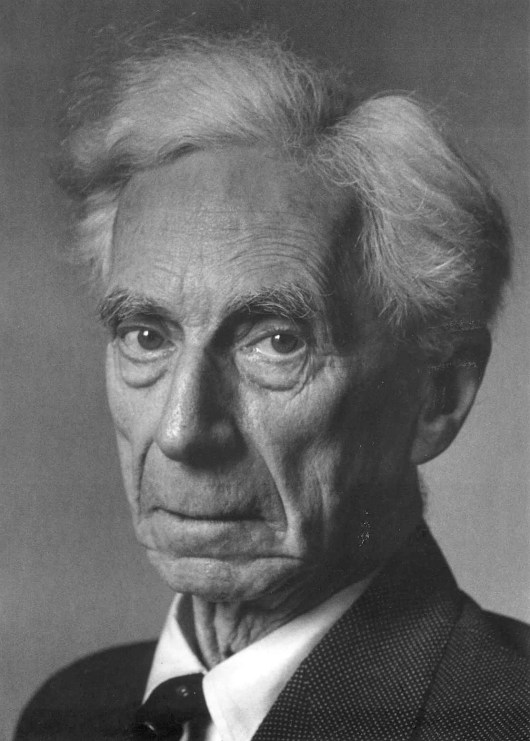

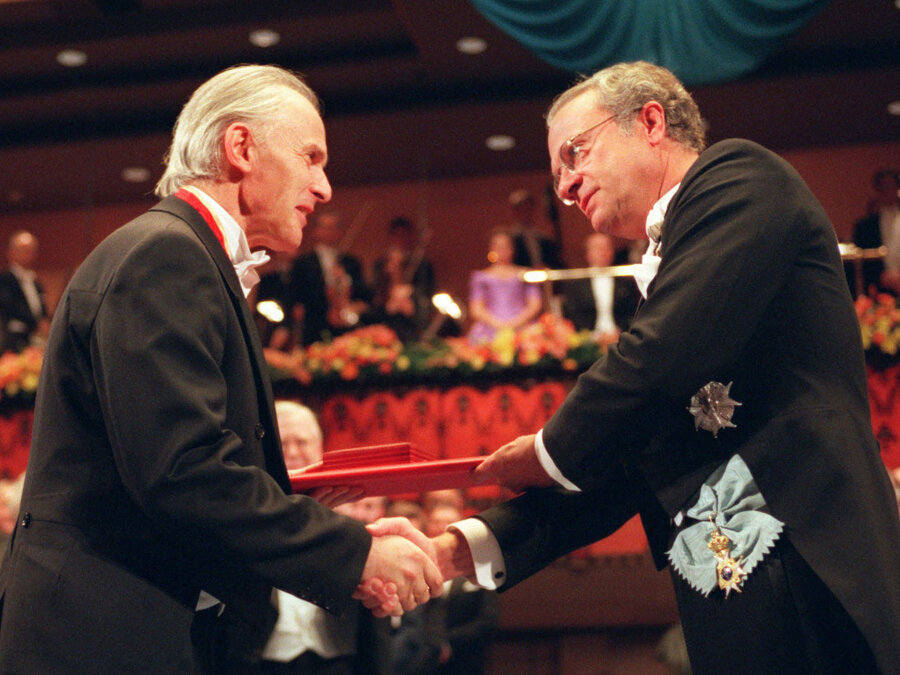
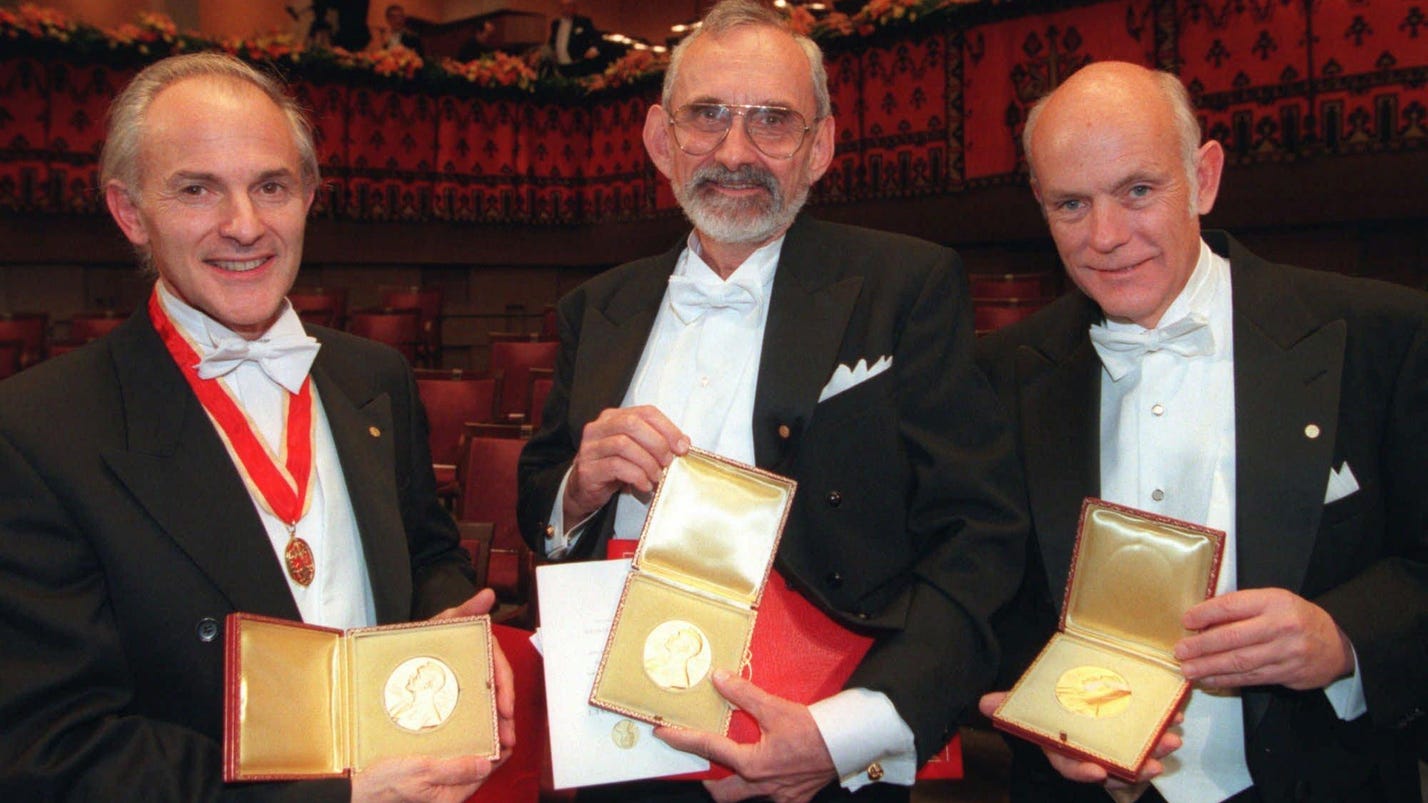
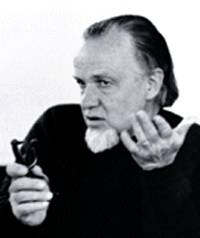





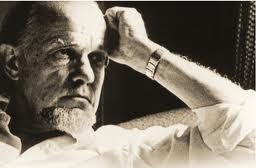


 On November 21, 2014 I received a letter from
  I have attempted to respond to all of Dr. Kroto’s friends arguments and I have posted my responses one per week for over a year now. Here are some of my earlier posts:
 __
__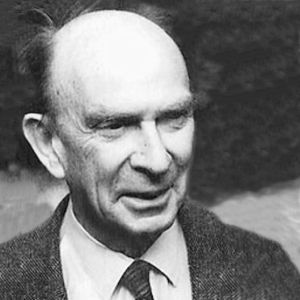
 By knowledge of acquaintance he means, “anything of which we are directly aware, without the intermediary of any process of interference or knowledge of truths. (46).” So, you can see light and the sun and know that you are seeing the sun giving out light to see what is around you. You do not need any description of how light works in order to see it with your eyes. There is no truth needing to be explained for you to see this light. But, as you are acquainted with this light, you can from there learn things about it. On the other hand, knowledge by description here refers to statements that involve more details to help us understand specific realities. His example is, “‘ a man’ is an ambiguous description, and ‘the man with the iron mask’ is a definite description. (52)”When it comes to who God is, we in one sense are acquainted with Him through nature, and in seeing His power and beauty displayed, but are not acquainted with Him as Savior and Lord until we are given His description in Christ. We can see the works of God displayed with our senses. But, when it comes to the truths of Scripture and the meaning of the gospel, we are not by ourselves capable of becoming acquainted with it, and seeing it for all that it is, without God first giving us the eyes to see and the ears to hear. Until we come to believe the gospel, we are only acquainted with God in a general sense; we only know Him as Creator, but we do not know Him truly until He is described to us in Christ. We are out of alignment with reality until this happens. Our thinking is out of sync with where everything is. The Fall affects everything, and we often try and shield ourselves from it.As Christians, we understand that we live in a created universe where everything in existence has a meaning and a purpose directed under the sovereignty of God (Prov. 16:1-4). We are able to understand that our suffering cannot be fully explained in this life (Job 38-40), but as Christians we also know that nothing can enter our lives that will destroy us, or keep us from the love of Christ and all of the good purposes intended for us (Rom: 8:28ff). We do not have a house on the sand, but a house on the rock (Matt. 7:24-27)- we have security in our Shepherd (John 10), an anchor for the soul (Heb. 6).In your thinking you can relate things back to God and Scripture- you know the “ultimate” reality, the ultimate truth, and are not left to wallow in despair to be taken by the wind of varying beliefs (Col. 2), or be deceived by plausible philosophies. But, consider this Christian: what does your neighbor have to stand on? What can they do with their guilt? How can they know what a right decision is? Where do they go when they desire knowledge? What roof is over their heads?Francis Schaeffer in his book The God Who Is There writes


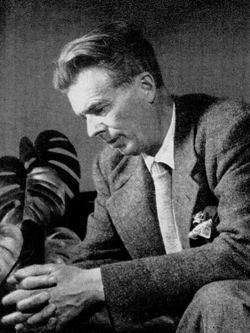



 On November 21, 2014 I received a letter from
  I have attempted to respond to all of Dr. Kroto’s friends arguments and I have posted my responses one per week for over a year now. Here are some of my earlier posts:
 Bertrand Arthur William Russell was born at Trelleck on 18th May, 1872. His parents were Viscount Amberley and Katherine, daughter of 2nd Baron Stanley of Alderley. At the age of three he was left an orphan. His father had wished him to be brought up as an agnostic; to avoid this he was made a ward of Court, and brought up by his grandmother. Instead of being sent to school he was taught by governesses and tutors, and thus acquired a perfect knowledge of French and German. In 1890 he went into residence at Trinity College, Cambridge, and after being a very high Wrangler and obtaining a First Class with distinction in philosophy he was elected a fellow of his college in 1895. But he had already left Cambridge in the summer of 1894 and for some months was attaché at the British embassy at Paris.In December 1894 he married Miss Alys Pearsall Smith. After spending some months in Berlin studying social democracy, they went to live near Haslemere, where he devoted his time to the study of philosophy. In 1900 he visited the Mathematical Congress at Paris. He was impressed with the ability of the Italian mathematician Peano and his pupils, and immediately studied Peano’s works. In 1903 he wrote his first important book, The Principles of Mathematics, and with his friend Dr. Alfred Whitehead proceeded to develop and extend the mathematical logic of Peano and Frege. From time to time he abandoned philosophy for politics. In 1910 he was appointed lecturer at Trinity College. After the first World War broke out, he took an active part in the No Conscription fellowship and was fined £ 100 as the author of a leaflet criticizing a sentence of two years on a conscientious objector. His college deprived him of his lectureship in 1916. He was offered a post at Harvard university, but was refused a passport. He intended to give a course of lectures (afterwards published in America as Political Ideals, 1918) but was prevented by the military authorities. In 1918 he was sentenced to six months’ imprisonment for a pacifistic article he had written in the Tribunal. His Introduction to Mathematical Philosophy (1919) was written in prison. His Analysis of Mind (1921) was the outcome of some lectures he gave in London, which were organized by a few friends who got up a subscription for the purpose.In 1920 Russell had paid a short visit to Russia to study the conditions of Bolshevism on the spot. In the autumn of the same year he went to China to lecture on philosophy at the Peking university. On his return in Sept. 1921, having been divorced by his first wife, he married Miss Dora Black. They lived for six years in Chelsea during the winter months and spent the summers near Lands End. In 1927 he and his wife started a school for young children, which they carried on until 1932. He succeeded to the earldom in 1931. He was divorced by his second wife in 1935 and the following year married Patricia Helen Spence. In 1938 he went to the United States and during the next years taught at many of the country’s leading universities. In 1940 he was involved in legal proceedings when his right to teach philosophy at the College of the City of New York was questioned because of his views on morality. When his appointment to the college faculty was cancelled, he accepted a five-year contract as a lecturer for the Barnes foundation, Merion, Pa., but the cancellation of this contract was announced in Jan. 1943 by Albert C. Barnes, director of the foundation.Russell was elected a fellow of the Royal Society in 1908, and re-elected a fellow of Trinity College in 1944. He was awarded the Sylvester medal of the Royal Society, 1934, the de Morgan medal of the London Mathematical Society in the same year, the Nobel Prize for Literature, 1950.In a paper “Logical Atomism” (Contemporary British Philosophy. Personal Statements, First series. Lond. 1924) Russell exposed his views on his philosophy, preceded by a few words on historical development.
 Cultural critic and popular atheistic philosopher, Alain de Botton, has a new angle on religion. Instead of denouncing religion as having no objective value (the modus operandi of “the new atheists”), de Botton scavenges for atheist blessings among the institutions, practices, and history of the (philosophically benighted) believers. No, there is no God. That, he thinks, is settled—although he gives no arguments to that effect. But why be so hostile to man’s religiosity—his sense of wonder, mystery, fellow-feeling, and the sacred? After all, a lot of religious things are pretty interesting and even inspiring (although there is no Spirit behind any of it). And even though the cognoscenti have outgrown any religious metaphysics (“God is dead,” as Nietzsche pontificated), there may be cultural and psychological gems mixed into the metaphysical manure of empty concepts such as God, angels, providence, prayer, prophets, miracles, saints, salvation, and final judgment.


