Category Archives: Uncategorized

What Christ Did for Us


What Christ Did for Us

While there are several Christian approaches to the finer details of exactly how the Atonement restores our broken relationship with God, all agree that the Atonement involves God providing us with an opportunity to restore our broken relationship with Him through Christ.

The story of Christianity is naturally connected to the story of Christ. God’s plan of redemption is revealed in what Christ did for us. Known as the atonement, what Christ did for us provides the only way to resolve our broken relationship with God.

But before we get to that, let’s spend some time looking at who Christ is, His unique claims, and the reliability of the New Testament.


Who is Christ?

Christ is not actually a name, but a title. The Old Testament set the groundwork for a coming Messiah and “Christ” is the Greek translation of this word, meaning, “anointed one.” The Hebrews looked forward to the coming of the Messiah. Jesus Christ is a name combined with a title. He is Jesus the Messiah – the fulfillment of Old Testament expectations and the key to God’s plan to restore our broken relationship with Him.


The Claims of Christ

The question, “Who is Christ?” is significant. Even Christ asked his followers, “Who do you say I am?” (Matthew 16:15, Mark 8:29, Luke 9:20). [1] This question is still relevant to day, especially in light of the claims of Jesus.

Jesus made many extraordinary claims, leaving His listeners with very few options regarding His nature. For instance, He equated Himself with God – something even His contemporary critics understood. In John 10:32-33, we read the following: “Jesus said to them, ‘I have shown you many great miracles from the Father. For which of these do you stone me?’ ‘We are not stoning you for any of these,’ replied the Jews, ‘but for blasphemy, because you, a mere man, claim to be God.'”

Earlier, in John 8:58, Jesus equated Himself with God, the “I AM” of the Old Testament (Exodus 3:14) when He said, “I tell you the truth … before Abraham was born, I am!” Again, His contemporaries understood what Jesus was suggesting and in the very next verse “they picked up stones to stone him.”

Jesus also claimed the ability to forgive sins. In Mark 2:5, for example, Christ says, “Your sins are forgiven.” In Mark 2:7 His critics said, “Why does this fellow talk like that? He’s blaspheming! Who can forgive sins but God alone?”

Christ also accepted worship – something reserved for God alone, particularly considering His Jewish background and cultural setting. Examples of Jesus accepting worship are found in Matthew 28:9, John 9:38, and more.

Was Jesus merely a man? Was He insane? C.S. Lewis answered these questions best when he wrote, “I am trying here to prevent anyone saying the really foolish thing that people say about Him: ‘I’m ready to accept Jesus as a great moral teacher, but I don’t accept His claim to be God.’ That is the one thing we must not say. A man who was merely a man and said the sort of things Jesus said would not be a great moral teacher. He would either be a lunatic … or else He would be the Devil of Hell. You must make your choice. Either this man was, and is, the Son of God: or else a madman or something worse …” [2]


The New Testament

The New Testament records that Jesus equated Himself with God, that His critics understood this, that He claimed to forgive sins, and that He received worship. He also said, “I am the way and the truth and the life. No one comes to the Father except through me” (John 14:6).

These are impressive claims. But how do we know that the New Testament record of Jesus is accurate?

As has often been stated, the New Testament documents are the most well attested of ancient history. These documents contain the four Gospels – Matthew, Mark, Luke and John – that provide the most information about Christ, His life, His ministry and so forth. There are more than 5,000 copies of the New Testament in existence and multiple thousands of fragments or portions of the New Testament.

Claims that the New Testament documents have been changed over time and with translation are simply not true, especially when one compares existing documents over the course of history (a field of study known as textual criticism). While there is room for slight variations in wording and minor copyist errors known as variants, none of these impact essential areas of Christian belief and are, in fact, inconsequential when it comes to Christ and His claims. [3]

In short, the New Testament documents are accurate. In addition, the period of time between the time of Christ and the writing of some early New Testament documents is short by historical standards. For instance, 1 Corinthians was written by the Apostle Paul in 55 A.D., about 22 years or so after the events recorded in the Gospels. This means that there was no time for legends to develop about Christ. It also means that many people who were alive at the time of Christ were still alive when much of the New Testament was written.

Moreover, 1 Corinthians contains passages that present the basic principles of the Gospel such as 1 Corinthians 15:1-8: “Now, brothers, I want to remind you of the gospel I preached to you, which you received and on which you have taken your stand. By this gospel you are saved, if you hold firmly to the word I preached to you. Otherwise, you have believed in vain. For what I received I passed on to you as of first importance: that Christ died for our sins according to the Scriptures, that he was buried, that he was raised on the third day according to the Scriptures, and that he appeared to Peter, and then to the Twelve. After that, he appeared to more than five hundred of the brothers at the same time, most of whom are still living …”

Paul goes on to write about the cornerstone of Christianity – belief in the resurrection of Christ (1 Corinthians 15:12-20).


The Atonement

The Atonement is what Christ did for us through His death and resurrection. While there are several Christian approaches to the finer details of exactly how the Atonement restores our broken relationship with God, all agree that the Atonement involves God providing us with an opportunity to restore our broken relationship with Him through Christ as a result of the death and resurrection of Jesus.

John 3:16 is often quoted, but this does not diminish the fact that it contains the essential elements of God’s plan and the atonement: “For God so loved the world that he gave His one and only Son, that whoever believes in Him shall not perish but have eternal life.”

God has reached out to us. Christ has died for us. Christ lives again for us. We need only accept God’s grace humbly through Christ, turn away from the wrongs we have done, and receive Christ as our Lord and Savior. Then we are ready for the first steps in the Christian life.


The next in this series deals wit the the first steps in living for Christ.

For more information or reading materials, call 1-800-A-FAMILY (232-6459).


Robert Velarde is author of Conversations with C.S. Lewis (InterVarsity Press), The Heart of Narnia (NavPress), and Inside The Screwtape Letters (Baker Books). He studied philosophy of religion and apologetics at Denver Seminary and is pursuing graduate studies in philosophy at Southern Evangelical Seminary.
[1] Unless otherwise noted, all Scripture quotations are from the New International Version of the Bible.

[2] C.S. Lewis, Mere Christianity (Macmillan, 1952), Book II, Chapter 3, pp. 55-56. For a fine contemporary explanation and defense of this line of reasoning see Kenneth Samples,Without a Doubt (Baker, 2004), chapter 8. Further evidence for Christ is provided in Lee Strobel’s The Case for Christ (Zondervan, 1998).

[3] See, for instance, F.F. Bruce, The New Testament Documents: Are They Reliable?(InterVarsity Press) and Craig Blomberg, The Historical Reliability of the Gospels (InterVarsity Press, 2nd edition).

MUSIC MONDAY Flyleaf – All Around Me

Flyleaf – All Around Me

All Around Me

From Wikipedia, the free encyclopedia
Jump to: navigation, search
“All Around Me”
Single by Flyleaf
from the album Flyleaf
Released April 2007
Recorded October 2005 Seattle, Washington
Genre Post-grunge, Christian rock,[1] alternative rock[1]
Length 3:32
Label Octone Records
Producer Howard Benson
Certification Platinum (RIAA)[2]
Flyleaf singles chronology
Fully Alive
(2006)
All Around Me
(2007)
“Perfect”
(2007)

All Around Me” is song performed by American band Flyleaf from their self-titled debut album, Flyleaf (2005). It was released as the third single on April 2007. It is the band’s highest-charting and only single to chart on the Billboard Hot 100 and their most successful single to date.

Eventually, it became a mainstream and modern rock hit in the United States, crossing over to the pop charts, where it reached No. 40 on the Billboard Hot 100.[3] The song took a large leap into the top 40 channels, receiving more than 20 new stations in just a single day. The song was certified Platinum in the U.S. on January 22, 2010, selling over 1,000,000 copies.

Music video

The music video for the song was directed by Paul Fedor. In it, the band is dressed in white except lead singer Lacey Mosley, who is wearing a grey dress. The walls have red, yellow, blue, green, and black paint running down them and later in the video the paint is on the band.

The video debuted on Fuse TV’s Oven Fresh on June 25, 2007 and on Yahoo! Music on June 28, 2007.

Track listing

iTunes version
No. Title Length
1. “All Around Me” 3:18
2. “All Around Me” (acoustic) 3:20
3. “Do You Hear What I Hear” 2:58

Performances

Flyleaf has performed “All Around Me” on FUSE’s Daily Download and MTV.COM Live. It is usually played during their sets before “I’m So Sick“.[citation needed]

Charts

Beginning its run on the Mainstream Rock Chart, it peaked at No. 20 in August 2007, while reaching No. 6 on the Modern Rock chart in October 2007. In June 2008, it reached the top 40 on the Billboard Hot 100 and the top 20 on the Pop Songs.

Chart (2007) Peak
position
U.S. Billboard Hot Mainstream Rock Tracks[4] 20
U.S. Billboard Alternative Songs[5] 6
Chart (2008) Peak
position
U.S. Billboard Hot 100 40
U.S. Billboard Pop Songs[6] 12
U.S. Billboard Adult Pop Songs[7] 23
Venezuela Pop Rock (Record Report)[8] 2

Certifications

Country Certification
(sales thresholds)
United States Platinum[9]

Awards

2009 BMI Pop Award Winning Song[10]

Other versions

David Crowder Band recorded a cover version of the song for their album Church Music.

Skillet performed a live acoustic cover of “All Around Me” on November 20, 2009 in Dallas, Texas.

References

  1. ^ Jump up to: a b “All Around Me by Flyleaf : Reviews and Ratings”. Rate Your Music. Retrieved August 13, 2011.
  2. Jump up ^ “Recording Industry Association of America”. RIAA. Retrieved August 13, 2011.
  3. Jump up ^ http://www.billboard.com/artist/302265/flyleaf/chart
  4. Jump up ^ Billboard.com – Hot Mainstream Rock Tracks – Chart Listing For The Week Of Aug 18, 2007[dead link]
  5. Jump up ^ Billboard.com – Hot Modern Rock Tracks – Chart Listing For The Week Of Oct 6, 2007[dead link]
  6. Jump up ^ Billboard.com – Top 40 Mainstream – Chart Listing For The Week Of Jun 14, 2008[dead link]
  7. Jump up ^ Billboard.com – Adult Top 40 Tracks – Chart Listing For The Week Of Jun 28, 2008[dead link]
  8. Jump up ^ “Pop Rock” (in Spanish). Record Report. 2008-02-02. Archived from the original on 2007-07-02.
  9. Jump up ^ “Recording Industry Association of America”. RIAA. Retrieved August 13, 2011.
  10. Jump up ^ “2009 BMI Pop Awards Award Winning Songs | Press”. BMI.com. May 19, 2009. Retrieved August 13, 2011.

Related Posts:

“Music Monday” Lykke Li Part 1

Lykke Li ”I’m Good, I’m Gone” Uploaded on Jan 30, 2008 Acoustic live version with guests: Robyn, Adam & Bebban (Shout Out Louds), Daniel (The Concretes), Lars (Laakso) and Mikael (Hjalmar). Director: Ted Malmros + Christian Haag Album “Youth Novels” out jan 30 2008. ________________________ Lykke Li – Will You Still Love Me Tomorrow? Wikipedia has this […]


“Music Monday” My favorite Christian music artist of all time is Keith Green.

My favorite Christian music artist of all time is Keith Green. Sunday, May 5, 2013 You Are Celled To Go – Keith Green Keith Green – (talks about) Jesus Commands Us To Go! (live) Uploaded on May 26, 2008 Keith Green talks about “Jesus Commands Us To Go!” live at Jesus West Coast ’82 You can find […]


“Music Monday” Coldplay the documentary with pictures and videos (Part 1)

Coldplay Max Masters – Part 1 of 7 Uploaded on May 6, 2009 The ASTRA Award winning music documentary – Max Masters Coldplay – was voted MOST OUTSTANDING MUSIC PROGRAM for 2009. Sarah Linton Productions and The Post Box produced the Max Masters documentary to coincide with the album release of ‘Viva la Vida’. __________ […]


“Music Monday” The Killers

The Killers – Human The Killers – Read My Mind The Killers – All These Things That I’ve Done The Killers – Spaceman I have really enjoyed the music of The Killers band. The Killers From Wikipedia, the free encyclopedia Jump to: navigation, search Not to be confused with The Kills. For other uses, see […]

“God and Cosmology: The Existence of God in Light of Contemporary Cosmology” William Lane Craig vs. Sean Carroll (Opening Speeches with Transcript and Video)

__________

“God and Cosmology” William Lane Craig and Sean Carroll – 2014 Greer Heard Forum

Published on Mar 3, 2014

For more resources visit: http://www.reasonablefaith.org

On Friday, February 21st, 2014, philosopher and theologian, Dr William Lane Craig, was invited by the Greer Heard Forum to debate Dr Sean Carroll, an atheist theoretical physicist. The topic of debate was, “God and Cosmology: The Existence of God in Light of Contemporary Cosmology.” The rigorous debate was concluded by a lengthy question and answer period with the audience.

We welcome your comments in the Reasonable Faith forums:
http://www.reasonablefaith.org/forums/

Be sure to also visit Reasonable Faith’s other channel:http://www.youtube.com/drcraigvideos

Follow Reasonable Faith On Twitter: http://twitter.com/rfupdates

Add Reasonable Faith On Facebook:http://www.facebook.com/reasonablefai…

http://www.preposterousuniverse.com/blog/ http://winteryknight.wordpress.com/2014/02/21/tactical-faith-will-live-stream-the-responses-to-the-craig-carroll-debate-on-saturday/

The Humanist Hour #84: Dr. Sean M. Carroll

Published on Jun 27, 2013

In this interview, which took place before Dr. Carroll’s keynote speech at the American Humanist Association 72nd Annual Conference, he talks about issues ranging from his upbringing and education to research having to do with the Big Bang, quantum mechanics, the Higgs Boson, the idea of the multiverse, morality, the Large Hadron Collider, Hollywood movies where he’s been consulted, and more.

More details and show links can be found on the podcast website here: http://podcast.thehumanist.org/2013/0…

New Orleans Baptist Theological Seminary, New Orleans, LA, –

NOTE: Despite repeated requests Dr. Carroll has not yet furnished his PowerPoint slides or proofread his portion of the debate.

Dr. Stewart, Moderator

We are glad to see all of you here this evening, and all of those who are watching online as well. . . . Let me introduce our speakers, as if you don’t know who they are already!

William Lane Craig is a Research Professor of Philosophy at Talbot School of Theology in La Mirada, California, and a Professor of Philosophy at Houston Baptist University. He earned a doctorate in philosophy at the University of Birmingham, England, before taking a doctorate in theology from the University of Munich, Germany, where he was, for two years, a Fellow of the Alexander von Humboldt Foundation. Prior to his appointment at Talbot he spent seven years at the Higher Institute of Philosophy of the Katholike Universiteit Leuven, Belgium. His research interests include the interface of philosophy of religion and philosophy of space and time. He has authored or edited over 30 books including The Kalam Cosmological Argument; Theism, Atheism, and Big Bang Cosmology; and Time and the Metaphysics of Relativity. He has published over 150 articles in peer reviewed professional journals, such as The Journal of Philosophy, British Journal for the Philosophy of Science, International Studies in the Philosophy of Science, Philosophia Naturalis, and Astrophysics and Space Science. He has appeared as a guest on television shows such as 20/20, CNN Newsroom, Fox News, and Closer to the Truth.

Sean Carroll is a physicist and Senior Research Associate in the Department of Physics at the California Institute of Technology. He received his PhD in astronomy and astrophysics from Harvard University. His research focus is on theoretical physics and cosmology, especially the origin and constituents of the universe. He has contributed to models of interactions between dark matter, dark energy, and ordinary matter, alternative theories of gravity, and the arrow of time. Carroll is the author of From Eternity to Here: The Quest for the Ultimate Theory of Time, Spacetime and Geometry: An Introduction to General Relativity, and The Particle at the End of the Universe. He has been awarded fellowships by the Sloan Foundation, Packard Foundation, and the American Physical Society, and won the 2013 Royal Society Winton Prize for Science Books. He has appeared on TV shows such as the Colbert Report, Through the Wormhole with Morgan Freeman, and Closer to Truth.

Welcome our guests as they come to speak to us!

William Lane Craig – Opening Speech

Good evening! It is an honor to be taking part in a forum featuring such distinguished scientists and philosophers. Thank you very much!

Introductory Remarks

In his recent book, Where the Conflict Really Lies, Alvin Plantinga distinguished three ways in which scientific theories and theism might be related: apparent conflict, genuine conflict, and concord.[1] I take it as obvious that there does not exist even apparent conflict between contemporary cosmogonic theories and theism. Contemporary cosmology would therefore seem to be an area of obvious concord between science and theism.

But tonight I want to defend an even stronger claim, namely, that the evidence of contemporary cosmology actually renders God’s existence considerably more probable than it would have been without it:

Pr (Theism | Contemporary Cosmology & Background Information)
>> Pr (Theism | Background Information)

This is not to make some sort of naïve claim that contemporary cosmology proves the existence of God. There is no God-of-the-gaps reasoning here. Rather I’m saying that contemporary cosmology provides significant evidence in support of premises in philosophical arguments for conclusions having theological significance.

For example, the key premise in the ancient kalam cosmological argument that

2. The universe began to exist.

is a religiously neutral statement which can be found in virtually any contemporary textbook on astronomy and astrophysics. It is obviously susceptible to scientific confirmation or disconfirmation on the basis of the evidence.[2]

So, to repeat, one is not employing the evidence of contemporary cosmology to prove the proposition that God exists but to support theologically neutral premises in philosophical arguments for conclusions that have theistic significance.

In tonight’s discussion I’ll focus on two such arguments: the kalam cosmological argument from the origin of the universe and the teleological argument from the fine-tuning of the universe.

The Kalam Cosmological Argument

Consider first the kalam cosmological argument:

1. If the universe began to exist, then there is a transcendent cause which brought the universe into existence.

2. The universe began to exist.

3. Therefore, there is a transcendent cause which brought the universe into existence.

By “the universe,” I mean that reality which is studied by contemporary cosmology, that is to say, all of contiguous physical reality, which currently takes the form of space-time and its contents.

I take it that (1) is obviously true.[3] Rather the truly controversial premiss is (2). Traditional supporters presented philosophical arguments in support of (2),[4] which, for me, constitute its primary warrant. But they’re not the subject of tonight’s debate. Rather what’s emerged during the 20th century is remarkable empirical confirmation of the second premiss from the evidence of astrophysical cosmogony. Two independent but closely interrelated lines of physical evidence support premiss (2): evidence from the expansion of the universe and evidence from the second law of thermodynamics.
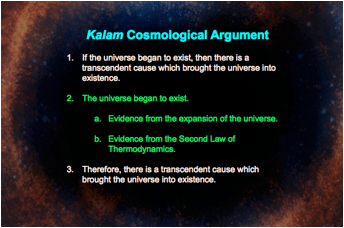
In saying that the cosmogonic evidence confirms (2), I am not saying that we are certain that (2) is true. Too many people mistakenly equate knowledge with certainty. When they say that we do not know that the universe began to exist, what they really mean is that we are not certain that the universe began to exist. But, of course, certainty is not the relevant standard here. The question is whether (2) is more plausible in light of the evidence than its contradictory. As Professor Carroll reminds us,

Science isn’t in the business of proving things. Rather, science judges the merits of competing models in terms of their simplicity, clarity, comprehensiveness, and fit to the data. Unsuccessful theories are never disproven, as we can always concoct elaborate schemes to save the phenomena; they just fade away as better theories gain acceptance.[5]

Science cannot force you to accept the beginning of the universe; you can always concoct elaborate schemes to explain away the evidence. But those schemes will not fare well in displaying the aforementioned scientific virtues.

Even many who have expressed scepticism about premiss (2) admit that it is more plausibly true than not. For example, in my recent dialogue with Lawrence Krauss, he volunteered, “I’d bet our universe had a beginning, but I am not certain of it. . . . based on the physics that I know, I’d say it is a more likely possibility.”[6] This is to admit precisely what cosmologists like Alexander Vilenkin have contended all along: that the evidence makes it more likely than not that the universe began to exist.[7]

Evidence from the Expansion of the Universe

Consider, first, the evidence from the expansion of the universe. The standard (Friedman-LeMaître Robertson-Walker) big bang cosmogonic model implies that the universe is not infinite in the past but had an absolute beginning a finite time ago. Although advances in astrophysical cosmology have forced various revisions in the standard model, nothing has called into question its fundamental prediction of the finitude of the past and the beginning of the universe. Indeed, as James Sinclair has shown, the history of 20th century cosmogony has seen a parade of failed theories trying to avert the absolute beginning predicted by the standard model.[8] Meanwhile, a series of remarkable singularity theorems has increasingly tightened the loop around empirically tenable cosmogonic models by showing that under more and more generalized conditions, a beginning is inevitable. In 2003 Arvind Borde, Alan Guth, and Alexander Vilenkin were able to show that any universe which is, on average, in a state of cosmic expansion throughout its history cannot be infinite in the past but must have a beginning.[9] In 2012 Vilenkin showed that cosmogonic models which do not fall under this condition, including Professor Carroll’s own model, fail on other grounds to avert the beginning of the universe. Vilenkin concluded, “None of these scenarios can actually be past-eternal.”[10] “All the evidence we have says that the universe had a beginning.”[11]

The Borde-Guth-Vilenkin theorem proves that classical space-time, under a single, very general condition, cannot be extended to past infinity but must reach a boundary at some time in the finite past. Now either there was something on the other side of that boundary or not. If not, then that boundary is the beginning of the universe. If there was something on the other side, then it will be a non-classical region described by the yet to be discovered theory of quantum gravity. In that case, Vilenkin says, it will be the beginning of the universe.[12]

Think about it. If there is such a non-classical region, then it is not past eternal in the classical sense. But neither can it exist literally timelessly, akin to the way in which philosophers consider abstract objects to be timeless or theologians take God to be timeless. For this region is in a state of constant flux, which, given the Indiscernibility of Identicals, is sufficient for time.[13] So even if time as defined in classical physics does not exist at such an era, some sort of time would.[14]

But if the quantum gravity era is temporal, it cannot be extended infinitely in time, for such a quantum state is not stable and so would either produce the universe from eternity past or not at all. As Anthony Aguirre and John Kehayias argue,

It is very difficult to devise a system – especially a quantum one – that does nothing ‘forever,’ then evolves. A truly stationary or periodic quantum state, which would last forever, would never evolve, whereas one with any instability will not endure for an indefinite time.[15]

Hence, the quantum gravity era would itself have to have had a beginning in order to explain why it transitioned just some 13 billion years ago into classical time and space. Hence, whether at the boundary or at the quantum gravity regime, the universe probably began to exist.

Evidence from Thermodynamics

Consider now the evidence from thermodynamics. According to the second law of thermodynamics entropy in a closed system almost never decreases. Given the naturalistic assumption that the universe is a closed system, the second law implies that, given enough time, the universe will come to a state of thermodynamic heat death, whether cold or hot. Given that the universe will expand forever, it may never reach a state of equilibrium, but it will grow increasingly cold, dark, dilute, and dead. But then the obvious question arises: why, if the universe has existed forever, is it not now in a cold, dark, dilute, and lifeless state? P. C. W. Davies gives the obvious answer: “The universe can’t have existed forever. We know there must have been an absolute beginning a finite time ago.”[16] The universe’s energy, says Davies, was simply “put in” at the creation as an initial condition.[17]

By contrast Professor Carroll’s solution to the problem confronts serious obstacles. He imagines that the overall condition of the universe is a state of thermal equilibrium (a sort of de Sitter space), but that random fluctuations spawn baby universes, which pinch off to become wholly independent space-times. We find ourselves in one such baby universe in a state of disequilibrium.

Let me raise two concerns about this model. First, not only are the production mechanisms of such baby universes admittedly conjectural, but such a scenario violates the so-called unitarity of quantum theory by allowing irretrievable information loss from the mother universe to the babies. Stephen Hawking, apologizing to science-fiction fans everywhere, came to admit, “There is no baby universe branching off, as I once thought. The information remains firmly in our universe.”[18]

Second, Professor Carroll’s solution provides no convincing answer to the Boltzmann Brain problem. Since the mother universe is a de Sitter space in which thermal fluctuations occur and since baby universes grow into de Sitter spaces themselves, there’s no explanation in the model why there exists a genuine low entropy universe around us rather than the mere appearance of such a world, an illusion of isolated brains which have fluctuated into existence out of the quantum vacuum. These and other problems make Professor Carroll’s model less plausible than the standard solution that the universe began to exist with an initial low entropy condition.

Skeptics might hope that quantum cosmology might serve to avert the implications of the second law of thermodynamics. But now a new singularity theorem formulated by Aron Wall seems to close the door on that possibility. Wall shows that, given the validity of the generalized second law of thermodynamics in quantum cosmology, the universe must have begun to exist, unless, as in Professor Carroll’s model, one postulates a reversal of the arrow of time at some point in the past, which, he rightly observes, involves a thermodynamic beginning in time which “would seem to raise the same sorts of philosophical questions that any other sort of beginning in time would.”[19] Wall reports that his results require only certain basic concepts, so that “it is reasonable to believe that the results will hold in a complete theory of quantum gravity.”[20]

Summary

Thus, we have good evidence both from the expansion of the universe and from the second law of thermodynamics that the universe is not past eternal but had a temporal beginning. So the second premise of the kalam cosmological argument receives significant confirmation from the evidence of contemporary cosmology. We have, then, a good argument for a transcendent cause of the universe.

The Teleological Argument

Turn now to the teleological argument from the fine-tuning of the universe. Scientists have been stunned by the discovery that the existence of intelligent, interactive life depends upon a complex and delicate balance of fundamental constants and quantities, like the gravitational constant and the amount of entropy in the early universe, which are fine-tuned to a degree that is literally incomprehensible.

Now there are three possibilities debated in the literature for explaining the presence of this remarkable fine-tuning: physical necessity, chance, or design. The question then is: Which of these three alternatives is the most plausible? On the basis of the evidence we may argue:

1. The fine-tuning of the universe is due to either physical necessity, chance, or design.

2. It is not due to physical necessity or chance.

3. Therefore, it is due to design.

Physical Necessity?

Consider the first alternative, physical necessity.

This alternative seems extraordinarily implausible because the constants and quantities are independent of the laws of nature. The laws of nature are consistent with a wide range of values for these constants and quantities. For example, the most promising candidate for a Theory of Everything (T.O.E.) to date, super-string theory or M-Theory, allows a “cosmic landscape” of around 10500 different universes governed by the present laws of nature, so that it does nothing to render the observed values of the constants and quantities physically necessary.

Chance?

So what about the second alternative, that the fine-tuning is due to chance? The problem with this alternative is that the odds against the universe’s being life-permitting are so incomprehensibly great that they cannot be reasonably faced. In order to rescue the alternative of chance, its proponents have therefore been forced to adopt the hypothesis that there exists a sort of World Ensemble or multiverse of randomly ordered universes of which our universe is but a part. Now comes the key move: since observers can exist only in finely tuned worlds, of course we observe our universe to be fine-tuned!

So this explanation of fine-tuning relies on (i) the existence of a specific type of World Ensemble and (ii) an observer self-selection effect. Now this explanation, wholly apart from objections to (i), faces a very formidable objection to (ii), namely, the Boltzmann Brain problem. In order to be observable the entire universe need not be fine-tuned for our existence. Indeed, it is vastly more probable that a random fluctuation of mass-energy would yield a universe dominated by Boltzmann Brain observers than one dominated by ordinary observers like ourselves. In other words, the observer self-selection effect is explanatorily vacuous. As Robin Collins has noted, what needs to be explained is not just intelligent life, but embodied, interactive, intelligent agents like ourselves.[21] Appeal to an observer self-selection effect accomplishes nothing because there’s no reason whatever to think that most observable worlds or the most probable observable worlds are worlds in which that kind of observer exists. Indeed, the opposite appears to be true: most observable worlds will be Boltzmann Brain worlds.

Since we presumably are not Boltzmann Brains, that fact strongly disconfirms a naturalistic World Ensemble or multiverse hypothesis.

Design?

It seems, then, that the fine-tuning is not plausibly due to physical necessity or chance. Therefore, we ought to prefer the hypothesis of design unless the design hypothesis can be shown to be just as implausible as its rivals. I’ll leave it up to Professor Carroll present any such objections.

Summary and Conclusion

In summary, it seems to me that the evidence of contemporary cosmology provides significant support for key premises in two philosophical arguments for conclusions having theological significance.

Thus, the existence of a Creator and Designer of the universe seems to be significantly more probable in light of contemporary cosmology than it would have been without it.[22]


[1] Alvin Plantinga, Where the Conflict Really Lies: Science, Religion, and Naturalism. (Oxford University Press, 2011). Plantinga further distinguishes between superficial conflict and deep conflict.

[2] Similarly the key premise in the teleological argument based on the fine-tuning of the universe that
2. The fine-tuning is not due to physical necessity or chance.
is logically equivalent to a conjunction, both of those conjuncts have been argued by scientists on theologically neutral grounds. As stated, (2) is a disjunction, but its logical form is equivalent to (¬p & ¬q).

[3] (1) does not presuppose a particular analysis of the causal relation. It requires simply that the universe did not come into being uncaused. For the universe to come into being without a cause of any sort would be to come into existence from nothing, which is worse than magic. Although some scientists have irresponsibly claimed that physics can explain the origin of the universe from “nothing,” what one inevitably discovers is that they are using the word “nothing” to refer to a physical system which undergoes a change of state. See David Albert, “On the Origin of Everything: ‘A Universe From Nothing,’ by Lawrence M. Krauss,” New York Times Sunday Book Review (March 23, 2012).

[4] For example, there were arguments based upon the impossibility of the existence of an actually infinite number of things. Here one argued that
1. An actually infinite number of things cannot exist.

2. A beginningless regress of temporal events implies the existence of an actually infinite number of things.

3. Therefore, a beginningless regress of temporal events cannot exist.

In support of the first premiss, one typically pointed to the metaphysically absurd situations which could result from an actually infinite number of things. David Hilbert’s famous hotel comes to mind. It is widely thought that premiss 1 has been defeated by Cantorian set theory. But as Hilbert realized, this claim is mistaken. As Kasner and Newman put it, “the infinite certainly does not exist in the same sense that we say, ‘There are fish in the sea.’ . . . ‘Existence’ in the mathematical sense is wholly different from the existence of objects in the physical world” (Edward Kasner and James Newman, Mathematics and the Imagination [New York: Simon & Schuster, 1940], p. 61). The mathematical existence of the actual infinite amounts to nothing more than the logical consistency of the axioms and theorems of set theory, which holds no implications for what is metaphysically possible. There is no example of an actually infinite number of anything in reality, and, as noted by Solomon Feferman, science can dispense with the notion of the actual infinite without impairment: “Infinitary concepts are not essential to the mathematization of science, all appearances to the contrary. And this puts into question the view that higher mathematics is somehow embodied in the world, rather than that it is the conceptual edifice raised by mankind in order to make sense of the world” (In Light of Logic [Oxford: Oxford University Press, 1998], p. 19; cf. p. 30).

Or again, there were arguments based upon the impossibility of forming an actual infinite by successive addition. Here one argued that

1. An actually infinite collection of things cannot be formed by successive addition.

2. The regress of temporal events is a collection formed by successive addition.

3. Therefore, the regress of temporal events cannot be actually infinite.

This argument is based upon a view of time which entails the objectivity of tense and temporal becoming. Although most physicists, accustomed as they are to a geometric presentation of space-time theories, tend uncritically toward a tenseless theory of time, philosophers of time are about evenly divided as to the objectivity of tense and temporal coming. Given the objectivity of temporal becoming, I think it is extraordinarily difficult to see how an actually infinite series of past events could have been completed successively.

[5] Sean Carroll, “Does the Universe Need God?” in The Blackwell Companion to Science and Christianity, ed. J. B. Stump and Alan G. Padgett (Oxford: Wiley-Blackwell, 2012), p. 196.

[6] William Lane Craig and Lawrence Krauss, “Life, the Universe, and Nothing (I): Has Science Buried God?” Brisbane, Australia (August 7, 2013), http://www.reasonablefaith.org/media/craig-vs-krauss-brisbane-australia (accessed February 23, 2014).

[7] In answer to the question “Did the universe have a beginning?” Vilenkin concludes “it seems that the answer to this question is probably yes” (Audrey Mithani and Alexander Vilenkin, “Did the universe have a beginning?” arXiv:1204.4658v1 [hep-th] 20 Apr 2012, p. 5). See http://arxiv.org/abs/1204.4658 (accessed March 19, 2014).

[8] William Lane Craig and James Sinclair, “The Kalam Cosmological Argument,” in The Blackwell Companion to Natural Theology, ed. Wm. L. Craig and J. P. Moreland (Oxford: Wiley-Blackwell, 2009), pp. 101-201; idem, “On Non-Singular Spacetimes and the Beginning of the Universe,” in Scientific Approaches to the Philosophy of Religion, ed. Yujin Nagasawa, Palgrave Frontiers in Philosophy of Religion (London: Macmillan, 2012), pp. 95-142.

[9] A. Borde, A. Guth, A. Vilenkin, “Inflationary Spacetimes Are Incomplete in Past Directions,” Physical Review Letters 90 (2003): 151301, http://arxiv.org/abs/gr-qc/0110012 (accessed February 23, 2014).

[10] Mithani and Vilenkin, “Did the universe have a beginning?” p. 1; cf. p. 5. For application to the Carroll-Chen model, see http://www.youtube.com/watch?v=NXCQelhKJ7A (accessed February 23, 2014), where Vilenkin concludes, “there are no models at this time that provide a satisfactory model for a universe without a beginning.” See further Alexander Vilenkin, “Arrows of time and the beginning of the universe,” arXiv:1305.3836v2 [hep-th] 29 May 2013.

[11] A.Vilenkin, cited in “Why physicists can’t avoid a creation event,” by Lisa Grossman, New Scientist (January 11, 2012).

[12] “If indeed all past-directed geodesics encounter a quantum spacetime region where the notions of time and causality no longer apply, I would characterize such a region as the beginning of the universe” (A. Vilenkin to William Lane Craig, personal correspondence, December 8, 2013).

[13] Moreover, it is supposed to have existed before the classical era, and the classical era is supposed to have emerged from it, which seems to posit a temporal relation between the quantum gravity era and the classical era. This feature of quantum cosmogony is very problematic, since diachronic emergence of time is obviously incoherent (J. Butterfield and C. J. Isham, “On the Emergence of Time in Quantum Gravity,” in The Arguments of Time, ed. J. Butterfield [Oxford University Press, 1999], pp. 111-68; Vincent Lam and Michael Esfeld, “A dilemma for the emergence of spacetime in canonical quantum gravity,” Studies in History and Philosophy of Modern Physics 44 [2013]: 286–293; Reiner Hedrich, “Hat die Raumzeit Quanteneigenschaften? – Emergenztheoretische Ansätze in der Quantengravitation,” in Philosophie der Physik, ed. M. Esfeld [Berlin: Suhrkamp, forthcoming], pp. 287-305). But how can one make sense of a synchronic emergence of time as a supervenient reality in the context of cosmogony? The authors cited do not tell us. The best sense I can make of it is to say that the Euclidian description is a lower-level description of classical spacetime prior to the Planck time. (One recalls Hawking’s remark that when we go back to the real time in which we live, there still would be singularities.) So the same reality is being described at two levels. That implies that if the classical spacetime has a beginning, then so does the quantum gravity regime. For they are descriptions of the same reality. In the one a singularity is part of the description; in the other it is not. So what is prior to the Planck time is not the quantum gravity era as such; rather what is prior is the classical period of which the quantum gravity description is the more fundamental description. If this is correct, then, given the beginning of the classically described universe, it is impossible for the universe as quantum gravitationally described to be without a beginning. For they just are the same universe at different levels of description.

[14] Christopher Isham observes that although quantum cosmogonies “differ in their details they all agree on the idea that space and time emerge in some way from a purely quantum-mechanical region which can be described in some respects as if it were a classical, imaginary-time four-space” (C. J. Isham, “Quantum Theories of the Creation of the Universe,” in Quantum Cosmology and the Laws of Nature, second ed., ed. Robert J. Russellet al. [Vatican City State: Vatican Observatory, 1996], p. 75). But see the previous note.

[15] Anthony Aguirre and John Kehayias, “Quantum Instability of the Emergent Universe,” arXiv:1306.3232v2 [hep-th] 19 Nov 2013. They are specifically addressing the Ellis-Maarten model, but their point is generalizable.

[16] Paul Davies, “The Big Questions: In the Beginning,” ABC Science Online, interview with Phillip Adams, http://www.abc.net.au/science/bigquestions/s460625.htm (accessed February 23, 2014).

[17] P. C. W. Davies, The Physics of Time Asymmetry (London: Surrey University Press, 1974), p. 104.

[18] S. W. Hawking, “Information Loss in Black Holes,” http://arXiv.org/abs/hep-th/0507171v2 (15 September 2005): 4. N.B. that just as Hawking came to accept information conservation regarding black holes, Carroll himself opts for information conservation in an expanding universe (Sean Carroll, From Eternity to Here: The Quest for the Ultimate Theory of Time [New York: Penguin, 2010], p. 294). Cf. his blog “The Eternally Existing, Self-Reproducing, Frequently Puzzling Inflationary Universe,” posted on October 21, 2011 (http://www.preposterousuniverse.com/blog/2011/10/21/). [links accessed February 23, 2014]

[19] Aron C. Wall, “The Generalized Second Law implies a Quantum Singularity Theorem,” arXiv: 1010.5513v3 [gr-qc] 24 Jan 2013, p. 38. See http://arxiv.org/abs/1010.5513v3 (accessed March 19, 2014).

[20] Ibid., p. 4.

[21] I’ve had the privilege of reading portions of Robin’s forthcoming book The Well-Tempered Universe, which will be the definitive work on fine-tuning for many years to come.

[22] I’m grateful to James Sinclair, Robin Collins, Aron Wall, and Christopher Weaver for comments on the first draft of this speech and discussion of the many points within.

Sean Carroll – Opening Speech

Well thank you very much, it’s a great pleasure to be here. The Greer-Heard Forum has been very wonderful. I thank Dr. Craig for participating. For everyone here I appreciate your attendance, and I need to add a word of appreciation to this beautiful chapel that we’re holding the event in. I just hope that somewhere in the middle of my talking the roof does not fall on my head. But if it does that would be evidence and I would update my beliefs accordingly.

I also want to start with a confession that my goal here is not to win a debate. The discussion we are having tonight does not reflect a debate that is ongoing in the professional cosmology community. If you go to cosmology conferences there’s a lot of talk about the origin and nature of the universe; there is no talk about what role God might have played in bringing the universe about. It is not an idea that is taken seriously. My goal is to explain why we think that. You may or may not agree with me at the end but you should be able to understand why we cosmologists have that view. And it comes down to a conflict between two major fundamental pictures of the world—what philosophers would call ontologies: naturalism and theism. Naturalism says that all that exists is one world, the natural world, obeying laws of nature, which science can help us discover. Theism says that in addition to the natural world there is something else, at the very least, God. Perhaps there are other things as well. I want to argue that naturalism is far and away the winner when it comes to cosmological explanation. And it comes down to three points. First, naturalism works—it accounts for the data we see. Second, the evidence is against theism. Third, theism is not well defined. I’m going to be emphasizing this third point because if you ask a theist about the definition they will give you some very rigorous sounding definition of what they mean by God. The most perfect being, the ground for all existence, and so forth. There are thousands of such definitions, which is an issue, but the real problem is not with the definition, it’s when you connect the notion of God to the world we observe. That’s where apparently an infinite amount of flexibility comes in and I’m going to be inveighing against using that in cosmology.

So, I think I can make these points basically by following Dr. Craig’s organization starting with the kalam cosmological argument, and unlike what he said I should be doing I want to challenge the first of the premises: If the universe began to exist it has a transcendent cause. The problem with this premise is that it is false. There’s almost no explanation or justification given for this premise in Dr. Craig’s presentation. But there’s a bigger problem with it, which is that it is not even false. The real problem is that these are not the right vocabulary words to be using when we discuss fundamental physics and cosmology. This kind of Aristotelian analysis of causation was cutting edge stuff 2,500 years ago. Today we know better. Our metaphysics must follow our physics. That’s what the word metaphysics means. And in modern physics, you open a quantum field theory textbook or a general relativity textbook, you will not find the words “transcendent cause” anywhere. What you find are differential equations. This reflects the fact that the way physics is known to work these days is in terms of patterns, unbreakable rules, laws of nature. Given the world at one point in time we will tell you what happens next. There is no need for any extra metaphysical baggage, like transcendent causes, on top of that. It’s precisely the wrong way to think about how the fundamental reality works. The question you should be asking is, “What is the best model of the universe that science can come up with?” By a model I mean a formal mathematical system that purports to match on to what we observe. So if you want to know whether something is possible in cosmology or physics you ask, “Can I build a model?” Can I build a model where the universe had a beginning but did not have a cause? The answer is yes. It’s been done. Thirty years ago, very famously, Stephen Hawking and Jim Hartle presented the no-boundary quantum cosmology model. The point about this model is not that it’s the right model, I don’t think that we’re anywhere near the right model yet. The point is that it’s completely self-contained. It is an entire history of the universe that does not rely on anything outside. It just is like that. The demand for more than a complete and consistent model that fits the data is a relic of a pre-scientific view of the world. My claim is that if you had a perfect cosmological model that accounted for the data you would go home and declare yourself having been victorious.

You might also ask, “Could the universe be eternal?” (since Dr. Craig talked about this) without having a beginning at all. Again, the answer is: yes, just build a model. This is my favorite model. It’s actually not even a model that I think is right; once again, it’s a model I helped create. But it’s about the search for models, not about saying any one model is the right idea. We hope that some day we get there but we don’t claim that we are there yet. So whether or not the universe can be eternal does not come down to a conversation about abstract principles. It comes down to a conversation about building models and seeing which one provides the best account for what we see the universe to be doing.

So I’d like to talk about the Borde-Guth-Vilenkin theorem since Dr. Craig emphasizes it. The rough translation is that in some universes, not all, the space-time description that we have as a classical space-time breaks down at some point in the past. Where Dr. Craig says that the Borde-Guth-Vilenkin theorem implies the universe had a beginning, that is false. That is not what it says. What it says is that our ability to describe the universe classically, that is to say, not including the effects of quantum mechanics, gives out. That may be because there’s a beginning or it may be because the universe is eternal, either because the assumptions of the theorem were violated or because quantum mechanics becomes important. If you need to invoke a theorem, because that’s what you like to do rather than building models, I would suggest the quantum eternity theorem. If you have a universe that obeys the conventional rules of quantum mechanics, has a non-zero energy, and the individual laws of physics are themselves not changing with time, that universe is necessarily eternal. The time parameter in Schrödinger’s equation, telling you how the universe evolves, goes from minus infinity to infinity. Now this might not be the definitive answer to the real world because you could always violate the assumptions of the theorem but because it takes quantum mechanics seriously it’s a much more likely starting point for analyzing the history of the universe. But again, I will keep reiterating that what matters are the models, not the abstract principles.

Dr. Craig brings up an argument about the Second Law of Thermodynamics and I’ve written a whole book, you can buy it on Amazon right now from your iPhones, about the second law and its relationship to cosmology. It is certainly a true issue that we don’t know why the early universe had a low entropy and entropy has ever been increasing. That’s a good challenge for cosmology. To imagine the cosmologist cannot answer that question without somehow invoking God is a classic god-of-the-gaps move. I know that Dr. Craig says that is not what he’s doing but then he does it. We don’t know why the early universe had a low entropy but that is not an argument that we can’t figure it out. There is more than one possibility. Maybe there is a principle, like Stephen Hawking would say, that puts the early universe in a low entropy state. Or maybe there is no high entropy state. In my model of an eternal universe the reason why our universe is always changing is because the universe always can change. There is no equilibrium for it to fall into. Dr. Craig brings up a quote – he brings up various things that I think really muddle the cosmological picture here. He says that my model is not working very well because it violates unitarity—the conservation of information—and that is straightforwardly false. In my model unitarity is the whole point. There’s a quantum mechanical wave function that describes the evolution of the universe from one piece into multiple pieces and that evolution is perfectly unitarity. He quotes Stephen Hawking backsliding his statement about baby universes but that was in the context of black holes. That had nothing to do with cosmology. That quote was taken completely out of context. Finally, he makes a big deal about Boltzmann Brains. I’m going to talk about that a little bit later. Most importantly, he talks about the fact that if the universe is eternal and you have a Second Law of Thermodynamics then there must have been a moment in the middle when the entropy was lowest, and he calls this a thermodynamic beginning and he quotes another paper. That’s fine except it’s an equivocation on the word beginning. A thermodynamic beginning is not a beginning—it happens in the middle. It’s a moment in the history of the universe from which entropy is higher in one direction of time and the other direction of time. There is no room in such a conception for God to have brought the universe into existence at any one moment.

If you really believe that the beginning of the universe is an important piece of evidence for God, an eternal universe with a low entropy state in the middle is not helping your case. What you should be doing is trying to build models, like I said. So the question is, “Are there realistic models of eternal cosmologies?” Well, I spent half an hour on the Internet and I was able to come up with about seventeen different plausible looking models of eternal cosmologies. I do not claim that any of these are the right answer. We’re nowhere near the right answer yet but you can come up with objections to every one of these models. You cannot say that they are not eternal. There’s a theorem, Borde-Guth-Vilenkin, that has assumptions so if you violate those assumptions you can violate the theorem. Meanwhile, theism, I would argue, is not a serious cosmological model. That’s because cosmology is a mature subject. We care about more things than just creating the universe. We care about specific details. At the cosmology conferences we’re discussing these questions that you see before you. I’m not going to list all of them but a real cosmological model wants to predict. What is the amount of density perturbation in the universe? And so forth. Theism does not even try to do this because ultimately theism is not well defined.

So let’s go to the second argument, the teleological argument from fine-tuning. I’m very happy to admit right off the bat – this is the best argument that the theists have when it comes to cosmology. That’s because it plays by the rules. You have phenomena, you have parameters of particle physics and cosmology, and then you have two different models: theism and naturalism. And you want to compare which model is the best fit for the data. I applaud that general approach. Given that, it is still a terrible argument. It is not at all convincing. I will give you five quick reasons why theism does not offer a solution to the purported fine-tuning problem.

First, I am by no means convinced that there is a fine-tuning problem and, again, Dr. Craig offered no evidence for it. It is certainly true that if you change the parameters of nature our local conditions that we observe around us would change by a lot. I grant that quickly. I do not grant therefore life could not exist. I will start granting that once someone tells me the conditions under which life can exist. What is the definition of life, for example? If it’s just information processing, thinking or something like that, there’s a huge panoply of possibilities. They sound very “science fiction-y” but then again you’re the one who is changing the parameters of the universe. The results are going to sound like they come from a science fiction novel. Sadly, we just don’t know whether life could exist if the conditions of our universe were very different because we only see the universe that we see.

Secondly, God doesn’t need to fine-tune anything. We talk about the parameters of physics and cosmology: the mass of the election, the strength of gravity. And we say if they weren’t the numbers that they were then life itself could not exist. That really underestimates God by a lot, which is surprising from theists, I think. In theism, life is not purely physical. It’s not purely a collection of atoms doing things like it is in naturalism. I would think that no matter what the atoms were doing God could still create life. God doesn’t care what the mass of the electron is. He can do what he wants. The only framework in which you can honestly say that the physical parameters of the universe must take on certain values in order for life to exist is naturalism.

The third point is that the fine-tunings you think are there might go away once you understand the universe better. They might only be apparent. There’s a famous example theists like to give, or even cosmologists who haven’t thought about it enough, that the expansion rate of the early universe is tuned to within 1 part in 1060. That’s the naïve estimate, back of the envelope, pencil and paper you would do. But in this case you can do better. You can go into the equations of general relativity and there is a correct rigorous derivation of the probability. If you ask the same question using the correct equations you find that the probability is 1. All set of measure zeroof early universe cosmologies have the right expansion rate to live for a long time and allow life to exist. I can’t say that all parameters fit into that paradigm but until we know the answer we can’t claim that they’re definitely finely-tuned.

Number four, there’s an obvious and easy naturalistic explanation in the form of the cosmological multiverse. People like to worry about the multiverse. It sounds extravagant. I claim the multiverse is amazingly simple. It is not a theory, it is a prediction of physical theories that are themselves quite elegant, small, and self-contained that create universes after universes. There’s no reason, no right that we have, to expect that the whole entire universe look like the conditions we have right now. But more importantly, if you take the multiverse as your starting point you can make predictions. We live in an ensemble and we should be able to predict the likelihoods that conditions around us take different forms. So in cosmology papers dealing with the multiverse you see graphs like this that try to predict the density of dark matter given other conditions in the multiverse. You do not see graphs like this in the theological papers trying to give God credit for explaining the fine-tuning because theism is not well defined.

Now Dr. Craig makes a lot about the Boltzmann Brain problem. The problem that in the multiverse we could just be random fluctuations rather than growing in the aftermath of a hot big bang. This is a significant misunderstanding of how the multiverse works. The multiverse doesn’t say that everything that can possibly happen happens with equal probability. It says that there’s a definite history of the multiverse and you can make predictions. Different multiverse models will have different ratios of ordinary observers to random observers. That’s a good thing. That helps us distinguish between viable models of the multiverse and non-viable models, and there are plenty of viable models where the Boltzmann Brain, or random fluctuations, do not dominate. Furthermore, just as a little preview of coming attractions, I’m trying to write a paper (when I’m not debating about God and cosmology; I’m a physicist). I’m currently working on a paper that says, actually, Boltzmann Brains (random fluctuations) occur much, much less frequently than we previously believed. It comes down to a better understanding of quantum fluctuations. There’s a caricature of theism that says theism is an excuse to stop thinking. You say, “Oh, there’s a problem, I don’t need to solve it because God will solve it for me.” That’s clearly false because many theists think very carefully and very rigorously about many problems. But sometimes there’s an element of truth to it. This is an example. You’re faced with the Boltzmann Brain problem and you go, “I get out of that by saying that God created a single universe.” That might have stopped you from thinking about the physics in a deeper way and discovering interesting facts like this.

Fifth, and most importantly, theism fails as an explanation. Even if you think the universe is finely-tuned and you don’t think that naturalism can solve it, theism certainly does not solve it. If you thought it did, if you played the game honestly, what you would say is, “Here is the universe that I expect to exist under theism. I will compare it to the data and see if it fits.” What kind of universe would we expect? I’ve claimed that over and over again the universe we would expect matches the predictions of naturalism not theism. So the amount of tuning, if you thought that the physical parameters of our universe were tuned in order to allow life to exist, you would expect enough tuning but not too much. Under naturalism, a physical mechanism could far over-tune by an incredibly large amount that has nothing to do with the existence of life and that is exactly what we observe. For example, the entropy of the early universe is much, much, much, much lower than it needs to be to allow for life. You would expect under theism that the particles and parameters of particle physics would be enough to allow life to exist and have some structure that was designed for some reason whereas under naturalism you’d expect them to be kind of random and a mess. Guess what? They are kind of random and a mess. You would expect, under theism, for life to play a special role in the universe. Under naturalism, you would expect life to be very insignificant. I hope I don’t need to tell you that life is very insignificant as far as the universe is concerned.

Here is a photograph from the Hubble Space Telescope of a few hundred out of the hundreds of billions of galaxies in our observable universe. The theistic explanation for cosmological fine-tuning asks you to look at this picture and say, “I know why it is like that. It’s because I was going to be here or we were going to be here.” But there is nothing in our experience of the universe that justifies the kind of flattering story we like to tell about ourselves. In fact, I would argue that the failure of theism to explain the fine-tuning of the universe is paradigmatic. It helps understand the other ways in which theism fails to be a better theory than naturalism. What you should be doing over and over again is comparing the predictions or expectations under theism to under naturalism and you find that over and over again naturalism wins. I’m going to zoom through these. It’s not the individual arguments that are important, it’s the cumulative effect.

If theism were really true there’s no reason for God to be hard to find. He should be perfectly obvious whereas in naturalism you might expect people to believe in God but the evidence to be thin on the ground. Under theism you’d expect that religious beliefs should be universal. There’s no reason for God to give special messages to this or that primitive tribe thousands of years ago. Why not give it to anyone? Whereas under naturalism you’d expect different religious beliefs inconsistent with each other to grow up under different local conditions. Under theism you’d expect religious doctrines to last a long time in a stable way. Under naturalism you’d expect them to adapt to social conditions. Under theism you’d expect the moral teachings of religion to be transcendent, progressive, sexism is wrong, slavery is wrong. Under naturalism you’d expect they reflect, once again, local mores, sometimes good rules, sometimes not so good. You’d expect the sacred texts, under theism, to give us interesting information. Tell us about the germ theory of disease. Tell us to wash our hands before we have dinner. Under naturalism you’d expect the sacred texts to be a mishmash—some really good parts, some poetic parts, and some boring parts and mythological parts. Under theism you’d expect biological forms to be designed, under naturalism they would derive from the twists and turns of evolutionary history. Under theism, minds should be independent of bodies. Under naturalism, your personality should change if you’re injured, tired, or you haven’t had your cup of coffee yet. Under theism, you’d expect that maybe you can explain the problem of evil – God wants us to have free will. But there shouldn’t be random suffering in the universe. Life should be essentially just. At the end of the day with theism you basically expect the universe to be perfect. Under naturalism, it should be kind of a mess—this is very strong empirical evidence.

Now, I know what you’re thinking. You’re thinking, “But I can explain all of that.” I know you can explain all of that—so can I. It’s not hard to come up with ex post facto justifications for why God would have done it that way. Why is it not hard? Because theism is not well defined. That’s what computer scientists call a bug, not a feature.

Immanuel Kant famously said, “There will never be an Isaac Newton for a blade of grass.” In other words, sure you can find some physical explanation for the motion of the planets but never for something as exquisitely organized and complex as a biological organism. Except, of course, that Charles Darwin then went and did exactly that. We can paraphrase Dr. Craig’s message as saying there will never be an Isaac Newton for the cosmos but everything we know about the history of science and the current state of physics says we should be much more optimistic than that. Thank you.

Read more: http://www.reasonablefaith.org/god-and-cosmology-the-existence-of-god-in-light-of-contemporary-cosmology#ixzz3J32RjUgc

Related posts:

Christopher Hitchens and William Lane Craig debate (part 4)

DEBATE William Lane Craig vs Christopher Hitchens Does God Exist 11 Below are some reactions of evangelical leaders to the news of Christopher Hitchens’ death: DEBATE William Lane Craig vs Christopher Hitchens Does God Exist 12     DEBATE William Lane Craig vs Christopher Hitchens Does God Exist 13 The Christian Post > World|Fri, Dec. […]

Christopher Hitchens and William Lane Craig debate (part 3)

DEBATE William Lane Craig vs Christopher Hitchens Does God Exist 07 Below are some reactions of evangelical leaders to the news of Christopher Hitchens’ death:   Christian leaders react to Hitchens’ death Posted on Dec 16, 2011 | by Michael Foust   DEBATE William Lane Craig vs Christopher Hitchens Does God Exist 08 Author and […]

Christopher Hitchens debate with William Lane Craig (part 2)

DEBATE William Lane Craig vs Christopher Hitchens Does God Exist 04 Below are some reactions of evangelical leaders to the news of Christopher Hitchens’ death: Christian leaders react to Hitchens’ death Posted on Dec 16, 2011 | by Michael Foust DEBATE William Lane Craig vs Christopher Hitchens Does God Exist 05 Author and speaker Christopher […]

Comments on Christopher Hitchens and William Lane Craig debate

Here are some comments on the Hitchens and Craig debate I got from the Stand to Reason Blog: April 06, 2009 Hitchens Made Two Major Admissions – No Three There were two things Christopher Hitchens said in the debate Saturday night at Biola.  First, he admitted at one point that he’d be very disappointed if […]

Christopher Hitchens debate with William Lane Craig (part 1)

DEBATE William Lane Craig vs Christopher Hitchens Does God Exist 01 Below are some reactions of evangelical leaders to the news of Christopher Hitchens’ death: Christian leaders react to Hitchens’ death Posted on Dec 16, 2011 | by Michael Foust Author and speaker Christopher Hitchens, a leader of an aggressive form of atheism that eventually […]

The Absurdity of Life without God by William Lane Craig

____________ The Absurdity of Life without God by William Lane Craig The Scientific Age Uploaded by NoMirrorHDDHrorriMoN on Oct 3, 2011 _______________ Episode VII – The Age of Non Reason ___________________________________________ I love the works of Francis Schaeffer and I have been on the internet reading several blogs that talk about Schaeffer’s work and the work below […]

Antony Flew, Thomas B. Warren,Wallace Matson, Richard Dawkins, William B. Provine, Francis Beckwith, and William Lane Craig on the Moral Argument for the Existence of God!

Making Sense of Faith and Science Uploaded on May 16, 2008 Dr. H. Fritz Schaefer confronts the assertion that one cannot believe in God and be a credible scientist. He explains that the theistic world view of Bacon, Kepler, Pascal, Boyle, Newton, Faraday and Maxwell was instrumental in the rise of modern science itself. Presented as […]

Remember the famous Warren v. Flew debate of 1976?

Senator Pryor is a classy guy that I do respect a great deal!!!!

_____

Senator Pryor is a classy guy that I do respect a great deal. He has a firm faith that will continue to lead him through his life in whatever path he takes. He demonstrated that class last night in his concession speech.

Mark Pryor delivers speech after Rep. candidate Tom Cotton takes U.S. Senate seat

Senator Mark Pryor Bible Ad

Related posts:

Sam Harris rightly noted earlier this month on Bill Maher’s show that liberals are still getting “agitated over the abortion clinic bombings that happened in 1984″ but they are not upset at what is happening in the Muslim world right now!!!!

__________ Real Time with Bill Maher: Ben Affleck, Sam Harris and Bill Maher Debate Radical Islam (HBO) Sam Harris rightly noted earlier this month on Bill Maher’s show that liberals are still getting “agitated over the abortion clinic bombings that happened in 1984″ but they are not upset at what is happening in the Muslim […]

“Sanctity of Life Saturday” Atheist Nat Hentoff USED TO THINK that abortion is part of a woman’s fundamental right to privacy

Nat Hentoff is an atheist, but he became a pro-life activist because of the scientific evidence that shows that the unborn child is a distinct and separate human being and even has a separate DNA. His perspective is a very intriguing one that I thought you would be interested in. I have shared before many   […]

Open letter to President Obama (Part 673) Pro-life Atheist Nat Hentoff: Mr. President, did you mean what you said at Notre Dame about “working together to reduce the number of women seeking abortions”?

Open letter to President Obama (Part 673) (Emailed to White House on 6-12-13.) President Obama c/o The White House 1600 Pennsylvania Avenue NW Washington, DC 20500 Dear Mr. President, I know that you receive 20,000 letters a day and that you actually read 10 of them every day. I really do respect you for trying to get […]

Open letter to President Obama (Part 663) Kermit Gosnell, millionaire abortionist

Open letter to President Obama (Part 663) (Emailed to White House on 6-5-13.) President Obama c/o The White House 1600 Pennsylvania Avenue NW Washington, DC 20500 Dear Mr. President, I know that you receive 20,000 letters a day and that you actually read 10 of them every day. I really do respect you for trying to get […]

Open letter to President Obama (Part 661) ANALYSIS: Will the Kermit Gosnell verdict change the abortion debate?

Open letter to President Obama (Part 661) (Emailed to White House on 6-5-13.) President Obama c/o The White House 1600 Pennsylvania Avenue NW Washington, DC 20500 Dear Mr. President, I know that you receive 20,000 letters a day and that you actually read 10 of them every day. I really do respect you for trying to get […]

“Sanctity of Life Saturday” Pro-life Atheist Nat Hentoff: Mr. President, did you mean what you said at Notre Dame about “working together to reduce the number of women seeking abortions”?

Pro-life Atheist Nat Hentoff: Mr. President, did you mean what you said at Notre Dame about “working together to reduce the number of women seeking abortions”? Nat Hentoff is an atheist, but he became a pro-life activist because of the scientific evidence that shows that the unborn child is a distinct and separate human being […]

The Founding Fathers and Abortion in Colonial America

Francis Schaeffer Whatever Happened to the Human Race (Episode 1) ABORTION _____________________________________   Francis Schaeffer “BASIS FOR HUMAN DIGNITY” Whatever…HTTHR Dr. Francis schaeffer – The flow of Materialism(from Part 4 of Whatever happened to human race?) Dr. Francis Schaeffer – The Biblical flow of Truth & History (intro) Francis Schaeffer – The Biblical Flow of […]

“Sanctity of Life Saturday” Pro-life atheist Nat Hentoff: With Obama you will get more abortions!!!

Pro-life atheist Nat Hentoff: With Obama you will get more abortions!!! Nat Hentoff is an atheist, but he became a pro-life activist because of the scientific evidence that shows that the unborn child is a distinct and separate human being and even has a separate DNA. His perspective is a very intriguing one that I […]

Open letter to President Obama (Part 641) Pro-life atheist Nat Hentoff: With Obama you will get more abortions!!!

Open letter to President Obama (Part 641) (Emailed to White House on 6-12-13.) President Obama c/o The White House 1600 Pennsylvania Avenue NW Washington, DC 20500 Dear Mr. President, I know that you receive 20,000 letters a day and that you actually read 10 of them every day. I really do respect you for trying to get […]

“Schaeffer Sunday” Abortion debating with Ark Times Bloggers Part 13 “Is it a choice or a child?” and a Heritage Foundation article on 2013 March for Life (includes film THE BASIS FOR HUMAN DIGNITY and editorial cartoon)

I have debated with Ark Times Bloggers many times in the past on many different subjects. Abortion is probably the most often debated subject and I have noticed that many pro-life individuals are now surfacing on the Arkansas Times Blog.  Here are some examples. Arhogfan501 asserted: This is the beginning of the end for recreational abortion […]

MUSIC MONDAY Keith Green’s song To Obey Is Better Than Sacrifice and the issue of Sexual Purity!!!

______

Christians should obey the Lord in the area of sexuality too!!!

Earlier I wrote about Rebecca St. James and his “True Love Waits” movement and how God will bless those who seek to wait for marriage to be sexually active with their spouse. Today I am going to highlight one of my favorite songs of all time by Keith Green then feature a story on how the church is doing today with the issue of obedience in the area of sexual purity.

Keith Green – To Obey Is Better Than Sacrifice (live)

Uploaded on May 25, 2008

Keith Green performing “To Obey Is Better Than Sacrifice” live from Estes Park ’78

You can find more info on http://www.keithgreen.com

If you want to buy this DVD go to the online shop on his website.

And if you want to know more about this man and why he followed Jesus look at my profile for the video about his life.

_______________________________

(Sean Roberts)

The guy sitting across from me is a professing and practicing Christian. He drops by my office unannounced today to talk to me about his new online-dating life. Specifically, he wants to talk about the overwillingness of Christian women he has encountered on several of his dates who want to jump right from a very public conversation and vanilla latte at Starbucks to very private whispers and physical exchanges between the sheets back at his place.

Usually this gender scenario is reversed, but the sex, love and dating landscape continues to move in a progressively liberal direction among Christians without any solid indicators that it will change anytime soon. Both genders today, across all ages and Christian demographics, are prone to compartmentalize their faith away from their sexual life.

While Christian singles report that praying and church attendance are highly desirable qualities in the dating matrix, a troubling and confusing dichotomy arises when the issue of sex before marriage presents itself. Specifically, single Christians enter a sexual fog. That fog clouds and hides the reality that an identity rooted in Christ should manifest itself in intelligent and hope-filled sexual restraint based on God’s promises and instead replaces it with fear and pride-filled choices based on some other promise they believe more.

A Church Full of Sexual Atheists?

In a recent study conducted by ChristianMingle.com, Christian singles between the ages of 18 to 59 were asked, “Would you have sex before marriage?” The response? Sixty-three percent of the single Christian respondents indicated yes.

In my 30 years of youth and adult ministry experience, this is as unfiltered, direct and honest as a question and answer can be.

It is equally honest to say that nearly nine out of 10 self-proclaimed single Christians are, in practice, sexual atheists. In other words, God has nothing to say to them on that subject of any consequence or, at least, anything meaningful enough to dissuade them from following their own course of conduct. It is the ultimate oxymoron. A person who at once believes in a wise, sovereign and loving God who created them and all things, can also believe simultaneously He should not, cannot or will not inform their thinking or living sexually. It reminds me of those famous red letters in Luke’s Gospel where Jesus says, “Why do you call me ‘Lord, Lord’ and do not do what I say?” (Luke 6:46, NIV). There is a disconnect between identity and activity.

If you let the paint mentally dry on the statistic above and the perception about God it reflects for a moment, perhaps my contention of sexual atheism won’t seem so far-fetched. No amount of hand-wringing at the many-headed hydra of the entertainment world or raucous deploring of immoral political philosophies invading our nation can explain this one.

No, our life in God and for our God reflects our real view of God. These are our adults who populate our weekend services, attend our Bible studies, download our podcast messages, pray often and who have Jesus Culture, TobyMac and Maroon 5 in their playlists. Having tracked this trend among youth for decades, it is no surprise to me that the broad spectrum of single adults—yesterday’s youth—both feel and act this way. We should really make an effort to not be too shocked or surprised.

Jesus Himself said it would trend this way. The apostle Paul forewarned the very single, very godly Timothy that there would be times in his ministry when clear and sound doctrine in Scripture would be defeated by broken culture teaming up with the ever-present and self-serving nature within every Christian. He accurately forecasted a self-styled Christianity that reflected culture over the character of Christ in personal moral spaces and practice.

And nothing, from any frame of reference, is more personal and more moral than our choices regarding sexual expression. It’s where the spiritual rubber really hits the road. But interestingly, Paul’s counsel to Timothy for that time when he saw these trends manifesting on a grand scale was this: “Be serious about everything, endure hardship, do the work of an evangelist, fulfill your ministry” (2 Tim. 4:5, HCSB). Solid, timely and reliable advice like this was needed then and is really needed now.

As God’s men and women, as fathers and mothers, as pastors and lay ministers, and as loving brothers and sisters, we too must keep our heads clear. We must do our work in the midst of this attack on the body of Christ and fulfill our ministries in the midst of this spiritual battle. We must faithfully and directly speak into the relevant spiritual and practical themes that are at the root of the issue instead of wasting our time bemoaning the symptoms these statistics represent. We must graciously but prophetically call out the shortsightedness of Christians who are borrowing trouble sexually and sinning against God and others in the process through our messaging and ministries.

We must confront ourselves and our brothers and sisters with the veracity, authority and loving transparency of Scripture, which reflects God’s love and wisdom in life-saving and marriage-saving ways. That is, we must point out the truth that if I am undisciplined sexually before marriage and willing to compromise my convictions before marriage, a wedding ring will not make me disciplined after marriage. But most importantly and practically, we must avail ourselves of the ministries, tools and resources speaking into this clearly massive hole of spiritual life and practice among our single brothers and sisters.

The Love, Sex and Dating Forecast

The love, sex and dating forecast among adult single believers for the foreseeable future is this: cloudy with a chance of fear and pride.

Instead of believing that God knows better, Christian adults will believe they know how to meet their needs better or, on the more arrogant end, that they know better when it comes to sex and dating, period.

To say that professing or self-described Christians are becoming more liberal means that their reference point for assessing and practicing sexuality is more cultural and personal rather than biblical or spiritual. It means that they possess a low view of God and Scripture and a high view of self and culture as the key drivers of their moral and sexual behavior.

Practical sexual atheism among Christians says God can speak into some things but not sex. This ultimate expression of self-deception and loss of mind goes all the way back to the garden, when a certain character asked Adam and Eve: “Did God really say that?”

They took the bait and, apparently, so are the majority of single Christians in the garden of love, sex and dating. They are listening to the voice that says, “Eat and have your eyes opened.” Like the first couple, God’s single men and women are letting fear win over faith and curiosity win over Christ with inevitable and untold prices to pay.

But it is not a time to act high and mighty. It is time to act graciously but truthfully with our single brothers and sisters. For they, along with us, will have that moment in front of the living Christ, and we want that moment to be the best it can possibly be.

To realize such an epic and eternal moment, we not only have to pray for them, but we also have to equip them practically with the best possible teachings and tools that serve to restore a vision of God that transforms them in their context.

Indeed, we have to engage the culture, not run.


Kenny Luck, founder of Every Man Ministries, men’s pastor at Saddleback Church, and ChristianMingle.com advisory board member, provides biblically oriented teaching and leadership for men and pastors seeking relevant, timely material that battle cultural, worldly concepts threatening men and God’s men. Go to everymanministries.com for more information.


Why do we repeatedly put ourselves in places of temptation? Watch Lifechurch.tv‘s Craig Groeschel answer this at sexualatheism.charismamag.com.

Related posts:

1978 Prolife Pamphlet from Keith Green’s ministry has saved the lives of many babies!!!!

Francis Schaeffer Whatever Happened to the Human Race (Episode 1) ABORTION _____________________________________ 1978 Prolife Pamphlet from Keith Green’s ministry has saved the lives of many babies!!!! Francis Schaeffer “BASIS FOR HUMAN DIGNITY” Whatever…HTTHR Dr. Francis schaeffer – The flow of Materialism(from Part 4 of Whatever happened to human race?) Dr. Francis Schaeffer – The Biblical […]

Tribute to Keith Green who died 32 years ago today!!!

This is a tribute to Keith Green who died 32 years ago today!!! On July 28, 1983 I was sitting by the radio when CBS radio news came on and gave the shocking news that Keith Green had been killed by an airplane crash in Texas with two of his children. 7 months later I […]

“Music Monday” My favorite Christian music artist of all time is Keith Green.

My favorite Christian music artist of all time is Keith Green. Sunday, May 5, 2013 You Are Celled To Go – Keith Green Keith Green – (talks about) Jesus Commands Us To Go! (live) Uploaded on May 26, 2008 Keith Green talks about “Jesus Commands Us To Go!” live at Jesus West Coast ’82 You can find […]

MUSIC MONDAY:Keith Green Story, and the song that sums up his life (Part 10)

To me this song below sums up Keith Green’s life best. 2nd Chapter of Acts – Make My Life A Prayer to You Make my life a prayer to You I want to do what You want me to No empty words and no white lies No token prayers, no compromise I want to shine […]

MUSIC MONDAY:Keith Green Story (Part 9)

Keith Green – Easter Song (live) Uploaded by monum on May 25, 2008 Keith Green performing “Easter Song” live from The Daisy Club — LA (1982) ____________________________ Keith Green was a great song writer and performer.  Here is his story below: The Lord had taken Keith from concerts of 20 or less — to stadiums […]

MUSIC MONDAY:Keith Green Story, includes my favorite song (Part 8)

Keith Green – Asleep In The Light Uploaded by keithyhuntington on Jul 23, 2006 keith green performing Asleep In The Light at Jesus West Coast 1982 __________________________ Keith Green was a great song writer and performer and the video clip above includes my favorite Keith Green song. Here is his story below: “I repent of […]

Keith Green’s article “Grumbling and Complaining–So You Wanna Go Back to Egypt?” (Part 4)

Keith Green – So You Wanna Go Back To Egypt (live) Uploaded by monum on May 25, 2008 Keith Green performing “So You Wanna Go Back To Egypt” live at West Coast 1980 ____________ This song really shows Keith’s humor, but it really has great message. Keith also had a great newsletter that went out […]

Keith Green’s article “Grumbling and Complaining–So You Wanna Go Back to Egypt?” (Part 3)

Keith Green – So You Wanna Go Back To Egypt (live) Uploaded by monum on May 25, 2008 Keith Green performing “So You Wanna Go Back To Egypt” live at West Coast 1980 ____________ This song really shows Keith’s humor, but it really has great message. Keith also had a great newsletter that went out […]

MUSIC MONDAY:Keith Green Story (Part 7)

Keith Green – Your Love Broke Through Here is something I got off the internet and this website has lots of Keith’s great songs: Keith Green: His Music, Ministry, and Legacy My mom hung up the phone and broke into tears. She had just heard the news of Keith Green’s death. I was only ten […]

Keith Green’s article “Grumbling and Complaining–So You Wanna Go Back to Egypt?” (Part 2)

Keith Green – So You Wanna Go Back To Egypt (live) Uploaded by monum on May 25, 2008 Keith Green performing “So You Wanna Go Back To Egypt” live at West Coast 1980 ____________ This song really shows Keith’s humor, but it really has great message. Keith also had a great newsletter that went out […]

WHO DID FRANCIS SCHAEFFER INFLUENCE?

WHO DID FRANCIS SCHAEFFER INFLUENCE? Here are some key people listed below:

Theologians Harold O. J. Brown, David Wells, Os Guinness, Timothy George, John Warwick Montgomery, John Piper, Norm Geisler, Wayne Grudem and L. Russ Bush, founders of ministries including James Dobson, D. James Kennedy, Jerry Falwell, R. C. Sproul, Chuck Colson and Tim and Beverley LaHaye, denomination leaders including Paige Patterson, Richard Land and James Montgomery Boice, publishers including Lane Dennis ofCrossway Books and Terry Eastland of The Weekly Standard, writers including Cal Thomas and Frank Peretti, and political leaders including Ronald Reagan, James and Susan Baker, C. Everett Koop, Jack Kemp and Gary Bauer—

How Francis Schaeffer Influenced Me

by Daniel R. Heimbach

I can honestly say that, besides my parents and Jesus Christ, no individual has influenced me more than Francis A. Schaeffer, a pastor-theologian most consider to have been among the greatest evangelical voices, and perhaps even the most influential, of the twentieth century. But Francis Schaeffer and his wife, Edith, were also close friends of my missionary grandparents. For me the Francis and Edith Schaeffer who inspired a generation of evangelicals, myself included, with the importance of engaging the culture for Christ, were also the family friends who nursed my grandparents to health after returning to the United States emaciated following release from a Japanese prison in a Prisoner of War exchange during World War II.

That is the reason my grandmother, Bertha Byram, was one of the earliest and most faithful prayer partners of the work called “L’Abri” founded in Europe by the Schaeffers after the war. That is why my grandmother is twice mentioned in The Tapestry. And that is why the communion table in the chapel the Schaeffer’s built in Huemoz, Switzerland, is dedicated to my grandmother. But I did not know this connection until after I was drawn to Schaeffer’s books for my own reasons.

schaefferheimbach001

I first became aware of Schaeffer while a student in high school struggling with matters of faith and culture, and on reading his first book, Escape from Reason, I found him so keenly in tune with my questions I devoured nearly all he wrote as it was published. That was in the late 1960s and early 1970s when Western culture, and especially American culture, was in turmoil from so many others of my age rebelling against all authority and tradition. Then, like many others on discovering Schaeffer, I also traveled to the mountains of Switzerland to meet him, and ended staying several months trying to understand what was taking place and what it meant to be authentically Christian in a world fast becoming radically post-Christian.

I learned much from Schaeffer that has affected me ever since, but as much from his life as from his thought, as much from his demonstrating Christian love as from his defending biblical truth, as much from how he respected the value and dignity of everyone he met however small or great as from what I learned from his writing. Schaeffer is the one who taught me that truth is a reality we must live and not just believe, and that if Christians do not live God’s truth the world has every right to reject what we claim is right and true. And Schaeffer is the one who taught me, more by example than words, how Christians can and must stand for purity and holiness without ugliness or harshness and should weep for those pursuing what we abhor.

Schaeffer’s many books, especially The Mark of the Christian, Pollution and the Death of Man, How Should We Then Live?, Whatever Happened to the Human Race?, and A Christian Manifesto, were instrumental in forming what has become for me a strong sense of calling or mission in the world, which is to promote God’s truth in a culture that is rejecting it, and doing so especially as it concerns resisting moral anarchy and political tyranny.

Francis Schaeffer influenced my decision to become a culturally astute moral influence in Washington, D.C., an effort that resulted in affecting a wide range of issues in public policy. Schaeffer influenced my role in leading the fight against normalizing treatment of homosexual behavior in the military services. Schaeffer influenced my running for Congress in 2000. Schaeffer influenced my vision to develop what is now the strongest program in the world for training evangelicals in biblically uncompromising yet culturally engaged Christian ethics. And Schaeffer has influenced the sort of books I write, all of which have been written to resource evangelical witness on moral issues contested in the culture.

But while Schaeffer had a deep and lasting impact on evangelicals of my generation, shaping the those who led the Jesus Movement, the Moral Majority, the drafting of the Chicago Statement on Biblical Inerrancy, the first Lausanne Congress on World Evangelization, the rediscovery of classical Christian education, the formation of Crisis Pregnancy Centers, the Southern Baptist conservative resurgence, and the movement of evangelicals into politics now labeled the Christian Right—and while Schaffer played the major role in launching evangelical efforts to engage the culture on issues ranging from legalized abortion, euthanasia, sexual immorality, environmental stewardship, denying gender roles, reclaiming the arts, and education reform—and while Schaeffer was a major influence on many who rose to positions of significant leadership including theologians Harold O. J. Brown, David Wells, Os Guinness, Timothy George, John Warwick Montgomery, John Piper, Norm Geisler, Wayne Grudem and L. Russ Bush, founders of ministries including James Dobson, D. James Kennedy, Jerry Falwell, R. C. Sproul, Chuck Colson and Tim and Beverley LaHaye, denomination leaders including Paige Patterson, Richard Land and James Montgomery Boice, publishers including Lane Dennis ofCrossway Books and Terry Eastland of The Weekly Standard, writers including Cal Thomas and Frank Peretti, and political leaders including Ronald Reagan, James and Susan Baker, C. Everett Koop, Jack Kemp and Gary Bauer—the legacy of Francis A. Schaeffer is now in danger of being forgotten by a new generation that hardly knows his name much less understands how much they owe to the extraordinary influence of this passionate yet humble prophet used of God to transform and reenergize so much of what they inherit.

Of course, the ways in which any culture challenges authentically Christian witness change over time, but what Schaeffer taught evangelicals about the lordship of Christ over all areas of life, the timeless relevance of objectively reliable truth, the inerrancy of God’s Word, the marred nobility of human nature, the beauty of creation, and the meaninglessness of pretending to live in a self-centered mechanistic universe will never change and are as vitally important for evangelicals today as they were when Schaeffer held forth among us.

It is therefore strategic and absolutely critical that evangelicals revisit, reaffirm, and if necessary rediscover the legacy of Francis A. Schaeffer, lest we forget what we had and lose the art of engaging the culture without accommodating ourselves to the culture, of defending truth without being ugly, of loving those we engage without compromising purity, and of fitting our message to changing circumstances without compromising its content for fear of rejection or desire merely to be accepted by others.

The entrusting of the personal books, letters and papers of Frances A. Schaeffer, by the Francis A. Schaeffer Foundation, to the L. Russ Bush Center for Faith and Culture at Southeastern Baptist Theological Seminary could not be more timely or important. I am most grateful to my colleague, Bruce Little, and to the Schaeffer family for their vision and generosity, and I am certain this one very significant action will play a key role in revitalizing evangelical witness in contemporary culture. I pray it will also serve to inspire, benefit and aid in equipping of a new generation eager to make a biblically grounded, authentically Christian difference in the world of today.

Daniel R. Heimbach is Senior Professor of Christian Ethics at Southeastern Baptist Theological Seminary.

  1. Benjamin Pennington   •  5 months ago

    Thank you, professor. I only originally knew of Schaeffer through Piper’s “Pastor As Scholar” discussion. Recently when our church gave away our library books, I found The God Who Is There, Death In the City, and Genesis In Space and Time. I had those books on my shelf for a year l, but started reading the God Who Is There a couple of weeks ago. I absolutely fell in love with his thinking and understanding if man’s despair, need for a universal unifying truth, and the way Schaeffer opened up my eyes to famous artists and what they were trying to accomplish. (I knew of John Cage years ago and hated his music, but Schaeffer really made sense of him for me.) So I have decided to plow through everything else Schaeffer wrote.

    By the way, I enjoyed this article of yours. I am a GGBTS student in California, possibly transferring my units to SEBTS online. I hope to have the privilege of taking a course with you.

  2. Everette Hatcher   •  about 4 hours ago

    Your comment is awaiting moderation.

    By the way I have reblogged this fine article today on my blog.

    I am Everette Hatcher and in the 1970’s and 1980’s I was a member of Bellevue Baptist in Memphis where Adrian Rogers was pastor and was a student at Evangelical Christian School from the 5th grade to the 12th grade where I was introduced to the books and films of Francis Schaeffer. At ECS my favorite teacher was Mark Brink who actually played both film series to us (WHATEVER HAPPENED TO THE HUMAN RACE? and HOW SHOULD WE THEN LIVE?) during our senior year and believe it or not after I graduated I would come back and join some of his future classes when the film was playing again because I couldn’t get enough of Schaeffer’s film series!!!!

    During this time I was amazed at how many prominent figures in the world found their way into the works of both Adrian Rogers and Francis Schaeffer and I wondered what it would be like if these individuals were exposed to the Bible and the gospel. Therefore, over 20 years ago I began sending the messages of Adrian Rogers and portions of the works of Francis Schaeffer to many of the secular figures that they mentioned in their works. Let me give you some examples and tell you about some lessons that I have learned.

    I have learned several things about atheists in the last 20 years while I have been corresponding with them. First, they know in their hearts that God exists and they can’t live as if God doesn’t exist, but they will still search in some way in their life for a greater meaningSecond, many atheists will take time out of their busy lives to examine the evidence that I present to them. Third, there is hope that they will change their views.

    Let’s go over again a few points I made at the first of this post.  My first point is backed up by  Romans 1:18-19 (Amplified Bible) ” For God’s wrath and indignation are revealed from heaven against all ungodliness and unrighteousness of men, who in their wickedness REPRESS and HINDER the truth and make it inoperative. For that which is KNOWN about God is EVIDENT to them and MADE PLAIN IN THEIR INNER CONSCIOUSNESS, because God  has SHOWN IT TO THEM,”(emphasis mine). I have discussed this many times on my blog and even have interacted with many atheists from CSICOP in the past. (I first heard this from my pastor Adrian Rogers back in the 1980’s.)

    My second point is that many atheists will take the time to consider the evidence that I have presented to them and will respond. The late Adrian Rogers was my pastor at Bellevue Baptist when I grew up and I sent his sermon on evolution and another on the accuracy of the Bible to many atheists to listen to and many of them did. I also sent many of the arguments from Francis Schaeffer also.

    Many of these scholars have taken the time to respond back to me in the last 20 years and some of the names  included are  Ernest Mayr (1904-2005), George Wald (1906-1997), Carl Sagan (1934-1996),  Robert Shapiro (1935-2011), Nicolaas Bloembergen (1920-),  Brian Charlesworth (1945-),  Francisco J. Ayala (1934-) Elliott Sober (1948-), Kevin Padian (1951-), Matt Cartmill (1943-) , Milton Fingerman (1928-), John J. Shea (1969-), , Michael A. Crawford (1938-), (Paul Kurtz (1925-2012), Sol Gordon (1923-2008), Albert Ellis (1913-2007), Barbara Marie Tabler (1915-1996), Renate Vambery (1916-2005), Archie J. Bahm (1907-1996), Aron S “Gil” Martin ( 1910-1997), Matthew I. Spetter (1921-2012), H. J. Eysenck (1916-1997), Robert L. Erdmann (1929-2006), Mary Morain (1911-1999), Lloyd Morain (1917-2010),  Warren Allen Smith (1921-), Bette Chambers (1930-),  Gordon Stein (1941-1996) , Milton Friedman (1912-2006), John Hospers (1918-2011), and Michael Martin (1932-).
    Third, there is hope that an atheist will reconsider his or her position after examining more evidence. Twenty years I had the opportunity to correspond with two individuals that were regarded as two of the most famous atheists of the 20th Century, Antony Flew and Carl Sagan.  I had read the books and seen the films of the Christian philosopher Francis Schaeffer and he had discussed the works of both of these men. I sent both of these gentlemen philosophical arguments from Schaeffer in these letters and in the first letter I sent a cassette tape of my pastor’s sermon IS THE BIBLE TRUE? You may have noticed in the news a few years that Antony Flew actually became a theist in 2004 and remained one until his death in 2010. Carl Sagan remained a skeptic until his dying day in 1996.Antony Flew wrote me back several times and in the  June 1, 1994 letter he  commented, “Thank you for sending me the IS THE BIBLE TRUE? tape to which I have just listened with great interest and, I trust, profit.” I later sent him Adrian Rogers’ sermon on evolution too. 
     The ironic thing is back in 2008 I visited the Bellevue Baptist Book Store and bought the book There Is A God – How the World’s Most Notorious Atheist Changed His Mind, by Antony Flew, and it is in this same store that I bought the message by Adrian Rogers in 1994 that I sent to Antony Flew. Although Antony Flew did not make a public profession of faith he did admit that the evidence for God’s existence was overwhelming to him in the last decade of his life. His experience has been used in a powerful way to tell  others about Christ. Let me point out that while on airplane when I was reading this book a gentleman asked me about the book. I was glad to tell him the whole story about Adrian Rogers’ two messages that I sent to Dr. Flew and I gave him CD’s of the messages which I carry with me always. Then at McDonald’s at the Airport, a worker at McDonald’s asked me about the book and I gave him the same two messages from Adrian Rogers too.

    Francis Schaeffer’s words would be quoted in many of these letters that I would send to famous skeptics and I would always include audio messages from Adrian Rogers. Perhaps Schaeffer’s most effective argument was concerning Romans 1 and how a person could say that he didn’t believe that the world had a purpose or meaning but he could not live that way in the world that God created and with the conscience that every person is born with.

    Google “Adrian Rogers Francis Schaeffer” and the first 4 things that come up will be my blog posts concerning effort to reach these atheists. These two great men proved that the scriptures Hebrews 4:12 and Isaiah 55:11 are true, “For the word of God is alive and active. Sharper than any double-edged sword, it penetrates even to dividing soul and spirit, joints and marrow; it judges the thoughts and attitudes of the heart.” and “so is my word that goes out from my mouth: It will not return to me empty, but will accomplish what I desire and achieve the purpose for which I sent it.”

Related posts:

FRANCIS SCHAEFFER ANALYZES ART AND CULTURE Part 27 Jurgen Habermas (Featured artist is Hiroshi Sugimoto)

_____________ Jürgen Habermas Interview Uploaded on Feb 1, 2007 Rare video footage of Jurgen Habermas discussing some of his theories.http://soundcloud.com/st-hanshaugen Francis Schaeffer pictured below: ______________ Francis Schaeffer notes: At Berkeley the Free Speech Movement arose simultaneously with the hippie world of drugs. At first it was politically neither left nor right, but rather a […]

FRANCIS SCHAEFFER ANALYZES ART AND CULTURE Part 26 Bettina Aptheker (Featured artist is Krzysztof Wodiczko)

Bettina Aptheker pictured below: Moral Support: “One Dimensional Man” author Herbert Marcuse accompanies Bettina Aptheker, center, and Angela Davis’ mother, Sallye Davis, to Angela Davis’ 1972 trial in San Jose. Associated Press ___________________________________________________________________________ Francis Schaeffer has written extensively on art and culture spanning the last 2000years and here are some posts I have done on […]

FRANCIS SCHAEFFER ANALYZES ART AND CULTURE Part 25 BOB DYLAN (Part C) Francis Schaeffer comments on Bob Dylan’s song “Ballad of a Thin Man” and the disconnect between the young generation of the 60’s and their parents’ generation (Feature on artist Fred Wilson)

_____________________ Francis Schaeffer pictured below: ____ Elston Gunn- Ballad of A Thin Man, Live Sheffield 1966 Francis Schaeffer has written extensively on art and culture spanning the last 2000 years and here are some posts I have done on this subject before : Francis Schaeffer’s “How should we then live?” Video and outline of episode 10 […]

FRANCIS SCHAEFFER ANALYZES ART AND CULTURE Part 24 BOB DYLAN (Part B) Francis Schaeffer comments on Bob Dylan’s words from HIGHWAY 61 REVISITED!! (Feature on artist Susan Rothenberg)

______________ Just like tom thumb´s blues (no direction home) Francis Schaeffer has written extensively on art and culture spanning the last 2000 years and here are some posts I have done on this subject before : Francis Schaeffer’s “How should we then live?” Video and outline of episode 10 “Final Choices” , episode 9 “The Age of Personal […]

FRANCIS SCHAEFFER ANALYZES ART AND CULTURE Part 23 BOB DYLAN (Part A) (Feature on artist Josiah McElheny)Francis Schaeffer on the proper place of rebellion with comments by Bob Dylan and Samuel Rutherford

Bob Dylan – When You Gonna Wake Up Sermon – Tempe 1979 Published on Apr 28, 2012 Probably the most contentious show in Dylan’s long history of live performance. The between-song “raps” were a fixture of Dylan’s performances during his “Christian” period, but early during the Slow Train Coming tour, Dylan and his band encountered […]

FRANCIS SCHAEFFER ANALYZES ART AND CULTURE Part 22 “The School of Athens by Raphael” (Feature on the artist Sally Mann)

How Should We Then Live? Episode 2 Part 2/2 RebelShutze· __________ Episode III – The Renaissance JasonUellCrank How Should We Then Live? Episode 3 Part 1/2 RebelShutze Published on Jun 4, 2012 The third part of Dr. Francis Schaeffer’s ten-part series based off of his book “How Should We Then Live?” This is Episode 3, […]

FRANCIS SCHAEFFER ANALYZES ART AND CULTURE Part 21 William B. Provine (Feature on artist Andrea Zittel)

_______ Dr Provine is a very honest believer in Darwinism. He rightly draws the right conclusions about the implications of Darwinism. I have attacked optimistic humanism many times in the past and it seems that he has confirmed all I have said about it. Notice the film clip below and the quote that Francis Schaeffer […]

FRANCIS SCHAEFFER ANALYZES ART AND CULTURE Part 20 Woody Allen and Materialistic Humanism: The World-View of Our Era (Feature on artist Ida Applebroog)

___________________________________________________________________________ Francis Schaeffer “BASIS FOR HUMAN DIGNITY” Whatever…HTTHR ___________________ Woody Allen on Ingmar Bergman and the death. Woody Allen et Marshall McLuhan : « If life were only like this! » What Makes Life Worth Living? – Answered by Woody Allen. ______________ Diane Keaton et Woody Allen What Makes Life Worth Living? _____________________________________________________________________________________________________________________________________ Dr. Francis Schaeffer – […]

FRANCIS SCHAEFFER ANALYZES ART AND CULTURE Part 19 Movie Director Luis Bunuel (Feature on artist Oliver Herring)

___________ Francis Schaeffer pictured below: ____ Dr. Francis Schaeffer – Episode 8 – The Age of Fragmentation NoMirrorHDDHrorriMoN In the book HOW SHOULD WE THEN LIVE? Schaeffer notes: Especially in the sixties the major philosophic statements which received a wide hearing were made through films. These philosophic movies reached many more people than philosophic writings […]

FRANCIS SCHAEFFER ANALYZES ART AND CULTURE Part 18 “Michelangelo’s DAVID is the statement of what humanistic man saw himself as being tomorrow” (Feature on artist Paul McCarthy)

In this post we are going to see that through the years  humanist thought has encouraged artists like Michelangelo to think that the future was extremely bright versus the place today where many artist who hold the humanist and secular worldview are very pessimistic.   In contrast to Michelangelo’s DAVID when humanist man thought he […]

Open letter to President Obama (Part 689) If you to cut the size of government then you don’t add a program like Obamacare. It will grow government like nothing ever has in American history.

Open letter to President Obama (Part 689) (Emailed to White House on July 29, 2013)

President Obama c/o The White House
1600 Pennsylvania Avenue NW
Washington, DC 20500

Dear Mr. President,

I know that you receive 20,000 letters a day and that you actually read 10 of them every day. I really do respect you for trying to get a pulse on what is going on out here.

The federal government debt is growing so much that it is endangering us because if things keep going like they are now we will not have any money left for the national defense because we are so far in debt as a nation. We have been spending so much on our welfare state through food stamps and other programs that I am worrying that many of our citizens are becoming more dependent on government and in many cases they are losing their incentive to work hard because of the welfare trap the government has put in place. Other nations in Europe have gone down this road and we see what mess this has gotten them in. People really are losing their faith in big government and they want more liberty back. It seems to me we have to get back to the founding  principles that made our country great.  We also need to realize that a big government will encourage waste and corruptionThe recent scandals in our government have proved my point. In fact, the jokes you made at Ohio State about possibly auditing them are not so funny now that reality shows how the IRS was acting more like a monster out of control. Also raising taxes on the job creators is a very bad idea too. The Laffer Curve clearly demonstrates that when the tax rates are raised many individuals will move their investments to places where they will not get taxed as much.

______________________________

If you to cut the size of government then you don’t add a program like Obamacare. It will grow government like nothing ever has in American history.

The political elitists in Washington are worried that the American people are lukewarm – or even downright hostile – about Obamacare.

You can imagine two of them having a conversation, with the first saying, “Don’t these stupid peasants realize we’re giving them stuff?!?” and the second responding “We need the riff-raff in flyover country to feel grateful so they’re more likely to vote in favor of continued dependency!”

It never occurs to them that maybe, just maybe, people value freedom. Or, even if they don’t care about liberty, perhaps they object to the fact that government costs a lot and delivers very little. Nobody likes paying for a steak and getting a hamburger, after all.

But the statists think it’s just a matter of messaging, and this mindset is even seen in news coverage.

Here’s some of what Politico wrote today.

Obamacare MessagingThe Obama administration and its health-law allies are gearing up this summer to slice through three years of confusion and opposition to Obamacare. They’ve got their work cut out for them. Obamacare won’t have a shot at success unless millions of people sign up for insurance — the healthy as well as the sick. …Organizing for Action, spun off from President Barack Obama’s campaign operation, went up with a seven-figure TV ad buy in June, touting the new benefits and promising to offer “the truth” about the law. Enroll America, a nonprofit group with ties to the White House, wants to leverage the grass roots across the country and engage big-name celebrities for the cause.

To put it mildly, they have their work cut out for them.

Thanks to absurd regulations and mandates that prevent the insurance market from working properly, young people and healthy people will have to pay far more than the market rate to obtain insurance.

Needless to say, not that many people will be dumb enough to take that deal, regardless of how many empty-headed Hollywood millionaires take part in a PR campaign telling them it’s the “cool” thing to do.

Especially when another brainless part of Obamacare basically allows people to wait until they get sick and then get insurance. If you’re wondering how that will work, just imagine how auto insurance would work if you could wait until after your DUI accident to get a policy – and you got subsidized by all the responsible drivers!

Obamacare defenders may delude themselves into believing that the mandate will work, but the penalty for noncompliance (oops, apologies Chief Justice Roberts, I meant the “tax” for noncompliance) is a lot less than the cost of an insurance policy.

And I don’t think the American people will be pleased when the army of new IRS agents starts harassing them to sign up for a bad deal.

It’s almost enough to make me feel sorry for the hacks at OFA and elsewhere who are trying to sell this lemon.

Simply stated, it doesn’t matter how much lipstick you put on a pig.

Let’s close with some amusing Obamacare cartoons, starting with one by Bob Gorrell which sort of shows how the IRS will enforce the new law.

Obamacare Cartoon 7

By the way, my favorite IRS-related Obamacare cartoon can be seen here.

Here’s a good cartoon by Steve Breen about the cost of the new law.

Obamacare cartoon 8

For what it’s worth, some of us were predicting runaway costs even before the legislation was enacted.

Let’s finish with this amusing cartoon by Gary Varvel. Technically speaking, Nancy Pelosi was right.

Obamacare Cartoon 9

Though I imagine she thinks we just need some clever messaging so we understand why it’s okay that bad things are happening to childrenretirees, and low-income workers.

Let’s conclude with some optimism. Click here to read my six-part hypothesis on why this bad law can be repealed.

___________________________

Thank you so much for your time. I know how valuable it is. I also appreciate the fine family that you have and your commitment as a father and a husband.

Sincerely,

Everette Hatcher III, 13900 Cottontail Lane, Alexander, AR 72002, ph 501-920-5733, lowcostsqueegees@yahoo.com

Related posts:

Dying laughing at Obamacare

When our government is spending over a trillion dollars they don’t have and then they put in another big government program then watch out. Costs will go through the roof because the government will run Obamacare about as good as it runs the post office. Sometimes things get so sad that you just have to […]

‘Why Indiana Shouldn’t Fall for Obamacare’s Medicaid Expansion’

Expanding government is not right. Take a look at this article: APRIL 25, 2013 6:35PM ‘Why Indiana Shouldn’t Fall for Obamacare’s Medicaid Expansion’ By  MICHAEL F. CANNON SHARE My latest oped, in the Indy Star: Meanwhile, many [Medicaid] enrollees can’t even find a doctor. One-third of primary care physicians won’t take new Medicaid patients. Only 20 percent of […]

If Obamacare is so wonderful then why are so many people trying to get exemptions?

If Obamacare is so wonderful then why are so many people trying to get exemptions? The Heritage foundation ran a fine article on this too.  Should Politicians Be Allowed to Exempt Themselves and their Staff from Obamacare? April 25, 2013 by Dan Mitchell I get upset by a lot of what happens in the corridors of power, […]

Reason’s Peter Suderman highlights six reasons why states should refuse to implement any part of ObamaCare

Jacque Martin asks CATO Institute Michael Cannon about Obamacare Published on Mar 19, 2013 The CATO Institute’s Michael Cannon spoke at the Arkansas Conservative Caucus on Tuesday March 19th. Several conservatives were present. Cannon talked about how to defeat Obamacare in Arkansas & how the states can stop Obamacare on a national level. Jacque Martin […]

Dan Mitchell on Obamacare (includes cartoons on Obamacare)

Some very good points by Dan Mitchell of the Cato Institute on Obamacare: Why We Should Be Optimistic about Repealing Obamacare and Fixing the Healthcare System April 10, 2013 by Dan Mitchell I’m going to make an assertion that seems utterly absurd. The enactment of Obamacare may have been good news. Before sending a team of medical […]

Obama up to his Chicago style politics and tricks with Obamacare

Nic Horton Medicaid Expansion will “Cost Almost Double than Doing Nothing” part I It is amazing to me that Repubican lawmakers are considering taking President Obama’s advice on anything in light of this article below. March 25, 2013 4:26PM Here’s Your Free Health Care. Would You Care to Vote? By Michael F. Cannon Share Tweet […]

Will President Obama keep his word concerning Obamacare?

A Red-Ink Train Wreck: The Real Fiscal Cost of Government-Run Healthcare Uploaded on Nov 9, 2009 This CF&P Foundation video explains why healthcare proposals in Washington will result in bloated government and higher deficits. This mini-documentary exposes the pervasive inaccuracy of congressional forecasts and succinctly lists 12 reasons why Obamacare will be a budget buster. […]

Republicans in Arkansas messing up by endorsing Obamacare

  Enlarge image Credit Nathan Vandiver / KUAR Michael Cannon of the Cato Institute told lawmakers March 19, 2013 that abandoning plans to partner with the federal government on a health insurance exchange would both benefit the state and reduce the power of the Affordable Care Act. __________________ I am very pleased with the Republican lawmakers in […]

Cartoons from Dan Mitchell’s blog on Obamacare

Third-Party Payer is the Biggest Economic Problem With America’s Health Care System Published on Jul 10, 2012 This mini-documentary from the Center for Freedom and Prosperity Foundation explains that “third-party payer” is the main problem with America’s health care system. This is why undoing Obamacare, while desirable, is just a small first step if we […]

Obamacare cartoons from Dan Mitchell’s blog

I have put up lots of cartoons from Dan Mitchell’s blog before and they have got lots of hits before. Many of them have dealt with the economy, eternal unemployment benefits, socialism,  Greece,  welfare state or on gun control. The funniest cartoon is the one with “Nurse Sebelius” stuffing the huge capsule down the kid’s throat!!! Obamacare […]

Open letter to President Obama (Part 677) Welfare State hurts the Poor

Open letter to President Obama (Part 677) (Emailed to White House on July 29, 2013)

President Obama c/o The White House
1600 Pennsylvania Avenue NW
Washington, DC 20500

Dear Mr. President,

I know that you receive 20,000 letters a day and that you actually read 10 of them every day. I really do respect you for trying to get a pulse on what is going on out here.

The federal government debt is growing so much that it is endangering us because if things keep going like they are now we will not have any money left for the national defense because we are so far in debt as a nation. We have been spending so much on our welfare state through food stamps and other programs that I am worrying that many of our citizens are becoming more dependent on government and in many cases they are losing their incentive to work hard because of the welfare trap the government has put in place. Other nations in Europe have gone down this road and we see what mess this has gotten them in. People really are losing their faith in big government and they want more liberty back. It seems to me we have to get back to the founding  principles that made our country great.  We also need to realize that a big government will encourage waste and corruptionThe recent scandals in our government have proved my point. In fact, the jokes you made at Ohio State about possibly auditing them are not so funny now that reality shows how the IRS was acting more like a monster out of control. Also raising taxes on the job creators is a very bad idea too. The Laffer Curve clearly demonstrates that when the tax rates are raised many individuals will move their investments to places where they will not get taxed as much.

______________________________

Milton Friedman On Charlie Rose (Part One)

The late Milton Friedman discusses economics and otherwise with Charlie Rose.

_________________________________________

Milton Friedman: Life and ideas – Part 01

Milton Friedman: Life and ideas

A brief biography of Milton Friedman

_____________________________________

Stossel – “Free to Choose” (Milton Friedman) 1/6

6-10-10. pt.1 of 6. Stossel discusses Milton Friedman’s 1980 book, “Free to Choose”, which was smuggled in and read widely in Eastern Europe during the Cold War by many countries under Soviet rule. Read and admired the world over by the likes of Margaret Thatcher and Ronald Reagan, this book served as the inspiration for many of the Soviet sattellite countries’ economies once they achieved freedom after the fall of the Soviet Union.

_________________________________________

I first saw Thomas Sowell on the show FREE TO CHOOSE on the debate team that Milton Friedman chose. I suggest checking out these episodes of Milton Friedman’s film series FREE TO CHOOSE: “The Failure of Socialism” and “What is wrong with our schools?”  and “Created Equal”  and  From Cradle to Grave, and – Power of the Market. Below he is the subject of a fine article that shows how our government is wasting so much money on the welfare trap. We should stop trapping people in welfare and let the free market offer them a chance to do better. Obviously what we are doing now is not working. The best way to destroy the welfare trap is to put in Milton Friedman’s negative income tax.  Of course, all welfare programs should be eliminated at the same time.

Thomas Sowell Explains How the Welfare State Hurts the Poor

July 3, 2013 by Dan Mitchell

Political cartoonists like Michael Ramirez and Chuck Asay are effective because they convey so much with images.

But we need more than clever cartoons if we’re going to educate the general population about how government harms the economy and undermines freedom.

He just turned 83, and let’s hope he has another 20 years of columns to write

And that’s why Thomas Sowell is so invaluable. He’s one of the nation’s top economic thinkers, but he also writes for mass audiences and his columns are masterful combinations of logic and persuasion.

His latest column about poverty is a good example. In this first excerpt, he succinctly explains that official poverty is not the same as destitution.

“Poverty” once had some concrete meaning — not enough food to eat or not enough clothing or shelter to protect you from the elements, for example. Today it means whatever the government bureaucrats, who set up the statistical criteria, choose to make it mean. And they have every incentive to define poverty in a way that includes enough people to justify welfare state spending. Most Americans with incomes below the official poverty level have air-conditioning, television, own a motor vehicle and, far from being hungry, are more likely than other Americans to be overweight. But an arbitrary definition of words and numbers gives them access to the taxpayers’ money.

He then makes a very important point about economic incentives.

Even when they have the potential to become productive members of society, the loss of welfare state benefits if they try to do so is an implicit “tax” on what they would earn that often exceeds the explicit tax on a millionaire. If increasing your income by $10,000 would cause you to lose $15,000 in government benefits, would you do it? In short, the political left’s welfare state makes poverty more comfortable, while penalizing attempts to rise out of poverty.

Since columnists are limited to about 800 words, Sowell doesn’t have leeway to give details, but his explanation of how the government traps people in poverty is the rhetorical version of this amazing chart.

He concludes with some powerful observation about who really benefits from the welfare state.

…the left’s agenda is a disservice to [the poor], as well as to society.  …The agenda of the left — promoting envy and a sense of grievance, while making loud demands for “rights” to what other people have produced — is a pattern that has been widespread in countries around the world. This agenda has seldom lifted the poor out of poverty. But it has lifted the left to positions of power and self-aggrandizement, while they promote policies with socially counterproductive results.

But his main message (similar to this video and illustrated by this chart) is that the welfare state hurts the poor even more than it hurts taxpayers.

P.S. As a big fan of Professor Sowell, I’ve cited his columns more than 20 times. My favorite examples of his writing can be viewed hereherehereherehere,hereherehere,hereherehereherehereherehereherehereherehere, and here. And you can see him in action here.

Related posts:Milton Friedman’s “Free to Choose” film transcripts and videos here on http://www.thedailyhatch.org

I have many posts on my blog that include both the transcript and videos of Milton Friedman’s film series “Free to Choose” and here are the episodes that I have posted.

_____________

__________________________

Thank you so much for your time. I know how valuable it is. I also appreciate the fine family that you have and your commitment as a father and a husband.

Sincerely,

Everette Hatcher III, 13900 Cottontail Lane, Alexander, AR 72002, ph 501-920-5733, lowcostsqueegees@yahoo.com

Here are the posts and you can find the links in order below this.

The Power of the Market from 1990

The Failure of Socialism from 1990

The Anatomy of a Crisis from 1980

What is wrong with our schools?  from 1980

Created Equal from 1980

From Cradle to Grave from 1980

The Power of the Market 1980

Debate on Inflation from 1980

Milton Friedman is the short one!!!

Milton Friedman’s Free to Choose (1980), episode 3 – Anatomy of a Crisis. part 1

“The Power of the Market” episode of Free to Choose in 1990 by Milton Friedman (Part 5)

Milton Friedman The Power of the Market 5-5 How can we have personal freedom without economic freedom? That is why I don’t understand why socialists who value individual freedoms want to take away our economic freedoms.  I wanted to share this info below with you from Milton Friedman who has influenced me greatly over the […]

“The Power of the Market” episode of Free to Choose in 1990 by Milton Friedman (Part 4)

Milton Friedman The Power of the Market 4-5 How can we have personal freedom without economic freedom? That is why I don’t understand why socialists who value individual freedoms want to take away our economic freedoms.  I wanted to share this info below with you from Milton Friedman who has influenced me greatly over the […]

“The Power of the Market” episode of Free to Choose in 1990 by Milton Friedman (Part 3)

Milton Friedman The Power of the Market 3-5 How can we have personal freedom without economic freedom? That is why I don’t understand why socialists who value individual freedoms want to take away our economic freedoms.  I wanted to share this info below with you from Milton Friedman who has influenced me greatly over the […]

“The Power of the Market” episode of Free to Choose in 1990 by Milton Friedman (Part 2)

Milton Friedman The Power of the Market 2-5 How can we have personal freedom without economic freedom? That is why I don’t understand why socialists who value individual freedoms want to take away our economic freedoms.  I wanted to share this info below with you from Milton Friedman who has influenced me greatly over the […]

“The Power of the Market” episode of Free to Choose in 1990 by Milton Friedman (Part 1)

Milton Friedman The Power of the Market 1-5 How can we have personal freedom without economic freedom? That is why I don’t understand why socialists who value individual freedoms want to take away our economic freedoms.  I wanted to share this info below with you from Milton Friedman who has influenced me greatly over the […]

Milton Friedman’s Free to Choose (1980), episode 3 – Anatomy of a Crisis. part 1

“Friedman Friday” EPISODE “The Failure of Socialism” of Free to Choose in 1990 by Milton Friedman (Part 5)

Milton Friedman: Free To Choose – The Failure Of Socialism With Ronald Reagan (Full) Published on Mar 19, 2012 by NoNationalityNeeded Milton Friedman’s writings affected me greatly when I first discovered them and I wanted to share with you. Abstract: Ronald Reagan introduces this program, and traces a line from Adam Smith’s “The Wealth of […]

“Friedman Friday” EPISODE “The Failure of Socialism” of Free to Choose in 1990 by Milton Friedman (Part 4)

Milton Friedman: Free To Choose – The Failure Of Socialism With Ronald Reagan (Full) Published on Mar 19, 2012 by NoNationalityNeeded Milton Friedman’s writings affected me greatly when I first discovered them and I wanted to share with you. Abstract: Ronald Reagan introduces this program, and traces a line from Adam Smith’s “The Wealth of […]

“Friedman Friday” EPISODE “The Failure of Socialism” of Free to Choose in 1990 by Milton Friedman (Part 3)

Milton Friedman: Free To Choose – The Failure Of Socialism With Ronald Reagan (Full) Published on Mar 19, 2012 by NoNationalityNeeded Milton Friedman’s writings affected me greatly when I first discovered them and I wanted to share with you. Abstract: Ronald Reagan introduces this program, and traces a line from Adam Smith’s “The Wealth of […]

“Friedman Friday” EPISODE “The Failure of Socialism” of Free to Choose in 1990 by Milton Friedman (Part 2)

Milton Friedman: Free To Choose – The Failure Of Socialism With Ronald Reagan (Full) Published on Mar 19, 2012 by NoNationalityNeeded Milton Friedman’s writings affected me greatly when I first discovered them and I wanted to share with you. Abstract: Ronald Reagan introduces this program, and traces a line from Adam Smith’s “The Wealth of […]

“Friedman Friday,” EPISODE “The Failure of Socialism” of Free to Choose in 1990 by Milton Friedman (Part 1)

Milton Friedman: Free To Choose – The Failure Of Socialism With Ronald Reagan (Full) Published on Mar 19, 2012 by NoNationalityNeeded Milton Friedman’s writings affected me greatly when I first discovered them and I wanted to share with you. We must not head down the path of socialism like Greece has done. Abstract: Ronald Reagan […]

________________

“Friedman Friday” (“Free to Choose” episode 3 – Anatomy of a Crisis. part 7of 7)

TEMIN: We don’t think the big capital arose before the government did? VON HOFFMAN: Listen, what are we doing here? I mean __ defending big government is like defending death and taxes. When was the last time you met anybody that was in favor of big government? FRIEDMAN: Today, today I met Bob Lekachman, I […]

By Everette Hatcher III | Also posted in Current Events | Edit | Comments (0)

_

“Schaeffer Sunday” Francis Schaeffer’s Philosophy of History by William H. Burnside

Francis Schaeffer Whatever Happened to the Human Race (Episode 1) ABORTION

_____________________________________


Francis Schaeffer “BASIS FOR HUMAN DIGNITY” Whatever…HTTHR

Dr. Francis schaeffer – The flow of Materialism(from Part 4 of Whatever happened to human race?)

Dr. Francis Schaeffer – The Biblical flow of Truth & History (intro)

Francis Schaeffer – The Biblical Flow of History & Truth (1)

Dr. Francis Schaeffer – The Biblical Flow of Truth & History (part 2)

__________
The 45 minute video above is from the film series created from Francis Schaeffer’s book “Whatever Happened to the Human Race?” with Dr. C. Everett Koop. This book  really helped develop my political views concerning abortion, infanticide, and youth euthanasia, and it gave me a good understanding of those issues.

Francis Schaeffer’s Philosophy of History
By William H. Burnside
Contra Mundum, No. 2, 1992
Copyright 1991 William H. Burnside

________________
Death in the City, The God Who Is There, He Is There and He is Not Silent: many of us
remember the spiritual and intellectual excitement that came with reading those books
and seeing how clearly the Bible alone has a consistent world and life view. Truth,
absolute Truth, rooted in the person and character of God, was what we needed. We
discovered that God’s “divine power has given us everything we need for the life and
godliness” including intellectually-satisfying answers to basic questions of life.
Our starting point is the holy and righteous Creator of the Universe, the gracious God
who became Man in the Person of Jesus Christ and redeemed us from our sins, giving us
assurance of eternal life. With that came the promise of significance and meaning in life.
We are all significant, meaningful people because we were created in the very image of
God Himself. It was Francis and Edith Schaeffer who pointed these things out in such a
clear and intellectually honest fashion to my generation. It was he, too, who spoke
forcefully of the inadequacy of an orthodox, Biblical theology, without also a Biblical
life-style, one which exhibited the compassion and servant-hood of our Lord. Show us the
power of the Living God in our lives, he challenged a generation of young people, and
their teachers as well.
It is time for a reminder of those Biblical truths and it is time to introduce a new
generation to those great truths. We must echo Psalm 33:11: “The plans of the Lord stand
firm forever, the purposes of His heart through all generations.”
A Flow to History
History is linear; it is not cyclical. There is a flow to history that shows a continuity from
before the beginning when God the Trinity communicated and planned the creation of
man in His image, giving man a true volition. God, in effect, told Adam and Eve:
“Believe Me and stand in your place as a creature, not as one who is autonomous. Believe
Me and love Me as a creature to his Creator, and all will be well. This is the place for
which I have made you.

Created in the Image of God, but Fallen
But Adam and Eve rebelled against their Creator, opening the door to the catastrophe of
human history: a broken relationship with God, with each other in human society, and
within themselves. The effects of the Fall on human history were enormous but they did
not change the continuity of history which is rooted in eternity past and continues through
both advents of Christ into eternity future when the original creation will be restored to
God’s original design. God created immortal human beings. “Watch a man as he dies.
Five minutes later he still exists. There is no such thing as stopping the existence of man.
He still goes on. By the Fall man has not lost his being as a human being. He has not lost
those things which he intrinsically is as a man. He has not become an animal or a
machine. I live in a personal world, and God is dealing with me not for a few short years
but forever. And I can make different value judgments as I look at the world because I
understand that reality does not exist only between birth and death. A personal God is
acting in a true history that goes on forever.” Man qua man in human history reflects the
image of God in the way he was made and in the way he acts. Inevitably human beings
fulfill the cultural mandate to subdue and have dominion over God’s creation even if all
the while professing themselves to be autonomous and independent of God. The human
predicament is a moral problem; it is not metaphysical.
Not everything that happens in the world is “natural”… Everything in history
is not equally “normal”. Because of the abnormality brought about by man,
not everything which occurs in history should be there. Thus, not all that
history brings forth is right just because it happens, and not all personal drives
and motives are equally good. It is possible for Christians to speak of things
as absolutely wrong, for they are not original in human society, but are
derived from the Fall. They are in that sense ‘abnormal’. We can stand against
what is wrong and cruel without standing against God, for He did not make
the world as it now is.
God is Sovereign
History is one. There has been but one history: that which has actually happened as
opposed to what might have happened or what could have happened. Contingency,
though, is no problem in the Biblical system of thought and historical explanation. The
modalities of life are in the hands of the sovereign God who does all things after the
counsel of His own will. The First Cause is always the Sovereign Creator God of the
Universe and no man can stay His hand or say, “What doest thou?” Nevertheless within
the limitations of God’s sovereign decrees, plans, and purposes, human beings have the
incredible ability “to affect the external form of the universe”. Whether we plant a flower,
write a book, build a city, or destroy a civilization, man in the image of God has created
and built, alleviated suffering or brutalized his contemporaries. But he is always limited
and controlled by the sovereign God who controls the fullness of time and the historical
context wherein man acts. “If”, Jesus said, “the mighty works” done in Capernaum had

been done in Sodom, the Sodomites would have repented and “it would have remained to
Jesus’ day.”
One Reality
In both history and life there is but “one reality”. The “supernatural” and the “natural” are
both part of what is. They are not separate realms. The unseen invisible spiritual world is
here in human time/space history. When Elisha was surrounded by Syrian troops, God
opened the eyes of his servant so that he could see what was already there: “the mountain
was full of horses and chariots of fire all around Elisha”. That was why Elisha had told
his servant, “Do not fear, for those who are with us are more than those who are with
them.” (II Kings 6:15-17) The New Testament echoes that passage with almost identical
words: “You are from God, little children, and have overcome them; because greater is
He who is in you than he who is in the world.” (I John 4:4)
When Moses and Elijah appeared to Jesus on the Mount of Transfiguration, they were not
in another realm but on the very same mountain that Jesus and the disciples climbed in
Palestine. Jesus was glorified in a shining light in this world. When they came down from
the mount, time has passed: it was “the next day” (Luke 9:37). There is no platonic view
of reality and time stopping in a different realm, but simply the sequence of events within
a single reality. Dividing “’realms” into spiritual and natural categories does not separate
them into two realities. There is but one reality, that which actually exists and exists
coterminously.
After Jesus was glorified and appeared on this earth for forty days, his disciples touched
him, saw him, ate with him. When Jesus ascended, “it was at an hour of the day, on a day
of the calendar. There was a moment when His feet left the Mount of Olives.” And there
will be a day in the history of the world when He returns to stand at the identical
geographical location.
The apostle Paul saw the risen Lord on the Damascus Road. It was at midday in the desert
and the light of Christ’s glory was so brilliant that Paul was physically blinded by it. Not
only so; he heard a voice speaking to him in the Hebrew tongue.
Jesus appeared…. speaking in a normal language, using normal words and
normal grammar, to a man named Saul. With this, there is a complete denial
of the twentieth-century projection of these things into a religiously ‘other’
world. Here we are in the realm of space, time, history, normal
communication, and normal language.
Open System
In a word, the Biblical philosophy of history is an “open system” in which the
supernatural is just as much a part of reality as the “natural phenomenon” of everyday

life. It is simply not a closed, naturalistic system. This was a point Schaeffer made again
and again.
Perspective Point of History
The perspective point of history is the incarnation and work of Christ in this world. Even
before the foundation of the world the direction of history was towards the coming of
Christ in His first advent. The victory Jesus brought over sin, death, and hell has given
meaning and purpose to life and history ever since. It is still our perspective point while
we await His second advent, when the original creation will be restored in a new creation
in eternity future.
History to modern man is absurd, Schaeffer concluded, because he has no perspective
point and no absolutes by which to judge history. His starting point is wrong and that has
thrown off all his calculations. He starts with puny, finite, flawed, limited man and every
extension from himself leads only down a blind alley. He looks at the form of the
universe: it is “obviously not just a handful of pebbles thrown out there”. Where did it
come from? Why does it have form – and such a beautiful, spectacularly complex form?
If one begins with an impersonal universe, there is no explanation of the existence of
personality and man himself gets lost in the assumption of the eternality of matter.
“Give up creation and space-time historic reality and all that is left is uncreatedness. It is
not that something does not exist, but that it just stands there, autonomous to itself,
without solutions and without answers… Modern man’s [despair] rests primarily upon his
losing the reality of the createdness of all things except the personal God who always has
been.” All of these things, of course, have enormous significance for the study of history:
how can we study “human” history without knowing who man is or where he came from
or what his essential nature is.
Schaeffer, of course, found in the Bible and in traditional Biblical theology the
explanation for the historical “problem of evil” in the world. In the Biblical system
Schaeffer found that man and woman were created flawless without moral impediment
but with genuine volition which could say “no” to God as well as “yes”. When they did
just that, sin entered the world and death by sin and so the evils of history passed upon
all.
Judgment of God
And with sin came the judgment of God. In his forceful exposition of Romans chapter
one Schaeffer commented that man became foolish in his reasonings. “He has accepted a
position that is intellectually foolish not only with regard to what the Bible says, but also
to what exits—the universe and its form and the nature of man. In turning away from God
and the truth which He has given, man has thus become foolish in regard to what man is
and what the universe is. He is left with a position with which he cannot live, and is

caught in a multitude of intellectual and personal tensions.”
In Death in the City Schaeffer described Romans one as referring not only to the original
fall, but also to a historical principle of the judgment of God against any nation or culture
that turns its back on God. And that judgment is not only in the eschatological future, but
is also here and now in the events of history. A nation which turns away from God has
forgotten that the chief end of man is to love God and to have fellowship with Him. And
in that forgetting the nation has forgotten the purpose of man made in the image of God—
to be in relationship to the God who is there. In whatever period of history the effect is
the same: man forgets his purpose and thus he forgets who he is and what life means.
The hand of God is down into our culture in judgment… Unlike Zeus, whom
men imagined hurling down great thunderbolts, God has turned away in
judgment as our generation turned away from Him, and He is allowing cause
and effect to take its course in history.
“God can bring His judgment in one of two ways: either by direct intervention in history
or by the turning of the wheels of history.”
The Reformation brought “the wonderful gift of freedom… a balance of form and
freedom in state and society. Yet once we turn away from the Christian base, it is this
very freedom, now as a freedom without form, that brings a judgment upon us in the
turning of the wheels of history… There is death in the polis, there is death in the city!”
History is not mechanical. God works into history on the basis of His
character. Israel was carried off into Babylonian captivity not just for military
or economic reasons, but because a holy God had judged them because they
had turned away from Him. He will do the same in our generation. That’s part
of the reality of history.
God, History, and Evangelism
Schaeffer saw God’s sovereign actions in evangelism as an example of how God acts in
history.
There is no chance back of God, but history has real meaning. In Christianity, cause and
effect in space-time history has real meaning. The rational moral creatures whom God
created (of whom we know two classes—angels and men) influence history by choice. In
twentieth century terms, man is not programmed… Even nonpersonal elements of God’s
creation have a significance in history on their own level. The wind is the cause that
blows down the tree. In other words, mechanical cause and effect is significant in history,
and on another level, moral and rational creatures are significant in history by choice…
The marvel is that God created a universe with significance, that the things He created
have significance.

God, having created history, acts into history. It is not that history has no
meaning to God; it is not as though He is suspended above it… God acts into
history at every given moment in such a way that He respects its being there;
that is, He acts into it truly.
Schaeffer saw those same historical principles involved in election, evangelism, and
eternal salvation.
There is no chance back of God… What this means since the Fall is that when man
accepts Christ as Savior, there is a work of the Holy Spirit, yet man is not simply a zero;
there is a conscious side to justification.
If we fail to see that there is a conscious side to justification, we soon come to
the place where we must say that either the gospel is not universally offered
or that man is a zero. But neither is the case. The Bible makes very plain that
the gospel is universally offered and that man is significant…
Magnificence of Man
One of Schaeffer’s most memorable characteristics was his emphasis on the glory and
creativity of men and women created in the very image of God Himself and made not
only for their creator but for each other. God gave them an inner drive to produce and
create and to seek beauty and truth. Art, music, and literature reflect not only the
fallenness of man, but also the image of God in man and woman. Throughout history
human beings have fulfilled the Cultural Mandate even when they were not consciously
obeying God.
Eternity Future
The culmination of history centers around the return of Christ to this earth. Francis
Schaeffer was pre-millennial in his eschatology.
True Christians, those who have put their faith in Christ as Savior, shall be caught up to
meet Christ in the air and then come with Him. It is at this time that the bodies of
Christians who have died will be raised from the dead and that living Christians will be
glorified in a twinkling of an eye.
Before Christ’s coming visibly and in glory with His saints, there will be a period of great
apostasy with a dictator, called the “Antichrist”, ruling the world… He will control
governmental and economic life and will be worshiped as god.”
Christ will return visibly and in glory. “He overthrows the assembled might of the world
organized against Him by the Antichrist and Satan. This is the battle of Armageddon on
the plain of Megiddo in Palestine. Christ rules the earth for a thousand years….”

“There will be a new Heaven, a new earth, and a heavenly city. It is definite so that
Revelation 21-22 states the size of the heavenly city, that from which it is constructed,
that from which its foundations, gates, and streets are made. It is an objective reality. It is
eternal – forever and ever, without end.” So human history has a continuity from eternity
past to eternity future, controlled sovereignly by God Himself.

_______
Related posts:

Francis Schaeffer’s prayer for us in USA

 Francis Schaeffer: “Whatever Happened to the Human Race” (Episode 1) ABORTION OF THE HUMAN RACE Published on Oct 6, 2012 by AdamMetropolis The 45 minute video above is from the film series created from Francis Schaeffer’s book “Whatever Happened to the Human Race?” with Dr. C. Everett Koop. This book  really helped develop my political views […]

Francis Schaeffer’s “How should we then live?” Video and outline of episode 10 “Final Choices” (Schaeffer Sundays)

E P I S O D E 1 0   Dr. Francis Schaeffer – Episode X – Final Choices 27 min FINAL CHOICES I. Authoritarianism the Only Humanistic Social Option One man or an elite giving authoritative arbitrary absolutes. A. Society is sole absolute in absence of other absolutes. B. But society has to be […]

Francis Schaeffer’s “How should we then live?” Video and outline of episode 9 “The Age of Personal Peace and Affluence” (Schaeffer Sundays)

E P I S O D E 9 Dr. Francis Schaeffer – Episode IX – The Age of Personal Peace and Affluence 27 min T h e Age of Personal Peace and Afflunce I. By the Early 1960s People Were Bombarded From Every Side by Modern Man’s Humanistic Thought II. Modern Form of Humanistic Thought Leads […]

Francis Schaeffer’s “How should we then live?” Video and outline of episode 8 “The Age of Fragmentation” (Schaeffer Sundays)

E P I S O D E 8 Dr. Francis Schaeffer – Episode VIII – The Age of Fragmentation 27 min I saw this film series in 1979 and it had a major impact on me. T h e Age of FRAGMENTATION I. Art As a Vehicle Of Modern Thought A. Impressionism (Monet, Renoir, Pissarro, Sisley, […]

Francis Schaeffer’s “How should we then live?” Video and outline of episode 7 “The Age of Non-Reason” (Schaeffer Sundays)

E P I S O D E 7 Dr. Francis Schaeffer – Episode VII – The Age of Non Reason I am thrilled to get this film series with you. I saw it first in 1979 and it had such a big impact on me. Today’s episode is where we see modern humanist man act […]

Francis Schaeffer’s “How should we then live?” Video and outline of episode 6 “The Scientific Age” (Schaeffer Sundays)

E P I S O D E 6 How Should We Then Live 6#1 Uploaded by NoMirrorHDDHrorriMoN on Oct 3, 2011 How Should We Then Live? Episode 6 of 12 ________ I am sharing with you a film series that I saw in 1979. In this film Francis Schaeffer asserted that was a shift in […]

Francis Schaeffer’s “How should we then live?” Video and outline of episode 5 “The Revolutionary Age” (Schaeffer Sundays)

E P I S O D E 5 How Should We Then Live? Episode 5: The Revolutionary Age I was impacted by this film series by Francis Schaeffer back in the 1970′s and I wanted to share it with you. Francis Schaeffer noted, “Reformation Did Not Bring Perfection. But gradually on basis of biblical teaching there […]

Francis Schaeffer’s “How should we then live?” Video and outline of episode 4 “The Reformation” (Schaeffer Sundays)

Dr. Francis Schaeffer – Episode IV – The Reformation 27 min I was impacted by this film series by Francis Schaeffer back in the 1970′s and I wanted to share it with you. Schaeffer makes three key points concerning the Reformation: “1. Erasmian Christian humanism rejected by Farel. 2. Bible gives needed answers not only as to […]

“Schaeffer Sundays” Francis Schaeffer’s “How should we then live?” Video and outline of episode 3 “The Renaissance”

Francis Schaeffer’s “How should we then live?” Video and outline of episode 3 “The Renaissance” Francis Schaeffer: “How Should We Then Live?” (Episode 3) THE RENAISSANCE I was impacted by this film series by Francis Schaeffer back in the 1970′s and I wanted to share it with you. Schaeffer really shows why we have so […]

Francis Schaeffer’s “How should we then live?” Video and outline of episode 2 “The Middle Ages” (Schaeffer Sundays)

  Francis Schaeffer: “How Should We Then Live?” (Episode 2) THE MIDDLE AGES I was impacted by this film series by Francis Schaeffer back in the 1970′s and I wanted to share it with you. Schaeffer points out that during this time period unfortunately we have the “Church’s deviation from early church’s teaching in regard […]

Francis Schaeffer’s “How should we then live?” Video and outline of episode 1 “The Roman Age” (Schaeffer Sundays)

Francis Schaeffer: “How Should We Then Live?” (Episode 1) THE ROMAN AGE   Today I am starting a series that really had a big impact on my life back in the 1970′s when I first saw it. There are ten parts and today is the first. Francis Schaeffer takes a look at Rome and why […]

Francis Schaeffer: “Whatever Happened to the Human Race” (Episode 5) TRUTH AND HISTORY

Francis Schaeffer: “Whatever Happened to the Human Race” (Episode 5) TRUTH AND HISTORY Published on Oct 7, 2012 by AdamMetropolis This crucial series is narrated by the late Dr. Francis Schaeffer and former Surgeon General Dr. C. Everett Koop. Today, choices are being made that undermine human rights at their most basic level. Practices once […]

Francis Schaeffer: “Whatever Happened to the Human Race” (Episode 4) THE BASIS FOR HUMAN DIGNITY

The opening song at the beginning of this episode is very insightful. Francis Schaeffer: “Whatever Happened to the Human Race” (Episode 4) THE BASIS FOR HUMAN DIGNITY Published on Oct 7, 2012 by AdamMetropolis This crucial series is narrated by the late Dr. Francis Schaeffer and former Surgeon General Dr. C. Everett Koop. Today, choices […]

Francis Schaeffer: “Whatever Happened to the Human Race” (Episode 3) DEATH BY SOMEONE’S CHOICE

Francis Schaeffer: “Whatever Happened to the Human Race” (Episode 3) DEATH BY SOMEONE’S CHOICE Published on Oct 6, 2012 by AdamMetropolis This crucial series is narrated by the late Dr. Francis Schaeffer and former Surgeon General Dr. C. Everett Koop. Today, choices are being made that undermine human rights at their most basic level. Practices […]

Francis Schaeffer: “Whatever Happened to the Human Race?” (Episode 2) SLAUGHTER OF THE INNOCENTS

Francis Schaeffer: “Whatever Happened to the Human Race?” (Episode 2) SLAUGHTER OF THE INNOCENTS Published on Oct 6, 2012 by AdamMetropolis This crucial series is narrated by the late Dr. Francis Schaeffer and former Surgeon General Dr. C. Everett Koop. Today, choices are being made that undermine human rights at their most basic level. Practices […]

Francis Schaeffer: “Whatever Happened to the Human Race” (Episode 1) ABORTION OF THE HUMAN RACE

It is not possible to know where the pro-life evangelicals are coming from unless you look at the work of the person who inspired them the most. That person was Francis Schaeffer.  I do care about economic issues but the pro-life issue is the most important to me. Several years ago Adrian Rogers (past president of […]

The following essay explores the role that Francis Schaeffer played in the rise of the pro-life movement. It examines the place of How Should We Then Live?, Whatever Happened to the Human Race?, and A Christian Manifesto in that process.

This essay below is worth the read. Schaeffer, Francis – “Francis Schaeffer and the Pro-Life Movement” [How Should We Then Live?, Whatever Happened to the Human Race?, A Christian Manifesto] Editor note: <p> </p> [The following essay explores the role that Francis Schaeffer played in the rise of the pro-life movement.  It examines the place of […]

Who was Francis Schaeffer? by Udo Middelmann

Great article on Schaeffer. Who was Dr. Francis A. Schaeffer? By Francis Schaeffer The unique contribution of Dr. Francis Schaeffer on a whole generation was the ability to communicate the truth of historic Biblical Christianity in a way that combined intellectual integrity with practical, loving care. This grew out of his extensive understanding of the Bible […]

By Everette Hatcher III | Posted in Francis Schaeffer | Edit | Comments

Frank Broyles had a lot of great coaches on his staff at Arkansas!!!!

__________

Frank Broyles, Barry Switzer, and Bobby Burnett (L-R) (1965 Cotton Bowl)

The 1964 football Hog football team:

Arkansas Photos Picture – 1964 Arkansas Football Team

1000 x 750426.9KBcollegeheroes.com

A great picture:


Jim Harris: Leading Arkansas to the Top – Frank Broyles’ Coaching Legacy Endures

Editor’s Note: This is the second in a four-part series about Frank Broyles, the former Arkansas head football coach and athletic director, whose career at Arkansas came to an end earlier this month with his retirement in Fayetteville. Part one is available here.

As a college football player, Frank Broyles had the kind of career that, had he been an Arkansas Razorback, would make him still one of the most talked about Hogs of all time. However, when Broyles was 21 during the 1946 football season he was as far away from being a Hog as possible — Arkansas probably didn’t enter his mind at all.

He was such a football star at Georgia Tech, then in the Southeastern Conference, in 1944 that he was named the SEC’s player of the year, playing single-wing quarterback and setting all kinds of passing records. His single-game Orange Bowl passing stats lasted until Tom Brady came around in 2000 with Michigan to finally break them.

Broyles could have continued with his football career in the pros — the NFL’s Chicago Bears drafted him after the 1946 season — but he already knew that coaching was in his blood.

He had been the coach on the field for Georgia Tech’s legendary Bobby Dodd and he was ready to continue that on the sidelines. Arkansas’ sidelines, however, were still probably furthest from his mind. Arkansas football was still not something talked about beyond perhaps Southwest Conference borders until 1946, when John Barnhill took his first Razorback team to the Cotton Bowl and tied LSU 0-0 in a game that followed an ice storm that hit the Dallas area before New Year’s.

To understand Broyles as a coach, one must look at the coaches under whom he learned the game, starting with Dodd, who had excelled as a player under Gen. Bob Neyland at Tennessee and took that vast knowledge to Atlanta to turn Georgia Tech into a power through the 1950s.

Arkansas, tasting some SWC success in the 1930s, made its first serious move to be a football power in hiring John Barnhill, who had been Neyland’s aide-de-camp at Knoxville and took over as Vols head coach when Neyland went to war. When Neyland returned from WWII, Barnhill had to find an open head coaching job to continue serving in that role, and Arkansas beckoned.

This would begin the change that brought Broyles to Fayetteville and started the Hogs on their greatest run of football success.

After Broyles’ playing career ended, he was hired by former Neyland assistant Bob Woodruff as his offensive coach at Baylor. It was in 1948 that Broyles would see Fayetteville on a football sideline for the first time, and in the SWC he’d already begun to witness what was happening in Arkansas as Barnhill’s program took hold and what was possible there.

Woodruff, after turning Baylor into a winner, would take Broyles, who was already gaining a strong reputation as an offensive mind, to Florida in 1950. This was not the Florida Gator program that we know of today, but rather one that needed some solid foundation established. Woodruff would be the man who did that over the next decade. Broyles was there for year one before Dodd summoned him back to Atlanta to coach the Yellow Jackets’ offense.

During his time back at Georgia Tech, Broyles would be credited with inventing the “belly” series or running, utilizing an option between the quarterback and fullback at the point of attack that was difficult for defenses to read or defend (that “belly” series would become instrumental piece of the vaunted Wishbone offensive attack beginning in the late ’60s). Georgia Tech also would be to college football what Florida State later became in the 1990s, as it dominated the bowl season with win after win during the 1950s. One of those came against Arkansas in the 1955 Cotton Bowl, 14-6, giving Broyles another glimpse of what an excited Razorback fan base could look like. The 1954 Hogs that ended up in Dallas were Bowden Wyatt’s second and last team before he would light out for Tennessee and the Vols’ head coaching job. Wyatt ignited strong passion about the Hogs, taking the “25 Little Pigs” from a 3-7 team the year before (and a run of four straight non-winning seasons) to 7-3 and SWC champions, as well as 6-0 upset winners of SEC powerhouse Ole Miss.

Frank BroylesWhen Broyles finally got the Arkansas job, after one year at Missouri, in 1958, he quickly assembled a coaching staff that included Little Rock Central icon Wilson Matthews, who had probably hoped to one day be Arkansas’ coach after his incredible high school coaching run. Matthews would end up being Broyles’ “bad cop” to the head coach’s “nice cop” style — a perfect pairing, it turned out. (Matthews would later be Broyles’ man, when Broyles became athletic director, to build the football donation system that became the Razorback Foundation. Again, Broyles as the politician with would-be boosters, while Matthews was the tough-guy chief of staff, and eventually no one could say “no” to their requests.)

Broyles espoused all the ideals that Neyland had won with at Tennessee, that Dodd had won with at Georgia Tech and that Woodruff had succeeded with at Baylor and Florida — defense and the kicking game came first. Broyles did not outright copy the General’s famed “Seven Maxims,” but it ran through every aspect of the Hogs’ program beginning in 1958 — such as, the team that made the fewest mistakes would win. Broyles played the game with a focus on field position and capitalizing on an opponents’ errors. His offensive ingenuity also kept the Razorbacks a step ahead of most of the competition and allowed them to match all-powerful Texas at times.

Just as Neyland’s, Dodd’s and Woodruff’s staffs produced legendary coaches to follow, Broyles’ Arkansas coaching staffs became a tree that would seed a forest of future powerhouses or restore to greatness the fallen ones.

Try to imagine today any Arkansas staff producing a coach who immediately would become the head coach at Oklahoma, Tennessee, Vanderbilt, Iowa State, SMU,It has to get better for the razorbacks Frank Broyles with early staff Clemson, Virginia Tech or North Carolina State. That’s the type of coaching talent Broyles’ staffs contained. Broyles could point to one of his previous hires, such as Doug Dickey in the early 1960s, and could interest a coach on the way up that spending some time at Fayetteville, even at low wages, was the ticket to a nice head coaching gig.

One of those hires was Hayden Fry, who had played quarterback for Woodruff and Broyles at Baylor and who took over when Dickey went from the UA to Tennessee. Fry, later as the coach who would turn Iowa around after successful stops at SMU and North Texas, would take a walk-on from Illinois and turn him into a solid defensive lineman and team captain, and then get him started in the coaching business: Hogs current head coach Bret Bielema.

Broyles’ coaching legacy stretched to the pros, with former assistants Jimmy Johnson, Joe Gibbs and Barry Switzer winning Super Bowls, while Raymond Berry coached a Super Bowl contender in New England. Many other assistants left after tutelage from Broyles to eventually land at college powerhouses where they either won titles or became coaching icons in their own right, such as Johnny Majors and Jackie Sherrill.

Broyles’ own 1964 defensive and punt returning star, Ken Hatfield, would answer Broyles call to bring his innovative “flexbone” offense from Air Force, where he had turned a floundering program with built-in talent deficiencies completely around, to lead the Hogs from 1984-89, winning consecutive SWC championships at the end of that run. One of Broyles’ last recruits as a head coach, Little Rock prep quarterbacking sensation Houston Nutt, would later return as Razorback head coach in December 1997 and immediately reestablish the excitement in the Razorback football brand in 1998, the same way Bowden Wyatt had done in his short tenure in Fayetteville. Nutt would be Broyles’ last football hire.

But the great coach’s legacy as the mentor to top assistants remains every year in the form of the Broyles Award, presented to the nation’s top assistant coach as determined by nominations from FBS head coaches and with the finalists and winner chosen by a select crew of former national coaching greats. The award is best defined by the trophy, showing the typical Broyles sideline pose of the 1960s with his chief assistant, Wilson Matthews, beside him and bent at the hips, hands on the knees, intently watching the action. The trophy could easily feature Broyles at the side of Bobby Dodd or Bob Woodruff, too, as an able assistant coach with a great mind making a huge difference on the sideline; because before he was one of the winningest coaches in college football history and a Hall of Famer, Broyles was clearly one of the best assistants.

Perhaps we will know Arkansas football has returned to its zenith of the Broyles’ days when Hog assistant coaches again are being pursued by college football’s biggest names to be not just part of their staffs, but hired as their head coaches.

NEXT WEEK: Broyles as athletic director


Related posts:

Preview of 2012 Arkansas football opponents (Alabama)

Alabama is the team to beat in the SEC. If you want to win the SEC then you will have to beat Bama. Over the years Bama has always had the big rivalry with in-state Auburn and with Tennessee (Third Saturday in October Rivalry as it was called). However, now it seems that LSU and […]

Preview of 2012 Arkansas football opponents (Miss St)

The SEC is so tough that you have to forecast half the teams to lose and it is hardly possible to do that. When you think about the fact that Vandy is coming up in the standings then things are really difficult. In the past you could always depend on Vandy, Kentucky and the Mississippi […]

Preview of 2012 Arkansas football opponents (South Carolina)

I was thrilled with the Razorbacks win in 2011 over the #9 ranked Gamecocks of South Carolina. Will we see another victory in 2012? The rumbles I am hearing is that the old ball coach is about to take South Carolina to a different level than we have ever seen. It is true that the […]

Preview of Arkansas football opponents in 2012 (Kentucky)

Kentucky had some great games against Arkansas in the past. Of course, the 7 overtime game is still an NCAA record. This year I think the Razorbacks should prevail against the Wildcats and even this reviewer from Kentucky below agrees. He has his hopes up that they will win against Georgia and Tennessee and I […]

Bud Foster new Arkansas football coach?

  Are we moving on?  Next Arkansas Football Coach A Mystery, But Reportedly Has Contract Apr 23 2:44p by Jason Kirk Read More: Arkansas Razorbacks Whoever the Arkansas Razorbacks are planning on unveiling as their next head coach — if indeed they are set on announcing him (or her) Monday — they’ve been able to keep […]

Arkansas football committments are from everywhere

Remember the good ole days when Arkansas would sign half of their players from Texas. Well this class will have more players from Texas than anywhere else but it is not half the class. 25% or 6 from Texas 20% or 4 from Arkansas 15% or 3 from Oklahoma 10% or 2 from the states […]

I was shocked to learn that both Arkansas and Tennessee pay their football coaches top 4 salaries!!!

___________ I was shocked to learn that both Arkansas and Tennessee pay their football coaches top 4 salaries!!!Everybody knows that when Texas and Alabama won the national titles they raised their coaches up to the highest paid football coaches in the nation and who could blame them? Also you can not blame Oklahoma, Ohio State, […]

Ghosts of Ole Miss broadcast Part 3 #6 Arkansas v. #3 Ole Miss wrapped up 1962 football season in 1963 Sugar Bowl.

America’s Game – 1962 Ole Miss Rebels National Champions – John Vaught I am doing a series on the “Ghosts of Ole Miss broadcast.” I enjoyed watching the Ghosts of Ole Miss broadcast on ESPN on 1-27-13 with my mother. She went to Ole Miss in the early 1960’s. Also living in Little Rock my […]

Ghosts of Ole Miss broadcast Part 2 Both Arkansas and Ole Miss had racial problems in 1960’s while also have their best years in football then

Ole Miss Applauds 1962 Undefeated Rebels I am doing a series on the “Ghosts of Ole Miss broadcast.” I enjoyed watching the Ghosts of Ole Miss broadcast on ESPN on 1-27-13 with my mother. She went to Ole Miss in the early 1960’s. Also living in Little Rock my wife has relatives that were also […]

How good is Arkansas doing in football recruiting in 2013?

It is truly sad that Arkansas is ranked #62 in recruiting in the 2013 football class so far. The thing that troubles me the most is that there are 4 schools in the SEC that have brought in new coaches and Arkansas is one of them. However, what upsets me most is that the other […]