
—
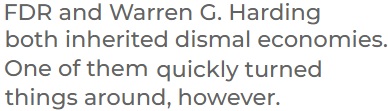
Harding vs. FDRI’ve written about President Warren Harding’s under-appreciated economic policies. He restored economic prosperity in the 1920s I’ve also written many times about how President Franklin Roosevelt’s economic policies in the 1930s were misguided. And that’s being charitable. For all intents and purposes, he doubled down on the bad policies of Herbert Hoover. As a result, what should have been a typical recession wound up becoming the Great Depression. But I’ve never directly compared Harding and FDR. Ryan Walters, who teaches history to students at Collins College, has undertaken that task. In a piece for the Foundation for Economic Education, he explains how Harding and Roosevelt took opposite paths when facing similar situations.
Here’s some of what he wrote about Harding’s successful policies.
And here’s what happened under FDR. Basically the opposite path, with horrible consequences.
At the risk of understatement, amen, amen, and amen.
This is mostly because they get spoon fed inaccurate information in their history classes and now think that laissez-faire capitalism somehow failed in the 1930s. And they know nothing about what happened under Harding. P.S. What happened in the 1920s and 1930s also is very instructive when thinking about the growth-vs-equality debate. P.P.S. Shifting back to people not learning history (or learning bad history), it would be helpful if there was more understanding of how supporters of Keynesian economics were completely wrong about what happened after World War II. Which Presidents Are Right about Government, George Washington and Thomas Jefferson or Woodrow Wilson and Barack Obama?When I was became interested in public policy, I thought Jimmy Carter was the epitome of a bad President. But as I began to learn economics, I realized that Richard Nixon and Lyndon Johnson also were terrible and belong in the Hall of Fame of bad Presidents.
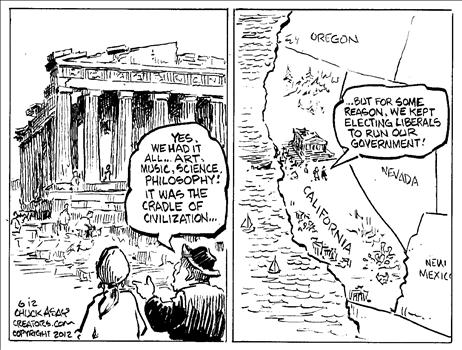
Or I guess we should call it a Hall of Shame (you can click on the image to see my selections). Whatever we call it, I’m now at the point where I realize that Woodrow Wilson and Teddy Roosevelt are the charter members. Why? Well, because they were the first Presidents to reflect the progressive ideology. More specifically, they shared the ideology of the progressive movement, which saw a powerful and activist central government as a force for good – a radical departure from the views of America’s Founding Fathers, who hoped that the Constitution would protect people by keeping government very small. Not surprisingly, Barack Obama is in that “progressive” tradition, even to the point of attacking the views of the Founding Fathers in a recent speech at Ohio State University. I commented on this issue in this Fox News segment.
That short clip only scratches the surface. For more detail, here are some excerpts from a column by Andrew Napolitano. Like me, he isn’t impressed by the President’s statolatry.
Napolitano also warns against majoritarianism in his column, which is music to my ears. Though I’m not sure our battle today is with majoritarianism or the progressive ideology. Our real challenge is redistributionism. Far too many people think it is okay to use the coercive power of government to obtain unearned benefits. And that’s true whether the benefits are food stamps or bailouts.
Somehow, we have to reverse this downward spiral. Unless we want America to become Greece or France, at which point productive people may be forced to emigrate – assuming there are still some sensible nations left in the world. Crimes and Misdemeanors (1989)
 Roger Ebert called this flick one of Allen’s best. The director, pictured with cinematographer Sven Nykvist on set, was nominated for three Academy Awards, including best director and writing. “Who else but Woody Allen could make a movie in which virtue is punished, evildoing is rewarded and there is a lot of laughter – even subversive laughter at the most shocking times?” wrote the famous reviewer. _____________ The founding fathers believed that it benefitted the government for it’s leaders to believe in God and with that would come the view that evil will be punished and good will be rewarded in the afterlife. John Quincy Adams said: There are three points of doctrine the belief of which forms the foundation of all morality. The first is the existence of God; the second is the immortality of the human soul; and the third is a future state of rewards and punishments. Suppose it possible for a man to disbelieve either of these three articles of faith and that man will have no conscience, This point of view is not held by many today. I noticed in Woody Allen’s film “Crimes and Misdemeanors” you can see how Allen’s agnostic worldview permits him to allow the lead character to have his mistress killed when she threatens to call the cops. Judah noted, “God is a luxery I can not afford.” Earlier in the film Judah is terrified when he thinks there is a living God that will punish him in an afterlife, but only after he convinces himself there is no God is he at peace with his decision to have this troublesome lady killed. Check out this movie on Netflix and you will see what I mean about this potential moral problem that atheists can not answer. (I have looked this question many times in my previous posts.) David Barton is a Christian historian and he has quoted many of the founders concerning their views of the afterlife and how their views impact what is done while leading the nation: James Iredell, a ratifier of the Constitution and a U. S. Supreme Court justice appointed by George Washington, also confirmed:
David Barton noted in his article, “Importance of Morality and Religion in Government,”: |
| 01/2000 |
|
John Quincy Adams Sixth President of the United States There are three points of doctrine the belief of which forms the foundation of all morality. The first is the existence of God; the second is the immortality of the human soul; and the third is a future state of rewards and punishments. Suppose it possible for a man to disbelieve either of these three articles of faith and that man will have no conscience, he will have no other law than that of the tiger or the shark. The laws of man may bind him in chains or may put him to death, but they never can make him wise, virtuous, or happy. (Source: John Quincy Adams, Letters of John Quincy Adams to His Son on the Bible and Its Teachings (Auburn: James M. Alden, 1850), pp. 22-23.)
Charles Carroll of Carrollton Signer of the Declaration of Independence Without morals a republic cannot subsist any length of time; they therefore who are decrying the Christian religion, whose morality is so sublime & pure, [and] which denounces against the wicked eternal misery, and [which] insured to the good eternal happiness, are undermining the solid foundation of morals, the best security for the duration of free governments. (Source: Bernard C. Steiner, The Life and Correspondence of James McHenry (Cleveland: The Burrows Brothers, 1907), p. 475. In a letter from Charles Carroll to James McHenry of November 4, 1800.) James McHenry Signer of the Constitution [P]ublic utility pleads most forcibly for the general distribution of the Holy Scriptures. The doctrine they preach, the obligations they impose, the punishment they threaten, the rewards they promise, the stamp and image of divinity they bear, which produces a conviction of their truths, can alone secure to society, order and peace, and to our courts of justice and constitutions of government, purity, stability and usefulness. In vain, without the Bible, we increase penal laws and draw entrenchments around our institutions. Bibles are strong entrenchments. Where they abound, men cannot pursue wicked courses, and at the same time enjoy quiet conscience. (Source: Bernard C. Steiner, One Hundred and Ten Years of Bible Society Work in Maryland, 1810-1920 (Maryland Bible Society, 1921), p. 14.)
Benjamin Rush Signer of the Declaration of Independence Remember that national crimes require national punishments, and without declaring what punishment awaits this evil, you may venture to assure them that it cannot pass with impunity, unless God shall cease to be just or merciful. (Source: Benjamin Rush, An Address to the Inhabitants of the British Settlements in America Upon Slave-Keeping (Boston: John Boyles, 1773), p. 30.) Joseph Story Supreme Court Justice Indeed, the right of a society or government to [participate] in matters of religion will hardly be contested by any persons who believe that piety, religion, and morality are intimately connected with the well being of the state and indispensable to the administrations of civil justice. The promulgation of the great doctrines of religion—the being, and attributes, and providence of one Almighty God; the responsibility to Him for all our actions, founded upon moral accountability; a future state of rewards and punishments; the cultivation of all the personal, social, and benevolent virtues—these never can be a matter of indifference in any well-ordered community. It is, indeed, difficult to conceive how any civilized society can well exist without them. (Source: Joseph Story, A Familiar Exposition of the Constitution of the United States (New York: Harper & Brothers, 1847), p. 260, §442.) |











.jpg)











___________
I want to give you five reasons to affirm the Bible is the Word of God. First, I believe the Bible is the Word of God because of its scientific accuracy. The Truth of the Word of God tells us that God “hangeth the earth upon nothing” (Job 26:7). How did Job know that the earth hung in space before the age of modern astronomy and space travel? The Holy Spirit told him. The scientists of Isaiah’s day didn’t know the topography of the earth, but Isaiah said, “It is [God] that sitteth upon the circle of the earth” (Isaiah 40:22). The word for “circle” here means a globe or sphere. How did Isaiah know that God say upon the circle of the earth? By divine inspiration.
Secondly, the Bible is affirmed through historical accuracy. Do you remember the story about the handwriting on the wall that is found in the fifth chapter of Daniel? Belshazzar hosted a feast with a thousand of his lords and ladies. Suddenly, a gruesome hand appeared out of nowhere and began to write on a wall. The king was disturbed and asked for someone to interpret the writing. Daniel was found and gave the interpretation. After the interpretation, “Then commanded Belshazzar, and they clothed Daniel with scarlet, and put a chain of gold about his neck, and made a proclamation concerning him, that he should be the third ruler in the kingdom.” (Daniel 5:29). Basing their opinion on Babylonian records, the historians claim this never happened. According to the records, the last king of Babylon was not Belshazzar, but a man named Nabonidas. And so, they said, the Bible is in error. There wasn’t a record of a king named Belshazzar. Well, the spades of archeologists continued to do their work. In 1853, an inscription was found on a cornerstone of a temple built by Nabonidas, to the god Ur, which read: “May I, Nabonidas, king of Babylon, not sin against thee. And may reverence for thee dwell in the heart of Belshazzar, my first-born favorite son.” From other inscriptions, it was learned that Belshazzar and Nabonidas were co-regents. Nabonidas traveled while Belshazzar stayed home to run the kingdom. Now that we know that Belshazzar and Nabonidas were co-regents, it makes sense that Belshazzar would say that Daniel would be the third ruler. What a marvelous nugget of truth tucked away in the Word of God!
___________
Third, from Genesis to Revelation, the Bible reads as one book. And there is incredible unity to the Bible. The Bible is one book, and yet it is made up of 66 books, was written by at least 40 different authors over a period of about 1600 years, in 13 different countries and on three different continents. It was written in at least three different languages by people in all professions. The Bible forms one beautiful temple of truth that does not contradict itself theologically, morally, ethically, doctrinally, scientifically, historically, or in any other way.
Fourth, did you know the Bible is the only book in the world that has accurate prophecy? When you read the prophecies of the Bible, you simply have to stand back in awe. There are over 300 precise prophecies that deal with the Lord Jesus Christ in the Old Testament that are fulfilled in the New Testament. To say that these are fulfilled by chance is an astronomical impossibility.
Finally, the Bible is not a book of the month, but the Book of the ages. First Peter 1:25 says: “But the word of the Lord endureth for ever. And this is the Word which by the gospel is preached unto you.” No book has ever had as much opposition as the Bible. Men have laughed at it, scorned it, burned it, ridiculed it, and made laws against it. But the Word of God has survived. And it is applicable today as much as it was yesterday and will be tomorrow.
It’s so majestically deep that scholars could swim and never touch the bottom. Yet so wonderfully shallow that a little child could come and get a drink of water without fear of drowning. That is God’s precious, holy Word. The Word of God. Know it. Believe it. It is True.


 The Daily Hatch