Tag Archives: Arif Ahmed

RESPONDING TO HARRY KROTO’S BRILLIANT RENOWNED ACADEMICS!! Robert Foley  is a British anthropologist, archaeologist, and academic, specializing in human evolution: “I go to Chapel but technically I am an agnostic in the Huxley sense, that one cannot be absolutely certain, but for all practical purposes I am an atheist”

On November 21, 2014 I received a letter from Nobel Laureate Harry Kroto and it said:

…Please click on this URL http://vimeo.com/26991975

and you will hear what far smarter people than I have to say on this matter. I agree with them.

Harry Kroto

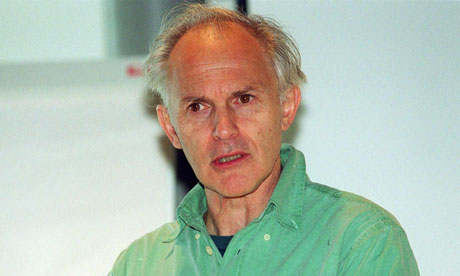
Nick Gathergood, David-Birkett, Harry-Kroto

I have attempted to respond to all of Dr. Kroto’s friends arguments and I have posted my responses one per week for over a year now. Here are some of my earlier posts:

Arif Ahmed, Sir David AttenboroughMark Balaguer, Horace Barlow, Michael BatePatricia ChurchlandAaron CiechanoverNoam Chomsky,Alan DershowitzHubert Dreyfus, Bart Ehrman, Stephan FeuchtwangDavid Friend,  Riccardo GiacconiIvar Giaever , Roy GlauberRebecca GoldsteinDavid J. Gross,  Brian Greene, Susan GreenfieldStephen F Gudeman,  Alan Guth, Jonathan HaidtTheodor W. Hänsch, Brian Harrison,  Hermann HauserRoald Hoffmann,  Bruce HoodHerbert Huppert,  Gareth Stedman Jones, Steve JonesShelly KaganMichio Kaku,  Stuart Kauffman,  Lawrence KraussHarry Kroto, George LakoffElizabeth Loftus,  Alan MacfarlanePeter MillicanMarvin MinskyLeonard Mlodinow,  Yujin NagasawaAlva NoeDouglas Osheroff,  Jonathan Parry,  Saul PerlmutterHerman Philipse,  Carolyn PorcoRobert M. PriceLisa RandallLord Martin Rees,  Oliver Sacks, John SearleMarcus du SautoySimon SchafferJ. L. Schellenberg,   Lee Silver Peter Singer,  Walter Sinnott-ArmstrongRonald de Sousa, Victor StengerBarry Supple,   Leonard Susskind, Raymond TallisNeil deGrasse Tyson,  .Alexander Vilenkin, Sir John WalkerFrank WilczekSteven Weinberg, and  Lewis Wolpert,

Robert Foley (academic)

From Wikipedia, the free encyclopedia
Professor
Robert Foley
FBA
Professor Robert Foley,Wadi Mathendous, January 2011.jpg

Foley in 2011
Born Robert Andrew Foley
18 March 1953 (age 63)
Sussex, England
Nationality British
Fields Human evolution
Prehistoric archaeology
Institutions University of Durham
University of Cambridge
Alma mater Peterhouse, Cambridge
Thesis  (1980)
Notable awards Fellow of the British Academy(2007)

Robert Andrew Foley, FBA (born 18 March 1953) is a British anthropologist, archaeologist, and academic, specialising in human evolution. From 1977 to 1985, he was a lecturer in anthropology at the University of Durham. He has been a fellow of King’s College, Cambridge since 1987, and Leverhulme Professor of Human Evolution at the University of Cambridge since 2003.[1]

Early career[edit]

Foley was born on 18 March 1953 in Sussex, England, to Nelson and Jean Foley.[2][1] He was educated at Ardingly College and Peterhouse, Cambridge where he earned an MA and PhD in archaeology.

Academic career[edit]

From 1977 to 1985, Foley was a Lecturer in Anthropology at the University of Durham. He then returned to the University of Cambridge to take up a post in the Department of Biological Anthropology. From 1986 to 1998, he was a lecturer in Biological Anthropology. Since 1987, he has been a Fellow of King’s College, Cambridge. From 1998 to 2003, he was Reader in Evolutionary Anthropology. He co-founded the Leverhulme Centre for Human Evolutionary Studies in 2001 with Marta Mirazón Lahr, and has been its director since its inception. The Centre was designed to provide a home for the Duckworth Collection, and first class laboratories and facilities to support research in human evolution which integrated genetics, anthropology, and other fields.[3] In 2003, he was appointed Leverhulme Professor of Human Evolution.[1][4]

Research[edit]

Foley has carried out research in many aspects of evolutionary theory, human evolution, prehistory and more recently human evolutionary genetics. His early work was on the Later Stone Age of East Africa, where he developed methods and ideas to study the landscape distributions of artefacts, giving rise to the sub-field of Off-Site Archaeology.[5] In his work on human evolution he has emphasized an evolutionary ecological approach, seeing human adaptations as solutions to the problems faced by hominins in the environments in which they were living.[6] This evolutionary research has also explored the relationship between climate and evolutionary change,[7] the evolution of social behavior (finite social space model), and patterns of hominin diversity. This approach was summarized in two books – Another Unique Species, and Humans Before Humanity.

Since the 1990s, Foley has collaborated with Marta Mirazón Lahr on research relating to the evolution of modern humans and their diversity. Their work has argued for multiple dispersals of early humans out of Africa, and the use of the ‘southern route’. Their approach has emphasized the role of geographical factors in shaping human evolution, and a central role for dispersals as the process by which diversity evolves.[8][9][10]

He has co-led expeditions and archaeological excavations with Mirazon Lahr in the Solomon Islands, the Central Sahara, and Kenya, particularly in the Turkana Basin. In Turkana, Foley and Mirazon Lahr study the late Quaternary record of human occupation in the basin, and have recently described a group of 10,000 year-old skeletons from the site of Nataruk that died as part of conflict between hunter-gatherer bands.[11]

In the last decade, Foley has been involved in several aspects of evolutionary psychology and linguistics, exploring questions related to the evolution of human cognition, human language and its use as a mechanism is the evolution of society and social boundaries.

Honours[edit]

In 2007, Foley was elected a Fellow of the British Academy (FBA).[12]

Categories:

In  the first video below in the 48th clip in this series are his words and  my response is below them. 

50 Renowned Academics Speaking About God (Part 1)

Another 50 Renowned Academics Speaking About God (Part 2)

A Further 50 Renowned Academics Speaking About God (Part 3)

_________________________________

Below is a letter I wrote to Dr. Foley and in it I respond to his quote from You Tube:


March 27, 2016

Professor Robert Foley, c/o Cambridge Language Sciences Strategic Initiative, Dept. of Theoretical and Applied Linguistics, 9 West Road, Cambridge, CB3 9DP

Dear Dr. Foley,

I learned much from your in-depth interview with Dr. Alan MacFarlane. Since you have studied science all your life I thought you would be interested in the subject of this letter today and when I heard your interview with Dr. MacFarlane that  that prompted me to send you two CD’s today. Recently I had the opportunity to come across a very interesting article by Michael Polanyi, LIFE TRANSCENDING PHYSICS AND CHEMISTRY, in the magazine CHEMICAL AND ENGINEERING NEWS, August 21, 1967, and I also got hold of a 1968 talk by Francis Schaeffer based on this article. Polanyi’s son John actually won the 1986 Nobel Prize for Chemistry. This article by Michael Polanyi concerns Francis Crick and James Watson and their discovery of DNA in 1953. Polanyi noted:

Mechanisms, whether man-made or morphological, are boundary conditions harnessing the laws of in
animate nature, being themselves irreducible to those laws. The pattern of organic bases in DNA which functions as a genetic code is a boundary condition irreducible to physics and chemistry. Further controlling principles of life may be represented as a hierarchy of boundary conditions extending, in the case of man, to consciousness and responsibility.

____

James Watson (1928-) and Francis Crick  (8 June 1916 – 28 July 2004)

Michael Polanyi, FRS[1] (11 March 1891 – 22 February 1976)

John Charles Polanyi,  (born 23 January 1929)

I am sending you this two CD’s of this talk because I thought you may find it very interesting. It includes references to not only James D. Watson, and Francis Crick but also  Maurice Wilkins, Erwin Schrodinger, J.S. Haldane (his son was the famous J.B.S. Haldane), Peter Medawar, and Barry Commoner.

___
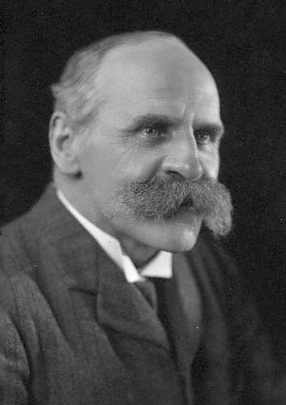
John Scott Haldane (2 May 1860 – 14/15 March 1936)

J. B. S. Haldane
J. B. S. Haldane.jpg

Haldane in 1914

(5 November 1892 – 1 December 1964)

Maurice Wilkins (15 December 1916 – 5 October 2004)

Erwin Schrödinger (12 August 1887 – 4 January 1961)
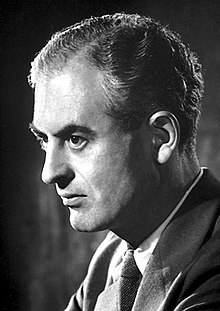
Sir Peter Medawar ( 28 February 1915 – 2 October 1987)

Barry Commoner (May 28, 1917 – September 30, 2012)

In the You Tube video “A Further 50 Renowned Academics Speaking About God (Part 1),” you asserted:

 As a high Anglican school, everybody was expected to be confirmed; I did lessons with the chaplain and at the end he told us to go away and think deeply about why we were being confirmed; I did so and told him that I was only doing it because if I did so I would get an extra Sunday out; as this was the only reason I did not feel I should be confirmed; I was about fourteen at the time and I did not give much thought to religion after that time; I love going to church, and my wife, who was brought up a Catholic, is horrified by my aesthetic enjoyment of it; like many English people I like the sounds, the familiarity, the rhythms, and music; I go to Chapel but technically I am an agnostic in the Huxley sense, that one cannot be absolutely certain, but for all practical purposes I am an atheist; I don’t remember ever having a great deal of anxiety about that; religion for me is a nice social backdrop; obviously, being interested in human evolution I have then thought much about the nature of religion; I am fairly convinced that religion plays a major role in human evolution, which has nothing to do with whether it is true or not; Pascal Boyer’s ideas are very sensible, that religion plays an important role in forming communities, forming largely antagonistic relationships between groups, in providing mechanisms for coercion or conformism – all those things work better with religion; there is a tendency to believe, and to believe what others believe – very few of us think in ways different to those immediately around us – suggest there are strong conformism genes; this is also true of politics and other things, not just religion; on the actual content of religion, I would say that most religions allow you to increase your self belief; I think that Darwinism is one of the least adaptive beliefs in the world as it is basically saying that we are not important in the big scheme of things; one of the reasons that it is not widely accepted is that it is too simple, and this goes against the grain of much of social science; the second is that as a system of belief it downplays the egocentric view; if I want a reason to dominate the world, Darwinism is not going to give it to me; for me, religious belief is a very interesting thing, and I diverge from someone like Dawkins who I think has a very old-fashioned, Frazerian, notion of religion, that magic, witchcraft, religion, science, are somehow a progressive system of thought; …I think the problem with having an Anglican background is that one has a very benign view of religion; we have learned throughout history as well as our own immediate experiences that religion can be very brutal and nasty; that would make me much closer to Dawkins’ position; one can see in Islam with the oppression of women; I am fanatically opposed to capital punishment, so in Saudi Arabia and so on, what is done in the name of religion is appalling; there have been times when religion has made the world a better place, at others, worse, so we have to make ad-hoc decisions; what I would fight very strongly against is the creeping back of religion into governance; I am a child of the Enlightenment, and would not want to see us go back

I am going to answer you in an indirect way. Today is Easter and sometimes a song will just minister to a person in a special way and I heard this song at church today and I wanted to share it with you. It is  called MAN OF SORROWS and it can be found on You Tube Man Of Sorrows – Hillsong Live (2013 Album Glorious Ruins) Worship Song with Lyrics and here are the lyrics:

“Man Of Sorrows”

Man of sorrows Lamb of God
By His own betrayed
The sin of man and wrath of God
Has been on Jesus laid

Silent as He stood accused
Beaten mocked and scorned
Bowing to the Father’s will
He took a crown of thorns

Oh that rugged cross
My salvation
Where Your love poured out over me
Now my soul cries out
Hallelujah
Praise and honour unto Thee

Sent of heaven God’s own Son
To purchase and redeem
And reconcile the very ones
Who nailed Him to that tree

Now my debt is paid
It is paid in full
By the precious blood
That my Jesus spilled

Now the curse of sin
Has no hold on me
Whom the Son sets free
Oh is free indeed

See the stone is rolled away
Behold the empty tomb
Hallelujah God be praised
He’s risen from the grave

We sang that song at our Easter service.

On Easter morning March 27, 2016 at FELLOWSHIP BIBLE CHURCH our teaching pastor Brandon Barnard delivered the message THIS CHANGES EVERYTHING based on I Corinthians chapter 15 and I wanted to share a portion of that sermon with you today.

This day is the day that changes everything. The resurrection changes everything and that is why we are gathered here today to celebrate the resurrection of our Lord Jesus Christ because it changes everything.

Some of you are going to be blown away by the opportunity before you this Easter morning because the resurrection of Jesus Christ stands at the very heart of Christianity. If what we we are gathered here to celebrate did not happen then people need to pity us as believers.  They need to feel sorry for you and me more than anyone on earth because we have set our hopes firmly on a lie.

But if the resurrection really did happen, then we need to repent and we need to believe in Jesus and we need to rejoice that we have hope in this life and the life to come. 

Paul wrote this to the believers in Corinth.

1 Corinthians 15:3-6, 13-21 English Standard Version (ESV)

3 For I delivered to you as of first importance what I also received: that Christ died for our sins in accordance with the Scriptures, that he was buried, that he was raised on the third day in accordance with the Scriptures, and that he appeared to Cephas, then to the twelve. Then he appeared to more than five hundred brothers at one time, most of whom are still alive, though some have fallen asleep.

13 But if there is no resurrection of the dead, then not even Christ has been raised. 14 And if Christ has not been raised, then our preaching is in vain and your faith is in vain. 15 We are even found to be misrepresenting God, because we testified about God that he raised Christ, whom he did not raise if it is true that the dead are not raised.16 For if the dead are not raised, not even Christ has been raised. 17 And if Christ has not been raised, your faith is futile and you are still in your sins. 18 Then those also who have fallen asleep in Christ have perished.19 If in Christ we have hope[a] in this life only, we are of all people most to be pitied.

20 But in fact Christ has been raised from the dead, the firstfruits of those who have fallen asleep. 21 For as by a man came death, by a man has come also the resurrection of the dead.

_____

If Christ hasn’t been raised then these facts are true:

  1. PREACHING AND FAITH ARE IN VAIN.
  2. WE ARE FALSE WITNESSES
  3. WE ARE STILL IN OUR SINS.
  4. THOSE WHO DIED IN FAITH ARE STILL DEAD
  5. WE ARE TO BE PITIED MORE THAN ANYONE ELSE IN THE WORLD.

Verse 20 says, “but Christ has been raised!!! Therefore, these things are true:

  1. Our faith is significant, valuable and eternal.
  2. we are truth tellers!!
  3. we are forgiven of our sins.
  4. death is not our final stop.
  5. don’t pity us but join us in believing in Jesus Christ.

You said above that you are an atheist. However, would you agree that if the Bible is correct in regards to history then Jesus did rise from the grave? Let’s take a closer look at evidence concerning the accuracy of the Bible.

I know that you highly respected Surgeon General C. Everett Koop and he co-authored with Francis Schaeffer the book WHATEVER HAPPENED TO THE HUMAN RACE? Below is a piece of evidence from that book.

Francis Schaeffer (30 January 1912 – 15 May 1984[1])  and his wife Edith  (November 3, 1914 – March 30, 2013)

C. Everett Koop, MD (October 14, 1916 – February 25, 2013) 13th Surgeon General of the United States


__

Two things should be mentioned about the time of Moses in Old Testament history.

First, consider the archaeological evidence that relates to the period. True, it is not of the same explicitness that we have found, say, in relation to the existence of Ahab or Jehu or Jehoiakim. We have no inscription from Egypt which refers to Moses being taken out of the bulrushes and removed from the waterproof basket his mother had made him. But this does not mean that the Book of Exodus is a fictitious account, as some critics has suggested. Some say it is simply an idealized reading-back into history by the Jews under the later monarchy. There is not a reason why these “books of Moses,” as they are called, should not be treated as history, just as we have been forced to treat the Books of Kings and Chronicles dating 500 years later.

There is ample evidence about the building projects of the Egyptian kings, and the evidence we have fits well with Exodus. There are scenes of brick-making (for example, Theban Tomb 100 of Rekhmire). Contemporary parchments and papyri tell of production targets which had to be met. One speaks of a satisfied official report of his men as “making their quota of bricks daily” (Papyrus Anastasi III vso, p.3, in the British Museum. Also Louvre Leather Roll in the Louvre, Paris, col ii, mentions quotes of bricks and “taskmasters”). Actual bricks found show signs of straw which had to be mixed in with the clay, just as Exodus says. This matter of bricks and straw is further affirmed by the record that one despairing official complained, “There are no men to make bricks nor straw in my area.”

We know from contemporary discoveries that Semites were found at all levels of Egypt’s cosmopolitan society. (Brooklyn Museum, New York, no. 35, 1446. Papyrus Brooklyn). There is nothing strange therefore about Joseph’s becoming so important in the pharaoh’s court.

The store cities of Pithom and Raamses (Rameses) mentioned in Exodus 1:11 are well known in Egyptian inscriptions. Raamses was actually in the east-Delta capital, Pi-Ramses (near Goshen), where the Israelites would have had ample experience of agriculture. Thus, the references to agriculture found in the law of Moses would not have been strange to the Israelites even though they were in the desert at the time the law was given. Certainly there is no reason to say, as some critics do, that these sections on agriculture were an indication of a reading-back from a latter period when the Jews were settled in Canaan.

The form of the covenant made at Sinai has remarkable parallels with the covenant forms of other people at that time. (On covenants and parties to a treaty, the Louvre; and Treaty Tablet from Boghaz Koi (i.e., Hittite) in Turkey, Museum of Archaeology in Istanbul.) The covenant form at Sinai resembles just as the forms of letter writings of the first century after Christ (the types of introductions and greetings) are reflected in the letters of the apostles in the New Testament, it is not surprising to find the covenant form of the second millennium before Christ reflected in what occurred at Mount Sinai. God has always spoken to people within the culture of their time, which does not mean that God’s communication is limited by that culture. It is God’s communication but within the forms appropriate to the time.

The Pentateuch tells us that Moses led the Israelites up the east side of the Dead Sea after their long stay in the desert. There they encountered the hostile kingdom of Moab. We have firsthand evidence for the existence of this kingdom of Moab–contrary to what has been said by critical scholars who have denied the existence of Moab at this time. It can be found in a war scene from a temple at Luxor (Al Uqsor). This commemorates a victory by Ramses II over the Moabite nation at Batora (Luxor Temple, Egypt).

Also the definite presence of the Israelites in west Palestine (Canaan) no later than the end of the thirteenth century B.C. is attested by a victory stela of Pharaoh Merenptah (son and successor of Ramses II) to commemorate his victory over Libya (Israel Stela, Cairo Museum, no. 34025). In it he mentions his previous success in Canaan against Aschalon, Gize, Yenom, and Israel; hence there can be no doubt the nation of Israel was in existence at the latest by this time of approximately 1220 B.C. This is not to say it could not have been earlier, but it cannot be later than this date.

Christ came and laid his life down to die for our sins and there is evidence that indicates the Bible is true!!!!! Some 400 years before crucifixion was invented, both Israel’s King David and the prophet Zechariah described the Messiah’s death in words that perfectly depict that mode of execution. Further, they said that the body would be pierced and that none of the bones would be broken, contrary to customary procedure in cases of crucifixion (Psalm 22 and 34:20; Zechariah 12:10). Again, historians and New Testament writers confirm the fulfillment: Jesus of Nazareth died on a Roman cross, and his extraordinarily quick death eliminated the need for the usual breaking of bones. A spear was thrust into his side to verify that he was, indeed, dead.

Psalm 22 New American Standard Bible (NASB)

A Cry of Anguish and a Song of Praise.

For the choir director; upon [a]Aijeleth Hashshahar. A Psalm of David.

22 My God, my God, why have You forsaken me?
[b]Far from my deliverance are the words of my [c]groaning.
O my God, I cry by day, but You do not answer;
And by night, but [d]I have no rest.
But I am a worm and not a man,

A reproach of men and despised by the people.
7 All who see me [g]sneer at me;
They [h]separate with the lip, they wag the head, saying,
[i]Commit yourself to the Lord; let Him deliver him;
Let Him rescue him, because He delights in him.”

12 Many bulls have surrounded me;
Strong bulls of Bashan have encircled me.
13 They open wide their mouth at me,
As a ravening and a roaring lion.
14 I am poured out like water,
And all my bones are out of joint;
My heart is like wax;
It is melted within [l]me.
15 My strength is dried up like a potsherd,
And my tongue cleaves to my jaws;
And You lay me [m]in the dust of death.
16 For dogs have surrounded me;
[n]A band of evildoers has encompassed me;
[o]They pierced my hands and my feet.
17 I can count all my bones.
They look, they stare at me;
18 They divide my garments among them,
And for my clothing they cast lots.

Francis Schaeffer ended HOW SHOULD WE THEN LIVE? Episode 7 with these words:

When we think of Christ of course we think of his substitutionary death upon the cross when he who claimed to be God died in a substitutionary way and as such his death had infinite value and as we accept  that gift raising the empty hands of faith with no humanistic elements we have that which is real life and that is being in relationship to the infinite personal God who is there and being in a personal relationship to Him. But Christ brings life in another way that is not as often clearly thought about perhaps. He connects himself with what the Bible teaches in his teaching and as such he is a prophet as well as a savior. It is upon the basis of what he taught  and the Bible teaches because he himself wraps these together that we have life instead of death in the sense of having some knowledge that is more than men can have from himself, beginning from himself alone. Both of these elements are the place where Christ gives us life.  

The answer to find meaning in life is found in putting your faith and trust in Jesus Christ. The Bible is true from cover to cover and can be trusted.

Thanks for your time.

Sincerely,

Everette Hatcher, everettehatcher@gmail.com, http://www.thedailyhatch.org, cell ph 501-920-5733, Box 23416, LittleRock, AR 72221

Interview with Professor Robert Foley, Part 1

Uploaded on Jan 24, 2012

An interview of Professor Robert Foley on his life and work as a biological anthropologist. Please see http://www.alanmacfarlane.com for the wider context.
Filmed on 27 April 2010
All revenues to World Oral Literature Project

______________________

Interview with Professor Robert Foley, Part 2

Uploaded on Jan 27, 2012

An interview of Professor Robert Foley on his life and work as a biological anthropologist. Please see http://www.alanmacfarlane.com for the wider context.
Filmed on 27 April 2010
All revenues to World Oral Literature Project

Related posts:

FRANCIS SCHAEFFER ANALYZES ART AND CULTURE Part 53 THE BEATLES (Part E, Stg. Pepper’s and John Lennon’s search in 1967 for truth was through drugs, money, laughter, etc & similar to King Solomon’s, LOTS OF PICTURES OF JOHN AND CYNTHIA) (Feature on artist Yoko Ono)

The John Lennon and the Beatles really were on a long search for meaning and fulfillment in their lives  just like King Solomon did in the Book of Ecclesiastes. Solomon looked into learning (1:12-18, 2:12-17), laughter, ladies, luxuries, and liquor (2:1-2, 8, 10, 11), and labor (2:4-6, 18-20). He fount that without God in the picture all […]

FRANCIS SCHAEFFER ANALYZES ART AND CULTURE Part 52 THE BEATLES (Part D, There is evidence that the Beatles may have been exposed to Francis Schaeffer!!!) (Feature on artist Anna Margaret Rose Freeman )

______________   George Harrison Swears & Insults Paul and Yoko Lucy in the Sky with Diamonds- The Beatles The Beatles:   I have dedicated several posts to this series on the Beatles and I don’t know when this series will end because Francis Schaeffer spent a lot of time listening to the Beatles and talking […]

FRANCIS SCHAEFFER ANALYZES ART AND CULTURE Part 51 THE BEATLES (Part C, List of those on cover of Stg.Pepper’s ) (Feature on artist Raqib Shaw )

  The Beatles in a press conference after their Return from the USA Uploaded on Nov 29, 2010 The Beatles in a press conference after their Return from the USA. The Beatles:   I have dedicated several posts to this series on the Beatles and I don’t know when this series will end because Francis […]

FRANCIS SCHAEFFER ANALYZES ART AND CULTURE Part 50 THE BEATLES (Part B, The Psychedelic Music of the Beatles) (Feature on artist Peter Blake )

__________________   Beatles 1966 Last interview I have dedicated several posts to this series on the Beatles and I don’t know when this series will end because Francis Schaeffer spent a lot of time listening to the Beatles and talking and writing about them and their impact on the culture of the 1960’s. In this […]

FRANCIS SCHAEFFER ANALYZES ART AND CULTURE Part 49 THE BEATLES (Part A, The Meaning of Stg. Pepper’s Cover) (Feature on artist Mika Tajima)

_______________ The Beatles documentary || A Long and Winding Road || Episode 5 (This video discusses Stg. Pepper’s creation I have dedicated several posts to this series on the Beatles and I don’t know when this series will end because Francis Schaeffer spent a lot of time listening to the Beatles and talking and writing about […]

FRANCIS SCHAEFFER ANALYZES ART AND CULTURE PART 48 “BLOW UP” by Michelangelo Antonioni makes Philosophic Statement (Feature on artist Nancy Holt)

_______________ Francis Schaeffer pictured below: _____________________ I have included the 27 minute  episode THE AGE OF NONREASON by Francis Schaeffer. In that video Schaeffer noted,  ” Sergeant Pepper’s Lonely Hearts Club Band…for a time it became the rallying cry for young people throughout the world. It expressed the essence of their lives, thoughts and their feelings.” How Should […]

FRANCIS SCHAEFFER ANALYZES ART AND CULTURE Part 47 Woody Allen and Professor Levy and the death of “Optimistic Humanism” from the movie CRIMES AND MISDEMEANORS Plus Charles Darwin’s comments too!!! (Feature on artist Rodney Graham)

Crimes and Misdemeanors: A Discussion: Part 1 ___________________________________ Today I will answer the simple question: IS IT POSSIBLE TO BE AN OPTIMISTIC SECULAR HUMANIST THAT DOES NOT BELIEVE IN GOD OR AN AFTERLIFE? This question has been around for a long time and you can go back to the 19th century and read this same […]

FRANCIS SCHAEFFER ANALYZES ART AND CULTURE PART 46 Friedrich Nietzsche (Featured artist is Thomas Schütte)

____________________________________ Francis Schaeffer pictured below: __________ Francis Schaeffer has written extensively on art and culture spanning the last 2000years and here are some posts I have done on this subject before : Francis Schaeffer’s “How should we then live?” Video and outline of episode 10 “Final Choices” , episode 9 “The Age of Personal Peace and Affluence”, episode 8 […]

FRANCIS SCHAEFFER ANALYZES ART AND CULTURE Part 45 Woody Allen “Reason is Dead” (Feature on artists Allora & Calzadilla )

Love and Death [Woody Allen] – What if there is no God? [PL] ___________ _______________ How Should We then Live Episode 7 small (Age of Nonreason) #02 How Should We Then Live? (Promo Clip) Dr. Francis Schaeffer 10 Worldview and Truth Two Minute Warning: How Then Should We Live?: Francis Schaeffer at 100 Francis Schaeffer […]

FRANCIS SCHAEFFER ANALYZES ART AND CULTURE Part 44 The Book of Genesis (Featured artist is Trey McCarley )

___________________________________ Francis Schaeffer pictured below: ____________________________ Francis Schaeffer “BASIS FOR HUMAN DIGNITY” Whatever…HTTHR Dr. Francis schaeffer – The flow of Materialism(from Part 4 of Whatever happened to human race?) Dr. Francis Schaeffer – The Biblical flow of Truth & History (intro) Francis Schaeffer – The Biblical Flow of History & Truth (1) Dr. Francis Schaeffer […]

__

RESPONDING TO HARRY KROTO’S BRILLIANT RENOWNED ACADEMICS!! Mark Elvin professor of  Chinese history,  St. Antony’s College. Oxford, “I was already about age eleven and in some way you could say someone who took as his guide Bertrand Russell’s work that was accessible to me beginning with his popular essays”

On November 21, 2014 I received a letter from Nobel Laureate Harry Kroto and it said:

…Please click on this URL http://vimeo.com/26991975

and you will hear what far smarter people than I have to say on this matter. I agree with them.

Harry Kroto

Nick Gathergood, David-Birkett, Harry-Kroto

I have attempted to respond to all of Dr. Kroto’s friends arguments and I have posted my responses one per week for over a year now. Here are some of my earlier posts:

Arif Ahmed, Sir David AttenboroughMark Balaguer, Horace Barlow, Michael BatePatricia ChurchlandAaron CiechanoverNoam Chomsky,Alan DershowitzHubert Dreyfus, Bart Ehrman, Stephan FeuchtwangDavid Friend,  Riccardo GiacconiIvar Giaever , Roy GlauberRebecca GoldsteinDavid J. Gross,  Brian Greene, Susan GreenfieldStephen F Gudeman,  Alan Guth, Jonathan HaidtTheodor W. Hänsch, Brian Harrison,  Hermann HauserRoald Hoffmann,  Bruce HoodHerbert Huppert,  Gareth Stedman Jones, Steve JonesShelly KaganMichio Kaku,  Stuart Kauffman,  Lawrence KraussHarry Kroto, George LakoffElizabeth Loftus,  Alan MacfarlanePeter MillicanMarvin MinskyLeonard Mlodinow,  Yujin NagasawaAlva NoeDouglas Osheroff,  Jonathan Parry,  Saul PerlmutterHerman Philipse,  Carolyn PorcoRobert M. PriceLisa RandallLord Martin Rees,  Oliver Sacks, John SearleMarcus du SautoySimon SchafferJ. L. Schellenberg,   Lee Silver Peter Singer,  Walter Sinnott-ArmstrongRonald de Sousa, Victor StengerBarry Supple,   Leonard Susskind, Raymond TallisNeil deGrasse Tyson,  .Alexander Vilenkin, Sir John WalkerFrank WilczekSteven Weinberg, and  Lewis Wolpert,

Mark Elvin

From Wikipedia, the free encyclopedia

(John) Mark (Dutton) Elvin (born 1938) is a professor emeritus of Chinese history at Australian National University, specializing in the late imperial period; he is also emeritus fellow of St. Antony’s College. Oxford.

Elvin, the only child of (Herbert) Lionel Elvin and Mona Bedortha Dutton, grew up in Cambridge; attended The Dragon School; and matriculated as an undergraduate at King’s College, Cambridge. He held posts at the University of Glasgow and at St, Antony’s College, Oxford.

He is noted for his high level equilibrium trap theory to explain why an industrial revolution happened in Europe but not in China, despite the fact that the state of scientific knowledge was far more advanced in China much earlier than in Europe. Essentially, Elvin proposed that pre-industrial production methods were extremely efficient in China, which obviated much of the economic pressure for scientific progress. At the same time, a philosophical shift occurred, where Taoism was gradually replaced by Confucianism as the dominant intellectual paradigm, and moral philosophy and the development of rigid social organization became more important than scientific inquiry among intellectuals.

External links[edit]

In  the third video below in the 133rd clip in this series are his words and  my response is below them. 

50 Renowned Academics Speaking About God (Part 1)

Another 50 Renowned Academics Speaking About God (Part 2)

A Further 50 Renowned Academics Speaking About God (Part 3)

_________________________________

Below is my letter in which I respond to Dr. Elvin’s quote:

May 24, 2016

Professor John Mark Elvin,

Dear Dr. Elvin,

I know that your father was active in the  BRITISH HUMANIST ASSOCIATION and that he was longtime friends with H.J. Blackham.  Blackham was the founder of the BRITISH HUMANIST ASSOCIATION and he asserted:

On humanist assumptions, life leads to nothing, and every pretense that it does not is a deceit. If there is a bridge over a gorge which spans only half the distance and ends in mid-air, and if the bridge is crowded with human beings pressing on, one after the other they fall into the abyss. The bridge leads nowhere, and those who are pressing forward to cross it are going nowhere….It does not matter where they think they are going, what preparations for the journey they may have made, how much they may be enjoying it all. The objection merely points out objectively that such a situation is a model of futility“( H. J. Blackham, et al., Objections to Humanism (Riverside, Connecticut: Greenwood Press, 1967).

 Lionel Elvin (7 August 1905 in Buckhurst Hill – 14 June 2005 in Cambridge

Harold J. Blackham (1903-2009) pictured above

On John Ankerberg’s show in 1986 there was a debate between  Dr. Paul Kurtz, and Dr. Norman Geisler and when part of the above quote was read, Dr. Kurtz responded:

I think you may be quoting Blackham out of context because I’ve heard Blackham speak, and read much of what he said, but Blackham has argued continuously that life is full of meaning;

Since you have such a long history of being around secularists it might interest you to know that I have made it a hobby of mine to correspond with atheists who are scientists or academics like yourself over the last 25 years. Some of those who corresponded back with me have been  Ernest Mayr (1904-2005), George Wald (1906-1997), Carl Sagan (1934-1996),  Robert Shapiro (1935-2011), Nicolaas Bloembergen (1920-),  Brian Charlesworth (1945-),  Francisco J. Ayala (1934-) Elliott Sober (1948-), Kevin Padian (1951-), Matt Cartmill (1943-) , Milton Fingerman (1928-), John J. Shea (1969-), , Michael A. Crawford (1938-), Paul Kurtz (1925-2012), Sol Gordon (1923-2008), Albert Ellis (1913-2007), Barbara Marie Tabler (1915-1996), Renate Vambery (1916-2005), Archie J. Bahm (1907-1996), Aron S “Gil” Martin ( 1910-1997), Matthew I. Spetter (1921-2012), H. J. Eysenck (1916-1997), Robert L. Erdmann (1929-2006), Mary Morain (1911-1999), Lloyd Morain (1917-2010),  Warren Allen Smith (1921-), Bette Chambers (1930-),  Gordon Stein (1941-1996) , Milton Friedman (1912-2006), John Hospers (1918-2011), Michael Martin (1932-).Harry Kroto (1939-), Marty E. Martin (1928-), Richard Rubenstein (1924-), James Terry McCollum (1936-), Edward O. WIlson (1929-), Lewis Wolpert (1929), Gerald Holton (1922-), Martin Rees (1942-), Alan Macfarlane (1941-),  Roald Hoffmann (1937-), Herbert Kroemer (1928-), Thomas H. Jukes (1906-1999), Glenn BranchGeoff Harcourt (1931-) and  Ray T. Cragun (1976-). I would consider it an honor to add you to this very distinguished list. 

I just finished reading the online addition of the book Darwin, Francis ed. 1892. Charles Darwin: his life told in an autobiographical chapter, and in a selected series of his published letters [abridged edition]. London: John Murray. There are several points that Charles Darwin makes in this book that were very wise, honest, logical, shocking and some that were not so wise. The Christian Philosopher Francis Schaeffer once said of Darwin’s writings, “Darwin in his autobiography and in his letters showed that all through his life he never really came to a quietness concerning the possibility that chance really explained the situation of the biological world. You will find there is much material on this [from Darwin] extended over many many years that constantly he was wrestling with this problem.”

In your interview with Alan Macfarlane I saw that your father was involved in Paris with UNESCO. Wikipedia says of Julian Huxley:

Huxley, a lifelong internationalist with a concern for education, got involved in the creation of the United Nations Educational, Scientific and Cultural Organization (UNESCO), and became the organization’s first Director-General in 1946. His term of office, six years in the Charter, was cut down to two years at the behest of the USA delegation.[15] The reasons are not known for sure, but his left-wing tendencies and humanism were likely factors. In a fortnight he dashed off a 60-page booklet on the purpose and philosophy of UNESCO, eventually printed and issued as an official document. There were, however, many conservative opponents of his scientific humanism. His idea of restraining population growth with birth control was anathema to both the Catholic Church and the Comintern/Cominform. In its first few years UNESCO was dynamic and broke new ground; since Huxley it has become larger, more bureaucratic and stable.[16][17] The personal and social side of the years in Paris are well described by his wife.[18]

I was curious if either your father or you got to meet Julian Huxley?

Recently I ran across this quote from you from that excellent in-depth interview you did with Alan Macfarlane :

I was puzzled by the fact that I was told nonsense, not just something I might not agree with, but nonsense. This was nonsense, and the contrast fascinated me and I was already about age eleven and in some way you could say someone who took as his guide Bertrand Russell’s work that was accessible to me beginning with his popular essays. 

You mentioned in your quote the Nobel Prize winner Bertrand Russell.  Like you I have read much of his material concerning the existence of God. One quote really stands out to me and here it is:

That Man is the product of causes which had no prevision of the end they were achieving; that his origin, his growth, his hopes and fears, his loves and his beliefs, are but the outcome of accidental collocations of atoms; …that all the labors of the ages, all the devotion, all the inspiration, all the noonday brightness of human genius, are destined to extinction in the vast death of the solar system, and that the whole temple of Man’s achievement must inevitably be buried beneath the debris of a universe in ruins—all these things, if not quite beyond dispute, are yet so nearly certain, that no philosophy which rejects them can hope to stand. Bertrand Russell

This nihilistic quote seems to go against what he saying at other times in his life and that was he advocated evolutionary optimistic humanism and even in the 19th century Charles Darwin in his autobiography was touting the same product then!!!!!

When I read the book  Charles Darwin: his life told in an autobiographical chapter, and in a selected series of his published letters, I also read  a commentary on it by Francis Schaeffer and I wanted to both  quote some of Charles Darwin’s own words to you and then include the comments of Francis Schaeffer on those words. I have also enclosed a CD with two messages from Adrian Rogers and Bill Elliff concerning Darwinism.

Francis Darwin noted, “passages which here follow are extracts, somewhat abbreviated, from a part of the Autobiography, written in 1876, in which my father gives the history of his religious views:”

“Believing as I do that man in the distant future will be a far more perfect creature than he now is,”

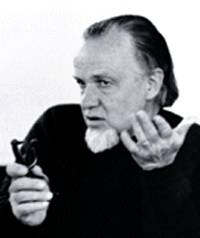
Francis Schaeffer (1912-1984) pictured below

Bertrand Russell (18 May 1872 – 2 February 1970) pictured below

__

__

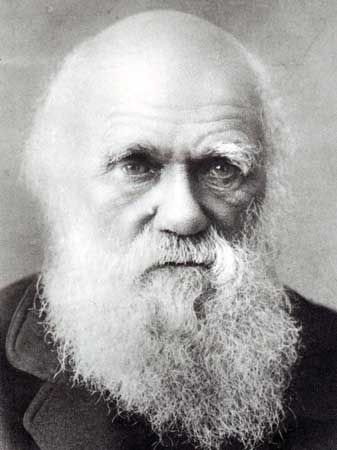
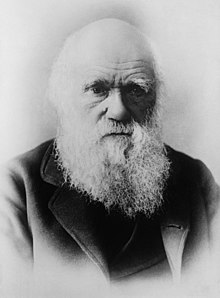
Charles Darwin

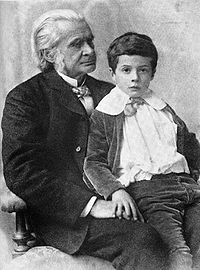
T. H. Huxley with Julian in 1893

Julian and Aldous Huxley

FRANCIS SCHAEFFER COMMENTED:

Now you have now the birth of Julian Huxley’s evolutionary optimistic humanism already stated by Darwin. Darwin now has a theory that man is going to be better. If you had lived at 1860 or 1890 and you said to Darwin, “By 1970 will man be better?” He certainly would have the hope that man would be better as Julian Huxley does today. Of course, I wonder what he would say if he lived in our day and saw what has been made of his own views in the direction of (the mass murder) Richard Speck (and deterministic thinking of today’s philosophers). I wonder what he would say. So you have the factor, already the dilemma in Darwin that I pointed out in Julian Huxley and that is evolutionary optimistic humanism rests always on tomorrow. You never have an argument from the present or the past for evolutionary optimistic humanism.

You can have evolutionary nihilism on the basis of the present and the past. Every time you have someone bringing in evolutionary optimistic humanism it is always based on what is going to be produced tomorrow. When is it coming? The years pass and is it coming? Arthur Koestler doesn’t think it is coming. He sees lots of problems here and puts forth for another solution.

In Darwin’s 1876 Autobiography he noted:

“…it is an intolerable thought that he and all other sentient beings are doomed to complete annihilation after such long-continued slow progress. To those who fully admit the immortality of the human soul, the destruction of our world will not appear so dreadful.”

Francis Schaeffer commented:

Here you feel Marcel Proust and the dust of death is on everything today because the dust of death is on everything tomorrow. Here you have the dilemma of Nevil Shute’s ON THE BEACH. If it is true that all we have left is biological continuity and increased biological complexity, which is all we have left in Darwinism here, or with many of the modern philosophers, then you can’t stand Shute’s ON THE BEACH. Maybe tomorrow at noon human life may be wiped out. Darwin already feels the tension, because if human life is going to be wiped out tomorrow, what is it worth today? Darwin can’t stand the thought of death of all men. Charlie Chaplin when he heard there was no life on Mars said, “I’m lonely.”

You think of the Swedish Opera (ANIARA) that is pictured inside a spaceship. There was a group of men and women going into outer space and they had come to another planet and the singing inside the spaceship was normal opera music. Suddenly there was a big explosion and the world had blown up and these were the last people left, the only conscious people left, and the last scene is the spaceship is off course and it will never land, but will just sail out into outer space and that is the end of the plot. They say when it was shown in Stockholm the first time, the tough Swedes with all their modern  mannishness, came out (after the opera was over) with hardly a word said, just complete silence.

Darwin already with his own position says he CAN’T STAND IT!! You can say, “Why can’t you stand it?” We would say to Darwin, “You were not made for this kind of thing. Man was made in the image of God. Your CAN’T- STAND- IT- NESS is screaming at you that your position is wrong. Why can’t you listen to yourself?”

You find all he is left here is biological continuity, and thus his feeling as well as his reason now is against his own theory, yet he holds it against the conclusions of his reason. Reason doesn’t make it hard to be a Christian. Darwin shows us the other way. He is holding his position against his reason.

____________

These words of Darwin ring in my ear, “…it is an intolerable thought that he and all other sentient beings are doomed to complete annihilation after such long-continued slow progress…” . Schaeffer rightly noted, “Maybe tomorrow at noon human life may be wiped out. Darwin already feels the tension, because if human life is going to be wiped out tomorrow, what is it worth today? Darwin can’t stand the thought of death of all men.” IN OTHER WORDS ALL WE ARE IS DUST IN THE WIND.  I sent you a CD that starts off with the song DUST IN THE WIND by Kerry Livgren of the group KANSAS which was a hit song in 1978 when it rose to #6 on the charts because so many people connected with the message of the song. It included these words, “All we do, crumbles to the ground though we refuse to see, Dust in the Wind, All we are is dust in the wind, Don’t hang on, Nothing lasts forever but the Earth and Sky, It slips away, And all your money won’t another minute buy.”

Kerry Livgren himself said that he wrote the song because he saw where man was without a personal God in the picture. Solomon pointed out in the Book of Ecclesiastes that those who believe that God doesn’t exist must accept three things. FIRST, death is the end and SECOND, chance and time are the only guiding forces in this life.  FINALLY, power reigns in this life and the scales are never balanced. The Christian can  face death and also confront the world knowing that it is not determined by chance and time alone and finally there is a judge who will balance the scales.

Both Kerry Livgren and the bass player Dave Hope of Kansas became Christians eventually. Kerry Livgren first tried Eastern Religions and Dave Hope had to come out of a heavy drug addiction. I was shocked and elated to see their personal testimony on The 700 Club in 1981 and that same  interview can be seen on You Tube today. Livgren lives in Topeka, Kansas today where he teaches “Diggers,” a Sunday school class at Topeka Bible ChurchDAVE HOPE is the head of Worship, Evangelism and Outreach at Immanuel Anglican Church in Destin, Florida.

The answer to find meaning in life is found in putting your faith and trust in Jesus Christ. The Bible is true from cover to cover and can be trusted.

Thank you again for your time and I know how busy you are.

Everette Hatcher, everettehatcher@gmail.com, http://www.thedailyhatch.org, cell ph 501-920-5733, Box 23416, LittleRock, AR 72221, United States


You can hear DAVE HOPE and Kerry Livgren’s stories from this youtube link:

(part 1 ten minutes)

(part 2 ten minutes)

Kansas – Dust in the Wind (Official Video)

Uploaded on Nov 7, 2009

Pre-Order Miracles Out of Nowhere now at http://www.miraclesoutofnowhere.com

About the film:
In 1973, six guys in a local band from America’s heartland began a journey that surpassed even their own wildest expectations, by achieving worldwide superstardom… watch the story unfold as the incredible story of the band KANSAS is told for the first time in the DVD Miracles Out of Nowhere.

______________

An interview with Mark Elvin – part 1

Interview of Mark Elvin – part 2

Mark Elvin interviewed by Alan Macfarlane 24th July 2012

________

Related posts:

FRANCIS SCHAEFFER ANALYZES ART AND CULTURE Part 53 THE BEATLES (Part E, Stg. Pepper’s and John Lennon’s search in 1967 for truth was through drugs, money, laughter, etc & similar to King Solomon’s, LOTS OF PICTURES OF JOHN AND CYNTHIA) (Feature on artist Yoko Ono)

The John Lennon and the Beatles really were on a long search for meaning and fulfillment in their lives  just like King Solomon did in the Book of Ecclesiastes. Solomon looked into learning (1:12-18, 2:12-17), laughter, ladies, luxuries, and liquor (2:1-2, 8, 10, 11), and labor (2:4-6, 18-20). He fount that without God in the picture all […]

FRANCIS SCHAEFFER ANALYZES ART AND CULTURE Part 52 THE BEATLES (Part D, There is evidence that the Beatles may have been exposed to Francis Schaeffer!!!) (Feature on artist Anna Margaret Rose Freeman )

______________   George Harrison Swears & Insults Paul and Yoko Lucy in the Sky with Diamonds- The Beatles The Beatles:   I have dedicated several posts to this series on the Beatles and I don’t know when this series will end because Francis Schaeffer spent a lot of time listening to the Beatles and talking […]

FRANCIS SCHAEFFER ANALYZES ART AND CULTURE Part 51 THE BEATLES (Part C, List of those on cover of Stg.Pepper’s ) (Feature on artist Raqib Shaw )

  The Beatles in a press conference after their Return from the USA Uploaded on Nov 29, 2010 The Beatles in a press conference after their Return from the USA. The Beatles:   I have dedicated several posts to this series on the Beatles and I don’t know when this series will end because Francis […]

FRANCIS SCHAEFFER ANALYZES ART AND CULTURE Part 50 THE BEATLES (Part B, The Psychedelic Music of the Beatles) (Feature on artist Peter Blake )

__________________   Beatles 1966 Last interview I have dedicated several posts to this series on the Beatles and I don’t know when this series will end because Francis Schaeffer spent a lot of time listening to the Beatles and talking and writing about them and their impact on the culture of the 1960’s. In this […]

FRANCIS SCHAEFFER ANALYZES ART AND CULTURE Part 49 THE BEATLES (Part A, The Meaning of Stg. Pepper’s Cover) (Feature on artist Mika Tajima)

_______________ The Beatles documentary || A Long and Winding Road || Episode 5 (This video discusses Stg. Pepper’s creation I have dedicated several posts to this series on the Beatles and I don’t know when this series will end because Francis Schaeffer spent a lot of time listening to the Beatles and talking and writing about […]

FRANCIS SCHAEFFER ANALYZES ART AND CULTURE PART 48 “BLOW UP” by Michelangelo Antonioni makes Philosophic Statement (Feature on artist Nancy Holt)

_______________ Francis Schaeffer pictured below: _____________________ I have included the 27 minute  episode THE AGE OF NONREASON by Francis Schaeffer. In that video Schaeffer noted,  ” Sergeant Pepper’s Lonely Hearts Club Band…for a time it became the rallying cry for young people throughout the world. It expressed the essence of their lives, thoughts and their feelings.” How Should […]

FRANCIS SCHAEFFER ANALYZES ART AND CULTURE Part 47 Woody Allen and Professor Levy and the death of “Optimistic Humanism” from the movie CRIMES AND MISDEMEANORS Plus Charles Darwin’s comments too!!! (Feature on artist Rodney Graham)

Crimes and Misdemeanors: A Discussion: Part 1 ___________________________________ Today I will answer the simple question: IS IT POSSIBLE TO BE AN OPTIMISTIC SECULAR HUMANIST THAT DOES NOT BELIEVE IN GOD OR AN AFTERLIFE? This question has been around for a long time and you can go back to the 19th century and read this same […]

FRANCIS SCHAEFFER ANALYZES ART AND CULTURE PART 46 Friedrich Nietzsche (Featured artist is Thomas Schütte)

____________________________________ Francis Schaeffer pictured below: __________ Francis Schaeffer has written extensively on art and culture spanning the last 2000years and here are some posts I have done on this subject before : Francis Schaeffer’s “How should we then live?” Video and outline of episode 10 “Final Choices” , episode 9 “The Age of Personal Peace and Affluence”, episode 8 […]

FRANCIS SCHAEFFER ANALYZES ART AND CULTURE Part 45 Woody Allen “Reason is Dead” (Feature on artists Allora & Calzadilla )

Love and Death [Woody Allen] – What if there is no God? [PL] ___________ _______________ How Should We then Live Episode 7 small (Age of Nonreason) #02 How Should We Then Live? (Promo Clip) Dr. Francis Schaeffer 10 Worldview and Truth Two Minute Warning: How Then Should We Live?: Francis Schaeffer at 100 Francis Schaeffer […]

FRANCIS SCHAEFFER ANALYZES ART AND CULTURE Part 44 The Book of Genesis (Featured artist is Trey McCarley )

___________________________________ Francis Schaeffer pictured below: ____________________________ Francis Schaeffer “BASIS FOR HUMAN DIGNITY” Whatever…HTTHR Dr. Francis schaeffer – The flow of Materialism(from Part 4 of Whatever happened to human race?) Dr. Francis Schaeffer – The Biblical flow of Truth & History (intro) Francis Schaeffer – The Biblical Flow of History & Truth (1) Dr. Francis Schaeffer […]

RESPONDING TO HARRY KROTO’S BRILLIANT RENOWNED ACADEMICS!! Rodolfo Llinas  neuroscientist NYU School of Medicine  “I know that even those who believe in God deeply know that there is no possible way of discerning his existence. Measure something that tells me that God exists, anything”

On November 21, 2014 I received a letter from Nobel Laureate Harry Kroto and it said:

…Please click on this URL http://vimeo.com/26991975

and you will hear what far smarter people than I have to say on this matter. I agree with them.

Harry Kroto

Nick Gathergood, David-Birkett, Harry-Kroto

I have attempted to respond to all of Dr. Kroto’s friends arguments and I have posted my responses one per week for over a year now. Here are some of my earlier posts:

Arif Ahmed, Sir David AttenboroughMark Balaguer, Horace Barlow, Michael BatePatricia ChurchlandAaron CiechanoverNoam Chomsky,Alan DershowitzHubert Dreyfus, Bart Ehrman, Stephan FeuchtwangDavid Friend,  Riccardo GiacconiIvar Giaever , Roy GlauberRebecca GoldsteinDavid J. Gross,  Brian Greene, Susan GreenfieldStephen F Gudeman,  Alan Guth, Jonathan HaidtTheodor W. Hänsch, Brian Harrison,  Hermann HauserRoald Hoffmann,  Bruce HoodHerbert Huppert,  Gareth Stedman Jones, Steve JonesShelly KaganMichio Kaku,  Stuart Kauffman,  Lawrence KraussHarry Kroto, George LakoffElizabeth Loftus,  Alan MacfarlanePeter MillicanMarvin MinskyLeonard Mlodinow,  Yujin NagasawaAlva NoeDouglas Osheroff,  Jonathan Parry,  Saul PerlmutterHerman Philipse,  Carolyn PorcoRobert M. PriceLisa RandallLord Martin Rees,  Oliver Sacks, John SearleMarcus du SautoySimon SchafferJ. L. Schellenberg,   Lee Silver Peter Singer,  Walter Sinnott-ArmstrongRonald de Sousa, Victor StengerBarry Supple,   Leonard Susskind, Raymond TallisNeil deGrasse Tyson,  .Alexander Vilenkin, Sir John WalkerFrank WilczekSteven Weinberg, and  Lewis Wolpert,

Rodolfo Llinás

From Wikipedia, the free encyclopedia
Rodolfo Llinás
Rodolfo Llinás in 2010.png
Born 16 December 1934
Bogotá, Colombia
Residence New York City, New York, United States
Fields Neuroscience
Institutions NYU School of Medicine
Alma mater Universidad Javeriana andAustralian National University
Known for Physiology of the cerebellum, thethalamus, Thalamocortical dysrhythmia as well as for his pioneering work on the inferior olive, on the squid giant synapseand on humanmagnetoencephalography (MEG)

Rodolfo R. Llinás (Bogota, Colombia 16 December 1934) is a Colombian American neuroscientist. He is currently the Thomas and Suzanne Murphy Professor of Neuroscience and Chairman Emmeritus of the department of Physiology & Neuroscience at the NYU School of Medicine. He attended the Gimnasio Moderno school and received his MD from the Universidad Javeriana, Bogotáin 1959 and his PhD in 1965 from the Australian National University working under Sir John Eccles.[1] Llinás has published over 500 scientific articles.

Early life[edit]

Llinás was born in Bogotá, Colombia. He went to the Gimnasio Moderno school in Bogotá and graduated as a medical doctor from the Pontifical Xavierian University.

Work[edit]

He has studied the electrophysiology of single neurons in the cerebellum, the thalamus, the cerebral cortex, the entorhinal cortex, the hippocampus, the vestibular system, the inferior olive and thespinal cord. He has studied synaptic transmitter release in the squid giant synapse. He has studied human brain function using magnetoencephalography (MEG) on the basis of which he introduced the concept of Thalamocortical dysrhythmia.[2]

Contributions[edit]

In  the second video below in the 78th clip in this series are his words and  my response is below them. 

50 Renowned Academics Speaking About God (Part 1)

Another 50 Renowned Academics Speaking About God (Part 2)

A Further 50 Renowned Academics Speaking About God (Part 3)

_________________________________

Below is my letter to Dr. Rodolfo Llinas and my response to his quote:

6-6-16

Dr. Rodolfo Llinas, Professor of Neuroscience; University Professor; Department of Neuroscience and Physiology, NYU

Dear Dr. Llinas,

Back in 1981 I got to visit 20 European countries on a trip with 42 girls and 5 boys on a college trip for a copy of months. When  I was in Rome or Athens I had 13 girls that would walk with me and when  a foreign guy would approach them they would say that they were with me. I was a legend in  those towns in  Europe!!!! On that trip I met a good friend named Carlos and he was from Columbia, and he always was trying to get me to come visit him but I was afraid of dangers I had read about down there. He told he would meet me at the airport and escort around the country in the safe areas. I was reminded of that lately when I watched the hit TV show MODERN FAMILY because Gloria is from Columbia and she always joked about the safety in Columbia.

In the popular You Tube video “Renowned Academics Speaking About God” you made the following statement:

“I have no measure possible,  I know that even those who believe in God deeply know that there is no possible way of discerning his existence. Measure something that tells me that God exists, anything. ARE WE SAYING THAT DISCERNMENT IS THE SAME THING AS MEASUREMENT? Yes, indeed, in this case for me it is…”

As a scientist you emphasis the need to have things confirmed through observational data. Have you taken time to really look at the historical claims of the Bible and if they are really accurate or not?

Let me respond  with the words of Francis Schaeffer from his book HE IS THERE AND HE IS NOT SILENT (the chapter is entitled, “Is Propositional Revelation Nonsense?”

Of course, if the infinite uncreated Personal communicated to the finite created personal, he would not exhaust himself in his communication; but two things are clear here:
 
1. Even communication between once created person and another is not exhaustive, but that does not mean that for that reason it is not true. 
 
2. If the uncreated Personal really cared for the created personal, it could not be thought unexpected for him to tell the created personal things of a propositional nature; otherwise as a finite being the created personal would have numerous things he could not know if he just began with himself as a limited, finite reference point. In such a case, there is no intrinsic reason why the uncreated Personal could communicate some vaguely true things, but could not communicate propositional truth concerning the world surrounding the created personal – for fun, let’s call that science. Or why he could not communicate propositional truth to the created personal concerning the sequence that followed the uncreated Personal making everything he made – let’s call that history. There is no reason we could think of why he could not tell these two types of propositional things truly. They would not be exhaustive; but could we think of any reason why they would not be true? The above is, of course, what the Bible claims for itself in regard to propositional revelation.
DOES THE BIBLE ERR IN THE AREA OF SCIENCE AND HISTORY? The Bible is true from cover to cover and can be trusted. Charles Darwin himself longed for evidence to come forward from the area of  Biblical Archaeology  but so much has  advanced  since Darwin wrote these words in the 19th century! Here are some of the posts I have done in the past on the subject and if you like you could just google these subjects: 1. The Babylonian Chronicleof Nebuchadnezzars Siege of Jerusalem, 2. Hezekiah’s Siloam Tunnel Inscription.13. The Pilate Inscription14. Caiaphas Ossuary14 B Pontius Pilate Part 214c. Three greatest American Archaeologists moved to accept Bible’s accuracy through archaeology.

Below is a piece of that evidence given by Francis Schaeffer concerning the accuracy of the Bible. TRUTH AND HISTORY (chapter 5 of WHATEVER HAPPENED TO THE HUMAN RACE?, under footnote #94)

We now take a jump back in time to the middle of the ninth century before Christ, that is, about 850 B.C. Most people have heard of Jezebel. She was the wife of Ahab, the king of the northern kingdom of Israel. Her wickedness has become so proverbial that we talk about someone as a “Jezebel.” She urged her husband to have Naboth killed, simply because Ahab had expressed his liking for a piece of land owned by Naboth, who would not sell it. The Bible tells us also that she introduced into Israel the worship of her homeland, the Baal worship of Tyre. This led to the opposition of Elijah the Prophet and to the famous conflict on Mount Carmel between Elijah and the priests of Baal.

.

‘The Woman at the Window’ – an ivory artifact

‘The Woman at the Window’ – an ivory artifact from Samaria. Photo source.

© The Israel Museum, Jerusalem
MIRROR IMAGE. Because most seals were pressed into wet pottery or into small blobs of clay used to secure scrolls— serving much like a signature— symbols and letters were often carved in reverse. When stamped into the clay, the seal images and inscription would appear correctly. This photo of the Jezebel seal and its impression, or bulla, show the seal in reverse and in proper stance.

______

Here again one finds archaeological confirmations of what the Bible says. Take for example: “As for the other events of Ahab’s reign, including all he did, the palace he built and inlaid with ivory, and the cities he fortified, are they not written in the book of the annals of the kings of Israel?” (I Kings 22:39).

This is a very brief reference in the Bible to events which must have taken a long time: building projects which probably spanned decades. Archaeological excavations at the site of Samaria, the capital, reveal something of the former splendor of the royal citadel. Remnants of the “ivory house” were found and attracted special attention (Palestinian Archaeological Museum, Jerusalem). This appears to have been a treasure pavilion in which the walls and furnishings had been adorned with colored ivory work set with inlays giving a brilliant too, with the denunciations revealed by the prophet Amos:

“I will tear down the winter house along with the summer house; the houses adorned with ivory will be destroyed and the mansions will be demolished,” declares the Lord. (Amos 3:15)

Other archaeological confirmation exists for the time of Ahab. Excavations at Hazor and Megiddo have given evidence of  the extent of fortifications carried out by Ahab. At Megiddo, in particular, Ahab’s works were very extensive including a large series of stables formerly assigned to Solomon’s time.

On the political front, Ahab had to contend with danger from the Aramacaus king of Syria who besieged Samaria, Ahab’s capital. Ben-hadad’s existence is attested by a stela (a column with writing on it) which has been discovered with his name written on it (Melquart Stela, Aleppo Museum, Syria). Again, a detail of history given in the Bible is shown to be correct.

The seal bears four letters (YZBL) interspersed around the images. Although scholars have long recognized the similarity of the inscription to the name Jezebel, they have usually refrained from making a connection to the infamous Queen Jezebel, Phoenician wife of the Israelite king Ahab. With the reconstruction of two additional letters (L’) in the damaged area at the top, however, author Marjo Korpel argues that the inscription originally read L’YZBL, or “(belonging) to Jezebel” and was in fact the personal seal of the Biblical queen.

Seal of Jezebel Identified Non-Technical – Sep 19, 2008 – by Bryant G. Wood PhD This article was first published in the Spring 2008 issue of Bible and Spade.

Jezebel was no doubt the wickedest woman in the Bible. In the book of Revelation her name was invoked in condemning a false prophetess in Thyatira who promoted sexual immorality and the eating of food sacrificed to idols (Rv 2:20). Even today the name is emblematic of a sinful, shameless woman. Jezebel means “where is his highness (=Baal)?” (Korpel 2008: 37). Baal was the great  Canaanite storm and fertility god. Jezebel’s father Ethbaal, whose name means “with Baal” or “man of Baal,” was king of the  Phoenicians (1 Kgs 16:31). The Jewish historian Josephus tells us that Ethbaal was formerly a priest of Ashtoreth, consort of Baal, who  usurped the throne and reigned over Tyre and Sidon for 32 years (Contra Apionem i.18.123).


Opal seal with the name of Jezebel. The inscription and symbols on the seal make it highly likely that it was the official seal of the wicked woman of the Old Testament. She was a woman of power as indicated by her title “Queen Mother” (2 Kgs 10:13). Although Jezebel had her own seal to authenticate official correspondence, when she forged the letters to the elders and nobles of Jezreel in order do away with Naboth and seize his vineyard, she used Ahab’s seal rather than her own for maximum authority (1 Kgs 21:8).

In order to form a political alliance with the Phoenicians, Ahab, king of Israel (874–853 BC), married Baal-worshipping Jezebel (1 Kgs  16:31). “Urged on by Jezebel his wife” (1 Kgs 21:25), Ahab became a follower of Baal, and even erected a temple and altar to the pagan  deity in Samaria (1 Kgs 16:32). He had the distinction of being the king who “did more to provoke the LORD, the God of Israel, to anger  than did all the kings of Israel before him” (1 Kgs 16:33). Jezebel bore Ahab a son, Joram, who ruled Israel for 12 years from 852 to 841 BC, and she herself became a strong political figure bearing the title “Queen Mother” (2 Kgs 10:13).

Baal the Canaanite storm god, also worshipped by the later Phoenicians. In his left hand he holds a spear which flashes lightning and in his right hand a mace. The relief, which dates to 1650–1500 BC, was found in a sanctuary in the Canaanite city of Ugarit, Syria, in 1932. It is now on display in the Louvre Museum in Paris.

Jezebel was zealous in her efforts to stamp out Yahwism and promote the worship of Baal. She mounted a campaign to kill the Lord’s prophets (1 Kgs 18:4, 13), while at the same time feeding 450 prophets of Baal and 400 prophets of Asherah, the Canaanite mother goddess and consort of El, at the royal table (1 Kgs 18:19). This led to a confrontation between Elijah and the prophets of Baal on Mt. Carmel, resulting in the extermination of the prophets of Baal (1 Kgs 18:16–40).

Jezebel also figures prominently in the account of the appropriation of Naboth’s vineyard. Naboth refused to sell his vineyard to greedy Ahab. Conniving Jezebel arranged to have false charges brought against Naboth, which resulted in his death (1 Kgs 21). When Ahab went to take possession of the vineyard, Elijah was there with a message from God:

“I am going to bring disaster on you. I will consume your descendants and cut off from Ahab every last male in Israel— slave or free…because you have provoked me to anger and have caused Israel to sin.” And also concerning Jezebel the LORD says: “Dogs will devour Jezebel by the wall of Jezreel” (1 Kgs 21:21–23).

Shortly thereafter Ahab was killed in a battle against the Arameans (1 Kgs 22:29–40). Twelve years later a prophet of the Lord anointed Jehu, a general in the Israelite army, king with the following charge:

You are to destroy the house of Ahab your master, and I will avenge the blood of my servants the prophets and the blood of all the LORD’s servants the prophets and the blood of all the LORD’s servants shed by Jezebel (2 Kgs 9:7).

Statue of Elijah on Mt. Carmel memorializing Elijah’s encounter with Jezebel’s prophets. Elijah challenged the 450 prophets of Baal who ate at Jezebel’s table to a sacrifice cook-off: “you call on the name of your god and I will call on the name of the LORD. The god who answers by fire—he is God” (1 Kgs 18:24). Who do you think won? You can read the account in 1 Kings 18:16–40.

Jehu went on to wipe out Ahab’s descendants, including Jezebel’s son Joram. As the Lord had predicted through Elijah, Jezebel met a grisly end. Jehu went to the royal residence at Jezreel and found the Queen Mother, with her eyes painted and hair arranged, looking out a palace window. Jehu ordered her eunuchs to throw her out the window:

So they threw her down, and some of her blood spattered the wall and the horses as they trampled her underfoot. Jehu went in and ate and drank. “Take care of that cursed woman,” he said, “and bury her, for she was a king’s daughter.” But when they went out to bury her, they found nothing except her skull, her feet and her hands. They went back and told Jehu, who said, “This is the word of the LORD that he spoke through his servant Elijah the Tishbite: On the plot of ground at Jezreel dogs will devour Jezebel’s flesh” (2 Kgs 9:33–36).

In the early 1960s a seal was purchased on the antiquities market and donated to the Israel Museum in Jerusalem. The late Nahman Avigad, a leading Israeli paleographer (one who studies ancient writing), published an article about the seal in 1964. He suggested the name on the seal was possibly Jezebel, but there was a problem—the first letter of the name was missing. And so, little attention was paid to the seal and it languished in the Israel Museum for decades. Then, Dutch researcher Marjo Korpel (Associate Professor of Old Testament, Utrecht University, Utrecht, The Netherlands) became interested in it. Korpel was first drawn to the seal because of its imagery, but then became intrigued with the inscription. She noticed that a piece had broken off at the top and this could very well have been where the missing letter was originally located. She conjectured that there were initially two letters in the area of the break: a Hebrew lamed, or L, which stood for “(belonging) to” or “for,” and the missing first letter of Jezebel’s name.

Seal of Jezebel with missing letters restored. The top of the seal has been damaged and it is in this area that Old Testament scholar Marjo Korpel suggests that there were originally two letters: alamed, meaning “(belonging) to” and an aleph, the first letter of Jezebel’s name. The restored inscription would then read “(belonging) to Jezebel.” The seal is scheduled to go on display at the Israel Museum in Jerusalem in 2010 when renovation work at the museum is completed.

Apart from the inscription, there are other compelling reasons for identifying the seal as that of Jezebel. First, as Avigad observed, it is very fancy, suggestive of royalty. It is made of the gemstone opal and is larger than average, being 1.24 in (31 mm) from top to bottom (Avigad 1964: 274). Secondly, the form of the letters is Phoenician, or imitates Phoenician writing (Korpel 2008: 37). Thirdly, the seal is fi lled with common Egyptian symbols that were often used in Phoenicia in the ninth century BC and are suggestive of a queen. At the top is a crouching winged sphinx with a woman’s face, the body of a lioness and a female Isis/Hathor crown. To the left is an Egyptian ankh, the sign of life. In the lower register, below a winged disk, is an Egyptian style falcon, symbol of royalty in Egypt. On either side of the falcon is a uraeus, the cobra representation of Egyptian royalty worn on crowns. At the bottom left is a lotus, a symbol often associated with royal women. All of these icons taken together denote female royalty (Korpel 2008: 36–37).

Although 100% certainty cannot be attained, Korpel’s assessment of the evidence leads her to conclude, “I believe it is very likely that we have here the seal of the famous Queen Jezebel” (2008: 37). Bibliography Avigad, Nahman 1964 The Seal of Jezebel. Israel Exploration Journal 14: 274–76.
Korpel, Marjo C.A. 2008 Fit for a Queen: Jezebel’s Royal Seal. Biblical Archaeology Review 34.2: 32–37, 80.

The Ivory Palace of King Ahab

Now the rest of the acts of Ahab, and all that he did, and the ivory house which he made, and all the cities that he built, are they not written in the book of the chronicles of the kings of Israel?
(The Bible, 1 Kings 22: 39)

According to the Old Testament, King Ahab was the seventh king of the northern kingdom of Israel since Jeroboam I, and reigned during the 9th century B.C. In the Old Testament, Ahab, along with his wife, Jezebel, gets a rather negative portrayal for the various things that they did, such as the worship of Baal.

According to the Old Testament, Ahab’s father, Omri, purchased the hill of Samaria and founded a city there: “In the thirty and first year of Asa king of Judah began Omri to reign over Israel, twelve years: six years reigned he in Tirzah. And he bought the hill Samaria of Shemer for two talents of silver, and built on the hill, and called the name of the city which he built, after the name of Shemer, owner of the hill, Samaria.” (The Bible, 1 Kings 16: 23-24)

It was on this hill that Ahab built his ‘ivory palace’. It is often pointed out that the existence of such a structure has been confirmed by archaeological evidence. However, it will be shown that this is not as straightforward as it seems, and that the phrase “Ivory Palace of King Ahab” is a rather problematic one. In 1932, the Joint Expedition to Samaria, located in present-day West Bank, discovered a large quantity of ivory objects and decorations (a total of 250 fragments were recorded) near the northern area of Samaria’s summit. This has led people, including the archaeologists, to believe that they have found King Ahab’s Ivory Palace.

There are two problems with this interpretation. The first problem involves the question of what is meant by an ‘ivory palace’. One may envision an ivory palace to be a building somehow constructed literally from ivory (that’s what I’d imagine anyway). After all, if King Ahab were to be depicted as a really wealthy king, this would be a pretty good way to do so. However, these fragments were probably once attached to wooden furniture. The ivories from Fort Shalmaneser in Nimrud, Iraq, may be seen as parallels to those found in Samaria. Of course, one might argue that an ‘ivory palace’ was a building that had lots of ivory-decorated furniture, or ivory carvings, rather than a structure built of ivory. 

The bigger problem, however, is the fact that this structure was not even built by King Ahab. Based on the Kathleen Kenyon’s stratigraphic notes and summaries of the site, it seems that most of these ivory fragments date to the Hellenistic and Roman periods, several hundreds of years after the reign of King Ahab.

Although a structure containing ivory fragments was discovered by archaeologists, it was not King Ahab’s Ivory Palace. So, why was it identified as such then? Perhaps it was only natural that the Biblical reference produced an impulse to date these ivory fragments to the reign of King Ahab. The area where the ivories were found was also initially thought to be part of the royal palace (the large “palace” discovered to its west by the Harvard team in 1908-1910 was relegated to the status of a ‘supplementary building’). This view, however, was withdrawn in 1938, when the archaeologists realized that the walls of this building actually comprised only a section of a section of a second, inner enclosure wall, and that they could not “make a room or pavilion out of them.” By then, the damage was already done, and the ‘Ivory Palace of King Ahab’ is still regarded by some as having basis in archaeology.

If you think the score board is ‘Archaeology – 1, Bible – 0’, it isn’t quite as simple. Reliance on the Bible for the interpretation of archaeological evidence is very much like the reliance of any textual evidence. Although historical archaeology is said to be the “handmaiden to history”, it isn’t quite so. If you think archaeology’s here to support the textual evidence (of which history relies on), you’d better think again. I suppose, at the end of the day, one has to be critical of one’s sources, and not take the textual evidence at face value. Also, archaeologists ought to be careful with what they say, since there may be unforeseen repercussions, sometimes much worse than the misidentification of an ancient structure.

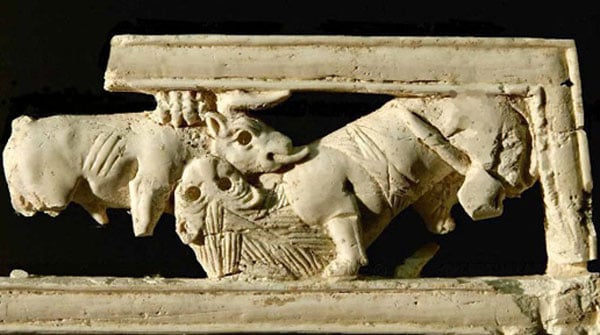
Featured image: An ivory plaque from Samaria depicting a lion attacking a bull. The lion symbolizes the sun, the bull the earth, the two creatures eternally warring for supremacy, with the lion better equipped to win. The plaque would have been attached to a screen or piece of furniture. Photo sourceBy Ḏḥwty

_____

The Ivory Palace of King Ahab

The Ivory Palace of King Ahab

.

King Ahab

An artist’s impression of King Ahab, from the “Promptuarii Iconum Insigniorum”.  Photo source: Wikimedia

King Ahab’s House of Ivory

Archaeologists haven’t found only Assyrian evidence for the existence of King Ahab. While excavating Samaria they have found indications of another biblical description connected to Ahab’s reign—his house of ivory. The Bible says of Ahab, “Now the rest of the acts of Ahab, and all that he did, the ivory house which he built and all the cities that he built, are they not written in the book of the chronicles of the kings of Israel?” (2 Kings 22:39).

Herschel Shanks, editor of Biblical Archaeology Review, writes: “An important ivory find from the Iron Age comes from Ahab’s capital in Samaria where over 500 ivory fragments were found … The Bible speaks of Ahab’s ‘house of ivory’ (1 Kings 22:39). Does this refer to the paneling of the walls or to the furnishings? To put the matter differently, did the ivory fragments found at Samaria decorate the walls of the building or the furniture? There is some evidence from Nimrud that a room in an Assyrian palace was, in fact, paneled with ivory veneer. Was this the case at Samaria? On the basis of the evidence at hand, it is difficult to tell.

“Whether paneling for the wall or decoration for furniture, the houses of ivory—based on a highly sophisticated Phoenician ivory industry—were for the Hebrew prophets symbols of social oppression and injustice; the ‘ivory houses’ [mentioned in Amos 3.15] were also evidence of participation in the barbarous pagan practices and heathen worship of Phoenicia. Based on the archaeological evidence, the prophets knew what they were talking about” ( Biblical Archaeology Review,September-October 1985, p. 46).

Thank you again for your time and I know how busy you are.

Everette Hatcher, everettehatcher@gmail.com, http://www.thedailyhatch.org, cell ph 501-920-5733, Box 23416, LittleRock, AR 72221

________

Related posts:

FRANCIS SCHAEFFER ANALYZES ART AND CULTURE Part 53 THE BEATLES (Part E, Stg. Pepper’s and John Lennon’s search in 1967 for truth was through drugs, money, laughter, etc & similar to King Solomon’s, LOTS OF PICTURES OF JOHN AND CYNTHIA) (Feature on artist Yoko Ono)

The John Lennon and the Beatles really were on a long search for meaning and fulfillment in their lives  just like King Solomon did in the Book of Ecclesiastes. Solomon looked into learning (1:12-18, 2:12-17), laughter, ladies, luxuries, and liquor (2:1-2, 8, 10, 11), and labor (2:4-6, 18-20). He fount that without God in the picture all […]

FRANCIS SCHAEFFER ANALYZES ART AND CULTURE Part 52 THE BEATLES (Part D, There is evidence that the Beatles may have been exposed to Francis Schaeffer!!!) (Feature on artist Anna Margaret Rose Freeman )

______________   George Harrison Swears & Insults Paul and Yoko Lucy in the Sky with Diamonds- The Beatles The Beatles:   I have dedicated several posts to this series on the Beatles and I don’t know when this series will end because Francis Schaeffer spent a lot of time listening to the Beatles and talking […]

FRANCIS SCHAEFFER ANALYZES ART AND CULTURE Part 51 THE BEATLES (Part C, List of those on cover of Stg.Pepper’s ) (Feature on artist Raqib Shaw )

  The Beatles in a press conference after their Return from the USA Uploaded on Nov 29, 2010 The Beatles in a press conference after their Return from the USA. The Beatles:   I have dedicated several posts to this series on the Beatles and I don’t know when this series will end because Francis […]

FRANCIS SCHAEFFER ANALYZES ART AND CULTURE Part 50 THE BEATLES (Part B, The Psychedelic Music of the Beatles) (Feature on artist Peter Blake )

__________________   Beatles 1966 Last interview I have dedicated several posts to this series on the Beatles and I don’t know when this series will end because Francis Schaeffer spent a lot of time listening to the Beatles and talking and writing about them and their impact on the culture of the 1960’s. In this […]

FRANCIS SCHAEFFER ANALYZES ART AND CULTURE Part 49 THE BEATLES (Part A, The Meaning of Stg. Pepper’s Cover) (Feature on artist Mika Tajima)

_______________ The Beatles documentary || A Long and Winding Road || Episode 5 (This video discusses Stg. Pepper’s creation I have dedicated several posts to this series on the Beatles and I don’t know when this series will end because Francis Schaeffer spent a lot of time listening to the Beatles and talking and writing about […]

FRANCIS SCHAEFFER ANALYZES ART AND CULTURE PART 48 “BLOW UP” by Michelangelo Antonioni makes Philosophic Statement (Feature on artist Nancy Holt)

_______________ Francis Schaeffer pictured below: _____________________ I have included the 27 minute  episode THE AGE OF NONREASON by Francis Schaeffer. In that video Schaeffer noted,  ” Sergeant Pepper’s Lonely Hearts Club Band…for a time it became the rallying cry for young people throughout the world. It expressed the essence of their lives, thoughts and their feelings.” How Should […]

FRANCIS SCHAEFFER ANALYZES ART AND CULTURE Part 47 Woody Allen and Professor Levy and the death of “Optimistic Humanism” from the movie CRIMES AND MISDEMEANORS Plus Charles Darwin’s comments too!!! (Feature on artist Rodney Graham)

Crimes and Misdemeanors: A Discussion: Part 1 ___________________________________ Today I will answer the simple question: IS IT POSSIBLE TO BE AN OPTIMISTIC SECULAR HUMANIST THAT DOES NOT BELIEVE IN GOD OR AN AFTERLIFE? This question has been around for a long time and you can go back to the 19th century and read this same […]

FRANCIS SCHAEFFER ANALYZES ART AND CULTURE PART 46 Friedrich Nietzsche (Featured artist is Thomas Schütte)

____________________________________ Francis Schaeffer pictured below: __________ Francis Schaeffer has written extensively on art and culture spanning the last 2000years and here are some posts I have done on this subject before : Francis Schaeffer’s “How should we then live?” Video and outline of episode 10 “Final Choices” , episode 9 “The Age of Personal Peace and Affluence”, episode 8 […]

FRANCIS SCHAEFFER ANALYZES ART AND CULTURE Part 45 Woody Allen “Reason is Dead” (Feature on artists Allora & Calzadilla )

Love and Death [Woody Allen] – What if there is no God? [PL] ___________ _______________ How Should We then Live Episode 7 small (Age of Nonreason) #02 How Should We Then Live? (Promo Clip) Dr. Francis Schaeffer 10 Worldview and Truth Two Minute Warning: How Then Should We Live?: Francis Schaeffer at 100 Francis Schaeffer […]

FRANCIS SCHAEFFER ANALYZES ART AND CULTURE Part 44 The Book of Genesis (Featured artist is Trey McCarley )

___________________________________ Francis Schaeffer pictured below: ____________________________ Francis Schaeffer “BASIS FOR HUMAN DIGNITY” Whatever…HTTHR Dr. Francis schaeffer – The flow of Materialism(from Part 4 of Whatever happened to human race?) Dr. Francis Schaeffer – The Biblical flow of Truth & History (intro) Francis Schaeffer – The Biblical Flow of History & Truth (1) Dr. Francis Schaeffer […]

__

RESPONDING TO HARRY KROTO’S BRILLIANT RENOWNED ACADEMICS!! John Dunn, political theorist, Cambridge, “I am interested in how religious belief works and what it has meant but it is not [my] belief”

On November 21, 2014 I received a letter from Nobel Laureate Harry Kroto and it said:

…Please click on this URL http://vimeo.com/26991975

and you will hear what far smarter people than I have to say on this matter. I agree with them.

Harry Kroto

I have attempted to respond to all of Dr. Kroto’s friends arguments and I have posted my responses one per week for over a year now. Here are some of my earlier posts:

Arif Ahmed, Sir David AttenboroughMark Balaguer, Patricia ChurchlandAaron CiechanoverNoam Chomsky,Alan DershowitzHubert Dreyfus, Bart Ehrman, Stephan FeuchtwangDavid Friend,  Riccardo GiacconiIvar Giaever , Roy GlauberRebecca GoldsteinDavid J. Gross,  Brian Greene, Susan GreenfieldStephen F Gudeman,  Alan Guth, Jonathan HaidtHermann HauserRoald Hoffmann,  Bruce HoodHerbert Huppert,  Gareth Stedman JonesShelly KaganMichio Kaku,  Stuart Kauffman, George Lakoff,  Lawrence KraussHarry Kroto, Elizabeth Loftus,  Alan MacfarlanePeter MillicanMarvin MinskyLeonard Mlodinow,  Yujin NagasawaAlva NoeDouglas Osheroff,   Saul PerlmutterHerman Philipse,  Robert M. PriceLisa RandallLord Martin Rees,  Oliver Sacks, John SearleMarcus du SautoySimon SchafferJ. L. Schellenberg,   Lee Silver Peter Singer,  Walter Sinnott-ArmstrongRonald de Sousa, Victor StengerBarry Supple,   Leonard Susskind, Raymond TallisNeil deGrasse Tyson,  .Alexander Vilenkin, Sir John WalkerFrank WilczekSteven Weinberg, and  Lewis Wolpert,

Professor John Dunn FBA

Professor John Dunn

John Dunn (political theorist)

From Wikipedia, the free encyclopedia
For other people of the same name, see John Dunn (disambiguation).

John Montfort Dunn (born 9 September 1940) is emeritus Professor of Political Theory at King’s College, Cambridge, and Visiting Professor in the Graduate School of Social Sciences and Humanities at Chiba University, Japan.

Biography[edit]

The son of Colonel Henry George Montfort Dunn and Catherine Mary (née Kinloch), Dunn was educated at Winchester and Millfield. He read history at King’s College, Cambridge and was briefly (1965–1966) a fellow of Jesus College, Cambridge. He was also Harkness Fellow at Harvard University [1], and since 1966 of King’s College, Cambridge. A lecturer in political science at Cambridge University 1972-77, Dunn became reader in politics 1977-87, and has been professor of political theory since 1987.

Dunn has been married four times: to Susan Deborah, née Fyvel (1965; divorced 1971); Judy, née Pace (1973; divorced 1987); Ruth Scurr (1997; divorced 2013); and Anastasia Piliavsky (2014—).

In  the third video below in the 140th clip in this series are his words and  my response is below them. 

50 Renowned Academics Speaking About God (Part 1)

Another 50 Renowned Academics Speaking About God (Part 2)

A Further 50 Renowned Academics Speaking About God (Part 3)

Interview of John Dunn, part 1, 2008

Below is my response to Dr. Dunn’s quote:

April 12, 2016

Professor John Dunn, University of Cambridge, The Department of Politics and International Studies,

Dear Dr. Dunn,

Thank you for agreeing to give Alan MacFarlane an interview. I think I have watched almost all of the interviews he has ever done and that is over 100 by now. I have even gone back and watched many of them over and over. I actually did a post on my blog about  Alan Macfarlane.

I just finished reading the online addition of the book Darwin, Francis ed. 1892. Charles Darwin: his life told in an autobiographical chapter, and in a selected series of his published letters [abridged edition]. London: John Murray. There are several points that Charles Darwin makes in this book that were very wise, honest, logical, shocking and some that were not so wise. The Christian Philosopher Francis Schaeffer once said of Darwin’s writings, “Darwin in his autobiography and in his letters showed that all through his life he never really came to a quietness concerning the possibility that chance really explained the situation of the biological world. You will find there is much material on this [from Darwin] extended over many many years that constantly he was wrestling with this problem.”

Here is a quote I ran across recently from you in your wonderful in depth interview with Alan Macfarlane :

“If I wasn’t thinking about it then I would say that I am an atheist, but it might be better to say I am an extremely robustly agnostic agnostic. I like David Hume. If I think about it, it doesn’t make any sense. I am interested in how religious belief works and what it has meant and I take it very seriously. It is not a belief that I could conceive of sharing because it would have to remove my entire structure of which I believe things.”

 ——–

Let make 2 points here. First, the Bible teaches that everyone knows in their heart that God exists because of the beauty of God’s creation and the conscience that God has planted in everyone’s heart (Romans 1).

Second, all humans have moral motions.

 Francis Schaffer in his book THE GOD WHO IS THERE addresses these same issues:

“[in Christianity] there is a sufficient basis for morals. Nobody has ever discovered a way of having real “morals” without a moral absolute. If there is no moral absolute, we are left with hedonism (doing what I like) or some form of the social contract theory (what is best for society as a a hole is right). However, neither of these alternative corresponds to the moral motions that men have. Talk to people long enough and deeply enough, and you will find that they consider some things are really right and something are really wrong. Without absolutes, morals as morals cease to exist, and humanistic mean starting from himself is unable to find the absolute he needs. But because the God of the Bible is there, real morals exist. Within this framework I can say one action is right and another wrong, without talking nonsense.” 117

Now back to my first point, concerning ROMANS CHAPTER ONE. It has been found that when atheists are asked with a polygraph machine if they believe in God and  they so “NO” the polygraph indicates they are lying. Claude Brown actually tested this with over 15,000 job applicants over a long period of time in his trucking line during the 1970’s and most of the 1980’s.   

Romans 1:18-19 (Amplified Bible) ” For God’s wrath and indignation are revealed from heaven against all ungodliness and unrighteousness of men, who in their wickedness REPRESS and HINDER the truth and make it inoperative. For that which is KNOWN about God is EVIDENT to them and MADE PLAIN IN THEIR INNER CONSCIOUSNESS, because God  has SHOWN IT TO THEM,”(emphasis mine). At the 37 minute mark on the CD that I sent you today Adrian Rogers noted, “”There is no such thing anywhere on earth as a true atheist. If a man says he doesn’t believe in God, then he is lying. God has put his moral consciousness into every man’s heart, and a man has to try to kick his conscience to death to say he doesn’t believe in God.”

ROMANS CHAPTER ONE IS RIGHT WHEN IT SAYS THAT GOD PUT THAT CONSCIENCE IN EVERYONE’S HEART THAT BEARS WITNESS THAT HE CREATED THEM FOR A PURPOSE AND THAT IS WHY THE VAST MAJORITY OF PEOPLE IN THE WORLD ARE ATTEMPTING TO SEEK OUT GOD!!!!

Instead of addressing the issue of which morality is right today, I just what to ask you why you think materialist anthropologists are not able to explain why humans always have a sense of moral motions? No tribe of people have ever been found without moral motions!!!!!

When I read the book  Charles Darwin: his life told in an autobiographical chapter, and in a selected series of his published letters, I also read  a commentary on it by Francis Schaeffer and I wanted to both  quote some of Charles Darwin’s own words to you and then include the comments of Francis Schaeffer on those words. I have also enclosed a CD with two messages from Adrian Rogers and Bill Elliff concerning Darwinism. THESE COMMENTS BY SCHAEFFER ON THE MORAL MOTIONS PROMPTED ME TO WRITE YOU TODAY. 

The passages which here follow are extracts, somewhat abbreviated, from a part of the Autobiography, written in 1876, in which my father gives the history of his religious views:—

CHARLES DARWIN’S WORDS:

But now the grandest scenes would not cause any such convictions  and feelings to rise in my mind. It may be truly said that I am like a man who has become colour-blind and the universal belief by men of the existence of redness makes my present loss of perception of not the least value as evidence. This argument would be a valid one if all men of all races had the same inward conviction of the existence of one God; but we know that this is very far from being the case. Therefore I cannot see that such inward convictions and feelings are of any weight as evidence of what really exists. The state of mind which grand scenes formerly excited in me, and which was intimately connected with a belief in God, did not essentially differ from that which is often called the sense of sublimity; and however difficult it may be to explain the genesis of this sense, it can hardly be advanced as an argument for the existence of God, any more than the powerful though vague and similar feelings excited by music.

Francis Schaeffer observed:

You notice that Darwin had already said he had lost his sense of music [appreciation]. However, he brings forth what I think is a false argument. I usually use it in the area of morality. I mention that materialistic anthropologists point out that different people have different moral [systems]  and this is perfectly true, but what the materialist anthropologist can never point out is why man has a sense of moral motion and that is the problem here. Therefore, it is perfectly true that men have different concepts of God and different concepts of moral motion, but Darwin himself is not satisfied in his own position and WHERE DO THEY [MORAL MOTIONS] COME FROM AT ALL? So you are wrestling with the same dilemma here in this reference as you do in the area of all things human. For these men it is not the distinction that raises the problem, but it is the overwhelming factor of the existence of the humanness of man, the mannishness of man. The simple fact is he saw that you are shut up to either God or chance, and he said basically “I don’t see how it could be chance” and at the same time he looks at a mountain or listens to a piece of music it is a testimony that really chance isn’t sufficient enough. So gradually with the sensitivity of his own inborn self conscience he kills it. He deliberately  kills the beauty so it doesn’t argue with his theory. Maybe I am being false to Darwin here. Who can say about Darwin’s subconscious thoughts? It seems to me though this is exactly the case. What you find is a man who can’t stand the argument of the external beauty and the mannishness of man so he just gives it up in this particular place.

Charles Darwin

Francis Schaeffer

As a secularist you believe that it is sad indeed that millions of Christians are hoping for heaven but no heaven is waiting for them. Paul took a close look at this issue too:

I Corinthians 15 asserts:

12 But if it is preached that Christ has been raised from the dead, how can some of you say that there is no resurrection of the dead? 13 If there is no resurrection of the dead, then not even Christ has been raised. 14 And if Christ has not been raised, our preaching is useless and so is your faith. 15 More than that, we are then found to be false witnesses about God, for we have testified about God that he raised Christ from the dead. But he did not raise him if in fact the dead are not raised. 16 For if the dead are not raised, then Christ has not been raised either. 17 And if Christ has not been raised, your faith is futile; you are still in your sins. 18 Then those also who have fallen asleep in Christ are lost. 19 If only for this life we have hope in Christ, we are of all people most to be pitied.

I sent you a CD that starts off with the song DUST IN THE WIND by Kerry Livgren of the group KANSAS which was a hit song in 1978 when it rose to #6 on the charts because so many people connected with the message of the song. It included these words, “All we do, crumbles to the ground though we refuse to see, Dust in the Wind, All we are is dust in the wind, Don’t hang on, Nothing lasts forever but the Earth and Sky, It slips away, And all your money won’t another minute buy.”

Kerry Livgren himself said that he wrote the song because he saw where man was without a personal God in the picture. Solomon pointed out in the Book of Ecclesiastes that those who believe that God doesn’t exist must accept three things. FIRST, death is the end and SECOND, chance and time are the only guiding forces in this life.  FINALLY, power reigns in this life and the scales are never balanced. The Christian can  face death and also confront the world knowing that it is not determined by chance and time alone and finally there is a judge who will balance the scales.

Both Kerry Livgren and the bass player Dave Hope of Kansas became Christians eventually. Kerry Livgren first tried Eastern Religions and Dave Hope had to come out of a heavy drug addiction. I was shocked and elated to see their personal testimony on The 700 Club in 1981 and that same  interview can be seen on You Tube today. Livgren lives in Topeka, Kansas today where he teaches “Diggers,” a Sunday school class at Topeka Bible ChurchDAVE HOPE is the head of Worship, Evangelism and Outreach at Immanuel Anglican Church in Destin, Florida.

Kerry Livgren of the rock group KANSAS and writer of the song DUST IN THE WIND

Kansas in the 1970s, from left: Kerry Livgren, Phil Ehart, Rich Williams, Robby Steinhardt, Steve Walsh and Dave Hope.

The answer to find meaning in life is found in putting your faith and trust in Jesus Christ. The Bible is true from cover to cover and can be trusted.

Thank you again for your time and I know how busy you are.

Everette Hatcher, everettehatcher@gmail.com, http://www.thedailyhatch.org, cell ph 501-920-5733, Box 23416, LittleRock, AR 72221, United States

Is the Bible historically accurate? Here are some of the posts I have done in the past on the subject and they can be googled: 1. The Babylonian Chronicleof Nebuchadnezzars Siege of Jerusalem2. Hezekiah’s Siloam Tunnel Inscription. 3. Taylor Prism (Sennacherib Hexagonal Prism)4. Biblical Cities Attested Archaeologically. 5. The Discovery of the Hittites6.Shishak Smiting His Captives7. Moabite Stone8Black Obelisk of Shalmaneser III9A Verification of places in Gospel of John and Book of Acts., 9B Discovery of Ebla Tablets10. Cyrus Cylinder11. Puru “The lot of Yahali” 9th Century B.C.E.12. The Uzziah Tablet Inscription13. The Pilate Inscription14. Caiaphas Ossuary14 B Pontius Pilate Part 214c. Three greatest American Archaeologists moved to accept Bible’s accuracy through archaeology.

You can hear DAVE HOPE and Kerry Livgren’s stories from this youtube link:

(part 1 ten minutes)

(part 2 ten minutes)

Kansas – Dust in the Wind (Official Video)

Uploaded on Nov 7, 2009

Pre-Order Miracles Out of Nowhere now at http://www.miraclesoutofnowhere.com

About the film:
In 1973, six guys in a local band from America’s heartland began a journey that surpassed even their own wildest expectations, by achieving worldwide superstardom… watch the story unfold as the incredible story of the band KANSAS is told for the first time in the DVD Miracles Out of Nowhere.

_____________________________

Adrian Rogers on Darwinism

Interview of John Dunn, part 2, 2008

_________________________________________

Related posts:

FRANCIS SCHAEFFER ANALYZES ART AND CULTURE Part 53 THE BEATLES (Part E, Stg. Pepper’s and John Lennon’s search in 1967 for truth was through drugs, money, laughter, etc & similar to King Solomon’s, LOTS OF PICTURES OF JOHN AND CYNTHIA) (Feature on artist Yoko Ono)

The John Lennon and the Beatles really were on a long search for meaning and fulfillment in their lives  just like King Solomon did in the Book of Ecclesiastes. Solomon looked into learning (1:12-18, 2:12-17), laughter, ladies, luxuries, and liquor (2:1-2, 8, 10, 11), and labor (2:4-6, 18-20). He fount that without God in the picture all […]

FRANCIS SCHAEFFER ANALYZES ART AND CULTURE Part 52 THE BEATLES (Part D, There is evidence that the Beatles may have been exposed to Francis Schaeffer!!!) (Feature on artist Anna Margaret Rose Freeman )

______________   George Harrison Swears & Insults Paul and Yoko Lucy in the Sky with Diamonds- The Beatles The Beatles:   I have dedicated several posts to this series on the Beatles and I don’t know when this series will end because Francis Schaeffer spent a lot of time listening to the Beatles and talking […]

FRANCIS SCHAEFFER ANALYZES ART AND CULTURE Part 51 THE BEATLES (Part C, List of those on cover of Stg.Pepper’s ) (Feature on artist Raqib Shaw )

  The Beatles in a press conference after their Return from the USA Uploaded on Nov 29, 2010 The Beatles in a press conference after their Return from the USA. The Beatles:   I have dedicated several posts to this series on the Beatles and I don’t know when this series will end because Francis […]

FRANCIS SCHAEFFER ANALYZES ART AND CULTURE Part 50 THE BEATLES (Part B, The Psychedelic Music of the Beatles) (Feature on artist Peter Blake )

__________________   Beatles 1966 Last interview I have dedicated several posts to this series on the Beatles and I don’t know when this series will end because Francis Schaeffer spent a lot of time listening to the Beatles and talking and writing about them and their impact on the culture of the 1960’s. In this […]

FRANCIS SCHAEFFER ANALYZES ART AND CULTURE Part 49 THE BEATLES (Part A, The Meaning of Stg. Pepper’s Cover) (Feature on artist Mika Tajima)

_______________ The Beatles documentary || A Long and Winding Road || Episode 5 (This video discusses Stg. Pepper’s creation I have dedicated several posts to this series on the Beatles and I don’t know when this series will end because Francis Schaeffer spent a lot of time listening to the Beatles and talking and writing about […]

FRANCIS SCHAEFFER ANALYZES ART AND CULTURE PART 48 “BLOW UP” by Michelangelo Antonioni makes Philosophic Statement (Feature on artist Nancy Holt)

_______________ Francis Schaeffer pictured below: _____________________ I have included the 27 minute  episode THE AGE OF NONREASON by Francis Schaeffer. In that video Schaeffer noted,  ” Sergeant Pepper’s Lonely Hearts Club Band…for a time it became the rallying cry for young people throughout the world. It expressed the essence of their lives, thoughts and their feelings.” How Should […]

FRANCIS SCHAEFFER ANALYZES ART AND CULTURE Part 47 Woody Allen and Professor Levy and the death of “Optimistic Humanism” from the movie CRIMES AND MISDEMEANORS Plus Charles Darwin’s comments too!!! (Feature on artist Rodney Graham)

Crimes and Misdemeanors: A Discussion: Part 1 ___________________________________ Today I will answer the simple question: IS IT POSSIBLE TO BE AN OPTIMISTIC SECULAR HUMANIST THAT DOES NOT BELIEVE IN GOD OR AN AFTERLIFE? This question has been around for a long time and you can go back to the 19th century and read this same […]

FRANCIS SCHAEFFER ANALYZES ART AND CULTURE PART 46 Friedrich Nietzsche (Featured artist is Thomas Schütte)

____________________________________ Francis Schaeffer pictured below: __________ Francis Schaeffer has written extensively on art and culture spanning the last 2000years and here are some posts I have done on this subject before : Francis Schaeffer’s “How should we then live?” Video and outline of episode 10 “Final Choices” , episode 9 “The Age of Personal Peace and Affluence”, episode 8 […]

FRANCIS SCHAEFFER ANALYZES ART AND CULTURE Part 45 Woody Allen “Reason is Dead” (Feature on artists Allora & Calzadilla )

Love and Death [Woody Allen] – What if there is no God? [PL] ___________ _______________ How Should We then Live Episode 7 small (Age of Nonreason) #02 How Should We Then Live? (Promo Clip) Dr. Francis Schaeffer 10 Worldview and Truth Two Minute Warning: How Then Should We Live?: Francis Schaeffer at 100 Francis Schaeffer […]

FRANCIS SCHAEFFER ANALYZES ART AND CULTURE Part 44 The Book of Genesis (Featured artist is Trey McCarley )

___________________________________ Francis Schaeffer pictured below: ____________________________ Francis Schaeffer “BASIS FOR HUMAN DIGNITY” Whatever…HTTHR Dr. Francis schaeffer – The flow of Materialism(from Part 4 of Whatever happened to human race?) Dr. Francis Schaeffer – The Biblical flow of Truth & History (intro) Francis Schaeffer – The Biblical Flow of History & Truth (1) Dr. Francis Schaeffer […]

__

RESPONDING TO HARRY KROTO’S BRILLIANT RENOWNED ACADEMICS!! Pausing to take a look at the life of HARRY KROTO Part A (with lots of pictures of Harry plus Memorial by Richard Dawkins for Dr. Kroto)

Communication at the The Royal Society Featuring: Professor Sir Harry Kroto, Alexei Leonov, Dr Richard Dawkins, Dr Brian May, Professor Stephen Hawking


It is with sadness that I write this post having learned of the death of Sir Harold Kroto on April 30, 2016 at the age of 76. He was a scientist of remarkable abilities and a man of great humor too. In this series today I posted the Memorial by Richard Dawkins for Dr. Kroto below and I also looked at Kroto’s membership in CSICOP and his admiration for Bertrand Russell and his 2 emails he sent to me on 9-18-14.  Peter Coles, Head of the School of Mathematical and Physical Sciences at the University of Sussex gave an excellent tribute Dr. Kroto which I posted too.

I did not know Harry Kroto personally but I did have the opportunity to correspond with him in 2014. I sent him a letter in the spring and two in the summer and he responded with an email on 9-18-14  and I thanked him for responding in an email and then he emailed me again and even sent me a letter on 11-21-14. In that 11-21-14 letter he referred me to the You Tube film series Renowned Academics Speaking About God which has over 300,000 views on You Tube and that prompted me on 11-29-14 to start my blog series RESPONDING TO HARRY KROTO’S BRILLIANT RENOWNED ACADEMICS!! Below are the links to the posts I have already done on previous Tuesdays in this series:

Arif AhmedHaroon Ahmed,Sir David AttenboroughMark Balaguer, Horace Barlow, Michael BateSir Patrick Bateson,Patricia ChurchlandAaron CiechanoverNoam Chomsky,Alan DershowitzHubert Dreyfus, Bart Ehrman, Stephan FeuchtwangDavid Friend,  Riccardo GiacconiIvar Giaever , Roy GlauberRebecca GoldsteinDavid J. Gross,  Brian Greene, Susan GreenfieldStephen F Gudeman,  Alan Guth, Jonathan HaidtTheodor W. Hänsch, Brian Harrison,  Hermann HauserRoald Hoffmann,  Bruce HoodHerbert Huppert,  Gareth Stedman Jones, Steve JonesShelly KaganMichio Kaku,  Stuart Kauffman,  Lawrence KraussHarry Kroto, George LakoffElizabeth Loftus,  Alan MacfarlanePeter MillicanMarvin MinskyLeonard Mlodinow,  Yujin NagasawaAlva NoeDouglas Osheroff,  Jonathan Parry,  Saul PerlmutterHerman Philipse,  Carolyn PorcoRobert M. PriceLisa RandallLord Martin ReesAlison Richard,  Oliver Sacks, John SearleMarcus du SautoySimon SchafferJ. L. Schellenberg,   Lee Silver Peter Singer,  Walter Sinnott-ArmstrongRonald de Sousa, Victor StengerJohn SulstonBarry Supple,   Leonard Susskind, Raymond TallisNeil deGrasse Tyson,  C.J. van RijsbergenAlexander Vilenkin, Sir John WalkerFrank WilczekSteven Weinberg, and  Lewis Wolpert,

At the 5:45 mark in the video below Dr. Kroto makes the statement that 92% of the top scientists are not believers in God.

Answer: As a scientist, do you see a relationship between religion and science?

Uploaded on Sep 23, 2010

Sir Harry Kroto, Nobel Laureate in Chemistry 1996, has answered a selection of your video and text questions from YouTube, Facebook and Twitter, sharing his thoughts on the discovery of C60 in space, science and religion, tennis racquets and the future of carbon chemistry.

My first letter to Dr. Kroto

Harry Kroto,  c/o Florida State Univ, Tallahassee, FL

May 15, 2014 (66th anniversary of the old/new State of Israel in its modern form!)

Dear Dr. Kroto,

I wanted to challenge you on a couple of points you have made concerning the existence of God. First, you observed that 92% of the top scientists are free-thinkers and secondly you noted that you need evidence and that religion doesn’t have any.

I saw that in 2001, you won the Royal Society’s prestigious Michael Faraday Award. That reminds me of the  Adrian Rogers’ quote: “Many of the greatest scientists who’ve ever lived in the past were creationists. Let me name some of them. This is the “Hall of Fame” in science: Michael Faraday, Lord Kelvin, Joseph Lister, Louis Pasteur, Isaac Newton, Johannes Kepler, Sir William Ramsey, Lord Francis Bacon, Samuel Morris. And, we could name others. All of these men were great scientists, and all of them were creationists.”

You want evidence indicating that God exists then take a look at this evidence I have enclosed some evidence that indicates that God has made some predictions thousands of years ago and they have taken place in history.

Today I am writing you for two reasons. First, I wanted to appeal to your Jewish Heritage and ask you to take a closer look at some Old Testament scriptures dealing with the land of Israel. Second, I wanted to point out some scientific evidence that caused Antony Flew to switch from an atheist (as you are now) to a theist.  Twenty years I had the opportunity to correspond with two individuals that were regarded as two of the most famous atheists of the 20th Century, Antony Flew and Carl Sagan. (I have enclosed some of those letters between us.) I had read the books and seen the films of the Christian philosopher Francis Schaeffer and he had discussed the works of both of these men. I sent both of these gentlemen philosophical arguments from Schaeffer in these letters and in the first letter I sent a cassette tape of my pastor’s sermon IS THE BIBLE TRUE? (CD is enclosed also.) You may have noticed in the news a few years that Antony Flew actually became a theist in 2004 and remained one until his death in 2010. Carl Sagan remained a skeptic until his dying day in 1996.

You will notice in the enclosed letter from June 1, 1994 that Dr. Flew commented, “Thank you for sending me the IS THE BIBLE TRUE? tape to which I have just listened with great interest and, I trust, profit.” It would be a great honor for me if you would take time and drop me a note and let me know what your reaction is to this same message.

Robert Lewis noted that many orthodox Jews believed through the centuries that God would honor the ancient prophecies that predicted that the Jews would be restored to the land of Israel, but then I notice the latest film series on the Jews done by an orthodox Jew seemed to ignore many of these scriptures. Recently I watched the 5 part PBS series Simon Schama’s THE STORY OF THE JEWS, and in the last episode Schama calls Israel “a miracle” but he is hoping that Israel can get along with the non-Jews in the area. Schama noted, “I’ve always thought that Israel is the consummation of some of the highest ethical values of Jewish traditional history, but creating a place of safety and defending it has sometimes challenged those same ethics and values”. There is an ancient book that sheds light on Israel’s plight today, and it is very clear about the struggles between the Jews and their cousins that surround them. It all comes down to what the Book of Genesis had to say concerning Abraham’s son by Hagar.  

Genesis 16:11-12  (NIV)

11 The angel of the Lord also said to her:

“You are now pregnant
    and you will give birth to a son.
You shall name him Ishmael,
    for the Lord has heard of your misery.
12 He will be a wild donkey of a man;
    his hand will be against everyone
    and everyone’s hand against him,
and he will live in hostility
    toward all his brothers.”

The first 90 seconds of episode 5 opened though by allowing us all to experience the sirens and silence of that day in Spring, each year, when Israel halts to mark the Holocaust and I actually wept while I thought of those who had died. Schama noted, “”Today around half the Jews in the world live here in Israel. 6 million people. 6 million defeats for the Nazi program of total extermination.”
After World War II Schama tells about the events leading up to the re-birth of Israel.  Here again Schama although a practicing Jewish believer did not bring in scripture to shed light on the issue. David O. Dykes who is pastor of Green Acres Baptist Church in Tyler, Texas has done just that:
The nation of Israel was destroyed in 70 A.D…Beginning in the early 20th century Jews started trickling back into Palestine at the risk of their lives. Then after World War II, the British government was given authority over Palestine and in 1948, Israel became a nation again through the action of the United Nations…This should not have come as a surprise to any Bible scholar, because this regathering of Israel is predicted many times in scripture. The prophet Amos wrote in Chapter 9:

14 And I will bring back the exiles of My people Israel, and they shall build the waste cities and inhabit them; and they shall plant vineyards and drink the wine from them; they shall also make gardens and eat the fruit of them.

15 And I will plant them upon their land, and they shall no more be torn up out of their land which I gave them, says the Lord your God.

Some people think the Amos prophecy was referring to the return of Israel after their Babylonian captitvity in 586 B.C. But the nation was uprooted in 70 A.D. And notice God said they would “NEVER AGAIN TO BE UPROOTED.”

Even the preservation of their language is a miracle. For centuries, Hebrew was a dead language spoken nowhere in the world. But within the last century, this dead language has been resurrected and now millions of Israelis speak Hebrew...Have you noticed how often Israel is in the news? They are only a small nation about the size of New Jersey.

I have checked out some of the details that David O. Dykes has provided and they check out. Philip Lieberman is a cognitive scientist at Brown University, and in a letter dated in 1995 he told me that only a few other languages besides Hebrew have ever been revived including some American Indian ones along with Celtic.

Also Zechariah 12:3 also verifies the newsworthiness of Israel now:  And in that day I will make Jerusalem a burdensome stone for all peoples; all who lift it or burden themselves with it shall be sorely wounded. And all the nations of the earth shall come and gather together against it.

I do think that Isaiah also predicted the Jews would come from all over the earth back to their homeland Israel. Isaiah 11:11-12 states, “And in that day the Lord shall again lift up His hand a second time to recover (acquire and deliver) the remnant of His people which is left, from Assyria, from Lower Egypt, from Pathros, from Ethiopia, from Elam [in Persia], from Shinar [Babylonia], from Hamath [in Upper Syria], and from the countries ordering on the [Mediterranean] Sea.  And He will raise up a signal for the nations and will assemble the outcasts of Israel and will gather together the dispersed of Judah from the four corners of the earth. (Amplified Bible)

 I was reading  THE BOOK OF DANIEL COMMENTARY (Cambridge University Press, 1900) by the Bible critic  Samuel Rolles Driver, and on page 100 Dr. Driver commented that the country of Israel is obviously a thing of the past and has no place in prophecy in the future and the prophet Daniel was definitely wrong about that.  I wonder what Dr. Driver would say if he lived to see the newspapers today?

In fact, my former pastor Robert Lewis at Fellowship Bible Church in his sermon “Let the Prophets Speak” on 1-31-99 noted that even the great Princeton Theologian Charles Hodge erred in 1871 when he stated:

The argument from the ancient prophecies is proved to be invalid because it would prove too much. If those prophecies foretell a literal restoration, they foretell that the temple is to be rebuilt, the priesthood restored, sacrifices again offered, and that the whole Mosaic ritual is to be observed in all its details, (Systematic Theology. [New York: Charles Scribner & Sons, 1871; reprint Grand Rapids, Michigan: Eerdman’s Publishing Co., 1949], 3:807).__

Robert Lewis went on to point out that the prophet Amos 2700 years ago predicted the destruction of Aram, Philistia, Tyre, Edom, Ammon, Moab and Israel, but at the end of the Book he said Israel would one day be returned to their land and never removed. We saw from Isaiah 11:11-12 that the Lord “will assemble the outcasts of Israel and will gather together the dispersed of Judah from the four corners of the earth.” And that certainly did happen after World War II.  I corresponded with some secular Jewish Scholars on this back in the 1990’s such as Irving Kristol and Daniel Bell but they dismissed these type of Old Testament prophecies. In his letter of September 23, 1995, Daniel Bell wrote, “As to the survival of the Jewish people, I think of the remark of Samuel Johnson that there is nothing stronger than the knowledge that one may be hanged the next day to concentrate the mind–or the will.”

After looking at the accuracy of Old Testament, I want to turn my attention to the accuracy of the New Testament. Recently I was reading the book GOD’S NOT DEAD by Rick Broocks and in it he quotes Sir William Ramsay who was a scholar who originally went to Palestine to disprove the Book of Luke. Below is some background info on Ramsay followed by his story.

From Wikipedia:

Sir William Mitchell Ramsay (15 March 1851, Glasgow –20 April 1939) was a Scottish archaeologist and New Testament scholar. By his death in 1939 he had become the foremost authority of his day on the history of Asia Minor and a leading scholar in the study of the New Testament. From the post of Professor of Classical Art and Architecture at Oxford, he was appointed Regius Professor of Humanity (the Latin Professorship) at Aberdeen. Knighted in 1906 to mark his distinguished service to the world of scholarship, Ramsay also gained three honorary fellowships from Oxford colleges, nine honorary doctorates from British, Continental and North American universities and became an honorary member of almost every association devoted to archaeology and historical research. He was one of the original members of the British Academy, was awarded the Gold Medal of Pope Leo XIII in 1893 and the Victorian Medal of the Royal Geographical Society in 1906. 

Sir William Ramsay

William Mitchell Ramsay was born on March 15, 1851 in Glasgow, Scotland. His father was a lawyer, but died when William was just six. Through the hard work of other family members, William attended the University of Aberdeen, achieving honors. Through means of a scholarship, he was then able to go to Oxford University and attend the college there named for St. John. His family resource also allowed him to study abroad, notably in Germany. It was under one of his professors that his love of history began. After receiving a new scholarship from another college at Oxford, he traveled to Asia Minor.

William, however, is most noted for beliefs pertaining to the Bible, not his early life. Originally, he labeled it as a ‘Book of Fables,’ having only third-hand knowledge. He neither read nor studied it, skeptically believing it to be of fiction and not historical fact. His interest in history would lead him on a search that would radically redefine his thoughts on that Ancient Book…

Some argue that Ramsay was originally just a product of his time. For example, the general consensus on the Acts of the Apostles (and its alleged writer Luke) was almost humouress:

“… [A]bout 1880 to 1890 the book of the Acts was regarded as the weakest part of the New Testament. No one that had any regard for his reputation as a scholar cared to say a word in its defence. The most conservative of theological scholars, as a rule, thought the wisest plan of defence for the New Testament as a whole was to say as little as possible about the Acts.”[1]

It was his dislike for Acts that launched him into a Mid-East adventure. With Bible-in-hand, he made a trip to the Holy Land. What William found, however, was not what he expected…

As it turns out, ‘ole Willy’ changed his mind. After his extensive study he concluded that Luke was one of the world’s greatest historians:

The more I have studied the narrative of the Acts, and the more I have learned year after year about Graeco-Roman society and thoughts and fashions, and organization in those provinces, the more I admire and the better I understand. I set out to look for truth on the borderland where Greece and Asia meet, and found it here [in the Book of Acts—KB]. You may press the words of Luke in a degree beyond any other historian’s, and they stand the keenest scrutiny and the hardest treatment, provided always that the critic knows the subject and does not go beyond the limits of science and of justice.[2]

Skeptics were strikingly shocked. In ‘Evidence that Demands a Verdict’ Josh Mcdowell writes,

“The book caused a furor of dismay among the skeptics of the world. Its attitude was utterly unexpected because it was contrary to the announced intention of the author years before…. for twenty years more, book after book from the same author came from the press, each filled with additional evidence of the exact, minute truthfulness of the whole New Testament as tested by the spade on the spot. The evidence was so overwhelming that many infidels announced their repudiation of their former unbelief and accepted Christianity. And these books have stood the test of time, not one having been refuted, nor have I found even any attempt to refute them.”[3]

The Bible has always stood the test of time. Renowned archaeologist Nelson Glueck put it like this:

“It may be stated categorically that no archaeological discovery has ever controverted a Biblical reference. Scores of archaeological findings have been made which conform in clear outline or exact detail historical statements in the Bible.”[4]

1) The Bearing of Recent Discovery on the Trustworthiness of the New Testament (1915)
2) Ibid
3) See page 366
4) See page 31 of: Rivers in the Desert: A History of the Negev (1959)

 Thank you again for your time and I know how busy you are.

Everette Hatcher, everettehatcher@gmail.com, http://www.thedailyhatch.org, cell ph 501-920-5733, Box 23416, LittleRock, AR 72221

by Richard Dawkins


Harry Kroto is dead. One of the most distinguished scientists of our time, Sir Harry shared the 1996 Nobel Prize for Chemistry with his co-discoverers of Buckminsterfullerene, the astonishing C60 molecule which has become known by his informal coining, “Buckyballs”.

I didn’t know him particularly well, but we spent time together at the 2014 STARMUS Festival in Tenerife. We were thrown together by his confiding in me, on the first day of the conference, that he had just been diagnosed with Motor Neurone Disease. I think I was one of few people there who knew, and we had many conversations, touching on this shadow hanging over him but mostly about science and his passionate hatred of religion, as we walked the grounds and had meals together during the course of the conference. Among other things he convinced me that, however alien and strange life elsewhere in the universe might be, we can be confident that it must be carbon based. No other atom has what it takes. No other atom can link arms, and do the chemical equivalent of Tinkertoy which complex biochemistry demands  – a property which, incidentally, is carried to its purest form by Buckyballs.

Harry’s own lecture was the star turn of the meeting. Mostly because of his personal charm coupled with shining intelligence. But also he was the most ingenious user of PowerPoint I ever heard. He exploited the fact that PowerPoint (but, lamentably, not  the otherwise preferable Keynote) has hyperlinks with what amount to subroutine jumps. Harry realised what this could do, and he exploited its power to great effect. Any lecturer re-uses many of the same slides, in different permutations in different lectures. This leads to massive wastage of disk space, with duplicates of the same slides lurking in different parts of many presentations. The solution is to keep a library of slides and combinations of slides. Each slide is represented only once. Each lecture consists of a series of “calls” to the library. Harry was adept at manipulating these “calls” as he lectured. Not only does his method economise on storage. It also helps the lecturer keep a coherent grip on his material. Rather than being faced with a bewildering flood of slides, the lecturer sees what amounts to a series of main headings and subheadings, his “library calls”, representing the high-level logical structure of his talk. At the same time the audience is treated to a dazzling visual display. Lecturing technique may seem relatively trivial but the same combination of logical, systematic organization, flowering into imaginative visualisation, surely underlies the thought processes of a great scientist.

I first appreciated his technique when I invited Harry to Oxford to give the 2006 Charles Simonyi Lecture. His arresting title was “Can the Internet Save the Enlightenment?” The lecture included a splendid, thundering broadside against the Templeton Foundation and its well-heeled, soft-soap mission to subvert science. Notwithstanding my reputation for hostility to religion, I would never have dared aspire to such outspoken invective, and I was silently cheering him on while feeling a little apprehensive as the sponsor of the lecture. Was he going too far? But Harry had the eminence, and the charm, to get away with it.

His hatred of religion was matched by – I think largely inspired by – his equally passionate love of science and his commitment to sharing his enthusiasm. He set up the Vega Science Trust (http://www.vega.org.uk) , a charity devoted to producing films to teach science, including a series of short vignettes in which he encouraged scientists, including many Nobel prizewinners, to communicate their love of science to young people.

Harry Kroto had a childlike quality, in the best sense of the word. It’s often been said that scientists need the curiosity of a child. Harry had that, in spades, together with the childlike imagination of an artist – and he was indeed an accomplished creative artist who won many awards for his graphic designs. But he also had the rebelliousness of youth which never left him, the unstuffy instinct to defy convention which led to his being seen as something of a maverick figure, not quite trusted by the scientific establishment.  A little like his fellow Yorkshireman Fred Hoyle, but with none of Hoyle’s tendency to the rebarbative.  And Harry had a matured version of the charm of childhood, which I think is epitomised in the photograph which heads my lament.

__________

dadnmeinboat jpg

Related posts:

RESPONDING TO HARRY KROTO’S BRILLIANT RENOWNED ACADEMICS!! John Dunn, political theorist, Cambridge, “I am interested in how religious belief works and what it has meant but it is not [my] belief”

On November 21, 2014 I received a letter from Nobel Laureate Harry Kroto and it said: …Please click on this URL http://vimeo.com/26991975 and you will hear what far smarter people than I have to say on this matter. I agree with them. Harry Kroto I have attempted to respond to all of Dr. Kroto’s friends arguments […]

RESPONDING TO HARRY KROTO’S BRILLIANT RENOWNED ACADEMICS!! Pausing to take a look at the life of HARRY KROTO Part A

Communication at the The Royal Society Featuring: Professor Sir Harry Kroto, Alexei Leonov, Dr Richard Dawkins, Dr Brian May, Professor Stephen Hawking   It is with sadness that I write this post having learned of the death of Sir Harold Kroto on April 30, 2016 at the age of 76. He was a scientist of […]

RESPONDING TO HARRY KROTO’S BRILLIANT RENOWNED ACADEMICS!! Haroon Ahmed, Physics Dept, Cambridge “I decided then as a thinking child that religion was not good for one”

On November 21, 2014 I received a letter from Nobel Laureate Harry Kroto and it said: …Please click on this URL http://vimeo.com/26991975 and you will hear what far smarter people than I have to say on this matter. I agree with them. Harry Kroto Nick Gathergood, David-Birkett, Harry-Kroto I have attempted to respond to all of […]

(The Nobel chemistry laureates Harold Kroto, Robert Curl and Richard Smalley)

RESPONDING TO HARRY KROTO’S RENOWNED ACADEMICS!! C.J. van Rijsbergen, Dept of Computing Science, University of Glasgow, “Martin Rees said, ‘I am a non-believing Christian.’ I thought yeah that is exactly quite close to what I am. In other words, I understand and I accept the culture that we have has come out of Christianity, but just because I accept it and go along with it and admire it actually, doesn’t mean to say that I have to also believe in God”  

On November 21, 2014 I received a letter from Nobel Laureate Harry Kroto and it said: …Please click on this URL http://vimeo.com/26991975 and you will hear what far smarter people than I have to say on this matter. I agree with them. Harry Kroto I have attempted to respond to all of Dr. Kroto’s friends arguments […]

RESPONDING TO HARRY KROTO’S BRILLIANT RENOWNED ACADEMICS!! Part 80 Alison Richard, Yale University, Professor of Anthropology, “I would classify myself as an agnostic. You can not  know enough to know that there is nothing you don’t understand…To sign up to a fully elaborated religious system of beliefs is something I can’t do.” 

On November 21, 2014 I received a letter from Nobel Laureate Harry Kroto and it said: …Please click on this URL http://vimeo.com/26991975 and you will hear what far smarter people than I have to say on this matter. I agree with them. Harry Kroto I have attempted to respond to all of Dr. Kroto’s friends arguments […]

(Kroto and his wife, Margaret)

RESPONDING TO HARRY KROTO’S BRILLIANT RENOWNED ACADEMICS!! Part 79 Sir Patrick Bateson, biologist and science writer, emeritus professor of ethology at Cambridge “Darwin’s response when he was asked whether he was an atheist was …I think agnostic, I’m actually an atheist when all is said and done, I really don’t believe in a God!”

On November 21, 2014 I received a letter from Nobel Laureate Harry Kroto and it said: …Please click on this URL http://vimeo.com/26991975 and you will hear what far smarter people than I have to say on this matter. I agree with them. Harry Kroto Nick Gathergood, David-Birkett, Harry-Kroto I have attempted to respond to all of […]

RESPONDING TO HARRY KROTO’S BRILLIANT RENOWNED ACADEMICS!! Part 78 John Sulston, University of Manchester, “All the religions are in conflict with each other”

On November 21, 2014 I received a letter from Nobel Laureate Harry Kroto and it said: …Please click on this URL http://vimeo.com/26991975 and you will hear what far smarter people than I have to say on this matter. I agree with them. Harry Kroto I have attempted to respond to all of Dr. Kroto’s friends arguments […]

(Margaret and Harry Kroto with students at Lindau 2005)

RESPONDING TO HARRY KROTO’S BRILLIANT RENOWNED ACADEMICS!! Part 77 Gareth Stedman Jones, Centre for History and Economics, Magdalene College, “I quite like the rituals of the Church of England, but I don’t believe in God and all that; my position was reinforced by reading Hegel, at school I did read Bertrand Russell’s explanation of why he was not a Christian”

On November 21, 2014 I received a letter from Nobel Laureate Harry Kroto and it said: …Please click on this URL http://vimeo.com/26991975 and you will hear what far smarter people than I have to say on this matter. I agree with them. Harry Kroto Nick Gathergood, David-Birkett, Harry-Kroto I have attempted to respond to all of […]

RESPONDING TO HARRY KROTO’S BRILLIANT RENOWNED ACADEMICS!! Part 76 Lisa Jardine, Historian, University of London, “I received no religious training of any sort from my family… we are a secular family…”

On November 21, 2014 I received a letter from Nobel Laureate Harry Kroto and it said: …Please click on this URL http://vimeo.com/26991975 and you will hear what far smarter people than I have to say on this matter. I agree with them. Harry Kroto Nick Gathergood, David-Birkett, Harry-Kroto I have attempted to respond to all of […]

RESPONDING TO HARRY KROTO’S BRILLIANT RENOWNED ACADEMICS!! Part 75 Roger Penrose, Oxford University, mathematical physicist, “I tend to call myself an atheist versus agnostic but that doesn’t mean that I don’t have doubts…[though I don’t think religions are correct]…particularly the Christian religion”

On November 21, 2014 I received a letter from Nobel Laureate Harry Kroto and it said: …Please click on this URL http://vimeo.com/26991975 and you will hear what far smarter people than I have to say on this matter. I agree with them. Harry Kroto I have attempted to respond to all of Dr. Kroto’s friends arguments […]

RESPONDING TO HARRY KROTO’S BRILLIANT RENOWNED ACADEMICS!! Steven Pinker, Professor of Psychology, Harvard, and proponent of DETERMINISM, “THE MIND IS THE PRODUCT OF THE BRAIN, THE BRAIN IS THE PRODUCT OF EVOLUTION, THERE IS NO NEED TO INVOKE AN IMMATERIAL SOUL in understanding how the mind works”

On November 21, 2014 I received a letter from Nobel Laureate Harry Kroto and it said: …Please click on this URL http://vimeo.com/26991975 and you will hear what far smarter people than I have to say on this matter. I agree with them. Harry Kroto I have attempted to respond to all of Dr. Kroto’s friends arguments […]

(With his son Stephen in Joshua Tree)

DSC00653

RESPONDING TO HARRY KROTO’S BRILLIANT RENOWNED ACADEMICS!! John Sulston, University of Manchester, “All the religions are in conflict with each other”

__ On November 21, 2014 I received a letter from Nobel Laureate Harry Kroto and it said: …Please click on this URL http://vimeo.com/26991975 and you will hear what far smarter people than I have to say on this matter. I agree with them. Harry Kroto I have attempted to respond to all of Dr. Kroto’s friends […]

RESPONDING TO HARRY KROTO’S BRILLIANT RENOWNED ACADEMICS!! Part 74 VS Ramachandran, neuroscientist UC San Diego, “Things like creativity may go up to a certain point in explaining (the brain) or you have to start saying the divine sparkle or something that we scientists don’t believe in, eventually the answer is yes, we are going to explain many different aspects by brain function”

  On November 21, 2014 I received a letter from Nobel Laureate Harry Kroto and it said: …Please click on this URL http://vimeo.com/26991975 and you will hear what far smarter people than I have to say on this matter. I agree with them. Harry Kroto Sir Harry Kroto, FSU’s Francis Eppes Professor of Chemistry   I […]

(Marg Kroto with two sons Stephen and David)

Marg and Steve and David

RESPONDING TO HARRY KROTO’S BRILLIANT RENOWNED ACADEMICS!! Roger Penrose, Oxford University, mathematical physicist, “I tend to call myself an atheist versus agnostic but that doesn’t mean that I don’t have doubts…[though I don’t think religions are correct]…particularly the Christian religion”

On November 21, 2014 I received a letter from Nobel Laureate Harry Kroto and it said: …Please click on this URL http://vimeo.com/26991975 and you will hear what far smarter people than I have to say on this matter. I agree with them. Harry Kroto I have attempted to respond to all of Dr. Kroto’s friends arguments […]

RESPONDING TO HARRY KROTO’S BRILLIANT RENOWNED ACADEMICS!! Part 73 Mahzarin Banaji, Harvard, “I was born into a Zoroastrian family, and I stopped believing roughly around the age of 8!”

On November 21, 2014 I received a letter from Nobel Laureate Harry Kroto and it said: …Please click on this URL http://vimeo.com/26991975 and you will hear what far smarter people than I have to say on this matter. I agree with them. Harry Kroto Wikipedia notes: Mahzarin Banaji From Wikipedia, the free encyclopedia [hide]This article has […]

(With Marg in 1964)

Image21 (2)

RESPONDING TO HARRY KROTO’S BRILLIANT RENOWNED ACADEMICS!! A.C.Grayling, Philosopher, “If you think that the reasons you have for believing in fairies are very poor reasons; that it is irrational to think that there are such things, then the belief in supernatural agencies in general is equally as irrational”

On November 21, 2014 I received a letter from Nobel Laureate Harry Kroto and it said: …Please click on this URL http://vimeo.com/26991975 and you will hear what far smarter people than I have to say on this matter. I agree with them. Harry Kroto Wikipedia notes: Anthony Clifford “A. C.” Grayling (/ˈɡreɪlɪŋ/; born 3 April 1949) […]

RESPONDING TO HARRY KROTO’S BRILLIANT RENOWNED ACADEMICS!! Part 72 Riccardo Giacconi, Nobel Prize-winning astrophysicist, Johns Hopkins University. ” Irrational thinking of any kind is very dangerous”

On November 21, 2014 I received a letter from Nobel Laureate Harry Kroto and it said: …Please click on this URL http://vimeo.com/26991975 and you will hear what far smarter people than I have to say on this matter. I agree with them. Harry Kroto _________________ Below you have picture of Dr. Harry Kroto: ______________ I have […]

RESPONDING TO HARRY KROTO’S BRILLIANT RENOWNED ACADEMICS!! Part 71 David Friend, Physics Dept, Cambridge, “If you believe that the truth lies in strange scrolls dug up from somewhere or another written by someone then there is no logical counter to that”

  On November 21, 2014 I received a letter from Nobel Laureate Harry Kroto and it said: …Please click on this URL http://vimeo.com/26991975 and you will hear what far smarter people than I have to say on this matter. I agree with them. Harry Kroto _________________ Below you have picture of Dr. Harry Kroto: ______________ I […]

RESPONDING TO HARRY KROTO’S BRILLIANT RENOWNED ACADEMICS!! Part 70 John Searle, Phil Dept, Berkeley, “I think religion is here to stay because it does satisfy [our] needs, but intellectually I don’t think you can justify it!”

  On November 21, 2014 I received a letter from Nobel Laureate Harry Kroto and it said: …Please click on this URL http://vimeo.com/26991975 and you will hear what far smarter people than I have to say on this matter. I agree with them. Harry Kroto _________________ Below you have picture of Dr. Harry Kroto: ______________ I […]

RESPONDING TO HARRY KROTO’S BRILLIANT RENOWNED ACADEMICS!! Part 69 George Lakoff, Cognitive Linguist, Berkeley, “So the soul doesn’t see, doesn’t think, doesn’t hear, doesn’t have emotions, or a personality. Okay, whose soul is it and what good is it?”

_____ RESPONDING TO HARRY KROTO’S BRILLIANT RENOWNED ACADEMICS!! Part 69 On November 21, 2014 I received a letter from Nobel Laureate Harry Kroto and it said: …Please click on this URLhttp://vimeo.com/26991975 and you will hear what far smarter people than I have to say on this matter. I agree with them. Harry Kroto _________________ Below […]

RESPONDING TO HARRY KROTO’S BRILLIANT RENOWNED ACADEMICS!! Part 68 Stephen F Gudeman, Anthropologist, MN “I say I am an agnostic…I don’t know how the universe started period!”

_____ RESPONDING TO HARRY KROTO’S BRILLIANT RENOWNED ACADEMICS!! Part 68 On November 21, 2014 I received a letter from Nobel Laureate Harry Kroto and it said: …Please click on this URLhttp://vimeo.com/26991975 and you will hear what far smarter people than I have to say on this matter. I agree with them. Harry Kroto _________________ Below […]

RESPONDING TO HARRY KROTO’S BRILLIANT RENOWNED ACADEMICS!! Part 67 Michio Kaku, Physics Dept, City College of New York, “Remarkable claims require remarkable proof”

___ On November 21, 2014 I received a letter from Nobel Laureate Harry Kroto and it said: …Please click on this URL http://vimeo.com/26991975 and you will hear what far smarter people than I have to say on this matter. I agree with them. Harry Kroto _________________ Below you have picture of Dr. Harry Kroto: ______________ I […]

RESPONDING TO HARRY KROTO’S BRILLIANT RENOWNED ACADEMICS!! Part 66 Stephan Feuchtwang, London School of Economics, “I am deeply respectful, as well as utterly sceptical, of what people say they have as their spiritual experience including what they say about God”

_______ On November 21, 2014 I received a letter from Nobel Laureate Harry Kroto and it said: …Please click on this URL http://vimeo.com/26991975 and you will hear what far smarter people than I have to say on this matter. I agree with them. Harry Kroto _________________ Below you have picture of Dr. Harry Kroto: Professor Stephan […]

RESPONDING TO HARRY KROTO’S BRILLIANT RENOWNED ACADEMICS!! Part 65 Alva Noe, Phil Dept, Berkeley, “It is certainly true that there is nothing that science is teaching us about how we are that supports different religious fables”

___ On November 21, 2014 I received a letter from Nobel Laureate Harry Kroto and it said: …Please click on this URL http://vimeo.com/26991975 and you will hear what far smarter people than I have to say on this matter. I agree with them. Harry Kroto _________________ Below you have picture of Dr. Harry Kroto: ______________ I […]

RESPONDING TO HARRY KROTO’S BRILLIANT RENOWNED ACADEMICS!! Part 64 Arif Ahmed Cambridge, “There are other examples in life where committing oneself means staking your life like flying on a plane to France tomorrow…These are precisely not cases where you should make a leap in the absence of evidence!”

__ On November 21, 2014 I received a letter from Nobel Laureate Harry Kroto and it said: …Please click on this URL http://vimeo.com/26991975 and you will hear what far smarter people than I have to say on this matter. I agree with them. Harry Kroto _________________ Below you have picture of Dr. Harry Kroto: I have […]

RESPONDING TO HARRY KROTO’S BRILLIANT RENOWNED ACADEMICS!! Part 63 Robert M. Price “The burden of proof is on the person who says that there was [a historical Jesus]”

  On November 21, 2014 I received a letter from Nobel Laureate Harry Kroto and it said: …Please click on this URL http://vimeo.com/26991975 and you will hear what far smarter people than I have to say on this matter. I agree with them. Harry Kroto _________________ Below you have picture of Dr. Harry Kroto: ______________ I […]

RESPONDING TO HARRY KROTO’S BRILLIANT RENOWNED ACADEMICS!! Part 62 Dr.Yujin Nagasawa of Birmingham “…why we don’t live in this kind of environment where we are not tempted to perform morally wrong?”

  On November 21, 2014 I received a letter from Nobel Laureate Harry Kroto and it said: …Please click on this URL http://vimeo.com/26991975 and you will hear what far smarter people than I have to say on this matter. I agree with them. Harry Kroto _________________ Below you have picture of Dr. Harry Kroto: ______________ Yujin […]

RESPONDING TO HARRY KROTO’S BRILLIANT RENOWNED ACADEMICS!! Riccardo Giacconi, Nobel Prize-winning astrophysicist, Johns Hopkins University. ” Irrational thinking of any kind is very dangerous”

On November 21, 2014 I received a letter from Nobel Laureate Harry Kroto and it said: …Please click on this URL http://vimeo.com/26991975 and you will hear what far smarter people than I have to say on this matter. I agree with them. Harry Kroto _________________ Below you have picture of Dr. Harry Kroto: ______________ I have […]

RESPONDING TO HARRY KROTO’S BRILLIANT RENOWNED ACADEMICS!! David Friend, Physics Dept, Cambridge, “If you believe that the truth lies in strange scrolls dug up from somewhere or another written by someone then there is no logical counter to that”

On November 21, 2014 I received a letter from Nobel Laureate Harry Kroto and it said: …Please click on this URL http://vimeo.com/26991975 and you will hear what far smarter people than I have to say on this matter. I agree with them. Harry Kroto _________________ Below you have picture of Dr. Harry Kroto: ______________ I have […]

RESPONDING TO HARRY KROTO’S BRILLIANT RENOWNED ACADEMICS!! John Searle, Phil Dept, Berkeley, “I think religion is here to stay because it does satisfy [our] needs, but intellectually I don’t think you can justify it!”

On November 21, 2014 I received a letter from Nobel Laureate Harry Kroto and it said: …Please click on this URL http://vimeo.com/26991975 and you will hear what far smarter people than I have to say on this matter. I agree with them. Harry Kroto _________________ Below you have picture of Dr. Harry Kroto: ______________ I have […]

__________

RESPONDING TO HARRY KROTO’S BRILLIANT RENOWNED ACADEMICS!! Haroon Ahmed, Physics Dept, Cambridge “I decided then as a thinking child that religion was not good for one”

On November 21, 2014 I received a letter from Nobel Laureate Harry Kroto and it said:

…Please click on this URL http://vimeo.com/26991975

and you will hear what far smarter people than I have to say on this matter. I agree with them.

Harry Kroto

Nick Gathergood, David-Birkett, Harry-Kroto

I have attempted to respond to all of Dr. Kroto’s friends arguments and I have posted my responses one per week for over a year now. Here are some of my earlier posts:

Arif Ahmed, Sir David AttenboroughMark Balaguer, Horace Barlow, Michael BatePatricia ChurchlandAaron CiechanoverNoam Chomsky,Alan DershowitzHubert Dreyfus, Bart Ehrman, Stephan FeuchtwangDavid Friend,  Riccardo GiacconiIvar Giaever , Roy GlauberRebecca GoldsteinDavid J. Gross,  Brian Greene, Susan GreenfieldStephen F Gudeman,  Alan Guth, Jonathan HaidtTheodor W. Hänsch, Brian Harrison,  Hermann HauserRoald Hoffmann,  Bruce HoodHerbert Huppert,  Gareth Stedman Jones, Steve JonesShelly KaganMichio Kaku,  Stuart Kauffman,  Lawrence KraussHarry Kroto, George LakoffElizabeth Loftus,  Alan MacfarlanePeter MillicanMarvin MinskyLeonard Mlodinow,  Yujin NagasawaAlva NoeDouglas Osheroff,  Jonathan Parry,  Saul PerlmutterHerman Philipse,  Carolyn PorcoRobert M. PriceLisa RandallLord Martin Rees,  Oliver Sacks, John SearleMarcus du SautoySimon SchafferJ. L. Schellenberg,   Lee Silver Peter Singer,  Walter Sinnott-ArmstrongRonald de Sousa, Victor StengerBarry Supple,   Leonard Susskind, Raymond TallisNeil deGrasse Tyson,  .Alexander Vilenkin, Sir John WalkerFrank WilczekSteven Weinberg, and  Lewis Wolpert,

Haroon Ahmed

From Wikipedia, the free encyclopedia
 Haroon Ahmed FREng[4] (born 2 March 1936), is a prominent British Pakistani scientist in the fields of microelectronics and electrical engineering. He is an Emeritus Professor of Microelectronics at the Cavendish Laboratory, the Physics Department of the University of Cambridge.[1][3][5][6][7][8][9][10]

Education[edit]

Ahmed was educated at St Patrick’s High School, Karachi, followed by an undergraduate degree at Imperial College London.[1] He went on to obtain his PhD in 1963[11] and his Doctor of Sciencedegrees in 1996 from the University of Cambridge.

Career[edit]

Ahmed was appointed a faculty member of the Engineering Department, Cambridge in 1963 and worked there for 20 years before moving to the Physics Department where he was promoted to Professor of Microelectronics and was the Head of the Microelectronics Research Centre until his retirement in 2003. He is a former Fellow, Director of Studies in Engineering, and Master of Corpus Christi College, Cambridge, and is now an Honorary Fellow.

Research[edit]

Ahmed has published a large number of papers in scientific and engineering research journals on microelectronics, micro and nanofabrication, electron and ion beam lithography, semiconductor single electron devices and related topics.[3][5][12]

He established a number of major collaborations between industry and the University including the Hitachi Cambridge Laboratory in the Microelectronics Research Centre. He is the author with P.J. Spreadbury of Electronics for Engineers (CUP 1973) and An Introduction to Physical Electronics with A.H.W. Beck (Elsevier, 1968, out of print). He was elected a Fellow of the Royal Academy of Engineering in 1990.

He has served as a Syndic of Cambridge University Press, as Non-Executive Director of the Addenbrooke’s Hospital NHS Trust, as President of the Philosophical Society, as a member of the MacRobert Committee which awards a prize annually to the most innovative engineering company in the UK and is currently a member of the Development Board of Imperial College. He has also worked as a consultant to several major electronics industrial companies. He was elected a Fellow of Corpus Christi College in 1967, became Warden of Leckhampton (the College’s Graduate Campus) in 1993 and Master in 2000, succeeding Professor Sir Tony Wrigley and resigned in 2006 to advise the Government of Pakistan on Higher Education matters.

He was the College’s 48th Master since its foundation in 1352. In his time as Master the College celebrated its 650th anniversary, the Taylor Library project was implemented, the Conservation Centre for manuscripts was built and the project on the digital imaging of the College’s Parker collection was started.

Awards and nominations[edit]

In January 2014, Ahmed was nominated for the Science and Engineering award at the British Muslim Awards.[13]

Personal life[edit]

Among his other interests are golf and cricket.[citation needed]

In  the second video below in the 84th clip in this series are his words and  my response is below them. 

50 Renowned Academics Speaking About God (Part 1)

Another 50 Renowned Academics Speaking About God (Part 2)

A Further 50 Renowned Academics Speaking About God (Part 3)

Interview of Haroon Ahmed, Part 1

Uploaded on Feb 13, 2012

Haroon Ahmed interviewed by Alan Macfarlane 8th December 2009 on his life and work

All revenues to World Oral Literature Project

Interview of Haroon Ahmed, Part 2

Haroon Ahmed interviewed by Alan Macfarlane 8th December 2009

Below is a letter I wrote to Dr. Ahmed and in this letter I respond to his quote from You Tube:

March 27, 2016

Professor Haroon Ahmed, The Old Schools,

Dear Dr. Ahmed,

Since you an avid golfer I wanted to tell you a couple of my golf stories that I thought you would find interesting.

In 1977, two huge events made national news at the now titled “Danny Thomas Memphis Classic.” First, President Gerald Ford made a hole-in-one during Wednesday’s Celebrity Pro-Am. That event is now referred to as the “Shot Heard ‘Round the World.” Two days later, Al Geiberger shocked the golf world with his record low round of 59 on Friday of the tournament. The 13-under-par round still stands as a PGA TOUR record. (Chip Beck and David Duval have since tied the mark.)

Entertainer Danny Thomas cheers former President Gerald Ford’s hole-in-one at the Danny Thomas Memphis Classic at Colonial Country Club’s fifth hole on June 9, 1977.

I had the chance to hear the roar that came from the crowd that day that President Ford hit the hole in one (on hole #5 at Colonial Country Club in Cordova, TN). Just a few holes later I saw Danny Thomas walking around saying with slurred speech, :”This is the ball, this is the ball” while he held up a golf ball. I thought he was going to fall on me as he passed by.

Al Geiberger’s 59 in 1977

Danny Thomas Hugs Al Geiberger after famous 59 in 1979

__

Then just two days later I saw the last 5 holes of Al Geiberger’s 59. He was walking around with this silly grin on his face because almost every putt was going in.

I learned much from your in-depth interview with Dr. Alan MacFarlane. Since you have studied science all your life I thought you would be interested in the subject of this letter today and when I heard your interview with Dr. MacFarlane that  that prompted me to send you two CD’s today. Recently I had the opportunity to come across a very interesting article by Michael Polanyi, LIFE TRANSCENDING PHYSICS AND CHEMISTRY, in the magazine CHEMICAL AND ENGINEERING NEWS, August 21, 1967, and I also got hold of a 1968 talk by Francis Schaeffer based on this article. Polanyi’s son John actually won the 1986 Nobel Prize for Chemistry. This article by Michael Polanyi concerns Francis Crick and James Watson and their discovery of DNA in 1953. Polanyi noted:

Mechanisms, whether man-made or morphological, are boundary conditions harnessing the laws of in
animate nature, being themselves irreducible to those laws. The pattern of organic bases in DNA which functions as a genetic code is a boundary condition irreducible to physics and chemistry. Further controlling principles of life may be represented as a hierarchy of boundary conditions extending, in the case of man, to consciousness and responsibility.

James Watson (1928-) and Francis Crick  (8 June 1916 – 28 July 2004)

Michael Polanyi, FRS[1] (11 March 1891 – 22 February 1976)

John Charles Polanyi,  (born 23 January 1929)

I am sending you this two CD’s of this talk because I thought you may find it very interesting. It includes references to not only James D. Watson, and Francis Crick but also  Maurice Wilkins, Erwin Schrodinger, J.S. Haldane (his son was the famous J.B.S. Haldane), Peter Medawar, and Barry Commoner.

John Scott Haldane (2 May 1860 – 14/15 March 1936)

J. B. S. Haldane
J. B. S. Haldane.jpg

Haldane in 1914

(5 November 1892 – 1 December 1964)

Maurice Wilkins (15 December 1916 – 5 October 2004)

Erwin Schrödinger (12 August 1887 – 4 January 1961)

Sir Peter Medawar ( 28 February 1915 – 2 October 1987)

Barry Commoner (May 28, 1917 – September 30, 2012)

In the You Tube video “A Further 50 Renowned Academics Speaking About God (Part 1),” you asserted at the 32 min mark in the interview: 

32:54:00 When I was in the refugee camp I asked my father why we were there and why were they trying to kill us; he told me these were riots between people of the Hindu religion and people of the Muslim religion, so the conflict was religious; I decided then as a thinking child that religion was not good for one; I abandoned it then; my mother was aware and scolded me sometimes, but my father had been completely honest with me and accepted that I would not have any religious belief after that; that has remained the case, although I have sat through many religious services; before becoming Master of Corpus Christi College I went to see the clerics in the College and talked about my lack of religious belief although strongly supported the right of others to hold them; one of them said, “Well, Master-Elect, if you are prepared to do your duty we will not hold that against you”; I was rather moved and thought that if they had that sort of trust in me I would go to Evensong; I was fortunate that I was married to a Vicar’s daughter; long before I went to Corpus I had learned a great deal about the Anglican faith; her father was at Christ’s and grandfather at Corpus Christi, and her great-grandfather, all became vicars, so I was very supportive of other people’s religious beliefs; when I went to Evensong I didn’t know the hymns but my wife knows them without even looking at the hymn book; so we went into Chapel and I read the lesson when asked to; I did it as my duty and some were constrained to say that I did it well; I was President of the Philosophical Society; I certainly don’t think that religion has been destroyed by science, and I wouldn’t dream of being critical about people’s religious beliefs; I have a great interest in cathedrals and I look with awe at them; they started to build them in the eleventh century, and what powerful forces had moved the people who then built these marvellous buildings; if you look at their history, they were built, torn down, built again, destroyed by fire or invaders, and yet there they rise above the sky; look at the mosques in Islamic countries; what wonderful buildings are created for the love of God; I just have a strong personal view that religion is not for me, and that religion taken to any extreme is very dangerous; however, my religious beliefs were coloured by the effect of Partition and have remained with me ever since; I have brought my children up to believe that they have to be extremely tolerant, to have strong principles. 

I am going to answer you in an indirect way. Today is Easter and sometimes a song will just minister to a person in a special way and I heard this song at church today and I wanted to share it with you. It is  called MAN OF SORROWS and it can be found on You Tube Man Of Sorrows – Hillsong Live (2013 Album Glorious Ruins) Worship Song with Lyrics and here are the lyrics:

“Man Of Sorrows”

Man of sorrows Lamb of God
By His own betrayed
The sin of man and wrath of God
Has been on Jesus laid

Silent as He stood accused
Beaten mocked and scorned
Bowing to the Father’s will
He took a crown of thorns

Oh that rugged cross
My salvation
Where Your love poured out over me
Now my soul cries out
Hallelujah
Praise and honour unto Thee

Sent of heaven God’s own Son
To purchase and redeem
And reconcile the very ones
Who nailed Him to that tree

Now my debt is paid
It is paid in full
By the precious blood
That my Jesus spilled

Now the curse of sin
Has no hold on me
Whom the Son sets free
Oh is free indeed

See the stone is rolled away
Behold the empty tomb
Hallelujah God be praised
He’s risen from the grave

We sang that song at our Easter service.

On Easter morning March 27, 2016 at FELLOWSHIP BIBLE CHURCH our teaching pastor Brandon Barnard delivered the message THIS CHANGES EVERYTHING based on I Corinthians chapter 15 and I wanted to share a portion of that sermon with you today.

This day is the day that changes everything. The resurrection changes everything and that is why we are gathered here today to celebrate the resurrection of our Lord Jesus Christ because it changes everything.

Some of you are going to be blown away by the opportunity before you this Easter morning because the resurrection of Jesus Christ stands at the very heart of Christianity. If what we we are gathered here to celebrate did not happen then people need to pity us as believers.  They need to feel sorry for you and me more than anyone on earth because we have set our hopes firmly on a lie.

But if the resurrection really did happen, then we need to repent and we need to believe in Jesus and we need to rejoice that we have hope in this life and the life to come. 

Paul wrote this to the believers in Corinth.

1 Corinthians 15:3-6, 13-21 English Standard Version (ESV)

3 For I delivered to you as of first importance what I also received: that Christ died for our sins in accordance with the Scriptures, that he was buried, that he was raised on the third day in accordance with the Scriptures, and that he appeared to Cephas, then to the twelve. Then he appeared to more than five hundred brothers at one time, most of whom are still alive, though some have fallen asleep.

13 But if there is no resurrection of the dead, then not even Christ has been raised. 14 And if Christ has not been raised, then our preaching is in vain and your faith is in vain. 15 We are even found to be misrepresenting God, because we testified about God that he raised Christ, whom he did not raise if it is true that the dead are not raised.16 For if the dead are not raised, not even Christ has been raised. 17 And if Christ has not been raised, your faith is futile and you are still in your sins. 18 Then those also who have fallen asleep in Christ have perished.19 If in Christ we have hope[a] in this life only, we are of all people most to be pitied.

20 But in fact Christ has been raised from the dead, the firstfruits of those who have fallen asleep. 21 For as by a man came death, by a man has come also the resurrection of the dead.

_____

If Christ hasn’t been raised then these facts are true:

  1. PREACHING AND FAITH ARE IN VAIN.
  2. WE ARE FALSE WITNESSES
  3. WE ARE STILL IN OUR SINS.
  4. THOSE WHO DIED IN FAITH ARE STILL DEAD
  5. WE ARE TO BE PITIED MORE THAN ANYONE ELSE IN THE WORLD.

Verse 20 says, “but Christ has been raised!!! Therefore, these things are true:

  1. Our faith is significant, valuable and eternal.
  2. we are truth tellers!!
  3. we are forgiven of our sins.
  4. death is not our final stop.
  5. don’t pity us but join us in believing in Jesus Christ.

You said above that you are an agnostic. However, would you agree that if the Bible is correct in regards to history then Jesus did rise from the grave? Let’s take a closer look at evidence concerning the accuracy of the Bible.

I know that you highly respected Surgeon General C. Everett Koop and he co-authored with Francis Schaeffer the book WHATEVER HAPPENED TO THE HUMAN RACE? Below is a piece of evidence from that book.


Francis Schaeffer (30 January 1912 – 15 May 1984[1])  and his wife Edith  (November 3, 1914 – March 30, 2013)

C. Everett Koop, MD (October 14, 1916 – February 25, 2013) 13th Surgeon General of the United States


__

Two things should be mentioned about the time of Moses in Old Testament history.

First, consider the archaeological evidence that relates to the period. True, it is not of the same explicitness that we have found, say, in relation to the existence of Ahab or Jehu or Jehoiakim. We have no inscription from Egypt which refers to Moses being taken out of the bulrushes and removed from the waterproof basket his mother had made him. But this does not mean that the Book of Exodus is a fictitious account, as some critics has suggested. Some say it is simply an idealized reading-back into history by the Jews under the later monarchy. There is not a reason why these “books of Moses,” as they are called, should not be treated as history, just as we have been forced to treat the Books of Kings and Chronicles dating 500 years later.

There is ample evidence about the building projects of the Egyptian kings, and the evidence we have fits well with Exodus. There are scenes of brick-making (for example, Theban Tomb 100 of Rekhmire). Contemporary parchments and papyri tell of production targets which had to be met. One speaks of a satisfied official report of his men as “making their quota of bricks daily” (Papyrus Anastasi III vso, p.3, in the British Museum. Also Louvre Leather Roll in the Louvre, Paris, col ii, mentions quotes of bricks and “taskmasters”). Actual bricks found show signs of straw which had to be mixed in with the clay, just as Exodus says. This matter of bricks and straw is further affirmed by the record that one despairing official complained, “There are no men to make bricks nor straw in my area.”

We know from contemporary discoveries that Semites were found at all levels of Egypt’s cosmopolitan society. (Brooklyn Museum, New York, no. 35, 1446. Papyrus Brooklyn). There is nothing strange therefore about Joseph’s becoming so important in the pharaoh’s court.

The store cities of Pithom and Raamses (Rameses) mentioned in Exodus 1:11 are well known in Egyptian inscriptions. Raamses was actually in the east-Delta capital, Pi-Ramses (near Goshen), where the Israelites would have had ample experience of agriculture. Thus, the references to agriculture found in the law of Moses would not have been strange to the Israelites even though they were in the desert at the time the law was given. Certainly there is no reason to say, as some critics do, that these sections on agriculture were an indication of a reading-back from a latter period when the Jews were settled in Canaan.

The form of the covenant made at Sinai has remarkable parallels with the covenant forms of other people at that time. (On covenants and parties to a treaty, the Louvre; and Treaty Tablet from Boghaz Koi (i.e., Hittite) in Turkey, Museum of Archaeology in Istanbul.) The covenant form at Sinai resembles just as the forms of letter writings of the first century after Christ (the types of introductions and greetings) are reflected in the letters of the apostles in the New Testament, it is not surprising to find the covenant form of the second millennium before Christ reflected in what occurred at Mount Sinai. God has always spoken to people within the culture of their time, which does not mean that God’s communication is limited by that culture. It is God’s communication but within the forms appropriate to the time.

The Pentateuch tells us that Moses led the Israelites up the east side of the Dead Sea after their long stay in the desert. There they encountered the hostile kingdom of Moab. We have firsthand evidence for the existence of this kingdom of Moab–contrary to what has been said by critical scholars who have denied the existence of Moab at this time. It can be found in a war scene from a temple at Luxor (Al Uqsor). This commemorates a victory by Ramses II over the Moabite nation at Batora (Luxor Temple, Egypt).

Also the definite presence of the Israelites in west Palestine (Canaan) no later than the end of the thirteenth century B.C. is attested by a victory stela of Pharaoh Merenptah (son and successor of Ramses II) to commemorate his victory over Libya (Israel Stela, Cairo Museum, no. 34025). In it he mentions his previous success in Canaan against Aschalon, Gize, Yenom, and Israel; hence there can be no doubt the nation of Israel was in existence at the latest by this time of approximately 1220 B.C. This is not to say it could not have been earlier, but it cannot be later than this date.

Christ came and laid his life down to die for our sins and there is evidence that indicates the Bible is true!!!!! Some 400 years before crucifixion was invented, both Israel’s King David and the prophet Zechariah described the Messiah’s death in words that perfectly depict that mode of execution. Further, they said that the body would be pierced and that none of the bones would be broken, contrary to customary procedure in cases of crucifixion (Psalm 22 and 34:20; Zechariah 12:10). Again, historians and New Testament writers confirm the fulfillment: Jesus of Nazareth died on a Roman cross, and his extraordinarily quick death eliminated the need for the usual breaking of bones. A spear was thrust into his side to verify that he was, indeed, dead.

Psalm 22 New American Standard Bible (NASB)

A Cry of Anguish and a Song of Praise.

For the choir director; upon [a]Aijeleth Hashshahar. A Psalm of David.

22 My God, my God, why have You forsaken me?
[b]Far from my deliverance are the words of my [c]groaning.
O my God, I cry by day, but You do not answer;
And by night, but [d]I have no rest.
But I am a worm and not a man,

A reproach of men and despised by the people.
7 All who see me [g]sneer at me;
They [h]separate with the lip, they wag the head, saying,
[i]Commit yourself to the Lord; let Him deliver him;
Let Him rescue him, because He delights in him.”

12 Many bulls have surrounded me;
Strong bulls of Bashan have encircled me.
13 They open wide their mouth at me,
As a ravening and a roaring lion.
14 I am poured out like water,
And all my bones are out of joint;
My heart is like wax;
It is melted within [l]me.
15 My strength is dried up like a potsherd,
And my tongue cleaves to my jaws;
And You lay me [m]in the dust of death.
16 For dogs have surrounded me;
[n]A band of evildoers has encompassed me;
[o]They pierced my hands and my feet.
17 I can count all my bones.
They look, they stare at me;
18 They divide my garments among them,
And for my clothing they cast lots.

Francis Schaeffer ended HOW SHOULD WE THEN LIVE? Episode 7 with these words:

When we think of Christ of course we think of his substitutionary death upon the cross when he who claimed to be God died in a substitutionary way and as such his death had infinite value and as we accept  that gift raising the empty hands of faith with no humanistic elements we have that which is real life and that is being in relationship to the infinite personal God who is there and being in a personal relationship to Him. But Christ brings life in another way that is not as often clearly thought about perhaps. He connects himself with what the Bible teaches in his teaching and as such he is a prophet as well as a savior. It is upon the basis of what he taught  and the Bible teaches because he himself wraps these together that we have life instead of death in the sense of having some knowledge that is more than men can have from himself, beginning from himself alone. Both of these elements are the place where Christ gives us life.  

The answer to find meaning in life is found in putting your faith and trust in Jesus Christ. The Bible is true from cover to cover and can be trusted.

Thanks for your time.

Sincerely,

Everette Hatcher, everettehatcher@gmail.com, http://www.thedailyhatch.org, cell ph 501-920-5733, Box 23416, LittleRock, AR 72221

________

Related posts:

FRANCIS SCHAEFFER ANALYZES ART AND CULTURE Part 53 THE BEATLES (Part E, Stg. Pepper’s and John Lennon’s search in 1967 for truth was through drugs, money, laughter, etc & similar to King Solomon’s, LOTS OF PICTURES OF JOHN AND CYNTHIA) (Feature on artist Yoko Ono)

The John Lennon and the Beatles really were on a long search for meaning and fulfillment in their lives  just like King Solomon did in the Book of Ecclesiastes. Solomon looked into learning (1:12-18, 2:12-17), laughter, ladies, luxuries, and liquor (2:1-2, 8, 10, 11), and labor (2:4-6, 18-20). He fount that without God in the picture all […]

FRANCIS SCHAEFFER ANALYZES ART AND CULTURE Part 52 THE BEATLES (Part D, There is evidence that the Beatles may have been exposed to Francis Schaeffer!!!) (Feature on artist Anna Margaret Rose Freeman )

______________   George Harrison Swears & Insults Paul and Yoko Lucy in the Sky with Diamonds- The Beatles The Beatles:   I have dedicated several posts to this series on the Beatles and I don’t know when this series will end because Francis Schaeffer spent a lot of time listening to the Beatles and talking […]

FRANCIS SCHAEFFER ANALYZES ART AND CULTURE Part 51 THE BEATLES (Part C, List of those on cover of Stg.Pepper’s ) (Feature on artist Raqib Shaw )

  The Beatles in a press conference after their Return from the USA Uploaded on Nov 29, 2010 The Beatles in a press conference after their Return from the USA. The Beatles:   I have dedicated several posts to this series on the Beatles and I don’t know when this series will end because Francis […]

FRANCIS SCHAEFFER ANALYZES ART AND CULTURE Part 50 THE BEATLES (Part B, The Psychedelic Music of the Beatles) (Feature on artist Peter Blake )

__________________   Beatles 1966 Last interview I have dedicated several posts to this series on the Beatles and I don’t know when this series will end because Francis Schaeffer spent a lot of time listening to the Beatles and talking and writing about them and their impact on the culture of the 1960’s. In this […]

FRANCIS SCHAEFFER ANALYZES ART AND CULTURE Part 49 THE BEATLES (Part A, The Meaning of Stg. Pepper’s Cover) (Feature on artist Mika Tajima)

_______________ The Beatles documentary || A Long and Winding Road || Episode 5 (This video discusses Stg. Pepper’s creation I have dedicated several posts to this series on the Beatles and I don’t know when this series will end because Francis Schaeffer spent a lot of time listening to the Beatles and talking and writing about […]

FRANCIS SCHAEFFER ANALYZES ART AND CULTURE PART 48 “BLOW UP” by Michelangelo Antonioni makes Philosophic Statement (Feature on artist Nancy Holt)

_______________ Francis Schaeffer pictured below: _____________________ I have included the 27 minute  episode THE AGE OF NONREASON by Francis Schaeffer. In that video Schaeffer noted,  ” Sergeant Pepper’s Lonely Hearts Club Band…for a time it became the rallying cry for young people throughout the world. It expressed the essence of their lives, thoughts and their feelings.” How Should […]

FRANCIS SCHAEFFER ANALYZES ART AND CULTURE Part 47 Woody Allen and Professor Levy and the death of “Optimistic Humanism” from the movie CRIMES AND MISDEMEANORS Plus Charles Darwin’s comments too!!! (Feature on artist Rodney Graham)

Crimes and Misdemeanors: A Discussion: Part 1 ___________________________________ Today I will answer the simple question: IS IT POSSIBLE TO BE AN OPTIMISTIC SECULAR HUMANIST THAT DOES NOT BELIEVE IN GOD OR AN AFTERLIFE? This question has been around for a long time and you can go back to the 19th century and read this same […]

FRANCIS SCHAEFFER ANALYZES ART AND CULTURE PART 46 Friedrich Nietzsche (Featured artist is Thomas Schütte)

____________________________________ Francis Schaeffer pictured below: __________ Francis Schaeffer has written extensively on art and culture spanning the last 2000years and here are some posts I have done on this subject before : Francis Schaeffer’s “How should we then live?” Video and outline of episode 10 “Final Choices” , episode 9 “The Age of Personal Peace and Affluence”, episode 8 […]

FRANCIS SCHAEFFER ANALYZES ART AND CULTURE Part 45 Woody Allen “Reason is Dead” (Feature on artists Allora & Calzadilla )

Love and Death [Woody Allen] – What if there is no God? [PL] ___________ _______________ How Should We then Live Episode 7 small (Age of Nonreason) #02 How Should We Then Live? (Promo Clip) Dr. Francis Schaeffer 10 Worldview and Truth Two Minute Warning: How Then Should We Live?: Francis Schaeffer at 100 Francis Schaeffer […]

FRANCIS SCHAEFFER ANALYZES ART AND CULTURE Part 44 The Book of Genesis (Featured artist is Trey McCarley )

___________________________________ Francis Schaeffer pictured below: ____________________________ Francis Schaeffer “BASIS FOR HUMAN DIGNITY” Whatever…HTTHR Dr. Francis schaeffer – The flow of Materialism(from Part 4 of Whatever happened to human race?) Dr. Francis Schaeffer – The Biblical flow of Truth & History (intro) Francis Schaeffer – The Biblical Flow of History & Truth (1) Dr. Francis Schaeffer […]

__
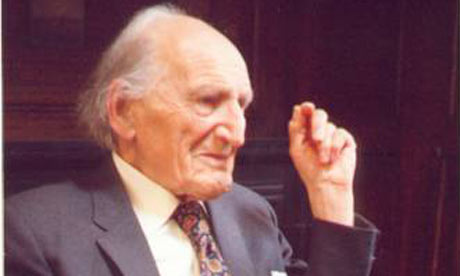
RESPONDING TO HARRY KROTO’S RENOWNED ACADEMICS!! C.J. van Rijsbergen, Dept of Computing Science, University of Glasgow, “Martin Rees said, ‘I am a non-believing Christian.’ I thought yeah that is exactly quite close to what I am. In other words, I understand and I accept the culture that we have has come out of Christianity, but just because I accept it and go along with it and admire it actually, doesn’t mean to say that I have to also believe in God”  

  1. On November 21, 2014 I received a letter from Nobel Laureate Harry Kroto and it said:

…Please click on this URL http://vimeo.com/26991975

and you will hear what far smarter people than I have to say on this matter. I agree with them.

Harry Kroto

I have attempted to respond to all of Dr. Kroto’s friends arguments and I have posted my responses one per week for over a year now. Here are some of my earlier posts:

Arif Ahmed, Sir David AttenboroughMark Balaguer, Horace Barlow, Michael BatePatricia ChurchlandAaron CiechanoverNoam Chomsky,Alan DershowitzHubert Dreyfus, Bart Ehrman, Stephan FeuchtwangDavid Friend,  Riccardo GiacconiIvar Giaever , Roy GlauberRebecca GoldsteinDavid J. Gross,  Brian Greene, Susan GreenfieldStephen F Gudeman,  Alan Guth, Jonathan HaidtTheodor W. Hänsch, Brian Harrison,  Hermann HauserRoald Hoffmann,  Bruce HoodHerbert Huppert,  Gareth Stedman Jones, Steve JonesShelly KaganMichio Kaku,  Stuart Kauffman,  Lawrence KraussHarry Kroto, George LakoffElizabeth Loftus,  Alan MacfarlanePeter MillicanMarvin MinskyLeonard Mlodinow,  Yujin NagasawaAlva NoeDouglas Osheroff,  Jonathan Parry,  Saul PerlmutterHerman Philipse,  Carolyn PorcoRobert M. PriceLisa RandallLord Martin Rees,  Oliver Sacks, John SearleMarcus du SautoySimon SchafferJ. L. Schellenberg,   Lee Silver Peter Singer,  Walter Sinnott-ArmstrongRonald de Sousa, Victor StengerBarry Supple,   Leonard Susskind, Raymond TallisNeil deGrasse Tyson,  .Alexander Vilenkin, Sir John WalkerFrank WilczekSteven Weinberg, and  Lewis Wolpert,

C. J. van Rijsbergen

From Wikipedia, the free encyclopedia
Cornelis Joost van Rijsbergen
C J van Rijsbergen.jpg

C. J. “Keith” van Rijsbergen
Born 1943
Rotterdam
Fields Information Retrieval
Institutions Monash University, University of Glasgow
Alma mater University of Western Australia,University of Cambridge

C. J. “Keith” van Rijsbergen FREng[1] (Cornelis Joost van Rijsbergen) (born 1943) is a professor of computer science and the leader of the Glasgow Information Retrieval Group based at the University of Glasgow. He is one of the founders of modern Information Retrieval and the author of the seminal monograph Information Retrieval and of the textbook The Geometry of Information Retrieval.

He was born in Rotterdam, and educated in the Netherlands, Indonesia, Namibia and Australia. His first degree is in mathematics from the University of Western Australia, and in 1972 he completed a PhD in computer science at the University of Cambridge. He spent three years lecturing in information retrieval and artificial intelligence at Monash University before returning to Cambridge to hold a Royal Society Information Research Fellowship. In 1980 he was appointed to the chair of computer science at University College Dublin; from there he moved in 1986 to Glasgow University. In 2003 he was inducted as a Fellow of the Association for Computing Machinery. In 2004 he was awarded the Tony Kent Strix award. In 2004 he was appointed a Fellow[2] of the Royal Academy of Engineering[3] In 2006, he was awarded the Gerard Salton Award for Quantum haystacks. Since 2007 he has been Chairman of the Scientific Board of the Information Retrieval Facility.

In  the third video below in the 110th clip in this series are his words and  my response is below them. 

50 Renowned Academics Speaking About God (Part 1)

Another 50 Renowned Academics Speaking About God (Part 2)

A Further 50 Renowned Academics Speaking About God (Part 3)

_________________________________

Interview of computer scientist Keith van Rijsbergen, pt. 1

Uploaded on Feb 9, 2010

An interview of the computer scientist Keith van Rijsbergen talking about his life and work; one of the pioneers of p

Interview of the computer scientist, Keith van Rijsbergen, pt. 2

Uploaded on Feb 9, 2010

An interview of the computer scientist Keith van Rijsbergen talking about his life and work; one of the pioneers of probabalistic searching. Interviewed by Alan Macfarlane in July 2009. For a higher quality, downlloadable version, with a summary, please see http://www.alanmacfarlane.com

Below is the letter to him and I respond to his quote:

March 13, 2015

Prof. C.J. van Rijsbergen, c/o Dept of Computing Science, University of Glasgow,

Dear Dr. C.J. van Rijsbergen,

I just finished reading the online addition of the book Darwin, Francis ed. 1892. Charles Darwin: his life told in an autobiographical chapter, and in a selected series of his published letters [abridged edition]. London: John Murray. There are several points that Charles Darwin makes in this book that were very wise, honest, logical, shocking and some that were not so wise. The Christian Philosopher Francis Schaeffer once said of Darwin’s writings, “Darwin in his autobiography and in his letters showed that all through his life he never really came to a quietness concerning the possibility that chance really explained the situation of the biological world. You will find there is much material on this [from Darwin] extended over many many years that constantly he was wrestling with this problem.”

I really enjoyed listening to your interview by Alan Macfarlane. Dr. Macfarlane has done so many wonderful in-depth interviews and yours with him was very good too. I noticed that you were educated under Fred Hoyle at Cambridge and that you also were interested in Dostoyevsky at one time.

I have written several times in the past about  Dostoyevsky and have many posts about his works. William Lane Craig in his article, “The Absurdity of Life without God,” wrote:

Another apologetic based on the human predicament may be found in the magnificent novels of the great nineteenth-century Russian writer Fyodor Dostoyevsky (1821–1881). (May I add that I think the obsession of contemporary evangelicals with the writings of authors like C. S. Lewis to the neglect of writers like Dostoyevsky is a great shame? Dostoyevsky is a far, far grander writer.) The problem that tortured Dostoyevsky was the problem of evil: how can a good and loving God exist when the world is filled with so much suffering and evil? Dostoyevsky presented this problem in his works so persuasively, so poignantly, that certain passages of his, notably “The Grand Inquisitor” section from his Brothers Karamazov, are often reprinted in anthologies as classic statements of the problem of evil. As a result, some people are under the impression that Dostoyevsky was himself an atheist and that the viewpoint of the Grand Inquisitor is his own.

Actually, he sought to carry through a two-pronged defense of theism in the face of the problem of evil. Positively, he argued that innocent suffering may perfect character and bring one into a closer relation with God. Negatively, he tried to show that if the existence of God is denied, then one is landed in complete moral relativism, so that no act, regardless how dreadful or heinous, can be condemned by the atheist. To live consistently with such a view of life is unthinkable and impossible. Hence, atheism is destructive of life and ends logically in suicide.

Dostoyevsky’s magnificent novels Crime and Punishment and The Brothers Karamazov powerfully illustrate these themes. In the former a young atheist, convinced of moral relativism, brutally murders an old woman. Though he knows that on his presuppositions he should not feel guilty, nevertheless he is consumed with guilt until he confesses his crime and gives his life to God. The latter novel is the story of four brothers, one of whom murders their father because his atheist brother Ivan had told him that moral absolutes do not exist. Unable to live with the consequences of his own philosophical system, Ivan suffers a mental collapse. The remaining two brothers, one of whom is unjustly accused of the parricide and the other a young Russian orthodox priest, find in what they suffer the perfection of their character and a nearness to God.

Dostoyevsky recognizes that his response to atheism constitutes no positive proof of Christianity. Indeed, he rejects that there could be such. Men demand of Christ that he furnish them “bread and circuses,” but he refuses to do so. The decision to follow Christ must be made in loneliness and anxiety. Each person must face for himself the anguish of a world without God and in the solitude of his own heart give himself to God in faith….Finally, let’s look at the problem of purpose in life. Unable to live in an impersonal universe in which everything is the product of blind chance, atheists sometimes begin to ascribe personality and motives to the physical processes themselves. It is a bizarre way of speaking and represents a leap from the lower to the upper story. For example, the brilliant Russian physicists Zeldovich and Novikov, in contemplating the properties of the universe, ask, why did “Nature” choose to create this sort of universe instead of another? “Nature” has obviously become a sort of God-substitute, filling the role and function of God. Francis Crick halfway through his book The Origin of the Genetic Code begins to spell nature with a capital N and elsewhere speaks of natural selection as being “clever” and as “thinking” of what it will do. Sir Fred Hoyle, the English astronomer, attributes to the universe itself the qualities of God. For Carl Sagan the “Cosmos,” which he always spelled with a capital letter, obviously fills the role of a God-substitute. Though these men profess not to believe in God, they smuggle in a God-substitute through the back door because they cannot bear to live in a universe in which everything is the chance result of impersonal forces…Modern man no longer has any right to that support, since he rejects God. But in order to live purposefully, he makes a leap of faith to affirm a reason for living. 

___________

Here are a couple of more quotes from  -Sir Fred Hoyle, atheist, and a prominent astrophysicist of the 20th century.

“If you stir up simple nonorganic molecules like water, ammonia, methane, carbon dioxide and hydrogen cyanide with almost any form of intense energy … some of the molecules reassemble themselves into amino acids … demonstrated … byStanley Miller and Harold Urey. The … building blocks of proteins can therefore be produced by natural means. But this is far from proving that life could have evolved in this way. No one has shown that the correct arrangements of amino acids, like the orderings in enzymes, can be produced by this method. …. A junkyard contains all the bits and pieces of a Boeing 747, dismembered and in disarray. A whirlwind happens to blow through the yard. What is the chance that after its passage a fully assembled 747, ready to fly, will be found standing there? So small as to be negligible, even if a tornado were to blow through enough junkyards to fill the whole Universe.” (Hoyle, F., “The Intelligent Universe,” Michael Joseph: London, 1983, pp.18-19).

“If one proceeds directly…in this matter, without being deflected by a fear of incurring the wrath of scientific opinion, one arrives at the conclusion that biomaterialists (life forms) with their amazing measure of order must be the outcome of intelligent design.”

Recently I noticed this comment by you:

Martin Rees said, “I am a non-believing Christian.” I thought yeah that is exactly quite close to what I am. In other words, I understand and I accept the culture that we have has come out of Christianity, but just because I accept it and go along with it and admire it actually, doesn’t mean to say that I have to also believe in God.  

Just like Charles Darwin you have come out this Christian culture and this exact quote made me think of you when I read the book Charles Darwin: his life told in an autobiographical chapter, and in a selected series of his published letters because of what Darwin said on this same issue of intelligent design. I am going to quote some of Charles Darwin’s own words and then include the comments of Francis Schaeffer on those words. I have also enclosed a CD with two messages from Adrian Rogers and Bill Elliff concerning Darwinism.

Darwin, C. R. to Doedes, N. D.2 Apr 1873

“It is impossible to answer your question briefly; and I am not sure that I could do so, even if I wrote at some length. But I may say that the impossibility of conceiving that this grand and wondrous universe, with our conscious selves, arose through chance, seems to me the chief argument for the existence of God; but whether this is an argument of real value, I have never been able to decide…Nor can I overlook the difficulty from the immense amount of suffering through the world. I am aware that if we admit a First Cause, the mind still craves to know whence it came, and how it arose.”

Francis Schaeffer noted:

What he is saying is if you say there is a first cause, then the mind says, “Where did this come from?” I think this is a bit old fashioned, with some of the modern thinkers, this would not have carry as much weight today as it did when Darwin expressed it. Jean Paul Sartre said it as well as anyone could possibly say it. The philosophic problem is that something is there and not nothing being there. No one has the luxury of beginning with nothing. Nobody I have ever read has put forth that everything came from nothing. I have never met such a person in all my reading,or all my discussion. If you are going to begin with nothing being there, it has to be nothing nothing, and it can’t be something nothing. When someone says they believe nothing is there, in reality they have already built in something there. The only question is do you begin with an impersonal something or a personal something. All human thought is shut up to these two possibilities. Either you begin with an impersonal and then have Darwin’s own dilemma which impersonal plus chance, now he didn’t bring in the amount of time that modern man would though. Modern man has brought in huge amounts of time into the equation as though that would make a difference because I have said many times that time can’t make a qualitative difference but only a quantitative difference. The dilemma is it is either God or chance. Now you find this intriguing thing in Darwin’s own situation, he can’t understand how chance could have produced these two great factors of the universe and its form and the mannishness of man.

From Charles Darwin, Autobiography (1876), in The Life and Letters of Charles Darwin, ed. Francis Darwin, vol. 1 (London: John Murray, 1888), pp. 307 to 313.

“Another source of conviction in the existence of God, connected with the reason and not with the feelings, impresses me as having much more weight. This follows from the extreme difficulty or rather impossibility of conceiving this immense and wonderful universe, including man with his capacity of looking far backwards and far into futurity, as the result of blind chance or necessity. When thus reflecting, I feel compelled to look to a First Cause having an intelligent mind in some degree analogous to that of man; and I deserve to be called a Theist. This conclusion was strong in my mind about the time, as far as I can remember, when I wrote the Origin of Species, and it is since that time that it has very gradually, with many fluctuations, become weaker. But then arises the doubt…”

Francis Schaeffer commented:

On the basis of his reason he has to say there must be an intelligent mind, someone analogous to man. You couldn’t describe the God of the Bible better. That is man is made in God’s image  and therefore, you know a great deal about God when you know something about man. What he is really saying here is that everything in my experience tells me it must be so, and my mind demands it is so. Not just these feelings he talked about earlier but his MIND demands it is so, but now how does he counter this? How does he escape this? Here is how he does it!!!

Charles Darwin went on to observe:  —can the mind of man, which has, as I fully believe, been developed from a mind as low as that possessed by the lowest animals, be trusted when it draws such grand conclusions?”

Francis Schaeffer asserted:

So he says my mind can only come to one conclusion, and that is there is a mind behind it all. However, the doubt comes because his mind has come from the lowest form of earthworm, so how can I trust my mind. But this is a joker isn’t it?  Then how can you trust his mind to support such a theory as this? He proved too much. The fact that Darwin found it necessary to take such an escape shows the tremendous weight of Romans 1, that the only escape he can make is to say how can I trust my mind when I come from the lowest animal the earthworm? Obviously think of the grandeur of his concept, I don’t think it is true, but the grandeur of his concept, so what you find is that Darwin is presenting something here that is wrong I feel, but it is not nothing. It is a tremendously grand concept that he has put forward. So he is accepting the dictates of his mind to put forth a grand concept which he later can’t accept in this basic area with his reason, but he rejects what he could accept with his reason on this escape. It really doesn’t make sense. This is a tremendous demonstration of the weakness of his own position.

Darwin also noted, “I cannot pretend to throw the least light on such abstruse problems. The mystery of the beginning of all things is insoluble by us, and I for one must be content to remain an Agnostic.”

Francis Schaeffer remarked:

What a stupid reply and I didn’t say wicked. It just seems to me that here is 2 plus 2 equals 36 at this particular place.

Darwin, C. R. to Graham, William 3 July 1881

Nevertheless you have expressed my inward conviction, though far more vividly and clearly than I could have done, that the Universe is not the result of chance.* But then with me the horrid doubt always arises whether the convictions of man’s mind, which has been developed from the mind of the lower animals, are of any value or at all trustworthy. Would any one trust in the convictions of a monkey’s mind, if there are any convictions in such a mind?

Francis Schaeffer observed:

Can you feel this man? He is in real agony. You can feel the whole of modern man in this tension with Darwin. My mind can’t accept that ultimate of chance, that the universe is a result of chance. He has said 3 or 4 times now that he can’t accept that it all happened by chance and then he will write someone else and say something different. How does he say this (about the mind of a monkey) and then put forth this grand theory? Wrong theory I feel but great just the same. Grand in the same way as when I look at many of the paintings today and I differ with their message but you must say the mark of the mannishness of man are one those paintings titanic-ally even though the message is wrong and this is the same with Darwin.  But how can he say you can’t think, you come from a monkey’s mind, and you can’t trust a monkey’s mind, and you can’t trust a monkey’s conviction, so how can you trust me? Trust me here, but not there is what Darwin is saying. In other words it is very selective. 

Now we are down to the last year of Darwin’s life.

* The Duke of Argyll (Good Words, April 1885, p. 244) has recorded a few words on this subject, spoken by my father in the last year of his life. “. . . in the course of that conversation I said to Mr. Darwin, with reference to some of his own remarkable works on the Fertilisation of Orchids, and upon The Earthworms,and various other observations he made of the wonderful contrivances for certain purposes in nature—I said it was impossible to look at these without seeing that they were the effect and the expression of mind. I shall never forget Mr. Darwin’s answer. He looked at me very hard and said, ‘Well, that often comes over me with overwhelming force; but at other times,’ and he shook his head vaguely, adding, ‘it seems to go away.'”

Francis Schaeffer summarized :

And this is the great Darwin, and it makes you cry inside. This is the great Darwin and he ends as a man in total tension.

Francis Schaeffer noted that in Darwin’s 1876 Autobiography that Darwin he is going to set forth two arguments for God in this and again you will find when he comes to the end of this that he is in tremendous tension. Darwin wrote, 

At the present day the most usual argument for the existence of an intelligent God is drawn from the deep inward conviction and feelings which are experienced by most persons.Formerly I was led by feelings such as those just referred to (although I do not think that the religious sentiment was ever strongly developed in me), to the firm conviction of the existence of God and of the immortality of the soul. In my Journal I wrote that whilst standing in the midst of the grandeur of a Brazilian forest, ‘it is not possible to give an adequate idea of the higher feelings of wonder, admiration, and devotion which fill and elevate the mind.’ I well remember my conviction that there is more in man than the mere breath of his body; but now the grandest scenes would not cause any such convictions and feelings to rise in my mind. It may be truly said that I am like a man who has become colour-blind.

Francis Schaeffer remarked:

Now Darwin says when I look back and when I look at nature I came to the conclusion that man can not be just a fly! But now Darwin has moved from being a younger man to an older man and he has allowed his presuppositions to enter in to block his logic. These things at the end of his life he had no intellectual answer for. To block them out in favor of his theory. Remember the letter of his that said he had lost all aesthetic senses when he had got older and he had become a clod himself. Now interesting he says just the same thing, but not in relation to the arts, namely music, pictures, etc, but to nature itself. Darwin said, “But now the grandest scenes would not cause any such convictions  and feelings to rise in my mind. It may be truly said that I am like a man who has become colour-blind…” So now you see that Darwin’s presuppositions have not only robbed him of the beauty of man’s creation in art, but now the universe. He can’t look at it now and see the beauty. The reason he can’t see the beauty is for a very, very , very simple reason: THE BEAUTY DRIVES HIM TO DISTRACTION. THIS IS WHERE MODERN MAN IS AND IT IS HELL. The art is hell because it reminds him of man and how great man is, and where does it fit in his system? It doesn’t. When he looks at nature and it’s beauty he is driven to the same distraction and so consequently you find what has built up inside him is a real death, not  only the beauty of the artistic but the beauty of nature. He has no answer in his logic and he is left in tension.  He dies and has become less than human because these two great things (such as any kind of art and the beauty of  nature) that would make him human  stand against his theory.

________________________

DO THESE WORDS OF DARWIN APPLY TO YOU TODAY? “I am like a man who has become colour-blind.”

ADRIAN ROGERS NOTED IN HIS SERMON “The Cradle that Rocked the World“:

Sir Fred Hoyle, at the British Academy of Science—a leading mathematician, a leading astronomer—shook up a lot of people in the scientific community, when he said this—listen: “We must now admit to ourselves that the probability of life arising by chance, by evolution, is the same probability as throwing six on a die 5 million consecutive times.” Now, get a die, and begin to throw it; and, if you can throw six, it’ll land on six 5 million times in a row—that’s the probability that life could arise by spontaneous generation. He went on to say—this is Sir Fred Hoyle: “Let us be scientifically honest with ourselves. The probability of having life arise to greater and greater complexity in organization by chance is the same probability of having a tornado tear through a junkyard and form a 747 on the other end.” What is this great scientist saying? That random and impersonal chance does not create complexity in design— that’s what he’s saying.

IF WE ARE LEFT WITH JUST THE MACHINE THEN WHAT IS THE FINAL CONCLUSION IF THERE WAS NO PERSONAL GOD THAT CREATED US? I sent you a CD that starts off with the song DUST IN THE WIND by Kerry Livgren of the group KANSAS which was a hit song in 1978 when it rose to #6 on the charts because so many people connected with the message of the song. It included these words, “All we do, crumbles to the ground though we refuse to see, Dust in the Wind, All we are is dust in the wind, Don’t hang on, Nothing lasts forever but the Earth and Sky, It slips away, And all your money won’t another minute buy.”

Kerry Livgren himself said that he wrote the song because he saw where man was without a personal God in the picture. Solomon pointed out in the Book of Ecclesiastes that those who believe that God doesn’t exist must accept three things. FIRST, death is the end and SECOND, chance and time are the only guiding forces in this life.  FINALLY, power reigns in this life and the scales are never balanced. The Christian can  face death and also confront the world knowing that it is not determined by chance and time alone and finally there is a judge who will balance the scales.

Both Kerry Livgren and the bass player Dave Hope of Kansas became Christians eventually. Kerry Livgren first tried Eastern Religions and Dave Hope had to come out of a heavy drug addiction. I was shocked and elated to see their personal testimony on The 700 Club in 1981 and that same  interview can be seen on You Tube today. Livgren lives in Topeka, Kansas today where he teaches “Diggers,” a Sunday school class at Topeka Bible ChurchDAVE HOPE is the head of Worship, Evangelism and Outreach at Immanuel Anglican Church in Destin, Florida.

The answer to find meaning in life is found in putting your faith and trust in Jesus Christ. The Bible is true from cover to cover and can be trusted.

Thank you again for your time and I know how busy you are.

Everette Hatcher, everettehatcher@gmail.com, http://www.thedailyhatch.org, cell ph 501-920-5733, Box 23416, LittleRock, AR 72221, United States

Is the Bible historically accurate? Here are some of the posts I have done in the past on the subject: 1. The Babylonian Chronicleof Nebuchadnezzars Siege of Jerusalem2. Hezekiah’s Siloam Tunnel Inscription. 3. Taylor Prism (Sennacherib Hexagonal Prism)4. Biblical Cities Attested Archaeologically. 5. The Discovery of the Hittites6.Shishak Smiting His Captives7. Moabite Stone8Black Obelisk of Shalmaneser III9A Verification of places in Gospel of John and Book of Acts., 9B Discovery of Ebla Tablets10. Cyrus Cylinder11. Puru “The lot of Yahali” 9th Century B.C.E.12. The Uzziah Tablet Inscription13. The Pilate Inscription14. Caiaphas Ossuary14 B Pontius Pilate Part 214c. Three greatest American Archaeologists moved to accept Bible’s accuracy through archaeology.

You can hear DAVE HOPE and Kerry Livgren’s stories from this youtube link:

(part 1 ten minutes)

(part 2 ten minutes)

Kansas – Dust in the Wind (Official Video)

Uploaded on Nov 7, 2009

Pre-Order Miracles Out of Nowhere now at http://www.miraclesoutofnowhere.com

About the film:
In 1973, six guys in a local band from America’s heartland began a journey that surpassed even their own wildest expectations, by achieving worldwide superstardom… watch the story unfold as the incredible story of the band KANSAS is told for the first time in the DVD Miracles Out of Nowhere.

_____________________________

Adrian Rogers on Darwinism

________

Related posts:

FRANCIS SCHAEFFER ANALYZES ART AND CULTURE Part 53 THE BEATLES (Part E, Stg. Pepper’s and John Lennon’s search in 1967 for truth was through drugs, money, laughter, etc & similar to King Solomon’s, LOTS OF PICTURES OF JOHN AND CYNTHIA) (Feature on artist Yoko Ono)

The John Lennon and the Beatles really were on a long search for meaning and fulfillment in their lives  just like King Solomon did in the Book of Ecclesiastes. Solomon looked into learning (1:12-18, 2:12-17), laughter, ladies, luxuries, and liquor (2:1-2, 8, 10, 11), and labor (2:4-6, 18-20). He fount that without God in the picture all […]

FRANCIS SCHAEFFER ANALYZES ART AND CULTURE Part 52 THE BEATLES (Part D, There is evidence that the Beatles may have been exposed to Francis Schaeffer!!!) (Feature on artist Anna Margaret Rose Freeman )

______________   George Harrison Swears & Insults Paul and Yoko Lucy in the Sky with Diamonds- The Beatles The Beatles:   I have dedicated several posts to this series on the Beatles and I don’t know when this series will end because Francis Schaeffer spent a lot of time listening to the Beatles and talking […]

FRANCIS SCHAEFFER ANALYZES ART AND CULTURE Part 51 THE BEATLES (Part C, List of those on cover of Stg.Pepper’s ) (Feature on artist Raqib Shaw )

  The Beatles in a press conference after their Return from the USA Uploaded on Nov 29, 2010 The Beatles in a press conference after their Return from the USA. The Beatles:   I have dedicated several posts to this series on the Beatles and I don’t know when this series will end because Francis […]

FRANCIS SCHAEFFER ANALYZES ART AND CULTURE Part 50 THE BEATLES (Part B, The Psychedelic Music of the Beatles) (Feature on artist Peter Blake )

__________________   Beatles 1966 Last interview I have dedicated several posts to this series on the Beatles and I don’t know when this series will end because Francis Schaeffer spent a lot of time listening to the Beatles and talking and writing about them and their impact on the culture of the 1960’s. In this […]

FRANCIS SCHAEFFER ANALYZES ART AND CULTURE Part 49 THE BEATLES (Part A, The Meaning of Stg. Pepper’s Cover) (Feature on artist Mika Tajima)

_______________ The Beatles documentary || A Long and Winding Road || Episode 5 (This video discusses Stg. Pepper’s creation I have dedicated several posts to this series on the Beatles and I don’t know when this series will end because Francis Schaeffer spent a lot of time listening to the Beatles and talking and writing about […]

FRANCIS SCHAEFFER ANALYZES ART AND CULTURE PART 48 “BLOW UP” by Michelangelo Antonioni makes Philosophic Statement (Feature on artist Nancy Holt)

_______________ Francis Schaeffer pictured below: _____________________ I have included the 27 minute  episode THE AGE OF NONREASON by Francis Schaeffer. In that video Schaeffer noted,  ” Sergeant Pepper’s Lonely Hearts Club Band…for a time it became the rallying cry for young people throughout the world. It expressed the essence of their lives, thoughts and their feelings.” How Should […]

FRANCIS SCHAEFFER ANALYZES ART AND CULTURE Part 47 Woody Allen and Professor Levy and the death of “Optimistic Humanism” from the movie CRIMES AND MISDEMEANORS Plus Charles Darwin’s comments too!!! (Feature on artist Rodney Graham)

Crimes and Misdemeanors: A Discussion: Part 1 ___________________________________ Today I will answer the simple question: IS IT POSSIBLE TO BE AN OPTIMISTIC SECULAR HUMANIST THAT DOES NOT BELIEVE IN GOD OR AN AFTERLIFE? This question has been around for a long time and you can go back to the 19th century and read this same […]

FRANCIS SCHAEFFER ANALYZES ART AND CULTURE PART 46 Friedrich Nietzsche (Featured artist is Thomas Schütte)

____________________________________ Francis Schaeffer pictured below: __________ Francis Schaeffer has written extensively on art and culture spanning the last 2000years and here are some posts I have done on this subject before : Francis Schaeffer’s “How should we then live?” Video and outline of episode 10 “Final Choices” , episode 9 “The Age of Personal Peace and Affluence”, episode 8 […]

FRANCIS SCHAEFFER ANALYZES ART AND CULTURE Part 45 Woody Allen “Reason is Dead” (Feature on artists Allora & Calzadilla )

Love and Death [Woody Allen] – What if there is no God? [PL] ___________ _______________ How Should We then Live Episode 7 small (Age of Nonreason) #02 How Should We Then Live? (Promo Clip) Dr. Francis Schaeffer 10 Worldview and Truth Two Minute Warning: How Then Should We Live?: Francis Schaeffer at 100 Francis Schaeffer […]

FRANCIS SCHAEFFER ANALYZES ART AND CULTURE Part 44 The Book of Genesis (Featured artist is Trey McCarley )

___________________________________ Francis Schaeffer pictured below: ____________________________ Francis Schaeffer “BASIS FOR HUMAN DIGNITY” Whatever…HTTHR Dr. Francis schaeffer – The flow of Materialism(from Part 4 of Whatever happened to human race?) Dr. Francis Schaeffer – The Biblical flow of Truth & History (intro) Francis Schaeffer – The Biblical Flow of History & Truth (1) Dr. Francis Schaeffer […]

__
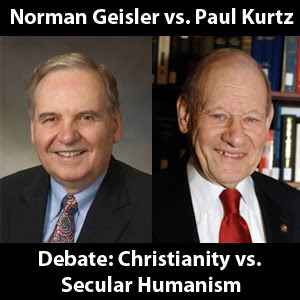
RESPONDING TO HARRY KROTO’S BRILLIANT RENOWNED ACADEMICS!! Part 80 Alison Richard, Yale University, Professor of Anthropology, “I would classify myself as an agnostic. You can not  know enough to know that there is nothing you don’t understand…To sign up to a fully elaborated religious system of beliefs is something I can’t do.” 

On November 21, 2014 I received a letter from Nobel Laureate Harry Kroto and it said:

…Please click on this URL http://vimeo.com/26991975

and you will hear what far smarter people than I have to say on this matter. I agree with them.

Harry Kroto

I have attempted to respond to all of Dr. Kroto’s friends arguments and I have posted my responses one per week for over a year now. Here are some of my earlier posts:

Arif Ahmed, Sir David AttenboroughMark Balaguer, Horace Barlow, Michael BatePatricia ChurchlandAaron CiechanoverNoam Chomsky,Alan DershowitzHubert Dreyfus, Bart Ehrman, Stephan FeuchtwangDavid Friend,  Riccardo GiacconiIvar Giaever , Roy GlauberRebecca GoldsteinDavid J. Gross,  Brian Greene, Susan GreenfieldStephen F Gudeman,  Alan Guth, Jonathan HaidtTheodor W. Hänsch, Brian Harrison,  Hermann HauserRoald Hoffmann,  Bruce HoodHerbert Huppert,  Gareth Stedman Jones, Steve JonesShelly KaganMichio Kaku,  Stuart Kauffman,  Lawrence KraussHarry Kroto, George LakoffElizabeth Loftus,  Alan MacfarlanePeter MillicanMarvin MinskyLeonard Mlodinow,  Yujin NagasawaAlva NoeDouglas Osheroff,  Jonathan Parry,  Saul PerlmutterHerman Philipse,  Carolyn PorcoRobert M. PriceLisa RandallLord Martin Rees,  Oliver Sacks, John SearleMarcus du SautoySimon SchafferJ. L. Schellenberg,   Lee Silver Peter Singer,  Walter Sinnott-ArmstrongRonald de Sousa, Victor StengerBarry Supple,   Leonard Susskind, Raymond TallisNeil deGrasse Tyson,  .Alexander Vilenkin, Sir John WalkerFrank WilczekSteven Weinberg, and  Lewis Wolpert,

Alison Richard

In  the third video below in the 104th clip in this series are her words and  my response is below them. 

50 Renowned Academics Speaking About God (Part 1)

Another 50 Renowned Academics Speaking About God (Part 2)

A Further 50 Renowned Academics Speaking About God (Part 3)


Interview of Alison Richard, part one

Interview of Alison Richard, part two

Interview of Alison Richard, part three

_________________________________

QUOTE FROM DR. RICHARD:

“I would classify myself as an agnostic. You can not  know enough to know that there is nothing you don’t understand…To sign up to a fully elaborated religious system of beliefs is something I can’t do.”


My response to this is very short. If the Bible is historically correct about Jesus rising from the dead then that would change everything because it would show that God did reach out to mankind. There are many places in history where we can reach and out and verify the Bible accuracy.  Here are some of the posts I have done in the past on the subject: 1. The Babylonian Chronicleof Nebuchadnezzars Siege of Jerusalem2. Hezekiah’s Siloam Tunnel Inscription. 3. Taylor Prism (Sennacherib Hexagonal Prism)4. Biblical Cities Attested Archaeologically. 5. The Discovery of the Hittites6.Shishak Smiting His Captives


Below is my letter to Dr. Richard:

April 3, 2015

Dr. Alison Richard, Professor of Biological Anthropology, Yale University,

Dear Dr. Richard,

Let me start off by saying that this is not the first time that I have written you. Earlier I shared several letters of correspondence I had with Carl Sagan, and Antony Flew. Both men were strong believers in evolution as you are today. Previously in this same letter I told you that Dr. John J. Shea  suggested that I read SHADOWS OF FORGOTTEN ANCESTORS by Carl Sagan.  Instead of talking to you about their views today I wanted to discuss the views of you and Charles Darwin.

I just finished reading the online addition of the book Darwin, Francis ed. 1892. Charles Darwin: his life told in an autobiographical chapter, and in a selected series of his published letters [abridged edition]. London: John Murray. There are several points that Charles Darwin makes in this book that were very wise, honest, logical, shocking and some that were not so wise. The Christian Philosopher Francis Schaeffer once said of Darwin’s writings, “Darwin in his autobiography and in his letters showed that all through his life he never really came to a quietness concerning the possibility that chance really explained the situation of the biological world. You will find there is much material on this [from Darwin] extended over many many years that constantly he was wrestling with this problem.”

Here is a quote I ran across recently from you:

On religion: my mother grew up in the Church of England, but we went to the Presbyterian church in Bromley every Sunday; Queenswood was a Methodist school and there was chapel every morning and twice a day on Sunday; I can’t say it meant a lot to me and once I had left school I didn’t go to church again; when our son died as a baby – a cot death – it was the minister of the church in our village who comforted us and performed the burial service – his flickering of faith was important in helping me to survive that; at the time I thought that whether I believed or not there was comfort at the darkest moment in my life, and there was a familiar relationship with a church; after that we started taking our daughters, then seven and five, to church every Sunday; we wanted them to have the possibility of what had made a difference to me, should it befall them, would make a difference to them;

I SENT YOU A CD WITH A SERMON ON IT FROM ADRIAN ROGERS AND HE HAS BEEN THROUGH THE SAME THING YOU HAVE. LISTEN TO THIS QUOTE BELOW:

 Joyce and I, some years ago, had a little baby boy that died. One of those unexplainable crib deaths. And our hearts ached, we went through sorrow and pain but the Lord Jesus was there, so near and so real. Joyce and I learned to depend on Him so much and grew so much in that experience. Heartache and pain indeed it was. We had never known such deep sorrow. But the Lord was so real to us. And that was in J. W., Fort Pierce where you and I know so much about, where we’ve been so much. And I was back in the hospital in the Fort Pierce Hospital a few days after we had buried our little son Phillip. And I had been visiting a man who was not a Christian. And I had been witnessing to him, trying to lead him to Jesus Christ. And he somehow had learned that our son had died. And when he saw me walk in that room, he said, “What are you doing here?” I said well, I came to see you, to visit you. He said, “What? Are you still serving God after what he did to you?” Now, you think about that. Are you still after what He did to you? I said, “Oh my friend, I want you to listen to me, and I want you to get it down big and plain and straight that the author of all suffering and sorrow and pain and death is Satan, not God. God is good. God is good. And the suffering we have in this world is because we live in a world that has been cursed with sin, and if you think that I’m going to line up against God in favor of the devil, and line up with the one who has ultimately wounded me, your so wrong.”

On February 15, 2015 at our church service at FELLOWSHIP BIBLE CHURCH in Little Rock, Arkansas, our teaching pastor Brandon Barnard told the story of my good friends Roger and Terrie Cheuvront  and the tragic death of their 19 year daughter Danaea on April 15, 2007 in a traffic accident. I was at the Funeral Home when the minister came in that very day, and I found the words of the pastor as a great comfort because we knew Danaea was in heaven. The sermon on 2-15-15 was about the time that Jesus wept at sight of his friend Lazarus’ tomb, and this 11th chapter of John had comforted Terrie Cheuvront because she knew that Jesus had felt the same pain that we have and he will eventually raise us too from the dead and her daughter Danaea is even now in heaven with Christ.

Rev Barnard actually read these words from Terri at our service: “God never intended us to experience sin and death, but sin brought about this consequence. I could be mad at death and all that it meant but the amazing thing was when I realized God’s plan then God took the anger and replaced it with His grace. It made me realize at a deeper level what God had truly done for me on the cross. He conquered sin and death for me. What amazing glorious hope he gives us. We live because He lives. Yes I am separated from my daughter now but there will be a glorious reunion.”

Let me make three points concerning the problem of evil and suffering. First, the problem of evil and suffering hit this world in a big way because of Adam and what happened in Genesis Chapter 3. Second, if there is no God then there is no way to distinguish good from evil and there will be no ultimate punishment for Hitler and Josef Mengele. (By the way Mengele never faced punishment and lived his long life out in peace.) Third. Christ came and suffered and will destroy all evil from this world eventually forever.

CHARLES DARWIN ALSO SPENT A LOT OF TIME TALKING ABOUT THIS ISSUE OF EVIL AND SUFFERING. When I read the book  Charles Darwin: his life told in an autobiographical chapter, and in a selected series of his published letters, I also read  a commentary on it by Francis Schaeffer and I wanted to both  quote some of Charles Darwin’s own words to you and then include the comments of Francis Schaeffer on those words. I have also enclosed a CD with two messages from Adrian Rogers and Bill Elliff concerning Darwinism.

Darwin, C. R. to Doedes, N. D.2 Apr 1873

“I am sure you will excuse my writing at length, when I tell you that I have long been much out of health, and am now staying away from my home for rest. It is impossible to answer your question briefly; and I am not sure that I could do so, even if I wrote at some length. But I may say that the impossibility of conceiving that this grand and wondrous universe, with our conscious selves, arose through chance, seems to me the chief argument for the existence of God; but whether this is an argument of real value, I have never been able to decide…....Nor can I overlook the difficulty from the immense amount of suffering through the world.”

Francis Schaeffer observed:

This of course is a valid problem. The only answer to the problem of evil is the biblical answer of the fall. Darwin has a problem because he never had a high view of revelation, so he doesn’t have the answer any more than the liberal theologian has the answer. If you don’t have a space-time fall then you don’t have an answer to suffering. If you have a very, very significant man at the beginning, Darwin did not have that, but if you had a very significant, wonderful man at the beginning and can change history then the fall is the possible answer that can be given to Darwin’s 2nd argument.

The passages which here follow are extracts, somewhat abbreviated, from a part of the Autobiography, written in 1876, in which my father gives the history of his religious views:—

But passing over the endless beautiful adaptations which we everywhere meet with, it may be asked how can the generally beneficent arrangement of the world be accounted for? Some writers indeed are so much impressed with the amount of suffering in the world, that they doubt, if we look to all sentient beings, whether there is more of misery or of happiness; whether the world as a whole is a good or a bad one. According to my judgment happiness decidedly prevails, though this would be very difficult to prove.”

Francis Schaeffer commented:

We come now to a funny situation where Darwin is arguing there is more happiness than sorry in the world. In this I think he is right. What he is saying if you could have a balance of 51% of happiness then it would open the door to thinking God is good, but I would never argue this way because it is not 51% of happiness versus 49% of unhappiness in the universe but how could a good God make unhappiness at all. The answer is in the [space time fall in Genesis].

Darwin continued:

“If the truth of this conclusion be granted, it harmonizes well with the effects which we might expect from natural selection. If all the individuals of any species were habitually to suffer to an extreme degree, they would neglect to propagate their kind; but we have no reason to believe that this has ever, or at least often occurred. Some other considerations, moreover, lead to the belief that all sentient begins have been formed so as to enjoy, as a general rule, happiness. Every one who believes, as I do, that all the corporeal and mental organs (excepting those which are neither advantageous nor disadvantageous to the possessor) of all beings have been developed through natural selection, or the survival of the fittest, together with use or habit, will admit that these organs have been formed so that their possessors may compete successfully with other beings, and thus increase in number.”

Francis Schaeffer noted:

What he is saying here is that from his own view he needs to hold that suffering is less than happiness otherwise what would drive the creatures on toward natural selection. The Christian of course does not have this problem. The Christian says everything is in agony because the whole has been thrown out of joint and there has been an reordering of the universe because of the fall. We don’t have to find such a balance as he was grappling with here.

From Darwin’s section on religion:

“The sum of such pleasures as these, which are habitual or frequently recurrent, give, as I can hardly doubt, to most sentient beings an excess of happiness over misery, although many occasionally suffer much. Such suffering is quite compatible with the belief in Natural Selection, which is not perfect in its action, but tends only to render each species as successful as possible in the battle for life with other species, in wonderfully complex and changing circumstances.  That there is much suffering in the world no one disputes. Some have attempted to explain this with reference to man by imagining that it serves for his moral improvement. But the number of men in the world is as nothing compared with that of all other sentient beings, and they often suffer greatly without any moral improvement. This very old argument from the existence of suffering against the existence of an intelligent First Cause seems to me a strong one; whereas, as just remarked, the presence of much suffering agrees well with the view that all organic beings have been developed through variation and natural selection.”

Francis Schaeffer :

He has to argue this otherwise what drove the creatures on. He has to have a 51% or 52% happiness. Then he says what does this do to God. We would answer if there is no space time fall it makes God if He exists the devil, on the other hand with a space time fall you have another answer.

WITHOUT THE VIEW THAT THE GARDEN OF EDEN EXISTED OR IN THE EXISTENCE OF HEAVEN THEN YOUR ANALYSIS IS THE ONLY ONE THAT IS PROBABLE. FURTHERMORE,  IF WE WERE NOT CREATED BY GOD THEN WE HAVE NO HOPE FOR OUR ETERNAL FUTURES.  I sent you a CD that starts off with the song DUST IN THE WIND by Kerry Livgren of the group KANSAS which was a hit song in 1978 when it rose to #6 on the charts because so many people connected with the message of the song. It included these words, “All we do, crumbles to the ground though we refuse to see, Dust in the Wind, All we are is dust in the wind, Don’t hang on, Nothing lasts forever but the Earth and Sky, It slips away, And all your money won’t another minute buy.”

Kerry Livgren himself said that he wrote the song because he saw where man was without a personal God in the picture. Solomon pointed out in the Book of Ecclesiastes that those who believe that God doesn’t exist must accept three things. FIRST, death is the end and SECOND, chance and time are the only guiding forces in this life.  FINALLY, power reigns in this life and the scales are never balanced. The Christian can  face death and also confront the world knowing that it is not determined by chance and time alone and finally there is a judge who will balance the scales.

Both Kerry Livgren and the bass player Dave Hope of Kansas became Christians eventually. Kerry Livgren first tried Eastern Religions and Dave Hope had to come out of a heavy drug addiction. I was shocked and elated to see their personal testimony on The 700 Club in 1981 and that same  interview can be seen on You Tube today. Livgren lives in Topeka, Kansas today where he teaches “Diggers,” a Sunday school class at Topeka Bible ChurchDAVE HOPE is the head of Worship, Evangelism and Outreach at Immanuel Anglican Church in Destin, Florida.

The answer to find meaning in life is found in putting your faith and trust in Jesus Christ. The Bible is true from cover to cover and can be trusted.

Thank you again for your time and I know how busy you are.

Everette Hatcher, everettehatcher@gmail.com, http://www.thedailyhatch.org, cell ph 501-920-5733, Box 23416, LittleRock, AR 72221, United States

Is the Bible historically accurate? Here are some of the posts I have done in the past on the subject:7. Moabite Stone8Black Obelisk of Shalmaneser III9A Verification of places in Gospel of John and Book of Acts., 9B Discovery of Ebla Tablets10. Cyrus Cylinder11. Puru “The lot of Yahali” 9th Century B.C.E.12. The Uzziah Tablet Inscription13. The Pilate Inscription14. Caiaphas Ossuary14 B Pontius Pilate Part 214c. Three greatest American Archaeologists moved to accept Bible’s accuracy through archaeology.

You can hear DAVE HOPE and Kerry Livgren’s stories from this youtube link:

(part 1 ten minutes)

(part 2 ten minutes)

Kansas – Dust in the Wind (Official Video)

Uploaded on Nov 7, 2009

Pre-Order Miracles Out of Nowhere now at http://www.miraclesoutofnowhere.com

About the film:
In 1973, six guys in a local band from America’s heartland began a journey that surpassed even their own wildest expectations, by achieving worldwide superstardom… watch the story unfold as the incredible story of the band KANSAS is told for the first time in the DVD Miracles Out of Nowhere.

_____________________________

Adrian Rogers on Darwinism

________

Related posts:

FRANCIS SCHAEFFER ANALYZES ART AND CULTURE Part 53 THE BEATLES (Part E, Stg. Pepper’s and John Lennon’s search in 1967 for truth was through drugs, money, laughter, etc & similar to King Solomon’s, LOTS OF PICTURES OF JOHN AND CYNTHIA) (Feature on artist Yoko Ono)

The John Lennon and the Beatles really were on a long search for meaning and fulfillment in their lives  just like King Solomon did in the Book of Ecclesiastes. Solomon looked into learning (1:12-18, 2:12-17), laughter, ladies, luxuries, and liquor (2:1-2, 8, 10, 11), and labor (2:4-6, 18-20). He fount that without God in the picture all […]

FRANCIS SCHAEFFER ANALYZES ART AND CULTURE Part 52 THE BEATLES (Part D, There is evidence that the Beatles may have been exposed to Francis Schaeffer!!!) (Feature on artist Anna Margaret Rose Freeman )

______________   George Harrison Swears & Insults Paul and Yoko Lucy in the Sky with Diamonds- The Beatles The Beatles:   I have dedicated several posts to this series on the Beatles and I don’t know when this series will end because Francis Schaeffer spent a lot of time listening to the Beatles and talking […]

FRANCIS SCHAEFFER ANALYZES ART AND CULTURE Part 51 THE BEATLES (Part C, List of those on cover of Stg.Pepper’s ) (Feature on artist Raqib Shaw )

  The Beatles in a press conference after their Return from the USA Uploaded on Nov 29, 2010 The Beatles in a press conference after their Return from the USA. The Beatles:   I have dedicated several posts to this series on the Beatles and I don’t know when this series will end because Francis […]

FRANCIS SCHAEFFER ANALYZES ART AND CULTURE Part 50 THE BEATLES (Part B, The Psychedelic Music of the Beatles) (Feature on artist Peter Blake )

__________________   Beatles 1966 Last interview I have dedicated several posts to this series on the Beatles and I don’t know when this series will end because Francis Schaeffer spent a lot of time listening to the Beatles and talking and writing about them and their impact on the culture of the 1960’s. In this […]

FRANCIS SCHAEFFER ANALYZES ART AND CULTURE Part 49 THE BEATLES (Part A, The Meaning of Stg. Pepper’s Cover) (Feature on artist Mika Tajima)

_______________ The Beatles documentary || A Long and Winding Road || Episode 5 (This video discusses Stg. Pepper’s creation I have dedicated several posts to this series on the Beatles and I don’t know when this series will end because Francis Schaeffer spent a lot of time listening to the Beatles and talking and writing about […]

FRANCIS SCHAEFFER ANALYZES ART AND CULTURE PART 48 “BLOW UP” by Michelangelo Antonioni makes Philosophic Statement (Feature on artist Nancy Holt)

_______________ Francis Schaeffer pictured below: _____________________ I have included the 27 minute  episode THE AGE OF NONREASON by Francis Schaeffer. In that video Schaeffer noted,  ” Sergeant Pepper’s Lonely Hearts Club Band…for a time it became the rallying cry for young people throughout the world. It expressed the essence of their lives, thoughts and their feelings.” How Should […]

FRANCIS SCHAEFFER ANALYZES ART AND CULTURE Part 47 Woody Allen and Professor Levy and the death of “Optimistic Humanism” from the movie CRIMES AND MISDEMEANORS Plus Charles Darwin’s comments too!!! (Feature on artist Rodney Graham)

Crimes and Misdemeanors: A Discussion: Part 1 ___________________________________ Today I will answer the simple question: IS IT POSSIBLE TO BE AN OPTIMISTIC SECULAR HUMANIST THAT DOES NOT BELIEVE IN GOD OR AN AFTERLIFE? This question has been around for a long time and you can go back to the 19th century and read this same […]

FRANCIS SCHAEFFER ANALYZES ART AND CULTURE PART 46 Friedrich Nietzsche (Featured artist is Thomas Schütte)

____________________________________ Francis Schaeffer pictured below: __________ Francis Schaeffer has written extensively on art and culture spanning the last 2000years and here are some posts I have done on this subject before : Francis Schaeffer’s “How should we then live?” Video and outline of episode 10 “Final Choices” , episode 9 “The Age of Personal Peace and Affluence”, episode 8 […]

FRANCIS SCHAEFFER ANALYZES ART AND CULTURE Part 45 Woody Allen “Reason is Dead” (Feature on artists Allora & Calzadilla )

Love and Death [Woody Allen] – What if there is no God? [PL] ___________ _______________ How Should We then Live Episode 7 small (Age of Nonreason) #02 How Should We Then Live? (Promo Clip) Dr. Francis Schaeffer 10 Worldview and Truth Two Minute Warning: How Then Should We Live?: Francis Schaeffer at 100 Francis Schaeffer […]

FRANCIS SCHAEFFER ANALYZES ART AND CULTURE Part 44 The Book of Genesis (Featured artist is Trey McCarley )

___________________________________ Francis Schaeffer pictured below: ____________________________ Francis Schaeffer “BASIS FOR HUMAN DIGNITY” Whatever…HTTHR Dr. Francis schaeffer – The flow of Materialism(from Part 4 of Whatever happened to human race?) Dr. Francis Schaeffer – The Biblical flow of Truth & History (intro) Francis Schaeffer – The Biblical Flow of History & Truth (1) Dr. Francis Schaeffer […]

__

RESPONDING TO HARRY KROTO’S BRILLIANT RENOWNED ACADEMICS!! Part 79 Sir Patrick Bateson, biologist and science writer, emeritus professor of ethology at Cambridge “Darwin’s response when he was asked whether he was an atheist was …I think agnostic, I’m actually an atheist when all is said and done, I really don’t believe in a God!”

On November 21, 2014 I received a letter from Nobel Laureate Harry Kroto and it said:

…Please click on this URL http://vimeo.com/26991975

and you will hear what far smarter people than I have to say on this matter. I agree with them.

Harry Kroto

Nick Gathergood, David-Birkett, Harry-Kroto

I have attempted to respond to all of Dr. Kroto’s friends arguments and I have posted my responses one per week for over a year now. Here are some of my earlier posts:

Arif Ahmed, Sir David AttenboroughMark Balaguer, Horace Barlow, Michael BatePatricia ChurchlandAaron CiechanoverNoam Chomsky,Alan DershowitzHubert Dreyfus, Bart Ehrman, Stephan FeuchtwangDavid Friend,  Riccardo GiacconiIvar Giaever , Roy GlauberRebecca GoldsteinDavid J. Gross,  Brian Greene, Susan GreenfieldStephen F Gudeman,  Alan Guth, Jonathan HaidtTheodor W. Hänsch, Brian Harrison,  Hermann HauserRoald Hoffmann,  Bruce HoodHerbert Huppert,  Gareth Stedman Jones, Steve JonesShelly KaganMichio Kaku,  Stuart Kauffman,  Lawrence KraussHarry Kroto, George LakoffElizabeth Loftus,  Alan MacfarlanePeter MillicanMarvin MinskyLeonard Mlodinow,  Yujin NagasawaAlva NoeDouglas Osheroff,  Jonathan Parry,  Saul PerlmutterHerman Philipse,  Carolyn PorcoRobert M. PriceLisa RandallLord Martin Rees,  Oliver Sacks, John SearleMarcus du SautoySimon SchafferJ. L. Schellenberg,   Lee Silver Peter Singer,  Walter Sinnott-ArmstrongRonald de Sousa, Victor StengerBarry Supple,   Leonard Susskind, Raymond TallisNeil deGrasse Tyson,  .Alexander Vilenkin, Sir John WalkerFrank WilczekSteven Weinberg, and  Lewis Wolpert,

Patrick Bateson

From Wikipedia, the free encyclopedia

Sir Paul Patrick Gordon Bateson, FRS (born 31 March 1938) is an English biologist and science writer. Bateson is emeritus professor of ethology at Cambridge University and president of the Zoological Society of London since 2004.

Bateson’s grandfather’s cousin was the geneticist William Bateson, and his daughter is Melissa Bateson, also a professor of ethology, at Newcastle University. Patrick Bateson received a BA degree in zoology and a PhD degree in animal behaviour from Cambridge University. Previous academic positions include a Harkness Fellowship at Stanford University[1] and ten years as head of the Cambridge sub-department of Animal Behaviour. He was elected a Fellow of the Royal Society (FRS) in 1983. Bateson retired as the biological secretary to the Royal Society after five years and Provost of King’s College, Cambridge after fifteen years in 2003. He retired from his Cambridge Chair in 2005. Bateson was knighted in 2003. He received an Honorary ScD degree from the University of St Andrews[2] and an Honorary Fellowship from Queen Mary University of London.[3]

Bateson has written many books and articles on ethology, animal welfare, behavioral development and evolution, gives public lectures and broadcasts.

In  the first video below in the 22nd clip in this series are his words and  my response is below them. 

50 Renowned Academics Speaking About God (Part 1)

Another 50 Renowned Academics Speaking About God (Part 2)

A Further 50 Renowned Academics Speaking About God (Part 3)

_________________________________

Below is a letter I mailed to Dr. Bateson and I responded to his quote from the You Tube series:


March 27, 2016

Dear Dr. Bateson,

I learned much from your in-depth interview with Dr. Alan MacFarlane. I noticed that you have been involved with the famous professors William Thorpe and Edmund Leach. Both were quoted in the book WHATEVER HAPPENED TO THE HUMAN RACE? by Francis Schaeffer and Dr. C. Everett Koop. Did you know them both personally? I was also fascinated that William Bateson was your great uncle.  Concerning William Bateson I read in Wikipedia:


Bateson2.jpg

William Bateson, (8 August 1861 – 8 February 1926)

Bateson became famous as the outspoken Mendelian antagonist of Walter Raphael Weldon, his former teacher, and of Karl Pearson who led the biometric school of thinking. The debate centred on saltationism versus gradualism (Darwin had represented gradualism, but Bateson was a saltationist).[9]

Reading that prompted me to send you two CD’s today on a similar subject. Recently I had the opportunity to come across a very interesting article by Michael Polanyi, LIFE TRANSCENDING PHYSICS AND CHEMISTRY, in the magazine CHEMICAL AND ENGINEERING NEWS, August 21, 1967, and I also got hold of a 1968 talk by Francis Schaeffer based on this article. Polanyi’s son John actually won the 1986 Nobel Prize for Chemistry. This article by Michael Polanyi concerns Francis Crick and James Watson and their discovery of DNA in 1953. Polanyi noted:

Mechanisms, whether man-made or morphological, are boundary conditions harnessing the laws of in
animate nature, being themselves irreducible to those laws. The pattern of organic bases in DNA which functions as a genetic code is a boundary condition irreducible to physics and chemistry. Further controlling principles of life may be represented as a hierarchy of boundary conditions extending, in the case of man, to consciousness and responsibility.

.


James Watson (1928-) and Francis Crick  (8 June 1916 – 28 July 2004)

Michael Polanyi, FRS[1] (11 March 1891 – 22 February 1976)

  John Charles Polanyi,  (born 23 January 1929)

I am sending you this two CD’s of this talk because I thought you may find it very interesting. It includes references to not only James D. Watson, and Francis Crick but also  Maurice Wilkins, Erwin Schrodinger, J.S. Haldane (his son was the famous J.B.S. Haldane), Peter Medawar, and Barry Commoner.


John Scott Haldane (2 May 1860 – 14/15 March 1936)

J. B. S. Haldane
J. B. S. Haldane.jpg

Haldane in 1914

(5 November 1892 – 1 December 1964)

Maurice Wilkins (15 December 1916 – 5 October 2004)

Erwin Schrödinger (12 August 1887 – 4 January 1961)

Sir Peter Medawar ( 28 February 1915 – 2 October 1987)

Barry Commoner (May 28, 1917 – September 30, 2012)

In the You Tube video “A Further 50 Renowned Academics Speaking About God (Part 1),” you asserted:
‎”I’m not a believer.”
Are you an agnostic or an atheist would you say?
“Well, that’s a good question, I think… Darwin’s response when he was asked whether he was an atheist was I don’t know, so I think agnostic. I think I’m actually an atheist when all is said and done, if I’m really honest about it, I really don’t believe in a God.”
Patrick Bateson (biologist, science writer and professor of ethology)

Sometimes a song will just minister to a person in a special way and I wanted to share with you a song called MAN OF SORROWS and it can be found on You Tube Man Of Sorrows – Hillsong Live (2013 Album Glorious Ruins) Worship Song with Lyrics and here are the lyrics:

“Man Of Sorrows”

Man of sorrows Lamb of God
By His own betrayed
The sin of man and wrath of God
Has been on Jesus laid

Silent as He stood accused
Beaten mocked and scorned
Bowing to the Father’s will
He took a crown of thorns

Oh that rugged cross
My salvation
Where Your love poured out over me
Now my soul cries out
Hallelujah
Praise and honour unto Thee

Sent of heaven God’s own Son
To purchase and redeem
And reconcile the very ones
Who nailed Him to that tree

Now my debt is paid
It is paid in full
By the precious blood
That my Jesus spilled

Now the curse of sin
Has no hold on me
Whom the Son sets free
Oh is free indeed

See the stone is rolled away
Behold the empty tomb
Hallelujah God be praised
He’s risen from the grave

We sang that song at our Easter service.

On Easter morning March 27, 2016 at FELLOWSHIP BIBLE CHURCH our teaching pastor Brandon Barnard delivered the message THIS CHANGES EVERYTHING based on I Corinthians chapter 15 and I wanted to share a portion of that sermon with you today.

This day is the day that changes everything. The resurrection changes everything and that is why we are gathered here today to celebrate the resurrection of our Lord Jesus Christ because it changes everything.

Some of you are going to be blown away by the opportunity before you this Easter morning because the resurrection of Jesus Christ stands at the very heart of Christianity. If what we we are gathered here to celebrate did not happen then people need to pity us as believers.  They need to feel sorry for you and me more than anyone on earth because we have set our hopes firmly on a lie.

But if the resurrection really did happen, then we need to repent and we need to believe in Jesus and we need to rejoice that we have hope in this life and the life to come. 

Paul wrote this to the believers in Corinth.

1 Corinthians 15:3-6, 13-21 English Standard Version (ESV)

3 For I delivered to you as of first importance what I also received: that Christ died for our sins in accordance with the Scriptures, that he was buried, that he was raised on the third day in accordance with the Scriptures, and that he appeared to Cephas, then to the twelve. Then he appeared to more than five hundred brothers at one time, most of whom are still alive, though some have fallen asleep.

13 But if there is no resurrection of the dead, then not even Christ has been raised. 14 And if Christ has not been raised, then our preaching is in vain and your faith is in vain. 15 We are even found to be misrepresenting God, because we testified about God that he raised Christ, whom he did not raise if it is true that the dead are not raised.16 For if the dead are not raised, not even Christ has been raised. 17 And if Christ has not been raised, your faith is futile and you are still in your sins. 18 Then those also who have fallen asleep in Christ have perished.19 If in Christ we have hope[a] in this life only, we are of all people most to be pitied.

20 But in fact Christ has been raised from the dead, the firstfruits of those who have fallen asleep. 21 For as by a man came death, by a man has come also the resurrection of the dead.

_____

If Christ hasn’t been raised then these facts are true:

  1. PREACHING AND FAITH ARE IN VAIN.
  2. WE ARE FALSE WITNESSES
  3. WE ARE STILL IN OUR SINS.
  4. THOSE WHO DIED IN FAITH ARE STILL DEAD
  5. WE ARE TO BE PITIED MORE THAN ANYONE ELSE IN THE WORLD.

Verse 20 says, “but Christ has been raised!!! Therefore, these things are true:

  1. Our faith is significant, valuable and eternal.
  2. we are truth tellers!!
  3. we are forgiven of our sins.
  4. death is not our final stop.
  5. don’t pity us but join us in believing in Jesus Christ.

DR BATESON, you said above that you are an agnostic. However, would you agree that if the Bible is correct in regards to history then Jesus did rise from the grave? Let’s take a closer look at evidence concerning the accuracy of the Bible.

I know that you highly respected Surgeon General C. Everett Koop and he co-authored with Francis Schaeffer the book WHATEVER HAPPENED TO THE HUMAN RACE? Below is a piece of evidence from that book.


Francis Schaeffer (30 January 1912 – 15 May 1984[1])  and his wife Edith  (November 3, 1914 – March 30, 2013)

C. Everett Koop, MD (October 14, 1916 – February 25, 2013) 13th Surgeon General of the United States

Two things should be mentioned about the time of Moses in Old Testament history.

First, consider the archaeological evidence that relates to the period. True, it is not of the same explicitness that we have found, say, in relation to the existence of Ahab or Jehu or Jehoiakim. We have no inscription from Egypt which refers to Moses being taken out of the bulrushes and removed from the waterproof basket his mother had made him. But this does not mean that the Book of Exodus is a fictitious account, as some critics has suggested. Some say it is simply an idealized reading-back into history by the Jews under the later monarchy. There is not a reason why these “books of Moses,” as they are called, should not be treated as history, just as we have been forced to treat the Books of Kings and Chronicles dating 500 years later.

There is ample evidence about the building projects of the Egyptian kings, and the evidence we have fits well with Exodus. There are scenes of brick-making (for example, Theban Tomb 100 of Rekhmire). Contemporary parchments and papyri tell of production targets which had to be met. One speaks of a satisfied official report of his men as “making their quota of bricks daily” (Papyrus Anastasi III vso, p.3, in the British Museum. Also Louvre Leather Roll in the Louvre, Paris, col ii, mentions quotes of bricks and “taskmasters”). Actual bricks found show signs of straw which had to be mixed in with the clay, just as Exodus says. This matter of bricks and straw is further affirmed by the record that one despairing official complained, “There are no men to make bricks nor straw in my area.”

We know from contemporary discoveries that Semites were found at all levels of Egypt’s cosmopolitan society. (Brooklyn Museum, New York, no. 35, 1446. Papyrus Brooklyn). There is nothing strange therefore about Joseph’s becoming so important in the pharaoh’s court.

The store cities of Pithom and Raamses (Rameses) mentioned in Exodus 1:11 are well known in Egyptian inscriptions. Raamses was actually in the east-Delta capital, Pi-Ramses (near Goshen), where the Israelites would have had ample experience of agriculture. Thus, the references to agriculture found in the law of Moses would not have been strange to the Israelites even though they were in the desert at the time the law was given. Certainly there is no reason to say, as some critics do, that these sections on agriculture were an indication of a reading-back from a latter period when the Jews were settled in Canaan.

The form of the covenant made at Sinai has remarkable parallels with the covenant forms of other people at that time. (On covenants and parties to a treaty, the Louvre; and Treaty Tablet from Boghaz Koi (i.e., Hittite) in Turkey, Museum of Archaeology in Istanbul.) The covenant form at Sinai resembles just as the forms of letter writings of the first century after Christ (the types of introductions and greetings) are reflected in the letters of the apostles in the New Testament, it is not surprising to find the covenant form of the second millennium before Christ reflected in what occurred at Mount Sinai. God has always spoken to people within the culture of their time, which does not mean that God’s communication is limited by that culture. It is God’s communication but within the forms appropriate to the time.

The Pentateuch tells us that Moses led the Israelites up the east side of the Dead Sea after their long stay in the desert. There they encountered the hostile kingdom of Moab. We have firsthand evidence for the existence of this kingdom of Moab–contrary to what has been said by critical scholars who have denied the existence of Moab at this time. It can be found in a war scene from a temple at Luxor (Al Uqsor). This commemorates a victory by Ramses II over the Moabite nation at Batora (Luxor Temple, Egypt).

Also the definite presence of the Israelites in west Palestine (Canaan) no later than the end of the thirteenth century B.C. is attested by a victory stela of Pharaoh Merenptah (son and successor of Ramses II) to commemorate his victory over Libya (Israel Stela, Cairo Museum, no. 34025). In it he mentions his previous success in Canaan against Aschalon, Gize, Yenom, and Israel; hence there can be no doubt the nation of Israel was in existence at the latest by this time of approximately 1220 B.C. This is not to say it could not have been earlier, but it cannot be later than this date.

Christ came and laid his life down to die for our sins and there is evidence that indicates the Bible is true!!!!! Some 400 years before crucifixion was invented, both Israel’s King David and the prophet Zechariah described the Messiah’s death in words that perfectly depict that mode of execution. Further, they said that the body would be pierced and that none of the bones would be broken, contrary to customary procedure in cases of crucifixion (Psalm 22 and 34:20; Zechariah 12:10). Again, historians and New Testament writers confirm the fulfillment: Jesus of Nazareth died on a Roman cross, and his extraordinarily quick death eliminated the need for the usual breaking of bones. A spear was thrust into his side to verify that he was, indeed, dead.

Psalm 22 New American Standard Bible (NASB)

A Cry of Anguish and a Song of Praise.

For the choir director; upon [a]Aijeleth Hashshahar. A Psalm of David.

22 My God, my God, why have You forsaken me?
[b]Far from my deliverance are the words of my [c]groaning.
O my God, I cry by day, but You do not answer;
And by night, but [d]I have no rest.
But I am a worm and not a man,

A reproach of men and despised by the people.
7 All who see me [g]sneer at me;
They [h]separate with the lip, they wag the head, saying,
[i]Commit yourself to the Lord; let Him deliver him;
Let Him rescue him, because He delights in him.”

12 Many bulls have surrounded me;
Strong bulls of Bashan have encircled me.
13 They open wide their mouth at me,
As a ravening and a roaring lion.
14 I am poured out like water,
And all my bones are out of joint;
My heart is like wax;
It is melted within [l]me.
15 My strength is dried up like a potsherd,
And my tongue cleaves to my jaws;
And You lay me [m]in the dust of death.
16 For dogs have surrounded me;
[n]A band of evildoers has encompassed me;
[o]They pierced my hands and my feet.
17 I can count all my bones.
They look, they stare at me;
18 They divide my garments among them,
And for my clothing they cast lots.

Francis Schaeffer ended HOW SHOULD WE THEN LIVE? Episode 7 with these words:

When we think of Christ of course we think of his substitutionary death upon the cross when he who claimed to be God died in a substitutionary way and as such his death had infinite value and as we accept  that gift raising the empty hands of faith with no humanistic elements we have that which is real life and that is being in relationship to the infinite personal God who is there and being in a personal relationship to Him. But Christ brings life in another way that is not as often clearly thought about perhaps. He connects himself with what the Bible teaches in his teaching and as such he is a prophet as well as a savior. It is upon the basis of what he taught  and the Bible teaches because he himself wraps these together that we have life instead of death in the sense of having some knowledge that is more than men can have from himself, beginning from himself alone. Both of these elements are the place where Christ gives us life.  


The answer to find meaning in life is found in putting your faith and trust in Jesus Christ. The Bible is true from cover to cover and can be trusted.

Thanks for your time.

Sincerely,

Everette Hatcher, everettehatcher@gmail.com, http://www.thedailyhatch.org, cell ph 501-920-5733, Box 23416, LittleRock, AR 72221

Man Of Sorrows – Hillsong Live (2013 Album Glorious Ruins) Worship Song with Lyrics


XXXXXXXXXXXXXXX

________

Related posts:

FRANCIS SCHAEFFER ANALYZES ART AND CULTURE Part 53 THE BEATLES (Part E, Stg. Pepper’s and John Lennon’s search in 1967 for truth was through drugs, money, laughter, etc & similar to King Solomon’s, LOTS OF PICTURES OF JOHN AND CYNTHIA) (Feature on artist Yoko Ono)

The John Lennon and the Beatles really were on a long search for meaning and fulfillment in their lives  just like King Solomon did in the Book of Ecclesiastes. Solomon looked into learning (1:12-18, 2:12-17), laughter, ladies, luxuries, and liquor (2:1-2, 8, 10, 11), and labor (2:4-6, 18-20). He fount that without God in the picture all […]

FRANCIS SCHAEFFER ANALYZES ART AND CULTURE Part 52 THE BEATLES (Part D, There is evidence that the Beatles may have been exposed to Francis Schaeffer!!!) (Feature on artist Anna Margaret Rose Freeman )

______________   George Harrison Swears & Insults Paul and Yoko Lucy in the Sky with Diamonds- The Beatles The Beatles:   I have dedicated several posts to this series on the Beatles and I don’t know when this series will end because Francis Schaeffer spent a lot of time listening to the Beatles and talking […]

FRANCIS SCHAEFFER ANALYZES ART AND CULTURE Part 51 THE BEATLES (Part C, List of those on cover of Stg.Pepper’s ) (Feature on artist Raqib Shaw )

  The Beatles in a press conference after their Return from the USA Uploaded on Nov 29, 2010 The Beatles in a press conference after their Return from the USA. The Beatles:   I have dedicated several posts to this series on the Beatles and I don’t know when this series will end because Francis […]

FRANCIS SCHAEFFER ANALYZES ART AND CULTURE Part 50 THE BEATLES (Part B, The Psychedelic Music of the Beatles) (Feature on artist Peter Blake )

__________________   Beatles 1966 Last interview I have dedicated several posts to this series on the Beatles and I don’t know when this series will end because Francis Schaeffer spent a lot of time listening to the Beatles and talking and writing about them and their impact on the culture of the 1960’s. In this […]

FRANCIS SCHAEFFER ANALYZES ART AND CULTURE Part 49 THE BEATLES (Part A, The Meaning of Stg. Pepper’s Cover) (Feature on artist Mika Tajima)

_______________ The Beatles documentary || A Long and Winding Road || Episode 5 (This video discusses Stg. Pepper’s creation I have dedicated several posts to this series on the Beatles and I don’t know when this series will end because Francis Schaeffer spent a lot of time listening to the Beatles and talking and writing about […]

FRANCIS SCHAEFFER ANALYZES ART AND CULTURE PART 48 “BLOW UP” by Michelangelo Antonioni makes Philosophic Statement (Feature on artist Nancy Holt)

_______________ Francis Schaeffer pictured below: _____________________ I have included the 27 minute  episode THE AGE OF NONREASON by Francis Schaeffer. In that video Schaeffer noted,  ” Sergeant Pepper’s Lonely Hearts Club Band…for a time it became the rallying cry for young people throughout the world. It expressed the essence of their lives, thoughts and their feelings.” How Should […]

FRANCIS SCHAEFFER ANALYZES ART AND CULTURE Part 47 Woody Allen and Professor Levy and the death of “Optimistic Humanism” from the movie CRIMES AND MISDEMEANORS Plus Charles Darwin’s comments too!!! (Feature on artist Rodney Graham)

Crimes and Misdemeanors: A Discussion: Part 1 ___________________________________ Today I will answer the simple question: IS IT POSSIBLE TO BE AN OPTIMISTIC SECULAR HUMANIST THAT DOES NOT BELIEVE IN GOD OR AN AFTERLIFE? This question has been around for a long time and you can go back to the 19th century and read this same […]

FRANCIS SCHAEFFER ANALYZES ART AND CULTURE PART 46 Friedrich Nietzsche (Featured artist is Thomas Schütte)

____________________________________ Francis Schaeffer pictured below: __________ Francis Schaeffer has written extensively on art and culture spanning the last 2000years and here are some posts I have done on this subject before : Francis Schaeffer’s “How should we then live?” Video and outline of episode 10 “Final Choices” , episode 9 “The Age of Personal Peace and Affluence”, episode 8 […]

FRANCIS SCHAEFFER ANALYZES ART AND CULTURE Part 45 Woody Allen “Reason is Dead” (Feature on artists Allora & Calzadilla )

Love and Death [Woody Allen] – What if there is no God? [PL] ___________ _______________ How Should We then Live Episode 7 small (Age of Nonreason) #02 How Should We Then Live? (Promo Clip) Dr. Francis Schaeffer 10 Worldview and Truth Two Minute Warning: How Then Should We Live?: Francis Schaeffer at 100 Francis Schaeffer […]

FRANCIS SCHAEFFER ANALYZES ART AND CULTURE Part 44 The Book of Genesis (Featured artist is Trey McCarley )

___________________________________ Francis Schaeffer pictured below: ____________________________ Francis Schaeffer “BASIS FOR HUMAN DIGNITY” Whatever…HTTHR Dr. Francis schaeffer – The flow of Materialism(from Part 4 of Whatever happened to human race?) Dr. Francis Schaeffer – The Biblical flow of Truth & History (intro) Francis Schaeffer – The Biblical Flow of History & Truth (1) Dr. Francis Schaeffer […]

__
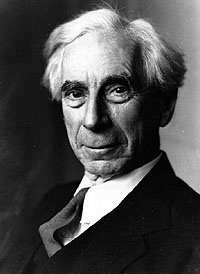
RESPONDING TO HARRY KROTO’S BRILLIANT RENOWNED ACADEMICS!! Part 78 John Sulston, University of Manchester, “All the religions are in conflict with each other”

On November 21, 2014 I received a letter from Nobel Laureate Harry Kroto and it said:

…Please click on this URL http://vimeo.com/26991975

and you will hear what far smarter people than I have to say on this matter. I agree with them.

Harry Kroto

I have attempted to respond to all of Dr. Kroto’s friends arguments and I have posted my responses one per week for over a year now. Here are some of my earlier posts:

Arif Ahmed, Sir David AttenboroughMark Balaguer, Horace Barlow, Michael BatePatricia ChurchlandAaron CiechanoverNoam Chomsky,Alan DershowitzHubert Dreyfus, Bart Ehrman, Stephan FeuchtwangDavid Friend,  Riccardo GiacconiIvar Giaever , Roy GlauberRebecca GoldsteinDavid J. Gross,  Brian Greene, Susan GreenfieldStephen F Gudeman,  Alan Guth, Jonathan HaidtTheodor W. Hänsch, Brian Harrison,  Hermann HauserRoald Hoffmann,  Bruce HoodHerbert Huppert,  Gareth Stedman Jones, Steve JonesShelly KaganMichio Kaku,  Stuart Kauffman,  Lawrence KraussHarry Kroto, George LakoffElizabeth Loftus,  Alan MacfarlanePeter MillicanMarvin MinskyLeonard Mlodinow,  Yujin NagasawaAlva NoeDouglas Osheroff,  Jonathan Parry,  Saul PerlmutterHerman Philipse,  Carolyn PorcoRobert M. PriceLisa RandallLord Martin Rees,  Oliver Sacks, John SearleMarcus du SautoySimon SchafferJ. L. Schellenberg,   Lee Silver Peter Singer,  Walter Sinnott-ArmstrongRonald de Sousa, Victor StengerBarry Supple,   Leonard Susskind, Raymond TallisNeil deGrasse Tyson,  .Alexander Vilenkin, Sir John WalkerFrank WilczekSteven Weinberg, and  Lewis Wolpert,

John Sulston

From Wikipedia, the free encyclopedia
Sir John Sulston
John Sulston.jpg
Born John Edward Sulston
27 March 1942 (age 72)[1]
Cambridge, England
Citizenship Britain
Nationality English
Fields Zoology
Molecular biology
Institutions Wellcome Trust Sanger Institute
University of Cambridge
Salk Institute
Laboratory of Molecular Biology
University of Manchester
Notable awards Nobel prize in Physiology or Medicine (2002)
Gairdner Award (2002)
Knight Bachelor (2001)
Fellow of the Royal Society(1986)
George W. Beadle Award(2000)[7]
Spouse Daphne Edith Bate[1]
Website
The University of Manchester
Wellcome Trust Sanger Institute

The Sulston Laboratories of the Wellcome Trust Sanger Institute

Sir John Edward Sulston FRS (born 27 March 1942) is a British biologist. For his work on the cell lineage and genome of the nematode Caenorhabditis elegans, he was jointly awarded the 2002 Nobel Prize in Physiology or Medicine with Sydney Brenner and H. Robert Horvitz. As of 2014 he is Chair of the Institute for Science, Ethics and Innovation at the University of Manchester.[8][7][9][10][11][12][13][14]

John Sulston was educated at York House School, Redheath, Merchant Taylors’ School, Northwood and Pembroke College, Cambridge, graduating with BS in organic chemistry. He earned his doctorate from the University of Cambridge. Inspired by Leslie Orgel, Francis Crick and Sidney Brenner while working at the Salk Institute for Biological Studies in US, he changed his research into biology. His works on the genome of C. elegans led to his active participation in the Human Genome Project. He, with Georgina Ferry, narrates his research career leading to the human genome sequence in The Common Thread: A Story of Science, Politics, Ethics, and the Human Genome (2002).[15]

Early life and education[edit]

John Sulston was born in Cambridge[16][17][18] to parents Theodore Sulston and Muriel Sulston.[19] His father was an Anglican priest and administrator of the Society for the Propagation of the Gospel. An English teacher at Watford Grammar School, his mother quit her job to care for him and his sister Madeleine.[20] His mother home-tutored them until he was five. At age five he entered the local preparatory school where he soon developed aversion to games. He instead developed an early interest in science, having fun with dissecting animals and sectioning plants to observe their structure and function.[21] He won scholarship to Merchant Taylors’ School, Northwood[1] and then to Pembroke College, Cambridge graduating in 1963 with BS in organic chemistry. He joined the department of chemistry in University of Cambridge, earning his Doctor of Philosophy in 1966[22] for research in nucleotide chemistry. Between 1966 and 1969 he worked as a postdoctoral researcher at the Salk Institute for Biological Studies in US.[19] His supervisor Colin Reese had arranged for him to work with Leslie Orgel, who would turn his scientific career in a different pathway. Orgel introduced him to Francis Crick and Sidney Brenner, who were themselves from Cambridge. He became inclined to biological research.[20]

(Francis Crick pictured below)

Following completion of the ‘working draft’ of the human genome sequence in 2000, Sulston retired from his role as director at the Sanger Centre. In 2002 he won the Dan David Prize and the Robert Burns Humanitarian Award. Later, he shared the Nobel Prize in Physiology or Medicine with Sydney Brenner and H. Robert Horvitz, both of whom he had collaborated with at the MRC Laboratory of Molecular Biology (LMB), for their discoveries concerning ‘genetic regulation of organ development and programmed cell death’. One of Sulston’s most important contributions during his research years at the LMB was to elucidate the precise order in which cells in C. elegans divide. In fact, he and his team succeeded in tracing the nematode‘s entire embryonic cell lineage. Sulston is now a leading campaigner against the patenting of human genetic information.

In  the second video below in the 61st clip in this series are his words and  my response is below them. 

50 Renowned Academics Speaking About God (Part 1)

Another 50 Renowned Academics Speaking About God (Part 2)

A Further 50 Renowned Academics Speaking About God (Part 3)

Bertrand Russell below

Interview of Sir John Sulston – part one

Uploaded on Jun 24, 2010

An Interview on the life and work of Sir John Sulston, Nobel Prize winner, who organized the team which sequenced the human genome for the first time. For a higher quality, downloadable, version, with a detailed summary please see http://www.alanmacfarlane.com

Interview of Sir John Sulston – part two

Uploaded on Jun 24, 2010

An Interview on the life and work of Sir John Sulston, Nobel Prize winner, who organized the team which sequenced the human genome for the first time. For a higher quality, downloadable, version, with a detailed summary please see http://www.alanmacfarlane.com

_________

QUOTE

I see that we have enormous amounts to discover as a strategy for going forward as human beings; I believe atheism makes coherent sense; all the religions are in conflict with each other; they have different stories, based on insubstantial records, but justify them with saying that there was some direct communication with a deity in the past which has led them to this belief; I find those unconvincing, particularly because of the conflict; this was my main argument in discussions with my father and he found it hard to answer that.

Simply put there is a simple explanation for why there are so many religions and it is because God has put inside everyone a knowledge of his existence. I go into this further in this letter below:

April 9, 2016

Professor John Sulston, Chair of the Institute for Science, Ethics and Innovation (iSEI)c/o The University of Manchester,
United Kingdom

Dear Dr Sulston,

I was fascinated with your interview by Alan Macfarlane. I have corresponded with Macfarlane before and I told him how much I have enjoyed his series of You Tube extensive interviews. Thank you for taking part in one of those. I wanted to quote you from one of those interviews below and then respond to what you have said.

John Sulston interviewed by Alan Macfarlane 16th September 2008

I see that we have enormous amounts to discover as a strategy for going forward as human beings; I believe atheism makes coherent sense; all the religions are in conflict with each other; they have different stories, based on insubstantial records, but justify them with saying that there was some direct communication with a deity in the past which has led them to this belief; I find those unconvincing, particularly because of the conflict; this was my main argument in discussions with my father and he found it hard to answer that….

My mother was my confidant and my rock as I was growing up; I could come home from school and talk; she had been a teacher of English at Watford Grammar School for Girls; throughout the time I was losing my links with my father over religion, my mother was always the neutral party; although she clearly was a believer and strongly supported my father she never indicated to me that she thought I was going off the rails as he did; she was the go-between; the most extraordinary event was that after her death, among her possessions was a letter to me saying how sad she was that I had lost my faith and her hope that one day I would regain it; it shocked me, it was a second bereavement, as here was this person who I had thought of as being at the unbelieving end of Anglicanism, and I had disappointed her…

The music in my life now comes from Daphne, my wife, who is quite a good pianist and plays the clarinet; my parents did listen to classical music and I listened to Radio Luxemburg,

Let me start responded by making a few  quick observations:

First, there is a simple reason why there are so many people who believe in God and it is because according to Romans 1 there is no such thing as a true atheist because everyone knows in their heart that God exists and a lie-detector test can demonstrate this. I have included below comments from 7 scholars involved with The Committee for the Scientific Investigation of Claims of the Paranormal (CSICOP). All of these individuals took time to correspond with me concerning the evidence I presented to them.

Actually I had the opportunity to correspond with Antony Flew (member of CSICOP) several times. I have more articles posted on my blog about the last few years of Antony Flew’s life  than any other website in the world probably. The reason is very simple. I had the opportunity to correspond with Antony Flew back in the middle 90’s and he said that he had the opportunity to listen to several of the cassette tapes that I sent him with messages from Adrian Rogers and he also responded to several of the points I put in my letters that I got from Francis Schaeffer’s materials. The ironic thing was that I purchased the sermon IS THE BIBLE TRUE? originally from the Bellevue Baptist Church Bookstore in 1992 and in the same bookstore in 2008 I bought the book THERE IS A GOD by Antony Flew. Back in 1993 I decided to contact some of the top secular thinkers of our time and I got my initial list of individuals from those scholars that were mentioned in the works of both Francis Schaeffer and Adrian Rogers. Schaeffer had quoted Flew in his book ESCAPE FROM REASON. It was my opinion after reviewing the evidence that Antony Flew was the most influential atheistic philosopher of the 20th century.

Dr. Sulston I thought of you when I thought back to my correspondence with Dr. Flew because Dr. Flew said that listening to the sermons I sent him reminded him of his father’s sermons. YOU ALSO HAD A FATHER THAT WAS A PREACHER. THEREFORE, I AM ENCLOSING A CD OF SOME OF THE SAME SERMONS THAT I SENT TO ANTONY FLEW. 

Second, it is obvious that you like Charles Darwin lost your faith over time and it was quite difficult for you and your close family members during this process. Let me take your mother’s side in this regard and when I read your comments above about her it prompted me to write you today.

Third, since you are a lover of fine music I thought you would be interested to know what happened to Charles Darwin in the last few years of his life. Did you know that he blamed the lost of appreciation of music and poetry he attributed to his theory of evolution?

Now let us take a look at this first issue. I have a good friend who is a street preacher who preaches on the Santa Monica Promenade in California and during the Q/A sessions he does have lots of atheists that enjoy their time at the mic. When this happens he  always quotes Romans 1:18-19 (Amplified Bible) ” For God’s wrath and indignation are revealed from heaven against all ungodliness and unrighteousness of men, who in their wickedness REPRESS and HINDER the truth and make it inoperative. For that which is KNOWN about God is EVIDENT to them and MADE PLAIN IN THEIR INNER CONSCIOUSNESS, because God  has SHOWN IT TO THEM,”(emphasis mine). Then he  tells the atheist that the atheist already knows that God exists but he has been suppressing that knowledge in unrighteousness. This usually infuriates the atheist.

My friend draws some large crowds at times and was thinking about setting up a lie detector test and see if atheists actually secretly believe in God. He discussed this project with me since he knew that I had done a lot of research on the idea about 20 years ago.

Nelson Price in THE EMMANUEL FACTOR (1987) tells the story about Brown Trucking Company in Georgia who used to give polygraph tests to their job applicants. However, in part of the test the operator asked, “Do you believe in God?” In every instance when a professing atheist answered “No,” the test showed the person to be lying. My pastor Adrian Rogers used to tell this same story to illustrate Romans 1:19 and it was his conclusion that “there is no such thing anywhere on earth as a true atheist. If a man says he doesn’t believe in God, then he is lying. God has put his moral consciousness into every man’s heart, and a man has to try to kick his conscience to death to say he doesn’t believe in God.”

It is true that polygraph tests for use in hiring were banned by Congress in 1988.  Mr and Mrs Claude Brown on Aug 25, 1994  wrote me a letter confirming that over 15,000 applicants previous to 1988 had taken the polygraph test and EVERYTIME SOMEONE SAID THEY DID NOT BELIEVE IN GOD, THE MACHINE SAID THEY WERE LYING.

It had been difficult to catch up to the Browns. I had heard about them from Dr. Rogers’ sermon but I did not have enough information to locate them. Dr. Rogers referred me to Dr. Nelson Price and Dr. Price’s office told me that Claude Brown lived in Atlanta. After writing letters to all 9 of the entries for Claude Brown in the Atlanta telephone book, I finally got in touch with the Browns.

Adrian Rogers also pointed out that the Bible does not recognize the theoretical atheist.  Psalms 14:1: The fool has said in his heart, “There is no God.”  Dr Rogers notes, “The fool is treating God like he would treat food he did not desire in a cafeteria line. ‘No broccoli for me!’ ” In other words, the fool just doesn’t want God in his life and is a practical atheist, but not a theoretical atheist. Charles Ryrie in the The Ryrie Study Bible came to the same conclusion on this verse.


Pastor Nelson Price pictured below

Adrian Rogers (1931-2005) pictured below

Here are the conclusions of the experts I wrote in the secular world concerning the lie detector test and it’s ability to get at the truth:

Professor Frank Horvath of the School of Criminal Justice at Michigan State University has testified before Congress concerning the validity of the polygraph machine. He has stated on numerous occasions that “the evidence from those who have actually been affected by polygraph testing in the workplace is quite contrary to what has been expressed by critics. I give this evidence greater weight than I give to the most of the comments of critics” (letter to me dated October 6, 1994).

There was no better organization suited to investigate this claim concerning the lie detector test than the Committee for the Scientific Investigation of Claims of the Paranormal (CSICOP). This organization changed their name to the Committe for Skeptical Inquiry in 2006. This organization includes anyone who wants to help debunk the whole ever-expanding gamut of misleading, outlandish, and fraudulent claims made in the name of science. I AM WRITING YOU TODAY BECAUSE YOU ARE ASSOCIATED WITH CSICOP.

I read The Skeptical Review(publication of CSICOP) for several years during the 90’s and I would write letters to these scientists about taking this project on and putting it to the test.  Below are some of  their responses (15 to 20 years old now):

1st Observation: Religious culture of USA could have influenced polygraph test results.
ANTONY FLEW  (formerly of Reading University in England, now deceased, in a letter to me dated 8-11-96) noted, “For all the evidence so far available seems to be of people from a culture in which people are either directly brought up to believe in the existence of God or at least are strongly even if only unconsciously influenced by those who do. Even if everyone from such a culture revealed unconscious belief, it would not really begin to show that — as Descartes maintained— the idea of God is so to speak the Creator’s trademark, stamped on human souls by their Creator at their creation.”

2nd Observation: Polygraph Machines do not work. JOHN R. COLE, anthropologist, editor, National Center for Science Education, Dr. WOLF RODER, professor of Geography, University of Cincinnati, Dr. SUSAN BLACKMORE,Dept of Psychology, University of the West of England, Dr. CHRISTOPHER C. FRENCH, Psychology Dept, Goldsmith’s College, University of London, Dr.WALTER F. ROWE, The George Washington University, Dept of Forensic Sciences, Graduate School of Arts and Sciences.

3rd Observation: The sample size probably was not large enough to apply statistical inference. (These gentlemen made the following assertion before I received the letter back from Claude Brown that revealed that the sample size was over 15,000.) JOHN GEOHEGAN, Chairman of New Mexicans for Science and Reason, Dr. WOLF RODER, and Dr WALTER F. ROWE (in a letter dated July 12, 1994) stated, “The polygraph operator for Brown Trucking Company has probably examined only a few hundred or a few thousand job applicants. I would surmise that only a very small number of these were actually atheists. It seems a statistically insignificant (and distinctly nonrandom) sampling of the 5 billion human beings currently inhabiting the earth. Dr. Nelson Price also seems to be impugning the integrity of anyone who claims to be an atheist in a rather underhanded fashion.”

4th Observation: The question (Do you believe in God?)  was out of place and it surprised the applicants. THOMAS GILOVICH, psychologist, Cornell Univ., Dr. ZEN FAULKES, professor of Biology, University of Victoria (Canada), ROBERT CRAIG, Head of Indiana Skeptics Organization, Dr. WALTER ROWE, 
 
5th Observation: Proof that everyone believes in God’s existence does not prove that God does in fact exist. PAUL QUINCEY, Nathional Physical Laboratory,(England), Dr. CLAUDIO BENSKI, Schneider Electric, CFEPP, (France),
6th Observation: Both the courts and Congress recognize that lie-detectors don’t work and that is why they were banned in 1988.  (Governments and the military still use them.)
Dr WALTER ROWE, KATHLEEN M. DILLION, professor of Psychology, Western New England College.
7th Observation:This information concerning Claude Brown’s claim has been passed on to us via a tv preacher and eveybody knows that they are untrustworthy– look at their history. WOLF RODER.


I had the joy of corresponding with Antony Flew (pictured below) several times in the 1990’s

SUSAN BLACKMORE  pictured below

THOMAS GILOVICH pictured below

Dr. CHRISTOPHER C. FRENCH, University of London, pictured below

PAUL QUINCEY, Nathional Physical Laboratory pictured below


______________
Solomon wisely noted in Ecclesiastes 3:11 “God has planted eternity in the heart of men…” (Living Bible). No wonder Bertrand Russell wrote in his autobiography, “It is odd, isn’t it? I feel passionately for this world and many things and people in it, and yet…what is it all? There must be something more important, one feels, though I don’t believe there is. I am haunted. Some ghosts, for some extra mundane regions, seem always trying to tell me something that I am to repeat to the world, but I cannot understand that message.”
Gene Emery, science writer for Providence Journal-Bulletin is a past winner of the CSICOP “Responsibility in Journalism Award” and he had the best suggestion of all when he suggested, “Actually, if you want to make a good case about whether Romans 1:19 is true, arrange to have a polygraph operator (preferably an atheist or agnostic) brought to the next CSICOP meeting. (I’m not a member of CSICOP, by the way, so I can’t give you an official invitation or anything.) If none of the folks at that meeting can convince the machine that they truly believe in God, maybe there is, in fact, an innate willingness to believe in God.”

DO YOU HAVE ANY REACTIONS TO ADD TO THESE 7 OBSERVATIONS THAT I GOT 15 YEARS AGO?


Francis Schaeffer (1912-1984) pictured below

__

 Just like Darwin you lost your faith not  overnight but it was  over time. Also your love of music made me think of you when I read the book Charles Darwin: his life told in an autobiographical chapter, and in a selected series of his published letters because of what Darwin said about science causing him to lose his aesthetic tastes. I am going to quote some of Charles Darwin’s own words and then include the comments of Francis Schaeffer on those words. I have also enclosed a CD with two messages from Adrian Rogers and Bill Elliff concerning Darwinism.

Charles Darwin

 CHARLES DARWIN’S AUTOBIOGRAPHY. Addendum. Written May 1st, 1881 [the year before his death].

“I have said that in one respect my mind has changed during the last twenty or thirty years. Up to the age of thirty, or beyond it, poetry of many kinds, such as the works of Milton, Gray, Byron, Wordsworth, Coleridge, and Shelley, gave me great pleasure, and even as a schoolboy I took intense delight in Shakespeare, especially in the historical plays. I have also said that formerly pictures gave me considerable, and music very great delight. But now for many years I cannot endure to read a line of poetry: I have tried lately to read Shakespeare, and found it so intolerably dull that it nauseated me. I have also almost lost my taste for pictures or music. Music generally sets me thinking too energetically on what I have been at work on, instead of giving me pleasure. I retain some taste for fine scenery, but it does not cause me the exquisite delight which it formerly did….My mind seems to have become a kind of machine for grinding general laws out of large collections of facts, but why this should have caused the atrophy of that part of the brain alone, on which the higher tastes depend, I cannot conceive….The loss of these tastes is a loss of happiness, and may possibly be injurious to the intellect, and more probably to the moral character, by enfeebling the emotional part of our nature.”

Francis Schaeffer commented:

This is the old man Darwin writing at the end of his life. What he is saying here is the further he has gone on with his studies the more he has seen himself reduced to a machine as far as aesthetic things are concerned. I think this is crucial because as we go through this we find that his struggles and my sincere conviction is that he never came to the logical conclusion of his own position, but he nevertheless in the death of the higher qualities as he calls them, art, music, poetry, and so on, what he had happen to him was his own theory was producing this in his own self just as his theories a hundred years later have produced this in our culture. 

Darwin, C. R. to Fordyce, John7 May 1879

“I may state that my judgment often fluctuates . . . In my most extreme fluctuations I have never been an Atheist in the sense of denying the existence of a God. I think that generally (and more and more as I grow older), but not always, that an Agnostic would be the more correct description of my state of mind.”

Francis Schaeffer asserted:

What we find now is that he comes to the place in being agnostic, but as we read through this section on religion what we find is in reality his reason leads him against this position, which is interesting but his theory makes him accept the  position of agnosticism….. I think what you have in Darwin is a magnificent example, although a sad one of what I lecture on in apologetics,  and that is if a man takes a set of nonchristian presuppositions he is forced eventually to be in a place of tension. The more consistent he is with his own nonchristian presuppositions the more he is away from the real world. When he is closer to the real world then he is more illogical to his own presuppositions.

Darwin, C. R. to Doedes, N. D.2 Apr 1873

“But I  may say that the impossibility of conceiving that this grand and wondrous universe, with our conscious selves, arose through chance, seems to me the chief argument for the existence of God; but whether this is an argument of real value, I have never been able to decide.”

Francis Schaeffer observed:

So he sees here exactly the same that I would labor and what Paul gives in Romans chapter one, and that is first this tremendous universe [and it’s form] and the second thing, the mannishness of man and the concept of this arising from chance is very difficult for him to come to accept and he is forced to leap into this, his own kind of Kierkegaardian leap, but he is forced to leap into this because of his presuppositions but when in reality the real world troubles him. He sees there is no third alternative. If you do not have the existence of God then you only have chance. In my own lectures I am constantly pointing out there are only two possibilities, either a personal God or this concept of the impersonal plus time plus chance and Darwin understood this . You will notice that he divides it into the same exact two points that Paul does in Romans chapter one into and that Carl Gustav Jung (1875-1961) will in the problem of existence, the external universe, and man and his consciousness. Paul points out there are these two steps that man is confronted with…

______________

Here below is the Romans passage that Schaeffer is referring to and verse 19 refers to what Schaeffer calls “the mannishness of man” and verse 20 refers to Schaeffer’s other point which is  “the universe and it’s form.”Romans 1:18-22Amplified Bible (AMP) 18 For God’s [holy] wrath and indignation are revealed from heaven against all ungodliness and unrighteousness of men, who in their wickedness repress and hinder the truth and make it inoperative. 19 For that which is known about God is evident to them and made plain in their inner consciousness, because God [Himself] has shown it to them. 20 For ever since the creation of the world His invisible nature and attributes, that is, His eternal power and divinity, have been made intelligible and clearly discernible in and through the things that have been made (His handiworks). So [men] are without excuse [altogether without any defense or justification], 21 Because when they knew and recognized Him as God, they did not honor andglorify Him as God or give Him thanks. But instead they became futile andgodless in their thinking [with vain imaginings, foolish reasoning, and stupid speculations] and their senseless minds were darkened. 22 Claiming to be wise, they became fools [professing to be smart, they made simpletons of themselves]

In 1879 Charles Darwin was applied to by a German student, in a similar manner. The letter was answered by a member of my father’s family, who wrote:–

“Mr. Darwin…considers that the theory of Evolution is quite compatible with the belief in a God; but that you must remember that different persons have different definitions of what they mean by God.” 

Francis Schaeffer commented:

You find a great confusion in his writings although there is a general structure in them. Here he says the word “God” is alright but you find later what he doesn’t take is a personal God. Of course, what you open is the whole modern linguistics concerning the word “God.” is God a pantheistic God? What kind of God is God? Darwin says there is nothing incompatible with the word “God.”

This, however, did not satisfy the German youth, who again wrote to my father, and received from him the following reply:—

” Science has nothing to do with Christ, except in so far as the habit of scientific research makes a man cautious in admitting evidence. For myself, I do not believe that there ever has been any revelation.”

Francis Schaeffer observed:

So he has come to the place as an old man that he doesn’t believe there has been any revelation. In his younger years he held a different position.

The passages which here follow are extracts, somewhat abbreviated, from a part of the Autobiography, written in 1876, in which my father gives the history of his religious views:—“During these two years* (ft note *October 1836 to January 1839.) I was led to think much about religion. Whilst on board the Beagle I was quite orthodox, and I remember being heartily laughed at by several of the officers (though themselves orthodox) for quoting the Bible as an unanswerable authority on some point of morality.

Francis Schaeffer noted:

So you find that as a younger man he did accept the Bible. As an older man he has given up revelation but he is not satisfied with his own answers. He is caught in the tension that modern man is caught in. He is a prefiguration  of the modern man and he himself contributed to. Then Darwin goes on and tells us why he gave up the Bible.

Darwin went on to write:

I suppose it was the novelty of the argument that amused them. But I had gradually come by this time, i.e. 1836 to 1836, to see that the Old Testament was no more to be trusted than the sacred books of the Hindoos. The question then continually rose before my mind and would not be banished,—is it credible that if God were now to make a revelation to the Hindoos, he would permit it to be connected with the belief in Vishnu, Siva, &c., as Christianity is connected with the Old Testament? This appeared to me utterly incredible.

Francis Schaeffer asserted:

Darwin is saying that he gave up the New Testament because it was connected to the Old Testament. He gave up the Old Testament because it conflicted with his own theory. Did he have a real answer himself and the answer is no. At the end of his life we see that he is dehumanized by his position and on the other side we see that he never comes to the place of intellectual satisfaction for himself that his answers were sufficient.

Darwin continued:

“BUT I WAS VERY UNWILLING  TO GIVE UP MY BELIEF; I feel sure of this, for I can well remember often and often inventing day-dreams of old letters between distinguished Romans, and manuscripts being discovered at Pompeii or elsewhere, which confirmed in the most striking manner all that was written in the Gospels.

Francis Schaeffer commented:

This is very sad. He lies on his bunk and the Beagle tosses and turns and he makes daydreams, and his dreams and hopes are that someone would find in Pompeii or some place like this, an old manuscript by a distinguished Roman that would put his stamp of authority on it, which would be able to show that Christ existed. This is undoubtedly what he is talking about. Darwin gave up this hope with great difficulty. I think he didn’t want to come to the position where his accepted presuppositions were driving him. He didn’t want to give it up, just as an older man he understood where it would lead…

———–

The area of Biblical Archaeology has advanced so much since Darwin wrote these words in the 19th century!!!!! DR Sulston ASK YOURSELF THIS SIMPLE QUESTION BEFORE YOU PUT YOUR FAITH IN THE ACCURACY OF THE SCRIPTURES: Is the Bible historically accurate and have I taken the time to examine the evidence? Here are some of the posts I have done in the past on the subject and if you like you could just google these subjects: 1. The Babylonian Chronicleof Nebuchadnezzars Siege of Jerusalem2. Hezekiah’s Siloam Tunnel Inscription. 3. Taylor Prism (Sennacherib Hexagonal Prism)4. Biblical Cities Attested Archaeologically. 5. The Discovery of the Hittites6.Shishak Smiting His Captives7. Moabite Stone8Black Obelisk of Shalmaneser III9A Verification of places in Gospel of John and Book of Acts., 9B Discovery of Ebla Tablets10. Cyrus Cylinder11. Puru “The lot of Yahali” 9th Century B.C.E.12. The Uzziah Tablet Inscription13. The Pilate Inscription14. Caiaphas Ossuary14 B Pontius Pilate Part 214c. Three greatest American Archaeologists moved to accept Bible’s accuracy through archaeology.,

Darwin also noted:

“But I found it more and more difficult, with free scope given to my imagination, to invent evidence which would suffice to convince me. Thus disbelief crept over me at a very slow rate, but was at last complete. THE RATE WAS SLOW that I felt no distress. Although I did not think much about the existence of a personal God until a considerably later period of my life,”

Francis Schaeffer commented:

So there is something deficient in his position from the beginning. The word of God if it is going to mean something, must mean a personal God. The word “God” is without much meaning otherwise.

_________________

Francis Schaeffer noted that in Darwin’s 1876 Autobiography that Darwin he is going to set forth two arguments for God in this and again you will find when he comes to the end of this that he is in tremendous tension. Darwin wrote, 

“At the present day the most usual argument for the existence of an intelligent God is drawn from the deep inward conviction and feelings which are experienced by most persons.Formerly I was led by feelings such as those just referred to (although I do not think that the religious sentiment was ever strongly developed in me), to the firm conviction of the existence of God and of the immortality of the soul. In my Journal I wrote that whilst standing in the midst of the grandeur of a Brazilian forest, ‘it is not possible to give an adequate idea of the higher feelings of wonder, admiration, and devotion which fill and elevate the mind.’ I well remember my conviction that there is more in man than the mere breath of his body; but now the grandest scenes would not cause any such convictions and feelings to rise in my mind. It may be truly said that I am like a man who has become COLOUR-BLIND.”

Francis Schaeffer remarked:

Now Darwin says when I look back and when I look at nature I came to the conclusion that man can not be just a fly! But now Darwin has moved from being a younger man to an older man and he has allowed his presuppositions to enter in to block his logic, these things at the end of his life he had no intellectual answer for. To block them out in favor of his theory. Remember the letter of his that said he had lost all aesthetic senses when he had got older and he had become a clod himself. Now interesting he says just the same thing, but not in relation to the arts, namely music, pictures, etc, but to nature itself. Darwin said, “But now the grandest scenes would not cause any such convictions  and feelings to rise in my mind. It may be truly said that I am like a man who has become colour-blind…” So now you see that Darwin’s presuppositions have not only robbed him of the beauty of man’s creation in art, but now the universe. He can’t look at it now and see the beauty. The reason he can’t see the beauty is for a very, very , very simple reason: THE BEAUTY DRIVES HIM TO DISTRACTION. THIS IS WHERE MODERN MAN IS AND IT IS HELL. The art is hell because it reminds him of man and how great man is, and where does it fit in his system? It doesn’t. When he looks at nature and it’s beauty he is driven to the same distraction and so consequently you find what has built up inside him is a real death, not  only the beauty of the artistic but the beauty of nature. He has no answer in his logic and he is left in tension.  He dies and has become less than human because these two great things (such as any kind of art and the beauty of  nature) that would make him human  stand against his theory.

________________

Darwin like you was consistent with his view of the UNIFORMITY OF  NATURAL CAUSES in a closed system and it cost him the love of music, art and the beauty of nature. TWO OTHER ALSO HELD THIS SAME view  of uniformity of natural causes in a closed system in 1978 when their hit song DUST IN THE WIND rose to the top 10 in the music charts.

_______________________________________

IF WE ARE LEFT WITH JUST THE MACHINE THEN WHAT IS THE FINAL CONCLUSION IF THERE WAS NO PERSONAL GOD THAT CREATED US? I sent you a CD that starts off with the song DUST IN THE WIND by Kerry Livgren of the group KANSAS which was a hit song in 1978 when it rose to #6 on the charts because so many people connected with the message of the song. It included these words, “All we do, crumbles to the ground though we refuse to see, Dust in the Wind, All we are is dust in the wind, Don’t hang on, Nothing lasts forever but the Earth and Sky, It slips away, And all your money won’t another minute buy.”

Kerry Livgren himself said that he wrote the song because he saw where man was without a personal God in the picture. Solomon pointed out in the Book of Ecclesiastes that those who believe that God doesn’t exist must accept three things. FIRST, death is the end and SECOND, chance and time are the only guiding forces in this life.  FINALLY, power reigns in this life and the scales are never balanced. The Christian can  face death and also confront the world knowing that it is not determined by chance and time alone and finally there is a judge who will balance the scales.

Both Kerry Livgren and the bass player Dave Hope of Kansas became Christians eventually. Kerry Livgren first tried Eastern Religions and Dave Hope had to come out of a heavy drug addiction. I was shocked and elated to see their personal testimony on The 700 Club in 1981 and that same  interview can be seen on You Tube today. Livgren lives in Topeka, Kansas today where he teaches “Diggers,” a Sunday school class at Topeka Bible ChurchDAVE HOPE is the head of Worship, Evangelism and Outreach at Immanuel Anglican Church in Destin, Florida.

The answer to find meaning in life is found in putting your faith and trust in Jesus Christ. The Bible is true from cover to cover and can be trusted.

Thank you again for your time and I know how busy you are.

Everette Hatcher, everettehatcher@gmail.com, http://www.thedailyhatch.org, cell ph 501-920-5733, Box 23416, LittleRock, AR 72221, United States

PS: JOHN it was very moving what you said about your mother being grieved over your atheism. I spent 2 months in Manchester in 1979 going door to door telling people about Christ and I ran into many people who were involved in SPIRITUALISM and they thought they could talk to the dead. I totally reject that view. But one thing is for sure and that if your mother ever had discussed this issue with your personally before she died she would have urged you to take another look again at Christianity. I have attempted to do that in this letter, but now I just want to take a closer look at where your humanist view actually leads.

What does the BRITISH HUMANIST ASSOCIATION have to offer in the area of meaning and values? Francis Schaeffer two months before he died said if he was talking to a gentleman he was sitting next to on an airplane about Christ he wouldn’t start off quoting Bible verses. Schaeffer asserted:

I would go back rather to their dilemma if they hold the modern worldview of the final reality only being energy, etc., I would start with that. I would begin as I stress in the book THE GOD WHO IS THERE about their own [humanist] prophets who really show where their view goes. For instance, Jacques Monod, Nobel Prize winner from France, in his book NECESSITY AND CHANCE said there is no way to tell the OUGHT from the IS. In other words, you live in a totally silent universe. 

(Monad pictured above and Sartre below)

The men like Monod and Sartre or whoever the man might know that is his [humanist] prophet and they point out quite properly and conclusively what life is like, not just that there is no meaningfulness in life but everyone according to modern man is just living out some kind of game plan. It may be knocking 1/10th of a second off a downhill ski run or making one more million dollars. But all you are doing is making a game plan within the mix of a meaningless situation. WOODY ALLEN exploits this very strongly in his films. He really lives it. I feel for that man, and he has expressed it so thoroughly in ANNIE HALL and MANHATTAN and so on.

According to the Humanist worldview Jacques Monod the universe is silent about values and therefore his good friend Woody Allen  demonstrated this very fact so well in his 1989 movie CRIMES AND MISDEMEANORS. In other words, if we can’t get our values from the Bible then  the answer is MIGHT MAKES RIGHT!!!!

I CHALLENGE YOU TO TAKE 90 MINUTES AND WATCH THE MOVIE “CRIMES AND MISDEMEANORS” AND THEN ANSWER THE QUESTION: “What reason is there that Judah should not have his mistress eliminated if there is no God and afterlife of judgment and rewards?”

You can hear DAVE HOPE and Kerry Livgren’s stories from this youtube link:

(part 1 ten minutes)

(part 2 ten minutes)

Kansas – Dust in the Wind (Official Video)

Uploaded on Nov 7, 2009

Pre-Order Miracles Out of Nowhere now at http://www.miraclesoutofnowhere.com

About the film:
In 1973, six guys in a local band from America’s heartland began a journey that surpassed even their own wildest expectations, by achieving worldwide superstardom… watch the story unfold as the incredible story of the band KANSAS is told for the first time in the DVD Miracles Out of Nowhere.

_____________________________

Adrian Rogers on Darwinism

The Bible and Archaeology – Is the Bible from God? (Kyle Butt 42 min)

EMAILED TO DR. SULSTON:

From Everette Hatcher, My 3 responses to your assertions on RENOWNED ACADEMICS You Tube Interview, BTW I agree with your parents!!!

April 23, 2016

Dear Dr. Sulston,

I really enjoyed your interviews on You Tube with Alan MacFarlane. They were very informative.

In my correspondence with Harry Kroto he suggested that I check out the You Tube series “RESPONDING TO HARRY KROTO’S BRILLIANT RENOWNED ACADEMICS!!” and since then I have been responding to all 150 academics one at a time. Today I finally got around to responding to what you said and here is my response on my blog post.
I sent you a letter last week that actually was my response but something in your interview reminded me of my good friend Dr. John Redmond here in Little Rock. This is what you said:
My mother was my confidant and my rock as I was growing up; I could come home from school and talk; she had been a teacher of English at Watford Grammar School for Girls; throughout the time I was losing my links with my father over religion, my mother was always the neutral party; although she clearly was a believer and strongly supported my father she never indicated to me that she thought I was going off the rails as he did; she was the go-between; the most extraordinary event was that after her death, among her possessions was a letter to me saying how sad she was that I had lost my faith and her hope that one day I would regain it; it shocked me, it was a second bereavement, as here was this person who I had thought of as being at the unbelieving end of Anglicanism, and I had disappointed her…
Dr. Redman also had to deal with a stack a letters that he had never read from his father. However, he opened them after his father’s death and it impacted him greatly. Below is his story:

Another Special Life in Christ

John Fletcher Redman, M. D.:

Born about 1938, he resides in Little Rock, Arkansas. He graduated from the UAMS medical school there in 1963 & won the distinguished faculty award in 1993. He was the 2014 UAMS Hall of Fame inductee, HERE. Long before the 1990’s, Dr. John Redman had reached the pinnacle of success!  By the age of 55, he had written every textbook but one in the field of Urology, and had received every national and international award that a medical professional in his field could receive.  Dr. Redman was known and highly respected around the world, and had been serving for 25 years as the Chairman of the Department of Urology at the University of Arkansas for Medical Sciences in Little Rock, Arkansas.  His brilliance was renowned, reflected by his being asked in 1973 (at a younger age than ever before in the history of the school ) to take on the position of Urology Department Chairman.  You didn’t get any higher up the professional ladder in the field of medicine than Dr. Redman had achieved!  

Although his professional reputation was sterling, he also had a broad reputation for being foul-mouthed, a lady’s man, and a  party specialist.  His lifestyle outside of his professional career was fast and wild.  Full of himself, John often bragged about his escapades, including being responsible for starting the Poker Club at the Medical School.  He had several failed marriages behind him, and no relationship at all with his parents, who were devout Christians.  Dr. Redman had been exposed to Christianity at an early age, but rejected it as a life plan for weaklings (see Ted Turner).  And he viewed himself as anything but weak!  He had a world to conquer, and no namby-pamby, goody-two-shoes religion was going to slow him down!

One day Dr. Redman was ‘speed walking’ around a track in Little Rock, and found himself cooling down next to one of Arkansas’s most famous joggers, then-Governor Bill Clinton!  They chatted for a few moments, and that was that.  Several years later, when Bill Clinton became the President of the United States, one of Dr. Redman’s friends made note of that encounter by commenting that John had formerly been talking with the most powerful man in the world. John considered that encounter to be no big deal, since he saw himself as having also reached the top of his field!  There was no shortage of arrogance at the Redman household!      

Dr. Redman had, many years previously, estranged himself from his parents as a result of their efforts to guide him toward the spiritual straight and narrow.  He was determined to live life his way.  And then his world was crushed when his mother died.  Ironically, John’s mother died at about the same time as Bill Clinton’s mother died [Clinton’s mom’s grave] and her story, HERE).  The two funerals were held on the same day, at approximately the same time.  This ‘coincidence’ ultimately had a life-changing impact on John’s life.

(President Clinton in Hot  Springs, Arkansas at his mother’s funeral service pictured below)

While Dr. Redman was sitting at the tiny graveside service, a scripture was quoted that he had heard as a small boy…”What does it profit a man if he gains the whole world, but loses his own soul?”  He began to consider the fact that both he and the most powerful man in the world were both doing the same thing at the same time, i.e., burying their mothers (Jan. 1994).  At that point, he realized that no matter what level of success you achieve on this earth, you are still going to be put in the ground someday.  All of your success and the adulation from others would one day end.  And what then?

Dr. Redman soon came to realize that he was a lost soul with no hope of eternal life with his parents or with God.  And that began to bring great turmoil into his life.  His heart was under great conviction, but he didn’t know how to fix his problem.  Knowing that this was a spiritual problem (but still incredibly full of pride), Dr. Redman wasn’t about to humble himself to go and talk with a preacher!  So he spent several restless nights tossing and turning, unable to sleep.  One Saturday, he went to his office to work because his heart was so burdened with the lostness of his soul’s condition.

AS HE WAS CLEANING OUT HIS DESK, HE CAME ACROSS A STACK OF UNOPENED LETTERS SENT TO HIM BY HIS FATHER BEFORE HE DIED FOUR YEARS PREVIOUSLY.   When John had received them, because he knew that they would be full of religious comments, he simply threw them (unopened) into the bottom drawer of his desk. 

But now he was more than eager to read the legacy left by his father!  As he opened each letter, he discovered the pathway for his soul to eternal salvation!  Privately in his office, he cried out to God and admitted his rebellion.  He asked for forgiveness and expressed a willingness to turn his life around.  He now understood that Jesus had already paid the penalty for his sins by sacrificing his life on a cross.  So Dr. Redman humbled himself, asking Jesus to take up residence in his heart.  He followed his father’s written advice to surrender his life totally to the leadership and guidance of Jesus Christ, the living son of God.

And his life began to change dramatically!  Shortly thereafter, as a result of the difference she saw in John’s behavior, Anna (John’s live-in girlfriend) also gave her life to Christ, and they were married!   They then followed the Lord’s leadership to outwardly demonstrate (1) their rejection of the old way of life and (2) their new commitment to follow the Spirit of the living God through the act of baptism!  And there is no question in anyone’s mind (of those who know them) that these two physicians have experienced a radical life change!

Since that time, Dr. Redman has extensively exercised the gift of evangelism that the Lord blessed him with.  He has become a powerful speaker for the Lord, and has allowed his new Spiritual Father to position him in many high-level positions to share his testimony of how the Lord can bring salvation to even the most hardened sinner.  In similar fashion, Anna utilizes every opportunity to share the good news of life through Jesus Christ, even being blessed to lead some of her patients to Christ in her office!

This is truly a victory story of reaching the pinnacle of what the world has to offer, coming up empty, and finding the pathway that leads to real life [written for me 7 Jan. 2004 by my…and Dr. John Redman’s…friendD. O.].

I was at church the day that Dr. John Redman  joined and he gave his testimony in about 9 minutes and it was an amazing story. Thank you for your time. I know how busy you are.
Everette Hatcher, cell ph 501-920-5733
Below: Urology Department Chair Rodney Davis, M.D., (left) nominated John Redman, M.D., for induction into the college’s Hall of Fame.


__

________

Related posts:

FRANCIS SCHAEFFER ANALYZES ART AND CULTURE Part 53 THE BEATLES (Part E, Stg. Pepper’s and John Lennon’s search in 1967 for truth was through drugs, money, laughter, etc & similar to King Solomon’s, LOTS OF PICTURES OF JOHN AND CYNTHIA) (Feature on artist Yoko Ono)

The John Lennon and the Beatles really were on a long search for meaning and fulfillment in their lives  just like King Solomon did in the Book of Ecclesiastes. Solomon looked into learning (1:12-18, 2:12-17), laughter, ladies, luxuries, and liquor (2:1-2, 8, 10, 11), and labor (2:4-6, 18-20). He fount that without God in the picture all […]

FRANCIS SCHAEFFER ANALYZES ART AND CULTURE Part 52 THE BEATLES (Part D, There is evidence that the Beatles may have been exposed to Francis Schaeffer!!!) (Feature on artist Anna Margaret Rose Freeman )

______________   George Harrison Swears & Insults Paul and Yoko Lucy in the Sky with Diamonds- The Beatles The Beatles:   I have dedicated several posts to this series on the Beatles and I don’t know when this series will end because Francis Schaeffer spent a lot of time listening to the Beatles and talking […]

FRANCIS SCHAEFFER ANALYZES ART AND CULTURE Part 51 THE BEATLES (Part C, List of those on cover of Stg.Pepper’s ) (Feature on artist Raqib Shaw )

  The Beatles in a press conference after their Return from the USA Uploaded on Nov 29, 2010 The Beatles in a press conference after their Return from the USA. The Beatles:   I have dedicated several posts to this series on the Beatles and I don’t know when this series will end because Francis […]

FRANCIS SCHAEFFER ANALYZES ART AND CULTURE Part 50 THE BEATLES (Part B, The Psychedelic Music of the Beatles) (Feature on artist Peter Blake )

__________________   Beatles 1966 Last interview I have dedicated several posts to this series on the Beatles and I don’t know when this series will end because Francis Schaeffer spent a lot of time listening to the Beatles and talking and writing about them and their impact on the culture of the 1960’s. In this […]

FRANCIS SCHAEFFER ANALYZES ART AND CULTURE Part 49 THE BEATLES (Part A, The Meaning of Stg. Pepper’s Cover) (Feature on artist Mika Tajima)

_______________ The Beatles documentary || A Long and Winding Road || Episode 5 (This video discusses Stg. Pepper’s creation I have dedicated several posts to this series on the Beatles and I don’t know when this series will end because Francis Schaeffer spent a lot of time listening to the Beatles and talking and writing about […]

FRANCIS SCHAEFFER ANALYZES ART AND CULTURE PART 48 “BLOW UP” by Michelangelo Antonioni makes Philosophic Statement (Feature on artist Nancy Holt)

_______________ Francis Schaeffer pictured below: _____________________ I have included the 27 minute  episode THE AGE OF NONREASON by Francis Schaeffer. In that video Schaeffer noted,  ” Sergeant Pepper’s Lonely Hearts Club Band…for a time it became the rallying cry for young people throughout the world. It expressed the essence of their lives, thoughts and their feelings.” How Should […]

FRANCIS SCHAEFFER ANALYZES ART AND CULTURE Part 47 Woody Allen and Professor Levy and the death of “Optimistic Humanism” from the movie CRIMES AND MISDEMEANORS Plus Charles Darwin’s comments too!!! (Feature on artist Rodney Graham)

Crimes and Misdemeanors: A Discussion: Part 1 ___________________________________ Today I will answer the simple question: IS IT POSSIBLE TO BE AN OPTIMISTIC SECULAR HUMANIST THAT DOES NOT BELIEVE IN GOD OR AN AFTERLIFE? This question has been around for a long time and you can go back to the 19th century and read this same […]

FRANCIS SCHAEFFER ANALYZES ART AND CULTURE PART 46 Friedrich Nietzsche (Featured artist is Thomas Schütte)

____________________________________ Francis Schaeffer pictured below: __________ Francis Schaeffer has written extensively on art and culture spanning the last 2000years and here are some posts I have done on this subject before : Francis Schaeffer’s “How should we then live?” Video and outline of episode 10 “Final Choices” , episode 9 “The Age of Personal Peace and Affluence”, episode 8 […]

FRANCIS SCHAEFFER ANALYZES ART AND CULTURE Part 45 Woody Allen “Reason is Dead” (Feature on artists Allora & Calzadilla )

Love and Death [Woody Allen] – What if there is no God? [PL] ___________ _______________ How Should We then Live Episode 7 small (Age of Nonreason) #02 How Should We Then Live? (Promo Clip) Dr. Francis Schaeffer 10 Worldview and Truth Two Minute Warning: How Then Should We Live?: Francis Schaeffer at 100 Francis Schaeffer […]

FRANCIS SCHAEFFER ANALYZES ART AND CULTURE Part 44 The Book of Genesis (Featured artist is Trey McCarley )

___________________________________ Francis Schaeffer pictured below: ____________________________ Francis Schaeffer “BASIS FOR HUMAN DIGNITY” Whatever…HTTHR Dr. Francis schaeffer – The flow of Materialism(from Part 4 of Whatever happened to human race?) Dr. Francis Schaeffer – The Biblical flow of Truth & History (intro) Francis Schaeffer – The Biblical Flow of History & Truth (1) Dr. Francis Schaeffer […]