I am moving the MUSIC MONDAY to a monthly feature on http://www.thedailyhatch.org. My passion has been in the recent years to emphasize the works of Francis Schaeffer in my apologetic efforts and most of those posts are either on Tuesdays or Thursdays.
Dan Peek (America) Profile
_
America Sister Golden Hair Live, 1975 HD video YouTube
B.J. Thomas – Home Where I Belong ( 1976 ) Uploaded on Sep 27, 2011 B.J. Thomas – Home Where I Belong ( 1976 ) ______________ B.J. Thomas – Testimony (1980) B.J. Thomas – Softly and Tenderly (1982) Related posts: Christian music from the 1970′s and 80′s May 7, 2013 – 2:32 pm Keith Green – Asleep In […]
Evie Tornquist – It Only Takes A Spark † Pass It On ( 1976 ) Uploaded on Sep 25, 2011 Evie Tornquist – It Only Takes A Spark † Pass It On ( 1976 ) ____________ Evie Tornquist Karlsson on Billy Graham Crusade singing her hit song Born Again EvieComeOnRingBells.avi EVIE MY TRIBUTE CROUCH Evie – […]
I saw Petra in concert in North Little Rock in the 1980’s. Here is the link for the bio. Classic Petra – 2011 – DVD Documentary Uploaded on Sep 17, 2011 The videos published here are for pure enjoyment, these videos are very inferior quality to the quality of the original DVD, please let us bless […]
I got to hear Andrae Crouch at the Billy Graham crusade in Memphis in 1978 and also a full concert at Memphis State University in 1981. The concert in 1981 was in front of a crowd of around 800 in a small room and I was on the 3rd row. The Billy Graham crusade was […]
I got to hear Andrae Crouch at the Billy Graham crusade in Memphis in 1978 and also a full concert at Memphis State University in 1981. The concert in 1981 was in front of a crowd of around 800 in a small room and I was on the 3rd row. The Billy Graham crusade was […]
I got to hear Andrae Crouch at the Billy Graham crusade in Memphis in 1978 and also a full concert at Memphis State University in 1981. The concert in 1981 was in front of a crowd of around 800 in a small room and I was on the 3rd row. The Billy Graham crusade was […]
I saw Amy Grant perform in Little Rock around 1991 in Barton arena with Kim Hill opening. Actually I went to high school at ECS in Memphis with Kim Hill and we were on the same track team. In fact, both the boys and girls track teams won conference championships several times while we were […]
I saw Amy Grant perform in Little Rock around 1991 in Barton arena with Kim Hill opening. Actually I went to high school at ECS in Memphis with Kim Hill and we were on the same track team. In fact, both the boys and girls track teams won conference championships several times while we were […]
Michael W. Smith & Amy Grant – El Shaddai – (Live) Uploaded on Feb 15, 2011 MICHAEL W. SMITH with AMY GRANT – EL SHADDAI – (LIVE) — From the album “LIVE IN CONCERT – A 20 YEAR CELEBRATION 2004” — AMY GRANT tekstovi 800 x 533 | 127KB | tekstovi-pesama.com The View Chatting with Amy Grant in […]
I was saddened to learn of the passing of Dr. Nicolaas Bloembergen. Today I will be looking back at some of my interaction with him and I will continue this in a few more posts in future weeks.
In the first video below in the 9th clip in this series are his words and will be responding to them in the next few weeks.
50 Renowned Academics Speaking About God (Part 1)
Another 50 Renowned Academics Speaking About God (Part 2)
A Further 50 Renowned Academics Speaking About God (Part 3)
_
Died at 97 Dutch American physicist Nicolaas Bloembergen
Published on Sep 8, 2017
Nicolaas “Nico” Bloembergen was born on March 11, 1920 and died on September 5, 2017. He was a Dutch-American physicist and Nobel laureate, recognized for his work in developing driving principles behind nonlinear optics for laser spectroscopy.During his career, he was a professor at both Harvard University and later at the University of Arizona.
An excerpt from phone call I received from Dr. Nicolaas Bloembergen on July 1, 2016 went something like this:
I told Dr. B. that the reason I had written him was because he appeared on the You Tube Series RENOWNED ACADEMICS SPEAK ABOUT GOD which Harry Kroto had recommended to me and on that video he had said that he [Dr. Bloembergen] had been raised religious but he had abandoned it. I pointed out that Charles Darwin himself had one point planned to possibly be a preacher and he fell away from his earlier Christianity later when he came up with Evolution. In fact, I just got finished reading Darwin’s Autobiography and in it he talks about going down to see the “grandeur of a Brazilian forest” and how the wonder filled his mind and that “man is more than the mere breath in his body, but later those grand scenes would no longer cause any of those feelings anymore to happen.” That is my view now that this wonderful world screams out to us that there is a designer. Dr. B responded, “I am familiar with Darwin’s former life and what happened to him.”
What happened to Darwin actually happened to many scientists over the years and that is when they accept the idea of natural selection by chance then many times they leave their former religious beliefs behind.
QUOTE from Nicolaas Bloembergen in You Tube Series “50 Renowned Academics Speaking About God”:
Are you religious?
“No!”
Are you sure of that?
“I am sure of that because I was brought up with some religious background and I have abandoned it.”
Below is my response:
I just finished reading the online addition of the book Darwin, Francis ed. 1892. Charles Darwin: his life told in an autobiographical chapter, and in a selected series of his published letters [abridged edition]. London: John Murray. There are several points that Charles Darwin makes in this book that were very wise, honest, logical, shocking and some that were not so wise. The Christian Philosopher Francis Schaeffer once said of Darwin’s writings, “Darwin in his autobiography and in his letters showed that all through his life he never really came to a quietness concerning the possibility that chance really explained the situation of the biological world. You will find there is much material on this [from Darwin] extended over many many years that constantly he was wrestling with this problem.”
Many other scientists have lost their faith because of evolution.
I am going to quote some of Charles Darwin’s own words and then include the comments of Francis Schaeffer on those words.
“I have said that in one respect my mind has changed during the last twenty or thirty years. Up to the age of thirty, or beyond it, poetry of many kinds, such as the works of Milton, Gray, Byron, Wordsworth, Coleridge, and Shelley, gave me great pleasure, and even as a schoolboy I took intense delight in Shakespeare, especially in the historical plays. I have also said that formerly pictures gave me considerable, and music very great delight. But now for many years I cannot endure to read a line of poetry: I have tried lately to read Shakespeare, and found it so intolerably dull that it nauseated me. I have also almost lost my taste for pictures or music. Music generally sets me thinking too energetically on what I have been at work on, instead of giving me pleasure. I retain some taste for fine scenery, but it does not cause me the exquisite delight which it formerly did….My mind seems to have become a kind of machine for grinding general laws out of large collections of facts, but why this should have caused the atrophy of that part of the brain alone, on which the higher tastes depend, I cannot conceive….The loss of these tastes is a loss of happiness, and may possibly be injurious to the intellect, and more probably to the moral character, by enfeebling the emotional part of our nature.”
Francis Schaeffer commented:
This is the old man Darwin writing at the end of his life. What he is saying here is the further he has gone on with his studies the more he has seen himself reduced to a machine as far as aesthetic things are concerned. I think this is crucial because as we go through this we find that his struggles and my sincere conviction is that he never came to the logical conclusion of his own position, but he nevertheless in the death of the higher qualities as he calls them, art, music, poetry, and so on, what he had happen to him was his own theory was producing this in his own self just as his theories a hundred years later have produced this in our culture.
“I may state that my judgment often fluctuates . . . In my most extreme fluctuations I have never been an Atheist in the sense of denying the existence of a God. I think that generally (and more and more as I grow older), but not always, that an Agnostic would be the more correct description of my state of mind.”
Francis Schaeffer asserted:
What we find now is that he comes to the place in being agnostic, but as we read through this section on religion what we find is in reality his reason leads him against this position, which is interesting but his theory makes him accept the position of agnosticism….. I think what you have in Darwin is a magnificent example, although a sad one of what I lecture on in apologetics, and that is if a man takes a set of nonchristian presuppositions he is forced eventually to be in a place of tension. The more consistent he is with his own nonchristian presuppositions the more he is away from the real world. When he is closer to the real world then he is more illogical to his own presuppositions.
“But I may say that the impossibility of conceiving that this grand and wondrous universe, with our conscious selves, arose through chance, seems to me the chief argument for the existence of God; but whether this is an argument of real value, I have NEVER been able to decide.”
Francis Schaeffer observed:
So he sees here exactly the same that I would labor and what Paul gives in Romans chapter one, and that is first this tremendous universe [and it’s form] and the second thing, the mannishness of man and the concept of this arising from chance is very difficult for him to come to accept and he is forced to leap into this, his own kind of Kierkegaardian leap, but he is forced to leap into this because of his presuppositions but when in reality the real world troubles him. He sees there is no third alternative. If you do not have the existence of God then you only have chance. In my own lectures I am constantly pointing out there are only two possibilities, either a personal God or this concept of the impersonal plus time plus chance and Darwin understood this . You will notice that he divides it into the same exact two points that Paul does in Romans chapter one into and that Carl Gustav Jung (1875-1961) will in the problem of existence, the external universe, and man and his consciousness. Paul points out there are these two steps that man is confronted with…
______________
Here below is the Romans passage that Schaeffer is referring to and verse 19 refers to what Schaeffer calls “the mannishness of man” and verse 20 refers to Schaeffer’s other point which is “the universe and it’s form.”Romans 1:18-22Amplified Bible (AMP) 18 For God’s [holy] wrath and indignation are revealed from heaven against all ungodliness and unrighteousness of men, who in their wickedness repress and hinder the truth and make it inoperative. 19 For that which is known about God is evident to them and made plain in their inner consciousness, because God [Himself] has shown it to them. 20 For ever since the creation of the world His invisible nature and attributes, that is, His eternal power and divinity, have been made intelligible and clearly discernible in and through the things that have been made (His handiworks). So [men] are without excuse [altogether without any defense or justification], 21 Because when they knew and recognized Him as God, they did not honor andglorify Him as God or give Him thanks. But instead they became futile andgodless in their thinking [with vain imaginings, foolish reasoning, and stupid speculations] and their senseless minds were darkened. 22 Claiming to be wise, they became fools [professing to be smart, they made simpletons of themselves]
“Mr. Darwin…considers that the theory of Evolution is quite compatible with the belief in a God; but that you must remember that different persons have different definitions of what they mean by God.”
Francis Schaeffer commented:
You find a great confusion in his writings although there is a general structure in them. Here he says the word “God” is alright but you find later what he doesn’t take is a personal God. Of course, what you open is the whole modern linguistics concerning the word “God.” is God a pantheistic God? What kind of God is God? Darwin says there is nothing incompatible with the word “God.”
” Science has nothing to do with Christ, except in so far as the habit of scientific research makes a man cautious in admitting evidence. For myself, I do not believe that there ever has been any revelation.”
Francis Schaeffer observed:
So he has come to the place as an old man that he doesn’t believe there has been any revelation. In his younger years he held a different position.
So you find that as a younger man he did accept the Bible. As an older man he has given up revelation but he is not satisfied with his own answers. He is caught in the tension that modern man is caught in. He is a prefiguration of the modern man and he himself contributed to. Then Darwin goes on and tells us why he gave up the Bible.
I suppose it was the novelty of the argument that amused them. But I had gradually come by this time, i.e. 1836 to 1836, to see that the Old Testament was no more to be trusted than the sacred books of the Hindoos. The question then continually rose before my mind and would not be banished,—is it credible that if God were now to make a revelation to the Hindoos, he would permit it to be connected with the belief in Vishnu, Siva, &c., as Christianity is connected with the Old Testament? This appeared to me utterly incredible.
Francis Schaeffer asserted:
Darwin is saying that he gave up the New Testament because it was connected to the Old Testament. He gave up the Old Testament because it conflicted with his own theory. Did he have a real answer himself and the answer is no. At the end of his life we see that he is dehumanized by his position and on the other side we see that he never comes to the place of intellectual satisfaction for himself that his answers were sufficient.
“BUT I WAS VERY UNWILLING TO GIVE UP MY BELIEF; I feel sure of this, for I can well remember often and often inventing day-dreams of old letters between distinguished Romans, and manuscripts being discovered at Pompeii or elsewhere, which confirmed in the most striking manner all that was written in the Gospels.
Francis Schaeffer commented:
This is very sad. He lies on his bunk and the Beagle tosses and turns and he makes daydreams, and his dreams and hopes are that someone would find in Pompeii or some place like this, an old manuscript by a distinguished Roman that would put his stamp of authority on it, which would be able to show that Christ existed. This is undoubtedly what he is talking about. Darwin gave up this hope with great difficulty. I think he didn’t want to come to the position where his accepted presuppositions were driving him. He didn’t want to give it up, just as an older man he understood where it would lead…
“But I found it more and more difficult, with free scope given to my imagination, to invent evidence which would suffice to convince me. Thus disbelief crept over me at a very slow rate, but was at last complete. THE RATE WAS SLOW that I felt no distress. Although I did not think much about the existence of a personal God until a considerably later period of my life,”
Francis Schaeffer commented:
So there is something deficient in his position from the beginning. The word of God if it is going to mean something, must mean a personal God. The word “God” is without much meaning otherwise.
_________________
Francis Schaeffer noted that in Darwin’s 1876 Autobiography that Darwin he is going to set forth two arguments for God in this and again you will find when he comes to the end of this that he is in tremendous tension. Darwin wrote,
“At the present day the most usual argument for the existence of an intelligent God is drawn from the deep inward conviction and feelings which are experienced by most persons.Formerly I was led by feelings such as those just referred to (although I do not think that the religious sentiment was ever strongly developed in me), to the firm conviction of the existence of God and of the immortality of the soul. In my Journal I wrote that whilst standing in the midst of the grandeur of a Brazilian forest, ‘it is not possible to give an adequate idea of the higher feelings of wonder, admiration, and devotion which fill and elevate the mind.’ I well remember my conviction that there is more in man than the mere breath of his body; but now the grandest scenes would not cause any such convictions and feelings to rise in my mind. It may be truly said that I am like a man who has become COLOUR-BLIND.”
Francis Schaeffer remarked:
Now Darwin says when I look back and when I look at nature I came to the conclusion that man can not be just a fly! But now Darwin has moved from being a younger man to an older man and he has allowed his presuppositions to enter in to block his logic, these things at the end of his life he had no intellectual answer for. To block them out in favor of his theory. Remember the letter of his that said he had lost all aesthetic senses when he had got older and he had become a clod himself. Now interesting he says just the same thing, but not in relation to the arts, namely music, pictures, etc, but to nature itself. Darwin said, “But now the grandest scenes would not cause any such convictions and feelings to rise in my mind. It may be truly said that I am like a man who has become colour-blind…” So now you see that Darwin’s presuppositions have not only robbed him of the beauty of man’s creation in art, but now the universe. He can’t look at it now and see the beauty. The reason he can’t see the beauty is for a very, very , very simple reason: THE BEAUTY DRIVES HIM TO DISTRACTION. THIS IS WHERE MODERN MAN IS AND IT IS HELL. The art is hell because it reminds him of man and how great man is, and where does it fit in his system? It doesn’t. When he looks at nature and it’s beauty he is driven to the same distraction and so consequently you find what has built up inside him is a real death, not only the beauty of the artistic but the beauty of nature. He has no answer in his logic and he is left in tension. He dies and has become less than human because these two great things (such as any kind of art and the beauty of nature) that would make him human stand against his theory.
________________
Darwin was consistent with his view of the UNIFORMITY OF NATURAL CAUSES in a closed system and it cost him the love of music, art and the beauty of nature. TWO OTHER ALSO HELD THIS SAME view of uniformity of natural causes in a closed system in 1978 when their hit song DUST IN THE WIND rose to the top 10 in the music charts.
_______________________________________
IF WE ARE LEFT WITH JUST THE MACHINE THEN WHAT IS THE FINAL CONCLUSION IF THERE WAS NO PERSONAL GOD THAT CREATED US? Examine the song DUST IN THE WIND by Kerry Livgren of the group KANSAS which was a hit song in 1978 when it rose to #6 on the charts because so many people connected with the message of the song. It included these words, “All we do, crumbles to the ground though we refuse to see, Dust in the Wind, All we are is dust in the wind, Don’t hang on, Nothing lasts forever but the Earth and Sky, It slips away, And all your money won’t another minute buy.”
Kerry Livgren himself said that he wrote the song because he saw where man was without a personal God in the picture. Solomon pointed out in the Book of Ecclesiastes that those who believe that God doesn’t exist must accept three things. FIRST, death is the end and SECOND, chance and time are the only guiding forces in this life. FINALLY, power reigns in this life and the scales are never balanced. The Christian can face death and also confront the world knowing that it is not determined by chance and time alone and finally there is a judge who will balance the scales.
Both Kerry Livgren and the bass player Dave Hope of Kansas became Christians eventually. Kerry Livgren first tried Eastern Religions and Dave Hope had to come out of a heavy drug addiction. I was shocked and elated to see their personal testimony on The 700 Club in 1981 and that same interview can be seen on You Tube today. Livgren lives in Topeka, Kansas today where he teaches “Diggers,” a Sunday school class at Topeka Bible Church. DAVE HOPE is the head of Worship, Evangelism and Outreach at Immanuel Anglican Church in Destin, Florida.
About the film:
In 1973, six guys in a local band from America’s heartland began a journey that surpassed even their own wildest expectations, by achieving worldwide superstardom… watch the story unfold as the incredible story of the band KANSAS is told for the first time in the DVD Miracles Out of Nowhere.
Robert Adams was born in Orange, New Jersey, in 1937. His refined black-and-white photographs document scenes of the American West of the past four decades, revealing the impact of human activity on the last vestiges of wilderness and open space. Although often devoid of human subjects, or sparsely populated, Adams’s photographs capture the physical traces of human life: a garbage-strewn roadside, a clear-cut forest, a half-built house.
An underlying tension in Adams’s body of work is the contradiction between landscapes visibly transformed or scarred by human presence and the inherent beauty of light and land rendered by the camera. Adams’s complex photographs expose the hollowness of the nineteenth-century American doctrine of Manifest Destiny, expressing somber indignation at the idea (still alive in the twenty-first century) that the West represents an unlimited natural resource for human consumption. But his work also conveys hope that change can be effected, and it speaks with joy of what remains glorious in the West.
Adams received a BA from the University of Redlands in California and a PhD in English from the University of Southern California. He has received numerous awards, including a John D. and Catherine T. MacArthur Foundation Award (1994); the Spectrum International Prize for Photography (1995); and the Deutsche Börse Photography Prize (2006). Major exhibitions include San Francisco Museum of Modern Art (2005); Yale University Art Gallery (2002); Denver Art Museum (1993); Philadelphia Museum of Art (1989); and the Museum of Modern Art, New York (1979). Adams lives and works in northwestern Oregon.
The John Lennon and the Beatles really were on a long search for meaning and fulfillment in their lives just like King Solomon did in the Book of Ecclesiastes. Solomon looked into learning (1:12-18, 2:12-17), laughter, ladies, luxuries, and liquor (2:1-2, 8, 10, 11), and labor (2:4-6, 18-20). He fount that without God in the picture all […]
______________ George Harrison Swears & Insults Paul and Yoko Lucy in the Sky with Diamonds- The Beatles The Beatles: I have dedicated several posts to this series on the Beatles and I don’t know when this series will end because Francis Schaeffer spent a lot of time listening to the Beatles and talking […]
The Beatles in a press conference after their Return from the USA Uploaded on Nov 29, 2010 The Beatles in a press conference after their Return from the USA. The Beatles: I have dedicated several posts to this series on the Beatles and I don’t know when this series will end because Francis […]
__________________ Beatles 1966 Last interview I have dedicated several posts to this series on the Beatles and I don’t know when this series will end because Francis Schaeffer spent a lot of time listening to the Beatles and talking and writing about them and their impact on the culture of the 1960’s. In this […]
_______________ The Beatles documentary || A Long and Winding Road || Episode 5 (This video discusses Stg. Pepper’s creation I have dedicated several posts to this series on the Beatles and I don’t know when this series will end because Francis Schaeffer spent a lot of time listening to the Beatles and talking and writing about […]
_______________ Francis Schaeffer pictured below: _____________________ I have included the 27 minute episode THE AGE OF NONREASON by Francis Schaeffer. In that video Schaeffer noted, ” Sergeant Pepper’s Lonely Hearts Club Band…for a time it became the rallying cry for young people throughout the world. It expressed the essence of their lives, thoughts and their feelings.” How Should […]
Crimes and Misdemeanors: A Discussion: Part 1 ___________________________________ Today I will answer the simple question: IS IT POSSIBLE TO BE AN OPTIMISTIC SECULAR HUMANIST THAT DOES NOT BELIEVE IN GOD OR AN AFTERLIFE? This question has been around for a long time and you can go back to the 19th century and read this same […]
____________________________________ Francis Schaeffer pictured below: __________ Francis Schaeffer has written extensively on art and culture spanning the last 2000years and here are some posts I have done on this subject before : Francis Schaeffer’s “How should we then live?” Video and outline of episode 10 “Final Choices” , episode 9 “The Age of Personal Peace and Affluence”, episode 8 […]
Love and Death [Woody Allen] – What if there is no God? [PL] ___________ _______________ How Should We then Live Episode 7 small (Age of Nonreason) #02 How Should We Then Live? (Promo Clip) Dr. Francis Schaeffer 10 Worldview and Truth Two Minute Warning: How Then Should We Live?: Francis Schaeffer at 100 Francis Schaeffer […]
___________________________________ Francis Schaeffer pictured below: ____________________________ Francis Schaeffer “BASIS FOR HUMAN DIGNITY” Whatever…HTTHR Dr. Francis schaeffer – The flow of Materialism(from Part 4 of Whatever happened to human race?) Dr. Francis Schaeffer – The Biblical flow of Truth & History (intro) Francis Schaeffer – The Biblical Flow of History & Truth (1) Dr. Francis Schaeffer […]
Stephen Hawking celebrating 50 years as a fellow of Gonville & Caius College, Cambridge, holding a Caius teddy bear.
620 × 465Images may be subject to copyright
Thirty years ago the christian philosopher and author Francis Schaeffer (1912-1984) died
and on the 10th anniversary of his passing in 1994 I wrote a number of the top evolutionists, humanists and atheistic scholars in the world and sent them a story about Francis Schaeffer in 1930 when he left agnosticism and embraced Christianity. I also sent them a cassette tape with the title “Four intellectual bridges evolutionists can’t cross” by Adrian Rogers (1931-2005). Stephen Hawking was one of those scientists that I have written to over the years. Surprisingly many of those of the top scholars wrote me back. Some of those who corresponded with me since that time include Ernest Mayr (1904-2005), George Wald (1906-1997), Carl Sagan (1934-1996),
Stephen Hawking is one of the authors I have really enjoyed. In fact, not only did I read his books but the movie “Theory of Everything” got me interested in his personal life. As a result, I read his autobiography “My Brief History” 6 times and took extensive notes. In the following weeks I hope to post many of those along with the many letters I sent him.
Who knows if any of my letters were ever read to Hawking, but you never know. I have seen some unexpected things during these last 25 years. I have had a Nobel Prize winner call me on my phone to visit, and even the great Carl Sagan evidently took time to read several of my letters judging from his various comments in the personal letter he wrote me in 1995. I assume there are times that authors want to see what their readers think about their books.
When I look through the more than a dozen letters I wrote to Professor Hawking there is one I wrote that especially applied to his impending death. It is a subject that Hawking himself said he had been grappling with since age 21. Like his good friend Don Page had done many times in the past I wanted to point out to him what the Bible has to say on the subject.
Below is the letter dated May 16, 2016 about death chasing us
________
_________
________
________________
________
May 16, 2016
Dr. Stephen Hawking,
Wilberforce Road, Cambridge
Dear Dr. Hawking,
I went to see your movie THE THEORY OF EVERYTHING and I enjoyed it so much that I went back and saw it again and again. It was inspiring. I also had the opportunity to read the article, “Morning Mix, How Stephen Hawking, diagnosed with ALS decades ago, is still alive, By Terrence McCoy February 24, 2015,” and this article pointed out how amazing your life has been in that you have survived ALS so long. I wonder if this Bible verse may indicate why you have made it so long:
2 Peter 3:9King James Version (KJV)
9 The Lord is not slack concerning his promise, as some men count slackness; but is longsuffering to us-ward, not willing that any should perish, but that all should come to repentance.
Back in January I saw that you were having your 74th birthday, and today I am turning 55 years old today and many people call that middle age but how many 110 year people do you see walking around? I also have started to think about the end of my life in recent days since it is fast approaching all of us. King Solomon in his book of ECCLESIASTES talks about death quite a lot and he wrote a passage in chapter 2 that I wanted to quote and then I wanted to include some comments from the preacher Ken Whitten in his sermon HAUNTED BY DEATH:
King Solomon gives us a little key to his heart in the Book of Ecclesiastes when he said he looked for everything imaginable to find satisfaction UNDER THE SUN. Now folks anytime you look for satisfaction UNDER THE SUN it means you have an earthly view of life and if all you have is an earthly view of life you are going to be discouraged. You can tell Solomon is cynical. In Ecclesiastes 2 it says Solomon has tried LEARNING, LABOR, LEISURE, LUST, LAUGHTER, and LIQUOR but it is just like chasing the wind. It was like a little bubble that a kid would blow and then he catches it and there is nothing left there.
12 So I turned to consider wisdom, madness and folly; for what will the man do who will come after the king except what has already been done?13 And I saw that wisdom excels folly as light excels darkness.14 The wise man’s eyes are in his head, but the fool walks in darkness. And yet I know that one fate befalls them both.15 Then I said [j]to myself, “As is the fate of the fool, it will also befall me. Why then have I been extremely wise?” So [k]I said to myself, “This too is vanity.”16 For there is no [l]lasting remembrance of the wise man as with the fool, inasmuch as in the coming days all will be forgotten. And how the wise man and the fool alike die!17 So I hated life, for the work which had been done under the sun was [m]grievous to me; because everything is futility and striving after wind.
Solomon is saying no matter if you are a fool or a wise-man it has nothing to do with removing the reality of death. It is an universal experience and it is going to happen to everyone. The Bible says it “befalls” or overtakes them all. Death overtakes us all.
Solomon looks at life like a race. At the beginning of life and when you are younger you look over your shoulder and in the far distance you see that someone is chasing you and he is in the race with you but you don’t pay much attention to him and there is no sense looking back since you are so far ahead. You think he will never catch you. Then you get a little older and guess what you notice. He seems to be going a little faster and you seem to be going a little slower. And you notice that while you continue to move you are starting to hear the footsteps and you starting failing. Something is happening to us and we are deteriorating physically. In verse 14 Solomon says one fate befalls both the fool and the wise and that is they both die. The rich is gonna die and the poor is gonna die. The actors, athletes, entertainers and the movie stars are gonna die.
Solomon doesn’t like this very much and he says in verses 16-17:
16 For there is no [l]lasting remembrance of the wise man as with the fool, inasmuch as in the coming days all will be forgotten. And how the wise man and the fool alike die!17 So I hated life, for the work which had been done under the sun was [m]grievous to me; because everything is futility and striving after wind.
Solomon is saying that he doesn’t like this. It doesn’t matter how famous you get because there will be very little remembrance of you. Regardless of how famous you become there are people behind you who are going to be famous and they need your space in the history books and they will take it.
The rich and poor are gonna die. It doesn’t matter what is in your pocketbook but only what is in your heart. If you died tonight where would you spend eternity?
Brandon Barnard
__
You might have said that this letter is a real downer but I have some good news to share with you. On Easter morning March 27, 2016 at FELLOWSHIP BIBLE CHURCH our teaching pastor Brandon Barnard delivered the message THIS CHANGES EVERYTHING based on I Corinthians chapter 15 and I wanted to share a portion of that sermon with you today.
This day is the day that changes everything. The resurrection changes everything and that is why we are gathered here today to celebrate the resurrection of our Lord Jesus Christ because it changes everything.
Some of you are going to be blown away by the opportunity before you this Easter morning because the resurrection of Jesus Christ stands at the very heart of Christianity. If what we we are gathered here to celebrate did not happen then people need to pity us as believers. They need to feel sorry for you and me more than anyone on earth because we have set our hopes firmly on a lie.
But if the resurrection really did happen, then we need to repent and we need to believe in Jesus and we need to rejoice that we have hope in this life and the life to come.
Paul wrote this to the believers in Corinth.
1 Corinthians 15:3-6, 13-21 English Standard Version (ESV)
3 For I delivered to you as of first importance what I also received: that Christ died for our sins in accordance with the Scriptures,4 that he was buried, that he was raised on the third day in accordance with the Scriptures,5 and that he appeared to Cephas, then to the twelve.6 Then he appeared to more than five hundred brothers at one time, most of whom are still alive, though some have fallen asleep.
13 But if there is no resurrection of the dead, then not even Christ has been raised.14 And if Christ has not been raised, then our preaching is in vain and your faith is in vain.15 We are even found to be misrepresenting God, because we testified about God that he raised Christ, whom he did not raise if it is true that the dead are not raised.16 For if the dead are not raised, not even Christ has been raised.17 And if Christ has not been raised, your faith is futile and you are still in your sins.18 Then those also who have fallen asleep in Christ have perished.19 If in Christ we have hope[a] in this life only, we are of all people most to be pitied.
20 But in fact Christ has been raised from the dead, the firstfruits of those who have fallen asleep.21 For as by a man came death, by a man has come also the resurrection of the dead.
If Christ hasn’t been raised then these facts are true:
PREACHING AND FAITH ARE IN VAIN.
WE ARE FALSE WITNESSES
WE ARE STILL IN OUR SINS.
THOSE WHO DIED IN FAITH ARE STILL DEAD
WE ARE TO BE PITIED MORE THAN ANYONE ELSE IN THE WORLD.
Verse 20 says, “but Christ has been raised!!! Therefore, these things are true:
Our faith is significant, valuable and eternal.
we are truth tellers!!
we are forgiven of our sins.
death is not our final stop.
don’t pity us but join us in believing in Jesus Christ.
A lot of people say they do not believe in an afterlife. However, would you agree that if the Bible is correct in regards to history then Jesus did rise from the grave? Let’s take a closer look at evidence concerning the accuracy of the Bible.
I know that you highly respected Surgeon General C. Everett Koop and he co-authored with Francis Schaeffer the book WHATEVER HAPPENED TO THE HUMAN RACE? Below is a piece of evidence from that book:
We should take one last step back into the history of the Old Testament. In the previous note we looked first at the Dead Sea Scrolls, dating to around 100 B.C. Then we went back to the period of the Late Monarchy and looked first at the siege of Hezekiah in Jerusalem by Sennacherib in 701 B.C. and also at the last years of Judah down to about 600 B.C. Then we went further back to about 850 B.C., to Ahab and Jezebel, the ivory house, the Black Obelisk, the Moabite Stone and so on–then back again to about 950 B.C., to the time of Solomon and his son Rehoboam and the campaign by Shishak, the Egyptian pharaoh.
This should have built up in our minds a vivid impression of the historic reliability of the biblical text, including even the seemingly obscure details such as the ration tablets in Babylon. We saw, in other words, not only that the Bible gives us a marvelous world view that ties in with the nature of reality and answers the basic problems which philosophers have asked down through the centuries, but also that the Bible is completely reliable, EVEN ON THE HISTORICAL LEVEL.
The previous notes looked back to the time of Moses and Joshua, the escape from Egypt, and the settlement in Canaan. Now we will go back further–back as far as Genesis 12, near the beginning of the Bible.
Do we find that the narrative fades away to a never-never land of myths and legends? By no means. For we have to remind ourselves that although Genesis 12 deals with events a long time ago from our moment of history (about 2000 B.C. or a bit later), the civilized world was already not just old but ancient when Abram/Abraham left “Ur of the Chaldeans” (see Genesis 11:31).
Ur itself was excavated some fifty years ago. In the British Museum, for example, one can see the magnificent contents of a royal burial chamber from Ur. This includes a gold headdressstill in position about the head of a queen who died in Ur about 2500 B.C. It has also been possible to reconstruct from archaeological remains what the streets and buildings must have been like at the time.
(Below is the Monkey Strums the British Museum: Ur of the Chaldees Part II: Going Glam for the Great Beyond)
Like Ur, the rest of the world of the patriarchs (that is, of Abraham, Isaac, and Jacob) was firm reality. Such places as Haran, where Abraham went first, have been discovered. So has Shechem from this time, with its Canaanite stone walls, which are still standing, and its temple.
Genesis 12:5-9New American Standard Bible (NASB)
5 Abram took Sarai his wife and Lot his nephew, and all their possessions which they had accumulated, and the [a]persons which they had acquired in Haran, and they [b]set out for the land of Canaan; thus they came to the land of Canaan.6 Abram passed through the land as far as the site of Shechem, to the[c]oak of Moreh. Now the Canaanite was then in the land.7 The Lord appeared to Abram and said, “To your [d]descendants I will give this land.” So he built an altar there to the Lord who had appeared to him.8 Then he proceeded from there to the mountain on the east of Bethel, and pitched his tent, with Bethel on the west and Ai on the east; and there he built an altar to the Lord andcalled upon the name of the Lord.9 Abram journeyed on, continuing toward the[e]Negev.
Haran and Shechem may be unfamiliar names to us but the Negrev (or Negeb) is a name we have all read frequently in the news accounts of our own day.
Physicist Stephen Hawking dies at 76 “He once said: ‘It would not be much of a universe if it wasn’t home to the people you love’”, the scientist’s children say in a statement. AUTHOR Evangelical Focus CAMBRIDGE 14 MARCH 2018 16:16 h GMT+1 Stephen Hawking. / Reuters. The renowned physicist and author of A Brief History of Time, Stephen Hawking, has died at 76, at his home in Cambridge. Hawking’s children, Lucy, Robert and Tim released a statement this Wednesday morning confirming his death. “We are deeply saddened that our beloved father passed away today. He was a great scientist and an extraordinary man whose work and legacy will live on for many years. His courage and persistence with his brilliance and humour inspired people across the world”. “He once said: ‘It would not be much of a universe if it wasn’t home to the people you love.’ We will miss him forever”, they added. BLACK HOLES, SCIENCE AND MATHEMATICS Hawking was diagnosed with a rare form of motor neurone disease at the age of 21, and doctors expected him to live for only a few more years. The illness left him in a wheelchair, he could only speak through a voice synthesiser. The British physicist was the first to set out a theory of cosmology as a union of relativity and quantum mechanics. Stephen Hawking had three children with his first wife, Jane. He also discovered that black holes leak energy and fade to nothing. That phenomenon would later become known as Hawking radiation. Additionally, Hawking, along with mathematician Roger Penrose, applied the mathematics of black holes to the universe and showed that a singularity, a region of infinite curvature in space-time, lay in our distant past: the point from which came the big bang. A Brief History of Time, published for the first time in 1988, is his more famous work. The book made the Guinness Book of Records after it stayed on the Sunday Times best-sellers list for 237 weeks. It sold 10m copies and was translated into 40 different languages. BEYOND THE ACADEMIC WORLD Hawking’s popularity went beyond the academic world, when he appeared in several TV shows including The Simpsons, Red Dwarf and The Big Bang Theory.
615 × 409Images may be subject to copyright
Hawking’s first wife, Jane, wrote a book called Travelling to Infinity: My Life With Stephen. British actor Eddie Redmayne won the Oscar for portraying Hawking in the film The Theory of Everything, which tells his rise to fame and relationship with his first wife, Jane Wilde.
“It is not film about science, but about the frailty of life”, theologian and journalist José de Segovia wrote in an article for Evangelical Focus. “Although The Theory of Everything it revolves around the life of a scientist who has been used by many atheists, it is surprising how much the film talks about God”. HAWKING AND GOD Hawking married his first wife, Jane Wilde, in 1965, two years after his diagnosis. The marriage broke down in 1991. According to Jose De Segovia, “Hawking become increasingly more atheist after leaving Jane. At first, he spoke about God in his books, even though he was not a believer. The strange thing is that Jane believes that the same illness that strengthened her faith, explains the atheism of Stephen”. She wrote a book called Travelling to Infinity: My Life With Stephen, which “contains some very surprising anecdotes, for example, about the time when Hawking smuggled Bibles into Russia, along with a group of Baptists. Many atheists will be flabbergasted by reading about such episodes”, explained De Segovia. “We are told how Stephen interceded with the Pope to rehabilitate Galileo and, like his colleague, the award-winning physical theorist John Polkinghorne, he decided to study theology, to be ordained into Anglican ministry”, the author pointed out. In an interview with The Guardian, Hawking said: “I regard the brain as a computer which will stop working when its components fail. There is no heaven or afterlife for broken-down computers; that is a fairy story for people afraid of the dark”.
See more: http://evangelicalfocus.com/science/3337/Physicist_Stephen_Hawking_dies_at_76
During the 1990′s I actually made it a practice to write famous atheists and scientists that were mentioned by Adrian Rogers and Francis Schaeffer and challenge them with the evidence for the Bible’s historicity and the claims of the gospel. Usually I would send them a cassette tape of Adrian Rogers’ messages “6 reasons I […]
E P I S O D E 1 0 Dr. Francis Schaeffer – Episode X – Final Choices 27 min FINAL CHOICES I. Authoritarianism the Only Humanistic Social Option One man or an elite giving authoritative arbitrary absolutes. A. Society is sole absolute in absence of other absolutes. B. But society has to be […]
E P I S O D E 9 Dr. Francis Schaeffer – Episode IX – The Age of Personal Peace and Affluence 27 min T h e Age of Personal Peace and Afflunce I. By the Early 1960s People Were Bombarded From Every Side by Modern Man’s Humanistic Thought II. Modern Form of Humanistic Thought Leads […]
E P I S O D E 8 Dr. Francis Schaeffer – Episode VIII – The Age of Fragmentation 27 min I saw this film series in 1979 and it had a major impact on me. T h e Age of FRAGMENTATION I. Art As a Vehicle Of Modern Thought A. Impressionism (Monet, Renoir, Pissarro, Sisley, […]
E P I S O D E 7 Dr. Francis Schaeffer – Episode VII – The Age of Non Reason I am thrilled to get this film series with you. I saw it first in 1979 and it had such a big impact on me. Today’s episode is where we see modern humanist man act […]
E P I S O D E 6 How Should We Then Live 6#1 Uploaded by NoMirrorHDDHrorriMoN on Oct 3, 2011 How Should We Then Live? Episode 6 of 12 ________ I am sharing with you a film series that I saw in 1979. In this film Francis Schaeffer asserted that was a shift in […]
E P I S O D E 5 How Should We Then Live? Episode 5: The Revolutionary Age I was impacted by this film series by Francis Schaeffer back in the 1970′s and I wanted to share it with you. Francis Schaeffer noted, “Reformation Did Not Bring Perfection. But gradually on basis of biblical teaching there […]
Dr. Francis Schaeffer – Episode IV – The Reformation 27 min I was impacted by this film series by Francis Schaeffer back in the 1970′s and I wanted to share it with you. Schaeffer makes three key points concerning the Reformation: “1. Erasmian Christian humanism rejected by Farel. 2. Bible gives needed answers not only as to […]
Francis Schaeffer’s “How should we then live?” Video and outline of episode 3 “The Renaissance” Francis Schaeffer: “How Should We Then Live?” (Episode 3) THE RENAISSANCE I was impacted by this film series by Francis Schaeffer back in the 1970′s and I wanted to share it with you. Schaeffer really shows why we have so […]
Francis Schaeffer: “How Should We Then Live?” (Episode 2) THE MIDDLE AGES I was impacted by this film series by Francis Schaeffer back in the 1970′s and I wanted to share it with you. Schaeffer points out that during this time period unfortunately we have the “Church’s deviation from early church’s teaching in regard […]
Francis Schaeffer: “How Should We Then Live?” (Episode 1) THE ROMAN AGE Today I am starting a series that really had a big impact on my life back in the 1970′s when I first saw it. There are ten parts and today is the first. Francis Schaeffer takes a look at Rome and why […]
I hit a home run when I did a series on Woody Allen’s movie MIDNIGHT IN PARIS. Basically I researched all the historical characters mentioned that in that movie. This theme has been a tremendous success. Let me share with you a list of the most viewed with the links:
Moving WOODY WEDNESDAY to first Wednesday of the Month!!!!
I am moving the WOODY WEDNESDAY to a monthly feature on http://www.thedailyhatch.org. My passion has been in recent years to emphasize the works of Francis Schaeffer in my apologetic efforts and most of those posts are either on Tuesdays or Thursdays. If you would like to visit some of my past blog posts on WOODY ALLEN then click on some of the links below.
Woody Allen believes that we live in a cold, violent and meaningless universe and it seems that his main character (Gil Pender, played by Owen Wilson) in the movie MIDNIGHT IN PARIS shares that view. Pender’s meeting with the Surrealists is by far the best scene in the movie because they are ones who can […]
In the last post I pointed out how King Solomon in Ecclesiastes painted a dismal situation for modern man in life UNDER THE SUN and that Bertrand Russell, and T.S. Eliot and other modern writers had agreed with Solomon’s view. However, T.S. Eliot had found a solution to this problem and put his faith in […]
In MIDNIGHT IN PARIS Gil Pender ponders the advice he gets from his literary heroes from the 1920’s. King Solomon in Ecclesiastes painted a dismal situation for modern man in life UNDER THE SUN and many modern artists, poets, and philosophers have agreed. In the 1920’s T.S.Eliot and his house guest Bertrand Russell were two of […]
Ernest Hemingway and Scott Fitzgerald left the prohibitionist America for wet Paris in the 1920’s and they both drank a lot. WINE, WOMEN AND SONG was their motto and I am afraid ultimately wine got the best of Fitzgerald and shortened his career. Woody Allen pictures this culture in the first few clips in the […]
In the film MIDNIGHT IN PARIS Woody Allen the best scene of the movie is when Gil Pender encounters the SURREALISTS!!! This series deals with the Book of Ecclesiastes and Woody Allen films. The first post dealt with MAGIC IN THE MOONLIGHT and it dealt with the fact that in the Book of Ecclesiastes Solomon does contend […]
In the film MIDNIGHT IN PARIS Woody Allen is really looking at one main question through the pursuits of his main character GIL PENDER. That question is WAS THERE EVER A GOLDEN AGE AND DID THE MOST TALENTED UNIVERSAL MEN OF THAT TIME FIND TRUE SATISFACTION DURING IT? This is the second post I have […]
I am starting a series of posts called ECCLESIASTES AND WOODY ALLEN’S FILMS: SOLOMON “WOULD GOT ALONG WELL WITH WOODY!” The quote from the title is actually taken from the film MAGIC IN THE MOONLIGHT where Stanley derides the belief that life has meaning, saying it’s instead “nasty, brutish, and short. Is that Hobbes? I would have […]
Bertrand dogmatically states that OPTIMISTIC HUMANISM IS NOT POSSIBLE in his work A FREE MAN’S WORSHIP. “A Free Man’s Worship” (first published as “The Free Man’s Worship” in Dec. 1903) is perhaps Bertrand Russell’s best known and most reprinted essay. Here are his exact words:
Such, in outline, but even more purposeless, more void of meaning, is the world which Science presents for our belief. Amid such a world, if anywhere, our ideals henceforward must find a home. That Man is the product of causes which had no prevision of the end they were achieving; that his origin, his growth, his hopes and fears, his loves and his beliefs, are but the outcome of accidental collocations of atoms; that no fire, no heroism, no intensity of thought and feeling, can preserve an individual life beyond the grave; that all the labours of the ages, all the devotion, all the inspiration, all the noonday brightness of human genius, are destined to extinction in the vast death of the solar system, and that the whole temple of Man’s achievement must inevitably be buried beneath the debris of a universe in ruins–all these things, if not quite beyond dispute, are yet so nearly certain, that no philosophy which rejects them can hope to stand. Only within the scaffolding of these truths, only on the firm foundation of unyielding despair, can the soul’s habitation henceforth be safely built.
and you will hear what far smarter people than I have to say on this matter. I agree with them.
Harry Kroto
Nick Gathergood, David-Birkett, Harry-Kroto
I have attempted to respond to all of Dr. Kroto’s friends arguments and I have posted my responses one per week for over a year now. Here are some of my earlier posts:
Bertrand Russell, in full Bertrand Arthur William Russell, 3rd Earl Russell of Kingston Russell, Viscount Amberley of Amberley and of Ardsalla (born May 18, 1872, Trelleck, Monmouthshire, Wales—died Feb. 2, 1970, Penrhyndeudraeth, Merioneth), British philosopher, logician, and social reformer, founding figure in the analyticmovement in Anglo-American philosophy, and recipient of the Nobel Prize for Literature in 1950. Russell’s contributions to logic, epistemology, and the philosophy of mathematics established him as one of the foremost philosophers of the 20th century. To the general public, however, he was best known as a campaigner for peace and as a popular writer on social, political, and moral subjects. During a long, productive, and often turbulent life, he published more than 70 books and about 2,000 articles, married four times, became involved in innumerable public controversies, and was honoured and reviled in almost equal measure throughout the world. Russell’s article on the philosophical consequences of relativity appeared in the 13th edition of the Encyclopædia Britannica.
In the first video below in the 14th clip in this series are his words and I will be responding to them in the next few weeks since Sir Bertrand Russell is probably the most quoted skeptic of our time, unless it was someone like Carl Sagan or Antony Flew.
50 Renowned Academics Speaking About God (Part 1)
Another 50 Renowned Academics Speaking About God (Part 2)
A Further 50 Renowned Academics Speaking About God (Part 3)
__
Quote from Bertrand Russell:
Q: Why are you not a Christian?
Russell: Because I see no evidence whatever for any of the Christian dogmas. I’ve examined all the stock arguments in favor of the existence of God, and none of them seem to me to be logically valid.
Q: Do you think there’s a practical reason for having a religious belief, for many people?
Russell: Well, there can’t be a practical reason for believing what isn’t true. That’s quite… at least, I rule it out as impossible. Either the thing is true, or it isn’t. If it is true, you should believe it, and if it isn’t, you shouldn’t. And if you can’t find out whether it’s true or whether it isn’t, you should suspend judgment. But you can’t… it seems to me a fundamental dishonesty and a fundamental treachery to intellectual integrity to hold a belief because you think it’s useful, and not because you think it’s true.
__
______
___
_______
Francis Schaeffer noted in his book HOW SHOULD WE THEN LIVE? (p. 182 in Vol 5 of Complete Works) in the chapter The Breakdown in Philosophy and Science:
(Bertrand Russell pictured below)
In his lecture at Acapulco, George Wald finished with only one final value. It was the same one with which English philosopher Bertrand Russell (1872-1970) was left. For Wald and Russell and for many other modern thinkers, the final value is the biological continuity of the human race. If this is the only final value, one is left wondering why this then has importance.
(George Wald pictured below)
Now having traveled from the pride of man in the High Renaissance and the Enlightenment down to the present despair, we can understand where modern people are. They have no place for a personal God. But equally they have no place for man as man, or for love, or for freedom, or for significance. This brings a crucial problem. Beginning only from man himself, people affirm that man is only a machine. But those who hold this position cannot live like machines! If they could, there would have been no tensions in their intellectual position or in their lives. But even people who believe they are machines cannot live like machines, and thus they must “leap upstairs” against their reason and try to find something which gives meaning to life, even though to do so they have to deny their reason.
“…It is an intolerable thought that he and all other sentient beings are doomed to complete annihilation after such long-continued slow progress. To those who fully admit the immortality of the human soul, the destruction of our world will not appear so dreadful…”
Francis Schaeffer commented:
Here you feel Marcel Proust and the dust of death is on everything today because the dust of death is on everything tomorrow. Here you have the dilemma of Nevil Shute’s ON THE BEACH. If it is true that all we have left is biological continuity and biological complexity, which is all we have left in Darwinism here, or in many of the modern philosophies, then you can’t stand Shute’s ON THE BEACH. Maybe tomorrow at noon human life may be wiped out. Darwin already feels the tension, because if human life is going to be wiped out tomorrow, what is it worth today? Darwin can’t stand the thought of death of all men. Charlie Chaplin when he heard there was no life on Mars said, “I’m lonely.”
You think of the Swedish Opera (ANIARA) that is pictured inside a spaceship. There was a group of men and women going into outer space and they had come to another planet and the singing inside the spaceship was normal opera music. Suddenly there was a big explosion and the world had blown up and these were the last people left, the only conscious people left, and the last scene is the spaceship is off course and it will never land, but will just sail out into outer space. They say when it was shown in Stockholm the first time, the tough Swedes with all their modern mannishness, came out (after the opera was over) with hardly a word said, just complete silence.
Darwin already with his own position says he CAN’T STAND IT!! You can say, “Why can’t you stand it?” We would say to Darwin, “You were not made for this kind of thing. Man was made in the image of God. Your CAN’T- STAND- IT- NESS is screaming at you that your position is wrong. Why can’t you listen to yourself?”
You find all he is left here is biological continuity, and thus his feeling as well as his reason now is against his own theory, yet he holds it against the conclusions of his reason. Reason doesn’t make it hard to be a Christian. Darwin shows us the other way. He is holding his position against his reason.
Francis Schaeffer noted thatin Darwin’s 1876 Autobiography that Darwin he is going to set forth two arguments for God in this and again you will find when he comes to the end of this that he is in tremendous tension. Darwin wrote,
“At the present day the most usual argument for the existence of an intelligent God is drawn from the deep inward conviction and feelings which are experienced by most persons.Formerly I was led by feelings such as those just referred to, …to the firm conviction of the existence of God and of the immortality of the soul. In my Journal I wrote that whilst standing in the midst of the grandeur of a Brazilian forest, ‘it is not possible to give an adequate idea of the higher feelings of wonder, admiration, and devotion which fill and elevate the mind.’ I well remember my conviction that there is more in man than the mere breath of his body; but now the grandest scenes would not cause any such convictions and feelings to rise in my mind. It may be truly said that I am like a man who has become COLOUR-BLIND.”
Francis Schaeffer remarked:
Now Darwin says when I look back andwhen I look at nature I came to the conclusion that man can not be just a fly!But now Darwin has moved from being a younger man to an older man and he has allowed his presuppositions to enter in to block his logic, these things at the end of his life he had no intellectual answer for. To block them out in favor of his theory. Remember the letter of his that said he had lost all aesthetic senses when he had got older and he had become a clod himself. Now interesting he says just the same thing, but not in relation to the arts, namely music, pictures, etc, but to nature itself. Darwin said,“But now the grandest scenes would not cause any such convictions and feelings to rise in my mind. It may be truly said that I am like a man who has become colour-blind…”So now you see that Darwin‘s presuppositions have not only robbed him of the beauty of man’s creation in art, but now the universe. He can’t look at it now and see the beauty.The reason he can’t see the beauty is for a very, very , very simple reason:THE BEAUTY DRIVES HIM TO DISTRACTION. THIS IS WHERE MODERN MAN IS AND IT IS HELL. The art is hell because it reminds him of man and how great man is, and where does it fit in his system? It doesn’t. When he looks at nature and it’s beauty he is driven to the same distraction and so consequently you find what has built up inside him is a real death, not only the beauty of the artistic but the beauty of nature. He has no answer in his logic and he is left in tension. He dies and has become less than human because thesetwo great things (such as any kind of art and the beauty of nature)that would make him human stand against his theory.
It is quite true what you say, that you have never expressed yourself—but who has, that has anything to express? The things one says are all unsuccessful attempts to say something else—something that perhaps by its very nature cannot be said. I know that I have struggled all my life to say something that I never shall learn how to say. And it is the same with you. It is so with all who spend their lives in the quest of something elusive, and yet omnipresent, and at once subtle and infinite. One seeks it in music, and the sea, and sunsets; at times I have seemed very near it in crowds when I have been feeling strongly what they were feeling; one seeks it in love above all. But if one lets oneself imagine one has found it, some cruel irony is sure to come and show one that it is not really found. The outcome is that one is a ghost, floating through the world without any real contact. Even when one feels nearest to other people, something in one seems obstinately to belong to God and to refuse to enter into any earthly communion—at least that is how I should express it if I thought there was a God. It is odd isn’t it? I care passionately for this world, and many things and people in it, and yet…what is it all? There must be something more important, one feels, though I don’t believe there is. I am haunted—some ghost, from some extra-mundane region, seems always trying to tell me something that I am to repeat to the world, but I cannot understand the message. But it is from listening to the ghost that one comes to feel oneself a ghost. I feel I shall find the truth on my deathbed and be surrounded by people too stupid to understand—fussing about medicines instead of searching for wisdom.
Here below is the song DUST IN THE WIND performed by the rock group KANSAS and was written by Kerry Ligren in 1978. I challenge anyone to read these words of that song given below and refute the idea that accepting naturalistic evolution with the exclusion of God must lead to the nihilistic message of the song!
DUST IN THE WIND:
I close my eyes only for a moment, and the moment’s gone
All my dreams pass before my eyes, a curiosity
Dust in the wind, all they are is dust in the wind
Same old song, just a drop of water in an endless sea
All we do crumbles to the ground, though we refuse to see
Dust in the wind, all we are is dust in the wind
Now, don’t hang on, nothing lasts forever but the earth and sky
It slips away, and all your money won’t another minute buy
Music video by Kansas performing Dust In The Wind. (c) 2004 Sony Music Entertainment Inc.
_________________________________
Francis Schaeffer notes that Russell’s mechanistic worldview does not allow for a personal God that created us and that means there is no other conclusion other than nihilism. It seems at one point Russell did embrace nihilism when he asserted:
(Bertrand Russell when he was younger made this comment below)
That Man is the product of causes which had no prevision of the end they were achieving; that his origin, his growth, his hopes and fears, his loves and his beliefs, are but the outcome of accidental collocations of atoms; …that all the labors of the ages, all the devotion, all the inspiration, all the noonday brightness of human genius, are destined to extinction in the vast death of the solar system, and that the whole temple of Man’s achievement must inevitably be buried beneath the debris of a universe in ruins—all these things, if not quite beyond dispute, are yet so nearly certain, that no philosophy which rejects them can hope to stand.Bertrand Russell
The British humanist H. J. Blackham (1903-2009) put it very plainly: “On humanist assumptions, life leads to nothing, and every pretense that it does not is a deceit. If there is a bridge over a gorge which spans only half the distance and ends in mid-air, and if the bridge is crowded with human beings pressing on, one after the other they fall into the abyss. The bridge leads nowhere, and those who are pressing forward to cross it are going nowhere….It does not matter where they think they are going, what preparations for the journey they may have made, how much they may be enjoying it all. The objection merely points out objectively that such a situation is a model of futility“( H. J. Blackham, et al., Objections to Humanism (Riverside, Connecticut: Greenwood Press, 1967).
Harold John Blackham (1903 – 2009) was founder of British Humanist Association (pictured below)
I think you may be quoting Blackham out of context because I’ve heard Blackham speak, and read much of what he said, but Blackham has argued continuously that life is full of meaning; that there are points. The fact that one doesn’t believe in God does not deaden the appetite or the lust for living. On the contrary; great artists and scientists and poets and writers have affirmed the opposite.
I read the book FORBIDDEN FRUIT by Paul Kurtz and I had the opportunity to correspond with him but I still reject his view that optimistic humanism can withstand the view of nihilism if one accepts there is no God. Christian philosopherR.C. Sproul put it best:
Nihilism has two traditional enemies–Theism and Naive Humanism. The theist contradicts the nihilist because the existence of God guarantees that ultimate meaning and significance of personal life and history. Naive Humanism is considered naive by the nihilist because it rhapsodizes–with no rational foundation–the dignity and significance of human life. The humanist declares that man is a cosmic accident whose origin was fortuitous and entrenched in meaningless insignificance. Yet in between the humanist mindlessly crusades for, defends, and celebrates the chimera of human dignity…Herein is the dilemma: Nihilism declares that nothing really matters ultimately…In my judgment, no philosophical treatise has ever surpassed or equaled the penetrating analysis of the ultimate question of meaning versus vanity that is found in the Book of Ecclesiastes.
________________
Francis Schaeffer noted that Solomon took a look in Ecclesiastes at the meaning of life on the basis of human life standing alone between birth and death “under the sun.” This phrase UNDER THE SUN appears over and over in Ecclesiastes. The Christian Scholar Ravi Zacharias noted, “The key to understanding the Book of Ecclesiastes is the term UNDER THE SUN — What that literally means is you lock God out of a closed system and you are left with only this world of Time plus Chance plus matter.”
Kerry Livgren is the writer of the song “Dust in the Wind” and he said concerning that song in 1981 and then in 2006:
1981: “When I wrote “Dust in the Wind” I was writing about a yearning emptiness that I felt which millions of people identified with because the song was very popular.” 2006:“Dust In the Wind” was certainly the most well-known song, and the message was out of Ecclesiastes. I never ceased to be amazed at how the message resonates with people, from the time it came out through now. The message is true and we have to deal with it, plus the melody is memorable and very powerful. It disturbs me that there’s only part of the [Christian] story told in that song. It’s about someone yearning for some solution, but if you look at the entire body of my work, there’s a solution to the dilemma.”
Ecclesiastes reasons that chance and time have determined the past and will determine the future (9:11-13), and power reigns in this life and the scales are not balanced(4:1). Is that how you see the world? Solomon’s experiment was a search for meaning to life “under the sun.” Then in last few words in Ecclesiastes he looks above the sun and brings God back into the picture: “The conclusion, when all has been heard, is: Fear God and keep His commandments, because this applies to every person. For God will bring every act to judgment.”
You can hear DAVE HOPE and Kerry Livgren’s stories from this youtube link:
(part 1 ten minutes)
__________
Kansas, circa 1973 (Phil Ehart, Kerry Livgren, Steve Walsh, Rich Williams, Robby Steinhardt, Dave Hope) (photo credit: DON HUNSTEIN)
Francis Schaeffer on pages 178 to 179 of volume 1 THE GOD WHO IS THERE asserted:
I do not believe that there is a leap of faith needed; there are good and sufficient reasons to know why Christianity is true–and more than that, that is the Bible’s insistence. The Bible’s emphasis is that there are good and sufficient reasons to know Christianity is true, so much so that we are disobedient and guilty if we do not believe it.
The Christian system (what is taught in the whole Bible) is a unity of thought. Christianity is not just a lot of bits and pieces–there is a beginning and an end, a whole system of truth, and this system is the only system that will stand up to all the questions that are presented to us as we face the reality of existence. Some of the other systems answer some of the questions but leave others unanswered. I believe it is only Christianity that gives the answers to all the crucial questions.
What are those questions? The questions are those which are presented to us as we face the reality of existence. God shuts us up to reality. We cannot escape the reality of what is, no matter what we say we believe or think.
This reality of which I speak falls into two parts: the fact that the universe truly exists and it has form, and then what I would call the “mannishness” of man–which is my own term for meaning that man is unique. People have certain qualities that must be explained.
God has shut up all people to these things, and I always like to go back to the statement of Jean-Paul Sartre, though he had no answer for his own statement, and that is that the basic philosophic question is that something is there. Things do exist, and this demands an explanation for their existence. I would then go beyond Sartre’s statement to one by Albert Einstein. Einstein said that the most amazing thing about the universe is that we can know something truly about it.In other words, it has a form that is comprehensible, even though we cannot exhaust it. And then I would say beyond that–no matter what people say they are, they are what they are, that is, man is unique as made in the image of God. Any system of thought, to be taken seriously, has to at least try to explain these two great phenomena of the universe and man. In other words, we are talking about objective truth related to reality and not just something within our own heads.
Now I would like to add a corollary to this: in WHATEVER HAPPENED TO THE HUMAN RACE?, and especially the extensive notes of the fifth chapter, there is a third thing and that is the way the Bible measures up to history. Once we say that, this is very exciting. It is very exciting because other religions are not founded in history, they are “out there” somewhere, or you can think of them as inside of your own head–whichever way you are looking at it. On the other hand, the Bible claims to be rooted in history. Whether we are considering the history of the Old Testament, whether we are considering the history of Christ, including the resurrection, or Paul’s journeys, it is insisted on as real history. So now we have three interwoven parts. Usually I have dealt with the twentieth-century person, but the third is also there. We have to face the reality of the universe and its having an existence and having a form. We have to face the reality in the uniqueness of man. We are able to discuss the fact that the Bible is rooted in history.
____
Schaeffer then points to the historical accuracy of the Bible:
The Bible and Archaeology – Is the Bible from God? (Kyle Butt 42 min)
Today we look at the 3rd letter in the Kroto correspondence and his admiration of Bertrand Russell. (Below The Nobel chemistry laureates Harold Kroto, Robert Curl and Richard Smalley) It is with sadness that I write this post having learned of the death of Sir Harold Kroto on April 30, 2016 at the age of […]
On November 21, 2014 I received a letter from Nobel Laureate Harry Kroto and it said: …Please click on this URL http://vimeo.com/26991975 and you will hear what far smarter people than I have to say on this matter. I agree with them. Harry Kroto _________________ Below you have picture of Dr. Harry Kroto: Gareth Stedman […]
Top 10 Woody Allen Movies __________ John Piippo makes the case that Bertrand Russell would have loved Woody Allen because they both were atheists who don’t deny the ramifications of atheism!!! Monday, August 06, 2012 (More On) Woody Allen’s Atheism As I wrote in a previous post, I like Woody Allen. I have long admired his […]
______ Top 10 Woody Allen Movies PBS American Masters – Woody Allen A Documentary 01 PBS American Masters – Woody Allen A Documentary 02 __________ John Piippo makes the case that Bertrand Russell would have loved Woody Allen because they both were two atheists who don’t deny the ramifications of atheism!!! Monday, August 06, 2012 […]
THE MORAL ARGUMENT BERTRAND RUSSELL But aren’t you now saying in effect, I mean by God whatever is good or the sum total of what is good — the system of what is good, and, therefore, when a young man loves anything that is good he is loving God. Is that what you’re […]
Great debate Fr. Frederick C. Copleston vs Bertrand Russell – Part 1 Uploaded by riversonthemoon on Jul 15, 2009 BBC Radio Third Programme Recording January 28, 1948. BBC Recording number T7324W. This is an excerpt from the full broadcast from cassette tape A303/5 Open University Course, Problems of Philosophy Units 7-8. Older than 50 years, […]
Uploaded by riversonthemoon on Jul 15, 2009 BBC Radio Third Programme Recording January 28, 1948. BBC Recording number T7324W. This is an excerpt from the full broadcast from cassette tape A303/5 Open University Course, Problems of Philosophy Units 7-8. Older than 50 years, out of UK/BBC copyright. Pardon the hissy audio. It was recorded 51 […]
Fr. Frederick C. Copleston vs Bertrand Russell – Part 1 Uploaded by riversonthemoon on Jul 15, 2009 BBC Radio Third Programme Recording January 28, 1948. BBC Recording number T7324W. This is an excerpt from the full broadcast from cassette tape A303/5 Open University Course, Problems of Philosophy Units 7-8. Older than 50 years, out of […]
THE MORAL ARGUMENT BERTRAND RUSSELL But aren’t you now saying in effect, I mean by God whatever is good or the sum total of what is good — the system of what is good, and, therefore, when a young man loves anything that is good he is loving God. Is that what you’re […]
Fr. Frederick C. Copleston vs Bertrand Russell – Part 1 Uploaded by riversonthemoon on Jul 15, 2009 BBC Radio Third Programme Recording January 28, 1948. BBC Recording number T7324W. This is an excerpt from the full broadcast from cassette tape A303/5 Open University Course, Problems of Philosophy Units 7-8. Older than 50 years, out of […]
I am moving the MUSIC MONDAY to a monthly feature on http://www.thedailyhatch.org. My passion has been in the recent years to emphasize the works of Francis Schaeffer in my apologetic efforts and most of those posts are either on Tuesdays or Thursdays.
Music Video -Kenny Loggins Keep The Fire – YouTube
I’m Alright – Caddyshack- Kenny Loggins Music Video
The Daylights (Music Group) Part 1 Both Ricky and Ran Jackson went to school at Ouachita Baptist in Arkansas and here is a fine story on them at this link. _______________ The Daylights – Guess I Missed You.wmv The Daylights “Terra Firma” Music Video Uploaded on Nov 7, 2007 Music Video for The Daylights and […]
These are some of the most popular posts in the last 30 days about the spiritual quest of Chris Martin of Coldplay that can be found on http://www.thedailyhatch.org: Chris Martin of Coldplay unknowingly lives out his childhood Christian beliefs (Part 3 of notes from June 23, 2012 Dallas Coldplay Concert, Martin left Christianity because of […]
B.J. Thomas – Home Where I Belong ( 1976 ) Uploaded on Sep 27, 2011 B.J. Thomas – Home Where I Belong ( 1976 ) ______________ B.J. Thomas – Testimony (1980) B.J. Thomas – Softly and Tenderly (1982) Related posts: Christian music from the 1970′s and 80′s May 7, 2013 – 2:32 pm Keith Green – Asleep In […]
Evie Tornquist – It Only Takes A Spark † Pass It On ( 1976 ) Uploaded on Sep 25, 2011 Evie Tornquist – It Only Takes A Spark † Pass It On ( 1976 ) ____________ Evie Tornquist Karlsson on Billy Graham Crusade singing her hit song Born Again EvieComeOnRingBells.avi EVIE MY TRIBUTE CROUCH Evie – […]
I saw Petra in concert in North Little Rock in the 1980’s. Here is the link for the bio. Classic Petra – 2011 – DVD Documentary Uploaded on Sep 17, 2011 The videos published here are for pure enjoyment, these videos are very inferior quality to the quality of the original DVD, please let us bless […]
I got to hear Andrae Crouch at the Billy Graham crusade in Memphis in 1978 and also a full concert at Memphis State University in 1981. The concert in 1981 was in front of a crowd of around 800 in a small room and I was on the 3rd row. The Billy Graham crusade was […]
I got to hear Andrae Crouch at the Billy Graham crusade in Memphis in 1978 and also a full concert at Memphis State University in 1981. The concert in 1981 was in front of a crowd of around 800 in a small room and I was on the 3rd row. The Billy Graham crusade was […]
I got to hear Andrae Crouch at the Billy Graham crusade in Memphis in 1978 and also a full concert at Memphis State University in 1981. The concert in 1981 was in front of a crowd of around 800 in a small room and I was on the 3rd row. The Billy Graham crusade was […]
In about A.D. 60, a Jew who was a Christian and who also knew the Greek and Roman thinking of his day wrote a letter to those who lived in Rome. Previously, he had said the same things to Greek thinkers while speaking on Mars Hill in Athens. He had spoken with the Acropolis above him and the ancient marketplace below him, in the place wherethe thinkers of Athens met for discussion. A plaque marks that spot today and gives his talk in the common Greek spoken in his day. He was interrupted in his talk in Athens, but his Letter to the Romans gives us without interruption what he had to say to the thinking people of that period.
He said that the integration points of the Greek and Roman world view were not enough to answer the questions posed either by the existence of the universe and its form, or by the uniqueness of man. He said that they deserved judgment because they knew that they did not have an adequate answer to the questions raised by the universe or by the existence of man, and yet they refused, they suppressed, that which is the answer. To quote his letter:
The retribution of God is revealed from heaven against all ungodliness and unrighteousness of men, who suppress the truth in unrighteousness. Because that which is known of God is evident within them [that is, the uniqueness of man in contrast to non-man], for God made it evident to them. For the invisible things of him since the creation of the world are clearly seen, being perceived by the things that are made [that is, the existence of the universe and its form], even his eternal power and divinity; so that they are without excuse. [The Apostle Paul wrote in Romans 1:18ff.]
Here he is saying that the universe and its form and the mannishness of man speak the same truth that the Bible gives in greater detail. That this God exists and that he has not been silent but has spoken to people in the Bible and through Christ was the basis for the return to a more fully biblical Christianity in the days of the Reformers. It was a message of the possibility that people could return to God on the basis of the death of Christ alone. But with it came many other realities, including form and freedom in the culture and society built on that more biblical Christianity. The freedom brought forth was titanic, and yet, with the forms given in the Scripture, the freedoms did not lead to chaos. And it is this which can give us hope for the future. It is either this or an imposed order.
As I have said in the first chapter, people function on the basis of their world view more consistently than even they themselves may realize. The problem is not outward things. The problem is having, and then acting upon, the right world view — the world view which gives men and women the truth of what is.
C. Answer approached through consideration of the past.
D. Any starting point in history would be good; we start with Rome because it is direct ancestor of modern West.
II. Rome: The Empire Triumphant
A. Size and military strength of Empire.
B. Imperial sway evoked by Aventicum (Avenches), Switzerland.
III. Rome: Cultural Analysis
A. Greece and Rome: cultural influences and parallels.
1. Society as the absolute, to give meaning to life.
2. Finite gods as ground of accepted values.
B. Problems arising from Roman culture.
1. No infinite reference point as base for values and society.
2. Collapse of civic ideals therefore inevitable.
C. Results of collapse of ideals.
1. Dictatorship of Julius Caesar a response to civil disorder.
2. Firmly established authoritarian rule of Augustus.
D. Characteristics of regime introduced by Augustus.
1. Claim to give peace and the fruits of civilization.
2. Care to maintain facade of republican constitution.
3. People ready to accept absolute power in return for peace and prosperity.
4. Religious sanction for emperor-dictators: the emperor as God.
E. Christian persecution
1. Religious toleration in the Empire.
2. Christians persecuted because they would worship only the infinite-personal God and not Caesar also. They had an absolute whereby to judge the Roman state and its actions.
F. Viability of presuppositions facing social and political tension.
1. Christians had infinite reference point in God and His revelation in the Old Testament, the revelation through Christ, and the growing New Testament.
2. Christians could confront Roman culture and be untouched by its inner weakness, including its relativism and syncretism.
3. Roman hump-backed bridge, like Roman culture, could only stand if not subjected to overwhelming pressures.
IV. Rome: Eventual Decline and Fall
A. Growth of taste for cruelty.
B. Decadence seen in rampant sexuality and lust for violence.
C. General apathy, as seen in decline in artistic creativity.
D. Economic decline, more expensive government, and tighter centralization.
E. Successful barbarian invasions because of internal rot.
V. Conclusion
There is no foundation strong enough for society or the individual life within the realm of finiteness and beginning from Man alone as autonomous.
Questions
1. Dr. Schaeffer claims that, through looking at history, we can see how presuppositions determine events. Does his discussion bear this out and, if so, how?
2. How can a survey of Roman history in one-half hour be either useful or responsible? Discuss.
3. “History does not repeat itself.” —The parallels between the history of Rome and the twentieth century West are many and obvious.” How may these statements be reconciled?
Key Events and Persons
Julius Caesar: 100-44 B.C.
Augustus Caesar (Octavian): 63 B.C.-A.D. 14
Declared Pontifex Maximus: 12 B.C.
Diocletian: (Emperor) A.D. 284-305
Further Study
Here, as in succeeding suggestions for further study, it will be assumed that if you want to devote a great deal of time to a topic you can consult a library or a good bookstore. Suggestions given below are made on the basis of relevance to the text, readability, and availability.
Not all the books will necessarily agree at all—or in all details—with Dr. Schaeffer’s presentation. But as in the general conduct of life, so in matters of the mind, one must learn to discriminate. If you avoid reading things with which you disagree, you will be naive about what most of the world thinks. On the other hand, if you read everything—but without a critical mind—you will end up accepting by default all that the world (and especially your own moment of history) thinks.
J.P.V.D. Balsdon, Life and Leisure in Ancient Rome (1969).
E.M. Blaiklock, The Christian in Pagean Society (1956).
Samuel Dill, Roman Society in the Last Century of the Western Empire (1962).
E.M.B. Green, Evangelism in the Early Church (1970).
Plutarch, Lives of the Noble Greeks and Romans: A Selection (1972).
Full gallery of images, press release and link available after the jump.
Images:
Images courtesy of BROADWAY 1602, New York
Press Release:
The rediscovered oeuvre of first generation Bauhaus artist Xanti Schawinsky offers the contemporary consciousness a valuable untapped reservoir of aesthetic memory in the midst of the new century’s multi-front wars and financial turmoil.
His subtle, intimate, but powerful work from the 1940’s particularly draws attention to the not yet explored dimensions of the afterlife of Bauhaus ideals subject to the pressures of war and forced immigration. It is an aesthetic with a more existentialist and dystopian face, far from the positivism and bravura of the Bauhaus architects’ further achievements in the US after the decline of the influential school in Europe.
Born in 1904, in Switzerland, to Polish Jewish parents, Alexander “Xanti” Schawinsky worked for three years in Theodor Merrill’s Cologne architecture office before enrolling at the Bauhaus in 1924 where he studied with Walter Gropius, Wassily Kandinsky, Paul Klee, Josef Albers, Oskar Schlemmer, and Laszlo Moholy-Nagy. Schawinsky had a significant presence at the Bauhaus in Weimar and Dessau. He was particularly active in the theater department and strongly inspired by Schlemmer, whose position as teacher he took on and developed further. Photos from the early years of the Bauhaus show Schawinsky as a dynamic figure in many of its experimental extra-curricular activities. Among them was the influential Bauhaus Jazz band where Schawinsky introduced his “Step Danse-Step Machine” style of mechanical music and dance to pounding rhythms coupled with dramatic lighting effects and performance elements.
Schawinsky’s protean role at the Bauhaus was documented in the original 1938 MoMA Bauhaus exhibition organized with the help of Herbert Bayer, fellow Bauhaus student and teacher, and Walter Gropius, founder and director of the famed 20th c. school. This pivotal show of MoMA’s early days included a prominent group of Schawinsky’s theater and architecture paintings, his experimental photography, innovative graphic designs, ultra modern costume, set and exhibition designs, and his avant-garde theater and music work.
During their 20’s, most people build foundation skills, beliefs, and a firm positive sense of identity from their experience with teachers and mentors in a relative secure environment. While having the privilege to learn many technical skills in an exceptional avant-garde environment, Schawinsky also observed and experienced anxiety and persecution. He saw his Bauhaus undergo political pressure and ouster from the very cities that hosted it, saw the leaders he admired forced to leave, and the school, itself, compelled to close. He had seen the school, in an effort to survive, shift emphasis from handicraft, Expressionism, and the “the spiritual in art” to partner with industry, design for mass production, and embrace the machine aesthetic. As a Swiss/Polish “foreigner” and a Jew, the rise of Fascism was a perilous time. What Schawinsky learned in the anxious years between the two World Wars was that survival was an anxious process of constantly changing locations, creative styles and identities.
In 1936, Albers secured Schawinsky and his wife safe passage to the United States to teach at the legendary Black Mountain College. In charge of theater arts, Schawinsky expanded his ideas for experimental theater to be a multi-media “total experience.” His production of “Spectrodrama” and “Danse Macabre” at the Black Mountain College, demonstrated these ideas and laid the foundations for the work of John Cage and others at the College. In 1938 political in-fighting among the faculty led him to move again, this time to New York City. There he collaborated on pavilion designs for the 1939 World’s Fair with colleagues Gropius, Bayer, and Marcel Breuer.
In New York among the tight-knit ex-patriot cultural community centered on the activities of avant-garde gallerist Julien Levy, Schawinsky for the first time experienced a sense of safety and integration. His new-comer status afforded him unique new perspectives on his life and the arts. He had the freedom and burden of confronting his own identity and purpose in “life during wartime.” At the same historical moment that the French philosopher Gabriel Marcel was coining the term “existentialism,” and Jean-Paul Sartre began to lecture and write about it, Schawinsky began to compose his own existential works with images which speak as clearly as words.
From work Schawinsky did for the “Visual Problems Unit” of the Army Air Corps designing anti-aircraft targeting patterns for artillery manuals, he conceived his 1942 series The Faces of War. In these imaginative tempera and graphite drawings Schawinsky expressed a fundamental despair that “the machines” of the utopian Bauhaus theater had become the machines of mass destruction in the dystopian theaters of war. He made each a camouflage-painted robotic golem – a man/machine – at turns a threatening enemy or a powerful avenger. In his series of photo collages, Theme and Variation on a Face: Walter Gropius, he reflected upon his creative father/mentor and friend, presenting the architect in positive and negative versions integrated with linear architectural forms (culture) and tree forms including roots (nature and history). In the photo collages The Variations on a Face Series (Woman,) he confronted the enigmatic disembodied face of a woman, floating in a variety of spaces – landscape space, night sky space, topographically diagrammed space. However, Schawinsky extended his meditations using the portrait head motif still further.
Kurt Schwitters said that during the war years artists had to rebuild themselves from scraps and Schawinsky, possibly inspired by Czech poet Vít?zslav Nezval’s 1937 poem The Man Who Composes His Own Portrait With Objects, did so in his 1943 Character Head Series of graphite drawings of potential identities thematically pieced together from elements of nature, culture, and trade in the world around him. In a style related to the “paranoiac-critical” imaging methods of Salvador Dali, Schawinsky worked through his own need to make himself one with his environment by literally re-making himself from his environment.
The pastel drawing Untitled from 1945, though, is perhaps a summation of the artist’s existentialist experience of wartime, immigration and the post-war era. Two abstract featureless figures float in a dark nebulous space filled with light linear vortexes inspired by flight and targeting patterns the artist had designed for the army. The larger, a head and shoulders patterned in a regular grid suggesting the all-glass curtain-wall façade of a Modernist skyscraper, confronts a smaller golden yellow silhouette that stands framed in a doorway of bright yellow, violet, red-orange and green planes drawn in forced perspective.
In this vivid eerie scene of the existential aftermath of the war Schawinsky gives form to his anxiety and brings to bear his visionary experience as a synthesizer of the man-machine of the Bauhaus aesthetic into multi-media performance – an aesthetic picked up emblematically by Kraftwerk and other musician/artists in the 1970s as an expression of the climactic phase of the cold war.
Anke Kempkes, Larry List
New York, December 2009
Laszlo Moholy-Nagy, Xanti Schawinsky in Ascona, Sul Ponte Maggia, 1933
Bauhaus (1919-1933) as an Art & Design educational institution had a great influence on the development of the 20th century art, architecture, textile, graphic, industrial design and typography. Bauhaus was aimed to reach the total work of art and operated to educate new artists who could bring social changes.
From the early stage of the Bauhaus, they explored the role and function of art that closely related to our daily life in modern technology civilization through various workshops such as metal, textile, design and architecture under each meister. Their experiment and instruction method was not just purposed to develop the individual’s creativity and ability, but also guided to reach a total art through workshops by members of the Bauhaus.
Particularly, they mainly dealt with dynamic role of stage as space of harmony among human, space and machine. For this, their study about ‘total theater’ as a playground for primary experimentation was proceeding from the beginning of the Bauhaus. The Bauhaus stage workshop was established by Walter Gropius in 1921 and it was led by Lothar Schreyer, director, until 1923 and taken over by Oskar Schlemmer, painter and choreographer, in 1929.
The leading role of the Bauhaus, such as Walter Gropius, Oskar Schlemmer, Laszlo Moholy-Nagy, Xanti Schawinsky, Paul Klee, Wasily Kandinsky experimented synthesis among human, space and machine not only in their own area, but also on the stage. They believed that their research about mechanical and abstract stage design, costume, doll, dance, humorous movement, light and sound could even make a change of the modern human body and mind. Thus, we could readily understand a characteristic of stage experiments at the Bauhaus that tried to develop a new idea of modern man collectively by Johannes Itten’s word “Play becomes work, work becomes party, party becomes play.”
Human Space Machine-Stage Experiments at the Bauhaus was planned in collaboration with the Bauhaus Dessau Foundation since 2012. This exhibition deals with the Bauhaus’s experiments about new type of human response to changes of a new era, from World War I to early 1930s. Exhibitions about architecture and design of the Bauhaus were often shown, but this is the first full-scale exhibition ever to focus on stage experiments in Asia. The exhibition is organized in seven sections; Section one ‘Body of Harmonization’, section two ‘Atmospherical Devices’, section three‘Constructivist Figuration’, section four ‘Eccentric stage mechanisims’, section five ‘Sculptural choreographies’, section six‘Total theaters’, section seven ‘Programmed collectives’. In this exhibition organization make possible to recognize characteristic of the Bauhaus as an arena of creative and experimental idea toward multiple approach of art.
In addition, this exhibition presents six Korean contemporary artists; Na Kim, Paik Namjune, Ahn Sangsoo, Oh Jaewoo, Cho Sohee, Han Kyungwoo to show an enormous creativity and imagination of the Bauhaus also thrive in 21th century Korea contemporary art. Their artworks influenced by Bauhaus both directly and indirectly reminds us the Bauhaus movement was not a particular tendency within a certain period, but closer to the intrinsic manner of artists.
Ginny (Kate Winslet) once dreamed of being an actress. And indeed, there’s something theatrical about the way she carries herself, as if she’s floating above the grit and grime of Coney Island in the 1950s. But the sad reality is that Ginny’s a waitress in a clam joint, and the only acting she gets to do is pretending that she’s not there.
Life at home isn’t much better. Ginny is married to the boorish Humpty (Jim Belushi), who has little appreciation for the finer things. And the situation only gets worse when Humpty’s estranged daughter, Carolina (Juno Temple), shows up. On the lam from mobsters, Carolina is even more desperate than Ginny.
As if that weren’t enough for Ginny to deal with, her preteen son, Richie (Jack Gore), has gotten into the habit of setting fires when he’s not incurring the wrath of stepdad Humpty.
Watching from the sidelines is Mickey (Justin Timberlake), a lifeguard and aspiring writer who gradually finds himself drawn into Ginny’s world. Something about her brings out the romantic in him.
Can Mickey rescue Ginny from her unhappy life? Perhaps a better question: Does he really want to?
Winslet is the main reason to see “Wonder Wheel,” a drama that finds writer-director Woody Allen exploring the possibilities of melodrama — but with qualified success. It’s often been said that Allen makes too many films, and his latest lacks the brilliance of his best work. There’s a staginess to the proceedings that keeps the viewer at an emotional distance.
But this tale of thwarted ambition and lowered expectations is an excellent showcase for Winslet. As Ginny, she’s a portrait of bottomless despair — yet you can also catch a glimmer of the woman who might have been. It’s a beautifully realized performance that’s generating Oscar buzz. Temple is also impressive as a refugee from unfortunate choices.
Like the fairground ride for which it’s named, “Wonder Wheel” is entertaining but not enlightening.
What “Wonder Wheel” • Three stars out of four •Run time 1:41 • Rating PG-13 • Content Thematic content including sexuality, language and smoking
Woody Allen believes that we live in a cold, violent and meaningless universe and it seems that his main character (Gil Pender, played by Owen Wilson) in the movie MIDNIGHT IN PARIS shares that view. Pender’s meeting with the Surrealists is by far the best scene in the movie because they are ones who can […]
In the last post I pointed out how King Solomon in Ecclesiastes painted a dismal situation for modern man in life UNDER THE SUN and that Bertrand Russell, and T.S. Eliot and other modern writers had agreed with Solomon’s view. However, T.S. Eliot had found a solution to this problem and put his faith in […]
In MIDNIGHT IN PARIS Gil Pender ponders the advice he gets from his literary heroes from the 1920’s. King Solomon in Ecclesiastes painted a dismal situation for modern man in life UNDER THE SUN and many modern artists, poets, and philosophers have agreed. In the 1920’s T.S.Eliot and his house guest Bertrand Russell were two of […]
Ernest Hemingway and Scott Fitzgerald left the prohibitionist America for wet Paris in the 1920’s and they both drank a lot. WINE, WOMEN AND SONG was their motto and I am afraid ultimately wine got the best of Fitzgerald and shortened his career. Woody Allen pictures this culture in the first few clips in the […]
In the film MIDNIGHT IN PARIS Woody Allen the best scene of the movie is when Gil Pender encounters the SURREALISTS!!! This series deals with the Book of Ecclesiastes and Woody Allen films. The first post dealt with MAGIC IN THE MOONLIGHT and it dealt with the fact that in the Book of Ecclesiastes Solomon does contend […]
In the film MIDNIGHT IN PARIS Woody Allen is really looking at one main question through the pursuits of his main character GIL PENDER. That question is WAS THERE EVER A GOLDEN AGE AND DID THE MOST TALENTED UNIVERSAL MEN OF THAT TIME FIND TRUE SATISFACTION DURING IT? This is the second post I have […]
I am starting a series of posts called ECCLESIASTES AND WOODY ALLEN’S FILMS: SOLOMON “WOULD GOT ALONG WELL WITH WOODY!” The quote from the title is actually taken from the film MAGIC IN THE MOONLIGHT where Stanley derides the belief that life has meaning, saying it’s instead “nasty, brutish, and short. Is that Hobbes? I would have […]
and you will hear what far smarter people than I have to say on this matter. I agree with them.
Harry Kroto
__
Harold W. Kroto (left) receives the Nobel Prize in chemistry from Swedish King Carl XVI Gustaf in Stockholm, in 1996.
Soren Andersson/AP
__
I have attempted to respond to all of Dr. Kroto’s friends arguments and I have posted my responses one per week for over a year now. Here are some of my earlier posts:
Bertrand Arthur William Russell was born at Trelleck on 18th May, 1872. His parents were Viscount Amberley and Katherine, daughter of 2nd Baron Stanley of Alderley. At the age of three he was left an orphan. His father had wished him to be brought up as an agnostic; to avoid this he was made a ward of Court, and brought up by his grandmother. Instead of being sent to school he was taught by governesses and tutors, and thus acquired a perfect knowledge of French and German. In 1890 he went into residence at Trinity College, Cambridge, and after being a very high Wrangler and obtaining a First Class with distinction in philosophy he was elected a fellow of his college in 1895. But he had already left Cambridge in the summer of 1894 and for some months was attaché at the British embassy at Paris.
In December 1894 he married Miss Alys Pearsall Smith. After spending some months in Berlin studying social democracy, they went to live near Haslemere, where he devoted his time to the study of philosophy. In 1900 he visited the Mathematical Congress at Paris. He was impressed with the ability of the Italian mathematician Peano and his pupils, and immediately studied Peano’s works. In 1903 he wrote his first important book, The Principles of Mathematics, and with his friend Dr. Alfred Whitehead proceeded to develop and extend the mathematical logic of Peano and Frege. From time to time he abandoned philosophy for politics. In 1910 he was appointed lecturer at Trinity College. After the first World War broke out, he took an active part in the No Conscription fellowship and was fined £ 100 as the author of a leaflet criticizing a sentence of two years on a conscientious objector. His college deprived him of his lectureship in 1916. He was offered a post at Harvard university, but was refused a passport. He intended to give a course of lectures (afterwards published in America as Political Ideals, 1918) but was prevented by the military authorities. In 1918 he was sentenced to six months’ imprisonment for a pacifistic article he had written in the Tribunal. His Introduction to Mathematical Philosophy (1919) was written in prison. His Analysis of Mind (1921) was the outcome of some lectures he gave in London, which were organized by a few friends who got up a subscription for the purpose.
In 1920 Russell had paid a short visit to Russia to study the conditions of Bolshevism on the spot. In the autumn of the same year he went to China to lecture on philosophy at the Peking university. On his return in Sept. 1921, having been divorced by his first wife, he married Miss Dora Black. They lived for six years in Chelsea during the winter months and spent the summers near Lands End. In 1927 he and his wife started a school for young children, which they carried on until 1932. He succeeded to the earldom in 1931. He was divorced by his second wife in 1935 and the following year married Patricia Helen Spence. In 1938 he went to the United States and during the next years taught at many of the country’s leading universities. In 1940 he was involved in legal proceedings when his right to teach philosophy at the College of the City of New York was questioned because of his views on morality. When his appointment to the college faculty was cancelled, he accepted a five-year contract as a lecturer for the Barnes foundation, Merion, Pa., but the cancellation of this contract was announced in Jan. 1943 by Albert C. Barnes, director of the foundation.
Russell was elected a fellow of the Royal Society in 1908, and re-elected a fellow of Trinity College in 1944. He was awarded the Sylvester medal of the Royal Society, 1934, the de Morgan medal of the London Mathematical Society in the same year, the Nobel Prize for Literature, 1950.
In a paper “Logical Atomism” (Contemporary British Philosophy. Personal Statements, First series. Lond. 1924) Russell exposed his views on his philosophy, preceded by a few words on historical development.1
Principal publications
German Social Democracy, 1896
Foundations of Geometry, 1897
A Critical Exposition of the Philosophy of Leibniz, 1900
Principles of Mathematics, vol. 1, 1903
Philosophical Essays, 1910
(with Dr. A. N. Whitehead) Principia mathematica, 3 vols, 1910-13
The Problems of Philosophy, 1912
Our Knowledge of the External World as a Field for Scientific Method in Philosophy, 1944
Principles of Social Reconstruction, 1916
Mysticism and Logic and Other Essays, 1918
Roads to Freedom: Socialism, Anarchism and Syndicalism, 1918
Introduction to Mathematical Philosophy, 1919
The Practice and Theory of Bolshevism, 1920
The Analysis of Mind, 1921
The Problem of China, 1922
The ABC of Atoms, 1923
(with Dora Russell) The Prospects of Industrial Civilisation, 1923
Logical Atomism, 1924
The ABC of Relativity, 1925
On Education, 1926
The Analysis of Matter, 1927
An Outline of Philosophy, 1927
Sceptical Essays, 1928
Marriage and Morals, 1929
The Conquest of Happiness, 1930
The Freedom and Organisation 1814-1914, 1934
In Praise of Idleness, 1935
Which Way to Peace?, 1936
(with Patricia Russell editor of) The Amberley Papers, 2 vols, 1937
Power: a new Social Introduction to its Study, 1938
An Inquiry into Meaning and Truth, 1941
History of Western Philosophy, 1946
Human Knowledge, its Scope and Limits, 1948
Authority and the Individual, 1949
Unpopular Essays, 1950
1) The matter for this sketch is taken from general English reference books.
From Les Prix Nobel en 1950, Editor Arne Holmberg, [Nobel Foundation], Stockholm, 1951
This autobiography/biography was written at the time of the award and later published in the book series Les Prix Nobel/Nobel Lectures/The Nobel Prizes. The information is sometimes updated with an addendum submitted by the Laureate.
For more updated biographical information, see:
Russell, Bertrand, The Autobiography of Bertrand Russell. (3 vols.) Allen & Unwin: London, 1967-1969.
Bertrand Russell died on February 2, 1970.
In the first video below in the 14th clip in this series are his words and I will be responding to them in the next few weeks since Sir Bertrand Russell is probably the most quoted skeptic of our time, unless it was someone like Carl Sagan or Antony Flew.
50 Renowned Academics Speaking About God (Part 1)
Another 50 Renowned Academics Speaking About God (Part 2)
A Further 50 Renowned Academics Speaking About God (Part 3)
__
Quote from Bertrand Russell:
Q: Why are you not a Christian?
Russell: Because I see no evidence whatever for any of the Christian dogmas. I’ve examined all the stock arguments in favor of the existence of God, and none of them seem to me to be logically valid.
Q: Do you think there’s a practical reason for having a religious belief, for many people?
Russell: Well, there can’t be a practical reason for believing what isn’t true. That’s quite… at least, I rule it out as impossible. Either the thing is true, or it isn’t. If it is true, you should believe it, and if it isn’t, you shouldn’t. And if you can’t find out whether it’s true or whether it isn’t, you should suspend judgment. But you can’t… it seems to me a fundamental dishonesty and a fundamental treachery to intellectual integrity to hold a belief because you think it’s useful, and not because you think it’s true._
______
_______
Francis Schaeffer noted in his book HOW SHOULD WE THEN LIVE? (pages 180-182 in Vol 5 of Complete Works) in the chapter The Breakdown in Philosophy and Science:
Modern man is a man of dichotomy. By dichotomy we mean a total separation into two reciprocally exclusive orders, with no unity or relationship between them. The dichotomy here is the total separation between the area of meaning and values, and the area of reason. Reason leading to despair must be kept totally separate from the blind optimism of nonreason. This makes a lower and an upper story, with the lower story of reason leading to pessimism and men trying to find optimism in an upper story devoid of reason. At this point the older rationalistic thinkers (with their optimistic hope of maintaining unity between the world of reason and that of meaning and values)were left behind.This is the mark of modern man.
In our day, humanistic reason affirms that there is only the cosmic machine, which encompasses everything, including people. To those who hold this view everything people are or do is explained by some form of determinism, some type of behaviorism, some kind of reductionism. The terms determinism or behaviorism indicate that everything people think or do is determined in a machinelike way and that any sense of freedom or choice is an illusion. In one form of reductionism, man is explained by reducing him to the smallest particles which make up his body. Man is seen as being only the molecule or the energy particle, more complex but not intrinsically different.
I have never heard this expressed more clearly than when I was lecturing in Acapulco, Mexico. George Wald (1906–), a chemistry professor from Harvard University, was also there lecturing to the same group. He expressed with great force the modern concept that all things, including man, are merely the product of chance. After he had stressed over and over again that all things, beginning from the molecule and ending with man, are only the product of chance, he said, ‘Four hundred years ago there was a collection of molecules named Shakespeare which produced Hamlet.’ According to these theories, that is all that man can be. Man beginning with his proud, proud humanism, tried to make himself autonomous, but rather than becoming great, he had found himself ending up as only a collection of molecules — nothing more.
All this is related to the question of origins: What was the beginning of everything? Ultimately, there are not many possible answers to this question. First, we could say that everything came from nothing–that is, from REALLY nothing, what I call NOTHING NOTHING. This means that once there was no mass, no energy, no motion, and no personality. This is theoretically a possibility, but I have never heard anyone hold this view, for it seems to be unthinkable. It follows that if we do not hold that everything has come of NOTHING-NOTHING, then something has always existed.
Second,there is the possibility of a personal beginning—that everything else was made by a personality who could bring forth the universe (the space-time continuum) when it had not existed previously in any form. This is not out of NOTHING-NOTHING, but the personality would have existed previously.
Third, there is the possibility of an impersonal beginning–that some form of the impersonal has existed forever, even if in a form vastly different from that which we now know. This idea of an impersonal beginning has many variations, including the use of the word God to mean the ultimate impersonal, as in the case of pantheism. A more accurate word than pantheism to describe this position is pan-everythingism. The word pantheism slips in the connotation of personality, even though, by definition, the concept excludes it. In much modern thought, all begins with the impersonality of the atom or the molecule or the energy particle, and then everything–including life and man–comes forth by chance from that.
This is really very curious because Louis Pasteur (1822-1895), the French chemist, demonstrated the impossibility of the then-accepted concept of the spontaneous generation of life–that is, life springing from nonliving things. Pasteur showed in 1864 that if the nonliving things were pasteurized, then life could not come forth. In other words, what was previously considered spontaneous generation of life from nonliving things was mistaken–
—life always came from living things. When pasteurization killed all the elements of life, life never came forth from the nonliving things. but then the men of that same era returned to the concept of the spontaneous generation of life by adding a new factor: long reaches of time.
This equation of the impersonal plus time plus chance producing the total configuration of the universe and all that is in it, modern people hold by faith. And if one does in faith accept this, with what final value is he left? In his lecture at Acapulco, George Wald finished with only one final value. It was the same one with which English philosopher Bertrand Russell (1872-1970) was left. For Wald and Russell and for many other modern thinkers, the final value is the biological continuity of the human race. If this is the only final value, one is left wondering why this then has importance.
(Below is George Wald being awarded Nobel Prize and above is Bertrand Russell being awarded too.)
Now having traveled from the pride of man in the High Renaissance and the Enlightenment down to the present despair, we can understand where modern people are. They have no place for a personal God. But equally they have no place for man as man, or for love, or for freedom, or for significance. This brings a crucial problem. Beginning only from man himself, people affirm that man is only a machine. But those who hold this position cannot live like machines! If they could, there would have been no tensions in their intellectual position or in their lives. But even people who believe they are machines cannot live like machines, and thus they must “leap upstairs” against their reason and try to find something which gives meaning to life, even though to do so they have to deny their reason.
Bertrand Russell pictured above and Francis Schaeffer below:
Francis Schaeffer noted in his book HOW SHOULD WE THEN LIVE? (p. 182 in Vol 5 of Complete Works) in the chapter The Breakdown in Philosophy and Science:
In his lecture at Acapulco, George Wald finished with only one final value. It was the same one with which English philosopher Bertrand Russell (1872-1970) was left. For Wald and Russell and for many other modern thinkers, the final value is the biological continuity of the human race. If this is the only final value, one is left wondering why this then has importance.
Now having traveled from the pride of man in the High Renaissance and the Enlightenment down to the present despair, we can understand where modern people are. They have no place for a personal God. But equally they have no place for man as man, or for love, or for freedom, or for significance. This brings a crucial problem. Beginning only from man himself, people affirm that man is only a machine. But those who hold this position cannot live like machines! If they could, there would have been no tensions in their intellectual position or in their lives. But even people who believe they are machines cannot live like machines, and thus they must “leap upstairs” against their reason and try to find something which gives meaning to life, even though to do so they have to deny their reason.
Francis Schaeffer in another place worded it like this:
The universe was created by an infinite personal God and He brought it into existence by spoken word and made man in His own image. When man tries to reduce [philosophically in a materialistic point of view] himself to less than this [less than being made in the image of God] he will always fail and he will always be willing to make these impossible leaps into the area of nonreason even though they don’t give an answer simply because that isn’t what he is. He himself testifies that this infinite personal God, the God of the Old and New Testament is there.
Instead of making a leap into the area of nonreason the better choice would be to investigate the claims that the Bible is a historically accurate book and that God created the universe and reached out to humankind with the Bible. Below is a piece of that evidence given by Francis Schaeffer concerning the accuracy of the Bible.
TRUTH AND HISTORY (chapter 5 of WHATEVER HAPPENED TO THE HUMAN RACE?)
If we take another hundred-year step backwards in time, we come to King Solomon, son of David. On his death the Jewish Kingdom was divided into two sections as a result of a civil revolt. Israel to the north with Jeroboam as king and Judah (as it was called subsequently) to the south under Rehoboam, Solomon’s son. In both the Book of Kings and Chronicles in the Bible we read how during Rehoboam’s reign: 25 In the fifth year of King Rehoboam, Shishak king of Egypt came up against Jerusalem. (I Kings 14:25; II Chronicles 12:2), and how Shishak stripped Rehoboam of the wealth accumulated by his able father, Solomon. The reality of this event is confirmed by archaeology to a remarkable degree.
Shishak subdued not only Rehoboam but Jeroboam as well. The proof of this comes first from a fragment in a victory monument erected by Shishak and discovered at Megiddo, a city in the land of Israel. So the Egyptian king’s force swept northwards, subdued the two Jewish kings, and then erected a victory monument to that effect. Traces of the destruction have also been discovered in such cities as Hazor, Gezer, and Megiddo. These confirm what was written in Second Chronicles:
4 And he took the fortified cities of Judah and came as far as Jerusalem.5 Then Shemaiah the prophet came to Rehoboam and to the princes of Judah, who had gathered at Jerusalem because of Shishak, and said to them, “Thus says theLord, ‘You abandoned me, so I have abandoned you to the hand of Shishak.’”6 Then the princes of Israel and the king humbled themselves and said, “TheLord is righteous.”7 When the Lord saw that they humbled themselves, the word of the Lord came to Shemaiah: “They have humbled themselves. I will not destroy them, but I will grant them some deliverance, and my wrath shall not be poured out on Jerusalem by the hand of Shishak.8 Nevertheless, they shall be servants to him, that they may know my service and the service of the kingdoms of the countries.”
9 So Shishak king of Egypt came up against Jerusalem. He took away the treasures of the house of the Lord and the treasures of the king’s house. He took away everything. He also took away the shields of gold that Solomon had made…( II Chronicles 12:4-9)
Further confirmation comes from the huge victory scene engraved on Shishak’s order at the Temple of Karnak in Egypt. The figure of the king is somewhat obscured, but he is clearly named and he is seen smiting Hebrew captives before the god Amon, and there are symbolic rows of names of conquered towns of Israel and Judah.
Solomon’s is remembered also for his great wealth. The Bible tells us:
14 Now the weight of gold that came to Solomon in one year was 666 talents of gold,15 besides that which came from the explorers and from the business of the merchants, and from all the kings of the west and from the governors of the land.16 King Solomon made 200 large shields of beaten gold; 600 shekels[a]of gold went into each shield.17 And he made 300 shields of beaten gold; three minas[b] of gold went into each shield. And the king put them in the House of the Forest of Lebanon. (I Kings 10:14-17)
This wealth that the Bible speaks of has been challenged. Surely, some have said, these figures are an exaggeration. Excavations, however, have confirmed enormous quantities of precious metals, owned and distributed by kings during this period. For example, Shishak’s son Osorkon I (statuette of Osorkon I, Brooklyn Museum, New York), the one who stood to gain from the booty carried off from Rehoboam’s capital, is reported to have made donations to his god Amon totaling 470 tons of precious metal, gold, and silver, during only the first four years of his reign. This, of course, is much more than Solomon’s 66 talents which equals approximately twenty tons of gold per annum. We also have confirmation of the Bible’s reference to Solomon’s gold as coming from Ophir. The location of Ophir is still unknown, but an ostracon dated a little later than Solomon’s time actually mentions that thirty shekels of gold had come from Ophir for Beth-horon.
Today we look at the 3rd letter in the Kroto correspondence and his admiration of Bertrand Russell. (Below The Nobel chemistry laureates Harold Kroto, Robert Curl and Richard Smalley) It is with sadness that I write this post having learned of the death of Sir Harold Kroto on April 30, 2016 at the age of […]
On November 21, 2014 I received a letter from Nobel Laureate Harry Kroto and it said: …Please click on this URL http://vimeo.com/26991975 and you will hear what far smarter people than I have to say on this matter. I agree with them. Harry Kroto _________________ Below you have picture of Dr. Harry Kroto: Gareth Stedman […]
Top 10 Woody Allen Movies __________ John Piippo makes the case that Bertrand Russell would have loved Woody Allen because they both were atheists who don’t deny the ramifications of atheism!!! Monday, August 06, 2012 (More On) Woody Allen’s Atheism As I wrote in a previous post, I like Woody Allen. I have long admired his […]
______ Top 10 Woody Allen Movies PBS American Masters – Woody Allen A Documentary 01 PBS American Masters – Woody Allen A Documentary 02 __________ John Piippo makes the case that Bertrand Russell would have loved Woody Allen because they both were two atheists who don’t deny the ramifications of atheism!!! Monday, August 06, 2012 […]
THE MORAL ARGUMENT BERTRAND RUSSELL But aren’t you now saying in effect, I mean by God whatever is good or the sum total of what is good — the system of what is good, and, therefore, when a young man loves anything that is good he is loving God. Is that what you’re […]
Great debate Fr. Frederick C. Copleston vs Bertrand Russell – Part 1 Uploaded by riversonthemoon on Jul 15, 2009 BBC Radio Third Programme Recording January 28, 1948. BBC Recording number T7324W. This is an excerpt from the full broadcast from cassette tape A303/5 Open University Course, Problems of Philosophy Units 7-8. Older than 50 years, […]
Uploaded by riversonthemoon on Jul 15, 2009 BBC Radio Third Programme Recording January 28, 1948. BBC Recording number T7324W. This is an excerpt from the full broadcast from cassette tape A303/5 Open University Course, Problems of Philosophy Units 7-8. Older than 50 years, out of UK/BBC copyright. Pardon the hissy audio. It was recorded 51 […]
Fr. Frederick C. Copleston vs Bertrand Russell – Part 1 Uploaded by riversonthemoon on Jul 15, 2009 BBC Radio Third Programme Recording January 28, 1948. BBC Recording number T7324W. This is an excerpt from the full broadcast from cassette tape A303/5 Open University Course, Problems of Philosophy Units 7-8. Older than 50 years, out of […]
THE MORAL ARGUMENT BERTRAND RUSSELL But aren’t you now saying in effect, I mean by God whatever is good or the sum total of what is good — the system of what is good, and, therefore, when a young man loves anything that is good he is loving God. Is that what you’re […]
Fr. Frederick C. Copleston vs Bertrand Russell – Part 1 Uploaded by riversonthemoon on Jul 15, 2009 BBC Radio Third Programme Recording January 28, 1948. BBC Recording number T7324W. This is an excerpt from the full broadcast from cassette tape A303/5 Open University Course, Problems of Philosophy Units 7-8. Older than 50 years, out of […]
I am moving the MUSIC MONDAY to a monthly feature on http://www.thedailyhatch.org. My passion has been in the recent years to emphasize the works of Francis Schaeffer in my apologetic efforts and most of those posts are either on Tuesdays or Thursdays.
__-
TheArnoldFans interviews Dee Snider
Twisted Sister — We’re Not Gonna Take it [Extended Version] OFFICIAL MUSIC VIDEO
_
_
The story behind two of good clips used in Arnold Schwarzenegger’s campaign on 10/7/2003
_ Washed Out – Within and Without (Full Album) Published on Aug 16, 2013 Within and Without is the 2011 debut album by the artist Washed Out. Track List: 1. “Eyes Be Closed” 00:00 2. “Echoes” 4:48 3. “Amor Fati” 8:56 4. “Soft” 13:23 5. “Far Away” 18:54 6. “Before” 22:55 7. “You and I (Ft. Caroline Polachek)” 27:41 8. “Within and […]
Washed Out – It All Feels Right (Live on KEXP) Washed Out – Eyes Be Closed (Live on KEXP) Published on Feb 8, 2012 Washed Out performs “Eyes Be Closed” live in the KEXP studio. Recorded on 10/11/2011. Host: DJ El Toro Engineer: Kevin Suggs Cameras: Jim Beckmann, Shelly Corbett & Scott Holpainen Editing: Christopher […]
_ Feel It All Around by Washed Out – Portlandia Theme Published on Dec 24, 2011 This is the song Feel It All Around used in the opening for the TV Series on IFC called Portlandia. I claim no rights to the song or any rights to the show. All rights go to IFC, the […]
____________________ Sixteen Candles Final Scene Movie Ending Video if you were here i could deceive you and if you were here you would believe but would you suspect my emotion wandering, yeah do not want a part of this anymore The rain water drips through a crack in the ceiling and i’ll have to spend […]
________ Elvis Presley – Scene from “Viva Las Vegas” (MGM 1964) Elvis & Ann Margret Elvis Presley, Ann Margret – The Lady Loves Me – Viva Las Vegas Come On Everybody – Elvis and Ann-Margret HD. Hollywood Legend Ann-Margret on Faith, Love and Recovery Julie Blim – 700 Club Producer Scott Ross Ann-Margret interview on […]
__ Barry McGuire – Eve Of Destruction Barry McGuire Eve of Destruction [1965] Eve of Destruction (song) From Wikipedia, the free encyclopedia This article needs additional citations for verification. Please help improve this article by adding citations to reliable sources. Unsourced material may be challenged and removed. (April 2010)(Learn how and when to remove this […]
Barry McGuire – Eve Of Destruction Machine Gun by Jimi Hendrix Marvin Gaye ” What’s Going On ” Live 1972 Bob Dylan – Knockin’ On Heaven’s Door “Blowin’ in the Wind” – Bob Dylan | Vietnam War Montage Edwin Starr – War (Original Video – 1969) Uploaded on Dec 6, 2007 Original […]
__ Faces “Stay With Me” The Faces – Had Me A Real Good Time Stay with Me (Faces song) From Wikipedia, the free encyclopedia “Stay with Me” Single by Faces from the album A Nod Is As Good As a Wink… to a Blind Horse B-side “You’re So Rude” (US) “Debris” (Intl.) Released December 1971 […]
__ It is Enough – The Waiting Published on Feb 26, 2014 John 3:16-17 King James Version (KJV) 16,For God so loved the world, that he gave his only begotten Son, that whosoever believeth in him should not perish, but have everlasting life. 17,For God sent not his Son into the world to condemn […]
__ Religious Songs That Secular People Can Love: Bob Dylan, The Byrds, Sam Cooke, Johnny Cash & Your Favorites in Music, Religion| December 15th, 2015 7 Comments There are good reasons to find the onslaught of religious music this time of year objectionable. And yet—though I want to do my part in the War on […]

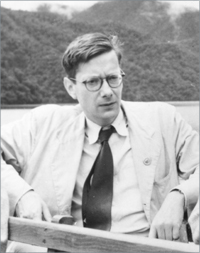


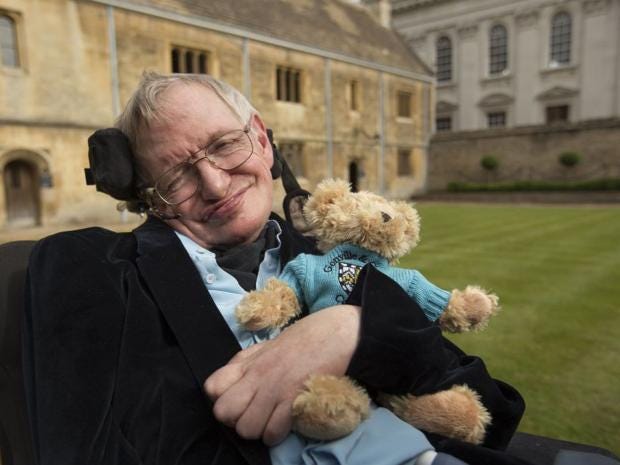
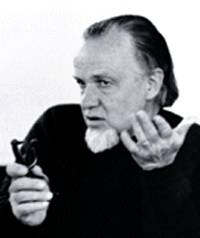


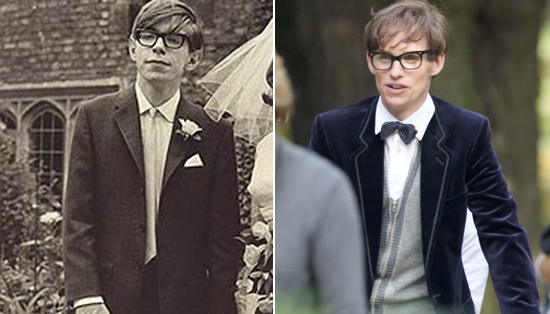






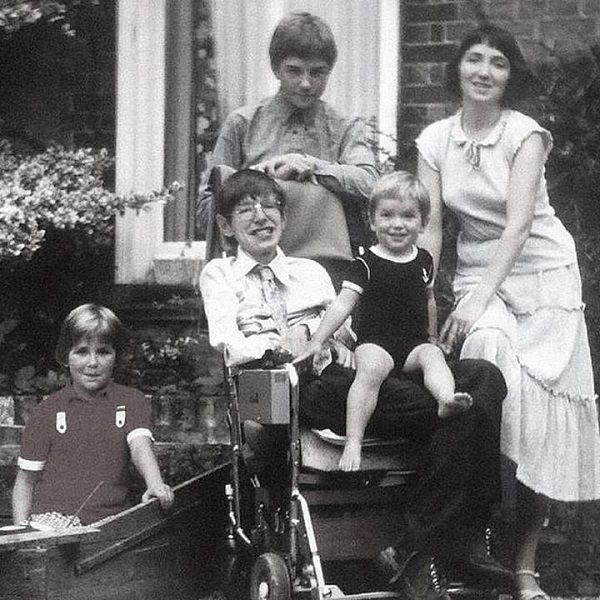


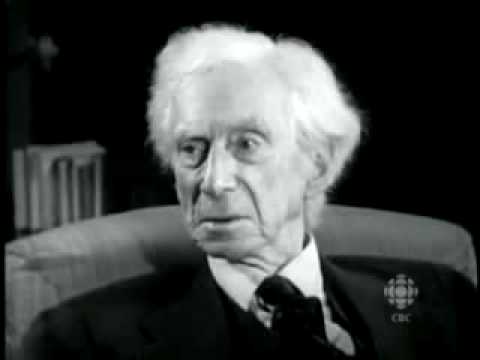

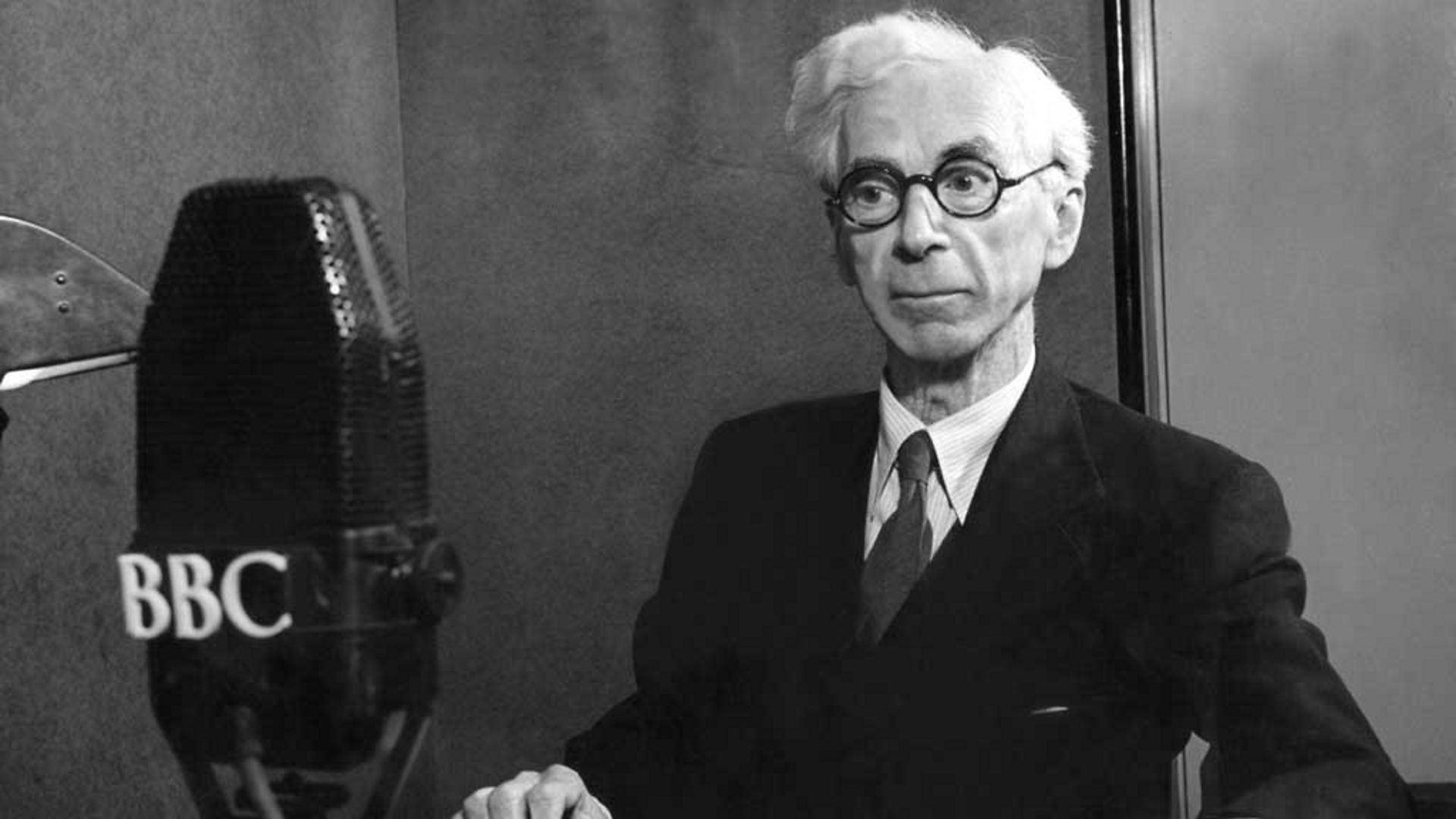

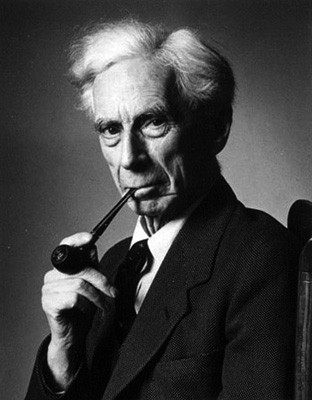


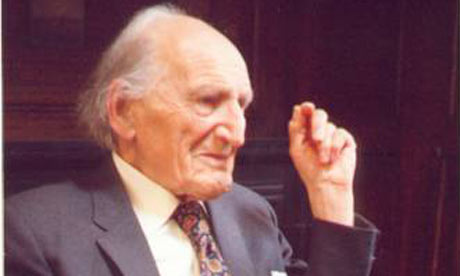
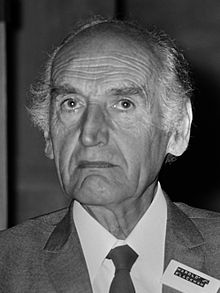
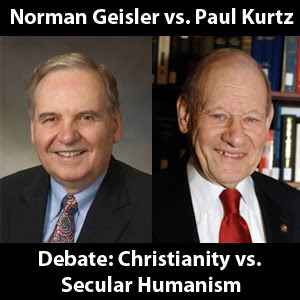
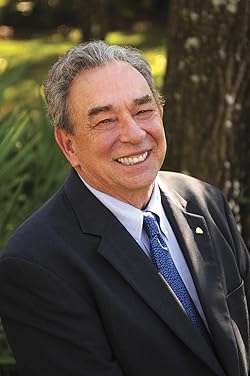


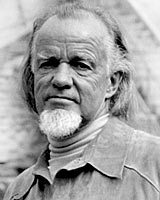


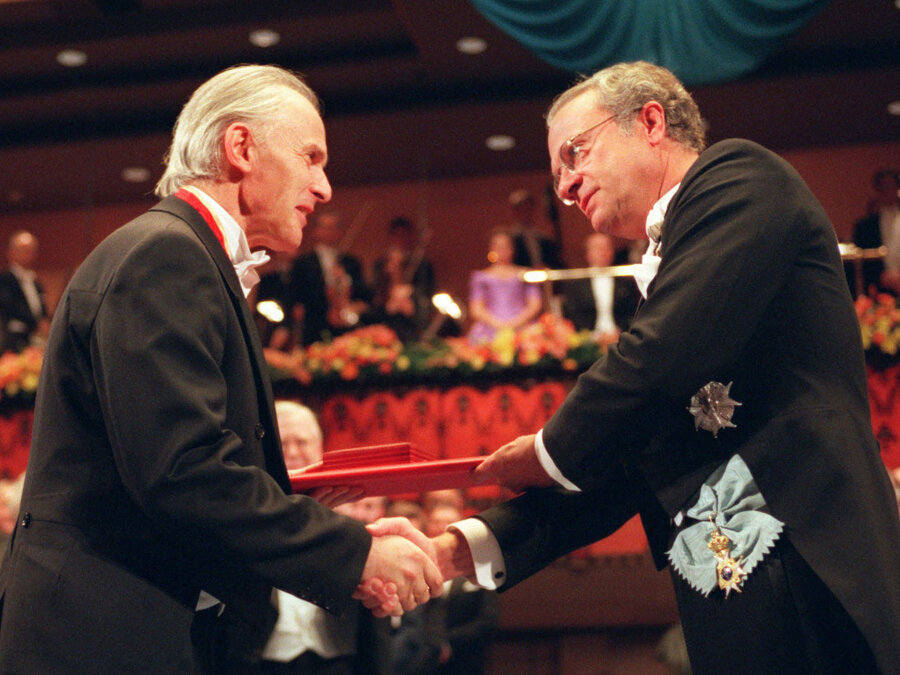
 Bertrand Arthur William Russell was born at Trelleck on 18th May, 1872. His parents were Viscount Amberley and Katherine, daughter of 2nd Baron Stanley of Alderley. At the age of three he was left an orphan. His father had wished him to be brought up as an agnostic; to avoid this he was made a ward of Court, and brought up by his grandmother. Instead of being sent to school he was taught by governesses and tutors, and thus acquired a perfect knowledge of French and German. In 1890 he went into residence at Trinity College, Cambridge, and after being a very high Wrangler and obtaining a First Class with distinction in philosophy he was elected a fellow of his college in 1895. But he had already left Cambridge in the summer of 1894 and for some months was attaché at the British embassy at Paris.

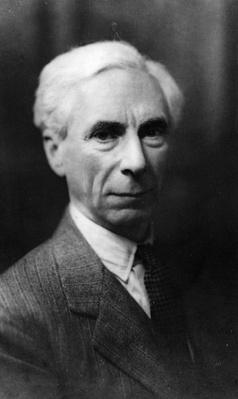


 The Daily Hatch